Richmond Planet
Saturday, November 4, 1905
Richmond, Virginia
Page text (machine-generated)
THE RICHMOND PLANET
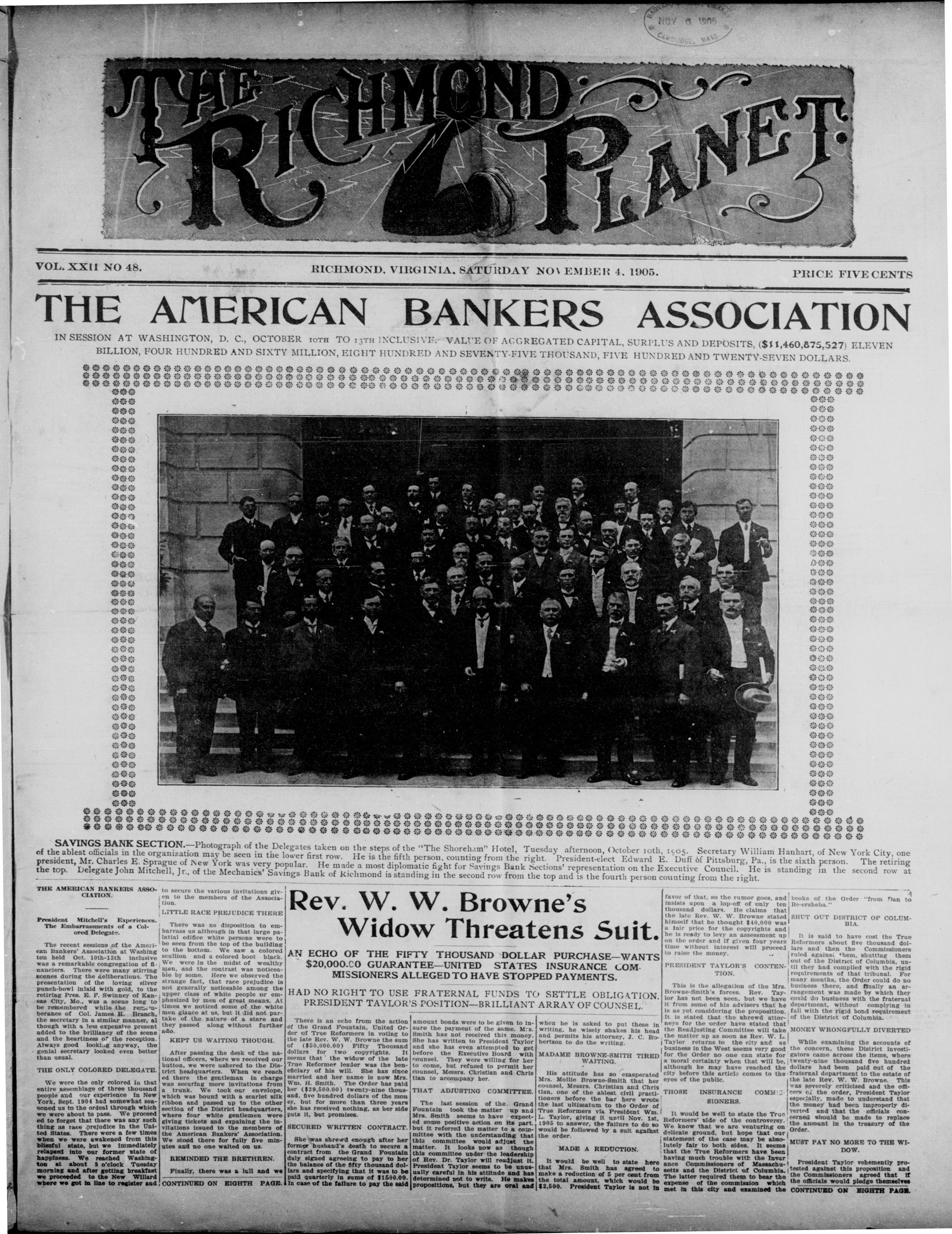
THE AMERICAN BANKERS ASSOCIATION
IN SESSION AT WASHINGTON, D. C., OCTOBER 10TH TO 13TH INCLUSIVE. VALUE OF AGGREGATED CAPITAL, SURPLUS AND DEPOSITS, ($11,460,875,527) ELEVEN BILLION, FOUR HUNDRED AND SIXTY MILLION, EIGHT HUNDRED AND SEVENTY-FIVE THOUSAND, FIVE HUNDRED AND TWENTY-SEVEN DOLLARS.
SAVINGS BANK SECTION.—Photograph of the Delegates taken on the steps of the "The Shoreham" Hotel, Tuesday afternoon, October 10th, 1905. Secretary William Hanhart, of New York City, one of the ablest officials in the organization may be seen in the lower first row. He is the fifth person, counting from the right. President-elect Edward E. Duff of Pittsburg, Pa., is the sixth person. The retiring president, Mr. Charles E. Sprague of New York was very popular. He made a most diplomatic fight for Savings Bank Sections' representation on the Executive Council. He is standing in the second row at the top. Delegate John Mitchell, Jr., of the Mechanics' Savings Bank of Richmond is standing in the second row from the top and is the fourth person counting from the right.
VOL. XXII NO 48.
IN SESSION AT WAR
BILLION, FO
SAVINGS BANK SEC
of the ablest officials in the or
president, Mr. Charles E. Spr
the top. Delegate John Mitch
```markdown
```
THE AMERICAN BANKERS ASSOCIATION.
President Mitchell's Experiences The Embarrassments of a Colored Delegate.
The recent sessions of the American Bankers' Association at Washington ton held Oct. 10th-13th inclusive was a remarkable congregation of financiers. There were many stirring scenes during the deliberations. The presentation of the loving silver punch-bowl inlaid with gold, to the retiring Pres. E. F. Swinney of Kansas City, Mo., was a scene long to be remembered while the rememberance of Col. James R. Branch, the secretary in a similar manner, al though with a less expensive present added to the brilliancy of the scene and the heartiness of the reception. Always good looking anyway, the genial secretary looked even better than usual.
THE ONLY COLORED DELEGATE
We were the only colored in that entire assemblage of three thousand people and our experience in New York, Sept. 1904 had somewhat seasoned us to the ordeal through which we were about to pass. We proceeded to forget that there was any such thing as race prejudice in the United States. There were a few times when we were awakened from this blissful state, but we immediately relapsed into our former state of happiness. We reached Washington at about 8 o'clock Tuesday morning and after getting breakfast we proceeded to the New Willard where we got in line to register and
to secure the various invitations given to the members of the Association.
LITTLE RACE PREJUDICE THERE
There was no disposition to embarrass us although in that large palatial edifice white persons were to be seen from the top of the building to the bottom. We saw a colored scullion and a colored boot black. We were in the midst of wealthy men, and the contrast was noticeable by some. Here we observed the strange fact, that race prejudice is not generally noticeable among the upper class of white people or emphasized by men of great means. At times we noticed some of the white men glance at us, but it did not partake of the nature of a stare and they passed along without further ado.
KEPT US WAITING THOUGH.
After passing the desk of the national officers, where we received our button, we were ushered to the District headquarters. When we reached there the gentleman in charge was securing more invitations from a trunk. We took our envelope, which was bound with a scarlet silk ribbon and passed up to the other section of the District headquarters, where four white gentlemen were giving tickets and explaining the invitations issued to the members of the American Bankers' Association. We stood there for fully five minutes and no one waited on us.
REMINDED THE BRETHREN.
RICHMOND, VIRGINIA, SATURDAY NOVEMBER 4, 1905.
Rev. W. W. Browne's Widow Threatens Suit.
AN ECHO OF THE FIFTY THOUSAND DOLLAR PURCHASE—WANTS $20,000.00 GUARANTEE—UNITED STATES INSURANCE COMMISSIONERS ALLEGED TO HAVE STOPPED PAYMENTS.
HAD NO RIGHT TO USE FRATERNAL FUNDS TO SETTLE OBLIGATION. PRESIDENT TAYLOR'S POSITION—BRILLIANT ARRAY OF COUNSEL.
There is an echo from the action of the Grand Fountain, United Order of True Reformers in voting to the late Rev. W. W. Browne the sum of ($50,000.00) Fifty Thousand dollars for two copyrights. It seems that the widow of the late True Reformer leader was the beneficiary of his will. She has since married and her name is now Mrs. Wm. H. Smith. The Order has paid her ($29,500.00) twenty-nine thousand, five hundred dollars of the money, but for more than three years she has received nothing, as her side puts it, but promises.
amount bonds were to be given to insure the payment of the same. Mrs. Smith has not received this money. She has written to President Taylor and she has even attempted to get before the Executive Board with counsel. They were willing for her to come, but refused to permit her counsel, Messrs. Christian and Chris tian to accompany her.
THAT ADJUSTING COMMITTEE.
The last session of the Grand Fountain took the matter up and Mrs. Smith seems to have expected when he is asked to put these in writing, he wisely shakes his head and permits his attorney, J. C. Robertson to do the writing.
MADAME BROWNE-SMITH TIRED WAITING.
His attitude has so exasperated Mrs. Mollie Browne-Smith that her counsel, Messrs. Christian and Chris tian, one of the ablest civil practitioners before the bar here wrote the last ultimatum to the Order of True Reformers via President Wm. L. Taylor giving it worth.
SECURED WRITTEN CONTRACT
She was shrewd enough after her former husband's death to secure a contract from the Grand Fountain duly signed agreeing to pay to her the balance of the fifty thousand dollars and specifying that it was to be paid quarterly in sums of $1500.00. In case of the failure to pay the said
amount bonds were to be given to insure the payment of the same. Mrs. Smith has not received this money. She has written to President Taylor and she has even attempted to get before the Executive Board with counsel. They were willing for her to come, but refused to permit her counsel, Messrs. Christian and Christian to accompany her.
THAT ADJUSTING COMMITTEE
The last session of the, Grand Fountain took the matter up and Mrs. Smith seems to have expected some positive action on its part, but it referred the matter to a committee with the understanding that this committee would adjust the matter. It looks now as though this committee under the leadership of Rev. Dr. Taylor will readjust it. President Taylor seems to be unusually careful in his attitude and has determined not to write. He makes propositions, but they are oral and
when he is asked to put these in writing, he wisely shakes his head and permits his attorney, J. C. Robertson to do the writing.
MADAME BROWNE-SMITH TIRED WAITING.
His attitude has so exasperated Mrs. Mollie Browne-Smith that her counsel, Messrs. Christian and Christian, one of the ablest civil practitioners before the bar here wrote the last ultimatum to the Order of True Reformers via President Wm. L. Taylor, giving it until Nov. 1st, 1905 to answer, the failure to do so would be followed by a suit against the order.
MADE A REDUCTION
It would be well to state here that Mrs. Smith has agreed to make a reduction of 5 per cent from the total amount, which would be $2,500. President Taylor is not in
favor of that, so the rumor goes, and insists upon a lop-off of only ten thousand dollars. He claims that the late Rev. W. W. Browne stated himself that he thought $40,000 was a fair price for the copyrights and he is ready to levy an assessment up on the order and if given four years time without interest will proceed to raise the money.
PRESIDENT TAYLOR'S CONTEN
TION.
This is the allegation of the Mrs. Browne-Smith's forces. Rev. Taylor has not been seen, but we have it from some of his advisers that he is as yet considering the proposition. It is stated that the shrewd attorneys for the order have stated that the Readjusting Committee will take the matter up as soon as Rev. W. L. Taylor returns to the city and as business in the West seems very good for the Order no one can state for a moral certainty when that will be, although he may have reached the city before this article comes to the eyes of the public.
THOSE INSURANCE COMMISSIONERS.
It would be well to state the True Reformers' side of the controversy. We know that we are venturing on delicate ground, but hope that our statement of the case may be absolutely fair to both sides. It seems that the True Reformers have been having much trouble with the Insurance Commissioners of Massachusetts and the District of Columbia. The latter required them to bear the expense of the commission which met in this city and examined the
PRICE FIVECENTS
ATION
(60,875,527) ELEVEN
DOLLARS.
anhart, of New York City, one
the sixth person. The retiring
standing in the second row at
```markdown
```
books of the Order "from Dan t
Be-ersheba."
SHUT OUT DISTRICT OF COLUMBIA.
It is said to have cost the True Reformers about five thousand dollars and then the Commissioners ruled against them, shutting them out of the District of Columbia, until they had complied with the rigid requirements of that tribunal. For many months, the Order could do no business there, and finally an arrangement was made by which they could do business with the fraternal department, without complying in full with the rigid bond requirement of the District of Columbia.
MONEY WRONGFULLY DIVERTED
While examining the accounts of the concern, these District investigators came across the items, where twenty-nine thousand five hundred dollars had been paid out of the fraternal department to the estate of the late Rev. W. W. Browne. This was severely criticized and the officers of the order, President Taylor especially, made to understand that the money had been improperly diverted and that the officials concerned should be made to replace the amount in the treasury of the Order.
MUST PAY NO MORE TO THE WI-
DOW.
President Taylor vehemently protested against this proposition and the Commissioners agreed that if the officials would pledge themselves CONTINUED ON EIGHTH PAGE.
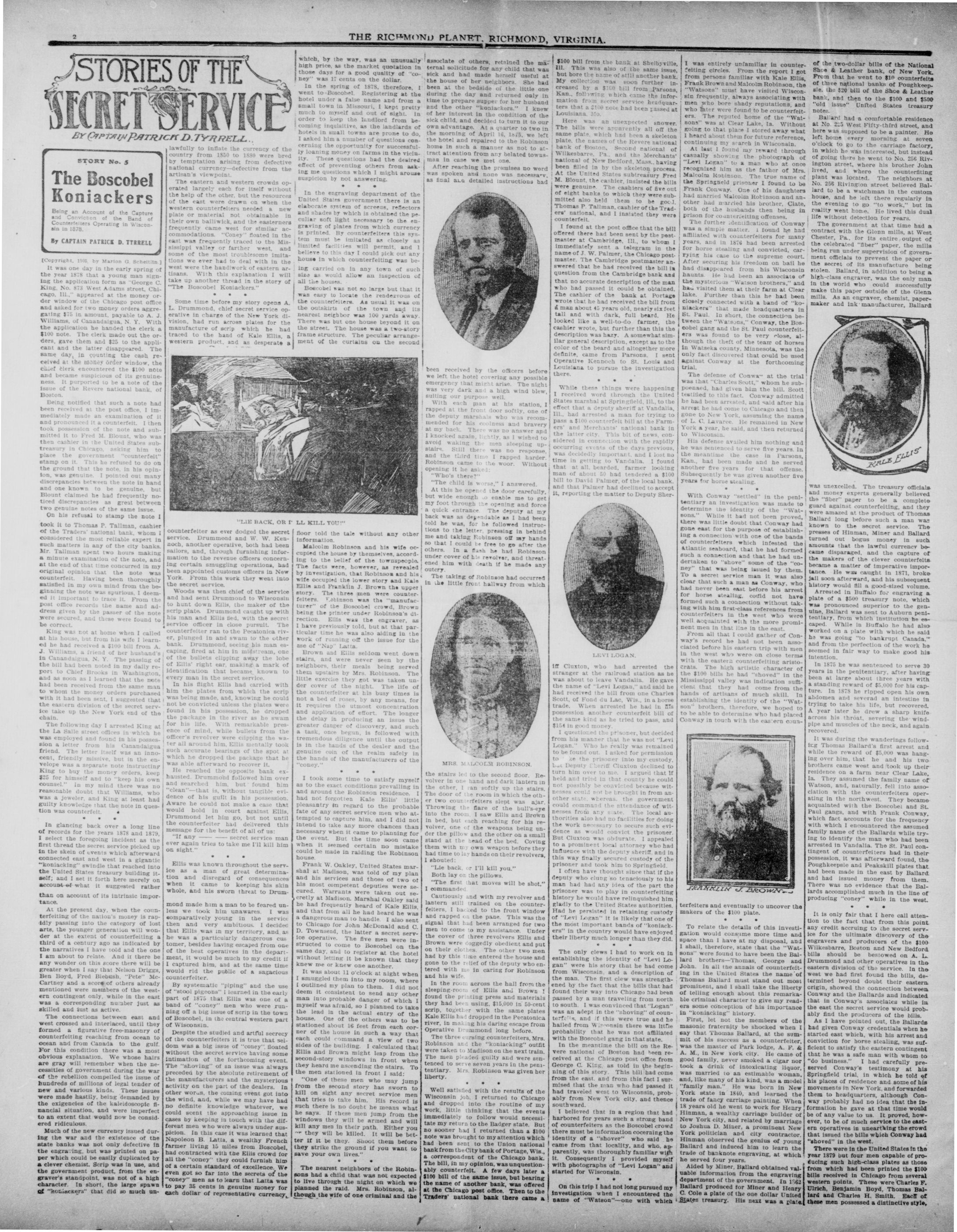
STORIES OF THE SECRET SERVICE BY CAPTAIN PATRICK D. TYRRELL
STORY No.5 The Boscobel Koniackers
Being an Account of the Capture and Conviction of the Band of Counterfeiters Operating in Wisconsin in 1878.
By CAPTAIN PATRICK D. TYRRELL
[Copyright, 1960 by Marlon G. Schellitn]
It was one day in the early spring of the year 1878 that a young man signing the application form as "George C. King, No. 873 West Adams street, Chicago, Ill." appeared at the money order window of the Chicago post office and asked for two money orders aggregating $75 in amount, payable to A. J. Williams, of Canandaigua, N. Y. With the application he handed the clerk a $100 note. The clerk made out the orders, gave them and $25 to the applicant and the latter disappeared. The same day, in counting the cash received at the money order window, the chief clerk encountered the $100 note and became suspicious of its genuineness. It purported to be a note of the issue of the Revere national bank, of Boston.
Being notified that such a note had been received at the post office, I immediately made an examination of it and pronounced it a counterfeit. I then took possession of the note and submitted it to Fred M. Blount, who was then cashier in the United States subtreasury in Chicago, asking him to place the government "counterfeit" stamp on it. This he refused to do on the ground that the note, in his opinion, was genuine. I pointed out many discrepancies between the note in hand and one known to be genuine, but Blount claimed he had frequently noticed discrepancies as great between two genuine notes of the same issue.
On his refusal to stamp the note I took it to Thomas P. Tallman, cashier of the Traders' national bank, whom I considered the most reliable expert in such matters in any of the city banks. Mr. Tallman spent two hours making a minute examination of the note, and at the end of that time concurred in my original opinion that the note was counterfeit. Having been thoroughly satisfied in my own mind from the beginning the note was spurious, I deemed it important to trace it. From the post office records the name and address given by the passer of the note were secured, and these were found to be correct.
King was not at home when I called at his house, but from his wife I learned he had received a $100 bill from A. J. Williams, a friend of her husband's in Canandaigua, N. Y. The passing of the bill had been noted in my daily report to Chief Brooks in Washington, and as soon as I learned that the note had been received from the same man to whom the money orders purchased with it had been sent, I suggested that the eastern division of the secret service take up the New York end of the chain.
The following day I arrested King at the La Salle street offices in which he was employed and found in his possession a letter from his Canandalgaig friend. The letter itself was an innocent, friendly missive, but in the envelope was a separate note instructing King to buy the money orders, keep $25 for himself and to "keep his own counsel." In my mind there was no reasonable doubt that Williams, who was a jeweler, and King at least had guilty knowledge that the note in question was counterfeit.
In glancing back over a long line of records for the years 1878 and 1879, I select the foregoing incident as the first thread the secret service picked up in the skein of events which afterward connected east and west in a gigantic "koniacking" swindle that reached into the United States treasury building itself; and I set it forth here merely on account of what it suggested rather than on account of its intrinsic importance.
At the present day, when the counterfeiting of the nation's money is rapidly passing into the category of lost arts, the younger generation will wonder at the extent of counterfeiting a third of a century ago as indicated by the narratives I have told and the one I am about to relate. And it there be any wonder on this score there will be greater when I say that Nelson Driggs, Ben Boyd, Fred Biebush, "Pete" McCartney and a score of others already mentioned were members of the western contingent only, while in the east was a corresponding number just as skilled and just as active.
The connections between east and west crossed and interlaced, until they formed a figurative free-masurory of counterfeiting reaching from ocean to ocean and from Canada to the gulf. For this condition there was a most obvious explanation. We whose hairs are gray will remember when the necessities of government during the war of the rebellion compelled the issue of hundreds of millions of legal tender of new and various kinds. These issues were made hastily, being demanded by the exigencies of the kaleidoscopic financial situation, and were imperfect to an extent that would now be considered ridiculous.
Much of the new currency issued during the war and the existence of the state banks was not only defective in the engraving, but was printed on paper which could be easily duplicated by a clever chemist. Scrip was in use, and the government product, from the engraver's standpoint, was not of a high character. In short, the large spawn of "blockers" that did so much un-
lawfully to inflate the currency of the country from 1850 to 1880 were bred by temptation arising from defective national currency—defective from the artisan's viewpoint.
The eastern and western crowds operated largely each for itself without the help of the other, but the resources of the east were drawn on when the western counterfeiters needed a new plate or material not obtainable in their own balliwick, and the easterners frequently came west for similar accommodations. "Coney" floated in the east was frequently traced to the Mississippi valley or farther west, and some of the most troublesome imitations we ever had to deal in the west were the handwork of eastern artisans. With this explanation I will take up another thread in the story of "The Boscobel Koniackers."
Some time before my story opens A. L. Drummond, chief secret service operative in charge of the New York division, had run across plates for the manufacture of scrip which he had traced to the hand of Kale Ellis, a western product, and as desperate a
A
"LIE BACK, OR I, LL, KILL YOU!"
counterfeiter as ever dodged the secret service. Drummond and W. W. Kennoch, another operative, both had been sailors, and, through furnishing information to the revenue officers concerning certain smuggling operations, had been appointed customs officers in New York. From this work they went into the secret service.
Woods was then chief of the service and had sent Drummond to Wisconsin to hunt down Ellis, the maker of the scrip plate. Drummond caught up with his man and Ellis fled, with the secret service officer in close pursuit. The counterfeiter ran to the Pecatonica river, plunged in and swam to the other bank. Drummond, seeing his man escaped, fired at him in midstream, one of the bullets clipping away the lobe of Ellis' right ear, making a mark of identification that became known to every man in the secret service.
In his flight Ellis had carried with him the plates from which the scrip was being made, and, knowing he could not be convicted unless the plates were found in his possession, he dropped the package in the river as he swam for his life. With remarkable presence of mind, while bullets from the officer's revolver were clipping the water all around him, Ellis mentally took such accurate bearings of the spot at which he dropped the package that he was able afterward to recover it.
He reached the opposite bank exhausted. Drummond followed him over and searched him, but found him "clean"—that is, without tangible evidence of his guilt in his possession. Aware he could not make a case that would hold in court against Ellis, Drummond let him go, but not until the counterfeiter had delivered this message for the benefit of all of us:
"If any _____ secret service man ever again tries to take me I will kill him
Ellis was known throughout the service as a man of great determination and disregard of consequences when it came to keeping his skin whole, and his sword threat to Drummond made him a man to be feared unless we took him unawares. I was comparatively young in the service then and very ambitious. I decided that Ellis was in my territory, and as he was a particularly dangerous customer, besides having escaped from one of the best operatives in the department, it would be much to my credit if I captured him, and at the same time would rid the public of a sagacious counterfeiter.
By systematic "piping" and the use of "stool pigeons" I learned in the early part of 1875 that Ellis was one of a band of "coney" men who were running off a big issue of scrip in the town of Boscobel, in the central western part of Wisconsin.
Despite the studied and artful secrecy of the counterfeiters it is true that seldom was a big issue of "coney", floated without the secret service having some intimation of the forthcoming event. The "shoving" of an issue was always preceded by the absolute retirement of the manufacturers and the mysterious activity on the part of the dealers. In other words, the coming event got into the wind, and, while we may have had no definite knowledge whatever, we could scent the approaching issue in cases by keeping in touch with the different men who were always under suspicion. In this case it was learned that Napoleon B. Latta, a wealthy French farmer living 15 miles from Boscobel, had contracted with the Ellis crowd for all the "coney" they could furnish him of a certain standard of excellence. We even got so far into the secrets of the "coney" men as to learn that Latta was to pay 35 cents in genuine money for each dollar of representative currency
. . .
. . .
which, by the way, was an unusually high price, as the market quotation in those days for a good quality of "coney" was 17 cents on the dollar.
In the spring of 1878, therefore, I went to Boscobel. Registering at the hotel under a false name and from a small town in Missouri, I kept pretty much to myself and out of sight. In order to keep the landlord from becoming inquisitive, as the landlords of hotels in small towns are prone to do, I asked him a number of questions concerning the opportunity for successfully loaning money on farms in the vicinity. These questions had the desired effect of preventing others from asking me questions which I might arouse suspicion by not answering.
In the engraving department of the United States government there is an elaborate system of screens, reflectors and shades by which is obtained the peculiar soft light necessary to the engraving of plates from which currency is printed. By counterfeiters this system must be imitated as closely as limited facilities will permit, and I believe to this day I could pick out any house in which counterfeiting was being carried on in any town of such size as would allow an inspection of all the houses.
Boeckel was not so large but that it was easy to locate the rendezvous of the counterfeiters. As usual it was on the outskirts of the town and its nearest neighbor was 100 yards away. There was but one house beyond it on the street. The house was a two-story frame structure. The peculiar arrangement of the curtains on the second
```markdown
```
floor told the tale without any other information.
Malcolm Robinson and his wife occupied the house by themselves, according to the belief of the townpeople. The facts were, however, as revealed by investigation, that Robinson and his wife occupied the lower story and Kale Ellis and Franklin J. Brown the upper story. The three men were counterfeiters. Robinson was the "manufacturer" of the Boscobel crowd, Brown being the printer under Robinson's direction. Ellis was the engraver, as I have previously told, but at that particular time he was also alding in the work of running off the issue for the use of "Nap" Latta.
Brown and Ellis seldom went down stairs, and were never seen by the neighbors, their meals being served them upstairs by Mrs. Robinson. The little exercise they got was taken under cover of the night. The life of the counterfeiter at his busy times is not a bed of roses, by any means, for it requires the utmost concentration and application of effort. The longer the delay in producing an issue the greater danger of discovery, and such a task, once begun, is followed with tremendous diligence until the output is in the hands of the dealer and the genuine coin of the realm safely in the hands of the manufacturers of the "coney."
I took some time to satisfy myself as to the exact conditions prevailing in and around the Robinson residence. I had not forgotten Kale Ellis' little pleasantry in regard to the probable fate of any secret service men who attempted to capture him, and I did not intend to take any more chances than necessary when it came to planning for the event. But the time soon came when it seemed certain no mistake could be made in raiding the Robinson house.
Frank W. Oakley, United States marshal at Madison, was told of my plan and his services and those of two of his most competent deputies were secured. Warrants were taken out secretly at Madison. Marshal Oakley said he had frequently heard of Kale Ellis, and that from all he had heard he was a dangerous man to handle. I also sent to Chicago for John McDonald and C. D. Townsend, the latter a secret service operative. The five men were instructed to come to Boscobel on the same day, and to register at the hotel without letting it be known that they knew me or knew one another.
It was about 11 o'clock at night when I smuggled them into my room, where I outlined my plan to them. I did not deem it consistent to send any other man into probable danger of which I myself was afraid, so I planned to take the lead in the actual entry of the house. One of the others was to be stationed about 16 feet from each corner of the house in such a way that each could command a view of two sides of the building. I calculated that Ellis and Brown might leap from the second-story windows in front when they heard me ascending the stairs. To the men stationed in front I said:
"One of these men who may jump from the second story has sworn to kill on sight any secret service men that tries to take him. His record is such there is no doubt he means what he says. If these men jump from the windows they will be armed and will kill any men in their path. Either you or they will be killed. It will be better if it be they. Shoot them before they strike the ground if you want to save your own lives."
The nearest neighbors of the Robinsons had a child that was not expected to live through the night on which we planned the raid. Mrs. Robinson, although the wife of one criminal and the
THE RICHMOND PLANET, RICHMOND, VIRGINIA.
. . .
. . .
associate of others, retained the maternal solicitude for any child that was sick and had made herself useful at the house of her neighbors. She had been at the bedside of the little one during the day and returned only in time to prepare supper for her husband and the other "konlackers." I knew of her interest in the condition of the sick child, and decided to turn it to our own advantage. At a quarter to two in the morning of April 16, 1875, we left the hotel and repaired to the Robinson home in such a manner as not to attract attention from any belated townman in case we met one.
After reaching the premises no word was spoken and none was necessary, as final no detailed instructions had
[Image of a man with a beard and mustache, wearing a suit and tie. The background is plain white. The man's face is centered in the image.]
been received by the officers before we left the hotel covering any possible emergency that might arise. The night was very dark and a high wind blew, sulting our purpose well. With each man at his station, I rapped at the front door softly, one of the deputy marshals who was recommended for his coolness and bravery at my back. There was no answer and I knocked again, lightly, as I wished to avoid waking the men sleeping upstairs. Still there was no response, and the third time I rapped harder. Robinson came to the woor. Without opening it he asked:
"Who's there?"
"The child is worse," I answered.
At this he opened the door carefully,
but wide enough to enable me to get
my foot through the opening and force
a quick entrance. The deputy at my
back was as dependable as I had been
told he was, for he followed instructions
to the letter, pressing in behind
me and taking Robinson off my hands
so that I could be free to go after the
others. In a flash he had Robinson
under cover of his revolver, and threaten-
ed him with death if he made any
outyure.
The taking of Robinson had occurred
in the little front hallway from which
MRS. MALCOLM ROBINSON
the stairs led to the second floor. Revolver in one hand and dark lantern in the other, I ran softly up the stairs. The door of the room in which the other two counterfeiters slept was ajar. Throwing the flare of the bull's-eye into the room, I saw Ellis and Brown in bed, but each reaching for his revolver, one of the weapons being under the pillow and the other on a small stand at the head of the bed. Coving them with my own weapon before they had time to lay hands on their revolvers, I shouted:
"Lie back, or I'll kill you."
Both lay on the pillows.
"The first that moves will be shot."
I commanded.
Cautiously and with my revolver and lantern still trained on the counterfeiters, I backed to the front window and rapped on the pane. This was the signal that had been arranged for two men to come to my assistance. Under the cover of three revolvers Ellis and Brown were doggedly obedient and put on their clothes. The other two men had by this time entered the house and gone to the relief of the deputy who entered with me in caring for Robinson and his wife.
In the room across the hall from the sleeping-room of Ellis and Brown I found the printing press and materials they had been using, $15,000 in 50-cent scrip, together with the same plates Kale Ellis had dropped in the Pecatonica river, in making his daring escape from Operative Drummond long before.
The three cursing counterfeiters, Mrs. Robinson and the "konkacking" outfit were taken to Madison on the next train. The men pleaded guilty and were sentenced to serve seven years in the sententiary. Mrs. Robinson was given her liberty.
Well satisfied with the results of the Wisconsin job. I returned to Chicago and dropped into the routine of my work, little thinking that the events immediately to follow would necessitate my return to the Badger state. But no sooner had I returned than a $100 note was brought to my attention which had been sent to the Union national bank from the City bank of Portage, Wis., a correspondent of the Chicago bank. The bill, in my opinion, was unquestionably counterfeit. A few days later a $100 bill of the same issue, but bearing the name of another bank, was offered at the Chicago post office. Then to the Traders' national bank there came a
$100 bill from the bank at Shelbyville, Ill. This was also of the same issue, but bore the name of still another bank. My collection was soon further increased by a $100 bill from Parsons, Kan., following which came the information from secret service headquarters that a $100 note had been passed at Louisiana, Mo. Here was an unexpected snower. The bills were apparently all off the same plate, which had been a skeleton plate, the names of the Revere national bank of Boston, Second national of Wilkesbarre, Pa., and the Merchants' national of New Bedford, Mass., having been filled in by the skeleton process. At the United States subtreasury Fred M. Blount, the cashier, insisted the bills were genuine. The cashiers of five out of eight banks to which they were submitted also held them to be good. Thomas P. Tallman, cashier of the Traders' national, and I insisted they were counterfeit.
I found at the post office that the bill offered there had been sent by the postmaster at Cambridge, Ill., to whom I immediately sent a telegram in the name of J. W. Palmer, the Chicago postmaster. The Cambridge postmaster answered that he had received the bill in question from the Cambridge bank and that no accurate description of the man who had passed it could be obtained. The cashier of the bank at Portage wrote that he had received the bill from a man about 45 years old, nearly six feet tall and with dark, full beard. He looked like a well-to-do farmer, the cashier wrote, but further than this the description was hazy. A somewhat similar general description, except as to the color of the beard and altogether more definite, came from Parsons. I sent Operative Kennoch to St. Louis and Louisiana to pursue the investigation there.
. . .
While these things were happening I received word through the United States marshal at Springfield, Ill., to the effect that a deputy sheriff at Vandalia, Ill., had arrested a man for trying to pass a $100 counterfeit bill at the Farmers' and Merchants' national bank in the latter city. This bit of news, considered in connection with the rapidly occurring events of the days previous, was decidedly important, and I lost no time in getting to Vandalia. I found that at all, bearded, farmer looking man of about 50 had tendered a $100 bill to David Palmer, of the local bank, and that Palmer had declined to accept it, reporting the matter to Deputy Sher-
LEVI LOGAN
iff Clutxon, who had arrested the stranger at the railroad station as he was about to leave Vandalia. He gave the name of "Levi Logan," and said he had received the bill from one Charles Scott, of Fond du Lac, Wis., in a horse trade. When arrested he had in his possession another counterfeit bill of the same kind as he tried to pass, and $154 in good money.
I questioned the prisoner, but decided from his manner that he was not "Levi Logan." Who he really was remained to be found out. I asked for permission to "see the prisoner into my custody, but Deputy Sheriff Cluxton declined to turn him over to me. I argued that if held and tried in that county he could not possibly be convicted because witnesses could not be brought in from another state, whereas, the government could command the attendance of witnesses from any state. The local authorities also had no facilities for doing the work necessary to secure such evidence as would convict the prisoner. But Cluxton was obdurate. I appealed to a prominent local attorney who had influence with the deputy sheriff, and in this way finally secured custody of the prisoner and took him to Springfield.
I often have thought since that if the deputy who clung so tenaciously to his man had had any idea of the part the prisoner was to play in counterfeiting history he would have relinquished him gladly to the United States authorities. Had he persisted in retaining custody of "Levi Logan" it is likely that one of the most important bands of "konkackers" in the country would have enjoyed their liberty much longer than they did.
. . .
The only clews I had to work on in establishing the identity of "Levi Logan" were his story that he had come from Wisconsin, and a description of the man. The first clew was strengthened by the fact that the bills that had found their way into Chicago had been passed by a man traveling from north to south. I was convinced that "Logan" was an adept in the "shoving" of counterfeits, and if this were true and he hailed from Wisconsin there was little probability that he was not affiliated with the Bossobel gang in that state. In the meantime the bill on the Revere national of Boston had been received at the Chicago post office from George C. King, as told in the beginning of this story. This bill had come from the east, and from this fact I surmised that the man who had passed it had traveled west to Wisconsin, probably from New York city, and thence southward.
I believed that in a region that had harbored for years such a strong band of counterfeiters as the Boscobel crowd there must be information concerning the identity of a "shover" who said he came from that locality, and who, apparently, was thoroughly familiar with it. Consequently I provided myself with photographs of "Levi Logan" and started for Wisconsin.
On this trip I had not long pursued my investigation when I encountered the name of "Watson"—one with which
I was entirely unfamiliar in counterfeiting circles. From the report I got from persons familiar with Kale Ellis, Frank Brown and Malcolm Robinson, the "Watsons" must have visited Wisconsin frequently, always associating with men who bore shady reputations, and who inter were found to be counterfeiters. The reputed home of the "Watsons" was at Clear Lake, Ia. Without going to that place I stored away what I heard about them for future reference, continuing my search in Wisconsin. At last I found my reward through casually showing the photograph of "Levi Logan" to a man who at once recognized him as the father of Mrs. Malcolm Robinson. The true name of the Springfield prisoner I found to be Frank Conway. One of his daughters had married Malcolm Robinson and another had married his brother, Clate, both of the husbands then being in prison for counterfeiting offenses.
The further identification of Conway was a simple matter. I found he had affiliated with counterlefters for many years, and in 1876 had been arrested for horse stealing and convicted, carrying his case to the supreme court. After securing his freedom on ball he had disappeared from his Wisconsin haunts. He had been an associate of the mysterious "Watson brothers," and had visited them at their farm at Clear lake. Further than this he had been closely connected with a band of "knackers" that made headquarters in St. Paul. In short, the connection between the "Watson's," Conway, the Boscobel gang and the St. Paul counterlefters was found to be very close, although the theft of the tames of horses in Watseka county, Minnesota, was the only fact discovered that could be used against Conway at the forthcoming trial.
The defense of Conway at the trial was that "Charles Scott," whom he subpoenaed, had given him the bill. Scott testified to this fact. Conway admitted he had been arrested, and said after his arrest he had come to Chicago and then gone to New York, assuming the name of L. C. Lavarce. He remained in New York a year, he said, and then returned to Wisconsin.
His defense availed him nothing and he was sentenced to serve five years. In the meantime the case in Parsons, Kan, had been made and he served another five years for that offense. Subsequently he was given another five years for horse stealing.
. . .
With Conway "settled" in the penitentiary an investigation was made to determine the identity of the "Wattsons." While it had not been proved, there was little doubt that Conway had gone east for the purpose of establishing a connection with one of the bands of counterfeiters which infested the Atlantic seaboard, that he had formed such a connection and that he had undertaken to "shove" some of the "cooney" that was being issued by them. To a secret service man it was also clear that such a man as Conway, who had never been east before his arrest for horse stealing, could not have formed such a connection without taking with him first-class references from counterfeiters in the west who were well acquainted with the more prominent men in that line in the east.
From all that I could gather of Conway's record he had not been associated before his eastern trip with men in the west who were on close terma with the eastern counterfeiting aristocrats. The high artistic character of the $100 bills he had "shoved" in the Mississippi valley was indication sufficient that they had come from the hands of artisans of much skill. In establishing the identity of the "Watson" brothers, therefore, we hoped to be able to determine who had placed Conway in touch with the eastern coun-
FRANKLIN J. BROWN
FRANKLIN J. BROWN
terfeiters and eventually to uncover the makers of the $100 plate.
. . . .
To relate the details of this investigation would consume more time and space than I have at my disposal, and I shall, therefore, state that the "Watson's" were found to have been the Ballard brothers-Thomas, George and John. In all the annals of counterfeiting in the United States the name of Thomas Ballard must stand out most prominent, and I shall take the liberty of telling enough about this remarkable criminal character to give my readers some conception of his importance in "koniacking" history.
First, let not the members of the masonic fraternity be shocked when I say that Thomas Ballard, at the summit of his success as a counterfeiter, was the master of Park lodge, A. F. & A. M., in New york city. He came of good family, never smoked a cigar nor took a drink of intoxicating liquor, was married to an estimable woman, and, like many of his kind, was a model "family man." He was born in New York state in 1840, and learned the trade of fancy carriage painting. When 18 years old he went to work for Henry Hinman, a wealthy carriage builder of New York city, and related by marriage to Joshua D. Miner, a prominent New York politician and city contractor. Hinman observed the genius of young Ballard and induced him to learn the trade of banknote engraving, at which he served four years.
Aided by Miner, Ballard obtained valuable information from the engraving department of the government. In 1562 Ballard produced for Miner and Henry C. Cole a plate of the one dollar United States treasury. His next was a plate
of the two-dollar bills of the National Shoe & Leather bank, of New York. From that he went to $10 counterfeits of three national banks of Poughkeepsie, the $20 bill of the Shoe & Leather bank, and then to the $100 and $500 "old issue" United States treasury notes. Ballard had a comfortable residence at No. 225 West Fifth-third street, and here was supposed to be a painter. He left home every morning at seven o'clock to go to the carriage factory, in which he was interested, but instead of going there he went to No. 256 Rivington street, where his brother John lived, and where the counterfitting plant was located. The neighbors at No. 256 Rivington street believed Ballard to be a watchman in the custom house, and he left there regularly in the evening to go "to work," but in reality went home. He lived this dual life without detection for years.
The government at that time had a contract with the Glenn mills, at West Chester, Pa. for its entire output of the celebrated "iber" paper, the mills being run under supervision of government officials to prevent the paper or the secret of its manufacture being stolen. Ballard, in addition to being a high-class engraver, was the only man in the world who could successfully make this paper outside of the Glenn mills. As an engraver, chemist, papermaker and ink manufacturer, Ballard
KALE ELLIS
was unexcelled. The treasury officials and money experts generally believed the "fiber" paper to be a complete guard against counterfeiting, and they were amazed at the product of Thomas Ballard long before such a man was known to the secret service. The presses of Hinman, Miner and Ballard turned out bogus money in such amounts that the lawful currency became disparaged, and the capture of the makers of the clever counterfeiters became a matter of imperative importance. He was caught in 1871, broke fall soon afterward, and his subsequent history would fill a good-sized volume.
Arrested in Buffalo for engraving a plate of a $500 treasury note, which was pronounced superior to the genuine, Ballard was sent to Auburn penitentiary, from which institution he escaped. While in Buffalo he had also worked on a plate with which he said he was going "to bankrupt Canada." and from the perfection of the work he seemed in fair way to make good his intention. In 1875 he was sentenced to serve 30 years in the penitentiary, after having been at large about three years with a standing reward of $5,000 for his capture. In 1878 he ripped open his own abdomen and severed an intestine in trying to take his life, but recovered. A year later he drew a sharp knife across his throat, severing the windpipe and muscles of the neck, and again recovered.
It was during the wanderings following Thomas Ballard's first arrest and while the reward of $5,000 was hanging over him, that he and his two brothers came west and took up their residence on a farm near Clear Lake, Ia. They assumed the family name of Watson, and, naturally, fell into association with the counterfeiters operating in the northwest. They became acquainted with the Boscobei and St. Paul gangs, and with Frank Conway, which fact accounts for the frequency with which I encountered the assumed family name of the Ballards while trying to identify the man who had been arrested in Vandalia. The St. Paul contingent of counterfeiters had in their possession, it was afterward found, the Poughkeepsie and Peakskill plates that had been made in the east by Ballard and had issued money from them. There was no evidence that the Ballards accomplished much in the line of producing "coney" while in the west.
. . .
It is only fair that I here call attention to the fact that from this point any credit accruing to the secret service for the ultimate discovery of the engravers and producers of the $100 Wilkesbarre, Boston and New Bedford bills should be bestowed on A. L. Drummond and other operatives in the eastern division of the service. In the west we had first found the bills, determined beyond doubt their eastern origin, showed the connection between Conway and the Ballards and indicated that in Conway's associates while in the east the secret service would probably find the producers of the bills.
As I have pointed out, the Ballards had given Conway credentials when he started east which, with his arrest and conviction for horse stealing, was sufficient to satisfy the eastern contingent that he was a safe man with whom to "do business." I had carefully preserved Conway's testimony at his Springfield trial, in which he told of his places of residence and some of his movements in New York, and forwarded them to headquarters, although Conway probably had no idea that the information he gave at that time would be of any value to us. It proved, however, to be of much service to the eastern operatives in unearthing the crowd that issued the bills which Conway had "shoved" in the west.
There were in the United States in the year 1879 but four men capable of producing such high-class plates as those from which had been printed the $100 bills received in Chicago from several western points. These were Charles F. Urlich, Benjamin Boyd, Thomas Ballard and Charles H. Smith. Each of these men possessed a distinctive style.
THE PLANET
Published every Saturday by JOHN MITCHELL,
Jr., at all North 4th Street, Richmond, Va.
Al. communications intended for publication should be sent so as to reach us for Wednesday.
TERMS IN ADVANCE
One Copy, one year, $1.50
One Copy, eight months, 1.00
One Copy, six months, 0.50
One Copy, four months, 0.40
One Copy, three months, 0.30
Ningbo, Copy, 0.20
ADVERTISING RATES.
For one inch, one insertion, $0.50
For one inch, each subsequent insertion, $0.40
For two inches, three months, $0.60
For two inches, six months, $10.00
For two inches, nine months, $14.00
For two inches, twelve months $20.00
Marriage and Funeral Notices, one inch, $0.50
Standing and Transient Notices per line, $10
POSTAGE STAMPS OF A HIGHER DEMONATION THAN TWO CENTS NOT RECEIVED ON SUBSCRIPTIONS.
THE PLANET is issued weekly. The subscription price is $1.50 per year in advance.
There are FOUR WAYS by which money can be sent by mail at our risk—in a Post Office Money Order, by Bank Check or Draft, or an Express Money Order, and when none of these money orders can be sent, you can send a Money Order. You can buy a Money Order at your Post Office, payable at the Richmond Post Office, and we will be responsible for its safe arrival. Your Express Money Orders can be obtained at any office of the American Express Co., the United States Express Co., and the Wells Fargo and Co. Express Company. We will be responsible for all of your Express Money Orders. The Express Money Order is a convenient way for warding money.
REGISTERED LETTER—If a money Order Post Office or an Express Company is not within your area, you may wish to send us on payment of ten cents. Then, if the letter is lost or stolen, you can send money in this manner at our site.
We cannot be responsible for money sent in letters in any other way than one of the four ways mentioned above. If you send your money in any other way, you must do it at your own risk.
REWARDS, ETC.—If you do not want THE PLANET continued for another year after your subscription has run out, you then notify my office and I will send you a letter that decided that subscribers to newspaper, who do not order their paper discontinued at the expiration date, which it has, will pay the money or the salary that the subscription up to date when they order the paper discontinued.
COMMUNICATIONS—When writing to us to request a subscription or to oblige us to send you your paper, you should give your name and address in full otherwise we cannot find your name on our books.
CORRECTION OF ADDRESS—In order to change the address of a subscriber, we must be sent the former as well as the present address.
THE PLEDGE GIVEN.
We expressed the opinion in our last issue that President Roosevelt was not making the trip through the South for his health, but that it had much to do with the legislation that he wishes to see enacted this winter. The reports of his visit to New Orleans, Louisiana seems to emphasize this. The following telegraphic report under date of Oct. 26, 1905 reads as follows:
The climax of to-day's entertainment of President Roosevelt was a luncheon at the St. Charles Hotel at 3 o'clock. The President and Governor Blanchard were the principal speakers. The Governor's address was eulogistic, and addressing the President, he said in part:
"You are now standing for some other things and measures that we are with you on, as to which you have our good wishes, and relative to which we, the Democrats of Louisiana, and I believe generally of the South, wish to see you have the support of the Democratic vote in the two houses of Congress this winter. "With us of the South the day of mere political prejudice has passed away. There is not much of this feeling lingering, and what there is will-soon disappear."
It will be seen that, southerner like, the distinguished Chief Executive of Louisiana threw discretion to the winds and boldly announced to President Roosevelt that the purpose of his trip had been accomplished. Link with this the report from Chicago, Ill., where Pres. Roosevelt's friends were forced to resort to revolutionary tactics and to deny to the opposition the "square deal" so often referred to, and our readers will have the "key to the situation" and realize fully that a momentous struggle is about to take place at Washington, between the executive and legislative branches of the government equalled only by the one precipitated by President Grover Cleveland and his party and which resulted in the disintegration of the Democratic Party of the nation and the return of the Republican Party to power in the affairs of the government. Here is the Chicago report:
CHICAGO, October 26.—Refusing to promise indorsement of President Roosevelt's policy for the regulation of railroad rates, about half of the 900 delegates to the Interstate Commerce Law Convention today were barred from the convention, and thereupon held a separate meeting to give expression to their ideas on rate legislation. The original convention was held in Steinway Hall, while the anti-convention met in Studebaker Hall. Alleged attempts to thwart the purpose of the convention caused the delegates at Steinway Hall to re fuse to admit delegates, although properly accredited, unless they would agree to support the President's rate plan. Many delegates objected to this procedure, demand-
ing that they be given the right of free speech. The other delegates, charged the so-called "antis," were sent by the railroads and other alleged unfair interests to pack the convention. A number of exciting scenes followed before the two meetings were called to order. Speeches, organization and resolutions, including one which was presented in the Studebaker Hall convention, asking the President to settle the dispute as to which was the reguar convention, but upon which no action was taken, occupied the time of the first meetings of the conventions. The conventions will continue in session to-morrow, when resolutions will be adopted by the Steinway Hall convention in favor of the President's policy.
This then would seem to account for the President's anxiety and his hurried trip to Louisiana, despite the existence of the yellow fever there. It also explains why the colored brother was left out of the programme. He was out "gunning for votes" and "dead ducks" or disfranchised citizens had but a perfunctory interest for him. He is a fighter and he likes to win and he will win if any effort on his part will bring success.
This, then, is why we urged colored people to stand off and not annoy him at this time. The issues involved are momentous and big stakes are involved in the result. The commercial interests of the country in our judgment are behind Mr. Roosevelt and these interests are urging him on in a contest, which will prove the greatest in his career and result either in his success or in the destruction of the Republican Party of the nation, or in his success and the destruction of the Republican Party of the nation.
If the Democratic Party in Congress forms the bulk of Mr. Roosevelt's support, the result is soon told, for history will be repeating itself and the experience of President Cleveland will be duplicated. Mr. Roosevelt will be entitled then to an ex-President's chair by the side of the one now occupied by "the sage of Princeton," within the inviting confines of the great state of New Jersey. He will be a statesman without a Party.
REV. IRVINE CHANGES FAITH
Preacher Unfrocked By Bishop Talbot to Enter Russian Catholic Church. Philadelphia. Oct. 31.—Rev. Dr. Ingram N. W. Irvine, who was unfrocked by Bishop Talbot, of the Central Pennsylvania diocese of the Protestant Episcopal church, will be formally admitted into the priesthood of the Russian Orthodox Catholic church next Sunday in St. Nicholas Cathedral, New York. The ceremony will be performed by the Most Rev. Tikhon, D. D., by permission of the archbishop of the Russian Catholic church. Dr. Irvine said: "I have weighed seriously the positions of the different portions of Christendom and have come to the conclusion that the Holy Eastern church affords a better basis for the reunion of Christendom than any other part of the Catholic church. In her midst I hope to be the loving friend of the Anglican church, as well as of the Roman and Protestant churches."
WILL MAKE FARMERS
The Late Judge Paxson Founds An Agricultural College.
Doylestown, Pa., Nov. 1.—Judge Edward M. Paxson, who died at Bycot House, Bycot, Bucks county, on October 12, left part of his fortune for the endowment of a college of agriculture. This, it is said, differs from any institution of the kind now in existence in this country, because provision is made for experienced instruction through the medium of the land owned by the distinguished jurist, which is to be laid off in farms and equipped with all the modern appliances. The college is to be open to boys between 12 and 18 years, and a regular course of study is to be arranged, so that there will be given mental equipment as well as soil-tilling experience. The fortune of the late judge amounts to nearly $3,000,000, a big part of which is to be applied to the maintenance of the farms and the college.
The affairs of the institution are to be placed in the control of a board of trustees who are named by the judge
TROTTING RECORD BROKEN
Ed. Bryan Goes Two Miles In 4.45 at Philadelphia.
Philadelphia, Nov. 1.—Ed. Bryan, the bay gelding trotter, owned by William Robinson. In a trial against time on the Beimount Park track, broke the world's two-mile record, which has stood for 40 years. The time was 4.45. The best previous record was 4.564, made by Dexter, br. g., on Long Island, October 27, 1865. Ed. Bryan's performance was considered remarkable by horsemen who saw the event, as Dexter's time was made to a skeleton wagon, while Ed. Bryan's record was made to a bicycle-wheeled road wagon. The average time of the quarters was 35% seconds.
Eva Booth Has Appendicitle
Baltimore, Md., Oct. 30—Commander Eva Booth, of the Salvation Army, who was to have delivered two addresses here, failed to appear, and it was announced that she had been taken ill with appendicitis in New York as she was about to leave for this city. Near the close of the meeting Colonel William Peart read to the audience a telegram from New York headquarters, which said. "Miss Booth slightly better, but very low and cannot sleep."
$2,858,398 in Jersey Treasury.
Trenton, N. J., Nov. 1.—The state fiscal year closed yesterday, and State Comptroller Morgan announced that the cash balance in the treasury is $2,858,398, a decrease of $2,520 as compared with the figures of a year ago.
RICHMOND PLANET. RICHMOND, VIRGINIA
Business League.
A most excellent programme has been arranged and mea and women from all parts of the state and Washington, D. C. will take part, on the 8th and 9th of Nov. when the great Negro Business League will assemble in Richmond. Dr. Booker T. Washington has been invited and we are expecting him to be present. President Langford of the Washington Negro Business League will address the League.
All persons who intend to come are hereby notified that reduced rates have been arranged for on all railroads on the certificate plan; they must therefore when they buy their ticket starting for Richmond be sure to get a certificate blank from the agent selling you your ticket as this will have to be signed in Richmond before you start back. Let all the business Negroes, farmers, artisans, domestics, professionals and others be represented in this great assembly of progressive Negroes.
W. F. GRAHAM, Pres.
E. C. BROWN, Cor. Sec.
Do You Know Them?
I am anxious to find my aunt, Mrs Matilda Fegans, who lives in the city of Vicksburg. Miss. Her native home is in Buckingham, Va., Glenmore P. O. She has two sons, Mr. Charles Patterson and Mr. William Fegans.
Any information respecting them will be gladly received.
Truly yours,
SALLY ANN COLES
Daughter of Stephen Perkins
Axtell. Buckingham Co. Va.
Wants to Find Them.
I would like to know the whereabouts of Mrs. Sarah Jefferson. When last heard of she was living on St. James St. or near 6th Mt. Zlon Bapt Church. Mr. Jefferson, her husband was employed at the R. and D. R. R. depot handling trunks. My aunt Mrs. Prior Randolph resided at 605 W. Leigh St. Any information concerning either will be gladly received. Address.
J. C. TRACY,
care Box 7,
Deer Lodge, Mont.
Mrs. Jessie D. Robinson of St. Louis, Mo., was initiated into Euresa Court. No. 89, Jan. 22, 1895. In July of the same year she was elected to the position of R. of D., serving two consecutive terms, after which she was elected to the position of Worthy Counsellor serving six consecutive terms, and four terms as Reg. of Accounts, and honored with the unanimous vote of her Court as its representative in the Grand Court four consecutive times. At the formation of the Grand Court in 1898 she was elected a a Past Grand Worthy Counsellor of that body as its representative to the Supreme Court at Jacksonville, Fl., 1899, Chicago, 1901, St. Louis, Mo., 1903 and she attended the Supreme Court as a visitor at Columbus, O., in 1897. She is now serving her fifth year as secretary and treasurer of the Endowment Fund. At the session held in Chicago, Ill., she was elected to the position of Supreme Conductress, and at the recent session held in St. Louis she was elected to the exalted position of Supreme Worthy Inspectrix of the Supreme Court. As one of the attractions of the entertainment of the Supreme Lodge, held in St. Louis, 1903, she organized the ladies' Calanthian Drill Drills, which will always be remembered as one of the events of this occasion. She now has the distinction of being the first lady in the history of Pythianism to hold a regular commission for herself and officers.
LOOK! LOOK!! LOOK!!!
Don't Fail to Read About the Wonderful Curl-i-Cure.—Works Like Magic.
We invite the readers of this paper, who have seen our advertisement, and perhaps doubted the truth of same, to read the following testimonial, dated Oct. 18th, 1905, which is only one of hundreds of like nature we receive.
Lincoln Chemical Works,
Aurora, Ill.
Gentlemen:
I used your Curl-i-Cure for two weeks, and I must say it is the best hair preparation I've ever used. It is the only preparation that has served my hair so well. Curl-i-Cure does what it is said to do, and I do not hesitate in recommending it. From the first application, I noticed a change for the better in my hair.
My two sisters, who have also used Curl-i-Cure for a short while, join me in recommending it to all. We shall never again be without it. With many felicitations, I am
Lizzie M. Jackson
231 Carolina St., Memphis, Tenn.
Price 50 cents free of all charges.
We solicit your orders and inquiries.
See our ad. in this paper. Refuse all substitutes. Curl-l-Cure is manufactured only by, and all letters should be addressed to
LINCOLN CHEMICAL WORKS
Aurora, Ill.
—If you wish a money-order and you are in a hurry, stop at the Mechanics' and get it. The cost is no more than the one you get at the Post Office or the express office and it will help us in building up a large banking business among our people.
—Rev. G. D. Pinkney, D. D. will be installed pastor of the First Union Baptist Church, West Moore St. Mon day night, Nov. 13th at 8 P. M. Rev W. M. Stephens, Master of Ceremonies.
—Mrs. Miles B. Debbress, who spent such a pleasant time recently in New York with her mother and friends shows signs of continued im provement.
—For good attention and fine photographs, call on Mr. George O. Brown. He is running the only exclusively colored gallery in the state and he is being well patronized. Go there and see some specimens of his work. See advertisement.
PRESIDENT IN WASHINGTON
Met By Mrs. Roosevelt On Return
From Southern Trip.
Washington, Nov. 1. — President Roosevelt came ashore from the Dolphin at the Washington navy yard at noon, and five minutes later he had left the yard for the White House in a carriage with Mrs. Roosevelt, and the trip was at an end which rounded out his tour of the entire United States during his presidency.
It was intended that the band and marines should escort the president out of the yard. But at the conclusion of the tribute to the flag, Mrs. Roosevelt drove up from behind the guard, the president entered the carriage, warmly grasped the hand of his wife and his carriage proceeded out of the yard. The crowd voiced its sentiment of welcome, and as the many huge shops were passed the workmen rushed out and cheered. "Glad to see you," shouted the president as he drove on. "Glad to see you back," came the voices from the shops.
SUIT CASE MYSTERY SOLVED
Police Locate Physician Who Cut Up
Girl's Body.
Boston, Nov. 1—Chief Police Inspector W. B. Watts stated that the doctor who dismembered the body of Susanna A. Geary, the suit case victim, had been located. He did not expect, however, that any arrest would be made for a day or two, intimating that the police were awaiting something more definite from Morris Nathan, the lover of the girl, who is being brought here.
The theory of the police regarding the whole affair, in which the most serious charge in connection with it can only be manslaughter, is that Miss Geary went to a woman and submitted to an illegal operation. The operation was not a success, but before the girl died a male physician was called in, and he attempted to save the girl's life by a second operation for peritonitis. Miss Geary died, the doctor then dismembered the body and distributed portions of it in two suit cases, which were subsequently found.
GZAR GIVES
GIVIC FREEDOM
TO RUSSIA
Signed Imperial Manifesto Granting People a Constitution.
M. WITTE THE FIRST PREMIER
Nicholas, With Throne Tottering and Subjects In Revolution, Surrenders to Demands of People, Granting Them Law-Making Powers and Personal Freedom—Rule of Absolutism Ended After 300 Years.
St. Petersburg, Oct. 31.—"I am sure the American people, who understand what freedom is, and the American press, which voices, the wishes of the people, will rejoice with the friendly Russian nation at this moment, when the Russian people have received from his imperial majesty the promises and the guarantees of freedom, and will join in the hope that the Russian people will wisely aid in the realization of those liberties by co-operating with the government for their peaceful introduction. Only thus will it be possible to secure the full benefits of the freedom conferred upon the people."
Count Witte, Russia's first premier, sent the above message to the American people through the Associated Press. He had just arrived at his residence on Kammeniovrov Prospect from Peterhof, where, in the Alexander Palace, the emperor two hours before had given his final approval to a manifesto and to a program which will forever end the rule of absolutism exercised by him and his Romanoff ancestors for 300 years.
Text of the Manifesto.
The following is the text of the imperial manifesto:
"We, Nicholas the second, by the grace of God, emperor and autocrat of all the Russians, grand duke of Finland, etc., declare to all our faithful subjects that, together with our capitals and in numerous other places, our heart with excessive pain and sorrow.
"The happiness of the Russian sovereign is indisolubly bound up with the happiness of our people and the sorrow of people is the sorrow of the sovereign.
"From the present disorders may arise
great national disruption. They menace
the nation."
"The supreme duty imposed upon us by our sovereign office requires us to efface ourselves and to use all the force and co-ordination of the power of the central government and to assure the success of measures for pacification in all the public life, which are essential to the welfare of our people.
"We, therefore direct our government to carry out our inflexible will in the following manner:
"First—To extend to the population the immutable foundations of civic liberties, based on the real inviolability of person, freedom of conglence, speech, union and association.
"Second—Without suspending the already ordered elections to the state douma, to invite to participation in the douma, so far as the limited time before the convocation of the douma will permit those classes of the population now completely deprived of electoral rights, leaving the ultimate development of the print media of the electoral right in general to the newly established legislative order of things.
"Third-To establish as an unchangeable rule that no law shall be enforceable on the people, the doma, and that it shall be possible for the people to exercise real participation in the supervision of the legality of the acts of the authorities appointed
"We appeal to all faithful sons of Russia to remember their duty towards the fatherland," continues the manifesto, "to aid in terminating those unprecedented demands and to apply their forces, in cooperation with the authorities of the calm and peace upon our natal soil." "Given at Peterhof, October 30, in the 11th year of our reign.
(Signed) "NICHOLAS." Bowed to the invitable
Bowed to the inevitable.
A simple perusal of the manifesto shows how complete is the emperor's abdication of his autocratic power. The very style of the document is clear and direct and devoid of the verbose, vague and bombastic phraseology which heretofore has characterized his majesty's manifestos. It not only betrays real authorship, but shows that the emperor at last has invocably bowed to the inevitable. He does not even conceal the fact that the discontent and agitation of his subjects has driven him to take the step and practically yields everything—divil liberty, the inviolability of person and liberty of conscience, speech and assembly. He not only converts the farcal imperial douma, with only consultative power, into a true legislative assembly, without the assent of which no measure shall become law, and before which all governmental authorities must answer, but promises eventually universal suffrage.
J. Pierport Morgan, Jr., and George W. Perkins were with Finance Minister Kokovsoff when the latter received the news. It was a dramatic moment. The minister was called to the telephone, and when he returned he was greatly agitated and said: "Gentlemen, the old-order of things has changed. Russia has a constitution." News Spread Like Wildfire. The news spread like wildfire throughout the city. The revolutionists, and active assistants generally, declared loudly that the government's promises would no longer suffice and that the strike must be continued. The effect throughout Russia is expected to be instantaneous. While the extremists threaten an attempt to keep up the present struggle, the best opinion is that the backbone of the strike is broken, but in the final analysis the effect will depend on how far Count Wille will be able to execute the heavy task when he has assumed. Sorry, people high in the room.
ment believe it still will be necessary to resort to ball cartridges to suppress the present movement, but Count Witte appears confident. He has become the bridge whereby the people are to cross to constitutionalism.
The cabinet selected. The count has already tentatively selected the members of his cabinet. He will himself hold no portfolio. All the present ministers, except those of war, navy and foreign affairs, will be retired. Prince Alexis Obedensky, one of the count's former assistants in the ministry of finance, will become minister of the interior; M. Romanoff, another former assistant to the minister, will take the finance portfolio; M. Koni, at present a senator and Russia's abiest jurist, will be minister of justice; M. Krosovsky, president of the St. Petersburg municipal council, will take the ministry of education, and M. Ziegler von Schaffhausen, chief of the railroad department of the ministry of finance, will become minister of ways and communications.
After the news got abroad crowds began marching up and down the Newsky Prospect, singing the national hymn and hurrahing for liberty. It is significant that the great searchlight which has been lighting up the Newsky Prospect from the admiralty tower for three nights, was turned off last night. The crowds sang the national hymn, cheering for the emperor and shouting themselves hoarse. The restaurants and cafes were closed at 2 o'clock, disgorging their crowds, who had been drinking and making merry for hours around the tables, to augment the demonstration in the thoroughfares. The assack patrols were utterly discommitted and confounded and were wholly at a loss to understand the meaning of the demonstration or why the crowds were singing "God Save the Emperor," Russia's magnificent national anthem, instead of the "Marscellise."
ALL RUSSIA REJOICES
Czar's Gift of Freedom Celebrated Enthusiastically.
St. Petersburg, Nov. 1.—Constantine Petrovitch Pobiedonostseff, chief procurator of the holy synod, has resigned.
All Russia celebrated enthusiastically the emperor's gift of freedom, which the greater part of the people received with deepest joy, though in St. Petersburg, Moscow and other cities socialists and revolutionaries organized antigovernment demonstrations and red flag parades, which, with the patriotic manifestations, led to a number of conflicts between the "Reds and Whites," as the anti-government and royalist factions are respectively termed. On the whole, the day passed more quietly in Russia than had been expected, though collisions between the people and the troops are reported from Poltava, Kazan and Kishineff, and two men were killed.
In each of the two capitals, St. Petersburg and Moscow, the day was one such as the Russians never before have seen. The Slavic people, which during the long war just closed and the anxious period preceding the announcement of the new era of constitutionalism seemed self-restrained and apathetic, gave itself up fully to the exuberance of the moment and spent the entire day in parades and assemblies which for the first time in the history of Russia were freely permitted. Under the orders of Count Witte and General Trepoff, the troops generally were withdrawn from the streets of the cities and the fullest rein given the people to let out their enthusiasm in demonstrations which, so long as they were not destructive, were not interfered with.
A feature of the day was the intense enmity displayed by the orators against General Trepoff, the agitators demanding his removal and at a great meeting in the university one orator openly called for a volunteer to kill him. Count Witte, however, does not seem inclined to throw him overboard, at least for the present, and has also refused the proposals for the with-
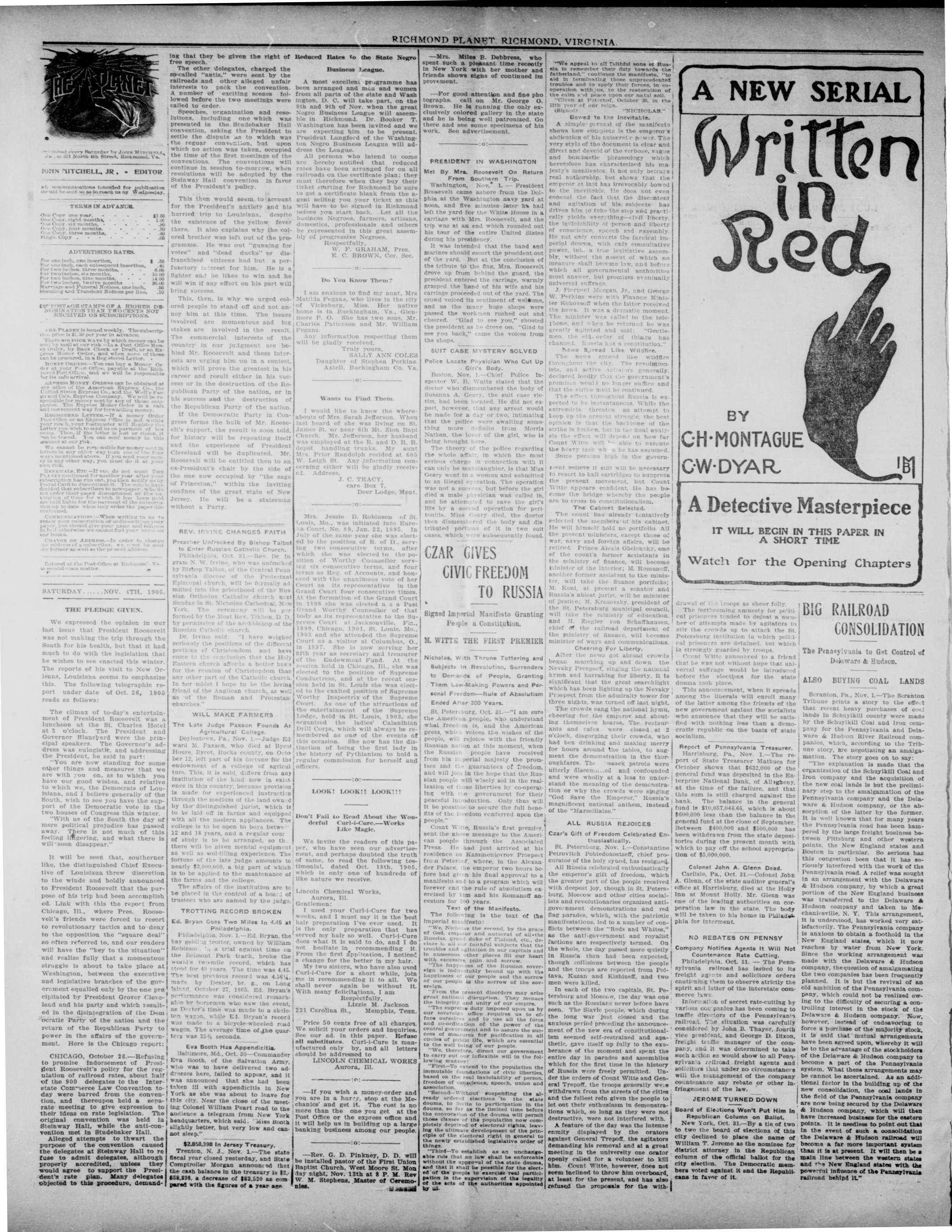
A NEW SERIAL
Written
in
Red
BY
CH·MONTAGUE
C·W·DYAR
A Detective Masterpiece
IT WILL BEGIN IN THIS PAPER IN
A SHORT TIME
Watch for the Opening Chapters
drawal of the troops as sheer folly.
The forthcoming amnesty for political prisoners tended to defeat a number of attempts made by agitators to stir the crowds up to attack the St. Petersburg institution in which political prisoners are detained, but which is strongly guarded by troops.
Count Witte announced to a friend that he was not without hope that universal suffrage would be introduced before the elections for the state douma took place.
This announcement, when it spreads among the liberals will enroll many of the latter among the friends of the new government against the socialists who announce that they will be satisfied with nothing less than a democratic republic on the basis of state socialism.
Report of Pennsylvania Treasurer,
Harrisburg, Pa., Nov. 1.—The report of State Treasurer Mathues for
October shows that $632,000 of the
general fund was deposited in the
Enterprise National Bank, of Alligheny,
at the time of the failure, and that
this sum is still charged against the
bank. The balance in the general
fund is $10,057,046.65, which is about
$600,000 less than the balance in the
general fund at the close of September.
Between $400,000 and $500,000 has
been withdrawn from the state deposi-
tories during the present month with
which to pay off the school appropria-
tion of $5,000,000.
Colonel John A. Glenn Dead
Carlisle, Pa., Oct. 31.—Colonel John A. Glenn, of the state auditor general's office at Harrisburg, died at the Holly Inn at Mount Holly. Mr. Glenn was one of the leading authorities on corporation law in the state. The body will be taken to his home in Philadelphia for interment.
NO REBATES ON PENNSY
Company Notifies Agents It Will Not
Countenance Rate Cutting.
Philadelphia. Oct. 31. — The Pennsylvania railroad has issued to its freight agents and solicitors orders cautioning them to observe strictly the spirit and letter of the interstate commerce laws.
Information of secret rate-cutting by various companies has been coming to traffic directors of the Pennsylvania railroad. The situation was carefully considered by John B. Thayer, fourth vice president, and George D. Dixon, freight traffic manager of the company, and it was determined to take such action as would show to all Pennsylvania railroad freight agents and solicitors that under no circumstances will the management of the company countenance any rebate or other infringement of the law.
JEROME TURNED DOWN
Board of Elections Won't Put Him In
Republican Column on Ballot
Republican Column on Ballot.
New York, Oct. 31.—By a tie of two to two the board of elections of this city declined to place the name of William T. Jerome as the nominee for district attorney in the Republican column of the official ballot for the city election. The Democratic members voted against it and the Republicans in favor of it.
BIG RAILROAD CONSOLIDATION
The Pennsylvania to Get Control of Delaware & Hudson.
ALSO BUYING COAL LANDS
Scranton, Pa., Nov. 1—The Scranton Tribune prints a story to the effect that recent heavy purchases of coal lands in Schuylkill county were made by the Schuylkill Coal and iron company for the Pennsylvania and Delaware & Hudson River Railroad companies, which, according to the Tribune story, are negotiating an amalgamation. The story goes on to say:
THE PLANET
PHILADELPHIA
LOST $6,330,000
Mayor's Experts Make Report on Filtration and Boulevard Jobs.
FAVORED CONTRACTORS GOT IT
Philadelphia, Oct. 30.—The report of the board of investigating engineers appointed last July by Mayor Weaver to examine the filtration system of the city and the Northeast and Southern Boulevards, now under construction, which report was submitted to the mayor Saturday, has been made public. It is signed by Major Cassius E. Gillette, of the United States Engineer Corps, who investigated the Savannah harbor frauds, and John Donald Maclennon, of Washington, D. C. The report shows that up to date the city has lost through excessive costs, collusive bids, illegal advertising and in other ways the sum of $6,330,000. The contractors who received most of the more than $18,000,000 that have been expended on improvements are D. J. McNichol & Co., James A. Ryan and John W. Kelly and Vare Brothers.
The officials held responsible by the report for some of the conditions in connection with the filtration system are John C. Haddock, who was director of public works under Mayor Ashbridge; Peter E. Costello, director of public works under Mayor Weaver until last May, when, the mayor dismissed him, and John W. W. former chief of the bureau of filtration, who is awaiting trial on charges of fraud and 'salfusion of records in connection with the construction of the filtration system. Te report says:
"Omitting from construction all small contracts—say under $30,000—we find that for the filtration work and the two boulevards as constructed up to date, the city has paid or pledged $12,430,000, which includes an allowance of 20 per cent, or $2,075,208 for legitimate contractors' profits. The difference is $6,335,000. In other words $18,760,000 in round numbers has been paid for work costing the contractors $10,355,000.
"Of the $6,330,000 excessive cost there has gone to the contractors who worked under the name of D. J. McNichol, $5,065,122; similarly to Ryan & Kelley, $543,890; and to Vare Brothers, $9,128. Of the $18,761,541 there remains unpaid about $568,000 to McNichol and $75,000 to Ryan & Kelley.
"Some of these contracts are incomplete; the estimated cost of completion of the existing filtration contracts at contract prices is about $1,685,000. At a fair price, allowing 20 per cent. profit, would be $1,218,000. The difference the city will lose if these contracts are completed.
"The price paid for the three-quarters of a mile of Northeast Boulevard already constructed is $552,348, on which there was a loss to the city of $273,217. If completed at contract prices the additional cost to the city will be about $550,000 and the additional loss at least $2,250,000. On the Southern Boulevard amount paid to date is $286,389; the loss on the one and a quarter miles built has been $89,128. To complete at contract prices would cost $550,518, and the additional loss would be $85,555. In other words, the total cost of both boulevards as planned at contract prices would have been $7,636,000, and the total loss to the city $2,750,000."
The report then says much of the work is not first class. One of the means by which excessive profits were made possible, the report says, was by not permitting fair competition. The advertising was wholly inadequate; scarcely more than a pretense.
NEW PUBLIC PRINTER
Washington, Nov. 1.—The president has appointed Charles A. Stillings, of Boston, Mass., as public printer, to take effect November 1. Mr. Stillings is manager of the printers' board of trade of New York city.
The position which Acting Public Printer Ricketts will occupy under the new administration of the affairs of the government printing office will be determined by Mr. Stillings.
Mr. Stillings was connected with a Boston printing house for some years and was once secretary of the Typothetae of Washington.
Surgeon Stricken at Operating Table.
Surgeon Stricken at Operating Table.
Chicago, Nov. I.-While he was performing a serious operation in the Michael Rees hospital, Dr. J. W. Oswald, one of the leading surgeons on the North Side, was stricken with paralysis. The operating knife dropped suddenly from his hand. It was picked up by an interne and given back to him, but it dropped from the doctor's nerveless fingers, and then the attendants understood. They carried him from the room and another surgeon completed the operation. It is not expected that Dr. Oswald will recover. He is 42 years of age.
Brucels Unable to Reach Cash.
Burgars Creek to Rochester Gash.
Jamestown, N. Y., Oct. 31.—Burglaries blew open the safe of the Slocum & Dickman private bank at Sagertown, Pa. Before beginning operations they cut all telephone wires leading out of the village. Six thousand dollars were in the safe, but the burglaries were unable to reach it.
New York's Population.
Albany, N. Y., Oct. 31.—The population of Greater New York as counties
by the state enumeration bureau on June 1 is 4,014,304, as compared with 8,437,202 in 1900 and 2,501,414 in 1890. The population of New York state is 8,066,672.
A WEEK'S NEWS CONDENSED
Hursday, October 26.
James F. Barnes, awaiting trial for murder, died at Butte, Mont., from self-imposed starvation.
Bruno A. Bahr, a Chicago messenger boy, was killed by falling 11 stories down a ventilating shaft.
Secretary Hitchcock will recommend the abolition of all positions of land office receivers in the western states.
The New Jersey State Council of the Junior Order United American Mechanics held a two-days' session at Trenton.
Rev. Charles M. Sheldon, reform preacher and author, of Topeka, Kan., is seriously ill with stomach and kidney troubles.
Friday, October 27.
The second annual convention of the National League of oPstmasters of the Fourth Class was held in Washington.
John Adams, colored, was convicted of manslaughter at Buffalo, N. Y., for killing John Graham, and sentenced to 10 years in prison.
Four persons were killed and 15 injured in a head-on collision between passenger trains on the Rock Island railroad at Fairfield, Ia.
The secretary of the interior has withdrawn from entry 300,000 acres of land in the Cheyenne (Wyo.) land district, with a view to creating a forest reserve.
Saturday, October 28.
Will F. Granger, an actor, was shot in the eye during a performance at Chicago and will lose his sight.
The plant of the Central Manufacturing company, at Connellsville, Ind., was destroyed by fire, entailing a loss of $110,000.
John Johnson was sentenced at White Plains, N. Y., to be electrocuted at Sing Sing prison December 18 for the murder of his wife.
Ephraim Ramsey was shot and killed near Mount Vernon, Ind., by Thomas Ridley, his nephew, in a pistol duel caused by domestic troubles.
Leaping headlong through a window four stories down to the street to evade arrest. Adolph Perbohner was instantly killed in Chicago.
Monday, October 30.
Falling from a Lake Shore train at Porter, Ind., John Kelly, Jr., of Rochester, N. Y., was instantly killed.
Mrs. John Shimenski has died in Scranton from burns due to scalding water thrown over her, it is alleged, by her husband.
Chairman Shonts, who is in Washington, denied that there is any friction between himself and Secretary Taft over the lsthman canal.
Many Japanese residents of Southern California are hurrying home to go into the newly opened commercial fields of Manchuria and Korea.
Former Governor D. R. Francis, of Missouri, has been appointed special commissioner to visit 43 foreign governments to thank them for participating in the St. Louis Exposition.
Six men were injured, two fatally, by the derailment of a B. & O. train at Mariner's Harbor, Staten Island. The ninth annual convention of the New Jersey Firemen's Benevolent Association was held at Trenton. The convention of the Supreme Lodge and the encampment of the Uniform Rank, Knights of Pythias, will be held at New Orleans the third Tuesday in October next. Edward C. Bearden, money order clerk in the Augusta, Ga., postoffice, shot and killed himself on being asked to turn over his cash drawer and books for inspection. No shortage was discovered. Wednesday, November 1. Three shot firers were killed in a gas explosion in a coal mine at Hartford, Ark. Colonel Henry C. Ward, of the 15th U. S. infantry, has been retired after 42 years' active service.
Aaron J. Levy, a lawyer, was arrested in New York for aiding and abetting illegal registration. Sylvester Kendall was caught by a fall of soapstone in a mine at Bellaire, O., and instantly killed. Henry Bills, aged 70 years, of Kent, O., while intoxicated, threw his wife against a door and killed her. Charles H. Darling, assistant secretary of the navy, has resigned, and Truman Newberry, of Detroit, will succeed him.
PRODUCE QUOTATIONS
The Latest Closing Prices In the Principal Markets.
PHILADELPHIA — FLOUR quiet; winter extras. $3.15 @ 3.30; Pennsylvania roller clear, $3.60 @ 3.75; city mills fancy, $5 @ 5.25; RYE FLOUR firm; No. 2 Pennsylvania red, new, $4 @ 2.00; No. 2 Pennsylvania red, new, $4 @ 63% @ 63%; OATS steady; No. 2 white, clipped, $36% @ 37%; lower grades, 35% firm; No. 1 timothy, large ballet, $14.50 firm; No. 1 timothy, large ballet, BEEF steady; beef hams, $23 @ 24 POULTRY: Live firm; hens 12%; old roosters, 8c. Dressed dressed; choice fowls, 13%c; old roosters, 9%c; BUTTER firm; creamy, 25c per pound. Eggs for New York and Pennsylvania @ 30c dozo ATOTES steady; per bushel, 65% @ 75c.
BALTIMORE — WHEAT firm; No. 2 red, 86c; steamer No. 2 spot, 76%c; southern, 68%@ 70%; CORN firm; mixed spot, 5c; steamer mixed, 64% OATS @ 32%c; New York, 20% @ 34%c; No. 4, 33%@ 33%; mixed, No. 2, 34%@ 34; No. 3, 32%@ 32; No. 4, 31%@ 31%; BUTTER steady; creamy separator extras, 23@ 23%; held, 6c prints, 24@ 24%; Maryland, 20% EGGs firm; fancy Maryland and Pennsylvania, 24c; Virginia and West Virginia, 22@ 24%; southern, 22c
How to Save Washing and Dusters.
Save washing and dusters by using old newspapers for cleaning. They are excellent for window polishers, first rate for scouring tinware with and are as good as a brush for polishing a stove. The prudent woman will always keep a good pad of newspapers at hand and use it for wiping up grease or water spilled on the gas or coal cooking stove, for it will enable her to keep the stove clean with half the usual trouble.
THE RICHMOND PLANET. RICHMOND. VIRGIN
How to Properly Feed and Look After the Songsters.
When the canary is in ordinary health the more plainly it is fed the better, says the Pittsburgh Press. The usual mixture is what is called black and white canary seed, the black being good summer rape. Of this one part is added to two of the other. It is important, however, that the seed be good and clean—that is, free from dust and grit.
The canary seed should be fat, glittering seeds, and before putting it in the tin of a morning not only should the tin itself be cleansed, but the seed should be put upon a piece of white paper and the dust or grit, if any, blown away or removed. In addition to these seeds a little green food must be given, fresh every day, but not damp. The best are probably plantain, ripe groundsel, ripe chickweed, a little lettuce or water cress.
As to dainties, the less of these the better. We may, perhaps, make an exception in the traditional morsel of sugar or crumb of sweet biscuit, but a bird will not keep long in song that has much of either.
Water should be given fresh every morning, the little glass fountain being previously well rinsed out. Soft filtered water is best by far. A great many alliments are induced by hard water. In the wild state birds drink the rain water from the leaves. This is pure and contains, of course, no hardness. Sand is another important sine qua non of health. It should be rather coarse or gritty and very clean. Perhaps washed sea sand is as good as any. The bottom of the cage should always be thickly strewn with this immediately after the cage is cleaned in the morning, a stock being kept in the house for the purpose.
A song canary will not do well for any length of time in a stuffy, badly ventilated room. Fresh air is essential to health. Another thing that tends greatly to keep the bird in health is a sun bath. On fine days the cage should be so bung that the sunshine shall penetrate the cage, but at the same time it must be remembered that too much heat is very dangerous, so one-half of the cage should be invariably covered with a cloth.
This cloth comes in handy in several other ways—at night, for example; more particularly when the temperature is low or likely to be. On such occasions the cage is to be covered quite over, but in summer a part should always be left open. The cloth may be required also at times when anything is being done in the room likely to frighten the bird. Some birds are naturally timid and easily alarmed. When they are so, it is useless trying to tame them; the heart is weak and they need extra gentle treatment. We have known a bird of this kind almost frightened to death by some one, while sewing, tearing a piece of linen down the center.
Appropos of fresh air, the bird in the winter's evening is too often hung in a position we have already condemned as prejudicial to its health in a room where gas is burning. If the bird must be in this room the cage should be lowered and partially covered up. Smoke, steam and all sorts of vapors tend to injure the health slowly, or, indeed, to cause illness and loss of voice.
A forenoon bath daily in fine weather is an excellent preservative of life and voice in the song canary. A saucer makes as good a bath as any, the water being clear rain water. It is usually placed in the cage, but if the bird has been tamed thoroughly and allowed its freedom for a time every day the bath should be placed on a chair or on the floor. The bird will come to look upon this as a very great luxury and the cage remains unsold.
How to Clean Ostrich Fenthers.
To clean ostrich feathers make a lather of pure soap with a little ammonia in it, using about a quart of water or more if the feathers are very large. Move them to and fro gently in this, then lightly press them stem to tip between the thumb and finger and do the same in an equal amount of clear hot water. Repeat in cold water slightly tinted with blue. Hang the feathers up to dry where there is a draft and shake at intervals. Before quite dry gently shake them before a gas stove or they can be partially dried by steam over a pan of quick boiling water and finished as directed. Comb carefully and curl any stray strands with a silver knife.
How to Wash a Chamols Vest.
To wash a chamols vest remove the dirt by washing in warm water, applying soap. Dry slowly, not near the fire, as that will harden the leather. When it is almost dry rub between your hands until pliable and soft. After it is quite dry give it a good brushing with a soft brush. Then place on an ironing board. Put a piece of cotton cloth over the vest and with a moderately warm iron go over it and press it smooth. Press out all wrinkles. Then it is ready for use as before cleaning.
How to Lessen Kitchen Labor.
In every kitchen there should be a very high chair or stool and also a very low chair. Plain ironing and much other work can be done as well seated on a high stool as standing and at a great saving of strength to the worker. The low chair is useful for resting or for sitting to shell peas or string currants.
How to Rectify a Too Salty Dish.
In the case of accidentally getting anything too salty it is possible to remedy the mistake by adding a table-spoonful of vinegar and a teaspoonful of sugar. For this reason the quickest and best way to freshen salt fish is to soak them in sour milk.
How to Clean Varnish Stained Hands
To remove varnish stains from the hands rub with a little methylated spirit, wipe off with a piece of rag or soft paper, then wash with soap and water.
How to Make Liquid Glue.
To make liquid glue put one ounce of borax in a pint of boiling water, add two ounces shellac and boil until shellac is dissolved.
GRACIOUS HOSPITALITY.
How to Make Your Guests Happy and Comfortable.
To give your hospitality graciously you must give it with a decidedly festive spirit, says a writer in the Chicago Tribune. A hostess is like a commander of fighting forces on whose courage, dash and coolness victory depends, and to be a victorious entertainer you must not let your needs, worries, disappointments, headache or irritation show before your guests. Nothing so dismays and discomits a guest, nothing so spills all pleasure as to see that the head of affairs looks anxious, that she is blissing, frowning and beckoning softly at the servant to call her attention to mistakes, that she is distracted from conversation, that she answers some member of the family sharply or that she is constantly apologizing and explaining.
While acting in the capacity of hostess take thought in order than your manner will be the embodiment of placid good temper and allow no accidents, mistakes or shortcomings in your careful arrangement to bring a worried look into your eyes and a frown to your brows. Don't let your company see that in the baking of cake, in the dusting of rooms, airing of beds or arranging of flowers for their benefit you have worn yourself into a state of languid fatigue or nervous irritation. Better no cake baking if by so doing you incapacitate yourself for bringing into your parlor a clear head, a light heart and a ready laugh for your guests. They will like your gay good humor and simple refreshments twice as well as the most dainty dishes served up by a cross, tired, harassed hostess.
From the moment the first guest arrives it is gracious and necessary to appear at leisure and not only quite ready but delighted to devote all your attention to promoting conversation and diversion. Exercise all possible control of self and do not look preoccupied or anxious. At any sacrifice of your feelings do not let your company be unpleasant aware that while your body is in the drawing room your thoughts are really in the kitchen. If you continue to look quite satisfied with unconscious of a mistake in the serving, the guests, like good soldiers, will not only take their cue from you, but they will far sooner forget and forgive than if you insist upon letting the accident dampen your spirit and if you make profuse excuses for the momentary inconvenience.
How to Do Many Useful Things
How to Do Many Useful Things.
Greasy dishes should be washed in tepid soapsuds and rinsed in clean, scalding water. Very hot water applied at first hardens the grease. Tepid suds dissolve it and the hot rinsing water leaves the dishes glossy and bright and easy to wipe.
Meats for roasting should not be washed, but should be wiped with a damp cloth.
The dishcloths in a well regulated house should be boiled with soda once or twice a week.
If before grinding the morning coffee the berries be heated for a few minutes it will improve the coffee.
Boil all tinware and frying pans in a big copper, with soda in the water, periodically, then scour with sand.
When cooking sausages let them heat very gradually, and the skins will not burst.
Stand pancake batter for two hours before frying. Beat it up again just before using.
To keep milk sweet for several days add a teaspoonful of fine salt to every quart of milk.
**How to Choose Proper Writing Paper**
Society is very particular in respect to writing paper and demands that paper of a good quality be used, either in white or cream or, at most, in very dull blue or gray. But the white paper is considered in the very best taste. The surface may be either the smooth vellum finish or the rougher linen, as preferred, but the quality must be good, not filmsy and cheap. Never under any circumstances use ruled paper. This is intended only for little children and should be discarded just as soon as one has learned to write properly. Square envelopes are always in good taste, and at present fashion sanctions the use also of envelopes a little longer than they are square for friendly correspondence.
How to Treat Brittle Hair
When the hair is very brittle it denotes some wrong about which a physician should be consulted. An external help may be had in this shampoo: Beat up the yolk of an egg, add ten drops of oil of sweet almonds, a teacup of warm water (not boiling) and twenty drops of spirits of rosemary. Then stir. Leave the mixture on the scalp ten minutes, gently manipulating with the finger tips all the time. Then rinse and dry with fresh warm towels.
How to Relieve Bronchial Troubles.
To make an embrocation for bronchial affections take one-quarter of an ounce of olive oil, half an ounce of eucalyptus oil, one-quarter of an ounce of oil of cloves and one-quarter of an ounce of oil of amber. Mix and keep in a glass stoppered bottle and on the first appearance of bronchial trouble massage the neck, chest and back with it. It acts like a charm, relieving and soothing immediately.
How to Note Table Lines
Table linen is best mended with embroidery cotton of a number to correspond with the quality of the cloth. Under the ragged edges of the tear baste a piece of stiff paper and make a network of fine stitches back and forth over its edges, carrying the stitches about an inch beyond the tear. Thin places and breaks in linen may be run with flax or embroidery floss and the towels should be mended in the same way.
How to Wash Kid Gloves. In washing kid gloves, the kind that can be washed in soap and water, don't make your rinsing thorough enough to get out every particle of soap. It is a good plan to wash them carefully and then to rinse them in clean but soapy water, so that a little of the soap is left in to keep the kid soft.
HINTS FOR VISITORS.
How to Reply to an Invitation and Treat Your Friends.
After receiving an invitation to pay a visit it is not courteous to reply to it just before the day you are to arrive, says the New York Journal, but as soon as you have ascertained that you can be away from home at the time the invitation is for it should be answered immediately, so that your friends can make arrangements for entertaining you during your stay.
As it is very probable your hostess will meet you or make arrangements to have you meet at the station, be sure that you mention the time you expect to be there, as nothing is more annoying than to wait about the station watching every train come in and not seeing the person you have come to meet or to have a guest arrive just in the middle of a meal, when everything is cold and consequently not what they would wish to offer you.
When expecting a friend on a visit the hostess should always try and arrange to go herself to the station to welcome her guest. If the traveler has come a long way or has not seen her friend for some time this is especially appreciated, as when the visitor alights from the train and sees the well known face again she will feel much more welcome and at home than if she has to find her way to the house alone.
If the length of the visit has been mentioned in the invitation it is best not to run the risk of outstaying your welcome, but to leave at the end of the period first stated, as, although your hostess may ask you to stay on a day or two longer, this is very often done merely as a matter of form.
When on a visit to friends you will almost be sure to be told to "make yourself at home," and to a certain extent this may be done, but don't take advantage of their kindness by appearing late at meals, leaving your things about and doing many other tiresome things which are not so noticeable when you are really at home, but only cause extra work for your friends. You must not forget that your friends will not be able to entertain you all day long, as they may have household or other duties to perform in which possibly you can be of some assistance to them, but don't on any account get in the way, and when you have nothing better to do you are sure to find some books in your room which have thoughtfully been provided by the hostess, or you can employ the time by writing your letters. Although you will probably find your room supplied with note paper, it is always best to provide yourself with it, and also with sewing materials, which may be required.
It is usually the object of the hostess to give her guest the best of everything both as regards food and entertainment, and her guest cannot show her appreciation of this better than by praising the cooking and being bright and entertaining in her turn, so that she makes herself a welcome visitor for whom it is worth while trying to make the time pass pleasantly.
After the visit is over and you have arrived home again, don't forget to write thanking her for the preparations she made for your comfort and the entertainments arranged for your enjoyment.
How to Clean Comp Discs
How to Clean Camp Dishes.
Cleaning camp dishes is one of the bugaboos of camp life, yet it is a very simple process. I turn this job over to my husband, who takes the dirty, greasy frying pans and other camp cooking outfit down to the creek, where there is plenty of moss and sandy mud, and there, with his pipe alight, he sits complacently down on a convenient rock and begins by throwing a handful of mud into the frying pan. Then he dips up a little bit of water and with a handful of moss proceeds to scour and rinse alternately on every dirty dish until the camp culinary furniture shines like a brand new pln, says a writer in Outing. I used to be skeptical about the cleanliness of this process, but it will certainly scour a frying pan that has had grease burned into it until it as bright as new, so it is really better than soap and warm water, and my experience has been that men do not really object to dish washing in camp provided they are asked to do it and then taught how.
How to Make Greengage Jam
How to Make Greengage Jam.
After stemming and washing the fruit to make greengage jam fill the jars full, placing them in a boiler of cold water, just enough over to have the water boil over the top of the jars into the fruit. After boiling one-half hour or until the fruit begins to be tender lift one of the jars and turn off the juice that may accumulate into a porcelain kettle. Add sufficient sugar to make a rich slurp. When it boils fill up the jars, let them stand in the boiling water ten or fifteen minutes longer, then lift out one at a time and seal. All kinds of plums are nice put up in the same manner.
How to Care For Wet Clothes.
How to Care For Wet Clothes. Clothes which have been wet in the rain should be carefully dried before being hung away, says the New York Journal, or they will mildew. They should be lightly wiped with a dry cloth or shaken and then spread out to dry. Should there be creases when dry they should be pressed under muslin. Another thing to remember in rainy weather is that nothing takes the freshness and beauty out of garments like rain. It is advisable to have older garments for rainy days. Even the dampness of the atmosphere will render clothes limp and shabby, though the rain may not fall directly upon them.
How to Cream Curtains
To cream lace curtains, add one ounce of yellow ocher to two ounces of starch, mix it in the usual way with boiling water. Strain starch to clear it of lumps. It is best to soak a pair of curtains at same time to insure both being shade. White curtains can be made cream in this way.
How to Aid Digestion
People with poor digestion should drink no water with meals, but take a glassful half an hour before and drink plentifully an hour or so after each meal.
CURL-I-CURE
TO OWE it to yourself, as well as to others who are interested in you, to make yourself as attractive as possible. Attractiveness will contribute much to your
TAKEN FROM LIFE AFTER TWO WEEKS' USE OF CURLL-CURE
When you meet a person your first impression is given to them by or her appearance. The same applies to your hair.
Nothing adds to or detracts from a lady's or gentleman's appearance so much as the hair. Nothing indulges them in the beauty, good breeding, their taste, so much as the hair.
We all know how much care is taken of the hair by all ladies and gentlemen in all the large cities. How much know how much pride a successful man takes in the appearance of your hair. You enjoy no advantages. If you have an ideality you enjoy no advantages. There is one way and only one way in which you can be the great handicap and make your hair as beautiful, rich and glamorous. Regular retail price, 50 cents per head of hair you have ever wished for.
CurlL-Cure is an ideal, safe pre-pinky, curly hair straight. We do not matter what you have tried you want, you are doing yourself with CurlL-Cure. It is positively to be quicker and with less effort to build a hair that is then as beautiful as the finest head of hair you have ever wished for.
CurlL-Cure is manufactured on account of the quality of the hair.
It is different from anything you have ever heard of or seen. It is now to you but old to itself.
Curl-Cure is but another name for one of the greatest and most wonderful preparations which has ever been discovered. It has been used by the leading doctors all over the world, every nation for many years as a private formula for hair and scalp defects and always brings perfect results.
CURL-I-CURE is the only preparation that will be made by the CURL-I-CURE PROPRIETOR, which is the only one of the best works of the world and will be made by the CURL-I-CURE group. The more pre-defined and straight hair is also the greater result. After keeping in preference the above directions and straight hair is individually served.
LINCOLN CHEMICAL WORKS.
The J. V. Hawkin's
with a stiff hair brush, the softer you will attain the desired routine.
CURL-I-CURE
In heralds and will make the hair grow. Drink it a soft and silky appearance.
With cream and water and let overnight dry. Drink it after the first application. Then
brush, ruffling in the hair and mats. Then brush the hair for the first application with
deepened result. After the hair is straightened again twice a week, to
air is absolutely secured.
IMICAL WORKS, Aurora, Illinois
hawkin's HAIR GROWER &
RESTORER
STERED.]
This is the only separation that will work.
CURL-I-CURE
In haircare and will make it grow.
gives it a silky appearance.
DIRECTIONS FOR USING. Wash the hair with some water and let it dry. Do only the first application. Then apply CURL-I-CURE twice for a week or two days, rubbing it into the hair. Do not use a hairbrush or brush with a brush head. Do not use a brush head with a brush head. After the hair in straightened shape a week to two weeks, remove the extractions and hair straighten in silk.
The J. V. Hawkin's HAIR GROWER & RESTORER
[TRADE MARK REGISTERED.]
Has proved to be a fortune to many of the fortunate, who are to-day delighted with its wonderful results. The merits of this great hair preparation naturally places it in a sphere all of its own, and the glowing terms in which our patrons speak of it reassures us of its satisfactory results. We can well boast of a large patronage throughout this and other States and also enjoys the commendation of the very best white and colored people in this immediate community. In order to convince the most sketical readers of the merits and results of the J. V. Hawkins's Hair Grower and Restorer, we will from time to time produce in print the photographs of those giving us permission to do so, who have used our preparation and are to-day
M.
among the many bearing witness of its genuine qua
correspondence of the use expecting a miracle or savv-
ration is a natural and pure compound, the ingredi-
nate hostile to put in print. We will just here remind
States Government has placed national patent right
which it is protected and we are in turn responsible
est methods and square dealings.
It will positively remove Dandruff, Cure Scalp
of all impurities, Restore Hair on Clean Temples
or Bald Heads, where the roots are not dead.
PRICES:—25 cts. per box (local orders); 35 cts.
out city; eight boxes, $2.80 express grepaid.
The Face Beautifier makes the use of powder en-
tirely nonunessay, and is perfectly harmless. Sale
prices: 35.50 cts and $18.00.
Money Order by Post Office Money Order
or Express Money Order"
charge of 10cts,
extra is imposed on all out of city orders.
Address all communications to
ass of its genuine qualities. We do not desire the magi a miracle or availing unreasonable Our preparation, the ingredients of which we would not just ill here remind the public that the United national patent rights on our hair preparation by we in turn responsible to the government for honors. Druff, Cure Scalp
among the many bearing witness of its genuine qualities. We do not desire the correspondence of us as expecturing a miracle or availing unreasonable. Our preparation is a natural and pure compound, the ingredients of which we would not hesitate to put in print. We will just here remind the public that the United States Government has placed national patent rights on our hair preparation by which it is protected and we are in turn responsible to the government for honest methods and square dealings.
It will positively remove Dandruff, Cure Scalp of all impurities, Restore Hair on Clean Temples or Bald Heads, where the roots are not dead.
PRICES—25 cts. per box (local orders); 35 cts. out city; eight boxes, $2.80 express prepaid.
The Face Beautifier makes the use of powder entirely unnecessary, and is perfectly harmless. Sale prices; 25, 50cts and $1.00.
Money can be sent by Post Office Money Order or Express Money Order!
A charge of 10cts. extra is imposed on all out of city orders.
Address all communications to
MME J. V. HAWKINS,
612 N. First Street.
Richmond, Va.
'PHONE, 4601.
Correspondence strictly confidential.
A. D. PRICE,
Funeral Director, Embalmer
All orders promptly filled at short notice by Halls rented for meetings and nice entertainment with all necessary conveniences. Large p hire at reasonable rates and nothing but first- etc. Keeps constantly on hand fine funeral su
212 East Leigh
at short notice by telegraph or telephone and nice entertainments. Plenty of roomences. Large pisnic or band wagons for nothing but first-class carriages, buggies, and fine funeral supplies.
Funeral Director, Embalmer and Liveryman. All orders promptly filled at shortnotice by telegraph or telephone. Halls rented for meetings and nice entertainments. Plenty of room with all necessary conveniences. Large pisnic or band wagons for hire at reasonable rates and nothing but first-class carriages, buggies, etc. Keeps constantly on hand fine funeral supplies.
212 East Leigh Street.
Residence Next Door.
OPEN ALL DAY & NIGHT.—Ma
STRAUS' SPECIAL!
Old Yacht Club,
OPEN ALL DAY & NIGHT.—Man on Duty All Night
PURE WHISKEY
Will Satisfy the lover of the right kind of stimulant. Special prices. We have all grades of good liquors, Cigars and Tobacco. Call and see us.
Richmond. Virginia.
So call and see our large variety of
GEORGE O. BROWN.
PHOTOGRAPHER,
603 N. 2nd St., Richmond, Va.
Fine Photographs True to Life. High-class service. Latest Improvements in Photographs Out-door Work executed. Reasonable Estimates and Prompt Service. Pictures Enlarged from Original Photographs in use.
How to Make Windows Opaque.
If you wish to shut off any view through a window you can do it very cheaply in the following manner. Dissolve in a little hot water as much epsom salts as the water will absorb. Paint this over the inside of the window. When dry you will have a fair imitation of ground glass.
How to Rid Linen of Fruit Stains.
Fruit stains may be removed from table linen by moistening the stain with milk and then covering with powdered common table salt. Afterward wash in the ordinary manner.
How to Brighten Tintware.
To make tint kettles, etc., as bright as new rub them with a woolen rag dipped in kerosene. Polish with a soft newspaper. Kerosene will also remove stains from varnished furniture.
711-71
You owe it to yourself, as well as to others who are interested in you, to make yourself as attractive as possible. Attractiveness will contribute much to your
'Phone. 577.
Curl-Cure is an ideal, safe preparation and makes
kinky, curly hair straight. We guarantee it absolutely.
It is a strap taint, cleans and softens the many tears that have been shed and easily managed. Positively prevent the hair from breaking off. What you have tried, no matter what you want, you are doing yourself an injustice if you want it.
We guarantee it is positively to do the work better, quicker and with less effort (no iron, absolutely). We are proud to be hard in the world. Regular retail price, 50 cents per piece. Cure-Clure is manufactured by the Lincoln Chemical Works. It is a guarantee that our preparation is absolutely safe and hardness and will straighten the hair without causing it to break off and become dry and brittle. Prices, 50 cents. We may all express charges. Send goods to Lincoln Chemical Works, 12345 Main Street, ship goods C. O. D. Write name and address plainly to LINCOLN CHEMICAL WORKS, Aurora, IL 60901.
WILLIAM H.
VARIETY IS THE SPICE OF LIFE.
Baby Carriages,
Dressers,
Swites,
Chiffoniers,
Toilet Tables
AND
YOU can have the advantage of our great stock and great values. We are offering NO CHEAP VALUES, but goods of such REAL VALUE as will insure you confidence in us. Do not fail to at least
INSPECT OUR GOODS.
We are sole agents for the Macey Seo
tional Book-cases.
MACEY-WERNICKE CO.
FILING CABINETS.
SYDNOR & HUNDLEY.
711-713-715-717 E. Broad S.
success-both socially and commercially. Positively nothing detracts so much from your appearance as short, matted unattractive curly hair.
Richmond, Va
JOHN TAYLOR
CALLED IN TWO OR THREE NEIGHBORS AS WITNESSES AND BROKE OPEN THE VALISE.
EATING
HE AND HIS GUEST DID A GOOD-SIZED WASHING
STORIES OF
THE FAKIRS
By
J. P. JOHNSTON
Author of "Twenty Years of
Hus'ling." "What Happened
to Johnston." Etc.
CAUGHT A. VICTIM.
The Ingenious Way in Which a Patent-Right Gang Separated a Farmer from His Money.
(Copyright, 1806, by Joseph B. Bowles.)
One of the first patent right bunko schemes I ever heard of came under my observation, when I was about 17 years of age. 'I had traded a $50 note, which I held against a farmer, living near my home in Ohio, for the rights for the state
CALLED IN TWO OR THREE NEIGHBOR
OPEN TH
of Illinois in a patent gate and door spring, and went to that state, among relatives, to sell the spring attachments and to dispose of the territory. On arriving at the home of one of my farmer relatives, I found them all in a turmoil, and in a frame of mind to lynch anyone in the patent right business.
A few days before my arrival, a very slick, well-dressed gentleman had called upon one of their rich neighbors, and represented himself to be the general agent of a washing machine. He was anxious to establish an agency for the sale of both the machine and county or state rights, and said to the farmer:
"Now, sir, you have been recommended to me as being just the man I am looking for, and to start with, I want to assure you that I don't propose to give you a penny of my money, nor do I ask for a penny of yours. I don't propose to give
HE AND HIS GUEST DID A
you my signature, nor do I ask for yours.
I simply propose to appoint you our
agent. I will give you three dollars in
cash for every machine which you sell,
and will leave this sample with you.
charging you nothing for it. And for
each county right you dispose of, I will
allow you all, over $100 a county, that you
get for it. If you get $200 a county, you
will make $100 profit. If you sell a
county for $150, your profit will be but
$50. I do not limit you as to price on
the county rights, but the price of machines
must be no more nor less than
five dollars each. As I shall be at the
hotel, at Aurora, for the next six
A. Strong Breath.
An old woman met a well-to-do and humorous Irishman, and said:
"Kind sir, could you give a copper to a poor old woman who is short of breath?"
The Irishman gave her a shilling, with the remark:
"There you are, my good woman. Now, don't take any more, for begorra, ye may be short of breath, but what ye have of it is moighty strong."—Tit-Bit.
weeks, should you find a customer, you may call on me there, and by paying the cash, you can procure any number of machines, at two dollars each, or whatever counties you want, at $100." Two days later, a gentleman of fine address called. He was about 30 years of age, wore a silk hat and a tailor-made suit of clothes, was gibl of tongue, and carried a fair-sized valise. He came just at dusk, and introducing himself as a fire insurance agent, explained that he was traveling on foot, was somewhat tired and weary, and wanted to procure supper, lodging and breakfast.
After supper, and during the evening, while talking fire insurance, and after having displayed his papers, blank applications, door plates, etc., he began discussing other subjects, and topics of the day. Directly he remarked that he intended to resign his position with the insurance company, and engage in something where he could make money faster, and alluded to a former experience in which he had made a lot of money in a short time, handling a patent right. This, for the first time, reminded the farmer that he was agent for a mighty fine patent, and forthwith he brought out the washing machine the general agent had left with him. The following morning the insurance agent explained in a worn-out, exhausted
NIBORS AS WITNESSES AND BROKE
E VALISE.
manner, that he had not slept more than an hour, and then had dreamed of selling washing machines galore, and township and county rights by the score.
While at the breakfast table, he ventured to ask the farmer, what he could sell him 20 counties for, and producing a state map, he selected the counties he wanted. The farmer carefully thought the matter over, and although he thought $300 a county would enable the insurance man to make plenty of money, by cutting them up into township rights, still he would let him have them (if he took 20 counties) at $200 each.
The insurance man thought the price rather high, and dickered along until about eight o'clock in the morning, when he made the farmer a point blank offer of $150 a county, for the 20 counties. He said, as he did so, that he had formerly been a school teacher in a place several
GOOD-SIZED WASHING.
miles south, which point he was making for, as he wanted to collect some money due him. He explained that, as the farmer would have, to procure papers from the general agent, before he could deed them to him, he would return in three days, or four at the outside, and receive the deeds and settle in full for them. And as evidence of good faith, he brought out his valise, and unlocking it, took out a large roll of bills with four or five $100 wrappers and said:
"To show you that I mean business, I will deposit $100 with you, and when I return, and you have the deeds ready, I will pay the balance."
The Eboliomaiac (showing his treasures)—Here is a book that cost me $15,000.
The Society Man—Great cats! What sort of a past have you, anyway?—Puck.
THE RICHMOND PLANET, RICHMOND, VIRGINIA
JOB DEPARTMENT
VISION WORK
arter-Sheets, Half and Whole
Placards, Society Cards, Min-
ing Stationery.
WE AN ELSE
WHICH WE WILL
Stock Roo
LATEST STYLE BOND, FL
AS SMALL AS A DODGER.
Sheet Poster
A FRONT DOOR.
OUR PRESENT CORP OF EMPLOYE
IS WITHIN EASY REACH OF
, 2213.
EXCURSION
We print Handbills, Quarter-Sheet posters, Tags, Tickets, Placards, Visiting Cards, Mourning Stations
WE HAVE
Our St
OF THE LATE
WE CAN PRINT A BILL AS SMALL
A Three-Sheet
AS LARGE AS A FRO
Our street-entrance is retired and fastidious lady being able to enter w
We print Handbills, Quarter-Sheets, Half and Whole Sheet posters, Tags, Tickets, Placards, Society Cards, Minutes, Visiting Cards, Mourning Stationery. OUR AIM is to please our patrons and to give them the best service at the lowest prices, consistent with satisfactory work. We furnish "cuts" when desired and we will arrange to complete special work in our line. When in need of any work in our line, call and see us and estimates will be furnished.
WE CAN PRINT A BILL AS SMALL AS A DODGER. A Three-Sheet Poster AS LARGE AS A FRONT DOOR. WE HAVE ONE OF THE LARGEST OF WOOD- Of Any Job Printing Establishme
Our street-entrance is retired and has no objectionable features, the most fastidious lady being able to enter without embarrassment or annoyance.
LONG DISTANCE TELEPHONE, 2213.
why, that was dead easy. Out in the mountains I've ridden him down grades where he would just have to plant his feet together and slide. I meant no offense, I'm sure, but offense was taken, it seems, and now all I can do is to apologize."
"This is the best lobster salad I ever tasted."
"This is not a lobster salad, it is chicken salad."
"Cholly Noodle is paying for it, isn't he?"—Houston Post.
No Other Course.
Mrs. Hatton—What made you resign your position as secretary of the literary society?
---
It is thoroughly equipped to do all kinds of printing on short notice. We make a specialty of Society printing and work for Insurance Companies, such as Financial
A FORMER COWPUNCHER BREAKS LOOSE IN CITY.
Creates Sensation at Omaha by Riding Into Saloons and Demanding Drinks.
Omaha, Neb.-N. E. Sherwood, a wealthy Wyoming mine owner and a former cowpuncher, created a sensation here several days ago by mounting a cayuse and starting out to do the "wild west" act. Attired in a buckskin suit, with a sombrero on his head and a six-shooter in his belt, he for a half-hour rode wildly through the principal business streets, whooping at the top of his voice and threatening to shoot the heels off the boots of the people he met.
Drawing rein in front of the aristocratic Henshaw hotel, he rode into the bar and called for a drink. "Give it to me straight," he said "and be
BUFFET
HE RODE IN TO THE BAR.
quick about it." A colored porter promptly led the cayuse out into the street before Sherwood had time to get his drink. With a burst of profanity at the indignity put upon him Sherwood put spurs to his steed and set out down Farnan street. He rode his horse into nearly every big saloon he came to and called for a drink, but in every instance he and his mount were ejected before his thirst was quenched. Then he rode at the top of his horse's speed up Farnan street. He urged his cayuse up the long flight of stone steps leading to the big courthouse, rode him at a gallop up and down and around the terraces surrounding the temple of justice, and was riding him leisurely down the corridor of the building when a policeman took him into custody and packed him off to the station.
Sherwood spent the night in jail. The next morning he was arraigned in the police court and fined for disturbing the peace. He apologized profusely to the court for the offense he had committed, paid his fine and went to his hotel. "I never thought for a minute," said Sherwood afterward, "that I was going to create such a disturbance and get myself into jail when I set out to take a little ride around town. As for my riding up the courthouse steps and running my broncho up and down and around the terraces.
Cards, Policies, both straight life and benevolent, Physician's Certificates, Sick Cards, Application blanks, Agents Report Sheets, Rate Cards, etc.
OUR PRESENT CORP OF EMPLOYEES ARE COMPETENT AND QUICK-WORKING. OUR OFFICE IS WITHIN EASY REACH OF THE PUBLIC, BEING WITHIN FIFTY YARDS OF BROAD ST.
She Was Right.
Mrs. Catton—Why, I was so busy taking notes that I couldn't hear the gossip.—Cassell's.
Giving Him Away.
Mrs. A.—John likes me to dress in brown. He seems to have a brown taste in everything.
Mrs. Z.—Yes he told my husband this morning he had a dark brown taste.—Chicago News.
Real Trouble.
Cogger—You should be out on the road, old man in an automobile raising the dust.
Kidder—The trouble is I can't raise the dust to get the automobile.—Chicago News.
New Arrival—What a lot of loving couples there are here.
Old Guest—Yes; the husbands don't get down except over Sunday—Town Topics.
A Dotty Ditty.
There was a young heiress named Dot, Who marry a Yankee would not; So a lord (with an eye To a "dot") she did buy, And the Lord only knows what she's got—Judge.
THEY'RE ALL ALIKE.
```markdown
```
Beatrice—Don't worry about men boney. Their ways are so unexpected Why, the last time I gave George a present he ground it under his heel. Lorraine—What was it? Beatrice—Why—er—it was a pair of bone. Philadelphia Bulletin.
WORK OF ALL
OUR AIM
is to please our patrons and to
give them the best service at
the lowest prices, consistent
with satisfactory work.
LEGANT I
SHOW ANY ONE DESIRING
from Embrace
NINE WRITING—FLAT AND
ELEVENE ARE COMPETENT AND QUIET
THE PUBLIC, BEING WITHIN F
features, the most
or annoyance.
FOR FUR
Jol
```markdown
```
MRS. MARTH, the world renowned and highly celebrated Business and Test Medium, evenly knowledgeable in imposition. Can be useful in all affairs, including marriage a speciality. Every mystery revealed, also of absent persons and in managing men, challenges any Mediums who can express, startle, surprise, present, events of comelife, Remembrance will not for any price faster you, you may sense; She can be consulted upon without nonsense; She can be consulted upon Life, Love, Courship, Marriage Friend, Etc., with his description of your future company, friends, enemies etc., business, law suits journeys, contested wills, divorce and specialised friends, enemies etc., business, law suits your dream-good or bad; she withholds nothing.
MRS. MAIR FH tells your entire life post and presents and future. ORAD TRANCE, has the power of two two Medi-
In tests she tells your mother's full name before marriage, the names of all your family, their ages and description, the name and business of the family. One of them is the name of your next if you are to have one, the name of your young man who now calls on you, the name of your future husband, and the day, month and year of your marriage, how many children you have to be born, how many children you sweetheart will be true to you and? If he will marry you; if you have no sweetheart she will tell you when you will have one and his name, the most important date to be acquaintance. All your future will be told in a dead trance. Mothers should know the success of their husbands and children; young ladies should know everything about their children; young married women should know the business until you know, marry or go into business until you know all, do not let silly religious scruples prevent your consulting.
If a family is only one in the world who can tell you the full value of their husband with age and date of marriage, and tells whether or the one you love is trust's or false.
There are some persons who believe that they are the only people who consulting a Medium, but such beliefs are contrary to truth. It is only from the sick of discrimination that such a conclusion can be reached. It is not every one who places it himself or herself in the form that can stand the test of what he or she claims.
And a person of an inquiring mind may ask the reason why to do it simply that there may not be any time to take the human nature. They do not spend their thoughts for a moment with acquiring the art of phrasology and kindred branches that will have a tendency to be so much as to be a kindred of the business clear and devoid of all obstacles.
It is and undeniable fact that persons will come for advice in full knowledge of what they need and what they try to do in the confront a medium they may be in their own knowledge to dispel from their minds what they know so as to hear if it will be rehearsed by the Medium. To get the secret out of a person by unfairly尊荣 the man who is the most unprincipled Mediums, but to take hold of the mand and gain control of the mind thereby is a matter of impossibility to most c's them and can end close and by making Mrs. Marth the seemingly mystery becomes a realization.
This subject has received no little attention by early month, but the college professors are infringers of approvals that should be, perhaps, perhaps the most of the time, to be, perhaps the gates of wisdom have not been closed to the entire profession. It was not to be made to be a result of the fact that it became an accomplished medium and by a continuous and uninjury of the key to the well of apparently unfathomable myeries has been secured by MR. MANTH for the benefit of humanity.
ADVIOE BY LEITER, $1.00.
HOURS FROM 10 A.M. TO 9 P.M.
CHICKASHA,
INDIAN TERRITORY.
(BOX, No. 958.)
Snoke Stamp for reply.
We print Wedding Invitations, and High Class Stationery for Balls, Parties, Picnics and all entertainments of a social nature.
ALL DESCRIBE
ions and to service at consistent work.
We furnish "cuts" when desired complete special work in our line in our line, call and see us and
T LINE OF S
DESIRING TO SEE THEM.
braces a full 2
CAT AND LINEN PAPER, ENVELOP
WE HAVE ONE OF THE MOST OF WOOD
Of Any Job Printing E
NT AND QUICK-WORKING. OUR OFFICE WITHIN FIFTY YARDS OF BROAD ST.
FOR FURTHER INFORMATION, APPLY
John Mitch
311 N. 4th St.
FHANK WALLER, JK
FOR FURTHER INFORMATION, APPLY TO
John Mitchell, Jr.,
John Mitchell, Jr.,
Residence, 1 E. Orange St.
Prompt attention given to all mair
rdera. Satisfaction guaranteed
All Kinds of Painting Done Cheap
and speoala-
se reads your
life past and
RANCE, has
on ever met.
for your name be-
your family
and busi-
name of your
name of the
the name of
mouth and
children you
our, present
New Phone, 478.
ROBT. S. FORRESTER
FLORIST
215 E. Leigh Street,
reached. It
myself or her
test of what
ind may ask
them advantage
human thoughts for
of phrasology
have a tendency
to the busi-
cles.
persons will
of what they
they confront
endear to
know so as
the Medium.
Leonard's
Reliable
Prescription
Drug Store.
724 North Second Street.
BEFORE
MAKING
Refrigerators,
Mattings, Oil-Gloths,
And in fact everything that is need-
ed in house furnishings.
RUGS AND CARPETS.
S. C. G. Jurgen's Son
421 EAS! BROAD ST.,
between 4th and 5th Street
OF WOOD-TYPE Of Any Job Printing Establishment in the city.
311 N. 4th St., Richmond, Va.
We print Church Envel-
PRACTICAL HOUSE PAINTER.
I F Jonathan FISH, OYSTERS AND PRODUCE.
ALL ORDERS WILL REEIVE
PROMPT ATTENTION.
Long Distance Phouse, 752.
RICHMOND, VIRGINIA
Plant Decorations, Choice Rosebuds
Cat Flowers, Funeral Designs, House
Decorations for wedding parties do
a specialty. Give me a call.
Fure and Fresh Mediomes only wi
sure you then purchase your
Drugs and Medicine from;
Your purchase you would do well to call at the most reliable furniture house in the city and see the fine line of
Of every description; also the latest designs in ROOKERS and special OHAIRS. Our goods are the best for the price and the price is very low.
opes, Note and Letter Paper
Bill-heads, Monthly Statements,
Business Cards, Financial and Order Books,
Circulars, Check-books, Pamphlets.
SCRIPTIONS
sired and we will arrange to
line. When in need of any work
estimates will be furnished.
SAMPLES
Line
PES, ETC.
LARGEST ASSORTMENTS
OD-TYPE
establishment in the city.
PLY TO
nell, Jr.,
Richmond, Va.
'Phone, 1589. Residence No. 911 324 Street.
FUNERAL DIRECTOR &
EMBALMER.
NO. 3019 P. STREET, BETWEEN
30TH AND 315T STREETS.
RICHMOND, - - VA.
Special attention given to all business
entrusted to me. Carriages for funer-
als, receptions and marriages at all
hours. Satisfaction guaranteed to all.
t116-20-04
A. Hayes
OFFICE AND WARE-ROOMS,
727 North Second Street
RESIDENCE, 725 N. 2nd St.
First-class Hacks and Caskets of all descriptions. I have a spare room for bodies when the family have not suitable place. All country orders are given special attention. Your special attention is called to the new style Oak Caskets. Call and see me and you shall be waited on kindly.
'Phone, 2778.
THE
Custalo House,
702 East Broad Street.
Having remodeled my BAR, and having an up to-date place, I am prepared to serve my friends and the public at the same old stand.
FIRST CLASS RESTAURANT,
MEALS AT ALL HOURS.
ew 'Phone 1261,
WM. CUSTALO, - Prop.
S. W. ROBINSON,
NO. 23 NORTH 18TH ST.
DEALER IN
FINE WINES, LIQUORS,
CIGARS, &c.
All Stock Sold as Guaranteed.
PROMPT ATTENTION.
Your patronage is respectfully solicited.
JOHN M. HIGGINS,
DEALER IN
CHOICE GROCERIES,
WINES LIQUORS,
AND CIGARS.
PURE GOODS, FULL VALUE FOR
THE MONEY.
1610 East Franklin Street
[Near Old Market.]
ishment, and in avoiding enemies. In the civilized world to-day, we sometimes forget the extreme importance of this elementary biological fact. The questions of how to get food, of the most economical sort of food, of the food that gives the greatest nourishment, and of the best ways to prepare this food for eating, occupy unconsciously, a large part of the life of the men and women of to-day. For the poor, it is a matter of getting sufficient food, and for the rich it is often a matter of getting food that will digest. Both, classes are confronted with the problem of obtaining sufficient nourishment; one class has not enough money to get the actual food they need, the other cannot find the food that will digest. With both classes it is a problem of partial starvation.
Until recently, science has paid little attention to this question of food. The whole thing has been more or less a matter of guess work and tradition. We once labored under the superstition that tomatoes caused cancers, fruit
NUTRIENTS
LOST IN BOIL.
ING 5 POUNDS
BEEF ROUND.
WATER
PROTIED
FAT
ASH
seeds appendicitis, and that bananas were bad for the digestion. We have been flooded with a mass of literature on pure foods and "back-to-nature" diets, but the statements made have lacked scientific verification.
Some time ago, Prof. Atwater, of Wesleyan university, Middletown, Conn., began a series of important nutritive investigation which at once showed the significance of the food problem. About 1896, the department of chemistry of the University of Illinois also began a series of inquiries into the present problem of nutrition. The work is under the direction of Dr. Harry S. Grindley, professor of general chemistry. These investigations have developed new methods of research, and now present a very large and promising field both for the scientist and the economist.
The ultimate, fundamental, underly ing object of the nutrition investigations is the study of flesh as food for man. In order to attain the above object the work comprises first, a study of the value of meat as food and second, a study of the injurious results produced by the consumption of flesh. The specific subjects studied are chemical composition, fuel value, digestibility, economic value, methods of cooking meats and influence of the consumption of meat upon the health. Of all the work so far accomplished, the results obtained in the study of the cooking of meat and the digestibility of meat are of most interest and practical value.
Meats in cooking lose much weight. The amount, character and value of the food nutriments thus lost is an important economic question. While in a private family it may not be necessary to consider such a question, when large numbers are to be fed, it will be recognized that those meats which shrink least in cooking, other things being equal, are the most desirable. In connection with these researches 150 elaborate experiments have been made for the purpose of determining the amount, character and economic value of the losses which occur when meats are cooked by the methods in common use. The results of these experiments have shown that the greatest loss in weight which occurs in cooking meats by boiling, and pan-boiling is due to the removal of water. In the roasting of meat the chief loss is due to the removal of both water and fat. The losses of nutritive material in the pan-boiling of meats are very small as compared with the losses which take place in boiling, roasting and sautéing. The results of a large number of experiments in which meat was cooked by boiling have proven that in cooking 100 pounds of beef by this method, there is upon an average the following losses: Total loss in weight 34.35 pounds, water 30.75 pounds, protein 1.41 pounds, fat 1.21 pounds and mineral matter (ash) 0.46 pounds. The same experiments demonstrated the maximum losses to be as follows: Total loss in weight 50.20 pounds, water 45.92 pounds, protein 2.62 pounds, fat 8.50 pounds and mineral matter 0.70 pounds.
THE PLANET
SATURDAY, NOV. 4TH, ..... 1905
MURDER REVEALS STORY OF LOVE
FOUR SWEETHEARTS CAUSE
DEATH OF A HUSBAND.
Brother of Italian Countess Tells How Sister's Spouse Was Slain—Case Is the Sensation of Europe.
Rome.-The Bonmartini murder trial at Turin, which ended the other day in sentences of from ten to thirty years for the defendants, has for nearly three years been a sensation in Europe. Over 409 witnesses were examined. Count Bonmartini, the murdered man, was the head of a prominent family; his widow, an accomplice in his murder, is the daughter of Italy's foremost physician; her lover, Dr. Secchi, also was prominent in medical circles. Her brother, the actual murderer, was a member of parliament.
Countess Bonmartini and Dr. Secchi, then her father's assistant, were lovers before her marriage to the count, but Prof. Murri forced his daughter to marry the count, who, although of high lineage, proved to be a man of revolting character.
The countess went to live in Venice with her children. There she was frequently visited by Secchi, who had won fame in his profession and still loved her. There is no doubt that a guilty intrigue subsisted between them. Correspondence between the prisoners, numbering 5,000 letters, suggests relations between the countess and Dr. Secchi, and Tullio Murri, her brother, and Rosa Bonetti, the countess' confidential maid. The countess gave her key to the count's apartments in Bologna to Rosa Bonetti, who on the night of August 27, 1902, admitted Tullio and Dr. Naldi, a clever but disreputable surgeon. The first plan was to overpower Bonmartini and kill him with an injection of curare, a rare African vegetable poison, to be administered by Naldi, but owing to the probable difficulty of holding the victim down this plan was abandoned in favor of the knife.
When Count Bonmartini entered his apartment at five p. m. on the following day, August 28, Tullio flung himself upon him, Naldi, with surgical skill, giving the fatal thrust in the throat. News of the deed was conveyed to the count's brother-in-law, Tullio Murri, as
NALDI PLUNGED THE KNIFE INTO
THE COUNT'S THROAT
he was sitting in the provincial council, of which he was the secretary. "It must have been robbery," he said. "Bonmartini must have been killed for his money."
So far everything seemed to confirm Tullio's simple theory. Two days after the discovery Tullio set out from Venice with his sister, the countess, intending to go to Switzerland. A doctor and the children went with them. On the way Tullio showed a wound and had it dressed. The doctor may have been of an inquiring turn of mind. At any rate Tullio blurted out that he got the wound in an encounter with the count and that it was he who slew him. Then he left the train and set out for the Balkans. The countess proceeded to Switzerland and Germany.
Tulloa was a gambler and a spend-thrift, a writer of some talent, and a socialist. He is a man of great physical strength and violent temper, with low tastes. His most creditable trait is love of his family. After wandering about Switzerland and Germany Tulloa gave himself up at Ala eight days after his father told the police. The same day Rosa Bonetti was taken. In the tangle of this miserable drama and its dreadful culminating tragedy, the main inspiring influence was the countess' love for Dr. Secchi. It marred the happiness of her home, estranged her husband's love, and led her on to consent to the violence of Tullo, possibly led her to urge him to the crime. It was Rosa Bonetti's overmastering passion for the gambler Tulloa that took her into the maze of crime and made her one of the prime instruments in the execution.
No More Whitcomb Rileys.
First Indiana Poet—Times are not what they used to be.
Second Indiana Poet—Prithee, fellow litterateur, why this sadness?
First Indiana Poet—Gracious me! haven't you heard? They are establishing public bath houses to take the places of the old swimming holes. Think of a poem about a bath house!—Judge.
The Nutritive Value of Various Meats
Valuable Results of Experiments Conducted by Prof. Harry S. Grindley at the University of Illinois.
HE question of food is an all important one for all living beings. The struggle for existence among animals and primitive man consisted almost entirely in getting sufficient nour-
NUTRIENTS
LOST IN BOIL-
ING 5 POUNDS
BEEF ROUND.
NUTRIENTS
LOST IN ROAST-
ING 5 POUNDS
BEEF RIBS.
WATER
PROTIED
FAT
ASH
WATER
PROTIED
FAT
ASH
THE RESULTS OF THE EXPERIMENTS
Garrulous Acquaintance—Aren't you sometimes afraid a day will come when you will have written yourself out and will have to quit and go at something else for a living?
Borus (struggling author)—My dear sir, such an idea is wholly falacious. You have been talking for 50 years, and you haven't talked yourself out, have you?—Chicago Tribune.
I
The minimum losses were as follows: Total loss in weight 10.61 pounds, water 8.67 pounds, protein 0.30 pounds, fat 0.03 pounds and mineral matter 0.15 pounds.
In a large number of experiments the average losses resulting in the roasting of 100 pounds of beef were found to be as follows: Total loss in weight 23.47 pounds, water 14.68 pounds, protein 0.15 pounds, fat 8.52 pounds and ash 0.12 pounds. It is thus evident that the nature of the losses is quite different in the roasting of meats from that occurring when they are boiled. In the latter, the greater part of the loss is due to water, but in the former the main loss is distributed between the water and fat. The losses of nutritive material in the pan-broiling of meats are very small as compared with the losses which take place in boiling and roasting.
There are two methods which are commonly used to determine the digestibility of foods. They are actual or natural digestion method and the artificial method. The latter consists in treating weighed quantities of the food with a very deflate acid solution. In the actual or natural digestion experiments the subject of the experiment, usually a healthy strong map, is
NUTRIENTS
LOST IN ROAST-
ING 5 POUNDS
BEEF RIBS.
WATER
PROTIED
PAT
ASH
fed upon the food or foods, the digestion of which are to be determined. In the experiments at the University of Illinois, the diet of the subject consisted chiefly of beef, together with bread and milk. The natural digestion experiments teach the fact that the nutriments of beef are almost completely digested. The average results of 60 experiments show that the proteids, the most valuable food constituents of beef are practically completely digested and that about 96 to 98 per cent of the fat of medium lean meat are digested by healthy men, doing active work. The results of the experiments indicate plainly that the different methods of good cooking have little or no influence upon the digestibility of the cooked meat. That is to say, natural digestion experiments point to the conclusion that fried beef, when properly cooked, is as completely digested
A PRIME ROAST OF BEEF.
as is boiled or roasted beef, when properly cooked. However, artificial digestion experiments indicate clearly that raw meat and meat cooked by boiling and roasting are more rapidly and easily soluble or digestible than broiled or fried meats.
It has also been plainly shown by these investigations that fat beef is not as easily or rapidly digested as lean beef. For example the average coefficient of digestibility of three samples of very fat beef was only 80.45 at the end of one hour, while the average coefficient of digestibility of three samples of lean meat was 85.52. This difference was also noticed at the end of the second hour, the ratio being then as 87.66 is to 89.79.
In a considerable number of the natural digestion experiments, the subjects who were strong, healthy, young men lived almost entirely upon meat. In living for three or four days at a time, every other week, upon a diet consisting almost exclusively of meat, they experienced no detrimental or injurious results. They were no more inconvenienced in making meat the chief article of their daily diet than when bread or any other food was used as the main constituent in the diet. No disorders in the proper workings of the body were observed. It does not necessarily follow from these experiments that a continuous meat diet would not finally produce effects of an injurious nature. In fact, the results of the experiments at the University of Illinois have led to the tentative conclusion that a judiciously mixed diet is most advantageous for the average individual.
"Last night I stepped a mosquito on the face—"
"Slapping a mosquito on the face!"
"You didn't let me nash. I slapped him on the face of my girl; and he father thought it was the smack of a kiss he had heard, and he bounce down stairs and chased me a block."- Douston Post.
THE RICHMOND PLANET, RICHMOND VIRGINIA
Absurd.
NEGRO IS TREED BY
A DEADLY REPTILE.
Colored Hostler Found Clinging to
Rafter Above Puff Adder—Says
It Opened the Door.
New York.—There is a bullet hole in the floor of a stable at the West Chester police station; there are scratches on a rafter where a negro hostler tore away the wood in a rapid scramble upward; there is a vacant chair in a snake's den in the Bronx Zoological park, and there is a puff adder's grave—without a headstone—near the stable door. All these things are in evidence. So that when Schuyler Bruen, the hostler mentioned, says he saw a snake the other afternoon no one shall gainsay or twit him. There is also to be had the testimony
THE SNAKE WAS NEATLY COILED
UPON THE FLOOR.
THE SNake WAS NEATLY COILED
UPON THE FLOOR.
of Roundsman William Nesbitt, and it
would be accepted in a court of record.
for he saw the snake on the stable floor
and the negro on the rafter, and it was
his bullet that brought the adder down
so that Bruen might come down.
Nesbitt was going to the stable when
he heard inhuman yells and screams for
something to "go away." Hurrying
there he found a snake neatly coiled on
the floor and Bruen aloft. The snake
watched him so closely that Nesbitt had
no difficulty in blowing his head off with
a revolver. The snake was a puff adder,
about two and a half feet long.
"I was jes' rubbin' down th' hosses," said Bruen, after he had come down,
"when I hears a clattering at th' latch of th' door. I turns around, as as I does
so th' door opens an' in walks that ar snake."
"Opened the door, did he?" asked Nesbitt sketically.
"All by himself he done open dat door," Bruen protested. "I was so, but I gave skart I dunno what I done, but I gave a yell and clum up to th' loft. Den I looks down, and if dar wasn't Mr. Snake a-comin' up th' ladder too. I lets out a yell again, and I dunno how I done it, but I got on dem rafters and clung on. Mr. Snake he wiggies underneath me an' tries to jump up. He couldn't reach, so he jes' settled down to wait fer me to drop. All de while he was a-stickin' outen his tongue an' a-spittin' at me." "How many?" began Nesslitt. "Not one, for sure," said Bruen. "Nothin' fo' a week and nothin' no mo."
GIRL SLEEPS IN PARKS.
Wanders for Months in New York City and Subsists on Scraps of Food Left by Visitors.
New York.—A good-looking young woman who has been living for weeks in Central park gave herself up to the police the other night and slept on a comfortable bed in the House of the Good Shepherd. She told Mrs. McCauley, the probation officer of the Harlem court, that for 30 days she has been eating scraps from lunches and odds and ends of victuals tossed away by the visitors in the park. She said she felt she could sleep for a week in a real bed.
Her name is Florence Kelly, of Providence, R. I. The other morning Patrolman George Steers, who was stationed at the entrance to Central park, at One Hundred and Tenth street and Seventh avenue, saw her sitting half asleep on a bench near the lake.
Steers asked her what she was doing there. She wept and said that for days and days she had been without a home, sleeping sometimes in Central park, sometimes in Mount Morris park, and wandering here and there, without money, work, or friends. She wore a white shirt dark and skirt skirt. She was without a hat, and her light brown hair was disheveled. Her shoes were almost worn out.
"I am nothing but a vagrant now," she said.
She willingly accompanied Steers to the subpolice station in McGown's Pass tavern. There she said she was 23 years old, of Providence, R. I. Her mother, she told the sergeant, died when she was a little thing. For several years she was a child's nurse. More than a month ago, she said, she had lost her place, and since had wandered around the parks.
Lion Mangles His Trainer
Clarksville, Tenn.—During a performance of a circus here Lion Trainer Charles Duncan, of Louisville, Ky., was seriously injured in a fight with a lion. When Duncan entered the cage the animal sprang toward him. Duncan slipped and fell, the lion biting and crushing his left shoulder in a frightful manner. The lion was forced into a corner by the use of hot irons and Duncan was rescued. He was in a serious condition.
A Serious Blunder
Thin Boarder (delightedly)—The beef is very tender to-day.
Mrs. Slimdiet (wildly)—My goodness! That new girl must have gone to the wrong butcher.—N. Y. Weekly.
Reason Enough.
"Why did Suddenscads quarrel with his doctor?"
"He thought he had gout and the doctor told him it was rheumatism."
—Houston Post.
Patrice--Why, yes; when she wasn't
bathing--Yonkers Statesman.
PETER
Saving Bank OF RICHMOND, VA 511 North Third Street. Capital, $25,000
Money received on deposit and interest paid on amounts above $1.00 which remains 60 days and over.
Money Loaned on Satisfactory Security.
Business Accounts Handled Promptly.
Amounts of ten cents and upwards received on deposit
This establishment is fitted up in the most improved style, having a large white vanit, burlar-proof steel chest, electric lights and every modern convenience for safety and the accommodation of the public.
For all information concerning Stocks, Deposits, Loans, etc., apply to the Cashier.
Banking Hours have been arranged for the special convenience of the work people as follows: 9 A.M. to 4 P.M. Saturdays, 9 A.M. to 3 P.M. W. close Saturday at 3 P.M. and open again at 5 P.M., remaining open until P.M. Call by as you come from work.
OFFICERS:
JOHN MITCHELL, JR., President. H. F. JONATHAN, Vice-President
THOS. H. WYATT, Cashier.
BOARD OF DIRECTORS:
REV. W. F. GRAHAM, D. D., JNO. R. CHILES, B. P. VANDERVALL,
E. R. JEFFERSON, H. F. JONATHAN, THOMAS SMITH, D. J. CHAVERS
J. O. FARLEY, JNO. J. TAYLOR.
Money received on deposit and interest paid on amounts above $1.00 which remains 60 days and over.
Money Loaned on Satisfactory Security.
Business Accounts Handled Promptly.
Amounts of ten cents and upwards received on deposit. This establishment is fitted up in the most improved style, having a large white vault, burlar-proof steel chest, electric lights and every modern convenience for safety and the accommodation of the public.
For all information concerning Stocks, Deposits, Loans, etc., apply to the Cashier.
Banking Hours have been arranged for the special convenience of the work people as follows: 9 A.M. to 4 P.M. Saturdays, 9 A.M. to 3 P.M. We close Saturday at 3 P.M. and open again at 5 P.M., remaining open until 9 P.M. Call by as you come from work.
OFFICERS:
JOHN MITCHELL, JR., President. H. F. JONATHAN, Vice-President.
THON. H. WYATT, Cashier.
BOARD OF DIRECTORS:
REV. W. F. GRAHAM, D. D., JNO. R. CHILES, B. P. VANDERVALL,
E. R. JEFFERSON H. F. JONATHAN, THOMAS SMITH D. J. CHAVERS
J. O. FARLEY, JNO. R. TAYLOR,
E. A. WASHINGTON, R. W. WHITING, WILL AM CUSTALO, J. J. CARTER
JOHN MITCHELL, JR. PRES. THOMAS M. ORUMP, SEC.
W. I. JOHNSON,
FUNERAL DIRECTOR AND EMBALMER.
Office & Warerooms, 207 N. Foushee St. Corner Broad
KACKS FOR HIRE:
Offer by Telephone or Telegraph filled. Wedding, Sup
pers and Entertainment promptly attended.
Old Phone, 686. Residence in Building, New Phone, 48
W. I. JOHNSON FUNERAL DIRECTOR AND EMBALMER
Office & Warerooms, 207 N. Foushee St. Corner Broad HACKS FOR HIRE:
Officers by Telephone or Telegraph filled. Wedding, Suppers and Entertainments promptly attended.
Old Phone, 686. Residence in Building, New Phone.
KNIGHTS OF COLUMBUS OF T
9
V. P. & F. K. of W.
TO WHOM IT MAY CONCERN:
This organization has been chartered and legally situated under the laws and statute of the state of New York, for the purpose of uniting together all acceptable men on the Broad Bases of Charity—Beneficial and fraternal and to promote the Social and Moral condition of humanity.
It two distinct military and uniform ranks will secure for this organization place in the front ranks of all sacred institutions of modern events, a grand opportunity for active men wanted in all sections of the country to organize. Kindly address.
W. ALLEN Supreme voyager.
This organization has been chartered and legally
attributed under the laws and statute of the state of New
York, for the purpose of uniting together all acceptable
men on the Broad Bases of Charity—Beneficial and
Principal and to promote the Social and Moral condition of humanity.
Its two distinct military and uniform ranks will secure for this organization
place in the front ranks of all sacred institutions of modern events, a grand oppor-
tunity for active men. Deputies wanted in all sections of the country to orga-
nize lodges
Kindly address,
G. W. ALLEN Supreme voyager.
846 W. 87th Street, New York City
DR. BRUNO'S EAST INDIAN POMADE CLOSINE
The Wonder King of All Hair Tonics
WONDERFUL DISCOVERY Curly Hair Made Straight By
THE MUSEUM OF THE PHILIPPINE REPUBLIC
Improves
All Kinds of
Hair,
Making
It Soft,
Pilable and
Like Silk
```markdown
```
Stops Hair Falling Out. Turns Gurn
Hair Dark. You Will Save Your Hair,
time and Money by sending to us for
it, or no agent in your locality
'bundling it.'
This wonderful hair pomade is the only safe preparation in the world that makes kinky or curly hair straight as shown above. It nourishes the ecalp, prevents the balfrom falling out of the hair and is a good stuff to make the hair grow long and dilly.
45 years, and used by thousands. Warranted harmless. It was the first preparation ever being straightening kinky hair. Reward of imitation. It was the first one for the original Ozonized Ox Marrow to put up only in fifty cent size, made only in Chicago and by us. The genuine has the signature of K使得.
Do not be used and may be in each package. Do not be used and may be in this form to be just as good—but always insist upon getting FORN's as it never fails to keep the hair straight, soft and beautiful, giving it a good health, life-like appearance, and a good health for ladies, gentlemen, and children. Elegantly perfumed. Owing to its superior and lasting qualities it is the best and most economical. It is the best for anybody to produce a preparation equal to the other, direct and every bottle. Only 50 cents. Sold by druggists and dealers, or send us 50 cents for one bottle, postpaid, or $1.40 for three bottles, express price for a barge and express charges. Send postal or express charges.
Write your name of this paper when ordering.
Write your name and address plainly to
Two-cent stamps taken for sums of 25 and 50c. Sent to your address clear of all expense.
```markdown
```
Small Boxes - 250
Large Boxes - 500
Extra Large Boxes $1.00
BRUNO MFG. CO.
235 Washington Street, Boston, Mass.
OZONIZED OX MARROW CO<sub>2</sub> (New species with unknown
```markdown
```
Charlie Ford Print
76 Wabash Ave., Chicago, Illinois.
Agents wanted everywhere.
... PAINLESS EXTRACTION ...
For beautiful Teeth, Comfort,
...
BLESSINGS TO ALL
GREATEST SECRETS EVER REVEALED
FREE FREE FREE
DR. P. B. RAMSEY,
115 I. Leigh St., Richmond, Va
SEABOARD
AIR LINE RAILWAY
I WILL SEND you this wonderful Book absolutely Free.
Short Line to the principal Cities of the state of Northwest, Florida, Cuba and
I will tell you how to raise
it from Sadness, Disappoint-
ments, Weakness, Disg-
erness, to Health, Growth,
to Health, Wealth,
Power and Prosperity. I
am helping thousands of
people.
TRAINS LEAVE RICHMOND, MAIN ST.
STATION DAILY.—Schedule in effect
April 16th, 1905.
9:10 a. m.—Local for Norlina, Raleigh, Hamlet
and Charlotte.
Countless numbers who were crushed in life by all manner of sorrows are now becoming powerful, prosperous and happy by the aid of my people. I am a woman who is the most powerful book of its kind ever published. It is full of valuable Secret Information, and handsomely illustrated. It tells you how to heal and move evil influences, remit the separated, win undying love how to away the minds of people, cause man and woman to dearly love and serve each other, help those in need, ace, hypnosis, William, Personal Magnification, Selfish, Mental and Magnetic Healing; how to read the life and character of persons; how to locate buried treasures. Tell you of that wonderful power of all powers, not what your troubles are, this wonderful book will tell you how you can gain your heart's desire. It is written by the most powerful woman in the world. It should be in the hands of every person, especially women. It is the key of overwritting a good send to suffering humanity. Remember, this book will give you for it to-day. Send your name and address to:
10:30 p. m. — SEABOARD EXPRESSES to Florida,
of PULMAN sleeper to Atlanta,
Savannah, Jacksonville and Tampa.
SEABOARD Cafe cars, and day
coaches, running to Florida without
change.
TRAINS ARRIVE RICHMOND, DAILY.
4:35 a. m. — From Florida, Atlanta and the
Southwest.
4:35 p. m. — From Florida, Atlanta and the
Southwest.
5:30 p. m. — From local points.
For all information as to rates, schedules
and connections apply to any SEABOARD
Agent at H. S. LEARD
W. M. TAYLOR,
District Passenger Agt City Ticket Agt
969 East Mein St, Richmond Va.
DR. WHITE'S COLLEGE OF SCIENCE,
1917 E. Post St., Baltimore, Md. 21201. Best. Req.
SCENIC ROUTE
TO THE WEST
2 Hours and 25 Minutes to Norfolk
LEAVE RICHMOND-EASTBOUND.
7:35 a.m.—DAILY—Local to Newport
News and way stations.
9:00 a.m.—Daily—Limited—Arrives Williams
Burgeeville, Newport News 10:30 a.m.
Old Point 11:00 a.m.
4:00 p.m. Daily—Special—Arrives Williams
burg a 2:30 p.m., Newport News 5:30 p.m.
Oakland a 2:30 p.m., Norfolk a 5:00 p.m.
MAIN LINE—WESTBOUND.
7:30 a.m.—Local to Rochester, daily to
Chittendenville, week-days beyond.
2:00 p.m.—Daily—with Pullman to
Chestnutville, Indianapolis, and Chicago
without change. Pullman service for
Louisville and St. Louis.
5:15 p.m. Local to
Orange
10:45 p. m.-Daily-Limited with
Louisville, Louisville, St. Louis
and Chicago.
JAMES RIVER LINE
Glindstone
TRAINS ARRIVE RICHMOND FROM
Norfolk and Old Point 10:0 p. m. daily
15 a. m., daily and 7:00 p. m., daily, Newport
Newport and Cinnamond. West 7:30 a. m., daily
and 8:30 p. m., daily. Main Line Local from
stations between龙井龙井 and Charlottet
eville. Daily from Charlottet
Orange Accommodation 8:30 a. m. except
junctuary. Water Line Local from Clifton Forge
6:35 p. m., daily. Glindstone Accommod 8:40 a. m.
except Sunday.
C E DOYLE. W. O. WARTHEN.
Genl Manager. Dist. Pass Agt
H. W FULLER.
G P. A.
Norfolk and Western R. R.
LEAVE RICHMOND (DAILY), BYRD
STREET STATION.
:00 A. m. NORFOLK LIMITED. Arrives at
Norfolk 11:30 A. M. Stops only at Peersburg,
Waverly and Suffolk.
CHICAGO EXPRE Buffet Par "ar"
Car Peterson to Lynchburg and Roanoke
Pulman Hill to Columbus and
Blufffield to Cincinnati, also to Knox-
ville and Knoxville to Chattanooga and
Memphis.
12:30 P.M. R Roanoke Express for Farmville,
Lynchburg and Roanoke
Mean Shore Limited Arrives
Norfolk 5:20 P.M. stops only at Petersburg
Waverley and Suffolk with Steamer to
Booston, Providence, New York, Baltimore
and Washington.
6:56 P.M.
F. M., for Norfolk and all stations east of Petersburg.
M. NEW ORLEANS SHORT LINE. Pullman
Man Street Sheffield to Lynchburg, Peters
burg to Roanoke Mt. Hutchison to Chattanooga,
Memphis and New Orleans to Chattanooga.
Trains arrives from the west. 7:50 a.m.
p. m and 8:56 p. m., from Norfolk 11:30 a.m.
11:38 a.m. a. m and 6:36 p. m.
M. NORFOLK EAST Main Street.
W. B. BEVILLE
'Gen Pass. Ass'
C. H. BRELLEY
'Gen Pass. Ass'
SOUTHERN RAILWAY
Effective Oct. 15th, 1905.
TRAINS LEAVE RICHMOND.
7:00 a.m. - Daily. Local for Charlottes
12:00 p.m. - Daily. Limited, Bucked Pullman
1:00 a.m. - Daily and F'mingham, New Orleans
Memphis, New Orleans and all the south.
6:00 p.m. - Ex. Sunda, Rryville.
11:30 p.m. - Daily. Limited; Pullman ready
2:30 p.m. - FOR THE SOUTH LINE
The favorite to rent Baltimore and eastern points: Leaves Richmond 420 p.m. Daily ex.
4:45 p.m. - Except Sunday. Local mixed for
West Point.
2:15 p.m. - Daily except Sunday. Local for West Point.
4:30 p.m. - Except Sunday. For West Point,
connecting with steamers for Baltimore and river landings. Steamers call at Yorktown and
Midway Bank Mondays, Wednesdays and Fridays. New Conexter Point and Allmond Tuesdays. The St.胆利
TRAINS ABRIVE RICHMOND.
6:38 a.m. and 6:42 p.m. From all the South Raleigh.
2:30 p.m. From Charlotte and Durham and Raleigh.
2:45 a.m. - From Keysville.
1:45 a.m. - Baltimore and West Point.
10:45 a.m. From West Point.
6:10 p.m. - From West Point and Raleigh.
H.R.H.HARDWICK, Pass. Traf. M'gr.
H.R. SPENCER, G.M. W.H. TAYLORG, G.P.A.
C.W. WESTBURY, D.P.A., RICHMOND, V.A.
R. F. & P. Richmond, Frederickburg, and Potio-
8:40 a. m., daily Byrd st. Through.
Local stops.
12:50 a. m., week days. Byrd st. Through.
4:00 p. m., week days. Byrd st. Frederick's
bungalow accommodation.
6:30 p. m., daily Main st. Through.
6:30 p. m., week days. Elba. Ashland accommodation.
8:05 p. m., daily Byrd st. Through.
Trains Arrive Richmond — Southward.
6:40 a. m., week days. Elba Ashland accommodation.
8:20 a.m. week days, Byrd St. Frederick-
burg accommodation.
8:20 a.m. daily, Byrd st. Through.
8:20 a.m. week days, Byrd St. Through.
Local stops
2:14 p.m. daily Main St. Through.
2:14 p.m. week days. Elba Ashland accom
modifications.
7:15 p.m. daily, Byrd St. Through.
9:00 p.m. daily, Byrd St. Through. Local
stops.
8:30 p.m. daily, Main St. Through
NOTE: Pullman Sleeping or Parlor Cars on
all above means except train arriving Rich
hill 11:50 a.m. week days and local accom-
modations.
Time of arrivals and departures and con
views not guaranteed.
W. P. TAYLOR, W. P. TAYLOR,
Gen'l Man r., Aes'r Gen'l Man r.
ATLANTIC COAST-LINE
EFFECTIVE SUNDAY, APRIL 16TH.
9:05 a.m. A. C. L. Express to all pots south
9:00 a.m. Petersburg and Norfolk.
12:10 p.m. P. petersburg and N. & W. Wes-
8:00 p.m. P. petersbu. and Norfolk.
14:10 p.m. G. goldsboro local.
14:10 p.m. P. petersbu. local.
TRAINS ARRIVE RICHMOND—Daily
10:35 a.m. m. Sunday only. 3 a.m. except Sunday
10:35 a.m. m. Sunday only. 3 a.m.
2.05 p. m. 8:50 p. m. 7.45 p. m. 9:18 p. m.
8:50 p. m. CAMBELLE. Div. Pass. Agt.
W. J. O'REilly
A Hopeless Philistine
"What is your idea of classical music?" asked the friend of former days.
"Classical music," answered Mr. Cumrox, "is what you pay five dollars to hear and what you give fifty dollars to get away from."—Washington Star
Proved.
Little Ike (who has an inquiring mind)—Papa, ish it true dot der pea ish mightier dan der sword?
Old 'Un—Yase, uf gourse. How could a man put his proberty in his wife's name mit a sword?—Tit-Bits
Politics
Outsider—If your party should lose its power, and you should be thrown out of office, would you be discouraged and take to drink? Politician—No. sir, I'd change my politics.—Cleveland Leader.
THE PLANET
REV. W. W. BROWNE'S WIDOW THREAT- ENS SUIT.
not to pay further amounts from this fund they would pass by the payments previously made. *This is the reason given by the Order's officials for the discontinuance of the payments to Mrs. Browne-Smith. Of course the money could be paid from any other fund, but not from any of the money now in the Treasury of the Order. This left the matter in the air, so to speak, for there was no other money with which to pay it.
MUST TAX THE FOUNTAINS
The only recourse was to levy a special tax upon each member in the Order and by that method raise the necessary amount to pay the claim. Another interesting phase of this most interesting case is whether or not the Order could enforce such a levy, provided a member or the foun tain refused to pay it. Mrs. Browne Smith is said to have stated that excuses were made to her that the building in Washington cost much and as the work was being paid for cash, no money was available at that time to pay her the quarterly installments as promised. She listened to these representations and for more than three years has indulged the officials in their delaying tactics.
RETAINED COUNSEL
On the other hand President Taylor and his supporters claim that if the insurance commissioners of the District of Columbia shut them out the outlook is that the insurance commissioners in many other states in which they are doing business will do likewise and that the organization will be irreparably damaged. With them it is a compromise of ten thousand five hundred dollars on the remainder or a civil contest in the Courts. It is reported that the firm of Smith, Moncur and Gordon will represent the Order in conjunction with J. C. Robertson, the colored attorney for the Order.
COPYRIGHTS ARE WORTHLESS
It has been vaguely hinted to the friends of Mrs. Browne-Smith that a counter claim will be set up that the copyrights purchased were useless and that they did not furnish the protection represented when that agreement was entered into. It will be alleged that other organizations are using the plans of the True Reformers with impunity, and the Order has no recourse at law as a result of the purchase. There is no denial on the part of President Taylor of the ability of the Order to pay the money out of the fraternal funds The claim is that it can pay it many times over, but to pay it from any other fund, when no such fund exists is an impossibility.
THE COMPLAINANT'S DEMANDS
Mrs. Browne-Smith wishes them to either pay her the money or to give her interest bearing bonds. It is probable that she will waive the interest charges if they will pay her twenty thousand, five hundred dollars, less the five per cent of the whole amount. This would be eighteen thousand dollars. Mrs. W. W. Browne's second husband is Dr. Wm H. Smith, a prosperous pharmacist, who has a palatial establishment in front of the True Reformers Hall in this city on Second St.
THE USUAL CHARGE
Already, the charge that Mrs. Mollie Browne-Smith is trying to break up the Order is being circulated with telling effect and as she is a member of the Fountain and the Grand Fountain, it may be that extra pressure may be successfully made to compromise the matter. It is but fair to state that Mrs. Browne-Smith does not take any stock in the report of the Commissioners, and she does not put the same construction on their ruling as do the astute managers of the organization. It is said that she is of the opinion that the increase in the salaries of the officials of the organization is responsible for the predicament in which the Order finds itself. Of course the representatives of the organization deny this.
PRESIDENT TAYLOR'S SON AND THE LEGACY
Mrs. Mollie Browne-Smith is of the opinion too that the failure of the son of Rev. Taylor to comply with the provisions of Rev. W. W. Browne's will and thereby forfeiting the $500 that was to come to him when he became of age had much to do with Rev. Taylor's attitude in denying to her the money due. Rev Taylor denies that it had anything to do with it, and insists that he is only acting for the best interests of the Order.
WOULDN'T PAY HIM A SALARY
When Rev. W. W. Browne died, Rev. Dr. Taylor's son was living with him. In his will he specified that if he remained with his wife until he was of age, he should have five hundred dollars. After this the relationship between Rev. Taylor's son and Mrs. Browne became strained and the son wanted a regular salary paid to him. Mrs. Browne thought that as she was feeding and clothing him that he should not expect a regular salary as his compensation and she refused to pay him. Rev. Dr. Taylor was drawn into the matter and consulted Mrs. Browne
with reference to the same. He is reported to have said that his son could do as he pleased. He could stay or leave. His son left Mrs. Browne and Mrs. Browne refused to pay him the five hundred dollars out of the estate.
TRIED OFTEN TO COLLECT THE MONEY.
Rev. Taylor's son made repeated efforts to collect the money after he became of age, but all efforts failed. He even consulted an attorney. He is reported to have told him that if he could prove his charges that Mrs. Browne had been cruel to him and thereby caused him to leave, he could win the case. Mrs. Browne denies that she was cruel to him. The matter has rested there ever since. Rev. Taylor's son claiming that he could make more money by working elsewhere during the many years he would be required to stay at the home of the widow, than by laboring for her for his victuals and clothes.
PRESIDENT TAYLOR'S DENIAL
Of course, Rev. Taylor insists that all of this had nothing to do with his official attitude in the case. Mrs. Browne-Smith strongly suspected that an effort would finally be made to terminate forever any further payments of money to her and in deciding to go to the Courts, she felt like weary soul in search of redemption, when it exclaims,
"I can but perish if I go. I am resolved to try. For if I stay away I know I must forever die."
She may perish so far as her relationship to the organization is concerned, but she believes that she can make the Order pay her the money. We have endeavored to state the case fairly for both sides and we believe that we have succeeded in so doing. If there are any "omissions or commissions," we stand ready to make the necessary corrections. The columns of the PLANET are open to Mrs. Mollie Browne-Smith, President Wm. L. Taylor or to the Grand Fountain, United Order of True Reformers. This week, "the public has the floor."
DID NOT SHAKE HANDS WITH
HIM.
President Roosevelt Did Not Greet the Colored Attorney as Reported—An Interesting Discussion.
It has been reported that President Roosevelt grasped the hand of Giles B. Jackson, Esq., when Mayor McCarthy stopped the president's carriage in front of the office of the Negro Development and Exposition Co. No. 528 E. Broad St. While the discussion is of small moment and it is presumed that President Roosevelt would have shaken the hand of any citizen, it has occasion ed no end of comment and a writer in the Times-Dispatch of this city of Wednesday, Nov. 1st, 1905 asks the question. The Times-Dispatch answers in the affirmative.
As a matter of fact, when the President's carriage stopped there, Mr. Roosevelt said a few words to the assembled people, among whom Mr. Giles B. Jackson was a central figure. Mr. Jackson was not permitted to get within arms-length of the President, although he got as near as he could, for the Secret Service and Richmond city detectives formed a cordon around the carriage of the distinguished visitor. The carriage then moved on. Mr. J. C. Farley, Mr. I. J. Miller and Mr. Thomas M. Crump were eye-witnesses to the affair. They state that the hand-shaking did not take place. Mr. Giles B. Jackson being out of the city, we were unable to communicate with him, but we called up Mayor Carlton McCarthy at his residence and he stated that Giles B. Jackson did not get nearer than ten feet of President Roosevelt. He he morally stated that Giles behaved himself well and so did President Roosevelt. This should settle the question once and for all and put an end to the rumors which amount to so little in the premises.
Grand Chancellor Mitchell There.
Waynesboro, Va., Oct. 31st, 1905.
Grand Chancellor John Mitchell, Jr. arrived here last evening, accompanied by Col. Jesse Scruggs. He came for the purpose of visiting Valley of Virginia Lodge, No. 95 and to initiate four candidates. He repaired to the residence of Mr. and Mrs. Wells, where he was well entertained. They are comfortably located and their residence is fitted up in modern style. They raise all that is necessary for home consumption. A fine supper was served. Chancellor Commander H. W. Smith presided. The lodge was found to be in excellent condition. The candidates were J. B. Awkward, Lacy Fields, Squire Jackson, and John Wesley Wells.
The Grand Chancellor repaired to the residence ofSir H. W. Smith, accompanied by Sir DeLacie Smith and Col. Scruggs. A repast was served. Sir DeLacie Smith had his team read y at 2 o'clock this morning and the party was soon enroute to the station The Grand Chancellor was much pleased with the trip.
The Mechanics' Savings' Bank deposits are insured. We believed that burglary insurance was a good thing to be invested in by our institution and we have invested in it. The safety of the money in the Mechanics' Savings Bank is guaranteed by the Fidelity and Casualty Co., a million dollar corporation of New York. Come and see us and be benefited by our institution.
—Mr. R. C. Malloy, who was charged with stealing $15.00 from the United Aid Insurance Co. was in the Police Court Thursday, 26 inst. After hearing the evidence Police Justice Crutchfield dismissed the case and discharged the accused.
THE RICHMOND PLANET, RICHMOND, VIRGINIA.
THE AMERICAN BANK ERS ASSOCIATION.
CONTINUED FROM FIRST PAGE.
requested one of the gentlemen to wait on us. "Certainly," he replied "if you open up the envelope, I will give you what your invitations call for." For the first time, it dawned upon us that the delay was due to the fact that he presumed that we were there for some other purpose than that of representing a Bank. He probably thought we were there on an errand for some one.
A CHOICE OF THEATRES.
We were treated all right then. We were shown to the other end of the table, where a gentleman was issuing cards for the New National and Chase's Theatres. He advised us to go to Chase's as there had been twice as many persons who had selected the New National. He thought we could get a fairly good seat though if we went to the New National and we went to that theatre. We saw Mr. Crane in the play of "The American Lord." In that sea of humanity, we were the only citizen of color present. We were not made to feel the peculiarity of the situation and like everybody else, we were interested in the play.
AN EMBARRASSING SALUTATION
It was raining Wednesday and like many others, we did not have our umbrella, as we stood in the midst of a group of white bankers, who were vainly hoping for a subsidence of the down-pour of rain in order to go to the meeting place of the Association a block below.
We observed two colored youngsters passing on Pennsylvania Avenue. One of them gave a sideway look up to the steps of the New Willard and then it broadened into a downright stare. He was looking at us and evidently knew that under normal conditions, colored persons are not allowed in that hotel. Suddenly, he blurted out, "Stay wild 'em, Nigger!" and he hustled down the street, without even looking around to note the effect of his words and his companion was equally as active in moving along with him.
EXCHANGING CARDS
Our feelings can be better imagined than described. There was no attention paid to the utterances and a few moments later we were braving the weather in our search for the place of meeting. Occasionally bankers would speak to us and ask for an exchange of cards. Sometimes they were from the South, but mostly from the North. One of them asked us the amount of the deposits of our institution. We modestly stated that they were about one hundred thousand dollars. He gently responded that his institution had deposits amounting to eleven million dollars.
LOOKING FOR A NEGRO
A flash light photograph of the Association was taken in the Columbia Theatre. The photo earlier had his camera mounted on the stage and two flash-lights were on either side. It was the next day that the representative was showing proof and taking orders for the photograph at $2.00 each. As we entered the vestibule of the theatre, we paid $2 and took receipt for the same. Just then, two white gentlemen were examining the proof. "Here is the Negro in this photograph?" said the older of the two men. "Do you see him? He is certainly there." The Negro had paid his money for his photograph and he disappeared behind the handsome doors of the Columbia Theatre leaving these interested bankers, still looking for him in the photograph. But then, these were exceptions to a very general rule, and we made no complaint. Frequently too, bankers brought oth er white men to be introduced to us and to listen to us as we told of the changed conditions in the Old Dominion.
The photograph which we present this week to our readers was taken on the front steps of "The Shoreham." This was at the conclusion of the session in which the representative of the Mechanics' Savings Bank had spoken. He had been complimented by many of those present, including Secretary Hanhart.
This photograph represented some of the members of the Savings Bank Section which represents over $2,750,000,000. Secretary Hanhart is the fifth gentleman on the lower row of bankers counting from the right and the gentleman at his right being somewhat taller than he, is the newly elected president of the Savings Bank Section. His name is Mr. Edward D. Duff, Vice-President of the Peoples Savings Bank of Pittsburg, Pa.
BOOKER-EVANS
The marriage of Miss Eva I. Booker to Mr. Willie E. Evans will take place on Wednesday Evening, Nov 8th, 1905 at 7 o'clock at the residence of the bride's parents. No 18 E. Leigh St.
Richmond, Va., Oct. 31, 1905.
Mr. Editor.
Dear Sir:
Please allow me space in your valuable paper to deny the report that I. Leroy R. Edmonds, will take any part in the play to be given at St. Lukes Hall on next Monday night, Nov. 6th, called "Happy in Society." I am not connected in any way with the show whatever.
Resp. yours,
Leroy R. Edmonds.
Whereabouts Wanted.
Wanted to find my two sisters
I have not seen them for eighteen
years. They resided at 608 or 806
N. 2nd St with Easter Brooks.
Address all information to
MISS EMMA DANIELS,
207 Green St.
New Castle, Pa.
leadquarter's Uniform Rank, Knights of Pythias, N. A., S. A., E., A., A. and A. 3219 State St. Chicago, Ill. Oct. 16, 1905.
I. Having been duly elected Major General of the Uniform Rank, Knights of Pythias, of North and South America, Europe, Asia, Africa and Australia for a term of two years to date from August 26th, '05 by the Supreme Lodge, K. of P., which convened in the city of Pittsburgh, State of Pennsylvania, Aug. 21 to 26, 1905, the undersigned assumes command of this department. II. The following staff appointments are hereby announced:
AIDES-DE-CAMP
Col. R. A. Blount, State of Alabama; Col. W. A. Greenleaf, State of Colorado; Col. Charles L. Scott, State of California; Col. William G. Thomas, State of Delaware; Col. D. G. Adgers, State of Florida; Col. Charles J. Miller, State of Illinois; Col. J. M. Lawrence, State of Illinois; Col. W. H. Hughes, State of Missouri; Col. B. A. Allmond, State of New Jersey; Col. W. E. Narcissio, Nicaragua, Central America; Col. T. H. Henry, State of South Carolina; Col. G. Hamilton Willis, State of North Carolina; Col. Robert H. Johnson; State of Nebraska; Col. William Bailey, State of Iowa; Col. Karry G. Ward, State of Ohio; Col. E. G. Gaither, State of Ohio; Col. W. H. Ferguson, State of Ohio; Col. C. H. LaPrade, State of Tensseee; Col. W. E. Bal, Territory of Hawaii; Col. Casper Rowlett, State of Virginia; Colonel Benjamin Brown, State of Illinois; Col. John Harris, State of Illinois; Col. Samuel Spight, State of Arkansas.
III. The following appointments and cadrer Generals are hereby annequents.
V. Brigadier General F. M. Cohn is assigned to organization work and supervision over the State of South Carolina.
VI. General J. E. Wright is here by appointed Brigadier General and assigned to special duty at General Headquarters.
VII. General E. B. F. Johnson is hereby appointed Brigadier General and assigned to duty at the office of the Adjutant General.
They will be obeyed and respected accordingly.
VIII. The States of Michigan, Masachusetts, Maryland, North Dakota, South Dakota, Indian Territory and Oklahoma Territory will forward all reports direct to the office of the Adjutant General.
IX. In accordance with the action of the Supreme Lodge the supplies to be furnished companies when instituted shall consist of the following: A Warrant, a Seal, three Rituals, three copies of the Drill Manual, three copies of the Rules and Regulations, two dozen financial Books, one First Sergeant's Roll Book, twenty-five Application Blanks commissions for the officers, one letter sent book, one letter received book, one book orders on Treasurer and four non-comission officers warrants, the same at cost of Thirty Dollars to accompany the application for the company, forwarded to Department Headquarters.
X. The Supreme Lodge approved the recommendation that at each Biennial Session and Encampment of the Uniform Rank the Supreme Lodge, allow $300 as Supreme Lodge Prize and $200 toward defraying Camp Expenses.
XI. The Supreme Lodge approved the recommendation that a new Uniform Rank Ritual be written and that 5000 copies of the same be printed and issued by the Supreme Lodge XII. The Supreme Lodge approved the Cadet Ritual written by Adjutant General Joseph L. Jones and ordered the copyright purchased from the author.
By Command,
ROBERT R. JACKSON,
Maj. Gen. U. R. K. P.
JOSEPH L. JONES,
Adjutant General.
—Home is a good place for furniture, but, a bad place for money. Carry it to the Mechanics' Savings Bank. Its always safe there.
Knights of Pythias,
This organization is one of the most powerful in the country and its progress has been phenominal. The Grand Lodge of Virginia has jurisdiction over all of the cities and counties in this state. Thirty males are required to organize a new lodge. The benefits paid constitute one of its strongest features, but the principles are greater than anything else. Founded on Friendship, based on Charity and established on Benevolence, the respectable, upright people of the state will find it an order worthy of their heartiest support.
It pays an endowment and burial benefit of of $200.00 for all ages. It pays $4.00 per week sick dues. The badge costing 75 cents each is the necessary regalla. For information concerning the organization of lodges, n office.
The Courts of Calanthe
Is the Female Department of the Order. It requires a membership of thirty persons to organize a court. Its members are pledged to exhibit Fidelity, exercise Harmony and prove Love one for the other. It pays an endowment and burial benefit of $150.00. It pays $3.00 per week sick dues. The only expense for regalia is the cost of the badge, 50 cents and a rosette, costing 25 cents for funeral occasions.
THE BANDS OF CALANTHE or Children's Department also constitutes a feature and persons cannot do better than to enter the little ones into this mystic circle. The expense is nominal and the benefits all that could be expected. It pays from $1.00 to $1.50 sick dues and death benefits of from $30.09 to $40.00. If you have no Pythian Lodge or Court or Band in your neighborhood, orgnize one.
WANTED—A first class shoe-maker.
A single man preferred. Good coloured shoe-makers are much needed.
Address
LUTHER H. BAILEY,
379 Main St.
E. Orange, N. J.
:o:
WANTED—To rent out a kitchen with a range and will give renter employment sufficient to pay rent for the same. Stable for rent at $4.00 per month. Apply at 205 E. Franklin St., City.
WANTED—At once a first class, all-around colored tailor. Address
Stamps Tailoring Co.
Stamps, Ark.
—If you have money, the place to deposit it is easily found. The Mechanics' Savings Bank is a reliable institution run by reliable business men. Its methods are open and above board and will be explained to any one seeking information as to its reliability. Call and see Cashier Thomas H. Wyatt.
$150.00 Endowment Paid
Covington, Va., Oct. 25, 1905.
This is to certify that I have received from John Mitchell, Jr.,
Grand Chancellor of the Grand
Lodge of Virginia, Knights of Pythias,
N. A., S. A., E., A. A. and A.
($150.00) One Hundred and Fifty
Dollars in payment of the death-
claim of Sir James Winston, who
was a member of Covington Lodge,
No. 60 of Covington, Va.
Signed:—Mattie Winston.
Beneficiary.
Witnesses:—
J. S. Hunter, C. C.
C. B. Brown, D. D. G. C.
S. A. Smith, K. R. and S.
Mr. and Mrs. David R. Hill desire
to thank their many friends for the
kind remembrances on their wedding
day.
MUSIC DEPOT.
WE WILL SEND YOU BY MAIL
ORDER YOUR MUSIC CHEAPER
THAN YOU CAN BUY ELSEWHERE.
OUR SPECIALITY OF
TWELVE SHEETS, POPULAR
AIR IS A LEADER FOR ONE
DOLLAR; SIX FOR FIFTY
CENTS. NO RAGTIME EXCEPT
MENTIONED IN ORDERING.
S. E. THOMPSON,
18 Woodworth Ave.
Yonkers, N. Y.
"Help Wanted—Male and Female."
Trained and country help always wanted. Good paying positions.
C or call write Eureka Employment Exchange, 1011 New York Ave. (est.1897). Washington, D.C.
The Union Magazine, The Working
Peoples friend 5 cents a month, 50
cents a year and the Richmond Planet
et $1.50 a year. Special offer.
Both for $1.50 a year. Send 3cts in
stamps for sample copy of each.
The Afro-American News Co.
439 W. 35th St.
New York City
RICHMOND MEDICAL COLLEGE
406 E. Baker Street.
Chartered June 14, 1905. Co-educational. The only Colored College in Virginia for a thorough course in Medicine, Dentistry and Pharmacy. Session: 1905—1906 begins Oct. 2, 1905.
For further information, write.
J. ALEX. LEWIS, M. D.,
Secretary.
KNIGHTS OF PYTHIAST
F.C.B.
pays $4.00
only absolutely necessary regu-
apply at the main office.
The Court
Is the Female Department of the thirty persons to organize a co
Fidelity, exercise Harmony and an endowment and burial bene
dues. The only expense for r
a rosette, costing 25 cents for f
THE BANDS OF CALA
stitutes a feature and persons a
circle. The expense is nomin
$1.00 to $1.50 sick dues and d
N. WINSTON,
Confectioner
ICE-CREAM, any shape and style, public and
private receptions, entertainments and festi-
vals, furnished on short notice.
Fruits and Delicacies. Tobacco and Cigars.
OYSTERS IN EVERY STYLE. Private
and Special Attention Given
to Table Trade. Hot Drinks,
Etc., Etc. Open Until One o'clock Nightly.
PHONE, 2253. WINSTON'S, 537 Brook Ave.
VIRGINIA: In the Law and Equity Court of Richmond, the 4th day of October, 1905. John Carr, Plaintiff
Elenora Carr. Defendant
The object of this suit is to obtain a divorce a vinculo matrimonii by the plaintiff from the defendant. An affidavit having been made and filed that the defendant is a non-resident of the State of Virginia, it is ordered that she appear here within 15 days after due publication of this order and do whatever is necessary to protect her interest herein.
And notice is hereby given said Eleanora Carr that I shall proceed to take depositions of David Harris and others at the Law office of P. A. L. Smith, 2 North 11th Street, Richmond, vaa, before Jackson Guy, Commissioner of the Law and Equity Court, on Nov. 23rd, 1905 at 10 o'clock A. M., said depositions to be read as evidence in my behalf in the above styled cause.
JOHN CARR.
By counsel.
P. A. L. Smith p. q.
ATLANTIC CITY.
UNFURNISHED HOUSES FOR SALE OR RENT. WRITE
Historic Building
ME TO-DAY,
WM. R. PAGE,
REAL ESTATE AGENT,
NO. 116 N. CONN. AVE
Wanted
LABORERS ON WORK AT SETTLING BASINS, NEAR RICHMOND, VA. WAGES, $1.25 TO $1.50 PER DAY. WINSTON & COMPANY
Richmond, Virginia
N. WIN
Confec
ICE-CREAM, any shape
private receptions, enter-
vals, furnished or
Fruits and Delicacies.
OYSTERS
IN EVEN
and Sp
to Table
Etc., Etc. Open Until Onc
'PHONE, 2253.
WINSTO
THE PEOPLE'S REAL
INVESTMENT COMP
Homes Paid for by the Month.
BUSINESS LOOKED
N. A., S. A., E. A., A. AND A.
organization is one of the most powerful has been phenominal. The Grand over all of the cities and counties in need to organize a new lodge. The longest features, but the principles founded on Friendship, based on Charity, the respectable, upright people of their heartiest support. an endowment and burial benefit of per week sick dues. The badge regalia. For information concerning
Messrs. L. X. Graham and Frank Mayo will present to the public on Nov. 6th, a great musical fantasy "Happy" in Society. Mr. Leroy Edmonds takes the leading character as "Comedian Happy."
Pretty Girls, Bright Costumes, Late Songs.
WANTED—To sell one Full Dress Suit, chest measure 36 inches. Can be seen at J. B. McKenney 418 E. Marshall St. Also a woman to cook and wash for small family—Chestnut Hill. Apply to PLANET Office.
"THE ECONOMY,"
303 and 305 N. Sid St.
Fine Tailoring,
CLEANING,
DYEING,
AND REPAIRING
TURNER & WHITE,
PROPRIETORS.
John H. Braxton
REAL ESTATE & LOANS
Private Banker and Broker,
Loans negotiated on Real Estate,
Interest allowed on Deposits,
Estates managed,
Rent collected and prompt returns
Special attention to repairs.
Notary With Seal.
BOARDING & LODGING
Rates Reasonable. All the Comforts
or Home
Orders received by letter or telegraph.
MRS. BOOKER LEFTWICH,
PROPRIETRESS.
816 N. 2nd St. Richmond, Va.
ISTON,
actioner
e and style, public and
entertainments and festi-
on short notice.
Tobacco and Cigars.
VERY STYLE. Private
Special Attention Given
Table Trade. Hot Drinks,
one o'clock Nightly.
TON'S, 537 Brook Ave.
REAL ESTATE AND
COMPANY, 717 N. 2d St.
Phone 4854.
RENTS COLLECTED.
HOMES FURNISHED FOR HOME-
SEEKERS. CALL AND SEE
US BEFORE GOING ELSE-
WHERE.
J. J. Carter,.....President
R. H. Thurston,.....Vice Pres.
P. H. Ford,.....Manager
Quinn Shelton,.....Treasurer.
W. F. Denny,.....Secretary
AFTER PROMPTLY.
ythias,
powerful in the country and its
Lodge of Virginia has juris-
in this state. Thirty males
the benefits paid constitute one
is greater than anything
narity and established on Be-
of the state will find it an order
of of $2c0.00 for all ages. It
are costing 75 cents each is the
ing the organization of lodges,
MINT
ment also con-
the little ones into this mystic
did be expected. It pays from
$40.co. If you have no Pythian
address,
TAYLOR, W. M.,
Hill St., Richmond, Va.
N MITCHELL, JR.,
311 N. 4th St., Richmond, Va.