Richmond Planet
Saturday, January 27, 1906
Richmond, Virginia
Page text (machine-generated)
THE RICHMOND PLANET
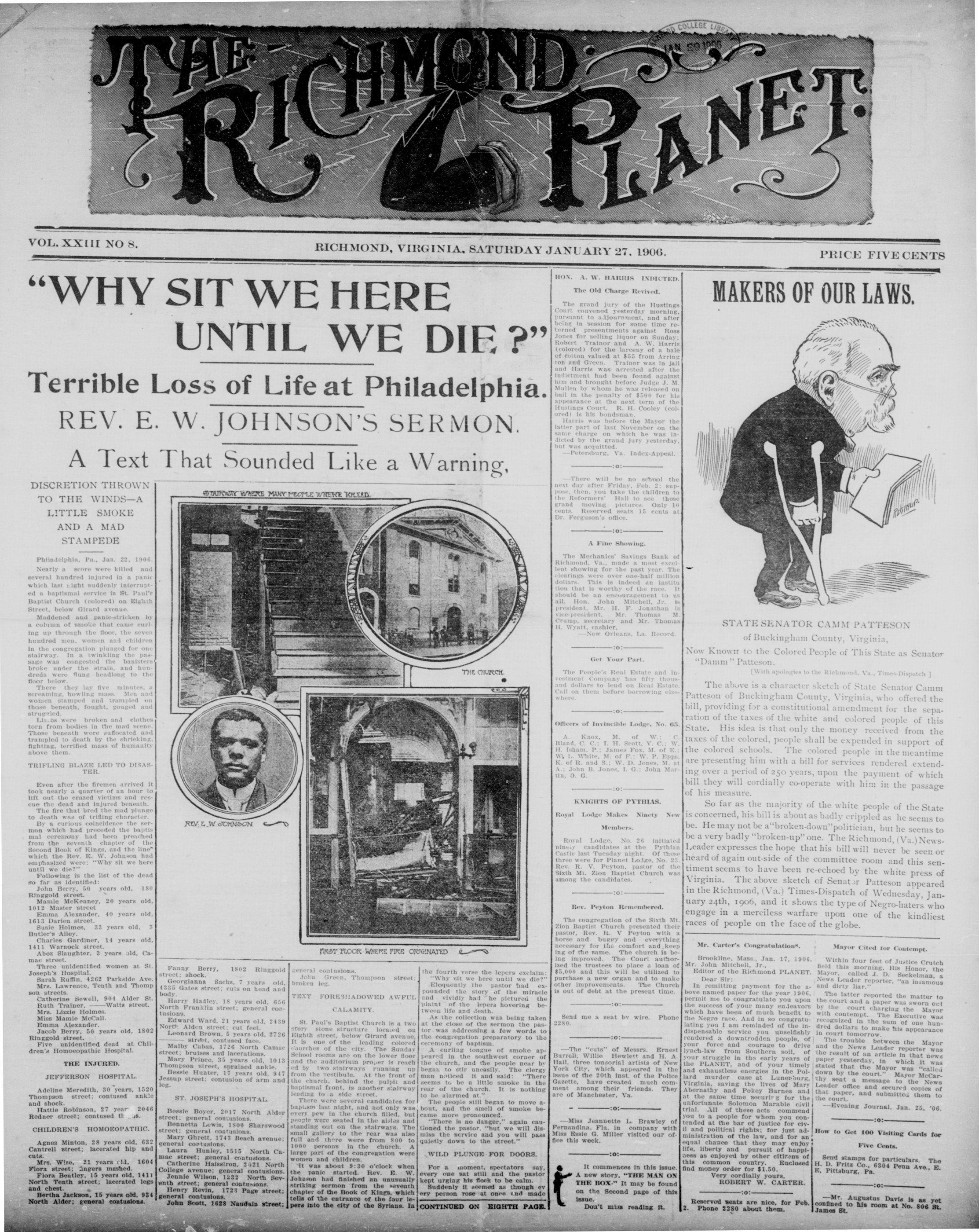
"WHY SIT WE HERE UNTIL WE DIE?"
A Text That Sounded Like a Warning,
VOL. XXIII NO 8.
"WHY
Terrible
REV. E
A Text
DISCRETION THROWN TO THE WINDS—A LITTLE SMOKE AND A MAD STAMPEDE
Philadelphia, Pa., Jan. 22, 1906.
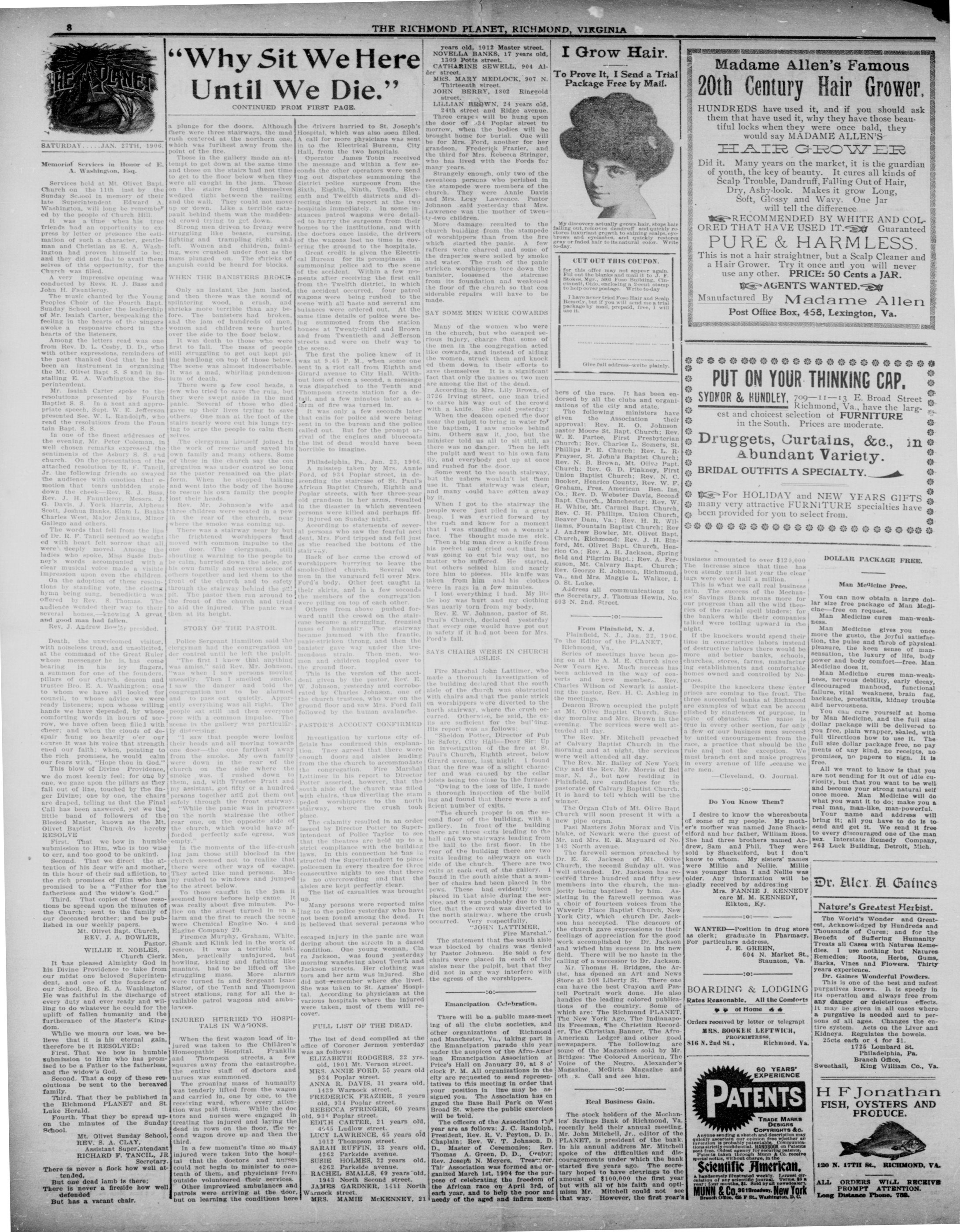
Nearly a score were killed and several hundred injured in a panic which last light suddenly interrupted a baptismal service in St. Paul's Baptist Church (colored) on Eighth Street, below Girard avenue.
Maddened and panic-stricken by a column of smoke that came curling up through the floor, the seven hundred men, women and children in the congregation plunged for one stairway. In a twinkling the passage was congested the banisters broke under the strain, and hundreds were flung headlong to the floor below.
There they lay five minutes, a screaming, howling mass. Men and women stamped and trampled on those beneath, fought, gouged and struggled.
Limbs were broken and clothes torn from bodies in the mad scene. Those beneath were suffocated and trampled to death by the shrieking, fighting, terrified mass of humanity above them.
TRIFLING BLAZE LED TO DISAS TER.
Even after the firemen arrived it took nearly a quarter of an hour to lift out the crazed victims and rescue the dead and injured beneath. The fire that bred the mad plunge to death was of trifling character.
By a curious coincidence the sermon which had preceded the baptismal ceremony had been preached from the seventh chapter of the Second Book of Kings, and the line which the Rev. E. W. Johnson had emphasized were: "Why sit we here until we die?" Following is the list of the dead so far as identified:
John Berry, 50 years old, 180 Ringgold street.
Mamie McKenney, 20 years old, 1012 Master street.
Emma Alexander, 40 years old, 1613 Darlin street.
Susie Holmes, 33 years old, 3
Butler's Alley.
Charles Gardiner, 14 years old,
1411 Warnock street.
Aboz Slaughter, 3 years old, Camac street.
Three unidentified women at St.
Joseph's Hospital.
Sarah Ruffin, 4262 Parkside Ave.
Mrs. Lawrence, Tenth and Thompson streets.
Catherine Sewell, 904 Alder St.
Ruth Trainer, —Watts street.
Mrs. Lizzie Holmes.
Miss Mamie McCall.
Emma Alexander.
Jacob Berry, 50 years old, 1802
Ringgold street.
Five unidentified dead at Childrens Homeopathic Hospital.
THE INJURED
JEFFERSON HOSPITAL.
Adeline Meredith, 30 years, 1520
Thompson street; contused ankle
and shock.
Hattle Robinson, 27 year, 2046
Redner street; contused thus.
CHILDREN'S HOMOEOPATHIC.
Agnes Minton, 28 years old, 632
Cantrell street; lacerated hip and
cuts.
Mrs. Wise, 21 years old, 1604
Flora street; dingers mashed.
Flora Bentley, 15 years old, 1411
North Tenth street; lacerated legs
and chest.
Bertha Jackson, 15 years old, 934
North Alder; general contusions.
STURWAY WHERE MANY PEOPLE WERE KILLED.
THE CHURCH
REV. E. W. JOHNSON
Fanny Berry, 1802 Ringgold street; shock.
Georgianna Sachs, 7 years old, 4335 Gates street; cuts on head and body.
Harry Hadley, 18 years old, 656 North Franklin street; general contusions.
Edward Ward, 21 years old, 2439 North: Alden street; cut feet.
Leonard Brown, 5 years old, 3726 street; contused face.
Malby Cabas, 1726 North Camac street; bruises and lacerations.
Mary Prince, 35 years old, 1013 Thompson street, sprained ankle.
Bessle Hunter, 17 years old, 947 Jessup street; contusion of arm and leg.
ST. JOSEPH'S HOSPITAL
Bessie Boyer, 2017 North Alder street; general contusions.
Bennetta Lewis, 1800 Sharswood street; general contusions.
Mary Ghrett, 1743 Beach avenue; general cortusions.
Laura Hunley, 1515 North Camac street; general cortusions.
Catherine Haisstron, 2021 North College avenue; general contusions.
Jennie Wilson, 1232 North Seventh street; general contusions.
Henry Revin, 1728 Page street; general contusions. John Scott, 1628 Naudain street:
RICHMOND, VIRGINIA, SATURDAY JANUARY 27, 1906.
FIRST FLOOR WHERE FIRE ORIGINATED general contusions the fourth verse the
geekie contusions.
John Green, Thompson street;
broken leg.
TEXT FORESHADOWED AWFUL
St. Paul's Baptist Church is a two story stone structure located on Eighth street, below Girard avenue. It is one of the leading colored churches of the city. The Sunday School rooms are on the lower floor and the auditorium proper is reached by two stairways running up from the vestibule. At the front of the church, behind the pulpit and baptismal front, is another stairway leading to a side street.
There were several candidates for baptism last night, and not only was every pew in the church filled, but people were seated in the aisles and standing out on the stairways. The small gallery to the rear was also full and there were from 800 to 1000 persons in the church. A large part of the congregation were women and children.
It was about 9:30 o'clock when the panic started. Rev. E. W. Johnson had finished an unusually striking sermon from the seventh chapter of the Book of Kings, which tells of the entrance of the four lepers into the city of the Syrians. In
the fourth verse the lepers exclaim:
"Why sit we here until we die?"
Eloquently the pastor had expounded the story of the miracle and vividly had he pictured the plaint of the lepers hovering between life and death.
As the collection was being taken at the close of the sermon the pastor was addressing a few words to the congregation preparatory to the ceremony of baptism.
A curling tongue of smoke appeared in the southwest corner of the church, and the people near by began to stir uneasily. The clergy man noticed it and said: "There seems to be a little smoke in the rear of the church. It is nothing to be alarmed at."
The people still began to move about, and the smell of smoke became more pronounced.
"There is no danger," again cautioned the pastor, "but we will dismiss the service and you will pass quietly down to the street."
WILD PLUNGE FOR DOORS
For a moment, spectators say, every one sat still and the pastor kept urging his flock to be calm. Suddenly it seemed as though every person rose at once and made
The Old Charge Revived.
The grand jury of the Hustings Court convened yesterday morning, pursuant to adjournment, and after being in session for some time returned presentments against Ross Jones for selling liquor on Sunday; Robert Trainor and A. W. Harris (colored) for the larceny of a bale of cotton valued at $55 from Arrington and Green. Trainor was in jail and Harris was arrested after the indictment had been found against him and brought before Judge J. M. Mullen by whom he was released on bail in the penalty of $500 for his appearance at the next term of the Hustings Court. R. H. Cooley (colored) is his bondsman.
Harris was before the Mayor the latter part of last November on the same charge on which he was indicted by the grand jury yesterday, but was acquitted.
—Petersburg, Va. Index-Appeal.
—There will be no school the next day after Friday, Feb. 2; suppose, then, you take the children to the Reformers' Hall to see those grand moving pictures. Only 10 cents. Reserved seats 15 cents at Dr. Ferguson's office.
A Fine Showing.
The Mechanics' Savings Bank of Richmond, Va., made a most excellent showing for the past year. The clearings were over one-half million dollars. This is indeed an institution that is worthy of the race. It should be an encouragement to us all. Hon. John Mitchell, Jr. is president, Mr. H. F. Jonathan is vice-president, Mr. Thomas M. Crump, secretary and Mr. Thomas H. Wyatt, cashier.
—New Orleans, La. Record.
Get Your Part.
The People's Real Estate and Investment Company has fifty thous and dollars to lend on Real Estate Call on them before borrowing else where.
Officers of Invincible Lodge, No. 65
A. Knox, M. of W.; C. Bland, C. C.; I. H. Scott, V. C.; W. H. Isham, P.; James Fox, M. of E. W. L. White, M. of F.; W. P. Epps, K. of R. and S.; W. D. Jones, M. a. A.; John B. Jones, I. G.; John Martin, O. G.
KNIGHTS OF PYTHIAS.
Royal Lodge Makes Ninety New Members.
Royal Lodge, No. 26 initiated ninety candidates at the Pythian Castle last Tuesday night. Of these three were for Planet Lodge, No. 23. Rev. R. V. Peyton, pastor of the Sixth Mt. Zion Baptist Church was among the candidates.
Rev. Peyton Remembered
The congregation of the Sixth Mt. Zion Baptist Church presented their pastor, Rev. R. V Peyton with a horse and buggy and everything necessary for the comfort and keeping of the same. The church is being improved. The Court authorized the trustees to place a loan of $5,000 and this will be utilized to purchase a new organ and to make other improvements. The Church is out of debt at the present time.
Send me a seat by wire. Phone
2280.
—The "cuts" of Messrs. Ernest Burrell, Willie Hewlett and H. A. Hall, three tonsorial artists of New York City, which appeared in the issue of the 20th inst. of the Police Gazette, have created much comment among their friends. They are of Manchester, Va.
—Miss Jeannette L. Brawley of Fernandina, Fla. in company with Miss Essie G. Miller visited our office this week.
It commences in this issue.
A new story, "THE MAN ON
THE BOX." It may be found
on the Second page of this
issue.
Don't miss reading it.
MAKERS OF OUR LAWS.
POSTMUR.
Now Known to the Colored People of This State as Senator "Damm" Patteson. [With apologies to the Richmond, Va., Times-Dispatch]
The above is a character sketch of State Senator Camm Patteson of Buckingham County, Virginia, who offered the bill, providing for a constitutional amendment for the separation of the taxes of the white and colored people of this State. His idea is that only the money received from the taxes of the colored, people shall be expended in support of the colored schools. The colored people in the meantime are presenting him with a bill for services rendered extending over a period of 250 years, upon the payment of which bill they will cordially co-operate with him in the passage of his measure.
So far as the majority of the white people of the State is concerned, his bill is about as badly crippled as he seems to be. He may not be a "broken-down" politician, but he seems to be a very badly "broken-up" one. The Richmond, (Va.) News-Leader expresses the hope that his bill will never be seen or heard of again out-side of the committee room and this sentiment seems to have been re-echoed by the white press of Virginia. The above sketch of Senator Patteson appeared in the Richmond, (Va.) Times-Dispatch of Wednesday, January 24th, 1906, and it shows the type of Negro-haters who engage in a merciless warfare upon one of the kindliest races of people on the face of the globe.
Mr. Carter's Congratulations
Brookline, Mass., Jan. 17, 1906
Mr. John Mitchell, Jr.
Editor of the Richmond PLANET
Dear Sir:
In remitting payment for the above named paper for the year 1906, permit me to congratulate you upon the success of your many endeavors which have been of much benefit to the Negro race. And in so congratulating you I am reminded of the indispensable service you unselfishly rendered a downtrodden people, of your force and courage to drive lynch-law from Southern soil, of your struggle in the early years of the PLANET, and of your timely and exhaustless energies in the Pollard murder case at Lunenburg, Virginia, saving the lives of Mary Abernathy and Pokey Barnes and at the same time securing for the unfortunate Solomon Marable civil trial. All of these acts commend you to a people for whom you contended at the bar of justice for civil and political rights; for just administration of the law, and for an equal chance that they may enjoy life, liberty and pursuit of happiness as enjoyed by other citizens of this common country. Enclosed find money order for $1.50.
Very cordially yours,
ROBERT W. CARTER.
:0:
Reserved seats are nice, for Feb.
2. Phone 2280 about them.
PRICE FIVE CENTS
OUR LAWS.
R CAMM PATTESON
County, Virginia,
People of This State as Senator
the Richmond, Va., Times-Dispatch ]
sketch of State Senator Camm
County, Virginia, who offered the
personal amendment for the sepa-
te and colored people of this
the money received from the
shall be expended in support of
colored people in the meantime
for services rendered extend-
upon the payment of which
erate with him in the passage
of the white people of the State
was badly crippled as he seems to
own"politician, but he seems to
one. The Richmond, (Va.) News-
at his bill will never be seen or
committee room and this sen-
e-echoed by the white press of
of Senator Patteson appeared
Dispatch of Wednesday, Jan-
s the type of Negro-haters who
are upon one of the kindiest
of the globe.
Mayor Cited for Contempt.
Within this four hour of Justice Crutch field this morning, His Honor, the Mayor, called J. D. Seckelman, a News Leader reporter, "an inimous and dirty liar."
The latter reported the matter to the court and a paper was sworn out by the court charging the Mayor with contempt. The Executive was recognized in the sum of one hundred dollars to make his appearance in court tomorrow.
The trouble between the Mayor and the News Leader reporter was the result of an article in that news paper yesterday, in which it was stated that the Mayor was "called down by the court." Mayor McCarthy sent a message to the News Leader office and secured copies of that paper, and submitted them to the court.
—Evening Journal, Jan. 25, '06.
How to Get 100 Visiting Cards for
Five Cents.
Send stamps for particulars. The H. D. Fritz Co., 6304 Penn Ave., E. E. Pittsburg, Pa.
—Mr. Augustus Davis is as yet confined to his room at No. 806 St. James St.
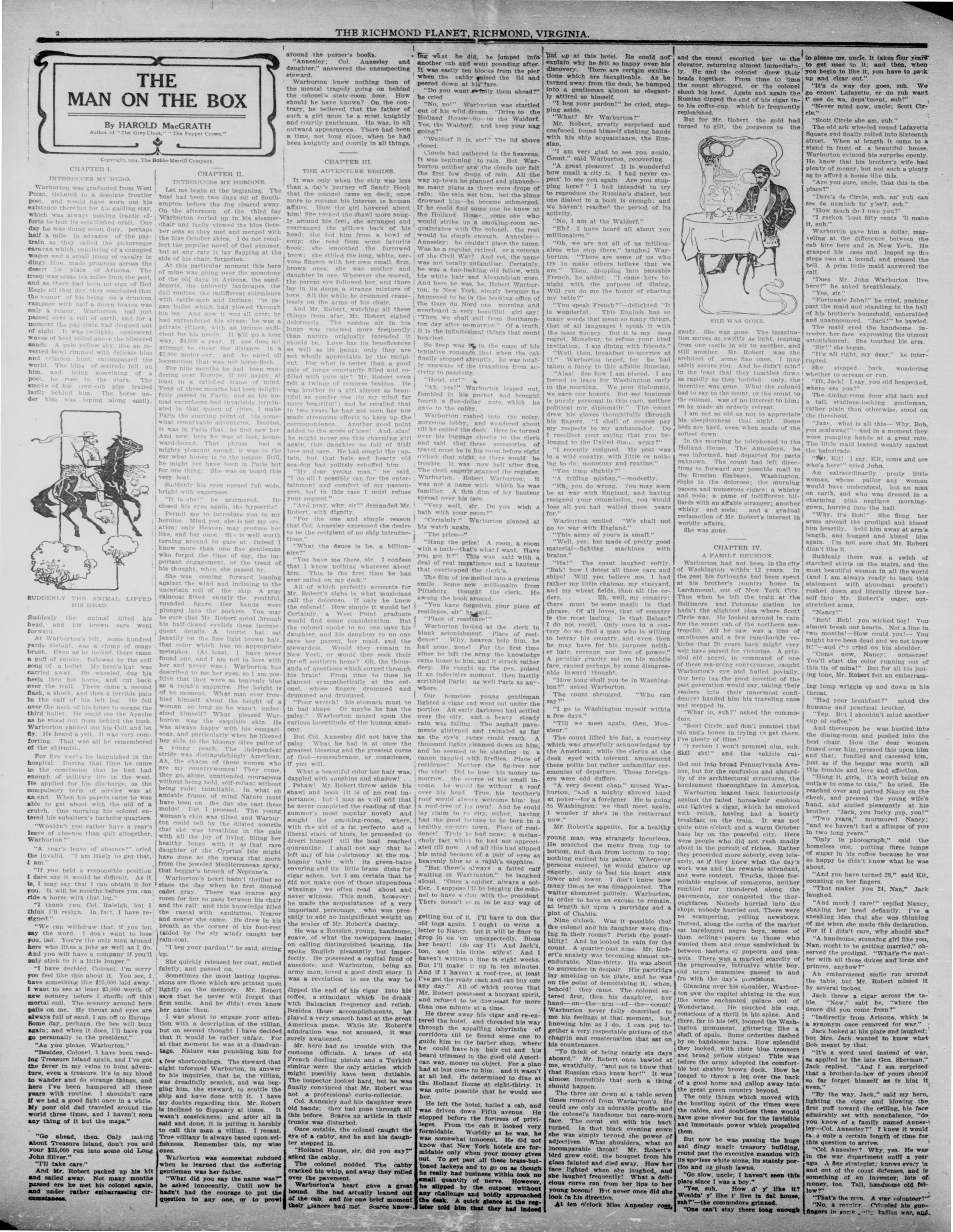
THE
MAN ON THE BOX
By HAROLD MacGRATH
Author of "The Grey Closk," "The Puppet Crown."
INTRODUCES MY HERO.
Warburton was graduated from West Point, ticketed to a desolate frontier post, and would have worn out his existence therebut for his guiding star, which was always making frantic efforts to bolt its established orbit. One day he was doing scout duty, perhaps half a mile in advance of the paytrain as they called the picturesque caravan which, consisting of a canopied wagon and a small troop of cavalry in dingy blue, made progress across the desert the plain of Arizona. The troop was some ten miles from the post, and as there had been no sign of Red Eagle all that day, they concluded that the rumor of his being on a drunken rampage with half a dozen braves was only a rumor. Warburton had just passed over a roll of earth, and for a moment the pay-train had dropped out of sight. It was twilight; opalescent waves of heat rolled above the blistered sands. A pale yellow sky, like an inverted bowl rimmed with delicate blue and crimson hues, encompassed the world. The bliss of solitude fell on him, and, being something of a poet, he rose to the stars. The smoke of his corn-cob pipe trailed lazily behind him. The horse under him was loping along easily.
```markdown
```
SUDDENLY THE ANIMAL LIFTED
HIS HEAD.
Suddenly the animal lifted his
head, and his brown cars went
forward.
At Warburton's left, some hundred
yards distant, was a clump of osage
brush. Even as he looked, there came
a puff of smoke, followed by the evil
song of a bullet. My hero's hat was
carried away. He wheeled, dug his
heels into his horse, and cut back
over the trail. There came a second
flash, a shock, and then a terrible pain
in the calf of his left leg. He fell
over the neck of his horse to escape the
third bullet. He could see the Apache
as he stood out from behind the bush.
Warburton yanked out his Colt and let
fly. He heard a yell. It was very com-
forting. That was all he remembered
of the skirmish.
For five wee's he languished in the hospital. During that time he came to the conclusion that he had had enough of military life in the west. He applied for his discharge, as the compulsory term of service was at an end. When his papers came he was able to get about with the aid of a crutch. One morning his colonel entered his subaltern's bachelor quarters.
"Wouldn't you rather have a year's leave of absence than quit altogether, Warburton?"
"A year's leave of absence?" cried the invalid. "I am likely to get that, I am."
"If you held a responsible position I dare say it would be difficult. As it is, I may say that I can obtain it for you. It will be months before you can ride a horse with that leg."
"I thank you, Col. Raleigh, but I think I'll resign. In fact, I have resigned."
"We can withdraw that, if you but say the word. I don't want to lose you, lad. You're the only man around here who likes a joke as well as I do. And you will have a company if you'll only stick to it a little longer."
"I have decided, Colonel. I'm sorry you feel like this about it. You see, I have something like $25,000 laid away. I want to see at least $5,000 worth of new scenery before I shuffle off this mortal coll. The scenery around here pulls on me. My throat and eyes are always full of sand. I am off to Europe Some day, perhaps, the bee will buzz again; and when it does, I'll have you go personally to the president."
"As you please. Warburton."
"Besides, Colonel, I have been reading Treasure Island again, and I've got the fever in my veins to hunt adventure, even a treasure, it's in my blood to wander and do strange things, and here I've been hampered all these years with routine. I shouldn't care if we had a good fight once in a while. My poor old dad traveled around the world three times, and I haven't seen any thing of it but the maps."
"Go ahead, then. Only talking about Treasure Island, don't you and your $25,000 run into some old Long John Silver."
"I'll take care."
And Mr. Robert packed up his kit and sailed away. Not many months passed ere he met his colonel again, and under rather embarrassing circumstances.
LET ME BEGIN AT THE BEGINNING. The boat had been two days out of Southampton before the fog cleared away. On the afternoon of the third day Warburton curled up in his steamer-chair and laily viewed the blue October seas as they met and merged with the blue October skies. I do not recollect the popular novel of that summer, but at any rate it lay flapping at the side of his chair forrotten.
At this particular moment this hero of mine was going over the monotony of the old days in Arizona, the sand-deserts, the unloved landscapes, the dull routine, the indifferent skirmishes with cattle-men and Indians; the pa-gan bullet which had plowed through his leg. And now it was all over; he had surrendered his straps; he was a private citizen, with an income sufficient for his needs: It will go a long way, $4,500 a year. If one does not attempt to cover the distance in a $5,000 motor-car, and he nated all locomotion that was not horse-flesh.
For nine months he had been wandering over Europe, if not happy, at least in a satisfied frame of mind. Four of these months had been delightfully passed in Paris; and as his nomad excursions had invariably terminated in that queen of cities, I make Paris the starting point of his somewhat remarkable adventures. Besides, it was in Paris that he first saw her. And now, here he was at last, homeward-bound. That phrase had a mighty pleasant sound; it was to the ear what honey is to the tongue. Still, he might yet have been in Paris but for one thing: She was on board this very boat. Suddenly his eyes opened full wide, bright with eagerness.
"It is she!" he murmured. He closed his eyes again, the hypocrite. Permit me to introduce you to my heroine. Mind you, she is not my creation; only Heaven may produce her like, and but once. She is well worth turning around to gaze at. Indeed I know more than one fine gentleman who forgot the time of day, the important engagement, or the trend of his thought, when she passed by.
She was coming forward, leaning against the wind and inclining to the uncertain roll of the ship. A gray raincoat fitted snugly the youthful, rounded figure. Her hands were plunged into the pockets. You may be sure that Mr. Robert noted through his half-closed eyelids these inconsequent details. A tourist hat sat jauntily on the fine light brown hair, that color which has no appropriate metaphor. (At least, I have never found one, and I am not in love with her and never was.) Warburton has described to me her eyes, so I am positive that they were as heavenly blue as a rajah's sapphire. Her height is of no moment. What man ever troubled himself about the height of a woman so long as he wasn't under-signed himself? What pleased Warburton was the exquisite skin. He was always happy with his companions, and particularly when he likened her skin to the bloomy olive pallor of a young peach. The independent stride was distinguishingly American, Ah, the charm of these women who are my countrywomen! They come, they go, alone, unattended, courageous without being bold, self-reliant without being rude; inimitable. In what an amiable frame of mind Nature must have been on the day she cast these molds! But I proceed. The young woman's chin was tilted, and Warburton could tell by the dilated nostrils that she was breathing in the gale with all the joy of living, filling her healthy lungs with it as that rare daughter of the Cyprian Isle might have done as she sprang that morn from the jeweled Mediterranean spray, that beggar's brooch of Neptune's.
Warburton's heart hadn't thrilled so since the day when he first donned cadet gray. There was scarcity any room for her to pass between his chair and the rail; and this knowledge filled the rascal with exultation. Nearer and nearer she came. He drew in his breath as the corner of his foot-rest (aided by the sly wind) caught her rain-coat.
"I beg your pardon!" he said, sitting up.
She quickly released her coat, smiled faintly, and passed on. Sometimes the most lasting impressions are those which are printed most lightly on the memory. Mr. Robert says that he never will forget that first smile. And he didn't even know her name then.
I was about to engage your attention with a description of the villian, but on second thought I have decided that it would be rather unfair. For at that moment he was at a disadvantage. Nature was punishing him for a few shortcomings. The steward that night informed Warburton, in answer to his inquiries, that he, the villian, was dreadfully seasick, and was begging him, the steward, to scuttle the ship and have done with it. I have my doubts regarding this. Mr. Robert is inclined to flippancy at times. It wasn't seasickness; and after all is said and done, it is putting it harshly to call this man a villian. I recant. True villain is always based upon selfishness. Remember this, my wise ones.
Warburton was somewhat subdued when he learned that the suffering gentleman was her father.
"What did you say the name was?" he asked innocently. Until now he hadn't had the courage to put the question to any one, or to prowl
THE RICHMOND PLANET, RICHMOND, VIRGINIA
around the purser's books.
"Annesley; Col. Annesley and daughter," answered the unsuspecting steward.
Warburton knew nothing then of the mental tragedy going on behind the colonel's state-room door. How should he have known? On the contrary, he believed that the father of such a girl must be a most knightly and courtly gentleman. He was, in all outward appearances. There had been a time, not long since, when he had been knightly and courtly in all things.
THE ADVENTURE BEGINS
It was only when the ship was less than a day's journey off Sandy Hook that the colonel came on deck, once more to resume his interest in human affairs. How the girl hovered about him! She tucked the shawl more snugly around his feet; she arranged and rearranged the pillows back of his head; she fed him from a bowl of soup; she read from some favorite book; she smoothed the furrowed brow; she stilled the long, white, nervous fingers with her own small, firm, brown ones; she was mother and daughter in one. Wherever she moved, the parent eye followed her, and there lay in its deeps a strange mixture of love. All the while he drummed ceaselessly on the arms of his chair.
And Mr. Robert, watching all these things from afar, Mr. Robert sighed, dolorously. The residue air in his lungs was renewed more frequently than nature originally intended it should be. Love has its beneficences as well as its pangs, only they are not wholly appreciable by the recipient. For what is better than a good pair of jungs constantly filled and re-filled with pure air? Mr. Robert even felt a twinge of remorse besides. He was brother to a girl almost as beautiful as yonder one (to my mind far more beautiful!) and he recalled that in two years he had not seen her nor made strenuous efforts to keep up the correspondence. Another good point added to the score of love! And, alas! he might never see this charming girl again, this daughter so full of fillid love and care. He had sought the captain, but that hale and hearty old sea-dog had politely rebuffed him.
"My dear young man," he said, "I do all I possibly can for the entertainment and comfort of my passengers, but in this case I must refuse your request."
"And pray, why, sir?" demanded Mr. Robert, with dignity.
"For the one and simple reason that Col. Annesley expressed the desire to be the recipient of no ship introductions."
"What the deuce is he, a billionaire?"
"You have me there, sir. I confess that I know nothing whatever about him. This is the first time he has ever sailed on my deck."
All of which perfectly accounts for Mr. Robert's sighs in what musicians call the doloroso. If only he knew the colonel! How simple it would be! Certainly, a West Point graduate would find some consideration. But the colonel spoke to no one save his daughter, and his daughter to no one save her parent, her maid, and the stewardess. Would they remain in New York, or would they seek their far-off southern home? Oh, the thousands of questions which surged through his brain! From time to time he glanced sympathetically at the colonel, whose fingers drummed and drummed and drummed. "Poor wretch! his stomach must be in bad shape. Or maybe he has the palsy." Warburton mused upon the curious incertitude of the human anatomy.
But Col. Annesley did not have the palsy. What he had is at once the greatest blessing and the greatest curse of God—remembrance, or conscience, if you will.
What a beautiful color her hair was, dappled with sunshine and shadow! . . . Pshaw! Mr. Robert threw aside his shawl and book (it is of no real importance, but I may as well add that he never completed the reading of that summer's most popular novel) and sought the smoking-room, where, with the aid of a fat perfecto and a liberal stack of blues, he proceeded to divert himself till the boat reached quarantine. I shall not say that he left any of his patrimony at the manhogany table with its green-balze covering and its little brass disks for cigar ashes, but I am certain that he did not make one of those stupendous winnings we often read about and never witness. This much, however: he made the acquaintance of a very important personage, who was presently to add no insignificant weight on the scales of Mr. Robert's destiny.
He was a Russian, young, handsome, suave, of what the newspapers insist on calling distinguished bearing. He spoke English pleasantly but imperfectly. He possessed a capital fund of anecdote, and Warburton, being an army man, loved a good droll story. It was a revelation to see the way he dipped the end of his cigar into his coffee, a stimulant which he drank with Balzacian frequency and relish. Besides those accomplishments, he played a very smooth hand at the great American game. While Mr. Robert's admiration was not aroused, it was surely awakened. Mr. hero had no trouble with the customs officials. A brace of old French dueling pistols and a Turkish similar were the only articles which might possibly have been dutiful. The inspector looked hard, but he was finally convinced that Mr. Robert was not a professional curio-collector.
Col. Annesley and his daughter were old hands; they had gone through all this before. Scarce an article in their trunks was disturbed.
Once outside, the colonel caught the eye of a cabby, and he and his daughter stepped in.
"Holland House, sir, did you say?" asked the cabby.
The colonel nodded. The cabby cracked his whip, and away they rolled over the pavement.
Warburton's heart gave a great bound. She had actually leaned out of the cab, and for one brief moment their glances had met. Scarce know-
ing what he did, he jumped into another cab and went pounding after. It was easily ten blocks from the pier when the cabby raised the lid and peered down at his fare.
"Do you want to rollly them ahead?"
he cried
"No, no!" Warburton was startled out of his wild dream. "Drive to the Holland House—no—to the Waldorf. Yes, the Waldorf; and keep your nag going?"
"Waldorf it is, sir!" The lid above closed
Clouds had gathered in the heavens. It was beginning to rain. But Warburton neither saw the clouds nor felt the first few drops of rain. All the way up-town he planned and planned—as many plans as there were drops of rain; the rain wet him, but the plans drowned him—he became submerged. If he could find some one he knew at the Holland House, some one who would strike up a smoking-room acquaintance with the colonel, the rest would be simple enough. Annesley—Annesley; he couldn't place the name. Was he a regular, retired, or a veteran of the Civil War? And yet, the name was not totally unfamiliar. Certainly, he was a fine-looking old fellow, with his white hair and Alexandrian nose. And he was he, he, Robert Warburton. In New York, simply because he happened to be in the booking office of the Gare du Nord one morning and overheard a very beautiful girl say: "Then we shall sail from Southampton day after to-morrow." Of a truth, it is the infinitesimal things that count heaviest.
So deep was he in the maze of his tentative romance that when the cab finally stopped abruptly, he was totally unaware of the transition from activity to passivity.
"Hotel, sir!"
"Ah, yes!" Warburton leaped out, fumbled in his pocket, and brought fourth a five-dollar note, which he gave to the cabby.
Warburton rushed into the noisy, gorgeous lobby, and wandered about till he espied the desk. Here he turned over his luggage checks to the clerk and said that these accessories of travel must be in his room before eight o'clock that night, or there would be trouble. It was now half after five. The clerk eagerly scanned the register. Warburton, Robert Warburton; it was not a name with which he was familiar. A thin film of icy hauteur spread over his face.
"Very well, sir. Do you wish a bath with your room?" "Certainly." Warburton glanced at his watch again.
"The price—"
"Hang the price! A room, a room with a bath—that's what I want. Have you got it?" This was said with a deal of real impatience and a hauteur that overtopped the clerk's.
The film of ice melted into a gracious smile. Some new millionaire from Pittsburg, thought the clerk. He swung the book around.
"You have forgotten your place of residence, sir!" he said.
"Place of residence!"
Warburton looked at the clerk in blank astonishment. Place of residence? Why, heaven help him, he had none, none! For the first time since he left the army the knowledge came home to him, and it struck rather deep. He caught up the pen, poised it an indecisive moment, then hastily scribbed Paris: as well Paris as anywhere.
Our homeless young gentleman lighted a cigar and went out under the portico. An early darkness had settled over the city, and a heavy steady rain was falling. The asphalt pavements glistened and twinkled as far as the eye's range could reach. A thousand lights gleamed down on him, and he seemed to be standing in a canon dappled with fireflies. Place of residence! Neither the fig-tree nor the vine! Did he lose his money toorrow, the source of his small income, he would be without a roof over his head. True, his brother's roof would always welcome him: but a roof-tree of his own! And he could lay claim to no city, either, having had the good fortune to be born in a healthy country town. Place of residence! Truly he had none; a melancholy fact which he had not appreciated till now. And all this had slipped his mind because of a pair of eyes as heavenly blue as a rajah's sapphire.
"But there's always a fatted calf waiting in Washington," he laughed aloud. "Once a soldier, always a soldier. I suppose I'll be begging the colonel to have a chat with the president. There doesn't seem to be any way of getting out of it. I'll have to do the old togs again. I ought to write a letter to Nancy, but it will be finer to drop in on em unexpectedly. Bless her heart! (So say I!) And Jack's, too, and his little wife's! And I haven't written a line in eight weeks. But I'll make it up in ten minutes. And if I haven't a roof-tree, at least I've got the ready cash and can buy one any day." All of which proves that Mr. Robert possessed a buoyant spirit, and refused to be downcast for more than one minute at a time.
He threw away his cigar and re-entered the hotel, and threaded his way through the appalling labyrinths of corridors till he found some one to guide him to the barber shop, where he could have his hair cut and his beard trimmed in the good old American way, money no object. For a plan had at last come to him; and it wasn't at all bad. He determined to dine at the Holland House at eight-thirty. It was quite possible that he would see her.
He left the hotel, hailed a cab, and was driven down Fifth avenue. He stopped before the fortress of privileges. From the cab it looked very formidable. Worldly as he was, he was somewhat innocent. He did not know that New York hotels are formidable only when your money gives out. To get past all these brass-buttoned lackeys and to go on as though he really had business within took no small quantity of nerve. However, he slipped by the outpost without any challenge and boldly approached the desk. A quick glance at the register told him that they had indeed
put up at this hotel. He could not explain why he felt so happy over his discovery. There are certain exultations which are inexplicable. As he turned away from the desk, he bumped into a gentleman almost as elegantly attired as himself.
"I beg your pardon!" he cried, stepping aside.
"What? Mr. Warburton?"
Mr. Robert, greatly surprised and confused, found himself shaking hands with his ship acquaintance, the Russian.
"I am very glad to see you again, Count," said Warburton, recovering.
"A great pleasure! It is wonderful how small a city is. I had never expect' to see you again. Are you stopping here?" I had intended to try to reproduce the Russian's dialect, but one dialect in a book is enough; and we haven't reached the period of its activity.
"No, I am at the Waldorf."
"Eh? I have heard all about you millionaires."
"Oh, we are not all of us millionaires who stop there," laughed Warburton. "There are some of us who try to make others believe that we are." Then, dropping into passable French, he added: "I came here tonight with the purpose of dining. Will you do me the honor of sharing my table?"
"You speak French?"—delighted. "It is wonderful. This English has so many words that mean so many things, that of all languages I speak it with the least fluency. But it is my deep regret, Monsieur, to refuse your kind invitation. I am dining with friends." "Well, then, breakfast to-morrow at 11," Warburton urged, for he had taken a fancy to this affable Russian
"Alas! See how I am placed. I am forced to leave for Washington early in the morning. We poor diplomats, we earn our honors. But my business is purely personal in this case, neither political nor diplomatic." The count drew his gloves thoughtfully through his fingers. "I shall of course pay my respects to my ambassador. Do I recollect your saying that you belonged to the United State army?"
"I recently resigned. My post was in a wild country, with little or nothing to do; monotony and routine."
"You limp slightly?"
"A trifling mishap."—modestly.
"Eh, you do wrong. You may soon be at war with England, and having resigned your commission, you would lose all you had waited these years for."
Warburton smiled. "We shall not go to war with England."
"This army of yours is small."
"Well, yes; but made of pretty good material—fighting machines with brains."
"Ha!!" The count laughed softly,
"Bah! how I detest all these cars and ships! Will you believe me, I had rather my little chateau, my vineyard, and my wheat fields, than all the orders. Eh, well, my country: there must be some magic in that phrase. Of all loves, that of country is the most lasting. Is that Balzac? I do not recall. Only once in a century do we find a man who is willing to betray his country, and even then he may have for his purpose neither hate, revenge, nor love of power." A peculiar gravity sat on his mobile face, caused perhaps, by some disagreeable inward thought.
"How long shall you be in Washington?" asked Warburton.
The count shrugged. "Who can say?"
"I go to Washington myself within a few days."
"Till we meet again, then, Monsieur."
The count lifted his hat, a courtesy which was gracefully acknowledged by the American; while the clerks at the desk eyed with tolerant amusement these polite but rather unfamiliar ceremonies of departure. These foreigners were odd duffers.
"A very decent chap," mused Warburton, "and a mighty shrewd hand at poker—for a foreigner. He is going to Washington: we shall meet again. I wonder if she's in the restaurant now."
Mr. Robert's appetite, for a healthy
young man, was strangely incurious. He searched the menu from top to bottom, and then from bottom to top; nothing excited his palate. Whenever persons entered, he would glance up eagerly, only to feel his heart sink lower and lower. I don't know how many times he was disappointed. The waiter ahemmed politely. Warburton, in order to have an excuse to remain, at length hit upon a partridge and a pint of Chablis.
Nine o'clock. Was it possible that the colonel and his daughter were dining in their rooms? Perish the possibility! And he looked in vain for the count. A quarter-past nine. Mr. Robert's anxiety was becoming almost unendurable. Nine-thirty. He was about to surrender in despair. His partridges lay smoking on his plate, and he was on the point of demolishing it, when, behold! they came. The colonel entered first, then his daughter, her hand—on the—arm—of—the—count! Warburton never fully described to me his feelings at that moment, but, knowing him as I do, I can put together a very respectable picture of the chagrin and consternation that sat on his countenance.
"To think of being nearly six days aboard," Mr. Robert once bawled at me, wrathfully, "and not to know that that Russian chap knew her!" It was almost incredible that such a thing should happen.
The three sat down at a table seven times removed from Warburton's. He could see only an adorable profile and the colonel's handsome but care-worn face. The count sat with his back turned. In that black evening gown she was simply beyond the power of adjectives. What shoulders, what an incomparable throat! Mr. Robert's bird grew cold; the bouquet from his glass fainted and died away. How her face lighted when she laughed, and she laughed frequently! What a delicious curve ran from her lips to her young bosoni! But never once did she look in his direction.
At ten o'clock Miss Annesley rose.
and the count escorted her to the elevator, returning almost immediately. He and the colonel drew their heads together. From time to time the count shrugged, or the colonel shook his head. Again and again the Russian dipped the end of his cigar into his coffee-cup, which he frequently replenished. But for Mr. Robert the gold had turned to gift, the zorgese to the
SHE WAS GONE.
gaudy. She was gone. The imagination moves as swiftly as light, leaping from one castle in air to another, and still another. Mr. Robert was the architect of some fine ones. I may safely assure you. And he didn't mind in the least that they tumbled down as rapidly as they bullied: only, the incentive was gone. What the colonel had to say to the count, or the count to the colonel, was of no interest to him; so he made an orderly retreat.
I am not so old as not to appreciate his sleeplessness that night. Some beds are hard, even when made of the softest down.
In the morning he telephoned to the Holland House. The Annesleys, he was informed, had departed for parts unknown. The count had left directions to forward any possible mail to the Russian Embassy. Washington, Sighs in the doloroso; the morning papers and numerous cigars; a whisky and soda; a game of indifferent billiards with an affable stranger; another whisky and soda; and a gradual reclamation of Mr. Robert's interest in worldly affairs.
CHAPTER IV
Warburton had not been in the city of Washington within 12 years. In the past his furloughs had been spent at his brother's country home in Larchmount, out of New York City. Thus when he left the train at the Baltimore and Potomac station he hadn't the slightest idea where Scott Circle was. He looked around in vain for the smart cab of the northern metropolis. All he saw was a line of omnibuses and a few ramshackle vehicles that 20 years back might very well have passed for victorias. A grizzled old negro, in command of one of these sea-going conveyances, caught Warburton's eye and halted jovially. Our hero (as the good novelist of the past generation would say, taking their readers into their innermost confidence) handed him his traveling case and stepped in.
"Whar to, suh?" asked the commodore.
"Scott Circle, and don't pommel that old nag's bones in trying to get there. I've plenty of time."
"I reckon I won't pommel nim, suh. Skt! skt!" and the vehicle rat-
tled out into broad Pennsylvania Avenue, but for the confusion and absurdity of its architectural structures, the handsomest thoroughfare in America. Warburton leaned back luxuriously against the faded horse-hair cushion and lighted a cigar, which he smoked with relish, having had a hearty breakfast on the train. It was not quite nine o'clock and a warm October haze lay on the peaceful city. Here were people who did not rush madly about in the pursuit of riches. Rather they proceeded more soberly, even leisurely, as if they knew what the day's work was and the rewards attendant, and were content. Trucks, those formidable engines of commerce, neither rumbled nor thundered along the pavements, nor congested the thoroughfares. Nobody hurried into the shops, nobody hurried out. There were no scampering, yelling newsbows. Instead, along the curbs of the market sat barelegged negro boys, some of them selling papers to those who wanted them and some sandwiched in between baskets of popcorn and peanuts. There was a marked scarcity of the progressive, intrusive white boy. Oid negro mammies passed to and fro with the day's provisions.
Glancing over his shoulder, Warburton saw the capitol shining in the sun like some enchanted palace out of Wonderland. He touched his cap, conscious of a thrill in his spine. And there, far to his left, loomed the Washington monument, glittering like a shaft of opals. Some orderlies dashed by on handsome bays. How splendid they looked, with their blue trousers and broad yellow stripes! This was before the army adopted the comfortable but shabby brown duck. How he longed to throw a leg over the back of a good horse and gallop away into the great green country beyond. The only things which moved with the hustling spirit of the times were the cables, and doubtless these would have gone slower but for the invisible and immutable power which propelled them.
But now he was passing the huge and dingy magic treasury building, round past the executive mansion with its spoiless white stone, its stately portico and its plush lawns.
"Go slow, uncle; I haven't seen this place since I was a boy."
"Yes, suh. How d' y' like it? Wouldn' y' like t' live in dat house, suh?"—the commodore grinned.
"One can't stay there long enough
so please me, uncle. It takes four years to get used to it; and then, when you begin to like it, you have to pack up and clear out."
"It's de way dey goes, suh. We go eroun' Lafayette, er do yuh want t' see de wa, depa'tment, suh?"
"Never mind now, uncle; Scott Circle."
"Scott Circle she am, suh."
The old ark wheeled round Lafayette Square and finally rolled into Sixteenth street. When at length it came to a stand in front of a beautiful house, Warburton evinced his surprise openly. He knew that his brother's wife had plenty of money, but not such a plenty as to afford a house like this.
"Are you sure, uncle, that this is the place?"
"Dere's de Circle, suh, an' yuh can see de numhuh fo' y'se'f, suh."
"How much do I owe you?"
"I reckon 'bout fifty cents 'll make it, suh."
Warburton gave him a dollar, marvelling at the difference between the cab hire here and in New York. He grasped his case and leaped up the steps two at a bound, and pressed the bell. A prim little maid answered the call.
"Does Mr. John Warburton live here?" he asked breathlessly.
"Fortunate John!" he cried, pushing past the maid and standing in the hall of his brother's household, unheralded and unannounced. "Jack!" he bawled. The maid eyed the handsome intruder, her face expressing the utmost astonishment. She touched his arm. "Sir!" she began. "It's all right, my dear," he interrupted. She stepped back, wondering whether to scream or run. "Hi, Jack! I say, you old henpecked, where are you?" The dining-room door slid back and a tall, studious-looking gentleman, rather plain than otherwise, stood on the threshold. "Jane, what is all this—Why, Bob, you scalawag!" and in a moment they were pumping hands at a great rate. The little maid leaned weakly against the balustrade. "Sit, Kit! I say, Kit, come and see who's here!" cried John.
An extraordinarily pretty little woman, whose pallor any woman would have understood, but no man on earth, and who was dressed in a charming pink negligee morning-gown, hurried into the hall.
"Why, it's Bob!" She flung her arms around the prodigal and kissed him heartily, held him away at arm's length, and hugged and kissed him again. I'm not sure that Mr. Robert didn't like it.
Suddenly there was a swish of starched skirts on the stairs, and the most beautiful woman in all the world (and I am always ready to back this statement with abundant proofs!) rushed down and literally threw herself into Mr. Robert's eager, out-stretched arms.
"Bob! Bob! you wicked boy! You almost break our hearts. Not a line in two months!—How could you!—You might have been dead and we not know it!"—and the cried on his shoulder.
"Come now, Nancy; nonsense! You'll start the color running out of this tie of mine!" But for all his jesting tone, Mr. Robert felt an embarrassing lump wriggle up and down in his throat.
"Had your breakfast?" asked the humane and practical brother.
"Yep. But I shouldn't mind another cup of coffee."
And thereupon he was hustled into the dining-room and pushed into the best chair. How the dear women fussed over him, pressed this upon him and that; fondled and caressed him, just as if the beggar was worth all this trouble and love and affection.
"Hang it girls, it's worth being an outlaw to come to this," he cried. He reached over and patted Nancy on the cheek, and pressed the young wife's hand, and smiled pleasantly at his brother. "Jack, you lucky pup, you!" "Two years," murmured Nancy; "and we haven't had a glimpse of you in two long years." "Only in photograph," said the homeless one, putting three lumps of sugar in his coffee because he was so happy he didn't know what he was about. "And you have turned 23," said Kit, counting on her fingers. "That makes you 24, Nan," Jack laughed.
"And much I care!" replied Nancy, shaking her head defiantly. I've a sneaking idea that she was thinking of me when she made this declaration. For If I didn't care, why should she? "A handsome, stunning girl like you, Nan, ought to be getting married," observed the prodigal. "What's the matter with all these dukes and lords and princes, anyhow?" An embarrassed smile ran around the table, but Mr. Robert missed it by several inches. Jack threw a cigar across the table. "Now," said he, "where the deuce did you come from?" "Indirectly from Arizona, which is a synonym once removed for war." Jack looked at his plate and laughed; but Mrs. Jack wanted to know what Bob meant to that.
"It's a word used instead of war, as applied by the late Gen. Sherman," Jack replied. "And I am surprised that a brother-in-law of yours should so far forget himself as to hint it even."
"By the way, Jack," said my hero, lighting the cigar and blowing the first puff toward the ceiling, his face admirably set with monchalance, "do you know of a family named Annesley—Col. Annesley?" I knew it would take only a certain length of time for this question to arrive.
"Col. Annesley? Why, yes. He was in the war department until a year ago. A fine strategist; knows every in and out of the coast defenses, and is something of an inventor; lots of money, too. Tall, handsome old fellow."
"That's the man. A war volunteer!"
"No, a regular. Crimped his gunfingers in some old Indian war, and
THE PLANET
SATURDAY.....JAN. 27TH. 1906.
THE MAN ON THE BOX.
was transferred to the department. He was a widower, if my recollection of him is correct; and had a lovely daughter."
"Ah!" There was great satisfaction evident in this syllable. "Do you know where the colonel is now?"
"Not the faint idea. He lived somewhere in Virginia. But he been on the travel for several years."
Robert stirred his coffee and took a spoonful—and dropped the spoon. "Pah! I must have put in a quart of sugar. Can you spare me another cup?"
"Annesley?" Nancy's face brightened. "Col. Annesley? Why, I know Betty Annesley. She was my roommate at Smith one year. She was in my graduating class. I'll show you her picture later. She was the dearest girl! Why she loved horses! But why are you so interested?"—slyly.
I ran across them coming home.
"Then you met Betty! Isn't she just the loveliest girl you ever saw?"
"I'm for her, one and indivisible. But hang my luck, I never came within a mile of an introduction."
"What? You, and on shipboard where she couldn't get away?" John threw up his hands as a sign that this information had overcome him.
"Even the captain shied when I approached him," said Robert, gloomily.
"I begin to see," said the brother.
"See what?"
"Have a match; your cigar has gone out."
Robert relighted his cigar and puffed like a threshing-machine engine.
John leaned toward Nancy. "Shall I tell him, Nan?"
Nancy blushed. "I suppose he'll have to know sooner or later." "Know what?" asked the third person singular. "Your charming sister is about to bring you a brother-in-law." "What?" You could have heard this across the street. "Yes, Bobby dear. And don't look so hurt. You don't want me to become an old maid, do you?" "When did it happen?"—helplessly. How the thought of his sister's marrying horrifies a brother! I believe I can tell you why. Every brother knows that no man is good enough for a good woman. "When did it happen?" Mr. Robert repeated, with a look at his brother, which said that he should be held responsible. "Last week."
Robert took in a long breath, as one does who expects to receive a blow of some sort which can not be warded off, and asked: "Who is it?" Nancy married? What was the world coming to, anyhow?
"Charlie Henderson,"—timidly.
Then Robert, who had been expecting nothing less than an English duke, let loose the flaming lions of his righteous wrath.
"Chuck Henderson?—that duffer?"
(Oh, Mr. Robert, Mr. Robert; and after all I've done for you!)
"He's not a duffer!" remonstrated Nancy, with a flare in her mild eyes. (How I wish I might have seen her as she defended me!) "He's the dearest fellow in the world, and I love him with all my heart!" (How do you like that, Mr. Robert? Bravo, Nancy! I may be a duffer, true enough, but I rather object to its being called out from the housetops.) And Nancy added: "I want you to understand distinctly, Robert, that in my selection of a husband you are not to be consulted."
This was moving him around some.
"Hold on, Nan! Drat it, don't look like that! I meant nothing, dearie; only I'm a heap surprised. Chuck is a good fellow, I'll admit; but I've been dreaming of your marrying a prince or an ambassador and Henderson comes like a jolt. Besides, Chuck will never be anything but a first-rate politician. You'll have to get used to cheap cigars and four-ply whisky. When is it going to happen?"
"In June. I have always loved him, Bob. And he wants you to be his best man."
Robert appeared a bit mollified at this knowledge. "But what shall I do after that?" he wailed. "You're the only person I can order about, and now you're going the other side of the range."
"Bob, why don't you get married yourself?" asked Mrs. Warburton. With your looks you won't have to go far nor begging for a wife."
"There's the rub, sister mine by law and the admirable foresight of my only brother. What am I good for but ordering rookies about? I've no business head. And it's my belief that an army man ought never to wed."
"Marry, my boy, and I'll see what can be done for you in the diplomatic way. The new administration will doubtless be republican, and my influence will have some weight,"—and John smiled affectionately across the table. He loved this gay lad opposite, loved him for his own self and because he could always see the mother's eyes and lips. "You have reached the age of discretion. You are now traveled and a fairly good linguist. You've an income of $4,500 and to this I may be able to add a berth worth $2,000 or $3,000. Find the girl, lad; find the girl."
"Honestly, I'll think it over, Jack." "Bob, there's a ball at the British embassy to-night. You must go with us." "Impossible!" said Robert. "Remember my leg."
"That will not matter," said Mrs. John; "you need not dance."
"What, not dance? I should die of intermittent fever. And if I did dance, my leg might give out."
"You can ride a horse all right," said John, in the way of argument.
"I can do that easily with my knees. But I can dance with my knees. No, I shall stay at home. I couldn't stand it to see all those famous beauties, and with me posing as a wall-flower."
"But what will you do here all alone?"
"Play with the kid, smoke and read; make myself at home. You still smoke 'hat Louisiana, Jack?'
"Yes,"-dubiously.
"So. Now, don't let me interfere with your plans for to-night. I haven't been in a home in so long that it will take more than one night for the novelty to wear off. Besides, that nurse of yours, Kit, is good to look at."-a bit of the rogue in his eye.
"I promise not to look at her; I promise."
"Well, I must be off," said John.
"I'm late now. I've a dozen plans for coast defenses to go over with an inventor of a new carriage-gun. Will you go with me, while I put you up at the Metropolitan, or will you take a shopping trip with the women?"
"I'll take the shopping trip. It will be a sensation. Have you any horses?"
"Six."
"Six! You are a lucky pup: a handsome wife, a bouncing boy, and six horses! Where's the stable?"
"In the rear. I keep only two stable-men; one to take care of the horses and one to act as groom. I'm off. I've a cracking hunter, if you'd like a leg up. We'll all ride Chevy Chase Sunday. By-by, till lunch."
Mr. Robert immediately betook himself to the stables, where he soon became intimately acquainted with the English groom. He fussed about the harness-room, deplored the lack of a McClelland saddle, admired the English curbs, and complimented the men on the cleanliness of the stables. The men exchanged sly smiles at first, but these smiles soon turned into grills of admiration. Here was a man who knew a horse from his oiled hoofs to his curried forelock.
"This fellow ought to jump well," he said, patting the sleek neck of the hunter.
"He does that, sir," replied the groom. "He has never taken less than a red ribbon. Only one horse beat him at the bars last winter in New York. It was Mr. Warburton's fault that he did not take first prize. He rode him in the park the day before the contest and the animal caught cold, sir."
And then it was that this hero of mine conceived his great (not to say young and salad) idea. It appealed to him as being so rich an idea that the stables rang with his laughter.
"Sir?" politely inquired the groom. "I'm not laughing at your statement, my good fellow; rather at an idea which just occurred to me. In fact, I believe that I shall need your assistance."
"In what way, sir?"
"Come with me."
The groom followed Warburton into the yard. A conversation began in low tones.
"It's as much as my place is worth, sir. I couldn't do it, sir," declared the groom, shaking his head negatively.
"I'll guarantee that you will not suffer in the least. My brother will not discharge you. He likes a joke as well as I do. You are not handed $20 every day for a simple thing like this."
"Very well, sir. I dare say that no harm will come of it. But I am an inch or two shorter than you."
"We'll tide that ower."
"I am at your orders, sir." But the groom returned to the stables, shaking his head dubiously. He was not thoroughly convinced.
During the morning ride down-town the two women were vastly puzzled over their brother's frequent and inexplicable peals of laughter.
For "mercy's sake, what do you see that is so funny!" asked Nancy.
"I'm thinking, my dears; only thinking."
"Tell us, that we may laugh too. I'll wager that you are up to some mischief, Master Robert, Please tell." Nancy urged.
"Later, later; at present you would fall to appreciate the joke. In fact, you might make it miscarry; and that wouldn't do at all. Have a little patience. It's a good joke, and you'll be in it when the time comes." And nothing more could they worm out of him.
At dinner that night I met my hero face to face for the first time in eight years and for all his calling me a duffer (I learned of this only recently), he was mighty glad to see me. slapped me on the back and threw his arm across my shoulder. And why shouldn't he have been glad? We had boys together, played hooky many a school-time afternoon, gone over the same fishing grounds, plunged into the same swimming-holes, and smoked our first cigar in the rear of my father's barn; and it is the recollection of such things that cements all the more strongly friendship in man and man. We recalled a thousand episodes and escapades, the lickings we got, and the lickings the others got in our stead, the pretty school-teacher whom we swore to wed when we grew up. Nobody else had a chance to get a word in edgewise. But Nancy laughed aloud at times. She had been a witness to many of these long-ago pranks.
"What! you are not going to the ball?" I asked, observing that he wore only a dinner-coat and a pair of morocco slippers.
"No ball for me. Just as soon as you people hie forth, off comes this billed shirt, and I shall probably meaner around the house in my new silkajamas. I shall read a little from Homer—Jack, let me have the key to that locked case; I've an idea that there must be some robust old, merry, old tales hidden there—and smoke a few pipes."
THE RICHMOND PLANET, RICHMOND, VIRGINIA
I
"But you are not going to leave Mrs. Warburton and your sister to come home without escort?" I expostulated.
"Where the deuce are you two men going?" Robert asked, surprised. Somehow, I seemed to catch a joyful rather than a sorrowful note in his tones.
"An important conference at midnight, and heaven only knows how long it may last," said Jack. "I wish you would go along, Bob."
"He can't go now, anyhow," said the pretty little wife. "He has got to stay now, whether he will or no. William will see to it that we women get home all right,"—and she busied herself with the salad dishes.
"Go to the ball, you beauties, dance and revel to your heart's content; your brother Robert, will manage to pass away the evening. Don't forget the key to that private case, Jack."—as the women left the table to put the finishing touches to their toilets.
"Here you are," said Jack. "But mind, you must put those books back just as you found them; and lock the case. They are rare editions."
"With the accent on the rare, no doubt."
"I am a student, pure and simple," said Jack, lowering his eyes.
"I wouldn't swear to those adjectives." returned the scalewag. "If I remember, you had the reputation of being a high-jinks man in your class at Princeton."
"Sh! Don't you dare to drag forth any of those fool corpses of college, or out you go, bag and baggage." Jack glanced nervously around the room and toward the hall.
"My dear fellow, your wife wouldn't believe me, no matter what I said against your character. Isn't that right, Chue? Jack, you are a lucky dog, if there ever was one. A handsome wife who loves you, a kid, a fine home and plenty of horses. I wonder if you married her for her money?" Jack's eyes narrowed. He seemed to muse. "Yes, I believe I can do it as easily as I did 15 years ago."
"Do what?" I asked.
"Wallop that kid brother of mine. Bob. I hope you'll fall desperately in love some day, and that you will have a devil at a dime winning the girl. You need something to stir up your vitals. By George! and I hope she won't have a cent of money."
"Lovable brother, that!" Bob knocked the ashes from his cigar and essayed at laughter which wasn't particularly felicitous. "Supposing I was in love, now, and that the girl had heaps of money, and all that?" "And all that," mimicked the elder brother. "What does 'and all that' mean?" "Oh, shut up!" "Well, I hope you are in love. I serves you right. You've made more than one girl's heart ache, you good-looking ruffian!"
Then he switched over to politics, and Robert became an interested listener. Quarter of an hour later the women returned, and certainly they made a picture which was most satisfactory to the masculine eye. Bob jumped to his feet and kissed them both, a thing I lacked the courage to do. How pleased they looked! How a woman loves flattery from those she loves!
Well, William is in front with the carriage; the women are putting on their cloaks, and I am admiring the luxurious crimson fur-lined garment which brother Robert had sent to Nancy from Paris. You will see by this that he was not altogether a thoughtless lad. Good-by, Mr. Robert. I leave you and your guiding star to hold the established or it; for, after this night the world will never be the same careless, happy-go-ucky world. The farce has its tragedy, and what tragedy is free of the ludicfatory? Youth must run its courses, even as the gay, wild brook must rlot on its way to join the sober river.
I dare say that we hadn't gone 20 minutes before Robert stole out to the stables, only to return immediately with a bundle under his arm and a white felt hat perched rakishly on his head. He was chuckling audibly to himself.
"It will frighten the girls half to to death. A gray horse and a bay. ob. I won't make any mistake. Let me see: I'll start about 12 o'clock. That'll get me to the spot just as the boys leave. This is the richest yet. I'll wager that there will be some tall screaming." He continued chuckling as he helped himself to his brother's perfectos and fine old Scotch. I don't know what book he found in the private case; some old rascal's merry tales, no doubt; for my hero's face was never in repose.
We had left Mrs. Secretary-of-the-Interior's and were entering the red brick mansion on Connecticut avenue. Carriages lined both sides of the street, and mounted police patrolled up and down.
"Poor boy!" sighed Nancy. "I wonder if he'll be lonely. It's a shame to leave him home the very night." "Why didn't he come, then?" Mrs. W. shrugged her polished shoul-
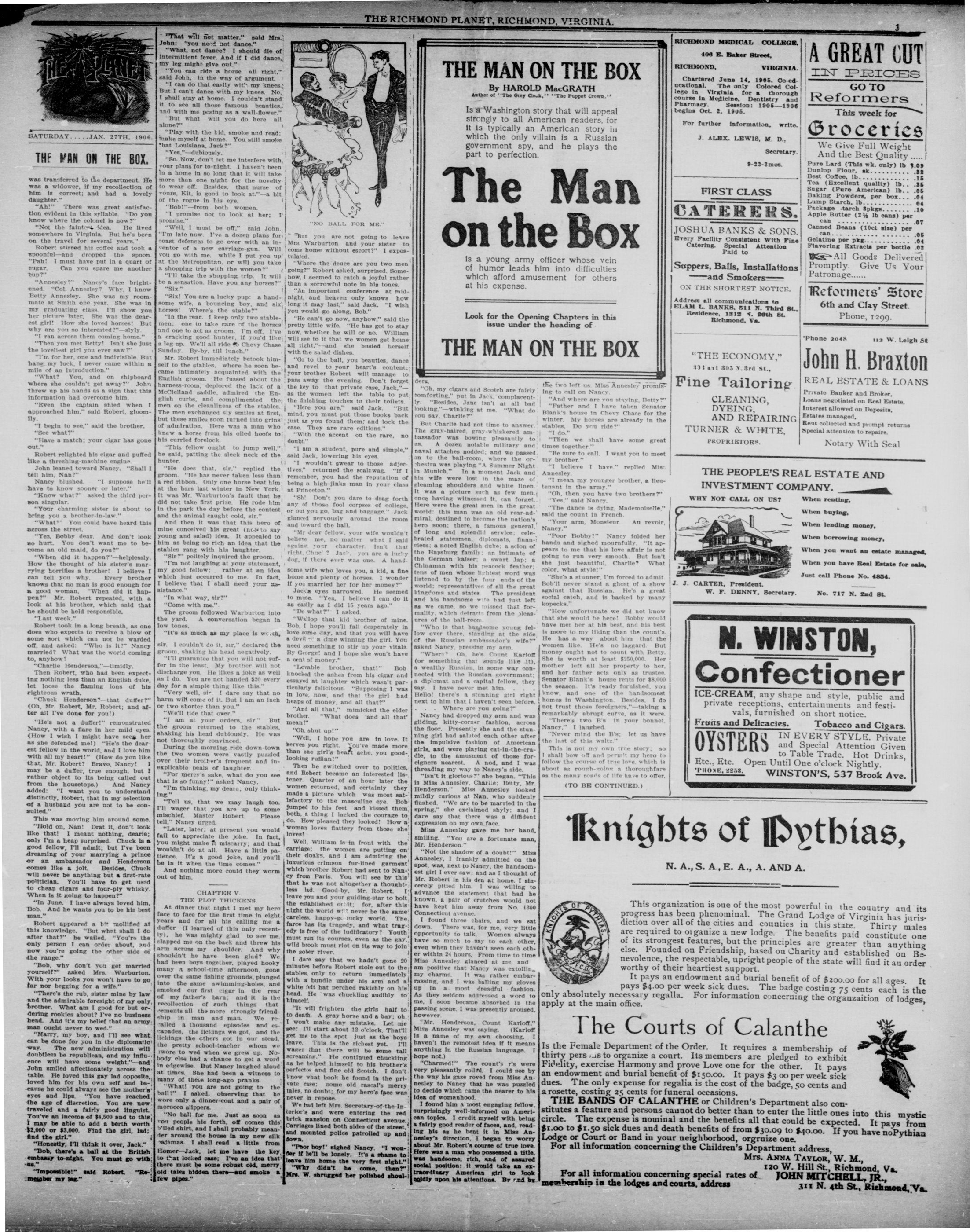
THE MAN ON THE BOX
THE MAN ON THE BOX
By HAROLD MacGRATH
Author of "The Grey Clock," "The Puppet Crown."
Is a Washington story that will appeal strongly to all American readers, for it is typically an American story in which the only villain is a Russian government spy, and he plays the part to perfection.
The Man on the Bo
The Man on the Box
is a young army officer whose vein of humor leads him into difficulties which afford amusement for others at his expense.
Look for the Opening Chapters in this issue under the heading of THE MAN ON THE BO ders.
THE MAN ON THE BOX
"Oh, my cigars and Scotch are fairly comforting," put in Jack, complacently. "Besides, Jane isn't at all bad looking."—winking at me. "What do you say, Charlie?"
But Charlie had not time to answer. The gray-haired, gray-whiskered ambassador was bowing pleasantly to us. A dozen notable military and naval attaches nodded; and we passed on to the ball-room, where the orchestra was playing "A Summer Night in Munich." In a moment Jack and his wife were lost in the maze of gleaming shoulders and white linen. It was a picture such as few men, once having witnessed it, can forget. Here were the great men in the great world: this man was an old rear-admiral, destined to become the nation's hero soon; there, a famous general, of long and splendid service; celebrated statesmen, diplomats, financiers; a noted English duke, a sion of the Hapsburg family; an intimate of the German kaiser; a swart Jap; a Chinaman with his peacock feather; tens of men whose lightest word was listened to by the four ends of the world; representatives of all the great kingdoms and states. The president and his handsome wife had just left as we came, so we missed that formality, which detracts from the pleasures of the ball-room.
"Who is that handsome young fellow over there, standing at the side of the Russian ambassador's wife?" asked Nancy, pressing my arm.
"Where? Oh, he's Count Karloff (or something that sounds like it), a wealthy Russian, in some way connected with the Russian government; a diplomat and a capital fellow, they say. I have never met him.
Hello! there's a stunning girl right next to him that I haven't seen before. Where are you going?"
Nancy had dropped my arm and was gliding, kitty-corner fashion, across the floor. Presently she and the stunning girl had saluted each other after the impulsive fashion of American girls, and were playing cat-in-the-cracle, to the amusement of those foreigners nearest. A nod, and I was threading my way to Nancy's side.
"Isn't it glorious?" she began. "This is Miss Annesley, Charlie; Betty, Mr. Henderson." Miss Annesley looked mildly curious at Nan, who suddenly flushed. "We are to be married in the spring," she exclaimed shyly; and I dare say that there was a diffident expression on my own face.
Miss Anneslay gave me her hand, smiling. "You are a fortunate man, Mr. Henderson."
"Not the shadow of a doubt!" Miss Annesley, I frankly admitted on the spot, was, next to Nancy, the handsomest girl I ever saw, and as I thought of Mr. Robert in his den at home. I sincerely pitted him. I was willing to advance the statement that had he known, a pair of crutches would not have kept him away from No. 1300 Connecticut avenue.
I found three chairs, and we sat down. There was, for me, very little opportunity to talk. Women always have so much to say to each other, even when they haven't seen each other within 24 hours. From time to time Miss Annesley glanced at me, and am positive that Nancy was extollin, my charms. It was rather embarrassing, and I was balling my gloves up in a most dreadful fashion. As they seldom addressed a word to me, I soon became absorbed in the passing scene. I was presently aroused, however.
"Mr. Henderson, Count Karloff," Miss Annesley was saying. (Karloff is a name of my own choosing. I haven't the remotest idea if it means anything in the Russian language. I hope not.)
"Charmed!" The count's r's were very pleasantly rolled. I could see by the way his gaze roved from Miss Annesley to Nancy that he was puzzled to decide which came the nearer to his idea of womanhood.
I found him a most engaging fellow, surprisingly well-informed on American topics. I credit myself with being a fairly good reader of faces, and, reading his as he bent it in Miss Annesley's direction, I began to worry about Mr. Robert's course of true love.
Here was a man who possessed a title, was handsome, rich, and of assured social position: it would take an extraordinary American girl to look coldly upon his attentions. By and by
```markdown
```
Knights of Pythias,
This organization is one of the most powerful in the country and its progress has been phenominal. The Grand Lodge of Virginia has jurisdiction over all of the cities and counties in this state. Thirty males are required to organize a new lodge. The benefits paid constitute one of its strongest features, but the principles are greater than anything else. Founded on Friendship, based on Charity and established on Benevolence, the respectable, upright people of the state will find it an order worthy of their heartiest support.
It pays an endowment and burial benefit of of $200.00 for all ages. It pays $4.00 per week sick dues. The badge costing 75 cents each is the only absolutely necessary regalla. For information concerning the organization of lodges, apply at the main office.
The Courts of Calanthe
Is the Female Department of the Order. It requires a membership of thirty persons to organize a court. Its members are pledged to exhibit Fidelity, exercise Harmony and prove Love one for the other. It pays an endowment and burial benefit of $150.00. It pays $3.00 per week sick dues. The only expense for regalia is the cost of the badge, 50 cents and a rosette, costing 25 cents for funeral occasions.
THE BANDS OF CALANTHE or Children's Department also constitutes a feature and persons cannot do better than to enter the little ones into this mystic circle. The expense is nominal and the benefits all that could be expected. It pays from $1.00 to $1.50 sick dues and death benefits of from $30.09 to $40.00. If you have noPythian Lodge or Court or Band in your neighborhood, orgrnize one.
For all information concerning the Children's Department address.
the two left us, Miss Annesley promising to call on Nancy.
"And where are you staying, Betty?"
"Father and I have taken Senator Blank's house in Chevy Chase for the winter. My horses are already in the stables. Do you ride?"
"I do."
"Then we shall have some great times together."
"Be sure to call. I want you to meet my brother."
"I believe I have." replied Miss Annesley.
"I mean my younger brother, a lieutenant in the army."
"Oh, then you have two brothers?"
"Yes." said Nancy.
"The dance is dying, Mademoiselle," said the count in French.
"Your arm, Monsleur Au revoir, Nancy."
"Poor Bobby!" Nancy folded her hands and sighed mournfully. "It appears to me that his love affair is not going to run very smooth. But isn't she just beautiful, Charlie? What color, what style!"
"She's a stunner, I'm forced to admit. Bob'll never stand a ghost of a show against that Russian. He's a great social catch, and is backed by many konecks."
"How unfortunate we did not know that she would be here! Bobby would have met her at his best, and his best is more to my liking than the count's. He has a way about him that the women like. He's no laggard. But money ought not to count with Betty. She is worth at least $250,000. Her mother left all her property to her, and her father acts only as trustee. Senator Blank's house rents for $8,000 the season. It's ready furnished, you know, and one of the handsomest homes in Washington. Besides, I do not trust those foreigners,"—taking a remarkably abrupt curve, as it were. "There's two B's in your bonnet, Nancy." I laughed.
"Never mind the B's; let us have the last of this waltz."
This is not my own true story; so I shall bow off and permit my hero to follow the course of true love, which is about as rough-going a thoroughfare as the many roads of life have to offer.
(TO BE CONTINUED.)
KNIGHTS OF PYTHIAST.
F.C.B.
THE PEOPLE'S REAL ESTATE AND INVESTMENT COMPANY.
ICE-CREAM, any shape and style, public and private receptions, entertainments and festivals, furnished on short notice.
Fruits and Delicacies. Tobacco and Cigars.
OYSTERS IN EVERY STYLE. Private and Special Attention Given to Table Trade. Hot Drinks, Etc., Etc. Open Until One o'clock Nightly.
Chartered June 14, 1905. Co-educational. The only Colored College in Virginia for a thorough course in Medicine, Dentistry and Pharmacy. Session: 1905—1906 begins Oct. 2, 1905.
For further information, write.
J. ALEX. LEWIS, M. D..
Secretary.
9-23-3mos.
FIRST CLASS
JOSHUA BANKS & SONS.
Every Facility Consistent With Fine
Catering. Special Attention
Paid to
Suppers, Balls, Installations
and Smokers
ON THE SHORTEST NOTICE.
Address all communications to
ELAM L. BANKS, 511 N. Third St.,
Residence, 1312 4. 26th St.
Richmond, Va.
"THE ECONOMY," 301 aul 305 N. 3rd St..
CLEANING,
DYEING,
AND REPAIRING
TURNER & WHITE,
PROPRIETORS.
THE PEOPLE'S REAL
INVESTMENT COMP
WHY NOT CALL ON US?
J. J. CARTER, President.
W. F. DENNY, Secretary
N. WIN
Confec
ICE-CREAM, any shape
private receptions, ente
vals, furnished o
Fruits and Delicacies.
OYSTERS IN EV
and S
to Tab
Etc., Etc. Open Until On
'PHONE, 2253. WINSTO
N. A., S. A., E. A., AND A.
organization is one of the most power has been phenominal. The Grand over all of the cities and counties in need to organize a new lodge. The longest features, but the principles ended on Friendship, based on Char the respectable, upright people of their heartiest support. an endowment and burial benefit of per week sick dues. The badge
IN PRICES
GO TO
Reformers
This week for
Groceries
We Give Full Weight
And the Best Quality .....
Pure Lard (This wk. only) lb .9.09
Dunlop Flour, sk .22
Best Coffee, lb .15
Tea (Excellent quality) lb .35
Sugar (Pure American) lb .05
Baking Powders, per box .04
Lump Starch, lb .04
Package .tarch $pkgs .10
Apple Butter (2 1/2 lb cans) per
Canned Beans (10ct size) per can.....0.05
Gelatine per pkg.....0.04
Flavoring Extracts per bottle.....0.03
All Goods Delivered Promptly. Give Us Your Patronage.....
Reformers' Store
6th and Clay Street.
Phone, 1299.
112 W. Leigh St
REAL ESTATE & LOANS
Private Banker and Broker,
Loans negotiated on Real Estate,
Interest allowed on Deposits,
Estates managed,
Reut collected and prompt returns
Special attention to repairs.
Notary With Seal
REAL ESTATE AND
PANY.
When renting,
When buying,
When lending money,
When borrowing money,
When you want an estate managed,
When you have Real Estate for sale,
Just call Phone No. 4854.
No. 717 N. 2nd St.
HISTON,
actioner
e and style, public and
entertainments and festi-
on short notice.
Tobacco and Cigars.
EVERY STYLE. Private
Special Attention Given
Table Trade. Hot Drinks,
One o'clock Nightly.
TON'S, 537 Brook Ave.
ythias,
A.
powerful in the country and its
and Lodge of Virginia has juris-
in this state. Thirty males
the benefits paid constitute one
are greater than anything
clarity and established On Be-
of the state will find it an order
of of $200.00 for all ages. It
the costing 75 cents each is the
ing the organization of lodges,
WILD FLOWER
ment also con-
e little ones into this mystic
d be expected. It pays from
$40.00. If you have noPythian
address,
'AYLOR, W. M.,
Hill St., Richmond, Va.
N MITCHELL, JR.,
311 N. 4th St., Richmond, Va.
THE PLANET
Air communications intended for publication should be sent so as to reach us by Wednesday,
TERMS IN ADVANCE
One Copy, one year. $1.50
One Copy, eight months. 1.00
One Copy, six months. 0.50
One Copy, four months. 0.50
One Copy, three months. 0.50
Single Copy. .05
ADVERTISING RATES
For one inch, one insertion, $0.50.
For one inch, each subsequent insertion.
For two inches, three months, $0.00
For two inches, six months, $0.00
For two inches, nine months, $0.00
For two inches, twelve months, $0.00
For two inches, twelve months, $0.00
Marriage and Eyneral Notices, one inch, standing and Transient Notices per line, $0.00
E-POSTAGE STAMPS OF A HIGHER DEMONINATION THAN TWO CRENTS NOT RECEIVED ON BUSCRIPTIONS.
THE PLANET is issued weekly. The subscription price is $1.50 per year in advance.
There are four ways by which money can be sent to the public at any time. For Office Money Order, by Rank Check or Draft, or an Express Money Order, and when none of these can be procured, in a Registered Letter.
The money Order is. You can buy a Money Order at your Post Office, payable at the Richmond Post Office and we will be responsible for any of the other options.
The express Money Order can be obtained at any office of the American Express Co., the United States Express Co., and the Well's Fargo and Co's Express Company. We will be responsible for money sent by any of these companies. The Express Money Order is a safe and convenient way for forwarding money.
REGISTERED LETTER—If a money Order Post-Office or an Express Office is not within your reach, your Postmaster will Register the money in any other way than one of the courts. Then, if the letter is lost or stolen, it can be traced. You can send money in this manner at our ask.
We cannot be responsible for money sent in letters in any other way than one of the courts mentioned above. If you send your money in any other way, you must do it at your own risk.
RENEWALS, ETC.—If you do not want THE PLANET COMMITTED after your letter has run out, you can send your Postal Card to discontinue it. The courts have decided that subscribers to the newspaper, who do not order their paper discontinued at the ex-tenancy, are held liable for the payment of the subscription up to date when they order the paper discontinued.
COMMUNICATIONS—When writing to us to request a subscription or to discontinue your paper, you should give your name and address in full, otherwise we cannot find your name on our books.
CHANGE OF ADDRESS—In order to change the address of a Subscriber, we must send the former as well as the present address.
Entered at the Post-Office at Richmond, Va., an second-class matter.
Entered at the Post-Office at Richmond. Va. an second-class matter.
The colored students of Talladega College at Talladega, Alabama have revolted against the appointment of Mr. L. O. Parks of the county in which the school is located. He was appointed Superintendent of the college farm. These students acted in an orderly manner and they appealed to President B. M. Nice and to Dr. S. H. Baird, Secretary of the American Missionary Society of New York. Both officials turned a deaf ear to their appeals and as a result one thousand students are in over. Over two hundred of them have left the institution and more than half of them are preparing to do so.
President Nice is said to be a resident of Lockport, New York and he came to the institution about two years ago. He has evidently imbibed the ideas of ...e Negro-hating southerners, instead of being guided by those of the liberal minded kind. If the students stand firm and avoid excesses of every kind they will win. It is to be regretted that all of them did not act as a unit. We hope to be advised as to the intrinsic merits of the controversy. Northern white men, who become permeated with Negro-hating southerners ideas become worse that the southerners themselves.
DR. WASHINGTON AND THE OF FICE-SEEKERS.
It seems that the report that Dr. Booker T. Washington had connived at and given his consent to the removal of colored men as Southern office-holders has caused a sensation and it has finally elicited a denial from high sources.
We have received the following communication which will explain itself:
Booker T. Washington in an interview published in the New York World and other New York papers Friday morning, January 19, respecting the recently published statement that he had advised the President to remove all colored office holders in the South, said: "I have given no such advice. The statement is false."
It seems well to call this statement to the attention of our readers because of the widely published statement in the Southern newspapers to the effect that Mr. Washington had counselled the President to remove all colored men who were holding office in the South. In view of the fact that numbers of them whose removal has been sought by the Lily White Republicans are still retained in large measure because of Mr. Washington's intervention, the statement from the beginning seemed incredible. The authoritative denial by Mr. Washington himself sets that rumor at rest.
We give this communication to the public for what it is worth and it seems to be worth a great deal. Certainly it is a far more diplomatic and authoritative utterance than the one sent out from Washington, D.C. by way of the New York Age.
We hope soon to have the pleasure of publishing an authorized statement that Dr. Washington has ceased to interfere in political appointments and that he is now confining himself to his chosen profession as educator and economist, leaving the politicians to recommend the officials and the statesmen of color to get the jobs.
MORE LASHING AT SUFFOLK
The lashing of the colored boy at Suffolk, Va. recently by the order of Mayor Kilby led us to inquire at the time if the distinguished gentleman intended to visit this mode of punishment upon the white boys as well as the colored ones. He has given his answer in a way that may not be mistaken, but with a modification of the method, which will be cordially approved by every right thinking person in the state.
It is the duty of the parent to correct the child and this correction may be made by the discreet and humane use of the rod. But there is not a person in this city, who would not have been hauled down to the Police Court and fined had they been guilty of inflicting as brutal a lashing upon one of their children as was inflicted upon that colored boy by that Chief of Police of Suffolk, Va. But here is the newspaper report of the recent logging:
SUFFOLK, VA., Jan. 20—Arain Mayor Kilby's court was the scene of a cowhiding to-day, but the recipients were white lads instead of Negroes. The two boys, Darden and Rawles, about 12 years old, each have repeatedly been caught shoplifting. The police gave them warning. A warrant was held over them and application for vacancies in the reformatory was made. Vacancies were obtained and the warrant was served by order of the mayor. That the reformatory would catch the lads seemed sure. The parents employed as counsel, Judge P. H, Rawles, who at the conclusion of incriminating evidence made an ear nest plea to save the miscreants. The boys were penitent.
After consideration Mayor Kilby ordered the parents to pay the cost, and required that the boys, be whip ped in his presence by their parents or by an officer. By request of counsel the court was cleared of on bookers and the parents administered the lash with vigor.
The parents are well known, and regret much the acts of their sons and will put proper restraint on the boys in the future.
We leave the public to judge as to the equality of the two incidents. It emphasizes the oft-expressed fact that there is no crime of which a colored person is guilty, but what some white person will go it one better. There is no color line in this business. The white thief is as bad as the black one and when his surroundings are considered, he is often many times worse.
Colored parents should see to it that their children are honest and above all they should know where they obtain everything that they bring home. Boys should be made to work and obtain what they want by honest and legitimate means and girls should be kept out of the streets all times of the night. Bad companionship is the ruination of both sexes and the failure to observe these rules has led to many colored families undoing.
The Mayor of Suffolk can go on with his flogging programme. It will end as it has always ended. It will create a sensation at first and end in a fizzle. Parents should be made to correct their children, but the strong arm of an officer wielding the lash with a will and searing the naked flesh will meet with the condemnation of every liberty loving person in Virginia. It arouses sympathy for the criminal and contempt for the law.
INDIGTED PACKERS HAVE NEW PLEA
Claim President's Letter Makes Them Immune From Prosecution.
WILL OFFER IT AS EVIDENCE
Chicago, Jan. 23.—President Roosevelt has been made the central figure around which revolves the entire case involving the pleas of the indicted packers for immunity from further prosecution by the government on charges of being in a conspiracy to restrain interstate commerce.
Attorney William J. Hynes, for the defendants, in closing his open statement before the jury hearing the immunity pleas, read an excerpt from a letter written by President Roosevelt to Attorney General Moody in the Atchison, Topeka & Santa Fe rebate case. This letter was a part of the communications between the two men called for by congress some time ago.
This letter is taken by the packers as an admission by the president that the department of commerce and labor and the department of justice worked together to indict the packers, supporting the contention of the packers on
RICHMOND PLANET, RICHMOND, VIRGINIA
which they rest for immunity. The defendant packers will endeavor to interject the letter into the case as evidence, just as if the president were here and testified concerning it. That part of the letter read by Attorney Hines, and which will be introduced by the defendants if possible as evidence from President Roosevelt, follows:
"With my approval, the department of justice, with the assistance of the department of commerce and labor, has for some months been endeavoring to find out whether or not they can obtain evidence of such wilful and deliberate violations of the injunction by any individual. If the grand jury now sitting in Chicago finds an indictment against any individual connected with the packing corporations, it will be because in their judgment such legal evidence of the violation of the injunction has been laid before them." The letter is purported to be signed by President Roosevelt, and is taken by the defendants as proof of their contentions.
"That letter is a public document, and we will introduce it as evidence in this case," said Attorney John S. Miller, one of the packers' attorneys.
"If the government contests it, we can, of course, call for an original copy."
Negro Suspects Released
Moorestown, N. J., Jan. 22.—There were no new developments in the search for the murderer of Miss Florence Allinson, whose body was found in the stable of a farm near here last Thursday. Several of the negro suspects, including Thomas Berry, who were arrested Friday and Saturday, were released from custody. In the arrest of Berry the police thought they had the right man, but the accused negro's employers came forward and proved an alibi for him. In the hunt for the murderer the police are completely buffled because of the inability of the 5-year-old girl, who was the only one to see the murderer on the farm, to give an accurate description of the man wanted.
masters sent to senate.
Washington, Jan. 23.—The president sent the following nominations to the senate:
Ambassadors extraordinary and plenipotentiary—Lake E. Wright, Tennessee, to Japan; David E. Thompson, Nebraska, to Mexico; Lloyd C. Griscom, Pennsylvania, to Brazil.
Governor general of the Philippine Islands—Henry Clay Ide, Vermont.
Vice governor of the Philippine Islands—James F. Smith, California.
Collector of customs — C. Wesley Thomas, District of Philadelphia, Pa.
Postmasters — Maryland—Walter R. Rudy, Mount Airy; William M. Schoolfield, Pocomoke City.
New Jersey—William H. Hamilton, Ocean Grove.
Pennsylvania — Joseph H. McClelland, New Florence; William H. Morris, Rimersburg; Wallace W. Oberly, Womelsdorf; John C. Chamberlain, Everett; William J. Leahy, Falls Creek; Warren F. Simrell, Hallstead; Robert D. Peck, Lock Haven; George C. Burns, Montrose; Ezra H. Ripple, Scranton.
Virginia—W. S. Ross, Big Stone Gap; Thomas W. Carter, Orange; Bentley Kern, Winchester.
Will Discharge 1000 Men
Washington, Jan. 24. — Because of the refusal of congress to include in the urgent deficiency bill $1,000,000 asked for to cover the cost of repairs on ships in need of overhauling. Secretary Bonaparte was compelled to issue an order reducing by 44 per cent. the force of employees under the bureau of steam engineering at all yards and stations. This will cause the discharge of about 1000 men.
Boiler Explosion Kills Seven
Chippewa Falls, Wis., Jan. 23—An explosion of a boiler in a saw mill four and a half miles from Hilcomb resulted in the killing of seven men and injury to three others. The mill was badly wrecked.
Collieries to Close Three Days
Mahanoy City, Pa., Jan. 24.—A general suspension of the 26 colleries of the Lehigh Valley Coal company in the anthracite region was ordered for three days, commencing Wednesday night.
SHORT OVER $30,000
Auditors Find Discrepancies In County Treasurer's Accounts.
Meadville, Pa., Jan. 23.—According to the report of the board of county auditors filed in court, the accounts of former Treasurer D. N. Scott are short $30,874. Mr. Scott had held the office for three years. He declares that a mistake has been made in accounting. He will file exceptions in court, entering a legal contest against the validities of the findings. He has deposited with the Crawford County Trust Company, at Meadville, mining and oil stock, cash mortgages and other stock giving face value of $31,000.
Forced Senator Denew's Name.
Washington, Jan. 22. — Elizabeth Ray, a 14-year-old girl, arrested, charged with forging the name of Senator Chauncey M. Depew to a $50 check, with which she attempted to purchase a gold watch in a jewelry store here, today admitted her guilt. Mrs. Katherine Berger, the mother of the girl, after being questioned by the police, was arrested. Both mother and daughter told stories to the effect that money had been left the daughter in care of Senator Depew, though the police received word saying the senator denies these statements.
General Wheeler Has Pneumonia.
New York, Jan. 24.—That Brigdler General Joseph Wheeler, of the United States army, retired, has a mild attack of pneumonia was announced at the home of his sister, Mrs. Sterling Smith, in Brooklyn, where General Wheeler is ill.
Cardinal Gottl Dying.
Rome, Jan. 23.—Cardinal Gotti, prefect of the propaganda, who has been seriously ill from pneumonia for some days, is dying.
SHIP WRECKED MANY DROWNED
The Valencia Goes on Rocks and 100 Persons Are Reported Lost.
TERRIBLE SCENES ON BOARD
Victoria, B. C., Jan. 24. — The steamer Valencia, which was en route from San Francisco, with 94 passengers and a crew of 60, went ashore during a thick fog, and a large number were drowned when attempting to leave the ship. The steamer is on the rocks against a high cliff, and is likely to go to pieces at any time. One boat's crew reached Cape Beale, and nine men got ashore near the telegraph hut, about 15 miles from the lighthouse. Two men are prisoners on the face of the cliff near which the steamer went ashore, and cannot get up the cliff or return to the wreck. The sea will probably reach them when the tide is high. The men report terrible scenes. One woman dropped her child into the sea when trying to hand it to her husband, who was in one of the boats.
When the boat's crew left there was a little boy running about the deck crying for his mother, who was among the drowned. There are still about 125 persons on the wreck, with almost certain death staring them in the face. The steamer Queen, which arrived here from San Francisco, landed her passengers and left at once for the scene of the wreck. The steamer Queen City also left on her regular coast cruise, and should reach the scene of the wreck in a few hours. Urgent messages are being received for assistance. It is reported that "the whaling steamer Orion has arrived at the Valencia wreck from the whaling station at Sechart, seeking to save as many as possible. A dispatch from Carmana says a ship's boat with several people passed there.
A message received by Captain Gaudin, agent of the marine service, from Lighthouse Keeper Patterson at Cape Beale, says: "Steamer wrecked between here and Cloose; about 100 drowned; nine reached telegraph hut. Will wire more particulars as soon as possible." Cloose is about five or six miles from Carmanah Point, and 65 miles from Victoria. Cape Beale is about 120 miles from Victoria, at the easterly entrance to Barkley Sound. The Valencia is an iron screw steamer of 1598 tons capacity, 252.7 feet long, with a beam of 34 and a depth of 19 feet. It was built in 1888 by Cramp & Sons, of Philadelphia. During the war with Spain the Valencia was engaged for a time in the transport service of the United States, conveying troops to and from the Philippines.
TROJAN SUNK IN COLLISION
Rammed By Nacocooche In Vineyard Sound—Crew Saved
Boston, Jan. 24.—News of the loss of the freight steamer Trojan, of the Boston and Philadelphia Steamship Company's line, in collision with the ocean line steamer Nacoochee in a defuse fog at the entrance to Vineyard Sound.-Sunday, was brought here by the Nacoochee, which arrived 36 hours late, having on board the Trojan's crew. The accident happened Sunday morning, while both vessels were feeling their way about Vineyard Sound Lightship, endeavoring to locate that vessel by her whistle, and from that signal to lay their course through the dangerous waters of the sound. The Trojan had heard the lightship's signal, but her captain, deeming it too hazardous to proceed on account of the fog, was about to come to anchor when he heard the whistle of a steamer. He promptly sounded his own whistle, but a moment later found his vessel fairly impaled upon the sharp iron prow of a big black vessel, which proved to be the Nacoochee. The Nacoochee struck her almost fairly abame on the port side, and her bow entered the hull almost to the very doors of her boilers. The captain of the Nacoochee immediately ordered his boat full speed ahead, and in this way forced his steamer hard into the opening. While the craft were thus held together the captain and the 27 men of the Trojan succeeded in climbing over the bow of the Nacoochee to safety, although 17 of them had been asleep below when the accident happened.
The lost steamer Trojan was valued at $250,000, and her cargo at about the same amount.
BUYS HEN FOR $10, SELLS FOR $750
Cheap, Goes High at Auction.
Boston, Jan. 22. The sensation of the poultry show here was the sale of a buff Plymouth Rock hen for $750 to a New York firm of poultry breeders.
After awarding of the prizes, the owner of the first prize winner, who had catalogued his bird at $10, thinking the price would be prohibitive, was taken off his feet by the tender of a check for that amount. He could not back out, and the prize winning bird was sold. The purchaser had so many offers that he put the bird up at auction, and got $750 after a lively contest.
Will Save the Cherokee.
Atlantic City, N. J., Jan. 23. A diver found that the leak in the stranded steamer Cherokee is not as serious as at first believed, and that an attempt to save the vessel will likely prove successful. The cargo will be throw overboard, in the hope that the steamer can then be moved.
PENNYPACKER MARKED MAN
Anarchist Plot to Murder Prominent Men Unearthed
Washington, Pa., Jan. 24—In hunting for the murderers of Michael Carrazola, the wealthy Italian who was shot at Dunlevy last week, Washington county authorities have unearthed a plot to assassinate some of the leading men of the country. They have secured evidence that among those marked for death was Governor Pen-
nypacker, of Pennsylvania. Letters and papers are also in possession of the authorities which decree the death of other leading men. The existence of this band of anarchists was unearthed when Cocoon Sipe and Chief of Police Logan, of Monongahela, began to follow up clues which indicated that Carrazola's death was due to the machinations of the Klan "Black Hand" society. The evidence on which charges will be based was discovered in a squall shanty near the mining village of Baird. In this house located in an obscure hollow were found papers and documents pointing to a wholesale assassination scheme. Anarchists in many parts of the country are implicated and arrests in many sections are looked for. John Spida, president of the society, was arrested and was put in jail along with George Erarl, who is suspected of implication in the death of Carrazola.
LETTER WRITER ARRESTED
Wanted President and Government Officials to Join "Civic Cadets," Philadelphia, Jan. 24.—An investigation that followed the receipt of sco. of letters and circulars by President Roosevelt, members of his cabinet, other government officials and congressmen, urging them to join an organization called "The Civic Cadets of America," resulted in the arrest in this city of Benjamin Katchings, of Birmingham, Ala., who says he is a son of former Congressman W. B. Katchings, of that state. No charge has been made against Katchings, who is about 25 years of age, but he will be held ponding the action of his family, with whom the police have communicated.
According to the secret service agent, Katchings has been sending letters to men of national prominence urging them to join the "Civic Cadets". The letters were accompanied by circulars and pamphlets on questions relating to the manner of running the national government. A close pursuit of the literature failed to indicate any precise purpose of the sender. The receipt by President Roosevelt of some of the letters and literature was responsible for the investigation. It was learned that the literature, most of which was signed "Civic Counselor of the Civic Cadets of America", came from this city, and after a search the sender was located at a local hotel. When arrested he wanted to send telegrams summoning 1000 of his cadets to rescue him from his enemies. Katchings appears to be well educated, and the police believe he is suffering, temporarily at least, from dementia.
BRAZILIAN WARSHIP SUNK
Sent to Bottom By Explosion and 212 of Crew Perish.
Rio Janeiro, Brazil, Jan. 23.—The Brazilian turretship Aquidaban has been sunk at Port Jacarepagua, south of Rio Janeiro, as the result of an explosion on board. The dead number 212 and the injured 36.
Four rear admirals perished on board the Aquidaban, which had been used for the accommodation of a number of supernumerary officers and men attached to the flotilla escorting the cruiser Barroso. The Barroso had on board the minister of marine and his staff, who were inspecting the sites proposed for a new arsenal.
The explosion on the Aquidaban occurred in the powder magazine. The vessel sank in three minutes.
OFFICERS WILL AT HAZING
Lieut. Snyder Instituted Naval Fourth Classmen Should Be Disciplined. Annapolis, Md., Jan. 23.—For the first time since the present hazing trials began evidence was given before the court martial tending to support the assertion that officers on duty at Annapolis have winked at hazing. Midshipman Claude B. Mayo, testifying in his own behalf, swore that Lieutenant C. P. Snyder, the officer in charge of Bancroft Hall last September, had used language which was generally interpreted by the upper classmen to mean that they should discipline the fourth classmen by applying some of the usual hazing methods.
Midshipman H. B. Reibe, of the first class, testified as to the fourth classmen laughing in ranks, and said that Lieutenant Snyder had asked Midshipman Brainard what was the matter with the fourth class, and Brainard replied: "They don't get enough of it." The officer then asked him why, and Brainard said: "We don't get at them enough."
"That's so," the officer replied, according to the witness, and then there was something said, he thought, about the officer going away after dinner.
Mayo then told of the conversation, but he did not remember exactly what was said by the officer about leaving the building, though he receive an impression that he would do so, which was strengthened, he said, by the fact that the officer actually did leave the building after dinner. He had then, he said, gone to the rooms of some fourth classmen and had put them on their heads or caused them to do the "16th," for a very short time each.
RATE BILL AGREED ON
House Committee to Report Favorably the Hebron Measure.
Washington, D. C., Jan. 24. — The house committee on interstate and foreign commerce agreed upon a rate bill, to be known as the Hephurn bill, and to be reported to the house with the unanimous recommendation of the 18 members of the committee.
In the main, the bill is the original Hephurn bill, but a number of concessions were made to the Democrats, and their ideas, as set forth in the Davey bill, were freely incorporated in the perfect measure.
A section of the Davey bill, requiring that the attorney general in appealed cases shall file the certificate necessary to expedie the hearing, was incorporated in the amended bill. Another amendment provides that orders of the commission shall continue in force for three years, unless repealed. No existing cases are to be affected by the bill, and all laws relating to
witnesses and the conducting of hearings before the commission are to be continued.
McCALL SELLS SUMMER HOME
Former President New York Life Gets $350,000 For Long Branch Palace.
New York, Jan. 24.—John A. McCall former president of the New York Life insurance company, parted with what he had often spoken of as his most prized possession—the summer palace he erected and furnished at Long Branch at an expense of $600,000.
The place was sold to Myron H. Oppenheim, a lawyer. The purchase was made for a client who is not now in this country. The purchase price was in the neighborhood of $350,000—little more than half the sum expended by Mr. McCall upon the place. Of this amount Mr. McCall receives only about $100,000, as the property is encumbered with mortgages amounting to $250,000.
PROPOSES $2 SILVER PIECES
Bill to Aid Jamestown Exposition Hie
Plan For New Coins
Washington, Jan. 22. — Representative Maynard, of Virginia, introduced a bill authorizing the government to participate in the Jamestown Tri-Centennial Exposition at Hampton Roads in 1907, and providing an appropriation of $1,340,000 for government buildings and exhibits. The bill also provides for the coinage by the government of 1,000,000 $2 silver pieces, exposition to pay for the bullion used. By this means the exposition hopes to realize a profit of about $800,000 on the difference between the cost of the silver and the circulating value of the coins.
Hard On Ice Hacvest.
Scranton, Pa. Jan. 23—The warm weather has caused a cesation of ice harvesting in the Wayne and Pacoona regions. Ice that was nine inches in thickness last Saturday is now less than four inches thick. It is not only too thin to cut, but unsafe to work. If the present south wind can enlarge much longer, the harvesters say, all the ice will disappear from the ponds. The ice houses are only about one-third filled and a famine is a strong possibility.
Throw Bolling Water Over Wife, Millville, N. J. Jan. 24—James McCall, who was released from prison Monday, fold his wife to prepare for death, and, seizing a bellier of hot water, throw it over her, causing burns which physicians believe will result fatally. After a desperate struggle McCall was placed in jail. He has served several terms in state's prison.
Six Burned In Explosion.
Phillipburg, N. J., Jan. 24—Six men were severely burned by an explosion of pulvurized coal in the grinding department of the Vulcanite Cement Works, at Vulcanite, a few miles below here. It is believed that the explosion was caused by a spark from hot bearing fighting the coal.
A WEEK'S NEWS CONDENSED
Dr. Gustavus R. Knabe, known as the "father of music," died at Knoxville, Tenn., aged 53 years.
The National hardwood Manufacturers' Association have increased the price of hardwoods $1 to $2 a thousand feet.
Mrs. Ida Uhl, who was charged with murdering her husband, died at the Athens, O., Insane asylum, having been adjudged insane.
Sells & Downs' circus, in winter quarters at Birmingham, Ala., was sold at public auction to C. W. Thompson, of Boston, for $25,000.
Friday, January 19.
Fire at Port Royal, Pa., destroyed four dwelling houses and a store, causing a loss of $25,000.
The tugboat Andrew Axton was destroyed by fire at Duquesne, Pa., entailing a loss of $30,000.
Two trainmen were killed in a collision of freight rains on the B. & O. railroad near Warren, O.
Three men were blown to pieces by an explosion of giant powder in the Opp mine, near Jacksonville, Ore.
Mrs. Elizabeth Aiken, 89 years old, a famous nurse in the Civil War, and familiarly known as "Aunt Lizzie," died in Chicago.
Saturday, January 20.
Former President Bartolomeo Mitre, of the Argentine Republic, died at Buenos Ayres, aged 83 years.
David Cannon, of Seaford, Del, who two weeks ago accidentally shot himself in the foot, died of lockjaw.
Fire swept over 40 miles of prairie in Inuell county, Neb., destroying two ranches and damaging 12 others. Loss, $100,000.
Members of the Iowa senate signed a petition for a full pardon for Mrs. Tolla, the New Jersey murderess, now under sentence to die.
A library building nearly a block long, costing $1,500,000, will be erected in Chicago as a memorial to the late Dr. William R. Harper.
Monday, January 22.
Seven men were killed by a snowslide at the mining camp at Alta, Utah.
There have been eight deaths so far at the naval training station at Newport. R. I., from spinal meningitis.
Breaking of the ice while they were crossing Pettipau pond, in Ivorytown, Conn., caused the drowning of Harold Norris and Ernest Davidson, each 12 years of age.
Because the Maccabees refused to pay Mrs. Charlotte Felx, of Shamokin, Pa., a death benefit, claiming her husband was a suicide, she sued and recovered a verdict for $3600.
Tuesday, January 23.
The Baltimore chrome works, at Baltimore, Md., was damaged by fire to the extent of $50,000.
Fraderick S. Stedman, the well-known dog fancier, dropped dead in Pittsburgh of heart trouble.
General Robert S. Brown, a prominent retired agriculturist, died at his home at Bethlehem, Pa., aged 88 years.
A bill was introduced in the Virginia legislature to erect a monument to General Fitzhugh Lee in the capitol square at Richmond.
Ernest Baker, a negro, was taken from jail at Hopkinsville, Ky., by a mob and hanged for attempted criminal assault on a white woman.
Wednesday, January 24.
The Mississippi Cotton Compress at Jackson, Miss., was burned, with 9500 bales of cotton, Loss, $750,000.
E. D. Gartner & Co., stock brokers, of Pittsburgh, Pa., made an assignment, with liabilities exceeding $200,000.
Many Alaskans have petitioned President Roosevelt to appoint Judge James Wickersham as governor of Alaska.
W. B. Fairless, of Marks, Miss., has been shot and killed by Mrs. E. B. Whitten, whose husband Fairless killed several months ago.
A consignment of American school readers, printed in Japan, is being held up at San Francisco, as they are believed to violate copyrights of readers now in use.
—Capt. J. E. Bryd of Newport News, Va. called on us.
Dr. Graham's Horse.
Rev. W. F. Graham, D. D has pur chased another horse and in its new harness presents a most attractive appearance. The animal is known as "Fifth Street."
Courts and Lodges that have since contributed for the Installation Exercises are Blooming Lily Lodge, No. 15; Sanson Lodge, No. 16; North Star Lodge, No. 52; Maceo Court, No. 222; Martha's Court, No. 138.
$100.00 Endowmen (£aid)
Norfolk, Va., January 8th, 1906.
This is to certify that I have received from John Mitchell, Jr.,
Grand Worthy Counselor of the Grand Court of Virginia, I. O Calanthe ($100.00) One Hundred Dollars in payment of the death-claim of Sister Annie Patterson, who was a member of Victoria Court, No. 52 at Norfolk, Va.
Signed:—Coleman Patterson,
Beneficiary
Witnesses:—
Annie Monroe.
Cornelia Skinner.
Mary E. Day.
Fannie Cooke.
KNIGHTS OF PYTHIAS.
Public Installation of Officers.
Covington, Va., Jan. 16th, 1906.
D. D. G. C. C. B. Brown and D
D. D. G. W. C Mrs Emma B Brown
ascended the rostrum of the First
Baptist Church at 9 P. M. and Rev.
W. J. Haackett, Master of Ceremonies,
in a very impressive manner
opened the services.
Sir J. S. Hunter, C. C. surrendered
ed the gavel and D. D. G. C. C. B.
Brown took charge and presided
over the first public installation ever
held among the secret fraternities in this city. The services were
very impressive from start to finish
and the public gave their attention
throughout the exercises.
In connection with the services the following program was beautifully rendered: Opening Address, Sir M. W. Daniel; Solo, Dr. W. W. Johnson; Recitation, Mrs. R. N. Smith; Solo with guitar accompaniment; Sir C. L. Hall and C. H. Mill; Recitation, Miss I. K. Pollard; The Usefulness of Women in Secret Organizations, Mrs. W. W. Johnson; Charge to Lodge, Sir C. B. Brown. Following are the officers: COVINGTON LODGE, NO. 60—J. S. Hunter, M. of W. J. C. Pierce, C. C.; William Newsome, V. C.; C. H. Miller, M. at A.; John Reynolds, M. of E.; S. A. Smith, M. of F. and K. of R. and S.; Charles Pierce, P.; M. W. Daniel, I. G.; W. B. Jackson, O. G.
PRIDE OF ALLEGILIAN COURT
NO. 79—Mrs. Annie Stewart, Ins.; Mrs. Annie Leftwich, W. C.; Mrs. Annie Backous, Inx.; Mrs. Bottle Newsome, E.; Mrs. W. W. Johnson, O.; Miss I. K. Pollard, R. of D. and R. of A.; Mrs. Ei. Mills, R. of Dep.; Mrs. Annie Adams, S. D.; Mrs. Elsie Brown, J. D.; Mrs. R. N. Smith, Con.; Mrs. Carrie Holman, P. Mrs. Annie Johnson, H.
At the conclusion of the exercises Rev. W. J. Hackett, who is a member of the Order made a few compilative remarks and a collection was lifted for benefit of the church.
Grand M. at A., Sir C. H. Miller.
Grand P., Dr. W. W. Johnson.
Grand I. G., Sir William Pegram.
Grand O. G., Sir Jack N. Mulls.
PRODUCE QUOTATIONS
The Latest Closing Prices In the Principal Markets.
PHILADELPHIA—FLOUR steady; winter extras, $23@3.25; Pennsylvania roller, clear, $3.50 @ 3.65; city mills, fancy, $47.5@4.80. RYE FLOUR firm; per barrel, $3.80. WHEAT steady; No. 2 Pennsylvania red, new, 85 @ 85%; CORN steady; No. 2 yellow, lo-cal, $17.5%; FISM firm; No. 2 white, clipped 37%; FISM firm; HAY steady; No. 1 timothy, 5.50 for large bales. PORK steady; family, $17. BEEF steady; beef hams, $23@24. Poultry: Live; hens, 13@14c; old roosters, 8@9c; Dressed steady; choice fowlls, 13c; old roosters, 8%c. BUTTER steady; cream, 8%c. EGGS steady; New York and Pennsylvania, 22@23c; per dozen. POTATOES steady; per bushel, 70@73c.
BALTIMORE—WHEAT firm; No. 2
spot, 88% @ 87%c; steamer New 2, spot,
88% @ 88%c; southern, 80% @ 81%c;
COITN firmer; mixed spot, 49% @ 90%c;
steamer mixed, 48% @ 48%c; southern,
42% @ 50%c; OATS firm; white.
No. 2, 38% @ 38%c; No. 3, 37% @ 37%c;
No. 4, 33% @ 34%c; mixed, No. 2, 36%;
No. 4, 32% @ 34%c; No. 4, 34%@
25%c; BUTTER, creamer,
separator, extras, 25% @ 26%c;
20% @ 21%c; prints, 26% @ 27%c; Maryland
and Pennsylvania dairy prints, 15@
16% per pound. EGGS steady; fancy
Maryland and Pennsylvania, 22@ 23c;
Virginia, 22@ 23c; West Virginia, 22c;
southern, 19% @ 20%c per dozen.
HEY PLANET
SATURDAY.....JAN. 27TH. 1906
AIDS FOR HOSTESS
SUGGESTIONS FOR ATTRACTIVE ENTERTAINMENTS.
Festivities in Celebration of Twelfth Night — Various Ways of Announcing an Engagement—A Pretty Birthday Party.
Twelfth Night Party.
The 6th of January is "Twelfth Night," or "old Christmas," and offers opportunities for a party out of the usual order. In England and many places on the continent Twelfth Night was the time to hold the most elaborate masque balls.
An immense cake was always served, containing a ring, and the "king" or "queen" for the evening was the guest fortune able to obtain it. In history we read now Mary, Queen of Scots, honored her maid, Mary Seaton, by robing her in her own royal apparel to be the "Queen of Twelfth Night." Tradition says that on this night every vestige of Christmas green must be taken down and burned. This peace offering to witches and evil spirits assures "good luck" to the house hold throughout the year. Invitations for a sixth of January party anoint a chance for the pen and ink artist to show her salit; watches bonfires with holy wreaths and Christmas trees for fuel are appropriate subjects for the cards. If there is no open fireplace for the burning of the greens, there may be a back yard even to the city apartment, where they may be burned with due ceremony.
A chafing dish supper or oyster roast, with cone and cider, not forgetting the case, are most suitable for Twelfth Night parties. Haar the fun is to permit the guests to take down the greens from pictures and windows, even to stripping the Christmas tree of its branches. The crackling nre caused by the pine tree boughs gives a fine blaze for roasting marshmallows. Request each guest to tell a story or give a toast while nis or her special armful is burning.
Engagement Announcement Party.
The request comes for an engagement announcement party. This can be done in several pretty ways. Such an announcement is usually made at a luncheon to which the intimate friends of the bride-elect are asked. hearts; true lovers' knots, cupids, bows and arrows are all appropriate for decorations. Pink is the best color to use, as all the world generally assumes "le couleur de rose" when a girl is in this blissful state.
Before the dessert course is served, have the doorbell ring violently and the maid will bring in a telegram to the hostess, who asks permission to open and read it, whereupon she will read aloud the announcement of the engagement, then congratulations follow.
Another way is to prepare english walnuts with pretty quotations written end concealed inside the shells, which are glued together; on one write the news.
One hostess in announcing the engagement had very small envelopes at each place, the outside bearing the guest's name, while inside the card bore the names of the couple. The envelope was sealed with a gilt heart. Still another hostess had her table decorated with a miniature bridal procession, dolls exquisitely dressed, ribbons radiated to each plate and were attached to heart-shaped baskets containing bonbons, and the bride's held her diamond ring, which she of course put on. Her chair was ornamented by a huge bow of tulle and the souvenirs were tiny white slipsers filled with candied rice.
The flowers were bridesmaid roses the candles and shades pink, with glass candlesticks.
Child's Birthday Party.
This describes the prettiest kind of a party for the little tots ranging in age from three to six. The mother had a kindergarten table seating ten, with red chairs and the regular dining-room table was pushed aside for these. The room was decorated with quantities of gay Chinese lanterns, which delightee the children.
Under each plate there was a white lace paper doily, a paper napkin, a place card and the name spelled out with alphabet crackers. Six tiny red candles with shades made from red Christmas tree candle holders, were on the table, besides a huge angel food cake, which held three red candles, and was surrounded by a hoop containing red candles put in as close as they would stand; the hoop was concealed by ferns.
Cocoa was served in small "Buster Brown" mugs, with a sandwich of whole wheat bread, then plain vanilla ice cream in ramekins. After this a "Jack Horner" pie was placed on the table, and each child took hold of a red ribbon which had a little metal tag on the end of it and at a signal all pulled and peppermint patties came out. Two were tied together with red ribbon, and there was one for each child. Then there were snapping cracker caps containing "surprises," and on leaving the dining room each child was given a bag of confetti to throw after getting outside the house. The hours for this party were from three to five, and the children came promptly and went home promptly, so they were not tired out.
When the invitations were sent out the birthday was not mentioned.
The tall girl practices the Berlin method of sleeping and waking. The new Berlin theory of waking up is one that was first written out by a physician rmed Halle, of Germany. Halle tried it upon his patients in a Berin sanitarium, and such was his success that he has kept on with it. The sanitarium was for wealthy patients, who were a little too stout. The idea is to wake up slowly and deliberately. Here are the Halle rules, the rules by which you can make yourself taller:
Wake up in the morning and stretch. Practice the arm movements. Without getting out of bed, lie flat upon your back, stretch your arms over your head and imagine that you have dumbbells in your hands. Exercise your arms upward. Try it a dozen times. Move your arms upward again and again. Try the arm motions sideways. Keep on for five or ten minutes. Then stretch. Stretch every muscle in your body. Keep on stretching until you have stretched for 15 minutes. Then begin and gap.
This waking up slowly is really all there is of the famous Halle method, which women go to Germany and pay a small fortune to learn. Any woman can pick it up for herself. But it takes time and time is something the average woman does not possess.
The tall girl is eating the foods that make the frame grow. She takes meat once a day and usually white meat, if she can get it. She also eats fish. And she eats fruits by the quantity. And there is another thing which the tall girl does not neglect, and that is her hour of gymnastics. It is necessary for her to practice gymnastics an hour at night, and never does she seek her couch without going through with them.
Keeping the chest raised is very important. And it is a knack which the feminine six footer has learned. She keeps her chest raised all the time. The very tall girl learns how to walk upstairs. When she goes upstairs she does not throw herself forward and pant. Neither does she drag herself up. With her dress well lifted she walks upstairs perfectly erect. She plants each foot upon the stair and steps forward and upward very much as though she were walking up a hill. It is fine exercise when you climb stairs in this way. Stair climbing does not hurt you. The very tall girl learns how to rest. She never wastes one moemnt of energy. She has the knack of resting against a cushion, of resting against a chair back, of resting against something so that her muscles get a little repose.
Relaxing at the proper time is a distinct art, but it is one which the short girl does not possess. All short girls are nervous; all short girls are restless; all short girls are active, and all short girls are tired. The fact that they are active and restless really keeps them from growing tall.
The tall girl, on the other hand, is full of repose. She knows how to relax, and the woman who has learned the art of resting has gained more battles in this world than the woman who has conquered a fortune.
CASE FOR SHAVING PAPER.
No Doubt the Man of the Family
Would Thoroughly Appreciate
This Very Convenient Article.
A case for holding shaving papers
that can be hung on, or by the side
of the shaving glass, is a thing that is
appreciated by most men who shave,
as it prevents the trouble of searching
for a cloth or paper on which to wipe
the razor, which is so often not to be
found when needed. This case has a
foundation of cardboard for the back:
SHAVING
PAPERS
it should be covered with art line, upon which are embroidered two butterflies, or any little floral design. The back should be about eight inches wide and seven inches deep. The piece for the front is the same width and half the depth. The material used to cover it is embroidered or painted with the words "Shaving Papers." Trim the top with cord, which should be curled round at each end; sew this front to the back, then edge with cord, curled at the corners. Ribbon is sewn to the back to form a loop to hang it up by, and it is ornamented with a bow.
The Evebrows
Castor oil may be used on the eyebrows to make them grow, but it should not be used on the eyclashes. Combine the oil with equal parts of alcohol and perfume slightly.
TO INDUCE RESTFUL SLEEP.
Both Exercise and Food May Be Looked Upon in the Light of Beneficial Distractions.
When Bellinda comes home feeling "too tired to sleep" there is no use in her trying to go to bed at once. Let her take a warm bath, letting the cold water run in until the water becomes
cool. then let her slowly go through the many different points of the toilet manicuring and hair brushing for instance, so often done in a rush. These help relax and quiet the nerves and can take up an hour's time. Last of all a cup of warm milk with a pinch of salt. Many people, this applies particularly to men, suffer from sleeplessness because they are not properly nourished. Exhausted or irritated and excited nerves need nourishing. A bite of light and easily digested food will not keep one awake—on the contrary it is often just what is needed to induce sleep.
Sleep will not come to the brain that is worrying or even to the brain that
In and Out.
Debt Collector—I have called to get payment of an account against your master.
Servant (promptly)—My master's not in.
Debt Collector—Why, I saw him go in at the door a moment ago.
Servant—Yes; but he saw you, and was over the back wall in a jiffy.—Tit-Bits.
Provoking.
"A girl with pretty ankles has a hard time of it." observed the home-grown philosopher.
"As to how?"
A SOOTHING CUP OF MILK.
is busy with the thoughts of “How shall I make myself fall asleep?” Take the mind off the desired outcome and center it on directing bodily movements, inducing the bodily fatigue by tiring the muscles. It sounds as if it would take forever, but it doesn't. Just try it. The first time you feel as if you would never be able to fall asleep, stretch yourself out while in bed, arms above the head, muscles tense and stretched to their utmost. Stiff leg and arm muscles and feel as much as possible as you do when stretching in the morning. Relax completely and try again. Stretch the limbs in different directions. For instance, put the arms out in front. You will speedily find yourself yawning comfortably and you probably won't need to go through any more exercises, being by now quite too sleepy to do so, but the other movements are equally good. Lie on your back and pull the knees up. Inhale deeply while doing this. While the breath is retained stiffen and stretch the muscles, making the body as tense as possible. Now relax slowly and thoroughly beginning with the muscles of the neck, arms and back; exhale at the same time. It is usually the neck that is so tense and rigid that very nervous people feel as if they were holding their heads on by main force. These stretching exercises will speedily teach one how to relax one's hold on one's own tense muscles, which is the very first thing to learn for those who suffer from insomnia.
A Good Guessing Contest
After all have assembled, pass programmes ornamented with cats, and tell the guests that the questions are to be answered by one word, the first syllable of which is cat.
A waterfall and a disease? (Cataract.)
An instrument of torture and an animal? (Cat.)
A deluge? (Cataclysm.)
A burial place? (Catacombs.)
Sometimes used at funerals? (Catafalque.)
An unconscious state? (Catalepsy.)
A list of names or things? (Catalogue.)
An animal found in the mountains? (Catamount.)
A great calamity? (Catastrophe.)
A great catamity? (Catastrophe.)
A disease that afflicts many? (Catarrh.)
A boat rarely seen? (Catamaran.)
A class or order of ideas? (Category.)
One who provides for the inner man?
(Caterer.)
What becomes a butterfly? (Caterpillar.)
A cry oft heard in the night? (Caterwaul.)
A religious edifice? (Cathedral.)
A beam at a ship's bow? (Cathead.)
An instrument of torture? (Cat or Nine Tails.)
Domestic quadrupeds? (Cattle.)
An article used in illness? (Cataplasm.)
A book of questions and answers?
(Catechism.)
For prizes a copy of the Black Cat magazine and a penwiper ornamented by a stuffed kitten may be given. For refreshments, spread the table with a red cloth, use black cat candy boxes for favors, red candies in black wrought iron holders, and the effect will be unique. Shades may be made from red paper with black cats pasted on.
Serve deviled crabs, sandwiches, coffee, olives and a mulled cider if no one objects.
First Calls.
First calls in the season should be returned very promptly—on the next reception day, or if there is none then on the most convenient day within a fortnight. After this exchange of civilities, a longer time between visits may be allowed to elapse.
The Man and His Valet
"I never saw a man so entirely dependent on his valet."
"Quite helpless without him, eh?" "Quite helpless. Mabel told me that when he came to propose he brought his valet with him."
"What was that for?"
"Why, when he reached the proper place his valet spread a hemstitched handkerchief on the floor for him to kneel upon."—Cleveland Plain Dealer.
He Was a Man
"Yes," said the friend of the late lamented, "your husband was a man of considerable personal charm. He had many excellent qualities, madam. He was a man, I may say, of large sympathies." "Yes," sighed the widow, "so I understand. Of course, I knew very little of him myself; but they say the same at all the clubs."
In and Out.
Debt Collector—I have called to get payment of an account against your master.
Servant (promptly)—My master's not in.
Debt Collector—Why, I saw him go in at the door a moment ago.
Servant—Yes; but he saw you, and was over the back wall in a jiffy—Tit-Bits.
Provoking.
"A girl with pretty ankles has a hard time of it." observed the home-grown philosopher.
"As to how?"
"The main time she wants to wear her nice openwork stockings is on a rainy day, and then like as not her mother won't let her."-Chicago Sun.
Diplomacy
The Cook—I read what won an av yer felly-offcers won a ple-eatin' conist be devourin' twinty-twoples. Faith, I'm sorry ferr t' cook that has him fer a beau!
The Cop—Me darlint, if they wor half as good as this ple, that felly done nawthin' t' blow about!—Puck.
A. Clever Genius
Patience—Do you really think Dauber is a genius?
Patrice—Indeed, I do!
"You evidently never saw any of his paintings?"
"Oh, yes, I did, and that is why I think he is a genius. He sells some of them."—Yonkers Statesman.
The Conscientious Walter.
Walter (to cook)—Steak for one!
Gent can't want it raw, ner he don't want it burned black.
Cook (angrily)—Is that what he said?
Waiter—No, not exactly. I asked him how he wanted it, an' he said "medium."—N. Y. Weekly.
Best Him to It
First Cracksman—Wot dye 'tink o' dat? Dere ain't nuttin' in dis safe but some receipts fer life insurance premiums.
Second Cracksman—Say, I'm goin' ter quit dis business. Dere's too much competition nowadays—Cleveland Leader.
A Frenzied Financier's Fate.
The Heiress (in 1810)—Father loves cavaire and lobster so much! I feel so sorry for him.
Lord Castleair—Sorry? Why, dear?
The Heiress—A new rule has gone into effect and the warden won't let us send delicacies to him any more!—Puck.
Smelled Strong.
Horse Dealer—'Undred 'orse-power, I suppose?
Chauffeur—Oh, no. Four. It is only a small machine.
Horse Dealer—I weren't going by the size, guv'nor, but by the smell—Tit-Bits.
Heroicency.
Mary had a little man.
With lively white as snow,
And everything that Mary said,
Was pretty sure to go.
-Puck.
GUSTAVE'S WAGES
"Why, Lena, you have another new jacket so soon?"
"Yes; my Gustave works now in the ladies' clothing line."
"How much does he get?"
"If they catch him he'll get at least two years at hard labor!"—Dorfbarbier.
Stinging.
Mabel—Look at this lovely engagement ring Mr. Swete gave me.
Jeannie—Yes; it's very pretty. I was quite sorry it was too large for me.—Cassell's Journal.
Why He's Anxious
She—How anxious that man seems to pay his fare!
He—Yes; he's going to give the conductor a transfer.—Judge.
Family Affair.
"If you kiss me again, I'll call mamma!"
"Don't bother. I kissed her as I came in."—Cleveland Leader.
Miss Pastor-Pryme—No, I'm not married yet.
Mr. Foryears—Impossible!
Miss Pastor-Pryme—Yes, that's the way it's beginning to look.—Cleveland Leader.
Two Opinions.
Weary Waggs—she asked me whither I wuz driftin'. Must hev took me fer a snowflake.
Frosty Feter—More likely she took yer fer a mud-scrow dat's slipped its tsu—Judge.
Always Silent
"Is Chony Nitwit dear and dumb?"
"No. He made a promise to his dying father that he'd always think twice before speaking. And he has not been able to get to once yet."—Cleveland Leader.
Pess—but didn't you scream when he kissed you?
Jess—Nonsense! Of course not; his mustache doesn't tickle as much as all that.—Philadelphia Press.
Changed.
Whortle—Your wife used to be rather pensive before your marriage. Is she still so?
Berry—Oh. no—now she's expensive.—Tit Bits.
Lincoln's School Days
By A. W. FERRIN
Copyright, 1906, by A. W. Ferrin
BRAHAM LINCOLN was ten
years old when his father
made that profitable journey
from Indiana to his old home in Kentucky, from which he returned with a new wife and accompanying worldly possessions which would have seemed to Abe and his little sister Nancy like the treasures of the Indies had they ever heard of that golden empire. The advent of Sally Bush in her new role as Mrs. Thomas Lincoln marked an epoch in Abe's life. Hitherto he had been growing very much like Topy. Now he was to know a mother's loving care.
As soon as she had attended to the bodily wants of her stepchildren, "made them look a little more human," as she expressed it, Mrs. Lincoln turned her attention to the minds of her new charges. It was a welcome surprise to her, no doubt, to find that in his few weeks of rough schooling in Kentucky under the tutelage of Caleb Hazel young Abe had picked up some knowledge of reading and writing, and his foster mother decided that it was high time that he should add to his attainments.
On Little Pigeon creek, a mile and a half from the Lincoln farm, the settiers built a log schoolhouse, and Hazel Dorsey had been hired to preside therein. Dorsey, it was said, could teach reading, writing and arithmetic, and what more could be asked? The news of these new educational advantages meant much to all the children of the backwools, but it meant more to Abe. It was the opening of a wide gate to him. He was growing faster than ever now. Good Mrs. Lincoln despaired of keeping him in clothes that would fit him. Cloth of any kind was scarce, and much of a boy's wardrobe had to be of buckskin, and, however loose Abe's trousers might be made, a few hours in the wet fields or a fall into a woodland brook sufficed to render them a tighter fit than any tailor could fashion. Stockings were out of the question, and when on special occasions or in extreme cold weather shoes were worn they were "low cut" to save leather. There was apt to be a generous expanse of blue ankles and shin bones between Abe's trousers and his clumsy feet. This tendency to "high water pants" was one which stayed with him for many years.
The first term of Dorset's school was short. The winter melted rapidly away.
A boy reading a book.
LINCOLN READING BY THE LIGHT OF THE
FIREPLACE.
LINCOLN READING BY THE LIGHT OF THE
FIREPLACE.
and with the coming of spring the boys were needed in the fields, but before the term was over Abe could "spell down" any one in the school and could read anything he could lay his hands on. The long vacation was not wasted by him. New families were arriving in the woods, and many brought books, some even whole libraries of seven and eight volumes. It was worth while for Abe to walk miles and to bear a hand at chopping or other work to get a chance to borrow them and later read them by the light of the open fireplace. He was already a story teller of parts and well versed in the backwoods learning, fact and fiction, which travels by word of mouth. One of the first rewards of his borrowing expeditions was a story teller by which he found that he was outdone. It was Esop's fables. Before he had read this volume through a score of times he could make over into a fable with some kind of a moral to it every one of the anecdotes with which his mind was stored. Then he was initiated into the beauties of "Pilgrim's Progress," a book which had unquestioned influence upon his later life. The family Bible, too, was a favorite.
For some reason Hazel Dorsey was unable again to collect his scattered pupils, and it was a full year before school reopened, with a new teacher, Andrew Crawford. Mr. Crawford brought new ways and soon saw that the young persons trooping about him needed other things than book learning. From the beginning he taught them "manners." Every pupil was drilled in the proper method of entering a room and getting out of it and in the slimmer social anxieties. Abe was already the acknowledged best speller in the school, and the master found it necessary to send him from the room during the spelling contests lest his good nature tempt him to prompt the less ready, a subterfuge which Abe defeated by lurking behind the schoolhouse and making gestures through the window at the master's back.
Another branch of learning in which Abe excelled, if he was not its only exponent, for the master did not approve of such foolishness, was "composition." Abe's copy book, instead of a slavish imitation of examples in penmanship, became a volume of essays. The most notable of these effusions was a treatise on "seretly to animals," the text for which was provided by the right of some of the authors' place.
THE WONDER OF THE 20TH CENTURY!
The above named book proves that Jesus Christ had Negro blood in his veins, that David and Solomon both married black women, that Solomon's Temple Was Built by a Negro, that Free Masonry was founded by a Negro, that the first righteous priest recorded under Heaven was a black man, and that the black man married as high up in society as was possible for man to go, and many other such wonderful things are to be found in this wonderful book. Price, prepaid, 50 cents. Cas 1 with order. Good agents wanted. For terms, etc., send three 1-cent stamps Write to-day and be first to sell this book in your town.
Send all orders to
W. G. OVERTON, Wilburton, I. T.
he J V Hawkin's
Hawkin's HAIR GROWER & RESTORER
he J V Hawkin's HAIR GROWER & RESTORER
[TRADE MARK REGISTERED.] _____
Has proved to be a fortune to many of the unfortunate, who are to-day delighted with its wonderful results. The merits of this great hair preparation naturally places it in a sphere all of its own, and the glowing terms in which our patrons speak of it reassures us of its satisfactory results. We can well toast of a large patronage throughout this and other States, and also enjoys the commendation of the very best white and colored people in this immediate community. In order to convey the most significant readers of the merits and the results of the J. V. Hawkin's Hair Grower and Restorer, we will from time to time produce in print the photographs of those giving us permission to do so, who have used our preparation and are to do.
among the many bearing witness of its genuine qua-
correspondence of this expecting a miracle or an evin-
ration is a natural and pure compound, the ingredi-
besithe to put in print. We will just here remind
States Government has placed national patent right
which it is protected and are in turn responsible
est methods and equal rights.
witness of its genuine qualities. We do not desire the posting a miracle or anyting unreasonable. Our prepare compound, the ingredients of which we would not. We will just here remind the public that the United need national patent rights on our hair preparation by we are in turn responsible to the government for hon hings.
among the many bearing witness of its genuine qualities. We do not desire the correspondence of this expecting a miracle or anything unreasonable. Our preparation is a natural and pure compound, the ingredients of which we would not hesitate to put in print. We will just here remind the public that the United States Government has placed national patent rights on our hair preparation by which it is protected and are in turn responsible to the government for honest methods and equal conditions.
It will positively remove Dandruff, Cure Soap of all impurities, Restore Hair on Clean Temples or Bald Heads, where the roots are not dead.
PRICES:-25 cts. per box (local orders) 35 cts.
out city: eight boxes, $2 80 express prepaid.
The Face Beautifier makes the use of powder entirely unnecessary, and is perfectly harmless. Sale prices; 25. 50cts and $1.00. Money can be sent by Post Office Money Order or Express Money Order. A charge of 10cts, extra is imposed on all out of city orders. Address all communications to MME J. V. HAWKINS,
612 N. First Street. Richmond, Va
'PHONE, 4601. Correspondence strictly confidential.
Money can be sent by Post Office Money Order or Express Money Order A charge of 1 liters, extra is imposed on all out of city orders.
D. PRICE,
for, Embalmer and Liveryman.
filled at short notice by telegraph or telephone
ings and nice entertainments. Plenty of room
inveniences. Large pisnic or band wagons for
and nothing but first-class carriages, buggles.
on hand fine funeral supplies.
ast Leigh Street.
A. D. PR
Funeral Director, Embalmer
All orders promptly filled at short notice by Halls rented for meetings and nice entertainment with all necessary conveniences. Large p hire at reasonable rates and nothing but first etc. Keeps constantly on hand fine funeral su
212 East Leigh
A. D. PRICE,
Funeral Director, Embalmer and Liveryman.
All orders promptly filled at short notice by telegraph or telephone. Halls rented for meetings and nice entertainments. Plenty of room with all necessary conveniences. Large pisnic or band wagons for large parties. Large band wagons, carriages, buggies, etc. Keep constantly on hand fine funeral supplies.
212 East Leigh Street.
Residence Next Door OPEN ALL DAY & NIGHT.—Mr
& NIGHT.—Man on Duty All Nigh
OPEN ALL DAY & NIGHT.—Man on Duty All Night
of Thomas shot the redskin. It is
interesting to speculate on what the delay
of a moment at that critical time would
have meant to this country.
A man is peering out of a window.
Brooklyn, New York.
Newly furnished rooms for perma-
nent or transient guests. Board if
lesired. The largest and best ap-
pointed house in Brooklyn.
MRS. LEVI NEAL. Proprietor.
I desire to know the whereabouts of Moselle Warner, a little girl about eight years of age. When last heard of, she was living in Richmond. Her mother's name is Mrs. Mattie Lee Warner. Address.
ARE MADE GESTURES THROUGH THE WINDOW.
ing live coals upon a turtle's back.
Paper was scarce in those days, and Abe's writing material was often a wooden shovel, from which unsatisfactory compositions could be erased by whittling, or a basswood shingle. He was forced to be economical in words. Not one could be written down until he was sure that it best expressed his idea, and here was planted the germ of that literary genius the full fruit of which was the masterly address at Gettysburg.
Old Yacht Club,
ch unsatisfac be erased by shingle. He ical in words.
ISAAC STRAUS & CO.,
422 E. Broad St.,
Richmond, Virginia.
To his store of knowledge were soon added the "Arabian Nights," "Robinson Crusoe" and incidents in the history of his own country, all gleaned from borrowed books. Of these perhaps the most prized was the "Life of George Washington," the property of Josiah Crawford, a crusty neighbor who made poor Abe work for him for three days to pay for it when it had been spoiled by rain leaking through the chinks of the Lincoln cabin.
603 N. 2nd St., Richmond, Va.
Abe had one teacher after Master Crawford and then his schoolhouse days ended, and he was graduated into the higher school of hard work and experience, the university of the world.
Fine Photographs. True to Life. High-class service. Latest Improvements in Photograph-ing. Fine executed. Reasonable Estimates and Provenance. Enlarged from Old negatives or Photographs.
Narrow Escape of Lincoln's Father.
Narrow Eclipse of Lincoln's Father.
There are times when a moment lost might change the destinies of nations.
For example, there was a time when Thomas Lincoln, the father of Abraham, was in danger of his life by Indians. His father had just been killed, and one of the savages was in the act of killing the son when an older brother
PITTSBURG (Union Stock Yards)—
CATTLE fair, but 10@20c. lower;
CATTLE fair, but 10@20c. lower;
common, $3.25@3.70. HOGS;
and higher; prime heavy, $8.80@85;
mediums. Yorkers and plums, $5.90;
roughs, $4.50@5.10. SHEEP stead;
roughs, $4.50@5.10. good mixe;
$5.40@5.65. real cakes, $5.40@5.25;
spring lambs, $7.75.
Send all orders to
WILLIAM H. HARRIS
'Phone. 577.
ing live coals upon a turtle's back.
A. B.
Richmond. Va
CARLTON HOUSE
Do You Know Her?
A. A. MARTIN,
U. S. 3. Monongahela,
Naval Station.
Guantanamo Bay,
Cuba.
STRAUS' SPECIAL
Will Satisfy the lover of the right kind of stimulant. Special prices. We have all grades of good liquors, Cigars and Tobacco. Call and see us.
Virginia.
GEORGE O. BROWN.
PHOTOGRAPHER.
Live Stock Markets
AC YEARNET
SATURDAY...JAN. 27TH. 1906.
THE DAIRY
The Best Method of Handling the Milk and the Cream—Hancy Milk Can.
To the inquiry of a correspondent as to butter making with one cow the Rural New Yorker replies as follows: We use two one-gallon carrying pails, such as dairymen use, in which a tinner had inserted a tube at the bottom of each one-half inch and flaring to three-quarters on outside, the tube being one inch in length and fitted securely with corks. The covers had three holes punched in them for ventilation. The whole cost of these small creamers was not over 20 cents. If there is a rim at the bottom of pail, holes may be punched in them to help in the cooling, but they are not really essential. The diagram shows the creamer. A candy pail or tub deep enough to hold water to come up as high as the milk in can, and plenty of ordinary well water, is all that is needed to set the milk for cream raising. Well water at 45 degrees is sufficient to raise the cream in 12 hours; but if one has ice it will save the changing of water at each milking
MILK PAIL FOR SETTING CREAM
and colder water will raise the cream more quickly. In summer we set our milk in cellar near our well, changing the water at each milking in hottest weather, but in cooler weather, it may be set on the back porch or any convenient place where it may not freeze. We prefer to have our cow fresh in September, and make winter butter, and with this plan can have butter equally as good as in summer. We have two creamers for the first flush of milk, then use only one later. The milk is strained directly into the can and set in cold water to the depth of milk, with enough water, so as to cool the milk. The cream is raised in 12 hours. Care must be taken when drawing off the skim-milk, for the force is considerable of a full can. Draw off until the cream begins to show, holding the cork to lessen the rapid flowing and stop the cream. Shake the can until the cream is all loosened and pour in a jar to be set in a cool place where it may keep sweet, until there is enough for a churning. We churn twice a week usually. This cool, sweet cream is delicious for coffee, cereals, fruit or ice cream. The cool, sweet milk is very nutritious as a beverage at table, or for any cooking purposes, puddings, etc. The rinsings of the can with skim-milk may be added to the skim-milk for the table.
The cream jar should be covered with a ventilated cover and stirred whenever new cream is added. When ready to churn bring the jar into a warmer room to ripen, or thicken, bringing it to a temperature of 70 degrees in summer and 80 degrees in winter, and allowing it to stand several hours, until it is thick or loopered, stirring often. Churn at about 70 degrees in any good churn. We use a dash churn, rinsing down with cold water, or tempered according to the season. Wash butter in two or three waters; salt, work lightly and set away, to cool and dissolve salt, for an hour or so, then work thoroughly until the milk and brine are worked out and butter looks even in texture, but not oily; good butter should break. We make in pound rolls and cover with parchment paper. Of course every care is used to have careful milkers, clean utensils and pure water and salt, and our butter is as good as creamery butter. We prefer it. On no account would we return to the pan or crock system of our grand-mothers. The quantity of cream will vary with the amount of milk or the family demand. We use it freely the year around, and yet supply our table with butter and good milk. We found a demand for buttermilk near a city, and allowed more milk to go in cream for that purpose. The skim-milk sourced made fine cottage cheese for sale or home use, thus making the value of one cow's milk very remunerative, as well as a comfort to the home.
Pond Water.
Experiments have shown that pond water is the worst water-supply that can be had for dairy cows. Deep
wells, springs and running water are the best. When cows have access to ponds, they wade into the water and make it unfit for use, besides getting themselves muddy.
A COVERED BARNYARD.
How One Farmer Provided a Clean and Comfortable Place for His Cattle.
We find that a covered barnyard suits us wonderfully well. We made it in a cheap way. We set 19 posts in the ground three feet deep and eight feet above the ground, set them so as to make a shed 30x40 feet, laid poles on top for plates and rails across, on top of which is the straw stack; all around the outside is sloped up with boards except two openings, one of which has a door to it and one is open all the time and is four feet wide.
We have the permanent opening next
PLAN OF COVERED BARNYARD.
the barn so that the wind will not blow in. We also have two stalls inside of shed to use when needed. The dotted line shows where we build an outside pen and let the straw come down in it to the ground, making a very warm, nice place inside for stock.
Since we have had this shed, explains the correspondent of the Ohio Farmer, we only let the cows in their stalls in the barn to be milked and to eat their grain. There has been no cleaning stables for three years and the cows are always as clean in winter as in sumir, as it is known that a cow will . . . or lie down in a foul place if she can find a clean one, and the shed can be kept bedded up and clean. We have feed racks in the shed so that the stock does not need to be out in storms at all. Also a salt box, where they have salt all the time.
We keep from nine to twelve head in this sized shed and they are comfortable. We have the sliding nailed to separate pieces so that when we haul manure the sliding can be taken off like a barn door and carried out of the way. Then ceams and wagons are driven through the shed anywhere. The partition to stalls is the same, to be lifted up and carried to one side. Some people might find objections to it, but the cattle have none; in summer they hide away from the files, and in winter are out of the cold and storms all the time.
COW WITH A BAD HABIT.
How an Annoying Practice at Milking Time Can Be Stopped in Most Cases.
To break a cow of urinating when she is milked, says a writer in the Farm and Home, I nailed a board from one side to the other of the stall, high enough to be out of the way, then nailed four pieces together in a square
Farm and Home,
I nailed a board
from one side to
the other of the
stall, high enough
to be out of the
way, then nailed
four pieces to
together in a square
and hinged them to the board so they
would just miss the cow's back. Hook
up when not in use.
THE CREAM
Keep the cows well bedded, cleaned and brushed.
Put the salt box under the shed and keep it full of salt.
The best looking cow generally brings the most money.
Don't sell the whole milk unless you get a good price for it.
The dairy business is a hard one to follow, but it brings prosperity.
We can improve the dairy cow only so fast as we can improve the dairyman.
Feed the cows after milking and you will avoid the disagreeable odor from the feed.
Feed sugar beets and beet tops carefully, or they will cause milk to have a peculiar odor.
The cow being the most sensitive moneymaker on the farm, should receive the best care in feed and in kindness.
It never pays for the calf to get two or three years old before being hand-led. It should be tamed from the beginning.
Thunderstorms and Sour Milk
thunderstorms and sour milk.
A subscriber wants to know, says the Missouri Agricultural College Farmer, why milk often sours more quickly just after a thunderstorm than during ordinary weather. The primary cause of sour milk is the growth of certain bacteria that are always very numerous in the air and cannot be kept out of the milk. These are most abundant during damp, heavy weather, which usually accompanies thunderstorms, as such weather is particularly favorable to their development. Hence, the popular notion that thunderstorms make milk sour.
A Big Eater
She was a new cow, and bless your heart, how she could eat, and everything seemed to taste so good to her! Could you ask for a better sign, provided, she didn't put her food into fat? Ever see a real good cow that wasn't a good feeder? We want more of the big eaters.—Rural New Yorker.
The Selfish Point of View.
To blame we never hesitate.
We wonder one and all,
Why others make mistakes so great
While ours are so small.
—Washington Star.
THE RICHMOND PLANET, RICHMOND, VIRGINIA
JOB DEPARTMENT
VISION WORK
Charter-Sheets, Half and Whole
Placards, Society Cards, Min-
ing Stationery.
WE AN ELSE
WHICH WE WILL
Stock Roof
A LATEST STYLE BOND, F
AS SMALL AS A DODGER
Sheet Poster
A FRONT DOOR.
OUR PRESENT CORP OF EMPLOYE
IS WITHIN EASY REACH OF
tired and has no objectionable
enter without embarrassment
, 2213.
EXCURSION
We print Handbills, Quarter-Sheet posters, Tags, Tickets, Placard minutes, Visiting Cards, Mourning Stations
WE HAVE
Our St
OF THE LATES
WE CAN PRINT A BILL AS SMALL
A Three-Sheet
AS LARGE AS A FRO
Our street-entrance is retired and fastidious lady being able to enter w
EXCURSION WORK OF ALL DESCRIPTIONS
We print Handbills, Quarter-Sheets, Half and Whole Sheet posters, Tags, Tickets, Placards, Society Cards, Minutes, Visiting Cards, Mourning Stationery. OUR AIM is to please our patrons and to give them the best service at the lowest prices, consistent with satisfactory work. We furnish "cuts" when desired and we will arrange to complete special work in our line. When in need of any work in our line, call and see us and estimates will be furnished.
WE CAN PRINT A BILL AS SMALL AS A DODGER. A Three-Sheet Poster AS LARGE AS A FRONT DOOR. WE HAVE ONE OF THE LARGEST OF WOOD-T
Our street-entrance is retired and has no objectionable features, the most fastidious lady being able to enter without embarrassment or annoyance.
LONG DISTANCE TELEPHONE, 2213.
One of the fathers of our country told us "Eternal vigilance is the price of liberty." Bible-founded conscience is the only kind that will ever exercise this vigilance or teach us that politics (not partisanship) is a talent in our stewardship. "Teach us that the party whip is to be cut, when driving wrong, and that part of that vigilance is to vote as we pray. The dictionary defines politics as "That part of ethics that pertains to the public good." We venture to define ethics as "The science of what is right." The Bible is the great searchlight on these and on correlated truths that are absolutely essential to national life of this so-called "Great Republic' which is "the last, best hope of the human race." If we walk in that light we shall overcome all opposition, whether from without or within or both.
There is no heaven for the man who will not try to gain it.
The frontier is reached when a strong will is the pioneer.
God and all His holy angels are on the side of the man who attempts that which is good.
The only inheritance open to the slothful man is in the unmapped kingdom of the Might Have Been.
Any woodchuck can undermine a tower, but only a man can build it. A fool may undermine a faith, but only a Christ can restore it.
Blessed is the man who stands up for what he believes to be right; but blessed also is he who is gifted with the sweet spirit of Christian charity.
An old miser who ventured to criticise a minister whose salary was behind band, and who had publicly requested that the deficit be made up soon, rudely demanded of the preacher: "Parson, are you preaching for souls or for money?" The parson replied, with possibly an undue acerbity: "I am preaching for souls, but I cannot live on them. If I did it would take ten thousand little ones like yours to make me a breakfast." It is difficult to estimate spirits in terms of linear measurement, but it is certain that the souls of some men, judging by their actions, must be very small indeed.
She—How about that girl you met at the beach?
He—It's all off.
"I thought she made an assignment of her affections to you?"
"No, I was only the temporary receiver."—Yonkers Statesman.
Advice.
"If I had a better complexion," declared Bella, "I believe I could land that young millionaire."
"Well, hope for the best," counseled Stella, "and keep your powder dry!"—Chicago Sun.
---
It is thoroughly equipped to do all kinds of printing on short notice. We make a specialty of Society printing and work for Insurance Companies, such as Financial
RELIGIOUS MATTERS
A PREACHER'S WIFE.
No, she isn't prim and proper,
And she doesn't care a copper
What they say,
She's so innocent of wrong,
And so full of laugh and song,
That she's happy all day long
On her way.
She's as fond of pretty dresses
And of kisses and caresses
As a child,
But she has a not of sense,
And she doesn't take offense,
And she sizes up pretense
Unbeguiled.
She doesn't bable French or German
But she understands a sermon,
And she knows
When her praise is halm and crown,
When the preacher needs a frown,
And just how to call him down
In hard prose.
She's no zealor or fanatic
She doesn't have to wax esatic
To be good;
She's a woman through and through,
Sweet, and sensible, and true,
Whose religion is to do
What she should.
Hers to be
Not the leader in the strife,
But a happy, helpful wife,
Quite content to live her life
Full and free.
I'm not sure that she's ideal,
But what's better far, she's real,
And intact;
She's no fluent of a dream,
No imaginary child,
Nor a poet's life theme.
She's a fact.
Robert Whitaker, in a pacific Baptist
THE BIBLE AND THE NATION
Extracts from an Address by George May Powell Before the American Bible Society.
The Bible is the great God-given central sun of moral quality in the individual and therefore of the nation. Without high moral quality, wealth, and education even, are sources not only of weakness, but of peril. The villain who is too rich and highly educated is far more dangerous to himself and to others than the poor, ignorant man of evil instincts and as bad in practice, as his poverty and limited knowledge make possible. Therefore the Bible being the chief source of moral teaching, with which to build up that element in individual character, is thus absolutely essential through the aggregate of individual life, to national life.
We look with pride and perhaps too much hope, on "Old Glory" as the flag emblematic of a national life never to be quenched, but the speaker has trodden over the ruins of grander cities than any in our "West Land"—cities of power and splendor in Asia and Africa before Jesus of Nazareth walked the earth in human form—but those nations would not rule in righteousness; and "the owl hoots through the ruins of Palmyra, and the wind sifts
Cards, Policies, both straight life and benevolent, Physician's Certificates, Sick Cards, Application blanks, Agents Report Sheets, Rate Cards, etc.
AN WORK C
is to please
give them
the lowest
with satisfaction
AN ELEGANT
WHICH WE WILL SHOW AN
Rock Room
STYLE BOND, FINE WRITTEN
AL AS A DODGER.
Poster
DOOR.
PRESENT CORP OF EMPLOYEES ARE
MIN EASY REACH OF THE PUBLISHER
has no objectionable features, the
but embarrassment or annoyance
WHICH WE WILL SHOW ANY ONE DESIRING TO SEE THEM.
OUR PRESENT CORP OF EMPLOYEES ARE COMPETENT AND QUICK-WORKING. OUR OFFICE IS WITHIN EASY REACH OF THE PUBLIC, BEING WITHIN FIFTY YARDS OF BPOAD ST.
the sands of the desert over the bones of the prophets."
"As the winds come when forests are render, come as the waves come, when navies are stranded."
BRIEF BUT POINTED
A man can be sweet without being fresh.—Ram's Horn.
In choosing for the present do not forget the afterward.
The Infinitesimal Soul.
Between Lawyers
---
WORK OF ALL
OUR AIM
is to please our patrons and to
give them the best service at
the lowest prices, consistent
with satisfactory work.
LEGANT I
SHOW ANY ONE DESIRING
from Embrace
LINE WRITING—FLAT AND
ELOVEES ARE COMPETENT AND QUIET
IN THE PUBLIC, BEING WITHIN F
features, the most
or annoyance. FOR FUR
Jol
Unsympathetic.
Sottleigh—I say, doctah, I've—aw—got shooting pains in me face, doncher know.
Dr Bruff—Well, what do you expect with a face like that?—Chicago Daily News.
Very Apt To.
"My boy is a regular bookworm."
"You'll have to send him to college."
"You think that would correct any studious tendencies, eh?" — Chicago Sun.
Frank Waller, Jr
PRACTICAL HOUSE
PAINTER,
Residence, 1 E. Orange St.
Prompt attention given to all mail
iers. Satisfaction guaranteed.
! Kinds of Fainting Done Cheap.
Give me a call before going else-
here.
New 'Phone, 478.
ROBT. S. FORRESTER,
FLORIST
212 E. Leigh Street,
RICHMOND,
VIRGINIA.
Plant Decorations, Choice Rosebuds, Cut Flowers, Funeral Designs, House Decorations for Wedding Parties, &c. a specialty. Give me a call.
When You Are Sick
Pure and Fresh Mediames only will cure you then purchase your Drugs and Medicine from;
Leonard's
Reliable
Prescription
Drug Store
724 North Second Street.
BEFORE
MAKING
Your purchase you would do well to call at the most reliable furnishings house in the city and see the fine line of
Refrigerators,
Mattings, Oil-Gloths.
And in fact everything that is need ed in house furnishings.
RUGS AND CARPETS.
Of every description; also the latest designs in ROCKERS and special GHAIRS. Our goods are the best for the price and the price is very low.
C. G. Jurgen's Son
411 EAST BROAD ST.,
between 5th and 56th Street
We print Wedding Invitations, and High Class Stationery for Balls, Parties, Picnics and all entertainments of a social nature.
ALL DESCRIPTION
and to service at consistent work.
We furnish "cuts" when done complete special work in our line in our line, call and see us and
AT LINE OF SERVICE DESIRING TO SEE THEM.
Traces a Full TINT AND LINEN PAPER, ENVELOPES
WE HAVE ONE OF THE OF WOOD
Of Any Job Printing
T AND QUICK-WORKING. OUR OFFICE WITHIN FIFTY YARDS OF BROAD ST.
FOR FURTHER INFORMATION, AND
John Mitch
311 N. 4th St
FOR FURTHER INFORMATION, APPLY TO
John Mitchell, Jr.,
---
A
WE HAVE ONE OF THE LARGEST ASSORTMENTS OF WOOD-TYPE Of Any Job Printing Establishment in the city.
811 N. 4th St., Richmond, Va.
We print Church Envel-
```markdown
```
MRS. MARTH, the world renowned and highly celebrated business and Test Medium, events everything. No imposition. Gau be happy with life, business, love and marriage a specialty. You can be vealed, also of absent, deceased and living friends. Removes all trouble and estrangements any Mediums who can exceed her in her business, presents, future events of one's life. Remember she will not for any price matter you; you must rest assured you will gain facts without non-confidence. Marries affair of Life, Love, Counselship, Married Friend, with full description of your future cost can pain. She is very accurate in describing仕 ing friends, enemies etc. business, law sciae and sociology. She is a sociology organization is valuable and reliable. She reads our destiny - good or bad; she withholds nothing.
MRS. MAKINH tell your entire life past and present, the power of any two. Mediums you ever want in tests she tells your mother's full name before marriage, the names of all your family, the names of your present husband, the names of your next if you are to have one, the name of the young man who now calls on you, the name of the man who will call on you, the name and year of your marriage, how many children have or will have; whether your present sweetheart will be true to you and if he will tell you when you will have one and his name, business and date of acquaintance. All your future be told in an honest, clear and manner. All your names should know the success of their husbands and children; young ladies should know everything about their sweethearts or intended husband, and should know the success of their business until you know all, do not let sally religious scruples prevent your consulting.
Madame is the only one in the world who can tell you the full name of your future husband with age and date of marriage, and tells whether the one you love is true or false.
There are some persons who believe that it is not truth to be gained from consulting the Medicians. It is only to the truth that it is only from the sick of discrepancy. It is not very one who placaris himself or herself, and that it is not that the test of what he or she claims.
And a person of an inquiring mind may ask the reason why. It is simply that these advantages are not the trouble to study human nature. They do not have to be a moment with acquiring the art of phraseology and kindred branches that will have a tendency to make the pathway to the road of the business of the world. It is not an undeniable fact that persons will come for advice in full knowledge of what they want to know, and yet as soon they confront them, they are not to be so well to dispell from their�ing of the�y. As to hear if it will be rehearsed by the Medians, To let the secret out of a person by unfair and dishonest means is the art used by many of the people who are so good and good and gain control of the mind they are a matter of impossibility to most c. shem. And yet this can be done and by consulting the Medicians, the seemingly mystery becomes a realization.
This subject has received no little attention by eminent men and even college professors. So it proves conclusively that although there are many things that will only toongreper, perhaps the gates of wisdom have not been closed to the entire profession.
It takes a great deal of study to become an
inventor and bv a continuous and
uniting effort, the hardest of which is
apparently unfashionable myriad has seen
by MRS. MARTH for the benefit of society.
MRS. M. B. MARTH.
CHICKASHA,
INDIAN TERRITORY.
(BOX, No. 868.)
Enclosure Stamp for reply.
opes, Note and Letter Paper, Bill-heads, Monthly Statements, Business Cards, Financial and Order Books, Circulars, Check-books, Pamphlets.
SCRIPTIONS
resired and we will arrange to
line. When in need of any work
estimates will be furnished.
SAMPLES
Line
PES, ETC.
LARGEST ASSORTMENTS
OD-TYPE
Establishment in the city.
PLY TO
nell, Jr.,
., Richmond, Va.
Phone, 1582.
Residence. No. 911-82d 84.
ROBT. W. WILLIAMS,
FUNERAL DIRECTOR &
EMBALMER.
NO. 3019 P. STREET, BETWEEN
30TH AND 31ST STREET.
Special attention given to all business entrusted to me. Carriages for funerals, receptions and marriages at all hours. Satisfaction guaranteed to all.
A. Hayes
OFFICE AND WARK-ROOMS,
727 North Second Street
RESIDENCE, 725 N. 2nd St.
First-class Hacks and Caskets of all decriptions. I have a spare room for bodies when the family have not suitabls place. All country orders are given special attention. Your special attention is called to the new style Oak Caskets Call and see me and you shall be waste on kindly.
'Phone, 2778.
Custalo House,
Having remodeled my BAR, and having an up-to-date place, I am prepared to serve my friends and the public at the same old stand.
CHOICE WINES, LIQUORS & CIGARS.
FIRST CLASS RESTAURANT,
MEALS AT ALL HOURS.
New 'Phone 1261,
WM. CUSTALO, - Prop.
S. W. ROBINSON,
NO. 23 NORTH 18TH S1.
DEALER IN
FINE WINES, LIQUORS,
CIGARS, &c.
ALL Stock Sold as Guaranteed.
PROMPT ATTENTION.
Your patronage is respectfully solicited.
JOHN M. HIGGINS,
DEALER IN
CHOICE GROCERIES,
WINES LIQUORS,
AND CIGARS.
PURE GOODS, FULL VALUE FOR
THE MONEY.
1610 East Franklin Street
[Near Old Market.]
A Poem for Today
By Mary R. Mitford
MARY RUSSELL MITFORD was born in Hampshire, England, in 1788 and died in 1855. Her father squandered $100,000 which she had drawn in a lottery when she was ten years old. Her tragedy of "Rienzi" has for hero the famous Italian patriot who headed a revolution, became tribune and was assassinated in 1854.
some not here to talk! Ye know too well
the story of our thraldom. We are slaves!
bright sun rises to his course and lights
slaves! He sets, and his last beam
slave—not such as, swept along
tide of power, the conqueror leads
glory and undying fame,
gnoble slaves—slaves to a horde
grants, feudal despots, lords,
one dozen paltry villages,
some hundred spearmen—only great
ange spell, a name! Each hour dark fraud
some or protected murder
against them. But this very day
man, my neighbor—there he stands—
—struck like a dog—by one who wore
Ursini because, forsooth,
not high his ready cap in air
up his voice in servile shouts
that great ruffian! Be we men
such dishonor—men, and wash not
away in blood? Such shames are common
own deeper wrongs. I that speak to ye,
other once, a gracious boy,
gentleness, of calmest hope,
and quiet joy; there was the look
upon his face which limners give
loved disciple. How I loved
ous boy! Younger by fifteen years—
once and son! He left my side,
bloom on his fair cheeks, a smile
innocent lips. in one short hour
harmless boy was slain! I saw
the mangled corse, and then I cried
nce! Rouse, ye Romans! Rouse, ye slaves!
have sons? Look in the next fierce brawl
die! Have ye fair daughters? Look
on live torn from your arms, disdained,
and if ye dare call for justice
ed by the lash! Yet this is Rome,
other seven hills and from her throne
ruled the world! Yet we are Romans!
at elder day to be a Roman
or than a king! And once again,
he walls that echoed to the tread
crutus—once again I swear
City shall be free, her sons
with princes!
FRIENDS!
I come not here to the
The story of our time
The height sun rises
A race of slaves! He sets, and
Falls on a slave—not such as
By the full tide of power, the
To crimson glory and undyne
But base, ignoble slaves—slave
Of petty tyrants, feudal despair
Rich in some dozen paltry vies
Strong in some hundred speeches
In that strange spell, a name
Or open rapine or protected d
Cries out against them. But
An honest man, my neighbor
Was struck—struck like a doe
The badge of Ursins because
He tossed not high his ready
Nor lifted up his voice in seas
At sight of that great ruffian
And suffer such dishonor—me
The stains away in blood? S
I have known deeper wrongs
I had a brother once, a gravel
Full of all gentleness, of care
Of sweet and quiet joy; then
Of heaven upon his face when
To the beloved disciple. How
That gracious boy! Younger
Brother at once and son! He!
A summer bloom on his fair
Parting his innocent lips. In
The pretty, harmless boy wakes
The corse, the mangled corse
For vengeance! Rouse, ye he
Have ye brave sons? Look
To see them die! He have ye
To see them live torn from a
Dishonored, and if ye dare cries
Be answered by the lash! Me
That sat on her seven hills and
Of beauty ruined the world!
Why, in that elder day to be
Was greater than a king! A
Hear me, ye walls that echo
Of either Brutus—once again
The Eternal City shall be free
Shall walk with princes!
I come not here to talk! Ye know too well
The story of our thraldom. We are slaves!
The bright sun rises to his course and lights!
A raid of slaves! He sets, and his last beam
Falls on a slave—not such as, swept along
By the full tide of power, the conqueror leads
To crimson glory and undying fame,
But base, ignoble slaves—slaves to a horde
Of petty tyrants, feudal despots, lords,
Rich in some dozen paltry villages,
Strong in some hundred spearmen—only great
In that strange spell, a name! Each hour dark fraud
Or open rapine or protected murder
Cries out against them. But this very day
An honest man, my neighbor—there he stands—
Was struck—struck like a dog—by one who wore
The badge of Ursini because, forsooth,
He tossed not high his ready cap in air
Nor lifted up his voice in servile shouts
At sight of that great ruffian! Be we men
And suffer such dishonor—men, and wash not
The stains away in blood? Such shames are common.
I have known deeper wrongs. I that speak to ye,
I had a brother once, a gracious boy,
Full of all gentleness, of calmest hope,
Of sweet and quiet joy; there was the look
Of heaven upon his face which limners give
To the beloved disciple. How I loved
That gracious boy! Younger by fifteen years—
Brother at once and son! He left my side,
A summer bloom on his fair cheeks, a smile
Parting his innocent lips. In one short hour
The pretty, harmless boy was slain! I saw
The corse, the mangled corse, and then I cried
For vengeance! Rouse, ye Romaas! Rouse, ye slaves!
Have ye brave sons? Look in the next fierce brawl
To see them die! Have ye fair daughters? Look
To see them live torn from your arms, disdained,
Dishonored, and if ye dare call for justice
Be answered by the lash! Yet this is Rome,
That sat on her seven hills and from her throne
Of beauty ruled the world! Yet we are Romans!
Why, in that elder day to be a Roman
Was greater than a king! And once again,
Hear me, ye walls that echoed to the tread
Of either Brutus—once again I swear
The Eternal City shall be free, her sons
Shall walk with princes!
```markdown
```
TABLE FOR BOY'S ROOM.
One with Drawers Which Can Be Readily Constructed from Plain Deal Boxes.
A table which may be used for a general "stowaway," as well as for studying and writing, is just the piece of furniture a boy needs in his room. One is shown here which any boy can make for himself. Get two plain deal boxes of equal size, and stand
them on end a little way apart. Make a top to go on these, of a size so that the ends and edges will project two or three inches beyond the boxes (Fig. 1). The top should have a rectangular piece of dark-green cloth glued to it in the manner shown (Fig. 2), leaving three inches, or more, of the wood to show all round the cloth. The wood can be stained a walnut color, if desired. The interiors of the boxes are now to be fitted with drawers, as shown in Fig. 2, and drawer "pulls" should be placed upon the front of these and the whole front and sides of the boxes be stained the same color as the top. This will make a fine writing or reading table, and the drawers will be most convenient for holding the boy's treasures—writing material, "collections" of this, that and the other thing, his camera and
THE DESK FIXED FOR DRAWERS. photographic material. If the amateur carpenter is not clever enough to make the drawers, says the Farmers' Review, the boxes can have curtains of art serge in front of them, and they can be used for storing books, magazines, and many other treasures a boy prizes.
can have cur-
rent of them, and
for storing books,
other treasures
He whispered: "Please keep awful still
This is a load of stars"
-Marie Louise Ward, in Detroit Free Press.
THE WOMAN OF FORTY.
BOBBY THE HUNTER
Why He Concluded He Would Prefer Shooting at a Mark Than at Birds.
Bobby was wild with excitement. He was going into the woods, a real sure-enough camping out, with pine boughs for beds, and things cooked over a camp fire and hunting and fishing.
For one thing, he wouldn't fire at marks any longer. He would get real game, and catch real fish, and when Uncle Jim told some of his bear yarns, he would have a yarn of his own to spin.
But he had no idea the woods could be so awfully lonesome. It took him two days to go five trees away from the tent by himself. He counted the trees, because then he could count back.
On the third morning he closed his lips firmly and walked 12 trees from the tent. Then he sat down, with an arrow fitted in his bowstring, and
F
RIE
14
RIENDS!
THE DESK IN BUILDING
waited. Uncle Jim always went into the wildest part of the forest for his bears and things, and this was certainly wild and remote, for he could only barely see the camp kettle hanging under the forked sticks. Presently a beautiful blue bird, almost exactly like the bluejay in his picture book, flew to a low branch not ten feet away. His eyes glistened as he stretched the bowstring. He would not be play-hunter any more, but a real one. The bluejay cocked his head on one side and nodded. Bobby stared and then waited to admire the beautiful markings of the wings and head. He remembered how the game which Uncle Jim brought into the camp looked, and how sorry he felt when he saw the poor limp forms and closed eyes. Would this beautiful bird look that way after he shot it?
Slowly the bowstring slackened. He rose and walked thoughtfully back to camp. Uncle Jim was mending a net. "Well, Nimrod," Uncle Jim called, "what luck?"
"Uncle Jim," he said, "I believe I'd rather shoot at marks."—Boston Globe.
JACKIE'S LOAD
He loaded up his cars with blocks,
And played that it was coal,
And when he passed by mamma's chair,
A kiss was paid for toll.
And when he loaded them again,
He played they carried toys
To leave around at every house
For little girls and boys.
One day his mamma said: "My dear,
What, now, is in your ear?"
This Age Has Seemed an Appalling One, But the Middle of Things the Best of All.
This title is more feared by women than it deserves, says a writer in a London periodical devoted to feminine interests. The middlees of things are really the best if they could only realize it; beginnings and endings are full of fear and dread Still, when that ominous number 40 is in sight, what tremors it sends through the feminine heart—40, and the best h.if of life gone!
Small wonder that so many make a stand at 35 and refuse to advance, calling in science and art to aid in "restoring the edifice." The sweet wrinkled old face, carrying its life's story, is already as extinct as the Dodo.
Nature is a kindly mother and keeps many compensations for her ugly ducklings. Mind has a beauty all its own.
The brainy woman must, however,
be clever enough to keep her brains
of night if the wishes to be a success and o remember a time that pos meridian charis not be enhanced by tidy habits dress. She will do well to study the rise and fall of the stee as well as hat of the Dutch republic. Nw forgetting a dainty frill or forbear or any of the little courtesies of life; these are the qualities that bring her smilingly through every social ordeal. I do not wish to belittle the average woman minus charm and that saving grace, a sense of humor; she is the backbone of society, a canal as compared to a rushing, sparkling river. It is the depths and unsuspected shallows that are so enthralling. The unknown is always interesting. It is that very quality of certainty about the average woman that is so appalling.
night and struck the tragedian. Miss Sue Erette-Did it hurt him much? "No, he wasn't hurt, but he was terribly frightened. He thought it was an egg!"—Yonkers Statesman.
An Ancient Target. Caesar's attention had been attracted by the soothsayer in the crowd. Then he passed along laughing heartily. "That's another one of those doddering old goose-bone weather prophets." he chuckled to Mark Anthony.—Cleveland Leader.
Tit for Tat. Sniggins—I just met a fellow who told me that I looked awfully like you.
The one quality most desirable in a woman in this restless twentieth century, and about the hardest to find, is repose. It has been so drilled into us in youth that idle hands find the inevitable mischief that few of us know how to be idle without serious qualms of conscience.
A VERY PRETTY BORDER.
This Form of Ornamentation Is Revived from Days When Cross-Stitch Was in Highest Favor.
There are many articles that are improved by being ornamented with a border of this kind, such, for instance, as the ends of towels, sideboard cloths morning aprons, etc.; the work may be
CROSS AND ITALIAN STITCH.
done in ingrain cotton, washing silk or flax thread. In cases where the material to be ornamented has a smooth surface, of which the threads cannot be counted, then a soft canvas can be tacked over it where it is to be ornamented, and the design worked through it; the canvas threads can then be drawn away when the work is finished.
A Pie Party.
Invitations for a Pie Party were sent out on triangular pieces of cardboard to six couples, all intimate friends. When the guests arrived the men were auctioned off by the host, who was exceedingly clever. The "Doctor" was introduced on the block in this manner: "A man often wanted, though much addicted to the bottle." The bidding was fast and furious until 25,000 beans brought the man to his purchaser. The coal dealer was described as "the man we think about when the snow flies." When all had secured partners the ladies were given pieces of pie made from two pieces of paper pie plates (such as bakers use), fastened together with ribbon. The filling was a piece of paper bearing the words "Cherry," "Mince," "Apple," "Custard." Whatever pie was designated the man had to give a recipe for it, while the lady made it in pantomime. This was most amusing. For refreshments all kinds of pie were served, with coffee and sandwiches.
Perspiration of the Hands
The following recipe is for restraining perspiration, and may be just what you need:
Spring water, two ounces; diluted sulphuric acid, 40 drops; compound spirits of lavender, two drams.
Take a teaspoonful twice a day. The external recipe may relieve the situation without the above internal remedy:
Salicylic acid, two drams; impure carbonate of zinc, three ounces. Dust over the surface.
Good Skin Food
White wax. one ounce: spermaceti,
one ounce; lanoline, two ounces; sweet
almond oil, four ounces; coconut oil,
two ounces; tincture of benzoin, 30
drops; orange flower water, two
ounces.
Melt the first five ingredients together. Take off the fire and beat until
nearly cold, adding little by little the
benzoin and lastly the orange flower
water.
To Fatten the Hands
Too fat a hand is unintellectual looking. Just a moderate plumpness is more to be desired. To this end, take the same care you are exercising and in addition sleep in glovees after having anointed the hands with the following: Ground barley enough to thicken, the white of an egg, a teaspoonful of glycerin and one ounce of honey.
Chilly
"She says she is a blue-blooded English woman."
"I shouldn't wonder if she is right; I saw her early this morning and her nose was blue."-Houston Post.
Her Judgment
"I tell you my wife is a woman of superior judgment."
"Ua, did she marry you because her parents took a fancy to you?"—Chicago Record-Herald.
How He Knew
Trouble Enough
"I'm tired of living in a hall bedroom."
"Why don't you get married?"
"Gosh, I'm pretty badly crowded as it is."—Chicago Sun.
Had to Stay Home
Husband—I thought you were going to the meeting of the "Society to Rescue Chinese Women from the Cruelty of Foot Bandaging?"
Wife—I couldn't get my dress on.
"Why not?"
"The cook was out and there was no one in the house strong enough to lace my corsets."—N. Y. Weekly.
night and struck the tracedian.
Miss Sue Prette—Did it hurt him much?
"No, he wasn't hurt, but he was terribly frightened. He thought it was an egg!" —Yonkers Statesman.
An Ancient Target
ed by the soothsayer in the crowd.
Then he passed along laughing heartily.
"That's another one of those doddering old goose-bone weather prophets," he chuckled to Mark Anthony.—Cleveland Leader.
Tit for Tat.
Sniggins—I just met a fellow who told me that I looked awfully like you.
Snuggers—Good lor! Tell me his name, so that I can kick him when I see him.
Sniggins—You needn't trouble; I've already done it.
A Fairy Story
"Yes," said Henpeck, "we had to let that servant go." "Wasn't she competent?" "Yes, but we found that she was telling people that I was uncivil to my wife." "But anyone who knows you knows better than that"—Houston Post.
Getting Even
Ma Twaddles—Tommy is growing very rapidly. He'll soon be bigger than his father.
Tommy Twaddles—Hoo-ray! If I do, will you make pa wear my ole pants, cut down for him?—Cleveland Leader.
Plausible
Jenkins—You may be sure that there will never in our time be an European war. Just reflect, nearly every one of the royal families is related to the others.
Hennepecked—That's why I think there will be a war.—Puck.
Trying to Improve Him.
"What is your objection to George, papa?" asked the young thing.
"Oh, I don't think he's been properly raised."
"Well, he's going to get another raise at the office next month, papa."—Yonkers Statesman.
Never Mind Football.
We'd like to have the heads of state,
That sage and sapient push,
Just show us how they'd regulate
The bargain counter rush.
—Chicago Sun
ON THE FACE
"How do you like your new position?"
"I am awfully disappointed. I have to work as hard to keep the place as I did to get it."—N. Y. Mail.
HER VIEW
R.
Dubbe—I have a peculiar mental gift. I can tell just what people are thinking of me.
Miss Sharp — Horrible! — Chicago Daily News.
Interesting
This world's a feeling show, I fear,
Whose scenes suggest perdition;
But just the same, I'm glad I'm here
To exhibit,
-Washington Star,
Mild Sarcasm
"I suppose you have some original ideas that you would like to offer to congress?"
"No;" said the new member. "I have been observing closely, and I perceive that the man who seeks to be original in this August assemblage immediately stamps himself a novice."—Washington Star.
Something New and Yet So Old.
Customer (after ten minutes' chewing in vain)—Waiter, what's this?
Waiter—Beef, sir.
Customer—Well, I'm blowed! I've heard of the iron horse and the brazen calf, but I never came across the india rubber cow before.
Not Easily Scared.
Housekeeper—Didn't you see that sign out there—"Beware of the Dog?" Tramp—No, mum. Housekeeper—There is a sign there, and it is especially intended to warn just such fellows as you, so that you will keep away. Tramp—I didn't see no sign, mum. I only saw the dog—N. Y. Weekly.
Mechanics' Savings Bank
OF RICHMOND, VA. 511 NORTH THIRD STREET
Money received on deposit amounts above $1.00 which receive Money Loaned on Satisfaction Business Accounts Handled Amounts of ten cents and This establishment is fitted up in the white vault, burlar-proof steel chest, elec-ience for safety and the accommodation is For all information concerning Stock Cashier. Banking Hours have been arranged ing people as follows: 9 A. M. to 4 P. M close Saturday at 3 P. M. and open again P. M. Call by as you come from work.
OFFICE
JOHN MITCHELL, JR., President.
THON, H. W.
BOARD OF
REV. W. F. GRAHAM, D. D., JEC
E. R. JEFFERSON, H. F. JONATHAN,
J. O. FARLEY,
E. A. WASHINGTON, R. W. WHITING,
JOHN MITCHELL, JR., PRES.
W. I. JOHN
FUNERAL DIRECTOR
Office & Warerooms, 207 N. HACKS F.
Orders by Telephone or Telepere and Entertainment
Old Phone, 686, Residence
received on deposit and interest paid on a
$1.00 which remains 60 days and over.
used on Satisfactory Security.
accounts Handled Promptly.
stored cents and upwards received on deposit
it is fitted up in the most improved style, having a large
proof steel chest, electric lights and every modern conven
the accommodation of the public.
in concerning Stocks, Deposits, Loans, etc., apply to the
have been arranged for the special convenience of the work
9 A. M. to 4 P. M. Saturday, 9 A. M. to 3 P. W.
M. and open again at 5 P. M., remaining open until
some from work.
Money received on deposit and interest paid on amounts above $1.00 which remains 60 days and over.
Money Loaned on Satisfactory Security.
Business Accounts Handled Promptly.
Amounts of ten cents and upwards received on deposit
This establishment is fitted up in the most improved style, having a large white vanit, burlar-proof steel chest, electric lights and every modern convenience for safety and the accommodation of the public.
For all information concerning Stocks, Deposits, Loans, etc., apply to the Cashier.
Banking Hours have been arranged for the special convenience of the working people as follows: 9 A. M. to 4 P. M. Saturdays, 9 A. M. to 3 P. W. close Saturday at 3 P. M. and open again at 5 P. M., remaining open until P. M. Call by as you come from work.
OFFICERS:
R., President. H. F. JONATHAN, Vice-President
THON. W. HYATT, Cashier.
BOARD OF DIRECTORS:
IAM, D. D., JNO. R. CHILES, B. P. VANDERVALL,
H. F. JONATHAN, THOMAS SMUH D. J. CHAVERS
D. FARLEY, JNO. N. TAYLOR.
JOHN MITCHELL, JR., President. H. F. JONATHAN, Vice-President
THON. H. WYATT, Cashier.
BOARD OF DIRECTORS:
REV. W. F. GRAHAM, D. D., JNO. R. CHILLES, B. P. VANDERVALL,
N. R. JEFFERSON H. F. JONATHAN, THOMAS SMITH D. J. CHAVERS
J. O. FARLEY, JNO. TAYLOR.
M. JOHNSON,
DIRECTOR AND EMBALMER.
Rooms, 207 N. Foushee St. Corner Broad
HACKS FOR HIRE:
Telephone or Telegraph filled. Wedding, Sup
Entertainments promptly attended.
6, Residence in Building, New Phone, 18
W. I. JOHNSON. FUNERAL DIRECTOR AND EMBALMER.
Office & Warerooms, 207 N. Foushee St. Corner Broad HACKS FOR HIRE: Orders by Telephone or Telegraph filled. Wedding, Suppers and Entertainments promptly attended. Old Phone, 686. Residence in Building, New Phone, 48
KNIGHTS OF COLUMBUS OF T
TO WHOM IT MAY CONCERN:
This organization has been chartered and legally
stituted under the laws and statute of the state of New
York, for the purpose of uniting together all acceptabl
men on the broad Bases of Charity—Beneficial
note the Social and Moral condition of humanity
library and uniform ranks will secure for this organization
of all sacred institutions of modern events a grand oppo-
Deputy wanted in all sections of the country to organi-
kly address.
W. ALLEN Supreme voyager
This organization has been chartered and legally situated under the laws and statute of the state of New York, for the purpose of uniting together all acceptable men on the Broad Bases of Charity—Beneficial
caternal and to promote the Social and
Its two distinct military and uniform
place in the front ranks of all sacred insti
unity for active men. Deputies wanted
lodges. Klanty address.
G. W. ALLEN S
It is two distinct military and uniform ranks will secure for this organization place in the front ranks of all sacred institutions of modern events a grand opportunity for active men. Deputies wanted in all sections of the country to organize lodges. Klinaly address.
G. W. ALLEN Supreme voyager
846 W. 37th Street, New York City.
In your determination to accomplish something you have set out to do? Inquired the man who gives advice. "Yes," answered the youth, "I can conscientiously say I am. I once colored a meerschaum pipe."—Washington Star.
"He had an insurance policy on the contents of his cellar, and he thought it would be funny to put in a claim when he had burned all the coal."
"What did the company say to that?"
"Had him punished for arson."—Cleveland Leader.
Speaks to Lots of Them.
Bill—Who was that I saw you with yesterday?
Jill—Oh, that's Miss Ringer. She's on speaking terms with a lot of the best people in town.
"Really?"
"Yes, she's a 'hello-girl' in the telephone office."—Yonkers Statesman.
Nothing in It.
Bacon—You don't believe in signs, you say?
Egbert—No.
"When you see a cross-eyed woman carrying her pocketbook in her left hand, doesn't it mean anything?"
"No; there's nothing in it."—Yonkers Statesman.
Only Needed Prompting.
Teacher—Why, Willie Goode! I'm surprised at you not knowing what a cape is. A cape is a narrow neck of land—now, can you finish the definition?
Willie Goode—Sure. A cape is a narrow neck of land rubberin' into the ocean!—Puck
Englishman—I notice you Americans travel more in Europe than you do in your own country.
but we are im-
respect since the
been established
I HOLD THE KEY THAT
UNLOCKS THE SECRETS
OF THAT WONDERFUL
FORCE.
I WILL SEND
you this won-
derful Book abso-
r the nature of it
Gothamite—Yes; but we are improving more in that respect since the divorce colonies have been established in the west—Puck.
Violent Remarks.
"Yes," said the man who uses old-fashioned phrases, "my daughter can make a piano fairly talk."
"If that piano was talking," answered Mr. Cumrox, "the nature of its remarks must have been something fearful."—Tit-Bits.
"Oh, the doctor told him that he'd have to give him up."
"Indeed?"
"Yes; and then he got mad and got well. Said he was no conundrum."—Chicago Sun.
Not Usual.
Cora—What do you think of marrying love?
Merritt—It seems to be the one thing in this world the rich can't afford.—Town Topics.
A Definition.
A Christian is a man who feels Repentance on a Sunday
For what he has done on Saturday,
And is going to do on Monday.—Life
```markdown
```
With His Own Petard
Speaks to Lots of Them
Only Needed Prompting
The Inducement
Violent Remarks.
Not Usual.
A. Definition
Capital, $25,000
WILL AM CUSTALO, J. J. CARTER
THOMAS M. CRUMP, SEC.
FORD'S
HAIR POMADE
Formerly known as
"OZONIZED OX MARROW"
SO
** STRAIGHTENES**
** KINKY IN**
** up in any style desired consistent with its**
** design.**
The Ozonized Ox Marrow Co.
(None genuine without my signature)
Charlie Ford Past
78 Wabash Ave, Chicago, Ill.
Agents wanted everywhere.
BLESSINGS TO ALL
GREATEST SECRETS EVER REVEALED
FREE FREE FREE
I WILL SEND you this wonderful book abo-
biously Free. It will help you to raise
from Sadness, Disappoint-
ments, Weakness, Diseases, Poverty and Dru-
gery, to Health, Worth, Power and Prosperity, I will send you others, I want to help you.
Countless numbers who were crushed in life by all manner of sorrows are now becoming powerful and wonderful discovery. This is the latest and most powerful book of its kind ever published. It is full of valuable Secret Information, and teaches you how to help yourself and others of all diseases; how to remove evil influences, remit the separated, win驭ing layer, how to lay the minds of people, you. Tells you how to develop the power of Gloryaceus, Hypnosis, William, Personal Magazism, Selfless, Mental and Magnetic Halling to read the life and death, how to locate buried treasures. Tells you of that the world is White and Black Art. Any one can learn. Matters not what your troubles are, this wonderful book will tell you how you can gain your heart's desire in the world, with years of practical experience. It should be in the hands of every person, especially women. It is the key of overcoming a goddess's power. The Book is simply Poetry. Write for it to day. Send your name and address to:
2 Hours and 25 Minutes to Norfolk
LEAVE RICHMOND-EASTBOUND.
7:35 a. m.—Week days—Local to Newport
News and way staions.
10:30 a. m.—Week days—Local to Newport
Old Poor 6:00 p. m. Norfolk 5:00 p. m.
5:00 p. m. - Week days Locals to Old Point
7:30 a. m. - Week days Local to Clifton Forge
7:30 a. m. - Daily-with through Pulliam to
Namplands, and Chicago without change
Louisville and St. Louis.
5:15 a. m.
11:10 p. m. - Week days - Local to Gondonsville
11:30 p. m. - Dally - Limited with Pilman Service
to Cincinnati, Louisville, St. Louis
and Chicago.
JAMES RIVER LINE
10:20 a. m. m. accustom to Lynchburg, Laxington, Newton, Clifton Forge and principal stations.
8:15 a. m. days. Local to Emont
TRAINS ARIES Point 10:20 a. m. week days.
Norfolk and Old Point 10:20 a. m. week days.
News local and 7:00 a. m. daily. Newport
News local and 7:00 a. m. daily. Clifton
From Cincinnati and West 8:30 a. m. daily. Main Line Local from Clifton.
8:30 a. m. m. accustom Sunday from Clifton forge.
8:30 a. m. m. daily. Emont Account 8:30 a. m. m. accustom Sunday from Clifton forge.
8:30 a. m. m. daily. Emont Account 8:30 a. m. m. accustom Sunday from Clifton forge.
C.E.DOYLE. W.O.WARTHEN.
Genl' Manager. List. Pass Agt
C.E.DOYLE. W.O.WARTHEN.
Genl' Manager. List. Pass Agt
Norfolk and Western R. R.
LEAVE RICHMOND (DAILY), BYRD
STREET STATION.
LIMITED. Arrives at Norfolk 11.20 A.M. Shops only at Peersburg. Waverley and Suffolk.
12:20 P.M. M. Roanoke Express for Farmville, Lindenburg and Roanoke
3:00 P.M. Ocean Shore Limited Arrives
Norfolk 5:20 P.M. Petersburg at Petersburg
Waverly and Suffolk. Connects with Steamer to Boston, rcvidence, New York, Baltimore and Washington
Northeast Norfolk and all stations east of Petersburg.
9:28.1 M. NEW ORLEANS SHORT LINE. Puffin Chalmond to Lynchburg, Petersburg to Roanoke, Annapolis, Memphis and New Orleans. Cafe Dining.
Trains arrive from the west 7:38 a. m. 7:47 a. m. from Norfolk 11:10 a. m. 11:32 a. m. a. m. and 5:58 a. m. Main Street.
W. B. BEVILLE BOSLEY
Gen. Pascagoula Dy.
SOUTHERN RAILWAY
TRAINS LEAVE RICHMOND.
7:50 a. m. - Dally. Local for Charlotte.
7:50 a. m. - Dally. Limited. Bucket Pullman
1 w. Atlanta Fitching, New Orleans
Membils. Atlanta Chattanooga and
South.
8:00 p. m. - Ex. cundy. Keysville.
11:30 p. m. - for all 11's. Pullman ready
9:30 p. m. - for all 11's. YORK RIVER LINE
The favorite Baltimore and eastern
points. Leave Richmond. Daily. Dally
except Sunday, connecting with boat. Dally
except Monday, weddings and Fridays.
Except bandy. Local mixed for
West Point.
2:10 p. m. Mondays, Wednesdays and Fridays
4:20 p. m. - Except Sunday. For West Point,
connecting with steamers for Baltimore and
rivers. Except Sunday, Wednesdays and
Fridays. Steamers for Gloucester Point,
Almonds and Clay Bank.
TRAINS ARKIVE RICHMOND.
6:58 a.m. and 6:47 p.m.
3:39 p. m. -- From all the south.
3:39 p. m. From Charlotte and Durham and
Raleigh.
8 a. a. m. -- From Keysville.
9:33 p. m. From West Point with Baltimore
connections Sundays, Wednesday and Fridays.
10 a. 45. m. -- From West Point Wednesdays and
Fridays.
5:10 p. m. -- From West Point.
8 H. HARWIDK, Pict. Post, Tafg. Migr. r.
H. B. SPENCER, G M. W. H. TATLIGE, P.A.
C. W. WESTBURY, D. P. A. Richwood, W.
Trains Leave Richmond—Northward.
4:25 a.m. m. daily. Byrd St. Through.
4:30 a.m. Daily. Main St. Through.
4:30 a.m. dairy. Main St. Through. All Pul-
man cars.
6:34 a.m. except Monday. Byrd St. through.
All Pullo an Cars.
7 25 a.m., week days, Elba. Ashland accommodation.
8.40 a. m., daily Byrd st. Through.
Local stops.
12:00 noon, week days. Byrd s. Through.
m., m. weekdays. Byrd s. Frederickburg
burg accommodation.
p. m. mddaily. Main s. Through.
m., m. weekdays. Elba. Anhand accommodation.
2:20 p. m., daily, Byrd st. Through.
Tuesday Arrival叮嚷m—southward.
6:40 p. m., daily, Ella Ashland accommodation.
week days, Byrd st. Frederickburg accommodation.
3:35 p. m., daily, Byrd st. Through.
m, week days, Byrd st. Through.
Local store.
2:14 p. m., daily Maín st. Through.
5:43 p. m., week 11
5:45 p.m. week days. Riba Ashland accom
modations.
7:50 p.m. daily, Byrd St. Through.
8:30 p.m. daily, Byrd St. Through. Local stops.
9:42 p.m Daily, Main St. through. All Pulman cars.
10:30 p.m. daily, Main St. Through
11:40 p.m Week days, Byrd St. through. All Pulman cars.
NOTE----Pulman Sleeping or Parlor Cars on
mains trains except train arriving
homes and live and local accommodations
arrivals and arrivals and departures and
connections guaranteed.
W. H. DUKE, C. W. CULP, W. P. TAYLOR, Gen'l Man'r. Ass't Gen'l Man. Traf. Man.
ATLANTIC COAST-LINE. TRAINS LEAVE RICHMOND DAILY BYRIP STREET STATION. EFFECTIVE SUNDAY, APRIL 16TH.
9:06 a.m. A. C. L. Express to all points on 9:00 a.m. Petersburg and Norfolk.
12:10 p.m. Petersburg and N. & W. West.
8:00 p.m. Petersburg and Norfolk.
14:10 p.m. Goldsboro local.
15:45 p.m. Petersburg local.
7:25 p.m. Florida and West Indian Limited. To all points South.
9:20 p.m. Petersburg and N. & W. West.
11:30 p.m. Petersburg local.
TRAINS ARRIVE RICHMOND—DAILY
4:07 a.m. 7:12 a.m. 8:33 a.m. except Sunday 10:45 a.m. Sunday only, 11:40 a.m. 1 p.m., 2:06 p.m. 8:30 p.m. 7:45 p.m. 9:18 p.m.
C.S. CAMBELL, Div. Pass. Agt. W. J. CRAIG, Gen. Pass. Agt.
SEABOARD
Short Line to the principal Cities of the South and Southwest, Florida, Cuba and Mexico.
TRAINS LEAVE RICHDON, MAIN ST.,
STATION DAILY.—Schedule in effect April 16th, 1905.
9:10 a. m.—Local for Norlina, Raleigh, Hamlet and Charlotte
2:20 p. m.—SEABOARD Mall, composed of Pullman-steam sleeping cars to Atlanta, San Francisco, and SEABOARD Café cars are also operated on this train, they are maintained at the highest degree of excellence; al-
10:00 p. m. - SEABOARD EXPRESS, Company
of Pullman sleeps to Atlanta,
Savannah, Jacksonville and Tampa,
BASCOAIR Cars care, and day
coaches, running to Florida without
change.
TRAINS ARRIVE RICHMOND, DAILY.
6 25 a. m. - From Florida, Atlanta and the
Southwest.
4 55 p. m. - From Florida, Atlanta and the
Southwest.
6 30 p. m. - From local petals.
For all information as to rates, schedule
and connections apply to any SEABOAR
Agent, or to
H. S. LEARD
W. M. TAYLOR,
District Passenger Agt Only Ticket Agt
800 East Main St, Richmond, W.
LE YLNET
SATURDAY.....JAN. 27TH, 1906
Memorial Services in Honor of E A. Washington, Esq.
Services held at Mt. Olivet Bapt. Church on the 11th inst by the Sunday School in memory of their late Superintendent Edward A. Washington, will long be remembered by the people of Church Hill.
It was a time when his true friends had an opportunity to express by letter or presence the estimation of such a character, gentleman and Christian as E. A. Washington had proven himself to be; and they did not fail to avail them selves of this opportunity, for the Church was filled.
A very impressive opening was conducted by Revs. R. J. Bass and John H. Fauntleroy.
The music chanted by the Young Peoples Choir of the Fourth Bapt. Sunday School under the leadership of Mr. Isaiah Carter, bespeaking the feeling in the hearts of the singers awoke a responsive chord in the hearts of the listeners.
Among the letters read was one from Rev. D. L. Cosby, D. D., who with other expressions, reminders of the past thanked God that he had been an instrument in organizing the Mt. Olivet Bapt S. S and in installing E. A. Washington the Superintendent. Mr. Isaiah Carter spoke to the resolutions presented by Fourth Baptist S. S. In a neat and appropriate speech, Supt. W. E. Jefferson presented Sec. W. L. Randolph, who read the resolutions from the Fountain Bapt. S. S.
In one of the finest addresses of the evening, Mr. Cole Peter, in well chosen remarks expressed the sentiments of the Asbury S. S. and church. On the presentation of the attached resolution by R. F. Tancil, Jr. the following friends so swayed the audience with emotion that emotion that tears unbidden stole down the cheek—Rev. R. J. Bass, Rev. J. H. Fauntleroy, Messrs. J. G. Davis, J. York Harris, Alpheus Scott, Joshua Banks, Elam L. Banks Charles West, Major Jenkins, Minor Gallego and others. The words that fell from the lips of Dr. R. F. Tancil seemed so weight ed with heart felt sorrow that all were deeply moved. Among the ladies who spoke, Miss Susie Dahney's words accompanied with a clear musical voice made a visible impression upon even the children.
On the adoption of these resolutions by standing vote, the closing hymn being sung, benediction was offered by Rev. S. Thomas. The audience wended their way to their several homes,—knowing A great and good man had fallen. Rev. J. Andrew Bowler presided.
Death, the unwelcomed visitor, with noiseless tread, and unsolicited, at the command of the Great Ruler whose messenger he is, has come bearing in his icy fingers, a summon for one of the founders, pillars of our church, deacon and trustee Bro. E. A. Washington; one to whom we have all looked for council, to whose advice we were ready listeners; upon whose willing hands we have depended, by whose comforting words in hours of sorrow, we have often been filled with cheer; and when the clouds of despair hung so heavily 'oer our course it was his voice that strength ened our faith: when, pointing to the rich promises, he would calm our fears with, "Hope thou in God."
This blow of Divine Providence, we do most keenly feel; for one by one, we gaze upon the pillars as they fall out of line, touched by the finger Divine; one by one, the chairs are draped, telling us that the Final Call has been answered, yet we the little band of followers of the Blessed Master, known as the Mt. Olivet Baptist Church do hereby RESOLVE
First. That we bow in humble submission to Him, who is too wise to err, and too good to be unkind.
Second. That we direct the attention of his dear wife and mother, in this hour of their sad affliction, to the rich promises of Him who has promised to be a "Father for the fatherless and the widow." God.
Third. That copies of these resolutions be spread upon the minutes of the Church; sent to the family of our deceased brother; and be published in our weekly panes.
Mt. Olivet Bapt. Church,
REV. J. A. BOWLER,
Pastor.
WILLIE E. NOBLES,
Church Clerk.
It has pleased Almighty God in his Divine Providence to take from our midst one beloved Superintendent, and one of the founders of our School, Bro. E. A. Washington. He was faithful in the discharge of every duty and ever ready and willing to do whatever he could for the uplift of fallen humanity and the furtherance of the Master's Kingdom.
While we mourn our loss, we believe that it is his eternal gain, therefore be it RESOLVED:
First. That we bow in humble submission to Him who has promised to be a Father to the fatherless, and the widow's God.
Second. That a copy of these resolutions be sent to the bereaved family.
Third. That they be published in the Richmond PLANET and St. Luke Herald. Fourth. That they be spread upon the minutes of the Sunday School. Mt. Olivet Sunday School, REV. S. A. CLAY,
Assistant Super.intendant
RICHARD F. TANCIL, JR
Secretary.
There is never a flock how well atten-
"Why Sit We Here Until We Die."
CONTINUED FROM FIRST PAGE.
a plunge for the doors. Although there were three stairways, the mad rush centered at the northern one, which was furthest away from the point of the fire.
Those in the gallery made an attempt to get down at the same time and those on the stairs had not time to get to the floor below when they were all caught in the jam. Those on the stairs found themselves wedged tight between the railing and the wall. They could not move up or down. Like a terrible catapult behind them was the maddened crowd trying to get down.
Strong men driven to frenzy were struggling like beasts, cursing, fighting and trampling right and left. Women and children, fainting, were crushed under foot as the mass plunged on. The shrieks of anguish could be heard for blocks.
WHEN THE BANISTERS BROKE
Only an instant the jam lasted, and then there was the sound of splintering wood, a crash, and shrieks more terrible than any before. The banisters had broken, and the jam of hundreds of men, women and children were hurled over the side to the floor below. It was death to those who were first to fall. The mass of people still struggling to get out kept piling headlong on top of those below. The scene was almost indescribable. It was a mad, whirling pandemonium of death. There were a few cool hands, a few who tried to save the ruin, but they were swept aside in the mad panic. Several of those who died gave up their lives trying to save others. One man at the foot of the stairs nearly wore out his lungs trying to urge the people to calm them selves.
The clergyman himself joined in the work of rescue and saved his own family and many others. Some of these in the church say the con gregation was under control so long as the pastor remained on the platform. When he stopped talking and went into the body of the house to rescue his own family the people lost their heads. Rev. Mr. Johnson's wife and three children were seated in a pew in the rear of the church, near where the smoke was coming up.
There was a stairway near by but the frightened worshippers had moved with common impulse to the one door. The clergyman, still shouting a warning to the people to be calm, hurried down the aisle, got his own family and several score of others together and led them to the front of the church and to safety through the stairway behind the pill pit. The pastor then ran around to the front of the church and tried to aid the injured. The panic was then at its height.
STORY OF THE PASTOR
Police Sergeant Hamilton said the clergyman had the congregation under control until he left the pulpit. "The first I knew that anything was amiss," said Rev. Mr. Johnson, "was when I saw persons moving uneasily. Then I smelled smoke. I saw the danger and told the congregation not to be alarmed and to pass out quietly. Apparently everything was all right. The people sat still and then everyone rose with a common impulse. The scene in the gallery was particularly distressing.
"I saw that people were losing their heads and all moving towards one door—the one farthest away from the smoke. My own family were down in the rear of the church on the side where the smoke was. I rushed down to them, and, with Trustee Pratt and my assistant, got fifty or a hundred persons together and got them out safely through the front stairway.
"While the panic was in progress on the north staircase the other rear one, on the opposite side of the church, which would have afforded, perfectly safe egress, was empty."
In the moments of the life-crush ing jam those still blocked in the church seemed not to realize that there were other ways of escape. They acted like mad persons. Many rushed to windows and jumped to the street below.
To those caught in the jam it seemed hours before help came. It was really about five minutes. Police on the street turned in an alarm and the first to reach the scene were Chemical Engine No. 4 and Engine Company 29. Firemen Murphy, Graham, White, Shank and Klink led in the work of rescue. It was a terrible task. Men, practically uninjured, but howling, kicking and fighting like maniacs, had to be lifted off the struggling mass. More alarms were turned in and Sergeant Isaac Slator, of the Tenth and Thompson street stations, rang for all the available patrol wagons and ambulances.
INJURED HURRIED TO HOSPITALS IN WAGONS.
When the first wagon load of injured was taken to the Children's Homeopathic Hospital. Franklin and Thompson streets, a few squares away from the catastrophe, the entire staff of doctors and nurses was summoned. The grooming mass of humanity was tenderly lifted from the wagon and carried in, one by one, to the receiving ward, where every attention was paid them. While the doctors and nurses were engaged in treating the injured and laying the dead in rows on the floor, the second wagon drove up and then the third.
In a few moment's time so many injured were taken into the hospital that the doctors and nurses could not begin to minister to one-tenth of them, and physicians from outside volunteered their services.
Other improvised ambulances and patrols were arriving at the door, but on learning the conditions here
the drivers hurried to St. Joseph's Hospital, which was also soon filled. A call for more physicians was sent in to the Electrical Bureau, City Hall, from the two hospitals. Operator James Tobin received the message and within a few seconds the other operators were sending out dispatches summoning the district police surgeons from the Sixth, Eighth, Ninth, Tenth, Eleventh and Twelfth districts and directing them to report at the two hospitals immediately. In some instances patrol wagons were detailed to hurry the surgeons from their homes to the institutions, and with the doctors once inside, the drivers of the wagons lost no time in covering the ground to the hospitals.
Great credit is given the Electrical Bureau for its promptness in summoning police aid to the scene of the accident. Within a few moments after receiving the first call from the Twelfth district, in which the accident occurred, four patrol wagons were being rushed to the scene with all haste and several am bulances were ordered out. At the same time details of police were being summoned from the station houses at Twenty-third and Brown and from Twentieth and Jefferson streets and were on their way to the scene.
The first the police knew of it was at 9.45 P. M., when some one sent in a riot call from Eighth and Girard avenue to City Hall. Without loss of even a second, a message was dispatched to the Tenth and Thompson streets station for a detail, and a few minutes later an alarm of fire was turned in.
It was only a few seconds later that calls for police aid were being sent in to the bureau and the police called out. But for the prompt arrival of the engines and bluecoat the list of dead would have been horrible to imagine.
Philadelphia, Pa., Jan. 23, 1906.
A misstep taken by Mrs. Annie Ford, of 934 Poplar street, in descending the staircase of St. Paul's African Baptist Church, Eighth and Poplar streets, with her three-year-old grandson in her arms, resulted in the disaster in which seventeen persons were killed and perhaps fifty injured on Sunday night.
According to statements of several persons who saw the fearful accident, Mrs. Ford tripped and fell just as she reached the bottom of the staircase.
Back of her came the crowd of worshippers burrying to leave the smoke-filled church. Several wo men in the vanguard fell over Mrs. Ford's body. Other feet caught in their skirts, and in a few seconds the members of the congregation were pilling on top of each other. Others from above pushed forward until the crowd on the staircase became a struggling, frilled mass of humanity. The stairway became jammed with the frantic, panic-stricken throng, and then the banister gave way under the tremendous strain. Then men, women and children toppled over to the ground floor.
This is the version of the accident given by the pastor, Rev. E. W. Johnson, yesterday and corroborated by Charles Johnson, one of the church trustees, who was on the ground floor and saw Mrs. Ford fall followed by the human avalanche.
PASTOR'S ACCOUNT CONFIRMED
Investigation by various city officials has confirmed this explanation. They agreed that there were enough doors and aisles leading from the the church to accommodate the congregation. Fire Marshal Lattimer in his report to Director Potter asserted, however, that the south aisle of the church was filled with chairs, thus diverting the stamped worshippers to the north stairway, where the crush took place.
The calamity resulted in an order issued by Director Potter to Superintendent of Police Taylor to see that the theatres are held up to a strict compliance with the building laws. In this connection he has in structured the Superintendent to place policemen in every theatre for three consecutive nights to see that there is no overcrowding and that the aisles are kept perfectly clear.
The list of casualties was brought up.
Many persons were reported missing to the police yesterday who have not been found among the dead. It is believed that several persons who escaped injury in the panic are wan dering about the streets in a dazed condition. One young woman, Cla ra Jackson, was found yesterday morning wandering about Tenth and Jackson streets. Her clothing was torn and her arm was injured. She did not remember where she lived. She was taken to St. Agnes' Hospital. According to physicians at the various hospitals where the injured were taken, most of them will recover.
FULL LIST OF THE DEAD:
The list of dead compiled at the office of Coroner Jermon yesterday was as follows:
4245 Dudley street
LUCY LAWRENCE, 65 years old
SUSIE HOLMES, 32 years old.
4262 Parkside avenue.
MRS. MAMIE McKENNEY. 21
THE RICHMOND PLANET, RICHMOND, VIRGINIA here years old, 1012 Master street. NOVELLA BANKS, 17 years old, 1309 Potts street. CATHARINE SEWELL, 904 Alder street. I Grow To Prove It. I S
MRS. MARY MEDLOCK, 907 N.
Thirteenth street.
JOHN BERRY, 1802 Ringgold street.
LILLIAN BROWN, 24 years old,
24th street and Ridge avenue.
Three crapes will be hung upon the door of .34 Poplar street to morrow, when the bodies will be brought home for burial. One will be for Mrs. Ford, another for her grandson, Frederick Frazier, and the third for Mrs. Rebecca Stringer, who has lived with the Fords for many years.
Strangely enough, only two of the seventeen persons who perished in the stampede were members of the church. They were Annie Davis and Mrs. Leuy Lawrence. Pastor Johnson said yesterday that Mrs. Lawrence was the mother of twenty-two children.
More damage resulted to the church building from the stampede of worshippers than from the fire which started the panic. A few rafters were charred and some of the draperies were soiled by smoke and water. The rush of the panic stricken worshippers tore down the banister, loosened the staircase from its foundation and weakened the floor of the church so that con siderable repairs will have to be made.
SAY SOME MEN WERE COWARDS
Many of the women who were in the church, but who escaped serious injury, charge that some of the men in the congregation acted like cowards, and instead of alding the women, struck them and knocked them down in their efforts to save themselves. It is a significant fact that only the names of two men are among the list of the dead.
According to Mrs. Lily Brown, of 3726 Irving street, one man tried to carve his way out of the crowd with a knife. She said yesterday:
When the deacon opened the door near the pulpit to bring in water for the baptism, I saw smoke behind him. Others saw it, too, but the minister told us all to sit still, as there was no danger. Then he left the pulpit and went to his own family, and everybody got up at once and rushed for the door.
Some went to the south stairway, but the ushers wouldn't let them use it. That stairway was clear, and many could have gotten away by it.
When I got to the stairway the people were just piled in a great heap. I was carried forward for the rush and knew for a moment that I was standing on a woman's face. The thought made me sick.
Then a big man drew a knife from his pocket and cried out that he was going to cut his way out, no matter who suffered. He started, but others seized him and nearly tore him to pieces. His knife was taken from him and his clothes were in rags in a few minutes.
I lost everything I had. My little boy was hurt and my clothing was nearly torn from my body.
Rev. E. W. Johnson, pastor of St. Paul's Church, declared yesterday that every one would have got out in safety if it had not been for Mrs. Ford's fall.
SAYS CHAIRS WERE IN CHURCH
AUSLES.
Fire Marshal John Lattimer, who made a thorough investigation of the building declared that the south aisle of the church was obstructed with chairs and that the panic strick en worshippers were diverted to the north stairway, where the crush occurred. Otherwise, he said, the exits are sufficient for the buffling. His report was as follows: "Sheldon Potter, Director of Pub Life Safety, City Hall—Dear Sir; Up on investigation of the fire at St. Paul's Church, Eighth street, below Girard avenue, last night. I found that the fire was of a slight character and was caused by the cellar joists being too close to the furnace. "Owing to the loss of life, I made a thorough inspection of the building and found that there were a sufficient number of exits."
"The church proper is on the second floor of the building, with a gallery. In front of the building there are three exits leading to the hall and two stairways leading from the hall to the first floor. In the rear of the building there are two exits leading to alleyways on each side of the church. There are two exits at each end of the gallery. I found in the south aisle that a number of chairs had been placed in the pews. These had evidently been placed in that aisle during the service, and it was probably due to this fact that the crowd was diverted to the north stairway, where the crush occurred. Very respectfully,
"JOHN LATTIMER,
Fire Marshal."
The statement that the south aisle was blocked by chairs was denied by Pastor Johnson. He said a few chairs were placed in each of the aisles near the pulpit, but that they did not in any way interfere with the egress of the worshippers.
Emancipation Celebration.
There will be a public mass-meeting of all the clubs societies, and other organizations of Richmond and Manchester, Va., taking part in the Emancipation parade this year under the auspices of the Afro-American Emancipation Association at Price's Hall on January 30, at 8 o'clock P. M. All organizations in the city are requested to send representatives to this meeting in order that your position in line may be assigned you. The Association has engaged the Base Ball Park on West Broad St. where the public exercises will be held.
The officers of the Association this year are as follows: J. C. Randolph, President, Rev. R. V. Peyton, D. D. Chaplain; Rev. W. T. Johnson, D. D., Master of Ceremonies; Rev. Thomas A. Green, D. D., Gator; Rev. Joseph N. Meyers, Treasurer. This Association was formed and organized March 1st. 1904 for the purpose of celebrating the freedom of the African race on April 3rd, of each year, and to help the poor and needy of the aid and inform mem-
I Grow Hair.
To Prove It, I Send a Trial Package Free by Mail.
My discovery actually grows hair, stops hairs
stores moisture, stores nutrients, stores
stores insultant growth to shining sails, eye-
brows and eyelashes, and quickly restores
gray or faded hair to its natural color. Write
CUT OUT THIS COUPON.
for this offer may not appear again.
Fill out the blanks and mail it to J. F.
Stokes, Mgr., 3003 Fosse Building, Cincinnati,
enclosing a 2-cent stamp to help cover postage. Write to-day
I have never tried Fosse Hair and Scalp
Remedy, but if you will send me a trial
package by mail, prepaid, free, I will use it.
bers of the race. It has been endorsed by all the clubs and organizations of the city and state.
The following ministers have given the Association their approval: Rev. R. R. O. Johnson, pastor Moore St. Bapt. Church; Rev. W. E. Partee, First Presbyterian Church; Rev. Charles L. Somers, St. Phillips P. E. Church; Rev. L. R. Frayser, St. John's Baptist Church; Rev. N. B. Brown, M. Olive Bapt. Church; Rev. G. D. Pinkney, First Union Baptist Church; Rev. N. C. Booker, Henrico County, Rev. W. F. Graham, Pres. American Ben, Ins. Co; Rev. D. Webster Davis, Second Bapt. Church, Manchester; Rev. W. H. White, Mt. Carmel Bapt. Church; Rev. C. H. Phillips, Union Church, Beaver Dam, Va.; Rev. H. R. Williams, Fountain Baptist Church; Rev J. Andrew Bowler, Mt. Olivet Bapt. Church, Richmond; Rev J. H. Binford, Mt. Olivet Bapt. Church, Henrico Co.; Rev. A. H. Jackson, Spring field and Pilgrim Bapt. Church, Henrico Mt. Calvary Bapt. Church; Rev. George E. Johnson, Richmond, Va., and Mrs. Maggie L. Walker, L. O. St. Luke.
Address all communications to the Secretary J. Thomas Hewn, No. 692 St. J Street
:0:
From Plainfield, N. J.
Plainfield, N. J., Jan. 22, 1906.
To the Editor of the PLANET,
Richmond, Va..
Series of meetings have been going on at the A. M. E. Church since New Years Eve. Much success has been achieved in the way of converts and new members. Rev. Charles Wilson of Newark is assisting the pastor, Rev. H. C. Ashleg in the meetings.
Deacon Brown occupied the pulpit at Mt. Olive Baptist Church, Sunday morning and Mrs. Brown in the evening. The services were well attended all day.
The Rev. Mr. Mitchell preached at Calvary Baptist Church in the morning and at night, the services were well attended all day.
The Rev. Mr. Bailey of New York City and the Rev. Mr. Morris of Bemar, N. J., but now residing in Plainfield, are candidates for the pastorate of Calvary Baptist Church. It is hard to tell which will be the winner. The Organ Club of Mt. Olive Bapt Church will soon present it with a new pipe organ. Past Masters John Morax and Vinblake, of Newark were the guest of Mr. and Mrs. E. B. Maynard of No. 143 North avenue.
The farewell sermon preached by Dr. E. E. Jackson of Mt. Olive Church, the second Sunday ult. was well attended. Dr. Jackson has received three hundred and fifty new members into the church, the majority being baptised by him. Assisting in the farewell sermon was a choir of fourteen voices from the Waverley Place Baptist Church, New York City, which church Dr. Jackson has accepted. The deacons of the church gave expressions to their feelings of appreciation for the good work accomplished by Dr. Jackson and wished him success in his new field. There will be no haste in the calling of a successor to Dr. Jackson. Mr. Thomas H. Bridges, the Artist, has opened an Art and News Store at 308 Liberty St. There one can have the best Crayon and Pastell Portrait work done. He also handles the leading colored publications of the country. Some of which are: The Richmond PLANET, The New York Age, The Indianapolis Freeman, The Christian Recorder, The Christian Banner, The Afro-American Ledger and other good newspapers. The following are some of the Magazines sold by Mr. Bridges: The Colored American, The Voice of the Negro, Alexander's Magazine, McGirls Magazine and oth s. Call and see him.
Real Business Gain.
The stock holders of the Mechanics' Savings Bank of Richmond, Va, recently held their annual meeting. Mr. John Mitchell, Jr., editor of the PLANET, is president of the bank. In his annual address Mr. Mitchell spoke of the difficulties and discouragements under which the bank started five years ago. The secretary hoped to have clearings to the amount of $100,000 the first year but with all of his faith and optimism Mr. Mitchell could not see that way. However, the first year's
Madame Allen's Famous 20th Century Hair Grower.
Madame Allen's Famous 20th Century Hair Grower.
HUNDREDS have used it, and if you should ask them that have used it, why they have those beautiful locks when they were once bald, they would say MADAME ALLEN'S HAIR GROWER Did it. Many years on the market, it is the guardian of youth, the key of beauty. It cures all kinds of Scalp Trouble, Dandruff, Falling Out of Hair, Dry, Ashy-look. Makes it grow Long, Soft, Glossy and Wavy. One Jar will tell the difference.
Manufactured By Madame Allen Post Office Box, 458, Lexington, Va.
Druggets, Curtains, &c., in Abundant Variety. BRIDAL OUTFITS A SPECIALTY.
For HOLIDAY and NEW YEARS GIFTS many very attractive FURNITURE specialties have been provided for you to select from.
business amounted to over $120,000
The increase since that time has been steady until last year the clear lags were over half a million.
This is what we call real business gain. The success of the Mechanies' Savings Bank means more for our progress than all the wild theories of the racial spell binders; for the bankers while their companies talked were toiling upward in the night.
If the knockers would spend their time in constructive labors instead of destructive labors there would be more and better banks, schools, churches, stores, farms, manufacturing establishments and comfortable homes owned and controlled by Negroes.
Despite the knockers these enter prises are coming to the front. The three successful banks at Richmond are examples of what can be accounted by singleness of purpose, in spite of obstacles. The same is true in every other section, for only a few of our business men succeed by united encouragement from the race, a practice that should be the rule and not the exception. We must branch out and make progress in every avenue of life because we are men.
—Cleveland, O. Journal.
Do You Know Them?
I desire to know the whereabouts of some of my people. My mother's mother was named Jane Shackelford and her father, William Ross. She had three brothers named Andrew, Sam and Phil. They were sold by Shackelford, but I don't know to whom. My sisters' names were Millie and Nellie. Millie was younger than I and Nellie was older. Any information will be gladly received by address-ing
Mrs. FANNIE J. KENNEDY
care M. M. KENNEDY,
Elkton, Ky.
WANTED—Position in drug store as clerk; graduate in Pharmacy. For particulars address,
J. E. GREEN,
604 N. Market St.
Staunton, Va.
BOARDING & LODGING
Rates Reasonable. All the Comforts
of Home
Orders received by letter or telegrap
MRS. BOOKER LEFTWICH,
PROPRIETRESS.
816 N. 2nd St., Richmond, Va.
60 YEARS' EXPERIENCE
PATENTS
TRADE MARKS
DESBURG
COPYRIGHTS & C.
Anyone sending a sketch and description may quickly assert our opinion free whether an invention is strictly confidential, HANDBOOK on Patents sent free, Oldest agency for securing patents.
Patents taken, through Munn & Co., receive special notice, without charge, in the
Scientific American.
A handsomely illustrated weekly. Largest circulation of a periodical journal. Turns $4 a year. Four spreads, $1. Sold by all newsletters.
MUNN & Co. 3611 Broadway, New York
Branch Office, 626 F St., Washington, D.C.
DOLLAR PACKAGE FREE
Man Medicine Free
You can now obtain a large dollar size free package of Man Medicine—free on request.
Man Medicine cures man-weakness.
Man Medicine gives you once more the gusto, the joyful satisfaction, the pulse and throb of physical pleasure, the keen sense of mansensation, the luxury of life, body power and body comfort—free. Man Medicine does it.
Man Medicine cures man-weakness, nervous debility, early decay, discouraged manhood, functional failure, vital weakness, brain fag, backache, prostatitis, kidney trouble and nervousness.
You can cure yourself at home by Man Medicine, and the full size dollar package will be delivered to you free, plain wrapper, sealed, with full directions how to use it.
The full size dollar package free, no payments of any kind, no receipts, no promises, no papers to sign. It is free.
All we want to know is that you are not sending for it out of idie curiosity, but that you want to be well and become your strong natural self once more. Man Medicine will do what you want it to do; make you a real man, man-like, man-powerful. Your name and address will bring it; all you have to do is to send and get it. We send it free to every discouraged one of the man sex. Interstate Remedy Company, 263 Luck Building, Detroit, Mich.
Dr. Alex. H. Gaines
Dr. Alex. H. Gaines
Nature's Greatest Herbist.
The World's Wonder and Greatest, Acknowledged by Hundreds and Thousands of Cures; and for the Benefit of Suffering Humanity Treats all Cases with Natures Remedies. I use nothing but Natures Remedies; Roots, Herbs, Gums, Barks, Vines and Flowers. Thirty years experience. Dr. Gaines Wonderful Powders. This is one of the best and safest purgatives known. It is speedy in its operation and always free from any danger or deleterious effects. It may be given in all cases where a purgative is needed and to persons of all ages. Changes the entire system. Acts on the Liver and Kidneys. Regulates the bowels.
25cts each or 4 for $1.
1725 Lombard St.
Philadelphia, Pa.
Branch Office,
Sweethall, King William Co., Va.
H F Jonathan
FISH, OYSTERS AND
PRODUCE.
ALL ORDERS WILL RECEIVE
PROMPT ATTENTION.
Long Distance Phone. 758.