Richmond Planet
Saturday, September 1, 1906
Richmond, Virginia
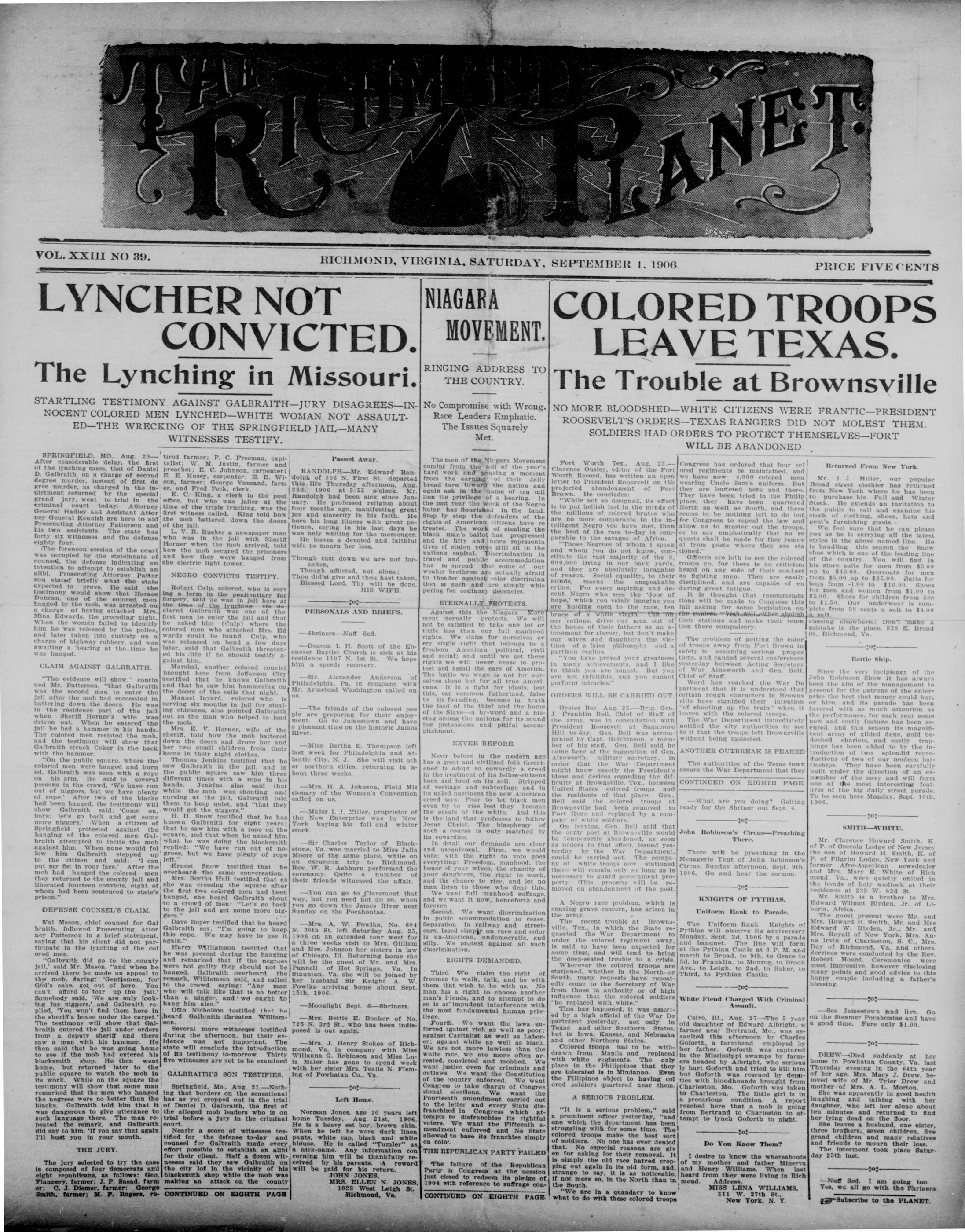
Page text (machine-generated)
THE RICHMOND PLANET
LYNCHER NOT CONVICTED. The Lynching in Missouri.
STARTLING TESTIMONY AGAINST GALBRAITH—JURY DISAGREES—IN NOCENT COLORED MEN LYNCHED—WHITE WOMAN NOT ASSAULTED—THE WRECKING OF THE SPRINGFIELD JAIL—MANY
VOL. XXIII NO 39.
LYNCH
The Lynch
STARTLING TESTIMON
NOCENT COLORED ME
ED—THE WREC
SPRINGFIELD, MO., Aug. 20—After considerable delay, the first of the lynching cases, that of Daniel D. Galbraith, on a charge of second degree murder, instead of first degree murder, as charged in the indictment returned by the special grand jury, went to trial in the criminal court today. Attorney General Hadley and Assistant Attorney General Kennish are here to aid Prosecuting Attorney Patterson and his two assistants. The state has forty six witnesses and the defense eighty four.
The forenoon session of the court was occupied by the statements of counsel, the defense indicating an intention to attempt to establish an alibi. Prosecuting Attorney Patterson son stated briefly what the state expected to prove. He said the testimony would show that Horace Duncan, one of the colored men hanged by the mob, was arrested on a charge of having attacked Mrs. Mina Edwards, the preceding night. When the woman failed to identify him he was released by the police, and later taken into custody on a charge of highway robbery, and was awaiting a hearing at the time he was hanged.
CLAIM AGAINST GALBRAITH
"The evidence will show." continued Mr. Patterson, "that Galbraith was the second man to enter the jail after the mob had succeeded in battering down the doors. He was in the residence part of the jail when Sheriff Horner's wife was driven out. When he entered the jail he had a hammer in his hands. The colored men resisted the mob, and the testimony will show that Galbraith struck Coker in the back with the hammer.
"On the public square, where the colored men were hanged and burned, Galbraith was seen with a rope on his arm. He said to several persons in the crowd, 'We have run out of niggers, but we have plenty of rope.' After two of the blacks had been hanged, the testimony will show Galbraith said: 'Come on, boys; let's go back and get some niggers.' When a citizen of Springfield protested against the hanging of the colored men Galbraith attempted to incite the mob against him. When none would for low him Galbraith stepped up to the citizen and said: 'I can put my fast in your face.' After the mob had hanged the colored men they returned to the county jail and liberated fourteen convicts, eight of whom had been sentenced to state's prison."
DEFENSE COUNSEL'S CLAIM
Wal Mason, chief counsel for Galbraith, followed Prosecuting Attorney Patterson in a brief statement, saying that his client did not participate in the lynching of the colored men.
"Galbraith did go to the county jail," said Mr. Mason. "and when he arrived there he made an appeal to the mob, saying: 'Gentlemen, for God's sake, get out of here. You can't afford to tear up the jail.' Somebody said, 'We are only looking for niggers,' and Galbraith replied, 'You won't find them here in the sheriff's house under the carpet.' The testimony will show that Galbraith entered the jail under orders from a deputy sheriff and there saw a man with his hammer. He then said that he was going home to see if the mob had entered his blacksmith shop. He then went home, but returned later to the public square to watch the mob in its work. While on the square the testimony will show that some man remarked that the men who hanged the negroes were no better than the blacks. Galbraith told him that it was dangerous to give utterance to such language there. The man repeated the remark, and Galbraith did say to him, 'If you say that again I'll bust you in your mouth.'
THE JURY.
The jury selected to try the case is composed of four democrats and eight republicans, as follows: Geo. Flannery, farmer; J. P. Snead, farmer; C. J. Diemer, farmer; George Smith, farmer; M. P. Rogers, re-
WITNESSES TESTIFY.
tired farmer; P. C. Freeman, capitalist; W. M. Justin, farmer and preacher; E. C. Johnson, carpenter; E. E. Husey, carpenter; E. E. Wilson, farmer; George Vansand, farmer, and Fred Peck, clerk.
E. C. King, a clerk in the post office, but who was jailer at the time of the triple lynching, was the first witness called. King told how the mob battered down the doors of the jail.
L. V. B. Rucker a newspaper man who was in the jail with Sheriff Horner when the mob arrived, told how the mob secured the prisoners and how they were hanged from the electric light tower.
NEGRO CONVICTS TESTIFY.
Robert Culp, colored, who is serving a term in the penitentiary for forgery, said he was in jail here at the time of the lynching. He declared Galbraith was one of the first men to enter the jail and that he asked him (Culp) where the colored men who attacked Mrs. Edwards could be found. Culp, who was released on a bond a few days later, said that Galbraith threatened his life if he should testify against him.
Marshal, another colored convict brought here from Jefferson City testified that he knows Galbraith and that he saw him hammering on the doors of the cells that night.
Manuel Inyard, colored who is serving six months in jail for stealing chickens, also pointed Galbraith out as the man who helped to lead the mob.
Mrs. E. V. Horner, wife of the sheriff, told how the mob battered down the doors and drove her and her two small children from their home in their night clothes.
Thomas Jenkins testified that he saw Galbraith in the jail, and in the public square saw him three different times with a rope in his hands.
Jenkins also said that while the mob was shouting and cursing at the jail, Galbraith told them to keep quiet, and "that they would get the niggers."
H. H. Snow testified that he has known Galbraith for eight years; that he saw him with a rope on the square, and that when he asked him what he was doing the blacksmith replied: "We have run out of negroes, but we have plenty of rope left."
Ernest Snow testified that he overheard the same conversation.
Mrs. Bertha Hull testified that as she was crossing the square after the first two colored men had been hanged, she heard Galbraith shout to a crowd of men: "Let's go back to the jail and get some niggers."
Dave Boyer testified that he heard Galbraith say, "I'm going to keep this rope. We may have to use it again."
Harry Williamson testified that he was present during the hanging and remarked that if the negroes were not guilty they should not be hanged. Galbraith overheard the remark, Williamson said, and called to the crowd saying: "Any man who will talk like that is no better than a nigger, and we ought to hang him also."
Otto Nicholson testified that he heard Galbraith threaten Williamson.
Several more witnesses testified during the afternoon, but their evidence was not important. The state will conclude the introduction of its testimony to-morrow. Thirty five witnesses are yet to be examined
GALBRAITH'S SON TESTIFIES
Springfield, Mo., Aug. 21.—Nothing that borders on the sensational has as yet cropped out in the trial of Daniel D. Galbraith, the first of the alleged mob leaders who is on trial before a jury in the criminal court.
Nearly a score of witnesses testified for the defense to-day and counsel for Galbraith made every effort possible to establish an alibit for their client. Half a dozen witnesses said they saw Galbraith on the city lot in the vicinity of his blacksmith shop while the mob was making an attack on the county
CONTINUED ON EIGHTH PAGE
RICHMOND, VIRGINIA, SATURDAY, SEPTEMBER 1, 1906
Passed Away.
RANDOLPH—Mr. Edward Randolph of 806 N. First St. departed this life Thursday afternoon, Aug. 23d, 1906 at 5:55 o'clock. Mr. Randolph had been sick since January. He professed religion about four months ago, manifesting great joy and sincerity in his faith. He bore his long illness with great patience, saying in his last days he was only waiting for the messenger. He leaves a devoted and faithful wife to mourn her loss.
Though cast down we are not forsaken.
Though afflicted, not alone;
Thou didst give and thou hast taken.
Blessed Lord. Thy will be done.
HIS WIFE
PERSONALS AND BRIEFS
—Shriners—Nuff Sed.
—Deacon I. H. Scott of the Ebenezer Baptist Church is sick at his residence 1107 N. 1st St. We hope him a speedy recovery.
—Mr. Alexander Anderson of Philadelphia, Pa. in company with Mr. Armstead Washington called on us.
—The friends of the colored people are preparing for their enjoyment. Go to Jamestown and have a pleasant time on the historic James River.
—Miss Bertha E. Thompson left last week for Philadelphia and Atlantic City, N. J. She will visit oth er northern cities, returning in about three weeks.
—Mrs. H. A. Johnson, Field Missionary of the Woman's Convention called on us.
—Major I. J. Miller, proprietor of the New Enterprise was in New York buying his fall and winter stock.
—Sir Charles Taylor of Blackstone, Va. was married to Miss Julia Moore of the same place, while on an excursion trip to Richmond. Rev. W. R. Ashburn performed the ceremony. Quite a number of their friends witnessed the affair.
—You can go to Claremont that way, but you need not do so, when you go down the James River next Sunday on the Pocahontas.
—Mrs. A. W. Fowliks, No. 604 N. 30th St. left Saturday Aug. 25, 1906 on an extended tour west for a three weeks visit to Mrs. Gilliam and Mrs. Johnson her sisters in law of Chicago. Ill. Returning home she will be the guest of Mr. and Mrs. Pannell of Hot Springs, Va. In Staunton, Va. she will be joined by her husband Sir Knight A. W. Fowliks arriving home about Sept. 15th, 1906.
—Moonlight Sept. 6—Shriners.
—Mrs. Bettie E. Booker of No. 725 N. 3rd St., who has been indisposed is out again.
—Mrs. J. Henry Stokes of Richmond, Va. in company with Miss Willanna G. Robinson and Miss Lula Maler has gone to spend week with her sister Mrs. Tealie N. Fleming of Powhatan Co., Va.
Left Home
Norman Jones, age 10 years left
home Tuesday, Aug. 21st, 1906.
He is a heavy set boy, brown skin.
When he left he wore dark linen
pants, white cap, black and white
blouse. He is called "Tumler" as
a nick-name. Any information con-
cerning him will be thankfully
received by his parents. A reward
will be paid for his return.
JOHN JONES,
MRS. ELLEN N. JONES,
1023 West Leigh St.
Richmond, Va.
NIAGARA MOVEMENT.
RINGING ADDRESS TO THE COUNTRY.
No Compromise with Wrong. Race Leaders Emphatic. The Issues Squarely Met.
The men of the Nigara Movement coming from the roll of the year's hard work and pausing a moment from the earning of their daily bread turn toward the nation and again ask in the name of ten million the privilege of a hearing. In the past year the work of the Negro hater has flourished in the land. Step by step the defenders of the rights of American citizens have retreated. The work of stealing the black man's ballot has progressed and the fifty and more representatives of stolen votes still sit in the nation's capital. Discrimination in travel and public accommodation has so spread that some of our weaker brethren are actually afraid to thunder against color discrimination as such and are simply whispering for ordinary decencies.
ETERNALLY PROTESTS
Against this the Niagara Movement eternally protests. We will not be satisfied to take one lot or tittle less than our full manhood rights. We claim for ourselves every single right that belongs to a freeborn American political, civil and social; and until we get these rights we will never cease to protest and assail the ears of America. The battle we wage is not for ourselves alone but for all true Americans. It is a fight for ideals, less this, our common fatherland, false to its founding, become in truth the land of the thief and the home of the Slave—a by-word and a hissing among the nations for its sound pretensions and pitiful accomplishment.
NEVER BEFORE
Never before in the modern age has a great and civilized folk threatened to adopt so cowardly a creed in the treatment of its fellow-citizens born and bred on its soil. Stripped of verbage and subterfuge and in its naked nastiness the new American creed says: Fear to let black men even try to rise lest they become the equals of the white. And this is the land that professes to follow Jesus Christ. The blasphemy of such a course is only matched by its cowardice.
In detail our demands are clear and unequivocal. First, we would vote; with the right to vote goes everything: Freedom, manhood, the honor of your wives, the chastity of your daughters, the right to work, and the chance to rise, and let no man listen to those who deny this. We want full manhood suffrage, and we want it now, henceforta and forever.
Second. We want discrimination in public accommodation to cease. Separation in railway and street-cars, based simply on race and color is un-American, undemocratic, and silly. We protest against all such discrimination.
RIGHTS DEMANDED
Third. We claim the right of freemen to walk, talk, and be with them that wish to be with us. No man has a right to choose another man's friends, and to attempt to do so is an impudent interference with the most fundamental human privilege.
Fourth. We want the laws enforced against rich as well as poor; against Capitalist as well as Laborer; against white as well as black. We are not more lawless than the white race, we are more often arrested, convicted and mobbed. We want justice even for criminals and outlaws. We want the Constitution of the country enforced. We want Congress to take charge of Congressional elections. We want the Fourteenth amendment carried out to the letter and every State disfranchised in Congress which attempts to disfranchise its rightful voters. We want the Fifteenth amendment enforced and No State allowed to base its franchise simply on color.
THE REPUBLICAN PARTY FAILED
The failure of the Republican Party in Congress at the session just closed to redeem its pledge of 1904 with reference to suffrage con
CONTINUED ON EIGHTH PAGE
COLORED TROOPS LEAVE TEXAS. The Trouble at Brownsville
NO MORE BLOODSHED—WHITE CITIZENS WERE FRANTIC—PRESIDENT ROOSEVELT'S ORDERS—TEXAS RANGERS DID NOT MOLEST THEM. SOLDIERS HAD ORDERS TO PROTECT THEMSELVES—FORT
Fort Worth Tex., Aug. 23.—Clarence Ouseley, editor of the Fort Worth Record, has written an open letter to President Roosevelt on the projected abandonment of Fort Brown. He concludes:
"While not so designed, its effect is to put hellish lust in the minds of the millions of colored brutes who are no more comparable to the intelligent Negro you have met, than the best of the race to-day is comparable to the savages of Africa.
"Those Negroes of whom I speak and whom you do not know, constitute the vast majority of the 9,000,000 living in our back yards, and they are absolutely incapable of reason. Social equality, to their minds, means the unspeakable crime. For every aspiring and decent Negro who sees the 'door of hope,' which you vainly imagine you are holding open to the race, ten brace of a white virgin." Cut on our rations, drive our men out of the house of their fathers as an atonement for slavery, but don't make our wives and daughters the victims of a false philosophy and a partisan regime.
"You have proved your greatness in many achievements, and I like to think you are honest. But you are not infallible, and you cannot perform miracles."
ORDERS WILL BE CARRIED OUT
Oyster Bay, Aug. 23.—Brig. Gen. J. Franklin Bell, Chief of Staff of the army, was in consultation with President Roosevelt at Saganore Hill to-day. Gen. Bell was accompanied by Capt. Hutchinson, a member of his staff. Gen. Bell said he came here at the suggestion of Gen. Ainsworth, military secretary, in order that the War Department might know exactly the President's ideas and desires regarding the difficulty at Brownsville, Tex., between United States colored troops and the residents of that place. Gen. Bell said the colored troops at Brownsville had been removed to Fort Reno and replaced by a company of white soldiers.
On leaving, Gen. Bell said that the army post at Brownsville would be temporarily abandoned, as soon as orders to that effect, issued yesterday by the War Department, could be carried out. The company of white troops now stationed there will remain only so long as is necessary to guard government property. This property will be removed on abandonment of the post.
A Negro race problem, which is causing grave concern, has arisen in the army.
The recent trouble at Brownsville, Tex., in which the State requested the War Department to order the colored regiment away, is said to have been expected for some time, and will tend to bring the deep-seated trouble to a crisis.
Wherever the colored troops are stationed, whether in the North or South, many requests have repeatedly come to the Secretary of War from those in authority or of high influence that the colored soldiers "be replaced with white." This has happened, it was asserted by a high official of the War Department yesterday, not only in Texas and other Southern States, but in Iowa, Kansas, and Nebraska and other Northern States. Colored troops had to be withdrawn from Manila and replaced with white regiments. The only place in the Philippines that they are tolerated is in Mindanao. Even the Filipinos object to having colored soldiers quartered near them.
A SERIOUS PROBLEM
"It is a serious problem," said a prominent officer yesterday, "and one which the department has been struggling with for some time. The colored troops make the best sort of soldiers. No one has ever denied that. No special reasons are given for asking for their removal. It is simply the old race hatred cropping out again in its old form, and, strange to say, it is as noticeable, if not more so, in the North than in the South.
"We are in a quandary to know what to do with these colored troops
WILL BE ABANDONED.
Congress has ordered that four colored regiments be maintained, and we have now 4,000 colored men wearing Uncle Sam's uniform. But they are buffeted here and there. They have been tried in the Philip pines, they have been quartered North as well as South, and there seems to be nothing left to do but for Congress to repeal the law and allow us to muster out the troops, or to say emphatically that no requests shall be made for their removal from posts where they are stationed."
Officers are loth to see the colored troops go, for there is no criticism heard on any side of their conduct as fighting men. They are easily disciplined, and are capable of enduring great fatigue.
It is thought that recommendations will be made to Congress this fall asking for some legislation on the rebred. With will, we abolish their stations and make their retention there compulsory.
The problem of getting the colored troops away from Fort Brown in safety is assuming serious proportions, and caused several conferences yesterday between Acting Secretary of War Alnsworth and Gen. Bell, Chief of Staff.
Word has reached the War De partment that it is understood that certain rough characters in Browns ville have signified their intention "of shooting up the train" when it leaves with the colored troops. The War Department immediately notified the city authorities to see to it that the troops left Brownsville without being molested.
ANOTHER OUTBREAK IS FEARED
The authorities of the Texas town assure the War Department that they CONTINUED ON EIGHTH PAGE
—What are you doing? Getting ready for the Shriner out Sept. 8.
John Robinson's Circus—Preaching There.
There will be preaching in the Menagerie Tent of John Robinson's Circus, Sunday afternoon, Sept. 9th, 1906. Go and hear the sermon
Uniform Rank to Parade.
The Uniform Rank Knights of Pythias will observe its anniversary Monday, Sept. 3d, 1906 by a parade and banquet. The line will form at the Pythian Castle at 3 P. M. and march to Broad, to 9th, to Grace to 3d, to Franklin, to Monroe, to Brook Ave., to Leigh, to 2nd, to Baker, to Third, to Pythian Castle.
White Fiend Charged With Criminal Assault.
Cairo, Ill., Aug. 27—The 5 year old daughter of Edward Albright, a farmer near Bertrand, Mo., was assaulted this afternoon by Charles Goforth, a farmhand employed by her father. Goforth was captured in the Mississippi swamps by farmers headed by Albright, who seriously hurt Goforth and tried to kill him but Goforth was rescued by deputies with bloodhounds brought from Charleston, Mo. Goforth was taken to Charleston. The little girl is in a precarious condition. A report reached here that a mob is going from Bertrand to Charleston to attempt to lynch Goforth to night.
Do You Know Them?
I desire to know the whereabouts of my mother and father Minerva and Henry Williams. When last heard from they were living in Rich mond. Address. MISS LENA WILLIAMS. 311 W. 37th St.. New York, N. Y.
PRICE FIVE CENTS
ROOPS
TXAS.
ownsville
E FRANTIC—PRESIDENT
DO NOT MOLEST THEM.
EMSELVES—FORT
Returned From New York
Mr. I. J. Miller, our popular Broad street clothier has returned from New York where he has been to purchase his Fall and Winter Stock. He extends an invitation to the public to call and examine his stock of clothing, shoes, hats and gent's furnishing goods.
We feel sure that he can please you as he is carrying all the latest styles in the above named line. He is handling this season the Snow shoe which is one of the leading line of the country. You will find in his store suits for men from $5.00 up to $40.00. Overcoats for men from $5.00 up to $25.00. Suits for boys from -1.00 to $10.00. Shoes for men and women from $1.00 to $5.00. Shoes for children from 50c to $1.50. Our underwear is complete from 50 cents a suit to $4.00 a suit.
chasing elsewhere; Don't make a mistake in the place, 528 E. Broad St., Richmond, Va.
Battle Ship.
Since the very incipiency of the John Robinson Show it has always been the aim of the management to present for the patrons of the enterprise the best that money could buy, or hire, and its parade has been favored with as much attention as the performance, for each year some new and costly feature has been secured, and this season its magnificent array of gilded dens, gold be decked charlots, and costly trappings has been added to by the introduction of two splendid reproductions of two of our modern battleships. They have been carefully built under the direction of an ex- member of the navy and will form one of the most interesting features of the big daily street parade. To be seen here Monday, Sept. 19th, 1906.
SMITH—WHITE.
Mr. Clarence Howard Smith, K. of P. of Osceola Lodge of New Jersey the son of Howard H. Smith, K. of P. of Pilgrim Lodge, New York and former Afro-American newsdealer and Mrs. Mary E. White of Richmond, Va., were quietly united in the bonds of holy wedlock at their residence at 239 W. 62d St.
Mr. Smith is a brother to Mrs. Edward Wilmot Blyden, Jr. of Liberia, Africa.
The guest present were Mr. and Mrs. Howard H. Smith, Mr. and Mrs Edward W. Blyden, Jr., Mr. and Mrs. Royall of New York, Mrs. Anna Irvin of Charleston, S. C., Mrs. Day of Richmond, Va. and others. Services were conducted by the Rev. Robert Mount. Ceremonies were most impressive, however disclosing many points and good advice to this happy couple including a father's blessing.
—See Jamestown and live. Go on the Steamer Pocahontas and have a good time. Fare only $1.00.
DREW—Died suddenly at her home in Powhatan County, Va. last Thursday evening in the 64th year of her age, Mrs. Mary J. Drew, beloved wife of Mr. Tyrre Drew and mother of Mrs. A. L. Morton. She was apparently in good health laughing and talking with her daughter, who left her alone about ten minutes and returned to find her lying dead on the floor. She leaves a husband, one sister, three brothers, seven children, five grand children and many relatives and friends to mourn their loss. The interment took place Satur-
The interment took place Saturday 25th inst.
—Nuff Sed. I am going too.
Yes, we all go with the Shriners
Subscribe to the PLANET.
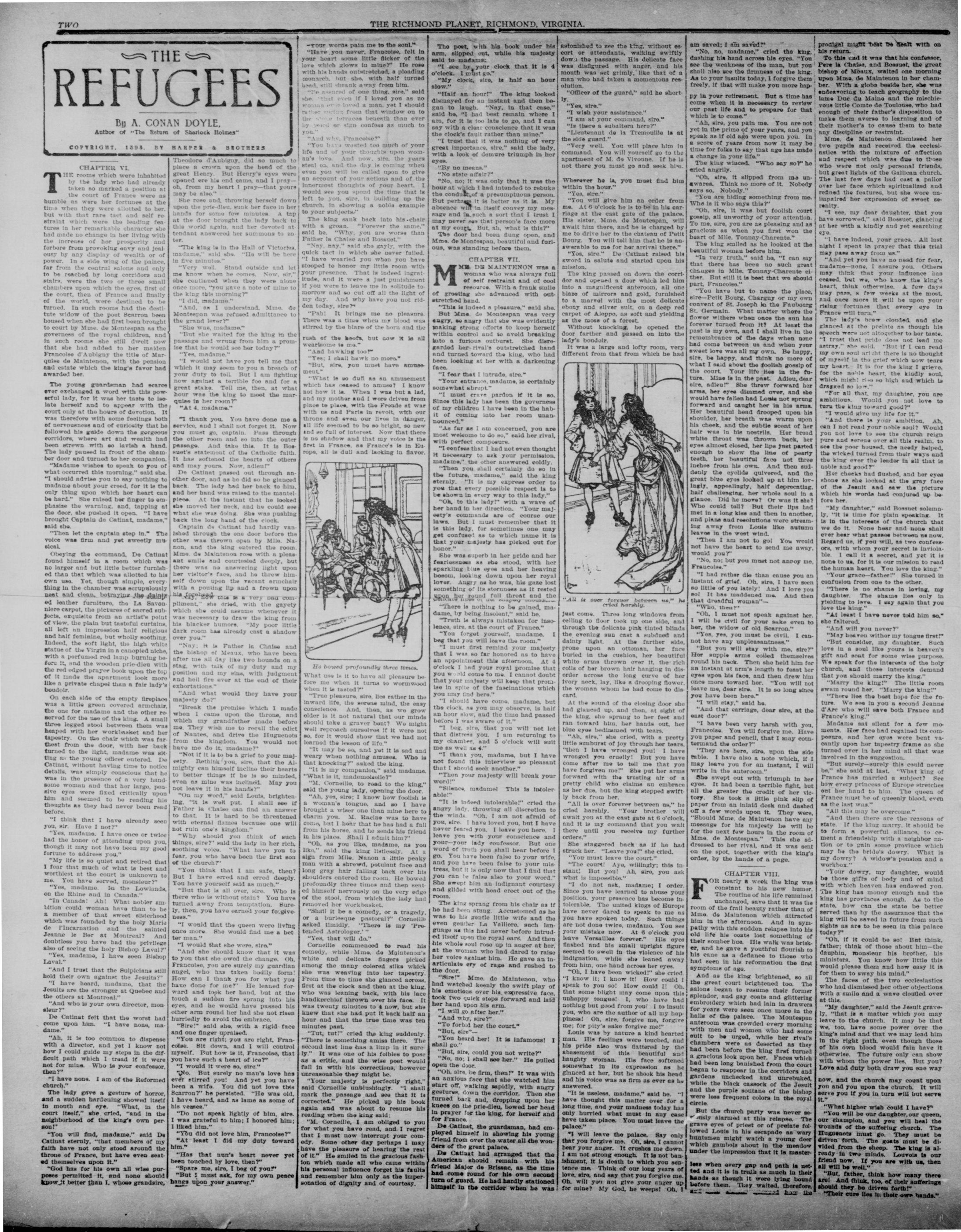
REFUGEES
By A. CONAN DOYLE,
Author of "The Return of Sharlock Holmes"
COPYRIGHT, 1892, BY HARPER & BROTHERS
CHAPTER VI
Theodore d'Aubigny, did so
place a crown upon the be
THE rooms which were inhabited by the lady who had already taken so marked a position at the court of France were as humble as were her fortunes at the time when they were allotted to her, but with that rare tact and self-restraint which were the leading features in her remarkable character she had made no change in her living with the increase of her prosperity and forbore from provoking envy and jealousy by any display of wealth or of power. In a side wing of the palace, far from the central salons and only to be reached by long corridors and stairs, were the two or three small chambers upon which the eyes, first of the court, then of France and finally of the world, were destined to be turned. In such rooms had the destitute widow of the poet Scarron been housed when she had first been brought to court by Mine, de Montespan as the governess of the royal children, and in such rooms she still dwelt now that she had added to her malen Francolse d'Aubigny the title of Marquise de Malntenon, with the pension and estate which the king's favor had awarded her.
The young guardman had scarcer ever exchanged a word with this powerful lady, for it was her taste to isolate herself and to appear with the court only at the hours of devotion. It was therefore with some feelings both of nervousness and of curiosity that he followed his guide down the gorgeous corridors, where art and wealth had been strenued with so lavish a hand. The lady paused in front of the chamber door and turned to her companion. "Madame wishes to speak to you of what occurred this morning," said she. "I should advise you to say nothing to madame about your creed, for it is the only thing upon which her heart can be hard." She raised her finger to emphasize the warning, and, tapping at the door, she pushed it open. "I have brought Captain de Catinat, madame," said she. "Then let the captain step in." The voice was firm and yet sweetly musical.
Obeying the command, De Catinat found himself in a room which was no larger and but little better furnished than that which was allotted to his own use. Yet, though simple, everything in the chamber was scrupulously neat and clean, betraying the dainty ed leather furniture, the La Savonniere carpet, the pictures of sacred subjects, exquisite from an artist's point of view, the plain but tasteful curtains, all left an impression half religious and half feminine, but wholly soothing. Indeed, the soft light, the high white statue of the Virgin in a canopied niche, with a perfumed red lamp burning before it, and the wooden prie-dieu with the red edged prayer book upon the top of it made the apartment look more like a private chapel than a fair lady's boudolr.
On each side of the empty fireplace was a little green covered armchair, the one for madame and the other reserved for the use of the king. A small three legged stool between them was heaped with her workbasket and her tapestry. On the chair which was farther from the door, with her back turned to the light, madame was sitting as the young officer entered. De Catatin, without having time to notice details, was simply conscious that she was in the presence of a very handsome woman and that her large, pensive eyes were fixed critically upon him and seemed to be reading his thoughts as they had never been read before.
"I think that I have already seen you, sir. Have I not?"
"Yes, madame. I have once or twice had the honor of attending upon you, though it may not have been my good fortune to address you."
"My life is so quiet and retired that I fear that much of what is best and worthest at the court is unknown to me. You have served, monsieur" "Yes, madame. In the Lowlands, on the Rhine and in Canada."
"In Canada! Ah! What nobler ambition could woman have than to be a member of that sweet sisterhood which was founded by the holy Maria de 'Incarnation and the sainted Jeanne le Ber at Montreal? And doubtless you have had the privilege also of seeing the holy Bishop Laval?" "Yes, madame, I have seen Bishop Laval." "And I trust that the Sulpicians still hold their own against the Jesuits?" "I have heard, madame, that the Jesuits are the stronger at Quebec and the others at Montreal." "And who is your own director, monsteur?" De Catinat felt that the worst had come upon him. "I have none, madame."
"Ah, it is too common to dispense with a director, and yet I know not how I could guide my steps in the difficult path which I tread if it were not for mine. Who is your confessor, then?"
"I have none. I am of the Reformed church."
The lady gave a gesture of horror, and a sudden hardening showed itself in mouth and eye. "What, in the court itself," she cried, "and in the neighborhood of the king's own person."
"You will find, madame," said De Catinat sternly, "that members of my faith have not only stood around the throne of France, but have even seated themselves upon it."
"God has for his own all wise purposes permitted it, and none should know it better than I, whose grandsire,
Theodora d'Aubigny, did so much to place a crown upon the head of the great Henry. But Henry's eyes were opened ere his end came, and I pray—oh, from my heart I pray—that yours may be also."
She rose and, throwing herself down upon the prie-dieu, sunk her face in her hands for some few minutes. A tap at the door brought the lady back to this world again, and her devoted attendant answered her summons to enter.
"The king is in the Hall of Victories, madame," said she. "He will be here in five minutes."
"Very well. Stand outside and let me know when he comes. Now, sir," she continued when they were alone once more, "you gave a note of mine to the king this morning?"
"I did, madame."
"And, as I understand, Mine, de Montespan was refused admittance to the grand lever?"
"She was, madame."
"But she waited for the king in the passage and wring from him a promise that he would see her today?"
"Yes, madame."
"I would not have you tell me that which it may seem to you a breach of your duty to tell. But I am fighting now against a terrible foe and for a great stake. Tell me, then, at what hour was the king to meet the marquise in her room?"
"At 4, madame."
"I thank you. You have done me a service, and I shall not forget it. Now you must go, captain. Pass through the other room and so into the outer passage. And take this. It is Bosu's statement of the Catholic faith. It has softened the hearts of others and may youra. Now adieu!"
De Catinat passed out through another door, and as he did so he glanced back. The lady had her back to him, and her hand was raised to the mantelpiece. At the instant that he looked she moved her neck, and he could see what she was doing. She was pushing back the long hand of the clock.
Captain de Catinat had hardly vanished through the one door before the other was thrown open by Mile, Nanon, and the king entered the room. Mme. de Maintenon rose with a pleasant smile and courted deeply, but there was no answering light upon her visitor's face, and he throw himself down upon the vacant armchair with a pouting lip and a frown upon his forehead. "My how this is a very bad compliment," she cried, with the gayety which she could assume whenever it was necessary to draw the king from his blacker humors. "My poor little dark room has already cast a shadow over you."
"Nay; it is Father in Chaise and the bishop of Meaux, who have been after me all day like two hounds on a stag, with talk of my duty and my position and my sins, with judgment and hell fire ever at the end of their exhortations.
"And what would they have your majesty do?
"Break the promise which I made when I came upon the throne, and which my grandfather made before me. They wish me to recall the edict of Nantes, and drive the Huguenots from the kingdom. You would not have me do it, madame?"
"Not if it is to be a grief to your majesty. Bethink you, sire, that the Almighty can himself incline their hearts to better things if he is so minded, even as mine was inclined. May you not leave it in his hands?"
"On my word," said Louis, brightening, "it is well put. I shall see if Father la Chasse can find an answer to that. It is hard to be threatened with eternal flames because one will not ruin one's kingdom."
"Why should you think of such things, sire?" said the lady in her rich, soothing voice. "What have you to fear, you who have been the first son of the church?"
"You think that I am safe, then? But I have erred and erred deeply. You have yourself said as much."
"But that is all over, sire. Who is there who is without stain? You have turned away from temptation. Surely, then, you have earned your forgiveness."
"I would that the queen were living once more. She would find me a better man."
"I would that she were sire."
"And she should know that it was to you that she owed the change. Oh, Francolse, you are surely my guardian angel, who has taken bodily form! How can I thank you for what you have done for me?" He leaned forward and took her hand, but at the touch a sudden fire sprang into his eyes, and he would have passed his other arm round her had she not risen hurriedly to avoid the embrace.
"Sire!" said she, with a rigid face and one finger upraised.
"You are right; you are right, Francolse. Sit down, and I will control myself. But how is it, Francolse, that you have such a heart of ice?"
"I would it were so, sire."
"No. But surely no man's love has ever stirred you! And yet you have been a wife. You did not love this Scarron?" he persisted. "He was old, I have heard, and as lame as some of his vices."
"Do not speak lightly of him, alire. I was grateful to him; I honored him; I liked him." "You did not love him, Francoise?" "At least I did my duty toward him." "Has that nun's heart never yet been touched by love, then?" "Spare me, sire, I beg of you?" "But I must ask, for my own peace hangs upon your answer."
THE RICHMOND PLANET, RICHMOND, VIRGINIA
"your words pain me to the soul."
"Have you never, Francoise, felt in your heart some little flicker of the love which glows in mine?" He rose with his hands outstretched, a pleading monarch, but she, with half turned head, still shrank away from him.
"He assured of one thing, sir," said she "that even if I loved you as no woman ever loved a man, yet I should rather stirring from that window on to the stone terraces beeneht than ever by wood or sign confess as much to you."
"And why Francolse?"
You will. Praise us.
"You have wasted too much of your life and of your thoughts upon woman's love. And now, sir, the years steal on, and the day is coming when even you will be called upon to give an account of your actions and of the innermost thoughts of your heart. I would see you spend the time that is left to you, sir, in building up the church. In showing a noble example to your subjects."
The king sank back into his chair with a groan. "Forever the same," said he. "Why, you are worse than Father la Chise and Bossuet."
"Nay, nay," said she gaily, with the quick tact in which she never failed. "I have wearied you when you have stooped to honor my little room with your presence. That is indeed ingratiude, and it were a just punishment if you were to leave me in solitude tomorrow and so cut off all the light of my day. And why have you not ridden today, sir?"
"Pab! It brings me no pleasure. There was a time when my blood was stirred by the blare of the born and the rush of the hoofs, but now it is all wearsome to me."
"And hawking too?"
"Yes; I shall hawk no more."
"But, sire, you must have amusement."
"What is so dull as an amusement which has ceased to amuse? I know not how it is. When I was but a lad, and my mother and I were driven from place to place, with the Fronde at war with us and Paris in revolt, with our throne and even our lives in danger, all life seemed to be so bright, so new and so full of interest. Now that there is no shadow and that my voice is the first in France, as France's is in Europe, all is dull and lacking in flavor.
A
He bowed profoundly three times.
What use is it to have all pleasure before me when it turns to wormwood when it is tasted?"
"True pleasure, sire, lies rather in the inward life, the serene mind, the easy conscience. And, then, as we grow older is it not natural that our minds should take a graver bent? We might well reproach ourselves if it were not so, for it would show that we had not learned the lesson of life."
"It may be so, and yet it is sad and weary when nothing amuses. Who is that knocking?" asked the king.
"It is my companion," said madame.
"What is it, mademoiselle?"
"M. Cornelle, to road to the king," said the young lady, opening the door. "Ah, yes, sire; I know how foolish is a woman's tongue, and so I have brought a wiser one than mine here to charm you. M. Racine was to have come, but I hear that he has had a fall from his horse, and he sends his friend in his place. Shall I admit him?" "Oh, as you like, madame, as you like," said the king listlessly. At a sign from Mile, Nanon a little peaky man with a shrewd, potiant face and long gray hair falling back over his shoulders entered the room. He bowed profoundly three times and then seated himself nervously on the very edge of the stool, from which the lady had removed her workbasket. "Shall it be a comedy, or a tragedy, or a burlesque pastoral?" Cornelle asked timidly. "There is my 'Pretended Astrologer.'"
Corneille commenced to read his comedy, while Mme. de Maintenon's white and delicate fingers picked among the many colored silks which she was weaving into her tapestry. From time to time she glanced across, first at the clock and then at the king, who was leaning back, with his lace handkerchief thrown over his face. It was twenty minutes to 4 now, but she knew that she had put it back half an hour and that the true time was ten minutes past.
"Tut, tut!" cried the king suddenly. "There is something amiss there. The second last line has a limp in it surely." It was one of his fobiles to pose as a critic, and the wise poet would fall in with his corrections, however unreasonable they might be.
"Your majesty is perfectly right," said Cornellie unblushingly. "I shall mark the passage and see that it is corrected." He picked up his book again and was about to resume his reading when the king said:
"M. Cornellie, I am obliged to you for what you have read, and I regret that I must now interrupt your comedy. Some other day perhaps I may have the pleasure of hearing the rest of it." He smiled in the gracious fashion which made all who came within his personal influence forget his faults and remember him only as the impersonation of dignity and of courtesy.
The poet, with his book under his arm, slipped out, while his majesty said to madame:
"I see by, your clock that it is 4 o'clock. I must go."
"My clock, sir, is half an hour slow."
"Half an hour!" The king looked dismayed for an instant and then began to laugh. "Nay, in that case," said he. "I had best remain where I am, for it is too late to go, and I can say with a clear conscience that it was the clock's fault rather than mine."
"I trust that it was nothing of very great importance, sir," said the lady, with a look of domure triumph in her eyes.
"By no means."
"No state affairs?"
"No, no; it was only that it was the hour at which I had intended to rebuke the conduct of a presumptuous person. But perhaps it is better as it is. My absence will in itself convey my message and in such a sort that I trust I may never see that person's face more at my court. But, ah, what is this?" The door had been flung open, and Mme. de Montespan, beautiful and furious, was standing before them.
CHAPTER VII
M. DE MAINTENON was a woman who was always full of self restraint and of cook resource. With a frank smile of greeting she advanced with out-stretched hand.
"This is induced a pleasure," said she. But Mme. de Montespan was very angry, so angry that she was evidently making strong efforts to keep herself within control and to avoid breaking into a furious outburst. She disgraced her rival's outstretched hand and turned toward the king, who had been looking at her with a darkening face.
"I fear that I intrude, sire."
"Your entrance, madame, is certainly somewhat abrupt."
"I must crave pardon if it is so. Since this lady has been the governess of my children I have been in the habit of coming into her room unannounced."
"As far as I am concerned, you are most welcome to do so," said her rival, with perfect composure.
"I confess that I had not even thought it necessary to ask your permission, madame," the other answered coldly.
"Then you shall certainly do so in the future, madame," said the king eternly. "It is my express order to you that every possible respect is to be shown in every way to this lady."
"Oh, to this lady!" with a wave of her hand in her direction. "Your majesty's commands are of course our laws. But I must remember that it is this lady, for sometimes one may get confused as to which name it is that your majesty has picked out for honor."
She was superb in her pride and her fearlessness as she stood, with her sparkling blue eyes and her heaving bosom, looking down upon her royal lover. Angry as he was, his gaze lost something of its sternness as it rested upon her round full throat and the delicate nausea of her snapping snout. "There is nothing to be gained, ma-
"There is nothing to be gained, madame, by being insolent," said he.
"I must first remind your majesty that I was so far honored as to have an appointment this afternoon. At 4 o'clock I had your royal promise that you would come to me. I cannot doubt that your majesty will keep that promise in spite of the fascinations which you may find here."
"I should have come, madame, but the clock, as you may observe, is half an hour slow, and the time had passed before I was aware of it."
"I beg, sire, that you will not let that distress you. I am returning to my chamber, and 5 o'clock will suit me as well as 4."
"I thank you, madame, but I have not found this interview so pleasant that I should seek another."
"Then your majesty will break your word."
"Silence, madam! This is intolerable!"
"It is indeed intolerable!" cried the angry lady, throwing all discretion to the winds. "Oh, I am not afraid of you, sir. I have loved you, but I have never feared you. I leave you here. I leave you with your conscience and your—your lady confessor. But one word of truth you shall hear before I go. You have been false to your wife, and you have been false to your mistress, but it is only now that I find that you can be false also to your word." She swept him an indignant courtesy and glided with head erect out of the room.
The king sprang from his chair as if he had been stung. Accustomed as he was to his gentle little wife and the even gentle La Valliere, such language as this had never before intruded itself upon the royal ears. And then his whole soul rose up in anger at her, at the woman who had dared to raise her voice against him. He gave an in-articulate cry of rage and rushed to the door.
"Sire!" Mme. de Maintenon, who had wetched koenly the swift play of his emotions over his expressive face, took two quick steps forward and laid her hand upon his arm.
"I will go after her."
"And why, sire?"
"To forbid her the court."
"But, sire?"—
"You heard her! It is infamous! I shall go."
"But, sire, could you not write?"
"No, no; I shall see her." He pulled open the door.
"Oh, sire, be firm, then!" It was with an anxious face that she watched him start off, walking rapidly, with angry gestures, down the corridor. Then she turned back and, dropping upon her knees on the priedieu, bowed her head in prayer for the king, for herself and for France.
De Catinat, the guardsman, had employed himself in showing his young friend from over the water all the wonders of the great palace.
De Catinat had arranged that the American should remain with his friend Major de Brissac, as the time had come round for his own second turn of guard. He had hardly stationed himself in the corridor when he was
astonished to see the king, without escort or attendants, walking swiftly down the passage. His delicate face was disfigured with anger, and his mouth was set grimly, like that of a man who had taken a momentous resolution. "Officer of the guard," said he shortly.
"Yes, sire."
"I wish your assistance."
"I am at your command, sire."
"Is there a subaltern here?"
"Lieutenant de la Tremouille is at the slide guard."
"Very well. You will place him in command. You will yourself go to the apartment of M. de Vivonne. If he is not there you must go and seek him.
Wherever he is, you must find him within the hour."
"Tos, sire."
"You will give him an order from me. At 6 o'clock he is to be in his carriage at the east gate of the palace. His sister, Mme, de Montespan, will await him there, and he is charged by me to drive her to the chateau of Petit Bourg. You will tell him that he is answerable to me for her arrival there."
"Tos, sire." De Cataina raised his sword in salute and started upon his mission.
The king passed on down the corridor and opened a door which led him into a magnificent anteroom, all one blaze of mirrors and gold, furnished to a marvel with the most delicate ebony and silver suit, on a deep red carpet of Aleppo, as soft and yielding as the moss of a forest.
Without knocking, he opened the door farther and passed on into the lady's boulder.
It was a large and lofty room, very different from that from which he had
A
"All is over forever between us," he cried harshly.
just come. Three long windows from ceiling to floor took up one side, and through the delicate pink tinted blinds the evening sun cast a subdued and dainty light. At the farther side, prone upon an ottoman, her face buried in the cushion, her beautiful white arms thrown over it, the rich colls of her brown hair hanging in disorder across the long curve of her ivory neck, lay, like a drooping flower, the woman whom he had come to discard.
At the sound of the closing door she had glanced up, and, at sight of the king, she sprang to her feet and ran toward him, her hands out, her blue eyes bedimmed with tears.
"Ah, sir," she cried, with a pretty little sumburst of joy through her tears, "then I have wronged you! I have wronged you cruelly! But you have come after me to tell me that you have forgiven me!" She put her arms forward with the trusting air of a pretty child who claims an embrace as her due, but the king stopped swiftly back from her.
"All is over forever between us," he cried harshly. "Your brother will await you at the east gate at 6 o'clock, and it is my command that you wait there until you receive my further orders."
She staggered back as if he had struck her. "Leave you!" she cried.
"You must leave the court."
"The court! Aye, willingly; this instant! But you! Ah, sire, you ask what is impossible."
"I do not ask, madame; I order. Since you have learned to abuse your position, your presence has become intolerable. The united kings of Europe have never dared to speak to me as you have spoken today. Such things are not done twice, madamo. You see your mistake now. At 6 o'clock you leave Vorsalles forever." His eyes flashed and his small upright figure seemed to swallow in the violence of his indignation, while she leaned away from him, one hand across her eyes.
"Oh, I have been wicked!" she cried. "I know it; I know it! How could I speak to you so! How could I! Oh, that some blight may come upon this unhappy tongue! I, who have had nothing but good from you! I to insult you, who are the author of all my happiness! Ooh, sire, forgive me, forgive me; for pity's sake forgive me!" Louis was by nature a kind hearted man. His feelings were touched, and his pride also was flattered by the abasement of this beautiful and haughty woman. His face softened somewhat in its expression as he glanced at her, but he shook his head, and his voice was as firm as ever as he answered.
"It is useless, madame," said he. "I have thought this matter over for a long time, and your madness today has only hurried what must in any case have taken place. You must leave the palace."
"I will leave the palace. Say only that you forgive me. Oh, sire, I cannot bear your anger. It crushes me down. I am not strong enough. It is not banishment. it is death to which you sentence me. Think of our long years of love, sire, and say that you forgive me. Oh, will you not give your anger up for mine? My God, he weeps! Oh, I
am saved: I am saved!"
No, no, madame," cried the king, dashing his hand across his eyes. "You see the weakness of the man, but you shall also see the firmness of the king. As to your faults today, I forgive them freely, if that will make you more happy in your retirement. But a time has come when it is necessary to review our past life and to prepare for that which is to come."
"Ah, sire, you pain me. You are not yet in the prime of your years, and you speak as if old age were upon you. In a score of years from now it may be time for folks to say that age has made a change in your life."
The king wiated. "Who say so?" he cried angrily.
"Oh, sire, it slipped from me unaware. Think no more of it. Nobody says so. Nobody."
"You are hiding something from me. Who is it who says this?"
"Oh, sire, it was but foolish court goosepist, all unworthy of your attention. To me, sire, you are as pleasing and as gracious as when you first won the heart of Mile. Tonnay-Charente." The king smiled as he looked at the beautiful woman before him. "In very truth," said he, "I can say that there has been no such great changes in Mile. Tonnay-Charente either. But still it is beast that we should part, Francose."
"You have but to name the place, sire—Petit Bourg, Chargyre or my own convent of St. Joseph in the Faubourg St. Germain. What matter where the flower withers when once the sun has forever turned from it? At least the past is my own, and I shall live in the remembrance of the days when none had come between us and when your sweet love was all my own. Be happy, sire, be happy, and think no more of what I said about the foolish gossip of the court. Your life lies in the future. Mine is in the past. Adieu, dear sire, adieu!" She throw forward her arms, her eyes dimmed over, and she would have fallen had Louis not sprung forward and caught her in his arms. Her beautiful head drooped upon his shoulder, her breath was warm upon his cheek, and the subtle scent of her hair was in his nostrils. Her broad white throat was thrown back, her eyes almost closed, her lips just parted enough to show the line of pearly teeth, her beautiful face not three inches from his own. And then suddenly the cycloids quivered, and the great blue eyes looked up at him lovingly, appealingly, half deprecating, half challenging, her whole soul in a glance. Did he move? Or was it she? Who could tell? But their lips had met in a long kiss and then in another, and plans and resolutions were streaming away from Louis like autumn leaves in the west wind.
"Then I am not to go! You would not have the heart to send me away, would you?"
"No, no; but you must not anpoy me, Francoise."
"I had rather die than cause you an instant of grief. Oh, sire, I have seen so little of you lately! And I love you so! It has maddened me. And then that dreadful woman"—
"Who, then?"
"Oh, I must not speak against her. I will be civil for your sake even to her, the widow of old Scarron."
"Yes, yes, you must be civil. I cannot have any unpleasantness."
"But you will stay with me, sire?" Her supple arms coiled themselves round his neck. Then she held him for an instant at arm's length to feast her eyes upon his face, and then drew him once more toward her. "You will not leave me, dear sire. It is so long since you have been here."
"And that carriage, dear sire, at the east door?"
"I have been very harsh with you, Francoise. You will forgive me. Have you paper and penell, that I may countmand the order?"
"They are here, sire, upon the side table. I have also a note which, if I may leave you for an instant, I will write in the anteroom."
She swept out with triumph in her eyes. It had been a terrible fight, but all the greater the credit of her victory. She took a little pink slip of paper from an inlaid desk and dashed off a few words upon it. They were, "Should Mme. de Maltenon have any message for his majesty he will be for the next few hours in the room of Mme. de Montespan." This she addressed to her rival, and it was sent on the spot, together with the king's order, by the hands of a page.
CHAPTER VIII
FOR nearly a week the king was constant to his new humor. The routine of his life remained unchanged, save that it was the room of the frail beauty rather than of Mme. de Maltonton which attracted him in the afternoon. And in sympathy with this sudden relapse into his old life his coats lost something of their somber hue. His walk was brisker, and he gave a youthful flourish to his cane as a defiance to those who had seen in his reformation the first symptoms of age.
And as the king brightened, so all the great court brightened too. The salons began to resume their former splendor, and gay coats and glittering embroidery which had lain in drawers for years were seen once more in the halls of the palace. The Montespan antelope was crowded every morning with men and women who had some suit to be urged, while her rivals' chambers were as deserted as they had been before the king first turned a gracious look upon her. Faces which had been long banished from the court began to reappear in the corridors and gardens unchecked and unreubaked, while the black cassock of the Jesuit and the purple soutane of the bishop were less frequent colors in the royal circle.
But the church party was never se-
siously alarmed at this relapse. The grave eyes of priest or of prelate fol-
owed Louis in his escapade as wary huntsmen might watch a young deer
which gambols about in the meadow
under the impression that it is master-
less when every gap and path is netted
and it is in truth as much in their
hands as though it were lying bound
before them. They waited, therefore,
and the
prodigial might best be dealt with on his return.
To this sad it was that his confessor, Pere la Chaise, and Bossuet, the great bishop of Maux, waited one morning upon Mme. de Maintenon in her chamber. With a globe beside her, she was endeavoring to teach geography to the lame Duc du Maine and the mischievous little Comte de Toulouse, who had enough of their father's disposition to make them averse to learning and of their mother's to cause them to hate any discipline or restraint.
Mme. de Maintenon dismissed her two pupils and received the ecclesiastics with the mixture of affection and respect which was due to those who were not only personal friends, but great lights of the Gallican church. The last few days had cast a pallor over her face which spiritualized and refined the features, but she wore unimpaired her expression of sweet serenity.
"I see, my dear daughter, that you have sorrowed," said Bossuet, glancing at her with a kindly and yet searching eye.
"I have indeed, your grace. All last night I spent in prayer that this trial may pass away from us."
"And yet you have no need for fear, madame-none. I assure you. Others may think that your influence has ceased, but we, who know the king's heart, think otherwise. A few days may pass, a few weeks at the most, and once more it will be upon your rising fortunes that every eye in France will turn."
The lady's brow clouded, and she glanced at the prelate as though his speech were not altogether to her taste.
"I trust that pride does not lead me astray," she said. "But if I can read my own soul aright there is no thought of myself in the grief which now tears my heart. It is for the king I grieve, for the noble heart, the kindly soul, which might rise so high and which is dragged so low."
"For all that my daughter, you are ambitious. Would you not love to turn the king toward good?"
"I would give my life for it."
"And there is your ambition. Ah, can I not read your noble soul? Would you not love to see the church reign pure and serene over all this realm, to see the poor housed, the needy helped, the wicked turned from their ways and the king ever the leader in all that is noble and good?"
Her cheeks had flushed, and her eyes shone as she looked at the gray face of the Jesuit and saw the picture which his words had conquered up before her.
"My daughter," said Bossuet solemnly, "it is time for plain speaking. It is in the interests of the church that we do it. None hear and none shall ever hear what passes between us now. Regard us, if you will, as two confessors, with whom your secret is inviolable. I call it a secret, and yet it is none to us, for it is our mission to read the human heart. You love the king."
"Your grace--father!" She turned in confusion from one to the other.
"There is no shame in loving, my daughter. The shame lies only in yielding to love. I say again that you love the king."
"At least I have never told him so," she faltered.
"And will you never?"
"May heaven wither my tongue first!"
"But consider, my daughter. Such love in a soul like yours is heaven's gift and seat for some wise purpose. We speak for the interests of the holy church, and those interests demand that you should marry the king."
"Marry the king!" The little room swam round her. "Marry the king!"
"There lies the best hope for the future. We see in you a second Jeanne d'Arc who will save both France and France's king."
Madame sat silent for a few moments. Her face had regained its composition, and her eyes were bent vacantly upon her tapestry frame as she turned over in her mind all that was involved in the suggestion.
"But surely—surely this could never be," she said at last. "What king of France has married a subject? See how every princess of Europe stretches out her hand to him. The queen of France must be of queenly blood, even as the last was." "All this may be overcome."
"And then there are the reasons of state. If the king marry, it should be to form a powerful alliance, to cement a friendship with a neighbor nation or to gain some province which may be the bride's dowry. What is my dowry? A widow's pension and a workbox."
"Your dowry, my daughter, would be those gifts of body and of mind with which heaven has endowed you. The king has money enough and the king has provinces enough. As to the state, how can the state be better served than by the assurance that the king will be saved in future from such sights as are to be seen in this palace today?"
"Oh, if it could be so! But think, father; think of those about him—the dauphin, monsieur his brother, his ministers. You know how little this would please them and how easy it is for them to sway his mind."
The faces of the two ecclesiastics who had dismissed her other objections with a smile and a wave clouded over at this.
"My daughter," said the Jesuit gravely, "that is a matter which you may leave to the church. It may be that we, too, have some power over the king's mind and that we may lead him in the right path, even though those of his own blood would fain have it otherwise. The future only can show with whom the power lies. But you? Love and duty both draw you one way
now, and the church may count upon you and you upon the church. It will serve you if you in turn will but serve it."
"What higher wish could I have?" "You will be our daughter, our queen, our champion, and you will heal the wounds of the suffering church. The Huguenots must go. They must be driven forth. The goats must be divided from the sheep. The king is already in two minds. Louvois is our friend now. If you are with us, then all will be well." "But, father, think how many there are! And think, too, of their sufferings should they be driven forth!"
"Their cure lies in their own hands."
HAPPY CENTER
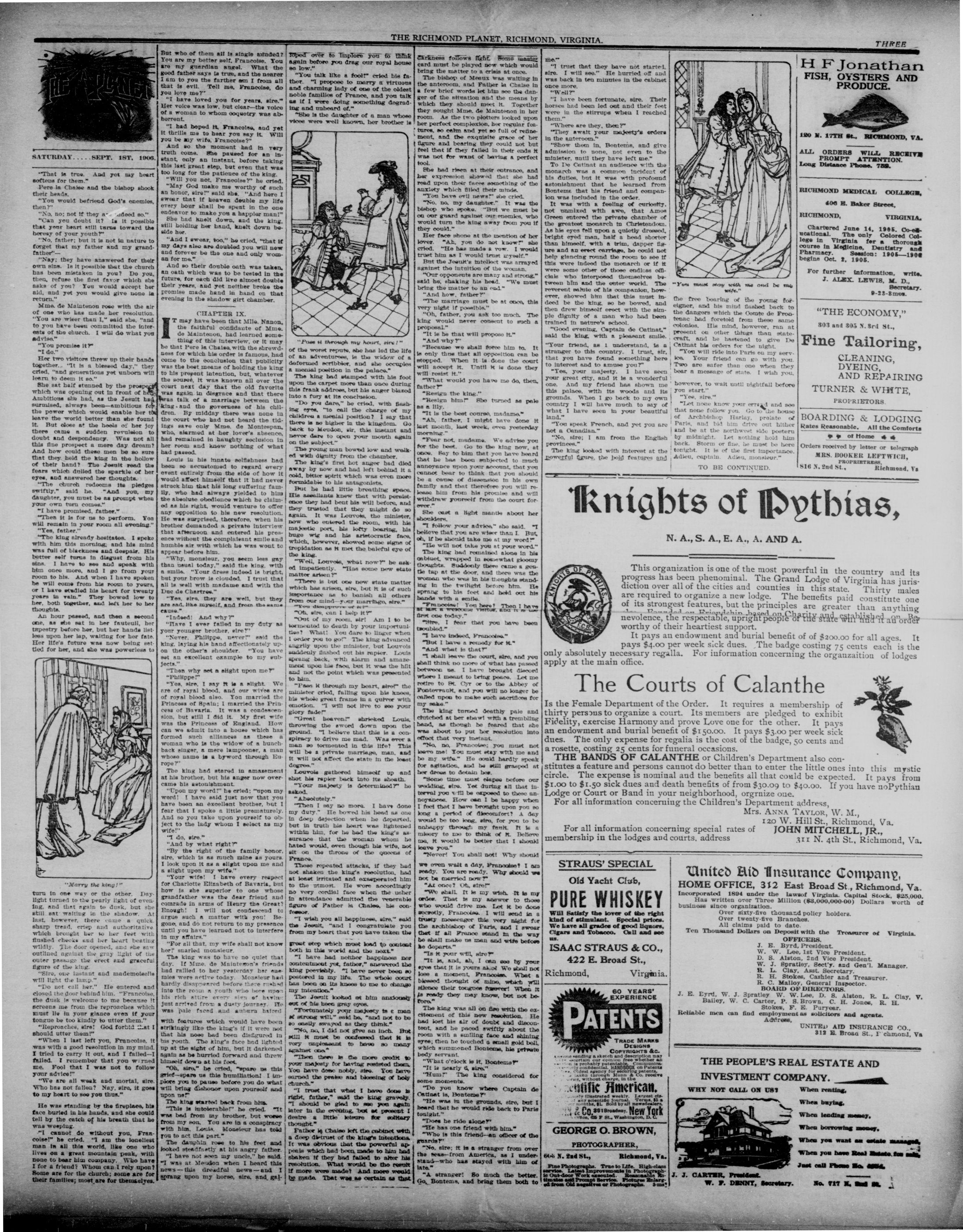
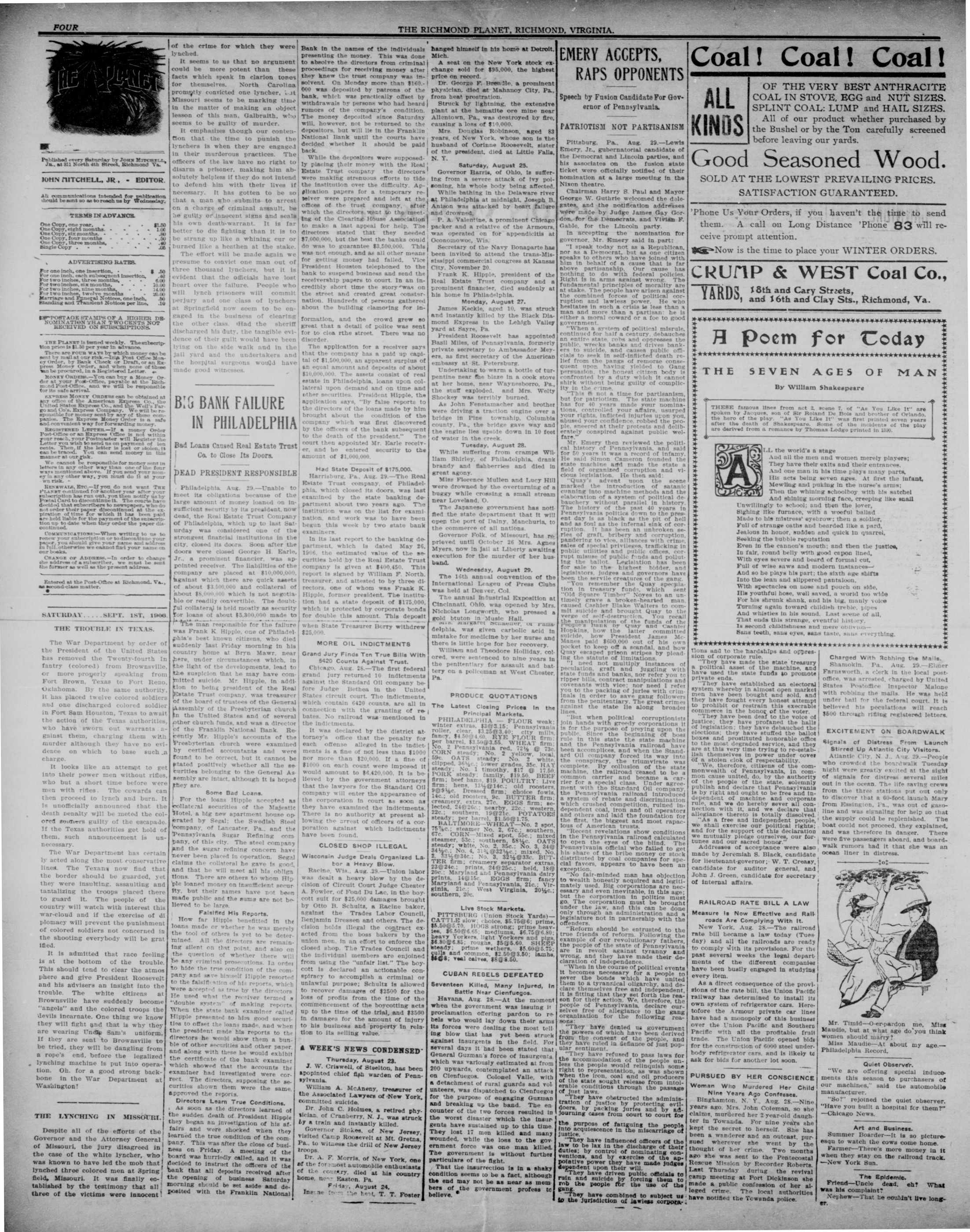
SATURDAY....SEPT. 1ST, 1906.
"That is true. And yet my heart softens for them."
Pere is Chalise and the bishop shook their heads.
"You would befriend God's enemies, then?"
"No, no; not if they are indeed so."
"Can you doubt it? Is it possible that your heart still turns toward the borey of your youth?"
"No, father; but it is not in nature to forget that my father and my grandfather'—
"Nay; they have answered for their own sins. Is it possible that the church has been mistaken in you? Do you, then, refuse the first favor which she asks of you? You would accept her aid, and yet you would give none in return."
Mme de Maintenon rose with the air of one who has made her resolution.
"You are wiser than I," said she, "and to you have been committed the interests of the church. I will do what you advise."
"You promise it?"
"I do."
Her two visitors threw up their bands together. "It is a blessed day," they cried, "and generations yet unborn will learn to deem it so."
She sat half stunned by the prospect which was opening out in front of her. Ambitious she had, as the Jesuit had surmised, always been—ambitious for the power which would enable her to leave the world better than she found it. But close at the boots of her joy there came a sudden revulsion to doubt and despondency. Was not all this fine prospect a more day dream? And how could these men be so sure that they held the king in the hollow of their hand? The Jesuit read the fears which dulled the sparkle of her eyes, and answered her thoughts.
"The church redeems its pledges swiftly," said he. "And you, my daughter, you must be as prompt when your own turn comes."
"I have promised, father." "Then it is for us to perform. You will remain in your room all evening." "Yes, father." "The king already hesitates. I spoke with him this morning, and his mind was full of blackness and despair. His better self turns in disgust from his sins. I have to see and speak with him once more, and I go from your room to his. And when I have spoken be will come from his room to yours, or I have studied his heart for twenty years in vain." They bowed low to her, both together, and left her to her thoughts. An hour passed, and then a second one, as she sat in her fauteuil, her tapestry before her, but her hands listened upon her lap, waiting for her fate. Her life's future was now being settled for her, and she was powerless to
CFR
"Marry the king!"
turn in one way or the other. Daylight turned to the pearly light of evening, and that again to dusk, but she still sat waiting in the shadow. At last, however, there came a quick sharp tread, crisp and authoritative, which brought her to her feet with finished checks and her heart beating wildly. The door opened, and she saw outlined against the gray light of the outer passage the erect and graceful figure of the king.
"Sire, one instant and mademoiselle will light the lamp."
"Do not call her." He entered and closed the door behind him. "Francose, the dusk is welcome to me because it screens me from the reproaches which must lie in your glance even if your tongue be too kindly to utter them."
"Reproaches, sire! God forbid that I should utter them!"
"When I last left you, Francoise, it was with a good resolution in my mind. I tried to carry it out, and I failed—I failed. I remember that you warned me. Fool that I was not to follow your advice!"
"We are all weak and mortal, sire. Who has not fallen? Nay, sire, it goes to my heart to see you thus."
He was standing by the fireplace, his face buried in his hands, and she could tell by the catch of his breath that he was weeping.
"I cannot do without you, Francoise!" he cried. "I am the loneliest man in all this world, like one who lives on a great mountain peak, with none to bear him company. Who have I for a friend? Whom can I rely upon? Some are for the church; some are for their families; most are for themselves.
But who of them all is single minded? You are my better self, Francisele. You are my guardian angel. What the good father says is true, and the nearer I am to you the farther am I from all that is evil. Tell me, Francisele, do you love me?" "I have loved you for years, sire." Her voice was low, but clear—the voice of a woman to whom coquetry was abhorrent. "I had hoped it, Francisele, and yet it thrills me to hear you say it. Will you be my wife, Francisele?" And so the moment had in very truth come. She paused for an instant, only an instant, before taking this last great step, but even that was too long for the patience of the king. "Will you not, Francisele?" he cried. "May God make me worthy of such an honor, sire!" said she. "And here I swear that if heaven破多 my life every hour shall be spent in the one endeavor to make you a harrier man!"
She had knelt down, and the king, still holding her hand, knelt down beside her.
"And I swear, too," he cried, "that if my days also are doubled you will now and forever be the one and only woman for me."
And so their double oath was taken, an oath which was to be tested in the future, for each did live almost double their years, and yet neither broke the promise made hand in hand on that evening in the shadow girt chamber.
CHAPTER IX
It may have been that Mile, Nanon, the faithful confidante of Mme. de Maintenon, had learned something of this interview, or it may be that Pere is Chaise, with the shrewdness for which his order is famous, had come to the conclusion that publicity was the best means of holding the king to his present intention, but, whatever the source, it was known all over the court next day that the old favorite was again in disgrace and that there was talk of a marriage between the king and the governess of his children. By midday there was none in the court who had not heard the tidings save only Mme. de Montespan, who, alarmed at her lover's absence, had remained in haughty seclusion in her room and know nothing of what had passed.
Louis in his innate selfishness had been so accustomed to regard every event entirely from the side of how it would affect himself that it had never struck him that his long suffering family, who had always yielded to him the absolute obedience which he claimed as his right, would venture to offer any opposition to his new resolution. He was surprised, therefore, when his brother demanded a private interview that afternoon and entered his presence without the complaisant smile and humble air with which he was wont to appear before him.
"Why, monsieur, you seem less gray than usual today," said the king, with a smile. "Your dress indeed is bright, but your brow is clouded. I trust that all is well with madame and with the Duc de Chartres."
"Yes, sire, they are well, but they are sad, like myself, and from the same cause."
"Indeed! And why?"
"Have I ever failed in my duty as your younger brother, sir!"
"Never, Phillippe, never!" said the king, laying his hand affectionately upon the other's shoulder. "You have set an excellent example to my subjects."
"Then why set a slight upon me?"
"Phillippe."
"Yea, sir. I say it is a slight. We are of royal blood, and our wives are of royal blood also. You married the Princess of Spain; I married the Princess of Bavaria. It was a condescension, but still I did it. My first wife was the Princess of England. How can we admit into a house which has formed such alliances as these a woman who is the widow of a bunchback singer, a mere lampooner, a man whose name is a byword through Europe."
The king had stared in amazement at his brother, but his anger now overcame his astonishment.
"Upon my word!" he cried; "upon my word! I have said just now that you have been an excellent brother, but I fear that I spoke a little prematurity. And so you take upon yourself to object to the lady whom I select as my wife!"
"I do, sire."
"And by what right?"
"By the right of the family honor, sire, which is as much mine as yours. I look upon it as a slight upon me and a slight upon my wife."
"Your wife! I have every respect for Charlotte Elizabeth of Bavaria, but how is she superior to one whose grandfather was the dear friend and comrade in arms of Henry the Great! Enough! I will not condescend to argue such a matter with you! Begone, and do not return to my presence until you have learned not to interfere in my affairs."
"For all that, my wife shall not know her!" snarled monsieur.
The king was to have no quiet that day. If Mime, de Mainteur's friends had railed to her yesterday her enemies were active today. Monsieur had hardly disappeared before there rushed into the room a youth who bore upon his rich attire every sign of having just arrived from a dusty journey. He was pale faced and auburn haired with features which would have been strikingly like the king's if it were not that his nose had been disfigured in his youth. The king's face had lightened up at the sight of him, but it darkened again as he hurried forward and threw himself down at his foot.
"Oh, sire," he cried, "spare us this grief—spare us this humiliation! I implore you to pause before you do what will bring dishonor upon yourself and upon us!"
The king started back from him.
"This is intolerable!" he cried. "It was bed from my brother, but worse from my son. You are in a conspiracy with him. Louis. Monsieur has told you to act this part."
The dauphin rose to his feet and looked steadfastly at his angry father. "I have not seen my uncle," he said. "I was at Meudon when I heard this news—this dreadful news—and I sprang upon my horse, sire, and gel-
Taped over to Implore you to think again before you drag our royal house so low."
"You talk like a fool!" cried his father. "I propose to marry a virtuous and charming lady of one of the oldest noble families of France, and you talk as if I were doing something degrading and unbeard of."
"She is the daughter of a man whose voices were well known, her mother is
5
"Pause it through my heart, sir!" of the worst repute, she has led the life of an adventuresse, is the widow of a deformed scribbbler, and she occupies a mental position in the palace.
The king had stamped with his foot upon the carpet more than once during this frank address, but his anger blazed into a fury at its conclusion.
"Do you dare," he cried, with flashing eyes, "to call the charge of my children a mental position? I say that there is no higher in the kingdom. Go back to Meudon, sir, this instant and never dare to open your mouth again on the subject."
The young man bowed low and walked with dignity from the chamber.
The king's first hot anger had died away by now and had left behind it a cold, bitter spirit which was even more formidable to his antagonists.
But he had little breathing space. His assailants knew that with persistence they had bent his will before, and they trusted that they might do so again. It was Louvois, the minister, now who entered the room, with his majestic port, his lorry bearing, his huge wig and his aristocratic face, which, however, showed some signs of trepidation as it met the baleful eye of the king.
"Well, Louvois, what now?" be asked impatiently. "Has some new state matter arisen?"
"There is but one new state matter which has arisen, sir, but it is of such importance as to banish all others from our mind, my marriage, sir."
"You despair of me," she said.
"Oh, sir, can I help it?"
"Out of my room, sir! Am I to be tormented to death by your importance? What! You dare to linger when I order you to go!" The king advanced angrily upon the minister, but Louvols suddenly flashed out his rapier. Louis spring back, with alarm and amazement upon his face, but it was the hilt and not the point which was presented to him.
"Pases it through my heart, sir!" the minister cried, falling upon his knees, his whole great frame in a quiver with emotion. "I will not live to see your glory fade."
"Great heaven!" shrieked Louis, throwing the sword down upon the ground. "I believe that this is a conspiracy to drive me mad. Was ever a man so tormented in this life? This will be a private marriage, man, and it will not affect the state in the loosest degrees."
Louvolis gathered himself up and shot his rapier back into its sheath. "Your majesty is determined!" he asked. "Absolutely." "Then I say no more. I have done my duty." He bowed his head as one in deep dejection when he departed, but in truth his heart was lightened within him, for he had the king's assurance that the woman whom he hated would, even though his wife, not sit on the throne of the queens of France. Those repeated attacks, if they had not shaken the king's resolution, had at least irritated and exasperated him to the utmost. He wore accordingly no very cordial face when the usher in attendance admitted the venerable figure of Father la Chalea, his confessor. "I wish you all happiness, sir," said the Jesuit, "and I congratulate you from my heart that you have taken the
great stop which must lead to content both in this world and the next."
"I have had neither happiness nor contentment yet, father," answered the king poevisly. "I have never been so poestered in my life. The whole court has been on its knees to me to change my intention."
The Jesuit looked at him anxiously out of his keen gray eyes.
"Fortunately your majesty is a man of strong will," said be, "and not to be so easily swapped as they think."
"No, no, I did not give an inch. But still it must be confessed that it is very unpleasant to have so many against one."
"Then there is the more credit to your majesty for having assisted them. You have done nobly, also. You have earned the praise and blessing of holy church."
"I trust that what I have done is right, father," said the king gravely. "I should be gled to see you again later in the evening, but at present I desire a little leisure for solitary thought."
Father is Chalise left the cabinet with a deep distrust of the king's intentions. It was obvious that the powerful appeals which had been made to him had shaken if they had failed to alter his resolution. What would be the result if more were made? And more would be made. That was as certain as that
think
house
his fa-
rituons
the oldest
to talk
degrad-
ed
whose
other is
darkness follows light. Some master
card must be played now which would
bring the matter to a crisis at once.
The bishop of Meux was waiting in
the anteroom, and Father la Chise in
a few brief words let him see the dang-
er of the situation and the means by
which they should meet it. Together
they sought Mme. de Maintenon in her
room. As the two plotters looked in
her perfect complexion, her regular fe-
atures, so calm and yet so full of refine-
ment, and the exquisite grace of her
figure and bearing they could not but
feel that if they failed in their ends it
was not for want of having a perfect
tool.
She had risen at their entrance, and her
expression showed that she had
read upon their faces something of the
anxiety which filled their minds.
me."
"I trust that the
sire. I will see."
was back in ten m
once more.
"Well?"
"I have been for
horses had been le
were in the stirr
them."
"Where are they?
They await you
in the anteroom."
"Show them in,
admission to now
minister, until the
To Be Cattat a
monarch was a c
his duties, but it
astonishment that his
Bontent that his
You have evil news. she cried.
"No, no, my daughter." It was the bishop who spoke. "But we must be on our guard against our enemies, who would turn the king away from you if they could."
Her face shone at the mention of her lover. "Ah, you do not know!" she cried. "He has made a row. I would trust him as I would trust myself."
But the Jeouet's intellect was arrayed against the intuition of the woman. "Our opponents are many and strong," said he, shaking his head. "We must bring the matter to an end."
"And how, father?"
"The marriage must be at once, this very night if possible."
"Oh, father, you ask too much. The king would never consent to such a proposal."
"It is he that will propose it."
"And why?"
"Because we shall force him to. It is only thus that all opposition can be stopped. When it is done the court will accept it. Until it is done they will resist it."
"What would you have me do, then, father?"
"Resign the king."
"Resign him!" She turned as pale as a lily.
"It is the best course, madame."
"Ah, father, I might have done it last month, last week, even yesterday morning."
"Fear not, madame. We advise you for the beet. Go to the king now, at once. Say to him that you have heard that he has been subjected to much annoyance upon your account, that you cannot bear to think that you should be a cause of dissension in his own family and that therefore you will release him from his promise and will withdraw yourself from the court forever."
She cast a light mantle about her shoulders.
"I follow your advice," she said. "I believe that you are wiser than I. But, oh, if he should take me at my word."
"He will not take you at your word." The king had remained alone in his onebelt, wrapped in somewhat gloomy thoughts. Suddenly there came a gentle tap at the door, and there was the woman who was in his thoughts standing in the twilight before him. He sprang to his feet and held out his hands with a smile.
"Francoisie. You have! Then I have at last a welcome visitor, and it is the first one today."
"Sire, I fear that you have been troubled."
"I have indeed, Francoisie."
I have blessed, Francoise.
"But I have a remedy for it."
"And what is that?"
"I shall leave the court, sire, and you shall think no more of what has passed between us. I have brought discord where I meant to bring peace. Let me retire to St. Cyr or to the Abbey of Fontenault, and you will no longer be called upon to make such sacrifices for my sake."
The king turned deathly pale and clutched at her abwil with a trembling hand, as though he feared that she was about to put her resolution into effect that very instant.
"No, no, Francoise; you must not leave me! You must stay with me and be my wife." He could hardly speak for agitation, and he still grasped at her dress to obtain her.
"Some time must elapse before our wedding, stre. Yet during all that interval you will be exposed to these annoyances. How can I be happy when I feel that I have brought upon you so long a period of discomfort? A day would be too long, stre. for you to be unhappy through my fault. It is a misery to me to think of it. Believe me, it would be better that I should leave you."
"Never! You shall not! Why should we even wait a day, Francoise? I am ready. You are ready. Why should we not be married now?"
"At once? Oh, stre!"
"We shall. It is my wish. It is my order. That is my answer to those who would drive me. Let it be done secretly, Francoise. I will send in a trusty messenger this very night for the archbishop of Paris, and I swear that if all France stand in the way he shall make us man and wife before he doparts."
"Is it your will, sir?"
"It is, and, ah, I can see by your eyes that it is yours akol. We shall not lose a moment, Francoise. What a blessed thought of mine, which will silence their tougues forever! When it is ready they may know, but not before."
The king was all on fire with the excitement of this new resolution. He had lost his air of doubt and discontent, and he paced swiftly about the room with a smiling face and shining eyes; then he touched a small gold bell, which summoned Bontemis, his private body servant.
"What o'clock is it, Bontemis?"
"It is nearly d, sir."
"Hum!" The king considered for some moments.
"Do you know where Captain de Cutnat is, Bontemis?"
"He was in the grounds, sir, but I heard that he would ride back to Paris tonight."
"Does he ride alone?"
"Who is this friend—an officer of the guards?"
"No, sire; it is a stranger from over the seas—from America, as I understand—who has stayed with him of late."
"A stranger! So much the better. Go, Bontens, and bring them both to
Knights of Pythias,
This organization is one of the most powerful in the country and its progress has been phenomenal. The Grand Lodge of Virginia has jurisdiction over all of the cities and counties in this state. Thirty males are required to organize a new lodge. The benefits paid constitute one of its strongest features, but the principles are greater than anything else. Founded on Friendship based on Charity and established on Resevolence, the respectable, upright people of the state will find it an order worthy of their heartiest support.
It pays an endowment and burial benefit of of $200.00 for all ages. It pays $4.00 per week sick dues. The badge costing 75 cents each is the only absolutely necessary regalla. For information concerning the organization of lodges apply at the main office.
The Courts of Calanthe
Is the Female Department of the Order. It requires a membership of thirty persons to organize a court. Its members are pledged to exhibit Fidelity, exercise Harmony and prove Love one for the other. It pays an endowment and burial benefit of $150.00. It pays $3.00 per week sick dues. The only expense for regalia is the cost of the badge, 50 cents and a rosette, costing 25 cents for funeral occasions.
THE BANDS OF CALANTHE or Children's Department also con-
constitutes a feature and persons cannot do better than to enter the little ones into this mystic circle. The expense is nominal and the benefits all that could be expected. It pays from $1.00 to $1.50 sick dues and death benefits of from $30.09 to $40.00. If you have noPythian Lodge or Court or Band in your neighborhood, orgnize one.
For all information concerning the Children's Department address.
For all information concerning special rates of JOHN MITCHELL, JR., membership in the lodges and courts, address 311 N. 4th St., Richmond, Va.
me."
"I trust that they have not started, sire. I will see." He hurried off and was back in ten minutes in the cabinet once more.
"Well?"
"I have been fortunate, sire. Their horses had been led out and their feet were in the stirrups when I reached them."
"Where are they, then?"
"They await your majesty's orders in the interroom."
"Show them in, Bontemis, and give admission to none, not even to the minister, until they have left me."
To De Cattinat an audience with the monarch was a common incident of his duties, but it was with profound astonishment that he learned from Bontemis that his friend and companion was included in the order.
It was with a feeling of curiosity, not unmixed with awe, that Amos Green entered the private chamber of the greatest monarch in Christendom. As his eyes tell a quietly dressed, bright eyed man, half a head shorter than himself, with a trim, dapper figure and an erect carriage, he could not help glancing round the room to see if this were indeed the monarch or if it were some other of those endless officials who interposed themselves between him and the outer world. The reverent salute of his companion, however, showed him that this must indeed be the king, so he bowed, and then drew himself erect with the simple dignity of a man who had been trained in nature's school. "Good evening, Captain de Catimat," said the king, with a pleasant smile. "Your friend, as I understand, is a stranger to this country. I trust, sir, that you have found something here to interest and to amuse you?"
"Yes, your majesty. I have seen your great city, and it is a wonderful one. And my friend has shown me this palace, with its woods and its grounds. When I go back to my own country I will have much to say of what I have seen in your beautiful land."
"You speak French, and yet you are not a Canadian."
"No, sire; I am from the English provinces."
The king looked with interest at the powerful figure, the hold features and
Knight
KNIGHTS OF PYTHIKS.
F.C.B.
only absolutely necessary rega
apply at the main office.
The Court
Is the Female Department of the
thirty persons to organize a co-
Fidelity, exercise Harmony and
an endowment and burial bene-
dues. The only expense for re-
a rosette, costing 25 cents for f
THE BANDS OF CALA
stitutes a feature and persons o
circle. The expense is nomin-
$1.00 to $1.50 sick dues and do
Lodge or Court or Band in you
For all information concern
For all information cone
membership in the lodges and
STRAUS' SPECIAL
Old Yacht Club,
PURE WHISKEY
Will Satisfy the lover of the right kind of stimulant. Special prices. We have all grades of good liquors, Cigars and Tobacco. Call and see us. ISAAC STRAUS & CO.,
422 E. Broad St.,
Richmond, Virginia.
60 YEARS' EXPERIENCE
PATENTS
TRADE MARKS DESIGNS
COPYRIGHTS & C.
receive sending a sketch of the complaint may
provide our copyright free library with
a probable communication of confidential
communicational. HANDBOOK
Odest agent for securing patents.
been through Munn & Co. receive
without charge. Mail without charge.
nificent American.
illustrated weekly. Largest cis-
sary and largest stock. Sold by newdealer.
Co. 381 Broadway, New York
Oceo & F St. Washington, D.C.
GEORGE O. BROWN.
Fine Photographs. True to Life. High-class
service. Latest Improvements in Photographic
Out-door Work executed. Reasonable B
estimates and Proven Services. Photography Balanced
from Old negatives or Photographs. $250*
A
"You must stay with me and be my wife."
the free boaring of the young foreigner, and his mind dashed back to the dangers which the Comte de Frontenac had foretold from these same colonies. His mind, however, ran at present on other things than statecraft, and he hastened to give De Octhat his orders for the night.
"You will ride into Paris on my service. Your friend can go with you. Two are safer than one when they bear a message of state. I wish you, however, to wait until nightfall before you start."
"Let none know your errs and see that none follow you. Go to the house of Archbishop Harlay, prolate of Paris, and bid him drive out hither and be at the northwest side posterun by midnight. Let nothing hold him back. Storm or fine, he must be here tonight. It is of the first importance. Adieu, captain. Adieu, monsieur."
TO BE CONTINUED.
hts of Pythia N. A., S. A., E. A., A. AND A.
organization is one of the most powerful has been phenomenal. The Grand Court all of the cities and counties in need to organize a new lodge. The biggest features, but the principles based on Friendship based on Charity the respectable, upright people of their heartiest support. An endowment and burial benefit of $20 per week sick dues. The badge of galla. For information concerning courts of Calantia of the Order. It requires a member court. Its members are pledged and prove Love one for the other. Benefit of $150.00. It pays $3.00 per regalia is the cost of the badge, 500 funeral occasions.
ANTHE or Children's Department I cannot do better than to enter the final and the benefits all that could death benefits of from $30.09 to $40our neighborhood, orgnize one, joining the Children's Department as
the most powerful in the col-
tial. The Grand Lodge of Virg
and counties in this state.
new lodge. The benefits paid
the principles are greater t
based on Charity and estab
right people of the state will
import.
burial benefit of of $200.00 for
s. The badge costing 75 cen-
tion concerning the organzai
Calanthe
requires a membership of
are pledged to exhibit
for the other. It pays
pays $3.00 per week sick
of the badge, 50 cents and
men's Department also con-
an to enter the little ones int
all that could be expected.
from $30.09 to $40.00. If you
orgrnize one.
Department address,
Mrs. ANNA TAYLOR, W. M.,
United Aid Insurance
HOME OFFICE, 312 East
Incorporated 1804 under the laws
Has written over Three Million
business since organization.
Over sixty-five thousand
Over twenty-five Branches
All claims paid to date.
Ten Thousand Dollars on Deposit
OFFICE
J. E. Byrd,
W. W. Lee,
D. S. Alston,
W. J. Spratley
R. L. Clay,
R. H. Stokes,
R. C. Malloy,
BOARD OF
J. E. Eyrd, W. J. Spratley W. W. I.
Bailey, W. C. Carter, P. S. I.
Stokes, F. I.
Reliable men can find employment at
Address,
THE PEOPLE'S REAL
INVESTMENT COMPANY
WHY NOT CALL ON US?
Mid Insurance Company
CE, 312 East Broad St., R.
at under the laws of Virginia. Capita
over Three Million ($3,000,000-00)
organization.
twenty-five thousand policy holders.
twenty-five Branches.
ims paid to date.
dollars on Deposit with the Treasu
OFFICERS.
J. E. Byrd, President.
W. W. Lee, 1st Vice President.
D. S. Alston, 2nd Vice President.
W. J. Spratley, Secty. and G.
R. L. Clay, Asst Secretary.
R. H. Stokes, Cashier and Tr.
R. C. Malloy, General Inspector
BOARD OF DIRECTORS.
Spratley W. W. Lee, D. S. Alston
C. Carter, P. S. Brown, C. H. Jo
Stokes, F. E. Puryear.
find employment as solicitors and
Address,
UNITED AID INST
312 E. Broad
PEOPLE'S REAL ESTATE A
MENT COMPANY.
L ON U87 When renting.
United Aid Insurance Company.
THE PEOPLE'S REAL ESTATE AND
J. J. CARTER, President.
W. P. DENNY, Secretary.
Widem.
NNY, Secretary. No. 717 M. B
H F Jonathan FISH, OYSTERS AND PRODUCE.
120 N. 17TH St., RICHMOND, VA.
ALL ORDERS WILL RECEIVE
PROMPT ATTENTION.
Long Distance Phone. 759.
406 E. Baker Street.
Chartered June 14, 1905. Co-educational. The only Colored College in Virginia for a thorough course in Medicine, Dentistry and Pharmacy. Session: 1905—1908 begins Oct. 2, 1905.
For further information, write,
J. ALEX. LEWIS, M. D.,
Secretary.
9-23-8mos.
"THE ECONOMY,"
303 and 305 N. 3rd St.
CLEANING,
DYEING,
AND REPAIRING
TURNER & WHITE,
PROPRIETORS.
BOARDING & LODGING
Rates Reasonable. All the Comforts
of Home
Orders received by letter or telegraph
MRS. BOOKER LEFTWICH,
PROPRIETRESS,
816 N. 2nd St. Richmond, Va.
ythias,
A.
powerful in the country and its
Lodge of Virginia has juris-
in this state. Thirty males
the benefits paid constitute one
are greater than anything
parity and established on Re-
of the state will find it an order
of of $200.00 for all ages. It
the costing 75 cents each is the
ing the organizaition of lodges
ment also con-
tinue little ones into this mystic
d be expected. It pays from
$40.00. If you have noPythian
address,
TAYLOR, W. M.,
Hill St., Richmond, Va.
N MITCHELL, JR.,
311 N. 4th St., Richmond, Va.
Insurance Company,
First Broad St., Richmond, Va.
of Virginia. Capital Stock, $25,000.
on ($3,000,000-00) Dollars worth of
and policy holders.
ches.
e.
THREE
M
FOUR
THE PLANET
Published every Saturday by JOHN MITCHELL,
JR., at 811 North 4th Street, Richmond Va.
JOHN MITCHELL, JR., - EDITOR.
All communications intended for publication
should be sent so as to reach us by Wednesday,
TERMS IN ADVANCE.
One Copy, one year.
One Copy, eight months.
One Copy, six months.
One Copy, four months
One Copy, three months.
Single Copy
ADVERTISING RATES
For one inch, one insertion, $50
For one inch, each subsequent insertion, $40
For two inches, three months, $6.00
For two inches, six months, $10.00
For two inches, nine months, $14.00
For two inches, twelve months
Marriage and General Notices, one inch, $50
Standing and Transient Notices per line, $10
INPOSTAGE STAMPS OF A HIGHER DEMOGNINATION THAN TWO CENTS NOT RECEIVED ON SUBSCRIPTIONS.
THE PLANET is issued weekly. The subscription price is $1.50 per year in advance.
There are four ways by which money can be sent to the station for the Office Money Order, by Bank Check or Draft, or on Express Money Order, and when none of those can be procured, in a Registered Letter.
Money Orders.—You can buy a Money Order at your Post Office, payable at the Richmond Post Office and we will be responsible for the original.
EXPRESS MONEY ORDERS can be obtained at any office of the American Express Co., the United States Express Co., and the Well's Fargo and Co's Express Company. We will be responsible for money sent by any of these companies. The Express Money Order is a safe and convenient way for forwarding money.
REGISTERED LETTER—If a money Order Post-Office or an Express Office is not within your reach, your Postmaster will Register the money upon receipt of a payment of its cents. Then, if the letter is lost or stolen, it can be traced. You can send money in this manner at our risk.
We cannot be responsible for money sent in letter or other way than one of the four ways mentioned above. If you send your money in any other way, you must do it at your win risk.
REMEMBER ERO. If you do not want THE PRICE continued for another year, your subscription has run out, you then notify us by Postal Card to discontinue it. The courts have decided that subscribers to newspaper, who do not pay the price, are not the recipient of time for which it has been paid, are held liable for the payment of the subscription up to date when they order the paper discontinued.
INCORPORATIONS—When writing to us to renew your subscription or to discontinue your paper, you should give your name and address in full, otherwise we cannot find your name on our books.
OR ADDRESS—In order to change the address of a subscriber, we must be sent the former as well as the present address.
Entered at the Post-Office at Richmond. Va., as second-class matter.
THE TROUBLE IN TEXAS.
The War Department by order of the President of the United States has removed the Twenty-fourth Infantry (colored) from Brownsville, or more properly speaking from Fort Brown, Texas to Fort Reno, Oklahoma. By the same authority, it has placed twelve colored soldiers and one discharged colored soldier in Fort Sam Houston, Texas to await the action of the Texas authorities, who have sworn out warrants against them, charging them with murder although they have no evidence on which to base such a charge.
It looks like an attempt to get into their power men without rifles, who but a short time before were men with rifles. The cowards can then proceed to lynch and burn. It is unofficially announced that the death penalty will be meted the colored soldiers guilty of the escapade. If the Texas authorities get hold of them, such announcement is unnecessary.
The War Department has certainly acted along the most conservative line. The Texans now find that the border should be guarded, yet they were insulting, assaulting and tantalizing the troops placed there to guard it. The people of the country will watch with interest this war-cloud and if the exercise of diplomacy will prevent the punishment of colored soldiers not concerned in the shooting everybody will be gratified.
It is admitted that race feeling is at the bottom of the trouble This should tend to clear the atmosphere and give President Roosevelt and his advisers an insight into the trouble. The white citizens at Brownsville have suddenly become "angels" and the colored troops the devils incarnate. One thing we know they will fight and that is why they are wearing Uncle Sam's uniform. If they are sent to Brownsville to be tried, they will be dangling from a rope's end, before the legalized lynching machine is put into operation. Oh. for a good strong backbone in the War Department at Washington!
THE LYNCHING IN MISSOURI
Despite all of the efforts of the Governor and the Attorney General of Missouri, the jury disagreed in the case of the white lyncher, who was known to have led the mob that lynched three colored men at Spring field, Missouri. It was finally established by the testimony that all three of the victims were innocent
of the crime for which they were lynched. It seems to us that no argument could be more potent than these facts which speak in clarion tones for themselves. North Carolina promptly convicted one lyncher, but Missouri seems to be marking time in the matter of making an object lesson of this man, Galbraith, who seems to be guilty of murder.
It emphasizes though our contention that the time to punish the lynchers is when they are engaged in their murderous practices. The officers of the law have no right to disarm a prisoner, making him absolutely helpless if they do not intend to defend him with their lives if necessary. It has gotten to be so that a man who submits to arrest on a charge of criminal assault, be guilty or innocent signs and seals his own death-warrant. It is far better to die fighting than it is to be strung up like a whining cur or burned like a heaten at the stake.
The effort will be made again we presume to convict one man out of three thousand lynchers, but it is evident that the officials have lost heart over the failure. People who will lynch prisoners will commit perjury and one class of lynchers at Springfield now seem to be engaged in the business of clearing the other class. Had the sheriff discharged his duty, the tangible evidence of their guilt would have been lying on the side walk and in the jail yard and the undertakers and the hospital surgeons would have made good witnesses.
BIG BANK FAILURE IN PHILADELPHIA
Bad Loans Caused Real Estate Trust
Ca. to Close Its Doors.
DEAD PRESIDENT RESPONSIBLE
Philadelphia. Aug. 29.—Unable to meet its obligations because of the large amount of money loaned on insufficient security by its president, now dead, the Real Estate Trust Company of Philadelphia, which up to last Saturday was considered one of the strongest financial institutions in the city, closed its doors. Soon after the doors were closed George H. Earle, Jr., a prominent financier, was appointed receiver. The liabilities of the company are placed at $10,000,000 against which there are quick assets of about $3,500,000 and collateral of about $8,000,000 which is not negotiable or readily convertible. The doubtful collateral is held mostly as security for loans of about $5,300,000 made to the man responsible for the failure was Frank K. Hipple, one of Philadelphia's best known citizens, who died suddenly last Friday morning in his country home at Bryn Mawr, near here, under circumstances which, in the light of the developments, lead to the suspicion that he may have committed suicide. Mr. Hipple, in addition to being president of the Real Estate Trust company, was treasurer of the board of trustees of the General Assembly of the Presbyterian church in the United States and of several other church funds, and was a director of the Franklin National Bank. Recently Mr. Hipple's accounts of the Presbyterian church were examined by certified accounts and were found to be correct, but it cannot be stated positively whether all the securities belonging to the General Assembly are intact, although it is hoped they are.
Some Bad Loans
For the loans Hipple accepted as collateral securities of the Majestic Hotel, a big new apartment house operated by Segal; the Swedish Steel company, of Lancaster, Pa., and the Pennsylvania Sugar Refining company, of this city. The steel company and the sugar refining concern have never been placed in operation. Segal claims the collateral he gave is good, and that he will meet all his obligations. There are others to whom Hipple loaned money on insufficient security, but their names have not been made public and the sums are not believed to be large.
Falsified His Reports.
How far Hipple benefitted in the loans made or whether he was merely the tool of others is yet to be determined. All the directors are remaining silent on that point, and also on the question of whether there will be any criminal prosecutions. In order to hide the true condition of the company and save himself Hipple resorted to the falsification of his reports, which were accepted as true by the directors. He used what the receiver termed a "double system" of making reports. When the state bank examiner called Hipple presented to him good securities to offset the loans made, and when the president made his reports to the directors he would show them a bumble of other securities and other paper, and along with these he would exhibit the certificate of the bank examiner which showed that the accounts the examiner had investigated were correct. The directors, supposing the securities shown them were the same, approved the reports.
Directors Learn True Conditions.
As soon as the directors learned of the sudden death of President Hipple they began an investigation of his affairs and were shocked when they learned the true condition of the company. This was after the close of business on Friday. A meeting of the board was hurriedly called, and it was decided to instruct the officers of the bank that all deposits received after the opening of business Saturday morning should be set aside and deposited with the Franklin National
THE RICHMOND PLANET. RICHMOND. VIRGINIA
Bank in the names of the individuals presenting the money. This was done to absolve the directors from criminal proceedings for receiving money after they knew the trust company was insolvent. On Monday more than $160,000 was deposited by patrons of the bank, which was practically offset by withdrawals by persons who had heard rumors of the company's condition. The money deposited since Saturday will, however, not be returned to the depositors, but will lie in the Franklin National Bank until the courts have decided whether it should be paid back.
While the depositors were supposedly placing their money with the Real Estate Trust company the directors were making strenuous efforts to tide the institution over the difficulty. Application papers for a temporary receiver were prepared and left at the offices of the trust company, after which the directors went to the meeting of the Clearing House Association to make a last appeal for help. The directors stated that they needed $7,000,000, but the best the banks could do was to guarantee $3,500,000. This was not enough, and as all other means for getting money had failed, Vice President Houston telephoned to the bank to suspend business and send the receivership papers to court. In an incredibly short time the story was on the street and created great consternation. Hundreds of persons gathered about the building clamoring for in-
formation, and the crowd grew so great that a detail of police was sent for to clea rthe street. There was no disorder.
The application for a receiver says that the company has a paid up capital of $1,500,000, an apparent surplus of an equal amount and deposits of about $10,000,000. The assets consist of real estate in Philadelphia, loans upon collateral upon demand and on time and other securities. President Hipple, the application says, "By false reports to the directors of the loans made by him brought about the condition of the company which was first discovered by the officers of the bank subsequent to the death of the president." The court then appointed Mr. Earle receiver, and he entered security to the amount of $1,000,000.
Had State Deposit of $175,000
Harrisburg, Pa. Aug. 29.—The Real Estate Trust company, of Philadelphia, which closed its doors, was last examined by the state banking department about two years ago. The institution was on the list for examination, and work was to have been begun this week by two state bank examiners.
In its last report to the banking department, which is dated May 25, 1906, the estimated value of the securities held by the Real Estate Trust company is given at $400,450. This report is signed by William F. North, treasurer, and attested to by three directors, one of whom was Frank K. Hipple, former president. The institution had a state deposit of $175,000, which is protected by corporate bonds for double this amount. This deposit when State Treasurer Berry withdrew $25,000.
MORE OIL INDICTMENTS
Grand Jury Finda Ten True Bills With
5420 Counta Acantet, Trout
Chicago. Aug. 28.—The first federal grand jury returned 10 indictments against the Standard Oil company before Judge Bethea in the United States circuit court. The indictments, which contain 6420 counts, are all in connection with the granting of rebates. No railroad was mentioned in the indictments.
It was declared by the district attorney's office that the penalty for each offense alleged in the indictments is a fine of not less than $1000 nor more than $20,000. If a fine of $1000 on each count were imposed it would amount to $6,420,000. It is believed by the government attorneys that the lawyers for the Standard Oil company will enter the appearance of the corporation in court as soon as they have examined the indictments. There is no authority at present allowing the arrest of officers of a corporation against which indictments have been found.
CLOSED SHOP ILLEGAL
Wisconsin Judge Deals Organized Labor a Heavy Blow.
Racine, Wis., Aug. 29. —Union labor was dealt a heavy blow by the decision of Circuit Court Judge Chester A. Fowler, of Fond Du Lac, in the boycott suit for $25,000 damages brought by Otto B. Schultz, a Racine baker, against the Trades Labor Council, Benjamin Dressen and others. The decision holds illegal the contract exacted from the boss bakers by the union men, in an effort to enforce the closed shop. The Trades Council and the individual members are enjoined from using the "unfair list." The boycott is declared an actionable conspiracy to accomplish a criminal or unlawful purpose; Schultz is allowed to recover damages of $2500 for the loss of profits from the time of the commencement of the boycottting acts up to the time of the trial, and $3500 in damages for the amount of injury to his business and property in relation to its selling value.
WEEK'S NEWS CONDENSED
Thursday, August 23.
J. W. Criswell, of Steelton, has been appointed chief fish warden of Pennsylvania.
William A. McAneny, treasurer of the Associated Lawyers of New York, committed suicide.
Dr. John C. Holmes, a retired physician, of Cranberry, N. J., was struck by a train and instantly killed.
Governor Stokes, of New Jersey, visited Camp Roosevelt at Mt. Gretna, Pa., to witness the drill of New Jersey troops.
Dr. A. F. Morris, of New York, one of the foremost automobile enthusiasts of the country, died at his country home, near Easton, Pa.
Friday, August 24.
Insane from the heat, T. T. Foster
hanged himself in his home at Detroit, Mich.
A seat on the New York stock exchange sold for $95,000, the highest price on record.
Dr. George F. Brendle, a prominent physician, died at Mahanoy City, Pa., from heat prostration.
Struck by lightning, the extensive plant at the hatmatite ore mine near Allentown, Pa., was destroyed by fire, causing a loss of $10,000.
Mrs. Douglas Robinson, aged 83 years, of New York, whose son is the husband of Corinne Roosevelt, sister of the president, died at Little Falls, N. Y.
Saturday. August 25.
Governor Harris, of Ohio, is suffering from a severe attack of ivy poloning, his whole body being affected. While bathing in the Delaware river at Philadelphia at midnight, Joseph B. Anison was attacked by heart failure and drowned. P. A. Valentine, a prominent Chicago packer and a relative of the Armours, was operated on for appendicitis at Oconomowoc, Wis. Secretary of the Navy Bonaparte has been invited to attend the trans-Mississippi commercial congress at Kansas City, November 20. Frank K. Hipple, president of the Real Estate Trust company and a prominent financier, died suddenly at his home in Philadelphia. Monday, August 27. James Keckle, aged 10, was struck and instantly killed by the Black Diamond Express in the Lehigh Valley yard at Sayre, Pa.
President Roosevelt has appointed Basil Miles, of Pennsylvania, formerly private secretary to Ambassador Meyers, as first secretary of the American embassy at St. Petersburg.
Undertaking to warm a bottle of turpentine near the blaze in a cook stove at her home, near Waynesboro, Pa., the stuff exploded, and Mrs. Welty Shockey was terribly burned.
As John Fenstamacher and brother were driving a traction engine over a bridge in Pine township, Columbia county, Pa., the bridge gave way and the engine lies upside down in 10 feet of water in the creek.
Tuesday, August 28.
While suffering from cramps William Shirley, of Philadelphia, drank brandy and fishberries and died in great agony.
Miss Florence Mullen and Lucy Hill were drowned by the overturning of a buggy while crossing a small stream near Loveland, O.
The Japanese government has notified the state department that it will open the port of Dalny, Manchuria, to the commerce of all nations. Governor Folk, of Missouri, has reprieved until October 26 Mrs. Agnes Myers, now in jail at Liberty awaiting execution for the murder of her husband.
Wednesday, August 29.
The 16th annual convention of the International League of Press Clubs was held at Denver, Col.
The annual Industrial Exposition at Cinnnacht, Ohio, was opened by Mrs. Nicholas Longworth, who pressed a gold buton in Music Hall.
Mrs. Margaret Schenauer, or runadelphia, was given carbolic acid in mistake for medicine by her nurse and there is little hope for her recovery.
William and Theodore Holliday, colored, were sentenced to nine years in the penitentiary for assault and battery on a policeman at West Chester, B
PRODUCE QUOTATIONS
The Latest Closing Prices In the Principal Markets.
PHILADELPHIA — FLOUR weak; winter exerts, $3@1.35; Pennsylvania roller, clear, $3.25@3.40; city fancy, $4.50; fancy, $4.50; RYE FLOUR firm per barrel, $3.50@3.55. WHEAT firm No. 2 Pennsylvania red, 72½@73; CORN steady; No. 2 yellow, local, 59c. OATS steady; No. 2 white, clipped, 36½c; lower grades, 35c. HAY steady; No. 1 timothy, $17@17.50 FORK steady; family, $19.50 BEEF firm; bee hams, $19. POULTRY: Live firm; bees, 13½@14c; old roosters, 9@16c; Dresden roosters, 9c BUFFER firm, 14c; old roosters, 9c BUFFER firm, creamy extra, 27c. EGGS firm selected, 24@26c; nearby, 22c; western, 22c; southern, 19@21c. POTATOES steady; per barrel, $1.60@1.75.
BALTIMORE—WHEAT—No. 2 spot, 75% cie, steamer No. 2, 67%; southern, 67%; CORN—Mixed spot, 55%; mixed southern, 58% cie; OATS steady; white, 58% cie; 42% cie; No. 4, 31%; 42% cie; mixed, 2, 33% cie; No. 3, 32% cie; BUTTER firm; creamy separator extras, 22% cie; prints, 24% cie; held, 18% 20%; Maryland and Pennsylvania dairy EGGS firm; fancy Maryland and Pennsylvania, 21%; Virginia, 21%; West Virginia, 20%; southern, 20%
Live Stock Markets
PITTSBURG (Union Stock Yards)—
CATTLE slow; choice, $7.55; $6; prime,
$5.50@7.50. HOGS strong; prime heavies,
$6.50@7.50. mediums, $6.75@8.50.
Yorkers, light Yorkers and pigs,
$6.50@8.50. choice, $6.75@8.50.
steady; prime, cattle, $6.50@7.55.
culls and common, $2.50@3.50; lambs,
$6@8.50; veal calves, $6@8.50.
CUBAN REBELS DEFEATED
Seventeen Killed, Many Injured, In Battle Near Cienfuegos.
Havana, Aug. 28.—At the moment when the government was issuing it proclamation offering pardon to rebels who would lay down their arms its forces were dealing the most telling blow that has yet been struck against insurgents in the field. For several days it had been stated that General Guzman's force of insurgents, which was variously estimated at from 200 upwards, contemplated an attack on Clenfuegos. Colonel Valle, with a detachment of rural guards and volunteers, was dispatched to Clenfuegos for the purpose of engaging Guzman and breaking up the band. The encounter of the two forces resulted in the worst disaster which the insurgents have sustained up to this time. They lost 17 men killed and many wounded, while the loss to the government force was one man killed. The government is without further particulars of the fight.
That the insurrection is in a shaky condition seems to be a fact, although the end may not be as near as members of the government profess to believe.
EMERY ACCEPTS, RAPS OPPONENTS
Speech by Fusion Candidate For Governor of Pennsylvania.
PATRIOTISM NOT PARTISANISM
Pittsburg, Pa., Aug. 29.—Lewis Emery, Jr., gubernatorial candidate of the Democrat and Lincoln parties, and his associates on the fusion state ticket were officially notified of their nomination at a large meeting in the Nixon theatre.
Chairman Harry S. Paul and Mayor George W. Guthrie welcomed the delegates, and the notification addresses were made by Judge James Gay Gordon, for the Democrats, and Vivian F. Gable, for the Lincoln party.
in accepting the nomination for governor, Mr. Emery said in part:
"I speak today not as a Republican, nor as a Democrat, but as one citizen speaks to others who have joined with him in behalf of a cause that is far above partisanship. Our cause has been that we have policies. Right is in arms against wrong fundamental principles of morality are at stake. The people have arisen against the combined forces of political corruption and lawless power. He who hesitates in such a crisis is less than a man and more than a partisan: he is either a moral coward or a foe to good government."
"When a system of political misrule, continued for half a century, debauches an entire state, robs and oppresses the public, wrecks banks and drives bankers to suicide, and causes public officials to seek in self-inflicted death relief from the pangs of remorse consequent upon having yielded to Gangsters, the honest citizen body is confronted by which it cannot shirk without being guilty of complicity in the crime.
"This is not a time for partisanism, but for patriotism. The state machine has for 40 years made your nominations, controlled your affairs, usurped your rights, inflicted injuries upon you, seized your property, pleaded, smeered at their protests and deliberately conspired against public welfare."
Mr. Emery then reviewed the political history of Pennsylvania, and said for 50 years it was a record of infamy. He then Simon Cameron founded the state manor of the state a field of organized corruption and vicious legislation. He then said:
"Quay's advent upon the scene marked the introduction of satanic cunning into machine methods and the elaboration of a system of political deception. The history of the past 40 years in Pennsylvania politics down to the present day is as black as the pit of hell and as foul as the infernal sink of corruption. It has been an unbroken secession, it has been an unbroken corruption, pandering to vice, alliances with sales of special privileges, trafficking in public utilities and public offices, corrupt misuse of public funds and polluting the ballot. Legislation has been for sale to the highest bidder, and have been the service creations of the great
"You remember the Quay speculation in treasury funds, which sent "Old Square Timber" Noyes to an untimely grave a broken-hearted man caused Cashier Blake Walters to commit suicide and brought Quay to the verge of self-destruction. You recall the manipulation of the funds of the Hopkins, how the Quay and Cashier Hopkins, how the Jawer committed suicide, how President James M. Manes paid $600,000 out of his own pocket to keep off a scandal, and how Quay escaped prison stripes by pleading the statute of limitations.
"I need not multiply instances of peckulation, graft and jugling with state funds and banks, nor refer you to rippler bills, contract manipulations and covenants with vice; nor need I refer you to the packing of juries with criminologists, the gang followers from the penitentiary. The great crimes against the state lie along broader lines.
"But when political corruptionists join hands with greedy corporations it is for the purpose of preying upon the public. Since the beginning of boss rule in this state the state machine and the Pennsylvania railroad have been complacens, and when the Standard Oil company has lay inay into the conspiracy, the triumvirate complete. By collusion of the state machine, the railroad ceased to be a common carrier and became a carrier for a special class. Under agreement with the Standard Oil company, the Pennsylvania railroad introduced a system of rebate and discrimination in the competition, ruined independent coal, oil, gas, operators and others and laid the foundation for the first, the biggest and the most rapacious of American trusts.
"Recent revelations show conditions in the Pennsylvania railroad calculated to open the eyes of the blind. The Pennsylvania official who failed to get the share of the bribe money or stock list issued by the coal companies for special favors, appears to have been an exception.
"No fair-minded man has objection to wealth honestly acquired and legitimately used. Big corporations are necessary and even inevitable, in this age; but the corporation in politics must the corporation must be brought under the law. None only through an administration and a legislature not in partnership with the offenders.
"Reform should be entrusted to the true friends of reform. Following the example of our revolutionary fathers, the example of our state of Pennsylvania are in revolt against tyranny and wrong, and they have made their declaration of independence.
"When in the course of political events it becomes necessary for a people to sever the bonds which have united them to a tyrannical oligarchy, and declare themselves free and independent, and declare themselves free and independent, and declare themselves free and independent, and declare themselves free of allegiance to the gang organization for the following reasons:
"They have denied us government the powers of which have been derived from the consent of the people, and they have denied us in defiance of just popular sentiment.
"They have refused to pass laws for the accommodation of the people unless the people would relinquish some right to representation, as was shown when the iron, coal and oil producers in the country sought release from intolerable conditions through the passage of just laws.
"They have obstructed the administration of justice by protecting evil-doers, by packing juries and by adjourning cases from court to court for the purpose of fatiguing the people into acquiescence in the miscarriage of justice.
"They have influenced officers of the law to be lax in the discharge of their duties by control of nominating conventions and by exercise of the appetitive power they made judges dependent upon their will.
"They have driven public officials to ruin and suicide by forcing them to rob the people for the use of the gang.
"They have combined to subject us to the jurisdiction of lawless corpora-
Coal! Coal! Coal!
OF THE VERY BEST ANTHRACITE COAL IN STOVE, EGG and NUT SIZES. SPLINT COAL: LUMP and HAIL SIZES. All of our product whether purchased by the Bushel or by the Ton carefully screened before leaving our yards.
SOLD AT THE LOWEST PREVAILING PRICES. SATISFACTION GUARANTEED.
'Phone Us Your Orders, if you haven't the time to send them. A call on Long Distance 'Phone 83 will receive prompt attention.
Now is the time to place your WINTER ORDERS.
YARDS, 18th and Cary Streets and 16th and Clay Sts., Richmond, Va.
THE SEVEN AGES OF MAN
By William Shakespeare
THESE famous lines from act 2, scene 7, of "As You Like It" are spoken by Jacques, son of Sir Roland De Bols and brother of Orlando, the hero of the play. "As You Like It" was first printed seven years after the death of Shakespeare. Some of the incidents of the play are derived from a romance by Thomas Lodge printed in 1830.
nines from act 2, scene 7. of "As You Like It" are
son of Sir Roland De Bois and brother of Orlando,
ay. "As You Like It" was first printed seven years
of Shakespeare. Some of the incidents of the play
romance by Thomas Lodge printed in 1890.
THESE famous lines from act 2, scene 7, of "As You Like It" are spoken by Jacques, son of Sir Roland De Bols and brother of Orlando, the hero of the play, "As You Like It" was first printed seven years after the play, Shadow Shift, of the play are derived from a romance by Thomas Lodge printed in 1830.
LL the world's a stage
And all the men and women merely players;
They have their exits and their entrances.
And one man in his time plays many parts.
His acts being seven ages. At first the infant,
Mewling and puking in the nurse's arms;
Then the whining schoolboy with his satchel
And shining morning face, creeping like snail
Unwillingly to school; and then the lover,
Sighing like furnace, with a woeful ballad
Made to his mistress' eyebrow; then a soldier,
Full of strange oaths and bearded like a pard,
Jealous in honor, sudden and quick in quarrel,
Seeking the bubble reputation
Even in the cannon's mouth; and then the justice,
In fair, round belly with good capon lined,
With eyes severe and beard of formal cut,
Full of wise saws and modern instances—
And so he plays his part; the sixth age shifts
Into the lean and slipped pantaloon,
With spectacles on nose and pouch on side,
His youthful hose, well saved, a world too wide
For his shrunk shank, and his big, manly voice
Turning again toward childish treble, pipes
And whistles in his sound. Last scene of all,
That ends this strange, eventful history,
Is second childishness and mere oblivion—
Sans teeth, sans eyes, sans taste, sans everything.
Unwillingly to school; and
Sighing like furnace, with
Made to his mistress' eyes
Full of strange oaths and
Jealous in honor, sudden
Seeking the bubble reputa-
Even in the cannon's mow
In fair, round belly with
With eyes severe and beak
Full of wise saws and m
And so he plays his part;
Into the lean and slippere
With spectacles on nose
His youthful hose, well sse
For his shrunk shank, and
Turning again toward ch
And whistles in his sound
That ends this strange, e
Is second childishness and
Sans teeth, sans eyes, san
Hons and to the hardships and oppression of corporate rule.
gly to school; and then the lover,
like furnace, with a woeful ballad
his mistress' eyebrow; then a soldier,
strange oaths and bearded like a pard,
on honor, sudden and quick in quarrel,
the bubble reputation
the cannon's mouth; and then the justice,
bound belly with good capon lined,
is severe and beard of formal cut,
wise saws and modern instances—
plays his part; the sixth age shifts
lean and slippered pantaloon,
actacles on nose and pouch on side,
fateful hose, well saved, a world too wide,
brunk shank, and his big, manly voice
magnain toward childish treble, pipes
ties in his sound. Last scene of all,
is this strange, eventful history,
childishness and mere oblivion—
sans eyes, sans taste, sans everything.
tions and to the hardships and oppression of corporate rule.
"They have made the state treasury a political asset of the machine, and have used the state funds to promote private ends.
"They have established an electoral system whereby in almost open market men have been bought and sold and they have fought every honest attempt to prohibit or restrain the execrable commerce in the honor of the voter.
"They have been deaf to the voice of justice; they have profaned the halls of legislation; they have debauched the elections; they have stuffed the ballot and prostituted honorable office to the bosses and officers, and are at this very time trying to re-establish themselves in power under cover of a stolen clok of respectability.
Charged With Robbing the Mails.
Shamokin, Pa., Aug. 29.—Eliner Farnsworth, a clerk in the local postoffice, was arrested, charged by United States Postoffice Inspector Malone with robbing the mails. He was held under bail for the federal court. It is believed his peculations will reach $500 through riffing registered letters.
EXCITEMENT ON BOARDWALK
Signals of Distress From Launch
Stirred Up Atlantic City Visitors.
Atlantic City, N. J., Aug. 29.—People who were
"We, therefore, citizens of the commonwealth of Pennsylvania, in common cause united, do, by the authority of the people of the state, solemnly publish and declare that Pennsylvania and ought to be free and independent in public life and correct rule, and we do hereby sever all connection with it, and we declare that allegiance thereto is totally dissolved. "As a free and independent people, we shall exercise our political rights; and for the support of this declaration we mutually pledge ourselves, our fortunes and our sacred honor." Addresses of acceptance were also made by Jeremiah S. Black, candidate for lieutenant-governor; W. T. Creasy, candidate for auditor general, and John J. Green, candidate for secretary of internal affairs.
RAILROAD RATE BILL A LAW
Measure Is Now Effective and Rall roads Are Complying With It.
New York, Aug. 28—The railroad rate bill became a law today (Tuesday) and all the railroads are ready to comply with its provisions. For the past several weeks the legal departments of the different companies have been busily engaged in studying every item.
As a direct consequence of the provisions of the rate bill, the Union Pacific railway has determined to install its own system of refrigerator cars. Herefore the Armour private car lines have had a monopoly of this business over the Union Pacific and Southern Pacific with all the profitable fruit trade. The Union Pacific opened bids for the construction of 6000 steel underbody refrigerator cars, and is likely to ask for bids for another lot soon.
PURSUED BY HER CONSCIENCE
Woman Who Murdered Her Child
Nine Years ago Conference
Nine Years Ago Confesses.
Binghamton, N. Y., Aug. 28.—Nine years ago, Mrs. John Coleman, so she claims, murdered her 2-year-old daughter in Towanda. For nine years she kept the secret to herself. She has been a wanderer and an outcast, pursued wherever she went by the thought of her crime. Two months ago she was sent to the Pentecostal Rescue Mission by Recorder Roberts. Last Thursday during the revival camp meeting at Port Dickinson she made a public confession of her alleged crime. The local authorities have notified the Towanda police.
A
```markdown
```
Charged With Robbing the Mails,
Shamokin, Pa., Aug. 29.—Elmer
Farnsworth, a clerk in the local post-
office, was arrested, charged by United
States Postoffice Inspector Malone
with robbing the mails. He was held
under bail for the federal court. It
is believed his peculations will reach
$600 through rifting registered letters.
EXCITEMENT ON BOARDWALK
Signals of Distress From Launch Stirred Up Atlantic City Visitors. Atlantic City, N. J., Aug. 29.—People who crowded the boardwalk Tuesday night were greatly excited at the sight of signals for distress several miles out in the ocean. The life saving crews from the three stations put out only to discover that a 60-foot launch Mary from Essington, Pa., was out of gasoline and was signaling for help so that the supply could be replenished. The boat could not proceed, they explained, and was therefore in danger. There were five passengers aboard, and boardwalk rumors had it that she was an ocean liner in distress.
O
Mr. Timld—Oer-pardon me, Miss Maudie, but at what age do you think women should marry? Miss Maudie—At about my age. Philadelphia Record.
"We are offering special inducements this season to purchasers of our machines," said the automobile manufacturer.
"So?" rejoined the quiet observer.
"Have you built a hospital for them?"
—Chicago News.
Art and Business
Summer Boarder—It is so picture- esqu to watch the cows come home. Farmer—There's more money in it when they stay on the railroad track. New York Sun.
Friend—Uncle dead, eh? What was his complaint?
Nephew—That he couldn't live longer.
THE PONG
WOMAN TELLS OF CANNIBAL FEAST
MISSIONARY SAW ELEVEN SAIL
ORS KILLED AND EATEN.
IS WRECKED ON AN ISLAND
Miss Tuthill, With Others, are Pursued
In Canoe by Party of Savages—
Saved in Nick of Time by German
Gunboat.
Chicago.—Miss Beulah Logan Tuthill, 30 years of age, a Methodist missionary, whose ancestors were missionaries before her, told the big Methodist camp meeting on the Desplaines river how she saw eleven persons killed and devoured by cannibals. She was taken to the Caroline islands when she was six years of age and began her missionary work when she was 17. In 1900 her parents left the Carolines and went to Sidney, Australia. She remained on the islands for several months, and then she took passage on the steamer Aragul for Sidney. A terrific storm drove the vessel near the island of New Ireland, 200 miles northeast of Australia, and Miss Tuthill was swept overboard. She was an expert swimmer and was picked up by some Christian Malays. They were subsequently wrecked on a sand bar, on which a schooner was going to pieces. This bar was two miles off the cannibal islands.
"As the tide began to rise to free us the horror began," she said. "One of our lookouts gave an exclamation of terror. We looked, and there on the shore we saw a horde of savages coming down the beach—fully 200 of them—in full war panoply, armed with shields and spears and heavy clubs.
"They stole down upon the schooner and then attacked it with a rush. The sailors made no resistance. They had conceded themselves in the hope of escaping, but one by one, eleven men in all, they were found, dragged out and killed with a blow on the back of the head with a war club. Then they dragged the bodies ashore and prepared for the feast. They beat on tom-toms and strange drums.
"The victims were laid in a circle on the ground while the savages brought brushwood and great logs for the fires. Then a strange thing came
THE HAWAIIAN FESTIVAL
They Ate the Human Flesh with Animal-Like Greed.
They seemed actually to make a sort of religious ceremony out of this horrible affair. They beat their tomats and pulled their hair and uttered their weird, guttural cries.
"The rest is too horrible—how they cooked their human food, how they danced about their victims, how at last they tore the smoking human flesh to pieces with their nails and teeth in a mad orgy. The chief ate first, and then allowed his followers to partake.
"At last, when it seemed to me that I surely could stand it no longer, the savages formed in line and started to march away. The tide had flowed in and we were free. The frightened sailors who had rescued me made haste to pull away."
"But now we were seen. The savages broke their line and rushed to the beach. A score or more of them entered a canoe and pursued us. We had a lead of several hundred fathoms, but their canoe, driven by a score of savage arms, fairly leaped through the water.
"They gained upon us, fast, faster. I turned sick at heart. I hardly had strength to pray.
The island is a German possession though inhabited chiefly by cannibals. Three miles away, across the bay, there was a German station, and for this we headed. They gained on us more and more. We could hear their savage cries but, thank God, there was a German gunboat in sight. They saw our predicament.
"Glancing toward the warship I saw a little puff of smoke curl out from its bow and a four-inch shell came ricceting across the water toward the cannibal canoe. It missed. Then another, and this time it hit squarely."
and exploded and dealt death and destruction. I could see the survivors jumping into the water and swimming for the shore. The Germans welcomed us and I could not thank them sufficiently."
DAUGHTER OF SHOWMAN
IMITATES WILD PERSON
Exhibited at an Indiana Fair as "Gorilla Girl"—Eats Raw Meat—Fake Finally Acknowledged.
Hagerstown, Ind. — Congressman Watson and friends were at the Hagerstown fair and in one of the side shows they found what was represented to be a Filipino girl chained to a post and half clothed in skins. The "barker" announced that she was a "gorilla girl" and very dangerous.
Her keeper would throw scraps of meat to her, which she would catch with great dexterity and devour ravenously, tearing the tendons with her teeth and eating with horrible noises. Congressman Watson became interested. He gazed in compassion on the girl and expressed the belief that here was work for a society for prevention of cruelty to children. The girl crouched in a corner, with her
WORLD GIRL
She Devoured Ravenously the Food Thrown to Her.
She Devoured Ravenously the Food Thrown to Her.
massed hair about her face, and gave no heed to anyone, nor could she be made to show that she understood a word addressed to her.
When anyone reached a hand to her she viciously grabbed at it. The congressman reached out his hand, which the girl made an effort to grasp, but she was more successful when his friend attempted the same experiment, clutching it with great force. She threatened to scratch and bite, but as he offered no resistance the girl immediately stopped her attack.
The congressman asked for an explanation, and the keeper, after the most outlandish stories, finally acknowledged the girl was his own daughter. Watson saw the prosecuting attorney, who will stop the unnatural exhibition.
Leads Rescuers to Hiding Place of Aged Hermit-Miser.
Omaha.—But for the whinings of a dog George A. Weygold, 72 years of age, with no relatives on this side of the Atlantic, would have literally starved himself to death for fear of disclosing the hiding-place of $2,000, which he avers the spirit of his dead brothers sought to take from him. The old man had already gone four days and nights without food or drink.
Never having married, Weygold lived the life of a hermit, alone with his faithful shepherd dog, in a little cottage. The distressed barkings of the old man's best friend brought the neighbors to the place and the police were called. The officers had to break a window to gain admittance to the cottage.
On entering they found the house apparently deserted. The dog, however, licked the policeman's hand and directed the way to his master's recumbent form under a bench. Weygold "imagined he saw spirits peering through the window and sitting in the chairs of his room. Through sheer fright he had hidden under the bench. One side of his face was black with files. Weygold had lived in Omaha for 39 years. He had acquired a little property, some of which he sold a year ago for $3,000. According to his own statement he buried the money as soon as he received it, and nothing will persuade the old man, although he realizes now that he is being protected from the brothers' ghosts, to reveal the hiding place. When found he was almost unconscious from lack of food. He had ceased to feel any pain, he says.
"I was sorry for my poor dog," he added. "He tugged away at my trouser legs, and I knew he was as hungry as I was."
Aged Woer Has Schedule Changed, Marlon, O.—After two years of argument, Porter E. Barnes, a sexagenarian grain dealer of Richwood, O. has persuaded the Eris railroad to stop its train at Peoria to allow him to spend the evening courting Mrs. Josephine Thompson, a comely well-do widow. The last evening train for Richwood stopping at Peoria formerly went through the latter town at 5:34 p. m., and daylight courting did not seem the real thing to Mr. Barnes. He preferred to reach Peoria on the eight o'clock train at night and spend the evening. Now the Erle has agreed to stop the 11:24 p. m. train, if flagged, and Mr. Barnes can make his evening calls.
"A lawyer's. A divorce costs more than a wedding." -Houston Post.
THE RICHMOND PLANET, RICHMOND, VIRGINIA.
JOB DEPARTMENT
EXCURSION WORK OF ALL DESCRIPTIONS
EXCURSION WORK OF ALL DESCRIPTIONS
We print Handbills, Quarter-Sheets, Half and Whole Sheet posters, Tags, Tickets, Placards, Society Cards, Minutes, Visiting Cards, Mourning Stationery. OUR AIM is to please our patrons and to give them the best service at the lowest prices, consistent with satisfactory work. We furnish "cuts" when desired and we will arrange to complete special work in our line. When in need of any work in our line, call and see us and estimates will be furnished.
WE CAN PRINT A BILL AS SMALL AS A DODGER. A Three-Sheet Poster AS LARGE AS A FRONT DOOR. WE HAVE ONE OF THE LARGEST OF WOOD-T Of Any Job Printing Establishment
Our street-entrance is retired and has no objectionable features, the most fastidious lady being able to enter without embarrassment or annoyance.
It is thoroughly equipped to do all kinds of printing on short notice. We make a specialty of Society printing and work for Insurance Companies, such as Financial
EXCURSION
We print Handbills, Quarter-Sheet posters, Tags, Tickets, Placards, Visiting Cards, Mourning Stairs
WE HAVE
Our Shoes OF THE LATE
WE CAN PRINT A BILL AS SMALL
A Three-Shee AS LARGE AS A FRO
Our street-entrance is retired a fastidious lady being able to enter
LONG DISTANCE TELEPHONE, 2213
BY THE SAD SEA
Same old summer
As of yore,
Same old breakers
On the shore;
Same old music
In the river;
Same old bathers
On the sand;
Same mosquitoes,
Same old bites;
Same old candle
Out of nights;
Candy, corn,
Pressed in slabs;
Lemonade, and
Soft-shelled crabs;
Same old muders
In the air;
Same old sameness
Everywhere.
—Washington Star.
Strategy.
The drummer was observed to be decorating his sample trunks with white ribbons and old shoes.
"Have you lost your mind?" asked a brother knight of the road in astonishment.
"Oh, no," laughed the other, "this is merely a scheme of mine."
"What kind of a scheme?"
"Why, there is a very romantic baggageman on this route, and when he sees my trunks decorated like this he will think they belong to honeymoon couples and pass them on tenderly without a single smash."—Chicago News.
FORD'S
HAIR POMADE
Formerly known as
"OZONIZED OX MAHROW"
80
KINKEY or CURLY HAIR that it can be put on
any style desired consistent with its length.
Ford's Hair Pomade was formerly
"Hair Pomade" but now is known as
the only safe preparation, known to us that
it is safe for all hair types and colors.
It is shown above. Its use makes the hair
stubborn, harsh, kninky or curly hair soft,
and may be obtained from one treatment; 2 to
3 bottles are required for uniformity of the
"OZONIZED OX MARROW" removes and prevents dandruff
and it is perfumed and harmless, it is a polish
perfumed and harmless, it is a polish
"OZONIZED OX MARROW" has been added and sold contin-
ual.
OX MARROW" was registered in the United
States Patent Office, in N.A. In all this long
time, it has been used to keep the hair from
returned from the hundreds of thousands we
sweat and effective, no matter how long we
keep it. Be sure to get Ford's, as it is use
PILABLE. Beware of imitations. Use
NEXT Hair Pomade ("OZONIZED
OX MARROW") has been made in Chicago and by us.
On each package. Refuse all others. Full di-
rections with every bottle. Price only $5 cts.
Gist or dealer can not supply you, he can
procure it from his jobber or wholesale dealer
for $1.49 for three bottles or $2.59 for six
charges to all points in U. S. A. When order
send postal or express money order, and
address plainly to
The Ozonized Ox Marrow Co.
(None genuine without my signature)
Charles D. Park
70 Wabash Ave., Chicago, Ill.
Agents wanted everywhere.
Cards, Policies, both straight life and benevolent, Physician's Certificates, Sick Cards, Application blanks, Agents Report Sheets, Rate Cards, etc.
MATION WORK
arter-Sheets, Half and Whole
Placards, Society Cards, Min-
ing Stationery.
WE AN EL
WHICH WE WILL
Stock Roo
LATEST STYLE BOND, FI
AS SMALL AS A DODGER.
Sheet Poster
A FRONT DOOR.
OUR PRESENT CORP OF EMPLOYE
IS WITHIN EASY REACH OF
ired and has no objectionable for
center without embarrassment or
2213.
IN WORK C
is, Half and Whole Society Cards, Ministry.
is to please give them the lowest with satisf
AN ELEGANT WHICH WE WILL SHOW AT
Rock Room D
STYLE BOND, FINE WRITTEN
AL AS A DODGER.
Poster DOOR.
PRESENT CORP OF EMPLOYEES ARE
IN EASY REACH OF THE PUBLIC
as no objectionable features, the but embarrassment or annoyance
OUR PRESENT CORP OF EMPLOYEES ARE COMPETENT AND QUICK-WORKING. OUR OFFICE IS WITHIN EASY REACH OF THE PUBLIC, BEING WITHIN FIFTY YARDS OF BROAD ST.
PLANET DEPOTS.
P. Ritzheimer, 7 N. 134th St.
M. B. Wineyglass, 334 N. 53d St.
Green and Bailey, 249 E. 127th St.
J. W. Watkins, 1931 Broadway.
Mrs. M. Glbbs 130 W. 30th St.
J. H. Parker, 144 W. 26th St.
Charles Devan, 141 W. 30th St.
C. H. Lanear, 56 W. 99th St.
W. J. Buckner, 150 W. 53rd St.
R. Plummer, 124 W. 134th St.
M. W. Slaughter, 312 W. 40th St.
W. W. Johnson, 247 W. 47th St.
E. H. Mitchell, 152 W. 27th St.
Standard News Co., 323 W. 37th St.
Turner R. Robinson, 12-6th Ave.
E. A. Williams, 200 W. 63rd St.
M. B. Walker, 309 W. 37th St.
J. H. Jarrett, 453-7th Ave.
Smith & Miles, 232 W. 41st St.
M. B. Wineyglass, 322 W. 59th St.
P. Bell, 239 W. 124th St.
PHILADELPHIA, PA.
M. Clay, 1801 Fitzwater St.
J. H. Gray, 1233 Pine St.
Bishop Robinson, 1234 Melon St.
E. P. Mackens, 1116 Pine St.
James E. Warwick, 254 S. 11th St.
Mrs. B. Homsher, 1040 Pine St.
S. Fingerot, 1218 Pine St.
William Parker, 631 Pine St.
Mrs. Lavinia Aldridge, 521 S. 12th
Chas. A. George, 4063 Market St.
F. A. Stewart, 1730 Federal St.
PITTSBURG, PA.
Jos. Evans, care Jones & Laughlin.
E. K. Thumm., 1402 Wylie Ave.
A. Johnson, 1230 Wylie Ave.
BOSTON. MASS.
C. Branum, 657 Shawmut Ave.
J. W. White, 832 Tremont St.
NORFOLK. VA.
John Debona, 610 Church St.
T. E. W. Perry, 2 Jones Place.
CLEVELAND, OHIO.
J. H. Jackson, 3315 Central Ave.
CHICAGO, ILL.
E. H. Faulkner, 3104 State St.
BROOKLYN, N. Y.,
care Jones & Laughlin.
mm., 1402 Wylie Ave.
1230 Wylie Ave.
BOSTON, MASS.
657 Shawmut Ave.
832 Tremont St.
ORFOLK, VA.
da, 610 Church St.
erry, 2 Jones Place.
VELAND, OHIO.
ton, 3315 Central Ave.
HICAGO, ILL.
ner, 3104 Stata St.
LYN
Charles Morr
HA
John M. Phi
DA
O. P. Clark.
POR
H. S. Cooper.
JACK
John H. John
PRO
Douglass A.
YOUN
Howard Th
327 W. M
J. A. Hursey, 1486 Bergen St.
Lee Ricks, 782 Fulton St.
William A. Dabney, 3 Quincy St.
William Pope, 174 Myrtle Ave.
CHARLESTON, W. VA.
L. C. Farrar, 501 Brooks St.
ASTORIA, L. I.
Frank R. Wood, 144 Broadway,
ATLANTIC CITY, N. J.
Hursey Bros., 1217 Commerce Ave.
P. E. Baptist, 21 N. Kentucky Ave.
J. E. Carroll, 21 N. Kentucky Ave.
Frank A. Hursey, 945 Baltic Ave.
W. J. Stanford, 1 N. Michigan Ave.
BRONX BOROUGH, N. T.
J. H. Barrett, 602-162d St.
---
ORK OF AL
OUR AIM
is to please our patrons and to
give them the best service at
the lowest prices, consistent
with satisfactory work.
LEGANT I
SHOW ANY ONE DESIRING
from Embrace
ONE WRITING—FLAT AND
ELEVENES ARE COMPETENT AND QUI
THE PUBLIC, BEING WITHIN FI
eatures, the most
or annoyance.
FOR FURT
Joh
PLAINFIELD, N. J.
Thos. H. Bridges, 614 W. 4th St.,
BRADDOCK, PA.
G. A. Nevels, 421-6th St.,
WASHINGTON, D. C.
W. L. Smith, 2201-7th St., N. W.
F. O. Robinson, 634 O St., N. W.
Miss E. Morris, 2000-11th St.
L. H. Singleton, 20th and E Sts.
R. S. Douglass, 1405 F. St.
Southwestern Drug Co.,
732-2d Street, S. W.
LAWRENCE, MASS.
A. E. Evans, 382 Essex St.
SPRINGFIELD, MASS.
W. H. Brown, 13 Stockbridge St.
COVINGTON, VA.
Daniel Braxton, Box 91.
NEWPORT NEWS, VA.
E. J. Jefferson, 1211-30th St.,
George T. Hall, 1332-30th St.
TARBORO, N. C.
V. E. Howard.
WILMINGTON, N. C.
William H. Moere.
STAUNTON, VA.
Wm. C. Johnston, 111 L. Main St.,
LYNCHBURG, VA.
Charles Morgan, 702 Taylor St.
HAMPTON, VA.
John M. Phillips.
DANVILLE, VA.
O. P. Clark, 233 N. Union St.,
PORTSMOUTH, VA.
H. S. Cooper, 1332 County St.,
JACKSONVILLE, FLA.
John H. Johnson, 210 Bridge St.,
PROVIDENCE, R. I.
Douglass A. A. P. Agency,
YOUNGSTOWN OHIO.
Howard Thompson,
327 W. Myrtle Ave.
DEMOPOLIS, ALA.
John W. Anderson.
J. D. Cook, 26 Janeau Ava.,
ANACOSTIA, D. C.
Dr. Wm. E. Gales, Douglass Hall.
WATERTOWN, N. Y.
Fred. A. Johnson, 59 Factory St.
MERIDIAN, MISS.
T. Murray, 5 St.-2511.
OKLAHOMA CITY, O. T.
E. P. Feagan.
SARATOGA SPRINGS, N. Y.
W. W. Wright, 8 Cowen St.
BALTIMORE, MD.
Henry Albert, 203 Richmond St.,
Geo. W. Crump, 514 Drudl Hill Ava.
W. H. Johnson, 942 Drudl Hill Ava.
H. H. Young, 1100 Drudl Hill Ava.
---
We print Wedding Invitations, and High Class Stationery for Balls, Parties, Picnics and all entertainments of a social nature. We print Church Envel-
ALL DESCRIBE
ons and to
service at
consistent
ork.
We furnish "cuts" when desi-
complete special work in our li-
in our line, call and see us and
T LINE OF S
DESIRING TO SEE THEM.
braces a full
LAT AND LINEN PAPER, ENVELOP
WE HAVE ONE OF THE L
OF WOOD
Of Any Job Printing Es
ENT AND QUICK-WORKING. OUR OFFICE
WITHIN FIFTY YARDS OF BROAD ST.
OR FURTHER INFORMATION, APP
John Mitch
311 N. 4th St.
'Pbtne, 1589.
Residence. No. 911-$2d St.
ROBT. W. WILLIAMS,
FUNERAL DIRECTOR &
EMBALMER.
NO. 8019 P. STREET, BETWEEN
80TH AND 31ST STREETS.
RICHMOND, - - - VA.
FOR FURTHER INFORMATION, APPLY TO
John Mitchell, Jr.,
John Mitchell, Jr.,
FIRST CLASS RESTAURANT,
MEALS AT ALL HOURS.
New Phone 1261,
WM. CUSTALO, - Prop.
NO. 22 NORTH 18TH ST.
DEALER IN
O. T. JOHN M. HIGGINS, DEALER IN
1610 East Franklin Street,
[Near Old Market.]
RICHMOND. VIRGINIA
WE HAVE ONE OF THE LARGEST ASSORTMENTS OF WOOD-TYPE Of Any Job Printing Establishment in the city.
311 N. 4th St., Richmond, Va.
Special attention given to all business entrusted to me. Carriages for funerals, receptions and marriages at all hours. Satisfaction guaranteed to all.
A. Hayes
727 North Second Street.
RESIDENCE, 725 N. 2nd St.
First-class Hacks and Caskets of all descriptions. I have a spare room for bodies when the family have not a suitable place. All country orders are given special attention. Your special attention is called to the new style Oak Caskets. Call and see me and you shall be vetted on kindly.
Phone: 2778.
Custalo House,
Having remodeled my BAR, and having an up-to-date place, I am prepared to serve my friends and the public at a same old stand.
S. W. ROBINSON.
FINE WINES, LIQUORS,
CIGARS, &c.
All Stock Sold as Guaranteed.
*PROMPT ATTENTION.
Your patronage is respectfully solicited.
CHOICE GROCERIES,
WINES LIQUORS,
AND CIGARS.
PURE GOODS, FULL VALUE FOR
THE MONEY.
FIVE
opes, Note and Letter Paper Bill-heads, Monthly Statements, Business Cards, Financial and Order Books, Circulars, Check-books, Pamphlets.
SCRIPTIONS
sired and we will arrange to
line. When in need of any work
estimates will be furnished.
SAMPLES
Line
PES, ETC.
LARGEST ASSORTMENTS
OD-TYPE
Establishment in the city.
PLY TO
nell, Jr.,
, Richmond, Va.
Phone 2048 112 W. Leigh S John H. Braxton
REAL ESTATE & LOANS
Private Banker and Broker,
Loans negotiated on Real Estate,
Interest allowed on Deposits,
Estates managed,
Rent collected and prompt returns
Special attention to repairs.
Notary With Seal.
Frank Waller, Jr
PRACTICAL HOUSE PAINTER,
Residence, 1 E. Orange St.
Prompt attention given to all mail
lers. Satisfaction guaranteed.
1 Kinds of Painting Done Cheap.
Give me a call before going else-
where.
ROBT. S. FORRESTER,
FLORIST
RICHMOND, VIRGINIA
Plant Decorations, Choice Rose-
bugs, Cut Flowers, Funeral Designs,
House Decorations for Wedding Parties,
&c. a specialty. Give me a call.
When You Are Sick
Pure and Fresh Mediames only will
sure you then purchase your
Drugs and Medicine from:
Leonard's
Reliable
Prescription
Drug Store.
724 North Second Street.
BEFORE
MAKING
Your purchase you would do well
to call at the most reliable furniture
house in the city and see the fine
line of
Refrigerators,
Mattings, Oil-Cloths,
And in fact everything that is need-
ed in house furnishings.
RUGS AND CARPETS.
Of every description; also the la-
est designs in ROCKERS and speci-
ial OHAIRS. Our goods are the
best for the price and the price is
very low.
C. G. Jurgen's Son
421 EAST BROAD ST.,,
between 4th and 5th Street
```markdown
```
IT WILL PAY YOU To interest yourself in promot ing the CIRCULATION of the RICHMOND PLANET.
IN ORDER TO FURTHER INCREASE OUR STEADILY GROWING CIRCULATION WE WILL OFF ER PRIZES
---
THE PLANET
TEMPERANCE
A DRUNKEN MOTHER.
Sad Incident on the Streets of a Big City—A Daughter's Shame.
It was 12 o'clock, the hour when thousands of folks who work in the big and little shops fare forth to join the hosts on the streets. In the midst of this crushing multitude, says the Chicago Journal, near the northwest corner of State and Washington streets, a young girl and a woman stood, the latter latter gesticulating and speaking blasphemous words while the former shuddered and shrank away.
The woman's face was red with cruel passion and her bleary eyes were inflamed with the fever of the debauch in her veins, swollen with purplling blood, a debased and basing woman frenzied with her own fury and the alcohol that ruled as the fiend of her brain.
The girl? On her face was the vivid color of shame. In her eyes was the gloom of humiliation. A girl stricken into silence by the horror of the scene.
"Money! Give me money!" shrieked the woman, violently reaching for the girl. "Give me money, or I will beat you so you'll never hang your head any more and reduce to speak. Give me money!"
What might have happened, it is as well not to predict, had not a police man rounded into view. He caught the woman's arm with his forceful hand and brusquely said:
"See here! Come away from this; you are creating a disturbance. Come, get out of this."
Of course the woman resisted the policeman's interference—she cursed and raved—and still the girl stood silent, while the crowd stared and listened.
Losing patience, the officer grasped the woman roughly and began to drag her away, the crowd clearing a path for the struggling pair.
Then the girl suddenly started out of her quivering crouch of despair. She put her hand on the officer's shoulder and gasped:
"Don't run her in; don't! She's my mother, and she thinks she has the right to ask me to give her money. But I haven't any. I gave her the last cont I had last night. Don't run her in—she hasn't been stealing—she's——"
Then the girl shrank away from the officer and again was silent, and the edge of the crowd nearest the scene murmured:
"Drunk."
The vivid color of shame deepened on the girl's face—into her eyes flared a hunger for flight from disguise. But she was trapped, honned in for the crowd to gaze upon, the prey of public curiosity.
The officer did not loosen his group on the struggling woman. But he said, with a note of gentleness in his voice:
"No, I won't run her in. Now chase away, little girl—get out of her sight and shall quiet down and go home."
The girl didn't speak. But in her eyes was a glow of gratitude in a mist of tears. She turned away from the cause of her public humiliation. The crowd divided so that she might go back to the work which is, perhaps, the kindest friend she has on earth.
Then a woman in the crowd said:
"Dear Lord! Dear Lord! A drunken father is bad enough—but a drunken mother!
There was a great sigh of sympathy and then the crowd broke into groups and units, and scattered over the streets.
A mere incident in the day of a great city was past and gone.
A COURT ROOM SCENE.
Satine Which Illustrates the Unreason ableness of the Licence System.
Did you ever bear of a scene in a court room like the following?
A young man is brought into court and charged with stealing a horse.
"Do you plead guilty or not guilty?"
He replies: "If I had not stolen the horse some other man would."
The court replies: "That has nothing to do with the question. It is a simple question of fact; are you guilty or not guilty?"
The prisoner replies: "People have always stolen horses, and always will, and it is not fair to pitch onto me."
The court indignantly puts the question the third time: "Are you guilty or not guilty?"
The prisoner answers: "Suppose I am, what are you going to do about it? All prohibitory laws have failed. Persons steal everywhere. You cannot stop it. Prohibition is a failure. Let me tell you what I will do. If you let me go and give me permission to steal, I will give you half the money I received for the horse."—American Issue.
In a speech recently at the Bish
opgate institute, Sir Victor Hopley
BORS AND INTEREST THEM IN THE PLANET. WE WILL HELP YOU TO OBTAIN A PREMIUM.
COLORED INFANTRY IN RESCUE OF ROUGH RIDERS AT SAN JUAN HILL, JULY 2, 1898, SIZE 20X28 AND 20X24 INCHES, ADMIRAL DEWEY'S GREAT NAVAL BATTLE OFF CAVITE IN MANILA BAY, MAY 1ST, 1898, NAVAL BATTLE, DESTRUCTION OF ADMIRAL CERVERA'S SPANISH FLEET OFF SANTIAGO DE CUBA, JULY 3RD, 1898, SIZE 22X28 INCHES; LAND BATTLE, CAPTURE OF EL CANEY, EL PASO AND FORTIFICATIONS OF SANTIAGO, JULY FIRST AND SECOND, 1898, SIZE 22X28 AND 22X27 INCHES. WE WILL SEND YOU ONE OF ANY OF THE FOLLOWING BATTLES OF THE CIVIL WAR ON THE SAME TERMS. THE PICTURES LIKE THE OTHER BATTLES ARE FINISHED IN COLORS. THEY ARE 22X28 INCHES AND RETAIL AT ONE DOLLAR EACH. WE WILL FURNISH FRAMES FOR ANY OF THESE FINE CHROMOS FOR 2 DOLLARS & 50CTS. EACH ADDITIONAL. BATTLE OF GETTYSBURG, BATTLE OF SHILOH, BATTLE OF FIVE FORKS, VA., BATTLE OF ATLANTA, GA., BATTLE OF SPOTTSYLVANIA, VA., BATTLE OF VICKSBURG, MISS., BATTLE OF LOOKOUT MOUNTAIN, TENN., BATTLE BETWEEN THE MONITOR AND THE MERRIMAC, BATTLE OF BULL RUN, VA., BATTLE OF CHANCELLORSVILLE, BATTLE OF THE BIG HORN, (CUSTER'S LAST CHARGE) STORMING OF FORT WAGNER, S. C., (COLORED TROOPS IN THIS FIGHT), BATTLE OF NEW ORLEANS, LA., CAPTURE AND DEATH OF SITTING BULL, THE GREAT INDIAN CHIEFTAIN; FORT PILLOW MASSACRE, FALL OF PETERSBURG, VA., BATTLE OF WINCHESTER, VA., BATTLE OF OLUSTEE, FLA. WE WILL SEND FAMILY RECORD, SIZE 22 BY 28, WHICH CONTAINS SPACE FOR PHOTOGRAPHS OF PARENTS AND TEN CHILDREN. WE WILL SEND SOLDIERS WAR RECORD (CERTIFICATE OF SERVICE IN UNITED STATES ARMY.)
FOR ONE YEAR EACH, OR THEIR EQUIVALENT, WE WILL SEND YOU A COPY OF UNCLE TOM'S CABIN, THE MOST INTENSELY INTERESTING BOOK IN THE COUNTRY. WE WILL SEND YOU A GOLD-PLATED BROOCH WITH YOUR PICTURE THEREIN, YOU TO
have some remarkable figures to show how the use of alcohol in hospitals was declining. In 1862 nearly $40,000 was spent on alcohol in the London hospitals, and $15,000 on milk; in 1902 the situation was almost exactly reversed, about $15,000 being spent on alcohol and over $40,000 on milk.
```markdown
```
THE BEER FLOOD.
What the Government Figures Tell as to the Growth of intemperance.
The receipts of the internal revenue bureau from fermented liquors tell the story of how the consumption of beer has swept over the country like a pardite fire. To meet the enormous expenditures of the war everything in sight had to be taxed, and while whisky was at first taxed $2 a gallon, beer escaped with the light taxation of $1 a barrel of 31 gallons. Our first returns from this source were in 1883, when the internal revenue bureau collected the modest sum of $1,628,934, each dollar representing a barrel of beer. The following table of the annual receipts from this source will show the marvelous increase in the production and consumption of beer, remembering that as a rule each dollar received represents a barrel of beer of 31 gallons:
1988 ..... 81,428,964
1984 ..... 2,250,809
1985 ..... 5,784,928
1984 ..... 5,114,928
1987 ..... 6,067,501
1986 ..... 5,945,869
1989 ..... 6,069,880
1970 ..... 6,069,880
1971 ..... 6,319,127
1972 ..... 7,308,162
1972 ..... 8,258,408
1974 ..... 9,224,533
1974 ..... 9,904,909
1975 ..... 9,144,004
1978 ..... 9,571,281
1977 ..... 9,480,789
1978 ..... 9,480,789
1979 ..... 9,480,789
1980 ..... 10,759,820
1981 ..... 12,829,800
1982 ..... 12,700,341
1983 ..... 10,115,000
1983 ..... 16,900,016
1984 ..... 18,084,854
1985 ..... 18,280,782
1987 ..... 16,074,731
1987 ..... 21,918,213
1989 ..... 22,324,218
1989 ..... 28,788,730
1990 ..... 20,006,535
1992 ..... 28,095,136
1992 ..... 30,027,453
1994 ..... 28,144,142
1994 ..... 31,414,788
1996 ..... 31,640,613
1997 ..... 35,784,236
1998 ..... 35,778,738
1998 ..... 38,515,421
1999 ..... 68,644,558
1994 ..... 72,500,734
1994 ..... 70,069,998
1997 ..... 71,888,942
1994 ..... 77,547,856
1994 ..... 40,908,753
The overwhelming immensity of these figures can be only grasped by subjecting them to analysis, and bringing them into relation to each individual citizen of the country. Taking in connection with the beer brewed at home that imported from abroad it makes the astounding total of between 1,500,000,000 and 1,600,000,000 gallons consumed by the 82,000,000 people of this country last year. Disregarding all fractions, this is approximately 20 gallons a year for every man, woman and child in the United States. Assuming a glass of beer to be half a pint, this gives 360 glasses of beer a year for each of them, or one a day. Now we know, in spite of what the yellow papers may say about the increase in drinking by women in the cities, substantially none of our women drink beer. That do are really an inconsiderable fraction of the population. Nor do the children drink beer. Then there are millions upon millions of men in the agricultural district, business men and mechanics in the cities, railroaders, clocks, professional men, clergymen, physicians, and teachers who are rigid temperance men, and never touch beer from one year's end to the other. There are thousands of counties where local option prevails, and drinking is prohibited. There are great prohibition states—like Maine and Kansas—where beer can be only obtained surreptitiously and in small quantities. Nearly all the southern states have fairly well-enforced temperance laws, to keep beer and whisky away from the negroes and "po" white trash. Consequently, if we put the real beer drinkers at 10,000,000, or one in eight of our population, we shall make a liberal estimate. Therefore each of these must consume nearly half a gallon of beer a day, to the destruction of their working capacity, their health and their morals.
Abatlnence and Longevity
The immense advantage of total abstinence in view of good health and long life is again demonstrated in the annual report of the Scepter Life Association, Limited. The following figures are given:
General Section.
Expected Actual Per-
Deaths. Deaths. centage.
148 113 79.68
Temperance Section.
Expected Actual Per-
Deaths. Deaths. centage.
118 57 48.21
Suspicion That He is Dianonest.
Judge Dayton, of the federal court of Clarkburg, W. Va., in passing sentence last year upon three saloonists for illegally selling whisky, to whom he gave heavy fines and jail sentence, among other things said: "The whisky traffic is the greatest curse that ever came to mankind. When a man begins to sell whisky there is ground to hold suspicion that he is dishonest. The whisky seller stands ready to make a drunkard of his neighbor's son, a prostitute of his neighbor's daughters and to destroy our system of government."
Merchante Like It
A leading merchant at Hunter, Okla., says as quoted in the Kremlin Sum: "My books show an increase of trade of $10 a day since the closing of the saloons and this I attribute to that incident. As a business proposition we merchante took hold, proportioned the expenses, and closed them."
Jackson (sentimentally) — Ah, my boy, there's nothing like a friend in need.
Samson—I don't agree with you. He's generally a thunderning nulsance, for he's sure to want to borrow something—Tit-Bits.
Unfailing Abundance.
Advice is something strange, they say.
There is no need of special care
The more a person gives away
The more he always has to spare.
-Washington
WE WILL SEND YOU THE PLANET AND THE ST LOUIS, MISSOURI, SEMI-WEEKLY GLOBE DEMOCRAT, ONE OF THE LEADING REPUBLICAN JOURNALS IN THE UNITED STATES FOR $2.25 PER YEAR FOR BOTH. WE WILL SEND YOU THE PLANET AND THE COSMOPOLITAN MAGAZINE FOR $2.25 PER YEAR FOR BOTH. WE WILL SEND YOU THE PLANET AND McCLURE'S MAGAZINE FOR $2.25 PER YEAR FOR BOTH.
OR THEIR EQUIVALENT, WE WILL SEND PICTURES, ONE ONLY, OF PRESIDENT THEODORE ROOSEVELT, DR. BOOKER T. WASHINGTON, BATTLE OF SANTIAGO, LAND BATTLE OF QUASIMAS NEAR SANTIAGO, JUNE 24, 1898, SHOWING THE NINTH AND TENTH COLORED CAVALRY IN SUPPORT OF ROUGH RIDERS, SIZE 20X28 AND 20X24 INCHES, LAND BATTLE AND CHARGE OF THE 24TH & 25TH
READ THE GREAT INDUCEMENTS OFFERED BY THE PLANET
THE RICHMOND PLANET, RICHMOND, VIRGINIA
IF YOU WILL TALK WITH YOUR NEIGH-
```markdown
```
FOR TWO YEARLY SUBSCRIBERS
FOR FIVE NEW SUBSCRIBERS.
REQUISITE NUMBER IS OBTAINED, WE WILL FORWARD THE PRESENT INDICATED.
A PERSON WHO TRIES TO GET FORTY SUBSCRIBERS AND GETS TIRED MAY INDICATE HIS WISH AND WE WILL SEND THE PRESENT FOR THE NUMBER HE HAS SECURED OVER FIVE.
THE NUMBER WILL BE FOR NOT LESS THAN FIVE NOR MORE THAN TEN AND NOT LESS THAN TEN NOR MORE THAN TWENTY AND NOT LESS THAN TWENTY NOR MORE THAN FORTY, TO DETERMINE THE PRIZE TO WHICH THE WORKER IS ENTITLED.
IF ANYTHING IS DESIRED NOT SPECIFIED IN THIS LIST, WRITE US ABOUT IT AND WE WILL TELL YOU IN WHAT CLASS IT BE LONGS.
ADDRESS ALL ORDERS TO
JOHN MITCHELL, JR.,
311 North Fourth Street,
RICHMOND,
VIRGINIA.
A
DILY GROWN
LANET
WEEKLY
READING
UNITED
H.
T AND
R $2.25
T AND
YEAR
ND PIC
THEO-
WASH-
D BAT-
JUNE 24,
H COL-
GH RI-
LAND
& 25TH
```markdown
```
REQUISIT FOR WAR
SHOULD YOU DESIRE ANY COLORED JOURNAL IN THE UNITED STATES, WE WILL SEND IT TO YOU IN CONJUNCTION WITH THE PLANET AT A GREATLY REDUCED RATE FOR BOTH.
FURNISH THE PHOTOGRAPH, ONE FOUNTAIN PEN, GOLD POINT; ONE LADIES RING, ONE BREAST-PIN, GOLD FILLED; HALF DOZEN LINEN HANDKERCHIEFS, ONE ALARM CLOCK, ONE DOZEN NAPKINS, ONE HALF DOZEN TOWELS, ONE CHOCOLATE POT, ONE PAIR VASES, ONE PAIR KID GLOVES, ONE HAM, ONE TURKEY.
FOR TEN NEW SUBSCRIBERS
WE WILL SEND ONE CHINA SET, THIRTY-ONE PIECES; ONE NECKLACE; DICKENS, SHAKESPEARE, BYRON WORKS; ONE UMBRELLA, ONE PLAIN GOLD RING, ONE PAIR LACE CURTAINS 1,000 ENVELOPES, 1,000 SHEETS OF PAPER PRINTED AND DELIVERED; ONE TOILET SET, ONE HALF CORD OF SAWED WOOD
FOR TWENTY NEW SUBSCRIBERS
WE WILL GIVE ONE HANDSOME GOLD RING WITH OPALS, RUBIES OR PEARLS; ONE JEWELRY BOX FINISHED IN GOLD OR SILVER; ONE SILK SHIRT WAIST; ONE READY MADE DRESS, ONE GOLD WATCH, FILLED, WARRANTED FOR TEN YEARS, ONE ROCKING CHAIR, ONE LOAD OF COAL, ONE GROSS OF SOAP, EITHER WASHING OR TOILET; ONE BARREL OF BEST FLOUR, ONE PAIR BLANKETS, ONE MANICURE SET, ONE SEAMSTRESS' WORK BOX, ONE PAIR SHOES, GENTS OR LADIES.
FOR FORTY YEARLY SUBSCRIBERS
OR EQUIVALENT, WE WILL GIVE ONE SEWING MACHINE, ONE DIAMOND RING, ONE GOLD WATCH, ONE PAIR FINE GOLD EARRINGS, ONE MUSIC BOX, ONE PHONOGRAPH, ONE READY MADE DRESS, ONE SUIT OF GENTLEMEN'S CLOTHES, ONE GOLD-HEADED CANE, ONE GOLD-HEADED UMBRELLA, ONE CHINA SET, ONE DOZEN SILVER-PLATED KNIVES AND FORKS, ONE HAT-RACK, ONE SILK DRESS, ONE WEEK'S TRIP TO THE SEASHORE, RAILROAD FARE AND HOTEL BILL PAID, FOR ANY RICHMOND WORKER. THESE OFFERS MAY BE TAKEN ADVANTAGE OF BY SENDING ONE OR TWO SUBSCRIBER'S NAMES AT A TIME. WE WILL KEEP A RECORD OF THEM; AS SOON AS THE
]
HEY JEET
SATURDAY...SEPT. 1ST, 1906
WAR
REMISCENGE
HIS FIRST BATTLE.
How Johnny Bates Reademed Himself Gloriously When the Chance Came
Old soldiers could tell you of many cases in which men who were supposed to be brave and stout-hearted behaved like a frightened schoolgirl at the first sound of the enemy's guns. I have a story of that kind to tell you, but it is of a boy, not of a man, and you will read it with no less interest when I say that it is true, says a writer in the Chicago Daily News. I was a captain in the army during the civil war, and among the members of my company was a boy of 16, who had obtained the consent of his parents to enlist, that being necessary on account of his youth. He was a strong, sturdy fellow, full of life and spirit, and obedient, intelligent and faithful in the performance of his duty.
I noticed him often, chiefly because he was the youngest member of the company, but also because he showed great aptitude in learning the duties of a soldier. He seemed to take a positive interest in everything con-
JOHNNY BATES WAS THE FIRST TO SCALE THE BREASTWORKS.
nocted with camp life, and I frequently told myself that Johnny Bates, as he was called, would soon win promotion and distinction.
One night this little idol was shattered into a thousand fragments. We had been ordered to the field, but had not yet had an engagement with the enemy. A soldier's first battle is a trying episode in his life. I believe that 75 men out of every 100 would turn and run at the first volley from the enemy were it not for the moral support given by the presence of their companions.
But Johnny Bates gave way before his first battle came. Our regiment was encamped well toward the front of our line, and we knew that the enemy was not far off. In fact, we were gradually approaching each officer and a great battle could not be delayed much longer.
About 12 o'clock one night the long roll was sounded and our regiment was roused and soon formed into line of battle, where we were to await further orders. A sentinel on one of the outposts had fired his gun and we thought the enemy was up us.
That was my first experience of the kind, too, and I shall never forget the strange feeling that came over me. There we stood in the darkness and silence, not a man daring to speak, waiting for the expected order to march to the night attack. Here and there, down the line, I heard a man cough, but no other sound broke the stillness.
Suddenly, right behind me, I caught the sound of a boyish voice whimpering and crying. Amazed beyond expression I turned and saw Johnny Bates. He was crying like a big baby. When I strenially ordered him to stop, he burst out worse than ever, apparently overcome by uncontrolable fear. He begged me float pitifully to allow him to leave the line, claiming that he could not possibly stay there; and that he was ill, weak, trembling like a leaf and utterly unable to perform his duty as a soldier.
It never occurred to me to pity the boy; on the contrary. I blazed out at him with all the vigor of a man fairly beside himself with indignation and anger. I told him that if he did not stop his blubbering instantly I would have him shot like a cowardly puppy. That threat, or my manner, perhaps both, had the effect of quieting him. In half an hour or so word came that the alarm was false and we were ordered back to our quarters.
The next day I sent for Bates to come to my tent. When he entered his face was full of shame and repentance. That softened me somewhat, and I determined to lead him on to a frank expression of his feelings. Let it be sufficient to say that fear of the expected battle had wholly unmanned him and turned him into a baby. He did not believe that he was a coward, but he had found it impossible to subdue his fear as he stood there in the darkness waiting for the fire of the enemy's guns.
I really felt sorry for the boy, but for the sake of discipline I had to punish him and I did so in the presence of the company. I don't mean that I thrashed him as a school-teacher does a refractory pupil, but I
imposed a task that carried some degree of ignominy with it.
A week passed, and we had not yet had the conflict that we had been expecting. Then, one evening, between supper time and "taps," orders came for us to be ready to move against the enemy early the next morning. Well, we "moved"—and got into one of the hottest battles that were ever fought.
Before our part of the line the enemy had thrown up breastworks of earth, and from behind them they poured volley after volley into our ranks. Suddenly the colonel of our regiment rode forward and, rising in his stirrups, cried out in tones that every man of us heard:
"Charge, men, and take those works!"
His manner and his words thrilled us as if they had been charged with electricity, and we rushed forward with a yoll that made the surrounding woods ring again. Just as we started, the color-bearer of our regiment was shot down, and the flag went down with him.
A dozen men sprang, forward to raise it again, but a slight, boyish figure was the first to reach the spot. Throwing his gun aside, he grasped the flag staff, raised the colors once more to the breeze and pressed heroically to the front of the line.
It was our little soldier, Johnny Bates, and his gallant act sent a thrill of indescribable enthusiasm along our line.
Johnny Bates was the first to scale the breastworks of the enemy, and when he planted the colors there it was to announce our victory.
CARRIED HIS EAR AWAY.
Georgia Sergeant Receives Peculiar
Wound at Gettysburg—Thought
He Was Killed.
A description of the peculiar wounding of a member of a Georgia regiment, C. S. A., is given by Private Abe Goldstein, of the Sixth S. C. (confederate), in the National Tribune. It occurred at Gettysburg during the terrific cannonading which preceded Pickett's charge. The Georgians were making for cover when a tall sergeant was seen to tumble headlong to the earth. His regiment passed along, leaving him lying on the ground.
In a few minutes he came running up to his company, holding his hand to the side of his head and as pale as a ghost.
"We thought you had been killed," said the leutenant who was commanding the company.
"Not quite," replied the sergeant, "but I thought that doggoned cannon shot had taken my head clean off."
After the regiment had got down close to the ground a hasty examination of the sergeant's head was made, and it was found that a fragment of a shell from one of the Round Tops had taken his right ear off close to his head, as clean as though it had been cut off with a surgeon's knife. In describing his sensations the sergeant said he felt as though he had been overtaken by a cyclone and that a six-story building had fallen upon him. The noise of the passing fragment of a shell on the drum of his ear sounded like the sudden explosion of a thunderbolt.
"I felt that I had been suddenly killed a dozen times over," said the tall sergeant, after his wound had been bound with a cloth, and as he bit the end off a cartridge, rammed it into his musket and got ready for the charge that followed.
GENERAL LEE'S BREAKFAST.
The Little Pleasantry Which the Confederate Passed in Gen. Grant's Message.
Toward the end of the civil war the value of a well-organized scout service came to be fully appreciated by the leaders of both aristles. Perhaps no commanders of modern times were better served in this respect than Gen. Grant and Gen. Lee. Both were kept informed daily as to nearly everything that went on within the enemy's lines, says the Youth's Companion.
Gen. Gordon relates that one morning toward the end of the long conflict, when the confederates, officers and men alike, were reduced to unpleasant straits for food, a captain from the union headquarters went, under a flag of truce, with a communication to Gen. Lee concerning the exchange of prisoners.
"Gen. Lee," said the captain, with a smile, after delivering his message, "Gen. Grant sends you his personal compliments, and bids me assure you that he knows exactly what you had for breakfast this morning."
"Gen. Grant must be misinformed as to this," replied Gen. Lee, surveying the message-bearer with a sad smile. "Gen. Grant is a generous man; and if he bad known with what a breakfast I had to content myself, he would certainly have sent me half of his. But give him my compliments," he continued, with a sudden twinkle; and say that although I do not know as to his breakfast, I have full particulars concerning his dinner last night."
Inheritance
"That tough little Jones kid grows like a weed."
"He ought to; about all of his ancestors were pretty rank."—Detroit Free Press.
Wise Man.
"When are you going to send for you wife and baby to come home?" "As soon as the baby is done cutting teeth."—Houston Post.
Prettiest Hands in the World.
The prettiest hand in the world belongs to Mdille. Marie de Castellane, member of the famous French family of that name, and one of the reigning beauties of Paris. The countess, who gets her title through the dethroned royal family, long ago dropped the family crest and went upon the stage, where she is known by another name.
THE RICHMOND PLANET, RICHMOND, VIRGINIA
BIBLE TEMPERANCE SELECTIONS
Read Them and See What a Strong Temperance Book God's Word Is.
1. Genesis 1x:18-27; Deuteronomy xx:18-12. Alcohol's Deadly Work in the Home. Sidelights for unmixed classes of men or women. Genesis xix:29-38, where women give the wine. These passages plature drunken fathers (see Vasilbi story, Esther 1, for a drunken husband). Deut. xxi:18-21 may be used to show God's displeasure at a drunken son, even though the death penalty is no longer inflicted in this world.
2. Genesis xxv:28-34. Future Good Sacrificed for Momentary Pleasures of Appetite.
3. Exodus xvii:1-7. God's Wonderful Gift of Water.
This is a lesson through which may be shown the wonderful values of water as a daily miracle, as well as the best of drinks.
4. Exodus xx:1-17. Prohibitory Laws.
Though neither water nor wine is mentioned in the Decalogue, it affords fundamental precedents for prohibitory laws. God does not repeal His prohibitions because they do not annihilate the ewls forbidden.
5. Leviticus x:1-11. God's Flaming Displeasure at Drink in the Church.
(As a sidelight, Corinthians v:11; xi:21).
6. Numbers vi:1-6; Luke 1:5-17. The Nazarites, the First Temperance Society.
7. Numbers vii:37-86; Luke vii:43-48. The First Bibbon Badges.
Although liquore are not mentioned in this lesson, the significance of white and red and blue ribbon badges worn by temperance societies may be impressively taught.
Deuteronomy xxii:8-16, 29-36.
"Their Wine is the Poison of Dragons."
Judges xvi:23-30. The Merriment of Wine One of the Saints That Kill.
11. Nehemiah xiii:15-22. Wine and Work Invading the Sabbath.
12. Psalms x; xciv. Calls to Battle Against Wrongdoing.
13. Proverbe xx:1-13. "Wine is a Mocker."
14. Proverbs xxiii:20-25. "Be Not Among Wine-bibbors."
15. Isaiah v:2-30. Captivity Through Drink.
16. Isaiah xxviii:1-7, 14-18; x:1-3. National Glory Destroyed by Wine and Wicked Laws.
17. Jeremiah xxxv:1-10. The Abstaining Rechabites.
18. Daniel l. Daniel's Band of Hope.
19. Daniel v. A Young King's Deadly Revelry.
20. Nahum l. The Drunkards of Nineveh.
21. Habakkuk ll:9-20. "Woe unto Him that Giveth His Neighbor Drink."
22. John ll:1-12. Jesus Turns Water Into Wine.
23. Matthew xxiv:42-51. The Drunken Servants.
24. Matthew xxv:14-80. Talents
Wasted Through Drink.
25. Luke xxl:29-39. Romans xlll:8-14.
The Law of Love for the Cure of
Lusta.
26. I. Cor. vlll:8-13. Abstinence for
the Sake of Others.
27. I. Cor. fx:25-27. Heb. xll:1-13.
Athletes and Alcohol.
28. Galatians v:19-26; Epheelans
v:2-21. Spiritual Joys Better than
Spirituous Pleasures.
29. Titus i:4-14; ii:11-15. Religion
Blossoming into Morals.
30. Revelations xxi:1-7; 2-22. The
New Earth.
KIMS BURNS
Mr. Leif Jones, M. P., one of Great Britain's most active temperance workers, is convinced that one of the reasons of commercial depression is the prodigious consumption of alcoholic stimulants. "I recently met the finished article of the liquor trade," he says. "He was lying in the gutter. He had no hat; the hat trade was suffering. His coat was full of holes; the tailoring trade was suffering. He had no shirt; the hosiery trade was suffering. Hewas dirty; the soap trade was suffering. Indeed, I can hardly mention an industry in this country which was not affected by that man's insobriety."
Count Tolstol's Principles
Count Tolstol neither drinks, smokes, nor eats meat. It is his boast that he does not possess a single article he could possibly dispense with; and he has even refused to receive a bicycle as a present, on the ground that it was a luxury. His recreations are chess and lawn tennis, at both of which he became an expert.
WARNING TO YOUNG MEN.
Andrew Carnegie Utters a Strong Plea Against Use of Alcoholic Liquor.
Great captains of industry are generally so much absorbed in the pursuit of gain that they seldom, if ever, make a public address in which they emphasize the importance of moral virtues. Mr. Carnegie is an exception, since at the opening of the gymnasium of the University of St. Andrews, in Dundee, Scotland, some months ago, he brought out the importance of abstaining from alcohol and tobacco as hendrances in the race of life. As the result of correspondence with Mr. Carnegie, we are in receipt of the Dundee Advertiser, containing an excellent report of his address. While pressing upon the young, we the importance
of paying street attention to their physical development that they might for a sound mind have a sound body, he said he should "like to call their attention to the possibility that even while they reap with one hand they might waste with the other, that they might indulge in habits that neutralized the good effects of their exercises." "There were two such habits very common among the young men to-day. The first and most serious was the use of alcoholics. A dangerous habit very likely to cause grievous result all agreed; that it could cause no beneficial results all agreed. It was therefore the part of wisdom to abstain from the habit that might work evil and could do no good. That so all effects were visible from indulgence during the vigorous period of youth rendered the danger of serious consequences in after life still greater than if the all effects were visible from the beginning. They were playing with an insidious foe.
"Viewing them as young steedss training for the race of life, he knew of no one habit so likely to defeat them in the contest as the drinking of alcoholic liquors. That, taken in excess, they destroyed the character of men and reared them useless members of society, they all knew. The line between excess and sufficiency was so narrow that it was very seldom the drinker knew and observed it. Better be on the safe side. Why run into danger? As no possible good could result from indulgence, no risk should be incurred. Believe him, in the stern game of life they had all to play; they could afford to throw no advantages away.
"Drunkonness was the great rock ahead in the career of every young man. It was far more important that he insure himself against it than against death. A drink policy was worth ten life policies in their case. Abstain and evade the danger."
A BALOONLESS COMMUNITY
Pioneer Town of California Where the Curse of the Rum Glass Is Unknown.
The pioneer towns in the Imperial valley in lower California have several unique features besides that of being considerably below the level of the sea. One of these is the depth of the soil, all alluvial, which is said to be not less than 700 feet, and another is the fact that there is not a saloon nor a gambling place in the whole valley with its present population of 10,000 souls. This happy condition is owing primarily to the fact that when the valley was opened for settlement about six years ago the original owners of the land ran a clause in all their deeds forbidding the manufacture and sale of liquor on any and all property sold. Thus a prohibitory law of the most iron-clad kind has been fastened on the country. The natural result has been that the valley has been remarkably free from the evil elements that too often dominate frontier communities, and crime of all kinds, and especially crimes of violence, have been exceedingly rare. On the other hand the condition named has attracted a temperate, thrifty and progressive class of settlers, who have placed the emphasis upon the building up of schools, churches and industrial establishments rather than upon agencies of evil.
THE FIEND THAT IS WORSE THAN
PESTILENCE, FLOOD OR FIRE.
Money for Temperance Cause.
The cause of temperance in England should get a big boom. A merchant of London who recently died left a will in which he bequeathed $1,250,000 to be spent for the promotion of temperance. To be sure, that is an insignificant sum compared with the amount spent for intoxicants, but it should go a great way toward providing effective arguments in favor of tetotalism.—Troy Times.
Has Right to Spank Daughter.
Wilkesbarre, Pa.—Judge Trexler, of Allentown, has affirmed the right of a mother to spank her daughter. Minnie Klotz brought an action in the court for the appointment of a guardian because her mother had spanked her for keeping company with young men. The judge dismissed the petition.
A Very Promising Sign.
The Wise Son—Oh, paw! I think Helen's young man must be getting along toward the point where he's about to ask you for her.
His Father—Pshaw! I don't believe he has the gumption to even hint that he likes her.
The Wise Son—Well, I noticed this morning that one of the hammock-hooks is pulled out—Judge.
A Painful Remembrance
Yorker (replying to magistrate)—I'm sorry to say that I did take a little more beer than was good for me; but yesterday, yer worship, was me weddin' day. Bin married jest a bloomin' year!
Magistrate—That's all very well; but surely you need not get drunk to celebrate your wedding day.
Yorker—it wasn't to celebrate it, yer worship; it was to forgit it!
Smart
"There are five shilltags," said the old gentleman to his young grandson, "one for each of your birthdays. What more could a little fellow like you wish?" "Only that I was as old as you, grandpa," replied the young financier. —Cassell's Journal.
THE BEST.
M.
Mechanics' Savings Bank
511 NORTH THIRD STREET
Capital, $25,000.
Money received on deposit and interest paid on amounts above $1.00 which remains 60 days and over.
Money Loaned on Satisfactory Security.
Business Accounts Handled Promptly.
Amounts of ten cents and upwards received on deposit
This establishment is fitted up in the most improved style, having a large white vanity, burlar-proof steel chest, electric lights and every modern convenance for safety and the accommodation of the public.
For all information concerning Stocks, Deposits, Loans, etc., apply to the Cashier.
Banking Honors have been arranged for the special convenience of the work people as follows: 9 A. M. to 4 P. M. Saturdays, 9 A. M. to 8 P. We close Saturday at 3 P. M. and open again at 5 P. M., remaining open until P. M. Call as you come from work.
OFFICERS:
JOHN MITCHELL, JR., President.
H. F. JONATHAN, Vice-President
THON. H. WYATT, Cashier.
BOARD OF DIRECTORS:
REV. W. F. GRAHAM, D. D., JNO. R. CHILES, B. P. VANDERVALL,
E. R. JEFFERSON, H. F. JONATHAN, THOMAS SMITH, D. J. CHAVERA,
J. C. FARLEY, I. O. C. TAYLOR
Money received on deposit and interest paid on amounts above $1.00 which remains 60 days and over.
Business Accounts Handled Promptly.
Amounts of ten cents and upwards received on deposit
This establishment is fitted up in the most improved style, having a large white vanit, burlar-proof steel chest, electric lights and every modern convenience for safety and the accommodation of the public.
For all information concerning Stocks, Deposits, Loans, etc., apply to the Cashier.
Banking Hours have been arranged for the special convenience of the work
ing people as follows: 9 A. M. to 4 P. M. Saturday, 9 A. M. to 8 P. W.
close Saturday at 3 P. M. and open again at 5 P. M., remaining open until
P. M. Callay as you come from work.
OFFICERS:
JOHN MITCHELL, JR., President. H. F. JONATHAN, Vice-President
THON, H. WYATT, Cashier.
E. A. WASHINGTON. R. W. WHITING
JOHN MITCHELL, JR. PREF.
W. I. JOHNSON,
FUNERAL DIRECTOR AND EMBALMER.
Office & Warerooms, 207 N. Foushee St. Corner Broad
HACKS FOR HIRE:
Officers by Telephone or Telegraph filled. Wedding, Sup
pers and Entertainments promptly attended.
Old Phone, 686, Residence in Building, New Phone, 48
W. I. JOHNSON, FUNERAL DIRECTOR AND EMBALMER.
Office & Warerooms, 207 N. Foushee St. Corner Broad HACKS FOR HIRE:
Officers by Telephone or Telegraph filled. Wedding, Suppers and Entertainments promptly attended.
Old Phone, 686, Residence in Building, New Phone.
KNIGHTS OF COLUMBUS OF T
9
TO WHOM IT MAY CONCERN:
This organization has chartered and legally is situated under the laws and statute of the state of New York, for the purpose of uniting together all acceptable men on the Broad Bases of Charity—Beneficial and Praternal and to promote the Social and Moral condition of humanity.
Its two distinct military and uniform ranks will secure for this organization place in the front ranks of all sacred institutions of modern events a grand opportunity for active men. Deputies wanted in all sections of the country to organize lodges.
G. W. ALLEN Supreme Voyager.
This organization has been chartered and legally is situated under the laws and statute of the state of New York, for the purpose of uniting together all acceptable men on the Broad Bases of Charity—Beneficial Praternal and to promote the Social and Moral condition of humanity. Its two distinct military and uniform ranks will secure for this organization place in the front ranks of all sacred institutions of modern events, a grand opportunity for active men. Deputies wanted in all sections of the country to organi lodges. Kindly address, G. W. ALLEN Supreme Voyager. 846 W. 87th Street, New York City.
The J. V. Hawkin's HAIR GROWER & RESTORER
- [TRADE MARK REGISTERED.]
Has proved to be a fortune to many of the unfortunate, who are to-day delighted with its wonderful results. The merits of this great hair preparation naturally places it in a sphere all of its own, and the glowing terms in which our patrons speak of it reassures us of its satisfactory results. We can well boast of a large patronage throughout this and other States and also enjoys the commendation of the very best white and colored people in this immediate community. In order to convince the most skeptical readers of the merits and results of the J. V. Hawkin's Hair Grower and Restorer, we will from time to time produce in print the photographs of those giving us permission to do sc, who have used our preparation.
#
among the many bearing witness of its genuine qualities. We do not desire the correspondence of those expecting a miracle or anything unreasonable. Our preparation is a natural and pure compound, the ingredients of which we would not hesitate to put in print. We will just here remind the public that the United States Government has placed national patent rights on our hair preparation by which it is protected and we are in turn responsible to the government for honest methods and square dealings.
It will positively remove Dandruff, Cure Scalp of all impurities, Restore Hair on Clean Temples or Bald Heads, where the roots are not dead. PRICES:—25 cts. per box (local orders) 35 cts. out city, eight boxes, $2.80 express prepaid. The Face Beautifier makes the use of powder en tirely unnecessary, and is perfectly harmless. Sale prices: 25, 50cts and $1.00.
Money can be sent by Post Office Money Order.
among the many bearing witness of its genuine qualities. We do not desire the correspondence of those expecting a miracle or anything unreasonable. Our preparation is a natural and pure compound, the ingredients of which we would not healtate to put in print. We will just here remind the public that the United States Government has placed national patent rights on our hair preparation by which it is protected and we are in turn responsible to the government for honest methods and square dealings.
It will positively remove Dandruff, Cure Scalp of all impurities, Restore Hair on Clean Temples or Bald heads, where the roots are not dead.
Prices: -25 cts. per box (local orders) 35 cts. out city, right
[Name]
The Face Beautifier makes the use of powder entirely unnecessary, and is perfectly harmless. Sale prices; 25, 50cts and $1.00.
Money can be sent by Post Office Money Order or Express Money Order A charge of 10cts, extra is imposed on all out of city orders.
Richmond, Va
A. D. PRICE,
All orders promptly filled at shortnotices by telegraph or telephone. Halls rented for meetings and nice entertainments. Plenty of room with all necessary conveniences. Large plasic or band wagons for hire at reasonable rates and nothing but first-class carriages, buggies, etc. Keeps constantly on hand fine funeral supplies.
OPEN.ALL DAY & NIGHT.—Man on Duty All Night
SEVEN
SOUTHERN RAILWAY
TRAINS LEAVE RICHMOND
N. B.-Following schedule figures published
only as information, and are not guaranteed.
7:59 a.m. — Daily. Local for Chariote also
connecting at Keysville for Chase City, Clarks
ville and Buffa o Litchi Springs
Limited, Buffet Pullman
at Atlanta and Birmingham
Memphis. Chastaintown and all the South.
Through coach for Chase City, Oxford, Durham
at Kaleigh.
6:00 p.m. - Keysville, Keysville Local.
11:30 p.m. - Dally. Limited: Pullman ready
at 9:30 p.m. for all the South.
Except Sunday, No. 74, Local to
West Point
TRAINS ARBYRI WICHMOND,
10:35 a.m. From charlotte, Durham, Chase
3:40 p.m. Lehigh and local stations.
8:40 p.m.
9.15 a.m. In No. 15, From Baltimore and West
Point.
10 45 a. m., No. 9, 5 15 p. m. No. 78, From West Point and local stations.
No. B and No. Lester Guinston, Tunstalls White House and Lester Shop, Ralston, VA.
S.H. HARDWICK, Post, Traf. Mgr. J. B. SPENCER, General Manager, W.H. TAYLOE, G. F. A Washington, D. C.
SCENIC ROUTE TO THE WEST
ROUTE
CINCINNATI, INDIANAPOLIS, ST. LOUIS CHICAGO, LOUISVILLE, NASHVILLE, MEMPHIS, 2:15 p. m. and 11:00 p. m. daily.
WESTBOUND LOCAL TRAINS:
7:30 a. m. daily and 5:15 p. m. week days.
NEWPORT NEWS, NORFOLK AND OLD POINT.
9 a. m. and 4 p. m. daily.
Local For Newport News and
Arrive Main Line from West; *7.30 A. M.
**8:30 A. M. *8:45 P. M. *7:45 P. M. From
East; *10:05 A. M. *10:45 A. M. *7:10 P. M.
**8:00 P. M. James Riv. *8:40 A. M. *6:35
P. M. ('Daily' *Ex. Sunday')
LD DOMINION
STEAMSHIP CO
STEAMSHIP CO.
NIGHT LINE FOR NORFOLK
LAND
NIGHT LINE FOR MOLK CO.
LEAVE Richmond every evening (at 7 P. M., stopping at Newport
Ash Street) at 7 P. M., stopping at Newport
route). Fare, $2.65 one way, $4.50
round trip. Stake station waterfront, meals
$0. each. Street Car parking, Wharf
FOR NEW YORK.
Via Night Line Steamers (except Saturday
making an enclosure in Norfolk with Main Line
ship, following at 9 P. M., Molk and Folk
and Western Ry. at 9 A. M. and 8 P. M., and
Western Ry. at 9 A. M. and 9 P. M., and 4 P. M.
making an enclosure to Sunday) at
Norfolk with Main Line ships, selling at
7 P. M.
Tickets, 80 E. Main Street
VIRGINIA NAVIGATION
COMPANY.
James River Bay Line.
Steamer Poeshontas leaves Monday W
nesday and Friday at 7 a. m., for Norfolk
Nortonmouth, Old Point, Newport News, Clam
ington, Wellington, and coming at Old Point for Wellington.
and the North State rooms reserved for t
e and the North State rooms prefectricly cars direct
to the wharf. For only $1.50 Norfolk.
Freight received for above named placea
n points in Eastern Virginia and North Ca
lifornia by HAWKIN, ENG, Mgr Mgr
E. A. Bar, Jr. Secret.
SEABOARD
Schedule Effective, May 27, 1906.
Short Line to the principal Cities of the South and Southwest,
Florida, Cuba and Mexico.
SOUTHEAST BOUND TRAINS LEIGH RICHMOND DAILY
9 30 a.m. Local for NORLINA, Durham, Raleigh
Hamlet, Wilmington and Charlotte.
2 20 p.m. East train with through sleeper and
acquired to FALLMILLS, Jacksonville and
Florida points, through the south-west.
10 30 a.m. Fullmills and coaches
Columbia, Savannah and Florida points, also to Atlanta, Birmun
Memphis, in connection with the
Pronto Memphis, in connection
for all south-western points.
Northbound Trains Arrive Richmond Daily.
Columbia, M. M. 55 P. M. 5-30 P. M.
H S. LEAND, D. F. A.
W M. TAYLOR, C. T. A.
830 East Main street, Richmond, Va.
R, F & P Richmond, Frederick'sburg and Poto
mac railroad.
Trains Leave Richmond — Northward.
5:20 a.m. daily, Byrd St. Through.
6:20 a.m daily, Main St. Through.
7:30 a.m. weekdays, Blaa. Aslah accommodation.
8:40 a.m. daily, Byrd St. Through.
a.m. daily, Byrd St. Through.
12:35 noon, week days. Byrd st. Through.
1:40 p. m. weekdays. Byrd st. Fredericksbury.
1:55 p. m. daily. Main st. Through.
1:60 p. m. weekdays. Elba. Ashland accom-
modation.
1:80 p. m. daily. Byrd st. Throng.
8:20 a.m. week days, Byrd St. Frederick-
burg accommodation.
8:20 a.m. daily, Byrd St. Through.
11:30 a.m. week days, Byrd St. Through.
Local stops.
buses. Through
9:00 p. m., daily, Yrd St. Through. Local
stops.
9:00 p. m. daily, Main St. Through
NO. 11000 Mornin Sleeping or Parior Cars on
all above trains except train arriving Richmond 11:50 a. m. week days and local accommodations.
Time of arrivals and departures and con nections not guaranteed.
Norfolk and Western R. R.
LEAVE RICHMOND (DAILY), BYRD
STREET STATION.
8:00 A. m. NORFELD LIMITED. Arrives at
Norfolk 11:30; moves only at Petersburg.
Waverly and Suffolk.
9.00 A. M., CHICAGO EXPRESS Buffet Parcel
Burgessburg to Lynchburg and Roanoke
Pullman State University, June and
Hunfield to Cincinnati, also Roanoke
Village and Knoxville to Chattanooga and Mem
palm Beach
12.10 P. M. Roanoke Express for Farmville,
Lynchburg and Roanoke
3:00 P. M. Ocean Shore Limited Arrives
Norfolk 5:20 P. M. Stops only at Petersburg
Washington. Connects with Steamer
to Boston, Providence, New York, Baltimore
and Washington.
6:20 P. M., for Norfolk and all stations east of Petersburg.
9:20 P.M. M. NEW ORLEANS SHORT LINE. Pull-
nell Ave. 100th St. New Orleans, Peters
burg to Roanoke; Jernchown St. New
Memphis and New Orleans. Cafe Dining Car
100th St. 100th St. 100th St. 100th St.
p. m and 8.5 p. m, from Norfolk St. 11. 205
St. 11. 205 St. 11. 205 St. Office Ng 888 East Main Street.
W. B. Browne Browne Browne Browne
Gen. Pen. Art. O. D. Paint. Agent.
ATLANTIC COAST LINE
EFFECTIVE MAY 31TH
For Florida and -outh, 9.00 A. M., 7.25 and
For Norfolk, 9.00 A. M., 3.00 P. M. and
6.20 P. M.
For N. & W. Ry. West, 12:10 and 9.30
P. M.
For Petersburg, 9.00 A. M., 12:10, 6.20,
6.20 and 9.30 P. M.
For Goldabar and Fayetteville, *8.38 P. M.
Trains arrive Richmond daily, 5.10, *8.38
*10.15 and 11.40 A. M., *1.00, 6.30, 8.00 and
8.00.
*Except Sunday, *Sunday only,
C. S. CAMPBELLE, D. P. M.
EIGHT
THE YOUNG
SATURDAY...SEPT. 1ST. 1900
LEAVE TEXAS
CONTINUED FROM FIRST PAGE
will do all in their power to prevent another outbreak, which, it is said, would surely cause more casualties than before, but war officials fear that they will not be able to prevent this, even though they exert every effort.
The colored troops have been or dered to protect themselves in the best way possible if they are set upon by a mob, and it is understood that these instructions mean that there will be shooting on both sides if trouble starts.
It is a long march from the barracks to the railway station, and it is thought here that some trouble may be had between the two factions while on this march.
WAR OFFICIALS IN CONFERENCE
Nothing could be learned as to the result of the conferences between the Acting Secretary of War and the chief of staff regarding the impending trouble, and it is thought there can be very little done at this end of the line. If the authorities in Brownsville are unable to cope with a mob uprising, which is intent upon making it hot for the colored troops, it is asserted there will be nothing left to do than order the troops to protect themselves by resisting by force of arms. In such a case the first Brownsville melee will pale into insignificance at what may result from the removal of the troops for shipment to Fort Reno.
RUSHING TROOPS TO BORDER
Austin, Tex., Aug. 24.—It is reported that a battalion of troops at Camp Mabry will leave in an hour for the Mexican border.
While the reason for the issuance of such orders is not positively known, it is rumored that there has been a recurrence of the trouble at Brownsville, and that the troops are to go to that point.
Brownsville, Tex., Aug. 24.—Last evening Ranger Capt. McDonald caused the arrest of the following members of Company C, Twenty fifth Infantry: Sergt. W. O. Bower, Sergt. George Jackson, Corp. David Powell, Corp. Madison, Privates John Holloman, J. H. Howard, J. H. Newton, Oscar W. Reed and J. H. Askew on the charge of being the principals in the recent raid which resulted in the killing of a citizen and the wounding of the lieutenant of police.
This morning, after all prepara-
tions had been made for the removal
of the colored soldiers to Fort Reno,
Okla., a cipher message was received
by MaJ. Penrose directing him to
hold the three companies here pend-
ing the arrival of Gen. Bell, chief of
staff, to make a thorough investiga-
tion. Consequently there is some
perturbation.
To night there is a renewal of the
precautions taken to see that none
of the blacks enter the town. It
has been determined to ask for a
special term of court to sit in the
cases.
Austin, Tex., Aug. 25.—Gov. Lan
ham to day received the following
telegram from Brig. Gen. McCaskey
commanding the Department of Tex
as:
"San Antonio, Tex., Aug. 25.—Reference to your telegram this morning. Soldiers held on civil warrants at Fort Brown to be transferred to Fort Sam Houston by order of the President of the United States. The President further directs that the soldiers shall not be removed from the jurisdiction of the State of Texas. It is now believed that the destination of the three companies from the Twenty Sixth Infantry which left here last night is Fort Brown where these companies will likely accompany the colored troopers back to Fort Sam Houston. By removing the colored troops at Brownsville at 6 o'clock in the morning, the Acting Secretary of War was informed yesterday by message from Maj. Penrose that they were safely gotten out of the city.
The War Department has also learned that the authorities in Texas were afraid the government was trying to get the troops out of the jurisdiction of the State. Several telegrams were received at the department yesterday to this effect, and officials made the following reply to those concerned:
"The War Department has no intention of removing from the jurisdiction of the State of Texas any enlisted man who has been acused or suspected of complicity in the recent outbreaks at Brownville nor has the department any intention of withholding any of these men from delivery to the State authorities at the proper time. The War De partment will not cease in its efforts to discover the guilty parties and is equally as solicitous and determined to bring these parties to justice as are the authorities of the State."
Maj. Penrose made no mention in his dispatch of a number of Fort Brown troopers said to have been arrested by Texas rangers in connection with the recent disturbances at Brownsville.
COLORED INFANTRY AT FORT
RENO.
El Reno, Okla., Aug. 27th—The Twenty-fifth Colored Infantry reach ed Fort Reno last night from Brownsville. Orders were issued to-day at Reno that no trooper may visit El Reno without a pass. The camp is quiet to-night.
—Subscribe to the PLANET.
CULBERSON WIRES PROTEST
Texas Senator Says Abandonment of Fort Brown is Regrettable.
Dallas, Tex., Aug. 22.—United States Senator Charles A. Culberson of Texas, to-day sent the following telegram to Gen. F. C. Alnsworth, military secretary at Washington;
"In the morning papers here the Associated Press states that Fort Brown will be abandoned, and I thank you to wire me if this course has been determined upon. It is due of the United States to protect the frontier, and as Mexico borders on Texas, it has always been deemed advisable to police the frontier with regular troops, including those stationed at Fort Brown. Although conditions on the border have improved very much within recent years, this course is still advisable, and it would be regrettable that this fort should be abandoned because of the Brownville object to colored troops under circumstances of raid and murder such as recently occurred there."
Senator Culberson to-night said that no reply had been received. He will leave to-morrow for New York and Washington
Maj. Blockson, who was sent by the War Department to Fort Brown Tex., to investigate the riot at Brownsville precipitated by the colored troops stationed there, yesterday wired the Acting Secretary of War that the committee designated to investigate the trouble began its work yesterday afternoon at the post headquarters, and is being given every facility possible. Capt. Kelly, a prominent citizen; District Attorney Kleiber, Judge Barlett, county judge of Cameron County, and Judge Welch form the committee. The War Department is determined to ascertain the guilty ones among the colored soldiers, although thus far the efforts to fix the respon sibility for the shooting, which resulted in the death of one citizen and the maiming of another, have not met with success. The death penalty will be inflicted in case any soldier is found guilty of participating in the shooting.
Bowles, Colored, is in Savannah.
[Washington, D. C. Post, Aug. 24.]
MaJ. Sylvester yesterday received a communication from the chief of police of Savannah, Ga., to the of feet that Louis M. Cleverly, white, of that city, who was married in Washington last Friday to Kate Bowles, colored, of the same city, has a white wife and child living in Savannah.
The letter also inquired if the Washington authorities could file charges against him. The communication further stated that Cleverly and his colored bride arrived in Savannah Monday morning. Hardly it is said, had they stepped from the train when his troubles began. Cleverly was employed by the Chi cago Picture Company, which has a branch office in Savannah. When his employer heard of his marriage he was immediately discharged. On the way to the manager of the company he said he wanted to leave the city for a few days. He borrowed $10, it is said, and the next day left, presumably for Washington.
Last Friday he was married to the colored woman by the Rev. E. W. S. Peck, pastor of the Ebenezer African Methodist Church of this city. According to the letter, Cleverly married the colored woman for her money. She is said to possess $15,000 in her own name. It is also alleged that Cleverly declared that he did not intend to live with her, but, as heretofore would live by himself.
Although he is said to have a white wife and child living, under the Georgia law he cannot even be charged with bigamy, as a marriage between blacks and whites in that State is not considered valid. Cleverly, it is said, has been living in Savannah for eleven years, but dur ing that time had not lived with his wife. Mrs. Cleverly No. 1 said that her husband was a morphine flend, and that on several occasions had broken into her trunk and stolen her bank book and had drawn out all of her money.
The only way, it is said, that Cleverly can be handled is for his wife to swear out a warrant in Washington charging him with bigga my. This she refuses to do, as she says she prefers to drop the matter in the year 1912, son. Maj. Sylvester has the matter under adjudement.
Young Man Arrested At Annapolis, Md., Returns Many Letters.
Annapolis, Md., Aug. 27.—James E Porter, aged 24 years, was arrested on the charge of robbing lock boxes in the postoffice. Porter rents one of the boxes, and it is charged has been making a practice of opening it late at night, reaching through and taking mail matter from adjoining boxes. Porter broke down and admitted that he had been robbing the office for some months, and gave the officials a bundle of from 75 to 100 letters which he admitted he had taken.
The theory of young Porter's mental irresponsibility has been advanced.
Preferred Death to Insanity.
Muskegon, Mich., Aug. 28—Haunted by the fear that she would become hopelessly insane, Mrs. H. D. Hatch, a prominent matron of Hart, poured benzine on her clothes, applied a match and died a fey hours later. Mrs. Hatch had recently returned from the Travers City asylum, where she had been receiving treatment.
Drowned in Five Inches of Water. Scranton, Pa., Aug. 28—Mrs. Mary Madden, aged 58, was drowned in five inches of water in a small creek near her home in South Scranton. In crossing a narrow foot bridge she fell, it is supposed, and striking her forehead on a stone in the creek, was rendered unconscious, and as she was lying face downward she drowned.
THE RICHMOND PLANET. RICHMOND. VIRGINIA
LYNCHER NOT CONVICTED.
CONTINUED FROM FIRST PAGE.
Perhaps the most interesting of the day's proceedings was the testimony of Virgil Galbraith, the 13-year-old son of the accused mob leader.
"Did you see your father that night?" he was asked.
"Yes sir; I met him on the city lot and we came to the public square together."
"What was going on in the square?
"They were just stringing up the second negro?" replied the lad.
"Were you with your father all the time?
"No, sir; he left me for awhile."
"What happened before your father left you?
"I heard some man say that the men who are hanging those niggers are not better than the niggers themselves."
"What did your father say?
"He replied that if the man said that again in the hearing of his boy he would punch him in the mouth."
On cross-examination, he said that he saw his father at Center and Boonville streets, within half a block of the county jail. He said his parent was going in the direction of the county jail. He remained there until he saw the mob drag the prisoners through the windows of the county jail, and then he turned and ran toward the square. The boy declared he did not see his father with a rope in his hands, and neither did he see him with a hammer. E. T. W. Grantham, who was a member of the police force at the time of the triple lynching, admitted that he made no effort to check the work of the mob.
Henry Flora testified that he walked up the Boonville street hill with Galbraith while the mob was passing, and that he saw neither lamp nor rope in the blacksmith's hands.
SEEN AT COUNTY JAIL
James Rhodes testified that he saw Galbraith at the county jail, but did not see him enter. On Easter Sunday, following the hanging, Rhodes said that he met Galbraith and that the blacksmith showed him a piece of rope and a strip of cloth cut from a trousers leg, which, he said, were relics of the hanging. Rhodes also said that Galbraith had a piece of one of the dead negroes' skulls.
'Robert Young said there were three men on the tower when the noose was adjusted about the necks of the negroes. One man remained to push the bodies off the platform, while the others climbed down. He said that Galbraith was not one of the three men.
Lee Barrett testified that he saw Galbraith with a rope over his arm after the lynching. He said Galbraith cut one end of the rope which was used to hang the blacks and kept it as a relic of the triple lynching.
Attorney-General Hadley took part in debate over legal points involved during the day.
CASE GOES TO JURY.
Springfield, Mo., Aug. 23.—The taking of testimony in the case of Daniel D. Galbraith, the alleged mob leader, was concluded at 2:30 o'clock this afternoon and at that hour court adjourned to 8 o'clock to morrow morning to hear arguments of counsel. By agreement the prosecution and defense were given four hours each for arguments, so that the case will go to the jury at 5 o'clock Thursday afternoon. There was some disappointment when it became known this afternoon that Attorney-General Hadley, had returned to Jefferson City and would not make the closing argument in the case. While here the attorney general did not take a very active part in the trial, but seemed content to leave the conduct of the case on the part of the prosecution to Assistant Attorney General Kenish and Prosecuting Attorney Patterson.
TRIAL SHOWS MOB VICTIMS INNOCENT.
In the trial of the mob cases, whether a conviction is had or not the state has brought out one important fact, and that is the three colored men who were hanged by the mob the night of April 14 were innocent of the crimes of which they had been accused.
The testimony of witnesses in the Galbraith trial has substantiated the findings of the special grand jury which investigated the triple lynching, which was that neither Coker nor Allen had attacked Mrs. Mina Edwards. P atterson is credited with making a hard fight in the face of many obstacles. The mob which hanged and burned the three colored men was composed of nearly 3,000 men and boys. When the blacks were strung up from the electric light tower in the center of the public square it is estimated that more than 4,000 persons were present, and yet out of all this vast throng the state was only able to find nineteen witnesses who gave any direct testimony or identified any of the mob leaders, and three of this number are convicts now serving terms in state's prison.
Galbraith then said that when he reached the square the second negro was being hanged. He denied that he procured the rope and made the noose or that he took any part in the hanging. He admitted that he quarrelled with Harry Williamson and threatened to slap his face because he (Williamson) had said that the white men who were hanging the negroes were no better than the negroes. Galbraith said that after the colored men had been hanged he cut off a small piece of the rope and divided it among a half dozen traveling salesmen as a memento of the triple lynching. He then stamped out the fire which was fast consuming the colored men's bodies and cut a strip of cloth from a trouser leg as a relic of the hangings. He said he then went home. Galbraith denied every statement of the witnesses for the prosecution that he helped to break into the county fall
and that he lt matches so as to find the cowering colored men in their cells. He denied every statement made that he led the mob or helped to lead it, and that he pushed the negroes from the tower. Galbraith was on the witness stand for over two hours, and when he had concluded the defense closed its case.
NIAGARA MOVEMEND.
ditions at the South seems a plain, deliberate, and premeditated breach of promise, and stamps that party as guilty of obtaining votes under false pretense.
Fifth. We want our children educated. The school system in the country districts of the South is a disgrace and in few towns and cities are the Negro schools what they ought to be. We want the national government to step in and wipe out illiteracy in the South. Either the United States will destroy ignorance or ignorance will destroy the United States.
REAL EDUCATION WANTED.
And when we call for education we mean real education. We believe in work. We ourselves are workers, but work is not necessarily education. Education is the development of power and ideal. We want our children trained as intelligent human beings should be, and we will fight for all time against any proposal to educate black boys and girls simply as servants and underlings, or simply for the use of other people. They have a right to know, to think, to aspire. These are some of the chief things which we want. How shall we get them? By voting where we may vote, by persistent, unceasing agitation; by hammering at the truth by sacrifice and work.
VIOLENCE NOT A TENET
We do not believe in violence, neither in the despised violence of the raid nor the lauded violence of the soldier, nor the barbarous violence of the mob, but we do believe in John Brown, in that incarnate spirit of Justice, that hatred of a lie, that willingness to sacrifice mony, reputation, and life itself on the altar of right. And here on the scene of John Brown's martyrdom we reconsecrate ourselves, our honor, our property to the final emancipation of the race which John Brown died to make free.
Our enemies, triumphant for the present, are fighting the stars in their courses. Justice and humanity must prevail. We live to tell these dark brothers of ours—scattered in counsel wavering and weak—that no bribe of money or notoriety, no promise of wealth or fame is worth the surrender of a people's manhood or the loss of a man's self respect. We refuse to surrender the leadership of this race to cowards and trucklers. We are men; we will be treated as men. On this rock we have planted our banners. We will never give up, though the trump of doom find us still fighting.
VICTORY PROPHESIED
And we shall win. The past promised it, the present foretells it. Thank God for John Brown! Thank God for Garrison and Douglass! Summer and Phillips, Nat Turner and Robert Gould Shaw, and all the halloween dead who died for freedom! Thank God for all those today, few though their voices be, who have not forgotten the divine brotherhood of all men white and black, rich and poor, fortunate and unfortunate.
We appeal to the young men and women of this nation to those whose nostrils are not yet befouled by greed and snobbery and racial narrowness: Stand up for the right, prove yourselves worthy of your her itage and whether born north or south dare to treat men as men. Cannot the nation that has absorbed ten million foreigners into its political life without castrophe absorb ten million Negro Americans into that same political life at less cost than their unjust and illegal exclusion will involve
A BRILLIANT PERORATION.
Courage brothers! The battle for humanity is not lost or losing. All across the skies sit signs of promise. The Slav is raising in his might, the yellow million are tasting liberty the black Africans are writhing toward the light, and ev everywhere the laborer, with ballot in his hand, is voting open the gates of Opportunity and Peace. The morning breaks over blood stained hills. We must not falter. We may not shrink. Above are the everlasting stars.
Harper's Ferry, W. Va., Aug. 16, 19. 1906.
Card to the Public
Richmond, Va., Aug. 28, 1906. Owing to circumstances over which I have no control, the Reunion of my old pupils which was postponed from the 29th of July to the 10th of September, at Leigh Street Methodist Church is indefinitely postponed.
O. M. STEWARD.
2t
White Man Assaulted White Lady.
Wants to Lynch Him.
Augusta, Ga., Aug. 27.—A special from Alken, S. C., by telephone, says Sheriff Raburn, of Alken county has been notified that a mob is being formed near Graniteville, where Mrs. Bryant says she was criminally attacked by a white man named Barton Saturday, with the determination to take Barton from the Alken jail. Sheriff Raburn has taken every precaution.
—Bring or send us your JOB
WORK; we do it nicely. We do it
quickly.
32 KILLED IN BOMB EXPLOSION
Russian Premier's Home Almost
Torn to Pieces.
VICTIMS HORRIBLY MANGLED
St. Petersburg, Aug. 27.—The daughter of Premier Stolypin, who was injured by the bomb explosion in the premier's summer home Saturday, and who was erroneously reported to have died, is still alive, and passed a quiet night under the effects of an opiate. The premier's son, who also was hurt, is better.
The telegram sent by Emperor Nicholas to M. Stolypin after the explosion was as follows:
"I cannot find words to express my indignation. I hope with all my heart that the health of your son and daughter will soon be restored and likewise that of the other persons injured."
Two more of the 25 persons injured by the explosion died, bringing the total number of deaths up to 32. Twenty-six persons were instantly killed.
The premier was holding a reception when the four terrorists arrived in a coach. One of them was dressed as a driver and was on the box. Two wore foreign military uniforms and the fourth was in civilian dress. Two of the occupants of the carriage, who were ostentatiously laughing and chatting as they approached the house, descended from the carriage, one of them carrying an article about a foot high, resembling a gilded vase, and passed unhindered into the house, though a police sergeant was stationed near the door to keep a lookout for suspicious persons. The driver remained on his box, and the man who wore civilian clothes remained in the carriage.
The two men who entered the house easily gained admission to the anteroom, where a footman and three secretaries were stationed. Without explanation they tried to pass through to the reception hall, where an official reception was being held. One of the secretaries, however, started forward to inquire their business, and, evidently realizing that it would be impossible for them to gain access to the premier, the man who held the supposed vase hurled it with all his strength against the wall next to the reception hall.
At the moment of the explosion the large reception hall was filled with a great concourse of officials and visitors. M. Stolypin, himself, had an instant before stepped out of the room. People were literally blown to pieces. Those who were not killed instantly were horribly malmed or lacerated, and all the others present were prostrated by the shock. Pieces of flesh and clothing clung to the shattered rafters overhead and some lodged in the branches of the elm trees which border the roadway separating the premier's residence from the river.
General Min Assassinated
St. Petersburg, Aug. 27.—General Min, commander of the Seminovsky guard regiment, who suppressed the riots at Moscow last December, was assassinated at Peterhof. General Min was at the railway station with his family when he was killed.
The deed was committed by a young girl, who fired five shots from a revolver into his back, killing him instantly. Madame Min seized the assassin by the hand and held her until the police arrived. After her arrest the girl showed the police a bomb lying in the station, telling them to beware.
Acting Governor of Warsaw Slain.
Warsaw, Russian Poland, Aug. 28.—General Von Liarliarskil, acting military governor of Warsaw, was shot and killed while driving in a cab. The assassin escaped.
VICTIM OF WRECKED BANK
Depositor In Looted Chicago Concern Becomes Insane.
Chicago, Aug. 27.—Johann Kindler, 18 years old, became violent and alarmed passengers in an Ashland avenue car while brooding over the loss of $50 which he had deposited in the failed Milwaukee Avenue State Bank. Kindler is held pending an investigation of his sanity. Kindler is the second person to become mentally deranged as a result of the failure of this bank. In addition, three persons, including a teller of the defunct bank, have committed suicide, and one man fell dead following the flight of President Paul O. Stensland and the closing of the Milwaukee AvenueState Bank. The police are still in the dark as to the whereabouts of Stensland.
Blew His Head Off With Dynamite.
Blew His Head Off With Dynamite.
Wilkes-Barre, Pa., Aug. 27.—John Donnelly, aged 50 years, of Glen Lyon, an inmate of the almshouse at Retreat, nine miles from here, committed suicide in a novel manner. He forced an entrance into the boiler house and secured a stick of dynamite, which he exploded with a stone and blew off his head.
Naval Militia Seasick
Norfolk, Va., Aug. 29.—With 250 members of the Rhode Island naval militia on board, all seasick, the United States cruiser Columbia arrived in the Capes to escape rough weather at sea.
Ground to Death Under Train.
Scranton, Pa., Aug. 27.—Frank Holland, 35 years old, a laborer with the Barnum & Bailey circus, was ground to death by falling under a circus train.
His home is in Ingersoll, Canada.
Two Students Drowned.
Annapolis, Md., Aug. 27.—John M. Thaler, of Baltimore, and Edward Sephton, of Boston, student members of the Redemptorist order attending the Annapolis college of the order named, were drowned in the Severn river, near this city. It is said that Sephton went beyond his depth and that his companion lost his life in attempting a rescue.
JOHN ROBINSON'S
10 BIG
BUMPS COMBINED 4 CIRCUSES 3 MENAGERIES, ROMAN HIPPODROME
GRAND
KING SOLIDON - COURT P. SANITA
RICHMOND MONDAY, SEPT. 10th
Presenting under 10 Acres of Water-proof Tents. 1500 Rare and Costly Wild Animals. Double Herd of Elephants. Ponderous, performing Pachyderms, presenting a program comique of perfection. Stupenduous realistic production.
BATTLE OF WOUNDED KNEE.
Introducing 500 Indians, Cowboys, Scouts and Soldiers.
The Leavensworth Zouaves, direct from a successful European trip. America's greatest military company, presenting Butt's Mauual of Arms to Music. Two companies of cavalry, late of the U. S. Army, in expert feats of horsemanship. Ellworth female Zouaves. See Capt. Winston's wonderful educated Seals. The Lucuzon Sisters, wonderful Aerial Iron jaw act. Flying Banvards, sensational European Aerialists.
The latest foreign novelty, Mr. James Dutton and Mlle. Winnie Van, grand spectacular double riding act. McNutt Troupe—Aerial cycle whirl riders. Prof. Nygard's School of wonderfully trained Menage horses, 12 in number. 20 male and female riders.
3 Miles of Gold Bedecked Wagons and Chariots, Prancing Horses, Dens of Rare and Costly Wild Animals, and including the season's newest novelty, a quarter of a million dollar reproduction of the Battleships of our Navy. The Grand Musical Ballet. 50 men, Women and Children in the cast. Chief White Thunder's Band of Indians. 50 bucks, Squaws and Papooses. The Celebrated Banda Rosa, of 50 Soloists, under direction of Antonia Oliveto, give one hours musical program before each performance.
TWO SHOWS DAILY, RAIN OR SHINE.
EXCURSION RATES ON ALL RAILROADS.
SPECIAL NOTICE—People attending night exhibition, in order to see menagerie, opening spectacle, and the big acts, must be present not later than 7:30 p.m. The horses, ponies and wagons loaded at dusk are used only in parade and are hurried to the next town as "The Flying Squadron."
(Including Medical, Dental and Pharmaceutic Colleges.)
WASHINGTON, D. C.
Thirty-ninth Annual Session will begin October 1st, 1906 and continue eight months. Students Matriculated for day instruction only.
Four Years graded course in Medicine.
Three Years' graded course in Dental Surgery.
Three Years' graded course in Pharmacy.
Instruction is given by didactic lectures, quizzes, clinics, and practical laboratory demonstrations. Well-equipped laboratories in all departments. Unexcelled hospital facilities. All students must register before October 12th, 1906. For catalogue or further information, apply to
F. J. SHADD, M. D.,
Secretary, 901 R Street.
Instruction is given by didactic lectures, quizzes, clinics, and practical laboratory demonstrations. Well-equipped laboratories in all departments. Unexcelled hospital facilities. All students must register before October 12th, 1906. For catalogue or further information, apply to DPD 701.
VIRGINIA:—In the Law and Equity Court for the City of Richmond this 28th day of July, 1906.
The object of this suit is to obtain a Divorce, a Vinculo Matrimonil from the defendant on behalf of the plain tiff. And an affidavit having been made and filed that the plaintiff has used due diligence to ascertain in what county or corporation the defendant James Wilson is, without effect and that the plaintiff Mary Wilson does not know his whereabouts; it is ordered that the said defendant appear here within fifteen days after the due publication of this order and do what is necessary to protect his interests herein.
A Copy—Teste:
P. P. Winston, Clerk.
J. Henry Crutchfield, pg.
You'll take notice that I shall on the 20th day of Sept., '06 at the office of Phil B. Shields, room No. 60, Chamber of Commerce B'ld'd. g. situated S. W. corner Main and 9th Sts. in the city of Richmond, Virginia, between the hours of 9 o'clock A. M. and 6 o'clock P. M. of that day, proceed to take the depositions of witnesses to be read as evidence in my behalf in a certain suit in Chancery depending in the Law and Equity Court for the city of Richmond, Virginia, wherein you are defendant and I am plaintiff; and if from any cause the taking of the said depositions be not commenced on that day, or, if commenced, be not concluded on that day the taking of the same will be attained and continued from day to day, or from time to time at the same place and between the same hours until the same shall be completed.
Respectfully,
Mary Wilson,
By Counsel.
J. Henry Crutchfield, pq.
1211 $ \frac{1}{2} $ E. Broad St.
Richmond, Va.
Mary Wilson,
vs.
James Wilson.
IN CHANCERY.
To James Wilson:
tictures, quizzes, clinics, and practical
ripped laboratories in all departments.
adents must register before October
information, apply to
F. J. SHADD, Π. D.,
Secretary, 901 R Street.
SORE FEET
Itching, burning and offensive
perspiration are instantly relieved
and speedily cured by warm
baths and afterwards by using
BURKE'S FOOT POWDER
Sent by mail on receipt of price,
10c. and 25c.
Address,
BURKE L. GRINDLE,
725 Tremont St., Boston, Mass.
SMITH'S BUSINESS COLLEGE
LYNCHBURG, VA.
COURSES:
Phonographic, Commercial, Penning
English, Electric wiring, Civil
Engineering.
No Vacation.
Instruction Thorough...Positions Se
cured. Correspondence Solicited.
Send 2c for particulars. Address:
T. P. SMITH, A. B ,
President
Established 1899. Phone 4160.
JOHN FOXEL,
Dealer in General Line of
FANCY AND STAPLE GROCERIES,
NOTIONS, FRESH MEATS, CIG-
GARS, TOBACCO, ICE,
WOOD, COAL, &c.
11 S. 4TH ST., RICHMOND, VA.
The American Beneficial Insurance
Company.
The annual stockholders meeting of the above named Company will be held at Price's Hall Wednesday, Sept. 5th, at 8:30 P. M. All the stockholders please take notice. Those who cannot be present may designate someone in writing to vote for them.
W. F. GRAHAM, President.
B. H. PEYTON, Secretary.