Richmond Planet
Saturday, October 20, 1906
Richmond, Virginia
Page text (machine-generated)
THE RICHMOND PLANET
COPYRIGHT, 1907 BY
J.E. PURDY. BOSTON.
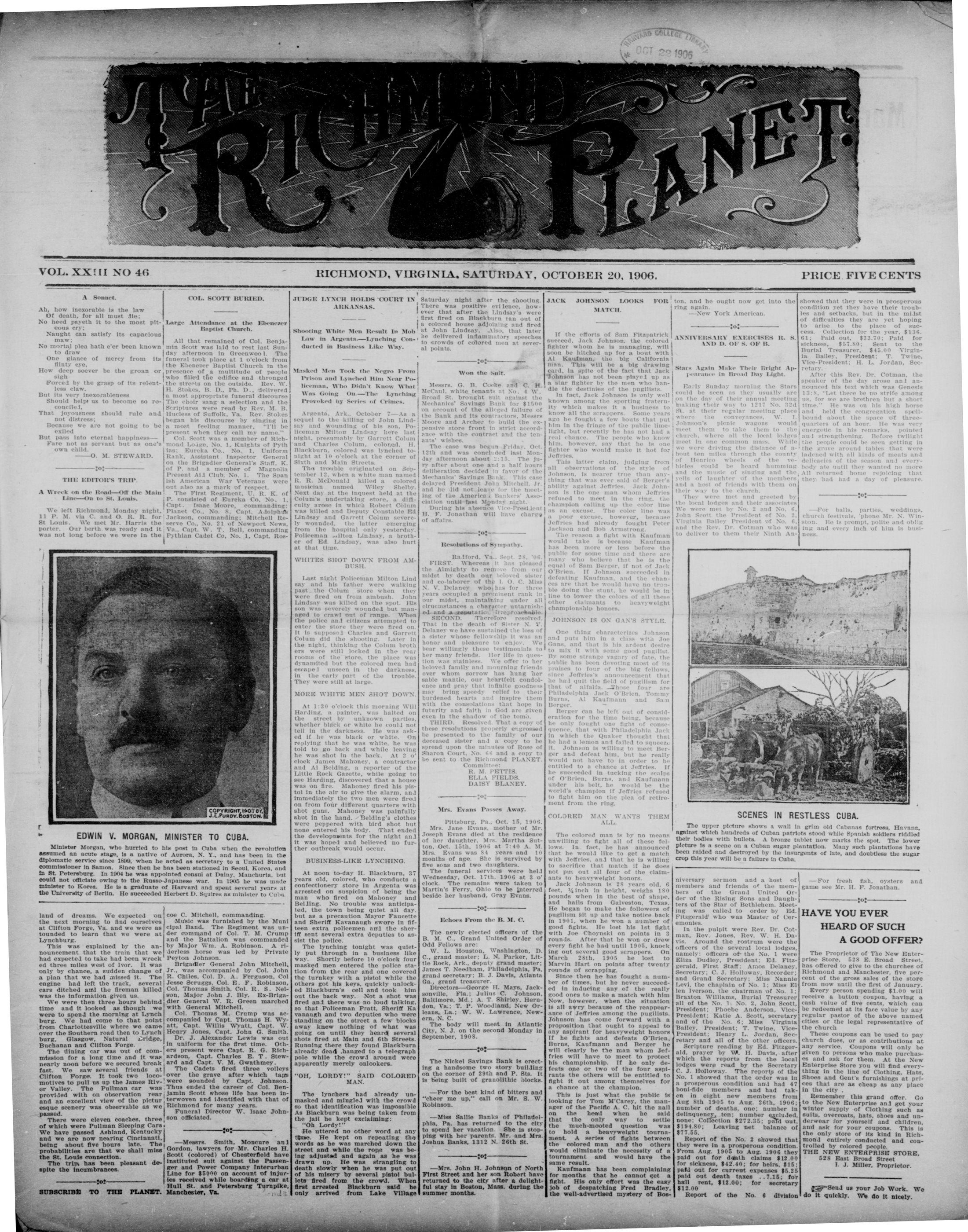
EDWIN V. MORGAN, MINISTER TO CUBA.
Minister Morgan, who hurried to his post in Cuba when the revolution assumed an acute stage, is a native of Aurora, N. Y., and has been in the diplomatic service since 1890, when he acted as secretary to a United States commissioner in Samoa. Since then he has been stationed in Seoul, Korea, and in St. Petersburg. In 1904 he was appointed consul at Dalny, Manchuria, but could not officiate owing to the Russo-Japanese war. In 1905 he was made minister to Korea. He is a graduate of Harvard and spent several years at the University of Berlin. He succeeded Herbert D. Squires as minister to Cuba.
Ah, how inexorable is the law
Of death, for all must die;
No heed payeth it to the most pite-
ous cry;
Naught can satisfy its capacious
maw;
No mortal plea hath e'er been known
to draw
One glance of mercy from its
flinty eye;
How deep soever be the groan or
sigh
Forced by the grasp of its relent-
less claw.
But its very inexorableness
Should help us to become so re-
concile.
That joyousness should rule and
not distress;
Because we are not going to be
exiled
But pass into eternal happiness—
Fare not as servant but as one's
own child.
—O. M. STEWARD.
THE EDITOR'S TRIP
A Wreck on the Road—Off the Main Line—On to St. Louis.
We left Richmond, Monday night, 11 P. M. via C. and O. R. R. for St Louis. We met Mr. Harris the porter. Our berth was ready and it was not long before we were in the
EDWIN V. MORGAN,
Minister Morgan, who hurried to assume an acute stage, is a native diplomatic service since 1896, when he commissioner in Samoa. Since then he in St. Petersburg. In 1904 he was appalled could not officiate owing to the Russo-minister to Korea. He is a graduate of the University of Berlin. He succeeded
land of dreams. We expected on the next morning to find ourselves at Clifton Forge, Va. and we were as tounded to learn that we were at Lynchburg.
This was explained by the announcement that the train that we had expected to take had been wrecked three miles west of Ivor. It was only by chance, a sudden change of a plan that we had missed it. The engine had left the track, several cars ditched and the fireman killed was the information given us.
We were then three hours behind time and it looked as though we were to spend the morning at Lynchburg. We had come to that point from Charlottesville where we came over the Southern road then to Lynchburg, Glasgow, Natural Bridge, Buchanan and Clifton Forge.
The dining car was out of commission for a long time and it was nearly noon before we secured break fast. We saw several friends at Clifton Forge. It took two locomotives to pull us up the James River Valley. The Pullman car was provided with on observation rear and an excellent view of the picture esque scenery was observable as we passed.
There were eleven coaches, three of which were Pullman Sleeping Cars We have passed Ashland, Kentucky and we are now nearing Cincinnati, being about five hours late. The probabilities are that we shall miss the St. Louis connection.
The trip has been pleasant despite the incumbrances.
SUBSCRIBE TO THE PLANET.
COL. SCOTT BURIED.
Large Attendance at the Ebenezer Baptist Church.
All that remained of Col. Benjamin Scott was laid to rest last Sunday afternoon in Greenwood. The funeral took place at 1 o'clock from the Ebenezer Baptist Church in the presence of a multitude of people who filleted the edifice and thronged the streets on the outside. Rev. W. H. Stokes, B. D., Ph. D., delivered a most appropriate funeral discourse The choir sang a selection and the Scriptures were read by Rev. M. B. Hucless of Suffolk, Va. Rev. Stokes began his discourse by singing in a most feeling manner, "I'll be present when they call my name." Col. Scott was a member of Richmond Loake, No. 1, Knights of Pythias; Eureka Co., No. 1, Uniform Rank, Assistant Inspector General on the Brigadier General's Staff, K. of P, and a member of Margolia Present Ald Club, No. 1. The Spanish American War Veterans were out also as a mark of respect. The First Regiment, U. R. K. of P, consisted of Eureka Co., No. 1, Capt. Isaac Moore, commanding; Planet Co., No. 8, Capt. Adolphus Jackson, commanding; Mitchell Reserve Co., No. 21 of Newport News, Va., Capt. W. T. Bell, commanding Pythian Cadet Co, No. 1, Capt. Ros-
MINISTER TO CUBA.
This post in Cuba when the revolution of Aurora, N. Y., and has been in the acted as secretary to a United States has been stationed in Seoul, Korea, and pointed consul at Daly, Manchuria, but Japanese war. In 1905 he was made of Harvard and spent several years at Herbert D. Squires as minister to Cuba.
coe C. Mitchell, commanding.
Music was furnished by the Municipal Band. The Regiment was under command of Col. T. M. Crump and the Battalion was commanded by Major Wm. A. Robinson. A riderless horse was led by Private Peyton Johnson.
Brigadier General John Mitchell, Jr., was accompanied by Col. John R. Chiles, Col. D. A. Ferguson, Col Jesse Scruggs, Col E. F. Robinson, Col Thomas Smith, Col R. S. Nelson, Major John J. Bly, Ex-Brigadier General W. R. Green marched with General Mitchell.
Col. Thomas M. Crump was accompanied by Capt. Thomas H. Wyatt, Capt. Willis Wyatt, Capt. W. Henry Jones, Capt. John G. Smith.
Dr. J. Alexander Lewis was out in uniform for the first time. Others present were Capt. R. G. Richardson, Capt. Charles E. T. Steward and Capt. V. M. Gwathmey.
The Cadets fired three volleys over the grave after which taps were sounded by Capt. Johnson. Thus ended the career of Col. Benjamin Scott whose life has been interwoven and identified with that of Richmond for many years.
Funeral Director W. Isaac John son officiated.
—Messrs. Smith, Moncure and Gordon, lawyers for Mr. Charles H. Scott (colored) of Chesterfield have instituted suit against the Passenger and Power Company Interurban Line for $5000 on account of injuries received while boarding a car at Hull St. and Petersburg Turnpike, Manchester, Va.
RICHMOND, VIRGINIA, SATURDAY, OCTOBER 20, 1906.
Shooting White Men Result In Mob Law in Argenta.—Lynching Conducted in Business Like Way.
Masked Men Took the Negro From Prison and Lynched Him Near Policeman, Who Didn't Know What Was Going On—The Lynching Provoked by Series of Crimes.
Argenta, Ark. October 7—As a sequel to the killing of John Lindsay and wounding of his son, Policeman Milton Lindsay here last night, presumably by Garrett Colum and Charles Colum, colored. H. Blackburn, colored was lynched tonight at 10 o'clock at the corner of Sixth and Main Streets.
The trouble originated on September 12, when a white man named R. R. McDonald killed a colored musician named Wiley Shelby. Next day at the inquest held at the Colum's undertaking store, a diffuse nose in which Robert Colum was killed and Deputy Constable Ed Lindsay and Garrett Colum severely wounded, the latter emerging from the hospital only yesterday, Policeman Milton Lindsay, a brother of Ed. Lindsay, was also hurt at that time.
WHITES SHOT DOWN FROM AM
BUSH.
Last night Policeman Milton Lind say and his father were walking past the Colum store when they were fired on from ambush. John Lindsey was killed on the spot. His son was severely wounded but managed to crawl out of range. When the police and citizens attempted to enter the store they were fired on. It is supposed Charles and Garrett Colum did the shooting. Later in the night, thinking the Colum broth ers were still locked in the rear rooms of the store, the place was dynamited but the colored men had escaped unseen in the darkness, in the early part of the trouble. They were still at large.
MORE WHITE MEN SHOT DOWN
At 1:30 o'clock this morning Will Harding, a painter, was hailed on the street by unknown parties, whether black or white he could not tell in the darkness. He was asked if he was black or white. On replying that he was white, he was told to go back and while leaving he was shot in the back. At 2 o'clock James Mahoney, a contractor and Al Belding, a reporter of the Little Rock Gazette, while going to see Harding, discovered that a house was on fire. Mahoney fired his pistol in the air to give the alarm, and immediately the two men were fired on from four different quarters with shot guns. Mahoney was painfully shot in the hand. Belding's clothes were peppered with bird shot but none entered his body. That ended the developments for the night and it was hoped and believed no further outbreak would occur.
BUSINESS-LIKE LYNCHING
At noon to-day H. Blackburn, 37 years old, colored, who conducts a confectionery store in Argenta was arrested on suspicion of being the man who fired on Mahoney and Belling. No trouble was anticipated, the town being quiet all day, but as a precaution Mayor Faucette and Sheriff Kavanaugh swore in fifteen extra policemen and the sheriff sent several extra deputies to assist the police.
The lynching tonight was quietly put through in a business like way. Shortly before 10 o'clock four masked men entered the police station from the rear and one covered the turnkey with a pistol while the others got his keys, quickly unlocked Blackburn's cell and took him out the back way. Not a shot was fired and there was no loud talking, so that Policeman Pratt, Sheriff Kavanaugh and two deputies who were standing on the street a few blocks away knew nothing of what was going on until they heard several shots fired at Main and 6th Streets. Running there they found Blackburn already dead, changed to a telegraph pole while the crowd around were apparently merely onlookers.
"OH, LORDY!" SAID COLORED MAN.
The lynchers had already unmasked and mingled with the crowd so that identification was impossible As Blackburn was being taken from the jail he kept exclaiming: "Oh Lordy!" He uttered no other word at any time. He kept on repeating the words as he was marched down the street and while the rope was being adjusted and again as he was drawn up. He was strangling to death slowly when he was put out of his misery by several pistol bullets fired from the crowd. When first arrested Blackburn said he only arrived from Lake Village
Saturday night after the shooting. There was positive evidence, however that after the Lindsay's were first fired on Blackburn ran out of a colored house adjoining and fired at John Lindsay. Also, that later he delivered inflammatory speeches to crowds of colored men at several points.
Won the Suit.
Messrs. G. B. Cooke and C. H. McCaul, white tenants at No. 4 W. Broad St. brought suit against the Mechanics' Savings Bank for $1500 on account of the alleged failure of the Bank and its contractors, Messrs Moore and Archer to build the expensive store front in strict accordance with the contract and the tenants' wishes.
The case was begun Friday, Oct. 12th and was concluded last Monday afternoon about 2:15. The jury after about one and a half hours deliberation decided in favor of the Mechanics' Savings Bank. This case delayed President John Mitchell, Jr. and he did not leave for the meeting of the America Bankers' Association until last Monday night.
During his absence Vice-President H. F. Jonathan will have charge of affairs.
Resolutions of Sympathy.
Rafford, Va., Sept. 28, '06.
FIRST. Whereas it has pleased the Almighty to remove from our midst by death our beloved sister and co-laborer of the I. O. C. Miss N. V. Delaney who has for three years occupied a prominent rank in our midst, maintaining under all circumstances a character unattainable and a reputation, irreproachable.
SECOND. Therefore resolved.
That in the death of Sister N. V. Delaney we have sustained the loss of a sister whose fellowship it was an honor and pleasure to enjoy. We bear willingly these testimonials to her many friends. Her life in question was stainless. We offer to her beloved family and mourning friends over whom sorrow has hung her sable mantle, our heartfelt condolence and pray that infinite goodness may bring speedy relief to their burdened hearts and inspire them with the consolations that hope in futurity and faith in God are given even in the shadow of the tomb.
THIRD. Resolved. That a copy of these resolutions properly engrossed be presented to the family of our deceased sister and a copy to be spread upon the minutes of Rose of Sharon Court, No. 66 and a copy to be sent to the Richmond PLANET.
Committee:
R. M. PETTIS.
ELLA FIELDS.
DAISY BLANEY.
Mrs. Evans Passes Away.
Pittsburg, Pa., Oct. 15, 1906.
Mrs. Jane Evans, mother of Mr.
Joseph Evans died at the residence
of her daughter, Mrs. Martha Sutton,
Oct. 15th, 1906 at 7:40 A. M.
Mrs. Evans was 84 years and 10
months of age. She is survived by
five sons and two daughters.
The men she deceased were hell
Wednesday, Oct. 17th, 1906 at 3 o'clock.
The remains were taken to Martin's Ferry, Ohio to be interred beside her husband, Gray Evans.
Echoes From the B. M. C.
The newly elected officers of the B. M. C., Grand United Order of Odd Fellows are:
W. L. Houston, Washington, D. C., grand master; L. N. Parker, Little Rock, Ark., deputy grand master; James T. Needham, Philadelphia, Pa, grand secretary; B. J. Davis, Atlanta Ga., grand treasurer.
Directors—George H. Mays, Jacksonville, Fla.; Julius C. Johnson, Baltimore, Md.; A. T. Shirley, Herndon, Va.; T. P. Woodland, New Orleans, La.; W. W. Lawrence, Newern, N. C.
The body will meet in Atlantic City, N. J. on the second Monday in September, 1908.
The Nickel Savings Bank is erecting a handsome two story building on the corner of 29th and P. Sts. It is being built of granolithic blocks.
—For the best kind of bitters and "cheer me up," call on Mr. S. W. Robinson.
—Miss Sallie Banks of Philadelphia, Pa. has returned to the city to spend her vacation. She is stopping with her parents. Mr. and Mrs. Joshua Banks, 1312 N. 26th St.
—Mrs. John H. Johnson of North First Street and her son Robert have returned to the city after a delightful stay in Boston, Mass. during the summer months.
If the efforts of Sam Fitzpatrick succeed, Jack Johnson, the colored fighter whom he is managing, will soon be hitched up for a bout with Al Kaufman, the big California man. This will be a big drawing card, in spite of the fact that Jack Johnson has not been played up as a star fighter by the men who handle the destinies of the pugilists. In fact, Jack Johnson is only well known among the sporting fraternity which makes it a business to know all the scrappers. Some years ago he fought, a few bouts that put him in the fringe of the public limelight, but recently he has not had a real chance. The people who know him, however, say that he is one fighter who would make it hot for Jeffries. This latter claim, judging from all observations of the style of Johnson, is nearer true than anything that was ever said of Berger's ability against Jeffries. Jack Johnson is the one man whom Jeffries refused to meet in the ring, the champion calling up the color line as an excuse. The color line was a poor excuse, however, because Jeffries had already fought Peter Jackson and Bob Armstrong.
The reason a fight with Kaufman would take is because Kaufman has been more or less before the public for some time and there are many who believe that he is the equal of Sam Berger, if not of Jack O'Brien. If Johnson succeeded in defeating Kaufman, and the chan-ble that he would have no trouble doing that he would have to line lower to the colors of all these other claimants to heavyweight championship honors.
JOHNSON IS ON GAN'S STYLE.
One thing characterizes Johnson and puts him in a class with Joe Gans, and that is his ardent desire to mix it with some good pugilist. By some strange vagary of fate, the public has been devoting most of its praises to four of the big fellows, since Jeffries's announcement that he had quit the field of pugilism for that of alfalfa. Those four are Philadelphia Jack O'Brien, Tommy Burns, Al Kaufmann and Sam Berger. Berger can be left out of consideration for the time being, because he only fought one fight of consequence, that with Philadelphia Jack in which the man he had a lemon and failed to squeeze it. Johnson is willing to meet Berger and defeat him, but he really would not have to in order to be entitled to a chance at Jeffries. If he succeeded in tucking the scalps of O'Brien, Burns, and Kaufmann under his belt, he would be the world's champion if Jeffries refused to fight him on the plea of retirement from the ring.
COLORED MAN WANTS THEM ALL.
The colored man is by no means unwilling to fight all of these fellows. In fact, he has announced that he would like to get a match with Jeffries, and that he is willing to sacrifice that match if he does not put out all four of the claimants to heavyweight honors.
Jack Johnson is 28 years old, 6 feet, 1/4 inch in height, weighs 180 pounds when in the best of shape, and hails from Galveston, Texas. He began to make the followers of pugilism sit up and take notice back in 1901, when he won a number of good fights. He lost his 1st fight with Joe Choynski on points in 3 rounds. After that he won or drew every fight he had until 1905, knocking out several good scrappers. On March 28th, 1905 he lost to Marvin Hart on points after twenty rounds of scrapping.
Since then he has fought a number of times, but he never succeeded in inducing any of the really good ones to make a match with him Now, however, when the situation is all awry because of the reappearance of Jeffries among the pugilists. Johnson has come forward with a proposition that ought to appeal to any aspirant for heavyweight honors If he fights and defeats O'Brien, Burns, Kaufmann and Berger he will clearly be the man whom Jeffries will have to meet to protect his championship. If he only defeats one or two of the four aspirants the others will be entitled to fight it out among themselves for a chance at the champion.
This is just what the public is looking for Tom M'Carey, the manager of the Pacific A. C. hit the nail on the head when he said that the only way to settle the much-mooted question was to hold a heavyweight tournament. A series of fights between the colored man and the others would eliminate the necessity of a tournament and would have the same result. Kaufmann has been complaining for months that he cannot get a fight. His only effort was the easy job of despatching Fred Bradley, the well-advertised mystery of Bos-
ANNIVERSARY EXERCISES R. S
AND D. OF S. OF B.
Stars Again Make Their Bright Ap
rearance in Broad Day Light.
Early Sunday morning the Stars could be seen as they usually are on the day of their annual meeting making their way to 1217 No. 32d St. at their regular meeting place where the conveyances, W. I. Johnson's picnic wagons would meet them to take them to the church, where all the local lodges meet in one common mass. While we were driving the distance of about ten miles through the county of Henrico wheels of the vehicles could be heard humming and the music of singing and the yells of laughter of the members and a host of friends with them on their way to the church. They were met and greeted by the local lodges and their associates We were met by No. 2 and No. 6, John Scott the President of No. 2, Virginia Bailey President of No. 6, and the Rev. Dr. Cotman who was to deliver to them their Ninth An-
COLLEGE DE LA SALUD
THE FORT OF MIDDLEBURG
SCENES IN RESTLESS CUBA.
The upper picture shows a wall in grim old Cabana against which hundreds of Cuban patriots stood while Spam their bodies with bullets. A bronze tablet now marks the picture is a scene on a Cuban sugar plantation. Many sugar been raided and destroyed by the insurgents of late, and crop this year will be a failure in Cuba.
The upper picture shows a wall in grim old Cabanas fortress, Havana, against which hundreds of Cuban patrons stood while Spanish soldiers riddled their bodies with bullets. A bronze tablet now marks the spot. The lower picture is a scene on a Cuban sugar plantation. Many such plantations have been raided and destroyed by the insurgents of late, and doubtless the sugar crop this year will be a failure in Cuba.
niversary sermon and a host of members and friends of the members of the Grand United Order of the Rising Sons and Daughters of the Star of Bethlehem. Meeting was called to order by Ed. Fitzgerald' who was Master of Ceremonies.
In the pulpit were Rev. Dr. Cotman, Rev. Jones, Rev. W. H. Davis. Around the rostrum were the officers of the several local lodges, namely; officers of the No. 1 were Elliza Dudley, President; Ed. Fitzgerald, First Staff; Amos Delaney, Secretary; C. J. Holloway, Recorder; and Grand Secretary; Miss Nannie Levi, the chaplain of No. 1; Miss Elen Iverson, the chairman of No. 1; Braxton Williams, Burial Treasurer all of the No. 1. No. 2, John Scott, President; Phoebe Anderson, Vice-President; Katie A. Scott, secretary and of the No. 6; Miss Virginia Bailey, President; T. Twine, Vice-President; Henry L. Jordan, Secretary and all of the other officers. Scripture reading by Ed. Fitzgerald, prayer by W. H. Davis, after which the reports from the local lodges were read by the Secretary C. J. Holloway. The reports of the No. 1 showed that the order was in a prosperous condition and had 47 boni-fide members and had taken in eight new members from Aug 8th 1905 to Aug. 26th, 1906; number of deaths, one; number in delinquency, ten; number excluded, none; Collection $272.35; paid out, $194.80; Leaving net balance of $77.55.
Report of the No. 2 showed that they were in a prosperous condition. From Aug. 1905 to Aug. 1906 they paid out for death claims $12.00 for sickness, $42.40; for heirs, $15; paid out for current expenses $5.25 paid out death taxes ...7.15; for hall rent, $12.00; for secretary $12.00
showed that they were in prosperous condition yet they have their troubles and setbacks, but in the milest of difficulties they are yet hoping to arise to the place of success. Collection for the year, $136.61; Paid out, $33.70; Paid for sickness, $57.80; Sent to the Burial Treasurer, $45.00 Virginia Bailey, President; T. Twine, Vice-President; H. L. Jordan, Secretary.
After this Rev. Dr. Cotman, the speaker of the day arose and announced his text which was Genesis 13:8. "Let there be no strife among us, for we are brethren but a short time." He was on his high horse and held the congregation spell-bound about the space of three-quarters of an hour. He was very energetic in his remarks, pointed and strengthening. Before twilight the people could be seen getting in the grove around tables that were laden with all kinds of meats and delicacies of the season and everybody ate until they wanted no more All returned home rejoicing that they had had a day of pleasure.
—For balls, parties, weddings, church festivals, 'phone Mr. N. Winston. He is prompt, polite and obliging and every inch of him is business.
1
in grim old Cabanas fortress, Havana, sits stood while Spanish soldiers riddled tablet now matches the spot. The lower plantation. Many such plantations have ingents of late, and doubtless the sugar
—For fresh fish, oysters and game see Mr. H. F. Jonathan.
HAVE YOU EVER
HEARD OF SUCH
A GOOD OFFER?
The Proprietor of The New Enterprise Store, 528 E. Broad Street, has offered to give to the churches of Richmond and Manchester, five percent of the gross sales of the store from now until the first of January. Every person spending $1.00 will receive a button coupon, having a cash value of five cents, which can be redeemed at its face value by any regular pastor of the above named cities or the legal representative of the church These coupons can be used to pay church dues, or as contributions at any service. Coupons will only be given to persons who make purchases and ask for them. At the New Enterprise Store you will find everything in the line of Clothing, Hats, Shoes and Gent's furnishings at prices that are as cheap as any place in the city. Remember this grand offer. Go to the New Enterprise and get your winter supply of Clothing such as suits, overcoats, hats, shoes and underwear for yourself and children, and ask for your coupons. This is the only store of its kind in Richmond entirely conducted and controlled by colored people.
E N E N T ENTERPRISE STORE
528 Eater
I. J. Miller, Propristor.
Send us your Work. We do it quickly. We do it nicely.
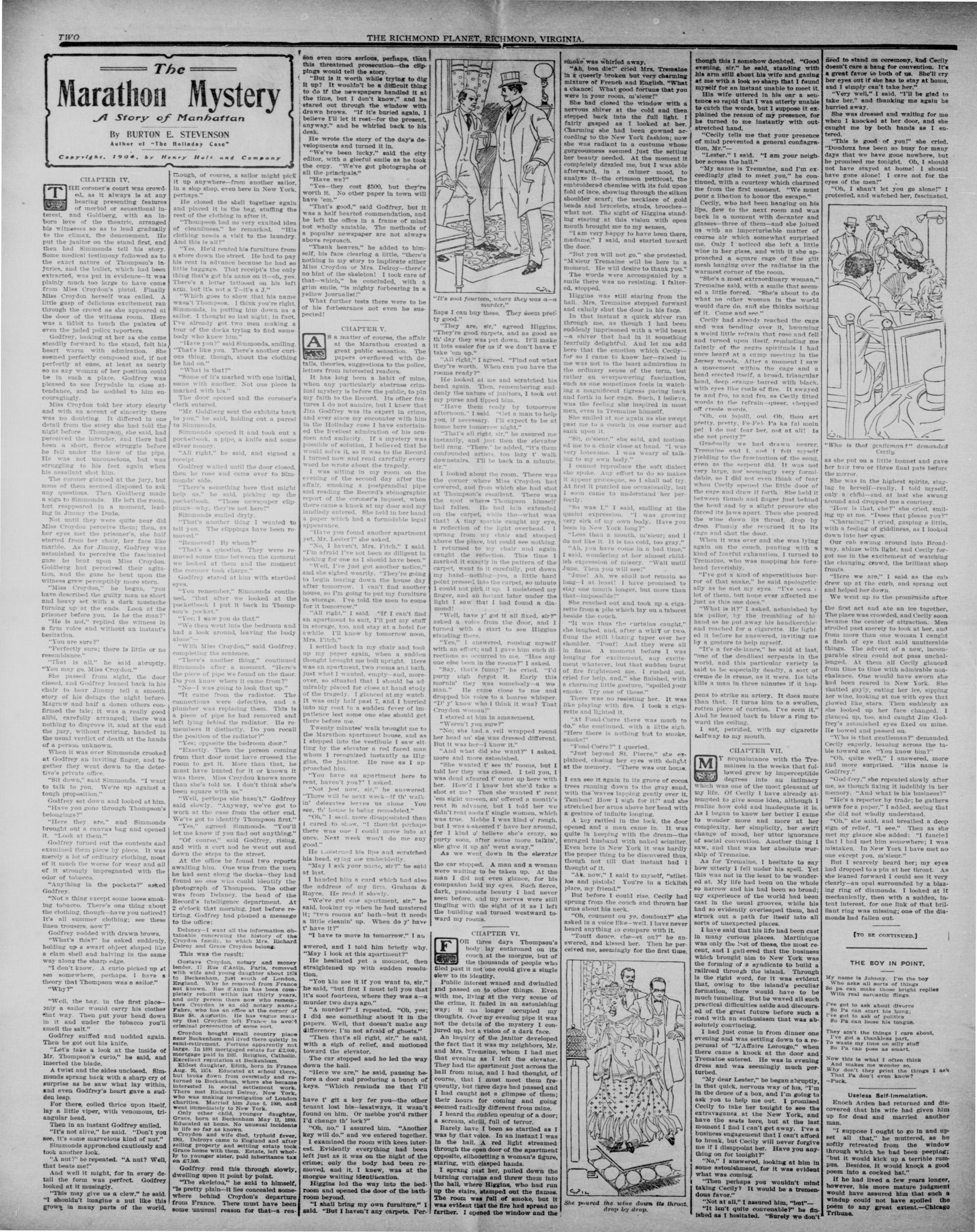
Marathon Mystery
By BURTON E. STEVENSON Author of "The Holladay Case"
Copyright, 1904, by Henry Holt and Company
THE coroner's court was crowded, as it always is at any bearing presenting features of morbid or sensational interest, and Goldberg, with an inborn love of the theatric, arranged his witnesses so as to lead gradually to the climax, the denouement. He put the janitor on the stand first, and then had Simmonds tell his story. Some medical testimony followed as to the exact nature of Thompson's injuries, and the bullet, which had been extracted, was put in evidence—it was plainly much too large to have come from Miss Croydon's pistol. Finally Miss Croydon herself was called. A little gasp of delicious excitement ran through the crowd as she appeared at the door of the witness room. Here was a tidbit to touch the palates of even the jaded police reporters.
Godfrey, looking at her as she came steadily forward to the stand, felt his heart warm with admiration. She seemed perfectly composed and, if not perfectly at ease, at least as nearly so as any woman of her position could be in such a place. Godfrey was pleased to see Dryadale in close attendance, and he nodded to him encouragingly. Miss Croydon told her story clearly and with an accent of sincerity there was no doubting. It differed in one detail from the story she had told the night before. Thompson, she said, had perceived the intruder, and there had been a short, fierce struggle before he fell under the blow of the pipe. He was not unconscious, but was struggling to his feet again when his assault shot him.
The coroner glanced at the jury, but none of them seemed disposed to ask any questions. Then Goldberg made a sign to Simmonds. He left the room, but reappeared in a moment, leading in Jimmy the Dude.
Not until they were quite near did Miss Croydon perceive them; then, as her eyes met the prisoner's, she half started from her chair, her face like marble. As for Jimmy, Goldrey was astonished to perceive the fascinated gaze he bent upon Miss Croydon. Goldberg had perceived their agitation, and the gaze he bent upon the witness grew perceptibly more stern.
"Miss Croydon," he began, "you have described the guilty man as short and heavy set with a dark mustache turning up at the ends. Look at the prisoner before you. Is he the man?" "He is not," replied the witness in a firm voice and without an instant's hesitation.
"Perfectly sure; there is little or no resemblance."
"That is all," he said abruptly.
"You may go. Miss Croydon."
She passed from sight, the door closed, and Godfrey leaned back in his chair to hear Jimmy tell a smooth story of his doings the night before. Magraw and half a dozen others confirmed the tale; it was a really good alibi, carefully arranged; there was nothing to disprove it, and at the end the jury, without retiring, handed in the usual verdict of death at the hands of a person unknown.
When it was over Simmonds crooked at Godfrey an inviting finger, and together they went down to the detective's private office.
"Sit down," said Simmonds. "I want to talk to you. We're up against a tough proposition."
Godfrey sat down and looked at him.
"Have you gone through Thompson's belongings?"
"Here they are," and Simmonda brought out a canvas bag and opened it. "Look at them."
Godfrey turned out the contents and examined them piece by piece. It was merely a lot of ordinary clothing, most of it much the worse for wear and all of it strongly impregnated with the odor of tobacco.
"Anything in the pockets?" asked Godfrey.
"Not a thing except some loose smoking tobacco. There's one thing about the clothing, though--have you noticed? It's all summer clothing; see these linen trousers, now?"
Godfrey podded with drawn brows.
"What's this?" he asked suddenly, holding up a swart object shaped like a clam shell and halving in the same way along the sharp edge.
"I don't know. A curio picked up at sea somewhere, perhaps. I have a theory that Thompson was a sailor."
"Well, the bag, in the first place—only a sailor would carry his clothes that way. Then put your head down in it and under the tobacco you'll smell the salt."
Godfrey sniffed and nodded again. Then he got out his knife.
"Let's take a look at the inside of Mr. Thompson's curio," he said, and inserted the blade.
A twist and the sides unclosed. Simmonds sprang back with a sharp cry of surprise as he saw what lay within, and even Godfrey's heart gave a sudden leap.
For there, colled thrice upon itself, lay a little viper, with venomous, triangular head.
Then in an instant Godfrey smiled.
"It's not alive," he said. "Don't you see, it's some marvelous kind of nut." Simmonds approached cautiously and took another look.
"A nut?" he repeated. "A nut? Well, that beats me!"
And well it might, for in every detail the form was perfect. Godfrey looked at it musingly.
"This may give us a clew," he said.
"I shouldn't imagine a nut like this grows in many parts of the world.
TWO
CHAPTER IV.
"You are sure?"
Lough, of course, a sailor might pick it up anywhere—from another sailor, in a slop shop, even here in New York, perhaps."
He closed the shell together again and placed it in the bag, stuffing the rest of the clothing in after it.
"Thompson had no very exalted idea of cleanliness," he remarked. "His clothing needs a visit to the laundry. And this is all."
"Yes. He'd rented his furniture from a store down the street. He had to pay his rent in advance because he had so little baggage. That receipt's the only thing that's got his name on it—oh, yes. There's a letter tattooed on his left arm, but it's not a T—it's a J."
"Which goes to show that his name wasn't Thompson. I think you're right, Simmonds, in putting him down as a sailor. I thought so last night; in fact, I've already got two men making a tour of the docks trying to find somebody who knew him."
"Have you?" said Simmonds, smiling,
"That's like you. There's another curious thing, though, about the clothing he had on."
"What is that?"
"Some of it's marked with one initial, some with another. Not one piece is marked with his."
The door opened and the coroner's clerk entered.
"Mr. Goldberg sent the exhibits back to you," he said, holding out a parcel to Simmonds.
Simmonds opened it and took out a pocketbook, a pipe, a knife and some silver money.
"All right," he said, and signed a receipt.
Godfrey waited until the door closed, then he rose and came over to Simmonds' side.
"There's something here that might help us," he said, picking up the pocketbook. "Those newspaper clippings—why, they're not here!"
Simmonds smiled drily.
"That’s another thing I wanted to tell you. The clippings have been removed."
"Removed? By whom?"
"That’s a question. They were removed some time between the moment we looked at them and the moment the coroner took charge."
Godfrey stared at him with startled eyes.
"You remember," Simmonds continued, "that after we looked at the pocketbook I put it back in Thompson’s pocket."
"Yes; I saw you do that."
"We then went into the bedroom and had a look around, leaving the body alone"—
"With Miss Croydon," said Godfrey, completing the sentence.
"There’s another thing," continued Simmonds after a moment. "Here’s the piece of pipe we found on the floor. Do you know where it came from?"
"I came from the radiator. The connections were defective, and a plumber was replacing them. This is a piece of pipe he had removed and left lying behind the radiator. He remembers it distinctly. Do you recall the position of the radiator?" "Yes; opposite the bedroom door." "Exactly. The person coming from that door must have crossed the room to get it. More than that, he must have hunted for it or known it was there. Miss Croydon knows more than she's told us. I don't think she's been square with us." "Well, perhaps she hasn't," Godfrey said slowly. "Anyway, we've got to work at the case from the other end. We've got to identify Thompson first." "Yes," agreed Simmonds. "You'll let me know if you find out anything." "Of course," said Godfrey, rising, and with a curt end he went out and down the steps to the street.
At the office he found two reports awaiting him. One was from the men he had sent along the docks—the they had found no one who could identify the photograph of Thompson. The other was from Delaney, the head of the Record's intelligence department. At 2 o'clock that morning, just before retiring, Godfrey had phoned a message to the office:
Delaney—I want all the information obtainable concerning the history of the Civil War to reach Richard Delroy and Grace Croydon belong.
This was the result:
Gustave Croydon, notary and money lender, 17 Rue D'antin, Paris, removed with wife and young daughter about 1857 to Beckenham, just south of London, England. Why he removed from France know? Rue Antin has been complete rebuilt with walls and year and only person there now who remembers Croydon is an old notary name, Fabre, who has an office at the corner of Rue St. Augustin. He has vague memory that Croydon left France to avoid criminal presecution of some sort.
Croydon bought small country place near Beckenham and lived there quietly in semi-district, apparently not large. In 1891 mortgageed estate he made mortgage paid in 1893. Religion, Catholic, Excellent reputation at Beckenham.
Eldest daughter, Edith, born in France Aug. 26, 1874. Educated at school there, taken down from overstudy and returned in Beckenham where she became interested in social work. There met Richard Delroy, New York, who was making investigation of London charities. Married him June 6, 1890, and went immediately to New York. Only other child, younger daughter, Educated at home. No unusual Incidents in life so far as known
Croydon and wife died, typhoid fever, 1501. Delroys came to England and after selling property and settling estate took Grace home with them. Estate, left wholly to younger sister, paid inheritance tax on £7,500. Golfrey read this through slowly, dwelling upon it point by point. "The skeleton," he said to himself, "is pretty plain—it lies concealed some where behind Croydon's departure from France. There must have been some unusual reason for that—a rea-
THE RICHMOND PLANET, RICHMOND, VIRGINIA
son even more serious, perhaps, than this threatened prosecution—the clippings would tell the story.
"But is it worth while trying to dig it up? It wouldn't be a difficult thing to do if the newspapers handled it at the time, but I don't know," and he stared out through the window with drawn brows. "If it's buried again, I believe I'll let it rest—for the present, anyway," and he whirled back to his desk.
He wrote the story of the day's developments and turned it in.
"We've been lucky," said the city editor, with a gleeful smile as he took the copy. "We've got photographs of all the principals."
"Have we?"
"Yes—they cost $500, but they're worth it. No other paper in town will have 'em."
"That's good," said Godfrey, but it was a half hearted commendation, and he left the office in a frame of mind not wholly amiable. The methods of a popular newspaper are not always above reproach.
"Thank heaven," he added to himself, his face clearing a little, "there's nothing in my story to implicate either Miss Croydon or Mrs. Delroy—there's no hint of the skeleton! I took care of that—which," he concluded, with a grim smile, "is mighty for bearing in a yellow journalist!"
What further tests there were to be of his forbearance not even he suspected!
CHAPTER V
S a matter of course, the affair at the Marathon created a great public sensation. The papers overflowed with details, theories, suggestions to the police, letters from interested readers. It has long been a habit of mine, when any particularly abstruse criminal mystery is before the public, to pin my faith to the Record. Its other features I do not aumire, but I knew that Jim Godfrey was its expert in crime, and ever since my encounter with him in the Holladay case I have entertained the liveliest admiration of his acumen and audacity. If a mystery was possible of solution, I believed that he would solve it, so it was to the Record I turned now and read carefully every word he wrote about the tragedy.
I was sitting in my room on the evening of the second day after the affair, smoking a postprandial pipe and reading the Record's stenographic report of the coroner's inquest, when there came a knock at my door and my landlady entered. She held in her hand a paper which had a formidable legal appearance.
"Have you found another apartment yet, Mr. Lester?" she asked.
"No, I haven't, Mrs. Fitch." I said.
"I'm afraid I've not been as diligent in looking for one as I should have been."
"Well, I've just got another notice," and she sighed wearily. "They're going to begin tearing down the house day after tomorrow. I can't find another house, so I'm going to put my furniture in storage. I've told the men to come for it tomorrow."
"All right," I said. "If I can't find an apartment to suit, I'll put my stuff in storage, too, and stay at a hotel for awhile. I'll know by tomorrow noon, Mrs. Fitch."
I settled back in my chair and took up my paper again, when a sudden thought brought me bolt upright. Here was an apartment, two rooms and bath, just what I wanted, empty—and, moreover, so situated that I should be admirably placed for close at hand study of the tragedy. I glanced at my watch. It was only half past 7, and I hurried into my coat in a sudden fever of impatience lest some one else should get there before me.
Twenty minutes' walk brought me to the Marathon apartment house, and as I stepped into the vestibule I saw sitting by the elevator a red faced man whom I recognized instantly as Higgins, the janitor. He rose as I approached him.
"You have an apartment here to rent, haven't you?" I asked.
"Not jest now, sir," he answered.
"There will be next week—if 'f' walk in' delegates leaves us alone You see, 'f' house is being remodeled."
"Oh." I said, more disappointed than I cared to show, "I thought perhaps there was one I could move into at once. Next week won't do me any good."
He loisted his lips and scratched his head, eying me undecided.
"May I ask your name, sir?" he said at last.
I handed him a card which had also the address of my firm, Graham & Royce. He read it slowly.
"We've got one apartment, sir," he said, looking up when he had mastered it; "two rooms an' bath—but it needs a little cleanin' up. When do y' have t' have it?"
"I have to move in tomorrow." I answered, and I told him briefly why. "May I look at this apartment?"
He hesitated yet a moment, then straightened up with sudden resolution.
"You kin see it if you want to, sir," he said, "but first I must tell you that it's soot fourteen, where they was a—a murder two days ago."
"A murder?" I repeated. "Oh, yes; I did see something about it in the papers. Well, that doesn't make any difference; I'm not afraid of ghosts."
"Then that's all right, sir," he said, with a sigh of relief, and motioned toward the elevator.
The car stopped and he led the way down the hall.
"Here we are," he said, pausing before a door and producing a bunch of keys. "Which reminds me that I'll have t' git a key fer you—the other tenant lost his—leavestacks, it wasn't found on him. Or mebbe you'd rather I'd change th' lock?"
"Oh, no." I assured him. "Another key will do," and we entered together. I examined the room with keen interest. Evidently everything had been left just as it was on the night of the crime; only the body had been removed, and it. I knew, was at the morgue waiting identification. Higgins led the way into the bedroom and opened the door of the bathroom beyond. "I shall bring my own furniture," I said. "But I haven't any carpets. Per-
C. W.
"It's soot fourteen, where they was a—a murder."
Haps I can buy these. They seem pretty good.
"They are, sir," agreed Higgins.
"They're good carpets, and as good as th' day they was put down. I'll make it lots easier for us if we don't have t' take eup."
"All right," I agreed. "Find out what they're worth. When can you have the rooms ready?"
He looked at me and scratched his head again. Then, remembering suddenly the nature of janitors, I took out my purse and tipped him.
"Have them ready by tomorrow afternoon." I said. "Get a man to help you, if necessary. I'll expect to be at home here tomorrow night."
"That's all right, sir," he assured me instantly, and just then the elevator bell rang. "There." he added. "It's them confounded artists, too lazy t' walk downstairs. I'll be back in a minute, sir."
I looked about the room. There was the corner where Miss Croydon had cowered, and from which she had shot at Thompson's assailant. There was the spot where Thompson himself had fallen. He had lain extended on the carpet, while the—what was that? A tiny sparkle caught my eye, a reflection of the light overhead. I sprang from my chair and stooped above the place, but could see nothing. I returned to my chair and again caught the reflection. This time I marked it exactly in the pattern of the carpet, went to it carefully, put down my hand—nothing—yes, a little hard point pressed into the carpet, so minute I could not pick it up. I moistened my finger, and an instant later under the light I saw that I had found a diamond!
"Well, have y' got it all fixed, sir?" asked a voice from the door, and I turned with a start to see Higgins standing there.
"Yes," I answered, rousing myself with an effort; and I gave him such directions as occurred to me. "Has any one else been in the rooms?" I asked. "Say, that's funny!" he cried. "I'd purty nigh fergot it. Early this mornin' they was somebody—a woman." He came close to me and dropped his voice to a hourse whisper. "D' y' know who I think it was? That Croydon woman!" I stared at him in amazement.
"Weren't you sure?"
"And what did she want?" I asked, more and more astonished.
"She wanted t' see th' rooms, but I told her they was closed. I tell you, I was dead afeared t' come up here with her. How'd I know but she d' take a shot at me? Then she wanted t' rent 'em sight unseen, an' offered a month's rent in advance, but I told her we didn't rent roots t' single women, which was true. Mebbe I was kind o' rough, but I was a-skeered t' have her around, fer I kind o' believe she's crazy, so purty soon, after some more talkin', she give it up an' went away."
As we went down in the elevator the car stopped. A man and a woman were waiting to be taken up. At the man I did not even glance, for his companion held my eyes. Such fierce, dark, passionate beauty I had never seen before, and my nerves were still tingling with the sight of it as I left the building and turned westward toward my rooms.
CHAPTER VI.
OR three days Thompson's body lay enthroned on its couch at the morgue, but of the thousands of people who filed past it not one could give a single clew to its identity.
Public interest waned and dwindled and passed on to other things. Even with me, living at the very scene of the crime, it faded in an astonishing way; it no longer occupied my thoughts. Over my evening pipe it was not the details of the mystery I conjured up, but a vision of a dark face.
An inquiry of the janitor developed the fact that it was my neighbors, Mr. and Mrs. Tremaine, whom I had met that evening as I left the elevator. They had the apartment just across the hall from mine, and I had thought, of course, that I must meet them frequently, but three days had passed and I had caught not a glimpse of them; their hours for coming and going seemed radically different from mine.
I heard the sudden opening of a door; a scream, shrill, full of terror. Rarely have I been so startled as I was by that voice. In an instant I was in the hall. A red light streamed through the open door of the apartment opposite, silhoueting a woman's figure, staring, with clasped hands. I sprang past her, pulled down the burning curtains and threw them into the hall, where Higgins, who had run up the stairs, stamped out the names. The room was full of smoke, but it was evident that the fire had spread no farther. I opened the window and the
smoke was whirled away.
"Ah, bon die!" cried Mrs. Tremaine in a queerly broken but very charming mixture of French and English. "What a chance! What good fortune that you were in your room, m'sleur!"
She had closed the window with a nervous shiver at the cold and then stepped back into the full light. I fairly gasped as I looked at her. Charming she had been gowned according to the New York fashion; now she was radiant in a costume whose gorgeousness seemed Just the setting her beauty needed. At the moment it completely dazzled me, but I was able afterward, in a calmer mood, to analyze it—the crimson petticoat, the embroidered chemise with its fold upon fold of lace, showing through the silken shoulder scarf; the necklace of gold beads and bracelets, studs, brooches—what not. The sight of Higgins standing staring at this vision with open mouth brought me to my senses.
"I am very happy to have been there, madame," I said, and started toward the door.
"But you will not go," she protested. "M'sleur Tremaine will be here in a moment. He will desire to thank you."
The words were accompanied by a smile there was no resisting. I faltered, stopped.
Higgins was still staring from the hall. Mrs. Tremaine stepped forward and calmly shut the door in his face.
In that instant a quick shiver ran through me, as though I had been suddenly imprisoned with a wild beast—a shiver that had in it something fearfully delightful. And let me add here that the emotion which Cecily—for so I came to know her—raised in me was not in the least admiration in the ordinary sense of the term, but rather an overpowering fascination, such as one sometimes feels in watching a magnificent tigress pacing back and forth in her cage. Such, I believe, was the feeling she inspired in most men, even in Tremaine himself.
She smiled at me again as she swept past me to a couch in one corner and sank upon it.
"Sit, m'sieur," she said, and motioned me to a chair close at hand. "I was very lonesome. I was weary of talking to my own body."
I cannot reproduce the soft dialect she spoke. Any effort to do so makes it appear grotesque, so I shall not try. At first it puzzled me occasionally, but I soon came to understand her perfectly.
"So was I," I said, smiling at the quint expression. "I was growing very sick of my own body. Have you been in New York long?
"Less than a month, m'sieur; and I do not like it. It is too cold, too gray."
"Ah, you have come in a bad time."
I said, wondering at her almost childish expression of misery. "Walt until June. Then you will see."
"June! Ah, we shall not remain so long—I at least! I have promised to stay one month longer, but more than that—impossible!"
She reached and took up a cigarette from a pile which lay on a taboret beside the couch.
"It was thus the curtains caught," she laughed, and, after a whirl or two, flung the still blazing taper over her shoulder. "Pouf! And they were all in flame. A moment before I was longing for excitement, any excitement whatever, but that sudden burst of fire frightened me. I rushed out, cried for help, and," she finished, with a charming little gesture, "spoiled your smoke. Try one of these."
There was no resisting her. It was like playing with fire. I took a cigarette and lighted it.
"At Fund-Corre there was much to do," she continued, with a little sigh. "Here there is nothing but to smoke, smoke!"
"Fond-Corre?" I queried.
"Just beyond St. Pierre," she explained, closing her eyes with delight at the memory. "There was our home."
I can see it again in its grove of cocoa trees running down to the gray sand, with the waves happing gently over it. Tambou! How I sigh for it" and she stretched her arms above her head with a gesture of infinite longing.
A key rattled in the lock, the door opened and a man came in. It was quite in keeping with the dream—the enraged husband with naked scimitar. Even here in New York it was hardly the proper thing to be discovered thus, though not till that instant had I thought of it.
"Ah, now," I said to myself, "stillelos and pistols! You're in a ticklish place, my friend."
But before I could rise, Cecelly had sprung from the couch and thrown her arms about his neck.
"Oh, coument ou ye, doudoux?" she asked in a voice like—well. I have never heard anything to compare with it.
"Toutt douce, che—et on?" he answered, and kissed her. Then he perceived me, seemingly for the first time
J.
She poured the wine down its throat, drop by drop.
though this I somehow doubted. "Good evening, sir." he said, standing with his arm still about his wife and gazing at me with a look so sharp that I found myself for an instant unable to meet it. His wife uttered in his ear a sentence so rapid that I was utterly unable to catch the words, but I suppose it explained the reason of my presence, for he turned to me instantly with outstretched hand.
"Cecely tells me that your presence of mind prevented a general confagration, Mr."—
"Lester," I said. "I am your neighbor across the hall."
"My name is Tremalne, and I'm exceedingly glad to meet you," he continued, with a courtesy which charmed me from the first moment. "We must pour a libation to honor the escape."
Cecily, who had been hanging on his lips, flew to the next room and was back in a moment with decanter and glasses—three of them—and she joined us with an imperturbable matter of course air which somewhat surprised me. Only I noticed she left a little wine in her glass, and with it she approached a square cage of fine gilt mesh hanging over the radiator in the warmest corner of the room.
"She's a most extraordinary woman." Tremaine said, with a smile that seemed a little forced. "She's about to do what no other woman in the world would dare do, and she thinks nothing of it. Come and see."
Cecily had already reached the cage and was bending over it, humming a weed little refrain that rose and fell and turned upon itself, reminding me faintly of the negro spirituals I had once heard at a camp meeting in the Jersey woods. After a moment I saw a movement within the cage and a head erected itself, a broad, triangular head, deep orange barred with black, with eyes like coals of fire. I swayed to and fro, to and fro, as Cecly fitted words to the refrain—queer, chopped off creole words.
"Oh, on joofoll, oul. Oh, thou art pretty, pretty, Fe-Fel. Pa ka fal moin pe! I do not fear her, not at all! Is she not pretty?"
Gradually we had drawn nearer, Tremaine and I, and I felt myself yielding to the fascination of the song, even as the serpent did. It was not very large, nor seemingly very formidable, so I did not even think of fear when Cecily opened the little door of the cage and drew it forth. She held it between thumb and finger just behind the head and by a slight pressure she forced its jaws apart. Then she poured the wine down its throat, drop by drop. Flinchly she returned it to its cage and shut the door.
When it was over and she was lying again on the couch, panting with a kind of fearful exhaustion. I turned to Tremaine, who was mopping his forehead feverishly.
"I've got a kind of superstitious horror of that snake," he said apologetically as he met my eyes. "I've seen lot of them, but none ever affected me just as this one does."
"What is it?" I asked, astonished by his pallor, by the trembling of his hand as he put away his handkerchief and reached for a cigarette. He lighted it before he answered, inviting me by a gesture to help myself.
"It's a fer-de-lance," he said at last, "one of the deadliest serpents in the world, and this particular variety is said to be especially deadly, a sort of creme de la creme, as it were. Its bite kills a man in three minutes if it happens to strike an artery. It does more than that. It turns him to a swollen, rotten piece of carrion. I've seen it." And he beamed back to blow a ring toward the ceiling.
I sat, petrified, with my cigarette halfway to my mouth.
CHAPTER VII.
Y acquaintance with the Tremaines in the weeks that followed grew by imperceptible degrees into an intimacy which was one of the most pleasant of my life. Of Cecily I have already attempted to give some idea, although I realize how cold and inadequate it is. As I began to know her better I came to wonder more and more at her complexity, her simplicity, her swift change of mood, her utter ignorance of social convention. Another thing I saw, and that was her absolute worship of Tremaine.
As for Tremaine, I hesitate to say how utterly I fell under his spell. Yet this was not in the least to be wondered at. My life had been on the whole so narrow and his had been so broad; my experience of the world had been cast in the usual grooves, while his had so evidently overleaped them, had struck out a path for itself into all sorts of unexpected places.
I have said that his life had been cast in many curious places. Martinique was only the last of these, the most recent, and I gathered that the business which brought him to New York was the forming of a syndicate to build a railroad through the island. Through is the right word, for it was evident that, owing to the island's peculiar formation, there would have to be much tunneling. But he waved all such practical difficulties aside and discoursed of the great future before such a road with an enthusiasm that was absolutely convincing.
I had just come in from dinner one evening and was settling down to a perusal of "L'Afaire Lorouge," when there came a knock at the door and Tremaine entered. He was in evening dress and was seemingly much perturbed.
"My dear Lester," he began abruptly, in that quick, nervous way of his, "I'm in the deuce of a box, and I'm going to ask you to help me out. I promised Cecily to take her tonight to see the extravaganza at the New York, and have the seats here, but at the last moment I find I can't get away. I've a business engagement that I can't afford to break, but Cecily will never forgive me if I disappoint her. Have you anything on for tonight?"
"No," I answered, looking at him in some astonishment, for it was evident what was coming.
"Then perhaps you wouldn't mind taking Cecily? It would be a tremendous favor."
"Not at all," I assured him, "but"—"It isn't quite convenable?" he finished as I hesitated. "Surely we don't
need to stand on ceremony, and Cecily doesn't care a hang for convention. It's a great favor to both of us. She'll cry her eyes out if she has to stay at home, and I simply can't take her."
"Very well," I said, "I'll be glad to take her," and thanking me again he hurried away.
She was dressed and waiting for me when I knocked at her door, and she caught me by both hands as I entered.
"This is good of you!" she cried. "Doudoux has been so busy for many days that we have gone nowhere, but he promised me tonight. Oh, I should not have stayed at home! I should have gone alone! I care not for the eyes of the men!"
"Oh, I shan't let you go alone!" I protested, and watched her, fascinated
J. L.
"Who is that gentleman?" demanded Cecily.
as she put on a little bonnet and gave her hair two or three final pats before the mirror.
She was in in the highest spirits, singing to herself—really, I told myself, only a child—and at last she swung around and dropped me a courtesy.
"How is that, she?" she cried, smiling up at me. "Does that please you?"
ing up at me. Does that please you? "Charming!" I cried, gasping a little, with a feeling of giddiness, as I looked down into her eyes: Our cab swing around into Broadway, ablaze with light, and Cecily forgot me in the excitement of watching the changing crowd, the brilliant shop fronts. "Here we are," I said as the cab drew up at the curb, and sprang out and helped her down. We went up to the promenade after
the first act and ate an ice together,
The place was crowded, and Cecily soon
became the center of attraction. Men
strolled past merely to look at her, and
from more than one woman I caught
a flash of eye that said unutterable
things. The advent of a new, incom-
parable siren could not pass unchalleng-
ed. At them all Cecily glanced
from time to time with admirable non-
chalance. One would have sworn she
had been reared in New York. She
shatted gayly, eating her ice, slipping
her wine, looking at me with eyes that
glowed like stars. Then suddenly as
she looked up her face changed. I
glanced up, too, and caught Jim Godfrey's astonished eyes fixed on mine.
He bowed and passed on.
"Who is that gentleman?" demanded
Cecily eagerly, leaning across the table toward me. "You know him?"
"Oh, quite well," I answered, more
and more surprised. "His name is Godfrey."
"God-frey," she repeated slowly after me, as though fixing it indelibly in her memory. "And what is his business?"
"He's a reporter by trade; he gathers news for a paper," I added, seeing that she did not wholly understand. "Oh," she said, and breathed a deep sign of relief. "I see." Then as she met my glance she added: "I fancied that I had met him somewhere; I was mistaken. In New York I have met no one you, m'sieur."
But I scarcely heard her; my eyes had dropped to a pin at her throat. As she leaned forward I could see it very clearly—an opal surrounded by a blazing ring of diamonds. I looked at it mechanically, then with a sudden, intent interest, for one link of that brilliant ring was missing; one of the diamonds had fallen out.
[TO BE CONTINUED.]
THE BOY IN POINT.
My name is Johnny. I'm the boy
Who asks all sorts of things
So pa can make those bright replies
With real sarcastic flings.
I've got to ask about divorce
So Pa can start his hung;
I've got to ask of politics
So Pa can lose his tongue.
They ain't the things I care about,
I've got a thankless part.
To waste my time on silly stuff
So Pa can pose as smart.
Now this is what I often think
And makes me wonder so.
Why don't they print the things I ask?
That Pa don't even know?
-Puck.
Useless Self-Immolation
Enoch Arden had returned and discovered that his wife had given him up for dead and married another man.
"I suppose I ought to go in and upset all that," he muttered, as he softly retreated from the window through which he had been peeping; "but it would kick up a terrible rumpus. Besides, it would knock a good poem into a cocked hat."
If he had lived a few years longer, however, his more mature judgment would have assured him that such a windup could not have spoiled the poem to any great extent.—Chicago Tribune.
THE PLANET
SATURDAY.....OCT. 20TH. 1906
TEMPERANCE NOTES
THE START.
To-morrow, perhaps the day after,
Your folly will vanish, you say;
The wine that induces loud laughter,
The women, the song and the play,
All these shall be memories merely
To the seasons the seasons advance,
And fortune, the how dearly
She holds it, shall yield you your chance
To-morrow your banner shall flutter
Where honor, bright-panplied, leads,
And men in their wonder shall utter
speeches concerning your deeds;
To-morrow, most shall be ended,
The way shall be made, it
The start shall be fearless and splendid.
The start shall be fearless and splendid-
"Ho, then, for a gorgeous to-night."
Ah, valyly you promise and sadly
Your hopes and your vaunting will end
Your follies may and may gladly
May call on the fates to attend;
But fortune is molding successes
For them who are starting to-day,
And there is no goddess that blesses
The largest whose creed is delay
Sorrow.
OUR DRINK BILL.
What the United States Spends Anually for Stimulating Beverages.
According to figures prepared by the American Grocer, the amount extended by Americans last year on alcoholic drinks, tea, coffee and cocoa, was close to $1,549,000,000—an increase in five years of more than 21 per cent, while the population of the country during the same period advanced less than one-third of that percentage. These figures make no allowance for water, milk, soda water and other combinations of so-called "temperance drinks," an enormous quantity of which are consumed in this country. Contrasted with 1904, the figures last year show an increase in the use of malt liquors and the milder stimulants, such as tea and coffee, with a slight decrease in the use of spirituous liquors. It is estimated that the per capita expenses for stimulating beverages last year in this country was $18.63, alcoholic stimulants contributing about $16 of this amount. The per capita consumption of spirits was as high in 1883 as it is to-day. These figures are most surprising when it is remembered that a larger proportion of the people are temperate. The fact that the per capita consumption of beer is $18½ gallons per year, or more than six cases of beer for every man, woman and child in the country, becomes the more significant when allowance is made for those who drink no beer at all.
In 1905 our national drink bill was so great for alcoholic beverages alone that it would have paid the ordinary expenditures of the government, and left a balance sufficient almost to wipe out the interest-bearing indebtedness of the nation—Zion's Herald.
GREAT SURGEON'S MOTTO
Eminent European Doctor Who Is Afraid of Infectants.
Dr. Lorenz is preeminent among the surgeons of Europe. It is of interest therefore to note that on the occasion of his second visit to America during the past year, where his remarkable operations attracted much attention, he emphatically declared the danger of alcoholic drinks.
A banquet was given in his honor in New York city, and wine was served. The eminent guest declined it, and politely requested the waiter to bring him a cup of tea. This caused him to be asked if he were a total abstainer from the use of wines and other liquors.
His answer was as follows: "I cannot say that I am a temperance agitator, but I am a surgeon. My success depends upon my brain being clear, my muscles firm, and my nerves steady. No one can take alcoholic liquors without blunting these physical powers, which I must keep always on edge. As a surgeon I must not drink."
What Gen. Davis Says
Walking on Water.
One night while in a meeting, Dr. Torrey received a note for the question box to this effect:
"If you are as great as you pretend to be, can you walk on water?" And scrawled across the note was: "Don't dodge this."
Dr. Torrey read the question: "Can you walk on water?" and replied: "Yes, my friend, a great deal better than I can on whisky."
Strong Words of Abraham Lincoln.
"If it is a crime to make a counterfeit dollar, it is ten thousand times worse to make a counterfeit man; and if the implements for making a counterfeit dollar can be taken and destroyed, the liquor found on a man's premises can be just as legally taken and destroyed."
TEMPERANCE
DRINKING AMONG WOMEN.
A Dinner Party at a Fashionable Hotel and What It Indicates.
Upon her return to New York from a European trip, a wealthy American woman gave a dinner at a fashionable hotel to a party of women friends.
Twenty-one sat down to an elaborately garnished board in a private apartment. The hostess, whose husband is a well-known merchant, sat at the head of the table.
"Walter " she said, "I want you to open wine and keep these glasses full."
"I should think you'd start it with a cocktail," commented an eastern woman, mother of two children.
"I don't know why I should," replied the hostess. "I have been drinking highballs and cocktails ever since I got out of bed at two o'clock this afternoon."
The party laughed.
Some had their way, however, and cocktails were served first to them. Others started with wine. Two women sat at the table who did not drink
We will not mention the highballs and cocktails.
The hostess of this delightful entertainment was too drunk at midnight to hold her head up. Three women were overcome to such an extent that they could not leave the apartment until the following day.
This occurred among highly respected women in a highly respectable hotel.
It is doubtless true that the use of intoxicants by women is on the increase. Women now drink in public places with men, and the same heavy loungers.
The flands of hell never contrived a worse plot against humanity. True motherhood and even "polite" drunkenness cannot be confused. Once in a while a man finds it possible to keep a fortune intact and be known as a successful man and still drink. More often he falls in such an attempt. But no woman can accomplish the greatest function of her sex, replenishing the earth and rearing her children in an atmosphere of sweet purity, with tainted breath, a body weakened by the ravages of alcohol or a mind made torpid in drink.
The devil of to-day is striking at the heart of humanity as well as the soul of idealism when he successfully tempts women with liquor.—The Rural Weekly.
"BEER IS A FOOD AND TEMPERANCE DRINK."
(Extract from liquor advertisement.)
Shades of Crime, Disease and Poverty (enthusiastically): "Beer is our food; without it we could hardly exist."
Maudlin Voice (from table): "An"
(hic) temperance drink, too."
A Rulinous Delusion.
Dr. J. T. Woods, three years United States surgeon, five years in Cleveland Medical college, now chief surgeon of Wabash system of railroads, has practiced in Toledo 16 years. He says: "That beer is foreign to nature's demand is plainly evident. The whole organization at once sets about its removal. Every channel through which it can be got rid of is brought into play, and does not cease till the last trace is gone. Reaching a certain end depends only on the frequency of the repitition. The whole is made up of the parts; every drink counts one. These 'ones' added together make the wreck; to secure this result it is only necessary to make the single numbers sufficient. Each leaves its footprints in one way or another; and the idea that, because you stop before you stagger, the system takes no note of the damaging material you put into it, is a ruinous dilusion."
One or the Other.
"Dead, is he colonel? Do you suppose whisky drinking had anything to do with his death?" "Either whisk drinking or water drinking, suh; he drank a glass of watuh with every glass of whisky, suh."—Huston Post.
And a Good Many Do.
The facetious American saloon motto, "If drinking whisky interferes with your business, give up your business," has struck England and is to be found on current post cards.
Didn't Learn Her Ace.
"To-day," remarked the pretty young widow, "is the fifth anniversary of my marriage."
"Indeed! And at what age were you married?" asked the bachelor, who thought to get next to the number of years she had sojourned on earth.
"At the parsonage," answered the p. y. w., as she winked her other eye—Chicago Daily News.
THE RICHMOND PLANET, RICHMOND, VIRGINIA
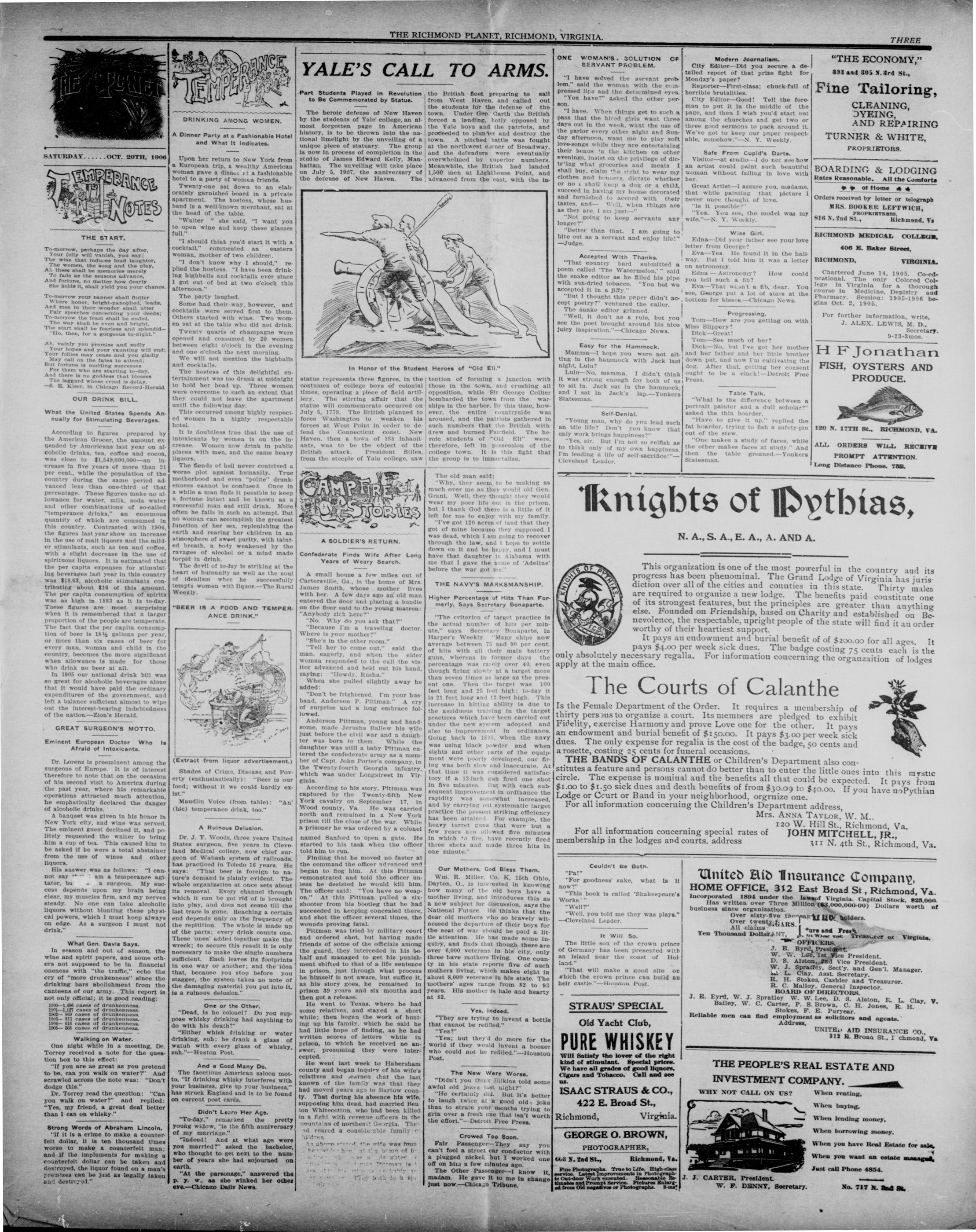
YALE'S CALL TO ARMS.
Part Students Played in Revolution to Be Commemorated by Statue.
The heroic defense of New Haven by the students of Yale college, an almost forgotten page in American history, is to be thrown into the national limelight by the unveiling of a unique piece of statuary. The group is now in process of completion in the studio of James Edward Kelly, Manhattan. The unveiling will take place on July 5, 1907, the anniversary of the defense of New Haven. The
I
CANON
statue represents three figures, in the costumes of college boys of colonial times, operating a piece of field artillery. The stirring affair that the statue will commemorate occurred on July 5, 1779. The British planned to force Washington to weaken his forces at West Point in order to defend the Connecticut coast. New Haven, then a town of 188 inhaoitants, was to be the object of the British attack. President Stiles, from the steeple of Yale college, saw tention of forming a those in the town, an opposition, while Sir bombarded the town ships in the harbor. By ever, the entire coarused, and the patric such numbers that the drew and burned Fair role students of "Old therefore, left in post college town. It is the group is to immortalize
CAMPFIRE STORIES
The old man said: "Why, they seem to much over me as they Grant. Well, they thou wear my poor life out but I thank God there left for me to enjoy w "I've got 120 acres of got of mine because th
A SOLDIER'S RETURN.
Confederate Finds Wife After Long Years of Weary Search.
A small house a few miles out of Cartersville, Ga., is the home of Mrs. James Smith, whose mother lives with her. A few days ago an old man entered the door and placing a bundle on the floor said to the young matron: "Anybody sick here?"
"No. Why do you ask that?"
"Because I'm a traveling doctor. Where is your mother?"
"She's in the other room."
"Tell her to come out," said the man, eagerly, and when the elder woman responded to the call the visitor advanced and held out his hand, saying: "Howdy, Rusha."
When she pulled slightly away he added:
"Don't be frightened. I'm your husband, Anderson P. Pittman." A cry of surprise and a long embrace followed.
Anderson Pittman, young and handsome, made Jerusha Ballew his wife just before the civil war and a daughter was born to them. While the daughter was still a baby Pittman entered the confederate army as a member of Capt. John Porter's company, in the Twenty-fourth Georgia infantry, which was under Longstreet in Virginia.
According to his story, Pittman was captured by the Twenty-fifth New York cavalry on September 17, in Wood county, Va. He was carried north and remained in a New York prison till the close of the war. While a prisoner he was ordered by a colonel named Sanford to open a gate. He started to his task when the officer told him to run.
Finding that he moved no faster at the command the officer advanced and began to fog him. At this Pittman remonstrated and told the officer unless he desisted he would kill him. The officer said: "You have no weapon." At this Pittman pulled a six-shooter from his bootleg that he had succeeded in keeping concealed there, and shot the officer several times, the wounds proving fatal.
Pittman was tried by military court and ordered shot, but having made friends of some of the officials among the guard, they interceded in his behalf and managed to get his punishment shifted to that of a life sentence in prison, just through what process he himself is not aware, but suffice it, as his story goes, he remained in prison 39 years and six months and then got a release.
He went to Texas, where he had some relatives, and stayed a short while; then began the work of hunting up his family, which he said he had little hope of finding, as he had written scores of letters, while in prison, to which he received no answer, presuming they were intercepted.
He went last week to Habersham county and began inquy of his wife's relatives and learned that the last known of the family was that they had moved years ago to Bartow county. That during his absence his wife, supposing him dead, had married Ben Whitecotton, who had been killed in a fight with revenue officers in the mountains of northeast Georgia. They had reared a considerable family of children.
As above stated the wife was four
he was here at the home of be-
bruce who was a draughtier
man Pittman is
his old wife is probably t
They both look spi
the British fleet preparing to sail from West Haven, and called out the students for the defense of the town. Under Gen. Garth the British forced a landing, hotly opposed by the Yale boys and the patriots, and proceeded to plunder and destroy the town. A pitched battle was fought at the northwest corner of Broadway, and the defenders were eventually overwhelmed by superior numbers. Meanwhile, the British had landed 1,500 men at Lighthouse Point, and advanced from the east, with the in-
```
tention of forming a junction with those in the town, and crushing all opposition, while Sir George Collier bombarded the town from the warships in the harbor. By this time, however, the entire countryside was aroused, and the patriots gathered in such numbers that the British withdrew and burned Fairfield. The heroic students of "Old Eli" were, therefore, left in possession of the college town. It is this fight that the group is to immortalize.
The old man said:
"Why, they seem to be making as much over me as they would old Gen. Grant. Well, they thought they would wear my poor life out in the prison, but I thank God there is a little of it left for me to enjoy with my family. "I've got 120 acres of land that got of mine because they supposed I was dead, which I am going to recover through the law, and I hope to settle down on it and be happy, and I must have that daughter in Alabama with me that I gave the name of 'Adeline' before the war got me."
THE NAVY'S MARKSMANSHIP.
Higher Percentage of Hits Then For-
merly, Says Secretary Bonaparte.
"The criterion of target practice is the actual number of hits per minute," says Secretary Bonaparte, in Harper's Weekly. "Many ships now average between 75 and 90 per cent. of hits with all their main battery guns, whereas in former days the percentage was rarely over 40, even though firing slowly at a target more than seven times as large as the present one. Then the target was 100 feet long and 25 feet high; to-day it is 21 feet long and 12 feet high. This increase in hitting ability is due to the assiduous training in the target practices which have been carried out under the new system adopted and also to improvement in ordinance. Going back to 1898, when the navy was using black powder and when sights and other parts of the equipment were poorly developed, our firing was both slow and inaccurate. At that time it was considered satisfactory if a 12-inch gun fired one shot in five minutes. But with each subsequent improvement in ordinance the rapidity was somewhat increased, and by carrying out systematic target practice the present striking efficiency has been attained. For example, the heavy turret guns that were but a few years ago allowed five minutes in which to fire, have recently fired three shots and made three hits in one minute."
Our Mothers, God Bless Them
Wm. R. Miller, Co. K, 15th Ohio, Dayton, O., is interested in knowing how many of the old boys have a mother living, and introduces this as a new subject for discussion, says the National Future. He thinks that the dear old mothers who so bravely witnessed the departure of their boys for the seat of war should be paid a little attention. He has made some inquiry, and finds that though there are over 6,000 veterans in his city, only three have mothers living. One county in his state reports five of such mothers living, which makes eight in about 8,000 veterans in his state. The mothers' ages range from 82 to 93 years. His mother is hale and hearty at 82.
Yes, indeed.
"They are trying to invent a bottle that cannot be refilled."
"Yes?"
"Yes; but they'd do more for the world if they would invent a boozer who could not be refilled."—Houston Post.
The New Were Worse
"Didn't you think Blikins told some awful old jokes last night?"
"He certainly did. But it's better to laugh twice at a good old joke than to strain your mouths trying to grin over a fresh one that isn't worth the effort."—Detroit Free Press
Crowed Too Soon.
Fair Passenger--They say you can't fool a street car conductor with a plugged nickel, but I worked one off on him a few minutes ago.
The Other Passenger--I know it, madam. He gave it to me in change just now.-Chicago Tribune.
Knights of Pythias,
This organization is one of the most powerful in the country and its progress has been phenominal. The Grand Lodge of Virginia has jurisdiction over all of the cities and counties in this state. Thirty males are required to organize a new lodge. The benefits paid constitute one of its strongest features, but the principles are greater than anything else. Founded on Friendship, based on Charity and established on Benevolence, the respectable, upright people of the state will find it an order worthy of their heartiest support.
The Courts of Calanthe
Is the Female Department of the Order. It requires a membership of thirty persons to organize a court. Its members are pledged to exhibit Fidelity, exercise Harmony and prove Love one for the other. It pays an endowment and burial benefit of $150.00. It pays $3.00 per week sick dues. The only expense for regalia is the cost of the badge, 50 cents and a rosette, costing 25 cents for funeral occasions.
THE BANDS OF CALANTHE or Children's Department also constitutes a feature and persons cannot do better than to enter the little ones into this mystic circle. The expense is nominal and the benefits all that could be expected. It pays from $1.00 to $1.50 sick dues and death benefits of from $30.09 to $40.00. If you have no Pythian Lodge or Court or Band in your neighborhood, orgrnize one.
For all information concerning the Children's Department address
For all information concerning special rates of JOHN MITCHELL, JR. membership in the lodges and courts, address 311 N. 4th St., Richmond, Va.
ONE WOMAN'S. SOLUTION
SERVANT PROBLEM.
"I have solved the servant problem," said the woman with the compressed lips and the determined eyes. "You have?" asked the other person.
"I have. When things get to such a pass that the hired girls want three days out in the week, want the use of the parlor every other night and Sunday afternoon, want me to play soft love-songs while they are entertaining their beams in the kitchen on other evenings, insist on the privilege of dictating what groceries and meats I shall buy, claim the right to wear my clothes and bonets, dictate whether or no I shall keep a dog or a child, succeed in having my house decorated and furnished to accord with their tastes, and— Well, when things are as they are, I am just—"
"Not going to keep servants any longer?"
"Better than that. I am going to hire out as a servant and enjoy life!"—Judge.
Accepted With Thanks
"That country bard submitted a poem called The Watermelon." said the snake editor as he filled his pipe with sun-dried tobacco. "You bot we accepted it in a jiffy." "But I thought this paper didn't accept poetry?" ventured the caller. The snake editor grinned. "Well, it don't as a rule, but you see the poet brought around his nice juicy inspiration." -Chicago News
Easy for the Hammock
Mamma-I hope you were not sitting in the hammock with Jack last night, Lulu?
Lulu-No, mamma. I didn't think it was strong enough for both of us to sit in. Jack sat in the hammock, and I sat in Jack's lap.-Yonkers Statesman.
Self-Denial
"Young man, why do you lead such an idle life? Don't you know that only work brings happiness?"
"Yes, sir. But I'm not so selfish as to think only of my own happiness. I'm leading a life of self-sacrifice!"—Cleveland Leader.
KNIGHTS OF PYTHIAST
F.C.B.
only absolutely necessary regard apply at the main office.
The Court
Is the Female Department of the thirty persons to organize a court Fidelity, exercise Harmony and an endowment and burial benefiues. The only expense for rosette, costing 25 cents for the THE BANDS OF CALA stitutes a feature and persons on circle. The expense is nominal $1.00 to $1.50 sick dues and de Lodge or Court or Band in you. For all information concerni
For all information concern membership in the lodges and
Couldn't Be Both.
"Pa!"
"For goodness' sake, what is it now?"
"This book is called 'Shakespeare's Works.'"
"Well?"
"Well, you told me they was plays."—Cleveland Leader.
It Will So.
The little son of the crown prince of Germany has been presented with an island near the coast of Holland."
"That will make a good site on which the crown prince can build an heir castle."—Houston Post.
STRAUS' SPECIAL
Old Yacht Club,
PURE WHISKEY
Will satisfy the lover of the right kind of stimulant. Special prices.
We have all grades of good liquors,
Cigars and Tobacco. Call and see us.
ISAAC STRAUS & CO.,
422 E. Broad St.,
Richmond, Virginia.
GEORGE O. BROWN.
Fine Photographs. True to Life. High-class service. Latest Improvements in Photograph- out Door work executed. Resonance lab is used. Photographs from Old negatives or Photographs. 2-m*
Modern Journalism.
City Editor-Did you secure a detailed report of that prize fight for Monday's paper? Reporter-First-class; chuck-full of horrible brutalities
City Editor—Good! Tell the foreman to put it in the middle of the page, and then I wish you'd start out among the churches and get two or three good sermons to pack around it. We've got to keep our paper respectable, somehow."—N. Y. Weekly.
Safe From Cupid's Darts
Visitor—at studio—I do not see how an artist could paint such beautiful woman without falling in love with her.
Great Artist—I assure you, madame, that while painting that picture I never once thought of love.
"Is it possible?"
"Yes. You see, the model was my wife."—N. Y. Weekly.
Edna—Did your father see your love letter from George?
Eva—Yes. He found it in the hallway. But I told him it was a letter on astronomy.
Edna—Astronomy? How could you tell such a fib?
Eva—That wasn't a fib, dear. You see, George put a lot of stars at the bottom for kisses—Chicago News.
Tom—How are you getting on with Miss Slippy?
Dick—Great!
Tom—See much of her?
Dick—No, but I've got her mother and her father and her little brother down pat, and now I'm cultivating the dog. After that, getting her consent ought to be a clinch!—Detroit Free Press.
"What is the difference between a portrait painter and a dull scholar?" asked the thin boarder.
"Have to give it up," replied the fat boarder, trying to fish a safety-pin out of the stew.
"One makes a study of faces, while the other makes faces at study." And then the table groaned.—Yonkers Statesman.
hts of Pythia N.A., S.A., E.A., A. AND A.
organization is one of the most powerful has been phenomenal. The Grand Dame over all of the cities and counties in need to organize a new lodge. The longest features, but the principles handed on Friendship, based on Charity, the respectable, upright people of their heartiest support. An endowment and burial benefit of $20 per week sick dues. The badge of regalia. For information concerning courts of Calantia of the Order. It requires a memorial court. Its members are pledged and prove Love one for the other. Benefit of $150.00. It pays $3.00 per regalia is the cost of the badge, 50 funeral occasions. ANTHE or Children's Department cannot do better than to enter the final and the benefits all that could death benefits of from $30.09 to $40our neighborhood, orgrnize one, using the Children's Department a
the most powerful in the col-
cal. The Grand Lodge of Virgina and counties in this state. New lodge. The benefits paid to the principles are greater than, based on Charity and establish right people of the state will support. Burial benefit of of $200.00 for its. The badge costing 75 cents,ention concerning the organiza
Calanthe
requires a membership of are pledged to exhibit for the other. It pays pays $3.00 per week sick of the badge, 50 cents and men's Department also conan to enter the little ones intends all that could be expected. from $30.09 to $40.00. If you like togrnize one.
Department address,
Mrs. ANNA TAYLOR, W. M.
United Aid Insurance
HOME OFFICE, 312 East
Incorporated 1894 under the laws
Has written over Three Million
business since organization.
Over sixty-five thousand
Over twenty thousand
All claims
Ten Thousand Dollars ANT,
OFFICE
J. E. Byrd,
W. W. Lee,
D. S. Alston,
W. J. Spratt,
L. L. Clay,
R. H. Stoke,
R. C. Malloy
BOARD OF
J. E. Eyrd, W. J. Sprattley W. W.
Bailey, W. C. Carter, P. S.
Stokes, F.
Reliable men can find employment
Address,
THE PEOPLE'S REAL
INVESTMENT COMM
WHY NOT CALL ON US?
120 W. Hill St., Richmond
of JOHN MITCHELL
311 N. 4th St.,
Mid Insurance Co.
CE, 312 East Broad St., R
under the law of Virginia. Capi-
ver Three Million ($3,000,000-00)
organization.
sixty-five thousand MID holders.
eventy GARS.
imms
bollANT,
OFFICERS.
J. E. Byrd, President.
W. W. Lee, 1st Vice President.
D. S. Alston, 2nd Vice President.
W. J. Spratley, Sect'y, and G.
R. L. Clay, Asst. Secretary.
R. H. Stokes, Cashier and T.
R. C. Malloy, General Inspect
BOARD OF DIRECTORS.
Spratley W. W. Lee, D. S. Alsto-
C. Carter, P. S. Brown, C. H. Jo-
Stokes, F. E. Puryear.
find employment as solicitors and
Address,
United Aid Insurance Company.
PEOPLE'S REAL ESTATE MENT COMPANY.
THE PEOPLE'S REAL ESTATE AND
J. J. CARTER, President.
W. F. DENNY, Secretary.
Wise Girl.
Progressing.
Tom—See much of her?
Table Talk.
"THE ECONOMY,"
893 and 895 N. 3rd St.,
Fine Tailoring,
CLEANING,
DYEING,
AND REPAIRING
TURNER & WHITE,
PROPRIETORS.
BOARDING & LODGING
Rates Reasonable. All the Comforts
of Home
Orders received by letter or telegraph
MRS. BOOKER LEFTWICH,
PROPRIETRESS,
816 N. 2nd St. Richmond, Va
RICHMOND MEDICAL COLLEGE
Chartered June 14, 1905. Co-educational. The only Colored College in Virginia for a thorough course in Medicine, Denistry and Pharmacy. Session: 1905-1906 begins Oct. 2, 1905.
For further information, write,
J. ALEX. LEWIS, M. D.
Secretary.
9-23-3mos.
H F Jonathan
FISH, OYSTERS AND
PRODUCE.
ALL ORDERS WILL RECEIVE
PROMPT ATTENTION.
Long Distance Phone. 758.
ythias,
powerful in the country and its
Lodge of Virginia has juris-
in this state. Thirty males
the benefits paid constitute one
are greater than anything
harity and established on Be-
f the state will find it an order
of of $200.00 for all ages. It
the costing 75 cents each is the
ing the organization of lodges
ment also con-
ture little ones into this mystic
d be expected. It pays from
$40.00. If you have noPythian
address,
Hill St., Richmond, Va.
N MITCHELL, JR.,
311 N. 4th St., Richmond, Va.
Insurance Company,
First Broad St., Richmond, Va.
of Virginia. Capital Stock, $25,000.
(in $3,000,000-00) Dollars worth of
HW holders.
Furniture and Fresh
All Ware of Treasurer or Virginia.
BUCERS.
1. President.
2. 1st Vice President.
3. 2nd Vice President.
4. Secretary, Secty. and Gen'l. Manager.
5. Asst. Secretary.
6. Cashier and Treasurer.
7. General Inspector.
DIRECTORS.
1. Lee, D. S. Alston, R. L. Clay, V.
2. Brown, C. H. Jones, R. H.
3. E. Puryear.
It as solicitors and agents.
UNITED AID INSURANCE CO.,
312 E. Broad St., I chmond, Va
REAL ESTATE AND
IPANY.
When renting,
When buying,
When lending money,
When borrowing money,
When you have Real Estate for sale,
When you want an estate managed,
Just call Phone 4854.
No. 717 N. 2nd St.
THREE
```markdown
```
FOUR
THE PLANET
Published every Saturday by JOHN MITCHELL,
JR., at 311 North 4th Street, Richmond Va.
JOHN MITCHELL, JR., - EDITOR.
al. communications intended for publication
should be sent so as to reach us by Wednesday.
TERMS IN ADVANCE
One Copy, one year, $1.50
One Copy, eight months 1.00
One Copy, six months $0.80
One Copy, four months $0.50
One Copy, three months $0.40
Single Copy $0.05
ADVERTISING RATES.
For one inch, one insertion, $ 50
For one inch, each subsequent insertion, $ 40
For two inches, three months, $ 6.00
For two inches, six months, $ 10.00
For two inches, nine months, $ 4.00
For two inches, twelve months $ 20.00
Marriage and Financial Notices, one inch, $ 0.00
Standing and Transient Notices per line, $ 10
E-POSTAGE STAMPS OF A HIGHER DE-
NOMINATION THAN TWO CENTS NOT
RECEIVED ON BUBSCRIPTIONS.
THE PLANET IS Issued weekly. The subscription price is $1.50 per year in advance.
There are four hours per week which money can be sent to the small company. In-House Office Money Order, by Bank Check or Draft, or an Express Money Order, and when none of these can be procured, in a Registered Letter.
Money Orders.—Yon can buy a Money Order at any Post-Office, payable at the Reimbursable for Post-Office and we will be responsible for its safe arrival.
EXPRESS MONEY ORDERS can be obtained at any office of the American Express Co., the United States Express Co., and the Well's Fargo and Co's Express Company. We will be responsible for money sent by any of these companies. The Express Money Order is a safe and convenient way for forwarding money.
REGISTERED LETTER.—If a money Order, Post-Office or an Express Office is not within the city limits, you should send a Letter you wish to send us on payment of ten cents. Then, if the letter is lost or stolen, by your Post-Office, you can send money in this manner at our risk.
We cannot be responsible for money sent in letters in any other way than one of the four ways mentioned above. If you send your monogram either way, you must do it at your own risk.
REWARNS, ETC. If you do not want THE PLANET continued for another year after your subscription has run, you then send your Post-Card to discontinue it. The course have decided that subscribers to newspaper, who do not order their paper discontinued at the expiration date, are held liable for the payment of the subscription up to date when they order the paper discontinued.
COMMUNICATIONS.—When writing to us to renew your subscription or to discontinue your paper, you should give your name and address in full otherwise we cannot find your name on the Change of ADDRESS.—In order to change the address of a subscriber, we must be sent the former as well as the present address.
Entered at the Post-Office at Richmond, Va., second-class matter.
SATURDAY.....OCT. 20TH, 1906
DYNAMITING A COLLEGE
There is no disguising the fact. The conditions in the South have become serious and the attitude of the Negro-hating portion of the white population in this fair and sunny land alarmingly belligerent. It calls for radical action on the part of the authorities and a conservative, but positive attitude on the part of the colored people who are the victims of their outrageous actions.
One of the most jastar-Jly crimes as yet perpetrated is reported from Seneca, South Carolina. Harrell College of that place was blown up by dynamite Friday, 12th inst. at midnight by lawless white men and the lives of the inmates endangered. The excuse given is that Rev. J. F Williams colored, had advised colored people not to work for white people. He was sent a warning letter several weeks ago to leave Seneca. He did not heed the warning and the destruction of the building is the result.
The institution is supported by northern philanthropists. If there is any justifiable excuse for this dastardly outrage, we shall be pleas ed to have it stated and we shall publish the same in these columns. Rev. Williams had committed no crime and had not used any sions, which could even be see these into incendiary language. Brown fense was that of instructing Ngrocs.
The school building has not only been wrecked, but the school itself has been destroyed. There will necessarily be a stampede of the students, for their parents will insist upon their return home, instead of remaining in a locality confessedly more lawless than the ones from which they came.
Can South Carolina meet the issue? Will its officials investigate the affair and ferret out and punish the guilty parties? It is needless to express regret without backing this regret with positive action. If anarchists in South Carolina are to be permitted to destroy property and endanger human life then the sooner it is advertised to the world, the better.
We desire to commend Rev. J. F. Williams for his bravery and courage in remaining at Seneca after receiving the threatening communications. It will not do for colored leaders to desert the people with whom they are identified unless the surrounding circumstances make it imperatively necessary for them so to do. Every one who leaves under such a condition renders the post-
tion of every other leader who remains all the more untenable and dangerous. Colored men should stand their ground, firm in the right and faithful in the discharge of their duties. What is the use of religion if it does not direct us to heaven by way of dynamite, the shot-gun, the bullwhip and the lynchers noose, as much so as it does by rheumatism, zopoplexy, heart-disease or consumption? Death is but death, even though some kinds of it are more painful than others.
When colored men render good accounts of themselves, live upright, Godly lives and defend themselves, their homes and loved ones with all of the weapons that man has invented and nature has permitted them to utilize, leaving funeral services to be taking place over their lynchers and murderers long after they have gone "shouting home to glory," they will have rendered their race a service and helped much to wipe out this reign of lawlessness now in vogue in the South-land.
BRAVERY EXEMPLIFIED
One of our daily journals announced a "double lynching in Arkansas as next," but up to this time, we have not seen that it has taken place. It seems that across the Arkansas River near Little Rock in an altercation in the undertaking rooms of the Colum brothers over the remains of a colored man, who had been killed by a white man, one of the Colum brothers was shot and killed. Policeman Lindsay and other officers attempted to arrest the other two brothers October 6th, 1906. Knowing that to submit would mean a lynching, the brothers barricaded themselves in their establishment and when attacker opened fire upon their assailants dangerously wounding Policeman Lindsay of Argentina, whom the report said, at that time was lying dangerously wounded in front of the Colum Brothers store and no one dared to approach near enough to remove him.
The attacking party had great respect for the Colum Brothers' "shooting irons" and none of them seemed willing to accept free of charge one of this firm's late style caskets. It was decided by the attacking party to dynamite the store. This plan was adopted, but upon searching the place it was found that the Colum Brothers had escaped.
Up to this writing, we have seen no account of their having been apprehended. It seems to us that they adopted the only proper course. These men who masquerade as officers of the law, and who are nothing more nor less than advance agents of lynching parties should be taught a lesson.
All of them have great respect for the Colum Brothers and even were they captured, their punishment will be less severe than it would be had they fawned, cringed and died like curs or been hanged and cremated in accordance with the custom now prevailing in many of the Southern states.
Responsible colored men, those engaged in legitimate and lawful pursuits, stand up and be counted. Meet the issue squarely with the lawless white elements of the South land, realizing that we have friends among the better classes of white people and that we can feel assured of their sympathy in all cases where we can prove without a shadow of a doubt that we are doing right in defending our homes against irresponsible parties.
EDITOR BARBER LEAVES
Mr. J. Max Barber has been force I to leave Atlanta, Georgia due it is alleged to his receiving a threatening communication from unknown parties warning him that to remain there longer, would result in his death. It seems that he lost no time in locating in a more congenial neighborhood and it is announced to the Voice of the Negro" of Delaney. Illent publication he is eddyord will be published in Chicago, Illinois.
How much longer will this species of ostracism be permitted to continue? Property and human rights are becoming valueless and a citizen's accumulation of a life time may be wiped out in a night. This is the second editor of colored publications who has been forced to leave the Southland, where free speech is no longer to be tolerated. President Roosevelt is busily engaged in pacifying the Cubans and in eliminating the Fillipinos by benevolent assimilation and yet by the decrees of the Supreme Court of the United States, he is powerless to bring about a change for the better in his own land.
The liberal minded white men are equally impotent. They give us advice and openly contend for the law, but when the mob is assailing us their support is of a negative sort until after the damage is done and many of us have joined the silent majority on the other side. We insist that colored leaders must stand ready to make the sacrifice and die if need be in behalf of their people. Many of them are unthankful we know for services rendered
THE RICHMOND PLANET, RICHMOND, VIRGINIA
and the Negro editor has the most unthankful task of any of them, still we have chosen the profession and we have agreed to accept its burdens and pay its penalties.
Colored men down here should realize that their condition at this time is closely akin to that of the early settlers of this country, when the Indians were around. If one Indian committed a crime, any other Indian would do to kill to get even by making him pay the penalty. The Indian adopted the same policy in dealing with the white man.
We wish Mr. Barber success in his new home and we sympathize with him in his present embarrassment.
STEAMER BURNED; MANY DEAD
Hong Kong, China.
Hong Kong, Oct. 15. — The British steamer Hankow, from Canton, was burned Sunday morning while lying alongside her wharf. Hundreds of Chinese passengers were burned to death and a valuable cargo was destroyed. All the European passengers and crew were saved.
The Hankow, with 2000 passengers—men, women and children and seven Europeans—a cargo, including 300 bales of matting, 560 bales of raw silk and 400 bales waste silk, arrived from Canton at 3 o'clock in the morning, and was shortly afterward moored at the wharf.
Her chief officer reported to Captain Branch that the ship was afire. The captain then directed the chief engineer to turn on the water through the fire hose. This was impossible for the reason that within five minutes after the alarm was given the Hankow was ablaze fore and aft. Captain Branch then awakened the European passengers, who rushed down the gangway, the ladies in their night clothes. The crew was compelled to leave the ship, which by this time was a veritable furnace. The Chinese steerage passengers were thrown into a frightful panic. Horrifying shrieks and cries to save their lives were heard, but escape was impossible, owing to the inflammable nature of the cargo. Hundreds were burned to death and many others jumped into the harbor and were drowned.
Killed Wife In Children's Presence.
Sloux City, Ia., Oct. 15—In the presence of their 2-year-old son, Myron Clark, a laborer, cut his wife's throat with a razor, killing her almost instantly. Clark then drew the razor across his own throat, but failed to inflict a fatal wound. He had been drinking heavily.
SUBMARINE BOAT DISAPPEARS
French Ship Out For Experiment Plunges Missing.
Bisert, Tunis, Oct. 17.—The French submarine Lutin left this port for plunging experiments. Signals received Tuesday night reported her disappearance. Two torpedo boats and three tugs have gone out in search of the submarine. No further news of her has been received.
It now seems almost certain that the crew of the Lutin has suffered a fate similar to that which overtook the crew of the submarine Fartadet here last year. The crew of the Lutin numbered 14 men, under command of Lieutenant Phoenex.
Admiral Bellie, commander of the Tunis naval division, who went out on board a tug, returned and said that owing to the heavy seas and the obscurity it was impossible to continue operations until dawn. The tugs and torpedo boats, however, will remain near the place where the Lutin made her final plunge all through the night. One of these boats reports that its drag encountered resistance as though a vessel were lying at the bottom.
The Planet is Right.
[The Richmond, VA. Reformer.] The Richmond PLANET hit the bull's eye in its issue of last week in discussing Mayor McCarthy's speech before the B. M. C., of the Grand United Order of Odd Fellows. It said, "From the utterances of some of these Republican politicians around here on the race question we would sooner cast a vote for the present Mayor or Senator John W. Daniel, Senator Thomas S. Martin or Honorable John Lamb," and The PLANET was right.
Why, let one compare the speeches made by Senator Daniel and Congressman Lamb a few weeks ago at the True Reformers' Hall before the Jamestown Negro and Development Company, with that of candidate Hanson before the so-called Republican Congressional Convention in Manchester a few days previous and he can easily see who is the best friend to the race. Truth is, we have never yet seen a northern white man who was seeking popularity from his own home, and who hali migrated South to seek an existence, but what he would have tried to ride into political influence and power on the Negroes' back by talking about his being an ex-union soldier, or the son of an ex-union, and then, as soon as he is in political favor and had gotten in office he was ready to dump the Negro.
To our minds, with a few exceptions, these men are the most ungrateful that ever allied themselves with any political party. Such perfil and ingratitude have been the characteristic of traitors from the days of Judas Iscariot, and Benedict Arnold down to the present. In the Christian world, the perfil of Iscariot will never be forgotten. In the history of the American republic, the perfil of Arnold will be condemned and his name held up to obliquity as long as the perpetuity of the government remains. In the history of the Republican party the 3rd Va. Congressional District, the ingratitude and cruel desertion of the Negro by Candidate Hanson, will never be forgotten. His attempted anathema of the Negro in his Manchester's speech, shall ever be a thorn in his flesh to rangle and eat its way as a cancer, tormenting him wherever he raises his appeal for political prestige and favor.
WEIGHTMAN CASE ENDS STRANGELY
Note, Yellow With Age, Ends Fight For $60,000,000.
NO FURTHER ACTION PROBABLE
Philadelphia, Oct. 16. — The fight between two women over the distribution of the $50,000,000 estate of the late William Welghtman, the chemist, who was Philadelphia's wealthiest man, was abruptly halted by the production of a small white piece of note paper that had been turned yellow with age. What the piece of paper contained was not made public, and the less than a dozen persons who have seen it have pledged themselves never to reveal its contents. The halt in the proceedings was made at the suggestion of counsel for Mrs. Jones Wister, who is acting as guardian for her daughter Martha, the contestant, and the sudden turn in the case has made the beneficaries of the will jubilant. They freely predict that the case has been ended forever.
William Weightman in 1884 made a will leaving his vast estate equally between Anne M. Weightman Walker, his daughter, and two sons, William and John. Ten years later he made a new will, leaving his entire estate to the daughter, the two sons having died, leaving eight children. The widow of William Weightman, the mother of five of the children, married Jones Wister, and when Mr. Weightman, her father-in-law, died she contested the will on behalf of her minor daughter, Martha, on the ground that he left a codicil in which he provided for the grand children. The other seven grandchildren, who had reached their majority, were satisfied with the sums the wealthy chemist had during his life left them in trust. Mrs. Walker, the sole heir to the fortune, denied that her father had made a codicil. The contest was begun nearly two years ago and was called for trial before Judge Ashman in the orphans' court, with a great array of counsel on each side.
Edward T. Davis, for many years private secretary to Mr. Weightman, and who was a witness to the signing of the last will, was a witness. Counsel for Mrs. Wister asked him if he remembered Mr. Weightman subsequeent to drawing up his will having written something on a piece of note paper and then place it in his desk. He said he had, but did not know what Mr. Weightman had written. Thereupon Alexander Simpson, Jr., of counsel for Mrs. Wister, demanded the production of the paper, and after Attorney General Carson, of Pennsylvania, and John G. Johnson, of counsel for Mrs. Walker, had fumbled through their documents they produced it. The paper was carefully read by Mrs. Wister's attorneys and then handed to the witness, who said it looked like the paper he had seen Mr. Weightman write.
When court reconvened Mr. Simpson announced that counsel for both sides had held a conference during the recess, and at the request of Mrs. Wister's lawyers the opposing side had consented to a continuance of the case. This sudden hait in the proceedings caused a sensation, and rumore were quickly put in circulation that the case had been compromised. All attorneys denied that a compromise had been agreed to and none would give a reason for the postponement. Finally Mr. Carson admitted that the piece of paper presented at the morning session was the probable cause of the turn of affairs, and his statement was confirmed later in the day. The lawyers for Mrs. Wister positively declined to discuss the case, and all that the attorneys for Mrs. Walker will say is that the paper was neither a will nor a codicill. It is believed that the attorneys for Mrs. Wister thought that the paper placed in the desk was the codicill which Mrs. Wister says Mr. Weightman executed, and that when the paper was produced and not found to be what they thought it was, they asked for a continuance.
There are many surmises as to the nature of the contents of the paper, but none of them can be confirmed. When Mr. Johnson was asked what it contained, he said:
"I will not tell; it is beyond human possibility for that paper to be made public."
Richard Meirs, son-in-law of Mrs. Wister and nephew of Mrs. Walker, who is siding with his aunt, said he hoped it would never see the light of day. "I would rather have my tongue cut out than reveal what was in that paper," he said. "Up to when it was privately shown in court only four persons in the world had seen it. The paper is in the possession of my aunt's counsel and its contents will not be made public unless it is done by the other side and I am sure they will not go it."
While the lawyers will not express an opinion as to whether the case will ever be again called in court they plainly intimate that the Wisters will take no further action.
A WEEK'S NEWS CONDENSED
Thursday, October 11.
The first snow of the season fell at Altoona, Pa. on Wednesday.
The 42d annual convention of the Pennsylvania State Sabbath School Association was held at Gettysburg. Miss Florence McDonald, a chorus girl, was killed by falling from a fourth-story window of a hotel in Chicago. Two men were killed and five seriously injured by an explosion of a blast furnace of the Illinois Steel company in Chicago. United States Senator Beveridge is ill at the home of George Baker, at Boston, and all his campaign engagements for 10 days have been canceled.
Friday. October 12.
The stockholders of the Norfolk & Western railroad voted to issue $34,000,000 of additional stock. Norman Luby, of Newark, N. J., said to be wanted by the police of that city.
was arrested at London, Ont.
In a head-on collision on the Union Pacific railroad near Laramie, Wyo., three men were killed and several injured.
The Joe Jefferson farm, near Hackensack, N. J., was sold by the sheriff for $17,168, covering the mortgage, interest and costs.
Three men were killed and a dozen injured by an explosion in the Pennsylvania railroad tunnel under Long Island City.
Saturday, October 13.
Sibley College, Cornell University, at Ithaca, N. Y., was damaged by fire to the extent of $5,000. Policeman M. B. Beach, of Roanoke, Va., was shot and killed by John Hardy, a negro, while making a raid on a building occupied by negroes. One student was burned to death in a fire which destroyed the main building of the Oakwood Manual Training School for Negroes at Huntsville, Ala. White playing truant from school, Louis Catto, 8 years old, was run over by a freight train and killed in Philadelphia.
Monday, October 15.
New York is trying to secure President Roosevelt's attendance at the Jamestown exposition for Robert Fulton and New York days.
A falling crowbar crushed the skull of Frank Dunkelberber, of Hegins, in the shaft of Good Spring colliery, at Pottsville, Pa., and he may die.
Finding some gunpowder, two children of G. K. Jones, of Carlisle, Pa., threw it in a stove and were severely burned by the resulting explosion.
Southern Railway clerks between El Paso and New Orleans, belonging to the Order of Railway Clerks, are on strike for a 10 per cent. wage increase.
Daughters of the American Revolution at Brunswick, Ga., will plant a liberty tree November 10, around which will be placed soil from the 49 states and territories.
Tuesday, October 16.
William Cheney, a foreman in the employ of the sanitary district of Chicago, was shot and killed by an Italian whom he discharged.
General Frank M. Reardon, brigadier general of volunteers during the Civil War, died of Bright's disease at Denver.
A memorial marble shaft and fountain erected by the Order of Elks to Meade D. Detweller was unveiled in Reservoir Park, Harrisburg, Pa.
Mrs. Robert Arrol died at Anderson, Ind., making the third death in one family from eating toadstools by mistake for mushrooms.
Wednesday, October 17.
Two men were killed by a premature explosion of dynamite at Salisbury, N. C.
Fire destroyed the Lake Shore Railway company's repair shops at Fremont, O., entailing a loss of $100,000.
Three children of Anthony Hughes, a farmer near Sioux Falls, S. D., were burned to death in a fire which destroyed the barn.
George F. imball, a wealthy retired stock broker of Chicago, died suddenly of heart failure at the Waldorf-Astoria hotel in New York.
James Keeley, managing editor of the Chicago Tribune, received the $5000 reward for the capture of Paul Stensland, the embezzling banker
MRS. DAVIS DIES OF PNEUMONIA
Widow of Confederate President Passes Away in New York.
BRIEF SKETCH OF HER LIFE
New York, Oct. 17.—Mrs. Jefferson Davis, aged 80 years, widow of the president of the Confederacy, who had been ill for a week at the Hotel Majestic, in this city, died Tuesday night. Death was due to pneumonia, induced by a severe cold which Mrs. Davis contracted upon her return from the Adirondacks, where she had spent the summed months. Although grave fears
[Illustration of a woman with a headband.]
MRS. JEFFERSON DAVIS.
were felt from the first, Mrs. Davis' wonderful vitality, which brought her safely through a similar attack a year ago, gave hope of ultimate recovery until Monday night, when a decided change for the worse was evident and the attending physicians announced that the end was near. Rev. Nathan A. Seagle, rector of St. Stephen's Protestant Episcopal church, was hurriedly summoned to give religious comfort to the patient in her last moments of consciousness. The clergyman remained some time, and an hour later it was announced that Mrs. Davis had lapsed into a state of coma. The period of unconsciousness continued to the end.
At the bedside when death came were Mrs. J. Addison Hayes, of Newark, N. J., the only surviving daughter of Mrs. Davis; Jefferson Davis Hayes, a grandson, who is a student at Princeton University; Mrs. Charles E. Bateson, a niece; Dr. and Mrs. Gustave Webb, the latter a granddaughter, and
A.
GENERAL JOSE MIGUEL GOMEZ.
General Gomes, who was arrested and imprisoned by President Palma at the opening of the present Cuban insurrection, was the Liberal party's candidate for the presidency at the last election, but withdrew because he alleged that Palma's lieutenants were so manipulating the election machinery that a fair count was unlikely. He is looked upon as one of the leaders of the uprising against President Palma.
Dr. Robert H. Wylie, who with Dr. Webb had cared for Mrs. Davis throughout her illness.
Mrs. Jefferson Davis was born at Natches, Miss., May 7, 1826, the daughter of Mr. and Mrs. William Burr Howell. She was educated at Madame Greland's school in Philadelphia, and by private teachers at home, and was married February 25, 1845, in Warren county, Miss., to Jefferson Davis.
Football Player Fell Dead.
Toledo, Oct. 17.—Lewis A. Grisler of Paulding, a senior at Ohio Wesleyan University at Delaware, and right end on the varsity football team, fell dead on the field after running down a punt. Heart trouble was the cause.
* POISONED DRINKING WATER
Woman Put Paris Green In Well For "Devilment."
In November of that year Davis was elected to congress, but resigned in 1846 to go to the Mexican war, from which he returned severely wounded. Mr. and Mrs. Davis lived for some time on Mr. Davis' plantation in Warren county, Miss, and Mrs. Davis went with her husband to Washington when he was elected United States senator in 1847, and remained there while he served as senator and secretary of war.
In 1861 Davis became an international figure when he was elected president of the Confederate states. From then until 1865 he and Mrs. Davis maintained the presidential mansion in Richmond, but the capture of her husband and the refusal of the United States authorities to permit her to be with him during the first year began the tragedy of her life. During the second year of his imprisonment, however, she was permitted to remain with him at Fortress Monroe, and after his freedom accompanied him to England, where they lived from 1867 to 1870. They returned and lived in Memphis. Teen., for eight years, when they finally removed to the Davis plantation, at Beauvoir Station, on the Mississippi coast. Here Mrs. Davis became amenable for her husband when he wrote his "Decline and Fall of the Confederate Government." She herself was decidedly literary in her tests, and after Mr. Davis' death, in 1889, eked out her scanty income by her work with the pen. Besides the numerous magazine articles which she wrote, her most notable work is "Jeferson Davis: a Memorib by His Wife."
Mrs. Davis' interest in the Confederate veterans has always been most marked, and they in their turn long tried to secure for her a pension which would permit her to spend her declining years in comfort. This, however, was found to be impossible on account of constitutional impediments in the southern states, and in 1894 the movement had to be abandoned. Mrs. Davis consented to the sale of her beautiful estate at Beauvoir in order that it should be converted into a home for Confederate veterans, and in countless other ways she has shown for them the solicitude that will make her death mourned throughout the south.
Mrs. George W. Peck Dead
Winnetka, Ill., Oct. 15—Mrs. Peck, wife of former Governor George W. Peck, of Wisconsin, died suddenly at this place.
PRODUCE QUOTATIONS
The Latest Closing Prices In the Principal Markets.
PHILADELPHIA — FLOUR firm;
winter extras, $2.80@3; Pennsylvania
roller, clear, $3.05@3.20; city malls,
fancy, $4.40@4.65; RYE FLOUR firm;
fancy, $6.00, NW 14.71 firm; No. 3
Pennsylvania roller, NW 14.71 firm;
No. 2 yellow, local, 54.0; OATS
steady; No. 2 white, clipped, 39.2%c;
lower grades, 38.2%C HAY steady; No. 1
timothy, $17@17.50 large bales, PORK
steady; $17@17.50 BEEF steady;
beef hams, $19, INC. steady;
hens, $14@14.1%c; old roosters, 10c.
Dressed steady; choice fowls, 15c; old
roosters, 10c. BUTTER firm; creamy
extra, 30c. EGGS steady; selected, 27c.
EGGS steady; selected, western, 25c.
southern, 22%c POTATOES steady;
per bushel, 70%c75
BALTIMORE—WHEAT active; No. 2 spot, 71%@80c; steamer No. 2 spot, 69%@84c; southern, 70@76c; CORN nominal; mixed spot, 53%@54c; mixed steamer, 52%@52c; southern, 54@56c; OATS firm; white, No. 2, 39@39c; No. 3, 38@38c; No. 4, 34%@34c; mixed, No. 2, 37%; No. 3, 36%@36c; BUTTER firm; creamy separation excreta; held, 20@22c; prints, 27@28c; Maryland and Pennsylvania dairy prints, 16@17c; EGGS firm; fancy Maryland, Pennsylvania and Virginia, 24c; West Virginia, 23c; southern, 21@22c
Live Stock Markets.
PITTSBURG (Union Stock Yards)—
CATTLE steady; choice, $5.75@6;
prime, $5.40@5.65. SHEEP steady;
prime wethers, $5.60@5.75; culls and
common, $2@3; lambs, $8@8; veal
heavies, $6.60@5.75; prime wethers
heavies, mediums and heavy Yorkers,
$6.95@7; light Yorkers, $6.70@
plugs, $6.60@7.70; roughs, $5.50@6.
Football Player Fell Dead.
Toledo, Oct. 17—Lewis A. Grisler,
of Paulding, a senior at Ohio Wesleyan
University at Delaware, and right end
on the varsity football team, fell dead
on the field after running down a punt.
Henrt trouble was the cause.
POISONED DRINKING WATER
Woman Put Paris Green In Well For "Devilment."
Baltimore, Oct. 17.—Detectives are engaged in investigating the alleged attempt of somebody to poison the family of E. Stanley Gary, at Clearfield, Baltimore county, by putting paris green into the drinking water well. Mr. Gary is the only son of former Postmaster General James A. Gary and is a prominent business man of this city. The poison was discovered by the gardener when he drew a bucket of water. He noticed that the surface was covered with a greenish substance, which proved to be paris green. Mr. Gary and the gardener made an investigation and found that about a pound of the stuff had been taken from the tool house and thrown into the spring.
Later it was learned that Mrs. William Dengert, the wife of the gardener, had admitted putting the paris green in the well. Her purpose it was said was to revenge herself upon another servant kith whom she had some trouble by having the blame put upon that person.
Several circumstances connected with the case seem to bear out this theory, although the woman herself declared to the detectives that she "did it for devilment." Mr. Gary and the police believe the act was the result of dementia. Mrs. Bengert is said to have shown evidences of an unbalanced mind recently.
TRAIN KILLS THREE
Party in Carriage Struck at Grade Crossing in Camden, N. J.
Camden, N. J., Oct. 16.—Three persons were killed and one fatally injured in a grade crossing accident here. The dead are Anton Nowak, aged 70 years. Joseph Potlaski, aged 7 years, and Frances Nowak, aged 11 years.
John Potlaski, aged 10 years, sustained concussion of the brain and will die.
The accident happened while Nowak was driving the children from a Camden school to Oaklyn, four miles from this city. Nowak became confused on the Reading railway and drove in front of the train.
Mldshipman Receives Maximum Sentence For Light Offense.
Annapolis, Md., Oct. 17.—Midshipman R. P. Guiller, Jr., of Callas, O., was given 260 demerits for hazing Godfrey DeC. Chavallier, of the fourth class, Guller's offense was in going to Chavaller's room and applying a nickname to him. The punishment is the maximum for light offenses and is the first to be administered by Admiral Sands under the new law which gives the superintendent of the academy authority to deal with cases of a mild character.
KILLED IN FOOTBALL GAME
Morristown, N. J., Young Man Breaks His Neck In Scrimage.
Morristown, N. J., Oct. 15.—Charles Suydam, 19 years old, son of S. S. Suydam, of this place, was fatally injured in a football game between teams representing the Morristown high school and the Morristown boarding school. Young Suydam was on the high-school eleven. While running in a flying tackle in the last half of the game he was accidentally tripped. He fell heavily, breaking his neck. He was at once attended by a physician and removed to the hospital of the school, but died.
Many Warrants For Election Frauds.
Pittsburg, Oct. 16.—Thirty-two warrants against election district officers in this city were made and almost all the arrests have been made in connection with the contest for district attorney. This action is the outcome of alleged frauds in the Republican primaries a few weeks ago when William D. Grimes, candidate for the office, is alleged to have been counted out by the machine in favor of H. L. Goering. District Attorney Stewart said the arrests were made on information furnished by Mr. Grimes and include all kinds of illegalities at polls.
THE PLANET
SATURDAY.....OCT. 20TH. 1906
THE DAIRY
Noted Member of the Guernsey Family Which Has Numerous Progeny.
Glenwood Girl VI. belongs to one of the noted Guernsey families. Her mother, Glenwood Girl, was imported in her dam in 1883 and has given birth to seven daughters and four bulls. All of Glenwood Girl's daughters are alive except Glenwood Girl II., which had to be killed on account of an injury.
In every dairy herd there is usually some cow that is a great deal better
Guernsey Cow, Glenwood Girl VI.
than all the rest, one that is capable of producing large yields of milk and fat, and at the same time gives birth to many strong and large producing animals. The science of breeding lies in the judicious use that is made of the best blood in the herd. In order to obtain the best results, records must be kept of not only the amount of product yielded, but a breeding record, which should show the strong characteristics of the animal, as well as the weak.
Glenwood Girl VI. is considered one of the best individuals of this family and her heifers are making good records and her bulls are producing some very fine stock. These facts all show that Glenwood Girl was a very prepent animal and that she has transmitted to her daughters and bulls the same good trait.
Glenwood Girl VI. has a yearly record of 12,184 pounds of milk; average test, 4.69 per cent., and 572 pounds of fat, equivalent to 687 pounds of butter.
FARM SEPARATOR CREAM.
Can Be Delivered in Good Order by Proper Care.
The chief difficulty in the way of success in all creameries where the cream is collected instead of the milk is the difficulty of getting the cream delivery in a sweet, clean flavored condition. Patrons who deliver milk know that it must be delivered sweet daily, or at least six times a week in warm weather, in order to have it in a condition fit to make fine butter. On the other hand, cream will remain sweet for a longer time than milk, and most persons consider that it does no harm if the cream sours—in fact, it pays better to have it sour, because they receive a higher test for such cream from those creameries using the oil test. This is the chief reason why the oil test should be discarded in favor of the Babock, which latter test places a premium on sweet cream.
In order to get sweet cream for creameries the two main requisites are to keep everything clean and to keep the cream as cold as possible until it is delivered at the creamery. The first requisite should be easy, but many persons fall here for the same reason that an old bachelor failed in getting good results in his cooking by following recipes in cookbooks. When some one asked him if he had ever tried any of the recipes for cooking, he said he had tried a good many of them, but never had good results. When asked why, he said they all began in the same way, "take a clean dish," and he couldn't do that very hard, consequently he gave up referring to cookbooks. The second requisite is gotten by having on hand a supply of ice or cold water. Ordinarily each and every patron ought to have a supply of ice for cooling cream. The subject may be summarized in the following, as presented by Prof. Dean in the Canadian Dairy-man:
First—Clean the pails, cans and separator daily or twice daily.
Second—Cool cream to 50 degrees by the use of ice or cold water.
Third—Have rich cream testing not less than 25 to 35 per cent. fat.
Fourth—Fresh cream should not be added to older cream until after it is cooled to 50 degrees.
Fifth—Deliver daily or at least four times a week in warm weather. The cream-can or tanks should be protected from sun, rain and dust while on the wagons.
Sixth—Proper weighing, measuring and sampling are essential for satisfaction among the patrons.
Seventh—Cream should be pasteurized and cooled at the creamery, especially in the fall and winter, to remove objectionable flavors and to add keeping quality to the butter.
Eighth—Cooperation on the part of the drivers, patrons and creamerymen is necessary in order to improve the quality of the cream and butter.
Freak Ear of Corn.
A freak ear of corn is reported from
Shubbyville, Ind. It is composed of about 200 small ears, each the size of a lead penell.
The dairy cow is a great factor in every civilized country.
STILL ROOM FOR IMPROVEMENT
American Farmer Learning to Do Profitable Dairying.
In a recent conversation with the writer, Prof. Fraser said that the American farmer has not learned how to make the most out of his land and has not yet acquired the ability to make as much out of his cows as some of the European dairymen do. He declares that it is easily possible for the American cow owner to make twice as much milk and cream out of it as the average cow makes. This is a fourfold increase of the returns from an acre of land.
There is no doubt that the professor is right and that we can accomplish four times as much as we are doing now and with the same general expenditure. This is a remarkable statement, but it is one easy to prove. The average cow is a poor specimen of the bovine race, making less than 150 pounds of butter in a year. It is not a great stretch of the imagination to see every cow giving milk enough to produce at least 300 pounds of butter per year, or all cows giving enough to bring the average up to that point.
On the other hand, it is not an extravagant thing to believe that the time is coming when the average acre of land will produce twice as much forage as at the present time. In this country we have had such a superabundance of land that we have fallen into the habit of using it wastefully. Some of the pastures are in the condition in which they were when the timber was cut off. The soil has never been turned, and the wild grasses are the only ones to be found. It takes a good many acres of such land to support a cow, especially in a dry summer, such as this has been in some sections devoted to dairying.
It will require many years yet to awake our cow owners to the real conditions as they exist and to compare them with the conditions that may exist. Could we drop some of these cow owners down into the fields of Holland or Denmark, the impression might be sooner made. To do profitable dairy requires a weeding out process in our methods. The method that has been followed for two centuries of pasturing cows on any kind of pasture nature may give us should be abandoned. The old natural pasture does not produce enough feed even when it it is not overstocked, and it is frequently so badly overstocked that it will not produce as much as it might.
A HALF STALL FOR COWS.
Arrangement Which Some Dairymen Prefer to Old-Style Stalls.
Where a dairyman desires to use a cow's stall with stanchion and a half partition, the accompanying illustration will furnish a suggestion that may be valuable. Some have complained of the danger of cows step-
Cow Stalls with Half Partitions.
pling on each other with the half partition, but such accidents occur in exceptional cases only. The standing room for the cow varies according to the size of the animal, says Prairie Farmer, but there should be sufficient space so that the cow will not be obliged to step back into the gutter, and at the same time have space limited so that the droppings will readily fall into the gutter. For medium to large cows about five and one-half feet from the standing space is recommended.
SKIMMINGS.
American farmers should feed more bran.
The hand separator is now very popular and profitable.
Alfalfa will greatly change the cost of milk production.
If a man would have a first-class herd of cows he should raise them himself.
The pioneer always finds the cow a great help in obtaining food in an unsettled country.
The average of our cows is too low in quality. We can improve it by continually disposing of the poorest. Many a calf that would make a valuable cow is sent to the butcher because the owner could sell his milk at a good price.
Growth of Dairying.
The growth of dairying in all the civilized nations of the world during the past 25 years has been very great. The increase of population in the nations has made it desirable to produce concentrated foods that will keep for a long time. Dairy products in some of their forms can be kept for a long time, and up to a certain limit the keeping improves their digestibility. The development of dairying has been largely in the countries having a temperate climate, but the industry is gradually working toward the torrid regions. In the latter localities the problems connected with the keeping of milk are greater than in the colder localities, but the problems of feeding are fewer. The south will yet engage largely in dairying.
Something Else.
"Do you ever eat eal?"
"No, I guess not. I used to think
I did, however, until these packing
house exposures."—Houston Post.
THE RICHMOND PLANET, RICHMOND, VIRGINIA
JOB DEPARTMENT
It is thoroughly equipped to do all kinds of printing on short notice. We make a specialty of Society printing and work for Insurance Companies, such as Financial
EXCURSION
We print Handbills, Quarter-Sheet posters, Tags, Tickets, Placards, Notes, Visiting Cards, Mourning Stations
WE HAVE
Our St.
OF THE LATES
WE CAN PRINT A BILL AS SMALL
A Three-Sheet
CURSION W
Handbills, Quarter-Sheets, Half
Tags, Tags, Tickets, Placards, Society
G Cards, Mourning Stationery.
HAVE AND
WHICH
Our Stock
OF THE LATEST STYLE
PRINT A BILL AS SMALL AS A
Three-Sheet Po
EXCURSION WORK OF ALL DESCRIPTIONS
We print Handbills, Quarter-Sheets, Half and Whole Sheet posters, Tags, Tickets, Placards, Society Cards, Minutes, Visiting Cards, Mourning Stationery. OUR AIM is to please our patrons and to give them the best service at the lowest prices, consistent with satisfactory work. We furnish "cuts" when desired and we will arrange to complete special work in our line. When in need of any work in our line, call and see us and estimates will be furnished.
OF THE LATEST STYLE BOND, FINE WRITING—FLAT AND LINEN PAPER, ENVELOPES, ETC.
AS LARGE AS A FRONT DOOR.
OUR PRESENT CO
IS WITHIN EASY
Our street-entrance is retired and has no obj
fastidious lady being able to enter without embai
OUR PRESENT CO
IS WITHIN EASY
reet-entrance is retired and has no obj
lady being able to enter without embark
Our street-entrance is retired and has no objectionable features, the most fastidious lady being able to enter without embarrassment or annoyance.
LONG DISTANCE TELEPHONE, 2213.
To Examine the Remains.
"Ten dollars and costs."
"No; I merely wish to size him up in order to estimate what kind of a time I had last night."—Houston Post.
Particularly Impressed Her.
"You were at the concert last night, were you?" said the next door neighbor. "How did you like it?"
"It was splendid," said Mrs. Lapsling. "They played one overture, with a wabbly ghetto by the violinist, that was the finest thing I ever heard in my life."—Chicago Tribune.
His Justification.
Benedict Arnold had just betrayed West Point.
"I was trying," he explained, "to prevent the premature celebration of the Fourth of July."
Herewith certain lovers of quiet were fain to overlook the peccadillo. N. Y. Sun.
The Gilded Age.
"She is now enjoying that rarest of all times, life's glided age."
"You don't mean to tell me that the wonderful yellow of her hair is artificial!"—Houston Post.
FORD'S
HAIR POMADE
Formerly known as
FORD'S
HAIR POMADE
Formerly known as
"OZONIZED OX MARROW"
SO
STRAIGHTENS
KINKY or CURLY HAIR that it can be put up in any style desired consistent with its own look.
PITTSBURG,
Jos. Evans, care Jones
E. K. Thumm., 1402 W.
A. Johnson, 1230 Wy.
BOSTON, MA.
C. Branum, 657 Shaw
J. W. White, 832 Trent
NORFOLK, K.
John Debona, 610 Chu
T. E. W., Perry, 2 Jona
CLEVELAND.
BRONX BOROUGH
Ave., Chicago, Ill.
planted everywhere.
J. H. Barrett, 603-1620
Cards, Policies, both straight life and benevolent, Physician's Certificates, Sick Cards, Application blanks, Agents Report Sheets, Rate Cards, etc.
SION WORK
arter-Sheets, Half and Whole
Placards, Society Cards, Min-
ing Stationery.
WE AN EL
WHICH WE WILL
Stock Root
LATEST STYLE BOND, FI
AS SMALL AS A DODGER.
sheet Poster
IS, Half and Whole Society Cards, Min-
ry.
is to please give them the lowest with satis
AN ELEGANT WHICH WE WILL SHOW AT
Rock Room D STYLE BOND, FINE WRITT
AL AS A DODGER.
Poster DOOR.
PRESENT CORP OF EMPLOYEES ARE
IN EASY REACH OF THE PUBLIC
as no objectionable features, the
but embarrassment or annoyance
WHICH WE WILL SHOW ANY ONE DESIRING TO SEE THEM.
OUR PRESENT CORP OF EMPLOYE
IS WITHIN EASY REACH OF
ired and has no objectionable f
enter without embarrassment o
2213.
OUR PRESENT CORP OF EMPLOYEES ARE COMPETENT AND QUICK-WORKING. OUR OFFICE IS WITHIN EASY REACH OF THE PUBLIC, BEING WITHIN FIFTY YARDS OF BROAD ST.
PLANET DEPOTS.
NEW YORK CITY.
P. Ritzheimer, 7 N. 134th St.
M. B. Wineyglass, 334 N. 53d St.
Green and Bailey, 249 E. 127th St.
J. W. Watkins, 1931 Broadway.
Mrs. M. Gibbs 130 W. 30th St.
J. H. Parker, 144 W. 26th St.
Charles Devan, 11.1 W. 30th St.
C. H. Lanear, 56 W. 99th St.
W. J. Buckner, 150 W. 53rd St.
R. Plummer, 124 W. 134th St.
M. W. Slaughter, 312 W. 40th St.
W. W. Johnson, 247 W. 47th St.
E. H. Mitchell, 152 W. 27th St.
Standard News Co., 323 W. 37th St.
Turner R. Robinson, 12-6th Ave.
E. A. Williams, 200 W. 63rd St.
M. B. Walker, 309 W. 37th St.
J. H. Jarrett, 453-7th Ave.
Smith & Miles, 232 W. 41st St.
M. B. Wineyglass, 322 W. 59th St.
P. Bell, 239 W. 124th St.
PHILADELPHIA, PA.
M. Clay, 1801 Fitzwater St.
J. H. Gray, 1233 Pine St.
Bishop Robinson, 1234 Melon St.
E. P. Mackens, 1116 Pine St.
James E. Warwick, 254 S. 11th St.
Mrs. B. Homsher, 1040 Pine St.
F. Fingerot, 1218 Pine St.
William Parker, 631 Pine St.
Mrs. Lavinia Aldridge, 521 S. 12th Chas. A. George, 4063 Market St.
F. A. Stewart, 1730 Federal St.
PITTSBURG, PA.
Jos. Evans, care Jones & Laughlin.
E. K. Thumm., 1402 Wylie Ave.
A. Johnsen, 1230 Wylie Ave.
BOSTON. MASS.
Jos. Evans, care Jones & Laughlin.
E. K. Thumm., 1402 Wylie Ave.
A. Johnsen, 1230 Wylie Ave.
BOSTON. MASS.
C. Branum, 657 Shawmut Ave.
J. W. White, 832 Tremont St.
NORFOLK, VA.
John Debona, 610 Church St.
T. E. W. Perry, 2 Jones Place.
CLEVELAND, OHIO.
J. H. Jackson, 3315 Central Ave.
CHICAGO, ILL.
E. H. Faulkner, 3104 State St.
BROOKLYN, N. Y.,
LYN
Charles Morr
HA
John M. Phi
DA
O. P. Clark,
POR
H. S. Cooper
JACK
John H. John
PRO
Douglass A.
YOUN
Howard The
327 W. M.
DEM
John W. Ax
Aa, 610 Church St.
Berry, 2 Jones Place.
VELAND, OHIO.
On, 3315 Central Ave.
John H. John
PROV
Douglass A.
YOUNG
J. A. Hursey, 1486 Bergen St.
Lee Ricks, 782 Fulton St.
William A. Dabney, 3 Quincy St.
William Pope, 174 Myrtle Ave.
CHARLESTON, W. VA.
L. C. Farrar, 501 Brooks St.
ASTORIA, L. I.
CHARLESTON, W. VA.
L. C. Farrar, 501 Brooks St.
ASTORIA, L. I.
Frank R. Wood, 144 Broadway.
ATLANTIC CITY, N. J.
Hursey Bros., 1217 Commerce Ave.
P. B. Baptist, 21 N. Kentucky Ave.
J. E. Carroll, 21 N. Kentucky Ave.
Frank A. Hursey, 945 Baltic Ave.
W. J. Stanford, 1 N. Michigan Ave.
BRONX BOROUGH, N. Y.
J. H. Barrett, 602-162d St.
Dr. Wm. B.
WAT
Fred. A. Jo
ME
T. Murray,
OKLAH
E. P. Feaga
SARATO
W. W. Wrig
BAI
Henry Albert
Geo. W. Cru
W. H. Johns
H. H. Young
WORK OF ALL
OUR AIM
is to please our patrons and to
give them the best service at
the lowest prices, consistent
with satisfactory work.
LEGANT I
SHOW ANY ONE DESIRING
om Embrace
NE WRITING—FLAT AND
ELOYEES ARE COMPETENT AND QUALIFIED IN THE PUBLIC, BEING WITHIN FURTHER FEATURES, the most annoyance. FOR FURTHER JOL
PLAINFIELD, N. J.
Thos. H. Bridges, 614 W. 4th St.,
BRADDOCK, PA.
G. A. Nevels, 421-6th St.,
WASHINGTON, D. C.
W. L. Smith, 2201-7th St., N. W.
F. O. Robinson, 634 O St., N. W.
Miss E. Morris, 2000-11th St.
L. H. Singleton, 20th and E Sts.
R. S. Douglass, 1405 F. St.
Southwestern Drug Co.,
732-24 Street, S. W.
A. E. Evans, 382 Essex St.
SPRINGFIELD, MASS.
W. H. Brown, 13 Stockbridge St.
COVINGTON, VA.
Daniel Braxton, Box 91.
E. J. Jefferson, 1211-30th St.,
George T. Hall, 1332-30th St.
TARPORO, N. C.
V. E. Howard.
WILMINGTON, N. C.
William H. Moere.
STAUNTON, VA.
Wm. C. Johnston, 111 E. Main St.,
LYNCHBURG, VA.
Charles Morgan, 702 Taylor St.
HAMPTON, VA.
John M. Phillips.
DANVILLE, VA.
O. P. Clark, 233 N. Union St.,
PORTSMOUTH, VA.
H. S. Cooper, 1332 County St.,
JACKSONVILLE, FLA.
John H. Johnson, 210 Bridge St.,
PROVIDENCE, R. I.
Douglass A. A. P. Agency,
YOUNGSTOWN OHIO.
Howard Thompson,
327 W. Myrtle Ave.
DEMOPOLIS, ALA.
John W. Anderson.
J. D. Cook, 26 Juneau Ave.,
ANACCOSTIA, D. C.
Dr. Wm. E. Gales, Douglass Hall.
WATERFOWN, N. Y.
Fred. A. Johason, 59 Factory St.
MERIDIAN, MISS.
T. Murray, 5 St-2511.
OKLAHOMA CITY, O. T.
E. P. Feagan.
SARATOGA SPRINGS, N. Y.
W. W. Wright, 8 Cowen St.
BALTIMORE, MD.
Henry Albert, 203 Richmond St.,
Geo. W. Crump, 514 Druld Hill Ave.
W. H. Johnson, 942 Druld Hill Ave.
H. H. Young, 1100 Druld Hill Ave.
We print Wedding Invitations, and High Class Stationery for Balls, Parties, Picnics and all entertainments of a social nature. We print Church Envel-
ALL DESCRIBE
ons and to
service at
consistent
work.
We furnish "cuts" when des-
complete special work in our 1
in our line, call and see us and
T LINE OF S
DESIRING TO SEE THEM.
braces a full
LAT AND LINEN PAPER, ENVELOP
WE HAVE ONE OF THE
OF WOOD
Of Any Job Printing E
ENT AND QUICK-WORKING. OUR OFFICE
WITHIN FIFTY YARDS OF BROAD ST.
FOR FURTHER INFORMATION, AP
John Mitch
311 N. 4th St.
FOR FURTHER INFORMATION, APPLY TO
John Mitchell, Jr.,
CHOICE WINES, LIQUORS & CIGARS.
FIRST CLASS RESTAURANT,
MEALS AT ALL HOURS.
New 'Phone 1261,
WM. CUSTALO, - Prop.
MD.
Amond St.,
Old Hill Ave.
Old Hill Ave.
PURE GOODS, FULL VALUE FOR
THE MONEY.
1610 East Franklin Street,
[Near Old Market.]
RICHMOND, VIRGINIA.
A B
MILWAUKEE, WIS.
WE HAVE ONE OF THE LARGEST ASSORTMENTS OF WOOD-TYPE Of Any Job Printing Establishment in the city.
311 N. 4th St., Richmond, Va.
Phone, 1589.
Residence. No. 911-83d St.
ROBT. W. WILLIAMS,
FUNERAL DIRECTOR &
EMBALMER.
NO. 8019 P. STREET, BETWEEN
80TH AND 81ST STREETS.
RICHMOND, - - - VA.
Special attention given to all business entrusted to me. Carriages for funerals, receptions and marriages at all hours. Satisfaction guaranteed to all.
A. Hayes
OFFICE AND WARE-ROOMS,
727 North Second Street
RESIDENCE, 725 N. 2nd St.
First-class Hacks and Caskets of all descriptions. I have a spare room for bodies when the family have not a suitable place. All country orders are given special attention. Your special attention is called to the new style Oak Caskets Call and see me and you shall be waited on kindly.
Custalo House,
702 East Broad Street.
Having remodeled my BAR, and having an up-to-date place, I am prepared to serve my friends and the public at the same old stand.
S. W. ROBINSON.
NO. 23 NORTH 18TH ST.
DEALER IN
FINE WINES, LIQUORS
CIGARS, &c.
All Stock Sold as Guaranteed.
*PROMPT ATTENTION.
Your patronage is respectfully solicited.
JOHN M. HIGGINS,
DEALER IN
CHOICE GROCERIES,
WINES LIQUORS,
AND CIGARS.
FIVE
opes, Note and Letter Paper
Bill-heads, Monthly Statements,
Business Cards, Financial and Order Books,
Circulars, Check-books, Pamphlets.
SCRIPTIONS
sired and we will arrange to
line. When in need of any work
estimates will be furnished.
SAMPLES
Line
PES, ETC.
LARGEST ASSORTMENTS
OD-TYPE
Establishment in the city.
PLY TO
nell, Jr.,
Richmond. Va.
'Phone 2048 112 W. Leigh S
John H. Braxton
REAL ESTATE & LOANS
Private Banker and Broker,
Loans negotiated on Real Estate,
Interest allowed on Deposits,
Estates managed,
Rent collected and prompt returns
Special attention to repairs.
Notary With Seal.
Established 1892.
SMITH'S BUSINESS COLLEGE
LYNCHBURG, VA.
COURSES:
Phonographic, Commercial, Penning
English, Electric wiring, Civil
Engineering.
No Vacation.
Instruction Thorough...Positions Secured.
Correspondence Solicited.
Send 2c for particulars. Address:
T. P. SMITH, A. B,
President
New 'Phone, 478.
ROBT. S. FORRESTER,
FLORIST
RICHMOND, VIRGINIA.
Plant Decorations, Choice Rose-buds, Cut Flowers, Funeral Designs, House Decoratons for Wedding Parties, &c. a specialty. Give me a call.
When You Are Sick
sure and Fresh Medicines only we sure you then purchase your Drugs and Medicines from;
Leonard's
Reliable.
Prescription
Drug Store.
724 North Second Street.
BEFORE MAKING
Your purchase you would do wait to call at the most reliable furniture house in the city and see the fine line of Refrigerators, Mattings, Oil-Cloths, And in fact everything that is needed in house furnishings.
Of every description; also the latest designs in ROCKERS and special GHAIRS. Our goods are the best for the price and the price is very low.
C. G. Jurgen's Son
421 EAST BROAD ST.,
between 4th and 5th Street
```markdown
```
To interest yourself in promot ing the CIRCULATION of the RICHMOND PLANET.
---
THE PLANET
SATURDAY....OCT. 20TH. 1906
AROUND
THE
A MILITARY FAMILY.
Four of Ten Persons Buried in One
Plot Served the United States.
Of the ten persons buried in one of the family plots in Trinity cemetery, at One Hundred and Fifty-third street and Broadway, New York city, four were in their lifetime identified with the military or naval service of the United States, and three of them died as a result of this service. Few of those who pass the spot know this fact or have an opportunity to learn it, for the graves are marked only with abbreviated headstones bearing the initials of the persons whose dust lies beneath them, and the only conspicuous characteristic of the monument which stands in the center of the plot, with its head buried in the low canopy of foliage that shelters it from sun and rain alike, is a mitre in bas relief. This does not suggest a militant family, but if one were not prohibited by the rules of the cemetery from walking around to the south side of the stone one would find that inscribed there were the names and records of those descendants of the wearer of the mitre lying in the plot who gave up their lives for their country. That face is a sort of tablet of honor. It is so full that not another name could be added, although there are still other descendants not buried there whose names might fittingly be carved upon it.
The plot is that of the Very Rev. Rev. Jonathan Mayhew Wainwright, who was appointed to wear the mitre of the Protestant Episcopal Diocese of New York in 1852 as the successor of Bishop Onderdonk, and his descendants. Two of his descendants lost their lives while in the army and two while in the army, while a fifth is now a cadet at West Point. The body of Commander Jonathan Mayhew Wainwright and Maj. David Wadsworth Wainwright, sons; Amelia Maria, a daughter and wife of Col. Henry C. Bankhead, U. S. A., and Ensign Jona
[Diagram of a monument with a cross on top, surrounded by trees and a building in the background.]
Monument to a Military Family.
than Mayhew Wainwright, a son of the comander and grandson of the bishop, lie in the plot. Capt. Robert P. P. Wainwright, another grandson and a brother of the ensign, is buried elsewhere. His son is at West Point.
Comander Wainwright was killed in an action with the confederates near Galveston early on the morning of January 1, 1863, while in command of the gunboat Harriet Lane. As commander of the Lane he had part in the captures of New Orleans and Vicksburg.
His son, the third to bear the name of Jonathan Mayhew, entered the naval academy about the time of his father's death. He died in 1870 when only 21 years old, from wounds received in an action with pirates near San Blas, Mex.
Maj. Wainwright was a surgeon in the army. He died in 1863 at New Orleans of a fever caught there. Amella, the daughter, died at Fort Wallace, Kan., shortly after the close of the war, at the age of 32 years.
Capt. Robert P. P. Wainwright was an officer in the regular army, being a graduate of West Point, which he entered about the time of his brother's death. He took part in the Indian campaigns in the west, and was breveted a first lieutenant for gallant service against the Indians at the Umatilla agency, Oregon, and as a captain in the First cavalry participated in the battles around Santiago in the Spanish-American war. He was afterward sent to the Philippines, where he died as a result of sickness growing out of his Cuban and Philippine campaigns. A sister is Miss Marie Wainwright, the actress.
Another grandson of the bishop, also named Jonathan Mayhew Wainwright, who is a lawyer at No. 40 Broadway, has also displayed evidence of the militant strain in the family. He joined the Twelfth regiment, N. G. N. Y., in 1889. He volunteered for service in the Spanish-American war, and went in command of a company, but got no further than a camp in the south. He resigned his commission as lieutenant commander of the Twelfth regiment in 1905.
COLORED INFANTRY IN RESCUE OF ROUGH RIDERS AT SAN JUAN HILL, JULY 2, 1898, SIZE 20X28 AND 20X24 INCHES, ADMIRAL DEWEY'S GREAT NAVAL BATTLE OFF CAVITE IN MANILA BAY, MAY 1ST, 1898, NAVAL BATTLE, DESTRUCTION OF ADMIRAL CERVERA'S SPANISH FLEET OFF SANTIAGO DE CUBA, JULY 3RD, 1898, SIZE 22X28 INCHES; LAND BATTLE, CAPTURE OF EL CANEY, EL PASO AND FORTIFICATIONS OF SANTIAGO, JULY FIRST AND SECOND, 1898, SIZE 22X28 AND 22X27 INCHES. WE WILL SEND YOU ONE OF ANY OF THE FOLLOWING BATTLES OF THE CIVIL WAR ON THE SAME TERMS. THE PICTURES LIKE THE OTHER BATTLES ARE FINISHED IN COLORS. THEY ARE 22X28 INCHES AND RETAIL AT ONE DOLLAR EACH. WE WILL FURNISH FRAMES FOR ANY OF THESE FINE CHROMOS FOR 2 DOLLARS & 50CTS. EACH ADDITIONAL. BATTLE OF GETTYSBURG, BA TLE OF SHILOH, BATTLE OF FIVE FORKS, VA., BATTLE OF ATLANTA, GA., BATTLE OF SPOTTSYLVANIA, VA., BATTLE OF VICKSBURG, MISS., BATTLE OF LOOKOUT MOUNTAIN, TENN., BATTLE BETWEEN THE MONITOR AND THE MERRIMAC, BATTLE OF BULL RUN, VA., BATTLE OF CHANCELLORSVILLE, BATTLE OF THE BIG HORN, (CUSTER'S LAST CHARGE) STORMING OF FORT WAGNER, S. C., (COLORED TROOPS IN THIS FIGHT), BATTLE OF NEW ORLEANS, LA., CAPTURE AND DEATH OF SITTING BULL, THE GREAT INDIAN CHIEFTAIN; FORT PILLOW MASSACRE, FALL OF PETERSBURG, VA., BATTLE OF WINCHESTER, VA., BATTLE OF OLUSTEE, FLA. WE WILL SEND FAMILY RECORD, SIZE 22 BY 28, WHICH CONTAINS SPACE FOR PHOTOGRAPHS OF PARENTS AND TEN CHILDREN. WE WILL SEND SOLDIERS WAR RECORD (CERTIFICATE OF SERVICE IN UNITED STATES ARMY.)
FOR ONE YEAR EACH, OR THEIR EQUIVALENT, WE WILL SEND YOU A COPY OF UNCLE TOM'S CABIN, THE MOST INTENSELY INTERESTING BOOK IN THE COUNTRY. WE WILL SEND YOU A GOLD-PLATED BROOCH WITH YOUR PICTURE THEREIN, YOU TO
While the descendants of Bishop Wainwright do not claim a close relationship with Capt. Richard Wainwright, U. S. N., commander of the Gloucester in the Spanish-American war and afterward superintendent of the naval academy at Annapolis, with the distinction of being the officer of lowest rank to hold that place, yet the coat of arms and other family insignia of the two families are the same, and they are considered to have a common ancestor.
...
UNCLE SAM'S PENSION ROLL.
It Now Averages One-Quarter of the Total Government Receipts.
The pension roll of the government now averages about $145,000,000 annually, or one-fourth of the total government receipts.
No other nation in all history has been so liberal with its defenders in war, and, at the same time, none has been so well able to afford that liberality. Our pension roll is the wonder of other countries, not only from its size, but because of its reluctance to reach the maximum point and begin a steady decline.
Now, however, the pension commissioner believes that the high point has been touched, and that in the years just ahead of us the decrease will be very rapid. So convinced is he that this is to be the case that he is planning to reduce his office force, and vacancies in pension office clerkships, as they occur from time to time, are not to be filled.
It has been one of the paradoxes of American pensions that the roll, notwithstanding a decrease of from 45,000 to 50,000 names a year by death, has maintained a high level for eight successive years. At the close of each fiscal year of that period the number of pensioners has fallen just below a million, excepting in 1904, when the million mark was slightly exceeded. The high level of pension expense was reached more than ten years ago, but the paradox above referred to has been in evidence all the while until this year. This paradox is the result of the law of 1880, the dependent pension law, which recognized the validity of claims for government aid on disabilities not directly contracted in the service. This law also pensioned widows and minor children of veterans who could not have asked support under prior laws, and had the effect of doubling the pension rolls so far as the number of names is concerned.
There were 537,544 pensioners in 1890. Next year the number was 676,160. In 1892 it was 876,968, and in 1893, 966,012. The largest annual appropriation for pensions was for the fiscal year 1892-3, $161,744,000. The next highest was for the fiscal year 1897-8, $148,765,000.
Under this dependent pension law of 1890 perhaps a million claims were filed, and these accumulated in the pension office greatly in excess of the ability of the clerical force to examine them. From that surplus enough names have been recruited year after year to make good the natural losses of from 40,000 to 50,000. But the surplus is now disappearing. There were half a million names left in it six years ago, and to-day the number is 185,000.
In four or five years these claims will all have been checked up and disposed of, and then the heavy death rate, with nothing to balance it, will make itself felt in a rapid decline not only of the number of pensioners, but of the annual appropriations.
It is the belief of officials of the pension office, says the Chicago Journal, that the pension appropriations are soon to be cut anywhere from $15,000,000 to $25,000,000 a year.
This belief takes account of the Spanish war pensions and of the additions to the list which will come through the Ware resolution, which gives a small sum to all veterans who have passed their sixty-second birthday anniversary.
NOT SURE OF IT HIMSELF.
Indian Curley, Who Claimed to Be Only Survivor of Custer Massacre.
The Custer battlefield is close to the Crow agency. In a desire to know all that I could, at close range of the tragedy of the Little Big Horn, I spent many days in going over the battlefield foot by foot, from where the troops left the Rosebud to the ridge where the men had made their last stubborn fight, says a writer in Scribner's. White marble slabs mark the spots where they fell. In most cases the slabs are in two, side by side. Strange how it is when it comes to the final end, we reach out for human companionship. There they made their last earthly stand, bunkie by bunkie.
Among the dozens of Indians I questioned of the fight was Curley, who is so often called the sole survivor of the Custer fight. He has been so bullied, badgered, questioned, cross-questioned, leading-questioned, and by called and by in type, a coward and a liar by an endless horde of the curious and knowledge seeking that I doubt to-day, if his life depended upon it, he could tell whether he was ever at or near the Custer fight.
The Youngest Civil War Veteran.
The officials of the pension office think they have discovered in Lyston D. Howe of Streator, Ill., the youngest volunteer of the civil war, says the Army and Navy Journal. He enlisted in 1861, when ten only years and nine months old, and served for four months, when he was discharged on account of his youth. He enlisted again in 1862, when eleven years and five months old, and served until the end of the war. The record was brought out in connection with an application for increased pension, which was granted. The first service was in the Fifteenth and the second in the Fifty-fifth Illinois volunteers.
Wife Talks Early.
Agent—I want to sell you an alarm clock.
Married Man—No, thanks. There's buzzing enough in my ears in the morning without that!—Detroit Free Press.
IN ORDER TO FURTHER INCREASE OUR STEADILY GROWING CIRCULATION WE WILL OFF
WE WILL SEND YOU THE PLANET AND THE ST LOUIS, MISSOURI, SEMI-WEEKLY GLOBE DEMOCRAT, ONE OF THE LEADING REPUBLICAN JOURNALS IN THE UNITED STATES FOR $2.25 PER YEAR FOR BOTH.
WE WILL SEND YOU THE PLANET AND THE COSMOPOLITAN MAGAZINE FOR $2.25 PER YEAR FOR BOTH.
WE WILL SEND YOU THE PLANET AND McCLURE'S MAGAZINE FOR $2.25 PER YEAR FOR BOTH.
FURNISH THE PHOTOGRAPHY TAIN PEN, GOLD POINT; ONE BREAST-PIN, GOLD FILL; EN LINEN HANDKERCHIEFS, CLOCK, ONE DOZEN NAPKINS, DOZEN TOWELS, ONE CHOCOPAIR VASES, ONE PAIR KIDS HAM, ONE TURKEY.
FOR TEN NEW SUBS
OR THEIR EQUIVALENT, WE WILL SEND PICTURES, ONE ONLY, OF PRESIDENT THEODORE ROOSEVELT, DR. BOOKER T. WASHINGTON, BATTLE OF SANTIAGO, LAND BATTLE OF QUASIMAS NEAR SANTIAGO, JUNE 24, 1898, SHOWING THE NINTH AND TENTH COLORED CAVALRY IN SUPPORT OF ROUGH RIDERS, SIZE 20X28 AND 20X24 INCHES, LAND BATTLE AND CHARGE OF THE 24TH & 25TH
READ THE GREAT INDUCEMENTS OFFERED BY THE PLANET
THE RICHMOND PLANET, RICHMOND, VIRGINIA.
IF YOU WILL TALK WITH YOUR NEIGH-
```markdown
```
FOR TWO YEARLY SUBSCRIBERS
FOR FIVE NEW SUBSCRIBERS
REQUISITE NUMBER IS OBTAINED, WE WILL FORWARD THE PRESENT INDICATED. A PERSON WHO TRIES TO GET FORTY SUBSCRIBERS AND GETS TIRED MAY INDICATE HIS WISH AND WE WILL SEND THE PRESENT FOR THE NUMBER HE HAS SECURED OVER FIVE. THE NUMBER WILL BE FOR NOT LESS THAN FIVE NOR MORE THAN TEN AND NOT LESS THAN TEN NOR MORE THAN TWENTY AND NOT LESS THAN TWENTY NOR MORE THAN FORTY, TO DETERMINE THE PRIZE TO WHICH THE WORKER IS ENTITLED.
IF ANYTHING IS DESIRED NOT SPECIFIED IN THIS LIST, WRITE US ABOUT IT AND WE WILL TELL YOU IN WHAT CLASS IT BE LONGS.
ADDRESS ALL ORDERS TO
JOHN MITCHELL, JR.,
311 North Fourth Street,
RICHMOND, VIRGINIA.
A man is sitting in a chair. A man is standing in front of him.
DIDILY GROW
LANET
WEEKLY
READING
UNITED
H.
T AND
R $2.25
T AND
YEAR
ND PIC-
THEO-
WASH-
D BAT-
JUNE 24,
H COL-
GH RI-
LAND
& 25TH
```markdown
```
REQUISITE
FORWARD
SHOULD YOU DESIRE ANY COLORED JOURNAL IN THE UNITED STATES, WE WILL SEND IT TO YOU IN CONJUNCTION WITH THE PLANET AT A GREATLY REDUCED RATE FOR BOTH.
FURNISH THE PHOTOGRAPH, ONE FOUNTAIN PEN, GOLD POINT; ONE LADIES RING, ONE BREAST-PIN, GOLD FILLED; HALF DOZEN LINEN HANDKERCHIEFS, ONE ALARM CLOCK, ONE DOZEN NAPKINS, ONE HALF DOZEN TOWELS, ONE CHOCOLATE POT, ONE PAIR VASES, ONE PAIR KID GLOVES, ONE HAM, ONE TURKEY.
FOR TEN NEW SUBSCRIBERS
WE WILL SEND ONE CHINA SET, THIRTY-ONE PIECES; ONE NECKLACE; DICKENS, SHAKESPEARE, BYRON WORKS; ONE UMBRELLA, ONE PLAIN GOLD RING, ONE PAIR LACE CURTAINS 1,000 ENVELOPES, 1,000 SHEETS OF PAPER PRINTED AND DELIVERED; ONE TOILET SET, ONE HALF CORD OF SAWED WOOD
FOR TWENTY NEW SUBSCRIBERS
WE WILL GIVE ONE HANDSOME GOLD RING WITH OPALS, RUBIES OR PEARLS; ONE JEWELRY BOX FINISHED IN GOLD OR SILVER; ONE SILK SHIRT WAIST; ONE READY MADE DRESS, ONE GOLD WATCH, FILLED, WARRANTED FOR TEN YEARS, ONE ROCKING CHAIR, ONE LOAD OF COAL, ONE GROSS OF SOAP, EITHER WASHING OR TOILET; ONE BARREL OF BEST FLOUR, ONE PAIR BLANKETS, ONE MANICURE SET, ONE SEAMSTRESS' WORK BOX, ONE PAIR SHOES, GENTS OR LADIES.
FOR FORTY YEARLY SUBSCRIBERS
OR EQUIVALENT, WE WILL GIVE ONE SEWING MACHINE, ONE DIAMOND RING, ONE GOLD WATCH, ONE PAIR FINE GOLD EARRINGS, ONE MUSIC BOX, ONE PHONOGRAPH, ONE READY MADE DRESS, ONE SUIT OF GENTLEMEN'S CLOTHES, ONE GOLD-HEADED CANE, ONE GOLD-HEADED UMBRELLA, ONE CHINA SET, ONE DOZEN SILVER-PLATED KNIVES AND FORKS, ONE HAT-RACK, ONE SILK DRESS, ONE WEEK'S TRIP TO THE SEASHORE, RAILROAD FARE AND HOTEL BILL PAID, FOR ANY RICHMOND WORKER. THESE OFFERS MAY BE TAKEN ADVANTAGE OF BY SENDING ONE OR TWO SUBSCRIBER'S NAMES AT A TIME. WE WILL KEEP A RECORD OF THEM; AS SOON AS THE
```markdown
```
THE PANEER
SATURDAY.....OCT. 20TH, 1906
PRETTY YOUNG WOMAN
HANDY WITH HER FISTS
Wife of Amateur Boxer Answers an Offensive Note with a Knockout Blow.
New York.—In a certain office building in this city is a cigar stand in the lower hallway, presided over by a young woman. She to-day is telling the young and the old men of the building, occupants of the various offices and daily acquaintances, how a young woman, a pretty blonde and wife of an amateur champion boxer, knocked out a fresh young man known to them all, whose father is a broker in the building.
The knockout took place the other day just after the closing of the stock exchange. The fair cigar counter attendant and the amateur champion's wife, who is the actress Julia Morrison, were conversing over the counter. They are friends. The broker's son, tall, handsome, but presuming, stopped to purchase a perfecto. On a finger of his right hand sparkied a brilliant diamond in a rare setting. The blonde gazed at the ring and admired it, saying so to her friend, as the young man lighted his cigar and turned away. He overheard the whispered utterance and smiled upon the blonde.
J. M.
Back Went His Head Before Her Right Fist.
Presently he returned, purchased half a dozen cigars and then nodded familiarly to the blonde young woman. As he leaned upon the counter he pressed a note into her hand and hurried away. The language was couched in such a manner as to be particularly offensive, and just as the blonde finished reading the epistle the broker's son reappeared.
He smiled. The blonde young woman smiled falsely. Encouraged by the cordial response to his smile he walked close up to her and began to speak in a low tone, when back went his head and off came his hat as the right fist of the young woman shot full into his face. Another blow was planted on the knockout point of the jaw sent the young man sprawling, his head striking the edge of an iron cuspidor and out he went.
"I guess that will hold that fellow for awhile," she said. Several men and two women stenographers of the building stopped on their way out to compliment the young woman.
The young man Miss Morrison struck threatened to cause her arrest, but a few minutes later the father stepped to the cigar stand, grasped Miss Morrison's hand and said:
"You were quite right. My son, I am sorry to say, acted like a pup, and you gave him only a part of what he deserved. There will be no trouble for you, I assure you, and if you wish it I will make him come to you here and publicly apologize."
STRANGELY LED TO BABY'S BODY
Parents of Drowned Child Impelled by Mysterious Force.
Clinton, Ia.—Guided by some strange power, Mr. and Mrs. James Donohue, of this city, journeyed to a wild spot on the shore of the Mississippi river and there found the body of their baby daughter, for which parties of men had been dragging the river for several days. The child was knocked from the deck of their houseboat and drowned and all efforts to recover the body had been unsuccessful.
The mysterious force led the gretle strenken parents to arise at five o'clock in the morning, although they had made no plans to do so. Without saying a word to each other they got into a skiff and the man began rowing down the stream. In silence they continued for two miles until they reached Beaver island. On the upper side of the island stands a great cottonwood tree, whose branches rise high above the other follage on the shore. Straight for the tree the skiff went, and when its bow touched the gnarled roots, which extend into the water, father and mother turned, to see the little dress of the baby caught on a jagged root. Just under the surface the body lay on the sand.
Another thing which has aroused the curiosity of students of the mysterious is the fact that the body was found on the third anniversary of the baby's birth.
TURNS BUTCHER INTO A MONKEY
YOUNG HYPNOTIST CREATES SENSATION IN NEW YORK.
MAKES THE VICTIM UNDRESS
Unfortunate Man Then Ordered to Climb Pole, Where He Does Simian Stunts to Delight of Big Crowd.
New York.—While a butcher who had been led by an amateur hypnotist to believe that he was a monkey, climbed a 50-foot clothes pole in the rear of a Ludlow street tenement the other night, 5,000 men, women and children craned over house roofs and fire escape rails and peeped from windows at him. Everybody in the East side seemed trying to get into some of the houses whose rears afforded a view of the spectacle, and the uproar sounded so much like a first-class riot that the police turned out to suppress it.
But it was only amateur, correspondence school hypnotism. Louey was the hypnotist. He is 17 years old, and works in a grocery store in Ludlow street. No one would tell his last name. Morris Resnick, 35 years old, a kosher butcher, was his subject. Louey has been studying hypnotism and found he could influence Resnick.
He met the butcher, and told him he was a dog. Resnick dropped on all fours, barked and snapped when ordered to "sic" one of Louey's friends. This attracted a big crowd. Then Louey threw a stick into a puddle, and made Resnick retrieve it. The butcher played Fido to the life, all but the wagging of his tall.
"Now, you're a monkey. Come with me," said Louey, and Resnick followed, springing along and chattering. Louey led the butcher through the hall of a tenement house to the back yard and told him monkeys did not wear clothing. Resnick took off all his garments and began to prance around, making a noise like an ape and scratching himself.
Scores came out on the fire escapes and the windows were jammed. Hundreds pressed through to the yard and so filled if that the human monkey had no room to continue his performance.
"Climb that pole. Up to the top now," said Louey. The unfortunate butcher leaped on the tall clothes pole and began to shin up. Roars of delight greeted his struggles to reach the top. When he got there, 50 feet above the ground, he chattered some more and waited for further orders. Women, offended by Resnick's disrobed condition, sent for Policeman Moylan. When some one said "Here comes a cop!" Louey fled.
This left the butcher up in the air. "Come down." "You're all right." "Just slide," and other advice was hurled at Resnick. He chattered and scratched his sides. Policeman Moylan walked to the foot of the pole and commanded: "Come down out of that, if you don't want to be pinched."
Resnick chattered at him, danced around on top of the clothes pole and
A man jumps from a fire escape into a street, surrounded by onlookers.
Resnick Screamed and Chattered at the Police.
made motions like a monkey throwing cocoaauts at a Filipino. Moylan nearly burst his uniform hurling commands at Resnick. Resnick only screamed and chattered at him. Men nearly fell off their various perches laughing.
Then some one told Moylan about Louey and the hypnotism. Moylan sent word to Louey to come around and take the curse off Resnick or he would get a warming he would remember. Louey went to a window from which Resnick could see him, ordered him to climb down the pole, and when he was safely at the bottom made some mysterious passes, said "All right, now you're a butcher again," and fled. Resnick looked dazed, suddenly realized that he was bare, grabbed his clothing and put it on.
Moylan called for an ambulance and sent Resnick to the psychopathic ward of Bellevue.
Desert Air Beneficial.
A physician has discovered that the air of the Egyptian desert is about a free from bacterial life as the Polar regions or the high seas. He considers the desert would prove an excellent place for people suffering from rheumatism or consumption to take up their abode.
Didn't Learn her Age
"To-day," remarked the pretty young widow, "is the fifth anniversary of my marriage."
"Indeed! And at what age were you married?" asked the bachelor, who thought to get next to the number of years she had sojourned on earth.
"At the parsonage," answered the p. y. w. as she winked her other eye. Chicago Daily News.
THE RICHMOND PLANET, RICHMOND, VIRGINIA
CHARMING AND EFFECTIVE.
THE WORLD'S FINEST FASHION
For Autumn Wear in Carriage or Automobile
To Save Space in a Flat.
Rules for Space Economy That Are Also Applicable to a Small House--Eliminate All Unnecessary Articles of Furniture.
BY MARGARET E. SANGSTER.
Living in a flat in a big city is being packed like a sardine in a box with others packed equally as close and equally requiring to save space.
You know how it feels to stand beside a trunk that is wholly inadequate for the number of articles that must be forced within its limits. The careful packer folds and rolls and squeezes and takes advantage of every tiny vacancy until not an atom of room is left. When the trunk is full to repletion and the trays refuse to let the cover fall into place, there is rearangement, perhaps more adjustment and finally somebody having coaxed the reluctant lid to approach the lock jumps on it, stands on top, and, presto, the thing is done. "That trunk is packed," the owner cries, with a blissful relief, turning to the next thing to be done, with a comfortable assurance that it will be what the boys call a "cinch" compared with the task of the trunk.
"Why do you take so many dresses and encumber yourself with so much luggage?" remonstrates a practical aunt from the country, who cannot comprehend the necessity of carrying one's complete wardrobe away when one goes on a visit. "Why not carry two trunks?" asks the good-natured uncle who has plenty of money, and does not see the sense of being inconvenienced in the matter of boxes that may be handled by express and bagage men.
The trunk's owner cannot afford two trunks, and she does not wish to omit a single pretty costume. Therefore she endures the agony of packing without a murmur.
For the trunk substitute an ordinary six or eight-room flat in a tall apartment house. If the householder is so well-to-do that he can pay rent for two flats, one above the other, or one opposite the other, across the hall, his problem will solve itself; but city rents are a formidable item of expense. They are forever soaring upward and growing higher. They eat a frightful hole into the average income. To live anywhere near one's business and near one's friends one must be resigned to putting a generous monthly sum into the landlord's pocket. The landlord cannot help himself, for in his turn he pays tremendous taxes and has an ever-increasing outlay in the matter of repairs. Workmen, from plumbers to painters, from carpenters to roofers, charge what seem to those who foot the bills extortionate prices. It goes all around the circle. To live decently in any large town costs a lot of money. This being the case, housekeepers select the flat that offers the greatest inducements in light and air and proceed to settle their belongings as conveniently as they can.
The greatest benefit that could possibly happen to a great many flat dwellers would be to have a big bon fire near by in a vacant lot while some despoiler seized upon their goods and chattels and threw them in. Every body who has kept house over five years owns more furniture and accumulates more articles than are absolutely essential to comfort and luxury. Nobody can bear to part with a single thing. This was a wedding present, that was bought the day when the baby had her first birthday; the other was brought by a visiting cousin from Australia. Somebody has said was it Emerson, "Things are in the saddle and ride mankind." They certainly are in the saddle, and ride mankind with a vengeance when the home is in a flat.
The first suggestion as to saving space is the practical one of eliminating sternly whatever can be spared. The storage warehouse should accommodate every superfluous stick of furniture until a time comes when wider quarters and amplier environment may be secured. A city flat is a thing of make-shifts. Possibly in one or two rooms a bedstead with springs, mattresses and pillows, a bedstead that announce itself for what it is and stands in full
view all day long will be tolerated. Ordinarily people who live in flats take to folding beds. These masquerade by day as bureaus, book-cases, sideboards and other contrivances. The folding bed that successfully deceives the elect has not yet been invented. It looks like a book-case on casual inspection, but the cloven feet peep out and a closer glance reveals the reality. Divans and lounges are less objectionable and more popular because a room with a divan looks like a living-room, a library or a drawing-room.
and does not shout at you the fact that at night this is a bed-room. Added to this, divans are often long chests and hollow in which all sorts of things are kept.
Everywhere in a city flat there are boxes and packages carefully concealed from sight. Behind portieres, under chairs, in the bathroom in the niches that by courtesy are called closets, the goods, the wearing apparel and the usual possessions of a home, are thriftly disposed and sedulously concealed from observation. I have seen a very charming dressing table draped with spotless curtains of dimity and surmounted by an adjustable mirror. This at intervals was pulled apart and its foundation turned out to be the gas range on which tea was made or breakfast was cooked. Laundry tubs when the washing and ironing are done out of the house are a perfect God-send to the woman whose space is small, while her horde of things is large. The tubs may be made at once to screen from view and to accommodate articles of general utility. They are an admirable safe deposit for shirtwaists and other articles of feminine raiment, including picture hats and the like. Their top makes an excellent table for lamps, books and papers.
I remember a small flat reached by several flights of stairs and made alluring by a little stairway leading up to a great airy roof. This was the home one winter of what I may call a colony of girls. They were art students, journalists and newspaper women. Every inch of space in their flat was made available, and the bewilderment of the pretty southern matron mother of one sweet malden, a woman who had come from an ample home in Kentucky to hover over this brood, with her motherly wings, was both amusing and pathetic. She had been used to a large house with wide verandas, high ceilings and a vast attic. Imagine her dismay when fitted in to a spot that covered its tenants as a very tight glove covers a plump hand. But she made the best of the situation and helped the girls to get fun out of it.
In order to save space in a city flav one must be clever, original and quick-witted. One must do without some conveniences. One must be contented to take a good deal of trouble. In the downtown tenements it is said that bathtubs are converted into coal bins. This is done by people who, having the good fortune to rent a moke tenement in some of the newer houses are not yet educated so far as to appreciate a daily bath.
Refined and fastidious people cannot save space by utilizing the bathtub for anything beyond its design. This however, is almost their only restriction. Notwithstanding continual objections and prohibitions, few women resist the opportunities offered by the fire-escape and, in short, wherever there is a jutting edge or a convenient ledge or a peg or a shelf, something is found to stand on it and it serves a double purpose.
Notwithstanding so much planning and managing, the city flat makes the shell of many a very pleasant home. It does not lend itself well to a family of growing children. By the time baby No. 3 arrives mothers make up their minds that they must go farther uptown or emigrate to a suburb. For young married people, for wage-earning women keeping house on a cooperative basis, the city flat has its advantages. (Copyright, 1966, by Joseph B. Howles.)
Transparent.
"The bride and groom made perfect spectacles of themselves on their wedding trip."
"No wonder everybody saw through them."—Cleveland Leader.
She Took Him
George—Rather than remain single, would you marry the biggest fool on earth?
I? Mara—Oh. George, this is so sudden—Answers.
"It's never too late to mend," argued the customer.
"Oh, yes it is," answered the journeyman tailor, "this is a union shop."
—Puck.
His Future.
other.
"A promised future. I should say; he has borrowed more money on promises to pay than he can repay in ten years."—Houston Post.
"How will you have your eggs cooked?" asked the waiter.
"Some time before evening," said the man who has been waiting 15 minutes. "I expect to eat another meal to-day."—Chicago Tribune.
Exchange Editor—I am very sorry, sir, but there is something the matter with the nerves or muscles of my face, so it nearly kills me to laugh, and I wish you would have some one else do the joke-clipping to-day.
Able Editor—Certainly. Give our humorist your shears, and you take his place and do the joke-writing until your face gets well—N. Y. Weekly.
Mr. Monk, Jr.—Gee, but won't the old man be scared when he wakes up!—N. Y. Sun.
"Mere words," he softly said, "cannot express
My love for you—not even if I tried
with dictionary trillions.
"If words," Miss Coyne replied, "are pow-
erless.
Suspect your love for me were signified
by images, thus, I, 1,000,000.
—Judge.
Mechanics' Savings Bank
OF RICHMOND, VA.
511 NORTH THIRD STREET.
Capital, $25,000.
on deposit and interest paid on
which remains 60 days and over
Satisfactory Security.
Money received on deposit and intae amounts above $1.00 which remains 60 day Money Loaned on Satisfactory Security
Money received on deposit and interest paid on amounts above $1.00 which remains 60 days and over
Money Loaned on Satisfactory Security.
Business Accounts Handled Promptly.
Amounts of ten cents and upwards received on deposit.
This establishment is fitted up in the most improved style, having a large white vanit, burlar-proof steel chest, electric lights and every modern convenience for safety and the accommodation of the public.
For all information concerning Stocks, Deposits, Loans, etc., apply to the Cashier.
Banking Hours have been arranged for the special convenience of the working people as follows: 9 A. M. to 4 P. M. Saturdays, 9 A. M. to 3 P. - We close Saturday at 3 P. M. and open again at 5 P. M., remaining open until P. M. Call by as you come from work.
nts and upwards received on deposit up in the most improved style, having a large chest, electric lights and every modern conveni-
odation of the public.
Stocks, Deposits, Loans, etc., apply to the arranged for the special convenience of the work to 4 P. M. Saturdays, 9 A. M. to 3 P. M. Wen again at 5 P. M., remaining open until work.
Amounts of ten cents and upwards received on deposit. This establishment is fitted up in the most improved style, having a large white vanit, burlar-proof steel chest, electric lights and every modern convenience for safety and the accommodation of the public. For all information concerning Stocks, Deposits, Loans, etc., apply to the Oashier. Banking Hours have been arranged for the special convenience of the working people as follows: 9 A. M. to 4 P. M. Saturdays, 9 A. M. to 3 P. - We close Saturday at 3 P. M. and open again at 5 P. M., remaining open until P. M. Call by as you come from work.
OFFICERS
JOHN MITCHELL, JR., President. H. F. JONAT
THON, H. WYATT, cashier.
BOARD OF DIRECTORS:
REV. W. F. GRAHAM, D. D., JNO. R. CHILES.
E. R. JEFFERSON H. F. JONATHAN, THOMAS SMI
J. G. FARLEY, TAN
Ident. H. F. JONATHAN, Vice-President
S. H. WYATT, Cashier.
ORD OF DIRECTORS:
J. JNO. R CHILES. B. P. VANDERVALL.
JONATHAN. THOMAS SMITH D. J. CHAVERS
J. JNO. TAYLOR.
JOHN MITCHELL, JR., President. H. F. JONATHAN, Vice-President
THOS. H. WYATT, Cashier.
BOARD OF DIRECTORS:
REV. W. F. GRAHAM, D. D., JNO. R CHILES. B. P. VANDERVALL,
E. R. JEFFERSON H. F. JONATHAN, THOMAS SMITH D. J. OHAVERE,
J. O. FARLEY, J. O. TAYLOR,
E. A. WASHINGTON, R. W. WRITING, WILI AM CUSTALO, J. J. CARTER
JOHN MITCHELL, JR. FREES. THOMAS M. ORUMP, SSC.
W. I. JOHNS
FUNERAL DIRECTOR AND E
Office & Warerooms, 207 N. Foushee St.
HACKS FOR HIRE:
Duties by Telephone or Telegraph filled
pers and Entertainments promptly
Old Phone, 686, Residence in Building,
The J. V. Hawkin's HAIR RES
OHNSON,
VECTOR AND EMBALMER.
207 N. Foushee St. Corner Broad
BROKKS FOR HIRE:
or Telegraph filled. Wedding, Sup
tainments promptly attended.
Evidence in Building, New Phone,
Hawkin's HAIR GROWER & RESTORER
W. I. JOHNSON, FUNERAL DIRECTOR AND EMBALMER.
Office & Waterrooms, 207 N. Foushee St. Corner Broad HACKS FOR HIRE: Dollars by Telephone or Telegraph filled. Wedding, Suppers and Entertainments promptly attended. Old Phone, 686, Residence in Building, New Phone, 48
The J. V. Hawkin's HAIR GROWER & RESTORER
[TRADE MARK REGISTERED.]
Has proved to be a fortune to many of the unfortunate, who are to-day delighted with its wonderful results. The merits of this great hair preparation naturally places it in a sphere all of its own, and the glowing terms in which our patrons speak of it reassures us of its satisfactory results. We can well boast of a large patronage throughout this and other States and also enjoys the commendation of the very best white and colored people in this immediate community. In order to convince the most skeptical readers of the merits and results of the J. H. Hawkin's Hair Grower and Restorer, we will from time to time produce in print the photographs of those giving us permission to do so, who have used our preparation and are to-day among the many bearing witness of its genuine qualities. We do not desire the correspondence of those expecting a miracle or anything unreasonable. Our preparation is a natural and pure compound, the ingredients of which we would not hesitate to put in print. We will just here remind the public that the United States Government has placed national patent rights on our hair preparation by which it is protected and we are in turn responsible to the government for hon est methods and square dealings.
less of its genuine qualities. We do not desire the
to bring a miracle or anything unreasonable. Our prepa-
round, the ingredients of which we would not
just ill here remind the public that the United
national patent rights on our hair preparation by
we in turn responsible to the government for hon-
sors.
among the many bearing witness of its genuine qualities. We do not desire the correspondence of those expecting a miracle or anything unreasonable. Our preparation is a natural and pure compound, the ingredients of which we would not hesitate to put in print. We will just here remind the public that the United States Government has placed national patent rights on our hair preparation by which it is protected and we are in turn responsible to the government for honest methods and square dealings.
It will positively remove Dandruff, Oure Scalp of all impurities, Restore Hair on Olean Temples or Bald Heads, where the roots are not dead.
Prices:—25 cts. per box (local orders) 35 cts. out city; eight boxes, $2.80 express prepaid.
The Face Beautifier makes the use of powder entirely unnecessary, and is perfectly harmless. Sale prices; 25, 50cts and $1.00.
Money can be sent by Post Office Money Order or Express Money Order. A charge of 10cts, extra is imposed on all out of city orders.
MME. J. V. HAWKINS,
612 N. First Street, Richmond, Va
'PHONE, 4601.
Correspondence strictly confidential.
'Phone, 577.
A. D. PRIC
Funeral Director, Embalmer and
All orders promptly filled at short notice by telegra
Halls rented for meetings and nice entertainments.
with all necessary conveniences. Large pisanic o
hire at reasonable rates and nothing but first-class
etc. Keeps constantly on hand fine funeral supplies.
PRICE,
Embalmer and Liveryman.
Not short notice by telegraph or telephones and nice entertainments. Plenty of room spaces. Large plasic or band wagons for nothing but first-class carriages, buggies and fine funeral supplies.
2 East Leigh Street.
Residence Next Door.
NIGHT.—Man on Duty All Night
A. D. PRICE,
All orders promptly filled at short notice by telegraph or telephone Halls rented for meetings and nice entertainments. Plenty of room with all necessary conveniences. Large picnic or band wagons for hire at reasonable rates and nothing but first-class carriages, buggies etc. Keeps constantly on hand fine funeral supplies.
No. 212 East Leigh Street.
Residence Next Door.
OPEN ALL DAY & NIGHT.—Man on Duty All Night
TIMES
Marjorie—Daddy, it's raining.
Daddy—Well, let it rain.
Marjorie—I was going to, daddy.—Philadelphia Record.
Anecdote of Julius Caesar.
Once more the senate pressed about Caesar, offering him the crown, and once more he thrust it away.
A voice—"All hail!" Everybody hailed, violently.
A voice—"Now, Julius. If we hall,
you ought to be willing to reign."
This was some 44 years B. C., or about 713 from the foundation of the city, yet the joke was deemed too ancient, even then, to be spread upon the official minutes—Puck.
E. A. WASHINGTON, R. W. WRITING,
JOHN MITCHELL, JR. FREES.
A. B.
Newspaper Doctoring
A SURPRISE COMING
MARY CATHERINE
Richmond, Va
SEVEN
SOUTHERN KAILW Y
TRAINS LEAVE EICHMOND
N. B.-Following schedule figures published
only as information, and are not guaranteed.
7:30 a. m.-Daily. Local for Charlotte.
12:30 n. m.-Daily. Limited, Buffet Pupins
at Birmingham, New Orleans
Membals, Chastainston and the South
Through coach for Chase City, Oxford, Dur-
ham and Raleigh.
unday, Keysville Local
11:30 m.-Daily, Gilman ready
at 9:30 p. m. for all the South.
45 a.m. Except Sunday, No. 74, Local to
W. 10 a.m. TRAINS ARRIVE RICHMOND,
5 a.m. and 50 p.m. From all the Benth
3:35 a.m. and 50 p.m. Durham, Chase
City, Raleigh and local station.
110-110-110 Keyville and local stations.
9 15 AM No 15, From Baltimore and West
Point.
10 45 a.m., No. 9, 5 15 p. m. No. 78. From
West 10 point and local stations.
North 10 stop Quinton, Tunstalls
White House and Lester Anoror.
C. W. WESTBURY, D. L. W.
200 E. Main St. Stichmond Va.
H B. SPENCER. S H HARDWICK.
General Mauker. Pass Traf M'g'r.
W H. TAYLOR. W. H. WASHINGTON, D.
SCENIC ROUTE
ROUTE
TO THE WEST
CINCINNATI, INDIANAPOLIS, ST.
LOUIS CHICAGO, LOUISVILLE,
NASHVILLE, MEMPHIS, 2:15 p.
m. and 11:00 p. m. daily.
WESTBOUND LOCAL TRAINS.
7:30 a. m. daily and 5:15 p. m. week
days.
NEWPORT NEWS, NORFOLK AND
OLD POINT.
9 a. m. and 4 p. m. daily.
Local For Newport News, and
10:20 a.m. daily; 5:15 p.m. daily.
Arrive Main Line from West; **3) A M.**
**8:30 A.M.** M. **7:45 P.M.** From
East; **10:05 A.M.** **11:45 A.M.** **7:0 P.M.**
**8:00 P.M.** M. **11:45 Riv.** M. **6:35**
P. M. (Daily; **Ex. Sunday.**)
LD DOMINION
STREAMS INC
NIGHT LINE FOR NORFOLK
Leave Richmond, evening (foot
Ash Street) at 7 P. M. store 1000
news on route. Fire, $2.00 one way,
round trip, in lading stateroom berth, meals
& each, $4.00 & Samer's Wharf
FOR NEW YORK
**ORK**
Via Night Line Steamers (except Saturday making connection in Norfolk with Main Line following day at 7 P. M., also Norfolk and Westerly with Norfolk and deep pease & Ohio Ry. at 9 A. M., and pease & Ohio Ry. at 9 A. M., making connection daily (except Sunday) at making connection daily (except Sunday) at 7 P. M. Tickets, 808 E. Main Line
Steamer Pocahontas leaves Monday Wednesday and Friday at 7 a. m. for Norfolk Portsmouth, Old Point, Newport News, I. long at Old Point for Washington, Baltimore and the North State rooms reserved for the night at moderate prices. Electric cars drive to the wharf. Fare only $1.50 and Norfolk Freight received for above named places an all points in Eastern Virginia and North Carolina. IRVIN WEISIGEN, Gen'l Mgr E. A. Barber, Jr. Secretary.
SEABOARD
AIR LINE RAILWAY
Schedule Effective, May 27, 1906
Short Line to the principal Cities of the South and Southwest, Florida, Cuba and Mexico.
SOUTHEAST BROAD TRANS LEAVE RICHMOND DAILY
9 30 a.m. m. Local for Norlina, Durham, Raleigh, Birmingham and Charlotte.
2 20 p.m. f. Fast train through Jacksonville and Florida points, through sleeper to 2 55 a.m. local for Columbia, Jacksonville and Florida points, through sleeper to 2 55 a.m. local for Columbia, Jacksonville and the entire route.
10 Through Fullman and coaches
Columbus, Savannah, Jacksonville and
Florida golf courses, also to Atlanta, Berm
ham and Memphis, in connection with the
Prize System, making immediate connec
tion for all golf courses in north-western poit-
sies.
Northbound Train Station, Daily.
6-10 A.M., 4:35 P.M., 5:30 P.M.
H S LEARD, W M, 4:35 P.M.
M H S TATLOR, C T A, A
800 East Main street, Richmond, Va
R. P. R. Richmond, Freder-
icksburg, and Pote
mac Railroad.
Trains Leave Richmond----Northward.
8:40 a. m., daily Byrd st. Through
Local stops
4:00 p.m., week days. Byrd st. Through
4:00 p.m., week days. Byrd st. Fredericks
burg accommodation.
5:05 p.m., daily, Main st. Through.
5:05 p.m., week days. Elba. Ashland accom-
modation.
8:20 p.m., daily, Byrd st. Through.
Trains Arrive Richmond——Southward.
6:40 a. m., week days. Elba Ashland accom-
modation.
8:20 a.m. week days, Byrd St. Fredericksburg accommodation.
8:35 a.m. m. daily, Byrd St. Through.
11 a.m. m. weekdays, Byrd St. Through.
Local stop:
1:33 p.m. m. daily Main St. Through.
5:40 p.m. weekdays, Eiba Ashland accom
modation
5:40 p.m. m. daily, Byrd St. Through.
9:30 p.m. m. daily, Byrd St. Through. Loca
*stop*
8:35 a.m. m. daily, Main St. Through
NOTE - Pullman Sleeping Place is on
all above trains except train arriving Rich
mond 11:50 a.m. m. weekdays and local accom
modations.
There are arrivals and departures and con
nections not guaranteed.
Norfolk and Western R. R.
LEAVE RICHMOND (DAILY), BYRD
STREET STATION.
1600 A. m. NORFOLK LIMITED. Arrives at
Waverley. Shops only at Petersburg.
Waverley and Skopis.
9.00 A.M. , CHICAGO EXPRESS Buffet Parlor Car Petersburg to Lynchburg and Roanok Park to Chattanooga. Columbus and Bluedue to Cincinnati, also Roanok to Knoxville and Knoxville to Chattanooga and Memphis.
12.10 P.M. Roanok Express for Farmville Lynchburg and Roanok
3.00 P.M. Ocean Shore Limited Arrives 3.20 P.M. Stops only at Petersburg Waverly and Knoxville. Connects with Steamer to Boston, providence, New York, Saltville and Washington. For Norfolk and all stations east of Petersburg.
2.20 P.M. NEW ORLEANS SMORT LINE. Pilman Sleeper Richmond to Lynchburg, Petersburg to Roanok: Lynchburg to Chattanooga. Columbus arrives from the west 7:35 2:05 p.m and 8:30 p.m., from Norfolk 11:40 p.m. and 8:30 p.m., from Norfolk 11:40 p.m. W. B. REVILY Jen. Pass. Agt. Dly. Post. Agr.
ATLANTIC COAST LINE
EXECUTIVE MANY ST
For Florida and -outh, 9:35 A.M., 7:25 and
For Norfolk, 9:0 A.M., 3:00 P.M. and 6:00
P.M.
For N. and W. Ry. West, 12:10 and 9:30
P.M.
For Potsburg, 9:0 A.M., 12:10, 3:00, 6:30
9:00 and 11:20 P.M.
For Goldsboro and Fayetteville, "S38 P.M.
M. trans arrive Richmond daily, 5:10, "S38
"8:10, 11:40 A.M., "1:00, 2:00, 6:00 and
8:10 P.M.
Except Sunday, **Sunday only.**
C. S. CAMPBRE' D. P. A
THE SOLAR ECLIPSE
HARROWING RIDE IN A RUNAWAY AIRSHIP
AERONAUT TELLS OF VOYAGE
ABOVE LAKE MICHIGAN.
Capt. William Matteray Gives Graphic Account of Unwelcome Trip—Single Missstep Meant Plum Into Eternity.
Gaylord, Mich.—Dressed in a natty, gray flannel yachting suit, Capt. William Matteray was seen the other morning at Wolverine shortly before he started off in search of his airship, the Columbia, which he left anchored to some trees in a big swamp 15 miles east of Wolverine. His experience, both while on board the disabled ship and after landing, will be enough to fill a book. He was nearly drowned three different times, encountered wild animals after making the landing, slept in the dense forest, miles from any human inhabitant, lost himself in the woods after wakening and wandered around all day before he finally reached a place where he could be directed back to civilization.
Capt. Matteray was 25 years old on the day he started his famous trip. He is a native of Paris, France, where he got his early training. He has crossed the English channel by the air route. Has exhibited in the east and middle states and as far west as the Iowa cities. He gives a graphic description of his adventure.
"The crowd was so great at the fair grounds, I at first did not care to make the trip, on account of the high winds which I could see by the traveling clouds. The crowd, which had come over 100 miles to see the big ship, which had been on exhibition for two days, began to talk fake, and I saw no way out of it. I started to make the trip between 5:30 and 6 o'clock in the afternoon, and in about two minutes after she got under way I ran into the high winds which threw the gasoline engine out of kilter. I was already over Green Bay. I got there so fast that landing was impossible. It began to get dark; I tried to land again, but got into the water. I threw out some ballast and rose above the clouds. The next time I tried to land it was in a big lake. I think it was Lake Michigan. I could see nothing but water.
"I had thrown the engine out shortly after I started, as I wished to save the lighter ballast to make a landing if I got a good chance.
"The next time when I arose I got into the higher atmosphere and my wet clothes froze to my body, the big gas bag was dripping, and as soon as we struck the higher air it was covered with a thick coating of ice. I expected to get killed any moment, but made up my mind I would stick till the finish, but was going to cut the ropes from the frame work of the ship and float with the gas bag if the worst came. The frame work was so frail that one missstep would have thrown me out into space.
"I was hungry and thirsty from being in the high air and nearly frozen and became exhausted, so I made a
M. W.
Again and Again He Was Dashed In to the Water.
net out of the landing rope across the frame of the ship, tied myself to it and fell asleep. I must have slept a long time and was awakened by the basket striking on a tree. I untied myself, made a lasso out of the drag rope and after striking several trees finally got the rope over one and fastened it, climbing down to the ground and pulled the ship with me. Unfastening the canvas rudder I made a bed of it at the foot of the tree and went to sleep.
"I was awakened in the night by a big black bear which came sniffing around, but he did not attempt to do any harm. I saw all kinds of wild animals and dozens of deer, which would give a stare at the big thing in the air and run away in alarm.
"I arose in the morning and walked around for four hours, covering about ten miles, and found myself at the starting point. Took another start and late yesterday arrived here in an
exhausted condition. I am now going after the ship." Capt. Matteray has been sailing the air for 15 years and has had several narrow escapes.
FINE DOG IS STUNG TO DEATH BY ANGRY BEES
FINE DOG IS STUNG TO DEATH BY ANGRY BEES
Caught Fast in Trap Near Log Used as Hive Animal Could Not Escape.
Carver, Ont.—Patrick Rooney, who has a farm six miles northeast of here, lost a valuable collie dog recently in a most unusual manner. The animal was a female and was such a great pet of the farmer that he buried her in a casket such as would be used for a child.
Rooney is a hunter and trapper as well as a farmer, and on his expeditions Sally, the collie, was his constant companion. The dog had been taught to retrieve his game, run foxes and make herself generally useful. She knew where all the traps were set as well as old Rooney, and on more than one cold morning last winter she made the trapper's rounds for him, barking excitedly at the door when she found game, and taking her master to the trap containing it.
At night Sally had the range of the farm, and so when about two o'clock one morning-Rooney heard her barking, he concluded that she had dis-
A CAT HUNTING
The Bees Were Stinging the Dog to Death.
covered a skunk and was keeping it away from the hen house. He therefore turned over to sleep. But the barking kept up and after a time Rooney became thoroughly awake and realized that his pet was in trouble.
Getting into his trousers and grabbing his rifle he hastened across the meadow to the edge of the woods whence the sounds came and blundered upon the dog, caught by the foot in a forgotten mink trap, set months before. As he bent over to release the spring Rooney heard an angry buzzing in the air and felt as though he had been priced by a thousand needles.
He instantly realized that he was bees by a swarm of bees and that they were stinging the dog to death. He worked desperately and released Sally and then, taking her in his arms, fled to the shelter of his house, followed clear to the door by the bees. Sally seemed to rally for a time, but at daylight she died and Rooney was heartbroken. He later found that the bees had hived in a log to which he had fastened the chain of the trap. When Sally pulled on the chain she brought them out.
JOKERS PUT SNAKE IN JUG
Scheme to Save Draunkard Makes Him a Maniac.
Spokane, Wash.—By placing a live snake in a water jug, fellow harvest hands made a raving maniac of Peter Deuser, on the farm of Joseph Andover, near Waterville, Wash.
Deuser has been in America but three months. He left Germany while under the effects of liquor, according to his explanation, and he had been trying to drown his disappointment over his escapade in drink. He was just recovering from a spree when his companions conceived the idea that to place a snake in the water jug might teach Deuser a lesson. A harmless reptile was captured, deposited in the jug, and corked up.
Deuser's thirst caused him to seek the jug, and the jokers watched his actions with great interest. He removed the cork and had the jug within two inches of his lips when the head of the reptile emerged. With a wild scream Deuser hurled the jug to the ground and ran until he reached the Columbia river, six miles distant. He plunged into the stream and lapped the water like a dog. He was wading into deep water when his pursuers captured him.
Bull in School Dormitory.
Philadelphia.—A big bull went on a rampage on the University of Pennsylvania grounds and did much damage before it was finally lassed. The bull found its way into the quadrangle of the dormitories. It became frightened, and in a frantic effort to escape charged upon several doors leading to various sleeping quarters of students when the university is open. After the bull had battered down several doors a policeman's attention was attracted to it. Special Policeman Madden responded to a riot call and bravely undertook to subdue the animal single-handed. He succeeded in flinging a noose over the beast's head and then, with the assistance of several men, dragged it out of the quadrangle. The animal was exhausted and was easily driven to the stockyards.
Think of it.
This drink bill of last year alone would have paid off the whole of our national debt and have left enough to dig the Panama canal.—Ex.
THE RICHMOND PLANET. RICHMOND. VIRGINIA.
414 North Third St., Richmond, Va.
BROUWER'S TRIAL NEAR THE END
Accused Declares He Never Harmed
His Wife in Any Way.
HIS MOTHER ON THE STAND
Toms River, N. J. Oct 17.—All the testimony in the trial of Dr. Frank Brouwer for the murder of his wife is in, and it only remains for counsel to sum up and the pudge to deliver his charge before the case will go to the jury.
Dr. E. McL. Forman was called for the defense and examined at length. He said that there was not a single symptom in Mrs. Brouwer's case that could not be ascribed to ptomaine poisoning. Dr. Forman said that the conditions being as described, he would say that ptomaine poisoning had been the cause of death.
Mrs. Althea Calverly, the prisoner's mother, who is 69 years old, was called to the stand. As she made her way to the witness chair Dr. Brouwer's eyes filled with tears, and when she began her testimony by saying that she was now living in the doctor's home and taking care of his little boys, the defendant began to sob.
Mrs. Calverly said she was called to her son's home on September 15. Mrs. Brouwer was then very weak. The witness was in and out of the sick room at all hours. Mrs. Brouwer had convulsions on the next day. She said she was not in the sick room at the time her daughter-in-law died, but was sitting just outside the door of the room. With Mrs. Brouwer were Dr. Brouwer, Miss Horlock, the nurse, and Mrs. Irons. Mrs. Brouwer was calm at midnight, but seemed to think that she was about to die. She asked the witness to care for her home and children after her death.
Dr. Brouwer took the witness stand and broke down and sobbed while testifying. Later he recovered himself and was closely examined. He denied that he had told his sister-in-law, Elizabeth Hyer, that he intended to divorce his wife. He also denied that he had struck his wife or that he had said to Miss Hyer that he had no resentance for Mrs. Brouwer.
The doctor went into detail as to his wife's fatal illness and his medical treatment of her at times. Asked whether his wife had ever shown jealousy Dr. Brouwer said that as far as he knew she was not jealous, although she often showed curiosity about women who came to his office. He said that his wife was sometimes irritable as the result of nervousness and that they had quarrels but their differences were not of a serious character. Dr. Brouwer testified that at dinner the night before Mrs. Brouwer was taken ill she ate canned soup and corn, meat and potatoes, cottage cheese, bread and butter and water melon and drank some beer. Late that night, he said, Mrs. Brouwer also ate three onions, sandwiches and drank a cold bottle of beer and just before she went to bed she also ate a large piece of cold watermelon.
"Did you at any time give your wife arsenic?"
"No, I never gave arsenic to Mrs. Brouwer."
"Did you ever prior to or during your wife's illness give her strychine?"
"As God is my judge I never gave my wife any strychine except in the one instance the night before she died."
"Did you ever put in your wife's medicine or food powdered glass?"
"No, I did not."
"Did you ever do anything to cause your wife's death?"
Football Player Crippled For Life.
Plainwell, Mich., Oct. 16.—As a result of being kicked in the back during the Allegan-Plainwell football game Saturday, Edward Piche, aged 16 years, may be crippled for life. He was carried unconscious from the field, and since regaining his senses has suffered intense agony. The injury is so close to the spine that his full recovery is a matter of grave doubt. Mentor Housel, another Plainwell player, had his right leg broken in the game.
BANK MESSENGER MISSING
Had $11,000 In Checks and $500 In Gold
New York, Oct. 17.—The Jersey City police are searching for John W. Gunther, 32 years old, employed as a messenger by the Lafayette Trust company, of that city, who disappeared with $11,000 in checks and $500 in gold. While unable to explain Gunther's disappearance the bank officials express full confidence in his honesty and say that before he went out the last time he had delivered $10,000 in cash to various banks.
Reading Railway to Raise Wages.
Reading, Pa., Oct. 17.—The Reading Railway company has decided to increase the wages of its engineers, firemen, conductors, brakemen, yardmen, etc., several thousand in number, on all divisions, from 5 to 10 per cent, to take effect October 1st.
We teach Shorthand and Typewriting, Bookkeeping, Banking, Penmanship, Commercial Law, English and Business Practices. A Well Organized and Equipped
A Well Organized and Equipped Business College for Colored People and Minorities
Tuition Reasonable. Day, and Night Sessions. Strong Faculty.
FOUR BRIGHT, HONEST,
POLITE MEN AS PORTERS.
Must Have Experience, Be
Thoroughly Sober, Have Good
Recommendations and Conduct
Themselves Properly in Dealing
with White Patrons.
APPLY AT ONCE,
HERMANN SCHMIDT,
500 & 502 E. Broad St.
Established 1809. Phone 4160.
JOHN FOXEL,
Dealer in General Line of
FANCY AND STAPLE GROCERIES,
NOTIONS, FRESH MEATS, CI-
GARS, TOBACCO, ICE,
WOOD, COAL, &c.
11 S. 4TH ST., RICEMOND, VA.
MRS. R. L. PANNELL'S Training School.
In LADIES and GENTS Tailoring,
Dress-making and sewing in all it's
branches. OPENS OCT. 1st 1906.
Terms Reasonable—For particulars
write MRS. R. L. PANNELL,
404-406 N. Augusta St., Staunton, Va
PROF. D. D. BRUCE. M. D.
Strange, Wonderful but True are the awe stricken tests given by The Great Austrianian Medium,
PROF. D. D. BRUCE, M. D.,
the only Living Apostle of Science of the Mysteries.
$5000 in Gold to any one in the World to compete with him. Possessing more power than any four mediums combined.
No card, trance or hand humbug.
Greatest Hindoo Medium in the World.
SO GREAT IS HIS POWER that
he can tell you while in a Clairvoyant state, all you wish to know with out a word being spoken. Come, all ye unbelievers, scotters and jeerers; bring all your skepticism with you—he will open your eyes to the private chamber mystery. Come all ye broken hearted wives, all with low spirits and let him lift the burden from your aching and jealous heart. He challenges the World to compete with him in causing a speedy marriage with the one you love; uniting the separated and bring back the lost one. Traces lost or stolen goods. Unearths hidden treasures. Removes evil influences Spells, Crosses, III Luck, cures tricks and Conjurations, gives Luck and Success in all you undertake. Cures the Tobacco and Liquor Habits. Allows the Captive to be set Free. He is the only one that will give a Written Guarantee to complete your business or refund your money Are you sick? Do you know what the trouble is with you? Come and Consult Nature's Doctor.
Rheumatism, Insomnia, Hysteria
and all Diseases cured. Points given
on Horse Racing and all Games
of Chance.
No matter what alls you, come
and see this wonderful man. Reader
have you noticed that some people
have a hard time to get along,
no matter how they toll, while other
ers have success. Many wealthy
men and women owe their success to
this wonderful man.
He will tell you whom you will
marry. Will you be happy? He
will tell you who your friends and
enemies are. Can you tell? Don't
take a leap in the dark, but be
advised by this wonderful man. Greatest Prophet in existence.
He always Succeeds when others fail. This is the chance of a life time. Don't let it pass you.
Office hours: 9 A. M. to 9:30 P. M.
Sunday: 2:30 to 7:30 P. M.
N. B.—Our consultation Fee is
50 cents. Sittings, $1.00. All letters containing $1.00 will be answered in full.
MAIN OFFICE:
510 S. 8th St.
Philadelphia, Pa
Knicker—How are your boys getting on?
Bocker—One gets a five-dollar salary and the other ten-dollar wages.—N. Y. Sun.
No Use for Them.
"Good friend," began the crippled beggar, "I have cork legs and—"
"No," growled the busy merchant, "don't need any to-day. Good-day."
—Philadelphia Press.
BE RACE. WHERE?
S COLLEGE
RESPONDENCE SCHOOL,
St., Richmond, Va.
Unsurpassed Facilities. Positions
Secured for Graduates. Bookkeepers
and Stenographers Furnished
Business Men.
No Vacation. School Open all the
Year.
Full Course may be completed by
a good English Scholar in from ten
to twelve months.
For further information address
J. H. BLACKWELL, A. M.,
President.
HONEST PROGRESSIVE. INCORPORATED, F
The Southern Mid
HOME OFFICE: 504 N. SECO
HEADQUARTERS EASTERN DIVISION:
CORPORATED, FEBRUARY 25TH, Born Aid Society CE: 504 N. SECOND STREET, RICERN DIVISION: 555-25TH STREET
INCORPORATED, FEBRUARY 25TH, 1893.
The Southern Aid Society of Virginia
HOME OFFICE: 504 N. SECOND STREET, RICHMOND, VA. HEADQUARTERS EASTERN DIVISION: 555-25th STREET, NEWPORT NEWS, VA
B. A. CEPHAS, Superintendent.
BRANCH OFFICES IN THE PRINCIPAL CITIES IN THE STATE.
KENTUCKY CENTER FOR THE ARTS
COMPANY'S BUILDING
It has the strength of Gibraltar, because it is four corporation is stronger than its motives—hence our c
CLAIM
During the past fourteen years, the Company has refits the sum of $140,000.00; in death claims, $64,000.
COMPANY'S BUILDING, NEWPORT NEWS,
star, because it is founded upon the basis
motives—hence our chain is endless strong
CLAIMS PAID.
ars, the Company has paid out to its policy
death claims, $64,000.00.
COMPANY'S BUILDING, NEWPORT NEWS, VA.
It has the strength of Gibraltar, because it is founded upon the basis of conservatism and honesty. No corporation is stronger than its motives—hence our chain is endless strength—for every link is Honesty.
CLAIMS PAID.
During the past fourteen years, the Company has paid out to its policy holders, in sick and accident benefits the sum of $140,000.00; in death claims, $64,000.00.
ITS RESOURCES ARE THE LARGEST.
Through scrupulously honest and the most con-
firming the following resources:
Real Estate, $20,000.00; Cash, $10,000.00; Bonds, $10,
000.00; and an enviable reputation in the
SOUTHERN AID SOCIETY is the people's C
policy-holder the most for his money.
Act today—don't delay. Take out a good policy
protection of your family. No man ever became rich
ing man has not his thousands to invest in large affair
family in the SOUTHERN AID SOCIETY. This will
those declining, gloomy hours of death. The Insura
hold out to the laboring man or woman the greatest
to-day a part of the throw-away-money for the future
life appear? Sick and Accident Benefits from $1.25 to
$1000.00
OFFICERS AND BOARD OF DIRECTORS:—Pre-
ART; 2nd Vice Pres., JAS. T. CARTER; 3rd Vice Pres.
Treas., W. E. BAKER; Gen'l Inspector and Auditor;
WASHINGTON, CHAS. N. JACKSON.
it and the most conservative management
$10,000.00; Bonds, $10,000.00; Personal, $5,500.
able reputation in the homes of its thousand.
TY is the people's Company because it is a
money.
Take out a good policy on your life in the S.
an ever became rich from salary, but by su-
invest in large affairs, but he can buy a go
SOCIETY. This will bring the largest ret
death. The Insurance policies issued by
woman the greatest amount of protection a
money for the future comfort of your fam
benefits from $1.25 to $15.00 per week.
DIRECTORS:—President, A. D. PRICE;
TER; 3rd Vice Pres, B. A. CEPHAS; Sec.
spector and Auditor, B. L. JORDAN. E.
ON.
de. Va.—
Through scrupulously honest and the most conservative management, the Company has accumulated the following resources:
Real Estate, $20,000.00; Cash, $10,000.00; Bonds, $10,000.00; Personal, $5,000.00; All Other Securities, $10,000.00, and an enviable reputation in the homes of its thousands of policy-holders.
The SOUTHERN AID SOCIETY is the people's Company because it is run in their interest and pays the policy-holder the most for his money.
Act today—don't delay. Take out a good policy on your life in the SOUTHERN AID SOCIETY for the protection of your family. No man ever became rich from salary, but by successful speculation. The laboring man has not his thousands to invest in large affairs, but he can buy a good policy on every member of his family in the SOUTHERN AID SOCIETY. This will bring the largest returns, sunshine and happiness in those declining, gloomy hours of death. The Insurance policies issued by the SOUTHERN AID SOCIETY hold to the laboring man or woman the greatest amount of protection at the least cost. Why not invest to-day a part of the throw-away-money for the future comfort of your family when the evening's shadows of life appear? Sick and Accident Benefits from $1.25 to $15.00 per week. Death Benefits from $15.00 to $1000.00
OFFICERS AND BOARD OF DIRECTORS:—President, A. D. PRICE; 1st Vice Pres., EDWARD STEWART; 2nd Vice Pres., JAS. T. CARTER; 3rd Vice Pres., B. A. CEPHAS; Sec. and M'g'r. THOMAS M. CRUMP; Treas., W. E. BAKER; Gen'l Inspector and Auditor, B. L. JORDAN. E. C. BROWN, W. A. JORDAN, A. WASHINGTON, CHAS. N. JACKSON.
S. D. MILLS, Chairman.
PROF. THOS. A. LONG, Sec.
LEVI W. HOLBROOK.
DR. A. L. WINSLOW.
REV. ROBT. G. ADAMS.
DANIEL P. LUCK.
CHARLES W. WEST.
C. E. X. BOISSEAU, Supt.
N. WINSTON
CONFECTION
Ice-Cream, Wholesale and Retail. Spee
given to Festivals, Suppers etc. Fr
Delicacies. Tobacco and Ciga
OYSTERS IN EVERY STYLE. Prom
service. 'Phone orders duly attended to.
M. Winston
WINSTON,
ACTIONER
and Retail. Special Attention
Suppers etc. Fruits and
Tobacco and Cigars.
STYLE. Prompt and polite
is duly attended to.
Minston,
'Phone, 2253.
INDUSTRIAL SCHOOL
N. WINSTON,
CONFECTIONER Ice-Cream, Wholesale and Retail. Special Attention given to Festivals, Suppers etc. Fruits and Delicacies. Tobacco and Cigars. OYSTERS IN EVERY STYLE. Prompt and polite service. 'Phone orders duly attended to.
THE JOHN A. DIX INDUSTRIAL
THE JOHN A. DIX INDUSTRIAL SCHOOL
DINWIDDIE, VIRGINIA.
Advanced and Elementary Academic Course
Instruction in the Trades and Domestic
given with special reference to Agri
and the home. Thirteen Instruc
Terms, $42.00 per session of eight mo
Term begins October 2nd, 1906. For
or further information, address
JAS. M. COLSON, Super
DINWIDDIE
Arry Academic Courses of Study.
ides and Domestic Sciences
reference to Agriculture
Thirteen Instructors.
ession of eight months. Fall
2nd, 1906. For catalogu
formation, address
COLSON, Superintendent,
DINWIDDIE, VIRGINIA.
Advanced and Elementary Academic Courses of Study. Instruction in the Trades and Domestic Sciences given with special reference to Agriculture and the home. Thirteen Instructors. Terms, $42.00 per session of eight months. Fall Term begins October 2nd, 1906. For catalogue or further information, address
---
Everything Everything
IN FURNITURE AND
FLOOR COVERINGS
SYDNOR & HUNDLEY, INC.
LEADERS.
709 711 713 EAST BROAD STREET.
HONEST
ISSUES ATTRACTIVE CONSERVATIVE and MODERN FEATURE POLICIES: Insuring against
Paid out in Sick, Accident and Death Claims during the year, 1905,
$36,000.00
RESIDENT BOARD, Danville, Va.—
537 Brook Ave.
ENERGETIC
BRUARY 25TH
Society
D STREET, RI
5—25th STREET
NEWPORT NEWS, W.
up upon the basis of
on is endless strength
AID.
did out to its policy
BE THE LARGEST.
vative management
$00.00; Personal, $5,
names of its thousand
company because it is
If interested, fill out and mail this to
HOME OFFICE, 504 N. 2nd St., Richmond, Va.
Name _____
St._____ No._____
City,_____ County,_____
State _____
Amount of Ins. wanted, $_____
Age_____, Employment_____
Paper saw Add_____
---
IC. CONSERVATIVE.
H, 1893.
City of Virginia
RICHMOND, VA.
SEET, NEWPORT NEWS, VA.
nt.
ES IN THE STATE.
INDUSTRIAL INSURANCE IN ALL ITS BRANCHES.
High class Policies a Specialty.
Issues the Most Liberal Policy; the Promptest in Adjusting all Claims; the Safest Company for the People—your neighbor will tell you so.
Join To-day.
S. VA.
is of conservatism and honesty. No length—for every link is Honesty.
policy holders, in sick and accident ben-
tent, the Company has accumulated
$5,000.00, All Other Securities, $10, thousands of policy-holders.
is run in their interest and pays the SOUTHERN AID SOCIETY for the successful speculation. The labor-good policy on every member of his returns, sunshine and happiness in by the SOUTHERN AID SOCIETY at the least cost. Why not invest family when the evening's shadows of Death Benefits from $15.00 to E; 1st Vice Pres., EDWARD STEW-ee, and M.g'n, THOMAS M. CRUMP; E. C. BROWN, W. A. JORDAN, A.
out and mail this to CE, 504 N. 2nd St., Richmond, Va.
No.
County.
amount of Ins. wanted, $
Age, Employment
Paper saw Add
I CAN SELL
YOUR REAL ESTATE
OR BUSINESS.....
No Matter Where Located.
Properties and Business of all kinds sold quickly for cash in all parts of the United States. Don't wait.
Write to day describing what you have to sell and give cash price on same.
If you want to buy any kind of Business or Real Estate anywhere, at any price, write me your require ments. I can save you time and money.
DAVID P. TAFF, The Land Man.
415 Kansas Avenue,
Topeka, Kansas.
VIRGINIA—In the Circuit Court of
Henrico County this 29th day of
September, 1906.
IN VACATION.
Nancy Rowe Plaintiff
vs
Thomas Rowe Defendant.
IN CHANCERY.
The object of this suit is to obtain a Divorce, a Vinculo Matrimonil from the defendant on behalf of the plaintiff. And an affidavit having been made and filed that due diligence has been used by and on behalf of plaintiff to ascertain in what county or corporation the defendant. Thomas Rowe is without effect and that said plaintiff does not know his where bouts; it is ordered that the said Thomas Rowe do appear here with in fifteen days after the due publication of this order and do whatever is or may be necessary to protect his interest herein.
Test: E. R. PHILLIPS,
Deputy Clerk.
J. Henry Crutchfield, pg.
To Thomas Rowe:
You'll take notice that I shall on the 22d day of November, 1906 at the office of Phil B. Shields, room numbered 60, Chamber of Commerce Building, situated S. W. Corner 9th and Main Sts. in the city of Richmond, Virginia between the hours of 9o'clock A. M. and 6 o'clock P. M. of that day proceed to take the depositions of Witnesses to be read as evidence in my behalf in a certain suit in Chancery depending in the Circuit Court for the County of Henrico, Virginia wherein you are defendant and I am plaintiff. And if from any cause the taking of the said depositions be not commenced on that day or if commenced be not concluded on that day the taking of the same will be adjourned and continued from day to day or from time to time until the same shall be concluded.
Respectfully.
Nancy Rowe,
By Counsel.
. Henry Crutchfield, pq.
1211½ E. Broad St.,