Richmond Planet
Saturday, January 26, 1907
Richmond, Virginia
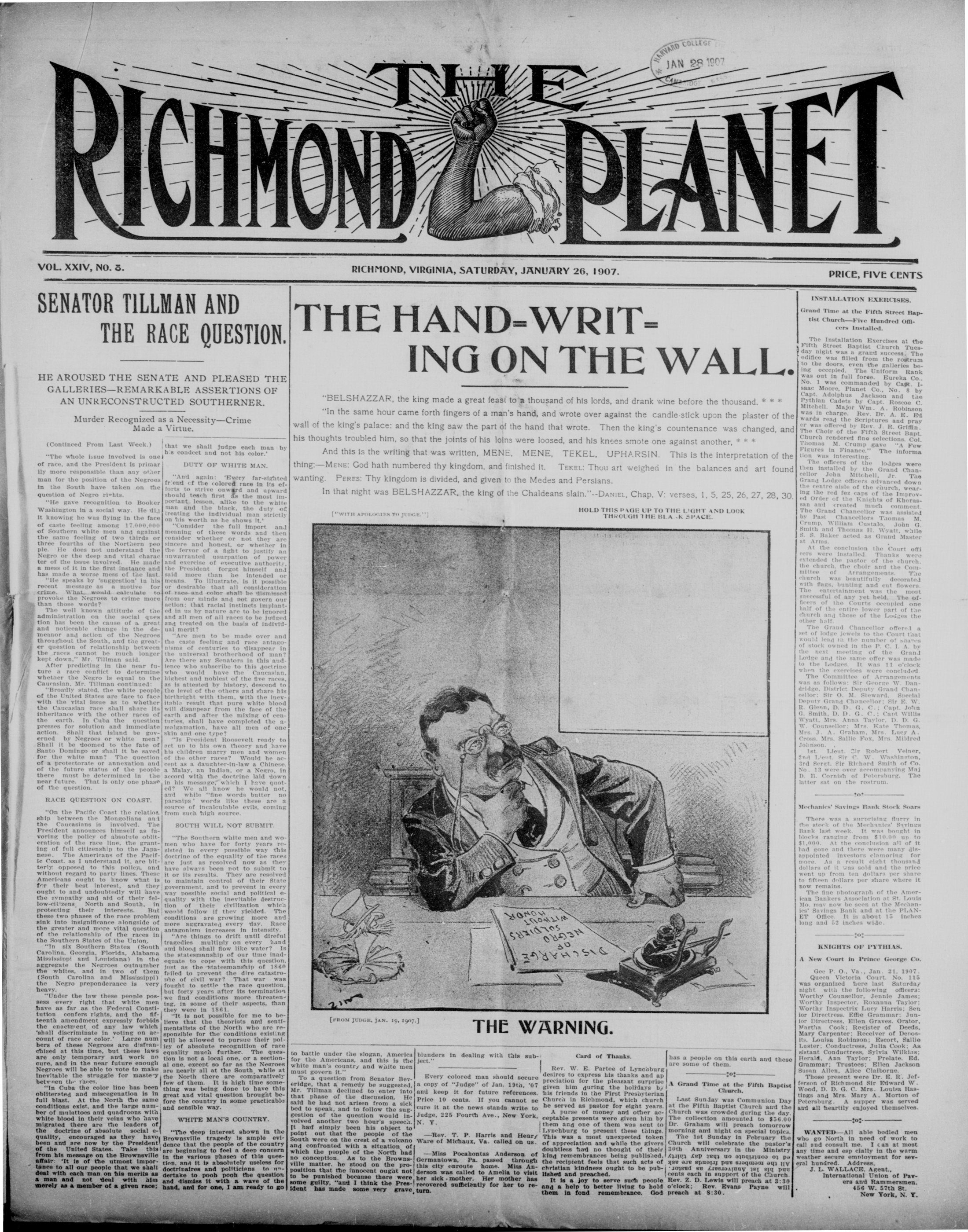
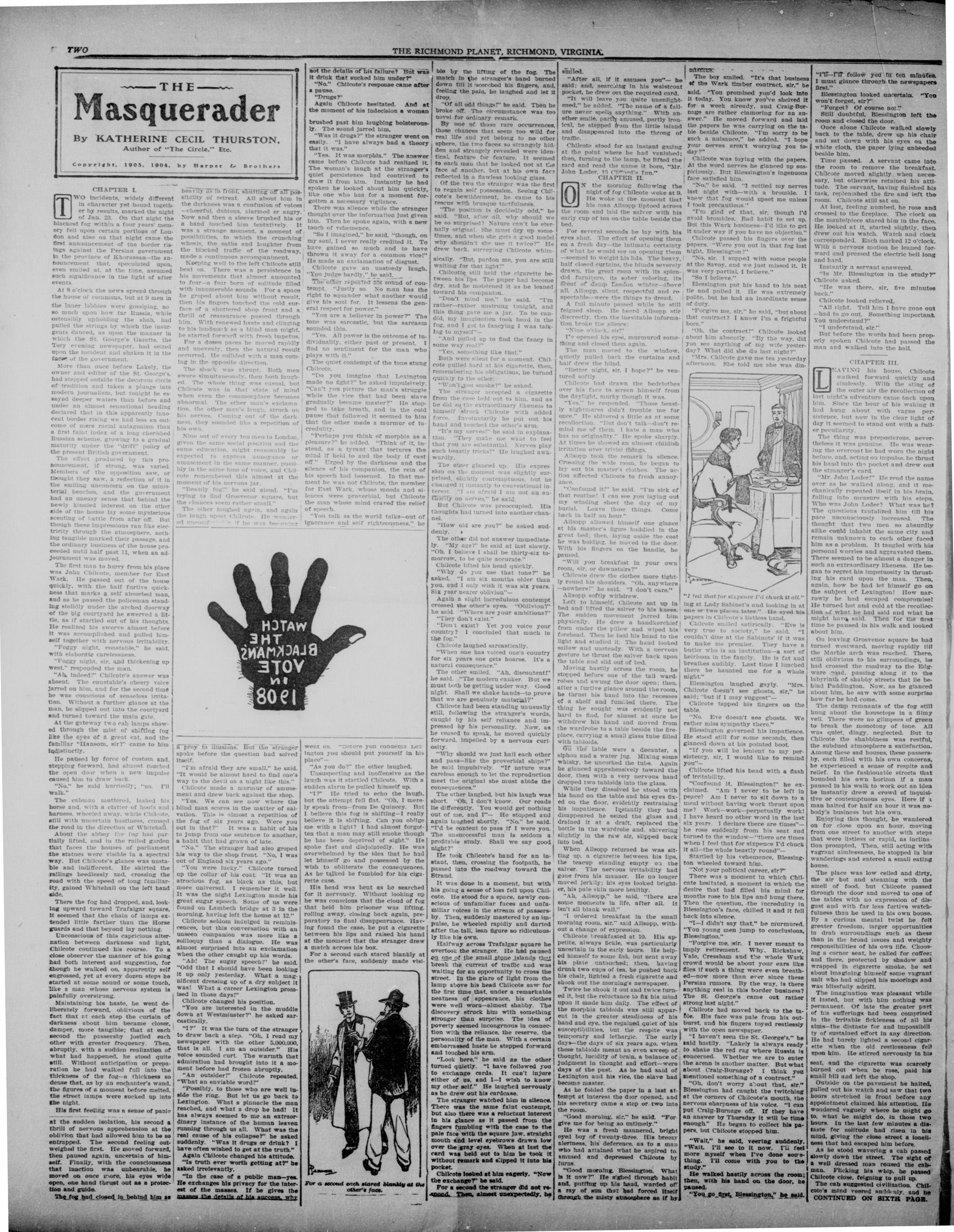
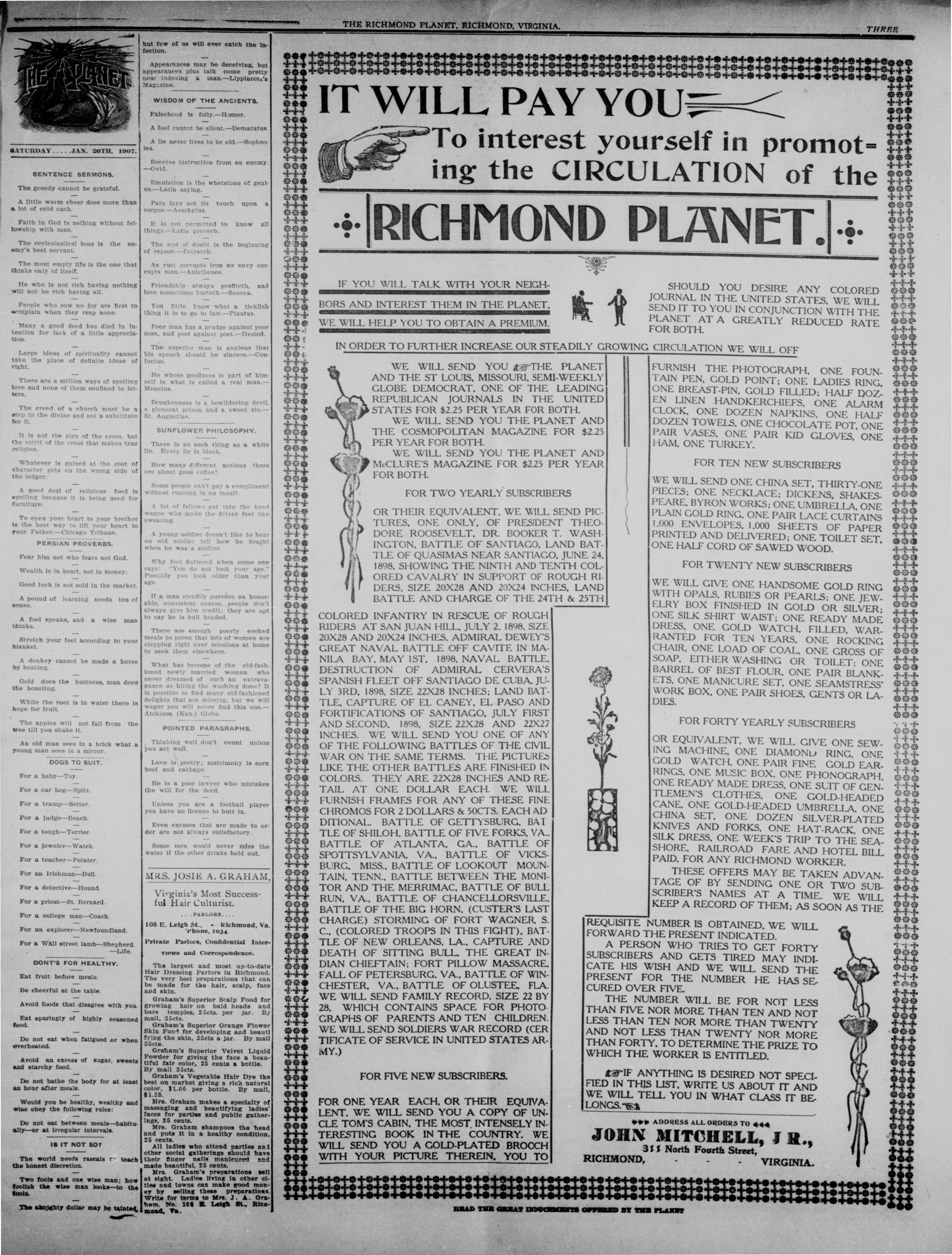
Page text (machine-generated)
THE RICHMOND PLANET
SENATOR TILLMAN AND THE RACE QUESTION.
HE AROUSED THE SENATE AND PLEASED THE GALLERIES—REMARKABLE ASSERTIONS OF AN UNRECONSTRUCTED SOUTHERNER. Murder Recognized as a Necessity—Crime Made a Virtue.
VOL. XXIV, NO. 8.
SENATOR TILL
THE RA
HE AROUSED THE SENA
GALLERIES—REMARK
AN UNRECONSTRUc
Murder Recognized a
Made a
(Continued From Last Week.)
"The whole issue involved is one
of race, and the President is prima-
ly more responsible than any other
man for the position of the Negroes
in the South have taken on the
question of Negro rights.
"He gave recognition to Booker Washington in a social way. He tilt it knowing he was flying in the face of caste feeling among 17,000,000 of Southern white men and against the same feeling of two thirds or three fourths of the Northern peo ple. He does not understand the Negro or the deep and vital character of the issue involved. He made a mess of it in the first instance and has made a worse mess of the last. "He speaks by 'suggestion' in his recent message as a motive for crime. What would calculate to provoke the Negroes to crime more than those would. The well known attitude of the administration on the social question has been the cause of a great and noticeable change in the demeanor and action of the Negroes throughout the South, and the greater question of relationship between the races cannot be much longer kept down." Mr. Tillman said.
After predicting in the near future a race conflict to determine whether the Negro is equal to the Caucasian, Mr. Tillman continued:
"Broadly stated, the white people of the United States are face to face with the vital issue as to whether the Caucasian race shall share its inheritance with the other races of the earth. In Cuba the question presses for solution and immediate action. Shall that island be governed by Negroes or white men? Shall it be doomed to the fate ofuto Domingo or shall it be saved for the white man? The question of a protectorate or annexation and of the future status of the people there must be determined in the near future. That is only one phase of the question.
RACE QUESTION ON COAST
"On the Pacific Coast the relation, ship between the Mongolians and the Caucasians is involved. The President announces himself as favoring the policy of absolute obliteration of the race line, the granting of full citizenship to the Japanese. The Americans of the Pacific Coast, as I understand it, are bitterly opposed to this policy, and without regard to party lines. These Americans ought to know what is for their best interest, and they ought to and undoubtedly will have the sympathy and aid of their fellow-citizens, North and South, in protecting their interests. But these two phases of the race problem sink into insignificance alongside of the greater and more vital question of the relationship of the races in the Southern States of the Union.
"In six Southern States (South Carolina, Georgia, Florida, Alabama Mississippi and Louisiana) in the aggregate the Negroes outnumber the whites, and in two of them (South Carolina and Mississippi) the Negro preponderance is very heavy.
"Under the law these people possess every right that white men have as far as the Federal Constitution confers rights, and the fifteenth amendment expressly forbids the enactment of any law which 'shall discriminate in voting on account of race or color.' Large numbers of these Negroes are disfranchised at this time, but these laws are only temporary and work no cure, and in the near future enough Negroes will be able to vote to make inevitable the struggle for mastery between the races.
"In Cuba the color line has been obliterated and miscegenation is in full blast. At the North the same conditions exist, and the large number of mulattoes and quadroons with white blood in their veins who have migrated there are the leaders of the doctrine of absolute social equality, encouraged as they have been and are now by the President of the United States. Take this from his message on the Brownsville affair: 'It is of the utmost importance to all our people that we shall deal with each man on his merits as a man and not deal with him merely as a member of a given race;
that we shall judge each man by his conduct and not his color.
DUTY OF WHITE MAN
"And again: 'Every far-sighted friend of the colored race in its efforts to strive onward and upward should teach first as the most important lesson, alike to the white man and the black, the duty of treating the individual man strictly on his worth as he shows it.'"
"Consider the full import and meaning of these words and then consider whether or not they are sincere and honest, or whether in the fervor of a fight to justify an unwarranted usurpation of power and exercise of executive authority, the President forgot himself and said more than he intended or means. To illustrate, is it possible or desirable that all consideration of race and color shall be dismissed from our minds and not govern our action; that racial instincts implanted in us by nature are to be ignored and all men of all races to be judged and treated on the basis of individual merit?
"Are men to be made over and the caste feeling and race antagonisms of centuries to disappear in the universal brotherhood of man? Are there any Senators in this audience who abate to this poetine who would have the Cuvagian, highest and noblest of the five races, as is attested by history, descend to the level of the others and share his birthright with them, with the inevitable result that pure white blood will disappear from the face of the earth and after the mixing of centuries, shall have completed the amalgamation, have all men of one skin and one type?
"Is President Roosevelt ready to act up to his own theory and have his children marry men and women of the other races?" Would he accept as a daughter-in-law a Chinese, a Malay, an Indian, or a Negro, in accord with the doctrine laid down in his message, which I have quoted previously, and while "few words butter no parsnips" words like these are a source of incalculable evils, coming from such high source.
SOUTH WILL NOT SUBMIT
"The Southern white men and women who have for forty years resisted in every possible way this doctrine of the equality of the races are just as resolved now as they have always been not to submit to it or its results. They are resolved to maintain control of their State government, and to prevent in every way possible social and political equality with the inevitable destruction of their civilization which would follow if they yielded. The conditions are growing more and more aggravated every day. Race antagonism increases in intensity. "Are things to drift until direful tragedies multiply on every hand and blood shall flow like water? Is the statesmanship of our time inadequate to cope with this question, just as the statesmanship of 1880 failed to prevent the title coaster of the war. That war was fought to settle the race question, but forty years after its termination we find conditions more threatening, in some of their aspects, than they were in 1861.
"It is not possible for me to believe that the theorists and sentimentalists of the North who are responsible for the conditions existing will be allowed to pursue their policy of absolute recognition of race equality much further. The question is not a local one, or a sectional one, except so far as the Negroes are nearly all at the South while at the North there are comparatively few of them. It is high time something was being done to have this great and vital question brought before the country in some practicable and sensible way.
WHITE MAN'S COUNTRY.
"The deep interest shown in the Brownsville tragedy is ample evidence that the people of the country are beginning to feel a deep concern in the various phases of this question, and it is absolutely useless for doctrinales and politicians to undertake to pooh pooh the question and dismiss it with a wave of the hand, and for one. I am ready to go
RICHMOND, VIRGINIA, SATURDAY, JANUARY 26, 1907
THE HAND=WRIT= ING ON THE WALL.
"BELSHAZZAR, the king made a great feast to a thousand of his lords, and drank wine before the thousand. * * *
"In the same hour came forth fingers of a man's hand, and wrote over against the candle-stick upon the plaster of the wall of the king's palace: and the king saw the part of the hand that wrote. Then the king's countenance was changed, and his thoughts troubled him, so that the joints of his loins were loosed, and his knees smote one against another, * * *
And this is the writing that was written, MENE, MENE, TEKEL, UPHARSIN. This is the interpretation of the thing:—MENE: God hath numbered thy kingdom, and finished it. TEKEL: Thou art weighed in the balances and art found wanting. PERES: Thy kingdom is divided, and given to the Medes and Persians.
In that night was BELSHAZZAR, the king of the Chaldeans slain."--DANIEL, Chap. V: verses, 1, 5, 25, 26, 27, 28, 30
DISCHARGE
OF
NEGRO
SOLDIERS
WITHOUT
HONOR
[ "WITH APOLOGIES TO JUDGE." ]
21M
[FROM JUDGE, JAN. 19, 1907.]
to battle under the slogan, America for the Americans, and this is the white man's country and white men must govern it." To a question from Senator Beveridge, that a remedy be suggested, Mr. Tillman declined to enter into that phase of the discussion. He said he had not arisen from a sick bed to speak, and to follow the suggestion of the question would involve another two hour's speech. It had simply been his object to point out that the people of the South were on the crest of a volcano and confronted with a situation of which the people of the North had no conception. As to the Brownsville matter, he stood on the proposition that the innocent outgot not to be punished because there were some guilty, "and I think the President has made some very grave
THE WARNING.
blunders in dealing with this subject."
Every colored man should secure a copy of "Judge" of Jan. 19th, '07 and keep it for future references. Price 10 cents. If you cannot se cure it at the news stands write to Judge, 225 Fourth Ave., New York, N. Y.
—Rev. T. P. Harris and Henry Ware of Michaux, Va. called on us.
—Miss Pocahontas Anderson of Germantown, Pa. passed through this city enroute home. Miss Anderson was called to Amelia to visit her sick mother. Her mother has recovered sufficiently for her to return.
HOLD THIS PAGE UP TO THE LIGHT AND LOOK
THROUGH THE BLA. K.SPACE.
Card of Thanks.
Rev. W. E. Partee of Lyncnaburg desires to express his thanks and apreciation for the pleasant surprise given him during the holidays by his friends in the First Presbyterian Church in Richmond, which church he served as pastor for eight years.
A purse of money and other acceptable presents were given him by them and one of them was sent to Lynchburg to present these things. This was a most unexpected token of appreciation and while the givers doubtless had no thought of their kind remembrances being published, the recipient feels that such acts of christian kindness ought to be published and preached.
It is a joy to serve such people and a help to better living to hold them in fond remembrance. God
has a people on this earth and these are some of them.
A Grand Time at the Fifth Baptist Church.
Last Sunday was Communion Day at the Fifth Baptist Church and the Church was crowded during the day. The collection amounted to $56.00. Dr. Graham will preach tomorrow morning and night on special topics.
The 1st Sunday in February the Church will celebrate the pastor's 30th Anniversary in the Ministry of the Committee on that day. Early at the members and friends are asked all the 1st anniversary as pastor, and this is an important support of the Church. Rev. Z. D. Lewis will preach at 3:30 o'clock; Rev. Evans Payne will preach at 8:30.
PRICE, FIVE CENTS
Grand Time at the Fifth Street Baptist Church—Five Hundred Officers Installed.
The Installation Exercises at the Fifth Street Baptist Church Tuesday night was a grand success. The edifice was filled from the rostrum to the doors, even the galleries being occupied. The Uniform Rank was out in full force. Eureka Co. No. 1 was commanded by Capt. Iso Moore, Planet Co., No. 8 by Capt. Adolphus Jackson and the Pythian Cadets by Capt. Roscoe C. Mitchell. Major Wm. A. Robinson was in charge. Rev. Dr. A. E. Edwards read the Scriptures and prayed was offered by Rev. J. R. Griffin. The Chair of the Fifth Street Baptist Church rendered fine selections. Col. Thomas M. Crump gave "A Few Figures in Finance." The information was interesting.
The officers of the lodges were then installed by the Grand Chancellor John Mitchell, Jr. Tae Grand Lodge officers advanced down the centre aisle of the church, wearing the red fez caps of the Improved Order of the Knight of Khorassan and created much comment. The Grand Chancellor was assisted by Past Chancellors Thomas M. Crump, William Custalo, John G. Smith and Thomas H. Wyatt, while S. S. Baker acted as Grand Master at Arms.
At the conclusion the Court offi-
cers were installed. Thanks were
extended the pastor of the church,
the church, the choir and the Com-
mittee of Arrangements. The
church was beautifully decorated
with flags, bunting and cut flowers.
The entertainment was the most
successful of any yet held. The offi-
cers of the Courts occupied one
half of the entire lower part of the
church and those of the Louges the
other half.
The Grand Chancellor offered a
set of lodge jewels to the Court taint
would lead in the number of shares
of stock owned in the P. C. I. A. by
the next meeting of the Grand
Lodge and the same offer was made
to the Lodges. It was 11 o'clock
when the exercises were concluded.
The Committee of Arrangements
was as follows: Sir George W. D-
dridge, District Deputy Grand Chanc-
eller; Sir O. M. Steward, Special
Deputy Grand Chancellor; Sir E. W.
R. Gleun, D. D. G. C.; Capt. John
G. Smith, D. D. G. C.; Capt Willis
Wyatt, Mrs. Anna Taylor, D. D. G.
W. Counsellor; Mrs. Kate Thomas,
Mrs. J. A. Graham, Mrs. Lucy A.
Cross, Mrs. Sallie Fox, Mrs. Mildred
Johnson.
1st. Lleut. Sir Robert Veiner,
2nd Leut. Sir C. W. Washington,
3rd Seret. Sir Richard Smith of Co.
No. 13 were over accompanying Maj.
D. B. Cornish of Petersburg. The
latter sat on the rostrum.
Mechanics' Savings Bank Stock Soars
There was a surprising flurry in the stock of the Mechanics' Savings Bank last week. It was bought in blocks ranging from $10.00 up to $1,000. At the conclusion all of it had gone and there were many disappointed investors clamoring for more. As a result eight thousand dollars of it was sold and the price went up from ten dollars per share to fifteen dollars per share where it now remains.
The fine photograph of the American Bankers Association at St. Louis Mo. may now be seen at the Mechanics' Savings Bank and at the PLANET Office. It is about 15 inches long and 52 inches wide.
KNIGHTS OF PYTHIAS.
A New Court in Prince George Co.
Gee P. O. Va., Jan. 21, 1907.
Queen Victoria Court. No. 115 was organized here last Saturday night with the following officers:
Worthy Counselor, Jennie James;
Worthy Inspector, Roxanna Taylor;
Worthy Inspectrix Lucy Harris; Senior Directress, Effie Grammar; Junior Directress, Ellen Graves. Orator, Martha Cook; Register of Deeds, Mary Carpenter; Receiver of Denositis, Louisa Robinson; Escort, Sallie Luster; Conductress, Julia Cook; Assistant Conductress, Sylvia Wilkins; Herald, Ann Taylor; Prelate. Ed. Grammar; Trustees, Ellen Jackson Susan Allen, Alia Clareburg.
Those present were Dr. E. R. Jefferson of Richmond Sir Edward W. Wood, D. D. G. C. Mrs. Loula Hastings and Mrs. Mary A. Morton of Petersburg. A supper was served and all heartily enjoyed themselves.
WANTED—All able bodied men who go North in need of work to call and consult me. I can at most any time and esp cially in the warm weather secure employment for several hundred. Address,
J. L. WALLACE. Agent.,
International Union of Pavers and Rammersmen.
456 W. 57th St.
New York, N. Y.
—— TH E—~
By KATHERINE CECIL THURSTON,
Author of “The Circle,” Ete.
Copyright, 1905, 1908. by Marper & Brothers
Two.
CHAPTER IL
eee aa) ee oe arias 5 ae es |e. eee
don and also on that night eame th
first announcement of the border ris
fngs against the Persian governmen
fa the province of Khorassan—the an
Rouncement that, speculated upon
even smiled at. at the time, assumed
such signiticunce In the light of after
events
At 8 o'clock the news spread through
the house of commons, but at 9 mea in
the Inner lobbies were gossiping, no
#0 much upon how far Russia, while
estensibly upholding the shab, bad
pulled the strings ly which the losur-
gents danced, as upon the manuer tp
which the St. George's Gazette, the
Tory evening newspaper, had seized
Upon the incident and shaken it in the
face of the covernment
Bore than once before Lakely, the
owner and editor of the St. Georze’s,
had stepped outside the decorous circle
of-tradition and taken a plunge Into
modern journalism, but tonight be es
Sayed deeper waters than before and
under an almost sensational heading
@eclared that in this apparently {nno-
cent border rising we bad less an out
come of mere racial antagonism than
@ first faint index of a long cherished
Russian scheme, growing to a gradual
maturity under the “drift policy of
the present British government
‘The effect produced by this pro
Rouncemeut. if strong, was varied
Members of the opposition saw, of
thought they saw, a reflection of it in
the smiling unconcern on the minis.
terial benches, and the goverament
had an uneasy sense that behind the
Rewly Kinaled interest on the other
aide of the house lay some mysterious
Sceuting of lattle from afar off. But
though these Impressions ran like elec.
tricity throuch the atmosphere, uoth
ing tangible marked their passage, and
the ordinary business of the house pro-
ceeded until balf past 11, when an ad.
Journment was moved
The first man to hurry from bis place
was Jobu Chilcote, member for East
Wark. He passed out of the bouse
quickly, with the balf furtive quick.
ess that marks a self absorbed man,
and as he passed the policeman stand.
ing stolidly under the arched doorway
of the big courtyard he awerved a lit-
tle, as if startled out of his thoughts
He realized his swerve almost before
§t was accomplished and pulled him.
self together with nervous Irritability.
“Fogzy night, constable.” he sald,
With elaborate carelessness,
“Foggy night, sir, and thickening up
west.” responded the man.
“Ah, indeed!” Chilcote’s answer was
absent. The constable’s cheery voice
Jarred on him. and for the second time
he was conscious of senseless Irrita
tion. Without a further glance at the
man, he slipped out lato the courtyard
and turned toward the main gate.
At the gateway two cab lamps show:
@4 through the mist of shifting fog
Uke the eyes of a great cat, and the
familiar “Hansom, sir?" came to bim
indistinctly,
He patised by force of custom and,
stepping forwsrd, had almost couched
the open door when a new Impulse
caused him to draw back
“No.” he sald hurriedly; “no, 1
walk.”
The cabman mattered, lashed his
horse and, with a clatter of hoofs and
harness. wheeled away, white Chileate,
still with uncertain hastiness, crossed
the road In the direction of Whitehall.
About the abbey the fog had par
tially lifted, and in the railed garden
that faces the houses of parliament
the statues were visible {n a spectral
way. But Chilcote’s glance was unsta-
Die and indifferent. He skirted the
railings beedlessly and, crossing the
road with the speed of long familiar.
ity, gained Whitehall on the left hand
side.
There the fog had dropped. and, look-
ing upward toward Trafalgar square,
At seemed that the chain of lamps ex-
tended little farther than the Horse
guards and that beyond lay nothing.
Unconscious of this capricious alter-
nation between darkness and light,
Chileote continued his course. To a
close observer the manner of his going
tad both interest and suggestion, for
‘hough be walked on, apparently self
engrossed, yet at every dozen steps be
started at some sound or some touch,
Mke a man whose nervous system is
Painfully overstrang.
Maintaining bis haste, he went de
Mberately forward, oblivious of the
fact that at each step the curtain of
darkness about him became closer,
damper, more tangible; that at each
second the passersby jostled each
other with greater frequency. Then,
abruptly, with a sudden realization of
what had happened, he stood quite
‘still, Without anticipation or prepa-
Fation he had walked full Into the
‘thickness of the fog—a thickness so
dense that, as by an enchanter’s wand.
‘the figures of a moment before melted,
the street lamps were sucked up into
he night.
‘His first feeling was a sense of panic
‘at the sudden isolation, bis second a
Sie cv Sioa
‘oblivion had t so
tra, ‘The second feeling out-
we ‘the first. He moved forward,
PPL
The SZ
Ty tae)
Bt) ae
= p ae
KE
heavily os Th Tron, shutting of all pos-
sibility of retreat. AM about bim tn
the darkness was a confusion of volces
~cheerful, dubtous, alarmed or angry.
Now and then a sleeve brushed bis or
a band touched him tentatively. It
‘Was a strange moment, a moment of
possibilities, to which the crunching
wheels, the oaths and laughter from
‘the blocked traffic of the roadway,
made a continuous accompaniment.
Keeping well to the left Chilcote still
beat on. ‘There was a persistence In
his movements that almost amounted
to fear—n fear born of solitude Aled
with Innumerable sounds. For a space
be groped about him without result,
then his fingers touched the cold sur-
face of a shuttered sbop front and a
thrill of reassurance passed through
him. With renewed haste and clinging
to his landmark as a blind man might,
he started forwarfl with fresh Impetus,
For a dozen paces he moved rapidly.
and uneventy. then the natural result
oceurred. Te collided with a man com-
ing in the opposite direction.
‘The shock was abrupt. Both men
swore simultaneously. then both fauch-
ed. The whole thing was casual, but
Chileote was in that state of mind
when even the commonplace becomes
abnormal. ‘The other man’s exclama
tion, the other man's Inugtt, struck on
his nerves, Coming out of the dark
ness, they sounded like a repetition of
bis own, |
Nine out of every ten men in London,
given the same social position and the
same education, might reasonably be
expected to express annuyance or
amusement in the same manner. poss!
biy in the same tone of voice, and Chit
cote remembered this almost at the
moment of his nervous Jar.
“Beastly fox!" he sald aloud. “I'm
trying to find Grosvenor square, but
the chauces seem rather small.”
‘The other laughed agein, and again
the laugh upset Chileote. He woncer- |
ed uneomt— <1" If he was bernmins
a prey f Wuslons: But the stranger
spoke before the question had solved
Itself.
“I'm afraid they are small,” he said.
“It would be almost bard to find one’s
way to the devil on a night lke this
Chilcote made a murmur of amuse.
ment and drew back against the shop,
Yes. We can see now where the
blind man scores in the matter of sal-
vation. This is nlmost a repetition of
the fog of six years ago. Were you
out in that? It was a habit of bis
to Jump from one seutence to another,
a habit that had grown of late
“No.” ‘The stranger had also groped
his way to the shop front. “No, 1 was
out of England six years ago.”
“You were lucky Chilcote turned
up the collar of bis coat. “It was an
atrocious fog, as black as this, but
more universal. I remember it well.
It was the night Lexington made bis
great sugar speech. Some of us were
found on Lambeth bridge at 3 in the
morning, having left the house at 12."
| Chileote seldom indulged in remiais-
-cences, but this conversation with an
Unseen companion was more like a
soliloquy than a dialogue. He was
almost surprised into an exclamation
when the other caught up bis words.
“Ab! The sugar speech!” he said,
“Odd that I should have been looking
it up only yesterday, What a mag-
nificent dressing up of a dry subject it
was! What a career Lexington prom-
fsed In those days!”
Chilcote changed his position.
“You are interested in the muddle
down at Westminster?” he asked sar-
castically,
“I?” It was the turn of the stranger
to draw back a step. “Oh, I read my
newspaper with the other 5,000,000,
that Is all. I am an outsider.” His
Voice sounded curt. The warmth that
admiration had brought Into It a mo
ment before had frozen abruptly.
“An outsider!” Chilcote repeated.
“What an enviable word!"
“Possibly, to those who are well tu-
| slde the ring. But let us go back to
Lexington. What a plonacle the man
reached, and what a drop he bad! It
has always seemed to me an extraor-
inary Instance of the human leaven
running through us all. What was the
real cause of bis collapse?” he asked
suddenly. “Was it drugs or drink? I
have often wished to get at the truth.”
Again Chilcote changed bis attitude.
“Ia truth ever worth getting at?" he
asked irrelevantly,
“In the case of a public man—yes.
‘He exchanges his privacy for the inter-
est of the masses. If he gives the
masnes the details of bis success, why
THE RICHMOND PLANET, RICHMOND, VIRGINIA.
‘wot the detalls of his tallure? But
‘it drink that sucked bim under? =
“No.” Chitcote’s response came ates
8 pause.
“Drugs?”
Again Chileote hesitated. And at
the moment of his Indecision a woman
brushed past bim laughing bolsterous
ly. The sound jarred him,
“Was it drugs?” the stranger went on
easily. “I have always bad a theory
that it was.”
“Yes. It was morpbia.” ‘The answer
ame before Chilcote had realized It
The woman's laugh at the stranger's
quiet persistence had contrived to
draw it from him. Instantly he had
spoken he looked about him quickly,
“Uke one who has for a moment for
gotten @ necessary vigilance.
‘There was silence while the stranger
thought over the Information Just given
him. ‘Then he spoke again, with a new
touch of vehemence,
“So I Imagined,” he sald, “though, on
my soul, I never really credited It. To
have gained so much and to have
thrown it away for a common rice!”
He made an exclamation of disgust.
Chilcote gave an unsteady laugh.
“You Jude hardiy.” he sald.
‘The other reperted its sotnd of con-
tempt. “Justly so. No man has the
tight to squander what another would
give his soul for. It lessens the gen-
eral respect for power.”
“You are a believer In power?" The
tone was sarcastic, but the sarcasm
sounded thin.
“Yes, All power Is the outcome of In-
dividuality. either past or present.
find no sentiment for the man who
plays with it”
‘The quiet contempt of the tone stung
Chileote.
“Do you immagine that Lexington
made no fight?” he asked impulsively.
“Can't you picture the man's struggle
while the vice that bad been slave
gradually became master?’ He stop-
Ped to take breath, and in the cold
Pause that followed it seemed to him
that the other made a murmur of to
credulity.
“Perhaps you think of morphia as a
pleasure?” he added. “Think of It, in-
stend, a5 m tyrant that tortures the
mind if held to and the body if cast
off.” Urged by the darkness and the
silence of his companion, the rein of
bis speech had loosened. In that mo-
ment he was not Chilcote, the member
for Rast Wark, whose moods and si-
lences were proverbial, but Chilcote
the man whose mind craved the relief
of speech,
“You talk as the world talke—out of
iguorance and self righteousness,” be
went on. “Serore you conaema Lex
Ington you should put yourself In his
place"—
“As you do?” the other laughed.
Unsuspecting and inoffensive as the
lauch was It startled Chileote, With @
sudden alarm he pulled himself up.
“I” He tried to echo the laugh,
but the attempt fell fat. “Ob, I mere-
ly speak from—from De Quincey. But
I believe this fog Is shifting—I really
believe it fs shifting. Can you oblige
me with a light? I had almost forgot-
ten that a man may still smoke though
he has been deprived of sight.” He
spoke fast and disjotutedly, He was
overwhelmed by the idea that he had
Jet himself go and possessed by the
wish to obliterate the consequences.
As he talked he fumbled for his ciga-
Tete casa.
His head was bent as he searched
for It nervously. Without looking up
he was conscious that the cloud of fog
that held him prisoner was lifting.
rolling away, closing back again, pre
Paratory to final disappearance. Hav.
Ing found the case, be put a cigarette
between his lips and raised his hand
at the moment that the stranger drew
‘@ match across his box.
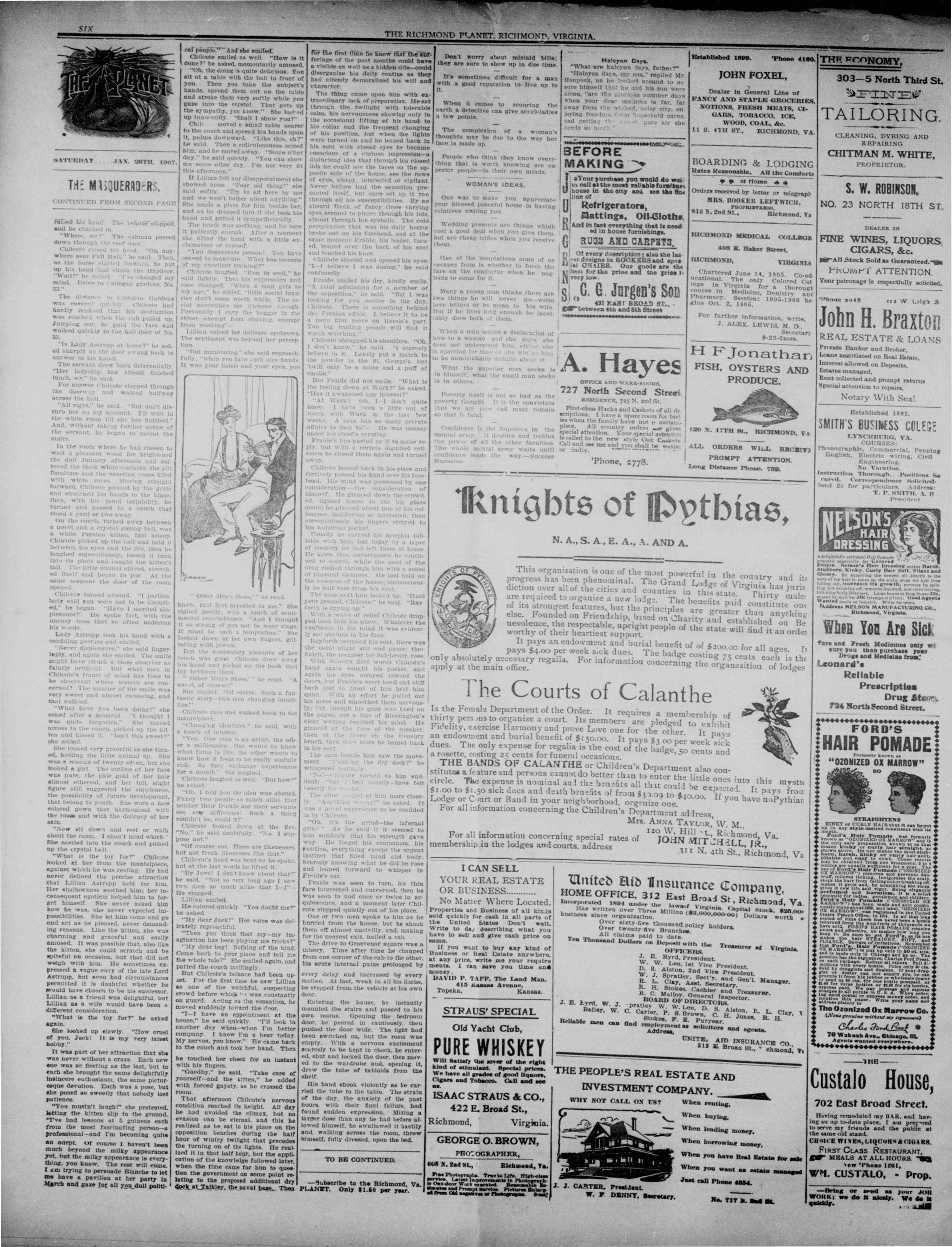
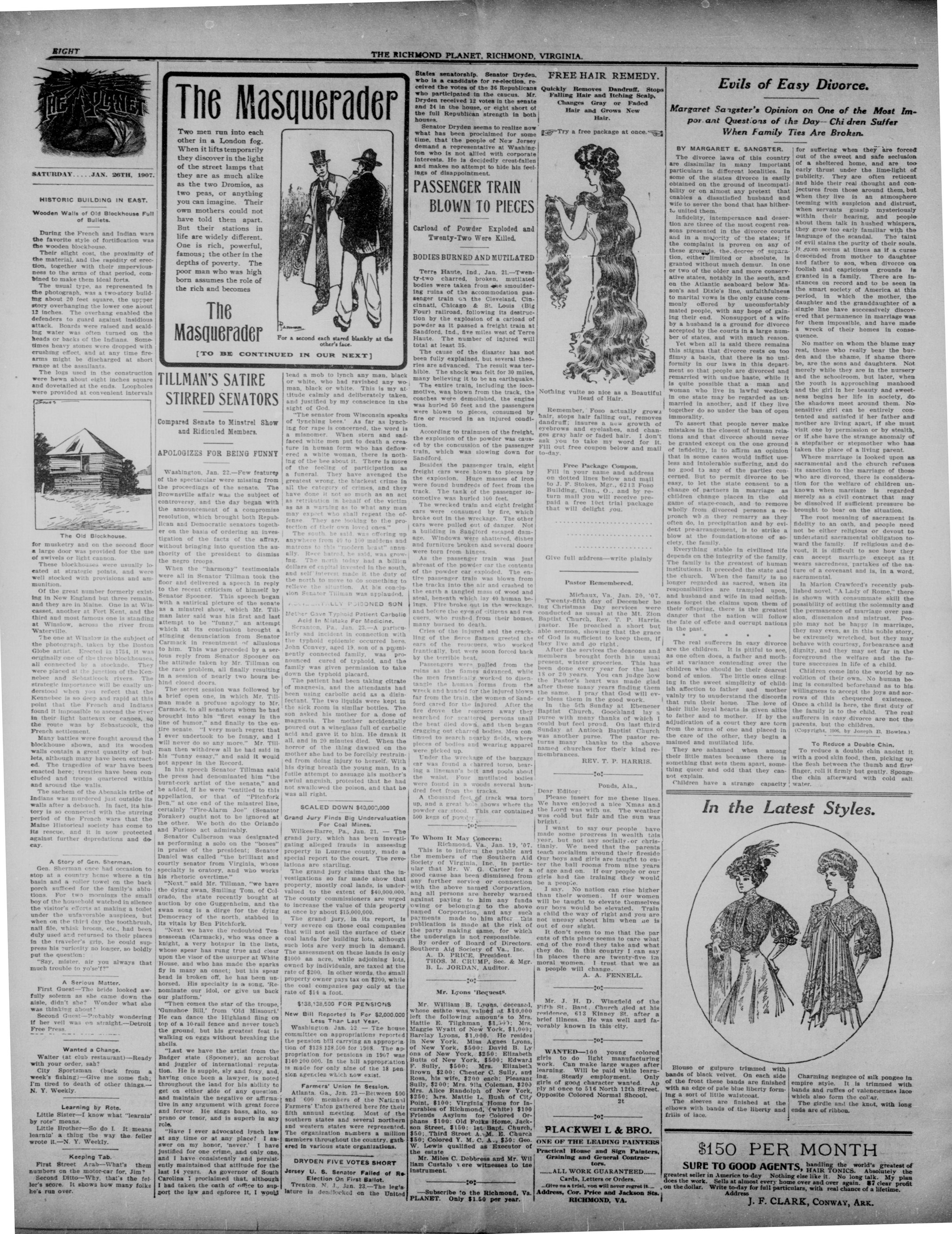
For a second each stared blankly at
the other's face, suddenly made visi-
e 2
Laid A re ie
He Es oo H
eo Ni
L y x
For a second exch stared dankly at th
7 Ee a
‘scorched his fagers, and,
pecs Pain, he laughed and let i
|] , “Ot all oda things!” be said. Then he
| broke off. ‘The circumstance was too
‘Rovel for onlinary remark.
| By one of those rare occurrences,
‘those chances that seem too wild for
| real tife and yet belong to no other
sphere, the two faces so strangely bid-
den and strangely revealed were iden.
tical, feature for feature. It seemed
toeach man that he looked not at the
face of another. but at bis own face
Fefected in a flawless looking glass.
Of the two the stranger was the first
to regain self possession. Seeing Chi!-
cote’s bewilderment, he came to his
Tescve with brusque tactfulness.
“The position is decidedly odd." he
said. “But, after all, why should we
be s0 surprised? Nature can't be eter-
nally original. She must dry up some.
| times. and when she gets n good model
| Why shouldn't she use it twice?" He
Grew back, surveying Chileote whim
sieally. “But, pardon me, you are still
waiting for that light!”
Chilevtte still held the cigarette be-
tween bis lips. Tue paper lad become
dry, and he moistened it as he leaned
toward his companion.
“Don't mind me.” be sald. “I'm
rather—rather uustrung tonight, and
this thing gave me a jar. To be can
did, my imagination took bead in the
fog, and I got to fancying I was talk-
Jog to myself”.
“And pulled up to find the fancy in
some way: real?”
“Yes, something like that.”
Both were silent for a moment. Chik.
cote pulled hard at his cigarette, then,
remembering his obligations, be turned |
quickly to the other.
“Won't,sou smoke?" he asked
The stranger accepted a cigarette
| he did 4g the extraordinary likeness to
himself ‘struck Chileote with ndded
hand and touched the other's arm,
“I's my uerves!™ be said !n explana
tion. “They make me want to feel
that you are suistantial. “Nerves play
such beastly tricks!” He laughed awk
warily,
The otper glanced up. His expres
sion on the woment was slightly. sur-
prised, slichtly coutemptuous, but he
changed It instantiy to conventional in
terest. “T raid Fam not an an
Thority on nerves," he sat.
But Chilcote was preoccupled. His
thoughts had turned lato another chan
nel
“How old are you?" be asked sud.
deuly. 2
The other did not answer immediate-
ly. “My age?” be said at last slowly.
“Ob, I believe I shall be thirty-six to-
morrow, to be quite accurate.”
Chileote lifted his bead quickly.
“Why do you use that tone?” he
asked. “I am six months older than
You, and I ouly wish it was six years,
Six year nearer oblivion"—
Again a slight tucredulous contempt
crosned the other's eyes. “Oblivion?”
he sald. “Where are your ambitions?”
“They don't exist.”
“Don't exist? Yet you voice your
country? I concluded that much In
‘the fog."
Chilcote laughed sarcastically,
“When oue has voiced one's country
for six years one gets hoarse. It's a
natural consequence.”
The other smiled. “Ah, discontent!”
he said. “The modern canker. But we
must both be getting under way. Good
night. Shall we shake bands—to prove
that we are geauinely material?” |
Chilcote had been standing unusually
atill, following the stranger's words,
caught by his self reliance and im-
Pressed by his personality. Now, as
he ceased to speak, he moved quickly
forward, impelled by a nervous curi-
osity.
“Why should we just ball each other
and pass—Ike the proverbial ships?”
he said impulsively. “If nature was
careless enough to let the reproduction
meet the original she must abide the
consequences.”
The other laughed, but his laugh was
short. “Ob, I don't know. Our roads
He differently. You would get nothing
out of me, and I"— He stopped and
again laughed shortly. “No,” he sald.
“I'd be content to pass if I were you.
‘The unsuccessful man ts seldom a
Profitable study. Shall we say good
night?" |
Fe took Chilcote’s hand for an in-
stant, then, crossing the footpath, be
Passed into the roadway toward the
Strand. |
It was done in a moment, but with
his going a sense of loss fell upon Chil-
cote. He stood for a space, newly con-
scious of unfamiliar faces and unfa-
‘millar voices In the stream of passers-
by. Then, suddenly mastered by an im-
Pulse, he wheeled rapidly and darted
after the tall, lean figure so ridiculous-
ly Uke bis own,
Eialtwag_ecaes’ Sontalans puenre be
overtook the stranger. He paused
on one of the small stone islands thot
‘Drenk the current of trafiie and was
‘waiting for an opportunity to cross the
street. In the giare of light from the
lamp above bis head Chilcote saw- for
‘the first time that, under a remarkable
leintstaen Rake dene ee
ure never anything.” With an-
teal, he stepped the lttle Island
and disappeared Into the throng of
trame.
Chileote stood for an instant gazing
at the point where he had vanished;
then, turning to the lamp. be Ifted the
tard and read the name it bore, “Mr.
Joha Loder. 1% Ciiant's Tan.”
CHAPTER T.
N the morning following the
night of fog Chileote woke at 9,
He woke at the moment tbat
bis man Allsopp tiptoed across
the room and laid the salver with his
early cup of tea on-the table beside the
bed.
For several seconds he lay with his
eres shut. The effort of opening them
on a fresh day—the Intimate certainty
of what he would see on opening them
—seemed to weight his lds. The heavy,
half closed curtains, the bliods severely
drawn, the great oom with its splen-
did furniture, its sober coloring, its
Sent of damp Tonion wiater—dbove
all. Allsopp, silent, respectful and re
“spectahle—were the things to dread.
‘A full minute passed while he sttit
felzned sleep. He beard Allsopp stir
discreetly, then the inevitable inferma-
tion broke the xilence:
“Nine o'clock, str?
Te opened his eyeé, murmured some-
thing and closed them again,
The man moved to the window,
quietly pulled back the curtains and
haif drew the blind.
“Better night, sir, I hope?" he ven-
tured softly
Chileste bad drawn the bedclothes
over his face to screon himself from
the daylight, murky though It was.
“Yes,” he responded. “Those beast-
ly nightmares didn't trouble me for
once.” He shivered a little as at some
recollection. “But don't talk—don't re-|
mind me of them. [hate a man who
has no originality." He spoke sharply. |
At times he showed an almost childish
Irritation over trivial things. |
Allsopp took the remark In silence.
Crossing the wide room, he begin to
lay out his master's clothes. The ac-
tlon affected Chilcote to fresh annoy-
ance.
“Confound it!” he sald. “I'm sick of
that routine! T can see you laying out
my winding sheet the day of my
burial, Leave those things. Come
back in batf an hour.” |
Allsopp allowed himself one glance
at his master's figure tuddled tn the
great bed: then, laying aside the coat
he was holding, he moved to the door.
With bis fingers on the handle, he
paused.
“Will you breakfast in your own
room, sir, or downstairs?"
Chileote drew the clothes more tight-
ly round bis shoulders. “Ob, anywhere
nowhere!" he said, “I don't care."
Allsopp softly withdrew.
Left to himself, Chileote sat up in
bed and lifted the salver to his knees,
‘The sudden movement jarred him
physically. He drew a handkerchief
from under the pillow and wiped his
forehead. ‘Then be held his hand to the
Ught and studied it. The band looked
sallow and unsteady. With a nervous
gesture he thrust the salver back upon
the table and sild out of bed. |
Moving hastily across the room, he
stopped before one of the tall ward-
robes and swung the door opea; then,
after a furtive glance around the room, |
he thrust his haud Into the recesses |
of a shelf and fumiled there, The
thing he sought was evidently not
hard to find, for almost at ouce he
withdrew his hand and moved from
the wardrobe to n table beside the Gre-
place, carrying a smail glass tube filled
with tabloids,
‘On the Table were a decanter, a
siphou aud a water jug. Mixing some
whisky, he uncorked the tube. Again
he glanced apprehensively toward the
door, then with a very nervous band
dropped two tabloids Into the glass.
While they dissolved he stood with
his bund on the table and bis eyes 8x-
ed ou the floor, evideitly restraining |
his Impatience. Igstantly they bad)
disappeared he seized the glass and|
drained it at a draft, replaced the
bottle tn the wardrobe and, shivering
slightly in the raw alr, slipped back
tuto bed.
When Allsopp retursed be was sit-
ting up, a cigarette between his lips,
the teacup standing empty oa the
salver. The nervous irritability bad
gone from his manuer. He no longer
moved Jerkily: bis eyes looked bright-
er, his pale skin more healthy.
“Al, Allsopp,” he said, “there are’
some moments In life, after all. It
ten't all blank wall.”
“I ordered breakfast In the small
morning room, sir,” said Allsopp, with-
out a change of expression.
Chileote Lreakfasted at 10. His ap-
petite, always fickle, was particularly
uncertain {n the early hours. He help-
ed himself to sowe fish, but sent away
his plate cntonched; then, having
drunk two cups of tea, be pushed back
his chair, lighted a fresh cigarette and
shook out the morning's newspaper. |
Twice he shook {t out and twice turn-
ed it, but the reluctance to fix his mind
upon It made him daily, The effect of |
the morphia tabloids was still appar-
ent In the greater steadiness of bis
hand and eye. the regained quiet of his
cuaeaiatiaeien te ee et
te = ae epee
‘The boy smiled. “It’s that busines:
the Wark timber contract, sir,” bé
sald. “You promised ook Into
it today. You know ‘hoe shelved tt
for a week already, and Craig-Bur-
‘bage are rather clamoring for an an-
swer." He moved forward and laid
the papers he was carrying on the ta-
ble beside Chileote. “I'm sorry to be
such a nuisance,” he added. “I hope
your nerves aren't worrying you to-
day?”
Chileote was toying with the papers.
At the word nerves he glanced up sus-
Piciousiy. But Blessington’s Ingenuous
face satisfied him.
“No,” be said. “I settled my nerves
last night with—with a bromide. I
knew that fog would upset me unless
T took precautions.”
“I'm glad of that. sir, though I'd
avoid bromides. Bad habit to set up.
But this Wark business—T'd like to get
it under way If you have no objection.”
Chileote passed his fingers over the
Papers. “Were you out {a that fog last
ight, Blessington ?*
“No, sir. I supped with some people
at the Savoy, and we just missed it. It
was very partial, 1 believe.”
“So 1 believe.”
Blessington put his band to his neat
tle and pulled it. He was extremely
Polite, but he had an inordinate senso
of duty.
“Forgive me, sir.” he sald, “but about
that contract? I know I'm a frightful
‘Oh, the contract!” Chilcote looked
about him absently. “By the way, did
You see anything of my wite yester-
day? What did she do last night?"
“Mfrs. Chilcote gave me tea yesterday
afternoon, She told me she was din:
oe = =A
gil al
5 qi
a 2g. || Ne
me Ree
eo i
KG #
| 2 fect that for w ja pence I'd chuck tt alt.”
ing at Lady Sabinet’s and looking In at
one of two places later” He eyed him
papers In Chilcote’s istiess band.
} Chileote sulled satirically. “Eve Ie
very true to society," he said. “t
couldn't dine at the Sabinets’ if ¢ was
to make me premier. They have a
butler who ls an Institution—a sort of
heirloom in the family. He ts fat and
breathes audibly. Last tlme I lunched
there he haunted me for a whole
night."
| Blessington laughed gayly. “Mrs,
Chilcote doesn't see ghosts, sir,” he
said; “but if T may suggest”—
Culleote tapped his Angers on the
table
| “No. Eve doesn't see ghosts. We
rather miss sympathy there.”
Blessington governed his impatience
He stood still for some seconds, then
Blanced down at his pointed boot.
“If you will be lenient to my per-
sistency, sir, I would like to remind
you"
Chitcote lifted his bead with a flash
of Irritability
| “Confound It, Blessington!” be ex-
claimed. “Am'T never to be left In
peace? Am I never to sit down to a
meal without having work thrust pon
me? Work—work—perpetually work!
T have heard no other word in the last
six yeare. I declare there are times"—
he rose suddenly from his seat and
turned to the window—“there are times
when I feel that for sixpence I'd chuck
It all—the whole beastly round"—
Startled by his vehemence, Blessing-
ton wheeled toward him.
“Not your political career, str?”
‘There was a moment tn which Chil-
cate hesitated, a moment In which the
desire that had filled bis mind for
months rose to his lps and hung there.
‘Then the question, .the incredulity In
Blessington’s face, chilled it and It fell
back Into silence.
“I—I didn’t say that,” he murmured.
“You young men jump to conclusions,
Blessington.”
“Forgive me, sir. I never meant to
imply retirement. Why. Rickshaw,
Vale, Cressham and the whole Wark
crowd would be about your ears like
files if such a thing were even breath-
ed—now more than ever since these
| Persian Tumors. By the way, is there
anything real in this border business?
The St. George's came out rather
strong last night.”
} Chileote had moved back to the ta-
Ble. His face was pale from bis out-
burst, and his fingers toyed restlessly
with the open newspaper.
}“=L haven't seen the St. George's.” be
said hastily. “Lakely ts always ready
to shake the red rag where Russia |s
‘eoncerned. Whether we are to enter
the arena is another matter. But what
About Cralg-Burnage? I think you
Mentioned something of a contract.”
“Oh, don’t worry about that, sir”
Blessington had caught the twitching
at the corners of Chilcote’s mouth, the
nervous sharpness of his voice. “I can
Dut Cralg-Burnage off. If they bare
n answer by Thursday It will be time
enough” He began to collect his pa-
ers, but Chilcote stopped him.
“Wait,” he sald, veering suddenly.
“Wait. Till see to mse TH feel
se ee
Sitar
‘then, with his hand ou th r, he
""You_go_Arst, Blessington,” he said.
Ce
“IT--PTT foliow you\Nr teh minates
1 must glance throuzh the newspapers
‘Blestington looked uncertain. “You
"SPormet? ‘ore S
ee course not.”
room aud closed the door.
Once alone Chileote walked slowly
back to the table, drew up bis chair
and sat down with his eyes on the
white cloth, the paper lying unheeded
beside him.
Time passed. A servant came into
the room to remove the breakfast.
Chileote moved slightly when neces
sary, but otherwise retained bis atti-
tude. The servant, having finished his
task, replenished the fire and left the
room. Chilcote still sat on,
At last, feeling numbed, he rose and
crossed to the replace. The clock on
the mantelpiece stared bim in the face,
He looked at It, started slightly, then
drew out his watch. Watch and clock
corresponded. Each marked 12 o'clock.
With a pervous motion he leaned for-
ward and pressed the electric bell long
dad bard.
Instantly a servant answered,
“Is Mr. Blessington in the study?”
Chilcote asked,
“He ‘was there. sir, ve minutes
back”
Chilcote looked relieved
“ail right. Tell him T bave gone out
had to go out. Something important
Yoo understand?”
oy understand, Sik
But hetore the words had been prop-
cy. spoken Cueeh baw pean ae
Nia 208: WOMB ate tu to
CHAPTER U1.
/AVING his house, Chilcote
walked forward quickly and
mlessly. With the sting of
the outer alr the recollection of
last night's adventure came back upon
him. Since the hour of bis waking It
hed hung about with vasue per
sistence, but now in the clear light of
day It seemed to stand out with @ full-
er peculiarity
The thing was preposterous, never-
theless it was genuine. He was wear.
ing the overcoat he had worn the night
before. and, acting on impulse, he thrust
his hand into the pocket and drew out
the ntranzer's eard
“Mr. John Loder! He read the name
over as he walked along. and it me-
chanically repeated itself in his brain,
falling Into measure with his steps.
Who was John Loder? What was he?
‘The questions tantalized tim tit his
Pace unconsciously {nereased. ‘The
thought that two men so absurdly
alike could inhabit the same city and
remain unknown to each other faced
him asa problem. It tangled with bis
Personal worrles and aggravated them.
There seemed to be almost a danzer tn
such an extraordinary likeness, Ie be-
gan to recret his Impetuosity Ia thrust-
ing his card upon the man. ‘Thea,
again, how he had let himself go om
the subject of Lexington! How nar
rowly he had escaped compromise!
He turned hot and cold at the recotiec-
tion wf what he had sald and what he
might have sald. ‘Then for the oret
time he paused in his walk and looked
about him.
On leaving Grosvenor square be had
turned westward, moving rapidly. tilt
the Marble arch was reached. There,
still oblivious to his surroundings, he
had crossed the roadway to the Edg-
ware aad, passing along it to the
labyrinth of shabby streets that lie be-
hind Paddington. Now, as be glanced
about him, be saw with some surprise
how far be hed come.
‘The damp remnants of the fog still
bung about the housetops in a filmy
yell. There were no gilmpses of green
to break the monotony of tone. All
Was quiet, dingy, neglected. But to
Chileote the shabbiness was restful,
the subdued atmosphere a satisfaction.
Among these sad houses, these passers-
by, each filled with his own concerns,
he experienced a scnse of respite and
relief. In the fashionable streets that
bounded bis own horizon if a man
paused tn bis walk to work out an idea
he tnstantly drew a crowd of inquist
tive or contemptuous eyes. Here if a
man halted for balf an bour it was no-
body's business but his own,
Enjoying this thought, he wandered
on for close upon an hour, moving
from one street to another with steps
that were listless or rapid, as inclina-
tion prompted, Then, still acting with
vagrant almlessness, he stopped In bis
wanderings and entered a small cating
house.
‘The place was low celled and dirty,
the air hot and steaming with the
smell of food, but Chilcote passed
through the door and moved to one of
the tables with no expression of dis-
gust and with far less furtive watcb-
fulness than be used tn his own house.
By 4 curious mental twist he felt
greater freedom, larger opportunities
in drab surroundings such as these
than in the broad issues and weighty
responsibilities of his own life, Choos
ing a corner seat, he called for coffee:
and there, protected by shadow and
wrapped in cigarette smoke, he set
about imagining himself some vagrant
anit who had slipped his moorings and
Was blissfully adrift.
‘The imagination was pleasant while
it lasted, but with him nothing was
Permanent, Of late the greater part
of bis sufferings had been comprised
in the trritable fickleness of all bis
alms—the distaste for and Impossibilt
ty of sustained effort In any direction.
He bad barely lighted a second cigar-
ette when the old restlessness fel?
upon him. He stirred nervously In bis
seat, and the cigarette was scarcely
burned out when he rose, paid his
small bill and left the shop,
Outside on the pavement he halted,
pulled out his watch and saw that two
hours stretched in front before
appointment claimed bis attention, He
‘Wondered vaguely sire ae might |
to, what he might do, in those
‘ste, civing cals pet 6 oem
‘eg ita na ‘im betora
rene wea
sowty dows “rhe ght
& well dressed roused the exbe
men, king bis whip. he pa FE
cl i rea
eae pind. veered Prey wes
ae ed 8 y, and
```markdown
```
---
THE PLANET
SATURDAY.....JAN. 26TH, 1907.
SENTENCE SERMONS.
The greedy cannot be grateful.
A little warm cheer does more than a lot of cold cash.
Faith in God is nothing without fellowship with man.
The ecclesiastical boss is the enemy's best servant.
The most empty life is the one that thinks only of itself.
He who is not rich having nothing will not be rich having all.
People who sow no joy are first to complain when they reap none.
Many a good deed has died in intention for lack of a little appreciation.
Large ideas of spirituality cannot take the place of definite ideas of right.
There are a million ways of spelling love and none of them confined to letters.
It is not the sign of the cross, but the spirit of the cross that makes true religion.
A good deal of religious food is spoiling because it is being used for furniture.
To open your heart to your brother is the best way to lift your heart to your Father.—Chicago Tribune.
PERSIAN PROVERBS.
Good luck is not sold in the market.
A pound of learning needs ten of sense.
A fool speaks, and a wise man thinks.
Stretch your feet according to your blanket.
A donkey cannot be made a horse by beating.
While the root is in water there is hope for fruit.
The apples will not fall from the tree till you shake it.
An old man sees in a brick what a young man sees in a mirror.
For a baby—Toy.
For a car hog—Spitz.
For a tramp—Setter.
For a judge—Bench.
For a tough—Terrier.
For a jeweler—Watch.
For a teacher—Pointer.
For an Irishman—Bull.
For a detective—Hound.
For a priest—St. Bernarl.
For a college man—Coach.
For an explorer—Newfoundland.
For a Wall street lamb—Shepherd—Life.
DONT'S FOR HEALTHY.
Eat fruit before meals.
Be cheerful at the table.
Avoid foods that disagree with you.
Eat sparingly of highly seasoned food.
Do not eat when fatigued or when overheated.
Avoid an excess of sugar, sweets and starchy food.
Do not bathe the body for at least an hour after meals.
Would you be healthy, wealthy and wise obey the following rules:
Do not eat between meals—habitually—or at irregular intervals.
IS IT NOT SO?
The world needs rascals to teach the honest discretion.
Two fools and one wise man; how foolish the wise man looks—to the fools.
The almighty dollar may be tainted.
BORS AND INTEREST THEM IN THE PLANET WE WILL HELP YOU TO OBTAIN A PREMIUM.
COLORED INFANTRY IN RESCUE OF ROUGH RIDERS AT SAN JUAN HILL, JULY 2, 1898, SIZE 20X28 AND 20X24 INCHES, ADMIRAL DEWEY'S GREAT NAVAL BATTLE OFF CAVITE IN MANILA BAY, MAY 1ST, 1898, NAVAL BATTLE, DESTRUCTION OF ADMIRAL CERVERA'S SPANISH FLEET OFF SANTIAGO DE CUBA, JULY 3RD, 1898, SIZE 22X28 INCHES; LAND BATTLE, CAPTURE OF EL CANEY, EL PASO AND FORTIFICATIONS OF SANTIAGO, JULY FIRST AND SECOND, 1898, SIZE 22X28 AND 22X27 INCHES. WE WILL SEND YOU ONE OF ANY OF THE FOLLOWING BATTLES OF THE CIVIL WAR ON THE SAME TERMS. THE PICTURES LIKE THE OTHER BATTLES ARE FINISHED IN COLORS. THEY ARE 22X28 INCHES AND RETAIL AT ONE DOLLAR EACH. WE WILL FURNISH FRAMES FOR ANY OF THESE FINE CHROMOS FOR 2 DOLLARS & 50CTS. EACH ADDITIONAL. BATTLE OF GETTYSBURG, BATTLE OF SHILOH, BATTLE OF FIVE FORKS, VA., BATTLE OF ATLANTA, GA., BATTLE OF SPOTTSYLVANIA, VA., BATTLE OF VICKSBURG, MISS., BATTLE OF LOOKOUT MOUNTAIN, TENN., BATTLE BETWEEN THE MONITOR AND THE MERRIMAC, BATTLE OF BULL RUN, VA., BATTLE OF CHANCELLORSVILLE, BATTLE OF THE BIG HORN, (CUSTER'S LAST CHARGE) STORMING OF FORT WAGNER, S. C., (COLORED TROOPS IN THIS FIGHT), BATTLE OF NEW ORLEANS, LA., CAPTURE AND DEATH OF SITTING BULL, THE GREAT INDIAN CHIEFTAIN; FORT PILLOW MASSACRE, FALL OF PETERSBURG, VA., BATTLE OF WINCHESTER, VA., BATTLE OF OLUSTEE, FLA. WE WILL SEND FAMILY RECORD, SIZE 22 BY 28. WHICH CONTAINS SPACE FOR PHOTOGRAPHS OF PARENTS AND TEN CHILDREN. WE WILL SEND SOLDIERS WAR RECORD (CERTIFICATE OF SERVICE IN UNITED STATES ARMY.)
FOR ONE YEAR EACH, OR THEIR EQUIVALENT, WE WILL SEND YOU A COPY OF UNCLE TOM'S CABIN, THE MOST INTENSELY INTERESTING BOOK IN THE COUNTRY. WE WILL SEND YOU A GOLD-PLATED BROOCH WITH YOUR PICTURE THEREIN, YOU TO
but few of us will ever catch the infection.
Appearances may be deceiving, but appearances plus talk come pretty near indexing a man.—Lippincott's Magazine.
WISDOM OF THE ANCIENTS.
Falsehood is folly.—Homer.
A lie never lives to be old.—Sopheo-
les.
Receive instruction from an enemy.
—Ovid.
Emulation is the whetstone of geni-
us.—Latin saying.
Pain lays not its touch upon a
corpse.—Aeschylus.
It is not permitted to know all
things.—Latin proverb.
The end of doubt is the beginning
of repose.—Petrarch.
As rust corrupts iron so envy cor-
rupts man.—Anlsthenes.
Friendship always profiteth, and
love sometimes hurteth.—Seneca.
Poor man has a grudge against poor man, and poet against poet.—Hesiod.
The superior man is anxious that his speech should be sincere.—Confucius.
He whose goodness is part of himself is what is called a real man.—Mencius.
Drunkenness is a bewildering devil, a pleasant poison and a sweet sin.—St. Augustine.
SUNFLOWER PHILOSOPHY.
There is no such thing as a white lie. Every lie is black.
How many different notions there are about good coffee!
Some people can't pay a compliment without running in an insult.
A lot of fellows get into the band wagon who make the driver feel like swearing.
A young soldier doesn't like to hear an old soldier tell how he fought when he was a soldier.
Why feel flattered when some one says: "You do not look your age." Possibly you look older than your age.
If a man steadily pursues an honorable, consistent course, people don't always give him credit; they are apt to say he is bull headed.
There are enough poorly cooked meals to prove that lots of women are stepping right over missions at home to seek them elsewhere.
What has become of the old-fashioned newly married woman who never dreamed of such an extravagance as hiring the washing done? It is possible to find many old-fashioned delights that are missing, but we will wager you will never find this one.—Atchison (Kan.) Globe.
POINTED PARAGRAPHS.
Thinking well don't count unless you act well.
Love is poetry; matrimony is corn beef and cabbage.
He is a poor lawyer who mistakes the will for the deed.
Even excuses that are made to order are not always satisfactory.
Some men would never miss the water if the other drinks held out.
MRS. JOSIE A. GRAHAM,
Virginia's Most Successful Hair Culturist. ..PARLORS....
...PARLORS..
108 E. Leigh St., - Richmond, Va.
'Phone, 1034
Private Parlors, Confidential Inter
The largest and most up-to-date Hair Dressing Parlors in Richmond. The very best preparations that can be made for the hair, scalp, face and skin.
Graham's Superior Scalp Food for growing hair on bald heads and bare temples, 25cts. per jar. By mail, 35cts.
Graham's Superior Orange Flower Skin Food for developing and beautifying the skin, 25cts a jar. By mail 35cts.
Graham's Superior Velvet Liquid Powder for giving the face a beautiful fair color, 25 cents a bottle. By mail 35cts.
Graham's Vegetable Hair Dye the best on market giving a rich natural color, $1.00 per bottle. By mail, $1.25.
Mrs. Graham makes a specialty of massaging and beautifying ladies' faces for parties and public gatherings, 35 cents.
Mrs. Graham shampoos the head and puts it in a healthy condition, 25 cents. All ladies who attend parties and other social gatherings should have their finger nails manicured and made beautiful, 25 cents. Mrs. Graham's preparations sell at sight. Ladies living in other cities and towns can make good money by selling these preparations. Write for terms to Mrs. J. A. Graham. No. 108 B. Leigh St., Ricomead, Va.
To interest yourself in promoting the CIRCULATION of the
RICHMOND PLANET.
IN ORDER TO FURTHER INCREASE OUR STEADILY GROWING CIRCULATION WE WILL OFF
WE WILL SEND YOU THE PLANET AND THE ST LOUIS, MISSOURI, SEMI-WEEKLY GLOBE DEMOCRAT, ONE OF THE LEADING REPUBLICAN JOURNALS IN THE UNITED STATES FOR $2.25 PER YEAR FOR BOTH. WE WILL SEND YOU THE PLANET AND THE COSMOPOLITAN MAGAZINE FOR $2.25 PER YEAR FOR BOTH. WE WILL SEND YOU THE PLANET AND McCLURE'S MAGAZINE FOR $2.25 PER YEAR FOR BOTH.
OR THEIR EQUIVALENT, WE WILL SEND PICTURES, ONE ONLY, OF PRESIDENT THEODORE ROOSEVELT, DR. BOOKER T. WASHINGTON, BATTLE OF SANTIAGO, LAND BATTLE OF QUASIMAS NEAR SANTIAGO, JUNE 24, 1898, SHOWING THE NINTH AND TENTH COLORED CAVALRY IN SUPPORT OF ROUGH RIDERS, SIZE 20X28 AND 20X24 INCHES, LAND BATTLE AND CHARGE OF THE 24TH & 25TH
READ THE GREAT INDUCEMENTS OFFERED BY THE PLANET
THE RICHMOND PLANET, RICHMOND, VIRGINIA
IF YOU WILL TALK WITH YOUR NEIGH-
```markdown
```
FOR TWO YEARLY SUBSCRIBERS
FOR FIVE NEW SUBSCRIBERS
REQUISITE NUMBER IS OBTAINED, WE WILL FORWARD THE PRESENT INDICATED. A PERSON WHO TRIES TO GET FORTY SUBSCRIBERS AND GETS TIRED MAY INDICATE HIS WISH AND WE WILL SEND THE PRESENT FOR THE NUMBER HE HAS SECURED OVER FIVE. THE NUMBER WILL BE FOR NOT LESS THAN FIVE NOR MORE THAN TEN AND NOT LESS THAN TEN NOR MORE THAN TWENTY AND NOT LESS THAN TWENTY NOR MORE THAN FORTY, TO DETERMINE THE PRIZE TO WHICH THE WORKER IS ENTITLED.
IF ANYTHING IS DESIRED NOT SPECIFIED IN THIS LIST, WRITE US ABOUT IT AND WE WILL TELL YOU IN WHAT CLASS IT BELONGS.
A man in a suit is sitting at a desk. A woman in a suit is standing next to him and is extending her hand towards him.
DIDILY GROWN
LANET
EEEKLY
LEADING
UNITED
H.
T AND
R $2.25
T AND
YEAR
ND PIC
THEO-
WASH-
D BAT-
JUNE 24,
H COL-
GH RI-
LAND
& 25TH
```markdown
```
REQUISE FORWARD
SHOULD YOU DESIRE ANY COLORED JOURNAL IN THE UNITED STATES, WE WILL SEND IT TO YOU IN CONJUNCTION WITH THE PLANET AT A GREATLY REDUCED RATE FOR BOTH.
FURNISH THE PHOTOGRAPH, ONE FOUNTAIN PEN, GOLD POINT; ONE LADIES RING, ONE BREAST-PIN, GOLD FILLED; HALF DOZEN LINEN HANDKERCHIEFS, ONE ALARM CLOCK, ONE DOZEN NAPKINS, ONE HALF DOZEN TOWELS, ONE CHOCOLATE POT, ONE PAIR VASES, ONE PAIR KID GLOVES, ONE HAM, ONE TURKEY.
WE WILL SEND ONE CHINA SET, THIRTY-ONE PIECES; ONE NECKLACE; DICKENS, SHAKESPEARE, BYRON WORKS; ONE UMBRELLA, ONE PLAIN GOLD RING, ONE PAIR LACE CURTAINS 1,000 ENVELOPES, 1,000 SHEETS OF PAPER PRINTED AND DELIVERED; ONE TOILET SET, ONE HALF CORD OF SAWED WOOD
FOR TWENTY NEW SUBSCRIBERS
WE WILL GIVE ONE HANDSOME GOLD RING WITH OPALS, RUBIES OR PEARLS; ONE JEWELRY BOX FINISHED IN GOLD OR SILVER; ONE SILK SHIRT WAIST; ONE READY MADE DRESS, ONE GOLD WATCH, FILLED, WARRANTED FOR TEN YEARS, ONE ROCKING CHAIR, ONE LOAD OF COAL, ONE GROSS OF SOAP, EITHER WASHING OR TOILET; ONE BARREL OF BEST FLOUR, ONE PAIR BLANKETS, ONE MANICURE SET, ONE SEAMSTRESS' WORK BOX, ONE PAIR SHOES, GENTS OR LADIES.
FOR FORTY YEARLY SUBSCRIBERS
OR EQUIVALENT, WE WILL GIVE ONE SEWING MACHINE, ONE DIAMOND RING, ONE GOLD WATCH, ONE PAIR FINE GOLD EARRINGS, ONE MUSIC BOX, ONE PHONOGRAPH, ONE READY MADE DRESS, ONE SUIT OF GENTLEMEN'S CLOTHES, ONE GOLD-HEADED CANE, ONE GOLD-HEADED UMBRELLA, ONE CHINA SET, ONE DOZEN SILVER-PLATED KNIVES AND FORKS, ONE HAT-RACK, ONE SILK DRESS, ONE WEEK'S TRIP TO THE SEASHORE, RAILROAD FARE AND HOTEL BILL PAID, FOR ANY RICHMOND WORKER. THESE OFFERS MAY BE TAKEN ADVANTAGE OF BY SENDING ONE OR TWO SUBSCRIBER'S NAMES AT A TIME. WE WILL KEEP A RECORD OF THEM; AS SOON AS THE
FOR TEN NEW SUBSCRIBERS
ALL SEND ONE CHINA SET, THIRD
ONE NECKLACE; DICKENS, AND
BYRON WORKS; ONE UMBRELL,
GOLD RING, ONE PAIR LACE CU
ENVELOPES, 1,000 SHEETS OF
AND DELIVERED; ONE TOIRE
LF CORD OF SAWED WOOD.
FOR TWENTY NEW SUBSCRIBER
ALL GIVE ONE HANDSOME GOL
PALS, RUBIES OR PEARLS; ONE
BOX FINISHED IN GOLD OR
SKIRT WAIST; ONE READY
ONE GOLD WATCH, FILLED
FOR TEN YEARS, ONE P
ONE LOAD OF COAL, ONE G
EITHER WASHING OR TOIL
OF BEST FLOUR, ONE PAIR
THE MANICURE SET, ONE SEAM
BOX, ONE PAIR SHOES, GENTS.
FOR FORTY YEARLY SUBSCRIBER
ENVIALENT, WE WILL GIVE O
MACHINE, ONE DIAMOND RING
WATCH, ONE PAIR FINE GOL
ONE MUSIC BOX, ONE PHONO
ADY MADE DRESS, ONE SUIT
N'S CLOTHES, ONE GOLD-
ONE GOLD-HEADED UMBRELL
SET, ONE DOZEN SILVER
AND FORKS, ONE HAT-RA
RESS, ONE WEEK'S TRIP TO T
RAILROAD FARE AND HOT
FOR ANY RICHMOND WORKER
COME OFFERS MAY BE TAKEN
OF BY SENDING ONE OR TW
N'S NAMES AT A TIME. WE
RECORD OF THEM; AS SOON
IS OBTAINED, WE WILL
RENT INDICATED.
O TRIES TO GET FORTY
GETS TIRED MAY INDI
WE WILL SEND THE
NUMBER HE HAS SE-
WILL BE FOR NOT LESS
MORE THAN TEN AND NOT
MORE THAN TWENTY
THAN TWENTY NOR MORE
ENTERMINE THE PRIZE TO
OR IS ENTITLED.
IS DESIRED NOT SPECI-
WRITE US ABOUT IT AND
IN WHAT CLASS IT BE-
ALL ORDERS TO
CHELL, J R.,
Fourth Street,
VIRGINIA.
THREE
NOT= THE
COLORED WE WILL WITH THE RED RATE
ONE FOUNDIES RING,
ALFALF DOZZ
ONE HALF POT, ONE LOVES, ONE
ERS
HIIRTY-ONE,
SHAKES-HELLA, ONE
CURTAINS OF PAPER
DILET SET,
ERS
GOLD RING
ONE JEW-
ER SILVER;
DY MADE
ED, WAR-
ROCKING
GROSS OF
LET; ONE
BIR BLANK-
AMSTRESS'
ITS OR LA-
ERS
ONE SEW-
RING, ONE
GOLD EAR-
NOGRAPH,
STIT OF GEN-
D-HEADED
HELLA, ONE
ER-PLATED
ACK, ONE
THE SEA-
NOTEL BILL
ER.
IN ADVAN-
TWO SUB-
WE WILL
ON AS THE
```markdown
```
```markdown
```
FOUR
THE PLANET
all communications intended for publication
would be sent so as to reach us by Wednesday.
TERMS IN ADVANCE
One Copy, one year. $1.50
One Copy, eight months. 1.00
One Copy, three months. 0.50
One Copy, four months. 0.25
Single Copy. 0.05
For one inch, one insertion.
For one inch, each subsequent insertion.
For two inches, three months.
For two inches, six months.
For two inches, nine months.
For two inches, twelve months.
Marriage and Funeral Notices, one inch.
Standing and Transient Notices per line.
$0.50
6.00
10.00
14.00
20.00
.00
.10
POSTAGE STAMP OF A HIGHER DE-
NOMINATION THAN TWO CENTS NOT
RECEIVED ON SUBSCRIPTIONS.
THE PLANET is issued weekly. The subscription price is $1.50 per year in advance.
There are FOUR ways by which money can be sent by mail at our risk—In a Post Office Money Order, by Bank Check or Draft, or an Exhibit which can be presented to us, the money can be procured, in a Registered Letter.
MONEY ORDERS—You can buy a Money Order at your Post-Office, payable at the Richmond Post-Office, and we will be responsible for its sale.
EXPRESS MONEY ORDERS can be obtained at any office of the American Express Co., the United States Express Co., and the Well Fargo ground Co. Express Company. We will be responsible for the sales of these companies. The Express Money Order is a sand and convenient way for forwarding money.
REGISTERED LETTER—If a money Order is registered, it will not within your reach, your Postmaster will send the Letter you wish to send on payment of ten cents. Then, if the letter is lost or stolen, it can be sent money in this manner at our risk.
We cannot be responsible for money sent in letters in any other way than one of the four ways mentioned above. If you send your money in another way, you must do it at your risk.
RENWALKS, ETC.—If you do not want THE PLANET continued for another year after your subscription has run out, you then notify us by email to the deskmaster. The user decided that subscribers to newspaper who did not order their paper discontinued at the expiration time for which it has been paid should make for the payment of the subscription when they order the paper discontinued.
COMMUNICATIONS—When writing to us to know your subscription or so discontinue your paper, you should give your name and address to the deskmaster we cannot find your name on our books.
CHANGE OF ADDRESS—In order to change the address of a subscriber, we must be sent the former as well as the present address.
Entered at the Post Office at Richmond, Va.
second-class matter.
SATURDAY.....JAN. 26TH. 1907
SENATOR TILLMAN'S SPEECH.
Senator B. R. Tillman's speech in the United States Senate, Saturday, Jan. 12th, 1907 emphasized the fact that as an ally this product of South Carolina is an almost intolerable handicap. To succeed with him as an antagonist is a possibility, but to win with him as a recruit is well-nigh a miracle. He is magnetic, brilliant and entertaining, affording much fun and amusement, and at times some information, but he is as incontrolable as a balky horse on a wintry night or a stubborn mule in the mire of a road-way.
By his intemperate utterances and ungovernable temper, he endangers every cause he advocates and att some place in his address is sure to make assertions or vouch-safe admissions which will tend to up-set all theories that he or his colleagues have previously advanced. It was a risky piece of business then when Senator J. B. Foraker gave way for this man of the Southland for the purpose of having him appear as the valiant knight mawing another assault upon the occupant of the White House.
In referring to President Roosevelt's family, Mr. Tillman transgressed the rules of polite debate and violated one of the most sacred customs of this sunny clime. A citizen's family is rightly presumed to be outside of the pale of polite discussion. To infer that Mr. Roosevelt would consent to the marriage of any of his children to a Chinaman, a Malay, an Indian or a Negro, or even to a scrub of a white man was a "blow below the belt," which few men would tolerate in "a man to man" discussion and would have led to bloodshed among aristocrats in any portion of the Southern States.
The question of marriage is necessarily a question of choice between the contracting parties and as a rule down here, a union of white people in different stations in life is a rarity and as much discountenanced as is the union of the races. In the one case sentiment and custom control: in the latter case the law and the mob intervene.
The colored people here are opposed to "social equality." to the mixing of the races, to the injecting into our physical being the mongrel strain, and yet the intermingling of the races is as surely taking place as though the laws of intermarriage of the races did not exist. We would to God it were not so, but we already have three races; the white, the black, the black white man and the white black man. The last named it considered as one and some people call him the white Negro and some others the Negro white man. So, there you are.
But Mr. Tillman studiously avoided a discussion of this phase of the question. White men who criticized President Roosevelt most severely, because of his lack of racial anti-pathy stayed longest after night-fall in the home of a Negro mistress, revelling in immorality and riotous living.
The living images of prominent white men may be seen in Negro schools and churches of well nigh every city in the Southland. But there was no Negro representative in the United States Senate to remind Mr. Tillman and his hearers of
Mr. Tillman said:
"One of them," he continued. "that famous sergeant, Mingo Sanders, comes from South Carolina. I would like to meet Mingo and shake his hand. But he ain't going back to South Carolina and let me know that he is coming."
"Why not," interjected Senator Foraker.
Because the suspicion that might prevail as to who really did the kill ing would make it unhealthy for him Down there. I wish it wasn't so, but I can't help it. If he had been discharged honorably he could have come down there and been the biggest man at Negro camp meetings and received respectful treatment from the whites."
"What would probably happen to him," persisted Mr. Foraker.
"Oh," ejaculated Mr. Tillman, with evidence of impatience. "I am going to discuss the race question directly," and as the evidence of amusement at his retort subsided, he added:
"Don't you fret, I am going to get right down to the milk in the coacount, but I don't want the 'fire alarm' to go off until the bell rings."
These utterances are seemingly in consistent and they are inconsistent viewed in the light of the Negro's citizenship. But Mr. Tillman does not agree that the Negro is a legal citizen He treats him as he would an animal. The place for the Negro is that of "the hewer of wood and the drawer of water." He ignores the fact that the Negro on the plantation of Tillman has been superseded by the Negro on the plantation of a Negro.
Education and citizenship have done much for the brother-in-blacks and it will do much more. Mr. Tillman considers a Negro just as he considers a mule, a dog, a horse or a lamb. He would not treat any of these unjustly so long as they remain animals and admit of no advancement. They are subject to Tillman's will. A man who maims one of them must deal with Mr. Tillman.
Senator Tillman is quoted as follows:
"Everybody who knows the Negro knows he will endure torture with stolicism rather than expose one of his race."
Every one who knows the Negro knows just the opposite. He is disposed to tell white people everything when it comes to each other. There has not been a man-hunt in the South in years, but what the hunters were not assisted by treacherous Negroes. It is a fact that throughout the Southland there are a class of "white folk's Negroes," as they are called, who tell everything they know.
These people communicate at once. These people communicate at once to the white people of a community everything that takes place in a Negro meeting and no minister of the gospel dares to give voice to utterances calculated to inspire race hatred or intended to create bal feeling between the races. This trait is one of the relics of slavery and we have not yet gotten far enough away from that barbarous period of the South's existence to lose the strain. There was one admission, Mr. Till man made that does credit to his judgment and honor to his frankness. He said:
"I want to treat the Negro fairly—that is, as fairly as I can; but perhaps I don't know how to treat him fairly."
He cannot overcome the prejudices of a lifetime. He can not recognize Sam, Bill or Moses as a political equal, even though he may not be a social or intellectual one. He is willing to damn his own soul to perdition and his body to wasting passions in order to live in the past and do injury to one of the kindiest races of people on the face of the globe.
But, there is method in Senator Tillman's madness. He reflected upon the whole state of South Carolina, when he referred to Sergeant Mingo Sanders' predicament, but so far as President Roosevelt is concerned, his meaning was manifest and he "drove the dagger home." He said:
Mr. Foraker's effort to draw him out further failed. He had said enough. He had shown that President Roosevelt had labelled Mingo Sanders as a murderer of white men and an attempted murderer of white women and children and that this alone had caused his life to be worth less than the snuffing out of a candle. It mattered not that it showed up a blood-thirsty trait of the South Carolinian's character, he had placed the responsibility upon President Roosevelt and the injury in reputation either to himself or to the state he represented was of slight importance.
THE RICHMOND PLANET, RICHMOND, VIRGINIA
There is another very important declaration in Senator Tillman's remarks. Here it is:
"It is useless to deny that the race question lies at the bottom of all this," he said.
"It is equally useless to say that these troops were discharged because they were Negroes. If the Negroes had been treated the same way as white regulars were treated at Athens, Ohio, the civil authorities would have arrested those believed in the guilty and the matter decided in the courts. In that instance the War Department defended the regulars, although they had committed murder, and it was declared the troops were the wards of the nation a very proper and right position to take.
Why was it that the War Department did not pursue the same course with the Negro soldiers at Brownsville, Texas that it did with the white soldiers at Athens, Ohio? Is there any further surprise then that President Roosevelt has continually insisted that race prejudice constituted no basis for his remarkable action.
We have heard it stated that had the action taken by President Roosevelt at Brownsville applied to white troops, nothing would have been heard of it. This is very true. Had the War Department made such a recommendation, the Senators from the various states from which the members of the battalion hailed would have trailed to the White House and the action would have been suspended in forty-eight hours. Then would have followed political sparring and the bringing of powerful influence to bear and the gentlemen, who had been most active in the prosecution would have been most obliging in their withdrawal of the accusations.
But in the case of the poor Negro, he had to howl to attract the attention of the country and after that was secured, he had to depend upon the factional differences in the Republican Party of the Nation to work out a solution of the difficulty. As the matter now stands, it is a drawn battle with the colored folks having the satisfaction of knowing that they have blocked the business of the nation for more than a monta and attracted the attention of the civilized world.
One thing more has been done. It has shown the hollowness of Mr. Roosevelt's exploitation of "a square deal." He no doubt intended to emphasize his abhorrence of wrongdoing and to please the South, but unfortunately, he leaned too far back and lost his balance.
Senator Tillman has injured the Democratic Party of the North and has embarrassed and handicapped the far-seeing Democratic leaders of the South. The declaration has been made that he does not represent ten per cent of the white people of tails section. This is a mistake. The conditions can be better understood, when we state that there are two classes of white people in this section, as radically different in their views as are those of the two contending parties.
The one represents the new South with all of its desires an aspirations. The other represents the Old South, with all of its heart burnings, its antipathy to the Negro as a citizen and its hatred of the North. Senator Daniel and his associates represent the New South. Senator Tillman and his sympathizers represent the Old South. When it comes to wealth and education, the former has the larger following. When it comes to the masses, the latter is in the saddle. Senator Tillman will be soon reinforced by Gov. Jeff. Davis of Arkansas and Gov. James K. Vardaman is longing to be there to assist both of them. When they stand together, the skeleton will be out of the closet, the lid will be off the caldron and men of the North will be startled by the utterance of many unpleasant truths. The ghost of the just will arise from the grave and the truth will be known.
In all of these clashes, the Negro is used only as a pretext. He is not the main issue. He will not be annihilated and he will not be driven out of the country. He is too valuable an asset for such a proposition to be contemplated for a moment. Gauged by his producing capacity, he is adding six hundred million dollars annually to the wealth of this country and the bulk of it is in the Southland.
Tillman says he likes the Negro and so he does, but it is the one that is tilling his farms and cultivating his plantation. It is the silk hat, self-employing, clerical, and, political Negro that has aroused his ire and awakened latent passions. Industrial education will do much to open the eyes of the cornfield Negro and when his brawny muscles are combined with the collegiate Negro's brain, "Othello's occupation" will be gone and this distinguished South Carolinian will be relegated to the misty relics of the attic where he can think about the days that to him will never come again.
"For nought so vile that on the earth doth live.
But to the earth some special good doth give;
Nor aught so good, but, strain'd from that fair use,
Revolts from true birth, stumbling on abuse;
Virtue itself turns vice, being misapplied.
And vice sometimes by action dignified."—Shakespeare
SENATOR TILLMAN DISCIPLINED
It now seems that Senator B. R. Tillman has reached "the end of his tether," so far as the United States Senate is concerned. He has been permitted to abuse the Negro and assail President Roosevelt in a manner not in keeping with the dignity of that august body, but when he lampooned and satirized individual members of the Senate and spared not even the members of his own party in his use of the bitter invectives for which he is noted, all hands, regardless of party affiliations decided to call a halt and subject the oath-breaking South Carolinian to such a legislative jolt as would tend to bring him to a full realization of a Senator's powers and limitations.
All of this took place last Monday, when he denominated some of the Senators as artists in a minstrel show. At the close of his remarks, the Senate went into executive session of its presumption is that a record of its proceedings would have proven to be interesting reading. At its conclusion, when the doors were again opened, Senator Tillman was made to apologize. That he did not relish the performance is evident from the curt manner in which he addressed his colleagues. In executive session, he is alleged to have said:
"You may vote to expunge my remarks from the Record or to censure me or even to expel me, but I will not withdraw behind closed doors what I said in the open Senate. I must be given the opportunity to make my explanations or apol ogies as publicly as I made my speech."
When the Senate went into open session, he said among other things:
"I did not intend to hurt anybody's feelings. When I want to hurt a man's feelings I generally know how to do it, and nobody can make me take it back; but as I didn't mean to hurt anybody's feelings, I will take the language out of the Record, and apologize now to all who feel aggrieved. The only thing an honest man can do when he finds he has unententionally wounded the feelings of his friends is to apologize and then if they won't accept it, they can lump it."
That the effect of this sally of wit and exercise of satire will not be soon forgotten, is evident. Senator Tillman has certainly shown to the country at large the weakness of his nature and the unjustness of his cause. The colored people of the country need have little fear of him in the future. He has "cooked his own goose," so to speak. In the language of that good old hymn, we can thankfully sing:
"God moves in a mysterious way,
His wonders to perform.
He plants His footsteps on the sea,
And rides upon the storm."
REFUGEES CONDEMN BRITISH OFFICIALS
Americans Denounce Sir Alfred Jones Party at Kingston.
REFUSED TO AID SUFFERERS
Women, Children and Wounded Americans Who Sought Shelter On Steamer Port Kingston Were Put Ashore to Make Room For English Refugees.
New York, Jan. 23.—American refugees from Kingston, Jamaica, arriving here on board the steamer Prinz Eitel Friedrich, which sailed from the stricken city on Thursday afternoon last, the third day after the earthquake, were unanimous in condemning what they termed the "inactivity and utter inefficiency" of the English authorities on the island during the first days following the disaster. For three days, or up to the day the Prinz Eitel sailed, they said, there was no semblance of order and nothing definite had been done in the matter of relieving the sufferings of many of the wounded.
The Prinz Eitel's passengers told of the great relief the arrival of the American squadron brought to the terror-stricken people and were amazed to hear of the rupture which has occurred between Governor Swettenham and Admiral Davis.
Adopted Resolutions.
The protest of the American refugees against the conduct and behavior of certain officials on the island was voiced at a mass meeting held on board the Prinz Eitel Friedrich Monday, when resolutions were adopted and addressed "to the general public and the international press." The resolutions follow:
"We, a company of American refugees of Kingston, January 14 January 17, 1907, on board the steamship Prinz Eitel Friedrich, herowith utter emphatic condemnation of the conduct and behavior in that period of certain officials of rank, specifically, Captain Parsons, commander of the British steamship Port Kingston, lying in the harbor of Kingston, and aboard which was Sir Alfred Jones, his superior, and other officials, basing our contentions on the following grounds:
"First—That Captain Parsons declined to furnish food for one meal to the small number of Germans, led by Captain Richard Vahsel, Hamburg-American Line, who prevented four docks from burning on the night of the 14th, among them the Port Kingston's own wharf.
Women and Children Put Ashore.
"Second—That such American and other refugees as the small boats manned by Captain Vahsel and others
gathered and lodged on Monday on the board the Port Kingston were summarily ordered ashore at 4 p. m. on Tuesday to make room for English refugees, though women and children tearfully pleaded that they had not food nor clothing on shore.
"Third—That the wounded of mixed nationalities were taken ashore at the same hour and left in a crude situation on the railway wharf until cared for by American naval authorities on Thursday, except such as were removed by train to Spanish Town or by relatives who found them.
"Fourth-That when Father O'Donovan, of Boston; Gavin L. Payne, of Indianapolis, and the Rev. H. F. Auld, of Hatboro, Pa., took a petition to Sir Alfred Jones and Captain Parsons from the refugees, sleeping on trunks, sacks of coffee and the cargo-fouled planks of the Hamburg-American dock, to allow the said refugees to go on board the Port Kingston, then at her dock, and sleep on her clean decks, where they would be safe from recurrent earthquake shocks, Captain Parsons refused with great incivility, and coming to the Hamburg-American dock showed the party further discountes. "Fifth-That in the three days, though Sir Alfred Jones and his party on board the Port Kingston had all the comforts of a large, well equipped ship, no tender was made either of food, water, coffee, bedding or medical assistance.
"Sixth—That in three days, save for the above unpleasant visit of Captain Parsons, no official visit was paid either by the police, military or colonial authorities to the large body of American refugees on the Hamburg-American docks, the known center for American refugees in Kingston, to offer succor or protection in any degree, or even to ascertain the condition in which they were.
"Bonds of Blood" a Mockery.
"Seventh—That in individual cases and minor ways we were made to feel the superiority and first claim of the English, and found the much-talked-of 'bonds of blood and language,' when tested, to be a mockery and a diplomatic phantom.
"Therefore. We declare our resentment and condemnation, this utterance being the joint expression of the passengers in common assembly on board the Prinz Eitel Friedrich. January 21, 1907."
The Americans had to wait for the arrival of the Prinz Eitel at Kingston, and during that time all of them slept on the Hamburg-American dock.
"We lay down on the planks and on sacks, piles of which reached almost to the ceiling," said A. D. Hallman, of Norristown, Pa. who was one of the 112 passengers on the Prinz Eitel.
"The men were glad enough to get any shelter, but with the Port Kingston lying nearby, her decks clean and empty, we thought the captain might take the women on board. He refused, however, as the resolutions state."
DON'T WANT AMERICAN AID
Governor of Jamaica Objects to U. S. Sailors In Kingston.
Kingston, Jamaica, Jan. 21. — Rear Admiral Davis' mission of mercy to stricken Kingston came to an abrupt and painful conclusion in consequence of Governor Swettenham's objection to the presence of American sailors engaged in the work of clearing the streets, guarding property and succoring the wounded and sick, culminating in a letter to the admiral peremptorily requesting him to re-embark all parties which had been landed.
Admiral Davis was greatly shocked and pained and paid a formal visit to Governor Swettenham, informing him that the United States battleships Missouri and Indiana and the gunboat Yankton would sail at once.
On the afternoon of the salute Incident Rear Admiral Davis wrote Governor Swettenham, apologizing for the salute and offering to render any assistance possible to the stricken people.
Governor Swettenham responded Friday as follows:
"Dear Admiral—Thanks very much for your letter, your kind call and all the assistance given or offered us. While I most heartily appreciate the very generous offers of assistance, I feel it my duty to ask you to re-embark the working party and all parties which your kindness prompted you to land.
"If in consideration of the American vice consul's assidious attentions to his family at his country house the American consulate needs guarding in your opinion, although he was present and it was not guarded an hour ago, I have no objection to your detailing a force for the sole purpose of guarding; but the party must have no firearms and nothing more offensive than clubs or staves for this function.
"I find your working party was helping Mr. Crosswell clean his store. Crosswell was delighted that the work was done without cost. If your excellence should remain long enough, I am sure almost all the private owners would be glad of the services of the navy to save expense.
"It is no longer a question of humanity; all the dead died days ago, and the work of having them buried is merely one of convenience.
"I believe the police surveillance of the city is adequate for the protection of private property. I may remind your excellency that not long ago it was discovered that thieves had lodged in and pillaged the residence of some New York millionaire during his absence in the summer; but this would not have justified a British admiral landing an armed party and assisting the New York police.
"I have the honor to be, with profound gratitude and the highest respect, your obedient servant.
"ALEXANDER SWETTENHAM.
Kingston, Jamaica, Jan. 23. — The publication in the Daily Telegraph of Governor Swettenham's letter to Rear Admiral Davis has greatly intensified the resentment of the residents against the governor for rebuffing the tenders of American assistance, and there is a movement on foot here to demand the recall of the governor. The correspondent of the Associated
Press sought Governor Swettenham and spoke to him of the Davis incident. The governor said that he had not invited Rear Admiral Davis to land sailors. Asked if he endorsed the action taken by Rear Admiral Davis, the governor replied: "That is a matter between myself and Rear Admiral Davis, to whom I must refer you." The governor said that his reference in his letter to Rear Admiral Davis to a tramp piloting the house of a New York millionaire was merely a jocular parallel. Many bodies are still being recovered and cremated, and it is believed the fatalities will reach a total of 700.
Saturday night the streets of the burned district still resked with the stench of decaying bodies. The burned ruins were illuminated only by the painful glow of the corpse-fires lining the roadways. Many bodies were recovered through the aid of vultures, which perched in flocks on the ruins beneath which their prey is buried. As fast as they are uncovered the bodies are thrown on the funeral pyres and slowly consumed. Fully 1000 persons have been maimed for life, their legs or arms having been aumented, and those who sustained lesser wounds are counted by the thousands.
SENT ARMY TENTS TO KINGSTON
British Minister at Havana Asked Ald of American General.
Washington, Jan. 23—The secretary of war received a cablegram from General Wint, at Havana, commanding the American forces in Cuba, saying that at the request of the British minister at Havana, he had made arrangements for the shipment of a number of army tents to Kingston for the shelter of people in distress. The secretary has approved General Wint's action.
At the state department it was stated that, so far as this government is concerned, the matter will be allowed to drop, the department's position being that the action of one man in a distant colony, at a time of great distress and mental anguish, should not be the means of raising an unpleasant issue with a great and friendly nation.
Threatened Uprising in Cuba.
Havana, Jan. 22.—The authorities here received a dispatch from Santiago de Las Vegas, this province, announcing that great alarm prevailed there owing to a threatened uprising.
HANGED HIMSELE IN BARN
Threatened Exposure of Attempted
Outrage Drive Man to Suicide.
Allentown, Pa., Jan. 23. — William Remalley, single, 45 years old, hired man for Orange Miller, on Dr. R. B. Klotz's farm at Rittersville, three miles from here, was found hanging in the loft of the barn. On Saturday, January 5, Remalley, under pressure of threats, attempted to outrage Miller's 9-year-old daughter Minnie in the barn, first sending her younger brother on a mythical errand. The girl's mother came into the barn just in time to save the girl from her assailant. Mrs. Miller warned Remalley that she would tell her husband as soon as he returned. This must have frightened Remalley to desperation. He had been missing ever since, and it was thought he had decamped, until one of the Miller boys found him hanging.
SENATOR BAILEY WINS
Re-Elected By Texas Legislature By Vote of 108 to 45.
Austin, Texas, Jan. 23.—Joseph W Bailey was re-elected United States senator by a vote in the two branches of the state legislature of 108 to 45. In the senate the vote was 19 in favor of Senator Bailey and 10 against; in the lower house it was 89 to 35.
The vote in opposition to Senator Bailey was scattering. It was cast for Cecil Lyon, the Republican nominee; Governor T. M. Campbell, former Representative A. W. Terrell and others. In the house seven members did not vote and two were absent.
The vote necessary to an election was 107. The result was one above the required amount. The two houses will meet in joint session to canvass the vote.
BURSTING BOILER KILLS THREE
Reading Railway Engine Blows Up at Blue Anchor, N. J.
Atlantic City, N. J., Jan. 21.—In the explosion of the boiler of a Reading railway engine attached to one of the Atlantic City flyers at Blue Anchor the engineer, Edward McConaghy; the fireman, Frederick Arthur, and an extra fireman named Clark were instantly killed. No passengers were hurt. The flyer had just passed Blue Anchor when the explosion came without warning. The cause will never be known for the lifeless forms of the engineer and firemen were found in the debris. Clark. it is said, was off duty and was returning to his home in Camden.
LUKE WRIGHT WILL RETIRE
Ambassador to Japan Will Resign to Practice Law.
Washington, Jan. 23.—According to a private cablegram received in Washington from a prominent government official in Manila, General Luke E. Wright, American ambassador to Japan, has made known to his friends that he will retire from the diplomatic service next August and will return to his home in Memphis, Tenn., to resume the practice of law. Neither President Roosevelt or the secretary of state have been advised that Mr. Wright will relinquish his post at Tokyo.
WILL CONTINUE INDIAN SCHOOL
Senate Committee Rejects Recommendation to Abolish Carlisle School. Washington, Jan. 22.—The appropriation for the support of the Indian school at Carlisle, Pa., will be continued for another year at least. The full senate committee on Indian affairs rejected the recommendation of a sub-committee that the appropriation be discontinued and the Carlisle school abolished. It is expected the fight against the school will be renewed at the next session of congress.
—Subscribe to The PLANET.
WEEK'S NEWS CONDENSED
Edward F. Brassen was arrested in Jersey City, N. J., charged with the murder of his wife in Jackson, Mich. Mrs. Selina Abraham, the first Jewess born west of the Allegheny mountains, died at Cincinnati, aged 84 years.
The annual reunion of the Blue and the Gray was held at Fort Fisher, N. C., and was attended by 300 survivors on both sides.
A ton of dynamite exploded in a stone quarry near Monroe, Mich., killing one man, fatally injuring another, and the concussion was felt for 15 miles.
Friday. January 18.
Elmer Demster, a nogro, was hanged at Washington, Pa., for killing Mrs. James Pearce and her three children. In a quarrel over a legacy of several thousand dollars Alec Balanec at Barton, O., killed his wife, daughter and himself.
General Quincy O. Gilmore, commander of the Second Brigade, National Guard of New Jersey, resigned on account of ill health.
Nine persons, seven children and two policemen, bitten by a mad dog at Norfolk, Va., have been taken to Richmond for the Pasteur treatment.
John D. Rockefeller has been reelected superintendent of the Sunday school of the Euclid avenue church in Cleveland, in which capacity he has served for 25 years.
Saturday, January 19.
James Ward, a negro, was hanged at Richmond, Va., for the murder of Carrie Meekins, also colored.
The United States senate passed a resolution instructing the secretary of commerce and labor to investigate the "lumber trust."
Frederick Seegman, 15 months old, fell from a chair into a bucket of boiling water at his home in Philadelphia and was fatally scalded.
A fire caused by the explosion of a lamp occurred in the Virginia Military Institute at Lexington, Va., but was extinguished with small loss.
The Countess of Yarmouth, sister of Harry K. Thaw, arrived in New York from England to attend his trial for the murder of Stanford White.
Monday, January 21.
Mrs. Florence Maybrick is about to go on the lecture stage, and will tour the country.
General Robert E. Lee's 100th birthday was celebrated generally throughout the south Saturday.
The battalion of the 25th infantry (colored), now at Fore Reno, Okla., will sail for the Philippines on March 15.
Twenty-five deaths have occurred at Konowa, I. T., from a strange disease somewhat resembling spinal meningitis.
Eight prominent society women were seriously poisoned by drinking pineapple punch at a dance at Norfolk, Va.
Tuesday, January 22.
William C. Ashwell, a prominent New York stock broker, was struck by a street car and killed.
P. H. Fitzgerald, a wealthy lawyer, of Indianapolis, pleaded guilty of using the mails to defraud, and was fined $1000.
The Merchants' and Farmers' bank, at Fairmont, Minn., has suspended payment. Liabilities, $77,974; assets, $77,906.
Emperor William has conferred the Red Eagle order of the first class on Baron Speck von Shentberg, the German ambassador at Washington.
Rev. Dr. W. H. McClaunlin, of Minneapolis, has been elected general superintendent of the Universalist Church, the highest position in the denomination.
Wednesday, January 23.
The Alabama legislature has reelected United States Senators John T. Morgan and E. W. Pettus for another term.
Francis S. McAvoy was elected recorder in New York to succeed John W. Goff, who has been elected to the supreme bench. Clarendon Henri was sentenced to four years' imprisonment at Cincinnati, Ohio, for stealing a famous picture from the art museum. David S. Reeder, of Centreville, Md., for 31 years an engineer on the Delaware railroad, was stricken with apoplexy on his engine at Townsend, Del., and died in a few moments.
PRODUCE QUOTATIONS
The Latest Closing Prices In the Principal Markets.
PHILADELPHIA — FLOUR firm;
winter extras, $25 @ 18; Bennis,
roller, clear, $29 @ 3.10; city mills,
fancy, $44 @ 4.50. RYE FLOUR firm,
at $30 per barrel. WHEAT steady;
no 2 enna, red. $75 @ 75%. CORN
steady; No 2 whithe local, 50c. OATS
steady; No 2 whithe clipped, 43@
43%c. lower grades, HAY
steady; No 1 tinothy, large bush
$21. BEEF steady; family, per barrel
$19.50 BEEF steady; beef hams per
barrel. $19. POULTRY: Live steady;
bens, $12 @ 12%c; old roosters, 9c
steady; old choice fowls, 13%c.
old roosters, BUTTER steady;
extra creamy, 3c. MGGS steady;
selected, 28 @ 30c; nearby, 28c.; southern,
22 @ 24c. POTATOES steady; per
bushel, 55 @ 58c.
BALTIMORE - WHEAT quiet; No. 2
spot, 78½%@78½%; steamer No. 2 spot,
72½%@southern, 72½%@76½%; CORN
quiet; mixed spot, 49½%@49½%; steamer
mixed, 46½%@46½%; southern, 46½%
@48½% OATS firm; white, No. 2, 43½,
No. 3, 42½@42½%; No. 4, 40½@40½%;
no. 2, 40½@41½%; No. 3, 39½@40½;
No. 40½, 38½%@38½%; BUTTER firm;
creamy separation, No. 31½@32½;
held, 24½@26½; prints, 31½@32½
land and Pena, dairy prints, 20½@21£
EGGS firm; fancy Maryland, Pena,
and Virginia, 27£; West Virginia, 26£;
southern, 24½@25£
Live Stock Markets
PITTSBURG (Union Stock Yards)—CATTLE steady, choice, $5.50@6.10; prime, $5.50@5.75 SHEEP steady; prime, $5.50@5.75 culls and common, $2@3; lamb, $4@5 calves, $4@8.50 HOGS steady; prime heavies, $6@8.50; other grades, $7; roughs, $5@6.10.
Rockefeller Attends Negro Church. Augusta, Ga., Jan. 21—John D. Rockefeller attended services at a negro church. Having an acquaintance with the "Black Spurgeon," Rev. C. T. Walker, who preached in New York four years, Rockefeller attended Walker's church, heard the sermon, made a generous contribution when the collection was taken up, and later talked with Walker, who introduced Rockefeller to the stewards of the church.
THE PLANET
SATURDAY...JAN. 26TH. 1907
HORTICULTURE
Cheap and Easily Built Place for Raising Winter Vegetables.
A small hot house on the farm will assure a fine winter supply of vegetables and the arrangement can be made to include mushroom growing underneath the benches if desired, while early and fine vegetable plants can be
Plan of Lean-to Hot House.
had in the spring for the garden. The cheapest and best kind of a hot house for the farm is a lean-to, with a southern, open exposure, the adjoining building acting as a break against the wind and cold.
The building should be made about eight feet wide and as long as the building against which it is put. The sloping glass top should start about nine feet up on the adjoining building and the front of the hot house should be six feet high, of which three feet should be of glass and three feet of good, durable inch boards, lined with felt or tar paper to keep out the cold.
Through the entire length, against the adjoining building, is run the bench on which a bed is made. This should be four feet wide and about 30 to 32 inches high. Against the exposed side of the building a bench of the same height and only two feet wide is run, thus leaving a two-foot walk.
Near the entrance at one side may be placed a good sized old-fashioned coal stone. Let the pipe run nearly or quite the length of the building before entering the chimney so that you will secure all the heat. A low, constant fire will keep the house properly heated.
The illustration taken from the Farm and Home shows the arrangement; c c being the glass sash, a a the benches and b the walk. By building the house yourself, the expense will be materially lessened. It will cost but little to run it. The sash, glazed or unglazed, can often be bought cheaply second-hand. If not, new sash are not very expensive and you can then buy the glass, glaze and paint them. A building of this kind could be made to pay well by raising fine tomatoes, lettuce, radishes and other stuff.
CHARCOAL AS PLANT FOOD
It Lends Health and Vigor to All Vegetation.
A horticulturist connected with the Botanical Gardens, at Washington, recently said:
"Experiments with reference to the use of charcoal have developed the fact that plants will vegetate and grow in nearly pure coal, and that plants grown in a mixture of two-thirds coal and one-third of vegetable mold greatly surpass those grown in the ordinary way. Thickness is added to the stems, richness to the color of the leaves and beauty to the blossoms. In all cases where it is customary to mix sand with the mold in which plants are set, the substitution of charcoal dust for the sand will render the vegetation stronger and more vigorous.
"Pure charcoal acts excellently as a means of curing unhealthy plants. Take, for instance, an orange tree affected by the very common disease in which the leaves become yellow, and it will acquire within a few weeks its healthy green color by removing the upper surface of the earth from the pot in which it is contained, and placing in its stead around the periphery of the pot a ring of charcoal of an inch in thickness. The charcoal to use is the dustlike powder from fir or pine coal, such as is used by the country blacksmith, and the best results are obtained when the coal has been exposed to the action of the air through a winter season.
"The properties of the charcoal are manifested in two ways: First, by its tendency to preserve all plants and substances from decay; and, secondly, by the carbonic gas it furnishes during the slow decomposition it undergoes, and which, in a few years, converts it into a coaly earth. It yields directly and constantly one of the most essential elements of plants, and gives beautiful color and great luxuriance to them.
"Where large quantities of charcoal are used the plants consume and require more water than ordinarily, as the air is given free access and dries the roots rapidly."
Hill Up Trees.
Fill the dirt up around the young trees about one foot high for protection
tion from freezing, mice and rabbits and to drain the water from the roots during winter. After growth starts in the spring level down. This answers for the first cultivation around the trees.
WIREWORMS.
Fall Plowing Has Proved the Most Effectual Method of Fighting Pest.
Wireworms are slender worms of yellowish-white color and very hard bodies. They are the young (larvae) of click-beetles, or snapping bugs, so-called from the fact that when placed upon their backs they will suddenly bend the body and, with a sharp clicking sound, throw themselves a considerable distance into the air. Wireworms are among the most troublesome of crop pests, and as they live underground it is difficult to combat them.
At the New York, Cornell, Agricultural Experiment station, exhaustive experiments covering a period of three years were made for the purpose of testing remedial measures. The statements here made are based largely upon the results of those experiments. Many methods that had previously been recommended for the destruction of these pests were found to be inefficient. To cite but one example: It was found that the wireworms were still alive in soil to which salt enough had been applied to kill the vegetation.
One method was especially approved—fall plowing. The explanation of the beneficial results that follow fall plowing is believed to be found in the following facts: Wormworms live for at least three years in the worm or larval state. When the worms are full grown they change to soft white pupae during July. The pupal stage lasts only about three weeks, the insect assuming the adult form in August. But, strange to say, although the adult state is reached at this time, the insect remains in the cell in the ground till the following April or May, nearly a year. This period of quiescence is apparently necessary to the life of the beetle, for in every case where the soil was disturbed after the insects had transformed, the beetles perished.
By fall plowing, says the Farm Journal, we can destroy the beetles in the soil and thus prevent their depositing eggs the following season. After plowing (at least six inches deep), the soil should be well pulverized and occasionally stirred so that the earthen cells of the pupae and adults may be destroyed. It will usually require at least three years to render the soil comparatively free from wireworms, as only the pupae and adults are killed, the young larvae remaining uninjured. Rotation of crops is also helpful in keeping the pest in check.
THE GENTLE CYNIC
Mistakes are only funny when they don't hurt.
Many a woman never listens to her husband till he begins to talk in his sleep.
Every man should know his duty. Then he can recognize it in time to dodge.
Some people waste a lot of time wondering how they should treat their inferiors.
Many a bachelor lives to bless the fellow who married the girl he was in love with.
When some people drop a hint it sounds like a ton of coal going down the chute.
Heaven will probably make some people so dizzy that they will want to jump off.
DOLLAR Package
MAN MEDICINE FREE
You can now obtain a large dollar size free package or Man Medicine—free on request.
Man Medicine has cured thouands upon thousands of weak men. Man Medicine will cure you; restore you to full strength.
Man Medicine cures vital weakness, nervous debility, early decay, discouraged manhood, blood poison, brain fag, backache, prostatitis, kidney and bladder trouble and nervousness.
You can cure yourself at home by Man Medicine, and the full size dollar package will be delivered to you free, plain wrapper, with full directions how to use it. The full size dollar package free, no payments of any kind; no receipts; no promises; no papers to sign. It is free.
All we want to know is that you are not sending for it out of idle curiosity, but that you want to be well and become your strong, natural self once more. Man Medicine will do what you want it to do—make you a real man. Your name and address will bring it; and you do to is to send and get it. We send it free to every discouraged man. Interstate Remedy Company, 263 Luck Bldg., Detroit, Mich.
—A reception was tendered Mrs. Georgie Hopewell, in company with Miss Kitty Mapp and Mr. James H. Curtis at 1526 Argyle Ave., Baltimore Md., celebrating the fortiesta birthday anniversary of Rev. John Offer Custis, F. B. The entertainment was December 28th, 1906.
Mardi Gras, New Orleans, La., Mobile, Ala., and Pensacola Fl. Feb. 7-12, 1907.
Very low rates via Southern Rail way from all points to the above points and return. Selling dates, February 6th to 11th, inclusive, return limit Feb. 16th with privilege of extension limit limit to March 2nd, 1907. Buy deposit of ticket at destination and payment fee of fifty cents. These tickets embrace stop over privileges at many points. Two through schedules daily. Drawing room Pullmans, dining cars.
THE RICHMOND PLANET, RICHMOND, VIRGINIA
JOB DEPARTMENT
EXCURSION WORK OF ALL DESCRIPTIONS
We print Handbills, Quarter-Sheets, Half and Whole Sheet posters, Tags, Tickets, Placards, Society Cards, Minutes, Visiting Cards, Mourning Stationery.
WE CAN PRINT A BILL AS SMALL AS A DODGER. A Three-Sheet Poster AS LARGE AS A FRONT DOOR. WE HAVE ONE OF THE LARGEST OF WOOD-
Our street-entrance is retired and has no objectionable features, the most fastidious lady being able to enter without embarrassment or annoyance.
It is thoroughly equipped to do all kinds of printing on short notice. We make a specialty of Society printing and work for Insurance Companies, such as Financial
EXCURS
We print Handbills, Quat
Sheet posters, Tags, Tickets, I
utes, Visiting Cards, Mourning
WE HAVE
OF THE
WE CAN PRINT A BILL A
A Three-S
AS LARGE AS A
Our street-entrance is reti
fastidious lady being able to e
LONG DISTANCE TELEPHONE,
APPLE PACKING BENCH
One Which Will Fold Up Out of the Way When Not in Use.
Take a 2x4 and saw out two four-foot lengths and bolt them together in the middle for the legs. Then take
Movable Apple Packing Bench.
two more 2x4's and saw to the length that the bench is desired to be. Bolt the top pieces to the legs on either side and connect the ends with a small rope so that the bench will be open to about three feet from the ground.
Heavy canvas is nailed on the sides, says Prairie Farmer, and sewed around the ropes at the end. The result is an apple picking bench similar to what is illustrated in the sketch. The advantage of the canvas is to save the fruit from being bruised.
Have a Variety.
The man who goes into small fruit growing as a business should plant a number of kinds. In fact, as long as he is in the market the longer he can supply his customers with what they need during the season the better.
Cover Asparagus Beds.
Cover the asparagus bed with well rotted manure after burning the tops.
DEFINITIONS OF A FRIEND.
A second right hand.
The sunshine of calamity.
The essence of pure devotion.
One who understands our silence.
A link of gold in the chain of life.
An insurance against misanthrp.
Friendship, one soul in two bodies.
One truer to me than I am to myself.
A star of hope in the cloud of adversity.
Cards, Policies, both straight life and benevolent, Physician's Certificates, Sick Cards, Application blanks, Agents Report Sheets, Rate Cards, etc.
VISION WORK
Charter-Sheets, Half and Whole
Placards, Society Cards, Min-
ing Stationery.
WE AN ELSE
WHICH WE WILL
The Stock Room
LATEST STYLE BOND, F
AS SMALL AS A DODGER
Sheet Poster
A FRONT DOOR.
OUR PRESENT CORP OF EMPLOYE
IS WITHIN EASY REACH OF
retired and has no objectionable
enter without embarrassment o
2213.
H, Half and Whole Society Cards, Ministry.
is to please give them the lowest with satis
AN ELEGANT WHICH WE WILL SHOW AND ROCK ROOM D STYLE BOND, FINE WRITE
AS A DODGER.
Poster DOOR.
PRESENT CORP OF EMPLOYEES ARE MIN EASY REACH OF THE PUBLIC
is no objectionable features, the but embarrassment or annoyance
WHICH WE WILL SHOW ANY ONE DESIRING TO SEE THEM.
OUR PRESENT CORP OF EMPLOYEES ARE COMPETENT AND QUICK-WORKING. OUR OFFICE IS WITHIN EASY REACH OF THE PUBLIC, BEING WITHIN FIFTY YARDS OF BROAD ST.
The link in life's long chain that bears the greatest strain.
A balancing pole to him who walks across the tightrope of life.
NEWSPAPER WAIFS
Edyth—They say that Percy Feathery is losing his mind. Mayme—Poor fellow! He'll be lucky if he doesn't lose any more than that.—Chicago Daily News.
"What do you think of 'Man and Superman'?" "I don't know a thing about it." "But I saw you at the play." "Yes, but I was in a box party." "Cleveland Leader.
"He is a deceitful man." "What makes you think so?" "He pretended to believe me the other day when he knew I was lying to him."—Cleveland Plain-Dealer.
"There are blessings in defeat as well as in victory," said the philosopher. "Yes," answered the disappointed candidate. "There is nothing like defeat for keeping a reformer from backsliding."—Washington Star.
"Well, well!" exclaimed the first passenger at the ship's railing, " isn't that a brigantine that's just coming up?" "I don't think so," replied the seasick man nearby. "I don't remember having eaten a brigantine."—Philadelphia Press.
Jones (to next door neighbor)—I don't like to mention it, but I fear your daughter is taking elocation lessons. Smith (hotly)—Certainly she is. What of it? Jones (hurriedly)—"Oh nothing; only I thought I would break the news as gently as possible, in case you were ignorant of the fact." Town and Country.
LAUGHTER.
Learn to laugh. A good laugh is better than medicine.
Learn to attend strictly to your own business—a very important point.
Learn the art of saying kind and encouraging things, especially to the young.
Learn to avoid all ill-natured remarks and everything calculated to create friction.
Learn to tell a good story. A well told story is as welcome as a sunbeam in a slick room.
Learn to stop grumbling. If you cannot see any good in the world, keep the bad to yourself.
Learn to keep your troubles to yourself. The world is too busy to care for your fills and sorrows.
Learn to greet your friends with a smile. They carry too many frowns in their own hearts to be bothered with any of yours.
Learn to hide your aches and pains under a pleasant smile. No one cares whether you have the earache, headache, or rheumatism.
```markdown
```
RK OF ALL
OUR AIM
is to please our patrons and to
give them the best service at
the lowest prices, consistent
with satisfactory work.
LEGANT I
SHOW ANY ONE DESIRING
Em Embrace
NE WRITING—FLAT AND
ELEVEEES ARE COMPETENT AND QUALIFIED THE PUBLIC, BEING WITHIN F
features, the most
r annoyance. FOR FUR
Jol
"Young women are strange creatures," said a telegraph clerk.
"One afternoon not long ago a very handsome young woman came to my office and asked for a telegraph form. She wore a brown veil, but I could see all the same that her eyes were red, as if she had been crying. I handed her the form with a sympathetic look, and she wrote this message:
"Never let me hear from you again.
"She paid for the message, and then she asked in a tremulous voice how soon it would go.
"In half an hour, ma'am,' I replied.
"She went away, but in ten minutes she was back again.
"Have you sent that message of mine?' she said.
"No, ma'am, not yet."
"Very well. Give it back to me. I want to change it a little,' said the young woman.
"I returned it, though that was against the rule, and she altered it so that it read:
"No one expects you to come back."
"Then she went away again, but this time she was hardly gone five minutes.
"That message of mine—it hasn't been sent yet, has it?" she asked.
"No; not yet."
"I handed her the message, and the strange creature tore it up and wrote this in its place:
"Dearest, come home. All is forgiven."
"As soon as the sermon commences.
—N. Y. Weekly.
Reggy—I think I am deucedly dull. Don't you? Vivian—No; deucedly clever when you talk like that.—Topeka Journal.
"If you had said twenty-nine cents she probably would have taken you."— Houston Post.
We print Wedding Invitations, and High Class Stationery for Balls, Parties, Picnics and all entertainments of a social nature.
ALL DESCRIBE
ons and to service at consistent work.
We furnish "cuts" when desired special work in our line in our line, call and see us and
T LINE OF S
DESIRING TO SEE THEM.
braces a full
AT AND LINEN PAPER, ENVELOP
WE HAVE ONE OF THE
OF WOOD
Of Any Job Printing E
NT AND QUICK-WORKING. OUR OFFICE WITHIN FIFTY YARDS OF BROAD ST.
FOR FURTHER INFORMATION, APPLY
John Mitch
311 N. 4th St.
FOR FURTHER INFORMATION, APPLY TO
John Mitchell, Jr.,
John Debona, 610 Church St.
T. E. W. Perry, 2 Jonos Place.
CHICAGO, ILL.
E. H. Faulkner, 3104 State St.
A man sitting in a chair
LIKE A WOMAN.
A Martyr to Duty.
THE IDEA.
A Bargain.
We furnish "cuts" when desired and we will arrange to complete special work in our line. When in need of any work in our line, call and see us and estimates will be furnished.
WE HAVE ONE OF THE LARGEST ASSORTMENTS OF WOOD-TYPE Of Any Job Printing Establishment in the city.
311 N. 4th St., Richmond, Va.
NO TIME TO LOSE.
"Sir," said the young man, entering the office, "I sent you a communication yesterday."
"Well?" asked the grim-faced man of business.
"Well, Mr. Prater, I thought perhaps you might give me a satisfactory reply to my request, and—"
"Wait a minute," said Mr. Prater, taking up a bundle of papers and looking through them. "Are you the man that sent this account for $50 for hats to my daughter?"
"No, sir, I—"
"Then you are the one that left this bill for $100 for her dresses?"
"No, sir. My commu—"
"Then yours must be this note for $40 for shoes, and—"
"No, sir. My note was one asking if I might have your daughter's hand."
"You want to marry her?" Mr. Prater gasped. Then, turning the pile of bills over in his hands, he urged: "Take her, young man. I don't know your name, but take her quickly." She's talking about doing some more shopping."—Chicago Journal.
Courage Promoters.
"Women," remarked Wedderly "are a great incentive to manly courage." "What's the explanation?" queried his friend Singleton. "Well," replied Wedderly, "since I've been up against the marrimonial game and had a few tilts with my wife, the prospect of a scrap with the toughest citizen in town seems like mere child's play to me.—Chicago Daily News.
PLANET DEPOTS
PLANET DEPOTS
NEW YORK CITY
P. Ritzhelmer, 7 N. 134th St.
Green and Bailey, 249 E. 127th St.
J. H. Parker, 144 W. 26th St.
Charles Devan, 1.1 W. 30th St.
W. J. Buckner, 1.50 W. 53rd St.
M. W. Slaughter, 312 W. 40th St.
W. W. Johnson, 247 W. 47th St.
E. H. Mitchell, 152 W. 27th St.
Turner R. Robinson, 12-6th Ave.
E. A. Williams, 200 W. 63rd St.
M. B. Walker, 309 W. 37th St.
J. H. Jarrett, 453-7th Ave.
Smith & Miles, 232 W. 41st St.
M. B. Wineyglass, 322 W. 59th ST.
PHILADELPHIA, PA.
M. Clay, 182 Fitzwater St.
J. H. Gray, 1233 Pine St.
Bishop Robinson, 1234 Melon St.
E. P. Mackens, 1116 Pine St.
James E. Warwick, 254 S. 11th St.
Mrs. B. Homsher, 1040 Pine St.
William Parker, 631 Pine St.
Mrs. Lavinia Aidridge, 521 S. 12th.
Chas. A. George, 4062 Market St.
F. A. Stewart, 1730 Federal St.
PITTSBURG, PA.
TITSBURG, PA.
Joe. E. Vaane care Jones Laughlin.
E. K. Thump 114 Wmley Ave.
BOSTON MASS.
C. Brannan, 657 Shawmut Ave.
J. W. White, 832 Tremont St.
NORFOLK, KY.
E. H. Faulkner, 8104 State St.
opes, Note and Letter Paper
Bill-heads, Monthly Statements,
Business Cards, Financial and Order Books,
Circulars, Check-books, Pamphlets.
SCRIPTIONS
resired and we will arrange to
line. When in need of any work
and estimates will be furnished.
SAMPLES
Line
PES, ETC.
LARGEST ASSORTMENTS
OD-TYPE
Establishment in the city.
PLY TO
nell, Jr.,
Richmond, Va.
BROOKLYN, N. Y.
Lee Ricks, 782 Fulton St.
William A Dabney, 3 Quincy St.
William Pope, 174 Myrtle Ave.
CHARLESTON, W. VA.
L. C. Darrar, 501 Brooks St.
ASTORIA, L. I.
Frank R. Wood, 144 Broadway.
ATLANTIC CITY, N. J.
Hursey Bros., 1217 Commerce Ave.
BRONX BOROUGH, N. Y.
J. H. Barrett, 603-162d St.
PLAINFIELD, N. J.
Thos. H. Bridges, 614 W. 4th St.
WASHINGTON, D. C.
L. H. Singleton, 20th and E St.
Southwestern Drug Co..
732-23 Street, F W.
LAWRENCE, MASS.
A. E. Evans, 382 Essex St.
SPRINGFIELD, MASS.
W. H. Brown, 13 Stockbridge St.
COVINGTON, VA.
E. J. Jefferson, 1211-30th St.,
George T. Hall, 1332-30th St.
TARP'RO, N. C.
V. E. Howard.
WILMINGTON, N. C.
William H. Moore.
STAUNTON, VA.
Wm. C. Johnston, 111 E. Main St..
LYNCHBURG, VA.
Charles Morgan, 702 Taylor St.
HAMPTON, VA.
John M. Phillips.
DANVILLE, VA.
O. P. Clark, 233 N. Union St..
PORTSMOUTH, VA.
H. S. Cooper, 1332 County St.
John H. Johnsea, 210 Bridge St.,
PROVIDENCE, R. I.
Douglass A. A. P. Agency,
DEMOPOLIS, ALA.
John W. Anderson.
MILWAUKEE, WIS.
J. D. Cook, 26 Juneau Ave.,
OKLAHOMA CITY, O. T.
E. P. Feagan.
BALTIMORE, MD.
Henry Albert, 203 Richmeed St.
THE PLANET
SATURDAY.....JAN. 26TH. 1907.
THE MASQUERADERS
CONTINUED FROM SECOND PAGE
"Where, sir?" The cabman peered down through the roof door. Chilcote raised his head. "Oh, anywhere near Pall Mall," he said. Then, as the horse started forward, he put up his hand and shook the trapdoor. "Wait!" he called. "I've changed my mind. Drive to Cadogan gardens, No. 33." The distance to Cadogan Gardens was covered quickly. Chilcote had hardly realized that his destination was reached when the cab pulled up. Jumping out, he paid the fare and walked quickly to the hall door of No. 33. "Is Lady Astrupp at home?" he asked sharply as the door swung back in answer to his knock. The servant drew back deferentially. "Her ladyship has almost finished lunch, sir," he said. For answer Chilcote stepped through the doorway and walked halfway across the hall.
"All right," he said. "But don't disturb her on my account. I will wait in the white room till she has finished." And, without taking further notice of the servant, he began to mount the stairs.
In the room where he had chosen to wait a pleasant wood fire brightened the dull January afternoon and softened the thick white curtains, the gilt furniture and the venetian vases filled with white roses. Moving straight forward, Chilcote paused by the grate and stretched his hands to the blaze; then, with his usual instability, he turned and passed to a couch that stood a yard or two away.
On the coach, tucked away between a novel and a crystal gazing ball, was a white Persian kitten, fast asleep. Chilcote picked up the ball and held it between his eyes and the fire, then he laughed superciliously, tossed it back into its place and caught the kitten's tail. The little animal stirred, stretched itself and began to pur. At the same moment the door of the room opened.
Chilcote turned around. "I particularly said you were not to be disturbed," he began. "Have I merited displeasure?" He spoke fast, with the uneasy tone that so often underran his words.
Lady Astrupp took his hand with a confiding gesture and smiled.
"Never displeasure," she said lingeringly, and again she smiled. The smile might have struck a close observer as faintly artificial. But what man in Chilcote's frame of mind has time to be observant where women are concerned? The manner of the smile was very sweet and almost caressing, and that sufficed.
"What have you been doing?" she asked after a moment. "I thought I was quite forgotten." She moved across to the couch, picked up the kitten and kissed it. "Isn't this sweet?" she added.
She looked very graceful as she turned, holding the little animal up. She was a woman of twenty-seven, but she looked a girl. The outline of her face was pure, the pale gold of her hair almost ethereal, and her tall, slight figure still suggested the suppleness, the possibility of future development, that belong to youth. She wore a lace colored gown that harmonized with the room and with the delicacy of her skin.
"Now sit down and rest or walk about the room. I shan't mind which" She nestled into the couch and picked up the crystal ball.
"What is the toy for?" Chilcote looked at her from the mantelpiece, against which he was resting. He had never defined the precise attraction that Lillian Astrupp held for him. Her shallowness soothed him; her inconsequent egotism helped him to forget himself. She never asked him how he was, she never expected possibilities. She let him come and go and act as he pleased, never demanding reasons. Like the kitten, she was charming and graceful and easily amused. It was possible that, also like the kitten, she could scratch and be spiteful on occasion, but that did not weigh with him. He sometimes expressed a vague envy of the late Lord Astrupp, but even had circumstances permitted it is doubtful whether he would have chosen to be his successor. Lillian as a friend was delightful, but Lillian as a wife would have been a different consideration.
"What is the toy for?" he asked again.
She looked up slowly. "How cruel of you, Jack! It is my very latest hobby."
It was part of her attraction that she was never without a craze. Each new one was as fleeting as the last, but to each she brought the same delightfully insincere enthusiasm, the same picturesque devotion. Each was a pose, but she posed so sweetly that nobody lost patience.
"You mustn't laugh!" she protested, letting the kitten slip to the ground.
"I've had lessons at 5 guineas each from the most fascinating person—a professional—and I'm becoming quite an adept. Or course I haven't been much beyond the milky appearance yet, but the milky appearance is everything, you know. The rest will come. I am trying to persuade Blanche to let me have a pavilion at her party in March and gaze for all you dull politi-
cal people." And she smiled.
Chilcote smiled as well. "How is it done?" he asked, momentarily armused. "Oh, the doing is quite delicious. You sit at a table with the ball in front of you. Then you take the subject's hands, spread them out on the table and stroke them very softly while you gaze into the crystal. That gets up the sympathy, you know." She looked up innocently. "Shall I show you?" Chilcote moved a small table nearer to the couch and spread his hands upon it, palms downward. "Like this, eh?" he said. Then a ridiculousness seized him, and he moved a way. "Some other day," he said quickly. "You can show me some other day. I'm not very fit this afternoon."
If Lillian felt any disappointment she showed none. "Poor old thing!" she said softly. "Try to sit here by me and we won't bother about anything." She made a place for him beside her, and as he dropped into it she took his hand and patted it symmetrically.
The touch was soothing, and he bore it patiently enough. After a moment she lifted the hand with a little exclamation of reproof.
"You degenerate person! You have ceased to manicure. What has become of my excellent training?"
Chilcote laughed. "Run to seed," he said lightly. Then his expression and tone changed. "When a man gets to my age," he added, "little social luxuries don't seem worth while. The social necessities are irksome enough. Personally I envy the beggar in the street—exempt from shaving, exempt from washing"—
Lillian raised her delicate eyebrows. The sentiment was beyond her perception.
"But manicuring," she said reproachfully, "when you have such nice hands. It was your hands and your eyes, you
A. R. B. B. B.
"Other Men's Shoes," he read, know, that first appealed to me." She sighed gently, with a touch of sentimental remembrance. "And I thought it so strong of you not to wear rings. It must be such a temptation." She looked down at her own fingers, glittering with jewels. But the momentary pleasure of her touch was gone. Chilcote drew away his hand and picked up the book that lay between them. "Other Men's Shoes," he read. "A novel, of course?"
Chilcote rose and walked back to the mantelpiece.
"Changing identities," he said, with a touch of interest.
"Yes. One man is an artist, the other a millionaire. One wants to know what fame is like, the other wants to know how it feels to be really sinfully rich. So they exchange experiences for a month." She laughed.
Chilcote laughed as well. "But how" he asked.
"Oh, I told you the idea was absurd. Fancy two people so much alike that neither their friends nor their servants see any difference." Such a thing couldn't be, could it?
Chilcote looked down at the fire. "No," he said doubtfully. "No. I suppose not."
"Of course not. There are likenesses, but not freak likenesses like that." Chilcote's head was bent as he spoke.
Chilcote's head was bent as he spoke, but at the last words he lifted it.
"By Jove! I don't know about that!" he said. "Not so very long ago I saw two men so much alike that I—I"—He stopped.
Lillian smiled. He colored quickly. "You doubt me?" he asked.
"My dear Jack!" Her voice was delicately reproachful.
"Then you think that my—my imagination has been playing me tricks?" "My dear boy! Nothing of the kind. Come back to your place and tell me the whole tale?" She smiled again, and patted the couch invitingly.
But Chilcote's balance had been upset. For the first time he saw Lillian as one of the watchful, suspecting crowd before which he was constantly on guard. Acting on the sensation, he moved suddenly toward the door.
"I have an appointment at the house," he said quickly. "I'll look in another day when—when I'm better company. I know I'm a bear today. My nerves, you know." He came back to the couch and took her hand. Then he touched her cheek for an instant with his fingers.
"Goodby," he said. "Take care of yourself—and the kitten," he added with forced gayety, as he crossed the room.
That afternoon Chilcote's nervous condition reached its height. All day he had avoided the climax, but no evasion can be eternal, and this he realized as he sat in his place on the opposition benches during the half hour of wintry twilight that precedes the turning on of the lights. He realized it in that half hour, but the application of the knowledge followed later, when the time came for him to question the government on some point relating to the proposed additional dry dock at Talkley, the naval base. Then
THE RICHMOND PLANET, RICHMOND, VIRGINIA
for the first time he knew that the surferings of the past months could have a visible as well as a hidden side—could disorganize his daily routine as they had already demoralized his will and character.
The thing came upon him with extraordinary lack of preparation. He sat through the twilight with tolerable calm, his nervousness showing only in the occasional lifting of his hand to his collar and the frequent changing of his position, but when the lights were turned on and he leaned back in his seat with closed eyes he became conscious of a curious impression—a disturbing idea that through his closed lids he could see the faces on the opposite side of the house, see the rows of eyes, sleepy, interested or vigilant. Never before had the sensation presented itself, but once set up it ran through all his susceptibilities. By an absurd freak of fancy those varying eyes seemed to pierce through his lids, almost through his eyeballs. The cold perspiration that was his daily horror broke out on his forehead, and at the same moment Fralde, his leader, turned, leaned over the back of his seat and touched his knee.
Chilcote started and opened his eyes. "I—I believe I was dozing," he said confusedly. Fraide smiled his dry, kindly smile. "A fatal admission for a member of the opposition," he said. "But I was looking for you earlier in the day, Chilcote. There is something behind this Persian affair. I believe it to be a mere first move on Russia's part. You big trading people will find it worth watching." Chilcote shrugged his shoulders. "Oh, I don't know," he said. "I scarcely believe in it. Lakely put a match to the powder in the St. George's, but 'twill only be a noise and a puff of smoke." But Fraide did not smile. "What is the feeling down at Wark?" he asked. "Has it awakened any interest?"
"At Wark? Oh. I—I don't quite know. I have been a little out of touch with Wark in the last few weeks. A man has so many private affairs to look to"— He was uneasy under his chief's scrutiny. Frailde's lips parted as if to make reply, but with a certain dignified reticence he closed them again and turned away. Chilcote leaned back in his place and furtively passed his hand over his forehead. His mind was possessed by one consideration—the consideration of himself. He glanced down the crowded, lighted house to the big glass doors; he glanced about him at his colleagues, indifferent or interested; then surreptitiously his fingers strayed to his waistcrest pocket.
Usually he carried his morphia tabloids with him, but today by a lapse of memory he had left them at home. He knew this, nevertheless he continued to search, while the need of the drug rushed through him with a sense of physical sickness. He lost hold on the business of the house; unconsciously he half rose from his seat. The man next him looked up, "Hold your ground, Chilcote," he said, "Rayforth is drying up." With a wave of relief Chilcote dropped back into his place. Whatever the confusion in his mind it was evidently not obvious in his face. Rayforth resumed his seat, there was the usual slight stir and pause; their, Salett, the member for Salchester, rose
With Salett's first words Chicote's hand again sought his pocket, and again his eyes strayed toward the doors, but Fraale's erect head and stiff back just in front of him held him quiet. With an effort he pulled out his notes and smoothed them nervously, but, though his gaze was fixed on the pages, not a line of Blessington's clear writing reached his mind. He glanced at the face of the speaker, then at the faces on the treasury bench, then once more he leaned back in his seat.
The man beside him saw the movement. "Funking the dry dock?" he whispered jostingly.
"No"-Chicote turned to him suddenly—but I feel beastly—have felt beastly for weeks.
The other looked at him more closely. "Anything wrong?" he asked. It was a novel experience to be confided in by Chicote.
"Oh, it's the grind—the infernal grind." As he said it it seemed to him suddenly that his strength gave way. He forgot his companion, his position, everything except the urgent instinct that filled mind and body. Scarcely knowing what he did he rose and leaned forward to whisper in Freide's ear. Fraide was seen to turn, his thin face interested and concerned, then he was seen to nod once or twice in acquiescence, and a moment later Chilcote stepped quietly out of his place. One or two men spoke to him as he hurried from the house, but he shook them off almost unclevily, and, making for the nearest exit, hailed a cab. The drive to Grosvenor square was a misery. Time after time he changed from one corner of the cab to the other, his acute internal pains prolonged by every delay and increased by every motion. At last, weak in all his limbs, he stepped from the vehicle at his own door.
Entering the house, he instantly mounted the stairs and passed to his own rooms. Opening the bedroom door, he peered in cautiously, then pushed the door wide. The light had been switched on, but the room was empty. With a nervous excitement scarcely to be kept in check, he entered, shut and locked the door, then moved to the wardrobe and, opening it, drew the tube of tabloids from the shelf.
His hand shook violently as he carried the tube to the table. The strain of the day, the anxiety of the past hours, with their final failure, had found sudden expression. Mixing a larger dose than any he had before allowed himself, he swallowed it hastily and, walking across the room, threw himself, fully dressed, upon the bed.
TO BE CONTINUED.
- Subscribe to the Richmond, Va.
PLANET. Only $1.50 per year.
Knights of Pythias.
This organization is one of the most powerful in the country and its progress has been phenominal. The Grand Lodge of Virginia has jurisdiction over all of the cities and counties in this state. Thirty males are required to organize a new lodge. The benefits paid constitute one of its strongest features, but the principles are greater than anything else. Founded on Friendship, based on Charity and established on Be nevolence, the respectable, upright people of the state will find it an order worthy of their heartiest support.
It pays an endowment and burial benefit of of $200.00 for all ages. It pays $4.00 per week sick dues. The hedge costing
pays $4.00 per week sick dues. The badge costing 75 cents each is the only absolutely necessary regalla. For information concerning the organization of lodges apply at the main office.
The Courts of Calanthe
Is the Female Department of the Order. It requires a membership of thirty persons to organize a court. Its members are pledged to exhibit Fidelity, exercise Harmony and prove Love one for the other. It pays an endowment and burial benefit of $150.00. It pays $3.00 per week sick dues. The only expense for regalia is the cost of the badge, 50 cents and a rosette, costing 25 cents for funeral occasions.
THE BANDS OF CALANTHE or Children's Department also constitutes a feature and persons cannot do better than to enter the little ones into this mystic circle. The expense is nominal and the benefits all that could be expected. It pays from $1.00 to $1.50 sick dues and death benefits of from $30.09 to $40.00. If you have no Pythian Lodge or Court or Band in your neighborhood, orgnize one. For all information concerning the Child
For all information concerning the Children's Department address
For all information concerning special rates of membership in the lodges and courts, address
Don't worry about mislaid bills; they are sure to show up in due time.
It's sometimes difficult for a man with a good reputation to live up to it.
When it comes to scouring the earth a detective can give scrub-ladies a few points.
The complexion of a woman's thoughts may be due to the way her face is made up.
People who think they know everything that is worth knowing are superior people—in their minds.
WOMAN'S IDEAS.
One way to make you appreciate your blessed peaceful home is having relatives visiting you.
Wedding presents are things which cost a good deal when you give them, but are cheap trifles when you receive them.
One of the temptations none of us escapes from is whether to force the fare on the conductor when he neglects to come for it.
Many a young man thinks there are two things he will never do—write love letters or be mean to his wife. But if he lives long enough he inevitably does both of them.
When a man makes a declaration of love to a woman and she says she does not understand him, either she is sparring for time or she wishes him to be unmistakably definite about it.
What the superior man seeks is in himself, what the small man seeks is in others.
Poverty itself is not so bad as the poverty thought. It is the conviction that we are poor and must remain so that is fatal.
Confidence is the Napoleon in the mental army. It doubles and trebles the power of all the other faculties. The whole mental army waits until confidence leads the way.—Success Magazine
knigh
KNIGHTS OF PYTHIAAS
F.C.B.
only absolutely necessary regal apply at the main office.
The Court
Is the Female Department of the thirty persons to organize a court Fidelity, exercise Harmony and an endowment and burial benefi dues. The only expense for rep a rosette, costing 25 cents for fur
THE BANDS OF CALAN stitutes a feature and persons ca circle. The expense is nominal $1.00 to $1.50 sick dues and dea Lodge or Court or Band in your For all information concerning
For all information concern membership in the lodges and co
I CAN SELL
YOUR REAL ESTATE OR BUSINESS.....
No Matter Where Located.
Properties and Business of all kinds sold quickly for cash in all parts of the United States Don't wait. Write to da/ describing what you have to sell and give cash price on same.
If you want to buy any kind of Business or Real Estate anywhere, at any price, write me your require ments. I can save you time and money.
DAVID P. TAFF, The Land Man.
415 Kansas Avenue,
Topeka, Kansas.
STRAUS' SPECIAL
Old Yacht Club,
PURE WHISKEY
Will Satisfy the lover of the right kind of stimulant. Special prices.
We have all grades of good liquors,
Cigars and Tobacco. Call and see us.
ISAAC STRAUS & CO.,
422 E. Broad St.,
Richmond, Virginia.
GEORGE O. BROWN.
PHOTOGRAPHER.
Fine Photographs. True to Life. High-class
services. Latest improvements in Photograph-
ic Outdoor Work required. Reasonable
estimates and Prompt Services. Pictures Enlarged
from Old negatives or Photographs. 8-mat.
"What are halcyon days, father?"
"Halcyon days, my son," replied Mr. Henpeck, as he looked around to assure himself that he and his son were alone, "are the gorious summer days when your dear mamma is far, far away from the wicked, nolisy city, enjoying freedom from household cares, and getting the sweet, pure air she needs so much."
BEFORE MAKING
Your purchase you would do well to call at the most reliable furniture house in the city and see the fine line of
Mattings, Oil-Cloths
And in fact everything that is need ed in house furnishings.
Of every description; also the latest designs in ROOKERS and spearheads. Our goods are the best for the price and the price is very low.
21ST EAST BROAD ST.
between 4th and 5th Street
A. Hayes
OFFICE AND WARE-ROOMS,
727 North Second Street
RESIDENCE, 725 N. 2nd St.
First-class Hacks and Caskets of all decriptions. I have a spare room for bodies when the family have not p suitable place. All country orders are given special attention. Your special attention is called to the new style Oak Caskets Call and see me and you shall be waited or kindly.
'Phone, 2778.
Pythias,
N. A., S. A., E. A., A. AND A.
organization is one of the most powerful has been phenominal. The Grand Dauver all of the cities and counties in order to organize a new lodge. The largest features, but the principles ended on Friendship, based on Charity the respectable, upright people of their heartiest support. An endowment and burial benefit of $5 per week sick dues. The badge of galla. For information concerning courts of Calantio in the Order. It requires a member court. Its members are pledged and prove Love one for the other. Benefit of $150.00. It pays $300 per megalia is the cost of the badge, 500 funeral occasions. ANTHE or Children's Department cannot do better than to enter the final and the benefits all that could death benefits of from $30.09 to $40 our neighborhood, orgrune one. Using the Children's Department ad
the most powerful in the country and its
tal. The Grand Lodge of Virginia has juris-
dic and counties in this state. Thirty males
w lodge. The benefits paid constitute one
the principles are greater than anything
based on Charity and established on Be
right people of the state will find it an order
port.
burial benefit of of $200.00 for all ages. It
s. The badge costing 75 cents each is the
tion concerning the organization of lodges
n's Department also con-
tan to enter the little ones into this mystic
all that could be expected. It pays from
from $30.09 to $40.00. If you have noPythian
orgrize one.
Department address,
Mrs. ANNA TAYLOR, W. M.
United Aid Insura
HOME OFFICE, 312 East
Incorporated 1894 under the lawsof
Has written over Three Million (o
business since organization.
Over sixty-five thousand p
Over twenty-five Branches
All claims paid to date.
Ten Thousand Dollars on Deposit wi
OFFICE
120 W. Hill st., Richmond, Va.
of
JOHN MITCHELL, JR.,
311 N. 4th St., Richmond, Va.
Mid Insurance Company,
E, 312 East Broad St, Richmond, Va.
under the lawsof Virginia. Capital Stock, $25,000
Per Three Million ($3,000,000-00) Dollars worth a
organization.
enty-five thousand policy holders.
enty-five Branches.
ems paid to date.
Dollars on Deposit with the Treasurer of Virginia.
OFFICERS
United Aid Insurance Company
United Aid Insurance Company
Incorporated 1894 under the lawof Virginia. Capital Stock, $25,000
Has written over Three Million ($3,000,000-00) Dollars worth
business since organization.
Over sixty-four thousand
J. E. Byrd, President.
W. W. Lee, 1st Vice President.
D. S. Alston, 2nd Vice President.
W. J. Spratley, Sect'y. and Gen'l. Manager.
R. L. Clay, Secretary.
R. H. Stokes, Cashier and Treasurer.
R. C. Malloy, General Inspector.
BOARD OF GENERAL INSPECTOR
J. E. Eyrd, W. J. prattley W. W. La-
Bailey, W. C. Carter, P. S. B.
Stokes, F. E.
Reliable men can find employment as
Address, UR
THE PEOPLE'S REAL ESTATE
INVESTMENT COMPANY
WHY NOT CALL ON US? W
S REAL ESTATE AND MENT COMPANY.
THE PEOPLE'S REAL ESTATE AND
J. J. CARTER, PresiJent.
W. F. DENNY, Secretary.
NY, Secretary. No. 717 N. 2nd St.
Halcyon Days.
'Phone, 2778.
JOHN FOXEL.
Dealer in General Line of
FANCY AND STAPLE GROCERIES
NOTIONS, FRESH MEATS, CLIGARS, TOBACCO, ICE,
WOOD, COAL, &c.
11 S. 4TH ST. RICHMOND, VA
BOARDING & LODGING
Rates Reasonable. All the Comforts
or Home
Orders received by letter or telegraph
MRS. BOOKER LEFTWICH.
PROPRIETERESS.
813 N. 2nd St. Richmond, N.
Chartered June 14, 1905. Co-educational. The only Colored College in Virginia for a thorough course in Medicine, Denistry and Pharmacy. Session: 1905-1906 begins Oct. 2, 1905.
For further information, write,
J. ALEX. LEWIS, M. D.,
Secretary
9-23-3mos.
H F Jonathan FISH, OYSTERS AND PRODUCE.
120 N. 17TH St., RICHMOND, VA
ALL ORDERS WILL RECEIVE
PROMPT ATTENTION.
Long Distance Phone. 789
M
UNITE. AID INSURANCE CO.
812 E. Brona St., CHMOND.
When renting,
When buying,
When lending money,
When borrowing money,
When you have Real Estate for sale
When you want an estate managed
Just call Phone 4854.
THE ECONOMY,
303-5 North Third St.
FINE
CLEANING, DYEING AND REPAIRING
CHITMAN M. WHITE,
PROPRIETOR.
S. W. ROBINSON.
NO. 23 NORTH 18TH ST
FINE WINES, LIQUORS
CIGARS, &c.
All Stock Sold as Guaranteed.
PROMPT ATTENTION.
Your patronage is respectfully solicited.
John H. Braxton
REAL ESTATE & LOANS
Private Banker and Broker,
Loans negotiated on Real Estate,
Interest allowed on Deposits,
Estates managed,
Rent collected and prompt returns
Special attention to repairs.
Notary With Seal.
LYNCHBURG, VA.
COURSES:
Phonographic, Commercial, Penning
English, Electric wiring, Civil
Engineering.
No Vacation.
Instruction Thorough... Positions Secured.
Correspondence Sollicited.
Send 2e for particulars. Address:
T. P. SMITH, A. B.
President
NELSONS
HAIR
DRESSING
A delightfully perfumed Hair Pomade
Widelegally perfumed Hair Pomade
People. Nelson's Hair Dressing makes Harsh
Stubborn. Kinky. Curly Hair Soft. Pilant and
Stubborn. Kinky. Curly Hair Soft. Directly to the
scalp of the hair it cuts up the scalp, so it
falling out. Increases its growth, prevents its splits
and cuts. Increases its curls. Gives it lifting
initiating Scilp Diseases. Large box at box 20,
or gift mail for 30c (stamp or letter). Good Agenta
Address NELSON MANUFACTURING CO.
Ture and Fresh Medicines only wd
sure you then purchase your
Drugs and Medicine from;
Leonard's
Reliable
Prescription
Drug Store.
724 North Second Street.
FORD'S
HAIR POMADE
Formerly known as
"OZONIZED OX MARROW"
SO
* KINKY or CURLY HAKE than it can be put
* a style desired consistent with its
length.
Ford's Hair Pomade was formerly known as "OZONIZED OX MARIOW" and is known as "OZONIZED OX RAROW" and is made in the process of being�, or curly hair, to us that shown above. It is used as a cut-off, plaiable and easy to comb. These hair soft, soft and soft, and are obtained from one treatment: 2 to 4 use of Ford's hair. The pomade is used to form a drug, relieves it, removes and prevents dandruff, relieves the hair from falling out or breaking off, and is a good way to treat the hair from flowning or nourishing the roots. It is a good way to treat the hair from harmless, is it a lolelic performed and harmless, is it a children.
Ford's Hair Pomade "OZONIZED OX MARIOW" has been made and sold onto the top of the top line of the "OZONIZED OX MARIOW" was registered in the United States of Patent Office, in 1874. In all that long period of the time the "FORD'S HAIR POMADE" was a bottle returned from the hundreds of thousands of the top of the top line of the "FORD'S HAIR POMADE" remains the sweet and effective, and Ford's, as the PLIAHLS, the hair STRAIGHT, SOFT, and the "Ford's" hair pomade ("OZONIZED OX MARIOW") has been only in 50 et al. and is made only in this form. The penine has the signature, Charles Ford Prest. Sections with every bottom all others. Full of: Sold by drugglists and dealers. If your drugprocure it from his jobber supply you, he can send us 140 or 100 to the top of the top line of the "OZONIZED OX MARIOW" and express paid. We pay postage and express paid to all points in U.S. When ordering send the express postage order and mention this paper. Write your name and address.
The top line of
The Ozonized Ox Marrow Go
(None genuine without my signature)
Charles Ford Peat
76 Wabash Ave., Chicago, IL
Agents wish to everywhere.
Custalo House,
Having remodeled my BAR, and having an up-to-date place, I am prepared to serve my friends and the public at the same old stand.
CHOICE WINES, LIQUORS & CIGARS.
FIRST CLASS RESTAURANT.
MEALS AT ALL HOURS.
New 'Phone 1261,
WM. CUSTALO, - Prop.
Bring or send us your JOB WORK; we do it nicely. We do it quickly.
THE PLANET
SATURDAY... JAN. 26TH. 1907
ROAD AND FARM IMPROVEMENT
Good Thing to Use in Connection With Road Scraper.
In connection with the road scraper a ditch cleaner is used to pass the earth from the side ditches up the grade far enough for the road scraper to reach it. The ditch cleaner is made something after the fashion of a snow plough, but the left-hand side is made shorter and the side is made vertical, so that in practice this per-
9227 1942
GRAFT
13135 21145
CRAFT
2317 2123
Diagram of the Ditch Cleaner. pendicular side acts like a landslide. The other side is beveled something like a ploughshare and is faced with steel. This side, says the Montreal Herald, is made longer than the other and it is this side that shoves the earth out of the ditch. The hilt is not at the point like a snow plough but about ten inches to the right of the point, as shown in the illustration which is adjustable.
CISTERN FOR DRINKING WATER
Arrangement by Which Filtered Water Can Be Obtained.
In digging a clister, dig it deep and arch well under ground, closing in the arch to receive a two-foot tile to form the neck, which can easily be closed tight against toads and insects. By the side of the big clister, dig a little filtering clister, as shown in cut, that will hold from ten tto 15 barrels. Wall, arch and cement the same as large clister, except that in the center of the bottom, which should be slightly basin shape, dig and cement a hole large enough and deep enough to receive a bucket that will hold five or six gallons.
Have bottom of bucket perforated with small holes and fasten a strong bale to bucket by which to lift it out. Have a strong flange turned close to the top of the bucket to rest tight on the bottom of filtering cistern round top of hole. You can make it water tight by resting flange on packing. If bucket is not good and strong, place a rest under the bottom, as there will be a heavy pressure when filtering cistern is full. From the bottom of the hole under bucket connect filter with cistern with a three-inch sewer tile thoroughly cemented in.
The advantages in this method are that the filtering material can be packed in bucket close enough to permit the water to filter through very slowly. The filtering cistern being one-third the depth of the cistern proper, any time the water is below the tube connecting filter with cistern the bucket of filtering material can be lifted out and material removed. By closing the tile leading to cistern so that water will not run through one can go into the filtering cistern and wash it thoroughly without disturbing the water in cistern. By filling the bucket with pounded brick charcoal and slate packed in clean washed sand, the water will filter through very slowly. After packing the bucket and before setting it in the hole, run water through to wash all sediment out.
HANDLING THE ICE CROP
Keep the points sharp on the ice tools.
An old crosscut saw makes a good ice saw.
Spread a good layer of sawdust over the bottom of the ice house.
Felt boots with good rubber arctics are the best footwear to use on the ice.
Wear an apron made of a grain sack and put on a dry one as often as it gets wet.
Let the block of ice freeze solid while it is being put into the house, if possible.
It's no fun to handle heavy ice therefore plan to gather it before it gets too thick.
Two strong men with short handle
tongs will load ice quicker and better than any derrick device. Ice keeps best when the blocks are 14 to 16 inches thick, but blocks six to eight inches thick will dq if well packed.
OUR COMMON ROADS.
They Should Not Be Neglected While Waiting for Hard Roads.
In the excitement of the good roads commotions there is danger that farmers will let our common roads go without much work being done on them and wait for the public improvement. Farmers now by neglect of the roads and the principles of elementary road making are paying an enormous tax; the very great cost of drawing loads over poor roads. The first principle of good road making is, keep the water off from the road, and the second is, get the water off from the road.
Go over the road as soon as the snow is off and see how often these rules are violated. Often the water runs from the ditch into the road and then runs for rods, washing the material out, ruining all that was done the previous year and making the road nearly impassable. Yet, says the Farm and Home, by only a few minutes' work the road might be saved and the water turned out. Every supervisor or roadmaster ought to go over the road late in the fall and turn the water off. On the hills and at foot of hills, and elsewhere when necessary, add open ditches.
At the Ohio state farmers' institute, D. W. King of Indiana, gave a method of making and improving roads. Mr. King lives in northern Indiana, in the "Gumbo" region, where the earth is black and very sticky. The result is a very good road at small cost. He uses a split log drag. Hitch with chain on rod so that all surplus dirt will be carried to center of road. The hitch is one of the most important features. Usually use the flat side forward, but when smoothing or packing the dirt, use rounding side forward.
Go over the road as soon as it thaws and smooth down all dirt carried to the center. Repeat the dragging after each rain as soon as the surface is dry enough to work. It is not necessary to wait till the ground is all thawed out. Begin as soon as there is an inch thawed. This will give the water a chance to run off; water running in the road is one of the worst things for the road. Following it up after each rain will turn the water, distribute the travel over the road, avoid and prevent ruts, and keep the road good. To make the plan most available, each farmer should have such a drag, and each one drag from his house to the next house, thus each doing the work at a very small cost. A road worked in this way will keep good all summer and fall. Less than a week's rain will hardly affect it. In spring the road is in good condition much sooner than other roads not treated.
OIL UPON DUSTY ROADWAYS.
Way of Treating Roads in Liverpool Proves Satisfactory.
The English cast oil on the troubled roads. Dust raising is a nuisance of such magnitude that various civic and official anti-dust experiments have been made. Quite satisfactory results have been secured in Liverpool through the use of oil sprinkled upon macadam roadways. The surface having the cleanest and whitest appearance was that coated with creosote oil mixed with resin, while that covered with creosote mixed with tallow had the least odor. The Texas crude petroleum gave the most lasting results. After oiling the wear and tear of the road appears to be less, says the Chicago Tribune. The surface of the road dries more quickly after rains, and the number of loose stones picked up has been reduced. The first sprinkling kept the surface in good order for three weeks, at the end of which time it was thought advisable to recover the area. The effects of the oil on the surface after a second coating had been applied had not entirely disappeared after the lapse of five weeks. Oiling wood pavements in Liverpool was done in the same manner and the dust satisfactorily kept down, a result not previously obtained even by watering four times a day.
STILE OVER WIRE FENCE
Saves Clothing and Trouble in Crossing Fields.
A correspondent of Prairie Farmer sends a sketch of a stile that he uses over a wire fence which he has to cross occasionally, but does not wish
Stile for the Wire Fence.
to cut for a gate. The fence is four and a half feet high. The side pieces to the stairs are seven feet long, slightly imbedded in the ground. The steps are put in and a hand support built up one side.
Mittens made from a pair of old woolen trousers beat leather gloves or mittens for handling ice. They dry soft and without shrinking, when wet.—Farm and Home.
Ventilation and drainage are very necessary to a good ice house.
It Was Thin.
Park Policeman—Get off the grass there. Can't you see the notice? Small Boy—I ain't walkin' on yer old grass. I'm steppin' between it.
THE RICHMOND PLANET, RICHMOND, VIRGINIA
Everthing! Everthing!
IN FURNITURE AND
FLOOR COVERINGS
SYDNOR & HUNDLEY, INC.
Leaders.
709 711 713 EAST BROAD STREET.
N. WINSTON,
CONFECTIONER
Ice-Cream, Wholesale and Retail. Special Attention
given to Festivals, Suppers etc Fruits and
Delicacies. Tobacco and Cigars.
OYSTERS IN EVERY STYLE. Prompt and polite
service. 'Phone orders duly attended to.
N. Winston,
537 Brook Ave. 'Phone, 2253.
The People's Restaurant, 750 North 3rd St., Richmond, Va MEALS at All Hours—Hot or Cold. Board by Day, Week or Month. SOFT DRINKS.
A Pungent Query.
Sturdy boy with laughing eyes.
Tint clean stolen from the skies.
Cheeks as red as roses are.
Lips as sweet as nectar rare;
That is the man I swear.
Our John Howard.
Should a time of trouble come.
And he follow life and drum.
He'll not flinch at bullet's hum.
Or play coward.
Clambers on his grand-dad's knee,
Rather talk vet yet ran.
Tella him stories of the war,
What he did and what he saw.
All about the cannon's roar-
Spoke the little whelp.
As he slyly winked his eye.
"Did you make the rebels fly,
Without any help?"
-Gen. Rorato C. King, in National
Tribune.
MEXICAN WAR SURVIVOR
Aged Veteran Who Saw Service Under Gen. Winfield Scott.
Oue of the few survivors of that little army which, under the command of Gen. Winfield Scott, administered crushing defeats to the Mexicans and finally ended the war with the capture of the City of Mexico, is Orson Nickerson of Ocento, Wis. Although 82 years old, he bears his age with all the vigor and activity of many a man in the prime of life.
Mr. Nickerson was born in the city of Canton, N. Y., in 1824. He enlisted for service in the Mexican war in May, 1845, and was assigned to Scott's command, with which he participated in all the battles of that brilliant campaign. A tact which lends additional interest to this aged veteran is that he was a member of the company of which Robert E. Lee, later commander-in-chief of the confederate forces, was captain, and Ulysses S. Grant lieutenant. Not many years
H
Fought in Mexican War. later Mr. Nickerson was arrayed in the ranks of the union army under Gen. Grant against his former commander. At the outbreak of the civil war Mr. Nickerson was a railroad laborer in Louisiana and was pressed into the confederate service by the famous guerilla leader, Col. Mosby. After a short time he escaped and walked the entire distance to Memphis, Teenn, from which place he secured trans-
portation to his home at Canton, N. Y. At the last named place he enlisted with the union army and served throughout the last three years of the war. His regiment was assigned to Gen. Sedgwick's division of the Army of the Potomac, and he served with this division to the end of the war. At the battle of Gettysburg his was the company that first opened fire upon the enemy. Under Gen. Grant he participated in the battles of the Wilderness, Spotsylvania Courthouse, Cold Harbor, the attack on Petersburg and the surrender of Lee at Appomattox.
After participating in the grand review at Washington at the close of the war, in which the flower of the union army took part, he returned to his home at Canton. After residing there several years he removed to Sheboygan Falls, Wis., and in 1870 to Oconto, when it was still a wilderness. From its virgin soil he wrested sufficient for a comfortable old age. When interviewed by the correspondent of the Milwaukee Botanical, he was found pleking fruit in his splendid orchard, which surrounds his pretty cottage, and there narrated the particulars of his life. He enjoys life with a hearty, whole-souled enjoyment which would do credit to a far younger man.
Has Risen from Ranks
Arthur MacArthur, who entered the army during the civil war, has risen to the rank of lieutenant general. He succeeded Lleut. Gen. Corbin when that officer retired, on September 15, and will hold the rank till he himself retires in June 1909. Lleut. Gen. MacArthur was born in Massachusetts, but entered the army from Wisconsin, of which state his father was lieutenant governor at the time. He was adjutant of the Twenty-fourth Wisconsin regiment at the age of 17.
Pockets Full of Snakes
San Antonio, Tex.—A few days ago John Brooks was arrested in this city on a charge of horse theft. Deputy Sheriff Gorforth was searching the prisoner when he suddenly let out a yell. He had reached into the man's pockets and a bull snake had fastened its fangs in his fingers. The prisoner was then ordered to remove all the snakes he had hid upon his person, and produced four bull snakes and a pilot snake. In his buggy was found two armadillos, one liquana, one green lizard and three black lizards. The entire collection was taken to jail with the prisoner, who follows snake charm-ing for a livelihood.
Simplified.
If the old things make you tired,
Cut 'em out;
If they are no more desired,
Cut 'em out;
If at spelling you are slick,
If the old style makes you sick,
If the letters are too thick,
Cut 'em out;
—Yonkers Statesman
Extremes.
"What extremes some men go to in love making, don't they? There's that fellow who just passed. He has loved the lady he's with for over eight years."
"Who is she?"
"His wife."—Milwaukee Sentinel.
Nickler—I see a bank is to send an auto around for collections.
Booker—Well, the machine can pay for its own repair on the way.—N. Y. Sun.
Mechanics' Savings Bank OF RICHMOND, VA.
511 NORTH THIRD STREET
Capital, $25,000.
on deposit and interest paid on which remains 60 days and over.
Satisfactory Security.
Is Handled Promptly.
Rents and upwards received on deposit up in the most improved style, having a large chest, electric lights and every modern conveniomation of the public.
Ning Stocks, Deposits, Loans, etc., apply to the arranged for the special convenience of the work to 4 P. M. Saturdays, 9 A. M. to 8 P. W. open again as 5 P. M., remaining until a work.
OFFICERS:
President, H. F. JONATHAN, Vice-President
ON. W. WYATT, Cashier.
WARD OF DIRECTORS:
D., Jno. R. CHILES B. P. VANDERVALL,
JONATHAN, THOMAS SMITH D. J. CHAVERY,
J. J. TAYLOR.
Money received on deposit and amounts above $1.00 which remains
Money Loaned on Satisfactory Sale
Business Accounts Handled Pro
Amounts of ten cents and upward
This establishment is fitted up in the most u
white vault, burlar-proof steel chest, electric light
tence for safety and the accommodation of the pu
For all information concerning Stocks, Depo
Oshlager
Banking Hours have been arranged for the sping people as follows: 9 A. M. to 4 P. M. Satur
close Saturday at 3 P. M. and open again at 5 P.
P. M. Call by as you come from work.
OFFICERS
JOHN MITCHELL, JR., President. H. F.
THON. H. WYATT, C.
BOARD OF DIRECT
REV. W. F. GRAHAM, D. D., JNO. R CH
E. R. JEFFERSON H. F. JONATHAN, THE
J. O. FARLEY, JNO.
E. A. WASHINGTON, R. W. WHITING, WIL
JOHN MITCHELL, JR. PRES. THO
The J. V. Hawkin's
Money received on deposit and interest paid on amounts above $1.00 which remains 60 days and over.
Money Loaned on Satisfactory Security.
Business Accounts Handled Promptly.
Amounts of ten cents and upwards received on deposit.
This establishment is fitted up in the most improved style, having a large white vault, burlair-proof steel chest, electric lights and every modern convenience for safety and the accommodation of the public.
For all information concerning Stocks, Deposits, Loans, etc., apply to the Oashier.
Banking Hours have been arranged for the special convenience of the working people as follows: 9 A. M. to 4 P. M. Saturday, 9 A. M. to 8 P. W. close Saturday at 8 P. M. and open again at 5 P. M., remaining open until 9 P. M. Call by as you come from work.
OFFICERS:
JOHN MITCHELL, JR., President.
H. F. JONATHAN, Vice-President
THOS. H. WYATT, Cashier.
BOARD OF DIRECTORS:
REV. W. F. GRAHAM, D. D., JNO. R. CHILES
S. R. JEFFERSON, H. F. JONATHAN, THOMAS SMITH, D. J. CHAVER
J. O. FARLEY, TAYLOR
awkin's HAIR GROWER & RESTORER. STERED.—
The J. V. Hawkin's HAIR GROWER & RESTORER
-[TRADE MARK REGISTERED.]——
Has proved to be a fortune to many of the unfortunate, who are to-day delighted with its wonderful results. The merits of this great hair preparation naturally places it in a sphere all of its own, and the glowing terms in which our patrons speak of it reassures us of its satisfactory results. We can well boast of a large patronage throughout this and other States and also enjoys the commendation of the very best white and colored people in this immediate community. In order to convince the most sceptical readers of the merits and results of the J. W Hawkin's Hair Grower and Restorer, we will from time to time produce in print the photo graphs of those giving us permission to do so who have used our preparation.
among the many bearing witness of its genuine or correspondence of those expecting a miracle or anyation is a natural and pure compound, the ingress hesitate to put in print. We will just here remind States Government has placed national patent rig which it is protected and we are in turn responsible est methods and square dealings.
It will positively remove Dandruff, Cure Scar of all impurities, Restore Hair on Olean Temple or Bald heads, where the roots are not dead.
Prices:- 25 cts. per box (local orders) 35 out of out city; eight boxes, $2.80 express prepaid.
The Face Beautifier makes the use of powder at tirely unnecessary, and is perfectly harmless. Sav prices; 25, 50 cts and $1.00.
Money can be sent by Post Office Money Order or Express Money Order
A charge of luct extra is imposed on all out of city orders.
less of its genuine qualities. We do not desire the
miracle or anything unreasonable. Our prepa
compound, the ingredients of which we would not
will just here remind the public that the Unitec
national patent rights on our hair preparation by
be in turn responsible to the government for hon
andruff, Cure Scalp
among the many bearing witness of its genuine qualities. We do not desire the correspondence of those expecting a miracle or anything unreasonable. Our preparation is a natural and pure compound, the ingredients of which we would not hesitate to put in print. We will just here remind the public that the United States Government has placed national patent rights on our hair preparation by which it is protected and we are in turn responsible to the government for honest methods and square dealings.
It will positively remove Dandruff, Oure Scalp of all impurities, Restore Hair on Clean Temples or Bald heads, where the roots are not dead.
PRICES:—25 cts. per box (local orders) 35 cts. out city; eight boxes, $2.80 express prepaid.
The Face Beautifier makes the use of powder entirely unnecessary, and is perfectly harmless. Sale prices; 25, 50 cts and $1.00.
Money can be sent by Post Office Money Order or Express Money Order. A charge of 10cts. extra is imposed on all out of city orders.
. PRICE,
Embalmer and Liveryman.
at short notice by telegraph or telephone and nice entertainments. Plenty or room spaces. Large picnic or band wagons for nothing but first-class carriages, buggies and fine funeral supplies.
2 East Leigh Street.
Residence Next Door.
NIGHT.—Man on Duty All Night
Nortolk
LEAVE RISE
8:00 A.M.
Nortolk 11:30
Waverly and
9:00 A.M.
M. C.
on Tate Peters
Pulman Street
Bluedeck to Coville and Kirkwood.
12:10 P.M. M. R.
Lynchburg and
Jay P. Peters.
Nortolk 3:20 P.M.
Waverly and d to Boston, ro and Waltham, 6:20 P.M. M. N. of Petersburg.
0:00 P.M. N. man on duty to Roanoke, Memphis and Trains arrive p.m and s.60
A. D. PRICE,
Funeral Director, Embalmer and Liveryman.
All orders promptly filled at shortnotice by telegraph or telephone
Halls rented for meetings and nice entertainments. Plenty or room
with all necessary conveniences. Large picnic or band wagons for
hire at reasonable rates and nothing but first-class carriages, buggies
etc. Keeps constantly on hand fine funeral supplies.
No. 212 East Leigh Street.
Residence Next Door.
OPEN ALL DAY & NIGHT.—Man on Duty All Night
W. I. JOHNSON, FUNERAL DIRECTOR AND EMBALMER
Office & Warrooms, 207 N. Foushee St. Corner Broad HACKS FOR HIRE: Orders by Telephone or Telegraph filled. Wedding, Suppers and Entertainments promptly attended.
PROF. D. D. BRUCE, M. D.
Strange, Wonderful but True are the awe stricken tests given by The Great Austrialian Medium.
PROF. D. D. BRUCE. M. D.
the only Living Apostle of Science of the Mysteries.
$5000 in Gold to any one in the World to compete with him. Possessing more power than any four mediums combined.
No card, trance or hand humbug
Greatest Hindoo Medium in the World.
SO GREAT IS HIS POWER that we can tell you while in a Clairrovant state, all you wish to know with out a word being spoken. Come, all ye unbelievers, scoffers and jeers; bring all your skepticism with you—he will open your eyes to the private chamber mystery. Come all ye broken hearted wives, all with low spirits and let him lift the burden from your aching and jeabous heart. He challenges the World to compete with him in causing a speedy marriage with the one you love.
[MEDAL OF THE ROYAL ARMED FORCES OF THE UNION]
WILLIAM H. HARRIS
For Petersburg 9:00 A. M., 12:30, 3:00, 6:30,
9:00 and 11:30 P. M.
For Goldsboro and Payetteville 8:38 P. M.
Trains arrive Richmond daily. 5:10 **8:38**
**10:45 and 11.40 A. M.** *1:00, 2:00, 6:30, 6:00
and 6:50 P. M.
uniting the separated and bring the lost one. Traces lost or stolen goods. Unearths hidden treasures. Removes evil influences Crosses, Spells, Ill Luck, cures tricks and Conjurations, gives Luck and Success in all you undertake. Cures the Tobacco and Liquor Habits. Allows the Captive to be set Free. He is the only one that will give a Written Guarantee to complete your business or refund your money Are you sick? Do you know what the trouble is with you? Come and Consult Nature's Doctor. Rheumatism, Insomnia, Hysteria and all Diseases cured. Points given on Horse Racing and all Games of Chance. Not matter what alls you come and see this wonderful man. Reader have you noticed that some people have a hard time to get along, no matter how they toll, others have success. Many wealthy men and women owe their success to this wonderful man.
He will tell you whom you will marry. Will you be happy? He will tell you who your friends and enemies are. Can you tell? Don't take a leap in 'e dark, but be advised by this wonderful man. Greatest Prophet in existence.
He always Succeeds when others fail. This is the chance of a life time. Don't let it pass you.
Office hours: 9 A. M. to 9:30 P. M.
Sunday: 2:30 to 7:30 P. M.
N. B.—Our consultation Fee is 50 cents. Sittings, $1.00. All letters containing $1.00 will be answered in full.
MAIN OFFICE:
510 S. 8th St., Philadelphia, Pa.
—Now is the time. Send your advertisement to the PLANET and look pleasant.
WILL AM CUSTALO, J. J. CARTER
THOMAS M. M. CRUMP, SRC.
1860
Rhmond, Va
SEVEN
SOUTHERN RAILWAY
BENDON
N.B.-Following schedule is published only as information, and are not guaranteed.
Bills - 10-229. Local for Charleston.
Bills - 10-229. Local for Charleston.
Atlanta and Birnigham. New Or
M. mubuha. Chattanooga and the south
The University. Chase City, Oxford, dur-
burgh and kaleigh.
6:30 p. m.—p. x. sunday. Kaysville Local.
11 a.m. p. m.—p. x. williams read
at 9:30 p. m. for all sats.
**VO K R V E K L N S**
4:20 p. m. to Kaysville. No. 16. to West
point, connecting for Baltimore Mondays.
waded ye an Fridays.
2:25 p. m. to Kaysville. No. 10. Local to
Chesapeake and local stations and Friday.
4:40 a. m. to Kaysville. No. 10. Local to
West Point.
**MINS ARRIVE RICHEMON**
6:30 a. m. and 8:15 p. m. From the South.
3:35 a. m. to Charlotte. Durham. Chase
C. Richmond and local stations.
8:40 a. m. to Charlotte and local stations.
9:15 a. m. No 15. From Baltimore and West Point.
10 a. m. Wednesdays and Fridays. No. 9.
5:15 p. m. No 73 From West point and local
stations. Except Sunday.
15 a. m. to Lester Manor. Tuntshell.
White House and Lester Manor.
**W WESTBURY A.**
9:30 E. Main Street. Schkernow Va.
**C H ACKET.**
V. P. & Gen. Mgr. Pass Tract Mgr.
W. WORRER. G. P.
Washington.
R. F & P Richmond, Frederickburg, and Poto-
6 30 a m Daily, Main St Through, all Fullmats
Cars.
7 tsa m. Except monday, Byrd st. Through
All P. illman cars
7:20 a.m. weekdays, Eba, Ashland accu-
mation
daily, daller, St. Thomas
8:40 a. m., daily Byrd st. Tarough.
Local stops.
12:05 noon, week days. Byrd st. Through
4:00 p.m. week days. Byrd st. Fredericksk
burg. 5:23 p.m. daily, Main st. Through
6:23 p.m. week days. Elba. Asiand accom
modation. 8:23 p.m. daily, Byrd st. Through
10:00 am. Arrive Richmond—Northward.
6:40 a.m. week days. Elba Asiand accom
modation. 8:23 p.m. Daily, Byrd street. Through
8:25 a.m. week days. oyrd st. Fredericksk
burg accommodation. 10:00 a.m. week days. Byrd st. Through
London. 2:15 p.m. daily Main st. Through
2:15 p.m. week days. Elba Asiand accom
modation. 2:15 p.m. daily Main st. Through
p. m., dll., bf1, bf1. Through.
p. m., daily, ayrd. Through. Loc
p. m., daily, ayrd. Through. Loc
9:40 p. m. daily, Main St. Through. All
full cars
10:40 p. m. Daily, Main Street. Through.
10:40 p. m. Weekdays, Byrd St. through
All rooms
NOTE - Palmman Sleeping or Parlor Cars on allways trains except train arrival Richmond allows week in week days and local accommodations.
Time of arrivals and departures and con netting not guaranteed.
w. D. DUKE, C. W. CULP, W. P. TAYLOR
Asst t to res. Geau'Sup't Trf Mgr.
SCENIC ROUTE TO THE WEST
CINCINNATI, INDIANAPOLIS, ST. LOUIS CHICAGO, LOUISVILLE, NASHVILLE, MEMPHIS, 2:15 p. m. and 11:00 p. m. daily.
WESTBOUND LOCAL TRAINS.
7:30 a. m. daily and 5:15 p. m. week days.
NEWPORT NEWS, NORFOLK AND OLD POINT.
9 a. m. and 4 p. m. daily.
Local For Newport News and
10:30 a.m. daily; 5:15 p.m. daily
ArriveMain Line from West; 7:30 A.M.
From East; 9:30 A.M.; 11:45 A.M.; 7:00 P.M.
8:40 A.M. James Riv r; 8:40 A.M.; 6:30
M. (*taily*); Ex. Sunday)
OLD DOMINION
STEAMSHIP CO.
NIGHT LINE FOR NORFOLK
Leave Richmond every evening (eoch
Ash Street) at 7 P.M. stopping at Newport
Broadway, are $2.50 on way, 1:45
round trip, in indian stateroom he th. meals
50c. each. Stret Cars wharf
FOR NEW YORK
Via Night Line Steamers (except Saturday
making in Indian stateroom with Main Line
ship, following 9:30 a.m. and 10:30 a.m.
Western Ry at 9 A.M. and S.P. M., and Cars
peace at 9 A.M. at 9 a.m. and 4:15 P.M.
accept Sunday) at Norfolk with Main L ne
ship, taking at 7 P.M.
Tickets, 808 E.M Street
Bear Bay Line.
Steamer Pocosinhue Bay sees Monday
Wednesday and Friday at 7 a.m.
Norfolk Portsmouth, old Point, Newport News,
mountain and James River landings, and come
and meet in Bidston, Bidston, Baltimore, Baltimore
and the North State Reserve, reserved for t
night n t odeunate prices. Excursion to
the wharf. Fare only $1.50 a mile. Norfolk
Fright received for above named places an
alliance at Bidston asd North Cullin
a. INVIN WEIN KOHN Glen'sigr
E. A. Barber, Jr. secretary
SEABOARD
Schedule Effective, May 27, 1906.
Short Line to the principal cities
the South and Southwest,
Florida, Cuba and Mexico.
SOUTHOUND TRAINS LEAVE RICHMOND DAILY
9 30 a.m., local F or Nirginia, Durham, Raleigh
10 30 a.m., local F or Nirginia, Charlotte,
2 20 p.m. Fast train with the theater
councils to Columbia, Kentucky, Jacksonville
and Dauphin points, through sleeper 7 1/2
la, Birmingham, fastest time to
the point, and the entire route.
10 00 p. m. Through Pullman n. coaches
10 00 p. m. Savannah n. jacksonville and
Florida golf n. co. atlanta, Birmn
ham amn and Memphis, in co. with the
Friso o-system, making immediate con-
sition for all south-western pots.
Northbound in friso vicinity Richmond Daily,
6-10 A. M. 5-15 P. M. 5-30 F.
H S. LEARD, D P. A.
N W. TEARD, C T. A.
880 East Main street
Nortolk and Western R. R.
LEAVE RICHMOND (DAILY), BYED
STREET STATION.
m. M. NORFOLK LIMITED Arrives at Norfolk and Suffolk ships only at Petersburg, Kawerley and Suffolk
9.00 A.M. M. CHICAGO EXPRESS Buffet Par
Norfolk to Lynchburg and Roanok
Pulman Harbor to Columbus and
Bluefield to Cincinnati, and Roanok to Knoxville and Knoxville to Chattanooga and Mem
plan.
10.10 P. M Roanok Express for Farmville Lynchburg and Roanok
3.00 P. M Ocean Shore Limited Arrives
Norfolk and Suffolk ships only at Petrakburg Waverley and Suffolk Connects with Sea or to Boston, providence, New York, Baltimore and Washington.
6.20 P. M., for Norfolk and all stations east of Petersburg.
20.00 M NEW ORLEANS SHORT LINE. Pull-up
on the sidewalk. New Orleans, Peters
burg to koanoke; Lebanon to Hamburg;
Mesquam and New Orleans. Cafe Dining Our
p.m. and 5 p.m. from Norfolk to 4:00.
ATLANTIC COAST LINE
EFFECTIVE MAY 2011
Trailblazer Rennbold daily:
For Florida and,outh, 9:05 A.M., 7:25 and
For Norfolk, 9:00 A.M., 8:00 P.M. and
6:20 P. M.
Evr. N. & W. Ry. West, 12:10 and
Except Sunday, *Sunday only*
C. S. CAMPBEH' D. P. A
EIGHT
THE PLANET
SATURDAY...JAN. 26TH. 1907.
HISTORIC BUILDING IN EAST
Wooden Walls of Old Blockhouse Full of Bullets.
During the French and Indian wars the favorite style of fortification was the wooden blockhouse.
Their slight cost, the proximity of the material, and the rapidity of erection, together with their imperviousness to the arms of that period, combined to make them ideal forts.
The usual type, as represented in the photograph, was a two-story building about 20 feet square, the upper story overhanging the lower one about 12 inches. The overhang enabled the defenders to guard against insidious attack. Boards were raised and scalding water was often turned on the heads or backs of the Indians. Sometimes heavy stones were dropped with crushing effect, and at any time firearms might be discharged at short range at the assaults.
The logs used in the construction were hewn about eight inches square and dovetailed at the ends. Loopholes were provided at convenient intervals.
The Old Blockhouse.
for muskety and on the second floor a large door was provided for the use of swivel or light cannon. These blockhouses were usually located at strategic points, and were well stocked with provisions and ammunition. Of the great number formerly existing in New England but three remain, and they are in Maine. One is at Wiscasset, another at Fort Kent, and the third and most famous one is standing at Winslow, across the river from Watery.
The one at Winston is the subject of the photograph, taken by the Boston Globe artist. Erected in 1754, it was originally one of the three blockhouses, all connected by a stockade. They were placed at the junction of the Kennebec and Sebasticook rivers. The strategic importance will be easily understood when you reflect that the Kennebec is so deep and rapid at this point that the French and Indians found it impossible to ascend the river in their light batteau or canoes, so the route was by Sebasticook, the French settlement.
Many battles were fought around the blockhouse shown, and its wooden walls contain a great quantity of bullets, although many have been extracted. The tragedies of war have been enacted here; treaties have been concluded and troops quartered within and around the walls.
The sachem of the Abenakis tribe of Indians was murdered just outside its walls after a debauch. In fact, its history is so connected with the stirring period of the French wars that the Maine Historical society has come to its rescue, and it is now protected against further depredations and decay.
A Story of Gen. Sherman
Gen. Sherman once had occasion to stop at a country home where a tin basin and a roller towel on the back porch sufficed for the family's abutions. For two mornings the small boy of the household watched in silence the visitor's efforts at making a toilet under the unfavorable auspices, but when on the third day the toothbrush, nail file, whisk broom, etc., had been duly used and returned to their places in the traveler's grip, he could suppress his curiosity no longer, so boldly put the question:
"Say, mister, air you always that much trouble to yo'se'f?"
A Serious Matter.
First Guest—The bride looked awfully solemn as she came down the aisle, didn't she? Wonder what she was thinking about?
Second Guest—Probably wondering if her vell was on straight—Detroit Free Press.
Wanted a Change.
Walter (at club restaurant)—Ready with your order, sah?
City Sportsman (back from a week's fishing)—Give me some fish; I'm tired to death of other things.
N. Y. Weekly.
Learning by Rote.
Little Sister—I know what "learnin"
by rote" means.
Little Brother—So do I. It means
learnin' a thing the way the feller
wrote it.—N. Y. Weekly.
Keeping Tab.
First Street Arab—What's them numbers on the motor car for, Jim? Second Ditto—Why, that's the feller's score. It shows how many folks he's run over.
The Masquerader
[TO BE CONTINUED IN OUR NEXT]
two men run into each other in a London fog. When it lifts temporarily they discover in the light of the street lamps that they are as much alike as the two Dromios, as two peas, or anything you can imagine. Their own mothers could not have told them apart. But their stations in life are widely different. One is rich, powerful, famous; the other in the depths of poverty. The poor man who was high born assumes the role of the rich and becomes
The Masquerader
TILLMAN'S SATIRE STIRRED SENATORS
Compared Senate to Minstrel Show and Ridiculed Members.
APOLOGIZES FOR BEING FUNNY
Washington, Jan. 22.—Few features of the spectacular were missing from the proceedings of the senate. The Brownsville affair was the subject of controversy, and the day began with the announcement of a compromise resolution, which brought both Republican and Democratic senators together on the basis of ordering an investigation of the facts of the affray, without bringing into question the authority of the president to dismiss the negro troops.
When the "harmony" testimonials were all in Senator Tillman took the floor and delivered a speech in reply to the recent criticism of himself by Senator Spooner. This speech began with a satirical picture of the senate as a minstrel show, which Mr. Tillman later said was his first and last attempt to be "funny," an attempt which at its conclusion brought a stinging denunciation from Senator Carmack in resentment of allusions to him. This was preceded by a serious reply from Senator Spooner on the attitude taken by Mr. Tillman on the race problem, all finally resulting in a session of nearly two hours behind closed doors.
The secret session was followed by a brief open one, in which Mr. Tillman made a profuse apology to Mr. Carmack, to all senators whom he had brought into his "first essay in the line of humor," and finally to the entire senate. "I very much regret that I ever undertook to be funny, and I will never do so any more." Mr. Tillman then withdrew all he had said in his "funny essay," and said it would not appear in the Record.
In his speech Senator Tillman said the press had denominated him "the burnt-cork artist of the senate," and be added, if he were "entitled to this appellation, or that of "Pitchfork Ben," at one end of the minstrel line, certainly "Fire-Alarm Joe" (Senator Foraker) ought not to be ignored at the other. We both do the Orlando and Furioso act admirably.
Senator Culberson was designated as performing a solo on the "bones" in praise of the president; Senator Daniel was called "the brilliant and courtly senator from Virginia, whose specialty is oratory, and who works his rhetoric overtime."
"Next." said Mr. Tillman, "we have the dying swan, Smiling Tom, of Colorado, the state recently bought at auction by one Guggenheim, and the swan song is a dirge for the dying Democracy of the north, stabbed in its vitals by Ben Pitchfork.
"Next we have the redoubted Tennessean (Carmack), who was once a knight, a very hotspur in the lists, whose spear has rung true and clear upon the visor of the usurper at White House, and who has made the sparks fly in many an onset; but his spear head is broken off, he has been unhorsed. His speciality is a song, 'Renominate our idol, or give us back our platform.'"
"Then comes the star of the troupe, 'Gumshoe Bill,' from 'Old Missouri.' He can dance the Highland fling on top of a 10-rail fence and never touch the ground, but his greatest feat is walking on eggs without breaking the shells.
"Last we have the artist from the Badger state (Spooner), an acrobat and juggler of international reputation. He is supple, sly and foxy, and, having once been a lawyer, is noted throughout the land for his ability to get on either side of any question, and maintain the negative or affirmative in any argument with great force and fervor. He sings bass, alto, soprano or tenor, and is superb in any role.
"Have I ever advocated lynch law at any time or at any place? I answer on my honor, 'never.' I have justified for one crime, and only one, and I have consistently and persistently maintained that attitude for the last 14 years. As governor of South Carolina I proclaimed that, although I had taken the oath of office to support the law and enforce it, I would
THE RICHMOND PLANET. RICHMOND. VIRGINIA
P. P. PENNES
For a second each stared blankly at the other's face.
lead a mob to lynch any man, black or white, who had ravished any woman, black or white. This is my attitude calmly and deliberately taken, and justified by my conscience in the sight of God.
"The senator from Wisconsin speaks of 'lynching bees.' As far as ashing for rape is concerned, the word is a misnomer. When stern and sad-faced white men put to death a creature in human form who has deflowered a white woman, there is nothing of the bee about it. There is more of the feeling of participation as a funeral. They have avenged the greatest wrong, the blackest crime in all the category of crimes, and they have done it not so much as an act as retribution in behalf of the victim as a warning as to what any man may expect who shall repeat the offense. They are looking to the protection of their own loved ones."
The south he said, was offering up anywhere from 40 to 100 maledicts and matrons to this "modern boast" annually. Rece hatred, he said, was growing. The north today had a billion dollars of capital invested in the south, and self interest made it the duty of the north to move to do something to relieve the situation. At his conclusion Senator Tillman was applauded.
ACCUMULALLY POISONED SON
Mother Gave Typhoid Patient Carbolic Acid In Mistake For Medicine.
Scranton, Pa., Jan. 23.—A particularly sad incident in connection with the typhoid epidemic occurred here. John Convey, aged 19, son of a pumplently connected family, was pronounced cured of typhoid, and the family was given permission to take down the typhoid placard.
The patient had been taking citrate of magnesia, and the attendants had been using carbolic acid as a disinfectant. The two liquids were kept in the sick room in similar bottles. The son asked his mother for a dose of magnesia. The mother accidentally poured out a wineglass full of carbolic acid and gave it to him. He drank it all, and in 20 minutes died. When the horror of the thing dawned on the mother she had to be forcibly restrained from doing injury to herself. With his dying breath the young man, in a futile attempt to assuage his mother's awful anguish, protested that he had not swallowed the poison, and that he was all right.
SCALED DOWN $40,000,000
Grand Jury Finds Big Undervaluation For Coal Mines.
Wilkes-Barre, Pa., Jan. 21. — The grand jury, which has been investigating alleged frauds in assessing property in Luzerne county, made a special report to the court. The revelations are startling.
The grand jury claims that the investigations so far made show that property, mostly coal lands, is undervalued to the extent of $40,000,000.
The county commissioners are urged to increase the value of this property at once by about $15,000,000.
The grand jury, in its report, is very severe on those coal companies that will not sell the surface of their coal lands for building lots, although such lots are very much in demand. The assessment on these lands is only $1000 an acre, while adjoining lots, owned by individuals, are taxed at the rate of $200. In other words, the small property owner pays tax on $200, while the coal companies pay only at the rate of $14 a foot.
$138,138,500 FOR PENSIONS
New Bill Reported Is For $2,000,000
Less Than Last Year.
Washington Jan. 22 — The house
committee on appropriations reported
the pension bill carrying an appropriation
of $138 138 500 for 1908. The appropriation
for pensions in 1907 was
$140 200,000. In the bill appropriation
is made for only nine of the 18 pension
agencies which now exist.
Farmers' Union In Session
Atlanta, Ga., Jan. 23—Between 500 and 600 members of the National Farmers' Union gathered here for their fifth annual meeting. Most of the southern states and several northern and western states were represented. The organization numbers a million members throughout the country, gathered in various state organizations.
DRYDEN FIVE VOTES SHORT
Jersey U. S. Senator Failed of Re-
Election On First Ballot
Trenton, N. J., Jan. 23. — The leg-
lature is deadlocked on, the United
FREE HAIR REMEDY.
Quickly Removes Dandruff. Stops Falling Hair and Itching Scalp. Changes Gray or Faded Hair and Grows New Hair.
Try a free package at once.
1
Nothing vuite so nice as a Beautiful
Head of Hair.
Remember, Foso actually grows
hair, stops hair falling out, removes
dandruff; insures a new growth of
eyebrows and eyelashes, and changes
gray hair or faded hair. I don't
ask you to take my word for it.
Fill out free coupon below and mail
to-day.
Free Package Coupon.
Fill in your name and address
on dotted lines below and mail
to J. F. Stokes, Mgr., 6213 Foso
Building, Cinn., O., and by return mail you will receive prepaid a free 10ct trial package
that will delight you.
Give full address—write plainly
Michau, Va. Jan. 20, '07.
Twenty-fifth day of December being Christmas Day services were conducted as usual at the Mt. Zion Baptist Church, Rev. T. P. Harris, pastor. He proclaimed a short but able sermon, showing that the grace of God is sufficient to keep them, if they live and do right.
After the services the deacons and members brought forth his usual present, winter groceries. This has been done every year for the last 18 or 20 years. You can judge how the Pastor's heart was made glad after these many years finding them the same. I pray that God will ever bless them in the good work.
In the 5th Sunday at Ebenezer Baptist Church, Goochland lay a purse with many thanks of which I could but feel proud. On last third Sunday at Antioch Baptist Church was another purse. The pastor returns many thanks to the above named churches for their kind remembrances.
Dear Editor:
Please insert for me these lines.
We have enjoyed a nice Xmas and
the Lord was with us. The weather
was cold but fair and the sun was
bright.
I want to say our people have
made some progress in wealth tis
year, but not any socially-or christianly.
We need that the parents teach socialism around their fireside
Our boys and girls are taught to enter the ball rooms from nine years
of age and on. If our people or our girls had the training they would
be people.
I say, No notion can rise higher
than their women. If our women
will be taught to elevate themselves
our boys would be elevated. Train
a child the way of right and you are
not uneasy about him when he is
out of our sight.
It don't seem to me that the par ents of this place seems to care what end of the road they take and what they do. In this country I can say in places there are twenty-five im- mongers there must that we as a people will trust.
Mr. J. H. D. Winefield of the Fifth St. Bant. Church died at his residence, 613 Kinney St. after a brief illness. He was well and favorably known in this city.
WANTED—100 young colored girls to do light manufacturing work. Can make large wages after learning. Will be paid while learning. Steady employment. Only girls of good character wanted. Apply at once to 516 North 12th Street. Opposite Colored Normal Shcool. 2t
PLACKWEI L & BRO.
ONE OF THE LEADING PAINTERS
Practical House and Sign Painters, Graining and General Contractors.
ALL WORK GUARANTEED.....
Cards, Letters or Orders.
...Give us a trial, von will never regret it....
Address, Cor. Price and Jackson Sts.
RICHMOND, VA.
States senatorship. Senator Dryden, who is a candidate for re-election, received the votes of the 36 Republican who participated in the caucus. Mr. Dryden received 12 votes in the senate and 24 in the house, or eight short of the full Republican strength in both houses.
Senator Dryden seems to realize now what has been proclaimed for some time, that the people of New Jersey demand a representative at Washington who is not allied with corporate interests. He is decidedly crest-fallen and makes no attempt to hide his feelings of disappointment.
PASSENGER TRAIN BLOWN TO PIECES
Carload of Powder Exploded and Twenty-Two Were Killed.
BODIES BURNED AND MUTILATED
Terre Haute, Ind., Jan. 21.—Twenty-two charred, broken, mutilated bodies were taken from the smouldering ruins of the accommodation passenger train on the Cleveland, Cincinnati, Chicago & St. Louis (Big Four) railroad, following its destruction by the explosion of a carload of powder as it passed a freight train at Sandford, Ind., five miles west of Terre Haute. The number of injured will total at least 35.
The cause of the disaster has not been fully explained, but several theories are advanced. The result was terrible. The shock was felt for 30 miles, many believing it to be an earthquake.
The entire train, including the locomotive, was blown from the track, the coaches were demolished, the engine was hurled 50 feet and the passengers were blown to pieces, consumed by fire or rescued in an injured condition.
According to trainmen of the freight, the explosion of the powder was caused by the concussion of the passenger train, which was slowing down for Sandford.
Besides the passenger train, eight freight cars were blown to pieces by the explosion. Huge masses of iron were found hundreds of feet from the track. The tank of the passenger locomotive was hurled 100 feet.
The wrecked train and eight freight cars were consumed by fire, which broke out in the wreckage. The other cars were pulled out of danger. Not a building in Sangford escaped damage. Windows were shattered, dishes and furniture broken and several doors were torn from hinges.
As the passenger train was just abreast of the powder car the contents of the powder car exploded. The entire passenger train was blown from the tracks into the air and crashed to the earth a tangled mass of wood and steel, beneath which lay 40 human beings. Fire broke out in the wreckage, and before the eyes of citizens and rescuers, who rushed from their homes, many burned to death.
Cries of the injured and the crackling of the fierce flames greeted the ears of the rescuers, who worked frantically, but were soon forced back by the terrible heat.
Passengers were pulled from the ruins as the flames advanced, while the men frantically worked to disentangle the human forms from the wreck and hunted for the injured blown far from the train, the women of Sandford cared for the injured. After the fire drove the rescuers away they searched for scattered persons unall the heat died down, and then began dragging out charred bodies. Men continued to search nearby fields, where pieces of bodies and wearing apparel were picked up.
Under the wreckage of the baggage car was found a charred torso, bearing a lineman's belt and pools about the waist. Four mutilated bodies were found in a woods several hundred feet from the tracks.
A thousand feet of track was torn up, and a great hole shows where the powder car stood. This car contained 500 kegs of powder.
To Whom It May Concern:
Richmond, Va. Jan. 19, '07. This is to inform the public and the members of the Southern Aid Society of Virginia, Inc., in particular that Mr. W. G. Carter for a good cause has been dismissed from any further service or connection with the above named Corporation, and all persons are hereby warned against paying to him any funds owing or belonging to the above named Corporation, and any such payments made to him after this publication is made at the risk of the party making same, for which the undersign is not responsible.
By order of Board of Directors
Southern Ald Society of Va., Inc.
A. D. PRICE, President.
THOS. M. CRUMP, Sec. & Mgr.
B. L. JORDAN, Auditor.
Mr. Lyons 'Bequests
Mr. William B. Lyons, deceased,
whose estate was valued at $10,000
left the following amounts to Mrs.
Hattie E. Tilghman $1,500; Mrs.
Maggie Wyatt of New York, $1,000;
Barclay Lyons, $1,000. He resides
in New York. Miss Agnes Lyons,
of New York, $500; David B. Lyons
of New York, $250; Elizabeth
Butts of New York, $500; Edward
F. Sully, $500; Mrs. Elizabeth
Brown $200; Chester C. Sully, and
Rosa, his wife, $200 each; Pleasant
Sully, $200; Mrs. 91a Coleman, $200
Mrs. Alice Randolph of New York,
$250; Mrs. Mattie L. Bush of City
Point, $100; Virginia Home for
incurables of Richmond, (white) $100
Friends Asylum for Colored Orphans $100; Old Folks Home, Jackson Street, $150; 1st Bapt. Church,
$50; Third Street A. M. E. Churca
$50; Colored Y. M. C. A., $50; Geo. W. Lewis qualified as Executor of the estate
Mr. Miles C. Debbress and Mr. William Custalo were witnesses to the instrument.
— Subscribe to the Richmond, PLANET Only $1.50 per year.
Free Package Coupon:
.....
Pastor Remembered.
REV. T. P. HARRIS
Evils of Easy Divorce.
Margaret Sangster's Opinion
porant Questions of the
When Family
Margaret Sangster's Opinion on One of the Most Important Questions of the Day--Children Suffer When Family Ties Are Broken.
BY MARGARET E. SANGSTER.
The divorce laws of this country are dissimilar in many important particulars in different localities. In some of the states divorce is easily obtained on the ground of incompatibility or on almost any pretext that enables a dissatisfied husband and wife to sever the bond that has hitherto united them.
for suffering when they are forced out of the sweet and safe seclusion of a sheltered home, and are too early thrust under the lime-light of publicity. They are often reticent and hide their real thought and conjectures from those around them, but when they live in an atmosphere teeming with suspicion and distrust, when servants gossip mysteriously
infidelity, intemperance and desertion are three of the most cogent reasons presented in the divorce courts and in a majority of the states; if the complaint is proven on any of these grounds, the decree of separation, either limited or absolute, is granted without much demur. In one or two of the older and more conservative states, notably in the south, and on the Atlantic seaboard below Mason's and Dixie's line, unfaithfulness to marital vows is the only cause commonly offered by uncomfortably mated people, with any hope of gaining their end. Nonsupport of a wife by a husband is a ground for divorce accepted by the courts in a large number of states, and with much reason
Yet when all is said there remains this stigma that divorce rests on too filmsy a basis, that there is no uniformity in our laws in this department so that people are divorced and remarried with undue haste, while it is quite possible that a man and woman who live in lawful wedlock in one state may be regarded as unmarried in another, and if they live together do so under the ban of open immorality.
To assert that people never make mistakes in the closest of human relations and that divorce should never be granted except on the one ground of infidelity, is to affirm an opinion that in some cases would inflict useless and intolerable suffering, and do no good to any of the parties concerned. But to permit divorce to be easy, to let the state consent to a change of partners in marriage as children change places in the old game of stage-coach, and to remove wholly from divorced persons a reproach when they remarry as they often do, in precipitation and by evident pre-arrangement, is to strike a blow at the foundation-stone of society, the family.
Everything stable in civilized life depends on the integrity of the family. The family is the greatest of human institutions. It preceded the state and the church. When the family is no longer regarded as sacred, when its responsibilities are trampled upon, and husband and wife in mad selfishness forget the claims upon them of their offspring, there is the greatest danger that the nation will follow the fate of efface and corrupt nations in the past.
The real sufferers in easy divorce are the children. It is pitiful to see, as one often does, a father and mother at variance contending over the children who should be their dearest bond of union. The little ones clinging in the sweet simplicity of childish affection to father and mother vainly try to understand the discords that ruin their home. The love of their little loyal hearts is given alike to father and to mother. If by the adjudication of a court they are torn from the arms of one and placed in the care of the other, they begin a maimed and mutilated life. They are ashamed when among their little mates because there is something that sets them apart, something queer and odd that they cannot explain. Children have a strange capacity
In the Lat
In the Latest Styles.
In the Latest Styles.
Blouse or guipure trimmed with bands of black velvet. On each side of the front these bands are finished with an edge of pale blue liberty forming a sort of little waistcoat.
The sleeves are finished at the elbows with bands of the liberty and frills of lace.
$150 PER
SURE TO GOOD AGENT
greatest seller in America to day. Nothin does the work. Sells at almost every hour on the dollar. Write to-day for full partic
Address
$150 PER MONTH
SURE TO GOOD AGENTS, handling the world's greatest of the greatest seller in America to-day. Nothing else like it. No long talk. My plan does the work. Sells at almost every home over and over again. 87 clear profit on the dollar. Write to-day for full particulars, with real chance of a lifetime. Address
J. F. CLARK, CONWAY, ARK.
on on One of the Most Im the Day- Children Suffer Ties Are Broken.
for suffering when they are forced out of the sweet and safe seclusion of a sheltered home, and are too early thrust under the lime-light of publicity. They are often reticent and hide their real thought and conjectures from those around them, but when they live in an atmosphere teeming with suspicion and distrust, when servants gossip mysteriously within their hearing, and people about them talk in hushed whispers, they grow too early familiar with the language of the scandal. The taint of evil stains the purity of their souls. It even seems at times as if a curse descended from mother to daughter and father to son, when divorce on foolish and capricious grounds is granted in a family. There are instances on record and to be seen in the smart society of America at this period, in which the mother, the daughter and the granddaughter of a single line have successively discovered that permanence in marriage was for them impossible, and have made a wreck of their homes in consequence.
No matter on whom the blame may rest, those who really bear the burden and the shame, if shame there be, are the sons and daughters. Not merely while they are in the nursery and the schoolroom, but later, when the youth is approaching manhood and the girl in her beauty and sweetness begins her life in society, do the shadows meet around them. No sensitive girl can be entirely contented and satisfied if her father and mother are living apart, if she must visit one by permission or by stealth, or if she have the strange anomaly of a stepfather or stepmother who has taken the place of a living parent.
Where marriage is looked upon as sacramental and the church refuses its sanction to the marriage of those who are divorced, there is consideration for the welfare of children unknown when marriage is regarded merely as a civil contract that may be dissolved if sufficient pressure be brought to bear on the situation.
The root meaning of sacrament is fidelity to an oath, and people need not be either religious or devout to understand sacramental obligation toward the family. If religious and devout, it is difficult to see how they can accept marriage except as it wears sacredness, partakes of the nature of a covenant and is, in a word, sacramental.
In Marion Crawford's recently published novel, "A Lady of Rome," there is shown with consummate skill the possibility of setting the solemnity and the permanence of marriage over passion, dissension and mistrust. People may not be happy in marriage, they may even, as in this noble story, be extremely wretched, but they may behave with courtesy, forbearance and dignity, and they may set far in the foreground the welfare and the future successes in life of a child.
Children come into the world by no volition of their own. No human being is consulted beforehand as to his willingness to accept the joys and sorrows of this chequered existence. Once a child is here, the first duty of the family is to the child. The real sufferers in easy divorce are not the parents, but the children.
(Copyright, 1906, by Joseph E. Browning.)
To Reduce a Double Chin
To reduce a double chin anoint it with a good skin food, then, picking up the flesh between the thumb and first finger, roll it firmly but gently. Sponge the chin afterward with cold salt water.
test Styles.
Charming neguege of silk pongee in empire style. It is trimmed with bands and ruffles of valenciennes lace which also form the collar.
The girdle and the knot, with long ends are of ribbon.
MONTH
ITS, handling the world's greatest of hair TONICS. Absolutely the dog like it. No long talk. My plan one over and over again. 87 clear profiticulars, with real chance of a lifetime.