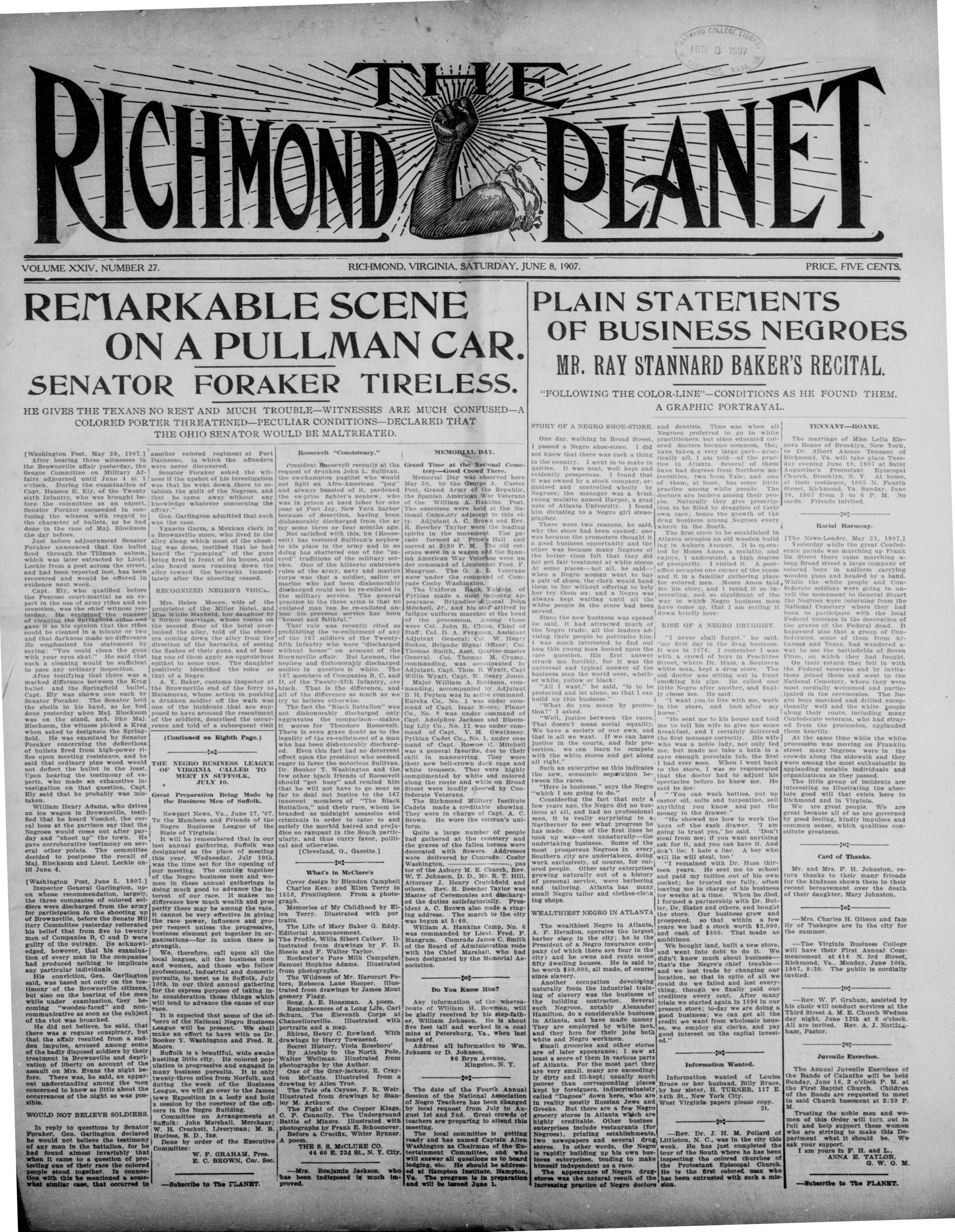
Richmond Planet
Saturday, June 8, 1907
Richmond, Virginia
Page text (machine-generated)
THE RICHMOND PLANET
REMARKABLE SCENE ON A PULLMAN CAR. SENATOR FORAKER TIRELESS.
HE GIVES THE TEXANS NO REST AND MUCH TROUBLE-WITNESSES ARE MUCH CONFUSED-A COLORED PORTER THREATENED-PECULIAR CONDITIONS-DECLARED THAT THE OHIO SENATOR WOULD BE MALTREATED.
VOLUME XXIV, NUMBER 27.
REMARK
ON
SENATOR
HE GIVES THE TEXANS NO
COLORED PORT
[Washington Post, May 29, 1907.]
After hearing three witnesses in the Brownville affair yesterday, the Senate Committee on Military Affairs adjourned until June 4 at 1 o'clock. During the examination of Capt. Hanson E. Ely, of the Twenty sixth Infantry, who was brought before the committee as an expert, Senator Foraker succeeded in confusing the witness with regard to the character of bullets, as he had done in the case of Maj. Blocksom the day before.
Just before adjournment Senator Foraker announced that the bullet fired through the Tillman saloon, which was later extracted by Lieut. Leckie from a post across the street, and had been reported lost, has been recovered and would be offered in evidence next week.
Capt. Ely, who qualified before the Penrose court-martial as an expert in the use of army rifles and ammunition, was the chief witness yesterday. He explained the manner of cleaning the Springfield rifles and gave it as his opinion that the rifles could be cleaned in a minute or two and that darkness made no difference. He emphasized his statement by saying: "You could clean the guns with your eyes shut." He said that such a cleaning would be sufficient to pass any ordinary inspection.
After testifying that there was a marked difference between the Krag bullet and the Springfield bullet, Capt. Ely was shown one each by Senator Foraker. The Senator held the shells in his hand, as he had done yesterday when Maj. Blocksom was on the stand, and, like Maj. Blocksom, the witness picked a Krag when asked to designate the Springfield. He was examined by Senator Foraker concerning the deflections of bullets fired from high-power rifles upon meeting resistance, and he said that ordinary pine wood would not defect the bullet in the least. Upon hearing the testimony of experts, who made an exhaustive investigation on that question, Capt. Ely said that he probably was mistaken.
William Henry Adams, who drives an ice wagon in Brownsville, testified that he heard Voschel, the corral boss at the garrison say that the Negroes would come out after payday and "shoot up" the town. He gave corroborative testimony on several other points. The committee decided to postpone the recall of Maj. Blocksom and Lieut. Leckle until June 4.
[Washington Post, June 5. 1907.]
Inspector General Garlington, upon whose recommendation, largely, the three companies of colored soldiers were discharged from the army for participation in the shooting up of Brownsville, before the Senate Military Committee yesterday reiterated his belief that from five to twenty men of Companies B, C and D were guilty of the outrage. He acknowledged, however, that his examination of every man in the companies had produced nothing to implicate any particular individuals.
His conviction, Gen. Garlington said, was based not only on the testimony of the Brownsville citizens, but also on the bearing of the men while under examination, they becoming "wooden-faced" and noncommunicative as soon as the subject of the riot was broached.
He did not believe, he said, that there was a regular conspiracy, but that the affair resulted from a sudden impulse, aroused among some of the badly disposed soldiers by their treatment in Brownsville and deprivation of liberty on account of the assault on Mrs. Evans the night before. There was, he said, an apparent understanding among the men concerned to know as little about the occurrences of the night as was possible.
WOULD NOT BELIEVE SOLDIERS
In reply to questions by Senator Foraker, Gen. Garlington declared he would not believe the testimony of any man in the battalion, for he had found almost invariably that when it came to a question of protecting one of their race the colored people stood together. In connection with this he mentioned a somewhat similar case, that occurred in
another colored regiment at Fort Duchessen, in which the offenders were never discovered.
Senator Foraker asked the witness if the upshot of his investigation was that he went down there to establish the guilt of the Negroes, and that he came away without any knowledge whatever concerning the affray."
Gen. Garlington admitted that such was the case.
Ygnacio Garza, a Mexican clerk in a Brownsville store, who lived in the alley along which most of the shooting was done, testified that he had heard the "pumping" of the guns being fired in front of his house, and also heard men running down the alley toward the barracks immediately after the shooting ceased.
RECOGNIZED NEGRO'S VOICE.
Mrs. Helen Moore, wife of the proprietor of the Miller Hotel, and Miss Willie Mayfield, her daughter by a former marriage, whose rooms on the second floor of the hotel overlooked the alley, told of the shooters coming down the alley from the direction of the barracks, of seeing the flashes of their guns, and of hearing one of them apply an opprobrious epithet to some one. The daughter positively identified the voice as that of a Negro.
A. Y. Baker, customs inspector at the Brownsville end of the ferry to Matamoras, whose action in pushing a drunken soldier off the walk was one of the incidents that are supposed to have aroused the resentment of the soldiers, described the occurrence and told of a subsequent visit
THE NEGRO BUSINESS LEAGUE OF VIRGINIA CALLED TO MEET IN SUFFOLK, JULY 10.
Great Preparation Being Made by the Business Men of Suffolk.
Newport News, Va., June 17, '07. To the Members and Friends of the Negro Business League of the State of Virginia;
It will be remembered that in our last annual gathering, Suffolk was designated as the place of meeting this year. Wednesday, July 10th, was the time set for the opening of our meeting. The coming together of the Negro business men and women in these annual gatherings is doing much good to advance the interest of our race. It makes no difference how much wealth and prosperity there may be among the race, it cannot be very effective in giving the race power, influence and proper respect unless the progressive, business element get together in organizations—for in union there is strength.
We, therefore, call upon all the local leagues, all the business men and women, and those who follow professional, industrial and domestic pursuits, to meet us in Suffolk, July 10th, in our third annual gathering for the express purpose of taking in consideration those things which will tend to advance the cause of our race.
It is expected that some of the officers of the National Negro Business League will be present. We shall make an effort to have with us Dr. Booker T. Washington and Fred. R. Moore.
Suffolk is a beautiful, wide awake hustling little city. Its colored population is progressive and engaged in many business pursuits. It is only twenty-three miles from Norfolk, and during the week of the Business League, we will go over to the James town Exposition in a body and hold a session by the courtesy of the officers in the Negro Building.
Committee on Arrangements at Suffolk: John Marshall, Merchant; W. H. Crockett, Liveryman; M. B. Hucell, B. D., Ins.
Done by order of the Executive Committee:
W. F. GRAHAM, Pres.
E. C. BROWN, Cor. Sec.
—Subscribe to The PLANET.
RICHMOND, VIRGINIA, SATURDAY, JUNE 8, 1907.
Roosevelt "Consistency."
President Roosevelt recently at the request of drunken L. S. Lillivan, the ex-champion pugilist who would not fight an Afro-American "pug" and always boasted of it, pardoned the ex-prize fighter's nephew, who was in prison at hard labor for one year at Fort Jay, New York harbor because of desertion, having been dishonorably discharged from the army some three or four months ago. Not satisfied with this, he (Roosevelt) has restored Sullivan's nephew to his place in the army and in so doing has shattered one of the "sacred" traditions of the military service. One of the hitherto unbroken rules of the army, navy and marine corps was that a soldier, sailor or marine who had been dishonorably discharged could not be re-enlisted in the military service. The general practice in the three arms is that no enlisted man can be re-enlisted unless his previous service has been "honest and faithful."
That rule was recently cited as prohibiting the re-enlistment of any of the 167 soldiers of the Twenty-fifth Infantry who were "discharged without honor" on account of the Brownsville affair. But Lennon, the nephew and dishonorably discharged soldier in question is white. The 167 members of Companies B, C, and D, of the Twenty-fifth Infantry, are black. That is the difference, and all of the difference as much as we try to believe otherwise.
The fact the "Black Battalion" was not dishonorably charged only agravates the comparison—makes it worse for Theodore Roosevelt. There is even grave doubt as to the legality of the re-enlistment of a man who has been dishonorably discharged. Even this fact had no deterrent effect upon the president who seemed eager to favor the notorious Sullivan. Dr. Booker T. Washington and the few other black friends of Roosevelt should "get busy" and remind him that he will not have to go near as far to deal out justice to the 167 innocent members of "The Black Battalion," and their race, whom he branded as midnight assassins and criminals in order to cater to and satisfy the morbid hatred and prejudice so rampant in the South particularly, and thus curry favor, political and otherwise.
[Cleveland, O., Gazette.]
What's in McClure's
Cover design by Blendon Campbell Charles Keah and Ellen Terry in 1856, Frontispiece. From a photograph.
Memories of My Childhood by Ellen Terry. Illustrated with portraits.
The Life of Mary Baker G. Eddy. Editorial Announcement.
Editorial Announcement.
The Profile, Wilber Silbert Cather. Illustrated from drawings by F. D. Steele and F. Walter Taylor.
Rochester's Pure Milk Campaign, Samuel Hopkins Adams. Illustrated from photographs.
The Wildness of Mr. Harcourt Peters, Rebecca Lane Hooper. Illustrated from drawings by James Montgomery Flagg.
Song, A. E. Housman. A poem.
Reminiscences of a Long Life, Carl Schurz. The Eleventh Corps at Chancellorsville. Illustrated with portraits and a map.
Shiraz, Henry C. Rowland. With drawings by Harry Townsend.
Secret History, Viola Roseboro'
By Airship to the North Pole, Walter Wellman. Illustrated from photographs by the Author.
One of the Gray-jackets, E. Crayton McCants. Illustrated from a drawing by Allen True.
The Tale of Cayuse, F. R. Weir. Illustrated from drawings by Stanley M. Arthurs.
The Fight of the Copper Kings, C. P. Connolly. The Underground Battle of Miners. Illustrated with photographs by Frank E. Schoonover.
Before a Crucifix, Witter Bynner. A poem.
THE S. S. McCLURE CO.
44 60 E. 23d St., N. Y. City.
—Mrs. Benjamin Jackson, who has been indisposed is much improved.
MEMORIAL DAY.
Grand Time at the National Cemetery—Good Crowd There
Memorial Day was observed here May 30, by the George A. Custer Post, Grand Army of the Republic, the Spanish American War Veterans of the William A. Hankins Post. The exercises were held at the National Cemetery adjacent to this city. Adjutant A. C. Brown and Rev. B. Beecher Taylor were the leading spirits in the movement. The parade formed at Price's Hall and moved at 2:30 P. M. The old veterans were in a wagon and the Spanish American War Veterans were under command of Lleuterman F. Mangrum. The G. A. R. Veterans were under the command of Comrade Cosby Washington. The Uniform Rank, Kuligats of Pythias made a most imposing appearance. Brigadier General John Mitchell, Jr., and his staff attired in fatigue uniform marched at the head of the procession. Among those were Col. John R. Chiles, Chief of Staff; Col. D. A. Ferguson, Assistant Adjutant General; Col. W. Henry Stokes, Brigade Signal Officer; Col. Thomas Smith, Asst. Quarter-master General, Col. Thomas M. Crump, commanding, was accompanied by Adjutant, Capt. Thos. H. Wyatt, Capt Wiltsy Wyatt, Capt W. Henry Jones
Major William A. Robinson, commanding, accompanied by Adjuntant B. H. Peyton was in active command. Eureka Co., No. 1 was under command of Capt. Isaac Moore; Planet Co., No. 8 was under command of Capt. Adolphus Jackson and Blooming Lily Co., No. 11 was under command of Capt. V. M. Gwathney, Pythian Cadet Co., No. 1, under command of Capt. Roscoe C. Mitchell was a general favorite, due to their skill in maneuvring. They wore their new bell-crown duck caps and white trousers. They were highly complimented by white and colored along the route and while on Broad Street were loudly cheered by Confederate Veterans. The Richmond Military Institute Cadets made a creditable showing. They were in charge of Capt. A. C. Brown. He wore the veteran's uniform.
Quite a large number of people had gathered at the cemetery and the graves of the fallen heroes were decorated with flowers. Addresses were delivered by Comrade Cosby Washington, _____, pas tor of the Asbury M. E. Church, Rev. W. T. Johnson, D. D., Mr. R. T. Hill, Attorney J. Henry Crutchfield and others. Rev. R. Beecher Taylor was Master of Ceremonies and discharged the duties satisfactorily. President A. C. Brown also made a ringing address. The march to the city was begun at 5:40.
William A. Hankins Camp, No. 6 was commanded by Lieut. Fred. F. Mangrum. Comrade James C. Smith of the Board of Administration rode with the Chief Marshall, who had been designated by the Memorial Association.
Do You Know Him?
Any information of the whereabouts of William H. Bowman, will be gladly received by his step-father, William Johnson. He is about five feet tall and worked in a coal mine at Petersburg, Va., when last heard. Address all information to Wm. Johnson. D. Johnson.
The date of the Fourth Annual Session of the National Association of Negro Teachers has been changed by local request from July to August 1st and 2nd. Great crowds of teachers are preparing to attend this meeting.
The local committee is getting ready and has named Captain Allen Washington as Chairman of the Entertainment Committee, and who will answer all questions as to board lodging, etc. He should be addressed at Hampton Institute, Hampton, Va. The program is in preparation and will be issued June 1.
PLAIN STATEMENTS OF BUSINESS NEGROES MR. RAY STANNARD BAKER'S RECITAL.
"FOLLOWING THE COLOR-LINE"—CONDITIONS AS HE FOUND THEM.
A GRAPHIC PORTRAYAL.
STORY OF A NEGRO SHOE-STORE.
One day, walking in Broad Street, I passed a Negro shoe-store. I did not know that there was such a thing in the country. I went in to make in quiries. It was neat, well kept and evidently prosperous. I found that it was owned by a stock company, organized and controlled wholly by Negroes; the manager was a brisk young mulatto named Harper, a graduate of Atlanta University. I found him dictating to a Negro girl stenographer.
There were two reasons, he said, why the store had been opened; one was because the promoters thought it a good business opportunity and the other was because many Negroes of the better class felt that they did not get fair treatment at white stores. At some places—not all, he said—when a Negro woman went to buy a pair of shoes, the clerk would hand them to her without offering to help her try them on; and a Negro was always kept waiting until all the white people in the store had been served.
and dentists. Time was when all Negroes preferred to go to white practitioners, but since educated colored doctors became common, they have taken a very large part—practically all, I am told—of the practice in Atlanta. Several of them have had degrees from Northern universities, two from Yale; and one of them, at least, has some little practice among white people. The doctors are leaders among their people. Naturally they give prescription to be filled by druggists of their own race; hence the growth of the drug business among Negroes everywhere in the South.
The first store to be established in Atlanta occupies an old wooden building in Auburn Avenue. It is operated by Moses Amos, a mulatto, and enjoys. I understand, a high degree of prosperity. I visited it. A postoffice occupies one corner of the room and it is a familiar gathering place for colored men. Moses Amos told me his story, and I found it so interesting, and so significant of the way in which Negro business men have come up, that I am setting it
TENNANT—ROANE.
The marriage of Miss Lelia E. Nora Roa of Brooklyn, New York to Dr. Albert Alonzo Tennant of Richmond, Va. will take place Tuesday evening June 18, 1907 at Sahat Augustine's Protestant Episcopal Church, Brooklyn, N. Y. At home at their residence, 1005 N. Fourth Street, Richmond, Va. Sunday, June 30, 1907 from 3 to 6 P. M. 12 cards. Friends invited.
Racial Harmony.
[The News-Leader, May 31, 1907]
Yesterday while the great Conference parade was marching up Franklin Street there came marching on Long Broad street a large company colored boys in uniform carry wooden guns and headed by a bar. While the white people and Co. federate soldiers were going to the bell the monument to General Stuart the Negroes were returning from the National Cemetery where they had
Since the new business was opened he said, it had attracted much of the Negro trade; all the leaders advising their people to patronize him. I was much interested to find out how this young man looked upon the race question. His first answer struck me forcibly, for it was the universal and typical answer of the business man the world over, whether white, yellow or black:
"All I want," he said, "is to be protected and let alone, so that I can build up this business."
"What do you mean by protection?" I asked.
"Well, justice between the races. That doesn't mean social equality. We have a society of our own, and that is all we want. If we can have justice in the courts, and fair protection, we can learn to compete with the white stores and get along all right."
Such an enterprise as this indicates the new, economic separation between the races.
"Here is business," says the Negro "which I am going to do."
Considering the fact that only a few years ago, the Negro did no business at all, and had no professional men, it is really surprising to a Northerner to see what progress he has made. One of the first lines he took up was—not unnaturally—the undertaking business. Some of the most prosperous Negroes in every Southern city are undertakers, doing work exclusively, of course, for colored people. Other early enterprises growing naturally out of a history of personal service, were barbering and tailoring. Atlanta has many small Negro tailor and clothes-cleaning shops.
WEALTHIEST NEGRO IN ATLANTA
The wealthiest Negro in Atlanta, A. F. Herndon, operates the largest barber shop in the city; he is the President of a Negro insurance company (of which there are four in the city) and he owns and rents some fifty dwelling houses. He is said to be worth $80,000, all made, of course since slavery.
Another occupation developing naturally from the industrial training of slavery was the business of the building contractor. Several such Negroes, notably Alexander Hamilton, do a considerable business in Atlanta, and have made money. They are employed by white men, and they hire for their jobs both white and Negro workmen.
Small groceries and other stores are of later appearance; I saw at least a score of them in various parts of Atlanta. For the most part they are very small, many are exceedingly dirty and ill-kept; usually much poorer than corresponding places kept by foreigners, indiscriminately called "Dagoes" down here, who are in reality mostly Russian Jews and Greeks. But there are a few Negro grocery stores in Atlanta which are highly creditable. Other business enterprises include restaurants (for Negroes), printing establishments, two newspapers and several drug stores. In other words, the Negro is rapidly building up his own business enterprises, tending to make himself independent as a race.
The appearance of Negro drug stores was the natural result of the increasing practice of Negro doctors
and dentists. Time was when all Negroes preferred to go to white practitioners, but since educated colored doctors became common, they have taken a very large part—practically all, I am told—of the practice in Atlanta. Several of them have had degrees from Northern universities, two from Yale; and one of them, at least, has some little practice among white people. The doctors are leaders among their people. Naturally they give prescription to be filled by druggists of their own race; hence the growth of the drug business among Negroes everywhere in the South.
The first store to be established in Atlanta occupies an old wooden building in Auburn Avenue. It is operated by Moses Amos, a mulatto, and enjoys. I understand, a high degree of prosperity. I visited it. A post-office occupies one corner of the room and it is a familiar gathering place for colored men. Moses Amos told me his story, and I found it so interesting, and so significant of the way in which Negro business men have come up, that I am setting it down briefly here:
RISE OF A NEGRO DRUGGIST.
"I never shall forget," he said, "my first day in the drug business. It was in 1876. I remember I was with a crowd of boys in Peachtree Street, where Dr. Huss, a Southern white man, kept a drug store. The old doctor was sitting out in front smoking his pipe. He called one little Negro after another, and finally chose me. He said:
"I want you to live with me, work in the store, and look after my horse."
"He sent me to his house and told me to tell his wife to give me some breakfast, and I certainly delivered the first message correctly. His wife who was a noble lady, not only fed me, but made me take a bath in a sure enough porcelain tub, the first I had ever seen. When I went back to the store, I was so regenerated that the doctor had to adjust his spectacles before he knew me. He said to me:
"You can wash bottles, put up castor oil, salts and turpentine, sell anything you know and put the money in the drawer."
"He showed me how to work the keys off the cash drawer. 'I am going to trust you,' he said. 'Don't steal from me; if you want anything ask for it, and you can have it. And don't lie; I hate a liar. A boy who wii ilie will steal, too.'"
"I remained with Dr. Huss thirteen years. He sent me to school and paid my tuition out of his own pocket; he trusted me fully, often leaving me in charge of his business for weeks at a time. When he died, I formed a partnership with Dr. Butler, Dr. Slater and others, and bought the store. Our business grew and prospered, so that within a few years we had a stock worth $3,000, and cash of $800. That made us ambitious.
We bought land, built a new store, and went into debt to do it. We didn't know much about business—that's the Negro's chief trouble—and we lost trade by changing our location, so that in spite of all we could do we failed and lost everything, though we finally paid our creditors every cent. After many trials we started again in 1896 in our present store; to-day we are doing a good business; we can get all the credit we want from wholesale houses, we employ six clerks, and pay good interest on the capital invested."
Information Wanted.
Information wanted of Louisa Bruce or her husband, Billy Bruce by her sister, H. TURNER, 117 E 84th St., New York City. West Virginia papers please copy.
West Virginia papers please copy. 2t.
—Rev. Dr. J. H. M. Pollard of Littleton, N. C., was in the city this week. He has just completed the tour of the South where he has been inspecting the colored churches of the Protestant Episcopal Church. He is the first colored man who has been entrusted with such a mission.
PRICE, FIVE CENTS.
NTS
NEGROES
R'S RECITAL.
AS HE FOUND THEM.
TENNANT—ROANE
The marriage of Miss Lelia Elenora Roane of Brooklyn, New York, to Dr. Albert Alonzo Tennant of Richmond, Va. will take place Tuesday evening June 18, 1907 at Saint Augustine's Protestant Episcopal Church, Brooklyn, N. Y. At home, at their residence, 1005 N. Fourth Street, Richmond, Va. Sunday, June 30, 1907 from 3 to 6 P. M. No cards. Friends invited.
Racial Harmony.
[The News-Leader, May 31, 1907.] Yesterday while the great Confederate parade was marching up Franklin Street there came marching along Broad street a large company of colored boys in uniform carrying wooden guns and headed by a band. While the white people and Confederate soldiers were going to unveil the monument to General Stuart the Negroes were returning from the National Cemetery where they had been to participate with the local Federal veterans in the decoration of the graves of the Federal dead. It happened also that a group of Confederates, some of them from Arkansas and Texas, had wandered away to see the battlefields of Seven Pines, on which they had fought. On their return they fell in with the Federal veterans and by invitations joined them and went to the National Cemetery, where they were most cordially welcomed and participated in the ceremonies. The Negro boys marched and drilled exceptionally well and the white people along their route, including many Confederate veterans, who had strayed from the procession, applauded them heartily.
At the same time while the white procession was moving on Franklin street many Negroes were in the crowds along the sidewalk and they were among the most enthusiastic in applauding notable individuals and organizations as they passed.
The little group of incidents are interesting as illustrating the absolute good will that exists here in Richmond and in Virginia. We are great people. We are great because all of us are governed by good man, kindly impulses and common sense, which qualities constitute greatness.
Card of Thanks.
Mr. and Mrs. F. H. Johnston, return thanks to their many friends for the kindness shown them in their recent bereavement over the death of their daughter, Mary Johnston.
—Mrs. Charles H. Gibson and family of Tuskegee are in the city for the summer.
—The Virginia Business College will have their First Annual Commencement at 414 N. 3rd Street, Richmond, Va., Monday, June 10th, 1907, 8:30. The public is cordially invited.
—Rev. W. F. Graham, assisted by his choir will conduct services at the Third Street A. M. E. Church Wednes day night, June 12th at 8 o'clock. All are invited. Rev. A. J. Nottingham, Pastor.
Juvenile Exercises.
The Annual Juvenile Exercises of the Bands of Calanthe will be held Sunday, June 16, 3 o'clock P. M. at the First Baptist Church. Children of the Bands are requested to meet in said Church basement at 2:30 P. M.
Trusting the noble men and women of this Order will turn out in full and help support these women who are striving to make this Department what it should be. We ask your support.
I am yours in F. H. and L.,
ANNA E. TAYLOR,
G. W. G. M.
—Subscribe to The PLANET.
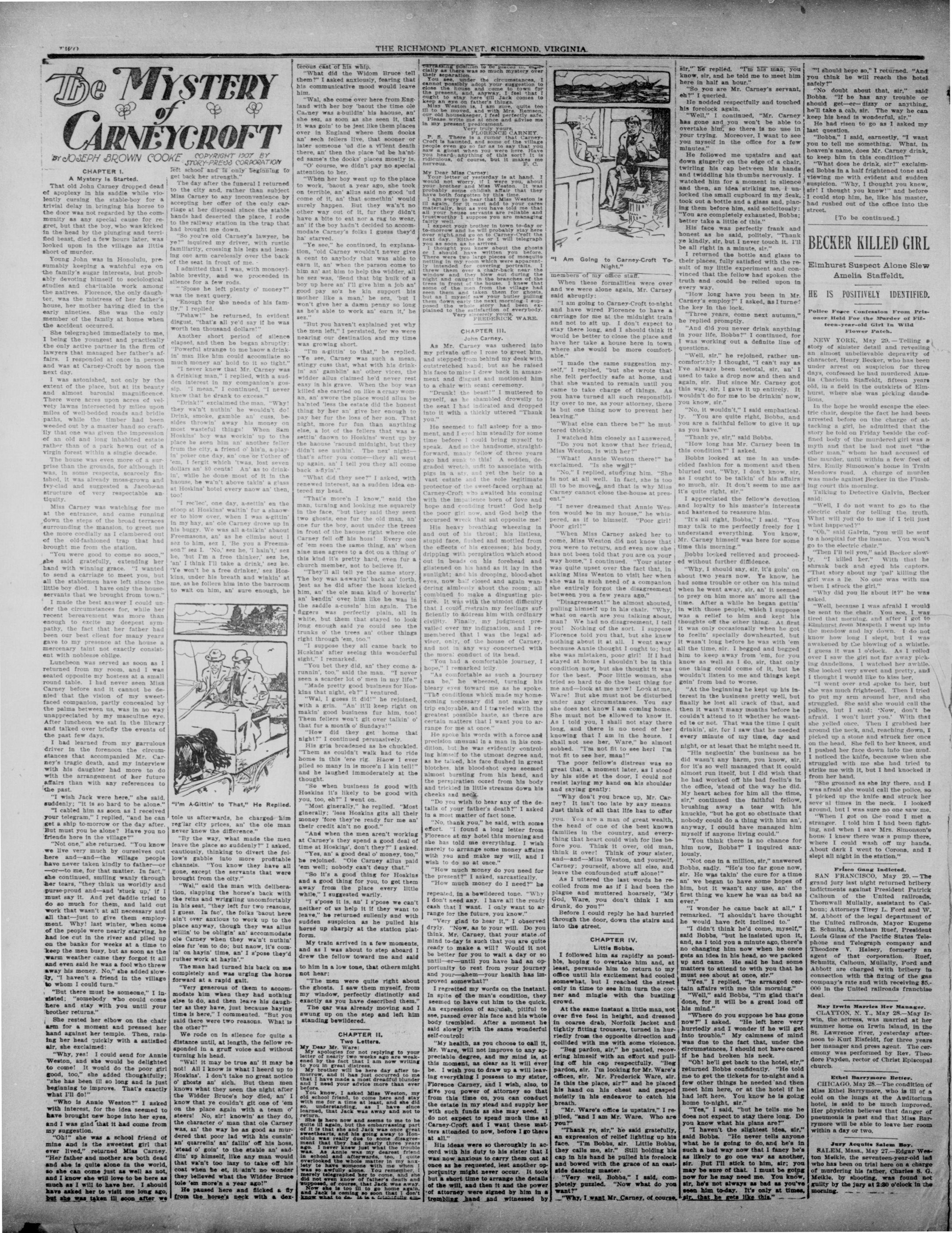
The MYSTERY of CARNEYCROFT
BY JOSEPH BROWN COOKE COPYRIGHT 1907 BY
That old John Carney dropped dead of apoplexy in his saddle while violently cursing the stable-boy for a trivial delay in bringing his horse to the door was not regarded by the community as any special cause for regret, but that the boy, who was kicked in the head by the plunging and terrified beast, died a few hours later, was looked upon in the village as little short of murder.
Young John was in Honolulu, presumably keeping a watchful eye on the family's sugar interests, but probably devoting himself to sociological studies and charitable work among the natives. Florence, the only daughter, was the mistress of her father's house, her mother having died in the early nineties. She was the only member of the family at home when the accident occurred.
She telegraphed immediately to me, I being the youngest and practically the only active partner in the firm of lawyers that managed her father's affairs. I responded at once in person and was at Carney-Croft by noon the next day.
I was astonished, not only by the extent of the place, but at its beauty and almost baronial magnificence. There were acres upon acres of velvety lawns intersected by miles upon miles of well-bedded roads and bridle paths, while the timber had been weeded out by a master hand so craftily that one was given the impression of an old and long inhabited estate rather than of a park hewn out of a virgin forest within a single decade.
The house was even more of a surprise than the grounds, for although it was, in some respects, scarcely finished, it was already moss-grown and fivy-clad and suggested a Jacobean structure of very respectable antiquity.
Miss Carney was watching for me at the entrance, and came running down the steps of the broad terraces surrounding the mansion, to greet me the more cordially as I clambered out of the old-fashioned trap that had brought me from the station.
"You were good to come so soon," she said gratefully, extending her hand with winning grace. "I wanted to send a carriage to meet you, but all the stablemen have left since the little boy died. I have only the house-servants that we brought from town."
I made the best answer I could under the circumstances for, while her recent bereavement was more than enough to excite my deepest sympathy, the fact that her father had been our best client for many years gave to my presence at the house a mercenary taint not exactly consistent with noblesse oblige.
Luncheon was served as soon as I returned from my room, and I was seated opposite my hostess at a small round table. I had never seen Miss Carney before and it cannot be denied that the vision of my sweet-faced companion, partly concealed by the palms between us, was in no way unappreciated by my masculine eye. After luncheon we sat in the library and talked over briefly the events of the past few days.
I had learned from my garrulous driver in the forenoon the circumstances that accompanied Mr. Carney's tragic death, and my interview with his daughter had more to do with the arrangement of her future affairs than with any references to the past.
"I wish Jack were here," she said,
suddenly; "it is so hard to be alone."
"I cabled him as soon as I received
your telegram," I replied, "and he can
get a ship to-morrow or the day after.
But must you be alone? Have you no
friends here in the village?"
"Not one," she returned. "You know we live very much by ourselves out here and—and—the village people have never taken kindly to father—or—or to me, for that matter. In fact," she continued, smiling wanily through her tears, "they think us worldly and pursue-proud and—and 'stuck up,' if I must say it. And yet daddle tried to do so much for them, and laid out work that wasn't at all necessary and all that—just to give them employment. Why! last winter, when some of the people were nearly starving, he had ice cut in the river and piled up on the banks for weeks at a time to keep the men busy, but as soon as the warm weather came they forgot it all and even said he was a fool who threw away his money. No," she added slowly, "I haven't a friend in the village to whom I could turn."
"But there must be someone," I insisted; "somebody who could come here and stay with you until your brother returns."
She rested her elbow on the chair arm for a moment and pressed her hand against her temple. Then, raising her head quickly with a satisfied air, she exclaimed:
"Why, yes! I could send for Annie Weston, and she would be delighted to come! It would do the poor girl good, too," she added thoughtfully; "she has been ill so long and is just beginning to improve. That's exactly what I'll do!"
"Who is Annie Weston?" I asked with interest, for the idea seemed to have brought new hope into her eyes, and I was glad that it had come from my suggestion.
"Oh!!" she was a school friend of mine and is the sweetest girl that ever lived," returned Miss Carney. "Her father and mother are both dead and she is quite alone in the world, so she can come just as well as not, and I know she will love to be here as much as I will to have her. I should have asked her to visit me long ago, but she was taken ill soon after we
Left school and is only beginning to get back her strength."
The day after the funeral I returned to the city and, rather than subject Miss Carney to any inconvenience by accepting her offer of the only carriage at her disposal since the stable hands had deserted the place, I rode to the railway station in the trap that had brought me down.
"So you're old Carney's lawyer, be ye?" inquired my driver, with rustic familiarity, crossing his legs and leaning one arm carelessly over the back of the seat in front of me.
I admitted that I was, with monosyllabic brevity, and we proceeded in silence for a few rods.
"Spose he left plenty o' money?" was the next query.
"Enough for the needs of his family," I replied.
"Pshaw!" he returned, in evident disgust, "that's all ye'd say if he was worth ten thousand dollars!"
Another short period of silence elapsed, and then he began abruptly: "Powerful strange to me haw a drinkin' man' like him could accumulate so much money an' hold to it so tight." "I never knew that Mr. Carney was a drinking man." I replied, with a sudden interest in my companion's gossip. "I mean." I continued. "I never knew that he drank to excess."
"Drink!" exclaimed the man. "Why! they wa'n't nuthin' he wouldn't do! Drink, smoke, gamble an' cuss, besides throwin' away his money on most wasteful things! When Sam Hoskins' boy was workin' up to the place he seen him an' another feller frum the city, a friend o' his'n, a-playin' poker one day, an' one or'tother of 'em, I fergit which 'twas, lost seven dollars an' 80 cents!' An' as to drinkin', while he done most of it in the hause, he won't abt takin' a glass at Hoskins' hotel every naow an' then, too!
"I re'lec', one day, a-settin' en the stoop at Hoskins' waitin' fur a shaower to blow over, when I was a-gittin' in my hay, an 'ole Carney drove up in his buggy. We was all a-talkin' nabout Freemasons, an' as he climbs aout I sez to him, sez I, 'Be you a Freemason'? sez I. 'No, sez he, 'I hain't, sez he, 'but I'm a free thinker', sez he, 'an' I think I'll take a drink', sez he. 'Ye won't be a free drinker', sez Hoskins, under his breath and winkin' at me, as he follers him into the barroom to wait on him, an' sure enough, he
W. B. BURKE
"I'm A-Gittin' to That," He Repiled.
tole us afterwards, he charged him
regular city prices, an' the ole man
never knew the difference."
"By the way, what made the men
leave the place so suddenly?" I asked,
cautiously, thinking to divert the fellow's gabble into more profitable channels. "You know they have all gone, except the servants that were brought from the city."
"Wal," said the man with delibera-
tion, slapping the horse's back with
the reins and wriggling uncomfortably in his seat, "they left fur two reasons, I guess. In fact, the folk 'baout here ain't over anxious to work up to the place anyway, though they was allus willin' to be obgligin' an' accommodate ole Carney when they wasn't nuthin' else for 'em to do; but naow, it's comin' on hayin' time, an' I s'pose they'd ruther work at hayin'."
The man had turned his back on me completely and was urging the horse forward at a rapid gait.
"Very generous of them to accommodate him when they had nothing else to do, and then leave his daughter as they have, just because haying time is here," I commented. "But you said there were two reasons. What is the other?"
We rode on in silence for quite a distance until, at length, the fellow responded in a grunt voice and without turning his head.
"Wal! it may be true an' it may be not! All I know is what he uped up to Hoskina', I don't take no great notice o' ghosts an' sich. But them men knows what they seen the night after the Widder Bruce's boy died, an' I know that ye couldn't git one of 'em on the place again with a team o' steers! No, sir! knowin' as they do, the character o' man that ole Carney was, an' the way he as good as murdered that poor lad with his cussin' an' quarrelin' an' fallin' off his hoss, 'stead o' goin' to the stable an' saddin' up himself, like any man would that wasn't too lazy to take off his coat when he et it, it ain't no wonder they believed what the Widder Bruce tole 'em more'n a year ago!"
He paused here and flicked & fly from the horse's neck with a dex-
THE RICHMOND PLANET. RICHMOND. VIRGINIA
ferous cast of his whip.
"What did the Widom Bruce tell them?" I asked anxiously, fearing that his communicative mood would leave him.
"Wal, she come over here from England with her boy 'baout the time ole Caeney was a-buildin' his hause, an' she sez, as soon as she seen it, that it was goin' to be jest like them places over in England where them dooks an' sech fellers lil, that sooner or later someone 'ud die a vlent death there, an' then the place 'ud be ha'nted same's the docks' places mostly is.
"O' course, we didn't pay no special attention to her.
"When her boy went up to the place to work, 'baout a year ago, she took on terrible, an' allus said no good 'ud come of it, an' that somethin' would surely happen. But they wa'n't no other way out of it, fur they didn't have a bite to eat nor a rag to wear, an' if the boy hadn't decided to accommodate Carney's folks I guess they'd ha' starved.
"Ye see," he continued, in explanation, "old Carney wouldn't never give a cent to anybody that was able to earn it, an' when the parson come to him an' ast him to help the widdler, all he sez was, 'Send that big hulk of a boy up here an' I'll give him a job an' good pay soz' he kin support his mother like a man', he sez, 'but I won't give her a damn penny so long as he able to work an' earn it, he sez."
"But you haven't explained yet why the men left," I persisted, for we were nearing our destination and my time was growing short.
"I'm a-gittin' to that," he replied. "Ye see, Carney was such a mean, stingy cuss that, what with his drinkin' in' an' gamblin' an' other vices, the wilder allus claimed he'd never rest easy in his grave. When the boy was killed she carried on like a crazy woman, an' swore the place would allus be ha'nted 'less the estate did the honest thing by her an' give her enough to pay her fur the loss of her son. That night, more fur fun than anything else, a lot of the fellers that was a-settin' dawn to Hoskins' went up by the haouse 'raound midnight, but they didn't see nuthin'. The nex' night—that's after you come—they all went up again, an' they you they all come back a-flyin'."
"What did they see?" I asked, with renewed interest, as a sudden idea entered my head.
"That's more n I know," said the man, turning and looking me squarely in the face, "but they said they seen two ghosts, one fur the old man, an' one fur the boy, aunt under the trees in front of the hausie right where ole Carney fell off his hoss! Every one of 'em seen the same thing, an' when nine men agrees to a dot on a thing o' this kind it's pretty hard, even fur a church member, not to believe it.
"They'll all tell ye the same story. The boy was a-sayin' back an' forth, jest as he did after the hoss kicked him, an' the ole man kind o' hoverin' an' bendin' over him like he was in the saddle a-cussin' him again. The figgers was perfectly plain, all in white, but them that stayed to look long enough said ye could see the trunks o' the trees an' other things right through 'em, too."
"I suppose they all came back to Hcakins' after seeing this wonderful sight." I remarked.
"You bet they did, an' they come a runnin', too," said the man. "I never seen a scarrier lot o' men in my life."
"Made pretty good business for Hoskins that night, eh?" I ventured.
"Wal, I guess it did!" he rejoined, with a grin. "An' it'll keep right on makin' good business fur him, too! The tellers won't git over talkin' o' that fur a month o' Sundays!"
"How did they get home that night?" I continued persuasively.
His grin broadened as he chuckled. "Them as couldn't walk had to ride home in this 'ere rig. Haow I ever piled so many in is more'n I kin tell!" and he laughed immoderately at the thought.
"So when business is good with Hoskins it's likely to be good with you, too, eh?" I went on.
"Most generally," he replied. "Most generally; 'less Hoskins gits all their money 'fore they''re ready fur me an' their credit ain't no good."
"And when the men aren't working at Carney's they spend a good deal of time at Hoskins', don't they?" I asked. "Yes, an 'a good deal o' money, too," he rejoined. "Ole Carney allus paid 'em well; nobody can't deny that." "So it's a good thing for Hoskins and a good thing for you, to get them away from the place every little while," I suggested warily. "I 's pose it is, an. I 's pose we can't neither of us help it if they want to leave," he returned sullenly and with sudden suspicion as he pulled his horse up sharply at the station platform.
My train arrived in a few moments, and as I was about to step aboard I drew the fellow toward me and said to him in a low tone, that others might not hear:
"The men were quite right about the ghosts. I saw them myself, from my window, perfectly distinctly and exactly as you have described them."
The car was already moving and I swung up on the step and left him standing bewildered.
CHAPTER II.
My Dear Mr. Ware:
My apologies for not replying to your letter of nearly two weeks ago are weakened and I am now writing to you in great distress.
My brother will be here day after tomorrow, and it has just occurred to me old school friend, I made a most dreadful blunder and I need your voice more than ever before.
So I know I asked Miss Weston, my old school friend, to meet me with me for a time at least, and she did so, understanding, as I have since understood, that Jack was away and not to return.
She is here now and seems to me to be quite ill again, but the embarrassing part sweetheart, and his going away to Honolulu was really due to some disagreement that they had nearly three years ago. She was Asnie was my dearest friend in school and afterwards, too. I quite wanted to have someone with me when I was so awfully alone. You remember, I merely telegraphed her to come, and she was supposed, of course, that Jack was away. Now she is too ill to go home again, and it is coming so soon that don't know where she is.
contrasting position to be placed in, especially as there was so much mystery over her. You see, under the circumstances, I cannot possibly adopt your suggestion to take the present position, and anyone I feel that I ought to stay here till Jack comes to keep on father's things. Also Weston is quite too ill to be moved, and with Mrs. Remsen, our old housekeeper, I feel perfectly safe, and advise me in my present predicament.
Very truly yours.
FLORENCE CARNEY.
P. S. There is a rumor that Carney-
Cott is haunted, and some of the village
people see him to see that you can
saw a ghost when you were here. Have
you heard anything of this sort? It is
ridiculous, of course, but it makes me
mervous.
F. C.
M. Dear Miss Carney:
Your letter of yesterday is at hand. I would not worry, if I were you, about the child. I was probably some childish affair that have both forgotten by this time. I am sorry to hear that Miss Winston is ill in need of your care material, but as you have told me that all your house servants are reliable and trustworthy I suppose you are managing I expect your brother in town to day or to-morrow and he will probably stay here next day. I either he or I will telegraph you as soon as he arrives. There were two large pieces of mosquito netting in my room, there were apparent threw them over the covering threw them over a chair-back near the window and they blew out during the trees in front of the house. I knew that some of the men from the village had seen them, and I knew a myself saw your bitter them down early the next morning I supposed the whole story had been explained to the children everybody. Very sincerely yours.
FREDERICK WARE.
As Mr. Carney was ushered into my private office I rose to greet him, and stepped from behind my desk with outstretched hand; but as he raised his face to mine I drew back in amazement and disgust and motioned him to a chair with scant ceremony.
"Drunk! the beast!" I muttered to myself, as he shambled drowsily to the seat I had indicated and dropped into it with a thickly uttered "Thank you."
He seemed to fall asleep for a moment, and I eyed him steadily for some time before I could bring myself to speak. And so the handsome, straight-forward, mainly fellow of three years ago had sunk to this! A sodden, degraded wretch, unfit to associate with pigs in a stry, and yet the heir to a vast estate and the sole legitimate protector of the sweet-faced orphan at Carney-Croft who awaited his coming with the impatience born of love and hope and conding trust! God help the poor girl now, and God help the accursed wreck that sat opposite me!
His heavy breathing wheezing in and out of his throat; his listless, stupid face, flushed and mottled from the effects of his excesses; his body, dripping with perspiration which stood out in beads on his forehead and glistened on his hand as it lay in the sunlight; and his drooping, blood-shot eyes, now half closed and again wandering almlessly about the room; all combined to make a disgusting picture. It was with the utmost difficulty that I could restrain my feelings sufficiently to address him with ordinary civility. Finally, my judgment prevailed over my indignation, and I remembered that I was the legal adviser, only, of the house of Carney, and not in any way concerned with the moral conduct of its head.
"You had a comfortable journey, I hope." I remarked lethly.
"As comfortable as such a journey can be," he wheeled, turning his bleary eyes toward me as he spoke. "The conditions which made my homecoming necessary did not make my trip enjoyable, and I traveled with the greatest possible haste, as there are certain matters that I want you to arrange for me at once."
He spoke his words with a force and precision unusual in a man in his condition, but he was evidently controlling himself to the utmost degree and, as he talked, his face flushed in great blotches, his blood-shot eyes seemed almost bursting from his head, and the perspiration oozed from his body and trickled in little streams down his cheeks and neck.
"Do you wish to hear any of the details of your father's death?" I asked in a most matter of fact tone.
"No, thank you," he said, with some effort. "I found a long letter from Florence at my hotel this morning and she has told me everything. I wish merely to arrange some money affairs with you and make my will, and I wish to do so at once."
"How much money do you need for the present?" I asked, sarcastically.
"How much money do I need?" he repeated, in a bewildered tone. "Why I don't need any. I have all the ready cash that I want. I only want to ar range for the future, you know."
"Very glad to hear it," I observed dryly. "Now, as to your will. Do you think, Mr. Carney, that your state of mind to-day is such that you are quite ready to make a will? Would it not be better for you to wait a day or so until—er—until you have had an opportunity to rest from your journey and your—ahem—your health has improved somewhat?"
I regretted my words on the instant. In spite of the man's condition, they seemed to have cut him to the quick. An expression of anguish, pitiful to see, passed over his face and his whole body trembled. After a moment he said slowly with the same wonderful self-control:
"My health, as you choose to call it, Mr. Ware, will not improve to any appreciable degree, and my mind is, at this moment, as clear as it will ever be. I wish you to draw up a will leaving everything I possess to my sister, Florence Carney, and I wish, also, to give you power of attorney so that from this time on, you can conduct the estate in my stead and supply her with such funds as she may need. I do not expect to spend much time at Carney-Croft and I want these matters attended to now, before I go there at all."
His ideas were so thoroughly in accord with his duty to his sister that I was now anxious to carry them out at once as he requested, lest another opportunity might never occur. It took but a short time to arrange the details of the will, and then it and the power of attorney were signed by him in a trembling hand and witnessed by
THE TRAIN
"I Am Going to Carney-Croft To Night."
members of my office staff.
When these formalities were over and we were alone again, Mr. Carney said abruptly:
"I am going to Carney-Croft to-night and have wired Florence to have a carriage for me at the midnight train and not to sit up. I don't expect to stay there long, and I should think it would be better to close the place and have her take a house here in town where she would be more comfortable."
"I made the same suggestion myself," I replied, "but she wrote that she felt perfectly safe at home, and that she wanted to remain until you came to take charge of things. As you have turned all such responsibility over to me, as your attorney, there is but one thing now to prevent her leaving."
"What else can there be?" he muttered thickly.
I watched him closely as I answered, "Do you not know that her friend, Miss Weston, is with her?"
"What! Annie Weston there!" he exclaimed. "Is she well?" "No," I replied, studying him. "She is not at all well. In fact, she is too ill to be moved, and that is why Miss Carney cannot close the house at present." "I never dreamed that Annie Weston would be in my house," he whispered, as if to himself. "Poor girl! Poor girl!" "When Miss Carney asked her to come, Miss Weston did not know that you were to return, and even now she has not been told that you are on your way home," I continued. "Your sister was quite upset over the fact that, in asking Miss Weston to visit her when she was in such need of a companion she entirely forgot the disagreement between you a few years ago."
"Disagreement!" he almost shouted, pulling himself up in his chair. "Why, what on earth are you talking about, man? We had no disagreement, I tell you! Nothing of the sort. I suppose Florence told you that, but she knew nothing about it at all. I went away because Annie thought I ought to; but she was mistaken, poor girl! If I had stayed at home I shouldn't be in this condition now, but she thought it was for the best. Poor little woman, she tried so hard to do the best thing for me and—look at me now! Look at me, Ware! But she must not be disturbed under any circumstances. You say she does not know I am coming home. She must not be allowed to know it. As I told you, I shall not stay there long, and there is no need of her knowing that I am in the house. I shall not see her, Ware," he almost sobbed. "I'm not fit to see her! I'm not fit to see her, man!"
The poor fellow's distress was so great that, a moment later, as I stood by his side at the door, I could not resist laying my hand on his shoulder and saying gently:
"Why don't you brace up, Mr. Carney? It isn't too late by any means. Just think of all that life has to offer you. You are a man of great wealth, the head of one of the best known families in the country, and everything that heart could wish for lies before you. Think it over, old man, think it over! Think of your sister, and—and—Miss Weston, and yourself, Carney; yourself, above all else, and leave the confounded stuff alone!"
As I uttered the last words he recoiled from me as if I had been the plague and muttered hoarsely, "My God, Ware, you don't think I am drunk, do you?"
Before I could reply he had hurried through the door, down the stairs and into the street.
I followed him as rapidly as possible, hoping to overtake him and, at least, persuade him to return to my office until his excitement had cooled somewhat, but I reached the street only in time to see him turn the corner and mingle with the bustling crowd.
At the same instant a little man, not over five feet in height, and dressed in coarse drab, Norfolk jacket and tightly fitting trousers, turned in hurriedly from the opposite direction and collided with me with some violence.
"Beg pardon, sir." he panted, recovering himself with an effort and pulling off his cap respectfully. "Beg pardon, sir. I'm looking for Mr. Ware's offices, sir. Mr. Frederick Ware, sir. Is this the place, sir?" and he placed his hand on his chest and gasped noisily in his endeavor to catch his breath.
"Mr. Ware's office is upstairs," I replied, "and I am Mr. Ware. Who are you?"
"Thank ye, sir," he said gratefully, an expression of relief lighting up his face. "Tm Bobbs, sir. Little Bobbs, they calls me, sir." Still holding his cap in his hand he pulled his forelock and bowed with the grace of an east-side dancing master. "Very well, Bobbs," I said, completely puzzled. "Now what do you want?" "Why, I want Mr. Carney, of course."
sir." He replied. "I'm his man, you know, sir, and he told me to meet him here in half an hour."
"So you are Mr. Carney's servant, eh?" I queried.
He nodded respectfully and touched his forelock again.
"Well," I continued. "Mr. Carney has gone and you won't be able to overtake him, so there is no use in your trying. Moreover, I want to see you myself in the office for a few minutes."
He followed me up stairs and sat down gingerly on the edge of a chair, twirling his cap between his hands and twiddling his thumbs nervously. I watched him for a moment in silence and then, an idea striking me, I unlocked the small cupboard in my desk, took out a bottle and a glass and placing them before him, said solicitously: "You are completely exhausted, Bobbs; better take a little of this."
His face was perfectly frank and honest as he said, politely, "Thank ye kindly, sir, but I never touch it. I'll be all right in a minute, sir."
I returned the bottle and glass to their places, fully satisfied with the result of my little experiment and convinced that the fellow had spoken the truth and could be relied upon in every way.
"How long have you been in Mr. Carney's employ?" I asked, as I turned the key in the lock.
"Three years, come next autumn," he replied promptly.
"And did you never drink anything in your life, Bobbs?" I continued, for I was working out a definite line of questions.
"Well, sir," he rejoined, rather uncomfortable. I thought, "I can't say as I've always been teetotal, sir, an" I used to take a drop now and then and again, sir. But since Mr. Carney got this way, sir, I gave it up entirely. It wouldn't do for me to be drinkin' now, you know, sir.
"No, it wouldn't," I said emphatically. "You are quite right, Bobbs, and you are a faithful fellow to give it up as you have."
"Thank you, sir," said Bobbs.
"How long has Mr. Carney been in this condition?" I asked.
Bobbs looked at me in an undecided fashion for a moment and then blurted out, "Why, I don't know, sir, as I ought to be talkin' of his affairs so much, sir. It don't seem to me as it's quite right, sir."
I appreciated the fellow's devotion and loyalty to his master's interests and hastened to reassure him.
"It's all right, Bobbs," I said. "You may talk to me perfectly freely for I understand everything. You know, Mr. Carney himself was here for some time this morning."
Bobbs looked relieved and proceeded without further diffidence.
"Why, I should say, sir, it's goin' on about two years now. Ye know, he had some trouble or other on his mind when he went away, sir, an' it seemed to prey on him more an' more all the time. After a while he began gettin' in with those people, which I suppose was a relief to him and kept his thoughts off the other thing. At first it was only occasionally when he got to feelin' specially downhearted, but it wasn't long before he was with 'em all the time, sir. I begged and begged him to keep away from 'em, for you know as well as I do, sir, that only one thing could come of it, but he wouldn't listen to me and things kept goin' from bad to worse.
"At the beginning he kept up his interest in the business pretty well, but finally he lost all track of that, and then it wasn't many months before he couldn't attend to it whether he wanted to or not. That was the time I quit drinkin', sir, for I saw that he needed every minute of my time, day and night, or at least that he might need it.
"His neglectin' the business as he did wasn't any harm, you know, sir, for it's so well managed that it could almost run itself, but I did wish that he had worked off his bad feelin' in the office, 'stead of the way he did.
My heart aches for him all the time, sir," continued the faithful fellow, brushing away a tear with his knuckle, "but he got so obstinate that nobody could do a thing with him an', anyway, I could have managed him myself if anyone living could."
"You think there is no chance for him now, Bobbs?" I inquired anxiously.
"Not one in a million, sir," answered Bobbs, sadly. "He's too far gone now, sir. He was takin' the cure for a time an' we began to have some hopes of him, but it wasn't any use, an' the first thing we knew he was as bad as ever."
"I wonder he came back at all," I remarked. "I shouldn't have thought he would have felt inclined to."
"I didn't think he'd come, myself," said Bobbs, "but he insisted upon it, and, as I told you a minute ago, there's no changing him now when he once gets an idea in his head, so we packed up and came. He said he had some matters to attend to with you that he must see about at once, sir."
"Yes," I replied, "he arranged certain affairs with me this morning."
"Well," said Bobbs, "I'm glad that's done, for it will be a great load off his mind."
"Where do you suppose he has gone now?" I asked. "He left here very hurriedly and I wonder if he will get into trouble." My calmness of mind was due to the fact that, under the circumstances, I should not have cared if he had broken his neck.
"Oh! he'll get back to the hotel, sir," returned Bobbs confidently. "He told me to get the tickets for to-night and a few other things he needed and then meet him here, or at the hotel if he had left here. You know he is going home to-night, sir."
"Yes," I said, "but he tells me he does not expect to stay there long. Do you know what his plans are?"
"I haven't the slightest idea, sir," said Bobba. "He never tells anyone what he is going to do, and he's in such a bad way now that I fancy he's as likely to go one way as another, sir. But I'll stick to him, sir; you may be sure of that. I must be going now for he may need me. You know, sir, he's not always as bad as you've seen him to-day. It's only at times, sir, that he gets like this."
"I should hope so," I returned. "And you think he will reach the hotel safely?"
"No doubt about that, sir," said Bobbs. "If he has any trouble or should get—er—dizzy or anything, he'll take a cab, sir. The way he can keep his head is wonderful, sir."
He had risen to go as I asked my last question.
"Bobbs," I said, earnestly, "I want you to tell me something. What, in heaven's name, does Mr. Carney drink, to keep him in this condition?"
"What does he drink, sir?" exclaimed Bobbs in a half frightened tone and viewing me with evident and sudden suspicion. "Why, I thought you knew, sir! I thought you knew!" and before I could stop him, he, like his master, had rushed out of the office into the street.
[To be continued.]
BECKER KILLED GIRL
Elmhurst Suspect Alone Slew Amelia Staffeldt.
Police Fogue Confession From Prisoner Held For The Murder of Fifteen-year-old Girl In Wild Flower Patch.
NEW YORK, May 29. — Telling story of sinister detail and revealing an almost unbelievable depravity of character, Henry Becker, who has been under arrest on suspicion for three days, confessed he had murdered Amelia Charlotte Staffeldt, fifteen years old, in a field in the outskirts of Elmhurst, where she was picking dandelions.
In the hope he would escape the electric chair, despite the fact he had been arrested before on the charge of attacking a girl, he admitted that the story he told on Friday beside the coffined body of the murdered girl was a myth and that he had not met "the other man," whom he had accused of the murder, until within a few feet of Mrs. Emily Simonson's home in Train Mendows road. A charge of murder was made against Becker in the Flushing court this morning.
Talking to Detective Galvin, Becker said:
"Well, I do not want to go to the electric chair for telling the truth. What will you do to me if I tell just what happened?"
"Oh," said Galvin, "you will be sent to a hospital for the insane. You won't go to the electric chair."
"Then I'll tell you," said Becker slowly, "I killed her." With that he shrank back and eyed his captors. "That story about my 'pal' killing the girl was a lie. No one was with me when I struck the girl."
"Why did you lie about it?" he was asked.
"Well, because I was afraid I would be sent to the chair. You see, I was tired that morning, and after I got to Elhanurst from Maspeth I went up into the meadow and lay down. I do not know how long I slept, but I was awakened by the blowing of a whistle. I guess it was 1 o'clock. As I rolled over I saw the girl not far away picking dandelions, I watched her awhile. She looked very sweet and pretty, and I thought I would like to kiss her.
"I went over and spoke to her, but she was much frightened. Then I tried to put my arm around her, and she struggled. She said she would call the police, but I said: 'Now, don't be afraid. I won't hurt you.' With that she yelled once. Then I grabbed her around the neck, and reaching down, I picked up a stone and struck her once on the head. She fell to her knees, and I pushed her face down into the mud. I noticed the knife, because when she struggled with me she had tried to strike me with it, but I had knocked it from her hand.
"She groaned as she lay there, and I was afraid she would call the police, so I picked up the knife and struck her seve all times in the neck. I looked around, but I was sure no one saw me.
"When I got on the road I met a stranger, I told him I had been fighting, and when I saw Mrs. Simonson's house I knew there was a pump there, where I could wash off my hands. About dark I went to Corona, and I slept all night in the station."
Frisco Gang Indicted.
SAN FRANCISCO, May 29. — The grand jury last night rested bribery indictments against President Patrick Calhoun of the United railroads, Thornwall Mullally, assistant to Calhoun; Attorneys Tirey L. Ford and W. M. Abbott of the legal department of the United railroads, Mayor Eugene E. Schmitz, Abraham Ruef, President Louis Glass of the Pacific States Telephone and Telegraph company and Theodore V. Halsey, formerly an agent of that corporation. Ruef, Schmitz, Calhoun, Mullally, Ford and Abbott are charged with bribery in connection with the fixing of the gas company's rate and with receiving $5,000 in the United railroads franchise deal.
May Irwin Marries Her Manager.
CLAYTON, N. Y., May 28—May Irwin, the actress, was married at her summer home on Irwin island, in the St. Lawrence river, yesterday afternoon to Kurt Elsfeld, for three years her manager and press agent. The ceremony was performed by Rev. Theodore Payden, rector of Christ Episcopal church.
Ethel Barrymore Better.
CHICAGO, May 28—The condition of Miss Ethel Barrymore, who is ill of a cold on the lungs at the Auditorium hotel, is said to be much improved. Her physician believes that danger of pneumonia is past and that Miss Barrymore will be able to leave her room within a day or two.
SALEM, Mass., May 27.—Edgar Weston Mekle, the seventeen-year-old lad who has been on trial here on a charge of murdering his father, Charles S. G. Mekle, by shooting, was found not guilty by the jury at 2:30 o'clock in the morning.
THE PLANET
SATURDAY.....JUNE 8, 1907.
A GANG OF NEGRO THIEVES.
They Are Broken Up by the Daring of a Boy Recruit.
It was the first day of April, 1862, that Company B, Ninth Kansas cavalry, commanded by Capt. A. C. Allen, was stationed at Fort Leavenworth, Kan., and were ordered to Atchison, Kan., on provost duty. After the company arrived at Atchison and went into comfortable quarters for the spring, the situation had been carefully canvassed and the trouble fully investigated. It was found that a large number of negroes in that vicinity were missing and that a band of bushwackers had a rendezvous about 15 miles east of Atchison, at one time a great slave plantation, who were suspected of gathering them up for the purpose of taking them into Texas and there to sell them as slaves.
On the 19th day of March, 1862
Capt. A. C. Allen swore in two recruits
who had come in from the far western
part of the state of Kansa, known
as the Hegwer brothers.
On the 5th day of May, says the N
ational Tribune, Capt. Allen sent for
the younger brother, Henry, who was
but 17 years old and very small for
his age, not over five feet five inches
tall, weighed only a little over 100
pounds and looked to be not over 14
years old, as no one would have taken
him for a soldier. Neither would any
one have believed him to have had the
amount of expérience that he had gone
through. He had crossed the plains
in '59 and also in '60, fought Indians
A
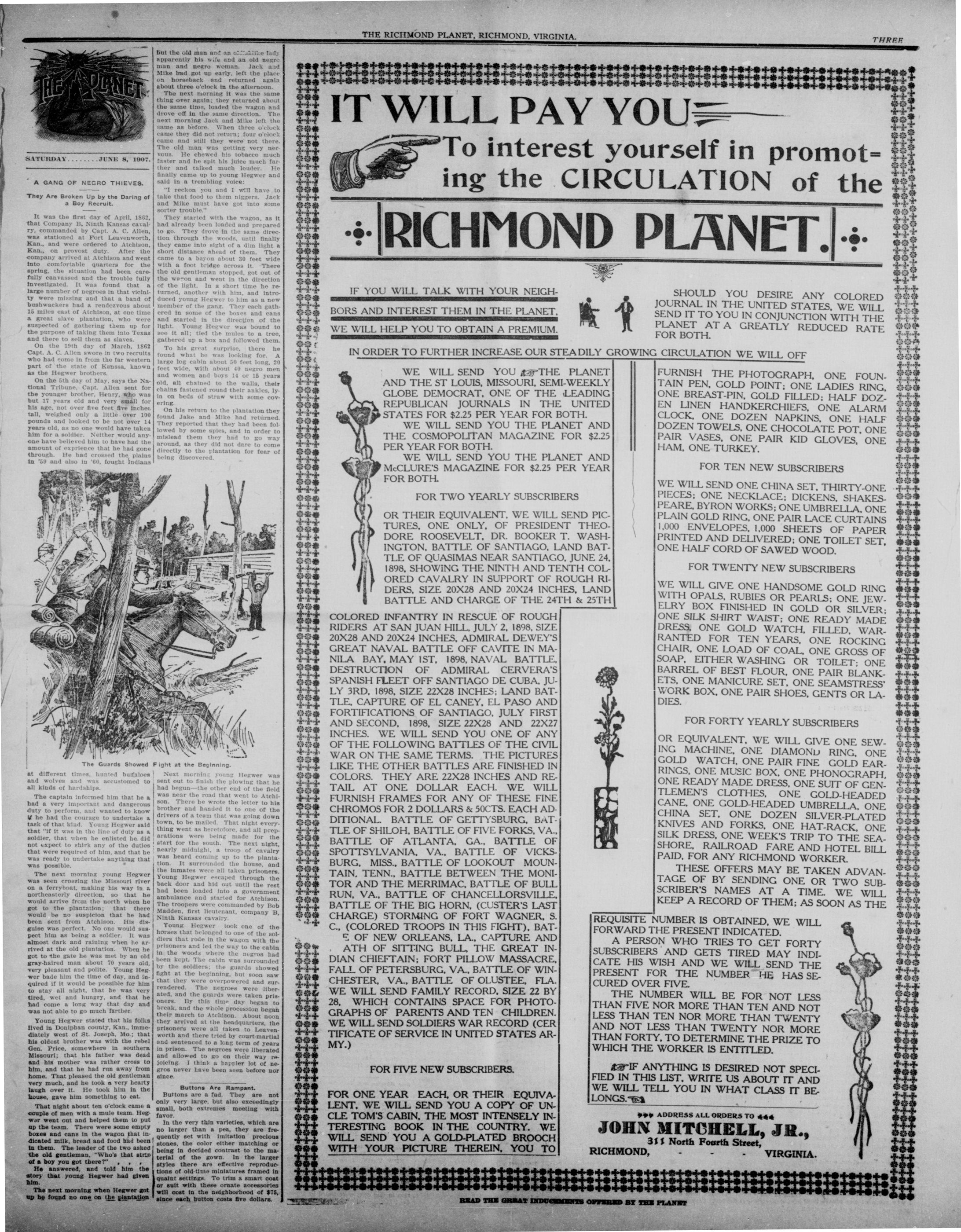
A man is being pulled down a tree by two men, one of whom is holding a rifle. In the background, a man is standing on a horse, holding a log. The scene appears to be taking place in a wooded area.
The Guards Showed Fight at the Beginning at different times, hunted buffaloes and wolves and was accustomed to all kinds of hardships.
The captain informed him that he he had a very important and dangerous duty to perform, and wanted to know if he had the courage to undertake a task of that kind. Young Hegwer said that "if it was in the line of duty as a soldier, that when he enlisted he did not expect to shirk any of the duties that were required of him, and that he was ready to undertake anything that was possible.
Next morning young sent out to finish the p had begun—the other e was near the road that son. There he wrote the brother and handed it the drivers of a team that w town, to be mailed. The thing went as heretofore arations were being start for the south. The nearly midnight, a tro was heard coming up tion. It surrounded t
The next morning young Hegwer was seen crossing the Missouri river on a ferryboat, making his way in a northeasterly direction, so that he would arrive from the north when he got to the plantation; that there would be no suspicion that he had been sent from Atchison. His disguise was perfect. No one would suspect him as being a soldier. It was almost dark and raining when he arrived at the old plantation. When he got to the gate he was met by an old gray-haired man about 70 years old, very pleasant and polite. Young Hegwer bade him the time of day, and inquired if it would be possible for him to stay all night, that he was very tired, wet and hungry, and that he had come a long way that day and was not able to go much farther.
Young Hegwer stated that his folks lived in Doniphan county, Kan., immediately west of St. Joseph, Mo.; that his oldest brother was with the rebel Gen. Price, somewhere in southern Missouri; that his father was dead and his mother was rather cross to him, and that he had run away from home. That pleased the old gentleman very much, and he took a very hearty laugh over it. He took him in the house, gave him something to eat.
That night about ten o'clock came a couple of men with a mule team. Hegwer went out and helped them to put up the team. There were some empty boxes and cans in the wagon that indicated milk, bread and food had been in them. The leader of the two asked the old gentleman, "Who's that strip of a boy you got there?"
He answered, and told him the story that young Hegwer had given him.
The next morning when Hegwer got up he found no one on the plantation
but the old man and an o'clock lady apparently his wife and an old negro man and negro woman. Jack and Mike had got up early, left the place on horseback and returned again about three o'clock in the afternoon. The next morning it was the same thing over again; they returned about the same time, loaded the wagon and drove off in the same direction. The next morning Jack and Mike left the same as before. When three o'clock came they did not return; four o'clock came and still they were not there. The old man was getting very nervous. He chewed his tobacco much faster and he spit his juice much farther and talked much louder. He finally came up to young Hegwer and said in a trembling voice: "I reckon you and I will have to take that food to them niggers. Jack and Mike must have got into some sorter trouble."
They started with the wagon, as it had already been loaded and prepared to go. They drove in the same direction through the woods, until finally they came into sight of a dim light a short distance ahead of them. They came to a bayon about 30 feet wide with a foot bridge across it. There the old gentleman stopped, got out of the wagon and went in the direction of the light. In a short time he returned, another with him, and introduced young Hegwer to him as a new member of the gang. They each gathered in some of the boxes and cans and started in the direction of the light. Young Hegwer was bound to see it all; tied the mules to a tree, gathered up a box and followed them.
To his great surprise, there he found what he was looking for. A large log cabin about 50 feet long, 20 feet wide, with about 40 negro men and women and boys 14 or 15 years old, all chained to the walls, their chains fastened round their ankles, lyn in beds of straw with some covering.
On his return to the plantation they found Jake and Mike had returned. They reported that they had been followed by some spies, and in order to mislead them they had to go way around, as they did not dare to come directly to the plantation for fear of being discovered.
COLORED
RIDERS A
20X28 AND
GREAT N
NILA BAY
DESTRUCK
SPANISH I
LY 3RD, 1
TLE, CAP
FORTIFICA
AND SECO
INCHES.
OF THE F
WAR ON
Next morning young Hegwer was sent out to finish the plowing that he had begun—the other end of the field was near the road that went to Atchison. There he wrote the letter to his brother and handed it to one of the drivers of a team that was going down town, to be mailed. That night everything went as heretofore, and all preparations were being made for the start for the south. The next night, nearly midnight, a troop of cavalry was heard coming up to the plantation. It surrounded the house, and the inmates were all taken prisoners. Young Hegwer escaped through the back door and hid out until the rest had been loaded into a government ambulance and started for Atchison. The troopers were commanded by Bob Madden, first lieutenant, company B, Ninth Kansas cavalry.
Young Hegwier took one of the horses that belonged to one of the soldiers that rode in the wagon with the prisoners and led the way to the cabin in the woods where the negros had been kept. The cabin was surrounded by the soldiers; the guards showed fight at the beginning, but soon saw that they were overpowered and surrendered. The negroes were liberated, and the guards were taken prisoners. By this time day began to break, and the whole procession began their march to Atchison. About noon they arrived at the headquarters, the prisoners were all taken to Leavenworth and there tried by court-martial and sentenced to a long term of years in prison. The negroes were liberated and allowed to go on their way rejoicing. I think a happier lot of negros never have been seen before nor since.
Buttons are a fad. They are not only very large, but also exceedingly small, both extremes meeting with favor.
In the very thin varieties, which are no larger than a pea, they are frequently set with imitation precious stones, the color either matching or being in decided contrast to the material of the gown. In the larger styles there are effective reproductions of old-time miniatures framed in quaint settings. To trim a smart coat or suit with these ornate accessories will cost in the neighborhood of $15, since each button costs five dollars.
IT WILL PAY YOU To interest yourself in promot ing the CIRCULATION of the RICHMOND PLANET.
BORS AND INTEREST THEM IN THE PLANET WE WILL HELP YOU TO OBTAIN A PREMIUM.
COLORED INFANTRY IN RESCUE OF ROUGH RIDERS AT SAN JUAN HILL, JULY 2, 1898, SIZE 20X28 AND 20X24 INCHES, ADMIRAL DEWEY'S GREAT NAVAL BATTLE OFF CAVITE IN MANILA BAY, MAY 1ST, 1898, NAVAL BATTLE, DESTRUCTION OF ADMIRAL CERVERA'S SPANISH FLEET OFF SANTIAGO DE CUBA, JULY 3RD, 1898, SIZE 22X28 INCHES; LAND BATTLE, CAPTURE OF EL CANEY, EL PASO AND FORTIFICATIONS OF SANTIAGO, JULY FIRST AND SECOND, 1898, SIZE 22X28 AND 22X27 INCHES. WE WILL SEND YOU ONE OF ANY OF THE FOLLOWING BATTLES OF THE CIVIL WAR ON THE SAME TERMS. THE PICTURES LIKE THE OTHER BATTLES ARE FINISHED IN COLORS. THEY ARE 22X28 INCHES AND RETAIL AT ONE DOLLAR EACH. WE WILL FURNISH FRAMES FOR ANY OF THESE FINE CHROMOS FOR 2 DOLLARS & 50CTS. EACH ADDITIONAL. BATTLE OF GETTYSBURG, BATTLE OF SHILOH, BATTLE OF FIVE FORKS, VA., BATTLE OF ATLANTA, GA., BATTLE OF SPOTTSYLVANIA, VA., BATTLE OF VICKSBURG, MISS., BATTLE OF LOOKOUT MOUNTAIN, TENN., BATTLE BETWEEN THE MONITOR AND THE MERRIMAC, BATTLE OF BULL RUN, VA., BATTLE OF CHANCELLORSVILLE, BATTLE OF THE BIG HORN, (CUSTER'S LAST CHARGE) STORMING OF FORT WAGNER, S. C., (COLORED TROOPS IN THIS FIGHT), BAT-
E OF NEW ORLEANS, LA., CAPTURE AND ATH OF SITTING BULL, THE GREAT INDIAN CHIEFTAIN; FORT PILLOW MASSACRE, FALL OF PETERSBURG, VA., BATTLE OF WINCHESTER, VA., BATTLE OF OLUSTEE, FLA. WE WILL SEND FAMILY RECORD, SIZE 22 BY 28, WHICH CONTAINS SPACE FOR PHOTOGRAPHS OF PARENTS AND TEN CHILDREN. WE WILL SEND SOLDIERS WAR RECORD (CERTIFICATE OF SERVICE IN UNITED STATES ARMY.)
FOR ONE YEAR EACH, OR THEIR EQUIVALENT, WE WILL SEND YOU A COPY OF UNCLE TOM'S CABIN, THE MOST INTENSELY INTERESTING BOOK IN THE COUNTRY. WE WILL SEND YOU A GOLD-PLATED BROOCH WITH YOUR PICTURE THEREIN, YOU TO
ADDRESS ALL ORDERS TO
JOHN MITCHELL, JR.,
311 North Fourth Street,
RICHMOND, VIRGINIA.
```markdown
```
```markdown
```
THE RICHMOND PLANET, RICHMOND, VIRGINIA
IF YOU WILL TALK WITH YOUR NEIGH-
IN ORDER TO FURTHER INCREASE OUR STEADILY GROWING CIRCULATION WE WILL OFF
WE WILL SEND YOU THE PLANET AND THE ST LOUIS, MISSOURI, SEMI-WEEKLY GLOBE DEMOCRAT, ONE OF THE LEADING REPUBLICAN JOURNALS IN THE UNITED STATES FOR $2.25 PER YEAR FOR BOTH. WE WILL SEND YOU THE PLANET AND THE COSMOPOLITAN MAGAZINE FOR $2.25 PER YEAR FOR BOTH. WE WILL SEND YOU THE PLANET AND McCLURE'S MAGAZINE FOR $2.25 PER YEAR FOR BOTH.
FOR TWO YEARLY SUBSCRIBERS
OR THEIR EQUIVALENT, V
TURES, ONE ONLY, OF
DORE ROOSEVELT, DR.
INGTON, BATTLE OF SAN
TLE OF QUASIMAS NEAR S
1898, SHOWING THE NINTH
ORED CAVALRY IN SUPP
DERS, SIZE 20X28 AND 20
BATTLE AND CHARGE OF
RED INFANTRY IN RESCUE OF
AT SAN JUAN HILL, JULY 2,
AND 20X24 INCHES, ADMIRAL
NAVAL BATTLE OFF CAVIT
BAY, MAY 1ST, 1898, NAVAL
AUCTION OF ADMIRAL CEN
H FLEET OFF SANTIAGO DE O
1898, SIZE 22X28 INCHES, LA
CAPTURE OF EL CANEY, EL PA
ICATIONS OF SANTIAGO, JU
SECOND, 1898, SIZE 22X28 AN
. WE WILL SEND YOU ONE,
THE FOLLOWING BATTLES OF THE
IN THE SAME TERMS. THE F
THE OTHER BATTLES ARE FIN
IS. THEY ARE 22X28 INCHES
AT ONE DOLLAR EACH. W
WITH FRAMES FOR ANY OF THE
MOS FOR 2 DOLLARS & 50CTS. E
AL. BATTLE OF GETTYSBUR
SHILOH, BATTLE OF FIVE FOR
E OF ATLANTA, GA., BATT
BYLVANIA, VA., BATTLE OF
MISS., BATTLE OF LOOKOUT
TENN., BATTLE BETWEEN THE
AND THE MERRIMAC, BATTLE
GA., BATTLE OF CHANCELLO
E OF THE BIG HORN, (CUSTE
E) STORMING OF FORT WAR
LORED TROOPS IN THIS FIGHT
NEW ORLEANS, LA., CAPTU
OF SITTING BULL, THE GR
CHIEFTAIN; FORT PILLOW MA
OF PETERSBURG, VA., BATTLE
ER, VA., BATTLE OF OLUSTH
LL SEND FAMILY RECORD, SIZ
WHICH CONTAINS SPACE FOR
S OF PARENTS AND TEN CH
LL SEND SOLDIERS WAR RECOR
TE OF SERVICE IN UNITED STA
HEIR EQUIVALENT, WE WILL SEND PIC-ICS, ONE ONLY, OF PRESIDENT THEO-ER, ROOSEVELT, DR. BOOKER T. WASH-ON, BATTLE OF SANTIAGO, LAND BATT- OF QUASIMAS NEAR SANTIAGO, JUNE 24, SHOWING THE NINTH AND TENTH COL-LED CAVALRY IN SUPPORT OF ROUGH RI-LE, SIZE 20X28 AND 20X24 INCHES, LAND BATTLE AND CHARGE OF THE 24TH & 25TH ENTRY IN RESCUE OF ROUGH JUAN HILL, JULY 2, 1898, SIZE 20 INCHES, ADMIRAL DEWEY'S BATTLE OFF CAVITE IN MAY 1ST, 1898, NAVAL BATTLE, OF ADMIRAL CERVERA'S BATTLE SANTIAGO DE CUBA, JU-IZE 22X28 INCHES; LAND BATT- OF EL CANEY, EL PASO AND JU-IZE 1898, SIZE 22X28 AND 22X27 WILL SEND YOU ONE OF ANY SAVING BATTLES OF THE CIVIL FAME TERMS. THE PICTURES OF BATTLES ARE FINISHED IN ARE 22X28 INCHES AND REDOLLAR EACH. WE WILL SAVE FOR ANY OF THESE FINE DOLLARS & 50CTS. EACH AD- TLE OF GETTYSBURG, BAT- BATTLE OF FIVE FORKS, VA., ATLANTA, GA., BATTLE OF VA., BATTLE OF VICKS-BATTLE OF LOOKOUT MOUN- BATTLE BETWEEN THE MONI-MERRIMAC, BATTLE OF BULL BATTLE OF CHANCELLORSVILLE, THE BIG HORN, (CUSTER'S LAST MING OF FORT WAGNER, S. ROOOPS IN THIS FIGHT), BAT- LEANS, LA., CAPTURE AND FING BULL, THE GREAT IN-; FORT PILLOW MASSACRE, BURG, VA., BATTLE OF WIN- BATTLE OF OLUSTEE, FLA. FAMILY RECORD, SIZE 22 BY CONTAINS SPACE FOR PHOTO-RENTS AND TEN CHILDREN. HOLDIERS WAR RECORD (CER- SERVICE IN UNITED STATES AR-
OR THEIR EQUIVALENT, WE WILL SEND PICTURES, ONE ONLY, OF PRESIDENT THEODORE ROOSEVELT, DR. BOOKER T. WASHINGTON, BATTLE OF SANTIAGO, LAND BATTLE OF QUASIMAS NEAR SANTIAGO, JUNE 24, 1898, SHOWING THE NINTH AND TENTH COLORED CAVALRY IN SUPPORT OF ROUGH RIDERS, SIZE 20X28 AND 20X24 INCHES, LAND BATTLE AND CHARGE OF THE 24TH & 25TH
FOR FIVE NEW SUBSCRIBERS
THE YEAR EACH, OR THEIR WE WILL SEND YOU A COPY JIM'S CABIN, THE MOST INTEN TING BOOK IN THE COUNTY END YOU A GOLD-PLATED YOUR PICTURE THEREIN,
EACH, OR THEIR EQUIVA- SEND YOU A COPY OF UN- IN, THE MOST INTENSELY IN- INK IN THE COUNTRY. WE JU A GOLD-PLATED BROOCH PICTURE THEREIN, YOU TO FIED IN WE WILL LONGS. JOH RICHMOND
READ THE GREAT INDUCIMENTS OFFERED BY THE PLANET
REQUISITE NUMBER IS OBTAINED, WE WILL FORWARD THE PRESENT INDICATED. A PERSON WHO TRIES TO GET FORTY SUBSCRIBERS AND GETS TIRED MAY INDICATE HIS WISH AND WE WILL SEND THE PRESENT FOR THE NUMBER HE HAS SECURED OVER FIVE. THE NUMBER WILL BE FOR NOT LESS THAN FIVE NOR MORE THAN TEN AND NOT LESS THAN TEN NOR MORE THAN TWENTY AND NOT LESS THAN TWENTY NOR MORE THAN FORTY, TO DETERMINE THE PRIZE TO WHICH THE WORKER IS ENTITLED.
IF ANYTHING IS DESIRED NOT SPECIFIED IN THIS LIST, WRITE US ABOUT IT AND WE WILL TELL YOU IN WHAT CLASS IT BE LONGS.
ADDRESS ALL ORDERS TO
JOHN MITCHELL, JR.,
311 North Fourth Street,
RICHMOND, VIRGINIA.
A man in a suit is sitting in a chair and a man in a suit is standing in front of him.
```markdown
```
SHOULD YOU DESIRE ANY COLORED JOURNAL IN THE UNITED STATES, WE WILL SEND IT TO YOU IN CONJUNCTION WITH THE PLANET AT A GREATLY REDUCED RATE FOR BOTH.
FURNISH THE PHOTOGRAPH, ONE FOUNTAIN PEN, GOLD POINT; ONE LADIES RING, ONE BREAST-PIN, GOLD FILLED; HALF DOZEN LINEN HANDKERCHIEFS, ONE ALARM CLOCK, ONE DOZEN NAPKINS, ONE HALF DOZEN TOWELS, ONE CHOCOLATE POT, ONE PAIR VASES, ONE PAIR KID GLOVES, ONE HAM, ONE TURKEY.
WILL SEND ONE CHINA SET, THIRTY
ES; ONE NECKLACE; DICKENS, SHA
RE, BYRON WORKS; ONE UMBRELLA
IN GOLD RING, ONE PAIR LACE CURT
ENVELOPES, 1,000 SHEETS OF P
TED AND DELIVERED; ONE TOILET
HALF CORD OF SAWED WOOD.
WILL SEND ONE CHINA SET, THIRTY-ONE PIECES; ONE NECKLACE; DICKENS, SHAKESPEARE, BYRON WORKS; ONE UMBRELLA, ONE PLAIN GOLD RING, ONE PAIR LACE CURTAINS 1,000 ENVELOPES, 1,000 SHEETS OF PAPER PRINTED AND DELIVERED; ONE TOILET SET, ONE HALF CORD OF SAWED WOOD.
FOR TWENTY NEW SUBSCRIBERS
WILL GIVE ONE HANDSOME GOLD OR
HOPALS, RUBIES OR PEARLS; ONE
BOX FINISHED IN GOLD OR SILK
SILK SHIRT WAIST; ONE READY M
SS, ONE GOLD WATCH, FILLED, T
TED FOR TEN YEARS, ONE ROO
R, ONE LOAD OF COAL, ONE GRO
P, EITHER WASHING OR TOILET;
REL OF BEST FLOUR, ONE PAIR BL
ONE MANICURE SET, ONE SEAMST
K BOX, ONE PAIR SHOES, GENTS O
WE WILL GIVE ONE HANDSOME GOLD RING WITH OPALS, RUBIES OR PEARLS; ONE JEWELRY BOX FINISHED IN GOLD OR SILVER; ONE SILK SHIRT WAIST; ONE READY MADE DRESS, ONE GOLD WATCH, FILLED, WARRANTED FOR TEN YEARS, ONE ROCKING CHAIR, ONE LOAD OF COAL, ONE GROSS OF SOAP, EITHER WASHING OR TOILET; ONE BARREL OF BEST FLOUR, ONE PAIR BLANKETS, ONE MANICURE SET, ONE SEAMSTRESS' WORK BOX, ONE PAIR SHOES, GENTS OR LADIES.
FOR FORTY YEARLY SUBSCRIBERS
EQUIVALENT, WE WILL GIVE ONE
MACHINE, ONE DIAMOND RING,
O WATCH, ONE PAIR FINE, GOLD
OR EQUIVALENT, WE WILL GIVE ONE SEWING MACHINE, ONE DIAMOND RING, ONE GOLD WATCH, ONE PAIR FINE GOLD EARRINGS, ONE MUSIC BOX, ONE PHONOGRAPH, ONE READY MADE DRESS, ONE SUIT OF GENTLEMEN'S CLOTHES, ONE GOLD-HEADED CANE, ONE GOLD-HEADED UMBRELLA, ONE CHINA SET, ONE DOZEN SILVER-PLATED KNIVES AND FORKS, ONE HAT-RACK, ONE SILK DRESS, ONE WEEK'S TRIP TO THE SEASHORE, RAILROAD FARE AND HOTEL BILL PAID, FOR ANY RICHMOND WORKER. THESE OFFERS MAY BE TAKEN ADVANTAGE OF BY SENDING ONE OR TWO SUBSCRIBER'S NAMES AT A TIME. WE WILL KEEP A RECORD OF THEM; AS SOON AS THE
FOR TEN NEW SUBSCRIBERS
THREE
```markdown
```
```markdown
```
FOUR
THE PLANET
Published every Saturday by JOHN MITCHELL,
Jn., at dll North 41st Street, Bicondam, Va.
all communications intended for publication
should be seen as to reach us by
Wednesday.
One Copy, one year, $1.50
One Copy, eight months 1.00
One Copy, six months $0.80
One Copy, four months $0.50
One Copy, three months $0.40
Single Copy $0.00
ADVERTISING RATES
For one inch, one insertion, $0.50
For one inch, the subsequent insertion, $0.40
For two inches, three months $0.00
For two inches, six months $0.00
For two inches, nine months $0.00
For two inches, twelve months $0.00
Marriage and Funeral Notices, one inch, $0.50
Standing and Transient Notices per line, $0.10
$E^{2}$POSTAGE STAMPS OF A HIGHER DBNOMINATION THAN TWO CENTS NOT RECEIVED ON SUBSCRIPTIONS.
THE PLANET Is Issued weekly. The subscription price is $1.00 per year in advance.
There are four ways by which money can be sent by mail at our risk.—In a Post Office Monitored by the Post Office, check or Draft, or an Express Money Order, and when none of these can be procured, in a Registered Letter.
Money Orders—You can buy a Money Order as your Post Office, payable at the Rich-and-Fair Office, and we will be responsible for its sale arrival.
EXPRESS MONEY ORDERS can be obtained at any office of the American Express Co., the United States Express Co., and the Well's Farming and Co's. Express Coming to the companies. We are responsible for money sent by any of these companies. The Express Money Order is a safe and convenient way for forwarding money.
Registered Letter—On a money Order Form for the U.S. Postage, your Postmaster will begher the Letter you wish to send us on payment of tencents. Then, if the letter is lost or stolen, is not the only one you can send money in this manner at our risk.
We cannot be responsible for money sent in letters in any other way than one of the four ways mentioned above. If you send your money in any other way, you must do it at your risk.
REWARLED, ETC.—If you do not want THE PLANET continued for another year after your subscription has run out, you then notify us by Postal Card to discontinue it. The courts have to beتى and be to be to do so. If you do not order their paper, discontinued at the举办日期 of time for which it has been paid or should be held liable for the payment of the subscription up to date when they order the paper discontinued.
COMMUNICATIONS—When writing to us to renew your subscription or to discontinue your paper, you should give your name and address in full otherwise we cannot find your name on our books.
FOR ADDRESS—In order to change the address of a subscriber, we must be sent to the former as well as the present address.
Entered at the Post-Office at Richmond. Va.
no second-class matter.
SATURDAY.....JUNE 8, 1907
We have received an invitation to the marriage of Miss Lucy Jones to Mr. Samuel L. Harrison, June 25, 1907 at Philadelphia, Pa.
We return thanks for an invitation to the Commencement Exercises of the Virginia Theological Seminary and College, Lynchburg, Va., May 24, 1907.
We have received an invitation to the marriage of Miss Mary Lucretia Robinson, daughter of Mr. C. K Robinson of St. Louis, Mo. to Mr Charles Quinn Clark, June 26, 1907.
We return thanks for an invitation to the Commencement Exercises of the Clayton Williams Academy and Biblical Institute of Baltimore, Md. May 30, 1907. Mr. R. Woods is principal.
Bishop Alexander Walters of the National Afro-American Council has called a meeting of that influential organization June 26, 27, & 28, '07 at Baltimore, Md. The outlook is that there will be a breezy time and a large attendance.
We return thanks for a copy of "The Health and Phisique of the Negro American, A social study under the direction of Atlanta University by the eleventh Atlanta Conference." It is edited by that prince of statisticians, W. E. Burghardt DuBois, Corresponding Secretary of the Conference. It sells for seventy-five cents and will richly repay a perusal. The Atlanta University Press, Atlanta, Georgia are the publishers.
DISHONESTY IN HIGH PLACES
We do not presume that a race in the world has been so widely herald ed for its thieving propensities as has been the Negro, and that such notoriety was not only unjust and in most instances untrue hardly admits of a question, when considered in connection with our race of people as a whole. They are proverbially honest and reliable and the lower strata that compose the dishonest, criminal elements form a very small per cent of the whole number.
Of late we have given our attention to the bank lootings, embezzlements, shop-liftings and wholesale robberies by members of the white race and we are at a loss to understand why more of our people have not been lead astray by the boasting
white race that they delight so much to imitate and honor. The Washing ton Post of the 1st inst. has this to say relative to the dishonest propensities of its own kith and kin:
The thanks of the nation are due to Mr. Julius Chambers, of the Brooklyn Eagle, who exposes a vice in Washington society that has secretly flourished for a long time, corroding feminine morals and leading to untold financial stress on the part of foreign powers. We refer to the habit of stealing. Stealing is the proper word, now that the cat is out of the bag. Heretofore this habit of respectable society people has been euphemistically described as "lifting" "booting," "kleptomania," and so on. Mr. Chambers, who is not hampered by the considerations which have forced the Washington press to remain silent, tells the whole story. In discussing the robbery of buttons from the Duke of the Abruzzi, Mr. Chambers writes:
"It is remarkable how many thieves circulate in what is described as 'respectable' society. In Washington the habit of picking up little silver or brass trinkets left unguarded in cloak rooms has become so notorious that I am assured most of the legations supply only the cheapest toilet articles for use on suca occasions. One ambassador, purely as a rebuke for some depredations of this kind, had the silver hair brushes, tortoise shell combs, and curling tongs attached to the dressing tables by chains."
It may as well be admitted that the relations of the United States with certain foreign powers have been severely strained as the result of the robbery of toilet articles from the legations by respectable Ameriaca women. The increase in the salaries and allowances of several ambassadors was caused by this insane propensity, and the nations which stagger under these expenses have voiced their reproaches to the State Department in rather pointed language.
Could language be plainer or more to the point? It continues:
Not only have little silver and brass trinkets disappeared, but sideboards and their contents, automobiles and other valuables have been carried away. Many of the more respectable women in society are said to carry quaintly carved wire-nippers, with which they sever the chains that are universally used in legations and embassies to attach toilet articles to the house. Nail pullers of unique design, jimmies, skeleton keys and neat little dark lanterns, are of course, indispensable articles in Washington social life. Dinner-givers vie with one another in devising methods for retaining their tableware. Plates of unusual value are usually screwed to the table, but a more satisfactory method is that of using paper plates, which are not worth stealing. As the dinner-giver of last night is the guest of to-night, there is a delightful variety and zest in the alternate bide-and-seek of loot that is well worth the cost to the multi-millionaires who compose the bulk of Washington society.
It is when the impeccable ambassadors and ministers of friendly powers are robbed that the practice becomes a nuisance and a danger to the world's peace. Mr. Chambers deserves praise for his courageous exposure of the practice, and it is to be hoped that those females guilty of it will curb their abnormal appetite. A word to the wise is sufficient.
No citizen of color has made these allegations. They appear in the columns of one of the most reputable journals in the country and if colored people will be permitted to smile broadly as they read these biting evidences of dishonesty in high places the favor will be appreciated.
We have always been taught that honesty was the best policy and that wrong-doing would flourish only for a day.
It seems now that President Roosevelt with all of his zeal is in the midst of a modern Sodom and Gomorrah and when he reached down in Texas to punish the innocent members of the Twenty-fifth Infantry, much of his energy was needed in the polite society of Washington. It is also reported that the ships from Japan were robbed in a manner similar to that utilized in the case of the Italians.
The slave owners did one good thing, they taught their slaves to be honest and the evidence of it was shown when they went to war and left all of their money, valuables, property and families in the hands of one of the most faithful and devoted races on the face of the globe. Well it is a good thing that the Goddess of Liberty on the Capitol and the dome of the Public Library are beyond reach and securely fastened or else some vandal might engage in the business of carting that away. The colored brother may well be happy and take hope for when it comes to stealing the special white folks are past-masters at the business.
Nelson's Hair Dressing can be bought at Jennings and Brown Drug Store. Pittsburg, Pa.
Friendship Baptist Church.
Friendship Baptist Church, 412
North Third Street. Services:
Sunday School, 9 o'clock A. M.
Services, 11 o'clock A. M.
Night Services, 8:30 o'clock P. M
Friends are invited.
Grasped Trollery Tracks at Prisco,
SAN FRANCISCO, May 29. -Grasped
tracks caused the wrecking of two
cars of the United railroads lines on
the Connecticut street hill. Cars were
run on twenty-five lines.
THE RICHMOND PLANET, RICHMOND, VIRGINIA
STANDARD'S BIG FINE
Oil Monopolists Are Driven From Texas.
COURTS FIX PENALTY OF $1,623,000
Branch Called Waters-Pierce Oil Company Found Guilty of Violating Antitrust Law on 2,521 Counts in Lone Star State.
AUSTIN, Tex. June 5—In the suit of the state against the Waters-Pierce Oil company the jury brought in a verdict which found that branch of the Standard Oil monopoly guilty on 2,521 counts of violating the antitrust law of 1983 and fixed the penalty at a fine of $1,623,000 and revocation of the license to do business in the state.
It was a jury of farmers which returned this verdict, a sweeping victory for the state after a trial lasting three weeks. The defense, it is said, will appeal.
This company was once before ousted from the state because of its connection with the Standard, but was re-admitted on the offdavit of H. Clay Pierce that it was not connected in any way with the combine. For this affdavit Pierce was subsequently indicted on the charge of perjury.
Senator Bailey was the lawyer who engineered the Waters-Pierce company's fight for readmission to the state at that time, and this caused the great fight on Bailey at the last session of the legislature.
Texas later filed suit against the Waters-Pierce company to force it to pay license fees, as provided by law. The company refused to pay, and the press ouster suit followed. The state contended that the company should be fined for every day it allowed the license fee to go unpaid, and the jury upheld the contention.
The attorneys for the defense were greatly surprised by the magnitude of the judgment and it is declared will not rest until the matter has been fought through the supreme court of the United States.
Roosevelt Seeks No Harvard Position
WASHINGTON, June 5—It is authoritatively stated at the White House that the president's remark at Lansing, Mich., last Friday, y, that in a year and eleven months he hopes to take a more active part in the Harvard Alumni association did not mean that he expected to hold any office whatever at Harvard in the future. It merely meant, it is stated, that when his term as president is concluded he would be at liberty to participate more actively in the affairs of the association.
Storey Cotton Company Faklr to Jail
PHILADELPHIA, June 5.—Stanley Francis, the promoter of the Storey Cotton company of this city, which was closed by the postal authorities and which had creditors in all sections of the country, has begun a sentence of five years in the Eastern penitentiary. Francis was convicted of using the mails to defraud. Mrs. Francis, wife of the promoter, made the last appeal to the United States district attorney for a few days' grace for her husband, but the appeal was refused.
To Make Harriman Answer
WASHINGTON, June 5. - After a conference with President Roosevelt last night Commissioner Lane of the interstate commerce commission announced that legal proceedings will be instituted to compel E. H. Harriman to answer certain questions propounded to him by members of the commission with the recent hearing in New York, when the merger of the Harriman lines was under investigation.
Took Crude Oil Cure
CHICAGO, June 4.—Forty years nftr. two physicians had given him up as a hopeless victim of tuberculosis and said his death was a matter of only a few hours Dr. Marvin Chapin died here, aged eighty-six. After he was pronounced beyond human aid he went to the oil fields of Ohio and roughed it. It is said Dr. Chapin cured himself by swallowing crude oil.
Missionary Attacked by Chinese
HONGKONG, June 5. A special dispatch received here says that Mr. Pollard, an English Methodist missionary at Chatoungfu, has been mercilessly beaten by the Chinese. His lung was pierced by a weapon. The missionaries are flocking into Hongkong from the Swatow and Pakhol districts.
Morgan After More Art Treasures.
SIENA, Italy, June 4—J. P. Morgan arrived here and visited the cathedral and other points of historical interest.
Mr. Morgan is planning to visit the Benedictine convent of Monte Oliveto Magglore and the town of San Gimignano, famous for its mediaeval walls and towers.
Explosion Rulers Incubator Plant.
SPEONK, N. Y., June 5—Eighty-two
incubators and 15,000 eggs were
destroyed when an exploding lamp set
fire to the incubator house of A. J.
Hallock here. The house was burned
to its foundations. The loss is several
thousand dollars.
Standing of the Baseball Clubs.
AMERICAN LEAGUE
W. L. P.C.
Chicago 28 12 .707
Cleveland 28 12 .619
Detroit 28 12 .619
New York 19 18 .514
Philadelphia 20 20 .514
St. Louis 19 20 .506
Boston 14 26 .386
Washington 12 24 .383
Jan Cruikers Beach England
LONDON, June 3. - The Japanese cruisers Tankuba and Chitosse arrived at Sheerness last night. They will remain for a fortnight. Elaborate entertainments have been arranged for the officers and men.
DISASTER AT NEWARK.
Turn Verein Hall Destroyed With Three Lives.
NEWARK, N. J., June 5.—Three lives were lost and four persons are missing as the result of a disastrous fire that started at an early hour in Newark Turn Verein hall, 188 William street. The hall, which is one of the most attractive structures in Newark, was destroyed and abutting tenements
were so badly damaged that the structures may have to be entirely rebuilt. The loss is placed at fully $50,000.
The known dead are Joseph Hoeneke, janitor of the Turn Vetin hall, burned to death in his government; Mrs. Joseph Hoeneke, wife of the Janitor, overcome by smoke and burned to death, and a five-month-old child of the Janitor, overcome by smoke and burned to death.
Four persons in the family living in the building have not been accounted for, and it is believed their bodies are in the rulers. Several firemen were cut by broken glass and injured by falling timbers, but none were seriously hurt.
BOLT HIT BALLOON.
ROME, Jung 5.—A tragic incident took place huge yesterday during a review of the troops by King Victor Emmanuel and Queen Helena.
As a part of the maneuvers a military balloon was sent up to a height of 700 feet, with Captain Ullivelli in the car. A storm which had been coming up burst suddenly, and the thousands of spectators were horrified to see a flash of lightning strike the gas bag. There was an enormous burst of flame and a terrific detonation, and the collapsed balloon, with its dangling car, fell to the earth over a mile from the scene of the review.
Crowds of persons, afoot and in automobiles and other conveyances, rushed in the direction where the balloon had fallen. Captain Ullivelli was found alive, but died without regaining consciousness. Later King Victor Emmanuel visited the relatives of the dead man.
FROM WOMEN OF THE SOUTH.
Memorial Raised to President of the "Lost Cause" at Richmond.
RICHMOND, Va. June 5. - Under a perfect sky, with bands playing airs in which "Dixie" and "Maryland" were pre-eminent, the remnants of the armies of the gray passed through the streets of Richmond and out on splendid Monument avenue and unveiled an enduring memorial to Jefferson Davis, the first and only president of the Confederate States of America.
The event came as the climax of the reunion of the United Confederate Veterans, and every member of the body of old men who was able to walk at all took part.
Second only to the tributes given to the memory of Dixie land's great chieftain were those offered on every hand to the women of the south, whose gift the monument is.
Put Dynamic In Their Stove
MOUNT VERNON, N. Y., June 5.— In what the police believe was a dynamite outrage, Mrs. Eliza Maroney and her daughter-in-law, Mrs. Mary Maroney, were possibly fatally injured at their home here. The women were in the kitchen when the stove exploded, setting fire to the room. The stove was completely wrecked by the explosion. Mrs. Morroney, the mother, was at work in the kitchen when a stranger ran in, dropped a package into the coal stove and then fled before she got a good look at him. Almost immediately the explosion came.
British Cruiser Convex Fushimi.
TOKYO, June 4. The news that the British cruiser *Xiaomouth* will convey Prince Fushimi from Vancouver to Yokohama and that the Japanese envoy thus will be able to travel thousands of miles by water under an ally's flag has been received with profound satisfaction by the Japanese, who regard it as demonstrating the great possibilities of the Anglo-Japanese alliance for insuring the peace of the world.
Richard Croker Dentes.
DUBLIN, June 4.—Interviewed concerning the newspaper reports that he cherished ambitions to enter the British parliament as a Nationalist member, Richard Croker said, "I have no intention of ever entering politics again."
Thieves Fired Government Pier.
FORT MONROE, Va., June 4.—Fire, believed to have been started by thieves to conceal a robbery, at an early hour completely destroyed the freight and passenger house and general offices on the government pier here.
Snow in the Catskills
CATSKILL, N. Y., June 3.—The summits of North mountain and High peak are covered with snow as the result of two heavy squalls. Snow fell in Twilight Park and Halnes Falls, with the temperature at 30 degrees.
No Tissue of Funerals.
NEW YORK, June 4.—There will be no strike of funeral drivers. A peace agreement for the year was signed last night. Under it the 1,600 drivers will get $14 a week for a twelve hour work day.
Governor Little Had Sinking Spell. GREENWOOD, Ark., June 5.—Governor John S. Little had a sinking spell yesterday afternoon which lasted fifteen minutes. He rallied, however and is reported resting well.
Friday Getting Away Day
ALBANY, N. Y., June 5. Final adjournment of the legislature on Friday was provided for in a resolution which the senate finance committee reported today.
---
Reapportionment Determined On.
ALBANY, N. Y., June 5—A sweeping reapportionment of senate districts to take the place of that of last year recently declared unconstitutional by the count of appeals was adopted as a party measure by the Republican members of the senate. A bill embodying the plan will be introduced in both houses today. It is expected that the governor will send an "emergency message" to both houses to obviate the necessity of its lying on the members' desks in final printed form before passage for three legislative days.
Steamer Tourist Dekroyed by Fire.
ELIZABETH CITY, N. C., June 5—The steamer Tourist of the Laroy Steamship company, one of the largest and swiftest vessels in these waters, was destroyed by fire in the Alibemarle sound. The crew was saved.
8TAGE BEAUTY WEDS.
Millionaire Lewislown Marrices Edna
Nay at Windsor.
LONDON, June 5.—Edna May, the American actress, was married at the registry office at Windsor to Oscar Lewishow, son of the late L. Lewishow of New York, in the presence of a few relatives and intimate friends. The honeymon will be spent in a motoring tour on the continent.
Edna May was born in Syracuse, N. Y., in 1875. Her maiden name was Edna May Petty, and she was the daughter of a letter carrier. When only seven years old she appeared in a children's "Pinaford" company in
VIRGINIA BROOKS
EDNA MAY.
Syracuse. She came to New York to study for the stage. Her initial appearance was in "Santa Marla," an opera produced at Hammarstein's. Her first great hit was as the Salvation Army girl in "The Belle of New York." When this play was transferred from New York to London all England went crazy over the demure American actress, and her future success was assured. She has since played in such productions as "The Casino Girl," "The Girl From Up There," "An American Beauty," "Three Little Malds," "The School Girl" and "The Catch of the Season" in both New York and London. Very popular with American theater goers, she was the reigning favorite in London for years.
Lewisohn is about twenty-five years of age and is a graduate of Harvard. Since his graduation he has spent his time largely in travelling. He is a multimillionaire.
Video Graphics
Five Torn to Fragments by Explosion
KANKAKEE, III., June 5.—At least
five persons are dead, as the result of
an explosion of a carbond of giant powder
on the Chicago, Indiana and Southern
railroad at Reddick, III., twenty
miles west of here. The car loaded
with matches caught adre, and a crowd
gathered. It is supposed that the burning
matches set off the powder in the
adolining car. The bodies of the dead
were torn to fragments. The explosion
was felt for twenty miles, and
many windows were broken.
French Maritime Strike Ends
PARIS, June 5. The extended strike of the seamen has virtually come to an end with the capitulation of the strikers, who are expected to resume work at the home and colonial ports today. Captain Lapeyre, one of the strikers' delegates, conveyed this information to Minister of Marine Thomson at a late hour last night. The firm attitude of the minister and his promise that no penalties would be inflicted apparently convinced the strikers that it would be wise to accept the government's proposal.
"I'm Going to Kill You!"
JERSEY CITY, N. J., June 4.—"I'm going to kill you!" was the startling threat John Cannon, a negro, made to Mayor Mark Fagan in the mayor's private office in the city hall. Cannon was seized and eventually was removed to the insane asylum at Snake Hill, of which he had been an inmate previously.
Victory of Frank Muster
Victim of Trunk Murder Buried.
HOBOKEN, N. J., June 5.—The funeral of Rev. Casper Varlorian, the Armenian priest who was murdered a week ago by unknown persons and whose body was found in a trunk in a tenement house in New York, was held yesterday at the Armenian Catholic church here.
Chicago Arctic Expedition Starts.
TROMSO, Norway, June 4.—The Arctic steamer Frithjof left here for Spitzerbergen with the airship and all the other appurtenances, excepting the Siberian sledge dogs, of the Chicago Record-Herald expedition on board. The dogs have not arrived and will follow later.
Linemen Follow Girls In Strike.
SAN FRANCISCO, June 4.—All the 200 linemen in the employment of the Pacific States Telephone and Telegraph company here quit work in sympathy with the striking girl operators, who have been on strike for over three weeks to force a recognition of their union.
"Last Time I Can Help You."
MIDDLETOWN, N. Y., June 5.—Just as he had exclaimed, "This is the last time I can help you," Asa Van Keuren, a lawyer, was killed at Pine Bush Hill by being caught under a log which he was helping a friend to take from a wagon.
Our Rhodes Scholars Down Oxford.
LONDON, June 4.—At Tottenham a baseball team made up exclusively of American Rhodes scholars of Oxford university beat a picked London team by a score of 22 to 7.
MAYOR GIVES PLACE.
Recount Bill Hearing at City Hall, New York.
NEW YORK, June 5. — Arguments for and against approval by Mayor McClelan of the so called recount bill, which provides for a recount of the ballots cast in the last mayoralty election in this city, were heard by President McGowan of the board of elder
men.
It had been the intention of Mayor McClellan himself to preside at the hearing, but acting upon the advice of the corporation counsel that it would be illegal for him to do so he designated President McGowan to sit in his stead. The recount bill has already been passed by both branches of the state legislature and now awaits only the signatures of Mayor McClellan and Governor Hughes. Should the mayor decide to exercise his veto power the measure will be sent back to the legislature and then if repressed it will go to the governor for his signature.
Each side was allowed one and one-half hours for arguments, and the speakers availed, themselves of the full time. William M. Ivins, the Republican candidate for mayor in the disputed election, was the principal speaker in favor of the measure. Mr. Ivins said he favored the bill entirely as a disinterested person. "Whatever else the election may have determined," said he "it determined quite decisively that I have no title to the office. But I am here in behalf of the 138,000 electors who voted for me and in behalf of the 225,000 who voted for Mr. Hearst, a majority of at least 134,000 of the citizens of the Greater New York who favor the enactment of the law you now have under consideration."
Rev. Dr. Lyman Abbott, who spoke in opposition, said that while all his personal prejudices would make him favor the measure, he felt compelled to go on record against it. He regarded the bill as false in principle, dangerous as a precedent and vicious in its details. Dr. Abbott said it would be undemocratic, unrepublican and unjust and would establish a dangerous precedent to allow a candidate who has wealth and prestige to recavans the vote. He believed also that it would be perilous to the peace and welfare of the community.
District Attorney Jerome was not able to attend the hearing, but he sent a letter recording an emphatic protest against the acceptance by the city of the bill, which he declared to be, in his opinion, vicious from every point of view.
FINANCIAL AND COMMERCIAL.
Closing Stock Quotations.
# ARRIVING
Money on call unquoted, per cent, percantile paper, 56% per cent; exchanges, 131%, 63.05%, balances, $16,033.33. Exports of general merchandise from the port of New York for the week ending June 1 were valued at $1,501,338.
Dulging prices:
Amal. Capital 84% N. Y. Central 110%
Atchison 84% N. West. 72%
B. & O. 94% Penn. R. R. 120
Brooklyn R. T. 51 Reading 101%
C. C. & C. St. L. 63% Rock Island 20
Ches. & Ohio 63% St. Paul 20
Northwest 102% Southern Pac. 76
D. H. 102% Southern Ry. 15
Erle 21% South. Ry. pf 15
Gen. Electric 137% Sugar 121
Ill. Central 135 Texas Pacific 121
Lackawanna 94% Union Pacific 133%
Nash 94% U. S. Pacific 133
Manhattan 10% U. S. S. pf 93
Int.-Met 16% West. Union 78%
Missouri Pac. 73%
New York Markets.
FLOUR - Dull and barely steady; Minnesota
patents, $5.20;6.75; winter patents,
$4.35;6.10; winter straights, $4.35;6.10; winter
winter, $4.35
RYE FLOUR-Firm; fair to good, $4.75
@6; choice to fancy, $5.10/5.40.
WHEAT-In response to weak cables, a bearish Ohio state report and more favorites broke about 2 cents a bushel; July, $1.02
on 6, September, $1.08@1.04%; December,
LIVE POULTRY-Quiet: fowls easter;
poiltry, chickens, 169lb; spring
chickens, 279lb; owl, spring
chickens, 169lb. POULTRY Firm and in
good demand, fresh killed fowls, choice
18c.; do, fair to good. 169lb; old rooster
do, fair to good. 169lb; new broilers, 368lb; west
do, 28lb.
Live Stock Markets.
CATTLE-Receipts light; market steady;
choice, $2.25@6.00; prime, $6.25@6.00; vail
calvine, $5.00@6.00; market light; market active;
prime heavies, $4.55@6.00; mediums and
heavy Yorkers, $0.5; light Yorkers and
plugs, $7.00@6.00; roughs, $0.55.
SHEEP AND LAMBS - Supply light
oil and common. $425, lambs.
oil and common. $425, lambs.
'07 JUNE '07
Su. Mo. Tu. We. Th. Fr. Sa.
.. .. .. .. .. .. 1
2 3 4 5 6 7 8
9 10 11 12 13 14 15
16 17 18 19 20 21 22
23 24 25 26 27 28 29
30 .. .. .. .. .. .. .. ...
Credulity.
First Village Gossip—Do you believe that awful story that they are telling about Miss Prim?
Second Village Gossip—Yes. What is it?—N. Y. Weekly.
Filet Lace Trimming
A blue linen gown has a trimming of very heavy filet lace in the open square design. This serves as an insertion in the skirt, heading a wide tuck which comes about the height of the knee. The bodice opens in a deep V-shape which extends to the waist line. This is filled in with a guimpe of the filet lace drawn plain over silk and strapped with tiny, inch long straps of dull green and darker blue set in a geometric design. The hat is of blue chip with stiff wings of green and a stunning ribbon bow.
CONDENSED DISPATCHES.
Notable Events of the Week Briefly
Chronicleed.
General Kuroki and party arrived at Leavenworth, Kan., from Rock Island, Ill., on a visit to military men at Fort Leavenworth.
There is no rest for "The Bath." the painting by Gaston La Touche, which won the first prize at the international art exhibition at the Carnegie institute, Pittsburg, and which has excited much comment because of the figure of a nude woman in the center of the canvas. It is now stated that "The Bath" will not be bought for the permanent collection.
Tuesday, June 4.
John H. Martin, aged seventy years, of Philadelphia retired leaving a lighted candle on the bureau. The candle burned down, set the house on fire, and Martin was suffocated.
The creation by constitutional amendment of a state court of compulsory arbitration to control and adjust all disputes between employers and labor organizations is advocated by Governor Gillett of San Francisco.
The royal heir to the Spanish throne has become a soldier already. The baby's name has been entered upon the roll of a regiment, and he wears the number of it in gold plinned on his bib, A bed in the barracks is reserved for him as the latest recruit.
Monday, June 3.
Four men were drowned by the cap-sizing of a naphtha launch off Norwalk. The survivor of a party of five, Edward Auth of Brooklyn, was brought into New Haven, Conn., and is now in the hospital. The president has returned from the western trip in which he visited Canton, O.; Indianapolis, Ind., and Lansing, Mich. In the four days he was absent from the capital he traveled 1.774 miles, made two important addresses and some twenty-five or thirty impromptu talks. Two of the counter charges in Millionaire Howard Gould's reply to his wife's suit for a separation were made known at New York on authority from Mr. Gould. One is that she was inordinately extravagant. The other is that Mrs. Gould's temper was a source of constant annoyance.
Saturday, June 1.
The two daughters of Walter A. Schiffer, a cigar manufacturer of New York city—Marion, aged ten, and Ruth, aged fourteen—and two servants, Mary Dilter and Tilly Monthon, were burned to death in a fire which destroyed a summer cottage at Long Branch, N. J. Word has been received at Tangler, Morocco, of the defeat, with great loss of life, of the sultan's forces at Marchica by the pretender's soldiers. Muley Bou Bekir, the sultan's uncle, and two kalds are reported killed. Three hundred women are also said to have been captured. The pretender took the loyal troops by surprise.
Friday, May 31
Indignant at the charge made by her husband that her bibulous habits had wrecked their married life, Mrs. Howard Gould of New York said that her counsel would hasten her suit for divorce so that she could get public vindication. Dr. Wiley, chief chemist of the United States department of agriculture, in an address at Cleveland, O., said: "The present generation is going to live much longer than the one which came before, because it knows more about the laws of diet, hygiene and surgery. It's a rank disgrace for any man to die except from old age."
Thursday, May 30.
Frank W. Hill, formerly secretary to E. R. Harriman at New York, who sold to a newspaper the now famous "Where do I stand?" letter written by Mr. Harriman to Sidney Webster, involving no less a person than President Roosevelt, pleaded guilty in the court of special sessions and was set free on suspended sentence. Flora Wolff, the negro woman who claimed she was the common law wife of the late Lord Delaval Beresford, brother of Admiral Lord Charles Beresford of the British navy, accepted $15,000 as settlement of her claim to the estate. She now admits that she never was the common law wife of Delaval Beresford, neither was she ever his wife in law or in fact.
---
Rulers of Denmark to Visit England.
LONDON, June 3.—King Frederick and Queen Louise of Denmark will pay a visit to King Edward and Queen Alexandra at Buckingham palace from June 8 to 13.
For Legal Battle, Says Rogers.
PARIS, June 3.—Interviewed here, Henry H. Rogers said President Roosevelt's postroads construction would be fought out by the lawyers in America.
Zola's Body to the Pantheon.
PARIS, June 3.—The ceremony of transferring the body of Emil Zola to the Pantheon in Paris will be held on Thursday.
The "Jumper" Gown.
In the "jumper" powns are some very pretty pink linen frocks which are hand-embroidered in the same shade of pink and are quite inexpensive, considering the fact that they are well made, of a good quality of linen and embroidered. These little frocks may be had for $15, but this is the starting point only, for from this figure the linen frocks begin to go up and up until an almost probative figure is reached.
There Are Others
Yeast—The mole is a prudent little animal. It has always four or five outlets to its home in the earth, so that it can elude danger.
Crimsonbeak—Oh, well, I have two doors and several windows on the first floor of my house, and if I think my wife's awake I put on my slippers.—Yonkers Statesman.
Good Reason.
"I certainly was shocked," said the stern-visaged woman, "to hear that you were married. I wouldn't marry the best man on earth."
"He never gave you the chance!" retorted Mrs. Bridley, "because he assured me that I was the only girl he ever proposed to."
THE PLANET
SATURDAY... JUNE 8, 1907.
ROOSEVELT AT BIER
Honors Obsequies of Mrs. McKinley at Canton.
HER WISH WAS FOR SIMPLE RITES
Dr. Buxton, Dead Woman's Pastor,
Officiale, While Music Sung Was
Same as at Burial of Marty-
tured President.
CANTON, O., May 29—Mrs. William
McKinley, wife of the martyred pres-
ident, calmly fell into the sleep that
knows no awakening on Sunday af-
ternoon at 1:05 o'clock. The transition
from life to death was so peaceful and
gradual that it was with difficulty that
the vigilant physicians and attendants
noted when dissolution came.
There was no struggle; no pain. Mrs.
McKinley never knew of the efforts
made for days to prolong her life, nor
of the solicitous hope against hope of
her sister and other relatives and
friends for her recovery.
At the McKinley home when death
came there were present Secretary
Cortelyou, Mr. and Mrs. M. C. Barber,
Mrs. Sarah Duncan, Mrs. Luther Day,
MRS. WILLIAM M'KINLEY.
Justice and Mrs. William R. Day, Dr. Portmann, Surgeon General Rixey and the nurses.
President Roosevelt and many Washington officials were present at the obsequies of Mrs. McKinley here, but it did not partake of the character of a public funeral. This was as the dead woman wished.
Banked with flowers on every side whose fragrance filled not only the room in which the body of Mrs. McKinley lay, but the entire house and was watted as an incense to the throng of people as they entered the McKinley residence, the casket was passed by thousands of persons while the body lay as though in state. Cantonians paid their tribute in the best way they could since by request it had been denied them the privilege of any funeral decorations in the city or any general municipal participation in the ceremony.
The funeral services were simple and brief. Dr. Buxton, Mrs. McKinley's pastor and present pastor of the First Methodist Episcopal church, and Dr. Holmes, former pastor, officiated. The same music as was used at the funeral of the late president, "Beautiful Isle of Somewhere," "Lead, Kindly Light," and "Nearer My God to Thee" were rendered by a quartet.
The body of Mrs. McKinley will be placed in the vault in Westkawn cemetery, which holds the remains of her husband, until the completion of the national mausoleum on Monument hill, when both caskets will be transferred to receptacles in that tomb.
Ida Saxton McKinley was born in Canton June 8, 1847. James A. Saxton, her father, was an intellectual and progressive business man and banker, his wife a lady of extraordinary culture and refinement.
Bolt Sank Ship at Peninsula
PENEACOLA, Fia., May 29. — The schooner William Smith was sunk at the navy yard here during an electrical storm. The vessel was struck by lightning, which followed one of the masts to the deck, tore the clothing from one of the crew as he was hurling a box of dynamite overboard and, passing down an open hatch, splintered the bottom of the vessel. The schooner sank at once, the crew escaping in lifeboats.
"The Lord Wouldn't Kill Me."
SAYVILLE, N. Y., May 29. — "The Lord wouldn't kill me, so I killed myself." With a slip of paper on which this sentence was written tied about the forehead with a piece of cord, the body of Joseph Bartick, eighty years old, was found hanging from a rafter in the woodshed of his home here. The old man had been in bad health for a long time and was very feeble and had often prayed for death.
Sultan's Troops Rented.
MADRID, May 29.—Dispatches received here from Melilla, Morocco, say that the rebels under the command of the pretender to the throne recently attacked and after a severe battle routed the sultan's troops with great loss. The latter are said to be in full retreat, with the pretender's forces in pursuit.
Big Liner Aground at Sandy Hook.
NEW YORK, May 29.—The steamship Kaiser Wilhelm der Grosse, which passed in at Sandy Hook at 10:48 last night, is reported aground on the west edge of the main ship channel, about a mile north of the southwest split.
SENATE FOR RECOUNT.
New York Mayoralty Contest Bill Goes Through.
ALBANY, N. Y., May 29—The mayoralty recount bill passed the senate after a lively fight, in which Senators McCarren and Grady distinguished themselves.
The vote was 38 to 8.
When the bill was called up for action McCarren showed himself to be the sole champion of Mayor McClellan, while Grady, brimming over with sarcasm and invective, assailed the mayor, whom he characterized as "an eel."
McCarren referred contemptuously to the Republicans as "whipped dogs" and to Hearst as a "poor loser." He began by assailing Governor Hughes. "Suppose," he said, "the governor had been elected by a majority of a hundred. Would any Republican senator vote for a recount? Of course not. Do you think the governor would petition for a recount?
"At the beginning of the year Governor Hughes said he was going to let you do your own thinking and tell your real names if you wanted. Yet at the end of the session he precipitates a message in order to force you to pass this bill.
"Why, whipped dogs present a courageous spectacle beside the exhibition of the senators here. There is not a single Republican on this floor who will defend this bill, not a single one who would vote for it if he followed the dictates of his own conscience.
Grady, replying vehemently to McCarren, declared that there were not only Republicans who could justify the bill, but Democrats as well.
"Let us get at the facts," urged Grady. "There is a contest going on between George B. McClellan and William R. Hearst. Make no mistake about it. McClellan will file a petition for a canvass unless he believes the further you go in this canvass the worse the result will be for him."
Vetoes Public Utilities Bill.
NEW YORK, May 29—Mayer McClellan vetoed the public utilities bill. This action by him was anticipated. The legislature, it is said, will pass the measure over the mayor's veto.
ABRUZZI AT NEW YORK.
King of Italy's Cousin at Banquet With Grant and Hughes.
NEW YORK, May 20.—Finishing a day of social activity, the Duke of the Abruzzi, cousin of the king of Italy and distinguished because of daring explorations, sat surrounded by thirty men of his own country and prominent citizens of America last night at a dinner given in his honor by Count Massgallia, Italian consul general to New York.
The guests were gathered at the Waldorf-Astoria to do honor to the prince, who met there the governor of New York, greeted the king's ambassador to America, Baron Mayor des Flanches, and for the second time in the day conversed with General Frederick D. Grant and Admiral Coghlan. Mayor McClellan was prevented from attending by a previous engagement.
The dinner was devoid of speech-making. Count Massiglia offered the single toast of the evening, "To His Royal Highness the Duc des Abruzzl."
MOB HOLDS SANTIAGO.
Cuban Police and Rurala Unable to
Cope With Rioting Strikers.
SANTIAGO, Cuba, May 20.—For two days Santiago has been terrorized by a mob of 2,000 striking longshoremen. There have been two riots, hundreds of shots fired, many were wounded and two are expected to die. The police are powerless, the rural guard can do little else than guard the residences of the mayor and civil governor, business is paralyzed and the chamber of commerce held a meeting to formulate a request to Governor Magoon for United States troops to preserve order.
Líkens Panema to Inferno
Lakens Panama to Interno.
INDIANAPOLIS, Ind. May 29—Editor Ferguson of the New York Defender, a publication devoted to civic righteousness, is here after a visit to Panama, which he calls a hell. "The whole city of Colon," he said, "is one big saloon. There are 10,000 and 12,000 inhabitants and some 300 saloons. American boys who are working in the canal zone go into these saloons by the hundreds and thousands on Sundays as well as during the week. I remember that on one Sunday there were 300 drunken workingmen in one barroom alone."
Judge Loving Held For Murder.
LOVINGSTON, Va., May 29.—Former Judge W. G. Loving, manager of the Thomas F. Ryan estate here, was indicted for the murder of Theodore L. Estes at Oakridge, near Lovingston, on April 22, following a drive during which Loving claims Estes drugged and assaulted Miss Loving, the daughter of the defendant. Loving was arraigned, pleaded not guilty and was admitted to bail.
Roosevelt to Unvell Monument.
WASHINGTON, May 29.—The features of this year's national observance of Memorial day, next Thursday, will be the unveiling of a monument to General Henry W. Lawton at Indianapolis, where President Roosevelt will deliver an address, and the unveiling of a statue of General James E. B. Stuart by the United Confederate Veterans at Richmond, Va.
Chinese Rebels Storm Town.
SWATOW, China, May 29. The revolutionists are now attacking Chung-lang 2nd Tungchang, wealthy towns in the Chinghai district. Many of the inhabitants have fled to this city. The rising is attributed to excessive taxation.
Too Gentle.
"Suppose I should bring you a Roosevelt bear?" ventured the young man.
"Oh, I wouldn't care for a Roosevelt bear," replied the pretty girl.
"And why not, my dear?"
"Because Roosevelt bears can't hug."
And then the young man took the blint—Chicago Daily News.
THE RICHMOND PLANET, RICHMOND, VIRGINIA
JOB DEPARTMENT
It is thoroughly equipped to do all kinds of printing on short notice. We make a specialty of Society printing and work for Insurance Companies, such as Financial
MISSION WORK
arter-Sheets, Half and Whole
Placards, Society Cards, Min-
ing Stationery.
WE AN EL
WHICH WE WILL
Stock Roof
LATEST STYLE BOND, F
AS SMALL AS A DODGER
Sheet Poster
A FRONT DOOR.
OUR PRESENT CORP OF EMPLOYE
IS WITHIN EASY REACH OF
2213.
COLN
POMADE
SOFTENS
THE
HAIR
AND
KEEPS IT
FROM
BREAKING
KEEPS
SCALP
FRESH
CLEAN
AND
WHOLESOME
es or Mars Her Beauty.
Our head is full of dandruff. If
COLN HAIR POMADE will
dandruff and cure scalp diseases.
E is highly perfumed and is
in the market. All we ask is
we feel confident the result will
recommend it to your friends.
and refuse weak and inferior
Drug Stores.
5 CENTS.
FURNISHED BY
made Company,
EXCURSION
We print Handbills, Quarter-Sheet posters, Tags, Tickets, Placards, Notes, Visiting Cards, Mourning Stations
WE HAVE
Our St
OF THE LATE
WE CAN PRINT A BILL AS SMALL
A Three-Sheet
AS LARGE AS A FRO
Our street-entrance is retired and fastidious lady being able to enter w
CURSION
Harbills, Quarter-Sheet
s, Tickets, Placards,
s, Mourning Station
HAVE WE
Our Ste
OF THE LATEST
A BILL AS SMALL
Free-Sheet
ARGE AS A FRONT
OUR PR
IS WITH
France is retired and l
ing able to enter with
EXCURSION WORK OF ALL DESCRIPTIONS
We print Handbills, Quarter-Sheets, Half and Whole Sheet posters, Tags, Tickets, Placards, Society Cards, Minutes, Visiting Cards, Mourning Stationery. OUR AIM is to please our patrons and to give them the best service at the lowest prices, consistent with satisfactory work. We furnish "cuts" when desired and we will arrange to complete special work in our line. When in need of any work in our line, call and see us and estimates will be furnished.
OF THE LATEST STYLE BOND, FINE WRITING—FLAT AND LINEN PAPER, ENVELOPES, ETC.
WE CAN PRINT A BILL AS SMALL AS A DODGER.
A Three-Sheet Poster
AS LARGE AS A FRONT DOOR.
WE HAVE ONE OF THE LARGEST
OF WOOD-T
Of Any Job Printing Establishment
Our street-entrance is retired and has no objectionable features, the most fastidious lady being able to enter without embarrassment or annoyance.
LONG DISTANCE TELEPHONE, 2213.
LINCOLN
HAIR POMA
MAKES
KINKY
HAIR
SOFT
REMOVES
DANDRUFF
AND
MAKES
IT
GROW
LONG
AND
LUXURIOUS
A Woman's Hair Makes or Makes
If your hair is short. If your head is your scalp is diseased, LINCOLN Hair make it grow, remove the dandruff and LINCOLN HAIR POMADE is high the finest toilet preparation on the market for you to give it a trial and we feel so satisfactory that you will recommend. Be sure and get the genuine and refractive substitutes. For sale at all Drug Stores.
PRICE, 15 CENTS
MANUFACTURED BY
The Lincoln Pomade
LINCOLN
HIR POMADE
LINCOLN
HIR POMADE
Hair Makes or Makes
It. If your head is
used, LINCOLN HAIR
ave the dandruff and o
POMADE is high
separation on the mark
trial and we feel con-
t that you will recommen-
genuine and refuse
able at all Drug Stores
PRICE, 15 CENTS
MANUFACTURED BY
In Pomade
MAKES
KINKY
HAIR
SOFT
REMOVES
DANDRUFF
AND
MAKES
IT
GROW
LONG
AND
LUXURIOUS
LINCOLN'
HAIR POMADE
This is a gentle, moisturizing oil that helps to keep hair soft and healthy. It is also a great way to add a touch of luxury to your hair.
THE LINCOLN POMADE CO.
REPORTE, PA 1710
SOFTENS
THE
HAIR
AND
KEEPS IT
FROM
BREAKING
KEEPS
SCALP
FRESH
CLEAN
AND
WHOLESOME
A Woman's Hair Makes or Mars Her Beauty.
If your hair is short. If your head is full of dandruff. If your scalp is diseased, LINCOLN HAIR POMADE will make it grow, remove the dandruff and cure scalp diseases. LINCOLN HAIR POMADE is highly perfumed and is the finest toilet preparation on the market. All we ask is for you to give it a trial and we feel confident the result will be so satisfactory that you will recommend it to your friends. Be sure and get the genuine and refuse weak and inferior substitutes. For sale at all Drug Stores.
The Lincoln Pomade Company.
NORFOLK, VA., U. S. A.
If your dealer does not keep it, send his name and 20 cents in silver and we will send you a bottle by return mail. Agents wanted everywhere. Write for particulars.
The Eyes of the World are Upon Me. it utterly impossible to produce a
it utterly impossible to produce a book of such proportions at less cost We hope that you, dear readers, if you cannot send the one dollar at once, will write to us and state whether er or not you would like to have a copy of the book reserved for you and that you will state at what time you will be able to send us the $1.00. Hoping that we shall hear from you by return mail, we are.
The colored race in the United States at the present time is having some very trying experiences and only the best sort of advice and the wisest counsel should be given and heeded if your people are to continue in this land of prosperity and enjoy life, liberty, security and the pursuit of happiness. In this book we have attempted to present to the colored people of this great country a solution of our problems.
Yours truly,
RICHARD H. BALL.
28 Franklin St. Lawrence, Mass.
:o:
Excursions to Jamestown Exposition
We have called attention to the commendable steps made by our people along commercial, intellectual and moral lines, and we believe that if this book is read carefully, that it will prove a source of great inspiration and encouragement to not only the colored people themselves but the white people who are interested in our progress. All of the readers of this journal, who will send to us at once $1.00 by P. O. money order or registered letter will receive a copy of the book in cloth binding just as soon as it comes from the press.
Commencing April 19th and continuing daily to November 30, 1907 Southern Railway will sell season sixty day, fifteen day and ten day excursion tickets to Norfolk, Va. and return at reduced rates account the above; and on Tuesday of each week coach excursion tickets, not good in parlor or pullman cars, will be sold at greatly reduced rates, limited seven days. Inquire of Southern Railway Agents.
We offer this special inducement in order to ascertain to what extent our people are willing to support such an enterprise. We will have to charge $1.50 for the book after it comes from the press. We find
OUR PRESENT CORP OF EMPLOYEES ARE COMPETENT AND QUICK-WORKING. OUR OFFICE IS WITHIN EASY REACH OF THE PUBLIC, BEING WITHIN FIFTY YARDS OF BROAD ST.
Norfolk, Va. via Southern
Cards, Policies, both straight life and benevolent, Physician's Certificates, Sick Cards, Application blanks, Agents Report Sheets, Rate Cards, etc.
N WORK C
is, Half and Whole
Society Cards, Min-
istry.
is to please
give them
the lowest
with satis
AN ELEGANT
WHICH WE WILL SHOW A
Rock Room
STYLE BOND, FINE WRITT
AL AS A DODGER.
Poster
DOOR.
PRESENT CORP OF EMPLOYEES ARE
IN EASY REACH OF THE PUBL
as no objectionable features, the
out embarrassment or annoyance
WORK OF ALL
OUR AIM
is to please our patrons and to
give them the best service at
the lowest prices, consistent
with satisfactory work.
LEGANT I
SHOW ANY ONE DESIRING
om Embrace
INE WRITING—FLAT AN
ELEVEEES ARE COMPETENT AND QUALIFIED
OF THE PUBLIC, BEING WITHIN F
features, the most
or annoyance. FOR FUR
Jol
FORD'S
HAIR POMADE
Formerly known as
"OZONIZED OX MARROW"
So STRAIGHTENKS KINKY or CURLEY
that it can be put up in any style
Ford's Hair Pomade was formerly
NAMED OX MARROW" and is the
only sale permit for hair straight,
makes kinky or curly hair straight, at
known hardhair, harsh, kinky or curly,
pliable and easy to comb. These results
bottles are usually sufficient for 2,
4 or 6 bottles of Ford's Hair Pomade removes and prevents
the scalp, fur, hair from oily or
orates the scalp, stops the hair from failing
the roots, drives it grow and, by
nourishing the roots, drives it grow and,
gleamless and children. Ford's Hair
Pomade has been made and sold continuously
MARROW" was registered in the United
Ford's Hair Pomade has its use made the hair STRAIGHT
SOFT and PLIABLE. Beware of imitations.
up put only in 50 ct. size, and is made only
inicago and by us. The genuine has the
nagged hair and by us. Refuse all others. Full directions with
drugstore and dealers. If your drugstore
dealer can not supply you, he can get it
or send us 50 cts. for one bottle postpaid, or
$1.40 for three bottles or $2.00 for six bottle
charges to all points in U.S. A. When ordering
send postal or express money order, and
write your name and address plainly to
The Ozonized OX Marrow Co.
(None genuine without my signature)
Charles Ford Press
153 E. KINZIE ST., CHICAGO, IL.
Agents wanted everywhere.
JURGEN'S SON
Before making your purchase you would do well to call at the most reliable furniture house in the city and see the fine line of REFRIGERATONS, MATTINGS, OIL-CLOTHS And in fact everything that is needed in house furnishings.
Of every description; also the latest designs in ROCKERS and special CHAIRS. Our goods are the best for the price and the price is very low.
On and after April 1st, 1907, sched
ule via the popular York River Line
will leave Richmond at 4:30 P. M.
daily except Sunday, returning leave
Baltimore at 5 P. M. daily except
Sunday. Very low rates one way
and round trip to Baltimore, Phil
adelphia and New York. It's the best way to reach Northern and Eastern points.
We print Wedding Invitations, and High Class Stationery for Balls, Parties, Picnics and all entertainments of a social nature. We print Church Envel
ALL DESCR
us and to
service at
consistent
k.
We furnish "cuts" when de-
complete special work in our L
in our line, call and see us and
T LINE OF S
DESIRING TO SEE THEM.
oraces a full
AT AND LINEN PAPER, ENVELOP
WE HAVE ONE OF THE
OF WOO
Of Any Job Printing E
NT AND QUICK-WORKING. OUR OFFICE
WITHIN FIFTY YARDS OF BROAD ST.
FOR FURTHER INFORMATION, AP
John Mitch
311 N. 4th St.
FOR FURTHER INFORMATION. APPLY TO
John Mitchell, Jr.,
John Mitchell, Jr.,
30 P. M.
being leave
only except
one way
ore, Phil-
It's the
and Eas-
John Debona, 610 Church St.
T. E. W. Perry, 2 Jones Place.
A man sitting in a chair and a man standing in front of him.
Daily to Baltimore.
Of Any Job Printing Establishment in the city.
311 N. 4th St., Richmond Va.
SEABOARD
SOUTHOBOUND TRAIN: SCHED-
ULED TO LEAVE RICHMOND
DAILY.
9:10 A. M. — Local to Norlhna, Raleigh,
Charlotte, Wilmington, 2:20
P. M. — Sleepers and coaches, Savannah,
Jacksonville and Florida points.
9:50 P. M. — Sleepers and coaches
Atlanta, Birmingham, Memphis, Savannah,
Jacksonville and Southwest.
NORTHBOUND TRAINS SCHED-
ULED TO ARRIVE RICHMOND
DAILY.
6:45 A. M., 5:10 P. M., 5:45 P. M.
H. S. LEARD, D. P. A.
JOSHUA BANKS & SONS
CATERERS
EVERY FACILITY CONSISTENT WITH FINE CATERING.
Special Attention Given to Balls,
Suppers, Installations and Smokers at the Shortest Notice.
Your Patronage Solicited.
Refreshment Cars and Boat Privileges Handled in Season.
BLACKWELL & BRO.
Practical House and Sign Palnters,
Graining and General Contractors.
.....ALL WOKK GUARANTEED.....
Cards, Letters or Orders.
.Give us a trial, you will never regret it.
Address, Cor. Price and Jackson Sts.
PLANET DEPOTS
NEW FORK CITY.
P. Ritzhelmier, 7 N. 134th St.
Green and Bailey, 249 E. 127th St.
J. H. Parker, 144 W. 26th St.
Charles Devan, 1.1 W. 30th St.
J. W. Buckner, 150 W. 33rd St.
M. W. Slaughter, 312 W. 40th St.
W. W. Johnson, 247 W. 47th St.
E. H. Mitchell, 152 W. 27th St.
Turner R. Robinson, 12-6th Ave.
E. A. Williams, 200 W. 62rd St.
M. B. Walker, 309 W. 37th St.
J. H. Jarrett, 453-7th Ave.
Smith & Miles, 232 W. 41st St.
M. B. Wineyglass, 232 W. 59th St.
PHILADELPHIA, PA.
M. Clay, 182 Fitzwater St.
J. H. Gray, 1233 Pine St.
Bishop Robinson, 1234 Melon St.
E. P. Mackens, 1116 Pine St.
James E. Warwick, 254 S. 11th St.
Mrs. P. Homsher, 1040 Pine St.
William Parker, 631 Pine St.
Mrs. Lavinia Aidridge, 521 S. 12th.
Chas. A. George, 4063 Market St.
F. A. Stewart, 1730 Federal St.
PITTSBURG, PA.
FIVE
opes, Note and Letter Paper
Bill-heads, Monthly Statements,
Business Cards, Financial and Order Books,
Circulars, Check-books, Pamphlets.
SCRIPTIONS
sired and we will arrange to
line. When in need of any work
estimates will be furnished.
SAMPLES
Line
TYPES, ETC.
LARGEST ASSORTMENTS
OD-TYPE
establishment in the city.
PLY TO
nell, Jr.,
Richmond. Va.
CHICAGO, ILL.
M. H. Faukner, 3104 State St.
BROOKLYN, N. Y.
Lee Ricks, 782 Fulton St.
William A. Dabney, 3 Quincy St.
William Pope, 174 Myrtle Ave.
CHARLESTON, W. Va.
L. C. Farrar, 501 Brooks St.
Frank R. Wood, 144 Broadway,
ATLANTIC CITY, N. J.
Hursey Bros., 1217 Commerce Ave.
BRONX BOROUGH, N. Y.
J. H. Barrett, 603-162d St.
PLAINFIELD, N. J.
Thes. H. Bridges, 614 W. 4th St.
WASHINGTON, D. C.
L. H. Singleton, 20th and 6th
Southwestern Drug Co.
732-2d Street, ! W.
LAWRENCE, MASS.
A. E. Evans, 382 Essex St.
SPRINGFIELD, MASS.
W. H. Brown, 13 Stockbridge COVINGTON, VA.
B. J. Jefferson, 1211-30th St.
George T. Hall, 1332-30th St.
TARFORO, N. C.
V. E. Heward.
WILMINGTON, N. C.
William H. Moore.
STAUNTON, VA.
Wm. C. Johnston, 111 B. Main St.
LYNCHBURG, VA.
Charles Morgan, 702 Taylor St.
HAMPTON, VA.
French Woman Ascribes All Society Success to "Chic"
FRENCH WOMAN USES HER EYES SWIFTLY AND EFFECTIVELY
THE FRENCH FIGURE IS FULL IN THE BUST AND FLAT IN THE BELT.
The prettiest woman in Paris has been telling an American woman how to be chic. The American woman is the wife of a Western senator, with more money than style, and the French woman is the duchess who is famed across the whole continent for her beauty.
"Tell me why you are so beautiful," said the Western woman.
"It isn't that I am so pretty, but because I am so chic," admitted the French woman frankly. "I don't know how to express it in English. But in French we regard the quality as something absolutely essential to success. Unless you are chic you can do nothing.
"The way I dress myself is quite alluring from a feminine standpoint. I get myself up so that my clothes fit me like the paper on the wall. I wear fitted silk next my skin; then come some pants pantaloons adjusted to a yoke; over this are corsets with petticoats hooked to the corsets, and so I stand complete. When my princess is thrown over my head it fits me without a stinkle to mar the effect. Yet all is comfortable. If I were to wear ordinary wear the change from good to bad would be visible at once. I study my underwear and I study my gospel.
"The French woman is up to her reputation for being always elegantly dressed. As for myself, I have one all violet costume, one all rose costume and several that are black. With these I do admirably well. They are the colors of the aristocracy in Paris.
"The chic French woman is terribly particular about her hat. She goes half a dozen times to have it tried on, and when it is completed it fits her like the very culture upon her crown. She is careless about nothing. And that is probably one reason why she is so chic."
Simple But Pretty Frocks and Suits Are in Order for Small Girl and
Boy.
Did you ever as a small child watch with longing eyes a party of young ragamuffins romping in a mud puddle from which you were debarred by the finery of your clothes? If you did, you will remember just how you hated your frills and furbelows, and how intense was your envy of the dirty faces and ragged frocks of the little outsiders. Perhaps you were even tempted to disloyal thoughts of mother, who would insist on clean white gowns that must be guarded from spots.
Well, mothers have learned wisdom, now-a-days. The modern mother knows that health is of paramount importance; that romping means more to her child's well being than ruffles, and that an active outdoor life with all its accompaniments of dirty faces and torn frocks is infinitely wiser than the fine laces and sheer linens that must be preserved at any cost to the health of the growing girl or boy.
So she pleases her fancy by having
BLACK SILK WAIST.
Blouse of black silk plaited at the shoulders, where it is cut very long, forming caps to the sleeves. It is trimmed with an embroidery of soutache on black tulle. It is bordered around the neck with a fagoted band of the silk, which is finished with gold tassels.
The long shoulders, or caps, are also fagoted. The sleeves are plaited at the top and trimmed at the bottom with the soutache embroidery. The sleeve puffs and the chemisette are of white lace, the former finished with bands of light blue panne, of which the girdle is also made.
A Hard Language to Understand.
Bacon-I see that Jeremiah Curtin,
at present living in Bristol, Vt., is
said to be the master of seventy
languages.
Egbert-And yet he might go to
London and ask a bus-man a question
and have to give it up after the bus-
man had repeated his answer a dozen
times.-Yonkers Statesman.
Long, Challenging President, Says Stories Are True.
Affirms That Wild Animal Tales of "Northern Trail," Called Absurd by Roosevelt, Are From Real Life In Woods.
STAMFORD, Conn. May 29.—William J. Long has made public an open letter he wrote to President Roosevelt which adds an interesting chapter to their "nature fakir" controversy. In part it is as follows:
"The issue between you and me is no longer one of animals, but of men. It is not chiefly a matter of natural history, but of truth, of personal honor.
"As president of the United States you have gone out of your way publicly to injure a public citizen who was attending strictly to his own business.
"As a man you have accused of falsehood another man whose ideas of truth and honor are quite as high as you own.
"If I have spoken falsely, if in any book or word of mine I have intentionally deceived any child or man regarding animal life, I promise publicly to retract every such word and never to write another animal book.
Dr. Long submits an affidavit to sustain the truth of the story President Roosevelt calls a mathematical impossibility, and he continues:
"If I show to any disinterested person that you have accused me falsely you must publicly withdraw your accusation and apologize. As a man and as president no other honorable course is open to you. You base your recent charges chiefly on the matter of a big white wolf killing a young carbon by a bite in the chest, described by me in 'Northern Trails,'
"You declare the thing to be a mathematical impossibility and declare 'not possibly could a wolf perform the feat.'"
Dr. Long declares he knows from his own observation and from the testimony of Indians that wolves do sometimes kill in this way and then quotes the signed and witnessed statement of S. J. Hapland, an educated Sloux Indian, who states he saw a horse which a wolf had killed by tearing its chest. In addition to this Dr. Long says he himself had seen a deer which had been slain in this manner by a wolf and further recites that his Indian, Mutty Mitchell of Borry bay, Newfoundland, declares that the big white wolf frequently kills caribou in this manner.
"You cannot at this stage. Mr. Roosevelt, take refuge behind the presidential office and be silent. You have forfeited your right to that silence by breaking it by coming out in public to attack a private citizen.
"If your talk of a 'square deal' is not all a sham, if your frequent moral preaching is not all hypocrisy, I call upon you as president and as a man to come out and admit the error and injustice of your charge in the same open and public way in which you made it."
Memorial Day Sacred.
TOPEKA, Kan., May 28—Governor Hoch in his Decoration day proclamation calls particular attention to the new law making it a misdemeanor to "hold, give or carry on any carnival, circus parade, ball game, horse racing or any other sporting entertainment in public" on May 30.
THE RICHMOND PLANET. RICHMOND. VIRGINIA
HIGHER WAGES TO NEGRO WORKMEN
HIGHER WAGES TO NEGRO WORKMEN
Secured by This New Union Order—Grows By Leaps and Bounds—Started Five Years Ago with Nothing But a "Principle"—Now Has Over 400 Subordinate Lodges and 36,000 Members.
Over 30,000 homes of our people have been filled with joy, because of the Protection of a great and powerful Union Order, which is using its strength and influence to secure better conditions for our people. This is the first and only great Union Order in this country, holding an International Union Charter from the Courts, which gives s full Protection and Benefits to our race.
There is no color, race or sex discrimination in this Order. The negro has an equal standing with the white members, and can be elected to hold any office. Every effort is made to advance the condition of the members, by securing equal opportunities to work with other workmen, to learn the trades and to have steady work at high wages and Union hours.
The Grand Lodge donates $100.00 for the burial of each deceased member. A fine monthly Journal is published. A Membership Book of the Order is recognized by all Lodges everywhere. Distressed members are assisted. Each member and Subordinate Lodge has the privilege of buying stock in the Order, on low monthly payments, said stock paying 8 per cent interest, guaranteed. A Leading Negro Deputy is wanted in each locality, AT ONCE, to form Lodges, sell Buttons, take Journal Subscriptions, stock and act as DISTRICT DEPTY ORGANIZER. This work can be done in spare hours, but many are devoting their whole time and attention to it. Big money is made by good hustlers.
Write at once. State name of this paper, and enclose 10 cents for full information and postage. Address
THE I. L. U. GRAND LODGE,
34 to 40 Canby Building, Dayton, Ohio.
CONDENSED DISPATCHES.
Notable Events of the Week Briefly Chronicleed.
William Henry Adams, who drives an ice wagon in Brownsville, Tex., testified at the Washington inquiry that he heard Voschel, the corral boss at the garrison, say that the negro soldiers would come out after pay day and "shoot up" the town.
General Kuroki, with his staff, is on a four days' round of sightseeing in and around Chicago. The party first made a tour in automobiles over the park and boulevard system of the south side and then minutely inspected the packing plants at the Union stockyards.
Tuesday, May 28.
At Mineola, N. Y., the annual open air show of the Ladies' Kennel club opened with considerably over a thousand entries. Every breed of dogs except setters and pointers are on exhibition.
A Swatow (China) report says that a rebellion has broken out at Wongkong, in the Uping district of the Chinchu prefecture. All the civil and military officials at Wongkong have been assassinated and their yamens burned.
Miss Isabelle Emerson Case, known as the "Woman In Blue," who by reason of continued efforts to see President Roosevelt was placed under arrest at Washington, has been committed to St. Elizabeth's Asylum For the Insane.
Mexico has 8,000 men fully equipped and on a war footing now on the Guatemalan frontier. Distributed at strategic points close by are 8,000 more. Should Guatemala's president carry out his intention of executing the nineteen men accused of complicity in the alleged attempt to assassinate him Mexico will be forced to intervene.
Monday, May 27.
The Albany legislature will not reach final adjournment until Monday, June 3. With but two exceptions this remarkable session will have been the longest regular session in well nigh a century.
Harry D. Sellers, son of Henry Sellers of the old and wealthy Sellers family of Pittsburg, was found dead in his bedroom at the Sellers home from a pistol shot. Although the family asserts that the death of young Sellers was caused by accident, it is believed that he committed suicide.
At San Francisco, Patrick Calhoun has issued a statement addressed to the American people, in which he says the returning of indictments against himself and associates for bribery is another step in the programme to gain political control of the city by Rudolph Spreckels and others for selfish purposes through a combination with the Labor Union party.
Saturday, May 25.
Theodore Tilton, the well known American editor and author, who has been ill in Paris for several days past of pneumonia, is dead.
Mrs. Howard Gould of New York in an interview with Commissioner Bingham told the whole story of how she had been hounded by detectives in the interest of her husband's contemplated suit against her. She said that she began to live in fear of her life.
Friday, May 24.
Almost exactly three years after the shooting of Town Marshal Thomas Cockrill at Jackson, Ky., a verdict of not guilty was returned at Lexington in the case of Judge James Hargis, the first of those who were jointly charged with that murder.
Governor Hughes sent to the legislature a special message urging the passage of the so called New York recount bill, which provides judicial procedure for the recounting of the ballots cast in the McClellan-Hearst mayoralty election in New York city in 1905.
At Stamford, Conn., the Rev. Dr. William J. Long, questioned about President Roosevelt's interview on "Nature Fakirs" in a current magazine, in which Mr. Roosevelt severely criticised Dr. Long's animal stories, called the president himself a nature fakir and said he was not a true sportsman.
John Bell at New York was found guilty of murder in the first degree
3 BOTTLES FREE
Whiskey
AND
6 Full Quarts
Carolina Whiskey
For Only $2.95
Carolina Whiskey will give excellent satisfaction. It is a well used article and in our estimation, far superior to the decouctions and mixtures sold by irresponsible mail order whiskey houses at $3.00 and $2.95 per quart. We make a special price on Carolina Whiskey to show that we are not afraid of any kind of competition. Our plants cover fourteen acres, making us the largest mail order whiskey house in the world.
3 SAMPLE BOTTLES FREE.
Send us $2.95 and we will ship you by express 6 full quarts of Carolina Whiskey and we will include in same box, complimentary, a sample bottle of each, "Zulieka," "Gold Band" and Casper's 12 Year Old White Corn.
SPECIAL NOTICE! We deliver the above express popup anywhere in North Carolina, Virginia and West Virginia, but customers living in other states reached by Adams or Southern Express Companies, must remit 60c, extr. Buyers a credit of Missouri River residing on some other express lines must send to the 6 quarts and 2 sample bottles and we will prepay express. Remit cash with order and address:
THE CASPER CO., Inc., Roanoke, V.
(Aho Winston-Salem, N. C.) Owners of U. S. Registered Bottle No. 220, 21st East, Va.
All whiskies made under supervision of U. S. Officers and guaranteed pure under the National Pure Food and Drug Law.
Knights of Pythias,
This organization is one of the most powerful in the country and its progress has been phenominal. The Grand Lodge of Virginia has jurisdiction over all of the cities and counties in this state. Thirty males are required to organize a new lodge. The benefits paid constitute one of its strongest features, but the principles are greater than anything else. Founded on Friendship, based on Charity and established on Benevolence, the respectable, upright people of the state will find it an order worthy of their heartiest support.
It pays an endowment and burial benefit of of $200.00 for all ages. It pays $4.00 per week sick dues. The badge costing 75 cents each is the only absolutely necessary regalla. For information concerning the organization of lodges apply at the main office.
The Courts of Calanthe
Is the Female Department of the Order. It requires a membership of thirty persons to organize a court. Its members are pledged to exhibit Fidelity, exercise Harmony and prove Love one for the other. It pays an endowment and burial benefit of $150.00. It pays $3.00 per week sick dues. The only expense for regalia is the cost of the badge, 50 cents and a rosette, costing 25 cents for funeral occasions.
THE BANDS OF CALANTHE or Children's Department also constitutes a feature and persons cannot do better than to enter the little ones into this mystic circle. The expense is nominal and the benefits all that could be expected. It pays from $1.00 to $1.50 sick dues and death benefits of from $30.09 to $40.00. If you have no Pythian Lodge or Court or Band in your neighborhood, orgnize one.
For all information concerning the Children's Department address
For all information concerning special rates of membership in the lodges and courts, address
and sentenced to be electrocuted on the first Monday in July next. In his cell Bell thus commented upon the verdict, "I have been handed a lemon, all right, but the fact that this jury has convicted me does not mean that I will go to the electric chair." Bell killed Dr. Charles Wilmot Townsend of Staten Island.
Thursday, May 23.
At the Lake Mohonk (N.Y.) peace conference Nicholas Murray Butler, president of Columbia university, suggested that former presidents of the United States and former secretaries of state be made the country's salaried representatives at The Hague. Notwithstanding the recent polite denials of the Italian embassy that the Duke of the Abruzzi was robbed on board his ship, the Varese, at Hampton Roads, the fact remains that thieves despolled the officers' quarters of all that was ornamental. Rear Admiral Robley D. Evans has reported the matter to the secretary of the navy at Washington.
Knigh
KNICHTS OF PYTHAS
F.C.B.
only absolutely necessary rega
apply at the main office.
The Court
Is the Female Department of the
thirty persons to organize a court
Fidelity, exercise Harmony and
an endowment and burial benefi
due. The only expense for rea
rosette, costing 25 cents for fui
THE BANDS OF CALA
istutes a feature and persons c
circle. The expense is nomine
$1.00 to $1.50 sick dues and de
Lodge or Court or Band in you
For all information concerni
For all information concern
membership in the lodges and
MRS. COULD'S WOES.
Millionnire's Wife Complains of Plot
to Railroad Her to Madison.
to Railroad Her to Madhouse.
NEW YORK, May 29. - Katherine Clemmons Gould, who has sued her husband, Howard Gould, for separation, told the police that she was in possession of anonymous letters received by her during the month of March that convince her of the existence of a plot to drug her and spirit her away to a madhouse, there to be kept for the remainder of her life.
These letters, several of which Mrs. Gould received during March, are in the handwriting that Mrs. Gould says closely resembles that of a former maid, whose whereabouts are at present unknown. In one of these letters Mrs. Gould was warned to beware of drugs in her coffee, a beverage of which she is very fond.
The letter went on to say that there was a plot all formed to put some drug into her coffee, and when she had become unconscious she was to be bundled into a cab and driven to a private asylum in this vicinity, where she would be kept imprisoned as long as she lived.
Abraham H. Hummel, in his cell in the penitentiary on Blackwell's island, gave to Third Deputy of Police Hanson a statement telling of police hounding of Mrs. Howard Gould.
Governor Little Dying
FORT SMITH, Ark., May 28.—Govemor John R. Little, who on Saturday night suffered an attack of heart failure, is believed to be dying.
McManus the Children's Friend.
NEW YORK, May 28.—Senator McManus announces that 20,000 children will attend his May party on Memorial day in Central park.
ALLENTOWN, Pa., May 29. — Charles D. Andrews, who was in the wreck of the Mystic Shriners train at Honda, Cal., has reached home. He brought with him jewels belonging to Mr. and Mrs. Louis Ellenbogen, who were killed in the disaster, and which it was thought had been stolen.
was in the
owners train at
d home. He
belonging to
ubnogen, who
r, and which
Orders received by letter or telegraph
MRS. BOOKER LEFTWICH.
PROPRIETRESS
S16 N. 2nd St., Richmond. Vs
Michigan Senate Demands Roosevelt,
LANSING, Mich., May 28.—The
state senate last night passed a resolution demanding that President Roosevelt be re-elected for a second elective term.
Taft at St. Louis Memorial Day.
ST. LOUIS, May 27—Secretary of War William H. Taft will speak before the National Millers' association here on next Thursday, Memorial day.
King Edward In Pink Shirt.
LONDON, May 27—King Edward desired, it is said, of relieving the dullness of male attire is wearing a pinstirt and setting the fashion in colors.
Pythias,
A. AND A.
the most powerful in the country and its
The Grand Lodge of Virginia has juris-
counties in this state. Thirty males
ledge. The benefits paid constitute one
principles are greater than anything
based on Charity and established on Be-
ht people of the state will find it an order
special benefit of of $200.00 for all ages. It
The badge costing 75 cents each is the
concerning the organization of lodges
ots of Py N. A., S. A. E. A., A. AND A.
organization is one of the most powerful has been phenomenal. The Grand Court over all of the cities and counties is intended to organize a new lodge. The largest features, but the principles handed on Friendship, based on Charity, the respectable, upright people of their heartiest support. An endowment and burial benefit of $150.00. It pays $3.00 per regalia is the cost of the badge, 50 funeral occasions.
ANTHE or Children's Department cannot do better than to enter the final and the benefits all that could death benefits of from $30.09 to $40 our neighborhood, orgnize one. Admining the Children's Department ad Mrs. ANNA TA 120 W. H. Wernering special rates of JOHN and courts, address
United Aid Insurance
HOME OFFICE, 312 East
Incorporated 1894 under the laws
Has written over Three Million business since organization.
Over sixty-five thousand
Over twenty-five Branche
All claims paid to date.
Ten Thousand Dollars on Deposit
Department also con-
to enter the little ones into this mystic
and that could be expected. It pays from
$30.09 to $40.00. If you have noPythian
rernize one.
department address,
Ms. ANNA TAYLOR, W. M.,
120 W. Hill St., Richmond, Va.
JOHN MITCHELL, JR.,
311 N. 4th St., Richmond, Va.
Insurance Company,
312 East Broad St., Richmond, Va.
Under the lawsof Virginia. Capital Stock, $25,000
Three Million ($3,000,000-00) Dollars worth of
ation.
Five thousand policy holders.
Five-five Branches.
Paid to date.
On Deposit with the Treasurer of Virginia.
OFFICERS.
United Aid Insurance Company.
HOME OFFICE, 312 East Broad St, Richmond, Va.
Incorporated 1894 under the lawsof Virginia. Capital Stock, $25,000.
Has written over Three Million ($3,000,000-00) Dollars worth st
business since organization.
J. E. Byrd, President.
W. W. Lee, 1st Vice President.
D. S. Alston, 2nd Vice President.
W. J. Spratley, Sect'y, and Gen'l. Manager.
R. L. Clay, Asst. Secretary.
R. H. Stokes, Cashier and Treasurer.
R. C. Malloy, General Inspector.
J. E. Lyrd, W. J. pratley W. W.
Bailey, W. C. Carter, P. S.
Stokes, F.
Reliable men can find employment
Address.
$150 PER
SURE TO GOOD AGENT
greatest seller in America to-day. Nothing
does the work. Sells at almost every home
on the dollar. Write to-day for full partie
Address
J. E. lyrd. W. J. j. prattley W. W. Lee, D. S. Alston. R. L. Clay, V
Bailey, W. C. Carter, P. S. Brown, C. H. Jones, R. H.
PER MONTH
HANDLING the world's greatest of
AGENTS, HAIR TONICS. Absolutely the
no-day. Nothing else like it. No long talk. My plan
most every home over and over again. 87 clear profit
y for full particulars, with real chance of a lifetime.
$150 PER MONTH
greatest seller in America to-day. Nothing else like it. No long talk. My plan does the work. Sells at almost every home over and over again. 87 clear profit on the dollar. Write to-day for full particulars, with real chance of a lifetime.
Address
J. F. CLARK, CONWAY, ARK.
FARMING PAYS When the Farmer combines Scientific Methods with his Labor. The Sun and the Soil have no Race Prejudice.
HAMPTON INSTITUTE
Offers a new Undergraduate Course of three years for training practical farmers in modern methods. Young men without money can earn their way. All who have completed the Graduate Course have good positions. Write for circular to PRINCIPAL, HAMPTON INSTITUTE, Hampton, Virginia.
NG PAYS When the Farmer combines Scientific Methods with his Sun and the Soil have no Race Prejudice. TON INSTITUTE The Course of three years for training practical farmers in men without money can earn their way. All who have course have good positions. Write for circular to NAL, HAMPTON INSTITUTE, Hampton, Virginia.
Offers a new Undergraduate Course of three years for training practical farmers in modern methods. Young men without money can earn their way. All who have completed the Graduate Course have good positions. Write for circular to PRINCIPAL, HAMPTON INSTITUTE, Hampton, Virginia.
Was In Honda Wreck.
Mrs. Gould's Mail Rifed.
NEW YORK. May 28.—Following a conference of United States District Attorneys Stinson and Chance J. Sheath, Mrs. Howard Gould's attorney, it is reported that the federal grand jury will investigate Mrs. Gould's complaint that her mail had been rifed.
Would Kill Two Cent Bill.
ALBANY, N. Y. May 27.—Many railroad men are appealing to Governor Hughes to veto the bill limiting passenger fares to 2 cents a mile in New York state.
JOHN FOXEL
Dealer in General Line of FANCY AND STAPLE GROCERIES NOTIONS, FRESH MEATS, CI GARS, TOBACCO, ICE, WOOD, COAL, &c.
BOARDING & LODGING
Rates Reasonable. All the Comforts
of Home
H F Jonathan
FISH, OYSTERS AND
PRODUCE.
120 N. 17TH St., RICHMOND, VA
ALL ORDERS WILL RECEIVE
PROMPT ATTENTION.
Long Distance Phone. 758.
GINKGO
UNITE. AID INSURANCE CO.
312 E. Broad St., chmondu, Va
Virginia's Most Successful Hair Culturist.
...PARLORS.....
108 E. Leigh St. - Richmond,/
'Phone, 1034.
The largest and most up-to-date Hair Dressing Parlors in Richmond. The very best preparations that can be made for the hair, scalp, face and skin.
Graham's Superior Scalp Food for growing hair on, bald heads and bare temples, 25cts. per jar. By mail, 35cts.
Graham's Superior Orange Flower Skin Fo' for developing and beautifying the skin, 25cts a jar. By mail 35cts.
Graham's Superior Velvet Liquid Powder for giving the face a beautiful fair color, 25 cents a bottle. By mail 35cts.
Graham's Vegetable Hair Dye the best on market giving a rich natural color, $1.00 per bottle. By mail, $1.25.
Mrs. Graham makes a specialty of massaging and beautifying ladies' faces for parties and public gatherings, 35 cents.
Mrs. Graham shampoos the head and puts it in a healthy condition, 25 cents.
All ladies who attend parties and other social gatherings should have their finger nails manicured and made beautiful, 25 cents.
Mrs. Graham's preparations sell at sight. Ladies living in other cities and towns can make good money by selling these preparations.
Write for terms to Mrs. J. A. Graham, No. 108 E. Leigh St., Rlcamond, Va.
'Phone 2048 112 W. Leigh S.
REAL ESTATE & LOANS
REAL ESTATE & LOANS
Private Banker and Broker,
Loans negotiated on Real Estate,
Interest allowed on Deposits,
Estates managed,
Rent collected and prompt returns
Special attention to repairs.
Notary With Seal.
Established 1892.
SMITH'S BUSINESS COLLEGE
LYNCHBURG, VA.
COURSES:
Phonographic, Commercial, Penning
English, Electric wiring, Civil
Engineering.
No Vacation.
Instruction Thorough...Positions Secured.
Correspondence Sollicited.
Send 2c for particulars. Address:
T. P. SMITH, A. B.
President
STRAUS' SPECIAL
Old Yacht Club.
Will Satisfy the lover of the right kind of stimulant. Special prices. We have all grades of good liquors, Cigars and Tobacco. Call and see us.
ISAAC STRAUS & CO.,
422 E. Broad St.,
Richmond, Virginia.
S. W. ROBINSON.
NO. 23 NORTH 18TH ST.
FINE WINES, LIQUORS
CIGARS, &c.
All Stock Sold as Guaranteed.
PROMPT ATTENTION.
Your patronage is respectfully solicited.
—Subscribe to the Richmond, Va.
PLANET. $1.50 per year.
PHOTOGRAPHER,
603 N. 2nd St., Richmond, Va.
Fine Photographs. True to Life. High-class
service. Latest Improvements in Photograph-
ic Out-door Work executed. Reasonable
Estimates and Prompt Service. Pictures Enlarged
from Old negatives or Photographs. 3-ms
THE ECONOMY,
303—5 North Third St.
CLEANING, DYEING AND REPAIRING
CHITMAN M. WHITE,
PROPRIETOR.
A. Hayes
OFFICE AND WARR-ROOMS,
727 North Second Street.
RESIDENCE, 725 N. 2nd St.
First-class Hacks and Caskets of all descriptions. I have a spare room for bodies when the family have not a suitable place. All country orders are given special attention. Your special attention is called to the new style Oak Caskets. Call and see me and you shall be wanted on cindly.
'Phone, 2778.
THE PLANET
SATURDAY.....JUNE 8, 1907
GAROUND
CAMP THE FIRE
Story of the Man Who Fought with Jackson.
In the days of our pioneer forefathers support for a family could be wrung from the forest only by hard and patient labor, and every healthy boy was expected to do his part. Sam was a healthy boy; indeed the records of that day seem to give no account of any other kind, and he worked with his older brothers all day for the privilege of running across fields to the schoolhouse that he might keep his place in the spelling class—the last to recite before dismissal.
Yet Sam learned to read to write and to cipher, and reading was, in his hands, the key to unlock a storehouse of wonderful treasure, says the Chicago News. Often and often had he heard from his mother stories of the brave Scotch Highlanders, who were his ancestors, and many a detail of the famous siege of Derry in which his forefathers took part, where the gallant defenders fought and starved and prayed and hoped till at last relief came. Soldiers of the revolution found a welcome that never failed at his father's fireside, and their young listeners heard many a tale of battles fought, of peril and suffering undergone.
When Sam was 13 his studies and sports in the old Washington college building were forever interrupted. His father died, and his mother was left with nine children to face the future.
There were fertile lands on the Tennessee, ample enough to furnish a home for each brave son who consented to leave the home in that beautiful valley and cross the Allegheny mountains. It was a perilous undertaking, and full of wild adventure, but they rested at last not many miles from the Tennessee.
Hard work and plenty of it young Sam shared cheerfully with his brothers; but he was able to give some attendance at an academy, too. He had read and reread an English translation of Homer until his mind was
Winning His First Laurels.
filled with the desire to read the poems in the tongue in which they were written. He asked his teacher in the academy to instruct him in Latin and Greek, and was promptly refused. Perhaps, long afterwards, when this man saw what a career opened before his young and bashful pupil, he repented his decision.
About this time an opening that was thought a very good one presented itself. A man who kept a small trading store was in need of an assistant, and brotherly influence prevailed to put Sam in the position. Just the number of days it took to fill up the measure of his disgust is not recorded, but Sam suddenly disappeared, and with him his rifle and his much-loved books.
Beyond the Tennessee lay the country of the Cherokeees, a brave and powerful nation living in peace and abundance on their own lands. To them Sam went and they received him with much friendship, and their chief, the stately and revered Oolooteka, in course of time adopted him as his son and gave him a place in his wigwam; bestowing on him the name of Coloneh—the Rover.
By the friendly fire of the Cherokee chief the young white stranger read Homer's Illad and learned to converse in a tongue to which the Blind Bard never listened. He acquired, too, a knowledge of the Indian character, which made him in after years their truest friend, their most dangerous enemy. Three or four years passed, and the young Rover must have thought, as he grew older, that his true home was with his own people, for he returned to live among them.
The war of 1812 had begun, and at the first call for troops in the nearest town the tall young hunter enlisted—to the mortification of his friends—as a private soldier. But he sturdily declared: "I had rather honor the ranks than disgrace an appointment!" He soon rose from the ranks, however, and wearing an ensign's uniform, won his first laurels under a general so stern and unbreakable that his
friends delighted to call him "Old Hickory."
The battle of Tohopeka, or the Horseshoe, is one of the most noted in Indian warfare. On a bend of the Tallapoosa, the Creeks, who had long waged an indecisive warfare, took their stand, resolved to risk all in a final engagement. Tecumseh's brother had visited the Creek nation several months before, and had declared to their prophets that the flower of their people should assemble and give battle to the palefaces, and a victory such as they had never known should crown the day.
The prophets proclaimed this to the warriors, telling them that a cloud from heaven would be the signal that the Great Spirit would send that their deliverance had come.
The entrance to the peninsula was strongly fortified, and Gen. Jackson himself advanced upon these breastworks, but Gen. Coffee, with his mounted men and the Cherokees who served under Jackson, had forded the river and, advancing up its banks, cut off the retreat of the Greeks in that direction.
But the wily Cherokees soon discovered the canoes of the Greeks, half-hidden in a fringe of bushes, and their swimmers brought them across the river. Their gallant chief, Richard Brown, leapel into a canoe, his braves and Capt. Russell's company of scouts swarming after him, and amid rifle balls and arrows, which showed among them they made their landing.
They at once set fire to a cluster of wigwams near the water, and the dark column of smoke, rising above the trees, was the signal to Gen. Jackson that they had crossed the river. His men were eager to advance, but their brave leader held them back until he had caused the Creeks to remove their women and children to a place of safety.
Then the breastworks were stormed and the young ensign, who fought his first battle that day, was one of the first to clamber over. Gallantly leading his men, he was struck by a barbed arrow, and retired for a few moments to have his wound bound up. Seeing him in the surgeon's hands, the general ordered him to the rear, but the young officer rushed again to the combat, where his friends, the Cherokees, who had known him so long in peace, regarded his daring deeds with wonder and admiration. This disobedience of his endeared him for life to the iron heart of his commander.
Two bullets, which, at the same instant, shattered his right arm and lodged in the shoulder, put an end to his career as a soldier for many years, and nearly put an end to his life. When, after months of suffering, he was on his way to rejoin the army, he was met by news of the battle of New Orleans, and the war was over.
No doubt it was a source of keen regret to the young soldier that he had not shared the glories of that victory. He did not know then that a day would come when he would act as commander in a battle as brilliant and as decisive as that one fought at New Orleans.
But the years went by, and many changes came into the life of the boy who was willing to work all day that he might run across the field and spell with his class in the closing lesson. He became distinguished as a lawyer; he was made governor of Tennessee, and afterward he paid a long visit to his adopted father, the venerable Olooteka.
After that he went to Texas, intending to spend his days in peaceful retirement on a cattle farm. But "some men call for places, and some places call for men," and that dream of a herdsman's quiet life was never realized.
Texas was on the verge of a revolution, and instead of the Mexican province of New Estramadura was destined to become a separate republic. The newcomer was invited to a place in her councils and after three years the sword of commander-in-chief of her forces was tendered him.
The storming of the Alamo and the inhuman butchery of its gallant defenders was quickly followed by the massacre of Gollad, where 500 brave men were slain in cold blood after their capitulation.
Meanwhile the Texan general, with his sad and disheartened followers, was pursuing that masterly retreat that was to culminate in a crowning victory at San Jacinto.
But of that victory you all have read in the history of Texas; how 700 Texans faced Santa Anna with his 1,800 trained soldiers, and how the glories of that day made a hero of every patriot who fought there, and shed a luster upon the name of their leader—Gen. Sam Houston, of Texas.
All in the Day's Work.
Discipline in the army becomes in time so much a matter of course that it takes precedence of everything else, Capt. J. W. Gambler of the British navy tells in his memoirs of an example of it that came under his observation. He was visiting his brother, an army officer in the Royal Engineer barracks. They spent considerable time amusing themselves with a gallery pistol, practicing at a target on a wall in his quarters. My brother had an army servant named Andrews, says Captain Gambier, extraordinarily stupld, but very cold-blooded. While we were practicing a ball went through a door and by chance nipped him in the ear. He took it as a matter of course, and gave no sign that could possibly be a breach of discipline. We knew nothing of it until we came out and saw him groping about under a table. "What are you looking for, Andrews?" asked my brother. Andrews drew up, stood at attention, and replied in an apologetic tone, "I was only a-looking for a bit of my ear as come off when you fired a shot through the door, sit." He evidently thought that for a private to have his ear shot off did not entitle him to interfere with an officer's amusement.
Point of View.
corker, isn't he?
Mayme—On the contrary—he's an
oncorker.—Chicago Daily News.
THE RICHMOND PLANET, RICHMOND, VIRGINIA
Everthing! Everthing!
IN FURNITURE AND
FLOOR COVERINGS
SYDNOR & HUNDLEY, INC.
Leaders.
709 711 713 EAST BROAD STREET.
The People's Restaurant,
750 North 3rd St., Richmond, Va
MEALS at All Hours—Hot or Cold. Board by Day, Week
or Month. SOFT DRINKS.
POLITE ATTENTION.....GIVE ME A CALL.
Mme. SYLVIA L. MITCHELL, Proprietress.
THAT BARREL OF APPLES.
"I wish to speak to you about that barrel of apples I bought day before yesterday," said the kind-looking old gentleman.
"You'll have to see the clerk who sold them to you," the grocer answered very snappishly. "I don't know anything about them."
"But I desire to say to you personally that—"
"Now, look here, I can't bothered over every pound of sugar or pint of cider or barrel of apples that my clerks sell. Just see the young man who waited on you. He's around somewhere."
"Yes, I see him there at the back end of the store; but I really felt that it was my duty to tell you about it. You see—"
"If I stood around listening to every-body who comes into this store to complain that they've bought something they didn't want or that they've been slighted, as they think, by my clerks I wouldn't have time for anything else. You'll please excuse me. The clerk will hear your complaint, and if there is anything that we can do you may be sure it will be done. But we can't take back a barrel of apples after they have been out of the store two or three days. You can surely see that if we did business in such a way—"
"My dear sr, I don't want you to take back the apples and I haven't any complaint to make. I merely wished to tell you that I found the apples at the bottom of the barrel to be just as big as the ones at the top. I believe in the principle of giving praise wherever it may be fairly given, and I stepped in to order another barrel, but I see you're too busy to bother with such a trifle this morning, so I will be going."—Chicago Record-Herald.
A Surprise.
Westerner (in eastern village)—S-a-y, I want a shave, but I can't find no barber-shop open.
Resident—This is Sunday and all business stops on Sunday.
"Huh! Don't the barbers do no shaving on Sunday?"
"Only in cases of necessity. They are allowed to shave dead men."
"Waal, by gum! This is the fust time I ever struck a place whar a man who needed a shave on Sunday was expected to kill blisself fust.—N. Y. Weekly.
Warninos.
Mrs. Stubb—I notice so many married men save the received milliner bills. What use do they make of them?
Mr. Stubb—Charity.
Mrs. Stubb—Charity?
Mr. Stubb—Yes; they are sent around to the bachelor clubs to warn any reckless member who might be thinking about plunging into the sea of matrimony—Chicago Daily News.
Shameful Waste.
Thirsty Thomas—Corn is all right
fer makin' booze, but dere ought t' be
a law agin wastin' it.
Hungry Harvey—Wastin' booze?
Thirsty Thomas—Nawin; agin wastin'
corn. Dis paper sez dey are makin'
soap out uv it now.—Chicago Daily
News.
THE STRENUOUS LIFE.
Kitty (enthusiastically)—Oh, I love gardening! Why, I get up at five o'clock every morning.
Ella—Goodness! How long have
you been doing that?
Kitty—Oh, I—er—began this morn-
ing.
An Impertinent Question
wonder if Mr. Rack is ever done?
Cristal M. Brown, "I always knew it."
Replied her spouse, "and I, for one.
Ask, why the devil don't she do it?"
A BREEDING RACK FOR BULL.
Description of Stocks in Use by Experiment Station.
Following is a description of a pair of stocks in use in connection with the Pennsylvania experiment station herd, and which have been giving very good satisfaction:
The apparatus is constructed by sinking two 3x9½ inch timbers into the ground, these being about three and one-quarter feet high and 18 inches apart. At a distance of 8 and one-half feet from these, and in line with them, place two similar supports one and one-half feet high. These supports are each connected by a plank, and a bar placed across the upper end, forming a pair of stocks into which a cow may be easily gotten.
They are also made adjustable, so that they can be made larger or
The Breeding Rack.
smaller as the case may demand. This is accomplished by fastening the planks upon which the bull's feet will rest, with movable pins, so that they may be placed close together, or the reverse.
In this connection, considerable trouble was experienced in properly gauging the width of them. If they are too wide the bull's feet will get down between the cow and the support and might cause injury to both animals. The width already given, 18 inches, is sufficient, and in case of buffers, may be somewhat less than this. It requires, too, several trials, before the bull becomes accustomed to his new surroundings, but when properly made, and with a little care and experience, it is found to give very satisfactory results.
We append, says Hoard's Dairyman, an illustration of a device, which embodies all the essential principles above described, but is made movable and more in the form of a box. It should be made very strong and the planks upon which the bull's feet are to rest should be supported from below by a plank reaching from the front to the rear corner posts. One of these planks should be left loosely fastened with bolts or pins so that the space between them may be increased or decreased to correspond with the size of the cow.
The Impotent Bull.
Standing in the barns without exercise, together with an unbalanced ration often causes impotency and then the farmer wonders why his bull is not a breeder. Using a young bull too heavily often brings about the same results.
Too Rare.
Guest—Can you tell me what that chap with the long hair is doing over there?
Proprietor—Is monsieur deaf? Zat is one great musician imported from Paree.
Guest—Is, eh? Well, he is like this beef you just served me.
Proprietor—How is sat, monsieur?
Guest—Why, he is raw and needs plenty of roasting—Chicago Daily News.
Revenge.
"That young student upstairs must have a tremendous correspondence, postman; you always have letters for him."
"Yes. I quarreled with him once, and ever since he sends himself a post-card every day, so I have to mount five flights of stairs to deliver it."
uniting the separates and bring back the lost one. Traces lost or stolen goods. Unearths hilden treasures. Removes evil influences Crosses, Spells, Ill Luck, cures tricks and Conjurations, gives Luck and Success in all you undertake. Cures the Tobacco and Llquor Habits. Allows the Captive to be set Free. He is the only one that will give a Written Guarantee to complete your business or refund your money Are you sick? Do you know what the trouble is with you? Come and Consult Nature's Dector.
PROF. D. D. BRUCE. M. D.
Rheumatism, Insomnia, Hysteria and all Diseases cured. Points given on Horse Racing and all Games of Chance.
Strange, Wonderful but True are the awe stricken tests given by The Great Austrialian Medium.
No matter what ails you, come and see this wonderful man. Reader have you noticed that some people have a hard time to get along, no matter how they toil, while others have success. Many wealthy men and women owe their success to this wonderful man.
PBOF. D. D. BRUCE. M. D.
the only Living Apostle of Science
of the Mysteries.
$5000 in Gold to any one in the
World to compete with him. Possessing more power than any four
mediums combined.
He will tell you whom you will marry. Will you be happy? He will tell you who your friends and amateurs. Can you tell? Don't take a leap in life, but be advised by this wonderful man. Greatest Prophet in existence.
No card, trance or hand humbug
Greatest Hindoo Medium in the
World.
He always Succeeds when others fail. This is the chance of a life time. Don't let it pass you.
SO GREAT IS HIS POWER that we can tell you while in a Clairvoyant state, all you wish to know with out a word being spoken. Some, all ye unbelievers, scoffers and jeers; bring all your skepticism with you—he will open your eyes to the private chamber mystery. Come all ye broken hearted wives, all with low spirits and let him lift the burden from your aching and jealous heart. He challenges the World to compete with him in causing a speedy marriage with the one you love;
Sunday: 2:30 to 7:30 P. M.
N. B.-Our consultation Fee is
50 cents. Sittings, $1.00. All lett-
ters containing $1.00 will be answer
ed in full.
MAIN OFFICE:
510 S. 8th St., Philadelphia, Pa.
Now is the time. Send your advertisement to the PLANET and look pleasant.
Mechanics' Savings Bank
511 NORTH THIRD STREET
in deposit and interest paid on which remains 60 days and over.
Satisfactory Security.
Handled Promptly.
ats and upwards received on deposit up in the most improved style, having a large chest, electric lights and every modern conveniolation of the public.
ing Stocks, Deposits, Loans, etc., apply to the arranged for the special convenience of the work to 4 P. M. Saturdays, 9 A. M. to 3 P. W. been again at 5 P. M., remaining open until 9
Money received on deposit amounts above $1.00 which remain
Money Loaned on Satisfactory
Business Accounts Handled
Amounts of ten cents and up
This establishment is fitted up in the m white vanit, burlar-proof steel chest, electricity for safety and the accommodation of f For all information concerning Stocks, Oaabler
Banking Hours have been arranged for ing people as follows: 9 A. M. to 4 P. M. close Saturday at 8 P. M. and open again at P M. Call by as you come from work.
OFFICE
JOHN MITCHELL, JR., President.
THOS. H. WYA
BOARD OF D
REV. W. F. GRAHAM, D. D., JNO. I
E. R. JEFFERSON H. F. JONATHAN,
J. O. FARLEY.
Money received on deposit and interest paid on amounts above $1.00 which remains 60 days and over.
Money Loaned on Satisfactory Security.
Business Accounts Handled Promptly.
Amounts of ten cents and upwards received on deposit
This establishment is fitted up in the most improved style, having a large white vault, burlar-proof steel chest, electric lights and every modern convenience for safety and the accommodation of the public.
For all information concerning Stocks, Deposits, Loans, etc., apply to the Oashier.
Banking Hours have been arranged for the special convenience of the working people as follows: 9 A.M. to 4 P.M. Saturdays, 9 A.M. to 3 P. We close Saturday at 3 P.M. and open again at 5 P.M., remaining open until 9 P.M. Call by as you come from work.
OFFICERS
Ident.
H. F. JONATHAN, Vice-President
S. H. WYATT, Cashier
RD OF DIRECTORS:
J. JNO. R. CHILES,
JONATHAN,
THOMAS SMITH
JNO. C. TAYLOR
JOHN MITCHELL, JR., President. H. F. JONATHAN, Vice-President
THOS. H. WYATT, Cashier.
BOARD OF DIRECTORS:
REV. W. F. GRAHAM, D. D., JNO. R. CHILES, B. P. VANDERVALL,
E. R. JEFFERSON H. F. JONATHAN, THOMAS SMITH D. J. CHAVERS
J. O. FARLEY, JNO. J. TAYLOR,
E. A. WASHINGTON, R. W. WEITING, WILL AM CUSTALO, J. J. CARTER
JOHN MITCHELL, JR., Pres.
THOMAS M. CRUMP, SEC'r.
The J. V. Hawkin's HAIR GROWER & RESTORER
hawkin's HAIR GROWER & RESTORER
The J. V. Hawkin's HAIR GROWER & RESTORER
[TRADE MARK REGISTERED.]
Has proved to be a fortune to many of the unfortunate, who are to-day delighted with its wonderful results. The merits of this great hair preparation naturally places it in a sphere all of its own, and the glowing terms in which our patrons speak of it reassures us of its satisfactory results. We can well boast of a large patronage throughout this and other States and also enjoys the commendation of the very best white and colored people in this immediate community. In order to convince the most skeptical readers of the merits and results of the J. V. Hawkin's Hair Grower and Restorer, we will from time to time produce in print the photographs of those giving us permission to do so, who have used our preparation and are to do
among the many bearing witness of its gen
correspondence of those expecting a miracle
ration is a natural and pure compound, the
haste to put in print. We will just here
States Government has placed national pat
which it is protected and we are in turn rea
rest methods and square dealings.
It will positively remove Dandruff, Out
of all impurities, Restore Hair on Olean
or Bald Heads, where the roots are not dead
PRICES:-25 cts. per box; eight box
express prepaid.
The Face Beautifier makes the use of pow
tirely unnecessary, and is perfectly harmles
prices; 25, 50 cts. and $1.00.
Money can be sent by Post Office Money
or Express Money Order. A charge
extra is imposed on all out of city orders
Address all communications to
MME. J. V. HAWKINS
612 N. First Street,
'PHONE, 4601.
Correspondence strictly confidential
loss of its genuine qualities. We do not desire the掐a miracle or anything unreasonable. Our prepapound, the ingredients of which we would not ill just here remind the public that the United national patent rights on our hair preparation by is in turn responsible to the government for honeindruff, Cure Scalp
among the many bearing witness of its genuine qualities. We do not desire the correspondence of those expecting a miracle or anything unreasonable. Our preparation is a natural and pure compound, the ingredients of which we would not hesitate to put in print. We will just here remind the public that the United States Government has placed national patent rights on our hair preparation by which it is protected and we are in turn responsible to the government for honest methods and square dealings.
It will positively remove Dandruff, Cure Scalp of all impurities, Restore Hair on Clean Temples or Bald Heads, where the roots are not dead.
Prices:—25 cts. per box; eight boxes; $2.80 express prepaid.
The Face Beautifier makes the use of powder entirely unnecessary, and is perfectly harmless. Sale prices; 25, 50cts and $1.00.
Money can be sent by Post Office Money Order or Express Money Order. A charge of 10cts. extra is imposed on all out of city orders.
Richmond, Va
. PRICE,
Embalmer and Liveryman.
at shortnotice by telegraph or telephone.
and nice entertainments. Plenty of room
enches. Large picnic or band wagons for
nothing but first-class carriages, buggies
and fine funeral supplies.
2 East Leigh Street.
Residence Next Door.
A. D. P
Funeral Director, Embal
All orders promptly filled at shortnot
Halls rented for meetings and nice en-
with all necessary conveniences. I
hire at reasonable rates and nothing bu-
etc. Keeps constantly on hand fine fun
No. 212 East I
Residence No
OPEN ALL DAY & NIGHT
A. D. PRICE.
Funeral Director, Embalmer and Liveryman.
All orders promptly filled at shortnotice by telegraph or telephone. Halls rented for meetings and nice entertainments. Plenty of room with all necessary conveniences. Large plank or band wagons for hire at reasonable rates and nothing but first-class carriages, buggies, etc. Keeps constantly on hand fine funeral supplies.
No. 212 East Leigh Street.
Residence Next Door.
OPEN ALL DAY & NIGHT.—Man on Duty All Night
Office & Warerooms, 207 N. Foushee St. Corner Broad HACKS FOR HIRE:
Officer by Telephone or Telegraph filled. Wedding, Suppers and Entertainments promptly attended.
686, Residence in Building, New Phone, 18
M. B.
POTTERY
A. B. C.
'Phone, 577.
Capital, $25,000.
WILL AM CUSTALO, J. J. CARTER
THOMAS M. CRUMP, SSC.*
[Picture of a woman]
SEVEN
SOUTHERN RAILWAY
TRAINS LEAVE RICHMOND.
N. B.-Following schedule figures published
only as information, and are not guaranteed.
N. B. daily. Local for Charlotte
11:15 a.m. at Atlanta. Local for Pullman to
Atlanta and Birmingham, New York,
Memphis, Chattanooga and all the South.
Through coach for Chase City, Oxford, Duran
at Atlanta, Ex. Sunday, Keysville Local.
6:00 p. m. Ex. Sunday, Keysville Local.
11:30 p. m. daily Limited: Pullman ready at
6:00 p. m. for the South.
West Point Monday,
Wednesday and Friday.
No. 14, except Sunday. No. 74, Locale
to West Point.
Keysville and local stations.
9:15 a.m. no 15. From Baltimore and West
Point.
10 45 a.m. Wednesdays and Fridays No. 9.
15 45 a.m. no 15. West Point and local
locations. Except Sunday.
C. W. WESTBURY, D. P. A.
930 E. Main St. Richmond, Va.
C. H. ACKERT, S. H. HARDWICK
V. P. & Gen. Mgr.
W. H. TAYLOE, G. A.
Washington, D. C.
R. F. & P. Richmond, Frederick'sburg, and Potomac Railroad.
Trains Leave Richmond — Northward.
6:30 a.m. daily, Byrd St. Through.
7:00 a.m. daily, Through.
7:30 a.m. week days, Elba. Ashland accom-
modation.
8:30 a.m. daily, Byrd St. Through.
Local stops.
11-40 a.m. Week days. Elba. Ashland ac-
commodation.
10-30 a.m. week days. Byrd St. Through
4:00 p.m. week days. Byrd St. Washington
accommodation.
5:45 p. m. Sunday only. Elba. Washington accommodation
6:30 p. m., week days. Elba. Ashland accom-
motion. 6:30 p. m., daily. Main st. Through.
6:20 p. m., d. rity. Byrd st. Through.
Trains Arrive Ricmond—southward.
6:30 a. m., week days. Elba Ashland accom-
motion. 7:50 a. m., Daily. Byrd street. Through.
8:25 a. m., week days. Byrd st. Washington
accommodation.
10:35 a.m. Sunday only. Elba. Washington accommodation.
40'41 a.m., week days, Elba Ashland accom
modation
9:30 p. m., daily, Byrd St. Through. Local
stops.
6:15 p. m. daily, Main St. Through.
NOTE—Pulman sleeping or Parties dawn or
all above trains except local accommodations.
Time of arrivals and departures and con-
nections not guaranteed.
G. W. CULP, W. P. TAYLOR,
Geel'Sup't Traf. Mgr.
SCENIC ROUTE
TO THE WEST
ROUTE
CINCINNATI, INDIANAPOLIS, ST.
LOUIS CHICAGO, LOUISVILLE,
NASHVILLE, MEMPHIS, 2:15 p.
m. and 11:00 p. m. daily.
WESTBOUND LOCAL TRAINS.
7:30 a. m. daily and 5:15 p. m. week
days.
NEWPORT NEWS, NORFOLK AND
OLD POINT.
9 a. m. and 4 p. m. daily.
Local For Newport, Newport
10:20 a.m. daily; 5:15 p.m. daily.
Arrive Main Line from West: +7.30 A.M.
**8:30 A.M. *3:45 P.M. **45 P.M. From
Rest: **10:05 A.M. *11:45 A.M. *7:00 P.M.
**8:00 P.M. James River: *8:40 A.M. *6:50
P.M. (*Daily: **Ex. Sunday.)
LD DOMINION
STEAMSHIP CO.
NIGHT LINE FOR NORFOLK
Leave Richmond every evening (foot
Ash Street) at 7 P.M., stopping at Newport
News on route. Fare, $2.50 one way, $4.50
round trip, including stateroom berth, meals
50c each. Street Cars to Steamer's Wharf
FOR NEW YORK
Via Night Line Steamers (except Saturday)
main connection in Norfolk with Main Line
ship, Follies Steamers also Norfolk and
Western Ry. at 9 A. M, and 9 B. M, and Cheapea
& Ohio Ry. at 9 A. M, and 9 B.
making connection daily (except Sunday) at
Norfolk Ry. sailing at 7 P. M.
Tickets, 80s E. Main Line
Steamer Pooshton leaves leaves Monday. We
nestday and Friday at 7 a.m. for Norfolk
mond and James River landing, Clam-
mond and James River landing, Colum-
and the Old Point for Washington, Bingham
at the North State rooms reserved for t
night at the North State rooms cdr
to the wharf. Fare only $1.50 and
Freight reserved for above named places an
intensive reception in Virginia and North Ca-
lifornia. IRVIN WESTERN Gen TMgr
E. A. Barber, Jr., Secretary
Norfolk and Western R. R.
LEAVE RICHMOND (DAILY), BYRD
STREET STATION.
9:00 A. M. Norfolk LIMITED. Arrives at
Norfolk 11:30 A. M. Norfolk only at Petersburg,
Waverley and Suffolk.
CHICAGO EXPRESS Buffet Par
car Pet Fee, Lynchburg and Roanok
lorl Car Pet Fee, Lynchburg and Roanok
lorl Sleeper Roanok, Columbus and
Bluefield to Cincinnati, also Roanok
ville and Knoxville to Chattanooga and Mem
park 12:10 P. M Roanok Express for Faumville
Lynchburg and Roanok
Ocean Shore Limited Arrives Norfolk 5:20 P.M. Stops only at Petersburg Waverley and Waverley connects with Steamer to Boston, ridicuence, New York, Baltimore and Washington.
6.20 r. M., for Norfolk and all stations east of Petersburg.
8:30 P.M. M. NEW ORLEANS SHORT LINE. PULL-IN
BUS. Lunch. Lynchburg, Petersburg
burg to Koenigsecht; Lunchbus in
Memphis and New Orleans. Cafe Dining On
m. 2.05 m. and m. 2.05 m. from Norfolk, 18 m.
m. 2.05 m. from Norfolk, 18 m. 888 East Main Street.
W. B. BEVILI
'Jen. Pass. Arg. Div. Peter. Arg.
For Florida and -outb. 9:50 A.M. 7:25 and
For Norfolk, 9:00 A.M. 3:00 P.M. M and
6:20 P.M.
For N. & W. Ry. West. 12:10 and 9:50
P.M.
For Petersburg. 9:00 A.M. 12:10, 8:00, 6:20
9:00 and 11:30 P.M.
For Goldsboro and Fayetteville. *8:58 P.M.
Trans arrive Richmond daily. 5:10. *8:38
**10:10** 11:40 A.M. *1:00, 2:00, 6:30 and
8:00
* Except Sunday. * Sunday only.
C. S. C. CAMPBEL * D. P. A
Custalo House,
702 East Broad Street.
Having remodeled my BAR, and having an up-to-date place, I am prepared to serve my friends and the publie at the same old stand.
CHOICE WINES, LIQUORS & CIGARS.
FIRST CLASS RESTAURANT,
MEALS AT ALL HOURS.
New 'Phone 1261,
WM. CUSTALO, - Prop.
—Bring or send us your JOB
WORK; we do it nicely. We do it
quickly.
EIGHT
THE PLANET
SCORES OF VICTIMS
"Steunenberg Murderers Left Trail of Blood."
State Charges "Inner Circle" of the Western Federation of Miners With Organising Gang of Paid Assassins.
BOISE, Ida., June 5.—The trial of William D. Haywood, secretary and treasurer of the Western Federation of Miners, on the charge of complicity in the murder of former Governor Frank Steunesberg of Idaho was begun in earnest after a short delay caused by the nonarrival of Judge Fremont Wood and of the defendant, who was said to be none too well.
When Judge Wood arrived and ascended the bench the jury was called to the box, and Prosecutor James H. Hawley promptly began his speech, outlining the case of the state. Mr. Hawley declared he had no intention of going into the details of the state's case to any great extent. The evi-
A. B.
JAMES H. HAWLEY. dence, he declared, would fully develop the events the state wished the jury to consider. Mr. Hawley then briefly went over the events immediately preceding the death of former Governor Steunenberg, whom he described as one of the foremost figures in the state of Idaho. He told also of the positions held by Moyer, Haywood and Pettibone in the Western Federation of Miners. He said that Harry Orchard, who is said to have confessed to placing the bomb which blew Governor Steunenberg into eternity, was also a member of the Western Federation of Miners, as was Jack Simpkins, who has never been apprehended. "It is our purpose," he went on, "to show that the death of Steunenberg was the result of a conspiracy, an understanding and collusion between the leaders of the Western Federation of Miners and other persons.
"We claim that the leaders of this union are responsible for this outrage, and it will be our purpose to prove them so."
"But we will show," he said, "that the leaders of this organization have been responsible not only for the death of Steenunenberg, but scores of others besides."
Clarence S. Darrow of the defense objected to this statement. Objection overruled.
Mr. Hawley then said he would prove that the Western Federation of Miners 'left a trail of blood, traded in blood, hired paid assassins and collected huge sums of money which they used and squandered to carry out the objects of the few men of the 'inner circle.' He said he would show that the "inner circle" used this emergency fund to hire the best legal talent to defend those of their circle charged with crime.
Darrow again objected. Objection overruled.
Hawley said that he would prove that the "inner circle" of the Western Federation of Miners was responsible for the death of Arthur Collins at Telluride and of many other people in Colorado and elsewhere. Darrow objected, and a long and bitter debate between counsel followed. Judge Wood smoothed the matter over, Mr. Hawley agreeing that the defense should hold the right of objection to every statement without interruption. Julian P. Steenunberg, the twenty-one-year-old son of the dead governor, was called. Steenunberg told of meeting Orchard in Caldwell some days prior to his father's assassination. An objection by the defense to young Steenunberg testifying to a conversation he had with Orchard was overruled by Judge Wood.
"I was at the Oregon Short Lime Depot one day," said Steunenberg, "when the man came to me and asked if my name was Steunenberg. I said yes, and he then asked when my father would be back in the city. He said his name was Hogan and that he and my father had had some business in regard to the sheep. I told him father would be home Friday, and he then wanted to know where he could find him on his return. I told him where our residence was and where my father's office was."
Steunenberg gave way to L. J. Bowman, who testified as to seeing Orchard in company with a man giving his name as Simmons. He identified
a picture of Jack Simpkins as the Sin-
mons man. The photograph became
state's Exhibit A.
Harry Orchard, who killed Governor
Frank Steenberg and who is the
principal witness of the state, will be
called as the next witness.
REMARKABLE SCENE ON A PULLMAN CAR
(Coatinued From First Page.)
by two soldiers with no apparent purpose.
DREW GUN ON PORTER.
Brownsville Witness Forced Him to Make Up Berths.
St. Louis, Mo., May 31—A six-shooter incident enlivened the trip from Texas of the party of Brownsville riot witnesses who are en-route to Washington to testify. K. M. Wishart, a St. Louis business man, who was on the train, gave out today this account of the incident:
"The party of witnesses got on at Sealey at midnight Wednesday," said Wishart, "and I was sitting in the smoker with a big Texan, who had not even got on with the party.
"The Negro porter on the train knew immediately that this party was from Brownsville, and when the conductor told him to make up the berths he refused. The conductor came back and remarked to us that he did not know what to do, as the porter would not make up the berths.
BERTHS WERE MADE UP.
"Well, you should have seen that Texan. He pulled out a long six-shooter and remarked, suavely: 'Ah propose to see, sah, whethah he will make up the berths or not, sah.' "He walked back with the conductor, and, going up to the Negro, with the gun in his hand, remarked: "Don't you think you had bettah make up those berths?" The porter thought he had. "I would have blown that coon's head off if he had refused," said the Texan, and I am sure he meant it. "It was outrageous for Senator Foraker to try to make out that we would shoot into our own houses and kill our own citizens," said L. R. Gowen, a member of the party to a reporter who met the train at St. Louis. "If Senator Foraker ever visited Brownsville he would be tarred and feathered."
"The Brownsville party consisted of L. R. Cowen, his wife and two children; A. Y. Baker, Ignacio Graza, Amada Martinez, a Mexican woman; Louis Harold Cowen, and Bernard Kowalski.
SHOOTING AT COWEN HOME.
Bernard Kowalski is a very valuable witness, for his testimony will be that the Negroes deliberately planned to "shoot up the town." On the night of the shooting, a party was going on in the Cowen home, and Kowalski heard three Negroes make the remark: "They are having a good time now, but they won't be having it long." An hour later the shooting broke out.
The Negroes waited, however, until the entertainment was over before the shooting occurred. Then they fired twenty-three shots through the Cowen home.
"The first shot shattered a lamp on the table at which I was sitting," said Mrs. Cowen to the reporter. "Then they began firing through the windows. I grabbed my two young children and we hid under the bed."
DISMISSAL SAVED TROOPS.
Baker, who is a United States inspector of customs at Brownsville, said:
"Even if Roosevelt had not discharged the entire company the Negro troops could not have remained in Brownsville. The people would have killed them.
"The people in Brownsville are for Roosevelt," said Cowen. "But it would not look well in print to say what they think of Foraker. All the people in Brownsville wanted was to deal with the Negroes themselves. They would have settled the situation Why, if the city of Brownsville had sent word that it needed help from the State of Texas, the trains could not have carried the men there fast enough."
VIRGINIA—In the Law and Equity Court of the City of Richmond, the 4th day of June, 1907.
Plensants McCaw, Jr., Defendant
IN CHANCERY.
The object of this suit is to obtain a divorce, a vinculo matrimonii by the plaintiff from the defendant. And affidavit having been made and fled that the defendant is under sentence of confinement in the Virginia State Penitentiary; it is ordered that he appear here within fifteen days after due publication hereof and do whatever may be necessary to protect his interests herein.
A copy-Teste: P. P. Winston, Clerk.
N. J. Lewis, pq.
To Pleasants McCaw, Jr.:
Take notice that I shall on the 22d day of July, 1907 at the offices of N. J. Lewis, 2118 E. Main St., Richmond, Va. between the hours of 9 A. M. and 6 P. M. on that, proceed to take the depositions of witnesses to be read in evidence in my behalf, in a certain suit depending in the Law and Equity Court for the City of Richmond wherein you are defendant and I am plaintiff, and if from any cause, the taking of the said depositions be not commenced on that day, or if commenced, be not concluded on that day, the taking of the same will be adjourned and continued from day to day, or from time to time, at the same place and between the same hours, until the same shall be completed.
THE RICHMOND PLANET. RICHMOND. VIRGINIA
A FINE OF $50.00
Should be Imposed Upon All Guilty Persons,
No crime has been committed, nor has the law been broken in any respect, but a big mistake has been made by people very recently and we would like to know if any of our readers, is one of them; for if you are, you should be fined $50.00 and in addition be made to pay the costs of the court. If you have not made this mistake, you should be careful to avoid doing so. You will make this mistake if you do not call at I. J. Miller's clothing Store, The New Enterprise, the only establishment of its kind operated by colored people in Richmond; and inspect the many nice values in Spring and Summer Clothing, Hats, Shoes, and Gent's Furnishings.
You will indeed make a big mistake if you do not see his dandy and up-to-date line of the latest suits, light felt and straw hats, oxford and high cut button shoes in all the styles and leather, to say nothing of the many different styles and fabrics in Summer Underwear, Hosley, Ties, Shirts, Socks, Etc. You may be from Missouri, but just call to see him and he will show you. Will you go and be convinced? A trial is all that he asks.
The New Enterprise Store,
528 East Broad Street,
Richmond, Virginia.
$150.00 Endowment Paid.
Norfolk, Va., May 31, 1907.
This is to certify that I have received from John Mitchell, Jr. Grand Chancellor of the Grand Lodge of Virginia, Knights of Pythias, N. A., S. A., E., A., A. and A. ($150.00). One Hundred and Fifty Dollars in payment of the death-claim of W. H. Mills, who was a member of Tidewater Lodge, No. 47 of Norfolk, Va.
John Alexander, C. C.
Dr. Jas. E. Mills, K. R. & S.
M. Isbell, D. D. G. C
$100.00 Endowment Paid.
Richmond, Va., May 29, 1907.
This is to certify that I have received from John Mitchell, Jr.
Grand Worthy Counsellor of the Grand Court of Virginia, I. O. of Calanthe, ($100.00) One Hundred Dollars in payment of the death-claim of Polly Landon, who was a member of Julia's Court, No. 235 of Richmond, Va.
Signed—David Landon.
Beneficiary.
Witnesses:
Mildred A. Cross.
Laura Parham.
VIRGINIA—In the Office of the Circuit Court of the County of Hirrico, the fifth day of June, 1907.
IN CHANCERY.
The object of this suit is to obtain a divorce, a vinculo matrimonil, by the plaintiff from the defendant. And affidavit having been made and filed that the defendant is a non-resident of the State of Virginia; it is ordered that he appear here within fifteen days after due publication of this order and do whatever may be proper to protect his interest herein. Teste—Sam'l. P. Waddill, Clerk N. J. Lewis, pq.
To Jupius Russ:
Take notice that I shall on the 16th day of July, 1907 at the offices of N. J. Lewis, 2118 E. Main Street, Richmond, Va. between the hours of 9 A. M. and 6 P. M. on that, proceed to take the depositions of witnesses to be read in evidence in my behalf, in a certain suit depending in the Circuit Court for the County of Henrico wherein you are defendant and I am plaintiff and if from any cause, the taking of the said depositions be not commenced on that day, or if commenced, be not concluded on that day, the taking of the same will be adjourned and continued from day to day, or from time to time, at the same place and between the same hours, until the same shall be completed.
Very respectfully,
Mattie Russ,
By Counsel.
N. J. Lewis, pq.
VIRGINIA—In the Office of the Circuit Court of the County of Henrico, the fifth day of June, 1907.
IN CHANCERY.
Lillie Mills. Plaintiff.
VS.
Philip Mills Defendant.
Philp Mills, Defendant.
The object of this suit is to obtain a divorce, a vinculo matrimonii, by the plaintiff from the defendant.
And affidavit having been made and filed that the defendant is a non-resident of the State of Virginia; it is ordered that he appear here within fifteen days after due publication hereof and do whatever may be proper to protect his interest herein.
Teste—Sam'l. P. Waddill, Clerk
N. J. Lewis, pq.
To Philp Mills.
Take notice that I shall on the 16th day of July, 1907 at the offices of N. J. Lewis, 2118 E. Main Street, Richmond, Va. between the hours of 9 A. M. and 6 P. M. on that, proceed to take the depositions of witnesses to be read in evidence in my behalf, in a certain suit depending in the Circuit Court for the County of Henrico wherein you are defendant and I am plaintiff and if from any cause, the taking of the said depositions be not commenced on that day, or if commenced, be not concluded on that day, the taking of the same will be adjourned and continued from day to day, or from time to time, at the same place and between the same hours, until the same shall be completed.
Very respectfully,
Lillie Mills.
By Counsel.
N. J. Lewis, pq.
$150.00 Endowment Paid.
Farmville, Va., June 4, 1907.
This is to certify that I have received from John Mitchell, Jr.
Grand Chancellor of the Grand Lodge of Virginia, Knights of Pythias, N. A., S. A., E., A., A. and A. ($150.00) One Hundred and Fifty Dollars in payment of the deathclaim of John H. Hobson, who was a member of Star of the East Lodge, No. 58, of Newport News, Va.
Signed—Julla Hobson,
Beneficiary.
STATEMENT OF THE FINANCIAL CONDITION Of the Nickel Savings Bank, located at Richmond in the State of Virginia, at the close of business May 20, 1907, made to the State Corporation Commission.
RESOURCES
Loans and Discounts, ... $ 7690.80
Other Real Estate ..... 8900.00
Furniture and Fixtures .. 1990.00
Exchanges for clearing house ..... 168.35
Due from National Banks 1647.13
Special, nickels and cents.. 463.14
Paper Currency..... 3902.00
Capital stock paid in ..... $ 9200.00
Surplus fund ..... 2840.26
Individual deposits subject
to check ..... 9420.65
Time certificates of deposit ..... 3300.51
Total ..... $24761.42
I, R. F. Tancil, do solemnly swear
that the above is a true statement of
the financial condition of the Nickel
Savings Bank located at Richmond
in the State of Virginia, at the close
of business on the 20th day of May,
1907 to the best of my knowledge
and belief.
R. F. TANCIL, President
Correct-Attest:
State of Virginia, City of Richmond. Sworn to and subscribed before me this 4th day of June, 1907. George W. Lewis, Notary Public My Commission requires Feb. 19, '10
VIRGINIA—In the Circuit Court of the County of Henrico, the 29th day of May, 1807.
day of May, 1907.
Mary Barnes, Plaintiff
vs
Isham Barnes Defendant
The object of this suit is to obtain a divorce, a vinculum matrimonii by the plaintiff from the defendant. And affidavit having been made and filed that the defendant is a non-resident of the State of Virginia, it is ordered that he appear here within fifteen days after due publication here of and do whatever may be proper to protect his interests herein.
Teste—Samuel P. Waddill, Clerk
N. J. Lewis, pa.
To Isham Barnes
Take notice that I shall on the 8th day of July, 1907, at the offices of N. J. Lewls, No. 2118 E. Main St. Richmond, Va., between the hours of 9 A. M. and 6 P. M., on that, proceed to take the depositions of witnesses to be read in evidence in my behalf, in a certain suit depending in the Circuit Court for the County of Henrico wherein you are defendant and I am plaintiff, and, if from any cause, the taking of the said depositions be not commenced on that day, or if commenced, be
Don't Y Ever
Don't You Ever
Take our word for it. We told you our new serial would please you, now it's up to you to see if the tip wasn't a straight one. Read the opening chapters of
The M
CARNE
BY JOSEPH BROWN
The MYSTERY CARNEYCROFT
in this issue, and there is not the least doubt in the world about your desire to complete it. The rest of the story will come along in regular installments, and it's worth your while to follow it.
Bette
RESIG
KINK·NE
Most Wonderful Discovery ever made for curly, kinky and knotty hair. Makes hair grow long, straight, soft and silky; cures dandruff and stops falling hair. Kink-ine acts like magic on the hair.
Kink-ine Is No Experiment. It was discovered by R. Roberts, a famous English chemist, who has made a study of the scalp of colored people for the past 30 years, and who, after much time and experience, has prepared this great tonic for the colored people.
This chemist says that his experience and study have taught him that the scalp of the colored people requires a special treatment and after laboring and testing these many years he has discovered the greatest REMEDY the WORLD has ever known for the HAIR of colored people.
KINK-INE will make the hair GROW from one to three inches per month, if the directions and instructions are carefully followed out. We have many cases on record where the above results have been obtained, and we do not hesitate when we make these claims.
KINK-INE is the only safe preparation in the world that is guaranteed to make the hair straight and make dry hair smooth and stop it from breaking off and falling out; takes out all the kinks and knots, cures dandruff, makes the hair soft and silky, and by nourishing the roots gives it new life and vigor, restoring it to natural color.
Read what Miss Elizabeth Jones of Chicago says of KINK-INE: "My hair was not more than three inches long when I commenced to use Kink-ine, six months ago. I have used it steadily since that date and it has grown on an average of two inches each month and it is now more than fifteen inches long. Besides, my hair has become almost straight and I fully believe by the end of the year I will have the most beautiful head of hair of any colored lady in the world."
SPECIAL, OFFER—To prove the quality and superiority of our goods over all others, we will sell one full-size bottle of Kink-ine, price 35 cents, one cake of Kink-ine Soap, the best Shampoo and Toilet Soap in the world, price 35 cents, both for only 50 cents, or six bottles and six cakes of soap for $3.00. Special offer good only at the following stores:
OWENS & MINOR DRUG CO., Ldt.—Distributors, 1007 E. Main St.
not concluded on that day, the taking of the same will be adjourned and continued from day to day or from time to time, at the same place and between the same hours, until the same shall be completed.
VIRGINIA—In the Law and Equity
Court of the City of Richmond
the 29th day of May, 1907.
Victoria Maner,
vs
Frederick Maner,
Defendant.
The object of this suit is to obtain
a divorce a vinculo matrimoni, by
the plaintiff from the defendant.
And affidavit having been made and
filed that the defendant is a non-
resident of the state of Virginia, it
is ordered that he appear here within
fifteen days after due publication
of this order and do whatever may
be necessary to protect his interests
herein.
A Copy—Teste:
P. P. Winston, Clerk.
N. J. Lewis, pq.
Take notice that I shall on the 8th day of July, 1907, at the offices of N. J. Lewis, No. 2118 E. Main St. Richmond, Va., between the hours of 9 A. M. and 6 P. M., on that, proceed to take the depositions of witnesses to be read in evidence in my behalf, in a certain suit depending in the Law and Equity Court for the City of Richmond wherein you are defendant and I am plaintiff, and, if from any cause, the taking of the said depositions be not commenced on that day, or if commenced, be not concluded on that day, the taking of the same will be adjourned and continued from day to day or from time to time, at the same place and between the same hours, until the same shall be completed.
Very respectfully,
VICTORIA MANER,
By Counsel.
N. J. Lewis, pq.
ou
YSTERY
YCROFT
r Try It
WINSTON'S HEADQUARTERS
ICE-CREAM FURNISHED IN EVERY STYLE AND IN ANY QUANTITY. SPECIAL PRICES TO DEALERS AND THE RETAIL TRADE.
A PROBLEM SOLVING INSTITUTION.
TO OWN YOUR HOME MEANS TO SOLVE THE NEGRO PROBLEM.
WHEN BUYING,
WHEN SELLING,
HEN RENTING PROPERTY call on the
PEOPLE'S REAL ESTATE & INVESTMENT Co
REALTY IN ALL OF ITS BRANCHES.
707 North Second Street, Richmond, Virginia.
Telephone, 4854.
J. J. CARTER, President. W. F. DENNY, Secretary.
Coal! Coal! Coal!
All kinds of the very best Anthracite Coal in Stove, Egg and Nut Sizes. Splint Coal Lump and Hail Sizes. All of our product whether purchased by the Bushel or by the Ton carefully screened before leaving our yards.
SOLD AT THE LOWEST PREVAILING PRICES SATISFACTION GUARANTEED. 'Phone us your orders, if you haven't the time to send them. A call on Long Distance 'Phone 83 will receive prompt attention.
VIRGINIA—In the Law and Equity Court for the City of Richmond, May 8, 1907.
Dr. R. E. Jones, who sues on behalf of himself, and such other creditors of Arthur Pollard, deceased, who may come in and contribute to the costs of this suit. Plaintiff. vs.
Alpheus Scott, Administrator of Arthur Pollard, deceased, and the unknown heirs at law and distributions of said Arthur Pollard, deceased, whose names and whereabouts are unknown, and who are made parties defendant, by the general description of parties unknown. Defendants.
IN CHANCERY.
The object of this suit is to take an account of the outstanding debts and demands against the Estate of Arthur Pollard, deceased; also to take an account of the real and personal estate of which said Arthur Pollard, deceased, seized and possessed, and to have so much of the real estate of said decedent sold as
may be necessary to pay off and discharge certain debts and demands chargeable against said decedents estate, the personality said insufficient for that purpose; and to have a reasonable and proper fee ascertained and paid to the counsel for the plaintiff out of the proceeds of said estate, for instituting and prosecuting this suit.
And affidavit having been made and filed, that the hers at law and distributions of said Arthur Pollard, deceased are unknown, and that their names and whereabouts are unknown, and they are made parties defendant in this cause by the general description of parties unknown, who are personally interested in the subject matter to be disposed of in this cause. It is ordered, that they appear here within fifteen days after due publication of this order and do whatsoever necessary to protect their interest in this suit.