Richmond Planet
Saturday, June 22, 1907
Richmond, Virginia
Page text (machine-generated)
THE RICHMOND PLANET
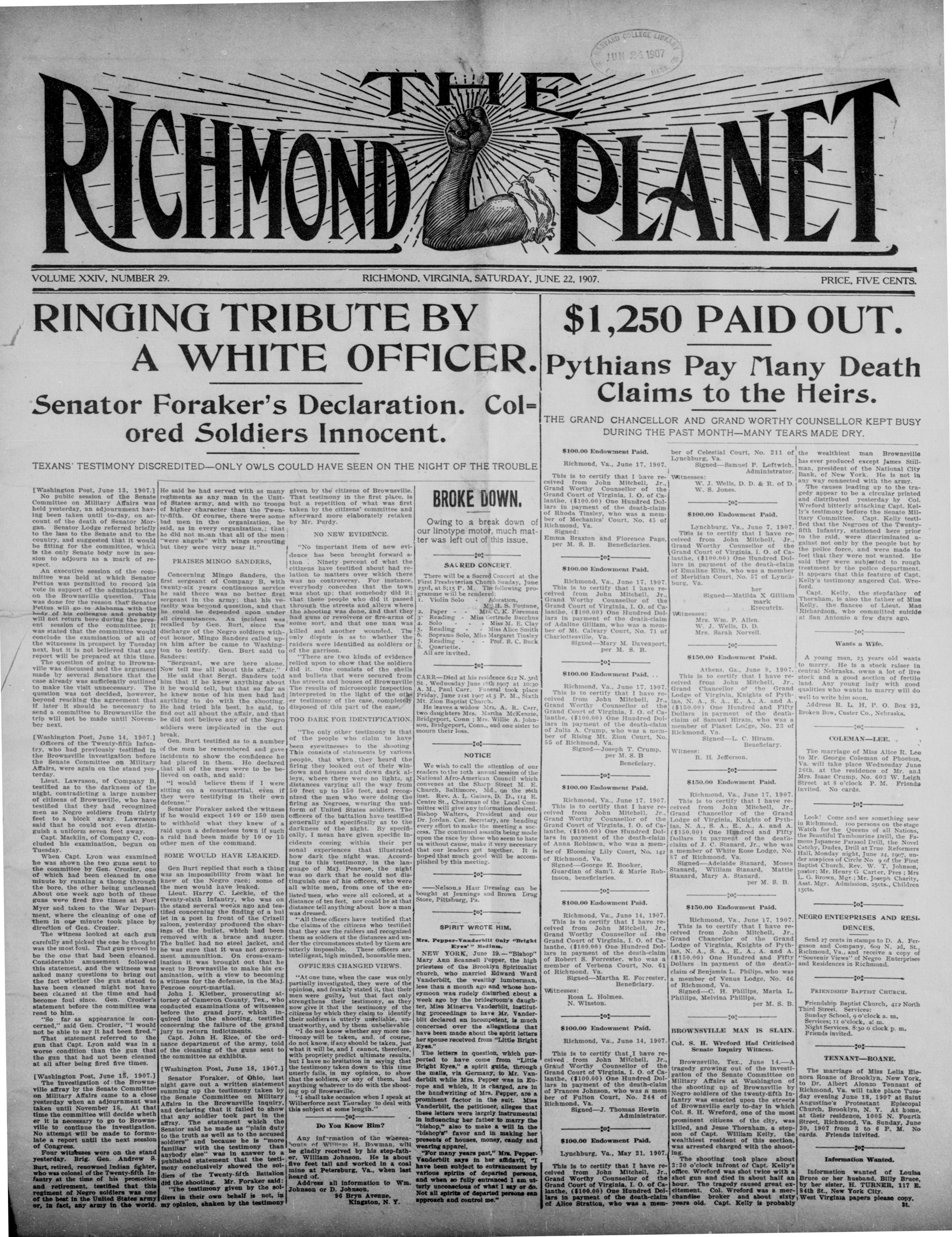
RINGING TRIBUTE BY A WHITE OFFICER
TEXANS' TESTIMONY DISCREDITED—ONLY OWLS COULD HAVE SEEN ON THE NIGHT OF THE TROUBLE
VOLUME XXIV, NUMBER 29
RINGING
Senator F
ore
TEXANS' TESTIMONY DISCRE
[Washington Post, June 13, 1997.]
No public session of the Senate Committee on Military Affairs was held yesterday, an adjournment having been taken until to-day, on account of the death of Senator Morgan. Senator Lodge referred briefly to the lass to the Senate and to the country, and suggested that it would be fitting for the committee, which is the only Senate body now in session to adjourn as a mark of respect.
An executive session of the committee was held at which Senator Pettus was permitted to record his vote in support of the administration on the Brownsville question. This was done for the reason that Senator Pettus will go to Alabama with the body of his colleague and probably will not return here during the present session of the committee. It was stated that the committee would conclude the examination of all of the witnesses in prospect by Tuesday next, but it is not believed that any report will be prepared at this time.
The question of going to Brownsville was discussed and the argument made by several Senators that the case already was sufficiently outlined to make the visit unnecessary. The question was not decided, however, beyond reaching the agreement that if later it should be necessary to send a committee to Brownsville the trip will not be made until November next.
[Washington Post, June 14, 1907.]
Officers of the Twenty-fifth Infantry, who had previously testified in the Brownsville investigation before the Senate Committee on Military Affairs, were again on the stand yesterday.
Lieut. Lawrason, of Company B, testified as to the darkness of the night, contradicting a large number of citizens of Brownsville, who have testified that they had recognized men as Negro soldiers from thirty feet to a block away. Lawrason said that he could not even distinguish a uniform seven feet away.
Capt. Macklin, of Company C, concluded his examination, begun on Tuesday.
When Capt. Lyon was examined he was shown the two guns sent to the committee by Gen. Crozier, one of which had been cleaned in one minute by running a thong through the bore, the other being uncleaned About one week ago both of these guns were fired five times at Fort Myer and taken to the War Department, where the cleaning of one of them in one minute took place by direction of Gen. Crozier.
The witness looked at each gun carefully and picked the one he thought was the most foul. That gun proved to be the one that had been cleaned. Considerable amusement followed this statement, and the witness was asked many questions to bring out the fact whether the gun stated to have been cleaned might not have been cleaned at the time and had become foul since. Gen. Crozier's statement before the committee was read to him.
"So far as appearance is concerned," said Gen. Crozier, "I would not be able to say it had been fired."
That statement referred to the gun that Capt. Lyon said was in a worse condition than the gun that the gun that had not been cleaned at all after being fired five times.
[Washington Post, June 15, 1907.]
The investigation of the Brownsville array by the Senate Committee on Military Affairs came to a close yesterday when an adjournment was taken until November 18. At that time the committee will decide whether er it is necessary to go to Brownsville to continue the investigation. No attempt will be made to formulate a report until the next session of Congress.
Four witnesses were on the stand yesterday. Brig. Gen. Andrew S. Burt, retired, reowned Indian fighter, who was colonel of the Twenty-fifth Infantry at the time of his promotion and retirement, testified that this regiment of Negro soldiers was one of the best in the United States army or, in fact, any army in the world.
He said he had served with as many regiments as any man in the United States army, and with no troops of higher character than the Twenty-fifth. Of course, there were some bad men in the organization, he said, as in every organization; that he did not mean that all of the men "were angels" with wings sprouting but they were very near it."
PRAISES MINGO SANDERS
Concerning Mingo Sanders, the first sergeant of Company B, with twenty-six years continuous service he said there was no better first sergeant in the army; that his veracity was beyond question, and that he could be depended upon under all circumstances. An incident was recalled by Gen. Burt, since the discharge of the Negro soldiers without honor, Mingo Sanders called upon him after he came to Washington to testify. Gen. Burt said to Sanders:
"Sergeant, we are here alone. Now tell me all about this affair."
He said that Sergt. Sanders told him that if he knew anything about it he would tell, but that so far as he knew none of his men had had anything to do with the shooting. He had tried his best, he said, to find out all about the affair, and that he did not believe any of the Negro soldiers were implicated in the out break.
Gen. Burt testified to a number of the men he remembered and gave incidents to show the confidence he had placed in them. He declared that all of the men were to be believed on oath, and said:
"I would believe them if I were sitting on a courtmartial, even if they were testifying in their own defense."
Senator Foraker asked the witness if he would expect 140 or 150 men to withhold what they knew of a raid upon a defenseless town if such a raid had been made by 10 or 15 other men of the command.
SOMEWOULDHAVELEAKED
Gen Burt replied that such a thing was an impossibility from what he knew of the Negro race; some of the men would have leaked.
Lleut. Harry C. Leckie, of the Twenty-sixth Infantry, who was on the stand several weeks ago and testified concerning the finding of a bullet in a post in front of the Crixel saloon, yesterday produced the shavings of the bullet, which had been removed with a brace and auger. The bullet had no steel jacket, and he was sure that it was not government ammunition. On cross-examination it was brought out that he went to Brownsville to make his examination, with a view to becoming a witness for the defense, in the Maj. Penrose court-martial.
John I. Kleber, prosecuting attorney of Cameron County, Tex., who conducted examinations of witnesses before the grand jury, which inquired into the shooting, testified concerning the failure of the grand jury to return indictments.
Capt. John H. Rice, of the ordnance department of the army, told of the cleaning of the guns sent to the committee as exhibits.
[Washington Post, June 18, 1907.]
Senator Foraker, of Ohio, last night gave out a written statement summing up the testimony taken by the Senate Committee on Military Affairs in the Brownsville inquiry, and declaring that it failed to show that any soldier took part in the affray. The statement which the Senator said he made as "plain duty to the truth as well as to the accused soldiers" and because he is "more familiar with the testimony than anybody else" was in answer to a published statement that the testimony conclusively showed the soldiers of the Twenty-fifth Battalion did the shooting. Mr. Foraker said: "The testimony given by the soldiers in their own behalf is not, in my opinion, shaken by the testimony
RICHMOND, VIRGINIA, SATURDAY, JUNE 22, 1907.
given by the citizens of Brownsville. That testimony in the first place, is but a repetition of what was first taken by the citizens' committee and afterward more elaborately retaken by Mr. Purdy.
NO NEW EVIDENCE.
"No important item of new evidence has been brought forward action." Ninety percent of what the citizens have testified about had relation to matters over which there was no controversy. For instance, everybody concedes that the town was shot up; that somebody did it; that these people who did it passed through the streets and alleys where the shooting was done, and that they had guns or revolvers or fire-arms of some sort, and that one man was killed and another wounded. The only dispute is as to whether the raiders were identified as soldiers or of the garrison.
"There are two kinds of evidence relied upon to show that the soldiers did it. One consists of the shells and bullets that were secured from the streets and houses of Brownville. The results of microscopic inspection interpreted in the light of the other testimony of the case, completely disposed of this part of the case.
TOO DARK FOR IDENTIFICATION
"The only other testimony is that of the people who claim to have been eyewitnesses to the shooting. This consists of statements by various people, that when they heard the firing they looked out of their windows and houses and down dark alleys, where there were no lights, at distances varying all the way from 50 feet up to 150 feet, and recognized the men who were doing the firing as Negroes, wearing the uniform of United States soldiers. The officers of the battalion have testified generally and specifically as to the darkness of the night. By specifically, I mean have given specific incidents coming within their personal experiences that illustrated how dark the night was. According to this testimony, in the language of Maj. Penrose, the night was so dark that he could not distinguish one of his officers, who were all white men, from one of the enlisted men, who were all colored, at a distance of ten feet, nor could he at that distance tell anything about how a man was dressed. "All these officers have testified that the claims of the citizens who testified that they saw the raiders and recognized them as soldiers at the distances and under the circumstances stated by them are utterly impossible. These officers are intelligent, high minded, honorable men."
OFFICERS CHANGED VIEWS
"At one time, when the case was only partially investigated, they were of the opinion, and frankly stated it, that their men were guilty, but that fact only strengthens their testimony, as they now give it that the testimony of the citizens by which they claim to identify their soldiers is utterly unreliable, untrustworthy, and by them unbelievable.
"I do not know whether any more testimony will be taken, and, of course, do not know, if any should be taken, just what it will be, and I cannot, therefore, the climate, say results, but I have no hesitation in taking the testimony taken down to this time utterly fails, in my opinion, to show that the soldiers, or any of them, had anything whatever to do with the shooting up of Brownsville.
"I shall take occasion when I speak at Wilberforce next Tuesday to deal with this subject at some length."
Do You Know Him?
Any information of the whereabouts of William H. Bowman, will be gladly received by his step-father, William Johnson. He is about five feet tall and worked in a coal mine at Petersburg, Va., when last heard of.
Address all information to Wm. Johnson or D. Johnson.
BROKE DOWN.
Owing to a break down of our linotype motor, much matter was left out of this issue.
SACRED CONCERT
There will be a Sacred Concert at the First Presbyterian Church Sunday, June 23rd, at 8:15 P. M. The following programme will be rendered:
1. Violin Solo - Adoratton,
M. H. S. Fortune,
2. Paper - Mrs C. K. Foreman
3. Reading - Miss Grudetrude Bacchus
4. Solo - Miss M. E. Clay
5. Reading - Miss Alice Smith
6. Soprano Solo, Miss Margaret Tinsley
7. Reading - Prof. B. C. Buck
8. Quartette,
All are invited.
CARR—Died at his residence 612 9.3 n. St. Wednesday June 18th 1907 at 10:30 A. M. Paul Carr. Funeral took place Friday, June 12th 1907 at 3 P. M., Sixth Mt. Zion Baptist Church. He leaves a widow Mrs. A. R. Carr, two daughters Mrs. Martha McKenzie, Bridgeport, Conn; Mrs. Willie A. Johnson, Bridgeport, Conn., and one sister to mourn their loss.
NOTICE
We wish to call the attention of our readers to the 10th annual session of the National Afro-American Council which convenes at the Sharp Street M. E. Church, Baltimore, Md., on the 26th inst. Rev. A. L. Gaines, D. D., 114 E. Centre St., Chairman of the Local Committee will give any information desired. Bishop Walters, President and our Dr. Jordan, Cor. Secretary, are bending every effort to make the meeting a success. The continued assaults being made upon the race by those who seem to hate us without cause, make it necessary that our leaders get together. It is hoped that much good will be accomplished by this meeting.
Nelson's Hair Dressing can be bought at Jennings and Brown Drug Store, Pittsburg, Pa.
SPIRIT WROTE HIM.
Mrs. Pepper-Vanderbilt Only "Bright Eyes" Medium.
NEW YORK, June 19.—"Bishop" Mary Ann Scannell Pepper, the high priestess of the Brooklyn Spiritualist church, who married Edward Ward Vanderbilt, the wealthy lumberman, less than a month ago and whose honeymoon was rudely disturbed about a week ago by the bridegroom's daughter, Miss Minerva Vanderbilt, instituting proceedings to have Mr. Vanderbilt declared an incompetent, is much concerned over the allegations that have been made about the spirit letters her spouse received from "Little Bright Eyes."
The letters in question, which purported to have come from "Little Bright Eyes," a spirit guide, through the mails, via Germany, to Mr. Vanderbilt while Mrs. Pepper was in Europe and which, it is charged, are in the handwriting of Mrs. Pepper, are a prominent factor in the suit. Miss Vanderbilt, the petitioner, alleges that these letters were largely instrumental in influencing her father to marry the "bishop" also to make a will in the "bishop's" favor and in making her presents of houses, money, candy and wearing apparel.
"For many years past," Mrs. Pepper Vanderbilt says in her affidavit, "I have been subject to entrance by various spirits of departed persons, and when so fully entranced I am utterly unconscious of what I say or do. Not all spirits of departed persons can approach and control me."
$1,250 PAID OUT. Pythians Pay Many Death Claims to the Heirs.
THE GRAND CHANCELLOR AND GRAND WORTHY COUNSELLOR KEPT BUSY DURING THE PAST MONTH-MANY TEARS MADE DRY.
$100.00 Endowment Paid.
Richmond, Va., June 17, 1907.
This is to certify that I have received from John Mitchell, Jr.,
Grand Worthy Counsellor of the
Grand Court of Virginia, I. O. of Calanthe, ($100.00) One Hundred Dollars in payment of the death-claim of Rhoda Tinsley, who was a member of Mechanics' Court, No. 45 of Richmond, Va.
Signed:
Emma Braxton and Florence Page,
per M. S. B. Beneficiaries.
$100.00 Endowment Paid.
Richmond, Va., June 17, 1907.
This is to certify that I have received from John Mitchell, Jr.,
Grand Worthy Counselor of the Grand Court of Virginia, I. O. of Calanthe, ($100.00) One Hundred Dollars in payment of the death-claim of Adaline Gilliam, who was a member of Mt. Calvary Court, No. 71 of Charlottesville, Va.
Signed—Mary M. Davenport,
per M. S. B.
$100.00 Endowment Paid. . .
Richmond, Va., June 17, 1907.
This is to certify that I have received from John Mitchell, Jr.
Grand Worthy Counselor of the Grand Court of Virginia, I. O. of Calanthe, ($100.00) One Hundred Dollars in payment of the death-claim of Julia A. Crump, who was a member of Rising Mt. Zion Court, No. 55 of Richmond, Va.
Signed—Joseph T. Crump
per M. S. B
Beneficiary.
$100.00 Endowment Paid.
Richmond, Va., June 17, 1907
This is to certify that I have received from John Mitchell, Jr.
Grand Worthy Counselor of the Grand Court of Virginia, I. O. of Canaan, the ($100.00) One Hundred Dollar in payment of the death-claim of Anna Robinson, who was a member of Blooming Lily Court, No. 142 of Richmond, Va.
Signed—George E. Booker,
Guardian of Sam'l. & Marie Robinson, beneficierles.
$100.00 Eadowment Paid.
Richmond, Va., June 14, 1907.
This is to certify that I have received from John Mitchell, Jr.
Grand Worthy Counsellor of the Grand Court of Virginia, I. O. of Calanthe, ($100.00) One Hundred Dollars in payment of the death-claim of Robert S. Forrester, who was a member of Verbena Court, No. 61 of Richmond, Va.
Signed—Martha E. Forrester.
Beneficiary.
Witnesses:
Rosa L. Holmes.
N. Winston.
$100.00 Endowment Paid.
Richmond, Va., June 14, 1907.
This is to certify that I have received from John Mitchell, Jr.
Grand Worthy Counsellor of the Grand Court of Virginia, I. O. of Calanthe, (100.00) One Hundred Dollars in payment of the death-claim of Frances Johnson, who was a member of Fulton Court, No. 244 of Richmond, Va.
Signed—J. Thomas Hewin Administrator.
Lynchburg, Va., May 21, 1907.
This is to certify that I have received from John Mitchell, Jr., Grand Worthy Counselor of the Grand Court of Virginia, I. O. of Calanthe, ($100.00) One Hundred Dollars in payment of the death-claim of Alice Stratton, who was a mem-
ber of Celestial Court, No. 211 of Lynchburg, Va.
Signed—Samuel P. Leftwich.
Administrator
Witnesses:
W. J. Wells, D. D. & R. of D.
W. S. Jones.
$100.00 Endowment Paid.
Lynchburg, Va., June 7, 1907.
This is to certify that I have received from John Mitchell, Jr.
Grand Worthy Counselor of the Grand Court of Virginia, I. O. of Calanthe, ($100.00) One Hundred Dollars in payment of the death-claim of Emaline Ellis, who was a member of Meridian Court, No. 57 of Lyncaburg, Va.
her
Signed—Matilda X Gilliam
mark
Executrix.
Witnesses:
Mrs. Wm. P. Allen.
W. J. Wells, D. D.
Mrs. Sarah Norvell.
$150.00 Endowment Paid.
Athens, Ga., June 8, 1907.
This is to certify that I have received from John Mitchell, Jr.,
Grand Chancellor of the Grand
Lodge of Virginia, Knights of Pythias, N. A., S. A., E., A. A. and A.
($150.00). One Hundred and Fifty
Dollars in payment of the death-
claim of Samuel Hiram, who was a
member of Planet Lodge, No. 23 of
Richmond, Va.
Signed—L. C. Hiram.
Beneficiary.
$150.00 Endowment Paid.
Richmond, Va., June 17, 1907.
This is to certify that I have received from John Mitchell, Jr.,
Grand Chancellor of the Grand
Lodge of Virginia, Knights of Pythias,
N. A., S. A., E., A., A. and A.
($150.00) One Hundred and Fifty
Dollars in payment of the death-
claim of J. C. Stanford, Jr., who was
a member of White Rose Lodge, No. 87 of Richmond, Va.
Signed—Adelaide Stanford, Moses
Stanard, William Stanford, Mattie
Stanard, Mary A. Stanard.
$150.00 Endowment Paid.
Richmond, Va., June 17, 1907.
This is to certify that I have received from John Mitchell, Jr.
Grand Chancellor of the Grand Lodge of Virginia, Knights of Pythias, N. A., S. A., E., A., A. and A. ($150.00) One Hundred and Fifty Dollars in payment of the deathclaim of Benjamin L. Philips, who was a member of Venus Lodge, No. 46 of Richmond, Va.
Signed—C. H. Phillips, Marla L. Phillips, Melvina Phillips,
BROWNSVILLE MAN IS SLAIN.
Col. S. H. Wreford Had Criticised
Senate Inquiry Witness.
Brownsville. Tex., June 14.—A tragedy growing out of the investigation of the Senate Committee on Military Affairs at Washington of the shooting up of Brownsville by Negro soldiers of the twenty-fifth Infantry was enacted upon the streets of Brownsville early to-day in which Col. S. H. Wreford, of the most prominent citizens of the city, was killed, and Jesse Thornham, a stepson of Capt. William Kelly, the wealthiest resident of this section, was arrested charged with the shooting.
The shooting took place about 3:30 o'clock infront of Capt. Kelly's office. Wreford was shot twice with a shot gun and died in about half an hour. The tragedy caused great excitement. Col. Wreford was a merchandise broker and about sixty years old. Capt. Kelly is probably
PRICE, FIVE CENTS.
OUT.
ny Death Heirs.
COUNSELLOR KEPT BUSY
RS MADE DRY.
the wealthiest man Brownsville has ever produced except James Stillman, president of the National City Bank, of New York. He is not in any way connected with the army.
The causes leading up to the tragedy appear to be a circular printed and distributed yesterday by Col. Wreford bitterly attacking Capt. Kelly's testimony before the Senate Military Committee. Capt. Kelly testified that the Negroes of the Twenty-fifth Infantry, stationed here prior to the raid, were discriminated against not only by the people but by the police force, and were made to feel that they were not wanted. He said they were subjected to rough treatment by the police department. It appears that this feature of Capt. Kelly's testimony angered Col. Wreford. Capt. Kelly, the stepfather of Thornham, is also the father of Miss Kelly, the fancee of Lieut. Mas Richardson, who committed suicide at San Antonio a few days ago.
Wants a Wife.
A young man, 23 years old wants to marry. He is a stock raiser in central Nebraska, owns a lot of live stock and a good section of fertile land. Any young lady with good qualities who wants to marry will do well to write him soon.
Address R. L. H. P. O. Box 93, Broken Bow, Custer Co, Nebraska
COLEMAN—LEE
The marriage of Miss Alice R. Lee to Mr. George Coleman of Phoebus, Va. will take place Wednesday June 26th, at the residence of Mr. and Mrs. Isaac Crump, No. 603 W. Leigh Street at 8 o'clock P. M. Friends invited. No cards.
Look! Come and see something new in Richmond. 100 persons on the stage Watch for the Queens of all Nations, the Beautiful Tambourine Drill, the Famous Japanese Parasol Drill, the Novel Catchy, Dudes, Drill at True Reformers Hall, Monday night, June 24, 1907, under auspices of Circle No. 9 of the First Baptist Church, Rev. W. T. Johnson, pastor; Mr. Henry G Carter, Pres; Mrs L. G. Brown, Mgr; Mr. Joseph Charity, Asst. Mgr. Admission, 25cts., Children 19cts.
NEGRO ENTERPRISES AND RESIDENCES.
Send 27 cents in stamps to D. A. Ferguson and Company, 609 N. 2d, St., Richmond, Va., and receive a copy of "Souvenir Views" of Negro Enterprises and Residences in Richmond.
FRIENDSHIP BAPSTIST CHURCH.
Friendship Baptist Church, 412 North
Third Street. Services:
Sunday School, 9 o'clock a. m.
Services; 11 o'clock, a' m.
Night Services. 8:30 o'clock p. m.
Friends invited.
TENNANT—ROANE
The marriage of Miss Lelia Elenora Roane of Brooklyn, New York, to Dr. Albert Alonzo Tennant of Richmond, Va. will take place Tuesday evening June 18, 1907 at Saint Augustine's Protestant Episcopal Church, Brooklyn, N. Y. At home, at their residence, 1005 N. Fourth Street, Richmond, Va. Sunday, June 30, 1907 from 3 to 6 P. M. No cards. Friends invited.
Information Wanted.
Information wanted of Louisa Bruce or her husband, Billy Bruce, by her sister, H. TURNER, 117 E. 84th St., New York City. West Virginia papers please copy.
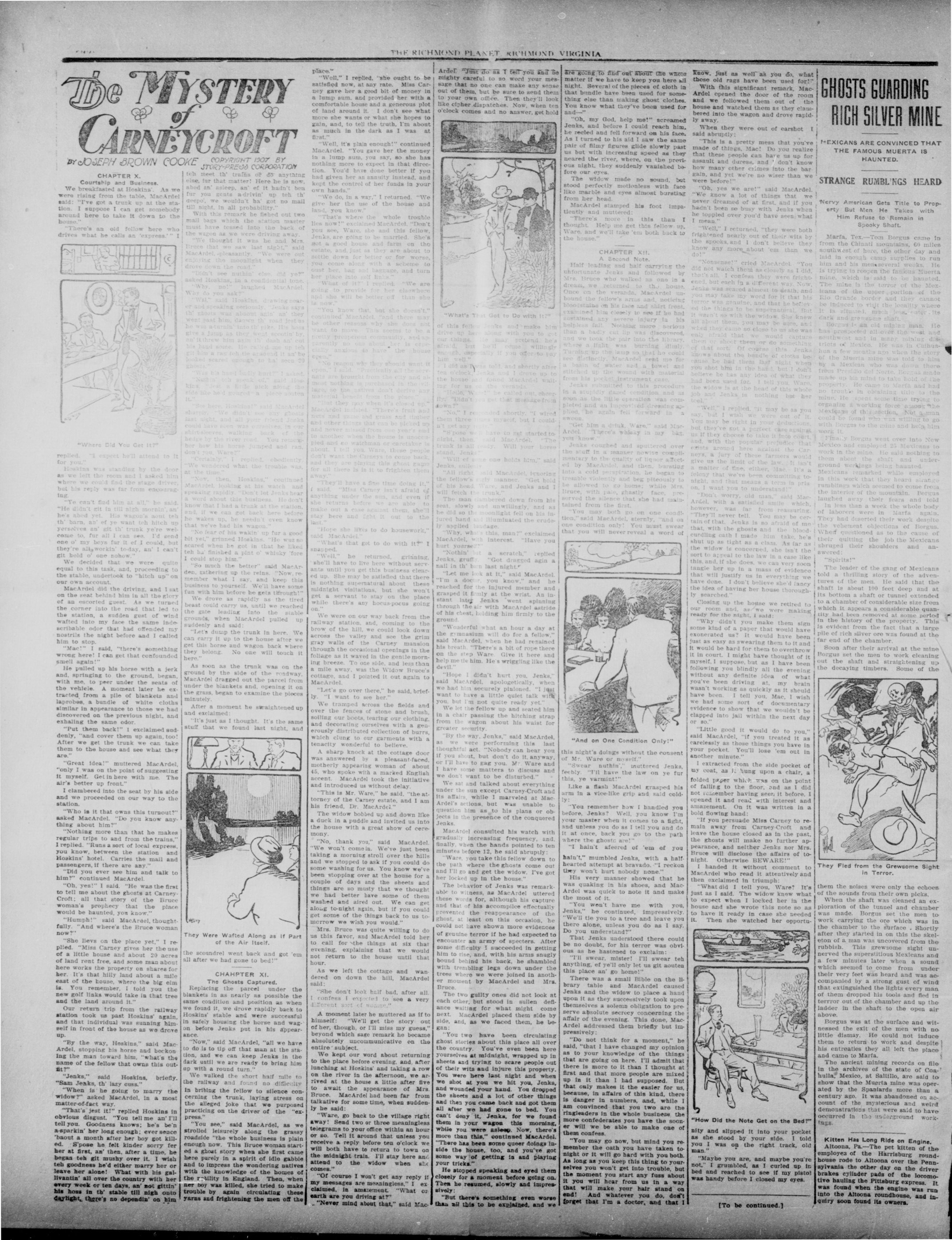
The MYSTERY CARNEYCROFT
We breakfasted at Hoskins'. As we were rising from the table, MacArdel said: "I've got a trunk up at the station. I suppose I can get somebody around here to take it down to the house."
"There's an old fellow here who drives what he calls an 'express.'" I
"Where Did You Get It?"
replied. "I expect he'll attend to it for you."
Hoskins was standing by the door as we left the room and I asked him where we could find the stage driver, but his reply was far from encourag ing.
"Ye can't find him at all," he said. "He didn't sit in till nigh nornin' an' he's abed yet. His wagon's aout teh th' barn, an' ef ye want to hitch up yerselves an' gilt th' trunk ye're welcome to, fur all I can see. I'd send one o' my boys fur it ef I could, but they're all workin' to-day, an' I can't git hold o' one nohow."
We decided that we were quite equal to this task, and, proceeding to the stable, undertook to "hitch up" on our own account.
MacArdel did the driving, and I sat on the seat behind him in all the glory of an escorted guest. As we turned the corner into the road that led to the station, a sudden gust of wind wafted into my face the same indescribable odor that had offended my nostrils the night before and I called him to stop.
"Mac!!" I said, "there's something wrong here! I can get that confounded smell again!"
He pulled up his horse with a jerk and, springing to the ground, began, with me, to peer under the seats of the vehicle. A moment later he extracted, from a pile of blankets and laprobes, a bundle of white cloths similar in appearance to those we had discovered on the previous night, and exhaling the same odor.
"Put them back!" I exclaimed suddenly, "and cover them up again, too! After we get the trunk we can take them to the house and see what they are."
"Great idea!" muttered MacArdel,
"only I was on the point of suggesting
it myself. Get in here with me. The air's better up front."
I clambered into the seat by his side
and we proceeded on our way to the
station.
"Who is it that owns this turnout?"
asked MacArdel. "Do you know anything about him?"
"Nothing more than that he makes regular trips to and from the trains."
I replied. "Runs a sort of local express, you know, between the station and Hoskins' hotel. Carries the mail and passengers, if there are any."
"Did you ever see him and talk to him?" continued MacArdel.
"Oh, yes!" I said. "He was the first to tell me about the ghosts at Carney-Croft; all that story of the Bruce woman's prophecy that the place would be haunted, you know."
"Humph!" said MacArdel, thoughtfully.
"And where's the Bruce woman now?"
"She lieves on the place yet," I replied. "Miss Carney gives her the use of a little house and about 20 acres of land rent free, and some man about here works the property on shares for her. It's that hilly land about a mile east of the house, where the big elm is. You remember, I told you the new golf links would take in that tree and the land around it."
Our return trip from the railway station took us past Hoskins' again, and that individual was sunning himself in front of the house as we drove up.
"By the way, Hoskins," said MacArdel, stopping his horse and beckoning the man toward him, "what's the name of the fellow that owns this outfit?"
"Jenks," said Hoskins, briefly. "Sam Jenks, th' lazy cuss."
"When is he going to marry the widow?" asked MacArdel, in a most matter-of-fact way.
"That's jest it!" replied Hoskins in obvious disgust. "You tell me an 'I'll tell you. Goodness knows; he's be'n a-sparkin' her long enough; ever sence 'baut a month after her boy got killed. Spose he felt kinder sorry for her at first, an' then, after a time, he began teh git mushy over it. I wish teh goodness he'd either marry her or leave her alone! What with his gallantin' all over the country with her every week or ten days, an' not gittin' his boss in tb' stable till nigh onto daylight, there's no dependin' on him
teh meet th' trafais of do anything else, fur that matter! Here he is now. abed an' asleep, an' ef it hadn't ben fur you gents a-drivin' up teh th' deepo', we wouldn't ha' got no mail till night, in all probability." With this remark he fished out two mail bags which the station master must have tessed into the back of the wagon as we were driving away. "We thought it was he and Mrs. Bruce that we saw last night," said MacArdel, pleasantly. "We were out enjoying the moonlight when they drove down the road." "Didn't see nuthin' else, did ye?" asked Haskins, in a confidential tone. "Why, not!" laughed MacArdel. Why do you say?"
"Wal," said Hookins, drawing near and speaking seriously. "Jonny says th' ghosts was about again' an' they went past him, dawnin' the road just as he was a turmin' into th' pike. His boss give a jump as they weed scoutin' an' it an' it threw him asin' th' dash an' cut his hand some. He called us up teh git him a rach teh aaround it an' he looked scared enough to ha' seen 20 ghosts."
"Was his hand badly hurt?" I asked. "Nashin' teh speech of," said Hookins. "lest a little stick along the side like he'd gouged" a piece nonten it."
"See here. Hookins!" said MacArdel sharply. "We didn't see any ghosts last night, and all your friend Jonka could have seen was ourselves, in our shirtseaves, walking back of the hedge by the river road. You remember how his horse jumped and ran, don't you, Ware?"
"Certainly," I replied, obediently. "We wondered what the trouble was, at the time."
"Now, then, Hosking," continued MacArdel, looking at his watch and speaking rapidly. "Don't let Jenks hear a word about this business. He don't know that I had a trunk at the station, and, if we can get back here before he wakes up, he needn't even know that we've had his wagon."
"No fear of his walkin' up for a good bit yet," grinned Hoskins. "He wuz no scared when he got in that he liked teh hair finished a plato' whisky 'fore I could stop him."
"So much the better" said MacArden, gathering up the reins. "Now, remember what I say, and keep this business to yourself. We'll have some fun with him before he gets through!"
We drove as rapidly as the tired beast could carry us, until we reached the gate leading into the stable grounds, when MacArdel pulled up suddenly and said:
"Let's dump the trunk in here. We can carry it up to the house after we get this horse and wagon back where they belong. No one will touch it here."
As soon as the trunk was on the ground by the side of the roadway, MacArdel dragged out the parcel from under the blankets and, opening it on the grass, began to examine the pieces minutely.
After a moment he straightened up and exclaimed:
"It's just as I thought. It's the same stuff that we found last night and
M. 19
They Were Wafted Along as If Part of the Air Itself.
the scoundrel went back and got 'em all after we had gone to bed."
CHAHPTER XI
Replacing the parcel under the blankets in as nearly as possible the same condition and position as when we found it, we drove rapidly back to Hoskins' stable and were successful in safely housing the horse and wagon before Jenks put in his appearance.
"Now," said MacArdel, "all we have to do is to tip off that man at the station, and we can keep Jenks in the dark until we are ready to bring him up with a round turn."
We walked the short half mile to the railway and found no difficulty in bribing the fellow to silence concerning the trunk, laying stress on the alleged joke that we purposed practicing on the driver of the "express."
"You see," said MacArdel, as we strolled leisurely along the grassy roadside "the whole business is plain enough now. This Bruce woman started a ghost story when she first came here purely in a spirit of idle gabble and to impress the wondering natives with the knowledge of the homes of the robility in England. Then, when ner boy was killed, she tried to make trouble by again circulating these yarns and frightening the men off the
THE RICHMOND PLANET. RICHMOND VIRGINIA
place."
"Well," I replied, "she ought to be satisfied now, at any rate. Miss Carney gave her a good bit of money in a lump sum, and provided her with a comfortable house and a generous plot of land around it. I don't see what more she wants or what she hopes to gain, and, to tell the truth, I'm about as much in the dark as I was at first."
"Well, it's plain enough!" continued MacArdel. "You gave her the money in a lump sum, you say, so she has nothing more to expect in that direction. You'd have done better if you had given her an annuity instead, and kept the control of her funds in your own hands."
"We do, in a way," I returned. "We give her the use of the house and land, you know."
"That's where the whole trouble lies now!" exclaimed MacArdel. "Don't you see, Ware, she and this fellow, Jenks, are going to be married. She's got a good house and farm on the estate, and just as they are about to settle down for better or for worse, you come along with a scheme to cust her, bag and bagnage, and turn her place into golf links."
"What of it?" I replied. "We are going to provide for her elsewhere and she will be better off than she is now."
"You know that, but she doesn't," continued MacArdel. "and there may be other reasons why she does not want to move. This seems to be a pretty prosperous community, and apparently no one asks her is especially anxious to have the house open."
"No reason why they should want it open," I said. "Practically all the servants are brought from the city and almost nothing is purchased in the village, so the natives don't deserve any material benefit from the place."
"But they may when it's closed up." MacArdel inhaled. "There's fruit and nuts and game and grass and timber and other things that can be picked up and never missed from one year's end to another when the house is unoccupied and no watchman or caretaker is about. I tell you. Ware, these people don't want the Carneys to come back, and they are playing this ghost game for all there is in it to frighten them away."
"They'll have a fine time doing it," I said. "Miss Carney isn't afraid of anything under the sun, and even if she returns before we are able to make out a case against them, she'll stay here and fight it out to the last."
"Hope she likes to do housework," said MacArdel.
"What's that got to do with it?" I snapped.
"Well," he returned, grinning, "she'll have to live here without servants until you get this business cleared up. She may be satisfied that there is nothing supernatural about these midnight visitations, but she won't get a servant to stay on the place while there's any hocus-pocus going on."
We were on our way back from the railway station, and, coming to the brow of the hill, we could look down across the valley and see the grim gray walls of the Carney mansion through the occasional openings in the foliage as it waved in the gentle morning breeze. To one side, and less than a mile away, was the Widow Bruce's cottage, and I pointed it out again to MacArdel.
"Let's go over there," he said, briefly. "I want to see her."
We tramped across the fields and over the fences of stone and brush, soiling our boots, tearing our clothing, and decorating ourselves with a generously distributed collection of burrs, which clung to our garments with a tenacity wonderful to believe.
A sharp knock at the cottage door was answered by a pleasant-faced, motherly appearing woman of about 45, who spoke with a marked English accent. MacArdel took the initiative and introduced us without delay.
"This is Mr. Ware," he said, "the attorney of the Carney estate, and I am his friend, Dr. MacArdel."
The widow bobbed up and down like a duck in a puddle and invited us into the house with a great show of ceremony.
"No, thank you," said MacArdel.
"We won't come in. We've just been taking a morning stroll over the hills and we stopped to ask if you could do some washing for us. You know we've been stopping over at the house for a couple of days and the sheets and things are so musty that we thought we had better have some of them washed and aired out. We can get along to night again, but if you could get some of the things back to us tomorrow we wish you would."
Mrs. Bruce was quite willing to do us this favor, and MacArdel told her to call for the things at six that evening, explaining that we would not return to the house until that hour.
As we left the cottage and wandered on down the hill, MacArdel said:
"She don't look half bad, after all. I confess I expected to see a very different sort of woman."
A moment later he muttered as if to himself: "We'll get the story out of her, though, or I'll miss my guess," beyond which sage remark he became absolutely uncommunicative on the entire subject.
We kept our word about returning to the place before evening, and, after lunching at Hoskins' and taking a row on the river in the afternoon, we arrived at the house a little after five to await the appearance of Mrs. Bruce. MacArdel had been far from talkative for some time, when suddenly he said:
"Ware, go back to the village right away! Send two or three meaningless telegrams to your office within an hour or so. Tell it around that unless you receive a reply before ten o'clock we will both have to return to town on the midnight train. I'll stay here and attend to the widow when she comes."
"Of course I won't get any reply if my messages are meaningless." I exclaimed, in amazement. "What or earth are you driving at?"
_ "Never mind about that." said Mac
Ardel. "Just do as I tell you and be mighty careful to so word your message that no one can make any sense out of them, but be sure to send them to your own office. Then they'll look like cipher dispatches. Now, when ten o'clock comes and no answer, get hold
A
"What's That Got to Do with it?" of this fellow Jenks and make him drive up here along with you to get our things, he may pretend he's afraid, but he'll come willingly enough, especially if you offer to pay him well."
I did as I was told, and shortly after ten o'clock, Jenks and I drove up to the house and found MacArdel waiting for us on the veranda.
"Hello, Were!" he called out, cheerily. "Didn't you get that message from down?"
"No," I responded shortly. "I wired them three times myself, but I couldn't get any work."
"Spose well have to get started to right, then," said MacArdel. "The trunk is all ready. Will your horse stand, Jenks."
"Will ef some one holds him," said Jenks guilty.
"All right," said MacArdel, ignorant the fellow's early manner. "Get hold of his head, Ware, and Jenks and I will fetch the trunk."
The man chambered down from his seat, slowly and unwillingly, and as he did so the moonlight fell on his injured hand and illuminated the crudely applied bandage.
"Why, what's this, man?" exclaimed MacArdel, with interest. "Have you hurt yourself?"
"Nothin' but a scratch," replied Jenks, gruffly. "Got dragged again a nail in th' barn last night."
"Let me look at it," said MacArdel. "I'm a doctor, you know," and he reached for the injured member and grasped it firmly at the wrist. An instant later Jenks 'went spinning through the air with MacArdel astride of his chest, holding him firmly to the ground.
"Wonderful what an hour a day at the gymnasium will do for a fellow," said MacArdel, when he had regained his breath. "There's a bit of rope there on the step Ware. Give it here and help me him. He's wriggling like the devil."
"Hope I didn't hurt you, Jenks," said MacArdel, apologetically, when we had him securely pinioned. "I just want to have a little quiet talk with you, but I'm not quite ready yet."
We let the fellow up and seated him in a chair passing the hitching strap from the wagon about his waist for greater security.
"By the way, Jenks," said MacArdel, as we were performing this last thoughtful act. "Nobody can hear you if you shout, but don't do it, anyway, or I'll have to gag you. Mr. Ware and I have some matters to discuss and we don't want to be disturbed."
We sat and talked about everything under the sun except Carney-Croft and its affairs, while I marveled at MacArdel's actions, but was unable to question him as to his plans or objects in the presence of the conquered Jenks.
MacArdel consulted his watch with gradually increasing frequency, and finally, when the hands pointed to ten minutes before 12, he said abruptly: "Ware, you take this fellow down to the path where the ghosts come out and I'll go and get the widow. I've got her locked up in the house."
The behavior of Jenks was remarkable to witness, as MacArdel uttered these words for, although his capture and that of his accomplice effectually prevented the reappearance of the ghost, at least on this occasion, he could not have shown more evidences of genuine terror if he had expected to encounter an army of specters. After some difficulty I succeeded in getting him to rise, and, with his arms snugly bound behind his back, he shambled with trembling legs down under the trees where we were joined in another moment by MacArdel and Mrs. Bruce.
The two guilty ones did not look at each other, but stood in soiled defiance waiting for what might come next. MacArdel placed them side by side, and, as we faced them, he began:
"You two have been circulating ghost stories about this place all over the country. You've even been here yourselves at midnight, wrapped up in sheets and trying to scare people out of their wits and injure this property. You were here last night and when we shot at you we hit you, Jenks, and wounded your hand. You dropped the sheets and a lot of other things and then you came back and got them all after we had gone to bed. You can't deny it, Jenks, for we found them in your wagon this morning, while you were asleep. Now, there's more than this." continued MacArdel. "There has been some queer doings inside the house, too, and you've got some way of getting in and playing your tricks."
He stopped speaking and eyed them closely for a moment before going on. Then he resumed, slowly and impressively:
"But there's something even worse than all this to be explained, and we
are going to find out about the whose matter if we have to keep you here all night. Several of the pieces of cloth in that bundle have been used for something else than making ghost clothes. You know what they've been used for and—"
"Oh, my God, help me!" screamed Jenks, and before I could reach him, he reeled and fell forward on his face. As I turned to his aid I saw the same pair of filmy figures glide slowly past us but with increasing speed as they neared the river, where, on the previous night, they suddenly vanished before our eyes.
The widow made no sound, but stood perfectly motionless with face like marble and eyes almost bursting from her head.
MacArdel stamped his foot impatiently and muttered:
"There's more in this than I thought. Help me get this fellow up, Ware, and we'll take 'em both back to the house."
CHAPTER XII.
A Second Note.
Half leading and half carrying the unfortunate Jenks and followed by Mrs. Bruce who walked as one in a dream, we returned to the th. house. Once on the veranda, MacArdel unbound the fellow's arms and, noticing bloodstains on his face and shirt front, examined him closely to see if he had sustained any severe injury in his helpless fall. Nothing more serious than a badly cut lip was discovered, and we took the pair into the library, where a light was burning dimly. Turning up the lamp so that he could see distinctly, MacArdel sent me for a basin of water and a bowel and stitched up the wound with material from his pocket instrument case.
Jenks submitted to this procedure in a stupidly dazed condition and as soon as the little operation was completed and the improvised dressing applied, the again fell forward in a swoon.
"Get him a drink, Ware," said MacArdel. "There's whiskey in my bag, you know."
Jenks coughed and sputtered over the stuff in a manner nowise complimentary to the quality of liquor adfected by MacArdel, and then, bursting into a cold perspiration, he began to tremble violently and beg piteously to be allowed to go home; while Mrs. Bruce, with pain, ghastly face, preserved the silence that she had maintained from the first.
"You may both go on one condition," said MacArdel, sternly, "and on one condition only! You must swear that you will MacArdel, never reveal a word of
M.
"And on One Condition Only!"
this night's doings without the consent of Mr. Ware or myself.
"Swear nuthin'," muttered Jenks, feebly. "I'll have the law on ye fur this, ye varmint!"
Like a flash MacArdel grasped his arm in a vice-like grip and said coldly:
"You remember how I handled you before, Jenks? Well, you know I'm your master when it comes to a fight, and unless you do as I tell you and do it at once, back you go to the path where the ghosts are!"
"I hain't afforded of 'em of you hain't," mumbled Jenks, with a half-hearted attempt at bravado. "I reckon they won't hurt nobody none."
His very manner showed that he was quaking in his shoes, and MacArdel was quick to note it and make the most of it.
"You won't have me with you, Jenks," he continued, impressively. "We'll tie you to a tree and leave you there alone, unless you do as I say. Do you understand?"
That Jenks understood there could be no doubt, for his terror was obvious as he hastened to exclaim:
"I'll swear, mister! I'll swear teh anything, ef yell' only let us git auuten this place an' go home!"
There was a small Bible on the library table and MacArdel caused Jenks and the widow to place a hand upon it as they successively took upon themselves a solemn obligation to preserve absolute secrecy concerning the affair of the evening. This done, MacArdel addressed them briefly but impressively:
"Do not think for a moment," he said, "that I have changed my opinion as to your knowledge of the things that are going on here. I'll admit that there is more to it than I thought at first and that more people are mixed up in it than I had supposed. But that only makes it the easier for us, because, in affairs of this kind, there is danger in numbers, and, while I am convinced that you two are the ringleaders in the whole business, the more confederates you have the sooner will we be able to make one of them confess.
"You may go now, but mind you remember the you have taken tonight or it will go hard with you both. As long as you keep this thing to yourselves you won't get into trouble, but the moment you start any fuss about it you will hear from us in a way that will make your hair stand on end! And whatever you do, don't forget that I'm a doctor, and that I
GHOSTS GUARDING RICH SILVER MINE
MEXICANS ARE CONVINCED THAT THE FAMOUS MUERTA IS HAUNTED.
Nervy American Gets Title to Property But Men He Takes with Him Refuse to Remain in
Marfa, Tex. —Tom Borgus came in from the Chinati mountains, 60 miles southwest of here, the other day and laid in enough camp supplies to run him and his men several weeks. He is trying to reopen the famous Muerta mine, which is said to be haunted. The mine is the terror of the Mexicana of the upper portion of the Río Grande border and they cannot be induced to visit the locality where it is situated, much less, center its dark and grease shaft.
Borgus is an old mining man. He has prospered all over the west and southwest and in many mining districts Mexico. He was in Cuzahuañah a few months ago when the story of the Muerta mine was told to him by a Mexican who was down there from Presidio del Norte. Borgus made up his mind to take hold of the property. He came to Marfa and had no trouble in obtaining title to the mine. He spent some time trying to organize a working force among the Mexicans of this section. Not a man could be found who was willing to go with Borgus to the mine and help him work it.
Finally Borgus went over into New Mexico and employed 25 Mexicans to work in the mine. He said nothing to them about the shaft and underground workings being haunted. Mexicans remarked while employed in this work that they heard strange rumblings which seemed to come from the interior of the mountain. Borgus laughed away their fears and told In less than a week the whole body of laborers were in Marfa again. They had deserted their work despite the vehement objections of Borgus. When questioned as to the cause of their quitting the job the Mexicans shruged their shoulders and answered: "Shrits!"
The leader of the gang of Mexicans told a thrilling story of the adventures of the men. He said that the shaft is about 100 feet deep and at its bottom a shaft or tunnel extended to a chamber of considerable size from which it appears a considerable quantity had been removed at some period in the history of the property. This is evident from the fact that a large pile of rich silver ore was found at the far end of the chamber. Soon after their arrival at the mine Borgus set the men to work cleaning out the shaft and straightening up the decaying timbers. Some of the
H. H.
They Fled from the Grewsome Sight in Terror.
them the noises were only the echoes of the sounds from their own picks
When the shaft was cleaned an exploration of the tunnel and chamber was made. Borgus set the men to work carrying the ore which was in the chamber to the surface. Shortly after they started in on this the skeleton of a man was uncovered from the rubbish. This grewsome sight unnerved the superstitious Mexicans and a few minutes later when a sound which seemed to come from under their very feet was heard and was accompanied by a strong gust of wind that extinguished the lights every man of them dropped his tools and fled in terror out of the chamber and up the ladder in the shaft to the open air above.
Borgus was at the surface and witnessed the exit of the men with no little dismay. He could not induce them to return to work and despite his entreaties they all left the place and came to Marfa.
The ancient mining records on file in the archives of the state of Coahuila, Mexico, at Saltillo, are said to show that the Muerta mine was operated by the Spanlards more than a century ago. It was abandoned on account of the mysterious and weird demonstrations that were said to have occurred in the underground workings.
Kitten Has Long Ride on Engine. Altoona, Pa.—The pet kitten of the employees of the Harrisburg roundhouse rode to Altoona over the Pennsylvania the other day on the driver brakes cylinder pads of the locomotive hauling the Pittsburg express. It was found when the engine was run into the Altoona roundhouse, and inquiry soon found its owners.
Know just as well as you do, what those old rags have been used for!*
those old rags have been used for!" With this significant remark, MacArdel opened the door of the room and we followed them out of the house and watched them as they clambered into the wagon and drove rapidly away.
When they were out of earshot I said abruptly:
"This is a pretty mess that you've made of things, Mac! Do you realize that these people can have us up for assault and duress, and I don't know how many other crimes into the bargain, and yet we're no wiser than we were before!"
"Oh, yes we are!" said MacArdel.
"We know a lot of things that we never dreamed of at first, and if you hadn't been so busy with Jens when he toppled over you'd have seen what I mean."
"Well," I returned, "they were both frightened nearly out of their wits by the spooks, and I don't believe they know any more about em than we do!"
"Nonsense!" cried MacArdel. "You did not watch them as closely as I did, that's all. I confess they were frightened, but each in a different way. Now, Jenka was scared almost to death, and you may take my word for it that his terror was genuine, and that he believed the things to be supernatural. But it wasn't so with the widow. She knew all about them, you may be sure, and when they came so close to us she was only afraid that we would capture them or shoot them or do something of that sort. Of course, this Jenka knows about the bundle of cloth because he had them last night when you shot him in the hand, but I don't believe he has any idea of what they had been used for. I tell you. Ware, the widow is at the head of this whole job and Jenka is nothing but her tool."
"Well," I replied, "it may be as you say, but I wish we were out of it. You may be right in your deductions, but they've got a perfect case against us if they choose to take it into court, and, with the popular prejudice that exists around here against the Carnyms, a jury of these farmers would give us the limit of the law. It isn't a matter of fine, either. Mac. It's a felony that we've been committing tonight, and that means a term in prison, I want you to understand."
"Don't worry, old man," said Mac Ardel, with a satisfied smile which, however, was far from reassuring. "They'll never tell. You may be certain of that. Jenks is so afraid of me that, with the ghosts and the blood-curdling cath I made him take, he's shut up as tight as a clam. As far as the widow is concerned, she isn't the sort to appeal to the law in a case like this, and, if she does, we can very soon tangle her up in a mass of evidence that will justify us in everything we have done. I don't believe she'd fancy the idea of having her house thoroughly searched."
Closing up the house we retired to our room and, as we were making ready for the night, I said:
"Why didn't you make them sign some kind of a paper that would have exonerated us? It would have been just as easy as swearing them to it and it would be hard for them to overthrow it in court. I might have thought of it myself, I suppose, but as I have been following you blindly all the evening without any definite idea of what you've been driving at, my brain wasn't working as quickly as it should have been. I tell you, Mac, I wish we had some sort of documentary evidence to show that we wouldn't be clapped into jail within the next day or so."
"Little good it would do to you," said MacArdel, "if you treated it as carelessly as those things you have in your pocket. You'll lose 'em out in another minute."
I extracted from the side pocket of my coat, as if lung upon a chair, a folded paper which was on the point of falling to the floor, and as I did not remember having seen it before, I opened it and read with interest and amazement. On it was written in a bold flowing hand:
"If you persuade Miss Carney to remain away from Carney-Croft and leave the house closed as in the past, the ghosts will make no further appearance, and neither Jenks nor Mrs. Bruce will disclose the affairs of tonight. Otherwise BEWARE!"
I handed it without comment to MacArdel who read it attentively and then exclaimed in triumph:
"What did I tell you, Ware? It's just as I said. The widow knew what to expect when I locked her in the house and she wrote this note so as to have it ready in case she needed it. Then she watched her onpu
A BOAT
unity and slipped it into your pocket as she stood by your side. I told you I was on the right track, old man." "Maybe you are, and maybe you're not," I grumbled, as I curled up in bed and reached to see if my pistol was handy before I closed my eyes.
[To be continued.]
Spooky Shaft.
IT WILL PAY YOU To interest yourself in promot ing the CIRCULATION of the RICHMOND PLANET.
THE PLANET
SATURDAY,..... June 22, 1907
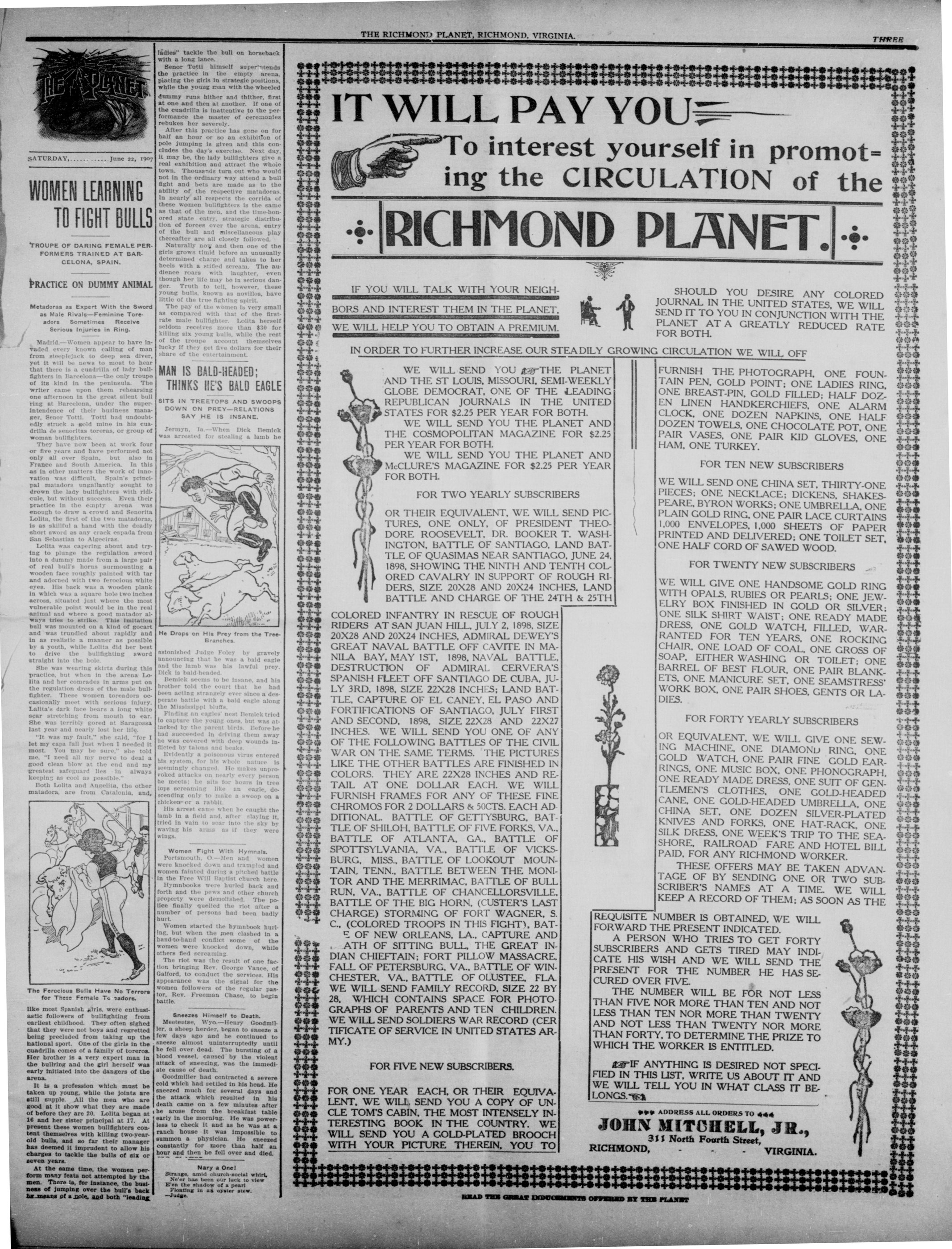
WOMEN LEARNING TO FIGHT BULLS
TROUPE OF DARING FEMALE PER
FORMERS TRAINED AT BAR-
CELONA, SPAIN.
PRACTICE ON DUMMY ANIMAL
Metadoras as Expert With the Sword as Male Rivals—Feminine Toreadores Sometimes Receive Serious Injuries in Ring.
Madrid.—Women appear to have invaded every known calling of man from steeplejack to deep sea diver, yet it will be news to most to hear that there is a cuadrilla of lady bullfighters in Barcelona—the only troupe of its kind in the peninsula. The writer came upon them rehearsing one afternoon in the great silent bull ring at Barcelona, under the superintendence of their business manager, Senor Totti. Totti had undoubtedly struck a gold mine in his cuadrilla de senoritas toreras, or group of woman bullfighters.
They have now been at work four or five years and have performed not only all over Spain, but also in France and South America. In this as in other matters the work of innovation was difficult. Spain's principal matadors unalloyably sought to drown the lady bullfighters with riddle, but without success. Even their practice in the empty arena was enough to draw a crowd and Senorita Lolita, the first of the two matadoras, is as skillful a hand with the deadly short sword as any crack espada from San Sebastian to Algeciras.
Lolita was capering about and trying to plunge the regulation sword into a dummy made from a large pair of real bull's horns surmounting a wooden face roughly painted with tar and adorned with two ferocious white eyes. His back was a wooden plank in which was a square hole two inches across, situated just where the most vulnerable point would be in the real animal and where a good matador always tries to strike. This imitation bull was mounted on a kind of gocari and was trundled about rapidly and in as realistic a manner as possible by a youth, while Lolita did her best to drive the bullfighting sword straight into the hole.
She was wearing skirts during this practice, but when in the arena Lolita and her comrades in arms put on the regulation dress of the male bulbfighter. These women toreadors occasionally meet with serious injury. Lolita's dark face bears a long white scar stretching from mouth to ear. She was terribly gored at Saragossa last year and nearly lost her life.
"It was my fault," she said, "for I let my capa fall just when I needed it most. You may be sure," she told me. "I need all my nerve to deal a good clean blow at the end and my greatest safeguard lies in always keeping as cool as possible."
Both Lolita and Angelita, the other matadora, are from Catalonia, and
A
The Ferocious Bulls Have No Terrors for These Female Toads.
Like most Spanish girls, were enthusiastic followers of bullfighting from earliest childhood. They often sighed that they were not boys and regretted being precluded from taking up the national sport. One of the girls in the quadrilla comes of a family of toreros. Her brother is a very expert man in the bulriling and the girl herself was early initiated into the dangers of the arena.
It is a profession which must be taken up young, while the joints are still supple. All the men who are good at it show what they are made of before they are 20. Lolita began at 16 and her sister principal at 17. At present these women bullfighters content themselves with killing two-year-old bulls, and so far their manager has deemed it imprudent to allow his charges to tackle the bulls of six or seven years.
At the same time, the women perform many feats not attempted by the men. There is, for instance, the business of jumping over the bull's back by means of a pole, and both "leading
WE WILL HELP YOU TO OBTAIN A PREMIUM.
COLORED INFANTRY IN RESCUE OF ROUGH RIDERS AT SAN JUAN HILL, JULY 2, 1898, SIZE 20X28 AND 20X24 INCHES, ADMIRAL DEWEY'S GREAT NAVAL BATTLE OFF CAVITE IN MANILA BAY, MAY 1ST, 1898, NAVAL BATTLE, DESTRUCTION OF ADMIRAL CERVERA'S SPANISH FLEET OFF SANTIAGO DE CUBA, JULY 3RD, 1898, SIZE 22X28 INCHES; LAND BATTLE, CAPTURE OF EL CANEY, EL PASO AND FORTIFICATIONS OF SANTIAGO, JULY FIRST AND SECOND, 1898, SIZE 22X28 AND 22X27 INCHES. WE WILL SEND YOU ONE OF ANY OF THE FOLLOWING BATTLES OF THE CIVIL WAR ON THE SAME TERMS. THE PICTURES LIKE THE OTHER BATTLES ARE FINISHED IN COLORS. THEY ARE 22X28 INCHES AND RETAIL AT ONE DOLLAR EACH. WE WILL FURNISH FRAMES FOR ANY OF THESE FINE CHROMOS FOR 2 DOLLARS & 50CTS. EACH ADDITIONAL. BATTLE OF GETTYSBURG, BATTLE OF SHILOH, BATTLE OF FIVE FORKS, VA., BATTLE OF ATLANTA, GA., BATTLE OF SPOTTSYLVANIA, VA., BATTLE OF VICKSBURG, MISS., BATTLE OF LOOKOUT MOUNTAIN, TENN., BATTLE BETWEEN THE MONITOR AND THE MERRIMAC, BATTLE OF BULL RUN, VA., BATTLE OF CHANCELLORSVILLE, BATTLE OF THE BIG HORN, (CUSTER'S LAST CHARGE) STORMING OF FORT WAGNER, S. C., (COLORED TROOPS IN THIS FIGHT), BAT-
E OF NEW ORLEANS, LA., CAPTURE AND ATH OF SITTING BULL, THE GREAT INDIAN CHIEFTAIN; FORT PILLOW MASSACRE, FALL OF PETERSBURG, VA., BATTLE OF WINCHESTER, VA., BATTLE OF OLUSTEE, FLA. WE WILL SEND FAMILY RECORD, SIZE 22 BY 28, WHICH CONTAINS SPACE FOR PHOTOGRAPHS OF PARENTS AND TEN CHILDREN. WE WILL SEND SOLDIERS WAR RECORD (CERTIFICATE OF SERVICE IN UNITED STATES ARMY.)
FOR ONE YEAR EACH, OR THEIR EQUIVALENT, WE WILL, SEND YOU A COPY OF UNCLE TOM'S CABIN, THE MOST INTENSELY INTERESTING BOOK IN THE COUNTRY. WE WILL SEND YOU A GOLD-PLATED BROOCH WITH YOUR PICTURE THEREIN, YOU TO
laddies" tackle the bull on horseback with a long lance.
...
Senor Totti himself superintends the practice in the empty arena, placing the gris in strategic positions, while the young man with the wheeled dummy runs hither and thither, first at one and then at another. If one of the cuadrilla is inattentive to the performance the master of ceremonies rebukes her severely.
After this practice has gone on for half an hour or so an exhibition of pole jumping is given and this concludes the day's exercise. Next day, it may be, the lady bullfighters give a real exhibition and attract the whole town. Thousands turn out who would not in the ordinary way attend a bull fight and bets are made as to the ability of the respective matadoras. In nearly all respects the corrida of these women bullfighters is the same as that of the men, and the time-honored state entry, strategic distribution of forces over the arena, entry of the bull and miscellaneous play thereafter are all closely followed.
Naturally now and then one of the girls grows timid before an unusually determined charge and takes to her heels with a stifled scream. The audience roars with laughter, even though her life may be in serious danger. Truth to tell, however, these young bulls, known as novillos, have little of the true fighting spirit. The pay of the women is very small as compared with that of the first-rate male bullfighter. Lolita herself seldom receives more than $30 for killing six young bulls, while the rest of the troupe account themselves lucky if they get five dollars for their share of the entertainment.
MAN IS BALD-HEADED;
THINKS HE'S BALD EAGLE
SITS IN TREETOPS AND SWOOPS DOWN ON PREY—RELATIONS SAY HE IS INSANE.
Jermyn, Ia.—When Dick Bemick was arrested for stealing a lamb he
A man leaping over two sheep.
He Drops on His Prey from the Tree-Branches.
astonished Judge Foley by gravely announcing that he was a bald eagle and the lamb was his lawful prey. Dick is bald-headed.
Bemick seems to be insane, and his brother told the court that he had been acting strangely ever since a desperate battle with a bald eagle along the Mississippi bluffs.
Finding an eagles' nest Bemick tried to capture the young ones, but was attacked by the parent birds. Before he had succeeded in driving them away he was covered in deep wounds inflicted by talons and beaks.
Evidently a poisonous virus entered his system, for his whole nature is seemingly changed. He makes unprovoked attacks on nearly every person he meets; he sits for hours in tree tops screaming like an eagle, descending only to make a swoop on a chicken or a rabbit.
His arrest came when he caught the lamb in a field and, after slaying it, tried in vain to scar into the sky by waving his arms as if they were wings.
Women Fight With Hymnals.
Portsmouth, O—Men and women were knocked down and trampled and women fainted during a pitched battle in the Free Will Baptist church here. Hymnbooks were hurled back and forth and the pews and other church property were demolished. The police finally quelled the riot after a number of persons had been badly hurt.
Women started the hymnbook hurling, but when the men clashed in a hand-to-hand conflict some of the women were knocked down, while others fled screaming.
The riot was the result of one faction bringing Rev. George Vance, of Galford, to conduct the services. His appearance was the signal for the women followers of the regular pastor, Rev. Freeman Chase, to begin battle.
Sneezes Himself to Death
Meetteetse, Wyo.—Henry Goodmiller, a sheep herder, began to sneeze a few days ago and he continued to sneeze almost uninterruptedly until he fell over dead. The bursting of a blood vessel, caused by the violent attack of sneezing, was the immediate cause of death. Goodmiller had contracted a severe cold which had settled in his head. He sneezed much for several days and the attack which resulted in his death came on a few minutes after he arose from the breakfast table early in the morning. He was powerless to check it and as he was at a ranch house it was impossible to summon a physician. He sneezed constantly for more than half an hour and then he fell over and died.
Nary a One!
Strange, amid church-social whirl,
Ne'er has been up to lurk in view
By the shadow of a pearl
Floating in an oyster stew.
-Judge.
IN ORDER TO FURTHER INCREASE OUR STEADILY GROWING CIRCULATION WE WILL OFF
WE WILL SEND YOU THE PLANET AND THE ST LOUIS, MISSOURI, SEMI-WEEKLY GLOBE DEMOCRAT, ONE OF THE LEADING REPUBLICAN JOURNALS IN THE UNITED STATES FOR $2.25 PER YEAR FOR BOTH. WE WILL SEND YOU THE PLANET AND THE COSMOPOLITAN MAGAZINE FOR $2.25 PER YEAR FOR BOTH. WE WILL SEND YOU THE PLANET AND McCLURE'S MAGAZINE FOR $2.25 PER YEAR FOR BOTH.
OR THEIR EQUIVALENT, WE WILL SEND PICTURES, ONE ONLY, OF PRESIDENT THEODORE ROOSEVELT, DR. BOOKER T. WASHINGTON, BATTLE OF SANTIAGO, LAND BATTLE OF QUASIMAS NEAR SANTIAGO, JUNE 24, 1898, SHOWING THE NINTH AND TENTH COLORED CAVALRY IN SUPPORT OF ROUGH RIDERS, SIZE 20X28 AND 20X24 INCHES, LAND BATTLE AND CHARGE OF THE 24TH & 25TH
READ THE GREAT INDUCEMENTS OFFERED BY THE PLANET
THE RICHMOND PLANET, RICHMOND, VIRGINIA
IF YOU WILL TALK WITH YOUR NEIGH-
```markdown
```
FOR TWO YEARLY SUBSCRIBERS
FOR FIVE NEW SUBSCRIBERS
REQUISITE NUMBER IS OBTAINED, WE WILL FORWARD THE PRESENT INDICATED. A PERSON WHO TRIES TO GET FORTY SUBSCRIBERS AND GETS TIRED MAY INDICATE HIS WISH AND WE WILL SEND THE PRESENT FOR THE NUMBER HE HAS SECURED OVER FIVE. THE NUMBER WILL BE FOR NOT LESS THAN FIVE NOR MORE THAN TEN AND NOT LESS THAN TEN NOR MORE THAN TWENTY AND NOT LESS THAN TWENTY NOR MORE THAN FORTY, TO DETERMINE THE PRIZE TO WHICH THE WORKER IS ENTITLED.
IF ANYTHING IS DESIRED NOT SPECIFIED IN THIS LIST, WRITE US ABOUT IT AND WE WILL TELL YOU IN WHAT CLASS IT BE LONGS.
JOHN MITCHELL, JR.,
311 North Fourth Street,
RICHMOND, VIRGINIA
A B
LANET
EEKLY
READING
UNITED
H.
T AND
R $2.25
T AND
YEAR
ND PIC-
THEO-
WASH-
D BAT-
JUNE 24,
H COL-
IGH RI-
LAND
& 25TH
```markdown
```
REQUISITE FORWARD
SHOULD YOU DESIRE ANY COLORED JOURNAL IN THE UNITED STATES, WE WILL SEND IT TO YOU IN CONJUNCTION WITH THE PLANET AT A GREATLY REDUCED RATE FOR BOTH.
FURNISH THE PHOTOGRAPH, ONE FOUNTAIN PEN, GOLD POINT; ONE LADIES RING, ONE BREAST-PIN, GOLD FILLED; HALF DOZEN LINEN HANDKERCHIEFS, ONE ALARM CLOCK, ONE DOZEN NAPKINS, ONE HALF DOZEN TOWELS, ONE CHOCOLATE POT, ONE PAIR VASES, ONE PAIR KID GLOVES, ONE HAM, ONE TURKEY.
FOR TEN NEW SUBSCRIBERS
WE WILL SEND ONE CH
PIECES; ONE NECKLACE
PEARE; BYRON WORKS;
PLAIN GOLD RING, ONE
1,000 ENVELOPES, 1,000
PRINTED AND DELIVER
ONE HALF CORD OF SAV
FOR TWENTY NET
WE WILL GIVE ONE HAL
WITH OPALS, RUBIES O
ELRY BOX FINISHED IN
ONE SILK SHIRT WAIST
DRESS, ONE GOLD W
RANTED FOR TEN YE
CHAIR, ONE LOAD OF
SOAP, EITHER WASHING
BARREL OF BEST FLOU
ETS, ONE MANICURE SHE
WORK BOX, ONE PAIR S
DIES.
FOR FORTY YEAR
OR EQUIVALENT, WE T
ING MACHINE, ONE D
GOLD WATCH, ONE P
RINGS, ONE MUSIC BOX
ONE READY MADE DRE
TLEMEN'S CLOTHES,
CANE, ONE GOLD-HEA
CHINA SET, ONE DOL
KNIVES AND FORKS, O
SILK DRESS, ONE WEEK
SHORE, RAILROAD FA
PAID, FOR ANY RICHMO
THESE OFFERS MAY
TAGE OF BY SENDING
SCRIBER'S NAMES AT
KEEP A RECORD OF TH
THE NUMBER IS OBTAINED, W
RD THE PRESENT INDICATED
PERSON WHO TRIES TO GET
BERS AND GETS TIRED M
IS WISH AND WE WILL SEE
IT FOR THE NUMBER HE
OVER FIVE.
THE NUMBER WILL BE FOR N
IVE NOR MORE THAN TEN A
MAN TEN NOR MORE THAN
NOT LESS THAN TWENTY NO
NORTY, TO DETERMINE THE B
THE WORKER IS ENTITLED.
IF ANYTHING IS DESIRED NO
THIS LIST, WRITE US ABOUT
AL TELL YOU IN WHAT CLAS
ALL SEND ONE CHINA SET, THIRD
ONE NECKLACE; DICKENS, S.
BIBYRON WORKS; ONE UMBRELLA,
GOLD RING, ONE PAIR LACE CU
ENVELOPES, 1,000 SHEETS OF
AND DELIVERED; ONE TOIRE
FALF CORD OF SAWED WOOD.
FOR TWENTY NEW SUBSCRIBERS.
ALL GIVE ONE HANDSOME GOLD
PEALS, RUBIES OR PEARLS; ONE
BOX FINISHED IN GOLD OR
SKIRT WAIST; ONE READ
ONE GOLD WATCH, FILLED
FOR TEN YEARS, ONE R
ONE LOAD OF COAL, ONE G
EITHER WASHING OR TOIL
OF BEST FLOUR, ONE PAIR
THE MANICURE SET, ONE SEAM
BOX, ONE PAIR SHOES, GENTS.
FOR FORTY YEARLY SUBSCRIBERS.
EQUIVALENT, WE WILL GIVE ONE
MACHINE, ONE DIAMOND RING
WATCH, ONE PAIR FINE GOLD
ONE MUSIC BOX, ONE PHONO
READY MADE DRESS, ONE SUIT,
N'S CLOTHES, ONE GOLD-
ONE GOLD-HEADED UMBRELLA
SET, ONE DOZEN SILVER-
AND FORKS, ONE HAT-RAC
RESS, ONE WEEK'S TRIP TO T
RAILROAD FARE AND HOT
FOR ANY RICHMOND WORKER
CASE OFFERS MAY BE TAKEN
OF BY SENDING ONE OR TW
'S NAMES AT A TIME. WE
RECORD OF THEM; AS SOON
IS OBTAINED, WE WILL
SENT INDICATED.
O TRIES TO GET FORTY
GETS TIRED MAY INDIC
WE WILL SEND THE
NUMBER HE HAS SE-
WILL BE FOR NOT LESS
MORE THAN TEN AND NOT
MORE THAN TWENTY
NON TWENTY NOR MORE
INTERMINE THE PRIZE TO
OR IS ENTITLED.
IS DESIRED NOT SPECI-
WRITE US ABOUT IT AND
IN WHAT CLASS IT BE-
WE WILL SEND ONE CHINA SET, THIRTY-ONE PIECES; ONE NECKLACE; DICKENS, SHAKESPEARE, BYRON WORKS; ONE UMBRELLA, ONE PLAIN GOLD RING, ONE PAIR LACE CURTAINS 1,000 ENVELOPES, 1,000 SHEETS OF PAPER PRINTED AND DELIVERED; ONE TOILET SET, ONE HALF CORD OF SAWED WOOD
FOR TWENTY NEW SUBSCRIBERS
WE WILL GIVE ONE HANDSOME GOLD RING WITH OPALS, RUBIES OR PEARLS; ONE JEWELRY BOX FINISHED IN GOLD OR SILVER; ONE SILK SHIRT WAIST; ONE READY MADE DRESS, ONE GOLD WATCH, FILLED, WARRANTED FOR TEN YEARS, ONE ROCKING CHAIR, ONE LOAD OF COAL, ONE GROSS OF SOAP, EITHER WASHING OR TOILET; ONE BARREL OF BEST FLOUR, ONE PAIR BLANKETS, ONE MANICURE SET, ONE SEAMSTRESS' WORK BOX, ONE PAIR SHOES, GENTS OR LADIES.
FOR FORTY YEARLY SUBSCRIBERS
OR EQUIVALENT, WE WILL GIVE ONE SEWING MACHINE, ONE DIAMOND RING, ONE GOLD WATCH, ONE PAIR FINE GOLD EARRINGS, ONE MUSIC BOX, ONE PHONOGRAPH, ONE READY MADE DRESS, ONE SUIT OF GENTLEMEN'S CLOTHES, ONE GOLD-HEADED CANE, ONE GOLD-HEADED UMBRELLA, ONE CHINA SET, ONE DOZEN SILVER-PLATED KNIVES AND FORKS, ONE HAT-RACK, ONE SILK DRESS, ONE WEEK'S TRIP TO THE SEASHORE, RAILROAD FARE AND HOTEL BILL PAID, FOR ANY RICHMOND WORKER. THESE OFFERS MAY BE TAKEN ADVANTAGE OF BY SENDING ONE OR TWO SUBSCRIBER'S NAMES AT A TIME. WE WILL KEEP A RECORD OF THEM; AS SOON AS THE
ADDRESS ALL ORDERS TO
MIN MITCHELL,
311 North Fourth Street,
ND,
BY THE PLANET
CHELL, JR.,
Fourth Street,
VIRGINIA.
THREE
not= the
COLORED WE WILL WITH THE RED RATE
ONE FOUNDED RING, HALF DOZZLE ALARM ONE HALF POT, ONE MOVES, ONE
BERS
SHIRTY-ONE IS, SHAKESPELLA, ONE CURTAINS OF PAPER TOILET SET, D.
BERS
GOLD RING ONE JEWEL SILVER; ADY MADE CLED, WARD ROCKING GROSS OF FILET; ONE BLANKAMSTRESS'TS OR LA.
BERS
ONE SEW-RING, ONE GOLD EAR-NOGRAPH, MIT OF GEN-ED-HEADED SPELLA, ONE PLATED BRACK, ONE TO THE SEA-MOTEL BILL BER.
NON ADVAN-TWO SUB- WE WILL ON AS THE
```markdown
```
```markdown
```
FOUR
THE SPIRIT
Published every Saturday by JOHN MITCHELL
Jn., at all North 4th Street, Richmond Va.
JOHN MITCHELL, JR. - EDITOR.
Ali communications intended for publication should be sent so as to reach us by Wednesday.
TERMS IN ADVANCE
One Copy, one year, * $1.50
One Copy, eight months. * 1.00
One Copy, six months. * .80
One Copy, four months. * .50
One Copy, three monties, .40
Single Copy. * .06
ADVERTISING RATES
REGISTERED LETTER.—If a money Order Post-Office or an Express Office is not within your reach, your Postmaster will register the Letter you wish to send us on payment of the bill. If you wish to send us a letter in just or stolen, it can be traced. You can send money in this manner at our risk.
We cannot be responsible for money sent in letters in any other way than one of the four ways mentioned above. If you send your money in any other way, you must do it at your own risk.
EXCELLENCE, ETC.—If you do not want THE PLANET CONTINUED for another year after your subscription has run on, you then notify us by Postal Card to discontinue it. The courts have decided that subscribers to newspaper, who do not order their paper discontinued at the exchange, will be required to be required to be held in time for which it does not, and may be held in place, to date when they order the paper discontinued.
COMMUNICATIONS—When writing to us to renew your subscription or to discontinue your paper, you should give your name and address as well as otherwise we cannot find your name on our books.
CHANGE OF ADDRESS.—In order to change the address of a subscriber, we must be sent to the former as well as the present address.
Entered at the Post-Office at Richmond, Va. as second-class master.
SATURDAY, JUNE, 22ND. 1907.
Chairman New of the National Republican Committee declares that President Roosevelt will be the issue in the next election, and incidentally announces that the platform of the party or its declaration of principles will be a secondary consideration. From this plain statement, it would seem that the proclaming of the distinguished occupant of the White House as the Diaz of this country would be now in order.
Rev. W. Bishop Johnson, D. D., has been appointed by the Census Bureau to secure a complete religious census of the Negro Baptists of this country and he asks that all information relative to this denomination be sent to him at once. Members of Associations, Conventions and religious bodies of every description will do the denomination a favor and advance its interests by addressing him simply as Rev. W. Bishop Johnson, D. D., Washington, D. C.
THE BROWNSVILLE CONCLUSION
Senator J. B. Foraker declares that the testimony before the Senate Committee on Military Affairs has failed to establish the guilt of the colored soldiers. Some persons may be surprised to know how this conclusion was reached after such positive testimony by the white witnesses from Brownville Texas. It was brought about by the process of elimination.
To be plain, it was a case of where they tried to prove too much. When these people swore that they could identify a soldier thirty, forty and even sixty feet away, when it was proven that a white man could not be distinguished from a colored one at a distance of ten feet on the night of August 13th, 1906, when it is alleged the affair took place it demonstrated their untruthfulness.
We have always contended that there was one fact clearly established and admitted and that was that over 150 colored soldiers did not participate in the affray. It has not been proven that the other members of the battalion did participate in it. It is unfortunate that politics has been injected into the controversy and yet were this not so, silence would have reigned where justice is holding carnival.
We may attempt to escape the conclusion whenever we may choose so to do and yet it is evident to every donservative citizen that this essence of our republic, the basic principle of its existence is so woven and interwoven in its making up that to eliminate one class of citizens from politics is to sacrifice them upon the altar of some other class of citizens' ambition.
REOPEN BOISE TRIAL
Harry Orchard's Long Ordeal Not Ended Yet.
STATE TO REST CASE THIS WEEK
Defense Will Put Many Witnesses on Stand to Contradict Star Witness as to Haywood's Part In the Tragedy.
BOISE. Ida., June 19.-The prosecution in the Steennenberg murder trial offered one of its most important pieces of evidence against William D. Haywood when, rechilling Harry Orchard for redirect examination, it introduced four letters tending to show that Haywood during the fall of 1905, when Orchard swears he was engaged on various crimes for the federation leaders, had participated in a plan to deceive Mrs. Orchard of Cripple Creek as to the whereabouts of her husband.
Over a variety of protests from the defense Orchard was allowed to testify that early in the summer of 1905 Haywood told him that Mrs. Orchard was writing for information as to Orchard's whereabouts. Orchard swore that he wrote Mrs. Orchard a series of letters that were falsely dated and delivered to Mrs. Orchard by agents of the Western Federation of Miners. Orchard said that he first wrote two letters, dated San Francisco, and had them delivered to Paddy Mulliney, who represented the federation at Cripple Creek. Orchard identified the two letters and, overruling all objections of the defense, Judge Wood admitted them.
"Why did you tell Haywood, Moyer and Pettibone that you had given the letter to your wife to Paddy Mulliney and had dated the letter from San Francisco?"
"The reason is," said Orchard very deliberately, "that my wife had told parties that if she knew where I was she would sooner see me in jail than not know where I was."
Next Orchard swore that he wrote a third letter purporting to come from Nome, Alaska, and that, under the general arrangement he had made with the federation officers, Marlan Moore carried the letter to Nome, where he went as organizer of the federation, and posted it. This letter, bearing the date of Nome, Aug. 5, 1905, was produced, identified and admitted as evidence. Orchard then identified a letter which Haywood himself wrote to Mrs. Orchard, and that was admitted in evidence and handed to the jury as showing that the prisoner had knowledge of the Alaskan story.
Orchard also testified that the replies of Mrs. Orchard were sent to him through Haywood.
When Orchard took the stand it was made evident that the defense proposes to bring a number of witnesses to prove that Orchard had for years nursed a vengeful spite against Steennenberg and had repeatedly made threats against him.
"Do you know Max Mallch of Denver?" asked Richardson.
"Yes, sir."
"Did you in June or July of 1905 say to Max Mallch, you and he being alone, that you were going to kill Steennenberg even if you had to swing for it?"
"No, sir. I never had any such conversation."
"Adams told me," said Orchard,
"that I could not be alone in making a confession, but that he thought he would make a confession himself."
The next great dramatic situation in the trial will come when Adams is called to the stand to affirm or repudiate his confession.
The state will offer in evidence copies of certain printed articles over Haywood's signature showing the language used by the defendant against Steennenberg when the former governor or was running for office. The decision of the supreme court of Colorado, having to do with the eight hour bill, which Haywood was supporting and which was declared unconstitutional by the supreme court when Judge Goddard was on the bench, will be offered in evidence. Orchard swore that he was employed to kill Judge Goddard and Judge Gabbert of the supreme court and that he did attempt to kill them. The defense has announced that it will have between 150' and 200 witnesses. Subpoenas have not been asked for these, and it is probable that they will voluntarily testify for Haywood. The defense's witnesses, it is said, will contradict Orchard as to the whereabouts of Haywood or Moyer or Pettibone and even of Orchard himself.
Commander Winslow Arrested
SAN DIEGO, Cal. June 19—Commander Cameron McR. Winslow, one of the wealthiest officers in the navy, the personal friend of President Roosevelt, and commanding the cruiser Charleston, who was arrested by customs officers charged with smuggling champagnes, cigars and other dutiable articles, has been released under special orders from the treasury department.
Forty Autos Ruined In Boston Fire. BOSTON, June 19—Fire which threatened Boston's automobile district destroyed forty automobiles and did $100,000 damage at an early hour. The blaze is believed to have started from spontaneous combustion. It was in the garage of the Back Bay Automobile company.
"A Tramp Abroad."
LONDON, June 18. — Ambassador Reid will give a bachelor feast in honor of Mark Twain at Dorchester House on Friday evening.
Eight Miners Killed at Priceburg.
SCRANTON, Pa., June 19. — Eight miners were killed by an explosion of gas in the Johnson colliery at Priceburg, Pa.
Kingsley to Rule New York Life.
NEW YORK, June 18—Darwin P.
Kingsley, son-in-law of the late John
A. McCall, has been elected president
of the New York Life Insurance
company.
The Issue of Next Campaign.
OYSTER BAY, N. Y., June 18—Senator
Beveridge said the policies of
President Roosevelt will be the issue
of the next campaign.
THE RICHMOND PLANET. RICHMOND. VIRGINIA
DEN BROKE HER BACK.
Charles G. Herreshoff Nearly Drowned
In Motor Bont Wreck.
BRIDGEPORT, Conn., June 19.
Charles G. Herreshoff, nephew of the
noted yacht designer Nat C. Herreshoff
and himself a designer of power boats,
with his engineer, Edward J. Sherman
of this city, was rescued from drowning
in Long Island sound off the
Bridgeport lighthouse after the power
boat Den, owned by George H. Hoadley
of New York and said to have
been the fastest craft of its kind on
the coast, had been wrecked and sunk.
The men managed by clinging to a
cushion to keep afloat until Lighthouse
Keeper Wright came to their assistance
in a launch. They had been in the
water about twenty minutes and wore
almost exhausted.
The accident came without warning and was peculiar in its nature, according to the story told by Mr. Sherman. He said Mr. Herreshoff had taken the boat out for the purpose of testing a new propeller which had just been put in. The Den was running about twenty-eight miles an hour and suddenly as it mounted the crest of a wave broke amidships and sank with its machinery, leaving the two occupants struggling in the water.
TAFT MAY WITHDRAW
Secretary of War Fears Strain of Presidential Campaign.
WASHINGTON, June 19. — Rumors are afloat here that Secretary Taft is likely to withdraw from the presidential race on his return to Washington. His health is one of the reasons ascribed, it being doubtful whether he can stand the combined strain of making a fight for the presidency, running the Philippines, supervising the Panama canal management, heading the war department and acting as general adviser to the administration in all sorts of matters.
The secretary's breakdown at Fort Snelling is cited as showing that Mr. Taft is already overworked. Besides, he has never entered heartily into the presidential race and would far prefer the supreme court. It is understood there will be important conferences between Mr. Taft and some of his close advisers when he returns June 22, and it will be discussed whether it is worth while to stay in the field.
A UNIQUE TRAGEDY
James Wardell Confesses Murder.
Wife Poisoned by Gas.
NEW YORK. June 19.—Under pressure of a merciless examination James Wardell confessed to Coroner Acritell that in furtherance of a suicide pact he shot his wife at the latter's fat in West Twenty-fifth street. At the time of his confession Wardell did not know that an autopsy had disclosed that his wife was dead from illuminating gas when he fired a bullet into her brain. Wardell's admissions have added something unsusual if not unprecedented to the annals of crime in this city. Just what charge will be based upon his acknowledgment of an intent to kill the coroner has not made known.
Mrs. Wardell, who was nineteen years of age and strikingly attractive, was found dead on her bed. Wardell was arrested and told the police that his wife had shot herself after the two had agreed to die together. His courage failed him when the time came for self destruction.
Edward Invites Kelsey
Edward Invites Kaiser to England.
BERLIN, June 19. A report is in circulation here that King Edward has invited the German emperor to visit him this summer.
FINANCIAL AND COMMERCIAL
Closing Stock Operations
Closing Stock Quotations.
Money on call unquoted; prime mercantile paper, 5½% per cent; exchanges $2,587,557, balances, $11,588,004.
Closing prices.
Amal. Copper 82% N. Y. Central. 111%
Atchison 87% Norf. & West. 72
B. & O. 89% Penn. R. R. 119%
Brooklyn R. T. 62% Reading 99%
C. C. & C. S. L. 65% Rock Island 20%
C. S. L. 65% St. Paul. 125%
Chl. & Northw. 142 Southern Ry. 18
D. & H. 154 Southern Ry. 18
Erie. 22 South Ry. pf. 18
Gen. Electric. 130 Sugar 120
Il. Central. 130 Texas Pacific 120
Leekawanna. 401 Union Pacific 131%
Manhattan 130 U. S. Steel pf. 97%
Int.-Met. 16 West. Union. 79%
Missouri Pac. 74%
New York Markets.
FLOUR-Quiet, but steady; Minnesota
patents, $5@5.40; winter patents, $4.50@5;
winter straights, $4.30@4.45; winter extras,
$3@3.00.
RYE FLOUR—Steady; fair to good, $4.75
¢5; choice to tancy, $10.50.40.
WHEAT-After opening a half cent higher on Liverpool cables and covering the main reacted under realizing, but the former arrested under realizing, and predictions of cold weather and commission house buying: July, 99%@$10.9%; September, 99%@$10.9%; October, $10.9%; Straw-Already at 90.9%; BEANS-Easy; marrow, $2.5; medium; peas, $1.85; $1.87; red kidney, $4.75; $4.75;
HOPS - Guitel; state, common to choice,
1906, 1416c; 1916, 414c; Pacific coast,
1906, 1416c; 1916, 414c; Pacific coast,
BUTTER - Creamery, extra, per pound,
21%/40c. (Mercantile Exchange, official
quotation, 21%/40c.); reposted, extra,
21%/40c.; reposted, extra,
firsts, 20%/40c.; packstock, No. 1, 18c.
CHEESE—New, state, full cream, colored and white, small and large, best, light skims, 8%c.; half skims, best, 7%@7%c.; part skims, prime, 5%@6%c.
EGGS—Fresh gathered, extras, 18c; nearby, firsts to extra firsts, 16@17c.; fresh gathered, extra firsts, 16@17c.; thirds, 13%@14c.; dirties, No. 1, 13c.; No. 2, 12@12%c.; checked eggs, 10@12c.
POTATOES—Steady and in fair demand; choice, per bushel, 65@70c.; fair to good, do.. 50a80c.
MILK-Per 40 quart can. $1.31
LIVE POULTRY-Quiet; fowls lower;
fowls, 14c; old roosters, 10c; spring chickens,
18%22c; ducks, old, 11c; do, spring,
18%14c.
DRESSED POUILTY—Quilt, but very
steady; fresh killed fowls, choice, 14c.
bowl; good, 18d; 183c; old roosters,
10c; broilers, nearby, 33d; 33c; do, west-
ern, 13d; 33c.
Live Stock Markets
CATTLE-Supply light; market steady;
HORS-Recipits light; market steady;
HORS-papers and pigs, $5,000; roughs, $5,200;
SHEEP AND LAMB-Supply Light;
milk and common, $2,500; lamb, $4,500;
calves, $8,007;
HOGS-Recipits light; market steady;
HORS-papers and pigs, $5,000; roughs, $5,200;
SHEEP AND LAMB-Supply Light;
milk and common, $2,500; lamb, $4,500;
calves, $8,007;
Governor Cottrell Designs
NORFOLK, Va., June 19.-The directors of the Jamestown Exposition company at a meeting last night accepted the resignation of Governor W. E. Cottrell, practically made James M. Barr director general, with full powers, and succeeding to the duties of Mr. Cottrell and indorsed a second bond issue for $700,000 to cover all the exposition company's liabilities.
CHAOS IN RUSSIA
Czar Dissolves the Douma Because of Plots.
ASSASSINS TRY NEW WEAPON TO KILL
Emperor Issues Imperial Ukase Giving Reasons For Step Which May Cause Open Revolt Through-
out His Vast Domain.
ST. PETERSBURG, June 19.—Emperor Nicholas affixed his signature to an imperial ukase abolishing the present douma and ordering that the elections of members to its successor, which is to meet on Nov. 14, be held under the new election law, which provides against the "submergence of the educated classes by the uneducated masses."
Following is the text of the emperor's manifesto:
"We, Nicholas HI., by the grace of God, emperor of all the Russias, czar of Poland, grand duke of Finland, etc., declare to all our faithful subjects that, in conformity with our order and instructions since the dissolution of the first douma, our government has adopted a series of successive measures to pacify the country and establish the affairs of state in regular course.
"The second douma convoked by us was summoned to contribute, according to our sovereign will, to the pacification of Russia, principally by the work of legislation, without which the life of a state and the perfection of its administration is impossible; next by an examination of the budget of revenue and expenditure, which insures regularity in national finance, and finally by adopting the national use of the right of addressing interpellations to the government with a view to establishing everywhere truth and justice throughout Russia.
"But an act was committed unheard of in the annals of history. The judicial authorities discovered a plot by a section of the douma against the state and power of the czar, but when our government demanded the exclusion until judgment had been passed of fifty-five members of the douma implicated in the crime and the arrest of those among them most compromised the douma failed to carry out immediately the lawful demand of the authorities which admitted of no delay. "All this compelled us by ukase to the senate to dissolve the second douma, fixing Sept. 14 as the date of the convolution of the new douma." This act constitutes a virtual coup d'etat and overrides the specific provisions of the fundamental laws, solemnly proclaimed by his majesty on the eve of the convolution of the first douma, which announced that the electoral law could never be changed without the consent of parliament itself.
In the course of the night nine of the sixteen accused Social Democratic leaders named in the government indictment, including Prince Tzartzeretell and M. Dzhajaride, were taken into custody. The other seven eluded capture, escaping across the frontier. A. V. Bobritsheff-Pushbkin, the head and front of the Black Hundreds, is looked upon by Russian revolutionists as the real destroyer of the douma. Nobody, not even the douma officials, is allowed to enter the prefects of the palace. A laconic notice is posted on the gates announcing that "former deputies" would receive their salaries upon application to the chancellory of the empire. Admiral Wiren, commanding the Black sea fleet, was cruising about in a steam cutter while a torpedo boat in command of Lleutenant Ruzhek was practicing firing Whitehead torpedoes in the spacious inner bay.
When the admiral's cutter was at short range the torpedo boat suddenly changed her position and fired a blank directly at the cutter, penetrating its water tank. Only the promptitude of the crew in leaching the cutter saved the admiral. Lleutenant Ruzhek explained that the torpedo was fired through an accident, but he and three junior lieutenants, who were sullen and refused to salute the admiral, were degraded and arrested on the charge of attempting to sink the cutter.
It now appears that the mutiny at Odessa of the Black sea fleet, consisting of eight battleships, eight cruisers and a division of torpedo boats, whose crews in all number 5,000 men, was discovered barely in time to prevent the planned bombardment of Odessa and the Caenician coast towns.
Five More Minnesota Victims Found.
NORFOLK, Va., June 19—A dispatch from Rear Admiral Emory, in command of the fleet in Hampton Roads, says that the bodies of Midshipmen Herbert L. Holden and Walter Carl Ulrich of Milwaukee, Seamen Robert H. Dodson, H. L. Vandorn and F. R. Plumber and Coal Passer Jesse Conn, victims of the Minnesota's launch accident, have been recovered. Midshipman Holden was from Port age, Wis., and Dodson from New York.
New Milford to Celebrate Settlement
NEW MILFORD, Conn., June 17—The bicentennial observance of the settlement of New Milford, which will extend through four days, opened with exercises on the village green under direction of a committee of townspeople.
CONDENSED DISPATCHES.
Notable Events of the Week Briefly
Chronicle.
The wedding of Miss Edith McGorray at Cleveland to Professor Edward H. Schwab of Notre Dame university, a brother of Charles M. Schwab, took place at St. John's cathedral.
At North Woodstock, Conn., the Elmwood hotel, on Woodstock Hill, was burned to the ground, but through the great efforts of the people thereabouts the outlying buildings and Woodstock academy were saved.
Tuesday, June 18.
The Missouri two cent passenger fare act will go into effect at 6 a. m. for three months' trial. If at the end of that time it is found to be unremunerative its enforcement can be fought in the courts by the railroads.
Big Ed Kelly of Boston, who on Saturday was convicted of second degree murder for the killing of Edward Pullman of Sodus, was sentenced to Auburn prison for the rest of his life by Justice Sutherland at Rochester, N. Y.
Senator Foraker of Ohio at Washington gave out a statement summing up the testimony taken by the senate committee on military affairs in the Brownville "shooting up" inquiry and declares that it fails to show that any soldiers took part in the affray.
United States Senator Beveridge of Indiana, who made a personal call on President Roosevelt, left Oyster Bay for New York. Mr. Beveridge would neither affirm nor deny the report that he is to marry Miss Katherine Edd, remarking that the reports were matters which no gentleman could deny.
Monday, June 17.
Two Spanishards, Nested Atlas and Alexander Arteso, have been arrested at Buffalo on a charge of selling cigars with counterfeit union labels. The cigars were made in New York and shipped to Buffalo. A consignment of 8,000 cigars was seized. Charlestown's celebration of the one hundred and thirty-second anniversary of the battle of Bunker Hill was ushered in by the lighting of an immense bonfire on the shores of the Mystic river. The pile measured more than fifty feet high and twenty feet at the base.
Saturday, June 15.
At St. Paul, Minn., Secretary Taft became suddenly very ill while at Fort Snelling witnessing the review of troops and fell to the ground. He had an attack of acute indigestion.
The president has confirmed the sentence of death imposed by the court martial in the case of Private William B. Taylor of the Twenty-fourth infantry, who was convicted of shooting First Lieutenant Calvert of the same company at Albuera, Philippines.
Andrew Carnegie is to extend his library gifts, and Germany is to receive a fine present from the Pittsburg steel man. The prime object of Mr. Carnegie's visit to Kiel is to announce to the German people that he will erect for them at Berlin a library, to which his first donation will be $1,000,000.
Friday, June 14
At Oklahoma City, Okla., T. P. Gore has been nominated for United States senator from the new state of Oklahoma. He has been blind since he was eleven years old, when he accidentally shot his right eye out with an arrow gun. A sensation was caused at Harrisburg, Pa., by the discovery that William L. Mathues, former state treasurer, who figured in the new capitol scandal, was detected looking over the books of the treasury department about 11 o'clock at night with one of the clerks of that department and a political lieutenant of Mathues from one of the other departments.
Thursday, June 13
The Italian senate has passed a bill making the centenary of the birth of Garibaldi, July 4, a national holiday. At Kingston, Jamaica, sleeping citizens were aroused by a violent earthquake at 1.20 o'clock in the morning, and many rushed out in their night clothing to the streets. The shock lasted several seconds and was accompanied by a loud rumbling noise. No damage was done.
Wednesday, June 12.
General! Baron Kuroki sailed for Japan on the steamship Kaga from Seattle, Wash. Before leaving General Kuroki, through the American honorary escort, General O. E. Wood, said that his visit to this country had been a most pleasant one and that he leaves with the kindest feelings for Uncle Sam and his people.
Andrew Carnegie and Mrs. Carnegie will be the guests of Ambassader and Mrs. Charlemagne Tower during the yachting week at Kiel, Germany. It has already been arranged that Mr. Tower shall present Mr. Carnegie to Emperor William. Joseph Wharton of Philadelphia will also be the guest of Mr. and Mrs. Tower at Kiel.
WINE GROWERS' REVOLT.
Clemenceau Appends to Mayors of France Without Result.
PARIS, June 19.--The wine growers' revolt in southern France is going from bad to worse. The eloquent appeal made by Premier Clemenceau to the mayors who have resigned office to resume their functions has had no effect whatever.
Marcelin Albert, the energetic leader of the revolt and president of the committee of Argelliers, openly defies the government and has issued proclamations stating that the mayors will not listen to any orders from the prime minister.
The wine growers will not listen to reason and feel convinced that the government by one stroke of the pen or by some magic means can alleviate the results of their own shortsightedness in producing more cheap wine than can be consumed, for, after all, it is to this cause that the crisis is due. The wild charges of adulteration are greatly exaggerated, because wine is so cheap that there is no profit in adulterating by artificial fabrication. Meanwhile the civil ceremonies of marriages and registrations of births and deaths and funerals are suspended, and no taxes or octol dues are paid.
TO CLEAR OUT GRAFTERS.
Mayor Schmitz Removed From Office at San Francisco.
SAN FRANCISCO, June 19.—Mayor Schmitz was formally removed from office by the supervisors at their meeting here. Supervisor James Gallagher was named as acting mayor in his place.
This is the first step taken by the graft prosecution in the execution of the plan to restore good government in San Francisco. The ground on which Mayor Schmitz was removed is that owing to his incarceration in the county jail following his conviction on a felony charge he is no longer able to perform his official duties.
Gallagher will not hold the position of acting mayor for more than a few days. The resignation of a certain member of the board of supervisors will make room for the appointment of a responsible citizen, who will take Gallagher's place as acting mayor.
AOKI DOES NOT CREDIT IT.
Japanese Ambassador Knows Nothing
of His Reported Recall
WASHINGTON, June 19—State department officials and members of the diplomatic corps were much interested in the statement in a Tokyo newspaper, the Hochl, that the Japanese government would recall Viscount Aoki, the Japanese ambassador, and is considering the appointment of Baron Kaneko as his successor. Ambassador Aoki when interviewed did not attach any credence to the report. During his stay in this country at the time of the Portsmouth conference
[Illustration of a man with a long beard and mustache, wearing a suit and tie.]
AMBASSADOR AOKI.
Baron Kaneko became acquainted with President Roosevelt. They grew very intimate, and it is reported that Baron Kaneko was the representative through whom the president transmitted his suggestions regarding settlement of disputes between the Japanese and Russian commissioners
BIG FOUR WRECK.
Small Boys Blamed For Open Switch at Columbus.
COLUMBUS, O., June 19.—The Big Four Limited, which left New York city over the New York Central at 5:30 o'clock, ran into an open switch three miles east of here, overturned and seriously injured four passengers and the fireman.
The engine and every coach were thrown on side, and the passengers were piled in heaps. The tender ran along the side of the track for some rods and then plunged into the ground several feet.
The engine continued for 200 yards and then turned over.
Small boys who were seen playing about the track by the engineer of a train which passed the wreck occurred are believed to have turned the switch, not meaning to do any harm. The engineer of the first train reported the switch O. K, when he went by.
Engineer William T. Smith stuck to his post, but escaped injury. Mahaffey, his fireman, jumped and as a result may not recover. The passengers had no opportunity to even leave their seats, because the train took the switch while traveling at the rate of fifty miles an hour and the cars were piled in a heap in a twinkling.
ABRUZZI AT BOSTON.
Duke Attends the Grand Annual Steeplechase.
BOSTON, June 19. -- The largest crowd that ever attended races at Clyde park, Brookline, saw Robert Nevell's black goldling, Mr. McCann, win the Country Club Grand Annual steeplechase.
The presence of the Duke of the Abruzzil and his party at the course added greatly to the interest, and society thronged the stands and clubhouse lawns. The duke, sunburned and smiling, held an almost continued reception with Mr. and Mrs. Larz Anderson in the Anderson box in the grand stand.
During the running of the Grand Annual the duke was in the judges' stand. Country club badges like court decorations were plumed to his coat by the stewards and officials. He was not in uniform, and, dressed in a modest brown suit and straw hat, he looked more like a prosperous young American than a foreign duke.
Standing of the Baseball Clubs
Standing of the Baseball Clubs.
NATIONAL LEAGUE.
W. L. P.C.
Chicago 49 16.673
New York 16 16.673
Philadelphia 31 19.650
Pittsburgh 36 20.404
Boston 29 20.404
Cincinnati 20 32.386
Brooklyn 18 34.386
St. Louis 18 34.386
St. Louis 41 2.25
AMERICAN LEAGUE.
W. L. P.C.
Chicago 32 18.640
Cleveland 32 18.615
Detroit 32 18.615
Philadelphia 37 23.540
Pittsburgh 37 23.489
St. Louis 31 23.489
Washington 16 29.355
Boston 18 33.333
Hughes Signs Recount Bill.
ALBANY, N. Y., June 19—Governor Hughes has signed the New York city recount bill, introduced by Assemblyman Prentice and providing for a recount and recanvass by judicial process of the ballots cast for the office of mayor at the election in New York city in November, 1905.
Neill to Investigate
WASHINGTON, June 18.—Commissioner Neill, it is understood, at the president's suggestion left for New York today to begin an investigation into the telegraphers' grievances.
Senator Beveridge to Wed.
Senator Beveridge to Wed.
CHICAGO, June 19.—Miss Katherine Eddy, daughter of Mr. and Mrs. Augustus N. Eddy of 1601 Michigan avenue, will marry Senator Beveridge of Indiana, possibly within the next ninety days. Senator Beveridge will sail tomorrow for Europe. Miss Eddy is in Germany visiting her brother, Spencer F. Eddy, who is secretary of the United States embassy in Berlin.
Klev Battalion Mutiles.
ST. PETERSBURG, June 19.—The news of the dissolution of the douma resulted in mutinous acts among privates in a battalion of sappers at Klev. Other battalions were summoned to quell the mutiny, and the entire mutinous battalion were disarmed and arrested. One loyal officer was killed in the fight.
Noted Astronomer Dies at Post.
LONDON, June 19.—Professor Alexander Stewart Herschel, the distinguished astronomer, is dead at the Observatory House, Slough, Bucks, where his grandfather, Sir William Herschel, and Sir John Herschel made most of their world famous discoveries.
Death by Sunstroke
LEAVENWORTH. Kan., June 19.—Lieutenant William Stewart of the Eleventh Pennsylvania infantry in the civil war was killed by sunstroke at the Soldiers' home here.
Does Not Know the Earl
LONDON, June 19.—"I do not know the Earl of Munster, and I am much annoyed by the unauthorized report," said Mrs. Potter Palmer, replying to a question here on the subject of her reported engagement to the Irish earl.
Gives $100,000 to Vanderbilt,
NASHVILLE, Tenn., June 19.—At the annual alumni dinner at Vanderbilt Chancellor J. H. Kirkland announced a contribution of $100,000 from William K. Vanderbilt, grandson of the founder of the university.
Roosevelt and Bryan Dominate
Roosevelt and Bryan Dominate.
WASHINGTON, June 19—Chairman Griggs of the Democratic congressional committee said: "All this talk of nominating a southern man for the presidency next year is nonsense. There is only one man in sight to lead the Democracy next year, and his name is William Jennings Bryan. If he wants the nomination that's all there will be to it. Bryan dominates the Democratic situation as thoroughly as President Roosevelt controls the Republican party. I don't know whether he wants to run or not. So far as I know he has not taken anybody into his confidence."
Hard to Open.
Dick—Succeed in touching the old gentleman for a ten spot this morning?
Jack—No; the money he carries is like the umbrella he carries.
Dick—How so?
Jack—Why, it's a close roll.—Chicago Dally News.
NOT AN IMAGINARY LINE.
Pedagogue—Now Snarker, junior, give an example, by reference to any familiar object, of what is meant by the word equator.
Snarker (rather at a loss)—Well, sr, er—er—it's like the—er—waistband on your trousers running round yer stumnick, sr.
Willing Helpers
He—Then it is settled that we are to elope at midnight?
She—Yes.
He—And you are sure you can get your trunk packed in time?
She—Oh, yes. Papa and mamma have both promised to help me.—Chicago Daily News.
Not Room.
The Bride—Oh, Algernon, are you certain, are you positive, that nothing will ever come between us?
ASTONISHED THE BARBER.
Quietly entering a barber's shop, the stranger removed his hat and coat, and taking a card from his pocket wrote on it:
"I want to be shaved."
A barber stepping forward read the card, and, pointing to a chair, said to his brother artists:
"Deaf as a brass kettle and dumb as an oyster."
The man straightened himself out in the chair, when his manipulator began lathering his face.
"This cuss has a cheek like a stone wall," he said, when a general laugh followed.
"Stick a pin in him and see if he is entirely dumb," said another.
The victim remaining undisturbed, the following shets were fired at him by the delighted tonsorial artists:
"He needs a shampoo. His head is dirtier than a public-house doormat."
"Shave him with a stool-leg. Don't spoil your razor on that stubble."
"He ought to rent that nose for a locomotive head-light," etc.
While all these complimentary allusions were flying about him the operation of shaving was finished, and the man arose and put on his coat, and then, turning to the astonished barber, said:
"How much for the shave and compliments?"
"I-I-I-I-I," gasped the astonished man, "oh, nothing — nothing — call again—excuse;" and as the stranger left the shop the discomfited barbers swore that they would never believe in a deaf and dumb man again until they had first fired a ten-pound cannon about his ears.
THE PLANET
GRIZZLY RODENT CAUSES
PANIC IN A STREET CAR
RAT APPEARS IN MIDST OF HOUSEWIVES WHO SEEK SAFETY IN HEIGHT.
Indianapolis, Ind.—No one knows how it got there, but a shaggy, overgrown veteran rat, with long stragging whiskers and a pleading, wistful face, was a passenger on a street car which left Illinois and Washington streets at five o'clock the other night. The car was well filled, mostly with West Indianapolis housewives with suppers to prepare for six o'clock husbands. In the confusion and turmoil the big, undfondling rat, without money, ticket or transfer, settled comfortably in a dark corner under a woman's skirt. The conductor gave two bells; the motorman threw on
A RAT RUNNING
Panic Reigned in the Car. the current and the car, loaded with possibilities, bounded down the rails to the south.
It was not until the car had turned into South street and was bowling merrily to the west that the venerable and battle scarred stowaway was prodded into action. Reposing in content beneath the skirts of an ample colored woman he merely whisked his tail when she readjusted her avoidpoils and inadvertently dug him one in the short ribs with a massive heel. Sufficient unto the day were the skirts thereof, and the rat overlooked the indignity in return for shelter. Another shifting of the bulk above brought a jab under the chin that even the meckest and middest of rodents would have resented. The wistful face contracted in fury and the straggling whiskers stuck out straight—a beautiful fringe for the white teeth that snapped at the offending foot. And then, with flashing eye and teeth a-gleam, the stowaway "lep" into the aisle, for one brief moment struck a tragic attitude and then—scurred. Meanwhile the passengers were moved—most of them to the top of the scats.
"My Gawd," screamed the woman, who had been the shelter house for the rat. "Look a there." She mounted the seat pointing in terror. Her skirts were held high. Every one followed her example—only there were some who didn't hold their skirts high. These—the men—with rare presence of mind, shouted to the conductor and made ineffectual attempts to boot the pestered animal as it dashed bewildered here and there in search of another friendly petticoat.
One bell jangled in the motorman's cage and the car came to a sudden halt for the final scene. Hysteries were rife and every skirt in the car was wildly shaken—for the rat had disappeared. A nice big hole, which loomed like the gates of Paradise to the pursued one, offered advantages too alluring to be resisted and through some rat avenue the hero of many hair-breadth 'scapes leisurely disembarked—no one knows where—and courage and skirts were restored within the car.
Canary Whistles Tunes
Norwalk, O.—Mr. and Mrs. J. D. Burgess, of Garden street, this city, own probably the only canary bird in the country that whistles tunes as well as sings. The bird is about a year old. It came into the possession of the Burgess family soon after it was hatched. The bird often heard Mr. and Mrs. Burgess whistle to summon their pet dog, and the bird soon began to whistle. While engaged in her household duties, Mrs. Burgess would whistle some tune, and it was not long before the canary bird began to imitate her. Now the bird whistles nearly all of "Nearer My God to Thee," "My Country," "Tis of Thee," and "There's Only One Girl in This World for Me."
No Cause for Alarm.
The honeymoon had bumped the bumps.
"You know, John," said the young wife, "that I used to be your type-writer?"
"Um—yes," grunted John.
"Well," she continued, "I wish you would discharge the girl you have now and hire a man in her place."
"Huh!" rejoined hubby. "I hope you don't think I would make a fool of myself twice in the same way."—Chicago Daily News.
Many Things to Remember in Proper Use of Powder
THE BRURETTE
WOULD USE
DARK SPACE
POWDER.
PRESERVE THE DELICACY
OF YOUR SKIN
The society woman is generally an adept at making up. She studies it and understands how to give her skin that youthful luster which is so much admired in woman. The society beauty can apply powder to her face in such a happy manner that not even her husband will suspect her of powdering. It was the boast of a husband who married a society beauty that his wife did not own as much as a powder puff. "If he could only see my makeup box," whispered his wife.
To apply powder properly takes the right sort of powder to begin with. The powder should be just the tone of the skin. A dead white powder on a deep yellow skin is productive of nothing but sorrow. On the other hand, the powder should not be too dark. Do not put brunette powder on your face if your skin is a pure white. Powder comes in three or four shades and you should match it to your complexion.
Don't take the first box that is handed out to you, but insist upon trying the box before you buy. "Look before you buy" is excellent advice for the buyer of face powder.
When you powder remember that you have eyebrows and that they are prettier when there is no powder in them. The woman with white powder in her black eyebrows is a familiar sight upon the thoroughfares. She is almost as noticeable as the woman who powders her nose and forgets that she has a forehead, cheeks and chin.
In these days all women powder. They consider it an essential of lady-like cleanliness. The powder box is fitted out in a very luxurious way and the daimy woman has from three to six different implements for apply powder to her face. The proper way to put powder on the face is by means of a powder puff, which should be small and very fresh and daimy. An old powder puff is an abomination. When not doing duty the puff should be inclosed in a bag scented with racket. This makes it always fragrant.
IS PRETTY IN PLAID
There are any number of pretty plaid materials, both silk and wool, that may be used for making up this blouse. There are two inch-wide tucks carried over the front to the bust, and to the waist at the back. The front
A
has the material cut away in the center above a strip of insertion down the center, and there is a small V-opening, filled in with a chemisette of lace; this is outlined with a shaped velvet band. The insertion is crossed by loops of fine silk cord, fixed by small buttons.
The sleeves have the tight-fitting lower part trimmed to match the front.
Materials required: Three and one half yards 28 inches wide, one half yard velvet, 16 buttons, two and one half yards cord.
The Daintiest Apron
Cut the bottom in three points about six inches deep; slightly glove the sides up to the top; cut the top in one point; hem all around.
At the waist line make 11 graduated tucks one-half inch wide, narrowing to a point at top and bottom. The middle tuck should be 15 inches long; the ones at each side seven inches.
Trim all around with lace about an inch wide. The strings should be 28 inches long, three inches wide.
Tuckers with the "V" Shape
Pointed lines prevail for tuckers and chemisettes and some are long enough to deserve the title of vest. When the "V" shape is not used, then absolutely square lines are employed, suggesting the square bibs for infants. Often these deep bib patterns are elongated back and front, with little kimono sleeves attached and then become diminutive and most effective jackets.
Raise a Few Sunflowers.
Ralse a few sunflowers. The seed adds to the variety of poultry feed, balancing the common grains. Then birds fed sunflower seed have a plumage which cannot be improved upon.
Watch the Flock.
There is not much danger from diseases and pests where the watchful shepherd is in charge, but slipshod methods will let trouble into any flock.
THE RICHMOND PLANET. RICHMOND. VIRGINIA.
BAGS FOR SUMMER
One of the fads of the summer will undoubtedly be the handbags of embroidered linen. It is therefore well that the woman who can embroider and make things neatly should employ her leisure moments in creating one of these bags. The idea of linen handbags is not an original one, but is the revival of an old fashion which has been in vogue in Italy and other parts of the continent for many years. The Italian linen bags carried by ladies of quality are wonderful pieces of needlework and are worth fabulous sums. They are generally rather ample in size and are a solid mass of the heavy, intricate Italian embroidery which, though done on linen, scarcely shows a half inch of that fabric left intact after the work is finished. The decoration, intricate and minutely perfect, turns the solid fabric into what resembles a piece of handsome, heavy lace. The intrusted embroidery is mingled with openwork, but all is so heavily and handsomely done that the substantial quality of the bag is increased twofold by the handiwork.
The bags shown in the American shops for ordinary use are much simpler, the embroidery design, although heavy and well done, covering only a small portion of the bag and being comparatively open in design. These bags are made of pure white linen generally, whereas the Italian bags are in the true linen color, which adds to their beauty. The new bags are in many shapes—oblong, with the length up and down, square or larger across than they are in depth. They are also rounded at the bottom, with pointed tops, etc. Some of them are drawn up through a casing with a white cord and others are neatly finished with a flap, after the manner of pocketbooks. They are of heavy linen and double, and the embroidery is quite heavy.
Gray Shades.
In striped fabrics some of the most pleasing color schemes are in gray, varying shades being used. If a bit of contrasting color is introduced it is used sparingly, and employed as a trimming for the neck and vest, with probably a suggestion added to the cuffs. Bat, faume and the light French grays occupy a place all to themselves in the realm of spring modes, and are quite as pretty in this fabric as in the stripes and checks. The new pale greens are also exceedingly pretty, but are not capable of the varied treatment that one finds so advantageous in some of the other colors. The complementary tints look well in volles, chiffons, muslins, etc., and are delightfully fashioned with various laces and braids.
Exaggerated Ego.
Editor—But all these jokes can't be original. Don't you know there are only seven original jokes in existence. Humorist (egotistically)—Well—er I wrote the seven—Chicago Daily News.
How Did He Know.
"Lushley thinks that automobiles are a snare and a delusion."
"Does he labor under one of those delusions?"—Life
knights of Pythias,
This organization is one of the most powerful in the country and its progress has been phenomenal. The Grand Lodge of Virginia has jurisdiction over all of the cities and counties in this state. Thirty males are required to organize a new lodge. The benefits paid constitute one of its strongest features, but the principles are greater than anything else. Founded on Friendship, based on Charity and established on Benevolence, the respectable, upright people of the state will find it an order worthy of their heartiest support.
It pays an endowment and burial benefit of of $200.00 for all ages. It pays $4.00 per week sick dues. The badge costing 75 cents each is the only absolutely necessary regalla. For information concerning the organization of lodges apply at the main office.
The Courts of Calanthe
The Courts of Calanthe
Is the Female Department of the Order. It requires a membership of thirty persons to organize a court. Its members are pledged to exhibit Fidelity, exercise Harmony and prove Love one for the other. It pays an endowment and burial benefit of $150.00. It pays $3.00 per week sick dues. The only expense for regalia is the cost of the badge, 50 cents and a rosette, costing 25 cents for funeral occasions.
THE BANDS OF CALANTHE or Children's Department also constitutes a feature and persons cannot do better than to enter the little ones into this mystic circle. The expense is nominal and the benefits all that could be expected. It pays from $1.00 to $1.50 sick dues and death benefits of from $30.09 to $40.00. If you have no Pythian Lodge or Court or Band in your neighborhood, orgrnize one.
For all information concerning the Children's Department address.
For all information concerning special rates of membership in the lodges and courts, address
KNIGHTS OF PYTHIAAS
FCB
only absolutely necessary regu-
apply at the main office.
The Court
Is the Female Department of the thirty persons to organize a co-
Fidelity, exercise Harmony and an endowment and burial bene-
dues. The only expense for me a rosette, costing 25 cents for a
THE BANDS OF CALA
stitutes a feature and persons a circle. The expense is nomin-
$1.00 to $1.50 sick dues and d
Lodge or Court or Band in you
For all information concern
For all information conce-
membership in the lodges and
HOW MANY FRAMES?
Many Conditions to Be Considered in Determining the Question.
A correspondent asks what size bee hives are best eight or ten frame. This gives me an opportunity to discuss hives, a subject that is very old, yet recurring again and again in the minds of beginners, writes Eugene Secor. It is a question that cannot be answered in a word. Locality, management and the kind of honey produced all have a bearing on the answer. If one winters his bees out doors a larger hive is desirable than if he carries them into a cellar in the fall and out again in the spring, because bees consume more food out doors than in a cellar where the temperature is kept at a uniform degree and just right.
Ample stores are always desirable, and with a large lhve there is pretty sure to be more honey stored in the brood chamber, and consequently the bees are more certain to have enough And when one is working for extracted honey exclusively the large size of brood chamber isn't so objectable, because one can empty the outside frames if necessary, but if one whitens indoors and is compelled to carry those large ten-frame hives in and out in his arms, alone, it is no easy job. Another thing, if one is working for comb honey, a brooder chamber may be so large that the bees will put a great deal of the best honey where the manager does not want it.
Therefore, for comb honey and cellar wintering I prefer an eight-frame hive. If the climate is mild enough to winter the bees on their summer stands with or without packing, and if extracted honey is wanted there would be no objection to a larger hive. The eight-frame Langstroth hive is probably used by more bee-keepers than any other style.
DOOR FOR HEN HOUSE.
One of Simple Construction Which Will Work Smoothly.
But few small doors can be so arranged that they work smoothly without binding, and the hingeless arrangement such as is shown in this sketch is quite a convenience. The door consists of one piece of one-inch plank, which is about 12 inches in diameter and covers an opening ten inches
Handy Door for Hen House.
across. The door rests on a cleat,
the upper side of which just fits the
side of the door. It will usually
remain shut when closed, without additional fastening, but if need be a hole may be bored through both door and the frame surrounding the opening
and a pin inserted.
EITHER WAY.
A traveler lately returned from Ireland has a story illustrating the ready wit of the Irishman. An old gardener, meeting his employer, touched his finger to the tip of his cap and said: "Good morning, yer honor, of had a fine drame of ye last night." "Indeed, Michael!" remarked the employer. "What was the dream?"
employer. "What was the dream?"
"Ol dreamed that ye gave me a fine box o' tobacco, an' that her ladyship, yer honored wife, gave me huml e wife a can o' th best tay."
"Ah, Michael, but you know dreams always go by contraries."
"Thin," said Michael, "maybe ye'll be after givein' me wife th' tobacco an' her ladyship 'll give me th' tay,"—Harper's Weekly.
N. A., S. A. E. A., A. AND A.
organization is one of the most powerful has been phenomenal. The Grand Dauver all of the cities and counties in to organize a new lodge. The biggest features, but the principles is based on Friendship, based on Charity the respectable, upright people of their heartiest support. An endowment and burial benefit of per week sick dues. The badge of regalia. For information concerning courts of Calantia in the Order. It requires a member court. Its members are pledged to and prove Love one for the other. Benefit of $150.00. It pays $3 00 per regalia is the cost of the badge, 500 funeral occasions. ANTHE or Children's Department cannot do better than to enter the final and the benefits all that could death benefits of from $30.09 to $40 our neighborhood, orgrize one. ing the Children's Department ad
is the most powerful in the country and its
ital. The Grand Lodge of Virginia has juris-
dent counties in this state. Thirty males
new lodge. The benefits paid constitute one
of the principles are greater than anything
based on Charity and established on Be-
right people of the state will find it an order
port.
A burial benefit of of $200.00 for all ages. It
uses. The badge costing 75 cents each is the
ation concerning the organization of lodges
men's Department also con-
tan to enter the little ones into this mystic
is all that could be expected. It pays from
on $30.09 to $40.00. If you have noPythian
orgnize one.
Department address,
Mrs. ANNA TAYLOR, W. M.
120 W. H.
merning special rates of
courts, address
JOHN
31
$150 PER
SURE TO GOOD AGENT
greatest seller in America to-day. Nothing
does the work. Sells at almost every home
on the dollar. Write to-day for full particul
Address
O PER MONTH GOOD AGENTS handling the world's greatest of haird tonics. Absolutely theica to-day. Nothing else like it. No long talk. My plan at almost every home over and over again. 87 clear profit o-day for full particulars, with real chance of a lifetime. address
$150 PER MONTH
SURE TO GOOD AGENTS handling the world's greatest of HAIR TONICS. Absolutely the greatest seller in America to-day. Nothing else like it. No long talk. My plan does the work. Sells at almost every home over and over again. 87 clear profit on the dollar. Write to-day for full particulars, with real-clance of a lifetime. Address
J. F. CLARK, CONWAY, ARK.
FARMING PAYS When the Farmer combines Scientific Methods with his Labor. The Sun and the Soil have no Race Prejudice.
HAMPTON INSTITUTE
Offers a new Undergraduate Course of three years for training practical farmers in modern methods. Young men without money can earn their way. All who have completed the Graduate Course have good positions. Write for circular to PRINCIPAL, HAMPTON INSTITUTE, Hampton, Virginia.
ING PAYS When the Farmer combines Scientific Methods with his The Sun and the Soil have no Race Prejudice.
TON INSTITUTE
Indicate Course of three years for training practical farmers in men without money can earn their way. All who have the Course have good positions. Write for circular to CIPAL, HAMPTON INSTITUTE, Hampton, Virginia.
AGES TO Established 1899. Phone 4160.
Offers a new Undergraduate Course of three years for training practical farmers in modern methods. Young men without money can earn their way. All who have completed the Graduate Course have good positions. Write for circular to PRINCIPAL, HAMPTON INSTITUTE, Hampton, Virginia.
HIGHER WAGES TO NEGRO WORKMEN
Secured by This New Union Order—Grows By Leaps and Bounds—Started Five Years Ago with Nothing But a "Principle"—Now Has Over 400 Subordinate Lodges and 36,000 Members.
Over 30,000 homes of our people have been filled with joy, because of the Protection of a great and powerful Union Order, which is using its strength and influence to secure better conditions for our people. This is the first and only great Union Order in this country, holding an International Union Charter from the Courts, which give a full Protection and Benefits to our race.
There is no color, race or sex discrimination in this Order. The negro has an equal standing with the white members, and can be elected to hold any office. Every effort is made to advance the condition of the members, by securing equal opportunities to work with other workmen, to learn the trades and to have steady work at high wages and Union hours.
The Grand Lodge donates $100,00 for the burial of each deceased member. A fine monthly Journal is published. A Membership Book of the Order is recognized by all Lodges everywhere. Distressed members are assisted. Each member and Subordinate Lodge has the privilege of buying stock in the Order, on low monthly payments, said stock paying 8 per cent interest, guaranteed. A Leading Negro Deputy is wanted in each locality, AT ONCE, to form Lodges, sell Buttons, take Journal Subscriptions, sell Stock and act as DISSTRICT DEPUTY ORGANIZER. This work can be done in spare hours, but many devoting their whole time and attention it. Big money is made by good hustlers.
Write at once. State name of this paper, and enclose 10 cents for full information and postage. Address
THE I. L. U. GRAND LODGE,
34 to 40 Canby Building, Dayton, Ohio.
A certain well-known humorist recently attended a banquet at which he was seated beside a man who seemed to have almost a mania for story-telling. He began with the oysters and had at least one story for each course clear down to the Roquefort. The humorist listened in patience, but did not smile or make any comment. Finally the story-teller noticed the fact that he was not eliciting any expressions of mirth, and, being one who was not at all afflicted with diffidence, he asked:
"Say, old man, what's the matter with my stories, anyhow? You haven't cracked a smile over any of them."
"If I haven't seemed to appreciate your stories you will have to blame my modesty."
"Your modesty? There's nothing about any of the stories I've told that ought to interfere with anybody's modesty. At least I supposed they were clean. If there's a double meaning in any of them, for heaven's sake tell me. I told nearly every one of them to a lot of women the other night." "There's nothing at all the matter
HIS MODESTY FORBADE
```markdown
```
311 N. 4th St., Richmond, Va
JOHN FOXEL.
Dealer in General Line of FANCY AND STAPLE GROCERIES, NOTIONS, FRESH MEATS, CI-GARS, TOBACCO, ICE, WOOD, COAL, &c.
11 S. 4TH ST., RICHMOND, VA
BOARDING & LODGING
Rates Reasonable. All the Comfort:
of Home
Orders received by letter or telegraph
MRS. BOOKER LEFTWICH.
PROPRIETRESS,
816 N. 2nd St., Richmond, Va
H F Jonathan
FISH, OYSTERS AND
PRODUCE.
120 N. 17TH St., RICHMOND, VA
ALL ORDERS WILL RECEIVE
PROMPT ATTENTION.
Long Distance Phone. 759.
with them. They're good, clean
stories. Nevertheless, my modesty
forbids me to laugh at them. I wrote
them."—Chicago Record-Herald.
THE REASON.
CHURCH
Blinner—I notice you always contribute to the foreign missionary society.
Skinner—Yes; I always try to make my money go as far as possible.—Brooklyn Eagle.
Strange, Indeed.
Tall Bard—Here is an article that says overeating prevents poets from writing good poetry.
Short Bard—Great Homer! Who ever heard of a poet suffering from overeating?—Chicago News.
Virginia's Most Successful Hair Culturist.
...PARLORS....
108 E. Leigh St., - Richmond, /
'Phone, 1034.
Private Parlors, Confidential Inter-
views and Correspondence.
The largest and most up-to-date Hair Dressing Parlors in Richmond. The very best preparations that can be made for the hair, scalp, face and skin.
Graham's Superior Scalp Food for growing hair on bald heads and bare temples, 25cts. per jar. By mail, 35cts.
Graham's Superior Orange Flower Skin Fo' for developing and beauti-
fying the skin, 25cts a jar. By mail 35cts.
Graham's Superior Velvet Liquid Powder for giving the face a bea-
tiful fair color, 25 cents a bottle. By mail 35cts.
Graham's Vegetable Hair Dye the best on market giving a rich natural color, $1.00 per bottle. By mail, $1.25.
Mrs. Graham makes a speciality of massaging and beautifying ladies' faces for parties and public gatherings, 35 cents.
Mrs. Graham shampoos the head and puts it in a healthy condition, 25 cents.
All ladies who attend parties and other social gatherings should have their finger nails manicured and made beautiful, 25 cents.
Mrs. Graham's preparations sell at sight. Ladies living in other cities and towns can make good money by selling these preparations.
Write for terms to Mrs. J. A. Graham, No. 10$ E. Leigh St., Ricmond, Va.
John H. Braxton
REAL ESTATE & LOANS
REAL ESTATE & LOAN
Private Banker and Broker,
Loans negotiated on Real Estate,
Interest allowed on Deposits,
Estates managed,
Rent collected and prompt returns
Special attention to repairs.
Notary With Seal
SMITH'S BUSINESS COLLEG
LYNCHBURG, VA.
COURSES:
Phonographic, Commercial, Penning
English, Electric wiring, Civil
Engineering.
No Vacation.
Instruction Thorough. Positions Se
cured. Correspondence Solicited.
Send 2c for particulars. Address:
T. P. SMITH, A. B.
President
STRAUS' SPECIAL
Old Yacht Club.
PURE WHISKEY
WIM Satisfy the lover of the right kind of stimulant. Special prices. We have all grades of good liquors, Cigars and Tobacco. Call and see us. ISAAC STRAUS & CO., 422 E. Broad St.,
S. W. ROBINSON.
NO. 23 NORTH 18TH ST.
FINE WINES, LIQUORS
CIGARS, &c.
All Stock Sold as Guaranteed.
* PROMPT ATTENTION.
Your patronage is respectfully solicited.
—Subscribe to the Richmond, Va.
PLANET. $1.50 per year.
GEORGE O. BROWN.
Fine Photographs. True to Life. High-class service. Latest Improvements in Photographic Out-door Work executed. Reasonable Estimates and Prompt Service. Pictures Enlarged from Old negatives or Photographs. 3-ms
THE ECONOMY,
303—5 North Third St.
FINE
TAILORING.
CLEANING, DYEING AND
REPAIRING
CHITMAN M. WHITE,
PROPRIETOR.
A. Hayes
OFFICE AND WARE-ROOMS,
727 North Second Street
RESIDENCE, 725 N. 2nd St.
First-class Hacks and Caskets of all de-
criptions. I have a spare room for bodies
when the family have not a suitable
place. All country orders are given
special attention. Your special attention
is called to the new style Oak Caskets.
Call and see me and you shall be wanted
on cindly.
'Phone, 2778.
THE PLANET
SATURDAY,.....June 22, 1907
STORIES OF CAMP AND WAR
THE FIRST SHOT FROM SUMTER.
Private James Gibbons Was the Soldier Who Pulled the Lanyard.
In an article on Fort Sumter in the Philadelphia Independent-Gazette of April 15, 1904, by Charles S. Brighurst, one item says: "The first
shot fired from Fort Sumter was by James Gibbons, of our company." In a letter to Gibbons, written in 1894, Beighurst says: "Yes, James, you fired the first shot of the war out of Fort Sumter. Later, Beighurst
shot fired from Fort Sumter was by James Gibbons, of our company." In a letter to Gibbons, written in 1904, Brenghurst says: "Yes, James, you fired the first shot of the war out of Fort Sumter, Later, Brenghurst was orderly sergeant of the company and served in the war of 1861. Early in the spring of 1854 Gibbons was one of over 100 cavalry, artillery and infantry soldiers under First Lieut. Stichman and a corps of United States engineers who came east across the trackless desert of San Antonio, Tex.
Gibbons was assigned for duty with Capt. Richards, company C. First United States artillery, at Ringgold barracks and at Fort Clark, Tex. His time of enlistment expired November 15, 1856, and he lived for a time at Cincinnati, O., and New Orleans, La. His old company I. under Capt. Magruder (late confederate general), had come east across the plains, and Gibbons reenlisted in his old company, five-year enlistment, was transferred to New York, then to company E, under Capt. Doubelday, in June, 1850, at Fort Moultrie, Charleston harbor, South Carolina. When Maj. Anderson evacuated Fort Moultrie, on the eve of December 26, 1860, and occupied Fort Sumter, the post flag and other emblems were put in a barrel and Private Gibbons was detailed to guard the barrel and contents in transit.
Gibbons took a very active part in helping strengthen and in defending both Forts Moultrie and Sumter. He tells of many anecdotes and incidents of bravery by the women, officers and soldiers at both forts. At Fort Moultrie, when both Capts. Double-day and Seymour were worn out by constant work by day and marching on the ramparts at night, Mrs. Double-day and Mrs. Seymour stood watch, relieving each other every two hours while their husbands slept.
When Maj. Anderson allowed his officers to return the enemy's fire at 7:20 a. m., April 12, 1861, Capt. Doubleday sighted the first gun, and, at his orders, Private James Gibbons pulled the lanyard and sent the first shot from Fort Sumter. Some comrades doubled Gibbons' story. A letter was written to the war department, and the answer stated that Private James Gibbons answered to roll call the morning of April 12, 1861, at Fort Sumter. Capt. Doubleday's History contains the names of Corporal Charles Bringhurst and Private James Gibbons in company E.
GRANT, THE UNASSUMING.
Greatness of the General Shown in His Natural Simplicity of Manner.
Grant and Sherman were the only officers of high rank I ever met who did not change the atmosphere about them with military consequence. While at City Point I frequently joined my friends of Gen. Grant, staff, Porter, Babcock, "Billy" Dunn, and others, at his headquarters. The general, in undress uniform, always neat but not fastidious in appointments, would sit at the door of his tent, or sometimes on one of the long settees that faced each other under the tent-fly, smoke, listen, and sometimes talk; and not a soul of us from the youngest to the oldest ever had a thought of rank, writes Gen. Morris Schaff, in Atlantic. Without lowering his manner to the level of familiarity, he put every one at his ease by his natural simplicity. He had none of the caprices of moods or vanity. Quiet in his presence and natural in his manner, gentle in voice, of absolute purity in speech, of unaffected, simple dignity, Grant threw a charm over his campfire. West Point never graduated a man who added so little austerity or pretense to the peak of fame.
The Last to Fall.
A portrait has recently been obtained of the last man to fall in the civil war. He was a Union soldier, John Jefferson Williams, from Jay county, Indiana, a member of company B of the Thirty-fourth Indiana regiment. The fight in which he was killed, occurred at Palmetto Ranch, Texas, on March 13, 1865, more than a month after Lee's surrender. The word to lay down arms had not reached Texas at that time, and an engagement took place between a small force of union troops and a detachment of confederate cavalry. Williams was the only man killed.
AN ARMY STORY.
How O'Brien Rose From Drayman to Lieutenant Colonel.
A civilian and an army officer were talking. The civilian had suggested that the recent assignment of a troop of colored cavalry to duty at West Point had been made by the war department to mitigate the humiliation felt by the colored regiments because of the Brownsville affair. The civilian thought it was a compliment to send colored soldiers to the show place of the whole army, says the Chicago Daily News.
"Compliment?" said the officer. "Well, it may have been so intended by the department; for the department, the civilian part of it, doesn't necessarily know the status of the West Point detachments of cavalry and artillery. They really are not soldiers. They really are grooms. They used to be enlisted right there with a full understanding on the part of the man who enlisted of the sort of service he was getting into. They had houses and were allowed to marry and therefore many men were willing to enlist for a sort of service." "But," said an ex-employee officer, who stood by, "I used to see Griffiths' West Point battery there in Virginia during the war, and it was a fine body of soldiers."
"Ellisted when the war broke out from farmer boys there on the Hudson," explained the army officer. "There was a nucleus of trained men in it, of course." The drivers, the man who rides the near house in each of the three teams hitched to a battery, were trained men; for in my time they did not, as now, have cadets, not as drivers in cadet artillery/drill. The drivers were trained enlisted men. It takes a mighty good man to be an artillery driver.
"Do you remember Lieutenant Colonel O'Brien (this is not the real name which the army officer mentioned), who retired not long ago? He has two sons who are captains now. West Pointers, and a daughter who is married to a major. He was a driver in
CHE
Griffiths' battery. There was a queen chain of circumstances that took him along from drayman to Heutenian colonel and made his sons graduates of the institution where he started in by scraping artillery horses. "O'Brien was a drayman in New York city, not long over from Ireland, a strong, husky chap and with an excellent command of his fists. One day he got in a jam away down there at the time end of the city and a policeman spoke more harshly to him than O'Brien liked. He jumped down from his dray, which was so tightly wedged in that the horses would have to stand, and thumped the policeman to a finish. The policeman called for help and a lot of other policemen took after O'Brien, who ran like the mischief, dodging around corners and leaping over obstacles. Other policemen took up the chase as fast as he passed them and the others behind shouted on the word to them.
"O'Brien got to the waterside just as a tug with a lot of empty canal boats was starting up the Hudson. He leaped over three feet of water and hld in one of the boats. The police could have nabbed him, of course, if they had known he was on the water, but they thought he was behind some lumber pile, and so he escaped. The captain of the tow boat let him work around a little until they made their first landing, which happened to be West Point. Then he put O'Brien ashore.
"Being penniless, he was glad to enlist in the artillery detachment, which had a vacancy just then. He went to work scraping horses. One day a driver was laid up and the artillery instructor was fuming around wondering what he should do. O'Brien spoke up and said that he knew how to drive. Sitting on a plunging horse with your right leg done up in iron to keep it from being crushed against the pole between you and the other horse isn't quite like driving a dray, even under the most exciting conditions of dray driving, but the lieutenant colonel couldn't do any better and so O'Brien went into drill that day as driver of the middle team of a caisson. He was strong, intelligent and a quick and he stayed driver.
"Sunter was fired on soon afterward and O'Brien went to the front with Griffiths and got promoted right along. After the war he was transferred to the regulars. So in time he was retired as a lieutenant colonel, all because he got mad and licked a cop in lower New York. If he hadn't been able to lick the cop the cop might have held him. Then O'Brien would have had 30 days in jail, gone back to his dray and never known that he had escaped wearing shoulder straps with silver leaves on them."
Dog and Pig Are Chums.
Bellefontaine, O.-At the home of Amos Braden, a little pig that was discarded by its mother, has taken up with the big shepherd dog on the farm, and it chums around and nesties up to the dog and seems perfectly content in his company, and the dog exercises a very friendly sovereignty over the castoff.
THE RICHMOND PLANET. RICHMOND VIRGINIA
Everthing! Everthing!
IN FURNITURE AND
FLOOR COVERINGS
SYDNOR & HUNDLEY, INC.
Leaders.
709 711 713 EAST BROAD STREET.
The People's Restaurant,
750 North 3rd St., Richmond, Va
MEALS at All Hours—Hot or Cold. Board by Day, Week
or Month. SOFT DRINKS.
POLITE ATTENTION..... GIVE ME A CALL.
Mme. SYLVIA L. MITCHELL, Proprietress.
FORMER LOVER RETURNS AND ELOPES WITH BRIDE
FORMER LOVER RETURNS AND ELOPES WITH BRIDE
SWEETHEART OF GIRL'S YOUTH TURNS UP AND STEPS PROPOSED WEDDING.
Nashville, S. D.—Frank Bachelder, who mysteriously disappeared from the home of his parents, Mr. and Mrs. Johnson Bachelder, in Harding county, 12 years ago, and who was long believed to be dead, returned to his old home a few days ago just in time to carry of Miss Katharine Claussen, the sweetheart of his youth, and prevent her marriage to Edward Pritchett. Invitations to Miss Claussen's marriage to Fritchett had been issued by her parents, the young lady's trouseau was ready and all preparations for the celebration of the midwives had been made. The wedding was to take
```markdown
```
She Packed Her Troussou and Fled with Her Old Lover.
place at eight o'clock in the evening a few days later at the home of the bride's parents.
But on the day before Bachelorel appeared on the scene and as a result the nuptials were not celebrated.
After visiting the home of his parents and revealing his identity the young man went to the home of Miss Claussen, convinced her that he was her old lover and begged her to jilt Pritchet and marry him.
The young woman was overjoyed to see him again and it was not difficult for him to persuade her to clope with him.
Without saying a word to the members of her own family or anybody else of what she intended to do Miss Claussen packed her wedding gown and other clothing in a trunk and prepared to run away with Bachelorel. That night Bachelorel called at her home and she told her family she was going with him to the home of a neighbor to make a call.
She did not return and her parents became uneasy. A messenger was sent to the home of the neighbor. He returned and reported that she had not been there.
Then her mother went to her room and found a note written by Miss Claussen, in which she said she was going to run away with Bachelorel, "the man she had loved and promised to marry when she was young and the man she still loved better than any other in all the work."
Bachelder said he ran away from his parents' home 12 years ago because he was restless and wanted to go out and see the world and that he had not written to his folks because he had met with reverses and thought it well to let them think he was dead.
Just before his return home he made a snug sum of money in Nevada and it was that bit of good fortune that prompted him to come back.
PIG IS BORN WITH TRUNK.
Michigan Freak Resembling Elephant Lives Two Hours.
Fowlerville, Mich.—One of a litter of pigs born on Walt Pedder's farm recently had a head that was combination of elephant and human. The animal lived but two hours.
The pig's body was perfectly formed up to the head. Where the forehead should have been was a trunk about two inches in length. This had a hole in it, through which the animal breathed, and bore a striking resemblance to the trunk of an elephant. Directly underneath was a large eye, the only one possessed by the freak. The ears were large and on the elephant order. The lower part of the head strikingly resembled the human face. Michael Pude has secured the body of the freak and is having it mounted. All the others in the litter were normal.
Cow Is the Size of a Dog.
Atlanta, Ga.—L. H. Overby, of this city, six months ago bought for one dollar a cow, which as a freak of nature is rapidly becoming famous, so famous that Mr. Overby has refused to sell a half interest in her for $500. Though two years old, and apparently fully developed, the animal is not as large as the average Newfoundland dog. She is 27 inches high and weighs only 75 pounds. Scores of persons have called at the residence to view the strange freak of nature. She is named "Bessie Brown" in honor of "Brown Bessie," a cow that was sold at the world's fair in Chicago for $21,000.
They Know.
"Remember, children," said the stranger who was addressing the Sunday school, "that manual labor is as useful and even as dignified as any other kind. It is an honor to do something that leaves a permanent impress upon the age in which you live. Who, for instance, builds these magnificent apartment houses we see around us?" "The police inspectors" shouted the boys with one voice—Chicago Tribune.
Diolomacy.
"John," she said, "I notice that almost everybody is wearing earrings now."
"But, my dear," replied John, "if they had such small and shell-like ears as yours they wouldn't clutter them up that way."
Thus did diplomacy, at tens, for the moment, stave off a contemplated "touch."
Proof of it.
"Henretta," said Mr. Meekton, "is it true that women have no perception of the couple?" "It must be true, Leonidas," was the answer. "Otterwise some of them would never marry such ridiculous men."
"Why are you always quarrelling with your wife?"
"She is always arguing with me."
"But you need not get angry; just explain to her in a calm, gentle tone of voice wherein she is wrong."
"But she is never wrong."—Houston Post.
Exception to the Rule
Gyer—We are told that love is a disease no physician can cure; but it's a mistake.
Myer—How do you know it is?
Gyer—A friend of mine was in love with a feminine M. D and married her.—Chicago Daily News.
Smith's Yarn.
Smith's yarns were always welcomed.
"Did I ever tell you the tale of two wells?" he asked.
"No, never heard it; let's have it," chorused the listeners.
"Well, well," replied Smith, dryly.
Unappreciative
"Your husband says that when he is angry he always counts ten before he speaks," said one woman.
"Yes," answered the other. "I wish he'd stop it. Since he got dyspepsia home seems nothing but a class in arithmetic."—Washington Star.
Not Concerned
"Your name will probably go down in history as one of the great men of your time."
"No," answered Senator Sorghum; "I have no especial aspirations in the way of history. History doesn't influence any votes."—Washington Star.
uniting the separated and bring back the lost one. Traces lost or stolen goods. Unearths hidden treasures. Removes evil influences Crosses, Spells, III Luck, cures tricks and Conjurrences, gives Luck and Success in all you undertake. Cures the Tobacco and Liquor Habits. Allows the Captive to be set Free.
He is the only one that will give a Written Guarantee to complete your business or refund your money Are you sick? Do you know what the trouble is with you? Come and Consult Nature's Doctor.
Rheumatism, Insomnia, Hysteria and all Diseases cured. Points given on Horse Racing and all Games of Chance.
No matter what ails you, come and see this wonderful man. Reader have you noticed that some people have a hard time to get along, no matter how they toll, while others have success. Many wealthy men and women owe their success to this wonderful man.
He will tell you whom you will marry. Will you be happy? He will tell you who your friends and enemies are. Can you tell? Don't take a leap in the dark, but be advised by this wonderful man. Greatest Prophet in existence.
He always Succeeds when others fail. This is the chance of a life time. Don't let it pass you.
Office hours: 9 A. M. to 9:30 P. M.
Sunday: 2:30 to 7:30 P. M.
N.B. - Our consultation Fee is 50 cents. Sittings, $1.00. All letters containing $1.00 will be answer ed in full.
MAIN OFFICE:
510 S. 8th St., Philadelphia, Pa.
—Now is the time. Send your advertisement to the PLANET and look pleasant.
Mechanics' Savings Bank OF RICHMOND, VA. 511 NORTH THIRD STREET.
on deposit and interest paid on
which remains 60 days and over.
Satisfactory Security.
Handled Promptly.
Hits and upwards received on deposit
up in the most improved style, having a large
hest, electric lights and every modern conven-
tion of the public.
Stocks, Deposits, Loans, etc., apply to the
arranged for the special convenience of the work
to 4 P. M. Saturdays, 9 A. M. to 3 P. We
open again at 5 P. M., remaining open until
work.
OFFICERS:
Adident. H. F. JONATHAN, Vice-President
S. H. WYATT, Cashier.
ORD OF DIRECTORS:
JNO. R. CHILES, B. P. VANDERVALL,
JONATHAN, THOMAS SMITH D. J. CHAVES
WHITING, WILL AM CUSTALO, J. J. CARTER
FRES. THOMAS M. CRUMP, SEC'Y.
Hawkin's HAIR GROWER & RESTORER
Money received on deposit and amounts above $1.00 which remains 60%
Money Loaned on Satisfactory Sec
Business Accounts Handled Prom
Amounts of ten cents and upwards
This establishment is fitted up in the most imp white vault, burlar-proof steel chest, electric lights, lence for safety and the accommodation of the public.
For all information concerning Stocks, Deposits, Cashier.
Banking Hours have been arranged for the specifying people as follows: 9 A.M. to 4 P.M. Saturday close Saturday at 3 P.M. and open again at 6 P.M. Call by as you come from work.
OFFICERS:
JOHN MITCHELL, JR., President. H. F. J.
THOS. H. WYATT, Cash Board of Director
REV. W. F. GRAHAM, D. D., JNO. R. CHILE
E. R. JEFFERSON H. F. JONATHAN, THOM
J. O. FARLEY, JNO.
E. A. WARMINGTON, R. W. WHITING, WILL A.
JOHN MITCHELL, JR., Pres. THOM
Money received on deposit and interest paid on amounts above $1.00 which remains 60 days and over.
Money Loaned on Satisfactory Security.
Business Accounts Handled Promptly.
Amounts of ten cents and upwards received on deposit.
This establishment is fitted up in the most improved style, having a large white vanit, burlar-proof steel chest, electric lights and every modern convenience for safety and the accommodation of the public.
For all information concerning Stocks, Deposits, Loans, etc., apply to the Cashier.
Banking Hours have been arranged for the special convenience of the work people as follows: 9 A. M. to 4 P. M. Saturday, 9 A. M. to 3 P. We close Saturday at 3 P. M. and open again at 5 P. M., remaining open until 9 P. M., Call by as you come from work.
OFFICERS:
JOHN MITCHELL, JR., President. H. F. JONATHAN, Vice-President
THOS. H. WYATT, Cashier.
BOARD OF DIRECTORS:
REV. W. F. GRAHAM, D. D., JNO. R. CHILES, B. P. VANDERVALL,
E. R. JEFFERSON H. F. JONATHAN, THOMAS SMITH D. J. CHAVEES
J. O. FARLRY, JNO. R. TAYLOR
The J. V. Hawkin's HAIR GROWER & RESTORER
—[TRADE MARK REGISTERED.]—
Has proved to be a fortune to many of the unfortunate, who are to-day delighted with its wonderful results. The merits of this great hair preparation naturally places it in a sphere all of its own, and the glowing terms in which our patrons speak of it reassures us of its satisfactory results. We can well boast of a large patronage throughout this and other States and also enjoys the commendation of the very best white and colored people in this immediate community. In order to convince the most skeptical readers of the merits and results of the J. V. Hawkin's Hair Grower and Restorer, we will from time to time produce in print the photographs of those giving us permission to do so, who have used our preparation, and are
among the many bearing witness of its genuine qual-
correspondence of those expecting a miracle or anythi-
ration is a natural and pure compound, the ingredi-
les hesitate to put in print. We will just here remind
States Government has placed national patent right
which it is protected and we are in turn responsible
est methods and square dealings.
less of its genuine qualities. We do not desire the ing a miracle or anything unreasonable. Our prepaup, the ingredients of which we would not ill just here remind the public that the United national patent rights on our hair preparation by me in turn responsible to the government for honors.
among the many bearing witness of its genuine qualities. We do not desire the correspondence of those expecting a miracle or anything unreasonable. Our preparation is a natural and pure compound, the ingredients of which we would not hesitate to put in print. We will just here remind the public that the United States Government has placed national patent rights on our hair preparation by which it is protected and we are in turn responsible to the government for honest methods and square dealings.
It will positively remove Dandruff, Cure Scalp of all impurities, Restore Hair on Clean Temples or Bald Heads, where the roots are not dead.
PRICES:—55 cts. per box; eight boxes, $2.80 express prepaid.
The Face Beautifier makes the use of powder entirely unnecessary, and is perfectly harmless. Sale prices; 25, 50cts and $1.00.
Money can be sent by Post Office Money Order or Express Money Order. A charge of 10cts, extra is imposed on all out of city orders.
Address all communications to
MME. J. V. HAWKINS,
612 N. First Street, Richmond, Va.
'PRONE, 4601.
Correspondence strictly confidential.
'Phone, 577.
A. D. PR
Funeral Director, Embalmer
All orders promptly filled at short notice by
Halls rented for meetings and nice entertainme
with all necessary conveniences. Large pi
. PRICE,
Embalmer and Liveryman.
at shortnotice by telegraph or telephones.
and nice entertainments. Plenty of room
onces. Large plank or band wagons for
nothing but first-class carriages, buggies,
and fine funeral supplies.
2 East Leigh Street.
Residence Next Door.
NIGHT.—Man on Duty All Night
A. D. PRICE,
Funeral Director, Embalmer and Liveryman.
All orders promptly filled at shortnotice by telegraph or telephone. Halls rented for meetings and nice entertainments. Plenty of room with all necessary conveniences. Large pincir or band wagons for hire at reasonable rates and nothing but first-class carriages, buggies, etc. Keeps constantly on hand fine funeral supplies.
W. I. JOHNSON. FUNERAL DIRECTOR AND EMBALMER.
Office & Warerooms, 207 N. Foushee St: Corner Broad HACKS FOR HIRE:
PROF. D. D. BRUCE, M. D.,
Strange, Wonderful but True are
the awe stricken tests given by The
Great Austrialian Medium.
PROF. D. D. BRUCE. M. D.
the only Living Apostle of Science of the Mysteries.
$5000 in Gold to any one in the World to compete with him. Possessing more power than any four mediums combined.
No card, trance or hand humbug
Greatest Hindoo Medium in the World.
SO GREAT IS HIS POWER that we can tell you while in a Clairvoyant stand, all you wish to know with out a word being spoken. Come, all ye unbelievers, scoffers and jeers; bring all your skeptism with you—he will open your eyes to the private chamber mystery. Come all ye broken hearted wives, all with low spirits and let him lift the burden from your sching and jealous heart. He challenges the World to compete with him in causing a speedy marriage with the one you love.
1730
1890
Capital, $25,000.
1890
Richmond, Va
SEVEN
SOUTHERN RAILWAY
TRAINS LEAVE RICHMOND.
N. B.-Following schedule figures published on information, and are not guaranteed.
7:34 a.m. Buffalo, N.Y.
11:15 a.m daily limited. Buffalo Pullman to Rimmingham, New Orleans, and the South.
Memphis, Chattanooga, and Oxford, Darham.
Through coach for Chicago City, Hammond.
and Raleigh.
On Sunday, Keysville Local.
11:30 p.m. daily limited: Pullman ready at 9:30 p.m. for all the South.
LINE
4:30 p.m. Except Sunday, No. 16. to West Point connecting for Baltimore Mondays.
Wednesday
2:15 p.m. No. 10. to West Point Monday
Wednesday and Friday.
No. 10. to Except Sunday, No. 74. Local to West Point.
8:40 a.m. — From Keysville and local stations.
a. a. m. No. 15. From Baltimore and West
Point.
10 a. 45 m. Wednesday and Fridays No. 9.
15 a. 30 m. From West Point and local
locations. E. Sunday.
C. W. WESTHURST, D. A.
920 E. Main St. Richmond, Va.
C. H. ACKERT,
V. P. & Gen. Mgr.
P. TRAF Mgr'r
W. H. TAYLOR, G. A.
Washington, D. C.
R. F. & P. Richmond, Freder-
icksburg, and Poto-
m. week days. Eiba. Ashland accom-
modation
8:40 m. daily Byrd st. Through.
local stops
week days. Week days. Eiba. Ashland accom-
modation
1:00 m. week days. Byrd st. through.
noon. week days. Byrd st. Washington
accommodation
p. in Sunday only. Eba. Washington
account. 6:30 p. in week days. Eba. Ashland account.
6:30 p. in daily. Mae st. Through.
8:20 p. in daily. tyrst st. Through.
Town Arrive. Ilemmon — Soutward.
Town Arrive. week days. Eba Ashland account.
modification.
5:00 a. m. Daily, Byrd street. Through.
4:35 a. m. week days, Byrd St. Washington
accommodation.
10:35 a. m. Sunday only. Ebba. Washington
accommodation.
10:35 a. m. week days, Ebba Ashland accom-
modation
12:30 p. m., daily Main St. Through.
12:30 p. m., daily Byrd street Through.
12:30 p. m., week days, Ebba Ashland accom-
modation.
7:35 p. m., daily Byrd St. Through. Local
stops.
9:35 p. m., daily Main St. Through.
MILB Fullman Sleeping or Parior Cars on
all above trains accept local accom sodations.
Time of arrival, departures and con-
nections not guaranteed.
C. W. CULP, W. P. TAYLOR
Geel's Stupt. Traf. Mgr.
SCENIC ROUTE
TO THE WEST
ROUTE
CINCINNATI, INDIANAPOLIS, ST.
LOUIS CHICAGO, LOUISVILLE,
NASHVILLE, MEMPHIS, 2:15 p.
m. and 11:00 p. m. daily.
WESTBOUND LOCAL TRAINS.
7:30 a. m. daily and 5:15 p. m. week
days.
NEWPORT NEWS, NORFOLK AND
OLD POINT.
9 a. m. and 4 p. m. daily.
Local For Newport News
10:30 a.m. daily; $15 p.m. daily.
A. Main Line from West; *7:30 A. M.
*8:30 A. M.
East; *10:30 A. M. *11:45 A. M. *7:00 P. M.
M. James River; *8:40 A. M. *6:35
P. M. ("Daily." "Ex. Sunday."
OLD DOMINION
STEAMSHIP CO.
NIGHT LINE FOR NORFOLK.
Leave Richmond every evening (foot
Ash Street) at 7 P. M. Main Line and
Ash en route. Fare, $2.50 one way,
round trip, in studing stateroom both, meals
so each, in Steamer's Wharf
FOR NEW LINE
Via Night Line Steamers (except Saturday
mating connection in Norfolk with Main Line
mating, for daying at P. M. also Norfolk and
Western Railway.
Peake & Ohio Ry. at 9 A. M. and 4 P. M.
making connection daily (except Sunday) at
P. M. Sailing ships sailing at 7 P.
M. Tickets, $08 E. Main Line.
Steamer Poocontah leaves Monday, We midday and Friday at 7 a.m. for Norfolk Monday and Friday at 10 a.m. for Norfolk, Clamont and James River landing. Clamont at Old Point for Washington, Baltimore at Old Point for Washington, Baltimore reserved for the night at moderate prices. Eliminate reserved for the towharf. Fare only $1.50 and Norfolk for above named places on all points in Eastern and South Carolina. IRVIN WEISEGEN, Guest Md.
Norfolk and Western R. R.
LEAVE RICHMOND (DAILY), BYEB
STREET STATION.
8:00 A. m. NORFOLK LIMITED. Arrives at
Norfolk 11:30 A. M. Shops only at Falsburgers
Waverly and Suffolk.
9.00 A.M. , CHICAGO EXPRESS Buffet Par
Lombardburg to Lynchburg and Roanok
Pullman Hill busins and Busins and
Blinefield to Cincinnati. Also Roanok
Groxville and Knoxville to Chattanooga and
Memphis.
12.10 P. M. Roanok Express for Favville
Lynchburg and Roanok.
Ocean Shore Limited Arrives Norfolk 5:30 P.M. stops only at Petersburg Waverley and Suffolk. Comes with Steamer to Boston, Providence, New York, Baltimore and Washington.
6201 P. M., for Norfolk and all stations east of Petersburg.
8:30 P.M. M. NEW ORLEANS SPORT LINE. Pullman
Borough to Richmond to Lyndhurst. Purses
burg to Rome to New York. Memphis
and New Orleans. Cafe Dining.
Trains arrive from the west: 1:35 a.m. .2:05
a.m. .2:30 a.m. .2:55 a.m. .3:05 a.m.
Office Ng 98, East Streets
Office Ng 98, East Streets
Gen. Pasq. Art
HOLBLEY
Gen. Pasq. Art
ATLANTIC COAST LINE EFFECTIVE MAY 27TH.
For Florida and south, 9:35 A. M. 7:35 and
and 6:25 A. M. 7:35 and 6:25 A. M.
For N. & W. B. West, 12:30-
* Except Sunday, **Sunday only. C. S. CAMPBEE D. P. A
THE
Custalo House,
702 East Broad Street.
Having remodeled my BAR, and having an up-to-date place, I am prepared to serve my friends and the public at the same old stand.
CHOICE WINES, LIQUORS & CIGARS.
FIRST CLASS RESTAURANT,
MEALS AT ALL HOURS.
New 'Phone 1261,
WM. CUSTALO, - Prop.
—Bring or send your JOB
WORK; we do it nicely. We
quickly.
EIGHT
THE PLANET
THE COWPEA.
Glives Heavy Yield of Fine Hay for Stock Feeding.
No field crop is increasing in popularity so fast in this locality as the cowpea, writes an Indiana correspondent of Orange Judd Farmer. This is on account of its profitableness in mixed farming and stock feeding, as well as in the fact that it is an excellent substitute for clover. Of late years, clover has not been as sure a crop as it was formerly. It is a difficult matter to secure a good stand. Even when a stand is secured, there is some sort of blight or insect pest that destroys the crop and this interferes with the farm rotation.
The increasing popularity of the cowpea is due to the fact that it gives a heavy yield of the very finest hay for stock feeding that can be produced upon the farm and at the same time is a soil renovator. It is grown very cheaply in a cowpea, wheat, grass and corn rotation. One good breaking of the land in spring is sufficient not only for the pea crop, but also for the wheat that should follow it. After the pea crop is exhausted the ground is loose and the only preparation necessary for wheat is to disk and drag down, this giving a perfect seedbed and splendid conditions to insure a paying crop of wheat.
The hay is relished by all kinds of farm stock, including swine and poultry, and comes nearer being a complete ration than any other crop that can be raised on the farm. One thing I notice is that the farmer who gives it a test is sure to adopt it somewhere in his regular rotation. It is a crop that has come to stay in this part of the country.
There is no hurry about starting the crop in spring. Land should be deeply and thoroughly plowed and worked down. Some time the latter part of May or first of June the seed is sown, about a bushel and a peck to the acre. It may be sown broadcast or with the drill. From 100 to 200 pounds of good fertilizer should be used per acre.
The time to harvest comes along the latter part of the summer when conditions are usually perfect for hay-making. The peas are cut when the seed pods are hard, if both hay and grain are desirable. If for hay alone, cut a week sooner. A rain will not injure the hay as it does clover. After it is cut, allow it to remain in the swath until cured and then move away. A longer time is required for curing properly than for clover hay, but it is much more valuable. It is almost indispensable in the dairy, and will reduce the expense of bran buying to the minimum. Some persons advise the sowing of oats with peas to hold them up, but this is not necessary or satisfactory.
It will pay to grow peas for pasture, for they come in when in the grasses fall, either on account of drought or overstocking. Those who have never given cowpeas a trial should give them a test this season and be convinced of the profitableness of the crop.
USING THREE HORSES
How It Can Be Done by Use of an Offset Iron.
When three horses are used for heavy hauling, a double tongue is sometimes used. But for farm work, an offset iron may be put on the tongue of the wagon or almost any farm implement. The offset should be made of iron, two inches wide. The draw-hole in it should be ten or 12
```markdown
```
The Offset on Wagon Pole
inches from the tongue as shown in the cut. It is easily and cheaply made, says Farm and Home, and very quickly put on or taken off when one wants to change from two to three horses or back again.
FARM GLEANINGS
One thing we have always noticed:
A good corn year nearly always has a dry spring for a starter.
There is no great loss without some small gain. If it is too cold for crops to do well we can console ourselves by thinking that the weeds are getting a set-back, too.
In a dry time it is always a good plan to get the seed down on solid ground. Planted in the loose ground left by the sub-soller, it is apt to dry out if the weather continues dry. If the planter puts it down to the bottom it is pretty certain to come.
There is one thing becoming more certain every day. It is: A cow can no longer be kept at a profit when all she brings in is a calf each year. The price of stock cattle late years, together with the high price of land, is fast settling that question.
If hogs are kept in a dry pen they
are either kept at a loss or else the bill for shorts is a big one. Shorts at $20 per ton are high in price compared with corn, but they must be fed in a dry pen or the hogs will be at a standstill. Corn alone will stunt any growing pig.
IF A MAN WOULD SUCCEED.
He must not live on past successes.
He must not mistake egotism for originality.
He must be able to forget himself in his work.
He must ever set himself more difficult undertakings.
He must understand that every business has its trials.
He must study situations as they present themselves.
He must be more willing to grant favors than to ask for them.
He must know that struggle is the most valuable part of success.
He must know that the most fortunate of men have their trials.
He must learn to solve difficult problems quickly and still cautiously.
He must know that his two hands have been given him so that he may work.
He must learn that most things gained in a hurry are not worth the having.
He must be able to distinguish between a partial success and a total failure.
He must know most men suffer many a defeat before earning a single success.
He must not change his employment every week in the hope of finding something better.
He must know that the most golden opportunities are close at hand if he will study them.
JUST THOUGHTS.
The path of duty leads to happiness.
Fortune tellers are fortune swellers—for themselves.
Many a man takes a better half in a half-hearted manner.
Courtship is the juicy grape and marriage the appendicitis.
Judge no man's sincerity by what he says, but by what he doesn't.
Present a small boy with a watch and he'll have the time of his life.
Hot air is the motive power that operates the human talking machine.
Many a man becomes a jailbird through his strenuous efforts to feather his nest.
When a man is looking for trouble few of his friends are too busy to assist in the search.
And the mining prospectus gets the coin while the hard-luck story is bumping the bumps.
Did you ever notice how few people there are present when anyone happens to say nice things about you?
A successful financier is a man who can separate other men from their money without the aid of a sandbag.
MAXIMS FROM MEXICO
There's no gain without pain.
To the hungry no bread is dry.
He who has little has little to fear.
Flies cannot enter a closed mouth.
It is good fishing in troubled waters.
No evil will endure a hundred years.
A cat in gloves will never catch rats.
A book that is shut makes no scholar.
A frugal rich father and a spend-thrift son.
If the plll were not bitter it would not be gilt.
When the river is passed the saint is forgotten.
No word is ill spoken if it is not ill understood.
A tongue may inflict a deeper wound than a sword.
MERE OPINION
Man learns to talk. Woman talks by instinct.
Man boasts of his experience. Woman is proud of her lack of it.
To a man wealth means power; to a woman the joy of being envied.
A man with a future and a woman with a past can generally be sure that they are being talked about.
The woman who fondles a dog to make a man jealous generally succeeds in filling him with disgust.
If it were considered fitting that wives should be older than their husbands marriage would become obsolete.
Don't pawn your gun to buy ammunition.
THE RICHMOND PLANET, RICHMOND, VIRGINIA
MILLER'S HOTEL
W.M.MILLER.
PROPRIETOR
WITHIN
ONE BLOCK OF
STREET CAR LINES
THAT TAKE YOU
TO ALL
PARTS OF THE
CITY
TERMS
REASONABLE
SECOND AND LEIGH STS.
RICHMOND, VA.
A warm friend is the kind to freeze
on to.
Blacksmiths are not the only men
who have their vices.
Fate is the scapegoat on which we
blame our shortcomings.
A fellow can't do two things well if being in love is one of them.
A woman can make it hot for a man without being the sunshine of his life.
It doesn't require a college education to make fools of some young men.
Most fathers try to bring up their children in the way they should have gone.
There are lots of good points about a man we never suspect till we read his obituary.
Faint heart ne'er won fair lady, but for that matter neither does a faint bank account.
We are told we shall be made perfect in heaven. Wonder if we shall meet our veriform appendixes there?
THE BEATITUDES ACCORDING TO FORTUNA.
Blessed are the poor in spirit, for they are easily fleeced.
Blessed are the unscrupulous, for they do inherit the earth.
Blessed are the war-makers, for they are honored of men.
Blessed are the merciless, for they are the rulers of the world.
Blessed are the corrupt in heart, for sinecures are given unto them.
Blessed are they that do hunger and thirst after boodle, for they shall be filled.
Blessed are they that mourn, for they are relieved of the burden of inherited riches.
Blessed hot are they who are persecuted for money's sake, for theirs is the kingdom of hell.
Blessed are ye, lords of fortune, when men shall flatter and prostrate themselves before you, and shall say all manner of compliments to you falsely, for sake of office.
Rejoice and be exceeding glad, for great is the reward of villainy; and so were honored the villains which were before you.—William Restelle in Life.
SPINSTER'S THOUGHTS.
Love is that thing which makes you believe what you know is not true.
A remembered kiss is like an exclamation point in the mental landscape.
It is fearfully discouraging when we are good to find how monotonous and lonely life is.
When a man is willing to go to church with a girl he is terribly fond of her, for the time being.
There is at least this one good point about being married—that, while you are, you cannot be so foolish again.
One of the queerest things about a man is the way he thinks that the woman who loves him should adore his faults.
Strange that even when a man is married and has freckles on his face or is bald, that he still thinks girls should like him.
VIRGINIA—In the Circuit Court of the County of Henrico, the 29th day of May, 1907.
The object of this suit is to obtain a divorce, a vinculo matrimonii by the plaintiff from the defendant And affidavit having been made an filed that the defendant is a non-resident of the State of Virginia, it is ordered that he appear here within fifteen days after due publication here of and do whatever may be proper to protect his interests herein.
Teste—Samuel P. Waddill, Clerk N. J. Lewis, pq.
To Isham Barnes:
Take notice that I shall on the 8th day of July, 1907, at the offices of N. J. Lewis, No. 2118 E. Main St. Richmond, Va., between the hours of 9 A. M. and 6 P. M., on that pro-
ceed to take the depositions of witnesses to be read in evidence in my behalf, in a certain court depending in the Circuit Court for the County of Henrico wherein you are defendant and I am plaintiff, and, if from any cause, the taking of the said depositions be not commenced on that day, or if commenced, be not concluded on that day, the taking of the same will be adjourned and continued from day to day or from time to time, at the same place and between the same hours, until the same shall be completed.
N. J. Lewis, pq.
VIRGINIA—In the Office of the Circuit Court of the County of Hencico, the fifth day of June, 1907.
IN CHANCERY.
Plaintiff
Junius Russ.
Junius Russ, Defendant.
The object of this suit is to obtain a divorce, a vinculo matrimonii, by the plaintiff from the defendant. And addifavit having been made and filed that the defendant is a non-resident of the State of Virginia; it is ordered that he appear here within fifteen days after due publication of this order and do whatever may be proper to protect his interest herein.
Teste—Sam'l. P. Waddill. Clerk
Teste—Sam'l. P. Waddill, Clerk
N. J. Lewis, pq.
To Junius Russ:
Take notice that I shall on the 16th day of July, 1907 at the offices of N. J. Lewis, 2118 E. Main Street, Richmond, Va. between the hours of 9 A. M. and 6 P. M. on that, proceed to take the depositions of witnesses to be read in evidence in my behalf, in a certain suit depending in the Circuit Court for the County of Henrico wherein you are defendant and I am plaintiff and if from any cause, the taking of the said depositions be not commenced on that day, or if commenced, be not concluded on that day, the taking of the same will be adjourned and continued from day to day, or from time to time, at the same place and between the same hours, until the same shall be completed.
Very respectfully,
Mattie Russ,
By Counsel.
N. J. Lewis, pq.
VIRGINIA—In the Office of the Circuit Court of the County of Henrico, the fifth day of June, 1907.
IN CHANCERY
Philip Mills. Defendant.
The object of this suit is to obtain a divorce, a vinculo matrimonii, by the plaintiff from the defendant.
And affidavit having been made and filed that the defendant is a non-resident of the State of Virginia; it is ordered that he appear here within fifteen days after due publication hereof and do whatever may be proper to protect his interest herein.
Teste—Saml. P. Waddill, Clerk
N. J. Lewis, pq.
To Philip Mills:
Take notice that I shall on the
16th day of July, 1907 at the offices
of N. J. Lewis, 2118 E. Main Street,
Richmond, Va. between the hours
of 9 A. M. and 6 P. M. on that, pro-
ceed to take the depositions of wit-
nesses to be read in evidence in my
behalf, in a certain suit depending
in the Circuit Court for the County
Henrico wherein you are defen-
dant and I am plaintiff and if from
any cause, the taking of the said
depositions be not commenced on
that day, or if commenced, be not
concluded on that day, the taking
of the same will be adjourned and
continued from day to day, or from
time to time, at the same place and
between the same hours, until the
same shall be completed.
Very respectfully,
Lillie Mills.
By Counsel.
N. J. Lewis, pq.
VIRGINIA—In the Law and Equity
Court of the City of Richmond,
the 4th day of June, 1907.
IN CHANCERY
The object of this suit is to obtain a divorce, a vinculo matrimonil by the plaintiff from the defendant. And affidavit been made and filed that the defendant is under ten sence of confinement in the Virginia State Penitentiary; it is ordered that he appear h re within fifteen days after due publication hereof and do whatever may be necessary to protect his interests herein.
A copy—Teste: P. P. Winston, Clerk.
N. J. Lewis, pq.
To Pleasants McCaw, JR.:
Take notice that I shall on the 22d day of July, 1907 at the offices of N. J. Lewis, 2118 E. Main St., Rica-
KINK·NE
Most Wonderful Discovery ever made for curly, kinky and knotty hair. Makes hair grow long, straight, soft and silky; cures dandruff and stops falling hair. Kink-ine acts like magic on the hair.
Kink-ine Is No Experiment. It was discovered by R. Roberts, a famous English chemist, who has made a study of the scalp of colored people for the past 30 years, and who, after much time and experience, has prepared this great tonic for the colored people.
This chemist says that his experience and study have taught him that the scalp of the colored people requires a special treatment and after laboring and testing these many years he has discovered the greatest REMEDY the WORLD has ever known for the HAIR of colored people.
KINK-INE will make the hair GROW from one to three inches per month, if the directions and instructions are carefully followed out. We have many cases on record where the above results have been obtained, and we do not hesitate when we make these claims.
KINK-INE is the only safe preparation in the world that is guaranteed to make the hair straight and make dry hair smooth and stop it from breaking off and falling out; takes out all the kinks and knots, cures dandruff, makes the hair soft and silky, and by nourishing the roots gives it new life and vigor, restoring it to natural color.
Read what Miss Elizabeth Jones of Chicago says of KINK-INE: "My hair was not more than three inches long when I commenced to use Kink-ine, six months ago. I have used it steadily since that date and it has grown on an average of two inches each month and it is now more than fifteen inches long. Besides, my hair has become almost straight and I fully believe by the end of the year I will have the most beautiful head of hair of any colored lady in the world."
SPECIAL OFFER—To prove the quality and superiority of our goods over all others, we will sell one full-size bottle of Kink-ine, price 35 cents, one cake of Kink-ine Soap, the best Shampoo and Toilet Soap in the world, price 36 cents, both for only 50 cents, or six bottles and six cakes of soap for $3.00. Special offer good only at the following stores:
OWENS & MINOR DRUG CO., Ldt.—Distributors, 1007 E. Main St.
mond, Va. between the hours of 9 A. M. and 6 P. M. on that, proceed to take the depositions of witnesses to be read in evidence in my behalf, in a certain suit depending in the Law and Equity Court for the City of Richmond wherein you are defendant and I am plaintiff, and if from any cause, the taking of the said depositions be not commenced on that day, or if commenced, be not concluded on that day, the taking of the same will be adjourned and continued from day to day, or from time to time, at the same place and between the same hours, until the same shall be completed.
Very respectfully,
Laura McCaw,
By Counsel
N. J. Lewis, pq.
VIRGINIA—In the Law and Equit. Court of the City of Richmond the 29th day of May, 1907.
Victoria Maner, Plaintiff vs Frederick Maner, Defendant
The object of this suit is to obtain a divorce a vinculo matrimonii, by the plaintiff from the defendant And affidavit having been made and filed that the defendant is a non-resident of the state of Virginia, it is ordered that he appear here within fifteen days after due publication of this order and do whatever may be necessary to protect his interests herein.
Take notice that I shall on the 8th day of July, 1907, at the offices of N. J. Lewis, No. 2118 E. Main St. Richmcd, Va., between the hours of 9 A. M. and 6 P. M., on that, proceed to take the depositions of witnesses to be read in evidence in my behalf, in a certain suit depending in the Law and Equity Court for the City of Richmond wherein you are defendant and I am plaintiff, and, if from any cause, the taking of the said depositions be not commenced on that day, or if commenced, be not conclude on that day, the taking of the same will be adjourned and continued from day to day or from time to time, at the same place and between the same hours, until the same shall be completed.
Very respectfully,
VICTORIA MANER,
By Counsel.
N. J. Lewis, pq.
Furnished Rooms, 50c. up.
Meals, 50c. up.
THE MT. CLEMENS HOTEL
AND MINERAL BATH HOUSE
AMERICAN AND EUROPEAN PLAN Phone, 245. Has opened its doors for the accommodation of
that may come to Mt. Clem ens in the future for their Health and Treatment
on Rheumatism.
It is the only Hotel and Mineral Bath House owned and conducted by a colored man at any of the health resorts in the United States. Write for Special Rates. GEO. I. HUTCHINSON, PROP. 48 Welts St., - Mt. Clemens, Mich.
—Subscribe to The PLANET.
WINSTON'S HEADQUARTERS
For Ice-Cream & Refreshments
ICE-CREAM FURNISHED IN EVERY STYLE AND IN ANY QUANTITY. SPECIAL PRICES TO DEALERS AND THE RETAIL TRADE.
537 Brook Ave. 'Phone. 2253.
Coal! Coal! Coal!
Coal! Coal! Coal!
All kinds of the very best Anthracite Coal in Stove, Egg and Nut Sizes. Splint Coal Lump and Hail Sizes. All of our product whether purchased by the Bushel or by the Ton carefully screened before leaving our yards.
Good Seasoned Wood
SOLD AT THE LOWEST PREVAILING PRICES
SATISFACTION GUARANTEED.
'Phone us your orders, if you haven't the time to send them. A call on Long Distance 'Phone 83 will receive prompt attention.
NOW IS THE TIME TO PLACE
Your Winter Orders
Crump & West Coal Co.,
YARDS: 18th and Cary Streets
and 16th and Clay Sts., Richmond, Va.
ur Winter Orc
mp & West Coal
S: 18th and Cary Streets
and 16th and Clay Sts., Richmond
Your Winter Orders
Crump & West Coal Co.,
YARDS: 18th and Cary Streets
and 16th and Clay Sts., Richmond, Va.
A REVELATION.
The Book of Seven Seals by Lucinda Young, who in the year of 1890 laid on her bed twenty-four days and saw dreams and visions, was commanded by God to write the wonders she saw into a book. This book tells also about a seven years
W
ter Orders
West Coal Co.,
Streets
May Sts., Richmond, Va.
famine that is to come. It is sold at $1.00. Address all communications to MRS. LUCINDA YOUNG, Lambertville, N. J. Agents Wanted.
From coal tar 2,000 distinct shades of aniline dye are made.
Zoo elephants can easily earn $1,000 a year aplece by carrying passengers.
It costs $15,000 to take out the 64 sets of papers that patent an invention all over the world.
It took 22,000 men 20 years to build the Taj Mahal and the cost of the material alone was $17,500,000.