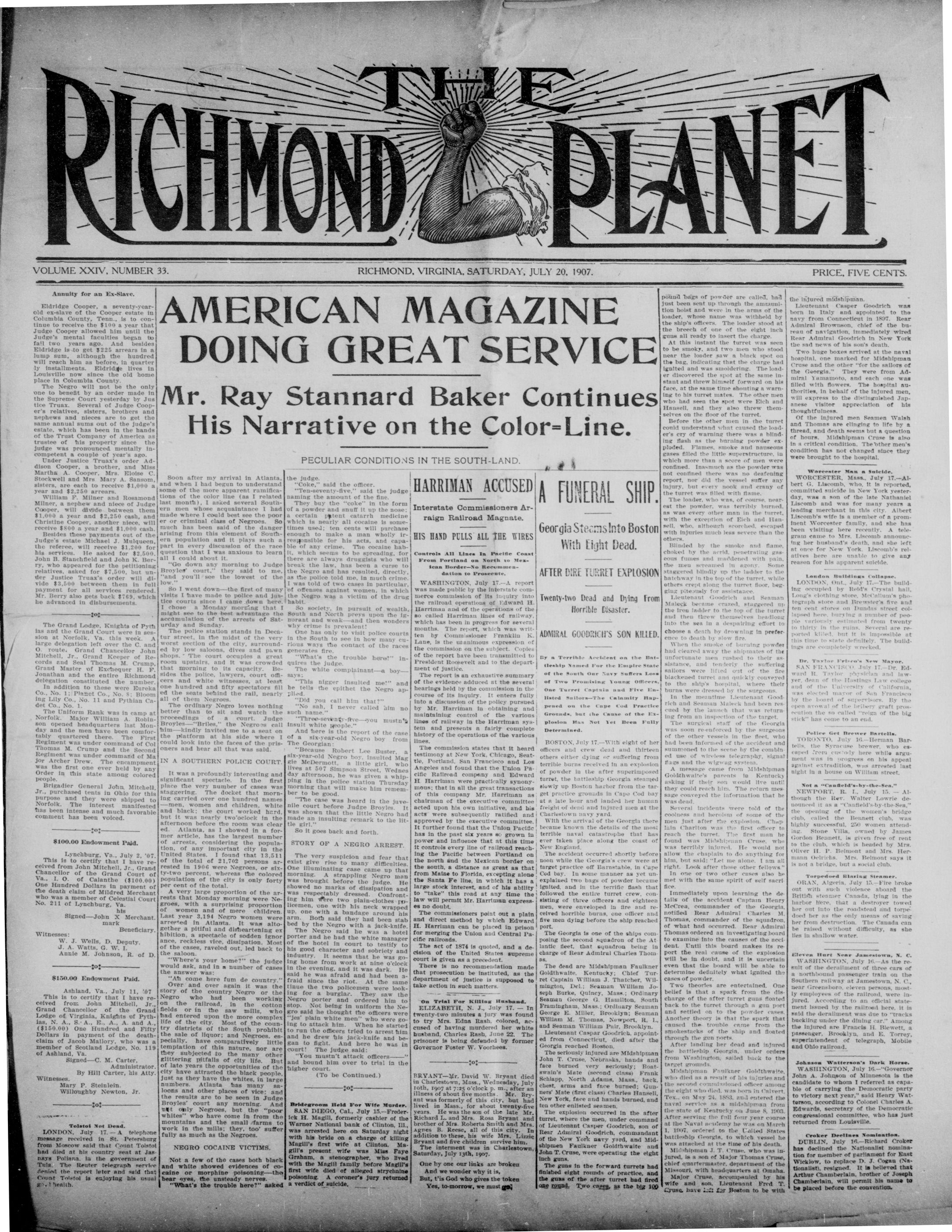
Richmond Planet
Saturday, July 20, 1907
Richmond, Virginia
Page text (machine-generated)
THE RICHMOND PLANET
Annuity for an Ex-Slave.
Eldridge Cooper, a seventy-year-old ex-slab of the Cooper estate in Columbia County, Tenn., is to continue to receive the $100 a year that Judge Cooper allowed him until the Judge's mental faculties began to fall two years ago. And besides Eldridge is to get $225 arrears in a lump sum, although the hundred will reach him as before, in quarter installments. Eldridge lives in Louisville now since the old home place in Columbia County. The Negro will not be the only one to benefit by an order made in the Supreme Court yesterday by Justice Truax. Several of Judge Cooper's relatives, sisters, brothers and nephews and nieces are to get the same annual sums out of the judge's estate, which has been in the hands of the Trust Company of America as trustee of his property since the judge was pronounced mentally incompetent a couple of year's ago. Under Justice Truax's order Adison Cooper, a brother, and Miss Martha A. Cooper, Mrs. Eloise C. Stockwell and Mrs. Mary A. Sansom, sisters, are each to receive $1,000 a year and $2,250 arrears. William F. Millard and Rosamond Cooper, a nephew and niece of Judge Cooper, will divide between them $1,000 a year and $2,250 cash, and Christine Cooper, another niece, will receive $800 a year and $1,000 cash.
Besides these payments out of the Judge's estate Michael J. Mulqueen, the referee, will receive $1,200 for his services. He asked for $2,500. John B. Stanchfield and John K. Berry, who appeared for the petitioning relatives, asked for $7,500, but under Justice Truax's order will divide $3,500 between them in full payment for all services rendered. Mr. Berry also gets back $769, which he advanced in disbursements.
The Grand Lodge, Knights of Pythias and the Grand Court were in session at Norfolk, Va. this week. A large delegation left over the C. and O. route. Grand Chancellor John Mitchell, Jr., Grand Keeper of Records and Seal Thomas M. Crump, Grand Master of Exchequer H. F. Jonathan and the entire Richmond delegation constituted the number. In addition to these were Eureka Co., No. 1; Planet Co., No. 8; Blooming Lily Co., No. 11 and Pythian Cudet Co., No. 1.
The Uniform Rank was in camp at Norfolk. Major William A. Robinson opened headquarters last Monday and the men have been comfortably quartered there. The First Regiment was under command of Col Thomas M. Crump and the Second Regiment was under command of Major Archer Drew. The encampment was the first one ever held by any Order in this state among colored people.
Brigadier General John Mitchell, Jr., purchased tents in Ohio for this purpose and they were shipped to Norfolk. The interest manifested has been intense and much favorable comment has been voiced.
$100.00 Endowment Paid.
Lynchburg, Va., July 2, '07
This is to certify that I have received from John Mitchell, Jr., Grand Chancellor of the Grand Court of O. of Calanthe ($100.00)
One Hundred Dollars in payment of the death claim of Mildred Merchant who was a member of Celestial Court No. 211 of Lynchburg, Va.
W. J. Wells, D. Deputy.
J. A. Watts, G. W. I.
Annie M. Johnson, R. of D
$150.00 Endowment Paid.
Ashland, Va. July 11, .07
This is to certify that I have received from John Mitchell, Jr.,
Grand Chancellor of the Grand
Lodge of Virginia, Knights of Pythias,
N. A., S. A., E., A., A. and A.,
($150.00) One Hundred and Fifty
Dollars in payment of the death-
claim of Jacob Mallory, who was a
member of Scotland Ledge, No. 119
of Ashland, Va.
Signed—C. M. Carter.
Mary P. Steinlein.
Willoughby Newton, Jr.
LONDON, July 17. - A telephone message received in St. Petersburg from Moscow said that Count Tolstol had died at his country seat at Jasnays Pollana, in the government of Tula. The Reuter telegraph service denied the report later and said that Count Tolstol is enjoying his usual good health.
AMERICAN MAGAZINE DOING GREAT SERVICE
Mr. Ray Stannard Baker Continues His Narrative on the Color=Line.
Soon after my arrival in Atlanta, and when I had begun to understand some of the more apparent ramifications of the color line (as I related last month), I asked several Southern men whose acquaintance I had made where I could best see the poorer or criminal class of Negroes. So much has been said of the danger arising from this element of Southern population and it plays such a part in every discussion of the race question that I was anxious to learn all I could about it.
"Go down any morning to Judge Broylest court," they said to me, "and you'll see the lowest of the low."
So I went down—the first of many visits I have made to police and Justice courts since I came down here. I chose a Monday morning that I might see to the best advantage the accumulation of the arrests of Saturday and Sunday.
The police station stands in Decatur street, in the midst of the very worst section of the city, surrounded by low saloons, dives and pawn shops. The court occupies a great room upstairs, and it was crowded that morning to its capacity. Besides the police, lawyers, court officers and white witnesses, at least one hundred and fifty spectators filled the seats behind the rail, nearly all of them Negroes.
The ordinary Negro loves nothing better than to sit and watch the proceedings of a court. Judge Broyles—"Briles," the Negroes call him—kindly invited me to a seat on the platform at his side where I could look into the faces of the prisoners and hear all that was said.
IN A SOUTHERN POLICE COURT
It was a profoundly interesting and significant spectacle. In the first place the very number of cases was staggering. The docket that morning carried over one hundred names—men, women and children, white and black; the court worked hard, but it was nearly two o'clock in the afternoon before the room was clear ed. Atlanta, as I showed in a former article, has the largest number of arrests, considering the population, of any important city in the United States. I found that 13,511 of the total of 21,702 persons arrested in 1906 were Negroes, or sixty-two percent, whereas the sixty-population of the city is only forty per cent of the total.
A very large proportion of the arrests that Monday morning were Negroes, with a surprising proportion of women and of mere children. Last year 3,194 Negro women were arrested in Atlanta. It was altogether a pitiful and disheartening exhibition, a spectacle of sodden ignorance, reckless vice, dissipation. Most of the cases, raveled out, led back to the saloon.
"Where's your home?" the judge would ask, and in a number of cases the answer was:
"Ah come here fum de country."
Over and over again it was the story of the country Negro or the Negro who had been working on the railroad, in the cotton fields or in the saw mills, who had entered upon the more complex life of the city. Most of the country districts of the South prohibit the sale of liquor; and Negroes, especially, have comparatively little temptation of this nature, nor are they subjected to the many other glittering pitfalls of city life. But of late years the opportunities of the city have attracted the black people, just as they have the whites, in large numbers. Atlanta has many saloons and other places of vice; and the results are to be seen in Judge Broyles' court any morning. And not only Negroes, but the "poor whites" who have come in from the mountains and the small farms to work in the mills; they, too, suffer fully as much as the Negroes.
NEGRO COCAINE VICTIMS.
Not a few of the cases both black and white showed evidences of cocaine or morphine poisoning—the bear eyes, the unsteady nerves. The sweets were sealed.
RICHMOND, VIRGINIA, SATURDAY, JULY 20, 1907.
PECULIAR CONDITIONS IN THE SOUTH-LAND. the judge.
"Coke." said the officer
"One, sate the outcet."
"Two, sate the sate the judge
naming the proctest of the
harming the amount of the line.
They buy the "coke" in the form of a powder and snuff it up the nose; a certain potent catarrh medicine which is nearly all cocaine is sometimes used; ten cents will purchase enough to make a man wholly irresponsible for his acts, and capable of any crime. The cocaine habit, which seems to be spreading, for there are always druggists who will break the law, has been a curse to the Negro and has resulted, directly, as the police told me, in much crime. I was told of two cases in particular, of offenses against women, in which the Negro was a victim of the drug habit.
So society, in pursuit of wealth, South and North preys upon the ignorant and weak—and then wonders why crime is prevalent!
One has only to visit police courts in the South to see in how many curious ways the contact of the races generates fire.
"What's the trouble here?" inquires the judge.
The white complainant—a boy—
says:
"This nigger insulted me!" and
he tells the epithet the Negro applied.
"Did you call him that?"
"No sah, I never called him no such name."
"Three seventy-five—you mustn't insult white people."
And here is the report of the case of a six-year-old Negro boy from The Georgian:
"Because Robert Blee Buster, a six-year-old Negro boy, insulted Maggie McDermott, a little girl, who lives at 507 Simpson Street, Wednesday afternoon, he was given a whipping in the police station Thursday morning that will make him remember to be good.
"The case was heard in the juvenile court before Judge Broyles. It was shown that the little Negro had made an insulting remark to the little girl."
So it goes back and forth.
STORY OF A NEGRO ARREST
The very suspicion and fear that exist give rise to many difficulties. One illuminating case came up that morning. A strapping Negro man was brought before the judge. He showed no marks of dissipation and was respectably dressed. Confronting him were two plain-clothes policemen, one with his neck wrapped up, one with a bandage around his arm. Both said they had been stabbed by the Negro with a jack-knife. The Negro said he was a hotel porter and he had the white manager of the hotel in court to testify to his good character and sobriety and industry. It seems that he was going home from work at nine o'clock in the evening, and it was dark. He said he was afraid and had been afraid since the riot. At the same time the two policemen were looking for a burglar. They saw the Negro porter and ordered him to stop. Not being in uniform the Negro said he thought the officers were "jes' plain white men" who were going to attack him. When he started to run the officers tried to arrest him and he drew his jack-knife and began to fight. And here he was in court! The judge said: "You mustn't attack officers——" and bound him over to trial in the higher court. (To be Continued.)
Bridegroom Held For Wife Murder.
HARRIMAN ACCUSED
Interstate Commissioners Arraign Railroad Magnate.
HIS HAND PULLS ALL THE WIRES
Controls All Lines In Pacific Coast From Portland on North to Mexican Border-No Recommendation to Prosecute.
WASHINGTON, July 17.-A report was made public by the interstate commerce commission of its inquiry into the railroad operations of Edward H. Harriman and of the operations of the so called Harriman lines of railway, which has been in progress for several months. The report, which was written by Commissioner Franklin K. Lane, is the unanimous expression of the commission on the subject. Copies of the report have been transmitted to President Roosevelt and to the department of justice.
The report is an exhaustive summary of the evidence adduced at the several hearings held by the commission in the course of its inquiry. It enters fully into a discussion of the policy pursued by Mr. Harriman in obtaining and maintaining control of the various lines of railway in the Harriman system and presents a fairly complete history of the operations of the various lines.
The commission states that it heard testimony at New York, Chicago, Seattle, Portland, San Francisco and Los Angeles and found that the Union Pacific Railroad company and Edward H. Harriman were practically synonymous; that in all the great transactions of this company Mr. Harriman as chairman of the executive committee acted upon his own initiative, and his acts were subsequently ratified and approved by the executive committee. It further found that the Union Pacific has in the past six years so grown in power and influence that at this time it controls every line of railroad reaching the Pacific between Portland on the north and the Mexican border on the south, a distance as great as that from Maine to Florida, excepting alone the Santa Fe line, in which it has a large stock interest, and of his ability to "take" this road at any time the law will permit Mr. Harriman expresses no doubt.
The commissioners point out a plain and direct method by which Edward H. Harriman can be placed in prison for merging the Union and Central Pacific railroads.
The act of 1874 is quoted, and a decision of the United States supreme court is given as a precedent.
There is no recommendation made that prosecution be instituted, as the department of justice is supposed to take action in such matters.
On Trial For Killing Husband.
ELIZABETH, N. J., July 17. — In twenty-two minutes a jury was found to try Mrs. Edna Rash, colored, accused of having murdered her white husband, Charles Rash, June 22. The prisoner is being defended by former Governor Foster W. Voorhees.
BRYANT—Mr. David W. Bryant died in Charlestown, Mass., Wednesday, July 10th, 1997 at 7:25 o'clock p. m., after an illness of about five months. Mr. Bryant was formerly of this city, but had lived in Mass., for about twenty-five years. He was the son of the late Mr. Richard L. and Mrs. Rosa Bryant and brother of Mrs. Roberta Smith and Mrs. Agnes B. Reese, all of this city. In addition to these, his wife Mrs. Lizzie Bryant and five children survive him.
The interment was in Charlestown, Saturday, July 13th, 1907.
One by one our links are broken
And we wonder why it is,
But, t'is God who gives the token
Yes, to-morrow, we must go.
AFTER DIRE TURRET EXPLOSION
Twenty-two Dead and Dying From Horrible Disaster.
ADMIRAL GOODRICH'S SON KILLED.
By a Terrible Accident on the Battleship Named For the Empire State of the South Our Navy Suffers Loss of Two Promising Young Officers, One Turret Captain and Five Enlisted Sailors—The Calamity Happened on the Cape Cod Practice Grounds, but the Cause of the Explosion Has Not Yet Been Fully Determined.
BOSTON, July 17.—With eight of her officers and crew dead and thirteen others either dying or suffering from terrible burns received in an explosion of powder in the after superimposed turret, the battleship Georgia steamed slowly up Boston harbor from the target practice grounds in Cape Cod bay at a late hour and landed her human freight of dead and injured men at the Charlestown navy yard.
With the arrival of the Georgia there became known the details of the most terrible naval catastrophe that has ever taken place along the coast of New England.
The accident occurred shortly before noon while the Georgia's crew were at target practice off Barnstable, in Cape Cod bay. In some manner as yet unexplained two bags of powder became ignited, and in the terrific flash that followed the entire turret crew, consisting of three officers and eighteen men, were enveloped in fire and received horrible burns, one officer and five men dying before the ship reached port.
The Georgia is one of the ships composing the second squadron of the Atlantic fleet, that squadron being in charge of Rear Admiral Charles Thomas.
The dead are Midshipman Faulkner Goldthwaite, Kentucky; Chief Turret Captain William J. Thatcher, Wilmington, Del; Seaman William Joseph Burke, Quincy, Mass; Ordinary Seaman George G. Hamilton, South Framingham, Mass; Ordinary Seaman George E. Miller, Brooklyn; Seaman William M. Thomas, Newport, R. I., and Seaman William Pair, Brooklyn.
Lieutenant Caspar Goodrich, appointed from Connecticut, died after the Georgia reached Boston.
The seriously injured are Midshipman John T. Cruse, Nebraska, hands and face burned very seriously; Boatswain's Mate (second class) Frank Schapp, North Adams, Mass., back, chest, arms and face burned; Gunners' Mate (first class) Charles Hansell, New York, face and hands burned, and ten other enlisted seamen.
The explosion occurred in the after turret, where the men, under command of Lieutenant Casper Goodrich, son of Rear Admiral Goodrich, commander of the New York navy yard, and Midshipmen Faulkner Goldthwaite and John T. Cruse, were operating the eight inch guns. The guns in the forward turrets had finished eight rounds of practice, and the guns of the after turret had fired one round. Two cases, as the big 100
pound bags of powder are called, had just been sent up through the amtraimiation hoist and were in the arms of the loader, whose name was withheld by the ship's officers. The loader stood at the breech of one of the eight inch guns all ready to insert the charge.
At this instant the turret was seen to be smoky, and two men who stood near the loader saw a black spot on the bag, indicating that the charge had ignited and was smoother. The loader discovered the spot at the same instant and threw himself forward on his face, at the same time shouting a warning to his turret mates. The other men who had seen the spot were Elch and Hansell, and they also threw themselves on the floor of the turret.
Before the other men in the turret could understand what caused the loader's cry of warning there was a blinding flash as the burning powder exploded. Flames, smoke and nauseous gases filled the little superstructure, in which more than a score of men were confined. Inasmuch as the powder was not confined there was no deafening report, nor did the vessel suffer any injury, but every nook and cranny of the turret was filled with flame.
The loader, who was, of course, nearest the powder, was terribly burned, as was every other man in the turret, with the exception of Elch and Hansell, who, although scorched, escaped with injuries much less severe than the others.
Blinded by the smoke and flame, choked by the acrid, penetrating gaseous fumes and maddened with pain, the men screamed in agony. Some staggered blindly up the ladder to the hatchway in the top of the turret, while others crept along the turret floor, begging piteously for assistance.
Lieutenant Goodrich and Seaman Maleck became crazed, staggered up the iron ladder to the top of the turret and then threw themselves headlong into the sea in a despairing effort to choose a death by drowning in preference to death by slow fire.
When the smoke of burning powder had cleared away the shipmates of the unfortunate men rushed to their assistance, and tenderly the suffering sailors were lifted out of the fire blackened turret and quickly conveyed to the ship's hospital, where their burns were dressed by the surgeons.
In the meantime Lieutenant Goodrich and Seaman Maleck had been rescued by the launch that was returning from an inspection of the target.
The surgical staff of the Georgia was soon re-enforced by the surgeons of the other vessels in the fleet, who had been informed of the accident and summoned to the scene by the combined use of wireless telegraphy, signal flags and the wigwag system.
A message came from Midshipman Goldthwaite's parents in Kentucky asking if their son would live until they could reach him. The return message conveyed the information that he was dead.
Several incidents were told of the coolness and heroism of some of the men just after the explosion. Chaplin Charlton was the first officer to reach the turret. The first man he found was Mildshipman Cruse, who was terribly injured. He would not allow the chaplain to do anything for him, but said: "Let me alone. I am all right. Look after those other fellows." In one or two other cases also he met with the same spirit of self sacrifice.
Immediately upon learning the details of the accident Captain Henry McCrea, commander of the Georgia, notified Rear Admiral Charles M. Thomas, commander of the squadron, of what had occurred. Rear Admiral Thomas ordered an investigating board to examine into the causes of the accident. Until this board makes its report the real cause of the explosion will be in doubt, and it is uncertain even that the board will be able to determine definitely what ignited the cases of powder.
Two theories are entertained. One belief is that a spark from the discharge of the after turret guns floated back to the turret through a gun port and settled on to the powder cases. Another theory is that the spark that caused the trouble came from the smokestacks of the ship and floated through the gun ports.
After landing her dead and injured the battleship Georgia, under orders from Washington, sailed back to the target grounds.
Midshipman Foulkner Goldthwaite, who died as a result of his injuries and the second commissioned officer among the eight who died, was born in Calvert, Tex., on May 24, 1883, and entered the naval service as a midshipman from the state of Kentucky on June 8, 1903. After serving the full four year course at the Naval academy he was on March 1, 1907, ordered to the United States battleship Georgia, to which vessel he was attached at the time of his death. Midshipman J. T. Cruse, who was injured, is a son of Major Thomas Cruse, chief quartermaster, department of the Missouri, with headquarters at Omaha. Major Cruse, accompanied by his wife and son, Lleutenant Fred Cruse, has left for Boston to be with
PRICE, FIVE CENTS
the injured midshipman.
Lieutenant Casper Goodrich was born in Italy and appointed to the navy from Connecticut in 1897. Rear Admiral Brownson, chief of the bureau of navigation, immediately wired Rear Admiral Goodrich in New York the sad news of his son's death.
Two huge boxes arrived at the naval hospital, one marked for Midshipman Cruse and the other "for the sailors of the Georgia." They were from Admiral Yamamoto, and each one was filled with flowers. The hospital authorities, in behalf of the injured men, will express to the distinguished Japanese visitor appreciation of his thoughtfulness.
Of the injured men Seamen Walsh and Thomas are clinging to life by a thread, and death seems but a question of hours. Midshipman Cruse is also in a critical condition. The other men's condition has not changed since they were brought to the hospital.
Worcester Man. a Spike
WORCESTER, Mass., July 17.—Albert G. Lliscomb, who, it is reported, committed suicide in New York yesterday, was a son of the late Nathaniel Lliscomb and was for many years a leading merchant in this city. Albert Lliscomb's wife is a member of a prominent Worcester family, and she has been visiting here recently. A telegram came to Mrs. Lliscomb announcing her husband's death, and she left at once for New York. Lliscomb's relatives here are unable to give any reason for his apparent suicide.
London Buildings Collapses
LONDON, Ont., July 17.—The building occupied by Reid's Crystal hall, Long's clothing store, McCallum's photograph store and Brewster's five and ten cent stores on Dundas street collapsed here, burging a number of people variously estimated from twenty to thirty in the ruins. Several are reported killed, but it is impossible at this time to state definitely. The buildings are completely wrecked.
Dr. Taylor Erisco's New Mayor
Dr. Taylor Prisca's New Mayor.
SAN FRANCISCO, July 17.-Dr. Edward R. Taylor physician and lawyer, dean of the Hastings Law college and of the University of California, was elected mayor of San Francisco by the board of supervisors. By the open aweval of the bribery graft prosecution the so called "reign of the big stick" has come to an end.
Police Get Brewer Bartells
TORONTO, July 16—Herman Bartells, the Syracuse brewer, who escaped from custody here while argument was in progress on his appeal against extradition, was arrested last night in a house on William street.
Not n. "Candold's by the Sea."
NEWPORT, R. I., July 15. — Although the Rev. Walter Lowie denounced it as a "Canfield's-by-the Sea," the opening of the women's bridge club, called the Bennett club, was highly successful, 250 women attending. Stone Villa, owned by James Gordon Bennett, is given free of rent to the club, which is headed by Mrs. Oliver H. P. Belmont and Mrs. Hermann Oelrichs. Mrs. Belmont says it is not a bridge, but a social club.
Torpedoed Blaring Steamer
ORAN, Algeria, July 15. - Fire broke out with such violence aboard the British steamer Canada, lying in the harbor here, that a destroyer towed her out into the roadstead and torpedoed her as the only means of saving her from destruction. The Canada can be raised without difficulty, as she lies in shallow water.
Eleven Hurt Near Jamestown, N. C.
WASHINGTON, July 16.—As the result of the derailment of three cars of a northbound passenger train on the Southern railway at Jamestown, N. C., near Greensboro, eleven persons, mostly employees of the railroad, were injured. According to an official statement issued by the railroad here, it is said the derailment was due to "tracks buckling under the dining car." Among the injured are Francis H. Blewett, a passenger, Brooklyn, and E. Torrey, superintendent of telegraph, Mobile and Ohio railroad.
Johnson Watterson's Dark Horse.
WASHINGTON, July 16.—"Governor John A. Johnson of Minnesota is the candidate to whom I referred as capable of carrying the Democrat party to victory next year," said Henry Watterson, according to Colonel Charles A. Edwards, secretary of the Democratic congressional committee, who has just returned from Louisville.
Croker Decliner Nomination.
Croker Bestines nomination
DUBLIN, July 7. Croker has declined a Nationalist nomination for member of parliament for East Wakefield, to replace D. J. Cogan (Nationalist), resigned. It is believed that Arthur Chamberlain, brother of Joseph Chamberlain, will permit his name to be placed before the convention.
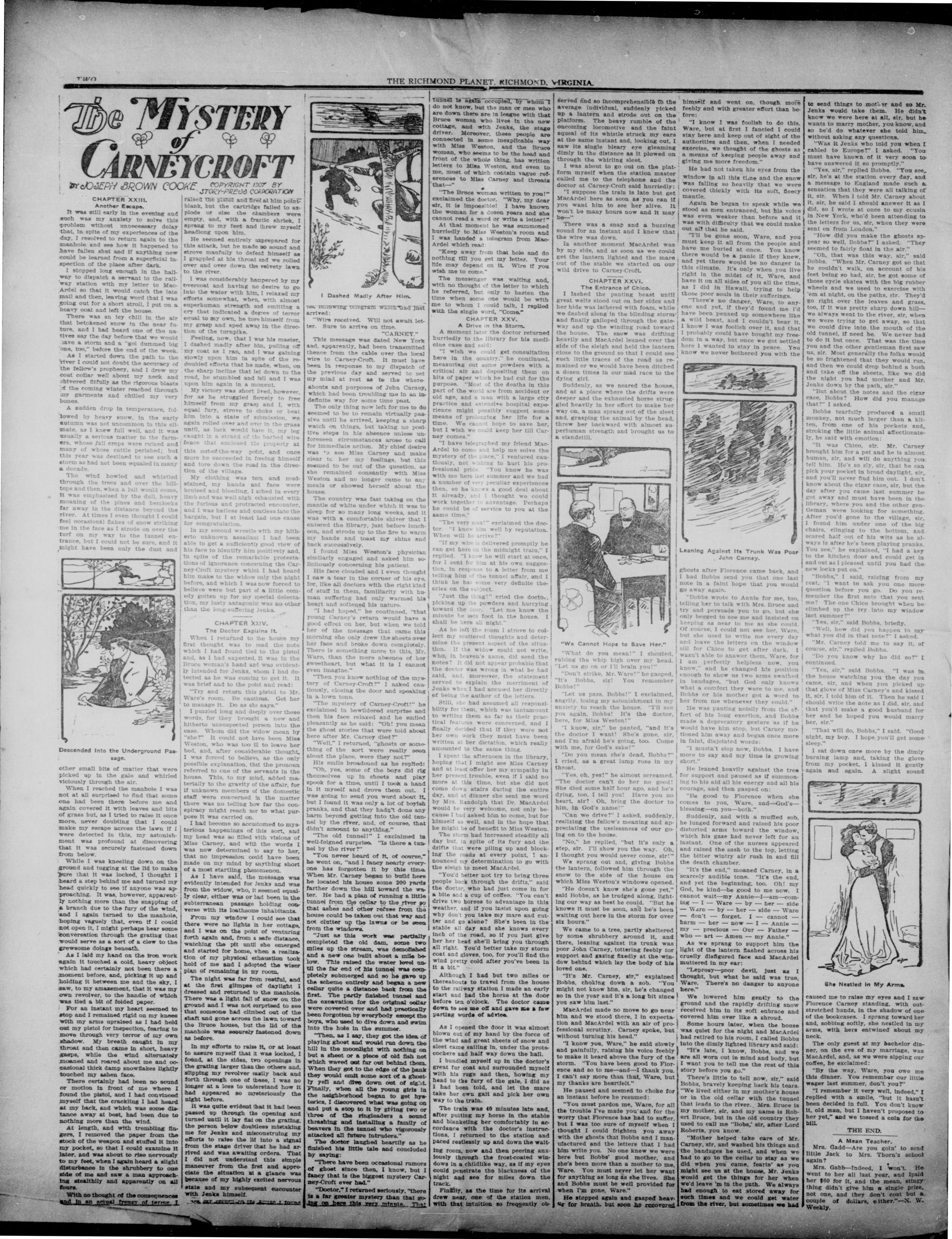
The MYSTERY of CARNEYCROFT
JOSEPH BROWN COOKE COPYRIGHT 1907 BY
STORY-BROWN CORPORATION
CHAPTER XXIII. Another Escape.
It was still early in the evening and such was my anxiety to solve this problem without unnecessary delay that, in spite of my experiences of the day, I resolved to return again to the manhole and see how it happened to have fallen shut and if anything new could be learned from a superficial inspection of the place after dark.
I stopped long enough in the hallway to dispatch a servant to the railway station with my letter to MacArdel so that it would catch the late mail and then, leaving word that I was going out for a short stroll, I put on a heavy coat and left the house.
There was an icy chill in the air that betoken snow in the near future, and I had heard one of the natives say the day before that we would have a storm and a "gol dummed big one," before the end of the day.
As I started down the path to the river I could not doubt the accuracy of the fellow's prophecy, and I drew my coat collar well about my neck and shivered fitfully as the rigorous blasts of the coming winter reached through my garments and chilled my very bones.
A sudden drop in temperature, followed by heavy snow, in the early autumn was not uncommon in this climate, as I knew full well, and it was usually a serious matter to the farmers, whose fall crops were ruined and many of whose cattle perished; but this year was destined to see such a storm as had not been equaled in many a decade.
The wind howled and whistled through the trees and over the hill, tops and then, when a full would come, it was emphasized by the dull, heavy meaning of the pines and hemlocks far away in the distance beyond the river. At times I even thought I could feel occasional flakes of snow striking me in the face as I strode on over the turf on my way to the tunnel entrance, but I could not be sure, and it might have been only the dust, and it
A. A. W.
Descended Into the Underground Passage.
other small bits of matter that were picked up in the gale and whirled viciously through the air.
When I reached the manhole I was not at all surprised to find that some one had been there before me and again covered it with leaves and bits of grass but, as I tried to raise it once more, never doubting that I could make my escape across the lawn if I were detected in this, my astonishment was profound at discovering that it was securely fastened down from below.
While I was kneeling down on the ground and tugging at the lid to make pure that it was locked, I thought I heard a step behind me and turned my head quickly to see if anyone was approaching. It was, however, apparently nothing more than the snapping of a branch due to the fury of the wind, and I again turned to the manhole, hoping vaguely that, even if I could not open it, I might perhaps hear some conversation through the grating that would serve as a sort of a clew to the grewsome doings beneath.
As I laid my hand on the iron work again it touched a cold, heavy object which had certainly not been there a moment before, and, picking it up and holding it between me and the sky, I saw, to my amazement, that it was my own revolver, to the handle of which was tied a bit of folded paper.
For an instant my heart seemed to stop and I remained rigid on my knees with my arms upraised as I had held out my pistol for inspection, fearing to move through very terror of my own shadow. My breath caught in my throat and then came in short, heavy gasps, while the wind alternately moaned and roared about me and occasional thick damp snowflakes lightly touched my ashen face. There certainly had been no sound or motion in front of me where I found the pistol, and I had convinced myself that the crackling I had heard at my back, and which was some distance away at best, had been due to nothing more than the wind.
At length, and with trembling fingers, I removed the paper from the stock of the weapon and stuffed it into my pocket, so that I could examine it later, and was about to rise nervously to my feet, when I again heard a slight disturbance in the shrubbery to one side of me and saw a man approaching stealthily and apparently on all fours.
With no thought of the consequences and in an actual frenzy of terror, I
raised the pistol and fired at him point-blank, but the cartridge failed to explode or else the chambers were empty, and, with a frantic shriek, I sprang to my feet and threw myself headlong upon him.
He seemed entirely unprepared for this attack, but he made no sound and strove manfully to defend himself as I grappled at his throat and we rolled over and over down the velvety lawn to the river.
I was considerably hampered by my overcoat and having no desire to go into the water with him. I relaxed my efforts somewhat, when, with almost superhuman strength and emitting a cry that indicated a degree of terror equal to my own, he tore himself from my grasp and sped away in the direction of the turnpike.
Feeling, now, that I was his master, I dashed madly after him, pulling off my coat as I ran, and I was gaining slowly upon him in spite of the rodoubled efforts that he made, when on the sharp incline that led down to the road, he stumbled and fell and I was upon him again in a moment.
My victory was short lived, however, for as he struggled fiercely to free himself from my grasp and I, with equal fury, strove to choke or beat him into a state of submission, we again rolled over and over in the grass until, as luck would have it, my leg caught in a strand of the barbed wire fence that enclosed the property at this out-of-the-way point, and once more he succeeded in freeing himself and tore down the road in the direction of the village.
My clothing was torn and mud-stained, my hands and face were bruised and bleeding. Iached in every limb and was well nigh exhausted with the furious and protracted encounter, and I was hatless and coatless into the bargain, but I at least had one cause for congratulation.
In my second wrestle with my hitherto unknown assailant I had been able to get a sufficiently good view of his face to identify him positively and, in spite of the remarkable protestations of ignorance concerning the Carney-Croft mystery which I had heard him make to the widow only the night before, and which I was now forced to believe were part of a little comedy gotten up for my special delectation, my lusty antagonist was no other than the long-suffering Jenka.
CHAPTER XXIV.
When I returned to the house my first thought was to read the note which I had found tied to the pistol and, as I had expected, it was in the Bruce woman's hand and was evidently intended for Jenks, whom I had detected as he was coming to get it. It was brief and to the point and read: "Try and return this pistol to Mr. Ware's room. Be cautious. Get her to manage it. Do as she says."
I puzzled long and deeply over these words, for they brought a new and hitherto unsuspected person into the case. Whom did the widow mean by "she?" It could not have been Miss Weston, who was too ill to leave her bed, and, after considerable thought, I was forced to believe, as the only possible explanation, that the pronoun referred to one of the servants in the house. This, to my mind, added materially to the gravity of the affair, for if unknown members of the domestic staff were concerned in the matter there was no telling how far the conspiracy might reach nor to what purpose it was carried on.
I had become so accustomed to mysterious happenings of this sort, and my head was so filled with visions of Miss Carney, and with the words I was now determined to say to her, that no impression could have been made on my mind by anything short of a most startling phenomenon.
As I have said, the message was evidently intended for jenks and was from the widow, who, it seemed equally clear, either was or had been in the subterranean passage holding converse with its loathsome inhabitants. From my window I could see that there were no lights in her cottage, and I was on the point of venturing forth again and, from a safe distance, watching the pit until she emerged and started for home, when a realization of my physical exhaustion took hold of me and I adopted the wiser plan of remaining in my room. The night was far from restful, and at the first glimpse of daylight I dressed and returned to the manhole. There was a light fall of snow on the ground and I was not surprised to see that someone had climbed out of the shaft and gone across the lawn toward the Bruce house, but the lid of the manhole was securely fastened down as before.
In my efforts to raise it, or at least to assure myself that it was locked, I found, at the sides, two openings in the grating larger than the others and, slipping my revolver easily back and forth through one of these, I was no longer at a loss to understand how it had appeared so mysteriously the night before.
It was quite evident that it had been passed up through the opening and turned until it lay flat on the grating, the person below doubtless mistaking me for Jenks and misconstruing my efforts to raise the lid into a signal from the stage driver that he had arrived and was awaiting orders. That I did not understand this simple maneuver from the first and appreciate the situation at a glance was because of my highly excited nervous state and my subsequent encounter with Jenks himself.
THE RICHMOND PLANET, RICHMOND, VIRGINIA
A
I Dashed Madly After Him.
we renowing telegram which had just arrived:
"Wire received. Will not await letter. Sure to arrive on time.
"CARNEY."
This message was dated New York and, apparently, had been transmitted thence from the cable over the local wire to Carney-Croft. It must have been in response to my dispatch of the previous day and served to set my mind at rest as to the whereabouts and purposes of John Carney, which had been troubling me in an indefinite way for some time past.
The only thing now left for me to do seemed to be to remain virtually passive until he arrived, keeping a sharp watch on things, but taking no positive steps in his absence unlees unforeseen circumstances arose to call for immediate action. My chief desire was to see Miss Carney and make clear to her my feelings, but this seemed to be out of the question, as she remained consantly with Miss Weston and no longer came to any meals or showed herself about the house.
The country was fast taking on the mantle of white under which it was to sleep for so many long weeks, and it was with a comfortable shiver that I entered the library, just before lunchoon, and strode up to the fire to warm my hands and toast my shins and back successively.
I found Miss Weston's physician similarly engaged and asked him solicitously concerning his patient.
His face clouded and I even thought I saw a tear in the corner of his eye, for, like all doctors with the right kind of stuff in them, familiarity with human suffering had only warmed his heart and softened his nature.
"I had hoped," he continued, "that young Carney's return would have a good effect on her, but when we told her of the message that came this morning she only drew the sheets over her face and broke down completely. There is something more to this, Mr. Ware, than the mere absence of her sweetheart, what it is I cannot even imagine."
"Then you know nothing of the mystery of Carney-Croft?" I asked cautiously, closing the door and speaking in a lown tone.
"The mystery of Carney-Croft!" he exclaimed in bewildered surprise and then his face relaxed and he smiled pleasantly as he said: "Oh! you mean the ghost stories that were told about here after Mr. Carney died?"
"Well," I returned, "ghosts or something of the sort were really seen about the place, were they not?"
His smile broadened as he replied: "Oh, yes, some of the boys did rig themselves up in sheets and play spook for a time, until I took a hand in it myself and drove them out. I was going to send you word about it, but I found it was only a lot of boyish pranks, and that they hadn't done any harm beyond getting into the old tunnel by the river, and, of course, that didn't amount to anything."
"The old tunnel!" I exclaimed in well-fearned surprise. "Is there a tunnel by the river?"
"You never heard of it, of course," he went on, "and I fancy nearly everyone has forgotten it by this time. When Mr. Carney began to build here he located his house some 200 yards farther down the hill toward the water. He had a plan of running a little tunnel from the cellar to the river so that ashes and other refuse from the house could be taken out that way and not clutter up the lawns or be seen from the windows.
"Just as this work was partially completed the old dam, some two miles up the stream, was demolished and a new one built about a mile below. This raised the water level until the far end of his tunnel was completely submerged and so he gave up the scheme entirely and began a new cellar quite a distance back from the first. The partly finished tunnel and the excavation for the original cellar were covered over and had practically been forgotten by everybody except the boys, who used to dive down and swim into the hole in the summer.
"Then, as I say, they got the idea of playing ghost and would run down the hill in the moonlight with nothing on but a sheet or a piece of old fish net which waved out far out behind them. When they got to the edge of the bank they would emit some sort of a ghostly yell and dive down out of sight. Finally, when all the young girls in the neighborhood began to get hysterics, I discovered what was going on and put a stop to it by giving two or three of the ringleaders a sound thrashing and installing a family of beavers in the tunnel who vigorously attacked all future intruders."
The doctor laughed heartily as he finished his little tale and concluded by saying:
"There have been occasional rumors of ghost since then, I know, but I fancy that is the biggest mystery Carney-Croft ever had."
"Doctor," I returned seriously, "there is a far greater mystery than that going on here this very minute. That
tunnel is again occupied, by whom I do not know, but the man or men who are down there are in league with that Bruce woman who lives in the new cottage, and with Jeens, the stage driver. Moreover, these people are connected in some inexplicable way with Miss Weston, and the Bruce woman, who seems to be the head and front of the whole thing, has written letters to Miss Weston, and even to me, most of which contain vague references to Miss Carnoy and threats that—
"The Bruce woman written to you!" exclaimed the doctor. "Why, my dear sir, it is impossible! I have known the woman for a dozen years and she cannot read a word or write a letter!" At that moment he was summoned hurriedly to Miss Weston's room and I was handed a telegram from Mao-Ardel which read:
"Keep away from that hole and do nothing till you get my letter. Your life may depend on it. Wire if you wish me to come."
The messenger was waiting and, with no thought of the letter to which he referred, but only to hasten the time when some one would be with me to whom I could talk, I replied with the single word, "Come."
CHAPTER XXV.
A Drive in the Storm.
A moment later the doctor returned hurriedly to the library for his medicine case and said:
"I wish we could get consultation here in the country," he continued, measuring out some powders with a critical air and depositing them on bits of paper which he had cut for the purpose. "Most of the deaths in this part of the world are from accident or old age, and a man with a large city practice and extensive hospital experience might possibly suggest some means of prolonging her life for a time. We cannot hope to save her, but I wish we could keep her till Carney comes."
"I have telegraphed my friend MacArdel to come and help me solve the mystery of the place," I ventured cautiously, not wishing to hurt his professional pride. "You know he was with me here last summer and we had a number of very peculiar experiences then, so he knows a good deal about it already, and I thought we could work together to advantage. Perhaps he could be of service to you at the same time."
"The very man!" exclaimed the doctor. "I know him well by reputation. When will he arrive?"
"If my wire is delivered promptly he can get here on the midnight train." I replied. "I know he will start at once, for I sent for him at his own suggestion, in response to a letter from me telling him of the tunnel affair, and I think he has some very definite theories on the subject.
"Just the thing!" cried the doctor, picking up the powders and hurrying toward the door. "Let me know the minute he sets foot in the house. I shall be here all night."
As he left the room I strove to collect my scattered thoughts and determine the present aspect of the situation. If the widow could not write, who, in heaven's name, did send the notes? It did not appear probable that the doctor was wrong in what he had said, and, moreover, the statement served to explain the merriment of Jenks when I had accused her directly of being the author of the letters.
Still, she had assumed all responsibility for them, which was taintamount to writing them as far as their practical features were concerned, and I finally decided that if they were not her own work they must have been written at her dictation, which really amounted to the same thing.
I spent the afternoon in the library, hoping that I might see Miss Carney and at least offer her my sympathy in her present trouble, even if I said no more at this time, but she did not come down stairs during the entire day, and at dinner she sent me word by Mrs. Randolph that Dr. MacArdel would be very welcome, not only because I had asked him to come, but for himself as well, and in the hope that he might be of benefit to Miss Weston. The storm had increased steadily all day but, in spite of its fury and the drifts that were piling up and blocking the roads at every point, I announced my determination to go with the sleigh to meet MacArdel.
"You'd better not try to bring three people back through the drifts," said the doctor, who had just come in for a bite and a cup of coffee. "You can't drive two horses to advantage in this weather, and if you insist upon going why don't you take my mare and cutter and go alone? She's been in the stable all day and she knows every inch of the road, so if you just give her her head she'll bring you through all right. You'd better take my storm coat and gloves, too, for you'll find the wind pretty cold after you've been in it a bit."
Although I had but two miles or thereabouts to travel from the house to the railway station I made an early start and had the horse at the door before ten o'clock. The doctor came down to see me off and gave me a few parting words of advice.
As I opened the door it was almost blown out of my hand by the force of the wind and great sheets of snow and sheet came sailing in, under the protecchere and half way down the hall.
I bundled myself up in the doctor's great fur coat and surrounded myself with his rugs and then, bowing my head to the fury of the gale, I did as I had been told, and let the mare take her own gait and pick her own way to the train.
The train was 40 minutes late and, after putting my horse in the stable and blanketing her comfortably in accordance with the doctor's instructions, I returned to the station and paced restlessly up and down the waiting room, now and then peering anxiously through the frost-coated windows in a childlike way, as if my eyes could penetrate the blackness of the night and see for miles down the track.
Finally, as the time for its arrival drew near, one of the station men, with that intuition so frequently ob
served and so incomprehensible to the average individual, suddenly picked up a lantern and strode out on the platform. The heavy rumble of the oncoming locomotive and the faint squeal of its whistle struck my ears at the same instant and, looking out, I saw its single bleary eye gleaming dimly in the distance as it plowed on through the whirling sleet.
I was about to go out on the platform myself when the station master called me to the telephone and the doctor at Carney-Croft said hurriedly: "I suppose the train is late but get MacArdel here as soon as you can if you want him to see her alive. It won't be many hours now and it may be—"
There was a snap and a buzzing sound for an instant and I knew that the wire was down.
In another moment MacArdel was by my side, and as soon as we could get the lantern lighted and the mare out of the stable we started on our wild drive to Carney-Croft.
CHAPTER XXVI.
The Entrance of China
I lashed the panting beast until great welts stood on her sides and her hide was lathered with foam, while we dashed along in the blinding storm and finally galloped through the gateway and up the winding road toward the house. The snow was drifting heavily and MacArdel leaned over the side of the sleigh and held the lantern close to the ground so that I could see such little traces of the road as remained or we would have been ditched a dozen times in our mad race to the dying girl.
Suddenly, as we neared the house, and at a place where the drifts were deeper and the exhausted horse struggled heavily in her effort to make her way on, a man sprang out of the sleet and, grasping the animal by the head, threw her backward with almost superhuman strength and brought us to a standstill.
10
"We Cannot Hope to Save Her."
"What do you mean!" I shouted, raising the whip high over my head. "Let us go on or I'll brain you!" "Don't strike, Mr. Ware!" he gasped, "It's Bobbs, sir! You remember Bobbs!"
"Let us pass, Bobbs!" I exclaimed, angrily, losing my astonishment in my anxiety to reach the house. "I'll see you again, Bobbs! It's the doctor, here, for Miss Weston!"
"I know, sir," he panted, "and it's the doctor I want! She's gone, sir, and I'm afraid he's going, too. Come with me, for God's sake!"
"Do you mean she's dead, Bobbs?" I cried, as a great lump rose in my throat.
"Yes, oh, yes!" he almost screamed.
"The doctor can't do her no good! She died some half hour ago, and he's dying, too. I tell you! Have you no heart, sir? Oh, bring the doctor to him, in God's name!"
"Can we drive?" I asked, suddenly, realizing the fellow's meaning and appreciating the uselessness of our going on to the house.
"No," he replied, "but it's only a step, sr. I'll show you the way. Oh.
I thought you would never come, sr."
"He doesn't know she's gone yet," said Bobbs, as he trudged along, lightning our way as best he could. "But he knows it must be soon, and he's been waiting out here in the storm for over six hours."
We came to a tree, partly sheltered by some shrubbery around it, and there, leaning against its trunk was poor John Carney, tottering feebly for support and gazing fixedly at the window behind which lay the body of his loved one.
"It's Mr. Carney, sir," explained Bobbs, choking down a sob. "You might not know him, sir, he's changed so in the year and it's a long bit since you saw him last."
MacArdel made no move to go near him and we stood there, in expectation and MacArdel with an air of professional scrutiny. Carney spoke, but without turning his head."
"I know you, Ware," he said slowly and painfully, raising his voice feebly to make it heard above the fury of the storm. "You have been good to Florence and so to me—and—I thank you. I can't say more than that, Ware, but my thanks are heartfelt."
He paused and seemed to choke for an instant before he resumed:
"You must pardon me, Ware, for all the trouble I've made you' and for the worry that Florence has had to suffer, but I was too sure of myself when I thought I could frighten you away with the ghosts that Bobbs and I manufactured and the letters that I had him write you. No one knew we were here but Bobbs' good mother, and she's been more than a mother to me, Ware. You must never let her want for anything as long as she lives. She and Bobbs must be well provided for when I'm gone, Ware."
He stopped again and gasped heavier for breath, but soon he recovered
himself and went on, though more feebly and with greater effort than before:
"I know I was foolish to do this, Ware, but at first I fancied I could stay here and keep out of sight of the authorities and then, when I needed exercise, we thought of the ghosts as a means of keeping people away and giving me more freedom."
He had not taken his eyes from the window in all this time and the snow was falling so heavily that we were covered thickly with its soft, fleecy mantle.
Again he began to speak while we stood as men entranced, but his voice was even weaker than before and it was with difficulty that we could make out all that he said.
"Til be gone soon, Ware, and you must keep it all from the people and have me buried at once. You know there would be a panic if they knew, and yet there would be no danger in this climate. It's only when you live right in the midst of it, Ware, and have it on all sides of you all the time, as I did in Hawaii, trying to help those poor souls in their sufferings.
"There's no danger, Ware, to anyone and yet, if they'd found me I'd have been penned up somewhere like a wild beast, and I couldn't bear it. I know I was foolish over it, and that I probably could have bought my freedom in a way, but once we got settled here I wanted to stay in peace. You know we never bothered you with the
A
Leaning Against Its Trunk Was Poor John Carney.
ghosts after Florence came back, and I had Bobbs send you that one last note in a faint hope that you would go away again.
"Bobbs wrote to Annie for me, too, telling her to talk with Mrs. Bruce and try and persuade you to go, but she only begged to see me and insisted on keeping as near to me as she could. Of course, I could not see her, Ware, but she used to write me every day and leave the letters on the window sill for Chico to get after dark. I wasn't able to answer them, Ware, for I am perfectly helpless now, you know," and he changed his position enough to show us two arms swathed in bandages, "but God only knows what a comfort they were to me, and Bobbs or his mother got a word to her from me whenever they could."
He was panting noisily from the effort of his long exertion, and Bobba made a deprecatory gesture as if he would have him stop, but Carney motioned him away and began once more in faint, disjointed words:
"I mustn't stop now, Bobba. I have more to say and my time is growing short."
He leaned heavily against the tree for support and paused as if summoning to his aid all his energy and all his courage, and then gasped on:
"Be good to Florence when she comes to you, Ware, and—God's—blessing—on you—both."
Suddenly, and with a muffled sob, he lunged forward and raised his poor distorted arms toward the window, which his gaze had never left for an instant. One of the nurses appeared and raised the sash to the top, letting the bitter wintry air rush in and fill the death chamber.
"It's the end," moaned Carney, in a scarcely audible tone. "It's the end, and yet the beginning, too. Oh! my God, be kind—be good to me now. I cannot wait—my Annie I—am—coming — I Ware — by — her — side — Ware — by — her — side — Ware — don't — forget. I — cannot — harm — her — now — I — Annie — my — precious — Our — Father — who — art — Amen — my Annie."
As we sprang to support him the light of the lantern fashed across his cruelly disfigured face and MacArdel muttered in my ear:
"Leprosy—poor devil, just as I thought, but what he said was true, Ware. There's no danger to anyone here."
We lowered him gently to the ground and the rapidly drifting snow received him in its soft enbrace and covered him over like a shroud.
Some hours later, when the house was quiet for the night and MacArdel had retired to his room, I called Bobbs into the dimly lighted library and said: "It's late, I know, Bobbs, and we are all worn out in mind and body, but I want you to tell me the rest of this story before you go."
There's little to tell now, sir," said Bobbs, bravely keeping back his tears. "We lived either in my mother's house or in the old cellar with the tunnel that leads to the river. Mrs. Bruce is my mother, sir, and my name is Robert Bruce, but in the old country they used to call me "Bobs," sir, after Lord Roberts, you know.
"Mother helped take care of Mr. Carney, sir, and washed his things and the bandages he used, and when we had to go to the cellar to stay as we did when you came, fearin' as you might see us at the house, Mr. Jenks would get the things for her when we'd leave 'm in the path. We always had enough to eat stored away for such times and we could get water from the river, but sometimes we had
to send things to mother and so Mr. Jenks would take them. He didn't know we were here at all, sir, but he wants to marry mother, you know, and so he'd do whatever she told him, without asking any questions.
"Was it Jenks who told you when I cabled to Europe?" I asked. "You must have known of it very soon to have answered it so promptly."
"Yes, sir," replied Bobba. "You see, sir, he's at the station every day, and a message to England made such a sensation that they were all talking of it, sir. When I told Mr. Carney about it, sir, he said I should answer it as I did, so I wrote at once to my cousin in New York, who'd been attending to the letters for us, sir, when they were sent on from London."
"How did you make the ghosts appear so well, Bobba?" I asked. "They seemed to fairly float in the air."
"Oh, that was this way, sir," said Bobbs. "When Mr. Carney got so that he couldn't walk, on account of his feet being so bad, sir, he got some of those cycle skates with the big rubber wheels and we used to exercise with 'em at night, on the paths, sir. They'd go right over the leaves and grass, too, if it was pretty sharp down bill—we always went to the river, sir, when we were trying to get away, so that we could dive into the mouth of the old tunnel, if need be. We never had to do it but once. That was the time you and the other gentleman first saw us, sir. Most generally the folks would be so frightened that they would run, and then we could climb behind a bush and take off the sheets, like we did the night you had mother and Mr. Jenks down by the path, sir."
"But about the notes and the cigar case, Bobbs? How did you manage that?" I asked.
Bobbs tearfully produced a small monkey, not much larger than a kitten, from one of his pockets and, stroking the little animal affectionately, he said with emotion:
"It was Chico, sir. Mr. Carney brought him for a pet and he is almost human, sir, and will do anything you tell him. He's so sly, sir, that he can pick your pocket in broad daylight, sir, and you'll never find him out. I don't know about the cigar case, sir, but the day after you came last summer he got away and must have been in the library, where you and the other gentleman were looking for something. After you'd gone to the village, sir, I found him under one of the big chairs, clinging to the bottom, and scared half out of his wits as he always is after he's been playing pranks. You see," he explained, "I had a key to the kitchen door and could get in and out as I pleased until you had the new locks put on."
"Bobbs," I said, raising from my seat, "I want to ask you one more question before you go. Do you remember the first note that you sent me? The one Chico brought when he climbed up the ivy into my window last summer?"
"Yes, sir," said Bobbs, briefly.
"Well, how did you happen to say what you did in that note?" I asked.
"Mr. Carney told me to say it, of course, sir," replied Bobbs.
"Do you know why he did so?" I continued.
"Yes, sir," said Bobbs. "I was in the house watching you the day you came, sir, and when you picked up that glove of Miss Carney's and kissed it, sir, I told him of it. Then he said I should write the note as I did, sir, and that you'd make a good husband for her and he hoped you would marry her, sir."
"That will do, Bobbs," I said. "Good night, my boy. I hope you'll get some sleep."
I sat down once more by the dimly burning lamp and, taking the glove from my pocket, I kissed it gently again and again. A slight sound
I
She Nestled in My Arms.
caused me to raise my eyes and I saw Florence Carnoy standing, with out-stretched hands, in the shadow of one of the bookcases. I sprang toward her and, sobbing softly, she nestled in my arms, with hers entwined about my neck.
The only guest at my bachelor dinner, on the eve of my marriage, was MacArdel, and, as we were slipping our coffee, he exclaimed:
"By the way, Ware, you owe me this dinner. You remember our little wager last summer, don't you"
"I remember it very well, indeed," I replied with a smile, "but it hasn't been decided in full. You don't know it, old man, but I haven't proposed to her yet," and we tossed a coin for the bill.
THE END.
Mrs. Gadd—Are you goin' to send little Jack to Mrs. Thorn's school again?
Mrs. Gabb—Indeed, I won't. He went to her all last year, and paid her $60 for it, and the mean, stingy thing didn't give him a single prize, not one, and they don't cost but a couple of dollars, either."—N. W. Weekly
THE PLANET
SATURDAY ... JULY 20, 1907
WIDOW WEARS FALSE
TEETH OF HUSBAND
WIDOW WEARS FALSE
TEETH OF HUSBAND
REMOVES PLATES JUST BEFORE FUNERAL AND HAD DENTIST REMOUNT THEM.
Janesville, Wis.—Economy is a marked characteristic of Mrs. August Kramer, a thrifty little 60-year-old widow who lives near Fort Atkinson. Twenty years ago Dr. A. P. Burrus, of Janesville, made a set of false teeth for her husband, consisting of upper and lower plates.
For 18 years these teeth served all purposes and would undoubtedly have lasted 50 years had not Mr. Kramer died two years ago.
Just prior to placing the body in the casket Mrs. Kramer asked that her husband's false teeth be removed as
A man is lying on a table and a woman is sitting behind him, both wearing formal attire. The man is holding the woman's hand, while the woman is leaning forward with her arms crossed. The background features a wall with a mirror and a window with floral patterns.
The Teeth Were Removed for Future Use.
she would soon be obliged to purchase some. Her request was complied with and Mrs. Kramer arrived in Janesville with the full set of plates.
She called upon Dr. Burrus, informing him that she desired to have them remade to fit her and the request was granted.
When she left the dental office she said that she hoped that the teeth would make her feel 30 years younger, as she intended to soon again enter the matrimonial class.
PRODUCES CHICKEN THAT TALKS
Californian Crosses Parrot and Guinea
Hen with Strange Result.
San Jose, Cal.—After ten years of experimenting, Clinton H. Willis, a rancher on the Monterey road, has produced a chicken that can talk. The fowl is the sixth generation of a cross between a parrot and guinea hen, but in every characteristic except the lower half of its bill and the arrangement of its toes, the bird is a chicken. The upper half of the bill is straight like that of the guinea, while the lower part is clearly a parrot beak. Its toes are arranged two and two, instead of three and one as in the barnyard fowl. At present the chicken's vocabulary is limited to "Mornin' Clint," "Chaw terbaker, Clint," and a three syllabled swear word.
The existence of the strange bird was learned this afternoon by the visit to San Jose of J. H. Middleton, a dime museum proprietor of Cincinnati, who offered $200 for the fowl. Willis refused the offer, as he will try to improve the breed and wishes to be known as the Burbank of the bird tribe.
Why Called Trams
"Abroad this summer," said a tourist agent, "you must call street cars trams, and street railways you must call tramways. If you speak of trolleys over there you won't be understood.
"The word tram must puzzle the average etymologist. It derives from a man's name—Outram—Thomas Outram.
"Outram lived in Derbyshire, and in the beginning of the last century he invented a peculiar sort of track that diminished the friction between wheels and roadbeds. These tracks of Outram's, though nothing like a trolley track, were called first outramways, then tramways, and when street lines and street cars came into existence they were dubbed respectively tramways and trams."
Twelve Girls Adopt Baby.
Des Moines, Ia.—Twelve young girls, members of university social circles, have adopted a baby. Barely three years old, Emily Haven has had a hard time during her short life, but now will have a happy one. The little girl has left the Iowa Children's home for the heartthides of her 12 young "mothers." Emily is to live with one foster parent a month or six weeks, then pass on to the home of number two, and so on around the circle until she begins over again.
Painter Dies a Living Torch
Christiana.—A house painter has met a terrible death under singular circumstances. He had left his work and was walking along Carl Johnson street, when, in order to light his pipe, he struck a match on his trous.
ers. But his clothes, which were saturated with salts, took fire, and in a few moments the man was a living torch. He ran along the street uttering terrible shrieks. The wind fanned the flames, and when help arrived he was literally carbonized.
DYING STATEMENT OF WOUNDED
OUTLAW GIVES LIBERTY TO
OKLAHOMIAN.
HAD BEEN SENTENCED FOR LIFE
Thrown Into Prison for Murder He Did Not Commit—Strong Circumstantial Evidence Brought About a Conviction.
Guthrie, Okla.—Complete exoneration for a prisoner, who had served several months of a life term for murdering his friend, has resulted in the release from the Kansas penitentiary at Lansing of Al Harpster, an Oklahomaian, who was convicted on the charge of murdering Martin Julian, near Ponca City. Harpster's freedom was secured through the dying statement of Byron Cole, an Oklahoma outlaw, who when shot down in a fight with officers, confessed to the killing of Julian.
Convicted on purely circumstantial evidence, Harpster was given a life sentence by Judge Bayard T. Halner, in the district court at Newkirk. He was tried, convicted, and taken to the penitentiary to remain for life.
Forty-four days later in a battle with deputy sheriffs of Woods and Garfield counties, Byron Cole was shot and fatally wounded. Knowing that he would die, Cole made a statement, completely exonerating Harpster. The convicted man was brought back to Newkirk and was admitted to ball in $7,000. A new trial was granted him and as a result the jury declared him not guilty of the Julian murder.
"I didn't kill Julian," Harpster said when notified regarding Cole's confession. "He was a good friend and comrade of mine for the two months I knew him before he was killed. It was reported that we were jealous over Dell Lewis, the girl he was riding with the night he was killed, but it isn't so.
"Julian and I spent a part of the afternoon together before the night
A
Cole Confessed to Killing Julian.
he was killed. We procured buggles and he took Dell Lewis and I took Nellie Edwards riding. We drove south of town from Ponca City and came back and then drove north of town. I was driving ahead of Julian and returned to Ponca City and had my horse in the livery barn at ten o'clock. Julian was not killed until 10:20. He was shot while driving through a strip of timber. After he was shot, Dell Lewis took him to a farm house where he died within three-quarters of an hour.
"Julian made no statement implicating me. I was arrested after the shooting and was convicted merely on the evidence of a farmer, who swore he saw me driving in the neighborhood shortly before Julian was shot, and because the shoes I wore fitted in size the footprints of the man who shot Julian. It was all circumstantial evidence. Nellie Edwards, with whom I was driving, and four men at the livery stable were put on the witness-stance, and all swore that I returned the buggy to the barn before ten o'clock. The jury was out 48 hours before returning a verdict against me."
The fight with the officers, in which Bryon Cole, the outlaw, was fatally injured, occurred near Ringwood, in Woods county. He was trailed to that point by Deputy Sheriff Campbell of Garfield county and Deputy Sheriff Burwell of Woods county. The officers had been searching for him for several weeks, and he was finally located in a wheat field, where the battle with Winchester took place. Although he fired several shots none of the officers was injured. In his dying statement Cole admitted that he had killed Martin Julian. He said that he attempted to hold up Julian, who was driving near Ponca City with Miss Delia Lewis, but that Julian resisted and he killed him. Cole also confessed to killing a man unknown to him in Colorado, and said that he had participated in a bank robbery in Denver, and in several train robberies in Colorado and Kansas.
Accounting for it.
Doctor—This patient has water on the brain.
Nurse—Very likely: he's a railroad canalist—Baltimore American.
THE RICHMOND PLANET, RICHMOND, VIRGINIA
1
IF YOU WILL
BORS AND INTER
WE WILL HELP YOU
IN ORDER TO
YOU WILL TALK WITH YOUR
AND INTEREST THEM IN THE
WILL HELP YOU TO OBTAIN A F
ORDER TO FURTHER INCREASE
WE WILL SEND YOU
AND THE ST LOUIS, MISSO
GLOBE DEMOCRAT, ONE
REPUBLICAN JOURNALS
STATES FOR $2.25 PER YEAR
WE WILL SEND YOU
THE COSMOPOLITAN MAG
PER YEAR FOR BOTH.
WE WILL SEND YOU
McCLURE'S MAGAZINE FOR
FOR BOTH.
FOR TWO YEARLY
OR THEIR EQUIVALENT,
TURES, ONE ONLY, OF
DORE ROOSEVELT, DR.
INGTON, BATTLE OF SAN
TLE OF QUASIMAS NEAR
1898, SHOWING THE NINT
ORED CAVALRY IN SUPP
DERS, SIZE 20X28 AND 20
BATTLE AND CHARGE O
ED INFANTRY IN RESCUE OF
AT SAN JUAN HILL, JULY 2,
AND 20X24 INCHES, ADMIRAL
NAVAL BATTLE OFF CAVIT
AY, MAY 1ST, 1898, NAVAL
BUILT OF ADMIRAL CEN
HLEET OFF SANTIAGO DE
OCT, 1898, SIZE 22X28 INCHES; LA
CAPTURE OF EL CANEY, EL P
ICATIONS OF SANTIAGO, JU
SECOND, 1898, SIZE 22X28 AND
WE WILL SEND YOU ONE
THE FOLLOWING BATTLES OF THE
IN THE SAME TERMS. THE P
HE OTHER BATTLES ARE FIN
S. THEY ARE 22X28 INCHES.
WITH ONE DOLLAR EACH. WE
FRAMES FOR ANY OF THE
MOS FOR 2 DOLLARS & 50CTS.
BATTLE OF GETTYSBUIL
SHILOH, BATTLE OF FIVE FOR
E OF ATLANTA, GA., BATT
SYLVANIA, VA., BATTLE OF
MISS., BATTLE OF LOOKOUT
TENN., BATTLE BETWEEN THE
AND THE MERRIMAC, BATTLE
VA., BATTLE OF CHANCELLO
E OF THE BIG HORN, (CUSTE
LE) STORMING OF FORT WA
LORED TROOPS IN THIS FIGHT
NEW ORLEANS, LA., CAPTU
OF SITTING BULL, THE GR
HIEFTAIN; FORT PILLOW MA
OF PETERSBURG, VA., BATTLE
ER, VA., BATTLE OF OLUST
LL SEND FAMILY RECORD, SIX
WHICH CONTAINS SPACE FOR
S OF PARENTS AND TEN CH
LL SEND SOLDIERS WAR RECORD
OF SERVICE IN UNITED STAT
IF YOU WILL TALK WITH YOUR NEIGH-
WE WILL HELP YOU TO OBTAIN A PREMIUM.
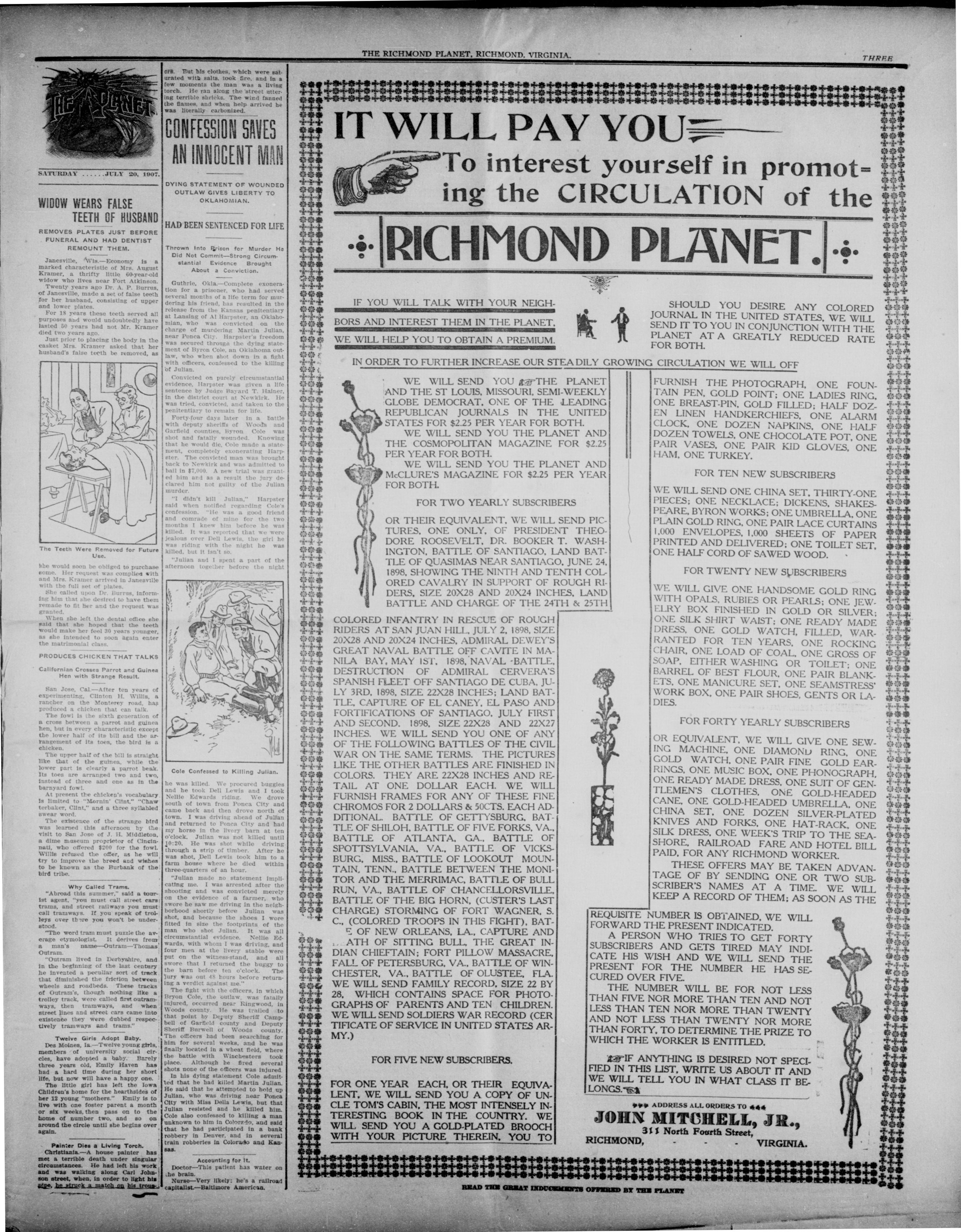
IN ORDER TO FURTHER INCREASE OUR STEADILY GROWING CIRCULATION WE WILL OFF
WE WILL SEND YOU THE PLANET AND THE ST LOUIS, MISSOURI, SEMI-WEEKLY GLOBE DEMOCRAT, ONE OF THE LEADING REPUBLICAN JOURNALS IN THE UNITED STATES FOR $2.25 PER YEAR FOR BOTH.
WE WILL SEND YOU THE PLANET AND THE COSMOPOLITAN MAGAZINE FOR $2.25 PER YEAR FOR BOTH.
WE WILL SEND YOU THE PLANET AND McCLURE'S MAGAZINE FOR $2.25 PER YEAR FOR BOTH.
FURNISH THE PHOTOGRAPH TAIN PEN, GOLD POINT; ONE ONE BREAST-PIN, GOLD FILLEN LINEN HANDKERCHIEFS, CLOCK, ONE DOZEN NAPKI DOZEN TOWELS, ONE CHOCO PAIR VASES, ONE PAIR KID HAM, ONE TURKEY.
FOR TEN NEW SUBSCO
OR THEIR EQUIVALENT, WE WILL SEND PICTURES, ONE ONLY, OF PRESIDENT THEODORE ROOSEVELT, DR. BOOKER T. WASHINGTON, BATTLE OF SANTIAGO, LAND BATTLE OF QUASIMAS NEAR SANTIAGO, JUNE 24, 1898, SHOWING THE NINTH AND TENTH COLORED CAVALRY IN SUPPORT OF ROUGH RIDERS, SIZE 20X28 AND 20X24 INCHES, LAND BATTLE AND CHARGE OF THE 24TH & 25TH
COLORED INFANT RIDERS AT SAN JUY 20X28 AND 20X24 IN GREAT NAVAL BANILA BAY, MAY I DESTRUCTION OF SPANISH FLEET ONLY 3RD, 1898, SIZETLE, CAPTURE OF FORTIFICATIONS O AND SECOND. 189 INCHES. WE WILL OF THE FOLLOWING WAR ON THE SAM LIKE THE OTHER COLORS. THEY A TAIL AT ONE D FURNISH FRAMES CHROMOS FOR 2 D CITIONAL. BATTLE TLE OF SHILOH, B BATTLE OF ATI SPOTTSYLVANIA, BURG, MISS., BAT TAIN, TENN., BATTOR AND THE ME RUN, VA., BATTLE BATTLE OF THE B CHARGE) STORMIC., (COLORED TRO E OF NEW ORLE ATH OF SITTIN DIAN CHEFTAIN; FALL OF PETERSB CHESTER, VA., B A WE WILL SEND FA 28, WHICH CONT GRAPHS OF PARE WE WILL SEND SORTIFICATE OF SERV MY.)
COLORED INFANTRY IN RESCUE OF ROUGH RIDERS AT SAN JUAN HILL, JULY 2, 1898, SIZE 20X28 AND 20X24 INCHES, ADMIRAL DEWEY'S GREAT NAVAL BATTLE OFF CAVITE IN MANILA BAY, MAY 1ST, 1898, NAVAL -BATTLE, DESTRUCTION OF ADMIRAL CERVERA'S SPANISH FLEET OFF SANTIAGO DE CUBA, JULY 3RD, 1898, SIZE 22X28 INCHES; LAND BATTLE, CAPTURE OF EL CANEY, EL PASO AND FORTIFICATIONS OF SANTIAGO, JULY FIRST AND SECOND. 1898, SIZE 22X28 AND 22X27 INCHES. WE WILL SEND YOU ONE OF ANY OF THE FOLLOWING BATTLES OF THE CIVIL WAR ON THE SAME TERMS. THE PICTURES LIKE THE OTHER BATTLES ARE FINISHED IN COLORS. THEY ARE 22X28 INCHES AND RETAIL AT ONE DOLLAR EACH. WE WILL FURNISH FRAMES FOR ANY OF THESE FINE CHROMOS FOR 2 DOLLARS & 50CTS. EACH ADDITIONAL. BATTLE OF GETTYSBURG, BATTLE OF SHILOH, BATTLE OF FIVE FORKS, VA., BATTLE OF ATLANTA, GA., BATTLE OF SPOTTSYLVANIA, VA., BATTLE OF VICKSBURG, MISS., BATTLE OF LOOKOUT MOUNTAIN, TENN., BATTLE BETWEEN THE MONITOR AND THE MERRIMAC, BATTLE OF BULL RUN, VA., BATTLE OF CHANCELLORSVILLE, BATTLE OF THE BIG HORN, (CUSTER'S LAST CHARGE) STORMING OF FORT WAGNER, S. C., (COLORED TROOPS IN THIS FIGHT), BAT-
E OF NEW ORLEANS, LA., CAPTURE AND ATH OF SITTING BULL, THE GREAT INDIAN CHIEFTAIN; FORT PILLOW MASSACRE, FALL OF PETERSBURG, VA., BATTLE OF WINCHESTER, VA., BATTLE OF OLUSTEE, FLA. WE WILL SEND FAMILY RECORD, SIZE 22 BY 28, WHICH CONTAINS SPACE FOR PHOTOGRAPHS OF PARENTS AND TEN CHILDREN. WE WILL SEND SOLDIERS WAR RECORD (CERTIFICATE OF SERVICE IN UNITED STATES ARMY.)
FOR FIVE NEW SUBSCRIBERS
FOR ONE YEAR BE
LENT, WE WILL S
CLE TOM'S CABIN,
INTERESTING BOOK
WILL SEND YOU
WITH YOUR PICT
THE YEAR EACH, OR THEIR
WE WILL SEND YOU A COPY
HAM'S CABIN, THE MOST INTEN-
TING BOOK IN THE COUNTY
END YOU A GOLD-PLATED
YOUR PICTURE THEREIN, Y
READ THE GREAT
FOR ONE YEAR EACH, OR THEIR EQUIVALENT, WE WILL SEND YOU A COPY OF UNCLE TOM'S CABIN, THE MOST INTENSELY INTERESTING BOOK IN THE COUNTRY. WE WILL SEND YOU A GOLD-PLATED BROOCH WITH YOUR PICTURE THEREIN, YOU TO
ADDRESS ALL ORDERS TO
JOHN MITCHELL, JR.,
311 North Fourth Street,
RICHMOND, VIRGINIA.
```markdown
```
```markdown
```
READ THE GREAT INDUCEMENTS OFFERED BY THE PLANET
FOR TWO YEARLY SUBSCRIBERS
REQUISITE NUMBER IS OBTAINED, WE WILL FORWARD THE PRESENT INDICATED. A PERSON WHO TRIES TO GET FORTY SUBSCRIBERS AND GETS TIRED MAY INDICATE HIS WISH AND WE WILL SEND THE PRESENT FOR THE NUMBER HE HAS SECURED OVER FIVE. THE NUMBER WILL BE FOR NOT LESS THAN FIVE NOR MORE THAN TEN AND NOT LESS THAN TEN NOR MORE THAN TWENTY AND NOT LESS THAN TWENTY NOR MORE THAN FORTY, TO DETERMINE THE PRIZE TO WHICH THE WORKER IS ENTITLED.
IF ANYTHING IS DESIRED NOT SPECIFIED IN THIS LIST, WRITE US ABOUT IT AND WE WILL TELL YOU IN WHAT CLASS IT BE-LONGS.
ADDRESS ALL ORDERS TO
JOHN MITCHELL, JR.,
311 North Fourth Street,
RICHMOND, VIRGINIA.
A man is sitting in a chair. A man is standing next to him.
LANET
EEEKLY
READING
UNITED
H.
T AND
R $2.25
T AND
YEAR
ND PIC-
THEO-
WASH-
D BAT-
JUNE 24,
H COL-
GH RI-
LAND
& 25TH
```markdown
```
REQUISIT
FORWAR
SHOULD YOU DESIRE ANY COLORED JOURNAL IN THE UNITED STATES, WE WILL SEND IT TO YOU IN CONJUNCTION WITH THE PLANET AT A GREATLY REDUCED RATE FOR BOTH.
FURNISH THE PHOTOGRAPH, ONE FOUNTAIN PEN, GOLD POINT; ONE LADIES RING, ONE BREAST-PIN, GOLD FILLED; HALF DOZEN LINEN HANDKERCHIEFS, ONE ALARM CLOCK, ONE DOZEN NAPKINS, ONE HALF DOZEN TOWELS, ONE CHOCOLATE POT, ONE PAIR VASES, ONE PAIR KID GLOVES, ONE HAM, ONE TURKEY.
WE WILL SEND ONE CHINA SET, THIRTY-ONE PIECES; ONE NECKLACE; DICKENS, SHAKESPEARE, BYRON WORKS; ONE UMBRELLA, ONE PLAIN GOLD RING, ONE PAIR LACE CURTAINS 1,000 ENVELOPES, 1,000 SHEETS OF PAPER PRINTED AND DELIVERED; ONE TOILET SET, ONE HALF CORD OF SAWED WOOD
FOR TWENTY NEW SUBSCRIBERS
WE WILL GIVE ONE HANDSOME GOLD RING WITH OPALS, RUBIES OR PEARLS; ONE JEWELRY BOX FINISHED IN GOLD OR SILVER; ONE SILK SHIRT WAIST; ONE READY MADE DRESS, ONE GOLD WATCH, FILLED, WARRANTED FOR TEN YEARS, ONE ROCKING CHAIR, ONE LOAD OF COAL, ONE GROSS OF SOAP, EITHER WASHING OR TOILET; ONE BARREL OF BEST FLOUR, ONE PAIR BLANKETS, ONE MANICURE SET, ONE SEAMSTRESS' WORK BOX, ONE PAIR SHOES, GENTS OR LADIES.
FOR FORTY YEARLY SUBSCRIBERS
OR EQUIVALENT, WE WILL GIVE ONE SEWING MACHINE, ONE DIAMOND RING, ONE GOLD WATCH, ONE PAIR FINE GOLD EARRINGS, ONE MUSIC BOX, ONE PHONOGRAPH, ONE READY MADE DRESS, ONE SUIT OF GENTLEMEN'S CLOTHES, ONE GOLD-HEADED CANE, ONE GOLD-HEADED UMBRELLA, ONE CHINA SET, ONE DOZEN SILVER-PLATED KNIVES AND FORKS, ONE HAT-RACK, ONE SILK DRESS, ONE WEEK'S TRIP TO THE SEASHORE, RAILROAD FARE AND HOTEL BILL PAID, FOR ANY RICHMOND WORKER. THESE OFFERS MAY BE TAKEN ADVANTAGE OF BY SENDING ONE OR TWO SUBSCRIBER'S NAMES AT A TIME. WE WILL KEEP A RECORD OF THEM: AS SOON AS THE
FOR TEN NEW SUBSCRIBERS
THREE
```markdown
```
```markdown
```
FOUR
THE PLANET
Published every Saturday by John MITCHELL
Jm., at 511 North 4th Street, Richmond Va.
All communications intended for publication
should be sent so as to reach us by Wednesday.
TERMS IN ADVANCES
One Copy, one year, $1.50
One Copy, eight months, 1.00
One Copy, six months, 0.75
One Copy, four months, 0.50
One Copy, three months, 0.25
Single Copy, $0.50
ADVERTISING BATTERY
For one inch, one inception, . . . $ 50
For one inch, each subsequent inception, . . . 40
For two inches, six months, . . . 60
For two inches, nine months, . . . 10.00
For two inches, twelve months, . . . 10.00
Marriage and Funeral Notices, one inch, . . . 50
Standing and Transient Notices per line, . . . 10
$ POSTAGE STAMPS OF A HIGHER
NOMINATION IN TWO CENTS NOT
RECEIVED ON SUBSCRIPTIONS.
THE PLANET is posted weekly. The subscription
price is $1.50 per year in advance.
There are FOUR WAYS by which money can be sent by mail one as risk—in a Post Office Money Order, in a Check Order, or in an Express Money Order, and when none of these can be procured, in a Registered Letter.
MONEY ORDERS.—You can buy a Money Order at your Post-Office, payable at the Richmond location, or we will be responsible for its safe arrival.
EXPRESS MONEY ORDERS can be obtained at any office of the American Express. Co. the Richmond location, or at our office and Oye's Express Company. We will be responsible for money sent by any of these companies.
The Express Order is a safe delivery of money sent to us. The Registered Letter.—If a money Order Post-Office or an Express Office is not within your reach, your Postmaster will begin the process of sending money to you. Then, if the letter is lost or stolen, it can be traced. You can send money in this manner for money sent to us.
We cannot be responsible for money sent in letters in any other way than one of the four ways mentioned above. If you send your money in another way, you must do it at your work.
RENewAL, ERO.—If you do not want THE PLANET continued for another year after your subscription law ran out, you then notify by mail or by email that you decided that subscribers to newspaper, who do not order their paper, continued at the end of the year. You are held liable for the payment of the subscription up to date when they order the paper disl.
COMMUNICATIONS.—When writing to us, renew your subscription or do continue your paper, you should give your name and address in full otherwise we cannot find your name on
CHANGE OF ADDRESS.—In order to change the address of a subscriber, we must be sent the former as well as the present address.
Entered at the Post-Office at Richmond, Va., as second-class matter.
Dr. Booker T. Washington is taking a rest, it is said, but his opposers are working overtime.
The War Department has made a "Dreyfus" of the colored soldiers of the army. President Roosevelt is a great peace-maker. He should try his hand on this branch of the service.
The one fact is evident to all observers and that is great principles are eternal and temporary expedients are fleeting. Some people are endeavoring to reverse the order of the universe in order to pander to race prejudice.
If the government expects to build the Panama Canal, pay the overdrafts of the Philippines and buy up the railroads, it seems to us that we will be in about the position of a country that meets defeat after the prosecution of a ten year war.
There is much talk about the "unwritten law." The colored people have been the victims of the "unwritten law" for an hundred years. If that policy is recognized and the colored folks actively subscribe to it there will be many vacant chairs in the homes of white people in the Southland.
Oh, yes, the colred folks like the white folks of the Southland, just like a wife loves the husband who gives her periodic beatings. She will pay his fine in the Police Court and let him go home again to give her another dose of the same "medicine."
President Roosevelt is indeed strenuous. The most enthusiastic advocates of his policies are now disposed to call a halt and ask what will he propose next. The Wall Street Journal has been standing up for him through evil report as well as good, but it seems to be slowing down in its commendation of his policies. The citizen that can follow President Roosevelt without a halt or a misgiving is thoroughly qualified for the position to follow anything this side of Heaven.
Governor James K. Vardaman says that he has not surrendered to Jesus. We believe he spoke the truth. It
would be sacrilegious to speak too plainly of our Saviour, but we would suggest that a fight and no quarter would be the proper method of dealing with the sinners of the Vardaman type. He can't trust him as a prisoner of war. The best way is to kill him on sight and let the Devil carry him off and erect a monument to his memory.
It is now reported that President Roosevelt has decided upon a modified form of government ownership of railroads. He proposes that the national government shall go into the market and purchase controlling interests in these lines or enough to give government officials representation upon the directorate of the various lines in this country.
It is hinted that by this method much information not now available under the usual modes of procedure would be open to the government. This last position of the President has created a sensation second only to the open declarations of Hon. W. J. Bryan of Nebraska.
The ruling of the Supreme Court of the United States in the cases brought before it in behalf of colored plaintiffs has caused no end of embarrassment in deciding some of these railroad cases. It has held that interstate passengers are subject to state laws and now the railroad companies doing an interstate business are busily engaged in using all of the persuasive eloquence available to upset this view of the situation.
The states have suddenly become hostile for the reason that the shipers have secured controlling interests in the several legislatures. The railroads were denied the right to is sue free passes and many of the benefcharles of this mode of travel are of the opinion that the railroads were directly responsible for this new phase of a most interesting situation.
Mr. O. M. Steward thinks we should go to Africa, if we are to judge by his reasoning. There are some Negroes about here that we would like to see shipped to Africa or somewhere else. They injure us in the estimation of the white folks and handicap us in every legitimate endeavor to go upward. Send them to Africa and the sooner the job is accomplished the better it will be for those of us who remain behind. We would like to hear some proposal made as to the best place to send Senator Tillman of South Carolina and Governor Vardaman of Mississippi.
Hell was the last place proposed, but that would be rather cruel at this season of the year especially in view of the fact that they and their kind are going there anyway when they stop breathing in this world. How would it do to send them to the North Pole or as near to it as they can get with Explorer Wellman and Perry?
No one would have believed forty years ago that influential journals would openly declare that the Declaration of Independence was faulty and that the self-evident truth announced by Thomas Jefferson, that all men are created equal would be the subject of ridicule at the hands of some of the very people who have profited by the privileges accorded by this most wonderful instrument. Even so influential a journal as the Washington, D. C. Post, under the shadow of the National Capital of the nation and almost within a stone's throw of the White House "poo-n-poohs" the idea of creative equality. These people seem to forget in giving voice to this doctrine, they are undermining the fundamental principles of this republic. If Jefferson was wrong, then the principle on which the United States of America was established is wrong.
There is a tendency to ape English manners and customs and to subscribe to the constitutional tenets of the Old World. These people want a class of serfs and they constantly revolt against the idea of having other men recognized as their equals
---
There is a concerted effort in this city to place this city in the control of a municipal commission. It seems that the affairs here have gone from bad to worse and the property owner and business men are groaning under the evident mismanagement which has resulted since the elevation of the white man's party to power.
It will be remembered that the newspapers of this city and a large proportion of the influential white leaders advocated the elimination of the Negro,—the practice of evil that good may come. The result has been disastrous. The men who took the places of the colored leaders have not measured up to the standard and they have given no end of trouble.
The white contingent now advocate a further elimination and this time the white man is to be the subject for political amputation. The
THE RICHMOND PLANET RICHMOND. VIRGINIA
colored man is not there now to be amputated. We have regarded with amusement all of these efforts to secure purity from a field of impurity. The basic principles of right and justice must be recognized or the city will continue to wallow in the mire of its own stupidity, the fifth of its own folly.
A WORD ABOUT SENATOR FORA
Our esteemed and able contemporary, the New York Age seems to be of the opinion, that President Jones and his board of trustees injected politics into the commencement exercises by inviting Senator Joseph B. Foraker to deliver the address. We fail to see it in that light. As we understand it, Senator Foraker was invited to deliver the address and he chose his subject to suit himself. We have been unable to see that a discussion of the facts in the Browns ville investigation carried with it any political significance.
Senator Foraker took the time to say that the colored troops had not been proven guilty. He spoke as the representative of the people of Ohio and because the "other fellow," who wants to be President had taken the opposite course is no concern of the average citizen. It should not be forgotten that no public officer of the prominence of the distinguished Senator from Ohio could have been invited to speak on such an occasion without being charged with political bias.
We have watched Senator Foraker's course and we confess that we have seen no indications that he was desirous of doing other than justice to the faithful black soldier of this country.
Every right that we have ever enjoyed came to us through politics and every privilege that we have lost may be charged up to the same channel so we cannot see that Wilberforce has any cause to make apologies for its action. President Roosevelt has been making political speeches from the hustings, educational institutions colleges and if he ever gets the chance, he will do the same in the churches by way of an alleged sermon.
Mr. Roosevelt is not alone in this mode of procedure for Hon. William Jennings Bryan and even Senator Benjamin Tillman are noted for this kind of political canvassing. We do not believe that Wilberforce will be injured. It will be benefited. Senator Foraker spoke on a subject which attracted universal attention and one which every one wished to hear. He did the Arfo-Americans of this country a great service and we are satisfied that the key note sounded there will echo and re-echo over this broad land for many years to come. . .
If these white folks want peace, let them restore our "Dreyfuses" to the army.
END IN SIGHT
In Haywood Murder Trial Both Sides Rest.
BOISE, Ida., July 17.--Startling developments came in the trial of William Haywood for the murder of Frank Steenmenberg when the state began its rebuttal evidence. One witness confessed to participation in a labor riot resulting in the death of two men. The record of conviction for murder in the second degree of a witness for the defense was introduced, and the proof of another having been sent to the insane asylum on the information of his neighbors was offered. Its admissibility was argued, and the decision of the court will be handed down shortly.
A warrant for perjury was issued in a magistrate's court against Dr. L. L. McGee, a physician, of Wallace, Ida., who was one of the witnesses for the defense. Sheriff J. W. Bailey of Shoshone county, who swore to the information against McGee, left for Wallace to arrest McGee.
The end of the trial of Haywood, charged with the murder of and conspiracy to murder Frank Steumenberg is now within measurable distance. The case will now enter its tenth week of hearing. Both sides have rested, and the rebuttal has begun.
HEARST WINS AGAIN.
Fight For Recount of New York's Mayorality Vote In 1905.
NEW YORK, July 17—William R. Hearst won another battle in his fight for a recount of the votes cast in the mayoralty election of 1905 when the appellate division of the supreme court handed down a decision denying the application for a writ of prohibition against the recounting of the ballots.
The court was divided on the question, Justices Gaynor, Hooker and Rich joining in a refusal to grant the application, while Justices Jenks and Miller dissented from the opinion of the majority.
Justice Gaynor, who wrote the opinion for the majority, said the matter was a judicial one and that it was competent for the supreme court to pass upon it.
It is now believed that Mayor McClellan, who was represented by Eugene Lamb Richards, will take the matter to the court of appeals.
DIED FROM EXHAUSTION.
W. D. Wynes Not a Victim of Black Hand.
MOUNT KISCO, N. Y., July 17. Investigation into the death of William
D. Wynes, a wealthy retired business man of Brooklyn, who was found dead in the woods near here and who was thought to have been slain by Black Hand conspirators, has convinced the authorities and members of the family that the old man, who was eighty years of age, wandered off into the woods and died from exhaustion.
Mr. Wynes disappeared from the house of his son-in-law, Charles M. Hubbell, on July 2, and on July 11 his son, William S. Wynes of 158 Butter street, Brooklyn, got a Black Hand letter demanding $3,000 ransom, with a threat to kill the octogenarian unless the money was paid. It is believed that this letter came from some person who knew the old man was missing and who thought to extort some money from the family.
FINANCIAL AND COMMERCIAL
Closing Stock Quotations.
Money on call 3 per cent; time money and mercantile paper unchanged in rates.
Closing prices.
Arizona Copper... 91% N. Y. Central... 112%
Atchison... 91% Norf. & West... 75%
B. & O. ... 91% Penn. R. R... 122%
Brooklyn R. T. R... Reading... 102%
C. C. & C. StL... 81% Rock Island... 122%
Chl. & Northw... 14% Southern Pac... 81%
D. & H. ... 171% Southern Ry... 89%
Erle... 2% South Ry. pfc... 98%
Il. Electric... 1% Texas Pacific... 98%
Il. Central... 1% Texas Pacific... 148
Lackawanna... 49% Union Pacific... 148
Louis. & Nash. ... 18% U. S. Steel... 18%
Manhattan... 18% U. S. Steel pfc... 100%
Oilfield. ... West. Union... 77%
Missouri Pac... 12%
New York Markets
FLOUR-Stendy, but quiet; Minnesota patents. $50/6.35; winter patents. $4.40/4.90; winter straights. $4.30/4.45; winter extras. $3.10/2.70.
RYE FLOUR-Dull; fair to good, $4.75 $5; choice to fancy. $5.10/6.40.
WHEAT-Opening half a cent lower on good, northwest rains, wheat recovered and became quite firm on bullfish foreign crop news and good commission house buying; September 9 9-10c. $1.00 3-16; December $1.00 $1.00; May, $1.00 $1.05.
CORN-Dull and half a cent lower;
Live Stock Market
GATTLE-Supp. light: market slow
choice, $1,999. prime, $2,999. vea
SHOT AT PRESIDENT
Fallieres Has Narrow Escape From Death In Park.
PARIS, July 17.—An attempt was made to assassinate President Fallieres here by Leon Malle, a naval reservist of Havre. The president escaped unhurt.
President Fallieres was being accclaimed by the thousands who thronged the streets when Malle from the curb fired two shots point blank at him. Miraculously no one was hit, and the president's carriage was hurried along. Malle was arrested, and the police had difficulty in preventing the crowd from lynching him.
The national fete was marred by this dastardly attempt on the life of President Fallieres by Malle. It is believed he is suffering from the mania of persecution. Malle fired two shots at the president, but did not hit him. He was at once placed under arrest.
Premier Clemenceau and M. Lannes, the president's secretary, were with the president in his laudan, which was escorted by a squadron of cuirassiers. The carriage had safely emerged from the Bols de Bologne, where the antimilitarists had stationed themselves with the intention of hooting the soldiers, and was descending the broad Champs-Élysées amid the acclamations of the crowds thronging the sidewalks, who were shouting "Vive Fallieren!" and "Vive Farme!" when at the corner of Lesmeur street Maille from the curb fired point blank at the president.
Some of the witnesses of the shooting said that Mallel fired in the air. It is believed that the man participated in the recent seamen's strike and that his mind had been unhinged by fancied grievances. It is believed also that he aided in the revolutionary agitation of the General Federation of Labor and the antimilitarists. There is no reason to suspect a plot as Mallel only arrived here from Rouen yesterday.
AT UNCLE SAM'S GATE.
Russian Girl In Sailor's Guide Tries to Get Through.
NEW YORK, July 17.—Hand over hand in true sailor fashion a diminutive form in male attire came over the side of the Russian steamer Saratov, docked here, and at the end of the spring line dropped plump into the arms of an immigrant inspector. The bold front and stout heart that had brought their possessor through many perils failed under the searching inquisition of the officer, and presently in a flood of tears stood reenamed Miss Paulina Flaks, stowaway, eighteen years old, bound from Kovno, Russia, for America and freedom. She will be sent back to Libau, her sailing port.
Back of the arrest of the Flaks girl is a story of immigrant smuggling that has made the immigration authorities especially vigilant recently. Some time ago a report that undesirable aliens were being landed illegally from Russian steamers led special inspect-
ors to hold a party of Russians found in the Grand Central station and later to return the whole party to Ellis island while a story secured from them could be investigated. These Russians declared that through an organized traffic, the prime mover in which had headquarters at Liban, a baltic seaport, foreigners who would be refused legal admission were smuggled into this country.
Standing of the Baseball Clubs.
Standing of the Baseball Clubs.
NATIONAL LEAGUE.
W. L. P.C.
Chicago 58 20 .744
New York 58 26 .622
Pittsburgh 45 30 .600
Philadelphia 42 30 .600
Boston 32 41 .440
Brooklyn 33 45 .423
Cincinnati 31 47 .387
St. Louis 19 63 .222
AMERICAN LEAGUE.
W. L. P.C.
Chicago 51 26 .652
Cleveland 47 26 .652
Detroit 43 31 .503
Philadelphia 43 33 .475
New York 34 39 .496
St. Louis 31 47 .525
Boston 31 47 .523
Washington 24 48 .333
Tener to Be Exalted Ruler.
PHILADELPHIA, July 17. — The grand lodge of Benevolent and Protective Order of Elks after two strenuous business sessions adjourned without having made any announcement as to the result of its elections. It is generally conceded, however, that John K. Tener of Charierol, Pa., has been chosen grand exalted ruler of the order. The only official announcement was that Dallas, Tex., had been chosen as the place for holding the next convention and grand lodge reunion.
CONDENSED DISPATCHES
Notable Events of the Week Briefly
Chronicled.
The court at Paris has ordered that
Leon Maille, the naval reservist who
fired two shots at President Fallieres,
be examined as to his sanity. The
rambling statements made by Maille
confirm the impression that he is insane.
The American tennis players at the
Wimbledon courts, near London, lost
their chance of challenging for the
Davies cup, the international trophy, by
the narrowest of margins. Beals C
C Wright, American, succeeded in win-
ning his match against A. F. Wilding
Australasian, thus making the points
equal. But Norman E. Brookes, Australasian, was too much for Karl H
Behr, American, who was clearly out
played.
Tuesday, July 16.
The wedding of Senator Beveridge of Indiana and Miss Catherine Eddy of Chicago will take place on Aug. 7 at the American embassy in Berlin. President Roosevelt has put his hearty approval on public school rife practice. In a letter of congratulation to Ambrose Schartenberg of Brooklyn, winner of the shooting trophy of the Public School Athletic league, he takes occasion to encourage the system of rifle practice inaugurated by General George B. Wygute. The clubhouse and part of the grand stand at the American league baseball park at Washington was destroyed by fire last night, and a number of small buildings were damaged. The fire broke out in the Maryland House. At the baseball park besides the grand stand other portions of the park were damaged. The loss is $20,000.
President Roosevelt spent the night in the open on the sound shore at Lloyd's Neck. With him he was his son and three of their boy cousins. For years the president has made it a practice to spend a night either in the woods or on the shore with his boys and the night picnic, as it is called, has grown to be for them a real climax of delight in the summer vacation.
Monday, July 15.
James R. Keene's Peter Pan set the seal on his greatness by winning the twelfth running of the Brighton hand leap of $25,000 at Brighton Beach. The sound steamboat Shinnecock of the Montauk Steamboat company's lines and a steam yacht run ashore at Hart Island in a dense fog. They were floated without damage.
Saturday, July 13.
Twenty-three lumber merchants were sent to the workhouse for six months by Judge Lindley W. Morris at Toledo, O., and nine brickmakers were each fined $1,000. The men were formerly in a trust and violated the Valentine antitrust law. Curtis Smith, one of the important witnesses in the trial of James Hargis for the murder of Dr. B. D. Cox, was murdered at Elkatawa, Ky. He was enticed into a card game, and soon a row was started. Smith drew his revolver when he realized that he had been trapped, but it was too late. He was shot three times in the breast.
Friday, July 12
Seven mine workers, all Italians, were killed in an abandoned slope of the Lehigh and Wilkesbarre Coal company at Honeybrook, Pa., by deadly white damp. Three others are missing.
A Japanese has been arrested at Fort Rosecrans, San Diego, Cal., while making drawings of the fort. Major Getchell, in command, said that the Jap was drawing plans of the fort and that there is heavy punishment for the offense.
Thursday, July 11.
King Edward and Queen Alexandra paid a visit of state to Dublin, both wearing the national colors of Erin. Almost the first visitor received by Admiral Baron Gombey Yamamoto, Japan's minister of marine during the Russo-Japanese war, on his arrival at New York was Rear Admiral Robley D. Evans. Florence Wood, sister of Laura Carter, the woman of the New York Tenderloin who caused the arrest of Chester B. Runyan, paying teller of the Windsor Trust company, and who is suspected of having got $25,000 of the $96,000 the man stole, has been arrested in Chicago on the theory that some of the lost money is in her possession.
Japan Repudiates San Diego Spx.
KILL "THE WILD BEAST!"
General Alkhunoff Blown to Pieces
at Alexandropol.
ALEXANDROPOL, Russia, July 17.—General Allkhanoff, former governor general of Tiflis; Mine. Glieboff, wife of General Glieboff, and the cost man who was driving their carriage were blown to pieces by bombs thrown at their conveyance in the main street here.
A son of General Allkhanoff and a daughter of General Glieboff received serious injuries.
The party were returning to the residence of General Allkhanoff from his club and were passing through Reboult street when the bombs were hurled.
General Allkhanoff was nicknamed "the wild beast" by the Caucasian members of the lower house of parliament, who often referred to his cruelties in the Kutais district, where he led a number of punitive expeditions to stamp out disorders. His rigorous methods to this end brought down upon him the bitter enmity of the revo lutionists.
Disneyers Buried City
HEREFORD. Tex., July 15.—Professor T. L. Everly, an archaeologist and instructor in the Canadian college at this place, has discovered a buried city in Ochiftree county, in the northern part of the Panhandle.
Report a Spy In the Game
Report a Spy In the Camp.
NEW YORK, July 16.-The headquarters of local 16 of the Commercial Telegraphers' union were thrown into a state of white hot excitement by the statement by the officers of the union that W. E. Demarest, who had acted as a clerk for S. J. Small, national president, while the latter was at the Astor House, had been found to be a Pinkerton detective.
FIERCE WINGED
DUEL IN MIDAIR
HORNET, BUMBLEBEE AND SPAR
ROW MEET AND FIGHT TO
THE DEATH.
TWO FORMER START BATTLE
Bird Comes Along and Becomes Mixed Up in Fray—Ias Swollen to Twice Its Normal Size, Then Expires.
New York—"The fiercest fight I ever saw took place in the air. The combatants were a hornet, a bumblebee and a sparrow. All the Hagues in history couldn't have stopped it." There was nothing in the appearance or manner of the man who made the statement to indicate that he was otherwise than truthful. The gathering that had been talking of champions and knockouts and gate money stopped and listened.
"I was on the porch of my house, chinking up for the summer, when the hornet came along," continued the man, who saw that he was expected to make good his statement. "He was building a nest there and I watched him on several trips carrying material.
"A few minutes later a bumblebee of unusual size and brilliant color took a buzz about the premise. His buzz was deep toned and earnest.
"I'm an out o'door man, and I have always noticed that headon collisions between aerial navigators are almost unknown. I wonder that humans haven't imitated these flyers more than they have in this respect.
"I was surprised, however, to see that in the case I am telling you about the hornet and the bumblebee dodged each other several times. That's what made me quit my own job and take notice. I soon discovered that the bumblebee was intent upon invading the nest of the hornet, but only when the hornet was absent.
"The bumbleber was evidently on the lookout, for as soon as the hornet showed up he flew in another direc
D. W. H.
It Was a Desperate Battle.
tion. No sooner did the hornet finish
and fly away than the bumblebee
sailed back with a biff from his lurking
place.
He returned once too often, or,
rather, he tarried too long on his last
visit. As he quit the hornet's nest
the hornet gave him a bat that sounded
like the explosion of a percussion
cap. It made my blood tingle.
"They were together quicker than a
wink, up and down, butting, backing
out and coming together again until
both dropped to the floor of my porch.
"While they were at it along comes
an English sparrow. He had a bit of
rag or wisp of something, whose
weight was tingling his strength. It
trailed in the wake of the bird and
the lower end of it came in contact
with the hornet and the bee. And in
some way the sparrow lost his clutch.
"Instantly the sparrow darted downward to recover the wisp. The sparrow is a fool, but a fighter. This bird made a dip for the wisp and came between the fighters. For a second he fluttered as if he had been shot. In less than a second the plucky bird recovered and made another attempt to get his property.
"For an instant there was a fast, fractious and fierce commingling of the three. The last round had come.
"The bumblebee fell to the earth, pursued by the sparrow. They hit the dust together. At the same instant the hornet went off in a zigzag direction. I lost sight of him and went to the contest between the bee and the sparrow.
"The bee was dead. He had been literally pecked to strings. The sparrow, swollen to twice his normal size, was helpless. He fluttered feebly and expired. He had been stung to death. "I returned to my porch and waited. Nearly an hour elapsed when I saw the hornet come back. He fell in his effort to fly. Finally he crawled across the floor, climbed up the side of the house feebly and reached his nest. "He never came out. When I thought it safe to do so I mounted my stepladder and carefully examined the nest through a magnifying glass. The hornet was dead. So all three fighters were accounted for."
PRESENCE OF MIND SAVES LIFE
OF MICHIGAN MAN—OIL DID
NO TAKE FIRE.
Tipton, Mich.—It was only through
a most wonderful exhibition of presence
of mind and rare resourcefulness
that the life of Rawson Hawliffe,
a tinner, of Gryton, was saved recently.
Hawliffe was engaged in fitting a
galvanized iron cover on a large oil
tank back of Compton & Blake's hard-
ware store, and while he was working
on the tank, which was seven feet
deep and filled with oil at the time,
James Clalsche, who, with his brother
Bert, was making some repairs on the
roof of the building, let fall a gallon
of gasoline. The inflammable liquid
drenched Hamliffe thoroughly, and in
the same instant became ignited from
A boy is jumping into a large pot of water.
He Leaped Into the Oil Tank.
the pipe which he was smoking, sending the flames high above his head.
The next instant Hawliffe sprang forward to the side of the oil tank and dived into it.
The flames about him, were, of course, instantly smothered out, but the burning gasoline remained floating on the surface of the tank. Imprisoning Hawliffe in a vat of oil across the surface of which bright flames were dancing and playing.
Groping about in the tank, with his hands, Hawliffe found a piece of gas pipe, one end of which he forced above the surface and placing the other end in his mouth blew out the oil until the pipe was free, after which he was able to breath through it. Thus he was in a position to keep himself alive until help reached him.
George Bracker, who had seen the whole affair, came on a run to the tank, and although he burned his hands severally in doing so, skimmed off the burning gasoline till the flames were all gone and Hawliffe could come up.
Sporing Causes Man's Death
Oskalaosa, Ia.—Richard Harding's wife often complained that Richard snored "something dreadful," but he out-did himself the other afternoon and got killed for doing it.
Richard had been sitting in the back room of a village drug store taking a few sips of something to cure his cold. When he left the place he staggered slightly.
He headed for the country, and in a woods not far from town lay himself peacefully down to slumber. Pretty soon the vibrations of his uvula showed that Richard had forgotten the cares of this world.
Unfortunately a party of hunters heard the snoring get louder and louder, and not being as great naturalists as Mr. Roosevelt, or his friend Long, mistook it for the roaring of a wild animal. They discharged a volley into the hedge.
Fish in Rain Storm.
Independence, Mo.—During a downpour of rain here two tons of small silver colored fish closely resembling mountain trout fell from the sky here.
Although a few of the fish fell in all parts of the town, the fall was heaviest over the public square, which was covered with a thin layer, and where catch basins carrying water to sowers were clogged, and the water backed up and covered the sidewalks.
Hundreds of people came out through the pouring rain to see the fish. Nearly everybody in Independence had fish for dinner that evening. Some of the fish were alive and swam around briskly.
THE PLANET
ROAD AND FARM IMPROVEMENT MAKING BOARD DRAINS.
They Are Economical and Will Last a Long Time.
Drainage is a live subject with the farmers in many sections, and many would be glad to do a great deal more of it if they were in a financial condition to do so. While tile drains are considered the best, board drains will give very good service for a number of years and will enable the farmer to raise better crops and thus provide himself with the means for buying tile
Standard Frame for Making Board Drains.
later on. Board drains, especially where the ground is so wet that they are kept constantly saturated with water, will last for years. Farmers living in the districts where timber is cheap, will find that such drains will answer the purpose very well without much expense. Such drains have been known to last 20 or 25 years, at which time they seemed to be in just as good a state of preservation as on the day they were put in.
To make wooden drains it usually requires two men, one to hold the
Standard Attached to Fence.
boards in place and the other to nail then together. This method of making board drains, suggests the Farmer, can be improved upon by the use of a "standard." This consists of an upright board, three feet high, having notches cut into it six inches apart, one inch wide and several inches deep to hold the boards firmly. The boards are laid into the notches when the top board can be quickly and evenly nailed on.
Another method consists of two posts driven into the ground about three feet from the fence with notched boards nailed across from each post to the fence. With such a rig as this troughs can be quickly and easily made by one man alone.
FARMERS' FRIENDS.
Crow, Blackbird and Bluejay Seen in a New Light.
Farmers who have been studying the use of various birds to their growing crops, feel much less animosity against the crow, blackbird and bluejay than formerly, for it has been proved that these birds aid the farmer more than they hurt him. The swallow, swift and nightingale are the guardians of the atmosphere, feeding on the wing and taking from the air those forms of insects that might endanger the fruit and trees. Woodpeckers, chickadees and creepers are the guardians of the trunks of trees, eating the grubs that injure the back of fruit or ornamental trees. Blackbirds, thrushes, crows and larks protect the soil, eating the worms and insects that injure the corn, wheat and oats. They scarcely partake of corn except in the autumn. The snipe and woodcock are the guardians of the subsoll, reaching far down into the earth after hatching larvae and insects that would soon attack the roots of the growing crops. The long-persecuted crow is really the farmers' friend, for he destroys more insects than the average bird and rarely pulls up the corn, as alleged. He has been known to eat 200 grasshoppers in a single hour, says Coleman's Rural World. The pretty quail, whose life has been spared by the hunter only because of the laws of several states, eats the weed seeds, which would otherwise scatter, and is also a good feeder on insect life. The grouse of the west as well as the east is a great eater of grubs and grasshoppers and all forms of insects.
A Unique Plan.
Pot a single sweet potato and see that it keeps warm, especially at night. Do it now. Then when it begins to vine, trim the vines on a trellis in the window. It will soon be a thing of beauty. Two weeks before you want to set out your plants, cut up the vines into cuttings of one leaf each and put them to root in a box of damp sand, in a warm, sunshine place. When you are ready, there are your plants with little trouble and no expense. Of course, this is just for a family patch.
Spraying.
Spraying is not expensive unless all
fruit growers in the neighborhood cooperate. If one sprays and the rest neglect to do so, it will take a long time for the one to have an orchard free from pests and diseases. Form spraying clubs and invite all your neighbors to join.
THERE IS NO EXCUSE FOR
ROUGH DIRT ROADS
If farmers can once get clearly fixed in their minds that there is no good excuse for rough roads in any part of the corn belt during the summer season, we will get along much faster in the solution of the dirt road problem.
The road drag can be used when the roads are wet, in some soils when they are quite muddy and in others when they are beginning to be dry and crumby. The intelligent use of the drag, where the roads have been properly drained and graded, will absolutely prevent all roughness. It will not prevent the wheels from sinking in while the road is soft, but they will not sink in nearly as far as if the drag was not used; and all that is necessary is simply to drag again when there is sufficient moisture in the ground to permit it.
Where the roads are too dry to drag the harrow can be used, not quite as effectively, but still with very good effect. Where they are too dry to harrow then there is nothing better than a good sharp disk followed by the harrow. We have seen some very excellent roads made this year, says Wallace's Farmer, when there was not enough moisture to use the drag, but where the harrow was used with good effect.
When the roads have become dry and rough the usual way is simply to drive horses and wagons over them and thus smooth down a place in the middle. If any man will think two minutes he will see that this is an exceedingly expensive way of smoothing the roads, which can all be avoided by the intelligent use of the drag, the harrow, or the disk, as circumstances require.
Anyone can see that if the drag is used intelligently and at the right time the ruts will be filled up, the surface water will run off, and the wind will dry out the road in a short time; and instead of wearing down these lumps by driving over them you prevent their formation.
It is not always possible to avoid rough roads in winter; but if each farmer had before his mind the definite idea of having a smooth road in front of his farm, and would drag at the right time late in the fall, he would have smooth roads.
When driving along a road one day we complimented a farmer in the fine condition of the roads in his neighborhood. He said: "Yes, where they are dragged; otherwise not." We soon came to the end of the dragging and there was a road rough from one side to the other except a tolerably smooth place that had been worn down by passing teams.
Of course some of our readers who do not know what can be done by these modern methods may shake their heads and believe this to be entirely theoretical. We will not argue the question; we never do. Simply follow our suggestions and be convinced. The whole battle is won when we get the farmer to determine that, so far as his farm is concerned, the drag shall have a fair trial. If we can get our readers in the various states to believe that there is no necessity for rough roads in summer and but little necessity for them in the winter season, we will have made great strides in solving the good roads problem, and save from $1,000,000 to $2,000,000 a year.
GIRL ENDS FIFTY-DAY TRANCE.
Perry, Ia., Music Teacher Now Speaks New Language.
Perry, Ia.—After having been in a state of trance for exactly 50 days Miss Prudence Van Glider, a 20-year-old music teacher emerged therefrom, but in a condition which to family, friends and medical and psychological experts, is as full of mystery as ever.
Power to use the English language appears completely gone, but from the lips of the young woman another language, which no one here can interpret, drops from her tongue with a fluency and musical expression which is the marvel of all who listen.
During the 50 days of trance Miss Van Gilder's jaws were rigidly set, and food could only be admitted by inserting a tube through a tooth especially removed for the purpose. At periods of consciousness Miss Van Gilder would not speak, but communicated with friends by deaf and dumb signs.
Unable to speak a word of English, she motioned for her Bible, turned to the tenth verse of the One Hundred and Sixteenth Psalm, and by gestures asked her sister to read the following:
"I believed, therefore have I spoken. I was greatly afflicted."
While friends gazed awe-struck upon the scene, the mother suggested food, which was brought. But a strange thing happened. The girl pushed away the tray which her sister sought to place upon her lap, and not until she had doubled her knees under her after the fashion of orientals would she consent to eat a mouthful.
Women Voters and Dog Tax.
Victoria, the capital of British Columbia, has a peculiar municipal franchise. Every person who pays a two dollar dog tax is entitled to vote in elections for mayor and aldermen. The system has led to abuses. It has been discovered that six enterprising ladies voted on the strength of a single dog. Worse still, one ingenious lady, unable to get a real dog in time to quality, took out a license for a china dog on her mantelpiece.
Municipal franchise reform is now regarded as a question of urgency in Victoria and the unkind association of dogs with mayors and aldermen is doomed.—London Chronicle.
THE RICHMOND PLANET, RICHMOND, VIRGINIA
JOB DEPARTMENT
WE AN ELDER
WHICH WE WILL
STOCK ROOM
LATEST STYLE BOND, F
AS SMALL AS A DODGER
Sheet Poster
A FRONT DOOR.
OUR PRESENT CORP OF EMPLOYE
IS WITHIN EASY REACH OF
2213.
LINCOLN
HAIR P
MAKES
KINKY
HAIR
SOFT
REMOVES
DANDRUFF
AND
MAKES
IT
GROW
LONG
AND
LUXURIOUS
A Woman's Hair Maker
If your hair is short. If your scalp is diseased, LINCOLN make it grow, remove the dandruff the finest toilet preparation or for you to give it a trial and be so satisfactory that you will be sure and get the genuine substitutes. For sale at all
PRICE, 1
MANUFACTURE
The Lincoln Po
EXCURSION
We print Handbills, Quarter-Sheet posters, Tags, Tickets, Placards, Visiting Cards, Mourning Stations
WE HAVE
Our St.
OF THE LATES
WE CAN PRINT A BILL AS SMA
A Three-Sheet
AS LARGE AS A FRO
Our street-entrance is retired and fastidious lady being able to enter wi
EXCURSION WORK OF ALL DESCRIPTIONS
We print Handbills, Quarter-Sheets, Half and Whole Sheet posters, Tags, Tickets, Placards, Society Cards, Minutes, Visiting Cards, Mourning Stationery. OUR AIM is to please our patrons and to give them the best service at the lowest prices, consistent with satisfactory work. We furnish "cuts" when desired and we will arrange to complete special work in our line. When in need of any work in our line, call and see us and estimates will be furnished.
OF THE LATEST STYLE BOND, FINE WRITING—FLAT AND LINEN PAPER, ENVELOPES, ETC.
Our street-entrance is retired and has no objectionable features, the most fastidious lady being able to enter without embarrassment or annoyance.
LONG DISTANCE TELEPHONE, 2213.
FORD'S
HAIR POMADE
Formerly known as
"OZONIZED OX MARROW"
The Ozonized Ox Marrow Co.
(None genuine without my signature)
Charlie Tom Paxton
153 E. KINZIE ST., CHICAGO, ILL.
Agents wanted everywhere.
The colored race in the United States at the present time is having some very trying experiences and only the best sort of advice and the wisest counsel should be given and heeded if your people are to continue in this land of prosperity and enjoy life, liberty, security and the pursuit of happiness. In this book we have attempted to present to the colored people of this great country a solution of our problems.
We have called attention to the commendable steps made by our people along commercial, intellectual and moral lines, and we believe that if this book is read carefully, that it will prove a source of great inspiration and encouragement to not only the colored people themselves but the white people who are interested in our progress. All of the readers of this journal, who will send to us at once $1.00 by P. O. money order or registered letter will receive a copy of the book in cloth binding just as soon as it comes from the press.
We offer this special inducement in order to ascertain to what extent our people are willing to support such an enterprise. We will have to charge $1.50 for the book after it comes from the press. We find
It is thoroughly equipped to do all kinds of printing on short notice. We make a specialty of Society printing and work for Insurance Companies, such as Financial
SO STRAIGHTENTS KINKY or CURLY
in any style
deadly consistent with its length.
Ford's Hair Pomade was formerly
known as Ford's Hair Pomade, but
the only safe preparation known to us
makes it curly, hair straight, as
known above. It is available in
born, hark, hinky or curly hair soft,
may be obtained from our treatment
may be obtained from our treatment
for a year. The use of Ford's Hair
Pomade prevents dandruff, relieves itch,
inorganic weep, steals hair from failing
and makes it look like hair.
nourishing the roots, gives it now life and
harmless, it is a bullet necessity for ladies,
gentlemen and children. It is also
continuously about ISS, and label, "QZONIZED X
States Patent Office, in 187. Be sure to get
SOFT and IMPEACH. Beware of imitations.
Remember that Ford's Hair Pomade is
in Chicago and by us. The genuine has the
signature Chaffey, Prest, on each pack,
every bottle. Price only 50 cts. Sold by
dealer can not supply you, he can get it,
or send us 50 cts. for one bottle postpaid,
or $1.40 for three bottles or $2.50 for six
charges to all points in U.S. A. When ordering
send mail or express money order, and
charges to all points in U.S. A. When ordering
send mail or express money order, and
charges to all points in U.S. A. When ordering
JURGEN'S SON
Before making your purchase you would do well to call at the most reliable furniture house in the city and see the fine line of REFRIGERATONS, MATTINGS, OIL-CLOTHS And in fact everything that is needed in house, furnishings
Of every description; also the latest designs in ROCKERS and special CHAIRS. Our goods are the best for the price and the price is very low. C. G. JURGEN'S SON, ADAMS AND BROAD STREETS.
Daily to Baltimore
11th Street
On and after April 1st, 1907, echeled ule via the popular River Line will leave Richmond at 4:30 P. M. daily except Sunday, returning Baltimore at 5 P. M. daily except Sunday. Very low rates one way and round trip to Baltimore, Philadelphia and New York. It's the best way to reach Northern and Eastern points.
Cards, Policies, both straight life and benevolent, Physician's Certificates, Sick Cards, Application blanks, Agents Report Sheets, Rate Cards, etc.
N WORK C
s, Half and Whole
Society Cards, Min-
ry.
is to please
give them
the lowest
with satis
AN ELEGANT
WHICH WE WILL SHOW AN
Rock Room
STYLE BOND, FINE WRITT
AL AS A DODGER.
Poster
DOOR.
PRESENT CORP OF EMPLOYEES ARE
MIN EASY REACH OF THE PUBLISHER
as no objectionable features, the
but embarrassment or annoyance
LINCOLN
HAIR POMADE
Woman's Hair Makes or Mars
hair is short. If your head is f
is diseased, LINCOLN HAIR
row, remove the dandruff and c
LINCOLN HAIR POMADE is highly
toilet preparation on the market
give it a trial and we feel confi
factory that you will recommend
and get the genuine and refuse
s. For sale at all Drug Stores.
PRICE, 15 CENTS
MANUFACTURED BY
Lincoln Pomade
OUR PRESENT CORP OF EMPLOYEES ARE COMPETENT AND QUICK-WORKING. OUR OFFICE IS WITHIN EASY REACH OF THE PUBLIC, BEING WITHIN FIFTY YARDS OF BROAD ST.
LINCOLN
HAIR POMADE
MAKES
KINKY
HAIR
SOFT
REMOVES
DANDRUFF
AND
MAKES
IT
CROW
LONG
AND
LUXURIOUS
SOFTENS
THE
HAIR
AND
KEEPS IT
FROM
BREAKING
KEEPS
SCALP
FRESH
CLEAN
AND
WHOLESOME
A Woman's Hair Makes or Mars Her Beauty. If your hair is short. If your head is full of dandruff. If your scalp is diseased, LINCOLN HAIR POMADE will make it grow, remove the dandruff and cure scalp diseases. LINCOLN HAIR POMADE is highly perfumed and is the finest toilet preparation on the market. All we ask is for you to give it a trial and we feel confident the result will be so satisfactory that you will recommend it to your friends. Be sure and get the genuine and refuse weak and inferior substitutes. For sale at all Drug Stores.
The Lincoln Pomade Company,
NORFOLK, VA., U. S. A.
If your dealer does not keep it, send his name and 20 cents in silver and we will send you a bottle by return mail. Agents wanted everywhere. Write for particulars.
The Eyes of the World are Upon Me. it utterly impossible to produce a
OUR AIM
is to please our patrons and to
give them the best service at
the lowest prices, consistent
with satisfactory work.
LEGANT H
SHOW ANY ONE DESIRI
om Embra
INE WRITING—FLAT AND
features, the most
or annoyance. FOR FUR
Coln
POMADE
SOFTENS
THE
HAIR
AND
KEEPS IT
FROM
BREAKING
KEEPS
SCALP
FRESH
CLEAN
AND
WHOLESOME
Xes or Mars Her Beauty.
Our head is full of dandruff. If
Coln Hair Pomade will
dandruff and cure scalp diseases,
it is highly perfumed and is
on the market. All we ask is
we feel confident the result will
recommend it to your friends.
and refuse weak and inferior
Drug Stores.
5 CENTS.
FIGURED BY
Pomade Company,
it utterly impossible to produce a book of such proportions at less cost. We hope that you, dear readers, if you cannot send the one dollar at once, will write to us and state whether er or not you would like to have a copy of the book reserved for you and that you will state at what time you will be able to send us the $1.09. Hoping that we shall hear from you by return mail, we are
Yours truly.
RICHARD H. BALL.
28 Franklin St. Lawrence, Mass.
Excursions to Jamestown Exposition
Norfolk, Va.' via Southern
Railway.
Commencing April 19th and continuing daily to November 30, 1997 Southern Railway will sell season sixty day, fifteen day and ten day excursion tickets to Norfolk, Va. and return at reduced rates account the above; and on Tuesday of each week coach excursion tickets, not good in parlor or pullman cars, will be sold at greatly reduced rates, limited seven days. Inquire of Southern Railway Agents.
We print Wedding Invitations, and High Class Stationery for Balls, Parties, Picnics and all entertainments of a social nature. We print Church Envel
ALL DESCR
ons and to
service at
consistent
work.
We furnish "cuts" when de-
complete special work in our L
in our line, call and see us and
T LINE OF S
DESIRING TO SEE THEM.
braces a full
CLAT AND LINEN PAPER, ENVELOP
WE HAVE ONE OF THE
OF WOOD
Of Any Job Printing E
ENT AND QUICK-WORKING. OUR OFFICE
WITHIN FIFTY YARDS OF BROAD ST.
OR FURTHER INFORMATION, AP
John Mitch
811 N. 4th St.
FOR FURTHER INFORMATION, APPLY TO
John Mitchell, Jr.
CATERERS
EVERY FACILITY CONSISTENT
WITH FINE CATERING.
Special Attention Given to Balls,
Suppers, Installations and Smok
ers at the Shortest Notice.
Your Patronage Solicited.
Refreshment Cars and Boat Privileg
es Handled in Season.
Address all communications to
ELAM L. BANKS,
511 N. 3d St
Residence: 1312 N. 26th St.
WE HAVE ONE OF THE LARGEST ASSORTMENTS OF WOOD-TYPE Of Any Job Printing Establishment in the city.
311 N. 4th St., Richmond, Va.
SEABOARD
SOUTHBOUND TRAIN: SCHED-
ULED TO LEAVE RICHMOND
DAILY.
9:10 A. M.—Local to Norlina, Raleigh,
Charlotte, Wilmington, 2:20
P. M.—Sleepers and coaches, Savannah,
Jacksonville and Florida points.
9:50 P. M.—Sleepers and coaches
Atlanta, Birmingham, Memphis, Savannah, Jacksonville and Southwest.
NORTHBOUND TRAINS SCHED-
ULED TO ARRIVE RICHMOND
DAILY.
JOSHUA BANKS & SONS
BLACKWELL & BRO.
Practical House and Sign Painters,
Graining and General Contractors.
.....ALL WORK GUARANTEED .....
Cards, Letters or Orders.
...Give us a trial, you will never regret it.
Address, Cor. Price and Jackson Sts.
RICHMOND, VA.
PLANET DEPOTS
NEW YORK CITY.
W. W. Harrington, 71 W. W. 99th St.
W. H. White, 328 Columbus Ave.
R. Plummer, 100 W. W. 134th St.
Standard News Co. 131 W. W. 53d St
J. Wells, 334 W. W. 52d St.
Rev. A. L. McKee, 62 E. W. 132d St.
F. Green, 302 W. W. 40th St.
W. H. Jones, 249 W. W. 35th St.
W. B. Bee, 1 W. 134th St.
Clarence Bush, 851 Morris Ave.,
Bronx-Borough.
J. H. Parker, 144 W. W. 26th St.
Charles Devan, 1.1 W. W. 30th St.
W. J. Buckner, 150 W. W. 53rd St.
W. W. Johnson, 247 W. W. 47th St.
E. H. Mitchell, 152 W. W. 27th St.
Turner R. Robinson, 12-6th Ave.
E. A. Williams, 200 W. W. 63rd St.
Smith & Miles, 232 W. W. 41st St.
M. B. Wineglass, 322 W. W. 59th St.
PHILADELPHIA, PA.
J. H. Gray, 1233 Pine St.
Bishop Robinson, 1234 Melon St.
E. P. Mackens, 1116 Pine St.
James E. Warwick, 254 S. 11th St.
M. R. Homser, 1040 Pine St.
William Parker, 631 Pine St.
Mrs. Lawson, Addrdea 521 S. 12th.
Chaz A. Chazey, 1062 Parker St.
P. A. Stewart, 1730 Federal St.
PITTLEBURG, PA.
MITSBORG, PA.
F. H. Harrison, 1310 Wylie Ave.
Jon. Evans, care Jones & Laughlin.
E. K. Trumma, 1402 Wylie Ave.
opes, Note and Letter Paper
Bill-heads, Monthly Statements,
Business Cards, Financial and Order Books,
Circulars, Check-books, Pamphlets.
SCRIPTIONS
insired and we will arrange to
line. When in need of any work
estimates will be furnished.
SAMPLES
Line
PES, ETC.
LARGEST ASSORTMENTS
OD-TYPE
Establishment in the city.
PLY TO
nell, Jr.,
Richmond, Va.
BOSTON MASS
I. D. Robbins, 155 Cambridge St.
Braunau, 657 Shawmut Ave.
I. W. White, 822 Tremont St.
NORFOLK, VA.
John Debona, 610 Church St.
T. E. W. Perry, 2 Jenos Place.
CHICAGO, ILL.
E. H. Faulkner, 3104 State St.
BROOKLYN, N. Y.
Lee Ricks, 782 Fulton St.
William A Dabney, 3 Quincy St.
CHARLESTON, W. VA.
L. C. Farrar, 801 Brooks St.
ASTORIA, L. I.
Frank R. Wood, 144 Broadway.
ATLANTIC CITY, N. J.
Hursey Bros., 1217 Commerce Ave.
WASHINGTON, D. C.
L. H. Singleton, 20th and E Stn.
Southwestern Drug Co.,
732-2d Street, t W.
COVINGTON, VA.
Daniel Braxton, Box 91.
NEWPORT NEWS, VA.
Freddie Smith, 1358-29th St.
M. J. Jefferson, 1211-30th St.,
TARPORO, N. C.
V. E. Heward.
WILMINGTON, N. C.
William H. Moere.
STAUNTON, VA.
Wm. G. Johnston, 111 E. Main St.
LYNCHBURG, VA.
James Wingfield, 422-12th St.
Charles Morgan, 702 Taylor St.
HAMPTON, VA.
John M. Phillips.
DANVILLE, VA.
O. P. Clark, 233 N. Union St.
PORTSMOUTH, VA.
H. S. Cooper, 1332 County St.
JACKSONVILLE, FLA.
John H. Johnsen, 210 Bridge St.
PROVIDENCE, R. L.
Douglass A. A. P. Agency.
BALTIMORE, MD.
Henry Albert, 203 Richmond St.
PASSAIC, N. J.
Robt Lee Greenwood, 142 Myrtle Ave
ASBURY PARK, N. J.
Geo W. Moody, 1139 Springwood Ave
A. Haynes, 1103 Springwood Ave.
ST. AUGUSTINE, FLA.
W. A. Fleming.
BURLINGTON, N. J.
Joseph Anderson, 120 E Delaware ave
WICHITA FALLS, TEX.
F. L. Lindsey, Box 72.
MEMPHIS, TENN.
Standard? News Company.
THE PLANET
SATURDAY . . . JULY 20, 1897
CAMPFIRE STORIES
WHOLE REGIMENT CAPTURED.
Judge Allen Relates Story of a Bloodless Victory.
Judge Henry Clay Allen, of circuit court, participated in the capture of a regiment of confederate soldiers, and there was hardly a shot fired in the whole performance.
"If it had happened during the Spanish-American the people of the country would never have got through talking about it, and yet it was not so common in the shays of the civil war for one regiment to capture another without the firing a single shot. But in those days there were too many things for the newspapers to talk about, and the incident was barely mentioned," said Judge Allen. "It was near Alexandria, La., in 1864. A lot of us fellows, all infantrymen, had been mounted on old nags we picked up up away down South there. We were advancing cautiously and sort of beating the confederates out of the bushes, when suddenly we came upon a battery in the road ahead of us. And there we stopped.
"That night we mounted those old horses, 30 of us all told, with Captain Jake Smith in command, and made a long detour by which we were to come up to the rear of the battery. We were followed at a distance by a regiment of infantrymen on foot, and we had orders to surround any sentry we might meet and to hold him as a prisoner. So the 30 of us rode along in a row, ten feet apart. It was so dark that we could not see the horses next to us.
"On we rode without encountering any one until we heard what sounded like a whole regiment of mounted men coming down the road ahead of us. We halted and waited. When they
You Move and I'll Blow Your Brains Out.
were close enough Jake called a halt. "Advance and give the counter-sign," he commanded.
"Well, sir, it was the most foolish thing I ever heard of an officer doing, but the captain in charge of that squad of confederates obeyed that order. We learned afterward that the men in charge of the captain were on their way to an outside picket line.
"As the captain approached he supposed, of course, that we were confederate soldiers. Jake got the magic word, then the confederate captain felt a revolver pressed close against his temple.
"You move and I'll blow your brains out!" Jake said.
"The man surrendered his command. We approached and surrounded his men. There were 30 of them—as many as there were of us. And they were the maddest lot of men you ever saw in your life. But the captain surrendered them. They called him a coward. I have often wondered since that time what ever became of him.
"We ordered them to give up their arms, and for a little bit there seemed to be trouble ahead, for when the men reached for their carbines we heard the guns cocking. It was sleeting and raining, and I suppose none of the guns would have gone off if we had tried to do any shooting, though one of our men, a boy of 17, did level his gun at one of them who refused to surrender, and he pulled the trigger, but the gun failed to go off. But they finally dropped their guns in the mud or handed them over and six or eight of us marched the 30 back to the regiment. The regiment formed a sort of hollow square—the "bull pen," we called it—and we marched the 30 into the pen.
Regiment Falls In.
"Then all of us marched on into the camp. Jake had the countersign. Getting it was easy. And when we got into camp it was all too easy to be called war. We simply ordered the men to 'fall in' and they did. I shall never forget how one of those fellows acted. I told him to 'fall in' and he started to obey, but he insisted on leading a bony old horse with him. Finally I turned to him and said: "Fall in here! Hurry! Don't you know you are a prisoner?" "He looked at me like he had awakened from a dream. He had asked no questions. He supposed we were confederate officers and that the camp was to be moved, I suppose. All through that performance there was
hardly a shot fired and there was so little noise that some of the confederates who had been left on picket duty didn't know that the regiment they belonged to had been captured.
"We marched the whole regiment back to our regiment and put the men in the 'bull pen' along with the confederate captain and his 30 mounted picked men.
"When we were through with these fellows we proceeded to capture the battery, and there we had some real fighting for a little bit, but it didn't last long. One or two of them had to be convinced with bayonets and there was some firing. But we got the battery, men, guns and all.
"That firing at the battery awakened the officers who were sleeping in a big house a short distance away, and one of them, I think he was a colonel, came running out toward the battery. Some distance away he called:
"What's all this shooting about?" "But he did not wait for a reply. He saw what had happened and he hurried back to the house. He has come out there in his night clothes, and I suppose that he must have grabbed his clothes as he went through the house again, but whether he got them or not he took to a dense woods on the other side of the house and we never saw him again. But we got the rest of the officers.
"And when all the men were in the 'bull pen'—there must have been 500 or 600 of them all told—we marched them back across a little creek a short distance away and established a camp there so that we would have advantage of the bridge in defending our camp in case reinforcements happened to be on the way to this point. But we had no such trouble. We got away with those prisoners and it was all because that confederate captain advanced to give the countersign instead of ordering us to send a man to him, as he should have done. I really would like to know whatever became of that captain."
HOWARD ON GRANT.
Former General Gives Characteristics and Incidents in Life of the Great Commander.
Gen. Charles H. Howard, in his talk at the Appomattox celebration of Columbia post, told of many traits and characteristics of Gen. Grant, with whom the speaker served in the army of the Tennessee. While testifying to the well-known reserve in speech of Gen. Grant, his former associate said that the great general was by no means an unsocial man.
"Gen. Grant was thoughtful of the comfort and the feelings of the officers and men with whom he was in contact," said Gen. Howard. "He was not, of course, loquacious, nor was he silent and uncommunicative. He talked well and intelligently, and took his associates into his confidence as much as was desirable or wise, for one in his position. In battle he was a study in the cool and same conduct of the situation.
"At the battle of Lookout mountain I was carrying orders between him and my division, and I was struck with the perfect appreciation he had of the real state of affairs in every part of the field, a field which stretched, remember, over miles of country. He never forgot, when I gave him news, just how the part of the movements I reported had stood an hour, or two hours, before.
"The whole progress of the engagement was clearly in his mind, from its beginning to the moment, and you may be sure it was well outlined also as to the succeeding hours and events of the battle.
"Grant was never profane in his speech. In all of my associating with him—and I was closely associated with him—I never heard him use an oath, or swear at all. His repugnance to vulgarity in language is well known. He would not endure it in his presence. His regard for others was strong, and he was a patient man, but there was a limit to his patience. That limit was reached, and he quickly showed it, when any one began wagging a loose or profane tongue in his presence.
"Although Grant was of direct, simple speech and manners, careless in his dress and never a stickler for etiquette, he had a natural and quiet dignity which was felt by all with whom he came in contact. He never had to assert himself. What he was showed too well."
As I listened, delighted, to the reminiscences of the gallant Howard, in his earnest, unassuming little talk, writes Ada C. Sweet, in Chicago Journal, I was reminded of a story of Grant, a happening after he had left the presidential chair. He was always the same man, wherever he was.
At the time of which I speak, a dinner had been given in Grant's honor, and while the after-dinner cigars were smoked, story telling was going on. A story teller, toward the end of the session, with a beer around the room, said, as a preface to his contribution to the entertainment: "There are no ladies present, I believe, and so I may tell this little story."
"But there are gentlemen here!" protested Grant, and the abashed story teller withdrew from the arena.
To Europe Via Hudson Bay
The Manitoba government is preparing to finance a railroad line from Winnipeg to a port on Hudson bay, making a short route to European markets. Some of the people of Manitoba assert that the line would mean a saving of several million dollars annually, the water route being a much cheaper way to ship to Europe than the long train haul across the continent. Reports from explorers who have spent much time in Hudson bay say there is open water for at least six months in the year. The railroad from Winnipeg would be 600 or 700 miles long, through a country difficult for railroad building, owing to many sloughs and rivers.
Discriminating.
She (gushingly)—Don't you love all the fresh, green young, things?
He (judicially)—Yes, if they ain't human.—Baltimore American.
THE RICHMOND PLANET, RICHMOND, VIRGINIA.
DRESSES WOUNDS AT POINT OF GUN
TOPEKA, KAN., DOCTOR TELLS OF SINGULAR EXPERIENCE WITH PAIR OF STRANGERS.
MEN SUPPOSED TO BE BANDITS
Physician Called to Lonely Spot to Attend Patient—Story Reads Like Chapter of "Wild West" Novel.
Topeka, Kan.—Called to a deserted spot five miles south of Topeka the other night, Dr. H. H. Keith reported to the police upon his return a series of singular circumstances which read like a chapter from a novel of the blood and thunder order. After dressing the wounds of a man the doctor received his fee, and at the point of a revolver was ordered to depart. He returned to Topeka, where he told his story to the local officers.
According to the story of Dr. Keith he received a call to come out on the Burlingame road and dress a wound at seven o'clock the other night. He asked how he was to know when the place was reached, and was told that he would be met by a man who would show him the way.
Arriving at a lonely corner five miles out on the Burlingame road, Dr. Keith was met by a stranger, who waited in the middle of the road for him to stop. Climbing into the auto, the stranger directed Dr. Keith as to how to drive and the men rode a mile and a half in comparative silence. Once Dr. Keith asked the stranger of the wounds and was told that they were a gunshot. This was all the information which could be learned from the stranger.
Finally arriving at a deserted spot fully a mile and a half from the Burlingame road, they came upon a campfire which was burning low, and saw a spring wagon and a single buggy, another man and three horses. The animals were foaming from the drive they had experienced, which
J.
Covered by a Gun He Dressed the Wound.
must have been a hard one, considering the cool weather.
"Here's your patient, doctor," said one of the men, walking to where the covered spring wagon stood.
In a rudely constructed bed within the wagon lay a man, about 30 years of age, suffering from three wounds in his legs, two in the left and one in the right leg. Dr. Keith asked various questions, but was reminded that his business was to dress the wounds, and not to ask questions.
Strapped to the body of the injured man was a cartridge belt and by his side hung a large revolver. Beside him were hung two Winchester rifles. Both the stranger who met Dr. Keith and his companion were revolvers in plain sight.
After unwrapping the bandages which might or might not have been placed on the wounds by a physician, Dr. Keith dressed the wounds, which proved to be old, as their condition denoted that they had not been treated for some time. He urged the man to return with him to the hospital, but the stranger steadfastly declined to do so. He was told by Dr. Keith that he might live but a short time in case he did not return to a hospital, but still he declined to go to a hospital, declaring that he wanted none of it.
Finally Dr. Keith finished dressing the wounds and packed his instruments preparatory to his departure. A ten-dollar bill was thrust into his hand.
"Say nothing," said the man who had met him in the road as he drew a revolver from his belt, "say nothing and get." The revolver clicked, and Dr. Keith did not stop to argue the matter of fees. He reported the matter to the police on his arrival here. Sheriff Wilkerson telephoned all over the section east and south and west of here to hold the men, but nothing has been heard of them.
Doing It Now.
"See here, I want you to reform and lead a better life."
"Sure, pop, can I lead a better life than at the races?"—Baltimore American.
WHEN WOMEN MEET.
"How do you like my new hat, Louise?"
"I think it is beautiful, Lucy."
"I am so glad you like it. You have such excellent taste."
"Yes, but er—I think that pink bow would look more chic on the right side instead of the left."
"Really, I—"
"And a white bird would be much
Knights of Pythias,
This organization is one of the most powerful in the country and its progress has been phenomenal. The Grand Lodge of Virginia has jurisdiction over all of the cities and counties in this state. Thirty males are required to organize a new lodge. The benefits paid constitute one of its strongest features, but the principles are greater than anything else. Founded on Friendship, based on Charity and established on Benevolence, the respectable, upright people of the state will find it an order worthy of their heartiest support.
only absolutely necessary regalia. For information concerning the organization of lodges apply at the main office.
The Courts of Calanthe
The Courts of Calanthe
Is the Female Department of the Order. It requires a membership of thirty persons to organize a court. Its members are pledged to exhibit Fidelity, exercise Harmony and prove Love one for the other. It pays an endowment and burial benefit of $150.00. It pays $3.00 per week sick dues. The only expense for regalia is the cost of the badge, 50 cents and a rosette, costing 25 cents for funeral occasions.
THE BANDS OF CALANTHE or Children's Department also con-
stitutes a feature and persons cannot do better than to enter the little ones into this mystic circle. The expense is nominal and the benefits all that could be expected. It pays from $1.00 to $1.50 sick dues and death benefits of from $30.09 to $40.00. If you have no Pythian Lodge or Court or Band in your neighborhood, orgnize one.
For all information concerning the Children's Department address.
For all information concerning special rates of membership in the lodges and courts, address
KNIGHTS OF PYTHAS
CIB. FCB.
only absolutely necessary rega
apply at the main office.
The Court
Is the Female Department of the
thirty persons to organize a co
Fidelity, exercise Harmony and
an endowment and burial bene
dues. The only expense for re
a rosette, costing 25 cents for f
THE BANDS OF CALA
stitutes a feature and persons co
circle. The expense is nomina
$1.00 to $1.50 sick dues and de
Lodge or Court or Band in you
For all information concerni
For all information concern
membership in the lodges and
more becoming than a gray bird."
"A white bird? How odd you talk!
Why—"
"And those beads! In my opinion—"
"Never mind your opinion. I don't care to hear it. If I didn't know any more about millinery than you do, I would wear a sunbonnet. So there!"
And now people wonder why Lucy and Louise don't speak when they meet.—Chicago Daily News.
```markdown
```
"Skinnum save me a check the other day, and it was returned to me by the bank marked 'no funds.'"
"I always told you Skinnum was a no-account follow." — Philadelphia Press.
Nothing Doing.
There was a man in our town.
Who was rather slow;
His business kept going down—
An advertiser? No.
—Chicago daily News.
Wagon Plant Destroyed.
SENECA FALLS, N. Y., July 10.—Fire here destroyed the new plant of the Glen Wagon company, a large storehouse owned by the Goulds Manufacturing company, and several other buldings. The damage was $70,000. The fire gained great headway because of the inadequacy of the water service.
The Three Stages.
"Verlyl, but things do change."
"Say on, say on."
"Tompkins used to get just plain wages."
"Yes."
"Then it was salary."
"And now?"
"Income."—Milwaukee Sentinel.
THE SHORT SLEEVE FASHION.
Mistress—Oh, Susan—er—I wish you not tuck your sleeves up. It makes me feel so ridiculous.
Didn't Give Her a Chance.
Mrs. Jawback—We've got to get rid of that parrot.
Mr. Jawback—What's the matter with it?
Mrs. Jawback—It talks all the time.
Mr. Jawback—Honest, you're the most jealous woman I ever saw!—Cleveland Leader.
Teacher-What is it that makes honey?
Small Boy (son of a manufacturer)
-Glucose.-N. Y. Weekly.
N. A., S. A., E. A., A. AND A.
organization is one of the most powerful has been nominal. The Grand over all of the cities and counties in need to organize a new lodge. The longest features, but the principles ended on Friendship, based on Charity the respectable, unpright people of their heartiest support. An endowment and burial benefit of per week sick dues. The badge of galla. For information concerning courts of Calanty of the Order. It requires a member court. Its members are pledged and prove Love one for the other. Benefit of $150.00. It pays $3.00 per regalia is the cost of the badge, 50 funeral occasions. ANTHE or Children's Department cannot do better than to enter the final and the benefits all that could death benefits of from $30.09 to $40 your neighborhood, orgrize one. Using the Children's Department ad
Mrs. ANNA TAYLOR, W. M.
120 W. Hill St., Richm
erning special rates of
and courts, address
JOHN MITCHELL
311 N. 4th St.,
$150 PER MON
SURE TO GOOD AGENTS handling the
HAIR TONIC
greatest seller in America to-day. Nothing else like it. No
does the work. Sells at almost every home over and over ag
on the dollar. Write to-day for full particulars, with real ch
Address
$150 PER MONTH
greatest seller in America to-day. Nothing else like it. No long talk. My plan does the work. Sells at almost every home over and over again. 87 clear profit on the dollar. Write to-day for full particulars, with real chance of a lifetime.
Address
J. F. CLARK, CONWAY, ARK.
FARMING PAYS When the Farmer combines Scientific Methods with his Labor. The Sun and the Soil have no Race Prejudice.
HAMPTON INSTITUTE
Offers a new Undergraduate Course of three years for training practical farmers in modern methods. Young men without money can earn their way. All who have completed the Graduate Course have good positions. Write for circular to PRINCIPAL, HAMPTON INSTITUTE, Hampton, Virginia.
FARMING PAYS When the Farner combines Scientific Methods with his Labor. The Sun and the Soil have no Race Prejudice. HAMPTON INSTITUTE Offers a new Undergraduate Course of three years for training practical farmers in modern methods. Young men without money can earn their way. All who have completed the Graduate Course have good positions. Write for circular to PRINCIPAL, HAMPTON INSTITUTE, Hampton, Virginia.
HIGHER WAGES TO NEGRO WORKMEN
Secured by This New Union Order—Grows By Leaps and Bounds—Started Five Years Ago with Nothing But a "Principle"—Now Has Over 400 Subordinate Lodges and 36,000 Members.
Over 30,000 homes of our people have been filled with joy, because of the Protection of a great and powerful Union Order, which is using its strength and influence to secure better conditions for our people. This is the first and only great Union Order in this country, holding an International Union Charter from the Courts, which give s full Protection and Benefits to our race.
There is no color, race or sex discrimination in this Order. The negro has an equal standing with the white members, and can be elected to hold any office. Every effort is made to advance the condition of the members, by making them work to work with other workmen, to learn the trades and to have steady work at high wages and Union hours.
The Grand Lodge donates $100,00 for the burial of each deceased member. A fine monthly Journal is published. Membership Book of the Order is recognized by all Lodges everywhere. Distressed members are assisted. Each member and Subordinate Lodge has the privilege of buying stock in the Order, on low monthly payments, said stock paying 5 per cent interest, guaranteed. A Leading Negro Deputy is wanted in each locality, AT ONCE, to form Lodges, sell Buttons, take Journal Subscriptions, sell Stock and act as DISSTRICT DEPUTY ORGANIZER. This work can be done in spare hours, but many are devoting their whole time and attention to it. Big money is made by good hustlers. Write at once. State name of this paper, and enclose 10 cents for full information and postage. Address THE I. L. U. GRAND LODGE, 34 to 40 Canby Building, Dayton, Ohio.
"Is Miss De Style encouraging young Spendit seriously that she goes offender with him automobiling than with any of her other admirers?"
"No. She doesn't care for him a little bit, but his make of motor car is more becoming than any of the others to her new Paris automobile coat."—Baltimore American.
"Do you think a game of kissing is a comedy?" asked the bashful young man.
"No, indeed," replied the pretty girl.
"I think it is an opera."
And then he got busy.—Chicago Daily News.
Husband (at the theater, to his wife)—I hope that you have noticed, darling, that between acts I. and II. four years are supposed to elapse, and the actress who takes the part of the countess wears the same dress. You could very well follow her example.—The Royal.
The Style of It.
From Experience
A Good Example
the
membership of
to exhibit
It pays
or week sick
to cents and
nt also con-
e little ones into this mystic
l be expected. It pays from
40.00. If you have noPythian
address.
Hill St., Richmond, Va.
MITCHELL, JR.,
N. 4th St., Richmond, Va.
MONTH
ITS, handling the world's greatest of
HAIR TONICS. Absolutely the
long else like it. No long talk. My plan
me over and over again. 87 clear profit
culars, with real chance of a lifetime.
AYS When the Farmer combines Scientific Methods with his soil have no Race Prejudice.
INSTITUTE
Three years for training practical farmers in money can earn their way. All who have positions. Write for circular to INSTITUTE, Hampton, Virginia.
Established 1809. Phone 4160.
JOHN FOXEL
Dealer in General Line of FANCY AND STAPLE GROCERIES NOTIONS, FRESH MEATS, CIGARS, TOBACCO, ICE, WOOD, COAL, &c. 11 S. 4TH ST., RICHMOND, VA
BOARDING & LODGING
Rates Reasonable. All the Comforts
of Home
Orders received by letter or telegraph
MRS. BOOKER LEFTWICH.
PROPRIETRESS
816 N. 2nd St., Richmond, Va.
H F Jonathan
FISH, OYSTERS AND
PRODUCE.
120 N. 17TH St., RICHMOND, VA.
ALL ORDERS WILL RECEIVE
PROMPT ATTENTION.
Long Distance Phone. 752.
RELIC OF BARBARISM.
The antiquarian of the future was inspecting some curious geological specimens just brought to the surface of the ground by workmen who were excavating for a new subway. It looked like a piece of ordinary granite, originally of a rectangular shape, and rough on the sides, ends, and bottoms, but smooth and rounded on the top.
Unable to imagine any possible use for a stone of such shape, he took it to the venerable Fernando Jones and asked him if he ever had seen anything like it.
"Yes," said Mr. Jones, falling into a reminiscent mood. "How that calls up old times! Two or three thousand years ago such stones as that were used in paving the streets."
"But didn't they make horribly uneven pavements?"
"They did, and horses used to slip on those rounded surfaces and fall and break their knees; but horses were comparatively cheap, and the people would stand anything in those days."
"Were such stones ever used for anything else?"
"Yes," answered the venerable patrarch and oldest inhabitant. "In the time of a strike or a riot it was customary to pry them up and use them as weapons."
Then Mr. Jones dropped into a reverie from which it was impossible to arouse him, and the questioner went away and wrote another chapter for his forthcoming book on "Some Crudities of Twentieth Century Civilization."—Chicago Tribune.
---
Virginia's Most Successful Hair Culturist.
...PARLORS.....
108 E. Leigh St., - Richmond, 7
'Phone, 1034.
Private Parlors, Confidential Inter-
views and Correspondence.
The largest and most up-to-date
Hair Dressing Parlors in Richmond.
The very best preparations that can
be made for the hair, scalp, face
and skin.
Graham's Superior Scalp Food for
growing hair on bald heads and
hare temples, 25cts. per jar. By
mail, 35cts.
Graham's Superior Orange Flower
Skin Fo. for developing and beauti-
fying the skin, 25cts a jar. By mall
35cts.
Graham's Superior Velvet Liquid
Powder for giving the face a bea-
tiful fair color, 25 cents a bottle.
By mall 35cts.
Graham's Vegetable Hair Dye the best on market giving a rich natural color, $1.00 per bottle. By mall, $1.25.
Mrs. Graham makes a specialty of managing and beautifying ladies' faces for parties and public gatherings, 35 cents.
Mrs. Graham shampoos the head and puts it in a healthy condition, 25 cents.
All ladies who attend parties and other social gatherings should have their finger nails manicured and made beautiful, 25 cents.
Mrs. Graham's preparations sell at craft stores. Ladies living in other cities and town can make good money by selling these preparations. Write for terms to Mrs. J. A. Graham, No. 108 E. Leigh St., Richmond, Va.
Phone 2048 112 W. Leigh S
John H. Braxton
REAL ESTATE & LOANS
Private Banker and Broker,
Loans negotiated on Real Estate,
Interest allowed on Deposits,
Estates managed,
Rent collected and prompt returns
Special attention to repairs.
Notary With Seal.
Established 1892
SMITH'S BUSINESS COLLEG
LYNCHBURG, VA.
COURSES:
Phonographic, Commercial, Pennling
English, Electric wiring, Civil
Engineering.
No Vacation.
Instruction Thorough...Positions Secured.
Correspondence Solicited.
Send 2c for particulars. Address:
T. P. SMITH, A. R.
President
STRAUS' SPECIAL
Old Yacht Club.
PURE WHISKEY
Will Satisfy the lover of the right kind of stimulant. Special prices. We have all grades of good liquors, Cigars and Tobacco. Call and see us. ISAAC STRAUS & CO., 422 E. Broad St., Richmond, Virginia.
S. W. ROBINSON.
NO. 23 NORTH 18TH ST.
DEALER IN
FINE WINES, LIQUORS,
CIGARS, &c.
All Stock Sold as Guaranteed.
* PROMPT ATTENTION.
Your patronage is respectfully solicited.
—Subscribe to the Richmond, Va.
PLANET. $1.50 per year.
GEORGE O. BROWN.
Fine Photographs. True to Life. High-class service. Latest improvements in Photograph- out door. Very cost-effective. Reasonable estimates and Prompt Service. Pictures Hilari- ed from Old negatives or Photographs. 3-ms
THE ECONOMY,
303—5 North Third St.
CLEANING, DYEING AND REPAIRING
CHITMAN M. WHITE,
PROPRIETOR.
A. Hayes
OFFICE AND WARE-ROOMS,
727 North Second Street.
RESIDENCE, 725 N. 2nd St.
First-class Hacks and Caskets of all descriptions. I have a spare room for bodies when the family have not a suitable place. All country centers are given special attention. Your special attention is called to the new style Oak Caskets. Call and see me and you shall be waited on kindly.
'Phone, 2778.
```markdown
```
THE PLANET
SATURDAY ... JULY 20, 1907
TO MAKE FOR BABY
HAND EMBROIDERY MUCH USED ON INFANTS' GARMENTS.
Some Dainty Models Which Can Be Easily Copied—All Done in "French Convent" Work.
Although hand embroidery is so much a fad at present that it is lavished upon a great many garments, it has an especially important place in the making of infants' clothing, the embroidery used being of the finest, most delicate order. A great many women delight in doing such fine handwork, and for anyone fond of fine needlework the making of fine baby clothes has great fascination. All of the garments pictured in the drawing were made entirely by hand, the sketches showing some very dainty models which could be easily couped
The embroidery is all done in what is known as "French convent" work, rather fine, soft cotton being used, the flower and leaf forms all being padded. Very little lace is used on
BABY DRESS
Handmade Things for Baby.
the models pictured, but when lace is required as trimming, only the finest should be used. If the real valenciennes is too expensive, even for simple neck and wrist frills, select a good imitation valenciennes, but coarse lace should always be avoided.
The little sack pictured was of fine white flannel, buttonholed and embroidered dainty by hand in pale pink silk.
A new variation in baby caps is shown in the drawing, the little bonnet having turn-back flaps, edged and frilled about with lace. Where hand embroidery is too difficult or tedious for the average seamstress little handrun tucks, herringbone stitchery, rolled edges and seams set together by hand with entredoux, all help to give even the simplest little garment daintiness and distinction. No lace need be used in trimming or else merely a narrow frill about the neck and sleeves.
For "the Cup That Cheers"
Afternoon tea is now an established and welcome custom in most households, and there are many welcome additions to the cup that transforms it so that the visitor often asks, "What is it?" One hostess uses arrack, another green mint cherries with a bit of rock candy for sweetening, another places four whole cloves in each cup, rum and thin slices of pineapple is the embellishment given by another. Half claret and half tea is the favorite formula of a little southern woman renowned for mixtures.
The dainty Japanese wafers to be found in the delicatessen shops are just the thing to serve and are the very latest caper. If the hostess possesses a set of gold medallion Canton, the teapot in its cozy basket, if she passes candied ginger on a quaint Imari plate and burns the best oriental incense in a bronze burner she is doing quite the most up-to-date thing, and her "teas" will be noted in her community.
Just at present there is a copying of the ways and customs of our oriental neighbors; fashionable society, both men and women, are talking of scarabs, things Egyptian and things Chinese, but that is another story. Only ask a young miss what she most wishes, and if I mistake not, she will reply, "A Chinese mandarin's coat or a gorgeous silk embroidered kimona." MADRINE MERRIL
Pretty Dressing Jacket.
A cunning little dressing jacket made of Pompadour silk is cut with harrow fronts and filled in with many rows of soft lace. The lower edge is slashed and trimmed with triple frills of the same lace. A soft silk girdle matching in color the tone of the roses in the silk may or may not be worn in girdle form, as it is so arranged that a big bow can be made of it at the back, where it is permanently attached.
A Rose Pink Hat.
For wear with a pink ganze gown is a mushroom hat in rose pink Neapolitan, showing a cord of black velvet under the brim's edge. Black velvet ribbon is wound around the crown, and chaws the front in a perky bow, while
ends of it show at the back under the brim. About the crown are clusters of shaded pink roses, half-opened, full blown, and in bud, with dull foliage in different shades of pink, purplish red and deep red.
Chiffon Veils.
Chiffon veils, as well as those of net, show the knife plaited ruffle about their edges. It should, however, be made of chiffon instead of lace, and is usually from two to three inches wide. Sometimes it is cored at the bottom. In the shape of a scallop and then plaited. In invariably the knife plaiting's done very fine.
When bought in the shops these veils are costly luxuries for those who gown themselves on limited incomes. Any woman, however, with nimble fingers can make them satisfactorily. Lace which has already seen service can be turned to account and afterward transferred from one net to another as long as the fashion endures.
FOR MARKING LINEN.
Here is letter in cross-stitch, suitable for marking household linen and blankets. It may be worked with ingrain cotton, mercerised cotton or washing silk.
Long Trains in Vogue
Long trains on room gowns are again in evidence. For a time, like the street frock, the negligee, no matter how elegant it was, appeared with a clipped train which robbed it of the majestic influence over other robes of less importance. Graceful lines are obtained in graduated flouces that widen toward the back and form a fan-like train. As much elaboration in the way of lace frills, ruchings and the like as one desires may be introduced in the trimming of the long trained gown.
Modesty multiplies merit.
There is no sanctity without service.
The thoughtless never are harmless.
Large sorrows come from little sins.
The heart is bankrupt when it has no love to spare.
It takes a brave man to be willing to be called a coward.
The weariest people are those who are running from duty.
Lazy folks lose a lot of energy telling how busy they are.
Conscience never makes cowards of us until we turn our backs on it.
You never taste the wine of life until some of its fruits are crushed.
It's a great pity that the people who invent troubles do not patent them.
In the temple of a great and good life almost all the bricks are small.
Many a man goes back by being too anxious about putting up a good front.
It is better to have to regret many a loss than to earn the profit of remorse.
The greatest sin is not the making of a mistake, but the being satisfied with it.
The religion that lays emphasis on views often is remarkably short on vitality.—Chicago Tribune.
HINDU EPIGRAMS.
What a man desires and strives for, that he always obtains, unless in weariness he relaxes.
Not to begin an undertaking is the first sign of wisdom, and the second is to complete what has been begun.
To love those who love you not, to shun those who love you, to make an enemy of the strong—that is to be a fool.
Under good fortune the heart of the great is as soft as a lotus bloom; under ill fortune, as hard as the mountain rock.
Time wakes when others sleep; Time no one may escape; without rest and with even pace Time strides over all creatures.
For five years a man shall treat his son as a prince, for ten years as a slave; but when a son reaches his sixteenth year, then shall a man treat him as a friend.
He who sits after eating gets a pain; he who sleeps after eating gets comfort; he who walks after eating gets health; he who runs after eating runs to his death.
Everywhere good fortune attends the man whose heart is content; is not the earth covered with leather for one whose foot is in a shoe?—Sunday Magazine.
Every man gets mighty proud of his own vices when a clergyman goes wrong.
Enthusiasm is shouting for something you don't understand because the crowd is.
When a woman buys a bunch of
THE RICHMOND PLANET, RICHMOND, VIRGINIA
Everthing! Everthing!
IN FURNITURE AND
FLOOR COVERINGS
SYDNOR & HUNDLEY, INC.
Leaders.
709 711 713 EAST BROAD STREET.
The People's Restaurant,
750 North 3rd St., Richmond, Va
MEALS at All Hours—Hot or Cold. Board by Day, Week
or Month. SOFT DRINKS.
POLITE ATTENTION.....
GIVE ME A CALL.
Mme. SYLVIA L. MITCHELL, Proprietress.
nowers it's a sign she will let people think a man sent them to her.
There is no use knowing so much that it makes other people's head ache for you to explain it to them.
A woman lies about how smart her husband is at making money just the way he does about the wonderful things the children say.—New York Press.
REFLECTIONS ON WOMEN
Laughter is the test of beauty; women that it embellishes are of the divine race.—Rougon.
A woman's face ought to be like an' April day—susceptible of change and variety.—Lord Byron.
The symbol of woman in general is that of the Apocalypse, on the forehead of which is written "Mystery."—Diderot.
There is an old saying that in England the wife is the queen, in France the companion, in Germany the house-keeper, in Italy the slave.—London Outlook.
PROVERBS.
Idleness is the key of beggary.
A young cock crows as he heard the old one.
They must hunger in frost who will not work in heat.
Though the wolf may lose his teeth he never loses his inclinations.
There is nothing more precious than time and nothing more prodigally wasted.
The world is a great book of which they that never stir from home read only a page.
SUNFLOWER PHILOSOPHY.
The trouble with the average watchdog is he sees entirely too much.
Occasionally you meet a man so unpopular he might as well become dog catcher.
A man has to be pretty sick to admit that a doctor knows more about it than himself.
What has become of the old-fashioned man who could tell the time of day by looking at the sun?
What has become of the old-fashioned man who insisted on kissing all the women who called at his house?
Half the people don't get much done because they are looking around for some one to whom they can tell their troubles.
Some men imagine they have executive ability because they had rather make some one else work than work themselves.
When we were a boy we thought that if we could have all the doughnuts we wanted we would be happy. Now we don't like doughnuts.
When a man picks up a pair of pantaloues he has not worn in a long time he always feels in the pockets to see if he has left any money in them.—Atchison (Kan.) Globe.
POINTED PARAGRAPHS.
A railroad that's well trained ought to make money.
There are lots of happy people in the silly sanitariums.
When a man laughs at misfortune it's generally that of another.
Chasing dirty linen up and down a washboard is hard on wedding rings.
A man never realizes the joys of life until he marries and then it is too late.
No, Alonzo, it isn't nice to allude to a 250-pound grass widow as a load of hay.
Everthing! IN FURNITURE FLOOR C
It is sometimes difficult to distinguish between a sympathetic person and a curious one.
When you see a young man at church every Sunday night it doesn't take a puzzle expert to find the girl.
When a woman says that her husband is perfection it's a safe bet that she hasn't been married three weeks.
A girl imagines that she's in love with a man when she doesn't enjoy flirting with other men as much as she thought she would.—Chicago Daily News.
LITTLE FACTS.
Broad-headed horses are the cleverest.
All cigar boxes are made of Spanish cedar.
A Venezuelan beetle weighs half a pound.
Afternoon newspapers in France are always dated a day ahead.
The Japanese eat three million pounds of salted whale meat a year.
Knitting keeps women's hands slender, supple and unwrinkled even to old age.
In Iceland horses are shod with horn, while in Sudan they wear socks of camel-skin.
Insurance against twins can be taken out at a 10 per cent rate—$10 a year for a $1,000 policy.
LUCK OMENS.
To sneeze on Friday presages misfortune.
To see a shooting star means all sorts of good luck.
Finding a piece of jewelry portends the bestowal of wealth.
Finding an unopened letter means the reception of good news.
To chase away a black cat means the throwing away of good luck.
To pick up an opal augur the acceptance of some one's evil fortune.
Bad luck will pursue you if you carry the handle of your umbrella down.
To put on a stocking wrong side out and the left shoe first is very lucky.
DYSPEPTIC PHILOSOPHY.
There is no rest for the wicked—or the gas meter.
The man who puts up a good front often does it to compensate for his lack of backing.
One-half the world, suffering from the pangs of hunger, doesn't know how the other half suffers from indigestion.
"The trouble with taking one drink is that it gets miserable in a man's stomach," says a bibulous friend of mine, "and you know how misery loves company."
BETWEEN FRIENDS.
"How did I look in my new ball dress last night?"
"Oh, you were simply beautiful—no body recognized you at first.—Flie-gende Blaoetter.
Everthing! NATURE AND OVERINGS
uniting the separated and bring back the lost one. Traces lost or stolen goods. Unearths hidden treasures. Removes evil influences Crosses, Spells, Ill Luck, cures tricks and Conjurations, gives cluck and Success in all you undertake. Cures the Tobacco and Liquor Habits. Allows the Captive to be set Free. He is the only one that will give a Written Guarantee to complete your business or refund your money Are you sick? Do you know what the trouble is with you? Come and Consult Nature's Doctor. Rheumatism, Insomnia, Hysteria and all Diseases cured. Points given on Horse Racing and all Games of Chance. No matter what asks you, come and see this wonderful man. Reader have you noticed that some people have a hard time to get along, no matter how they toll, while others have success. Many wealthy men and women owe their success to this wonderful man.
He will tell you whom you will marry. Will you be happy? He will tell you who your friends and enemies are. Can you tell? Don't take a leap in the dark, but be advised by this wonderful man. Greatest Prophet in existence.
He always Succeeds when others fall. This is the chance of a life time. Don't let it pass you.
Office hours: 9 A. M. to 9:30 P. M.
Sunday: 2:30 to 7:30 P. M.
N. B.—Our consultation Fee is 50 cents. Sittings, $1.00. All letters containing $1.00 will be answer ed in full.
MAIN OFFICE:
510 S. 8th St., Philadelphia, Pa.
—Now is the time. Send your advertisement to the PLANET and look pleasant.
Mechanics'
Savings Bank
OF RICHMOND, VA.
511 NORTH THIRD STREET.
Capital, $25,000. on deposit and interest paid on which remains 60 days and over. Satisfactory Security.
Money received on deposit and interest paid on amounts above $1.00 which remains 60 days and over.
Money Loaned on Satisfactory Security.
Business Accounts Handled Promptly.
Amounts of ten cents and upwards received on deposit.
This establishment is fitted up in the most improved style, having a large white vault, burlar-proof chest steel, electric lights and every modern convenience for safety and the accommodation of the public.
For all information concerning Stocks, Deposits, Loans, etc., apply to the Cashier.
Banking Hours have been arranged for the special convenience of the working people as follows: 9 A.M. to 4 P.M. Satdays, 9 A.M. to 3 P. We close Saturday at 3 P.M. and open again at 5 P.M., remaining open until 9 P.M. Call by as you come from work.
OFFICERS:
JOHN MITCHELL, JR., President. H. F. JONATHAN, Vice-President.
THOS. H. WYATT, Cashier.
BOARD OF DIRECTORS:
REV. W. F. GRAHAM, D. D., JNO. R. CHILES, B. P. VANDERVALL,
E. R. JEFFERSON H. F. JONATHAN, THOMAS SMITH D. J. CHAVERS
J. C. FARLEY, JNO. C. TAYLOR.
Amounts of ten cents and upwards received on deposit. This establishment is fitted up in the most improved style, having a large white vault, burlar-proof chest, electric lights and every modern convenience for safety and the accommodation of the public. For all information concerning Stocks, Deposits, Loans, etc., apply to the Cashier. Banking Hours have been arranged for the special convenience of the working people as follows: 9 A. M. to 4 P. M., Saturdays, 9 A. M. to 3 P. We close Saturday at 3 P. M. and open again at 5 P. M., remaining open until 9 P. M., Call by as you come from work.
OFFICERS:
JOHN MITCHELL, JR., President, H. F. JONATHAN, Vice-President,
THOS. H. WYATT, Cashier,
BOARD OF DIRECTORS.
WILL AM CUSTALO, J. J. CARTER
THOMAS M. ORUMP, SRC.
[TRADE MARK REGISTERED.]
Has proved to be a fortune to many of the unfortunate, who are to-day delighted with its wonderful results. The merits of this great hair preparation naturally places it in a sphere all of its own, and the glowing terms in which our patrons speak of it reassures us of its satisfactory results. We can well boast of a large patronage throughout this and other States and also enjoys the commendation of the very best white and colored people in this immediate community. In order to convince the most skeptical readers of the merits and results of the J. V. Hawkin's Hair Grower and Restorer, we will from time to time produce in print the photographs of those giving us permission to do so, who have used our preparation and are to-dayess of its genuine qualities. We do not desire the aga miracle or anything unreasonable. Our prepapound, the ingredients of which we would not ill just here remind the public that the United national patent rights on our hair preparation by in turn responsible to the government for honour. Oure Scalp
among the many bearing witness of its genuine qualities. We do not desire the correspondence of those expecting a miracle or anything unreasonable. Our preparation is a natural and pure compound, the ingredients of which we would not hesitate to put in print. We will just here remind the public that the United States Government has placed national patent rights on our hair preparation by which it is protected and we are in turn responsible to the government for honest methods and square dealings.
It will positively remove Dandruff, Cure Scalp of all impurities, Restore Hair on Clean Temples or Bald Heads, where the roots are not dead.
PRICES: -35 cts. per box; eight boxes, $2.80
express prepaid.
The Face Beautifier makes the use of powder entirely unnecessary, and is perfectly harmless. Sale prices; 25, 50cts and $1.00.
Money can be sent by Post Office Money Order or Express Money Order A charge of 10cts, extra is imposed on all out of city orders.
PRICE,
Embalmer and Liveryman.
It shortnotice by telegraph or telephone,
and nice entertainments. Plenty of rooms.
ences. Large pianic or band wagons for
notbing but first-class carriages, buggies,
and fine funeral supplies.
2 East Leigh Street.
Residence Next Door.
NIGHT.—Man on Duty All Night
A. D. PRICE.
Funeral Director, Embalmer and Liveryman.
All orders promptly filled at short notice by telegraph or telephone. Halls rented for meetings and nice entertainments. Plenty of rooms with all necessary conveniences. Large picnic or band wagons for hire at reasonable rates and nothing but first-class carriages, buggies, etc. Keeps constantly on hand fine funeral supplies.
No. 212 East Leigh Street.
Residence Next Door.
OPEN ALL DAY & NIGHT.—Man on Duty All Night
W. I. JOHNSON, FUNERAL DIRECTOR AND EMBALMER.
Office & Warerooms, 207 N. Foushee St. Corner Broad HACKS FOR HIRE: Oftware by Telephone or Telegraph filled. Wedding, Suppers and Entertainments promptly attended.
M.
Strange, Wonderful True are
the awe stricken teachings by The
Great Austrianian Medium.
PBOF. D. D. BRUCE, M. D.
the only Living Apostle of Science
of the Mysteries.
$5000 in Gold to any one in the
World to compete with him. Possessing more power than any four mediums combined.
No card, trance or hand humbug.
Greatest Hindoo Medium in the
World.
SO GREAT IS HIS POWER that we can tell you while in a Clairvoyant state, all you wish to know with out a word being spoken. Come, all ye unbelievers, scoffers and jeers; bring all your skenticism with you—he will open your eyes to the private chamber mystery. Come all ye broken hearted wives, all with low spirits and let him lift the burden from your aching and jeubous heart. He challenges the World to compete with him in causing a speedy marriage with the one you love:
F
9
1820
Richmond, Va
SEVEN
SOUTHERN RAILWAY
B—Following schedule figures published only with information, and are not guaranteed.
7:30 a.m. Birmingham.
11:15 a.m. daily limited. Buffalo Palm to New Orleans, Birmingham, New Orleans, Memphis, Moorcock and all the South.
Through coach for Chase City, Oxford, Durham and Raleigh.
p.m. e. Sunday, Keysville Local.
11:30 a.m. Palm to Pullman read at 9:30 p.m. for all the South.
FORE RIVER LINE
4:30 p.m. Keysville Sunday, No. 16, to West Point, connecting to Baltimore Mondays, Wednesdays and Fridays.
2:15 p.m. o. 10, to Local to West Point Mondays, connected to Friday.
4:45 a.m. Except No. 74, Local to West Point.
m. Wednesdays and Fridays No. 9.
5:15 p.m. in N. West Point and
local stations. Excuse Sunday.
C. W. WESTBURY, D. P. A.
920 E. Main St. Richmond, Va.
C. H. ACKERT, 920 E. Main St. HARDWICK
V. P. & Gen. Mgr. Pass. Mgr. MORT
W. WILLIAMSON G. A.
Washington, D. C.
Trains Leave Richmond — Northward.
6:35 a.m. daily. Burd Street
11:40 a.m. Week days. Elba. Ashland accommodation.
noon, week days. Byrd st. Through.
4:00, week days. Byrd st. Washington
accommodation
4:00, Sunday only. Elba. Washington
accommodation
5:00, week days. Elba. Ashland accommod
6:45 p. m. daily, Main St. Through.
8:20 p. m. daily, Byrd St. Through.
Twelve arrives. Richmond. Southward.
6:30 a. m., week days, Elaia Ashland accom
modation.
7:40 a. m., Daily, Byrd street. Through.
8:25 a. m. week days, Byrd St. Washington
accommodation.
8:25 a. m. Sunday only, Elaia. Washington
accommodation.
10:41 a. m., week days, Elaia Ashland accom
modation.
10:41 a. m., daily Main St. Through.
2:45 p. m. Daily, Byrd street. Through.
3:45 p. m. week days, Elaia Ashland accom
modation.
7:15 p. m., daily, Byrd St. Through.
9:00 p. m., daily, Byrd St. Through. Local
stores.
6:45 p. m. daily, Main St. Through.
NOTE----Pullman Sleeping or Parier Cars on al-
lways alarms except local accommodations.
Time of arrivals and departures and con
nections not guaranteed.
C. W. CULP, W. P. TAYLOR
Gen'l Sup't Traf. Mgr.
SCENIC ROUTE
ROUTE
TO THE WEST
CINCINNATI, INDIANAPOLIS. ST.
LOUIS CHICAGO, LOUISVILLE,
NASHVILLE, MEMPHIS. 2:15 p.
m. and 11:00 p. m. daily.
WESTBOUND LOCAL TRAINS.
7:30 a. m. daily and 5:15 p. m. week
days.
NEWPORT NEWS, NORFOLK AND
OLD POINT.
9 a. m. and 4 p. m. daily.
Local For Newport News and
10:30 a. m. daily; 5:15 p. m. daily.
Attend Main Line from West. 7:30 a. M.
* 3:30 w. M.
East. 7:00 a. M.
East. 10:30 a. M. * 11:45 a. M. * 7:00 p. M.
M. * 6:35 a. M.
* D('Mally). * Ex. Sunday.)
NIGHT LINE FOR NORFOLK.
Leave Richmond every evening (food
Ash Street) at 7 P. M., stopping at Newport
Broadway at $2.50 one way, $4.50
round trip, in lindbergh statecar berth, meals
5c each, Street Cars Wharf
FOR NEW YORK.
Via Night Line Steamers (except Saturday
making a connection in Norfolk with Main Line
ship, following the Norfolk to Norfolk and
Western Ry at 9 A. M. and 3 A. M.
purchase Ohio Ry. at 9 A. M. and 4 P.
purchase New York City. (except Sunday) at
Norfolk with Main Line Shipping at 7 P.
Mickets, 108 E. Main Street
Steamer Pocahontas leaves Monday. We
nataly and Friday at 7 a.m. for Norfolk
Maryland and New York News, Cla
mont and James River landing, and connec
ng at Old Point for Washington, Baitter
night at moderate prices. Heavy cars dri
to the wharf. Fare only $1.50 a car.
Receipt for above named places an
alliance in Virginia and North Cali
ona. IRVIN WESTERN Gen'l Mgr
E. A. Barber, JR., Secretary.
Norfolk and Western R. R.
LEAVE RICHMOND (DAILY), BIRD
STREET STATION.
9.00 A.M. NORFOLK LIMITED. Arrives at
Storick Hill Railroad only at Petersburg
Waverley and Suffolk.
9.00 A.M. CHICAGO EXPRESS Buffet Par
lor. Storick Hill Railroad to Lynchburg and Roanok
Pullman Sleeping Car to Knox and Bluede
ford to Cincinnati, also Roanok to Knox
ville and Knoville to Chattanooga and Mem
pa.
12.10 P. M. Roanoke Express for Fawville
Lynchburg and Roanoke.
3:00 P.M. Ocean Shore Limited Arrives Norfolk 5:20 P.M. Stops only at Petersburg Waverly and Suffolk. Connects with Steamer to Boston, Providence, New York, Baltimore and Washington.
6.20 P. M., for Norfolk and all stations east of Petersburg.
M. NEW ORLEANS SHORT LINE. Fullman
burg to Roanoke; Lynchburg, Kentucky.
burg to Roanoke: Lynchburg, Kentucky.
Memphis and New Orleans. Dining Cafe
m., 2.05 m., 1.50 m., 1.00 m.
p. m. and 5 p. m. on Norfolk 11 m.
1188 East Main Street.
W. B. BEVILI
Gen. Pass, Arg.
Div. Pass Arg.
For Florida and south, 9:35 A.M. M, 7:25 and
For Notfelt, 9:30 A.M. M, 3:00 P.M. M and
6:20 P.M.
For N. M & W. Ry. West, 12:10 and 9:30
P.M.
For Petersonburg, 9:30 A.M. M, 12:10, 6:20
9:30 and 11:20 P.M.
For Goldbabor and Fayetteville, 9:38 P.M.
Trains arrive Richmond daily, 5:10, 8:38
**10:10 and 11:40 A.M.** M, 1:00, 6:30, 8:00
and 8:50 P.M.
*Except Sunday, **Sunday only**
C. S.C.AMPBÉ' D. P. A
Custalo House, 702 East Broad Street
Having remodeled my BAR, and having an up-to-date place, I am prepared to serve my friends and the public at the same old stand.
WM. CUSTALO, - Prop.
—Bring or send us your JOB
WORK; we do it nicely. We do it
quickly.
EIGHT
THE PLANET
SATURDAY ... JULY 20, 1907
QUARTERLY REVIEW
Sunday School Lesson for June 23,1907
Specially Prepared for This Paper
SCRIPT READING FOR QUARTER—Palm 106:1-12.
GOLDEN TEXT FOR QUARTER—"When thou passest through the waters
I will be with thee; and through rivers,
they shall not overflow thee."—Isa. 43:2.
Points of Each Lesson.
Lesson 1. Persons—Isaac, Rebekah, Esau, Angels, Jehovah. Places—Beersheba, Bethel. Time—Jacob 57 years old. Teachings—God's presence and protection. Progress of Events—The covenant renewed.
Lesson 2. Persons—Rachel, Leah, Leban, the angel, Esau. Places—Haran, Penuel, Hebron. Time—Twenty or 40 years in Haran. Teachings—How to get God's blessing. Progress of Events—Jacob becomes Israel.
Lesson 3. Persons—Isaac, Jacob, Judah, Reuben, etc., Ishmaelites. Places—Hebron, Shechem, Dothan. Time—Joseph 17 years old. Teachings—The evil of envy. Progress of events—Israelites in contact with Egypt.
Lesson 4. Persons—Potiphar, Potiphar's wife, chief butler, chief baker. Places—Tanis or Hellopolis. Time—Thirteen years. Teachings — The strength of purity and fidelity. Progress of Events—Joseph on the way to influence.
Lesson 5. Persons—Pharaoh (Hyksos), chief butler, Asenath. Place—Tunis or Heliopolis. Time—Seven years of plenty, two years of famine. Teachings—Wisdom brings power. Progress of Events—Joseph preserves Egypt.
Lesson 6. Persons—Pharaoh, Jacob, the brothers. Places—Tanis or Heliopolis. Land of Goshen. Time—Joseph 39 years old. Teachings—The joy of forgiveness. Progress of Events—The Israelites go to Egypt.
Lesson 7. Persons—Israelites, overseers, Rameses II. Places—Goshen, Pithom, Raamsees. Time—Two hundred and fifteen of 430 years. Teachings—Gains from affliction. Progress of Events—Israelites increase to 2,000,000.
Lesson 8. Persons—Amram, Jochebed, Miriam, Pharaoh's daughter, Place—Memphis of Tanis. Time—Moses' first 40 years. Teachings—Preservation, Patriotism, Patience. Progress of Events—The rise of a great leader.
Lesson 9. Persons—Jehovah, Jethro, Aaron, the elders, Menephthah. Places—Land of Midian, Mt. Horeb. Time—Moses' second 40 years. Teachings—The call of duty. Progress of events—First steps in the exodus.
Lesson 10. Persons—Jehovah, Aaron, Menephthah, magicians, Israelites. Places—Zoan or Memphis, all Egypt. Time—Nine or ten months. Teachings—Doom of evil; deliverance of God's people. Progress of Events—Israel obtains release from bondage.
Lesson 11. Persons—Jehovah, Men-
ephtah, Israelites, Miriam. Places—
Goshen, Etham, Red sea. Time—
About one week. Teachings—Doom
of evil; deliverance of God's people.
Progress of Events—Israel's escape
from Egypt.
Review Methods.
Map Review.—Use a map which includes Palestine, Egypt and Mesopotamia. If you have none, copy one from a teacher's Bible, in rough outline, on a large sheet of paper or a blackboard. Provide circles of cardboard marked "Ja," "Jo," and "Mo." Get the class to pin these upon the places where Jacob, Joseph and Moses lived or visited. For Jacob these will be successively Beersheba, Bethel, Haran, Penuel, Hebron; for Joseph, Hebron, Dothan, Tanis or Hellopolis; for Moses Memphis or Tanis, Hellopolis, the land of Midian, Horeb, Memphis again, the land of Goshen, Etham, the Red sea. The scholars will take turns fastening on these circles, and as each is put in place something will be told about the event that occurred at that locality. When the class are able to place these circles correctly, removing them and replacing them several times, then take strings, a different color for each of the three characters, and get the scholars to stretch them from one pin to another, to represent the journeys taken by each.
The Three Heroes Review.—Each scholar will be asked, a week in advance, to choose one of the three heroes of the quarter's lesson—Jacob, Joseph or Moses—and prepare a five-minute or three-minute essay upon him, to be read the next Sunday. The teacher, of course, will see to it that each hero is treated in about the same number of essays.
The Four Countries Review.—Divide the class into groups, each group to study together for this review. There will be four groups each to study one of the four countries which our quarter's lessons have entered—Canaan, Mesopotamia, Egypt and the land of Midian. Each group will be prepared to tell what events of the quarter occurred in its country, and of how that country influenced the progress of the Hebrew history.
The Large Problems Review. This form of review is best adapted to adult classes. It will consist of a series of essays or talks on the following topics: Steps in the development of the Hebrews as a nation. Steps in the development of the Hebrews' knowledge of God. How these lessons illustrate God's overruling of the mis-
takes and sins of men. Proof of the authenticity of these narratives. Lessons of the quarter's study for modern times. Chief lessons of the quarter for the individual Christian. Some of these topics may best be treated by a general discussion.
BY THE SAGES.
They can conquer who believe they can.—Virgil.
In this thing one man is superior to another, that he is better able to bear adversity and prosperity.—Philomon.
Let a man overcome anger by love; let him overcome evil by good, the greedy by liberality, the liar by truth.—Buddha.
He that has the energy and will to uproot a fault has also the energy, and ought to will to plant a virtue in its place.—Lacon.
We should do everything we can for others, if only to dissipate the thought of what they omit to do for us.—Madame Swetchine.
No great excellence in any department of life is achieved without effort and training; attainment comes not by accident.—Bremner.
The problem of life is to make the ideal real and convert the divine at the summit of the mountain into the human at its base.—Charles H. Parkhurst.
There are many who are living far below their possibilities, because they are continually handing over their individualities to others.—George Elliot.
No man that imparteth his joys to his friend, but he joyeth the more; and no man that imparteth his griefs to his friend, but he grieveth the less.—Bacon
ALL ABOUT ROSES
Never plant a rose tree in a windy place.
Roses that front north do not thrive.
Rose bushes should be sprayed daily in May.
Rose beds should not be prepared in wet weather.
Never try to grow roses from seed. It takes too long.
Mix guano with the rose tree's water when it is in bloom.
The budding of roses should be done in the early morning or at sunset.
The best soil for roses is two-thirds loam and one-third manure. This soil should be at least 18 inches deep.
Curled up leaves mean a maggot is at work. He should be caught and killed at once, or he will kill the tree.
A rose tree breathes through its leaves. In dusty weather, therefore, the plant should be kept clean with frequent sprayings.
HAIR-DRESSING.
The baker should wear a bun.
The bad boy needs a switch.
The sailor needs a marcel wave.
The Chinaman should wear rats.
The pugillist looks well in bangs.
The billiard-player needs a queue.
The liar should wear a false piece.
The iceman's hair should be frizzed.
The divorcee's hair should be parted.
The hot-air orator's hair should be puffed.
The silversmith's hair should be plaited.
The high churchman should wear a pompadour—Judge.
MERE OPINION.
Modesty was never coupled with a little nature.
Ignorance may be bliss, but the laugh of a fool is not inspiring.
If every boy were as good as his mother thinks he is there would be little wickedness in the world.
The big fish are forever eating the little ones, but the supply of little ones never runs out. The little fish are the poor people of the sea.
The man who goes to bed without realizing it may be worth saving. The one who takes the sinful way deliberately is not worth the effort that would be required to stop him.
REFLECTIONS OF A BACHELOR.
There's a heap of misery in hunting for it all the time.
A woman would about as lief lose her character as have her nose peel from sunburn.
Parents are so braggy they manage to act proud over the way their child has the measles.
It's just human nature to get more fun out of losing ten dollars at gambling than making ten by work.
It takes a girl to know that a photograph that flatters her is a better likeness of her than the face she sees in the looking glass.
ODD FACTS.
The first horse railroad was built in 1826.
MILLER'S HOTEL
W.M. MILLER,
PROPRIETOR
WITHIN
ONE BLOCK OF
STREET CAR LINES
THAT TAKE YOU
TO ALL
PARTS OF THE
CITY
TERMS,
REASONABLE
SECOND AND LEIGH STS
RICHMOND, VA.
HOWARD UNIVERSITY
SCHOOL OF MEDICINE
1867 1907
REV. WILBUR P. THIRKIELD, D. D. ROBERT REYBURN, M. D.
President. Dean.
The Fortieth Annual Session will begin October 1, 1907
and continue eight months.
FOUR YEAR'S GRADED COURSE IN MEDICINE
AN OPTIONAL FIVE-YEAR COURSE IN MEDICINE IS OFFERED.
Full corps of forty-five instructors. Well equipped laboratories. The New Freedmen's Hospital just completed at a cost of $500,000 offers unexcelled clinical facilities.
The Second Session of the Post-Graduate School and Polyclinic will begin May 18, 1908 and continue six weeks for Medical Course and four weeks for Dental Course.
This School is connected with a Great University of seven Departments; one thousand students, and over one hundred professors.
For further information or catalogue, write
The folding envelope was first used in 1839.
Dillards were invented in France in 1471.
The velocipede was invented by Drails in 1817.
Steel needles were first made in England in 1545.
Advertisements first appeared in newspapers in 1652.
Shorthand writing was the invention of Pitman in 1837.
The first pipe organ was made by Archimedes in 220 B. C.
The first pair of spectacles was made by an Italian in 1229.
The game of backgammon was invented by a Greek about 1224.
The first dictionary was made by the Chinese scholars in 1109 B. C.
The dinner fork was introduced into Italy in 1491 and into England in 1608.
Glass mirrors were known in A. D. 23, but the art of making them was lost and not recovered until 1300 in Venice.
BY THE GENTLE CYNIC
Honeyed words often have a string to their tail.
Many a true word has been spoken ungrammatically.
Froth gets to the top and some men are a good bit like froth.
The hot-headed man is apt to hate the fellow who gets cold feet.
Love must indeed be blind when a fellow falls in without looking.
It's all rights to toe the mark, unless we happen to be the mark.
Rumor hath a thousand tongues, and most of them are going at once.
The woman who marries a man to reform him shouldn't let him know it.
In making a thing go as far as possible be careful not to stretch the truth.
The picture of many a thirty-cent man reposes in a thirty-dollar gilt frame.
A doting mother may claim that her children are as good as pie, but lots of people don't like pie.
We should all do unto others as we would have others do unto us, but we generally wait for them to do it first.
HERALD BLASTS.
Little men are those who are base-
ly content.
A man's wallet is no measure of his
churchmanship.
"In the will of God" is peace, and,
if you mean it, power.
It is not a man's religion, but his
piety, that hurts or heals.
Every day is receiving day in Heaven.
Our prayers are the invited
guests.
God does not sanction sin, though
He may allow it and leave it until the
harvest.
Faithfulness, and not genius; patience, and not strenuousness, are the
1907
Washington. D. C.
Men and Girls Wanted.
The Blackwell and Brothers are engaged in practical house painting. We employ five men and one girl in our office, why not help us to employ more? When we help ourselves we help others. Our motto is "To please the people." What others have done we can do. Let us do your painting; your job work. Rates are cheap. Terms easy. We want them and two girls help us to get them by giving us your large and small jobs. BLACKWELL & BROS. Cor. Price & Jackson Sts.
- $ ^{*} 0^{*} $
Send fifty cents for the Northwest
Negro Progress Number of The
Seattle Republican and learn of the
opportunities of the Negro in the far
Northwest.
THE SEATTLE REPUBLICAN.
Seattle, Washington
signs of a man.
The strait gate still stands, despite the critics, and on either side are the anchor-posts of revelation. — Home Herald.
BY THE WAY.
It is the privilege of age to predict disaster for intensive youth.
The city boy is not half as good as he pretends, and the country one not near as tough as he imagines.
While extravagance is not a felony it is certainly first cousin to most of the petty crimes that pervade space.
If girls were as nice as boys imagine it would not take long for the millennium to get here—Uncle Dick in the Madison Journal.
CASUAL OBSERVATIONS
What is one man's luxury is another man's necessity.
The flower of the family may really be a blooming idiot.
It's all right to paddle your own canoe if you don't happen to own a motor boat.
The man who boasts that every dollar he has was made honestly is generally worth about 88 cents.
Human Vanity
"Bilgitts is always talking about the bright things his baby says." "Yes," answered the unsympathetic person. "Every father regards his own son as the smartest boy on earth. He regards such a circumstance as a simple manifestation of the law of heredity."—Washington Star.
Explained.
"Say, paw."
"Well, son?"
"What is a diplomat?"
"Well, son, I'm a diplomat whenever I succeed in making your mother believe what I tell her."—Milwaukee Sentinel.
His Jart.
"What," asked the man who is always preaching, "have you ever done to make this a brighter world?" "I've done a lot in that line, stranger," said the one with the large rough hands. "I'm a barn painter by trade, and I generally paint 'em red." —Chicago Record Herald.
Explained.
"Quite poetical, that Mr. Kbrown. He always addresses me as 'Fair lady.'" "Oh, that's force of habit. He used to be a street car conductor."—Cleveland Leader.
Explained.
She—Mr. Nuritch impressed me as such a mechanical sort of man.
He—Perhaps it is because in business he is such a screw and in society such a bore.—Baltimore American.
KINK·INE
Great Hair Straightener and Grower
Most Wonderful Discovery ever made for curly, kinky and knotty hair. Makes hair grow long, straight, soft and silky; cures dandruff and stops falling hair. Kink-ine acts like magic on the hair.
Kink-ine Is No Experiment. It was discovered by R. Roberta, a famous English chemist, who has made a study of the scalp of colored people for the past 30 years, and who, after much time and experience, has prepared this great tonic for the colored people.
This chemist says that his experience and study have taught him that the scalp of the colored people requires a special treatment and after laboring and testing these many years he has discovered the greatest REMEDY the WORLD has ever known for the HAIR of colored people.
KINK-INE will make the hair GROW from one to three inches per month, if the directions and instructions are carefully followed out. We have many cases on record where the above results have been obtained, and we do not hesitate when we make these claims.
KINK-INE is the only safe preparation in the world that is guaranteed to make the hair straight and make dry hair smooth and stop it from breaking off and falling out; takes out all the kinks and knots, cures dandruff, makes the hair soft and silky, and by nourishing the roots gives it new life and vigor, restoring it to natural color.
Read what Miss Elizabeth Jones of Chicago says of KINK-INE: "My hair was not more than three inches long when I commenced to use Kink-ine, six months ago. I have used it steadily since that date and it has grown on an average of two inches each month and it is now more than fifteen inches long. Besides, my hair has become almost straight and I fully believe by the end of the year I will have the most beautiful head of hair of any colored lady in the world."
SPECIAL OFFER—To prove the quality and superiority of our goods over all others, we will sell one full-size bottle of Kink-ine, price 35 cents, one cake of Kink-ine Soap, the best Shampoo and Toilet Soap in the world, price 25 cents, both for only 50 cents, or six bottles and six cakes of soap for $3.00. Special offer good only at the following stores:
OWENS & MINOR DRUG CO., Ldt.—Distributors, 1007 E. Main St.
Furnished Rooms, 50c. up.
Meals, 50c. up.
THE MT. CLEMENS HOTEL
AND MINERAL BATH HOUSE
AMERICAN AND EUROPEAN PLAN Phone, 245.
Has opened its doors for the accommodation of
COLORED PEOPLE
that may come to Mt. Clem ens in the future for their Health and Treatment
on Rheumatism.
It is the only Hotel and Mineral Bath House owned and conducted by a colored man at any of the health resorts in the United States.
Write for Special Rates.
GEO. I. HUTCHINSON, FROP.
48 Welts St., - Mt. Clemens, Mich.
Nelson's Hair Dressing can be bough and Brown Drug Store, Pittsburg, Pa.
DIVINE FIRE.
Genius is that gift of the gods which makes a man eight feet tall in a crowd.
If he wishes to shake hands, nobody can reach up to him.
If he has a notion to kiss a pretty girl, he has to stoop so enormously, and make such a spectacle of himself, that there's no fun in it.
In short, he is denied about all the larger comforts.
Nor is he deserving of any credit.
If anybody praises him, he is not tickled, knowing in his heart that he can't help being a genius.
Prometheus was the first genius. He is still getting his, they say. Most anybody would rather be the iceman.
—Life
Cruel.
"Do you think Miss Antique is as old as she looks?"
"How could she be? The age of miracles is past—Baltimore American.
GOOD SPORT.
Sportsman (on lonely country road)
-I say, my boy, is there anything to
shoot down here?
Rustic Boy (on his way home from
school)—Ay, there be the skulmaister
comin' over the hill—London Telegraph.
WINSTONS HEADQUARTERS
WINSTONS HEADQUARTERS
For Ice-Cream & Refreshments
ICE-CREAM FURNISHED IN EVERY STYLE AND IN ANY QUANTITY. SPECIAL PRICES TO DEALERS AND THE RETAIL TRADE.
Furnished at short notice.
537 Brook Ave. 'Phone, 2253.
A PROBLEM SOLVING INSTITUTION.
Coal! Coal! Coal!
All kinds of the very best Anthracite Coal in Stove, Egg and Nut Sizes. Splint Coal Lump and Hail Sizes. All of our product whether purchased by the Bushel or by the Ton carefully screened before leaving our yards.
SOLD AT THE LOWEST PREVAILING PRICES
SATISFACTION GUARANTEED.
'Phone us your orders, if you haven't the time to
send them. A call on Long Distance 'Phone 83
will receive prompt attention.
NOW IS THE TIME TO PLACE
Your Winter Orders
Crump & West Coal Co..
YARDS: 18th and Cary Streets
and 16th and Clay Sts., Richmond, Va.
Your Winter Orders Crump & West Coal Co. YARDS: 18th and Cary Streets and 16th and Clay Sts., Richmond, Va.
A REVELATION.
The Book of Seven Seals by Luchinda Young, who in the year of 1890 laid on her bed twenty-four days and saw dreams and visions, was commanded by God to write the wonders she saw into a book. This book tells also about a seven years
Would Improve.
Neighbor—My! but that's a billious color you've painted that house of yours.
Other Neighbor—Yes; but it won't stay that way. You see, I mixed a lot of pepsin syrup with the white lead when I painted it—Judge.
Fashion Is Ever Changing
$35 this morning the same price still?
Milliner-Certainly! Why not?
Mrs. Shopper-Weil, it's not such a
new style as it was then.-Judge.
```markdown
```
W
ter Orders
West Coal Co.,
Streets
Clay Sts., Richmond, Va.
famine that is to come. It is sold at
$1.00.
Address all communications to
MRS. LUCINDA YOUNG,
Lambertville, N. J.
Agents Wanted.
NEGRO ENTERPRISES AND RESI-
Send 27 cents in stamps to D. A. Ferguson and Company, 609 N. 2d, St.,
Richmond, Va., and receive a copy of "Souvenir Views" of Negro Enterprises
and Residences in Richmond.
FRIENDSHIP BAPTIST CHURCH.
Friendship Baptist Church, 412 North
Third Street. Services:
Sunday School, 9 o'clock a. m.
Services; 11 o'clock, a' m.
Night Services. 8:30 o'clock p. m.
Friends invited.
DENCES.