Richmond Planet
Saturday, October 12, 1907
Richmond, Virginia
Page text (machine-generated)
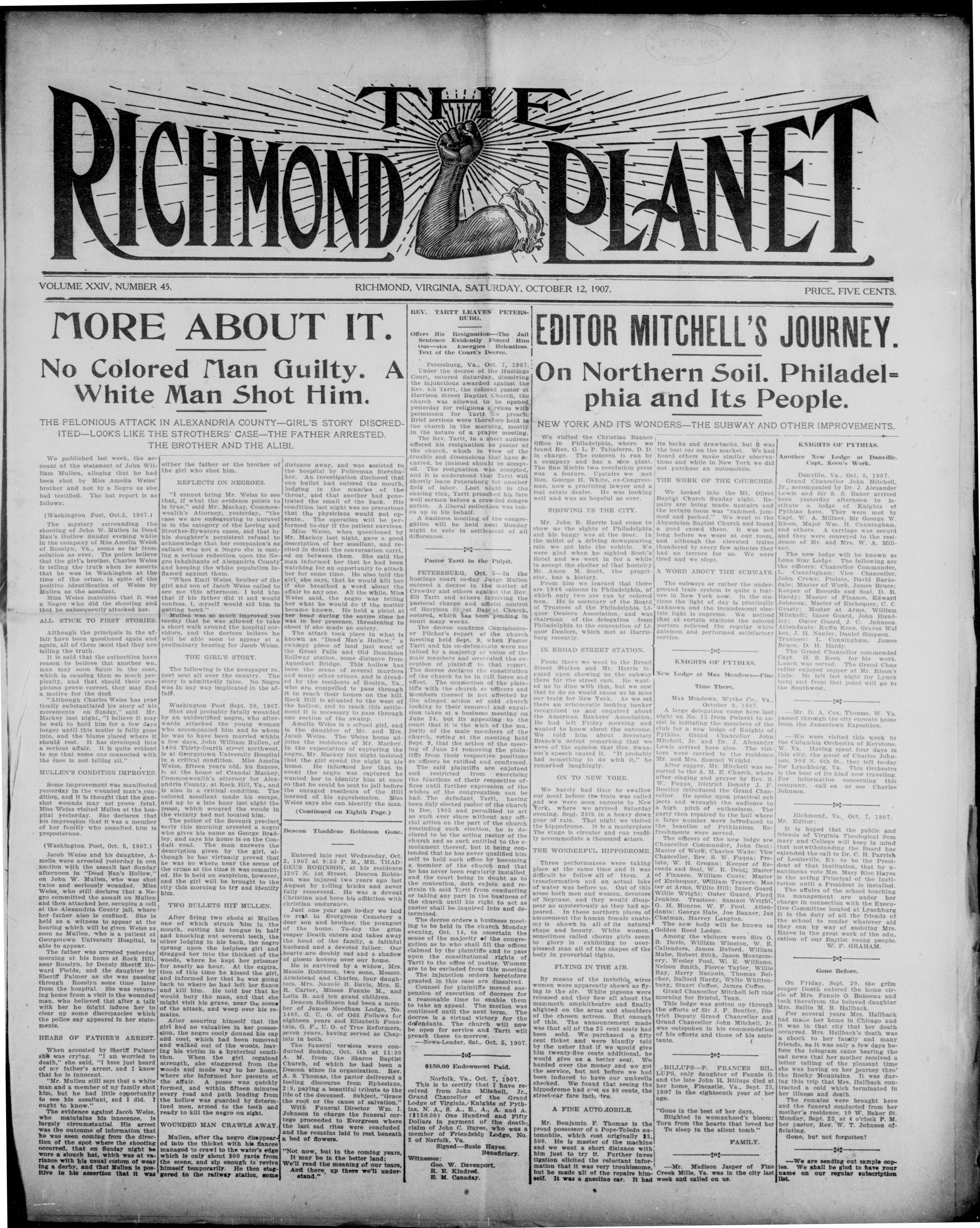
THE RICHMOND PLANET
MORE ABOUT IT. No Colored Man Guilty. A White Man Shot Him.
THE FELONIOUS ATTACK IN ALEXANDRIA COUNTY-GIRL'S STORY DISCREDITED-LOOKS LIKE THE STROTHERS' CASE-THE FATHER ARRESTED. THE BROTHER AND THE ALIBI
VOLUME XXIV, NUMBER 45.
MORE
No Colore
White M
THE FELONIOUS ATTACK IN
ITED—LOOKS LIKE THE
THE
We published last week, the ac-
count of the statement of John William Mullen, alleging that he had been shot by Miss Amelia Weiss' brother and not by a Negro as she had testified. The last report is as follows:
(Washington Post, Oct.3, 1907.)
The mystery surrounding the shooting of John W. Mullen in Dead Man's Hollow Sunday evening while in the company of Miss Amelia Weiss of Rosslyn, Va., seems as far from solution as ever. The police believe that the girl's brother, Charles Weiss is telling the truth when he asserts that he was in Washington at the time of the crime, in spite of the positive identification of Weiss by Mullen as the assailant.
Miss Weiss maintains that it was a Negro who did the shooting and that he subsequently attacked her.
ALL STICK TO FIRST STORIES
Although the principals in the affair have been questioned again and again, all of them insist that they are telling the truth.
It is said that the authorities have reason to believe that another wo. man may soon figure in the case, which is causing them so much perplexity, and that should their suspicions prove correct, they may find a motive for the deed.
"Although Charles Weiss has practically substantiated his story of his movements on Sunday," said Mr. Mackey last night, "I believe it may be well to hold him for a few days longer until this matter is fully gone into, and the blame placed where it should rest. It has developed into a serious affair. It is quite evident to me that some one connected with the case is not telling all."
MULLEN'S CONDITION IMPROVES
Some improvement was manifested yesterday in the wounded man's condition, and it is thought that the gunshot wounds may not prove fatal Miss Weiss visited Mullen at the hospital yesterday. She declares that his impression that it was a member of her family who assaulted him is preposterous.
(Washington Post, Oct. 5, 1907.)
Jacob Weiss and his daughter, Amelia were arrested yesterday in connection with the assault last Sunday afternoon in "Dead Man's Hollow," on John W. Mullen, who was shot twice and seriously wounded. Miss Weiss, who still declares that a Negro committed the assault on Mullen and then attacked her, occupies a cell at the Alexandria County jail, where her father also is confined. She is held as a witness to appear at the hearing which will be given Weiss as soon as Mullen, who is a patient at Georgetown University Hospital, is able to appear.
The father was arrested yesterday the morning at his home at Rock Hill, near Reynolds by Deputy Sheriff Howard Fields, and the daughter by Sheriff Palmer as she was passing through Rosslyn some time later from the hospital. She was returning home from a visit to the wounded man, who believed that after a talk with her he might induce her to clear up some discrepancies which the police say appeared in her statements.
HEARS OF FATHER'S ARREST
When accosted by Sheriff Palmer she was crying. "I am worried to death," she said, "I have just heard of my father's arrest, and I know that he is innocent.
"Mr. Mullen still says that a white man and a member of my family shot him, but he had little opportunity to see his assailant, and I did. I ought to know."
The evidence against Jacob Welss, who maintains his innocence, is largely circumstantial. His arrest was the outcome of information that he was seen coming from the direction of the spot where the shooting occurred, that on Sunday night he wore a slouch hat, which was at variance with his usual custom of wearing a derby, and that Mullen is positive in his assertion that it was
either the father or the brother or the girl who shot him.
REFLECTS ON NEGROES.
"I cannot bring Mr. Weiss to see that, if what the evidence points to is true," said Mr. Mackay, Commonwealth's Attorney, yesterday, "the case we are endeavoring to unravel is in the category of the Loving and Strother-Bywaters cases, and that by his daughter's persistent refusal to acknowledge that her companion's asallant was not a Negro she is casting a serious reflection upon the Negro inhabitants of Alexandria County and keeping the white population inflamed against them.
"When Emil Weiss, brother of the girl and son of Jacob Weiss called to see me this afternoon, I told him that if his father did it and would confess, I myself would aid him in getting bond."
Mullen was so much improved yes terday that he was allowed to take a short walk around the hospital corridors, and the doctors believe he will be able soon to appear at a preliminary hearing for Jacob Weiss.
THE GIRL'S STORY.
The following is the newspaper report sent all over the country. The story is admittedly false. No Negro was in any way implicated in the affair.
Washington Post Sept. 30, 1907. Shot and probably fatally wounded by an unidentified negro, who afterwards attacked the young woman who accompanied him and to whom he was to have been married within a few days, John William Mullen, of 1406 Thirty-fourth street northwest, is at Georgetown University Hospital for critical condition. Miss Amelia Welsh, seven years old, his fiancee, is at the home of Crandal Mackey, Commonwealth's attorney for Arkansas County, at Rock Hill, Va., and is also in a critical condition. The colored assailant made his escape, and up to a late hour last night the posse, which scoured the woods in the vicinity had not located him.
The police of the Seventh precinct early this morning arrested a negro who gives his name as George Bradley, and says his home is on the Conduit road. The man answers the description given by the girl, although he has virtually proved that he was no where near the scene of crime at the time, if we behold him. He is held on suspicion and the girl will be brought to the city this morning to try and identify him.
TWO BULLETS HIT MULLEN
After firing two shots at Mullen one of which struck him in the mouth, cutting his tongue in half and knocking out several teeth, the other lodging in his back, the negro sprang upon the helpless girl and dragged her into the thickest of the woods, where he kept her prisoner for nearly an hour. At the expiration of this time he kissed the girl, and informed her that he was going back to where he had left her fiance and kill him. He told her that he would bury the man, and that she might visit his grave, near the scene of the attack, and weep over his remains.
After assuring himself that the girl had no valuables in her possession, the negro coolly donned his cap and coat, which he been removed and walked out of the room, giving his victim in a hysterical condition. When the girl regained strength, she staggered from the woods and made way to her home, where she informed her parents of the affair. A posse was quickly formed, and within fifteen minutes every road and path leading from the hollow was guarded by determined men, armed to the teeth and ready to kill the negro on sight.
WOUNDED MAN CRAWLS AWAY
Mullen, after the negro disappeared into the thicket with his flancees managed to crawl to the water's edge which is only about 300 yards from the scene, and slip enough to revive himself temporarily. He then staggered to the railway station, some
RICHMOND, VIRGINIA, SATURDAY, OCTOBER 12, 1907
distance away, and was assisted to the hospital by Policeman Sternbaker. An investigation disclosed that one bullet had entered the mouth, lodging in the muscles of the throat, and that another had penetrated the small of the back. His condition last night was so precarious that the physicians would not operate. The operation will be performed to-day if the patient survives. Miss Welss, when questioned by Mr. Mackey last night, gave a good description of her assault, and recited in detail the conversation carried on between them. She said the man informed her that he had been watching for an opportunity to attack her for some time. He also told the girl, she says, that he would kill her if she breathed a word about the affair to any one. All the while, Miss Welss said, the negro was telling her what he would do if the matter became known. He held a pistol at her head during the entire time he was present, threatening to shoot if she made an outy. The attack took place in what is known as "Dorothy Man's Hollow," a swampy piece of land just west of the Great Falls and Old Dominion Railway station, some distance from Aqueduct Bridge. This hollow has been the scene of several murders and many other crimes, and is dredged by the residents of Roslyn. We who are compelled to pass through it to reach their homes on the hill. Rock Hill is situated to the west of the hollow, and to reach this settlement it is necessary to pass through one section of the swamp.
Amelia Weiss is a school girl, and is the daughter of Mr. and Mrs. Jacob Weiss. The Weiss home adjoins the residence of Mr. Mackey. In the expectation of capturing the negro, Mr. Mackey last night insisted that the girl spend the night in his home. He informed her that in event the negro was captured he wanted her to identify him at once so that he could be sent to jail before the enraged residents of the Hill learned of his apprehension. Miss Weiss says she can identify the man. (Continued on Eighth Page.)
Deacon Thaddeus Robinson Gone
Entered into rest Wednesday, Oct. 2, 1907 at 3:03 P. M., MR. THADDEUS ROBINSON, at his residence 1297 N. 1st Street. Deacon Robinson was injured two years ago last August by falling bricks and never fully recovered. He was a devout Christian and bore his affliction with christian endurance. Just one year ago to-day we laid to rest in Evergreen Cemetery a dear son and brother, the youngest of the home. To-day the grim reaper Death enters and takes away the head of the family, a faithful husband and a devoted father. Our hearts are doubly sad and a shadow of gloom hovers over our home.
He is survived by a widow, Mrs. Massie Robinson, two sons, Messrs. Armistead and Charles, four daughters, Mrs. Nannie B. Davis, Mrs. E. R. Carter, Misses Fannie M., and Lelia B. and ten grand children. Deacon Robinson had been a member of James Needham Lodge, No. 1468, G. U. O. of Odd Fellows for eighteen years and Elizabeth Fountain, G. F., U. O. of True Reformers, seven years, having served as Chapain in both. The funeral services were conducted Sunday, Oct. 5th at 11:30 A. M. from the Sharon Baptist Church, of which he had been a Deacon since its organization. Rev. A. S. Thomas, the pastor delivered a feeling discourse from Ephesians, 2:8, paying a beautiful tribute to the life of the deceased. Subject, "Grace the root or the cause of salvation." With Funeral Director Wm. I. Johnson in charge the funeral cortège proceeded to Evergreen where the last sad rites were concluded and the remains laid to rest beneath a bed of flowers.
"Not now, but in the coming years, It may be in the better land; We'll read the meaning of our tears, And there, up there we'll understand."
REV. TARTT LEAVES PETERS-BURG.
Offers His Resignation—The Jail Sentence Evidently Forced Him Out—his Energies Relentless. Text of the Court's Decree.
Petersburg, Va., Oct. 7, 1907. Under the decree of the Hustings Court, entered Saturday, dissolving the injunction against the Rev. Eli Tartt, the colored Harrison Street Baptist Church, the church was allowed to be opened yesterday for religious services with permission for Tartt to preach. Brief services were therefore held in the church in the morning, mostly in the nature of a prayer meeting.
The Rev. Tartt, in a short address offered his resignation as pastor of the church, which in view of the trouble and dissensions that have occurred, he insisted should be accepted. The resignation was accepted, and it is understood that Tartt will shortly leave Petersburg for another field of labor. Last night in the skating rink, Tartt preached his fare well sermon before a crowded congregation. A liberal collection was taken in him. A business meeting of the congregation will be held next Monday night to vote in settlement of all differences.
Pastor Tartt in the Pulpit.
PETERSBURG, Oct. 5—In the hustings court to-day Judge Mullen entered a decree in the matter of Crowder and others against the Rev. Eli Tartt and others involving the pastoral charge and official control of Harrison Street Baptist Church, colored, which has been pending in court many weeks.
The decree confirms Commissioner Pilcher's report of the church meeting held Sept. 9, when Pastor Tartt and his co-defendants were sus-tained by a majority of votes of the male members and overruled the exception of plaintiff to that report. The decree declares the constitution of the church to be in full force and effect. The connection of the plaintiffs with the church as officers and members thereof is not affected by the alleged action of said church looking to their removal and expulsion taken at a business meeting on June 24, but its appealing to the court that it is the wish of the majority of the male members of the church, voting at the meeting held Sept. 9, that the action of the meeting of June 24 removing the plaintiffs from their respective positions as officers be ratified and confirmed.
The said plaintiffs are enjoined and restricted from exercising the functions of their respective offices until further expression of the wishes of the congregation can be had. The defendant, Tartt, having been duly elected pastor of the church in Dec. 1903 and permitted to act as such ever since without any official action on the part of the church rescinding such election, he is declared to be the acting pastor of the church and as such entitled to the emolument thereof, but it being contended that he has never qualified him self to hold such office by becoming a member of the church and that he has been regularly installed, and the court being in doubt as to the contention, doth enjoine in strain tha said Tartt from conducting or taking any part in the business of the church until his right to act as pastor shall be inquired into and determined.
The decree orders a business meeting to be held in the church Monday evening, Oct. 14, to ascertain the sense of the majority of the congregation as to who shall fill the offices claimed by the plaintiffs and to pass upon the constitutional rights of Tartt to the office of pastor. Women are to be excluded from this meeting. The injunction orders heretofore granted in this case are dissolved. Counsel for plaintiffs moved suspension of execution of decrees for a reasonable time to enable them to take an appeal. The motion was continued until the next term. The decree is a virtual victory for the defendants. The church will now be open for service and Tartt will preach there to morrow.
—News-Leader, Sat., Oct. 5, 1907.
$150.00 Endowment Paid.
Norfolk, Va. Oct. 7, 1907.
This is to certify that I have received from John Mitchell, Jr.,
Grand Chancellor of the Grand
Lodge of Virginia, Knights of Pytha-
nomen, S. B. A. and A. A.
($150.00). One Hundred and Fifty
Dollars in payment of the death-
claim of John C. Hayes, who was a
member of Friendship Lodge, No.
3 of Norfolk, Va.
Geo. W. Davenport.
R. E. Kindred.
E. M. Canaday.
EDITOR MITCHELL'S JOURNEY. On Northern Soil. Philadelphia and Its People.
NEW YORK AND ITS WONDERS—THE SUBWAY AND OTHER IMPROVEMENTS.
We visited the Christian Banner Office in Philadelphia, where we found Rev. G. L. P. Talaferro, D. D. in charge. The concern is run by a company and has a nice plant. The fine Miehle two revolution press was a feature. Upstairs we met Hon. George H. White, ex-Congressman, now a practicing lawyer and a real estate dealer. He was looking well and was as hopeful as ever.
its backs and drawbacks, but it was the best car on the market. We had heard others make similar observations and while in New York we did not purchase an automobile.
THE WORK OF THE CHURCHES.
We looked into the Mt. Olivet Baptist Church Sunday night. Re
KNIGHTS OF PYTHIAS.
Another New Lodge at Danville Capt. Keen's Work.
Danville, Keen, Oct. 8, 1907.
Grand Chancellor John Mitchell Jr., accompanied by Dr. J. Alexander Lewis and Sir S. S. Baker arrived here yesterday afternoon.
SHOWING US THE CITY
Mr. John B. Harris had come to show us the sights of Philadelphia and his buggy was at the door. In the midst of a driving downpouring rain we got into the vehicle. We were glad when he sighted Scott's Hotel and we went in for a while to accept the shelter of that hostelry Mr. Amos M. Scott, the proprietor, has a history.
From him we learned that there are 1946 saloons in Philadelphia, of which only two are run by colored men. He is secretary of the Board of Trustees of the Philadelphia Liquor Dealers Association, and was chairman of the delegation from Philadelphia to the convention of Liquor Dealers, which met at Harrisburg recently.
IN BROAD STREET STATION.
From there we went to the Broad Street Station and Mr. Harris insisted upon showing us the subway there for the street cars. He wanted us to dine with him, but we saw that to do so would cause us to miss our train for New York. As we sat there an aristocratic looking banker recognized us and enquired about the American Bankers' Association. He had left Friday morning and wanted to know about the outcome. We told him about Secretary Branch's defeat remarking that we were of the opinion that Gov. Swanson's speech caused it. "It probably had something to do with it," he remarked laughingly.
ON TO NEW YORK
We barely had time to swallow our meal before the train was called and we were soon enroute to New York, where we arrived Saturday evening, Sept. 28th in a heavy down pour of rain. That night we visited the hippodrome. It is a masterpiece The stage is circular and can readily accommodate a thousand actors.
THE WONDERFUL HIPPODROME
Three performances were taking place at the same time and it was difficult to follow all of them. A transformation and an actual lake of water was before us. Out of this arose both men and women, devotees of Neptune, and they would disappear as mysteriously as they had appeared. In these northern places of amusement the human female anatomy is shown in all of its natural shape and beauty. White women, sometimes called chorus girls seem to glory in exhibiting to overpleased man all of the shapes of the body in proverbal tights.
FLYING IN THE AIR.
By means of the invisibl wires women were apparently shown as flying in the air. White pigeons were released and they flew all about the mammoth amphitheatre and finally alighted on the arms and shoulders of the chosen actress. But enough of this. The announcement made was that all of the 25 cent seats had been sold. We purchased a fifty cent ticket and were blandly told by the usher that if we give him twenty-five cents additional, he would give us a better seat. We handed over the money and we got the service, but not before we had been induced to have our umbrella checked. We found that seeing the hippodrome had cost us 90 cents, the street-car fare inclusive.
A FINE AUTO MOBILE
Mr. Benjamin F. Thomas is the proud possessor of a Pope-Toledo automobile, which cost originally $3,500. He is master of the machine and we went a short distance with him just to try it. Further inves tigation elicited the reluctant information that it was very troublesome, but he made all of the repairs himself. It was a gasoline car. It had
its backs and drawbacks, but it was the best car on the market. We had heard others make similar observations and while in New York we did not purchase an automobile.
THE WORK OF THE CHURCHES
We looked into the Mt. Oliver Baptist Church Sunday night. Repairs are being made upstairs and the lecture room was "rammed, jammed and packed." We went to the Abyssinian Baptist Church and found a good crowd there. It was not long before we were at our room, and although the elevated trafa thundered by every few minutes they had no terrors for us. We were tired and we slept.
A WORD ABOUT THE SUBWAYS
The subways or rather the underground train system is quite a feature in New York now. In the stations the light of day is practically unknown and the incandescent electric light is supreme. We noticed that at certain stations the colored porters relieved the regular white gatemen and performed satisfactory service.
New Lodge at Max Meadows—Fin
Time There.
Max Meadows, Wythe Co., Va.
October, 1865
A large delegation came here last night on No. 13 from Pulaski to assist in initiating the members of the club for a new lodge of Knights of Pythias. Grand Chancellor John Mitchell, Jr. and Dr. J. Alexander Lewis arrived here also. The visitors were carried to the residence Mr. and Mrs. Samuel Wright. After supper, Mr. Mitchell was escorted to the A. M. E. Church, where after singing and prayer by Rev. S. W. Fiqua, District Deputy J. F. Bentley introduced the Grand Chancellor. He spoke upon practical subjects and wrought the audience to a high pitch of enthusiasm. The party then repaired to the hall where a large number were introduced to the beauties of Pythianism. Refreshments were served. The officers of the new lodge are Chancellor Commander, John Dent; Master Work, Charles Wade; Vice Chancellor Rev. S. W. Fiqua; Prelate, W. H. Morgan Keeper of Records and Seal, R. Dent; Master of Finance, William Coats; Master of Exchequer, William Travers; Master at Arms, Willie Hill; Luner Guard Willie Wright; Outer Guard, Floyd Jenkins. Trustees: Samuel Wright; G. H. Monroe, W. F. Pool; Attendants: George Hale, Joe Banner, Jas Chatman, Harvey Langton. The new body will be known as Golden Reed Lodge.
Among the visitors were Sirs O. B. Davis, William Winston, W. E. Callendors, James Buford, William Mabe, Robert Stith, Jason Montgomery, Wesley Pool, W. E. Williams, Nelson Smith, Pierce Taylor, Willie Ray, Harry Nuckels, Thomas Belcher, Ballard Hardy, Wylie Whittenburg, Stuart Coffee, James Coffee. Grand Chancellor Mitchell left this morning for Bristol, Tenn.
This lodge was gotten up through the efforts of Sir J. F. Bentley, District Deputy Grand Chancellor and Grand Chancellor John Mitchell, Jr was outspoken in his commendation of his efforts and those of his assistants.
BILLUPS—P. FRANCES BILLUPS, only daughter of Fannie O. and the late John H. Billups died at her home, Fincastle, Va., Sept. 23, 1907 in the eighteenth year of her age.
"Gone in the best of her days,
Bilighted in womanhood's bloom;
Torn from the hearts that loved her
To sleep in the silent tomb."
Mr. Madison Jasper of Fine Creek Mills, Va. was in the city last week and called on us.
PRICE, FIVE CENTS.
JOURNEY.
Philadel-
eople.
OTHER IMPROVEMENTS.
KNIGHTS OF PYTHIAS.
Another New Lodge at Danville
Capt. Keen's Work.
Danville, Va. Oct. 8, 1907.
Grand Chancellor John Mitchell,
Jr., accompanied by Dr. J. Alexander
Lewis and Sir S. S. Baker arrived
here yesterday afternoon to institute a lodge of Knights of Pythias here. They were met by Capt. W. A. Milner, Sir George W.
Rison, Major Wm. H. Cunningham,
and others. A carriage was secured
and they were conveyed to the residence of Mr. and Mrs. W. A. Millner.
The new lodge will be known as Lone Star Lodge. The following are the officers: Chancellor Commander,
L. Cunningham; Vice Chancellor,
John Crews; Prelate, David Barksdale; Master of Work, James Bruce;
Keeper of Records and Seal, D. H. Hardy; Master of Finance, Edward Johnson; Master of Exchequer, C. C. Grasty; Master at Arms, William Mitchell; Inner Guard, John Hundley; Outer Guard, J. C. Johnson; Attendants: Ruffin Keen, Graves Walker, J. H. Nunley, Daniel Simpson.
Trustees: L. Cunningham, James Bruce, D. H. Hardy.
The Grand Chancellor commended Capt. H. S. Keen for his work.
Lunch was served. The Grand Chancellor enjoyed supper at Mr. Rison's Cafe. He left last night for Lynch burg and from that point will go to the Southwest.
0
Mr. D. A. Cox, Thomas, W. Va. passed through the city enroute home from the Jamestown Exposition.
We were visited this week by the Columbia Orchestra of Keystone, W. Va. Having spent four days in this city, the guest of Charles Johnson, 906 N. 6th St., they left to-day for Lynchburg, Va. This Orchestra is the best of its kind now travelling. For information concerning this company, call on or see Charles Johnson.
Richmond, Va., Oct. 7, 1907.
Mr. Editor:
It is hoped that the public and
friends of Virginia Theological Sem-
inary and College will keep in mind
that notwithstanding the Board has
extended the call to Dr. C. H. Parrish
of Louisville, Ky. to be the Presid-
ent of that Institution, that by
unanimous vote Mrs. Mary Rice Hay-
is the acting Principal of the insti-
tution until a President is installed.
The affairs of the school touching
its management are under her
charge in connection with the Exe-
cutive Committee located at Lynchburg
It is the duty of all the friends of
the school to render whatever aid
they can by way of assisting Mrs.
Hayes in the great work of the edu-
cation of our Baptist young people.
W. F. GEHAH
Gone Before.
On Friday, Sept. 20, the grim reaper Death entered the home circle of Mrs. Fannie O. Bolsseau and took therefrom the beloved daughter Mrs. Sallie M. B. Hallback.
For several years Mrs. Hallback had make her home in Chicago and it was in that city that her death occurred. Mrs. Hallback's death was a shock to her family and many friends, as it was only a few days before the telegram came bearing the sad news that her mother received a letter telling of the pleasant time she was having on her journey thro' the Rocky Mountains. It was during this trip that Mrs. Hallback contracted a cold which terminated in her illness and death.
The remains were brought here and the funeral conducted from her mother's residence, 10 W. Baker St. Monday, Sept. 23 at 4 o'clock P. M. her pastor, Rev. W. T. Johnson officiating.
Gone, but not forgotten!
We are sending out sample copies. We shall be glad to have your name on our regular subscription list.
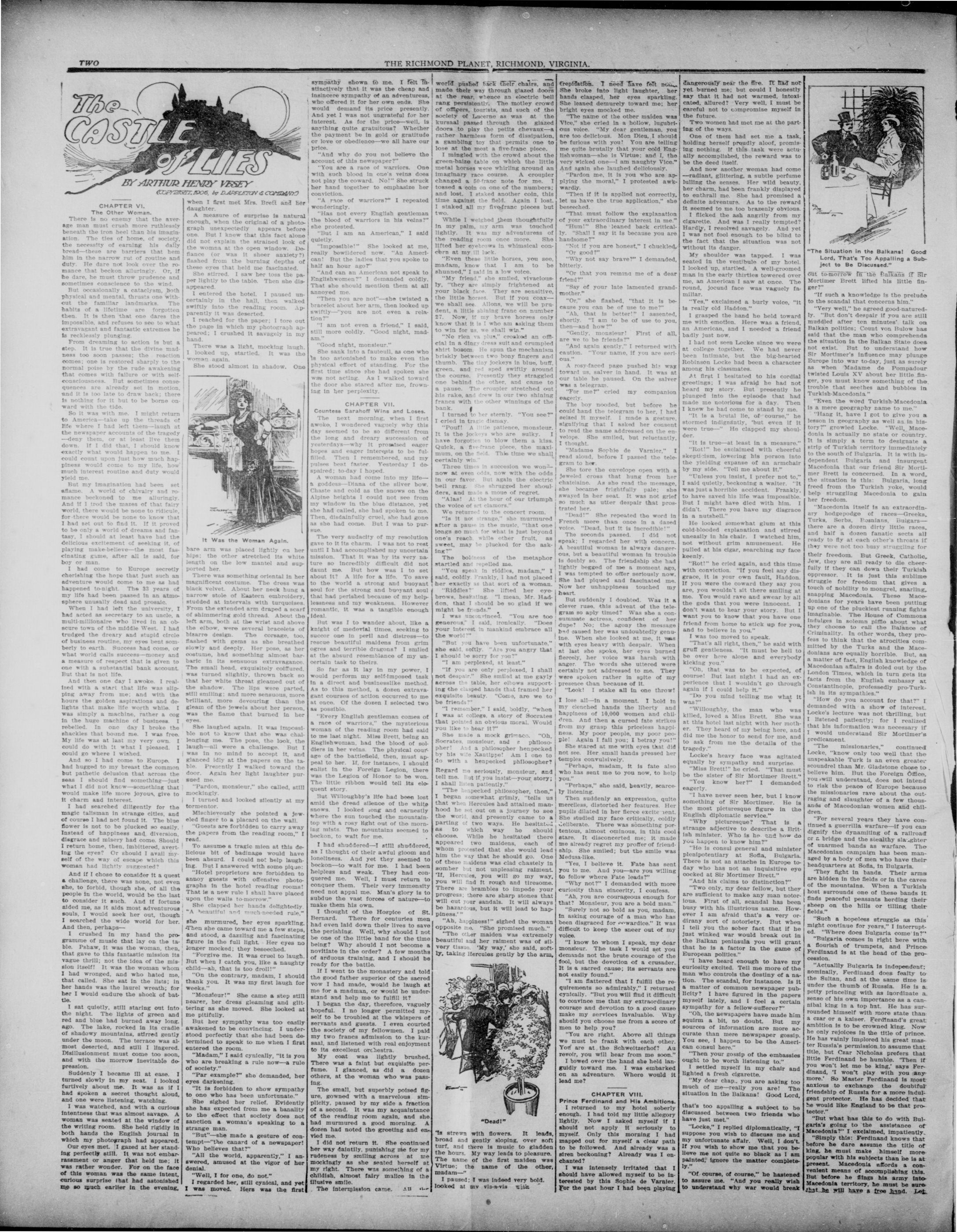
The CASTLE of LIES BY ARTHUR HENRY VESEY
(COPYRIGHT, 1906, by D. APPLETON & COMPANY)
TWO
CHAPTER VI.
The Other Woman.
There is no enemy that the average man must crush more ruthlessly beneath the iron heel than his imagination. The ties of home, of society, the necessity of earning his daily bread—these are barriers that hem him in the narrow rut of routine and duty. He dare not look over the romance that beckon alluringly. Or, if he dare, he must throw prudence and sometimes conscience to the wind.
But occasionally a cataclysm, both physical and mental, thrusts one without the familiar landmarks. The habits of a lifetime are forgotten then. It is then that one dares the impossible, and refuses to see to what extravagant and fantastic extremes he is recklessly plunging.
From dreaming to action is but a step. It is true that the divine madness too soon passes; the reaction comes; one is restored sharply to the normal poise by the rude awakening that comes with failure or with self-consciousness. But sometimes consequences are already set in motion, and it is too late to draw back; there is nothing for it but to be borne onward with the tide.
So it was with me. I might return to America—take up the threads of life where I had left them—laugh at the newspaper accounts of the tragedy—deny them, or at least live them down. If I did that, I should know exactly what would happen to me. I could count upon just how much happiness would come to my life, how much interest routine and duty would yield me.
But my imagination had been set afame. A world of chivalry and romance beckoned to me alluringly. And if I trod the mazes of that fairy world, there would be none to ridicule, for there would be none to know that I had set out to find it. If it proved to be only a world of dreams and fantasy, I should at least have had the delicious excitement of seeking it, of playing make-believe—the most fascinating game, after all is said, for boy or man.
I had come to Europe secretly cherishing the hope that just such an adventure would come to me as had happened to night. The $3 years of my life had been passed in an atmosphere unusually dead and prosocial.
When I had left the university, I had acted as secretary to an uncle, a multi-millionaire who lived in an obscure town of the middle West. I had trudged the dreary and stupid circle of business routine, my eyes bent somberly to earth. Success had come, or what world calls success—money and a measure of respect that is given to one with a substantial bank account. But that is not life.
And then one day I awoke. I realized with a start that life was slipping away from me; and with the hours the golden aspirations and delights that make life worth while. I was simply a machine, rather a cog in the huge machine of business. I rebelled. In one day I broke the shackles that bound me. I was free. My life was at last my very own. I could do with it what I pleased. I could go where I wished.
And so I had come to Europe. I had hugged to my breast the common but pathetic delusion that across the seas I should find something—just what I did not know—something that would make life more joyous, give to it charm and interest.
I had searched diligently for the magic tallman in strange cities, and of course I had not found it. The blue flower is not to be plucked so easily. Instead of happiness and diversion, disgrace and misery had come. Should I return home, then, imbittered, averting the eyes? Or should I avail myself of the way of escape which this woman had lightly suggested?
And if I chose to consider it a quest a challenge, there was none, not even she, to forbid, though she, of all the people in the world, would be the last to consider it such. And if fortune aided me, as it aids most adventurous souls, I would seek her out, though I searched the wide world for her. And then, perhaps—
I crushed in my hand the programme of music that lay on the table. Peshaw, it was the woman, then, that gave to this fantastic mission its vague thrill; not the idea of the mission itself! It was the woman whom I had wronged, and who hated me, that called. She sat in the lists; in her hands was the laurel wreath; for her I would endure the shock of battle.
I sat quietly, still starling out into the night. The lights of green and red and blue had burned away long, ago. The lake, rocked in its cradle of shadowy mountains, stiffred gently under the moon. The terrace was almost deserted, and still I lingered. Disillusionment must come too soon, and with the morrow inevitable depression.
Suddenly I became ill at ease. I turned slowly in my seat. I looked furtively about me. It was as if I had spoken a secret thought aloud, and one were listening watching.
I was watched, and with a curious intentness that was almost savage. A woman was seated at the window of the writing room. She held rigidly in both hands the English journal in which my photograph had appeared. Our eyes met. I gazed at her standing perfectly still. It was not embarrassment or anger that held me; it was rather wonder. For on the face of this woman was the same intent, curious surprise that had astonished me so much earlier in the evening.
when I first met Mrs. Breft and her daughter.
A measure of surprise is natural enough, when the original of a photograph unexpectedly appears before one. But I knew that this fact alone did not explain the strained look of the womma at the open window. Defiance (or was it sheer anxiety?) flashed from the burning depths of these eyes that held me fascinated.
She stirred. I saw her toes the paper lightly to the table. Then she disappeared.
I entered the hotel. I paused uncertainly in the hall, then walked swiftly into the reading room. Apparently it was deserted.
I reached for the paper; I tore out the page in which my photograph appeared; I crushed it savagely in my hand.
There was a light, mocking laugh. I looked up, startled. It was the woman again.
She stood almost in shadow. One
It Was the Woman Again.
bare arm was placed lightly on her hips; the other stretched its white length on the low mantel and supported her.
There was something oriental in her magnificent costume. The dress was black velvet. About her neck hung a narrow stole of Eastern embroidery, studded at intervals with turquoises. From the extended arm draped a scarf of shimmering gold thread. About the left arm, both at the wrist and above the elbow, were several bracelets of blzarre design. The corsage, too, flashed with gems as she breathed slowly and deeply. Her pose, as her costume, had something almost barbaric in its sensuous extravagance. The small head, exquisitely coiffed, was turned slightly, thrown back so that her white throat gleamed out of the shadow. The lips were parted, still smiling; and more sensuous, more brilliant, more devouring than the gleam of the jewels about her person, was the flame that burned in her eyes.
She laughed again. It was impossible not to know that she was challenging me. The pose, the look, the laugh—all were a challenge. But I was in no mind to accept it, and glanced idly at the papers on the table. Presently I walked toward the door. Again her light laughter pursued me.
"Pardon, monsleur," she called, still mockingly.
I turned and looked silently at my tormentor.
Mischievously she pointed a jeweled finger to a placard on the wall.
"Guests are forbidden to carry away the papers from the reading room," I read.
To assume a tragic mien at this delicious bit of badness would have been absurd. I could not help laughing. But I answered with some plause:
"Hotel proprietors are forbidden to annoy guests with offensive photographs in the hotel reading rooms! That is a new rule I shall have placed upon the walls to-morrow." She clapped her hands delightedly. "A beautiful and much-needed rule."
she murmured, her eyes sparkling.
Then she came toward me a few steps,
and stood, a dazzling and fascinating
figure in the full light. Her eyes no longer mocked; they beseeched.
"Forgive me. It was cruel to laugh.
But when I catch you, like a naughty child—ah, that is too droll!"
"On the contrary, madam, I should thank you. It was my first laugh for weeks."
"Monsleur!" She came a step still nearer, her dress gleaming and glittering as she moved. She looked at me pitifully.
But her sympathy was too casily awakened to be convincing. I understood perfectly that she had been determined to speak to me when I first entered the room.
"Madam," I said cynically, "it is you who are breaking a rule now—a rule of society."
"Par example?" she demanded, her eyes darkening.
"It is forbidden to show sympathy to one who has been unfortunate."
to one who has been unfortunate."
She sighed her relief. Evidently she has expected from me a bansality to the effect that society does not sanction a woman's speaking to a strange man.
"But"—she made a gesture of contempt—"the canard of a newspaper! Who believes that?"
"All the world, apparently," I answered, amused at the vigor of her denial.
"Well, I for one, do not."
I regarded her, still cynical, and yet I was moved. Hers was the first
THE RICHMOND PLANET, RICHMOND, VIRGINIA
sympathy shown to me. I felt instinctively that it was the cheap and insincere sympathy of an adventures, who offered it for her own ends. She would demand its price presently. And yet I was not ungrateful for her interest. As for the price—well, is anything quite gratuitous? Whether the payment be in gold or gratitude or love or obedience—we all have our price.
"And why do you not believe the account of this newspaper?" "You are a race of warriors. One with such blood in one's veins does not play the coward. No!" She struck her hand together to emphasize her conviction.
"A race of warriors?" I repeated wonderingly.
"Has not every English gentleman the blood of warriors in his veins?" she protested.
"But I am an American," I said quietly.
"Iimpossible!" She looked at me, really bewared now. "An American! But the ladies that you spoke to half an hour ago!"
"And can an American not speak to Englishwomen?" I demanded coldly. That she should mention them at all annoyed me.
"Then you are not"—she twisted a bracelet about her arm, then looked up swiftly—"you are not even a relation?"
"I am not even a friend," I said, still more coldly. "Good night, mad-am."
"Good night, monsieur."
She sank into a fauteuil, as one who is too astonished to make even the physical effort of standing. For the first time since she had spoken she was not acting. As I walked toward the door she stared after me, frowning in her perplexity.
CHAPTER VII.
Countess Sarahoff Wins and Loses.
The next morning, when I first awoke, I wondered vaguely why this day seemed to be so different from the long and dreary succession of yesterdays—why it promised eager hopes and eager interests to be fulfilled. Then I remembered, and my pulses beat faster. Yesterday I despaired; to-day I hoped.
A woman had come into my life—a goddess—Diana of the silver bow. Chaste and cold as the snows on the Alpine heights I could not see from my window in the blue distance, yet she had called, she had spoken to me. Then, disdainfully cruel, she had gone as she had come. But I was to pursue.
The very audacity of my resolution gave to it its charm. I was not to rest until I had accomplished my uncertain mission. That it was by its very nature so incredibly difficult did not daunt me. But how was I to set about it? A life for a life. To save to the world a strong and buoyant soul for the strong and buoyant soul that had perished because of my helplessness and my weakness. However romantic, it was a tangible enough ideal.
But was I to wander about, like a knight of medieval times, seeking to succor one in peril and distress—to rescue beautiful maledens from grim ogres and terrible dragons? I smiled at the absurd resemblance of my uncertain task to theirs.
So far as it lay in my power, I would perform my self-imposed task in a direct and businesslike method. As to this method, a dozen extravagant courses of action occurred to me at once. Of the dozen I selected two as possible.
"Every English gentleman comes of a race of warriors," the mysterious woman of the reading room had said to me last night. Miss Brett, being an Englishwoman, had the blood of soldiers in her veins. The physical courage of the battlefield, then, must appeal to her. If, for instance, I should enlist in the Foreign Legion, there was the Legion of Honor to be won. The little ribbon would tell its eloquent story.
But Willoughby's life had been lost amid the dread silence of the white snows. I looked long and earnestly where the sun touched the mountain-top with a rosy light out of the morning mists. The mountains seemed to beckon, to wait for me.
I had shuddered—I still shuddered, as I thought of their awful gloom and loneliness. And yet they seemed to beckon—to wait for me. I had been helpless and weak. They had conquered me. Well, I must return to conquer them. Their very immensity need not appeal me. Man's glory is to subdue the vast forces of nature—to make them his own.
I thought of the Hospice of St. Bernard. There for centuries men had even laid down their lives to save the perishing. Well, why should I not be one of the little band for the time being? Why should I not become a novitate in the order? A few months of arduous training, and I should be ready for the battle.
If I went to the monastery and told the good father superior of the sacred vow I had made, would he laugh at me for a madman, or would he understand and help me to fulfill it?
I began the day, therefore, vaguely hopeful. I no longer permitted myself to be troubled at the whispers of servants and guests. I even courted the society of my fellowmen. I paid my two francs admission to the kursaal, and listened with real enjoyment to its excellent orchestra.
My coat was lightly brushed. There was a faint but exquisite perfume. I glanced, as did a dozen others, at the woman who was passing.
The small, but superbly poised figure, gowned with a marvelous simplicity, paused by my side a fraction of a second. It was my acquaintance of the reading room again, and she had murmured a good morning. A dozen had noted the greeting and envied me.
I did not return it. She continued her way daintily, punishing me for my rudeness by smiling across at me mockingly as she seated herself at my right. There was something of a childish, almost fairy malice in the illusive smile.
The intermission came. AU 44.
world pushed back their chairs, and made their way through glazed doors at the rear, whence an electric bell rang persistently. The motley crowd of officers, tourists, and such of the society of Lucerne as was at the kursaal passed through the glazed doors to play the petits chevaux—a rather harmless form of dissipation, a gambling toy that permits one to lose at the most a five-franc piece. I mingled with the crowd about the green-balize table on which the little metal horses were whirling around an imaginary race course. A croupler changed a 50-franc note for me. I tossed a coin on one of the numbers; and lost. I staked another coin, this time against the field. Again I lost. I staked all my five-franc pieces but two.
While I weighed them thoughtfully in my palm, my arm was touched lightly. It was my adventures of the reading room once more. She lifted her eyebrows in whimsical concern at my ill luck.
"Even these little horses, you see, madam, know that I am to be shunned," I said in a low voice.
"My friend," she smiled, vivaciously, "they are simply frightened at your black face. They are sensitive, the little horses. But if you coax—we shall see. Allons, we will be prudent, a little shining france on number 27. Now, if my brave horses only know that it is I who am asking them to win for us, we shall win."
"No rlen va plus," croaked an official in a dingy dress suit and crumpled shirt bosom. He spun the mechanism briskly between two bony fingers and thumb. The tiny jockeys in blue, buff, green, and red sped swiftly around the course. Presently they straggled one behind the other, and came to a pause. The croupler stretched out his rake, and drew in our two shining frances with the other winnings of the bank.
I turned to her sternly. "You see?" I cried in tragic dismay. "Poufl! A little patience, monsleur. It is the jockeys who are suky. I have forgotten to blow them a kiss. Quick, a five-frane piece, the maximum, on the field. This time we shall certainly win."
Three times in succession we won—now at even odds, now with the odds in our favor. But again the electric bell rang. She shrugged her shoulders, and made a mue of regret.
"Alas! At the hour of our triumph the voice of art clamors."
We returned to the concert room.
"Is it not strange," she murmured after a pause in the music, "that one longs so much for what is just beyond one's reach while other fruit, as sweet, may be plucked for the asking?"
The boldness of the metaphor startled and repelled me.
"You speak in riddles, madam," I said, coldly. Frankly, I had not placed her exactly as that sort of a woman.
"Riddles!" She lifted her eyebrows, heskating. "I mean, Mr. Haddon, that I should be so glad if we might be friends."
I was unconvinced. "You are too generous." I said, ironically. "Does your interest in mankind embrace all the world?"
"But you have been unfortunate," she said, softly. "Are you angry that I should be sorry for you?"
"I am perplexed, at least."
"If you are only perplexed, I shall not despair." She smiled at me gaily across the table, her elbows supporting the clasped hands that framed her exquisite beauty. "Come, are we to be friends?"
"I remember." I said, boldly. "when I was at college, a story of Socrates that pointed an obvious moral. Would you like to hear it?"
She made a mock grimace. "Oh, Socrates monsieur, and a philosopher! And a philosopher henpecked by his wife Xantippe! Am I one to do with a henpecked philosopher? Regard me seriously, monsieur, and tell me. But if you insist—your story; I shall listen patiently."
"The benpecked philosopher, then," I began somewhat grimly, "tells us that when Hercules had attained manhood he set out on a journey to see the world, and presently came to a parting of two ways. He hesitated as to which way he should choose. While he hesitated there appeared two maledins, each of whom protested that she would lead him the way that he should go. One of these maledins was clad chastely in somber but not unpleasing raiment. If, Hercules, you will go my way, you will find it rough and tiresome. There are brambles to impede your progress; there are sharp stones that will out your sandals. It will always be hazardous, but it will lead to happiness."
"Ah, happiness!" sighed the woman opposite me. "She promised much."
"The other maiden was extremely beautiful and her raiment was of silvery tissue. 'My way,' she said, softly, taking Hercules gently by the arm.
"Dessin"
'is strewn with flowers. It leads, broad and gently sloping, over soft turf, and there is music to gladden the hours. My way leads to pleasure. The name of the first maiden was Virtue; the name of the other, madam—' I paused; I was indeed very bold. looked at my vis-à-vis with
crepitation. I need have felt now.
She broke into light laughter, her hands clasped, her eyes sparkling, She leaned demurely toward me; her bright eyes mocked me.
"The name of the other maiden was Vice," she cried in a hollow, lugubrious voice. "My dear gentleman, you are too delicious. Mon Dieu, I should be furious with you! You are telling me quite brutally that your cool Englishwoman—she is Virtue; and I, the very wicked one—I am naughty Vice." And again she laughed delicously.
"Pardon me, it is you who are applying the moral," I protested awkwardly.
"Then if it is applied not correctly, let us have the true application," she beseeched.
"That must follow the explanation of your extraordinary interest in me." "Hum!" She leaned back critically. "Shall I say it is because you are handsome?"
"Not if you are honest," I chuckled. "Or good?"
"Why not say brave?" I demanded, bitterly.
"Or that you remind me of a dear friend?
"Say of your late lamented grandmother."
"Or," she flashed, "that it is because you can be of use to me?" "Ah, that is better!" I assented, shortly. "I am to be of use to you, then—and how?" "Gently, monsieur! First of all, are we to be friends?" "And again gently," I returned with caution. "Your name, if you are serious."
A rosy-faced page pushed his wag toward us, salver in hand. It was at our table he paused. On the salver was a telegram.
"For me!" cried my companion eagerly.
The boy noodled, but before he could hand the telegram to her, I had seized it myself. I made a gesture, signifying that I asked her consent to read the name addressed on the envelope. She smiled, but reluctantly, I thought.
"Madame Sophie de Varnier," I read aloud, before I passed the telegram to her.
She tore the envelope open with a jeweled cross that hung from her chaltealine. As she read the message, she became frightfully pale; she swayed in her seat. It was not grief so much as utter despair that prostrated her.
"Dead!" She repeated the word in French more than once in a dazed voice. "Dead, but it is incredible!" The seconds passed. I did not speak; I regarded her with concern. A beautiful woman is always dangerous, but a beautiful woman in trouble is doubly so. The friendship she had lightly begged of me a moment ago, I was tempted to offer seriously now. She had pliqued and fascinated me. Now her unhappiness touched my heart.
But suddenly I doubted. Was it a clever ruse, this advent of the telegram so aptly timed? Was she a consumatemate alert, confident of her dupe? No; the agony the message had caused her was undoubtedly genuine. When she looked at me, it was with eyes heavy with despair. When at last she spoke, her eyes burned fiercely, her voice was harsh with anger. The words she uttered were certainly not addressed to me. They were spoken rather in spite of my presence than because of it.
"Look! I stake all in one throw!
I lose all—in a moment. I hold in my clenched hands the liberty and happiness of 10,000 women and children. And then a cursed fate strikes from my grasp this priceless happiness. My poor people, my poor people! Again I fail you; I betray you!" She stared at me with eyes that did not see. Her small hands pressed her temples convulsively.
"Perhaps, madam, it is fate also who has sent me to you now, to help you."
"Perhaps," she said, heavily, scarcely listening. Then suddenly an expression, quite merciless, distorted her features. Her pupils dilated in her fierce excite nent. She studied my face critically, coldly Geliberate. There was something portentous, almost ominous, in this cool stare. It disconcerted me; it made me already regret my proffer of friendship. She smiled; but the smile was Medusa-like.
"Yes, I believe it. Fate has sent you to me. And you—are you willing to follow where Fate leads?"
"Why not?" I demanded with more curiosity than sincerity, I confess.
"Ah, you are courageous enough for that? Monsleur, you are a bold man."
"Surely not so bold as you, madam, in asking courage of a man who has been disgraced for cowardice." It was difficult to keep the sneer out of my voice.
"I know to whom I speak, my dear monsieur. The task I would set you demands not the brute courage of the fool, but the devotion of a crusader. It is a sacred cause; its servants are not easily found."
"I am flattered that I fulfill the requirements so admirably." I returned cynically. "But you will find it difficult to convince me that my extraordinary courage and devotion to a good cause make my services invaluable. Why should you choose me from a score of men to help you?"
"You are right. Above all things we must be frank with each other. You are at the Schweitzerhof. Au revoir, you will hear from me soon." I bowed over the hand she held languidly toward me. I was embarked on an adventure. Where would it lead me?
CHAPTER VIII
Prince Ferdinand and His Ambitions.
I returned to my hotel soberly enough. I had told my little allegory lightly. Now I asked myself if I should not apply it seriously to myself. Only this morning I had mapped out for myself a clear path to be followed. And already was a siren beckoning? Already was I enchanted?
I was intensely irritated that I should have allowed myself to be interested by this Sophie de Varnier. For the past hour I had been playing
dangerously near the fire. It had not yet burned me; but could I honestly say that it had not warmed, intoxicated, allured? Very well, I must be careful not to compromise myself in the future.
Two women had met me at the parting of the ways.
One of them had set me a task, holding herself proudly aloof, promising nothing. If this task were actually accomplished, the reward was to be the deed itself.
And now another woman had come—radiant, glittering, a subtle perfume lulling the senses. Her wild beauty, her charm, had been frankly displayed to enthrall me. She had promised a definite adventure. As to the reward it seemed to me too brazenly obvious.
I flicked the ash angrily from my cigarette. And was I really tempted? Hardly, I resolved savagely. And yet I was not fool enough to be blind to the fact that the situation was not without its danger.
My shoulder was tapped. I was seated in the vestibule of my hotel. I looked up, startled. A well-groomed man in the early thirties towered over me, an American I saw at once. The round, jocund face was vaguely familiar.
"Yes," exclaimed a burly voice, "it is really old Haddon."
I grasped the hand he held toward me with emotion. Here was a friend, an American, and I needed a friend badly just now.
I had not seen Locke since we were at college together. We had never been intimate, but the big-hearted Robinson Locke had been a character among his classmates.
At first I hesitated to his cordial greetings; I was afraid he had not heard my story. But presently he plunged into the episode that had made me notorious for a day. Then I knew he had come to stand by me.
"It is a brutal lie, of course," he stormed indignantly, "but even if it were true—" He clapped my shoulder.
"It is true—at least in a measure."
"Rot!" he exclaimed with cheerful skepticism, lowering his person into the yielding expanse of an armchair by my side. "Tell me about it."
"Unless you insist, I prefer not to." I said quietly, beckoning a waiter. "It was just a horrible accident. Frankly, to have saved his life was impossible. But I might have died with him. I didn't. There you have my disgrace in a nutshell."
He looked somewhat glum at this cold-blooded explanation and stirred uneasily in his chair. I watched him, not without grim amusement. He pulled at his cigar, searching my face keenly.
"Rot!" he cried again, and this time with conviction. "If you feel any disgrace, it is your own fault, Haddon. If you were the coward they say you are, you wouldn't sit there smiling at me. You would rave and swear by all the gods that you were innocent. I don't want to hear your story. But I want you to know that you have one friend from home to stick up for you, and to believe in you."
I was too moved to speak.
"That's all right, then," he said with gruff gentleness. "It must be hell to be over here alone and everybody kicking you."
"Oh, that was to be expected, of course! But last night I had an experience that I wouldn't go through again if I could help it."
"Do you mind telling me what it was?"
"Willoughby, the man who was killed, loved a Miss Brett. She was at this hotel last night with her mother. They heard of my being here, and did me the honor to send for me, and to ask from me the details of the tragedy."
Locke's heavy face was agitated equally by sympathy and surprise.
"Miss Brett!" he cried. "That must be the sister of Sir Mortimer Brett."
"You know her?" I demanded eagerly.
"I have never seen her, but I know something of Sir Mortimer. He is the most picturesque figure in the English diplomatic service."
"Why picturesque? That is a strange adjective to describe a British minister. Who is he and how do you happen to know him?"
"He is consul general and minister plenipotentiary at Sofia, Bulgaria. There is not an attache in Europe today who has not an inquisitive eye cocked at Sir Mortimer Brett."
"And his claims to distinction?"
"Two only, my dear fellow, but they are sufficient to make any man notorious. First of all, scandal has been busy with his illustrious name. However I am afraid that's a very ordrinary sort of notoriously. But when I tell you the sober fact that if he just winked war would break out in the Balkan peninsula you will grant that he is a factor in the game of European politics."
"I have heard enough to have my curiosity excited. Tell me more of the man who controls the destiny of a nation. The scandal, for instance. Is it a matter of common newspaper publicity? I have figured in the papers myself lately, and I feel a certain sympathy for a fellow-sufferer?" "Oh, the newspapers have made him squirm a bit, no doubt. But my sources of information are more accurate than mere newspaper gossip. You see, I happen to be the American consul here." "Then your gossip of the embassies ought to be worth listening to." I settled myself in my chair and lighted a fresh cigarette. "My dear chap., you are asking too much of me—really you are! The situation in the Balkans! Good Lord, that's too appalling a subject to be discussed between two friends who have just met."
"Locke," I replied diplomatically, "I suppose you wish to discuss me and my unfortunate affair. Well, I don't. If you wish to show me that you believe me not quite so black as I am painted" ignore the matter completely.
"Of course, of course," he hastened to assure me. "And you really wish to understand why war would break
Pierre Coudray
"The Situation in the Balkans! Good Lord, That's Too Appalling a Subject to Be Discussed."
out to-morrow in the Balkans if Sir Mortimer Brett lifted his little finger?
"If such a knowledge is the prelude to the scandal that concerns him."
"Very well," he agreed good-naturedly. "But don't despair if you are still muddled after ten minutes' talk on Balkan politics; Count von Bulow has said that the man who comprehends the situation in the Balkan State does not exist. But to understand how Sir Mortimer's influence may plunge Europe into war to-day, just as surely as when Madame de Pompadour twisted Louis XV about her little finger, you must know something of the trouble that seethes and bubbles in Turkish-Macedonia."
"Even the word Turkish-Macedonia is a mere geography name to me."
"Hang it, have I got to give you a lesson in geography as well in history?" growled Locke. "Well, Macedonia is actually no state or country. It is simply a term to designate a strip of Turkish territory immediately to the south of Bulgaria. It is with independent Bulgaria and insurvent Macedonia that our friend Sir Mortimer Brett is concerned. In a word, the situation is this: Bulgaria, long freed from the Turkish yoke, would help struggling Macedonia to gain her freedom.
"Macedonia itself is an extraordinary hodgepodge of races—Greeks, Turks, Serbs, Posnians, Bulgars—there are a dozen dirty little races, and half a dozen fanatic seals all ready to fly at each other's throats if they were not too busy struggling for
their freedom. But Greek, Catholic, Jew, they are all ready to die cheerfully if they can down their Turkish oppressor. It is just this sublime struggle for freedom that gives a touch of nobility to mongrel, snarling, snapping Macedonia. These Macedonians for years have been putting up one of the pluckiest running fights imaginable. The House of Commons indulges in solemn piffle about what they choose to call the Balance of Criminality. In other words, they profess to think that the atrocities committed by the Turks and the Macedonians are equally horrible. But, as a matter of fact, English knowledge of Macedonian affairs is doled out by the London Times, which in turn gets its facts from the English embassy at Constantinople, professedly pro-Turkish in its sympathies."
"How do you account for that?" I demanded with a show of interest. Locke's lecture was not thrilling, but I listened patiently; for I realized that his information was necessary if I would understand Sir Mortimer's predicament.
"The missionaries," continued Locke, "know only too well that the unspeakable Turk is an even greater scoundrel than Mr. Gladstone chose to believe him. But the Foreign Office, you will understand, does not intend to risk the peace of Europe because the missionaries rave about the outraging and slaughter of a few thousands of Macedonian women and children.
"For several years they have continued a guerrilla warfare—if you can dignify the dynamiting of a railroad or a bridge and the stealthy slaughter of unarmed bands as warfare. The Macedonian campaign has been managed by a body of men who have their headquarters at Sofia, in Bulgaria.
"They fight in bands. Their arms are hidden in the fields or in the caves of the mountains. When a Turkish host surrounds one of these bands it finds peaceful peasants herding their sheep on the hills or tilling their fields."
"Such a hopeless struggle as this might continue for years." I interrupted. "Where does Bulgaria come in?" "Bulgaria comes in right here with a flourish of trumpets, and Prince Ferdinand is at the head of the procession."
"Actually Bulkaria is independent; nominally, Ferdinand does fealty to the Sultan, and at the same time is under the thumb of Russia. He is a petty princecing with as inordinate a sense of his own importance as a cannibal king in a top hat. He has surrounded himself with more state than a czar or a kaiser. Ferdinand's great ambition is to be crowned king. Now he only rejoices in the title of prince. He has vainly implored his great master Russia's permission to assume that title, but Czar Nicholas prefers that little Ferdinand be humble. 'Then if you won't let me be king,' says Ferdinand, 'I won't play with you anymore.' So Master Ferdinand is most anxious to exchange the doubtful friendship of Russia for a more indulgent protector. He has decided that he would like England to be that protector."
"But what has this to do with Bulgaria's going to the assistance of Macedonia?" I exclaimed, impatiently. "Simply this? Ferdinand knows that before he dare assume the title of king, he must make himself more popular with his subjects than he is at present. Macedonia affords a convenient means of accomplishing this. But before he flings his army into Macedonia territory, he must be sure that he will have a free hand. Let
---
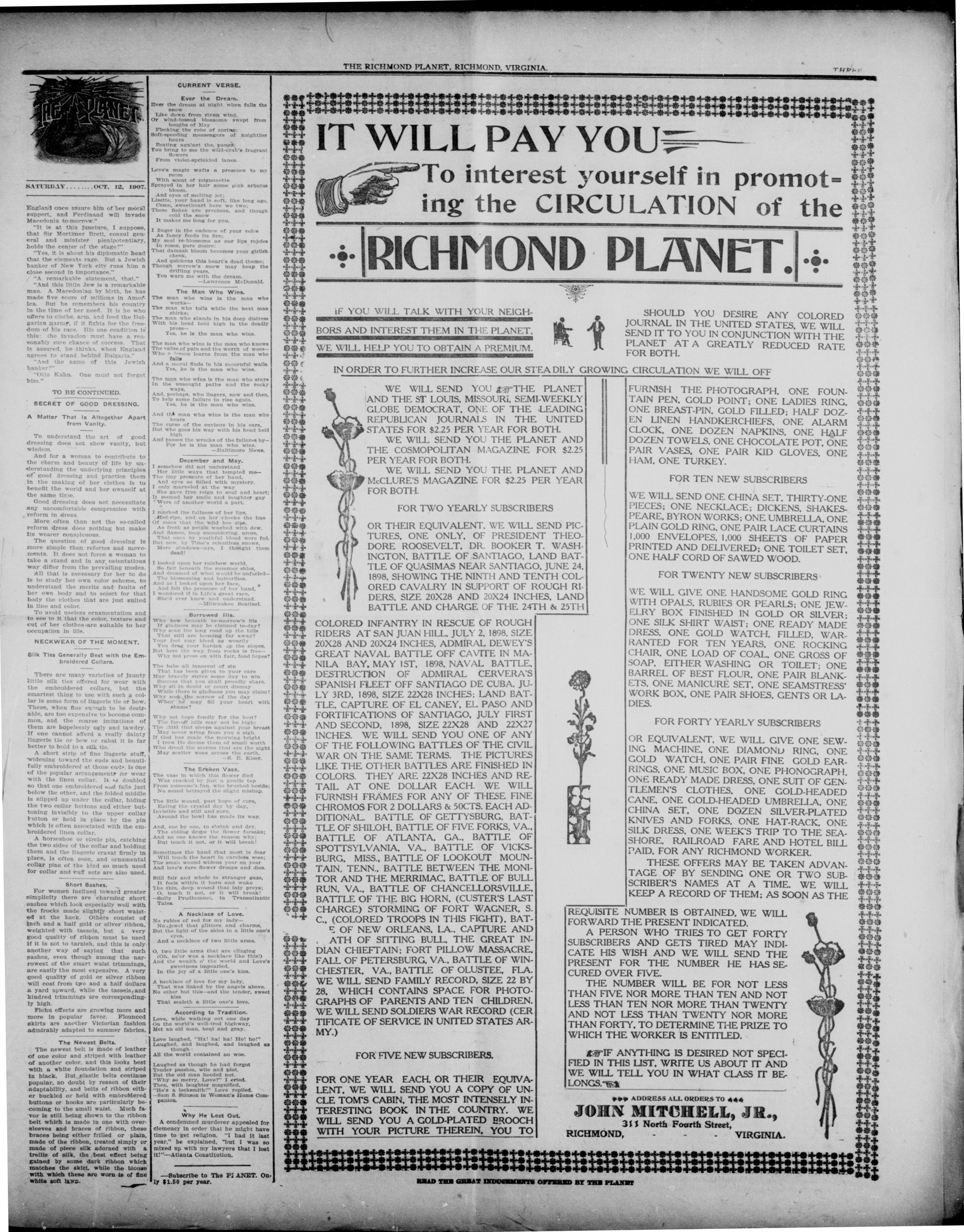
IT WILL PAY YOU To interest yourself in promot ing the CIRCULATION of the RICHMOND PLANET.
THE PLANET
England once assure him of her moral support, and Ferdinand will invade Macedonia to-morrow."
"It is at this juncture, I suppose, that Sir Mortimer Brett, consul general and minister plenipotentiary, holds the center of the stage?"
"Yes, it is about his diplomatic head that the elements rage. But a Jewish banker of New York city runs him a close second in importance."
/ "A remarkable statement, that."
"And this little Jew is a remarkable man. A Macedonian by birth, he has made five scores of millions in America. But he remembers his country in the time of her need. It is he who offers to clothe, arm, and feed the Bulgarian narmy, if it fights for the freedom of his race. His one condition is this: the invasion must have a reasonably sure chance of success. That is assured, he thinks, when England agrees to stand behind Bulgaria."
"And the name of this Jewish banker?"
"Otto Kuhn. One must not forget him."
TO BE CONTINUED
SECRET OF GOOD DRESSING.
A Matter That Is Altogether Apart from Vanity.
To understand the art of good dressing does not show vanity, but wisdom.
And for a woman to contribute to the charm and beauty of life by understanding the underlying principles of good dressing and practice them in the making of her clothes is to benefit the world and her ownself at the same time.
Good dressing does not necessitate any uncomfortable compromise with reform in dress.
More often than not the so-called reform dress does nothing but make its wearer conspicuous.
The question of good dressing is more simple than reforms and movements. It does not force a woman to take a stand and in any ostentatious way differ from the prevailing modes.
All that is necessary for her to do is to study her own color scheme, to understand the merits and faults of her own body and to select for that body the clothes that are just suited in line and color.
To avoid useless ornamentation and to see to it that the color, texture and cut of her clothes are suitable to her occupation in life.
NECKWEAR OF THE MOMENT.
Silk Ties Generally Best with the Embroidered Collars.
There are many varieties of jaunty little silk ties offered for wear with the embroidered collars, but the smartest thing to use with such a collar is some form of lingerie tie or bow. Those, when fine enough to be desirable, are too expensive to become common, and the coarse imitations of them are hopelessly ugly and tawdry. If one cannot afford a really dainty lingerie tie or bow or rabat it is far better to hold to a silk tie.
A short strip of fine lingerie stuff, widening toward the ends and beautifully embroidered at those ends, is one of the popular arrangements for wear with the linen collar. It is doubled so that one embroidered end falls just below the other, and the folded middle is slipped up under the collar, hiding the two collar buttons and either buttoning invisibly to the upper collar button or held in place by the pin which is often associated with the embroidered linen collar.
A horseshoe or circle pin, catching the two sides of the collar and holding them and the lingerie cravat firmly in place, is often seen, and ornamental collar pins of the kind so much used for collar and cuff sets are also used.
Short Sashes.
For women inclined toward greater simplicity there are charming short sashes which look especially well with the frocks made slightly short waisted at the back. Others consist of inch and a half gold or silver ribbon, weighted with tassels, but a very good quality of ribbon must be used if it is not to tarnish, and this is only another way of saying that such sashes, even though among the narrowest of the smart waist trimmings, are easily the most expensive. A very good quality of gold or silver ribbon will cost from two and a half dollars a yard upward, while the tassels, and kindred trimmings are correspondingly high.
Fichu effects are growing more and more in popular favor. Flounced skirts are another Victorian fashion admirably adapted to summer fabrics.
The Newest Belts.
The newest belt is made of leather of one color and striped with leather of another color, and this looks best with a white foundation and striped in black. But elastic belts continue popular, no doubt by reason of their adaptability, and belts of ribbon either buckled or held with embroidered buttons or hooks are particularly becoming to the small waist. Much favor is still being shown to the ribbon belt which is made in one with over-sleeves and braces of ribbon, these braces being either frilled or plain, made of the ribbon, treated simply or made of piece silk adorned with a trellis of silk, the best effect being gained by some dark ribbon which matches the skirt, while the blouse with which these are worn is of fine white soft lawn.
WE WILL HELP YOU TO OBTAIN A PREMIUM.
COLORED INFANTRY IN RESCUE OF ROUGH RIDERS AT SAN JUAN HILL, JULY 2, 1898, SIZE 20X28 AND 20X24 INCHES, ADMIRAL DEWEY'S GREAT NAVAL BATTLE OFF CAVITE IN MANILA BAY, MAY 1ST, 1898, NAVAL BATTLE, DESTRUCTION OF ADMIRAL CERVERA'S SPANISH FLEET OFF SANTIAGO DE CUBA, JULY 3RD, 1898, SIZE 22X28 INCHES; LAND BATTLE, CAPTURE OF EL CANEY, EL PASO AND FORTIFICATIONS OF SANTIAGO, JULY FIRST AND SECOND, 1898, SIZE 22X28 AND 22X27 INCHES. WE WILL SEND YOU ONE OF ANY OF THE FOLLOWING BATTLES OF THE CIVIL WAR ON THE SAME TERMS. THE PICTURES LIKE THE OTHER BATTLES ARE FINISHED IN COLORS. THEY ARE 22X28 INCHES AND RETAIL AT ONE DOLLAR EACH. WE WILL FURNISH FRAMES FOR ANY OF THESE FINE CHROMOS FOR 2 DOLLARS & 50CTS. EACH ADDITIONAL. BATTLE OF GETTYSBURG, BATTLE OF SHILOH, BATTLE OF FIVE FORKS, VA., BATTLE OF ATLANTA, GA., BATTLE OF SPOTTSYLVANIA, VA., BATTLE OF VICKSBURG, MISS., BATTLE OF LOOKOUT MOUNTAIN. TENN., BATTLE BETWEEN THE MONITOR AND THE MERRIMAC, BATTLE OF BULL RUN, VA., BATTLE OF CHANCELLORSVILLE, BATTLE OF THE BIG HORN, (CUSTER'S LAST CHARGE) STORMING OF FORT WAGNER, S. C., (COLORED TROOPS IN THIS FIGHT), BAT-
E OF NEW ORLEANS, LA., CAPTURE AND ATH OF SITTING BULL, THE GREAT INDIAN CHIEFTAIN; FORT PILLOW MASSACRE, FALL OF PETERSBURG, VA., BATTLE OF WINCHESTER, VA., BATTLE OF OLUSTEE, FLA. WE WILL SEND FAMILY RECORD, SIZE 22 BY 28, WHICH CONTAINS SPACE FOR PHOTOGRAPHS OF PARENTS AND TEN CHILDREN. WE WILL SEND SOLDIERS WAR RECORD (CERTIFICATE OF SERVICE IN UNITED STATES ARMY.)
FOR ONE YEAR EACH, OR THEIR EQUIVALENT, WE WILL SEND YOU A COPY OF UNCLE TOM'S CABIN, THE MOST INTENSELY INTERESTING BOOK IN THE COUNTRY. WE WILL SEND YOU A GOLD-PLATED BROOCH WITH YOUR PICTURE THEREIN, YOU TO
CURRENT VERSE.
Ever the dream at night when falls the snow
Like down from riven wing.
Or wind-tossed blossoms swept from boughs of May
Flecking the robe of spring;
Soft-speeding messengers of knightler hours
Beating against the panes
You bring to the wild-crab's fragrant
Sprayed in her hair some pink arbutus bloom.
And eyes of melting ice.
Lisette, your hand is soft, like long ago.
I linger in the cadence of your voice
As fancy feeds its fire;
My soul re-blossoms as our lips rejoice
In roses, pure desire;
That damask bloom becomes your girlish cheek.
And quickens this heart's dead theme;
Though sorrow's snow may heap the
drifting years,
You warn me with the dream.
—Lawrence McDonald.
The Man Who Wins.
The man who wins is the man who
works—
The man who tolls while the next man
shirks;
The man who stands in his deep distress
With the head held high in the deadly
press.
Yes, he is the man who wins.
The man who wins is the man who knows
The value of pain and the worth of woes—
Who learns learns from the man who
fails
And a moral finds in his mournful walls.
Yes, he is the man who wins.
The man who wins is the man who stays
In the unsought paths and the rocky
```markdown
```
And, perhaps, who linger, now and then,
To help some failure to rise again.
Yes, he is the man who wins.
And the man who wins is the man who
hears
The curse of the envious in his ears,
But who goes his way with his head held
high
And passes the wrecks of the failures by—
For he is the man who wins.
—Baltimore News.
December and May
september and way.
I somehow thanked
Her little ways that tamed me-
The tiny pressure of her hand,
And eyes so filled with mystery.
I only marveled at the way
She gave free reign to soul and heart;
It seemed her smile and laughter gay
Were of another world a part.
I marked the fullness of her lips,
Red-ripe, and on her cheeks the hue
Of roses that the wild bee sipe,
As fresh as petals washed with dew.
And flames, long滑ouldering, arose.
The sun was warm and fed
But now, by Time's relentless snows.
Mere shadows-aye, I thought them
dead!
I looked upon her rainbow world.
So fair beneath the summer skies.
And dreamed of what would be unfurled-
The blossoming and butterflies.
And as I looked upon her face,
And felt the pressure of her hand,
I wondered if in Life's great race,
She'd ever know and understand.
Borrowed Ils.
Why bow before your nails.
Why glance may be claimed to day?
Why scan the long road up the hills
That still are looming far away?
Your feet may bleed as weily
You drag your burden up the slopes.
But here the way from rocks is free-
Why not press on with fair, fond hopes?
The babe all innocent of sin
That has been given to your care
May bravely strive some day to win
Success that you shall proudly share.
Wy sit in doubt or court dismay
The child that sleeps against your breast
Why seek the sorrow of the day
When he may fill your heart with
shame?
Why not hope fondly for the best?
The far-off will pay for the high.
The child that sleeps against your breast
May never wring from you a sigh.
If God has made the morning bright
I trow He deems them of small worth
Who dread the storms that are the night
May scatter woes across the earth.
The Broken Vase
The vase in which this flower died
Was cracked by just a gentle tap
From someone's fan, who brushed beside;
No sound betrayed the slight mishap.
The little wound, past hope of cure,
Eating the crystal day by day,
Invisible and still and sure.
Around the bowl has made its way.
And, one by one, to shrink and dry.
The ebbing drop the flower forsake;
And no one knows the reason why;
But touch it not, or it will break!
Sometimes the hand that most is dear
Will touch the heart in careless wise;
The small wound widens year on year
And love's rare flower droops and dies.
Still fair and whole to stranger gaze,
It feels within it burn and wake
The thin, deep wound that inly preys;
O, touch it not, or it will break!
—Silly Prudhomme, in Transatlantic
Tales.
A Necklace of Love.
No rubes of red for my lady—
No jewel that glitters and charms.
But the light of the skies in a little one's
eyes.
(1)
O, two little arms that are clinging
(Oh, ne'er was a necklace like this!)
And the wealth o' the world and Love's
sweetness impeared.
In the joy of a little one's kiss.
A necklace of love for my lady.
That was linked by the angels above.
No other but this—and the tender, sweet
kiss
That sealth a little one's love.
**According to Tradition.**
Love, while walking out one day
On the world's well-trod highway,
Met an old man, bent and gray.
Love laughed, "Ha! ha! ha! Ho! ho!"
Laughed, and laughed, and laughed as
though.
All the world contained no woe.
Laughed as though he had forgot
Tender passion, wile and plot.
But the old man heeded not.
"Why so merry, Lover?" I cried.
Then wailed, then laughed.
"He's a locksmith!" Love replied.
-Sam S. Stinson in Woman's Home Companion.
Why He Lost Out.
A condemned murderer appealed for clemency in order that he might have time to get religion. "I had it last year," he explained, "but I was so mixed up with my lawyers that I lost it!"—Atlanta Constitution.
—Subscribe to The PI ANET. Only $1.50 per year.
IN ORDER TO FURTHER INCREASE OUR STEADILY GROWING CIRCULATION WE WILL OFF
THE RICHMOND PLANET, RICHMOND, VIRGINIA
WE WILL SEND YOU THE PLANET AND THE ST LOUIS, MISSOURI, SEMI-WEEKLY GLOBE DEMOCRAT, ONE OF THE LEADING REPUBLICAN JOURNALS IN THE UNITED STATES FOR $2.25 PER YEAR FOR BOTH.
WE WILL SEND YOU THE PLANET AND THE COSMOPOLITAN MAGAZINE FOR $2.25 PER YEAR FOR BOTH.
WE WILL SEND YOU THE PLANET AND McCLURE'S MAGAZINE FOR $2.25 PER YEAR FOR BOTH.
FOR TWO YEARLY SUBSCRIBERS
OR THEIR EQUIVALENT, WE WILL SEND PICTURES, ONE ONLY, OF PRESIDENT THEODORE ROOSEVELT, DR. BOOKER T. WASHINGTON, BATTLE OF SANTIAGO, LAND BATTLE OF QUASIMAS NEAR SANTIAGO, JUNE 24, 1898, SHOWING THE NINTH AND TENTH COLORED CAVALRY IN SUPPORT OF ROUGH RIDERS, SIZE 20X28 AND 20X24 INCHES, LAND BATTLE AND CHARGE OF THE 24TH & 25TH
FOR FTVE NEW SUBSCRIBERS.
READ THE GREAT INDUGEMENTS OFFERED BY THE PLANET
SHOULD YOU DESIRE ANY COLORED JOURNAL IN THE UNITED STATES, WE WILL SEND IT TO YOU IN CONJUNCTION WITH THE PLANET AT A GREATLY REDUCED RATE FOR BOTH.
FURNISH THE PHOTOGRAPH, ONE FOUNTAIN PEN, GOLD POINT; ONE LADIES RING, ONE BREAST-PIN, GOLD FILLED; HALF DOZEN LINEN HANDKERCHIEFS, ONE ALARM CLOCK, ONE DOZEN NAPKINS, ONE HALF DOZEN TOWELS, ONE CHOCOLATE POT, ONE PAIR VASES, ONE PAIR KID GLOVES, ONE HAM, ONE TURKEY.
FOR TEN NEW SUBSCRIBERS
WE WILL SEND ONE CHIN
PIECES; ONE NECKLACE
PEARE, BYRON WORKS;
PLAIN GOLD RING, ONE
1,000 ENVELOPES, 1,000
PRINTED AND DELIVERED
ONE HALF CORD OF SAW
FOR TWENTY NEW
WE WILL GIVE ONE HALF
WITH OPALS, RUBIES OF
ELRY BOX FINISHED IN
ONE SILK SHIRT WAIST
DRESS, ONE GOLD WAIST
RANTED FOR TEN YEAR
CHAIR, ONE LOAD OF O
SOAP, EITHER WASHING
BARREL OF BEST FLOU
ETS, ONE MANICURE SET
WORK BOX, ONE PAIR S
DIES.
FOR FORTY YEARL
OR EQUIVALENT, WE W
ING MACHINE, ONE DIG
GOLD WATCH, ONE PA
RINGS, ONE MUSIC BOX,
ONE READY MADE DRE
TLEMEN'S CLOTHES,
CANE, ONE GOLD-HEAD
CHINA SET, ONE DOZ
KNIVES AND FORKS, O
SILK DRESS, ONE WEEK
SHORE, RAILROAD FA
PAID, FOR ANY RICHMO
THESE OFFERS MAY
TAGE OF BY SENDING
SCRIBER'S NAMES AT
KEEP A RECORD OF THE
THE NUMBER IS OBTAINED, WE
AND THE PRESENT INDICATED
PERSON WHO TRIES TO GET
BERS AND GETS TIRED MAI
IS WISH AND WE WILL SEE
FOR THE NUMBER HE
OVER FIVE.
THE NUMBER WILL BE FOR NO
GIVE NOR MORE THAN TEN A
THAN TEN NOR MORE THAN T
TIT LESS THAN TWENTY NO
PORTY, TO DETERMINE THE F
THE WORKER IS ENTITLED.
IF ANYTHING IS DESIRED NO
THIS LIST, WRITE US ABOUT
TELL YOU IN WHAT CLAS
ALL SEND ONE CHINA SET, THIRD
ONE NECKLACE; DICKENS, S.
BABYRON WORKS; ONE UMBRELL
GOLD RING, ONE PAIR LACE CU
ENVELOPES, 1,000 SHEETS OF
AND DELIVERED; ONE TOI
FELF CORD OF SAWED WOOD.
FOR TWENTY NEW SUBSCRIBER
ALL GIVE ONE HANDSOME GOL
PALS, RUBIES OR PEARLS; ONE
BOX FINISHED IN GOLD OR
BASK SHIRT WAIST; ONE READ
ONE GOLD WATCH, FILLED
FOR TEN YEARS, ONE R
ONE LOAD OF COAL, ONE G
EITHER WASHING OR TOILE
ER OF BEST FLOUR, ONE PAIR
THE MANICURE SET, ONE SEAM
BOX, ONE PAIR SHOES, GENTS
FOR FORTY YEARLY SUBSCRIBER
UNIVALENT, WE WILL GIVE O
MACHINE, ONE DIAMOND RING
WATCH, ONE PAIR FINE GOL
ONE MUSIC BOX, ONE PHONO
READY MADE DRESS, ONE SUIT
'S CLOTHES, ONE GOLD-
ONE GOLD-HEADED UMBRELL
SET, ONE DOZEN SILVER-
AND FORKS, ONE HAT-RAC
RESS, ONE WEEK'S TRIP TO T
RAILROAD FARE AND HOT
FOR ANY RICHMOND WORKER
COME OFFERS MAY BE TAKEN
OF BY SENDING ONE OR TW
ER'S NAMES AT A TIME. WE
RECORD OF THEM; AS SOON
IS OBTAINED, WE WILL
SENT INDICATED.
O TRIES TO GET FORTY
GETS TIRED MAY INDIC
WE WILL SEND THE
NUMBER HE HAS SE-
WILL BE FOR NOT LESS
MORE THAN TEN AND NOT
MORE THAN TWENTY
THAN TWENTY NOR MORE
ETERMINE THE PRIZE TO
ER IS ENTITLED.
IS DESIRED NOT SPECI-
WRITE US ABOUT IT AND
IN WHAT CLASS IT BE-
WE WILL SEND ONE CHINA SET, THIRTY-ONE PIECES; ONE NECKLACE; DICKENS, SHAKESPEARE, BYRON WORKS; ONE UMBRELLA, ONE PLAIN GOLD RING, ONE PAIR LACE CURTAINS 1,000 ENVELOPES, 1,000 SHEETS OF PAPER PRINTED AND DELIVERED; ONE TOILET SET, ONE HALF CORD OF SAWED WOOD.
FOR TWENTY NEW SUBSCRIBERS
WE WILL GIVE ONE HANDSOME GOLD RING WITH OPALS, RUBIES OR PEARLS; ONE JEWELRY BOX FINISHED IN GOLD OR SILVER; ONE SILK SHIRT WAIST; ONE READY MADE DRESS, ONE GOLD WATCH, FILLED, WARRANTED FOR TEN YEARS, ONE ROCKING CHAIR, ONE LOAD OF COAL, ONE GROSS OF SOAP, EITHER WASHING OR TOILET; ONE BARREL OF BEST FLOUR, ONE PAIR BLANKETS, ONE MANICURE SET, ONE SEAMSTRESS' WORK BOX, ONE PAIR SHOES, GENTS OR LADIES.
FOR FORTY YEARLY SUBSCRIBERS
OR EQUIVALENT, WE WILL GIVE ONE SEWING MACHINE, ONE DIAMOND RING, ONE GOLD WATCH, ONE PAIR FINE GOLD EARRINGS, ONE MUSIC BOX, ONE PHONOGRAPH, ONE READY MADE DRESS, ONE SUIT OF GENTLEMEN'S CLOTHES, ONE GOLD-HEADED CANE, ONE GOLD-HEADED UMBRELLA, ONE CHINA SET, ONE DOZEN SILVER-PLATED KNIVES AND FORKS, ONE HAT-RACK, ONE SILK DRESS, ONE WEEK'S TRIP TO THE SEASHORE, RAILROAD FARE AND HOTEL BILL PAID, FOR ANY RICHMOND WORKER. THESE OFFERS MAY BE TAKEN ADVANTAGE OF BY SENDING ONE OR TWO SUBSCRIBER'S NAMES AT A TIME. WE WILL KEEP A RECORD OF THEM; AS SOON AS THE
REQUISITE NUMBER IS OBTAINED, WE WILL FORWARD THE PRESENT INDICATED. A PERSON WHO TRIES TO GET FORTY SUBSCRIBERS AND GETS TIRED MAY INDICATE HIS WISH AND WE WILL SEND THE PRESENT FOR THE NUMBER HE HAS SECURED OVER FIVE. THE NUMBER WILL BE FOR NOT LESS THAN FIVE NOR MORE THAN TEN AND NOT LESS THAN TEN NOR MORE THAN TWENTY AND NOT LESS THAN TWENTY NOR MORE THAN FORTY, TO DETERMINE THE PRIZE TO WHICH THE WORKER IS ENTITLED.
IF ANYTHING IS DESIRED NOT SPECIFIED IN THIS LIST, WRITE US ABOUT IT AND WE WILL TELL YOU IN WHAT CLASS IT BELONGS.
ADDRESS ALL ORDERS TO
ADDRESS ALL ORDERS TO
JOHN MITCHELL, JR.,
311 North Fourth Street,
RICHMOND. VIRGINIA.
IN MITCHELL,
311 North Fourth Street,
ND,
VILLA
LANET
CHELL, JR.,
Fourth Street,
VIRGINIA.
```markdown
```
---
```markdown
```
FOUR
THE PLANET
JOHN MITCHELL, JR. • EDITOR
All communications intended for publication
should be sent to the publisher by Worthington.
TERM8 IN ADVANCED
One Copy, one year. $1.50
One Copy, eight months. 1.00
One Copy, six months. 0.50
One Copy, four months. 0.25
One Copy, three months. 0.10
Single Copy .05
ADVERTISING RATIO
For one inch, one insertion.
For one inch, each subsequent insertion.
For two inches, three months.
For two inches, six months.
For two inches, nine months.
For two inches, twelve months.
Marriage and Funeral Notice, one inch.
Standing and Transient Notice per line.
$POSTAGE STAMPS OF A HIGHER DE-
NOMINATION THAN TWO CENTRE NOT
RECEIVED ON SUBSCRIPTION.
THE PLANET is issued weekly. Transmission price is $1.50 per year in millions.
There are four ways by which money can be sent by mail at our risk—in a Post Office Money Order, by Bank Check or Draft, or an Excise Order, and when none of these can be procured, the Bank Check and the Excise Order must be safe arrive.
MONEY ORDERS—You can buy a Money Order at your Post-Office payable at the Richmond Post Office, and we will be responsible for safe arrives.
EXPRESS MONEY ORDERS can be obtained at any office of the American Express Co., the Bank of New York, the Bank of Goa, Express Company. We will be responsible for money issuing or any of these companies. The Express Money order to a safe location is registered and sent to the bank and Goa. REGISTERED LETTERS—If a money Order Post-Office or an Express Office is not within your reach, your Post-Office may register the money order to a safe location. Then, if the letter is lost or stolen, it can be traced. You can send money in this manner to any other way you must do it at your risk.
We cannot be responsible for money sent in letters in any other way than one of the four ways mentioned above. If you send your money in another way, you must do it at your risk.
RENewALKS, ENC. If you do not want THE PLANET continued for another year after your money was sent, you can send the Post-Office card to discontinuation. The courts have decided that subscribers to newspaper, who do not order their paper discontinued at the time of your death, are held liable for the payment of the subscription up to date when they order the paper discontinued.
COMMUNICATIONS — When written to us to renew your subscription or to discontinue your paper, you should give your name and address full order; we cannot find your name on our books.
CHANGE OF ADDRESS — in order to change the address of a subscriber, we must be sent the former as well as the present address.
Entered at the Post Office at Richmond, Va., as second-class matter.
Our able contemporary, the Richmond, Va., News-Leader seems never to tire in its discussion of the race question and goes out of its way to give advice to the Episcopalians in Convention assembled here. It appears to be fair and generous in some of its utterances but in this very fairness and generosity lies the great danger.
Under the caption of "Race Separation in Church," in its issue of the Fifth inst., it said:
"Bishop Brown of the Protestant Episcopal Church of Arkansas is very earnest in advocacy of complete separation of the white and Negro races in that church. He wants to give the Negroes their own bishops and organization, disconnected entirely from the white church, absolutely autonomous, having no representation in diocesan or general conventions of the white church but forming similar bodies for themselves. The bishop is supported by his diocese. He has written on the subject a book of 350 pages. His discussion is full, fair, frank, marked by deep sympathy for the Negro and by profound conviction of the unhappy truth of his own conclusions. Special interest is given to his position by the fact that he is, as calls himself a "Southernized Northerner," an Ohio man who never was south of the Ohio river until twelve years ago and who came to Arkansas from Ohio, where he was archdeacon in 1898. He uses many pages to prove that the Negro race in this country is degenerating fast, morally, physically and generally.
It is a mistake to class an Ohio man as a northern one. If he lived anywhere within a radius of one hundred miles from the borders of Kentucky, he has a more radical talent of Negro-phobia in his veins than will be found in the arteries of the average Kentuckian. The latter comes in actual contact with the Negro and knows his worth, while the former draws his conclusions as to his bad qualities and is unacquainted ed with the meritorious side of his mental or physical anatomy.
A Negro-hating northerner residing in the Southland is fifty per cent more unreasonable than is the genuine "article" of the "old school." We presume that the degenerating tendencies to which he refers as existing in the Negro would be found to be equally as intense in the white population of similar intelligence and opportunities. Such a separation as Bishop Brown proposes means that the Episcopalian citizens of color must "shift for themselves" so to speak. The cost of such an experiment will be upon the Negroes and not upon the white folks.
The News Leader continued:
"If we believed this we would feel
that the duty of the Episcopal church and every other required them to be more active and energetic than ever in trying to prevent degeneracy and to save a race represented in this country by ten million people. We look at it just the other way. In our view the danger in the Negro is that he is gaining strength. Accepting as accurate all Bishop Brown's statistics showing the increasing proportion of Negroes in the prisons North and South, the increasing death rate and the diminishing production of the shifting of the cotton and tobacco production from Negroes to whites, all of it may mean simply that the race is ridding itself of its dead wood.
"The weak, the vicious and the shiftless protected under the slavery system, are dying out in the stress and testing of freedom and self-dependence. We would prefer to support Bishop Brown's demand for separation on the ground that the Negro is becoming better able to take care of himself, to conduct his own affairs, to work out his own salvation."
The above statements are those of a statesman and a philosopher and we think we observe a strain of that philanthropic spirit which has made some of the rich white people of the North famous. It clinched its conclusions when it said:
"Bishop Brown and the News-Leader, it is fair to say, are considering the case from widely different points of view. The bishop thinks from the black belt of Arkansas, where the conditions among Negroes probably are as bad as anywhere in the South]" This is a liberal view of the matter. It told a wholesome truth, known to every ante-bellum Negro when it said:
"It is a fact familiar to all Virginians that in slavery days the plantation slaves were weeded out by selling the worst and most hopeless of them for the cotton and rice fields and the terror constantly held over every Negro inclined to be worth less or turbulent was that unless he changed his ways presently he would be sold 'down South.' Consequently here in Virginia, and especially here in Richmond, probably we have the best Negroes in the whole country, the pick of the race. They are orderly, lawbalding, respectable and thriving. For that very reason their usefulness to the white people diminishes year by year and while the distance between the races becomes wid er the danger of rivalry between them increases."
The News-Leader has stated the conditions exactly. It draws a conclusion, though that, in our judgment is impossible of accomplishment. It falls to state too that this rivalry is more apparent between the upper class of colored people and the lower class of white ones. It said:
"Therefore, we believe most earnestly that complete separation of the races is the best for both and the one possible solution of a problem which becomes more acute constantly. We are educating the Negro away from the farms and from domestic service, while at the same time we deny him recognition in the professions, in business and in the trades and socially fix a great gulf across which he may not pass. These conditions seem to us to be intolerable and impossible."
If these plans are producing conditions that are intolerable and impossible, why do you persist in the promulgation of these plans? The News Leader fails to state that the rivalry is not so acute as it would have its readers believe from the fact that the Negro's own trade and the Negro's own money is the cause of the rivalry. White men who once reaped a harvest at the Negro's expense must now fall back upon his own people for his usual income. The Negro physician practices upon Negro patients. The Negro lawyer has Negroes as his clients. The Negro insurance agent has Negro policy holders. The Negro clothier has Negro customers. The Negro banker has Negro depositors. The Negro pastor has a Negro congregation. The Negro hotel-keeper has Negro lodgers. The Negro saloon keeper has Negro "dramsters."
It will be seen then that the Negroes of the Southland are of "a thing apart." They are building up a nation within a nation. It is the loss of this trade to the white merchants and professional man that produces this condition which the News Leader denominates intolerable and impossible.
As a matter of fact, this very separation that was inaugurated as a means of our undoing has proved from a financial and industrial stand point a blessing in disguise. Let us see. According to the official report of Hon. Morton Marye, Auditor of Public Accounts the colored people of Richmond pay taxes on real estate assessed at ($1,345,910.) one million, three hundred and forty-five thousand, nine hundred and ten dollars, and on personal property assessed at ($258,060) three hundred and fifty-eight thousand and sixty dollars, making a total assessed valuation of ($1,703,970) one million seven hundred and three thousand, nine hundred and seventy dollars.
As the assessment is only two-thirds of the actual valuation, the colored people of this city own property both real and personal to the value of ($2,555,955) two million, five hundred and fifty-five thousand, nine hundred and fifty-five dollars. The colored people of Virginia own (1,365,426) one million, three hundred and sixty-five thousand, four
THE RICHMOND PLANET. RICHMOND. VIRGINIA
hundred and twenty-six acres of land
assessed at ($5,844,953) five million
eight hundred and forty-four thousand,
nine hundred and fifty-three dol-
lars. The assessed value of the land
and building lots owned by them is
($17,278,343) seventeen million, two
hundred and seventy-eight thousand,
three hundred and forty_three dollars.
The assessed value of their
personal property is ($5,989,048)
five million, nine hundred and eighty
nine thousand and forty-eight dollars.
The total assessed valuation of the property, both real and personal of the colored people of Virginia is ($23,267,391) twenty-three million, two hundred and sixty-seven thousand, three hundred and ninety-one dollars. As the assessed valuation is only two-thirds of its actual value the colored people in Virginia own property both real and personal to the value of ($34,901,085) thirty-four million, nine hundred and one thousand, and eighty-five dollars. These people were penniless at the close of the Civil War and have been living on what may well be termed starvation wages ever since. Further comment along this line is unnecessary. It continued:
"So far as the church is concerned it is a fact that as Negro Episcopians increase in numbers and gain in intelligence and in piety they will be an increasing source of embarrassment at church gatherings. Whether race prejudice is right or wrong, we must recognize it as a fact. It may be hard, unjust, sometimes cruel but it is as much a part of the life of white people, certainly at the South, as their appetites for food or their thirst for water. There fore, the fact, is, that however plous the Negro may be, however useful his work or pure his character, he must be made to recognize every day of his contact with Southern white people that they will not and cannot accept him as their equal socially."
These colored people are not asking for social equality. They are insisting upon civil equality,—their rights under the laws of God and the canons of the Church. Can a Christian body as great and as grand as the Episcopal body afford to bow to race prejudice and yield up vital principles in the face of the demands of the Devil? The News-Leader said further:
"Nothing is more pathetic than the appearance of a few Negro communicants in an Episcopal church, humbly and patiently accepting their lot as a separated people, going even to the altar as apart from their white brothren. Yet the consequences to the Southern mind of any modification of the barriers are too horrible even for consideration. Free social intercourse and commingling inevitably would lead to miscegenation, beginning among the lowest elements of both races and developing us a race of indiscriminate mongrels, the blood of each race mixed and diluted generation after generation until the purity and strength of both would disappear.
The Richmond, Va. News-Leader pictures a condition that has been in a large measure already attained. These mulattoes form the link between the white and the black races in the Southland and make a race war impossible.
The Code of Virginia recognizes this fact for it provides for the proportion of Negro blood that may be in the veins of a person without making the person a Negro. The revised Code of Virginia Page 1119, Section 2252 in the explanatory part reads as follows:
"A marriage between a white man and a woman, who is of less than one-fourth Negro blood, however small the lesser quantity may be, is legal. A woman whose father was white, whose mother's father was white, and whose great great grand mother was of brown complexion is not a Negro in the sense of the statute.—"McPherson Case, 23 Grat. 939."
It will be seen then that the "man of straw" set up by our contemporary is one of flesh and blood. Separation of the races in the day time will not guarantee the keeping of them apart in the night-time. White men may be seen here conversing with some of the blackest looking women that God ever created. A few moments talk, then they disappear only to meet again in a state of concubination that is as disgraceful as it is disgusting.
This class of women has no standing with respectable colored people of either sex, but some of these white folks seem to enjoy their company.
The News-Leader said further:
"We can recall years ago when the first colored Episcopal clergyman appeared at a convention, or some church assembly, in this city, the quiet, anxious consultations, the struggle between the kindly anxiety not to hurt the feelings of or humiliate a well-behaved, unpretentious Christian man and the inborn racial repulsion. We imagine that same struggle has occurred in one way or another in every church assembly in which Negro congregations were represented.
"We believe that pious and intelligent Negroes have sense enough to realize the situation, to understand the facts. Theoretically, it may seem unchristianlike and inhuman to refuse contact and association on equal terms with a man who is a consistent Christian because of the shade or color of his skin. Practically every reasonable Negro realizes that the feeling is not against him personally and is no imputation against his own character, but is ra-
cal; that it does not even imply inevitably that he is regarded as an inferior; that it does mean that he is a member of another race and that, therefore, the white race prefer and insist that he remain with his own people and his own race. The sensible Negro accepts the conditions philosophically just as one class of white people may accept its exclusion from intimacy with another class. So he goes on about his business and makes the best of it and finds his religious life, his work and his amusements as he can."
But from the tone of this journal's observations, it is not satisfied with even this kind of separation. It should know that the feeling of revulsion experienced in dealing with Negroes is felt by the upper class of white people in dealing with the lower class of white people.
The line of demarcation is as marked in the one case as it is in the other. In the country, it has taken the form of the capitalist and the wage-carners. In the South, it has the forms of the blue-blooded aristocrats and the "poor white trash." When you eliminate the Negro from the equation, you will find the lower strata of the white race to confront you. In view of these facts the following impractical conclusions are ridiculous:
"From a lay standpoint we welcome each movement toward separation of the races. We regard it as the unfastening of one more of the ties that hold the races together in mutual independence, one more approach toward the final solution. That will come when the common sense of all the people of the country will demand that we buy somewhere territory in congenial climate and conditions and settle the Negro on it, sending him away with our cordial good will, giving him every opportunity to establish his own government and country and do for himself free from white presence or control."
It is good they say; at times to "dream dreams, and see visions." The News-Leader is Indulging in both It will not live long enough to see a realization of its hopes for when its editor has been dead a thousand years, this old world will be wagging along just the same and children dancing a jig upon his tombstone will wonder what kind of mollycoddle ever gave voice to such surprising and impractical suggestions.
T. THOMAS FORTUNE
We have read with profound regret notice of the retirement of Hon. T. Thomas Fortune from not only active service, but from the presidency of the company owning the New York Age, which Mr. Fortune founded. The letter of resignation is characteristic and there are indications that Mr. Fortune has some of the old fighting spirit left.
This distinguished journalist is a unique character, who has been forced by latter day conditions to seek the rest his body so much needs. We knew him in his days of prosperity and no truer friend or a more bitter enemy ever walked the face of God's earth. He was always an open, manly fighter and he scorned underhanded attacks in all kinds of controversies. His language was sharp and cutting and his invectives dipped in gall.
We have lost a great man, and the race has need to weep when the bent form of T. Thomas Fortune went behind the scenes and the curtains closed behind him. The exactive requirements of the latter-day politicians were not to his liking and to accept orders from any quarter when it came to the expression of an opinion upon paper was more than a man of Fortune's callibre could brook or tolerate.
The New York Age is the leading Afro-American journal in the United States and will no doubt yet do good service, but its present publication under the same name with Fortune eliminated will be like the play of Hamlet with Hamlet left out. Our earliest training in journalism came as a correspondent under the exacting eye of T. Thomas Fortune. We feel sorrowful since we have read his letter of resignation and with bowed head we accept the inevitable, realizing that in a few years, we too shall be called upon to take a similar step and entrust to other hands the results of a life's endeavor.
The race is not as yet grateful to those who have braved the storms and faced the winds in an effort to secure to citizens of color the rights due them. Men in political office by virtue of sacrifices made by men of the T. Thomas Fortune stripe will be the first to say unkind things and cast a slur upon their self-sacrificing efforts. But then God is just and he knows all of our troubles, all of our boreavements, all of our disappointments and he alone can bind up a wounded heart.
Death is a terror to some, but sweet to others for it gives a surcease of sorrows and a rest that is helpful, even though it be in and beyond the grave. T. Thomas Fortune retired? One sturdy, patriotic warrior has left us and the entire race should be in tears.
SECRETARY TAFT AND THE JAPANESE.
Hon. William H. Taft, Secretary of War is an able jurist, but if his
address to the Japanese at Tokio is to be considered in the light of our present day diplomacy, he is a failure as a diplomat. He is quoted as follows:
"I wish to express my heartfelt thanks for this magnificent evidence of good will. Since my visit in 1905 Japan has been through a titanic struggle. The Americans are proud that Mr. Roosevelt, with the prestige of the American Presidency, hastened a peace that is honorable to both Japan and Russia.
As the terms of that peace agreement were distasteful to a large proportion of the Japanese people and it is generally conceded that Russia got the better of the bargain, all references to it by Secretary Taft were unfortunate. It was for the Japanese to broach the subject rather than the representative of President Roosevelt. He said:
"Japan has proved as great in peace as in war. She has taken first rank among the nations. Her growth from a hermit nation in fifty years is a marvel to the world. The Americans are proud of Japan. She has always had the cordial sympathy and effective aid of the United States. The name of Perry, Harris, Bingham Grant, and Roosevelt are inseparable from Japan's attainment of her position as a world power.
Th above utterances were all right but he immediately neutralized the effect of it by the following unfortunate utterances:
"Now for the moment there is a little cloud over our friendship of fifty years, but the greatest earthquake of the century could not shake our amity. But I do not intend to consider details. I cannot trespass upon the jurisdiction of the Department of State and discuss the events in San Francisco, but I can say that there is nothing in them that is incapable of honorable and full adjustment by ordinary diplomacy.
While stating that he cannot trespass upon the jurisdiction of the Department of State, he proceeds to do the very thing that he had previously stated it was improper for him to do. He even goes so far as to define some of the limits of diplomacy.
Here is what he said:
"The word war is not allowable in diplomatic correspondence, but those who are not diplomats can talk war. I do not hold that war is entirely unjustifiable when grievances cannot otherwise be redressed. War is hell, and only a great cause which cannot be settled by diplomacy justifies it.
As he is the Secretary of War, he virtually states that he has charge of the "hell-part" of President Roosevelt's cabinet. He blundered further when he said:
"A war between America and Japan would be a crime against civilization. Neither people desire it, and both governments will strain every nerve to prevent it. Neither would gain anything from war. Japan is looking for a great commercial conquest. Why wish for war, which would stop all she has undertaken to rejuvenate her ancient neighbor, to whom she is sending the greatest statesmen in the world? I am confident that Prince Ito and the Japanese government in their Korean policy are making for justice and civilization. Why stop or delay the reform in Korea?
"Why should the United States desire war, to change in one year to a military nation, to have its resources wasted upon a vast equipment, and to uslessly enter upon a warlike career? During the last decade the United States has made the greatest material progress. To-day it is struggling against the abuses arising from this progress, and is seeking to retain its benefits for the people.
It is inconceivable that a statesman of Secretary Taft's callibre should have used such languages. He professes to speak not only for his own country, but for Japan as well. He even meddled in the affairs of Korea and really condemned the Japanese in their preparations for war. He goes so far as to tell outsiders about troubles at home. Certainly Secretary Taft threw discretion to the winds and made himself a "laughing stock" in every foreign office of the Old World.
He even told of our troubles in the Philippines. Here is his language:
"The United States is engaged in establishing order and prosperity in the Philippines and in educating the Filipinos, in order that they may be capable of self-government. The task is a difficult one. Some persons suggest the sale of the islands to Japan some other nation. This is absurd. Japan does not want them, and the United States could not sell them without the grossest violation of its obligations to the people of the Philippines.
He again tells what Japan does not want, although he was speaking to the Japanese officials who are competent and able to state their own wants. He concluded as follows:
"Under the circumstances nothing is more infamous than that of the suggestion of war. War talk is due entirely to newspapers, which seek to increase their sale, and which, for political reasons, attack the government. It is difficult to characterize in moderate language such attempts to create ill will between the two people. Be assured that America's good will toward Japan is as warm as ever."
We do not remember ever having read a more ill-advised deliverance from any statesman of Secretary Taft's prominence. It can have but
With a year's subscription to the (Name of Your Paper) and
The Philadelphia Press
The razor is made from the best Sheffield Steel, hardened and tempered thermometrically and guaranteed.
It's Particular Merit is its
It's Particular Merit is its Shaving Quality $3.50
BUYS
The Philadelphia
ONE YEAR daily, regular
Fremont Razor
Your Favorite Home N
Value
ALL FOR
$3.50 C
Mailed immediately upon
ONE YEAR daily, regular price $3.00
Fremont Razor $2.00
Your Favorite Home Newspaper $1.50
Value $6.50
Order To-day
one effect and that is to lower him
in the estimation of every foreign
power and to reflect seriously upon
his abilities as a diplomat and a
statesman.
Certainly no statesman who has
been a student of history or a close
observer of current events would
have opened his mouth to utter such
language as has been accredited to
this acknowledged candidate for
the Presidency of the United States.
Send Governor Dynamite:
Send Governor Dynamite.
DENVER, Oct. 9.-Governor Henry A. Buchtel, David H. Moffat, president of the First National bank of Denver, and Charles B. Kountze, president of the Colorado National bank, received through the mails here infernal machines containing sufficient dynamite to have caused great destruction of lives and property had they been exploded. But warning had been given to the recipients of the machines by Chief of Police Delaney, who had obtained a confession from Kemp V. Bigelow, by whom they were mailed, and no one was hurt.
Not Mrs. Hartridge's Body
NEW YORK, Oct. 9.—Lying across the tracks of the New York Central at One Hundred and Eighteenth street, the body of a good looking but poorly clad young woman was found in the early morning. The police say that she had been murdered and placed on the tracks to hide the crime. The body bore evidence of a brutal attack. There was a fracture at the base of the skull, which caused the death. A. L. Hartridge, father of Clifford W. Hartridge, called at the morgue to see whether he could identify the body. One look convinced him that the body was that of a stranger.
BOSTON, Oct. 9.—As a result of statements concerning the corruption alleged to exist in the Boston city government made by United States Senator Henry Cabot Lodge at the Republican state convention here the senator was summoned by District Attorney John B. Moran to appear before the grand jury next Monday and tell what he knows of the situation at the city hall.
In his speech Senator Lodge said:
"The government of the city of Boston has sunk in the eyes of men to a point of degradation utterly unknown in the annals of the city.
"The air is heavy with the stories of corruption at the city hall, of offices sold, of percentages taken, of payrolls loaded, of loans made to support men in idleness, of widespread frauds at the ballot box, which should be rigidly investigated and brought to the light of day."
---
A
is its Shaving Quality
YS
elphia Press
regular price $3.00
$2.00
time Newspaper $1.50
value $6.50
FOR
Cash
upon receipt of your
description.
day—NOW!
FC., CHAMPIONSHIP
Chicago and Detroit Split Even In Diamond Battle.
CHICAGO, Oct. 9—Detroit and Chicago, leaders of the American and National leagues respectively, played twelve strenuous innings to a tie here in the first game of the series for the baseball championship of the world. The contest was replete with sensational situations, and when Umpire O'Day of the National league called the play off on account of darkness most of the 24,377 spectators sighed with relief and went home well satisfied with the outcome.
Just as the game started Cobb, Detroit's right fielder, was presented with a huge gold medal set with diamonds as a reward for leading the American league in batting in the season just closed.
Only Two Sight Accident
Only Two Slight Accidents.
WASHINGTON, Oct. 9. — The first test ride by army officers which was ordered by President Roosevelt to determine the horsemanship of those of higher rank than captain started from Fort Myer at 2 p. m., and two and a half hours later the party, twenty-nine in all, was back at the fort, having traversed something over fifteen miles of good and bad Virginia roads. There were no spills from the saddle, the nearest approach to casualties being split riding breaches caused by two officers having taken on more than their share of avoideupdons during long detail to desks at the war department.
General Duval led the cavalcade.
Verdict of Not Guilty
ALBION, N. Y., Oct. 9.—The Georger jury has returned a verdict of not guilty. For the second time since the German bank of Buffalo closed its doors Eugene A. Georger, a former president, has been acquitted on criminal charges in connection with the wrecking of the bank. The first trial, conducted by District Attorney Frank S. Abbott of Erie county, was bitterly fought and has now ended in a verdict of not guilty after a lengthy trial.
Duelists Use Knife and Ice Pick,
PTTTSBURG, Oct. 7.—Levi Jones,
sixty-five years old, and William Carpenter,
aged thirty-four, are dying in a hospital here from injuries received in a duel caused by jealousy, with a knife and an ice pick as weapons.
Lipton to Build New Cutier.
LONDON, Oct. 9.—Sir Thomas Lipton will build a new Fife designed cutter to compete in the British regattas of 1908. It is hoped that the cutter will eclipse the White Heather II., the present British champion.
```markdown
```
THE PLANET
SATURDAY.....OCT. 12, 1907.
TAFT AT SHANGHAI
Secretary of War Talks Up Trade In Orient.
DEDIGATES Y. M. C. A. HOME
Natives and Foreigners Welcome Him to Treaty Port.
SPEAKS OF OPEN DOOR IN EAR EAST
En Route to Manila Secretary Visit Chinese and Reassures Them of Friendly Regard Held by Amerlen Toward Them, Wiping Away All Idea of HI Feeling on Account of Their Merchants' Boycott of Our Goods About a Year Ago-Declares Policy of United States Is to Make Her Flag Stand For Law, Order and Decency and For Honest Trade In Orient.
SHANGHAI, Oct. 9.—When Secretary of War William H. Taft and the members of his party arrived here en route to Manila the Chinese and foreign residents of Shanghai united in giving the distinguished visitor the heartiest welcome that ever has been extended to a foreign statesman.
Mr. Taft dedicated the building of the Young Men's Christian association and made a brief address, in which he said that the work of the association among the Chinese was a great step in the interests of civilization. He was followed by several Chinese officials, who spoke in approval of the undertaking.
Later the secretary was given an elaborate reception by the Chinese residents out of doors in a native garden. The decorations were most picturesque, embroidered banners and a multitude of Chinese lanterns making the garden look like fairyland. The promoters of the reception were prominent Chinese merchants representing forty-five of the guilds formerly in the boycott movements against American manufactures. The change of sentiment is most marked, many prominent Chinese officials being present.
the representative of the viceroy. The Chinamen emphasized the cordial relations existing today between China and the United States, saying the friendship of America had been evidenced by sending relief to the famine sufferers, the support of schools and hospitals and the wailing by the United States of her part of the Boxer indemnity.
In reply Secretary Taft thanked the Chinese for their reception, which he said, gratified him as an evidence of their friendship toward the American people and government. At the conclusion of his address the secretary was presented with a handsome silver punch bowl. This reception marked an epoch in the matter of the status of women in China, for many Chinese women of aristocratic families were present at the reception and even presided at tables whence they served refreshments. This is the first time such a thing has happened in China.
This Chinese welcome to the American visitor was most significant, and the merchants and high officials present contrasted it with Mr. Taft's former visit to Shanghai and the days of the American boycott.
The American residents gave a banquet in the secretary's honor in the evening. The foreign consuls and a number of prominent foreign business men were present, and it was in every respect the largest and most representative banquet ever given in Shanghai. In reply to an address of welcome Secretary Taft made a speech which was listened to with deep interest. He prefaced his remarks by saying that he spoke as an American citizen, not as a representative of the government.
He renewed his assurances that the United States had no intention of selling the Philippine Islands, saying that the country was in honor bound to retain them or give the Filipinos their independence. He praised the islands and their inhabitants and then turned his attention to the open door in China. He declared that American trade was now second in China and that certain branches of this trade were sufficiently important to make it incumbent upon the American government to listen to the protest of every legitimate business man against diminution in or injury to this business or political preferment for any competitor. "We do not complain," the secretary continued, "of loss of trade that results from the employment of greater enterprise, ingenuity or attention to the demands of the Chinese market or the greater business acumen shown by our competitors.
"China has no territory we desire," Mr. Taft went on, "and she can have no prosperity that we will begrudge. He declared that American policy was to make the flag stand for law and order and decency and that the Shanghai American court dispensed exact justice in all business controversies arising between Americans and the
There is no doubt that Secretary Taft's visit to Shanghai will increase the cordial relations between China and the United States and add to the prestige of American trade in the orient.
ACROSS THE GLOBE.
Marconigram Whispers From Manila to Cape Breton.
WIZARD TALKS 12,000 MILES.
Experts Testing For Messages to Ireland Pick Up Uncle Sam's Warship's Secrets From Philippe Islands.
SYDNEY, N. S., Oct. 9. While Marconi experts were testing now receiving cones at the top of the towers at the station at Morien, near here, an operator was in communication with the wireless station at Manila. The message received was that the American cruiser Philadelphia had arrived there. The Marconi people account for the occurrence by the theory that the cone at Manila must have been in perfect tune with that at Morien. The best previous record for distance was 4,000 miles, between Savannah and a warship in the south Pacific.
The message from Manila was "picked up" while being sent to some other station on the Pacific or to a war vessel. The message is recorded at the Marconi station at Morien. At the time the experts were experimenting in an effort to receive messages from Ireland. They received several messages from the Irish station and were in the act of making further tests when the instruments recorded the arrival of the Philadelphia at Manila and all well. The Marconi people say that no mistake was made and that the message was undoubtedly sent by the Manila station in the Philippines, which is about 12,000 miles distant, and that as a result experiments with the stations in the east will shortly be attempted. Port Morien is the most easterly town in Cape Breton, twenty-five miles east of Sydney. Manila is halfway around the world longitudinally from the Marconi wireless station at Morien.
The distance from Cape Breton to Manila in an air line, which would run diagonally toward the equator, is about 12,000 miles.
In a lecture before the Royal institute at London two years ago Marcel made this prediction:
"I am convinced that we shall soon be able to build a station powerful enough to send messages to the antipodes, a time which I look forward to with much curiosity, as we shall then have electric waves going both ways around the globe, and no scientist has so far been able to conjecture what will happen then."
Says She Has Wedding Ring
NEW YORK, Oct. 9. — Miss Mae Wood made public a copy of an alleged letter from Senator Platt acknowledging her as his wife. Concerning the letter Miss Wood is quoted as saying: "I kept an appointment made in a note from the senator. The room, No. 158, was in the Fifth Avenue hotel and adjoined Platt's suit, which consisted of a parlor, a sleeping apartment and a bathroom, numbered 159 and 160. We were married in room 158 Saturday evening, and I remained until the following Monday. It was the first time I ever stayed there. There was a secret door back of the bookcase in Platt's parlor that opened into my room. I still have the wedding ring given me by Senator Platt, a plain band of gold."
FINANCIAL AND COMMERCIAL.
Money on cash steady at 8% per cent;
prime mercantile paper, 7 per cent;
exchanges, $295,845,467; balances, $15,705,906.
Closing prices:
Ackman Copper... 69 N. Y. Central. 120%
Atchison... 83% Norf. & West. 65%
B. & O. ... 88% Penn. R. R. 119%
Brooklyn R. T. 46% Reading 93%
Ches. & St. L. 49% Rock island. 198%
Ches. & St. L. 49% Rock island. 198%
Chl. & Northw. 145 Southern Pac. 81%
D. & H. ... 156% Southern Ry. 12
Erie ... 45 South. Ry. pf. 48
Ill. Electric. 15 Sugar. Pacific. 24
Ill. Electric. 15 Sugar. Pacific. 24
Lackawanna. 474 Union Pacific. 128%
Louis & Nash. 104 U. S. Steel. 26%
Manhattan. 118% U. S. Steel. 26%
Manhattan. 118% U. S. Steel. 26%
West. Union. 74
Missouri Pac. 67
New York Markets.
FLOUR—Firp, but quiet: Minnesota
5.5%—winter, straights; $4,049.75, winter
6.5%—winter, straights; $4,049.75, winter
RYE FLOUR—Firm; fair to good, $4.75
@5; choice to fancy, $5.06@6.35.
WHEAT-Disappointing Liverpool cables caused wheat to open barely steady, heat, and on continental strength, foreign lubrication and light offerings, to be followed by a satack under realizing; Dezember, $113.00; BUTTER — Creamery, specials, per pound 30%c; extrus 30%c; firsts 25%c; seconds 25%c; dairy tubs, fresh, finest, 25%c; good to choice, 25%c; common to fair, 22%c; seconds 22%c; firsts 22%c; seconds 22%c; thirds 12%c.
HEESE-State, full cream, small, colored and white, September, fine, 16%c; good to prime, 14%15%c; common to fair, 14%15%c; large, colored, September, fine, 14%15%c; prime, 14%14%c; skima, 15%c; pound specials, 12%13%c; skima, fine, 118111c; prime, 12%14%c; skima, fine, 118111c; prime, 12%14%c; common, 54%17%c; full skims, 14%12c.
EGGS-State, Pennsylvania and nearby choice, 28%c; brown and mixed, fancy, 28%c; firsts to extra firsts, 28%c; dirigator, early packed, 12%15%c; refrigerator, early packed, 12%19%c.
summer pack, 18%19%c.
TAILLOW - Steady; city, 6c.; country, 6f;
BEANS-BIRM; firm, marrow, 42@24.6; medium,
32@24.8; peas, 42@24.6; red kid,
neck, 42@24.9;
TAILLOW - Loyal, but steady;
fowl, 124@1c; old roosters, 6c.; spring
chickens, 142@14c;
TAILLOW - Firm, and in
good demand; fresh killed fowl, choice,
1c.; do, fair to good, 144c; old roosters,
18c.; roasting chickens, nearby, 17@18c;
1c.; do, fair to good, chickens, nearby, 18
c.; do, western, 148c.
Live Stock Markets.
CATTLE-Supply light; market steady
$12.95; prime; $8.90; veal
salmon; $8.90;
HOGS—Receipts light; market active;
prime seavies $767.10; medium $1.20;
prime Yorkers $2.10; light Yorkers
$767.10; pligs $960.60; roughs $768.25.
SHEEP AND LAMBS—Supply light;
market steady; prime weathers $6,667.60;
pulls and common $363; lambs $676.10.
When a man gets into hot water he
generally begins to regard this as a
cold world.
THE RICHMOND PLANET, RICHMOND, VIRGINIA
JOB DEPARTMENT
EXCURSION
We print Handbills, Quarter-Sheet posters, Tags, Tickets, Placard minutes, Visiting Cards, Mourning Stations
WE HAVE
Our St
OF THE LATE
WE CAN PRINT A BILL AS SMALL
A Three-Sheet
AS LARGE AS A FRO
Our street-entrance is retired and fastidious lady being able to enter w
EXCURSION WORK OF ALL DESCRIPTIONS
We print Handbills, Quarter-Sheets, Half and Whele Sheet posters, Tags, Tickets, Placards, Society Cards, Minutes, Visiting Cards, Mourning Stationery. OUR AIM is to please our patrons and to give them the best service at the lowest prices, consistent with satisfactory work. We furnish "cuts" when desired and we will arrange to complete special work in our line. When in need of any work in our line, call and see us and estimates will be furnished.
OF THE LATEST STYLE BOND, FINE WRITING—FLAT AND LINEN PAPER, ENVELOPES, ETC.
Our street-entrance is retired and has no objectionable features, the most fastidious lady being able to enter without embarrassment or annoyance.
LONG DISTANCE TELEPHONE, 2213.
FORD'S
HAIR POMADE
Formerly known as
"OZONIZED OX MARROW"
The Ozonized Ox Marrow Co.
(None genuine without my signature)
Charles Pon Paint
153 E. KINZIE ST., CHICAGO, ILL.
Agents wanted everywhere.
It is thoroughly equipped to do all kinds of printing on short notice. We make a specialty of Society printing and work for Insurance Companies, such as Financial
Captain's Wife and Child Perish.
SOUTH NORWALK, Conn., Oct. 9.
The tug Greenwich, Captain Albert Howell, put in here and reported the loss of two lives and one of its string of two barges during the heavy storm off Stamford. Captain Howell said he managed to save the captain of the lost barge, but the latter's wife and child, who were accompanying him, perished. Captain Howell did not know their names.
Masked Robbers Got $575.525.
SEDDON, Ala., Oct. 7. Four masked robbers looted the First National bank here last night of $575.525, shot dead Sheriff John Williams as he attempted to arrest them and escaped on a hand car on the Southern railway. The greatest excitement prevails, and a posse is already in pursuit.
MADRID, Oct. 8—The Herald announces that King Alfonso and Queen Victoria are to leave here for Vienna on Oct. 14. They will arrive in England in time to be present at the wedding of Don Carlos of Bourbon-Sicily, brother-in-law of Kipg Alfonso, to Princess Louise of Orleans.
Mrs. Hanna Weds Again.
STAMFORD, Conn., Oct. 5.-Franklin D. Pelham and Elizabeth Gordon Hanna, divorced wife of Dan R. Hanna, were married at the parsonage of the Rev. J. W. Richardson, pastor of the Baptist church.
"OZONIZED OX MARROW"
Cards, Policies, both straight life and benevolent, Physician's Certificates, Sick Cards, Application blanks, Agents Report Sheets, Rate Cards, etc.
ION WORK
arter-Sheets, Half and Whole
Placards, Society Cards, Min-
ing Stationery.
WE AN EL
WHICH WE WILL
Stock Ro
LATEST STYLE BOND, FI
AS SMALL AS A DODGER.
heet Poster
A FRONT DOOR.
OUR PRESENT CORP OF EMPLOYE
IS WITHIN EASY REACH OF
ired and has no objectionable f
enter without embarrassment o
2213
LINCOLN
HAIR P
MAKES
KINKY
HAIR
SOFT
REMOVES
DANDRUFF
AND
MAKES
IT
GROW
LONG
AND
LUXURIOUS
A Woman's Hair Make
If your hair is short. If you
your scalp is diseased, LINCOLN
make it grow, remove the dand
LINCOLN HAIR POMADEN
the finest toilet preparation o
for you to give it a trial and w
be so satisfactory that you will
Be sure and get the genuine
substitutes. For sale at all D
PRICE, 1
MANUFACT
The Lincoln Po
IS, Half and Whole Society Cards, Ministry.
is to please give them the lowest with satis
AN ELEGANT WHICH WE WILL SHOW A Rock Room Style Bond, Fine Writing
AL AS A DODGER.
Poster DOOR.
PRESENT CORP OF EMPLOYEES ARE IN EASY REACH OF THE PUBLISHER
as no objectionable features, the out embarrassment or annoyance
LINCOLN HAIR POMADE
Woman's Hair Makes or Marries hair is short. If your head is too is diseased, LINCOLN HAIR row, remove the dandruff and ON HAIR POMADE is highly toilet preparation on the mark, give it a trial and we feel confessory that you will recommen and get the genuine and refuse. For sale at all Drug Stores
PRICE, 15 CENTS
WHICH WE WILL SHOW ANY ONE DESIRING TO SEE THEM.
OUR PRESENT CORP OF EMPLOYEES ARE COMPETENT AND QUICK-WORKING. OUR OFFICE IS WITHIN EASY REACH OF THE PUBLIC, BEING WITHIN FIFTY YARDS OF BROAD ST.
MAKES
KINKY
HAIR
SOFT
REMOVES
DANDRUFF
AND
MAKES
IT
GROW
LONG
AND
LUXURIOUS
LINCOLN
HAIR POMADE
SOFTENS
THE
HAIR
AND
KEEPS IT
FROM
BREAKING
KEEPS
SCALP
FRESH
CLEAN
AND
WHOLESOME
If your hair is short. If your head is full of dandruff. If your scalp is diseased, LINCOLN HAIR POMADE will make it grow, remove the dandruff and cure scalp diseases. LINCOLN HAIR POMADE is highly perfumed and is the finest toilet preparation on the market. All we ask is for you to give it a trial and we feel confident the result will be so satisfactory that you will recommend it to your friends. Be sure and get the genuine and refuse weak and inferior substitutes. For sale at all Drug Stores.
MANUFACTURED BY
The Lincoln Pomade Company.
NORFOLK, VA., U. S. A.
If your dealer does not keep it, see will send you a bottle by return mail. for particulars.
dealer does not keep it, send his name and a bottle by return mail. Agents w
s.
If your dealer does not keep it, send his name and 20 cents in silver and wait for you a bottle by return mail. Agents wanted everywhere. Write for pat
JURGEN'S SON
Before making your purchase you would do well to call at the most reliable furniture house in the city and see the fine line of REFRIGERATONS, MATTINGS, OIL-CLOTHS And in fact everything that is needed in house furnishings.
Of every description; also the latest designs in ROCKERS and special CHAIRS.
Our goods are the best for the price and the price is very low.
C. G. JURGEN'S SON,
ADAMS AND BROAD STREETS.
---
WORK OF AL
OUR AIM
is to please our patrons and to
give them the best service at
the lowest prices, consistent
with satisfactory work.
ELEGANT I
SHOW ANY ONE DESIRING
em Embrace
NE WRITING—FLAT AND
JOYEES ARE COMPETENT AND QUI
THE PUBLIC, BEING WITHIN F
features, the most
or annoyance.
FOR FURT
COLN
OMADE
SOFTENS
THE
HAIR
AND
KEEPS IT
FROM
BREAKING
KEEPS
SCALP
FRESH
CLEAN
AND
WHOLESOME
es or Mars Her Beauty.
Our head is full of dandruff. If
COLN HAIR POMADE will
druff and cure scalp diseases.
E is highly perfumed and is
the market. All we ask is
we feel confident the result will
recommend it to your friends.
and refuse weak and inferior
drug Stores.
5 CENTS.
On and after April 1st, 1907, scheduleule via the popular York River Line will leave Richmond at 4:30 P. M. daily except Sunday, returning leave Baltimore at 5 P. M. daily except Sunday. Very low rates one way and round trip to Baltimore, Philadelphia and New York. It's the best way to reach Northern and Eastern points.
Commencing April 19th and continuing daily to November 30, 1907 Southern Railway will sell season sixty day, fifteen day and ten day excursion tickets to Norfolk, Va. and return at reduced rates account the above; and on Tuesday of each week coach excursion tickets, not good in parlor or pullman cars, will be sold at greatly reduced rates, limited seven days. Inquire of Southern Railway Agents.
We print Wedding Invitations, and High Class Stationery for Balls, Parts, Picnics and all entertainments of a social nature.
ALL DESCRIBE
and to
service at
consistent
work.
We furnish "cuts" when des-
complete special work in our l
in our line, call and see us and
T LINE OF S
DESIRING TO SEE THEM.
oraces a full 2
AT AND LINEN PAPER, ENVELOP
WE HAVE ONE OF THE
OF WOOD
Of Any Job Printing E
NT AND QUICK-WORKING. OUR OFFICE
WITHIN FIFTY YARDS OF BROAD ST.
FOR FURTHER INFORMATION, AP
John Mitch
811 N. 4th St.
FOR FURTHER INFORMATION, APPLY TO
John Mitchell, Jr.
Special Attention Given to Balls, Suppers, Installations and Smokers at the Shortest Notice.
Your Patronage Sollicited.
Refreshment Cars and Boat Privileges Handled in Season.
Address ril communications to ELAM L. BANKS, 511 N. 3d St Residence: 1312 N. 26th St.
ALL, WORK GUARANTEED.....
Cards, Letters or Orders.
...Give us a trial, you will never regret it.....
Address, Cor. Price and Jackson Sts.
RICHMOND, VA.
---
Daily to Baltimore.
Norfolk, Va, via Southern
WE HAVE ONE OF THE LARGEST ASSORTMENTS OF WOOD-TYPE Of Any Job Printing Establishment in the city.
311 N. 4th St.. Richmond, Va.
We print Church Envel-
SEABOARD
SOUTHBOUND TRAIN SCHED-
ULED TO LEAVE RICHMOND
DAILY.
9:10 A. M.—Local to Norlina, Raleigh,
Charlotte, Wilmington, 2:20
P. M.—Sleepers and coaches, Savannah,
Jacksonville and Florida points.
9:10 P. M.—Sleepers and coaches
Atlanta, Birmingham, Memphis,
Savannah, Jacksonville and Southwest.
NORTHBOUND TRAINS SCHED-
ULED TO ARRIVE RICHMOND
DAILY.
3:45 A. M., 5:10 P. M., 5:45 P. M.
H. S. LEARD, D. P. A.
JOSHUA BANKS & SONS
CATERERS EVERY FACILITY CONSISTENT WITH FINE CATERING.
BLACKWELL & BRO.
Practical House and Sign Painters, Graining and General Contractors.
PLANET DEPOTS
NEW YORK CITY.
W. H. Warrington, 71 W. 99th St.
W. H. White, 328 Columbus Ave.
R. Plummer, 100 W. 134th St.
Standard News Co., 131 W. 53d St
J. Wells, 332 C. 52d St
R. Wells, 332 C. 52d St
F. Green, 302 W. 40th St.
W. H. Jones, 249 W. 134th St
W. B. Bee, 1 W. 134th St
Clarence Bush, 851 Morris Ave.,
Bronx-Borough.
J. H. Parker, 144 W. 26th St.
Charles Devan, 1.1 W. 30th St.
W. J. Buckner, 150 W. 53rd St
W. W. Johnson, 247 W. 47th St
E. H. Mitchell, 152 W. 27th St
Turner R. Robinson, 12-6th Ave.
E. A. Williams, 200 W. 63rd St
Smith & Miles, 232 W. 41st St
M. B. Wineglass, 322 W. 59th St
PHILADELPHIA, PA.
J. H. Gray, 1331 Pine St.
Bishop Robinson, 1234 Melon St.
E. P. Mackens, 1116 Pine St.
James E. Warwick, 25. 11th St.
Mrs. P. Horsher, 1040 Pine St.
William Parker, 631 Pine St.
Mrs. Lavinia Aldridge, 521 S. 12th.
Chas. A. George, 4063 Market St.
F. A. Stewart, 1730 Federal St.
PITTSBURG, PA.
F. H. Harrison, 1310 Wylie Ave.
Jos. Evans, care Jones & Laughlin.
E. K. Thumm, 1402 Wylie Ave.
opes, Note and Letter Paper
Bill-heads, Monthly State
ments, Business Cards, Fin
ancial and Order Books
Circulars, Check-books, Pam
phlets.
SUPPLEMENTS
sired and we will arrange a fine. When in need of any work estimates will be furnished.
SAMPLES
Line
PES, ETC.
LARGEST ASSORTMENTS
OD-TYPE
establishment in the city.
PLY TO
nell, Jr.,
Richmond, Va
BOSTON MASS.
I. D. Robbins, 155 Cambridge St.
C. Branum, 657 Shawmut Ave.
I. W. White, 882 Tremont St.
John Debona, 610 Church St.
T. E. W. Perry, 2 Jones Place.
CHICAGO, HLL.
E. H. Faulkner, 8104 State St.
BROOKLYN, N. Y.
Lee Ricks, 782 Fulton St.
William A Dahney, 3 Quincy M.
CHARLESTON, W. VA.
L. C. Farrar, 801 Brooks St.
ASTORIA, L. I.
Frank R. Wood, 144 Broadway,
ATLANTIC CITY, N. J.
Hursey Bros., 1217 Commerce Avu.
WASHINGTON, D. C.
L. H. Singleton, 20th and E 8th
Southwestern Drug Co.,
732-2d Street, 1 W.
COVINGTON, VA.
Daniel Braxton, Box 91.
NEWPORT NEWS, VA.
Freddie Smith, 1358-29th St.
E. J. Jefferson, 1211-30th St.
TARPORO, N. C.
V. E. Heward.
WILMINGTON, N. C.
William H. Moore.
STAUNTON, VA.
Wm. C. Johnston, 111 B. Mala St.
LYNCHBURG, VA.
James Wingfield, 422-12th St.
Charles Morgan, 702 Taylor St.
HAMPTON, VA.
John M. Phillips.
DANVILLE, VA.
O. P. Clark, 233 N. Union St.
PORTSMOUTH, VA.
H. S. Cooper, 1833 County St.
JACKSONVILLE, FLA.
John H. Johnsea, 210 Bridge St.
PROVIDENCE, R. L.
Douglass A. A. P. Agency,
DEMOPOLIS, AIA.
John W. Anderson.
BALTIMORE, MD.
Henry Albert, 203 Richmond St.
PASSAIC, N. J.
Robt Lee Greenwood, 142 Myrtle Ave.
ASBURY PARK, N. J.
Geo W. Moody, 1139 Springwood Ave.
A. Haynes, 1103 Springwood Ava.
ST. AUGUSTINE, FLA.
W. A. Fleming.
BURLINGTON, N. J.
Joseph Anderson, 120 E Delaware ave.
WICHITA FALLS, MEX.
F. L. Lindsey, Box 73.
MEMPTIS, TEEN.
Standard? News Company.
SIX
THE YELLOW
SATURDAY.....OCT. 12. 1907
AROUND THE
MP
WOMEN WHO WENT TO WAR.
Devoted Wives Who Could Not Bear
Separation from Husbands.
The women of America had their
full share of the burdens of war when
they gave their husbands, sons and
brothers to the country which called
upon them in dire need. It is con-
ceded that of the two, the woman who
stayed at home and the man who
marched away, the woman had the
harder task.
But the records of the war department show that women were not, in all cases, willing to remain at home, parted from those they loved. Strange stories, writes Ada C. Sweet, in Chicago Journal, are told, some of them well authenticated, of girls who enlist
A
She Saw Her Hueband Shot Dead by Her Side.
ed as men and maintained their disguise for a longer time than would be imagined possible.
Love of one man, rather than love of country, was the ruling passion with most of the war-going women. But there were exceptions, apparently, one of which I shall describe.
It was easy, especially after the first two years, for a woman to pass the careless inspection of recruiting officers who were mainly anxious to fill their lists regardless of the fitness of the volunteers as fighters. That they were "food for powder" was thought to be enough. If the new recruit came somewhere near five feet in height, and was not obviously lame, halt or blind, admission to the ranks was sure.
Annie Dillybridge, a 16-year-old girl, enlisted at Detroit, so that she might be near her sweetheart, a lieutenant in the Twenty-first Michigan regiment. To her dismay she was assigned to another company than the one in which her lover was on duty, and though she made every effort to get into his company, she never succeeded. She carried out her duties as a soldier, however, taking part in a number of battles and doing good service. When, in 1862, she was wounded in the arm, the surgeon who was called to dress the wound discovered her sex, and the young heroine was summarily dismissed from the service and sent home.
"Frank Miller" was the name taken by Frances Hook, a 14-year-old girl who enlisted in Chicago with her brother, early in the civil war. The pair were in one of the "home guard" regiments for three months, and when the term of service was finished they again enlisted, it is said, in the Nineteenth Illinois regiment. The brother was killed in battle, but the sister remained in her regiment until she was taken prisoner. In attempting to escape from the confederate prison the girl was shot, and her wound led to the discovery of her secret. She was held a prisoner for some weeks, and then exchanged, presumably for a genuine "Johnny Reb," and so she disappeared from the world.
These warlike feminine creatures were, it will be noted, all very young. Mary Owens, a young Pennsylvania girl, but just in her teens, married a young soldier, much against the will of her parents. Fearing to go home after the wedding, she enlisted in her husband's company, declaring that she would never be parted from him. She took the name "John Evans," put on the blue uniform and endured patiently all the hardships of soldier life.
She saw her husband shot dead by her side, and she was wounded in the same battle in which her husband was killed. She was sent home, invalided, after 18 months' service, and her sex remained undiscovered during the whole time of her army experience.
The one girl whose love of war, or of country, seems to have led her to enlist, is an unnamed heroine. I can not help thinking that love led her into the army, although it is not in the
story as told by the people who knew her. She was determined to enlist, from the first, but her parents, who lived in New York state, considered her desire to enlist but a crazy notion, and they sent her west to visit some friends, hoping that change of scene and surroundings would bring her to her senses.
But she enlisted, in Detroit, as a drummer, and marched away with her regiment. She kept her secret, and endured the hardships of the march, the camp and the fighting, until she was mortally wounded at the battle of Lookout mountain.
The kind-hearted surgeon who attended her coaxed from her the name of her father and wrote to him of his daughter's position. The identification was complete, but the girl died, almost immediately, in the field hospital—died, as she had lived alone.
These are a few of the tales of strange happenings; tales which float about in the homes of old men who once wore the blue. Some of them are recorded in the books which make few mistakes as to bald fact, but every one knows that more is left unsaid than can be said, or known, in any history.
FIRST ENLISTED UNION MAN.
Contest for the Honor Between Two Doctors.
A contest for the honor of being the first man to enlist in the army of the north during the civil war has been in progress in congress and in the war department bureaues between William M. De Hart, of Logansport, Ind., and Charles Franklin Rand, of Washington, both doctors. The claims of De Hart have been in the hands of Senator Albert J. Beveridge and Congressman Frederick Landis. His champions have been fighting to gain for the Logansport man an honor that has already been bestowed upon the Washington man by act of congress. They are fighting, writes A. R. Keeling in Leslie's Weekly, to secure for Indiana an honor which they claim has been wrongly appropriated, by act of the legislature at Albany, as a preagrative of the state of New York.
Within an hour after the news of the fall of Fort Sumter had been flashover the wires. De Hart had enrolled himself, the first, as he believes, of an army that, all told, subsequently consisted of 2,778,304 men. The records of congress and the records of New York state, however, declare Rand to have been the first. These same records also show Rand enlisted two days after De Hart. Documents sent to Washington attest the enlistment of De Hart at nine o'clock, April 13, 1881. The honors Rand has been given were based on official records showing he enlisted April 15 and was mustered in May 13, 1881. Meanwhile, De Hart, according to his supporters, was already on his way to the front, arriving in time to participate in the first battle of the civil war—at Philadelphia, June 3.
De Hart's documents indicate he enlisted two days before Lincoln's call for 75,000 troops. Rand's claim is simply to have been "the first man to volunteer after Lincoln's call," and this honor awarded him by congress, it is claimed, makes no recognition of several Indiana men who, seeing the nation's peril, volunteered before the call was issued. In Albany's state house Rand's picture is hung, with a record of his history as the first volunteer among the 448,850 men the state sent to the war. Honors have been showered upon Rand by England, Russia, Germany, France, Persia, Mexico, Egypt, India, Norway, and Japan. The war department has given him a large pension; the senate records devote six pages to a tribute to his services; and a lot in Arlington Cemetery, Washington, has been presented to him to shelter his remains when "taps" sounds. De Hart does not seek to disparage one triumph of Rand, but demands recognition as the first volunteer of the northern army.
ULYSSES S. GRANT.
How He Got His Name—A Good Story of His Boyhood.
Ulysses S. Grant received his given name in deference to the wishes of his maternal grandfather, who had a high opinion of the Greek soldier Ulysses, who was distinguished for his wisdom and for his ability to keep silent about affairs of state. Grant made this warrior his model. Grant's mother sometimes joked about his name, saying, "Be careful not to be useless, but try to be Ulysses."
He attended the district school, where he was a fair pupil and noted for his kindly disposition—a trait of character which he inherited from his mother. In after years, one of his early playmates said of him: "I never saw him show any resentment, and I do not believe that he ever felt a tinge of it. He was never rude, oppressive or disagreeable to other children. Once, when he was a very young scholar, he was very much troubled by one of his lessons. A schoolmate, noticing his perplexity, said, 'You can't master that.' Ulysses replied: 'Can't! What does that mean?' Why, replied the boy, 'it means that—that you can't.' There! Ulysses went to the dictionary, and tried unsuccessfully to find the word there. Then he went to his teacher and asked him what was the meaning of the word 'can't', telling him that he had searched for it in vain in the dictionary. The teacher gave a proper explanation, and added: Ulysses, if in the struggles of life any person should assert that you can't do a thing you desire to accomplish, let your answer be. The word 'can't' is not in the dictionary.'"—Philadelphia Ledger.
No woman legislator in Finland could outdo that French deputy who fainted at the description of blood-shed and had to be carried out of the chamber.
They "Can't Abide 'Em."
Some old-fashioned people think it is impossible for a man to wear pajamas and not be a rake.
THE RICHMOND PLANET. RICHMOND. VIRGINIA
Belleve This If You Like.
Here is a touching tale. Get your handkerechlefs ready: A burglar stole a watch from the home of a Chicago woman. On the case was inscribed "From Mother." The burglar sent the watch back when he noticed the inscription, with a note to the effect that he had once had a mother, boo hoo, also a sister, an aunt and a grandmother, and when he read "From Mother." it so affected him that he could not content himself until the watch was returned.
Courage and Dandylism
There still exists in many minds the ridiculous notion that the man cannot be manly who pays more than the ordinary amount of attention to the adornment of his body. There is no greater mistake made than to believe that well dressed men must be effominate. Courage and dandyism can go hand in hand just as comfortably as courage and dowdyism—if not more comfortably—London Gentlewoman.
College Catalogues.
The following descriptive phrases are appended to various American colleges by Wallace Irwin: Harvard (The Crimes of the Amalgamated Gentleman Trust), Vassar (Delicious but Dyspeptic), Princeton (Frenzelled but Unashamed), the University of Chicago (A Self-Made Antique), Yale (The Democratic Machine), West Point (A Reign of Drill Terriers), etc.
Experience and Character
It is good to multiply experiences. It is good to do many things and to have manifold relations with the world. It is good to touch many people, and to see many sights, but it is good, it is necessary, to be content with no experience which remains simply as experience and does not pass on and into character.—Phillips Brooks.
Available Profit
The very Turk of Tartar, though he demolish the palace and temple of classical antiquity, yet will he draw from the ruins materials for his stable and his seraglio. He who does not profit by that of others stands in the next rank of fatuity to him who is a fool in spite of his own experience.—Tristam Burges.
Realism.
"Up in the tower of the Times building the city editor was dashing off his leading editorial," says Arthur Train in a "realistic" magazine story of newspaper life. When Mr. Train tackles a sea story he will probably make the captain go upon the bridge and oil the engine.—Louisville Courier-Journal.
Habit
It is the law of habit that makes roads everywhere through the pathless in this universe; wheresoever thou findest a made road, there was the law of habit active—honor it in its degree. Granted the road is not the best, yet how much better it is than no road!—Thomas Carlyle.
Peculiar Damage Suit
In a certain town in Indiana a man brought suit against a hardware company for $10,000 damages. He claimed that a rope he had bought to commit suicide with broke and thus folled his plans. After the rope broke, he said, he could not get up courage enough to try it over.—Judge.
An Excess of Aristotle
The noble families of Prussian Poland have become so numerous as almost to swamp the common people of the province. The priest of Konitz replied to a circular issued by the government that every one of the 400 families in his congregation was of noble birth.
Dog that Rode In a Cab
A Skye terriller in London, whose mistress frequently took it riding in a cab, was lost one day and, seeing a cab, jumped in. The cabman got down to look and found the mistress anxiously waiting her lost pet and glad to pay his cab fare.
Information
The New York Evening Post prints a letter from a subscriber who wants to know the meaning of "ple-faced mutt." Evidently he has never attended a ball game where the bleacherites took a dislike to the umpire.
Easy.
One of the easiest ways in which a woman can cease to claim her husband's affection is by constantly letting him know that she fears he may be lured by the superior charms of other women.
Nile Has Many Species of Fish
448. The fish population of the Nile is said to present a greater variety than that of any other body of water. An expedition sent from the British museum not long ago secured 9,000 specimens.
Men Have Struck Back
Chewing gum cannot be sold at Ocean Grove, N. J., any more. A while ago the sale of tobacco was prohibited, and now the men have come back at the women.
Blessings.
It doesn't take a man long to forget about his own blessings when he begins to hear of the greater ones that have come to his neighbor.
No Hum of Industry There.
Easy street is the principal thoroughfare in the town of Littleton.
Two Women.
What is the difference between the average woman and the advanced woman? Less than a hand's breadth, but, over that, how they can despise each other if they will! "Shriking sister," on one side, "uninteresting and commonplace person," on the other, though they ought to be mutual helpers, and would be if they had ever met over one of their hundred mutual
Knights of Pythias,
This organization is one of the most powerful in the country and its progress has been phenomenal. The Grand Lodge of Virginia has jurisdiction over all of the cities and counties in this state. Thirty males are required to organize a new lodge. The benefits paid constitute one of its strongest features, but the principles are greater than anything else. Founded on Friendship, based on Charity and established on Benevolence, the respectable, upright people of the state will find it an order worthy of their heartiest support.
It pays an endowment and burial benefit of of $200.00 for all ages. It pays $4.00 per week sick dues. The badge costing 75 cents each is the only absolutely necessary regalla. For information concerning the organization of lodges apply at the main office.
The Courts of Calanthe
Is the Female Department of the Order. It requires a membership of thirty persons to organize a court. Its members are pledged to exhibit Fidelity, exercise Harmony and prove Love one for the other. It pays an endowment and burial benefit of $150.00. It pays $3.00 per week sick dues. The only expense for regalia is the cost of the badge, 50 cents and a rosette, costing 25 cents for funeral occasions.
THE BANDS OF CALANTHE or Children's Department also constitutes a feature and persons cannot do better than to enter the little ones into this mystic circle. The expense is nominal and the benefits all that could be expected. It pays from $1.00 to $1.50 sick dues and death benefits of from $30.09 to $40.00. If you have no Pythian Lodge or Court or Band in your neighborhood, orgnize one.
For all information concerning the Children's Department address.
For all information concerning special rates of membership in the lodges and courts, address
KNIGHTHIS OF PYTHIAST
GB
F.C.B.
1837
only absolutely necessary regu-
apply at the main office.
The Court
Is the Female Department of
thirty persons to organize a co-
Fidelity, exercise Harmony as
an endowment and burial bene-
dues. The only expense for
a rosette, costing 25 cents for
THE BANDS OF CALA-
stitutes a feature and persons
circle. The expense is nomin-
$1.00 to $1.50 sick dues and d
Lodge or Court or Band in yo-
For all information concern
For all information conce-
membership in the lodges and
interests.—Women and Progress.
A Heroic Remedy.
"They had a hard time with that young woman who went into hysterics, didn't they?" "I should say so. They thought at first they would have to give her an esthetic, but finally they got her quiet with an epidemic interjection of morpheus. And now the doctor says she is completely under the influence of the aniline."—Baltimore American.
Fresh Butter.
If cooperative dairies were started throughout England, and their butter was sent to the towns the same day as it is made, breakfast would have a new savor, and the British farmer would have a new and enlarged profit. Good butter, direct from the churns, is a food for the gods. Its flavor lingers caressingly on the palate—Yorkshire Post.
The Best Things of Life
When we look back at the end of the journey of life we shall consider not how much pleasure we had in it, but how much service we gave in it; not how full it was of success, but how full it was of sacrifice; not how happy we were, but how helpful we were; not how ambition was gratified, but how love was served.—Hugh Black.
Alloy Sought by Builders
Suppose that one could find an alloy that would bear the same relation to aluminum that steel does to carbon or bronze to tin, says the Engineering Record. The result would be a new structural material of immense importance in mechanical work. The builders of light machinery are looking for just this thing.
Copper with Cutting Edge
Copper is stated to be so hardened as to take a cutting edge by adding to it, while in a molten state, about two per cent, of potassium ferrocyanide. The color is not affected. The reason for the change is not clear, but it is supposed to result from the introduction of iron and possibly carbon.
"Book."
The origin of the word "book" is perhaps known to few of us. Before paper came into use, our forefathers inscribed their letters on wood. The "boc" or "beech," a close-grained, white wood which was plentiful in northern Europe, was used for this purpose, and hence our word "book."
Tennyson's Melancholy
After meeting Tennyson for the first time, an Englishman asked the poet's friend, Jonas Spedding, if his temperament was as melancholy as his countenance indicated. "Well," Spedding began, thoughtfully, "I fancy when he is alone Tennyson finds himself in very grave company."
State Endowment of Motherhood
The more attention I give to this subject the more I become convinced that we need state endowment of motherhood, and that on a handsome scale, too. I should frighten St. Pancras out of his wits if I let myself go on the subject—Bernard Shaw.
Simple Life.
Tobacco and friendship and conversation—these three sweeten life. With a sufficiency of talk and tobacco, a little sleep, and a little food, man can be made happy.—The Englishman, Calcutta.
Dress for Young Girl.
A pretty dress for a young girl is of pale blue mull with a yoke and undersleeves of very sheer white handkerchief linen formed of tiny tucks and half-inch valenciennes insertion. It is made by hand. The blouse and sleeves are cut in one piece, trimmed with the lace insertion and edging, while a hand-embroidered motif in front gives a very French touch. The gored skirt is plain and full, simply finished with a nine-inch hem. The girdle is of deep rose pink liberty
N. A., S. A., E. A., A. AND A.
Organization is one of the most powerful has been nominal. The Grand over all of the cities and counties is intended to organize a new lodge. The longest features, but the principles based on Friendship, based on Charity, the respectable, upright people of their heartiest support. An endowment and burial benefit of per week sick dues. The badge of regalia. For information concerning surts of Calanthe in the Order. It requires a member court. Its members are pledged to and prove Love one for the other. Benefit of $150.00. It pays $3.00 per regalia is the cost of the badge, 500 funeral occasions.
ANTHE or Children's Department cannot do better than to enter the final and the benefits all that could death benefits of from $30.09 to $400 your neighborhood, orgrnize one. Using the Children's Department ad Mrs. ANNA TA 120 W. H. morning special rates of JOHN and courts, address
$150 PER SURE TO GOOD AGENT
Greatest seller in America to-day. Nothing does the work. Sells at almost every home on the dollar. Write to-day for full particular Address
Department also con-
enter the little ones into this mystic
that could be expected. It pays from
30.09 to $40.00. If you have no Pythian
mize one.
department address,
s. ANNA TAYLOR, W. M.,
120 W. Hill St., Richmond, Va.
JOHN MITCHELL, JR.,
311 N. 4th St., Richmond, Va.
PER MONTH
OD AGENTS, HAIR TONICS. Absolutely the
day. Nothing else like it. No long talk. My plan
most every home over and over again. 87 clear profit
for full particulars, with real chance of a lifetime.
S. ANNA TAYLOR, W. M.,
120 W. Hill St., Richmond, Va.
JOHN MITCHELL, JR.,
311 N. 4th St., Richmond, Va.
HAIR TONICS. Absolutely the greatest seller in America to-day. Nothing else like it. No long talk. My plan does the work. Sells at almost every home over and over again. 87 clear profit on the dollar. Write to-day for full particulars, with real chance of a lifetime. Address
J. F. CLARK, CONWAY, ARK.
satin. This frock is very easy to make, but its style depends on its color scheme. With it should be worn a leghorn hat with brown tulle drapery around the crown and two deep pink roses as trimming, and a pink parasol should be carried.
When making a cover to be worn under a thin waist, it will be more satisfactory if opened and buttoned down the back instead of the usual way, which has no opening, has to be slipped over the head, and drawn up. By making them open in the back they can be slipped on without mussing the hair and can have the fullness at the waist line permanently adjusted into a well-fitting band, thus doing away with any extra thickness over the hips.
The One Thing of Consequence.
What we think, or what we know, or what we do, is a little consequence. The only thing of consequence is what we do.—Ruskin.
He who is black-balled by a society club should be thankful that he escapes association with jealous enemies—Baltimore American.
Those who have wintered in Alaska say that it is not the cold, but the mosquito, that is the hardest thing to endure in the north.
The British empire has an area of 12,000,000 square miles, a coast line of 43,000 miles and a population of 400,000,000.
Good Rule for All Investors.
The small investor must keep a sharp lookout on every detail concerning his real estate holdings.—Boston Globe.
Chinese Opinion of Women.
Says the cynical Chinaman: "The tongue of a woman is a dagger and she never lets it grow rusty. The spirit of a woman is of quicksilver and her heart is of wax."
The white population in Liberia has been increasing rapidly of late years. It has been found that the tropical fevers are less dangerous there than in many other places.
"There's altogether too much side-
stepping the unorthodox days," remarked the devil. "The deep sea and I will have to get together some way."
New York City's Flathouses.
New York city has provided new
flathouses for 586,000 tenants during
the last five years.
The most manifest sign of wisdom is continued cheerfulness.—Montaligne.
Except on the Voyage of Life.
The worse the passage the more welcome the port.—French proverb.
Proper Setting of Concrete.
It is said to be extremely important if the best results are to be obtained, that it be protected while the process is going on from the wind and sun, especially in dry, warm weather. The dry air will rob the sharp corners, and even the faces, of their moisture, and a later wetting will not repair the damage.
independence.
Corget Covers.
The One Thing of Consequence
The Black Ball.
Alaska Like Jersey.
Area of British Empire
Chinese Opinion of Worms
Getting Together
Sure Sign of Wisdom
Primer Setting of Concrete
M
Established 1899.
JOHN FOXEL
Dealer in General Line of
FANCY AND STAPLE GROCERIES
NOTIONS, FRESH MEATS, CIGARS, TOBACCO, ICE,
WOOD, COAL, &c.
11 S. 4TH ST, WOOD, NY 10501
BOARDING & LODGING
Rates Reasonable. All the Comforts
of Home
Orders received by letter or telegraph
MRS. BOOKER LEFTWICH.
PROPRIETRESS.
816 N. 2nd St., Richmond. Vs
H F Jonathan
FISH, OYSTERS; AND
PRODUCE.
ALL ORDERS WILL RECEIVE
PROMPT ATTENTION.
Long Distance Phone. 753.
Girls to Learn Practical Arts.
Boston will begin next fall a girl's high school of practical arts to correspond in purpose with the commercial high school for boys. The school will attempt to teach girls practical courses to fit them as home makers. Among the studies will be house furnishing, decoration, housekeeping, cooking, sewing and millinery.
The Ten Commandments
The Ten Commandments.
"If people paid as strict attention to de ten commandments," said Uncle Eben. He deceived the deities of a card game, de piety of his world would be sumpin' surprisin'."—Washington Star.
The Quality of Mercy
A little girl drew a dog and a cat on her slate and sald to her mother's "A cat ought not to have but four legs, but I drew her with six, so that she could run away from the dog."
Many Failed to Vote
There are 161,127 persons in the Philippine islands qualified to vote (500 pesos property qualification), and of this number only 123,937 voted at the last municipal elections.
Still Maintains Harem.
The king of Siam has become Europeanized in most respects, but he still maintains a large harem in a special "town." to which no man but himself is ever admitted.
Work of Fishers for Cod.
A North sea cod fisher carries an outfit of lines which extends eight miles in length, and has usually fixed upon it the amazing number of 4,080 hooks, every one of which must be baited.
An Obvious Nature Fake
Orator (excitedly)—The American eagle, whether it is roaming the deserts of India or climbing the forests of Canada, will not draw in its horns or retire into its shell—Independent
MRS. JOSIE A. GRAHAM,
Virginia's Most Successful Hair Culturist.
...PARLORS....
108 E. Leigh St., Richmond, / Phone, 1034.
Private Parlors, Confidential Interviews and Correspondence.
The largest and most up-to-date Hair Dressing Parlors in Richmond. The very best preparations that can be made for the hair, scalp, face and skin.
Graham's Superior Scalp Food for growing hair on bald heads and bare temples, 25cts. per jar. By mail, 35cts.
Graham's Superior Orange Flower Skin Fo. for developing and beautifying the skin, 25cts a jar. By mail, 35cts.
Graham's Superior Velvet Liquid
Powder for giving the face a beautiful fair color, 25 cents a bottle.
By mail 35cts.
Graham's Vegetable Hair Dye the best on market giving a rich natural color, $1.00 per bottle. By mail, $1.25.
Mrs. Graham makes a specialty of massaging and beautifying ladies' faces for parouses and public gatherings, 35 cents.
Mrs. Graham shampoos the head and puts it in a healthy condition, 25 cents.
All ladies who attend parties and other social gatherings should have their finger nails manicured and made beautiful, 25 cents.
Mrs. Graham's preparations sell at sight. Ladies living in other cities and towns can make good money by selling these preparations.
Write for terms to Mrs. J. A. Graham, No. 108 E. Leigh St., Ricmond, Va.
Phone 2048 112 W. Leigh S
John H. Braxton
REAL ESTATE & LOANS
Private Banker and Broker,
Loans negotiated on Real Estate,
Interest allowed on Deposits,
Estates managed,
Rent collected and prompt returns
Special attention to repairs.
Notary With Seal.
Established 1892.
SMITH'S BUSINESS COLLEG
LYNCHBURG, VA.
COURSES:
Phonographic, Commercial, Penning
English, Electric wiring, Civil
Engineering.
No Vacation.
Instruction Through... Positions Se
cured. Correspondence. Solicited.
Send 2e for particulars. Address:
T. P. SMITH, A. B.
President
STRAUS' SPECIAL
Old Yacht Club.
Will Satisfy the lover of the right kind of stimulant. Special prices. We have all grades of good liquors, Cigars and Tobacco. Call and see us. ISAAC STRAUS & CO., 422 E. Broad St.
S. W. ROBINSON.
NO. 23 NORTH 18TH ST
FINE WINES, LIQUORS
CIGARS, &c.
All Stock Sold as Guaranteed.
PROMPT ATTENTION.
Your patronage is respectfully solicited.
—Subscribe to the Richmond, Va.
PLANET. $1.50 per year.
GEORGE O. BROWN,
PHOTOGRAPHER,
608 N. 2nd St., Richmond, Va.
Pine Photographs. True to Life. High-class
services. Latest Improvements in Photograph-
ic Out-door work. Essential. Reasonable
Estimates and Prompt Services. Pictures Enlarged
from Old negatives or Photographs. 3-ms
THE ECONOMY,
303—5 North Third St
FINE
TAILORING.
CLEANING, DYEING AND
REPAIRING
CHITMAN M. WHITE,
PROPRIETOR.
A. Hayes
OFFICE AND WARK-ROOMS,
727 North Second Street
RESIDENCE, 725 N. 2nd St
First-class Hacks and Caskets of all descriptions. I have a spare room for bodies when the family have not a suitable place. All country orchard gives special attention. Your special attention is called to the new style Oak Caskets Call and see me and you shall be wanted or indied.
'Phone, 2778.
THE PLANET
MINER ENDURES AWFUL HORRORS
TERRIBLE SUFFERING OF SICK
MAN IN ALASKA WHILE
WAITING FOR PARTNER.
KEPT DIARY OF HIS TORTURES
Unfortunate Fellow Dies Alone After
35 Days of Misery—Help He
Longed For Arrives
Too Late.
Seattle, Wash.—The story of a man
who, though sick and alone in a cabin
in the Kuskokwim region of Alaska,
kept a dairy, in which he set down
notes of his daily sufferings, while he
prayed for the arrival of his partner,
who never came, is told in a letter
received by Miss Jane Porter from her
brother, Bert Porter of Nome. Bert
Porter said the story was brought to
Nome by a man named James Bayne,
together with the diary and the
personal effects of the man, who died
alone after 35 days of recorded suffering.
The name of the unfortunate
man was Al Mehern of Seattle.
Bayne explained that Melhern, with his partner, Fisher, had gone into the Kuskokwim country prospecting, and that Fisher had left Melhern to go farther up a river. The two had an agreement that Melhern would follow Fisher and rejoin him on March 1.
While Fisher was gone Melhern was seized with cramps and later with paralysis, and was laid helpless in his dreary hut. For a while he was able to move about a little, to procure water and light a fire, but as the days passed and assistance failed to arrive even that power left him, and only the strength to write a little in his diary describing his tortures remained. Praying for Fisher while his numbed fingers were unable to scratch a match, he made the daily entries in his book.
"Cold and thirsty," he wrote finally on April 2, and for the next three days there appear only the ditto marks that show he was still conscious of his position. On April 6 the help he had longed for came, but they found only the emaciated and frozen body, from which life probably had departed on the night before.
Fisher, though he missed the arrival of Melhern on the appointed day, was immediately afterward taken with scurvy, and was unable to send back a party in time. As soon as he could do so he organized and dispatched the relief expedition, but it arrived a day too late. Entries in the diary found with Melhern's body and copied by Porter down to the last entry are as follows:
March 5—Mild, and at home.
March 6—At home. Very sick
A man in bed, reading a book.
Only Had Strength to Write.
March 7—Mild. Cramps.
March 8—At cabin. Fair.
March 9—Snowing, but warm.
March 10—Snowing. Very sick.
March 11—Home. Mild.
March 12—Mild. Very sick.
March 13—Storming. Very sick.
March 14—Storming. Very sick.
March 15—Storming. Very sick.
March 16—Fisher expected me up on March 1, so I have been expecting him since March 5. He must be sick.
March 17—Hardly able to move.
March 18—Fair, but very sick.
March 19—Not able to light fire.
March 20—Not able to light fire.
March 21—Tried to get up. Impossible.
March 22—Can't move. Out of wood. Looking for Fisher.
March 23—No fire, no water; nobody to help me.
March 26—Expect Fisher. No fire,
no water. Cold and thirsty.
March 27—Can barely move. Cold.
March 28—Cold feet. Dipped up
snow which sifted down the stovepipe.
Tried to melt it with candle to get
drink.
March 29—Thirsty, cold. Expect
Fisher. Praying for some one to come.
March 30—Cold and thirsty.
March 31—Cold, thirsty, Out of fire.
April 1—Cold and thirsty.
April 2—Cold and thirsty.
Melhern's effects when sold at auction brought $250
Good Judgment.
"It ain't a good, plan," said Uncle Eben. "to let yoh righteous indignation git de bes' of yoh judgment. I allus gits mad when I hears an automobile horn; but I sidestepsjes' de same."—Washington Star.
WILD RIDE OF YOUNG
MEN ON TOP OF A CAR
WILD RIDE OF YOUNG
MEN ON TOP OF A CAR
TWO AMATEUR HOBOES SPEND
NIGHT OF TERROR ON
ROOF OF EXPRESS.
Cleveland, O.—E. R. Buckley, a
hotel clerk, and George Elliott, a
actor, were taken from the roof of a
carriage on the Lake Shore's Twentieth Century limited when it arrived
in Cleveland the other day, after a hair-raising trip.
They say they slipped on to the top of a sleeper as the train was pulling out of Buffalo, not realizing the exposure and peril they invited. A few miles out of Buffalo, as the speed of the train increased and the noise rose to a roar, the men clung desperately to one of the little guard rails for life, and finally fainted.
A railroad detective found the men when the train pulled into Cleveland
A man falls off a train.
The Men Clung Desperately to the Coach,
and brought them back to consciousness. Then they were arrested.
The men told Judge Fiedler such a moving tale of their experiences during their wild night ride that the judge was moved to sympathy and permitted them to go on suspended sentences.
Both men claim to be members of well to do Chicago families. Elliott fell sick in Boston and was unable to rejoin his company, which left Boston without him. He met Buckley in Buffalo. Neither had sufficient money to pay his way. They shipped their clothes to Chicago and managed to climb to the top of the limited unobserved.
"We screamed with fright when the train struck its gait," said Buckley. "We were protected from falling off the top only by the low hand rail, which ran all around. Time and again our grasp on the hand rail was jarred loose by the motion of the train. Hot clinders flew into our faces and down the backs of our sweaters until we could scarcely endure the torture. "Hour after hour we were thrown and tossed from side to side. At the stops we were too dazed to attempt to climb from the top and too weak to cry for aid. After enduring the pain for what seemed to be eternity I lost consciousness and remember nothing more until the detective poured whisky between my lips. "I would not attempt to ride that train again for a million dollars."
BULL KILLED BY AN AUTO.
Chauffeur, Backed by Screaming Woman, in Desperate Fight.
Lawrenceburg, Ind.—F. C. B. Seeley and a party of three ladies who are traveling in an automobile from Chicago to Jamestown, Va., to attend the exposition, met with a strange accident near this city the other day. Seeley attempted to pass a herd of cattle that was being driven to the stock market in Cincinnati, by a drover named Conaway, when a large Durham bull attacked the machine. The bull suddenly stopped in the middle of the road sniffing the air, and bellowing ferociously, he plunged into the front end of the red devil. Chauffeur Seeley was unable to steer the machine out of the way on account of the other cattle and so throwing on all of the power of the machine attacked the enraged bull. He struck the large animal squarely on the head and the animal and automobile bounded several feet apart, the attack was renewed with more viciousness amid the screams of the women, the shouts of the drover and the bellowing of the frightened cattle. The automobile struck the lowered head of the bull four times and each time rebounded like striking against a stone wall. The battle was ended by Chauffeur Seeley striking the animal a glancing blow and with a dull thud the animal was knocked over a ten-foot embankment. The machine ran wild down the hill and striking the body turned over on the bull, killing it. The occupants by a miracle escaped serious injury and came out of the wreck with a few cuts and bruises and a severe jolting. The automobile was damaged, the machinery being broken and the top and one front wheel smashed. The party of tourists are stopping at a local hotel until the machine can be put in running order, when they will resume their tour
THE RICHMOND PLANET, RICHMOND, VIRGINIA
PRETTY FANCY WEAR
PRETTY FANCY WEAR
CORSET COVER EASILY MADE IN
IDLE HOUR.
Model is Simple and Involves Little
Labor—"Leftovers" Can Be Used
for the Material—Few
Seams Necessary.
The corset cover that saves sewing
on insertion, then beading, and then
lace, should be welcomed, and one is
here shown that any girl could make
up for herself and use the yard left
from a thin lawn or batiste waist. The
model is greatly in demand because it
is so simple and involves so little
labor. The girl who is stout and
dreads to put anything extra around
her hips, need not put on the little
peplin which is really only to protect
the corset below the waist line. In
the summer when white skirts are
worn this is not necessary.
The garment is made in two pieces, joined in a bias seam at the back, and to make one like the picture here in medium size would require 1½ yards of flouncing about 16 or 18 inches wide. If you want the skirt portion, it will take one half yard of plain material. This will give any girl a nice piece of fancy work to do on the plaza or lawn, as there are so few seams
1
that all of them could be done by hand. The arm's eye should be hemmed or faced with a little beading and then edged with narrow Val lace.
PRETTY IDEAS IN TRIMMING
Narrow Frills of Mousseline and Lace Are Much Used.
A trimming idea exploited upon some of the prettiest frocks in silk mousseline and similar sheer stuffs and expressing the tendency toward frills and furbelows was a feature of one of the silk coats and mousseline skirt frocks which figure among the cuts. Alternate narrow frills of valenciennes lace and mousseline cover the skirt to a line above the knees and the sleeves, which are left visible by the sleeveless casaque, are also composed of alternating frills of mousseline and of lace.
Tiny frills of soft ribbon trim many sheer frocks, the ribbon being used in profusion, and countless narrow bands of ribbon laid on flat are also a popular trimming for the summer frock. One sees, too, as in the case of the ruched silk casaque and mousselline skirt model, wide full ruches of sheer material edged with narrow ribbon in satin or velvet, used as the bottom trimming for skirts of the sheer fabric. In this particular instance the skirt was of mousseline and the narrow edge was of silk, matching the little bolero.
China Tea Parties
One of the latest attractions of the afternoon tea party is expressed in the invitation sent out by the hostess. "Bring with you any piece of china about the origin of which you feel dubious." The guests arrive bearing in their arms some pet piece of pottery that they have long ago imagined to be of value, though without any definite reason for their belief, or some interesting trifle that may or may not be of great worth. An expert in china is bidden to the party and the possessor of each piece is told exactly of what make the curio is and of what value. Great disappointment and, on the other hand, exceeding joy are meted out by the judgments uttered in each case.
Treatment of Embroideries
Among the new embroideries are those in raised silver and gold work. These are handsome and expensive, and one who knows says they should never be brushed in the ordinary way of cleaning trimmings, but that a piece of crimson velvet should be taken and rubbed very slowly and gently over them. Of course, we are all familiar with the use of black velvet as a dust cloth for hats and fine black materials, the fine nap penetrating and carrying away dust without injury where nothing else could, but what virtue there is in crimson velvet, aside from its texture, is hard to guess, but it is possible, of course, that there may be some effect in the dye used.
New Cape Fashion
A new type in the cape fashions is a singularly plain pattern made like the seamless robe of a priest. It is sleeveless and made of fine material. What it lacks in pattern it makes up abundantly in trimming, for often the trimming is extremely rich, costly and of a magnificent pattern.
To Prevent Rust.
To keep iron and steel goods from rust, states the Mechanical Word, dissolve half an ounce of camphor in one pound of hog's oil; take off the scum, mix as much black lead as will give the mixture an iron color. Iron and steel goods rubbed over with this mixture and left with it on 24 hours, and then dried with a linen cloth will keep clean for months.
Everthing! Everthing!
IN FURNITURE AND
FLOOR COVERINGS
SYDNOR & HUNDLEY, INC.
Leaders.
709 711 713 EAST BROAD STREET.
The People's Restaurant,
750 North 3rd St., Richmond, Va
MEALS at All Hours—Hot or Cold. Board by Day, Week
or Month. SOFT DRINKS.
POLITH ATTENTION.....GIVE ME A CALL.
Mme. SYLVIA L. MITCHELL, Proprietress.
Answer Letters Promptly
To disregard letters which we receive is a source of keen disappointment to those who think enough of us to write us. We should answer them out of courtesy if for no other reason. After we have made the effort for this reason several times the chances are that we will continue the correspondence for the pleasure it gives us, for there is no denying that it can become almost as much of a pleasure to write them as every one owns it is to receive a bright, breezy letter.
Desert's Shifting Sands
The crescent-shaped sand dunes which move in thousands across the desert of Islay, near La Joya, Peru, have been investigated by Astronomer S. I. Bailey, who found the points of a crescent to be 160 feet apart, while the convex side measured 477 feet and the greatest width was more than 100 feet. The estimated weight was 8,000 tons, yet it was carried 125 feet a year by the prevailing south winds.
New York's Temperature
The records for New York are fairly complete since 1822, and they show, prior to the advent of the local bureau, that our coldest year was in 1837, with an average temperature of 47.6 degrees, and the warmest in 1865, averaging 55.5. This would make a difference of about 14 weeks in the period of vegetation in the extreme years—N. Y. Times.
Dreaming.
I care not how worldly you may be; there are times when all distinctions seem like dust; and when at the graves of the great, you dream of a coming country where your proudest hopes shall be dimmed forever. Married or unmarried, young or old, poet or worker, you are still a dreamer, and will one time feel and know that your life is but a dream—like Marvel.
The Coming of Woman.
One would immensely like to peep into the future, however, and see our giant great-granddaughters sitting on the Woolack, commanding the forces, governing the country, and, in short, reducing man to that position for which, on the authority of a man himself, we are now told nature designed him. As our American cousins would say, it is "real mean" that we shall see nothing of this state of affairs."—Lady's Pictorial.
Building with Cinders
The clinders from the waste burned in English municipal destroying plants are made into building material by crushing, mixing with cement and molding into great wall slabs. These have door and window openings and even an interior iron framework for holding them in place, and some weigh as much as 11 tons. The frames are bolted together, the joints being closed with cement.
Secret of the Happy Life
Keep true to your best faith and dot the days with deeds which love and kindness prompt. Be just in your dealings, and keep from stain of sin in thought and word, and you shall wear the crown of an approving conscience and know the secret of the happy life.—I Mench Chambers.
The Pessimist's View.
"What I am afraid of," growled the man who can find calamities in unexpected places, "is that so much poplar sympathy will be roused by all these here campaigns in defense of the fallen that a feller can't git a job after a while less'n he's got a prison record."
Tree Two Centuries Old
Charles H. Lord, of Dunbarton, N. H., recently cut a large pine tree on his farm which, from the rings, was 200 years old. The tree was 134 feet tall, measured five feet four inches on the stump, and at the height of 60 feet measured three feet in diameter.
Danger in Ghicory
Alderman Penny, of Wimbleton, London, was condemned the other day to pay $125 damages for having said that a certain local grocer put chicory in his coffee. Medical witnesses stated that chicory was a dangerous irritant.
SCENIC ROUTE TO THE WEST
ROUTE
TRAINS LEAVE RICHMOND, MAIN STREET
STATION, EASTBOUND.
6:00 A. M. Fast daily trains to Newport
9:00 A. M. Expedition, old Point, Norfolk and
P. M. Expedition, all trains carry Pull-
4:25 P. M. mans or Porter cars
WESTBOUND-MAIN LINE
10:00 A. M. Daly-Charleston, Columbus and
Toledo. Pailman Sleeper to Toledo
via Gaudey and Ohio Central
Line.
2:00 P. M. Daly. Louisville, Cincinnati,
Chicago and St. Louis. Through
11:00 P. M. Pailman Sleeps.
JAMES RIVER LINE.
10:20 A. M.-Dillen Lynchburg, Lexington, Va.,
and Clifton
5:15 P. M.-Week Days-To Lynchburg, Sleep-
er Natural Bridge and Clifton
TRAINS ARRIVE RICHMOND
From the East -9:10 A. M. 9:30 A. M. 11:43
M. Main West -8:30 A. M. 10:30 P. M.
Main East West -5:30 A. M. 7:30 A. M.
*8:30 A. M. 4:15 P. M. 7:45 P. M.
James River Line -8:40 A. M. 7:30 P. M.
Lady River -8:40 A. M. 7:30 P. M.
R. F & P Richmond, Freder
Licksburg and Pote
Rocky Mount
TRAINS LEAVE RICHMOND-NORTHWARD.
6:35 A. M. D-Maily-Byrd Street. Through.
7:00 A. M. D-Daily-Main Street. Through.
7:30 A. M. Week Days-Elba. Ashland Ac-
communication.
8:40 A. M. D-Daily-Byrd St. Through. Local
stops.
12:01 Noon-Week Days-Byrd St. Through.
12:30 Week Days. Elba. Ashland Ac-
communication.
4:00 P. M. D-Daily-Byrd Street. Washington
Accommunication.
5:45 P. M. Sunray only-Elba. Washington
Accommunication.
6:30 P. M. Weekdays-Elba. Ashland Accom-
modation.
6:45 P. M. D-Daily-Main Street. Through.
8:20 P. M. D-Daily-Byrd Street. Through.
TRAINS ARRIVE RICHMOND-SOUTHWARD.
6:30 A. M.-Week Days-Elba. Ashland Accom-
modation.
8:35 A. M.-Daily-Byrd Street. Through.
8:50 A. M.-Daily-Byrd Street. Washington
Accommodation.
10:35 A. M.-Sunday only-Elba. Washington
Accommodation.
10:40 A. M.-Daily-Byrd Street. Ashland Accom-
modation.
12:20 P. M.-Daily-Main Street. Through.
2:45 P. M.-Daily-Main Street. Through.
3:45 P. M.-Week Days. Main Street
through. Exposition Special.
7:15 P. M.-Daily-Byrd Street. Through.
9:00 P. M.-Daily-Byrd St. Through. Local
Accommodation.
9:15 P. M.-Daily-Main Street. Through.
NOTE-Pulman-Lipman or P萧尔 Car on all
airlines, except local accommodations.
All trains to and from Byrd Street Station
stop at Elba.
Time of arrivals and departures and connect
notes not guaranteed.
Co. KY 1010
ONLY ALL RAIL LINE TO NORFOLK
Leave BYrd Street Station, Richmond.
In effect July 14, 1974.
FOR NORFOLK-7-25 P. M. dally; 6:00 A. M.
9:00 A. M. Except Sunday;
8:10 A. M. and 7:00 P. M. Sunday;
8:10 A. M. and 7:00 P. M. Sunday;
LICHURGH, THE WEST AND SOUTH
WEST-12:10 P. M. Except Sunday; 8:10 A. M.
Sunday only; 12:10 P. M. Except Sunday;
AIRHIVE RICHMOND—From Nosew
A. M. and 10:40 P. M. Except
Sunday; 11:15 A. M. and 9:45 P. M. Sunday
only.
Man Parlor and Sleeping Car. Cafe Dining
Cars. W. B. REVILL. G. W. REVILL.
ATLANTIC COAST LINE
TRAINS LEAVE RICHMOND DAILY.
For Jardin and South: 3:15 A. M. 7:55 P. M.
For North: 3:15 A. M. *;*000 A. M. *;*300
P. M. and 6:00 P. M.
For and W. Ry. West: *;*8:10 A. M. *;*300
P. M. and 6:00 P. M.
For Petersburg: *;*6:00 A. M. *;*12:10
*;*300. P. M. *;*328. P. M. *;*6:00 A. M. *;*7:25
and 11:25 P. M.
For Goldbear and Fayetteville: *;*328. P. M.
Trains arrive Richmond daily: 6:25. 7:40 A. M.
Trains arrive 11:40 A. M. *;*1:27. 2:00
*;*6:50. 8:00. 8:50.
*;*Except Sunday. *;*Sunday only.
Few Insane Indians.
The proportion of insanity among the North American Indians is the smallest among the world's races—25 per 100,000.
The Real Test.
It is by presence of mind in untried emergencies that the native metal of a man is tested.—Lowell.
The amount of money paid annually to the world's rulers amounts to $80,000,000.
Everthing!
NATURE AND
COVERINGS
PROF. D. D. BRUCE, M. D. Strange, Wonderful that True are the awe stricken to by The Great Austrianian Medium.
the only Living Apostle of Science of the Mysteries.
$5000 in Gold to any one in the World to compete with him. Possessing more power than any four mediums combined.
No card, trance or hand humbug
Greatest Hindoo Medium in the World.
SO GREAT IS HIS POWER that we can tell you while in a Clairvoyant state, all you wish to know with out a word being spoken. Come, all ye unbelievers, scoffers and jeers; bring all your skepticism with you—he will open your eyes to the private chamber mystery. Come all ye broken hearted wives, all with low spirits and let him lift the burden from your aching and jealous heart. He challenges the World to compete with him in causing a speedy marriage with the one you love:
Mechanics' Savings Bank
511 NORTH THIRD STREET
in deposit and interest paid on a
which remains 60 days and over.
Satisfactory Security.
Handled Promptly.
Hats and upwards received on deposit.
up in the most improved style, having a large
hest, electric lights and every modern conven-
tion of the public.
ing Stocks, Deposits, Loans, etc., apply to the
arranged for the special convenience of the work-
to 4 P. M. Satdays, 9 A. M. to 3 P. . We
open again at 5 P. M., remaining open until 7
work.
Money received on deposit and amounts above $1.00 which remains in
Money Loaned on Satisfactory S
Business Accounts Handled Pro
Amounts of ten cents and upward
This establishment is fitted up in the most white vault, burlar-proof chest, electric light science for safety and the accommodation of the pro
For all information concerning Stocks, Depo
Oashier.
Banking Hours have been arranged for the s
ing people as follows: 9 A. M. to 4 P. M. Satur
close Saturday at 3 P. M. and open again at 5 P.
P M. Call by as you come from work.
Money received on deposit and interest paid on amounts above $1.00 which remains 60 days and over.
Business Accounts Handled Promptly.
Amounts of ten cents and upwards received on deposit.
This establishment is fitted up in the most improved style, having a large white vault, burlar-proof steel chest, electric lights and every modern convenience for safety and the accommodation of the public.
For all information concerning Stocks, Deposits, Loans, etc., apply to the Cashier.
Banking Hours have been arranged for the special convenience of the working people as follows: 9 A. M. to 4 P. M. Saturdays, 9 A. M. to 8 P. M.
We close Saturday at 3 P. M. and open again at 5 P. M., remaining open until 7 P. M. Call by as you come from work.
OFFICERS:
JOHN MITCHELL, JR., President. H. R.
THON, H. WYATT, C.
BOARD OF DIRECTOR
REV. W. F. GRAHAM, D. D., JNO. R. CHE
E. R. JEFFERSON H. F. JONATHAN, T.
J. C. FARLRY JN.
E. A. WASHINGTON, R. W. WHITING, WIN.
JOHN MITCHELL, JR., PRES. THOR
The J. V. Hawkin's
Ident. H. F. JONATHAN, Vice-President.
N. H. WYATT, Cashier.
ORD OF DIRECTORS:
A. JNO. R. CHILES, B. P. VANDERVALL,
JONATHAN, TROMAS SMITH D. J. CHAVERS,
JNO. C. TAYLOR.
JOHN MITCHELL, JR., President. H. F. JONATHAN, Vice-President.
THON, H. WYATT, Cashier.
JOHN MITCHELL, JR., President. H. F. JONATHAN, Vice-President.
The J. V. Hawkin's HAIR GROWER & RESTORER
The J. V. Hawkin's HAIR GROWER & RESTORER
[TRADE MARK REGISTERED.]
Has proved to be a fortune to many of the unfortunate, who are to-day delighted with its wonderful results. The merits of this great hair preparation naturally places it in a sphere all of its own, and the glowing terms in which our patrons speak of it reassures us of its satisfactory results. We can well boast of a large patronage throughout this and other States and also enjoys the commendation of the very best white and colored people in this immediate community. In order to convince the most sketical readers of the merits and results of the J. V. Hawkin's Hair Grower and Restorer, we will time to time produce in print the photographs of those giving us permission to do so, who have used our preparations.
among the many bearing witness of its genuine correspondence of those expecting a miracle or an ration is a natural and pure compound, the ingress hesitate to put in print. We will just here state States Government it has placed national patent which it is protected and we are in turn respond est methods and square dealings.
It will positively remove Dandruff, Cure Soil of all impurities, Restore Hair on Clean Temp or Rald Press, where the roots are not dead. Plants—55 cts. per box; eight boxes, $ express prepaid.
The Face Beautifier makes the use of powder, tirely unnecessary, and is perfectly harmless. S prices; 25, 50cts and $1.00.
Money can be sent by Post Office Money Or or Express Money Order. A charge of Ile is imposed on all out of city orders
information and are to-day less of its genuine qualities. We do not desire the ariqa miracle or anything unreasonable. Our prepapound, the ingredients of which we would not ill just here remind the public that the United national patent rights on our hair preparation by in turn responsible to the government for honors.
undruff, Cure Scalp
among the many bearing witness of its genuine qualities. We do not desire the correspondence of those expecting a miracle or anything unreasonable. Our preparation is a natural and pure compound, the ingredients of which we would not hesitate to put in print. We will just here remind the public that the United States Government has placed national patent rights on our hair preparation by which it is protected and we are in turn responsible to the government for honest methods and square dealings.
It will positively remove Dandruff, Cure Scalp of all impurities, Restore Hair on Clean Temples or Bald Heads, where the roots are not dead.
PRICES:—25 cts. per box; eight boxes, $2.80 express prepaid.
The Face Beautifier makes the use of powder entirely unnecessary, and is perfectly harmless. Sale prices; 25, 50cts and $1.00.
Money can be sent by Post Office Money Order or Express Money Order. A charge of 10cts, extra is imposed on all out of city orders.
. PRICE,
Embalmer and Liveryman.
at shortnotices by telegraph or telephone.
and nice entertainments. Plenty of room
onces. Large planic or band wagons for
nothing but first-class carriages, buggies,
and fine funeral supplies.
2 East Leigh Street.
Residence Next Door.
NIGHT.—Man on Duty All Night
A. D. PRICE.
Funeral Director, Embalmer and Liveryman.
All orders promptly filled at shortnotice by telegraph or telephone. Halls rented for meetings and nice entertainments. Plenty of room with all necessary conveniences. Large plasic or band wagons for hire at reasonable rates and nothing but first-class carriages, buggies, etc. Keeps constantly on hand fine funeral supplies.
No. 212 East Leigh Street.
Residence Next Door.
OPEN ALL DAY & NIGHT.—Man on Duty All Night
W. I. JOHNSON FUNERAL DIRECTOR AND EMBALMER
Office & Warerooms, 207 N. Foushee St. Corner Broad HACKS FOR HIRE:
Orders by Telephone or Telegraph filled. Wedding, Suppers and Entertainments promptly attended.
686, Residence in Building, New Phone, 44
S
PBOF. D. D. BRUCE. M. D.
1820
WILLIAM H. BROWN
uniting the separated and bring back the lost one. Traces lost or stolen goods. Unearths hidden treasures. Removes evil influences Crosses, Spells, Ill Luck, cures tricks and Conjurations, gives Luck and Success in all you undertake. Cures the Tobacco and Liquor Habits. Allows the Captive to be set Free. He is the only one that will give a Written Guarantee to complete your business or refund your money Are you sick? Do you know what the trouble is with you? Como and Consult Nature's Doctor. Rheumatism, Insomnia, Hysteria and all Diseases cured. Points given on horse Racing and Games of Chance. No matter what alls you, come and see this wonderful man. Reader have you noticed that some people have a hard time to get away, no matter how they toll, while others have success. Many wealthy men and women owe their success to this wonderful man.
He will tell you whom you will marry. Will you be happy? He will tell you who your friends and enemies are. Can you tell? Don't take a leap in the dark, but be advised by this wonderful man. Greatest Prophet in existence.
He always Succeeds when others fail. This is the chance of a Life time. Don't let it pass you. Office hours.
Office hours: 9 A. M to 9:30 P. M.
Sunday: 2:30 to 7:30 P. M.
30 to 7:30 P. M.
7:30 to 7:30 P. M.
N. B.-Our-Our Fee is
50 cents. Sittings, $1.00. All
letters containing $1.00 will be
answered in full.
-Now is the time. Send your advertisement to the PLANET and look.
Capital, $25,000.
WILL AM CUSTALO, J. J. CARTER
THOMAS M. ORUMP, SRC.
SEVEN
1820
Richmond, Va
EIGHT
THE YANET
HUNTING ON TENSAS
Roosevelt and Party on Track of Big Game.
AN IDEAL WOODLAND CAMP ON RIVER
Great Sport For Khaki Chd Nimroda
In Canebrakes Near Stamboul.
To Sup on Bear Steaks
Tonight.
STAMBOUL, La., Oct. 9.—President Roosevelt and his hunting companions are in camp about fifteen miles from this plantation. The president left his car dressed in khaki and ready for hunting in the canebrakes. Drs. Lambert and Rixey, John McIlhenny and John W. Parker, who will hunt with him, were also dressed for the expedition. Horses were waiting at the company's store when the president arrived, and it is said that a bear steak dinner will be enjoyed this evening Holt Collier, a guide and hunter, has killed two bears within the last few days.
Game in abundance, with fresh bear tracks all about the camp, was the prospect awaiting the president today. The negro bear killer, Holt Collier; Ben Lilley, a noted hunter of big game, who came all the way from Texas, and Brutus Jackson, a professional Louisiana hunter of renown, with President Roosevelt, accompanied by his host, Mr. McIlheenbyn, and Messrs. Metcalf and Park, friends of Mr. McIlheenbyn, left the camp on the Tensas bayou at daybreak and plunged into the cane-brakes in quest of living targets for their rifles.
While serving breakfast to the party the scouts expressed the opinion that bear would be bagged and asserted that the woods were full of deer, although there had been disquieting rumors to the effect that many of them had been attacked by black tongue. Ben Lilley, who emigrated from this state to Texas some time ago, previews to going away hunted the cane-brakes for years and knows every nook and cranny of the country.
With three professional hunters in the party, about sixty dogs and the latest arms and ammunition the party is well prepared for any sort of game that may appear.
President Roosevelt was the first to get into his hunting togs, and, according to the reports of the native hunters who are keeping a close watch on the movements of the executive, he is the most active man in the camp.
The first report of a killing is from Ben Lilley, who succeeded in killing a fine buck soon after the party started out.
On the invitation of Major Lee Richardson, who is second only to John M. Parker as the largest cotton grower in the world, President Roosevelt will spend ten hours in the field picking cotton and will be pitted against some of the champion negro pickers of the delta.
The camp is on the bank of the Tensas river, about ten miles from railroad or telegraph connection. The dining tents stand under two trees and is between the president's tent and the river. The president has quarters farther from the river, with the entire camp in front of him. The guests' tents are immediately in front, while on the river bank are the servants and guides' quarters and the kitchen. Vines hanging from the trees about the camp make a thick screen, which shuts in the small white canvas village. Reeds grow thickly in the foreground. The Tensas is little more than a good sized creek at this point. Eleven tents have been pitched within a stone's throw of the river.
Kentucky Floated Off Lambert Flats.
NORFOLK, Va.. Oct. 9.- The battleship Kentucky was floated at 10:05 last night. The Kentucky passed in the Virginia capes late yesterday from the north on her way to the Norfolk navy yard for repairs prior to the sailing of Admiral Evans' battleship fleet on its long voyage to the Pacific and grounded off Lambert's point while proceeding up the Elizabeth river. The Kentucky, with her nose stuck in the soft mud off Lambert's point flats, lay there until the high tide floated her.
Roosevelt's Champagne Now.
CHICAGO, Oct. 9—Rev. Melbourne P. Boynton, pastor of the Lexington Avenue Baptist church, in his sermon last night severely criticised President Roosevelt for drinking champagne while at St. Louis. He said in part: "It is reported that upon his visit to St. Louis at a public luncheon in the midst of business men the president drank champagne. Is it true? Can it be possible that he has gone down to deep, ignominious defeat before the great American enemy?"
Thaw Trial Dec. 2.
NEW YORK, Oct. 8. — Harry K. Thaw's second trial for the killing of Stanford White will begin on Dec. 2. This agreement was reached between District Attorney Jerome, Martin W. Littleton, counsel for Thaw, and Justice Dowling of the supreme court.
Bacon to Succeed Tower
WASHINGTON, Oct. 8.—It is reported that Assistant Secretary of State Bacon will be appointed as Ambassador Tower's successor, Mr. Tower has asked to be relieved as United States ambassador to Germany on account of private business affairs.
Miss Fish Finds Mald's Loot.
NEW YORK. Oct. 8.—Miss Janet
.
Fish, daughter of Hamilton Fish, identified $5,000 worth of her property in trunks taken by a maid who left for Europe. There was other valuable plunder also, said to have been stolen in Boston.
Organization of the Chickahominy Baptist Association.
SPRING FIELD BAPTIST CHURCH,
HANOVER CO, VA.
Sept. 25th. 1907. Dear Editor please sir allow us a space in your valuable paper to let the public in general hear from us and our work in the county of Hanover State of Va. and in Henry District. On the 25th, day of Sept. (4) four of our Ministers of the Gospel made appeal to all of the Baptist churches Colored in Henry District, to be represented at the Spring Field Baptist Church, on that day with their Pastors and Board of Deacons in general to consider the general condition of their many churches in the said county. And their brethren responded to the call most wonderfully those who made the call were Rev. M. Washington, Rev. J. L. Brown, Rev. F. G. Stokes, Rev. Samuel Allen, and others After the brethren met in council and greeted each other the work began. Below is the minutes of the work.
Minutes of the Council Meetings of the Springfield Baptist Church, of Hanover Co., Va. Motioned and seconded to enter into business, carried. Motioned and seconded to elect Rev. M. Washington, as Moderator, carried. Motioned and seconded, to elect Deacon R. H. Tinsley, secretary carried unanimously.
Devotional exercises were conducted by Rev. Fountain and Rev. Stokes, Hymn by Rev. F. G. Stokes, No. 520 in Baptist Hymn Book, Scripture Lesson by Rev. Fountain, the sixth chapter Galatations, prayer by Deacon Aaron Williams afterwards a faithful transaction of business was pursued, the roil of business was called and responded to.
LIST OF THE CHURCHES.
Springfield Baptist Church, Chesnut Grove Baptist Church, First Shiloh Baptist Church, Rock Hill Baptist Church, First Union Baptist Church, Second Union Baptist Church Pleasant Grove Baptist Church, Zion Hill Baptist Church, Nazarene Baptist Church, Potomol Baptist Church Mt. Zion Baptist Church not represented.
Motioned and seconded to hear the object of the meeting carried unanimously.
The call of the meeting was stated by Rev. M. Washington and seconded by Rev. F. G. Stokes and Rev. Samuel Allen. Motioned and seconded to enter in to business carried, motioned and seconded that the question of the Association shall be taken up for further investigation, carried, motioned and seconded that we the Churches in Hanover Co. Henry District shall form in one body known as an Association, carried unanimously.
R. H. Tinsley Clerk.
O BOUT T.
(Continued from First Page.)
Every man in the neighborhood is armed with a shotgun, revolver, or a club. Even the young folks of the settlement have joined in the search. All roads, paths, and outlets have been guarded, and if the negro has not yet escaped from the hollow he probably will be lynched. The men declare that nothing can deter them in their determination to slay him, if captured. Sheriff Palmer of Alexandria County and Deputy Sheriffs Field and Veight were soon on the scene, and joined in the man hunt. Sheriff Palmer avers that there will be no lynching.
All preparations for the marriage of Mullen and Miss Welss had been completed. Yesterday afternoon they went to the Zoological Gardens and spent several hours there. On their return home the young couple, to reach the house sooner, took a short cut through the hollow. They decided, however that they would sit on a log for a short time and discuss the arrangements for the wedding. They had been talking but a few minutes, when a burly nox rushed from the bushes in the rear and dealt Mr. Mullen a blow over
THE RICHMOND PLANET, RICHMOND, VIRGINIA.
MILLER'S HOTEL
W.M. MILLER.
PROPRIETOR
WITHIN
ONE BLOCK OF
STREET CAR LINES
THAT TAKE YOU
TO ALL
PARTS OF THE
CITY
TERMS
REASONABLE
SECOND AND LEIGH STS.
RICHMOND, VA.
Hat Repairing.
Silk, Stiff and Soft Felt Hats Cleaned. Blocked 25cts. and 50cts. Binding. Bands, Sweat Leathers, also Soft Hats made to order. AMERICAN HATTERS.
HOWARD UNIVERSITY
REV. WILBUR P. THIRKIELD, D. D. ROBERT REYBURN, M. D. President. Dean.
The Fortieth Annual Session will begin October 1, 1907 and continue eight months.
FOUR YEAR'S GRADED COURSE IN MEDICINE.
THREE YEAR'S GRADED COURSE IN DENTAL SURGERY.
THREE YEAR'S GRADED COURSE IN PHARMACY.
AN OPTIONAL FIVE-YEAR COURSE IN MEDICINE IS OFFERED.
Full corps of forty-five instructors. Well equipped laboratories. The New Freedmen's Hospital just completed at a cost of $500,000 offers unexcelled clinical facilities.
The Second Session of the Post-Graduate School and Polyclinic will begin May 18, 1908 and continue six weeks for Medical Course and four weeks for Dental Course.
This School is connected with a Great University of seven Departments; one thousand students and over one hundred professors. For further information or catalogue, write
DINWIDDIE AGRICULTURAL & INDUSTRIAL
SCHOOL INCORPORATED. Dinwidde. Va.
ADVANCED AND ELEMENTARY COURSES in the Enlish Branches. Special courses in Agriculture and Domestic Science. 12 Instructors. Next Session begins October 1st. For circulars and information, address.
the head with a club. The man fell backward, and Miss Weiss screamed.
SHOOTS AT PROSTRATE MAN
Without a word the negro drew from his pocket a 32-caliber revolver and fired at Mullen. The bullet penetrated the left side of his face, plowing its way through his tongue, and lodging in his neck. Skriving with pain, the wounded man rolled over and over, but the negro followed him, sending shot after shot at him. Another bullet struck his victim in the small of the back and is believed to have lodged in the abdomen. It is this wound that the physicians fear will result fatally.
Mr. Mullen later told the police that when the second shot struck him, he remained perfectly still, seeking to lead his assailant to believe he was dead. This ruse evidently worked, for the negro, observing that his victim remained motionless, turned his attention to the helpless girl, who had thrown herself on the ground and was weeping. Making his way to her side, the negro caught her by the arms and jerked her to her feet. He then dragged her into a thicket.
GIRL'S CLOTHING TORN
It was shortly after 5 o'clock when the negro shot Mr. Mullen, and when he left the girl it was nearly 6 o'clock. With her clothing almost torn from her body and her face badly scratched and bruised, the girl made her way home. Mrs. Weiss, after informing her husband, insisted that the girl accompany them to the spot where the assault had been committed. The three then left the house, stopping at Mr. Mackey's residence and informing the Commonwealth's attorney of the crime. Soon there were about fifty men, women, and children in the posse.
Huge Lusitania Making Record.
QUEENSTOWN, Oct. 7.—The Cunard line steamship Lusitania, which sailed from Liverpool for New York Saturday night, made a rapid passage to this port, averaging twenty-four knots an hour. The vessel left at once for New York.
Bowlands Net Cultiv
RALEIGH, N. C., Oct. 7.—The jury in the Rowland murder trial has returned a verdict of acquittal. Dr. and Mrs. David Rowland were jointly charged with poisoning the woman's former husband, Charles R. Strange.
New Head For Jamestown Fair. NORFOLK, Va., Oct. 8.—Alvah H. Martin, elected by the board of directors to succeed J. M. Barr as director general of the Jamestown exposition, has assumed the duties of executive chief.
Olean Boy Killed While Hunting. ROCHESTER, N. Y., Oct. 9.—While hunting with boy companions James Allen, Jr., of Olean was shot by the accidental discharge of a gun. The charge of shot bored through Allen's body, and a piece of his liver was torn loose and lodged on the ground beside him. He died in the General hospital.
---
404 E. Marshall St.
UNIVERSITY
MEDICINE
1907
D. ROBERT REYBURN, M. D.
Dean.
session will begin October 1, 1907
CURSE IN MEDICINE.
CURSE IN DENTAL SURGERY.
CURSE IN PHARMACY.
CURSE IN MEDICINE IS OFFERED.
factors. Well equipped laborato-
tal just completed at a cost of
facilities.
Post-Graduate School and Poli-
d continue six weeks for Medical
Course.
In a Great University of seven De-
and over one hundred professors.
catalogue, write
Secty., 901 R. St.
NATURAL & INDUSTRIAL
RATED, Dinwiddie, Va.
ELEMENTARY COURSES
es. Special courses in Agi-
c Science. 12 Instructors.
October 1st. For circulars and
J. M. COLSON, Supt.
Dinwiddie, Va.
Notice!
Mr. O. H. Murray, formerly in charge of The Richmond office of the Metropolitan Mercantile and Realty Company, has been transferred to the Delaware District. Rev. T. A. Carter has been appointed State Agent for Virginia, with headquarters at 210 East Broad Street, Richmond All payments on stock and bonds, must be made to him, and all agents in Virginia must report to Rev. T. A. Carter. (signed) L. C. COLLINS, Secretary.
Nelson's Hair Dressing can be be
bought in hairstyles and Brown Drug
Store, Pittsburgh.
Special Excursions Via Southern Railway for Occasions Indicated Below.
Richmond, Va.—Virginia State Fair and Horse Show. Tickets on sale October 4-12 inclusive.
Richmond, Va.—Triennial General Convention Protestant Episcopal Church. Tickets on sale Sept. 29th, October 5th.
Atlanta, Ga.—National Association of Cotton Manufacturers. Tickets on sale October 5-9th, inclusive.
Birmingham, Ala.—International League of Press Clubs. Tickets on sale October 19th and 20th.
Tickets for the above occasions will be sold at very low rates, open to the public. For details inquire of nearest Southern Railway Agent, or C. W. WESTBURY, District Passenger Agent.
Do You Know Them.
I desire to know the address of one Neil (or Neal) Henderson also Pollie (nee) Henderson. Their mother belonged to Bob Fearly (or Fairly) all of Richmond forty years ago. Their sister, Hannah Henderson, (now Neil) is very anxious to locate her people. She left Richmond when a child. Address all communications to
H. ALLSON,
Box 333,
McAlester, Ind. Ter 3t
WANTED—Energetic young ladies to handle Hair-Vim, the best hair grower. No money required Write to-day. COLUMBIA CHEM ICAL CO., Newport News, Va.
$8,000 awaits relatives who can prove they are the next kin and heirs-at-law of Henry Washington, colored, a body guard in 1860-5 of Ex-Governor Richard Yates of Illinois.
For information, address J. C. ROBERTSON, Attorney-at-Law, True Reformers Building, 604-608 N. 2nd Street, Richmond, Va.
KINK·INE
Great Hair Straightener and Grower
Most Wonderful Discovery ever made for curly, kinky and knotty hair. Makes hair grow long, straight, soft and silky; cures dandruff and stops falling hair. Kink-ine acts like magic on the hair.
Kink-ine Is No Experiment. It was discovered by R. Roberts, a famous English chemist, who has made a study of the scalp of colored people for the past 30 years, and who, after much time and experience, has prepared this great tonic for the colored people.
This chemist says that his experience and study have taught him that the scalp of the colored people requires a special treatment and after laboring and testing these many years he has discovered the greatest REMEDY the WORLD has ever known for the HAIR of colored people.
KINK-INE will make the hair GROW from one to three inches per month, if the directions and instructions are carefully followed out. We have many cases on record where the above results have been obtained, and we do not hesitate when we make these claims.
KINK-INE is the only safe preparation in the world that is guaranteed to make the hair straight and make dry hair smooth and stop it from breaking off and falling out; takes out all the kinks and knots, cures dandruff, makes the hair soft and silky, and by nourishing the roots gives it new life and vigor, restoring it to natural color.
Read what Miss Elizabeth Jones of Chicago says of KINK-INE: "My hair was not more than three inches long when I commenced to use Kink-ine, six months ago. I have used it steadily since that date and it has grown on an average of two inches each month and it is now more than fifteen inches long. Besides, my hair has become almost straight and I fully believe by the end of the year I will have the most beautiful head of hair of any colored lady in the world."
SPECIAL OFFER.—To prove the quality and superiority of our goods over all others, we will sell one full-size bottle of Kink-ine, price 35 cents, one cake of Kink-ine Soap, the best Shampoo and Toilet Soap in the world, price 35 cents, both for only 50 cents, or six bottles and six cakes of soap for $3.00. Special offer only at the following stores:
OWENS & MINOR DRUG CO., Ldt.—Distributors, 1007 E. Main St.
AMERICAN AND
EUROPEAN PLAN.
Phone, 245.
Has opened its doors for
the accommodation of
COLORED PEOPLE
that may come to Mt. Clem
ens in the future for their
It is the only Hotel and Mineral Bath House owned and conducted by a colored man at any of the health resorts in the United States.
Write for Special Rates.
GEO. I, HUTCHINSON, PROP.
48 Welts St., - Mt. Clemens, Mich.
TEACHERS WANTED!
We have a large number of applications for colored teachers for rural and graded schools. Six to nine months terms, salaries up to $75.00 per month. Also for private schools matrons, etc. Graduates from Petersburg and Hampton Normal Schools, and those holding First Grade Certificates preferred. Graduates from other schools and those going Second and Third Grade Certificates will also be accepted. Our applications for teachers, from School Boards are coming in daily.Full particulars upon application. Enclose stamps for reply.
Address,
Va. Teachers' Co-operative Assn.
14 E. 13th St. Manchester, Va.
Reference given and required.
HOTEL Vancouver, NIAGARA FALLS. N. Y.
First class in all appointments,
situated near the Falls, Parks and
Depots. Rates, $1.00 and, $2.00
per day. For information address
Wants to Find Them.
I would like $k$ to know the whereabouts of some of my people. Lewis Smith, my uncle is of dark brown complexion. When last heard of he was in Arkansas. My aunt, Sallie Anne Thorp married a Spaniard some years ago. I had another aunt named Patsy Thorp. She was sold during slavery and when last heard of was living in Louisiana.
Any information concerning them will be thankfully received. Address
WANTED—Educated colored woman as matron and instructor of Music and Sewing. Also competent colored girl as Stenographer and Typewriter and colored carpenter to instruct in Carpentry and Building. Apply to PROF. W. M. BOLEY, President Lowry Institute, Mayesville, S. C.
OSLINE
For 12 years the leading preparation on the market for growing, straightening and dressing the hair.
READ WHAT OUR CUSTOMERS SAY ABOUT OSLINE!
New Haven, Conn. Jan. 19th, 1907.
THE VENOL COMPANY.
Dear Sir—Find or ordered money order to the amount of $3.00 for which send me one dozen (12) bottles of Online. Forward to me at once please as I have sold gift I had and have customers waiting for it. Please send to once.
Your Agent.
MRS. WAY RANDOLPH.
100 Meadow St., New Haven, Conn.
Paris Texas, Feb. 9th, 1907.
THE VENOL CO.
Dear Sir—I want one dozen bottles in all for the hair. I will give it to you if I get the order at once for so many have asked for your goods, which I used to be agent for. Be sure to send at once.
Yours Kindly.
111 High Street.
Mantle Colin, Feb. 6th, 1907.
TO THE VENOL CO., 3104 State St., Chicago, Ill.
Dear Sir—I send a three dollar order for Online. Enclosed you will find it. I heard of it through friend and would like to become an agent for it.
Your Agent.
MRS. P. A. HUBBARD.
OSLINE 50 cents per bottle, 3 bottles $1.25.
VENOL SHAMPOO makes the hair clean, soft, pimple and glossy; stops the hair from breaking off; cleanses the scalp, opens the pores and maintains a healthy circulation of blood in the scalp that at once invigorates the roots of the hair, cures dandruff and helps to the scalp.
Price 50 cents per jar or 3 jars for $1.25.
FACERIES is a compound that is unsurpassed for bleaching the skin, removing blackheads, liver spots and all moth patches from the face and restoring the skin to a clear, transparent complexion.
Price 50 cents per jar or 3 jars for $1.25.
We will send one bottle of each for $1.25. FREE circulars sent on application. Special terms to agents. 500 agents wanted at once.
Address, VENOL COMPANY, 3104 State Street, Chicago, Illinois
Mention this paper when you write.
WINSTON'S HEADQUARTERS
For Ice-Cream & Refreshments
ICE-CREAM FURNISHED IN EVERY STYLE AND IN ANY QUANTITY. SPECIAL PRICES TO DEALERS AND THE RETAIL TRADE. Picnics and Sunday Schools Furnished at short notice.
537 Brook Ave. 'Phone. 2253.
A PROBLEM SOLVING INSTITUTION.
TO OWN YOUR HOME MEANS TO SOLVE THE NEGRO PROBLEM.
WHEN BUYING,
WHEN SELLING,
HEN RENTING PROPERTY call on the
PEOPLE'S REAL ESTATE & INVESTMENT Co
REALTY IN ALL OF ITS BRANCHES.
707 North Second Street, Richmond, Virginia.
Telephone, 4854.
J. J. CARTER, President. W. F. DENNY, Secretary.
A REVELATION.
The Book of Seven Seals by Lucinda Young, who in the year of 1890 laid on her bed twenty-four days and saw dreams and visions, was commanded by God to write the wonders she saw into a book. This book tells also about a seven years
Ruby Dressine.
Ruby Dressine. SCHOOL SHOES.
(Trade Mark Registered.)
Guaranteed Pure under Pure Food and Drug Act, June 30th, 1906.
Makes Harsh, Stubborn Hair Straight and Soft. Removes Dandruff and makes Roots of Hair Healthy and Strong, thereby Adding to its Growth. Contains no Injurious Mineral or Chemical Substances.
Sold by Druggists Everywhere at 10 cents a Bottle or Sent Direct Post-paid for 15 cents.
Made only by KIRKLEY SPECIAL TY MFG. C., Baltimore, Md.
Address all communications to
MRS. LUCINDA YOUNG,
Lambertville, N. J.
Agents Wanted.
SCHOOL SHOES.
Capitol Shoe & Supply
Company,
No. 210 East Broad Street.
A complete stock of Boys,' Misses,' Men's, Ladies,' & Children's Shoes.
ALL THE LATEST STYLES.