Richmond Planet
Saturday, May 16, 1908
Richmond, Virginia
Page text (machine-generated)
THE RICHMOND PLANET
Who is the Legal Supreme Worthy
Counsel for the Supreme
Court of Canada
The above legal question presents itself for the opinion of the legal lights of the Order. Under the laws of the Supreme Lodge by its present Constitution, Article 3, Section 2, says: "In the event of death of his Superior (the Supreme Chancellor), the Supreme Vice shall act as Supreme Chancellor, etc." The same constitution on page 42 says among other things touching the Supreme Court of Calanthe, "Resolved, that in future the Supreme Chancellor shall be Supreme Patriarch, the Supreme Vice Chancellor shall be Worthy Counselor, the Supreme Prelate shall be Worthy Supreme Orator. The other officers are females and shall be elected by the Supreme Court." This law was repealed at the session of the Supreme Lodge held at Cincinnati in 1889, for the reason that Sir L. H. Wilton, who had been elected Supreme Vice Chancellor was not at that time, number of any court. The Supreme Court was allowed to elect its officers, and Sir R. B. Baquie, of Louisiana, was elected Supreme Worthy Counselor and Rev. Israel Derrick of New York Supreme Orator.
But at the session of the Supreme Lodge at Chicago, in order that certain things might be accomplished, the action of the Supreme Lodge in 1889 was ignored, not repealed, but ignored. The Supreme Vice, Sir L. M. Mitechell, was ordered by resolution to take charge of the Supreme Court. At the session of the Supreme Court held at St. Louis, 1903, a committee to revise the constitution, consisting of Dr. E. A. Williams Past Supreme Chancellor; Mrs. C. A. Curl of Chicago and Mrs. M. S. Jones of Hot Spring, Ark.; Mrs. C. A. Curl of Chicago and Mrs. S. H. Morris of Texas was appointed.
The committee held a ten days' session at Hot Springs, Ark., formulated a new constitution, which was accepted by Mr. L. M. Mitchell, Supreme Vice Chancellor and Supreme Worthy Counsellor. Among other things that constitution provided that in the event of death, resignation or removal otherwise见位 of the Supreme Worthy Counsellor, the duties of that officer shall devolve upon the Supreme Worthy Inspectrix. See Art — page 3 of Constitution of the Supreme Court, 1905. But by some means the committee on law and supervision of the Supreme Court, with Mr. John S. Fielding as chairman, presented to the Supreme Court, Louisville, Ky., 1907 a cut and dried Supreme Constitution governing the Supreme and Grand Courts. This Constitution was adopted by the Supreme Court and approved by the late Sir S. W. Sturks, Supreme Chancellor, and has been printed and promulgated.
This new Constitution says on page 9, Section 8: "In case of the inability of the Supreme Worthy Counselor from any cause whatever, to serve and perform the duties of his or her office, the same shall devolve upon the Supreme Inspectrix, and in case of her inability and that of the Supreme Worthy Counselor, the duties of the office of Supreme Counselor shall be performed by the Supreme Patriarch.
Approved September 7, 1907.
S. W. GREEN, S. W. C.
Now where does the right to appoint a Supreme Worthy Counselor come in? The new constitution of the Supreme Lodge (which Sir John Mitchell, Jr. knocked sky high) says the Supreme Chancellor shall appoint the Supreme Worthy Counselor but that law is not in force and we contend that no other law provides for such an appointment.
We can cite a case analogous to this one. Hon. G. F. Bowles was Supreme Dictator and Supreme Protector of the Knights of Honor, and the Knights and Ladies of Honor. He died in 1899. Mr. Marshall J. Simms claimed as Vice Dictator that he was Supreme Dictator and Supreme Protector, but Mrs. M. J. Rowell, who was elected Supreme Vice Protector, held that under a law which is similar to Section 8, of the Supreme Court constitution, that she was the legal Supreme
She was recognized as such by all the members with a few exceptions, and was sustained in her contentions by the courts of land. Upon this very important point we ask who is the legal Supreme Worthy Counsellor? In case of a suit being brought against the Order, this is an important question and should not be evaded for favoritism. Who is the Supreme Worthy Counsellor? —Cincinnati Brotherhood.
Death of Little Howard Lee Davis
When our Heavenly Father looked among His jewels and found He needed another gem, He sent the angel of death to the home of Mr. and Mrs. W. P. Davis, 1008 N. 7th Street and took therefrom their darling son, Howard Lee Davis, age 8 years.
The funeral took place from Fourth Basilian Church Monday, May 4th, at 4 P. M. Rev. Evans Payne officiated assisted by Graham.
The funeral designs were numerous and costly. He was a member of the Juveniles, also the Rose Bod.
The National S. S. Union Holds Big Meeting.
The Fifth Baptist Church was well crowded last Sunday evening to witness the exercises of the monthly meeting of the National Baptist Sunday School Union. It was a grand meeting. The little ones covered themselves with glory in the rendition of solos, duets and recitations. The male quartette from Zion Baptist Church, the solo from Fifth St. Baptist Church, the fine recitations from the Fifth Baptist Church and the superb speaking and singing from the Mt. Vernon Baptist Sunday School, along with the other programme deserve special mention. Rev. Henry of Baltimore, Md., Rev. M. H. Payne and other divines were present and were introduced to the union. President Peyton and his corp of officers are working to further increase the union and to develop the mind and hearts of the little ones.
The next Union will be held the second Sunday in July at the Zion Baptist Church, Manchester, Va. A lively time is expected. Three male quartettes from different schools will sing.
KNIGHTS OF PYTHIAS.
A New Court in Manchester
Grand Worthy Counsellor John Mitchell, Jr. organized Invincible Court, No. 135 in Manchester at Cunningham's Hall Moon night, 11th inst. He was assisted by Mrs. Anna Taylor, District Deputy Grand Worthy Counsellor, Miss M. L. Chiles, Miss Eva G. Davis, Mrs. Ellen N. Jones and Mrs. Sarah Puryear.
The following officers were appointed and installed: Worthy Counsellor, Mrs. Hattie Miles; Worthy Inspectrix, Mrs. Ann Simon; Worthy Inspector, Mrs. Rhoda Tucker; Senior Directress, Mrs. Ella Bland; Junior Directress, Mrs. Nanny Bland; Orator, Mrs. Sarah Patterson, Register of Deeds, Mrs. Rosa Banks; Register of Accounts, Mrs. Rachel Byrd; Escort, Mrs. Lizzie Smith; Receiver of Deposits, Mrs. Anna Gooding; Conductress, Mrs. Marianne Banks; Conductress, Mrs. Bettie Early; Lerard, Mrs. Alice Haskins; Trustees: Mrs. Anna Jackson, Mrs. Lizzie Watkins and Mrs. Mary Keys.
The Grand Worthy Counsellor was much pleased with the organization. The ladies were attired in white and were organized by Mrs. Anna Taylor of Richmond.
Past Officer, Master of Exchequer
Andrew J. Watts Laid to Rest.
Mr. Andrew J. Watts of Natural Bridge Va., age 49 years, departed this life May 2nd, after a long illness of seven months. His funeral took place Tuesday, May 5th at the First Baptist Church of which he was a member and also an ex-Deacon. The Pastor, Rev. Woods of Roanoke, Va. preached a most excellent sermon. Rev. Anthony of Glasgow, Va. prayed and sang How Firm a Foundation Ye Saints of the Lord. He leaves a wife who was formerly Miss Caroline Stanford of Richmond, Va., three daughters, two sons to mourn their loss. He was a kind husband, loving and indulging father. The floral tributes were numerous and simply beautiful.
"There is a land of pure delight, Where saints immortal reign; Eternal day excludes the night And pleasures banish pain."
Mr. Crews in Richmond.
Hon. Nelson Crews, clerk of the Police Court at Kansas City, Mo. was in the city last Wednesday and was the recipient of many courtesies during his brief stay here.
Mr. B. F. Turner gave him a delightful drive over the city in the afternoon and at night a reception was tendered him by Messrs. John Driscoll, Jr., D. J. Chavers, Thomas M. Crush, J. Jonathan, E. R. Jefferson, M. D., Thomas Smith, John R. Chiles, Thomas W. J. Alexander Lewis, M. D. S. S. Baker. A delightful time was spent
In Memoriam.
Manchester, Va., May 11, 1908.
DEANE—In loving remembrance of our dear daughter, LAVINIA BAKER DEANE, who departed this life two years ago, May 11, 1906.
Though dead, yet she lives: lives in our memory. Two years have passed and still we miss her.
"Friends may think the wound is healed.
But they little know the sorrow that's within our hearts concealed."
Her mother.
AMANDA M. BAKER.
—Subscribe to The PLANET.
RICHMOND, VIRGINIA, SATURDAY, MAY 16, 1908.
REVIEW OF THE EVIDENCE.
Senator Foraker's Great Plea in the Senate.
(CONTINUED FROM LAST WEEK.) The testimony shows another important fact that is confirmatory of the innocence for the soldiers.
PISTOL SHOTS.
Ten revolvers for each company had been issued to the battalion at Fort Nibrara. There were no other revolvers or pistols of any kind, so far as the testimony discloses, in the possession of anybody connected with the battalion.
The testimony shows that none of these revolvers had ever been taken out of the chests in which they were when they were delivered to the different companies, except only one that was in the possession of one of the officers of the battalion.
All these revolvers, with this exception, were found after the firing to be in the chests where they belonged, covered with cosmoline that had been put on them at the arsenal, and not one or them showing any signs of having ever been used.
The significance of this testimony arises from the fact that Major Penrose and his officers and also Major Combe and a number of other witnesses all testified positively that the first shots fired that night were pistol shots.
Major Penrose and his officers and Mayor Combe were experts in the handling of arms and in distinguishing between pistols and high-power rifles.
Major Penrose said:
"The first two shots I heard were undoubtedly pistol shots."
Captain Lyon says:
"The first two shots were undoubtedly revolver shots, black powder."
Lieutenant Grier:
"They were what I thought were two pistol shots."
George W. Rendall said, referring to these shots:
"I think they were pistols; that was my impression at the time."
Mayor Combe said he first heard "what I thought to be four or five pistol shots."
He further said that he was impressed that they were pistol shots because they did not sound like the shots he heard later, which he recognized as high-power rifle shots.
In view of this testimony, it can not well be doubted that the firing was commenced that night by somebody other than the soldiers.
LOCATION OF FIRST SHOTS
That this firing did not commence on the rear porches of the barracks or at any other point within the reservation is clearly shown by two witnesses who were in position to know, and unquestionably did know, more about the location of the first firing than anybody else.
One of these was private J. H. Howard, or Company D, the sentinel who was on post and who happened when the long commenced, to be passing over his beat immediately in rear of C and B barracks, about opposite the space between them, and practically opposite the mouth of Cowen alley.
The other witness was Matias G. Tamayo, a Mexican citizen of Brownsville, who was employed by the Government as the scavenger, and was with his night cart immediately in the rear of B barracks, near its kitchen, when the firing commenced.
Both testified in the most unqualified way that there was no firing from the barracks or from any other point within the reservation; that the first shots were fired from some place due of the reservation, as nearly as they could locate them in the Garrison road, somewhere in the vicinity of the mouth of Cowen alley.
Both
Both witnesses were exhaustively examined and cross-examined without
SOLDIERS INNOCENT.
shaking or affecting their testimony
on this point in the slightest degree.
Both testified not only that there was no firing from any point within the reservation, but that no men or bodies of men were passing in the rear of the baeracks before or at the time of this first firing, and that nobody was seen to be jumping over the wall from the reservation into the Garrison road outside, and both testified that if any such thing had happened they were in a situation to have seen it.
They describe intelligently and positively the character, of his first firing and the location of it, and negative, absolutely, and unqualifiedly the claim that there was any firing from any other point except that which followed the first firing, and which occurred as the raiders passed up Cowen Alley on the route they took.
The sentinel testifies that there were first two shots, and then after a few seconds a fusillade of five or six shots, and that thereupon he passed the front line of the barracks opposite the parade ground, held his piece in the air and gave the alarm required under such circumstances by firing his piece three times, and after each got out "Corporal of the guard N2." His gun was the only one in the battalion found dirty from firing on inspection the following morning.
Major Penrose and a number of other witnesses testified that they heard first two shots, then a fusillade of shots, then three separate and distinct shots, which were undoubtedly the shots fired by the sentinel, whom Major Penrose found at the point where the sentinel testified he stood when he gave the alarm.
There is nothing whatever in the record of the sentinel, Howart, to his credit. His testimony is intelligent frank, straightforward, and undoubtedly but while it may be insisted that because he was a soldier, his statements should be discredited, there is no reason why he was for discrediting the testimony of Tomayo, the scavenger. He was a citizen of Brownsville; he had lived there his life. Owing to the fact that they had been there so short a time he had practically no acquaintance with the soldiers. He testified that he had no interest in them of any kind whatever to affect his testimony either one way or another. His testimony was also intelligent, frank, and straightforward, and although he was examined and cross-examined in the most rigid and exhaustive manner, his evidence was not affected or disparaged in the slightest degree.
CIRCUMSTANTIAL EVIDENCE
It consists of a number of bullets that were cut out of the houses into which they were fired at the time of the affray, and a lot of exploded shells, some clips and cartridges, and a bandolier that were picked up in the alleys and streets of Brownville the next morning after the shooting.
All these are the same as those with which the Negro soldiers were supplied. They are also precisely the same, however, with which the white soldiers were supplied who were relieved from duty at Fort Brown by the colored soldiers.
The bullets have upon them the mark of four lands, indicating as the testimony shows, that they [CONTINUED ON THIRD PAGE.]
—Mr. Benjamin Jackson, who has been ill is much improved. It is hoped that he may be able to represent his K. of P. Lodge at Danville next week.
—Miss Adelle Perry, niece of Mrs Rosa K. Jones, died in St. Louis Mo. last week.
—Miss Sarah White, who has been so dangerously ill was well enough this week to be out on her front porch.
April, 1908.
7B—Mary Carter, Ruby Greene, Lucy Hilton.
7A—Othello Scott, Frank Steward, Samuel Woolfolk, Percy Vaughan, Irene Brown, Viola Wells, Antonette White.
6B—Esther Beverly, Joseph Brown Edna Harris, Helen West.
6A—Maria Jones, William Jackson, Stanley Wilkerson, Mary Greene Sylvia Jackson, Mary Brown, Robert Lewis, Daniel Davis, Hugh Fountain, Leonard Cephas.
5B—Gertrude Chambers, Camille Mayo, Pauline West, Marie Williams.
5A—Amanda Barcroft, Mary Beverly, Ethel Lemas, Lena Mays, Rosa Meade, Horace Scott.
4B—Henrietta Mason, Hobart Lips comb.
4A—Robert J. Jones, Wilmer Jones, Laucle Jones, Marie Trent, Aubrey Chambers.
3B—Emmett Scott, Belle Boyd, Ruth Deane, Ida Hayden, Jessica Harris, Daisy Hill, Goldie Hill, Charissa Kyles, Lille Overton, Lillian Peters, Regina Smith, Martin Thompson.
3A—Oliver Gaines, James Wells, Arthur Patterson, Viola Epps, Benjamin Woolfolk, Iola Cosby, Blanche Holmes, Lucy lipscob, Bessie Lemas, Essie Mosby, Ada Pitts, Helen Waddill, Marian Anderson.
2B—Irene Barcock, Emma Daggett, Laura Gaskins, Anita Knight, Robnette Lewis, Sallie Robinson, Lucie Smith, Halle Smith, Eloise Williams.
2A—Esther Boyd, Mabel Lockett,
Mabel Miller, Carrie Pierson, Laura
Smith, Lottie Davis, Sarah Walker,
Flossie Winn.
KNIGHTS OF PYTHIAS
Another Lodge in Richmond
Grand Chancellor John Mitchell, Jr., instituted a new lodge of Knights of Pythias at the Pythian Castle, Thursday night, May 7, 1908 although the Grand Opening of the Pythian Calanthe Industrial Association was in progress. The new body is known as (Rivanna Lodge, No. 146. The following officers were appointed and installed:
Chancellor Commander, William Harris; Master of Work, J. C. Carper, M. D.; Vice Chancellor, William C. Christian; Prelate, Peyton Blount; Master at Arms, Harvey A. Scott; Keeper of Records and Seal, Willie Nash; Master of Finance, H. L. Brown; Master or Exchequer, Joseph Bradley; Inner Guard, William Ellis; Guard, James Richardson. Trustees, C. Carper, Ernest Bryant, Solomon Prentice.
This lodge was organized through the efforts of Sir John R. Holmes, District Deputy Grand Chancellor and the Grand Chancellor commended him highly for his work.
Dr. E. R. Jefferson, Sir S. S. Baker Sir George W. Dandridge, Sir James L. Thompson and many others assisted in the initiation.
Richmond Delegation.
The Richmond delegation to the Grand Lodge of Virginia, Knights of Pythias will leave next Monday morning, 11:10 via Southern Railway. Two coaches have been provided to accommodate the delegates. The fare one way will be $2.80 from Richmond. The Uniform Rank will go in camp at the quarters provided in South Main Street, it is leased and the Camp Commander, Major William A. Robinson will leave Sunday night to pitch the tents and arrange for the reception of the companies. The grand pauper will take place Wednesday at 2 P.M. and the grand banquet in honor of the visitors will be the same night at Independent Hall.
COMMENCEMENT EXERCISES
The Temperance, Industrial and Collegiate Institute held its Sixteenth Annual Commencement in the Rebuilt Old Bagley Hall, on Sunday and Monday, May 10th and 11th, respectively. Fully six hundred persons attended the Exercises on Sunday Morning and Sunday night. President Smallwood, Ph.D., presided at 10:30 A. M. Sunday and the Rev. Leonard E. Kiesler of Peiersburg, Va. delivered a most interesting, instructive and eloquent sermon on Racial Tenacity, Dignity and Union. At times he had the entire large congregation wrapped in thought, as to what will be his next point. Rev. Mr. Kiesler is a young man with commanding appearance, a most pleasant personality, and is an earnest and eloquent speaker.
The Newly Rebuilt Bagley Hall is a credit to the Negro Race, as it is to the community. As Mr. Kiesler said to his congregation on Sunday last, nothing but race-pride, energy, interest and moral courage could have accomplished the work done here in Claremont by one man.
Among the numerous visitors, were John Sampson Howell, Mr. Anthony John M. Elliott, John Howell, Julius Jackson, Warren C. H.; Matthew Charity, Charles T. H.; Carter Wooden, Mr. George Taylor and Mr. Thomas Gilchrist. The above named were accompanied by their families. Besides, there were large numbers of distinguished ladies and gentlemen from various parts of the counties of Prince George, Surrey, Isle of Wight, Sussex, Nansendon, Norfolk and from North Carolina.
The usual strict Bible study and the observance of the Holy Sabbath were maintained without ostentation. This Institute is strictly moral, religious and industrial. Boys and girls are certainly safe in a pure moral, and religious atmosphere, when once under the shelter of this Institution. The Annual Temperance Mass-Meeting commenced at 7:30 on the 10th inst. Mrs. Rosa E. Smallwood the Lady President, presided at this meeting. Mr. Smallwood gave a very interesting and eloquent address and special appeal towards the cause of Temperance, Honesty and Morality and Education at the homes. Mrs. Smallwood addressed her visitors at great length, and arrested their attention throughout her eloquent address. The Students, as Declaimers for the cause or Temperance, did honor to the cause of Temperance, to the Institution and to themselves. Mr. J. E. Bolling, the Field Agent for the Institution, delivered the annual address on Temperance. Dr. Smallwood spent his time on Monday showing his friends the two school farms. There are two excellent school farms one pertaining directly to the School, on which will be carried all the buildings, and the other on which stock raising and farming are carried on.
MONDAY NIGHT. MAY 11TH
The George W. Williams' Prize Contest will have as contestants, Mr. Charles P. Hayley, of Warrenton, N. C., and Miss Lucetta Anthony of Harpersville, Va. The honorary speakers on the occasion will be Miss Lee Isadore Banks, of Oyster Point, Va. and Miss Lula M. Clayton of High Gate Va. Prof. Barton will preside at the meeting. Mr. Barton is an educated gentleman, and a real christian. Miss Lee Banks, one of the honorary speakers is not yet fourteen Miss Clayton is older and is a beautiful young lady, and a brilliant student.
The contest for the "Williams' Prize" was a heated one between Miss Anthony of Virginia and Mr. Hayley of North Carolina. Both realized the great responsibility and not unmindful at the same time of the pride of their native states.
The Annual Address on Education was delivered by Rev. W. H. Davenport of the Clark Memorial Church, Claremont Va. The Rev. Gentleman is a strong earnest speaker, entirely free from pretence, bold in his assertions and purely racial. Thus ends the Sixteenth Annual Commencement of the Temperanre, Industrial and Collegiate Institute, a Negro Institution, founded and perpetuated by Negro energy, industry, skill and sacrifice.
This Institution owns three hundred and seventy-seven acres of land, 6 cows, 4 excellent horses, a large number of ploughs, wagons, etc. It gives employment to eight teachers and employees, in various departments, and between fifteen and twenty other persons. On the farm are raised peas, corn, oats and hogs. Mr.W.R. Gray, who recently accepted the position as Business Manager is proving himself the right man in the right place. Dr. Smallwood keeps up wonderful courage and from somewhere, gets on enormous amount of will-power. He is to be helped and admired for the great work already accomplished.
The Dedication of the "Rebuilt Bagley Hall," will take place on October 11th and 12th, next. There will be representatives from the States of New York, Pennsylvania, New Jersey, Maryland, Virginia and North Carolina. Dr. Smallwood and his co-workers will push this work all through Summer. Let us all hope for the success of a great work for
PRICE, FIVE CENTS
the Negro race that has struggled by its own efforts to honor the race. The prize contest was indeed interesting. The white people of the town were out in large numbers. Among them were Mr. J. H. Hughes, the largest and most practical farmer in the community; Mrs. E. M. Coombs and Mrs. J. E. Farrell, the Cincinnati who have always been good friend to the university; Mr. and Mrs. W. H. Hundley, owner of "The Claremont Herald;" the Lady Teachers of the Claremont High Schools; Mrs. Hughes, Miss Hancy, Rev. and Mrs. E. E. Harry. There were large numbers otherwise who seemed to enjoy the speeches and the singing. Miss Lee Isadore Banks, of Oyster Point one of the honorary speakers, did herself much credit, also did Miss Clayton of Highgate. Miss Lucetta Anthony, of Harpersville, Va., who contested with Mr. Charles P. Keyy of Warrenton, N. C. won the Willingham Prize' for the Oratorical Competition. Miss Isadore Lee Banks won the prize for Scholarship and Misc. Luia M. Clayton won the First Prize for Department.
Another Open Door to the American Negro.
Which is glorious—who will enter into life through it? The True Light Army. Great National and High Educational Association of Glory will hold a high Educational Camp Meeting of Glory, June, July and August, 1908 in the True Light Army Camp Meeting Park, adjoining Ocean Grove and Asbury Park New Jersey, on the West Side about 15 or 20 minutes walk from the Asbury Park and Ocean Grove Depot. This great Camp Meeting of Glory will June the 7th and close August 20th, 1908. Archbishop Justus J. Evans, D. G., the inangurator and founder of this high educational Association of Glory is the President and Founder of the True Light Army and of the Glorious Light of the World Union, and he is also President and Founder of the True Light of Life Royal Trust Company which has a basis for seven hundred thousand and Royal Life Standard Negro members of which somebody has said was a fraudulent movement, but nevertheless it proves not so, for no one has said it would it to be anything but a royal way of fighting the Negro race of America which has been and this great Negro leader now sets before the whole Negro race another open door.
He has bought for the Negro people a 26 acre park at the Seashore adjoining Asbury Park and Ocean Grove which is well worth to the Negro people over a hundred thousand ($100,000) dollars and will eventually be worth a million ($1,000,000) dollars for race purposes. This Park of 26 acres fronts on Springwood Avenue 1100 feet running back 1800 feet and is now being prepared for the High Educational Camp Meeting of Glory, and on a part of this tract of ground will be built the High Educational College of Glory by the True Light Army; and just think of it, all Negro people have been invited to join the True Light Army High Educational association of Glory, and own an interest in the great Park bought by him at the seashore.
All worthy people of the Negro Race are given equal advantages to enter in the Association, provided they each will apply for an advance to membership before the first day of June, 1908. Each applicant can enter for $5.00 per head, i.e. if they send their $5.00 and application in before the first day of June 1908; for after that date no applications will be considered with a view of owning an interest in the Park for a fee of $5.00.
And even now the $5.00 fee is not intended to admit good and worthy people, but is intended to test the applicant's faith and to keep out all unworthy people; for if any one sends $5.00 and applies for admittance before June 1, if they are found to do contrary to the will of the Association they will not be admitted in fellowship, and their $5.00 will be returned to them again in good faith, and such will be admonished to do the will of God, and then come again to seek fellowship with the High Educational Association of Glory. Now parties desiring to enter should address Arch Bishop Justus J. Evans, D. G. at his office, 131 Ridge Avenue, Asbury Park, N. J. before June 1, 1908. No worthy member of the race will be rejected who applies in time.
JUSTUS J. EVANS, D. G., Pres.
B. J. S. SYMMS, Treasurer.
A. F. BOWER, Secretary.
WANTED—A Graduate in Pharmacy as Clerk. Good position for the right person. For particulars write PANNELL BROS., Staunton, Virginia.
J. Douglass Wetmore, Esq. was in the city last Sunday and was the guest of Editor John Mitchell, Jr. He visited the places of interest here and enjoyed a carriage drive in the afternoon. He left for Florida the same day.
The ESCAPADE
A POST MARITAL
ROMANCE
BY CYRUS TOWNSEND BRADY
ILLUSTRATIONS BY
RAY WALTERS
COPYRIGHT, 1908, BY
W. O. CHAPMAN
TWO
SYNOPSIS.
CHAPTER I.-The Escapade opens, not in the romance preceding the marriage of Lady Carrington of England, but in their life after settling in England. The scene is placed, just following the revolution, in the house of England, in ringings, after a house party, engaged in a family tilt, caused by jealousy.
CHAPTER II.-Lord Carrington and his wife each made charges of faithlessness against the other in continuation of the quarrel.
CHAPTER III.-First objecting against playmate Carrington agreed to cut cards with Lord Strathgate, whose attentions to Ellen Strathgate, whose intentions to perturber her, the loss of $100,000 failed to perturber her, and her husband then cut for his wife's O. U. and his honor, Carrington winning. The friend for the loss also apparently came between Lady Carrington and Lord Strathgate.
CHAPTER IV.-Additional attentions to Carrington to Lady Cecily and Lord Strathgate, who pelled the latter to vow that she would leave the castle.
CHAPTER V.-Preparing to flee, Lady Carrington and her chum Deborah, an American girl, met Lord Strathgate at m., he agreeing to see them safely away.
CHAPTER VI. - Ellen fled, Strathgate arriving. He attempted to take her to the road when the carriage meets with an accident. She and Debbie then out and Portsmouth, where she intended to sail America.
CHAPTER VII. - Hearing news of Ellen's flight, Lords Carrington and Seton set in pursuit.
CHAPTER VIII. - Seton, locating a dashing village, hit the trail of Ellen and Carrington. He then rented a fast vessel and parted pursuit, Carrington pursuing Strathgate.
CHAPTER IX. - Strathgate, bleeding from fall, dashed on to Portsmouth, for which Carrington, Ellen and Seton were also headed by different routes.
CHAPTER X. - Strathgate arrived in Portsmouth in advance of the others, thus that Ellen's ship had sailed before her.
CHAPTER XI. - Strathgate and Carrington each hired a small yacht to pursue the wrong vessel, upon which each supposed Ellen had sailed.
CHAPTER XII. - Seton overtok the fugitives near Portsmouth, but his craft lagged ground, just as capture was imminent.
CHAPTER XIII—Ellen won the chase by boarding American vessel and folling her to the Strathgate, Seton, Rington, Carr, and Strathgate, thrown together by former's wrecking of latters vessel engaged in an impromptu duel.
CHAPTER XIV—A war vessel, commanded by an admiral friend of Seton, then started in pursuit of the women, latters, Seton confessing love for Debbie.
CHAPTER XV—Flagship Britannia overtook the fugitive in the night. Ellen deciding to return to Portsmouth. They boarded their small yacht, unknown to the searchers, and started out anew.
CHAPTER XVI—An unsuccessful search of the merchantman is conducted.
CHAPTER XVII—Seton gave up search for escaping pair and Strathgate and Carr prepared for the morning duel.
CHAPTER XVIII—Debbie and Ellen located Portsmouth safely and put into shore, arriving upon scene of the duel, just before that event took place.
CHAPTER XIX—Carrington won a bloody contest at swords from Strathgate and Carr, and praying for the latters husband.
CHAPTER XX.-Carrington, immediately following the duel, was placed uncontrollably and released by those mirails's orders and Eilen who had swooned during the duel, awoke to find自己. Sir Charles Seton found the fugitive, proposed to Debbie and was accepted.
CHAPTER XXI.
There was nothing very awe inspiring in the sight of the plain, homely looking little Dutchman walking under the trees at Windsor; nor was there anything more impressive in the figure of the dummy little woman who walked by his side, but for all that Elenn got down on her knees in the pathway as the two figures approached her. Lady Carrington's example was followed precipitately by Sir Charles and Mistress Deborah Slocum.
"Hey!" cried the little man blinking and peering at the three kneeling figures, "whom have we here?" His eye ranged from Ellen to Deborah and comprehended the baronet kneeling in the background. His dull face lighted with a glance of recognition. He knew the army list by heart and most of the officers appearing thereon, especially those of any degree of rank or station.
"Sir Charles Seton, is it not?" went on the plain little man, "and you are a captain in the Sussex light infantry. Rise, Sir Charles," he continued, gravely, "and you may present me to these ladies, your companions." Sir Charles, glad enough to be released from his uncomfortable position, rose to his feet and stood at attention with a military salute. Then howing profoundly, he said:
"Your majesty,"—for the little man was no less a person than King George the Third—"this is the Countess of Carrington, and this is Mistress Deborah Slocum of the—er—Massachusetts Bay Colony."
"Of the state of Massachusetts, your majesty," said Deborah, with great spirit.
"My afflianced wife, your majesty," continued Seton, hastily, hoping to prevent an outbreak of wrath in his majesty's mind at Deborah's contumacy.
"Not content with stealing my colonies," said the king, kindly, but with a note of melancholy in his voice, "you Americans"—he choked a little at the word—"must now take the brave officers of my army. Rise, Mistress Sloeum, and you, madam."
He extended his hand to Ellen, who was nearest to him.
Poor Ellen, who had come upon a desperate errand, to beg a great gift from the king, made no scruple about missing the monarch's fat and pudgy hand ere she rose to her feet in obedience to the king's indication.
"Lady Carrington," continued royal George meditatively, "let me see." He knew the peerage too, did this industrious little monarch, almost as well as the army list. "Your name is Ellen, is it not?"
"Yes, your majesty."
"And you, too, are an American. I remember it all now. Lord Carrington was captured by your rebel friends. He was twice captured in Philadelphia, by you, my lady. I recall it all now," cried the king with a sprightly air, greatly delighted at his mnemonic feat. "Yes, my dear—" he turned to the stout little lady who stood quietly by his side—"you remember my telling you all about Lord Carrington's love for this lady. And now—" he stopped and looked about him vaguely.
"And now, your majesty," began poor Ellen, "his wife comes to you with a petition."
"A petition! For what?" asked the king, curiously.
"Lord Carrington is arrested, sir." "Arrested! And for what?" asked his majesty. "For—" Ellen faltered. "For disbodience of orders, sir," interposed Seton. "How?" said the king. "Tis a serious charge. And by whom preferred?" "Captain Careysbrook of the Nlobe, sir." "And wherefore?" "Lord Carrington being ordered to report aboard ship, refused to go and the ship sailed without him, sir." "What reason had he for this disbodience?" Little George had been a soldier himself, and he was very strict indeed on branches of military etiquette. Sir Charles hesitated. A pious man was the king, and desperately down upon dueling. Yet the truth had to be told. "Your majesty," he began. And then he stopped.
"Sir," cried Ellen, taking upon herself the burden, "my husband fought a duel for me."
"A duel!" asked the king, frowning.
"Yes, your majesty."
"And with whom?"
"With the earl of Strathgate, sir."
"What was the result of the duel?"
"Lord Strathgate was severely wounded, sir."
"Not killed?"
"No, your majesty."
"Im glad of that," returned King George.
"The earl of Strathgate is ill prepared to meet his Maker. Proceed, madam."
"That is all, sir. Lord Carrington was arrested immediately after for not having gone aboard the ship. You see, sir, he knew the night before when he received the orders that he would have to fight with Lord Strathgate in the morning, and he couldn't go. The fault is mine, your majesty, and therefore I humbly ask his pardon."
"Explain yourself, madam," returned the king, with a good deal of formality.
"Your majesty," began Ellen, falteringly. "I have been a very foolish woman. I ran away—with—Lord Strathgate."
"What!" exclaimed the king, his face flushing with indignation. "And you have the effrontery to come here and confess it."
"Lady Carrington does herself an injustice," again interposed Sir Charles Seton. "Tis a long story, sir."
"Long or short," answered the king, "I must have it. How was it, Sir Charles?
"It began at a house party at Carrington, your majesty." He hesitated and turned to Ellen. "I must make a clean breast of it," he said.
"By all means," cried the king, "conceal nothing, keep nothing back!"
"Lord Carrington was ashamed of his wife, sir."
"And why?" asked the king, with a glance of admiration at Ellen, now clothed simply, but in the proper habiliments of her sex, and who certainly looked lovely enough and sweet enough for any man on earth.
"Because, sir," said Ellen, answering the direct question, "I would not gamble; I could not dance; I was ignorant of the accomplishments of the day."
"Hum!" growled the king. "Proceed, Sir Charles."
"There was a lady there who sought to encourage my Lord Carrington in his foolish and wrong estimate of his wife."
"Who was the woman?"
Sir Charles hesitated.
"I command you, sir, by your allegiance, that you tell me her name instantly."
"It was Lady Cecily Carrington, your majesty," answered Deborah, who had no scruples at all in the premises.
The king raised a warning hand. Sir Charles, at a nod from his majesty, resumed his tale.
"Thinking herself betrayed, as well as desplied and mocked, my lady fled by the aid of Lord Strathgate."
"But, your majesty," interposed Deborah again, with astonishing boldness, she felt quite equal to any king that walked the earth, being a free born American citizen and she wished that Elder Brewer could see how she was bearing herself now, "I went with her."
"Good!" exclaimed the king, with evident satisfaction in his voice and manner, "but pray, why did you go
THE RICHMOND PLANET, RICHMOND, VIRGINIA
T
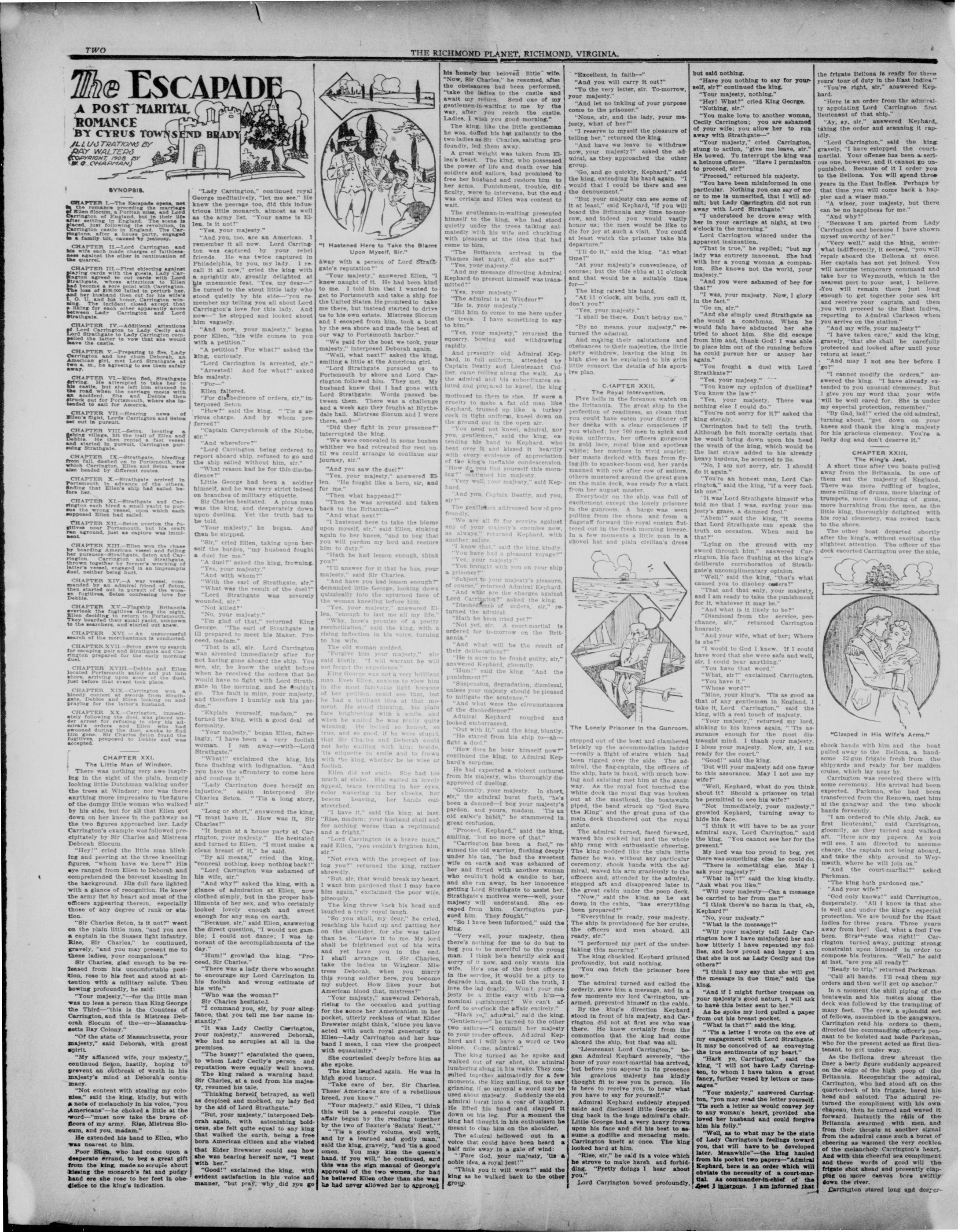
"I Hastened Here to Take the Blame Upon Myself, Sir."
away with a person of Lord Straightgate's reputation."
"Your majesty?" answered Ellen, "I knew naught of it. He had been kind to me. I told him that I wanted to get to Portsmouth and take a ship for the United States. He promised to take me there, but instead started to drive us to his own estate. Mistress Slocum and I escaped from him, took a boat by the sea shore and made the best of our way to Portsmouth harbor."
"We paid for the boat we took, your majesty," interposed Deborah again.
"Lord Strathgate pursued us to Portsmouth by abseh and Lord Carrington followed him. They met. My husband knew that I had gone with Lord Strathgate. Words passed between them. There was a challenge and a week ago they fought at Blythedale hall. Mistress Slocum and I were there, and—"
"Did they fight in your presence?" interrupted the king.
"We were concealed in some bushes whither we had retreated for rest until we could arrange to continue our journey, sir."
"And you saw the duel?" "Yes, your majesty," answered Elen. "He fought like a hero, sir, and for me."
"Then what happened?"
"Then he was arrested and taken back to the Britannia—"
"And what next?"
"I hastened here to take the blame upon myself, sir," said Ellen, sinking again to her knees, "and to beg that you will pardon my lord and restore him to duty."
"Hath he had lesson enough, think you?"
"I'll answer for it that he has, your majesty," said Sir Charles.
"And have you had lesson enough?" demanded little George, looking down quizzically into the upturned face of the woman kneeling before him.
"Yes, your majesty," answered Ellen, "enough to last me all my life."
"Why, here's promise of a pretty reconciliation," said the king, with a rising inflection in his voice, turning to his wife.
The old woman nodded.
"Forgive him your majesty," she said kindly. "I will warrant he will not forget the experience."
King George was not a very brilliant man. Even Ellen, anxious to view him in the most fawtable light because of her petition, could see that, but he had a brilliant idea at that moment. He stood thinking, his plain face brightening with a smile, and when he smiled he was really quite winning. He locked so honest, so true, and so good. If he were stupid, that Sir Charles and Deborah could not help smiling with him; beside, 'tis etiquette to smile and to frown with the king, whether he be wise or foolish.
Ellen did not smile. She had too much at stake. She waited in lovely appeal, tears trembling in her eyes, color wavering in her cheeks, her bosom heaving, her hands out stretched.
"I have it," said the king, at last. "Rise, madam; your husband shall suffer nothing worse than a reprimand and a fright."
"Lord Carrington is a brave man," said Ellen, "you couldn't frighten him, sir."
"Not even with the prospect of losing you?" returned the king, rather shrewdly.
"But, sir, that would break my heart. I want him pardoned that I may have him again," exclaimed the poor wife, piteously.
The king threw back his head and laughed a truly royal laugh.
"So you shall, my dear," he cried, reaching his hand up and patting her on the shoulder, for she was taller than he. "Leave it to me. My lord shall be frightened out of his wits and yet have you in the end. I shall arrange it. Sir Charles, take the ladies to Windsor. Mistress Deborah, when you marry this young soldier here, you become my subject. How likes your hot American blood that mistress?"
"Your majesty," answered Deborah, rising to the occasion and putting for the once her Americanism in her pocket, utterly reckless of what Elder Brewster might think, "since you have acted with such royal generosity to Ellen—Lady Carrington and her husband I mean, I can view the prospect with equanimity."
She courtesed deeply before him as she spoke.
The king laughed again. He was in high good humor.
"Take care of her, Sir Charles. These Americans are of a rebellious breed, you know."
"Your majesty," said Ellen, "I think this will be a peaceful couple. The affair began by the reading together by the two of Baxter's 'Saints' Rest."
"Tis a goodly volume, well writ, and by a learned and godly man," sald the king, gravely, "and 'tis a good omen. You may kiss the queen's hand, if you will," he continued, and this was the sign manual of George's approval of the two women, for had he believed Ellen other than she was he had never allowed her to approach
his homely but beloved little" wife,
"Now, Sir Charles," he resumed, after
the obeisances had been performed,
"take the ladies to the castle and
await my return. Send one of my
gentlemen-in-waiting to me by the
way, after you reach the castle.
Ladles. I wish you good morning."
The king, like the little gentleman
he was, doffed his hat gallantly to the
two ladies as Sir Charles, saluting pro-
foundly, led them away.
A great weight was taken from Elen-
en's heart. The king, who possessed
the power of life and death over his
soldiers and sailors, had promised to
free her husband and restore him to
her arms. Punishment, trouble, dif-
ficulty, were to intervene, but the end
was certain and Ellen was content to wait.
The gentleman-in-waiting presented himself to the king, who had stood quietly under the trees talking animatedly with his wife and chuckling with pleasure at the idea that had come to him.
"The Britannia arrived in the Thames last night, did she not?"
"Yes, your majesty."
"And my message directing Admiral Kephard to present himself was transmitted?"
"Yes, your majesty."
"The admiral is at Windsor?"
"He is, your majesty."
"Bid him to come to me here under the trees. I have something to say to him."
"Yes, your majesty," returned the equerry, bowing and withdrawing rapidly.
And presently old Admiral Kephard, in full uniform, attended by Captain Beatty and Lieutenant Collier, came rolling along the walk. As the admiral and his subordinates saluted and prepared to kneel, the king motioned to them to rise. If were a cruelty to make a fat old man like Kephard, trussed up like a turkey cock in tight uniform, kneel down on the ground out in the open air.
"You need not kneel, admiral, nor you, gentlemen," said the king, extending his hand to Kephard, who bent over it and kissed it heartily with every evidence of appreciation of the king's ineffable condescension.
"How do you find yourself this morning?" continued his majesty.
"Very well, your majesty," said Kephard.
"And you, Captain Benty, and you, str?"
The gentlemen addressed bowed profoundly.
"We are all fit for service against any of your majesty's enemies now, as always," returned Kephard, with another salute.
"I know that," said the king kindly.
"You have had a pleasant voyage?" "Yes, your majesty."
"You brought with you on your ship a prisoner?"
"Subject to your majesty's pleasure, of course," returned Admiral Kephard.
"And what are the charges against Lord Carrington?" asked the king.
"Disobedience of orders, sir," returned the admiral.
"Hath he been tried yet?"
"Not yet, sir. A court-martial is ordered for to-morrow on the Brittania."
"And what will be the result of their deliberations?"
"He is sure to be found guilty, sir," answered Kephard, gloomily.
"Hum!" said the king. "And the punishment?"
"Suspension, degradation, dismissal, unless your majesty should be pleased to mitigate the sentence."
"And what were the circumstances of the disobedience?"
Admiral Kephard coughed and looked embarrassed.
"Out with it," said the king, bluntly.
"He staved from his ship to—ah—fight a duel."
"How does he bear himself now?" continued the king, to Admiral Kephard's surprise.
He had expected a violent outburst from his majesty, who thoroughly disapproved of dueling.
"Gloomily, your majesty. In short, sir," the admiral burst forth, "he's been a damned—I beg your majesty's pardon, and yours, madam. 'Tis an old sailor's habit," he stammered in great confusion.
"Proceed, Kephard," said the king, smiling, "but no more of that."
"Carrington has been a fool," resumed the old warrior, flushing deeply under his tan, "he had the sweetest wife on earth and was as ashamed of her and flirted with another woman who couldn't hold a candle to her, and she ran away, in her innocence getting Lord Strathgate to assist her. Strathgate's motives were—well, your majesty will understand. She escaped from him. Carrington pursued him. They fought."
"So I have been informed," said the king.
"Very well, your majesty, then there's nothing for me to do but to beg you to be merciful to the young man. I think he's heartily sick and sorry of it now, and only wants his wife. He's one of the best officers in the service, it would be a pity to degrade him, and, to tell the truth, I love the lad dearly. Won't your majesty be a little easy with him—a nominal punishment? We can't afford to overlook the affair entirely."
"Hark ye," admiral," said the king, "Gentlemen—" he turned to the other two sailors—"I commit her majesty to your tender offices. Admiral Kephard and I will have a word or two alone. Come, admiral."
The king turned as he spoke and walked out of ear shot, the admiral lumbering along in his wake. They consulted together animately for a few moments, the king smiling, not to say grinning, if so unroyal a word may be used about majesty. Suddenly the old admiral burst into a roar of laughter. He lifted his hand and slapped it down on his leg. For a moment the king had thought in his enthusiasm he meant to clap him on the shoulder.
The admiral bellowed out in a voice that could have been heard a half mile away in a gale of wind: "Fore God, your majesty, 'tis a noble idea, a royal jest!"
"Think you it will work?" said the king as he walked back to the other group.
"Excellent, in faith—"
"And you will carry it out?"
"To the very letter, sir. To-morrow,
your majesty."
"And let no inkling of your purpose
come to the prisoner."
"None, sir, and the lady, your
majesty, what of her?"
"I reserve to myself the pleasure of telling her," returned the king.
"And have we leave to withdraw now, your majesty?" asked the admiral, as they approached the other group.
"Go, and go quickly, Kephard," said the king, extending his hand again. "I would that I could be there and see the dencouement."
"But your majesty can see some of it at least," said Kephard, "if you will board the Britannia any time to-morrow, and indeed you would vastly honor us; the men would be like to die for joy at such a visit. You could at least watch the prisoner take his departure."
"I'll do it," said the king. "At what time?"
"At your majesty's convenience, of course; but the tide ebbs at 11 o'clock and that would be a suitable time for—"
The king raised his hand.
"At 11 o'clock, six bells, you call it,
don't you!"
"Yes, your majesty."
"I shall be there. Don't betray me."
"By no means, your majesty," returned the admiral.
And making their salutations and obeisances to their majesties, the little party withdrew, leaving the king in high glee as he explained to his grim little consort the details of his sportive plan.
CHAPTER XXII.
Five bells in the forenoon watch on the Britannia. The great ship in the perfection of readiness, so clean that you could have eaten your dinner off her decks with a clear conscience if you wished; her 700 men in spick and span uniforms, her officers gorgeous in gold lace, royal blue and spotless white; her marines in vivid scarlet; her masts decked with flags from flying-lib to spanker-boom end, her yards manned with row after row of sallors, others mustered around the great guns on the main deck, was ready for a visit from her august master. Everybody on the ship was full of excitement except the lonely prisoner in the gunroom. A barge was seen pulling from the shore and from a flagstaff forward the royal ensign fluttered out in the fresh morning breeze. In a few moments a little man in a shovel hat and plain civilian's dress
A
The Lonely Prisoner in the Gunroom.
stepped out of the boat and clambered briskly up the accommodation ladder —really a flight of stairs which had been rigged over the side. The admiral, the flag-captain, the officers of the ship, hats in hand, with much bowing and saluting met him at the gangway. As the royal foot touched the white deck the royal flag was broken out at the massthead, the boatswain piped, the band struck up "God Save the King" and the great guns of the main deck thundered out the royal salute.
The admiral turned, faced forward, waved his cocked hat and the whole ship rang with enthusiastic cheering. The king nodded like the plain little famer he was, without any particular ceremony, shook hands with the admiral, waved his arm graciously to the officers and, attended by the admiral, stepped aft and disappeared later in the great cabin under the poop deck.
"Now," said the king, as he sat down in the cabin, "has everything been prepared?"
"Everything is ready, your majesty. The ship is provisioned for her cruise, the officers and men aboard. All ready, sr."
"I performed my part of the undertaking this morning."
"You can fetch the prisoner here now."
The admiral turned and called the orderly, gave him a message, and in a few moments my lord Carrington, unarmed, presented himself in the cabin.
By the king's direction Kephard stood in front of his majesty, and Carrington did not at first see who was there. He knew certainly from the commotion that the king had come aboard the ship, but that was all.
"Lieutenant Lord Carrington," began Admiral Kephard severely, "the hour of your court-martial has arrived, but before you appear in its presence his gracious majesty has kindly thought fit to see you in person. He is here to receive you, to hear what you have to say for yourself."
Admiral Kephard suddenly stepped aside and disclosed little George sitting back in the huge admiral's chair. Little George had a very heavy frown upon his face and did his best to assume a godlike and menacing mein. Carrington knelt at once. The king looked hard at him.
"Rise, sir," he said in a voice which he strove to make harsh and forbidding. "Pretty doings I hear about you."
Lord Carrington bowed profoundly.
but said nothing.
"Have you nothing to say for yourself, sir?" continued the king.
"Your majesty, nothing."
"Hey! What?" cried King George.
"Nothing, sir."
"You make love to another woman, Cecily Carrington; you are ashamed of your wife; you allow her to run away with Strathgate—"
"Your majesty," cried Carrington, stung to action, "give me leave, sir."
He bowed. To interrupt the king was a heinous offense. "Have I permission to proceed, sir?"
"Proceed," returned his majesty.
"You have been misinformed in one particular. Nothing you can say of me or to me is unmerited, that I will admit; but Lady Carrington did not run away with Lord Strathgate."
Lord Carrington winced under the apparent insinulation.
"That is true," he replied; "but my lady was entirely innocent. She had with her a young woman a companion. She knows not the world, your majesty."
"And you were ashamed of her for that?"
"I was, your majesty. Now, I glory in the fact."
"Go on, sir."
"And she simply used Strathgate as she would a coachman. When he would fain have abducted her she tried to shoot him. She did escape from him and, thank God! I was able to place him out of the running before he could pursue her or annoy her again."
"You fought a duel with Lord Strathkate?"
"Yes, your majesty."
"You know my opinion of duelling? You know the law?"
"Yes, your majesty. There was nothing else I could do."
"You're not sorry for it?" asked the king sternly.
Carrington had to tell the truth. Although he felt morally certain that he would bring down upon his head the wrath of the king, which would be the last straw added to his already heavy burdens, he scorned to lie.
"No, I am not sorry, sir. I should do it again."
"You're an honest man, Lord Carrington." said the king, "if a very foolish one."
"It was Lord Strathgate himself who told me that I was, saving your majesty's grace, a damned fool."
"Ahem!" said the king, "it seems that Lord Strathgate can speak the truth on occasion. When said he that?"
"Lying on the ground with my sword through him," answered Carrington, his face flushing at the king's deliberate corroboration of Strathgate's uncomplementary opinion. "Well," said the king, "that's what caused you to disobey orders?" "That and that only, your majesty, and I am ready to take the punishment for it, whatever it may be."
"And what is it likely to be?" "Dismissal from the service, perchance, sir," returned Carrington hoarsely. "And your wife, what of her; Where is she?" "I would to God I knew. If I could have word that she were safe and well, sir, I could bear anything." "You have that word." "What, sir?" exclaimed Carrington. "You have it."
"Whose word?"
"Mine, your king's. "Tis as good as that of any gentleman in England, I take it, Lord Carrington," said the king, with a real touch of majesty.
"Your majesty," returned my lord, sinking to his knees again. "Tis assurance enough for the most distraught mind. I thank your majesty. I bless your majesty. Now, sir, I am ready for the court."
"Good!" said the king.
"But will your majesty add one favor to this assurance. May I not see my wife?"
"Well, Kephard, what do you think about it? Should a prisoner on trial be permitted to see his wife?"
"Not immediately, your majesty," growled Kephard, turning away to hide his face.
My lord was too proud to beg, yet there was something else he could do.
"There is something else. May I ask your majesty?"
"What is it?" said the king kindly.
"Ask what you like."
"Will your majesty—Can a message be carried to her from me?" "I think there's no harm in that, eh, Kephard?"
"No, your majesty."
"What is the message?"
"Wilt your majesty tell Lady Carrington how I have misjudged her and how bitterly I have repented my follies, and how proud and happy I am that she is not as Lady Cecily and the others?"
"I think I may say that she will get the message in due time," said the king.
"And if I might further trespass on your majesty's good nature, I will ask to have this letter sent to her."
As he spoke my lord pulled a paper from out his breast pocket.
"What is that?" said the king.
"Tis a letter I wrote on the eve of my engagement with Lord Strathgate. It may be conceived of as conveying the true sentiments of my heart."
"Hark ye, Carrington," said the king, "I will not have Lady Carrington, to whom I have taken a great fancy, further vexed by letters or messages."
"Your majesty," answered Carrington, "you may read the letter yourself. 'Tis such a letter as would convey joy to any woman's heart, provided she loved her husband and could forgive him his folly."
"Well, as to what may be the state of Lady Carrington's feelings toward you, that will have to be developed later. Meanwhile"—the king hauled from his pocket two papers—"Admiral Kephard, is an order which will obviate the necessity of a court-martial. As commander-in-chief of the fleet I interpell. I am informed that
the frize Bellona is ready for three years' tour of duty in the East Indies."
"You're right, sir," answered Kephard.
"Here is an order from the admiralty appointing Lord Carrington first lieutenant of that ship."
"Ay, ay, slr," answered Kephard, taking the order and scanning it rapidly.
"Lord Carrington," said the king gravely. "I have estopped the court-martial. Your offense has been a serious one, however, and it cannot go unpunished. Because of it I order you to the Bellona. You will spend three years in the East Indies. Perhaps by that time you will come back a happier and a wiser man."
"A wiser, your majesty, but there can be no happiness for me."
"And why?"
"Because I am parted from Lady Carrington and because I have shown myself unworthy of her."
"Very well," said the king, somewhat indifferently, it seemed, "you will repair aboard the Bellona at once. Her captain has not yet joined. You will assume temporary command and take her to Weymouth, which is the nearest port to your seat, I believe. You will remain there just long enough to get together your sea kit and receive your captain, and then you will proceed to the East Indies, reporting to Admiral Clarkson when you arrive on the station."
"And my wife, your majesty?" "I have taken care," said the king, gravely, "that she shall be carefully protected and looked after until your return at least."
"And may I not see her before I go?"
"I cannot modify the orders," answered the king. "I have already extended to you unusual clemency. But I give you my word that your wife will be well cared for. She is under my especial protection, remember."
"By Gad, lad!" cried the old admiral, turning about, "get down on your knees and thank the king's majesty for his gracious clemency. You're a lucky dog and don't deserve it."
CHAPTER XXIII.
A short time after two boats pulled away from the Britannia. In one of them sat the majesty of England. There was more rulling of bugles, more rolling of drums, more blaring of trumpets, more thundering of guns, more hurrying from the men, as the little king, thoroughly delighted with his royal clemency, was rowed back to the shore.
The other boat departed shortly after the king's, without exciting the slightest attention. The officer of the deck escorted Carrington over the side.
A
"Clasped in His Wife's Arms."
shook hands with him and the boat pulled away to the Bellona, a handsome 32-gun frigate fresh from the shipyards and ready for her malden cruise, which lay near by.
Carrington was received there with some ceremony. His arrival had been expected. Parkman, who had been transferred from the Renown, met him at the gangway and the two shook hands fervently.
"I am ordered to this ship, Jack, as first lieutenant," said Carrington, gloomily, as they turned and walked aft. "Here are my papers. As you will see, I am directed to assume charge, the captain not being aboard, and take the ship around to Weymouth, where he will join us."
"And the court-marial?" asked Parkman.
"The king hath pardoned me."
"And your wife?"
"God only knows!" said Carrington, desperately. "All I know is that she is well and under the king's especial protection. We are bound for the East Indies for three years. Three years away from her! God, what a fool I've been. Strathegate was right!" Carrington turned away, putting strong constraint upon himself in order to compose his features. "Well," he said at last, "are you all ready?"
"Ready to trip," returned Parkman. "Call all hands. I'll read them my orders and then we'll get up anchor."
In a moment the shipliping of the boatswain and his mates along the deck was followed by the trampling of many feet. The crew, a splendid set of fellows, assembled in the gangways. Carrington read his orders to them, directed the commanding officer's pennant to be hoisted and bade Parkman, who for the present acted as first lieutenant, to get under way.
As the Bellona drew abreast the liner a barfly figure suddenly appeared on the edge of the high poop of the Britannia. Recognizing the admiral, Carrington, who had stood aft on the quarterdeck of his frigate, bared his head and saluted. The admiral returned the compliment with his own chapeau, then he turned and waved it forward. Instantly the rails of the Britannia swarmed with men, and from their throats at another signal from the admiral came such a burst of cheering as warned the very cockles of the melancholy Carrington's heart. And with this cheerful sea compliment and these words of good will the frigate shot ahead and presently clapping on more canvas bore swiftly down the river.
Carrington stared long and deeper.
THE YLANGT
SATURDAY..... MAY 16. 1907
ately back toward the shores, fast dropping behind him, on which some where his wife's foot rested. What was she doing? Where was she living? What was she thinking of him? He knew nothing save that in some manner she was under the especial protection of the king; that was assurance enough that she was well cared for, for no man questioned the honesty, sincerity or kindness of George the Third. It would be three years before he would see her again. The thought was maddening to him. He did not even know where to write to her. He was not at all sure that the king would cause his letter to be delivered to her. He came to a desperate resolution. He would write her another letter and send it from Weymouth by special messenger to the king and beg him to see that it was delivered.
It was not until late in the afternoon, when the Bellona was fairly in the channel beating down toward her destination, that Carrington went below. As there was no captain yet on the ship the quarters of that functionary by right belonged to him. He entered them without ceremony. The cabin on the new ship looked bright and cheery. Its equipments were rude, of course, as were those of all ships in those days, but they were better than those in ordinary vessels, the Bellona being the newest and most advanced product of the shipyards.
To a sailor of that day it was both a spacious and delightful sea home. To Carrington it was only a prison. He did not attempt to enter the state rooms on either side, but sat down at the table, buried his face in his hands and groaned aloud. It was the first moment of privacy that he had enjoyed. It was the first opportunity afforded him to give way to his feelings, and he indulged himself at will. Separated from his wife, and through his own folly! The future that had opened so fairly before him utterly wrecked! Three long weary years at the least, and possibly four, to intervene before he could see her again. He almost envied Strathgate—fighting desperately for life at Blythedale Hall and likely to be an invalid for the rest of his days—because he would be in England while Carrington was far away.
He had gone through so much. He had drunk so deeply the bitter cup of repentance that he gave way completely to his emotions.
"This will never do," he said at last. "My punishment seems greater than I can bear, and yet I must bear it; I must show myself a man for her."
A little hand fell softly upon his shoulder with touch as light as that of thistledown. Where that hand touched him was the center of his being. My lord turned his head, looked at it slowly, turned his body, followed it up, saw a face he dreamed of, tears rolling from eyes that looked love at him, and in another moment he was clasped in his wife's arms.
This was the punishment met out to him by little George. He was to go to the Indies, but not alone. When there was time for coherent speech Ellen handed her husband another paper appointing him captain of the Bellona, subject only to the orders of his wife.
"God bless him!" cried my lord, folding his wife again to his heart.
"And I say so, too," answers Ellen, "although we fought against him so long, he hath a kindly heart."
"He hath, indeed," returned Carrington, after a time. "He gave me his royal word that you should be well looked after for the next three years, and the keeping of the king's word is intrusted to me. I shall see to it."
"Nay," said Ellen, "you are under my command now. Look at your orders."
"Tis even so, my little captain," laughed my lord, sweeping her to his heart again. "And what orders do you propose to issue to me?"
"I should like to present to you two of my friends."
"Your friends are my friends, my dear," returned Carrington, "and when occasion serves I shall be happy to greet them."
"It serves now," said Ellen, drawing herself away from him. And indeed she found it difficult, for he would by no means let her go, following her aft and still keeping his hand about her waist as she opened the door of one of the cabins.
Out thence, for all the world like a Jack-in-the-box, popped Mistress Deborah, her cheeks redder than the scarlet ribbons she affected, and stalking behind her came Sir Charles Seton in great dignity.
"I did you an injustice, Charles!" cried my Lord Carrington. "I humbly beg your pardon. I have not heard the story"—and Seton was glad my lord's remarks were so spontaneous—"but I know that you were true."
"It's granted, Bernard," said Seton heartily. "I could forgive you anything, knowing how you felt over the loss of your wife, for to-day I can put myself in your place in one particular."
"And how's that?"
"In this way," returned Seton. "Permit me"—he seized the blushing Deborah as he spoke—"Salute Lady Seton, Carrington." "What! Is it so?" "We were married this morning, the king himself being one of the witnesses." "And do you go with us to India?" "Nay," answered Seton, "only to Weymouth." And at that Carrington was very glad, for though he loved Seton much.
---
satisfied the officers, as we have already pointed out, that their men were not guilty, and they have so testified. They testify that they were influenced to change their opinions and reach the conclusion that their men were not guilty by a number of facts developed, including among others, the results of a microscopic examination that was made of the exploded shells that were picked up in the streets of Brownsville. In other words, the testimony by which they had been first led to believe that their men were guilty turned out, as a result of this investigation, to be conclusive proof to their minds that their men were not guilty. The part this testimony has thus played shows that it is sufficiently important to receive special consideration.
1. According to the weight of the testimony there were from 150 to 300 shots fired that night in Brownsville by the raiders, whoever they may have been. There should have been found, therefore, that many exploded shells. The testimony shows that careful search was made to find the shells and every other species of evidence that might tend to show that the soldiers were guilty, but with the result that, all told, only about 40 of these exploded shells were found. In other words, there were from 100 to 200 or 300 exploded shells, according to the theory of those who claim that the soldiers did the firing, scattered somewhere as a result of that firing in the alleys have been found. Nobody pretends that there was any difficulty on account of the reason of the ground or for any other reason about finding any exploded shells there may have been, or ought to have been, in the streets where the firing occurred. Seven of these empty shells were found at the mouth of the Cowen alley near the fort by Captain Mack-lln.
Others were found in the alley and in Washington street at the point where the firing is said to have occurred. These shells so found, except those found by Captain Macklin, were turned over to the authorities and subsequently forwarded to the Senate for use as evidence. There were only 33 of them in all. There may possibly have been a few others picked up that were not turned over, and have no account of them, and the testing of such character as to warrant the conclusion there could have been but very few, if any, picked up in addition to the 33 mentioned.
It is reasonable to conclude that the other shells that must have been exploded, if there were as many shots fired as the witnesses state, were not found to be such shells as the soldiers used, or there must have been some other good reason for not submitting them as evidence. Whatever the explanation may be, the fact remains, and it is a fact that in and of itself discredits the deductions drawn to the prejudices of the soldiers from the finding of the shells that have been submitted.
SHELLS AND CLIPS FOUND BY CAPTAIN MACKLIN.
It is testified by Captain Macklin, who was officer of the day, that just at the break of dawn he made a careful search for any evidence that would show who had done the firing. In this behalf he searched, both inside the reservation wall and outside to find shells and clips or other evidence that the soldiers had done the firing, as the citizens were at that time charging.
He found no shell, no clip, no evidence of any kind inside the reservation wall, but outside the wall, across the street, in front of the garrison and at the mouth of Cowen alley, where, according to the testimony of the guard and the scavenger and other witnesses, the first shots were taken in found seven shells and six clips in a area not more than ten inches in diameter. The testimony is conclusive that if these shells had fallen from Springfield rifles as they were fired they would have been scattered over an area perhaps 10 feet in diameter.
It is the opinion of all the witnesses who testified on that point that the shells found by Captain Macklin could not have fallen in the position in which he found them if they had fallen as they were fired. This fact, coupled with the further fact that with these seven shells six clips, enough to hold thirty cartridges of shells credits the finding of the shells in the alleys and streets as evidence of the guilt of the soldiers.
MICROSCOPIC INVESTIGATION
But while the investigation was in progress the War Department, on its own motion, caused all the rifles that were in the hands of the three companies at Brownsville that night to be forwarded to the Springfield Armory, and detailed two officers, who, under instructions from the War Department, caused to be fired out of each of these rifles two cartridges. The indentations on the heads of the exploded shells so fired were put under the microscope and compared with the indentations found on the heads of the thirty-three exploded shells picked up in the streets of Brownsville, which indentations were similarly magnified.
In order that Senators may have a better idea than I can convey by mere language, I have in my hand here an exploded shell to which I call attention. That is the head of the shell—where I am pointing. The center of that head is called the "primer." When the cartridge is inserted in the gun and the trigger is pulled a bolt shoots forward which carries what is called the "dring pin" until it strikes the primer and that explodes the shell.
As I have already read, two cartridges were fired from each one of the guns of this battalion by the officers who were intrusted with the duty of making the experiment, and the indentations made upon the heads of the shells were then magnified, and you see by these exhibits in our record at pages 1313-1314 to what extent they were magnified. [Indicating.]
All firing pins are made by machinery and are supposed to be practically alike, yet it is found upon examination that no two firing pins will make the same kind of an indentation; that is, there does not seem to be anything in either manufacture or nature exactly like any-
he loved his wife more, and he wanted her for the rest of his life all to himself.
Seton divined that, for presently he took Deborah by the hand and led her forth upon the quarterdeck, leaving Carrington and Ellen alone together, each in the haven where they fain would be; husband and wife, one and inseparable now and forever, locked in each other's arms.
(THE END.)
Review of the Evidence.
(Continued From First Page.)
were fired from either a Springfield rifle, or a Krag rifle, or a Krag carbine, or a Mauser rifle.
It is claimed, however, that they must have been fired from a Springfield rifle.
First, because the Springfield cartridge is too long and too large to fit into a Krag rifle or Krag carbine, or a Mauser rifle, and that if the bullets that were found belonged to Springfield rifles, and that inasmuch as no one at Brownsville, so far as the testimony discloses, had a Springfield rifle, except only the Negro soldiers, they must have done the firing.
Until this circumstantial evidence was made, the Major Penrose and his officers, they would not believe that any of their men had been engaged in the shooting, but this testimony seemed so conclusive that they changed their minds and expressed themselves as convinced that their men must have done the shooting.
It was this apparently conclusive testimony that fastened the conviction of guilt upon the soldiers in the minds of all who were engaged in the investigation of the affray, and which led the investigators to disbelieve the soldiers and to desist from investigating the question of the possible guilt of others.
As soon as this evidence was presented to Major Penrose and his officers they put their men under the strictest scrutiny and subjected them to the severest discipline and examinations, with a view to ascertaining who the guilty men were. They continued this course not only at Fort Brown, but subsequently at El Reno, down to the time when their men were discharged without honor, but, notwithstanding they made every kind of an effort, they failed to get any clue whatever to indicate what men, if any at all, were guilty.
Every man in the command continued to stoutly and unqualifiedly deny that he had participated in the affray, and also that he had any knowledge whatever as to who had done the shooting.
When General Garlington announced the President's ultimatum, that unless some one disclosed who the guilty parties were the whole battalion would be discharged without honor, it was thought that at least those oldest in the service, and therefore having the most to lose by such a discharge, would come forward with incriminating testimony; but when they continued to assert their innocence and lack or any knowledge whatever on the subject, their officers, who knew their pride in their record as soldiers and knew their trustworthiness and truthfulness and general reliability as men, began to doubt their guilt.
This wavering ripened into conviction when during the progress of the Penrose court-martial and the Senate investigation a number of important facts favorable to the soldiers were developed and established.
THE MICROSCOPIC INSPECTION
No one fact had so much weight with these officers to change their minds as what is known in this record as the microscopic inspection that was made of the exploded shells above referred to.
When the results of this investigation were communicated to the Senate Committee on Military Affairs, made a part of the record of the investigation, and made known to the public, these officers carefully studied the various points and features and phases of the same with the result that, coupled with other testimony, they became thoroughly convinced that their men were absolutely innocent, one and all, of any action in the shooting affray, and of withholding any information with regard there.
All testified fully as to this change of opinion in favor of their men, giving their reasons therefor.
This testimony, which was so conclusive to these officers, appears e.g. equally conclusive to my mind.
It is of the most important character and, in consequence, is entitled to the most careful attention.
My views with respect to this circumstantial evidence and this microscopic inspection and the conclusions deduplicable from the results of the same are fully and carefully expressly supplemental minority report signed by the generator from Connecticut and myself.
I do not know how better to present what I have to say in regard thereto than by quoting the following from that report. It involves some repetition, but in view of its importance that is not objectionable.
THE SHELLS, CLIPS, ETC
A lot of exploded cartridge shells, some clips and cartridges, and a bandolier were picked up in the alleys and the next morning after the shooting.
Until these were brought to the fort and shown to Major Penrose and the other officers of the battalion they would not, any of them, believe rt possible that any of the men of the battalion had been engaged in the shooting; but when these were exhibited to them, and they were told that they were picked up at the points where the shooting occurred, they changed their minds and concluded that in view of such evidence their men must have done the shooting. From that moment they put their men under he strictest scrutiny and surveillance and made every effort possible to ascertain who the guilty men were, but all such efforts failed.
In the meanwhile the court-martial or Major Penrose was held at San Antonio and the investigation before the Senate Committee commenced. The testimony so taken
THE RICHMOND PLANET, RICHMOND, VIRGINIA
NUMBER OF SHELLS FOUND
thing else, even when it is made with machinery.
All the heads of these exploded shells fired by these experts were put under the magnifying glass and magnified in that way. So were the heads of the shells picked up in the streets of Brownsville put under the magnifying glass, and then they were compared with each other with this result, that the indentations found on the thirty-three shells picked up in the streets of Brownsville were exactly like the indentations made upon the shells fired by these experts out of four certain rifles that had been sent to the Springfield Academy, which were found to have belonged to Company B.
All that is set forth in the official report of these experts. The experts transmitted them to the Secretary of War, with a report in which they said that the experiments showed conclusively that the thirty-three shells picked up in the streets of Brownsville had been fired out of these four certain rifles—eleven out of one, eight out of another, and so on. The numbers of the rifles were given, and that was transmitted to the committee as settling the whole matter.
TO BE CONTINUED NEXT WEEK
THE TRUE AND THE UNTRUE.
He was a dog
But he stayed at home
And guarded the family night and day.
He was a dog
That didn't roam.
He lay on the porch or chased the stray
At morning and evening. and heat.
To cherish his wife and children fair.
He was a man
And every day
His heart grew callous, its love-beats
He thought of himself at the close of day
And cigar in his fingers, hurried away
To the club, the lodge, the store, the
But he had a right to go, you know.
He was a man.
—New York Globe.
For Satisfactory Reasons.
"You ought to be trying to earn your own living." suggested Mrs. Goodsole.
"Why aren't you?"
"That's arskin' a personal question, mum," answered Tuffold Knutt, pouring his coffee into the saucer and blowing on it.
"I know it. This is a personal matter. Why aren't you?"
"Fer the reason, mum," he sald, tackling the plate of fresh doughnuts,
"at I don't haf to."—Chicago Tribune.
They Did Their Best
"We cannot claim that our baking powder is absolutely pure," said the canvasser; "such a thing as absolute purity is impossible. We do our best, however. For instance, we threw away a hundred-weight tin last week because it was discovered that one of our workmen had carelessly made a chalk mark on the inside of the tin before the powder was put in." The grocer surrendered.—Royal Magazine.
Nothing Solid
They meet at the lunch counter.
The girl with the fluffy hair had ordered ice cream cake, chocolate pudding, and cream puffs.
"For the land's sake, Belle!" exclaimed the girl with the picture hat. "How can you get away with all that stuff?"
"I'm dieting," freezingly answered the girl with the fluffy hair.
Hope is a good thing to have, but you can't get it cashed at the bank.
The average man's idea of economy is to tell his wife how to save money.
The more applause a man gives and the less advice, the more popular he will be.
Love is as necessary to a woman who has acquired the habit as tobacco is to a man.
The pretty girl's face may be her fortune, but the homely girl's face is her chaperon.
The theory that it is never too late to mend is very comforting to those who are in no hurry to begin.
JUDGE'S DECISIONS
Charity organizations uncover a multitude of sinners.
A woman who can talk on a hundred different subjects generally does.
No need for you to keep a dog in the country if all your neighbors have one.
Some people tell everything they know, but this doesn't mean they talk too much.
You may be proud of your ancestry, but how would your ancestry feel about you?
The wicked prefer darkness to light. That accounts for so much tardiness in the morning—Judge.
PROVERBS AND PHRASES.
Evil counsel is swift in its march.—Plutarch.
Ritches serve a wise man, but command a fool.—Spanish.
By far the best guide to happiness is wisdom.—Sophocles.
Revenge a wrong by forgiving it.—Latin.—Baltimore Sun.
The virtue that is in us is put in us by the divinity.—Plato.
Prayer is the key of the day and the lock of the night.—Hebrew.
Thou oughtest not to know the wealth of thy neighbor.—Homer.
LINCOLN
HAIR POMADE
MAKES
KINKY
HAIR
SOFT
REMOVES
DANDRUFF
KEEPS
HAIR
FROM
BREAKING
OFF
LINCOLN
HAIR POMADE
KEEPS
SCALP
FRESH
CLEAN AND
WHOLE-
SOME
MAKES
HAIR
GROW
LONG AND
LUXURIOUS
WHICH WAY WOULD YOU RATHER HAVE YOUR HAIR--SOFT AND
LONG SO THAT YOU CAN PUT IT UP IN THE LATEST STYLE
OR SHORT AND KINKY
A WOMAN'S JUST PRIDE IS HER
Agents Wanted Everywhere. Write for particulars. If your dealer does not keep it, send 20 cents in stamps or silver to the LIN-COLN POMADE CO., Department B, Norfolk, Va, and we will send you a bottle by return mail.
---
A man and a woman in a canoe are fishing in a lake. The man is holding a fishing rod, and the woman is sitting on the boat. There are trees and a cloudy sky in the background.
The GIR TIM'S
The GIRL From TIM'S PLACE
By CHAS. CLARK MUNN. Author of "The Hermit."
When Mr. Munn gets familiar ground; ground from which he extracts that he puts into his story of nature he picks his them builds, not alone a old fashioned love story never tires of reading.
"The Girl From Tim's next serial. It will begin future. Watch for it.
When Mr. Munn gets into the forest he is on familiar ground; ground which he loves, and from which he extracts an absorbing sweetness that he puts into his stories. From the depths of nature he picks his characters and around them builds, not alone a mystery, but a charming old fashioned love story of a kind the public never tires of reading.
"The Girl From Tim's Place," is to be our next serial. It will begin running in the near future. Watch for it.
"Both the pathos and humor of country life are presented with all the knack of a good story-teller."—St. Louis Global-Democrat.
Terrible.
This is a thought that comes to me,
And so I must repeat it:
When wife gets in a frightful stew,
Alas, I cannot eat it.
An Epicure.
Customer — What is this tough, tasteless substance in this custard pie?
Walter —That's cocoanut, sah—custard topped with cocoanut.
Customer —Hum! Well, take it out and bring me custard topped with rich, juicy white pine sawdust.—N. Y.
Weekly.
Frenzied Finance
Wedderly—I made the mistake of my life when I gave my wife a $20 gold piece on the first anniversary of our marriage.
Singleton—How's that?
Wedderly—I've had to give her $20 a week ever since to keep her from spending it—Chicago Daily News.
No Divided Alloegiance for Her
Lll—So you rejected that young fireman, did you?
Min—I surely did. Do you suppose I'd marry a man who might leave me at any hour of the 24 to dance attendance on some other flame?—Chicago Tribune.
Terrible.
An Epicure.
Singleton—How's that?
"There is humor, there is pathos and fun, and picturesque yet lifelike description in this healthful novel."—Boston Beacon.
IN our next serial you will find a deep and absorbing mystery of the native forests coupled with as charming a romance as ever written. It is a tale of gun, and rod and canoe with cupid peeping from behind each tree and on every water course.
L From PLACE
is into the forest he is on
and which he loves, and
an absorbing sweetness
stories. From the depths
characters and around
mystery, but a charming
y of a kind the public
's Place," is to be our
gin running in the near
Apt to Be Irritating
"You mustn't get so irritable with the youngest boy," said the House Cat. "He has a very lively disposition."
"That's not everything," grumbled the Pet Dog. "So has a flea."—Baltimore American.
Little Willie—Say, pa, what is a "respectable fortune?"
Pa—One that is large enough to make its possessor's opinion on any subject respected my son—Chicago Daily News
A Lazy M. D.
Mrs. Hayrix—What be yore son doin' tew th' city?
Mrs. Meadowgrass—He's studyin' fer a doctor.
Mrs. Hayrix—The idee! Is th' doctor tew lazy tew study for hisself?—Chicago Daily News.
The Use of Cloves.
Mrs. Gotham—The paper says that chewing wintergreen will keep people awake in church.
Mr. Gotham—It might be; but, at the theater, I have found cloves very efficacious.—N. Y. Weekly.
KEEPS
SCALP
FRESH
CLEAN AND
WHOLE-
SOME
MAKES
HAIR
GROW
LONGAND
LUXURIOUS
THREE
JOSHUA BANKS & SONS
CATERERS
EVERY FACILITY CONSISTENT
WITH FINE CATERING.
Special Attention Given to Balls,
Suppers, Installations and Smokers at the Shortest Notice.
Your Patronage Solicited.
Refreshment Cars and Boat Privileges handled in Season.
Address - 11 communications to
LLAM L. BANKS, 611 N. 2d 61
Residence: 1312 N. 26th St.
DON'T GET MAD:
if your hair ran away from your Because, you wear it. Don't feed it with and keep it at home. Don't have a falling out with your hair. It might be what? That would mean thin, dry, lifeless, coarse, uneven, breaking and fall.
If your hair ran away
from you? Because, you
have the remedy NOW to
feed it with and keep it at
home. Don't have a fall-
ing outburst, or you might leave you! Then
what? That would mean
thin, dry, lifeless, coarse,
uneven, breaking and falling
hair. Give it some
thing to live on; now it
tastes it tightly to
your scalp. Of course Mackenzie is the only
genuine, perfect and dependable hair
and medicine you can buy. It will make the hair
grow extra long and heavy, gives new life to
the hair bulbs, save what hair you have and get
more too. Three applications convincing or
money extended. Sold everywhere, $50.
$0C, $1.00 Always order. Send
for free in interesting booklet right
Temporary Office; $35 West 32nd Street.
MCCOOORO HAIR TONIC MEG. CO. N.Y.
RAILROADS.
ROUTE
4:00 P. M. and Norfolk
9:00 A. M. Fast daily trains to Old Point
7:40 A. M. Daily. Local to Newport News.
5:00 P. M. Daily. Local to Old Point
11:00 P. M. Daily. Louisville, Cincinnati
20:00 A. M. Chicago and St. Louis Pullman
20:00 A. M. Daily-Charlotteville, except Sun
day to Hinton, except Saturday
and Sunday to Cincinnati.
5:15 P. M. Daily.
TRAINS ARRIVE RICHMOND.
James River Line - *8:35 A. M., 6:45 P. M.
7:00 P. M., 8:15 P. M.
Main Line West - 7:30 A. M., *8:30 A. M.
3:45 P. M., 7:45 P. M.
Main Line East - 3:55 A. M., 6:45 P. M.
*Daily exert Sundays*
Richmond, Frederickskis*g & Potomac R. R.
SCHEDULE EFFECTIVE APRIL 12, 1980.
TO AND FROM WASHINGTON AND BEYOND.
Leave Richmond
*6.20 A.M. Byrd St. Sta.
*8.20 A.M. Byrd St. Sta.
*12.01 P.M. Byrd St. Sta.
*14.00 P.M. Byrd St. Sta.
*8.50 P.M. Ela Station.
*9.00 P.M. Ela Station.
*9.25 P.M. Ela Station.
*8.20 P.M. Main St. Sta.
ASHLAND ACCOMMODATIONS—WEEKDAYS.
Leave Ela Station—1.30 A.M. 6.20 A.M. 8.20 A.M. 12.01 P.M. 14.00 P.M. 8.50 P.M. Ela Station. 9.00 P.M. Ela Station. 9.25 P.M. Ela Station. 9.25 P.M. Main St. Sta.
*Daily.* Weekdays. 1.Sundays only. All trains to or from Byrd Street Station stop at Ela Station. All departures and departures not read. Read the sign.
N. & W. NORFOLK & WESTERN
N. & W. NORFOLK & WESTERN
ONLY ALL-RAIL LINE TO NORFOLK.
Leave Byrd Street, StRIECHON. In REF.
December 1, 1907.
For Norfolk—6:00 A. M. 3:00 P. M. and 7:20
P. M. for Newbury, the West and Southwest—
9:00 A. M. 12:10 P. M., and 0:40 P. M. daily.
ARRIVE RICHMOND—From Norfolk—11:30 A.
M. and 6:00 P. M. from the West—
7:40 P. M. 2:05 P. M. and 8:50 P. M.
Pulman, Parlor and Sleeping Cura. Cafe
Dining Caw.
M. M. BOSTON
W. B. BEVILL. C. H. BOGLEY,
Gen. Pass. Agent. Div. Pass. Agent.
Southern Ry
TRAINS LEAVE RICHMOND.
N. B—Following schedule figures published
only as information, local or guaranteed:
6:20 A. M.—Daily-Local for Charleston
11:15 A. M.—Daily-Limited-Buffet Pulman to
Atlanta and Birmingham, New Orleans,
Memphis, Chattanooga, and all the South.
Tampa coach for Coach City, Oxford,
Durham.
6:00 P. M. -Ex. Sunday -Kayville Local. 1:00
P. M. for the Fullman Local. 2:00
P. M. for all the South.
YORK RIVER LINE.
4:30 P. M.—Ex. Sunday—To West Point—On
necting for Baltimore Monday, Wednesday
and Friday.
2:15 P. M.—Ex. Wednesday and Friday—
Local to West Point.
4:30 A. M.—Ex. Sundays—Local to West Point.
TRAINS ARRIVE RICHMOND.
7:00 A. M. 8:40 P. M.—From all the South.
4:10 P. M.—From Charlotte, Raleigh, Durham
& Burlington stations.
8:40 A. M.—From Keysville.
9:20 A. M.—From West Point and from Balti-
more Wednesday, Friday and Sunday.
10:45 A. M. 8:45.—From West Point.
O. W. WESTBURY. D. W.
920 E. Main Street. Phone 455.
ATLANTIC COAST LINE
EXECUTIVE January 5, 1968.
TRAINS LEAVE RICHMOND DAILY.
For Florida and South—8-115 A. M. and 7:28
P. For Florida and South—8-115 A. M. and 7:28
P. For Norfolk—9-000 A. M., 8:00 P. M. and 7:28
P. For N. and W. By. West—9-000 A. M., 12:18
and 8:40 P. M.
For Petersburg: 8:00 A. M., 12:10. 10:00. *$*:28
P. M., 6:00. 8:40 P. M., 7:25 and 11:30 P. M.
Trains arrive Richmond daily-6:10. ****6*:58.
7:40 A. M.; *$*:835. *$*:045 and 11:30 A. M.; *$*:17
:37. 8:00 and 8:00 P. M.
Except Sunday. ****Sunday only. ***Except
Monday.
Time of arrivals and departures and con-
cnections not guaranteed.
S. CAMPBELL D. P. A.
SEABOARD
SEABOARD
AIR LINE RAILWAY
SOUTHBOUND TRAINS SCHEDULED TO LEAVE
RICHEMOND DAILY.
9:15 A. M.-Local to Norlina, Raleigh, Char-
lotte, Wilmington.
NORTIBOUND TRAINS SCHEDULED TO ARRIVE RICHMOND DAILY.
6:05 A.M. 9:35 A.M. Florida Lines. 6:05
P. M. 9:25 P. M.
FOUR
THE PLANET
Published every Saturday by JOHN MITCHELL,
JR., at S11 N. Fourth Street, Richmond, Va.
JOHN MITCHELL, JR., - EDITOR.
All communications intended for publication
should be sent so as to reach us by Wednesday.
TERMS IN ADVANCE.
One Copy, one week. $ 1.50
One Copy, eight months. 1.00
One Copy, six months. .80
One Copy, four months. .50
One Copy, three months. .40
Single Copy. .05
ADVERTISING RATES.
For one inch, one insertion. $ .50
For one inch each subsequent insertion. 40
For two inches, three months. 6.00
For two inches, six months. 10.00
For two inches, nine months. 14.00
For two inches, twelve months. 20.00
Marriage and Funeral Notices, one inch. .50
Standing and Treatment Notices, one line. .10
POSTAGE STAMPS OF A HIGHER DENOMINATION THAN TWO CENTS NOT RECEIVED ON SUBSCRIPTIONS.
THE PLANET is issued weekly. The subscription price is $1.50 per year in advance. There are four ways by which money can be sent by mail at our risk—In a Post Office Money Order, by Bank Check or Draft, or an Express Order, in a Registered Letter. In any of these can be procured, in a Registered Letter.
MONEY ORDERS—You can buy a Money Order at your Post Office, payable at the Richmond Post Office and we will be responsible for its delivery.
EXPRESS MONEY ORDERS can be obtained at any office of the American Express Co., the United States Express Co., and the World Warehouse Corp. You can pay for four ways for money sent by any of these companies. The Express Money Order is a safe and convenient way for forwarding money.
REGISTERED LETTER—You can buy a Money Order, or Post Office Express Office is not within your reach, your Postmaster will Register the Letter you wish to send us on payment of ten cents. Then, if the Letter is lost or stolen, it cannot be sent you can send money in this manner at our risk.
We cannot be responsible for money sent in your order, you cannot send money in this manner at our risk.
NEWVALUES, ETC.—If you do not want THE PLANET continued for another year after your subscription has run out, you then notify us by Post Card to discontinue it. The courts have decided that subscribers to newspapers who do not pay their subscription are bound to receive a duration of time for which it has been paid are held liable for the payment of the subscription up to date when they order the paper discount.
COMMUNICATIONS—When writing to us to renew your subscription or to discontinue your paper, you should give your name and address otherwise we cannot find your name on our books.
CHANGE OF ADDRESS—In order to change the address of a subscriber, we must be the first to receive our new address.
SATURDAY.....MAY 16, 1907.
We return thanks for an invitation to the twenty-seventh anniversary exercises of the Tuskegee Normal and Industrial Institute, Booker T. Washington, A. M. Principal, May 2nd to the 28th, 1908 at Tuskegee, Ala.
---O---
We owe an apology to Mr. William Monroe Trotter for having accredited him with being the President of the National Negro American Political League of the United States. He was only the presiding officer of the meeting at Philadelphia, Pa. April 8, 1908. Rev. J. Milton Waldron, D. D. was elected President and that he is the right man in the right place no one will gain-say or deny. The address to the country breathes defiance to the Republican Party and to all other parties. There are some things said that had better been left unsaid. Still as a whole the document is a fair presentation of the views of the colored men, who spent their time in deliberating in the "city of Brotherly Love."
____0____
MR. ROOSEVELT'S DEFIANCE.
"Now, in the name of all the gods at ence.
Upon what meat doth this, our Caesar feed,
That he is grown so great? Age,
thou art sham'd
Rome, thou hast lost the brood of noble bloods."—Shakespeare.
That President Roosevelt's course in the Brownsville affair has caused surprise is only the more demonstrated in the fact that his attitude in Col. William F. Stewart's case has caused amazement. That he should notify the United States Senate by way of personal letters addressed to some of its members that he would veto any bill for the relief of the colored soldiers was bad enough, but the declaration that in either the case of the colored soldiers or of Col. Stewart, if the measures for relief were passed over his veto, he would disregard the action of the Congress was a note of defiance that was a record-breaker in these "piping times of peace."
We do not call to mind where at any time in the history of the Republic a President of the United States has been guilty of such a pronounced intention of exercising such a usurpation of power. Mr. Roosevelt has made good all of the prophecies of those conservative elements in New York, who long before he reached the Presidential chair gravely announced that it would be a national calamity for him to secure the goal of his ambition. The indications now are that all that was said will come literally true and that his fame will be tarnished by his indiscretions.
There is a limit to the endurance of even the Congress of the United
States and it is only the hope and the prospect that he will turn the office over to some successor,.Democrat or Republican, Prohibition or Independence League that the surprising patience is now being exhibited by the legislative branch of the government. These people, who presumed that a President, who had done much good could do much harm are now having an object lesson in placing an extremist in the White House. Mr. Roosevelt is intoxicated with his past successes. He is unquestionably "riding for a fall."
That he will be the victim of a great reaction on the part of the people is just as certain as it is that night follows day. In all of this it is being demonstrated as it was predicted by Senator Foraker, that if the President of the United States has the power to kick a whole battalion of Negro soldiers out of the army without honor and without a trial then he has the power to "boot" a whole regiment of white soldiers out of the army without honor and without a trial.
O
THE POSTPONEMENT OF THE VOTE.
We think that Senator Joseph Benson Foraker of Ohio pursued a wise course in the United States Senate last Wednesday when he agreed to the postponement of a vote on his bill restoring the colored soldiers of Companies B, C and D of the Twenty-fifth Infantry to all of their rights and privileges.
The Democrats under the leadership of Senator Culberson endeavored to play a shrewd game of politics but they were out-generalled by the distinguished Ohio Senator. He was endeavoring to get a vote on his bill next Tuesday, but it was demonstrated that in the absence of Senator Henry Cabot Lodge of Massachusetts this could not be done as it would be a violation of a senatorial rule of courtesy and Senator Culberson of Texas knew it. Senator Foraker then moved that it be made the special order for the second Wednesday in December.
On the part of the Democrats, Senator Culberson moved that the date for the consideration of the Foraker Bill be May 16th, 1908. He knew that the adoption of such an amendment was impossible. Senator Foraker moved to table the amendment and it was carried by a vote of 42 to 27. The motion as originally made by him was agreed to.
It was plainly evident by the vote on Senator Rayner's bill in referring it to the Committee on Military Affairs that it was utterly impossible to rally enough Republicans to pass the measure with the Democrats guar anteeing to vote with the Administration's Senators.
In December, the appropriation and public buildings bills will be out of the way and President Roosevelt's influence as the retiring Chief Executive will be on the wane. The Republicans in the Congress of the United States will not be hampered in their positions by the possibility of defeat at the polls and will act with a freedom more in keeping with justice.
Viewed from any standpoint it seems to us that Senator Foraker pursued a wise course and adopted a policy that will result in the greatest benefit to those innocent men for whose behalf he has given his greatest efforts and expended much of his hard-earned money.
A REINVESTMENT.
A Missouri man tells of an Irishman named Coughlin, who lived in a shanty standing in a field near the main highway from Kansas City. The foundations of the shanty were lower than the road, through which ran a big water-main. As the living floor of the place was raised on posts to make it level with the highway, it left a large cellar underneath, where Coughlin kept a dozen heens.
One day the water-main burst, flooding the cellar and drowning the hens. Whereupon Coughlin took steps to enter a claim for damages against the city. After much delay influential friends succeeded in securing the sum of $25 in settlement of Coughlin's claim.
"I've got me money!" shouted the Irishman to a neighbor sitting on the steps of the next shanty.
"It's glad I am to hear that," was the reply. "And how much was it, Coughlin?"
"Twinty-five dollars."
"And chwat are ye gain" to do with the twinty-five, Coughlin?
"I'm going to buy twinty-five dollars' worth o' ducks," said Coughlin.—Harper's Weekly
"They don't worry me with their savage dogs."
"How do you get round 'em, Weary?"
"When I hear a dog bark, I glits out me memory-ender-book, an' pretends to be looking round, an' takin' notes, dyer see?"
"Yes."
"An' they takes me fer the man come fer the dog license."—Royal Magazine
Nothing to Be Gained
for? I thought she was all right?" "She was absolutely of no use. Her beau was neither an ice man, a grocery clerk or a coal man. We could expect no favors from him at all."—Detroit Free Press.
THE RICHMOND PLANET. RICHMOND. VIRGINIA
SHORTAGE GROWS
Fashier of Alleghany Bank Embezzled $1,250,000.
After Being "Sweated" In United States Marshal's Office Montgomery Was Released On $100,000 Ball—Exonerates His Friends.
Pittsburg, May 13—The Allegheny National bank shortage suddenly jumped from $469,000 to $1,250,000.
William Montgomery, the cashier, given up by his bondsmen, was released after his bail had been doubled, but is still under constant guard of four detectives, his friends declaring they fear he will attempt suicide.
Forged paper for large amounts is said to have been found in the bank by Examiner W. L. Folds. Directors of the bank held an all-night session and contend that $200,000 of the new shortage could be recovered immediately; that city and state funds were safe, and that the bank's surplus and undivided profits of $829,000 would take care of the loss.
Bank Examiner Folds refused to affirm this statement. There were rumors that part of the $1,500,000 city funds and $532,000 state funds were jeopardized by the latest developments, and the report was partially confirmed that the First National bank had offered to take charge of the liquidation of the Allegheny National bank.
The announcement by Examiner Folds that the shortage would reach $1,250,000 was not made until Cashier Montgomery had been taken into custody by the United States marshal.
George E. Tener and Richard R. Quay, who were on Montgomery's bond for $50,000, appeared in United States court and offered to surrender Montgomery as soon as he could be found.
The bondsmen explained their action by declaring that they believed Montgomery's mental condition to be such that he would end his life when he learned that he had been formally accused of the embezzlement of a larger sum. They said they believed he would be safer in jail. He was found in the Frick building and immediately taken into custody.
For two hours they sweated Montgomery in the United States marshal's office. Stubborn as a witness, it appeared almost impossible to secure any admissions from Montgomery. Finally he turned over his stock in the bank, 120 shares, of a face value of $120,000, and other securities which made the total amount considerably over $250,000. He told the government officials where more securities could be found.
Montgomery's questioners pleaded with him to tell all he knew. The banker paced to and fro in the marshal's office, apparently worked up to a high pitch of excitement. As his friends were mentioned as being under suspicion with him, he declared almost savagely that they were not.
Again he was piled with questions concerning the finding of the forged notes. There came weak admissions. Finally a new ball bond was prepared. It was for double the amount of the original ball of $50,000, and George E. Tener and R. R. Quay went on his bond for $100,000.
Montgomery went out with his bondsmen. He will not be allowed to be alone for a moment. Guards will keep constant watch over the man day and night, pending his examination or trial in court.
Boy Tosses Powder in Bonfire; Dying. York, Pa., May 13.—Curvin Arnold, eight years old, was fatally burned at his home at Long Level. The lad, with a ten-year-old companion, Jacob Graham, had started a bonfire to pass away the hours. Young Arnold had in his possession a can of gunpowder. "I want to see a big blaze," said Arnold. He then tossed the gunpowder into the blaze. There was a report and flames were scattered in every direction. Arnold's clothes were ignited, and in an effort to save his life his companion shoved him into the river. He was rescued from the water by several men, but will die from his burns.
Church Thief Lynched.
Contral, Belgium, May 13.—Practically the whole population of the village of Belleghen, a short distance from here, armed with clubs and knives, set upon and killed a man who was caught in the act of burglarizing the famous chapel of the Virgin. The villagers had been highly incensed at previous church robberies. Doctors who made an examination of the body found twenty-seven knife wounds.
From Wall Street to Death
New York, May 13—Because his fortune of $175,000 had dwindled to $60 through Wall street speculations Howard Lytton Robson, of 124 East One Hundred and Nineteenth street, went to Prospect park, Brooklyn, and committed suicide by firing a bullet into his brain. His body was identified by his wife, Mrs. Gertrude Robson. She fainted when she went to the morgue and saw the body of her husband.
To Put Motto Back On Colns
Washington, May 13.—The senate committee on finance voted unanimously to report the bill passed by the house for the permanent restoration of the words "In God We Trust" to gold and silver coins of the United States. The motto was taken off the coins by order of the president.
Tried to Cremate Wife.
While in a jealous rage, John Cushner, of Kulpmert, near Shamokin, Pa., thrust his wife in to a dough tray, and after stuffing some paper around her, is alleged to have ignited it. She was frightfully burned, and physicians fear she cannot recover. Cushner was arrested, along with John Cushard, who is accused of helping Cushner in his attempt to cremate the woman.
MINERS KILLED
Seven Mem Meet Death Fighting Fire in a Mine.
They Let Air Into Gangway to Allow Gas to Escape, When An Explosion Took Place — Great Excitement About Mine.
Wilkes-Barre, Pa., May 13. — The historic town of Wyoming was thrown into a state of excitement when word came from the Mt. Lockout colliery, operated by the Temple Coal and Iron company, that an explosion of gas had occurred and that many miners and laborers had been killed. Thousands of people flocked to the mine and the state constabulary, who have their barracks near there, had all they could do to keep the crowd away from the mouth of the shaft. From what could be learned at the mine during the excitement, was that a miner named John Kosmith left a small "gas feeder" burn in the extreme end of a gangway, 1800 feet away from the shaft and 600 feet under the ground, all of Monday night, which during the night or the early morning set fire to the timbers and the coal. When the fire boss started into the mine to make his rounds he discovered a fire. He at once reported it, and with three men he tried to subdue the flames, but they met with gas while trying to do so. Shortly after a slight explosion took place burning the four men but not seriously injuring them. They then came out of the mine and the inside foremen summoned a gang of men together and went into the mine to put out the fire.
They then let air in from another gangway to allow the gas to escape, and while doing so a second explosion took place, and seven men, all miners and laborers, were instantly killed and five others burned upon the hands and face.
The killed are: Pascal Smith, married with a family, Frank Smith, Michael McNulty, Oscar Smallcomb, married, with family; George Metcalf, married, with family; Lewis Pataskay, married; Joseph Yancanden, married.
The injured: John Welsh, William Cofstolo, Henry Learch, John Pataskay, Charles Babcock.
All those injured live in the neighborhood of the colliery. All were burned upon face and hands.
A rescue party was formed and they were at once sent into the mine to get the men out. The dead men were all identified by the foreman.
Several of the rescue party were overcome by gas and had to be taken from the mine in a semi-conscious condition.
BLACK HAND SETBACK
Member of Baltimore Gang Gets Ten Years In Jail.
Baltimore, May 13. Antonio Lanas, head of the Lanas-Goffe Steamship & Fruit Importing company, was sentenced to ten years in jail for conspiracy to destroy the property of Joseph Digiorlio.
Lanas was one of a dozen Italians charged with having schemed to extort money from Digiorlio in a Black Hand plot. The latter is a business rival of Lanas.
In the testimony at Lanas' trial Salcatore Lupo, who turned state's evidence, swore that Lanas employed him to come here to blow up Digiorlio's home after the latter had refused to give up $10,000 to the Black Hand. Lupo was sentenced to fifteen months in jail.
Bryan's Son-in-Law Attacked
tucked.
Paris, May 12—W. H. Leavitt, a son-in-law of William J. Bryan, has had a dangerous encounter here with an Italian named Cana, who had been sitting for Mr. Leavitt as a model for a picture-which the American artist is painting. After being released from his engagement Cana returned repeatedly to Mr. Leavitt's studio and demanded extra pay, which was refused. The model finally came back armed with a bludgeon, with which he struck Mr. Leavitt on the head. The artist was knocked down, but he jumped up and defended himself. With a knife he slashed at Cana and cut him in the head. Help then came and the Italian was arrested. Mr. Leavitt was cut on the head, but not seriously hurt.
German Paper Ridicules Our R
German Paper Ridicules Our Rich Girls Berlin, May 13. - Ridiculing the preference of European nobles for American heiresses and vice versa, the Nueste Nachrichten, of Munich, has started as a joke the "International Marriage Institute for Wealthy American Heiresses." It recommends to New York and other heiresses "a large number of aristocrats for sale at low prices, to be shipped via Hamburg on receipt of remittance covering traveling expenses," publishing a list of princes, counts, etc.
$10,000 Fire at Cape May
Cape May, N. J., May 13.—The plant of the Cape May Making company, valued at $10,000, was totally destroyed by fire. The origin is unknown. Only the good work of the fire department saved many surrounding buildings, three of which were slightly burned. The officers of the company announce that they will rebuild immediately.
Takes Acid For Medicine; Dying. Shenandoah, Pa., May 13.—Carl Boscavage took a dose of murilac acid from a cupboard in mistake for medicine, and is believed to be dying.
Fined $1300 For Selling Oleo
Filled $1500 For Selling Oleo.
John J. Lenderman, head of the Dundee Creamery company, of Pittsburg, and N. E. Burns, his agent, were fined $100 and costs at Pottsville, Pa., on each of thirteen indictments for illegal sale of oleo in Schuylkill county. The men had been engaged in the business extensively, and over a ton of oleo was confiscated in the western part of Schuylkill county.
CONDENSED NEWS ITEMS
Thursday, May 7.
Two women and two girls are believed to have perished in a fire which destroyed the Shaw building in the heart of the business section of Houston, Tex.
Judge Lanning, in the United States court at Trenton, N. J., appointed Frank Wyant and Edmund Price receivers for the New Jersey and West Virginia Bridge company.
The president entertained at lunchon at the White House Cardinal Logue, Catholic primate of Ireland; Cardinal Gibbons, Mgr. Falconio; the papal delegate, and other church dignitaries.
Friday, May 8.
Mrs. J. V. Titus, ninety-two years old, fell down stairs at the home of her daughter at Scranton, Pa., and was instantly killed.
Immediately following his preliminary trial at Naples, Tex., on a charge of assault to murder and rob, John Williams, a negro, was taken by a mob and hanged.
Four persons were killed and twelve injured in a fire believed to be of incendiary origin which practically destroyed the five-story tenement house at 101 Orchard street, New York.
Foods colored green with copper salts will not be entitled to entry into the United States under the pure food and drugs law after Jan. 1, next, according to a decision of the board of food and drug inspection, consisting of Secretaries Cortelyou, Wilson and Straus.
Saturday. May 9.
Major Edward R. Lowndes, of the marine corps, has been retired from active duty because of disability. W.E. Loucke, of Selma, Ga, his wife, and their baby were killed when an automobile was struck by a Southern Pacific train at Reedley, Ga. Mrs. Margaret Kleronski was acquitted by a jury in Philadelphia of the charge of poisoning her husband. Grieving because he was compelled to go to the almshouse, Dr. Charles B. Warrington, for more than thirty-five years a practicing physician in various New Jersey towns, is dead at the Warren county (N. J.) almshouse, where he had been for the last ten days.
Monday. May 11.
The will of Thomas Crumbaugh, leaving $500,000 to the Spiritualist church, has been set aside by a jury at Bloomington, Ill.
Paul Willis, a well-known young Carlisle, Pa., attorney, has been appointed by the United States court federal commissioner for that district.
The body of William McIlhenny, a weak-minded inmate of the Adams county, Pa., almshouse, who escaped April 30, has been found in a field three miles west of Gettysburg.
In a fire at Punxsutawney, Pa., which destroyed the general store and boarding house of John Becke, $10,000 in money, the savings of eight foreigners, was consumed, and Mrs. Becke was seriously and perhaps fatally burned.
Tuesday, May 12.
Mrs. Helen E. Moses, national president of the Christian Woman's Board of Missions, died in Indianapolis, Ind. Work was resumed in all the coal mines in Illinois which were in a condition to do so after six weeks' idleness.
In a tornado that passed over Mercer and Henry counties in Illinois, one woman was killed, several children injured and many buildings destroyed. While temporarily deranged from reading the newspaper accounts of the Guinness murders, Jacob Pouch, aged seventy years, committed suicide at Warsaw, Ind.
Wednesday, May 13.
Benjamin James Fernle, Ph.D., for many years associate editor of the Christian Herald, died at Lakewood, N. J., after a prolonged illness.
Walter G. Berg, chief engineer of the Lehigh Valley railroad, died unexpectedly at his home in New York.
S. C. Peters, recently a pay clerk on the cruiser Rainbow, was arrested at Manila for alleged embezzlement of $30,000.
John Loughead, aged forty years, living apart from his seventeen-year old wife, broke into her bedroom at her mother's home at Toledo, O., and shot her, inflicting a fatal wound, then turned the revolver on himself and blew out his brains.
PRODUCE QUOTATIONS
The Latest Closing Prices In the Principal Markets.
PHILADELPHIA — FLOUR quiet; winter extras, new. $3.90@4.05; Pennsylvanian roller, new. $4.15@4.25; city roller, new. $4.75@4.85; city quiet; quiet, per barrel. $4.50@4.60; WHEAT weak; No. 2 red, western. $1.02@1.02%; CORN firm. No. 2 yellow, lower; no. 2 quiet. No. 2 white, clipped, 60c; lower, rated, 68c HAY steady, at $17.50@10 for timothy, large bales. PORK firm; family, per barrel. $18.50. BEEF steady; beef steady, at $17.50@10 for timothy Live steady; hens. $13@13%c; old roosters, 9%c; Dressed firm; choice fowl, 14%c; old roosters, 10%c; BUTCH steady, extra creamery, 28c EGGS firm; steady @21c; nearby 17%c; western. 18c; POTATOES dull; per bushel. $8@8c
BALTIMORE - WHEAT steady; No. 2 spot, @105; steamer No. 2 spot, @105; steamer No. 2 spot, @105; steamer No. 2 spot, @105; CORN steady; mixed spot, 71% @71%; steamer mixed, 67% @68; OATS firmer, white, No. 2, 59% @59; OATS firmer, white, No. 2, 59% @59; OATS firmer, white, No. 2, 59% @59; mixed, No. 54 @56; mixed, No. 54 @56; BUTTER easy; creamy separator extras, 27%; held, 19@20; prints, 29@30; Maryland andsylvania dairy prints, 16@17; EGGs, Maryland and Pennsylvania, Virginia and West Virginia, 16c; southern, 15c.
Live Stock Markets
PITTSBURG (Union Stock Yards)—CATTLE strong; choice, $7@7.25; prime, $6.70@6.90. SHEEP lower; prime wethers, $5.50@5.75; culls and common, $2.55@3.60. lambs, $4@7; veal calves, $6@7.55. OGs; prime heavies, mediums and heavy Yorkers, $5.90; light Yorkers, $5.80; pigs, $5.50@5.55; roughs, $4.50@5.
Postoffice Robbers Get Eight Years.
John Burns and William McKoy were given a sentence of eight years each for breaking into the postoffices at Bridgeport and Pedricktown, N. J.
Headache Tablets Kill Child
Mildred, the three-year-old daughter of Lewis Wilson, of Upper Sandusky, O., found some headache tablets at
her home and ate about half a dozen of them. Within a few minutes she was taken with convulsions and despite efforts of several doctors to save her life, died within an hour after her mother found her.
Boy Shoots Himself.
Otto Voorhees, a nine-teen-year-old farm hand, killed himself at Mercersville, N. J. The boy shot himself in the head. It is said he had been drinking, and this is the only known cause for the deed.
Locked Children In Burning Home. Jim Kennedy, a well-known negro of Montgomery, Ala., locked up his seven children in his house and then set the house on fire. Five of the seven were burned to death. Two were rescued by neighbors. Kennedy is in jail.
Corner-Stone Laid For Peace Temple. President Roosevelt laid the cornerstone at Washington of the first international temple of peace, friendship and commerce yet to be erected — the tangible evidence of the desire of the twenty-one American republics that war shall be no more in the western world.
Fitting the historical importance of the event the exercises were made impressive by the participation of the heads of each of these republics. Following addresses by President Roosevelt, Secretary Root, Ambassador Nabuco, of Brazil, and Andrew Carnegie, a cabled sentiment expressing the hearty approval of each president was read. Cardinal Gibbons and Bishop Cranston pronounced an invocation and benediction of the work done, and the United States marine band played selections of Pan-American music.
The building is to be the home of the international bureau maintained by the American republics and is to be made the centre of a continuous campaign of education, where one country may obtain accurate and up-to-date information of every other. A library on all subjects American is to be developed, and a propaganda maintained intended to bring all American governments nearer together.
With San Francisco on tippo to greet them, the Atlantic battleship fleet, with Rear Admiral Robbley D. Evans in command, entered San Francisco bay through the Golden Gate, making the greatest naval spectacle ever seen on the Pacific coast, an event to which the people of California have looked forward ever since the battleships left Hampton Roads on their long cruise on Dec. 1 last. Conservative estimates are that half a million persons witnessed the entrance of the fleet from the various hills of San Francisco, not to mention hundreds of thousands who viewed it from the Oakland, Berkeley and Marine county shores. Admiral Evans has relinquished command of the fleet to Admiral Thomas, and is returning to Washington.
Boy Laid Low By Booster
Charles, the three-year-old son of Lincoln Horn, of Donaldson, Pa., was attacked by a game rooster and so badly injured that he lies in a critical condition.
Little Charles was taken into the chicken yard by an older brother, while the latter fed the fowls.
The game bird attacked the boy with his wings and beak and knocked him down, inflicting a deep scab wound, and then the rooster repeatedly plunged his spurs through the child's cheeks and temples, so that the little one's life is despaired of.
Girl's Life Worth $1500
Fifteen hundred dollars is the price of a girl's life, as set by a jury in the Cumberland county court at Millville, N.J. In April of 1907 a huge brick stack fell at the glass works of the T. C. Wheaton company and killed Lyda Thurston, Lena Doughty and Sylvia Gallagher. Their parents brought damage suits. Witnesses testified that the stack leaned eight or nine inches and rocked in the wind. The jury deliberated a short time and awarded $1500 in each case.
The Cynic.
"I wonder if the people in Mars are speculating on whether this earth is inhabited by people of superior intelligence?"
"No," answered Mr. Cumrox. "If they have any facilities for accurate observation they probably announce merely that this earth is populated, and let it go at that."—Washington Star.
Infallible Signs.
"That man," remarked the dog fan-catcher, as he pointed to a departing customer, "is a broker in Wall street." "How do you know?" asked a lounger in the place. "Because," replied the observant fan-catcher, "he bought a bull pup with a bare glance at the others."—Baltimore American.
Too Inflammable.
"Hiram?" asked Mrs. Medders, "you don't think there's any danger in wearing these celluloid combs, do you?" "There would be all kinds of danger in it for you, Alvira," said Mr. Medders. "Your hair is too red." At which simple remark, much to Hiram's astonishment, she flamed out. —Chicago Tribune.
"What," asked St. Peter, "did you do when you were on earth?" "I was a professional bear in Wall street," replied the shade. "Oh, one of those fellows who always wanted things lower, eh? Well, you're going to get them that way right along after this. Down you go!" —Chicago Record-Herald.
Barely So.
Prudent Mamma—Dora, has that young man who comes to see you any visible means of support?
Miss Dora—They're not much more than visible, mamma, but he can't help being slender, can he?—Chicago Tribune.
WHITE SERGE POPULAR FABRIC
In Soft Ivory Whites They Are to Be Much Worn.
The prophecy seems to have come true that white serge will be more popular than white linen this summer. It is woven in, an excellent way, quite thin and soft, and the price is reasonable. It is not hard to get the cream shades, but it is difficult to get dead white; therefore, the majority of good suits are in the soft ivory white. Of course, stripes are in the serges as well as in every other fabric, but a plain suit of cream serge is more stylish than a plain suit of any other color.
The black and white stripe is very smart, but the stripes should be almost gray and quite narrow. Black velvet collar and cuffs seem obvious, but really they are not in first style. Bright green velvet or silk, sapphire blue and leaf brown are used instead of the black.
The turnover cuff has given place to the sleeve that flares over the hand without a cuff. This is slashed at the back and fastened up with buttons. The only touch of color on it is the binding, that must correspond with the collar.
Another experiment in color combinations is to use a bone button in front and on sleeves to match color of the collar. A cream serge skirt without a stripe in it will have an emerald green velvet collar with buttons to match. It is better on youth than middle age.
There is no objection to the black velvet collar and cuffs. They are worn and they will always be preferred to another color by many women. When combined with the plain cream or even the cream with the black stripe, they also give a chance for the vivid hats, belts and cravats that one wishes to wear. A blue or a green collar restricts one somewhat in the choice of colored accessories.
NEW JABOTS ARE UNTRIMMED.
Dainty Simplicity the Characteristic of the Present Modes.
In striking contrast to the much-tucked and lace-trimmed neckwear worn during the winter is a new style of jabot the dainty simplicity of which carries us back to the days when a hemstitched frill was the correct finish for a man's linen shirt. The change from the trimmed neckwear to the plain is welcomed with a sense of relief after the quantities of real and imitation edgings that have
Jabot of Fine Linen Sewn by Hand. been used to decorate collars, jabots and ties. The plain jabot, as shown in figure 2 is full and reaches below the bust, thus making a more generally becoming line than the longer jabot, which is also fashionable. At the throat it spreads in a dainty fan of sheer linen, narrowing as it continues down the waist.
The introduction of this neckwear novelty suggests the possibility of hemsitting being revived for other dress accessories and trimmings. It has an air of daintiness and elegance which does not always go with more elaborate finishes. When it comes to laundering plain hemsitted jabots their real value is learned, for they can be done at home to look fresh and lovely, whereas many of the lace ones must be sent to the cleansers.
Mohair Petticoats.
First it was reported that taffeta might be rubberized; then pongee took kindly to the process, and now mohair has become water and dirt proof. This last is a great acquisition to enthusiastic motorists, for the material is light and cool, and at the same time it wears like wire. Pongee and silk may hold their places in the esteem of womankind for raincoats to be worn at social functions, but for driving, automobile and coaching mohair will be found superior. The prettiest coats are of white and many are made in models so charming that no one but the initiated would suspect them of being any more useful in a storm than a light and lacy opera coat.
Clean Floors.
The mother of small children who lets them creep around on the floor should be careful that those floors are kept scrupulously clean.
It is not pleasant to think of the contamination that babies can pick up from particles of dirt lying about on carpets. Note how quickly even the bone and ivory rings that go in the mouth become soiled from being carelessly thrown down.
If you cannot afford hardwood floors in the nursery, then by all means throw down a sheet before allowing baby to creep around.
Insist, moreover, on each member of the family being particular to wipe his shoes carefully before entering the house. Mud brought in from the outside is more than a sign of poor housekeeping and danger to handsome carpets; it is a regular germ menace.
Not Unnecessary
"And the name is to be—?" asked the suave minister, as he approached the font with the precious armful of fat and flouces.
"Augustus Philip Ferdinand Codrington Chesterfield Livingstone Smith."
HEY LUNET
SATURDAY.....MAY 16, 1907
MRS. GUINNESS DEAD
MRS. GUINNESS DEAD
Officials Believe Lamphere Killed Her and Fired the Housa
AUTOPSY ON VICTIMS' BODIES
Corner-Stone For Peace Temple Lalid.
Big Fire at Atlanta — Rooster Attacks a Boy—Girl's Life Worth $1500—Tried to Cremate Wife.
Mrs. Belle Guinness' farm at La Porte, Ind., failed to reveal any new mysteries, but progress was made towards solving the puzzles already involved in the homestead which has witnessed the tragic deaths of at least fourteen persons.
Dr. J. H. William Meyer sent to the coroner his findings resulting from the autopsies of the bodies supposed to be those of Andrew Helgelein, of Mansfield, S. D., and Jennie Olsen, the foster daughter of Mrs. Guinness, who disappeared in 1906. Dr. Meyer's report declared that both had met unnatural deaths. In the case of the young woman the condition of the corpse precluded any possibility of determining the manner in which she was murdered. Decay, caused largely by lime, had destroyed the tissues so that the organs are scarcely susceptible to chemical analysis, and there is not enough flesh left to show evidence of wounds. The crumbling skull revealed none.
Helgelein's body had been in the ground only a few months at most, and it gave evidence of a death struggle. The clenched hand, which contained hair, had been mutilated, and the other hand had been severed at the wrist. Of this body the official report says:
"From the findings it is evident that the man died an unnatural death, but at whose hands or how cannot be determined by the examinations so far. The hair in the hand is likely from the head of his murderer, or the stomach may show poison, if any killed him." The conclusion of State Attorney Smith and the officers at work on the case is that the body at the Cutler morgue is that of Mrs. Guinness. They are believers in the theory that Ray Lamphere set fire to the house. The evidence which the state has in its possession tends to prove that Mrs. Guinness and her three children are dead, and that Ray Lamphere is guilty of their murder.
$1,250,000 Fire at Atlanta, Ga
Two solid business blocks of Atlanta, Ga., are in ruins as the result of a fire which threatened for a time to carry its destruction through the business section of the city and perhaps wipe out the entire downtown district.
The fire loss may be conservatively estimated at $1,250,000. The Terminal hotel, one of the largest in the city, is a mass of ruins. It had on its register 200 guests when the fire started, a block away. Every one escaped.
Mitchell street, from Madison avenue to Forsyth, was one great furnace, flames shooting across the street from either side, with falling walls everywhere, and danger to life and limb imminent, but the firemen stuck to their work, and did not draw back until they finally had to drop their hose and run for their lives as the last wall of the Pledmont Hat company came down, leaving a clear space across a whole block that where once was one of the business blocks of the city.
The Negro Victim of Consumption.
Dr. Charles B. Grandy spoke on "The Negro Consumptive" before the public health section of the national conference of charities and corrections at Richmond, Va. Nearly three times as many deaths from tuberculosis occur among negroes as among the whites of the United States, he said.
It indicated that there is a physical predisposition, or lack of resistance, to tuberculosis in the negro, and that on account of mental defect the black man is unable to meet conditions of American city life which now faces him.
Swarthmore or Quint Football.
At a meeting of the student body of Swarthmore College announcement was made by President Swain that on the recommendation of the faculty committee on athletics it had determined to abandon football and basket ball intercollegiate games for a period of not less than one year.
Catches Baby on the Fly
Truman First, a two-year-old child, fell from a balcony on the third floor of his home at Harrisburg, Pa. His mother, who was walking beneath, caught him and the child was unhurt.
Bishop Brent Succeeds Satterlee.
Bishop Charles N. Brent, Episcopal bishop of the Phillippines, was elected bishop of the diocese of Washington, to succeed the late Right Rev. Henry Y. Satterlee.
On Elite Gisters Hand.
Trying to cut birch with a heavy axe, the nine-year-old daughter of C B. Stake, the farmer, near Shippensburg Fa, chopped off the hand of her six year-old sister at the wrist.
THE JURY SELECTED
In Second Penna. Capitol Trial.
Harrisburg, Pa. May 13. The jury in the second capitol contract conspiracy case has been selected, and James Scarlet opened the long-awaited trial for the commonwealth, showing what the state charges and what it expects to prove against the six defendants at the bar.
The selection of the jury was accomplished in a little over two hours, and for the first time in the history of Dauphin county a colored man was selected as the first juror in an important case, becoming foreman, according to the custom followed here.
The foreman is Samuel Cole, a reputable resident of Steelton. The other jurymen are:
Samuel S. Dewalt, minor, Williams township.
George C. Ebersole, farmer, Lower Paxton township.
Thomas K. Rife, clock repairman, Harrisburg.
Benjamin Ulmer, clerk, Middletown.
John Barry, teamster, Elizabethville.
Aaron Emanuel, moulder, Harrisburg.
Dennis Croley, steel worker, Steelton.
Isaac Ulrich, farmer, Penbrook.
Franklin S. Anderson, solicitor, Harrisburg.
John S. Miller, janitor, Harrisburg.
David Brandt, Sr., laborer, Middletown.
No application was made for severance. All of the defendants, including Architect Huston, were present with a formidable array of counsel.
KILLED BY A POLICEMAN
Wealthy Oil Man's Nephew Shot
Wealthy Oil Man's Nephew Shot While Running Away After Fight. Altoona, Pa., May 13. — Chester Reigland, of the city, connected with one of the prominent families of western Pennsylvania, was shot and killed almost instantly by R. J. Werner, a policeman with whom he had quarreled. Reigland with three companions met the policeman about A. M., and were ordered to go to their homes by Werner. Later the policeman again met Reigland and a young man named Madden at Seventh avenue and Fifteenth street, and after again requesting them to go to their homes the men attacked him. In the rough and tumble fight that ensued Werner used his club to good effect and Reigland and Madden broke away and run. Werner called to them to stop and then shot, as he claims, to frighten them. The ball struck Reigland in the spine and he died on the sidewalk in two or three minutes.
Reighard was thirty years old and leaves a wife and two children. He was a nephew of L. S. Reighard, one of Altoona's most prominent business men, and of D. P. Reighard, of Pittsburg, a millionaire oil man.
WON'T TAKE SECOND PLACE
Governor Hughes Would Not Serve As Vice President, If Elected
Vice President If Elected.
New York, May 13. — Governor Hughes will not accept the nomination for the vice presidency. This announcement is made in a letter from the governor to General Stewart L. Woodford.
In his letter the governor says:
"For reasons which are controlling and which leave no room for discussion, and though I would be deeply sensible of the honor thereby conferred, I should not be able to accept and would not in any contingency accept a nomination for the vice presidency, and even were I elected I could not serve."
Opposed to Life Tenure of Bishops.
Baltimore, May 13—A memorial presented to the Methodist Episcopal conference proposes that hereafter an election to the office of bishop shall be for a term of twelve years only, without re-election. It declares that "the life tenure of the episcopacy and the honors and emoluments of the office have begotten such a multiplicity of candidates as threatens the consecration and unity of our ministerial remarks."
Taft Sails For Home
Colon, May 13. — Secretary Taft sailed from here on the Prairie for Charleston. During his stay on the isthmus, which lasted six days, the secretary has had not an idle moment. Secretary Taft's efforts were directed mainly to improvements in the administration of the canal zone, the consideration of the boundary dispute between Panama and Colombia and the relations between Panama, Colombia and the United States.
Boy Falls in Cogs; Ground to Death. York, Pa., May 13.—Caught in the cogs of a large steam hoister at the Cambria works, near here, Clarence Heaps, twelve years old, was crushed to death. His body was ground almost to a pulp before the machine was stopped. At the time of the accident he was adjusting a defect in the mechanism. He slipped and his feet caught in the cogs.
Church Gets $54,000 at Two Services.
Montclair, N. J., May 13—That there are no hard times in Montclair was shown by collections made at two services. Sunday at the First Baptist church. The total amount taken in cash and checks was $54,000 in round numbers.
Prisoners Forced to Flee With Guard.
Portland, Me., May 13—Henry Caine and Felix Shannoski, serving sentences of eighteen months at Fort McKinley, and their guard, Arthur Donovan, disappeared. Shannoski was captured and said the guard wanted to desert, and at the point of his riffes forced them to go with him.
President Returns From Virginia.
President Roosevelt, Mrs. Roosevelt and John Burroughs, who have been spending several days at Pine Knot, Mrs. Roosevelt's country place, near Charlottesville, Va., returned to Washington Sunday night. The president expressed himself as greatly pleased with his outing. He wore a "rough rider" campaign hat, and appeared to be refreshed by his stay at Pine Knot.
THE RICHMOND PLANET, RICHMOND, VIRGINIA
```markdown
```
IF YOU WILL T
BORS AND INTERE
WE WILL HELP YOU
IN ORDER TO F
YOU WILL TALK WITH YOU AND INTEREST THEM IN THE WILL HELP YOU TO OBTAIN A RIGHT ORDER TO FURTHER INCREASES.
WE WILL SEND YOU AND THE ST LOUIS, MISSORE GLOBE DEMOCRAT, ONE REPUBLICAN JOURNALS STATES FOR $2.25 PER YEAR.
WE WILL SEND YOU THE COSMOPOLITAN MAP PER YEAR FOR BOTH.
WE WILL SEND YOU McCLURE'S MAGAZINE FOR BOTH.
FOR TWO YEARLY OR THEIR EQUIVALENT, TURES, ONE ONLY, OF DORE ROOSEVELT, DR. BINGTON, BATTLE OF SAN TLE OF QUASIMAS NEAR 1898, SHOWING THE NINTH ORED CAVALRY IN SUPPERS, SIZE 20X28 AND 20 BATTLE AND CHARGE OF INFANTRY IN RESCUE OF AT SAN JUAN HILL, JULY 2, 1898, SIZE 22X28 INCHES; LA CAPTURE OF EL CANEY, EL PUBLICATIONS OF SANTIAGO, JULY SECOND, 1898, SIZE 22X28 AND 20 WE WILL SEND YOU ONE THE FOLLOWING BATTLES OF THE IN THE SAME TERMS. THE IN THE OTHER BATTLES ARE FINISH. THEY ARE 22X28 INCHES. AT ONE DOLLAR EACH. WITH FRAMES FOR ANY OF THE MISS FOR 2 DOLLARS & 50CTS. BAL. BATTLE OF GETTYSBURGH, SHILOH, BATTLE OF FIVE FOR E OF ATLANTA, GA., BAT SYLVANIA, VA., BATTLE OF MISS., BATTLE OF LOOKOUT TENN., BATTLE BETWEEN THE MERRIMAC, BATTLE A., BATTLE OF CHANCELLO, E OF THE BIG HORN, (CUSTER) STORMING OF FORT WAR, COLORED TROOPS IN THIS FIGHT IN NEW ORLEANS, LA., CAPTURE OF SITTING BULL, THE GR BHEFTAIN; FORT PILLOW MAKE OF PETERSBURG, VA., BATTLE, VA., BATTLE OF OLUSTHILL SEND FAMILY RECORD, SIX WHICH CONTAINS SPACE FOR CARES OF PARENTS AND TEN CHILD SEND SOLDIERS WAR RECORD OF SERVICE IN UNITED STATES.
IF YOU WILL TALK WITH YOUR NEIGH BORS AND INTEREST THEM IN THE PLANET WE WILL HELP YOU TO OBTAIN A PREMIUM
IN ORDER TO FURTHER INCREASE OUR STEADILY GROWING CIRCULATION WE WILL OFF
WE WILL SEND YOU THE PLANET AND THE ST LOUIS, MISSOURI, SEMI-WEEKLY GLOBE DEMOCRAT, ONE OF THE LEADING REPUBLICAN JOURNALS IN THE UNITED STATES FOR $2.25 PER YEAR FOR BOTH.
WE WILL SEND YOU THE PLANET AND THE COSMOPOLITAN MAGAZINE FOR $2.25 PER YEAR FOR BOTH.
WE WILL SEND YOU THE PLANET AND McCLURE'S MAGAZINE FOR $2.25 PER YEAR FOR BOTH.
OR THEIR EQUIVALENT, WE WILL SEND PICTURES, ONE ONLY, OF PRESIDENT THEODORE ROOSEVELT, DR. BOOKER T. WASHINGTON, BATTLE OF SANTIAGO, LAND BATTLE OF QUASIMAS NEAR SANTIAGO, JUNE 24, 1898, SHOWING THE NINTH AND TENTH COLORED CAVALRY IN SUPPORT OF ROUGH RIDERS, SIZE 20X28 AND 20X24 INCHES, LAND BATTLE AND CHARGE OF THE 24TH & 25TH
COLORED INFANT RIDERS AT SAN JUY 20X28 AND 20X24 IN GREAT NAVAL BAY, NILA BAY, MAY IS DESTRUCTION OF SPANISH FLEET OF LY 3RD, 1898, SIZE TLE, CAPTURE OF FORTIFICATIONS OF AND SECOND, 1898 INCHES. WE WILL OF THE FOLLOWING WAR ON THE SAM LIKE THE OTHER B COLORS. THEY ARE TAIL AT ONE DO FURNISH FRAMES CHROMOS FOR 2 DO DITIONAL. BATTLE TLE OF SHILOH, BAT BATTLE OF ATL SPOTTSYLVANIA, BURG, MISS., BATT TAIN, TENN., BATT TOR AND THE MER RUN, VA., BATTLE BATTLE OF THE B CHARGE) STORMIN C., (COLORED TROC E OF NEW ORLE ATH OF SITTING DIAN CHIEFTAIN; B FALL OF PETERSBU CHESTER, VA., BAT WE WILL SEND FAN 28, WHICH CONTA GRAPHS OF PAREN WE WILL SEND SOLID TIFICATE OF SERVIC MY.)
COLORED INFANTRY IN RESCUE OF ROUGH RIDERS AT SAN JUAN HILL, JULY 2, 1898, SIZE 20X28 AND 20X24 INCHES, ADMIRAL DEWEY'S GREAT NAVAL BATTLE OFF CAVITE IN MANILA BAY, MAY 1ST, 1898, NAVAL BATTLE, DESTRUCTION OF ADMIRAL CERVERA'S SPANISH FLEET OFF SANTIAGO DE CUBA, JULY 3RD, 1898, SIZE 22X28 INCHES; LAND BATTLE, CAPTURE OF EL CANEY, EL PASO AND FORTIFICATIONS OF SANTIAGO, JULY FIRST AND SECOND, 1898, SIZE 22X28 AND 22X27 INCHES. WE WILL SEND YOU ONE OF ANY OF THE FOLLOWING BATTLES OF THE CIVIL WAR ON THE SAME TERMS. THE PICTURES LIKE THE OTHER BATTLES ARE FINISHED IN COLORS. THEY ARE 22X28 INCHES AND RETAIL AT ONE DOLLAR EACH. WE WILL FURNISH FRAMES FOR ANY OF THESE FINE CHROMOS FOR 2 DOLLARS & 50CTS. EACH ADDITIONAL. BATTLE OF GETTYSBURG, BATTLE OF SHILOH, BATTLE OF FIVE FORKS, VA., BATTLE OF ATLANTA, GA., BATTLE OF SPOTTSYLVANIA, VA., BATTLE OF VICKSBURG, MISS., BATTLE OF LOOKOUT MOUNTAIN, TENN., BATTLE BETWEEN THE MONITOR AND THE MERRIMAC, BATTLE OF BULL RUN, VA., BATTLE OF CHANCELLORSVILLE, BATTLE OF THE BIG HORN, (CUSTER'S LAST CHARGE) STORMING OF FORT WAGNER, S. C., (COLORED TROOPS IN THIS FIGHT), BAT-
OF NEW ORLEANS, LA., CAPTURE AND ATH OF SITTING BULL, THE GREAT INDIAN CHIEFTAIN; FORT PILLOW MASSACRE, FALL OF PETERSBURG, VA., BATTLE OF WINCHESTER, VA., BATTLE OF OLUSTEE, FLA. WE WILL SEND FAMILY RECORD, SIZE 22 BY 28, WHICH CONTAINS SPACE FOR PHOTOGRAPHS OF PARENTS AND TEN CHILDREN. WE WILL SEND SOLDIERS WAR RECORD (CERTIFICATE OF SERVICE IN UNITED STATES ARMY.)
FOR FIVE NEW SUBSCRIBERS
FOR ONE YEAR EASILENT, WE WILL SEND CLE TOM'S CABIN, THE INTERESTING BOOK WE WILL SEND YOU A WITH YOUR PICTURE
THE YEAR EACH, OR THEIR
WE WILL SEND YOU A COPY
M'S CABIN, THE MOST INTEN-
TING BOOK IN THE COUNT
END YOU A GOLD-PLATED
YOUR PICTURE THEREIN, Y
READ THE GREAT
FOR ONE YEAR EACH, OR THEIR EQUIVALENT, WE WILL SEND YOU A COPY OF UNCLE TOM'S CABIN, THE MOST INTENSELY INTERESTING BOOK IN THE COUNTRY. WE WILL SEND YOU A GOLD-PLATED BROOCH WITH YOUR PICTURE THEREIN, YOU TO
```markdown
```
```markdown
```
To interest yourself in promoting the CIRCULATION of th
READ THE GREAT INDUCEMENTS OFFERED BY THE PLANET
FOR TWO YEARLY SUBSCRIBERS
REQUISITE NUMBER IS OBTAINED, WE WILL FORWARD THE PRESENT INDICATED.
A PERSON WHO TRIES TO GET FORTY SUBSCRIBERS AND GETS TIRED MAY INDICATE HIS WISH AND WE WILL SEND THE PRESENT FOR THE NUMBER HE HAS SECURED OVER FIVE.
THE NUMBER WILL BE FOR NOT LESS THAN FIVE NOR MORE THAN TEN AND NOT LESS THAN TEN NOR M HAN TWENTY AND NOT LESS THAN CY NOR MORE THAN FORTY, TO DETI THE PRIZE TO WHICH THE WORKER TLED.
IF ANYTHING IS DESIRED NOT SPECIFIED IN THIS LIST, WRITE US ABOUT IT AND WE WILL TELL YOU IN WHAT CLASS IT BE-LONGS.
ADDRESS ALL ORDERS TO
JOHN MITCHELL, JR.,
311 North Fourth Street,
RICHMOND, VIRGINIA
A
LANET
WEEKLY
READING
UNITED
TH.
T AND
R $2.25
T AND
YEAR
ND PIC-
THEO-
WASH-
D BAT-
JUNE 24,
H COL-
HIGH RI-
LAND
& 25TH
```markdown
```
REQUISIT FOR WAR
SHOULD YOU DESIRE ANY COLORED JOURNAL IN THE UNITED STATES, WE WILL SEND IT TO YOU IN CONJUNCTION WITH THE PLANET AT A GREATLY REDUCED RATE FOR BOTH.
FURNISH THE PHOTOGRAPH, ONE FOUNTAIN PEN, GOLD POINT; ONE LADIES RING, ONE BREAST-PIN, GOLD FILLED; HALF DOZEN LINEN HANDKERCHIEFS, ONE ALARM CLOCK, ONE DOZEN NAPKINS, ONE HALF DOZEN TOWELS, ONE CHOCOLATE POT, ONE PAIR VASES, ONE PAIR KID GLOVES, ONE HAM, ONE TURKEY.
WE WILL SEND ONE CHINA SET, THIRTY-ONE PIECES; ONE NECKLACE; DICKENS, SHAKESPEARE, BYRON WORKS; ONE UMBRELLA, ONE PLAIN GOLD RING, ONE PAIR LACE CURTAINS 1,000 ENVELOPES, 1,000 SHEETS OF PAPER PRINTED AND DELIVERED; ONE TOILET SET, ONE HALF CORD OF SAWED WOOD.
FOR TWENTY NEW SUBSCRIBERS
WE WILL GIVE ONE HANDSOME GOLD RING WITH OPALS, RUBIES OR PEARLS; ONE JEWELRY BOX FINISHED IN GOLD OR SILVER; ONE SILK SHIRT WAIST; ONE READY MADE DRESS, ONE GOLD WATCH, FILLED, WARRANTED FOR TEN YEARS, ONE ROCKING CHAIR, ONE LOAD OF COAL, ONE GROSS OF SOAP, EITHER WASHING OR TOILET; ONE BARREL OF BEST FLOUR, ONE PAIR BLANKETS, ONE MANICURE SET, ONE SEAMSTRESS' WORK BOX, ONE PAIR SHOES, GENTS OR LADIES.
FOR FORTY YEARLY SUBSCRIBERS
OR EQUIVALENT, WE WILL GIVE ONE SEWING MACHINE, ONE DIAMOND RING, ONE GOLD WATCH, ONE PAIR FINE GOLD EARRINGS, ONE MUSIC BOX, ONE PHONOGRAPH, ONE READY MADE DRESS, ONE SUIT OF GENTLEMEN'S CLOTHES, ONE GOLD-HEADED CANE, ONE GOLD-HEADED UMBRELLA, ONE CHINA SET, ONE DOZEN SILVER-PLATED KNIVES AND FORKS, ONE HAT-RACK, ONE SILK DRESS, ONE WEEK'S TRIP TO THE SEASHORE, RAILROAD FARE AND HOTEL BILL PAID, FOR ANY RICHMOND WORKER. THESE OFFERS MAY BE TAKEN ADVANTAGE OF BY SENDING ONE OR TWO SUBSCRIBER'S NAMES AT A TIME. WE WILL KEEP A RECORD OF THEM; AS SOON AS THE
FOR TEN NEW SUBSCRIBERS
FIVE
NOT=TH
COLORED WE WILL WITH THE RED RATE
ONE FOUNDIES RING, HALF DOZZIE ALARM ONE HALF POT, ONE MOVES, ONE
BERS
THIRTY-ONE SIS, SHAKES-HELLA, ONE CURTAINS OF PAPER BOILET SET, D.
BERS
GOLD RING ONE JEWELER SILVER; ADY MADE LED, WAR-ROCKING GROSS OF FILET; ONE BLANK-AMSTRESS'TS OR LA-
BERS
ONE SEW-RIING, ONE GOLD EARNOGRAPH, MIT OF GEN-D-HEADED HELLA, ONE PER-PLATED MACK, ONE TO THE SEA-HOTEL BILL BER.
ON ADVAN-TWO SUBWE WILL ON AS THE
```markdown
```
```markdown
```
THE PLANET
TIPSY CHINAMAN FOUND UP A TREE
HARLEM ORIENTAL SURPRISES A
PATROLMAN BY FALLING
ON HIM.
OFFICER HEARS ODD SOUNDS
Goes to Investigate and Is Greeted with Shower of Ladies' Wearing Apparel Followed by Gin-Filled "Gin."
New York.—Of course any experienced playwright knows that the clitmax really comes in the third act, when Chin Kung Glg sits down on a hot heater in the Harlem police court and arises therefrom substantially at once and emits several loud, singed shrieks, but to begin at the beginning it should be stated that at six o'clock the other morning Policeman Lycurgus Hemmer was walking north on Broadway, near One Hundred and Ninety-fifth street.
There are trees in this portion of our great city, and from a close-boughed cedar standing on a vacant lot Policeman Hemmer heard sounds emerging. The sounds were something like a dollar watch being wound up and something like the finish of a six-day hlcoughing contest and something like throwing an apple core in the monkey cage.
So naturally Policeman Hemmer went over there and stood directly under the cedar trees and looked up. One of those felt slippers that turns up at the toe like a runner on a bob sled hit him in the mouth.
Brushing the slipper out of his face with a careless gesture, Hemmer looked up into the tree again. The mate of the slipper was in the act of descending from an upper bough accompanied by a ladies' sweater, red, with large pearl buttons and a roll collar, a pair of long black tights, and uncoiled queue, an advance block straw hat and a small chrome-yellow Chinaman. The Chinaman was wearing all of these things except the second slipper. They all hit on Hemmer's chest in such a manner that he accompanied them south to Manhattan island, where he seated himself in a recumbent posture and recovered his breath. It was the Chinaman who opened the conversation. He spoke as follows:
"Gin."
"I knew that already," said Hemmer, "and not only gin, but if I'm any
A man in a long coat and hat is climbing a tree, while a boy in a short coat and hat is standing below him. They are in a rural setting with a house and a fence in the background.
Policeman Hemmer Heard Sounds Emerging.
judge, beer and whisky straightts, and high wines and denatured alcohol and fusil oil, and Worcestershire sauce, and horse liniment, and hearth varnish, New Orleans molasses and wintergreen chewing gum. You have a breath like a bonded warehouse. What d'yne mean by trying to push a package like that up a tree?"
The explanation wearled Hemmer, and, besides, he didn't understand any of it except that the Chinaman was named Chin; Kung Gin, and was a cook and lived at 20 Mott street; and, any way, Chin had a liquid style of conversational delivery like a seler siphon, and when he put his face close to Hemmer's and talked fast Hemmer felt as if he were taking the needle showers at a Turkish bath. So he rang for the wagon and they all went down to the West One Hundred and Fifty-second street station.
In Harlem court Magistrate Kernochan told Gin that he (Gin) was the first drunken Chinaman he ever saw in his (Kernochan's) life, but that he (Gin) was drunk enough to make up for all the Chinamen he (Kernochan) ever saw that were sober.
And Gin, through an interpreter, said the diagnosis was quite correct, and then he retired to the prison pen and sat down carelessly on the steam heater and got right up again, as already described, and patted himself on the reverse side. It is opined that while waiting for the second arraignment he will not be greatly discomposed if there should be only S. R. O. in the station house.
But none of these things explain to Hemmer's satisfaction how Chin Kung Gin happened to be so far from Mott street, up a tree in Harlem with those clothes on and that package, at six o'clock in the morning. Or ever will.
BABE'S AIM IS BAD,
SO PARENTS ESCAPE
BABE'S AIM IS BAD,
SO PARENTS ESCAPE
FIVE-YEAR-OLD GIRL KEEPS MOTHER AND FATHER DODGING BULLETS.
Oakland, Me.—"Oh, papa, see me shoot," said five-year-old Doris Bailey to her father, Edmund Bailey, on Upper Fairfield street, as she walked into the dining room at breakfast time the other day. The child carried in her hand a revolver and as she spoke she pulled the trigger, as she had been shown how to do by Mr. Bailey a few hours before, when the weapon was unloaded.
The revolver was pointed at Mr. Bailey, held tightly in the two chubby hands of the baby, "Bang," it went, and a bullet flew past Mr. Bailey's head. He ducked. Bang went the revolver again. This time
A girl is being hit by a gun. Another girl is standing behind her, holding a knife. A man is standing behind them, holding a knife.
"Oh, Papa, Watch Me Shoot," the bullet flew past Mrs. Bailey and she ducked also.
One Saturday night recently Mr. Bailey purchased a revolver and a box of cartridges for burglaries. Sunday he sat down to overhaul and oil up the mechanism. He began finally to snap the hammer on empty chambers, much to the delight of his little five-year-old daughter Doris.
At the request of the little one to "Do it again," Mr. Bailey repeated the trick and even showed the child how to pull the trigger. Then Mr. Bailey carefully loaded the gun and placed it on the chamber stand near the head of the bed in his room. Mr. Bailey tells of the shooting as follows:
"My wife dodged and rolled around on the floor and so did I. I stumbled over chairs in an effort to get behind the child and so did my wife. Bang went a bullet into the top of the mirror; smash went another into the hanging lamp; biff went a third through that light of glass there; a fourth landed in the cover of the sewing machine, the fifth made a hole in the teakettle and the sixth and last hit my wife's work basket.
"My wife and I both yelled to the child to stop, to drop the gun. When the ammunition was all exploded and she could make no more noise, Doris sat down on the floor and screamed with laughter."
WHISKY AS SNAKE-BITE CURE
German Emigrant Poura Liquor Down
Big Rattler's Throat.
Port Jervis, N. Y.—A German emig-
grant employed by a farmer four miles
above Lackawaxen, Pike county, Pa.,
was sent to a field the other day to
remove stone preparatory to plowing.
Before going to work his employer
gave him a bottle of whisky, with
instructions how to use it in case he
should be bitten by a rattlesnake.
Snakes infest the locality.
The workman wore felt boots. He
had been working until 10 a.m., when
he saw a rattler sunning itself on a
flat rock. He got his flask of whisky
ready and then stuck out his foot to-
ward the snake.
The snake colled up and rattled. It jumped its length and buried its fangs in the man's felt boot. Grabbing the snake about the neck, the man poured a good drink down its throat and released it. The rattler was probably the most astonished snake in Pike county, and for a minute seemed dazed.
Then, as the effects of the whisky worked upon its system, the snake began to strike at everything within reach. It would crawl backward, try to get into imaginary holes, and twist about. It struck itself several times in the body, but, as whisky is a preventive for snake bites, it had no effect. It acted as though suffering with a "jag," and the men left it, expecting it would soon die.
About five o'clock in the afternoon they went back to see what had become of the snake. They were unable to find it at first, but finally discovered it at a spring from which it was drinking freely.
At their approach the snake lifted its head and eyed them sadly, as though it considered that they had played a mean trick.
New School Being Established
NEW SCHOOL BEING ESTABLISHED
The new school of commerce being established at Montreal will be conducted in French under the provincial government of Quebec, and as its superintendent the late principal of the Commercial university at Louvain, Belgium, has been chosen. The Chambre de Commerce, a French-Belgian and French-Canadian organization at Montreal, has been largely active in behalf of this new enterprise, which, it is expected, will raise the standard of education in the preparation of those aiming to enter business.
THE RICHMOND PLANET, RICHMOND, VIRGINIA
A MIND READER.
Mr. Deskmann (to friend)—Excuse me a moment, will you? (goes to telephone). Hello!—Who is it? Who?—oh-h—How do you do? How are you? -Yes, I'm well—very well—We're all well, thank you. Oh, indeed!
all we need, thank you—Oh, indeed.
Why, that’s too bad—I’m very sorry
—Too bad—Oh, now, don’t look on
the dark side—cheer up—Things will
come out right—sure to you mustn’t
get despondent—That’s all true, but
cheer up—You’re not easily scared—
I don’t know a woman to day that has
more courage than you have—I say,
you have lots of courage
Yes, we do need courage, we certainly do
—Oh, everything will be all right, I
know it will—Let’s hoe for the
best—Yes, try to, won’t you?—Good
girl—Call me up to morrow and let
me know how things are—Don’t for-
get—that’s right—Good by (hangs up
receiver).
His Friend (sympathetically)—Some
one you know in trouble?
Mr. Deckmann—Why, it’s my brother’s wife—but, I couldn’t hear a word she said!—Puck.
THE COQUETTISH HABIT.
Mr. Acker—I don't like your new spring hat, my dear.
Mrs. Acker—I'm not surprised. Mme. De Swell said it was the sort of hat that husbands wouldn't like.
Extremes.
For any one to hide his light
Beneath a bushel—tis a crime.
But that fact doesn't make it right
To hunt the calcium all the time.
—Washington Star.
Amenities of the Fair Sex.
Mrs. A.—I thought Mrs. C. was a
friend of yours.
Mrs. B.—And so she is.
Mrs. A.—Well, she isn't. She's a hypocrite.
Mrs. B.—How do you know that?
Mrs. A.—Because she tried to get me to say something mean about you.
Mrs. B.—She did? How?
Mrs. A.—Why, she asked me to tell her what I really thought of you.—Chicago Daily News.
Convincing
"Don't you think," asked the eager young author, "that my book is convincing?"
"Oh, yes," replied the heartless critic, "It is convincing enough. It convinced me that you ought to be driving a team or doing something else of an honest nature to make a living."—Chicago Record-Herald.
Seeing Everything
Uncle Gles—There's one of them
signs, reading: "Look out for pick-
pockets."
Aunt Furby—Well, what of it?
Uncle Gles—I'm going to hang
about here till I see one of them critters,
if I miss the train—Royal Magazine.
Unconscious Truth
"Don't you ever go to Madame Chiffon for your gowns?" inquired one society girl of another.
"No, indeed!" emphatically replied the other. "If I went to that woman and she made a gown to suit my figure I'd have a fit."-Baltimore American.
"That clever Miss Penne confided to me such high journalistic ideals, and here she has gone to work on the most sensational daily in town."
"Yes, I know. Her ideals were all right, but you see, yellow is so becoming to her."—Baltimore American.
Very Likely.
"I heard Bagsby and his wife were not getting on very well together. What are the present relations between them?"
"I think they are her poor relations."—Baltimore American.
Bragging
"Our church is getting on wonderfully well. We've just lifted the mortgage."
"That's nothing. We've actually settled the church row."—Detroit Free Press.
His Hope.
First Poet—They say that the editor of Blank's magazine has lost his mind. Second Poet—Well, I hope no decent fellow will find it—Chicago Daily News.
At the Seance.
First Medium — I cannot see ghosts as well as I used to. What shall I do.
Second Medium — Consult a good ocicul at once.—Cleveland Leader.
Taking Encores
Rats Make Nest of Savings.
Washburn, Wls.—Joe Ferro, a laborer who for years has been depositing his savings in an old trunk instead of trusting the banks, the other day discovered that his money, consisting of some $600 in bills, had been chewed to pieces by rats, which made a nest of the remnants. Ferro was about to use the funds in making a trip to Canada. His loss will be total.
knights of Pythias,
This organization is one of the most powerful press has been phenominal. The Grand Convention over all of the cities and counties in required to organize a new lodge. Theests strongest features, but the principles of. Founded on Friendship, based on Charolene, the respectable, upright people ofathy of their heartiest support. It pays an endowment and burial benefit of $4.00 per week sick dues. The badge ofary regalla. For information concerning the.
Courts of Calant
ment of the Order. It requires a memberize a court. Its members are pledged money and prove Love one for the other. Serial benefit of $150.00. It pays $3.00 per use for regalia is the cost of the badge, 50 cents for funeral occasions.
CALANTHE or Children's Department cannot do better than to enter the nominal and the benefits all that could be and death benefits of from $30.00 to $4.00 in your neighborhood, orgniz. one, concerning the Children's Department ad
This organization is one of the most powerful in the country and its progress has been phenominal. The Grand Lodge of Virginia has jurisdiction over all of the cities and counties in this state. Thirty maler are required to organize a new lodge. The benefits paid constitute one of its strongest features, but the principles are greater than anything else. Founded on Friendship, based on Charity and established on Benevolence, the respectable, upright people of the state will find it an order worthy of their heartiest support.
It pays an endowment and burial benefit of of $200.00 for all ages. It pays $4.00 per week sick dues. The badge costing 75 cents each is the only absolutely necessary regalla. For information concerning the organization of lodges apply at the main office.
The Courts of Calanthe
Is the Female Department of the Order. It requires a membership of thirty persons to organize a court. Its members are pledged to exhibit Fidelity, exercise Harmony and prove Love one for the other. It pays an endowment and burial benefit of $150.00. It pays $3.00 per week sick dues. The only expense for regalia is the cost of the badge, 50 cents and a rosette, costing 25 cents for funeral occasions.
THE BANDS OF CALANTHE or Children's Department also con-
stitutes a feature and persons cannot do better than to enter the little ones into this mystic circle. The expense is nominal and the benefits all that could be expected. It pays from $1.00 to $1.50 sick dues and death benefits of from $30.00 to $40.00. If you have no Pythian Lodge or Court or Band in your neighborhood, orgniz one.
For all information concerning the Children's Department address.
in concerning special rates of
ages and courts, address
INK-II
A Beautiful Hair
Tonic for the
Read what Madam Robinson, the
Queen of the Opera, say
For all information concerning special rates of membership in the lodges and courts, address
KINK·INE
A Beautiful Hair Dressing and Tonic for the Hair!
Read what Madam Robinson, the Famous Black Patti, Queen of the Opera, says of Kink-ine
PROF. ROBERTS, New York City, Dear Sir:
I have used your Kink-ine for the past year
find it the most delightful hair dressing and tonic I have
the many cheap pomades and vaselines on the market
silky, and has entirely removed all dandruff and stot
off. And enables me to do it up in any of the Ame
does all you claim for it, and I would not be without
Kink-ine Hair Dressing is a delightful perfume
colored people; is guaranteed to be absolutely safe an
kinky, curly hair soft, silky and glossy, enables you
in any style that you may wish.
SSING by supplying the needed oils directly to the ro
wth and giving new life and vigor to the hair.
SSING is for sale at all druggists for $3c per bottle.
get it. If not, send me soc. and I will send same to y
rove the quality and superiority of our goods over
cents, one cake of Kink-ine Soap, the best shampoo
or six bottles and six cakes of soap for $3.00. Sp
MINOR DRUG CO., Ldt.—Distributor
I have used your Kink-ine for the past year and my hair is growing very fast. I find it the most delightful hair dressing and tonic I have ever used, altogether different from the many cheap pomades and vaselines on the market. It makes my hair so beautiful, soft, silky, and has entirely removed all dandruff and stopped it from falling out and breaking off. And enables me to do it up in any of the many styles that I use on the stage. It does all you claim for it, and I would not be without it. Yours sincerely, MME, ROBINSON.
Kink-ine Hair Dressing is a delightful perfumed tonic prepared largely for the use of colored people; is guaranteed to be absolutely safe and harmless. It makes harsh, stubborn, kinky, curly hair soft, silky and glossy, enables you to comb it with ease and to dress it in any style that you may wish.
KINK-INE HAIR DRESSING by supplying the needed oils directly to the roots of the hair tones up and nourishes the scalp, increasing the growth and giving new life and vigor to the hair.
KINK-INE HAIR DRESSING is for sale at all druggists for 35c per bottle. If your druggist does not keep it have him order it for you; he can get it. If not, send me 50c. and I will send same to you, prepaid.
SPECIAL OFFER—To prove the quality and superiority of our goods over all others, we will sell one full-size bottle of Kink-ine, price 35 cents, one cake of Kink-ine Soap, the best shampoo and Tollet Soap in the world, price 28 cents, both for only 50 cents, or six bottles and six cakes of soap for $3.00. Special offer good only at the following stores:
OWENS & MINOR DRUG CO., Ldt.—Distributors, 1007 E. Main St.
COLORED PEOPLE that may come to Mt. Clem ens in the future for their Health and Treatment on Rheumatism.
Dealer in General Line of FANCY AND STAPLE GROCERIES, NOTIONS, FRESH MEATS, CI-GARS, TOBACCO, ICE, WOOD, COAL, &c. 11 S. 4TH ST., RICHMOND, VA.
KNIGHTS OF PYTHIAST
F.C.B.
only absolutely necessary regu-
apply at the main office.
The Court
Is the Female Department of the
thirty persons to organize a co-
Fidelity, exercise Harmony and
an endowment and burial bene-
dues. The only expense for m
a rosette, costing 25 cents for m
THE BANDS OF CALA
stitutes a feature and persons a
circle. The expense is nomin-
$1.00 to $1.50 sick dues and d
Lodge or Court or Band in you
For all information concern
For all information conce-
membership in the lodges and
A
MADAM ROBINSON in any st
KINK-INE HAIR DRESSING by
the scalp, increasing the growth and
KINK-INE HAIR DRESSING is
him order it for you; he can get it.
● SPECIAL OFFER.—To prove the q
bottle of Kink-ine, price 35 cents, one
cents, both for only 50 cents, or six h
stores:
OWENS & MINO
—Nelson's Hair Dressing can be
bought at Jennings and Brown Drug
Store, Pittsburg, Pa.
Jim Crow Cars DON'T GO IN
M. B. B.
State of Oklahoma
The United States Circuit Court in this state decided that the Jim Crow Car Law passed by the legislature is unconstitutional and contrary to federal laws. Hence no discriminatory laws against the Negro race go on this state. Therefore this is unquestionably the best State in the Union for Colored men. If you are interested, send 25 cents for Booklet and map of the State containing such information as you will need. Don't send stamps, but send silver or money order. Address.
S. DOUGLAS RUSSELL,
Langston, Okla.
BLACKWELL & BRO.
Practical House and Sign Painters.
Graining and General Contractors.
.....ALL WORK GUARANTEED.....
Cards, Letters or Orders.
.Give us a trial, you will never regret 15.
Address, 608 St. Peter Street,
RICHMOND. VA.
'Phone 5688.
His Reason
"Why did you quit writing poetry?"
asked one literary youth.
"Because," answered the other, "I was unable to convince anybody that I had really begun."—Washington Star.
N. A., S. A., E. A., A. AND A.
is the most powerful in the con-
trol. The Grand Lodge of Virgina
and counties in this state.
New lodge. The benefits paid
to the principles are greater to
theo, based on Charity and estab-
liright people of the state will
import.
Tribunal benefit of of $200.00 for
prizes. The badge costing 75 cents
relation concerning the organiza-
tion requires a membership of
we are pledged to exhibit
for the other. It pays
it pays $3.00 per week sick
of the badge, 50 cents and
men's Department also con-
tan to enter the little ones into
all that could be expected.
from $30.00 to $40.00. If you h
orgniz. one.
Department address.
Mrs. ANNA TAYLOR, W. M.
K-INI
All Hair Dressing
c for the Hair
Robinson, the Famous B
the Opera, says of Kink-i
I for the past year and my hair is gr
lessing and tonic I have ever used, allog
lines on the market. It makes my hair
all dandruff and stopped it from fallin
up in any of the many styles that I us
would not be without it. Yours sincerely
a delightful perfumed tonic prepared la
be absolutely safe and harmless. It ma
glossy, enables you to comb it with o
ils directly to the roots of the hair ton
gor to the hair.
Is for 35c per bottle. If yourdruggist do
I will send same to you, prepaid.
Of our goods over all others, we will
the best shampoo and Toilet Soap in
soap for $3.00. Special offer good on
t.—Distributors, 1007 E. Ma
Furnished Rooms, 50c. up. Meals, 50c. up.
THE MT. CLEMENS HOTEL AND MINERAL BATH HOUSE
AMERICAN AND EUROPEAN PLAN. Phone, 245. Has opened its doors for the accommodation of
It is the only Hotel and Mineral Bath House owned and conducted by a colored man at any of the health resorts in the United States.
Write for Special Rates.
GEO. I. HUTCHINSON, PROP.
48 Wet St., - Mt. Clemens, Mich.
JOHN FOXEL
I MEATS, CI-
COO, ICE,
AL, &c.
RICHMOND, VA.
Orders received by B.
MRS. BOOKER
PROPRIET
816 N. 2nd St.
ment also con-
he little ones into this mystic
uld be expected. It pays from
$40.00. If you have noPythian
address.
311 N. 4th St., Richmond, Va
NE
for Dressing and
the Hair!
the Famous Black Patti,
says of Kink-ine
ear and my hair is growing very fast. I have ever used, altogether different from market. It makes my hair so beautiful, soft, stopped it from falling out and breaking many styles that I use on the stage. I about it. Yours sincerely, MMR. ROBINSON named tonic prepared largely for the use of and harmless. It makes harsh, stubborn you to comb it with ease and to dress it
the roots of the hair tones up and nourishes.
sole. If your druggist does not keep it have to you, prepaid.
For all others, we will sell one full-size too and Toilet Soap in the world, price 21£. Special offer good only at the following:
tors, 1007 E. Main St.
M. B.
FREE! An Astrological Reading sent free to anyone enclosing two cent stamp for mailing charges, etc. Send date and month of birth. Write to day and address PROF. J. H. HOLMES,
15 N. Kentucky Ave., Atlantic City, N. J.
SCHOOL SHOES.
Capitol Shoe & Supply Company,
A complete stock of Boys,' Misses,' Men's, Ladies,' & Children's Shoes.
ALL THE LATEST STYLES.
For old papers, call on us. We are selling them at fifteen cents per hundred.
BOARDING & LODGING
Rates Reasonable. All the Comforts
of Home
Orders received by letter or telegraph
MRS. BOOKER LEFTWICH,
PROPRIETRESS,
816 N. 2nd St., Richmond, Va
```markdown
```
Notice!
Virginia's Most Successful Hair Culturist.
...PARLORS.....
108 E. Leigh St. - Richmond,
'Phone, 1034.
The largest and most up-to-date Hair Dressing Parlors in Richmond. The very best preparations that can be made for the hair, scalp, face and skin.
Graham's Superior Scalp Food for growing hair on bald heads and bare temples, 25cts. per jar. By mail, 25cts.
Graham's Superior Orange Flower Skin Fo. for developing and beautifying the skin, 25cts a jar. By mail 35cts.
Graham's Superior Velvet Liquid Powder for giving the face a beautiful fair color, 25 cents a bottle. By mail 35cts.
Graham's Vegetable Hair Dye the best on market giving a rich natural color, $1.00 per bottle. By mail, $1.25.
Mrs. Graham makes a specialty of massaging art beautifully ladies' faces for parures and public gatherings, 35 cents.
Mrs. Graham skampoos the head and puts it in a healthy condition, 25 cents.
All ladies who attend parties and other social gatherings should have their finger nails manicured and made beautiful, 25 cents.
Mrs. Graham's preparations sell at sight. Ladies living in other cities and towns can make good money by selling these preparations.
Write for terms to Mrs. J. A. Graham, No. 108 E. Leigh St., Richmond, Va.
'Phone 2048 112 W. Leigh S
John H. Braxton
REAL ESTATE & LOANS
Private Banker and Broker,
Loans negotiated on Real Estate,
Interest allowed on Deposits,
Estates managed,
Rent collected and prompt returns
Special attention to repairs.
Notary With Seal.
H F Jonathan
FISH, OYSTERS AND
PRODUCE.
120 N. 17TH ST., RICHMOND, VA.
ALL ORDERS WILL RECEIVE
PROMPT ATTENTION.
Long Distance 'Phone, 752.
STRAUS' SPECIAL
Old Yacht Club.
Will Satisfy the lover of the right kind of stimulant. Special prices. We have all grades of good liquors, Cigars and Tobacco. Call and see us. ISAAC STRAUS & CO., 422 E. Broad St., Richmond, Virginia.
S. W. ROBINSON.
NO. 23 NORTH 18TH ST.
DEALER IN
FINE WINES, LIQUORS,
CIGARS, &c.
All Stock Sold as Guaranteed.
PROMPT ATTENTION.
Your patronage is respectfully solicited.
GEORGE O. BROWN.
Fine Photographs. True to Life. High-clear service. Latest Improvement's in Photograph. to Out-door Work executed. Reasonable Estimates and Prompt Service. Pictures Enlarged from Old negatives or Photographs. 3-ms
THE ECONOMY,
303-5 North Third St
FINE
TAILORING
CLEANING, DVEING ANL
REPAIRING
CHITMAN M. WHITE,
PROPRIETOR.
A. Hayes
OFFICE AND WARE-ROOMS,
727 North Second Street.
RESIDENCE, 725 N. and St.
First-class Hacks and Caskets of
all descriptions. I have a spare
room for bodies when the family
have not a suitable place. All coun-
try orders are given special attention.
Your special attention is called
to the new style Oak Caskets.
Call and see me and you snail be
waited on individually.
Phone, 2778.
TAG PLANET
OLD STYLE RETURNS
LAMBREQUINS RESTORED TO POP. ULAR FAVOR.
Fashioned in Cretonne, They Are Artistic and Attractive—Some Window Draperies in a High Degree Effective.
Qualit lambrequins of flowered materials are in again after being out for a hundred years. They are wonderfully attractive, too, even in a richly furnished room, for cretonne is being made in some very artistic color effects now.
Besides the advantage of lightness they do not require so many sets of sheer curtains inside. A single pair at each window with plain, straight side hangings of cretonne and a lambrequin to finish the top is quite enough for any room.
Lambrequins may be straight across the top of the window. They may be plaited or be cut in three shaped scallops. One quaint fashion is to dispense entirely with any side drapery of cretonne, and to have the lambrequin form a panel at each side of the window top. Then between the two panels have the cretonne draped in a festoon a little shorter than the side pieces on the lower edge.
For a straight across plaited lambrequin side curtains may be used or not, but if no side draperies are used then the lambrequin should be rather deep, perhaps a quarter the full length of the window. Much of the effectiveness of this window decoration depends on getting the right proportion for the drapery. Double box plaits laid close together and having the plaits shirred three inches below the top will make a graceful hanging. When more fullness is desired triple box plaits are used, and if gathers are not liked the plaits may be held in place with the a few rows of stitching and held to the pole or frame by under fastenings.
A simpler way, which is attractive for bedroom drapery, is to have the side curtains quite plain, just a width of the cretonne used for each, and across the top have a deep valance of the cretonne hung on a rod with a narrow upstanding frill to finish the top. After it is put up the greater fullness of the valance may be pushed to the sides. Very often other curtains are omitted in rooms which have sash pieces or inside shutters. It looks prettier, however, to hang some thin lace or netting the full length of the window under the cretonne side draperies.
Ruffled valances are both quaint and effective. They differ from the above only in having a separate frill two or three inches wide set on the edge of the valance proper. Sometimes this frill is trimmed with braid or gimp, or the whole valance itself may have a decoration. As a rule cretonne is decorative enough in itself to require nothing in the way of trimming to enhance its effect.
In arras fabrics lambrequins are made on frames to fit over the top of the window or doors and to form a support for the side draperies. If curtains at the sides match the lambrequin then there should be the same decorative treatment used on both. Applique and stenol work show to advantage on the rough linen arras which is now so popular with mission furnishings.
More About New Skirts.
While the gored skirt is well-liked, the circular and circular gored sort show every sign of increasing vogue. Either style lends itself to the band trimmings, as well as to the newer, but no more attractive panel designs, and there is every indication that much liberty will be allowed in this connection throughout the summer. The tunic, thus far, is confined to formal costumes, but is frequently suggested—more or less vaguely—by the method of garniture. This means that a panel, or a series of panels, is sometimes crossed, or at least supplemented with a band, either of braid or of self-material, curved, and otherwise shaped to outline a tunic. And, again, it means that a plain skirt may have the bands so arranged that the skirt is, to all effects, in two parts.
Exaggerated Spring Shapes
And just as the feminine world is congratulating itself upon the sensible shapes of the new hats comes a whole host of freakish frames which exaggerate all the good lines of the advanced models. And some way women will surely prefer them, however much one may pray otherwise.
The pretty little hat with medium brim and crown that came in first now shows the latter grown to such an extreme that it has quite swallowed up the brim bar an inch or so. Then, as if to emphasize the height and circumstances of the crown, a wide band of velvet is sewed around it. What a pity it is!—Philadelphia Ledger.
Shoulder Trimming.
Some of the new afternoon dresses are finished with bands of embroidery that meet in the back in a point at the line of the neck and extend over the shoulders, where they are loosely caught in the front and allowed to hang almost to the knees. These are usually made of fillet net heavily embroidered in gold or silver, or both, and they add a very festive touch to a
costume otherwise devold of trimming.
The idea is new and shows signs of being much elaborated as time goes on, for there is no end to the materials that might be used for the purpose: lace, chiffon, net, soft lace, tulle—what might not be employed?
IN FAINTLY STRIPED TWEED.
Walking Costume Designed for Girl of
14 to 16 Years of Age.
Faintly striped tweed in two shades
of grey is used for this costume, the
skirt is trimmed near the foot with
galloon the same shade as the darkest
stripe.
The little jacket is a favorite
pattern with young girls; it is semifl
A
ting at the back, and loose in front fastening like a Chesterfield coat.
The collar and cuffs are faced with velvet, edged with galloon. Straw hat, in a pretty shade of green, trimmed with large ribbon bow and a fancy buckle.
Materials required: $5\frac{1}{2}$ yards 46 inches wide, $3\frac{1}{2}$ yards silk for lining jacket, four yards sateen for lining skirt, one-half yard velvet, five yards galloon.
NEW IDEA FOR KNITTING
Drawnwork Effect Is Always Pretty and Effective.
A drawnwork effect in knitting is extremely pretty and effective and is sure to be appreciated. As an example of this new and showy style of knitting take a baby afghan knit in strips.
Cast 40 stitches on a coarse steel knitting needle, with zephyr or German mantown yarn. Knit in squares, five stitches plain, five purled, for five rews. Reverse the plain and purled stitches so as to form plain and purled squares. When the strip is long enough, bind off, dropping every fifth stitch. Ravel every drop stitch down to the end. Then with an embroidery needle proceed to hemstitch each edge, or to take up five threads at a time, making a simple hour glass drawn work pattern. Any simple drawnwork design can be worked; the process is easy and the effect fine.
Another pretty design is to knit plain and purl every alternate row, back and forth, and when the strip is long enough drop two stitches in the middle, thenravel to the end and hemstitch.
Ruching Modish.
Ruching has come back into popularity and all of the new collars are finished at the top with a little band of maline or chiffon. It is even used on a high-fitted lace collar or on a collar of the summer gulps. It is a very attractive fashion, which tends to preserve neatness and cleanliness in the attire; but it is also very tiresome to always have to change the ruchings every time a dress is worn, therefore it is a very good scheme, instead of sewing it on the collar, to fasten it around the neck alone and then when the collar is put on it looks as though it were sewn tightly to it.
Another way, when bones are not used, is to baste the ruching to a piece of belting which is pinned around the neck; put the collar over this, fasten to the belting with a small pin, both front and back, and the collar will stay in place and be perfectly satisfactory.
Cuffs for Blooses
There is a great variety in the cuffs used on the blouses for the coming season. Sometimes they are of the stiff, masculine variety and sometimes they are turn-back, starched affairs; again, they are merely a ruffle and others are a band of embroidery, edged or not with lace, as may seem best to the dressmaker. Then, too, there are the mousquetaire or mitten cuffs of lace, which extend from a small puff in the elbow and closely cover the wrist and the knuckles of the hand.
Oriental Silk Fabrics
Orientala—Of pure silk in the individual weave of a smooth hand-made Oriental silk this copy of the best efforts of the looms of the far east is made with a high rich luster and a distinctive beauty of coloring that the occasional unevenness of surface accentuates. All the best colors are to be found in the long list of shades and the width is 27 inches; one dollar a yard.
La Tosca Silk—This is a rough weave silk of the Shantung order, the finish on surface one of brilliance, and it is made in all the new fashionable shades.
Inda—With the attractive surface of land-woven Chinese silks and dyed to have a permanent luster, that makes each of the many colors appear at their best; 27 inches in width—Vogue.
It May Be Dangerous.
Many a man has suffered a bad fall on account of a slip of the tonge.
THE RICHMOND PLANET, RICHMOND, VIRGINIA
USEFUL AND PRETTY
SMALL LACE KIMONOS DESERVEDLY IN FAVOR.
Are Much Utilized Just Now for Adornment of the Princess Frock—Come in Various Styles and Patterns.
The little lace kimono with short sleeves is as useful a "set piece," if the term is permissible in relation to articles of attire, as one may possess. Just now it is being successfully utilized for the adornment of the princess frock. New frocks are made with the bolero idea in view, and old frocks are successfully remodeled with the help of this accessory. The jackets are sometimes fitted in and fas-
A Princess Garniture.
tened down to the bodice, as shown. But this is not always done. If the jacket fits well it is frequently used with loose edges so that the frock may be worn without it. Those little jackets are to be bead in the shops in many different styles and patterns of laces. If the design be good and the lace of good quality the kind does not matter much. A heavy lace may be used without further trimming, but very often the design of the jacket is embellished by embroidery in gold or colors or both. The embroidery may be of silk or of ribbon, chiffon, etc. The jacket is then frequently edged with a ball fringe or a gold fringe to match the embroidery.
Quite an attractive effect is produced when the lace jacket is embroidered in the color of the costume. For instance, a pale blue princess frock with a lace bolero will have the design of the lace outlined with a heavy silk embroidery in blue or a delicate tracery of blue embroidery, accentuated here and there by deeper blues or gold. Sometimes the sole addition to the design of the lace consists in the embroidering of the centers of the lace flowers or the use of little tufts of colored satin for these flower centers.
Some of the jackets to be worn with satin princess gowns or those of equally elaborate material have embroidery or spangles outlining or overlaying the design of the lace. If the jacket is fastened to the gown bands of spangled trimming will then be used to finish the jackets. When the gown with which the jacket is to be worn has a chemisette or yoke of lace there is no attempt to match the lace of the bolero. The chemisette collar and undersleeves may all be of the same lace, but quite different from the bolero, although naturally the design must either contrast effectively or be of the sort to harmonize well with that of the bolero.
Artistic Trimming.
A beautiful trimming that is possible for the girl who embroiders is made on bands of pale pink satin with trails of tiny roses and follage in different shades of pink and green crossing and recrossing to form a series of owl wreaths joined together. The bands may be any desired width and the embroidery should be done in Kensington stitch with the edges of the design slightly padded to give a raised effect. Wherever there is a turned-over petal it should be heavily padded and worked in satin stitch. If a soft satin is used it is better to baste the banding on tissue paper before working, or it may pull.
Spring Styles In Shoes
As the empire and classic styles keep supreme in the cut of women's garments, the buckled shoe is appropriate for the first time since its introduction several years ago. The bow of last year and the stiff pumps show signs of giving place to the slipper with Cuban heel and square gold buckle, while for evening dress, satin slippers are shown, trimmed with a single rhinestone button, which display the foot to the best advantage. It is yet too early to say whether brown shoes will be as popular for summer as they have been this winter, but they are always good style and very comfortable.
New Hat Ribbons
New hat ribbons show an immense white polka dot on deep colored backgrounds, such as dark red, navy blue, golden brown and green. Three yards will make a generous bow, with some to spare for draping the crown. The net bows, both plain and ring dotted, can be bought ready for adding to the hat all wired, and will cost less than three dollars. These are very pretty and airy-looking and just the thing to take the place of the velvet bow on a silk hat.
Dangerous.
Little Willie—I dream about my girl.
Little Bessie—Do you?
Little Willie—Yes. I killed two fellows about her last night—Puck.
Overheard at the Circus.
"The 'armless wonder' has one bad habit."
"What is that?"
"Biting his finger-nails."—Judge
MILLER'S HOTEL
W.M.MILLER.
PROPRIETOR
WITHIN
ONE BLOCK OF
STREET CAR LINES
THAT TAKE YOU
• TO ALL
PARTS OF THE
CITY
TERMS
REASONABLE
SECOND AND LEIGH STS.
RICHMOND, VA.
Hat Repairing.
Hat Repairing.
Silk, Stiff and Soft Felt Hats Cleaned. Blocked, 25cts; and 50cts Binding. Bands, Sweat Leathers, also Soft Hats made to order.
Everything Everything
IN FURNITURE AND
FLOOR COVERINGS
SYDNOR & HUNDLEY, INC.
Leaders.
709 711 713 EAST BROAD STREET.
Mistrusted.
"I used to know Mr. Sheeker who was with your firm. I understand he is a tried and trusted employee." "He was trusted, yes. And he'll be tried, too, if we're so fortunate as to catch him."—Royal Magazine.
IN LEAP YEAR.
She—Will you be mine?
He—Well, I have an appointment with Miss Jones to-morrow night, and I have half promised her.
Sacred Secrets.
The secrets of her yearning soul
She wove into a passion poem:
But the verses found a pigeon hole-
And the world will never know 'em
Not Useless
"Do you like problem plays?"
"Not exactly," answered Miss Cayenne. "Yet they seem to me to serve a certain useful purpose. They satisfy the appetite for scandal without insisting on personalities."—Washington Star.
A Year Later.
"Before our marriage," remarked the freight payer of the combine, "I had a light heart." "And now?" queried the alleged better half. "I have a light pocketbook," he replied.—Chicago Daily News.
Ketcham A. Cummin—Miss Wellup.
If you have no engagement for tomorrow evening—
Miss Wellup—I have none, Mr.
Cummin. I'm—I'm not—engaged
any evening.—Chicago Tribune.
For Engagement Rings.
"Why did you accept George so suddenly after you had refused him only last week?"
"Because I read in the papers that diamonds were getting cheaper."—Baltimore American.
A High One.
"I imagine that singer must have started out as a baseball player."
"What makes you think that?"
"The way he pitches his voice."—Baltimore American.
The Society Mother's Duties.
Little Miss Avnoo—What is mamas for?
Little Miss Dear Fashion—Why, they is to scold the nurses when we make a noise.—N. Y. Weekly.
Queer Surnames.
There are some queer names in Australia. A witness in a recent case at Melbourne responded to the crier's call, "Lily Fury." In spite of her bidding surname she seemed, according to the reporters, to be a very nice and amiable young lady. For many years the most fashionable physician in Sydney was a Dr. Angel Money. One of his patients, the late Sir Henry Parkes, six times prime minister, used to say it was the only name in the world that combined the celestial and the terrestrial.—London Chronicle.
Would Make the Game Dull.
An umpire whose decision factory turns out a supply that always pleases the local fans has not been invented yet.
Something of a Paradox.
Strange that we should always give a narrow-minded man a wide berth.
Gets the Short End.
The early bird is all right, but the early worm is a fool.
Reward of the Worthy.
Newman: After weariness come rest, peace, joy, if we be worthy.
60 YEARS'
EXPERIENCE
DATENTS
CORPORATION & C.
TRADE MARKS
DESIGN
COPYRIGHT & C.
Anyone sending a sketch and description may quickly ascertain our opinion free whether an institution is properly reputable. Communications strictly confidential. HANDBOOK & COMPUTER
sent free. Oldest agency for securing patients.
Patients taken through Mann & Co. receive
special notices, without charge, in the
Scientific American.
A handsomely illustrated weekly. Largest citation of
patients through Mann & Co. every year, four months. $1. Sold by all new dealers.
MUNN & Co. 361 Broadway. New York
Branch Office, 955 F. St., Washington, D.C.
JURGEN'S SON
Before making your purchase you would do well to call at the most reliable furniture house in the city and see the fine line of
And in fact everything that is needed in house furnishings.
Of every description; also the latest designs in ROCKERS and special CHAIRS. Our goods are the best for the price and the price is very low. C. G. JURGEN'S SON, ADAMS AND BROAD STREETS.
A PROBLEM SOLVING INSTITUTION.
TO OWN YOUR HOME MEANS TO SOLVE THE NEGRO PROBLEM.
WHEN BUYING,
WHEN SELLING,
HEN RENTING PROPERTY call on the
PEOPLE'S REAL ESTATE & INVESTMENT Co
REALTY IN ALL OF ITS BRANCHES
707 North Second Street, Richmond, Virginia.
Telephone, 4854.
J. J. CARTER, President.
W. F. DENNY, Sec. tary
The People's Restaurant,
750 North 3rd St., Richmond, Va
MEALS at All Hours—Hot or Cold. Board by Day, Week
or Month. SOFT DRINKS.
POLITE ATTENTION.... GIVE ME A CALL
Mme. SYLVIA L. MITCHELL, Proprietress.
Funeral Director, Embalmer and Liveryman.
All orders promptly filled at short notice by telegraph or telephone. Halls rented for meetings and nice entertainments.
Plenty of room with all necessary conveniences. Large picnic or band wagons for hire at reasonable rates and nothing but first-class, carriages, buggies, etc. Keep constantly on hand fine funeral supplies.
No. 212 East Leigh Street.
(Residence Next Door.)
Has proved to be a fortune to many of the unfortunate, who are to-day delighted with its wonderful results. The merits of this great hair preparation naturally places it in a sphere all of its own, and the glowing terms in which our patrons speak of it reassures us of its satisfactory results. We can well boast of a large patronage throughout this and other States and also enjoys the commendation of the very best white and colored people in
the immediate community. In order to merits and results of the J. V. H. will from time to time produce in print permission to do so, who have us among the many bearing witness of its correspondence of those expecting a miracation is a natural and pure compound, hesitate to put in print. We will just a State Government has placed national it is protected and we are in turn est methods and delicate dealings. It will positively remove Dandruff Hair on Clean Temples or Bald Heads Prices;—35 cts. per box; eight Beautifier makes the use of powder entail less. Sale prices: 25, 50cts and $1.00. Order or Express Money Order all out of city orders.
Address all co.
Mme. J. V.
612 NORTH FIRST ST.,
Telephone
Correspondence S
W. I. JO
Funeral Director
Office & Warerooms, 207
HACKS F
Orders by Telephone or Tele
Suppers and Entertainment
Telephone, 686.
unity. In order to convince the man of the J. V. Hawkin's Hair Group to produce in print the photograph who have used our preparation, witness of its genuine qualities, expecting a miracle or anything unpure compound, the ingredients of it. We will just remind the person placed national patent rights on our property and we are in turn responsible to the dealers. Remove Dandruff, Oure Scalp of a horse or Bald Heads, where the roots are per box; eight boxes, $2.80 per box; powder entirely unnecessary, roots and $1.00. Money can be sent by Order A charge of 10c.
Address all communications to
J. V. HAWKIN
FIRST ST., — RI
Telephone, 4601.
Respondence Strictly Confid
I. JOHNS
Director and E
Verooms, 207 N. Foushee S.
CKS FOR H
Telephone or Telegraph filled and Entertainments promptly
186. Residence
the immediate community. In order to convince the most skeptical readers of the merits and results of the J. V. Hawkin's Hair Grower and Restorer, we will from time to time produce in print the photographs of those giving us permission to see, who have used our preparation and are to-day among the many bearing witness of its genuine qualities. We do not desire the correspondence of those expecting a miracle or anything unreasonable. Our preparation is a natural and practical aid to the ingredients of which we would not hesitate to put in print. We will just hold the public that the United States Government has placed national patient rights on our hair preparation by which it is protected and we are in turn responsible to the government for honest methods and square dealings.
It will positively remove Dandruff, Oure Scalp of all impurities, Restore Hair, Ocean Temples or Bald Heads, where the roots are not dead.
**Prices:** -$3 cts. per box; eight boxes, $2.80express prepaid. The Faces
Emulator makes the use of powder entirely unnecessary, and is perfectly harmless.
Seller has 50 cts and $1.00. Money can be sent by Post Office Money
Order or Express Money Order
A charge of 10cts. extra is imposed on all out of city orders
W. I. JOHNSON,
Funeral Director and Embalmer,
Office & Warerooms, 207 N. Foushee St. Cor. Broad.
HACKS FOR HIRE.
Orders by Telephone or Telegraph filled. Weddings,
Suppers and Entertainments promptly attended.
Telephone, 686. Residence in Building.
PROF. D. D. BRUCE, M. D.
Strange, Wonderful, but True are
the awe stricken tests given by The
Great Australian Medium.
PROF. D. D. BRUCE, M. D.
the only Living Apostle of Science
of the Mysteries.
$5000 in Gold to any one in the
World to compete with him. Possessing more power than any four mediums combined.
No card, trance or hand humbug
Greatest Hindoo Medium in the
World.
SO GREAT IS HIS POWER that he can tell you while in a Clairvainant state, all you wish to know with out a word being spoken. Come, all ye unbelievers, scoffers and jeerers; bring all your skepticism with you—he will open your eyes to the private chamber mystery. Come all ye broken hearted wives, all with low spirits and let him lift the burden from your aching and jealous heart. He challenges the World to compete with him in causing a speedy marriage with the one you leave; uniting the separated and bride
40
M.
HAIR GROWER &
RESTORER
TRADE MARK REGISTERED
to convince the most skeptical readers of Hawkin's Hair Grower and Restorer, we sent the photographs of those giving us used our preparation and are to-day using genuine qualities. We do not desire theacle or anything unreasonable. Our prepaure ingredients of which we would not here remind the public that the United patent rights on our hair preparation by a responsible to the government for honour, Cure Scalp of all impurities, Restore where the roots are not dead boxes, $2.50express prepaid. The Face is strictly unnecessary, and is perfectly harm-Money can be sent by Office Money A charge of 10cts. extra is imposed on communications to HAWKINS, RICHMOND, VA. 4601. Strictly Confidential.
JOHNSON, or and Embalmer, N. Foushee St. Cor. Broad. FOR HIRE. Telegraph filled. Weddings, events promptly attended. Residence in Building.
back the lost one. Traces lost or stolen goods. Unearths hidden treasures. Removes evil influences Crosses, Spells, Ill Luck, cures tricks and Conjurations, gives Luck an success in all you undertake. Cures the Tobacco and Lice Habits. Allows the Captive to be set Free.
He is the only one that will give a Written Guarantee to complete your business or refund your money Are you sick? Do you know what the trouble is with you? Come and Consult Nature's Doctor.
Rheumatism, Insomnia, Hysteria and all Diseases cured. Potraits given on Horse Racing and all Games of Chance.
No matter what asks you, come and see this wonderful man. Reader have you noticed that some people have a hard time to get along, no matter how they toil, while others have success. Many wealthy men and women owe their success to this wonderful man.
He will tell you whom you will marry. Will you be happy? He will tell you who your friends and enemies are. Can you tell? Don't take a leap in e dark, but be advised by this wonderful man. Greatest Prophet in existence.
He always Succeeds when others fail. This is the chance of a life time. Don't let it pass you.
Office hours: 9 A. M. to 9:30 P. M.
Sunday: 2:30 to 7:30 P. M.
N. B.—Our consultation Fee is 50 cents. Sittings, $1.00. All letters containing $1.00 will be answered in full.
MAIN OFFICE:
510 S. 8th St. Philadelphia, Pa.
A. B.
RIGHT
HE PLANET
DUCKS AND MULE CAUSE OF FEUD
CONRADS AND GROSSMANS KEEP
ST. LOUIS JUDGE BUSY
BY DISPUTES.
SPITE FENCE IS ALSO IN IT
Fowls Get Mixed and Each Accuses the Other of Unfairness—Wars Between Them Break Out Periodically.
St. Louis.—A gray mule—her name is not Maude—a score of ducks of divers colors and a creek constitute the origin of a feud that exists between the houses of Jacob Grossman and Franz Conrad in Belleville. The war between these families breaks out periodically and always ends in a lawsuit.
Ever since the Conrads accused the Grossmans of persecuting some of their ducks the embers of ennity have remained warm enough to be fanned into life on the least provocation.
The families live on North Richland street in houses facing each other on opposite sides of the street. Through the opening of Caseyville avenue, which begins at the point where these two houses are situated, a triangular piece of ground was left vacant. The Grossmans live on the east side of the street and claim that part of the old street that is directly in front of their house. Where Caseyville avenue branches away from Richland street is a small triangular piece of ground claimed by the Conrads. Richland creek runs through the yards of both families. Several years ago ducks belonging to both families swam the surface of the creek. The ducks became mixed. Each family accused the other of taking ducks that did not belong to them.
The war started. Grossman planted peach trees on the vacant lot in front of his house. When Mrs. Conrad tried to pull up some of these trees, she was whipped by Mrs. Grossman and Mrs. Grossman was fined. Then the Conrads conceived the spite fence revenge. A fence ten feet high and about 14 feet long was built by the Conrads on the eastern line of the triangular lot they claimed. This fence was across the street from the Conrad house and did not ob
DONKEY
Mrs. Conrad Was Whipped by Mrs. Grossman.
struct their view except as to the Grossman house. The view from the Grossman house was more obstructed. In the meantime the ducks continued getting mixed up, and more lawsuits followed.
After the ducks had occupied the center of the stage for several years the mule made her entrance.
The mule wandered from the Conrad premises and was tempted when she saw tender peach blossom buds on the trees in front of the Grossman home. The mule ate the buds of the tree, and Mrs. Grossman drove her into the lot at the side of her house.
When Grossman returned home he ordered the mule kept there until damages were forthcoming from Conrad.
The Conrads sued for a writ of replevin against Mrs. Grossman for detaining the mule.
Mrs. Grossman showed in court that it was her husband who was detaining the mule. The judge decided the Conrads would have to pay the costs of the suit.
Some of the Grossman ducks swam into the Conrad premises, and Mrs. Grossman sent her son Victor to shoot them home. The Conrads would not allow Victor on the premises, and he had to walk around a block to find a place where he could shoof from. While he was shooting Christ Conrad, scolon of the Conrad house, said things to Victor which caused the latter to swear out a warrant against the latter for disturbing the peace. Christ pleaded guilty to that charge and paid his fine.
He had Victor arrested for using vicious language. That case will be tried in Justice McCulloch's court.
GIRL PUPIL PUNCHES
NOSE OF HER TEACHER
GIRL PUPIL PUNCHES
NOSE OF HER TEACHER
INSTRUCTOR TRYING TO CORRECT YOUNG NEGRESS RECEIVES SEVERE BEATING.
St. Louis.—The negro school at Missouri Point, across the river from Alton, is closed. The teacher announced that she was going to whip Anna Hart, one of the pupils. She tried it, but Anna whipped her.
The result is the closing of the school by order of the directors. The school was on its last legs, anyhow, the attendance being below the minimum required by law, and the directors did not see how it could continue in operation after a scholar had punched the nose of the teacher, Mary E. Roberts.
Anna is a comely young negress, and was one of the oldest pupils in the school. She had a penchant for
THE WOMEN'S SCHOOL
Anna Landed on the Teacher's Cheek,
eating apples and whispering during
study and recitation time. Moral
susasion failed to cure her and the
teacher announced that she would try
the rod. All the pupils sat up and
took notice.
As Anna walked forward to receive
the promised whipping a sea of chocolate,
tan and black faces watched her.
The teacher lifted her switch and—
biff! Anna landed on the teacher's
cheek. Anna landed again, and again,
and again, and the teacher went down.
Anna persisted in beating a tattoo on
the pedagogical face until the other
pupils interfered and awarded her the
decision. School was adjourned for
the day.
The directors met and the school
was ordered closed forthwith.
GIRL ACQUITTED OF "BATHING"
Judge Decides She Did Not Shock Her Neighbors.
Alton, Ill.-Did Marie Tisius take a bath in Mrs. Randolph Smith's kitchen?
That was the question presented to 70-year-old Justice Ford in Upper Alton. If she did take a bath there with the kitchen window open, was she guilty of disturbing the peace of Mr. and Mrs. Herman Herrin, a young couple and next-door neighbors? That was another question presented by the testimony of the Herrins.
Mr. Herrin said he observed Miss Tisius during her ablutions and saw a "narrow towel" hanging about her slender and graceful neck. Mrs. Herrin startled the court by declaring she called her husband to join in witnessing the near-by production of "Psyche at the Pool."
Miss Tisius, who is only 20 years old, declared she was surprised at the Herrins' horrified statement.
"I never wash anything in the kitchen except dishes," she asserted, with an angry怒 of her pretty head. The court stopped laughter by sternly announcing he was not conducting a vaudeville show. After pondering over the fact that the alleged open-window bathing took place in the cold days of mid-January, and that Mrs. Herrin called her husband to view the sight, he discharged the fair and blushing defendant.
AUTO BREAKS INTO A HOUSE
Hits Cow, and, of, Veering, Jams into the Parlor of a Jersey Farmer.
Trenton, N. J.-While returning from Spring lake to Trenton a heavy touring car owned by Karl G. Roebling crashed into the farm house of W. J. Chinnick and wrecked several pieces of furniture in the parlor. The occupants of the car were Mr. and Mrs. Karl G. Roebling, Miss Emily Roebling and the driver, John Roup. The latter was the only one injured. He was cut over the eye.
The accident was due to a combination of circumstances. About a hundred feet from the Chinnick farmhouse the party encountered a herd of cows being driven to a slaughter house. The driver turned aside for one animal and found another directly in the path of the fast-going car. The second cow was struck, and the compact turned the steering gear and headed the car directly for the house. It passed through a thick hedge between two oak trees and didn't stop until the front part had been jammed into the parlor of the house. The party was driven to this city, and it took a force of men and two automobiles several hours to drag the car out of the house. It was badly damaged.
Two Glivers.
Bridget—Please, mum. I'd like twenty-five cents to take to church, mum.
Mrs. De Fashion—Certainly. But—let me see—the smallest I have is 50 cents. Can you get change?
"Yis, mum."
"Well, bring me back two tens and a five. I'm going to church myself this evening."—N. Y. Weekly.
THE RICHMOND PLANET, RICHMOND, VIRGINIA
Any man who suffers with nervous debility, loss of natural power, weak back, falling memory or deficient manhood, brought on by excesses, dissipation, unnatural drains or the follies of youth, may cure himself s' home with a simple prescription that I will gladly send free, in a plain sealed envelope, to any man who will write for it. A. E. Robinson, 3895 Luck Building, Detroit, Michigan.
ATHLETICS.
"So this is your athletic club," said the stranger as he and the prominent citizen passed in front of a splendid-looking building. "It certainly is a fine place. Are you a member?" "Yes. I would like to show you through it. Let us go inside. Here," he explained after they had checked their hats, "is the barber-shop. We will now pass through to the swimming pool."
"Fine! Beautiful!" exclaimed the stranger as they gazed down into the blue, filtered water. He was then conducted through the Turkish bath section and from there they went to the grillroom. Then they passed on to the billiard-room and the bowling alleys. After that they looked into one of the private dining-rooms, then they peeled out of the ladies' section; next they had a view of the main dining-room, and they passed from there to the library. All these departments were full of people, and the stranger was greatly impressed. Finally the prominent citizen said: "Come, let us look into the gymnasium."
"Ah," the stranger replied, "of course—by all means. I suppose you must have a magnificent gym. Everything is so fine. It must be great to belong to an athletic club of this kind. I shall greatly enjoy seeing them perform. Well, well, well! It is certainly a marvel—everything imaginable to—but where are the athletes? Your gymnasium is empty. What's the matter? Are the members not permitted to use it at this time of the day or—"
"Oh yes, it's open all the time, but we utilize it mostly for dances and entertainments at which we have professional performers."
Then the stranger turned sadly away, saying, with a sigh:
"What a shame it is that some of the boys who are practicing in hay lofts and attics to be circus performers can't be turned loose here, just to keep things from being spoiled through lack of use."—S. E. Kiser, in Chicago Record-Herald.
Cause and Effect
"In looking out of doors, do you notice how bright is the green of the grass and the leaves?" asked an elderly gentleman of a little girl, whose home he was visiting.
"Yes, sir."
"Why does it appear so much brighter at this time?" he next asked, looking down upon the bright, sweet face with tender interest.
"Because ma has cleaned the window, and you can see out better," she said—Royal Magazine.
PHILANTHROPY UP TO DATE
A
The Man—When Mr. Carey died he left all he had to the orphan asylum.
The Clergyman—Indeed? That was nice of him. What did he leave?
The Man—His 12 children.
Mary's Wink.
Mary had a little wink
Within her eye so blue;
And everywhere that Mary went
You bet the wink went, too.
HAINS
Mr. Scoopem—Has there ever been any insanity in your family, John?
Walter—One of my brothers was sort of weak-minded. He's the one that took out a policy in your company.—Chicago News.
No Rest for Dad.
The furnace fire will soon go out,
But Dad won't get repose.
For every night when he gets home
He'll have to use the hose.
[Picture of a woman with a headband, wearing a dark dress with a white collar.]
National Association of Teachers.
The National Association of Teachers in colored schools will meet in Louisville, Ky., June 24, 25, 26. '08 Mr. J. R. E. Lee, Director Academic Department, Tuskegee, Ala. is president.
$100.00 Endowment Paid.
Centralia, Va., April 28, 1908.
This is to certify that I have received from John Mitchell, Jr., Grand Worthy Counsellor of the Grand Court of Virginia, Order of Calantha ($100.00) One Hundred Dollars in payment of the death-claim of Sister Eleanora Presten, who was a member of Golden Crown Court, No. 122 of Centralia, Va.
Beneficiary.
Emma Bromley, W. C.
Mary E. White, R. of D.
Mabel Rose.
Wm. White, D. D. C.
$150.00 Endowment Paid.
Newport News, Va., April 26, '08.
This is to certify that I have received from John Mitchell, Jr. Grand Chancellor of the Grand Lodge of Virginia, Knights of Pythias, N. A., S. A., E., A., A. and A. ($150.00)
One Hundred and Fifty Dollars in payment of the death claim of Sir Willie Hite, who was a member of Eureka Lodge, No. 30, of Newport News, Va.
Signed—Mrs. Rosa Hines.
Administratrix.
Witnesses:
John Stewart,
C. Alexander.
J. C. Allen, D. D. G. C.
$150.00 Endowment Paid.
Newport News, Va., April 26, '08.
This is to certify that I have received from John Mitchell, Jr. Grand Chancellor of the Grand Lodge of Virginia, Knights of Pythias, N. A. S. A., E., A. A. and A. ($150.00)
One Hundred and Fifty Dollars in payment of the death-claim of Sir William Hudson, who was a member of Prince of Peace Lodge, No. 114, of Newport News, Va.
Signed—Alminta Hudson,
Administratrix
Witnesses:
E. W. Bryan, C. C.
J. C. Johnson.
J. C. Allen, D. D. G. C.
$150.00 Endowment Paid.
Houston, Va., May 1, 1908.
This is to certify that I have received from John Mitchell, Jr. Grand Chancellor of the Grand Lodge of Virginia, Knights of Pythias, N. A., S. E., A., A. and A. ($150.00).
One Hindu and the death-claim Dollars in payment of the death-claim of Sir Paul Jones, who was a member of St. Matthew Lodge No. 88, of Houston, Va.
R. L. Fox, S. D. G. C.
S. B. Calvin.
H. C. White, D. D. G. C.
$150.00 Endowment Paid.
Charlottesville, Va., April 30, '08.
This is to certify that I have received from John Mitchell, Jr.,
Grand Chancellor of the Grand Lodge of Virginia, Knights of Pythias, N. A., S. A., E., A., A. and A. (150,00) One Hundred and Fifty Dollars in payment of the death-claim of Sir Nelson B. Tyler, who was a member of Eagle Lodge, No. 53, of Charlottesville, Va.
Signed—Virginia Tyler Beneficiary.
Witnesses:
Altheus Wood.
Philip T. Edward.
Lewis H. Brown.
$150.00 Endowment Paid.
This is to certify that I have received from John Mitchell, Jr.,
Grand Chancellor of the Grand
Lodge of Virginia Knights of Pythias, N. A., S. A., E., A., A. and A. ($150.00) One Hundred and Fifty
Dollars in payment of the death-
claim of Sir Richard Brown, who was
a member of Kingsland Lodge, No.
126, of Centralia, Va.
Signed—Jennie Brown,
Benedicary.
Witnesses:
John Bromley, C. C.
Colly Burton, K. of R. and S.
Richard West.
William White, D. D. G. C.
Subscribe to The PLANET. Only $1.50 per year in advance. It is the leading Negro weekly in the State.
A Revelation.
LUCINDA YOUNG.
Who in the year of 1890 laid on her bed twenty-four days and SAW DREAMS AND VISIONS, was commanded by God to write the wonders she saw into a book. This book tells also about
that is to come. It is sold at $1.00.
Terms in advance.
Address all communications to
MRS LUCINDA YOUNG,
Lambertville, N. J.
SPECIAL RATES TO AGENTS.
KNIGHTS OF PYTHIAS.
The Grand Lodge of Virginia,
Knights of Pythias, N. A., S. A., E., A.,
A. A. and A. will met Tuesday, May
19th, 1908 at 9 A. M. at the High
Street Baptist Church, Danville, Va.
and remain in session three days.
The public meeting will be held on
Tuesday night and the parade will
be on Wednesday. The banquet will
be on Wednesday night.
Arrangements have been made for
the encampment for the Uniform
Rank and a most inviting stretch of
ground has been obtained for this
purpose. Mr. George W. Rison,
chairman of the local committee was
in the city this week and stated that
all arrangements are well under way
and will be completed in ample
time for the exercises.
The Mayor of Danville will welcome the visitors. Board and lodging will be furnished at $1.00 per day. The Grand Court will meet at 10 o'clock Tuesday morning. One of the most spectacular features of the affair will be the parade of the Knights of Khorassan on Wednesday night with torches. Many candidates will be infilated.
A large attendance is expected.
- Subscribe to The Richmond PLANET. $1.50 per year.
FOR THE LADIES.
Something Entirely New.—Snow
Flake Complexion Cream.
Non-greasy and disappearing.
This delightful cosmetic instantly
whitens and improves the complexion
without injury to the skin. Full
size package, 25 cents postpaid. Local
lady agents wanted. Liberal
terms.
Use STRA-KO the wonderful liquid
hair dressing. No hot irons requir-
ed. Trial bottle 20 cents postpaid.
THE BURTON TOILET GOODS CO.
St. Joseph, Michigan.
Important Notice!
Madame E. L. Monszaro, the wonderful medicine manufacturer and Tooth Extractor has on sale at her office:
Monzaro's Blood Purifier and Stomach Bitters.
Monszaro's Liniment.
Monszaro's Cough Syrup.
Monszaro's Hair Tonic.
Monszaro's Skin Food.
Monszaro's Tooth Powders.
Monszaro's Triple Extract of White Rose.
A Word to the Mothers—The Madame makes a specialty of beautifying the children's teeth; Regulating them and taking out tushes.
OFFICE—18 E. Leigh Srreet.
YOUR FORTUNE TOLD
FREE Send Two-CENT
STAMP with birth
date and I will send you a description of
your life from Cradle to the Grave. All
matters of business, love, marriage and
health, plainly told by the greatest
Astrologer. Patrons astonished and satisfied.
DR. PERRY.
Dept. 3.—1025 Arch St.
2-15-3m
Philadelphia, Pa.
FORD'S
HAIR POMADE
Formerly known as
"OZONIZED OX MARROW"
The Ozonized Ox Marrow Co.
(None genuine without my signature)
153 E. KINZIE ST., CHICAGO, IL.
Agents wanted everywhere.
```markdown
```
N. WINSTON. CONFECTIONER.
HEADQUARTERS FOR WATER-ICE SPECIAL ATTENTION ncics, Lawn Parties, Excurs Short Notice.
ADQUARTERS FOR PURE ICE-CREW WATER-ICES, ETC. SPECIAL ATTENTION TO FAMILY TREATS, Lawn Parties, Excursions, etc Furnish Port Notice.
Picnics, Lawn Parties, Excursions, etc Furnished on Short Notice. Special Attention to Dealers and the Wholesale Trade. WINSTON'S
337 Brook Ave.
Certain Defeat Away
If you enter life's battle,
URSELF. Self Knowledge
are stepping stones to Suc
ful, learn "AUTOLOGY"
undenable truths in la
thing rare in this age of
any one who reads this ad
all means. It will repay
paid by return mail, $1.50
now.
Brook Ave. 'Phone, 2
In Defeat Awaits You
You enter life's battles without first m
SELF. Self Knowledge, Self Esteem, S
stepping stones to Success. To be t
learn "AUTOLOGY" (Science of Self).
deniable truths in language as clear-
ing rare in this age of money-madness.
one who reads this ad. to get a copy an
means. It will repay at least a hun-
dled by return mail, $1.50. Never a bet
Certain Defeat Awaits You
If you enter life's battles without first mastering YOURSELF. Self Knowledge, Self Esteem, Self Mastery, are stepping stones to Success. To be truly successful, learn "AUTOLOGY" (Science of Self). It tells new, undeniable truths in language as clear as day: something rare in this age of money-madness. I advise every one who reads this ad. to get a copy and read it by all means. It will repay at least a hundredfold. Postpaid by return mail, $1.50. Never a better time than now.
L. C. FARRAR.
GENERAL MAIL ORDER MERCHANT,
Brooks St., Charles
A PICTURE OF THE LATE
SUPREME CHANCELI
S. W. Star
artistic and beautifully executed lithograph
22x28 inches. To hang in Lodge halls.
es. Price 25cts. each. Special rate
dozen or more. For sale by
A PICTURE OF THE LATE
SUPREME CHANCELLOR
J. W. Stark
c and beautifully executed lithographic
28 inches. To hang in Lodge halls and
Price 25cts. each. Special rates f
on or more. For sale by
Artistic and beautifully executed lithographic portrait. Size 22x28 inches. To hang in Lodge halls and Pythian homes. Price 25cts. each. Special rates for lots of one dozen or more. For sale by CENTRAL REGALIA CO., N. E. Corner 8th and Plum Sts., Cincinnati, O.
THIS RAZOR
Practically FREE
HIS RAZO
cally FREE
N. E. Corner 8th and Plum Sts., Cincinnati, O.
With a year's subscription to the (Name of Your Paper) and
The Philadelphia Press
The Philadelphia Press
The razor is made from the best Sheffield Steel, hardened and tempered thermometrically and guaranteed.
's Particular Merit is
Particular Merit is its Shaving Q
It's Particular Merit is its Shaving Quality $3.50
BUY
the Philadel
ONE YEAR daily, reg
remont Razor
our Favorite Home
BUYS
the Philadelphia Pr
YEAR daily, regular price
ont Razor . . .
Favorite Home Newspaper
The Philadelphia Press
Order To-day—NOW!
FAMILY TRADE. s, etc Furnished on
Phone, 2253.
Is You
without first mastering
Self Esteem, Self Mass.
To be truly succe
nce of Self). It tells
me as clear as day:
- madness. I advise
get a copy and read it
least a hundredfold.
Never a better time
Charleston, W. Va.
ATE
ANCELLOR,
arks
lithographic portrait.
age halls and Pythian
special rates for lots of
Cincinnati, O. AZOR
A
Shaving Quality
nia Press
price $3.00
$2.00
newspaper $1.50