Richmond Planet
Saturday, June 6, 1908
Richmond, Virginia
Page text (machine-generated)
THE RICHMOND PLANET
SUMMING UP OF THE EVIDENCE.
Senator J. B. Foraker's Concluding Remarks. THE END OF THE GREAT SPEECH.
CONVINCING AND LOGICAL. HE SUBMITS THE CASE.
VOLUME XXV, NUMBER 27.
SUMMER
THE
Senator
Conclu
THE END O
CONVINCING AN
(CONTINUED FROM LAST WEEK.)
encues.
The bill offered by the Senator from Missouri does not authorize the correction of the records of the men who are to be reenlisted. That is no necessary to enable them to have their rights to pensions, and other rights. His bill is silent on that point.
The bill offered by myself provides as follows:
* * * The record showing their discharge without honor shall be, and hereby is, annulled, set aside, and held for naught.
This bill further provides:
That in any case where the regular term of enlistment which the soldier was serving at the time when discharged without honor has in the meanwhile expired, his record shall be, and hereby is corrected so as to show an honorable discharge at the time of the expiration of such enlist-
This bill further provides:
That in case any of the noncommissioned officers or enlisted men belonging to said companies and discharged without honor shall have died since they were so discharged and before the passage of this act, but who shall have testified under oath or made affidavit before their death, that they did not participate in said shooting affray or have any knowledge with reference thereto, their respective records shall be, and hereby are, corrected in accordance with the provisions of this act, etc. /
There are a number of cases to which this provision would be applicable—a number of cases as to which the law would fall in its purpose if it did not contain some such provision.
All these provisions as to the correction of the records or these men are absolutely necessary if we propose to meet all the cases that will arise and treat them as equity and justice require.
These bills differ in another respect. The order of the President discharging them without honor forever debarred them from reenlisting in either the Army or the Navy of the United States.
The bill introduced by the Senator from Missouri does not remove the bar against reenlisting in the Navy of the United States, while my bill does explicitly remove that bar.
The importance of this is not in the fact that these soldiers may want to reenlist in the Navy and find themselves debarred there from, in the fact that so long as any part or said order of dismissal stands against them they are at least pro tanto in disgrace and deprived of rights to which they are entitled.
Another difference is in the fact that the bill of the Senator from Missouri does not restore to the noncommissioned officers who may reenlist the rank they held, which my bill does. Failure to do this would be a denial of justice.
Still other differences might be pointed out, but those mentioned are sufficient for present purposes.
The main difference is the first indicated. That shows that these bills are based on radically different theories.
The bill introduced by myself requires every man who seeks reenlistment to purge himself by making oath as to his innocence of every crime connected with the shooting affray; not only that he did not participate in the shooting, but that he has no knowledge with respect there to and that he has not withheld any knowledge from anybody.
These are requirements with which these men can comply, and under all the circumstances the test is sufficient and all that should be asked.
It is now more than eighteen months since this shooting occurred. It is almost a year and a half since
---
the men were discharged and became separated from each other. They have been during all this period under surveillance and practically on trial. Numerous investigations have been had. One by the grand jury of Cameron County, Texas, another by the Penrose court-martial, another by the Macklin court-martial and another by the Senate Committee on Military Affairs. Nearby, these men have in some connection or in some form or other testified as witnesses at least once, and all those regarded as most likely to have knowledge as often as two, three or four times. They have been examined and cross-examined, but during all this period, and notwithstanding all these trials to which they have been subjected, not one lota of testimony has been adduced anywhere by anybody of any kind whatsoever to point to any particular one of the men as guilty of any offense of any nature in connection with or growing out of this shooting affray. This fact alone, disregarding altogether their own positive testimony as to their innocence, should be enough to authorize the acceptance of the affidavits they will be required to make under the bill I have offered as a sufficient basis for their reenlistment, especially in view of the fact that it is provided in my bill—
That nothing in this act contained shall be construed to prohibit the prosecution and punishment of any soldier reenlisting under the provisions hereof as to whom it may at any time hereafter appear that he did participate in said shooting affray or have knowledge thereof which he has withheld.
If these men are innocent as they claim to be, they can not make other or further statement than my bill requires them to make, for all an innocent man can do if charged with the commission of an offense is to say he did not do it, and that he knows nothing whatever about it, except it be to account for his whereabouts at the time when the offense was committed, and that has been done by every man in this battalion who was present at Brownsville that night.
To require more is to require an impossibility, and to require a man to prove his innocence is to outrage justice by reversing the rule of evidence that obtains in every civilized country.
But the bill offered by the Senator from Missouri is most extraordinary in another respect. I venture to claim that it is without a precedent in all the history of the liberty-loving, English-speaking nations of the earth.
It requires two things of these men in violation of the fundamental spirit of our institutions and which, in my opinion, it would be a disgrace to the Congress of the United States to exact:
First, that men accused of crime shall prove their innocence; and, second, that they shall prove their innocence to the satisfaction of a judge who has already prejudged their case not once, or twice, or three times, and casually, but repeatedly and officially, and each time with a manifestation of the most unqualified conviction that not only some of the men discharged did the shooting, but that many, if not all of them had knowledge of the perpetrators which, through a conspiracy of silence, they have refused to divulge.
In his message to the Senate of December 19, 1906, in response to resolutions of the Senate calling for information on the subject, the President said:
I am glad to avail myself of the opportunity afforded by these resolutions to lay before the Senate the following facts as to the murderous conduct of certain members of the companies in question, and as to the conspiracy by which many of the other members of these companies saved the criminals from justice, to the dis
RICHMOND, VIRGINIA, SATURDAY, JUNE 6, 1908
grace of the United States uniform.
In that same message, in another connection, he said:
As to the noncommissioned officers and enlisted men, there can be no doubt whatever that many were necessarily privy, after if not before the attack, to the conduct of those who took actual part in this murderer- riot.
I refer to Major Blocksom's report for proof of the fact that certainly some, and probably all, of the noncommissioned officers who were in charge of quarters, who were responsible for the gun racks and had keys thereto in their personal possession, knew what men were engaged in the attack.
Further along in that same message he said:
There is no question as too the murder and the attempt at murder; there is no question that some of the soldiers were guilty thereof; there is no question that many of their comrades privy to the deed have combined to shelter the criminals from justice.
Again, in that same message, he speaks on that same point as follows:
So much for the original crime. A blacker never stained the annals of our Army. It has been supplemented by another only less black in the shape of a successful conspiracy of silence for the purpose of shielding those who took part in the original conspiracy of murder.
Further along in that same message he repeats, as follows:
Yet some of the noncommissioned officers and many of the men of the three companies in question have banded together in a conspiracy to protect the assassins and would-be assassins who have disgraced their uniform, by the conduct above related. Many of them may have known circumstances which would lead to the conviction of those engaged in the murderous assault. They have stolidly and as one man broken their oaths of enlistment and refused to help discover the criminals.
In that same message occurs also the following:
Incidentally I may add that the soldiers of longest service and highest position, who suffered because of the order, so far as being those who deserve most sympathy, deserve least, for they are the very men upon whom we should be able especially to rely to prevent mutiny and murder.
In his message of January 14, submitting the Purdy testimony, occurs the following:
The evidence, as will be seen, shows beyond any possibility of honest question that some individuals among the colored troops whom I have dismissed committed the outrages mentioned, and that some or all of the other individuals whom I dismissed had knowledge of the deed and shielded from the law those who committed it.
And then, finally in that same message, as though afraid his numerous positive and unqualified statements on this point would not be believed, he said:
It is out of the question that the fifteen or twenty men engaged in the assault could have gathered behind the wall of the fort, begun firing, some of them on the porches of the barracks, gone out into the town, fired in the neighborhood of 200 shots in the town, and then returned—the total time occupied from the time of the first shot to the time of their return being somewhere in the neighborhood of ten minutes—without many of their comrades knowing
(Continued on Eighth Page.)
KNIGHTS OF PYTHIAS.
A New Court in Roanoke—Grand Worthy Counsellor Mitchell There.
Roanoke, Va., June 2d, 1908.
Orion Court, No. 136 was organized here last evening by Grand Worthy Counsellor John Mitchell, Jr., assisted by Mrs. Margaret H. Burrell, District Deputy Grand Worthy Counsellor, Mrs. Fannie Lawson, Mrs. Katie Carpenter, Mrs. Mille B. Paxton, Mrs. Zenobia Banister, Mrs. Azelia Hackley, Mrs. Mattle Leftwich, Mrs. Mollie Jeffris, Miss Arena J. Richardson.
The officers of the new Court were installed as follows: Worthy Counsellor, Mrs. Mary Lavender; Worthy Inspectrix, Mrs. Jennie Corbett; Worthy Inspector, Mrs. Mary Thompson; Senior Directress, Mrs. Ella Locklayer; Junior Directress, Mrs. Harriet Hurt; Orator, Mrs. Lucy Hidley; Register of Dededs, Miss Bettle Barbour; Register of Receivers, Mrs. Ophelia Robinson; Receiver of Deposits, Mrs. Maria Brown; Escort, Miss Bessie Branch; Conductress, Mrs. Parthenia White; Assistant Conductress, Mrs. Ella Coleman; Herald, Miss Lucy Arrington; Protector, Mrs. Rosa Hale; Trustees, Mrs. Henrietta Ragland, Mrs. Cintha Smith, Mrs. Arle Keeling.
Refreshments were served and the candidates were much pleased. This Court was organized through the efforts of Mrs. Margaret H. Burrell and the Grand Worthy Counselor commended her highly, Sir Mitchell enjoyed a drive with Dr. I. D. Burrell after the initiation and left this morning at 1:35 for his home in Richmond
Brarel Day at the Fifth Street Baptist Sunday School
All are invited to attend the Fifth Street Baptist Sunday School on next Sunday, 9:45, "Barrel Day". Come and bring a friend. The school is becoming more inviting each Sunday. Excellent programme. B. H. PEYTON, Supt. R. C. MITCHELL, Sec'y.
GILPIN—BURTON
The marriage of Miss Nannie L. Burton to Mr. David D. Gilpin will take place Wednesday, June 17, 1908 at 911% N. Fifth Street at 8:30 of clock P. M. Friends are invited. No invitations.
—No need to pack satchel. National Convention will meet in Richmond, Va. June 9. League Hall.
Gone Before
Mrs. Caroline Stanford Watts of Natural Bridge, Va., formerly of Richmond, Va. died May 26, 1:45 P.M. Her husband was buried three weeks exactly the day she died. She had nursed him seven months and was taken sick a week after he died. She was very ill for two weeks and bore her illness with Christian fortitude. She was the founder of the Hyacinth Court, No. 130, I. O. of C., organized August 24, 1907. She was then appointed by Mr. John Mitchell Jr., G. W. C., as the District Deputy G. W. C. of the I. O. of C. also the W. Inspector of Hyacinth Court, No. 130.
She leaves three daughters, two sons, two sisters and a host of relatives and friends to mourn their loss Her aunt, Mrs. Julia Scott of Richmond, Va. attended the funeral.
"Asleep in Jesus, blessed sleep From which none ever wakes to weep."
Her sisters,
MISS EMILY C. STANARD.
MRS. FLORENCE V. MOORE
Ladies and Little Girls, Stop and Read This.
You can have a fine hat for a little money at Mrs. M. D. Chamlee, the leading mjlliner in low prices, but cheaper now than ever to make room for enlargement of store. Sale began Wednesday, 3rd at 9 A. M., 316 E. Broad Street.
Just to Think!
National Convention, Republican Party in Mock Session, nominating candidates for Presidency will convene at League Hall Tuesday night, June 9th, 1908. Benefit Friendship Baptist Church. Admission 10 cents Music by Municipal Band. R. BEECHER TAYLOR, Pastor.
Where are you going Tuesday night, June 9th? To see who will be nominated for President of the United States. League Hall.
Mount O. to Buckroe will go, July 17 plus 4 equal ?.
DANVILLE AND ITS HOSPITALITY Echoes from the Knights of Pythias Session.
THE GRAND BANQUET—GRAND REPRESENTATIVES ROYALLY ENTERTAINED—WILL MEET NEXT YEAR IN THIS CITY.
Danville, Va., May 22, 1908. The banquet Wednesday night was grand and the management of it well-night a marvel. Independence Hall proved to be a vast and spacious ware house in which tables had been spread to serve from about six to eight hundred people at the same time. All were seated, the Grand Chancellor and his friends being provided with a special table.
lor took the floor and explained its provisions and benefits that an overwhelming vote was secured in support of the project. The Grand Lodge proceeded to other business. The election of officers was spirited and interesting and the selection of Sir H. Jackson of Blackstone over Sir T. J. Pres of Newport News as Grand Vice Chancellor was interest-ing and exciting.
$100.00 Endowment Paid
Richmond, Va., May 23, 1915. This is to certify that I have received from John Mitchell, Grand Worthy Counsellor of Grand Court of Virginia, Ord Calanthe ($100.00) One HU Dollars in payment of the claim of Sister Lucy A. of
THE BANQUET HALL.
The hall was decorated from one end to the other. Every plate was covered with a Chinese napkin, which tended to deceive, for when it was removed, there was a fine supper exposed to view. During it all, the pianos furnished mellifluent airs, which served to cause all to enter with zest into the enjoyment of the event. Chairman George W. Rison was the moving spirit in all of this and he was well assisted and aided by his Madame and the corp of ladies assigned to the task.
EXERCISES ABANDONED
The expensive Knights of Pythias embossed folders were a feature. Each visitor secured one and each one was happy. The exercises sched uled to take place were finally abandoned for the guests were more in- fove in the magnificent repeat which was served with military precision.
THE KNIGHTS OF KHORASSAN
During the early evening, the Grand Lodge degree was conferred upon some of the candidates and then the work of conducting others across the sandy desert was begun. The Improved Dramatic Order of the Knights of Khorassan was at work and amid peals of laughter, the candles were lit, and the beauties of this fun department of the Order of Knights of Pythias.
THE PARADE
The work having been concluded the drum corp of the Pythian Cadets led the way followed by the Knights of Khorassan. The streets were lighted with green and red fire. Some or the Knights wore the degree team uniform, while the others wore the familiar fez caps of the department. The "tiger" was called for and given a full, a few moments later the spacious Independent Center entered and the repast heartily enjoyed by the candidates and by those who had taken so much palms to initiate them.
SUPREME REPRESENTATIVES' REPORTS.
The Grand Lodge met Thursday morning at 9 A.M. sharp, Grand Chancellor John Mitchell, Jr., presiding. After routine business had been transacted and the committees had reported, the Supreme Representatives to the Supreme Lodge made their report. Supreme Representative John Mitchell, Jr, made an individual report. He stated the conditions existing at the Supreme Lodge session at Louisville, Kentucky. He told the discussion of the new constitution, known as the Supreme State.
THE PYTHIAN TEMPLE APPRO
PRIATION
He complimented the delegation to the Supreme Lodge highly and recommended that the Grand Lodge of Virginia take out stock in the Pythian Temple and Sanitarium Department of the Supreme Lodge, levying a special tax for this purpose. He was followed by Supreme Represen- tment, Mr. Crump, who read the detailed joint treaties of himself and Supreme Representatives. R. Jefferson, M. D. and H. F. Jonathan. At its conclusion it was received
THE DECISIVE VOTE
The recommendation to aid the Pythian Temple and Sanitarium was the cause of much discussion and it was only after the Grand Chancellor
lor took the floor and explained its provisions and benefits that an overwhelming vote was secured in support of the project. The Grand Lodge proceeded to other business. The election of officers was spirited and interesting and the selection of Sir H. L. Jackson of Blackstone over Grand Vice Chancellor in Newport News as Grand Vice Chancellor was interesting and exciting.
TO MEET IN RICHMOND
The consideration of the next place of meeting resulted in Richmond being chosen. The delegation from the capital city announced that the work of preparation would commence at an early day. Danville had done so and it would be difficult to equal it would be difficult to equal it in hospitality much less surpass it.
THE GRAND COURT
The Grand Court met at the High Street Baptist Church at 10 A. M. sharp Thursday, Grand Worthy Court seller John Mitchell, Jr. presiding. Routine business was transacted. The reports of committees were received and adopted and Miss M. L. Chiles, Supreme Representative to the Supreme Court made an excellent report.
THE BODIES ADJOURNED
Grand Worthy Counsellor John Mitchell, Jr. recommended that stock be taken out in the Pythian Temple and Sanitarium Department of the Supreme Court and after some discussion this was agreed to by a large majority. The Grand Court were greatly earlier in the evening, but it was after 7 o'clock Thursday before the last word was said.
THANKING THE COMMUNITY
The Grand Lodge adjourned shortly before 11 o'clock. The vote of thanks included the local lodges and courts, the local committees, the Mayor and citizens and the High Street Baptist Church and its pastor. Camp Starks was dismantled Thursday morning. Thus ended one of the most successful sessions in the history of the Order.
Removal Notice
The Broad Street Confectionery Company is in new quarters and has changed the name to the Union Confectionery Company. Their new quarters are No. 613 N. 3rd Street, where they will be glad to welcome their patrons.
This change was necessitated by two things, to get larger quarters and to be nearer the bulk of their trade. The new place in Third St. has been nicely fitted up and they will have about twice the space as formerly. Their old patrons need not now fear calling and finding the place crowded. While there is a good deal of passing on Broad Street during the day, the crowd is out in the "Ward" at night.
The office of the company remain the same and have been highly complimented for bringing their beautiful outfit out among the people. This Company has furnished most of the large functions and always given satisfaction. People anywhere in the city, ordering cream for Sunday or any occasion will find the same polite, prompt service.
Their 'phone number is
R. H. STOKES, Pres.
W. F. DENNY, Secretary
J. C. MOSBY, Treas
R. L. HARRIS, Mgr.
—Mr. T. F. Scott of Washington, D. C. was in the city last week and called on us.
Mr. R. Hildred White, formerly of Richmond but now of New York, visited the city a few days last week on account of the illness of his mother. He left Wednesday night to fill important engagements in New York. Mr. White is a pianiste of rare ability. Mr.
PRICE, FIVE CENTS.
AND
QUALITY
Knights
ssion.
VES ROYALLY ENTER-
THIS CITY.
$100.00 Endowment Paid
Richmond, Va., May 23, 1908.
This is to certify that I have received from John Mitchell, Jr.,
Grand Worthy Counselor of the Grand Court of Virginia, Order of
Calanthe ($100.00) One Hundred Dollars in payment of the death-
claim of Sister Lucy A. Jefferson, who was a member of Superior
Court, No. 126, of Richmond, Va.
Signed—E. R. Jefferson, M. D.
Administrator
Signed—E. R. Jenerson, M. D.
Administrator.
Witness:
Nannie B. Jackson.
$100.00 Endowment Paid.
Point Eastern, Va., 1908.
This is to certify that I have received from John Mitchell, Jr.,
Grand Worthy Counsellor of the Grand Court of Virginia, Order of Calanthe ($100.00) One Hundred Dollars in payment of the death-cause of Sister Virginia Roané, who was a member of Richmond Court, No. 198 of Richmond, Va.
his
Signed—Robert X Harris.
mark
Beneficiary.
Witness:
L. J. Head.
$106,00 Endowment Paid.
Richmond, Va., May 27, 1908.
This is to certify that I have received from John Mitchell, Jr.,
Grand Worthy Counselor of the Grand Court of Virginia, Order of
Calanthe ($100.00) One Hundred Dollars in payment of the death-
claim of Sister Matilda Bradley, who was a member of Maceo Court, No.
222 of Richmond, Va.
Signed—Catherine Allen.
Beneficiary.
"I'm going up town, what you want me to bring you back?" "Some small change, so I can go with Mount O. to Buckroe July 17 plus 4 equal
Mr. D. J. Chavers left the city this week to where he will spend some time with his family.
Resolutions.
Richmond. Va., May 12, '08.
The following resolutions were adopted at the regular monthly meeting of Venus Court held on the above date.
WHEREAS, It has pleased our Creator and Heavenly Father to visit our Court for the first time and take from among our most loyal members Sister Dollie Adams Chavers, one who had won the hearts of all our sisters in her beautiful Christ-like display of doing unto others as she would have them do unto her. Her loving disposition and exemplary character we can not forget and shall cherish her memory ever.
RESOLVED. That this Court extend its sympathy and prayers to her loving husband and relatives feeling that He who took her home shall care for and protect all who still look and live.
RESOLVED. That a copy of these resolutions be sent to her husband, spread on our minutes and printed in the PLANET.
By order of Venus Court, No. 47, Order of Calanthe.
SISTER ROSA D. BOWSER, W. C.
SISTER G. POINDEXTER R. of D
We learned with sincere regret of the death or Mr. A. Morton of Danville, Va. He was highly esteemed by the best people in that locality and his demise has cast a gloom upon the neighborhood.
The GIRL from TIM'S PLACE BY CHARLES CLARK MUNN COPYRIGHT, 1906, BY LOTHROP, LEE & SHEPARD CO.
TWO
SYNOPSIS.
CHAPTER I — Chip McGuire, a 16-year old girl living at Tim's place in the Maine woods, is sold by her father to Pete Boldac, a half-breed. She runs away.
CHAPTER II — Chip reaches the camp on his wife, nephew, Rex Steven and guides. She tells her story and is cared for by Mrs. Friable.
CHAPTER III — Explains journey of Friable's party into woods is to visit father of Mrs. Friable, an old hermit, and his wife, nephew, Rex Steven and guides. She tells her story and is cared for by Mrs. Friable.
CHAPTER IV — The party reach camp of Mrs. Friable's father and are welcomed by him and Cy Walker, an old friend and former townman of the her-ter. They settle down for summer's stay.
CHAPTER V — Chip and Ray are in love, but no one realized this but Cy Walker. Strange cane marks found on lake shore in front of their cabin.
CHAPTER VI — Strange smoke is seen across the lake. Martin and Levi leave elements to get officers to arrest McGuire, who is known as outlaw and escaped murderer.
CHAPTER VII.-Chip's one woods friend, Tomah, an Indian, visits camp, Ray believes he sees a bear on the Ridge.
CHAPTER VIII.-Chip is stolen by Pete Bolduc and escapes with her in a canoe.
CHAPTER IX.-Chip is rescued by Martin and Levi as they are returned from the settlement. Bolduc escapes.
CHAPTER XI.-Old Cy proposes to Ray the man he considers with himself and Amzi and during their ter, and he concludes to do so. Others of the party return to Greenvale, taking Chip with them.
CHAPTER XI.-Chip starts to school in Greenvale and finds life unpleasant at Comfort's, made so especially by Hannah.
CHAPTER XII.
The streams and swamps contiguous to this lake were well adapted for the habitat of mink, muskrat, otter, fisher, and those large fur-bearing animals, the lynx and lucivee. Old Cy, familiar as he was with the homes, habits, and the manner of catching these cunning animals, soon began his trap-setting campaign. A few dozen steel traps were first set along the stream and lagoons entering the lake, and then he and Ray pushed up Beaver brook, and leaving their canoe, followed its narrow valley in search of suitable spots to set the more elaborate deadfalls. As gum-gathering was also a part of their season's plan, they now left the swamp valley, and, ascending the spruce-clad upland, began this work. There was also another element that entered into the trapping and gum-gathering life,—the possible return of the half-breed.
"He haint nothin' agin us." Old Cy assured, when the question came up. "We didn't chase him the day he stole Chip, 'n yet I spose he'll show up some day, 'n mebbe do us harm."
It was this fear that had led Old Cy to leave one of their canoes in a log locker, securely barred, and also to caution the hermit to remain on guard at the cabin while he and Ray were away.
A canoe is the one most vital need of a wildwood life, for the reason that the streams are the only avenues of escape and afford the only opportunities for travel.
Old Cy knew, or at least he felt almost sure that, the half-breed would return in good time. He had also reasoned out his failure to do so at once, and knew that left canoeless, as he had been that tragic day, his only course must be the one he actually followed. A month had elapsed since, with no sign of this "varmint" $^2$ return, and now Old Cy was on the watch for it.
They had first visited the small traps near the lake, securing a couple of mink and three muskrats, which were left in the canoe. An otter was found in one of the deadfalls, and taking this with them, they entered the spruce timber and hung it on a conspicuous timb. Then the search for gum began.
As usual, they worked hard. The days were short, the best of sunlight was needful to see the brown gum nuts in the somber forest, and so they paid no heed to aught except what was overheard. When time to return arrived, Old Cy picked up his rifle and led the way back to where the otter had been left, but it had vanished. Glancing about to make sure that he was right, he advanced to the tree, looked down, and saw two footprints. Stooping over to examine them better in the uncertain light, he noted also that they were not his own, but larger, and made by some one wearing boots. "Tain't the half breed," he muttered, with an accent of relief, and looking about he saw a well-defined trail leading down the slope and thence onward toward the swamp. Some one had crossed this broad, oval, spruce-covered upland while they were not 200 rods away from this tree, had stolen their otter and gone on into the swamp.
Any freshly made human footprint found in a vast wilderness awakens curiosity; these seemed omnious.
"He must 'a seen us 'fore he did the otter." Old Cy ejaculated, "an' it' its curls he didn't make himself known. Neighbors it' not over plenty, here-about."
But the sun was nearing the treetops, the canoe was a mile away, and after one more look around, Old Cy started for it. There was no use in following this trail now, for it led into the tangled swamp, and so, skirting this until a point opposite the canoe was reached, Old Cy and Ray then plunged into it.
Twilight had begun to shadow this vale ere the canoe was reached. And here was another surprise, for the canoe was found turned half over, and on its broad oval bottom was a curious outline of black mud. The light was not good here. A fir-grown ledge shadowed the split; but as Old Cy
stooped to examine this mud-made emblem, it gradually took shape, and he saw—a skull and cross bones!
"Wal, by the Great Horn Spoon!" he exclaimed, "I never sposed a pirate 'ud fetch in here!' An' he's swiped our muskrat and mink," he added, as he looked under the canoe, "darn him!" Then the bold bravado of it all oc-
them the soldier of it an occurred to Old Cy. The theft was doubtless made by whosoever had taken their otter, and not content with robbing them, he had added insult.
"I spose we'd orter be grateful he left the paddies n' didn't smash the canoe." Old Cy continued, turning it over. "I wonder who't can be?"
One hasty look around revealed the same booty in the soft earth near the stream, and then he and Ray launched their craft and started for home.
"I'm goin' to foller them tracks to morrere," Old Cy said, when they were entering the lake and a light in the cabin just across reassured him. "It may be a little resky, but I'm goin' to find out what sorter a neighbor we've got."
CHAPTER XIII
All fellow-sojourners in the wilderness awaken keen interest, and the unbroken silence and solitude of a boundless forest make a fellow human being one we are glad to accost. A party of lumbermen welding axes causes one to turn aside and call on them. A sportsman's camp seen on a lake shore or near a stream's bank always invites a landing to interview whoever may be there.
All this interest was now felt by Old Cy and Ray, and with it an added sense of danger. No friendly hunter or trapper would thus ignore them in the woods. This pratically minded thief must have seen them, for the spruce-clad oval, perhaps half a mile in width, was comparatively free from undergrowth where they had been working. He had crossed it within fairly open sight of them, had found the otter hanging from a limb, had taken it, and thence on to rob their canoe, daub it with that hideous emblem, world-wide in meaning, and then had gone on his way. Almost could Old Cy see him watching them from behind trees, skulking along when their backs were turned, a low, contemptible thief.
Old Cy knew that bordering this oval ridge on its farther side was a swamp, that a stream flowed through it, and surmising that this fellow might have come up or down this stream, he left their cabin prepared for a two or three days' sojourn away from it, which meant that food, blankets and simple cooking utensils must be taken along.
No halt was made to visit traps. Old Cy was trailing bigger game now; and when the point where they had left the canoe the day previous was reached, the canoe was pulled out on the stream's bank, the rifles only taken and the trailing began. He followed up the brook valley a little way, to find that only one track came down; he then circled about the canoe, until, like a hound, he found where the clearly defined trailing left the swamp again.
Here in the soft carpet under the spruce trees one could follow this trail on the run, and here also Old Cy found where this enemy had halted beside trees evidently while watching them, as the tracks indicated. When the bordering swamp was reached, the trail turned in a westerly direction, skirting thus for half a mile, and here, also, evidences of skulking along were visible.
Another trail was now come upon, but leading directly over the ridge, and just beyond this juncture both the trails now joined, entered the swamp, and ended at a lagoon opening out from the stream. Here, also, evidences of a canoe having been hauled up into the bog were visible.
"That sneakin' pirate come up this stream," Old Cy observed to Ray, as the two stood looking at these unmistakable signs. "He left his canoe here 'n' crossed the ridge above us 'n' down to whar we left the otter 'n' on to our canoe. Then he come back the way we follored, 'n' my idee is he had his eye on us most o' the time. I callate he has been laughin' ever since at what we'd say when we found that mud daub on our canoe, durn him!" But their canoe was now a half-mile away, and for a little time Old Cy looked at the black, currentless stream and considered. Then he glanced up at the sun.
"Ive a notion we'd best fetch our canoe over here," he said at last, "an follow this thief a spell farther. We may come on to suthin'."
"Won't he shoot at us?" returned Ray, more impressed by this possible danger than was Old Cy.
"Wal, mebbe and mebbe not," answered the old man. "Shootin's a game two kik play at, an' we've jist ee good a right to foller the stream ez he has." But when their canoe had been carried over and launched in this lagoon, Ray's spirits rose. It was an expedition into new waters, somewhat venturesome, and for that reason it appealed to him.
Then they had two rifles; Old Cy had taught him to shoot; he had already killed one deer and some smaller game, and the go-west and-kill-Indian impulse latent in all boys was a part of Ray's nature. Besides, he had an unbounded faith in Old Cy's skill with the rifle.
For two hours they paddled along this serpentine highway, and then the vastness of this morass began to impress them. No sign of current had been met. All view of the spruce-grown upland they had left was obscured by distance. Now and then a dead tree, bleached and spectral.
THE RICHMOND PLANET, RICHMOND, VIRGINIA
marked a turn in the stream, and hundreds of them, rising all about above the low green tangle, added a ghostly haze. It was as if they were venturing into a new world—a boundless morass, covered by an impenetrable tangle, and made grewsome by the bleaching trunks of dead trees.
No hait for dinner had yet been made. They were both faint from need of food, and so Old Cy reached for a small wooden pail containing their sole supply of provisions. Neither was it a luxurious repast which was
now eaten. A couple of hardtacks munched by each and moistened with a cup of this swamp water and a bit of dried deer meat was all, and then Old Cy lit his pipe, dipped his paddle in the stream, and once more they pushed on. Soon a low mound of hard soil rose out of the tangle just ahead, an anasis in this unvarying mud swamp, and gaping at them from amid its cover of scrub birch and cedar stood a deadfall. It faced them as they neared this small island, and with log upraised between a pen of stakes it much resembled the open mouth of a huge alligator.
"Hain't been built long," Old Cy exclaimed, after they had landed to examine it. "I've a notion it's the doin's of our pirate friend, an' he's trappin' round about this swamp. He's had good luck lately, anyhow, for he's got six s'o' our pelts to add to his string."
From here onward signs of human presence in this swamp became more visible. Now and then an opening cut through the limbs of a lopped-over spruce was met; a spot where drift had been pushed aside to clear the stream was found at one place; signs of a canoe having been nosed into the bog grass were seen; and here were also the same footprints they had followed.
Another bit of hard bottom was reached, and here again was another deadfall. Tracks evidently made within a few days were about here, and tied to its figure-four spindle was a freshly caught brook sucker.
"The secn't gettin' warm," Old Cy muttered, as he examined these signs of a trapper's presence, and then, mindful of the sun, he paddled on again.
And now an upland growth of tall spruce was seen ahead, the banks became in evidence, and a slight current was met. One more long bend in the stream was followed, then came curving banks and large-bodied spruce. They were out of the swamp.
Soon a more distinctive current opposed them, a low murmur of running water came from ahead, and then a pass between two abutting ledges was entered. Here the stream eddied over sunken rocks, and pushing on, the forest seemed suddenly to vanish as they emerged from the gloom of this short canyon, and the next moment they caught sight of a long, narrow lakelet.
The sun, now almost to the treetops, cast a reddish glow upon its placid surface, and so welcome a change was it from the ghostly, forbidding swamp just left, that Old Cy halted their canoe at once to look out upon it. It was seemingly a mile long, but quite a narrow lake. A bold, rocky shore rising in ledges faced them just across, and extended along that side, back of these a low, green-clad mountain, to the right, and at the end of this lanelike lake a bolder, bare-topped cliff was outlined clear and distinct.
The strip of water, for it was not much more, seemingly filled an oblong gorge in these mountains, only one break in them, to the left of this bare peak; and as Old Cy urged their canoe out of the alder-choked stream, now currentless, once more, a margin line of rushes and reeds was seen to form that shore. Back of these, also, rose the low ledge they had passed.
"Looks like a good hidin' spot for a pirate," he exclaimed, glancing up and down the smiling lakelet. "Thar ain't many folks likely to tackle that swamp—it took us 'most all day to cross it.' I'll bet no lumberman ever tried it twice, 'n if I wanted to git absolutely 'way from bein' molested, I'd locate here. I dunno whether we'd best cross 'n' make camp 'mong them ledges or go back into the woods. Guess we'd best go back 'n' take a sneak round behind the ledge. I noticed a loggin leadin' up that way 'fore we left the swamp." But now something was discovered that proved Old Cy's wisdom, for as they, charmed somewhat by the spot.
THE TRAVELLER'S WEEKEND
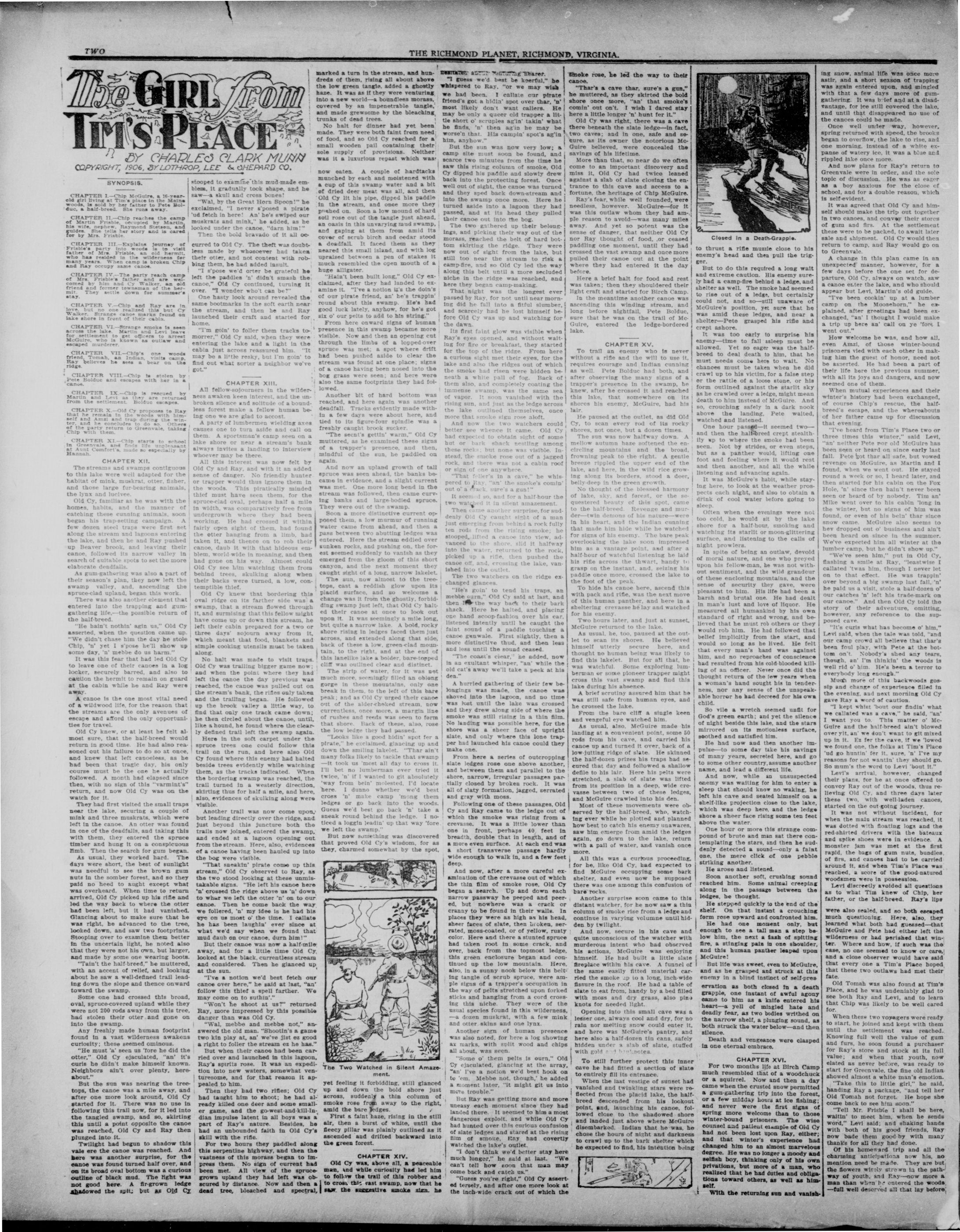
The Two Watched in Silent Amazement.
yet feeling it forbidding, still glanced up and down the bold shore just across, suddenly a thin column of smoke rose from away to the right, amid the bare edges.
First a faint haze, rising in the still air, then a burst of white, until the fleecy pillar was plainly outlined as it ascended and drifted backward into the green forest.
CHAPTER XIV.
Old Cy was, above all, a peaceable man, and while curiosity had led him to follow the trail of this robber and to cross this vast swamp, now that he saw the suggestive smoke sign, he
nearest about containing tharer,
"I guess we'd best be keerful," he whispered to Ray. "or we may wish we had been. I callate our pirate friend's got a hildin' spot over thar, 'n most likely don't want callers. He may be only a queer old trapper a little short o' scruples ag'in takin' what he finds, 'n then ag'in he may be worse n that. His campin' spot's ag'in him, anhow."
But the sun was now very low; a camp site must soon be found, and scarce two minutes from the time he saw this rising column of smoke, Old Cy dipped his paddle and slowly drew back into the protecting forest. Once well out of sight, the canoe was turned and they sped back down-stream and into the swamp once more. Here he turned aside into a lagoon they had passed, and at its head they pulled their canoe out into the bog.
The two gathered up their belongings, and picking their way out of the morass, reached the belt of hard bottom skirting the ridge. They were now out of sight from the lake, but still too near the stream to risk a camp-fire, and so Old Cy led the way along this belt until a more secluded niche in the ridge was reached, and here they began camp-making. That night was the longest ever passed by Ray, for not until near morning did he fall into a fitful slumber, and scarcely had he lost himself before Old Cy was up and watching for the dawn.
Its first faint glow was visible when Ray's eyes opened, and without waiting for fire or breakfast, they started for the top of the ridge. From here a curious sight met their eyes, for the lake and also the ridges out of which the smoke had risen were hidden beneath a white pall of fog. Back of them also, and completely coating the immense swamp, was the same sea of vapor. It soon vanished with the rising sun, and just as the ledge across the lake outlined themselves, once more that smoke sign rose aloft. And now the two watchers could better see whence it came. Old Cy had expected to obtain sight of some but or bark shack nestling among these rocks; but none was visible. Instead, the smoke rose out of a jagged rock, and there was not a cabin roof or sign of one anywhere.
"That feller's in a cave," he whispered to Ray. "an 'the smoke comin' out o' a cack, sure's a gun!"
It seemed so, and for a half-hour the two watched it in silent amazement. Then came another surprise, for suddenly Old Cy caught sight of a man just emerging from behind a rock fully ten rods from the rising smoke; he stooped, lifted a canoe into view, advanced to the shore, slid it halfway into the water, returned to the rock, picked up a rifle, then pushed the canoe off, and, crossing the lake, vanished into the outlet. The two watchers on the ridge exchanged glances.
"He's goin' to tend his traps, an mebbe ourn," Old Cy said at last, and then let the way back to their bark shack. Here he halted, and placing one hand scoop-fashion over his car, listened intently until he caught the faint sound of a paddle touching a canoe gunwale. First slightly, then a more distinctive thud, and then less and less until the sound ceased.
"The coast's clear," he added, now in an exultant whisper, "an' while the old cat's away we'll take a peek at his den."
A hurried gathering of their few belongings was made, the canoe was shoved into the lagoon, and no time was lost until the lake was crossed and they drew along side of where the smoke was still rising in a thin film. No landing was possible here, for the shore was a sheer face of upright slate, and only where this lone trapper had launched his canoe could they make one.
From here a series of outcropping slate ledges rose one above another, and between them and parallel to the shore, narrow, irregular passages partially closed by broken rock. It was all of slaty formation, jagged, serrated and gray with moss.
Following one of these passages, Old Cy and Ray came to the ledge out of which the smoke was rising from a crevasse. It was a little lower than one in front, perhaps 40 feet in breadth, double that in length, and of a more even surface. At each end was a short transverse passage hardly wide enough to walk in, and a few feet deep.
And now, after a more careful examination of the crevassure out of which the thin film of smoke rose, Old Cy began a search. Up and down each narrow passway he peeped and peered, but nowhere was a crack or cranny to be found in their walls. In places they were as high as his head, sheer faces of slate, then broken, serrated, moss-coated, or of yellow, rusty color. Here and there a stunted spruce had taken root in some crack, and over, back from the topmost ledge, this green enclosure began and continued up the low mountain. Here, also, in a sunny nook below this belt tangle of scrub spruce, were ample signs of a trapper's occupation in the way of pelts stretched upon forked sticks and hanging from a cord crossing this niche. They were of the usual species found in this wilderness,—a dozen muskrat, with a few mink and otter skins and one lynx.
Another sign of human presence was also noted, for here a log showing ax marks, with suit wood and chips all about, was seen.
"Some o' them pelts is ourn," Old Cy ejaculated, glancing at the array, "an' I've a notion we'd best hook on to 'em. Mebbe not, though,' he added a moment later, "it might git us into more trouble."
But Ray was getting more and more uneasy each moment since they had landed there. It seemed to him a most dangerous exploit, and while Old Cy had hunted over this curious confusion of slate ledges and stared at the rising film of smoke, Ray had coverly watched the lake's outlet.
"I don't think we'd better stay here much longer," he said at last. "We can't tell how soon that man may come back and catch us."
"Guess you're right," Old Cy asserted tersely, and after one more look at the inch-wide crack out of which the
smoke rose, he led the way to their cance.
"Thar's a cave thar, sure's a gun," he muttered, as they skirted the bold shore once more, "an' that smoke's comin' out on't. I wish I dared stay here a little longer 'n hunt for it."
Old Cy was right, there was a cave there beneath the slate ledge—in fact, two caves; and in one, safe and secure, as its owner the notorious McGuire believed, were concealed the savings of his lifetime.
More than that, so near do we often come to an important discovery and miss it. Old Cy had twice leaned against a slab of slate closing the entrance to this cave and access to a fortune, the heritage of Chin McGuire.
Ray's fear, while well founded, were needless, however. McGuire—for it was this outlaw whom they had ample reason to avoid—was many miles away. And yet so potent was the sense of danger, that neither Old Cynor Ray thought of food, or ceased paddling one moment, until they had crossed the vast swamp and once more pulled their canoe out at the point where they had entered it the day before.
Here a brief halt for food and rest was taken; then they shouldered their light craft and started for Birch Camp. In the meantime another canoe was ascending this winding stream, and long before nightfall, Pete Bolduc, sure that he was on the trail of McGuire, entered the ledge-bordered lake.
CHAPTER XV
To trail an enemy who is never without a rife and the will to use it, requires courage and Indian cunning as well. Pete Bolduc had both, and after observing the many signs of a trapper's presence in the swamp, he knew, after he crossed it and reached this lake, that somewhere on its shores his enemy, McGuire, had his hair.
He paused at the outlet, as did Old Cy, to scan every rod of its rocky shores, not once, but a dozen times.
The sun was now halfway down. A mellow autumn haze softened the encircling mountains and the broad, frowning peak to the right. A gentle breeze rippled the upper end of the lake, and here, in the wild rice growing along its borders, stood a deer, belly-deep in the green growth.
No thought of the blessed harmony of lake, sky, and forest, or the sequestered beauty of this spot, came to the half-breed. Revenge and murder—twin demons of his nature—were in his heart, and the Indian cunning that made him hide while he watched for signs of his enemy. The bare peak overlooking the lake soon impressed him as a vantage point, and after a half-hour of watchful listening he laid his rifle across the thwart, handy to grasp on the instant, and, seizing his paddle once more, crossed the lake to the foot of the peak.
To hide his canoe here, ascend this with pack and rifle, was the next move of this human panther, and here in a sheltering crevasse he lay and watched for his enemy.
Two hours later, and just at sunset, McGuire returned to the lake.
As usual, he, too, paused at the outlet to scan its shores. He believed himself utterly secure here, and thought no human being was likely to find this lakeet. But for all that, he was watchful. Some exploring lumberman or some pioneer trapper might cross this vast swamp and find this lake during his absence.
A brief scrutiny assured him that he was still safe from human eyes, and he crossed the lake.
From the bare cliff a single keen and vengeful eye watched him.
As usual, also, McGuire made his landing at a convenient point, some 50 rods from his cave, and carried his canoe up and turned it over, back of a low-jutting ridge of slate. He skinned the half-dozen prizes his traps had secured that day and followed a shallow defile to his lair. Here his pelts were stretched, a slab of slate was lifted from its position in a deep, wide crevasse between two of these ledges, and McGuire crawled into his den.
Most of these movements were observed by the half-breed, who, watching ever while he plotted and planned how best to catch his enemy unawares, saw him emerge from amid the ledges again, go down to the lake, return with a pall of water, and vanish once more.
All this was a curious proceeding, for he, like Old Cy, had expected to find McGuire occupying some bark shelter, and even now he supposed there was one among this confusion of bare rocks.
Another surprise soon came to this distant watcher, for he now saw a thin column of smoke rise from a ledge and continue in varying volume until hidden by twillight.
And now, secure in his cave and quite unconscious of the watcher with murderous intent who had observed his actions, McGuire was enjoying himself. He had built a little slate fireplace within his cave. A funnel of the same easily fitted material carried the smoke up to a long, inch-wide fissure in the roof. He had a table of slate to eat from, handy by a bed filled with moss and dry grass, also pine knots for needed light.
Opening into this small cave was a lesser one, always cool and dry, for no rain nor melting snow could enter it, and here was McGuire's pantry, and here also a half-dozen tin cans, safely hidden under a slab of slate, stuffed with gold and beads notes.
To still further protect this inner cave he had fitted a section of slate to entirely fill its entrance.
When the last vestige of sunset had vanished and twinkling stars were reflected from the placid lake, the half-breed descended from his lookout point, and, launching his canoe, followed close to the shadowed shore and landed just above where McGuire disembarked. Indian that he was, he chose the hours of night and darkness to crawl up to the bark shelter which he expected to find, his intention being
Closed in a Death-Grapple.
to thrust a rifle muzzle close to his enemy's head and then pull the trigger.
But to do this required a long wait and extreme caution. His enemy surely had a camp-fire behind a ledge, and shelter as well. The smoke had seemed to rise out of a ledge, but certainly could not, and so—still unaware of McGuire's position, yet sure that he was amid these ledges, and near a shelter—Pete grasped his rifle and crept ashore.
It was too early to surprise his enemy—time to fall sleep must be allowed. Yet so eager was the half-breed to deal death to him, that he must needs come here to wait. No chances must be taken when he did crawl up to his victim, for a false step or the rattle of a loose stone, or his form outlined against the starlit sky as he crawled over a ledge, might mean death to him instead of McGuire. And so, crouching safely in a dark nook above the landing, Pete waited, watched and listened.
One hour passed—it seemed two—and then the half-breed crept stealthily wp to where the smoke had been seen. Not by strides, or even steps, but as a panther would, lifting one foot and feeling where it would rest and then another, and all the while listening and advancing again.
It was McGuire's habit, while staying here, to look at the weather prospects each night, and also to obtain a drink of cool water before going to sleep.
Often when the evenings were not too cold, he would sit by the lake shore for a half-hour, smoking and watching its starlit or moon-glittering surface, and listening to the calls of night prowlers.
In spite of being an outlaw, devold of moral nature, and one who preyed upon his fellow-man, he was not without sentiment, and the wild grandeur of these enclosing mountains, and the sense of security they gave, were pleasant to him. His life had been a harsh and brutal one. He had dealt in man's lust and love of liquor. He measured all humankind by his own standard of right and wrong, and believed that he must rob others or they would rob him. He had followed that belief implicitly from the start, and would so long as he lived. He felt that every man's hand was against him, and no reproaches of conscience had resulted from his cold-blooded killing of an officer. Never once did the thought return of the few years when a woman's hand sought his in tenderness, nor any sense of the unspeakable horror he had decreed for his own child.
So vile a wretch seemed unit for God's green earth; and yet the silence of night beside this lake, and the stars mirrored on its motionless surface, soothed and satisfied him.
He had now and then another impulse—to some day take his savings of many years, secreted here, and go to some other country, assume another name, and lead a different life.
And now, while an unsuspected enemy was waiting for him to enter a sleep that should know no waking, he left his cave and seated himself on a shelf-like projection close to the lake, which was deep here, and the ledge shore a sheer face rising some ten feet above the water.
One hour or more this strange compound of brute and man sat there contemplating the stars, and then he suddenly detected a sound—only a falat one, the mere click of one pebble striking another.
He arose and listened.
Soon another soft, crushing sound reached him. Some animal creeping along in the passage between the ledges, he thought.
He stepped quickly to the end of the shelf. On that instant a crouching form rose upward and confronted him. He had one moment only, but enough to see a tall man a step below him, the next a flash of spitting fire, a stinging pain in one shoulder, and this human panther leaped upon McGuire!
But life was sweet, even to McGuire, and as he grasped and struck at this enemy in a blind instinct of self-preservation as both closed in a death grapple, one instant of awful agony came to him as a knife entered his heart—a yell of mingled hate and deadly fear, as two bodies writhed on the narrow shelf, a plunging sound, as both struck the water below—and then silence.
Death and vengeance were clasped in one eternal embrace.
CHAPTER XVI.
For two months life at Birch Camp much resembled that of a woodchuck or a squirrel. Now and then a day came when the crusted snow permitted a gum-gathering trip into the forest, or a few midday hours at ice fishing; and never were the first signs of spring more welcome than to those winter-bound prisoners. The wise counsel and patient example of Old Cy had not been lost upon Ray, either; and that winter's experience had changed him to an almost marvelous degree. He was no longer a moody and selfish boy, thinking only of his own privations, but more of a man, who realized that he had duties and obligations toward others, as well as himself.
With the returning sun and vanish-
ing snow, animal life was once more astir, and a short season of trapping was again entered upon, and mingled with that a few days more of gum gathering. It was brief and at a disadvantage, for ice still covered the lake, and until that disappeared no use of the canes could be made.
Once well under way, however, spring returned with speed, the brooks began to overflow, the lake to rise, and one morning, instead of a white expanse of watery ice, it was a blue and rippled lake once more.
And now plans for Ray's return to Greenvale were in order, and the sole topic of discussion. He was as eager as a boy anxious for the close of school, and for a double reason, which is self-evident.
It was agreed that Old Cy and himself should make the trip out together in two canoes, and convey their stores of gum and firs. At the settlement these were to be packed, to await later sale and shipment. Old Cy would then return to camp, and Ray would go on to Greenvale.
A change in this plan came in an unexpected manner, however, for a few days before the one set for departure, Old Cy, always on watch, saw a canoe enter the lake, and who should appear but Levi, Martin's old guide.
"I've been cookin' up at a lumber camp on the Moosehorn," he explained, after greetings had been exchanged, "an 'an' I thought I would make a trip up here an' call on ye 'fore I went out."
How welcome he was, and how all, even Amzi, of those winter-bound prisoners vied with each other in making him the guest of honor, need not be asserted. He had been a part of their life here the previous summer, with all its joys and dangers, and now seemed one of them.
When mutual experiences and their winter's history had been exchanged, of course Chip's rescue, the half-breed's escape, and the whereabouts of her father came up for discussion that evening.
"I've heard from Tim's Place two or three times this winter," said Lewl, "an neither Pete nor old McGuire has been seen or heard on since early last fall. Pete got that all safe, but vowed revenge on McGuire, as Martin and I found, when we went out. He stayed round a week or so, I heard later, and then started for his cabin on the Fox Hole, 'n since then hain't never been seen or heard of by nobody. Tim an' Mike went over to his cabin 'long in the winter, but no signs of him was found, or even of his bein' thar since snow came. McGuire also seems to hev dropped out o' business and aln't been heard on since in the summer. We've expected him all winter at the lumber camp, but he didn't show up."
"We've seen him," put in Old Cy, flashing a smile at Ray, "leastwise I callated 'twas him, though I never let on to that effect. He was trappin' over beyond a big swamp last fall, 'n' he paid us a visit, stole a half-dozen 'o our catches 'n' left his trade-mark on our cance." And then Old Cy told the story of their adventure, omitting, however, any reference to the supposed cave.
"It's curls what has become 'o him," Levi said, when the tale was told, "and our camp crowd all believe that that's been foul play, with Pete at the bottom on't. Nobody's shed any tears, though, an' I'm thinkin' the woods is well rid 'o him. He's been a terror to everybody long enough."
Much more of this backwoods gossip and change of experience filled in the evening, and next morning Old Cy gave Ray a word of caution.
"I kept whist 'bout our findin' what we callated was a cave," he said, "an I want you to. This matter o' McGufre and the half-breed ain't blowed over yt, an we don't want to git mixed up in it. Ex fzer the cave, if we lowed we found one, the folks at Tim's Place 'ud hunntin' fer it, sure, n' I've my reasons for not wantin' they should go. So mum's the word to Levi 'bout it."
Levi's arrival, however, changed their plans, for he at once offered to convoy Ray out of the woods, thus relieving Old Cy, and three days later these two, with well-laden canoes, started on the out-going journey.
It was not without incident, for when the main stream was reached, it was dotted with floating logs and the red-shirted drivers with the bateaux and spike shoes were in evidence. A monster jam was met at the first rapid, the bags of gum nuts, bundles of firs, and canoes had to be carried around it, and when Tim's Place was reached, a score of the good-natured woodsmen were in possession. Levi discreetly avoided all questions as to what Tim knew of Chip, her father, or the half-breed. Ray's lips were also sealed, and so both escaped much questioning. Here, also, they learned what both had guessed—that McGuire and Pete had either left the wilderness or had perished that winter. Where and how, if such was the case, no one seemed to know or care, and a close observer would have said that every one a Tim's Place hoped that these two outlaws had met their fate.
Old Tomah was also found at Tim's Place, and he was undeniably glad to see both Ray and Levi, and to learn that Chip was likely to be well cared for.
When these two voyagers were ready to start, he joined and kept with them until the settlement was reached. Knowing full well the value of gum and furs, he soon found a purchaser for Ray's store and stock at its full value; and when that youth, now elated as never before, was ready to start for Greenville, the fine old Indian showed almost a white man's emotion.
"Take this to little girl," he said, handing Ray a package, "and tell her Old Tomah not forget. He hope she come back to see him soon."
"Tell Mr. Frisbie I shall be here, waitin' to meet him, when he sends word," Levi said; and shaking hands with both of his good friends, Ray now bade them good-by with many thanks for all they had done.
Of his homeward trip and all the charming anticipations now his, no mention need be made. They are but the flowers wisely strown in the pathway of youth, and Ray—now more a man than when he entered the woods—full well deserved all that lay before
THE PLANET
SATURDAY.....JUNE 6, 1908
him.
But Old Tomah's heart was sad, and far away beside a rippled lake was another who felt the same.
CHAPTER XVII
Chip's success and popularity in Greenvale was practically nullified by Hannah, who from wounded vanity and petty jealousy became her enemy from the outset.
Aunt Comfort did not know it. Angle was not conscious of the facts, or, busy with her own social duties and home-making, gave them no thought. And yet, inspired by Hannah's malicious tongue, Greenvale looked, upon poor Chip as one it was best to avoid. With Angie as sponsor, she had been made one of the Christmas church decorators, and had been twice invited to parties, only to exasperate Hannah all the more and cause an increase of sneers.
"She's nobody an' an upstart," Hannah said at the first meeting of the village sewing circle after Chip's advent. "an' I've my doubts about her father an' mother ever beln' married. Then she's an infiddle an' believes in Injun sperrits an' hobgoglin things she calls spites, an' is a reg'lar heathen. I don't trust her a minit, an' never leave the house 'thout I lock up my things." Much more of this sort fell from Hannah's lips whenever occasion offered, though never within hearing of Aunt Comfort or Angle. Neither did the townspeople enlighten them, and so the undercurrent of innuendo and gossip, once started by Hannah, spread until all Greenvale looked askance at Chip.
There was also some color for this ill repute, for Angle had concealed nothing, and Chip, foolishly perhaps, had asserted her belief when it would have been better to conceal it.
The parson also, chagrined at his failure to make a convert of the girl, referred to her as "rebellious, obstinate in her ideas, and one who needed chastening."
Her teacher, however, was her stanch friend. Aunt Comfort beamed upon her morning and night, while Angle, having provided her with home, ralment, opportunity for schooling, escort to church, and much good advice, felt that she had fulfilled her duty. And in a way, she had.
But social recognition in a country village can be made or married by such a person as Hannah, and quite unknown to those most interested. Chip's popularity was not decreed. Neither was she conscious of this undercurrent. Each day she went to and returned from school in a sturdy sort of way. A most devoted pupil, she never failed to thank her teacher for every word of help, and if—thanks to Hannah—she failed to make friends about the village, she won a place near to Aunt Comfort's heart.
But somehow Aunt Comfort, who loved everybody alike, good or bad, or at least spoke no ill of the bad ones, didn't count. That she must inevitably take Chip under her motherly wing, all recognized. She had taken Hannah, then Angle and Nezer, and now this waif who, as Hannah insisted, was all bad; and according to Greenvale's belief, Aunt Comfort would keep on "taking in" homeless walfs and outcast mortals as long as she lived, or house room held out. And it was true. By midwinter Martin's new house was all furnished, and social obligations began to interest Angle, which made matters all the worse for Chip, for now Hannah could persecute her with less danger of exposure.
But Chip was hard to persecute. She had known adversity in its worst form. Her life at Tim's Place had been practical slavery, and the worst that Hannah could do was as plu prickles cememared to it.
It is certain, also, if Chip had "spunked up," as Hannah would call it, now and then, it would have been better for her; but it wasn't Chip's way. To work and suffer in silence had been her lot at Tim's Place. Angie had said, "You must obey everybody and make friends," and impelled by experience, and this somewhat broad order, Chip was doing her best.
One hope cheered her all that long, hard winter of monotonous study—the return of Ray, and possibly Old Cy, when summer came. Somehow these two had knit themselves into her life as no one else had or could. Then she wondered how Ray would seem to and feel toward her when he came, and if the little bond—a wondrous strong one, as far as her feelings went—would still call him to her side.
Of love and its real meaning she was scarce conscious as yet. She simply felt that this youth with his sunny face and brown eyes was the one being on earth she wished to please. All the romance and pathos of that summer idyl, all the moonlight and canoeing, all the songs he had charmed her with, and every word and act of his from that first evening when, ragged and starving, she had stumbled into the camp, until she had parted from him with misty eyes, had been lived over by her countless times.
It had all been a beacon of hope to her in the uphill road toward the temple of learning; and how hard she had studied, and how patiently she had tried to correct her own speech, not even her teacher guessed.
It is also possible, in fact almost certain, that that unfortunate wail's somewhat pitiful tale had won her teacher's interest and affection as naught else could. Only one reservation was made by Chip—her own feelings toward Ray. All else became an open book to Miss Phinney. When school was out, the two walked homeward together as far as their
ways permitted, and then Chip obtained the one hour of the day which she felt was quite her own. At first, during the autumn days, she had used it for a scamper through the nut-brown woods. When winter came and it was not too cold, she occasionally visited the mill pond above the village, where, if the conditions were right, all the skating and sliding youth were gathered; and when blessed spring returned, it was away to the hills and fields once more.
On Saturdays she seldom left the house, unless sent on an errand, and Sunday became a day of penance.
And now, when the flowers and birds had once more returned to Greenvale, and Ray might return any day, a little plan that Chip had in mind for many weeks took shape. She knew Ray must come on the stage, and eager for a sight of his face as only love can make one, she meant to be the first to meet and greet him.
A mile down the village street and beyond the last house was a sharp hilltop. The stage usually reached here about an hour after the close of school, and to this vantage point, where she could hide behind a stone wall. Chip now betook herself each day.
Her plans for meeting her young hero were well considered. She was sure he would, like herself, prefer a seat with Uncle Joe. That important person, whose heart she had won by her admiration of his horses on her arrival, would surely invite her to ride into the village, if he saw her. If she was alone, she would remain hid; but if some one was with him, she would then disclose herself and the coveted invitation and meeting with Ray would follow.
It was a vague, uncertain plan. No one in Greenvale had the remotest idea when Ray would return. Chip only knew that he was expected in the spring. The day, or even week, was a long-range guess. But even that slim chance poor, lonesome, heart-longing Chip would not miss, and so each day at close of school she hurried to her lookout point to watch and walt.
It was a silly, almost hopeless sentinelship, as she knew well enough; but with the dog's heart that was hers, she would keep her wig, and like one of those bumpy brutes, walt weeks, months, aye, years even, for a master coming.
It was mid-April when Chip began her daily watch, and missed no day unless a pelting rain prevented. It was June ere she won her reward, and then one balmy afternoon when she saw the stage afar, there, perched beside Uncle Joe was—a companion!
How sure that weary, walting walt was that her heart was not mistaken! How her pulses leaped and thrilled as the slow-moving stage crept up the hill; and how Ray, eager to catch the first glimpse of his native village, saw a winsome, smiling face shaded by a flower-decked hat, peeping at him over a wall, was but a minor episode in the lives of these two; yet one to be recalled many, many times afterward and always with a heartache.
None came to them now, for on the instant Ray saw who was waiting for him he halted the stage, and the next moment he was beside his sweetheart. And Uncle Joe, with the wisdom and sympathy of old age, discreetly averted his face, and said "Golang" to his horses, and drove on alone.
CHAPTER XVIII
During all the long weeks while Chip had awaited her coming, one hope had been hers—that his return would end all her loneliness and begin a season of the happy, care-free days like those by the lake once more. For the first few moments after he kissed her upraised lips, she could not speak for very joy; and then, as hand in hand they started toward the village, her speech came.
"I've been so lonesome," she said simply. "I've counted the days, and come down here to meet you daily, for over a month. I don't like it here, and nobody likes me, I guess. I'm so glad you've come, though. Now I shan't be lonesome no more. I've studied hard, too," she added, with an accent of pride. "I can read and spell words of six syllables. I've ciphered up to decimal fractions, an' begun grammar.
"I'm glad to get home, too," answered Ray, as simply. "It was lonesome in the woods all winter, when we couldn't tend the traps. But I've made a lot of money—most five hundred dollars—all mine, too. How is everybody?" And so they dropped from sentiment into commonplace. At the tavern he secured his belongings. At the corner where their ways parted, he bade Chip a light good-by, and with an "I'll see you soon," left her. Her hero had arrived. They had met, kissed as lovers should, and the lonely waiting and watching days were at an end and a new life was to begin for Chip. Little did she realize what it would mean for her, or how utterly her hopes were to fail.
"He will come to night," her heart assured her, and that evening, without a word to Aunt Comfort or Hannah as to whom she expected, she arrayed herself in her one best dress and awaited his expected visit.
And what a propious and all-favoring evening it was! The June night was balmy. Blooming illions and syringas half hld, as well as adorned, the porch of Aunt Comfort's home. Aunt Comfort had just departed to make a call, Hannah was away at prayer meeting, and "no one nigh to hinder." But Chip waited in vain!
At school next day her mind and heart were at war. The parts of speech and rules of subtraction and division seemed complete chaos, and when homeward bound, she loitered slowly along, hoping Ray would make amends and meet her on the way. But again he failed to appear.
And that night, when alone with Hannah, a worse blow came.
"I heerd young Stetson got back yesterday," she said, fixing her steely blue eyes on eyes. "an you went down the road to meet him. I should think you'd be 'shamed o' yourself. If you're callatin' on setin' your cap for him, 'twon't do a mite o' good. His aunt wouldn't think o' havin' such an out-
THE RICHMOND PLANET, RICHMOND, VIRGINIA
A
Sobbed In Utter Despair.
Cast ez you for him—that I can tell ye."
But not a word of reply came from pocr Chip. Such speeches were not new to her, and she had long before ceased to answer them. But this one, from its very truth, hurt more than all others had, and, crushed by it, she stole away out of the house.
No thought that Ray might call came to her. She only wished to escape somewhere, that she might cry away her misery and shame in solitude.
The evening was but a repetition of the previous one. The same sweet influence and silvered light was all about, but no heed of its beauty came to Chip. Instead, she felt herself a shameful thing of no account. Her lover had failed her—now she knew why, and as she sped along the lonely way to the schoolhouse, scarce conscious of her steps, all hope and all joy left her. Why or for what purpose she was hurrying toward this deserted little building, she knew not. Hot tears filled her eyes. Shame surged in her heart. She was a nobody in the eyes of all her world, and once she had reached the worn sill, so often crossed by her, she threw herself upon it and sobbed in utter despair.
For a long hour she sat there while the tide of feeling ebbed and tears came unchecked, and then the reaction came. With it, also, came something of the old courage and defiance that had once led her to face night, danger, and 60 miles of wilderness alone.
"I have made a mistake," she sald, sitting up, "and Hannah was right. I am a nobody here, and Ray has been told so and has kept away."
And now with returning calm, and soothed, maybe, by the still, ethereal night, she saw herself, her past and present, as it all was. Back in an instant she sped in thought to the moment when, kneeling to these people, she begged for food; back to that first prayer she ever heard in the tent, and the offer of rescue that followed.
And then her life here, with all its hopes and humiliation, rose before her.
"It was all wrong, my coming here," she said, looking away to the village where lights twinkled; "I am not their sort, nor they mine. I'd better go away."
Then, lifted a wee bit by this new resolve, she rose and returned to the house.
The tall clock in the sitting-room was just chiming ten when she entered, and Aunt Comfort was there alone.
"Raymond was here this evening," she said kindly, "and waited quite a spell. Where have you been?"
"Oh, nowhere," answered Chip, pleasantly, "only I was lonesome and went out for a walk."
Little did good Aunt Comfort realize what a volcano of hope, despair, shame and tender love was concealed beneath that calm answer, or the new resolve budding in Chin's heart.
No more did Ray suspect it when he met her coming home from school the next afternoon.
For during those two wretched hours when she was alone on the worn schoolhouse step, poor Chip McGuire, the low-born, pitiful walt, had become a woman and put away girlish impulses.
"I couldn't come to see you that first evening," he said at once, "for uncle and aunty kept me talking till bedtime. Where were you last night?
"Oh, I didn't much think you would come," answered Chip, calmly, smiling at him in a far-far way. "I am a nobody here, as you will soon find out, and I don't expect—anything. I got lonesome last night and went off for a walk."
Ray looked at her in wide-eyed astonishment. And well he might, for only two short days since she had met him, an eager, simple girl, and now she spoke like a woman. No word, no hint of his neglect, escaped her; but a cool indifference was apparent.
"Tell me about the woods and Old Cy," she said, not waiting for him to speak again, "and how is the hermit? I want to know all about them."
"Oh, I left 'em all right," answered Ray, sullenly, for like a boy he wanted to be coaxed. And then, urged a little by Chip, he told his winter's experience.
One episode interested her most of all—the strange trapper's doings, his theft of their game, their pursuit of him and discovery of his hiding spot.
"I know who that was," she said, when it was all described. "It was my father, and if he had caught you spying upon him, I guess he'd shot you both. He always used to go somewhere trapping every fall; but nobody could ever find where."
This return to the memories of the wilderness wore away something of Chip's cool reserve, and when the house was reached her eyes had grown tender.
"I shall be glad to see you often—as as your folks will let you come," she said, somewhat timidly when they parted; and scarce understanding this speech. Ray left her.
"Chip has changed a whole lot," he said to his aunt a little later, "and I wish she hadn't; she don't seem the same any more." "I'm glad of it if he has," answered Angie, smiling at him. "There was need enough of it."
TO BE CONTINUED.
Always the Way.
Yeast—You say your wife is in favor of women voting?
Crimsonbeak—Sure.
"Why, she didn't used to be?"
"No; but she overheard me say that I didn't think women ought to have a vote, and that changed her mind, of course."—Yonkers Statesman
In Oiden Dave
Wink—The policeman of a century ago used to carry snuffboxes in their pockets.
Bink—You don't say! Well, I suppose in those days the policemen did more pinching than ever.—Chicago Daily News.
Ripping Times.
Gunner—Hot times out at the ball game. The players were slamming balls all the afternoon.
Guyer—And how about the bleacherites?
Gunner—Oh, they were slamming the umbrella—Chicago Daily News.
Instinct
Loanstein—I got a terrible bad coldt in my headt.
Isaacs—Why don't you take somehings for it?
Loanstein (absent-mindedly)—How much vill you git me?—Puck.
Both Affected.
"I feel all cut up about it," remarked the piece of wood that was badly splintered.
"Yes, it gave me a kind of dull feeling, too," said the ax.-Royal Magazine.
MY EDUCATION IN A NUTSHELL.
I can say "hic, haec, hoc," and decline any verb in Latin, but I was told the other day that I mispronounced the English language and spoke it incorrectly.
I know how many segments there are in a bee's foot, and can discourse learnedly on the origin of life, but I'm beggared if I understand much about this synthesis of forces which I call myself.
I could write you a splendid essay upon the arts of subsistence in former times, and describe to you in detail how our savage progenitors managed to eke out an existence, but I don't believe I could broil a beefsteak nor make a bowl of porridge. Neither can the girl I am going to marry.
I have been told how all the lower animals propagate themselves, and know more or less about the scientific breeding of cattle, but I am entirely innocent as to how the human species should propagate its kind.
I can tell you much about the nature of bacteria and other horrible creatures, but I confess that I don't know what the symptoms of the commonest diseases are, nor how to treat them.
I can tell you all about the chemistry of matter, but should my mother take poison, I would not know what to give her.
I could dazzle you with a dissertation on the economics of money, but I am at a loss to know how to earn a cent of it myself.
In short, I know everything that is not worth knowing.—A College Graduate, in Puck.
Carefully Reared.
Fond Mamma-I am glad you had such a nice time at Mrs. Tiptop's, and I hope she noticed how carefully you had been brought up. You did not ask for dessert, did you?
Small Son—No, indeed, ma. I didn't have to. Every time I finished a dish and began scraping the sancer with the spoon and smacking my lips, the waiter came and brought me some more without saying a word.—New York Weekly.
Interesting Quadruped
girl with she picture that was looking at the baby hippopotamus.
"Isn't he a cute little darling!" she said. "Chicago Tribune."
Easily Remedied.
Said a maid who was quite homely:
"Oh, I really do not care.
If I board a passing street car
Soon I would be passing fair."
"We'll be late for the wedding!"
"Well, we'll be in time for the di
vore!
Daily Occurrence.
Most every day.
A noise foreboding
We hear. It is
A boom exploding.
—Detroit Free Press.
An Annoying Error.
There was a very annoying typographical error that crept into the papers the other day, telling how a prominent society man had been held up by highwaymen and "robbed of his watch and other vegetables." The editor has come out with an explanation that the last word was not vegetables, but valuables.—Judge.
LINCOLN
HAIR POMADE
MAKES
KINKY
HAIR
SOFT
REMOVES
DANDRUFF
KEEPS
HAIR
FROM
BREAKING
OFF
LINCOLN
HAIR POMADE
KEEPS
SCALP
FRESH
CLEAN AND
WHOLE-
SOME
MAKES
HAIR
GROW
LONG AND
LUXURIOUS
WHICH WAY WOULD YOU RATHER HAVE YOUR HAIR-SOFT AND
LONG SO THAT YOU CAN PUT IT UP IN THE LATEST STYLE
OR SHORT AND KINKY
A WOMAN'S JUST PRIDE IS HER
MANUFACTURED BY
Colin Pomade Co.
NORFOLK, VA., U. S. A.
here. Write for particulars. If your dea-
d 26 cents in stamps or silver to THE LIN-
department B, Norfolk, Va. and we will send
mail.
Agents Wanted Everywhere. Write for particulars. If your dealer does not keep it, send 26 cents in stamps or silver to THE LINCOLN POMADE CO., Department B, Norfolk, Va. and we will send you a bottle by return mail.
```markdown
```
WISE AND OTHERWISE.
Friendship is sweet in youth, but heavenly in old age.
The man who is behind the times is apt to speak ill of them.
If the average wife would scold less she would find less need of scolding.
The world's day-book is kept by the editor. The ledger is kept by the historian.
Weeding a garden is doing well; but unweeding a widow is doing much better.
Thoroughbred mares are fed on oats and hay. Night mares are fed on wild oats and late suppers.
If you are certain that she is a bad wife you may be very sure that she was made so by a bad husband.
The most delicate, the most elegant,
of all compliments is sincere and
dignified deference.
What a man wants is—all that he
can get. A woman usually wants all
that she can't get.
Between a friend who does you no
good, and an enemy who does you no
harm, there is no appreciable differen-
RAM'S HORN EPIGRAMS
A contented heart is a cash register full of gold coin.
Because Life hands you a lemon, don't try to corner the Vinegar Trust.
A literary editor knows that the whole world is trying to do "fancy work."
With summer coming in such strides, spring poetry will soon be too pithy to print.
Typewriters tell no tales, but an uncommunicative stenographer would be a curiosity.
The famous shot heard round the world is a toy pistol report compared to the modern chorus girl's kiss.
A woman when she puts her money in a bank has the same feeling as when she leaves her best friend in the graveyard.
A man who has money to throw at the birds can hardly see the sky for the flocks that hover over him.
SUNFLOWER PHILOSOPHY
The only way to win a law sult is to keep out.
No boy is thoroughly satisfied unless he owns a shepherd dog.
What has become of the old-fashioned man who put on his "thinking cap" when confronted with a problem?
"A woman's faults may not be as bad as a man's," we heard a man say to-day, "but they are quite as trying to him as he are to her."
Some men are naturally meddlesome, and do not know it. Look yourself over. Do you butt in and make yourself unnecessary enemies?
Staying up late is not what it is cracked up to be. You are having more fun than anybody in the world if you can go to bed at nine o'clock and fall asleep the moment your head strikes the pillow.—Atchlson (Kan.) Globe.
DIVORCE
The bankruptcy of matrimony.
The legal funeral of a dead love.
Giving two people a new lease of life.
Cutting the cordian knot of a dual unhappiness.
KEEPS
SCALP
FRESH
CLEANAND
WHOLE-
SOME
MAKES
HAIR
GROW
LONGAND
LUXURIOUS
Dissolution of a marital union without unity.
Commuting a life sentence of misery in marriage.
The emancipation proclamation of matrimonial slavery.
Law putting asunder what God evidently never meant to be joined together.
The "return privilege" in unsatisfactory matrimonial purchases.—New York Tribune.
WOMAN'S MOST ATTRACTIVE AGE.
"Eighteen; when girls have a bright and confident outlook on life, gay and joyous spirits, high aims and noble aspirations."
"Twenty-one; for then she has the faith of childhood, the hope of girlhood, the capacity for love of womanhood."
At "25. Because at that age giggles, gush, gewgaws and gaucheries have generally yielded to sense, sweetness, sympathy and sincerity."
"A woman's most attractive in the autumn of her years; because of sweetness, patience, love and experience gained through tears."
"Old age, when made more sweet by sorrow, ennobled by pain and with an outlook on life mellowed by experience."
A Sense of Pristorship
"You can't quite boast of belonging to one of the oldest families of Europe," said the irritating friend.
"No, answered Mr. Cunrox, glancing at the checkbook wherein was written his daughter's dot, "but one of the old families of Europe comes pretty near belonging to me."—Washington Star.
Trying It on Hubby
"John, dear, I wish you would taste this milk and see if it's perfectly sweet."
"What for?"
"Because if it's the least bit sour
I don't want to give any of it to Fido.
It isn't good for him."—Chicago Tribune.
Consolation.
Husband (meekly)—There's one consolation for us in having my wages reduced, even in the shopping season.
Wife (snapply)—What's that?
Husband—I can be laid up sick without losing so much money.—judge.
Can't Afford Him Now
Lilly Bell-No, Rufus; Ah can't marry yo' jest yet awhile. Yo'll hab to wait, Lilly Bell?
Lilly Bell—Cause three of the families mammy washes for done quit her, an' now she sen'tely makes 'nough to support me an' paw—Judge.
Anything at a Pinch
"I'm starving," quoth he, "but I must do it."
"Do what?" inquired a stray horse.
"Take in washing," responded the goat, as he broke through the fence. — Judge.
A Love of Wagner.
Miss De Note (at the top of her voice)—Grandma, won't you go with us to the opera? It's "Trovatore." Grandma—"Travatore?" No, thank you, my dear, I'll wait for a Wagner night. You know I'm a little deaf—New York Weekly.
An Aggressive Policy
Little Willie (reading)—Say, pa,
what is an aggressive policy?
Pa—it's a policy, my son, that
makes a man mad enough to fight,
but which scares him so bad that he
either runs up an alley or hides in
the cellar—Chicago Daily News
THREE
JOSHUA BANKS & SONS CATERERS
EVERY FACILITY CONSISTENT
WITH FINE CATERING.
Special Attention Given to Bailie,
Suppliers, Installations and Smok
ers at the Shortest Notice.
Your Patronage Solicited.
Refreshment Cars and Boat Privi-
ies Handled in Season.
Address all communications to
LLAM L. BANKS, 511 N. 3d St.
Residence: 1312 N. 26th St.
DON'T GET MAD.
if your hair can away from you? Because, you wear it and feed it with and keep it a home. Don't have a falling out with your hair. It is what? That would mean what? That would mean thin, dry, lifeless, coarse, uneven, beaking and fall-
If your hair ran away from you? Because, you have the remedy NOW to face it and keep it at home. Don't bring it out with your hair. It might leave you! Then what? That would mean thin, dry, lifeless, coarse, uneven, breaking and fallening. Will it give it something to live on: nourish it; fasten it to your scalp. Of course Meccoore is the only hairy, perfect, and dependable hair tonic, food and medicine you can buy. It will make the hair grow extra long and heavy, give new life to the hair hair, have what hair you have and get more to do. These applications convincing or money refunded. Gold: $26. $60, $1.00 Always send Money order. Send for free interesting booklet right away.
Temporary Office; 235 West 53rd Street
MECROOOO HAIR TONIC MGs B. C. X.
RAILROADS.
SCENIC ROUTE
TO THE WEST
4:00 P. M. and Norfolk.
9:00 A. M. Fast daily trains to Old Point
7:40 A. M.-Daily. Local to Newport News.
6:00 P. M.-Daily. Local to Old Point
11:00 P. M. Daily. Louisville, Cincinnati
2:00 P. M. Deeper.
10:00 A. M.-Daily-Charlotteville, except Sunday
to Hinton, except Saturday
and Saturday.
James River Line -8:35 A.M. A, 6:45 P. M.
7:00 P. M. A, 8:35 A.M.
James River Line -7:30 A.M. A, *8:30 A. M.
3:45 P. M. 7:45 P. M.
James River Line -8:35 A.M. A, *8:30 A. M.
Richmond, Frederick'ský & Potomac R. R.
SCHEDULE EFFECTIVE APRIL 12, 1989.
TO AND FROM WASHINGTON AND BEYOND.
Leave Richmond
Arrive Richmond
*6.20 A.M. Byrd St. Sta.
*8.40 A.M. Byrd St. Sta.
*9.20 A.M. Main St. Sta.
*12.01 P.M. Byrd St. Sta.
*4.00 P.M. Byrd St. Sta.
*5.00 P.M. Elba Station.
*6.15 P.M. Main St. Sta.
*8.20 P.M. Byrd St. Sta.
*7.50 A.M. Byrd St. Sta.
*8.25 A.M. Byrd St. Sta.
*10.35 A.M. Elba Station
*12.15 P.M. Main St. Sta.
*2.45 P.M. Byrd St. Sta.
*7.15 P.M. Byrd St. Sta.
*9.00 P.M. Byrd St. Sta.
*9.35 P.M. Main St. Sta.
ASHLAND ACCOMMODATIONS-WEEKDAYS.
Loare Elba Station - 7.30 A.M. 1.30 A.M. 6.35 P.M.
Arrive Elba Station - 6.40 A.M. 10.40 A.M. 5.40 P.M
*Daily.* 1 Weekdays. (Sundays only. A.M.
tax to from Byrd Street Station stop at
Elba Station. Departures are not
guaranteed. Read the signs.
N. & W. NORFOLK & WESTERN.
ONLY ALL-RAIL LINE TO NORFOLK.
Leave Byrd Street Station, Richmond. In
fect December 1, 1907.
For Norfolk-9:00 a.M. M; 3:00 p.M. and 7:00
p.M. daily.
For Lynchburg, the West and Southwest-
9:00 a.M. LYM; 12:10 p.M. and 8:40 p.M. daily.
ARRIVE RICHMOND-From Norfolk-11:00 a.M.
and 6:50 p.M. daily. From the West-
7:40 a.M. 2:40 p.M. and 8:50 p.M. daily.
Pulman, Parlor and Sleeping Cars. Cafe
Dining Cars.
W. B. BEVILL. C. H. BOSLEY,
Gen. Pass. Agent. Div. Pass. Ass
Southern Ry
TRAINS LEAVE RICHMOND.
N. B.-Fellowing schedule figures published only as information, and are not guaranteed: 6:20 A. M.-Dallas-Best City-Chattanooga 8:20 A. M.-Dallas-Limited-Best Pullman to Atlanta and Birmingham, New Orleans, Memphis, Chattanooga, and all the South. Tampa coach for coach City, Oxford, Durham.
6:00 P M.-Kr. Sunday-Keysville Local.
6:10 P M.-Kr. Sunday-Keysville Local.
6:30 P M. for all the South.
YORK RIVER LINE.
4:30 P. M.-Ex. Sunday-To West Point-One
Day Point-Baltimore Monday, Wednesday
and Friday.
2:15 P. M.-Monday, Wednesday and Friday-
One Day Point
4:30 A. M.-Ex. Sunday, Local to West Point
TRAINS ARRIVE RICHMOND
7:00 A.M. 9:30 P.M. - From all the South.
4:30 P.M. - From Charlotte, Haleigh, Durham
Chase City and local mallions.
8:40 A.M. - From Keysville-Local.
9:20 A.M. - From West Point and from Baltimore
Wednesday, Friday and Sunday.
10:45 A.M. - From West Point.
G. W. WESTBURY, D. P. A.
920 E. Main Street, Phone 455.
ATLANTIC COAST LINE.
(Effective January 5, 1983)
TRAINS LEAVE RICHMOND DAILY.
For Florida and South-8:15 A.M. and 7:30
P.M.
For Norfolk-9:00 A.M., 8:00 P.M. and 7:30
P.M.
For N. and W. Ry. West-9:00 A. M. 12:18
and for Peterburg: 9:00 A. M. 12:10, 5:00
P. M. 6:00, 9:40 P. M. 7:28 and 11:30 P. M.
For Goldbabor and Fayetteville: *8:20 P. M.
to arrive Richmond daily-6:10. ***6:18,
7:40 A. M. 12:18 A. M. 12:18 A. M. 12:18,
2:05, 6:50 A. M. 8:00 and 8:50 P. M.
SEABOARD
AIR LINE RAILWAY
SOUTHBOUND TRAINS SCHEDULED TO LEAVE
RICHMOND DAILY.
9:15 A. M.-Local to Norlina, Raleigh, Charlotte, Wilmington.
12:55 A. M.—Sleepers and coaches, Savannah,
Jacksonville and Southwest.
NORTHBOUND TRAINS SCHEDULED TO AR-
RIVE RIGHMOND DAILY.
6:56 A. M. 9:15 A. M., Florida Limited, 6:20
P. M.; 6:35 P. M.
THE PLANET
Published every Saturday by JOHN MITCHELL,
JR., at 311 N. Fourth Street, Richmond, Va.
JOHN MITCHELL, JR., - EDITOR.
All communications intended for publication
should be sent no as to reach us by Wednesday.
TERMS IN ADVANCE
TERMS IN ADVANCE.
One Copy, one hour, $ 1.50
One Copy, eight months, $ 1.00
One Copy, six months, $ 8.50
One Copy, four months, $ 8.00
One Copy, three months, $ 4.00
Single Copy $ 8.00
ADVERTISING RATES.
For one inch, one insertion, $ 5.00
For one inch each subsequent insertion, $ 6.00
For two inches, six months, $ 10.00
For two inches, nine months, $ 14.00
For two inches, twelve months, $ 20.00
Mailing Address Notices one inch, $ 10.00
Standing and Treasured Notices per line.
POSTAGE STAMPS OF A HIGHER DENOMINATION THAN TWO CENTS NOT RECEIVED ON SUBSCRIPTIONS.
THE PLANET is issued weekly. The subscription price is $1.50 per year in advance. There are four ways by which money can be sent by mail at our risk—In a Post Office Money Order, in an Express Money Order, and when none of these can be procured, in a Registered Letter.
MONEY ORDERS—You can buy a Money Order at your Post Office, payable at the Richmond Office, and we will be responsible for its arrival.
EXPRESS MONEY ORDERS can be obtained in any office of the American Express Co., the United States Express Co., and the Well's Fargo Co.'s Express Company. We will be responsible for money sent by any of these companies. We Express Money Order is a safe and convenient way for forwarding money.
REGISTERED LETTER.—If a Money Order Post Office or an Express Office is not within the reach, your Postmaster will register in the Letter you sent to us. If you have any questions or comments, then, if the Letter is lost or stolen, it can be traced. You can send money in this manner at our risk.
We cannot be responsible for money sent in local service. If you may then one of the known ways mentioned above, if you send your money in any other way, you must do it at your own risk.
RENEWALS, ETC.—If you do not want THE PLANET continued for another year after your receipt, you may not return to us. The course has decided that subscribers to newspapers who do not order their paper discontinued at the expiration of time for which it has been paid are held liable for the payment of the subscription to date when they order the paper discontinued.
OOMMUNICATIONS.—When writing to us to renew your subscription or to discontinue your paper, you should give your name and address to us in otherwise we cannot find your name on our bookshelf.
CHANGE OF ADDRESS—In order to change the address of a subscriber, we must be sent the former as well as the present address.
Entered at the Post Office at Richmond, Va.
and second class matter.
SATURDAY.....JUNE 6, 1908.
This is a world of progress and people who think it is a world of fault finding will die in despair.
---
Colored men, who are hunting trouble should go to some other country than the United States to find it.
---
If we shall stop long enough to consider the proposition, we shall find that our own worst enemies are not the white folks.
Colored people, who do not see the need of patronizing and supporting each other are both deaf, dumb and blind so far as racial interests are concerned.
A person, who cannot and will not save for themselves cannot and will not save for somebody else. Remember that.
---
It is a pretty safe rule to never let any one do for you that which you can do for yourself. It gives self-reliance and this brings material prosperity.
---
Buy land, colored folks, buy land. You may not be able to pay for it in twenty years, but if the owner is simple enough to sell it to you, colored folks, buy land
---O---
The white man who attempts to stir up strife between the races should be put out of business in politics.
Colored people should read race journals and keep posted. When they cease to do so, they put out their own light and labor in darkness.
---
Colored people should continue to be polite and obliging. It is to be interest to make friends with the better class of white people, both north and south.
---
We believe that God still rules in the affairs of men and that wrong-doing in the government and the treatment of the Negro will last only for a little while.
Some people, who are accredited with being lazy are sick and some people, who are accredited with be-
ing slick are lazy. You can find out for yourself in which class you belong if you are a sufferer from either of thes alliments.
Those people, who believe that the world owes them a living without their having to work for it will usually get it, but it will be in one of the jalls or in the penitentiary of some commonwealth.
---
While the white folks are arguing about what they will do with the Negroes, the Negroes are discussing as to what they will do with the Constitution of the United States which sheds no more light upon the political situation in the Southern States than does a wickless lamp in the average political meeting.
---
While some white folks are thinking that they should remain here and all of the Negroes should go to Africa some of the Negroes are thinking that they should] remain here and all of the white folks should go to Europe.
---
Yes, the better class of white people and the better class of colored people understand each other, but they are oft-times separated in their discussions by the aggravating conten-colored people belonging to both
Some folks are always complaining about their undone condition and telling about what they could do. if — These kind of people are like a wagon with the body and the wheels elevated above the road bed. There is a great deal of wheel turning but no movement forward. The fault is in themselves, but they die believing that it is in other people.
---
The police of this city have been put upon motor bicycles. They were catching all that could be caught before and we do not see that they can do any better now. But then these things were bought to catch white folks. There is certainly no reason to run after Negroes.
---
Colored men, who cry loudest about equality before the law are as a rule least able to enforce their demands in a court of law. This is the embarrassing handicap and it can 'be only remedied by united contributions from the body politic. We may not get our rights when we acquire property and get money, but the knowledge that we are able to employ the best legal talent in the country for the purpose of enforcing the law's guarantees will go a long way to bring about that respect to which we are legally entitled.
---
The House of Representatives after appropriating one thousand million dollars for well-night everything under the sun, including the frolic of the United States navy, unceremoniously failed to pass the Freedmen's Bank Bill, a measure for the relief of the depositors of this defunct concern. The work is thereby delayed and the indications are that this measure will sleep the sleep of death for ten years more. In the meantime, most of the depositors will have answered the last roll call before any relief will have been afforded those who were so unceremoniously robbed by this notorious swindle, perpetrated almost under the shadow of the dome of the national capitol at Washington. The Republi can leaders are doing some strange things these days and the wonder is that some great upheaval in the country has not taken place ere this.
---
The The cases of Messrs. Burton and Conquest of Accomac county are now before the Supreme Court of Appeals of Virginia. Both of them have been convicted a second time and it is now to be decided whether or not self-respecting citizens of this commonwealth, paying taxes and doing a legitimate business can have their houses burned down and their stock destroyed by nameless mobs and then persecuted in the courts of the commonwealth by officers of the law, who seem to be there to persecute the innocent rather than to prosecute the guilty.
We feel sure that the august tribunal in this state will deal justly with them. That justice that we cannot obtain from these Virginians, we are ready to go without. They are men who live above the routine of ordinary life and who have brought prestige and glory to the judicial arme of the commonwealth. For more than fifteen years we have carefully noted their attitude and if there is any one thing for which we should thank the Democratic Party of Virginia, it is in the selection of Godfearing, pure jurists to pass upon the lives and the property of all the citizens in this commonwealth.
THE RICHMOND PLANET, RICHMOND, VIRGINIA.
President Roosevelt has decided to name Gen. Luke Wright, a Democrat from Tennessee as the successor of Hon. William H. Taft, when he is nominated for the presidency of the United States. It is also asserted that Gen. Wright was a failure in the Philippines and that his antipathy to the colored people is known of all men. This was so marked a feature of his administration in the islands that he made distinctions to extend even to the Filippinos, who vigorously protested and Hon. William H. Taft was called upon to bring harmony in that already disturbed country.
This emphasizes the fact that President Roosevelt's antipathy to the Negro has become as virulent in its blighting affect as the small-pox. He is determined to show to every one that the allegation that he was a Negro-lover was not only a mistake, but a blunder. Those "social equality" pictures that were distributed throughout the country in general and the South in particular must have played havoc with the temperament of the Chief Executive of the nation.
Certain it is that no one in the United States will now believe that the present occupant of the White House will repeat the social courtesies which were said to have been extended to the most distinguished citizen of color in the United States in the person of Dr. Booker T. Washington, the presiding genius of Tuskegee Institute at Tuskegee, Ala.
---
SECRETARY TAFT'S BLUNDER
The fact that Hon. William H. Taft in his Memorial Day speech at Grant's Tomb referred to his tendency to indulge in the liquor habit emphasizes what we have already said in these columns relative to the blunderbuss methods of the distinguished Secretary of War. He made the same kind of unfortunate mistake if his speech in Japan were correctly quoted. No one with ordinary intelligence will charge that Secretary Taft meant to offend the family of the celebrated war and peace chieftain. Still the impropriety of the remarks and the injurious consequences thereof will be no less apparent.
We cannot understand how the Secretary could have failed to see the direful consequences of such utterances, when it is remembered that his address had been carefully prepared and advance sheets given to the public. Inasmuch as the prohibition movement is uppermost in this country at the present time, it would have been the part of wisdom to avoid all references to a subject that could be construed to the great commander's detriment. Of course, if Secretary Taft's foresight had been as good as his hind-sight, he would have left that part of his speech out of his remarks, even though it was before him in the written instrument. Still, it must not be forgotten that Secretary Taft has been the boon companion of President Roosevelt, who has been permitted to say well-nigh everything he pleases and to act in accordance therewith, and the matter has been explained away upon short notice.
---
THE POLITICAL SITUATION
---
The political situation in the country is anomalous and surprising. With all of the delegates to the National Republican Convention elected and with Hon. William H. Taft far in the lead, the "allies" are contending that he is short of the requisite number to make the candidate of the party in the approaching presidential contest. That this is true is apparent and yet it may not be true, if we take into consideration, the number of his supporters in states that have favorite sons as candidates for the Presidency.
The reason of all this is due to the belief that in states instructing for the Secretary of War, there are many delegates who will obey the state on the first roll-call and if there is a second ballot will consider themselves released and then will proceed to vote as they see fit. This is why the declaration is made that if Secretary Taft wins, it must be on the first ballot. It is claimed that he will lose steadily on every succeeding ballot. There is another factor in the contest that must be considered and that is the "sinews of war" necessary at Chicago.
Secretary Taft's "burrel" has been emptied freely in the effort to secure instructed delegations from the several states. When the national convention meets and the barrels of the "allies" are rolled into the ante rooms of the auditorium, there will be some excitement and maybe some changes of votes. It will here be shown as to what extent pledges made at home are binding away from home and Secretary Taft's fate will depend upon the result.
President Roosevelt while condemn ing the influence and use of money has been lavish in the use of influence and government patronage. It is difficult for a conservative man to see the difference between the one and the other.
For our part, we have learned to possess our soul in patience and await the final result.
BOY OF TWELVE
BEST PICKPOCKET
LITTLE LAD HAS HEAD OF FULL
GROWN MAN AND MIGHT
HAVE BEEN A GENIUS.
HE ROBS HIS BENEFACTRESS
While She Pleads for Him in Court
He Plunders—Bertillon Man His
Prey—Was Pupil of No-
torious "Yegg."
Pittsburg—Twelve years old, with
the head of a man of 25, George
Cupps, graduate of John Anderson's
school of criminals in Allegheny, is
the most remarkable person that has ever
been encountered by the Pittsburgh
police. A criminal through and through,
this boy, with the head of a man,
would have made one of the brain
giants of the world had his training
and surroundings been what they
should.
George does not know much about his parents. He was an outcast—a boy of the street, and, of course, he became a newsboy. He lived for a long time at the Newsboys' home, and then fell in with John Anderson, the notorious "yegg." and became a pupil in his school for criminals, which Anderson conducted in Allegheny. It wasn't long before the lad could teach Anderson about criminology.
For months past the police have been unable to locate a mysterious pickpocket, who has been working in crowds on the streets and in department stores. Woman after woman reported that her chateauline bag had been opened and its contents taken. All were positive that no man had been near them. But several remembered that a bright-faced newsboy had been in the vicinity. The police began to look for this newsboy, and they got him. He was George Cupps, the boy with the head of a man.
George did not attempt to deny his guilt. He was bound over to juvenile court by Magistrate Kirby. One of the prominent workers among wayward boys. Mrs. Seeden. Strickler of
A boy in uniform carries a newspaper and a book. A woman in a long dress and a hat holds the boy's hand. A man in a uniform stands behind them.
A Bright-Faced Newboy Had Been In the Vicinity.
Allegheny, was so impressed with the appearance of the lad that she told Magistrate Kirby that she would adopt him if he would not hold him for court. She stood beside the lad before the bar.
"Please let him go, judge," she pleaded. "I'll take him home and adopt him and make a man of him."
Judge Kirby consented and Mrs. Strickler reached into her bag to pay the boy's fine. She discovered that all her money was gone, and when George was searched it was found in his pockets. He had robbed her as she pleaded for him. Mrs. Strickler was then convinced that he was a bad boy, and allowed him to go to his fate.
George was turned over to Joseph Linden, the Bertillon operator, who makes the assertion that never before has he seen, such a remarkable head on such young shoulders.
"His head is fully developed in every way," said Linden, after he had completed his measurements and photographed the boy. "With proper training he would have been an infant prodigy—a great musician, a wonderful orator or a painter, whose pictures would have startled the world. To-day he is a great pickpocket—probably the cleverest in the country, despite the fact that he is only a little boy. It is a question whether he will ever be anything else, now that he has started on this career."
While Linden was taking George's measurements, the young thief inserted his slender hand in Linden's pocket and extracted therefrom a silver half-dollar, all the money that Linden had about him. He missed it a short time afterward, searched George again and found it.
Linden has dealt with many crooks, but was never robbed by one of them before while taking measurements.
Violence on the Increase
Census statistics show that as a people we are increasing in violence. From 1902 to 1906 there was an increase in the percentage of persons who came to their end by violence. In 1902 only 6.1 per cent. were thus taken off out of every 100. In 1906 it was 7.5 per cent., while the average for 1901 to 1905, was 6.6 per cent.
A. Perverted Promidium.
"Oh, girls," exclaimed the gushing malden on the crowded street car, "I've just washed my hair and I can't do a thing with it!" Just then the car gave a burch and she shrieked as the man stupped on her foot. "Bee pardon," mattered the weary strap-changer who had done the stepplug. "You see, I've just washed my set and I can't do a thing with them." -Juice.
WOMAN WAKES AFTER SLEEPING 87 DAYS
MRS. HAWKINS OF LOS ANGELES IN RIGHT MIND AND REMEMBERS MANY EVENTS.
Los Angeles, Cal.-Mrs. Beulah Hawkins, who has been asleep at the county hospital for 87 days, awoke the other morning. When asked if she remembered anything previous to her sickness Mrs. Hawkins replied that she recalled many times, when she was asleep, things that had happened in her life before, and even took pleasure in such remembrances.
"When I awoke," she said, "I was frightened. I tried the door and found that it was locked. I was unable to free myself, and then I began thinking. When I collected my senses I could remember a number
A woman in a dress and apron is greeting another woman in a dress and apron. The woman in the apron is holding a mirror above her head.
"I Just Wanted to Tell You That I Am Awake."
of things. I could remember vaguely the remarks made by doctors and could see, or remember seeing, a number of men passing me. I am told that this occurred when the medical association saw me, only a short time before I awoke.
"I stood before the door in my cell for some time, and then I remembered things, experiences, conversations held while I was asleep, came back to me, and my mind cleared rapidly.
"I knocked on the door for some minutes and Miss Fisher, the nurse, went by. She was frightened when she heard the knocking, but came to the door. I said to her: "I just wanted to tell you that I was awake."
"The sound of my voice frightened me. I felt weak and did not have good control over my limbs. Otherwise I felt the same as I did before I lapsed into the sleep.
"My memory seems impaired a little, but gradually things came to my mind. A part of the time I was conscious. I can remember a number of occurrences, in fact I could see a number of things. I remember distinctly a large man, who came to see me only a few days ago. I don't know who he was, but I remember him distinctly. "A few things, when I was turned over by the nurse, for instance, I remember. A few conversations which were held while I was conscious I remember minutely, I believe. I remember when I was first taken out into the sun and when I had a new nurse.
"I never felt hungry or cold during the time I was in a trance. Positions did not tire me, and I felt as if in a nightmare a good part of the time. I had no control over mind or power of speech when I was conscious, and although I tried a number of times, I was unable to make a sound. Part of me seemed paralyzed and my mind was beyond my control.
"I feel very much awake now—in fact, am afraid even now to sleep again."
GIRL RISKS LIFE FOR FIANCE.
Carries Food to Hidden Fugitive Through Rapids and Wins Pardon.
Richmond, Va.—Miss Ollie Montgomery, 17 years old, hid her sweetheart, A. G. Butler, a fugitive from justice, for three weeks. She carried his meals to him secretly after nightfall. Finally, having failed in her efforts to obtain a pardon for him she braved the rapids of the James river in an open boat in order to join him in his refuge on an isolated island, which the young man had carefully fortified. Then she brought Butler into Richmond and forced him to surrender, in order that they might be married.
Justice Crutchfield, after listening to the story of the arrest of the young man on a trivial charge, his subsequent escape and of the devotion of the girl, wiped all the charges against the young man from the books and told them to call on the nearest preacher.
Boyd's island, on which Butler sought refuge, is located in the middle of the James river rapids. It is hard to reach even by the experienced river men. How the girl managed to reach it each night is a mystery.
Beans Grew in Nose
Manchester, N. H.—Dr. George C. Wilkins performed an operation on Raymond, the two-year-old son of Mr. and Mrs. Herbert Martin of South Dunbarton, to remove two yellow-eyed beans which lodged in the child's nose two months ago.
He discovered that the beans had sprouts more than a half-inch long. The baby had suffered severely since he placed the beans in his nose, while at play.
The Inquiring Mind
It was little Dot's first visit to a farm, and she went with her aunt to see how the pigs were fed. The little one gazed in astonishment at the young porkers for a moment, and then placing her hand on her curly hair, she said, reflectively:
"Aunty!"
"Yes, dear."
"Does 'oo put all the piggies' tails in curl papers?"—Royal Magazine.
BACHELOR GIRL'S REFLECTIONS
A man's ideal woman is the one he couldn't get.
It's practice, net theory, that makes an artistic lover.
Everybody ought to think twice before marrying; but nobody does, or they wouldn't.
If street cars never broke down, what would the man who gets home late tell his wife?
In love, the best way to erase one face from the tablet of memory is to draw another across it.
The longest way round seems to be the shortest way home for the man who is on his way from the club.
A man may feel like a brute at taking a kiss from a nice girl—but it isn't until after he's gotten the kiss.
Why should matrimony interfere with pleasure in this day of self-rocking cradles, self-cooking ranges—and self-supporting wives?
Some men are so cautious that they write a love-letter as carefully as though they were writing for publication, or fame, or posterity.
The man who breaks his social engagements with you before marriage will break everything, from his word to your heart, afterward.
Why is a man never satisfied until he goes behind the scenes and sees the rouge wiped off, when a woman's attraction really lies all in the perspective?
一
When a man asks you why you can't make bread as his mother used to make it, simply give him a chilling glance and ask him why he can't make "dough" as you father used to make it.—Helen Rowland, in New York World.
WITH THE SAGES.
The unspoken word never does harm.—Kossuth.
Before enterprise and industry every barrier must yield.—Platt.
Mirth bars a thousand harms and lengthens life.—Shakespeare.
It is safer to hear and take counsel than to give it.—Punshon.
A good life is the readiest way to secure a good name.—Whichcot.
He that does not work willingly may come to want unwillingly.—Burton.
Everywhere endeavor to be useful, and everywhere you are at home.—Herbert.
Regret not that which past; and trust not in thine own intellibility.—St. Anthony.
Nothing is useless to the man of sense; he turns everything to account.—La Fontaine.
It is not only what we do, but also what we do not do which marks our character.—Molliere.
The great object of our life is not to seek our own pleasure, but to do our duty.—Dr. Arnot.
Sincerity, a deep, genuine, heartfelt sincerity is a trait of true and noble manhood.—Dubay.
An aim in life is the only fortune worth finding; and it is not to be found in foreign lands, but in the heart itself.—R. L. Stevenson.
Every failure can be a step toward success; every detection of what is false directs us toward what is true; every trial exhausts some tempting form of error.—Boyston.
QUESTION POINTS
All things come to him who waits,
but wouldn't he get them more quickly if he went after them?
Modern fashions are no doubt beautiful, but what sculptor would dare to model a statue in a silk hat?
Money doesn't bring happiness, but where is the man who wouldn't like to try out this experiment for himself?
The world's blind number 1,000,000, but why don't they include in these statistics the business men who don't advertise?
It is the little things that count. What wouldn't a smoker give for a match in a house heated by steam and lighted by electricity?
Some people, before casting their bread upon the waters, ask themselves: "But will it be sure to be mentioned in the papers?"
BROTHER DICKEY'S PHILOSOPHY.
I has allus noticed dat heaven ain't ho higher than l'I chile kin reach.
Ef Noah tuck de 'possum into de ark he must a' gin 'im mighty great liberty w'en he got outen dar.
De way only looks long ter you k'en you is afeared ter go dar, an' don't fergit dat de worl' never turns roun' ter look at you.—Atlanta Constitution.
Tramp—I'd like a drink, but I don't suppose you'd want to change this five-dollar bill.
Bartender--Eh? Looke here! This bill is no good!
Tramp--Yes; I said you wouldn't want to change it--New York Weekly.
Even figures are of sum account.
The family tree of an elephant is mostly trunk.
Men do a lot of moralizing, but women are more moral.
When a man bottles up his wrath there's trouble brewing.
No woman is satisfied until she is able to shop in an automobile.
A woman hasn't much faith in another woman who keeps secrets.
A woman always likes to fix up things to eat that can be served on a tray.
We can't help feeling sorry for the self-made man who boasts of his handiwork.
The patriotism of too many men extends only as far as their interest in politics.
No, Cordelia, it isn't the stone front, but what is back of it, that makes a bank solid.
None but the brave deserve the fair, and none but the brave would tackle the fare dished up by some of the fair.
SAYS THE CYNIC.
Some men only tell the truth when it is more trouble to lie.
Kind words are often wasted where a kick would have more effect.
Keep your advice to yourself and your friends will live to thank you for it.
It appears that even the still, small voice of conscience is sometimes tongue-tied.
It is wiser to admit we are in the wrong than to wait for our antagonist to find it out.
Economy is a good thing, but the trouble is a lot of us have nothing to be economical with.
Occasionally you hear of a woman who has almost as much confidence in her husband as she has in her family physician.
HE IS THE RICHEST MAN.
Who values a good name above gold.
Who has a strong, robust constitution.
In whose possessions others feel richest.
Who has a mind liberally stored and contented.
Who can enjoy a landscape without owning the land.
Who has a hearty appreciation of the beautiful in nature.
Who enjoys access to the masterpieces of art, science, and literature.
Who can face poverty and misfortune with cheerfulness and courage.
Who absorbs the best in the world in which he lives, and who gives the best of himself to others.
For whom plain living, rich thought, and grand effort constitute real riches.
—Success Magazine.
BLACK-BERRIES.
De fattest chicken allus roosts de highest, mah son.
De monty few bugles whut ain't helped by er ill greasin'.
You caint jedge de size uv de dinnah by de sound uv de bell, mah son.
De straight an' narrow parf ter heben do sholy resemble er greased pole.
Whar de ain't no pervisions de preacher mouty soon quit comin', bruddah.
Raisin' cotton maybe ain't as excitin' as shootin' craps, but hit's sho safer.
Er ejercation's all rat ef a nigger ain't got sense ernuff ter mek er livin' no other way.
De lots uv fish whit'l swallow assfidity and tinfles whut won't notus honest bait, my bruddah.
Hit's er mouty po' cook whut cain't save out ernuff coke vittles for her own family.—New York Times.
ACHIEVEMENT'S PATH
A hundred trifles hang to the coattails of every great undertaking.
A hundred thwarting details threaten the fixity of each great purpose.
A hundred interloping interests assail the stability of every great determination.
A hundred wilting doubts and discouragements menace every great enthusiasm.
It is only the eye of the mind, focused on the one big thing, that leads men into the paths of achievement!—May System.
Insulting.
Bill Collector—I have presented this bill to your husband time and time again at his office, and he is always too busy to attend to it. I have also called here with it 15 times, but you always put me off.
Mrs. De Rich—What! You have called at this house with that petty bill 15 times? Such frequent calling with one bill is an insult, sir. Begone!—New York Weekly.
IT WILL PAY YOU To interest yourself in promot ing the CIRCULATION of th RICHMOND PLANET.
---
THE PLANET
SATURDAY.....JUNE 6, 1908.
ROAD AND FARM IMPROVEMENT COMPRESSED AIR SERVICE.
$uggestion for Securing Running Water in the Farm House.
A farmer of Milton, Ind., thinks that he has invented a novel and superior form of compressed air water service system. As water in wells is often found within slight distance from the surface, from 12 to 30 feet, he would dig the well of good size and immerse an air-tight reservoir directly in the water. This would fill by merely opening a valve, and the water he would force out by pumping air into the reservoir. The air pump could be located anywhere and con-
AIR PUMP
OUTLET PIPE
AIR VALVE
INLET VALVE
Diagram of Well and Tank.
elected by small pipe. Wind or gasoline would work the pumps. He presents a diagram of the idea.
Doubtless this would work quite well, remarks Breeders' Gazette. In order to have a continuous flow of water there should be two of these reservoirs, and if above them there was a separate reservoir for compressed air, all the better, since the windmill would not always operate. The main difficulties are two: it is costly to open a large well and most modern wells are drilled ones, and air is not a real easy thing to pump with a windmill, since a slow motion is very wasteful in operating an air pump. As a matter of fact, a great deal of thought and experiment has been expended on this and similar problems, and thus far little use seems to have been made of the idea.
DRAGGING ROADS.
Points Which Must Be Remembered
To Do Good Work.
The following points are to be borne in mind in dragging a road:
Make a light drag, which is hauled over the road at an angle so that a small amount of earth is pushed to the center of the road.
Drive the team at a walk.
Ride on the drag; do not walk.
Begin at one side of the road, returning on the opposite side.
Drag the road as soon after every rain as possible, but not when the mud is in such a condition as to stick to the drag.
Do not drag a dry road.
Drag whenever possible at all seasons of the year. If a road is dragged immediately before a cold spell it will freeze in a smooth condition.
The width of traveled way to be maintained by the drag should be from 18 to 20 feet; first drag a little more than the width of a single wheel track, then gradually increase until the desired width is obtained.
Always drag a little earth toward the center of the road until it is raised from ten to twelve inches above the edge of the traveled way.
Remember that constant attention is necessary to maintain an earth road in its best condition—Wisconsin Geological and Natural History Survey.
FARM NOTES
Nall a leather strap to the side of the wagon box to hold an ax and always keep one there.
The best tools are the cheapest, the best stock is the most profitable and the highest fertilization and cultivation will bring the largest crops.
The meadows and pastures, as well as the growing wheat, are often benefited by rolling well in the spring after the frost is out of the ground.
By cleaning up the farm you will increase its value, and when it is cleaned and cleared it will cultivate more easily and cheaply and give larger returns.
When you have finished plowing clean the dirt from your plow and grease all the wearing parts with axle grease. Smear it on with a rag and be sure to leave 20 spots untouched.
Cure Indigestion.
Cure indigestion in poultry by feeding green stuff and bulky food gen-
BORS AND INTEREST THEM IN THE PLANET. WE WILL HELP YOU TO OBTAIN A PREMIUM.
COLORED INFANTRY IN RESCUE OF ROUGH RIDERS AT SAN JUAN HILL, JULY 2, 1898, SIZE 20X28 AND 20X24 INCHES, ADMIRAL DEWEY'S GREAT NAVAL BATTLE OFF CAVITE IN MANILA BAY, MAY 1ST, 1898, NAVAL BATTLE, DESTRUCTION OF ADMIRAL CERVERA'S SPANISH FLEET OFF SANTIAGO DE CUBA, JULY 3RD, 1898, SIZE 22X28 INCHES; LAND BATTLE, CAPTURE OF EL CANEY, EL PASO AND FORTIFICATIONS OF SANTIAGO, JULY FIRST AND SECOND, 1898, SIZE 22X28 AND 22X27 INCHES. WE WILL SEND YOU ONE OF ANY OF THE FOLLOWING BATTLES OF THE CIVIL WAR ON THE SAME TERMS. THE PICTURES LIKE THE OTHER BATTLES ARE FINISHED IN COLORS. THEY ARE 22X28 INCHES AND RETAIL AT ONE DOLLAR EACH. WE WILL FURNISH FRAMES FOR ANY OF THESE FINE CHROMOS FOR 2 DOLLARS & 50CTS. EACH ADDITIONAL. BATTLE OF GETTYSBURG, BATTLE OF SHILOH, BATTLE OF FIVE FORKS, VA., BATTLE OF ATLANTA, GA., BATTLE OF SPOTTSYLVANIA, VA., BATTLE OF VICKSBURG, MISS., BATTLE OF LOOKOUT MOUNTAIN. TENN., BATTLE BETWEEN THE MONITOR AND THE MERRIMAC, BATTLE OF BULL RUN, VA., BATTLE OF CHANCELLORSVILLE, BATTLE OF THE BIG HORN, (CUSTER'S LAST CHARGE) STORMING OF FORT WAGNER, S. C., (COLORED TROOPS IN THIS FIGHT), BAT-
OF NEW ORLEANS, LA., CAPTURE AND ATH OF SITTING BULL, THE GREAT INDIAN CHIEFTAIN; FORT PILLOW MASSACRE, FALL OF PETERSBURG, VA., BATTLE OF WINCHESTER, VA., BATTLE OF OLUSTEE, FLA. WE WILL SEND FAMILY RECORD, SIZE 22 BY 28, WHICH CONTAINS SPACE FOR PHOTOGRAPHS OF PARENTS AND TEN CHILDREN. WE WILL SEND SOLDIERS WAR RECORD (CERTIFICATE OF SERVICE IN UNITED STATES ARMY.)
FOR ONE YEAR EACH, OR THEIR EQUIVALENT, WE WILL SEND YOU A COPY OF UNCLE TOM'S CABIN, THE MOST INTENSELY INTERESTING BOOK IN THE COUNTRY. WE WILL SEND YOU A GOLD-PLATED BROOCH WITH YOUR PICTURE THEREIN, YOU TO
erally. This is easy to do in the spring. This is better than medicine. If the sick bird has no appetite keep food away from it till the appetite returns and a little longer. Indigestion is frequently mistaken for cholera, as the symptoms are similar.
```markdown
```
CORN GROWING.
Stir the Soil and Kill the Weeds in Between the Rows.
I have made it a somewhat firm and a fast rule not to plant corn until the soil is good and warm, writes a Missouri correspondent of Orange Judd Farmer. This gives immediate and rapid germination, bringing the corn up at once, and in that way saves the injuries that often result from too early planting, by mice and insects working on the seed. It is my judgment that the early planting has more to commend it to the corn grower than late planting, yet as stated above this is a matter wholly to be regulated by the individual operator.
I have secured my very best stands by getting the planter just deep enough to cover the corn well. If the ground is real dry, deeper planting is advisable, three or even four inches not being considered too deep.
Now for the cultivation. There is a maxim in the commercial world that well bought is half sold. So it may be said, if the corn grower does his duty to the corn plant before it appears above ground, his battle is half won. I like to cultivate, so to speak, at least twice before the corn comes up. By so doing I accomplish some of the many purposes of cultivation. You kill the sproted weed seeds, aerate the soil, hasten the warming up of the seedbed and increase your chances for a good stand.
I like to go over the land twice and leave it in fine shape for the first going over with the six-shovel cultivator. Twice over with the smoothing harrow will do this very nicely. Now remove the large shovel next to the row and put on the narrow, narrow bull tongue and with a quiet, slow-walking team you can get right up to the little plants and give the little corn a regular hoeing. You can also go deep this time, without effecting root pruning, a thing to be studiously avoided ever after.
I like to cultivate four or five times, depending upon the season, and the rapidity of the growth of the plants. While I am an ardent and an unwavering advocate of shallow cultivation, yet I know from my own experience that there are times when you must cultivate deep. When the season has been wet and you have been kept out of the field until the weeds are numerous and lusty, you must plow deep, for you will need dirt and much dirt to cover these weeds, and deep plowing is the only way to get the dirt. Ordinarily, I practice shallow cultivation, for I believe it to be better for the crop and I know it is much easier on the teams. Especially do I like level cultivation the last time going over the field.
Some of the very best yields I have ever had. I have gone on the land immediately after harvesting the corn and sowed to timothy with no other preparation of the seedbed than two harrowings with a smoothing harrow, securing a splendid stand of grass on an ideal bottom or surface. I merely speak of this so as to give the reader some idea as to how level I try to leave the land at the last cultivation. If you ridge your land and a drought follows, the ground is just right to dry out and injure the crop.
Keep weeds down, for remember that they consume the soil moisture as well as plant food. They are no respecter of persons and they will have their share of these things though the corn plant languish and die. There is an idea held by some that the excrement of weeds is highly poisonous to the corn plant, and for this, if for no other reason, they should not be allowed to grow.
NEW ROAD DRAG.
One Which Is Said to Be Superior to Split Log Drag.
The Home and Farm gives a new plan for a road drag: This road drag is superior to any drag that I have ever seen. The front piece consists of a four by four oak strip, b, ten feet long, through which are driven ordi-
```markdown
```
Improved Road Drag.
nary harrow teeth about three inches apart. This is attached to the rear piece, a, which is a two by six oak timber ten feet long faced with three inches of one-quarter-inch metal on the bottom, e, which projects one inch. These pieces are kept apart by wooden blocks, d, upon the bolts, f, and by the top strips, e, each two by six. This makes a fine level road as it harrows it and scrapes it at the same time.
Politeness Lacking at Home.
Politeness is a sort of personal adver tising pamphlet which we hand grau- tously to acquaintances and strangers but seldom offer to the knowing ones at home.
Berlin firemen wear water jackets, which are filled from the hose and afford a great protection from the flames.
Education the Great Thing.
Finally, education alone can conduct us to that environment, which is, at once, best in quality and infinite in quantity.—Horace Mann.
THE RICHMOND PLANET, RICHMOND, VIRGINIA
IN ORDER TO FURTHER INCREASE OUR STEADILY GROWING CIRCULATION WE WILL OFF
WE WILL SEND YOU THE PLANET AND THE ST LOUIS, MISSOURI, SEMI-WEEKLY GLOBE DEMOCRAT, ONE OF THE LEADING REPUBLICAN JOURNALS IN THE UNITED STATES FOR $2.25 PER YEAR FOR BOTH. WE WILL SEND YOU THE PLANET AND THE COSMOPOLITAN MAGAZINE FOR $2.25 PER YEAR FOR BOTH. WE WILL SEND YOU THE PLANET AND McCLURE'S MAGAZINE FOR $2.25 PER YEAR FOR BOTH.
OR THEIR EQUIVALENT, WE WILL SEND PICTURES, ONE ONLY, OF PRESIDENT THEODORE ROOSEVELT, DR. BOOKER T. WASHINGTON, BATTLE OF SANTIAGO, LAND BATTLE OF QUASIMAS NEAR SANTIAGO, JUNE 24, 1898, SHOWING THE NINTH AND TENTH COLORED CAVALRY IN SUPPORT OF ROUGH RIDERS, SIZE 20X28 AND 20X24 INCHES, LAND BATTLE AND CHARGE OF THE 24TH & 25TH
READ THE GREAT INDUGEMENTS OFFERED BY THE PLANET
if YOU WILL TALK WITH YOUR NEIGH-
```markdown
```
FOR TWO YEARLY SUBSCRIBERS
FOR FIVE NEW SUBSCRIBERS
REQUISITE NUMBER IS OBTAINED, WE WILL FORWARD THE PRESENT INDICATED.
A PERSON WHO TRIES TO GET FORTY SUBSCRIBERS AND GETS TIRED MAY INDICATE HIS WISH AND WE WILL SEND THE PRESENT FOR THE NUMBER HE HAS SECURED OVER FIVE.
THE NUMBER WILL BE FOR NOT LESS THAN FIVE NOR MORE THAN TEN AND NOT LESS THAN TEN NOR M HAN TWENTY AND NOT LESS THAN Y NOR MORE THAN FORTY, TO DET THE PRIZE TO WHICH THE WORKER TLED.
IF ANYTHING IS DESIRED NOT SPECI FIED IN THIS LIST, WRITE US ABOUT IT AND WE WILL TELL YOU IN WHAT CLASS IT BE LONGS.
A man is sitting in a chair and talking to a man.
LANET
WEEKLY
READING
UNITED
TH.
T AND
R $2.25
T AND
YEAR
ND PIC-
THEO-
WASH-
D BAT-
JUNE 24,
H COL-
IGH RI-
LAND
& 25TH
```markdown
```
REQUISIT
FOR WAR
SHOULD YOU DESIRE ANY COLORED JOURNAL IN THE UNITED STATES, WE WILL SEND IT TO YOU IN CONJUNCTION WITH THE PLANET AT A GREATLY REDUCED RATE FOR BOTH.
FURNISH THE PHOTOGRAPH, ONE FOUNTAIN PEN, GOLD POINT; ONE LADIES RING, ONE BREAST-PIN, GOLD FILLED; HALF DOZEN LINEN HANDKERCHIEFS, ONE ALARM CLOCK, ONE DOZEN NAPKINS, ONE HALF DOZEN TOWELS, ONE CHOCOLATE POT, ONE PAIR VASES, ONE PAIR KID GLOVES, ONE HAM, ONE TURKEY.
WE WILL SEND ONE CHINA SET, THIRTY-ONE PIECES; ONE NECKLACE; DICKENS, SHAKESPEARE, BYRON WORKS; ONE UMBRELLA, ONE PLAIN GOLD RING, ONE PAIR LACE CURTAINS 1,000 ENVELOPES, 1,000 SHEETS OF PAPER PRINTED AND DELIVERED; ONE TOILET SET, ONE HALF CORD OF SAWED WOOD.
FOR TWENTY NEW SUBSCRIBERS
WE WILL GIVE ONE HANDSOME GOLD RING WITH OPALS, RUBIES OR PEARLS; ONE JEWELRY BOX FINISHED IN GOLD OR SILVER; ONE SILK SHIRT WAIST; ONE READY MADE DRESS, ONE GOLD WATCH, FILLED, WARRANTED FOR TEN YEARS, ONE ROCKING CHAIR, ONE LOAD OF COAL, ONE GROSS OF SOAP, EITHER WASHING OR TOILET; ONE BARREL OF BEST FLOUR, ONE PAIR BLANKETS, ONE MANICURE SET, ONE SEAMSTRESS' WORK BOX, ONE PAIR SHOES, GENTS OR LADIES.
FOR FORTY YEARLY SUBSCRIBERS
OR EQUIVALENT, WE WILL GIVE ONE SEWING MACHINE, ONE DIAMOND RING, ONE GOLD WATCH, ONE PAIR FINE GOLD EARRINGS, ONE MUSIC BOX, ONE PHONOGRAPH, ONE READY MADE DRESS, ONE SUIT OF GENTLEMEN'S CLOTHES, ONE GOLD-HEADED CANE, ONE GOLD-HEADED UMBRELLA, ONE CHINA SET, ONE DOZEN SILVER-PLATED KNIVES AND FORKS, ONE HAT-RACK, ONE SILK DRESS, ONE WEEK'S TRIP TO THE SEASHORE, RAILROAD FARE AND HOTEL BILL PAID, FOR ANY RICHMOND WORKER.
THESE OFFERS MAY BE TAKEN ADVANTAGE OF BY SENDING ONE OR TWO SUBSCRIBER'S NAMES AT A TIME. WE WILL KEEP A RECORD OF THEM; AS SOON AS THE
FOR TEN NEW SUBSCRIBERS
FIVE
not=th
COLORED WE WILL WITH THE RED RATE
ONE FOUNDEDIES RING,
HALF DOZENE ALARM
ONE HALF POT, ONE DOVES, ONE
BERS
SHIRTY-ONE IS, SHAKES-HELLA, ONE CURTAINS OF PAPER BOILET SET, D.
BERS
GOLD RING ONE JEWELER SILVER; ADJAY MADELED, WARROCKING GROSS OF FILET; ONE BIRL BLANK-AMSTRESS'TSNTS OR LA
BERS
ONE SEWING, ONE GOLD EARNOGRAPH, ITT OF GEN-D-HEADED HELLA, ONE PER-PLATED MACK, ONE TO THE SEA-HOTEL, BILL BER.
ON ADVANT-WO SUBWE WILL ON AS THE
```markdown
```
```markdown
```
THE PLANET
SATURDAY.....JUNE 6. 1908
BATTLES UNDER WATER FOR LIFE
SWIMMER HAS DESPERATE
STRUGGLE WITH WRITHING
SNAKES IN TANK.
NEARLY STRANGLED TO DEATH
Performer, Whose Act Is Entitled "A Battle Royal," gives More Than Imitation of Man Trying to Save Self.
Cincinnati. Under water for three minutes and fifty seconds, held down by an iron belt about his body and the weight of a dozen huge, writhing snakes twined about his neck, William McNell, a noted swimmer, was all but strangled to death in a tank of water during the first performance of his act, "The Battle Royal," at Chester park the other afternoon.
McNeill's act is to remain under water for three minutes, and then, after having come to the surface for breath, he again dives to the bottom of the glass tank and the snakes are let in through a trap door by an attendant. Through this struggling mass of serpents McNeill fights his way to the air again. The accident was due to the attendant's mistake in letting the snakes into the tank before McNeill had come to the surface for breath.
A large number of spectators had crowded about the tank to view this extraordinary feat, and McNeill had actually been under the water for three minutes when the snakes were introduced. The man was taken by surprise, almost gasped in amazement, and began a desperate struggle with the tangled weight of fighting snakes.
He tried to tear off his heavy belt; he pulled so desperately at the body of one snake that he actually tore it asunder. The audience applauded wildly. Their watches showed that he had been in the water for three minutes and 20 seconds. He was an extraordinary man and his performance was sensational and realistic in the extreme. They little knew that McNeill was in reality giving a battle royal for life, and never dreamed that the battle must be decided in a very few seconds or it would be too late. Valantily McNeill struggled on realiz
THE MIRROR
Valiantly McNeill Struggled On.
ing that it was impossible for those outside to understand his plight. The second hands of a score of watches ticked on with an evil rapidity. It was now three minutes and 30 seconds since the diver had entered the tank. Would he accomplish the almost superhuman feat of remaining there for four minutes?
Just then Dr. E. H. Moss, who, watch in hand, had been looking on, crowded his way to within a few feet of the tank. He gazed for a moment intently at the face of the struggling man within. A small stream of blood was slowly oozing from his mouth and his fight against the oppressing snakes seemed much less animated than a second before.
"That man's all in," cried the physician to the spectators. "He can't get out. Hurry up or he's a dead man."
In an instant a dozen men were upon the platform. One grabbed the attendant and forced him into the tank. Others busied themselves with sticks and umbrellas in getting the snakes out of the way. Finally the way was cleared, but McNeill still remained in the bottom. He was exhausted. The blood was now gushing from his mouth and the very water was becoming murky with it. The iron belt alone weighted him down. Dr. Moss hesitated not an instant. He plunged into the tank and with the assistance of the attendant managed to lift McNeill, more dead than alive, into the open air. He had been in the water for three minutes and 60 seconds and was still alive. He was rolled on the ground and after a few minutes, during which the physician worked desperately, was brought to consciousness.
Upon regaining consciousness McNeill turned to Manager Martin, who had rushed to the spot on hearing of the disturbance, and his first words were: "I told you I could stay under
McNeill will be confined to his rooms for several days until a blood vessel in his lungs which burst under the terrible pressure to which it was forced is healed.
YOUNG COUPLE SPENDS
HONEYMJON ON RAFT
WOODMAN TAKES BRIDE ON TRIP FOR HEALTH AS WELL AS PLEASURE.
Port Jervis, N. Y.—Of the 36 rafts which passed this city on their way down the Delaware river to tidewater recently, there was one which had a rough shanty built on it. Cupid rode on this raft.
Suffering from asthma, John Burrows, a down east Yankee, had worked all winter in the upper Delaware logging country and had been an assistant heimsman on rafts which were floated to tidewater this spring. He had his last trip the other day. He took with him his bride, Miss Florence Matthison. She is a native of the upper Delaware valley and during the getting out of timber on her uncle's
THE RAILWAY
He Took with Him His Bride.
estate had frequently taken the men their meals to the logging camp.
It was a case of love at first sight. The day before a license was procured and the couple were married by a local preacher. The house was built on the raft and the bridal pair occupied it as far as Bordentown, N. J. From there they went to Philadelphia, where the bridegroom has accepted a position with a well known firm.
During the trip down river Mrs. Burrows took many snap shots of the scenery and the bridegroom added variety to the table in the floating house with fish caught from the river.
The bride did the cooking and it is said by the other men aboard that the dinner was worth slitting down to. At tie-ups over night the men slept ashore, but the bride and bridegroom remained aboard. Burrows says he is entirely cured of asthma and his wife, who was 19 years old the day of her marriage, says she has had a most delightful wedding trip. The couple left the raft with the hearty good wishes of the crew and a souvenir from each man of a five-dollar gold piece.
COW SWIMS THIRTY MILES
Chases Steamboat in Mississippi for Love of Her Calf.
St. Louis—Capt. William Loyhe of the steamer Spread Eagle, plying between St. Louis and Grafton, III, had a red "muley" cow which swam 30 miles in the Mississippi river for love of her calf. The cow was picked up by fishermen near Madison.
The Spread Eagle stopped at Elsah, III, to load cattle. The red cow did not want to enter the boat. After the calf had been leaded the mother, suddenly possessed of a cowly instinct that harm might come to her offspring, charged the gang plank. The charge didn't end there. The cow charged the crew.
After several deck hands had thrown themselves into the Mississippi to escape the infuriated cow she followed the last one overboard and sank. The crew were fished out. The Spread Eagle steamed on toward Grafton.
The cow headed down river and, mistaking a city-bound boat for the Spread Eagle, started in pursuit. She swam near the center of the current, head high above the water. Darkness came on and the poor cow lost sight of the decoy she was following, but she swam bravely on to the rescue of her calf.
Next morning at eight o'clock two fishermen at Madison saw the red muley swimming with the current. They went out in a rowboat and threw a rope about her head, towing her to the shore and making her fast to a tree.
A half hour later a steamer hove in eight up river. The red "muley" saw the boat as soon as the fishermen and she stood with her eyes fixed on the approaching monster. When the boat was within a half mile the cow began to dance round and round the tree to which she had been roped. Sure enough, the boat was the Spread Eagle.
Saved by Seizing Mule's Tail
Columbus, O.-Many a man has been killed by seizing a mule by the tail, but Harry McAleert, a fruit wagon driver, saved his life by such action.
His wagon was struck by an interurban train and McAleert would have been crushed under the wheels if he had not grasped and hung to the tail of one of the mules he was driving.
The mule, freed from the wagon by the shock, ran away, and the driver was dragged from the track.
Almost Destitute.
"Please, would you be so kind, sir, as to assist a poor man, sir. Besides this 'ere bludgeon, loaded with lead, I have nothing in this wide world to call my own."—Royal Magazine.
THE RICHMOND PLANET, RICHMOND, VIRGINIA
CURRENT VERSE.
Fences and Offences.
Inside the fence you may ramble,
And bet like a regular sport
Outside of the fence, if you gamble
You may have to answer at court.
The thing is as old as creation:
Indeed, it began with the race:
Inside was beastification:
Outside of the fence was disgrace.
For Eve was the very first pilot:
She bet a red apple to win;
And now there are lots of us like her-
We bet, and are caught, and we sin!
Just what is considered a virtue
Depends upon where you may be:
The things that can morally hurt you
Are matters of geographies.
The fellow who lives in Missouri
May smoke what he pleases, and yet
In Illinois faces a jury
If caught with a vile cigarette!
Oh, let us be glad there are places
Where still we may do as we choose,
And put down our bets on the races
Inside of the fence, though we lose
Sun
Ten Years After
Against her breast his baby lies;
Her hands that once were soft and slim
Are hard from tearing much for him,
And she dwells within her eyes;
She rocks them in her night
While darkness slowly closes round,
And, even as her last hope dies,
She gladly starts at every sound.
Those are the lips that once he pressed,
He used to tell her she was fair,
And she had an ardent care
He guarded her from harm and her
As he held her to his breast
And swore that when they were apart
Gray sadness was his constant guest
And hopelessness was in his heart.
Against her breast their baby sleeps;
Her cheeks have lost their rosebud
bloom;
No laughter echoes through the room—
Across the floor the shadow creeps!
Where one bespangled, laughing leaps
Upon a table he remains.
And shouts and laughs and sings and
weeps
A fool's tears in the glass he drains.
—S. E. Kiser.
Swinburne.
In the most tender morning of the world,
When the old gods had speech with
common men,
They took a wandering mist upon the
fen.
Soft music, where the earliest fountain
swirled.
And the first lovely look from eyes dew-
pierred.
When Aphrodite waked; the young soul
then
Singing, they hushed asleep within a
glen
Where evermore the sea's white waters
hurled.
The soul hath wakened, and the song
may be
The strong sweet notes of passion
played and woe.
Thrill to the radiant laughter of a
child—
Make answer to the crying of the sea—
Beating to music that none else may
I will start anew this morning with a higher, fairer creed;
I will cease to stand complaining of my ruthless neighbor's greed;
I will cease to sit repining while my duty's call is clear;
I will waste no moment whining and my heart shall know no fear.
I will look sometimes about me for the things that merit praise;
I will cease to have resentment when another moves ahead.
I will not be awayed by envy when my rival's strength is shown;
I will not be averse by envy when my rival's strength is shown.
I will not deny his merit, but I'll strive to prove my own;
I will try to see the beauty spread before me, rain or shine—
I will ocease to preach my duty and be
mine, rain or shine—
-S. E. Kiser, in Chicago Record-Herald.
Love's Tapestry.
Said she: "Go fetch the paleest stars
That blossom in the summer skies,
The amber tissue of the sun,
A flight of opal butterflies;
"A sketch of silver from the moon,
And trembling green from off the trees;
The rainbow that but yesterday
Was wonderful against the breeze;
"The whitest rose that ever blew,
The dewy emerald of the lawn;
And all the apple-buds that laid
Their pearly lips against the dawn;
"And fetch the nights I watched for him,
And find the veil of tears I cried;
And bring the little sob that broke
My heart upon the night he died.
"Then in the twilight I shall sit,
And never hear the years that flee,
But always remember the tapestry
Of dreams about my love and me."
—Archbald Sullivan, in Smart Set.
The Song of Love and Death.
Sweet is true love, the given in vain, in
vain;
And sweet is death who puts an end to
pain:
O Love, if death be sweeter, let me die.
Sweet Love, that seems not made to fade away.
Sweet death, that seems to make us loveless clay.
I know not which is sweeter, no, not I.
I fain would follow love, if that could be.
I needs must follow death, who calls for me.
Call and I follow. I follow; I me die.
—Tennyson, "Idyls of the King."
Life and Death.
If death be final, what is life, with all
its lavish promises, its thwarted aims,
its lost ideals, its dishonored claims,
its uncompleted growth? A prison wall,
Whose heartless stones but echo back our
call.
An epitaph recording but our names;
A puppet-stage where joys and griefs
and shames.
Furnish a demon jesters' carnival;
A plain without a purpose or a form;
A rooftree temple; an unfilled tale.
And men like madrepores through calm
and storm
Toll, die to build a branch of fossil
And add from all their dreams, thoughts,
acts, belief.
A few more inches to a coral-reef.
—Christopher Pearse Cranch.
An Advantageous Position.
Advertiser-I wish this advertisement placed in some part of the paper where people will be sure to see it.
Editor-Yes, sir—yes, sir, I can put it right alongside of an editorial, if you wish.
Advertiser-Hem! Please put it alongside of the news.-New York Weekly.
REE A Beautiful Hair Dressing and Tonic for the Hair!
PROF. ROBERTS, New York City, Dear Sir:
I have used your Kink-ine for the past year
find it the most delightful hair dressing and tonic I h
the many cheap pomades and vaselines on the market
silky, and has entirely removed all dandruff and sto
off. And enables me to do it up in any of the ma
does all you claim for it, and I would not be without
Kink-ine Hair Dressing is a delightful perfume
colored people; is guaranteed to be absolutely safe an
kinky, curly hair soft, silky and glossy, enables you
in any style that you may wish.
GER, (Successor to D. Roberts) 343
I have used your Kink-ine for the past year and my hair is growing very fast. I find it the most delightful hair dressing and tonic I have ever used, altogether different from the many cheap pomades and vaselines on the market. It makes my hair so beautiful, soft, silky, and has entirely removed all dandruff and stopped it from falling out and breaking off. And enables me to do it up in any of the many styles that I use on the stage. It does all you claim for it, and I would not be without it. Yours sincerely, MME, ROBINSON.
Kink-ine Hair Dressing is a delightful perfumed tonic prepared largely for the use of colored people; is guaranteed to be absolutely safe and harmless. It makes harsh, stubborn, kinky, curly hair soft, silky and glossy, enables you to comb it with ease and to dress it in any style that you may wish.
R. BALLINGER, (Successor to D. Roberts) 343-14th St. N.Y.
Knights of Pythias,
This organization is one of the most powerful progress has been phenomenal. The Grand Union over all of the cities and counties in required to organize a new lodge. The best strongest features, but the principles. Founded on Friendship, based on Charolene, the respectable, upright people ofathy of their heartiest support. It pays an endowment and burial benefit of $4.00 per week sick dues. The badge may regalia. For information concerning it.
Courts of Calant
ment of the Order. It requires a memberize a court. Its members are pledged in mony and prove Love one for the other. Special benefit of $150.00. It pays $3.00 per use for regalia is the cost of the badge, 500 cents for funeral occasions.
CALANTHE or Children's Department persons cannot do better than to enter the nominal and the benefits all that could and death benefits of from $39.00 to $40 in your neighborhood, orgriz one, concerning the Children's Department ad
This organization is one of the most powerful in the country and its progress has been phenomenal. The Grand Lodge of Virginia has jurisdiction over all of the cities and counties in this state. Thirty males are required to organize a new lodge. The benefits paid constitute one of its strongest features, but the principles are greater than anything else. Founded on Friendship, based on Charity and established on Benevolence, the respectable, upright people of the state will find it an order worthy of their heartiest support.
It pays an endowment and burial benefit of of $200.00 for all ages. It pays $4.00 per week sick dues. The badge costing 75 cents each is the only absolutely necessary regalla. For information concerning the organization of lodges apply at the main office.
The Courts of Calanthe
Is the Female Department of the Order. It requires a membership of thirty persons to organize a court. Its members are pledged to exhibit Fidelity, exercise Harmony and prove Love one for the other. It pays an endowment and burial benefit of $150.00. It pays $3.00 per week sick dues. The only expense for regalia is the cost of the badge, 50 cents and a rosette, costing 25 cents for funeral occasions.
THE BANDS OF CALANTHE or Children's Department also con-
stitutes a feature and persons cannot do better than to enter the little ones into this mystic circle. The expense is nominal and the benefits all that could be expected. It pays from $1.00 to $1.50 sick dues and death benefits of from $30.00 to $40.00. If you have no Pythian Lodge or Court or Band in your neighborhood, orgniz one.
For all information concerning the Children's Department address,
Mrs. ANNA TAYLOR,
120 W. Hill St.
For all information concerning special rates of
membership in the lodges and courts, address
Nelson's Hair Dressing can be
bought at Jennings and Brown Drug
Store, Pittsburg, Pa.
Furnished Rooms, 50c. up.
Meals, 50c. up.
For all information concerning special rates of JOHN MITCHELL JR. membership in the lodges and courts, address N. 9th St. Pirkwood, H.
Dealer in General Line of
FANCY AND STAPLE GROCERIES,
NOTIONS, FRESH MEATS, CI-
GARS, TOBACCO, ICE,
WOOD, COAL, &c.
11 S 4TH ST. RICHMOND, VA.
s Do Your Job
and Expeditiously
Let Us Do Your Job Work. Neatly and Expeditiously Executed.
MADAM ROBINSON
R. BALLINGER, Knigh
KNIGHTS OF PYTHIAST
F.C.B.
pays $4.00 only absolutely necessary regu apply at the main office.
The Court
Is the Female Department of the thirty persons to organize a co Fidelity, exercise Harmony and an endowment and burial bene dues. The only expense for m rosette, costing 25 cents for f THE BANDS OF CALA stitutes a feature and persons o circle. The expense is nomin $1.00 to $1.50 sick dues and do Lodge or Court or Band in you For all information concern
For all information concern membership in the lodges and
Nelson's Hair Dressing can be bought at Jennings and Brown Drug Store, Pittsburg, Pa.
Jim Crow Cars
DON'T GO IN
State of Oklahoma
The United Stat's Circuit Court in this State decided that the Jim Crow Car Law passed by the legislature is un constitutional and contrary to federal laws. Hence no discriminatory laws against the Negro race goes in this state.
Therefore this is unquestionably the best State in the Union for Colored men. If you are interested send 25 cents for Booklet and map of the State containing such information as you will need. Don't send stamps, but send silver or money order. Address.
S. DOUGLAS RUSSELL,
Langston, Okla.
BLACKWELL & BRO.
ONE OF THE LEADING PAINTERS
Practical House and Sign Painters
Graining and General Contractors.
.....ALL WORK GUARANTRED.....
Cards, Letters or Orders.
...Give us a trial, you will never regret it....
Address, 608 St. Peter Street,
RICHMOND VA.
'Phone 5688.
Notice to Quit.
Landlady—To the pure all things are pure.
The Steward—But not to the extent of margarine and skimmed milk, madam.
He got his bill and notice to quit the same day.
Let Us Neatly and
Read what Madam Robinson, the Famous Black Patti, Queen of the Opera, says of Kink-ine
have used your Kink-ine for the past year and my hair is given the most delightful hair dressing and tonic I have ever used, ahora my cheap pomades and vaselines on the market. It makes my hair has entirely removed all dandruff and stopped it from falling and enables me to do it up in any of the many styles that I use. You claim for it, and I would not be without it. Yours sincere Kink-ine Hair Dressing is a delightful perfumed tonic prepared for people; is guaranteed to be absolutely safe and harmless. It may curly hair soft, silky and glossy, enables you to comb it with a style that you may wish.
(Successor to D. Roberts) 343—14th St.
hts of Pythia
N. A., S. A., E. A., A. AND A.
is the most powerful in the col-
onial. The Grand Lodge of Virg
and counties in this state.
New lodge. The benefits paid
in the principles are greater tha
so, based on Charity and estab-
lished people of the state will
report.
A burial benefit of of $200.00 for
ones. The badge costing 75 cents
ation concerning the organiza-
tion.
Calanthe
requires a membership of
are pledged to exhibit
for the other. It pays
pays $3.00 per week sick
of the badge, 50 cents and
men's Department also con-
can to enter the little ones into
all that could be expected.
from $30.00 to $40.00. If you h
orgnize one.
Department address.
Mrs. ANNA TAYLOR, W. M.
THE MT. CLEMENS HOTEL AND MINERAL BATH HOUSE
AMERICAN AND EUROPEAN PLAN. Phone, 245. Has opened its doors for the accommodation of
that may come to Mt. Clem ens in the future for their
It is the only Hotel and Mineral Bath House owned and conducted by a colored man at any of the health resorts in the United States.
Write for Special Rates.
GEO I. HUTCHINSON, PROP.
48 Welts St., - Mt. Clemens, Mich.
JOHN FOXEL.
of H
E GROCERIES,
I MEATS, CI-
COO, ICE,
AL, &c.
RICHMOND, VA.
Orders received by
MRS. BOOKER
PROPRIET
816 N. 2nd St..
Our Job Wor
tiously Execu
ment also con-
the little ones into this mystic
uld be expected. It pays from
$40.00. If you have noPythian
address,
311 N. 4th St., Richmond, Va.
[Name]
FREE! An Astrological
Reading sent free to anyone
enclosing two cent stamp for
mailing charges, etc. Send
date and month of birth.
Write to day and address
PROF. J. H. HOLMES,
1015 Baltic Avenue.,
Atlantic City, N. J.
SCHOOL SHOES.
Capitol Shoe & Supply Company,
A complete stock of Boys,' Misses,' Men's, Ladies,' & Children's Shoes.
ALL THE LATEST STYLES.
For old papers, call on us. We are selling them at fifteen cents per hundred.
BOARDING & LODGING
Rates Reasonable. All the Comforts
of Home
Orders received by letter or telegraph
MRS. BOOKER LEFTWICH.
PROPRIETRESS.
816 N. 2nd St., Richmond, Va.
M
Notice!
Virginia's Most Successful Hair Culturist.
...PARLORS.....
108 E. Leigh St. - Richmond,
'Phone, 1034.
views and Correspondence.
The largest and most up-to-date Hair Dressing Parlers in Richmond. The very best preparations that can be made for the hair, scalp, face and skin.
Graham's Superior Scalp Food for growing hair on bald heads and bare temples, 25cts. per jar. By mail, 35cts.
Graham's Superior Orange Flower Skin Fo. for developing and beauti fying the skin, 25cts a jar. By mail 35cts.
Graham's Superior Velvet Liquid Powder for giving the face a beautiful fair color, 25 cents a bottle. By mail 35cts.
Graham's Vegetable Hair Dye the best on market giving a rich natural color, $1.00 per bottle. By mail, $1.25.
Mrs. Graham makes a speciality of massaging arl beautifying ladies' faces for paries and public gatherings, 35 cents.
Mrs. Graham stampoos the head and puts it in a healthy condition, 25 cents.
All ladies who attend parties and other social gatherings should have their finger nails manicured and made beautiful, 25 cents.
Mrs. Graham's preparations sell at sight. Ladies living in other cities and towns can make good money by selling these preparations.
Write for terms to Mrs. J. A. Graham, No. 108 E. Leigh St., Richmond, Va.
'Phone 2048 112 W. Leigh 5
John H. Braxton
REAL ESTATE & LOANS
Private Banker and Broker,
Loans negotiated on Real Estate,
Interest allowed on Deposits,
Estates managed,
Rent collected and prompt returns
Special attention to repairs.
Notary With Seal.
H F Jonathan
FISH, OYSTERS AND
PRODUCE.
120 N. 17TH ST., RICHMOND, VA.
ALL ORDERS WILL RECEIVE
PROMPT ATTENTION.
Long Distance 'Phone, 752.
STRAUS' SPECIAL
Old Yacht Club,
PURE WHISKEY
Will Satisfy the lever of the right
kind of stimulant. Special prices.
We have all grades of good liquors,
Cigars and Tebacco. Call and see
us.
ISAAC STRAUS & CO.,
422 E. Broad St.,
Richmond, Virginia.
S. W. ROBINSON.
NO. 23 NORTH 18TH ST.
FINE WINES, LIQUORS,
CIGARS, &c.
All Stock Sold as Guaranteed.
PROMPT ATTENTION.
Your patronage is respectfully solicited
GEORGE O. BROWN.
603 N. 2nd St., Richmond, Va.
Fine Photographs. True to Life. High-class
service. Latest Improvements in Photogram
to Outdoor Work requested. Reasonable Estimates and Prompt Services. Pictures Enlarged from Old negatives or Photographs. 3-ms
THE ECONOMY,
303—5 North Third St
FINE
CLEANING, DYEING ANI REPAIRING CHITMAN M. WHITE, PROPRIETOR. A. Hayes
First-class Hacks and Caskets of all descriptions. I have a spare room for bodies when the family have not a suitable place. All country orders are given special attention. Your special attention is called to the new style Oak Caskets. Call and see me and you shall be waited on individually. Phone 8778
THE POWER
SATURDAY.....JUNE 6, 1908.
FIXING OLD CHAIRS
HOUSEKEEPER GIVES POINTER ON ECONOMY.
Declares Work Is as Much Fun as Fitting a Dress, and Explains Methods Which She Found Successful.
"Re-covering an upholstered chair with pretty new material is as much fun as fitting a dress," observed an ingenious housekeeper. She speaks from very recent experience, for she has just finished re-covering an entire family suite.
"My furniture wasn't in bad condition," she hastened to say. "It was merely shabby. So I ripped the old covers off and cut new ones by them.
"Tapestry is remarkably cheap. I found, and the clerks were very nice about letting me lay my old covers on the material to see just how much I wanted. One can't make odds and ends of furniture tapestry up into neckties, you see, so it is foolish to buy an inch more than one needs.
"The reason I had such success in covering my set is that I was very exact about the work, and had all the materials that I needed right at hand before I started out. There were a few hollow places in the upholstery, where the filling had matted together or sunk in, so I had plenty of wadding to fill them out. Then I bought enough cotton cloth to cover the old lining before putting on my new tapestry cover. Putting this on gave me experience so that I worked much better when I came to tack on the actual outside cover. The wadding that I used went between the old lining and the new.
"One could cover right over the old tapestry, and, in fact, I did one chair that was still in good shape that way. I had some cheesecloth which I pinned over the chair very carefully, and then cut out as a pattern, allowing plenty for turning in at the edges.
"Cutting and lining the cover is the disagreeable part of the task. Actually putting it on is slow work, but not at all tiresome. The best way is to lay it in position on the seat of the chair and pin it firmly in place at the back edge. Then stretch it as firmly as you can and put in plenty of pins along the front. Now pin the sides across, working over it until every wrinkle is removed.
"I was very careful with my furniture to have all the corners folded alike. When the cover is pinned as smoothly as possible, cut along the edge, leaving about an inch to turn in, and use more pins to fold it in with. If the material is not too ravelly, this turning in isn't necessary, because the gulpie will cover it."
"Guilme will cover a multitude of sins, and I think it gives a pretty finish besides. If guilme isn't used, one needs brass-headed tacks to fasten the material down with. Otherwise common tacks can be used, and one needn't be too careful about distances. I used carpet tacks to finish the thicker plats. For the guilme, it is best to get the tiny upholstery tacks, and one must put them in at exactly even intervals to give the right finish. I had a piece of cardboard to measure by and I marked the intervals with chalk on the frame of the chair.
"Tufting the seat of a chair is almost impossible for amateurs, so I didn't attempt it, but I found a fine way to tuft the arms of my sofa. I saved the old buttons, and before sending them to be recovered with bits of the new tapestry, I drove a sharp steel braid through the center of each one. Then I measured the distances for the places where they should go, marked each one with a piece of tailor's chalk, and drove the button into place with the hammer."
HEALTH AND BEAUTY
Since it is no longer the thing to have dry, dead-looking hair, women are doing everything to regain that glossy look of well-keptness that has been lost so long from constant misuse. One young woman who has traveled in the orient has adopted the Chinese method of polishing the hair with cloths. A little oil is sprayed on a clean woolen cloth and the hair and braids are rubbed with it until they shine. As there is a marked distinction between glossiness and olliness, care must be taken that very little oil is used. Too much proves a dust collector, which makes the hair unsightly in a day or two. This glossing process, if thoroughly done, should last a week, or at least for three or four days.
Falling hair is a most common complaint and one which causes great anxiety. Some people do not know that their state of health is directly the cause of loss of hair. In correcting this condition attention to one's general health is a most important consideration. Plenty of good, fresh air, moderate exercise, attention to diet and sufficient rest are important remedies, without which no hair tonic is of much aid, although the latter, intelligently selected, is to be recommended also. Another remedy which is most helpful in cases of falling hair is scalp massage, applied daily in extreme cases. A great cause of falling hair in this twentieth century is
worry and living at high pressure, particularly the constant rush and excitement of life in large cities. The wear and tear on the nerves are productive of the most telling lines in the face as well as ruinous to the healthy, luxuriant growth of hair.
NEW FREAK IN MILLINERY
Elaborately Trimmed Confection Worm on Side of Head.
The hat that is jammed down over the head in a way to obscure one side of the face, if not to produce a total eclipse of one eye and ear, is the latest manifestation of headgear. This hat is of moderated size; the left side rolls up high and abruptly. Wide hands of foliage or flowers are seen on many of the smartest birch
crown afternoon hats. A becoming model seen recently was of fine mauve straw and had the high crown and narrow brim like many of its kind. The crown was encircled by a wide band and shaded mauve hyacinths. At the high turned left side there was a rich cluster of feathers and ribbon. On a wide brim, rather low crown hat of fine black chip there was a double wreath of pale pink roses around the crown with a black feather at the side. The under brim was faced with pale turquoise blue. Shaded purple pansies were arranged in a wide band around a purple chip hat seen at an uptown milliner's, and Russian violets appeared on one on the street.—Chicago Journal.
SIMPLICITY GIVES IT CHARM.
Visiting Dress in Severe Style Is Much Admired Costume.
This dress is an example of the smart yet simple styles that are in favor. The charm of the dress lies in its excellent material and perfect cut, rather than in elaborate trimming. Our model is in Saxe-blue chiffon cloth; the right side of front of the skirt wraps over in a kind of tablier, which is embroidered at the corner. The kimono overbice is tucked horizontally at intervals, the fronts and large armholes being trimmed with embroidered galloon. The blower worn beneath is of crepe-de-chine of the same color as the cloth. The yoke is finely tucked, and the sleeves are puckered the entire length. Crinoline hat, trimmed with ribbon and a feather mount.
Materials required for the dress: Seven yards 46 inches wide, four yards trimming.
Adjustable Gauge Gauge
Adjustable capes Convenient.
To offset the difficulty of being burdened with an exceedingly heavy coat, many women order those having attachable capes in three sections of varying lengths, the longer one reaching to the waist, front and back, and covering the elbows. Such capes provide nicely for any additional warmth desired and are exceedingly becoming save to an unusually short and stout figure. But they are not expected to trim the coats which are as conscientiously tailored as a morning street suit. They have perfect fitting shoulder forms and wide, but not awkwardly voluminous, slightly fronted fronts and backs, well shaped about the bust and hips or skillfully plaited into deep, wide yokes, outlined with narrow blas bands.
This Year's Foulard
The distinctive feature of the foulard in vogue this year is the simplicity of development. These frocks are not overloaded with laces and other elaborate trimmings, as in former times of favor. Instead the material is fashioned simply and artistically, the better to display the beautiful pattern of the goods. The princess jumper is worn with a dainty tinkerie gulpe. The front closing is simulated by the overlapping of the buttonhole scalloped left front, on the right of which are a half dozen satin-covered buttons running from the point of the cut out neck to the waist. A wide band of satin is passed over the hem, and between this and the knee is another of the same width, which terminates in button-trimmed points just below the knees.
Brown Rubbers for Brown Shoes.
It seems to be a comparatively unknown fact that tan rubbers and tips are as easy to obtain as are the black overshoes. In fact, black shoes are often provided just for use in rainy or snowy weather, because while brown boots and low shoes are preferred for ordinary wear, black are worn on the damp days, because the combination of black rubber and brown boots is so very unattractive. Brown shoes are decidedly fashionable at present, and the tan rubbers, when they have once become well known, will do much to keep these smart tan boots in vogue.
Drastic Measures
Dramatic features:
Springtime Bard—Ah, Miss Rose,
what should a young man do when he
is keyed up to write spring poetry?
Heartless Mald—He should be
locked up.—Chicago Daily News.
THE RICHMOND PLANET, RICHMOND, VIRGINIA
HAVE WIDE CHOICE
HAVE WIDE CHOICE
FASHIONABLE FABRICS SUITABLE
FOR MATRONS.
Present Season's Fashions Kindly for the Woman No Longer in the First Bloom of Youth—Silks Come First.
This is a most kindly fashion season to the matron, for never have lines in gowns been less trying to the motronly figure nor fabrics better suited to the slight tendency to obesity which is very apt to appear when the woman passes 40.
First, as to fabrics. The most desirable effect to obtain in your house gown, party frock, dinner robe—every piece of wearing apparel save the most decided tailored modes—is straightness, and for this purpose the dressmaker must select the clinging fabrics.
In expensive goods this includes all the very soft silks, in which I wish to
1
include particularly the crepe-finished fouards, which are exquisite in colorings and designs, and cost about one dollar a yard.
Another good silk is the chiffon fouard, and still another the soft-finished messaline. There are also innumerable gauzes and chiffon cloths with silk and satin stripes in beautiful colorings. Taffeta silk, unless in a very soft, satiny finish at a high price, is practically out of the running.
Next to silk in point of popularity for the matronly figure come the soft nets, filet, princess and chantilly patterns in lace. These, whether in black or white, are made over a white silk foundation. Incidentally, a well-known molliste states that the matronly figure requires for summer frocks a lining of finest habitue, never taffeta, to secure slenderness.
In wash materials the best fabric for clinging gowns is mull either in silk or the clever mercerized imitations of silk. The woman with a tendency to embonpoint should sedulously avoid stiff, wiry materials of any sort, and her skirts, in particular, should be made to hang loosely around the waist or rather over the hip line. The skintight skirt is extremely trying to the stout woman.
Many women who are either very short, or too stout for their height, ask me whether they dare to wear a bordered or trimmed skirt.
That depends entirely upon the adjustment of the border or trimming. Vandyke points in the border are certainly less trying than the straight or scalloped effect, and three graduated folds, or bands, of trimming close to the foot of the skirt, are less trying than either a broad, solid band or trimming which is arranged to run almost to the knees.
The princess gown, made from soft, clinging material, is much better for the matronly figure than the two-piece dress with the connecting girdle. In fact, the princess, with the suggestion of a short waist line or empire girdle in the back, is a real boon to the stout woman, provided she does not make it skin-tight.
A princess frock laid in fine tucks over a chemisette of lace or net is far better for the motherly figure than one absolutely tight-fitting, in heavier fabric, however carefully it may be tailored and fitted.
A word as to coats. The mature woman will find that a Louis or cutaway coat, finished with deep points, is excellent for her use. The newest coats have only one or two buttons, an excellent feature for warm weather.
Some excellent modes for matrons are shown in this connection. One of the smartest is the princess skirt with double-breasted empire jacket. The skirt has a shaped panel down the front, and is cut in seven gores. The house gown pictured is gray messaline, banded with darker gray silk and braid, and shows one of the most desirable uses of the plaited skirt—Boston Globe.
Gold-Plated Rosebuds
A new-fad for a stickpin is a genuine rosebud heavily gold-plated. The idea does not sound particularly attractive, but if mint leaves and violet blossoms may be candied, there seems no reason why unfortunate buds should not be prefitted by the application of a good quality of gold. They are used not only as pins, but also as watch fobs and pendant, and a small pearl attached here and there successfully carries out the illusion of dewdrops.
Clinging.
Press to me closer, all my own;
Warms my heart for the alcane;
Every nerve responsive thrills;
Each caress my being fille;
Rest and peace in vain I crave;
I want to vain, thy slave;
Dower'd with bellow promise blest
Thou dost regn upon my brest;
Closer still, for I am thine;
Burns my heart, for thou art mine;
Thou the message, I the wire;
I the furnace, thou the fire;
I the wood, thou the wood—
Roaring, red-hot muster plaster
MILLER'S HOTEL
W.M.MILLER.
PROPRIETOR
WITHIN
ONE BLOCK OF
STREET CAR LINES
THAT TAKE YOU
• TO ALL
PARTS OF THE
CITY
TURMS
REASONABLE
SECOND AND LEIGH STS.
RICHMOND, VA.
Hat Repairing.
Silk, Stiff and Soft Felt Hats Cleaned. Blocked, 25cts; and 50cts Binding. Bands, Sweat Leathers, also Soft Hats made to order.
Everything Everything
IN FURNITURE AND
FLOOR COVERINGS
SYDNOR & HUNDLEY, INC.
Leaders.
WHAT A WOMAN CAN DO.
She can say "No," and stick to it for all time.
She can also say "No," in such a low, soft voice that it means "Yes."
She can sharpen a lead penell, if you give her plenty of time and plenty of penells. She can dance all night in a pair of shoes two sizes too small for her and enjoy every minute of the time. She can look her husband square in the eye when he tells her some cock-and-bull story about being "detained at the office," without betraying in the least that she knows him to be a colossal lass. She can crumple up ten dollars' worth of dress materials, and buy a spool of thread, with an order to have it delivered four miles away, in a style that will transfix the proprietor of the establishment with admiration. She can—but what's the use? A woman can do anything or anybody, and do it for them well. She can do more in a minute than a man can in an hour, and do it better. Yes, a woman can do everything with but one exception; she cannot climb a tree, and only very occasionally find her own pocket.
"I've just had my hair shampooed with champagne."
"There's always so much sham about girls' heads!"—Chicago Journal.
Every Time.
Few men are there beneath the skies
To whom a name is not a prize;
But man is only human.
His name he will not sell; but when
The time arrives, for nothing, then,
He'll give it to a woman.
Sounded insulting.
Sam—What's d' matter with you and
Chloe?
Susan—Matter 'nough. She insulted
my friend, Mr. Jackson, what called on
me las' night.
"Insulted Mr. Jackson, did she?"
"Dat's what she done. She asked
me who dat 're nocturnal visitor
was!"—Yonkers Statesman.
Nothing of the Kind.
He (flercely)—We don't need that rug any more than a cat needs two tails. How often have I told you, my dear, never to buy anything because it is cheap?
She (with air of one who has got the better of an argument)—But it wasn't cheap, my love; it cost $25.—Royal Magazine.
A Change of Diet.
First Moth—How do you do! Where
are you living now:
Second Moth—Still living in the
same old fur-lined overcoat. And you?
First Moth—I've had to move. My
doctor ordered me to eat nothing but
antique orientals, so you'll find me in
the rug room.
Brutal.
He (embracing)—This is heavenly.
She—Ecstatic!
He—Seraphic!!
She—Divine!!
He—Celestial!!!!!
Servant (entering)—Miss Alice,
your tripe and onions is ready.
C—When you think of all the liars we have, there has never been one who claimed positively that he had seen the north pole.
Aunt—See, our dear little Charlie is enjoying the apple aunt gave him biting first this side, then that—the little rogue.
Charley—No, I'm not. I'm doing that to dodge the worm holes in it.—Royal Magazine.
60 YEARS' EXPERIENCE
PATENTS
TRADE MARKS DESIGN
COPYRIGHT & C.
Anyone sending a sketch and description may quickly ascertain our opinion free whether an invention is probably patentable, communicated, sent free. Oldest agency for securing patents. Patent Office, through & Co. receive special notice, without charge, in the Scientific American.
A handsomely illustrated weekly. Largest distribution of periodicals. Annual year, for 1 month, $1. Sold by all years.
MUNN & Co. 36 15roadway. New York Branch Office, CS F St., Washington D. C.
JURGEN'S SON
Before making your purchase you would do well to call at the most reliable furniture house in the city and see the fine line of REFRIGERATORS.
And in fact everything that is needed in house furnishings.
Of every description; also the latest designs in ROCKERS and special CHAIRS. Our goods are the best for the price and the price is very low. C. G. JURGEN'S SON, ADAMS AND BROAD STREETS.
PEOPLE'S REAL ESTATE & INVESTMENT Co REALTY IN ALL OF ITS BRANCHES 707 North Second Street, Richmond, Virginia. Telephone, 4854.
The People's Restaurant, 750 North 3rd St., Richmond, Va MEALS at All Hours—Hot or Cold. Board by Day, Week or Month. SOFT DRINKS.
Funeral Director, Embalmer and Liveryman. All orders promptly filled at short notice by telegraph or telephone. Halls rented for meetings and nice entertainments. Plenty of room with all necessary conveniences. Large picnic or band wagons for hire at reasonable rates and nothing but first-class, carriages, buggies, etc. Keep constantly on hand fine funeral supplies.
The J V Hawkin's HAIR GROWER & RESTORER
Has proved to be a fortune to many of the unfortunates, who are to-day delighted with its wonderful results. The merits of this great hair preparation naturally places it in a sphere all of its own, and the glowing terms in which our patrons speak of it reassures us of its satisfactory results. We can well boast of a large patronage throughout this and other States and also enjoy the commendation of the very best white and colored people in
the immediate community. In order to
the merits and results of the J. V. H.
will from time to time produce in pr
permission to do so, who have u
among the many bearing witness of its
correspondence of those expecting a mini
correspondence is a natural and pure compound,
hesitate to put in print. We will just
States Government has placed national
which it is protected and we are in tur
est methods and square dealings.
It will positively remove Dandruf
Hair on Clean Temples or Bald Heads
Prices: 35 cts. per box; eight
Beautifier makes the use of powder en
less. Sale prices: 25, 50cts and $1.00.
Order or Express Money Order
all out of city orders.
unity. In order to convince the man of the J. V. Hawkins's Hair Group to produce in print the photograph who have used our preparation witness of its genuine qualities expecting a miracle or anything unpure compound, the ingredients of this we just will remind the man placed national patent rights on our we are in turn responsible to the dealings.
Remove Dandruff, Cure Scalp of its or Bald Heads, where the heads or Bald Heads, eight boxes, the $8.00 express box; eight boxes, the $8.00 express box of powder entirely unnecessary, roots and $1.00. Money can be sent by Order. A charge of 10c
the immediate community. In order to convince the most skeptical readers of the merits and results of the J. V. Hawkinson's Hair Grower and Restorer, we will from time to time produce in print the photographs of those giving us permission to sell them, who have used our preparation and are to-day among the many being unassess of its genuine qualities. We do not desire the correspondence of those exposing a miracle or anything unreasonable. Our preparation is a natural and pure combination of the ingredients of which we would not hesitate to put in print. We will just hence the public that the United States Government has placed national patent rights on our hair preparation by which it is protected and we are in turn responsible to the government for honest methods and square dealings.
It will positively remove Dandruff, Oure Scalp of all impurities, Restore Hair Beauty Temples or Bald Heads, where the roots are not dead
PRICES;—35 cts. per box; eight boxes; $2.80express prepaid. The Face
Beautifier makes the use of powder entirely unnecessary, and is perfectly harmless.
Sale prices; 25, 50cts and $1.00. Money can be sent by Post Office Money
Order or Express Money Order
A charge of 10cts. extra is imposed on
all out of city orders.
Address all communications to
Mme. J. V. HAWKINS,
612 NORTH FIRST ST., RICHMOND, VA
Telephone, 4601.
Correspondence Strictly Confidential.
Mme. J. V.
612 NORTH FIRST ST.
Telephone
Correspondence S
W. I. JO
Funeral Director
Office & Warerooms, 207
HACKS R
Orders by Telephone or T
Suppers and Entertain
Telephone, 686.
J. V. HAWK
FIRST ST., — RI
Telephone, 4601.
Respondence Strictly Confidid
M. JOHNS
Director and E
verooms, 207 N. Foushee S.
CKS FOR H
Telephone or Telegraph filled
and Entertainments prompt
186. Residence
W. I. JOHNSON,
Funeral Director and Embalmer,
Office & Warerooms, 207 N. Foushee St. Cor. Broad.
HACKS FOR HIRE.
Orders by Telephone or Telegraph filled. Weddings,
Suppers and Entertainments promptly attended.
Telephone, 686. Residence in Building.
PROF. D. D. BRUCE, M. D. Strange, Wonderful, but True are the awe stricken tests given by The Great Australian Medium. PROF. D. D. BRUCE, M. D. the only Living Apostle of Science of the Mysteries. $5000 in Gold to any one in the to compete with him. Possessing more power than any four mediums combined. No card, trance or hand humbug Greatest Hindoo Medium in the World.
SO GREAT IS HIS POWER that we can tell you while in a Clairvoyant state, all you wish to know with out a word being spoken. Come, all ye unbelievers, scoffers and jeerers; bring all your skepticism with you—he will open your eyes to the private chamber mystery. Come all ye broken hearted wives, all with low spirits and let him lift the burden from your aching and jealous heart. He challenges the World to compete with him in causing a speedy marriage with the one you love; uniting the separated and bring
A. B. C. D. E. F. G. H. I. J. K. L. M. N. O. P. Q. R. S. T. U. V. W. X. Y. Z.
3
to convince the most skeptical readers of Hawkins' Hair Grower and Restorer, we sent the photographs of those giving us used our preparation and are to-day genuine qualities. We do not desire the oracle any unreasonable. Our prepair the ingredients of which we would not here remind the public that the United patent rights on our hair preparation by in responsible to the government for honour. Oure Scalp of all impurities, Restore the roots are not dead boxes, $2.80express prepaid. The Face irrelly unnecessary, and is perfectly harm-Money can be sent by Post Office Money A charge of 10cts. extra is imposed on
HAWKINS,
RICHMOND, VA
ne, 4601.
Strictly Confidential.
JOHNSON,
or and Embalmer,
N. Foushee St. Cor. Broad.
FOR HIRE.
Telegraph filled. Weddings,
ments promptly attended.
Residence in Building.
back the lost one. Traces lost or stolen goods. Unearths hidden treasures. Removes evil influences Crosses, Spells, Ill Luck, cures tricks and Conjurations, gives Luck anu Success in all you undertakes. Cures the Tobacco and Liquor Habits. Allows the captive to be set Free. He is the only one that will give a Written Guarantee to complete your business or refind your money Are you sick? Do you know what the trouble is with you? Come and Consult Nature's Doctor. Rheumatism, Insomnia, Hysteria and all Diseases cured. Points given on Horse Racing and all Games of Chance. No matter what asks you, come and see this wonderful man. Reader have you noticed that some people have a hard time to get along, no matter how they toil, while others have success. Many wealthy men and women owe their success to this wonderful man.
He will tell you whom you will marry. Will you be happy? He will tell you who your friends and enemies are. Can you tell? Don't take a leap in e dark, but be advised by this wonderful man. Greatest Prophet in existence.
He always Succeeds when others fall. This is the chance of a life time. Don't let it pass you.
Office hours: 9 A. M. to 9:30 P. M.
Sunday: 2:30 to 7:30 P. M.
N. B.—Our consultation Fee is 50 cents. Sitting, $100. All letters containing $1.00 will be answered in full.
MAIN OFFICE:
510 S. 8th St., Philadelphia, Pa.
A. B. C. D. E. F. G. H. I. J. K. L. M. N. O. P. Q. R. S. T. U. V. W. X. Y. Z.
BIGHT
THE PLANET
SATURDAY.....JUNE 6, 1908.
SUMMING UP OF THE EVIDENCE.
(Continued From First Page.)
what they had done.
Indeed, the fuller details as established by the additional evidence taken since I last communicated with the Senate make it likely that there were very few, if any, of the soldiers dismissed who could have been ignorant of what occurred. It is well-nigh impossible that any of the noncommissioned officers who were at the barracks should not have known what occurred.
While these assertions, repeated over and over again in the most extravagant language, show after all, as General Garlington reported, that there was no evidence to establish a conspiracy er silence, and that the charges and assertions that there was such a conspiracy rested only on deductions that there must have been such a conspiracy because nobody would tell of that about which all claimed to have no knowledge, yet that very fact but emphasizes the President's unfit state of mind to act judicially in passing upon the applications of these men to reelist as proposed in the bill introduced by the Senator from Missouri.
If these men are innocent, as they claim and as I believe, what else could they have said or done? Will some man please tell what word any of them has uttered or what thing any one of them has done inconsistent with the innocence they assert. And yet, because they have said and done precisely what as innocent men they should have said and done, or that very reason they are arranged as guilty of conspiracy and denounced in terms harsh enough to manifest exasperation because they will not confirm the charges against them and thereby establish an excuse for the crime that has been so inconsiderately committed against them and their rights, if they are in fact innocent, as they claim to be.
It would seem that we are to be carried back in the administration of justice to the days when men and women put on trial for witchcraft found no avenue of escape from punishment, brutality, and execution, except only in confession—to the days when if a man but stood mute he was liable to be put to death for it. The President gives no intimation, except as already indicated, that his mind has undergone any change. He would therefore become judge of the worthiness of these men to reenlist if we should pass the bill introduced by the Senator from Missouri, firmly possessed of the conviction that very few, if any of them, were free from guilt. In other words, practically every man of the battalion would have to prove his innocence before one who has over and over again formally and publicly adjudged him guilty and denounced him as guilty in the severest language of censure and condemnation.
Another reason why this duty should not be intrusted to the President is that it would be impossible for him to act upon all these cases in giving to the testimony of each of 167 men, if all should apply to reenlist, that careful consideration which fair-dealing would require.
It may be assumed that no one would expect him to personally examine the testimony in each case and pass judgment as the bill contemplates. He would of necessity have to call some one to his assistance to examine the testimony and advise him, but who would that be? Possibly the Secretary of War, who has expressed his agreement with the President in all he has said and done in the whole matter, and in every other matter. [Laughter.] But he, too, is a busy man, and would doubtless require the help of a suitable subordinate, and thus in all probability General Garlington, as the Inspector General of the Army, and one of the officers who made a special investigation, would again come to the front and to know his unfitness for such a duty we have but to recall that he testified before the Committee on Military Affairs that he would not believe anything anyone of these soldiers might say about this matter, even under oath, unless corroborated in some satisfactory way.
But if none of these should be called upon to assist the President, then somebody else—nobody knows who—would be the judicial adviser to the satisfaction of whose whim the men would have to prove their innocence.
Moreover, how would such a proceeding be conducted? Would it be public or private? It is a constitutional right of the most important character that all trials upon indictments involving criminal charges and convictions shall be public, to the end that the public may see to it, through the power of public sentiment, that no man shall be unfairly condemned. This trial would not be within the letter, but it would within the spirit of the Constitution for these men are not now soldiers to be dealt with arbitrarily, but plain American citizens, invested with all the rights of citizenship, who are seeking not to a restoration of their good names, but to of valuable property rights, to all which they are confessedly entitled, if not found guilty of crime. They should not be dealt with, therefore, in the dark as though a lot of chattels, for that day for the American Negro has forever passed, but as American citizens, entitled to the same rights white men would have under the same conditions.
In so far as we are to be governed by the fact that they were soldiers and may be soldiers again, we should remember, as Secretary Taft said of the white soldiers who shot up the town of Athens, Ohio, that they are.
Do you know that the magnificent Grey Funeral Car, those handsome Berlins and that exquisite bridal Brougham; lighted by electricity is the talk of Richmond? Call at A. D. Price's and be convinced. You are always welcome.
A. D. PRICE, the up-to-date Funeral Director. The same old reliable—That's all. 210—12 E. Leigh St., Richmond, Va. 'Phone, 577.
A. D. PRICE, the up-to-date Funeral Director. The same old reliable—That's all. 210—12 E. Leigh St., Richmond, Va. 'Phone, 577.
THE MILITARY CORPS
This photograph was made at Camp Starks, Danville, Va. just after the parade.
On the extreme left is Col. U. S. G. Patterson and the next in order are Major William A, Robinson, Col. John R. Chiles, Col. D. A. Ferguson, Capt. V. A. Gwathmey, Col. T. C. Crump, Capt. Willis Wyatt, Capt. Thomas H. Wyatt, Col. Archer Drew, Lieut. Frank Proctor and Adiant B. H. Peyton.
in a sense, the wards of the Government, and for that reason entitled, under such circumstances to the protection of the Government in all their legal rights. And if we are to be further reminded, as we have been, that the President is the Commander in Chief of the Army, it is a sufficient answer that, while that is true, yet also it is true that he does not create the Army. It is not for him to say who shall enlist or reenlist. All that belongs to Congress.
In short, there is no excuse whatever for such a bill. To pass it would be but pretending to grant relief, for manifestly, unless there has been a decided change of mind, practically none would follow.
Our action would but add insult to
This photograph
On the extreme
John R. Chiles, Col.
H. Wyatt, Col. An
injury. It would be without precedent, for it may be safely asserted that never before in the history of civilization has a legislative body been invited to require men accused of crime to prove their innocence before a hostile judge who has already adjudged their guilty; and never before has there been a suggestion that any man worthy to sit in judgment upon the rights of his countrymen would accept such a duty if assigned him, if conscious of having the slightest prejudice against the accused.
By what right does the Senator from Missouri assume that the President is capable of such a manifest impropriety? In the case of horse thief, the most dangerous burglar, or the bloodiest murderer would not be required either to prove his innocence or to submit to a trial before a judge who had in even the most casual way expressed the opinion that the defendant was guilty.
Such a performance would be justly denounced as a denial of one of the most sacred rights of citizenship and a lasting disgrace to the judge who perpetrated it.
Who are these men that it should be even suggested that they should be treated worse than common criminals?
They are at once both citizens and soldiers of the Republic. Aside from these charges, which they deny, their behavior, both in the Army and out of it, has justly excited the highest commendation. Their record is with out spot or blemish.
They are typical representatives of a race that has ever been loyal to America and American institutions; a race that has never raised a hostile hand against our country's flag; a race that has contributed to the nation defenders, not one of whom has ever turned traitor or faltered in his fidelity.
In every war in which we have permitted them to participate they have distinguished themselves for efficiency and valor. They have shed their blood and laid down their lives in the fierce shock of battle, side by side with their white comrades.
They are the direct and worthy successors of the brave men who so heroically died at Petersburg, at Wagner, and on scores of bloody fields that this nation might live.
Faithfully, uncomplainingly, with pride and devotion, they have performed all their duties and kept all their obligations.
They ask no favors because they are Negroes, but only for justice because they are men. [Applause in the galleries.]
THE END.
THE RICHMOND PLANET. RICHMOND. VIRGINIA
Mount Olivet Baptist Church WILL GIVE ITS ANNUAL EXCURSION TO BUCKROE BEACH TUESDAY, JULY 21, 1908.
The Mount
ph was made at Camp Starks, Danville,
e left is Col. U. S. G. Patterson and
L. D. A. Ferguson, Capt. V. A. Gwatha,
cher Drew, Lieut. Frank Proctor and
The Mounted Officers.
Ladies and Little Girls, Stop and Read This.
You can have a fine hat for a little money at Mrs. M. D. Chamlee, the leading milliner in low prices, but cheaper now than ever to make room for enlargement of store. Sale began Wednesday, 3rd at 9 A. M. 316 East Broad Street.
National Association of Teachers.
The National Association of Teachers in colored schools will meet in Louisville, Ky., June 24, 25, 26. '08 Mr. J. R. E. Lee, Director Academic Department, Tuskegee, Ala. is president.
Special Accommodations.
Special Accommodations made for visitors visiting New York City by the day, week or month. Call on or write
349 W. 53rd Street,
New York, N. Y.
Weak Man
Receipt Free.
Any man who suffers with nervous debility, loss of natural power, weak back, falling memory or deficient manhood, brought on by excesses, dissipation, unnatural drains or the follies of youth, may cure himself o' home with a simple prescription that I will gladly send free, in a plain sealed envelope, to any man who will write for it. A. E. Robinson, 3895 Luck Building, Detroit, Michigan.
YOUR FORTUNE TOLD
FREE Send TWO-CENT STAMP with birth date and I will send you a description of your life from Cradle to the Grave. All matters of business, love, marriage and health, plainly told by the greatest Astrologer. Patrons astonished and satisfied.
DR. PERRY,
Dept. 3.—1025 Arch St.,
Philadelphia, Pa
—We are selling old papers at fifteen cents per hundred.
d Officers.
e, Va. just after the parade.
the next in order are Major William
ney, Col. T. M. Crump, Capt. Willis W.
Adjutant B. H. Peyton.
Teachers
Wanted.
COLORED PRINCIPAL, STEWARD AND PRIMARY GRADE INSTRUCTOR. "MEN ONLY." AT THE LOWRY INSTITUTE AND INDUSTRIAL SCHOOL, MAYESVILLE, S.C.
ADDRESS THE PRESIDENT,
PROF. W. M. BOLEY.
The Commercial and
Business Departments
Nurse Training, Dressmaking and Millinery Classes will open at the LOWRY INSTITUTE AND INDUSTRIAL SCHOOL on October 1, 1908. Students desiring to register for these courses "1908-1909" must communicate with the President, PROF. W. M. BOLEY, Mayesville, S. C. Tuition fee $6.00 per month (including board and lodging) payable in advance.
The Primary and
Juvenile Department
LOWRY INSTITUTE AND INDUSTRIAL SCHOOL
Is provided with every facility to care for and educate small children. Tultion fee (including board and lodging) $4.00 per month payable in advance. All applications must be registered before September 1, 1908 for further information address 2000 W. 10th St.
Hot Water for a Cough.
For a tight, hoarse cough where phlegm is not raised, or with difficulty, take hot water often, as hot as can be sipped. This will be found to give immediate and permanent relief.—National Magazine.
Straighten Your Hair
DREAM SIR:-- I have used only one bottle of your pomade and now I would not be without it for it makes my hair soft and straight and easy to comb. MRS. W. F. WAKKER, ita. I-Hardman, Tenn.
Formerly known as Ozonized Ox Marrow.
Fifty years of success has proved its merit.
It has been used in the softening of soft and pliable, so you can comb it and arrange it in the scalp. It removes dandruff, invigorates the scalp, stops the hair from falling out or bruising, and absolutely harms—used with splendid re-
shelter on your youngest children, be on your knees or on your shoulders, pleasure as, Delicately observe if ever you declare, as ladies of refinement ever you declare. As ladies of refinement ever you declare, has insulters to buy anything else all alike, as good "If you want the best results, buy the best Pom-Pom."
If your druggy send us, express or postal money order,
give us our duty payable size or 25 cents. Call us
bottle and give us your druggy's name and address.
We will forward mail or receipt of price. Address:
The Ozonized Ox Marrow Co.,
123 Last Kendall Street,
Chicago, IL.
FOR'S HAIR PONADE is made only in Chicago
by the above firm.
Agents Wasted Everywhere.
FOR THE LADIES.
Something Entirely New.—Snow
Flake Complexion Cream.
Non-greasy and disappearing.
This delightful cosmetic instantly
whitens and improves the complexion
without injury to the skin. Full
size package, 25 cents postpaid. Local
lady agents wanted. Liberal
terms.
Use STRA-KO the wonderful liquid hair dressing. No hot irons require- THE BUILTON TOILET GOES St. Joseph. Michigan
A. Robinson, Col.
vatt, Capt. Thomas
STATEMENT OF THE FINANCIAL
CONDITION OF
The Nickel Savings Bank, located at Richmond, in the State of Virginia at the close of business, May 14th, 1908, made to the State Corporation Commission.
RESOURCES.....$7220.23
Loans and discounts.....$720.23
Other real estate.....13500.00
Furniture and fixtures.....1600.00
Exchanges for clearing.....201.26
house.....201.26
Due from National Banks.....3623.60
Species, nickels and cents.....215.22
Paper Currency.....3022.00
Total.....$29382.31
LIABILITIES.....$8900.00
Capital stock paid in.....$8900.00
Surplus fund.....2842.60
Individual deposits subject.....13806.31
to check.....13806.31
Demand certificates of deposit.....3833.40
Total.....$29382.31
I. R. F. Tancil, President, do solemnly swear that the above is a true statement of the financial condition of the Nickel Savings Bank, located at Richmond, in the State of Virginia, at the close of business on the 14th day of May, 1908 to the best of my knowledge and belief.
R. F. TANCIL, President.
Correct—Attest:
R. J. BASS.
ELLIJAH BERKLEY.
BENJAMIN SMITH.
Directors.
State of Virginia, City of Richmond.
Sworn to and subscribed before me this 1st day of June, 1908.
GEO. W. LEWIS, Notary Public.
My commission expires Feb. 19, 1910
Important Notice!
Madame E. L. Monszaro, the wonderful medicine manufacturer and Tooth Extractor has on sale at her office:
Monzaro's Blood Purifier and Stomach Bitters.
Monszaro's Liniment.
Monszaro's Cough Syrup.
Monszaro's Hair Tonic.
Monszaro's Skin Food.
Monszaro's Tooth Powders.
Monszaro's Triple Extract of White Rose
A Word to the Mothers—The Mad. ame makes a specialty of beautifying the children's teeth; Regulating them and taking out tushes.
OFFICE—18 E. Leigh Street.
N. WINSTON CONFECTIONER.
HEADQUARTERS FOR PURE ICE-CREA WATER-ICES, ETC. SPECIAL ATTENTION TO FAMILY TR Picnics, Lawn Parties, Excursions, etc Furnis Short Notice.
FOR PURE ICE-CREAM.
R-ICES, ETC.
ON TO FAMILY TRADE.
Excursions, etc Furnished on
HEADQUARTERS FOR PURE ICE-CREAM.
SPECIAL ATTENTION TO FAMILY TRADE. Picnics, Lawn Parties, Excursions, etc Furnished on Short Notice. Special Attention to Dealers and the Wholesale Trade. WINSTON'S
A Revelation.
Who in the year of 1890 laid on her bed twenty-four days and
SAW DREAMS AND VISIONS,
was commanded by God to write the wonders she saw into a book. This book tells also about
A SEVEN YEAR'S FAMINE.
that is to come. It is sold at $1.00.
Terms in advance.
SPECIAL RATES TO AGENTS.
ARE THESE WORTH HAVING?
Health, Happiness, Good Digestion, Good Hair and Complexion; Physical Strength, Power, Successs, Long Life. If so, send for Literature. No "hot air," but indisputable The Cream of Modern Thought. Address:—
Good Digestion, Good Teeth, Physical Strength, Brain Life. If so, send for FREE or," but indisputable FACTS. Thought.
Health, Happiness, Good Digestion, Good Teeth, Hair and Complexion; Physical Strength, Brain Power, Successs, Long Life. If so, send for FREE Literature. No "hot air," but indisputable FACTS. The Cream of Modern Thought.
L. C. FARRAR,
GENERAL MAIL ORDER MERCHANT,
501 Brooks St., Charleston
THIS RAZO
Practically FREE
Charleston, W. Va. RAZOR
501 Brooks St., - - - Charleston, W. Va.
THIS RAZOR
1
The Philadelphia Press
It's Particular Merit is its Shaving
it is its Shaving Quality
It's Particular Merit is its Shaving Quality
$3.50
BUYS
The Philadelphia P
ONE YEAR daily, regular price
Fremont Razor
Your Favorite Home Newspaper
BUYS
delphia Press
regular price $3.00
$2.00
Home Newspaper $1.50
BUYS
The Philadelphia Press
Your Favorite Home Newspaper $1.50
Value . . . $6.50
ALL FOR
$3.50 Cash
Mailed immediately upon receipt of
subcription.
Order To-day—NO
ALL FOR
50 Cash
individually upon receipt of your
subscription.
To-day—NOW!
Mailed immediately upon receipt of your subscription.
Order To-day—NOW!
537 Brook Ave.
[Picture of a man with a bald head and a mustache, wearing a dark shirt with a high collar.]
Address:—
With a year's subscription to the (Name of Your Paper) and
The razor is made from the best Sheffield Steel, hardened and tempered thermometrically and guaranteed.