Richmond Planet
Saturday, July 4, 1908
Richmond, Virginia
Page text (machine-generated)
THE RICHMOND PLANET
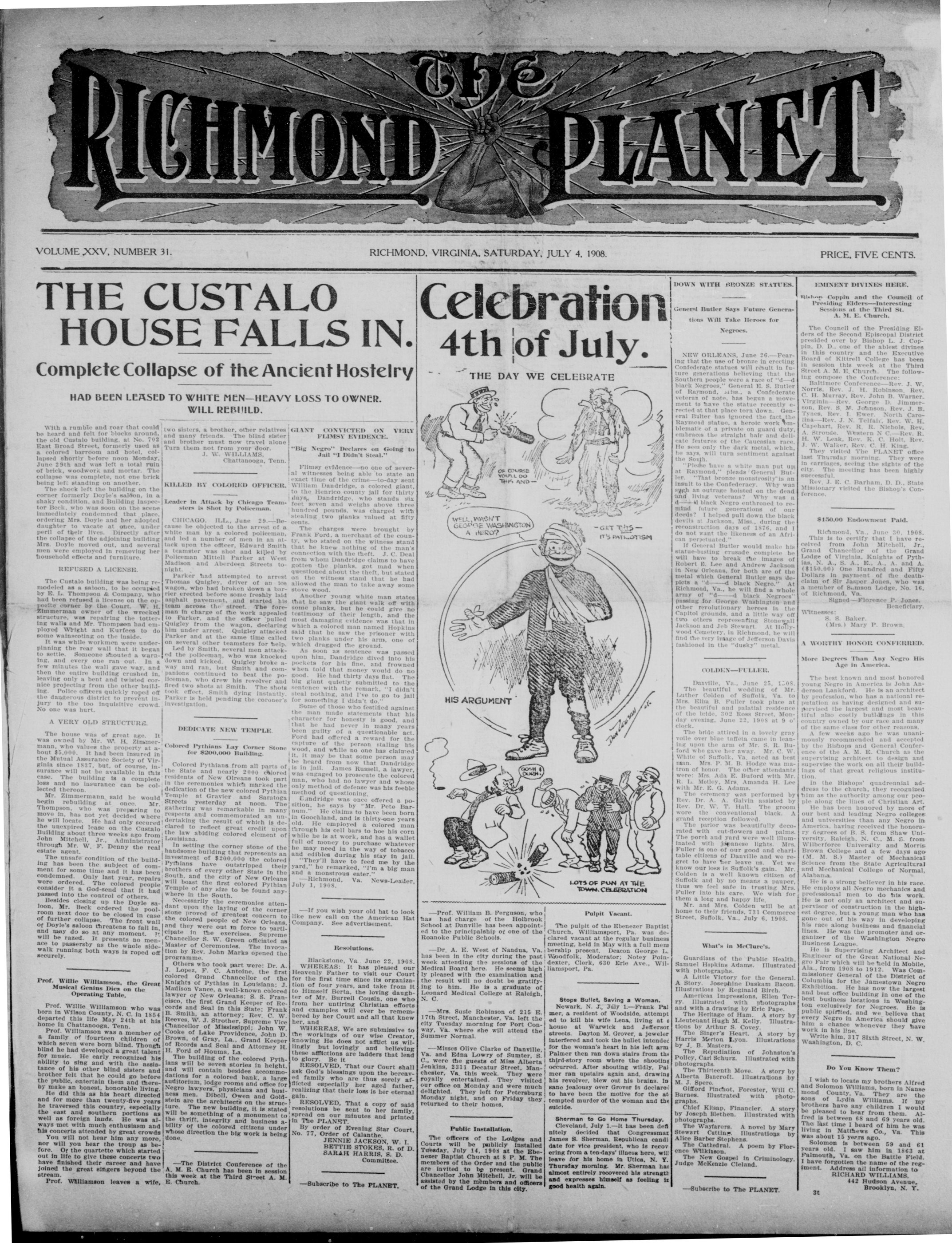
THE CUSTALO HOUSE FALLS IN.
Complete Collapse of the Ancient Hostelry
HAD BEEN LEASED TO WHITE MEN—HEAVY LOSS TO OWNER. WILL REBUILD.
VOLUME XXV, NUMBER 31.
THE C
HOUS
Complete Collapse
HAD BEEN LEASED T
With a rumble and roar that could be heard and felt for blocks around, the old Custalo building, at No. 702 East Broad Street, formerly used as a colored barroom and hotel, collapsed shortly before noon Monday, June 29th and was left a total ruin of brick, woodwork and mortar. The collapse was complete, not one brick being left, standing on another.
The shock left the building on the corner formerly Doyle's saloon, in a shaky condition, and Building Inspector Beck, who was soon on the scene immediately condemned that place, ordering Mrs. Doyle and her adopted daughter to vacate at once, under peril of their lives. Directly after the collapse of the adjoining building Mrs. Doyle moved out, and several men were employed in removing her household effects and furniture.
REFUSED A LICENSE
The Custalo building was being remodeled as a saloon, to be occupied by E. L. Thompson & Company, who had been refused a license on the opposite corner by the Court. W. H. Zimmerman owner of the wrecked structure, was repairing the toterting walls and Mr. Thompson had employed Wright and Kurfees to do some wainscoting on the inside. It was while workmen were underplanning the rear wall that it began to settle. Someone shouted a warning, and every one ran out. In a few minutes the wall gave way, and then the entire building crushed in leaving only a bent and twisted cornice projecting from the other building. Police officers quickly roped off the dangerous district to prevent injury to the too inquisitive crowd. No one was hurt.
A VERY OLD STRUCTURE
The house was of great age. It was owned by Mr. W. H. Zimmermann, who values the property at about $5,000. It had been insured in the Mutual Assurance Society of Virginia since 1837, but, of course, insurance will not be available in this case. The building is a complete loss and no insurance can be collected thereon.
Mr. Zimmermann, said he would begin rebuilding at once. Mr. Thompson, who was preparing to move in, has not yet decided where he will locate. He had only secured the unpaid lease on the Custalo Building about three weeks ago from John Mitchell, Jr., Administrator through Mr. W. F. Denny the real estate agent.
The unsafe condition of the building has been the subject of comment for some time and it has been condemned. Only last year, repairs were ordered. The colored people consider it a God-send that it had passed into the control of others.
Besides closing up the Doyle saloon, Mr. Beck ordered the poolroom next door to be closed in case of further collapse. The front wall of Doyle's saloon threatens to fall in, and may do so at any moment. I'll be razed. It presents no menace to passersby as the whole sidewalk running both ways is roped off securely.
Prof. Willie Williamson, the Great Musical Genius Dies on the Operating Table
Prof. Willie Williamson who was born in Wilson County, N. C. in 1854 departed this life May 24th at his home in Chattanooga, Tenn.
Prof. Williamson was a member of a family of fourteen children of which seven were born blind. Though blind he had developed a great talent for music. He early recognized his ability to sing and with the assistance of his other blind sisters and brother felt that he could go before the public, entertain them and thereby make an honest, honorable living.
He did this as his heart directed and for more than twenty-five years he traversed the east and southern portions as well as foreign lands. He was always met with much enthusiasm and his concerts attended by great crowds.
You will not hear him any more, nor will you hear the troup as before. Or the quartette which started out in life to give these concerts two have finished their career and have joined the great singers beyond the stream.
Prof. Williamson leaves a wife,
two sisters, a brother, other relatives and many friends. The blind sister and brother must now travel alone Turn them not from your door.
KILLED BY COLORED OFFICER
Leader in Attack by Chicago Teamsters is Shot by Policeman.
CHICAGO, ILL., June 29.—Because he objected to the arrest of a white man by a colored policeman, and led a number of men in an attack upon the officer, Edward Smith a teamster was shot and killed by Policeman Mitchell Parker at West Madison and Aberdeen Streets tonight.
Parker had attempted to arrest Thomas Quigley, driver of an ice wagon, who had broken down a barrier erected before some freshly laid asphalt pavement, and started his team across the street. The foreman in charge of the work appealed to Parker, and the officer pulled Quigley from the wagon, declaring him under arrest. Quigley attacked Parker and at the same time called on several other teamsters for help. Led by Smith, several men attacked the policeman, who was knocked down and kicked. Quigley broke away and ran, but Smith and companions continued to beat the policeman, who drew his revolver and fired two shots at Smith. The shots took effect, Smith dying instantly. Parker is held pending the coroner's investigation.
DEDICATE NEW TEMPLE
Colored Pythians Lay Corner Stone for $200,000 Building.
Colored Pythians from all parts of the State and nearly 2000 colored residents of New Orleans took part in the ceremonies which marked the dedication of the new colored Pythian Temple at Gravier and Saratoga Streets yesterday at noon. The gathering was remarkable in many respects and commemorated an undertaking the result of which is declared to reflect great credit upon the law abiding colored element of Louisiana.
In setting the corner stone of the handsome building that represents an investment of $200,000 the colored Pythians have outstripped their brothers of every other State in the South, and the city of New Orleans will boast the first colored Pythian Temple of any size to be found anywhere in the South.
Necessarily the ceremonies attendant upon the laying of the corner stone proved of greatest concern to the colored people of New Orleans, and they were out in force to participate in the exercises. Supreme Chancellor S. W. Green officiated as Master of Ceremonies. The invocation by Rev. John Marks opened the programme.
Others who took part were: Dr. A. J. Lopez, F. C. Antoine, the first colored Grand Chancellor of the Knights of Pythias in Louisiana; J. Madison Vance, a well-known colored lawyer of New Orleans; S. S. Francisco, the first Grand Keeper of Records and Seal in this State; Frank B. Smith, an attorney; Rev. C. W. Reeves, W. J. Strother, Supreme Vice Chancellor of Mississippi; John W. Cooke of Lake Providence, John D. Brown, of Gray, La., Grand Keeper of Records and Seal and Attorney H. H. Lord of Houma, La.
The building of the colored Pythians will be seven stories in height, and will contain besides accommodations for colored bank, a large auditorium, lodge rooms and office for Negro lawyers, physicians and business men. Diboll Owen and Goldstein are the architects on the structure. The new building, it is stated will be something of a monument to the thrift, integrity and business ability of the colored citizens under whose direction the big work is being done.
—The District Conference of the A. M. E. Church has been in session this week at the Third Street A. M. E. Church.
RICHMOND, VIRGINIA, SATURDAY, JULY 4, 1908
GLANT CONVICTED ON VERY FLIMSY EVIDENCE.
"Big Negro" Declares on Going to Jail "I Didn't Steal."
Flimsy evidence—no one of several witnesses being able to state an exact time of the crime—to-day sent William Dandridge, a colored giant, to the Henrico county jail for thirty days, Dandridge, who stands six feet seven and weighs above three hundred pounds, was charged with stealing two planks valued at fifty cents.
The charges were brought by Frank Ford, a merchant of the county, who stated on the witness stand that he knew nothing of the man's connection with the theft. J. C. Deal from whom Dandridge claims to have gotten the planks, got mad when questioned about the theft, but stated on the witness stand that he had allowed the man to take away some stove wood.
Another young white man states that he saw the giant walk off with some planks, but he could give no testimony of their length, and the most damaging evidence was that in which a colored man named Hopkins said that he saw the prisoner with two planks under his arm, one of which dragged the ground.
As soon as sentence was passed upon him, Dandridge dived into his pockets for his fine, and frowned when told that money would do no good. He had thirty days flat. The big giant quietly submitted to the sentence with the remark, "I didn't steal nothing, and I've to go to jail for something I didn't do." Some of those who festified against the man made statements that his character for honesty is good, and that he had never in many years been guilty of a questionable act. Ford offered a reward for the capture of the person stalling his wood, and while no one has claimed it, it may be that some person may be heard from now that Dandridge is in jail. James Russell, a lawyer, was engaged to prosecute the colored man, who had no lawyer and whose only method of defense was his feeble method of questioning.
Dandridge was once offered a position, he says, by Mr. Pete Barnum." He claims to have been born in Goochland, and is thirty-one years old. He employed a colored man through his cell bars to take his corn while he is at work, and has a wallet full of money to purchase whatever he may need in the way of tobacco and edibles during his stay in jail. "They'll have to feed me by the yard," he remarked, "I'm a big man and a monstrous eater."
—Richmond, Va. News-Leader, July 1, 1908.
—If you wish your old hat to look like new call on the American Hat Company. See advertisement.
Resolutions.
Blackstone, Va. June 22, 1908.
WHEREAS: It has pleased our Court for the first time since its organization of four years, and take from it to Himself Berta, the loving daughter of Mr. Burrell Cousin, one who from her untiring Christian efforts and examples will ever be remembered by her Court and all that knew her, and.
WHEREAS, We are submissive to the workings of our wise Creator, knowing He does not afflict us willingly but lovingly and believing these afflictions are ladders that lead to glory. Be it
RESOLVED, That our Court shall ask God's blessings upon the bereaved family who are thus sorely afflicted especially her aged father, realizing that their loss is her eternal gain.
RESOLVED, That a copy of said resolutions be sent to her family, spread on our minutes and printed in The PLANET.
By order of Evening Star Court, No. 77, Order of Calanthe.
JENNIE JACKSON, W. I.
BETTIE STOKES, R. of D.
SARAH HARRIS, S. D.
Committee.
-Subscribe to The PLANET
Celebration 4th of July.
OF COURSE YOU'LL DO THIS AND—
WELL, WASN'T GEORGE WASHINGTON A HERO?
-GET THIS— IT'S PATRIOTISM
HIS ARGUMENT
DON'T DUNCH!
LOTS OF PUN AT THE TOWN. CELEBRATION
—Prof. William B. Ferguson, who has had charge of the Holbrook School at Danville has been appointed to the principalship or one of the Roanoke Public Schools.
—Dr. A. E. West of Nandua, Va. has been in the city during the past week attending the sessions of the Medical Board here. He seems highly pleased with the examination and the result will no doubt be gratifying to him. He is a graduate of Leonard Medical College at Raleigh, N. C.
—Mrs. Susie Robinson of 215 E. 17th Street, Manchester, Va. left the city Tuesday morning for Port Conway, Va. where she will attend the Summer Normal.
—Misses Olive Clarke of Danville, Va. and Edna Lowry of Sumter, S. C., were the guests of Miss Alberta Jenkins, 2311 Decatur Street, Manchester, Va. this week. They were royally entertained. They visited our office on Monday and were much delighted. They left for Petersburg Monday night, and on Friday they returned to their homes.
Public Installation
The officers of the Lodges and Courts will be publicly installed Tuesday, July 14, 1908 at the Ebe-nezer Baptist Church at 8 P. M. The members of the Order and the public will be present. Grand Chancellor John J. will be assisted by the members and officers of the Grand Lodge in this city.
Pulpit Vacant.
The pulpit of the Ebenezer Baptist Church, Williamsport, Pa. was declared vacant at the regular business meeting, held in May with a full memb ership present. Deacon George L. Woodfolk, Moderator; Notey Poindexter, Clerk, 630 Erle Ave., Williamsport, Pa.
Stops Bullet, Saving a Woman.
Newark, N. J., July 1.—Frank Palmer, a resident of Woodside, attempted to kill his wife Lena, living at a house at Warwick and Jefferson streets. Dayton M. Grover, a jeweler interfered and took the bullet intended for the woman's heart in his left arm. Palmer then ran down stairs from the third-story room where the shooting occurred. After shouting wildly, Palmer ran upstairs again and, drawing his revolver, blew out his brains. In sane jealousy over Grover is declared to have been the motive for the attempted murder of the woman and the suicide.
Sherman to Go Home Thursday.
Cleveland, July 1.—It has been definitively decided that Congressmar James S. Sherman, Republican candidate for vice president, who is recovering from a ten-days' illness here, will leave for his home in Utica, N. Y.
Thursday morning. Mr. Sherman has almost entirely recovered his strength and expresses himself as feeling in good health again.
DOWN WITH BRONZE STATUES.
General Butler Says Future Generations Will Take Heroes for Negroes.
NEW ORLEANS, June 26.—Fearing that the use of bronze in erecting Confederate statues will result in future generations believing that the Southern people were a race of "d—d black Negroes," General E. S. Butler of Raymond, Miss., a Confederate veteran of note, has begun a movement to have the statue recently erected that place torn down. General Butler has ignored the fact the Raymond statue, a heroic work emblematic of a private on guard duty, embraces the straight hair and delicate features of the Caucasian race. He sees only the dark metal, which, he says, will turn sentiment against the Sough.
"Please have a white man put up at Raymond," pleads General Butler. "That bronze monstrosity is an insult to the Confederacy. Why was such an outrage hoisted on the dead and living veterans? Why was a d—d black Negro enthroned to remind future generations of our deeds? I helped pull down the black devils at Jackson, Miss., during the reconstruction days of 1876, and I do not want the likeness of an African perpetuated."
If General Butler would make his statue-busting crusade complete he will have to break the images of Robert E. Lee and Andrew Jackson in New Orleans, for both are of the metal which General Butler says deplets a "d——d black Negro." At Richmond, Va., he will find a whole array of ford, "d——d black Negroes" for George Washington and other revolutionary heroes in the Capitol grounds, and (with) way off two others representing St. Louis Jackson and Jeb Stewart. At Hollywood Cemetery, in Richmond, he will find the very image of Jefferson Davis fashioned in the "dusky" metal.
COLDEN—FULLER.
Danville, Va., June 25, 1508.
The beautiful wedding of Mr. Luther Colden of Suffolk, Va. to Mrs. Eliza B. Fuller took place at the beautiful and palatial residence of the bride, 302 Ross Street, Monday evening, June 22, 1908 at 9 o'clock.
The bride attired in a lovely gray volle over blue taffeta came in leaning upon the arm of Mr. S. R. Bufford who gave her away. Mr. C. W. White of Suffolk, Va. acted as best man. Mrs. P. M. B. Hodge was matron of honor. The other attendants were: Mrs. Ada E. Bufford with Mr. R. L. Motley, Mrs. Amanda H. Lee with Mr. E. G. Adams.
The ceremony was performed by Rev. Dr. A. A. Galvin assisted by Rev. Dr. W. T. Hall. The groom wore the conventional black. A grand reception followed.
The parlor was beautifully decorated with cut-flowers and palms. The porch and yard were well illuminated with Japanese lights. Mrs. Fuller is one of our good and charitable tables of Dumfries and we regret to have her leave us. Yet we know our loss is Suffolk's gain. Mr. Colden is a well known citizen of Suffolk and by no means a pauper thus we feel safe in trusting Mrs. Fuller into his care. We wish for them a long and happy life.
Mr. and Mrs. Colden will be at home to their friends, 731 Commerce Street, Suffolk, Va., July 6, 1908.
What's in McClure's.
—Subscribe to The PLANET.
PRICE, FIVE CENTS
EMINENT DIVINES HERE.
Bishop Coppin and the Council of Presiding Elders—Interesting Sessions at the Third St. A. M. E. Church.
The Council of the Presiding Elders of the Second Episcopal District presided over by Bishop L. J. Coppin, D. D., one of the ablest divines in this country and the Executive Board of Kittrell College has been in session this week at the Third Street A. M. E. Church. The following compose the Conference:
Baltimore Conference—Rev J. W. Norris, Rev J. H. Robinson, Rev C. H. Murray, Rev John B. Warner, Virginia—Rev George D. Jimmerson, Rev S. M. Johnson, Rev J. B. Tyler, Rev I. Ewer, North Carolina—Rev J. N. Telfair, Rev W. H. Capehart, Rev R. R. Nichols, Rev A. Stroud, Western N. C. Rev R. H. W. Leak, Western N. C. Holt, Rev J. W. Walker, Rev C. H. King.
They visited the PLANET office last Thursday morning. They were in carriages, seeing the sights of the city. The meeting has been highly successful.
Rev J. E. C. Barham, D. D., State Missionary visited the Bishop's Conference.
$150.00 Endowment Paid.
Richmond, Va., June 30, 1908.
This is to certify that I have received from John Mitchell, Jr.,
Grand Chancellor of the Grand
Lodge of Virginia, Knights of Pythias,
N. A., S. A., E., A. A, and A.
($150.00) One Hundred and Fifty
Dollars in payment of the death-
claim of Sir Jasper Jones, who was
a member of Samson Lodge, No. 16,
of Richmond, Va.
Signed—Florence P. Jones,
Beneficiary.
Witnesses:
S. S. Baker.
(Mrs.) Mary P. Brown.
A WORTHY HONOR CONFERRED
More Degrees Than Any Negro His Age in America.
The best known and most honored young Negro in America is John Anderson Lankford. He is an architect by profession, who has a national reputation as having designed and supervised the largest and most beautiful also costly buildings in this country owned by our race and many of the same class for other reasons.
A few weeks ago he was unanimously recommended and accepted by the Bishops and General Conference of the A. M. E. Church as the supervising architect to design and supervise the work on all their buildings of that great religious institution.
In the Bishops' quadrennial address to the church, they recognized him as the authority among our people along the lines of Christian Art. He has been honored by more of our best and leading Negro colleges and universities than any Negro in America, having received the honorary degrees of B. S. from Shaw University, Raleigh, N. C., M. S. from Wilberforce University and Morris Brown College and a few days ago (M. M. S.) Master of Mechanical Science from the State Agricultural and Mechanical College of Normal, Alabama.
He is a strong believer in his race. He employs all Negro mechanics and professional men to do his work. He is not only an architect and supervisor of construction in the highest degree, but a young man who has gone out of his way in developing his race along business and financial lines. He was the promoter and organizer of the Washington Negro Business League. He is Supervising Architect and Engineer of the Great National Negro Fair which will be held in Mobile, Ala., from 1908 to 1912. Was Comer General of the District of Columbia for the Jamestown Negro Exhibition. He has now the largest and best office building in one of the best business locations in Washington exclusively for Negroes. He is public spirited, and we believe that every Negro in America should give him a chance whenever they have work in his line. Write him, 317 Sixth Street, N. W. Washington, D. C.
Do You Know Them?
I wish to locate my brothers Alfred and Solomon Williams, born in Nansen mond County, Va. They are the sons of Lydia Williams. If my brothers have any children I would be pleased to hear from them. Alfred is between 68 and 69 years old. The last time I heard of him he was living in Matthews Co., Va. This was about 15 years ago. Solomon is between 59 and 61 years old. I saw him in 1863 at Palmouth, Va. on the Battle Field. I have forgotten the name of the regiment. Address all information to RICHARD WILLIAMS,
442 Hudson Avenue,
Brooklyn, N. Y.
The GIRL from TM'S PLACE
BY CHARLES CLARK MURN
COPYRIGHT, 1906, BY LOTHROP, LEE & SHEPARD CO.
CHAPTER I. - Chip McGuire, a 16-year old girl living at Tim's place in the Maine town is sold by her father to Pete Baldus, a lifebreed. She runs away.
CHAPTER II. - Chip reaches the camp of Martin Friis, a retired carpenter, his wife, nephew, Raymond Stetson, guides. She tells her story and is cared for by Mrs. Friis.
CHAPTER III. - Explains journey of Friis's party into woods is to visit Mrs. Friis, an old hermit, who has resided in the harbor for many years. When camp is broken Chip and Ray occupy same canoe.
CHAPTER IV. - The party reach camp of Mrs. Friis's father and are welcomed by him and Cy Walker, an old friend and former townman of the harbor. They settle down for summer's stay.
CHAPTER V. - Chip and Ray are in love, but no one realized this but Cy Walker. Strange canoe marks found on lake shore in front of their cabin.
CHAPTER VI. - Strange smoke is seen across the lake. Martin and Levi leave McGuire, who is known as outlaw and escaped murderer.
CHAPTER VII-Chip's one woods friend, Tomah, an Indian, visits camp, believes he sees a bear on the ridge.
CHAPTER VIII-Chip is stolen by Pete Boluo and encapses with her in a canoe.
CHAPTER IX-Chip is rescued by Martin and Levi, and they are returned from the settlement. Boluo encapses.
CHAPTER X-Old Opy presents to Ray that he remains in the woods with his self and Amzi and trap during the win- and he concludes to do so. Others of the tribe return to Greenvale, taking Chip with them.
CHAPTER XI-Chip starts to school in Greenvale, and finds him unpleasant at Aunt Comforta's made so especially by Hannah.
CHAPTER XII-Old Cy and Ray discover strange tracks in the wilderness.
CHAPTER XIII-The penetrate further into the wilderness and discover the hiding place of the man who had been sneaking about their cabin.
CHAPTER XIV-They investigate the cave home of McGuire during his abduction, seeking revenge for being the girl he bought, is also on the trail of McGuire.
CHAPTER XV—Beldue finds McGuire and the two fight to the death, finding a watery grave together.
CHAPTER XVI—Spring has come and Ray leaves the woods with Levi, leaving Old Cy and the hermit, Amel, at the camp.
CHAPTER XVII—Ray returns to Greenville and finds Chip waiting for him.
CHAPTER XVIII—Chip tells Ray of her troubles in Greenville. Ray fails to visit her the first of his arrival, and Ray explains.
CHAPTER XIX—Xray wants Chip to return to the woods with them, but she, being a comrade with Ray has been broken, refuses. When they part, however, it is as lovers.
CHAPTER XX—Chip runs away from Aunt Comfort's and finds another home with Judson Walker. She gives her name as Vera Raymond.
CHAPTER XXI—Aunt Abby, Aunt Mandy Walker's sister, visits them, and Chip home with her to Christmas Cove.
CHAPTER XXII-Chip goes to school at Christmas Cove. She tells Aunt Abby her father of their family, and she discovers that Cyr Walker is a long-lost brother of Judson Walker, but fear of betraying her hiding place prevents her telling of
CHAPTER XXIII-Old Cy investigates McGulve's cave in the wilderness and finds a fortune that belongs to Chip.
CHAPTER XXIV-Old Cy returns to Greenvale with the money belonging to Chip.
CHAPTER XXV-Old Cy returns to the wilderness camp with the money Chip had disappeared and proposes to start out to find her. He turns over to Martin a bank book showing a deposit of 50,000 in Chip's name.
CHAPTER XXVI-Chip returns to home and learns Peaceful Valley, for a summer vacation. She resolves to tell Judson of his brother, Cy.
CHAPTER XXVII-Chip tells Judson of Cy and writes a note to Martin which discloses her hiding place. Martin immediately visits the Walkers. He gives Chip a letter, but she says no, she shall send Ray to her, but she says no.
CHAPTER XXVIII—Aunt Abby's husband dead. Chip asks Martin to find Cy. He goes to the country to see the new He had been a youthful lover of Aunt Abby, and was supposed to have been lost at sea. Ray wants to go to Chip, but Martin advises him not to.
CHAPTER XXIX—The search for Cy corresponds to chip battles with pride and love for Ray.
CHAPTER XXX—Chip receives a letter from Ray, asking forgiveness for seeming slight and neglect.
CHAPTER XXXI—Ray and Levi return to the wilderness camp and find Cy. They tell him of his brother and the finding of Chip.
CHAPTER XXXII—and Martin and his wife visit Chip at Judson Walker's and Cy's Cyp. Chip starts for a visit to Greenvale.
CHAPTER XXXIII.
Riverton, less provincial than Greenvale, was a village of some two thousand inhabitants. A few brick blocks, with less pretentious wooden buildings, formed a nucleus of stores. A brown-stone bank, four churches, two hotels, the Quanboag house and the Astor house were intermingled among these, and a railroad with two trains in each direction a day added life and interest to the place. Each of the hotels sent a conveyance to meet every train, with a loud-voiced emissary to announce the fact of free transportation. In each hostelry a bar flourished and like rival clubs, each had its afternoon and evening gathering of loafers who swapped yarns and gossip, smoked and chewed incessantly, and contributed little else to support the establishments. Three times daily, at meal hours, each of the rival landlords banged a discordant gong in his front doorway, without apparent result.
At about 11 in the foreonen each week-day in summer, Uncle Joe Barnes on his lumbering two-horse stage, arrived from Greenvale, paused at the post office, threw off a mall-pouch, thence around to the Quaboag house stable, and cared for his horses. At two he was ready for the return trip and mounting his lofty seat, he again drove to the front of the hotel, shouting "All aboard!" dismounted to assist
lady passengers, but let masculine ones do their own climbing, and after halting to receive a mail-bag, again departed on his return trip.
A certain monotonous regularity was apparent in every move and every act and function of village life in Riverton. At precisely seven o'clock each morning the two landlords appeared simultaneously and banged their gongs. At 12 and six, this was repeated. At eight o'clock the three principal storekeepers usually entered their places of business; at nine, while the academy bell was ringing near by, every village doctor might be seen starting out. At ten exactly, Dwight Bennett, the cashier of the bank, unlocked its front door, and the two hotel 'buses invariably started so nearly together that they met at the first turn going stationward. Even the four church clocks had the same habit, and it was often related that a stranger there, a traveling man, on his first visit, made an amusing discovery.
"What kind of a fool clock have you got in this town?" he said to Sam Gates, the landlord of the Quaboag, next morning after his arrival. "I went to bed in good season last night an' just got a sleep when I heard it strike 32. I dozed off an' the next I knew it began clanging again, and I counted 44. What sort of time do you keep here, anyway? Do you run your town by the multiplication table?" The half-dozen loafers who met every afternoon in the Quaboag house office arrived in about the same order, smoked, drank, told their yarns, gathered all the gossip, and departed at nearly the same moment. Their evening visits partook of the same clock-like regularity.
These of the old guard were also dressed much the same, and "slouchy" best describes it. Gray flannel shirts in winter or summer alike. Collar cuffs, and ties were never seen on them, though patches were, and as for shaving or hair-cutting, a few shaved once a week, some never did, and semi-annual hair-cuts were a fair average.
The worst sinner in this respect, Luke Atwater, occasionally called "Lazy Luke," never had his beard shortened but once, and that was due to its being burnt off while he was fighting a brush fire in spring.
It was related of him, and believed by many, that once upon a time many years previous he had had his hair cut and on that occasion the barber had found a whetstone concealed in Luke's shock of tangled hair. It was also asserted that he admitted always carrying his whetstone back of his ear while mowing, and so losing it that way.
All the news and every happening in Riverton, from the catching of an extra big trout to twins, was duly commented upon and discussed by this coterie. Village politics, how much money each storekeeper was making, crop prospects, the run of sap every spring, drouth, weather indications, rain or snow falls, each and all formed rotating subjects upon which every one of this faithful-to-the-post clique expressed opinions.
Chip's arrival there with the Frisbie family, and her later history, learned from Uncle Joe, furnished a fertile topic, her escapade in running away from Greenvale, a more exciting one, while Old Cy's visit and deposit of a fabulous sum in the bank in her name had been a nine days' wonder. That amount, hinted at only by the cashier as a comfortable fortune, soon grew in size until it was generally believed to be almost a million.
This was Riverton and its decidedly rural status when late one December afternoon the Quaboag free 'bus (a two-seated pung, this time) swept up to that hotel's front door, where the porter assisted a stylish young lady to alight, and be, stepping like a drum major, led the way into the Quaboag's unwarmed parlor.
"Young lady, sir, a stunner, wants room over night, sir," he announced to the landlord in the office a moment later. "Goin' to Greenvale to-morning, she says."
On the instant all converse in the office ceased, and the six constant callers hardly breathed until Sam Gates hattened to the parlor and returned.
"It's that McGuire gal—lady, I mean," he asserted pompously; then the porter, "Git a move on, Jim, 'n start a fire in Number 6, an' quick, too!" And hastily brushing his untidy hair before the office mirror, he left the room again, followed by six envious glances. Then those astonished loafers grouped themselves, the better to observe the passage between parlor and office.
Only one instant sight of this important guest was obtained by them as Chlp emerged from the parlor and followed the landlord upstairs, and then the hushed spell was broken.
"By gosh, it's her!" exclaimed one in an awed whisper, "an' Jim was right, she's a stunner!"
"What do ye s'pose she's here for," queried a fourth, "to draw the int'rest on her money, or what?"
It was precisely four forty-five when Chip appeared before the judge and jury of all Riverton's happenings. At five forty-five they had agreed that she was the handsomest young lady who had ever set foot in the town, that she must be going to get married soon, and that her mission there was to draw out a few thousand dollars for wedding finery. Then they dispersed, and at six forty-five, when they assembled at the Quabang again, half of Riverton knew their conclusions, and by bedtime all knew them. By eight-thirty next morning, this all-observant and all-wise clique had gathered in the hotel office once more, an unusual proceeding, and when Chip tripped out, eight pairs of eyes watched
THE RICHMOND PLANET, RICHMOND, VIRGINIA
her depart. Then they dispersed.
At nine o'clock Chip walked up the stone steps to the bank door, read the legend, "Open from ten a.m. to two p. m." turned away, and once more resumed her leisurely stroll up and down the street while she peered into store windows. At ten precisely by the four clocks she was back at the bank again, and the cashier loot count of the column he was adding when he saw her enter.
"I would like $300, if you please, sir," she said, presenting her little book, and he had to count it over four times, to make sure the amount was right. Then he passed the thick bundle of currency out under his latticed window, seeing only the two wide-open, fathomless eyes and dimpled face that had watched him, and feeling, as he afterward admitted, like 50 cents.
And now ensued an experience the like of which poor Chip had never even dreamed,—the supreme joy of spending money without stint for those near and dear to her. And what a medley of gifts she bought! Two silk dress patterns, two warm wraps, three winter hats, a gold watch for Miss Phinney, an easy-chair, two of the finest pipes she could find, a trout rod, four pairs of gloves, and finally a gun for Nexer. Then as her roll of money grew less, she began to pick up smaller articles—handkerchiefs, slippers, and the like.
"Send them to the hotel, please," she said to one and all of whom she purchased articles of any size, "marked for Vera McGuire."
That was enough!
Riverton had sensations, mild ones,
of course. Now and then a fire had
occurred, once an elopement. Occasionally a horse ran away, causing
damage to some one. But nothing had
occurred to compare with the arrival
of a supposed fabulously rich young
lady who came without escort, who
walked into and out of stores like a
goddess, noticing no one, and who
spent money as if it were autumn
leaves.
A few of the Quauabog retinue followed her about in a not-to-be-observed manner. Women by the dozen hastily
doned outdoor raiment and visited
stores, just to observe her. They
crossed and recrossed the street to
meet her, and a battery of curious
eyes was focussed on her for two
hours.
When she returned to the hotel, the old guard, recruited by every idle man in town, filled the office, awaiting her. Uncle Joe, who had heard of her arrival the moment he came, was among them, recounting her history once more, and when she neared the hotel, he emerged to meet her.
"Why, bless yer eyes, Chip," he said, extending a calloused hand, "but I'm powerful glad to see ye once more. Whatever made ye run away the way ye did, n' what be ye doin' here? Buyin' out the hull town? I've got the pung filled wi' bundles a'ready wi' yer name on 'em."
He beamed her into the parlor, like the ancient grantlant he was. He washed, brushed his hair and clothing, and awaited her readiness to dine, without holding further converse with the curious crowd. He ushered her into the dining-room and made bold to sit and ent with her unmasked, and when he assisted her to the front seat in his long; box sleigh, crowded with her purchases, and drove away, he was envised by two dozen observers.
"Why didn't ye send as word o' yer comin'," he said as they left Riverton, "so I cud 'n spruced up some an' come down with a better rig, bells on the hoses and new buffer robes?"
"There was no need of that," answered Chip, pleased, as well she might be. "I am just the same girl that I always was, only happier now that I have more friends. How is dear old Aunt Comfort, and every one in Greenvale? I am anticipating seeing them so much."
And never during all the 20 years in which Uncle Joe had journeyed twice each day over this road had the way seemed shorter or had he been blessed with a more interesting companion.
The only regret Chip had, was that she had forgotten to buy Uncle Joe a present. She made up for it later, however.
At Greenvale, Chip met almost an ovation. Aunt Comfort kissed her and cried over her. Nezer ran for Angle, who soon appeared on the scene, and Hannah was so "flustered" she was unable to speak after the first greeting. Martin, who had heard of Chip's arrival from Uncle Joe, hastened to Aunt Comfort's, and had Chip been a real "millionairress" or some titled lady she could not have awakened more interest or received half so cordial a welcome.
Hannah was the one who felt the most embarrassed, however, and guilty as well. For half an hour, while Chip was the center of interest, she could only stare at her in dumb amazement. Then she stole out of the room, and later Chip found her in the kitchen, shedding corious tears.
"I'm a miserable sinner 'n' the Lord'n' never forgive me," she half moaned, when Chip tried to console her. "An' to think ye feel the way ye say, 'n' to bring me a present, arter all the mean things I said. It's a-heapin' coals' o' fire on my head, that it is." And the shower increased.
"I have forgotten all about them, Hannah, truly I have," Chip assured her, "and I wish you would. You didn't understand me then, perhaps, or I you, so let us be friends now."
The next afternoon Chip, who had learned that Miss Phinney's school was to close the day following, set out
to call on her in time to arrive at its adjournment.
No hint of her return had reached Miss Phinney, no letters had been exchanged, and not since that tearful separation had they met.
And now as Chip followed the lonely by-road so often traversed by her, what a flood of bitter-sweet memories returned—each bend, each tree, each rock, and the bridge over the Mizzy held a different recollection. Here at this turn she had first met Ray, after her resolve to leave Greenvale. At the next landmark, a lane crossing the meadows, she had always parted from her teacher, the last time in tears.
And how long, long ago it all seemed!
TOYS
A Few of the Quaboag Retinue Followed Her About.
beyond, and barely visible, was the dear old schoolhouse. She could see it now, half hid in the bushes, a lone and lowly little brown building outlined on the winter landscape and apparently dwarfed in size. Once it had awd her, now it seemed pathetic. The last of its pupils were vanishing as Chip drew near, and inseld, and as lonely as that lone temple, Miss Phinney still lingered.
That day had not gone well with her. A note of complaint had come from one parent that morning, and news that a dearly loved scholar was ill as well, and Miss Phinney's own life seemed like the snow just now—cold, desolate and snow-covered.
And then while she, thus lone and lonesome, was putting away books, slates, ink-bottles and all the badges of her servitude, Chip, without knocking, walked in.
How they first exclaimed, then embraced, then kissed, and then repeated it while each tried to wink the tears away, and failed; how they sat hand in hand in that dingy, smoke-browned room with its knife-hacked bonches, unconscious of the chill, while Chip told her story; and how, just as the last says of the setting sun flashed from the leeches inside its eaves, they left it, still hand in hand, was but an episode such as many a schoolgirl can recall.
Of the few friends Greenvale held for Chip, none seemed quite so near and dear as Miss Phinney, and none lived longer in her memory. They had been for many months not teacher and pupil, but rather two sisters, confiding, patient, and teacher. Life swept them apart. They might never meet again, and yet, so long as both lived, never would those school days be forgotten.
With Sudday came Chip's most gratifying experience, perhaps, for her arrival was now known by the entire village and the fact that she was an heirress as well. Her fortune (also known) was considered almost fabulous according to Greenvale standards, and when Chip with Angie entered the church porch, it was crowded with people waiting to receive them. Chip, of course, now well clad and well poised, was once more the cynosure of all eyes except when the pastor prayed. At the close of service a score, most of whom she knew by sight only, waited to greet her and shake hands with her in the porch. The parson hurried down the aisle to add his smile and hand clasp, and, all in all, it was a most gratifying reception.
And here and now, let no carping critic say it was all due to that bank account, but rather a country town's expression of respect and good will toward one whom they felt deserved it.
That it all pleased Angle, goes without saying. That Chip well deserved this vindication, no one will question; and when her visit ended and she departed, no one, not even Miss Phinney, missed her more than Angle.
Only one thread of regret wove itself into Chip's feelings as she rode away with Uncle Joe, whose horses were now decked properly for this important event. She had received a most cordial reception on all sides—almost a triumph of good will. Her gifts had brought an oft-repeated chorus of thanks and a few tears. On all sides and among all she had been welcome, even receiving a call and words of praise from Parson Jones. She was a nobody no longer; instead, a somebody whom all, delighted to honor and commend.
But the one whose motherly pride would have been most gratified, she for whom Chip's heart yearned for oftenest, would never know it.
CHAPTER XXXIV
With the birds and flowers once more returning to Christmas Cove, came outdoor freedom for Chip again. Like the wood-nymph she was in character and taste, the wild, rock-bound coast outside and the low, wooded mountain enclosing this village were her playgrounds where she found companionship. Other associates she cared but little for, and a few hours alone on a wave-washed shore, watching the wild ocean billows tossing spray aloft, or a long rumble in a deep, silent forest, appealed to her far more than parties and girlish enjoyments.
The wood-bordered road, leading from the village to the railroad ten miles away, was now a favorite walk of hers. It was suited to her in many ways, for it was seldom traveled; it followed the sunny side of the low mountain range back of Christmas Cove, not a house stood along its entire way, and to add charm, a brook kept it company, crossing and recrossing it for two miles. That feature was the most especial attraction, for beds of watercress waved beneath the limpid waters in deep pools, bunches of flag grew along its banks, their blue flowers heading to kiss the current; its ripples danced in the sunlight; its music was a tinkling melody, and these simple attractions appealed to Chip.
There was also another reason for
now choosing this byway walk. She knew, or felt sure, that Ray would visit Christmas Cove on his return from the woods. He must come in the old carryall,—about the only vehicle ever journeying along the road,—and now, like a brownie of the forest, she watched until she spied it afar and then hid in the bushes and peeped out until it passed each day.
A curious and somewhat complex feeling toward this young man had also come to her. At first, like a child, she had loved him unasked. She had known no different. He had seemed like a young god to her, and to cling to him was supreme happiness. Then had come an awakening, a consciousness that this freedom was not right and must be checked. Following that also—a bitter lesson—it had come to her that she was a kind of outcast, a child of shame, as it were, whose origin was despicable, and who was dependent upon the charity of others. This awakening, this new consciousness, was like a black chasm in front of her, a horror and shame combined, and true to her nature, she fled from it like one pursued.
But two years had changed her views of humanity. She had learned that money and social position did not always win friends and respect. That birth and ancestry were of less consideration than a pure mind and honest intentions, and that fine raiment sometimes covered a base heart and vile nature.
Toward the boyish lover, also, her feelings had been altered. A little of the old-time fondness remained, however. She could not put that away. She had tried and tried earnestly, yet the wildwood illusion still lingered. She had meant, also to put him and herself quite apart—so far, and in such a way that she would never be found by him. That had failed, however, he knew where she was. He had said that he was coming here. Most likely he would expect to renew the old tender relations; but in that he would be disappointed. She was sure she would be glad to see him for old times' sake.
however. She would be gracious and, dignified, as Nunt Abbey was. She wanted to hear all about the woods and Old Cy again, but careless must be forbidden. More than that, every time she recalled how freely she had permitted them once, she blushed and felt that it would be an effort to look him in the face again.
But she was anxious to see how he would appear now: whether the same boy, with frank, open face, or a commanding, self-possessed man.
And so each pleasant afternoon she strolled up this wayway road. When the ancient carriage was sighted, she hld and watched until passed.
But Captain Mix, its driver, also had observing eyes. He knew her now as far as he could see her, as every one in the village did, and he soon noticed her unusual conduct. He also watched along the wayside where she left it, and ably observed her peeping out from some thicket. Just why this odd proceeding happened time and again, he could not guess, and not until a strange young man alighted from the train one day and asked to be left at the home of Mrs. Abby Bemis, did it dawn on him.
Then he laughed. "Friend o' Aunt Abby, I 'spose?" he inquired in his Yankee fashion, after they had started. "No," answered Ray, frankly. "I have never seen the lady. I know some one who is living with her, however. A Miss Mc—Raymond, I mean."
Captain Mix glanced at him, his eyes twinkling. "So ye're 'quainted with Vera, be ye," he responded. "Wal, ye're lucky." Then as curiosity grew he added, "Known her quite a spell, hey ye?" But Ray was discreet. "Oh, three or four years," he answered nonchalantly. "I knew her when she lived in Green-vale." Then to check the stage driver's curiosity, he added, "She was only a little girl, then. I presume she has changed since. "She's a purty good-bookin' gal now," asserted Captain Mix, "but middletin' odd in her ways. Not much on gallivantin' round wi' young folks, but goin' to school stiddy 'n' roamin' round the woods when she ain't. Party big gal to be goin' to school she is. I callate her arly edification must 'a' been sorter neglected. Mebbe ye know 'bout it," and once more this persistent Yankee glanced at his companion.
But Ray was too loyal to the little girl he loved to discuss her further, and made no answer. Instead, he began Inquiries about Christmas Cove, and as they jogged on mile after mile, he learned all that was to be known of that quiet village. When they had reached a point some three miles from it, a kindly thought came to the driver, "If Vera ain't 'spectin' ye," he said, "mebbe ye'd like to sip're her. If so be it, ye kin. She's 'most allus out this way,' n. curislice, hides 'fore I get long whar she is. If I see her to-day, 'n ye want to, I'll drop ye clus by 'n 'let ye." And so it came to pass.
And so I came to pass.
Chip, as usual, had followed her oft-taken walk on this pleasant May afternoon. When the carryall was sighted also, as usual, she had hidden herself. With beating heart she saw two occupants this time, and looking out of her laurel screen, she saw that one was Ray.
Then she crouched lower. The moment she had waited for had come.
But now something unexpected happened, for after the carryall passed her hiding spot, Ray, brown and stalwart, leaped out. The carryall drove on, and she saw him returning and scanning the bushes.
She was caught, fairly and squarely. One instant she hesitated, then, blushing rose-red, emerged from the undergrowth.
And now came another capture, for with a "Chip, my darling," Ray sprang forward, and although she turned away, the next moment she was clasped in his arms.
In vain she struggled. In vain she writhed and twisted. In vain she pushed him away and then covered her blushing face.
Love, fierce and eager, could not be thus opposed. All her pride, anger, resentment, shame, and intended coldness were as so many straws, for despite her struggles, he pulled her
hands aside and kissed her again and again.
"My darling," he exclaimed at last, "say you forgive me; say you love me; say it now!"
Then, as she drew away, he saw her eyes were brimming with tears.
"I won't," she said, "I hate—" but his lips cut the sentence in two, and it was never finished.
"I did mean to hate you," she declared once more, covering her face, "but I—I can't."
"No, you can't," he asserted eagerly, "for I won't let you. You promised to love me once, and now you've got to, for life."
"And she did.
When the outburst of emotion had subsided and they strolled homeward, Chip glanced shyly up at her lover.
"Why did you pounce on me so?"
she queried; "why didn't you ask me, first?"
"My dear," he answered, "a wise man kisses the girl first, and asks her afterwards." Then he repeated the offense.
And now what a charming summer of sweet illusion and castle-building followed for the lovers! How Aunt Abby smiled benignly upon them, quite content to accord ample chance for wooing! How many blissful, dreamy hours they passed on lonely wave-washed cliffs, while the marvel of love was discussed! How its wondrous magic opened a new world whose walks were flower-decked, whose sky was ever serene, where lilies bloomed, birds sang, sea winds whispered of time and eternity, and where Chip was an adored queen! How all the shame and humiliation of her past life faded
away and joy supreme entered on the azure and golden wings of this new morning! Even Old Cy was almost forgotten; the spites, Old Tomah, and Tim's Place quite so; and all hope, all joy, all protection, and all her future centered in the will and wishes of this Prince Perfect.
"Blind and foolish," I hear some fair critic say. Yes, more than that, almost idiotic; for selfish man never pursues unless forced to do so, and an object of worship once possessed, is but a summer flower.
CHAPTER XXXV.
Quite different from the meeting of the lovers was that which occurred when Old Cy reached Peacetul Valley. There were no heroes, no falling upon one another's necks, no tears. Just a "Hulko, Cyrus!" "Hullo, Judson!" as these two brothers clasped hands, and 40 years were bridged.
Aunt Mandy, however, showed more emotion, for when Old Cy rather awkwardly stooped to kiss her, the long
(2)
"Say You Love Me."
ago of Sister Abby's sorrow welled up in her heart, and the tears came.
That evening's reunion, with its two life histories to be exchanged, did not close until the tall clock had ticked into the wee, small hours.
All of Old Cys almost marvellous adventures had to be told by him, and not the least interesting were the last few years at the wilderness home of the hermit. Chip's entry into it and her history formed another chapter fully as thrilling, with Uncle Jud's rescue of her for a denouement.
The most pathetic feature of this intermingled history—the years while sweet Abby Grey waited and watched for her lover—was left untold. Only once was it referred to by Aunt Mandy, in an indirect way; but the quick lowering of Old Cy's eyes and the shadow that overspread his face, checked her at once. Almost intuitively she realized its unwisdom, and that it was a sorrow best not referred to.
Old Cy evidently felt it a subject to avoid, and not until the next day did he even ask how Aunt Abby looked or what had been her life experiences. A little of this reticence wore away in due time, however, and then Aunt Mandy once more referred to her sister.
"I kinder feel you blame Abby somehow, Cyrus, the way you act," she said, "and yet thar ain't no cause for it. She'd waited 'most seven years. We'd all give you up for dead, and life in Christmas Cove wa'n't promisn't much for Abby."
"I don't blame her a mite." Old Cy answered quickly, "an' no need o' yer thinkin' so. I don't blame no woman fer makin' the best shift they kin. They've got to hev a home n' perfecter, bless 'em, or be nobody in this world. Comin' here and findin' how things are, sorter makes me realize how much I've missed in life, though, an' how much sorrer I've had to outgrow. I don't lay up nothin' against Abby, not fer a minit. Only I hated to hev ye tell me what I knew ye'd hev to, that first night."
"But you're goin' to see her, aln'ty ey, Cyrus?" Aunt Mandy asked anxiously. "Ye won't shame her by not goin', will ye?"
"Wal, mebbe," he answered slowly, and after a long pause. "I wouldn't want to hurt her knowin'ly. I callate I've done more grievin'n she has, though, ten times over, an' seein' her now's a good deal like openin' an old lomh—a sorter invitin' ghosts o' old
heartaches to step out. Abby's out-grown the old times, 'n I'm sartin, too, won't be the happier by seen' me agin. I may be wrong, but I've a notion she'll sorter hate to see me. 'Twas to keep her from feelin' shamed 'n miserable 'n spotlin' her life. I've never 'let her nor nobody that knew her find out I was alive. I'm doubtin' I would now if she hadn't larned it from Chip."
He relented a little from this strange and almost cruel whim a week later, and after visiting the Riggsville store and obtaining what really amounted to a disguise in new garments, he announced his plans.
"I've got to see Chip," he said, "an see how she n' Ray's gittin' on. I've got to see Abby, I spose. I want to, i don't want to both in one. Then ag'in, these two young folks—Chip 'n the boy—he sorter get tangled up in my feelin's, 'n I can't rest content till I've seen 'em settled in life. I goin' to Christmas Cove for a day. Then back here till they hitch up, n' then—wal, then mebbe I'd better go to the woods ag'in. I ain't fitted by natur for dressed-up folks."
No opposition to this unseemly outcome was made by Uncle Jud or Aunt Mandy. They knew, or hoped, the leaven of bygone memories and association would change the hermit-like impulse of Old Cy, and all in good time a better ending of his life would seem possible to him. To argue it now was apparently useless. A man so set in his ideas as to remain a homeless wanderer for almost a lifetime, was not to be changed in a month, or perhaps in a year.
Neither did Old Cy seem in a hurry to visit Christmas Cove.
"I don't look natural or feel natural in them new clothes," he said to Aunt Mandy one day, "an' while I want to see Abby. I've lived in the woods so long my sinner 'shamed to go 'mongst respectable people. Then I look like one o' them wooden men dressed up in a store winder with that new rig on, an' jest know folks all be laughin' at me. I've got to go, I callate, but I'd like to make the trip in a cage. I'm sartin sure Abby'll laugh at me arterwards." From which it may be seen how hard it was for Old Cy to fit himself into civilized life once more.
He nerved himself for the trip to Christmas Cove in a few days, however, and how he met and renewed acquaintance with his old-time sweetheart shall be told in his own words.
"Abby hain't changed near so much as I called," he said on his return; "a leetle fuller in figger, but jest the same easy-spoken, sweet sorter woman I always knew she'd be. She was 'lone when I called, an' for a minit arter we shook hands neither on us could speak agin. Then she kinder bit her lip 'n' swallerled her feelin's, keepin' her face away, an' then we set out n' begun talkin'. It was techin', too, the way she acted, for she kept tryin' to smile, 'n' all the while the tears kept startin'. It was like one o' them summer days when the rain patters while the sun is shining. I don't think she noticed my clothes much, either, an' we set up till 'most midnight talkin' over old times. It all turned out 'bout the way I 'spected—a sorter funeral o' old hopes with us two ferr mourners. She's powerful considerate, too. Abby is, for the time we was talkin' she never once spoke o' Cap'n Bemis, 'n' I didn't. It was jest ez if we started in what we left off, o' skippin' the gap between. She 'lowed she hoped she'd see me soon agin, that she felt like a mother to Chip; an' when I bid her good-by, she kinder choked once more.
"I didn't see much o' Chip, either, which sorter hurt me. Take it all in all, my visit that upset me more'n I callated, 'n' I guess when Chip's settled, I'd best go to the woods'n forgit all that's past. My life's been a failure, anyway."
And Old Cy was right; but it was grim and merciless Fate that made it so, and for that he was not responsible.
Love in youth is a sweet song of joy and hope and promise. But love that spans a lifetime, that reaches and caresses our heartstrings once again as we enter the final shadows, has only the pathos of parting and the tender chords of almost forgotten melodies in it. Vainly do we strive to enter the enchanted garden once more. Vainly do our heart throbs beat against its adamant walls. Vainly do we hope to catch just one more of the old bygone thrills. It is useless, for none can live life over, and once age has locked the portals of youth and fervor, they are never opened again.
CHAPTER XXXVI
With September came a supreme event in the lives of Chip and Ray, when Mr. and Mrs. Frisbie, Aunt Comfort, Miss Philineh and Hannah, Uncle Jud and Aunt Mandy, and Old Cy, all gathered in Aunt Abby's quaint parlor to see her aged pastor join their hands and lives. Then came the kisses, the congratulations, the rice, and old shoe throwing, and then solitude and tears for Aunt Abby. All the wedding guests except Old Cy hled themselves away with the new pair, and he left for Bayport.
And thus closes the history of Chip McGuire, waif of the wilderness and slave of Tim's Place.
Bless her!
Two days later Old Cy returned.
Two days later Old Cly returned.
No one was in the house when he knocked at Aunt Abby's door, and then, led perhaps by the invisible chord that spanned 40 years, he slowly strolled up the path beside the old-mill pond, which he and she had often followed in the old, old days.
His heart had led him aright, for there, at the foot of the ancient oak that had once been their trysting-place, she sat.
"I thought I'd come over n' bid ye good-by, Abby." he said gently, as she arose to meet him. "I've been doin' a good deal o' biddin' good-by to-day. I bid good-by to the old graveyard whar my folks is; it's all groomed up to weeds n' bushes, I'm sorry to say. But that can't be helped. It's the way o' nature. I've been down to the p'int whar you n' I used to go, an' I bid that good-by, he added, seating himself near her. "Ye 'member it, don't ye, Abby, n' them days when we went
THE PLANET
SATURDAY.....JULY 4. 1908
thar to watch the waves?"
"I do, Cyrus," she answered, her voice trembling. "I remember all the old days only too well."
"They all come back to me, too," he continued in a lower tone, "an 'I wish I could skip back to 'em, but I can't. I'm an old man now, an' no use to nobody, 'n' not much to myself. I've been a wanderer many years—ye know why, Abby. I've had a short spell o' joy, kinder helpin' this boy n' gal into sunshine n' a home. They've gone their way now n' sure to forgit me an' you. It's nat'ral they should, 'n all that's left me is to go back to the woods n' stay."
He paused a moment, glancing up the narrow pond to where it ended in shadow, and then continued: "It's curls, Abby, how life begins with how-de-do's n' smilin' friends n' cheerin' prospects, 'n then ends with goodbysn' n' bein' forgot. It's what we must callate on, though, an' a good deal like a graveyard is left to weeds 'n' bushes." Once more he paused, closed his eyes, and remained silent for a time.
"But is there any need of it?" she answered, turning her face to hide the tears as his hand clasped hers.
"Why, no, only to fergit my sorrer," he answered; "I can't do it here."
"But who will care for you there—at last—and must you go?" Then she turned to him again.
And then he saw, not the gentle, saddened face upraised to his, but the tender face of sweet Abby Grey of the long, long ago.
"Must you leave us—mo?" she whispered once again.
"Wal, mebbe not," he answered.
THE END.
Electricity in Siberia
Almost all the towns in Siberia are having arc lights for street use and incandescent lights for houses; and the larger proportion of the people in Siberia have never seen gas, which they regard as an illuminant of a past age.
Brave Dogs.
It is a singular fact that highly-couraged dogs have always much width between their ears. This is a phrenological fact that was known to fandlers many generations before Gall existed. Never; trust a dog that is narrow between the eyes—nor a man.
Her Lost Youth
To Evangeline—You can recover your lost youth if you will get your father to make about a million dollars. This prescription has seldom been known to fall. But why not give him up and try to catch some one who is nearer your own age?
To Build Radium Spring
Australia's government intends to construct a real radium spring and build hotels, which it will control, at St. Joachimsthal, near Carlsbad. The water in the uranium mines there contains a large quantity of radium.
The Uplift of Pride
When flowers are full of heaven-descended dews, they always hang their heads; but men hold theirs the higher the more they receive, getting proud as they get full.—Beecher.
Can Such Things Be?
"Oh, Johnny. Johnny!" sighed Mrs. Lapsling. "You're so awfully hard on shoes. This is the second pair I've bought you since we had that equinuptal storm!"
Keep It Dark
Some women will admit that they married a man to reform him, but mighty few, will acknowledge that they made a mess of the job.—Washington Post.
Big Leaves.
The leaf of the cocoanut tree is nearly 30 feet long; while a single leaf of the parasol magnolia of Ceylon will shelter 15 or 20 persons.
Could Easily Cover the Land.
The mean height of all the land now above the sea is referred to by Lyell as being 1,000 feet. The mean depth of the ocean is at least 12,000 feet.
Competent as Inspector.
An eastern woman has been made a sanitary inspector. Her report concerning the condition of her neighbor's kitchen is anxiously awaited.
There is no substitute for thorough going, ardent and sincere earnestness Dickens
Just Step Down.
"A good many people who fall in love don't drop from a very dizzy height."
The best part of beauty is that which no picture can express.—Bacon.
And Eke a Lawn Mower.
And Eke a Lawn Mower.
It takes push, even to trundle a wheelbarrow.—Manchester Union.
—We are selling old papers at fifteen cents per hundred.
The Fourth in Boomville
Celebration as Described by the Small Boy.
"B
OOMVILLE Will Celebrate the Nation's Na- Sammy Smith and I stood with our hands in our pockets tal Day."
and read the notice in flaming red letters as "Cy" Smith unrolled the poster preparatory to tacking it on "Doc" Blaston's shoe shop. We didn't understand what "natal day" business meant, but "celebrate" — that could only mean one thing this season of the year.
A boy and a girl are sitting on a rock. They are wearing hats and are looking at each other. The background is a landscape with trees and mountains.
Whoopee!
Cracky! Boom!
and Sammy and I
shiled a tin can at
"Doc" Blaston
setter pup and dug
down the alley as
as fast as four brown
legs could carry us.
"Hey! Stub, it's
Tied a Can on the fast as four brown legs on the back carry us.
Pup.
"Hey! Stub, it's a-goin' to be; they're puttin' the bill up now." Stub dropped the bait can half full of worms and joined the proclaimers of the glad tidings. Two minutes later we ended up in front of the bill to read further.
"I call that a mighty neat job of printin'," said the editor of the Weekly Banner, who had happened along.
"We broke the claws holdin' the arrows off our eagle wood cut two years ago and blamed if we could find the piece this year. The old bird looked mighty squaty until we hit upon havin' him sit on that log from the Mink Lumber Company's ad."
"Looks like that old turkey buzzard that roosts on the rotten log in Deacon Shuifecorn's pasture," sniffed old Prof. Krain. Krain had started a paper in opposition to the Banner three years before, but it had fizzled out after intermittent issues for six months.
But there wasn't anything squatty about the birds of freedom, as far as we kids could see. Besides, we were busy reading down further what was going to happen.
"Fine shade, grand music, magnificent parade, most eloquent speakers in the state. Races! Races! Races! Ball games, climbing the greased pole, catching the greased pig, a grand spectacular exhibition of tight-rope walking by Capt McMain.
"The grand finale, $95.50 worth of fireworks, let off, from a stand in front of the city calaboose." These were a few of the features that would mar the usual lethargy of Boomville on July 4.
"Shore gain" to have $55 worth of fireworks; there'll be pinwheels, giant fire crackers and skyrockets, till you can't rest," said Sid Girkens. "I know, cause dad was at the meetin' the night they voted to have 'em." It had been five years since Roomville had had a celebration. For 12 years before that time the eagle had screamed in vociferous fashion as regular as independence day came around. That was when the boom was on the town. In those days Jeff Dascom gave $150 to buy fireworks. Jeff borrows his chewing tobacco now. The bubble had bursted, the lean days
Turned the Freezer.
time the eagle had screamed in vociferous fashion as regular as Independence day came around. That was when the boom was on the town. In those days Jeff Dascom gave $150 to buy fireworks. Jeff borrows his chewing tobacco now. The bubble had bursted, the lean days had come and patriotism had waned in Boomville. The celebration this year was due to young Leon Talbert who had bought out old Shoebuckler's general merchandise store. He had offered to give $25 as the first contribution. His rival in business, old "Dan" Turner, across the street, growled and said he did it just for advertisement.
A man's business was the last thing attended to in Boomville during the next three weeks. Floats had to be built for the Goddess of Liberty and her attendants to ride on. Boomville had no trees that would do as a shade, for the drought three years before had killed even the trees in the city park. Where the young cottonwoods, 29 feet tall, used to grow, was an oat field. Beside the oat field was a stretch of ground that once bore the appellation of "Dascom boulevard." "Joe" Skinner said he'd have the best crop of potatoes on that ground this year ever raised in Boomville, if the bugs didn't hit 'em or the hot winds blow. "I reckon they ought to be better than ordinary, bein' raised on that high-futin' ground," he used to fling at Joe Dascom, who helped him hoe them.
A thin line of cottonwoods and a few scragged elms on Cowskin creek, five miles away, were the nearest trees to Boomville now. Jim McGood solved the shade problem. He would build an arbor, himself, if they would give him the sole privilege of selling lemonade and ice cream near by. Jim's offer was accepted.
On July 3 Sammy Smith and I were pretty busy. We kept the road warm between the place where Jim McGood was putting leafy branches of cottonwood, brought from the Cowskin grove, over a frame work of plank, and the back part of the livery stable where the floats were being decked in tinsel and red, white and blue bunting. We never had any real fun until late in the afternoon, when we tied a can on "Doc" Blaston's setter pup and set off a bunch of firecrackers in it.
We hated "Doc" Blaston and had even less regard for his setter pup, because he wouldn't chase a jack rabbit. We were sorry afterwards we did it, for that premature can spoiled a whole lot of fun next
THE RICHMOND PLANET, RICHMOND, VIRGINIA
HEN old Peter Brown died he left his fortune—a very sizable one—to his grandson, P. Chawley Brown, as the young man signed it, or "Dickey" Brown as he was familiarly known to his intimates. But the fortune had conditions attached, conditions that were "a beastly bore, don't you know." Old Peter had been one of the old settlers of Plumville; his son had been born there and married there, and "Dickey" had first seen the light of day at the same place. But with the increase of fortune "Dickey's" mother had developed society leanings, and she had taken "Dickey" east where she could dabble in the edges of the society sea, and "Dickey" had grown up in the atmosphere of Saratoga and Newport, with an occasional visit to London when the "season" was on.
When it came to the question of a university nothing short of Oxford would answer; all America was too provincial to be thought of. So it was that he spent the greater part of his teens and neared his majority in England, at all times a willing student of English snobbery. It was with considerable, disgust that Dickey read the letter from his American lawyers warning him that if he wished to have the handling of his g.father's money after his twenty-fifth birthday it would be necessary to comply with the old gentleman's expressed command that he spend each of his birthdays from his twenty-first to his twenty-fifth in his native town of Plumville.
"A beastly bore, don't you know," said Dickey, as he read the letter for the third time. "I say now, why could not the old codger have left that out." It was on the first of July that Dickey arrived at Plumville, monocle, brilliantly checked trousers, white spats, walking stick and all the other essentials without which life in London would be scarcely worth the living. Plumville just at that time was very much imbued with a spirit of patriotism, and looked at everything English very as the audience looks upon the villain in the show. The town was going to celebrate, and they were going to do it on a very big scale—for Plumville. Everything had been arranged for with the exception of the evening's fireworks when the subscribed funds began to run low, and it seemed as though Plumville's celebration was not destined to wind up in a blaze of glory. Rather, that was the way it seemed before Dickey's arrival.
The finance committee of the celebration felt that he should and would provide the needed funds for the fireworks, and the chairman waited upon him at once and broached the subject. What Dickey said to the chairman that official did not repeat, but he did report to the committee that the funds for the fireworks would be forthcoming, and the town paper contained the following notice on the morning of the third:
EXTRAORDINARY CELEBRATION
ATTRACTION!
The committee on arrangements of the Plumville Fourth of July celebration, announce the engagement of a GENIINE ENGLISH LION
When Foucheh of July morning dawned, a large size tent was one of the features of the grounds on which the celebration was to be held. Across it in large letters was the sign:
The curiosity of the visitors and the townspoople was at white heat, and they flocked into the tent as soon as it was opened.
There was Dickey in a hastily constructed cage, securely bound down on all fours, properly arrayed in his checked trousers, white spats, with his monocle fastened securely in place and himself decorated with a bushy tail. The chairman's young hopeful garbed in continental uniform and cocked hat, was operating the tailpiece. This was but a doubled strand of rope fitted around Dickey's stomach so tightly that when given an extra twist or two it became torture to the victim, and produced the promised roar.
The crowd went wild with delight at the novelty of the entertainment while Dickey roared, and howled, and swore, and vowed vengeance upon Plumville and the entire nation.
The $100 worth of fireworks with which Plumville wound up its celebration were promptly paid for when the bill was presented. Dickey spent his birthday in bed in the town hospital, and has not been heard from since the day following, though the fame of Plumville's British lion has spread from ocean to ocean. Should he fail to return for his birthday this year, the town will be able to replace the present hospital with a more commodious structure out of the old gentleman's fortune which it inherits, should Dickey not meet the conditions of the will.
Pa—Always remember, my son, that the early bird catches the worm.
"He says she has pneumatic tendencies and that she is threatened with spiral trouble." Baltimore American
day. Every dog in Boomville decamped that night; even the cats roosted in the trees for two days. A boom that rattled the window frames awakened me before day next morning. With no hat and only one suspender over my shoulder I scurried down to Uncle Billy's blacksmith shop. Uncle Billy was out in front shooting off the anvil. He had a whole quart can of powder. Carefully the square hole in the anvil was filled with powder and a hardwood plug whittled to fit it. A gorose in one side of the plug was left for the fuse. Uncle Billy scratched the match down the leg of his overalls, touched the fuse and then hurried behind the shop door. The aged blacksmith was slightly deaf and liked a noisy Fourth. Thirteen times the powder was poured in and touched off.
The events of that day crowded upon each other fast and furious. The parade started half an hour late because the Goddess couldn't get her brown hair waving to the best effect. After the parade things dragged a little until the speaking began. We wouldn't have stayed around near the speaking except we sometimes got a dish of ice cream for turning a freezer for Jim.
A man running away from a fire.
The Hon. Timothy Todhunter gave the oration and Deacon Hefftower read the Declaration of Independence. That is he started to read it. He had taken a copy of the declaration
The Deacon Was Very Excitable.
The Deacon Was read by me. He had Very Excitable. taken a copy of the declaration from his hip pocket and started to read when Sammy Smith touched a cannon cracker off behind the speakers' stand. The deacon was naturally very excitable. He tried to proceed but his hands jerked spasmodically. Suddenly the declaration parted in the middle where it had been folded in the deacon's pocket. They sent after a new declaration, but the crowd had left before it arrived.
The greased pig had been caught and the entries were just in for the slippery pole climbing exhibition when my recollection came to a vivid close. That night about nine o'clock I waked up with a bandaged eye, a swollen jaw and one arm in a sling. They told me Sammy Smith had climbed 'er and I went to sleep happy.
For the Babies
"I want to get some fireworks for my little boy—something that will be safe for him to set off by himself," explains the young mother.
"Yes, ma'am," replied the courteous dealer. "How old is your little boy?" "He'll be 14 months and two days old to morrow."
"I don't believe we have anything he could be trusted with."
"Oh, dear! Haven't you any safety pln-wheels?"
A 4th of July
Episode!
Quoth Tom-
not to honor the
4th of July.
Id consider a
lasting disgrace:
He honored- and that
is the sad reason: why
Young Tommy is
sailing thro' space!
A Bit of Advice.
Tie the thumbs on little Willie
As he wanders forth to play.
It may look a trifle silly.
But he'll need the thumbs some day
He may chafe at the restriction
And move against the plan.
But you'll have a benediction
When he gets to be.
---
Where to Draw the Line.
We hear a good deal about a sane Fourth, but what is really needed is the ability to draw the line between harmless noise and a combination of train wreck, dynamite explosion and war with the improved implements of modern warfare.
Boarding.
"Where's your mother, little boy?"
"She's at the washboard, too busy to see anybody."
"Well, where's your father?"
Wen, where's your father?
"He's pretty busy, too. He's down town watching some score board."—Detroit Free Press.
The Best Wedding Present
Mother—If you marry Robert, I swear I never set foot in your house! Daughter—Please put that down in writing. I like to give your promise to Robert for a wedding present.
Hls Plicht.
"What's the answer? Somebody turned the nose on you?"
"No. Just been trying to get a drink out of one of those sanitary thirst fountains."—Detroit Free Press.
HEN old Peter Brown died he left his fortune—a very sizable one—to his grandson, P. Chawley Brown, as the young man signed it, or "Dickey" Brown, as he
GENUINE ENGLISH LION.
The only one in captivity in this
country. He will be securely caged,
and will provide entertainment by
roaring' when his tail is twisted.
DO NOT FAIL TO SEE IT.
THE ENGLISH LION—HEAR IT
ROAR!
Useless.
Rather Twisted
LINCOLN
HAIR POMADE
MAKES
KINKY
HAIR
SOFT
REMOVES
DANDRUFF
KEEPS
HAIR
FROM
BREAKING
OFF
LINCOLN
HAIR POMADE
KEEPS
SCALP
FRESH
CLEAN AND
WHOLE-
SOME
MAKES
HAIR
GROW
LONG AND
LUXURIOUS
WHICH WAY WOULD YOU RATHER HAVE YOUR HAIR—SOFT AND
LONG. SO THAT YOU CAN PUT IT UP IN THE LATEST STYLE
OR SHORT AND RINKY
A WOMAN'S JUST PRIDE IS HER
HAIR. TO STRAIGHTEN OUT THAT KINKY, CURLY HAIR, PUTTING IT IN THE MOST PERFECT CONDITION TO BE COMBED INTO ANY SHAPE JUST TRIAL A BOTTLE OF LINCOLN HAIR POMADE. There is no other preparation on earth to equal Lincoln Hair Pomade in producing soft, beautiful hair. Lincoln Hair Pomade is a natural hair cleanser, natural promoter of growth and naturally reduces the hair to a strained and combable condition; but also supplies the air with a silky shine and gloss. No matter how rough or heavy your hair is now, no matter how hard or curly it may be, the use of Lincoln Hair Pomade will give you hair that can well be the envy of others. Lincoln Hair Pomade is the only highly recommended preparation for this purpose on the market.
It is Lincoln Hair Pomade you want, so refuse weak and inferior substitutes. Do not take anything that is claimed to be just as good, but insist on getting the genuine.
Agents Wanted Everywhere. Write for particulars. If your dealer does not keep it, send 20 cents in stamps or silver to THE LINCOLN POMADE CO., Department B, Norfolk, Va. and we will send you a bottle by return mail.
MAKES
KINKY
HAIR
SOFT
REMOVES
DANDRUFF
KEEPS
HAIR
FROM
BREAKING
OFF
PROGRESSIVE CONUNDRUMS
"Miss Gracie," he said, with an engaging smile, "did you ever try your hand at one of these progressive conundrums?"
"What is a progressive conundrum, Mr. Spoonamore?" inquired the young lady.
"Haven't you heard of them? Here is one: Why is a ball of yarn like the letter 't?' Because a ball of yarn is circular, a circular is a sheet, a sheet is flat, a flat is $40 a month, $40 a month is dear, a deer is swift, a swift is a swallow, a swallow is a taste, a taste is an inclination, an inclination is an angle, an angle is a point, a point is an object aimed at, an object aimed at is a target, a target is a mark, a mark is an impression, an impression is a stamp, a stamp is a thing stuck on, a thing stuck on is a young man in love, and a young man in love is like the letter 't' because he stands before u', Miss Gracie."
"I don't think you have the answer quite right," said the young lady. "A ball of yarn is round, a round is a steak, a stake is a wooden thing, a wooden thing is a young man in love, and a young man in love is like the letter 't' because, Mr. Spoonamore"—and she spoke clearly and distinctly—"because he is often crossed."
The young man understood. He took his hat and his progressive conundrums and vanished from Miss Grace Garlinghouse's visiting-list for ever.
The Practice.
"Good gracious, Mrs. Ritter, what is all that noise and sweating about?" "Sh! That's my husband who is furiously angry because I disturbed him in his work to tell him the coal was out and we would have to order more to-day." "Is his work so important?" "Yes; he is writing a series of articles for a popular magazine on how always to keep sunshine and cheerfulness in the house."—Balti more American.
"Yes, my boy."
"Do you know I'd like to live in India?"
"Well. What put such an idea in your head, my son?"
"Why, this paper says the soap consumption of India is only one ounce a head a year."—Yonkers Statesman.
That's Different.
"Do you think you could get along on two thousand a year, my son?" asked the millionaire father.
"No, I don't think I could, father."
"But that is a lot of money, my boy."
"Oh, you're talking about money, are you? I thought you meant cigarettes!"—Yonkers Statesman.
THE SPENDTHRIFT'S RETORT.
THE TRAVELLER
Gotabug—O, I don't know. An umbrella isn't any good until it is "used up."—Syracuse Herald.
A Wish.
A Wish.
Life I'm sure would really be
Much sweeter.
If some one would invent for me
A dustless carpet beater.
A dustless carpet Press.
All the Difference.
Wrathy Constituent—What do you mean by betraying our interests this way, and voting for the corporations
KEEPS
SCALP
FRESH
CLEAN AND
WHOLE-
MAKES
HAIR
GROW
LONG AND
LUXURIOUS
all the time? You said on the stump before you were elected that you would fight predatory wealth. Wise Legislator—Yes, I did then, but I've got some of it now.—Baltimore American.
Keeping Pa Silent.
He—Do you believe that silence gives consent?
She—I certainly do.
"Well, when I ask your father for your hand, manage to have your mother in the room."—Yonkers Statesman.
Heading Him Off
Reggy Sapp—Ah, my dear, I think I shall sing that beautiful song "Rocked in the Cradle of the Deep." Should I not?
Miss Tabasco—Yes, you should not.—Chicago Daily News.
He Guessed It.
"For goodness sake!" exclaimed one of the guests, "what is that woman talking about?"
"Her neighbors," replied the man who sat next to her—Detroit Free Press.
What?
"Did mamma ever punish you?"
"Well, she married me, my boy."—Yonkers Statesman.
At Home
Gotham—What is he—a motorman,
a conductor or a spellbinder?—Yonkers
Statesman.
Bird Migration
An Italian scientist believes that daylight alone determines bird migration. The summer migrants, he says, come north to take advantage of the longer days and go south again to avoid the short and dark ones.
Why Cringe?
We have only two days to live. It is hardly worth our while to spend them in cringing to contemptible rascals — Voltaire.
Masters of Mystery
The ablest masters in the science of mystery are lawyers and physicians.
Accepted at His Value.
A good man's pedigree is little hunted up.—German Proverb.
Cure of Hiccoughs
Cure of Hiccoughs.
A lemon cut open, filled with salt and sucked.
New Version.
One man's breakfast food is another man's chicken feed
May and December
Aged Groom—My dear, I have bought the palace you most admired, the horses you most liked, and all the jewelry you took a fancy to. Is there nothing else I can buy for you?
Young Bride—No, indeed, my I—love, don't get anything more for me. Buy something for yourself, my dear. Buy a cemetery lot—N. Y. Weekly.
A. Student of Human Nature
Blinks—By the way, I must introduce you to my friend Winks. He's one of the best fellows in the world, a noble, glorious fellow. He's had a great many ups and downs. Winks has.
Jinks—Judging from your enthusiasm, he is now on one of the ups.—N. Y. Weekly.
Social Distinction
Two little girls were chatting together on their way to school.
"My father is a general," said Millie, boastfully.
Lily replied, as she munched a bit of nice cake:
"Mine is a confectioner!"
And the general's daughter darted a look of envy at her little companion.
THREE
JOSHUA BANKS & SONS
CATERERS
EVERY FACILITY CONSISTENT
WITH FINE CATERING.
Special Attention Given to Balls,
Suppers, Installations and Smokers at the Shortest Notice.
Your Patronage Solicited.
Refresment Cars and Boat Privilege
is Handled in Season.
Address 11 communications to
LLAM L. BANKS,
511 N. 40 62
Residence, 1812 N. 46 10
DON'T GET MAD
if your hair ran away
from you? Because, you
have the remedy NOW to
feed it with and keep it at
home. Don't have a falling
out with your hair. It
might leave you! They
might could mean
thin, dry, lifeless,
unseen, breaking and falling
hair. Give it some.
If your hair tan away
from you? Because, you
have the remedy NOW to
feed it with water or
home. Don't have a falling
out with your hair. It
might leave you! Then
what? That would mean
that, lifeless, coarse,
unveneous, killing
hair. Give it some-
thing to live on: nourish it; fasten it tightly to
your scab. Of course Meccooroo is the only
genuine, perfect and dependable hair tonic, food
and medicine you can buy. It will make the hair
grow extra long and give new life to
the hair bulbs, save what hair is
more too. Three applications convincing
of money refunded. Sold everywhere. $25.
$Oc, $1.00 Always send Money orders. Send
five interest booklet right away.
1. Emergency Office
Temporary Office; 235 West 53rd Street.
MECCO0000 HAIR TONIC MFG. CO. M.
RAILROADS.
C&O
ROUTE
SCENIC ROAD
TO THE W
SCENIC ROUTE TO THE WEST
4:00 P. M. and Norfolk
9:00 A. M. Fast daily trains to Old Point
7:10 A. M. Daily. Local to Newport News.
5:00 P. M. Daily. Local to Old Point
11:00 P. M. Daily. Louisville, Cincinnati
Cincinnati and St. Louis Pullman
2:00 P. M. Charletterville, except Sunday
to Hinton, except Satur-
day and Sunday to Cincinnati.
5:15 P. M. - Week Days - Local to Gordonville
10:00 A. M. - Daily Lynchburg, Lexington, Va.
and Clifton Forge.
5:15 P. M. - Week Days - To Lynchburg.
TRAINS ARRIVE RICHMOND.
James River Line. -8:35 A. M. 6:45 P. M.
7:00 P. M. 8:15 P. M.
Main Line West -7:30 A. M. 8:38 P. M.
8:45 P. M. 7:45 P. M.
James River Line. -8:35 A. M. 6:45 P. M.
*Daily except Sunday.
Richmond, Fredericksb'g & Potomac R. H.
SCHEDULE EFFECTIVE APRIL 12, 1908.
TO AND FROM WASHINGTON AND BEYOND.
Leave Richmond
*6.20 A. M. Byrd St. Sta.
*9.20 A. M. Main St. Sta.
*12.01 A. M. Elba Station
*5.00 P. M. Elba Station
*6.15 P. M. Main St. Sta.
*8.20 P. M. Byrd St. Sta.
Arrive Richmond
*7.50 A. M. Byrd St. Sta.
*10.35 A. M. Elba Station
*12.15 P. M. Main St. Sta.
*7.15 P. M. Byrd St. Sta.
*9.00 P. M. Byrd St. Sta.
*9.35 P. M. Main St. Sta.
ASHLAND ACCOMMODATIONS - WEEKDAYS.
Leave Elba Station -7:30 A. M. 1:30 P. M. 6:35 P. M.
Arrive Elba Station -6:40 A. M. 10:40 P. M. 6:40 P. M.
*Daily. †Weekdays. | Sundays only. All trains to or from Byrd Street Station stop at Elba. Time of arrivals and departures not guaranteed. Read the signs.
NORFOLK & WESTERN.
ONLY ALL-RAIL LINE TO NORFOLK.
Leave Byrd Street Station, Richmond. In west December 1, 1907.
For Norfolk—9:00 A. M., 3:00 P. M. and 7:30 P. M. daily.
For Lynchburg, the West and Southwest—6:00 A., 12:10 P. M. and 9:40 P. M. daily.
ARRIVES HILTON from Norfolk—11:30 A. M. and 5:50 P. M. from the West—7:40 A. M., 2:05 P. M. and 8:50 P. M. daily.
Pulman, Parlour and Sleeping Cars. Cafe Dining Care.
W. B. RHVILL. C. H. BOSLEY.
G. N. Gen. Acrest. Dr. Pau. A.
Southern Ry
TRAINS LEAVE RICHMOND.
N. B.-Follows; schedule published only as information, and are numbered: 6:20 A. M.-Daily-Local for Charlotte.
11:00 A. M.-Daily-Limited-Buffet Pullman to Atlanta, Birmingham, New Orleans, Memphis, Chattanooga, and all the South. Through coach for Chase City, Oxford, Durham.
6:00 M. Cx. Sunday-Kewville Local.
11:50 P.-Daily-Pullman read 9:20 P. M. for all the South.
YORK RIVER LINE
4:30 P. M.-Ex. Sunday-To West Point-Co-
nected Baltimore Monday, Wednesday
and Friday
2:15 P. M.-Monday, Wednesday and Friday-
to West Point
4:30 P.-Ex. Sunday-To West Point
TRAINS ARRIVE RICHMOND
7:00 A. M. 9:30 P. M. —From the all the South.
4:10 Chase City and Charlotte, Raleigh, Durham
8:40 A. M. —From Keysville, Local.
9:20 A. M. —From West Point, Point and from Balti
m West Point.
10:45 A. M. 5:45 P. M. —Local from West Point
C. G. W. WESTBURY, D. P. A.
(Effective January 5, 1908.)
TRAINS LEAVE RICHMOND DAILY.
For Florida and South-8:15 A. M. and 7:25
P. M. "11:40 P. M.
Norfolk-9:00 A. M. "8:00 P. M and 7:25
P. M.
For N. and W. Ry. West-9:00 A. M. "12:18
and 9:40 P. M.
For Petersburg: 9:00 A. M. "12:10 3:00 "8:20
P. M. "7:25 P. M.
For Goldsboro and Payetteville: "8:20 P. M.
Trains arrive Richmond daily-6:10 "****6:58
7:40 A. M.; "8:35 "8:45 and 11:30 A. M. "12:27
A. M.; "8:35 "8:45 and 11:30 A. M. "12:27
"Except Sunday " Sunday only "****
SEABOARD
SOUTHEBOUND TRAINS SCHEDULED TO LEAVE
RICHMOND DAILY.
18:56 P. M. Florida Limited.
12:55 A. M. Sleepers and coaches, Savannah,
Jacksonville and Southwest.
NORTHBOUND TRAINS SCHEDULED TO AB-
RIVE RICHMOND DAILY.
6:05 A. M. 9:15 A. M. Florida Limited, 6:00
P. M. 8:35 P. M.
FOUR
THE PLANET
established every Saturday by JOHN MITCHELL,
JR., at 311 N. Fourth Street, Richmond, Va.
JOHN MITCHELL, JR., - EDITOR.
All communications intended for publication
should be sent so as to reach us by Wednesday.
ONE COPY, one year. $ 1.50
One Copy, eight months. $ 1.00
One Copy, six months. $ 80
One Copy, four months. $ 80
One Copy, three months. $ 40
Single Copy. $ 00
ADVERTISING STATES.
For one inch, one insertion. $ 50
For one inch each subsequent insertion. $ 60
For two inches, six months. $ 10.00
For two inches, nine months. $ 14.00
For two inches, twelve months. $ 20.00
Mortgage and Financial Notices, one inch. $ 10
Standing and Transient Notices per line. $ 10
POSTAGE STAMPS OF A HIGHER DENOMINATION THAN TWO CENTS NOT RECEIVED ON SUBSCRIPTIONS.
THE PLANET is issued weekly. The subscription price is $ 1.50 per year in advance.
There are four ways by which money can be sent by mail at our risk. In a Post Office Money Order, you can send it by mail at the Post Office, in a Money Order, and when none of these can be procured, in a Registered Letter.
MONEY ORDERS—You can buy a Money Order at your Post Office, payable at the Richmond Post Office, and we will be responsible for its arrival.
CHANNE OF ADDRESS—In order to change the address of a subscriber, we must be sent the former as well as the present address.
Entered at the Post Office at Richmond, Va.
cond class matter.
SATURDAY.....JULY 4, 1908.
Mr. J. R. Wilson of Danville, Va. won a notable victory at Chicago when he succeeded in getting seated over the heads of the "illy white" contingent that issued a call of a Republican Convention for whites only. He conducted his own defense and his earnestness won where ability might have proved a handicap.
____O____
Colored men might as well be patient and wait until election day. They will have an opportunity to decide as to what course to pursue and find the best mode and method of administering a rebuke to those politicians, who so vehemently and persistently oppose them.
---
Frederick L. McGhee, Esq., the able attorney of St. Paul, Minn. writes us that he has won the case in which his client was denied Pullman Car accommodations in the State of Tennessee upon the plea that it was in violation of the laws of that State, Mr. Mc Ghee contended that this was no defense; that on the law and authority, the Pullman Company had no right to establish a rule separating white and colored passengers, and this whether the plaintiff was an interstate or an intra-state carrier.
The counsel for the defendant company admitted the soundness of Mr. McGhee's argument. Mr. McGhee deserves great credit for the admirable manner in which he handled this case which will be of so much benefit to those colored people who travel and have need to secure the accommodations referred to in the communication.
---
HARVARD WON
President Eliot was certainly vindicated in his course with reference to those students who violated the rules of Harvard University, when the team won the boat race without the aid of the dishonored members of the team. President Roosevelt had made his plea that the public would suffer in the loss of the pleasure of the sport if men, guilty of dishonorable conduct were not permitted to take a part in the context
It seems that those who remained exerted themselves into a pitch that ensured victory. It is becoming more apparent to the public at large that President Roosevelt often preaches, one doctrine and practices another. He had dismissed without honor one hundred and sixty-seven colored soldiers, none of whom had been specifically convicted of any crime and he had their military records marred to such an extent that their wives and children are barred from receiving pensions in case of their deaths and yet he pleads for the
feelings of the public in a boat race upon the plea that the innocent would be made to suffer with the guilty. President Roosevelt's friends may attempt to explain these things away, but such explanations are worthless in face of the facts. We are glad Harvard won and we are more than pleased to know that there is one President of a great educational institution, who defies the "big stick" and challenges the influences behind it to battle in a great and good cause.
THE SLAUGHTER IN TEXAS.
The report from Houston Texas announcing that five colored men lynched by hanging at Hemphill Texas June 21, 1908 and that six more were shot down and unceremoniously butchered because two white men were killed and one wounded by colored men seems to be a bloody revival of the reign of terror in vogue for such a long time in the Southland. The Democratic Governor seems to be doing all in his power to check this reign of lawlessness and yet we see that it is asserted that one thousand colored people have been ordered to leave their homes because two white men were killed although eleven colored people have been murdered in a spirit of retaliation as a result of it.
This is done too in a State which has for its example the surprising action of President Roosevelt in the case of the "Black Battalion'on." These are the people that he seemed to believe needed protection at his hands. Something must be done. If the government cannot protect the colored people, then the colored people must protect themselves.
Lynch-law must go.
PRESIDENT ROOSEVELT'S BLUN
DER
It is almost inconceivable that a man of the intelligence and prominence of President Roosevelt's standing should have so far forgotten the ordinary rules of propriety as to "butt in" the internal affairs of Harvard University and especially to virtually uphold culprits who had violated the rules governing that institution. He has set such high ideals himself and has become to such an extent the expounder of all great principles that we have been led to wonder by what course of reasoning he could take issue with the distinguished presiding officer of Harvard University.
He argues about punishing the innocent with the guilty and making the innocent suffer and yet this is precisely what he did and still insists upon doing in the Brownsville case. But here is President Roosevelt's letter:
"To President C. W. Eliot, Cambridge:
"Is it not possible and would it not be more fitting and just to substitute another punishment for Fish and Morgan, if, as is stated, they merely took away a book which they were permitted to use in the library. It seems to us, and we feel sure to the great body of graduates, it is unfair and unnecessary to make other suffer for an offense of this kind, for which some other punishment might surely be found.
"THEODORE ROOSEVELT.
"ROBERT BACON."
And here is President Elliot's reply:
"To President Roosevelt, White House, Washington, D. C.:
"Each man did a dishonorable thing. One violated in his private interest and in a crooked way a rule made in the common interest, while the other gave a false name and did not take subsequent opportunity to give his own. The least possible punishment was putting them on probation, but that drops them from the crews.
"A keen and sure sense of honor being the finest result of college life, I think the college and graduates should condemn effectively dishonorable conduct. The college should also teach that one must never do scourvy things in the supposed interest or for the pleasure of others."
"CHARLIE W.
Now here is a case where Mr. Roosevelt woke up the wrong passenger, if he expected mild treatment at the hands of the scholarly president of Harvard University. It is a rebuke with a handle to it, indicating that there is more of the same kind if he chooses to return to the attack. Mr. Roosevelt is a graduate and President Eliot says that he thinks that the college and the graduates should condemn effectively dishonorable conduct.
This means that Mr. Roosevelt is virtually upholding dishonorable conduct and would use to gratify social appetites and pleasures, men who were dishonorable to satisfy the cravings. This places the distinguished statesman upon a plane with those colored men, who he declared to be guilty of the crime of silence. In this case, he is himself convicted of the offense of condoning wrong doing to gratify animal pleasures. But President Elliot was not satisfied with what down here, we call a back-handed lick for he followed it with the toe of his shoe in a most vital part of his anotomy, when he concludes:
"The college should also teach that one must never do scurvy things in
THE RICHMOND PLANET. RICHMOND. VIRGINIA
the supposed interest or for the pleasure of others."
This is a bitter dose, Mr. Roosevelt; but who will say that you did not get what you deserved?
DR. WASHINGTON AND THE PRESIDENCY.
The rather remarkable telegram of congratulation, sent by Dr. Booker T. Washington of Tuskegee Institute to Hon. William H. Taft, congratulating him upon his nomination and virtually pledging to him not only his own assistance, but that of the race will prove interesting reading and will be regarded as significant in showing the position of the distinguished educator upon political questions.
We regard it as indicating that Dr. Washington is "up to his ears" in politics and that he will prove an important factor in wheeling into line the rebellious battalion of Negro voters, now quarreling in the doubtful states. But here is the telegram:
"Most hearty and sincere congratulations. You more than deserve it all. I feel quite sure you will be triumphantly elected to the Presidency, and that my race will assist in bringing about the result."
Dr. Washington declares that Secretary Taft is the right man for the right place for he more than deserves it all. Does he know some of the characteristics of the genial statesman, with which the public at large is not acquainted? Has he received assurances for the welfare of his people, that will not bear the light of day or stand repeating before an audience of critics? It would seem so for Dr. Washington says that Mr. Taft more than deserves, it all.
We are puzzling over this statement for Dr. Washington carefully weighs his words and he carefully plans his actions. He rarely makes a mistake and he knows how to look out for himself and for those affiliated with him. He is evidently the referee for the present administration in its dealing with the citizens of color and from the telegram, it seems to indicate that he has the job "nalled down" with the future administration as well.
But what kind of a telegram will Dr. Washington be able to send Hon. William Jennings Bryan, when he is nominated and how can he enter the White House, if the distinguished Ohioan is defeated and the man from Nebraska occupies the divans at the White House? But then Dr. Washington has no doubt seen far enough ahead to realize that no embarrassment will follow as a result of his attitude upon these all important questions.
We should like to know if President Taft will insist upon colored men proving their innocence instead of the government establishing their guilt? We should like to know if any provisions will be made for the reinstatement of the members of Companies B, C and D of the Twenty-fifth Infantry?
Dr. Washington says that Mr. Taft will be triumphantly elected and if his opinion is worth anything, and it usually is not at fault, then the reason for his hearty attitude towards the able candidate is apparent. Well, we are wondering over the rapid shaping of events, the changed attitude of President Roosevelt, the admission to the Republican National Convention of the "illy-white" delegates and the "steam-roller" processes in dealing with the colored ones. Dr. Washington is a great leader and he has a motive in all of his actions. We confess though that we are unable to understand these compromising positions now being assumed by some of our great men.
The Republican Party should stand true to its principles. The compromising attitude now being adopted will hardly be tolerated by Negroes of ability, education and money. Men must be recognized according to worth and not on account of color. It may be that Dr. Washington has assurances that the Party will live up to the plank in the platform, with reference to the Negro. If it will do this and insure justice in the army and navy as well as in civil life, this distinguished educator's attitude is explained and peace and plenty will be found in all of this land.
---
SENATOR FORAKER'S ATTITUDE
The nomination of Hon. William H. Taft as the Republican candidate for the presidency has caused speculation in some quarters as to what position the distinguished Ohioan would take in the premises. So far as we were personally concerned, we have never had any doubt as to his attitude and the following interview emphasizes our opinion. Senator Foraker is quoted as follows:
"Until the convention made a nomination, every Republican had a right to have his choice, but now it is no longer a question of men, but a question of party. In this way Secretary Taft becomes my candidate for the Presidency, and while under the circumstances I can probably do but little, yet I shall do all I can do help him. Republicans will now quit quarreling among themselves and turn all their guns on the enemy."
The above words are characteristic of the man. He is a Republican
through and through, a devotee of the party that has honored him for nearly half a century. It is too late in life now for him to assume any other attitude. The correspondence between him and the victorious member of Mr. Roosevelt's cabinet is equally significant and important. Here it is:
Dear Mr. Secretary: Although I fear it may be unwelcome and probably misunderstood, it is, nevertheless, my pleasure to avail myself of the privilege to send you heartfelt congratulations and best wishes for success in November. Very truly,
J. B. FORAKER."
"My Dear Senator: I assure you that your kindly note of congratulation gave me the greatest pleasure, and I thank you for it from the bottom of my heart. I have never ceased to remember that I owe to you my first substantial start in public life, and that it came without solicitation. With very best wishes, believe me, my dear Senator, sincerely yours, WILLIAM H. TAFT."
Viewed in any honorable light and ganged by any moral standard, every candidate, who submitted his claims to the convention was bound by its action. This will have a tendency to strengthen Senator Foraker among all classes, not only in Ohio, but in the country at large. It may be well to state that Senator Foraker and his colleague Senator Dick hold the "key to success" in Ohio. Still, even the commanding power and transcendant influence of the distinguished Ohio Senator with the colored people of the country will hardly be sufficient to neutralize the effect of the attitude of Mr. Taft in the Brownsville affair and the "steam roller" methods employed at Chicago in seating "illy-white" delegates and ousting those colored men from the Southland, who have borne "the heat and burden of the day and felt the chill of many winter's winds."
The outlook is gloomy and the slump in the Negro vote this year will be a revelation to the managers of the Republican Party, who seem to be deaf, dumb and blind in their attitude to one of the most devoted races of people on the face of the globe. The suffrage plank with reference to the Negro is strong and for that reason will bear weight, but we advise Hon. William H. Taft that he had better stand with both feet squarely on top of that plank. Selah.
PROF. DU BOIS LEAVES THE PARTY.
Prof. W. E. Burghardt Du Bois of Atlanta University and one of the brightest scholars of the race makes a sensational announcement in the "Horizon," published at Alexandria, Va. This is the way he puts it:
Gentlemen, it has struck twelve. It is High Noon for the Negro voter of the United States of America. By the time my readers see this, William H. Taft will in all probability be the Republican nominee for President. What are the principles for which he stands?
He approves of disfranchisement laws of the South "conceding that the laws now in force in this State (North Carolina) and other parts of the South were intended either by their terms or by their mode of execution to exclude the ignorant colored voter from the franchise with rigor, and to allow the ignorant white voter, though actually unfitfied for the franchise to exercise it. (Greensboro, N. C. speech, July 10, 1906.) He does not want Negro Universities founded "to furnish the higher mental education to a people not fitted to enjoy it or make it useful." (Tuskegee, April 14, 1906). He praises Abraham Lincoln for opposing Negro suffrage (Grand Rapids, February 13, 1908.)
He declares that the fifteenth amendment has been unsuccessful; that the disfranchisement of the Negro is better than "violent methods" and that the "greatest friend" the Negro "is likely to have" is the Southern white man who "knows his value to the South!" (Kansas City, Mo., February 10, 1908.) These are not the final words of Mr. Taft, nor all of his qualifications on those words. But they do convey the spirit of his remarks, namely, that Industrial Education, disfranchisement and surrender to the demand, the white South is the proper precursor for the Negro to-day. In addition to this, Remember Brownsville.
Of course there is the other side: Recently at Fisk University, Mr. Taft, candidate for President, slightly revised his attitude toward Negro higher education, and letter after letter has come to me darkly hinting at tremendous proofs of the righteousness of Mr. Taft's Brownsville attitude at the proper time; when all is said and done, the flat fact remains that William Taft represents that class of Americans who believe that: Negroes are less than Men; Few of them ought to vote; Their education should be restricted;
Their opportunities should be limited;
Their fate must be left to the South;
Their "value" is their money value to their neighbors;
On occasion they may be treated like dogs. (wide Brownsville.) This is the platform 'in plump, plain English. What is the difference between this and the Democratic Platform? There is no difference. It is High Noon, brethren—the Clock has struck Twelve. What are we going to do? I have made up my mind. You can do as you please; you are free, sane and twenty-one. If between two parties who stand on identically the same platform you can prefer the party who perpetrated Brownsville, well and good! But I shall vote for Bryan.
"They are slaves who will not choose Hatred, scoffing and abuse. Rather than in silence shrink
Roger
The Merry Widow
Taken from the World Famous Play of that Name By the Author of "The Man of the Hour" ILLUSTRATED BY RYDER See Next Issue.--2nd Page.
From the truth they needs must think."
Dr. DuBois is usually a level headed gentleman, but in this case, it seems to us that he is rather precipitate in his conclusions. He declares that here is no difference between the platforms of the two parties before one of the platforms has been drafted and presented to the country and in fact before the Republican platform had been adopted by the Convention at Chicago. It is this kind of rash haste that limits the sphere of influence of some of our best leaders and it is why Dr. Booker T. Washington has such a lead upon those colored people, who oppose him.
Prof. DuBois announces that he will vote for Hon. William J. Bryan before he knows whether Mr. Bryan will accept such support. We are not here to criticise any colored voter who supports the Democratic nominees. It is his right and privilege and we concede that the treatment of colored men at Chicago affords ample justification for so doing, if we view it from a standpoint of revenge rather than from the forum of logical debate.
At present, we are in the middle of the road and we are watching carefully all of the advantages from one policy and the evils of the other, with the hope that before election day comes around, we shall be able to form an intelligent conclusion relative to the course to be pursued by colored men in the approaching election. Certain though, if President Roosevelt can adopt Democratic policies and select a Negro hating Democratic official as Secretary of War to succeed the able Hon. William H. Taft, then a colored man has the right to use his own judgement in supporting the Democratic nominees without being ostracised or unduly criticised for so doing.
Still Prof. DuBois may plead justification for his course, but he can hardly find logic in support of a course decided upon before he had all of the evidence before him. In the meantime, it would be well for the Republican managers to get busy. It will need a veritable army of the ablest and best colored leaders in
this country to check the disintegrating movement among the colored voters.
The danger is more in their not going to the polls to vote than it is in the Landslide to the Democratic Party, unless Mr. Bryan has inserted in the platform a plank well-nigh as strong as the one whittled out at Chicago.
But how can he do it? Will the Southern contingent stand for it and will the party leaders live up to its provisions? This is the question.—the burning question and we can afford to sit down on a fence-rail in this neighborhood and await developments.
AT DEATH'S DOOR
Little Hope Held Out For Recovery of Bishop Potter.
HE RALLIES SLIGHTLY
Patient Grew Weaker Gradually, and It Was Feared He Would Die Any Moment, When He Took Slight Turn For the Better.
Cooperstown, N. Y., July 1. After a day in which the patient visibly lost strength and the end seemed near, Bishop Henry Codman Potter, of the New York Protestant Episcopal diocese, was reported by his physicians to be resting somewhat more comfortably with symptoms rather more favorable than at any time during the past several hours. The condition of the eminent patient is still critical, however, and no great hopes are built upon the slight rally. Oxygen is being freely administered.
Gathered at the bedside of the bishop, at the country place of his wife, Mrs. Elizabeth Clark Potter, are the members of his family, summoned when the serious character of his illness became apparent. At more than one time hope was practically abandoned and the gradual ebbing of the patient's strength gave rise to fears that the life spark might go out any moment. Telegrams of inquiry as to the bishop's condition and expressions of
Hope for his recovery came in a constant stream from all over the country, while numerous cable messages of similar purport were received from various parts of the world. Little reassurance could be given the anxious inquirers, owing to the admittedly critical condition of the patient, and even the slight turn for the better was not made the basis for any marked pressions of belief that the issue would be favorable.
Bishop Potter's health has for a long time been far from good, but it was not until early in the spring that his condition began to cause anxiety. When, on Easter Sunday, he was unable to take part in church services, it was announced that he was suffering from acute indigestion. Later it became known that he was experiencing an attack of stomach trouble and liver trouble, and early in May it developed that he was too ill to think of attending the Pan-Anglican congress in London. The bishop was much affected, too, it was said, by the death of Dr. Morgan Dix, of Trinity parish, on April 30, this serving to aggravate his illness. He made a sufficient recovery, however, to allow of his removal here on June 10.
During the past few days, however, the heat had a serious effect upon the bishop. He is in his seventy-fifth year, his powers of resistance are impaired by his illness, and he rapidly grew worse.
Fall On Hay Fork Fatal
Barnesboro, N. J., July 1—Isaac Taylor, sixteen years old, was instantly killed at his home here by falling from a load of hay upon the tines of a pitchfork. Young Taylor was the son of Mr. and Mrs Edward Taylor, who own and operate a farm here. As Taylor is employed as a rural mail carrier the boy had been doing most of the farm work, and it was while he was driving into the barn with a load of hay that he met his death. Seated on top of the hay the lad's head hit the top of the door frame. He was thrown from the wagon, his head striking the floor with terrible force, while his body was impaled upon the tines of the fork, which penetrated his abdomen. He died instantly.
Ten-Year-Old Boy Held For Murder.
Lesueur, Minn., July 1—Robert Jar
dine, aged ten years, was brought to
jail here from his home at Casota
charged with having shot and instantly
killed Russell St. John, a boy about
his own age, for whom he is said to
have lain in wait.
S7X
REA PLANET
MOST POPULAR TRIMMING OF
THE MOMENT.
Vogue of Many Years Ago Has Been
Restored to Favor — How
Its Freshness May Be
Maintained.
Fashions and fads move in circles,
but not in nearly half a century has
braid enjoyed the vogue of the present
season. It appeared in small quanti-
ties on winter frocks of 1907-8, and by
spring it was generally shown in all
the shops.
Just now, with summer gowns on
the work tables and overflowing the
wardrobes, it is everywhere the most
striking feature of midsummer modes.
Cloth and silk dresses are encrusted
with it, vests and vestes are almost
solidly braided and thinness of
fabrics, like habitue silks, mulls, all
over laces, batistes and nets, are fairly
weighed down with it.
In a way this is rather a fortunate form of trimming for the home dressmaker, for if she masters the somewhat simple art of brading flatly and without puckering the fabric beneath, she can secure very elaborate effects
1
Narrow and Wide Braid for Outlining
Jacket and Skirt of French Novelty
Cloth Suit.
at little cost. On the other hand braid
illy applied or carelessly combined
with other trimmings will ruin an
otherwise effective costume.
The new braids come in all widths
and weights and weaves, from the
finest of wash soutaches to the most
marvelous of silk braids interwoven
with lace or hand-embroidered motifs
on silk.
The novelty braids show most elaborate
patterns and often three or even
four colors in combination. Much thin
thread is also shown in the newer
braids intended for trimming silk or
net frocks, while the wash braids are
combined with heavy, washable laces.
Incidentally, all wash braid should be shrunk before it is applied to tub frocks. Otherwise the trimming will probably shrink and the fabric will not, thus giving the entire gown the appearance of having been drawn out of shape by the application of the braid.
Soutache braid either matching or harmonizing with the fabric is first aid to the home dressmaker, and if it is to give best results a simple pattern must be chosen and carefully outlined by the use of perforated paper or accurate measurements with a basting thread.
For instance, perhaps you are making a circular skirt with a shaped flounce above which you want a braided pattern. If the material is silk or linen, shape your flounce, baste it under the upper section of the skirt which is to be braided on the edge, and hang the skirt perfectly.
Then rip off the flounce section, marking clearly where it is to be attached, and proceed with your braiding. If you want a square scalloped effect on the upper section, cut it in square openings, absolutely even in shape and size, face on the under side, outlining with braid, and then inside of each square or scallop braid an accurate geometrical pattern.
This may be a diamond, each successive line of braiding making a smaller diamond until in the center you have just a knot of braid. Or you can interlace or cross your braid. Or you can trace a small Greek key or wall of Troy pattern inside each of the squares.
The bodice must be similarly braided. If you have diamonds or braid on the skirt, outline your chemisette or yoke with smaller braid diamonds with two or three fine lines of braid running on either side. If you use an interlacing or crossing pattern, then trim the bodice with buttons made of the cloth and criss-crossed with the braid.
The minute that I get awake,
'Bout four o'clock or so,
You bet I'll hustle in my clothes
An' grab my box an' go
A kitin' out behind the barn
An' light my punk — an' say,
You won't hear nothin' much but noise
The rest o' that hull day!
To what'll happen when
It gets right dark. You jest be there:
You'll see some doin's, then.
We'll break in Si the blacksmith's shop
And get his anvils out
An' shoot them all around the town:
Then there'll be noise, don't doubt.
Afore each house we'll set one down
An' pour the powder in,
An' set the tother one on top
Then jest you hear the din!
Some folks'll come a runnin' out
An' and raise a nautiful row;
But most'll laugh like fun, an' shout:
"Jest get along, boys, now."
```markdown
```
A boy's ma never learns
As how he has jest loads o' fun
A-gettin' all those burns!
On the Glorious Fourth
WITH many firecrackers in his hand;
Some matches in his pocket;
A "Hip, hip, burrah!" on his tongue;
And one immense skyrocket.
Thus little Billy wandered forth
Most joyously to try
To celebrate in the right way
Th' Glorious Fourth of July.
He fell in line behind the band
That played "Red, White, and Blue;"
He sang to help the noise along.
Though the words he never knew
Then to the Celebration Grounds
He marched with gallant tread;
And listened while a Wondrous Man
"The Declaration" read.
Then came the picnic dinner
Spread "neath a great oak tree;
And little Billy ate his fill
While the band played "Liberty."
And all the rest the day was spent
In making fun and noise;
Shooting lots of firecrackers off
With all the girls and boys.
Dyes for Wood.
The new colored wood of a Norwegian firm is produced by forcing the sap from the green logs and injecting dyes. The treated wood has increased durability, will not warp, may be polished in the usual manner and most of the colors are claimed to be as stable as that of mahogany. The material is especially suitable for furniture. cannot live we a w pale in an art can be and if of per be her Notes.
THE RICHMOND PLANET, RICHMOND, VIRGINIA
uz here!
that I get awake,
or o'clock or so,
hustle in my clothes
my box an' go
behind the barn
my punk — an' say,
ear nothin' much but noise
o' that hull day I
umstance
st be there:
then.
ksmith's shop
the town:
don't doubt.
ouse we'll set one down
the powder in,
other one on top
you hear the din!
come a-runnin' out
raise a nauntful row;
augh like fun, an' shout:
along, boys, now."
th was here.
e!
n' burns
And when at eve he wandered home,
As tired as he could be,
He said: "I love the Glorious Fourth,
'Tis the day."
THE ONE DAY.
Sizz! Boom! Bang!
You can't get away,
So you may as well stay
To the big show.
It will positively appear
But once this year.
Promptly at midnight
The red light
Begins to burn
And no one dares turn
It low
Until the last firecracker has been ex-
ploded.
Hark, children, the day is loaded,
And you'll know it when you see it
Unless your ear muffs fit
Pretty quick.
It is the reflex action of the big stick
The only and original grand aggrega-
tion of noise.
AN EXPLANATION.
"Why is Fourth of July anyhow, Eddie?"
"Why—er—you see—Christopher Columbus or George Washington discovered it in 1492, an' so we don't have no school on that day!"
```markdown
```
To Our Girl Readers
Girls, you cannot all be pretty, you cannot all be clever, but you can all live well. Before the steadfast beauty of a well lived life, beauty and genius pale into obscurity. Every girl can be an artist in her life, and every girl can be a genius in her daily doings, and if she tries to live up to an ideal of perfection, perfection will surely be hers in some measure. — Home Notes.
Knights of Pythias,
This organization is one of the most powerful in the country and its progress has been phenomenal. The Grand Lodge of Virginia has jurisdiction over all of the cities and counties in this state. Thirty male are required to organize a new lodge. The benefits paid constitute one of its strongest features, but the principles are greater than anything else. Founded on Friendship, based on Charity and established on Be nevolence, the respectable, upright people of the state will find it an order worthy of their heartiest support.
It pays an endowment and burial benefit of of $200.00 for all ages. It pays $4.00 per week sick dues. The badge costing 75 cents each is the only absolutely necessary regalia. For information concerning the organization of lodges apply at the main office.
The Courts of Calanthe
The Courts of Calanthe
Is the Female Department of the Order. It requires a membership of thirty persons to organize a court. Its members are pledged to exhibit Fidelity, exercise Harmony and prove Love one for the other. It pays an endowment and burial benefit of $150.00. It pays $3.00 per week sick dues. The only expense for regalia is the cost of the badge, 50 cents and a rosette, costing 25 cents for funeral occasions. THE BANDS OF CALANTHE or Children's Department also con-
THE BANDS OF CALANTHE or Children's Department also constitutes a feature and persons cannot do better than to enter the little ones into this mystic circle. The expense is nominal and the benefits all that could be expected. It pays from $1.00 to $1.50 sick dues and death benefits of from $30.00 to $40.00. If you have no Pythian Lodge or Court or Band in your neighborhood, orgniz one.
For all information concerning the Children's Department address.
For all information concerning special rates of membership in the lodges and courts, address
KNIGHTS OF PYTHIAST.
FCB.
only absolutely necessary rega
apply at the main office.
The Court
Is the Female Department of the
thirty persons to organize a co-
Fidelity, exercise Harmony and
an endowment and burial bene-
dues. The only expense for m
a rosette, costing 25 cents for f
THE BANDS OF CALA
stitutes a feature and persons a
circle. The expense is nomin-
$1.00 to $1.50 sick dues and do
Lodge or Court or Band in you
For all information concern
For all information cone-
membership in the lodges and
WHY BUSINESS MEN FAIL.
Statistics of business in the United States prove that 95 per cent, of the men who embark in trade turn out failures.
Not all of these unsuccessful men are bankrupts in the literal sense, but they are in effect. Their establishments go to pieces, or pass into other hands. Men who do not make both ends meet are failures.
Only 5 per cent, of American merchants stand the test. Why?
The following questions were put to eight of this country's foremost business men—merchants, manufacturers, bankers—in the April issue of System:
Why do 95 per cent. of American business men fall short of success?
Do the causes lie in outside conditions, or in themselves?
Are the markets available to United States merchants capable of supporting only 5 per cent. of these merchants?
Is competition too strong to be overcome?
Without exception, the answers indicate that business failure does not come from lack of markets. There is business enough. Success is possible.
There is a world of practical wisdom in the answers these eminent merchants have given. It is reassuring to be told that success is not luck, but logic. The man who reasons, and adapts his business to reason, wins.
Business failure, in most instances, comes from wanton disregard of principles that are only common sense. Men fall because they do things in the wrong way. To know the right way requires no university education. The laws of success are so simple that they are almost trite.
DROPS OF WISDOM.
No one is defeated until he gives up.
The short cut to happiness is goodness.
Industry is a better friend than talent.
A man of sense talks little and listens much.
It's nobility, not aristocracy, that helps a nation.
A wise man always pretends to take his wife's advice.
It is sometimes wiser not to see an insult than to avenge it.
It's often the things we don't say which cause the least regret.
The man who doesn't want to work is generally the one who has to.
We are all apt to be prejudiced against what we don't understand.
Ambition eggs an actor on, but sometimes the audience eggs him off.
Ambition is more successful when unhampered by a tender conscience.
"Love makes the world go round"—and sometimes part of it go "broke."
Fortunately for their comfort, stupid people seldom realize their own stupidity.
A mole will starve to death in a day?
The gray buzzard is the heaviest bird that flies?
N. A., S. A., E. A., A. AND A.
organization is one of the most powerful has been phenomenal. The Grand Dauver all of the cities and counties in need to organize a new lodge. The largest features, but the principles ended on Friendship, based on Chas the respectable, upright people of their heartiest support. An endowment and burial benefit of per week sick dues. The badge galla. For information concerning surts of Calanty of the Order. It requires a memb court. Its members are pledged and prove Love one for the other. benefit of $150.00. It pays $3.00 per regalia is the cost of the badge, 50 funeral occasions. ANTHE or Children's Department cannot do better than to enter the final and the benefits all that could death benefits of from $30.00 to $40 our neighborhood, orgniz one. using the Children's Department ad
Mrs. ANNA TAYLOR, W. M.,
120 W. Hill St., Richmond
Emering special rates of
courts, address
JOHN MITCHELL
311 N. 4th St.,
Fish hooks have not materially
changed in style in 2,000 years?
England consumes almost two
pounds of tobacco for each inhabitant?
Two Excellent
Menander: Pro-
thought are the o
is good.
Amsterdam and Antwerp have the best health records of European cities?
The Salvation Army has a factory where it makes all its musical instruments?
FLASHES OF WISDOM
The wise man knows when not to be patient.
So many people worry about things that never happen.
Jealousy is the tribute a woman pays to a man's varity.
If we could only be content with what others say is good for us!
Wise are those who know what to remember and what to forget.
Bear in mind that the higher you climb the farther you may fall.
Love is like the wind—no one knows whence it comes or whither it goes.
Some folks are so busy trying to get a living that they haven't time to live.
F. F. L.
Horace—I cannot help telling you again I love you. Can you not hold out any hope?
Phoebe (wearily)—I did hold out one hope, but that's gone now.
Horace—What was it? I—
Phoebe—I had hoped you wouldn't mention this subject again.
How She Did It.
A young lady said to her beau;
"This is leap year, as you neau;
Therefore, I guess,
If you'll say yes,
straight to the person we'll geau."
-Chicago Daily News.
Knew What Was Coming
"George, dear," said his wife, "we're invited to the McDonald's for dinner to-morrow evening." "Which, I presume," interrupted George, "is a preface to the old chestnut about you not having a thing to wear." Later conversation proved the truth of his surmise.—Detroit Free Press.
Attendant (in art gallery)—You must leave your umbrella at the door, sir.
Mr. Greene—Leave my umbrella here? Young man, I'd think, bein' as you're hired by a art gallery, you might have more sense about art. If I don't have my umbrella how'm I goin' to point out the beauties of the pictures to my darters?—N. Y. Weekly.
A BLASTED HOPE
How She Did It
An Imposition.
ment also con-
he little ones into this mystic
d be expected. It pays from
$40.00. If you have noPythian
address.
311 N. 4th St., Richmond, Va
Two Excellent Qualities.
Menander: Prudence and fore-
thought are the origin of much that
is good.
Or Ducked.
A rich man who goes around whin-
ing ought to be kicked.
If the Facts Were Known.
Many a shining light has become
prominent through shady practices.
BOARDING & LODGING
Rates Reasonable. All the Comforts
of Home
Orders received by letter or selegraph
MRS. BOOKER LEFTWICH.
PROPRIETRESS
816 N. 2nd NL.
Richmond, VA
BLACKWELL & BRO
ONE OF THE LEADING PAINTERS
Practical House and Sign Painters
Graining and General Contractors.
.....ALL WORK GUARANTEED.....
Cards, Letters or Orders.
.Give us a trial, you will never regret it....
Address, 608 St. Peter Street,
RICHMOND VA.
'Phone 5688.
Nelson's Hair Dressing can be bought at Jennings and Brown Drug Store, Pittsburg, Pa.
Furnished Rooms, 50c. up.
Meals, 50c. up.
THE M.T. CLEMENS HOTEL
AND MINERAL BATH HOUSE
AMERICAN AND EUROPEAN PLAN Phone, 245.
Has opened its doors for the accommodation of
COLORED PEOPLE
that may come to Mt. Clem ens in the future for their
on Rheumatism.
It is the only Hotel and Mineral Bath House owned and conducted by a colored man at any of the health resorts in the United States. Write for Special Rates. GEO. I. HUTCHINSON, PROP. 48 Welts St., - Mt. Clemens, Mich.
Established 1899. Phone 4160.
JOHN FOXEL,
Dealer in General Line of
FANCY AND STAPLE GROCERIES,
NOTIONS, FRESH MEATS, CI-
GARS, TOBACCO, ICE,
WOOD, COAL, &c.
11 S. 4TH ST., RICHMOND, VA.
```markdown
```
MRS. JOSE A. GRAHAM
Virginia's Most Successful Hair Culturist.
...PARLORS.....
108 E. Leigh St., - Richmond,
'Phone, 1034.
Private Parlors, Confidential Inter-
views and Correspondence.
The largest and most up-to-date
Hair Dressing Parlors in Richmond.
The very best preparations that can
be made for the hair, scalp, face
and skin.
Graham's Superior Scalp Food for
growing hair on bald heads and
bare temples, 25cts. per jar. By
mail, 35cts.
Graham's Superior Orange Flower
Skin Fo. 'for developing and beauti-
fying the skin, 25cts a jar. By mail
35cts.
Graham's Superior Velvet Liquid
Powder for giving the face a beautiful fair color, 25 cents a bottle.
By mail 35cts.
Graham's Vegetable Hair Dye the best on market giving a rich natural color, $1.00 per bottle. By mail, $1.25.
Mrs. Graham makes a specialty of massaging art beautifully ladies faces for parques and public gatherings, 35 cents.
Mrs. Graham stampsoos the head and puts it in a healthy condition, 25 cents.
All ladies who attend parties and other social gatherings should have their finger nails manicured and made beautiful, 25 cents.
Mrs. Graham's preparations sell at sight. Ladies living in other cities and towns can make good money by selling these preparations.
Write for terms to Mrs. J. A. Graham, No. 108 E. Leigh St., Richmond, Va.
SCHOOL SHOES.
Capitol Shoe & Supply Company,
No. 210 East Broad Street.
A complete stock of Boys,' Misses,' Men's, Ladies,' & Children's Shoes.
ALL THE LATEST STYLES.
H F Jonathan
FISH, OYSTERS AND
PRODUCE.
120 N. 17TH ST., RICHMOND, VA.
ALL ORDERS WILL RECEIVE
PROMPT ATTENTION.
Long Distance 'Phone, 752.
STRAUS' SPECIAL
Old Yacht Club.
Will Satisfy the lover of the right kine of stimulant. Special prices. We have all grades of good liquors, Cigars and Tobacco. Call and see us. ISAAC STRAUS & CO. 422 E. Broad St. Richmond, Virginia.
S. W. ROBINSON.
NO. 23 NORTH 18TH ST.
FINE WINES, LIQUORS CIGARS, &c. All Stock Sold as Guaranteed. PROMPT ATTENTION Your patronage is respectfully solicited
GEORGE O. BROWN.
Fine Photographs. True to Life. High-quality service. Latest Improvements in Photogram Estimates and Prompt Execution. Reasonable Estimates and Prompt Execution. Enables from Old negatives or Photographs.
THE ECONOMY
303-5 North Third St
FINE
CLEANING, DYEING ANI
REPAIRING
CHITMAN M. WHITE,
PROPRIETOR.
A. Hayes
OFFICE AND WARE-ROOMS,
727 North Second Street
RESIDENCE, 725 N. and St.
First-class Hacks and Districts of all descriptions. I have a spare room for bodies when the family have not a suitable place. All country orders are given special attention. Your special attention is entitled to the new style Oak Caskets. Call and see me and you shall be worked on individually.
Phone, 2773.
THE PLANET
SATURDAY.....JULY 4, 1908.
THE DAIRY
Outdoor Cellar Which Can Be Easily and Cheaply Built.
A simple method of constructing a cool, outdoor cellar in localities where the common house cellars are too warm for use during the summertime, is shown in the accompanying sketch. It is a cellar made under the pump, so that the water pumped by the windmill has a very cooling effect. In places where it is difficult to obtain ice, it will prove indispensable to the dairyman who keeps a few cows. Another important item is the fact that a man does not find it necessary to
Concrete Outdoor Cellar.
pull up all of the pipes every time that he finds it necessary to repair the pipes and pump.
It is constructed of concrete, says the Farm and Home. The top is re-enforced with one-half-inch steel rods placed one foot apart each way and the concrete is about six inches thick. The sides are made by using a form and the stairs are also made of concrete and are re-enforced by small steel rods. The cost, including the labor, amounted to about $50. In the west and southwest it will also answer the purpose of a storm cave, which is considered a fixture on all farms.
MAKE IT GRADUAL
Changing from Whole to Skim Milk in Feeding the Calfa
The change from whole to skim milk in feeding the calf should be made by withholding a small amount of milk the first day, more the second, and so on. The amount withheld is thus gradually increased from day to day. An amount of skim milk must be added, at least equal in quantity of new milk withheld, until the change has been completed.
Some substance should be added as soon as the change begins that will supply an equivalent in the fat contained in the new milk withheld. No substance has been found superior for such use to linseed meal, that is, ground flaxseed. Oil meal will answer the same purpose, and is far more frequently fed than ground flax, for the reason probably that it is relatively cheaper. When the latter is used it is necessary to feed a larger quantity than the former.
In some instances the meal thus added is stirred in the milk, but in other instances, as when the calves have learned to take meal before the change from new to skim milk has begun, it is simply added to the meal. Sometimes the flaxseed is made into a jelly, and this fed along with the milk.
This practice was common years ago, but it is not so much practiced now, since separator milk has come to be so extensively available. The jelly was usually warmed before it was put into the milk, and this helped to warm the latter when cold. The amount to be fed may be regulated for a time, at least, by the influence that the meal or the jelly exercise on the digestion. If too much is fed the digestion will be unduly lax.—Prof. Thomas Shaw.
SHORT DAIRY TALKS
A money-making combination is the cow and the sow. Give the latter warm skim milk.
Avoid feeding hay or dusty roughage just previous to milking. There is too much dust to drop into the milk pail.
Dairying is a ready money business, and no other branch of live stock keeping can compare with it for enriching the arm.
Three common faults in butter making are over-ripe cream, over-churning and over-working. The first means strong butter, the second and third soft butter.
One New York dairyman sells his milk for seven cents per quart the year round, and with good jersey and Holstein cows his bird produces on an average of $15 worth of milk per month. It requires 85 pounds out of every 100 pounds to pay expenses.
The Jersey cow is a highly developed milk-making machine. She has been bred so long for this purpose that her characteristics have become fixed, and the descendants of a well-bred dairy cow can be depended upon. The amount of milk that she will make depends largely on the amount of food that you can get her to use. To separate butter from the buttermilk I will get a yard of cheesecloth, wet it in cold water and spread over the
top of a crock. I then pour the buttermilk and butter into the cloth from the churn. Taking it up by the corners and working it back and forth easily I am soon able to drain out all of the buttermilk and have the butter ready to put into a crock and salt.
WHY THE COWS FELL OFF.
Hired Man's Boot and a Sharp Fork Quickly Reduced Milk Yield.
A farmer of my town owns a herd of 15 fine dairy cows, of which he is justly proud, and he treats them with great care and consideration, for which he is amply repaid by an abundant flow of the richest milk.
He was taken very ill last summer, and a man was hired to take care of the cows for a month. At the end of that time the owner was able to go to the barn and make a call on his favorites.
He was very much annoyed to see that they had grown poor and that their hair was ruffed up as though they had not been well fed or cared for. He questioned the man, who assured him that the cows had been fed and milked regularly, and he knew no reason for the change except on account of files.
The farmer went to the house and told his wife about it. She said that there had not been so much milk later, but that she had said nothing for fear of worrying him.
The farmer made up his mind that something was wrong, goes on this writer in the Farm Journal, and determined to find out what it was. Accordingly he followed the man to the barn the next morning, and, hiding himself where he could see, without being seen, watched the proceedings.
First, the cows were fed, and he noticed that they were given their full allowance. Then the man took up the fork and began scraping the droppings into the box.
Immediately the first cow in the row stopped eating and stood switching her tail nervously from side to side, as though expecting something to happen. And something did, right off, for the next moment the tines of the fork were thrust into her ankle, and she bounded to one side, as though she were on a spring, which had suddenly been touched off, and stood trembling with pain and fright. The work of clearing away the droppings went on; each cow in turn being helped out of the way by the same means, and following the example of the first, until the end of the row was reached.
The stable cleaned, the man picked up the pail and stool, and walking up to the first cow, with a "Get over there," gave her a kick in the flank. She jumped with such violence that her hind feet slipped backward and she fell sprawling and trembling on the barn floor; two more kicks helped her back on her feet. Just as the man was about to sent himself upon the stool the farmer, no longer able to control his wrath, sprang forward and gave him a kick that sent him headlong under the cow, with the words, "Take a dose of your own treatment!"
Taken by surprise the fellow could not utter a word; but grabbing the ten-dollar bill, which was one-half the month's wages, he skulked away without further indulgence.
The shortage in the milk and the appearance of the cows were fully explained.
The farmer and his wife did the milking that morning; and the sarson day another man was hired who was of the right sort. The cows were soon in their usual order, and giving their regular amount of milk.
LOCK FOR COW STANCHION
Way In Which the Movable Bar Can
Be Secured.
Use a piece of two by four in the
shape of a triangle as shown in the
accompanying illustration at C, to
Lock for Securing Stanchion.
serve as a lock for a cow stanchion,
suggests Prairie Farmer. Bolt the
piece at the acute angle to the side of
the loose bar three inches above the
top rail. Cut a notch in the rail 1½
inches deep as indicated, and when
the stanchion is closed the piece will
drop into the notch and serve as an
effectual lock.
Fattening Calves for Veal.
As a result of some London experiments it was decided that about a month is as long as it is advisable to feed calves on whole milk on a dairy farm, or until they have reached about 160 pounds live weight, or 96 pounds of veal. This weight may be attained in a month, provided the calves are fattened as quickly as possible, but one cannot expect to do it unless the calves are fed three times a day. An effort should also be made to have the calves fat at the time veal commands a high price; otherwise the returns from vealing calves on whole milk may not be at all satisfactory.
Did You Ever
Passenger—This is a very slow train, conductor.
Conductor—Yes, sir! I think it's the fault of them sleeping cars behind.
Evidently a Title in the Family.
"Do you think Dustin Stax's career has been a success?"
"Not if you judge a man by his son-in-law."—Washington Star.
The World's Want
The world wants strong men who are not hard, and gentle men who are not sentimental
THE RICHMOND PLANET, RICHMOND, VIRGINIA
POINTED PARAGRAPHS.
Cunning is as plentiful as wisdom isn't.
Hard luck and hard work seldom travel together.
Legal rights and moral rights are frequently not the same.
Perhaps some money talks, but most of it goes without saying.
A magician's wife may have occasion to feel proud of his trickery.
There's no hope for the man who declines to give himself a square deal.
An ignorant person is one who does not know what you have just found out.
A plain woman who imagines she is pretty doesn't care to hear the plain truth.
A man doesn't think any the less of a woman because her brain power is limited.
Many a man tries to get out of paying as he goes because he doesn't expect to come back.
Insurance that will insure a busy man against insurance agents would fill a long-felt want.
If it wasn't for the calcium light the brilliancy of many a theatrical star would never be noticed.
Occasionally a married man manages to save considerable money by selecting his wife's hats.
It's all right for a girl to take music lessons, but she should remember that cooking lessons help some.
Often the father of a bride who gives her away would be willing to throw in a mother-in-law for good measure.
SIS HOPKINS' SAYINGS.
No one ever wrote a good play—on words.
There would be fewer loose words if people didn't get tight.
Pa says that many a well-rounded phrase is not on the level.
Labor may not be ennobling; but most men prefer auto-mobiling.
Ma says girls living in glass houses should pull down the shades.
Silence may be golden, but it is more often an indication of gilt.
In the matter of courtship, a man doesn't have to be a tailor to press his suit.
Pa says wealth may not bring happiness, but it gathers a lot of smiling faces about you.
Nor should a man with mutton chops cast sheep's eyes at some other fellow's "little lamb."
With so little execution in 'em, it is some wonder that more financial heads don't come off.
Ma says a great city is a place where few people are acquainted with each other—where there is plenty of milk, but no cows.—Rose Melville, in St. Louis Republic.
WHEN TIRED.
Lie down in a dark place if only for 15 minutes.
Don't read anything in which you are not interested.
Don't grit your teeth and work harder. Ease up a little.
Don't try to improve yourself. Give your mind a rest.
Don't talk any more than you can help. Talking takes vitality.
Don't feel that everything must be done in one day. There are 364 more.
Realize that it is better to leave things undone than overdo yourself.
Avoid people and their woes at that time. Seek some one frivolous.
And don't forget that a little lemon juice in cold water in the morning is a great help.
WRITERS' VIEWS OF WOMAN.
Wrinkles disfigure a woman less than ill-nature.—Dupuy.
Two smiles that approach each other end in a kiss.—Victor Hugo.
To a gentleman every woman is a lady in right of her sex.—Lytton.
All the reasons of men are not worth one sentiment of woman.—Voltaire.
A woman is seldom tenderer to a man than immediately after she has deceived him.—Anonymous.
Women, deceived by men, want to marry them; it is a kind of revenge, as good as any other.—Beaumoir.
A woman is happy and attains all that she desires when she captivates a man; hence the object of her life is to master the art of captivating men. —Tolstoy.
SIX GOOD HINTS
A bag of hot sand relieves neuralgia.
Warm borax water will remove dandruff.
Tight clothes and indigestion cause red noses.
A hot bath taken at night affords
MILLER'S HOTEL
W.M.MILLER.
PROPRIETOR
WITHIN
ONE BLOCK OF
STREET CAR LINES
THAT TAKE YOU
• TO ALL
PARTS OF THE
CITY
TERMS
REASONABLE
SECOND AND LEIGH STS.
RICHMOND, VA.
Hat Repairing.
Hat Repairing.
Silk, Stiff and Soft Felt Hats Cleaned. Blocked, 25cts; and 50cts Binding. Bands, Sweat Leathers, also Soft Hats made to order. AMERICAN HATTERS.
Everything Everything
IN FURNITURE AND
FLOOR COVERINGS
SYDNOR & HUNDLEY, INC.
Leaders.
709 711 713 EAST BROAD STREET.
refreshing sleep.
For a runaround on the finger thick
en the yolk of an egg with salt and
apply.
Persons of defective sight, when
threading a needle, should hold it over
something white, by which the sight
will be assisted.
Odor of Sanctity.
When in days gone by one honored in the church died it was customary to burn sweet smelling incense in the death room as a token that the memory of the deceased was grateful to God and man. As early as the time of Homer it was customary to wash the bodies of the more illustrious dead with rose water, and in Egypt the practice also obtained from an early date.—New York American.
Use Good Salt.
Never use coarse salt in salting butter intended for market. It will be impossible to properly distribute the salt through the butter and if the distribution is not perfect the butter can never command anything like a respectable price on the market. Most dairy experts advise salting the butter in the churn when it is in the granular form; however, excellent results are obtained by salting when the working is being done.
Corset Covers from Weiiste
Cut low in the neck and rip out sleeves; finish edge of neck and arm holes with lace and beading. If worm under arms use sleeves to mend.
Look Always for the Best
Do not think of your faults, still less of others' faults; in every person who comes near you, look for what is good and strong; honor that; rejoice in it; and as you can, try to imitate it; and your faults will drop off like dead leaves when their time comes.—Ruskin.
After the Panic
"I thought you expected your daughter to get married this summer."
"So I did, but the chorus this year ain't what it used to be."—Detroit Free Press.
Answered
He—No; we are content to pursue the even fiver now, if we think you have it to lend.
Boston Girl—Have any volumes of weight been published in your city lately?
Chicago Girl—You just ought to heft our new directory.—N. Y. Weekly.
A Wonder.
wut his pen?
Jill—Very. Why. He can hold his fountain pen behind his ear without getting ink all over his cheek!—Yonkers Statesman.
Busy Looking
"Are you looking for work, my good man?"
"Sure, it keeps me busy keepin' my eyes peeled for automobiles, ma'am!"
—Yonkers Statesman.
Woman In Society.
In society a bright and witty woman not merely shines, but she reigns. Conversation brings out all her faculties, and kindles all her sensibilities, and give expression to her deepest sentiments. Her talk is more than music; it is music rising to the heights of eloquence. She is more even than an artist; she is a goddess before whom genius delights to burn its incense.—John Lord.
How Snakes Hear
Snakes have no external ears, but inside the head the ear bones are very crude. Snakes "hear," however, by feeling vibration of sounds on their delicate scaly covering, and searching for sound vibrations by protruding the wonderfully sensitive tongue, which is filled with thousands of microscopic nerves. Their sight is very keen in distinguishing movable objects.—St. Nicholas.
Love's Bonfire.
"Sister wouldn't let me have the cushion stuffed with love letters that she and George kneeled on when they were married."
"Why not?"
"She and George burned them by mutual agreement."
60 YEARS
EXPERIENCE
DATENTS
DESIGNS
COPYRIGHT & C.
Anyone sending a sketch and description may quickly ascertain our opinion free whether an invention is probably patented or not. HANDBOOK
sent free. Oldest agency for securing patients
sent taken through. NM & Co. receive
special notice, without caste, in the
Scientific American.
A handsomely illustrated weekly. Largest circulation of any scientific journal. Terms are a year from now. Send proof of patent to MUNN & Co. 361 Broadway, New York
Branch Office, 155 E. F. St., Washington, D.C.
JURGEN'S SON
Before making your purchase you would do well to call at the most reliable furniture house in the city and see the fine line of REFRIGERATORS,
MATTINGS,
OIL-CLOTHS
And in fact everything that is needed in house furnishings.
Of every description; also the latest designs in ROCKERS and special CHAIRS. Our goods are the best for the price and the price is very low. C. G. JURGEN'S SON, ADAMS AND BROAD STREETS.
A PROBLEM SOLVING INSTITUTION. TO OWN YOUR HOME MEANS TO SOLVE THE NEGRO PROBLEM.
REALTY IN ALL OF ITS BRANCHES 707 North Second Street, Richmond, Virginia Telephone, 4854.
MEALS at All Hours—Hot or Cold. Board by Day, Week or Month. SOFT DRINKS.
GENERAL DIRECTOR, EMBALMER and LIVYMAN.
All orders promptly filled at short notice by telegraph or telephone. Halls rented for meetings and nice entertainments. Plenty of room with all necessary conveniences. Large plenum or band wagon for hire at reasonable rates and nothing but first-class, carriages, buggies, etc. Keep constantly on hand fine funeral supplies.
Has proved to be a fortune to many of the unfortunate, who are to-day delighted with its wonderful results. The merits of this great hair preparation naturally places it in a sphere all of its own, and the glowing terms in which our patrons speak of it reassures us of its satisfactory results. We can well boast of a large pairnage throughout this and other States and also enjoys the commendation of the very best white and colored people in
the immediate community. In order to
the merits and results of the J. V. H.
will from time to time produce in prer-
permission to do sc. we, who have u
among the many bearing witness of its
correspondence of those expecting a mira-
rion is a natural and pure compound,
haste to put in print. We will just
States Government has placed nationa
which it is protected and we are in tur-
est methods and square dealings.
It will positively remove Dandruf
Hair on Clean Temples or Bald Hauds
Prices—35 cts. per box; eight
Beautifier makes the use of powder en-
less. Sale prices; 25, 50cts and $1.00.
Order or Express Money Order
all out of city orders.
unity. In order to convince the man
of the J. V. Hawkin's Hair Group
produce in print the photograph
who have used our preparation
witness of its genuine qualities
expecting a miracle or anything un-
pure compound, the ingredients of
It. We will just here remind the pr
placed national patent rights on
and we are in turn responsible to the
dealings.
remove Dandruff, Oure Scalp of
less or Bald Heads, where the roots of
a per box; eight boxes, $2.80express
of powder entirely unnecessary,
Dots and $1.00. Money can be sent
by Order A charge of 10ct
the immediate community. In order to convince the most skeptical readers of the merits and results of the J. W. Hawkinson's Hair Grower and Restorer, we from time to time produce in print the photographs of those giving us permission to use them who have used our preparation and are to-day among the many beauty businesses of its genuine qualities. We do not desire the correspondence of those expecting a miracle or anything unreasonable. Our preparation is a natural and pure composition of the ingredients of which we would not hesitate to put in print. We will just hold the public that the United States Government has placed national patent rights on our hair preparation by which it is protected and we are in turn responsible to the government for honest methods and square dealings.
It will positively remove Dandruff, Oure Scalp of all impurities, Restore Hair on Clean Temples or Bald Hands, where the roots are not dead.
Prices;-35 cts. per box; eight boxes, $2.80express, prepaid. The Face
Beautifier makes the use of powder entirely unnecessary, and perfectly harmless. Sale prices; 25, 50cts and $1.00. Money can be sent by Post Office Money
Order or Express Money Order A charge of 10cts. extra is imposed on
all out of city orders. Address all communications to
Mme. J. V.
612 NORTH FIRST ST.
Telephone
Correspondence S
W I J O
Funeral Director
Office & Warerooms, 207
HACKS R
Orders by Telephone or T
Suppers and Entertain
Telephone, 686
J. V. HAWK
FIRST ST., — RI
Telephone, 4601.
Respondence Strictly Confid
I. JOHNS
Director and B
werooms, 207 N. Foushee S
CKS FOR H
telephone or Telegraph filled
and Entertainments prompt
186. Residence
W I JOHNSON, Funeral Director and Embalmer Office & Warerooms, 207 N. Foushee St. Cor. Broad. HACKS FOR HIRE.
Orders by Telephone or Telegraph filled. Weddings, Suppers and Entertainments promptly attended.
PROF. D. D. BRUCE. M. D.
Strange, Wonderful, but True are
the awe stricken tests given by The
Great Australian Medium.
PROF. D. D. BRUCE. M. D.
the only Living Apostle of Science
of the Mysteries.
$5000 in Gold to any one in the
possessing mere power than any four
mediums combined.
No card, trance or hand humbug
Greatest Hindoo Medium in the
World.
SO GREAT IS HIS POWER that we can tell you while in a Clairvoyant state, all you wish to know with out a word being spoken. Come all ye unbelievers, scoffers and jeers; bring all your skepticism with you—the will open your eyes to the private chamber mystery. Come all ye broken hearted wives, all with now spirits and let him lift the burden from your aching and jealous heart. He challenges the World to compete with him in causing a speedy marriage with the one you love, snitting the separated and bring
*
K
to convince the most skeptical readers of Hawkins' hair Grower and Restorer, we sent the photographs of those giving us our preparation and are to-day genuine qualities. We do not desire theacle or anything unreasonable. Our preparethe ingredients of which we would not here remind the public that the Unitedpatent rights on our hair preparation bya responsible to the government for homel, Cure Scalp of all impurities, Restoreswhere the roots are not deadboxes, $2.80express prepaid. The Faceirrelly unnecessary, and is perfectly harmMoney can be sent by Post Office MoneyA charge of 10cts, extra is imposed on
HAWKINS,
RICHMOND, VA
ne, 4601.
Strictly Confidential.
JOHNSON,
or and Embalmer,
N. Foushee St. Cor. Broad.
FOR HIRE.
Telegraph filled. Weddings,
ments promptly attended.
Residence in Building.
back the lost one. Traces lost or stolen goods. Unearths hidden treasures. Removes evil influences Crosses, Spells, Ill Luck, cures tricks and Conjurations, gives Luck and Success in all you understand. Cures the Tobacco and Liquor Habits. Allows the Captive to be set Free.
He is the only one that will give a Written Guarantee to complete your business or refrain your money Are you sick? Do you know what the trouble is with you? Come and Consult Nature's Doctor.
Rheumatism, Insomnia, Hysteria and all Diseases cured. Potatu given on Horse Racing and all Games of Chance.
No matter what asks you, come and see this wonderful man. Reader have you noticed that some people have a hard time to get along, no matter how they toil, while others have success. Many wealth; men and women owe their success to this wonderful mgn.
He will tell you whom you will marry. Will you be happy? He will tell you who your friends and enemies are. Can you tell? Don't take a leap in e dark, but be advised by this wonderful man. Greatest Prophet in existence.
He always succeeds when others fall. This is the chance of a life time. Don't let it pass you.
Office hours: 9 A. M. to 8:00 P. M.
Sunday: 2:00 to 7:00 P. M.
N. B.—Our commission Poe is 69 cents. Stations: $1.00. All items containing $1.00 will be answered in full.
MAIN OFFICE
5120 S. 8th St.
Washington, Pa.
SEVEN
1
THE DAYS OF JUSTICE
MURDER SENSATION
Philadelphia Doctor Was Victim of
Cyanide of Potassium.
POLICE ON SLAYER'S TRAIL
New York to Have a 62-Story Building. Grover Cleveland's Funeral — Boy Caused Costly Fire — Banker Confesses Theft of $20,500.
The laying bare of a most sensational murder is promised by the Philadelphia police in the case of Dr. William H. Wilson, who died at his home Friday night after drinking a portion of a bottle of ale that had been sent to him through the mails. An autopsy performed by the coroner's physician and an examination made of the viscera taken from the body proves conclusively that Dr. Wilson died of cyanide of potassium poisoning. The ale came to the physician on Tuesday a week ago by express, and in the mail on the same day he received a letter in typewritten form, purporting to have been sent by the Peter Schem Brewing company, informing him that a sample bottle of ale had been shipped to him for trial. Investigation showed, according to the police, that Schem brews no ale and that the company never sent any such letter as that received by the physician.
Unusual as are the poisoning features of the case, more extraordinary is the motive which the police assign for what they are certain is a murder. Though Dr. Wilson had been living for more than twelve years in the house where he drank the fatal potion, he never put out a physician's sign and was not known in a general sense as a practitioner. Witual, he had a large clientele, made up mostly of wealthy women, and it is declared by the coroner and the police that he made an affluent living as a malpractitioner. In his practice, it is the theory of the police. Dr. Wilson caused the death of a member of the family of a young man who will be charged with being the poisoner. The death, it is alleged caused the young man to brood until he could no longer contain himself when he sought to put an end to the physician's practices by sending him poison, rather than going into court to have his family history exposed to the world.
Banker Confesses Theft.
Robert Ohmeiss, Jr., cashier of the Marine Trust company, at Atlantic City, N. J., was arrested, charged with a defaulition of $20,500. He made a confession in which he says that he played the stock market; that one loss followed another until he was hopelessly involved. He is under $11,000 bail for trial in October.
Announcement of Ohmeiss' defaulation, which has extended over a period of several months, caused a sensation in local social circles, and the shock to those who have known Ohmeiss and his wife socially is almost as great as the stir caused in financial circles and in other banks which unwittingly have been the vehicles by which his thefts were concealed.
On the authority of State Banking Commissioner Watkins, who made an examination of the funds and securities of the company, the bank is in no danger because of the defalcations. The loss sustained in excess of the amount for which he has been bonded will be made good.
Boy Caused Costly Fire.
Gasoline spilled by a boy, who wiped it off with a rag and then set the rays on fire, nearly caused the destruction of the village of Baumanstown, Carbon county, Pa.
Paul, the eleven-year-old son of Paul Bauman, a merchant, was sent to a store for gasoline for his father's auto mobile. He spilled some of the liquid Taking a cloth the lad wiped off the side of the can and then set the cloth on fire. The flames communicated to the boy's clothing. Badly frightened he ran into the barn, setting fire to the structure. Before the flames could be extinguished half a block of structures were destroyed, comprising the ware house of Boyer's hardware store and the stables of Paul Bauman, August Spade, Samuel Straul, Harry Bauman The loss is between $15,000 and $20,000. Young Bauman was so severely burned that his life is despaired of.
Drowned Her Four Children.
While temporarily insane, Mrs. August P. Johnson drowned her four little children in the cistern at their farmhouse near Ida Grove, Ia. The youngest was about a year old and the oldest about six. They were two boys and two girls. Her husband was in the field at the time. After she had drowned the four children she tried to drown herself, but neighbors and people from town came running in and rescued her
Canned Goods Are Pure
Dairy and Food Commissioner
Foust, of Pennsylvania, in a state
ment declared that not one out of sev
eral hundred samples of canned foods
meats, vegetables and the like, taker
by state agents, had been found to be
preserved with chemicals. The test
was made in about twenty counties
not including Philadelphia and Pitts
burg, and the reports of the analysis
were received Thursday.
Drowned in the Delaware.
Albert Stiles, an undertaker, of 1417
East Susquehanna avenue, Philadelphia, was drowned while bathing in the Delaware river near Edgewater Park, N. J. William and Harry Crist heard Stiles' cry for help and went to his assistance, but he was drowned before they could reach him.
Grover Cleveland Burled
Grover Cleveland's body lies buried in the Cleveland plot in Princeton (N. J.) cemetery. Just as the sun was sinking in the west a distinguished company silently watched as the body was lowered into the grave. Then the simple burial service of the Prosbyterian church was read, and before the last of the carriages in the cortege had driven up to the path leading to the burial place, the benediction had been pronounced and the members of the family, President Roosevelt and others who had gathered about the grave, were leaving the cemetery. Many of the personal friends of the dead statesman lingered about the spot which was to mark his last resting place, and each in turn was permitted to cast a sovelful of earth into the grave.
Agreeable to the wishes of Mrs. Cleveland, the services, both at the house and at the cemetery, were of the simplest character. An invocation, scriptural reading, a brief prayer and the reading of a William Wordsworth poem, "Character of the Happy Warrior," constituted the services at the house, while the reading of the burial service at the grave was brief and impressive.
Although the funeral was of a strictly private nature, those in attendance numbered many distinguished citizens, including President Roosevelt, Governor Fort, of New Jersey; Governor Hughes, of New York; Governor Hoke Smith, of Georgia; former members of President Cleveland's cabinet, officials of the Equitable Life Assurance society, members of the Princeton university faculty and friends and neighbors.
Mise Reid Weds.
The marriage of Miss Jean Reid, daughter of the American ambassador, to the Hon. John Hubert Ward, took place at the Chapel Royal of St. James in London. Among those present were King Edward and Queen Alexandra, the Prince and Princess of Wales, the Duke and Duchess of Connaught, the Duke of Fife, the Grand Duke Michael and the Countess of Torby. The king and queen signed the register as the witnesses of the marriage. The wedding gifts are valued at over $400,000.
The bridegroom is a brother of the Earl of Dudley and is equerry in waiting to the king. The Chapel Royal, where the ceremony took place, was the scene of the marriage of Queen Victoria and several of her daughters. The officiating clergymen were Canon Sheppard, sub-dean of the Chapel Royal; Dr. Grosvenor, of New York, and the Rev. Dr. Piers Claughton, rector of Hutton-Brentwood, Essex. Colonel Halford, the owner of Dorchester house, where the Reids live, was best man. The first part of the honeymoon will be spent at Clive den.
A. Sixty:two:Story Building
Plans for a new skyscraper, to over top all New York's lofty buildings, and the flagpole of which will pierce the sky at a greater height than the Eiffel tower in Paris, the highest structure in the world, were filed by architects for the Equitable Life Assurance so cleft with the building department. The projected building for the Equitable will be a sixty-two story structure, 909 feet from the curb to the tip of the tower, on which will be placed a flagpole 150 feet in length. The ball on the flagpole will be seventy-four feet higher than the 985-foot steel Eiffel tower.
Hit By Lightning; Sues For Damages
John R. Goudy, a Middletown, Pa.
pacpenter, has brought suit against
the Central Pennsylvania Traction
company because he was struck by
lightning on April 18. He claims that
he was on a car and that owing to the
failure of the company to provide
lightning arresters a bolt hit the car
and knocked him off the seat. In fail-
ing he alleges he struck on his left
arm and was incapacitated for three
weeks. He now claims he suffers from
a weakened heart due to the shock.
The suit is the first of the kind known
in the state.
Tried to Slay His Wife and Daughter.
Joseph Bennett, of Camden, N. J.
tried to kill his wife and daughter,
nineteen years old, because the former
would not return to his home. Bennett
was pleading with his wife, when he
suddenly slipped out a revolver from
his hip pocket. Before he could use
it his wife and daughter sprang at him
and grabbed his arm. James P. Heron,
owner of the house, heard their
screams and rushed into the house,
and after a sharp struggle succeeded
in dearming Bennett.
Mitchell Not a Candidate For Office.
Mitchell not a candidate for Office.
John Mitchell, who was formerly president of the United Mine Workers of America, has issued an author-Workers of America, issued an authoritative statement refusing to allow his name to be considered as a candidate for governor of Illinois on the Democratic ticket, or as a candidate for vice president with Mr. Bryan. "I am not now, and shall not be, a candidate for any political office of any kind," declared Mr. Mitchell.
His Heart On Right Side.
During an examination at the state tuberculosis dispensary at Harrisburg, Pa. it was found that Thomas Cusack, living at Steelton, has his heart on his right side. Examinations were made with great care by several physicians and the discovery confirmed. It is not a case of heart shift.
Live Stock Markets.
PITTSBURG (Union Stock Yards)—
CATTLE higher; choice, $7.@75.50;
prime, $6.90@7.20. SHEEP lower;
hill, $6.80@7.20. SHEEP lower;
4.40; culls and common, $2.@3; lamba
$6.50; veal calves, $7@7.50. HOGS
active and higher; prime heavies,
mediums and heavy Yorkers, $6.65; light
heavies, $6.50; pigs, $7.@75.60;
roughs, $6@7.50
THE RICHMOND PLANET, RICHMOND, VIRGINIA
Weak Man Receipt Free.
Any man who suffers with nervous debility, loss of natural power, weak back, falling memory or deficient manhood, brought on by excesses, dissipation, unnatural drains or the follies of youth, may cure himself *p* home with a simple prescription that glance and send free, in a plain sealed book, to the doctor who write for it. A. E. Robinson. 3895 Luck Building, Detroit, Michigan.
Cleveland Leave Princeton.
Cleveland Leave Princeton
Princeton, N. J., July 1—Mrs. Grover Cleveland left for Tamworth, N. H. where she will join her children, Marion and Francis Cleveland, who re remained there during the funeral of their father here last Friday. With Mrs. Cleveland were her two children Esther and Richard, who attended the funeral; Miss Bryant, a daughter of Dr. Joseph T. Bryant, the family physician, and President John H. Finley of the College of the City of New York. Mr. Finley's farm adjoins the Cleveland residence at Tamworth Mrs. Cleveland said that she preferred to make no announcements at present but that she would return to Princeton with her children in time for the opening of school in September.
Bewitcher Bald; His Hair Only Cure Pottstown, Pa, July 1. — Alleging that she has been bewitched, nineteen year-old Mary Hillman, of this city has worked herself into a state that is considered dangerous by her physicians. She will not take the mediciner prescribed, and has consulted a voodoctor in Reading. This doctor requires that she get some hairs from the head of the person who is supposed to be bewitching her. The person who is accused is a bald-headed negro, and she can't get any hairs. The girl says that several days ago, the negro stood in front of her home and made mystereous passes with his hands. She felt her strength departing, and since that time has been almost helpless.
Sultan Honors Mrs. and Miss Roosevelt The sultan of Turkey has conferred the order of Chefakat on Mrs. Theodore Roosevelt and Miss Roosevelt.
A Great Opportunity for Young Men Who Desire an Agricultural Education
Many of the young men who have finished the courses in agriculture at the Tuskegee Institute are commanding salaries ranging from $50 to $100 per month. The graduates of this Department of the school are successfully employed as Instructors, or as managers of important agricultural operations. The school has an agricultural faculty of twenty instructors; men who have received their training in the best agricultural schools of the country. Young colored men and women who desire to take courses in practical and scientific agriculture are now offered the best opportunity to pursue such courses in one of the largest and best equipped schools for practical and scientific agriculture to be found in the South. The following courses are offered:
Opportunities are now open to 500 young men and women who may wish to take any of the above courses of instruction. The cost of board is $8.50 per month. No charge for instruction. For further information address,
BOOKER T. WASHINGTON,
Principal.
Tuskegee Institute, Alabama.
The Demand for an Educated Ministry.
Realizing the demand among the Negro people for an educated ministry. The Tuskegee Normal and Industrial Institute conducts in connection with its other Departments a Bible Training School. The courses of study are so arranged that, not only ministers and licentiates may be benefited, but those also who desire to do better missionary work or become intelligent Sunday School teachers. The chief aim of the Bible Training School is to afford a comprehensive knowledge or the English Bible and to implant in the hearts of those who attend an ambition to dedicate their lives to the elevation and Christianization of their people. Dally supplementary exercises designed to instill habits of diligence, regularity and accuracy are provided. The teaching is wholly undemonational, the intention being not to oppose or antagonize any theological work being done elsewhere, but instead to assist all denominations.
During the past year, the enrollment in the Bible Training School has been satisfactory, but the opportunity is now provided for a considerably larger number.
The teaching is free. The cost of board, including furnished room, light, fuel, laundering, etc. is $8.50 per month. The entrance fee is $7 to be paid in cash by each student when he registers. Students will be given the opportunity to work out of much of the $8.50 in some cases all of it. Lack of means should not keep any one from entering the Bible School. The student is not afraid of word and action and will succeed.
For further information address BOOKER T. WASHINGTON, Principal.
Tuskegee Institute Alabama
To Close an Estate,
WILL SELL AT A BARGAIN, 6 CHOICE LOTS in the Beautiful Colored Man's Suburb,
"WOODVILLE." As an investment this property can not be duplicated; or, as a home site, it is ideal. Woodville is just outside the limits of the city of Richmond and is the garden spot for the person who enjoys beautiful surroundings. These lots must be sold. Write without delay, or call at my office and go out and look at this property.
A Wonderful Record
A Wonderful Record
Made by Natural Treatment. 35,000 Cases Treated and not one complaint received. EVERY ONE CURED. Headaches, Fevers, Billiousness, Indigestion, Neuralgia, Catarrh, Rheumatism, etc. cured as if by magic. Never falls to give speedy relief. Cures complete and permanent. Cheapest Treatment on Earth. Painless! Pleasant! Will be a wall of defense to you as long as you live. Trial treatment will full instructions, testimonials, etc., absolutely free by return mail. This offer is limited: write to-day.
L. C. FARRAR.
VIRGINIA—In the Law and Equity
Court of the City of Richmond,
July 1st, 1908.
Louis Collins, Plaintiff.
vs. In Chancery.
Nancy Collins, Defendant.
The object of this suit is to obtain
a Divorce, a Vinculo Matrimonii, by
the plaintiff against the defendant.
And an affidavit having been made
and filed that the defendant is a non-
resident of the State of Virginia, it
is ordered that she, said defendant
appear here within fifteen days after
the due publication of this order and
do whatever is necessary to protect
her interest herein.
P. P. WINSTON, Clerk
J. HENRY CRUTCHFIELD, p. q.
You will take notice that I shall on the 19th day of August, 1908 at the office of Phil B. Shield, room numbered 60, Chamber of Commerce Building, situated S. W. corner of 9 and Main Streets in the city of Richmond, Virginia between the hours of 9 o'clock A. M. and 6 o'clock P. M. of that day proceed to take the depositions of witnesses to be read as evidence in my behalf in a certain suit in Chancery depending in the Law and Equity Court for the city of Richmond, Virginia; wherein you are defendant and I am plaintiff; and if for any cause the taking of the said depositions be not commenced on that day, or, if commenced be not concluded on that day, the taking of the same will be adjourned and continued from day to day, or from time to time at the same place and between the same hours until the same shall have been concluded.
J. HENRY CRUTCHFIELD
1211% . E. Broad St., Richmond
VIRGINIA—In the Law and Equity Court of the City of Richmond, this 24th day of June, 1908.
Louisa Harris, Plaintiff.
IN CHANCERY.
ALEX, HARRIS, Defendant.
The object of this suit is to obtain a Divorce, a Vinculo Matrimonili by the plaintiff against the defendant. And an affidavit having been made and filed that due diligence has been used by and on behalf of the plaintiff to ascertain in what county or corporation the defendant, Alex. Harris is without effect and that she the said plaintiff does not know his whereabouts: it is ordered that the said defendant appear here within fifteen days after the due publication of this order and do whatever is necessary to protect his interest herein.
A Copy—Teste—P. P. Winston, Clk.
J. Henry Crutchfield, p. q.
You'll take notice that I shall on the 12th day of August, 1908 at the office of Phil B. Shield, room numbered 60, Chamber of Commerce Building situated S. W. corner of 9th and Main Streets in the city of Richmond, Virginia between the hours of 9 o'clock A. M. and 6 o'clock P. M. of that day proceed to take the depositions of witnesses to be read as evidence in my behalf in a certain suit in Chancery, depending in the Law and Equity Court for the city of Richmond, Virginia; wherein you are defendant and I am plaintiff; and if for any cause the taking of the said depositions be not commenced on that day, or, if commenced be not concluded on that day, the taking of the same will be adjourned and continued from day to day or, from time to time at the same place and between the same hours until the same shall have been concluded.
LOUISA HARRIS,
By Counsel.
J. Henry Crutchfield, p. q.
Office: 1211 $ \frac{1}{2} $ E. Broad St.,
Richmond, Virginia.
—We know you'll be happy and your girl will thank you. Go on the Sunday outing June 28, 1908.
To Nancy Collins:
To Alex. Harris:
BUMPER CROPS IN NEW JERSEY
Burlington County Farmers Puzzled to Know Where to Store Them.
Mount Holly, N. J., July 1. — The greatest hay crop in a quarter of a century has been nearly harvested, and mowers will bring down the grain this week, as most of it is ripe enough to be cut.
Farmers in some cases are at a loss to know where to store their crops, particularly hay. Clover has grown remarkably, although it was not gen erally sown. Wheat and rye are both abundant everywhere. It is expected that harvesting will be finished by July 4, when corn in this section will be high enough to hide a horse.
Peaches will be poor in many sec tions of the county, and below Medford farmers are suffering loss of their ap ple and pear trees from blight.
Scientist Grows Potatoes and Toma
toes On Same Vine
Worcester, Mass., July 1. — Alfred Soderman, connected with the state agricultural commission, is growing potatoes and tomatoes on the same vine at the experiment station here. This is the culmination of experiments that he has been making for years. In February Mr. Soderman grafted Lorillard tomato plants to potato vines, and now has a number of double plants Above ground are found tomato plants loaded with tomatoes, while in the ground are potatoes the size of an egg
ANGELS
bons, lawsuits, lost or absent friends interest you; if you desire to have your domestic troubles removed, your last love returned, consult or write me. You will be satisfied the best way to exceed Fee $1.00. Patrons attended to in all parts of the world. Letter of inquiry answered on receipt of two 20 stamps. One year's prediction free. Send birth dates, two 20 stamps.
DR. F. PERRY 1402 W. Dauphin Street Philadelphia
Straighten Your Hair
DEAR SIRS:—I have used only one bottle of your pomade and now. I would not be without it for it makes up hair, hairstyle and easy to comb and also start a new growth.
MRS. W. F. WALKER. Sis. I-Harriman, Tenn.
Ford's Hair Pomade
Formerly known as Ozoonized Ox Marrow.
Fifty years of success has proved its merit. Its use makes the hair straight, glossy, soft and pliable, so you can comb it and arrange it in any style you wish consistent with its length. Removes and weaves dandruff, invigorates the scalp, stops the hair from falling out or breaking off and gives it new life and vigor.
Absolutely harmless and with顽固赞助 youngest children.
Delicately perfumed, its use is a pleasure, as ladies of refinement everywhere declare.
POTATOMATO VINE
[Picture of a young boy]
Ho! Ho! To
'Tis Mo
Mount Olivet M
WILL GIVE ITS ANNU
BUCKROE
TUESDAY, JUL
THIS R
Practically FRE
No! To BUCK
Tis Mount O
Olivet Baptist C
E ITS ANNUAL EXCURS
MKROE BEA
ESDAY, JULY 21, 1908
IS RAZ
FREE
Mount Olivet Baptist Church
WILL GIVE ITS ANNUAL EXCURSION TO
BUCKROE BEACH
TUESDAY, JULY 21, 1905
With a year's subscription to the (Name of Your Paper) and
The Philadelphia Press
The Philadelphia Press
The razor is made from the best Sheffield Steel, hardened and tempered thermometrically and guaranteed.
It's Particular Merit is
ular Merit is its Shaving
It's Particular Merit is its Shaving Quality
$3.50
BUYS
The Philadelphia Press
ONE YEAR daily, regular price $3.00
Fremont Razor $2.00
BUYS Philadelphia R daily, regular pri Razor . . .
The Philadelphia Press
A1Revelation
LUCINDA YOUNG,
Who in the year of 1890 laid on
her bed twenty-four days and
SAW DREAMS AND VISIONS,
was commanded by God to write the
wonders she saw into a book. This
book tells also about
A SEVEN YEAR'S FAMINE.
that is to come. It is sold at $1.00.
Terms in advance.
Address all communications to
MRS LUCINDA YOUNG,
Lambertville, N. J.
SPECIAL RATES TO AGENTS.
BUCKROE!
ount O.
Baptist Church
PERIAL EXCURSION TO
E BEACH
LY 21, 1908.
A
is its Shaving Quality
elphia Press
regular price $3.00
$2.00