Richmond Planet
Saturday, August 1, 1908
Richmond, Virginia
Page text (machine-generated)
HARVARD COLLEGE LIBRARY
AUG 1 1908
CAMBRIDGE, MASS.
The RICHMOND PLANET
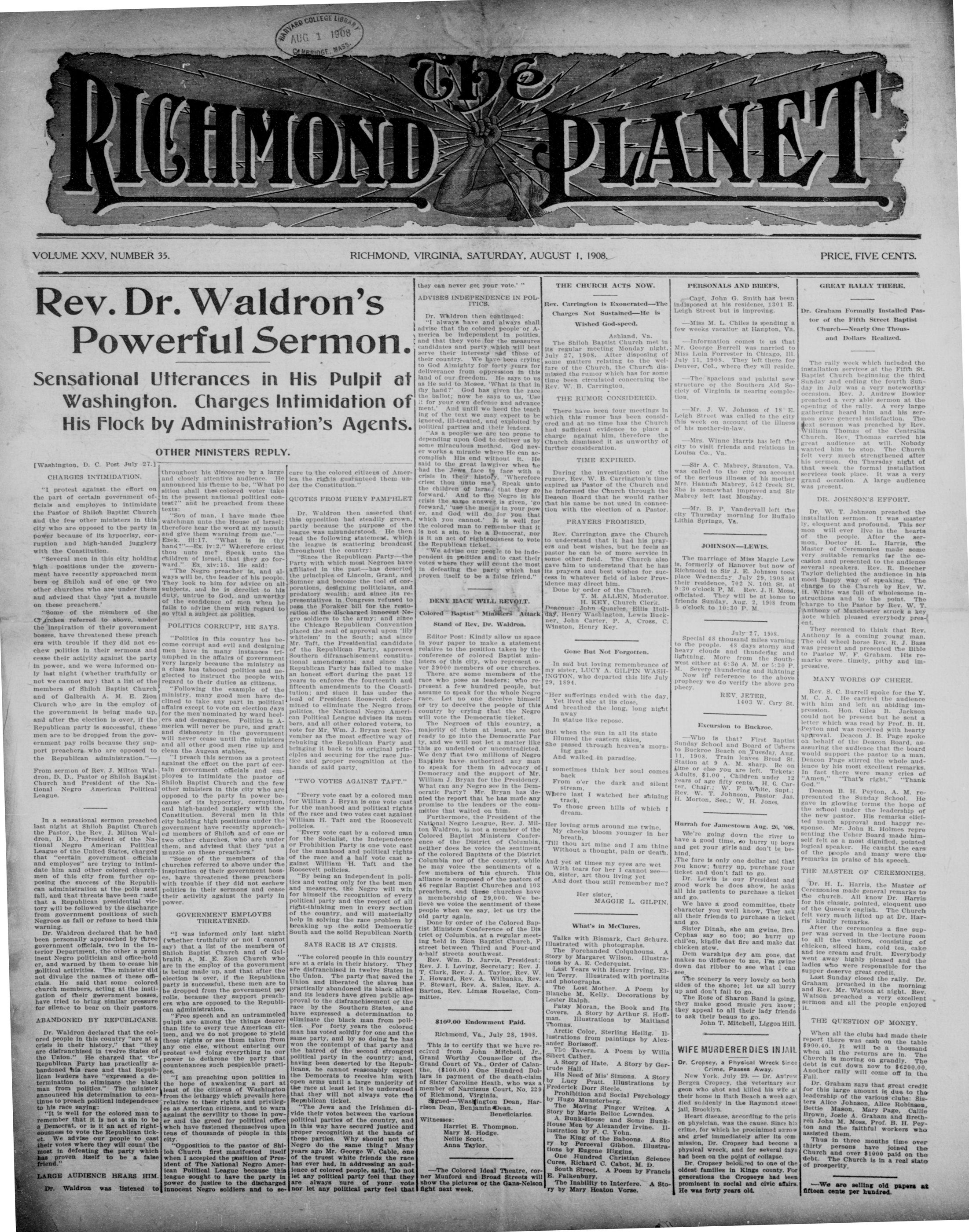
Rev. Dr. Waldron's Powerful Sermon.
Sensational Utterances in His Pulpit at Washington. Charges Intimidation of His Flock by Administration's Agents.
VOLUME XXV, NUMBER 35.
Rev. Dr
Powe
Sensational Uf
Washington
His Flock by
[Washington, D. C. Post July 27.]
CHARGES INTIMIDATION.
"I protest against the effort on the part of certain government officials and employees to intimidate the Pastor of Shiloh Baptist Church and the few other ministers in this city who are opposed to the party in power because of its hypocrisy, corruption and high-handed jugglery with the Constitution.
"Several men in this city holding high positions under the government have recently approached members of Shiloh and of one or two other churches who are under them and advised that they 'put a muzzle on these preachers.'
"Some of the members of the Churches referred to above, under the inspiration of their government bosses, have threatened these preachers with trouble if they did not eschew politics in their sermons and cease their activity against the party in power, and we were informed only last night (whether truthfully or not we cannot say) that a list of the members of Shiloh Baptist Church and of Galbraith A. M. E. Zion Church who are in the employ of the government is being made up, and after the election is over, if the Republican party is successful, these men are to be dropped from the government pay rolls because they support preachers who are opposed to the Republican administration." From sermon of Rev. J. Milton Waldron, D. D., Pastor of Shiloh Baptist Church and President of the National Negro American Political League.
In a sensational sermon preached last night at Shiloh Baptist Church the Pastor, the Rev J. Milton Waldron, D. D., President of the National Negro American Political League of the United States, charged that "certain government officials and employees" are trying to intimidate him and other colored churchmen of this city from further opposing the success of the Republican administration at the polls next fall, and that threats have been made that a Republican presidential victory will be followed by the discharge from government positions of such Negroes as fall or refuse to heed this warning.
Dr. Waldron declared that he had been personally approached by three government officials, two in the Interior Department, the other a prominent Negro politician and office-hold, and warned by them to cease his political activities. The minister did not divulge the names of these officials. He said that some colored church members, acting at the institution of their government bosses, have tried to bring similar pressure for silence to bear on their pastors.
ABANDONED BY REPUBLICANS.
Dr. Waldron declared that the colored people in this country "are at a crisis in their history," that "they are disfranchised in twelve States of the Union." He charged that the Republican Party has practically abandoned his race and that Republican leaders have "expressed a determination to eliminate the black man from politics." The minister announced his determination to continue to preach political independence to his race saying:
"It is well for the colored man to remember that it is not a sin to be a Democrat, or is it an act of righteousness to vote the Republican ticket. We advise our people to cast their votes where they will count the most in defeating the party which has proven itself to be a false friend."
LARGE AUDIENCE BEARS HIM.
Dr. Waldron was listened to
OTHER MINISTERS REPLY.
throughout his discourse by a large and closely attentive audience. He announced his theme to be, "What position shall the colored voter take in the present national political contest?" and he preached from these texts:
"Son of man, I have made the watchman unto the House of Israel; therefore hear the word at my mouth and give them warning from me."—Ezek. iii:17. "What is in thy hand?"—Ex. iv:2. Wherefore cried thou unto me? Speak unto the children of Israel, that they go forward." Ex. xiv:15. He said:
"The Negro preacher is, and always will be, the leader of his people. They look to him for advice on all subjects, and he is derelict to his duty, untrue to God, and unworthy of the confidence of men when he falls to advise them with regard to so vital a subject as politics.
POLITICS CORRUPT, HE SAYS.
"Politics in this country has become corrupt and evil and designing men have in many instances triumphed in the affairs of government very largely because the government as a class has tabooed politics and neglected to instruct the people with regard to their duties as citizens.
"Following the example of the ministry, many good men have declined to take any part in political affairs except to vote on election days for the men nominated by ward healers and de-magogues. Politics in America will never be pure, and graft and dishonesty in the government will never cease until the ministers and all other good men rise up and clean the Augean stables.
"I preach this sermon as a protest against the effort on the part of certain government officials and employees to intimidate the pastor of Shiloh Baptist Church and the few other ministers in this city who are opposed to the party in power because of its hypocrisy, corruption, and high-handed juggery with the Constitution. Several men in this city holding high positions under the government have recently approached members of Shiloh and of one or two other churches, who are under them, and advised that they 'put a muzzle on these preachers.'
"Some of the members of the churches referred to above under the inspiration of their government bosses, have threatened these preachers with trouble if they did not eschew politics in their sermons and cease their activity against the party in power.
GOVERNMENT EMPLOYES
THREATENED.
"I was informed only last night (whether truthfully or not I cannot say) that a list of the members of Shiloh Baptist Church and of Galbraith A. M. E. Zion Church who are in the employ of the government is being made up, and that after the election is over, if the Republican party is successful, these men are to be dropped from the government pay rolls, because they support preachers who are opposed to the Republican administration.
"Free speech and an untrammeled pulpit are among the things dearer than life to every true American citizen, and we do not propose to yield these rights or see them taken from any one else, without entering our protest and doing everything in our power to dethrone the party that countenances such pessible practices.
"I am preaching upon politics in the hope of awakening a part at least of the citizens of Washington from the lethargy which prevails here relative to their rights and privileges as American citizens, and to warn against the servility to those in power and the greed for political office which have fastened themselves upon tens of thousands of people in this city.
"Opposition to the pastor of Shiloh Church first manifested itself when I accepted the position of President of The National Negro American Political League because this league sought to have the party in power do justice to the discharged innocent Negro soldiers and to se-
RICHMOND, VIRGINIA, SATURDAY, AUGUST 1, 1908.
cure to the colored citizens of America the rights guaranteed them under the Constitution."
QUOTES FROM FIERY PAMPHLET
Dr. Waldron then asserted that this opposition had steadily grown, partly because the purpose of the league was misunderstood. He then read the following statement, which the league is scattering broadcast throughout the country:
"Since the Republican Party—the Party with which most Negroes have affiliated in the past—has deserted the principles of Lincoln, Grant, and Sumner and become the tool of corporations, designing politicians, and predatory wealth; and since its representatives in Congress refused to pass the Foraker bill for the restoration of the discharged innocent Negro soldiers to the army; and since the Chicago Republican Convention placed the seal of approval upon 'illy whiteism' in the South; and since Mr. Taft, the Presidential candidate of the Republican Party, approves Southern disfranchisement constitutional amendments; and since the Republican Party has failed to make an honest effort during the past 12 years to enforce the fourteenth and fifteenth amendments to the Constitution; and since it has under the lead of President Roosevelt determined to eliminate the Negro from politics, the National Negro American Political League advises its members, and all other colored voters, to vote for Mr. Wm. J. Bryan next November as the most effective way of rebuking the Republican Party and bringing it back to its original principles and securing for the race justice and proper recognition at the hands of said party.
"TWO VOTES AGAINST TAFT."
"Every vote cast by a colored man for William J. Bryan is one vote cast for the manhood and political rights of the race and two votes cast against William H. Taft and the Roosevelt policies.
"Every vote cast by a colored man for the Socialist, the Independence or Prohibition Party is one vote cast for the manhood and political rights of the race and a half vote cast against William H. Taft and the Roosevelt policies.
"By being an independent in politics and voting only for the best men and measures, the Negro will win for himself the recognition of every political party and the respect of all right-thinking men in every section of the country, and will materially help in solving the race problem by breaking up the solid Democratic South and the solid Republican North
SAYS RACE IS AT CRISIS
"The colored people in this country are at a crisis in their history. They are disfranchised in twelve States in the Union. The party that saved the Union and liberated the slaves has practically abandoned its black allies and its leaders have given public approval to the disfranchisement of the race by the Southern States, and have expressed a determination to eliminate the black man from politics. For forty years the colored man has voted solidly for one and the same party, and by so doing he has won the contempt of that party and the hatred of the second strongest political party in the country; and, having been deserted by the Republicans, he cannot reasonably expect the Democrats to receive him with open arms until a large majority of the race at least let it be understood that they will not always vote the Republican ticket.
"The Jews and the Irishmen divide their votes between the various political parties of the country, and in this way have secured justice and proper recognition at the hands of these parties. Why should not the Negro do the same thing? Many years ago Mr. George W. Cable, one of the truest white friends the race has ever had, in addressing an audience of colored people, said, "Do not let any political party feel that they are always sure of your vote nor let any political party feel that
they can never get your vote.' "
ADVISES INDEPENDENCE IN POLITICS.
Dr. Waldron then continued:
Would then continue:
"I always have and always shall advise that the colored people of America be dependent in politics, and that they be the measures candidates and party which will best serve their interests and those of their country. We have been crying to God Almighty for forty years for deliverance from oppression in this land of our freedom. He says to us as He said to Moses, 'What is that in thy hand?' God has given his race the ballot; now he says to us, 'Use it for your own defense and advancement.' And until we heed the teaching of the text we may expect to be ignored, ill-treated, and exploited by political parties and their leaders.
"As a people we are too prone to depending upon God to deliver us by some miraculous method. God never works a miracle where He can accomplish. His end without it. He said to the great lawyer when he had the Jews face to face with a crisis in their history. 'Wherefore priest thou unto me! Speak unto the children of Israel that they go forward.' And to the Negro in his crisis the same answer is given, go forward, 'use the mercy in your power, and God will do for you that which you cannot.' It is well for the colored man to remember that it is not a sin to be a Democrat, nor is it an act of righteousness to vote the Republican ticket.
"We advise people to be independent in politics and to cast their votes where they will count the most in defeating the party which has proven itself to be a false friend."
DENY RACE WILL REVOLT.
Colored Baptist Ministers Attack
Stand of Rev. Dr. Waldron.
Editor Post: Kindly allow us space in your paper to make a statement relative to the position taken by the conference of colored Baptist ministers of this city, who represent over 29000 members of our churches. There are some members of the race who pose as leaders; who represent a few hundred people, but assume to speak for the whole Negro race. Let no one deceive himself or try to deceive the people of this country by crying that the Negro will vote the Democratic ticket.
The Negroes of this country, a majority of them at least, are not ready to go into the Democratic Party, and we will not let a matter like this go undenied or uncontradicted. We deny that two millions of Negro Baptists have authorized any man to speak for them in advocacy of Democracy and the support of Mr. William J. Bryan for the Presidency. What can any Negro see in the Democratic Party? Mr. Bryan has denied the report that he has made any promise to the leaders or the committee that waited on him.
Furthermore, the President of the National Negro League, Rev. J. Milton Waldron, is not a member of the Colored Baptist Ministers Conference of the District of Columbia, neither does he voice the sentiment of the colored Baptists of the District Columbia nor of the country, while he may voice the sentiments of a few members of his church. This alliance is composed of the pastors of 46 regular Baptist Churches and 103 preachers, and these churches have a membership of 29,000. We believe we voice the sentiment of these people when we say, let us try the old party again.
Done by order of the Colored Baptist Ministers Conference of the District of Columbia, at a regular meeting held in Zion Baptist Church, F street between Third and Four-and a-half streets southwest.
Rev. Wm. D. Jarvis, President; Rev. J. I. Loving, Secretary; Rev. J. T. Clark, Rev. J. A. Taylor, Rev. W. J. Howard, Rev. A. Wilbanks, Rev. P. Stewart, Rev. A. Sales, Rev. A. Barton, Rev. Limas Rouelac, Committee.
$10^{0.00} Endowment Paid
Richmond, Va., July 28, 1908.
This is to certify that we have received from John Mitchell, Jr. Grand Worthy Counsellor of the Grand Court of Va. Order of Calanthe, ($100.00) One Hundred Dollars in payment of the death-claim of Sister Caroline Heath, who was a member of Narcissus Court, No. 229 of Richmond, Virginia.
Signed—Washington Dean, Harrison Dean, Benjamin Dean.
Beneficiaries:
Witnesses:
Harriet E. Thompson.
Mary M. Hodge.
Nellie Scott.
Anna Taylor.
—The Colored Ideal Theatre, corner Munford and Broad Streets will show the pictures or the Gans-Nelson fight next week.
THE CHURCH ACTS NOW.
Rev. Carrington is Exonerated—The Charges Not Sustained—He is
Wished God-speed.
Ashland, Va
The Shiloh Baptist Church met in its regular meeting Monday night, July 27, 1908. After disposing of some matters relating to the welfare of the Church, the Church dismissed the rumor which has for some time been circulated concerning the Rev, W. B. Carrington.
THE RUMOR CONSIDERED.
There have been four meetings in which this rumor has been considered and at no time has the Church had sufficient evidence to place a charge against him, therefore the Church dismissed it as unworthy of further consideration.
TIME EXPIRED
During the investigation of the rumor, Rev. W. B. Carrington's time expired as Pastor of the Church and he informed the Church through the Deacon Board that he would rather that his name be not used in connection with the election of a Pastor.
PRAYERS PROMISED
Rev. Carrington gave the Church to understand that it had his prayers and best wishes, but he feels as pastor he can be of more service in some other field. The Church also gave him to understand that he has its prayers and best wishes for success in whatever field of labor Providence may direct him.
Done by order of the Church.
T. M. ALLEN, Moderator.
H. KEY, Church Clerk.
Deacous: John Quarles, Ellis Holiday, Henry Washington, Lewis Buckner, John Carter, P. A. Cross, C. Winston, Henry Key.
Gone But Not Forgotten.
In sad but loving remembrance of my sister, LUCY A. GILPIN WASHINGTON, who departed this life July 29, 1894.
"Her sufferings ended with the day. Yet lived she at its close.
And breathed the long, long night away
In statue like repose.
But when the sun in all its state
Illumed the eastern skies.
She passed through heaven's morning gate
And walked in paradise.
I sometimes think her soul comes back
From o'er the dark and silent stream.
Where last I watched her shining track,
To those green hills of which I dream.
Her loving arms around me twine,
My cheeks bloom younger in her breath,
Till thou art mine and I am thine
Without a thought, pain or death.
And yet at times my eyes are wet
With tears for her I cannot see—
Oh, sister, art thou living yet
And dost thou still remember me?
Her sister,
MAGGIE L. GILPIN.
What's in McClures
Talks with Bismark, Carl Schurz.
Illustrated with photographs.
The Forehanded Colquhouns. A Story by Margaret Wilson. Illustrations by A. E. Cederquist.
Last Years with Henry Irving, Ellen Terry. Illustrated with portraits and photographs.
The Lost Mother. A Poem by Blanche M. Kelly. Decorations by Lester Ralph.
Patsy Moran, the Book and Its Covers. A Story by Arthur S. Hoffman. Illustrations by Mattland Thomas.
Arctic Color, Sterling Hellig. Illustrations from paintings by Alexander Borissoff.
The Tavern. A Poem by Willa Silbert Cather.
A Story of Hate. A Story by Gertrude Hall.
His Need of Mis' Simons. A Story by Lucy Pratt. Illustrations by Frederick Dorr Steele.
Prohibition and Social Psychology by Hugo Munsterberg.
The Moving Finger Writer.
The Moving Finger Writes. A
Story by Marie Belloc Lowndes.
Bene Lowndes.
A Bunk-House, and Some Bunk-House Men by Alexander Irvine.
Illustration by F. C. Yok.
The King of the Baboons. A Story by Perceval Gibbon. Illustrations by Eugene Higgins.
One Hundred Christian Science Cures, Richard C. Cabot, M. D.
South Street. A Poem by Francis E. Falkenbury.
The Inability to Interfere. A Story by Mary Heaton Vorse.
PERSONALS AND BRIEF
—Capt, John G. Smith has been indisposed at his residence, 1301 E. Leigh Street but is improving.
—Miss M. L. Chiles is spending a few weeks vacation at Hampton, Va.
—Information comes to us that Mr. George Burrell was married to Miss Lula Forrester in Chicago, Ill. July 11, 1908. They left there for Denver, Col., where they will reside.
—The spacious and palatial new structure of the Southern Aid Society of Virginia is nearing completion.
—Mr. J. W. Johnson of 18 E. Leigh Street was called to the city this week on account of the illness of his mother-in-law.
—Mrs. Winne Harris has left the city to visit friends and relations in Louisa Co., Va.
—Sir A. C. Mabrey, Staunton, Va. was called to the city on account of the serious illness of his mother Mrs. Hannah Mabrey, 542 Creek St. She is somewhat improved and Sir Mabrey last left Monday.
—Mr. B. P. Vandervall left the city Thursday morning for Buffalo Lithia Springs, Va.
JOHNSON—LEWIS
The marriage of Miss Maggie Lewis, is formerly of Hanover but now of Richmond to Sir J. E. Johnson took place Wednesday, July 29, 1908 at their residence, 702 N. 10th St. at M. Rev. J. H. Moss, officiated. They will be at home to friends Sunday, Aug. 2, 1908 from 5 o'clock to 10:30 P. M.
July 27 1908
Special 48 thousand miles warning to the people. 48 days stormy and heavy clouds and thundering and lightning. More from the South-west either at 6:30 A. M. or 5:30 P. M. Severe thundering and lightning Now in reference to the above prophecy we do verify the above prophcy.
REV. JETER.
1403 W. Cary St.
Excursion to Buckroc
—Who is that? First Baptist
Sunday School and Board of Usherst
to Buckroe Beach on Tuesday, Aug.
11, 1908. Train leaves Broad St.
Station at 9 A. M. sharp. Be on
time or else you are left. Tickets:
Adults, $1.00, Children under
12 years of age fifty cents. H. G. Carter,
Chair;. W. F. White, Supt;
Rev. W. T. Johnson, Bastor; Jas.
H. Morton, Sec.; W. H. Jorge.
Hurrah for Jamestown Aug. 26.
We're going down the river to have a good time, so hurry up boys and get your girls and don't be behind.
The fare is only one dollar and that you know; hurry up, purchase your ticket and don't fail to go.
Dr. Lewis is our President and good work he does show, he asks all his patients to purchase a ticket and go.
We have a good committee, their character you well know. They ask all their friends to purchase a ticket and go.
Sister Dinah, she am gwine, Bro. Cephas say so too; so hurry up chil'en, kindle dat fire and make dat chicken stew.
Dem warships dey am gone, dat makes no diffence to me, I'm gwine down dat ribber to see what I can see.
The scenery is very lovely on both sides of the shore; let us all hurry up and don't fail to go.
The Rose of Sharon Band is going, they make good music you know; they appeal to all their lady friends to ask their beaus to go.
John T. Mitchell, Liggon Hill
WIFE MURDERERDIES INJAIL
Dr. Cropssey, a Physical Wreck Since Crime, Passes Away.
New York, July 29. — Dr. Andrew Bergen Cropssey, the veterinary surgeon who shot and killed his wife at their home in Bath Beach a week ago, died suddenly in the Raymond street fall, Brooklyn.
Heart disease, according to the prism on physician, was the cause. Since his crime, for which he proclaimed sorrow and grief immediately after its commission, Dr. Cropssey had become a physical wreck, and for several days had been on the point of collapse.
Dr. Cropssey belonged to one of the oldest families in Kings county. For generations the Cropsyses had been prominent in social and civic affairs. He was forty years old.
GREAT RALLY THERE.
Dr. Graham Formally Installed Pastor of the Fifth Street Baptist Church—Nearly One Thousand Dollars Realized.
The rally week which included the installation services at the Fifth St. Baptist Church beginning the third Sunday and ending the fourth Sunday in July was a very noteworthy occasion. Rev. J. Andrew Bowler preached a very able sermon at the opening of the rally. A very large gathering heard him and his sermon gave general satisfaction. The next sermon was preached by Rev. William Thomas of the Centralia Church. Rev. Thomas carried his great audience at will. Nobody wanted him to stop. The Church felt very much strengthened after his sermon. On Thursday night of that week the formal installation services took place. It was a very grand occasion. A large audience was present.
DR. JOHNSON'S EFFORT.
Dr. W. T. Johnson preached the installation sermon. It was masterly, eloquent and profound. This ser mon will ever live in the hearts of the people. After the sermon, Doctor H. L. Harris, the Master of Ceremonies made some very suitable remarks for the occasion and presented to the audience several speakers. Rev. R. Beecher Taylor delighted the audience in his most happy way of speaking. The charge to the Church by Rev. W. H. White was full of wholesome instructions and to the point. The charge to the Pastor by Rev. W. T. Anthony of Manchester struck a key note which pleased everybody present. They seemed to think that Rev. Anthony is a coming young man. The old wheel horse Rev. R. J. Bass was present and presented the Bible to Pastor W. F. Graham. His remarks were timely, pithy and impressive.
MANY WORDS OF CHEER
Rev. S. C. Burrell spoke for the Y. M. C. A. He carried the audience with him and left an abiding impression. Hon. Giles B. Jackson could not be present but he sent a letter which was read by Prof. B. H. Peyton and was received with hearty approval. Deacon J. B. Page spoke on behalf of the Deacon Board, assuring the audience that the board would support the pastor to a man. Deacon Page stirred the whole audience by his most excellent remarks. In fact there were many cries of "Amen." "That's right." "Thank God."
Deacon B. H. Peyton, A. M. represented the Sunday School. He gave in glowing terms the hope of the school under the leadership of the new pastor. His remarks elicited much approval and happy response. Mr. John R. Holmes representing the Usher Board made himself felt as a most dignified, pointed logical speaker. He caught the ears of the people and many were the remarks in praise of his speech.
THE MASTER OF CEREMONIES
Dr. H. L. Harris, the Master of Ceremonies made general remarks to the church. All know Dr. Harris for his classic, pointed, eloquent use of the Queen's english. The Church felt very much lifted up at Dr. Harris' kindly remarks.
After the ceremonies a fine supper was served in the lecture room to all the visitors, consisting of chicken, sliced ham, cold tea, cake and ice cream and fruit. Everybody went away highly pleased and the ladies who were responsible for the supper deserve great credit.
Last Sunday closed the rally. Dr. Graham preached in the morning and Rev. Mr. Watson at night. Rev. Watson preached a very excellent sermon and all the people enjoyed it.
THE QUESTION OF MONEY
When all the clubs had made their report there was cash on the table $900.40. It will be a thousand when all the returns are in. The Church is moving on grandly. The debt is cut down now to $6200.00. Another rally will come off in the Fall.
Dr. Graham says that great credit for this large amount is due to the leadership of the various clubs: Sisters Alice Johnson, Alice Robinson, Bettie Mason, Mary Page, Callie Brown, Josie A. Graham and Brethren John M. Moss, Prof. B. H. Peyton and the faithful workers who assisted them.
Thus in three months time over thirty persons have joined the Church and over $1000 paid on the debt. The Church is in a real state of prosperity.
We are selling old papers at fifteen cents per hundred.
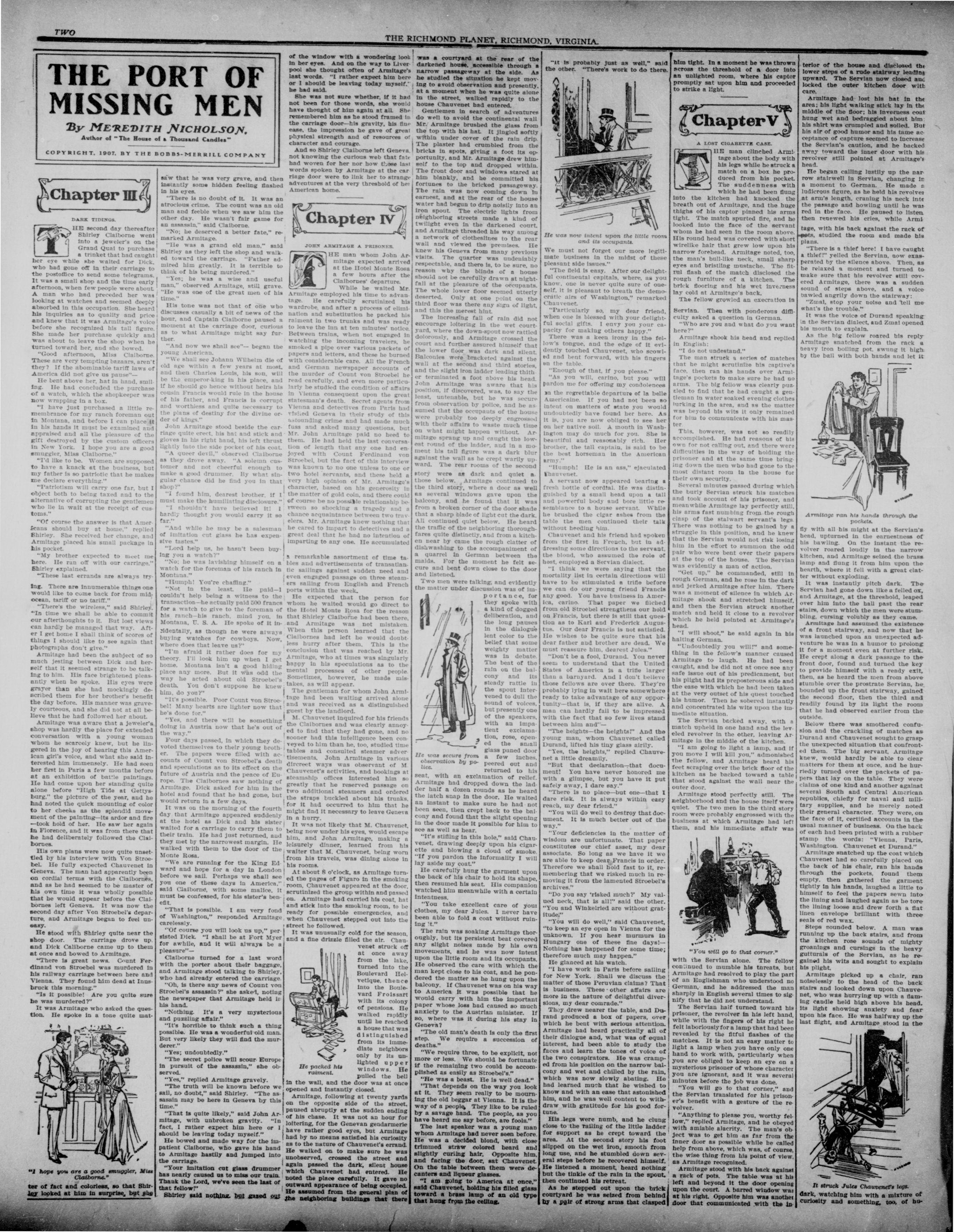
THE PORT OF MISSING MEN
By MEREDITH NICHOLSON.
Author of "The House of a Thousand Candles"
COPYRIGHT, 1907. BY THE BOBBS-MERRILL COMPANY
TWO
Chapter III
DARK TIDINGS.
HE second day thereafter Shirley Claiborne went into a jeweler's on the Grand Qual to purchase a trinket that had
HE second day thereafter Shirley Clalborne went into a jeweler's on the Grand Qual to purchase a trinket that had caught her eye while she waited for Dick, who had gone off in their carriage to the postoffice to send some telegrams. It was a small shop and the time early afternoon, when few people were about. A man who had preceded her was looking at watches and seemed deeply absorbed in this occupation. She heard his inquiries as to quality and price and knew that it was Armitage's voice before she recognized his tall figure. She made her purchase quickly and was about to leave the shop when he turned toward her, and she bowed. "Good afternoon, Miss Clalborne. These are very tempting bazaars, aren't they? If the abominable tariff laws of America did not give us pause"—
He bent above her, hat in hand, smiling. He had concluded the purchase of a watch, which the shopkeeper was now wrapping in a box.
"I have just purchased a little remembrance for my ranch foreman out in Montana, and before I can place it in his hands it must be examined and appraised and all the pleasure of the gift destroyed by the custom officers in New York. I hope you are a good smuggler, Miss Claiborne."
"I'd like to be. Women are supposed to have a knack at the business, but my father is so patriotic that he makes me declare everything."
"Patroltism will carry one far, but I object both to being taxed and to the alternative of corrupting the gentlemen who lie in wait at the receipt of customs."
"Of course the answer is that Americans should buy at home," replied Shirley. She received her change, and Armitage placed his small package in his pocket.
"My brother expected to meet me here. He ran off with our carriage." Shirley explained. "These last errands are always trying. There are innumerable things one would like to come back for from mid-ocean, tariff or no tariff." "There's the wireless," said Shirley. "In time we shall be able to commit our afterthoughts to it. But lost views can hardly be managed that way. After I get home I shall think of scores of things I should like to see again that photographs don't give." Armitage had been the subject of so much jesting between Dick and herself that it seemed strange to be talking to him. His face brightened pleasantly when he spoke. His eyes were grayer than she had mockingly described them for her brother's benefit the day before. His manner was gravely courteous, and she did not at all believe that he had followed her about.
Armitage was aware that a jeweler's shop was hardly the place for extended conversation with a young woman whom he scarcely knew, but he lingered in the joy of hearing this American girl's voice, and what she said interested him immensely. He had seen her first in Paris a few months before at an exhibition of battle paintings. He had come upon her standing quite alone before "High Tide at Getsysburg," the picture of the year, and he had noted the quick mounting of color to her cheeks as the splendid movement of the painting—its ardor and fire—took hold of her. He saw her again in Florence, and it was from there that he had deliberately followed the Clalbornes.
His own plans were now quite unsettled by his interview with Von Stroebel. He fully expected Chauvenet in Geneva. The man had apparently been on cordial terms with the Clalbornes, and as he had seemed to be master of his own time it was wholly possible that he would appear before the Clalbornes left Geneva. It was now the second day after Von Stroebel's departure, and Armitage began to feel uneasy.
He stood with Shirley quite near the shop door. The carriage drove up, and Dick Callborne came up to them at once and bowed to Armitage.
"There is great news. Count Ferdinand von Stroebel was murdered in his railway carriage between here and Vienna. They found him dead at Innsbruck this morning."
"Is it possible? Are you quite sure he was murdered?"
It was Armitage who asked the question. He spoke in a tone quite mat-
"I hope you are a good smuggler, Miss Clatborne." ter of fact and colorless, so that Shirley looked at him in surprise, but she
saw that he was very grave, and then instantly some hidden feeling flashed in his eyes.
"There is no doubt of it. It was an atrocious crime. The count was an old man and feeble when we saw him the other day. He wasn't fair game for an assassin," said Claiborne.
"No; he deserved a better fate," remarked Armitage.
"He was a grand old man," said Shirley as they left the shop and walked toward the carriage. "Father admired him greatly. It is terrible to think of his being murdered."
"Yes; he was a wise and useful man," observed Armitage, still grave.
"He was one of the great men of his time."
His tone was not that of one who discusses casually a bit of news of the hour, and Captain Claiborne paused a moment at the carriage door, curious as to what Armitage might say further.
"And now we shall see"—began the young American.
"We shall see Johann Wilhelm die of old age within a few years at most, and then Charles Louis, his son, will be the emperor-king in his place, and if he should go hence without heirs his cousin Francis would rule in the house of his father, and Francis is corrupt and worthless and quite necessary to the plans of destiny for the divine order of kings."
John Armitage stood beside the carriage quite erect, his hat and stick and gloves in his right hand, his left thrust lightly into the side pocket of his coat.
"A queer devil," observed Claiborne as they drove away. "A solemn customer and not cheerful enough to make a good drummer. By what singular chance did he find you in that shop?"
"I found him, dearest brother, if I must make the humiliating disclosure."
"I shouldn't have believed it! I hardly thought you would carry it so far."
"And while he may be a salesman of imitation cut glass he has expensive tastes."
"Lord help us, he hasn't been buying you a watch?"
"No; he was lavishing himself on a watch for the foreman of his ranch in Montana."
"Humph! You're chaffing."
"Not in the least. He paid—I couldn't help being a witness to the transaction—he actually paid 500 francs for a watch to give to the foreman of his ranch—his ranch, mind you, in Montana, U. S. A. He spoke of it incidentally, as though he were always buying watches for cowboys. Now, where does that leave us?
"I'm afraid it rather does for my theory. I'll look him up when I get home. Montana isn't a good hiding place any more. But it was odd the way he acted about old Stroebel's death. You don't suppose he knew him, do you?
"It's possible. Poor Count von Stroebel! Many hearts are lighter now that he's done for."
"Yes, and there will be something doing in Austria now that he's out of the way."
Four days passed, in which they devoted themselves to their young brother. The papers were filled with accounts of Count von Stroebel's death and speculations as to its effect on the future of Austria and the peace of Europe. The Claiborneens saw nothing of Armitage. Dick asked for him in the hotel and found that he had gone, but would return in a few days.
It was on the morning of the fourth day that Armitage appeared suddenly at the hotel as Dick and his sister waited for a carriage to carry them to their train. He had just returned, and they met by the narrowest margin. He walked with them to the door of the Monte Rosa.
"We are running for the King Edward and hope for a day in London before we sail. Perhaps we shall see you one of these days in America," said Claiborne, with some malice, it must be confessed, for his sister's benefit.
"That is possible. I am very fond of Washington," responded Armitage carelessly.
"Of course you will look us up," persisted Dick. "I shall be at Fort Myer for awhile, and it will always be a pleasure"—
Clalborne turned for a last word with the porter about their baggage, and Armitage stood talking to Shirley, who had already entered the carriage.
"Oh, is there any news of Count von Stroebel's assassin?" she asked, noting the newspaper that Armitage held in his hand.
"Nothing. It's a very mysterious and puzzling affair."
"It's horrible to think such a thing possible. He was a wonderful old man. But very likely they will find the murderer."
"Yes; undoubtedly."
"The secret police will scour Europe in pursuit of the assassin," she observed.
"Yes," replied Armitage gravely.
"The truth will be known before we sail, no doubt," said Shirley. "The assassin may be here in Geneva by this time."
"That is quite likely," said John Armitage, with unbroken gravity. "In fact, I rather expect him here or I should be leaving today myself."
He bowed and made way for the impatient Claiborne, who gave his hand to Armitage hastily and jumped into the carriage.
"Your imitation cut glass drummer has nearly caused us to miss our train. Thank the Lord, we've seen the last of that fellow."
Shirley said nothing, but gazed out
THE RICHMOND PLANET, RICHMOND, VIRGINIA
of the window with a wondering look in her eyes. And on the way to Liverpool she thought often of Armitage's last words. "I rather expect him here or I should be leaving today myself," he had said.
She was not sure whether, if it had not been for those words, she would have thought of him again at all. She remembered him as he stood framed in the carriage door—his gravity, his fine ease, the impression he gave of great physical strength and of resources of character and courage.
And so Shirley Claiborne left Geneva, not knowing the curious web that fate had woven for her nor how those last words spoken by Armitage at the carriage door were to link her to strange adventures at the very threshold of her American home.
Chapter IV
JOHN ARMITAGE A PRISONER.
HE man whom John Armitage expected arrive at the Hotel Monte Rosso a few hours after the Claiborne's departure.
HE man whom John Armitage expected arrived at the Hotel Monte Rosa a few hours after the Claibornes' departure.
While he waited Mr. Armitage employed his time to advantage. He carefully scrutinized his wardrobe, and after a process of elimination and substitution he packed his raiment in two trunks and was ready to leave the inn at ten minutes' notice. Between trains, when not engaged in watching the incoming travelers, he smoked a pipe over various packets of papers and letters, and these he burned with considerable care. All the French and German newspaper accounts of the murder of Count von Stroebel he read carefully, and even more particularly he studied the condition of affairs in Vienna consequent upon the great statesman's death. Secret agents from Vienna and detectives from Paris had visited Geneva in their study of this astounding crime and had made much fuss and asked many questions, but Mr. John Armitage paid no heed to them. He had held the last conversation of length that any one had enjoyed with Count Ferdinand von Stroebel, but the fact of this interview was known to no one unless to one or two hotel servants, and these held a very high opinion of Mr. Armitage's character, based on his generosity in the matter of gold coin, and there could of course be no possible relationship between so shocking a tragedy and a chance acquaintance between two travelers. Mr. Armitage knew nothing that he cared to impart to detectives and a great deal that he had no intention of imparting to any one. He accumulated
a remarkable assortment of time tables and advertisements of transatlantic sailings against sudden need and even engaged passage on three steamers sailing from English and French ports within the week.
He expected that the person for whom he waited would go direct to the Hotel Monte Rosa for the reason that Shirley Clalborne had been there, and Armitage was not mistaken. When this person learned that the Clalbornes had left he would doubtless hurry after them. This is the conclusion that was reached by Mr. Armitage, who at times was singularly happy in his speculations as to the mental processes of other people. Sometimes, however, he made mistakes, as will appear.
The gentleman for whom John Armitage had been waiting arrived alone and was received as a distinguished guest by the landlord.
M. Chauvenet inquired for his friends the Claibornes and was clearly annoyed to find that they had gone, and no sooner had this intelligence been conveyed to him than he, too, studied time tables and consulted steamer advertisements. John Armitage in various direct ways was observant of M. Chauvenet's activities, and bookings at steamship offices interested him so greatly that he reserved passage on two additional steamers and ordered the straps buckled about his trunks, for it had occurred to him that he might find it necessary to leave Geneva in a hurry.
It was not likely that M. Chauvenet, being now under his eyes, would escape him, and John Armitage, making a leisurely dinner, learned from his waiter that M. Chauvenet, being worn from his travels, was dining alone in his rooms.
At about 8 o'clock, as Armitage turned the pages of Figaro in the smoking room, Chauvenet appeared at the door, scrutinized the group within and passed on. Armitage had carried his coat, hat and stick into the smoking room, to be ready for possible emergencies, and when Chauvenet stepped out into the street he followed.
It was unusually cold for the season, and a fine drizzle filled the air. Chau
venet struck off at once away from the lake, turned into the Boulevard Helvetique, thence into the Boulevard Froissart with its colony of pensions. He walked rapidly until he reached a house that was distinguished from its immediate neighbors only by its unlighted upper windows. He pulled the bell
```markdown
```
He packed his raiment. windows. He pulled the bell in the wall, and the door was at once opened and instantly closed. Armitage, following at twenty yards on the opposite side of the street, paused abruptly at the sudden ending of his chase. It was not an hour for loitering, for the Genevan gendarmerie have rather good eyes, but Armitage had by no means satisfied his curiosity as to the nature of Chauvenet's errand. He walked on to make sure he was unobserved, crossed the street and again passed the dark, silent house which Chauvenet had entered. He noted the place carefully. It gave no outward appearance of being occupied. He assumed from the general plan of the neighboring buildings that there
was a courtyard at the rear of the darkened house, accessible through a narrow passageway at the side. As he studied the situation he kept moving to avoid observation and presently, at a moment when he was quite alone in the street, walked rapidly to the house Chauvenet had entered.
Gentlemen in search of adventures do well to avoid the continental wall. Mr. Armitage brushed the glass from the top with his hat. It jingled softly within under cover of the rain drip. The plaster had crumbled from the bricks in spots, giving a foot its opportunity, and Mr. Armitage drew himself to the top and dropped within. The front door and windows stared at him blankly, and he committed his fortunes to the bricked passageway. The rain was now coming down in earnest, and at the rear of the house water had begun to drip noisily into an iron spout. The electric lights from neighboring streets made a kind of twilight even in the darkened court, and Armitage threaded his way among a network of clotheslines to the rear wall and viewed the premises. He knew his Geneva from many previous visits. The quarter was undeniably respectable, and there is, to be sure, no reason why the blinds of a house should not be carefully drawn at nightfall at the pleasure of the occupants. The whole lower floor seemed utterly deserted. Only at one point on the third floor was there any sign of light, and this the merest hint.
The increasing fall of rain did not encourage loitering in the wet courtyard, where the down-spout now rattled dolorously, and Armitage crossed the court and further assured himself that the lower floor was dark and silent. Balconies were bracketed against the wall at the second and third stories, and the slight iron ladder leading thither terminated a foot above his head. John Armitage was aware that his position, if discovered, was, to say the least, untenable, but he was secure from observation by police, and he as assumed that the occupants of the house were probably too deeply engrossed with their affairs to waste much time on what might happen without. Armitage sprung up and caught the lowest round of the ladder, and in a moment his tall figure was a dark blur against the wall as he crept warily upward. The rear rooms of the second story were as dark and quiet a those below. Armitage continued to the third story, where a door as well as several windows gave upon the balcony, and he found that it was from a broken corner of the door shade that a sharp blade of light cut the dark. All continued quiet below. He heard the traffic of the neighboring thoroughfares quite distinctly, and from a kitchen near by came the rough clatter of dishwashing to the accompaniment of a quarrel in German between the maids. For the moment he felt secure and bent down close to the door and listened.
Two men were talking, and evidently the matter under discussion was of im-
asset was of importance, for they spoke with a kind of dogged deliberation, and the long pauses in the dialogue lent color to the belief that some weighty matter was in debate. The beat of the rain on the balcony and its steady rattle in the spout intervened to dull the sound of voices, but presently one of the speakers, with an impatient exclamation, rose, opened the small glass paned door a few inches, peered out and returned to his
H
He was secure from a few inches, observation by po- peered out and lice. returned to his seat, with an exclamation of relief. Armitage had dropped down the ladder half a dozen rounds as he heard the latch snap in the door. He waited an instant to make sure he had not been seen, then crept back to the balcony and found that the slight opening in the door made it possible for him to see as well as hear.
"It's stifling in this hole," sald Chauvenet, drawing deeply upon his cigarette and blowing a cloud of smoke. "If you pardon the informality I will lay aside my coat."
He carefully hung the garment upon the back of his chair to hold its shape, then resumed his seat. His companion watched him meanwhile with a certain intentness.
"You take excellent care of your clothes, my dear Jules. I never have been able to fold a coat without ruining it."
The rain was soaking Armitage thoroughly, but its persistent beat covered any slight noises made by his own movements, and he was now intent upon the little room and its occupants. He observed the care with which the man kept close to his coat, and he pondered the matter as he hung upon the balcony. If Chauvenet was on his way to America it was possible that he would carry with him the important paper whose loss had caused so much anxiety to the Austrian minister. If so, where was it during his stay in Geneva?
"The old man's death is only the first step. We require a succession of deaths."
"We require three, to be explicit, not more or less. We should be fortunate if the remaining two could be accomplished as easily as Stroebel's."
"He was a beast. He is well dead." "That depends on the way you look at it. They seem really to be mourning the old beggar at Vienna. It is the way of a people. They like to be ruled by a savage hand. The people, as you have beard me say before, are fools." The last speaker was a young man whom Armitage had never seen before. He was a decided blond, with close trimmed straw colored beard and slightly curling hair. Opposite him, and facing the door, sat Chauvenet. On the table between them were decanters and liqueur glasses. "I am going to America at once," said Chauvenet, holding his filled glass toward a brass lamp of an old type that hung from the ceiling.
"It is probably just as well," said the other. "There's work to do there.
He was now intent upon the little room and its occupants.
We must not forget our more legitimate business in the midst of these pleasant side issues."
"The field is easy. After our delightful continental capitals, where, as you know, one is never quite sure of oneself, it is pleasant to breath the democratic airs of Washington," remarked Chauvenet.
"Particularly so, my dear friend, when one is blessed with your delightful social gifts. I envy you your capacity for making others happy."
There was a keen irony in the fellow's tongue, and the edge of it evidently touched Chauvenet, who scowled and bent forward, with his fingers on the table.
"Enough of that, if you please."
"As you will, carino, but you will pardon me for offering my condolences on the regrettable departure of la belle Americanine. If you had not been so intent on matters of state you would undoubtedly have found her here. As it is, you are now obliged to see her on her native soil. A mouth in Washington may do much for you. She is beautiful and reasonably rich. Her brother, the tall captain, is said to be the best horseman in the American army."
"Humph! He is an ass," ejaculated khouvenet.
A servant now appeared bearing a fresh bottle of cordial. He was distinguished by a small head upon a tall and powerful body and bore little resemblance to a house servant. While he brushed the cigar ashes from the table the men continued their talk without beeding him.
Chauvenet and his friend had spoken from the first in French, but in addressing some directions to the servant, the blond, who assumed the role of host, employed a Servian dialect.
"I think we were saying that the mortality list in certain directions will have to be stimulated a trifle before we can do our young friend Francis any good. You have business in America, carine. That paper we filched from old Strebel strengths our hold on Francis, but there is still that question as to Karl and Frederick Augustus. Our dear Francis is not satisfied. He wishes to be quite sure that his dear father and brother are dead. We must reassure him, dearest Jules."
"Don't be a fool, Durand. You never seem to understand that the United States of America is a trite larger than a barnyard. And I don't believe those fellows are over there. They're probably lying in wait here somewhere ready to take advantage of any opportunity—that is, if they are alive. A man can hardly fail to be impressed with the fact that so few lives stand between him and"—
"The heights—the heights!" And the young man, whom Chauvenet called Durand, lifted his tiny glass airily.
"Yes, the heights," replied Chauvenet a little dreamily.
"But that declaration—that document! You have never honored me with a glimpse, but you have it put safely away, I dare say."
"There is no place—but one—that I dare risk. It is always within easy reach, my dear friend."
"You will do well to destroy that document. It is much better out of the way."
"Your deficiencies in the matter of wisdom are unfortunate. That paper constitutes our chief asset, my dear associate. So long as we have it we are able to keep dear Francis in order. Therefore we shall hold fast to it, remembering that we risked much in removing it from the lamented Stroebel's archives."
"Do you say 'risked much?' My valued neck, that is all!" said the other.
"You and Winklerlrd are without gratitude."
"You will do well," said Chauvenet, "to keep an eye open in Vienna for the unknown. If you hear murmurs in Hungary one of these fine days!—Nothing has happened for some time; therefore much may happen."
He glanced at his watch.
"I have work in Paris before sailing for New York. Shall we discuss the matter of those Peruvian claims? That is business. These other affairs are more in the nature of delightful diversions, my dear comrade."
They drew nearer the table, and Durand produced a box of papers, over which he bent with serious attention. Armitage had heard practically all of their dialogue and, what was of equal interest, had been able to study the faces and learn the tones of voice of the two conspirators. He was cramped from his position on the narrow balcony and wet and chilled by the rain, which was now slowly abating. He had learned much that he wished to know and with an ease that astonished him, and he was well content to withdraw with gratitude for his good fortune.
His legs were numb, and he clung close to the railing of the little ladder for support as he crept toward the area. At the second story his foot slipped on the wet iron, smooth from long use, and he stumbled down several steps before he recovered himself. He listened a moment, heard nothing but the tinkle of the rain in the spout, then continued his retreat.
As he stepped out upon the brick courtyard he was seized from behind by a pair of strong arms that clasped
him tight. In a moment he was thrown across the threshold of a door into an unlighted room, where his captor promptly sat upon him and proceeded to strike a light.
ChapterV
A LOST CIGARETTE CASE.
HE man clinched Arm'tage about the body with his legs while he struck a match on a box he produced from his pocket. The suddenness with which he had been flung
HE man clinched Armitage about the body with his legs while he struck a match on a box he produced from his pocket. The suddenness with which he had been flung into the kitchen had knocked the breath out of Armitage, and the huge thighs of his captor pinned his arms tight. The match spurted fire, and he looked into the face of the servant whom he had seen in the room above. His round head was covered with short wirelike hair that grew low upon his narrow forehead. Armitage noted, too, the man's bull-like neck, small sharp eyes and bristling mustache. The fitful flash of the match disclosed the rough furniture of a kitchen. The brick flooring and his wet inness lay cold at Armitage's back.
The fellow growled an execration in Servian. Then with ponderous difficulty asked a question in German.
"Who are you and what do you want here?"
Armitage shook his head and replied in English:
"I do not understand."
The man struck a series of matches that he might scrutinize his captive's face, then ran his hands over Armitage's pockets to make sure he had no arms. The big fellow was clearly puzzled to find that he had caught a gentleman in water soaked evening clothes burking in the area, and as the matter was beyond his wits it only remained for him to communicate with his master.
This, however, was not so readily accomplished. He had reasons of his own for not calling out, and there were difficulties in the way of holding the prisoner and at the same time bringing down the men who had gone to the most distant room in the house for their own security.
Several minutes passed during which the burly Servian struck his matches and took account of his prisoner, and meanwhile Armitage lay perfectly still, his arms fast numbing from the rough clasp of the stalwart servant's legs. There was nothing to be gained by a struggle in this position, and he knew that the Servian would not risk losing him in the effort to summon the odd pair who were bent over their papers at the top of the house. The Servian was evidently a man of action.
"Get up," he commanded, still in rough German, and he rose in the dark and jerked Armitage after him. There was a moment of silence in which Armitage shook and stretched himself, and then the Servian struck another match and held it close to a revolver which he held pointed at Armitage's head.
"I will shoot," he said again in his halting German.
"Undoubtedly you will!" and something in the fellow's manner caused Armitage to laugh. He had been caught, and he did not at once see any safe issue out of his predicament, but his plight had its preposterous side and the case with which he had been taken at the very outset of his quest touched his humor. Then he sobered instantly and concentrated his wits upon the immediate situation.
The Servian backed away, with a match upheld in one hand and the leveled revolver in the other, leaving Armitage in the middle of the kitchen.
"I am going to light a lamp, and if you move I will kill you," admonished the fellow, and Armitage heard his feet scraping over the brick floor of the kitchen as he backed toward a table that stood against the wall near the outer door.
Armitage stood perfectly still. The neighborhood and the house itself were quiet. The two men in the third story room were probably engrossed with the business at which Armitage had left them, and his immediate affair was
"You will go to that corner."
with the Servian alone. The fellow continued to mumble his threats, but Armitage had resolved to play the part of an Englishman who understood no German, and he addressed the man sharply in English several times to signify that he did not understand.
The Servian half turned toward his prisoner, the revolver in his left hand, while with the fingers of his right he felt laboriously for a lamp that had been revealed by the fitful flashes of the matches. It is not an easy matter to light a lamp when you have only one hand to work with, particularly when you are obliged to keep an eye on a mysterious prisoner of whose character you are ignorant, and it was several minutes before the job was done.
"You will go to that corner," and the Servian translated for his prisoner's benefit with a gesture of the revolver.
"Anything to please you, worthy fellow," replied Armitage, and he obeyed with amiable alacrity. The man's object was to get him as far from the inner door as possible while he called help from above, which was, of course, the wise thing from his point of view, as Armitage recognized.
Armitage stood with his back against a rack of pots. The table was at his left and beyond it the door opening upon the court. A barred window was at his right. Opposite him was another door that communicated with the in-
terior of the house and disclosed the lower steps of a rude stairway leading upward. The Servian now closed and locked the outer kitchen door with care.
Armitage had lost his hat in the area; his light walking stick lay in the middle of the floor; his inverness coat hung wet and bedraggled about him; his shirt was crumpled and soiled. But his air of good humor and his tame acceptance of capture seemed to increase the Servian's caution, and he backed away toward the inner door with his revolver still pointed at Armitage's head.
He began calling lustily up the narrow stairwell in Servian, changing in a moment to German. He made a ludicrous figure, as he held his revolver at arm's length, craning his neck into the passage and bowling until he was red in the face. He paused to listen, then renewed his cries, while Armitage, with his back against the rack of pets, studied the room and made his plans.
"There is a thief here! I have caught a thief!" yelled the Servian, now exasperated by the silence above. Then, as he relaxed a moment and turned to make sure that his revolver still covered Armitage, there was a sudden sound of steps above, and a voice bawled angrily down the stairway:
"Zmal, stop your noise and tell me what's the trouble."
It was the voice of Durand speaking in the Servian dialect, and Zmai opened his mouth to explain.
As the big fellow roared his reply
Armilitage snatched from the rack a
heavy iron bolling pot. swung it high
by the ball with both hands and let it
Armitage ran his hands through the pockets.
fly with all his might at the Servian's head, upturned in the earnestness of his bawling. On the instant the revolver roared loudly in the narrow kitchen, and Armitage seized the brass lamp and dung it from him upon the hearth, where it fell with a great clatter without exploding. It was instantly pitch dark. The Servian had gone down like a felled ox, and Armitage, at the threshold, leaped over him into the hall past the rear stairs, down which the men were stumbling, cursing volubly as they came.
Armitage had assumed the existence of a front stairway, and now that he was launched upon an unexpected adventure he was in a humor to prolong it for a moment even at further risk. He crept along a dark passage to the front door, found and turned the key to provide himself with a ready exit, then, as he heard the men from above stumble over the prostrate Servian, he bounded up the front stairway, gained the second floor, then the third and readily found by its light the room that he had observed earlier from the outside.
Below there was smothered confusion and the crackling of matches as Durand and Chauvenet sought to grasp the unexpected situation that confronted them. The big servant, Armitage knew, would hardly be able to clear matters for them at once, and he hurriedly turned over the packets of papers that lay on the table. They were claims of one kind and another against several South and Central American republics, chiefly for naval and military supplies, and he merely noted their general character. They were, on the face of it, certified accounts in the usual manner of business. On the back of each had been printed with a rubber stamp the words: "Vienna, Paris, Washington. Chauvenet et Durand."
Armitage snatched up the coat which Chauvenet had so carefully placed on the back of his chair, ran his hands through the pockets, found them empty, then gathered the garment tightly in his hands, laughed a little to himself to feel the papers sewn into the lining and laughed again as he tore the lining loose and drew forth a flat linen envelope brilliant with three seals of red wax.
Steps sounded below. A man was running up the back stairs, and from the kitchen rose sounds of mighty groanings and cursings in the heavy gutturals of the Servian, as he regained his wits and sought to explain his plight.
Armitage picked up a chair, ran noiselessly to the head of the back stairs and looked down upon Chauvenet, who was hurrying up with a flaming candle held high above his head, its light showing anxiety and fear upon his face. He was halfway up the last flight, and Armitage stood in the
A. B. C. D. E. F. G. H. I. J. K. L. M. N. O. P. Q. R. S. T. U. V. W. X. Y. Z.
It struck Jules Chawonet's legs. dark, watching him with a mixture of curiosity and something, too, of hu-
THE PLANET
mor.
Then he spoke—in French—in a tone that imitated the cool irony he had noted in Durand's tone:
"A few murders more or less! But Von Stroebel was hardly a fair mark, dearest Jules!"
With this he sent the chair clattering down the steps, where it struck Jules Chauvenet's legs with a force that carried him howling lustily backward to the second landing.
Armitage turned and sped down the front stairway, hearing renewed clamor from the rear and cries of rage and pain from the second story. In fumbling for the front door he found a hat and, having lost his own, placed it upon his head, drew his inverness about his shoulders and went quickly out. A moment later he slipped the catch in the wall door and stepped into the boulevard.
The stars were shining among the flying clouds overhead, and he drew deep breaths of the freshened air into his lungs as he walked back to the Monte Rosa. Occasionally he laughed quietly to himself, for he still grasped tightly in his hand, safe under his coat, the envelope which Chauvenet had carried so very carefully concealed, and several times Armitage muttered to himself:
"A few murders, more or less!"
At the hotel he changed his clothes, threw the things from his dressing table into a bag and announced his departure for Paris by the midnight express.
As he drove to the railway station he felt for his cigarette case and discovered that it was missing. The loss evidently gave him great concern, for he searched and researched his pockets and opened his bags at the station to see if he had by any chance overlooked it, but it was not to be found anywhere.
His annoyance at the loss was balanced, could he have known it, by the interest with which, almost before the
wall door had closed upon him, two gentlemen, one of them still in his shirt sleeves and with a purple lump over his forehead, bent over a gold cigarette case in the dark house on the Boulevard Froissart. It was a pretty trinket and contained when found on the kitchen floor exactly four cigarettes of excel-
"The emblem is unmistakable. Good God, look!"
bound on the "The emblem is unkilchen floor ex-actly four ciga-rettes of excel-ent Turkish tobacco. On one side of it was etched in shadings of blue and white enamel a helmet, surmounted by a falcon poised for flight, and beneath the motto "Fide Non Arnis." The back bore in English script, written large, the letters "F. A." The men stared at each other wonderingly for an instant, then both leaped to their feet. "It isn't possible" gasped Durand.
"It isn't possible!" gasped Durand.
"It is quite possible," replied Chauvenet.
"The emblem is unmistakable, Good God, look!"
The sweat had broken out on Chauvenet's face, and he leaped to the chair where his coat hung and caught up the garment with shaking hands. The silk lining fluttered loose where Armitage had roughly torn out the envelope.
"Who is he? Who is he?" whispered Durand, very white of face.
"It may be—it must be some one deeply concerned."
Chauvenet paused, drawing his hand across his forehead slowly. Then the color leaped back into his face, and he caught Durand's arm so tight that the man flinched.
"There has been a man following me about. I thought he was interested in the Claibornes. He's here. I am sure I saw him at the Monte Rosa tonight. God!"
He dropped his hand from Durand's arm and struck the table fiercely with his clinched hand.
"John Armitage—John Armitage! I heard his name in Florence."
His eyes were snapping with excitement, and amazement grew in his face.
"Who is John Armitage?" demanded Durand sharply, but Chauvenet stared at him in stupefaction for a tense moment, then muttered to himself:
"Is it possible? Is it possible?" And his voice was hoarse, and his hand trembled as he picked up the cigarette case.
"My dear Jules, you act as though you had seen a ghost. Who the devil is Armitage?"
Chauvenet glanced about the room cautiously, then bent forward and whispered very low close to Durand's ear:
"Suppose he were the son of the crazy Karl! Suppose he were Frederick Augustus!" "Bah! It is impossible! What is your man Armitage like?" asked Durand irritably. "He is the right age. He is a big fellow and has quite an air. He seems to be without occupation." "Clearly so," remarked Durand ironically. "But he has evidently been watching us. Quite possibly the lamented Stroebel employed him. He may have seen Stroebel here"—Chauvenet again struck the table smartly. "Of course he would see Stroebel! Stroebel was the archduke's friend. Stroebel and this fellow between
them”—
“Strobel is dead. The archduke is dead. There can be no matter of doubt of that,” said Durand, but doubt was in his tone and in his eyes.
“Nothing is certain. It would be like Karl to turn up again with a son to back his claims. They may both be living. This Armitage is not the ordinary pig of a secret agent. We must find him.”
“And quickly. There must be”—
"—another death added to our little list before we are quite masters of the situation in Vienna."
They gave Zmal orders to remain on guard at the house and went hurriedly out together.
(TO BE CONTINUED.)
EXAMPLE
Sed it is for me to see
What I am and ought to be.
To the dreams of eager youth
Beauty seemed at one with truth.
All the world methought was fair,
All was good that dwelled there.
And I sought to make my soul
Worthy of its lofty goal;
Worthy as a mate to stand
With the noble; with the grand,
With the dwellers in the land.
But, alas! I woke to find
Sin and error in my kind.
Woke to find the squalid real
Chief and the high ideal.
Felt I had not strength to move it,
Felt I could not rise above it!
And I fell—from sky to slime;
Reached the level of my time.
Yet it sometimes seems to me
As I pender, musingly.
Had I one man chanced to see
Such as I had hoped to be,
(Such as I had surely been
(Had I but that vision seen)
As I thought that ray
All my night had turned to day;
I had never lost my way.
Sad it is for me to see
What I am and ought to be.
Yet the bitterest gall I drink
Is the thought I sometimes think—
When my neighbor's step I mark
Stumbling blindly in the dark—
Had I reached the higher plane,
Had I been the noble man,
Had I made his high ideal,
Had I made the ideal,
At the shining of that ray
All his night had turned to day;
He had never lost his way.
A Slave of Habit.
"Mr. Butcher," said the patron with the infant in her arms, "will you please weigh my baby?"
"Sure!" responded the busy butcher, depositing the little human bundle on his scales. "Just 16 pounds and a quarter, Mrs. Riley."
"But," commented the watching parent, "your scales registered but 16 pounds."
"You're right, madam," said the butcher, redening as he took another look. Then, turning to the bookkeeper behind the desk, he called out: "Annie, take off that quarter of a pound!"—Judge.
During the Ordeal.
"Beaker is the most absent-minded chap I ever met."
"What did he do?"
"The last time he got into a barber's chair he pinned the newspaper round his neck and began to read the towel."—Judge.
Mr. Fresher—Ah, don't you remem
ber my face, Miss Greenwad?
The Passing Touch
A kind word overheard by chance,
A blossom blown across the way,
A pleasant nod or kindly glance,
And courage gladdens all the day.
A lightly spoken word of doubt,
A book that indicates mistrust,
And a word that is not about
Are milded or beornished with dust,
--S. E. Kiser, in Chicago Record-Herald.
One George Missed:
George Washington may have been first in war and first in peace, but he never knew the meaning of a real reception because he was never the first man to arrive at a summer resort.—Detroit Free Press
Same Here.
One of the behests given the Japanese bride is "Do not talk too much." The constant stress laid on this advice is a sure sign that it isn't being heeded.
To Care for English Cathedrals.
A proposed organization in England is the Guild of the House of God, whose sole duty it shall be to care for the English cathedrals.
Our Wife Says—
The most sour-faced old Billy can crack a smile when he's trying to attract the attention of a pretty girl.—Chicago Journal.
When a heavy fall of snow occurs in Valdez, Alaska, the fire department is called out to clear the sidewalks.
Walk Hand in Hand.
Pride is the never-falling vice of fools.—Pone.
THE RICHMOND PLANET. RICHMOND. VIRGINIA
HIDES $5,000 BUT BEGS FOR FOOD
WOMAN STARVES HERSELF FOR
YEARS TO INCREASE HOARD
PARENTS STARTED.
SAVES NICKELS AND PENNIES
St. Louis Hospital Patient Inherits
Miserly Habits of Her Parents
—Gets First Bath in 30
St. Louis.—For years Theresa Robbie traversed the streets of St. Louis, begging at back doors, with thousands of dollars wrapped in a rag in an old basket that swung from her arm.
She was ragged and dirty, thin and miserable locking, and no one suspected that she had a fortune in bank notes and gold in the old basket. That was discovered when her neighbors heard her screaming in her home early one morning, and she told them that thieves had tried to rob her.
When the police came she clung to the basket in a way that made them wish to see into it. She sat with the basket on her lap and her arms around it. When the policemen sought to take it she hugged the precious thing to her breast.
For years and years she had starved herself and denied herself, and had suffered for the necessities of life to save the $5,607 that was in the basket, and it was dear to her.
Her father and mother had denied themselves the comforts of life, too, and had died in the appearances of direst poverty that they might hand down to this daughter the thousands of dollars they had saved. She inherited their money and their misery habits, too.
Her father was a street sweeper for the city. His wages were $1.50 a day. He saved enough to buy a lot on Eleventh street and to build a two-story brick house on it. The neighbors say that the Robbies did not have even coffee in their house in those days. They never ate meat. They lived principally on bread.
The first bath Miss Robbie had in all her 30 years was given to her at the City hospital. And then she got three baths. She said to her attendants that
J. M.
They Found $5,000 in the Basket.
she never remembered having a bath
in all her life before.
When one of her neighbors bought
a ton of coal she would wait until it
had been carried from the street, and
then she would go out and sweep up
the little pieces that were left. But she
always carried on her arm the old
basket with the $5,000 wrapped in the
dirty rag.
In her room were boxes of horse-
shoes and screws and nails that she
had picked up. She would accumulate
a lot of this junk and then sell it.
Some days she begged only soap.
She would go to a door and say that
she was a poor washerwoman, who
had work if she only had a bar of
soap. She would come home with her
basket full of soap on one arm, and
the basket in which the $5,000 was
hidden on the other. Policemen found
hundreds of cakes of soap piled up in
corners of her home.
At times the woman would beg only tea. Her story then was that she was sick and needed a "drawin'" of tea. Almost every housewife would give it to her, wrapped in a piece of paper. The police found hundreds of these little packets.
She never visited the neighbors or talked with them, and they kept aloof from her.
The police do not believe that robbers were in her house.
She is 30 years old, she says, but she looks to be 50. Her face is wrinkled, her hair is turning gray and her form is stooped.
At the hospital she kept saying over and over: "Is my money all right? Will they give it back to me? Is that doctor an honest man?"
"We saved it in pennies and nickels and dimes," she continued, "and it took years to do it. I would hate to lose it now. It was so hard to save it. My father, dead now for 16 years, worked on the streets with a broom. He made $1.50 a day; mother and myself worked in a pants factory and made $1.25 a day apiece. We saved all we could."
A. Motor Servile.
With slight modification the boy's criticism in his essay on the horse might be applied to the motor-omnibus—namely, that "the horse is a noble animal, but he does not always do so." The motor-omnibus is the servant of vast numbers of people, but it is sometimes allowed to behave in a manner which is objectionable.
MAN-EATING LION LOOSE IN BIG CIRCUS CROWD
MAN-EATING LION LOOSE IN BIG CIRCUS CROWD
RELEASE OF KING OF BEASTS
CAUSES PANIC—ANIMAL
FINALLY LASSOED.
Greenwich, Conn.—Nero, a man-killing lion that has slain three persons in seven years, is back in his cage, and scores of old guns, pistols and shooting irons of every description have been put away, following one of the most exciting times Greenwich ever had, when Nero escaped from his cage at a circus here the other day.
The assistant keeper responsible for the panic disappeared, and hasn't come back, which is just as well, for he wouldn't be very welcome. The show was across the street from a high school and hundreds of school children were in the circus crowd.
The keeper first worked the lion into a rage by teasing it with a stick and
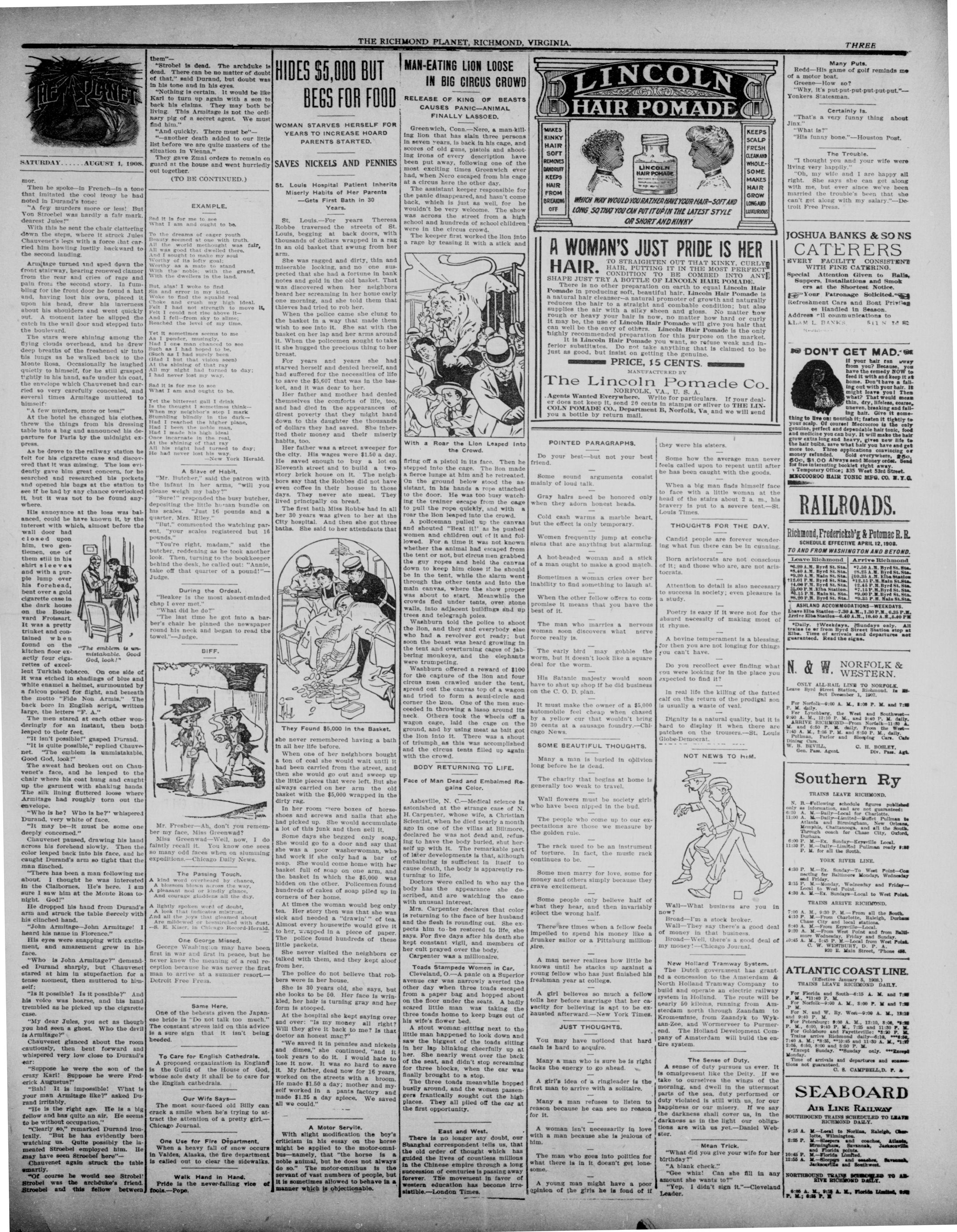
THE LION
With a Roar the Lion Leaped into the Crowd. firing off a pistol in its face. Then he stepped into the cage. The Lion made a fierce lunge at him and he retreated. On the ground below stood the assistant, in his hands a rope attached to the door. He was too busy watching the trainer escape from the cage to pull the rope quickly, and with a roar the Lion leaped into the crowd.
A policeman pulled up the canvas and shouted "Beat it!" as he pushed women and children out of it and followed. For a time it was not known whether the animal had escaped from the tent or not, but circus men grabbed the guy ropes and held the canvas down to keep him close if he should be in the tent, while the alarm went through the other tents and into the main canvas, where the show proper was about to start. Meanwhile the crowds fled under tents, over stone walls, into adjacent buildings and up trees and telegraph poles.
Washburn told the police to shoot the lion, and they and everybody else who had a revolver got ready; but soon the beast was heard growling in the tent and overturning cages of jabbering monkeys, and the elephants were trumpeting.
Washburn offered a reward of $100 for the capture of the lion and four circus men crawled under the tent, spread out the canvas top of a wagon and tried to form a semi-circle and corner the lion. One of the men succeeded in throwing a lasso around its neck. Others took the wheels off a wagon cage, laid the cage on the ground, and by using meat as bait got the lion into it. There was a shout of triumph as this was accomplished and the circus tents filled up again with the crowd.
BODY RETURNING TO LIFE.
Face of Man Dead and Embalmed Regains Color.
Asheville, N. C.—Medical science is astonished at the strange case of N. H. Carpenter, whose wife, a Christian Scientist, when he died nearly a month ago in one of the villas at Bittimore, declared he was not dead and, refusing to have the body buried, shut herself up with it. The remarkable part of later developments is that, although embalming is sufficient in itself to cause death, the body is apparently returning to life.
Doctors were called in who say the body has the appearance she described, and are watching the case with unusual interest.
Mrs. Carpenter declares that color is returning to the face of her husband and the flesh is rounding out. She expects him to be restored to life, she says. For five days after his death she kept constant vigil, and members of her cult prayed over the body.
Carpenter was a millionaire.
Toads Stampede Women in Car
Cleveland, O.—A panic on a Superior avenue car was narrowly averted the other day when three toads escaped from a paper bag and hopped about on the floor under the seats. A badly scared little man was taking the three toads home to keep bugs out of his wife's flower bed. A stout woman sitting next to the little man happened to look down and saw the biggest of the toads sitting in her lap blinking cheerfully up at her. She nearly went over the back of the seat, and didn't stop screaming for three blocks, when the car was finally brought to a stop. The three toads meanwhile hopped busly around, and the women passengers frantically sought out the high places. They all piled off the car at the first opportunity.
East and West.
There is no longer any doubt, our Shanghai correspondent tells us, that the old order of thought which has guided the lives of countless millions in the Chinese empire through a long succession of centuries is passing away forever. The movement in favor of western education has become irresistible—London Times.
LINCOLN
HAIR POMADE
MAKES
KINKY
HAIR
SOFT
REMOVES
DANDRUFF
KEEPS
HAIR
FROM
BREAKING
OFF
LINCOLN
HAIR POMADE
KEEPS
SCALP
FRESH
CLEAN AND
WHOLE-
SOME
MAKES
HAIR
GROW
LONG AND
LUXURIOUS
WHICH WAY WOULD YOU RATHER HAVE YOUR HAIR-SOFT AND
LONG. SO THAT YOU CAN PUT IT UP IN THE LATEST STYLE
OR SHORT AND KINKY
A WOMAN'S JUST PRIDE IS HER
HAIR. TO STRAIGHTEN OUT THAT KINKY, CURLY HAIR, PUTTING IT IN THE MOST PERFECT CONDITION TO BE COMBED INTO ANY SHAPE JUST TRY A BOTTLE OF LINCOLN HAIR POMADE.
HINCHEL HAIR POMADE.
There is no other preparation on earth to cultivate Lincoln Hair Pomade in producing soft, beautiful hair. Lincoln Hair Pomade is a natural hair cleanser—a natural promoter of growth and naturally reduces the hair to a straight and combable condition; but also supplies the air with a silky sheen and gloss. No matter how rough or heavy your hair is now, no matter how hard or curly it may be, the use of Lincoln Hair Pomade will give you hair that can well be the envy of others. Lincoln Hair Pomade is the only highly recommended preparation for this purpose on the market.
It is Lincoln Hair Pomade you want, so refuse weak and inferior substitutes. Do not take anything that is claimed to be just as good, but insist on getting the required
Agents Wanted Everywhere. Write for particulars. If your dealer does not keep it, send 20 cents in stamps or silver to THE LINCOLN POMADE CO. Department B, Norfolk, Va. and we will send you a bottle by return mail.
MAKES
KINKY
HAIR
SOFT
REMOVES
DANDRUFF
KEEPS
HAIR
FROM
BREAKING
OFF
POINTED PARAGRAPHS.
Do your best—but not your best friend.
Some sound arguments consist mainly of loud talk.
Gray hairs need be honored only when they adorn honest heads.
Cold cash warms a marble heart, but the effect is only temporary.
Women frequently jump at conclusions that are anything but alarming.
A hot-headed woman and a stick of a man ought to make a good match.
Sometimes a woman cries over her inability to find something to laugh at.
When the other fellow offers to compromise it means that you have the best of it.
The man who marries a nervous woman soon discovers what nerve force really is.
The early bird may gobble the worm, but it doesn't look like a square deal for the worm.
His Satanic majesty would soon have to shut up shop if he did business on the C. O. D. plan.
It must make the owner of a $5,000 automobile feel cheap when chased by a yellow cur that wouldn't bring 30 cents at a sausage foundry.—Chicago News.
SOME BEAUTIFUL THOUGHTS.
Many a man is buried in oblivion long before he is dead.
The charity that begins at home is generally too weak to travel.
Wall flowers must be society girls who have been nipped in the bud.
The people who come up to our expectations are those we measure by the golden rule.
The rack used to be an instrument of torture. In fact, the music rack continues to be.
Some men marry for love, some for money and others simply because they crave excitement.
Some people only believe half of what they hear, and then invariably select the wrong half.
There are times when a fellow feels impelled to spend his money like a drunker sailor or a Pittsburg millionaire.
A man never realizes how little he knows until he stacks up against a young fellow who has just finished his freshman year at college.
A girl believes so much a fellow tells her before marriage that her capacity for believing is apt to be exhausted afterward.—New York Times.
JUST THOUGHTS.
You may have noticed that hard cash is hard to acquire.
Many a man who is sure he is right lacks the energy to go ahead.
A girl's idea of a ringleader is the first man to arrive with a solitaire.
Many a man refuses to listen to reason because he can see no reason for it.
A woman isn't necessarily in love with a man because she is jealous of him.
The man who goes into politics for what there is in it doesn't get lonesome.
A young man might have a poor opinion of the girls he is fond of if
KEEPS
SCALP
FRESH
CLEAN AND
WHOLE-
SOME
MAKES
HAIR
GROW
LONG AND
LUXURIOUS
they were his sisters
Some how the average man never feels called upon to repent until after he has been caught with the goods.
When a big man finds himself face to face with a little woman at the head of the stairs about 2 a. m., his bravery is put to a severe test—St. Louis Times.
THOUGHTS FOR THE DAY
Candid people are forever wondering what fun there can be in cunning.
Born aristocrats are not conscious of it; and those who are, are not aristocrats.
Attention to detail is also necessary to success in society; even pleasure is a study.
Poetry is easy if it were not for the absurd necessity of making most of it rhyme.
A bovine temperament is a blessing, for then you are not longing for things you can't have.
Do you recollect ever finding what you were looking for in the place you expected to find it?
In real life the killing of the fatted calf on the return of the prodigal son is usually a waste of veal.
Dignity is a natural quality, but it is hard to display it when there are patches on the trousers.—St. Louis Globe-Democrat.
Wall—What business are you in now?
Broad—I'm a stock broker.
Wall—They say there's a good deal of money in that business.
Broad—Well, there's a good deal of my money!—Chicago Journal.
New Holland Tramway System.
The Dutch government has granted a concession to the Amsterdam & North Holland Tramway Company to build and operate an electric railway system in Holland. The route will be nearly 50 kilobs, running from Amsterdam north through Zaandam to Krommelenie, from Zaandyk to Wykaan-Zee, and Wormerveer to Purmerend. The Holland Development Company of Amsterdam will build the entire system.
The Sense of Duty
A sense of duty pursues us ever. It is omnipresent like the Deity. If we take to ourselves the wings of the morning, and dwell in the uttermost parts of the sea, duty performed or duty violated is still with us, for our happiness or our misery. If we say the darkness shall cover us, in the darkness as in the light our obligations are with us yet—Daniel Webster.
Mean Trick.
"What did you give your wife for her birthday?"
"Yep. I didn't sign it."—Cleveland Leader.
THREE
Redd—His game of golf reminds me of a motor boat.
Greene—How so?
"Why, it's put-put-put-put-put."
Yonkers Statesman.
Certainly Is
"That's a very funny thing about Jinx."
"What is?"
"His funny bone."—Houston Post.
The Trouble.
"I thought you and your wife were living very happily."
"Oh, my wife and I are happy all right. She says she can get along with me, but ever since we've been married the trouble's been that she can't get along with my salary."—Detroit Free Press.
JOSHUA BANKS & SO NS CATERERS
EVERY FACILITY CONSISTENT WITH FINE CATERING.
Special Attention Given to Balls,
Suppers, Installations and Smokers at the Shortest Notice.
Your Patronage Solicited.
Refreshment Cars and Boat Privileges Handled in Season.
Address all communications to
ELAM L. BANKS. 541 N. 10 62
DON'T GET MAD.
if your hair ran away from you? Because, you have the remedy NOW to feed it with and keep it at home. Don't have a falling out with your hair. It might leave you! Then you would could mean thin, dry, lifeless uneven, breaking and falling hair. Give it some-
If your hair ran away
from you? Because, you
have the remedy NOW to
give with ease to keep it
home. Don't have, failing
out with your hair. It
might leave you! Then
what? That would mean
thin hair, ifeless, coarse,
unwavy hair. Give it some
thing to live on: nourish it; fasten it tightly to
your scalp. Of course Meccooroo is the only
genuine, perfect and dependable hair tonic, food
and medicine you can buy. It will make the hair
grow extra long and brave. For the hair bulbs, save what hair you have and get more too. Three applications convincing
of money refunded. Sold everywhere, $50,
and send Money order. Send
for free interesting books.
Temporary Office; $35 West 32nd Street.
MECCOOROO HAIR TONIC MFG. CO. M. Y. G.
RAILROADS.
Richmond, Fredericksb'g & Potomac R. R.
SCHEEDULE EFFECTIVE APRIL 12, 1908.
TO AND FROM WASHINGTON AND BEYOND.
Leave Richmond
*6.29 A.M. Byrd St. Sta.
*8.40 A.M. Main St. Sta.
*9.20 A.M. Main St. Sta.
*10.35 A.M. Elba Station
*10.40 P.M. Main St. Sta.
*14.08 P.M. Elba Station
*15.00 P.M. Elba Station
*15.15 P.M. Main St. Sta.
*18.29 P.M. Elba Station
Arrive Richmond
*7.50 A.M. Byrd St. Sta.
*8.25 A.M. Elba Station
*10.35 A.M. Elba Station
*14.45 P.M. Main St. Sta.
*17.15 P.M. Byrd St. Sta.
*19.00 P.M. Byrd St. Sta.
*0.35 P.M. Main St. Sta.
ASHLAND ACCOMMODATIONS—WEEKDAYS.
Leave Elba Station—7.30 A.M. 1.30 P.M. 6.35 P.M.
Arrive Elba Station—6.40 A.M. 16.40 P.M. 5.40 P.M
*Daily. †Weekdays. †Sundays only. All trains to or from Byrd Street Station stop at Elba. Time of arrivals and departures not guaranteed. Read the signs.
N. W. NORFOLK & WESTERN.
ONLY ALL-RAIL LINE TO NORFOLK.
Leave Byrd Street Station, Richmond. Infect December 1, 1907.
For Norfolk- 9:00 A. M.; 8:00 P. M. and 7:00 P. M. daily.
For Lynchburg, the West and Southwest- 9:00 P. M. and 8:40 P. M. daily.
ARRIVE RICHMOND- Parkway, A. M. and 6:50 P. M. daily. From the West- 7:40 A. M., 2:06 P. M. and 5:50 P. M. daily.
Pallman, Parlor and Sleeping Cars. Café Dining.
W. B. BEVILL.
Gen. Pass. Agent. D. H. BOSLEY.
Gen. Pass. Agent. Div. F. Pass. Ark
Southern Ry
TRAINS LEAVE RICHMOND.
N. R.-Following schedule figures published only as information, and are omitted:
6:20 A. M.-Baily-Local for Charlotte.
11:00 A. M.-Baily-Limited-Buffet Pullman to A. M. in Birmingham, New Orleans, Memphis, Charleston, and all the South Through coach for Chase City, Oxford, Durham.
6:00 P. M.-Baily-Sunday-Keysville Local.
11:30 P. M.-Baily-Limited Pullman ready 9:20 P. M. for all the South.
YORK RIVER LINE.
4:30 P. M.-Ex. Sunday-To West Point-Connecting for Baltimore Monday, Wednesday and Friday.
2:15 P. M.-Ex. Sunday, Wednesday and Friday-Local to West Point.
4:30 A. M.-Ex. Sundays-Local to West Point.
TRAINS ARRIVE RICHMOND.
7:00 A. M. 9:30 P. M.-From all the South.
4:10 P. M.-From Charlotte, Raleigh, Durham City and local stations.
8:40 A. M.-From West Point.
9:20 A. M.-From West Point and from Baltimore Wednesday, Friday and Sunday.
10:45 A. M. 5:45 P. M.-From West Point.
C. W. WESTBURG
20:20 E. Main Street. Phone 450.
ATLANTIC COAST LINE
(Effective January 5, 1908.)
TRAINS LEAVE RICHMOND DAILY.
For Florida and South—6:15 A. M. and 7:15
P. M., "11:140 P. M.
For Norfolk—9:00 A. M., 8:00 P. M and 7:15
P. M.
For N. and W. Ry. West-9:00 A. M., 18:18
and 9:40 P. M.
For Petersburg: 8:00 A. M., 12:10, 8:00
P. M., 6:00, 9:40 P. M., 7:25 and 11:30 P. M.
For Goldboro and Fayetteville: **8:30 P. M.**
Trains arrive Richmond daily -6:10, **8:50**
7:40 A. M.; **8:35**, **10:45 and 11:30 A. M.,** 1:27
2:65, 6:50, 8:00 and 8:50 P. M.
*Except Sunday, *Sunday only. *Except
Monday.
Time of arrivals and departures and con-
sults not guaranteed.
C. S. CAMPBELL, D. P.
SEABOARD
AIR LINE RAILWAY
SOUTHBOUND TRAINS SCHEDULLED TO LEAVE
RICHMOND DAILY.
9:15 A. M.—Local to Norlina, Raleigh, Charlote, Wilmington.
2:25 P. M.—Sleepers and coaches, Atlanta, Birmingham, Savannah, Jacksonville and Florida polls.
10:45 P. M.—Florida Limited.
12:55 A. M.—Sleepers and coaches, Savannah, Jacksonville and Southwest.
NORTHBOUND TRAINS SCHEDULLED TO ARRIVE RICHMOND DAILY.
6:00 A. M. 9:15 A. M., Florida Limited, 8:00 P. M. 8:25 P. M.
FOUR
HEET PLANET
Published every Saturday by JOHN MITCHELL,
JR., at 311 N. Fourth Street, Richmond, Va.
JOHN MITCHELL, JR., - EDITOR.
All communications intended for publication
should be sent so as to reach us by Wednesday.
TERMS IN ADVANCE.
One Copy, eight months. $ 1.50
One Copy, six months. 1.00
One Copy, four months. .80
One Copy, three months. .40
Single Copy. .00
ADVERTISING STATES.
For one inch, one insertion. $ .50
For one inch each subsequent insertion. .40
For two inches, three months. 6.00
For two inches, six months. 10.00
For two inches, four months. 14.00
For two inches, twelve months. 20.00
Marriage and Funeral Notices, one inch. .50
Standing and Transient Notices per line. .10
POSTAGE STAMPS OF A HIGHER DENOMINATION THAN TWO CENTS NOT RECEIVED ON SUBSCRIPTIONS.
THE PLANET is issued weekly. The subscription price is $1.50 per year in advance.
RENEWALS, ETC.—If you do not want TRE
PLANET continued for another year after your
subscription has run out, you then notify us by
Postal Card to discontinue it in the next
week. If you do not order their paper discontinued at the expiration of time for which it has been paid are
held liable for the payment of the subscription
up to date when they order the paper discontinued.
COMMUNICATIONS—When writing to us to
renew your subscription or to discontinue your paper, you should give your name and address
in full otherwise we cannot find your name on
CHANGE OF ADDRESS—In order to change
the address of a subscriber, we must be sent the
former as well as the present address.
Entered at the Post Office at Richmond, Va.
cond class matter.
SATURDAY.....AUGUST 1, 1908
The Philadelphia, Pa. Christian Recorder comes to us greatly improved in its appearance.
---0---
Rev, G. L. Blackwell, D. D. announces his retirement as Editor of the Philadelphia, Pa. Missionary Seen and Rev. R. A. Morrissey, D. D. succeeds him.
---
The death of E. E. Cooper removes from the field of action the most remarkable journalist that the race has produced in half a century. He knew the art of making money, but he never learned the first lesson in saving it and he was consequently constantly dependent upon the charity of his friends. He was wholesouled and liberal, a man of pleasing address and gifted with the art of that diplomacy that made him a general favorite, throughout all of this land. He is gone. Peace to his ashes.
---
It is openly asserted that the chair man of the Republican Party of this city has openly declared that he did not care whether any Negroes here voted for Taft or no. In fact, he did not want them to vote for him. As this information comes to us from first class sources we are led to accept it as true. It would seem that the leaders are determined to be all things to all men. They will be pro-Negro in the doubtful northern states where votes as cast decide the election and anti-Negro in states where white recruits from the Democratic Party are wanted.
It seems that the men, higher up in the councils of the Party are logically responsible for this condition of affairs. Property-owning and tax paying citizens of color hereabouts are highly indignant, especially in view of the fact that many of these white Republicans of the new school are not their equal in the arena of business intelligence.
---
THE SHERIFF FIRED
Leander Shaw, colored was charged with assaulting Mrs. Lillian Davis near Pensacola, Florida. He was placed in the county jail at that place and a mob formed and proceeded to storm the jail. The sheriff was added by twelve deputies. He warned the mob not to persist in its efforts as he would keep his sworn obligation and defend the jail at any cost. He kept his word and when the men composing this lawless body made the attack upon the jail, he opened fire with revolvers and riot guns. The effect was deadly. Three of the attacking party were
killed and many more wounded. The mob was reinforced and scaled the walls, covering the deputies and the bold sheriff with guns and removing the prisoner. They hanged the colored man to an electric light pole. It is indeed gratifying to note that another southern sheriff has had a chance to demonstrate to the country the stuff that is in him. Alonzo Williams, colored, was lynched at Lyons, Georgia, July 16, 1908. He was charged with assaulting Mrs. Clara Bowen. It may be noticed that the term criminal assault is being omitted and only assault designated. Lynching has been checked, but there seems to be a recurrence of the trouble and it seems that the leaving of the political arena has done but little to change the status of affairs in the Southland.
DR. WALDRON AND POLITICS.
Rev. Dr. J. Milton Waldron, pastor of the Shiloh Baptist Church at Washington delivered a powerful sermon last Sunday morning at the Church of which he is pastor and he took texts that will be concededly appropriate in dealing with the subject that he had before him. As he is pastor of a people, who like tens of thousands in Virginia and the Southland have no vote, but plenty of voice his sermon must be considered in the light of the effect it will have upon the colored people in the doubtful states.
Much he said was true and that he is actuated by pure motives must be conceded by every colored man in the United States, who has had the honor of his acquaintance. During a personal observation of him for more than twenty years, we have never known a truer friend to the Negro or a more earnest advocate of his cause. There must then have been powerful influences brought to bear and outrageous treatment vouch safted him and his to induce him to take the step which will hold him in the limelight of public attention for many months to come.
He must undoubtedly be actuated by pure motives for the reason that his life's history has not been otherwise than unattornished. Still, we are not ready to accept many things that he was bold enough to say. We think that he lald undue stress upon the Republican Party and its short-comings and not enough condemnation upon the leaders, who are largely responsible for its erring characteristics, so far as its dealings with us are concerned. He openly advocates the candidacy of Hon. William J. Bryan, and we do not think that he can consistently defend this position until that candidate officially gives some assurance to the thousands of colored men in this country that he will recognize and enforce their political rights along with those of other citizens of this republic.
If Dr. Waldron bases his opinion upon the ground that it is an opportunity to "get even" and to administer a rebuke to those who have wantonly maligned and maltreated us, then he will have a listening ear from hundreds of colored men, who are chafing at restraint and who long for an opportunity to punish those political elements, that have so wantonly insulted and ignored them.
The charge that the Administration is endeavoring to coerce the members of Shiloh Baptist Church is a serious one and merits attention. Dr. Waldron is responsible only to Shiloh Baptist Church. This body is independent and if this body permits him to air his political opinions in the pulpit, with appropriate texts from the Holy Bible, it is nobody else's business.
We confess that we have felt a disposition to cut loose the reins of restraint in our own case, but then we have returned to the judicial plat form, where, regardless of our personal opinions, we may be able to weigh the evidence for and against the candidates now pleading for recognition and support from the people of this country who will have the deciding of the important questions that will be presented at the polls.
MR. TAFT'S DELIVERANCES.
The speech of Hon. William H. Taft, accepting the nomination of the Republican National Convention for the Presidency of the United States was all that could be desired so far as it relates to his statement of his attitude upon the Negro question and will prove to be a powerful and influential asset to the Afro-American Republican orators, who expect to do the spell-binding upon the stump this Fall. Here is his language:
"The Republican platform refers to those amendments to the Constitution that were passed by the Republican Party for the protection of the Negro. The Negro, in the forty years since he was freed from slavery, has made remarkable progress. He is becoming a more and more valuable member of the communities in which he lives.
"The Republican platform adopted at Chicago, explicitly demands justice for all men without regard to race or color, and just as explicitly declares for the enforcement and without reservation, in letter and spirit, of the thirteenth, fourteenth and fifteenth amendments to the Constitution. It is needless to state that I stand with my party; squarely on that plank in the platform, and be
THE RICHMOND PLANET. RICHMOND. VIRGINIA
lieve that equal justice to all men, and the fair and impartial enforcement of these amendments, is in keeping with the real American spirit of fair play."
This would seem to indicate that he no longer stands upon the platform which carried with it the injustice for Companies B, C and D of the Twenty-fifth Infantry that were unceremoniously dismissed from service without trial and whose War Records are now marred upon the roster of the War Department by virtue of the hasty action of the distinguished President of the United States, seconded by the judicial Secretary of War. Mr. Taft says that he will demand justice for all men, regardless of race or color. If he will live up to the pledges of the Republican National Convention platform and the declarations in his letter of acceptance, then all will be well in this Republic of ours.
We have read the cumbersome, but highly important declarations of this candidate and while we find that in many parts of it he drops to common place argument and endeavors to put up a defense of his chief, on the whole, the deliverances will have a favorable effect upon the country. He has served notice though to the nation that the Republican Party is on the defensive. If he succeeds in making a clean sweep and rolls up a tremendous majority in all sections, we shall have been greatly disappointed.
It is evident that Mr. Rooseveit is of the opinion that Mr. Taft's election by a large majority is a foregone conclusion. If we are to judge by the "gingerly" way in which the concessions are being made to those who opposed him. Republicans lose generally, not so much from party men voting for other candidates as they do from party men staying away from the polls. Those people who declare that the Negro vote is solid greatly deceive themselves and we say now that it will be the part of wisdom to muster into service every influential Negro leader, who has a wise tongue and will accept service.
The black cohorts are showing a spirit of revolt and colored men, who have known no other party than the one of freedom are now either sulking in their tents or openly declaring their intention and purpose to administer to the Republican leaders of the nation a telling rebuke at the polls. With the attitude of the Negro-haters, who now seem uppermost in Republican councils, who can blame them?
TAFT TOLD OF NOMINATION
Oil Trust's Big Fine Set Aside—Confesses He Murdered and Robbed His Aunt—Norman Mack to Run Bryan Campaign — President Roosevelt Joins Peace League—Clayton Kidnapper May Be Insane — Cripple Shoots Two in Quarrel Over Purchase of Food.
William H. Taft was Tuesday formally notified, on the spacious lawn of his brother, Charles P. Taft, at Cincinnati, O., of his nomination for president of the United States by a special committee appointed by the Republican national convention. The exercises attending the notification was on a magnificent scale. A holiday had been declared, and the city is decorated and illuminated as never before. Many excursion trains unloaded thousands upon thousands of people at their stations, and almost every Republican politician of any standing in Ohio is here, and many of national reputation.
There are large delegations here from Indiana, Kentucky, Illinois, West Virginia and neighboring states.
The program started in the morning, when salutes were fired from big guns stationed on Mt. Adams, Mt. Lookout, Fairview Heights and Price Hill, as a welcome to Cincinnati's first citizen.
Bands stationed in the parks, squares and at prominent corners rendered concerts all day. The city of Cincinnati presented a flag to Charles P. Taft, and it was furled over the Taft residence on Pike street. The flag-raising was marked by a ceremony of invocation, singing, a speech of presentation and a speech of acceptance.
The Notification.
The notification ceremonies took place on the lawn, which was covered with an immense platform. The reception committee of citizens escorted the notification committee to the Taft home. Judge Taft was then escorted to the platform, and United States Senator William Warner, of Missouri, delivered his speech notifying Mr. Taft of his nomination for the presidency. When Judge Taft arose to deliver his speech of acceptance he was greeted with tumultuous applause. He outlined the party's policies and sounded the keynote of the campaign. He praised the administration and policies of President Roccevelt and rebuked the Democratic stand on Philippine independence. He promised stasis
toward tariff reform immediately after his inauguration, if elected, and believes in an income tax by statutory law if necessary for revenue only, rather than by amendment to the constitution. On the labor question, he said the rights of both organized and unorganized labor should be impartially upheld, and favors notice and a hearing before injunctions are issued. Mr. Taft declares for physical valuation of railways, and says if properly used it will not generally impair securities, and concluded by pointing out the difference between the dominant political parties.
Following the notification the marching clubs formed and passed in review, and then a public reception was held on the lawn, and Judge Taft shook hands with thousands. This was followed by a luncheon to the notification committee, given by Charles P. Taft. After luncheon the visiting committee was taken in automobiles over the city and suburbs, the objective point being the Country club, where there was a dinner and a smoker. At 5 o'clock several thousand balloons were sent up, and at 8 o'clock an immense display of fireworks from the river bridges and craft in the harbor took place.
Cripple Shoots Two In Quarrel.
Frank Paddaux, twenty-eight, was shot and killed, and Bert Bland, aged twenty, probably fatally hurt at Want-Y-Glo, near Johnstown, Pa., by Chester Gibson, nineteen years old, a cripple, who stated in the Ebensburg jail that he did not remember the shooting. It is said that Paddaux and Gibson had been drinking, and, meeting Bland, requested him to buy some sandwiches. A dispute followed the young man's return with the food, and Gibson shot Bland. In attempting to get possession of the revolver, Paddaux was killed. Gibson was later arrested by Constable Bland, father of the injured man.
President Joins Peace League
President Roosevelt has accepted the honorary presidency of the Peace and Arbitration League, which is the outgrowth of the North Carolina congress, and which has as its objective adequate armament and effective arbitration.
Clayton Kidnapper May Be Insane.
Efforts will be made by the friends of Charles Hemphill, of Clayton, N. J. who is now confined in the county prison at Woodbury awaiting trial on the charge of kidnapping Cora Bell Garton, of Millville, to have him declared insane and committed to a state asylum for the insane.
Confessee He Murdered His Aunt.
Drawn back to the scene of his crime by a force he could not resist, August, Eberhard, the self-confessed murderer of his aunt, Mrs. Ottille Eberhard, a Viennese widow, whom he lured to a lonely spot in New Jersey a few days ago and shot to death, was captured near Paterson, N. J., and is now a prisoner in the Hackensack jail. What interested the authorities most in the confession Eberhard made to them was the reason he gave for committing the crime. Eberhard said that he was in love with a New York girl, and that he needed money to marry her, and so, knowing that his aunt had $2500, he plotted to kill her and steal the money. Eberhard says he also intended to kill his pretty cousin, Ottille Eberhard, to whom he was engaged, so that nothing would stand in the way of his marriage to the New York girl. The police have the name of the girl mentioned by Eberhard, and she will be brought to Hackensack to tell what she knows of the murderer.
When Eberhard was searched not a panny was found in his pockets. He said that he had buried the money he stole from his aunt. He led the detectives to a tree near Little Falls, and there dug up a bundle of bills. There was $2500 in the bundle, which was the amount that was stolen, as the murderer left a small amount of money in the bosom of his aunt's waist, so as to give the impression that she had not been robbed.
---
Oil Trusts Big Fine Set Aside.
Following the unanimous decision of Judges Groessep, Emanuel and Baker, who compose the United States circuit court of appeals at Chicago, reversing and remanding the case of the government against the Standard Oil company, of Indiana, in which case Judge Landis In the district court had imposed a fine of $29,240,000, the federal attorneys announced that the government had thirty days within which to file a petition for a rehearing, and that it would be filed within the allotted period. In the case that was reversed the Standard Oil company, of Indiana, was found guilty of accepting rebates on shipments of oil from its refinery at Whiting, ind., to East St. Louis, Ill. Judge Landis fined the company $20,000 on each of 1462 counts, each count representing a carload shipment.
The opinion of three judges of the higher court leaves little of the contention that each carlo constituted a separate offense. Even the various shipments, of which there were about 500, could not be considered as separate offenses under the ruling of the court of appeals. The maximum fine on this basis would abound to $720,000 and the minimum $36,000. It is said that $223,000 is the total amount the Standard Oil company is alleged to have received as rebates on the shipments in question.
Three Guardmen Killed By Lightning.
Three men were killed and at least
100 injured in a violent electrical
storm that swept the encampment of
the Pennsylvania National Guard at
Gettysburg, Pa., Thursday night.
Two hundred and fifty tents collapsed,
among them that of Governor
Stuart, many of them burying their
occupants. The dead are:
Corporal C. Milton Garber, Company
C, Tenth regiment, of Uniontown.
Private James L. Barbe, Company
K, Tenth regiment, of Wayneeburg.
Private Clyde Morrison, Company D,
Sixteenth regiment, of Oil City.
The three men were struck by light-
rlg.
When the bolt that killed the three
soldiers came fashing along, Shristley and Sergeant Morrison, with their wives, were sitting in Christley's tent. All four were thrown violently to the ground. Christley's coat was rent into shreds. An alto horn was twisted out of all semblance of its original shape.
Norman Mack to Run Bryan Campaign
Norman E. Mack, of Buffalo, an old friend of William J. Bryan and true to the Nebraskan in all his political battles, will manage the Democratic national campaign, and Henry Watterson, the Kentucky editor, will have charge of the press bureau.
Mr. Mack was elected chairman of the new national committee at a conference between national leaders and Mr. Bryan and John W. Kern, his running mate, in Chicago. The list of officers selected follows:
Chairman—Norman E. Mack, New York.
Vice Chairman—Dr. E. L. Hall, Nebraska.
Secretary—Urey Woodson, Kentucky.
Treasurer—Charles N. Haskell, governor of Oklahoma.
Guffey Men Hit Back at Kerr
The Pennsylvania Democratic state committee at Harrisburg recognized Colonel James M. Guffey, of Pittsburg, as the leader of the Democracy of Pennsylvania in spite of steps taken against him at Denver, and while endorsing the candidate on the national ticket voiced in strong terms disapproval of the unseating of the Pennsylvania delegates.
The adherents of Kerr offered no opposition even to the resolutions, which, while endorsing Bryan's candidacy, denounced the action of the convention which nominated him, for throwing out legally elected Pennsylvania delegates, and also lauded Colonel Guffey and recognized him as the legally elected national committeeman and the real leader in Pennsylvania.
PATIENTS SAVED HOSPITAL BURNS
Rescuers Hastened From One Room to Another Moving Sufferers From the Burning Structure—Many Were Seriously Ill and Some Had Undergone Operations — Police Kept Anxious Relatives and Friends From Entering. Not Believed Any Patients Suffered Fatally From Their Experiences.
Lock Haven, Pa., July 29.—Forty patients, many of whom were helpless, were imperilled when the new $42,000 hospital at this place was destroyed by fire. For a time the rescuers ran a close race with the flames. Working in halls filled with smoke, white-clad nurses and volunteers hastened from one room to another, moving sufferers from the building as they lay in their cots, or pushing them to the fresh air in wheel chairs.
Some of those endangered had recently undergone severe operations. Others were seriously ill with disease, Helpless, they were forced to listen to the sweep of the flames and the excited cries of the crowds outside the building, until is came their turn to be taken outside to safety.
Throughout the contest none of the workers was more active than Miss Happersett, the superintendent of the hospital, Directing every squad of the helpless, she clung to her post in the main hall of the building until the last sufferer had been removed to safety.
Then, as she walked toward the door, she fell, overcome by the heat of the flames, and had to be carried outside by the nurses whose efforts she had been supervising. For a time her condition was considered serious.
The fire started in the top story of the building. As soon as it was discovered a general alarm was sent to the fire department, all the engines of which responded. The water pressure was poor, and the firemen could do little to check the rapid advance of the flames. Drawn by the report of the fire, hundreds of persons, including every doctor in the city, went to the hospital. Friends and relatives of persons inside fought with the police in their eagerness and anxiety. But, acting under orders, the blue-coats kept the crowd back, while the force of rescuers brought one after another of the inmates of the hospital to the lawn.
There they were loaded aboard wagons and ambulances and taken to places where they could be properly cared for. Many of them were taken to the Central State Normal school, which is peculiarly adapted for the emergency. While all the patients afterward showed the effects of the ordeal through which they had passed, it is not believed that any have suffered fatally.
Unable to stay the flames, the firemen were forced to watch the handsome structure burn almost to the ground. The hospital was recently erected at a cost of $42,000, but the equipment and furnishing cost $10,000 more. The loss will be in the neighborhood of $45,000. Only $8000 insurance was carried.
CONDENSED NEWS ITEMS
Thursday, July 23.
V. A. Vincent, of Pittsburghia county, Va., has tendered his resignation as a member of the national committee of the Populist party and declared for Bryan. While walking in his sleep, Albert Probisca fell from a third-story window at his home in Philadelphia, breaking an ankle and receiving bad body bruises.
The suit brought by Count Bonti de Castellane in Paris against the Princess de Sagan, his former wife, for the possession of his three children, has been postponed until July 29, and it most probably will not be reached until the fall term of the court.
Friday, July 24.
John G. Shortall, founder of the American Humane association, died at his home in Winnetka, Ill., aged seventy years.
The Thomas automobile in the New York to Paris automobile race arrived at St. Petersburg from Moscow and later left for Berlin.
Major James F. Meline, for sixteen years past the assistant treasurer of the United States, died at his home in Washington after a long illness.
Arthur W. Kraft, an optician, was shot and instantly killed, and his wife, Mrs. Pearl Laval Kraft, was probably fatally wounded at Louisville, Ky., by Phillip Hans, Jr., in a fit of jealousy.
Saturday. July 25
Mark Long, aged sixty years, of Philadelphia, was found dead in the rear of Stetzer's blacksmith shot at Yeadon, near Chester, Pa.
Harry E. Hayes, a member of the banking firm of W. J. Hayes & Son, was placed under arrest at Cleveland on a warrant from New Persey charging conspiracy in connection with a bond deal involving $105,000.
Left alone by his mother, Charles W. Rank, eight months old, of Philadelphia, became entangled in the side slats of his crib, which choked him to death before Mrs. Rank could extricate his head from its terrible position.
Monday, July 27.
Helpless to save her three-year-old son, Mrs. Marla Ross, of Lake Bluff, Ill., saw him burn to death in his home.
Henry Ebhard, twenty-two years old, was found in the woods near Gordon, Pa., with his head shot off, and an empty gun by his side.
After cutting George Shartzer, a Harrisburg, Pa., street foreman, with a hatchet, Joe Smith, a negro, was shot and fatally injured by Patrolman Frank Speece.
Adalai E. Stevenson, formerly vice president of the United States, formally announced his candidacy for the nomination for governor of Illinois on the Democratic ticket.
Tuesday, July 28.
The comptroller of the currency was advised of the suspension of the First National bank, of Friendly, W. Va., with a capital of $25,000.
The puddle mill of the Harrisburg (Pa.) rolling mill resumed work after several weeks' suspension, and the finishing mill will be started later.
Misses Julia and Mary Close, sisters of Lancaster, Pa., were injured in an automobile accident near Pleasantville, N. J., when a car in which they were riding struck a telegraph pole.
The trial of Frank Zastera, indicted for the murder of William B. Sheppard and his wife, Josephine B. Sheppard, and their servant, Jennie Bendy, at Marlboro, N. J., May 16 last, was postponed by Judge Voorhees at Freehold, N. J., until Sept. 21.
Wednesday, July 29.
Thirty-six men were indicted by the Kings county (N. Y.) grand jury on charges of violating the anti-gambling laws at the race tracks.
Luther R. Keefer, aged seventy-four years, ex-senator from Schuylkill county, Pa., died at Reading, from the effects of a stroke of apoplexy.
Mrs. Elizabeth M. Butcher, of Philadelphia, died suddenly while in a rolling chair on the boardwalk at Atlantic City, N. J., as a result of an attack of heart failure.
Henry W. Gazell, wanted for the alleged embezzlement of $32,000 of the 'unds of the defunct Farmers' & Merchants' bank, drove to police headquarters at Cleveland, O., in an auto and gave himself up.
MOB BURNS BOY OF 18 AT STAKE Negro Who Held Up Girl Pays Penalty in Public Square.
Dallas, Tex., July 23—"Tad" Smith, a negro boy, eighteen years of age, charged with criminal assault on Miss Viola Delancey at Clinton, Hunt county, was captured by officers. He was taken before the young woman and identified.
The prisoner was then hurried to the Greenville jail. Before arriving there, however, a mob of citizens overpowered the officers, took the prisoner and prepared to hang him. This idea was given up, however, and the mob agreed to burn him at the stake. Fagots were piled up in the public square at Greenville and the negro was placed thereon. Kerosene oil was poured on and a match applied. Smith slowly burned to death, while a thousand people witnessed the execution by fire.
The man's sufferings were frightful, but nobody was permitted to go near until his body was burned to a crisis.
EARNINGS OF STEEL TRUST
Slight Increase Over Last Quarter, But $21,424,485 Lower Than Last Year.
New York, July 29.—Regular quarterly dividends of 1% per cent on the preferred and one-half of 1 per cent on the common shares were declared by the directors of the United States Steel corporation.
The net earnings for the quarter ended June 30 were $16,353,990, an increase of $167,730 over the quarter ended March 31 last, and a decrease of $21,424,485 as compared with the three months ended June 30, 1907.
The following statement as to increased bookings during July were given out:
"The average daily bookings for the first twenty-four days of July are in excess of 26,000 per day, equivalent to 72 per cent of full capacity. This tonnage is well distributed, being composed of all grades of finished steel, with the single exception of rails, of which up to the 24th instant there has been no material increase in sale."
Weak Man Receipt Free.
Any man who suffers with nervous debility, loss of natural power, weak back, falling memory or deficient manhood, brought on by excesses, dissipation, unnatural drains or the follies of youth, may cure himself s'home with a simple prescription that I will gladly send free, in a plain sealed envelope, to any man who will write for it. A. E. Robinson, 3895 Luck Building, Detroit, Michigan.
A Great Opportunity for Young Men Who Desire an Agricultural Career
Many of the young men who have finished the courses in agriculture at the Tuskegee Institute are commanding salaries ranging from $50 to $100 per month. The graduates of this Department of the school are successfully employed as Instructors, or as managers of important agricultural operations. The school has an agricultural faculty of twenty instructors; men who have received their training in the best agricultural schools of the country. Young colored men and women who desire to take courses in practical and scientific agriculture are now offered the best opportunity to pursue such courses in one of the largest and best equipped schools for practical and scientific agriculture to be found in the South. The following courses are offered:
Opportunities are now open to 500 young men and women who may wish to take any of the above courses of instruction. The cost of board is $8.50 per month. No charge for instruction. For further information address, BOOKER T. WASHINGTON, Principal. Tuskegee Institute, Alabama.
The Demand for an Educated Ministry
Realizing the demand among the Negro people for an educated ministry. The Tuskegee Normal and Industrial Institute conducts in connection with its other Departments a Bible Training School. The courses of study are so arranged that, not only ministers and licentiates may be benefited, but those also who desire to do better missionary work or become intelligent Sunday School teachers. The chief aim of the Bible Training School is to afford a comprehensive knowledge of the English Bible and to implant in the hearts of those who attune in an intention to dedicate their lives to the elevation and Christianization of their people. Daily supplementary exercises designed to instill habits of sobriety, cleanliness, regularity and accuracy are provided. The teaching is wholly undeminational, the intention being not to oppose or antagonize any theological work being done elsewhere, but instead to assist all denominations.
During the past year, the enrollment in the Bible Training School has been satisfactory, but the opportunity is now provided for a considerably larger number.
The teaching is free. The cost of board, including furnished room, light, fuel, laundering, etc. is $8.50 per month. The entrance fee is $7 to be paid in cash by each student when he registers. Students will be given the opportunity to work out much of the $8.50 in some cases all of it. Lack of means should not keep any one from entering the Bible School. If the student is not afraid of word and study he will succeed.
For further information address BOOKER T. WASHINGTON, Principal.
Tuskegee Institute, Alabama.
VIRGINIA—In the Law and Equity Court of the City of Richmond, July 1st, 1908.
Louis Collins, Plaintiff.
Nancy Collins.
Nancy Collins, Defendant.
The object of this suit is to obtain a Divorce, a Vinculo Matrimonil, by the plaintiff against the defendant. And an affidavit having been made and filed that the defendant is a non-resident of the State of Virginia, it is ordered that she, said defendant appear here within fifteen days after the due publication of this order and do whatever is necessary to protect her interest herein.
A Copy—Teste:
P. P. WINSTON, Clerk.
J. HENRY CRUTCHFIELD, p. q.
To Nancy Collins:
You will take notice that I shall on the 19th day of August, 1908 at the office of Phil B. Shield, room numbered 60, Chamber of Commerce Building, situated S. W. corner of 9 and Main Streets in the city of Richmond, Virginia between the hours of 9 o'clock A. M. and 6 o'clock P. M. of that day proceed to take the depositions of witnesses to be read as evidence in my behalf in a certain suit in Chancery depending in the Law and Equity Court for the city of Richmond, Virginia; wherein you are defendant and I am plaintiff; and if for any cause the taking of the sald depositions be not commenced on that day, or, if commenced not concluded on that day, the taking of the same will be adjourned and continued from day to day, or from time to time at the same place and between the same hours until the same shall have been concluded.
LOUIS COLLINS,
By Counsel.
HENRY CRUTCHFIELD, p. q.
1211½ E. Broad St., Richmond.
HEY PLANET
SATURDAY...AUGUST 1, 1908
NEAFIE SHIP PLANT SOLD FOR $50,000
Offered at Auction Establishment is Knocked Down Cheaply.
Philadelphia, July 29.—Acting under a peremptory order of the court the receiver of the Neafile & Levy Ship & Engine Building company offered the plant for sale in the rooms of Samuel T. Freeman & Co., 1519 Chestnut street. After a few minutes of listless bidding the plant was knocked down to Frank D. Summers, attorney for a bank of Camden, N. J., for the low price of $50,000.
The purchaser under the conditions of the sale assumes a mortgage of $277,000 and a small yearly ground rental.
McKinley Succeeds Sherman
Utica, N. Y., July 29. — James S. Sherman, Republican vice presidential candidate, announced that he would be succeeded as chairman of the congressional campaign committee by Representative McKinley, of Illinois, who has horetocreft held the office of treasurer. The new treasurer will be Charles G. Dawes, former controller of the currency.
Cashier Alleged to Be Short $30,000.
Norfolk, Va., July 29—William E. Lightly, formerly cashier of the New York, Philadelphia & Norfolk railroad, was arrested here on two counts of alleged embezzlement, his shortages in the cases being $500 and $600. Commonwealth Attorney Tilton declares that Lightly's shortage will total $30,000. He says the counts on which the warrants were sworn out are but two of a number of similar shortages.
Girl Electrocuted.
Connellsville, Pa., July 29—Cecella Tressler, twelve years old, was electrocuted, and her sister Hazel, seventeen years old, is in a precarious condition as the result of the younger girl grasping a live wire near their home in South Connellsville. The two were picking berries among thick bushes, when Cecella in pushing the branches aslide, seized a trolley feed wire which had been blown down. She screamed, and Hazel rushed to her assistance. When the latter touched her younger sister she stepped into a pool of water and was knocked down. Hazel's cries attracted passers-by, who found Cecella dead. By cutting the wire they extricated her body from the bushes. The dead girl's clothing was partly burned off, while her arms were roasted to a crisp.
Many Overcome By Ammonia.
Philadelphia, July 28—A dozen persons were overcome and as many more seriously affected by the fumes of ammonia that penetrated the surrounding buildings in consequence of the explosion of an ammonia tank on the Higela Ice company's plant at Franklin and Vine streets. The explosion damaged one dwelling adjoining the plant. Charles Solosky, aged three years, was blown out of a flat window by the explosion and fell upon a canvas anwning uninjured. The acrid fumes of the ammonia penetrated the houses for a square around the ice plant and created a panic among the dwellers. The police patrols were answering calls in every direction to take strangling persons to the hospitals.
DIFFERENCE OF OPINION.
A Multimillionaire Marries a Girl Without Money.
He—I love you.
She—I love you.
Her Mother—I can turn up my nose at Mrs. Johnnie-Tucker now.
Her Father—My little girl is too good for him.
His Mother—I hope she loves him.
His Father—He had such a future before him.
The Maid of Honor—I always thought she would get some man like him.
The Best Man—He's too good for her.
The Minister—Thank you.
His Former Flame—I could have had him.
The Other Debutantes—How did she ever get him? She isn't pretty, hasn't a cent, and doesn't know how to dress.
His Partners—Now we will have to do all the work.
His Club Friends—There goes our money.
The Young Men—Lucky dog.
The Married Men—Another victim.
The Married Women—She must begin to train him at once.
Those Who Were at the Wedding—Didn't the bride look sweet?
Those Who Read About It in the Papers—Another girl sacrificed at the financial altar.
Custom—Live a life of gavety.
Instinct—Live in your love—Huntley Child, in Life.
Libel.
"Say, I don't believe these city count climen do anything but draw their sal aries."
"You're wrong."
"Well, what else do they do?"
"Spend 'em."—Cleveland Lender.
CLOSE TO THE LIMIT.
"Talking about mean men," said the man in the mackintosh, "old Hewligus can give pointers to all of 'em. When he found out that his children were taking lumps of sugar out of the box in the pantry and feeding them to the next door neighbor's pony, how do you suppose he stopped it?"
"Whipped the children?" hazarded the man with his feet on the table.
"Worse than that."
"Soaked the lumps of sugar in kerosene?" suggested the man with the bulbous nose.
"Worse than that."
"Sprinkled red pepper on them?" ventured the man with the frazzled trousers.
"Worse than that. None of you could guess it in a year. He went to a stonecutter's shop and had two or three dozen chunks of marble made into cubes. He took the sugar lumps out of the box in the pantry, put these marble cubes in their place, and—"
"Oh, come off!" "Try that on some other crowd!"
"Gentlemen, it's a fact, and I can lick anybody that doubts it!" After which the session broke up in a row.-Chicago Tribune.
Noise.
Noise, at first cultivated in this land by the Indians, has reached its climax in the college yell. It is used at political conventions, at christenings, and at women's clubs. No monument was necessary for the man who first invented noise. His work lives after him.
Noise is used by cities, which have the first call for it. They split it up into as many sounds as possible and divide it among all.
Noise varies in its volume and intensity, from embryonic and immature sawmill to a baby crying in the night. —Life.
Bringing It to a Climax
"I know what's passing in your mind," suddenly said the maiden as the habitually silent caller stared at her. "I know, too, why you are calling here night after night, appropriating my time to yourself and keeping other nice young men away. You want me to marry you, don't you?" "I—I—do!" gasped the young man. "I thought so. Very well; I will."—Judge.
USED TO IT.
A man with a rake and a hoe is working on a wall. A woman is sitting on the wall, looking at him.
His Neighbor—And does my singing
annoy you?
He—Oh, dear, no. I am a foreman
in a sawmill.
Great Need.
Oh, that some Burbank of the West
Would patent, make and sell
An onion with an onion taste—
Brit with it.
Tommy—Pa, the teacher says that if a man gets dyspepsia it may make him bald-headed. Is that so?
Mr. Figg—It is.
Tommy—Then if a man eats too much pie, would he be pie-bald?—Royal Magazine.
"I'm thinking of taking my family to Europe."
"That doesn't cost much."
"Doesn't cost much to take your family to Europe. Man, you'—"
"No; doesn't cost much to think about it."—Houston Post.
True.
First Lazy Man—After all, a clay pipe has an advantage over all others. Second Ditto—Why?
First Lazy Man—Well, if you let it fall on the pavement you needn't trouble about picking it up—Royal Magazine.
Previous Experience:
"And am I the first girl you ever made love to?" asked the lady's maid of her valet lover. "Well," was the reply, "I've pressed suits before, you know."—Royal Magazine.
A Quick Intro.
"Jones is practically unknown, isn't he?"
"Yes, but he's figuring on a quick jump to fame. He says some day he'll be nominated for the vice-presidency."
—Detroit Free Press.
The Philosopher of Folly
"I wonder why it is," muses the Philosopher of Folly, "that when a 'fireproof building' catches fire, they always send in three alarms."—Cleveland Leader.
Too Bad.
Poet—Whatever does this mean?
My publisher sends me a bill for a new waste-basket—Royal Magazine.
She Knew.
Belle—The Rock of Gibraltar must be something like the Blarney stone. Beulah—What are you talking about?
"Why, the Blarney stone is associated with kissing, isn't it?"
"It certainly is."
"Well, they say the rock of Gibraltar is honeycombed with 70 miles of tunnels!"—Yonkers Statesman.
THE RICHMOND PLANET, RICHMOND, VIRGINIA
```markdown
```
IF YOU WILL T
BORS AND INTERES
WE WILL HELP YOU
IN ORDER TO FU
RICHMAN
YOU WILL TALK WITH YOUR SONS AND INTEREST THEM IN THE BATTLE. I WILL HELP YOU TO OBTAIN A PRINT.
ORDER TO FURTHER INCREASES
WE WILL SEND YOU AND THE ST LOUIS, MISSOURI GLOBE DEMOCRAT, ONE OF REPUBLICAN JOURNALS STATES FOR $2.25 PER YEAR.
WE WILL SEND YOU THE COSMOPOLITAN MAGAZINE PER YEAR FOR BOTH.
WE WILL SEND YOU THE McCLURE'S MAGAZINE FOR BOTH.
FOR TWO YEARLY SUMMER OR THEIR EQUIVALENT, WEEKS, ONE ONLY, OF DORE ROOSEVELT, DR. BINGTON, BATTLE OF SANTLE OF QUASIMAS NEAR SAN DIEGO, SHOWING THE NINTH ORED CAVALRY IN SUPPORTERS, SIZE 20X28 AND 20X28 BATTLE AND CHARGE OF FOOT INFANTRY IN RESCUE OF THE AT SAN JUAN HILL, JULY 2, 1898 AND 20X24 INCHES, ADMIRAL DE NAVAL BATTLE OFF CAVITE, MAY 1ST, 1898, NAVAL ACTION OF ADMIRAL CEREMONIUM FLEET OFF SANTIAGO DE CALIFORNIA, SIZE 22X28 INCHES; LAKE PETURE OF EL CANEY, EL PACIFICATIONS OF SANTIAGO, JULY 2ND, 1898, SIZE 22X28 AND WE WILL SEND YOU ONE OF FOLLOWING BATTLES OF THE SAME TERMS. THE PRESENT OTHER BATTLES ARE FINISHED. THEY ARE 22X28 INCHES AND ONE DOLLAR EACH. WE WILL FRAME FOR ANY OF THE MISS FOR 2 DOLLARS & 50 CTS. EL CALIFORNIA, BATTLE OF GETTYSBURG, SHILOH, BATTLE OF FIVE FOR ATLANTA, GA., BATTLE OF SYLVANIA, VA., BATTLE OF MISS., BATTLE OF LOOKOUT, BENN., BATTLE BETWEEN THE MERRIMAC, BATTLE OF A., BATTLE OF CHANCELLOR OF THE BIG HORN, (CUSTER ELEE) STORMING OF FORT WAGON, STORED TROOPS IN THIS FIGHT IN NEW ORLEANS, LA., CAPTURE OF SITTING BULL, THE GRANDE HEIFTAIN; FORT PELLOW MARK OF PETERSBURG, VA., BATTLE, VA., BATTLE OF OLUSTER, J. SEND FAMILY RECORD, SIZE WHICH CONTAINS SPACE FOR THE PARENTS AND TEN CHILDREN SEND SOLDIERS WAR RECORD OF SERVICE IN UNITED STATES.
RICHMOND PLANET.
IF YOU WILL TALK WITH YOUR NEIGH BORS AND INTEREST THEM IN THE PLANET. WE WILL HELP YOU TO OBTAIN A PREMIUM.
IN ORDER TO FURTHER INCREASE OUR STEADILY GROWING CIRCULATION WE WILL OFF
WE WILL SEND YOU THE PLANET AND THE ST LOUIS, MISSOURI, SEMI-WEEKLY GLOBE DEMOCRAT, ONE OF THE LEADING REPUBLICAN JOURNALS IN THE UNITED STATES FOR $2.25 PER YEAR FOR BOTH. WE WILL SEND YOU THE PLANET AND THE COSMOPOLITAN MAGAZINE FOR $2.25 PER YEAR FOR BOTH. WE WILL SEND YOU THE PLANET AND McCLURE'S MAGAZINE FOR $2.25 PER YEAR FOR BOTH.
OR THEIR EQUIVALENT, WE WILL SEND PICTURES, ONE ONLY, OF PRESIDENT THEODORE ROOSEVELT, DR. BOOKER T. WASHINGTON, BATTLE OF SANTIAGO, LAND BATTLE OF QUASIMAS NEAR SANTIAGO, JUNE 24, 1898, SHOWING THE NINTH AND TENTH COLORED CAVALRY IN SUPPORT OF ROUGH RIDERS, SIZE 20X28 AND 20X24 INCHES, LAND BATTLE AND CHARGE OF THE 24TH & 25TH
COLORED INFANTRY RIDERS AT SAN JUAN 20X28 AND 20X24 IN GREAT NAVAL BAT NILA BAY, MAY 1ST DESTRUCTION OF SPANISH FLEET OFF LY 3RD, 1898, SIZE 2 TLE, CAPTURE OF FORTIFICATIONS OF AND SECOND, 1898, INCHES. WE WILL OF THE FOLLOWING WAR ON THE SAME LIKE THE OTHER B COLORS. THEY ARE TAIL AT ONE DO FURNISH FRAMES IN CHROMOS FOR 2 DO DITIONAL. BATTLE TLE OF SHILOH, BAY BATTLE OF ATLA SPOTTSYLVANIA, V BURG, MISS., BATT TAIN, TENN., BATT TOR AND THE MER RUN, VA., BATTLE BATTLE OF THE BIG CHARGE) STORMING C., (COLORED TROC E OF NEW ORLEA LATH OF SITTING DIAN CHIEFTAIN; F FALL OF PETERSBUR CHESTER, VA., BAT WE WILL SEND FAN 28. WHICH CONTA GRAPHS OF PAREN WE WILL SEND SOLI TIFICATE OF SERVIC MY.)
COLORED INFANTRY IN RESCUE OF ROUGH RIDERS AT SAN JUAN HILL, JULY 2, 1898, SIZE 20X28 AND 20X24 INCHES, ADMIRAL DEWEY'S GREAT NAVAL BATTLE OFF CAVITE IN MANILA BAY, MAY 1ST, 1898, NAVAL BATTLE, DESTRUCTION OF ADMIRAL CERVERA'S SPANISH FLEET OFF SANTIAGO DE CUBA, JULY 3RD, 1898, SIZE 22X28 INCHES; LAND BATTLE, CAPTURE OF EL CANEY, EL PASO AND FORTIFICATIONS OF SANTIAGO, JULY FIRST AND SECOND, 1898, SIZE 22X28 AND 22X27 INCHES. WE WILL SEND YOU ONE OF ANY OF THE FOLLOWING BATTLES OF THE CIVIL WAR ON THE SAME TERMS. THE PICTURES LIKE THE OTHER BATTLES ARE FINISHED IN COLORS. THEY ARE 22X28 INCHES AND RETAIL AT ONE DOLLAR EACH. WE WILL FURNISH FRAMES FOR ANY OF THESE FINE CHROMOS FOR 2 DOLLARS & 50CTS. EACH ADDITIONAL. BATTLE OF GETTYSBURG, BATTLE OF SHILOH, BATTLE OF FIVE FORKS, VA., BATTLE OF ATLANTA, GA., BATTLE OF SPOTTSYLVANIA, VA., BATTLE OF VICKSBURG, MISS., BATTLE OF LOOKOUT MOUNTAIN, TENN., BATTLE BETWEEN THE MONITOR AND THE MERRIMAC, BATTLE OF BULL RUN, VA., BATTLE OF CHANCELLORVILLE, BATTLE OF THE BIG HORN, (CUSTER'S LAST CHARGE) STORMING OF FORT WAGNER, S. C., (COLORED TROOPS IN THIS FIGHT), BAT-
E OF NEW ORLEANS, LA., CAPTURE AND PATH OF SITTING BULL, THE GREAT INDIAN CHIEFTAIN; FORT PELLOW MASSACRE, FALL OF PETERSBURG, VA., BATTLE OF WINCHESTER, VA., BATTLE OF OLUSTEE, FLA. WE WILL SEND FAMILY RECORD, SIZE 22 BY 28. WHICH CONTAINS SPACE FOR PHOTOGRAPHS OF PARENTS AND TEN CHILDREN. WE WILL SEND SOLDIERS WAR RECORD (CERTIFICATE OF SERVICE IN UNITED STATES ARMY.)
FOR FIVE NEW SUBSCRIBERS
FOR ONE YEAR EA LENT, WE WILL SE CLE TOM'S CABIN, TERESTING BOOK WILL SEND YOU A WITH YOUR PICT
THE YEAR EACH, OR THEIR WE WILL SEND YOU A COPY JIM'S CABIN, THE MOST INTEN-ING BOOK IN THE COUNTY, END YOU A GOLD-PLATED YOUR PICTURE THEREIN,
FOR ONE YEAR EACH, OR THEIR EQUIVALENT, WE WILL SEND YOU A COPY OF UNCLE TOM'S CABIN, THE MOST INTENSELY INTERESTING BOOK IN THE COUNTRY. WE WILL SEND YOU A GOLD-PLATED BROOCH WITH YOUR PICTURE THEREIN, YOU TO
```markdown
```
To interest yourself in promoting the CIRCULATION of th
FOR TWO YEARLY SUBSCRIBERS
REQUISITE NUMBER IS OBTAINED, WE WILL FORWARD THE PRESENT INDICATED.
A PERSON WHO TRIES TO GET FORTY SUBSCRIBERS AND GETS TIRED MAY INDICATE HIS WISH AND WE WILL SEND THE PRESENT FOR THE NUMBER HE HAS SECURED OVER FIVE.
THE NUMBER WILL BE FOR NOT LESS THAN FIVE NOR MORE THAN TEN AND NOT LESS THAN TEN NOR M HAN TWENTY AND NOT LESS THAN Y NOR MORE THAN FORTY, TO DET THE PRIZE TO WHICH THE WORKER ITLED.
IF ANYTHING IS DESIRED NOT SPECIFIED IN THIS LIST, WRITE US ABOUT IT AND WE WILL TELL YOU IN WHAT CLASS IT BE LONGS.
A man in a suit is sitting in a chair and talking to another man in a suit.
LANET
WEEKLY
READING
UNITED
H.
T AND
R $2.25
T AND
YEAR
ND PIC
THEO-
WASH-
D BAT-
JUNE 24,
H COL-
LUGH RI-
LAND
& 25TH
花
REQUISE FORWARD
SHOULD YOU DESIRE ANY COLORED JOURNAL IN THE UNITED STATES, WE WILL SEND IT TO YOU IN CONJUNCTION WITH THE PLANET AT A GREATLY REDUCED RATE FOR BOTH.
TAIN PEN, GOLD POINT ONE BREAST-PIN, GOLD EN LINEN HANDKERC CLOCK, ONE DOZEN N DOZEN TOWELS, ONE C PAIR VASES, ONE PAIR HAM, ONE TURKEY.
FOR TEN NEW SUBSCRIBERS
WE WILL SEND ONE CHINA PIECES; ONE NECKLACE PEARE, BYRON WORKS; PLAIN GOLD RING, ONE N. 1,000 ENVELOPES, 1,000 PRINTED AND DELIVERY ONE HALF CORD OF SAVES.
FOR TWENTY NEW WE WILL GIVE ONE HALF WITH OPALS, RUBIES OR ELRY BOX FINISHED IN ONE SILK SHIRT WAIST DRESS, ONE GOLD WAIST RANTED FOR TEN YEAR CHAIR, ONE LOAD OF OIL SOAP, EITHER WASHING BARREL OF BEST FLOUR ETS, ONE MANICURE SET WORK BOX, ONE PAIR SHOES.
FOR FORTY YEAR OR EQUIVALENT, WE WILL MACHINE, ONE DRY GOLD WATCH, ONE PAIR RINGS, ONE MUSIC BOX, ONE READY MADE DRESS TLEMEN'S CLOTHES, CANE, ONE GOLD-HEAD CHINA SET, ONE DOX KNIVES AND FORKS, ONE SILK DRESS, ONE WEEK SHORE, RAILROAD FAIR PAID, FOR ANY RICHMOND THESE OFFERS MAY TAGE OF BY SENDING SCRIBER'S NAMES AT KEEP A RECORD OF THE NUMBER IS OBTAINED, WE WILL THE PRESENT INDICATED PERSON WHO TRIES TO GET MERS AND GETS TIRED MERS WISH AND WE WILL SET FOR THE NUMBER HE LOVES FIVE.
THE NUMBER WILL BE FOR NONE NOR MORE THAN TEN A YEAR TEN NOR M HAN T LESS THAN TY NO PORTY, TO DET THE WORKER ITLED.
IF ANYTHING IS DESIRED NO THIS LIST, WRITE US ABOUT TELL YOU IN WHAT CLAS
ALL SEND ONE CHINA SET, THIRD
ONE NECKLACE; DICKENS, S.
BIBYRON WORKS; ONE UMBRELLA,
GOLD RING, ONE PAIR LACE CU
ENVELOPES, 1,000 SHEETS OF
AND DELIVERED; ONE TOI
FELF CORD OF SAWED WOOD.
FOR TWENTY NEW SUBSCRIBER
ALL GIVE ONE HANDSOME GOLD
APPALS, RUBIES OR PEARLS; ONE
BOX FINISHED IN GOLD OR
FALK SHIRT WAIST; ONE READ;
ONE GOLD WATCH, FILLED
FOR TEN YEARS, ONE R
ONE LOAD OF COAL, ONE G
EITHER WASHING OR TOILI
OF BEST FLOUR, ONE PAIR,
ONE MANICURE SET, ONE SEAM
BOX, ONE PAIR SHOES, GENTS.
FOR FORTY YEARLY SUBSCRIBER
QUIVALENT, WE WILL GIVE ONE
MACHINE, ONE DIAMOND RING
WATCH, ONE PAIR FINE GOL
ONE MUSIC BOX, ONE PHONO
READY MADE DRESS, ONE SUIT,
N'S CLOTHES, ONE GOLD-
ONE GOLD-HEADED UMBRELL
SET, ONE DOZEN SILVER
AND FORKS, ONE HAT-RAC
PRESS, ONE WEEK'S TRIP TO T
RAILROAD FARE AND HOT
OR ANY RICHMOND WORKER,
THE OFFERS MAY BE TAKEN
BY SENDING ONE OR TW
ER'S NAMES AT A TIME. W
RECORD OF THEM; AS SOON
IS OBTAINED, WE WILL
SENT INDICATED.
DO TRIES TO GET FORTY
GETS TIRED MAY INDI-
DWE WILL SEND THE
NUMBER HE HAS SE-
WILL BE FOR NOT LESS
MORE THAN TEN AND NOT
OR M. HAN TWENTY
AN TY NOR MORE
ETY THE PRIZE TO
ER ITLED.
IS DESIRED NOT SPECI-
WRITE US ABOUT IT AND
IN WHAT CLASS IT BE-
WE WILL SEND ONE CHINA SET, THIRTY-ONE PIECES; ONE NECKLACE; DICKENS, SHAKESPEARE, BYRON WORKS; ONE UMBRELLA, ONE PLAIN GOLD RING, ONE PAIR LACE CURTAINS 1,000 ENVELOPES, 1,000 SHEETS OF PAPER PRINTED AND DELIVERED; ONE TOILET SET, ONE HALF CORD OF SAWED WOOD
FOR TWENTY NEW SUBSCRIBERS
WE WILL GIVE ONE HANDSOME GOLD RING WITH OPALS, RUBIES OR PEARLS; ONE JEWELRY BOX FINISHED IN GOLD OR SILVER; ONE SILK SHIRT WAIST; ONE READY MADE DRESS, ONE GOLD WATCH, FILLED, WARRANTED FOR TEN YEARS, ONE ROCKING CHAIR, ONE LOAD OF COAL, ONE GROSS OF SOAP, EITHER WASHING OR TOILET; ONE BARREL OF BEST FLOUR, ONE PAIR BLANKETS, ONE MANICURE SET, ONE SEAMSTRESS' WORK BOX, ONE PAIR SHOES, GENTS OR LADIES.
FOR FORTY YEARLY SUBSCRIBERS
OR EQUIVALENT, WE WILL GIVE ONE SEWING MACHINE, ONE DIAMOND RING, ONE GOLD WATCH, ONE PAIR FINE GOLD EARRINGS, ONE MUSIC BOX, ONE PHONOGRAPH, ONE READY MADE DRESS, ONE SUIT OF GENTLEMEN'S CLOTHES, ONE GOLD-HEADED CANE, ONE GOLD-HEADED UMBRELLA, ONE CHINA SET, ONE DOZEN SILVER-PLATED KNIVES AND FORKS, ONE HAT-RACK, ONE SILK DRESS, ONE WEEK'S TRIP TO THE SEASHORE, RAILROAD FARE AND HOTEL BILL PAID, FOR ANY RICHMOND WORKER. THESE OFFERS MAY BE TAKEN ADVANTAGE OF BY SENDING ONE OR TWO SUBSCRIBER'S NAMES AT A TIME. WE WILL KEEP A RECORD OF THEM: AS SOON AS THE
ADDRESS ALL ORDERS TO
N MITCHELL,
311 North Fourth Street,
ND,
CHELL, JR.,
On Fourth Street,
VIRGINIA.
FURNISH
FIVE
NOT= WITH
COLORED WE WILL WITH THE RATE
ONE FOUNDS RING,
HALF DOZZE ALARM
ONE HALF POT, ONE LIVES, ONE
ERS
HIIRTY-ONE,
SHAKES-ELLA, ONE CURTAINS OF PAPER DILET SET,
ERS
GOLD RING
ONE JEW-ER SILVER;
LADY MADE-ED, WAR-ER ROCKING GROSS OF LET; ONE OR BLANK-AMSTRESS'TS OR LA-
ERS
ONE SEWING, ONE GOLD EAR-NOGRAPH,
TIT OF GEN-HEADED ELLA, ONE OR-PLATED BACK, ONE OF THE SEA-OTEL BILLER.
ON ADVAN-TWO SUB-WE WILL ON AS THE
```markdown
```
```markdown
```
SATURDAY.....AUGUST 1, 1908
HORTICULTURE
POLE FOR STRIPPING VINES.
How It May Be Made and the Manner in Which It Is Used.
Use a pole or a piece of scantling 12 or 14 feet long to make the device shown in the accompanying illustration. Slope the front end from the top side to the bottom as indicated and fasten a chain 2½ feet
Pole Arrangement for Stripping Vines
from the end to which to attach the
team.
When it is desired to strip sweet potato vines from the bed preparatory to digging, says the Prairie Farmer, the back end of the pole should be held so as to run the pointed end under the vines. To unload, stop the team, carry the back end of the pole around to the side of the team and start up four or five feet. Then drop back into position again as before. By using a little care the vines can be left in windrows, then turn crosswise and pile them.
WHY CULTIVATE AN ORCHARD?
Because It Will Make the Trees More Fruitful.
For the same reason that we cultivate a hill of corn. We plant apple trees 30 feet apart, while we plant corn three and a half feet apart, for the reason that the foliage of an apple tree bears the same relation to 30 feet that the foliage of a hill of corn bears to three and a half feet. Also, that the roots of the tree occupy the entire 30 feet of space as well as the roots of corn occupy the $3\frac{1}{2}$ feet feet of space. Cultivation is as absolutely necessary for the one as for the other. Cultivation will give thrift to either and unthrift without it. To produce a good crop of corn, break the ground eight inches deep and pulverize a fine seed bed. In cultivating the orchard we break three inches deep only, on account of roots, and make the same finely pulverized surface.
This bed contains moisture to the very surface in a dry season. By this kind of preparation and a fine, level cultivation, we retain moisture to the tree-tops during a drought, and consequently thrift to trees and large, smooth apples, fit, indeed, for any market. A hill of corn half cultivated, set in pasture, for the same reason, produces fruit hardly fit for worms. The downfall of thousands of orchards declares Green's Fruit Grower, commences when their foolish owners sow them to grass and turn their stock in, and if possible tramp them still harder than they were before. A belt of grass around a tree is about as fatal as a rope around a criminal's neck, especially if it be timothy, the great robber of moisture.
The Apricot
This fruit is supposed to have had its origin in China. In time it became scattered over Asia and by the time of Alexander the Great had certainly become common outside of the boundaries of China. It is known that he did not enter the territory of China and yet he brought the apricot back to Europe. Many centuries later it reached America, and has found a climate suited for it in the lands of the Pacific slope. Probably by this time it has again reached China from the east, and doubtless, too. It is greatly improved over the type that went out of China by the way of the west. It has circled the world in 2,000 years, and has probably reached its birthplace much changed, both in appearance and flavor.
Roots of Apple Trees:
The roots of the apple trees should be carefully protected, especially in the orchard where crops are being grown. A notion exists that roots form themselves so quickly that if they are cut off the tree will be able to redevelop the roots in a comparatively short time. Roots grow slowly just as other parts of an apple tree grow slowly. The tree is dependent on its roots for the aggregate amount of moisture and plant food it receives. Therefore a tree that has made a good start in the development of its rooting system should not have its roots pared. Many times trees are injured by ignorant persons who are intrusted with the delicate task of cultivating the orchard.
Crop Rotation.
Frequent crop rotation is the only
practical remedy for the well-known strawberry crown borer. The infested field should be burned over in the fall and the next year planted to some other crop upon which the pest can not thrive.
Costly Popularity.
France's cruiser Leon Gambetta is named after the famous politician, who died on December 31, 1885. In the times of his intense popularity Gambetta had an experience which he was wont to tell against himself. In Paris admirers unyoked his horses and dragged the carriage to his house. Gambetta would narrate this with an ear of pride, and he would add, with a smile: "But I never saw my horses again!"
A Dishonest Dollar
You cannot hide a dishonest dollar. You take a dishonest dollar and bury it clear down in the deepest part of earth, it will not stay there. You may roll it on rocks and mountains builders; you may attempt to put that dishonest dollar down in the center of the earth; it will not stay there. No! It will begin to rock and heave and upturn itself, until it comes to the resurrection of damnation.—Talmage.
No Mustaches In Alaska
Mustaches are not worn by men exposed to the severity of an Alaskan winter. They wear full beards to protect the throat and face, but keep the upper li, clean shaven. The moisture from the breath congeals so quickly that a mustache becomes imbedded in a solid cake of ice, and the face is frozen in a short time.
Setting Hard Task for Cat
Two little boys, talking together one day—English boys these—were heard to remark that their mother's cat had again bad kittens. "Oh, she is a champion layer," said one, to which the other replied: "I wish some day she would lay tadpoles!" these being the particular joy of his heart at that moment.
No Moral in This Story
In June, 1898, a poor man called at the humble dwellings of a washerwoman on the West side. He said he was starving, and she gave him half a dollar. Nothing was heard of him until one day last week, when he called again and got another half dollar.—Smart Set.
Flexible Glue
One part Venetian turpentine added to four parts of glue will make a flexible glue to attach leather to metals, says the Scientific American. The mass is heated in a glue pot until it becomes sticky and no more bubbles appear. A fresh mixture will work best.
"Your goose is cooked," cried one of two speakers: "And your cake is dough," retorted the other. But they were not enemies recriminating with joy at each other's misfortunes; they were merely two friendly cooks comparing notes of progress.
Norway's Wooden Churches
Some of the wooden churches of Norway are fully 700 years old and are still in an excellent state of preservation. Their timbers have successfully resisted the frosty and almost arctic winters because they have been repeatedly coated with tar.
Favorite Form of Suicide
Though shooting is recognized as an easy mode of suicide, it is not the favorite one in New York city, for, according to the coroner's records, there are one-twelfth more cases of self-destruction by asphyxiation.
A pair of robins have built a nest and hatched a family in the pocket of an old waistcoat which had been left hanging on the wall of an unoccupied cottage at Lodsworth.—London Standard.
Simply Impossible
Big with the importance of a new discovery, a London preacher says: "Never check the flowing tide of woman's talk." We never heard of anybody who ever did. —Chicago Post.
Longevity in Bavaria
At Spitzbergen, Bavaria, a woman aged 119 has been deprived of the only support of her old age by the death of her daughter, aged 99.
Does It Ever Happen?
A girl generally loses confidence in herself if she fails to make a fool of a man after she has met him the third time.—Chicago Record-Herald.
"Mamma," exclaimed four-year-old Dorothy one day, "I'm so full of happiness that I couldn't be happier unless I was bigger."
Growl from a Bachelor
Some women regard marriage as a blessed emancipation from the necessity of caring how their hair is done up.—Exchange.
Something in Reserve
Nevertheless the folk who find the car steps too high are capable of some tall kicking.—Boston Transcript.
Leather from Frog Skin
A frog's skin makes the thinnest and at the same time one of the toughest leathers that can be tanned.
A Woman's Age.
If you want to know how old a woman is, ask her sister-in-law.—Atchison Globe.
Get Some Enjoyment Now
Get Some Enjoyment Now.
Don't pin your happiness on futures.
Get some fun now, and get it quick.
Jonson's Tribute to Religion.
The strength of empire is in religion.—Ben Jonson.
THE RICHMOND PLANET, RICHMOND, VIRGINIA.
A Modern Convenience.
A British lord of the admiralty,
whose knowledge of nautical details
was limited, was recently taking his
first trip in a rather leaky vessel, when
he observed the men working the
pumps. "Dear me!" he said, "I did
not know you had a well on board,
captain; but I'm really glad you have,
for I detest sea water." — Harpor's
Weekly.
Best Work at Fifty.
In the industrial world it has become accepted that a man is too old at 40, and the London county council works department decided last year not to engage men above 35. How is it in the intellectual world? Despite all the evidences of precocious, Mr. Dorland arrives at a conclusion which gives an average of 50 for the master work of great men—T. P.'s Weekly.
Weasels Attacked Cow
Haymakers on the farm of H. A. Sell, near Hanover, Pa., noticed a cow in a near-by meadow strangely jumping about and bellowing loudly. Upon investigation they were astonished to find that eight weasels had attacked her. After a hard fight the farmers succeeded in killing several of the bloodsuckers and scattering the remainder.
Adonis in Hard Luck.
A man once asked Thackeray to lend him five shillings, which he would convert into £20,000. Asked how, he explained that he knew a young lady with £20,000 who he knew would marry him if he asked her, but he had pawned his teeth, and wanted five shillings to redeem them in order to propose effectively. — T. P.'s Weekly.
A Child's Comment
Even little children are amazed at the backwardness of New York. A bright youngster of five, crossing over from New Jersey and seeing the West street transportation relic for the first time, jerked her father's coat-tails nearly off, exclaiming: "Oh, papa, see the trolley cars being pulled by horses!"—N. Y. Press
Tin in Star's Atmosphere
Observations of the spectrum of Alpha Scorpii, made at the Cape of Good Hope, have shown a puzzling line that an English astronomer has attributed to tin. If this proves to be correct, it is the first discovery of tin ever made in the atmosphere of a star.
Vitality in Brain Work
Vital as is the physical side of conserving youth, its true fountain is in our brain. If we maintain activity of its cells it quickens the circulation of the blood, the vital organs, gives light to the eyes, preserves the supplemeness of the body, removes to a distance illness, age, death itself.
The Sympathy of Earlendale
The Sympathy or Friendship.
It is sublime to feel and say of another,
I need never meet, or speak, or write
to him; we need not re-enforce ours
selves or send tokens of remembrance;
I rely on him as on myself; if he did
thus or this, I know it was right.—
Emerson
"I know what I am going to do," said the exasperated head of the family as he listened for the twentieth time to the only tune his daughter knew how to play on the piano. "I am going to join this fresh air crusade."
The Girl and the Woman
There is this difference between the girl and the woman: The first knows nothing and tells everything, the other knows everything and tells nothing—Exchange.
From an English Geography.
From an English Geography.
"In that part of America which is known as New Jersey the mosquitoes are so thick that a herd of them, crossing a railroad track, will frequently hold up a train." - Puck.
Midair Peril.
Mother Bird—Run along and play now; but be careful you don't get run over by any of those flying machines. —Metropolitan Magazine.
New York Not Represented
During the 118 years in which we have had a national house of representatives it has never had a speaker who was born in New York city.
Manifesting Their Gratitude
Eight men who were jilted by Chicago girl have formed a club. Gratitude has strange ways of manifesting itself.
The Strength of Love
There is comfort in the strength of love; 'twil make a thing endurable, which else would overset the brain or break the heart.—Wordsworth.
Daily Thought
Take heed thou bless the day on which love took possession of thee, for thou oughtest so to do—Dante.
There is one thing that some mean people are always willing to give you—and that is the worst of it.
Mushrooms.
Why is a mushroom shaped like an umbrella? Because it always springs up in a shower.
Yes. Indeed
"I read in a London paper yesterday that American women are vain of their feet."
"Well, if they are, Chicago women have a great deal to be vain of."—Houston Post.
Indignant
Patience—They say you try to copy that Miss Fusanfeather.
Patrice—Nothing of the kind! I never painted my cheeks in my whole life!—Yonkers Statesman.
Knights of Pythias,
This organization is one of the most powerful in the country and its progress has been phenomenal. The Grand Lodge of Virginia has jurisdiction over all of the cities and counties in this state. Thirty males are required to organize a new lodge. The benefits paid constitute one of its strongest features, but the principles are greater than anything else. Founded on Friendship, based on Charity and established on Benevolence, the respectable, upright people of the state will find it an order worthy of their heartiest support.
It pays an endowment and burial benefit of of $200.00 for all ages. It pays $4.00 per week sick dues. The badge costing 75 cents each is the only absolutely necessary regalia. For information concerning the organization of lodges apply at the main office.
The Courts of Calanthe
Is the Female Department of the Order. It requires a membership of thirty persons to organize a court. Its members are pledged to exhibit Fidelity, exercise Harmony and prove Love one for the other. It pays an endowment and burial benefit of $150.00. It pays $3.00 per week sick dues. The only expense for regalia is the cost of the badge, 50 cents and a rosette, costing 25 cents for funeral occasions.
THE BANDS OF CALANTHE or Children's Department also constitutes a feature and persons cannot do better than to enter the little ones into this mystic circle. The expense is nominal and the benefits all that could be expected. It pays from $1.00 to $1.50 sick dues and death benefits of from $30.00 to $40.00. If you have noPythian Lodge or Court or Band in your neighborhood, orgniz one.
For all information concerning special rates of membership in the lodges and courts, address
KNIGHTS OF PYTHIAAS
C.B.
F.C.B.
only absolutely necessary regu-
apply at the main office.
The Court
Is the Female Department of
thirty persons to organize a co-
Fidelity, exercise Harmony as
an endowment and burial bene-
dues. The only expense for a rosette, costing 25 cents for
THE BANDS OF CALA
stitutes a feature and persons a circle. The expense is nomin-
$1.00 to $1.50 sick dues and d
Lodge or Court or Band in you
For all information concern
For all information conce-
membership in the lodges and
Where Cata Are Welcome
Where Cats Are Welcome.
The god Ptah is said to be worshiped with ardor in Boston, where the cat is as much a part of the household as any of the members. The Egyptians seemed to think the cat very important to happiness, and Boston can see no good in that class of society that is talking about the cat as a breeder of disease and a destroyer of birds, and not to be tolerated.
Wise Rate.
The depreduction of rats in his chicken yard caused Harry A. Lehr of York, Pa. to spread rat poison beneath the floor of his chicken coop. Instead of eating the poison the rats removed it to different parts of the yard. The next morning it was eaten by the bifows, as a result of which Mr. Lehr's flock of chickens is largely decreased.
Not Like a Hen
"The female codfish," remarked the boarder who had been gleaning statistics from between the covers of a patient medicine almanac, "lays more than a million eggs. Now, what do you think of that?" "I think," rejoined the Cheerful Ildict, "that it's a mighty lucky thing for the codfish that she doesn't have to cackle over every egg."
Idaho Actor's Wardrobe
Tommy Post, one of the many stage folk living at the house on Grove street burned recently, was the heaviest loser of the actors stopping there. He lost a nightshirt and a red bandana handkerchief, and the leg of one of his trousers was water-soaked. He will take immediate steps to replein his wardrobe—Idaho Statesman.
Womanhood is the most sacred thing in life. When God made worlds, and spun from His fingers like jewels on a string planets and systems of planets, and then had called the various forms of His living creatures into being, even after He had made man, the last and greatest creative act was the helpmeet for the man.—Exchange.
Purer Air.
The injury to commerce and the amenities of life, to say nothing as to the lowering of the vitality of the people, would surely justify some combination of bounties and penalties to aid in attaining to a higher standard of purity in the air which we breathe—Lancet.
Life's Invitable Companion
The Emperor Augustus, when seated at table between Virgil, who was asthmatic, and Horace, who was bleary, said, laughing: "I am between sighs and tears." Alas! who is not seated between these two table companions at the banquet of life?—Fr. Joseph Roux.
The Boy and the Cigarette.
The small boy with the cigarette is like the poor, always with us. He makes his presence felt in the streets as he puffs his weed or its fag-end in lordly imitation of his elders. He ought to be repressed with a strong hand.—Exchange.
Mae (to brother Jack)—How I wish you would throw away that beastly cigar. (An hour later, in the parlor)—Pray, Mr. De Cloud, do, do smoke. You know I fairly adore the aroma of a good Havana.—Illustrated Sunday Magazine.
Appropriate to the Occasion.
During the singing of a hymn that starts "Happy birds that sing and fly" a thrush flew down from the roof of St. Peter's church at Rickmanworth, England, and settled on the hymn book held by one of the congregation.
Her Constant Watchfulness
"For mercy's sake, Johnny!" exclaimed Mrs. Lapsling, "take that match out of baby's mouth. Don't
N. A., S. A., E. A., A. AND A.
organization is one of the most powerful has been phenomenal. The Graudale over all of the cities and counties in need to organize a new lodge. The biggest features, but the principles based on Friendship, based on Charity, the respectable, upright people of their heartiest support. An endowment and burial benefit of per week sick dues. The badge of regalia. For information concerning courts of Calantia.
in the Order. It requires a member court. Its members are pledged and prove Love one for the other. Benefit of $150.00. It pays $3.00 per regalia is the cost of the badge, 500 funeral occasions.
ANTHE or Children's Department cannot do better than to enter the final and the benefits all that could death benefits of from $30.00 to $40.00 neighborhood, orgrniz one.
Mrs. ANNA TA
120 W. H.
Norning special rates of JOHN and courts, address
you know match heads are polsonous? They contain ever so much Bosphorus!"
Different New.
A man who sent us a poem beginning, "When twilight dews are falling fast upon the rosy lea," has since married Rosa Leo, and now the weekly dues are falling faster upon him.
Fellowship with Great Minds.
What is a great love of books? It is something like a personal introduction to the great and good men of all times—John Bright.
Contentment
"Contentment," said Uncle Ebent,
"may be better dan riches, but dar
aln' no way of negotiatin' it at de
landlord's office or de grocery sto."
Refuse to Stay Down.
Says the Philosopher of Folly:
"That man succeeds who, when he gets the worst of it, always tries to make the best of it."
Latest in Visiting Cards
The newest visiting-card fad is to have a little plan showing the residence and the adjacent streets printed on the back.
Do Good Work Among Soldiers.
The Army Scripture Readers' association has 62 readers working in the British army.
Be Conclse
Sabbath thought. The greatest sermon that was ever preached any where contains only 303 words.
Forcing the Child.
Do not force a child unduly to practice the piano, lest it acquire a distaste for the study, which both child and parent may bitterly regret in later years, says Woman's Life. It is little short of a crime to compel any form of study in a child even though it happens to have a natural talent for a particular art.
Friends in Need
What need we have any friends, if we should ne'er have need of them? They were the most needless creatures living, should we ne'er have use for them, and would most resemble sweet instruments hung up in cases that keep their sounds to themselves.—Shakespeare.
Practical Economy.
If you would succeed in business, never spend a cent more than you earn. No matter how small your earnings, you should master this art. I use the word "art" advisedly, as so many young men appear to fritter away without so much as a thought, all their earnings.—Marshall Field.
Naturalization Requisite.
A residence of at least five years is required to qualify an alien for naturalization. No matter how long a man may have been in the United States, two years must elapse between the date of his declaration of intention and his admittance to full citizenship.
Content to Do Little
Let us be content to do little, if God sets us at little tasks. It is but pride and self-will which says: "Give me something huge to fight, and I should enjoy that; but why make me sweep the dust?"—Charles Kinsley.
A. Soporific.
Miss Gusher (who has just been introduced to the great author)—Oh, Mr. Lyon, I am so enchanted with your dear, delightful novels. I fall asleep with one in my hand, every night.—Sunday Magazine.
The Strong Thought of Self.
The strong thought of self is inevitably insulting—it is as restrictive of human contact as a live wire.—Mary Stewart Cutting, in "The Wayfarers."
the
membership of
d to exhibit
ar. It pays
over week sick
50 cents and
cent also con-
he little ones into this mystic
d be expected. It pays from
$40.00. If you have noPythian
address,
TAYLOR, W. M.,
Hill St., Richmond, Va.
N MITCHELL, JR.,
311 N. 4th St., Richmond, Va.
To Cut Plate Glass.
To cut a piece of plate glass it is thought a diamond cutter is necessary, but it is not. If the glass is not very thick it can be cut with a pair of scissors, a large pair being preferable. While cutting hold the glass beneath half a foot or more of water, and it can be cut any shape desired. A round piece of glass has been cut out of a good sized pane in just this manner. The scissors do not have to be extra sharp—Success.
BOARDING & LODGING
Rates Reasonable. All the Comforts
of Home
Orders received by letter or telegraph
MRS. BOOKER LEFTWICH.
PROPRIETRESS,
816 N. 2nd St., Richmond, Va
BLACKWELL & BRO
Practical House and Sign Painters.
Graining and General Contractors.
.....ALL WORK GUARANTEED.....
Cards, Letters or Orders.
.Give us a trial, you will never regret it.....
Address, 608 St. Peter Street,
BIGHMOND. VA.
.Phone 5688.
Nelson,s Hair Dressing can be bought at Jennings and Brown Drug Store, Pittsburg, Pa.
Furnished Rooms, 50c. up.
Meals, 50c. up.
THE MT. CLEMENS HOTEL
AND MINERAL BATH HOUSE
AMERICAN AND
Has opened its doors for the accommodation of
COLORED PEOPLE
that may come to Mt. Clem ens in the future for their Health and Treatment
on Rheumatism
It is the only Hotel and Mineral Bath House owned and conducted by a colored man at any of the health resorts in the United States.
Write for Special Rates.
GEO. I. HUTCHINSON, PROP.
48 Welts St., - Mt. Clemens, Mich.
Established 1899. 'Phone 4160.
JOHN FOXEL,
Dealer in General Line of
FANCY AND STAPLE GROCERIES,
NOTIONS, FRESH MEATS, CL-
GARS, TOBACCO, ICE,
WOOD, COAL, &c.
11 8. 4TH ST., RICHEMOND, VA.
MRS. JOSIE A. GRAHAM
Virginia's Most Successful Hair Culturist.
...PARLORS.....
108 E. Leigh St., Richmond,
'Phone, 1024.
views and Correspondence.
The largest and most up-to-date Hair Dressing Parlors in Richmond. The very best preparations that can be made for the hair, scalp, face and skin.
Graham's Superior Scalp Food for growing hair on bald heads and bare temples, 25cts. per jar. By mail, 35cts.
Graham's Superior Orange Flower Skin Fo ' for developing and beautifying the skin, 25cts a jar. By mail 35cts.
Graham's Superior Velvet Liquid Powder for giving the face a beautiful fair color, 25 cents a bottle. By mail 35cts.
Graham's Vegetable Hair Dye the best on market giving a rich natural color, $1.00 per bottle. By mail, $1.25.
Mrs. Graham makes a specialty of massaging and beautifying ladies' faces for parties and public gatherings, 35 cents.
Mrs. Graham skampoos the head and puts it in a healthy condition, 25 cents.
All ladies who attend parties and other social gatherings should have their finger nails manicured and made beautiful, 25 cents.
Mrs. Graham's preparations sell at sight. Ladies living in other cities and towns can make good money by selling these preparations.
Write for terms to Mrs. J. A. Graham, No. 108 E. Leigh St., Richmond, Va.
SCHOOL SHOES.
Capitol Shoe & Supply Company.
No. 210 East Broad Street.
A complete stock of Boys,' Misses,' Men's, Ladies,' & Children's Shoes.
ALL THE LATEST STYLES.
H F Jonathan
FISH, OYSTERS AND
PRODUCE.
120 N. 17TH ST., RICHMOND, VA.
ALL ORDERS WILL RECEIVE
PROMPT ATTENTION.
Long Distance 'Phone, 752.
STRAUS' SPECIAL
Old Yacht Club,
PURE WHISKEY
Will Satisfy the lover of the right
kind of stimulant. Special prices.
We have all grades of good liquors,
Cigars and Tobacco. Call and see
us.
ISAAC STRAUS & CO.,
422 E. Broad St.,
Richmond, Virginia.
S. W. ROBINSON.
NO. 23 NORTH 18TH ST
DEALER IN
FINE WINES, LIQUORS,
CIGARS, &c.
All Stock Sold as Guaranteed.
PROMPT ATTENTION.
Your patronage is respectfully solicited.
GEORGE O. BROWN
Fine Photographs. True to Life. High-quality service. Latest Improvements in Photogram in Out-door Work executed. Reasonable Boundary. Pictures Enlarged from Old negatives or Photographs.
THE ECONOMY
303-5 North Third St
FINE
TAILORING
CLEANING, DYEING ANL
REPAIRING
CHITMAN M. WHITE,
PROPRIETOR.
A. Hayes
727 North Second Street.
RESIDENCE, 725 N. and St.
First-class Hacks and Caskets of all descriptions. I have a spare room for bodies when the family have not a suitable place. All country orders are given special attention. Your special attention is called to the new style Oak Caskets. Call and see me and you shall be waited on individually.
HEY PLEASE
ROAD AND FARM IMPROVEMENT
CHINA CLOSET.
Convenient Article of Furniture That Can Be Made at Home.
The Homestead gives a description of a home-made china closet. The base shelf, or table part, is 30 inches high and should be from 38 to 60 inches long, depending on the size of the room in which it will be placed when finished. The width of the table top should be from 20 to 24 inches, and the cabinet, or top part, is 12 inches wide and from 48 to 50 inches high. The back of the cabinet is of three-eighths beaded ceiling, and, with the exception of the crown mold and the
Home-Made China Closet.
legs, the table is built of seven-eighths or three-quarter inch lumber. The shelves have either small grooves plowed in them or small half rounds nailed on the rear portion of them for holding the plates in an upright position, the grooves being preferred. The hooks for the cups, etc., are placed where desired, also the shelves, and the size of the plates must regulate the distance between them. Many families have one or more pieces of old, wornout furniture of oak or some nice hard wood. These could be used very nicely, but should pine or any of the soft woods be used. when same has been sandpapered nicely, apply one or two coats of any stain desired. When dry, again sandpaper and give as many coats as necessary to produce the desired color, but sandpaper well before applying the varnish.
INDUCING FRUITFULNESS
Judicious Pruning Will Increase the Fruit Buds.
Horticulturists have for many years practiced various methods to induce fruitfulness and with some degree of success. All these methods, as girdling the trunk, root pruning and summer pruning of the branches temporarily check the growth of the tree, and the consequent slow growth induces the formation of fruit buds, says W. Padock. It is well known that the buds which produce fruit in any particular season were formed the season before, and their formation is believed to begin early in the growing season. This being true, the time is now at hand for such work; If put off much later in the season, it will be too late, as the time for the formation of fruit buds for next year's crop will soon be passed. By root pruning is meant that a small portion of the roots are cut off, and the operation may be performed with a spade or in any way which is best suited to individual needs.
Summer pruning takes the place of the annual winter pruning, and is the same in most respects except that it is done in June instead of winter or early spring.
Girdling or ringing consists in removing a ring of bark from the trunk or larger limbs. This ring is sometimes two inches or more in width; all the bark within this space is removed, thus exposing the wood. This method of checking growth, though often employed, is rather drastic, and should be used with caution. A more rational method is to girdle the branch or trunk by cutting through to the wood by making one continuous cut and not removing any of the bark.
Some authorities state that the proper time to check the growth of a tree in order to induce the formation of fruit buds is at the time when the bark begins to set on the new growth.
POINTERS FOR THE FARMER.
Shorten the row by grinding the hoe.
A farmer is known by the crops he reaps.
Open your heart to the sorrow of every man who comes to talk to you about his troubles.
Error is a great deal worse than ignorance. It is better to know nothing than to know what isn't true.
A rainless harvest is a rare event in all but the dry regions of this country, but farmers by the use of gumption and foresight can usually secure their crops uninjured by rains.
Think on This.
When you sell $1,000 worth of wheat, you send $240 worth of fertility off the farm; in beef, $85 worth; pork $60; horses, $36; milk, $110; while $1,000 worth of butter sends away only! $1.25 worth of fertility. Isn't this a powerful argument against selinil; milk and in favor of butter dalrying?
IT CAN BE DONE.
Prof. Shaw Tells of Growing Pure
Bred Calves on Skim Milk.
While visiting the farm of Mr. W. J. Landon of Winona, Minn., which was awarded second prize in the Hill contest, I saw a bunch of pure-bred Shorthorn calves in a pasture that had every appearance of thrift, writes Prof. Thomas Shaw, in Orange Judd Farmer. I was, of course, pleased to learn that they had been raised substantially on skim milk. They were as large and thrifty as calves of the age usually are reared on the dams. These calves were reared as follows: They were given new milk until three to four weeks old. They were then changed to skim milk, taking about three weeks to make the change from all new milk to all skim milk. As soon as the change was begun they were given a certain amount of linseed gruel. It is made by mixing ground oil meal in boiling water and adding as much as is necessary to the milk. The amount to add is determined by the influence which it exerts on the digestion.
Meal is added in the dry form. This is fed along with alfalfa meal. The grain mixture is composed of about equal parts of barley, oats and bran, the two first named being ground. They are liberally fed of this food and make a good growth on it. They are plentifully supplied with green food at the same time, indoors or out. The difference in the cost between rearing calves thus and on the dams is very marked. Instead of giving it to the calves the milk of the dams is made into butter. They are kept producing thus for nine or ten months in the year, and they breed more regularly than cows not thus managed. The calves have no check after being weaned, as they sometimes have when reared on the dams.
A CELLAR CUPBOARD.
Arrangement by Which Running Up and Down Stairs Is Avoided.
To secure the advantages of a cellar cupboard without the necessity of climbing up and down the cellar stairs, sink a box of any desired dimensions between the joists of the kitchen or pantry floor, allowing it to come a
The Cellar Cupboard.
couple of inches above the floor line C, to avoid the entrance of dust from the floor, says the Prairie Farm. Slats are nailed across the bottom of the box which is then covered with wire netting to prevent flies and mice from reaching the contents, as indicated at B. A hinged cover. A, protects the top of the box.
Two Systems of Fastcurizing
Two Systems of Pasteurizing.
There are two systems of pasteurizing milk in use at present—the intermittent or discontinuous system and the continuous flow system. The difference in the efficiency of the two systems, in which the milk or cream is put into a closed machine and held at the desired temperature for a given time, has a decided advantage in the efficiency of work done over the continuous system. The latter system is used almost exclusively in large establishments where a great amount of milk is handled. The reason for this is probably that the cost of pasteurizing a large amount of milk or cream is less when this system is used than it would be if the intermittent system were employed. But if the quantity of milk or cream handled is not too large and a product with good keeping qualities is desired, the intermittent is undoubtedly the system to be employed.—E. C. Meyers.
Farm Butter Disappearing
Every year less butter is being manufactured on the farm, and this is as it should be; for, while we teach home dairying, still I am a great advocate of co-operative dairying, writes a correspondent of Orange Judd Farmer. Good butter can be and is made on the farm, but from lack of skill and care, or through improper surroundings, dairy butter very often lacks the finer quality and body known as "A1" quality. To be a successful butter maker requires intellect and physical strength.
Army to Use Oleomargarine.
It is reported that the army is to use oleomargarine instead of butter. It is further said that butter has not been previously issued as part of the ration and that the soldier will find himself just that much ahead in getting the oleomargarine. We think that the sentiment in this country is that the soldier should be furnished butter, and not oleomargarine, and we know that this is the sentiment prevailing among the farmers.
To Prevent Rolling in Stall
To prevent a horse from rolling in the stall, fasten a stout ring in the overhead strap to the halter and another to a ring in the ceiling at a point just back of the manger. A trap tied in this and snapped to the halter so that the horse can rest his nose on the ground, but not the top of his head, will prevent rolling. It would be well to have a weight on the other end of the strap to take up the slack.
Red raspberry plants can be transplanted when a few inches high, and are often better than yearling plants set in early spring.
Quick Work.
Muggins—Busy is a remarkably easy man to get acquainted with, don't you think?
Jones—I never noticed it.
Muggins—He is, though. I hadn't known him for over an hour before I borrowed a shilling of him, and inside of the next hour we got so well acquainted that he refused to lend me another one.—Royal Magazine.
THE RICHMOND PLANET, RICHMOND, VIRGINIA
SENTENCE SERMONS.
Fidelity is the best evidence of faith.
The best exposition of truth is its exhibition.
The worst thing about any evil deed is its fruitfulness.
Sublime victories are first won in commonplace days.
Conscience is the answer of my life to the light I have.
The only way to use a great opportunity is to serve it.
The rule of gold makes the golden rule seem sadly unreal.
The pessimist kills all hope because happiness irritates him.
The life has left any truth when it needs laws to defend it.
Living a double life is killing each half of life with the other.
The curriculum of character may often involve painful circumstances.
He is never worth thinking much about who thinks most of himself.
The eye single to the main chance always misses the great opportunity.
The best way to cure the fear of man is to lose the love of mammon.
There is only one way to the hearts of men, it is the way of your own heart.—Chicago Tribune.
SIS HOPKINS' SAYINGS.
A cut-and-dried speech rarely kindles burning thought.
A policeman doesn't have to go to a dentist for a pull.
Pa says it is not a Venetian blind to get kicked in the slats.
The execution of some painters—should be encouraged!
Many a good farmer is spoiled by a term at an agricultural college.
It is as easy to live quietly at Sound Beach as to reside soberly at Rye.
A pug-nosed woman naturally re-sents being asked if she wants the elevator.
Ma says some men are so stingy that they never tell a story at their own expense.
Boxcar Mudsock and Slam Sprinkler are the champion highball team of Perkins' Puddle.
Some men are "nursed in pleasure's flowery lap," while others have only a nap-kin there.—Rose Melville, in St. Louis Republic.
CONCEPTS OF CHILDHOOD
Is children's love of animals a sort of pre-Adamite memory?
That is a good school of which the best part is not in the playground.
Do not "make much" of your children; but help them to make much of life.
The mother who hesitates between the call of fashion and that of the nursery—is lost.
Children like to play at being somebody else. If you can fathom the reason, you are wise.
The most valuable criticism of the school curriculum is to be derived from statistics of what children remember after leaving school.
Every child is a fresh messenger of innocence to man, lacking which our souls would presently shrivel up from spiritual hunger and thirst.
SOME ROCKEFELLER EPIGRAMS
Always take advantage of others' mistakes.
If you can't say anything good about a man say nothing.
I am happy wherever I am now—north or south, east or west, it makes no difference.
Anything that is worth doing at all is worth doing well. I feel the same way with golf as with anything in the world.
Of the many men I have met I never knew a golfer to have a bad character. I really believe that golf tends to develop the good in a man. Everybody I have met at golf has been all right.
PUCKERINGS.
Some genius will tell the world how to utilize the microbe.
A congenial company is where everybody is safe in keeping still as often he has nothing to say.
Don't jump at the conclusion that there is no such thing as luck merely because you never had anything else.
All the world may not exactly love a lover, but it always takes quite an interest in his letters when they are read to the jury.-Puck.
REFLECTIONS OF UNCLE EZRA.
There are a whole lot of people sufferin' from inflammatory religion.
Rev. Stubbs has got the shingles. Now would be a good time to put a new roof on the church.
a feller who puts a matrimonial ad;
in the paper is running a long ways
MILLER'S HOTEL
W.M.MILLER.
PROPRIETOR
WITHIN
ONE BLOCK OF
STREET CAR LINES
THAT TAKE YOU
• TO ALL
PARTS OF THE
CITY
TERMS
REASONABLE
SECOND AND LEIGH STS.
RICHMOND, VA.
Hat Repairing.
Silk, Stiff and Soft Felt Hats Cleaned. Blocked, 25cts; and 50cts Binding. Bands, Sweat Leathers, also Soft Hats made to order.
Everything Everything
IN FURNITURE AND
FLOOR COVERINGS
SYDNOR & HUNDLEY, INC.
Leaders.
709 711 713 EAST BROAD STREET.
down the road to meet trouble.
Bud Hicks says he wants to marry a woman with money. Well, by jing! It is pretty difficult to marry a woman without money.
Grandma Spink has got a new set of false teeth. Let the improvements go on, and we will have a pretty fine-lookin' town.
Our milliner is using a shredded wheat biscuit for a rat and the constable is at work on the case, trying to find out if she is violating the pure-food law.
The last time Elmer Spink of our village was in New York he made love to a chorus girl, but her grandson came out of the stage entrance just in time to give Elmer a good thumpin'.
Patsy Tibbits of our town is taking music lessons at some conservatory. Hank Pike says a conservatory is a place where they keep fish, but Uncle Hod Peters says Hank is a liar and that a place where they keep fish is an antiquarian.
Abner Hanks made a mistake the ather day and filled the tank of his 40-candle-power runabout with gin instead of gasoline, and the blame thing wouldn't stay in the road, but knocked the front porch off from Hillicker's general store and smashed four rods of fence in front of the meetin' house.—Judge.
DON'TS FOR HOT DAYS
Don't worry about bills for coal.
Don't quarrel with the ice man.
Don't grumble about your wife's cold feet.
Don't try to crowd into a narrow seat beside a fat man.
Don't be afraid the baby will die if it gets a breath or two of air.
Don't run to catch a train if there is going to be another in five minutes.
Don't get exhausted trying to keep the moths out of your fur-lined over-coat.
Don't believe the people who tell you it will make you cool to imbibe hot drinks.
Don't ask your wife to iron your trousers. The tailor will do it for a quarter.
Don't make love in the parlor if there is a screened-in porch that is available.
Don't believe the person who tells you it is dangerous to take off your winter flannels.
Don't be afraid that your thirst may not last until you get to the next drinking station.
The Difference.
"Does she shrink from the water?"
"No, but her bathing suit does."—
Detroit Free Press.
Look Out for the Bull.
This is the season of the year that we hear of attacks from "perfectly quiet" bulls. If it is thought desirable to let the bull have a run in a pasture lot, see to it that he is given no opportunity to injure anybody.
None Immune
Patience—One of the great translational steamship lines has added trained nurses to the medical personnel of its vessels.
Patrice—What good is a trained nurse when she's sick?—Yonkers Statesman.
No Second Helping
"Why, really, Tommie, I don't believe you know what table manners are!"
"Yes, I do, mamma. If a boy has table manners, it means he has to go away from the table hungry!"—Yonkers Statesman.
Not So Noisy.
"Don't you think the ladies now have adopted a very loud way of wearing their hair?" "Not half so loud as when they wore bangs."—Baltimore American.
60 YEARS' EXPERIENCE
PATENTS
TRADE MARKS DESIGNS
COPYRIGHTS &c.
Anyone sending a sketch and description may quickly ascertain our opinion free whether an invention is probably precocious. Communications must strictly confidential. HANDBOOK on Patents sent free. Oldest agency for securing patents. Smithsonian, through Muni. & Co. receive special notice, without charge, in the
Scientific American
A handsome illustrated weekly. Largest circulation of any scientific journal. New York MUNN & Co. 361Broadway, New York Browns Park 361 F. St. Washington, D.C.
JURGEN'S SON
Before making your purchase you would do well to call at the most reliable furniture house in the city and see the fine line of REFRIGERATORS, MATTINGS, OIL-CLOTHS And in fact everything that is needed in house furnishings.
Of every description; also the latest designs in ROCKERS and special CHAIRS.
Our goods are the best for the price and the price is very low.
C. G. JURGEN'S SON,
ADAMS AND BROAD STREETS.
A PROBLEM SOLVING INSTITUTION.
TO OWN YOUR HOME MEANS TO SOLVE THE NEGRO PROBLEM.
WHEN BUYING,
WHEN SELLING,
HEN RENTING PROPERTY call on the
PEOPLE'S REAL ESTATE & INVESTMENT Co
REALTY IN ALL OF ITS BRANCHES
707 North Second Street, Richmond, Virginia.
Telephone, 4854.
J. J. CARTER, President.
W. F. DENNY, Sec. secretary
MEALS at All Hours—Hot or Cold. Board by Day, Week or Month. SOFT DRINKS.
POLITE ATTENTION ..... GIVE ME A CALL
Mme. SYLVIA L. MITCHELL. Propietress.
All orders promptly filled at short notice by telegraph or telephone. Halls rented for meetings and nice entertainments. Plenty of room with all necessary conveniences. Large picnic or band wagons for hire at reasonable rates and nothing but first-class, carriages, buggies, etc. Keep constantly on hand fine funeral supplies.
No. 212 East Leigh Street.
(Residence Next Door.)
OPEN ALL DAY AND NIGHT.—Man on Duty All Night.
The J V Hawkin's HAIR GROWER & RESTORER TRADE MARK REGISTERED
Has proved to be a fortune to many of the unfortunate, who are to-day delighted with its wonderful results. The merits of this great hair preparation naturally places it in a sphere all of its own, and the glowing terms in which our patrons speak of it reassures us of its satisfactory results. We can well boast of a large patronage throughout this and other States and also enjoys the commendation of the very best white and colored people in
the immediate community. In order to the merits and the rewards of the J. V. H. will from time to time produce in print permission to do so, who have us among the many bearing witness of its correspondence of those expecting a miRNA ration is a natural and pure compound, hesitate to put in print. We will just let States Government has placed national which it is protected and we are in turn est methods and square dealings.
It will positively remove Dandruff Hair on Clean Temples or Bald Heads, PRICES;—35 cts. per box; eight Beautifier makes the use of powder entess. Sale prices; 25, 50cts and $1.00. Order or Express Money Order all out of city orders.
Address all com
Mme. J. V.
612 NORTH FIRST ST.,
Telephone
Correspondence S
W. I. JO
Funeral Director
Office & Warerooms, 207
HACKS F
Orders by Telephone or Tele Suppers and Entertainment
Telephone, 686.
unity. In order to convince the man of the J. V. Hawkin's Hair Groat, we produce in print the photograph who have used our preparation witness of its genuine qualities, use expecting a miracle or anything un pure compound, the ingredients of it. We will just here remind the press placed national patent rights on us and we are in turn responsible to the dealings. Remove Dandruff, Cure Scalp of or Bald Heads, where the roots sit, per box; eight boxes, $2.80express of powder entirely unnecessary Dots and $1.00. Money can be sent by Order A charge of 10c
Address all communications to
J. V. HAWKIN
FIRST ST., — RU
Telephone, 4601.
Respondence Strictly Confidence
I. JOHNS
Director and E
Stereooms, 207 N. Foushee S.
CKS FOR H
Telephone or Telegraph filled and Entertainments prompt
186. Resident
the immediate community. In order to convince the most skeptical readers of the merits and results of the J. V. Hawkin's Hair Grower and Restorer, we will from time to time produce in print the photographs of those giving us permission to do so, who have used our preparation and are to-day among the many bearing witness of its genuine qualities. We do not desire the preparation to be natural and our compound the ingredients of which we would not hesitate to put in print. We will present the public that the United States Government has placed national patent rights on our hair preparation by which it is protected and we are in turn responsible to the government for honest methods and square dealings.
It will positively remove Dandruff, Cure Scalp of all impurities, Restore Hair on Clean Temples or Bald Heads, where the roots are not dead.
**PRICES:**-35 cts, per box; eight boxes, $2.80express prepaid. The Faces
Bouncer makes the use of powder entirely unnecessary, and is perfectly harmless
for stale tickets and $1.00. Money can be sent by Post Office Money
Order or Express Money Order. A charge of 10cts, extra is imposed on
all out of city orders.
Correspondence Strictly Confidential.
Orders by Telephone or Telegraph filled. Weddings, Suppers and Entertainments promptly attended.
---
PROF, D. D. BRUCE, M. D.-
Strange, Wonderful, but True are
the awe stricken tests given by The
Great Australian Medium.
PROF, D. D. BRUCE, M. D.
the only Living Apostle of Science
of the Mysteries.
$5000 in Gold to any one in the
World to compete with him. Possessing more power than any four medlums combined.
No card, trance or hand humbug
Greatest Hindoo Medium in the
World.
SO GREAT IS HIS POWER that we can tell you while in a Clairevant state, all you wish to know with out a word being spoken. Come, all ye unbelievers, scoffers and jeerers; bring all your skepticism with you—he will open your eyes to the private chamber mystery. Come all ye broken hearted wives, all with lew spirits and let him lift the burden from your aching and jeubous heart. He challenges the World to compete with him in causing a speedy marriage with the one you love; uniting the separated and bring
A. E. B.
X
to convince the most skeptical readers of Hawkins's Hair Grower and Restorer, we sent the photographs of those giving us feel our preparation and are today genuine qualities. We do not desire the mole or anything unreasonable. Our prepare the ingredients of which we would not remind the public that the United patent rights on our hair preparation by responsible to the government for honour. Cure Scalp of all impurities, Restore where the roots are not dead boxes, $2.80express prepaid. The Face is rarely unnecessary, and is perfectly harm-free can be sent by Post Office Money A charge of 10cts, extra is imposed on communications to HAWKINS, RICHMOND, VA 4601. Strictly Confidential.
JOHNSON, Car and Embalmer, N. Foushee St. Cor. Broad. FOR HIRE. Telegraph filled. Weddings, events promptly attended. Residence in Building.
back the lost one. Traces lost or stoien goods. Unearths hidden treasures. Removes evil influences Crosses, Spells, Ill Luck, cures tricks and Conjurations, gives Luck anu Success in all you undertake. Cures the Tobacco and Liquor Habits. Allows the Captive to be set Free. He is the only one that will give a Written Guarantee to complete your business or retard your money Are you sick? Do you know what the trouble is with you? Come and Consult Nature's Doctor. Rheumatism, Insomnis, Hysteria and all Diseases cured. Points given on Horse Racing and all Games of Chance. No matter what ails you, come and see this wonderful man. Reader have you noticed that some people have a hard time to get along, no matter how they toll, while others have success. Many wealth men and women owe their success to this wonderful man.
He will tell you whom you will marry. Will you be happy? He will tell you who your friends and enemies are. Can you tell? Don't cap in e dark, but be advised by a wonderful man. Greatest Prophet in existence. He always Success when others fall. This is the chance of a life time. Don't let it pass you. Office hours: 9 A. M. to 9:30 P. M.
Office hours: 9 A. M. to 9:30 P. M.
Sunday: 2:30 to 7:30 P. M.
Sunday: 2:30 to 7:30 P.M.
O.N. consultation fee is
50 cents. Stings: $1.00. All
letters containing $1.60 will be
answered in $all.
MAIN OFFICE:
610 S. 8th St.
Philadelphia, Pa.
SEVEN
YOUNG WILLIAM
REX SUNNET
HISGEN NAMED FOR PRESIDENT
Independence Party Makes Its First Nomination.
BRYAN'S NAME CAUSED RIOT
Kansas Delegate at National Convention of New Party Attempted to Nominate Nebraskan, When Uproar Started and Some Delegates Offered Physical Violence—He Was Expelled From the Hall Before Order Could Be Restored—John Temple Graves For Vice President.
Chicago, July 29.—The newly-formed Independence party at its national convention nominated Thomas L. Hisgen, of Massachusetts, as its candidate for president of the United States, and John Temple Graves, of Georgia, for vice president.
A riot was precipitated in the convention during the nominating speeches, when J. I. Sheppard, of Kansas, attempted to place the name of William J. Bryan before the convention
[Pictorial portrait of]
THOMAS L. HISGEN.
When he mentioned the "candidate of the Democratic party" a storm of hisses and boos greeted the reference, and the hall was in an uproar, and the delegates broke in upon Mr. Sheppard and a scene of riot followed. Several delegates attempted to offer physical violence to the speaker. A number of sergeants-at-arms threw themselves across the aisle in front of the rostrum steps and held back the infuriated men by sheer physical strength.
Mr. Sheppard was asked if he intended to nominate a man who was not a member of the Independence party.
"Of course, I don't want to deceive you," said Mr. Sheppard. "I intend, if I am allowed to finish, to nominate Mr. William J. Bryan."
The hall broke into a wild uproar, a dozen delegates again madly struggling in the main aisle in an attempt to reach Mr. Sheppard. Canes and fists were shaken at him furiously, while howls of execration went up from all sides of the hall. Sheppard instantly started to leave the platform, and Sergents-at-arms Frank Brust and Max Annenberg, realizing what might happen to Sheppard, stepped close to his side as he started down the aisle.
Instantly a crowd of delegates, all of them in an ugly mood, closed in, and for a minute or two Sheppard was in actual danger.
Brust and Annenberg almost carried him and fought their way foot by foot along the passageway. John Daly, a delegate from the Twenty-fifth assembly district of New York city, struck viciously at Sheppard's head with a cane, and if the blow had not been intercepted might have seriously injured him. Daly was shoved down into a seat and, escorted by sergeants at armss, Sheppard was taken to the door and told to leave the hall. He lost no time in obeying the injunction.
The Platform.
The tentative draft of the platform is as follows:
Direct nominations by the people, the initiative and referendum and the right of recall.
Severe and effective legislation against all forms of corrupt practices at elections and the prohibition of the use of money at elections except for meetings, literature and necessary travelling expenses of candidates is demanded.
The extravagance of the federal administration is denounced and economy urged. Over-capitalization of industrial enterprises is denounced. The arbitrary use of the writ of injunction in contempt proceedings are condemned as a violation of the right of trial by jury. It is declared that no injunction should issue until after a trial upon the merits, and that such trial should be had before a jury, and that no person should be deprived of liberty in contempt proceedings without a trial by jury. The enactment of a law prohibiting the black-listing of employees is favored, as is the passing on an employers' liability law.
The state and federal inspection of railways is advocated.
Child labor is denounced and prohibition asked.
The manufacture of prison-made goods is denounced.
The federal inspection of grain is urged.
A declaration is made in favor of the creation of a department of labor, the head of which shall be a member of the president's cabinet.
A demand is made for a gradual reduction of tariff duties, with just consideration for the rights of the public and established industries.
All combinations for the restraint of trade and establishment of monopoly are denounced.
The government ownership of all public utilities, including railroads and telegraphs, is urged.
The creation of postal savings banks is asked.
Other important planks declare for a larger navy, endorse the inland deep waterways project, advocate the popular election of senators by the people, and favor a graduated income tax.
Modern Man and Charms
Many a hard-headed business man will stop to pick up a cast horseshoe or a "lucky" farthing, and is not a bit ashamed of the finds, but pockets them with great satisfaction, comments the London Crown. It is a fact that civilization has not improved us much in relation to our quaint beliefs, and charms and amulets are collectable and interesting curios.
How Girls Walk.
Between their short skirts and their smart pumps the feet of the average young woman are extremely conspicuous just now, and passing glances at them reveal the fact that most girls and women do not know how to walk properly. Ninety-nine out of a hundred of them place the heel on the ground first, a trick that is not only tiresome, but extremely ungraceful.
The First Encyclopedia.
The honor of first bringing a dictionary of general knowledge into alphabetical order belongs to Ephralm Chambers, an English Quaker, whose taste for literature was acquired in a globemaker's studio; he stole the time belonging to his master to compose behind the shop counter the encyclopedia published in 1727.—American Review of Reviews.
Harm Done by Wrong Food
A New York skin specialist says: "Had I to choose between the cook and the apothecary as colaborer, I think I would not hesitate for a moment to yoke myself with the former." He goes on to say that "the board kills more than the sword." Many people eat not only the wrong foods, but too much of them.
National Conversations
If you see three men standing together on the sidewalk in any given country, you can guess the subject of their conversation. In Germany it is the army; in Russia the bureaucracy; in France, women; in the United States, business; in England, sport, and in Turkey, nothing at all. La Dernière Heure, Brussels.
Nightingales Under a Bap.
It is said that no nightingales sing in Havering, England. Legend has it that the singing of the birds disturbed the devotions of Edward the Confessor when at his Havering palace, and he therefore placed them under a ban from which they have never recovered.
Bird and Insect Weavers
The art of weaving, rope and net-making is practiced by some of the lower forms of life, notably among caterpillars and spiders. The weaver birds of Africa and India, which are a species of finch, construct wonderful nests out of leaves by sewing them together.
To Prevent Breaking Glass
In opening a jar of fruit with a knife always insert the blade between the jar and the rubber. Prying against the thin edge of the cover bends it out of shape, perhaps ruining it for future use, and is likely to break the glass.
Needed an Hourolase
A clergyman made an unusually long call at the home of a parishioner recently. He talked and talked, until finally little Edna, who was present, whispered: "Mamma, did the preacher forget to bring his 'amen' with him?"
Always Snow on Pike's Peak
There is never a part of the year when Pike's Peak is entirely without snow. In the hottest July and August weather snow is to be found even at a considerable distance from the top of the mountain.
The Smallest Possible
Rodrick—"But if he is an enemy of yours, why did you contribute to his wooden wedding?" Van Albert—"Just to make him look small." Rodrick—"What did you send?" Van Albert—"Why, a toothpick."
Vienna - Business Opportunity.
In a Vienna newspaper appeared the following: "Wanted, by important firm, a commercial agent; good talker, arrogant and unscrupulous; good salary, with prospect of increase if satisfactory all round."
Be Yourself.
Be yourself—simple, honest and unpretending—and you will enjoy through life the respect and love of friends.
A Flirt.
A firt is a rose from which every lover plucks a leaf—the thorns being reserved for her husband.—Manchester Union.
Fine Definition of Liberty.
Liberty is the state in which the
THE RICHMOND PLANET, RICHMOND, VIRGINIA
soul no longer finds any obstacles in the way of its union with good and with its object.—Plato.
Better Than Writing Poetry.
Literary work is all right, but the surest way to make your name a household word is to advertise extensively.—Somerville Journal.
Pretty Sound Advice
Learn to say no, and it will be of more use to you than Latin—Spur geon.
It May Be.
It may be that because they are poor most poor men are called honest
Waterproof Shingles
Shingles are now made under a patented process from asbestos fiber and portland cement. Owing to the enormous pressure under which the shingles are manufactured, it is said that they absorb, when fresh, only about five per cent, of their weight of water; and when exposed to the atmosphere for a year or two that hydration and subsequent crystallization make them absolutely impermeable.
Barbarous English Custom:
Boys in the west of England believe that by squeezing a mole to death between the hands and touching the affected parts with the blood that oozes from the mouth of the dying animal warts will disappear and will not reappear. The culprits are convinced that moles, worms and other subter ranean dwellers have no feelings, and therefore, it is not cruelty to put them to death in this way.
Merely a Suggestion.
During the dinner hour on board a steamer the other day a passenger was much disturbed by the vulgar way in which the man who sat next to him ate his meat. At last, after watching him pick a bone in a very primitive fashion, he could control his feelings no longer, and, turning to the offending party, he said: "Don't you think you would be more comfortable if you took that out on the mast!"—Tit-Bits.
Confusion of Poison:
The Russians may make a mistake in putting a skull-and-cross-bones label on bottles of vodka. They will teach the simple peasant, who cannot read, to look for the poison label when he is thirsty, and who can tell how much carbolic acid, vitriol and such deadly drugs will be taken in the guise of the other poison?
"Mad Parliament."
The name mad parliament was given to the parliament which assembled at Oxford in the year 1258, and broke out into open rebellion against Henry III. The king was declared deposed, and the government was wested in the hands of 24 councillors, with Simon de Montfort at their head.—New York American.
Headdress of Indian Ruler
The maharajah of Upal has a head-
address of gems which is valued at
$250,000. It is worn only on state
occasions. The front and crest of this
part of the maharajah's regalia are
formed by a mass of close-set
diamonds, while a fringe of large drops
of pure emeralds hangs over the fore-
head.
Scarcity of Humor
It is to be feared that if the papers reserved a special corner once each week for the witticism of the week, it would be often left blank. There is no wit to speak of to-day, only a feeble imitation of it which people are fond of calling the saving sense of humor. —London Saturday Review.
Appropriate Action:
"Old Grabbollar, the eminent and respected trustocrat—" "Yes, he is dead. But in his will be showed his gratitude to the best friend he ever had. He left a large chunk of his plunder to erect a monument in grateful remembrance of the man who invented technicalities."—Puck.
Starfish Defies Capture
The starfish, netted, commits suicide. The dissolve into many pieces, which escape through the meshes of the net. Then a kind of resurrection takes place, each piece growing into a perfect starfish.
The Real Thing.
"I guess I'll take a hand in the poker game." hissed the gambler's wife, as she broke up the party with a flourish of that homely but useful kitchen article in her muscular hand.
As She Understood It
Small Margle while at church heard the choir sing "Rock of Ages, Cleft for Me." Upon her return home she was heard singing, very seriously, "Rock the babies., kept for me."
Apherism from Stevenson
A wet rag goes safely by the fire; and if a man is blind he cannot expect to be much impressed by romantic scenery—Robert Louis Stevenson.
New York is now the clothing shop of the United States. Lower Fifth avenue is the center of the cloak and clothes manufacturing industry.
Her Way.
The first thing she looks at may be just what the woman shopper wants, but she will never believe it until she has examined everything else.
III-Directed Energy
"You say that you were discharged from your former place for being too industrious?"
"Yes, ma'am."
"That's very strange. What did you do?"
"I went down in the collar one day and dusted the old wristbands, royal magazine."
UPON the commencement of the new term, on the first of November, 1908. St. Emma's Industrial and Agricultural College, at Rock Castle, Powhatan Co., Va., will be prepared to receive a limited number of young men desirous of taking the agricultural course at that institution.
The few vacancies in the college will only be filled with young men who desire to become agriculturists, as all of the trade branches are completely filled. Under these circumstances, it will not be possible to transfer a student from the Agricultural course to one of the trade courses, and unless an applicant is firmly resolved to follow the agricultural course while in the college, it will be a waste of time for him to apply.
It is the aim of the college that a graduate of the agricultural course shall be skilled in the latest approved methods of agriculture; the handling of suitable modern machinery; the preparing of land for planting and harvesting of crops, and shall be further instructed in the modern methods of handling dairy cattle, stock and poultry, and also the raising of truck.
For further particulars, send for prospectus to the Director of the College, at Rock Castle P. O., Virginia.
"The Gordon Sea View Hotel."
THE HOME OF THE MARSHAL
SEA ISLE CITY. NEW JERSEY.
A charming cottage of 25 rooms, situated on the corner of Vineland Avenue and the Beach. The sea breeze can be enjoyed from all parts of the veranda. Every room an exposure to sea air. Electric lights, bathing suits, bath houses and shower baths. First-class accommodations.
Rates: $1.00 to $1.25 per day. $7.00 to $8.50 per week, according to location of the room. Large, airy third floor rooms at reduced rates to parties.
REV. J. H. GORDON, Prop., 1550 Dean Street, Brooklyn, N. Y.
REV. J. H. GOR
1550 Dean Street,
Colored Ideal Theatre.
(Munford and Broad Streets.)
Introduces the very latest vaudeville sketches with
MR. CHARLES JONES.
The Great Negro Comedian from the Williams' and Walker Shows in the title role, "All Wise Chickense Follow Me." Prof. Ham Green, Director of Music. Fannie Lillian Madison Johnson Prima Donna. Matinees: Monday, Thursday and Saturday. Next week this show house will offer its patrons the scene or the GANS-NELSON GREAT FIGHT pictured in its every detail.
Matrimonial Requisite.
A doctor says no woman ought to be considered eligible for matrimony unless she could pass a practical examination in household management.
Cursed.
Whenever a critic wants to say something scathing about a play he calls it melodrama.
Vienna's Becgars
Vienna has 22,000 street beggars and many of them make a better living than workmen.
True Standard of Man
The mind's the standard of the man. —Watts.
Merely in the Market.
"Eagley is always a bull in the market, isn't he?"
"He may be in the market; but when I went to speak to him about his daughter he struck me as being a good deal of a bear."—Chicago Record-Herald.
His Reason
"Pa, why do they speak of a woman as a man's better half?"
"I don't know unless it is because she carries the pocketbook."—Detroit Free Press.
More Than Proof
Cautious Official—Has your friend tact and administrative ability?
Enthusiastic indorser—He never umpired a baseball game yet where anybody kicked.—Baltimore American.
A Louder One
"Why is red the danger signal?"
"Why not?"
"I should think a more appropriate color would be yell-oh!"—Baltimore American.
By Stealth.
"I understand that your sister has decided to become a settlement worker."
"Sh—sh! Don't give it away. She's only pretending. She hopes by going down among the people who welcome the settlement workers to find some girl who will be willing to come out and accept a position with us."—Chicago Record-Herald.
STATEMENT OF THE FINANCIAL CONDITION OF
The Nickel Savings Bank, located at Richmond in the State of Virginia, at the close of business, July 15, 1908, made to the State Corporation Commission.
RESOURCES.
Loans and discounts..... $ 7432.24
Other real estate..... 13500.00
Furniture and fixtures..... 1700.00
Exchanges for clearing-house..... 282.85
Due from National Banks..... 3433.78
Specie, nickels and cents..... 240.93
Paper Currency..... 3227.00
Total..... $29816.20
LIABILITIES.
Capital stock paid in..... $ 8900.00
Surplus fund..... 2653.70
Individual deposits subject
Straighten
Your Hair
Dear Sir:--I have used only one bottle of your pomade and now I would not be without it for it makes my hair soft and straight and easy to comb and also starts a new growth.
Ford's Hair Pomade
Formerly known as Ozonized Ox Marrow.
Fifty years of success has proved its merit. It is a natural blend of vitamins and plurable, so you can comb it and arrange it in any style you wish consistent with its length. Removes and prevents dandruff, invigorates the skin, and helps prevent it or breaking off and gives it new life and vision. Absolutely harmless—used with splendid results even on the youngest children. It is a pleasant pleasure, as ladies of refinement everywhere declare. Ford's Hair Pomade has imitators. Don't buy anything else alleged to be "just as good." Ford's Hair Pomade is "Pomade-it will pay you. Look for this name
Charles Ford (Proud
If your drugstist will not supply you with the genuine send us, email or postal money order, we will send you a bottle and give us your drugstist's name and address. We will forward bottle prepaid to any point in U. S.A. by return mail on receipt of price. Address: The Ozonized Ox Marrow Co., 133 East Kensie St. Chicago, Ill. FORD'S HAIR POMADE is made only in Chic
HOWARD UNIVERSITY SCHOOL OF MEDICINE
1887 REV. W. P. THIRYIELD, LL. D., W. C. McNEILL, M. D., Secretary
ROBERT REYBURN, M. D., Dean
The Forty-first Annual Session will begin October 1, 1908 and continue eight months.
FOUR YEARS' GRADED COURSE IN MEDICINE THREE YEARS' GRADED COURSE IN MEDICAL SCHOOL GRADED COURSE IN PHARMACY. AN OPTIONAL FIVE-YEAR COURSE IN MED-
ICINE IS OFFERED.
Full corps of instructors. Well equipped laboratories. The New Freedmen's Hospital which affixes the Medical College, just completed the cost of $500,000 offers unexcelled clinical facilities. The third year of the POST-GRADEN SCHOOL AND POLYCLINIC will begin May 9, 1909 and continue six weeks for Medical Course and four weeks for Dental Course.
For further information or catalogue write W. C. McNEILL, M. D. Secretary, 589 Florida Avenue, Washington, D. C.
N. WINSTON. CONFECTIONER.
HEADQUARTERS FOR WATER-IQ SPECIAL ATTENTION Picnics, Lawn Parties, Exc Short Notice.
HEADQUARTERS FOR PURE ICE-CREAM.
WATER-ICES, ETC.
SPECIAL ATTENTION TO FAMILY TRADE.
Picnics, Lawn Parties, Excursions, etc Furnished on
Short Notice.
Special Attention to Dealers
and the Wholesale Trade.
WINSTON'S
537 Brook Ave. 'Phone, 2253.
WINSTON'S
Brook Ave. 'Phone, 2253.
[Image of a young black child with a white headband and dark hair, wearing a dark dress with a high collar.]
A Wonderful
Made by Natural Treatment
Treated and not one
EVERY ONE CURED.
ness, Indigestion, Neuralgia, Cataract
by magic. Never fails to give sp
permanent. Cheapest Treatment.
Will be a wall of defense to you
ment will full instructions, testi
return mail. This offer is limited
Wonderful Record
By Natural Treatment. 35,000 Cases
tated and not one complaint received.
EVERY ONE CURED. Headaches, Fevers, Billious-
gestion, Neuralgia, Catarrh, Rheumatism, etc. cured as if
Never fails to give speedy relief. Cures complete and
Cheapest Treatment on Earth. Painless! Pleasant!
wall of defense to you as long as you live. Trial treat-
full instructions, testimonials, etc., absolutely free by
all. This offer is limited: write to-day.
A Wonderful Record
Made by Natural Treatment. 35,000 Cases Treated and not one complaint received. EVERY ONE CURED. Headaches, Fevers, Billiousness, Indigestion, Neuralgia, Catarrh, Rheumatism, etc. cured as if by magic. Never falls to give speedy relief. Cures complete and permanent. Cheapest Treatment on Earth. Painless! Pleasant! Will be a wall of defense to you as long as you live. Trial treatment will full instructions, testimonials, etc., absolutely free by return mail. This offer is limited: write to-day.
L. C. FARRAR.
DINWIDDIE AGRICULT
SCHOOL, Dinwiddie,
Advanced and Elemental
Courses in Agriculture
Year begins October 1st. For Co
Here's a
MONEY
MAKER.
MIDDIE AGRICULTURAL & INDUSTRIAL COOL, Dinwiddie, Va. (15 miles from Petersburg.)
Advanced and Elementary Academic Instruction.
Courses in Agriculture and Domestic Science.
As October 1st. For Catalogue, address
J. M. COLSON, Principal.
DINWIDDIE AGRICULTURAL & INDUSTRIAL SCHOOL, Dinwiddie, Va. (15 miles from Petersburg.)
Advanced and Elementary Academic Instruction.
Courses in Agriculture and Domestic Science.
Year begins October 1st. For Catalogue, address
J. M. COLSON, Principal.
---
MONEY MAKER.
I have originated a little business which is a sure money maker. It is good for at least $20 weekly. Some do much better. You can make a living at home with this plan, or you can travel around the world on it. No canvassing or manufacturing scheme. If you wish to make money, enclose $1.00 and a red stamp and I will start you.
Louisa Harris, Plaintiff.
IN CHANCERY.
ALEXHARRIS, Defendant.
The object of this suit is to obtain a Divorce, a Vinculo Matrimonii by the plaintiff against the defendant. And an affidavit having been made and filed that due diligence has been used by and on behalf of the plaintiff to ascertain the what county or corporation the defendant, Alex Harris is, without effect, and that she, the plaintiff does not know his whereabouts: it is ordered that the said defendant, appoints
J.F. CLARK.
CLAIRVOYANT AND ASTROLOGIST
tions, lawsuits, lost or absent friends interest you; if you desire to have your domestic troubles resolved, you must be informed, consult or write me. You will be advised that you will receive $1.00. Patrons attended to in all parts of the city, and letters of inquiry answered on receipt of two dollars. One year's prediction free. Send birth date, twins date.
—Subscribe to The Richmond PLANET. $1.50 per year.
—For fine printing call at the PLANET Office.
4c
501 Brooks St.
Life from cradle to grave
gives you the courage you
cause you have
causes you have
marriage to
marriage to
unites the separated
never
are in doubt as to
the outcome
taking in business,
social, or
stickness, dh
ANGELS
A 1 Revelation
THE BOOK OF SEVEN SEALS BY
THE BOOK OF SEVEN SEALS BY
LUCINDA YOUNG,
Who in the year of 1890 laid on
her bed twenty-four days and
SAW DREAMS AND VISIONS,
was commanded by God to write the
wonders she saw into a book. This
book tells also about
A SEVEN YEAR'S FAMINE,
that is to come. It is sold at $1.00.
Terms in advance.
Address all communications to
MRS LUCINDA YOUNG.
Lambertville, N. J.
SPECIAL RATES TO AGENTS.
Charleston, W. Va
VIRGINIA—In the Law and Equity Court of the City of Richmond, this 24th day of June, 1908. Louisa Harris. Plaintiff.
IN CHANCERY
ALEX, HARRIS.
The object of this suit is to obtain a Divorce, a Vinculo Matrimonii by the plaintiff against the defendant. And an affidavit having been made and filed that due diligence has been used by and on behalf of the plaintiff to ascertain in what county or corporation the defendant, Alex. Harris without effect and that she, the said defendant, does not know his whereabouts: its ordered that the said defendant appears here within fifteen days after the due collection of this order and do whatever is necessary to protect his interest herein. A Copy—Teste—P. P. Winston. Clk. J. Henry Crutchfield, p. q.
To Alex. Harris:
You'll take notice that I shall on the 12th day of August, 1908 at the office of Phil B. Shield, room numbered 60, Chamber of Commerce Building situated S. W. corner of 9th and Main Streets in the city of Richmond, Virginia between the hours of 9 o'clock A. M. and 6 o'clock P. M. of that day proceed to take the depositions of witnesses to be read as evidence in my behalf in a certain suit in Chancery, depending in the Law and Equity Court for the city of Richmond, Virginia; wherein you are defendant and I am plaintiff; and if for any cause the taking of the said depositions be not commenced on that day, or, if commenced be not concluded on that day, the taking of the same will be adjourned and continued from day to day or, from time to time at the same place and between the same hours until the same shall have been concluded.
J. Henry Crutchfield, p. q.
Office: 12111 % E. Broad St.,
Richmond, Virginia.