Richmond Planet
Saturday, September 12, 1908
Richmond, Virginia

Page text (machine-generated)
THE RICHMOND PLANET
COLORED MAN NOT GUILTY. Did Not Assault Her. The White Woman Declares.
SENSATIONAL RESULT OF THE INVESTIGATION—THE SPRINGFIELD LYNCHING. THE COLORED PRISONER TO BE RELEASED.
VOLUME XXV, NUMBER 412
COLOR
N
Did Not A
White W
SENSATIONAL RESULT OF
ING. THE COL
Mrs. Earl Hallam, the Springfield lady who wanted to have her picture printed on postal cards and sold in order to make some money, after she claimed she had been assaulted in her home in that city August 14, has completely broken down and confessed that George Richardson did not assault her, in an affidavit which she freely and willingly signed the first of the week requesting State's Attorney Hatch to release him from the Bloomington jail.
It is not out of place to state right here that "the blood of the innocent Negroes who met their death at the hands of the mob is splattered all over Mrs. Hallam, and the longest day that she lives she cannot escape from realizing that her foolish or childish tale was 'the direct cause of so much bloodshed,' and the following is the tale she told, which was printed in large type, with most glaring headlines in setting forth her old tale:
She claimed that at or near 11 o'clock M. P. "she was dragged by some Negro from off her bed, out of the house through the back yard to an o thouse where she was assaulted, after which she leaped over a back fence and notified her mother-in-law." While the so-called assault was going on, "she claims that she never lost consciousness," and yet notwithstanding the fact that she lives in a double house, no one heard any scuffling or noise, and with these facts before her eyes she had the nerve to relate her tale of assault, and the morning after it was supposed to have been pulled off, she was at the police station looking as bright and fresh as anyone could book.
Richardson was one of the colored men arrested charged with committing the crime and brought before her for identification, and she said that none of them was the guilty man. Afterwards she said that she believed that if Richardson would change his clothes she could identify him.
He was arrested by the officers on his way home, his clothes were changed and he was again taken before the woman, this time in the county sheriff's office. He conversed with him and said that if his voice sounded like that am the man who insulted her and said that it he was not the man he would have to prove it to her. Furthermore she said that she was not positive about his identification as "all colored men looked alike to her." Richardson protested his innocence and swore that he was at home with his wife all that night and that he retired about 8:30 P. M.
His wife, not knowing his statement, gave exactly the same testimony when asked concerning his whereabouts. Nevertheless he was taken to jail and the report was widely circulated that the woman had possibly insulted him, and that he and confessed."
In the light of recent events there is not the slightest doubt but what Mrs. Hallam made a downright false statement in the first place, and the newspapers added to it by positively declaring that she had identified him and that Richardson had confessed to committing the crime.
The thick-headed police played their stupid part in assisting to convey the idea that Richardson was the right man, and without the slightest proof against him, seemingly they were perfectly willing to permit him to be turned over to the mob, and if the mob could have gotten hold of him one more innocent man would have met his death at the hands of unknown parties.
As it was Mrs. Hallam's false fish tale which caused the deaths of many people and more than one hundred wounded and the destruction of thirty-five homes and many business places belonging to the colored people, rolling up a debt all told of more than two hundred thousand dollars against the property holders and taxpayers throughout the state of Illinois.
It is true that if the mob could have given Richardson the short shift that would have been the end of him and Mrs. Hallam would not be forced to prove up her assault case in an open court, that was what she wanted for she was anxious to make a plain case of assault out
after Richardson was put to death for the benefit of her mother-in-law, but when Mrs. Hallam learned that expert doctors had examined Richardson after he was placed in jail and had declared that "he had no connection with her in any way" then she broke down and confessed that he is not the man who assaulted her. In the meantime Richardson, who is a hod carrier, all the time claiming that "he never touched Mrs. Hallam, will, on his release from the Bloomington jail return to Springfield and seek work at his trade, and Mrs. Hallam or no one else will step up and pay him for the time he lost while being confined in jail, and Mrs. Hallam herself has furnished one of the strongest arguments why mob and lynch law should not prevail.
Mrs. Hallam should have been examined that same night or early next morning by some expert doctor as to whether or not she had been really assaulted by a colored man, and the chances are that then and there she would have proven herself to be a falsifier, and every woman who claims that she has been raped by a colored man should be subjected to the same process, in a quiet manner, and not call on ladies like the late Mrs. Kate Howard, who for many years, ran a bawdy house in Springfield in which many girls were lured to their ruin by white Christian gentlemen, and her brother, William E. Connor, who also conducted a disorderly house, and thugs bullies, robbers, wife-beaters, frequenters of brothels and other vile enemies of vice, to defend her virtue and honor. For be it remembered that some white ladies are willing to consort with colored men as long as they can work them out of some money, but if they are caught in turning the trick, then they send up that old familiar cry—"rape." (Chicago Broad-ax.)
Rev. Brown Speaks
Mr. Editor—Kindly allow me space in the columns of your valuable paper for the following:
I received communication concerning the call made by the esteemed President Dr. R. H. Bowling for an extra session of the Virginia Baptist State Convention, from the Chairman of the Trustee Board of the Virginia Theological Seminary and College. I hope that all the churches will see to it that they send their Pastors and the required amount, to prosecute the work of our College. You may be sure New York will be represented at the meeting if not in person the "hard cash" will tell the tale. I leave to-day enroute for Lexington, Kentucky, where I hope to meet a large number of the brethren, stopping over in Pittsburg with Drs. Brown, Fox and T. H. Messer, on Sunday, September 13, 1908.
J. C. BROWN, Pastor of Ebenezer Bapt. Church.
Flushing, N. Y.
Mr. Patton's Establishment
Mr. H. Patton of 911 Wyandotte St., Kansas City, Missouri has a most attractive news-stand and the PLAN-FT will be found on sale there. His torsional parloris are liberally patronized and visitors to the city will find it to their interest to call and see him. His photo on his letter sheets reveals him as a gentleman strictly devoted to business.
WANTED—By a New York Company for every city in the United States, colored young man or woman of business and executive ability to act as General Agent of Company in the selling of some of its capital stock. Applicants must be bussers and be prepared to furnish cash security; can earn from $25 to $40 per week. Many are earning more Write, stating experience to A. M. CLARKE, 24-26 Stone St., N. Y. City
RICHMOND, VIRGINIA, SATURDAY, SEPTEMBER 12, 1908.
MR. GRAY IS WRATHY.
He Defends the Planet.-Wants Negro Independence.
National Soldiers Home, Va.
September 2, 1908.
Editor of The PLANET.
Since reading your able paper, I find much to be gained I have learned more of the two races than I have known in forty years. I am proud to say the PLANET has opened the eyes of thousands of colored people, if not millions of whites. The PLANET has put men to reading and your paper has brought the best brained colored men to the front to ask for a fair showing before the law.
Mr. Editor, I am somewhat put to a stand when a colored man condemns his race and defends the Party that is no friend to his race. Mr. Editor, I have said The PLANET has opened the eyes of thousands.
To my surprise J. H. J. Davies of Virginia who claims himself a Baltimorean is to condemn the Editor of the Richmond PLANET for publishing the Brownsville affair he condemns the editor of the PLANET for publishing Rev. J. M. Waldron's speech at Washington, D. C. and he condemns the editor of The PLANET for publishing the contested delegations of colored men at the Chicago, Ill. Convention
J. H. J. Davis condemns volume XXV, No. 28, June 13, 1908. J. H. J. Davis condemns the paper dated August 15, 1908, No. 37. J. H. J. Davis said that the editor was hired by the Democrats to print these lies and he said none of the reports are true. J. H. J. Davis charges the editor of The Richmond PLANET with being the author of all the speeches delivered against Roosevelt and Taft. J. H. J. Davis and Sam Stalks of Baltimore and Thomas Johnson of Washington, D. C. condemn all the colored people in the South, East, West and North if he or they disapprove of any of the acts of President Roosevelt and Judge Taft. It matters not what has happened or what may happen to the colored race. Mr. Editor, as The PLANET has so enabled the race to become known I wish to say I am a Republican and defend the Republican principles. I am glad to say The Richmond PLANET shows the traitors of the Negroes. Dear Sir, I have just named the very worst of foes to the race. They claim before men to be Republicans, but this class of Negroes defends the "Jim Crow" laws, they defend the disfranchisement laws, they defend the lynch law and every other law to deprive us of just laws.
Baptist Young People's Union
The B. Y. P. Union of the Fifth Street Baptist Church held a very fine-meeting on last Tuesday night. The attendance was very large and all enjoyed the exercises. The topic for discussion was "How best to get the young people to the B. Y. P. U., Sunday School and Church?" This subject was well handled by Deacon Ware, Prof. N. G. Booker, R. H. Fauntleroy, B. H. Peyton, Sisters Beresenia Brown, Sarah Cook, Josie A. Graham and others. Remarks touching the general work of the union were made by President John W. Howard. All are invited each Tuesday night. Come and bring a friend.
The following are the officers: President, John W. Howard; Vice-President, Mrs. Annie Chaffin; Secretary, Miss Alice Robinson; Corresponding Secretary, John O. Cooke, Treasurer, Miss Sarah Cook; Organist, Mrs. N. G. Booker; Asst. Organist, Mr. R. H. Fauntleroy; Chorister, Sister Annie V. Taylor; Asst. Chorister, N. G. Booker; Librarians, Willie Brown and Leon Cooke; Reporter, B. H. Peyton.
Committee: Sisters Beresenia Brown, Bettle Mason, Julia Austin, Mary Harris, I. Cozart, Josie A. Graham, Addie Lemas.
MRS. JOHNSON DROPS SUIT.
Her Attorney, However, Will Demand That Court Hear Facts Originally Submitted to Him.
(Washington Post, Sept. 5, '08.)
According to a story given out last night, Mrs. Albert Johnson, who last week filed a suit for the annulment of her marriage with Albert Johnson, asserting he had Negro blood in his veins, will meet her husband in court Monday morning and withdraw her suit. Richard P. Evans, her attorney, declares that before he will consent to the withdrawal he desires a formal order from the judge.
He said last night: "If I should dismiss the case, as desired by Mrs. Johnson and Johnson's attorney, per emptily, and without placing the circumstances before the judge, I should feel that I had not done my duty. As the provisions of the Maryland law, under which they were married makes a mixed union unlawful, I should face a face of proof that Mrs. Johnson's first statement was correct, regard myself as having com pounded a felony."
Mr. Evans said Mrs. Johnson called to see him Thursday and requested him to withdraw the suit. She told him she had looked into the matter and was assured by people who knew that her husband's family was white.
"I talked the matter over with her and reminded her that I had advised her to go slow about filing the suit," continued Mr. Evans. "I then told her to go home, take a day to consider the matter and if she were still of the mind to drop the matter to come to me and I would prepare the necessary formal papers for the judge's attention, for I will insist that the court hear what I believe to be the facts in the case. "Her husband's lawyer called upon me to-day and told me she said I had refused to dismiss the case. I do not refuse to dismiss it, but it must be done regularly, for it is no ordinary case, and I had prepared a form or paper for her to copy and sign while awaiting her return to the office. I do not know what the outcome will be next Monday, but I shall present what I know to the judge." Edward Mitchell, attorney for Albert Johnson, the husband, said last night, that a reconciliation had been effected between the husband and wife, and that they were again living together, and that the case would be withdrawn. Mr. Johnson refused to talk.
Lebanon Bapt. Association to Meet
Tettington, Va
The Twenty-second Annual Session of the Lebanon Va. Baptist Association will meet at the Mt. Zion Baptist Church, Charles City Co., Va. September 15, 1908, Rev. F. A. Brown, Pastor.
Rev. Thomas Knight, Pastor of Bethany Baptist Church is doing all he can to assist Rev. Brown in taking care of the delegates, in that a committee of five has been appointed to assist in taking care of the delegates in person of Deacons John Smith, Corbin Jones, Thorntop Jones, Sisters Martha Smith and Emma Jones.
The Association will be called to order by Rev. W. M. Reed of Hobson, Va., who is the Moderator of the Association. The Introductory Sermon will be preached by Rev. J. C. Allen of Surry C. H. Va. Address of Welcome by Rev. George Marrow of Charles City Co., Va. Responses by Deacon Thomas Jefferson of Charles City Co., Va.
Rev. L. E. Kelser will sing a solo, Delegates from south side of the James should start Monday and get off at Sturgeon Point. No pains will be spared to take care of the visitors that may come to look on us.
COMPLAINS AGAINST SOUTHERN
Negro Passenger Alleges He Was Discriminated Against.
—Washington, D. C. Post, Sept. 4th. Winfield F. Cozart, colored of Atlantic City, N. J., yesterday filed a formal complaint with the interstate commerce commission against the Southern Railway Company, in which he charges that the company discriminated against him and his wife while they were passengers on a train from Atlanta to Washington, by compelling them to ride in a "Jim Crow" car.
He states that men and women were crowded together in a smoking compartment, which was unsanitary, and that towels, soap, and other conveniences furnished white passengers were denied him and his wife. He asked the commission to issue an order requiring the railway company to furnish the same accommodation to Negroes as is furnished to white persons.
The commission, about a year ago, decided that railroads could segregate colored passengers, but must provide for them the same accommodations as for white passengers.
BABY'S BODY IN SUIT CASE
Infant With Throat Cut Found By Children On Lot In Solvyn
Children On Lot In Colwyn. Chester, Pa., Sept. 9.—The body of a child, about eighteen months old, was found in a suit case at Fourth and Francis streets, Colwyn, by a number of children playing in that vicinity.
The child's throat had been apparently cut and the body stuffed into the traveling bag, which evidently had been carried both in Europe and America, stamps of hotels and express companies covering its exterior.
The case had been kicked about the lot for about two weeks. A son of Luke Doyle notified Coroner Carr that the body of a baby was protruding from it. Coroner Carr made an examination and said:
"I believe the child's throat was cut and the body placed in the suit case and brought to this borough and thrown into the high weeds where it was found."
The grip was on a property near the Haslam residence. The last tag evidently was placed thereon at Atlantic City.
Globe Theatre—Northside Skating
Rink
The Globe Theatre has opened up for colored pebble at the North Side Skating Rink, North First Street. Special attractions each day. A strict high class entertainment. The management has taken extra precaution for the maintaining of good order, so that ladies and children may attend without any fear of safety. The decorations and subjects selected are of the highest order, just the place to go for an evening's pleasure. The entertainment is so conducted that the old and young can enjoy themselves alike.
Admission, 5 cents. Daily 6 to 11 P. M. Saturday, 4 to 11:30 P. M.
—W. H. Jones, off on a camel to cross the sandy desert. First stop, New York, Providence, R. L., and Boston, Mass., Shriners Rest.
—Miss Minnie Jasper has returned to her home, Manchester, from Philadelphia where she spent the summer.
—Mrs. Hattle L. Holmes, D. D. G. W. C. and Miss Lucy F. Shrms of Harrisonburg, Va. called on us.
—Mrs. W. S. Hill of Jersey City, N. J. and Mrs. J. W. Thompson, Doswell, Vt. have been the guests of Miss Lessie Sampson.
—Dr. G. Hayman, Little Rock, Ark. and Dr. J. G. Thomas, Fort Smith, Ark. have been in attendance at the annual session of the G. F., U. O. of T. R.
—Mr. M. H. Diamond of Natural Bridge, Va. was in the city this week.
—Mrs. Maggie Allen Anderson, formerly of this city but now of Hackensack, New Jersey, is the guest of Mrs. Maria L. Braxton, 1010 W. Leigh St.
—Miss Katie E. Moten of Washington, D. C. has been visiting in this city.
—Mr. Daniel Glenn has returned from the Va. Baptist S. S. Convention which met at Roanoke.
—Miss Maud E. Hickmon of Manchester, Va. is visiting friends in Chesterfield Co., Va.
—In the death of Mrs. Drew in last week's issue of this paper, it should have been the wife of Mr. Richard Drew instead of John Drew.
—Don't fail to go with Capital Lodge, No. 81, K of P, on its Trolley Party to Ashland, Va. September 15, 1908. Music and dancing at Reformer's Hall, Ashland, Va. Cars leave Chesapeake Bay Railway Station, Munford and Broad at 8 P. M. returning at 11 P. M. Refreshments at city prices. Be on time. Fare, round trip, 60 cents.
Notice!
Norfolk, Va., Aug. 25, 1908.
To the Baptist Brotherhood—
Every member and friend of Virginia Theological Seminary and College is requested to meet at Lynchburg, Va., Friday, October 2nd in special session of the Virginia Bapt. State Convention to Install Prof. J. R. L. Diggs as President of the Virginia Seminary and College.
Let this meeting mark a new epoch in the history of our school. Don't forget the date.
R. H. BOWLING, Pres.
W. F. GRAHAM, D. D. Chair.
C. E. MULLER, Secretary.
FOR RENT—1302 Ross Street, next door to corner of Governor St. This is a fine building, 14 rooms, 2 baths, hot and cold water on two floors. Would make a fine boarding house or hospital. See card on house.
Hon. John H. Smyth Dead
Hon. John H. Smyth, Superintendent of the State Reformatory at Hanover C. H., Va. was buried from St. Philips Episcopal Church last Monday morning and the list of mourners embraced some of the ablest people in this city. He was practically the founder of this institution and he had made a success of the venture. He was thoroughly interested in the work and he had won the complete confidence of the white board that had charge of the Reformatory. His remains were conveyed to Washington. Funeral Director A. D. Price had charge of the reburials here. Mr. Smyth's daughter conducts a pharmacy on Church-hill. She has been faithful to her distinguished father to the last and his soul seemed to have been wrapped up in her welfare.
Rev. Ferguson's Bereavement
Mrs. Rosa Ferguson, wife of the well-known Rev. Archer Ferguson of 1006 State St., Fulton, Richmond, Va. was buried last Sunday. Her funeral took place at 2 P. M., Rev W. T. Johnson, D. D., officiating. The death was especially distressing and the mother leaves a newly born son infant to take her place. Much sympathy was expressed for the elder, Mr. A. D. Price, the Funeral Director had charge of the remains.
BRILLIANT MARRIAGE
Ragsdale-Perkins Nuptials
Tuesday, September 1st at 7 P. M. the residence of Mr. Marshal Perkins of Trevilians was the scene of the brilliant marriage of his daughter, Miss Eva M. to Mr. John W. Rags dale of Germantown, Pa. Accompanied by Mendelsson's brilliant welding march performed by Miss Nannie B. Jones of Richmond, Va. the bridal party entered as follows: Master Leon E. Wood of Richmond, Va. bearing the license; bridesmaid Mary E. Boyd of New York City; groom and Mr. W. P. Epps, Richmond, Va.; the bride supported by her brother, Mr. Lloyd A. Perkins of Washington, D. C., followed by the matron of honor, Mrs. Zemoria Jones Wood of Richmond, Va.
The ceremony was performed by Rev. D. N. Vassar, D. D. under a well lighted and florally decorated arch in the dome of which was suspended a large wedding bell. The groom was attired in the convention al form while the bride was attired in gold sprangled net over white port de sole silk with veil looped with orange blossoms bearing in her hand a large bouquet of bridal roses, while the maids carried bouquets of pink roses.
After the wedding the entire guest was served with supper in grand style. Afterwards the bridal party was escorted to the train by a host of friends. Amid congratulations they left for their future home, Germantown, Pa. The presents were numerous and costly.
There were guests present from New York, Wilmington, Del., Washington, Huntington and Hinton w. Va., Raleigh Va. and all parts of Louisa County.
$150.00 Endowment Paid
Centralia, Va., Sept. 7, 1908.
This is to certify that I have received from John Mitchell, Jr.,
Grand Chancellor of the Grand
Lodge of Virginia, Knights of Pythias,
N. A., S. A., E., A. A. and A.
($150.00) One Hundred and Fifty
Dollars in payment of the death-
claim of Sir Joe Brown, who was a
member of Kingsland Lodge, No. 126
of Centralia, Va.
Signed—Jennie Brown,
Beneficiary.
Witnesses:
John Bromley.
Walter H. Cheatham.
$100.00 Endowment Paid
Centralia, Va., Sept. 7, 1908.
This is to certify that I have received from John Mitchell, Jr.
Grand Worthy Counselor of the Grand Court of Virginia, Order of Calanthe ($100.00) One Hundred Dollars in payment of the death-
claim Sister Clara Brightly, who was a member of Golden Crown Court,
No. 122 of Centralia, Va.
Signed—Thomas Brightly,
Beneficiary.
Witnesses:
John Bromley.
Walter H. Cheatham.
WANTED—People for Colored Musical Comedy, Leader of Band and Orchestra and other Musicians, and Ladies that can Sing and Dance. Show opens January 18, 1909. The show will travel North and stop in hotels. Address GEORGE L. MOXLEY, Martinsburg, W. Va.
PRICE. FIVE CENTS.
W. H. Hughes Lodge, No. 95 Mourns Brother William Scott's Death.
Blackstone, Va., Sept. 7, 1908.
WHEREAS, It has pleased our Creator to visit for the first time, W. H. Hughes Lodge, No. 95 with death and take from it to Himself our friend and brother, William Scott, and
WHEREAS, Our hearts are grieved because of the vacant chair and silent voice in the home and in the lodge room, and
WHEREAS, We live in earnest anticipation of some day interimigaging our voices with those of that celestial chair with which we trust he has already become identified. Be it therefore
RESOLVED, First, That we bow in perfect submission to the works of Him who is omnipresent, omniscient and omnipotent, therefore cannot err in His dealing with mankind, with that perfect assurance that He both not deal with us after the manner of our sins, but with that perfect love which human hearts can but faintly emulate.
RESOLVED, Second, That we extend our heartfelt sympathy to those belonging to the household of our fallen brother in their hour of beaement trusting that their loss is but his eternal gain.
RESOLVED, Third. That a copy of these resolutions be placed upon the minutes of W. H. Hughes Lodge, No. 95, a copy sent to The Richmond Va. PLANET for publication and a copy of which publication be placed in the hands of the family or our deceased brother.
A. A. FITZGERALD.
W. I. TUCKER.
E. B. HARRIS, Chair.
Committee.
KNIGHTS OF PYTHIAS.
Uniform Rank Observes Anniversary.
The Uniform Rank. Knights of Pythias observed its anniversary by an outing at Centralia, Va. last Monday. The three companies of this city and the Pythian Cadets left Richmond at 9:30 and reached Centralia between 10 and 11 o'clock. They were met by Captain William White. The scene was enlivening. Men, women and children had come from all about the neighborhood to witness the evolutions of the Knights and to hear the addresses. Services in the church were begun at about one o'clock. District Deputy Grand Chancellor William White presided. The address of welcome was delivered by Rev. W. M. Thomas, the pastor. His remarks were timely and impressive. The response there was made by Col. Thomas M. Crump, and at the conclusion of his remarks, Brigadier General John Mitchell, Jr. delivered a stirring address concerning the work. Col. Crump sang a solo and he was enclosed. A collection was lifted. Benediction was announced and the party repaired to the grove outside. Later dinner was served to the commissioned officers in the old church building. Some enthusiasts had arranged to have a game of baseball. They offered the use of the grounds for drill purposes to the Uniform Rank before the time for the game. Much amusement was afforded the visitors who viewed the game with interest.
Then Major William A. Robinson "got busy" and had the battalion put through many evolutions and it was a sight long to be remembered. The country people looked on with much interest. It was 5:15 P. M. when the homeward march was taken up and the train boarded. The following companies participated: Eureka Co., No. 1. Capt. Isaac Moore, commanding, Lieut. William Smith; Planet Co., No. 5. Lieut. Leroy Brown, commanding; Blooming Lily Co., No. 11. Capt. V. M. Gwathney, commanding, Lieut. William Willis; McKinley Co., No. 25. Capt. Madison Lowry, commanding; Centralla Co., Capt. William White, commanding.
The latter had not as yet obtained their uniforms and carried canes. The new company from Petersburg was also in evidence, although not yet uniformed and was under command of Captain Harris. Col. Thos. M. Crump, Capt. Thomas H. Wyatt, Capt. Willis Wyatt, Major William A. Robinson, Lieut. B. H. Peyton, Major John J. Bly were those in attendance. Lieut. J. Alexander Lewis and Sir S. S. Baker were also in evidence.
District Deputy Grand Chancellor William White paid $250.00 in death claims in the church. Every one seemed to have enjoyed themselves. Pythian Cadet Company was under command of Capt. Roscoe C. Mitchell.
Corner Stone Laying
The Corner Stone for Jonesboro Academy at Jonesboro, at Fort Lee, Va. will be laid on Monday afternoon September 14, 1908. Grand Master Harris Barrett will lay the stone. Major Morton will deliver the oration. Train leaves C. and O. Station 5 P. M. sharn Monday afternoon.
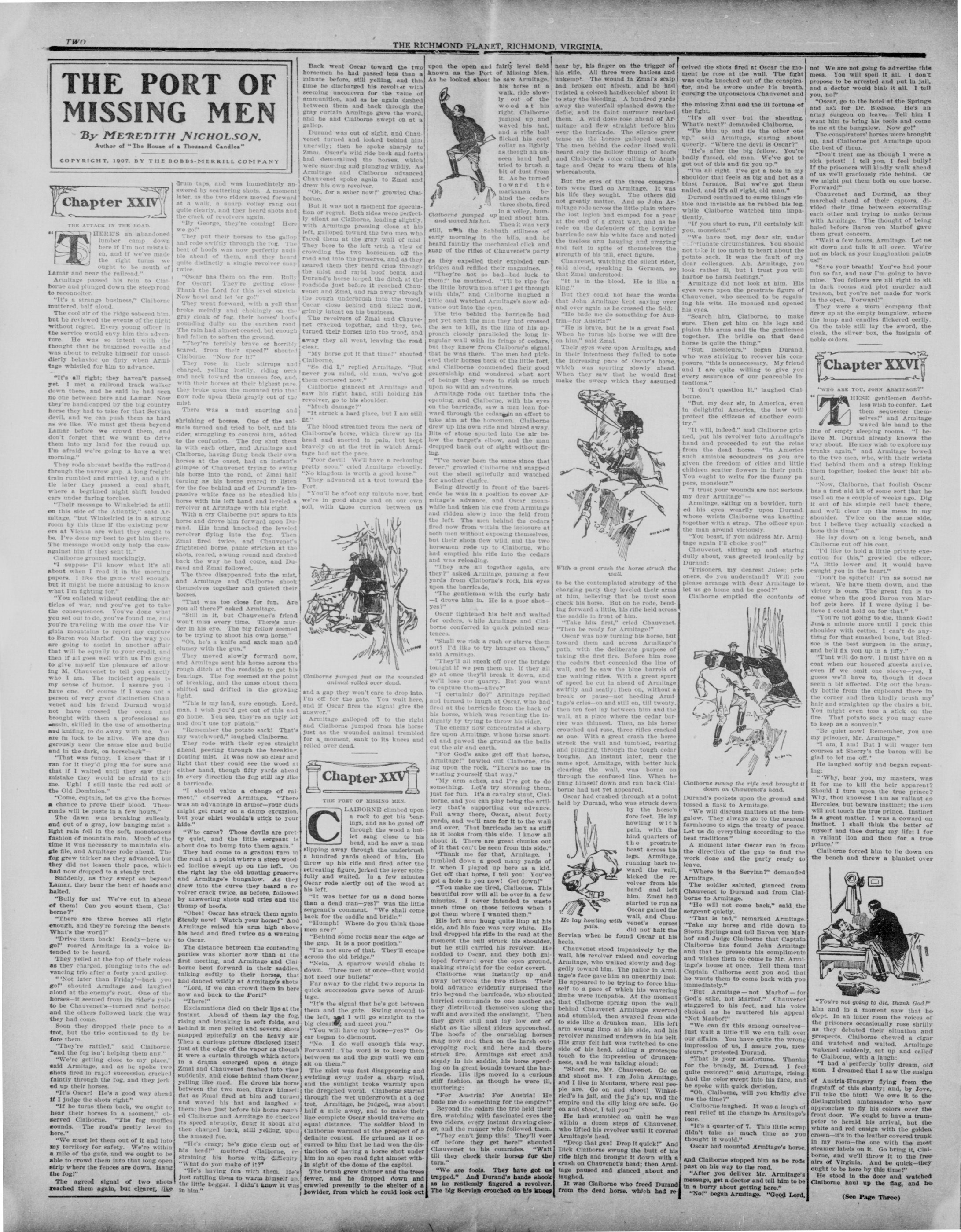
THE PORT OF MISSING MEN
COPYRIGHT, 1907. BY THE BOBBS-MERRILL COMPANY
Chapter XXIV
THE ATTACK IN THE ROAD.
HERE'S an abandoned lumber camp down here if I'm not mistaken, and if we've made the right turns we ought to be south of Lamar and near the railroad."
Armitage passed his rein to Claiborne and plunged down the steep road to reconnoiter.
"It's a strange business," Claiborne muttered, half aloud.
The cool air of the ridge sobered him, but he reviewed the events of the night without regret. Every young officer in the service would envy him this adventure. He was so intent with the thought that he hummed revelle and was about to rebuke himself for unsoldierly behavior on duty when Armla taged whistled for him to advance.
"It's all right; they haven't passed yet. I met a railroad track walker down there, and he said he had seen no one between here and Lamar. Now they're handicapped by the big country horse they had to take for that Servian devil, and we can push them as hard as we like. We must get them beyond Lamar before we crowd them, and don't forget that we want to drive them into my land for the round up. I'm afraid we're going to have a wet morning."
They rode abreast beside the railroad through the narrow gap. A long freight train rumbled and rattled by, and a little later they passed a coal shaft where a begritted night shift loaded cars under faring torches.
"Their message to Winklerried is still on this side of the Atlantic," said Armitage, "but Winklerried is in a strong room by this time if the existing powers at Vienna are what they ought to be. I've done my best to get him there. The message would only help the case against him if they sent it."
Clalborne groaned mockingly.
"I suppose I'll know what it's all about when I read it in the morning papers. I like the game well enough, but it might be more amusing to know what I'm fighting for."
"You enlisted without reading the articles of war, and you've got to take the consequences. You've done what you set out to do, you've found me, and you're travelling with me over the Virginia mountains to report my capture to Baron van Marhof. On the way you are going to assist in another affair that will be equally to your credit, and then if all go well with us I'm going to give myself the pleasure of allowing M. Chauvenet to tell you exactly who I am. The incident appeals to my sense of humor. I assure you I have one. Of course if I were not a person of very great distinction Chauvenet and his friend Durand would not have crossed the ocean and brought with them a professional assassin, skilled in the use of smothering and knifing, to do away with me. You are muck to be alive. We are dangerously near the same size and build in the dark, on horseback"—
"That was funny. I knew that if I ran for it it'd plug me for sure and that if I waited until they saw their mistake they would be afraid to kill me. Ugh! I still taste the red soil of the Old Dominion."
"Come, captain, let us give the horses a chance to prove their blood. These roads will be paste in a few hours."
The dawn was breaking sullenly and out of a gray, low hanging mist a light rain fell in the soft, monotonous fashion of mountain rain. Much of the time it was necessary to maintain single file, and Armitage rode ahead. The fog grew thicker as they advanced, but they did not lessen their pace, which had now dropped to a steady trot.
Suddenly, as they swept on beyond Lamar, they hear the beat of hoofs and halted.
"Bully for us! We've cut in ahead of them! Can you count them, Clatborne?"
"There are three horses all right enough, and they're forcing the beasts. What's the word?" "Drive them back! Ready—here we go!" roared Armitage in a voice intended to be heard.
They yelled at the top of their voices as they charged, plunging into the advancing trio after a forty yard gallop. "Not inter than Friday'—back you go!" shouted Armitage and laughed aloud at the enemy's rout. One of the horses—it seemed from its rider's yells to be Chauvenet's—turned and bolted and the others followed back the way they had come.
Soon they dropped their pace to a trot, but the trio continued to fly before them.
"They're rattled," said Claiborne "and the fog isn't helping them any."
"and the fog isn't helping them any."
"We're getting close to my place," said Armitage, and as he spoke two shots fired in rapid succession cracked faintly through the fog, and they jerked up their horses.
"It's Oscar! He's a good way ahead if I judge the shots right."
"If he turns them back, we ought to hear their horses in a moment," observed Claiborne. "The fog muffles sounds. The road's pretty level in here."
"We must let them out of it and into my territory for safety. We're within a mile of the gate, and we ought to be able to crowd them into that long open strip where the fences are down. Hang the fog!"
The agreed signal of two shots reached them again, but clearer, like
Back went Oscar toward the two horsemen he had passed less than a minute before, still yelling, and this time he discharged his revolver with seeming unconcern for the value of ammunition, and as he again dashed between them and back through the gray curtain Armitage gave the word, and he and Clalborne swept on at a gallop.
Durand was out of sight, and Chauvenet turned and looked behind him uncessfully; then he spoke sharply to Zmal. Oscar's wild ride back and forth had demoralized the horses, which were snorting and plunging wildly. As Armitage and Clalborne advanced Chauvenet spoke again to Zmal and drew his own revolver.
"Oh, for a saber now!" growled Clalborne.
But it was not a moment for speculation or regret. Both sides were perfectly silent as Clalborne, leading slightly, with Armitage pressing close at his left, galloped toward the two men who faced them at the gray wall of mist. They bore to the left with a view of crowding the two horsemen off the road and into the preserve, and as they neared them they heard cries through the mist and rapid hoof beats, and Durand's horse leaped the ditch at the roadside just before it reached Chauvenet and Zmal, and ran away through the rough underbrush into the wood, Oscar close behind and silent now, grimly intent on his business.
The revolvers of Zmal and Chauvenet cracked together, and they, too, turned their horses into the wood, and away they all went, leaving the road clear.
"My horse got it that time!" shouted Clalborne.
"So did I," replied Armitage. "But never you mind, old man, we've got them cornered now."
Claiborne glanced at Armitage and saw his right hand, still holding his revolver, go to his shoulder.
"Much damage?"
"It struck a hard place, but I am still fit."
The blood streamed from the neck of Claiborne's horse, which threw up its head and snorted in pain, but kept bravely on at the trot in which Armltge had set the pace.
They advanced at a trot toward the Port.
"You'll be afoot any minute now, but we're in good shape and on our own soil, with those carriors between us
Clalborne pumped just as the wounded animal rolled over dead.
and a gap they won't care to drop into,
I'm off for the gate. You wait here,
and if Oscar fires the signal give the
answer."
Armitage galloped off to the right
and Clalborne jumped from his horse
just as the wounded animal trembled
for a moment, sank to its knees and
rolled over dead.
Chapter XXV
THE PORT OF MISSING MEN.
LAIBORNE climbed upon
a rock to get his bearings,
and as he gazed off
through the wood a bullet sang close to his
head and he came a
slipping away through the underbrush a hundred yards ahead of him. He threw up his rifle and fired after the retreating figure, jerked the lever spitefully and waited. In a few minutes Oscar rode alertly out of the wood at his left.
"It was better for us a dead horse than a dead man—yes?" was the little sergeant's comment. "We shall come back for the saddle and bridle."
"Humph! Where do you think those men are?"
"Behind some rocks near the edge of the gap. It is a poor position."
"I'm not sure of that. They'll escape across the old bridge."
"Nein. A sparrow would shake it down. Three men at once—that would not need our bullets."
Far away to the right two reports in quick succession gave news of Armintage.
"It's the signal that he's got between them and the gate. Swing around to the left, and I will go straight to the big clearing and meet you."
"You will have my horse—yes?" Oscar began to dismount.
"No. I do well enough this way. Forward! The word is to keep them between us and the gap until we can sit on them."
The mist was fast disappearing and swirling away under a sharp wind, and the sunlight broke warmly upon the drenched world. Clalborne started through the wet undergrowth at a dog trot. Armitage, he judged, was about half a mile away, and to make their line complete Oscar should traverse an equal distance. The soldier blood in Clalborne warmed at the prospect of a definite contest. He grinned as it occurred to him that he had won the distinction of having a horse shot under him in an open road fight almost within sight of the dome of the capitol.
The brush grew thinner and the trees fewer, and he dropped down and crawled presently to the shelter of a bowler, from which he could look out
drum taps, and was immediately answered by scattering shots. A moment later, as the two riders moved forward at a walk, a sharp volley rang out quite clearly, and they heard shots and the crack of revolvers again.
"By George, they're coming! Here we go!" They put their horses to the gallop and rode swiftly through the fog. The beat of hoofs was now perfectly audible ahead of them, and they heard quite distinctly a single revolver snap twice.
"Oscar has them on the run. Bully for Oscar! They're getting close Thank the Lord for this level stretch Now how and let 'er go!" They went forward, with a yell that broke weirdly and choked on the gray cloak of fog, their horses' hoofs pounding dully on the earthen road. The rain had almost ceased, but enough had fallen to soften the ground.
"They're terribly brave or horribly scared, from their speed!" shouted Claiborne. "Now for it!" They rose in their stirrups and charged, yelling lustily, riding neck and neck toward the unseen foe, and, with their horses at their highest pace, they broke upon the mounted trio that now rode upon them gravely out of the mist.
There was a mad snorting and shrinking of horses. One of the animals turned and tried to bolt, and his rider, struggling to control him, added to the confusion. The fog shut them in with each other, and Armitage and Claiborne, having flung back their own horses at the onset, had an instant's glimpse of Chauvenet trying to swing his horse into the road, of Zimai half turning as his horse reared to listen for the foe behind and of Durand's impassive white face as he steadled his horse with his left hand and leveled a revolver at Armitage with his right.
With a cry Claiborne put spurs to his horse and drove him forward upon Durand. His hand knocked the leveled revolver flying into the fog. Then Zmal fired twice, and Chauvenet's frightened horse, panic stricken at the shots, reared, swung round and dashed back the way he had come, and Durand and Zmal followed.
The three disappeared into the mist, and Armitage and Claiborne shook themselves together and quieted their horses.
"That was too close for fun. Are you all there?" asked Armitage.
"Still in it, but Chauvenet's friend won't miss every time. There's murder in his eye. The big follow seemed to be trying to shoot his own horse."
"Oh, he's a knife and sack man and clumsy with the gun."
They moved slowly forward now, and Armitage sent his horse across the rough ditch at the roadside to get his bearings. The fog seemed at the point of breaking, and the mass about them shifted and drifted in the growing light.
"This is my land, sure enough. Lord, man, I wish you'd get out of this and go home. You see, they're an ugly lot and don't use toy plats."
"Remember the potato sack! That's my watchword," laughed Claiborne. They rode with their eyes straight ahead, peering through the breaking, floating mist. It was now so clear and light that they could see the wood at either hand, though fifty yards ahead in every direction the fog still lay like a barricade.
"I should value a change of raiment," observed Armitage. "There was an advantage in armor—your duds might get rusty on a damp excursion, but your shirt wouldn't stick to your hide."
"Who cares? Those devils are pretty quiet, and the little sergeant is about due to bump into them again."
They had come to a gradual turn in the road at a point where a steep wooded incline swept up on the left. On the right lay the old hunting preserve and Armitage's bungalow. As they drew into the curve they heard a revolver crack twice, as before, followed by answering shots and cries and the thump of hoofs.
"Ohee! Oscar has struck them again. Steady now! Watch your horse!" And Armitage raised his arm high above his head and fired twice as a warning to Oscar.
The distance between the contending parties was shorter now than at the first meeting, and Armitage and Clairborne bent forward in their saddles, talking softly to their horses, that had danced wildly at Armitage's shots.
"Lord, if we can crowd them in here now and back to the Port!"
Exclamations died on their lips at the instant. Ahead of them lay the fog, rising and breaking in soft folds, and behind it men yelled and several shouts snapped spitefully on the heavy air. Then a curious picture disclosed itself just at the edge of the vapor as though it were a curtain through which actors in a drama emerged upon a stage Zmal and Chauvenet flashed into view suddenly, and close behind them Oscar, yelling like mad. He drove his horse between the two men, threw himself flat as Zmal fired at him and turned and waved his hat and laughed at them; then just before his horse reached Clalborne and Armitage he checked its speed abruptly, flung it about and then charged back, still yelling, upon the amazed foe.
"He's crazy; he's gone clean out of his head!" muttered Clalborne, restraining his horse with difficulty.
"What do you make of it?"
"He's having fun with them. He's just rattling them to warm himself up, the little beggar. I didn't know it was in him."
THE RICHMOND PLANET, RICHMOND, VIRGINIA
THE PORT OF MISSING MEN.
LAIBORNE climbed upon a rock to get his bearings, and as he gazed off through the wood a bullet sang close to his head, and he saw a man
upon the open and fairly level field known as the Port of Missing Men. As he looked about he saw Armitage, his horse at a walk, ride slowly out of the wood at his right. Claiborne jumped up and waved his hat, and a rifle ball flicked his coat collar as lightly as though an unseen hand had tried to brush a bit of dust from it. As he turned toward the marksman behind the cedars three shots, fired in a yellow hump.
his horse at a walk, ride slowly out of the wood at his right. Claiborne jumped up and waved his hat, and a rifle ball flicked his coat collar as lightly as though an unseen hand had tried to brush a bit of dust from it. As he turned toward the marksman behind the cedars three shots, fired in a volley, hummed about him. Then it was very still, with the Sabbath stillness of early morning in the hills, and he heard faintly the mechanical click and snap of the rifles of Chauvenet's party
as they expelled their exploded cartridges and refilled their magazines. "They're not so bad—bad luck to them!" he muttered. "I'll be ripe for the little brown men after I get through with this," and Claiborne laughed a little and watched Armitage's slow advance out into the open. The trio behind the barricade had not yet seen the man they had crossed the sea to kill, as the line of his approach closely paralleled the long irregular wall with its fringe of cedars, but they knew from Claiborne's signal that he was there. The men had picketed their horses back of the little fort, and Claiborne commended their good generalship and wondered what sort of beings they were to risk so much upon so wild an adventure.
Armitage rode out farther into the opening, and Claiborne, with his eyes on the barricade, saw a man lean forward through the cedarman an effort to take alm at the horseman. Claiborne drew up his own rifle and blazed away. Bits of stone spurted into the air below the target's elbow, and the man dropped back out of sight without firing.
"I've never been the same since that fever," growled Claiborne and snapped out the shell spitefully and watched for another chiffle.
Being directly in front of the barricade he was in a position to cover Armitage's advance, and Oscar meanwhile had taken his cue from Armitage and ridden slowly into the field from the left. The men behind the cedars fired now from within the inclosure at both men without exposing themselves, but their shots flew wild, and the two horsemen rode up to Claiborne, who had emptied his rifle into the cedars and was reloading.
"They are all together again, are they?" asked Armitage, pausing a few yards from Clalborne's rock, his eyes upon the barricade.
"The gentleman with the curly hair—I drove him in. He is a poor shot—yes?"
Oscar tightened his belt and waited for orders, while Armitage and Clalborne conferred in quick pointed sentences.
"Shall we risk a rush or starve them out? I'd like to try hunger on them," said Armitage.
"They all sneak off over the bridge tonight if we pen them up. If they all go at once they'll break it down, and we'll lose our quarry. But you want to capture them—alive?"
"I certainly do?" Armitage replied and turned to laugh at Oscar, who had fired at the barricade from the back of his horse, which was resenting the indignity by trying to throw his rider.
The enemy now concentrated a sharp fire upon Armitage, whose horse snorted and pawed the ground as the balls cut the air and earth.
"For God's sake get off that horse, Armitage!" bawled out Chalborne, rising upon the rock. "There's no use in wasting yourself that way."
"My arm aches, and I've got to do something. Let's try storming them, just for fun. It's a cavalry stunt, Chalborne, and you can play being the artillery that's supporting our advance. Fall away there, Oscar, about forty yards, and we'll race for it to the wall and over. That barricade isn't as stiff as it looks from this side. I know all about it. There are great chunks out of it that can't be seen from this side."
"You make me tired, Clalborne. This beautiful row will all be over in a few minutes. I never intended to waste much time on those fellows when I got them where I wanted them."
His left arm hung quite limp at his side, and his face was very white. He had dropped his rifle in the road at the moment the ball struck his shoulder, but he still carried his revolver. He nodded to Oscar, and they both galloped forward over the open ground, making straight for the cedar covert.
Clalborne was instantly up and away between the two riders. Their bold advance evidently surprised the trio beyond the barricade, who shouted hurried commands to one another as they distributed themselves along the wall and awaited the onslaught. Then they grew still and lay low out of sight as the silent riders approached. The hoofs of the onrushing horses rang now and then on the harsh outcropping rock and here and there struck fire. Armitage sat erect and steady in his saddle, his horse speeding on in great bounds toward the barricade. His lips moved in a curious stiff fashion, as though he were ill, muttering:
"For Austria! For Austria! He bade me do something for the empire! Beyond the cedars the trio held their fire, watching with fascinated eyes the two riders, every instant drawing closer, and the runner who followed them. "They can't jump this! They'll veer off before they get here!" shouted Chauvenet to his comrades. "Walt till they check their horses for the turn."
"We are fools. They have got us trapped." And Durand's hands shook as he restlessly fingered a revolver. The big Servian crouched on his knees
near by, his finger on the trigger of his rifle. All three were hattess and unkempt. The wound in Zmai's scalp had broken out afresh, and he had twisted a colored handkerchief about it to stay the bleeding. A hundred yards away the waterfall splashed down the defile, and its faint murmur reached them. A wild dove rose ahead of Armitage and few straight before him ever the barricade. The silence grew tense as the horses galloped nearer. The men behind the cedar lined wall heard only the hollow thump of hoofs and Claiborne's voice calling to Armitage and Oscar to warn them of his whereabouts.
But the eyes of the three conspirators were fixed on Armitage. It was his life they sought. The others did not greatly matter. And so John Armitage rode across the little plain where the lost legion had camped for a year at the end of a great war, and as he rode on the defenders of the bowler barricade saw his white face and noted the useless arm hanging and swaying and felt in spite of themselves the strength of his tall, erect figure.
Chauvenet, watching the silent rider, said aloud, speaking in German, so that Zmal understood:
"It is in the blood. He is like a king."
But they could not hear the words that John Armitage kept saying over and over again as he crossed the field: "He bead me do something for Austria—for Austria."
"He is brave, but he is a great fool. When he turns his horse we will fire on him," said Zmat.
Their eyes were upon Armitage, and in their intentions they failed to note the increasing pace of Oscar's horse, which was spurting slowly ahead. When they saw that he would first make the sweep which they assumed
A. V. B. D. P.
With a great crush the horse struck the wall.
to be the contemplated strategy of the charging party they leveled their arms at him, believing that he must soon check his horse. But on he rode, bending forward a little, his rifle held across the saddle in front of him.
"Take him first," cried Chauvenet.
"Then be ready for Armiget!"
Oscar was now turning his horse, but toward them and across Armitage's path, with the deliberate purpose of taking the first fire. Before him rose the cedars that concealed the line of wall, and he saw the blue barrels of the waiting riles. With a great spurt of speed he cut in shed of Armitage swiftly and neatly; then on, without a break or pause—not heeding Armitage's cries—on and still on, till twenty, then ten feet lay between him and the wall, at a place where the cedar barrier was thinnest. Then, as his horse crouched and rose, three rifles cracked as one. With a great crash the horse struck the wall and tumbled, rearing and plunging, through the tough cedar boughs. An instant later, near the same spot, Armitage, with better luck clearing the wall, was borne on through the confused line. When he flung himself down and ran back Clalborne had not yet appeared.
Oscar had crashed through at a point held by Durand, who was struck down
was struck down by the horse's fore feet. He lay howling with pain, with the hind quarters of the prostrate beast across his legs. Armitage, running back toward the wall, kicked the revolver from his hand and left him. Zmal had started to run as Oscar gained the wall, and Chauvenet's curses did not halt the
A boy is sleeping on a tree.
Servian when he found Oscar at his heels.
Chauvenet stood impassively by the wall, his revolver raised and covering Armitage, who walked slowly and doggedly toward him. The pallor in Armitage's face gave him an unearthly look.
He appeared to be trying to force himself to a pace of which his wavering limbs were incapable. At the moment that Clalborne sprang upon the wall behind Chauvenet Armitage swerved and stumbled, then swayed from side to side like a drunken man. His left arm swung limp at his side, and his revolver remained undrawn in his belt. His gray felt hat was twitched to one side of his head, adding a grotesque touch to the impression of drunkenness, and he was talking aloud:
"Shoot me, Mr. Chauvenet. Go on and shoot me. I am John Armitage, and I live in Montana, where real people are. Go on and shoot! Winkelried in jail, and the jig's up, and the empire and the silly king are safe. Go on and shoot, I tell you!" He had stumbled on until he was within a dozen steps of Chauvenet, who lifted his revolver until it covered Armitage's head. "Drop that gun! Drop it quick!" And Dick Claiborne swung the butt of his rifle high and brought it down with a crash on Chauvenet's head; then Armitage paused and glanced about and nughed. It was Claiborne who freed Durand from the dead horse, which had re-
celled the shots fired at Oscar the moment he rose at the wall. The fight was quite knocked out of the conspirator, and he swore under his breath, cursing the unconscious Chauvenet and the missing Zmal and the ill fortune of the fight. "It's all over but the shouting. What's next?" demanded Clalborne.
"He's after the big fellow. You're badly fussed, old man. We've got to get out of this and fix you up."
"I'm all right. I've got a hole in my shoulder that feels as big and hot as a blast furnace. But we've got them nailed, and it's all right, old man."
Durand continued to curse things visible and invisible as he rubbed his leg, while Clalborne watched him impatiently.
"If you start to run, I'll certainly kill you, mounsleur."
"We have met, my dear sir, under unfortunate circumstances. You should not take it too much to heart about the potato sack. It was the fault of my dear colleagues. Ah, Armitage, you look rather ill, but I trust you will harbor no harsh feelings."
Armitage did not look at him. His eyes were upon the prostrate figure of Chauvenet, who seemed to be regaining his wits. He mounced and opened his eyes.
"Search him, Claiborne, to make sure. Then get him on his legs and pinion his arms and tie the gentlemen together. The bridle on that dead horse is quite the thing."
"But, messleurs," began Durand, who was striving to recover his composition, "this is unnecessary. My friend and I are quite willing to give you every assurance of our peaceable intentions."
"I don't question it," laughed Claiborne.
"But, my dear sir, in America, even in delightful America, the law will protect the citizens of another country."
"It will, indeed," and Claiborne grinned, put his revolver into Armitage's hand and proceeded to cut the reins from the dead horse. "In America such amiable scoundrels you are given the freedom of cities and little children scatter flowers in their path. You ought to write for the funny papers, monsleur."
"I trust your wounds are not serious, my dear Armiltage"
Armiltage, sitting on a bowler, turned his eyes wearly upon Durand, whose wrists Clalborne was knotting together with a strap. The officer spun the man around viciously.
"You beast, if you address Mr. Armiltage again I'll choke you!"
Chauvenet, sitting up and staring dully about, was greeted ironically by Durand:
"Prisoners, my dearest Jules; prisoners, do you understand? Will you please arrange with dear Armiltage to let us go home and be good?"
Clalborne emptied the contents of
1900
Clatborne saving the rifle and brought it down on Chauvenet's head.
Durand's pockets upon the ground and tossed a flask to Armitage.
"We will discuss matters at the bungalow. They always go to the nearest farmhouse to sign the treaty of peace. Let us do everything according to the best traditions."
A moment later Oscar ran in from the direction of the gap to find the work done and the party ready to leave.
"Where is the Servian?" demanded Armitage.
The soldier saluted, glanced from Chauvenet to Durand and from Clalborne to Armitage.
"He will not come back," said the sergeant quietly.
"That is bad," remarked Armitage. "Take my horse and ride down to Storm Springs and tell Baron von Marhtof and Judge Claiborne that Captain Claiborne has found John Armitage and that he presents his compliments and wishes them to come to Mr. Armitage's house at once. Tell them that Captain Claiborne sent you and that he wants them to come back with you immediately."
"But Armitage—not Marhtof—for God's sake, not Marhtof." Chauvenet staggered to his feet, and his voice choked as he muttered his appeal "Not Marhtof."
"We can fix this among ourselves—just wait a little till we can talk over our affairs. You have quite the wrong impression of us, I assure you, messleurs," protested Durand.
"That is your misfortune. Thanks for the brandy, M. Durand. I feel quite restored," said Armitage, rising. And the color swept into his face, and he spoke with quick decision.
"Oh, Claiborne, will you kindly give me the time?"
Claiborne laughed. It was a laugh of real relief at the change in Armitage's tone.
"It's a quarter of 7. This little scrap didn't take as much time as you thought it would."
Oscar had mounted Armitage's horse, and Claiborne stopped him as he rode past on his way to the road.
"After you deliver Mr. Armitage's message, get a doctor and tell him to be in a burry about getting here."
"No!" began Armitage. "Good Lord."
no! We are not going to advertise this mess. You will spoil it all. I don't propose to be arrested and put in jail, and a doctor would blab it all. I tell you, no!"
"Oscar, go to the hotel at the Springs and ask for Dr. Bledsoe. He's an army surgeon on leave. Tell him I want him to bring his tools and come to me at the bungalow. Now go!"
The conspirators' horses were brought up, and Caliborne put Armitage upon the best of them.
"Don't treat me as though I were a sick priest! I tell you, I feel bully! If the prisoners will kindly walk ahead of us we'll graciously ride behind. Or we might put them both on one horse. Forward!"
Uchevnet and Durand, as they marched ahead of their captors, divided their time between execrating each other and trying to make terms with Armitage. The thought of being haled before Baron von Marhof gave them great concern.
"Wait a few hours, Armitage. Let us sit down and talk it all over. We're not as black as your imagination paints us!"
"Save your breath! You've had your fun so far, and now I'm going to have mine. You fellows are all right to sit in dark rooms and plot murder and treason, but you're not made for work in the open. Forward!"
They were a worn company that drew up at the empty bungalow, where the lamp and candles flickered eerily. On the table still lay the sword, the cloak, the silver box, the insignia of noble orders.
Chapter XXVI
"WHO ARE YOU, JOHN ARMITAGE?"
T
HESE gentlemen doubtless wish to confer. Let them sequester themselves" and Armitage waved his hand to the line of empty sleeping rooms. "I believe M. Durand already knows the way about. He may wish to explore my trunks again," and Armitage bowed to the two men, who, with their wrists tied behind them and a strap linking them together, looked the least bit absurd.
"Now, Clalborne, that foolish Oscar has a first aid kit of some sort that he used on me a couple of weeks ago. Dig it out of his simple cell back there, and we'll clear up this mess in my shoulder. Twice on the same side, but I believe they actually cracked a bone this time."
He lay down on a long bench, and Clalborne cut off his coat.
"I'd like to hold a little private execution for this," growled the officer, "A little lower and it would have caught you in the heart."
"Don't be spiteful! I'm as sound as wheat. We have them down, and the victory is ours. The great fun is to come when the good Baron von Marhof gets here. If I were dying I believe I could hold on for that."
"You're not going to die, thank God! Just a minute more until I pack this shoulder with cotton. I can't do anything for that smashed bone, but Bledsoe is the best surgeon in the army, and he'll fix you up in a tiffy."
"That will do now. I must have on a coat when our honored guests arrive, even if we omit one sleeve—yes, I guess we'll have to, though it does seem a bit affected. Dig out the brandy bottle from the cupboard there in the corner and then kindly brush my hair and straighten up the chairs a bit. You might even toss a stick on the fire. That potato sack you may care to keep as a souvenir."
"Be quiet now! Remember, you are my prisoner, Mr. Armitage."
"I am, I am! But I will wager ten courses at Sherry's the baron will be glad to let me off."
He laughed softly and began repeating:
"Why, hear you, my masters, was it for me to kill the heir apparent? Should I turn upon the true prince? Why, why knowest I am as valiant as Hercules, but beware instinct; the ion will not touch the true prince. Instinct is a great matter. I was a coward on instinct. I shall think the better of myself and thee during my life; I for a vallant lion and thou for a true prince." Claiborne forced him to lie down on the bench and threw a blanket over
B VOGEL
"You're not going to die, thank God!" him and in a moment saw that he slept. In an inner room the voices of the prisoners occasionally rose shrilly as they debated their situation and prospects. Clalborne chewed a cigar and watched and waited. Armitage waked suddenly, sat up and called to Clalborne, with a laugh:
"I had a perfectly bully dream, old man. I dreamed that I saw the ensign of Austria-Hungary flying from the flagstaff of this shanty; and, by Bove, I'll take the hint! We owe it to the distinguished ambassador who now approaches to fly his colors over the front door. We ought to have a trumpeter to herald his arrival, but the white and red ensign with the golden crown—it's in the leather covered trunk in my room—the one with the most steamer labels on it. Go bring it, Clalborne, and we'll throw it to the freeairs of Virginia. And be quick—they ought to be here by this time!"
He stood in the door and watched. Claiborne haul up the flag, and he
(See Page Three)
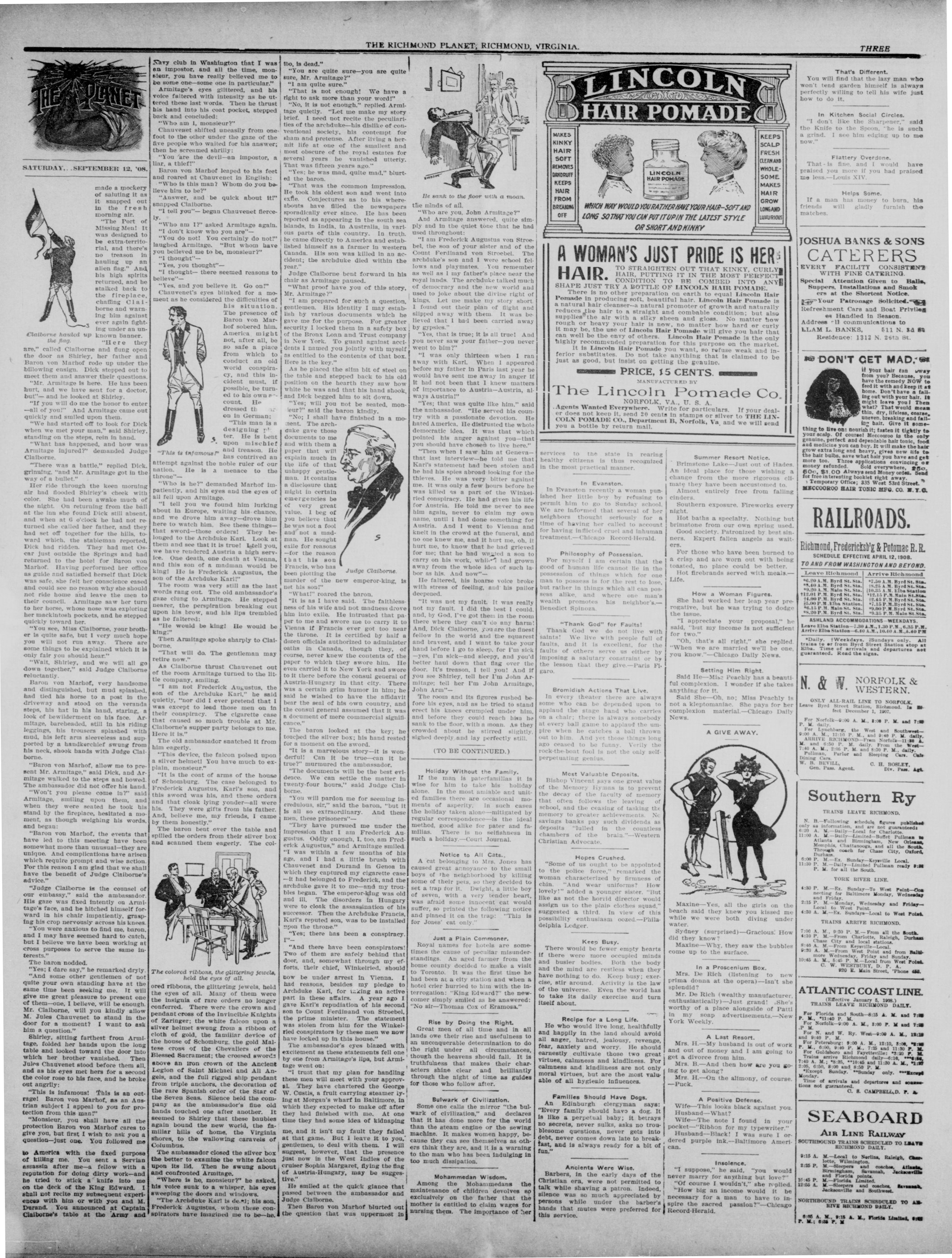
THE PLANET
SATURDAY...SEPTEMBER 12, '08
#
made a mockery of saluting it as it snapped out in the fresh morning air.
"The Port of Missing Men! It was designed to be extra-territorial, and there's no treason in hauling up an alien flag." And his high spirits returned, and he backed to the fireplace, chaffing Claiborne and warning him against ever again fighting under an unknown banner.
are," called Claiborne and flung open the door as Shirley, her father and Baron von Marhof rode up under the billowing ensign. Dick stepped out to meet them and answer their questions. "Mr. Armitage is here. He has been hurt, and we have sent for a doctor, but"—and he looked at Shirley. "If you will do me the honor to enter—all of you!" And Armitage came out quickly and smiled upon them. "We had started off to look for Dick when we met your man," said Shirley, standing on the steps, rein in hand. "What has happened, and how was Armitage injured?" demanded Judge Claiborne. "There was a battle," replied Dick, grimming, "and Mr. Armitage got in the way of a bullet."
Her ride through the keen morning air had flooded Shirley's cheek with color. She had been awake much of the night. On returning from the ball at the inn she found Dick still absent, and when at 6 o'clock he had not returned she called her father, and they had set off together for the hills, toward which, the stableman reported, Dick had ridden. They had met Oscar just outside the Springs and had returned to the hotel for Baron von Marhof. Having performed her office as guide and satisfied herself that Dick was safe, she felt her conscience eased and could see no reason why she should not ride home and leave the men to their council. Armitage saw her turn to her horse, whose nose was exploring her mackintosh pockets, and he stepped quickly toward her.
"You see, Miss Claiborne, your brother is quite safe, but I very much hope you will not run away. There are some things to be explained which it is only fair you should hear."
"Wait, Shirley, and we will all go down together," said Judge Claiborne reluctantly.
Baron von Marhof, very handsome and distinguished, but mud splashed, had tied his horse to a post in the driveway and stood on the veranda steps, his hat in his hand, staring, a look of bewilderment on his face. Armitage, bareheaded, still in his riding leggings, his trousers splashed with mud, his left arm sleeveless and supported by a handkerchief swung from his neck, shook hands with Judge Claiborne.
"Baron von Marhof, allow me to present Mr. Armitage," said Dick, and Armitage walked to the steps and bowed. The ambassador did not offer his hand.
"Won't you please come in?" said Armitage, smiling upon them, and when they were seated he took his stand by the fireplace, hesitated a moment, as though weighing his words, and began:
"Baron von Marhof, the events that have led to this meeting have been somewhat more than unusual—they are unique. And complications have arisen which require prompt and wise action. For this reason I am glad that we shall have the benefit of Judge Claiborne's advice."
"Judge Claiborne is the counsel of our embassy," said the ambassador. His gaze was fixed intently on Armitage's face, and he hitched himself forward in his chair impatiently, grasping his crop nervously across his knees.
"You were anxious to find me, baron, and I may have seemed hard to catch, but I believe we have been working at cross purposes to serve the same interests."
The baron nodded.
"Yes; I dare say," he remarked dryly.
"And some other gentlemen of not quite your own standing have at the same time been seeking me. It will give me great pleasure to present one of them—one, I believe, will be enough. Mr. Claiborne, will you kindly allow M. Jules Chauvenet to stand in the door for a moment? I want to ask him a question."
Shirley, sitting farthest from Armitage, folded her hands upon the long table and looked toward the door into which her brother vanished. Then Jules Chauvenet stood before them all, and as his eyes met hers for a second the color rose to his face, and he broke out angrily:
"This is infamous! This is an outrage! Baron von Marhof, as an Austrian subject I appeal to you for protection from this man!"
"Monsieur, you shall have all the protection Baron von Marhof cares to give you, but first I wish to ask you a question—just one. You followed me
to America with the fixed purposes of killing me. You sent a Servian assassin after me—a fellow with a reputation for doing dirty work—and he tried to stick a knife into me on the deck of the King Edward. I shall not recite my subsequent experiences with him or with you and M. Durand. You announced at Captain Clalborne's table at the Army and
Savvy club in Washington that I was an impostor, and all the time, monsieur, you have really believed me to be some one—some one in particular.” Armitage's eyes glittered, and his voice faltered with intensity as he uttered these last words. Then he thrust his hand into his coat pocket, stepped back and concluded:
“Who am I, monsieur?”
Chauvenet shifted uneasily from one foot to the other under the gaze of the five people who waited for his answer; then he screamed shrilly:
“You are the devil—an impostor, a liar, a thief!”
Baron von Marhof leaped to his feet and roared at Chauvenet in English:
“Who is this man? Whom do you believe him to be?”
“Answer, and be quick about it!” snapped Claiborne.
“I tell you”—began Chauvenet fiercely.
“Who am I?” asked Armitage again.
“I don't know who you are”—
"I thought"—
"Yes, you thought"—
"I thought— there seemed reasons to believe"—
"Yes, and you believe it. Go on!" Chauventu's eyes blinked for a moment as he considered the difficulties of
the unfortunate of his situation. The presence of Baron von Marhof sobered him. America might, not after all, be so safe a place from which to conduct an old world conspiracy, and this incident must, if possible, be turned to his own account. He dressed the arrogant.
5.
"This man is a
designing p-
ter. He is bent
upon mischief
and treason. He
has contributed an
"This is infamous!" and treason. He has contrived an attempt against the noble ruler of our nation. He is a menace to the throne"—"Who is he?" demanded Marhof impatient, and his eyes and the eyes of all fell upon Armitage.
"I tell you we found him lurking about in Europe, waiting his chance, and we drove him away—drove him here to watch him. See these things—that sword—those orders! They belonged to the Archduke Karl. Look at them and see that it is true! I tell you, we have rendered Austria a high service. One death, one death at Vienna, and this son of a madman would be king! He is Frederick Augustus, the son of the Archduke Karl!"
The room was very still as the last words rang out. The old ambassador's gaze clung to Armitage. He stepped nearer, the perspiration breaking out upon his brow, and his lips trembled as he faltered:
"He would be king! He would be king!"
Then Armitage spoke sharply to Claiborne.
"That will do. The gentleman may retire now."
As Claiborne thrust Chauvenet out of the room Armitage turned to the little company, smiling.
"I am not Frederick Augustus, the son of the Archduke Karl," he said quietly, "nor did I ever pretend that I was except to lead those men on in their conspiracy. The cigarette case that caused so much trouble at Mr. Claiborne's party belongs to me. Here it is."
The old ambassador snatched it from him eagerly.
"This device, the falcon polsed upon a silver helmet! You have much to explain, monsieur."
"It is the coat of arms of the house of Schomburg. The case belonged to Frederick Augustus, Karl's son, and this sword was his, and these orders and that cloak lying yonder—all were his. They were gifts from his father, And, believe me, my friends, I came by them honestly." The baron bent over the table and spilled the orders from their silver box and scanned them eagerly. The col-
The colored ribbons, the glittering jewels, held the eyes of all.
ored ribbons, the glittering jewels, held the eyes of all. Many of them were the insignia of rare orders no longer conferred. There were the crown and pendant cross of the Invincible Knights of Zaringer; the white falcon upon a silver helmet swung from a ribbon of cloth of gold, the familiar device of the house of Schomburg, the gold Maltese cross of the Chevalliers of the Blessed Sacrament; the crossed swords above an iron crown of the Ancient Legion of Saint Michael and All Angels, and the full rigged ship pendant from triple anchors, the decoration of the rare Spanish order of the Star of the Seven Seas. Silence held the company as the ambassador's fine old hands touched one after another. It seemed to Shirley that these baubles again bound the new world, the familiar hills of home, the Virginia shores, to the wallowing caravels of Columbus.
The ambassador closed the silver box the better to examine the white falcon upon its lid. Then he swung about and confronted Armitage.
"Where is he, monsieur?" he asked, his voice sunk to a whisper, his eyes sweeping the doors and windows.
"The Archduke Karl is de."; his son, Frederick Augustus, whom these conspirators have imagined me to be—he
THE RICHMOND PLANET, RICHMOND, VIRGINIA
too, is dead." "You are quite sure—you are quite sure, Mr. Armitage?" "I am quite sure." "That is not enough! We have a right to ask more than your word!" "No, it is not enough," replied Armitage quietly. "Let me make my story brief. I need not recite the peculiarities of the archduke—his dislike of conventional society, his contempt for sham and pretense. After living a hermit life at one of the smallest and most obscure of the royal estates for several years he vanished utterly. That was fifteen years ago." "Yes; he was mad, quite mad," blurted the baron.
"That was the common impression. He took his oldest son and went into exile. Conjectures as to his whereabouts have filled the newspapers sporadically ever since. He has been reported as appearing in the south sea islands, in India, in Australia, in various parts of this country. In truth, he came directly to America and established himself as a farmer in western Canada. His son was killed in an accident; the archduke died within the year."
Judge Claiborne bent forward in his chair as Armitage paused.
"What proof have you of this story, Mr. Armitage?"
"I am prepared for such a question, gentlemen. His identity I may establish by various documents which he gave me for the purpose. For greater security I locked them in a safety box of the Bronx Loan and Trust company in New York. To guard against accidents I named you jointly with myself as entitled to the contents of that box. Here is the key."
As he placed the slim bit of steel on the table and stepped back to his old position on the hearth they saw how white he was and that his hand shook, and Dick begged him to sit down.
"Yes; will you not be seated, moneur?" said the baron kindly.
ment. The archduke gave those documents to me and with them a paper that will explain much in the life of that unhappy gentleman. It contains a disclosure that might in certain emergencies be of very great value. I beg of you believe that he was not a fool and 'not a madman. He sought exile for reasons —for the reason that his son Francis, who has been plotting the murder of the
S
Pierre, who was Judge Claiborne. been plotting the murder of the new emperor-king, is not his son"
"What!" roared the baron.
"It is as I have said. The faithlessness of his wife and not madness drove him into exile. He intrusted that paper to me and swore me to carry it to Vienna if Francis ever got too near the throne. It is certified by half a dozen officials authorized to administer oaths in Canada, though they, of course, never knew the contents of the paper to which they swore him. He even carried it to New York and swore it to it before the consul general of Austria-Hungary in that city. There was a certain grim humor in him; he said he wished to have the affidavit bear the seal of his own country, and the consul general assumed that it was a document of mere commercial significance."
The baron looked at the key; he touched the silver box; his hand rested for a moment on the sword.
"It is a marvelous story—it is wonderful! Can it be true—can it be true?" Murmured the ambassador.
"The documents will be the best evidence. We can settle the matter in twenty-four hours," said Judge Claborne.
"You will pardon me for seeming incredulous, sir," said the baron, "but it is all so extraordinary. And these men, these prisoners"—
"They have pursued me under the impression that I am Frederick Augustus. Oddly enough, I too, am Frederick Augustus," and Armitage smiled.
"I was within a few months of his age, and I had a little brush with Chauvenet and Durand in Genoa in which they captured my cigarette case—it had belonged to Frederick, and the archduke gave it to—me and my troubles began. The emperor-king was old and ill. The disorders in Hungary were to cloak the assassination of his successor. Then the Archduke Francis, Karl's reputed son, was to be installed upon the throne."
"Yes; there has been a conspiracy. P"—
"And there have been conspirators." Two of them are safely behind that door, and somewhat through my efforts, their chief, Winkelried, should
The ambassador's eyes blazed with excitement as these statements fell one by one from Armitage's lips, but Armitage went on:
"I trust that my plan for handling these men will meet with your approval. They have chartered the George W. Custis, a fruit carrying steamer lying at Morgan's wharf in Baltimore, in which they expected to make off after they had finished with me. At one time they had some idea of kidnapping me, and it isn't my fault they failed at that game. But I leave it to you, gentlemen, to deal with them. I will suggest, however, that the presence just now in the West Indies of the cruiser Sophia Margaret, flying the flag of Austria-Hungary, may be suggestive."
He smiled at the quick glance that passed between the ambassador and Judge Clalborne.
Then Baron von Marhoff blurted out the question that was uppermost in
He sank to the floor with a moan. the minds of all. "Who are you. John Armitage?"
Who are you, John Armitage?
And Armitage answered, quite simply and in the quiet tone that he had used throughout:
"I am Frederick Augustus von Stroebel, the son of your sister and of the Count Ferdinand von Stroebel. The archduke his son and I were school fellows and playmates. You remember as well as I my father's place near the royal lands. The archduke talked much of democracy and the new world and used to joke about the divine right of kings. Let me make my story short. I found out their plan of flight and slipped away with them. It was believed that I had been carried away by gypsies."
"Yes, that is true; it is all true! And you never saw your father—you never went to him?"
"I was only thirteen when I ran away with Karl. When I appeared before my father in Paris last year he would have sent me away in anger if it had not been that I knew matters of importance to Austria-Austria, always Austria!" "Yes; that was quite like him," said the ambassador. "He served his country with a passionate devotion. He hated America. He distrusted the whole democratic idea. It was that which pointed his anger against you—that you should have chosen to live here."
"Then when I saw him at Geneva—that last interview—he told me that Karl's statement had been stolen and he had his spies abroad looking for the thieves. He was very bitter against me. It was only a few hours before he was killed as a part of the Winkelried conspiracy. He had given his life for Austria. He told me never to see him again, never to claim my own name, until I had done something for Austria. And I went to Vienna and knelt in the crowd at the funeral, and no one knew me, and it hurt me, oh, it hurt me, to know that he had grieved for me; that he had wanted a son to carry on his work, while I had grown away from the whole idea of such labor as his. And now"—He faltered, his hoarse voice broke with stress of feeling, and his pallor deepened.
"It was not my fault. It was really not my fault. I did the best I could, and, by God, I've got them in the room there where they can't do any harm! And, Dick Claiborne, you are the finest fellow in the world and the squares and bravest, and I want to take your hand before I go to sleep, for I'm sick—yes, I'm sick—and sleepy, and you'd better haul down that flag over the door. It's treason, I tell you! And if you see Shirley, tell her I'm John Armitage; tell her I'm John Armitage, John Arm"—
The room and its figures rushed before his eyes, and as he tried to stand erect his knees crumpled under him, and before they could reach him he sank to the floor, with a moan. As they crowded about he stirred slightly, sighed deeply and lay perfectly still.
(TO BE CONTINUED.)
Holiday Without the Family
If the man is paterfamilias it is wise for him to take his holiday alone. In the most amiable and united families there are occasional moments of asperity. In such cases the holiday taken alone—mitigated by regular correspondence—is the ideal method, good alike for pater and families. There is no selfishness in such a holiday—Court Journal.
Notice to All Cats
A cat belonging to Mrs. Jones has caused great annoyance to the small boys of the neighborhood by killing some of their pets, so they decided to set a trap for it. Dwight, a little boy of seven, with a very tender heart, was afraid some innocent cat would suffer, so printed the following notice and pinned it on the trap: "This is for Jones' cat only."
Just a Plain Commoner.
Royal names for hotels are sometimes the cause of peculiar misunderstandings. An aged farmer from the county county decided to make a visit to Toronto. It was the first time he had been at a city station and when a hotel crier hurried to him with the interrogation: "King Edward?" the newcomer simply smiled as he answered: "No sir—Thomas Cox of Eramosa."
Rise by Doing the Right.
Great men of all time and in all lands owe their rise and usefulness to an unconquerable determination to do the right under all circumstances, though the heavens should fail. It is truthfulness that makes their characters shine clear and brilliantly through the night of time as guides for those who follow after.
Bulwark of Civilization
Some one calls the mirror "the bulwark of civilization," and declares that it has done more for the world than the steam engine or the sewing machine. It makes women happy, because they can see themselves as others think they are, and it is a warning to the man who has been indulging in too much dissipation.
Mohammedan Wisdom.
Among the Mohammedans the maintenance of children devolves so exclusively on the father that the mother is entitled to claim wages for nursing them. The importance of her
LINCOLN
HAIR POMADE
MAKES
KINKY
HAIR
SOFT
REMOVES
DANDRUFF
KEEPS
HAIR
FROM
BREAKING
OFF
LINCOLN
HAIR POMADE
KEEPS
SCALP
FRESH
CLEAN AND
WHOLE-
SOME
MAKES
HAIR
GROW
LONG AND
LUXURIOUS
WHICH WAY WOULD YOU RATHER HAVE YOUR HAIR-SOFT AND
LONG SO THAT YOU CAN PUT IT UP IN THE LATEST STYLE
OR SHORT AND KINKY
A WOMAN'S JUST PRIDE IS HER
HAIR. TO STRAIGHTEN OUT THAT KINKY, CURLY HAIR, PUTTING IT IN THE MOST PERFECT CONDITION TO BE COMBED INTO ANY SHAPE JUST TRY A BOTTLE OF LINCOLN HAIR POMADE.
There is no other preparation on earth to equal Lincoln Hair Pomade in producing soft, beautiful hair. Lincoln Hair Pomade is a natural hair cleanser—a natural promoter of growth and naturally reduces the hair to a straight and combable condition; but also supplies the air in a kayak sheen and gloss. No matter how rough or heavy your hair may be, no hard or curly it may be, the use of Lincoln Hair Pomade will give hair that can well be the envy of others. Lincoln Hair Pomade is the only highly recommended preparation for this purpose on the
It is Lincoln Hair Pomade you want, so refuse weak and inferior substitutes. Do not take anything that is claimed to be just as good, but insist on getting the genuine
MANUFACTURED BY
Agents Wanted Everywhere. Write for particulars. If your dealer does not keep it, send 20 cents in stamps or silver to THE LIN-COLN POMADE CO., Department B, Norfolk, Va, and we will send you a bottle by return mail.
services to the state in rearing healthy citizens is thus recognized in the most practical manner.
In Evanston recently a woman punished her little boy by refusing to permit him to go to Sunday school. We are informed that several of her neighbors thought seriously for a time of having her called to account for having inflicted cruel and inhuman treatment.—Chicago Record-Herald.
For myself I am certain that the good of human life cannot lie in the possession of things which for one man to possess is for the rest to lose, but rather in things which all can possess alike, and where one man's wealth promotes his neighbor's.—Benedict Spinoza.
Thank God we do not live with salants! We live with people full of faults, and it is excellent, for the faults of others serve us either by imposing a salutary constraint or by the lesson that they give.—Paris Fligaro.
Bromidish Actions That Live.
In every theater there are always some who can be depended upon to applaud the stage hand who carries on a chair; there is always somebody at every ball game to applaud the umbre when he catches a ball thrown out to him. And yet those things long ago ceased to be funny. Verily the rock-the-boot fish is not the only self-perpetuating genius.
Bishop Vincent says one great value of the Memory Hymns is to prevent the decay of the faculty of memory that often follows the leaving of school, and the ceasing of tasking the memory to greater achievements. No savings banks pay such dividends as deposits "julled in the countless chambers of the brain"—Western Christian Advocate.
"Some of us ought to be appointed to the police force," remarked the woman characterized by firmness of chin. "And wear uniforms? How lovely!" added a younger sister. "But like as not the horrid director would assign us to the plain clothes squad," suggested a third. In view of this possibility enthusiasm oozed—Philadelphia Ledger.
There would be fewer empty hearts if there were more occupied minds and busier bodies. Both the body and the mind are restless when they have nothing to do. Keep busy; exercise, stir around. Activity is the law of the universe. Even the world has to take its daily exercise and turn itself about.
He who would live long, healthfully and happily in the land should avoid all anger, hatred, jealousy, revenge, fear, anxiety and worry. He should earnestly cultivate those two great virtues, calmness and kindliness. For calmness and kindliness are not only moral virtues, but are the most valuable of all hygienic influences.
An Edinburgh clergyman says: "Every family should have a dog. It is like a perpetual baby; it betrays no secrets, never sulks, asks no troublesome questions, never gets into debt, never comes down late to breakfast, and is always ready for a bit of fun."
Barbers, in the early days of the Christian era, were not permitted to talk while shaving a patron. Indeed, silence was so much appreciated by persons while under the barber's hands that mutes were preferred for this service.
MAKES
KINKY
HAIR
SOFT
REMOVES
DANDRUFF
KEEPS
HAIR
FROM
BREAKING
OFF
In Evanston.
Philosophy of Possession
"Thank God" for Faults!
Most Valuable Deposits.
Hopes Crushed.
Keep Busy.
Recipe for a Long Life
Families Should Have Dogs
Ancients Were Wise
Brimstone Lake—Just out of Hades.
An ideal place for those wishing a change from the more rigorous climate they have been accustomed to.
Almost entirely free from falling cinders.
Southern exposure. Fireworks every night.
Hot baths a specialty. Nothing but brimstone from our own spring used.
Good society. Patronized by best sinners. Expert fallen angels as waiters.
For those who have been burned to a crisp and are worn out with being toasted, no place could be better.
Hot firebrands served with meals.—Life.
She had worked her leap year pre-rogative, but he was trying to dodge the issue.
"I appreciate your proposal," he said, "but my income is not sufficient for two."
"Oh, that's all right," she replied.
"When we are married we'll be one, you know."—Chicago Daily News.
Said He—Miss Peachly has a beautiful complexion. I wonder if she takes anything for it.
Said She—Oh, no; Miss Peachly is not a kleptomaniac. She pays for her complexion material.—Chicago Daily News.
Maxine—Yes, all the girls on the beach said they knew you kissed me while we were both diving under water.
Sydney (surprised)—Gracious! How did they know?
Maxine—Why, they saw the bubbles come up to the surface.
Mrs. De Rich (listening to new prima donna at the opera)—Isn't she splendid?
Mr. De Rich (wealthy manufacturer, enthusiastically)—Just grand! .She's worthy of a place along of Pattin in my soap advertisements.—New York Weekly.
Mrs. H.—My husband is out of work and out of money and I am going to get a divorce from him.
Mrs. B.—And then how are you going to get along?
Mrs. H.—On the alimony, of course.
—Puck.
Wife—This looks black against you.
Husband—What?
Wife—The note I found in your pocket—"Ribbon for my typewriter."
Husband—Black! I was sure I ordered purple ink.-Baltimore American.
"I suppose," he said, "you would never marry for anything but love?" "Of course I wouldn't," she replied. "How big an income would it be necessary for a man to have to inspire the sacred passion?"—Chicago Record-Herald.
KEEPS
SCALP
FRESH
CLEAN AND
WHOLE-
SOME
MAKES
HAIR
GROW
LONGAND
LUXURIOUS
Summer Resort Notice
How a Woman Figures
Setting Him Right
A GIVE AWAY.
In a Proscenium Box
A Last Resort
A Positive Defense
Insolence.
THREE
That's Different.
You will find that the lazy man who won't tend garden himself is always perfectly willing to tell his wife just how to do it.
"I don't like the Sharpener," said the Knife to the Spoon, "he is such a grind. I see him edging up to me now."
That-is fine, and I would have praised you more if you had praised me less.—Louis XIV.
Helos Some
If a man has money to burn, his friends will gladly furnish the matches.
JOSHUA BANKS & SONS
JOSHUA BANKS & SONS
CATERERS
EVERY FACILITY CONSISTENT
WITH FINE CATERING.
Special Attention Given to Balls,
Suppers, Installations and Smokers
at the Shortest Notice.
Your Patronage Sollicited.
Refreshment Cars and Boat Privileges Handled in Season.
Address of Communications to
DON'T GET MAD.
```markdown
```
if your hair tan away from you? Because, you have the remedy NOW to feed it with and keep it at home. Don't have a fallout until you might leave you! Then what? That would mean thin, dry, lifeless, coarse, uneven, breaking and falling hair. Give it some thing to live on; nourish it; tasten it tightly to your scalp. Of course coiroco is the only genuine, perfect and dependable medicine you can buy. It will make the hair grow extra long and heavy, gives new life to the hair bulbs, save what hair you have and get more too. Three applications convincing of money raised. Sold everywhere, 25c. 50c. $1.00 Always send for free in interesting booklet right away. Temporary Office; 335 West 52nd Street. MECCOORO HAIR TONIC MFG. CO. M.J.G.
RAILROADS.
TO AND FROM WASHINGTON AND BEYOND.
Leave Richmond
*6.20 A.M. Byrd St. Sta.
*8.40 A.M. Byrd St. Sta.
*8.40 A.M. Byrd St. Sta.
*12.01 P.M. Elba Station
*12.01 P.M. Elba Station
*14.00 P.M. Byrd St. Sta.
*15.00 P.M. Elba Station.
*6.15 P.M. Main St. Sta.
*6.15 P.M. Main St. Sta.
*9.25 P.M. Main St. Sta.
Arrive Richmond
*7.50 A.M. Byrd St. Sta.
*8.25 A.M. Byrd St. Sta.
*12.15 P.M. Byrd St. Sta.
ASHLAND ACCOMMODATIONS - WEEKDAYS.
Leave Eibla Station - 7.30 A.M. 1.39 P.M. 6.35 P.M.
Arrive Eibla Station - 6.40 A.M. 10.40 A.M. 5.40 P.M
*Daily. *Weekdays. *Sundays only. *All
ansuited to or from Byrd Street Station stop at
Eibla Station. Departures do not departures
guaranteed. Read the sign.
N. & W. NORFOLK & WESTERN
ONLY ALL-RAIL LINE TO NORFOLK.
Leave Byrd Street Station, Richmond. In December 1, 1907.
For Norfolk-9:00 a.M. A. M. 1:00 P. M. and 7:00 P. m. daily.
For Newburg, the West and Southwest-9:00 a.M. 12:30 P. M., and 9:40 P. m. daily.
ARRIVE RICHMOND-From Norfolk-11:00 A. M. and 6:50 P. m. Daily. From the West-7:40 P. m. M. and 8:50 P. m. daily.
Pulman, Farler and Sleeping Cars. Cars Dining Cars.
C. H. BOSLEY.
Div. Pam. Agr.
Gen. Pass. Agent.
Southern Ry
TRAINS LEAVE RICHMOND.
N. B.-Following schedule figures published only as information, and are not guaranteed
6:20 A. M.-Daily-Local for Charleston
11:00 A. M.-Daily-Limited-Buffet Pullman to
Birmingham, New Orleans,
Atlanta, Charleston, the South,
Through coach for Chase City, Oxford,
Burham.
6:00 P. E. Sunday-Kayville Local.
11:30 P. M.-Daily-Limited Pullman ready 9:00
P. M. for all the South.
YORK RIVER LINE
4:30 M.—Rx. Sunday—To West Point—Coun
nected for Baltimore Monday, Wednesday
and Friday
2:15 P. M.—Monday, Wednesday and Friday—
Local to West Point.
4:20 A. M.—Ex. Sunday—Local to West Point.
TRAINS ARRIVE RICHMOND.
7:00 A. M. 9:30 P. M.—From all the South.
4:10 P. M.—From Charlotte, Raleigh, Durham
and local stations.
8:40 A. M.—From Keysville.
9:20 A. M.—From West Point and from Baltic
more Wednesday, Friday and Sunday.
10:45 A. M. 6:45 P. M.—Local from West Point.
G. W. WESTBURY K. M. 2020 E. Main Street. Phone 488
ATLANTIC COAST LINE
(Effective January 5, 1998.)
TRAINS LEAVE RICHMOND DAILY.
For Florida and South—8:15 A. M. and 7:1
P. M. 11:40 P. M.
For Norfolk—9:00 A. M. 8:00 P. M and 7:1
I. M.
For N. and W. Bur. Wr.
For N. and W. Ry. West—9:00 A.M., 13:18 and 9:40 P.M.
For Petersburg: 9:00 A.M., 12:10, 3:08, 1:00 P.M., 6:00, 9:40 P.M., 7:25 and 11:30 P.M.
For Goldsboro and Fayetteville: 3:20 P.M.
Trains arrive Richmond daily—6:16, 1:40 A.M., 8:35, 10:45 and 11:30 A.M., 1:25, 6:50, 8:00 and 8:50 P.M.
Monday
Sunday, ***** Sunday only. *****
Monday
Time of arrivals and departures and courses
Time of arrivals and departures and conditions not guaranteed
C. S. B.CAMPBELL, D. P.
SEABOARD
AIR LINE RAILWAY
SOUTHBOUND TRAINS SCHEDULED TO LEAVE
RICHMOND DAILY.
9:15 A. M. —Local to Nerlina, Raleigh,
Charlotte, Wilmington.
2:25 P. M. —Sleeper and coaches, Atlanta,
Birmingham, Savannah, Jacksonville
and Florida. 10:45 P. M. —Florida Limited.
12:55 A. M. —Sleeper and coaches, Savannah,
Jacksonville and Southwest.
NORTHBOUND TRAINS SCHEDULED TO ARRIVE
RICHMOND DAILY.
6:05 A. M. 9:15 A. M., Florida Limited, 8:05
P. M. 8:05 P. M.
FOUR
THE AYLAND
published every Saturday by JOHN MITCHELL
JR., at 311 N. Fourth Street, Richmond, Va.
All communications intended for publication should be sent as to reach us by Wednesday.
TERMS IN ADVANCE.
One Copy, one year, ___ $1.50
One Copy, eight months, ___ $1.00
One Copy, six months, ___ $0.90
One Copy, four months, ___ $0.60
One Copy, three months, ___ $0.40
Singh Copy ___ $0.05
ADVERTISING RATES.
For one inch, one insert/n.....$0.50
For one inch each subsequent insertion.....$0.40
For two inches, three months.....$0.00
For two inches, six months.....$0.00
For two inches, nine months.....$0.00
For two inches, twelve months.....$0.00
Marriage and Funeral Notices, one inch.....$0.50
Standing and Trustant Notice per line.....$0.10
POSTAGE STAMPS OF A HIGHER DENOMINATION THAN TWO CENTS NOT RECEIVED ON SUBSCRIPTIONS.
THE PLANET is issued weekly. The subscription price is $1.50 per year in advance.
There are four ways by which money can be sent by mail at our risk. In a Post Office Money Order, by Bank Check or Draft, or an Express Money Order, at when none of these can be requested. MONEY ORDERS—You can buy a Money Order at your Post Office, payable at the Richmond Post Office and we will be responsible for its entire cost. MONEY ORDERS can be obtained at any office of the American Express Co., the United States Express Co., and the Wells Fargo Co.'s Express Company. We will be responsible for money sent by any of these companies. At any time, you can send a convenient way for forwarding money.
REGISTERED LETTER.—If a Money Order, Post Office or an Express Office is not within the United States Express Company, the Letter you wish to send us on payment of the oents. Then, if the Letter is lost or stolen, it can be traced. You can send money in this way. We cannot be responsible for money sent in letters in any other way than one of the four ways mentioned above. If you send your money in any other way, you must do it at your own
RENEWALS, ETC.—If you do not want THE PLANET continued for another year after your subscription has run out, you then notify us by email to remind us to discontinue it. The courts have decided that subscribers to newspapers who do not order their paper discontinued at the expiration of time for which it has been paid are liable for the payment of the subscription up to date when they order the paper discontinued.
COMMUNICATIONS—When writing to us to renew your subscription or to discontinue your paper, you should give your name and address in full, otherwise we cannot find your name on our books.
CHANGE OF ADDRESS—In order to change the address of a subscriber, we must be sent the former as well as the present address.
Entered at the Post Office at Richmond, Va. as agreed class matter.
SATURDAY, 12, '08.
You can always tell a well-bred child.
---
Honesty is the best policy. There has been no change in the rule or in the results.
---
Mr. Bryan may not be elected President, but from the noise he is making he will have lots of folks believe that he is destined to be.
_____
When you take away a man's political rights, you make of him a crippled citizen, absolutely unable to defend himself against the heartless, grasping tendencies of those people who rule over him.
---
The Philadelphia, Pa. Odd Fellows Journal, under the editorship and management of Hon. J. C. Asbury has purchased a Mergenthaler Linotype machine. This looks like business and is the beginning of a new era for this part of the organization. The time has come to either do business or shut up shop. This journal and its management have our best wishes.
---
The last issue of the Pythian Monitor of Cincinnati, O. was highly creditable to the management. It gave excellent reports of many of the Grand Lodge sessions. We used to be called the editorial tramp, but we are now taking off our "togs" and shipping them to Editor Joseph L. Jones. The championship belt will follow in a few weeks.
---
THE INFLUENCE OF THE GRAND ARMY.
The alleged reconciliation between Hon. William H. Taft and Senator J. B. Foraker is now the uppermost topic or discussion among Republicans throughout the country. The two statesmen met on the platform at the review of the parade of the Grand Army of the Republic at Toledo, Ohio, September 2 1908. We do not see that it is anymore than a repetition of the letter of congratulation and pledge of support sent by Senator Foraker to Judge Taft after his nomination at Chicago. It seems to mean though at this stage of the political contest that the Grand Army support of the Senator has emphasized the fact that he has influence in some States other than Ohio.
It means also that while there is no definite statement or pledge to that effect, it is nevertheless a fact that the distinguished Ohio Senator will not be disturbed in his present
position, provided the Republicans carry the elections in Ohio and the legislature is Republican.
Mr. Taft is quoted as follows:
"It is a pleasure for me to be here with Senator Foraker," said Mr. Taft, "because when Governor of Ohio he gave me really my first chance and took a good deal of risk in putting a man of twenty-nine on the bench of the Superior Court of Cincinnati. (More applause.) We are about to enter, or rather have entered a great oratorical campaign. It is a pleasure to think in this presence that we are going to stand in the campaign shoulder to shoulder, with the full strength of the Republican Party." (Applause.)
In order that his position might not be misunderstood, Mr. Taft is further quoted:
Mr. Taft here went directly to a political argument, in which he said that the real issue of the campaign was whether the voters of the country would give their endorsement to the Roosevelt policies and the deeds of the Republicans, or turn to the Democratic Party, with its untried promises.
Senator Foraker said:
"Under the circumstances, I hope I may be pardoned if I say here in his presence—the first time I have had opportunity to say it—that there has never, so far as I know, been the slightest ill feeling of any kind between Judge Taft and myself." (Cheers and apologue.) "And if there had been, you could not lose me that way." (Laughter.) "If there is anything I have a right to claim beyond another, it is that I am a Republican three hundred and sixty-five days in the year.
"I have my preferences sometimes as to who should receive the honors of the party, and everybody generally finds out what they are. But I am one of those old-fashioned Republicans who settles every question at the convention. When the Chicago convention nominated Judge Taft to be the Republican candidate for the presidency this year, that instant he became my leader. He has been my leader ever since and he will be my leader until the polls close on the night of election."
Senator Foraker then turned to the issues with the conclusion that the great issue would be found to be "whether the administration of public affairs in this country shall be turned over to the Democratic Party with Mr. Bryan at its head, or shall be continued in the hands of the Republican Party." Mr. Foraker followed this discussion with an estimate of Judge Taft's fitness for the office he seeks.
"His experience on the bench, in the Philippines, as Secretary of War, in the construction of the Panama Canal, in all the positions he had filled, has been such as to qualify Judge Taft almost beyond any other man for the presidency. (Applause.) We are going to elect him, and if he does not make a success of it, it will be his own fault."
What does it all mean? Nowhere in those remarks does Senator Foraker say one word about Roosevelt policies. He will support the Republican nominee this year, but this carries with it no pledge to support the Republican nominee of four years ago or his policies.
We admire Senator Foraker. He is an open fighter and his public acts may be seen by all men. He seems to us to be one of the grand men of the century. When the American people forsake him, it will not be to his injury, but it will rather indicate the decadence of the Republic. It will register the point where the nation struck the down grade on the way to that historical oblivion that overtook Greece and made the Roman Empire the plaything of the civilized world.
---
POLICE OFFICERS INDICTED
That the better class of white citizens of Springfield, Illinois are determined to prevent a repetition of the scenes of blood-shed and lawlessness is evident, when we note that the special grand jury has returned 117 indictments against members of the mob and has included in this number four of the police officers of that city. Their names are Oscar Dahlawn, Joseph Ferendez, George H. Ohiman and George W. Dawson. They were indicted for their failure to suppress the riot when detailed for duty.
The report says:
"After the most diligent inquiry, we condemn in unmeasured terms the cowardly, contemptuous action of those members of the police force who, having taken the oath or office, failed to do their duty; men who were paid from money obtained from the pockets of the people of this city to protect life and property; men who were ordered by the heads of departments of the police to go out and disperse the mob, and who not only failed to use a club, handle a pistol or raise a voice against the mob on the side of law and order, but some of whom are shown to have assisted by act and word in doing the work that has brought destruction to thousands of dollars of property, and has brought the blush of shame to every law-abiding citizen of this city; men who under oath were bound and who, had they acted promptly, could have driven back to the obscurity from whence it came the mob that for a time assumed to hold Springfield in its bloody grasps.
"We recommend that the Civil Service Commission of the city of Springfield, without fear or favor, and while evidence can easily be obtained, determine by fair trial that failed to prove himself a worthy mem ber of the force and deal with him accordingly.
"We further recommend that the Civil Service Commission inquire dilligently into the so-called 'third degree' or 'sweating process', said to be carried on in various cases in the
THE RICHMOND PLANET. RICHMOND. VIRGINIA
city prison, and if it is found that after an arrest a prisoner is struck by hand or club, or otherwise mistreated, either in the city prison or in any of the rooms connected therewith, that the same be stopped."
This then emphasizes the fact that the state troops were really not needed in Springfield at first and that their presence there became absolutely necessary only because the paid officers of the law failed to do their duty. The mob was led to believe that no injury would come to any of its members as a result of their acts of blood-shed and lawlessness. A rude awakening followed when they found out that some of the colored people of Springfield would fight.
Even the troops of the locally permitted themselves to be hooted, jostled and in some instances, it is asserted that their rifles were taken from them. This emphasized the fact that the soldiers wouldn't shoot. We know that there is no man outside of a lunatic asylum who will stand before a company of the National Guard, armed with the high-power rifles now in use and dare them to fire upon them, if they believe that the officers and men will uphold the majesty of the law at the cost of human lives. To do so, would be suicide, both in deed and truth.
It is reported that the colored people of Kansas City, Mo, have been uneasy, fearing an attack, similar to the one that has taken place in Springfield and that they have been buying all of the firearms available. This makes it reasonably certain that there will be no mob-rule in Kansas City. When one considers the heavy property loss in Springfield, Illinois, which is small compared with the future injury to the reputation of that municipality by virtue of its being heralded all over the world that it is the hot-bed of lawlessness, the stupendous injury done that city will be apparent to every one, who will stop even for a moment to think.
Despite all of this, it is evident that "the day is breaking," and that the final emancipation of the colored people of the United States is at hand. This has been "a long night" and we feel that in a short time the tide that has been steadily setting in against us will turn the other way.
AMERICANITIS
How sweet beneath the mighty forest creep
In calm repose to lie.
And listen while the softly whispering
breeze
Hows quiet by
To watch the mountain clouds of filmy white
Float on across the blue.
And tinge on distant hills remotely bright
With verdure new.
At peace with all the varied world I rest,
Untouched by vain regret.
For Nature now bath made me wholly blest.
Serene,-and-yet-
I see a motor car go whizzing by,
And on the stillness fails.
Its strident bank, no longer calm am I.
For it recalls
The wealth I would were mine, and all the money
That wealth alone can give.
Away with Nature's peaceful idle hour
And let me live!
-Ivy Kellerman, in Puck.
CHEAPER.
DROWN
WILLIAMS
To summer in a swell resort
Is more or less a treat?
But it is rather costly sport—
Your money has winged feet.
And so the fellow who is wise
Will buy some drug-store tan
For his electric prompire
On the electric fan.
-Chicago Daily News
The Handy Man.
While we are much in favor of
Each man his merits giving.
The chap who's handy round the house
Can seldom make a living.
He may be good at driving nails
And washing up the dishes.
But when it comes to getting rich,
He takes it out in wishes.
Tommy's View
When Tommy saw the mooley
All spotted white and red,
He hurried to his mother
And with big-eyed wonder said:
"An atlas she has eaten,
You don't want see, Peru,
Bolivia and China
Her hide are working through?
And there's the Indian ocean
That rolls as she as silk—
Karmel of thearm
When he goes out to milk."
—R. K. Munkitrick, in Puck.
More About It
Hamlet had just discovered that something in the state of Denmark was in an advanced stage of decay. "Or else," he said, "it's the stock yards' odor."
Seeing no way to escape it, he subsequently provoked a fight with Laertes, and died willingly.—Chicago Tribune.
ARMED CRANK AT OYSTER BAY
Wanted Troops Called Out to Catch Yeggmen.
ARRESTED AFTER STRUGGLE
Fatally Shot His Brother During a Quarrel—Died in Friend's Arms While Batting at Atlantic City—Cut Wife's Body to Pieces and Packed It In Trunk — Papke Knocks Out Ketchel — Knox's Auto Ditched. "Want" Ads Help Fill the Navy. Gen. Sickles and Wife Reunited.
A crank, armed with an antiquated "bull dog" revolver, was caught near President Roosevelt's house at Sagamore Hill, Oyster Bay, N. Y., by the secret service guards. The man described himself as John Coughlin, a detective, and when stopped by the secret service men presented a card upon which was inscribed his name and the word "officer." He said that he had come to ask the president to order out 10,000 troops to catch yggmen who had been terrorizing Boston. He was sent to an asylum.
Secret Service Agent Adams tried to explain that the president was not seeing visitors at the moment, hoping to get him quietly out of the grounds. Coughlin hesitated a moment and then slid his hand toward the back pocket of his trousers. Adams grappled with his man without further parley. Coughlin struggled for a moment, but he is a slightly brilt man and Adams had no difficulty in holding him until Agent James Sloan, Jr., came to his assistance. Shoan searched the prisoner and found in his hip pocket a thirty-two caliber revolver of the "bull dog" type. The weapon was wrapped in a woolen bag and, according to the secret service men, was not loaded.
The news that an armed crank had attempted to reach the president at Sagamore Hill started a series of the usual rumors accompanying such an incident. The one most widely circulated here was to the effect that a shot had been fired at the president while he was out horseback riding last Saturday. It was said that the president was riding along the Cove road near the house of his cousin, W. Emlen Roosevelt, when he was fired upon by some one concealed in a clump of bushes at the roadside.
That there was any foundation for the story was denied by those in a position to know.
Fatally Shot His Brother
Following a struggle for the possession of a revolver, Harry Spiegle was shot and mortally wounded by his brother, George M. Spiegle, a well-known lumber merchant in Philadelphia. Harry Spiegle called at the office of George M. Spiegle and demanded money with which to defray his expenses to Tennessee. The money was refused, whereupon Harry drew a revolver and sprang at his brother. The latter seized the wrist of the frenzied man, and with the assistance of several clerks managed to wrest the revolver from him before he could shoot, though he had twice pulled the trigger of the weapon.
George Spiegel pointed the revolver at his brother's legs and pulled the trigger with the intention of shooting him in the leg, but the cantankerous brother was on a stairway leading to the office, and when the revolver exploded the bullet went high and struck him in the back, causing a wound from which he died several hours later in a hospital.
Died While Bathing:
A sensational drowning took place at Atlantic City, N. J., when William Cameron Thompson, nineteen years of age, of Latrobe, Pa., lost his life in the surf, dying in the arms of his rescuer, William Crawford. The two had gone in for a swim and were far out when Thompson suddenly became weak and began to sink. Crawford seized him and cried for help. The life guards rushed out, but before they could reach him Thompson's heart gave out and he died in his friend's arms. County Physician Souder says that death was due to heart failure.
President's Vacation Ends Sent. 22.
President Roosevelt's vacation, according to present plans, will end on Sept. 22, when the chief executive and his family will depart from Sagamore Hill to take up their residence in the White House at Washington for the coming winter and spring. With the close of the present vacation of the president, Oyster Bay will cease to be known as the summer capital of the United States. The residents of the little village regret that the honor their quaint town has held for seven years is to be taken away from it.
New Apostolic Delegate.
It is understood that the Vatican at Rome has practically decided upon the appointment of Monsignor Aversa, the present apostolic delegate to Cuba, to the office of apostolic delegate at Washington, to replace Monsignor Falconio, who is to have some other post without being created a cardinal.
Jersey Man Heads G. A. R
Colonel Henry M. Nevius, of Red Bank, N. J., was elected commander-in-chief of the Grand Army of the Republic at the national encampment at Toledo, O.
Two Women Shot In Strike Riot.
In a strike riot at Dunmore, near Scranton, Pa., Mrs. Adam Kavalko and Mrs. Anna Cordlach, wives of miners, were shot by state police while the women were standing on the back porch of the Kavalko home, 813 Throp street. The police say the shooting was accidental.
There is a strike on at the No. 1 colliery of the Erie company, and Su-
perintendent Edward Gerwin and some non-union miners were assaulted going to the mine. General Superintendent W. W. Inghil, Superintendent Gedwin and the state police, who had been summoned from the Peckville barracks, were escorting the non-unionists home, when they were accosted by a crowd of the strikers in a field near the mine. Epithets and some stones, it is said, were hurried at the non-unionists, whereupon the police charged the crowd on a gallop, brandishing their guns. The crowd scattered, and many of them ran to the rear of the row of miners' houses on Throp street.
Cut Wife's Body to Pieces.
The most brutal crime that has been committed in Greater Boston since the death of Susan Geary, a chorus girl, four years ago, and one much resembling it in its details, was disclosed by the discovery of the torso of Mrs. Honorah Jordan, an actress, aged twenty-three years, of Somerville, in a trunk in a boardinghouse at 7 Hancock street. Later the head and bones of the limbs were found in the furnace of the Jordan home at Somerville, and the scalp, hair and other grewsome remains were taken from the kitchen range of the house.
Chester Jordan, aged twenty-nine years, an actor, of Somerville, is held by the police, charged with the murder, and according to the officers he made a complete confession of the crime.
Jordan said his wife was associating with other men and he became jealous. It was in a jealous, quarrel that the trouble started which ended in the death of his wife.
Gave His Life to Save Child
Though badly burned, John Tuck went back into a burning apartment house in Brooklyn for a missing child and saved it, but at the expense of his own life. He had already rescued his mother, Mrs. William Clampet, using his coat to protect her as he carried her down the stairs. She cried for her child when the street was reached. Disregarding his own injuries, Tuck hurried back and safely brought the infant out of the house. On his second trip he was unable to prevent his own clothes from taking fire. When he laid the child in its mother's arms he collapsed and died. Neither Mrs. Clampet nor her child received serious injuries.
"Want" Ads Help Navy
"Want" advertisements have been found helpful by the United States navy department in its recruiting work, and hereafter most of the money available for that purpose will be spent in that class of advertisements in preference to the display forms. It has been found that the inconspicuous three or four line paragraph in the "want" column of the daily newspapers give better results than any other form of invitation to enter the naval service.
Twenty Buildings Burned
Twenty buildings, twelve of them dwellings, were destroyed in Shiremanstown Borough, seven miles from Harrisburg, Pa. The town has no fire department and has no water supply except from wells and clisters, and the loss would have been far greater had not chemical engines from Harrisburg and Mechanicsburg stayed the flames. The loss will run over $40,000, of which fully $9000 will fall on St. John's Lutheran congregation, whose handsome brick church was destroyed.
General Sickles and Wife Reunited.
Panke Knocks Out Ketchel
Stanley Ketchel, of Michigan, the former middle-weight champion of the world, was knocked out in the twelfth round at - affries - Vernon arena at Los Angeles, Cal., by Billy Pappe of Illinois, who is now middle-weight champion of the world. Both men are as clean-looking prize fighters as any one sees, but the bout ended as one of the bloodiest in ring history.
Leper Granted a Pension.
A pension of $12 a month has been granted by the United States government to John R. Early, a supposed victim of leprosy, who now is being maintained by the authorities of the District of Columbia. Early is a resident of Lynn, N. C., but the officers of that state decline to be responsible for his maintenance.
Knoxe Auto Ditched
Senator Philipander C. Knox, of Pennsylvania, had a narrow escape from serious injury while returning from Evian-les-Bains to Geneva, Switzerland, by automobile. Senator Knox was accompanied by his son, and the latter also escaped with a few bruises and torn clothes.
Frank P. Sargent Dies at Capital.
Frank P. Sargent, for the last six years commissioner general of immigration, died at his home in Washington. The cause of death was a second stroke of apoplexy and a severe fall which he had several weeks ago. He leaves a widow and daughter.
BOY KILLS HIMSELF
14-Year-Old Lad Preferred Death to Going to School.
Lancaster, Pa., Sept. 9. — William, the fourteen-year-old son of Leander Sheetz, a hotelkeeper, committed suicide at his home because his parents compelled him to go to school. He had been employed as an errand boy by the constructors of a trolley road near his home during vacation and wanted to continue. When told he must go to school he told a companion he would rather be dead. After attending the morning session at school he went to his room, where his sister heard the discharge of a gun. She went to the room and found the boy lying on the floor, with a gunshot wound in the head. He died in a short time.
GENERAL CHURCH NOTES.
Rev. Peter Dschang, a Catholic Chinese missionary, has been conducting services in Chicago.
Special evangelistic work will be done all of this summer among the Finns, Swedes and Spaniards in New York.
The court of appeals in England has decided that churchyards may be taxed for the benefit of the poor.
The national board of church extension of the Christian church is trying to raise $1,000,000 by the end of next year.
The Norwegian Lutheran Free church is seeking to raise an endowment of $100,000 for Augsburg Seminary, at Minneapolis.
Archdeacon Moule of the Episcopal church has been working 47 years in China, and speaks more hopefully now than ever of the prospects.
The new buildings of the Wesleyan East End Mission in London cover one and three-fourths acres, and are the result of 23 years' work.
The Church Lada' Brigade of the British Isles has 1,190 companies, while the colonies furnish 107 more, there being over 300,000 members.
The first payment has been made on the three and one-half acre tract of land in Baltimore which is to be the site for the Episcopal cathedral in that city.
The summer vacation work of the Episcopal City Mission in Boston costs about $5,000, being devoted wholly to the care of women and children who need fresh air.
OLD NOUNS WITH NEW MEANINGS
Speed—A thoughtless man's idea of progress.
Conceit—The child of ignorance and self-reliance.
Untold Agony—The unrepeated secret of a gossip.
Hope—To-morrow's veneer over today's disappointment.
Diplomacy—The art of politely getting what you want.
Trouble—The one thing that anyone can readily borrow.
Filthy Lucre—What all your neighbors are striving for, but not yourself.
Comfort—That which the ignorant think is the same thing as happiness.
Clubs—Homes maintained by many who seldom use them, for the convenience of a few who have no better place to go.—Success.
WARM WEATHER PHILOSOPHY.
Many spoil much good work for the lack of a little more.
It is never safe to look into the future with eyes of fear.
You never know the joy of living till you try the luxury of giving.
It's not the smile you put on your face, but the oneyou bring to another that makes you happy.
He who lets an evil impulse become a deed must remember that it will be father to many like it.
It commonly happens that the more a man gets into his hands the less he can get into his heart.
The umbrella cynicism may be a good thing in a shower of sentiment, but he is a fool who keeps it up when the sun is shining.—London Saturday Journal.
THOUGHTS FOR THE DAY.
Do give other people the privilege of being vain about something; it is a harmless safety valve.
Telling the whole truth is not compulsory when it serves only to wound. —St. Louis Globe-Democrat.
It is most discouraging to notice that bad luck often fails persistently on people who don't deserve it.
Millions of words have been written to drive away worry, though nothing is worth much but forgetfulness.
Instead of keeping silent in order to gain a reputation for wisdom, why not keep on saying pleasant things and get a reputation for kindness?
FOOL'S CAP IDEAS.
A small pin may lick a big balloon to a frazzle.
I'd rather be a mule's oculist than his chiropodist.
The fellow that's always right is generally wrong.
It is idle for a sick man to boast of his careful habits.
This is no season to fire the cook; you should freeze her.
HAND PICKED.
The amateur pear planter should stick to the tried varieties.
Asparagus culture has been revolutionized. Gardeners now sow the seed in rows in rich, well prepared land and cultivate it like other garden crops.
The export of fruit offers much to be hoped for in the future; as the
foreign markets are often willing to pay a very high price for American fruits. The soil of the orchard needs management just as surely as does the soil of the field in which vegetables are growing. It needs to be kept supplied with the elements of plant food. To promote the early development of vegetables, prepare the ground a fear ahead if possible and keep on preparing it till the soil is full of plant food and decaying vegetable matter.
Bugs in Melons.
The bugs that infest melons and squashes are a merciless horde. It is tedious to kill them by hand and poisoning them is very unsatisfactory. Get a lot of empty strawberry boxes, tack gauze over them and invert one over each fair-sized melon; the bugs will have to stay away then.
Sow More Badishes
You can keep on sowing radishes until late in the season. As fast as one bed is emptied fix it up and plant more there; or, better yet, exchange the next batch of radishes with some other similar crop and there'll be more plant food for them in the new soil.
Giving the Boy a Start
"I wish," said Mrs. Struckoyle, in great perplexity, "I could think of some good name for the baby."
"Suppose," suggested her husband, "we call him after a distant relative of mine, who is a preacher. I think I've never spoken of him, but—"
"Is he a good preacher?"
"Oh, yes; he's orthodox, and—"
"That suits me exactly!" exclaimed Mrs. Struckoyle. "We'll call him Orthodox."—Chicago Tribune.
Weak Man Receipt Free.
Any man who suffers with nervous debility, loss of natural power, weak back falling memory or deficient manhood, brought on by excesses, dissipation, unnatural drains or the follies of youth, may cure himself a home with a simple prescription that I will glindly send free, in a plain sealed envelope, to any man who will write for it. A F Robinson, 3895 Luck Building, Detroit, Michigan.
A Great Opportunity for Young Men Who Desire an Agricultural Education
Many of the young men who have finished the courses in agriculture at the Tuskegee Institute are commanding salaries ranging from $50 to $100 per month. The graduates of this Department of the school are successfully employed as Instructors, or as managers of important agricultural operations. The school has an agricultural faculty of twenty instructors; men who have received their training in the best agricultural schools of the country. Young colored men and women who desire to take courses in practical and scientific agriculture are now offered the best opportunity to pursue such courses in one of the largest and best equipped schools for practical and scientific agriculture to be found in the South. The following courses are offered:
Opportunities are now open to 500 young men and women who may wish to take any of the above courses of instruction. The cost of board is $8.50 per month. No charge for instruction. For further information address. BOOKER T. WASHINGTON, Principal. Tuskegee Institute, Alabama.
The Demand for an Educated Ministry.
Realizing the demand among the Negro people for an educated ministry, The Tuskegee Normal and Industrial Institute conducts in connection with its other Departments a Bible Training School. The courses of study are so arranged that, not only ministers and licentiates may be benefited, but those also who desire to do better missionary work or become intelligent Sunday School teachers.
The chief aim of the Bible Training School is to afford a comprehensive knowledge of the English Bible and to implant in the hearts of those who attend an ambition to dedicate their lives to the elevation and Christianization of their people. Daily supplementary exercises designed to instill habits of sobriety, cleanliness, regularity and accuracy are provided.
The teaching is wholly undenominational, the intention being not to oppose or antagonize any theological work being done elsewhere, but instead to assist all denominations.
During the past year, the enrollment in the Bible Training School has been satisfactory, but the opportunity is now provided for a considerably larger number.
The teaching is free. The cost of board, including furnished room, light, fuel, laundering, etc. is $8.50 per month. The entrance fee is $7 to be paid in cash by each student when he registers. Students will be given the opportunity to work out much of the $8.50 in some cases all of it. Lack of means should not keep any one from entering the Bible School. If the student is not afraid or word and study he will succeed.
For further information address BOOKER T. WASHINGTON,
THE PLANET
SATURDAY...SEPTEMBER 12, '08
HORTICULTURE
SIMPLE EXTENSION LADDER.
How Part of an Old Ladder Can Be Utilized.
I made a ladder extension by sawing off seven feet from an old ladder and removing three of the rungs as shown in the cut, explains a writer in Farm and Home. Then place it on the outside of the ladder to be lengthened, bore two holes through each side piece, put a bolt in each hole and the ladder is four feet longer. After
Handy Extension to the Ladder.
using it can be changed to original size much quicker than if tied with ropes and it's safer. The top ends of the ladder should be cut out to receive the lower rung of the extension.
MOVING LARGE TREES
Man with Experience Tells How It Can Be Done.
I consider nursery grown trees the best for transplanting because their roots are more fitted for that purpose, and I apply this to the elm as well as all other trees. However, natural trees may be readily fitted for transplanting so as to even make their success a certainty, but it is only economical on large trees, say from three inches to one foot in diameter. For example, if in our judgment we find it necessary to take a ball of dirt about five feet in diameter and 18 to 24 inches in depth, along with a certain tree in transplanting, we may any time between leaf dropping in the fall and starting in the spring dig a trench around this tree about six inches smaller all around and fill in again after all the detached roots have been cut smoothly with a knife from the bottom up and the tops previously shortened as above. These smoothly cut roots soon send out a mass of rootlets, clinging tightly to the soil that we had packed into the trench again, and in the coming transplanting season between fall and spring we again dig around this tree, leaving the ball as in our first judgment, and plant it only a few inches deeper in its new place. Such trees may safely be moved during fall and winter when time is not always as valuable as in the spring, while small trees should only be planted in the spring, which is and will remain the best time for all planting.—Albert Duebendorfer.
FOR MELON GROWERS
How You Can Tell When a Cantaloupe Is Ready to Pick.
While it is not a difficult matter to tell when a cantaloupe is ripe, yet it requires considerable skill and experience to be able to judge just the right time or stage at which the melon will ripen nicely and reach the market in good condition. The practice of allowing them to get ripe or yellow on the vines, except in very cool weather, destroys both the fine flavor and the crisp freshness of the flesh, as well as their ability to stand shipping to market. As soon as the melon begins to ripen, especially of the small fruited kinds, the stems crack slightly away from the melon, and sometimes a few small drops of bright, red juice appears in the cracks, rendering it more noticeable. As soon as this crack appears the melon should be picked and shipped to market. The melons should be picked every morning while it is yet cool, if possible, and on very hot days the patch should be gone over again in the afternoon. They should be picked much closer on a hot day than on a cool one, as the state of the weather has a direct influence on their ripening—hardly a melon being gathered on a cool day from the same number of hills that would yield a basket full on a hot one.—W. A. Hannelberger.
BOXES VS. BARRELS FOR APPLES
Choice of the Package Depends Upon the Demands of the Market.
Some time ago when George T. Tippin, secretary of the Missouri State Horticultural society was asked which he considered preferable, boxes or barrels, for packing apples, he replied that whether boxes or barrels were used depended upon the demand of the particular market. He says: During the past few years the box is forcing itself into new markets each year. The labor question is against the box. It takes more labor and better skilled labor than for the barrel. I am in favor of boxes. Packers cannot counterfeit the packages as they can in the barrel, and this will bring the box into favor. Would like to see the box used for the general package. The disposition of people is to buy in the original package. More is involved in the package than often thought. The fact of the latter question is a serious one, and the lumber
question is a serious one, and it is hard to tell what the outcome will be. The standard box is 22 inches by $11\frac{1}{2}\times 11\frac{1}{2}$. When properly packed it weighs a bushel. Three bushel boxes run one to three pounds more than a barrel in weight.
THE BOTTING OF APPLES
Six Principal Kinds of Disease Which Attack the Fruit.
There are six principal kinds of rots that attack apples, and perhaps there are minor ones. These six are the bitter rot, black rot, blue mold, brown rot, pink rot and one that has no English name, but is known only by its scientific name, Alternaria.
Blue mold seems to be able to grow at a lower temperature than any of the other molds. Some apples were inoculated with the spores of all these molds and rots and placed in cold storage at just below freezing, 31 degrees. At the end of nine weeks the blue mold had spread in all the apples in which it had been pricked, while none of the other molds had developed at all.
This is interesting, as showing what we may expect from fruit kept in cold storage. Its keeping depends largely on whether or not the blue mold has obtained a foothold on the fruit.
On the other hand when the apples that had been inoculated with the other rots were taken into a living room where the temperature was at 70 degrees, a normal temperature for human beings, all the different molds and rots developed with great rapidity. In two weeks all of the fruits were half or wholly rotten.
The lesson to be drawn from this, says Farmers' Review, is that the grower of apples must know something about the different kinds of rot so that he can tell when his fruit is affected. Such affected fruit must be dealt with according to its exposure. If it has become affected with blue mold germs it must be put to some immediate use rather than be put into cold storage.
Molds and rots are produced by vegetable organisms that are like plants in that some will grow in one temperature and some in another. However, all of the molds and rots that affect apples will grow at above 45 degrees. Therefore in the ordinary collar it is impossible to keep fruit that has been exposed to any of these rots.
The germs of the various diseases are not killed by low temperature; they are only reduced to a quiescent state. Therefore when apples that have become inoculated by the forms other than blue mold come out of the storage house they begin to develop these rots very rapidly, and the people imagine that the cold storage experience has the power of making fruit rot more quickly, than it otherwise would. We have probably no good reason for believing this.
The least aggressive rot seems to be the pink rot; and apples that have been affected with pink rot before storage will frequently be fit to sell two or three weeks after the apples come out of cold storage.
PICKING HIGH FRUIT
Bag Which Will Keep Fruit from Be- ing Bruised.
Peaches, pears, apples, etc., out of reach by ordinary means can be gath- ered by using the device shown in the
Picker for High Fruit.
accompanying illustration, without bruises, says the Prairie Farmer. Bend a stout wire in a circle and sew to it a small bag. Attach the wire to a long pole. This will enable you to pull fruit from the top of a tree without injuring it.
Emulation.
"Why do you think college boys are so fond of athletics?" "I suppose," answered Mr. Si Levelhead, "that the youngsters overhear us old chaps braggin' 'bout what we did when we were boys an' sort o' feel it their duty to try to keep up."—Washington Star.
Two Sides.
She—If a man loves his wife as much as she loves him, he will stop wasting his money on cigars if she asks him.
He—Yes, but if his wife loves him as much as she ought to love a man who loves her enough to stop it if she asks him, she won't ask him—Puck.
Not a Bidder
"Do you intend to make a bid for public applause?"
"Certainly not," answered Senator Sorghum. "You don't have to bid for applause. It is one of the few things needed that you can get for nothing."
—Washington Star.
Not in the Treatment.
Visitor (at lunatic asylum)—I see you give your patients amateur photograph outfits to amuse them.
Superintendent—No; they b-ing them with them.—New York Weekly.
Why It Was Fatal.
"Poor old Reub! I hear he blew out the gas in one o' them city hotels."
"He didn't do no such thing, or he'd 'a been alive to-day. 'Twus th' light he blowed out!"—Cleveland Leader.
' Joe Reason Why
"How was it your star police reporter fell down on that story?"
"I suppose it was because it happened to be such a slippery case."—Baltimore American.
THE RICHMOND PLANET. RICHMOND. VIRGINIA
IT WILL PAY YOU
```markdown
```
RIC
IF YOU WILL TAKE
BORS AND INTEREST
WE WILL HELP YOU
IN ORDER TO FU
YOU WILL TALK WITH YOUR
AND INTEREST THEM IN THE
HELP YOU TO OBTAIN A PRIOR
ORDER TO FURTHER INCREASES
WE WILL SEND YOU
AND THE ST LOUIS, MISSOUR
GLOBE DEMOCRAT, ONE
REPUBLICAN JOURNALS
STATES FOR $2.25 PER YEAR.
WE WILL SEND YOU
THE COSMOPOLITAN MAJOR
PER YEAR FOR BOTH.
WE WILL SEND YOU
McCLURE'S MAGAZINE FOR
FOR BOTH.
FOR TWO YEARLY
OR THEIR EQUIVALENT, VIE-
TURES, ONE ONLY, OF
DORE ROOSEVELT, DR. B.
INGTON, BATTLE OF SAN-
TLE OF QUASIMAS NEAR S.
1898, SHOWING THE NINTH
ORED CAVALRY IN SUPP
DERS, SIZE 20X28 AND 20
BATTLE AND CHARGE OF
ED INFANTRY IN RESCUE OF
AT SAN JUAN HILL, JULY 2, 1898,
AND 20X24 INCHES, ADMIRAL
IN NAVAL BATTLE OFF CAVITI-
WAY, MAY 1ST, 1898, NAVAL
CONDUCTION OF ADMIRAL CEN-
SER FLEET OFF SANTIAGO DE O.
1898, SIZE 22X28 INCHES; LA-
CAPTURE OF EL CANEY, EL PA-
ICATIONS OF SANTIAGO, JUL
SECOND, 1898, SIZE 22X28 AND
WE WILL SEND YOU ONE
FOLLOWING BATTLES OF TEN
IN THE SAME TERMS. THE P
HE OTHER BATTLES ARE FINAL.
THEY ARE 22X28 INCHES
AT ONE DOLLAR EACH. WE
WITH FRAMES FOR ANY OF THE
ROS FOR 2 DOLLARS & 50CTS. E.
AL. BATTLE OF GETTYSBURG,
SHILOH, BATTLE OF FIVE FOR
E OF ATLANTA, GA., BATT-
YLVANIA, VA., BATTLE OF
MISS., BATTLE OF LOOKOUT
BENN., BATTLE BETWEEN THE
AND THE MERRIMAC, BATTLE
A., BATTLE OF CHANCELLO
E OF THE BIG HORN, (CUSTE-
LE) STORMING OF FORT WAR
COLORED TROOPS IN THIS FIGHT
IN NEW ORLEANS, LA., CAPTU-
LE OF SITTING BULL, THE GR
CHIEFTAIN; FORT PELLOW MA-
RF PETERSBURG, VA., BATTLE,
ER, VA., BATTLE OF OLUSTE-
LL SEND FAMILY RECORD, SIZ
WHICH CONTAINS SPACE FOR
CARS OF PARENTS AND TEN CH
LEND SEND SOLDIERS WAR RECORD
OF SERVICE IN UNITED STAT
RICHMOND PLANET.
IF YOU WILL TALK WITH YOUR NEIGH BORS AND INTEREST THEM IN THE PLANET WE WILL HELP YOU TO OBTAIN A PREMIUM.
IN ORDER TO FURTHER INCREASE OUR STEADILY GROWING CIRCULATION WE WILL OFF
WE WILL SEND YOU THE PLANET AND THE ST LOUIS, MISSOURI, SEMI-WEEKLY GLOBE DEMOCRAT, ONE OF THE LEADING REPUBLICAN JOURNALS IN THE UNITED STATES FOR $2.25 PER YEAR FOR BOTH. WE WILL SEND YOU THE PLANET AND THE COSMOPOLITAN MAGAZINE FOR $2.25 PER YEAR FOR BOTH. WE WILL SEND YOU THE PLANET AND McCLURE'S MAGAZINE FOR $2.25 PER YEAR FOR BOTH.
OR THEIR EQUIVALENT, WE WILL SEND PICTURES, ONE ONLY, OF PRESIDENT THEODORE ROOSEVELT, DR. BOOKER T. WASHINGTON, BATTLE OF SANTIAGO, LAND BATTLE OF QUASIMAS NEAR SANTIAGO, JUNE 24, 1898, SHOWING THE NINTH AND TENTH COLORED CAVALRY IN SUPPORT OF ROUGH RIDERS, SIZE 20X28 AND 20X24 INCHES, LAND BATTLE AND CHARGE OF THE 24TH & 25TH
COLORED INFANTRY RIDERS AT SAN JUAN 20X28 AND 20X24 ING GREAT NAVAL BATT NILA BAY, MAY 1ST DESTRUCTION OF SPANISH FLEET OFF LY 3RD, 1898, SIZE 2 TLE, CAPTURE OF FORTIFICATIONS OF AND SECOND, 1898, INCHES. WE WILL OF THE FOLLOWING WAR ON THE SAME LIKE THE OTHER BACOLORS. THEY AR TAIL AT ONE DO FURNISH FRAMES FOR CHROMOS FOR 2 DON TIONAL. BATTLE TLE OF SHILOH, BAT BATTLE OF ATLAS SPOTTSYLVANIA, V BURG, MISS., BATT TAIN, TENN., BATT TOR AND THE MERI RUN, VA., BATTLE BATTLE OF THE BIG CHARGE) STORMING C., (COLORED TROO E OF NEW ORLEA, ATH OF SITTING DIAN CHIEFTAIN; FO FALL OF PETERSBUR CHESTER, VA., BAT WE WILL SEND FAM 28, WHICH CONTA GRAPHS OF PAREN WE WILL SEND SOLD TIFICATE OF SERVICE MY.)
COLORED INFANTRY IN RESCUE OF ROUGH RIDERS AT SAN JUAN HILL, JULY 2, 1898, SIZE 20X28 AND 20X24 INCHES, ADMIRAL DEWEY'S GREAT NAVAL BATTLE OFF CAVITE IN MANILA BAY, MAY 1ST, 1898, NAVAL BATTLE, DESTRUCTION OF ADMIRAL CERVERA'S SPANISH FLEET OFF SANTIAGO DE CUBA, JULY 3RD, 1898, SIZE 22X28 INCHES; LAND BATTLE, CAPTURE OF EL CANEY, EL PASO AND FORTIFICATIONS OF SANTIAGO, JULY FIRST AND SECOND, 1898, SIZE 22X28 AND 22X27 INCHES. WE WILL SEND YOU ONE OF ANY OF THE FOLLOWING BATTLES OF THE CIVIL WAR ON THE SAME TERMS. THE PICTURES LIKE THE OTHER BATTLES ARE FINISHED IN COLORS. THEY ARE 22X28 INCHES AND RETAIL AT ONE DOLLAR EACH. WE WILL FURNISH FRAMES FOR ANY OF THESE FINE CHROMOS FOR 2 DOLLARS & 50CTS. EACH ADDITIONAL. BATTLE OF GETTYSBURG, BATTLE OF SHILOH, BATTLE OF FIVE FORKS, VA., BATTLE OF ATLANTA, GA., BATTLE OF SPOTTSYLVANIA, VA., BATTLE OF VICKSBURG, MISS., BATTLE OF LOOKOUT MOUNTAIN, TENN., BATTLE BETWEEN THE MONITOR AND THE MERRIMAC, BATTLE OF BULL RUN, VA., BATTLE OF CHANCELLORSVILLE, BATTLE OF THE BIG HORN, (CUSTER'S LAST CHARGE) STORMING OF FORT WAGNER, S. C., (COLORED TROOPS IN THIS FIGHT), BAT-
OF NEW ORLEANS, LA., CAPTURE AND ATH OF SITTING BULL, THE GREAT INDIAN CHIEFTAIN; FORT PLOW MASSACRE, FALL OF PETERSBURG, VA., BATTLE OF WINCHESTER, VA., BATTLE OF OLUSTEE, FLA. WE WILL SEND FAMILY RECORD, SIZE 22 BY 28, WHICH CONTAINS SPACE FOR PHOTOGRAPHS OF PARENTS AND TEN CHILDREN. WE WILL SEND SOLDIERS WAR RECORD (CERTIFICATE OF SERVICE IN UNITED STATES ARMY.)
FOR FIVE NEW SUBSCRIBERS
FOR ONE YEAR EA
LENT, WE WILL SEN
CLE TOM'S CABIN, T
TERESTING BOOK
WILL SEND YOU A
WITH YOUR PICTU
THE YEAR EACH, OR THEIR
WE WILL SEND YOU A COPY
JIM'S CABIN, THE MOST INTEN-
TING BOOK IN THE COUNT
SEND YOU A GOLD-PLATED
YOUR PICTURE THEREIN,
FOR ONE YEAR EACH, OR THEIR EQUIVALENT, WE WILL SEND YOU A COPY OF UNCLE TOM'S CABIN, THE MOST INTENSELY INTERESTING BOOK IN THE COUNTRY. WE WILL SEND YOU A GOLD-PLATED BROOCH WITH YOUR PICTURE THEREIN, YOU TO
```markdown
```
---
To interest yourself in promoting the CIRCULATION of the
FOR TWO YEARLY SUBSCRIBERS
REQUISITE NUMBER IS OBTAINED, WE WILL FORWARD THE PRESENT INDICATED.
A PERSON WHO TRIES TO GET FORTY SUBSCRIBERS AND GETS TIRED MAY INDICATE HIS WISH AND WE WILL SEND THE PRESENT FOR THE NUMBER HE HAS SECURED OVER FIVE.
THE NUMBER WILL BE FOR NOT LESS THAN FIVE NOR MORE THAN TEN AND NOT LESS THAN TEN NOR M HAN TWENTY AND NOT LESS THAN Y NOR MORE THAN FORTY, TO DET THE PRIZE TO WHICH THE WORKER TLED.
IF ANYTHING IS DESIRED NOT SPECIFIED IN THIS LIST, WRITE US ABOUT IT AND WE WILL TELL YOU IN WHAT CLASS IT BELONGS.
JOHN MITCHELL, JR.,
311 North Fourth Street,
RICHMOND. VIRGINIA.
A
PLANET WEEKLY READING UNITED BATH. T AND R $2.25 T AND YEAR 8 AND PIC- THEO- WASH- D BAT- JUNE 24, BATH COL- UGH RI- LAND & 25TH
```markdown
```
REQUISITE
FORWA
SHOULD YOU DESIRE ANY COLORED JOURNAL IN THE UNITED STATES, WE WILL SEND IT TO YOU IN CONJUNCTION WITH THE PLANET AT A GREATLY REDUCED RATE FOR BOTH.
FURNISH THE PHOTOGRAPH, ONE FOUNTAIN PEN, GOLD POINT; ONE LADIES RING, ONE BREAST-PIN, GOLD FILLED; HALF DOZEN LINEN HANDKERCHIEFS, ONE ALARM CLOCK, ONE DOZEN NAPKINS, ONE HALF DOZEN TOWELS, ONE CHOCOLATE POT, ONE PAIR VASES, ONE PAIR KID GLOVES, ONE HAM, ONE TURKEY.
WE WILL SEND ONE CHINA SET, THIRTY-ONE PIECES; ONE NECKLACE; DICKENS, SHAKESPEARE, BYRON WORKS; ONE UMBRELLA, ONE PLAIN GOLD RING, ONE PAIR LACE CURTAINS 1,000 ENVELOPES, 1,000 SHEETS OF PAPER PRINTED AND DELIVERED; ONE TOILET SET, ONE HALF CORD OF SAWED WOOD.
FOR TWENTY NEW SUBSCRIBERS
WE WILL GIVE ONE HANDSOME GOLD RING WITH OPALS, RUBIES OR PEARLS; ONE JEWELRY BOX FINISHED IN GOLD OR SILVER; ONE SILK SHIRT WAIST; ONE READY MADE DRESS, ONE GOLD WATCH, FILLED, WARRANTED FOR TEN YEARS, ONE ROCKING CHAIR, ONE LOAD OF COAL, ONE GROSS OF SOAP, EITHER WASHING OR TOILET; ONE BARREL OF BEST FLOUR, ONE PAIR BLANKETS, ONE MANICURE SET, ONE SEAMSTRESS' WORK BOX, ONE PAIR SHOES, GENTS OR LADIES.
FOR FORTY YEARLY SUBSCRIBERS
OR EQUIVALENT, WE WILL GIVE ONE SEWING MACHINE, ONE DIAMOND RING, ONE GOLD WATCH, ONE PAIR FINE GOLD EARRINGS, ONE MUSIC BOX, ONE PHONOGRAPH, ONE READY MADE DRESS, ONE SUIT OF GENTLEMEN'S CLOTHES, ONE GOLD-HEADED CANE, ONE GOLD-HEADED UMBRELLA, ONE CHINA SET, ONE DOZEN SILVER-PLATED KNIVES AND FORKS, ONE HAT-RACK, ONE SILK DRESS, ONE WEEK'S TRIP TO THE SEASHORE, RAILROAD FARE AND HOTEL BILL PAID, FOR ANY RICHMOND WORKER. THESE OFFERS MAY BE TAKEN ADVANTAGE OF BY SENDING ONE OR TWO SUBSCRIBER'S NAMES AT A TIME. WE WILL KEEP A RECORD OF THEM; AS SOON AS THE
FOR TEN NEW SUBSCRIBERS
FIVE
COLORED WE WILL WITH THE RED RATE
ONE FOUNDIES RING,
ALFALF DOZZ
ALARM
ONE HALF POT, ONE LAVES, ONE
ERS
HIIRTY-ONE,
SHAKES-ELLA, ONE CURTAINS OF PAPER DILET SET.
ERS
OLD RING
ONE JEW-ER SILVER;
DY MADE ED, WAR-ROCKING GROSS OF LET; ONE
ER BLANK-AMSTRESS' TTS OR LA-
ERS
ONE SEWING, ONE EAR-NOGRAPH,
TIT OF GEN-HEADED ELLA, ONE
ER-PLATED BACK, ONE
IN THE SEA-OTEL BILL ER.
IN ADVAN-TWO SUB-WE WILL ON AS THE
```markdown
```
```markdown
```
THE PLANET
LINEN DRESS IN ANY COLOR
Bound to Make Up Prettily in This Simple Style.
Linen is made in such pretty colors just now that it is quite difficult to know which to select; any color would make up prettily in this simple style. The skirt is plaited, the plaits turn away from the front and are stitched
1
about half-way down, two rows of embroidery edged with material are put round the skirt, and finish off under the center boxplait. The bodice has a wide tuck taken over the shoulder, and a short plait, which is stitched down half-way, also a strap of embroidery, edged with material, put down the center. The puffed sleeve is gathered into a turned back cuff of embroidery.
PAJAMAS USED BY WOMEN.
Are Beginning to Supersede the Old fashioned Nightdress.
The shops are having a wide sale this summer of mercerized gingham pajamas in soft colors. And they are not bought by men, but by women. Although it may horrify the conservatives to think of such a thing, one must remember that the same horror was expressed when men forsook nightshirts for pajamas. The fashion is so universal now that the man who uses a nightshirt seems to be out of this century. The same thing may become true of pajamas vs. nightgowns for women. They are not only comfortable, but they are far more protective to the health than the flimsy nightgown, which is nearly always off the shoulders and arms. These pajamas for women are made with very wide, square trousers and long, loose sacks, fastened in front with heavy cord and buttons. They have long sleeves and a wide, rolling collar.
They are a great convenience for travelling. The elaborate ones are made of soft silk in pale almond green, dull blue and rose pink, embroidered in wash silk in heavy Oriental design. They are so wide and loose that they could be mistaken for a soft-colored dressing cown.
Large Puffs Out
The hair dressers are advising their best-dressed clients to avoid the puff as they would the Merry Widow hat, says the Philadelphia Public Ledger. It has had its day. It became too common for its own welfare.
The quarter yard of small puffs on a string planned around the back of the head are now out of first fashion, as well as the last three puffs worn just below the crown.
It is not amiss to make one or two soft flat puffs of your own hair in the center of the head, but the rows of puffs are as second class already as the pointed paddedad.
Gray Is Worn.
Gray is much worn, though not a heralded color. The paler shades, such as pearl and silver, are the favored tones, and, as a rule, gowns of this dainty color show a relief by way of a contrasting trimming.
Gray combines effectively with pale or turquoise blue, yellow, orange, golden brown, almond green and shell pink. Cretonne, too, is attractive if used in small quantities, though too much of it is apt to result in a certain heaviness, unless the gray it trims is one of the heavier linens or a canvas hopsacking.
Newest Buckles.
There is always room in the jewel cabinet for one more ornament in the shape of breast pin or buckle, and the newest buckles are made of imitation stones set in dull gold or in gilt. The largest and showest of purple stones, jade, sapphire and rhinestones are set in gilt and work with a gown of any pastel shade.
Pastel Gown Popular.
The pastel gown is particularly popular. In the daytimes it has a quirky
pronounced blue, but in the evening its tint is scarcely noticeable. It gives the effect of white save in certain lights when a light violet, a very transparent blue or an almost invisible pink can be detected. The lighter and softer the tone the better.
NEW SHORT COATS
NEW SHORT COATS
COPY THE STYLE OF THE ARTISTIC LINEN DUSTERS.
Comfortable for Outings and for Cool Weather Days — One Seen Trimmed with Bright Red Turkey Cotton.
Young girls at the summer resorts have copied the artistic linen dusters in short straight coats, to be worn for outings and for cool weather days.
They have also gone down the line until they have reached the children's department, where brilliant effects with the natural color as the foundation have been worked out.
One young girl's coat made of an extra coarse grade of rough linen is trimmed with bright red turkey cotton.
It is single-breasted, cut off a few inches below hips, is fastened with army buttons and has immense revers running from shoulder to hem of the material with a two-inch binding of turkey red.
There is a high military collar of the material with a wide, sweeping turnover of red, and the sleeves, which reach to the wrist, have four-inch gauntlet cuffs of linen with wide binding of the crimson.
There are four pockets, two deep ones below the waist with wide red flaps fastened with gilt buttons, and two small ones at the bust without flaps.
A very clever little coat for a little girl was made up of this rough linen in empire effect with a box-plaited back, single-breasted in front and three capes cut circular and running to the high waist line in points back and front.
Two of these were of the linen, but the center one was of bright apple green. There was a high turnover collar on this made of the green, tied in front with a rosette and ends of bright green taffeta ribbon four inches wide.
Under the arms around the figure was a narrow green leather belt run through slides of natural linen, and fastened in front with a slender buckle of green kid.
There has been an immense revival this season of old-fashioned wash net, both in the narrow widths called footing, and in the wide all-over pieces, which come perilously near mosquito netting.
It is used for trimming, for frocks, for shirtwaists and for hats. It is not expensive, it goes to the wash as easily as muslin, and, what is more to the point, comes home looking as well.
Those who suffer from the heat have gone in for this sheer fabric for morning shirtwaists instead of muslin or madras.
These are made of the all-over variety, which takes little to make into a plaited blouse. To see a woman wearing one on a hot day is as cooling a sight as a lump of ice.
They are made with box plats from shoulder to waist and groups of tiny tucks between. The material is so thin that this folding of it does not add to the heat or the weight. The only outside trimming used is a bit of good clunk lace to make one of the wide turnover collars, which are worn down on the neckband, or up at the edge of a two-inch foundation.
GOOD HOT WEATHER COLLAR
New Design Is a Rival to the Low Puritan Style.
Since the hot weather began there has come out a very pretty rival to the low Puritan collar. It is either attached to the shirtwaist or, better still, buttoned to it.
It is cut on the fashion of the regular stiff linen turnover collar, except that the part that rolls over is wider and has slightly pointed ends.
The foundation is as high as one wants it and to the top edge of this is the turnover part of sheer organdle or dotted swiss. The edges are finished with narrow ruffles of valenciennes or cluny lace.
Even the foundation is quite sheer, double in thickness, and carries very little starch. It is fastened to the neck band, when detached, back and front and under its whole width is tied a broad cavat of colored satin ribbon, ending in a flat bow in front.
Freesias Popular Perfume
The freeslas give a most subtle and lasting perfume, which fashionable women have taken to with greatest pleasure.
You know there is always a fashion in perfume, and women follow the dictates of the great houses in Paris.
Bow Knots for Hat Pins.
How knots made of cut jet, brillants or colored glass stone are now used for hatplus.
They are quite a stone from all the other designs we have had. Jet ones used on hats of white chip trimmed with black silk net are quite effective. They are also used on hats of pastel pink.
Those of brillants are used on black hats.
Appropriate Laces.
Heavy net and the long popular fillet lace are both excellent for afternoon gowns for midsummer, and these two lend themselves especially well to the new tunic and draped models and are especially good placed over soft silk or crepe de chine as overskirts.
Must Win Occasionally
Even the government ceases to command power if the case is cited.
THE RICHMOND PLANET. RICHMOND. VIRGENIA
Wallace and Mrs. Hemans.
In connection with the movement for commemorating the birthplace of Sir William Wallace, it is interesting to recall the fact that perhaps the best poem on Scotland's hero was written by an Englishwoman. In 1819 a patriotic Scotsman offered a prize of £50 for the best poem on the subject of the illustrious patriot inviting Bruce to the Scottish throne. The prize was awarded to Felicia Hemans, whose star was then slowly rising in the firmament—Glasgow News.
Honesty No Bar to Fortune.
It is a mistake to think that vast fortunes cannot be built up by honest methods. They can and often are. There are thousands of men among whose riches there does not mingle one particle of the sweat of unrequited toll, on whose crinism plush there is not one drop of the heart's blood of the needlewoman, whose lofty halls are the marble of industry, not the sinews and bone of the tolling masses.—Dr. Madison C. Peters.
Scotsmen Not Wanted.
Some years ago, Sir James Browne had an amusing encounter with a colored official at Kingston, Jamaica. So far away from home, the famous doctor was, no doubt, a little homesick, and he hoped that he might be able to come across some of his own countrymen. "Are there many Scotsmen in these parts?" he inquired of the said official. "Not many," replied the latter; "just a few—but quite enough."
The Busy Joker
In Washington, D. C., an edict has gone forth that neither firemen nor policemen shall wear false teeth. That is hard lines. A toothless policeman is not much to be feared, but think of a fireman trying to call out orders when his store teeth have been taken away from him. Some reforms go too far.
Those Men!
"I went into the office looking like a fright," said the woman. "I didn't have a chance to straighten my hat or pat my hair or anything. I had intended to primp going up in the elevator, but there was a man standing before each mirror twirling his mustache and I couldn't even get a peep at myself."
Electro-Magnets Lift Glass
Electro-magnets are used for lifting and handling large panes of glass. As glass is a non-magnetic material, a piece of sheet iron is placed under it and one or more magnets applied on the upper face. The magnets attract the sheet iron and therefore hold the glass suspended while moving. Popular Mechanics.
Better Have Come Here
A noted sculptress, after a worldwide search for a perfect model for a statue of Venus, declares she found the ideal beautiful woman only in America. She might have saved a lot of time and labor by beginning her round-the-world search right in New York.—New York Herald.
Combinations in Dominoes
It has been estimated that "two persons playing dominoes ten hours a day and making four moves a minute could continue 118,000 years without exhausting all the combinations of the game, the total of which is 248,528,211,840."
Sardonic Humor in Will
Jasper Mayne, who died in 1620, must have been a person of humor. He left his servant an old valise, stating that it contained something that would enable him to drink. When the valise was opened it was found to contain only a red herring.
Suspicious Self-Control
"I admire patience and self-control," said Uncle Eben, "but when I sees a man dat kin keep on smilin' after he done bruise his thumb wif a hammer, I can't help bein' s[pictious of his capacity fo deceit."
Zola's "Rome."
Zola pretended in four weeks to know Rome thoroughly. His romance is only a monstrous caricature of the city and of the whole Roman world.—From the Milan Corriere della Sera.
Teacher Makes the Man.
No greater service can be rendered the youth of a country than to train good teachers and professors for its benefit.—L'Etoile Beige.
Horrid Man
A man thinks it's mighty funny to see a girl trying to handle a four-acre cold with a four-inch lace handkerchief.—New York Telegram.
Heaven and Earth
Nothing is further from earth than heaven; nothing is nearer than heaven to earth.
Says a Philosopher.
"Many a man who stands on th' platform 'ud lay down on it ef he c'ud."
Real Movers of the World.
After all, it is the imponderables that move the world—heat, electricity, love.—Holmes.
Epitaph for a Millionaire.
He owed no man. He even paid for his friendships.—Life.
Few Immaculate.
Archytos: It is as hard to find a man without guilt as a fish without a backbone.
Wit and Nonsense.
When one runs after wit he is sure to catch nonsense.—Montesquieu.
Scon Tarnish.
Unrequited honors never wear well.
—French Proverb.
Poetry All Out of It.
"Macrophagocytosis cannot wither nor custom stale," etc., is what the poet would have had to write if he had only known that it was not the years, but the microbes, that play havoc with the infinite variety of charms.
When you go to bed at night, do you not sometimes think of events in your life and become scared, and feel like getting up and running a mile or two? - Atchison Globe.
A sound unknown in tropical cities is the harsh grating of the coal being shovelled into cellars for the coming winter.—Mexican Herald.
Olive oil is injured by being kept in the light. When used at the table it should be removed to a cool, dark place after each meal.
only absolutely necessary regu-
apply at the main office.
The Court
Is the Female Department of the
thirty persons to organize a co-
Fidelity, exercise Harmony and
an endowment and burial bene-
dues. The only expense for m
a rosette, costing 25 cents for a
THE BANDS OF CALA
stitutes a feature and persons a
circle. The expense is nomin-
$1.00 to $1.50 sick dues and d
Lodge or Court or Band in you
For all information concern
For all information conce-
membership in the lodges and
The Safeguard from Loneliness.
Everyone, whatever his age, wants perhaps most of all the society of contemporaries—From "Sheaves" by E. F. Benson.
A. Hayes
OFFICE AND WARE-ROOMS,
727 North Second Street
RESIDENCE, 725 N. 2nd St.
First-class Hacks and Caskets of all descriptions. I have a spare room for bodies when the family have not a suitable place. All country orders are given special attention. Your special attention is called to the new style Oak Caskets Gall and see me and you shall be waited on individually.
NO. 23 NORTH 18TH ST
FINE WINES, LIQUORS CIGARS, &c.
Your patronage is respectfully solicited
IS RAZOR FREE
THIS RA Practically FREE
THIS RAZOR Practically FREE
With a year's subscription to the (Name of Your Paper) and
The Philadelphia Press
The razor is made from the best Sheffield Steel, hardened and tempered thermometrically and guaranteed.
It's Particular Merit is its
lar Merit is its Shaving Quality
It's Particular Merit is its Shaving Quality
$3.50
BUYS
The Philadelphia
ONE YEAR daily, regular pri
Fremont Razor
Your Favorite Home Newspa
BUYS Philadelphia Press R daily, regular price $3.00 Razor $2.00 Home Newspaper $1.50
The Philadelphia Press
ONE YEAR daily, regular price $3.00
Fremont Razor $2.00
Your Favorite Home Newspaper $1.50
Value $6.50
Mailed immediately upon receipt of your subscription.
Order To-day—NOW!
Getting Rid of Your Past
And Money Saved.
Care of Olive Oil
RESIDENCE, 725 N. 2nd St.
'Phyne. 2778.
S. W. ROBINSON.
DEALER IN
Knights of Pythias,
This organization is one of the most powerful in the country and its progress has been phenomenal. The Grand Lodge of Virginia has jurisdiction over all of the cities and counties in this state. Thirty males are required to organize a new lodge. The benefits paid constitute one of its strongest features, but the principles are greater than anything else. Founded on Friendship, based on Charity and established on Be nevolence, the respectable, upright people of the state will find it an order worthy of their heartiest support.
It pays an endowment and burial benefit of of $200.00 for all ages. It pays $4.00 per week sick dues. The badge costing 75 cents each is the only absolutely necessary regalla. For information concerning the organization of lodges apply at the main office.
The Courts of Calanthe
The Courts of Calanthe
Is the Female Department of the Order. It requires a membership of thirty persons to organize a court. Its members are pledged to exhibit Fidelity, exercise Harmony and prove Love one for the other. It pays an endowment and burial benefit of $150.00. It pays $3.00 per week sick dues. The only expense for regalia is the cost of the badge, 50 cents and a rosette, costing 25 cents for funeral occasions. THE BANDS OF CALANTHE or Children's Department also con-
constitutes a feature and persons cannot do better than to enter the little ones into this mystic circle. The expense is nominal and the benefits all that could be expected. It pays from $1.00 to $1.50 sick dues and death benefits of from $30.00 to $40.00. If you have no Pythian Lodge or Court or Band in your neighborhood, orgniz one.
For all information concerning the Children's Department address
For all information concerning special rates of membership in the lodges and courts, address
KNICHTES OF PYTHIAAS
F.C.B.
GEORGE O. BROWN.
PHOTOGRAPHER,
603 N. 2nd St., Richmond, Va.
Fine Photographs. True to Life. High-class service. Latest Improvements in Photograph 1c Outside the Classroom. Reasonable estimates and Prompt Service. Photographs Enlarged from old negatives or Photographs. 3-m
—Subscribe to The Richmond PLANET. $1.50 per year.
N. A., S. A., E. A., A. AND A.
organization is one of the most power-
has been phenominal. The Grand
over all of the cities and counties in
led to organize a new lodge. The
largest features, but the principles
standed on Friendship, based on Cha-
the respectable, upright people of
their heartiest support.
An endowment and burial benefit o-
per week sick dues. The badge
regalia. For information concerning
hurts of Calant
of the Order. It requires a mem-
bour court. Its members are pledged
and prove Love one for the other.
Benefit of $150.00. It pays $3.00 per
regalia is the cost of the badge, 50
funeral occasions.
ANTHE or Children's Department
cannot do better than to enter the
final and the benefits all that could
death benefits of from $30.00 to $4
our neighborhood, orgniz one.
using the Children's Department ad
Mrs. ANNA TAYLOR, W. M.,
120 W. Hill St., Richmond
Emering special rates of
courts, address
JOHN MITCHELL
311 N. 4th St.,
303-5 North Third St
FINE
TAILORING
CLEANING, DYEING AND
REPAIRING
CHITMAN M. WHITE,
PROPRIETOR.
Established 1890. Phone 4160.
JOHN FOXEL,
Dealer in General Line of
FANCY AND STAPLE GROCERIES,
NOTIONS, FRESH MEATS, CI-
GARS, TOBACCO, ICE,
WOOD, COAL, &c.
11 R. 4TH ST., RICHMOND, VA.
BOARDING & LODGING
Rates Reasonable. All the Comforts
of Home
Orders received by letter or telegraph
MRS. BOOKER LEFTWICH.
PROPRIETRESS,
816 N. 2nd St., Richmond, Vs
BLACKWELL & BRO
Practical House and Sign Painters,
Graining and General Contractors.
.....ALL WORK GUARANTEED.....
Cards, Letters or Orders.
...Give us a trial, you will never regret it...
Address, 608 St. Peter Street,
RICHMOND. VA.
'Phone 5688.
—Nelson's Hair Dressing can be
bought at Jennings and Brown Drug
Store, Pittsburg, Pa.
Furnished Rooms, 50c. up.
Meals, 50c. up.
THE MT. CLEMENS HOTEL
AND MINERAL BATH HOUSE
AMERICAN AND EUROPEAN PLAN. Phone, 245. Has opened its doors for the accommodation of
COLORED PEOPLE
that may come to Mt. Clemens in the future for their Health and Treatment on Rheumatism. It is the only Hotel and Mineral Bath House owned and conducted by a colored man at any of the health resorts in the United States. Write for Special Rates. GEO. I, HUTCHINSON, PROP. 48 Welts St., Mt. Clemens, Mich.
---
THE ECONOMY
ment also con-
tains the little ones into this mystic
uld be expected. It pays from
$40.00. If you have noPythian
address.
STRAUS' SPECIAL
Old Yacht Club,
PURE WHISKEY
Will Satisfy the lover of the right
kind of stimulant. Special prices.
We have all grades of good liquors,
Cigars and Tobacco. Call and see
us.
ISAAC STRAUS & CO.,
422 E. Broad St.,
Richmond, Virginia.
H F Jonathan
FISH, OYSTERS AND
PRODUCE.
120 N. 17TH ST., RICHMOND, VA.
ALL ORDERS WILL RECEIVE
PROMPT ATTENTION.
Long Distance 'Phone, 752.
SCHOOL SHOES.
Capitol Shoe & Supply Company,
No. 210 East Broad Street.
A complete stock of Boys,' Misses,' Men's, Ladies,' & Children's Shoes.
ALL THE LATEST STYLES.
MRS. JOSIE A. GRAHAM
Virginia's Most Successful Hair Culturist.
.....PARLORS.....
108 E. Leigh St., - Richmond,
'Phone, 1034.
The largest and most up-to-date Hair Dressing Parlors in Richmond. The very best preparations that can be made for the hair, scalp, face and skin.
Graham's Superior Scalp Food for growing hair on bald heads and bare temples, 25cts. per jar. By mail. 35cts.
Graham's Superior Orange Flower Skin Fo' for developing and beauti-fying the skin, 25cts a jar. By mail 35cts.
Graham's Superior Velvet Liquid Powder for giving a beautiful fair color, 25 cents a bottle. By mail 35cts.
Graham's Vegetable Hair Dye the best on market giving a rich natural color, $1.00 per bottle. By mail, $1.25.
Mrs. Graham makes a specialty of massaging and beautifying ladies' faces for parties and public gatherings. 35 cents.
Mrs. Graham schampoos the head and puts it in a healthy condition, 25 cents.
All ladies who attend parties and other social gatherings should have their finger nails manicured and made beautiful, 25 cents.
Mrs. Graham's preparations sell at sight. Ladies living in other cities and towns can make good money by selling these preparations.
Write for terms to Mrs. J. A. Graham, No. 108 E. Leigh St., Richmond, Va.
—We are selling old papers at fifteen cents per hundred.
```markdown
```
THE PLANET
SATURDAY...SEPTEMBER 12, 08.
THE DAIRY
EIGHT-SIDED SILO.
Problem of One Farmer and Suggestions That May Help Others.
A farmer correspondent of the Rural New Yorker anxious to build a silo in part of his barn states the conditions as follows:
"I have a basement barn upon an eight-foot wall, which is 18 inches thick at the top and 20 inches at the bottom. The roof is arranged so that I can build about 26 feet above the present wall. In one corner is a space about 12x16 where I shall build. I would like to build an eight-sided silo in this space, making each corner side about three feet, building a wall upon five sides to height of the pres-
For Use in Construction.
ent wall, and using the present wall for two sides, and leaving one corner open for the door."
The suggestions made by R. C. Angevine in effort to help this farmer will prove instructive and helpful to those who have similar problems to solve. He says:
"I would advise breaking into old wall a few inches at places where new wall joins, so as to get a little fresh hold to make a tighter job. One could go down a few feet if needed, provided that old wall also goes down the distance required. The silage will keep perfectly in the wall part provided the wall is smooth and not full of bumps and holes like all the stone wall I have ever seen in silos. They will spoil silage every time. My experience teaches me that there is generally a bad streak of spoiled silage where a wooden silo joins a wall, and while it need not be bad I do not like to see spoiled silage, and cannot recommend such a plan of construction. I would build silos for my own use of no other material than concrete, and below is what I really advise in this silo:
"Dig down required depth and also make trench extra wide at very bottom, say 24 to 30 inches. Carry up a good heavy foundation a couple of feet, keeping inside line of wall straight and even with desired size of silo. Join into old wall by breaking quit some of old wall and also carry wall right on over old well about four or five inches thick, until top of old wall is reached. New wall need be only six inches thick above the heavy foundation mentioned. When top of old wall is reached go on up all the way with six-inch concrete wall. In this wall I should put reinforcing iron as follows: A one-quarter-inch steel rod around silo in concrete about once each foot of height. This may be any other sort of reinforcing. It need not be welded together: just a little loop at each end of each piece, and ends lapped by one another. Across over doors and such places would put in more iron, enough so that I felt that it was strong. Forms could be made as shown in cut. Wire could be used in place of bolts to hold forms in place and cut off each time to loosen form. Forms to be of two-inch plank, any width handy. This figure can be drawn out on a barn floor and form plank to fit it and then numbered and set up on job. Bolts across wall through planks are used to hold them together at bottom and bolts can be also used at tops, but a piece of board could be also tacked across and removed each time it was desired to raise form, which could be done each day. Door opening 26x30 inches and door to fit into it set in notches in concrete. I would recommend about two feet of concrete between each two doors well reinforced. Concrete to be mixed one part sand to six parts good sharp gravel, and after all done finish by brushing over with cement white-wash."
Good Dairying.
Good dalrying includes good cows, good pasture in summer and good feed in winter, good shade in summer and good shelter in winter, good water and good care all the year round, and good machinery to run the separator, the churn, etc. If the farmer has good eyesight he can easily see the good points of the above declaration.
Picking a Bull.
A majority of our farmers—even those who are in favor of the pronounced dairy type—choose a big, blocky sire. The bull should be of the same type as the cows whether one is in the beef business or the
Examire the young stock out in the pasture and see whether there are any injuries that need attention. It's easy to neglect them when they don't come up for the night.
TEURIZING CREAM.
Views of ... H. Flagel, a Successful Butter-Maker of the Northwest.
The pasturization question has a great many things to it that the butter-maker won't realize until he has used one for awhile. I am satisfied to say that after a butter-maker has used it for awhile, and used it right, he would not be without one in a hand separator creamy, at least during the winter when the cream is delivered only twice a week or in the spring, when the cows get out in the grass and get hold of some weeds that will cause a bad flavor in the butter.
To take an entirely spolled cream and expect the pasteurizer to put it in a condition so it will make an all-around good piece of butter is expecting too much, although it will do such cream a great deal of good.
Also, sour cream cannot be pasteurized as satisfactorily as sweet cream. You have got to be very careful while pasteurizing sour cream and not get it too hot or else it will give the butter a gritty or mealy taste like as though there was flour-in it. One hundred and fifty degrees is high enough for sour cream, while sweet cream can be heated up to 170 or even higher before it gets that mealy taste. If I could get the cream delivered perfectly sweet and free from bad flavors, I do not think I would bother with a pasteurizer, although it would improve the keeping quality, but we in the hand separator creamerles will find cream every day that can be improved by pasteurizing and keep it from spoiling the whole lot.
Pasteurizing takes out most of the bad flavors in the cream that come from the feed or tanks that are not caused by germs. The germs that cause the bad flavor in the cream cannot be taken out, but their growth can be checked so that when you add a good starter to your cream directly after pasteurizing and let it stand at 70 degrees for a few hours it will develop acidity enough so that you can cool it down to churning temperature and get it made into butter before the undesirable germs can renew their growth, and as butter is not a suitable germ food, it can then stand a long time at a medium temperature before it will go off in flavor, whereas the butter made from raw cream with its undesirable germs in full growth will go off in flavor much faster.
The extra expense in pasteurizing, besides the fixtures, can be made so it will be very small in the first place. You can put on pulleys so the engine don't have to more than merely move to give the pasteurizer and pumps full speed, and coming right down to saving points, you can catch the condensed steam that comes from the pasteurizer after heating the cream and use it for cleaning up. It is as good as soft water and almost boiling hot, or if you can't use it yourself, perhaps you can sell it to some wash-woman or laundry during the dry time of the season when rain water is a scarce article.
It makes some extra work to pasteurize, but we must put up with that if we see a chance to improve the quality of our butter.
A SIMPLE STANCHION LOCK
The Picture Will Show You How It is Made.
The block shown at A in the accompanying illustration, reproduced from
Stanchion Lock.
Prairie Farmer, slides in the slot B and will drop into the notch at C thus locking the stanchion securely.
DAIRY DOTS.
The separator has been the salvation of many a western farmer. There is no use in kicking about the separator. Get out and show your patrons how to take care of it, and there will be no trouble. It oughtn't to make any difference whether the milk is separated upon the farm or at the creamy if the separator is taken care of. The separator is one of the greatest inventions of the day. It makes dairying possible in the west where farms are too large to make the creamy advisable. A dairyman cannot meet with the highest measure of success until he learns to pick out the cow that is built for giving milk and the one that is built for making beef. A cow may be a comparative failure one year and a success another. Some of them have their "off seasons," and it is not safe to condemn a cow on one year's record, providing she is built for giving milk.
Nor a Long Ladder
Be Thyself.
Hawthorne: To feign a virtue is to have its opposite vice.
The Impossible.
Nothing can be put, as it were, into a mental vacuum.—Martineau.
THE RICHMOND PLANET, RICHMOND, VIRGINIA
The Saving Sense of Humor. Each one of an affectionate couple may be willing, as we say, to die for the other, yet unwilling to utter the agreeable word at the right moment; but if the wits were sufficiently quick for them to perceive that they are in a comic situation, as affectionate couples must be when they quarrel, they would not wait for the moon or the almanac, to bring back the flood-tide of tender feelings, that they should join hands and lips—George Meredith, in "An Essay on Comedy."
Colors of Lakes.
Some lakes are distinctly blue; others present various shades of green, so that in some cases they are hardly distinguishable from their level, grass-covered banks; a few are almost black. The lake of Geneva is azure hued; the lake of Constance and the lake of Lucerne are green; the color of the Mediterranean has been called indigo. The lake of Brienz is greenish yellow, and its neighbor, Lake Thun, is blue.
Psychology of Dress
Dr. Thomas Claye Shaw of London, speaking on the subject of the special psychology of women, says that there is a psychology in clothes. It is useless to say that they dress as they do to please other women or please men. They dress simply because they have to in their own way and to their own satisfaction. The psychology of dress is that it appears to make you be what you profess to be.
Friendly Warning.
The answers in the correspondents' column of a German journal contain the following: "P. S.—We really think that you had better not visit us in order to receive an explanation of the reason why we have rejected your manuscript. Our staircase, we beg to inform you, has 24 steps, and we do not keep a bolster at the bottom."
One of the provisions for old age which will soon be made by every actor and actress is the record of his or her best work by means of the cinematograph. Imagine the triumph with which an old actress would produce her film and her phonograph, and let the young ones know what she was at her best.
With Humorous Intent.
The sense of the comic is much blunted by habits of punning and of using humoristic phrase; the trick of employing Johnsonian polysyllables to treat of the infinitely little. And it really may be humorous, of a kind, yet it will miss the point by going too much round about it.—George Meredith, in "An Essay on Comedy."
A Universal Workingman
I believe in a spade and an acre of good ground. Whoso cuts a straight path to his own living by the help of God, I nthe sun and rain and sprouting grain, seems to me a universal working man. He solves the problem of life not for one, but for all men of sound body—Emerson.
New Novels.
It is usual to say that the life of a popular novel may be compared to that of a summer insert. It flourishes forth gayly, and attracts attention for a few hours, weeks or months of sunshine, and then dies and is forgotten. —Country Life.
Motive.
Though a good motive cannot sanctify a bad action, a bad motive will always vitiate a good action. In common and trivial matters we may act without motive, but in momentous ones the most careful deliberation is wisdom—William Jay.
Equally Unpleasant
A Pennsylvania man while eating ple swallowed his knife. This wasn't good form, but it may be some comfort to the victim to realize that swallowing a fork would be equally unpleasant.
The Wife's Refuge
If it wasn't for telling their husbands not to smoke too much and not to eat so fast, what would wives do for conversation with their husbands? —Achilson Globe.
Injustice.
Injustice is the profoundest and most sacred element that was infused into creation in order that strong beings might arise.—Verner von Heidenstam.
Bat Fond of Tobacco
Edward Thompson, a watchman at Perth Amboy, N. J., says a rat comes to him every day and gets a chew of tobacco.
There is a great joy in silence. It is argument to which the other fellow can make no reply.
Both Need Seasoning
Holmes: Knowledge and timber shouldn't be much used till they are seasoned.
Dining Room Motto.
A good motto for a dining room would be: "Don't talk to the carver."
True Freedom.
The man who masters himself is free.—Epictetus.
Strength of Locomotive.
A railway engine may roughly be said to equal in strength 909 horses.
BULLETIN BUBBLES.
Comes in drafts—cold cash.
Does a lemon ade you to keep cool?
Even the waxed mustache may wane.
Many a perfect bear has a dear for a wife.
MILLER'S HOTEL
W.M.MILLER,
PROFRIETOR
WITHIN
ONE BLOCK OF
STREET CAR LINES
THAT TAKE YOU
• TO ALL
PARTS OF THE
CITY
TURMS
REASONABLE
SECOND AND LEIGH STS.
RICHMOND, VA.
Hat Repairing.
Silk, Stiff and Soft Felt Hats Cleaned. Blocked, 25cts; and 50cts Binding. Bands, Sweat Leathers, also Soft Hats made to order.
Everything Everything
IN FURNITURE AND
FLOOR COVERINGS
SYDNOR & HUNDLEY, INC.
Leaders.
709 711 713 EAST BROAD STREET.
It's uphill work, once you begin to go down hill.
A woman who thinks of nothing but how she looks, generally looks it.
How to keep cool, seems to be the subject of many a warm discussion.
It isn't being praised for its beauty that gives the river a swelled head.
Sometimes the summer girl isn't so much when you come to sum her up.
It may not be a shady transaction when the auctioneer puts up a parasol.
Many a person's worst fault consists of always looking for those of others.
Does the hyena laugh at the zebra when stripes happen to be out of fashion?
Give some people an inch, and they'll go a mile to find out if it is full measure.
People who always want their own way, generally are in the way of everybody else.
In spite of modern millinery, let's try to remember that woman's a woman for a 'a' th' hat.
SIS HOPKIN'S SAYINGS.
Some hotels are like hades: No fire escapes.
Ma says it takes a check to kiss some girls.
Autoists are naturally of a retiring disposition.
Even cowards are military. Being Son's of Ma's.
Ma says fat women shouldn't consider life a dreary waist.
Ma says a man is usually what he suspects others of being.
Because a woman loses her temper is no sign that she is soft.
Ma says it is no yarn that the best of men are some times worsted.
Ma says some folks are so cold-blooded that it is enough to give one pneumonia to shake hands with 'em.
If a little learning is a dangerous thing, Terre Hut has a large number of dangerous criminals hanging about.
Pansy Bopehead wore her peek-a-boo waist to a picnic and was nearly devoured by mosquitoes. Now she has an offer to impersonate a tattooed lady in a side show—Rose Melville, in St. Louis Republic.
He that gives little expects much.
Beauty and frivolity are often mismated.
He that gives freely cares little for the returns.
Every one is self-made. In some
causes the work is better done than in others.
The faculty of forgetting the things that should be forgotten is the good angel of memory.
It is gratifying to a woman to be told that she is beautiful, but it is seldom in the nature of news to her.
When one reads the full list of things that it is dangerous to eat, he wonders how he is able to escape starvation.
The demagogue never troubles himself about the absurdity of his position. He knows that his followers listen but never reason.—Columbus Press-Post.
Cause for Optimism.
We have often observed that the optimists hold down pretty good jobs.
Perhaps that's why they are.
Smooth Potatoes
Developers of new varieties of potatoes have been for a generation working toward a smooth potato, rather than one in which the eye depressions are very deep.
60 YEARS' EXPERIENCE
PATENTS
TRADE MARKS DESIGNB
COPYRIGHTS & C.
Anyone sending a sketch and description may quickly ascertain our common free further an invention is probably patentable. Communications strictly confidential. HANDBOOK on Patents from oldest agency of securing patent. Patents taken through Munn & Co. receive without obligation.
Scientific American
A handsomely illustrated weekly, largest circulation of any scientific journal. Verma. a $35,000 annual subscription to MUNN & Co. 381 Breadway, New York. Bristol Office, F. F. St. Washington, D. C.
JURGEN'S SON
Before making your purchase you would do well to call at the most reliable furniture house in the city and see the fine line of REFRIGERATORS.
And in fact everything that is needed in house furnishings.
Of every description; also the latest designs in ROCKERS and special CHAIRS. Our goods are the best for the price and the price is very low. C. G. JURGEN'S SON, ADAMS AND BROAD STREETS.
REALTY IN ALL OF ITS BRANCHES 707 North Second Street, Richmond, Virginia. Telephone, 4854.
MEALS at All Hours—Hot or Cold. Board by Day, Week or Month. SOFT DRINKS.
All orders promptly filled at short notice by telegraph or telephone. Hired for meetings and nice entertainments. Plenty of room for all necessary conveniences. Large picnic or band wagons for hire at reasonable rates and nothing but first-class, carriages, buggies, etc. Keep constantly on hand fine funeral supplies.
The J V Hawkin's HAIR GROWER & RESTORER (TRADE MARK REGISTERED)
Has proved to be a fortune to many of the unfortunate, who are to-day delighted with its wonderful results. The merits of this great hair preparation naturally places it in a sphere all of its own, and the glowing terms in which our patrons speak of it reassures us of its satisfactory results. We can well boast of a large patronage throughout this and other States and also enjoys the commendation of the very best white and colored people in
the immediate community. In order to the merits and results of the J. V. H. will from time to time produce in print permission to do so, who have not among the many bearing witness of its correspondence of those expecting a mirarization is a natural and pure compound, hesitate to put in print. We will just the States Government has placed national such it is protected and we are in turn set methods and square dealings. It will positively remove Dandruff Hair on Clean Temples or Bald Heads PRICES;—$5 cts. per box, eight Beautifier makes the use of powder entitles. Sale prices; 25, 50cts and $1.00. M. Order or Money Order all out of city orders.
Address all coun
Mme. J. V.
612 NORTH FIRST ST.,
Telephone
Correspondence S
W. I. JO
Funeral Director
Office & Warerooms, 207
HACKS F
Orders by Telephone or Tele Suppers and Entertain
Telephone, 686.
unity. In order to convince the man of the J. V. Hawkin's Hair Group to produce in print the photograph who have used our preparation witness of its genuine qualities, we expect a miracle or anything unpure compound, the ingredients of it. We will just remind the painter to remove Dandruff, Oure Scalp of a mass or Bald Heads, where the roots are $1. per box; eight boxes, $2.80express of powder entirely unnecessary, Octs and $1.00. Money can be sent by Order A charge of 10c
Address all communications to
J. V. HAWK
FIRST ST., — RI
Telephone, 4601.
Respondence Strictly Confid
I. JOHNS
Director and B
Rooms, 207 N. Foushee S
CKS FOR H
Telephone or Telegraph filled
and Entertainment prompts
186. Residence
the immediate community. In order to convince the most skeptical readers of the merits and results of the J. V. Hawkin's Hair Grower and Restorer, we will from time to time produce in print the photographs of those giving us permission to do so, who have used our preparation and are to-day using the mastering witness of its genuine qualities. We do not desire the correspondence of those expecting a miracle or anything unreasonable. Our preparation is a natural and proper approach to the ingredients of which we would not hesitate to put in print. We will just have the public that the United States Government has placed national patent rights to our hair preparation by which it is protected and we are in turn responsible to the government for honest methods and square dealings.
It will positively remove Dandruff, Oure Scalp of all impurities, Restore Hair on Clean Temples or Bald Heads, where the roots are not dead
MRS. RIMS, 25 cts. per box; eight boxes, $2.80express prepaid. The Face Beautiful man, makes of powder entirely unnecessary, and is perfectly harmless. Sale prices; 25, $50 and $1.00. Money can be sent by Post Office Money Order or Express Money Order. A charge of 10cts. is imposed on all out of city orders.
W. I. JOHNSON,
Funeral Director and Embalmer,
Office & Warerooms, 207 N. Foushee St. Cor. Broad.
HACKS FOR HIRE.
Orders by Telephone or Telegraph filled. Weddings,
Suppers and Entertainments promptly attended.
Telephone, 686. Residence in Building.
PROF. D. D. BRUCE. M. D.
Strange, Wonderful, but True are the awe stricken tests given by The Great Australian Medium.
PROF. D. D. BRUCE, M. D.
the only Living Apostle of Science of the Mysteries.
$5000 in Gold to any one in the World to compete with him. Possessing more power than any four mediums combined.
No card, trance or hand humbug. Greatest Hindoo Medium in the World.
SO GREAT IS HIS POWER that we can tell you while in a Clairroyant state, all you wish to know with out a word being spoken. Come, all ye unbelievers, scaffers and jeers; bring all your skepticism with you—he will open your eyes to the private chamber mystery. Come all ye broken hearted wives, all with low spirits and let him lift the burden from your aching and jealous heart. He challenges the World to compete with him in causing a speedy marriage with the one you love; uniting the separated and bring
---
WILLIAM H.
T.
to convince the most skeptical readers of Hawkins's Hair Grower and Restorer, we met the photographs of those giving us our preparation and are to-day genuine qualities. We do not desire the mole or anything unreasonable. Our prepares the ingredients of which we would not dare remind the public that the United patent rights on our hair preparation by responsible to the government for homo. Oure Scalp of all impurities, Restore where the roots are not dead boxes, $8.80express prepaid. The Face freely unnecessary, and is perfectly harmoney can be sent by Post Office Money A charge of 10cts. extra is imposed on communications to HAWKINS, RICHMOND, VA 4601. Districtly Confidential.
JHNSON, Car and Embalmer, N. Foushee St. Cor. Broad. FOR HIRE. Telegraph filled. Weddings, events promptly attended. Residence in Building.
back the lost one. Traces lost or stolen goods. Unearths hidden treasures. Removes evil influences Crosses, Spells, Ill Luck, cures tricks and Conjurations. gives Luck anu Success in all you undertake. Cures the Tobacco and Liquor Habits. Allows the Captive to be set Free. He is the only one that will give a Written Guarantee to complete your business or refund your money Are you sick? Do you know what the trouble is with you? Come and Consult Nature's Doctor. Rheumatism, Insomnia, Hysteria and all Diseases cured. Points given on Horse Racing and all Games of Chance. No matter what all you, come and see this wonderful man. Reader have you noticed that some people have a hard time to get along, no matter how they toll, while others have success. Many wealthy men and women owe their success to this wonderful man.
He will tell you whom you will marry. Will you be happy? He will tell you who your friends and enemies are. Can you tell? Don't take a leap in e dark, but be advised by this wonderful man. Greatest Prophet in existence.
He always Succeeds when others fall. This is the chance of a life time. Don't let it pass you.
Office hours: 9 A. M. to 9:30 P. M.
Sunday: 2:30 to 7:30 P. M.
N. B.—Our consultation fee is 50 cents. Sittings. $1.00. All letters containing $1.00 will be answered in full.
MAIN OFFICE:
510 S. 8th St., Philadelphia, Pa.
SEVEN
A. B. C. D. E. F. G. H. I. J. K. L. M. N. O. P. Q. R. S. T. U. V. W. X. Y. Z.
AC PLANET
FIRE RAVAGING MINNESOTA
Flames Now Threaten Several Large Towns.
SETTLERS FIGHTING FOR LIFE
Over 600 Penned In By Fire at Grand Marale and Batling to Subdue the Flames—Women Are Frantic With Fright—All Business Houses at Hibbing Closed and the Men All Out Fighting the Fire—Day Is Dark As Night and the Heat From Flames Oppressive.
Duluth, Minn., Sept. 9.—Forest fires which have been raging for several days threaten Hibbing, the largest and most prosperous town in the Mesaba range. The flames have been getting closer constantly. Every place of business is closed and the men are all out fighting the flames. A telegram from Hibbing says:
"The fire is very near the Great Northern spur on this side of Brooklyn, a suburb of Hibbing, and the wind is blowing in our direction.
"The city has all available hose out and every man we can find is fighting the fire. They have established a pipe line and instilled two pumps. The sky is clearing of smoke somewhat now, but we are threatened on the north."
In response to an appeal the Duluth fire department has gone to the scene, while the Mesaba railroad has trains in readiness at Hibbing to take the people away.
Smoke from the forest fires which surround the town makes Hibbing so dark that the electric lights have been turned on there in the day to enable the citizens to see their way about. The smoke is stifling and the heat very oppressive. Unless the wind changes, Coleraine and Bovey will be safe.
According to late advices from these towns the situation looked serious, but the wind is now blowing the fire in an opposite direction from the towns. The schools and business houses are all closed and everyone is prepared to flee.
Grand Marais, Minn., on the north shore, is on the verge of the fire. The women are weeping with fright, and the worst part of the situation is that there is no avenue of escape open, and over 600 settlers are fighting for their lives. Al J. Smith, county attorney of Hennopin county, who has been camping beyond Grand Marais, was burned out at his camp, and with his party escaped to Grand Marais in a launch. Settlers are walking into Grand Marais, smoke begrimed, burned and exhausted, with packs of their most valuable belongings on their backs and their families dragging behind them.
When Mr. Smith left the fate of Grand Marais was in doubt. The citizens were loath to leave their homes and belongings without making a fight for them, so many of them remained behind.
Mr. Smith says that an east wind would bring on the destruction of Grand Marais in an hour and no power can save the town. If a fire comes before a boat gets there, the fate of the population will be in doubt.
There has been no rain in part of the fire-strucken country for fourteen weeks.
OYSTERMEN DEFY THE LAW
Openly Take Undersized Bivalves Despite the Sheriff.
Baltimore, Sept. 9.—A special from Snow Hill, Md., says: Openly defying the law and the sheriff and his deputies, a fleet of 200 oyster vessels sailed into Sinepuxtent bay, possessed themselves of its waters and began illegal oystering. The bay is dotted with the sails of the craft as far as the eye can reach. The sheriff of Worcester county and his men have no difficulty in identifying the offenders and the latter make no attempt to escape detection. They simply declare that, law or no law, they intend to take the oysters, and do not propose to be prevented from doing so. Their offense is in taking undersized oysters.
Baby Drowns In Wash Basin.
Philadelphia, Sept. 9.—Falling out of bed into a basin of water, Ella Sinnott, six months old, the daughter of James Sinnott, 321 North Uber street, was drowned. As soon as the limp little body was discovered as it lay curled in the small receptacle, it was hurried away to the Medico-Chirurgical hospital. But the last spark of life had gone before the child reached there. The accident occurred a short time after the rest of the Sinnott family had eaten breakfast. No one heard the weak cries of the little one, and only when the mother happened to go into the room did the odd accident become known.
Fire at Longworth's; Loss, $30,000.
Cincinnati, O., Sept. 9.—Congressman Nicholas Longworth's large brick
stable at his Grandin road home was completely destroyed by fire. With the stable five carriages were burned. The horses were taken safely out. Some of the servants lodged over the stable and had a narrow escape. The loss is about $30,000.
"Gentlemen's Agreement" is End of Boardwalk Mystery.
Atlantic City, N. J., Sept. 9—In the face of the assertion that Charles B. Roberts, the Baltimore society man, had entered into a "gentlemen's agreement" not to discolce the name of the man who fired a bullet into his liver while he was in a rolling chair with Mrs. Willie Williams on the Boardwalk here, the Atlantic City police are practically certain that the mystery of the identity of the man or men who did the shooting must remain a puzzle that will never be solved. Detectives are still working on the case, but the police acknowledged that without the aid of a direct statement from Roberts there was little chance of their being able to secure evidence to warrant arrests. Interested persons here believe that the entire investigation would be allowed to die out.
Roberts is believed to have passed the real crisis in his condition. Both physicians and nurses declared that they believe him to be out of danger of blood poisoning from the wound. His attending physician asserts the belief that he will recover.
The police refused to discuss the story that Roberts had agreed to make no attempt to punish his would-be slayer. Letters from New York, which were said to have contained the pleadings of the man who did the shooting, have been taken in charge by Mrs. Roberts and replies dictated by her husband have been returned. The writer of these letters received here is unknown to the police and hospital authorities.
Bloody Badge Led to Fatal Accident.
Harrisburg, Pa., Sept. 9.—George R. Resser, a member of the Knights of the Mystic Chain at Conestoga Centre, Lancaster county, was killed on the Pennsylvania railroad east of Harrisburg. Resser came here to attend the parade of the order inglent to the convention now in progress and left for home early in the evening. It is supposed that he fell off the train. When engine 1618, which brings the Harrisburg express from Philadelphia, pulled into the round house in the Pennsylvania yards, a blood-stained badge was noticed on the pilot. A search of the tracks was ordered and Resser's body discovered. The remains were terribly mangled.
Vanderbilt Quite Auto Racing.
New York, Sept. 9. — William K. Vanderbilt, Jr., donor of the famous Vanderbilt cup, for which a contest is scheduled to take place on Long Island in October, stated on his arrival in this city from Europe that he would never take part in another automobile race and that he has had enough of racing.
Disorderly Preacher Sent to Jail.
Richmond, Va., Sept. 9. — Rev. Leonard W. Snyder, of Norwood, O., was arraigned in the police court here, fined $25 and sent to jail for six months on a charge of disorderly conduct, following a police investigation at the instance of parents of Richmond children. He pleaded guilty.
Woman Swept Over Niagara Falls.
Niagara Falls, N. Y., Sept. 9.—A woman about twenty-five years old, of refined appearance, walked into the river about thirty feet above Prospect point and was swept over the falls. She left nothing to identify herself. Seventy-five people saw the suicide.
MARKET QUOTATIONS
The Latest Closing Prices In the Principal Markets.
PHILADELPHIA—FLOUR steady; winter extras, new, $3.05; $3.65; Pennsylvania roller, clear, $3.70; $3.85; mills, fancy, $6.25; RYE FLOUR steady; $6.25; RYE FLOUR steady; No. 2 red, western, $97; %98CORN quiet; No. 2 yellow, local, $87; %88CORN OATS firm; No. 2 white, clipped, p5 @ $55; %58; lower grades, 53c; timothy, large bales, $14; POULTER, 13c; old roosters, %3c; Dressed firm; choice fowls, 14c; old roosters, 10c; BUTTER steady; extra creamy, 25%c; EGGs steady; selected, 26%c; EGGs steady, 22c; western, 22c; POUTATOS firm, $2.25; @2.50. Sweet Potatoes, Eastern Shore, Va., prime, per bbl, $2.25.
BALTIMORE—WHEAT firmer: No. 2 spot, $1.00/c; $1.00/2¢; steamer No. 2 spot, $4.40/95¢; southern, $4.40/95¢. CORN firmer: year, 68%c. OATS firm: white, No. 2, $2.52/2¢; no. 3, $1.52/2¢; no. 4, $1.49/2¢; mixed, No. 2, $1.51/2¢; no. 3, $1.49/2¢. BUTTER steady; creamery separator extras, $2.22/25¢; prints, $2.22/25¢; held, 19@20c.; Maryland and Pennsylvania dairy prints, $1.6@16½c. EGGS firm; fancy Maryland, Pennsylvania, Virginia and West Virginia, 22c.; southern, 21c. per dozen.
Live Stock Markets.
PITTSBURG (Union Stock Yards)—CATTLE firm; choice, $5@6.25; prime, $5.65@6.90. SHEEP steady; lambs slow; prime wethers, $4.50@4.60; culls and common, $2@3; lambs, $4.05.85; ceal calves, $8.25.HOGS higher; ceal hailves and medium, $7.25@7.30; heavy Yorkers, $7.15@7.25; light Yorkers, $5.50@6.80; pigs, $5.75@6; roughs, $5@6.
Another Member of Ananias Club. Chippewa Falls, Wis., Sept. 9.—Judge Smith, of the supreme court Superlor, Wis., was consigned to the Ananias club by President Roosevelt in a letter to Congressman Jenkins. Smith on the eve of the primary campaign in which Jenkins was defeated, sent out, it is alleged, a circular letter asserting that Jenkins' statement that Roosevelt endorsed Jenkins for re-election was false.
Caught Robbing Poor Box.
Rome, N. Y., Sept. 9.—A man who
THE RICHMOND PLANET. RICHMOND. VIRGINIA
gives his name as John Sullivan and his home as Los Angeles, Cal., was caught in the act of robbing a contribution box in St. Peter's Roman Catholic church in this city. About six months ago the same box was robbed, and a woman member of the church saw the supposed thief as asheft the edifice. The woman identified Sullivan as the man she saw.
SEVEN-YEAR-OLD HEROINE KILLED
Little Girl Met Death Saving Playmates From Team.
HER NECK WAS BROKEN
Drags Several Youngsters Away From Dashing Horses of Bridal Team, But Falls and Is Instantly Killed—The Bride Nearly Fainted at Sight of Dead Child, and the Wedding Journey Was Postponed—Driver Will Be Prosecuted After Coroner's Inquest Brings Out Testimony.
Pottsville, Pa., Sept. 9.—From under the hoofs of horses speeding with a wedding party at Seltzer City, near here, Matilda Neilman, seven years of age, dragged several playmates to safety, only to fall under the wheels herself. Her neck was broken and she died instantly.
Matilda was the liveliest of a group of children playing in the street. Tag was the game, and three girls were in the path of a bridal carriage as it swung round a corner. The horses, driven rapidly in an effort to catch a train, were upon the children before any one realized the danger save Matilda.
In a second she leaped in front of the team, pushing the girls out of harm's way. She fell and two wheels of the vehicle passed over her neck.
The driver, William Didro, said he tried in vain to stop the horses when he saw the children. When the dead child was lifted from the street the bride in the carriage almost fainted and the wedding journey was postponed.
The child's body was carried into the home of her parents. The mother became frantic upon beholding her child's lifeless form.
William Neiman, Matilda's father, has engaged counsel to prosecute Didro. Prosecution will be delayed until testimony is heard before the coroner. The bride whose honeymoon was marred by the tragedy is the daughter of John Danko, of Seltzter City.
Dr. Rustin Carried Out His Part, But Woman's Nerve Failed.
Omaha, Neb., Sept. 9.—Dr. Frederick Rustin's death was the result of a suicide pact with Mrs. Rice, the woman who has been held in custody for the past five days. This is the crux of the statement by Mrs. Rice to the Omaha police.
The statement was read before the coroner's jury. According to it Dr. Rustin and Mrs. Rice agreed to die together. Dr. Rustin went home to carry out his portion of the compact and did so. Mrs. Rice's nerve failed her, and at the last minute she decided that she could not carry out the compact. Four times during the night she telephoned Dr. Rustin's home to tell him of her decision, but during those hours the man was sitting outside his home on the porch and did not receive the message.
Mrs. Rice purchased a bottle of laudanum and one of morphine with which to carry out her part of the agreement, and these have been found in her room.
Bull and Balloon In Mix-Up
Ball and Balloon in Mk-Up.
Port Jervis, N. Y., Sept. 9. — Bull, balloon and boys were mixed together near here. The bull attacked a balloon built by youthful members of the Glen Eyre aero club, and Charles Brownson and William Harding made the first ascent. The balloon rose a few feet and sailed over a fence. There was too much ballast on board, and before the aeronauts could throw it out the air bag dropped into the next field, where the ball charged it. The aeronauts got safely away, and, relieved of their weight, the balloon might have risen had not the bull's horns torn a huge rent in it. It collapsed; the triumphant bull tramped it and got badly tangled in the torn cloth, ropes and netting.
CONDENSED NEWS ITEMS
Thursday, September 3.
Charles Hall, of Huntingdon, Pa., a Pennsylvania railroad brakeman, was so badly injured at Newport that he died in the Harrisburg hospital.
Rear Admiral Henry Glass, U. S. N., retired, died at a health resort at Paso Robles, Cal., of heart failure, following an operation performed several days ago at his home in Berkeley.
Vina Wood, eleven years old, rescued her ten-year-old brother from drowning at Port Huron, Mich., and imperiled her own life trying to rescue a younger brother, Clayton, who was drowned.
William G. Haas, a saloonkeeper and political leader of Erie, Pa., is confined to his home as the result of an attack made upon him by a woman who, it is alleged, threw an acid or some other flery liquid into his face.
Friday, September 4.
The First National bank, of Niles
O., was closed by order of the board or directors on the ground of insolvency. Brigadier General Calvin deWitt, retired, died from heart disease at Fort Yellowstone, Wyo., aged sixty-eight years. While at work at Baltimore, Md., under twenty feet of water at the bottom of one of the big caissons, on which the superstructure of the new pipes will rest, William Small, a diver, was stricken with heart disease and died before his companions could get him out of the big tube.
Saturday. September 5.
The forty-third annual encampment of the Grand Army of the Republic will be held at Salt Lake City, Utah. Emanuel Mandel, first vice president of Mandel Brothers and one of Chicago's most successful merchants, died at Basle, Switzerland. William Owen Sossaman, a seventeen-year-old white boy, was killed at Mobile, Ala., by Henry Leech, aged sixteen, in a mimic duel. Despondency over the death of his wife, which occurred over five years ago, was given as the reason for the suicide of Edwin Gage, a commercial traveler, who killed himself by inhaling gas in his room at the Ashland house, New York.
Monday, September 7.
Navy yard officials at Vallejo, Cal. have been ordered to change the name of the monitor Wyoming to Cheyenne. Falling from a haylot at South Bethlehem, Pa., twelve-year-old William Wolfram landed headfirst on a hard floor twenty feet below and is in a critical condition.
Joan Y. Smith, president of the Negro reformatory, and minister to Liberia under President Cleveland's first administration, died at Richmond, Va., aged sixty-five years.
Tuesday, September 8.
Frank Leosman, of Moosic, near Scranton, Pa., ill and learning he could not recover, killed himself.
Three-year-old Flora Fagin, living at Cumberland, four miles east of Millville, N. J., while playing near the mill pond, fell in and was drowned.
During a fit of jealousy Mrs. Edward Smoot shot and killed her husband at Flemingburg, Ky., and then tried to kill herself by shooting herself in the arm.
Carroll Hall, aged fourteen years, of Danville, shot and killed his siter, Flosse Hall, aged sixteen years, while playing with a shotgun at Portsmouth, N. H.
Wednesday, September 9.
Alexander Berkman, the anarchist, was sent to the workhouse in New York for five days for inciting a riot at Cooper Union.
Thomas Leroy Ritner, a young resident of Harrisburg, Pa., was caught between two engines and crushed to death in the Pennsylvania railroad yards.
Henry Smith, a negro, charged with criminal assault upon aged Mrs. Powell, of Portsmouth, Va., upon his second trial was found guilty and sentenced to death.
Fowler Kenton, a constable, was assassinated, being shot from ambush and killed on a pike between Helenwood and Huntsville, Ky., while conducting a prisoner to Huntsville.
THE WORLD'S GREATEST CLAIRVOYANT AND MEDIUM.
E. L. Blair, 804 E. Franklin Street
If you are undecided, sad at heart, if your loved one responds not to the longing of your affections; if family or social affairs are wrong, seek relief and gain your desires by consulting BLAIR, the great Psychic and Occult Worker of the age, for he can help you. He never fails to come mysterious complaint is troubling him; he removes the cause gives you the novel and other others and places you on the road to success. He gives advice on business, speculation, love, courtship, marriage and divorce, settles lovers quarrels, reunites the separated, causes a speedy and happy marriage with the one of your choice. The earth reveals to him the hidden treasures buried in her bosom. He interprets dreams, tells of your friends and enemies, gives advice pertaining to lawsuits—everything. The troubled and unfortunate should seek his counsel. Thousands of fam illies long separated have been united through his efforts; thousands of hearts made glad through his truthful predictions. Whatever your troubles, anxieties, hopes, fears and wishes, call upon this gifted gentleman immediately.
PERSONAL MAGNETISM QUICKLY DEVELOPED.
Personal magnetism is the magic wand that rules the world. It triumphs over obstacles and brings success in social and business life. It opens to your vision the greatest secrets of life. It is the marvelous, subtle, unseen power that enables you to control man or woman and to banish ill luck. It sways the minds of millions and regulates the destinies of nations. All truly great men and women possess personal magnetism, and use it. The rich man is rich because he uses this invisible force; the poor man is poor because he uses magnetism or the knowledge of its use. The good man, the statesman, the lower all profit by the use of this marvelous force. Do you wish to possess the key to the vaults of happiness, friendship, wealth and fame, or will you plod along, valyly hoping that luck or chance may open the door for you?
Do you wish to have any of the following questions answered?
HOW CAN I succeed in business?
Make my home happy? Make any one love me? Mend my family troubles? Remove evil influences? Have good luck? Settle my quarrel? Marry well? Cause my wife to love me? Gain my husband's love? Locate buried treasures? Locate mines? Control others? Bcome a medium? Regain my health?
All of these things can be told you and many more, in fact every phase of life and its difficulties will be revealed to you and the path to success will be shown you. Come to-day and see what is before you.
Full readings. $1.00—No more; no less. Parlors: 804 E. Franklin Street. Hours: 10 A. M. to $ P. M. only.
Mrs. Crimsonbeak—You don't seem to be in a very good time this morning, John?
Mr. Crimsonbeak—No, I'm not. I set the alarm clock for five o'clock this morning and then I couldn't remember what I wanted to get up for!—Yonkers stateman.
Figuring It Out.
"But remember, my dear," he said,
"that you and I are one."
She looked at him scornfully.
"One!" she echoed. "Nonsense!
We are ten. "The one and you are
the cipher."-I'm Half-Holiday.
No Great Danger
Doctor—Your wife is very ill, sir, and likely to die.
Husband—You needn't worry about her, doctor. She got a new dress the other day, and she hasn't tried it on vet—Half-Holiday.
BOARD AND LODGING.
Meals Furnished At All Hours.
Prompt Service. Transient and Permanent Boarders and Lodgers Will Find it to Their Interest to Patronize Me. (Meals Without Lodging or Lodging Without Meals.
Phone 5570
MRS, K. DREW,
322 N. 18th Street,
Richmond, Virginia.
MONEY! FOR YOU.
MONEY! FOR YOU.
$15.00 per week and up, payable to Colored Men and Women, Old and Young. We intend to establish Salesrooms and Parlors for the Sale of the Hudson Machines, in Every City and Town in the United States and possibly Foreign Countries. We need at once Employees to fill Office, Factory, Managing Salesmen, Solicitors and Other Positions. Remember Distance Cuts No Figure With Us. You Can Start to Work on Receiving Our Reply. Send two 2-cent stamps for particulars to HUDSON'S CLIMAX MFG. AND PARLOR CO., LTD. Home Office: 2960 $ State St., Chicago, Illinois. Please mention this paper when writing to advertiser.
Here's a
MONEY
MAKER.
I have originated a little business which is a sure money maker. It is good for at least $20 weekly. Some do much better. You can make a living at home with this plan, or you can travel around the world on it. No canvassing or manufacturing scheme. If you wish to make money, enclose $1.00 and a red stamp and I will start you.
J.F. CLARK.
Conway, -- Arkansas.
TEACHERS WANTED.
We want 200 Colored Teachers to fill vacancies reported to us. We have never had such a demand for colored teachers. If you wish to secure a good place don't wait until the last minute. The best places are fast being supplied. Register now so we will have time to secure you just what you want. We prefer teachers holding certificates of some grade issued by the State Board of Examiners. Graduates of reputable schools without certificates may also register with us. Give us a trial. Terms ranging from $20 to $75 according to certificates. If you want further information send for our circular, enclosing two cent stamp for reply, to the VIRGINIA TEACHERS' CO-OPERATIVE ASSOCIATION, 14 E. Thirteenth St., Manchester, Va.
---
Straighten Your Hair
DREAM STREET:- I have used only one bottle of your pomade and now I would not be without it for it is makes my hair soft and straight and easy to comb and also starts a new growth.
Ford's Hair Pomade
Fifty years of success has proved its merit. Fashion is the key to success, and it brings it up and platable, so you can comb it in your style and you will consisten with its length. In an age when the hair is the scalp, stops the hair from falling out or breaking off and gives it new life and vigor. The scalp, splendid results even on the youngest children. Delicately performed, its use is a pleasure, as lace-up hair extensions are applied. Ford's hair Pomade has immortal. Don't buy anything else alleged to be "just as good." Ford's hair Pomade is the best Pomade-it will pay you. Look for this.
If your druggist will not supply you with the
genuine send us, express or postal money order,
6 cents for regular duty, 9 cents for cash,
bottle and give your druggist a name and address.
We will forward baggie proposal to any point in U.
S.A. by return mail on receipt of price. Address:
The Ozonized Ox Marrow Co.,
133 East Kenzie St.
Chicago, Ill.
FORDS HAIR POMADE is made only in Chicago
by the above firm.
Agents Wanted Everywhere.
N. WINSTON. CONFECTIONER.
HEADQUARTERS FOR WATER-
SPECIAL ATTENTION
Picnics, Lawn Parties, Ex
Short Notice.
ADQUARTERS FOR PURE ICE-CREW WATER-ICES, ETC. SPECIAL ATTENTION TO FAMILY TUCS, Lawn Parties, Excursions, etc Furnis Port Notice.
SPECIAL ATTENTION TO FAMILY TRADE. Picnics, Lawn Parties, Excursions, etc Furnished on Short Notice. Special Attention to Dealers and the Wholesale Trade.
537 Brook Ave.
DINWIDDIE AGRICULTURE
SCHOOL, Dinwiddie,
Advanced and Elementary
Courses in Agriculture
Year begins October 1st. For C
The Cosm
Ladies a
Tailoring
WILL BE OPEN MONDAY
212 North
With a full line of new good
Winter Seasons. LADIES
to order in the latest design
Guaranteed. Our prices are
WINSTON'S
Brook Ave. 'Phone, 1
WIDDIE AGRICULTURAL & INDUSTRY
WOOL, Dinwiddie, Va. (15 miles from Petal
Advanced and Elementary Academic Instruc
courses in Agriculture and Domestic Scien
us October 1st. For Catalogue, address
J. M. COISON, P
be Cosmopolitan
Ladies and Gents
Tailoring Parlors
BE OPEN MONDAY, AUGUST 17,
2 North 3rd Street
full line of new goods and styles for the
Seasons. LADIES and GENTS' SUIT
in the latest designs.—Fit and Work
need. Our prices are most reasonable.
DINWIDDIE AGRICULTURAL & INDUSTRIAL SCHOOL, Dinwiddie, Va. (15 miles from Petersburg.)
Advanced and Elementary Academic Instruction.
Courses in Agriculture and Domestic Science.
Year begins October 1st. For Catalogue, address
J. M. COLSON, Principal.
The Cosmopolitan
Ladies and Gents' Tailoring Parlors WILL BE OPEN MONDAY, AUGUST 17, 1908 at 212 North 3rd Street
With a full line of new goods and styles for the Fall and Winter Seasons. LADIES and GENTS' SUITS made to order in the latest designs.—Fit and Workmanship Guaranteed Our prices are most reasonable.
Special Reductions
Given until September 1st, and fitters employed. We colored people, and will look over our Samples at THE COSMOPOLITA 212 North T
A Wonder
Made by Natural Treatment
Treated and not one
EVERY ONE CURED, ness, Indigestion, Neuralgia, Cata by magic. Never falls to give s permanent. Cheapest Treatment Will be a wall of defense to you ment will full instructions, test return mail. This offer is limite
until September 1st. Nothing but the best
services employed. We solicit the patronage
of people, and will be pleased to have the
tack over our Samples and Styles.
THE COSMOPOLITAN TAILORING CO.
212 North Third Street.
A Wonderful Record
by Natural Treatment. 35,000
rested and not one complaint received.
EVERY ONE CURED. Headaches, Fever,
Ingestion, Neuralgia, Catarrh, Rheumatism, etc. e.
Never falls to give speedy relief. Cures con-
t. Cheapest Treatment on Earth. Painless!
wall of defense to you as long as you live. T
full instructions, testimonials, etc., absolute
ail. This offer is limited: write to-day.
Given until September 1st. Nothing but the best cutters and fitters employed. We solicit the patronage of the colored people, and will be pleased to have them call and look over our Samples and Styles. THE COSMOPOLITAN TAILORING CO., 212 North Third Street.
A Wonderful Record
Made by Natural Treatment. 35,000 Cases Treated and not one complaint received.
EVERY ONE CURED. Headaches, Fevers, Billiousness, Indigestion, Neuralgia, Catarrh, Rheumatism, etc. cured as if by magic. Never falls to give speedy relief. Cures complete and permanent. Cheapest Treatment on Earth. Painless! Pleasant! Will be a wall of defense to you as long as you live. Trial treatment will full instructions, testimonials, etc., absolutely free by return mail. This offer is limited; write to-day
L. C. FARRAR.
OBE THEATRE
North First St. Between F and Ch
Location of Old Northside Skating Rink
For Colored People
High Class Life Motion Pictures. Best Subjects. Head
High Beautiful Illustrated Songs. An Entertaining F
Dies, Gentlemen and Children. Come, you will en-
diring thoroughly renovated, tastefully decorated. G
Comfortable Seats for 1000 Persons. Special Edison K
etoscope used. Absolutely best in South.
Latest Model.
Session: 5
Daily, 6 to 11 P. M. Saturday, 4 to 11:30 P. M.
PICTURES CHANGED DAILY.
re's a
urgain! Higg
GLOBE T
North First
Location of Old Nor
For Colore
Exclusive High Class Life Motion Pictures with Beautiful Illustrated Son
for Ladies, Gentlemen and Children
Building thoroughly renovated
Comfortable Seats for 1000 P
etoscope used. Abs
Latest
Admission:
Daily, 6 to 11 P. M.
PICTURES
Here's a
Bargain!
GLOBE THEATRE,
North First St.
Between Federal and Charity
Location of Old Northside Skating Rink,
For Colored People.
Exclusive High Class Life Motion Pictures, Best Subjects. Headline Attractions with Beautiful Illustrated Songs. An Entertaining Exhibition for Ladies, Gentlemen and Children. Come, you will enjoy it.
Building thoroughly renovated, tastefully decorated. Good, Comfortable Seats for 1000 Persons. Special Edison Kin.
atescope used. Absolutely best in South.
Latest Model.
Admission: ..... 5 Cents.
Daily, 6 to 11 P.M. Saturday, 4 to 11:30 P.M.
PICTURES CHANGED DAILY.
Lots in Omohundro Plan, just north of Ginter Park, right at St. John Church for $100. $5.00 cash balance, $5.00 per month. A single car ticket on Lakeside car takes you there. These lots will advance in price soon. Buy now before the advance at this price and on these terms. Apply to
M. H. OMOHUNDRO,
Room 32,
1103 E. Main St.
---
501 Brooks St.,
PURE ICE-CREAM.
CES, ETC.
N TO FAMILY TRADE.
cursions, etc Furnished on
NATURAL & INDUSTRIAL
Va. (15 miles from Petersburg.)
Library Academic Instruction.
and Domestic Science.
catalogue, address
J. M. COLSON, Principal.
Mopolitan
and Gents'
ing Parlors
Y, AUGUST 17, 1908 at
3rd Street
and styles for the Fall and
and GENTS' SUITS made
s.—Fit and Workmanship
the most reasonable.
Nothing but the best cutters solicit the patronage of the one pleased to have them call and Styles.
AN TAILORING CO., third Street.
Ful Record
ment. 35,000 Cases complaint received.
Headaches, Fevers, Billious-urh, Rheumatism, etc. cured as if needy relief. Cures complete and on Earth. Painless! Pleasant! as long as you live. Trial treat-mentials, etc., absolutely free by: write to-day.
ARRAR,
Charleston, W. Va.
HEATRE,
St. Between Federal and Charity
Onside Skating Rink,
Red People.
Features. Best Subjects. Headline Attractions. An Entertaining Exhibition. Come, you will enjoy it. Tastefully decorated. Good, persons. Special Edison Kin-utely best in South. Model.
5 Cents.
Saturday, 4 to 11:30 P. M.
HANGED DAILY.
JOHN M.
Higgins,
Dealer in
CHOICE GROCERIES,
WINES, LIQUORS
and CIGARS.
PURE GOODS, FULL VALUE FOR
THE MONEY.
1610 East Franklin Street.
[Near Old Market.]
Richmond, Virginia.