Richmond Planet
Saturday, December 26, 1908
Richmond, Virginia
Page text (machine-generated)
The RICHMOND PLANET
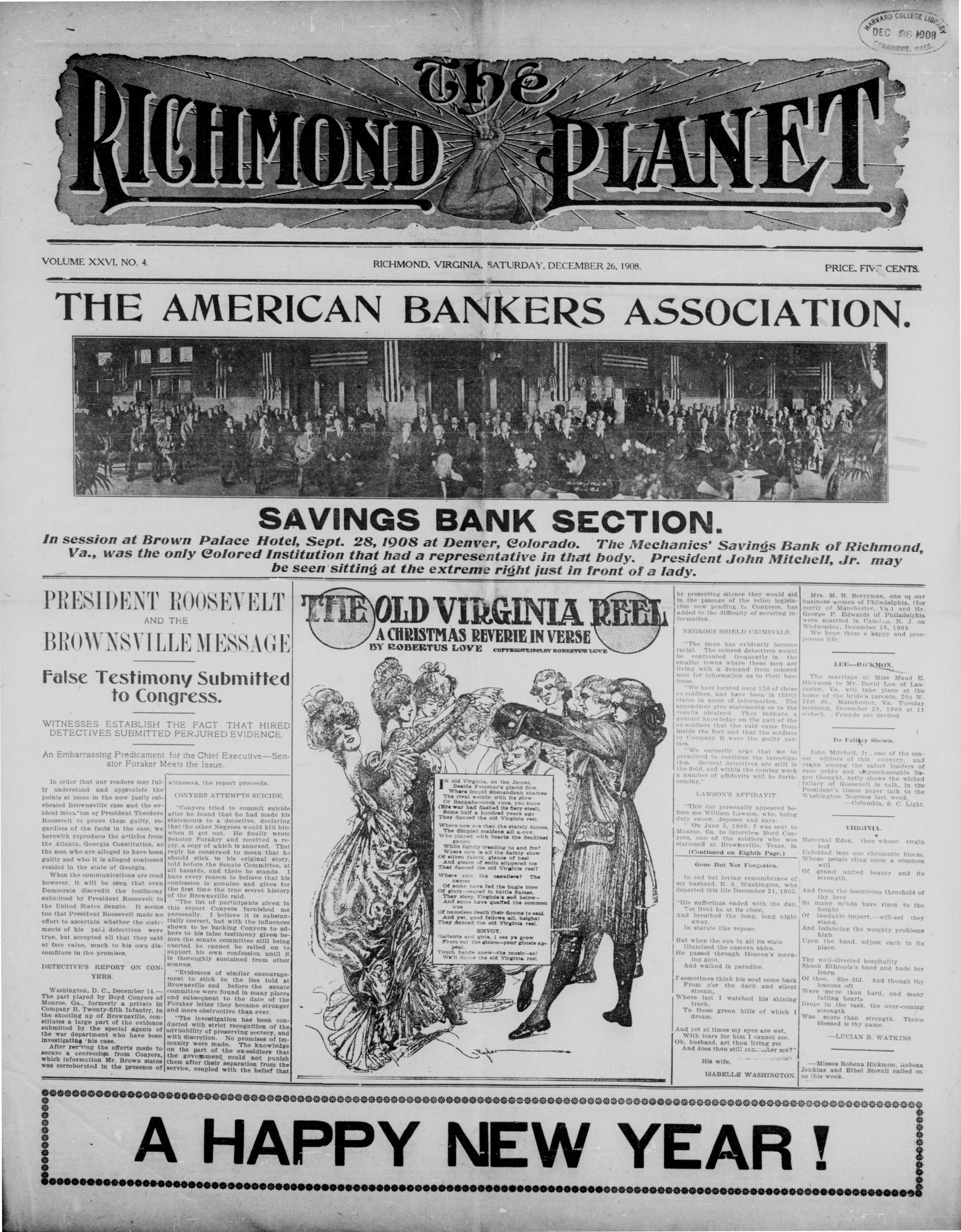
THE AMERICAN BANKERS ASSOCIATION.
Michigan State University
In session at Brown Palace Hotel, Sept. 28, 1908 at Denver, Colorado. The Mechanics' Savings Bank of Richmond, Va., was the only Colored Institution that had a representative in that body. President John Mitchell, Jr. may be seen sitting at the extreme right just in front of a lady.
A HAPPY NEW YEAR!
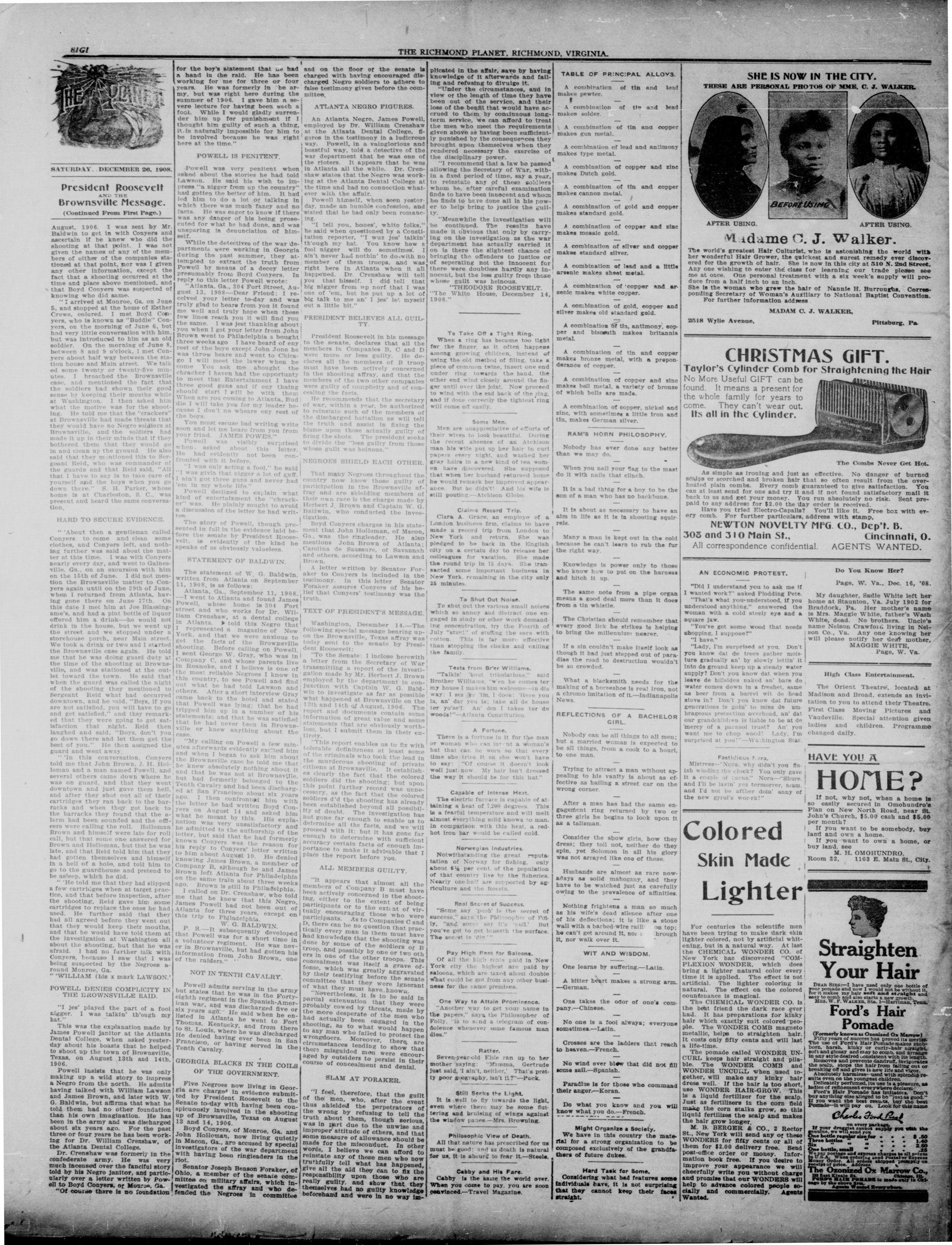
PRESIDENT ROOSEVELT AND THE BROWNSVILLE MESSAGE False Testimony Submitted to Congress.
WITNESSES ESTABLISH THE FACT THAT HIRED
DETECTIVES SUBMITTED PERJURED EVIDENCE.
An Embarrassing Predicament for the Chief Executive—Senator Foraker Meets the Issue
VOLUME XXVI. NO. 4.
THE
In session at Brow
Va., was the
PRESIDENT
AND
BROWNSVILLE
False Testim
to Con
WITNESSES ESTABLISH
DETECTIVES SUBMITTED
An Embarrassing Predicamen
ator Foraker M
In order that our readers may fully understand and appreciate the points at issue in the now justly celebrated Brownsville case and the evident intention of President Theodore Roosevelt to prove them guilty, regardless of the facts in the case, we herewith reproduce the articles from the Atlanta, Georgia Constitution, as the men who are alleged to have guilty and who it is alleged confessed resided in the state of Georgia.
When the communications are read however, it will be seen that even Democrats discredit the testimony submitted by President Roosevelt to the United States Senate. It seems too that President Roosevelt made no effort to ascertain whether the statements of his paid detectives were true, but accepted all that they said at face value, much to his own discomfiture in the premises.
DETECTIVE'S REPORT ON CON YERS.
Washington, D. C., December 14. The part played by Boyd Conyers of Monroe, Ga., formerly a private in Company B, Twenty-fifth Infantry, in the shooting up of Brownsville, constitutes a large part of the evidence submitted by the special agents of the war department who have been investigating his case.
After rectting the efforts made to secure a confession from Conyers, which information Mr. Brown states was corroborated in the presence of
SAVINGS BANK SECTION.
witnesses, the report proceeds.
CONYERS ATTEMPTS SUICIDE
"Conyers tried to commit suicide after he found that he had made his statements to a detective, declaring that the other Negroes would kill him when it got out. He finally wrote Senator Foraker and received a reply, a copy of which is annexed. That reply he construed to mean that he should stick to his original story, told before the Senate Committee, at all hazards, and there he stands. I have every reason to believe that his confession is genuine and gives for the first time the true secret history of the Brownsville raid.
"The list of participants given in this report Conyers furnished me personally. I believe it is substantially correct, but with the influences shown to be backing Conyers to adhere to his false testimony given before the senate committee still being exerted he cannot be relied on to support his own confession until it is thoroughly sustained from other sources.
"Evidences of similar encouragement to stick to the lies told at Brownsville and before the senate committee were found in many places and subsequent to the date of the Foraker letter they became stronger and more obstructive than ever."
"The investigation has been conducted with strict recognition of the advisability of preserving secrecy, and with discretion. No promises of immunity were made. The knowledge on the part of the ex-soldiers that the government could not punish them after their separation from the service, coupled with the belief that
RICHMOND, VIRGINIA, SATURDAY, DECEMBER 26, 1908.
THE OLD VIRGINIA REEL
A CHRISTMAS REVERIE IN VERSE
BY ROBERTUS LOVE
COPYRIGHT, 1805, BY ROBERTUS LOVE
In old Virginia, on the James,
Beside Potomac's placid flow,
Where limpid Shenandoah shames
The rival welkin with its glow
Or Rappahannock runs, you know
(Be war had flashed its fiery steel).
Some half a hundred years ago
They danced the old Virginia reel.
Where now are they, the stately dames,
The dimpled maddens all a row.
Who played with hearts the deadliest
games
While lightly treading to and fro?
Where now is all the dainty show
Of silken fabric, glance of heel
And gleam of satin slippered toe
That danced the old Virginia reel?
Where son the cavaliers? The
names
Of some have fed the bugle blow
Of glory—seared in battle flames.
They sleep Virginia's sod below—
And some have quaffed the common
woe.
Of nameless death their dooms to seal.
And yet, good fellows all, heighe!
They danced the old Virginia reel.
ENVOY.
Gaillants and girls, I see ye grow
From out the gloom—your ghosts ap-
peal.
Touch hands anew—the music—so!
We'll dance the old Virginia reel.
by preserving silence they would aid in the passage of the relief legislation now pending in Congress, has added to the difficulty of securing information.
NEGROES SHIELD CRIMINALS
"The issue has evidently become racial. The colored detectives would be confronted frequently in the smaller towns where these men are living with a demand from colored men for information as to their business.
"We have located over 130 of these ex-soldiers, and have been in thirty states in quest of information. The appendices give statements as to the results obtained. They indicate a general knowledge on the part of the ex-soldiers that the raid came from inside the fort and that the soldiers of Company B were the guilty parties.
"We earnestly urge that we be permitted to continue the investigation. Several detectives are still in the field, and within the coming week a number of affidavits will be forthcoming."
LAWSON'S AFFIDAVIT
"This day personally appeared before me William Lawson, who, being duly sworn, deposes and says: "On June 5, 1908, I was sent to Monroe, Ga. to interview Boyd Conyers, one of the soldiers who was stationed at Brownville, Texas, in (Continued in Eighth Form.)
PRICE, FIVE CENTS.
TION.
ank of Richmond,
hell, Jr. may
Mrs. M. B. Berryman, one or our business women of Philadelphia, (for merely of Manchester, Va.) and Mr. George P. Edwards of Philadelphia were married in Camden, N. J. on Wednesday, December 16, 1908. We hope them a happy and prosperous life.
LEE—HUCKMON.
The marriage of Miss Maud E. Hickmon to Mr. David Lee of Lancaster, Va. will take place at the home of the bride's parents, 200 W. 21st St., Manchester, Va. Tuesday morning, December 29, 1908 at 11 o'clock. Friends are invited.
Its Fallacy Shown.
John Mitchell, Jr., one of the sainest editors of this country, and ranks among the safest leaders of race pride and unpurchaseable Negro thought, aptly shows the wicked fallacy of Roosevelt in talk, in the President's tissue paper talk to the Washington Negroes last week. —Columbia, S. C. Light.
VIRGINIA
Maternal Eden, thou whose virgin bud
Unfolded into one chromatic bloom,
Whose petals cling upon a common will
Of grand united beauty and its strength.
And from the bounteous threshold of thy love
So many minds have risen to the height
Of laudable import,—will-set they stand,
And balancing the weighty problems high
Upon the hand, adjust each in its place.
Thy well-directed hospitality
Shook Ethiopia's hand and bade her learn
Of thee. She did. And though thy lessons oft
Were more than hard, and many falling hearts
Dropt in the task, the over-coming strength
Was more than strength. Thrice blessed is thy name.
—LUCIAN B. WATKINS.
—Misses Robena Hickmon, Robena Jenkins and Ethel Stovall called on us this week.
!
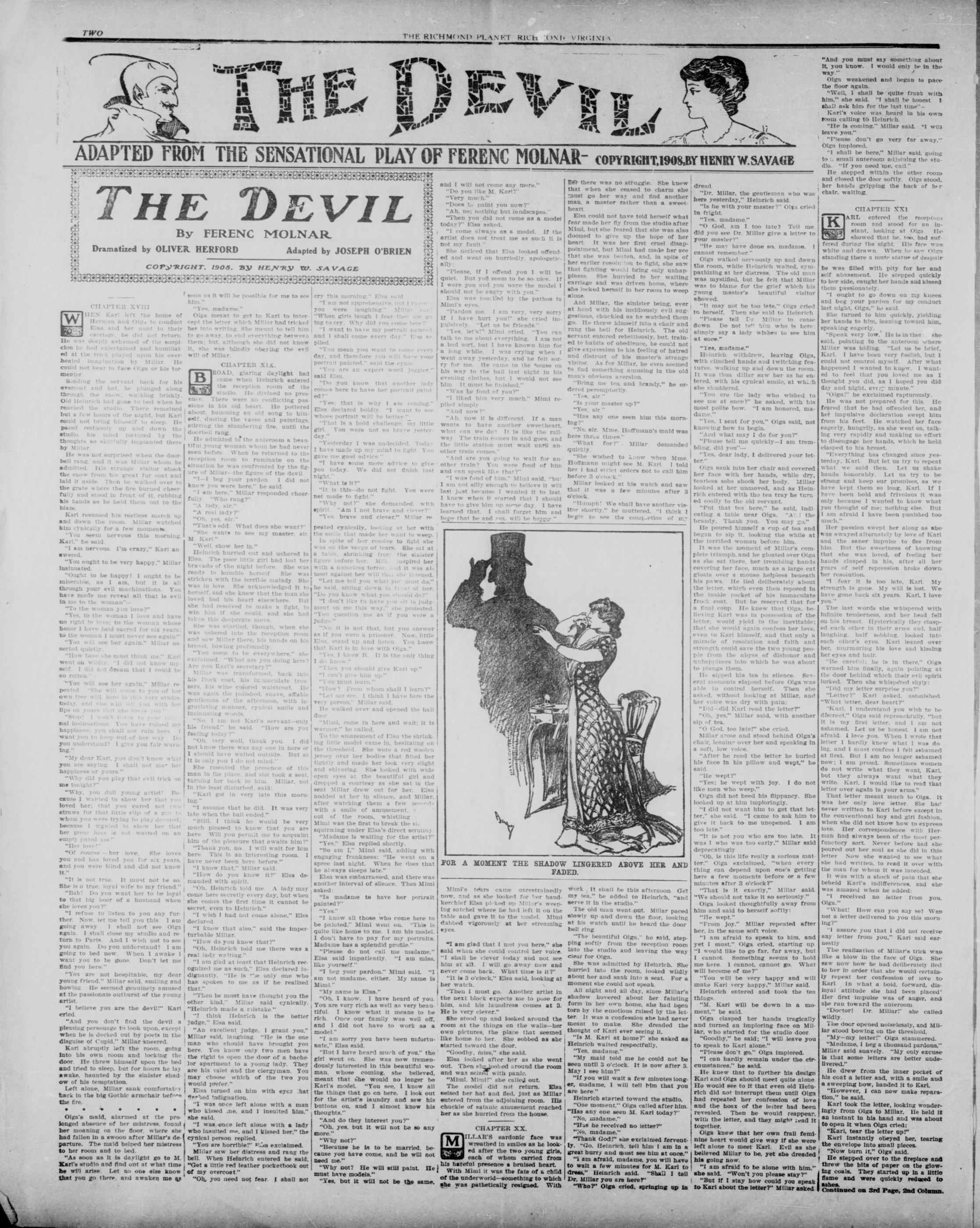
ADAPTED FROM THE SENSATIONAL PLAY OF FERENC MOLNAR- COPYRIGHT.1908.BY HENRY W.SAVAGE
```markdown
```
THE DEVIL
TWO
```markdown
```
ADAPTED FROM
THE
By
Dramatized by OLIVER
COPYRIGHT
```markdown
```
CHAPTER XVIII
HEN Karl left the home of Herman and Olga to conduct Elisa and her aunt to their carriage, he did not return.
He was deeply ashamed of the suspicion he had entertained and humiliated at the trick played upon his overheated imagination by Millar. He could not bear to face Olga or his tormentor.
Sending the servant back for his overcoat and hat, he plunged along through the snow, walking briskly. Old Heinrich had gone to bed when he reached the studio. There remained but a few hours of the night, but Karl could not bring himself to sleep. He paced restlessly up and down the studio, his mind tortured by the thoughts so skillfully implanted there by Millar.
He was not surprised when the door-bell rang, and it was Millar whom he admitted. His strange visitor shook the snow from his great fur coat and laid it aside. Then he walked over to the grate where the fire burned cheerfully and stood in front of it, rubbing his hands as he held them out to the blaze.
Karl resumed his restless march up and down the room. Millar watched him cynically for a few moments.
"You seem nervous this morning, Karl," he said.
"I am nervous. I'm crazy," Karl answered.
"You ought to be very happy," Millar insinuated.
"Ought to be happy! I ought to be miserable, as I am, but it is all through your evil machinations. You have made me reveal all that is evil in me to the woman—"
"To the woman you love?"
"Yes, to the woman I love and have no right to love; to the woman whose honor I have held sacred for six years; to the woman I must never see again!" "You will see her again," Millar asserted quietly. "How base she must think me," Karl went on wildly. "I did not know my self. I did not dream that I could be so rotten." "You will see her again," Millar repeated. "She will come to you of her own free will, here in this very studio, today, and she will tell you with her lips on yours that she loves you." "Stop! I won't listen to your informal insinuations. You have ruined my happiness, you shall not ruin bers! I want you to keep out of her way. Do you understand? I give you fair warning." "My dear Karl, you don't know what you are saying. I shall not mar her happiness or yours."
"Why did you play that evil trick on me tonight?"
"Why, you dull young artist! Because I wanted to show her that you loved her; that you cared not two straws for that little slip of a girl to whom you were trying to play devoted; because I wigned to show her that her great love is not wasted on an empty pated ass!"
"Her love!"
"Of course — her love. She loves you and has loved you for six years, and you were blind and did not know it."
"It is not true. It must not be so. She is a true, loyal wife to my friend."
"Bah! Do you want her to be loyal to that big boor of a husband when she loves you?"
"I refuse to listen to you any further. Now, let me tell you this. I am going away. I shall not see Olga again. I shall close my studio and return to Paris. And I wish not to see you again. Do you understand? I am going to bed now. When I awake I want you to be gone. Don't let me find you here."
"You are not hospitable, my dear young friend," Millar said, smiling and bowing. He seemed genuinely amused at the passionate outburst of the young artist.
"I believe you are the devil!" Karl cried.
"And you don't find the devil a pleasing personage to look upon, except when he is decked out by poets in the disguise of Cupid." Millar sneered.
Karl abruptly left the room, going into his own room and locking the door. He threw himself upon the bed and tried to sleep, but for hours he lay awake, haunted by the sinister shadow of his temptation.
Left alone, Millar sank comfortably back in the big Gothic armchair before the fire.
Olga's maid, alarmed at the prolonged absence of her mistress, found her moaning on the floor, where she had fallen in a swoon after Millar's departure. The maid helped her mistress to her room and to bed.
"As soon as it is daylight go to M. Karl's studio and find out at what time he will arise. Let no one else know that you go there, and awaken me as
soon as it will be possible for me to see him."
"Yes, madame."
Olga meant to get to Karl to intercept the letter which Millar had tricked her into writing. She meant to tell him to go away, to end everything between them; but, although she did not know it, she was blindly obeying the evil will of Millar.
CHAPTER XIX
B
ROAD, glaring daylight had come when Heinrich entered the reception room of the studio. He divined no pres
He admitted to the anteroom a beautiful young woman whom he had never seen before. When he returned to the reception room to ruminate on the situation he was confronted by the figure of Millar—the figure of the devil.
"I-I beg your pardon I did not know you were here," he said.
"I am here." Millar responded cheerfully.
"Who rang?"
"A lady, sir."
"A real lady?"
"Oh, yes, sir."
"That's odd. What does she want?"
"She wants to see my master, sir M. Karl."
"Well, show her in."
Heinrich hurried out and ushered in Elsa. The poor little girl had lost her bravado of the night before. She was ready to humble herself. She was stricken with the terrible malady. She was in love. She acknowledged it to herself, and she knew that the man she loved had his heart elsewhere. But she had resolved to make a fight, to win him if she could, and she had taken this deeper move.
She was startled, though, when she was ushered into the reception room and saw Millar there, his hands on his breast, bowing profoundly.
"You seem to be everywhere," she exclaimed. "What are you doing here? Are you Karl's secretary?"
Millar was transformed, back into his frock coat, his immaculate trousers, his wine colored waistcoat. He was again the polished, suave, affable gentleman of the afternoon, with ingratiating manner, cynical smile and insinuating words.
"No, I am not Karl's servant—only his friend," he said. "How are you feeling today?"
"Oh, very well, thank you. I did not know there was any one in here or I should have waited outside. But as it is only you I do not mind."
She resented the presence of this man in the place, and she took a seat, turning her back to him. Millar, not in the least disturbed, said:
"Karl got in very late this morning."
"Still, I think he would be very much pleased to know that you are here. Will you permit me to acquaint him of the pleasure that awaits him?" "Thank you, no. I will wait for him here. This is an interesting room. I have never been here before." "I know that," Millar said. "How do you know it?" Elsa demanded with spirit. "Oh, Heinrich told me. A lady may come here secretly every day, but when she comes the first time it cannot be secret, even to Heinrich." "I wish I had not come alone," Elsa declared. "I know that also," said the imperturbable Millar. "How do you know that?" "Oh, Heinrich told me there was a real lady writing." "I am glad at least that Heinrich recognized me as such." Elsa declared indignantly. "He is the only one who has spoken to me as if he realized that."
"Then he must have thought you the other kind." Millar said cynically, "Heinrich made a mistake."
"I think Heinrich is the better judge." Elsa said.
"An excellent judge, I grant you," Millar said, laughing. "He is the one man who should have brought you here. You know only two men have the right to open the door of a bachelor apartment to a young lady. They are his valet and the clergyman. You may choose which of the two you would prefer."
Elsa turned on him with eyes that flashed indignation.
"I was once left alone with a man who kissed me, and I insulted him," she said.
"I was once left alone with a lady who insulted me, and I kissed her," the cynical person replied.
"You are horrible!" Elisa exclaimed.
Miller saw her distress and rang the bell. When Helirch entered be said,
"Get a little red leather pocketbook out of my overcoat."
"Oh, you need not fear. I shall not
THE RICHMOND PLANET RICHMOND VIRGINIA
Adapted by JOSEPH O'BRIEN
RY W. SAVAGE
"I want to have my portrait painted and I shall come every day." Elsa replied.
"You mean you want to come every day, and therefore you will have your portrait painted," said the eyelid.
"You are an expert word juggler." said Elsa.
"Do you know that another indy comes here to have her portrait painted?"
"Yes; that is why I am coming." Elsa declared boldly. "I want to see whose portrait will be better."
"That is a bold challenge, my little girl. You were not so brave yesterday."
"Yesterday I was undecided. Today I have made up my mind to fight. You gave me good advice."
"I have some more advice to give you today. We did not finish last night."
"What is it?"
"It is this—do not fight. You were not made to fight."
"Why not? she demanded, with spirit. "Am I not brave and clever?" "Yes, brave and clever." Millar repeated cynically, looking at her with the smile that made her want to weep. In spite of her resolve to fight she was on the verge of tears. She sat at a table, shrinking from the sinister figure before her. Millar inspired her with a nameless terror, and it was almost against her will that she listened. "Let me tell you what you must do," he said, sitting down in front of her. "Do you know what you should do?" "I don't like to have you sit in judgment on me this way," she protested. "You question me as if you were a judge."
"No, it is not that, but you answer as if you were a prisoner. Now, little Elsa, stand up and listen. You know that Karl is in love with Olga." "Yes, I know it. It is the only thing I do know." "Then you should give Karl up."
"You must learn."
"How? From whom shall I learn?"
"Let me see. I think I have here the very person." Millar said.
He walked over and opened the hall door
"Mimi, come in here and wait; it is warmer," he called.
To the amazement of Elsa the shrinking little model came in, hesitating on the threshold. She wore a red wooden jersey over her bodice that fitted her tightly and made her look very slight and shivering. She looked with wide open eyes at the beautiful girl and dropped a courtesy as she sat in the seat Millar drew out for her. Elsa nodded at her in silence, and Millar, after watching them a few seconds with a smile of amusement, out of the room, whistling Mimi was the first to break the she squirming under Elsa's direct scrutiny.
"Madame is waiting for the artist?"
"Yes." Elsa replied shortly.
"So am I," Mimi said, adding with engaging frankness: "He went on a spree last night. When he does that he always sleeps late."
Elsa was embarrassed, and there was another interval of silence. Then Mimi asked:
"Is madame to have her portrait painted?"
"Yes."
"I know all those who come here to be painted." Mimi went on. "This is quite like home to me. I am his model. I don't have to pay for my portraits. Madame has a splendid profile."
"Please do not call me madame," Elsa said impatiently. "I am miss, like yourself."
"I beg your pardon." Mimi said. "I am not madame, either. My name is Mimi."
"My name is Elsa."
"Oh. I know. I have heard of you. You are very rich as well as very beautiful. I know what it means to be rich. Once our family was well off, and I did not have to work as a model."
"I am sorry you have been unfortunate." Elsa said.
"But I have heard much of you," the girl went on. She was now tremendously interested in this beautiful woman, whose coming, she believed, meant that she would no longer be Karl's model. "You see, I know all the things that go on here. I look out for the artist's laundry and sew his buttons on, and I almost know his thoughts."
"And do they interest you?"
aimed. rang the said.ook out shall not
"Why not?"
"Because he is to be married, because you have come, and he will not need me."
"Why not? He will still paint. He must have models."
"Yes, but it will not be the same."
Bingy
FOR A MOMENT THE SHADOW LINGERED ABOVE HER AND FADED.
and I will not come any more."
"Do you like M. Karl?"
"Very much."
"Does he paint you now?"
"Ah, no; nothing but landscapes."
"Then you did not come as a model today?" Elsa asked.
"I come always as a model. If the artist does not treat me as such it is not my fault."
She noticed that Elsa looked offended and went on hurriedly, apologetically:
"Please, if I offend you I will be quiet. But you seem to be so nice. If I were you and you were the model I should not be angry with you."
Elsa was touched by the pathos in Mimi's eyes.
"Pardon me. I am very, very sorry if I have hurt you!" she cried impulsively. "Let us be friends."
"Yes, let's'." Mimi cried. "You can talk to me about everything. I am not a bad sort, but I have known him for a long while. I was crying when I went away yesterday, and he felt sorry for me. He came to the house on his way to the ball last night in his evening clothes, but I would not see him. It must be finished."
"Was he fond of you?"
"I liked him very much." Mimi replied simply.
"And now?"
"Ah, now it is different. If a man wants to have another sweetheart, what can we do? It is like the railway. The train comes in and goes, and the little station must wait until another train comes."
"And are you going to wait for another train? You were fond of him and can speak like that?"
"I was fond of him," Mimi said, "but I am not silly enough to believe it will last just because I wanted it to last. I knew when it started that I should have to give him up some day. I have learned that. I shall forget him and hope that he and you will be happy."
FOR A MOMENT THE SHADOW FA
Mimi's tears came unrestrainedly now, and as she looked for her handkerchief Elsa picked up Millar's weeping satchel where he had left it on the table and gave it to the model. Mimi dabbed vigorously at her streaming eyes.
"I am glad that I met you here," she said when she could control her voice. "I shall be clever today and not see him at all. I will go away now and never come back. What time is it?" "It is 3 o'clock." Elsa said, looking at her watch.
"Then I must go. Another artist in the next block expects me to pose for him, and his laundries comes at 3. He is very clever."
She stood up and looked around the room at the things on the walls—her own pictures, the place that seemed like home to her. She sobbed as she started toward the door.
Elsa looked after her as she went out. Then she looked around the room and was seized with panic.
"Mimi, Mimi!" she called out.
The model did not return. Elsa seized her hat and fled, just as Millar entered from the adjoining room. His chuckle of satanic amusement reached her as she hurried from the house.
CHAPTER XX.
M
MILLA'S sardonic face was wreathed in smiles as he looked after the two young girls, each of whom carried from his hateful presence a bruised heart. With Mimi it was the fate of a child of the underworld—something to which she was pathetically resigned. With
1
Her there was no struggle. She knew that when she ceased to charm she must go her way and find another man, a master rather than a sweet-heart. Elsa could not have told herself what fear made her fly from the studio after Mimi, but she feared that she was also doomed to give up the hope of her heart. It was her first cruel disappointment, but Mimi had made her see that she was beaten, and, in spite of her earlier resolution to fight, she saw that fighting would bring only unhappiness. She hurried to her waiting carriage and was driven home, where she locked herself in her room to weep alone.
And Millar, the sinister being, ever at hand with his insidiously evil suggestions, chuckled as he watched them go. He threw himself into a chair and rang the bell for Heinrich. The old servant entered rebelliously, but, trained to habits of obedience, he could not give expression to his feeling of hatred and distrust of his master's strange visitor. As for Millar, he even seemed to find something amusing in the old man's obvious aversion.
"Bring me tea and brandy," he ordered peremptorily.
"Yes, sir."
"Is your master up?"
"Yes, sir."
"Has any one seen him this morning?"
"No, sir. Mme. Hoffmann's maid was here three times."
"What for?" Millar demanded quickly.
"She wished to know when Mme. Hoffmann might see M. Karl. I told her I had strict orders not to call him before 3 o'clock."
Miller looked at his watch and saw that it was a few minutes after 3 o'clock.
"Humph! We shall have another visitor shortly." he muttered. "I think I begin to see the competition of 1x."
V LINGERED ABOVE HER AND
DED.
work. It shall be this afternoon. Get my tea," he added to Heinrich, "and serve it in the studio."
The old man went out. Millar paced slowly up and down the floor, looking at his watch until he heard the door bell ring.
"The beautiful Olga," he said, stepping softly from the reception room into the studio and leaving the way clear for Olga.
She was admitted by Heinrich. She hurried into the room, looked wildly about her and sank into a seat. For a moment she could not speak.
All night and all day, since Millar's shadow hovered about her fainting form in her own home, she had been torn by the emotions raised by the letter. It was a confession she had never meant to make. She dreaded the thought of Karl ever seeing it.
"Is M. Karl at home?" she asked as Heinrich waited respectfully.
"Yes, madame."
"My maid told me he could not be seen until 3 o'clock. It is now after 3. May I see him?"
"If you will wait a few minutes longer, madame, I will tell him that you are here."
Heinrich started toward the studio.
"One moment." Olga called after him.
"Has any one seen M. Karl today?"
"No, madame."
"Has he received no letter?"
"No, madame."
"Thank God!" she exclaimed fervently. "Go. Heinrich, tell him I am in a great hurry and must see him at once." "I am afraid, madame, you will have to wait a few minutes for M. Karl to dress." Heinrich said. "Shai! I tell Dr. Millar you are here?" "Who?" Oliga cried, springing up in
dread.
"Dr. Millar, the gentleman who was here yesterday," Heinrich said.
"Is he with your master?" Olga cried in fright.
"Yes, madame."
"O God, am I too late? Tell me did you see Dr. Millar give a letter to your master?"
"He may have done so, madame. I cannot remember."
Olga walked nervously up and down the room, while Heinrich waited, sympathizing at her distress. The old man was mystified, but he felt that Millar was to blame for the grief which his young master's beautiful visitor showed.
"It may not be too late." Olga cried to herself. Then she said to Heinrich.
"Please tell Dr. Millar to come down. Do not tell him who is here; simply say a lady wishes to see him at once."
"Yes, madame."
Heinrich withdrew, leaving Olga, with clinched hands and twitching features, walking up and down the room. It was thus Millar saw her as he entered, with his cynical smile, at which she shuddered.
"You are the lady who wished to see me at once?" he asked, with his most polite bow. "I am honored, madame."
"Yes, I sent for you," Olga said, not knowing how to begin.
"And what may I do for you?" "Please tell me quickly—I am trembling, did you?" "Yes, dear lady, I delivered your letter."
Olga sank into her chair and covered her face with her hands, while dry, tearless sobs shook her body. Millar looked at her unmoved, and as Heinrich entered with the tea tray he turned coolly to the old servant.
"Put that tea here," he said, indicating a table near Olaq. "Ar! the brandy. Thank you. You may go."
He poured himself a cup of tea and began to sip it, looking the while at the terrified woman before him.
It was the moment of Millar's complete triumph, and he gloated over Olaq as she sat there, her trembling hands covering her face, much as a large cat gloats over a mouse helpless beneath his paws. He lied deliberately about the letter, which even then reposed in the inside pocket of his immaculate frock coat. But he reserved that for a final coup. He knew that Olaq, believing Karl was in possession of the letter, would yield to the inevitable that she would again confess her love, even to Karl himself, and that only a miracle of resolution and faith and strength could save the two young people from the abyss of dishonor and unhappiness into which he was about to plunge them.
He slipped his tea in silence. Several moments elapsed before Olga was able to control herself. Then she asked, without looking at Millar, and her voice was dry with pain:
"Did—did Karl read the letter?"
Do, and Millar read the letter.
"Oh, yes," Millar said, with another sip of tea.
"O God, too late!" she cried.
Millar arose and stood behind Olga's chair, leaning over her and speaking in a soft, low voice.
"After he read the letter he buried his face in his pillow and wept," he said.
"He went?"
Oliga did not heed his flippancy. She looked up at him imploringly. "I did not want him to get that letter." she said. "I came to ask him to give it back to me unopened. I am too late." "It is not you who are too late. It was I who was too early." Millar said deprecatingly. "Oh, is this life really a serious matter?" Oliga exclaimed. "when every thing can depend upon one's getting here a few moments before or a few minutes after 3 o'clock?" "That is it exactly." Millar said. "We should not take it so seriously." Oliga looked thoughtfully away from him and said to herself softly: "He wept." "From joy." Millar repeated after her, in the same soft voice.
"I am afraid to speak to him, and yet I must." Olga cried, starting up. "I would like to go far, far away, but I cannot. Something seems to hold me here. I cannot cannot go. What will become of me?" "You will be very happy and will make Karl very happy." Millar said. Heinrich entered and took the tea things. "M. Karl will be down in a moment," he said. Olga clasped her hands tragically and turned an imploring face on Millar, who started for the studio door. "Goodby," he said. "I will leave you to speak to Karl alone." "Please don't go." Olga implored. "I can hardly remain under the circumstances," he said.
He knew that to further his design Karl and Olga should meet quite alone. He would see to it that even old Heinrich did not interrupt them until Olga had repeated her confession of love and the hoax of the letter had been revealed. Then he would reappear, with the letter, and they might read it together.
Olga knew that her own own frail feminine heart would give way if she were left alone to meet Karl. Evil as she believed Millar to be, yet she dreaded his going now.
"I am afraid to be alone with him," she said. "Won't you please stay?" "But if I stay how could you speak to Karl about the letter?" Millar asked.
"And you must say something about it, you know. I would only be in the way."
Olga weakened and began to pace the floor again.
"Well, I shall be quite frank with him," she said. "I shall be honest. I shall ask him for the last time"—Karl's voice was heard in his own room calling to Helnrich.
"He is coming." Millar said. "I will leave you." "Please don't go very far away." Olga implored. "I shall be here." Millar said, going to a small anteroom adjoining the studio. "If you need me, call." He stepped within the other room and closed the door softly. Olga stood, her hands gripping the back of her chair, waiting.
CHAPTER XXI
ARL entered the reception room and stood for an instant, looking at Oliga. He showed that he, too, had suffered during the night. His face was white and drawn. When he saw Oliga standing there a mute statue of despair he was filled with pity for her and self abasement. He stepped quickly to her side, caught her hands and kissed them passionately. "I ought to go down on my knees and beg her parlon for my conduct last night, Oliga," he said. She turned to him quickly, yielding her hands to him, leaning toward him, speaking eagerly.
"Speak very low. He is in there; she said, pointing to the anteroom where Millar was hiding. "Let us be brief, Karl. I have been very foolish, but I could not control myself. After what happened I wanted to know. I wanted to feel that you loved me as I thought you did, as I hoped you did day and night, every minute." "Ogla!" he exclaimed rapturously. He was not prepared for this. He feared that he had offended her, and her impulsive declaration swept him from his feet. He watched her face eagerly, hungrily, as she went on, talking very rapidly and making no effort to disengage her hands, which he held elapsed to his breast.
"Everything has changed since yesterday, Karl. But let us try to repeat what we said then. Let us shake hands honorably. Let us try to be strong and keep our promises, as we have kept them so long, Karl. If I have been bold and frivolous it was only because I wanted to know what you thought of me; nothing else. But I am afraid I have been punished too much."
Her passion swept her along as she was swayed alternately by love of Karl and the saner impulse to flee from him. But the sweetness of knowing that she was loved, of feeling her hands clasped in his, after all her years of self repression broke down her resolution.
"I fear it is too late, Karl. My strength is gone. My will is lost. We have gone back six years, Karl, I love you."
The last words she whispered with infinite tenderness, and her head fell on his breast. Hysterically they clasped each other in their arms and, half laughing, half sobbing, looked into each other's eyes. Karl leaned over her, murmuring his love and kissing her eyes and hair.
"Be careful; he is in there," Oiga warned him finally, again pointing at the door behind which their evil spirit lurked. Then she whispered shyly: "Did my letter surprise you?" "Letter?" Karl asked, astonished. "What letter, dear heart?"
"Karl, I understand you wish to be discreet," Olga said reproachfully, "but it is my first letter, and I am not ashamed. Let us be honest. I am not afraid. I love you. When I wrote that letter I hardly knew what I was doing, and I must confess I felt ashamed at first. But I am no longer ashamed now; I am proud. Sometimes women do not write what they want, Karl, but they always want what they write. Karl, I would like to read that letter over again in your arms." That letter meant much to Olga. It was her only love letter. She had never written to Karl before except in the conventional boy and girl fashion, when she did not know how to express love. Her correspondence with Herman had always been of the most perfunctory sort. Never before had she poured out her soul as she did in this letter. Now she wanted to see what she had written, to read it over with the man for whom it was intended.
It was with a shock of pain that she beheld Karl's indifferences, and she was amazed when he added:
"I received no letter from you, Olga."
"What! How can you say so? Was not a letter delivered to you this morning?"
"I assure you that I did not receive any letter from you," Karl said earnestly.
The realization of Millar's trick was like a blow in the face of Olga. She saw now how he had deliberately lied to her in order that she would certainly repeat her confession of love to Karl. In what a bold, forward, disloyal attitude she had been placed" Her first impulse was of anger, and she ran toward the anteroom.
"Doctor! Dr. Millar" she called wildly.
The door opened noiselessly, and Millar stood bowing on the threshold.
My "my letter," Ola stammered.
"Madame, I beg a thousand pardons." Millar said suavely. "My only excuse is that some letters are better undelivered."
He drew from the inner pocket of his coat a letter and, with a smile and a sweeping bow, handed it to Karl.
"However, I can now make reparation," he said.
Karl took the letter, looking wonderingly from Ola to Millar. He held it an instant in his hand and was about to open it when Ola cried:
"Karl, tear the letter up!"
Karl instantly obeyed her, tearing the envelope into small pieces.
"Now burn it," Ola said.
He stepped over to the fireplace and threw the bits of paper on the glowing coals. They started up in a little flame and were quickly reduced to ashes.
Continued on 3rd Page, 2nd Column.
THE PLANET
SATURDAY...DECEMBER 26, 1908
THE DEVIL
(Continued from 2nd Page.)
CHAPTER XXII.
LGA was terrified at the trick
Millar had played upon her
and at its results. She look-
ed in fear from him to Karl.
Who is this man? who acted
LGA was terrified at the trick Millar had played upon her and at its results. She looked in fear from him to Karl. "Who is this man?" she asked. Karl could not answer her. The same question was echoling in his heart. Who was this man, this personification of evil? Ever there were his insidious wiles to compromise, cajole, trick and betray them. He could not tell. He only knew that he loathed him and that he would drive him out. "Are you going now?" he demanded as Millar stood looking at them, with his evil smile.
Millar took the question in the most natural way, disregarding the purposely offensive tone in which Karl spoke. "Yes, I am; I must," he said half regrettely. "My train leaves in half an hour. Again permit me to beg a thousand pardons. Could I have foreseen the anguish that was to follow my failure to deliver madame's letter nothing in the world could have"—Karl interrupted him rudely, determined that he should not beguile them again and that he should not speak of Olga or the letter as a thing of importance.
"You should know that the letter contained only a conventional message," he said.
Millar looked at Oliga, and his smile grew broad as she hung her head and blushed. Who should know better than he the confession which she had written and which was now destroyed?
"It was quite conventional, I am sure," he said cynically.
"You will miss your train." Karl said, with studied insolence. "Heinrich, help the doctor on with his coat. "A thousand thanks," the imperturbable Millar said. "Madame, goodby, and once more I neg a thousand pardons."
Neither Oliga nor Karl spoke to him as he walked to the door, looked back at them, bowed to low again and chuckled as the door closed after him.
Oliga turned quickly to Karl and held out her hands.
"He is gone. I am glad. But, Karl, I would give a year of my life if he had delivered my letter to you."
"Why? Tell me what you wrote," he asked eagerly.
"I wrote all the things I told you a few moments ago, Karl. You know it all now."
She went over to the grate and looked sadly into the ashes.
"My first love letter," she said softly. "Oh, Karl, it was my confession of my love for you. I would like to read it over again with you, and then we might forget. I don't want to be afraid. I want to be strong, to be happy. If I only had that letter now!" Karl took her hands in his and comforted her.
"Never mind it, Olga. It has served its purpose. It has taught us ourselves, our hearts."
"It has taught us that we must be strong, brave and loyal." Olga declared warmly. They stood thus, looking into each other's eyes sanely, clearly, each ready to renounce. The door of the studio opened, and Millar stood before them again, holding in his extended hand a letter.
"I beg a thousand pardons again," he said. "I find I gave Karl an old tailor's bill instead of madame's letter."
Olga eagerly took the letter, opened it and recognized her, own handwriting.
"My letter, Karl." she exclaimed. Both bent over the letter, reading it eagerly, while Millar slipped quietly out of the studio—out of their lives. Olga looked up from their reading.
"I am glad that I wrote it, Karl." she said. "Now we will burn it." Together they watched it glow brightly into flame and fall into gray ashes.
"That is our love begun and ended. Karl." Olga said quietly. "It was wrong, and now we realize it, don't we? And now, dear boy, you are coming with me."
"Where?" Karl asked.
"I am going to take you to Elsa," Olga answered.
With a feeling of elation Karl called Heinrich and was helped into his overcoat. He bent respectfully and kissed Olga's hand as they walked out of the studio together.
THE END
Franklin's Epitaph.
After Franklin's death an epitaph written by himself when twenty three years of age was found among his papers. Though it was not chiseled upon his tomb, we may quote it here:
The body of
B. FRANKLIN,
Printer,
Like the cover of an old book,
its contents torn out,
and stripped of its lettering and gilding,
lies here, food for worms.
But the work shall not be wholly lost,
for it will, as he believed, appear once more
in a new and more perfect edition,
corrected and amended,
by the Author.
He was born January 17, 1708.
Died 17. B. F.
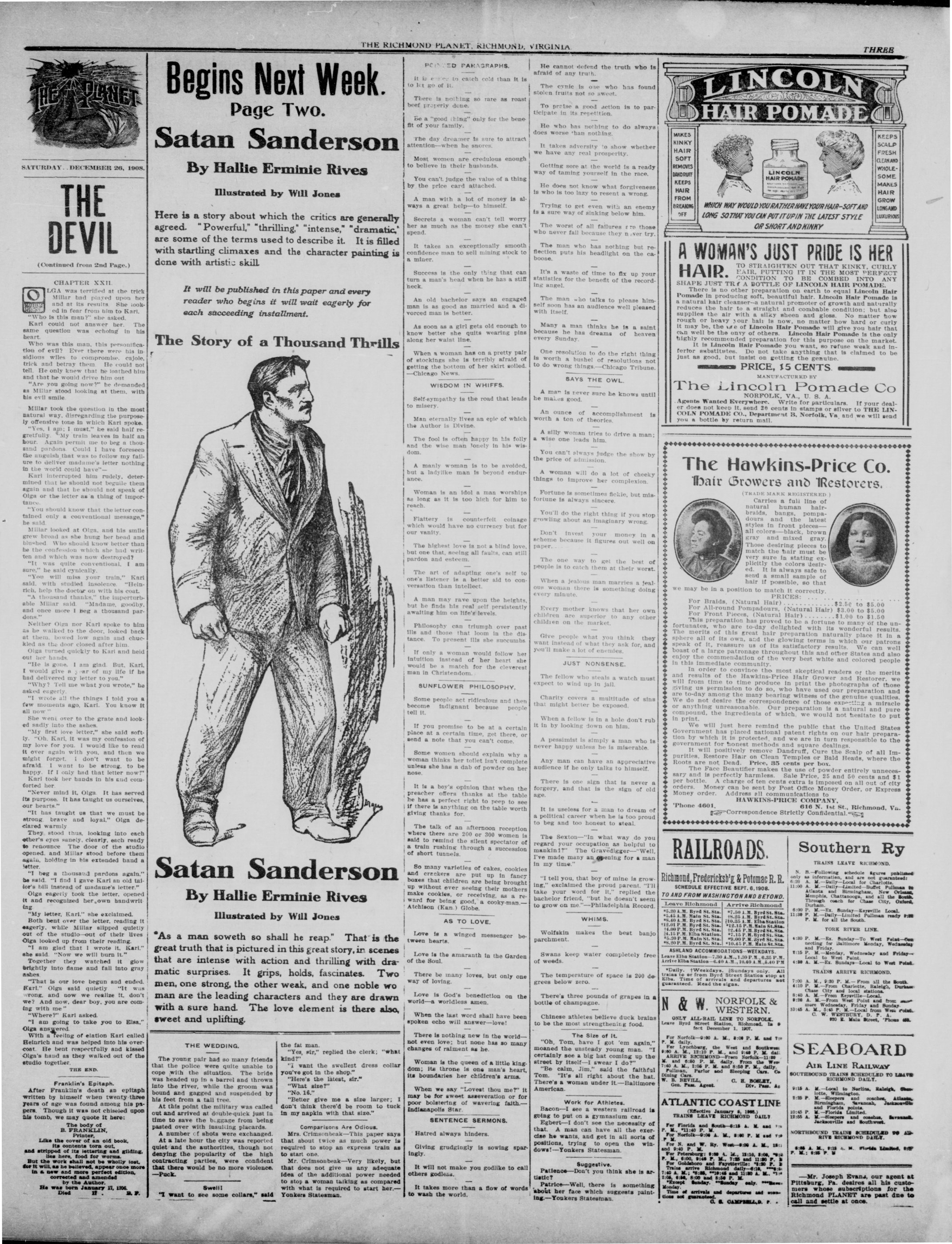
Begins Next Week. Page Two. Satan Sanderson
By Hallie Erminie Rives
Illustrated by Will Jones
Here is a story about who agreed. "Powerful," "thrills are some of the terms used with startling climaxes and done with artistic skill.
It will be published to reader who begins in each succeeding installment.
The Story of a
Satan Sa
By Hallie E
history about which the critics are powerful," "thrilling," "intense," and the terms used to describe it climaxes and the characteristic skill.
be published in this paper and who begins it will wait eagerness to succeeding installment.
History of a Thousand
John Sander
Hallie Erminie Ri
Here is a story about which the critics are generally agreed. "Powerful," "thrilling," "intense," "dramatic," are some of the terms used to describe it. It is filled with startling climaxes and the character painting is done with artistic skill.
It will be published in this paper and every reader who begins it will wait eagerly for each succeeding installment.
The Story of a Thousand Thrills
M. M.
Satan Sanderson
Illustrated by Will Jones
*As a man soweth so she great truth that is pictured that are intense with acti matic surprises. It grips men, one strong, the other man are the leading charm with a sure hand. The is sweet and uplifting.
soweth so shall he reap." that is pictured in this great story sense with action and thrillingises. It grips, holds, fascin-rong, the other weak, and on leading characters and the hand. The love element is lifting.
As a man soweth so shall he reap." That is the great truth that is pictured in this great story, in scenes that are intense with action and thrilling with dramatic surprises. It grips, holds, fascinates. Two men, one strong, the other weak, and one noble woman are the leading characters and they are drawn with a sure hand. The love element is there also sweet and uplifting.
THE WEDDING.
The young pair had so many friends that the police were quite unable to cope with the situation. The bride was headed up in a barrel and thrown into the river, while the groom was bound and gagged and suspended by his feet from a tall tree.
At this point the military was called out and arrived at double-quick just in time to save the baggage from being pasted over with insulting placards.
A number of shots were exchanged.
At a late hour the city was reported quiet and the authorities, though not denying the popularity of the high contracting parties, were confident that there would be no more violence.
—Puck.
"I want to see some collars," said
---
which the critics are generally
calling," "intense," "dramatic,"
and to describe it. It is filled
and the character painting is
in this paper and every
will wait eagerly for
fallment.
Thousand Thrills
Anderson
minie Rives
all he reap." That is the
in this great story, in scenes
on and thrilling with dra-
s, holds, fascinates. Two
weak, and one noble wo-
acters and they are drawn
ove element is there also,
the fat man.
"Yes, sir," replied the clerk; "what
kind?"
"I want the swellest dress collar
you've got in the shop."
"Here's the latest, sir."
"What size?"
"No. 16."
"Better give me a size larger; I
don't think there'd be room to tuck
in my napkin with that size."
Comparisons Are Odious
Mrs. Crimsonbeak—This paper says that about twice as much power is required to stop an express train as to start one.
Mr. Crimsonbeak—Very likely, but that does not give us any adequate idea of the additional power needed to stop a woman talking as compared with what is required to start her.—Yonkers Statesman.
THE RICHMOND PLANET, RICHMOND, VIRGINIA
ek.
son
s
generally
dramatic,
it is filled
painting is
POINTED PARAGRAPHS.
It is easier to catch cold than it is to let go of it.
There is nothing so rare as roast beef properly done.
Be a "good thing" only for the benefit of your family.
The day dreamer is sure to attract attention—when he snores.
Most women are credulous enough to believe in their husbands.
You can't judge the value of a thing by the price card attached.
A man with a lot of money is always a great help—to himself.
Secrets a woman can't tell worry her as much as the money she can't spend.
It takes an exceptionally smooth confidence man to sell mining stock to a miner.
Success is the only thing that can turn a man's head when he has a stiff neck.
He cannot afraid of an
The cynic stolen fruit
To praise ticipate in
He who does worse
It takes we have an
Getting so way of tam
He does is who is to try
Trying to is a sure way
The worst who never
The man's flection puts boose.
It's a way statistics for angel.
An old bachelor says an engaged man is as good as married and a divorced man is better.
As soon as a girl gets old enough to know better she quits wearing pins along her waist line.
When a woman has on a pretty pain of stockings she is terribly afraid of getting the bottom of her skirt soiled.
—Chicago News.
WISDOM IN WHIFFS.
Self-sympathy is the road that leads to misery.
Man eternally lives an epic of which the Author is Divine.
The fool is often happy in his folly and the wise man lonely in his wisdom.
A manly woman is to be avoided, but a ladylike man is beyond endurance.
Woman is an idol a man worships as long as it is too high for him to reach.
Flattery is counterfelt coinage which would have no currency but for our vanity.
The highest love is not a blind love, but one that, seeing all faults, can still pardon and esteem.
The art of adapting one's self to one's listener is a better aid to conversation than intellect.
A man may rave upon the heights, but he finds his real self persistently awaiting him on life's levels.
Philosophy can triumph over past ills and those that loom in the distance. To present ills she succumbs
If only a woman would follow her intuition instead of her heart she would be a match for the cleverest man in Christendom.
SUNFLOWER PHILOSOPHY
Some people act ridiculous and then become indignant because people tell it.
If you promise to be at a certain place at a certain time, get there, or send a note that you can't come.
Some women should explain why a woman thinks her toilet isn't complete unless she has a dab of powder on her nose.
It is a boy's opinion that when the preacher offers thanks at the table he has a perfect right to peep to see if there is anything on the table worth giving thanks for.
The talk of an afternoon reception where there are 200 or 300 women is said to remind the silent spectator of a train rushing through a succession of short tunnels.
So many varieties of cakes, cookies and crackers are put up in fancy boxes that children are being brought up without ever seeing their mothers make cookies, or receiving, as a reward for being good, a cooky-man.—Atchison (Kan.) Globe
AS TO LOVE
Love is a winged messenger between hearts.
Love is the amaranth in the Garden of the Soul.
There be many loves, but only one way of loving.
Love is God's benediction on the world—a worldless amen.
When the last word shall have been spoken echo will answer—love!
Woman is the queen of a little kingdom; its throne is one man's heart, its boundaries her children's arms.
When we say "Lovest thou me?" it may be for sweet asseveration or for poor bolstering of wavering faith.—Indianapolis Star.
SENTENCE SERMONS.
Hatred always hinders.
Giving grudgingly is sowing spar-
ingly.
It will not make you godlike to call
others godless.
It takes more than a flow of words
to wash the world.
He cannot defend the truth who is afraid of any truth.
The cynic is one who has found stolen fruits not so sweet.
To praise a good action is to participate in its repetition.
He who has nothing to do always does worse than nothing.
It takes adversity to show whether we have any real prosperity.
Getting sore at the world is a ready way of taming yourself in the race.
He does not know what forgiveness is who is too lazy to resent a wrong.
Trying to get even with an enemy is a sure way of sinking below him.
The worst of all failures are those who never fall because they never try.
The man who has nothing but reflection puts his headlight on the caboose.
It's a waste of time to fix up your statistics for the benefit of the recording angel.
The man who talks to please himself soon has an audience well pleased with itself.
Many a man thinks he is a saint because he has dreams of heaven every Sunday.
One resolution to do the right thing is worth a bushel of resolutions not to do wrong things—Chicago Tribune
SAYS THE OWL
A man is never sure he knows until he makes good.
An ounce of accomplishment is worth a ton of theories.
A silly woman tries to drive a man; a wise one leads him.
You can't always judge the show by the price of admission.
A woman will do a lot of cheeky things to improve her complexion.
Fortune is sometimes fickle, but misfortune is always sincere.
Don't invest your money in a scheme because it figures out well on paper.
The one way to get the best of people is to catch them at their worst.
When a jealous man marries a jealous woman there is something doing every minute.
Every mother knows that her own children are superior to any other children on the market.
Give people what you think they want instead of what they ask for, and you'll make a lot of enemies.
JUST NONSENSE.
The fellow who steals a watch must expect to wind up in jail.
Charity covers a multitude of sins that might better be exposed.
When a fellow is in a hole don't rub it in by looking down on him.
Any man can have an appreciative audience if he only talks to himself.
There is one sign that is never a forgery, and that is the sign of old age.
It is useless for a man to dream of a political career when he is too proud to beg and too honest to steal.
The Sexton—"In what way do you regard your occupation as helpful to mankin1?" The Gravedigger—"Well, I've made many an opening for a man in my time."
"I tell you, that boy of mine is growing," exclaimed the proud parent. "I'll take your word for it," replied the bachelor friend, "but he doesn't seem to grow on me."—Philadelphia Record.
WHIMS.
Wolfskin makes the best banjo parchment.
Swans keep water completely free of weeds.
The temperature of space is 200 degrees below zero.
There's three pounds of grapes in a bottle of champagne.
Chinese athletes believe duck brains to be the most strengthening food.
The Size of It
"Oh, Tom, have I got 'em again," moaned the unsteady young man. "I certainly see a big hat coming up the street by itself—I swear I do?" "Be calm, Jim," said the faithful Tom. "It's all right about the hat. There's a woman under it—Baltimore American."
Work for Athletes
Bacon—I see a western railroad is going to put on a gymnasium car. Egbert—I don't see the necessity of that. A man can have all the exercise he wants, and get in all sorts of positions, trying to open the windows—Yonkers Statesman.
Suggestive.
Patience—Don't you think she is artistic?
Patrice—Well, there is something about her face which suggests painting.
-Yonkers Statesman.
LINCOLN
HAIR POMADE
MAKES
KINKY
HAIR
SOFT
REMOVES
DANDRUFF
KEEPS
HAIR
FROM
BREAKING
OFF
LINCOLN
HAIR POMADE
WHICH WAY WOULD YOU RATHER HAVE YOUR HAIR-SOFT AND
LONG SO THAT YOU CAN PUT IT UP IN THE LATEST STYLE
OR SHORT AND KINKY
KEEPS
SCALP
FRESH
CLEAN AND
WHOLE-
SOME
MAKES
HAIR
GROW
LONG AND
LUXURIOUS
A WOMAN'S JUST PRIDE IS HER
HAIR. TO STRAIGHTEN OUT THAT KINKY, CURLY
HAIR, PUTTING IT IN THE MOST PERFECT
CONDITION TO BE COMBED INTO ANY
SHAPE JUST TRACE A BOTTLE OF LINCOLN HAIR POMADE.
There is no other preparation on earth to equal Lincoln Hair Pomade in producing soft, beautiful hair. Lincoln Hair Pomade is a natural hair cleanser—a natural promoter of growth and naturally reduces the hair to a straight and combable condition; but also supplies the air with a silky sheen and gloss. No matter how rough or heavy your hair is now, no matter how hard or curly it may be, the use of Lincoln Hair Pomade will give you hair that can well be the envy of others. Lincoln Hair Pomade is the only highly recommended preparation for this purpose on the market.
It is Lincoln Hair Pomade you want, so refuse weak and inferior substitutes. Do not take anything that is claimed to be just as good, but insist on getting the genuine
The Lincoln Pomade Co
NORFOLK, VA., U. S. A.
Agents Wanted Everywhere. Write for particulars. If your dealer does not keep it, send 26 cents in stamps or silver to THE LINCOLN POMADE CO., Department B, Norfolk, Va. and we will send you a bottle by return mail.
The Hawkins-Price Co. Hair Growers and Restorers.
(TRADE MARK REGISTERED)
Carries a full line of natural human hair-
braids, bangs, pompadours and the latest
styles in front pieces—
all colors—black, brown
gray and mixed gray.
Those desiring pieces to
match the hair must be
very sure in stating ex-
plicitly the colors desir-
ed. It is always safe to
sand a small sample of
hair if possible, so that
we may be in a position to match it correctly.
PRICES:
For Braids, (Natural Hair)
For All-round Pompadours, (Natural Hair)
For Front Pieces, (Natural Hair)
This preparation has provided to be a fortunate fortunate, who are to-day delighted with it. The merits of this great hair preparation nation sphere all of its own, and the glowing terms it speaks of it, it reassure us of its satisfactory reoast of a large patronage throughout this and we enjoy the commendation of the very best white in this immediate community.
In order to convince the most skeptical real and results of the Hawkins-Price Hair Grower will from time to time produce in print the giving us permission to do so, who have used us to-day among the many bearing witness of it. We do not desire the correspondence of those or anything unreasonable. Our preparation is compound, the ingredients of which, we would in print.
We will just here remind the public that Government has placed national patent rights to by which it is protected, and we are in turn government for honest methods and square deed. It will positively remove Dandruff, Cure purities, Restore Hair on Clean Temples or Bar Roots are not Dead. Price, 35 cents per box.
The Face Beautifier makes the use of power sary and is perfectly harmless. Sale Price, 25 per bottle. A charge of ten cents extra is imposed orders. Money can be sent by Post Office Money order. Address all communications to:
HAWKINS-PRICE COMPANY
'Phone 4601. 616 N. 1s
Correspondence Strictly Confided.
DESKS:
$2.50 to $5.00
Natural Hair) $3.00 to $5.00
Hair) $1.00 to $1.50
To be a fortune to many of the united with its wonderful results, preparation naturally place it in a growing terms in which our patrons satisfactory results. We can well about this and other States and also try best white and colored people
but skeptical readers of the merits of Hair Grower and Restorer, we can print the photographs of those who have used our preparation and witness of the genuine qualities. Since of those expecting a miracle preparation is a natural and pure result, we would not hesitate to put
the public that the United States patient rights on our hair prepara- we are in turn responsible to the and square dealings.
Adrud, Cure the Scalp of all Im- temples or Bald Heads, where the cents per box.
The use of powder entirely unnecessary Price, 25 and 50 cents and $1 extra is imposed on all out of city Post Office Money Order, or Express indications to
ICE COMPANY,
616 N. 1st St., Richmond, Va.
Strictly Confidential.
Holds, Natural Hair $2.50 to $5.00
For All-In-One Fashion (Natural Hair) $3.00 to $5.00
For Front Pieces, (Natural Hair) $4.00 to $5.00
This preparation has proved to be a fortune to many of the fortunate, who are to-day delighted with its wonderful results. The merits of this great hair preparation naturally place it in a sphere all of its own, and the glowing terms in which our patrons speak of it, reassure us of its satisfactory results. We can well boast of a large patronage throughout this and other States and also enjoy the commendation of the very best white and colored people in this immediate community.
In order to convince the most skeptical readers of the merits and results of the Hawkins-Prince Hair Grower and Restorer, we will from time to time produce in print the photographs of those giving us permission to do so, who have used our preparation and are to-day among the many bearing witness of the genuine qualities. We do not desire the correspondence of those exposing a miracle or anything unreasonable. Our preparation is a natural and pure compound, the ingredients of which, we would not hesitate to put in print.
We will just here remind the public that the United States Government has placed national patent rights on our hair preparation by which it is protected, and we are in turn responsible to the government for honest methods and square dealings.
It will positively remove Dandruff, Cure the Scalp of all Impurities, Restore Hair on Clean Temples or Bald Heads, where the Roots are not Dead. Price, 35 cents per box.
The Face Beautifier makes the use of powder entirely unnecessary and is perfectly harmless. Sale Price, 25 and 50 cents and $1 per bottle. A charge of ten cents extra is imposed on all out of city orders. Money can be sent by Post Office Money Order, or Express Money order. Address all communications to
HAWKINS-PRICE COMPANY,
Phone 4601,
616 N. 1st St., Richmond, Va.
N. B.-Following schedule figures published on
as information, and are not guaranteed;
6:20 A. M.-Buffalo, Buffalo.
11:00 A. M.-M.D.-Limited-Buffet Pullman is
Atlanta and Birmingham, New Orleans,
Miami, Charlotte, and all the South
Through each city, Oxford,
Durham.
6:00 A. M.-Sunday-Kayenne Local.
11:38 P. M.-M.D.-Limited Pullman ready
F. M. for all the South.
FORK RIVER LINE.
4:30 P. M. Ex.-Sunday-To West Point-Con-
ceting for Baltimore Monday, Wednesday
and Friday.
2:15 P. M.-Monday, Wednesday and Friday
-Local to West Point.
7:00 A. M. 9:38 P. M. — From all the South
8:10 A. M. 9:38 P. M. — From all the South
Chase City M. and local station.
8:40 A. M. — From Keysville — Local.
8:50 A. M. — From more Wednesday, Friday and Sunday.
SEABOARD
SOUTHBOUND TRAINS SCHEDULED TO LEAVE
RICHMOND DAILY.
2:25 P. - Sleepers and coach, Atlanta
Birmingham, Savannah, Jacksonville
and Florida points.
NORTHBOUND TRAIN SCHEDULED TO AD
RIVE RICHEMOND DAILY.
6:00 A.M. 6:18 a. M. Florida Lafontain, 8:00
P. M. 8:00 P. B.
—Mr. Joseph Evans, our agent at Pittsburg, Pa. desires all his customers whose subscriptions for the Richmond PLANET are past due to call and settle at once.
MAKES
KINKY
HAIR
SOFT
REMOVES
DANDRUFF
KEEPS
HAIR
FROM
BREAKING
OFF
1930
RAILROADS.
RAILROADS.
Richmond, Fredericksb'g & Potomac R. R.
SCHEDULE EFFECTIVE SEPT. 6, 1908.
Arrive Richmond
*7.50 A.M. Byrd St.Sta.
*8.25 A.M. Byrd St.Sta.
*10.25 A.M. Ela Stations
*12.15 P.M. Main St.Sta.
*12.30 P.M. Main St.Sta.
*7.15 P.M. Byrd St.Sta.
*9.00 P.M. Byrd St.Sta.
*10.45 P.M. Main St.Sta.
Leave Richmond
*5.20 A.M. Byrd St. Sta.
*5.45 A.M. Main St. Sta.
*5.45 A.M. Byrd St. Sta.
*12.01 P.M. Byrd St. Sta.
*4.00 P.M. Byrd St. Sta.
*4.15 P.M. Byrd St. Station.
*4.15 P.M. Byrd St. Station.
*4.00 P.M. Main St. Sta.
*8.20 P.M. Main St. Sta.
*8.20 P.M. Main St. Sta.
Arrive Richmond
*7.50 A.M. Byrd St. Sta.
*8.25 A.M. Byrd St. Sta.
*10.35 A.M. Byrd St. Station
*12.45 P.M. Byrd St. Sta.
*7.15 P.M. Byrd St. Sta.
*9.00 P.M. Byrd St. Sta.
*10.43 A.M. Main St. Sta.
ASHLAND ACCOMMODATIONS WEEKDAYS.
Leave Elba Station - 7.20 A.M. 1.20 P.M. 6.35 P.M.
Arrive Elba Station - 6.40 A.M. 10.40 P.M. 6.40 P.M.
*Daily. | Weekdays. | Sundays only. All trains to and from Byrd Street Station stop at Elba. Time of arrivals and departures not guaranteed. Read the signs.
N & W. NORFOLK & WESTERN.
ONLY ALL-BAIL LINE TO NORFOLK.
Leave Byrd Street Station, Richmond. Ifect December 1, 1907.
For Norfolk - 9:00 A.M. 8:00 P.M. and 7:00 P.M. daily.
For Lynchburg, the West and Southwest
6:00 P.M. 8:00 P.M. and 9:00 P.M. daily.
ARRIVE BYRD STREET. From the West
6:00 P.M. and 5:00 P.M. daily. From the West
7:40 A.M. 2:06 P.M. and 8:50 P.M. daily.
Pulman, Parlor and Sleeping Car. On Divine Car.
W. B. BEVILL. C. H. BORLEY, Gen. Pam. Agent. Dv. Pax.
ATLANTIC COASTLINE
Per Florida and South-6:18 A. M. and P.
P. M. 7:11 0 P. M.
For Norfolk-9:00 A. M., 8:00 F. M and 7:00
P. M.
For N. and W. Ry. West--9:00 A. M., 18:0
and 9:40 P. M.
and 9:40 P. M.
For Petersburg: 9:40 A. M. 13:10, 9:00, "*B. P.
M.*
For Goldboro and Fayetteville: "*B. P. M.
Trains arrive Richmond daily-6:10, "*B. P.
7:40 A. M.; "*B. 35; "*18:45 and 11:30 A. M.; "*B.
2:05, 8:00, 8:00 and 8:50 P. M.
*Except Sunday, *Sunday only.* *Bee-
Monday.
*Arrivals and departures and so-
cations not guaranteed.*
C. G. OAMPHELLD. P.
THREE
KEEPS
SCALP
FRESH
CLEAN AND
WHOLE-
SOME
MAKES
HAIR
GROW
LONG AND
LUXURIOUS
MARY C.
Southern Ry
TRAINS LEAVE RICHMOND
YORK RIVER LINE
TRAINS ARRIVE RICHMOND.
WESTBURY, D. F. K.
#20 K. Main Street, 'Phose 488.
AIR LINE RAILWAY
FOUR
THE PLANET
Published every Saturday by JOHN MITCHELL,
JR., at 811 N. Fourth Street, Richmond, Va.
JOHN MITCHELL, JR., - EDITOR.
All communications intended for publication
should be sent so as to reach us by Wednesday.
TERMS IN ADVANCE
One Copy, one year. $ 1.50
One Copy, eight months. 1.08
One Copy, six months. .80
One Copy, four months. .50
One Copy, three months. .40
Single Copy .00
ADVERTISING RATES
For one such, one insertion. $ .50
For one inch each subsequent insertion. .40
For two inches, three months. 6.80
For two inches, six months. 10.00
For two inches, nine months. 14.00
For two inches, twelve months. 20.00
Marriage and Funeral Notices, one inch. .50
Standing and Transient Notices per line. 10
PORTAGE STAMPS OF A HIGHER DENOMINATION THAN TWO CENTS NOT RECEIVED ON SUBSCRIPTIONS.
THE PLANET is issued weekly. The subscription price is $1.50 per year in advance.
coin price is given per year in advance.
You can be sent by mail at our risk—In a Post Office Money Order, by Bank Check or Draft, or an Express Money Order, and when none of these can be procured, in a Registered Letter.
MONEY ORDERS—You can buy a Money Order at your Post Office, payable at the Richmond and we will be responsible for its arrival.
EXPRESS MONEY ORDERS can be obtained at any office of the American Express Co, the United States Express Co, and the Wall's Fargo Co's Express Company. We will be responsible for money sent by any of these companies. We will be safe and convenient way for forwarding money.
REGISTERED LETTER—If a Money Order, Post Office or an Express Office is not within your reach, your Postmaster will Register the Letter you wish to send us on payment of ten cents. Then, if the Letter is lost or stolen, you can send money in this manner at our risk.
We cannot be responsible for money sent in letters in any other way than one of the four ways mentioned above. If you send your money in any other way, you must do it at your own risk.
RENEWALE, ETC.—If you do not want THE $1,000 PLANET continued for another year after your subscription has run out, you then notify us by Postal Card to discontinue it. The courts have decided that subscribers to newspapers who did not order their paper discontinued at the expiration of time for which it has been paid are liable for the payment of the subscription on date when they order the paper discontinued.
COMMUNICATIONS—When writing to us to renew your subscription or to discontinue your paper, you should give your name and address in full, otherwise we cannot find your name on our database.
CHANGE OF ADDRESS—In order to change the address of a subscriber, we must be sent the former as well as the present address.
Entered at the Post Office at Richmond, Va., as sound matter.
SATURDAY . DECEMBER 26, 1908.
THAT REMARKABLE MESSAGE.
---
It is with a feeling of genuine regret that we are led to ask the question. Has President Theodore Roosevelt violate his oath of office? He solemnly swore with hand uplifted that he would maintain and support the Constitution of the United States.
Article V. reads
"No person shall be held to answer for a capital, or otherwise infamous crime, unless on a presentment or indictment of a grand jury, except in cases arising in the land or naval forces or in the militia, when in actual service in time of war or public danger; nor shall any person be subject for the same offense to be twice put in jeopardy of life or limb; nor shall be compelled in any criminal case to be a witness against himself nor be deprived of life, liberty or property, without due process of law;
This is the section of the law which applies specifically to the cases of the 167 colored soldiers of Companies B, C and D of the Twenty-fifth United States Infantry, who were dismissed from the service and their army records marred by the arbitrary action of the Chief Executive of the nation and the War Department.
There was no war and there was no state of great public danger at the time that these men were punished. The modifying clause was therefore plainly not operative. In his message to the Congress, President Roosevelt made some glaring admissions. His apologists in the United States Senate denied that the dismissal of these soldiers by the President was not a punishment and for that reason did not come within the scope of the constitutional prohibition. But Mr. Roosevelt throws disarray to the winds, when he says:
"Under the circumstances and in view of the length of time they have been out of the service, and their loss of the benefit that would have acrued to them by continuous long-time service, we can afford to treat the men who meet the requirements given above as having been sufficiently punished by the consequences they brought upon themselves when they rendered necessary the exercise of the disciplinary power."
This then is a frank admission that the President of the United States did punish these men to the extent of depriving them of property, without due process of law. He further emphasizes his disrespect for law, when he used the following language:
"Meanwhile the investigation will
be continued. The results have made it obvious that only by carrying on the investigation as the war department has actually carried it on is there the slightest chance of bringing the offenders to justice or of separating not the innocent for there were doubtless hardly any innocent, but the less guilty from those whose guilt was heinous."
If the crime was heinous, then the crime was infamous, within the meaning of this portion of the Constitution of the United States. What right then had President Roosevelt and the War Department to set themselves up as judges, jury and high executioners of the sentence? The Constitution of the United States says that this shall not be done. It further provides:
"In all criminal prosecutions, the accused shall enjoy the right to a speedy and public trial, by an impartial jury of the State and district wherein the crime shall have been committed, which district shall have been ascertained by law, and to be informed of the nature and cause of the accusation; to be confronted with the witnesses against him; to have compulsory process for obtaining witnesses in his favor, and to have the assistance or counsel for his defense."
How then could a President of the United States, sworn to observe these guarantees embrace in a message to the United States Senate the following language?
"It appears that almost all the members of Company B must have been actively concerned in the shooting, either to the extent of being participants or to the extent of virtually encouraging those who were participants. As to Companies C and D, there can be no question that practically every man in them must have had knowledge that the shooting was done by some of the soldiers or B troop, and possibly by one or two others in one of the other troops. This concealment was itself a grave offense, which was greatly aggravated by their testifying before the senate committee that they were ignorant "what they must have known."
Here then is the President of the United States violating a fundamental principle of the Constitution itself by making an attack upon citizens of the United States and affording them no opportunity to prepare themselves for such an attack. He gives them no opportunity to answer these charges made against them, but uses the power of his high and honorable office to crush one of the bravest bodies of men, who ever wore a uniform or shouldered a rifle.
He boldly announces that he has used all of the machinery of the government with its matchless wealth to secure evidence against these men and then declines to open even one doorway to permit them to obtain evidence in their favor. Nay, more than this,—he is in a life and death struggle, so to speak with Hon. Joseph B. Foraker to crush him, because in keeping with his life's work, he has dared to defend these helpless soldiers.
We confess that the spectacle is such as to cause any self-respecting citizen to hang his head in shame. And this is the great Roosevelt, the champion of "a fair deal," the sponsor for the cry, "All men up, rather than some men down." Here he is placing the "thumb screw" of the Middle Ages upon these men, so to speak, by endeavoring to force them to testify against themselves and against each other in plain violation of the letter and spirit of the constitution itself.
These men have sworn that they are innocent. He said further.
"Nevertheless, it is to be said in partial extenuation that they were probably cowed by threats, made by the more desperate of the men who had actually been engaged in the shooting, as to what would happen to any man who failed to protect the wrongdoers. Moreover, there are circumstances tending to show that these misguided men were encouraged by outsiders to persist in their course of concealment and denial.
"I feel, therefore, that the guilt of the men, who, after the event thus shielded the perpetrators of the wrong by refusing to tell the truth about them, though serious, was in part due to the unwise and improper attitude of others, and that some measure of allowance should be made for the misconduct. In other words, I believe we can afford to reinstate all of these men who now truthfully tell what has happened, give all the old they can to fix the responsibility upon those who are really guilty, and show that they themselves had no guilty knowledge beforehand and were in no way implicated in the affair, save by having knowledge of it afterward and falling and refusing to divulge it.
Here, then he presumes these men guilty and demands that they prove their innocence. After stating that he had private detectives employed and one of them announced that he had visited thirty states and interviewed over one hundred of the members of the Black Battallion, President Roosevelt had the effrontery to say in his message:
"I recommend that a law be passed allowing the Secretary of War, with in a fixed period of time, say a year, to reinstate any of these soldiers whom he, after careful examination finds to have been innocent and whom he finds to have done all in his power to help bring to justice the guilty."
The Secretary of War is the legal arm of the President of the United States and that official is so preju-
THE RICHMOND PLANET. RICHMOND. VIRGINIA
diced against these colored men that he cannot even see straight and yet he asks that this authority, openly hostile to every member of Companies B, C and D of the Twenty-fifth Infantry be ordained as the proper tribunal before whom they shall appear to "prove their innocence." Such a proposition is monstrous. There should be no surprise then that the daily press should have said:
"Mr. Foraker spoke with great earnestness. He said it was an outrage that such methods should be employed. He believed the 'poor friendless discharged soldiers' should have an opportunity to confront their accusers face to face, 'meet testimony with testimony'. Therefore he believed that the tribunal authorized by his bill was unobjectionable. He named the following retired army officers as the proposed committee: Lleut. Gen. Adna R. Chaffee, Lieut. Gen. John C. Bates, Major General George W. Davis, Major General Jesse M. Lee and Brig. Gen. Aaron S. Daggett. Mr. Foraker asked for the printing of his bill and the extract from the letter which he had read in the record."
And again
"Mr. Foraker denounced as an outrage the system of esplonage which the Government had inaugurated to obtain evidence against the discharged soldiers. The reading of the President's message and the report had proved the wisdom of passing the amendment which he had proposed or something similar to afford these 'poor, helpless' soldiers an opportunity to confront their accusers and meet testimony with testimony.' That was all he had ever contended for, he said; merely that the humblest citizen might enjoy the same privilege accorded the mightiest."
And again:
"Mr. Foraker said it had been the sixth time that the men kad beaol investigated. Each time the case against them failed."
Mr. Roosevelt is a "mighty good" preacher but a "mighty poor" practitioner. What can be his motive in all of this?
We say it advisedly that the Democratic jurists of the South-land have never been guilty of so flagrant a violation of the fundamental principles of this Republic. We would be ready and willing to submit the facts in this case to any five Governors of any five southern states, provided they would swear to pass upon the facts according to "rules of evidence," and we would be willing to abide the result, with complacency, being satisfied that the conclusions would be favorable to these colored soldiers.
Texas stands in the foreground with no accusing legal finger against these men for its legal tribunal has already decided that the evidence was not sufficient to convict or punish any one of them. President Roosevelt does not seem to understand that there is no provision in the law where the President of the United States can punish people for infamous crimes, either in the army or out of it. He does not seem to understand that he is usurping the power of the courts and the court-martials by just such proceedings and that he is lowering the dignity of his high office and making himself appear ridiculous in the eyes of the whole civilized world.
So far as we are concerned, we are here to enter our protest against this high-handed usurpation of power.
Our feelings of regret are giving way to the feelings of indignation and we are even now wondering how long the American people will stand for this species of Czarism, which is doing so much to undermine the bed rock principles of this Republic. One thing we know, God reigns and In His own time, He will rough places smooth and the cracked ways straight President Roosevelt will yet be called to answer at the bar of eternal justice, where more than one egotistic individual has been made to bow and to understand that He 2nd He alone holds the destiny of nations in His hands.
---
President Roosevelt may like colored folks all right, but he has a peculiar way of showing it.
---
Senator Foraker is much older than he used to be, but in a fight his enemies would hardly know it.
---
President Roosevelt may rest assured that well-nigh every colored person of intelligence in the United States will shake a glad hand with him when he steps on the steamer to sail for either Europe, Asia, Africa or Australia.
All of the southern white folks are now laughing over the predicament of the colored folks who, after that Booker T. Washington dinner began to regard Mr. Roosevelt as an angel. Now it takes a right good, conservative, colored person, outside of those holding office by presidential appointment, not to see horns, where once he saw wreaths upon the presidential brow.
---
People talk a great deal about Heaven, but very few of them want to go there, except when they can't help themselevs.
Jordan may be a hard road to travel, but it can't be Roosevelt.
ROAD AND FARM IMPROVEMENT
A RIGHT WAY TO GRADE.
If Work Is Not Dane Right, Money Is Practically Wasted.
How the money we raise by taxation with which to build and repair road grades is expended should interest all of us. It means a good deal to have it used right; it means a great loss to us if it is not used right.
We have endeavored to draw a few sketches representing our views on how a grade should be put up. These are calculated to convey our meaning pattern than words can be made to do so.
No. 1 shows an average highway before being graded. This may have been graded slightly some time in the past, and may not have been. In either case, you will recognize the appearance. We believe it quite true to life.
No. 2 is drawn to represent our notion of what is a good road grade. Observe that there are no depressions here. The way is clear to the ditch at the side from the center. A road drag on such a grade does good, and the more it is used the harder becomes the grade and the quicker the water gets into the ditches and off the highway whenever it rains. Observe, too, that the ditches are well out away from the center of the highway, so if any cut deeper, as is often the case on slopes, the center of the grade is not disturbed. If a grade is put up like this, then dragged a reasonable number of times each year, never again will there be use for the grader upon it.
No. 3 is calculated to show up common mistakes in the handling of a grader. A ditch is cut deep enough, and the right distance from the center of the grade, but it is cut on too
GROUND
NO 1. BROADWAY, BROADWAY GRADING
GROUND
NO 2. BROADWAY, BROADWAY GRADING
GROUND
NO 3. BROADWAY, BROADWAY GRADING
(TO BROADWAY, BROADWAY)
GROUND
NO 4. BROADWAY, BROADWAY GRADING
(TO BROADWAY, BROADWAY)
Different Types of Grading
sharp an angle, and the dirt for four or five feet inside this sharp ditch is not disturbed. This leaves what we commonly call a hump inside the ditch. The ground line is really left intact here, the dirt being dragged over it and all bunched in the center. This bench keeps the water from getting quickly into the ditch; in fact, when low, loose grades become worn and settled, this bench often turns the water back into the center of the grade, even when the bottom of the ditch at the outside is lower.
The object of No. 4, explains Farmers' Mail and Breeze, is to show the folly of too narrow grading. We have many examples of this about us. A few years ago this township bought an expensive engine to pull a grader, against the opposition of a majority of the taxpayers. In an attempt to prove the wisdom of their purchase, the township officials made narrow grades. The object was to put up many miles of "graded" roads in a short space of time. These grades were so narrow the ditches were brought very close to the center of the highway. These ditches have been deepening on the slopes since then, and it is taking much work with slip scrappers to fill them and keep them from destroying the center of the highways.
COST OF BAD ROADS
Poor Highways a Source of Loss to Farmers.
The cost of bad roads to the farmers of the United States is, perhaps, a difficult matter to estimate. However, when it is considered for the entire country upon the basis of highway mileage and the results of experiments relative to the cost of hauling farm produce, the figures are most surprising. The federal department of agriculture states that there are 2,151,578 miles of public roads in the United States. Of this mileage, statistics for the year 1904 show that about seven per cent. are improved. During the crop year 1905-06, 85,478,000,000 pounds of farm products were hauled over common roads from farm to market. As no figures are included for forest or mine products or for the general commodities of life that go from city to country, it is evident that the slightest saving in cost of hauling per ton would assume striking proportions when considered for the entire country. Figures show that these great crops traveled in wagons over the country roads 208,432,644 miles, merely in being transported from the farm to the railroad shipping point.
Investigations have established the fact that the average cost of hauling per ton per mile is about 25 cents. The cost on stone roads, dry and in good order, is about eight cents; on stone roads in ordinary condition, 12 cents; on earth roads containing ruts and mud, 29 cents; on sandy roads when wet, 33 cents; or sandy roads when dry, 64 cents.
A reduction in the cost of hauling from 25 cents to 12 cents would mean an average saving of over $250,000,000.
Get In the Wood
The coal bin or wood shed should be filled before midwinter. Later the roads become bad and hauling difficult. All heavy hauling should be done while the roads are dry and smooth. Get things in shape in general so that when bad weather comes some effective work can be done inside. Do not plan to rest all winter. A little work each day makes a man bright, healthy and optimistic.
CRIB WITHOUT A SHOVEL.
It Is Made Possible by Building Granary with Upper Driveway.
This grain storage house is designed to allow for handling the crop
ge house is de handling the crop without unnecessary lifting. Grain is hauled in the upper drive and poured from the wagons into the bins, and is then
without unnecessary lifting. Grain is hauled in the upper drive and poured from the wagons into the bins, and is then removed by being drained from the bins into the wagons in the lower driveway. If built upon a hillside the job of making the fills will not be serious, says Farm and Home. Even on
Two-Story Granary.
level ground this can be done without a great deal of expenditure of labor with the use of a road scraper. The entire building must be raised upon piers about four feet high so that the bottom of the bins is not much lower than the bottom of the wagon box, allowing the entire contents of the bins to be drained into the wagons without lifting.
WHEN TO USE A DRAG
After a Rain and When the Soil Is Moist.
The drag does the best work when the soil is moist, but not sticky. The earth then moves freely along the faces of the slabs. If the roadway is very badly rutted and full of holes, it may be well to use the drag once when the ground is slushy. This treatment is particularly applicable before a cold spell in winter, when it is possible to have a roadway freeze smooth.
A smooth road surface is secured by this method. Clay, when mixed with water and thoroughly worked, becomes remarkably tough and impervious to water. If compacted in this condition it becomes extremely hard.
Another valuable result of dragging is the reduction of dust, for the particles of clay cohere so tenaciously that there is but little wear when the surface is smooth. Dust on an earth road is due to the breaking up under traffic of the frayed and upturned edges of ruts and hoof prints. If the surface is smooth after each rain and the road dries hard and even, no edges are exposed to crushing and the only dust which forms is that due to actual wear of the road surface.
There are so many influences at work and conditions are so varied in different localities that it is quite impossible to lay down a general rule for the number of treatments needed to keep a road in good condition, says Farmers' Voice. A tough clay or a stiff sandy clay will resist the action of wheels and hoofs for a longer period than a loam, other things being equal. Certain sections of a roadway will require more attention than others because of steep grades, seepage, exposure to hillside wash, etc. The best guide in meeting these conditions is the knowledge and experience gained while dragging the roadway.
There is one condition, however, in which special treatment should be given to a road. Clay hills under persistent dragging frequently become too high in the center. To correct this it is best to drag the earth toward the center of the road twice and away from it once.
In soils full of loose stones or even small boulders the drag has done good service. The loose stones are drawn into a window down the center of the road while the earth is deposited around the boulders in such a way that the surface is leveled. The loose stones in the center of the road should of course be removed. Where there is a large proportion of small stones or gravel the drag will keep down the inequalities of the surface.
HUSKING RACK FOR WAGON
It is Easily Adjusted to the Side of the Wagon Box.
Here is a plan for a husking rack for a wagon, writes a correspondent of Prairie Farmer. I take two-inch strips about five feet long for side pieces and two pieces of the same material for the ends. Two side
Prairie Farmer. I take two-inch strips about five feet long for side pieces and two pieces of the same material for the ends. Two 2x4's are used to support the frame, being held in position by a cleat which passes under the 2x4's, and is secured by the hook catching at the top of the box. This frame answers every purpose for one man in husking bundles. If two men are to work a similar frame is placed on the opposite side.
Be Systematic.
Systematic arrangement and laying out of the work several days ahead will often show where time can be economized, especially in going from one job to another and besides gives the hands no excuse for not knowing just what to do.
Modern Variation.
"One touch of nature faking," observed Prof. Sinnick, "makes the whole world an Ananias club."
Evil in Love of Gain
The love of gain never made a great painter, but it has marred many.— Aliston
Defects of the Laws
Anacharsis: Laws catch files and let hornets go free.
Professor's Wife—Shall we take the car to Aunt Maria's, dear?
Professor—No, darling; the car will take us.
Professor's Wife (pouting)—That is not a fair proposition.
Professor (smiling)—But the car is a fare one.—Baltimore American.
TABLE DELICACIES
SOME APPROVED RECIPES OF
VARIOUS KIDS.
To Cream Butter—Care Needed in Caramelizing Sugar—Delicious Rice Balls—Roasted Pork Tenderloin with Garnishment.
Put milk in the top of a double boiler, having water boiling in the under part. Cover and let stand on top of range until the milk has a bead-like appearance around the edge.
To Cream Butter—Put butter in a bowl and work
part. Cover and let stand on top of range until the milk has a bead-like appearance around the edge.
To Cream Butter—Put butter in a bowl and work with a wooden spoon until the butter is of a soft creamy consistency. Should buttermilk exude it should be poured off.
To Extract Juice from Onion—Cut a slice from the root end of the onion, remove the outer skin and press onion on a coarse grater, using a rotary motion.
Fried Oysters—Select large oysters. Clean and parbell slightly to draw out water. Drain and dry on towel. Roll in cracker crumbs, dip in mayonnaise dressing, then in crumbs. Let stand for five minutes, and if moist dip again in crumbs and cook in deep, hot fat for one minute.
To Caramelize Sugar—Put sugar in a smooth granite saucepan or omelet pan, place over the hot part of the range and stir constantly until melted and the color of maple sugar. Care must be taken to prevent sugar from adhering to the sides of the pan or spoon.
Rice Balls—Boll a cupful of rice in water and add salt. While warm mix in quarter pound of butter, two eggs well beaten, and tablespoonful of cinnamon. Make this into small balls and fry in deep fat. Drain and roll in currant jelly, then powdered sugar.
Roasted Pork Tenderloin—Clean a dozen pork tenderloins, season with salt and pepper. Put into baking pan. Make for this a dressing of bread crumbs, seasoned with salt, pepper, onion chopped fine. Moisten this with milk and put dressing between the loin. Add hot water for basting and bake for an hour and a half. Serve garnished with parsley and hard-boiled eggs.
Canned Chicken
To can chicken prepare as for stewing, put on to cook in water to cover, with a rounding tablespoon (possibly more) of salt to each chicken. Cook till the meat will slip from bones, take out all bones, pack pieces of meat, as close as you can, in glass jars; fill with the broth, adding boiling water to it if there is not enough to fill all jars. Put on rubbers and covers, put up top wire, but do not snap down lower one. Put jars on rack in wash boiler, pour in warm water to shoulders of jars, cover boiler and let boil three-quarters to one hour after water begins to boil. Then lift boiler off, out of drafts, let stand a few moments before uncovering boiler. Then take off boiler cover, snap down lower jar wires, without lifting tops, lift jars out, wipe and set aside to cool, then put away.
To Serve with Ice Cream
Crystallized mint, rose leaves, geranium and violets are nice to serve with ice cream or ice. Make a sirup of one pound sugar and a gill of water. Boil without stirring until a drop put into water becomes immediately brittle. Remove the saucepan from the fire and set it at once in an outer pan of boiling water. Add to the sirup the juice of half a lemon. Run the prongs of a sharp pickle fork through each leaf to be candied and dip it into the hot sirup. Lay the leaves separately on a buttered or waxed paper to drain.
Mushrooms Baked Under Glass
Mushrooms Baked Under Glass.
Peel and remove the stems from good-sized, firm mushrooms. Saute lightly in plenty of butter and season with salt and pepper. Put round slices of toast in the dish, cover with the mushrooms and the liquor from the pan in which they have been sauted, cover with the bells and bake from fifteen to twenty minutes. When ready to serve add a tablespoonful of hot cream to each dish and serve under the bells.
Steamed Rye and Indian Lent
Sift together two cups, corn meal, one cup rye meal (not flour), a teapoonful soda and a scant teaapoonful salt. Add one-half cup molasses and a half cup sweet milk, mix well, turn into a buttered tin pail or mold and steam in a kettle of boiling water for four hours, keeping it steadily boiling.
An Egg Hint
To prevent hard-bolled eggs (for salads, sandwiches, etc.) from turning a dark color, place them when taken out of the boiling water in a basin of cold water for a few minutes. This will not only preserve their natural color, but will render them much more easy to shell.
To Keep Vegetables
Turnips, carrots, sweet potatoes and horseradish keep fresh a long time by being buried in sand in the cellar. Parsley and celery, if dug up by the roots, with some of the earth around them, and placed in the cellar, will also keep green for some time.
French Salad Dressing.
Three tablespoons of olive oil, one tablespoon vinegar. Mix salt, red pepper, a little mustard and a trifle of sugar; stir smooth with oil. To these ingredients add the oil and vinegar.
DISHES THAT ARE DIFFERENT
Pleasant Surprises a Hostess May Set
Before Her Guests.
There are many times when the
ousekeeper who expects compan-
ants to set before her guests some-
ting that is a little different, but
which she can make herself without
e apparatus of a professional caterer
e recipes given are easy to
Receipt That CURES Weak Men FREE.
BIG U.S. PAY OFFICE
Any man who suffers from nervous debility, loss of natural power, weak back or failing memory, brought on by excessive disipation, unnatural drains or the follies of youth, may cure himself quickly and quietly right in his own home with a simple prescription which
I Will Send FREE, in a Plain, Sealed Envelope.
This prescription comes from a physician who has made a special study of man, and I am convinced it is the surest acting combination for the cure of deficient manhood and vigor. Failure ever put together.
MR. E. FOWLING
M.R.A. E. ROBINSON.
3895 Luck Building. Detroit, Mich.
---
make for a person of average knowledge of cookery, and do not require so much effort that the hostess need tire herself. They are not too elaborate, but depart from those of the cook books:
Pineapple Eggs.—Soak the contents of half a box of gelatine in water and when dissolved add a cupful of grated pineapple (canned or otherwise), and the juice of one lemon, a cupful of boiling water, and a cupful of sugar; strain and set away to harden. As soon as the hardening process begins, whip quickly with an eggbeater and fold in the whites of five eggs. Mold in eggshells and serve in any fanciful way.
Ice Cream Cake—Cream two cups of sugar with one of butter, add a cupful of sweet milk, $3\frac{1}{2}$ cupfuls of flour, and the whites of nine eggs; stir in two scant teaspoonfuls of baking powder, and bake in jellycake pans. Spread each layer with a boiled icing, seasoned with the juice and rind of one orange.
English Tart—Line a deep pie plate with a rich crust and fill with gooseberry preserves, sprinkling a little flour over the top. When baked cover with a maringue or with whipped cream, sweeten to taste, and set on ice.
German Dumplings
Remove the crust from two or three small stale rolls and cut the crumbs into small pieces. Lay the crusts aside. Put the crumbs into a basin and pour over them enough boiling milk to nearly cover. Soak 10 or 15 minutes, and then press, to remove superfluous milk. Put over the fire and stir with a spoon until hot, but not scorched. Push back and season with salt and pepper. Cut a half pound of bacon into small pieces and fry with some of the crusts cut into dice. When done, add to the soaked bread, with two tablespoonfuls of butter cut in small pieces and enough beaten egg to bind the mixture without making too soft. It must be stiff enough to hold its shape when rolled into dumplings. Flour the hands freely and make the dumplings of equal size. Plunge into a saucepan of boiling water, cover tightly, and cook ten minutes without uncovering. Drain; put on a hot dish until ready to serve.
Meat Pasty for Lunch
Put one pound of steak into a saucepan with an ounce of salt, and just a little water, not enough to cover it; cover closely and gently cook for about an hour; let it get cold, then cut up into small dice and season rather highly with pepper and salt. Make some pastry with four ounces of butter, two ounces of lard, or cold bacon dripping, and eight ounces of flour; rub both butter and lard into the flour, add a teaspoonful of Borwick's baking powder, mix with cold water; roll out rather less than half an inch thick, cut into rounds about six inches across, on one half put some of the meat with a little gravy to molten it; turn the other half over, press the edges. Bake in a brisk oven till the pastry is cooked.
Dry Curry.
Mince four onions; cut fowl or veal in small pieces, and fry in butter; add two tablespoonfuls of curry powder, and put all in a small stewpan. Rinse out the frying pan with a teacupful of boiling water, and pour amongst the curry. Season with salt, cover closely and stew till tender. Add a tablespoonful of lemon pickle and two of cream. Stir, and boll five minutes. Serve with boiled rice round the dish, the curry in the center.
Raisine.
To make this famous French marmalade allow an equal weight of grapes and pears, cook in a little water until soft, then press through a coilander to remove the seeds. Add the pears, cored and sliced, and simmer until thick, stirring almost constantly. When thick sweeten to taste, scald, strain from a coilander and can.
A Mexican Dish
Into a baking dish put a layer of macaroni (after it has been thoroughly cooked in salted water), then a few spoonfuls of gravy from roast beef; cover with tomato catsup, then another layer of macaroni, gravy and catsup on top. Set in the oven to brown.
Sick Room Shade
In the center of a common pie tin punch a hole large enough to slip over the gas jet, and drop in place right side up. It will not interfere in any way with lighting the gas, and will be found to shade the patient's eyes perfectly. It also allows sufficient light for nurse to attend to her duties.
Beef and Carrots.
Take one pound of round of beef and chop coarsely. Chop three carrots fine and cook with the meat in water just to cover until done. Season this with salt, pepper, butter and an onion grated. Thicken with a tablespoonful of flour, rubbed smooth with cold milk.
Creamed Carrots on Steak
Wash and scrape carrots, cook until soft in boiling salt water, pour over them thin cream sauce, and pour the whole over a hot broiled steak. Serve at once. Each adds to the flavor of the other.
THE PLANET
SATURDAY...DECEMBER 26, 1908
THE TOILET TABLE
THE TOILET TABLE
MATTERS OF DETAIL IN PERSONAL ADORNMENT.
Rubber Band an Effective Teeth Cleaner—Beauty of Hair Aided by Singeing in Systematic Manner.
An ordinary rubber band stretched tight is a good substitute for dental floss when food becomes lodged between the teeth. It is really better than a wooden toothpick, which often breaks, leave
floss when food becomes lodged between the teeth. It is really better than a wooden toothpick, which often breaks, leave in a piece of thing in the rubber
in a piece of wood. There is nothing in the rubber to harm the teeth.
Singing the hair is still thought to be most helpful toward continued growth, and, if you cannot afford to have it singed by a professional hair dresser, then you should know exactly how to go to work to have it singed at home. Divide the hair into numerous strands and twist them tightly, then rough up the ends, so that they stand out about an inch. Have your friend pass a lighted wax taper along the length of each strand, while you hold it out at full length and as taut as possible. In this way there is less danger of fire than if one attempts to do the singing for one's self. Remember that it requires skill not to burn off the long hair as well as the split ends, so do not choose an assistant who is nervous or whose hand trembles.
If you intend wearing one of the princess gowns this winter, you must have corset covers that fit exactly and follow every line of the stays. Dainty ones are made of the fine nainook with valenciennes insertion and edge for shoulder bands.
There is no time of the year when so much attention should be given to the hair as in the fall. Dust, sun and salt water are foes to glossy, well kept locks, and, if your hair is falling out, better afford a course of treatment. If not, then massage it religiously every night and morning, using the tiniest bit of vaseline or kerosene on the very tips of the fingers and rubbing it into the scalp without touching the hair. Good results will be sure to follow in a short time.
One core given for warts is composed of one dram of salicylic acid and one ounce colloid. Have the druggist put this in a bottle which has a tiny brush run through the cork. Apply the mixture to the warts twice a day.
Breathing through the nostrils is absolutely necessary for a long, healthy life. An excellent remedy for those suffering from any form of catarrh is: One glass of warm water, one teaspoonful of listerine, one-half teaspoonful borax and one-half teaspoonful soda. Use this as a spray for the throat and douche for the nose both night and morning.
Oftentimes freckles appear on the nose when the rest of the face shows no sign of them. These little brown spots will often disappear if several times a day one applies the following lotion: Lemon juice, three ounces; vinegar, one ounce; rose water, one ounce; bay rum, one ounce
- Those who are inclined to be round-shouldered should practice walking to and fro across the room with the hands behind the back. Throw the shoulders well back and keep the elbows close to the body. This will naturally keep the chin free and the chest thrown forward.
To Rest While Sewing.
A woman who sews a great deal of the time has found that her back does not become so tired if her chair is low or if she has a stool upon which to rest her feet. It is giving what a difference the comfortable position makes and how much more work she can do.
Should the arms become weary, she puts a cushion in her lap. On this she rests her elbows, changing the position of her sewing, thus giving both arms and eyes a chance to recover.
HEALTH AND BEAUTY
Lack of sufficient sleep soon shows in one's appearance.
Buttermilk is very good for removing freckles or sunburn. Sleeping with the mouth open will spoil the shape of the lips.
A good brisk walk before breakfast
each morning is very beneficial.
Eight hours' sleep out of the 24 is required for building up the body. The sun is very good for the hair and, after washing, the hair should be dried in the sun, in the open air, if possible. All American housewives know the value of the hot-water bottle in times of fitness, but when it is not to be bad a small sack loosely filled with salt and thoroughly warmed is equally good, especially for neuralgia, as the salt adds its curative properties to the warmth.
The Baby's Milk
When traveling an excellent way to
carry the baby's milk is to place the
bottle in an ordinary hand bag along
with an ice bag filled with alcohol.
Ice. The milk will then be kept sweet until needed, when some means of earning it must be found. Dure was should be carried in the same way.
GOOD IN S'RGE OR CLOTH.
Neat Jacket Suitable for a Girl of from
Twelve to Fourteen Years.
The little jacket we illustrate here
is made of the same material as the skirt.
Our model is in gray tweed but the
style is equally suitable for serge or
cloth. The back is tight-fitting, the
fronts open and loose. The seam at
side of front is continued over the
1
shoulder to the lower edge of basque.
Straps of velvet, edged with silk,
form a trimming over the shoulders,
the collar and turn-up cuffs being of
the same. The fronts are fastened on
the bust with a silk cord ornament.
Blue straw hat, trimmed with velvet
and silver buckle and feathers.
Materials required for the jacket:
Two yards 48 inches wide, one-half
yard velvet, one-half yard silk on the
cross.
PRETTY DESIGNS IN RAPHIA.
Embroidery in Almost Any Shade That
Can Be Desired.
Some of the most beautiful embroidery is done now in raphia, which may be had in almost all shades or dyed to suit the needs of any artistic worker. It looks extremely difficult, too, when used to decorate curtains or other household furnishings. A curtain of burlap, for instance, in green may be made artistic and beautiful by an embroidered border of red and brown raphia. The beauty of the raphia is that the work is quite easy and the results are remarkably good, while at the same time the materials for working cost practically nothing.
One may buy a bunch of raphia—what would correspond to a large skein of wool yarn—for ten cents. The raphia may be used on many materials; denim, for instance, fine netting or a coarse cotton material. The needle used should be a daring needle, and if the raphia is too thick it may be split, so the required size.
Design for Costumes of Silk and Cloth.
A costume of changeable silk and white linen that will be copied a month hence in Ottoman silk and cloth or velvet and cloth was quite charming and novel. Over an underdress of finely-tucked white linen (the tucks lengthwise) was worn a princess silk overdress, perfectly molding the figure. The armholes were cut to shape a little over the top of the tight-tucked sleeves of the underdress; in front the bodice was cut into a high square and buttoned double breasted for four or five inches; below it was cut out to show a wide girdle of black silk buckled with a linen-covered buckle. Below this opening the closing line continued on the skirt, half way to the knees, then it sloped away sharply to the back to show much of the underdress.
Wheeling Stitch
Some very effective decorating has been done in "wheeling stitch." It is just another adaptation of buttonhole stitch, and, of course, is the simplest thing in the world to do. While wallachian stitch was a rival of solid embroidery wheeling stitch will play outline stitch. The stitches are taken rather short and are not placed so close together as to present a solid appearance. Almost any pattern designed for outline may be worked in this variety of stitch. All curves are most readily turned—hence the name. This stitch variation will be a valuable addition to the semi-embroidery stitches, which are called into requisition this season on account of the demand for hand stitchery upon gowns and cloaks.
Handkerchief 8hawda
The latest craze in the world of fashion which at the present moment is carrying all before it is the little handkerchief shawl. This is about the size of the tiny shawl of the Breton pendant, being designed of a square of figured crepe de chine, muslin or chiffon folded into two points and fringed all round, and is worn over the dainty white muslin dresses with charming effect, the shawl being folded over the chest, where it is sometimes secured with a large jeweled ornament, while in company with the poke bonnet it provides an ensemble which has all the merits of quaintness and certain originality.—Woman's Life.
Darning: Hoise
Take black netting and sew on the hole. Draw the thread in the usual way through the meshes, skipping every other mesh, so that when you darn crosswise you will have meshes to darn through. No matter how large the hole is, you can darn it evenly and in good shape, and save time.
Useful Household Utensil.
Useril Household Oftensil.
A roasting pan which automatically "bastes" meat while cooking by means of a percolator which collects the juices and sprays them over the meat has been patented.
THE RICHMOND PLANET, RICHMOND, VIRGINIA
IT WILL PAY YOU
```markdown
```
IF YOU WILL T
BORS AND INTERES
WE WILL HELP YOU
IN ORDER TO FU
YOU WILL TALK WITH YOUR
AND INTEREST THEM IN THE
WILL HELP YOU TO OBTAIN A P
ORDER TO FURTHER INCREASE
WE WILL SEND YOU
AND THE ST LOUIS, MISSO
GLOBE DEMOCRAT, ONE
REPUBLICAN JOURNALS
STATES FOR $2.25 PER YEAR
WE WILL SEND YOU
THE COSMOPOLITAN MAG
PER YEAR FOR BOTH.
WE WILL SEND YOU
McClure's MAGAZINE FOR
FOR BOTH.
FOR TWO YEARLY
OR THEIR EQUIVALENT,
TURES, ONE ONLY, OF
DORE ROOSEVELT, DR.
INGTON, BATTLE OF SAN
TLE OF QUASIMAS NEAR
1898, SHOWING THE NINT
ORED CAVALRY IN SUPP
DERS. SIZE 20X28 AND 20
BATTLE AND CHARGE O
ED INFANTRY IN RESCUE OF
AT SAN JUAN HILL, JULY 2,
AND 20X24 INCHES, ADMIRAL
NAVAL BATTLE OFF CAVIT
BAY, MAY 1ST, 1898, NAVAL
AUCTION OF ADMIRAL CEN
HFLEET OFF SANTIAGO DE O
, 1898, SIZE 22X28 INCHES; LA
CAPTURE OF EL CANEY, EL PA
ICATIONS OF SANTIAGO, JU
SECOND, 1898, SIZE 22X28 AN
. WE WILL SEND YOU ONE
THE FOLLOWING BATTLES OF T
IN THE SAME TERMS. THE F
THE OTHER BATTLES ARE FIN
INS. THEY ARE 22X28 INCHES
AT ONE DOLLAR EACH. W
WH FRAMES FOR ANY OF THE
MOS FOR 2 DOLLARS & 50CTS. E
AL. BATTLE OF GETTYSBU
SHILOH, BATTLE OF FIVE FOR
E OF ATLANTA, GA., BAT
SYLVANIA, VA., BATTLE OF
MISS., BATTLE OF LOOKOUT
FENN., BATTLE BETWEEN THE
AND THE MERRIMAC, BATTLE
A., BATTLE OF CHANCELLO
E OF THE BIG HORN, (CUSTE
LE) STORMING OF FORT WA
LORED TROOPS IN THIS FIGHT
IN NEW ORLEANS, LA., CAPTU
OF SITTING BULL, THE GR
CHIEFTAIN; FORT PILLOW MA
OF PETERSBURG, VA., BATTLE
AR, VA., BATTLE OF OLUST
IL SEND FAMILY RECORD, SIX
WHICH CONTAINS SPACE FOR
S OF PARENTS AND TEN CH
IL SEND SOLDIERS WAR REC
OE OF SERVICE IN UNITED STA
RICHMOND PLANET.
IF YOU WILL TALK WITH YOUR NEIGH
BORS AND INTEREST THEM IN THE PLANET
WE WILL HELP YOU TO OBTAIN A PREMIUM
SHOULD YOU DESIRE A JOURNAL IN THE UNITED STATE SEND IT TO YOU IN CONJUNCT PLANET AT A GREATLY RELI FOR BOTH.
IN ORDER TO FURTHER INCREASE OUR STEADILY GROWING CIRCULATION WE WILL OFF
WE WILL SEND YOU THE PLANET AND THE ST LOUIS, MISSOURI, SEMI-WEEKLY GLOBE DEMOCRAT, ONE OF THE LEADING REPUBLICAN JOURNALS IN THE UNITED STATES FOR $2.25 PER YEAR FOR BOTH.
WE WILL SEND YOU THE PLANET AND THE COSMOPOLITAN MAGAZINE FOR $2.25 PER YEAR FOR BOTH.
FURNISH THE PHOTOGRAPH TAIN PEN, GOLD POINT; ONE ONE BREAST-PIN, GOLD FILL EN LINEN HANDKERCHIEFS CLOCK, ONE DOZEN NAPKIN DOZEN TOWELS, ONE CHOCO PAIR VASES, ONE PAIR KID HAM, ONE TURKEY.
WE WILL SEND YOU THE PLANET AND McCLURE'S MAGAZINE FOR $2.25 PER YEAR FOR BOTH.
OR THEIR EQUIVALENT, WE WILL SEND PICTURES, ONE ONLY, OF PRESIDENT THEODORE ROOSEVELT, DR. BOOKER T. WASHINGTON, BATTLE OF SANTIAGO, LAND BATTLE OF QUASIMAS NEAR SANTIAGO, JUNE 24, 1898, SHOWING THE NINTH AND TENTH COLORED CAVALRY IN SUPPORT OF ROUGH RIDERS. SIZE 20X28 AND 20X24 INCHES, LAND BATTLE AND CHARGE OF THE 24TH & 25TH
COLORED INFANTRY RIDERS AT SAN JUAN 20X28 AND 20X24 IN GREAT NAVAL BAY NILA BAY, MAY 1ST DESTRUCTION OF SPANISH FLEET OFF LY 3RD, 1898, SIZE 2 TLE, CAPTURE OF FORTIFICATIONS ON AND SECOND, 1898 INCHES. WE WILL OF THE FOLLOWING WAR ON THE SAMII LIKE THE OTHER B COLORS. THEY ARE TAIL AT ONE DO FURNISH FRAMES IN CHROMOS FOR 2 DO DITIONAL. BATTLE TLE OF SHILOH, BAT TLE OF ATLAS SPOTTSYLVANIA, W BURG, MISS., BATT TAIN, TENN., BATT TOR AND THE MERC RUN, VA., BATTLE. BATTLE OF THE BIG CHARGE) STORMING C., (COLORED TROG OF NEW ORLE ATH OF SITTING DIAN CHIEFTAIN; F FALL OF PETERSBUR CHESTER, VA., BAT WE WILL SEND FAM 28, WHICH CONTA GRAPHS OF PAREN WE WILL SEND SOLID TIFICATE OF SERVIC MY.)
COLORED INFANTRY IN RESCUE OF ROUGH RIDERS AT SAN JUAN HILL, JULY 2, 1898, SIZE 20X28 AND 20X24 INCHES, ADMIRAL DEWEY'S GREAT NAVAL BATTLE OFF CAVITE IN MANILA BAY, MAY 1ST, 1898, NAVAL BATTLE, DESTRUCTION OF ADMIRAL CERVERA'S SPANISH FLEET OFF SANTIAGO DE CUBA, JULY 3RD, 1898, SIZE 22X28 INCHES; LAND BATTLE, CAPTURE OF EL CANEY, EL PASO AND FORTIFICATIONS OF SANTIAGO, JULY FIRST AND SECOND, 1898, SIZE 22X28 AND 22X27 INCHES. WE WILL SEND YOU ONE OF ANY OF THE FOLLOWING BATTLES OF THE CIVIL WAR ON THE SAME TERMS. THE PICTURES LIKE THE OTHER BATTLES ARE FINISHED IN COLORS. THEY ARE 22X28 INCHES AND RETAIL AT ONE DOLLAR EACH. WE WILL FURNISH FRAMES FOR ANY OF THESE FINE CHROMOS FOR 2 DOLLARS & 50CTS. EACH ADDITIONAL BATTLE OF GETTYSBURG, BATTLE OF SHILOH, BATTLE OF FIVE FORKS VA., BATTLE OF ATLANTA, GA., BATTLE OF SPOTTSYLVANIA, VA., BATTLE OF VICKSBURG, MISS., BATTLE OF LOOKOUT MOUNTAIN, TENN., BATTLE BETWEEN THE MONITOR AND THE MERRIMAC, BATTLE OF BULL RUN, VA., BATTLE OF CHANCELLORSVILLE, BATTLE OF THE BIG HORN, (CUSTER'S LAST CHARGE) STORMING OF FORT WAGNER, S. C., (COLORED TROOPS IN THIS FIGHT), BAT-
OF NEW ORLEANS, LA., CAPTURE AND ATH OF SITTING BULL, THE GREAT INDIAN CHIEFTAIN; FORT PILLOW MASSACRE, FALL OF PETERSBURG, VA., BATTLE OF WINCHESTER, VA., BATTLE OF OLUSTEE, FLA. WE WILL SEND FAMILY RECORD, SIZE 22 BY 28, WHICH CONTAINS SPACE FOR PHOTOGRAPHS OF PARENTS AND TEN CHILDREN. WE WILL SEND SOLDIERS WAR RECORD (CERTIFICATE OF SERVICE IN UNITED STATES ARMY.)
FOR FIVE NEW SUBSCRIBERS
FOR ONE YEAR EA
LENT, WE WILL SEN
CLE TOM'S CABIN, T
TERESTING BOOK
WILL SEND YOU A
WITH YOUR PICTU
THE YEAR EACH, OR THEIR
WE WILL SEND YOU A COPY
HAM'S CABIN, THE MOST INTEN-
TING BOOK IN THE COUNTY
END YOU A GOLD-PLATED
YOUR PICTURE THEREIN,
FOR ONE YEAR EACH, OR THEIR EQUIVALENT, WE WILL SEND YOU A COPY OF UNCLE TOM'S CABIN. THE MOST INTENSELY INTERESTING BOOK IN THE COUNTRY. WE WILL SEND YOU A GOLD-PLATED BROOCH WITH YOUR PICTURE THEREIN, YOU TO
ADDRESS ALL ORDERS TO
JOHN MITCHELL, JR.,
311 North Fourth Street,
RICHMOND, VIRGINIA.
```markdown
```
```markdown
```
To interest yourself in promoting the CIRCULATION of the
FOR TWO YEARLY SUBSCRIBERS
REQUISITE NUMBER IS OBTAINED, WE WILL FORWARD THE PRESENT INDICATED.
A PERSON WHO TRIES TO GET FORTY SUBSCRIBERS AND GETS TIRED MAY INDICATE HIS WISH AND WE WILL SEND THE PRESENT FOR THE NUMBER HE HAS SECURED OVER FIVE.
THE NUMBER WILL BE FOR NOT LESS THAN FIVE NOR MORE THAN TEN AND NOT LESS THAN TEN NOR M HAN TWENTY AND NOT LESS THAN Y NOR MORE THAN FORTY, TO DET THE PRIZE TO WHICH THE WORKER TLED.
IF ANYTHING IS DESIRED NOT SPECIFIED IN THIS LIST, WRITE US ABOUT IT AND WE WILL TELL YOU IN WHAT CLASS IT BE LONGS.
ADDRESS ALL ORDERS TO
JOHN MITCHELL, JR.,
311 North Fourth Street,
RICHMOND, VIRGINIA.
A
DILY GROW
LANET
WEEKLY
READING
UNITED
BH.
T AND
R $2.25
T AND
YEAR
ND PIC-
THEO-
WASH-
D BAT-
JUNE 24,
BH COL-
HIGH RI-
LAND
& 25TH
```markdown
```
REQUISIT
FOR WAR
SHOULD YOU DESIRE ANY COLORED JOURNAL IN THE UNITED STATES, WE WILL SEND IT TO YOU IN CONJUNCTION WITH THE PLANET AT A GREATLY REDUCED RATE FOR BOTH.
FURNISH THE PHOTOGRAPH, ONE FOUNTAIN PEN, GOLD POINT; ONE LADIES RING, ONE BREAST-PIN, GOLD FILLED; HALF DOZEN LINEN HANDKERCHIEFS, ONE ALARM CLOCK, ONE DOZEN NAPKINS, ONE HALF DOZEN TOWELS, ONE CHOCOLATE POT, ONE PAIR VASES, ONE PAIR KID GLOVES, ONE HAM, ONE TURKEY.
WE WILL SEND ONE CHINA SET, THIRTY-ONE PIECES; ONE NECKLACE; DICKENS, SHAKESPEARE, BYRON WORKS; ONE UMBRELLA, ONE PLAIN GOLD RING, ONE PAIR LACE CURTAINS 1,000 ENVELOPES, 1,000 SHEETS OF PAPER PRINTED AND DELIVERED; ONE TOILET SET, ONE HALF CORD OF SAWED WOOD.
FOR TWENTY NEW SUBSCRIBERS
WE WILL GIVE ONE HANDSOME GOLD RING WITH OPALS, RUBIES OR PEARLS; ONE JEWELRY BOX FINISHED IN GOLD OR SILVER; ONE SILK SHIRT WAIST; ONE READY MADE DRESS, ONE GOLD WATCH, FILLED, WARRANTED FOR TEN YEARS, ONE ROCKING CHAIR, ONE LOAD OF COAL, ONE GROSS OF SOAP, EITHER WASHING OR TOILET; ONE BARREL OF BEST FLOUR, ONE PAIR BLANKETS, ONE MANICURE SET, ONE SEAMSTRESS' WORK BOX, ONE PAIR SHOES, GENTS OR LADIES.
FOR FORTY YEARLY SUBSCRIBERS
OR EQUIVALENT, WE WILL GIVE ONE SEWING MACHINE, ONE DIAMOND RING, ONE GOLD WATCH, ONE PAIR FINE GOLD EARRINGS, ONE MUSIC BOX, ONE PHONOGRAPH, ONE READY MADE DRESS, ONE SUIT OF GENTLEMEN'S CLOTHES, ONE GOLD-HEADED CANE, ONE GOLD-HEADED UMBRELLA, ONE CHINA SET, ONE DOZEN SILVER-PLATED KNIVES AND FORKS, ONE HAT-RACK, ONE SILK DRESS, ONE WEEK'S TRIP TO THE SEASHORE, RAILROAD FARE AND HOTEL BILL PAID, FOR ANY RICHMOND WORKER. THESE OFFERS MAY BE TAKEN ADVANTAGE OF BY SENDING, ONE OR TWO SUBSCRIBER'S NAMES AT A TIME. WE WILL KEEP A RECORD OF THEM; AS SOON AS THE
FOR TEN NEW SUBSCRIBERS
FIVE
NOT= THE
COLORED WE WILL WITH THE LRED RATE
ONE FOUNDED RING, MALF DOZZE ALARM ONE HALF POT, ONE MOVES, ONE
BERS
SHIRTY-ONE BIS, SHAKESPELLA, ONE CURTAINS OF PAPER BOILET SET.
BERS
GOLD RING ONE JEWELR SILVER; ADY MADELED, WAR-ROCKING GROSS OF FILET; ONE BLANKAMSTRESS'ANTS OR LA
BERS
ONE SEW-RING, ONE GOLD EAR-NOGRAPH, IT OF GEN-D-HEADED SPELLA, ONE PER-PLATED MACK, ONE TO THE SEA-HOTEL BILL BER.
IN ADVANT-TWO SUBS WE WILL ON AS THE
```markdown
```
```markdown
```
THE PLANET
SATURDAY. DECEMBER 26, 1908.
MANY CANAL WORKERS KILLED
Twenty-Five Ton Dynamite Blast Explodes Prematurely.
FOURTEEN BODIES FOUND
It Is Believed a Score or More of Victims Are Still Under the Masses of Rocks and Earth Thrown Up. Three Americans Among the Dead. Many of the Bodies Torn to Pieces By Terrific Force of Blast.
The explosion at Bas Obispo of a twenty-five ton dynamite blast yas the most serious accident in connection with the building of the Panama canal since the United States took control. The dead now total fourteen. That many bodies have been recovered, but it is believed that a score or more are still under the masses or rocks and earth that were thrown up. The death list would have been appalling had a train, conveying 500 laborers, passed a few minutes later. His train steamed through the cut and was barely out of view when the explosion occurred.
For a distance of 800 feet in length and 400 feet in width the Bas Obispo cut presents a graphic picture of the terrible effects of the explosion. The whole hillside had been devastated, the dynamite rending the earth in twain and tossing huge boulders in all directions. A ninety-ton steam shovel lies a complete wreck, crushed under the weight of falling rocks. Every one of the crew was killed. All the tracks in this section were torn to pieces and are now covered with tons of debris. Hundreds of men are on the scene working herociously to find the bodies of their dead comrades. Many evidences are come across of the terrible force of the blast, as here and there pieces of human flesh and bone are turned over with pick or shovel.
The charge consisted of fifty-one holes, sixty feet deep, and spread out over a large section of territory. The last hole was being charged by John J. Reidy, an experienced powderman, when it exploded. The others were exploded by the concussion. Reidy was blown to pieces.
Churches May Combine.
As a direct result of the movement to secure a unity in the Christian churches by the establishment of the Federal Council of the Churches of Christ in America, which closed its sessions in Philadelphia on Tuesday, the announcement was made that a joint committee representing the Presbyterian Church in the United States of America, the Reformed Church in the United States and the Welsh Presbyterian church has recommended to the respective bodies a consolidation of the three churches. Dr. William H. Roberts, former moderator of the Presbyterian Church in the United States of America, was chairman of the committee representing that body; Rev. J. Spangler Keffler, of Hagerstown, Md., was chairman of the committee of the Reformed church, and Rev. R. T. Roberts, of Wilkes-Barre, Pa., headed the committee of the Welsh church.
Holland Captures Venezuelan Ship. The Dutch cruiser Gelderland on Saturday captured the Venezuelan coast guar'ship Alix outside Puerto Cabelo. The Dutch flag was hoisted over the Alix, the crew of which was sent ashore. The guardship then was manned by a Dutch officer and marines and towed to Willemstad, arriving here Sunday. Although the seizure of the Alix was plainly discernible from Puerto Cabelo, the forts there did not fire upon the Gelderland. The steamer Maracalbo, which arrived here from Venezuelan ports, reports that when she was at Maracalbo the air was full of rumors of a revolution in the interior of Venezuela.
Driven From Town; Attacked McKinley Declaring at a meeting at Macomb Ill. that the late President William McKinley was an anarchist, that he had turned more people loose to prey on society than any other man in the world, and that the assassination of McKinley was all right, except that it did not happen soon enough, the self-styled "Divine Healer" Schlatter only escaped personal violence from a mob through the intervention of the police. The officers escorted Schlatter to a hotel and to the first train out of town, followed by citizens threatening to do him violence if he did not leave at once. Schlatter went to Quincy Ill.
Ruef Guilty of Bribery
Abraham Ruef, former political boss of San Francisco, was convicted of bribery. The jury was out for twenty-four hours. The trial had been in progress for 106 days. Ruef's conviction renders him liable to a maximum penalty of fourteen years in the penitentiary. Ruef sat between his father and Thomas B. Dozier, of the defense, when the verdict was returned. He whispered a few words of encouragement to the aged man and sent him
out of the room to break the news to the defendant's mother and sisters.
Preferred Death to Arrest
In order to escape arrest by federal officers, a man known as A. H. Crawford blew out his brains in the home of Mrs. Elizabeth Spelshouse, near Elliott City, Md. Crawford, who was wanted for alleged fraudulent use of the mails, is said to have claimed to represent the Russian revolutionary real estate company.
Trading Stamps Good For Funeral.
Trading stamps that are good for a complete funeral and a monument are being offered by Richard Respass, founder of a colony just outside Baltimore, and who has purchased 150 acres of land for a museum adjoining his city.
When the customer has obtained enough stamps with her dress goods, her spring bonnet, her shoes, her stockings and other things she buys, she will be entitled to ride in a funeral car to this cemetery, where she will be nicely buried, with a monument over her grave.
Four Children Burned to Death.
Near the town of HMthorne, eight miles from Ottawa, Ont., the four young children of William J. Scharff, a farmer, were burned to death in their beds while the parents looked on, unable to give aid. The parents left the children sleeping in the second-story of the house and went to the barn. Soon after Scharff saw the flames bursting through the upper windows of the house. The fire made such headway that the parents were unable to reach the children, who could be heard crying in agony.
No New Trial in Capitol Case.
John H. Sanderson, the contractor for the furnishing of the new capitol at Harrisburg, Pa.; ex-Auditor General William P. Snyder and ex-State Treasurer William L. Mathues, who approved and paid the bills, and ex-Superintendent of Public Grounds and Buildings James M. Shumaker, who certified to the correctness of the bills, have been refused a new trial by President Judge George Cunkel, of the Dauphin county court, in motion having been made to set aside the verdict of guilty of conspiracy.
Job For Cortelyou
It was stated, although the statement was not officially confirmed, that the presidency of the Union Trust company, in New York city, had been offered to George B. Cortelyou, secretary of the treasury. The Union is the fourth largest trust company in the city. John D. Rockefeller keeps his personal account in it. It has deposits of $53,387,408, a capital stock of $1,000,000 and surplus and undivided profits of $8,179,979.
Carnegie Subpoenaed.
Andrew Carnegie was subpoenaed to appear before the house ways and means committee to testify in the tariff revision hearings being conducted by the committee. The future sessions will be very interesting, as several persons of prominence are to be called to testify. If these witnesses refuse to respond to subpoenaes they probably will be cited before the courts for contempt, as was done in one instance during the hearings on the Wilson bill.
Shipping Thousands of Xmas Trees. The annual cutting of Christmas trees in the Adirondacks near Utica, N. Y., is now in full swing, and carloads of the trees are being shipped to points far and near. Thirty thousand trees have come out of the Adirondack forest north of this city within the last two days, and the cutting goes merrily on. The trees are from five to ten feet long, and the average price paid, collect freight charges, is 10 cents apiece.
Teddy, Jr., a Major
Governor Elect George L. Lilley, of Connecticut, has announced the appointment of Theodore Roosevelt, Jr., as an alde-de-camp on his staff, giving him the rank of major. Mr. Roosevelt is now living at Thompsonville, where he is engaged in learning the carpet making business at a large manufactory in that village.
Pennsy Places Big Rail Order
The Pennsylvania railroad has just placed orders for 135,000 tons of steel rails for delivery as early in 1909 as possible. The order is reported to be about equally divided between open hearth and Bessemer rails. The price for Bessemer is $28 per ton and for the open hearth rails about $1 or $3 per ton higher.
Died From Overdose of Medicine.
Mrs. Bettie F. Shelton, aged fifty-four years, wife of Charles H. Shelton, agent for the Leroy Steamboat company, died suddenly at her home in Norfolk, Va., following an overdose of nervine tablets, taken for the cure of headache.
Making Money on Apple Tree Butts.
Apple tree butts are in such demand
for the manufacture of saw and tool
handles that some farmers in the vicinity of Harrisonville, N. J., are taking out their apple trees and using the ground for the raising of small vegetable and truck.
Invents Watch to Sell For 20 Cents.
A friend of Daniel Drawbaugh, the veteran inventor, of Eberly's Mills, near Harrisburg, Pa., stated that he is about to perfect a watch which can be made and sold at a profit for 20 cents.
Dies After Sleep of One Week.
After having been asleep a week, Peter Snyder, a farmer near Logansport, Ind., died. A week ago he worked all day husking corn. Since he retired, rather early that night, all efforts to arouse him failed.
Triplets Born to Georgian of 82.
Triplets were born to Mr. and Mrs.
Ambrose E. Calhoun, of Columbus, Ga.
This couple now has twenty-five children. The father is eighty-two years of age.
—For fine printing call at the PLANET Office.
THE RICHMOND PLANET, RICHMOND, VIRGINIA
Says Anthracite Will be Exhausted in 84 Years.
New York, Dec. 16.—Testifying for the hard coal combine in the government's suit against the coal trust railroads, Professor William Griffith, mining expert, of Scranton, Pa., said that the entire anthracite supply in Pennsylvania will be exhausted in eighty-four years.
Professor Griffith estimated the available supply of anthracite for shipment in 1905 at 2,229,201,650 tons, and said at the present rate of consumption the supply would be used up in 1992.
On cross-examination he admitted that his estimate of the probable yield did not include the so-called semi-anthracite coal fields of northern Pennsylvania. These fields, he said, covered about 2000 acres, and the product was sold in competition with the regular anthracite. He said that only 50 per cent of the coal mined had been marketed, and that there was a waste of 2 per cent.
BIG CROPS SHOWN
Final Estimates Show Notable Increases Over Last Year.
Washington, Dec. 16.—The production in 1908 and farm value on Dec. 1 of important farm products, according to the final revised estimates of the department of agriculture, are announced as follows:
Corn, 2,668,651,000 bushels and farm value $1,616,145,000, against 2,592,232,000 bushels in 1907, and $1,336,301,000 on Dec. 1 of that year; winter wheat, 427,908,000 bushels and $410,330,000, against 409,442,000 and $361,217,000 last year; spring wheat, 226,694,000 and $206,496,000, against 224,645,000 bushels and $133,220,000 in 1907; on a, 807,156,000 bushels and $381,171,000, against 754,443,000 and $334,568,000; barley, 166,756,000 bushels and $92,442,000, against 153,597,000 bushels and $102,290,000 in 1907.
Santa In Grass Valley
One town in the United States has a practical and apparently perpetual Santa Claus. In Grass Valley, Cal., everybody gets Christmas gifts. There is no child so poor as to be disappointed when Santa passes his bounties around, and, for that matter, no grown person either. Twenty-five years ago Mrs. Hansen of Grass Valley was an invalid, confined to her chair at the window of her cottage. She watched the school children troop by. Some of them were scantily clad and looked fill nourished. The good woman forgot her own misfortune in her compassion for the unfortunate little ones
She suggested that on the last day of school before the Christmas holidays each child should bring to school something to give away to others. It need not be anything big_or costly—just whatever the child could spare. A committee was to distribute the things where they were most needed. So many little ones and their parents were made happy the first Christmas that Grass Valley adopted the idea permanently. Now for a quarter of a century Mrs. Hansen's Improved Santa Claus system has been in working order, though long ago the good woman herself was released from her chair of pain and laid to rest in the town cemetery.
When the last day of school in the old year arrives—called donation day in Grass Valley—every child of the more than 1,000 in the schools is seen trudging teacherward with an offering. Later the town's brass band heads the procession, dispensing appropriate mu-
HERE AND THERE A BOY BEARS A LIVE CHICKEN.
stic. Some of the children carry sticks of wood as big as themselves; others hold only a fat potato in their chubby fingers. Here and there a boy bears aloft a live chicken, cackling and struggling. At the rear of the walkers follows a line of wagons laden with good things donated by the merchants and other well to do citizens. Suppose it rains? Well, that doesn't matter. The children march, rain or shine. Santa Claus is not deterred by inclement weather—not in Grass Valley.
Other Than the Season
Don't you think it is just lovely to enjoy the fall in an auto?" "Perhaps, but I don't enjoy the ones I have had out of it."—Baltimore American.
Daughter (proudly)—Mr. Stalate is a coming man.
Father (wearily)—Perhaps so; he is not a going one.—Baltimore American.
The Difficulty.
We know we should
Be Always good;
But unless we're bad
"Wouldn't."
N. WINSTON CONFECTIONER.
HEADQUARTERS FOR PURE ICE CREAM.
WATER-ICES, ETC.
SPECIAL ATTENTION TO FAMILY TRADE.
Oysters RECEIVED DAILY AND SERVED TO ORDER.
Opened to 12 o'clock every night.
Special Attention to Dealers
and the Wholesale Trade.
WINSTON'S
537 Brook Ave. 'Phone, 2253.
EVERY FACILITY CONSISTEN
WITH TITLES AND CATERING.
Special Airplane Guest
Special Attention Given to Ball
Suppers, Installations and Smok
ers at the Shortest Notice.
Your Patronage Solicited.
Refresement Cars and Boat Privile
as Handled in Season.
Address all communications to
LAM L. BANKS, 511 N. 36
Residence 1212 N. 26th St
Let the PLANET do your Job-work
JOHN M.
Higgins,
Dealer in
CHOICE GROCERIES,
WINES, LIQUORS
and CIGARS.
PURE GOODS, FULL VALUE FOR
THE MONEY.
1610 East Franklin Street.
[Near Old Market.]
Richmond, Virginia.
BOARD AND LODGING.
Meals Furnished At All Hours.
Prompt Service. Transient and Permanent Boarders and Lodgers Will Find it to Their Interest to Patronize Me. Meals Without Lodging or Lodging Without Meals.
'Phone 5570.
MRS, K. DREW,
322 N. 18th Street.
Richmond, Virginia.
N. WINSTON
HEADQUARTERS FOR
WATER-IN
SPECIAL ATTENTION
Oysters REC
Opened to 12 o'e
Special Attent
and the Whole
WIN
537 Brook Ave.
Penalties of Creedness.
Hercules had subdued the Erymanthian boar.
"What are you going to do with the beast?" they asked him.
"I refuse to answer," he said, "on the ground that it might incriminate me."
For well he knew that any answer he could make would be different from the accounts written by the historians, and at that portion of his career he was sensitive about being accused of nature faking—Chicago Tribune.
Silencing a Boaster
Uncle Zeke (back from the city)—
You talk about cheap ridin'! I rode
20 miles on a street 'kyar an' all it
cost me was a nickel.
Uncle Jed-Gosh! That ain't nothin'.
When I was thar last year I rode
to the top o' the tallest buildin' in
town, an' it didn't cost me a blamed
cent!—Chicago Tribune.
In a Calmer Frame of
"Mamma, why should I buy my Christmas presents early?" "Well, child, one reason is that you won't spend so much money for them if you do it now. You can make more judicious selections, don't you know?" —Chicago Tribune.
"Did Jarboy marry for money?" "My dear fellow, evidently you haven't seen her."—Baltimore American
"Say, old man, I am going to be in town all night. Your family is away. Can I come around and occupy a room in your house?"
"Sorry, old fellow, but all the rooms are filled."
"Filled with what?"
"Why, souvenir postal cards from my family."—Chicago Journal.
A Noble Parent
In writing a sketch of Washington a pupil ended her essay by saying: "Washington married a famous belle, Martha Custis, and in due time became the father of his country." - Delineater
Knights of Pythias,
This organization is one of the most powerful in the country and its progress has been phenomenal. The Grand Lodge of Virginia has jurisdiction over all of the cities and counties in this state. Thirty males are required to organize a new lodge. The benefits paid constitute one of its strongest features, but the principles are greater than anything else. Founded on Friendship, based on Charity and established on Benevolence, the respectable, upright people of the state will find it an order worthy of their heartiest support.
It pays an endowment and burial benefit of of $200.00 for all ages. It pays $4.00 per week sick dues. The badge costing 75 cents each is the only absolutely necessary regalla. For information concerning the organization of lodges apply at the main office.
The Courts of Calanthe
The Courts of Calanthe
Is the Female Department of the Order. It requires a membership of thirty persons to organize a court. Its members are pledged to exhibit Fidelity, exercise Harmony and prove Love one for the other. It pays an endowment and burial benefit of $150.00. It pays $3.00 per week sick dues. The only expense for regalia is the cost of the badge, 50 cents and a rosette, costing 25 cents for funeral occasions.
THE BANDS OF CALANTHE or Children's Department also con-
stitutes a feature and persons cannot do better than to enter the little ones into this mystic circle. The expense is nominal and the benefits all that could be expected. It pays from $1.00 to $1.50 sick dues and death benefits of from $30.00 to $40.00. If you have no Pythian Lodge or Court or Band in your neighborhood, orgrniz one.
For all information concerning the Children's Department address
For all information concerning special rates of membership in the lodges and courts, address
KNIGHTS OF PYTHIAST
GREAT BRITAIN
1837
The Court
Is the Female Department of the thirty persons to organize a con-
fidelity, exercise Harmony and an endowment and burial ben-
dues. The only expense for a rosette, costing 25 cents for THE BANDS OF CALA-
stitutes a feature and persons a circle. The expense is nomin-
$1.00 to $1.50 sick dues and do-
Lodge or Court or Band in you. For all information concern
For all information con-
membership in the lodges and
CONFECTIONER.
FOR PURE ICE CREAM.
CICES, ETC.
IN TO FAMILY TRADE.
RECEIVED DAILY AND SERVED TO ORDER.
clock every night.
ention to Dealers
esale Trade.
SION'S
'Phone, 2253.
The Sam
"That lawyer is a philanthropist."
"Philanthropist nothing! He's an ambulance chaser."
"Why, he told me himself he was a settlement worker."
"Well, what's the difference?"—
Baltimore American.
He—You see where the laugh comes in?
She—I can see where the laugh comes out—Chicago Journal!
A Smiling Paradox
A Smiling Paradox.
I've squandered smiles to-day.
And, strange to say.
Although my frowns with care I've stowed away.
To-night I'm poorer far in frowns than at the start.
But in my heart.
Wherein my treasures best I store.
I find my smiles increased by several score!
A Child's Wish.
"And does your mamma always call you 'Angel?' asked the lady who was making the formal call.
"Oh, no," replied the sweet child; "only when we've comp'ny. I wish we had comp'ny always. 'Cause I like 'Angel' so much better than 'Brat.'"—Chicago Record-Herald.
His Limit
"Gracious heaven, Dora! What have I—"
"Than four timer a week! —after Quit that, Orlando! Let me alone!" —Chicago Tribune.
No Inducement.
Kitty—Come over to our house and play with my Tedd. bear.
Dicky—Huh! I've got a bull pup to play with that's real meat.—Chicago Tribune.
In the Drug Store.
Have you any five-cent cigars?
"No, but we have some hung just as good; here's a ten-cent cigar!"—Yonkers Statesman.
Didn't Want It Strong.
Howell—In union there is strength.
Powell—Give me non-union butter every time.—Judge.
N. A., S. A., E. A., A. AND A.
organization is one of the most powerful has been phenomenal. The Grand Jury over all of the cities and counties is intended to organize a new lodge. The longest features, but the principles based on Friendship, based on Charity, the respectable, upright people of their heartiest support. An endowment and burial benefit of $ per week sick dues. The badge, regalia. For information concerning courts of Calantia, in the Order. It requires a memorial court. Its members are pledged and prove Love one for the other. Benefit of $150.00. It pays $3.00 per regalia is the cost of the badge, 50 funeral occasions. ANTHE or Children's Department cannot do better than to enter the final and the benefits all that could death benefits of from $30.00 to $40.00 your neighborhood, orgnizone. Using the Children's Department as Mrs. ANNA TA 120 W. H. morning special rates of JOHN and courts, address 31
THE ECONOMY
303-5 North Third St
FINE
TAILORING
CLEANING, DYEING AND
REPAIRING
CHITMAN M. WHITE,
PROPRIETOR.
Established 1890. Phone 4160
JOHN FOXEL,
Dealer in General Line of
FANCY AND STAPLE GROCERIES
NOTIONS, FRESH MEATS, CL-
GARS, TOBACCO, ICE,
WOOD, COAL, &c.
BOARDING & LODGING
Rates Reasonable. All the Comfort
of Home
Orders received by letter or telegrap
MRS. BOOKER LEFTWICH.
PROPRIETRESS
816 N. 2nd St. Richmond, V
BLACKWELL & BRO.
Practical House and Sign Painter
Graining and General Contractors.
...ALL WORK GUARANTEED.....
Cards, Letters or Orders.
...Give us a trial, you will never regret it...
Address, 608 St. Peter Street.
RICHMOND. VA.
'Phone 5688.
—Nelson's Hair Dressing can be
bought at Jennings and Brown Drug
Store, Pittsburg, Pa.
MONEY! FOR YOU.
$15.00 per week and up, payable to Colored Men and Women, Old and Young. We inten to establish Salesrooms and Parlors for the Sale of the Hudson Machines, in Every City and Town in the United States and possibly Foreign Countries. We need at once Employees to fill Office, Factory, Managing Salesmen, Solicitors and Other Positions. Remember Distance Cuts No Figure With Us. You Can Start to Work on Receiving Our Reply. Send two 2-cent stamps for particulars to HUDSON'S CLIMAX MFG. AND PARLOR CO., LTD. Home Office: 2960% State St., Chicago, Illinois. Please mention this paper when writing to advertiser.
DR. P. B. RAMSEY,
DENTIST,
115 East Leigh St.
'PHONE, 816.
At the Aero Club.
Greene—I suppose so; always wants to go to a different place from the one you wish it to.—Yonkers Statesman.
None Such.
Bobby—What's "an idle jest," pa?
Father—There's no such thing, my boy. They're all working overtime.
Judge.
the
membership of
led to exhibit
er. It pays
over week sick
50 cents and
ment also con-
the little ones into this mystic
d be expected. It pays from
$40.00. If you have noPythian
address,
TAYLOR, W. M.,
Hill St., Richmond, Va.
N MITCHELL, JR.,
311 N. 4th St., Richmond, Va.
STRAUS' SPECIAL
Old Yacht Club,
PURE WHISKEY
Will Satisfy the lover of the right
kind of stimulant. Special prices
We have all grades of good liquors
Cigars and Tobacco. Call and see
us.
ISAAC STRAUS & CO.
422 E. Broad St.,
H F Jonathan
FISH, OYSTERS AND
PRODUCE.
120 N. 17TH ST., RICHMOND, VA.
ALL ORDERS WILL RECEIVE
PROMPT ATTENTION.
Long Distance 'Phone, 752.
SCHOOL SHOES.
Capitol Shoe & Supply Company,
No. 210 East Broad Street.
A complete stock of Boys,
Misses,' Men's, Ladies, &
Children's Shoes.
ALL THE LATEST STYLES.
MRS. JOSIE A. GRAHAM
Virginia's Most Successful Hair Culturist.
... PARLORS....
108 E. Leigh St., - Richmond,
'Phone, 1034.
Private Parlors, Confidential Inter-
views and Correspondence.
The largest and most up-to-date
Hair Dressing Parlors in Richmond
The very best preparations that can
be made for the hair, scalp, face
and skin.
Graham's Superior Scalp Food for
growing hair on bald heads and
bare temples 25cts. per jar By
mail. 35cts.
Graham's Superior Orange Flower
Skin Fo. for developing and beauti-
fying the skin, 25cts a jar. By mail
35cts.
Graham's Superior Velvet Liquid
Powder for giving the face a beautiful fair color, 25 cents a bottle.
By mail 35cts.
Graham's Vegetable Hair Dye the best on market giving a rich natural color, $1.00 per bottle. By mail $1.25.
Mrs. Graham makes a specialty of massaging and beautifying ladies faces for parties and public gatherings, 35 cents.
Mrs. Graham shampoos the head and puts it in a healthy condition, 25 cents.
All ladies who attend parties and other social gatherings should have their finger nails manicured and made beautiful, 25 cents.
Mrs. Graham's preparations sell at sight. Ladies living in other cities and towns can make good money by selling these preparations.
Write for terms to Mrs. J. A. Graham, No. 108 E. Leigh St., Richmond, Va.
—We are calling old papers at fifteen cents per handwritten
NEW YEAR
SATURDAY..DECEMBER 26, 1908
THE DAIRY
DAIRY GUMPTION.
It Will Help a Man Over the Hard Places.
"Gumption" is an old-fashioned Yankee word and signifies the ability to shape one's own fortune, work up out of difficulties, overcome discouragements, etc. Last week our New York correspondent, H. H. Lyon, spoke of the almost helpless state the milk farmers of that state find themselves in before the "double twist" the milk dealers in New York city have put on them. Why cannot the farmers at every milk-shipping station co-operate with each other to put up a creamery and handle their milk that way? ask the Hoard's Deiryman. We sometimes think that the milk-shipping business has the worst effect on the enterprise and ability of the farmer of anything that could happen to him. Certain it is that it makes very much less of a farmer of him.
He does not raise young cattle and hogs like the creamery farmer. He loses all ambition to be what he should be, a wise breeder and developer of dairy cattle. He drifts down to the final landing place at the foot of the ladder, buying his cows and crowding costly feed into them for a year and then, selling them for beef. There seems to be nothing about the business as at present organized and conducted that will tend to the making of a larger-minded and better farmer of him. And then, as if to cap the climax, he is at the mercy of a lot of milk dealers who know enough to combine against him, if he doesn't against them, and he helplessly accepts the situation. His farm suffers from the constant drain of milk shipping to the extent of at least five to seven dollars per cow of valuable fertilizing material in the milk, most of which would be saved to the soil if consumed on the farm.
Of course we know that milk must be produced for city use, but it does seem as if the milk farmers as a class were lacking in the ordinary "gumption" of mankind to submit as they do to imposition, and make no combined effort to help themselves.
RACK FOR DAIRY UTENSILS
Will Prove More Convenient Than a Table.
A most convenient rack for sunning and drying all utensils used in the dairy is shown in the accompanying illustration. It will be found much Arrangement of Rack. more satisfactory than a table or box declares the Prairie Farmer, since all parts of the various vessels are thorougly aired when placed between the laths.
Effect of Freezing on Butter.
A series of trials were made at the Vermont experiment station wherein milk was divided into two lots, one half allowed to freeze and the other handled in the usual manner; then churned, the butter worked and cored. Neither skimming, ripening nor churning appeared to be impaired. Not so, however, with the scoring. The average scores of two sets of 15 lots each were: Frozen butter, 93.2; normal butter, 93.5. Freezing tended very slightly to lower the grade of the butter, yet freezing is not necessarily a menace to good butter-making. It should not be inferred, however, that infrequent creamery receipts, delivered more or less frost bitten, will make as good butter as if they had been delivered unfrozen.
SKIMMINGS
With every pound of butter there should be an ounce of salt, and at present prices only the very best salt should be used.
As a large per cent of milk is water, cows should be given plenty of water. Good milkers are heavy eaters, and drink freely, also.
Every farmer who keeps cows should put plenty of corn in the silo.
The best milkers are those who are painstaking and gentle. They make the cow feel comfortable when being milked, and this increases the yield.
Many of the by-products of the dairy can be profitably converted into pork.
Destroy the Stamp.
The secretary of agriculture and the secretary of the treasury have jointly issued a regulation which requires that whenever any manufacturer's package of renovated butter is empty it shall be the duty of the person who removes the contents theerof to destroy utterly the tax-paid stamp on such empty
package. Any person having in his possession empty renovated batter packages the tax-paid stamps on which have not been destroyed will be liable to heavy penalty.
CONVENIENT BARN TRUCK
Will Make the Task of Feeding the Cows Much Easier.
No dairyman can afford to ignore that which will lighten his labor in any way whatever. Be his stable ever so conveniently constructed, he has enough to do. Hence the importance of his considering the truck or car presented in the cut. Made of good lumber, the only iron about it is the handle at each end, by which to
Feeding Truck for the Stable.
push or pull it along the feeding alley in front of the cows which are to be fed, and the trucks on which it is mounted. The wheels procured, any good blacksmith can make this, so that the truck is by no means dfticult to construct. It should be about two feet wide, 20 inches deep and 4½ feet long. Silage can be conveyed in it from the silo to the mangers very readily, says Farm and Home. If the silo is some distance away, it will save much hard work, indeed.
LIKE A RIFLE SHOT
Pure Bred Sire In Dairy Herd a Needlessity If Herd Is to Be Built.
Once in awhile we strike a statement that goes to the center of things like a rifle shot.
In circular No. 11 of the Indiana experiment station the writer says:
"Whenever great progress has been made in milk production the pure-bred dairy sire has been employed to bring it about. In 20 herds studied by the writer there was an average of 2,005 pounds of milk and 86 pounds of butter fat per cow, per year, in favor of grading up with a pure-bred dairy sire. This amounts, in a herd of 40 cows, to $8.60 greater annual returns than from scrubs."
How true, everlastingly true, those words are.
Who ever heard of a community of farmers that made progress in dairying where they used the scrub bull or even the dual purpose bull?
Everything is at a standstill in such communities. Who ever heard of a farmer becoming a broader, finer dairyman, one who made increasing profit every year, who went into partnership with a scrub bull, or even a dual purpose bull?
The thing has been worked out so many times and in so many hundred different places that we wonder that still there are farmers, who really think their fortune lies with such animals, says the Hoard's Dairyman. Only the other day we heard a farmer, who owns a herd of 30 cows, say that a cheap grade bull was "good enough for him." How true were the words of the great Teacher when He said: "For ye have the poor always with you." Surely "the destruction of the poor is their poverty" of judgment.
COW FEED.
Give Them a Variety. If You Would Get Results.
No animal likes variety of food more than a cow does, and none pays greater returns than a cow. The Dairy Review in alluding to this matter says that for the stimulation of appetite and aid in digestion some of her feeds should be green and succulent, such as roots and silage for winter. Some linseed meal should be given at frequent intervals. It is not only a rich feed, but an excellent regulator of the digestive organs. Clover and alfalfa hay are both rich in milk-forming elements, and give bulk to the ration. Some corn should be given daily, especially through the cold months, because cows greatly relish the grain, and it helps in forming butter fat and in producing animal heat. Give the cows about all they will clean up at each feed, but shift change often, not only the kinds, but the amounts of each kind at different times. This change gives a stimulating variety to feeds, and the cows thrive and produce on it.
Where Will It End?
"Milk stools should be scrubbed and sterilized at least once a day." is one of the "requirements" of the milk commission of the Indianapolis Medical society for "certified" milk. "Jerking the teats should be forbidden." is another provision. The producers will probably next be ordered to read the Constitution of the United States to each cow before proceeding to extract the lactate fluid from that long-suffering bovine—Jersey Bulletin. Wouldn't it also be a good thing to have the secretary's eye glasses "sterilized" a bit before next rule day, asks the Indiana Farmer, so as he can tell the board how it looks on paper.
Pure Dairy Salt.
Good, pure dairy salt is as essential to good butter making as pure water is to health. Any kind of salt won't do for good butter, but it will do for the poor stuff that sells at half price.
Milking by Machine
It is said that 20,000 cows are now milked with machinery. The milking machine when found all right will go into general use as cream separators have.
Select Good Cows
Why not select good cows as we select good seed corn and wheat? There are poor results when this rule is not applied to cows as well as seed
Out of His Reach
"At last!" exulted the ex-bcyllist, as he sozed aloft in his aeroplane. "I've found a public highway now where there is no sprinkling cart demon to come along and turn it into a sea of mud!"
THE RICHMOND PLANET, RICHMOND, VIRGINIA
WHITE DRAPERY
WHITE DRAPERY
CORRECT FURNISHING FOR, THE BEDROOM WINDOW.
Despite All Changes of Fashion That Color Still Holds Its Own, and Is, After All, the Most Appropriate.
With all the changes of fashion in the matter of furnishing, the use of delicate white material for the window draperies of bedrooms continues in favor, for daintiness is the first requisite of such hangings, especially for a woman's bedroom, and nothing can vie with the sheer white hangings in this quality.
Amon the materials which are now most popular for this purpose are very sheer linen—the most expensive of the materials employed—sheer batiste, cotton etamine and India and French lawn. The fashion of the moment calls for the use of very fine embroidery, in delicate rather than elaborate patterns, for hemistitching and other varieties of fine needlework and for the use of very narrow fine lace insertions and edging for the trimmings of such hangings. The idea seems to be to secure fineness of quality and
```markdown
```
perfection of finish rather than elaboration of detail or striking designs. Among the very newest ideas for trimming these curtains is the employment of narrow white braid to carry out the design, rather than embroidery. This braid, when used for fine material, is most effective. Some of the curtains on which it is used have only the ruffles trimmed, the braid being used in a vine and flower pattern or in a scroll design on the edge of the ruffles. Heavier muslin, that which is quite opaque after embroidering, is also used for these curtains and trimmed with the white braid. The ruffles are then starched and stand out quite stiffly, and in an old fashioned looking room with chintz fittings this style of curtain is quite effective. Very frequently the ruffles of these curtains are fluted, the braid trimming not being placed on the ruffles, but on the edge of the curtain just inside the ruffle.
For very sheer curtains there is an effective trimming of hemsitching which is to be noticed at some of the most exclusive linen shops where everything is done by hand. To hemsitch a pair of curtains in this fashion would undoubtedly be a task calling for patience and good eyesight, but once accomplished the task would bear lasting fruit, for the wear and tear upon curtains is nothing like so great as that upon bed or table linen, and the curtains, with care, would endure for many years. The hemstitched curtains noticed had a double border of the material hemstitched on both sides and a ruffle with two rows of hemstitching down the sides and around the bottom.
Then the middle of the curtain was also trimmed with the hemstitched bands. The double material formed a rectangle in the center of the curtain and this was hemstitched all around. The material used for these curtains was excessively sheer, and much of the beauty of the curtains depends on this. Care should also be taken to select a material which would not thicken up too much in laundering, as otherwise the effect of the hemstitching would be completely lost.
the Cignition Coming Back? Some intrpid hairdressers maintain that it is. They insist that the mass of puffs and curls worn at the back of the head now is its immediate forerunner. There does seem a long period of possible hair eccentricities between the "Psychie" and the chignon, which was a feature of civil war times; but who knows? Meanwhile let none of us in any capricious moment discard one single puff, coll, ring or switch, for if by any chance the "waterfall" should come to town, there is more than likely to be a corner in tresses.
Woe be to the petticoat that seeks to ape the frou-frou effects of an earlier favor. It will be pronounced by the sartorially elite a hopeless has been. If one must wear a petticoat, protest the dressmakers with patient tolerance of one's old-fashioned ideas, let it be of softest satin, the sort that slinks. Let it be scant, and face it up eight inches with something sufficiently heavy to prevent any frivolous tendency to fluff. And one has a directoire petticoat.
CLEVER IDEA FOR GARTER.
Woman Seems to Have Satisfactorily Solved a Problem.
So many women complain that the patent fasteners on the garters, which are attached to the corset, tear out the stockings, but there is a clever woman who has found a way out of the difficulty. She sews two bits of white tape to the top of her stockings
The People's Restaurant,
750 North 3rd St., Richmond, Va
MEALS at All Hours—Hot or Colc. Board by Day, Week or Month. SOFT DRINKS.
and places them so they are each just where the patent fasteners usually come in contact with the stocking. She then removes the fasteners from the garters and uses, in their stead, little pieces of ribbon which match the color used in her corset cover. When she puts on her stocking in the morning she slips the ribbon in the loop of the garters and then through the tape in her stocking, tying the end in a neat bow.
Not only does this method save the stockings and lengthen their period of usefulness, but it makes a pretty finish far more dainty than the patent fastener could possibly be.
The form of the arrangement might even be varied. Brown tape might be fastened on brown stockings and one might even have a bit of brown ribbon. Again, a buttonhole might be worked in the top of the stocking, in which case the tape might be disused with. Surely it would be better to even go to that much trouble than to spend countless hours in the uncongenial task of mending slipped threads.
CLOAK AND GOWN COMBINED.
French Creation Built on Fashionable Greek Lines.
One of the season's offerings in the realm of clothes is a combination garment which is a dress and a cloak in one. The creation is a French one, as one might readily surmise, and it is built on the fashionable Greek lines. When it is worn as a gown there is a long, graceful hanging skirt having drapery around the hips which is caught up to the gown at either side with a fancy braid ornament. With perfect ease one side of this drapery can be detached from the skirt and lifted to one shoulder, thus converting the costume into a semi-wrap afair. By following the same method with the other side of the skirt, the drapery can be attached to the shoulder and the costume becomes a gown, ever which is worn a very handsome, long drained mantle reaching almost to the edge of the train and caught up in artistic foils in front.
FEATHER RUFFS FOR NECK
Expensive to Buy, But Are Not Hard to Make at Home.
It is quite fashionable now to wear around the neck a close-fitting ruff made of an ostrich feather of small tips. This has extra wide white ruching above and sometimes below. The feathers are secured with a tight-fitting satin band, which ends over the hooks and eyes with a rosette and two short streamers.
These are expensive to buy, therefore the woman who has small feathers put away can accomplish such a ruff at home during the morning hours. Steaming the feathers and recurling them with a scissor blade will put them in good condition. The ruff should fit the neck and be worn over a stock with a coat suit.
COAT FOR STREET WEAR.
T
Vagaries of Fashion.
The change that has come about in fastening blouses in the front instead of the back has been almost imperceptible, but the change in collars has been made over night.
Isn't it the irony of fate that no sooner does fashion arrange it that women can have comfort in a blouse that fastens in front, fashion also arranges it to twist the collar around and fasten it at the back!
The comfortable turnover linen color now meets at the back, fastens in the ordinary way, except that its edges must be brought together with hooks and eyes or bar pins. There is no opening in front, and a large bow or jabot or other kind of ornament is put at the front.
A Softening Erill
There is no disguising the fact that without the immense and lovely jabots, stocks and flailed puffs the present styles would be angular and severe to an unbecoming degree. The softening frill does much to hide the severity of the season's costumes. It is the opinion of the many that women are more furbelowed this year than ever before, but if all those frills were deducted women would look as mannish as they did on the street last year.
The Philosopher of Folly.
"A lot of people are crazy to get into society," says the Philosopher of Folly, "for the same reason that a lot of other people are crazy to keep them out—because a lot of people are crazy."
What Happened to the 'Phone.
Kathryn (thattering in)—I'm so glad
I've found you home, dear. I tried
to call you up, but central said your
'phone was out of order.
Gladys (weakly)—I suppose it is.
About an hour ago Jack called up fa
ther and asked him for my hand.
Puck.
Braving Unpopularity.
"A man should never be indifferent to the opinion of those with whom he is thrown by circumstances," remarked the philosopher.
"And yet," answered the common mortal, "we must have football umpires and motorcock bobbies."
Too Obliging.
"Why do you look so downcast? Did the paper refuse your article?"
"Not exactly refused it, but I asked them to let a cut go with it."
"Well, did they do it?"
"Did they do it? It's nothing but cuts."-Baltimore American.
"He had a very acrobatic courtship."
"In what way?"
"He was always going off and then coming back and pressing, and she turned him down whenever he turned up."
"Baltimore, A. American."
Chairs on Hand
Trained Native—You should always have hot water on the nose.
Aggreved Hutchard—Then we're all right. You never can of it—Baltimore American.
GEORGE O. BROWN
PHOTOGRAPHER,
60. N. 2nd St., Richmond, Va.
Fine Photographs. True to Life. High-class
service. Improvements in Photograp-
h Outside Executed. Reasonable Estimates and Promotional Services Enlisted
from Old negatives or Photographs.
— Subscribe to The Richmond
PLANET. $1.50 per year
A. Hayes
First-class Hacks and Caskets or call descriptions. I have a spare room for bodies when the family have not a suitable place. All country orders are given special attention. Your special attention is called to the new style Oak Caskets Call and see me and you shall be waited on individually. 'Phone 877-
S. W. ROBINSON.
NO. 23 NORTH 18TH ST
FINE WINES, LIQUORS
CIGARS, &c.
All Stock Sold as Guaranteed.
PROMPT ATTENTION
Your patronage is respectfully solicited.
60 YEARS'
EXPERIENCE
PATENTS
TRADE MARKS
DESIGNS
COPYRIGHTS &c.
Anyone sending a sketch and description may quickly ascertain our opinion free whether an invention is probably patentable. Communications strictly confidential. HANDBOOK on Patents sent free. Oldest agency for securing patents. Patents taken through Maundy. Receive special notice, without charge, in the
Scientific American
A handsome illustrated weekly, largest circulation of any scientific journal. Terms, $4.99; four months, $4.99. Sold by all new advertisers.
MUNN & Co. 381Broadway, New York
Branch Office 51 F. St. Washington
JURGEN'S SON
JURGEN'S SON
Before making your purchase you would do well to call at the most reliable furniture house in the city and see the fine line of REFRIGERATORS, MATTINGS, OIL-CLOTHS And in fact everything that is needed in house furnishings.
Of every description; also the latest designs in ROCKERS and special CHAIRS. Our goods are the best for the price and the price is very low. C. G. JURGEN'S SON, ADAMS AND BROAD STREETS.
A PROBLEM SOLVING INSTITUTION.
TO OWN YOUR HOME MEANS TO SOLVE THE NEGRO PROBLEM.
WHEN BUYING,
WHEN SELLING,
HEN RENTING PROPERTY call on the
PEOPLE'S REAL ESTATE & INVESTMENT Co
REALTY IN ALL OF ITS BRANCHES
707 North Second Street, Richmond, Virginia.
Telephone, 4854.
J. J. CARTER, President.
W. F. DENNY, Secretary
Everything Everything
IN FURNITURE AND
FURNITURE SPECIALTIES
FLOOR COVERINGS
CHRISTMAS GIFTS AND PRESENTS.
SYDNOR & HUNDLEY, INC.
Leaders.
709 711 713 EAST BROAD STREET.
Funeral Director, Embalmer and Liveryman.
All orders promptly filled at short notice by telegraph or telephone. Halls cented for meetings and nice entertainments plenty of room with all necessary conveniences. Large pleude or band wagons for hire at reasonable rates and nothing out of class, carriages buggles, etc. Keep constantly on hand fine funeral supplies
No 212 East Leigh Street.
(Residence Next Door.)
MILLER'S HOTEL
W.M.MILLER.
PROPRIETOR
WITHIN
ONE BLOCK OF
STRLET CAR LINES
THAT TAKE YOU
• TO ALL
PARTS OF THE
CITY
TURMS
REASONABLE
SECOND AND LEIGH STS.
RICHMOND, VA.
W I. JOHNSON,
Funeral Director and Embalmer,
Office & Warerooms, 207 N. Foushee St. Cor. Broad.
HACKS FOR HIRE.
Orders by Telephone or Telegraph filled. Weddings,
Suppers and Entertainments promptly attended.
Telephone, 686. Residence in Building.
PROF. D. D. BRUCE, M. D.,
Strange, Wonderful, but True are
the awe stricken tests given by The
Great Australian Medium.
PROF. D. D. BRUCE, M. D.,
the only Living Apostle of Science
of the Mysteries.
$5000 in Gold to any one in the
field to compete with him. Pos-
sessing mere power than any four
mediums combined.
No card, trance or hand humbug
Greatest Hindoo Medium in the
World.
SO GREAT IS HIS POWER that
we can tell you while in a Clairevry
ant state, all you wish to know with
out a word being spoken. Come,
all ye unbelievers, scoffers and jeerers;
bring all your skepticism with
you—he will open your eyes to the
private chamber mystery. Come all
ye broken hearted wives, all with
lew spirits and let him lift the burden
from your aching and jealous
heart. He challenges the World to
compete with him in causing a speedy
marriage with the one you love;
unfitting the separated and brine
SEVE!
back the lost one. Traces lost or stolen goods. Unearths hidden treasures. Removes evil influences Crosses, Spells, Ill Luck, cures tricks and Conjurations, gives Luck and Success in all you undertake. Cures the Tobacco and Liquor Habits. Allows the Captive to be set Free.
He is the only one that will give a Written Guarantee to complete your business or refund your money. Are you sick? Do you know what the trouble is with you? Come and Consult Nature's Doctor.
Rheumatism, Insomnia, Hysteris and all Diseases cured. Points given on Horse Racing and all Games of Chance.
No matter what all you, come and see this wonderful man. Reader have you noticed that some people have a time to get along, no matter now, say toll, while others have success. Many wealthy men and women owe their success to this wonderful man.
He will tell you whom you will marry. Will you be happy? He will tell you who your friends and enemies are. Can you tell? Don't take a leap in e dark, but be advised by this wonderful man. Greatest Prophet in existence.
He always Succeeds when others fail. This is the chance of a life time. Don't let it paze you.
Office hours: 9 A. M. to 9:30 P. M.
Sunday: 2:30 to 7:30 P. M.
N. B.—Our consultation Fee is 50 cents. Sittings, $1.00. All letters containing $1.00 will be answered in full.
MAIN OFFICE:
510 8. Sth St., Philadelphia, Pa.
THE FALLEN
SATURDAY. DECEMBER 26. 1908
(Continued From First Page.)
August, 1906. I was sent by Mr. Baldwin to get in with Convers and ascertain if he knew who did the shooting at that point. I was not from the names of any of the members of either of the companies stationed at that point, nor was I given any other information, except the fact that a shooting occurred at the time and place above mentioned, and that Boyd Convers was suspected of knowing who did same.
"I arrived at Monroe, Ga. on June 5, and stopped at the home of Esther Crews, colored. I met Boyd Conyers, who is known as "Buddie" Conyers, on the morning of June 6, but had very little conversation with him, but was introduced to him as an old soldier. On the morning of June 8, between 8 and 9 o'clock, I met Conyers about half way between the station house and Main street. We talked some twenty and twenty-five minutes. I broached the Brownsville case, and mentioned the fact that the soldiers had shown their good sense by keeping their months while at Washington. I then asked him what the motive was for the shooting. He told me that the "crackers" at Brownsville had made threats that they would have no Negro soldiers at Brownsville, and the soldiers had made it up in their minds that if they bothered them that they would go in and clean up the ground. He also said that they mentioned this to Sergeant Reid, who was commander of the guards and that Reid said, "All that I have to say is to take care of yourself and the boys when you go down there." S. H. Parker, whose home is at Charleston, S. C., was present and heard the same conversation.
HARD TO SECURE EVIDENCE.
"About then a gentleman called Conyers to come and clean some clothes, and Conyers left, and nothing further was said about the matter at this time. I was with Conyers nearly every day, and went to Gainesville, Ga., on an excursion with him on the 15th of June. I did not mention the Brownville matter to Conyers again until on the 29th of June, when I returned from Atlanta, having gone there on June 27th. On this date I met him at Joe Blassingame's, and had a pint bottle of liquor offered him a drink—he would not drink in the house, but we went up the street and we stopped under a storehouse porch, near Main street. We took a drink or two and I started the Brownville case again. He told me that he was doing guard duty at the time of the shooting at Brownsville, and was stationed at the outlet toward the town. He said that when the guard was called the night of the shooting they mentioned to Sergeant Reld what had occurred downtown, and he said, "Boys, if you are not satisfied, you will have to go and get satisfied," and they remarked that they were going to get satisfaction that night. Reld then laughed and said, "Boys, don't you go down there and let them get the best of you." He then assigned the guard and went away.
"In this conversation, Conyers told me that John Brown, J. H. Holloman and a man named Powell, and several others came down where he was on guard, and that they went downtown and just gave them hell, and after they shot out all of their cartridges they ran back to the barracks and when they got back to the barracks they found that the alarm had been sounded and the officers were calling the roll. Holloman Brown and himself were late for roll call, but that some one answered for Brown and Holloman, but that he was late, and that Reid told him that they had gotten themselves and himself in a hell of a hole, and told him to go to the guardhouse and pretend to be asleep, which he did.
"He told me that they had slipped a few cartridges when at target practice, and that before inspection, after the shooting, Reid gave him some cartridges to replace the ones he had used. He further said that they had all agreed before they went out that they would keep their mouths, and that he would have told them at the investigation at Washington all about the shooting, but that he was afraid. I had no further talk with Conyers, because I saw that I was being suspected by the Negroes around Monroe, Ga.
"WILLIAM (his x mark LAWSON."
POWELL DENIES COMPLICITY IN THE BROWNSVILLE RAID.
"I jes' played the part of a fool nigger. I was talktn' th'ough my hat."
This was the explanation made by James Powell janitor at the Atlanta Dental College, when asked yesterday about his boasts that he helped to shoot up the town of Brownsville, Texas, on August 13th and 14th, 1906.
Powell insists that he was only making up a wild story to impress a Negro from the north. He admits having talked with William Lawson and James Brown, and later with W. G. Baldwin, but affirms that what he told them had no other foundation than his own imagination. He has been in the army and was discharged about six years ago. For the past three or four years he has been working for Dr. William Crenshaw, of the Atlanta Dental College.
Dr. Crenshaw was formerly in the confederate army. He was very much incensed over the fanciful story told by his Negro janitor, and particularly over a letter written by Powell to Boyd Conyers, or Monroe, Ga. "Of course there is no foundation
for the boy's statement that he had a hand in the raid. He has been working for me for three or four years. He was formerly in the army, but was right here during the summer of 1906. I gave him a severe lecture for having been such a fool. While I would gladly surrender him up for punishment if I thought him guilty of such a thing, it is naturally impossible for him to be involved because he was right here at the time."
POWELL IS PENITENT
Powell was very penitent when asked about the stories he had told Lawson. He said his wish to impress "a nigger from up the country" had gotten the better of him. It had led him to do a lot of talking in which there was much fancy and no facts. He was eager to know if there was any danger of his being prosecuted for what he had done, and was unsparing in denunciation of himself.
While the detectives of the war departments were working in Georgia during the past summer, they attempted to extract the truth from Powell by means of a decoy letter presumably from Boyd Conyers. In reply to this letter Powell wrote:
"Atlanta, Ga., 304 Fort Street, August 13, 1908—Dear Friend: I received your letter to-day and was truly glad to hear from you it found me well and truly hope when these few lines reach you it will find you the same. I was jest thawking about you when I got your letter from John Brown went to Philadelphia a bought three weeks ago. I have heard of eny rest of the boye except John Jone he was throw heare and went to Chicago I will meet the lawer when he come You ask me abought the chracker I haven had the opportunity to meet that Entertainment I have three good guns and if eny thaing should start I will be with them When are you coming to Atlanta, Bud die I will take you for my leader because I don't no wheare eny rest of the boys.
You must excuse bad writing write soon and let me heare from you from your frind. JAMES POWES."
Powell was visibly surprised when, asked about this letter. He had evidently not been confronted with it before.
"I was only acting a fool," he said. "I was givin that nigger a lot of guff. I ain't got three guns and never had 'em in my whole life."
Powell declined to explain what kind of entertainment the "chracker" was. He plainly sought to avoid a discussion of the letter he had written.
The story of Powell, though presented in full in the evidence laid before the senate by President Roosevelt, is evidently of the kind he speaks of as obviously valueless.
STATEMENT OF BALDWIN
The statement of W. G. Baldwin, written from Atlanta on September 11, 1908, is as follows: Atlanta, Ga., September 11, 1908. —I went to Atlanta and found James Powell, whose home is 304 Fort street and who works for Dr. William Crenshaw, at a dental college in Atlanta. told this Negro that I represented a magazine of New York, and that we were anxious to get the facts of the Brownville shooting. Before calling on Powell, I sent George W. Gray, who was in Company C, and whose parents live in Roanoke, and I believe is one of the most reliable Negroes I know in this country, to see Powell and find out what he had told Lawson and others. After a short interview Gray came back to the hotel and stated that Powell was lying; that he had tripped him up in a number of his statements; and that he was satisfied that he had never been in Brownville or knew anything about the case.
"My calling on Powell a few minutes afterwards evidently excited him and when I began to ask him about the Brownsville case he told me that he knew absolutely nothing about it and that he was not at Brownsville, but had formerly belonged to the Tenth Cavalry and had been discharged at San Francisco about six years ago. I then confronted him with the letter he had written Boyd Conyers on August 14 and asked him what he meant by this. His explanation was very unsatisfactory and he admitted to the authorship of the letter, but said that he had formerly known Conyers was the reason for his reply to Conyers' letter written to him about August 10. He denied knowing James Brown, a member of Company B, although he and James Brown left Atlanta for Philadelphia on the same train about three weeks ago. Brown is still in Philadelphia.
I called on Dr. Crenshaw, who told me that he knew that this Negro, James Powell had not been out of Atlanta for three years, except on this trip to Philadelphia.
P. S.—It subsequently developed that Powell was for a short time in a volunteer regiment. He was never in Brownsville, but had gotten his information from John Brown, one of the raiders."
NOT IN TENTH CAVALRY
Powell admits serving in the army but states that he was in the Forty-eighth regiment in the Spanish-American war, and was discharged five or six years ago. He said when he enlisted in Atlanta he went to Fort Thomas, Kentucky, and from there to St. Louis, where he was discharged He denied having ever been in San Francisco, or having served in the Tenth Cavalry.
GEORGIA BLACKS IN THE COILS OF THE GOVERNMENT.
Five Negroes now living in Georgia are charge* in evidence submitted by President Roosevelt to the Senate to-day with having been conspicuously involved in the shooting up of Brownsville, Texas on August 13 and 14, 1906.
Boyd Conyers, of Monroe, Ga. and John Hollowoman, now living quietly in Macon, Ga., are accused by special investigators of the war department with having been ringleaders in the riot.
Senator Joseph Benson Foraker, of Ohio, a member of the senate committee on military affairs, which investigated the affray and who defended the Negroes in committe
THE RICHMOND PLANET, RICHMOND, VIRGINIA
and on the floor of the senate is charged with having encouraged discharged Negro soldiers to adhere to false testimony given before the committee
ATLANTA NEGRO FIGURES.
An Atlanta Negro. James Powell, employed by Dr. William Crenshaw at the Atlanta Dental College, figures in the testimony in a ludicrous way. Powell, in a vainglorious and boastful way, told a detective of the war department that he was one of the rioters. It appears that he was in Atlanta all the while. Dr. Crenshaw states that the Negro was working at the Atlanta Dental College at the time and had no connection whatsoever. Powell himself, when seen yesterday, made an humble confession, and stated that he had only been romancing.
"I tell you, hones', white folks," he said when questioned by a Constitution reporter, "I wuz jes' talkin' though my hat. You know how a fool nigger will do sometimes. I ain't never had nothin' to do with no member of them troops, and was right here in Atlanta when it all happened. Dr. Crenshaw will tell you that hisself. I did tell that big nigger from up norf that I was one of 'em, but he put up a lot of big talk to me an' I jes' let myself out a little bit."
PRESIDENT BELIEVES ALL GUIL
TY.
President Roosevelt in his message to the senate, declares that all the members in Companies B, C and D were more or less guilty. He declares all the members of B troop must have actively concerned in the shooting affray, and that the members of the two other companies were guilty of complicity and of concealing the facts.
He recommends that the secretary of war, within a year, be authorized to reinstate such of the members of the discharged battalion as will tell the truth and assist in fixing the blame upon those actually guilty of firing the shots. The president seeks to divide the "less guilty from those whose guilt was helpless."
NEGROES SHIELD EACH OTHER
That many Negroes throughout the country now know those guilty of participation in the Brownsville affray and are shielding members of their own race is the charge made by Herbert J. Brown and Captain W. G. Baldwin, who conducted the investigation.
Boyd Conyers charges in his statement that John Holloman, of Macon, Ga., was the ringleader. He also mentions John Brown of Atlanta; Carolina de Saussure, of Savannah and others, according to Lawson and Brown.
A letter written by Senator Foraker to Conyers is included in the testimony. In this letter Senator Foraker assures Conyers of his belief that Conyers' testimony was the truth.
TEXT OF PRESIDENT'S MESSAGE
Washington, December 14.—The following special message bearing up on the Brownsville, Texas affray was today sent to the senate by President Roosevelt:
"To the Senate: I inclose herewith a letter from the Secretary of War transmitting a report of the investigation made by Mr. Herbert J. Brown employed by the department in conjunction with Captain W. G. Baldwin to investigate as far as possible what happened at Brownsville on the 13th and 14th of August, 1906. The report and documents contain some information of great value and some statements that are obviously worthless, but I submit them in their entirety.
"This report enables us to fix with tolerable definiteness at least some of the criminals who took the lead in the murderous shooting of private citizens at Brownsville. It establishes clearly the fact that the colored soldiers did the shooting; but upon this point further record was unnecessary, as the fact that the colored soldiers d'd the shooting has already been established beyond all possibility of doubt. The investigation has not gone far enough to enable us to determine all the facts, and we will proceed with it; but it has gone far enough to determine with sufficient accuracy certain facts of enough importance to make it advisable that I place the report before you.
ALL MEMBERS GUILTY
"It appears that almost all the members of Company B must have been actively concerned in the shooting, either to the extent of being participants or to the extent of virtually encouraging those who were participants. As to Companies C and D, there can be no question that practically every man in them must have had knowledge that the shooting was done by some of the soldiers of B troop, and possibly by one or two others in one of the other troops. This concealment was itself a grave offense, which was greatly aggravated by their testifying before the senate committee that they were ignorant of what they must have known.
known.
"Nevertheless, it is to be said in partial extinction that they were probably cowed by threats, made by the more desperate of the men who had actually been engaged in the shooting, as to what would happen to any man who failed to protect the wrongdoers. Moreover, there, are circumstances tending to show that their misguided men were encouraged by outsiders to persist in their course of concealment and dent
SLAM AT FORAKER
"I feel, therefore, that the guilt of the men, who, after the event thus shielded the perpetrators of the wrong by refusing to tell the truth about them, though serious, was in part due to the unwise and improper attitude of others, and that some measure of allowance should be made for the misconduct. In other words, I believe we can afford to reinstate any of these men who now truthfully tell what has happened, give all the aid they can to fix the responsibility upon those who are really guilty, and show that they themselves had no guilty knowledge beforehand and were in no way im-
plicated in the affair, save by having knowledge of it afterwards and failing and refusing to divulge it. "Under the circumstances, and in view of the length of time they have been out of the service, and their loss of the benefit that would have accrued to them by continuous long-term service, we can afford to treat the men who meet the requirements given above as having been sufficiently punished by the consequences they brought upon themselves when they rendered necessary the exercise of the disciplinary power. "I recommend that a law be passed allowing the Secretary of War, within a fixed period of time, say a year, to reinstate any of these soldiers whom he, after careful examination finds to have been innocent and whom he finds to have done all in his power to help bring to justice the guilty.
"Meanwhile the investigation will be continued. The results have made it obvious that only by carrying on the investigation as the war department has actually carried it on is there the slightest chance of bringing the offenders to justice or of separating not the innocent for there were doubtless hardly any innocent, but the less guilty from those whose guilt was heinous.
"THEODORE ROOSEVELT.
"The White House, December 14, 1908."
To Take Off a Tight Ring.
When a ring has become too tight for the finger, as it often happens among growing children, instead of using the old method of filling, take a piece of common twine, insert one end under ring towards the hand, the other end wind closely around the finger until over the joint. Now proceed to wind with the end back of the ring, and if done correctly the tightest ring will come off easily.
Some Men
Men are unappreciative of efforts of their wives to look beautiful. During the recent absence of an Atchison man his wife put up her hair in curl papers every night, and washed her gray hairs in a new kind of tea women have discovered. She supposed that when her husband returned home he would remark her improved appearance. But he didn't. And his wife is still pouting.—Atchison Globe.
Claims Record Trin
Clara A. Grace, an employee of a London business firm, claims to have made a record trip from London to New York and return. She was pledged to be back in the English city on a certain day to release her colleagues for vacation. She made the round trip in 15 days. She transacted some important business in New York, remaining in the city only 25 minutes.
To Shut Out Noise
To shut out the various small noises which so annoy and distract one engaged in study or other work demanding concentration, try the Fourth of July "sturt"; of stuffing the ears with cotton. This is far more effective than stopping the clocks and exiling the family.
Texts from Br'er Williams
"Talkin', 'bout tribulations," said Brother Williams, "w'en he comes ter my house I makes him welcome—in dis way. I sez 'er im, I does: 'Here you is, an' dar you is; take all de house ter yo'sef'. An' den I takes ter de woods!"—Atlanta Constitution.
A Fortune.
There is a fortune in it for the man or woman who can invent a woman's hat that can be worn so that every time she tries it on she won't have to say: "Of course it doesn't look well just now. My hair isn't dressed the way it should be for this hat."
Capable of Intense Heat.
The electric furnace is capable of attaining a heat of 7,200 degrees. This is a fearful temperature and will melt almost everything solid known to man. In comparison with this heat, a red hot iron bar would be called cold.
Norwegian Industries
Notwithstanding the great reputation of Norway for fishing, only about $ \frac{1}{2} $ per cent. of the population of that country live by the fisheries. Nearly one-half are supported by agriculture and the forests.
Real Secret of Success
"Some say 'push' is the secret of success," says the Philosopher of Fully, "and some say it's 'pull.' But you've got to get beneath the surface. The secret is 'dig.'"
Pay High Rent for Saloon
Of all the high rents paid in New York city the highest are paid by saloons, which are taxed about double what could be got from any other business for the same premises.
One Way to Attain Prominence
"Another way to get your name in the papers," says the Philosopher of Folly, "is to send a telegram of condolence whenever some famous man dies."
Rather.
Seven-year-old Elsie ran up to her mother saying: "Mamma, Gertrude just said, I ain't, neither. That's pretty poor geography, isn't it?"—Puck.
Still Seeks the Light
It is well to fly towards the light, even where there may be some fluttering and bruising of wings against the window panes.—Mrs. Browning.
Philosophic View of Death.
All that nature has prescribed for us must be good; and as death is natural for us, it is absurd to fear it.—Steele.
Cabby and His Fare.
Cabby is the same the world over. When you come to pay, you are soon convinced.—Travel Magazine.
TABLE OF PRINCIPAL ALLOVS.
A combination of tin and lead makes pewter.
A combination of tin and lead makes solder.
A combination of tin and copper makes gun metal.
A combination of lead and antimony makes type metal.
A combination of copper and zinc makes Dutch gold.
A combination of tin and copper makes cannon metal.
A combination of gold and copper makes standard gold.
A combination of copper and zinc makes mosaic gold.
A combination of lead and a little arsenic makes sheet metal.
A combination of copper and arsenic makes white copper.
A combination of gold, copper and silver makes old standard gold.
A combination of tin, antimony, copper and bismethyl makes britannia metal.
A combination of tin and copper makes bronze metal, with a preponderance of copper.
A combination of copper and zinc makes bell metal, a variety of bronze of which bells are made.
A combination of copper, nickel and zinc, with sometimes a little iron and tin, makes German silver.
RAM'S HORN PHILOSOPHY.
Nobody has ever done any better than we may do.
When you nail your flag to the mast do it with nails that clinch.
It is a bad thing for a boy to be the son of a man who has no backbone.
It is about as necessary to have an aim in life as it is in shooting squirrels.
Many a man is kept out in the cold because he can't learn to rub the fur the right way.
Knowledge is power only to those who know how to put on the harness and hitch it up.
The same note from a pipe organ means a good deal more than it does from a tin whistle.
The Christian should remember that every good lick he strikes is helping to bring the millennium nearer.
If a sin couldn't make itself look as though it had just stepped out of paradise the road to destruction wouldn't be so crowded.
What a blacksmith needs for the making of a horseshoe is real iron, not a chromo imitation of it.—Indianapolis News.
REFLECTIONS OF A BACHELOR GIRL.
Nobody can be all things to all men; but a married woman is expected to be all things, from a cook to a houri, to one man.
Trying to attract a man without appealing to his vanity is about as effective as hailing a street car on the wrong corner.
After a man has had the same engagement ring returned by two or three girls he begins to look upon it as a tallisman.
Consider the show girls, how they dress; they toil not, neither do they spin, yet Solomon in all his glory was not arrayed like one of these.
Husbands are almost as rare nowadays as solid mahogany, and they have to be watched just as carefully owing to the prevalence of affinities.
Nothing frightens a man so much as his wife's dead silence after one of his deflections; it is like a stone wall with a barbed-wire railing on top; he can't get around it, nor can through it, nor walk over it.
WIT AND WISDOM
One learns by suffering.—Latin.
A bitter heart makes a strong arm.
—German.
One takes the odor of one's company.—Chinese.
No one is a fool always; everyone sometimes.—Latin.
Crosses are the ladders that reach to heaven.—French.
No wind ever blow that did not fill some sail.—Spanish.
Paradise is for those who command their anger.—Koran.
Do what you know and you will know what you do.—French.
Might Organize a Society.
We have in this country the material for a strong organization to be composed exclusively of the grandfathers of future dukes.
Hard Task for Some.
Considering what bad features some individuals have, it is not surprising that they cannot keep their faces straight.
BEFORE USING
Madame C. J.
The world's greatest Hair Culturist, wher her wonderful Hair Grower, the quicker ered for the growth of hair. She is no Any one wishing to enter the class for me at once. One personal treatment vduce from a half inch to an inch. She is the woman who grew the hair o ponding Secretary of Woman's Auxiliary For further information address
Madame C. J. Walker.
The world's greatest Hair Culturist, who is astonishing the world with her wonderful Hair Grower, the quickest and surest remedy ever discovered for the growth of hair. She is now in this city at 510 N. 2nd Street. Any one wishing to enter the class for learning our trade please see me at once. One personal treatment with a six week's supply will produce from a half inch to an inch.
She is the woman who grew the hair of Nannie H. Burroughs, Corresponding Secretary of Woman's Auxiliary to National Baptist Convention. For further information address
MADAM C. J. WALKER,
2518 Wylie Avenue, Pittsburg, Pa.
CHRISTMAS GIFT.
CHRISTMAS GIFT.
No More Useful GIFT can be found. It means a present for the whole family for years to come. They can't wear out. Its all in the Cylinder.
As simple as ironing and just as o sculps or scorched and broken hair that heated plain combs. Every comb guard can at least send for one and try it and back to us and get your money. You r paid to any address for $2.00 the day o Have you tried Electro-Capals? Very comb. For further particulars, add
NEWTON NOVELTY M
308 and 310 Main St.,
As simple as ironing and just as effective. No danger of burned scalps or scorched and broken hair that so often result from the overheated plain combs. Every comb guaranteed to give satisfaction. You can at least send for one and try it and if not found satisfactory mail it back to us and get your money. You run absolutely no risk. Sent prepaid to any address for $2.00 the day order is received.
Have you tried Electro-Capallis? You'll like it. Free box with every comb. For further particulars, address with stamp.
All correspondence confidential
AN ECONOMIC PROTEST.
"Did I understand you to ask me if I wanted work?" asked Plodding Pete. "That's what you-understood, if you understood anything," answered the woman with a cold steely eye and a square jaw. "You've got some wood that needs chopping, I suppose?" "I have." "Lady, I'm surprised at you. Don't you know dat de trees gather moisture gradually an' by slowly lettin' it into de ground keep up a steady water supply? Don't you know dat when you leave de hillsides naked an' bare de water comes down in a freshet, same as beer from a barrel wt de head stove in? Don't you know dat future generations is gold' to miss de umbrageous protection overhead, an' dat our grandchildren is liable to be at de mercy of a parasol trust? An' you want me to chop wood! Lady, I'm surprised at you!"—Washington Star.
Mistress—"Nerna, why didn't you finish winding the clock? You only gave it a couple of turns." Nora—"Shure, and I'll be lavin' yz termerroun, num, and I'd not be afer doin' anny of the new grul's row-rk!"
Colored Skin Made Lighter
For centuries the scientific men have been trying to make dark skin lighter colored, not by artificial whitening, but in a natural way. At last the CHEMICAL WONDER CO. of New York has discovered "COMPLEXION WONDER, which does bring a lighter natural color every time it is applied. The effect is not artificial. The lighter coloring is natural. The effect on the colored countenance is magical.
The CHEMICAL WONDER CO. is the best friend the dark race ever had. It has preparations for kinky hair which exactly suit colored people. The WONDER COMB magnetic, helps to straighten hair. It costs only fifty cents and will last a life-time.
The pomade called WONDER UNCURL keeps hair straight and pliable. The WONDER COMB and WONDER UNCULL when used together, will make any kinky hair dress well. If the hair is too short, use WONDER HAIR-GROW. This is a liquid fertilizer for the scalp. Just as fertilizers in the corn field make the corn stalks grow, so this liquid fertilizes the scalp and makes the hair grow longer.
M. B. BERGER & CO., 2 Rector St. New York will send any or these WONDERS for fifty cents or all of them for $2.00 delivery free. Send post-office order or money. Information book free. If you desire to improve your appearance we will cheerfully write you without charge and promise that our WONDERS will help to advance colored people socially and commercially. Agents Wanted.
---
AFTER USING
2518 Wylie Avenue.
Fastidious Nora
J. J. Walker.
who is astonishing the world with
cockest and surest remedy ever discov-
sion now in this city at 510 N. 2nd Street.
for learning our trade please see
with a six week's supply will pro-
air of Nannie H. Burroughs, Corres-
siliary to National Baptist Convention.
IAS GIFT.
for Straightening the Hair
The Combs Never Get Hot.
as effective. No danger of burned
that so often result from the over-
guaranteed to give satisfaction. You
and if not found satisfactory mail it
you run absolutely no risk. Sent prey
order is received.
You'll like it. Free box with ev-
address with stamp.
MFG. CO., Dep't. B.
Cincinnati, O.
tial. AGENTS WANTED.
Do You Know Her?
Page, W. Va., Dec. 16, '08.
My daughter, Sadie White left her home at Staunton, Va. July 1002 for Braddock, Pa. Her mother's name is Mrs. Maggie White, father's Wash White, dead. No brothers. Uncle's name Nelson Crawford living in Nelson Co. Va. Any one knowing her will please notify her dear mother,
High Class Entertainment.
The Orient Theatre, located at Madison and Broad, extends an invitation to you to attend their Theatre. First Class Moving Pictures and Vaudeville. Special attention given ladies and children. Programme changed daily.
HOME?
If not, why not, when a home is so easily secured in Omohundro's Plan on New North Road, near St. John's Church, $5.00 cash and $5.00 per month?
If you want to be somebody, buy land and own a home.
If you want to own a home, or buy land, see
M. H. OMOHUNDRO,
Room 32, 1103 E. Main St., City.
Straighten Your Hair
DEAR SIRS.—I have used only one bottle of your pomade and now I would not be without it, for its soft and fine. Their work and its raights and easy to comb and also starts a new growth.
Mrs. W. F. WALKER, Sta. I—Hartman, Tenn.
Ford's Hair
Pomade
(Formerly known as Ozonized Ox Marrow)
Fifty years of success has proved its meritable. The use of Ford's hair Pomade makes stobborn, harsh, kinky or curly-hair, sarlight, soft and glossy and easy to cut, and arrange in any style desired consistent with its length.
Removes and prevents dandruff, invigorates the scalp, stops the hair from falling out or breaking off and gives it new life and vigor.
Absolutely harmless—used with splendid results even on the youngest children.
Delicately perfumed, its use is a pleasure, as ladies of redmeans everywhere declare.
Ford's Hair Pomade has limitations. Don't buy anything else alleged to be just as good. If you want the best results, buy the best Pomade—it will pay on. Look for this name.
If your druggist cannot supply you with the genuine, we will send you
One bottle regular size for $50
Three bottles $1.40
Six $2.50
One bottle, small $2.25
We pay postage and express charges to all points in U.S.A. When ordering send Postal or Express Money Order. All orders shipped promptly on receipts of price. Address
The Ozonized Ox Marrow Co.,
13 East Kinnie St.
FORDE MAIN POMADE is made only in Okl
cage by the above firm.
Agents Wanted Everywhere
AFTER USING.
Pittsburg, Pa.
Page, W. Va.