Richmond Planet
Saturday, January 9, 1909
Richmond, Virginia
Page text (machine-generated)
THE RICHMOND PLANET
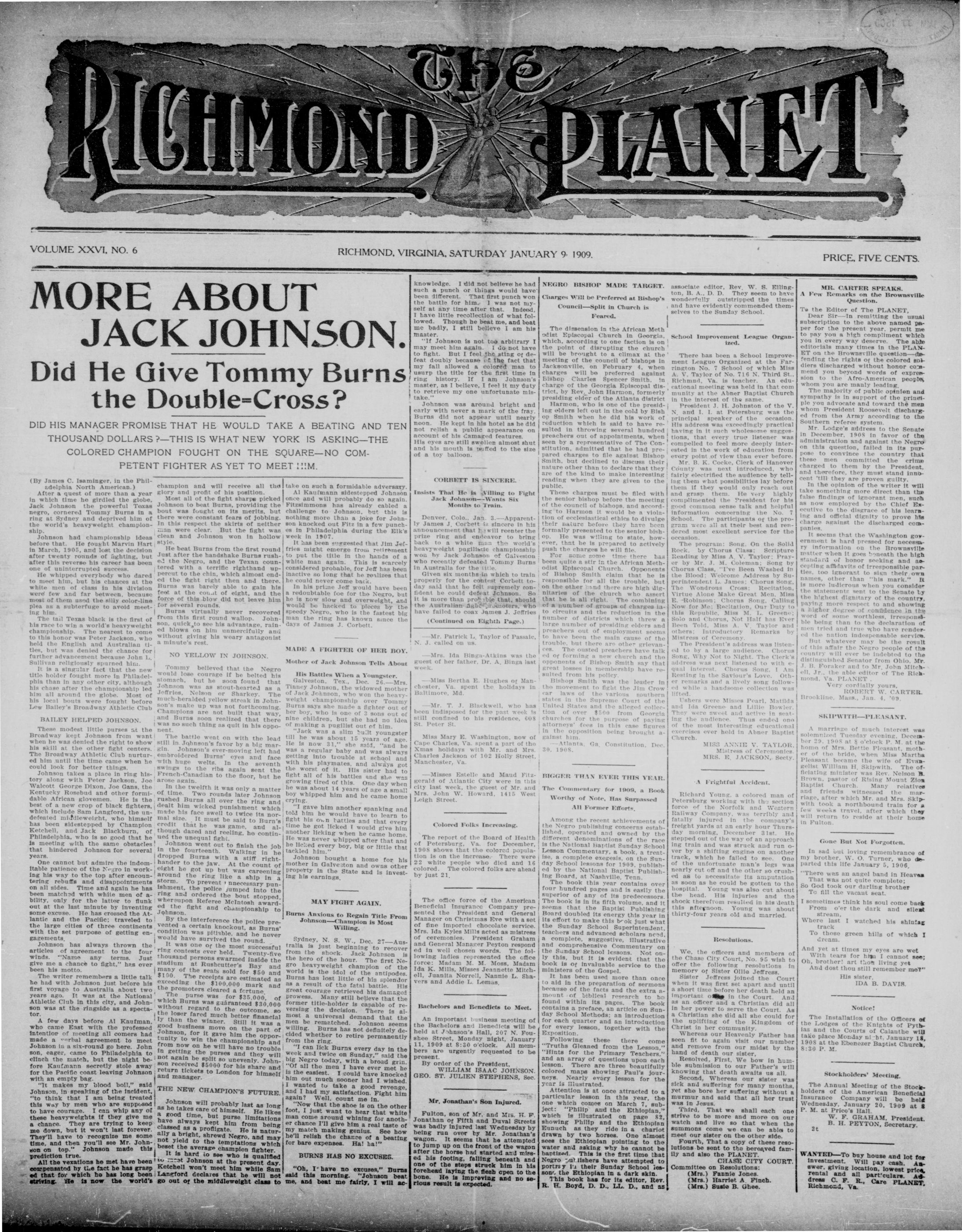
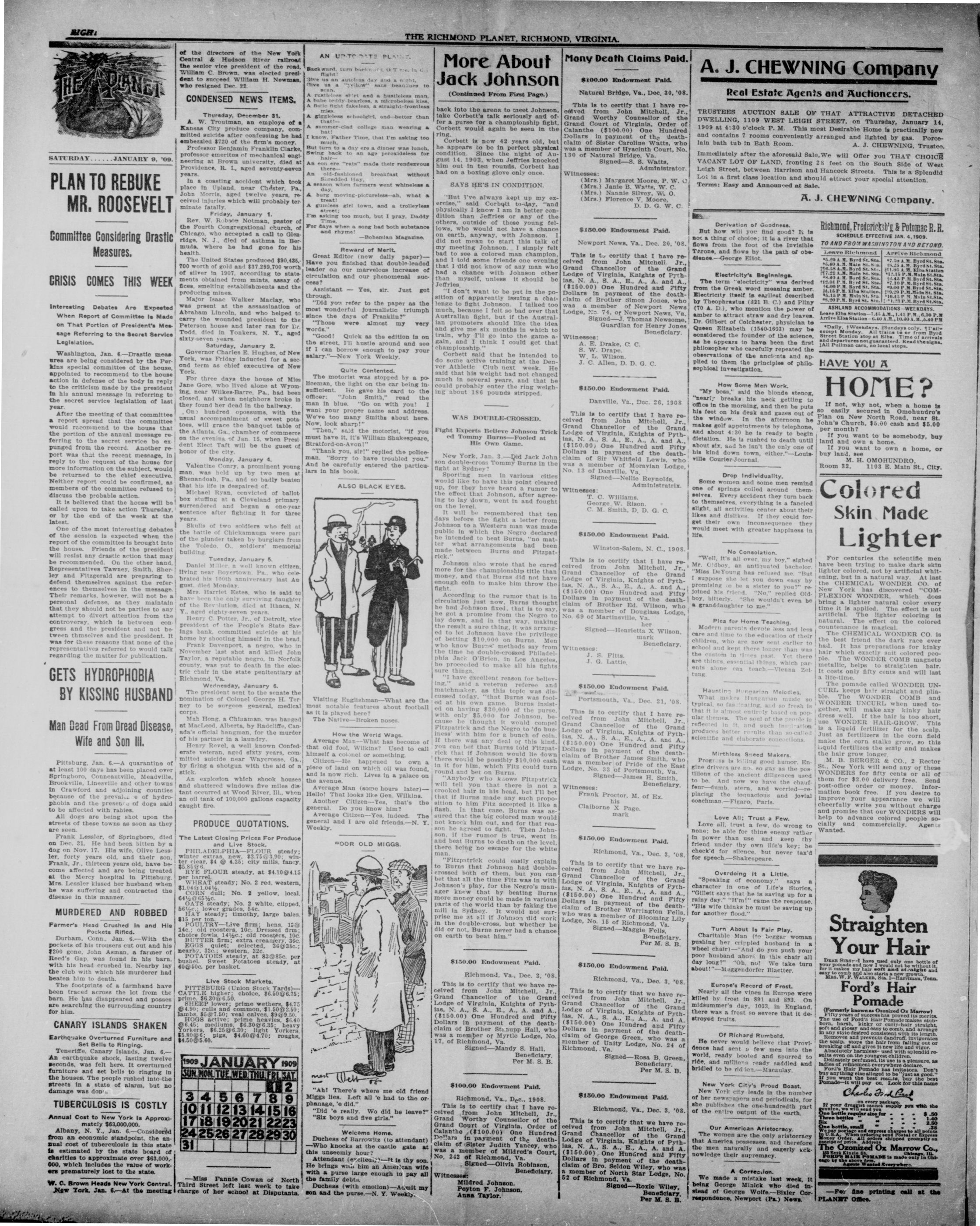
MORE ABOUT JACK JOHNSON. Did He Give Tommy Burns the Double=Cross?
DID HIS MANAGER PROMISE THAT HE WOULD TAKE A BEATING AND TEN THOUSAND DOLLARS?—THIS IS WHAT NEW YORK IS ASKING—THE COLORED CHAMPION FOUGHT ON THE SQUARE—NO COMPETENT FIGHTER AS YET TO MEET !!!M.
VOLUME XXVI, NO. 6
MORE
JAC
Did He G
the I
DID HIS MANAGER PROMI
THOUSAND DOLLARS
COLORED CHAMP
PETEN
(By James C. Isaminger, in the Philadelphia, North American.)
After a quest of more than a year in which time he girdled the globe, Jack Johnson the powerful Texas negro, cornered Tommy Burns in a ring at Sydney and deprived him of the world's heavyweight championship.
Johnson had championship ideas before that. He fought Marvin Hart in March, 1905, and lost the decision after twenty rounds of fighting, but after this reverse his career has been one of uninterrupted success.
He whipped everybody who dared to meet him, but his chances at the white men of class in his division were few and far between, because most of them used the silly color-line plea as a subterfuge to avoid meeting him.
The tail Texas black is the first of his race to win a world's heavyweight championship. The nearest to come to this honor was Peter Jackson, who held the English and Australian titles, but was denied the chance for further advancement because John L. Sullivan religiously spurned him.
It is a singular fact that the new title holder fought more in Philadelphia than in any other city, although his chase after the championship led him all around the globe. Most of his local bouts were fought before Lew Bailey's Broadway Athletic Club
BAILEY HELPED JOHNSON
These modest little purses at the Broadway kept Johnson from want when he was denied the right to show his skill at the other fight centers. The Broadway Athletic Club nurtured him until the time came when he could look for better things.
Johnson takes a place in ring history along with Peter Jackson, Joe Walcott George Dixon, Joe Gans, the Kentucky Rosebud and other formidable African glovemen. He is the best of a new crop of black fighters, which include Sam Langford, the undefeated middleweight, who himself has been slidesteped by Champion Ketchell, and Jack Blackburn, of Philadelphia, who is so good that he is meeting with the same obstacles that hindered Johnson for several years.
One cannot but admire the indomitable patience of the Negro in working his way to the top after encountering rebuffs and disappointments on all sides. Time and again he has been matched with white men of ability, only for the latter to flunk out at the last minute by inventing some excuse. He has crossed the Atlantic and the Pacific; traveled to the large cities of three continents with the set purpose of getting engagements.
Johnson has always thrown the articles of agreement to the four winds. "Name any terms. Just give me a chance to fight," has ever been his motto.
The writer remembers a little talk he had with Johnson just before his first voyage to Australia about two years ago. It was at the National Athletic Club in this city, and Johnson was at the ringside as a spectator.
A few days before Al Kaufman, who came East with the professed intention of meeting all comers had made a verbal agreement to meet Johnson in a six-round go here. Johnson, eager, came to Philadelphia to clinch the match, but the night before Kaufmann secretly stole away for the Pacific coast leaving Johnson with an empty bag.
"It makes my blood boll," said Johnson, in speaking of the incident, "to think that I am being treated this way by men who are supposed to have courage. I can whip any of these heavyweights if they give me a chance. They are trying to keep me down, but it won't last forever. They have to recognize me some time, and then you'll see Mr. Johnson on top." Johnson made this prediction true.
All the vexations he met have been compensated by the fact he has grasped that for which he has long been striving. He is now the world's
champion and will receive all the glory and profit of his position. Most all of the fight shares picked Johnson to beat Burns, providing the bout was fought on its merits, but there were constant fears of jobbing. In this respect the skirts of neither man were clear. But the fight was clean and Johnson won in hollow style.
He beat Burns from the first round Just after the handshake Burns rushed the Negro, and the Texan countered with a terrific righthand uppercut to the chin, which almost ended the fight right then and there. Burns was barely able to gain his feet at the count of eight, and the force of this blow did not leave him for several rounds.
Burns virtually never recovered from this first round wallop. Johnson, quick, to see his advantage, rained blows on him unmercifully and without giving his weary antagonist a minute's rest.
NO YELLOW IN JOHNSON
Tommy believed that the Negro would lose courage if he belted his stomach, but he soon found that Johnson was as stout-hearted as a Jeffries, Nelson or Sharkey. The much-heralded yellow streak in Johnson's make up was not forthcoming, Champions are not built that way, and Burns soon realized that there was no such thing as quit in his opponent.
The battle went on with the lead still in Johnson's favor by a big margin. Johnson's ever-moving left had embroidered Burns' eyes and face with huge welts. In the seventh swings to the ribs again sent the French-Canadian to the floor, but he arose again.
In the twelfth it was only a matter of time. Two rounds later Johnson rushed Burns all over the ring and dealt him wicked punishment which made his face swell to twice its normal size. It must be said to Burn's credit that he was game, and although dazed and reeling, he continued the unequal fight.
Johnson went out to finish the job in the fourteenth. Walking in he dropped Burns with a stiff righthander to the jaw. At the count of eight he got up but was careening around the ring like a ship in a storm. To prevent unnecessary punishment, the police jumped into the ring and ordered the bout stopped, whereupon Referee McIntosh awarded the fight and championship to Johnson.
By the interference the police prevented a certain knockout, as Burns' condition was pitiable, and he never would have survived the round.
It was one of the most successful ring contests ever held. Twenty-five thousand persons swarmed inside the stadium at Rushcutter's Bay and many of the seats sold for $50 and $100. The receipts are estimated as exceeding the $100,000 mark and the promoters cleared a fortune.
The purse was for $35,000, of which Burns was guaranteed $30,000 without regard to the outcome, so the loser fared much better financially than the winner. Still it was a good business move on the part of Johnson, for it gave him the opportunity to win the championship and from now on he will have no trouble in getting the purses and they will not again be split so unevenly. Johnson received $5000 for his share and return tickets to London for himself and manager.
THE NEW CHAMPION'S FUTURE
Johnson will probably last as long as he takes care of himself. He likes a good time, but purse limitations have always kept him from being classed as a profligate. He is naturally a bright, shrewd Negro, and may not yield to the temptations which beset the average champion fighter. It is hard to see who is qualified to meet Johnson at the present day. Ketchell won't meet him while Sam Langford declares that he will not go out of the middleweight class to
RICHMOND, VIRGINIA, SATURDAY JANUARY 9, 1909
take on such a formidable adversary.
Al Kaufmann sidestepped Johnson once and will probably do so again.
Fitzsimmons has already cabled a challenge to Johnson, but this is nothing more than a joke for Johnson knocked out Fitz in a few punches in Philadelphia during the Elk's week in 1807.
It has been suggested that Jim Jeffries might emerge from retirement to put the title in the hands of a white man again. This is scarcely considered probable, for Jeff has been inactive so long that he realizes that he could never come back.
In his prime Jeff would have been a redoubtable foe for the Negro, but he is now slow and overweight, and would be hacked to pieces by the speedy Negro, who is the fastest big man the ring has known since the days of James J. Corbett.
MADE A FIGHTER OF HER BOY
Mother of Jack Johnson Tells About
His Battles When a Youngster.
Galveston, Tex., Dec. 26—K Mrs. Tinney Johnson, the widowed mother of Jack Johnson, who won the heavy-weight championship over Tommy Burns says she made a fighter out of her boy, who is one of 3 sons out of nine children, but she had no idea of making a pugillist out of him.
"Jack was a slim built youngster till he was about 15 years of age. He is now 31," she said, "and he was a regular baby and was always getting into trouble at school and with his playmates, and always got the worst of it. His sister had to fight all of his battles and she was growing tired of this. One day when he was about 14 years of age a small boy whipped him and he came home crying.
"I gave him another spanking and told him he would have to learn to fight his own battles and that every time he got licked I would give him another licking when he came home. He was never whipped after that and he licked every boy, big or little that tackled him."
Johnson bought a home for his mother in Galveston and owns other property in the State and is investing his earnings.
MAY FIGHT AGAIN
Returns Anxious to Regain Title From
Johnson-Champion is Most
Unfavorable
Sydney, N. S. W., Dec. 27—Australia is just beginning to recover from the shock. Jack Johnson is the hero of the hour. The first Negro heavyweight champion of the world is the idol of the antipodes. Burns has lost little of his splendor as a result of the fatal battle. His great courage retrieved his damaged prowess. Many still believe that the former title-holder is capable of reversing the decision. There is almost a universal demand that the men be rematched. Johnson seems willing. Burns has not definitely decided whether to retire permanently from the ring.
"I can lick Burns every day in the week and twice on Sunday," said the big Negro today, with a broad grin. "Of all the men I have ever met he is the easiest. I could have knocked him out much sooner had I wished. I wanted to take a good revenge, and I had my satisfaction. Fight him again? Well, count me in.
"Now that the shoe is on the other foot, I just want to hear that white man come around whining for another chance I'll give him a real taste of my match making genius. See how he'll relish the chance of a beating for bare expenses. Ha! ha!"
BURNS HAS NO EXCUSES.
"Oh, I have no excuses," Burns said this morning. "Johnson beat me, and beat me fairly. I will ac-
knowledge. I did not believe he had such a punch or things would have been different. That first punch won the battle for him. I was not my self at any time after that. Indeed, I have little recollection of what followed. Though he beat me, and beat me badly, I still believe I am his master.
"If Johnson is not too arbitrary I may meet him again. I do not have to fight. But I feel the sting or defeat doubly because of the fact that my fall allowed a colored man to usurp the title for the first time in ring history. If I am Johnson's master, as I believe, I feel it my duty to retrieve my one unfortunate mistake."
Johnson was around bright and early with never a mark of the fray. Burns did not appear until nearly noon. He kept in his hotel as he did not relish a public appearance on account of his damaged features. His eyes are still swollen almost shut and his mouth is puffed to the size of a toy balloon.
CORBETT IS SINCERE
Insists That He Is Villing to Fight
Jack Johnson—Wants Six
Months to Train.
Denver, Colo., Jan. 3.—Apparently James J. Corbett is sincere in his announcement that he will reenter the prize ring and endeavor to bring back to a white man the world's heavyweight pugilistic championship won by Jack Johnson of Galveston who recently defeated Tommy Burns in Australia for the title.
Given six months in which to train properly for the contest Corbett today said that he felt supremely confident he could defeat Johnson. So it is more than probable that, should the Australian Jaguar promotors, who have failed to coax James J. Jeffries
(Continued on Eighth Page.)
—Mr. Patrick L, Taylor of Passaic, N. J. called on us.
—Mrs. Ida Binga-Atkins was the guest of her father, Dr. A, Binga last week.
—Miss Bertha E. Hughes of Manchester, Va. spent the holidays in Baltimore, Md.
—Mr. T. J. Blackwell, who has been indisposed for the past week is still confined to his residence, 608 St. Peter St.
Miss Mary E. Washington, now of Cape Charles, Va. spent a part of the Xmas holidays with Mr. and Mrs. Charles Jackson of 102 Holly Street, Manchester, Va.
—Misses Estelle and Maud Fitzgerald of Atlantic City were in this city last week, the guest of Mr. and Mrs. John W. Howard, 1415 West Leigh Street.
Colored Folks Increasing
The report of the Board of Health of Petersburg, Va. for December, 1908 shows that the colored population is on the increase. There were 22 white people who died and 16 colored. The colored folks are ahead by just 21.
---
The office force of the American Beneficial Insurance Company presented the President and General Manager on Christmas Eve with a set of fine imported chocolate service. Mrs. Ida Kyles Mills acted as mistress of ceremonies. President Graham and General Manager Peyton responded in well chosen words. The following ladies represented the office force: Madam M. M. Moss, Madam Ida K. Mills, Misses Jeanneette Mitchell, Juanita Norrell, Nannie L. Shavers and Addie L. Lemas.
Bachelors and Benedicts to Meet.
An important business meeting of the Bachelors and Benedicts will be held at Johnson's Hall, 207 N. Founee Street, Monday night, January 11, 1909 at 8:30 o'clock. All members are urgently requested to be present. By order of the President
WILLIAM ISAAC JOHNSON
GEO. ST. JULIEN STEPHENS. Soc.
Mr. Jonathan's Son Injured.
Fulton, son of Mr. and Mrs. H. F. Jonathan or Fifth and Duval Streets was badly injured last Wednesday by being run over by Mr. Jonathan's wagon. It seems that he attempted to jump up on the front of the wagon after the horse had started and misled his footing, falling beneath and one of the steps struck him in his forehead laying the flesh open to the bone. He is improving and no serious result is expected.
NEGRO BISHOP MADE TARGET
charges Will be Preferred at Bishop's Council—Split in Church is Feared.
The dissension in the African Methologist Episcopal Church in Georgia, which, according to one faction is on the point of disrupting the church will be brought to a climax at the meeting of the council of bishops in Jacksonville, on February 4, when charges will be preferred against Bishop Charles Spencer Smith, in charge of the Georgia Episcopal district, by Rev. John Harmon, former presiding elder of the Atlanta district Harmon, who is one of the presiding elders left out in the cold by Bishop Smith when he did his work of reduction which is said to have resulted in throwing several hundred preachers out of appointments, when seen by a representative of The Constitution, admitted that he had prepared charges to file against Bishop Smith, but declined to discuss their nature other than to declare that they are of the kind to make interesting reading when they are given to the public.
These charges must be filed with the senior bishop before the meeting of the council of bishops, and according to Harmon it would be a violation of ecclesiastical ethics to divulge their nature before they have been formally presented to the senior bishop. He was willing to state, however, that he is prepared to actively push the charges he will file.
For some some time there has been quite a stir in the African Methodist Episcopal Church. Opponents of Bishop Smith claim that he is responsible for all the trouble, but on the other hand there are high dignitaries of the church who assert that he is all right. The combining of a number of groups of charges into circuits and the reduction in the number of districts which threw a large number of presiding elders and preachers out of employment seems to have been the main cause of the trouble, but there are other grievances. The ousted preachers have talked or forming a new church and the opponents of Bishop Smith say that great losses in membership have resulted from his policy.
Bishop Smith was the leader in the movement to fight the Jim Crow car laws of the various southern states in the Supreme Court of the United States and the alleged collection of over $500 from Georgia churches for the purpose of paying attorneys' fees in this case figures in the opposition being brought against him.
—Atlanta, Ga. Constitution, Dec. 30, 1908.
BIGGER THAN EVER THIS YEAR
The Commentary for 1909, a Book Worthy of Note, Has Surpassed All Former Efforts
Among the recent achievements of the Negro publishing concerns established, operated and owned by the different denominations of the race is the National Baptist Sunday School Lesson Commentary, a book, a treatise, a complete exegesis, on the Sunday School lessons for 1909, published by the National Baptist Publishing Board, at Nashville, Tenn.
The book this year contains over four hundred pages and is easily the superior of any of its predecessors. The book is in its fifth volume, and it seems that the Baptist Publishing Board doubled its energy this year in its effort to make this book just what the Sunday School Superintendent, teachers and advanced scholars need, a complete, suggestive, illustrative and comprehensive Commentary on the Sunday School lessons. Not only this, but it is evident that the book is or invaluable service to the ministers of the Gospel.
It has been used more than once to aid in the preparation of sermons because of the facts and the extra amount of biblical research to be found within its pages. The book contains a preface, an article on Sunday School Methods; an introduction for each quarter and an introduction for every lesson, together with the Exposition.
Following these there come "Truths Gleaned from the Lesson," "Hints for the Primary Teachers," and an array of questions upon each lesson. There are three beautifully colored maps showing Paul's journeys. Nearly every lesson for the year is illustrated.
Attention is at once attracted to a particular lesson in this year, the one which comes on March 7, subject: "Philip and the Ethiopian," which is illustrated on page 82, showing Philip and the Ethiopian Eunuch as they ride in a chariot drawn by two horses. One almost sees the Ethiopian pointing to the water and asking why he cannot be baptized. This is the first time that Negro publishers have attempted to portray it in their Sunday School lesson, the Ethiopian in a dark skin. This book has for its editor, Rev. R. H. Boyd, D. D., LL. and
associate editor, Rev, W. S. Ellington, B. A., D. D. They seem to have wonderfully outstripped the times and have evidently commended themselves to the Sunday School.
School Improvement League Organized.
There has been a School Improvement League Organized at the Farrington No. 7 School of which Miss A. V. Taylor of No. 716 N. Third St. Richmond, Va. is teacher. An educational meeting was held in that community at the Abner Baptist Church in the interest of the same.
President J. H. Johnston of the V. N, and I. I. at Petersburg was the principal speaker of the occasion. His address was exceedingly practical having in it such wholesome suggestions, that every true listener was compelled to feel more deeply interested in the work of education from every point of view than ever before.
Mr. B. K. Cocke, Clerk of Hanover County was next introduced, who fairly electrified the audience by telling them what possibilities lay before them if they would only reach out and grasp them. He very highly complimented the President for his good common sense talk and helpful information concerning the No. 7 School. The participants of the program were all at their best and rendered most excellent service for the occasion.
The program: Song. On the Solid Rock, by Chorus Class; Scripture Reading by Miss A. V. Taylor; Prayer by Mr. J. M. Coleman; Song by Chorus Class; 'I've Been Washed in the Blood; Welcome Address by Superintendent L. James; Chorus Song, The Wondrous Cross; Recitation, Virtue Alone Make Great Men, Miss E. Robinson; Chorus Song, Calling Now for Me; Recitation, Our Duty to this Republic, Miss M. L. Greene; Solo and Chorus, Not Half has Ever Been Told, Miss A. V. Taylor and others; Introductory Remarks by Mistress of Ceremony.
The President's address was listened to by a large audience. Chorus Song, Why Not to Night. The Clerk's address was next listened to with equal interest. Chorus Song, I Am Resting in the Saviour's Love. Other remarks and a lively song followed while a handsome collection was lifted.
Ushers were Misses Pearl, Matilda and Ida Greene and Lillie Bowler. They were sweet and active in seating the audience. Thus ended one of the most interesting educational exercises ever held in Abner Baptist Church.
MISS ANNIE V. TAYLOR,
Mistress of Ceremonies.
MRS. E. JACKSON, Secty.
·A Frightful Accident.
Richard Young, a colored man of Petersburg working with the section force of the Norfolk and Western Railway Company, was terribly and fatally injured in the company's freight yards at an early hour Thursday morning, December 31st. He stepped out of the way of an approach train and was struck and run over by a shifting engine on another track, which he failed to see. One of the unfortunate man's legs was nearly cut off and the other so crushed as to necessitate its amputation as soon as he could be gotten to the hospital. Young was also cut about the head. His injuries and the shock therefrom resulted in his death this afternoon. Young was about thirty-four years old and married.
Resolutions.
We, the officers and members of the Chase City Court. No. 95 wish to offer the following resolutions in memory of Sister Ollie Jeffress.
Sister Jeffress joined the Court when it was first set apart and until a short time before her death held an important office in the Court. And as an officer and a Christian did all in her power to serve the Court. As a Christian she did all she could for the uplifting of the Kingdom of Christ in her community.
Whereas our Heavenly Father has seen fit to again visit our number and remove from our midst by the hand of death our sister.
Resolved. First. We bow in humble submission to our Father's will knowing that death awaits us all.
Second. Whereas our sister was sick and suffering for many months, yet she bore her suffering without a murmur and said that all her trust was in Jesus.
Third. That we shall each one strive to be more and more on our watch and live so that when the summons come we can be able to meet our sister on the other side.
Fourth. That a copy of these resolutions be sent to the bereaved family and also the PLANET.
CHASE CITY COURT
Committee on Resolutions:
(Mrs.) Fannie Jones.
(Mrs.) Harriet A. Finch.
(Mrs.) Susie B. Ghee.
PRICE, FIVE CENTS
MR. CARTER SPEAKS.
A Few Remarks on the Brownsville Question.
To the Editor of The PLANET
Dear Sir—in remitting the usual subscription to the above named paper for the present year, permit me to pay you a high compliment which you in every way deserve. The able editorials many times in the PLANET on the Brownsville question—defending the rights of the colored soldiers discharged without honor command you beyond words of expression to the Afro-American people, whom you are manly leading.
The majority of public opinion and sympathy is in support of the principle you advocate and toward the men whom President Roosevelt discharged from the Army according to the Southern referee system.
Mir. Lordge's address to the Senate in December, 1908 in favor of the administration and against the Negro on this question, failed in its purpose to convince the country that these men committed the crime charged to them by the President, and therefore, they must stand innocent 'till they are proven guilty.
In the opinion of the writer it will take something more direct than the false findings of ignorant men, such as now employed by the Chief Executive to the disgrace of his learning and official dignity to prove his charge against the discharged companies.
It seems that the Washington government is hard pressed for necessary information on the Brownsville matter when it goes beneath the high standard of honor seeking and accepting affidavits of irresponsible parties, too ignorant to sign their own names, other than "his mark." It is more ludicrous when you consider the statements sent to the Senate by the highest dignitary of the country, paying more respect to and showing a higher degree of confidence in the word of some worthless, irresponsible being than to the declaration of men tried and true who have rendered the nation indispensable service. But whatever may be the result of this affair the Negro people of the country will ever be indebted to the distinguished Senator from Ohio, Mr. J. B. Foraker and to Mr. John Mitchell, Jr., the able editor of The Richmond, Va. PLANET.
Very cordially yours,
ROBERT W. CARTER
Brookline, Mass., Jan. 4, '09.
SKIPWITH—PLEASANT
A marriage of much interest was solemnized Tuesday evening, December 29, 1908 at 8 o'clock P. M. at the home of Mrs. Bettie Pleasant, mother of the bride, when Miss Martha Pleasant became the wife of Evangelist William H. Skipwith. The officiating minister was Rev. Nelson B. Brown, pastor of Rising Mount Zion Baptist Church. Many relatives and friends witnessed the marriage, after which Mr. and Mrs. Skipwith took a northbound train for a few weeks travel, after which they will return to reside at their home in Fulton.
Gone But Not Forgotten
In sad but loving remembrance of my brother, W. O. Turner, who departed this life January 5, 1906.
"There was an angel band in Heaven
That was not quite complete;
So God took our darling brother
To fill the vacant seat.
I sometimes think his soul come back
From o'er the dark and silent stream.
Where last I watched his shinigag track
To those green hills of which I dream.
And yet at times my eyes are wet
With tears for him I cannot see;
Oh, brother! art thou living yet
And dost thou still remember me?"
His sister,
IDA B. DAVIS.
Notice!
The Installation of the Officers of the Lodges of the Knights of Pythias and the Courts of Calanthe will take place Monday night, January 18, 1908 at the Ebenezer Baptist Church, 8:30 P. M.
Stockholders' Meeting
The Annual Meeting of the Stock-
holders of the American Beneficial
Insurance Company will be held
Wednesday, January 20, 1909 at 8
P. M. at Price's Hall.
W. F. GRAHAM, President.
B. H. PEYTON, Secretary.
WANTED-To buy house and lot for investment. Will pay cush. Answer, giving location, lowest price, rental and all particulars. Address C. F. R., Care PLANET, Richmond, Va.
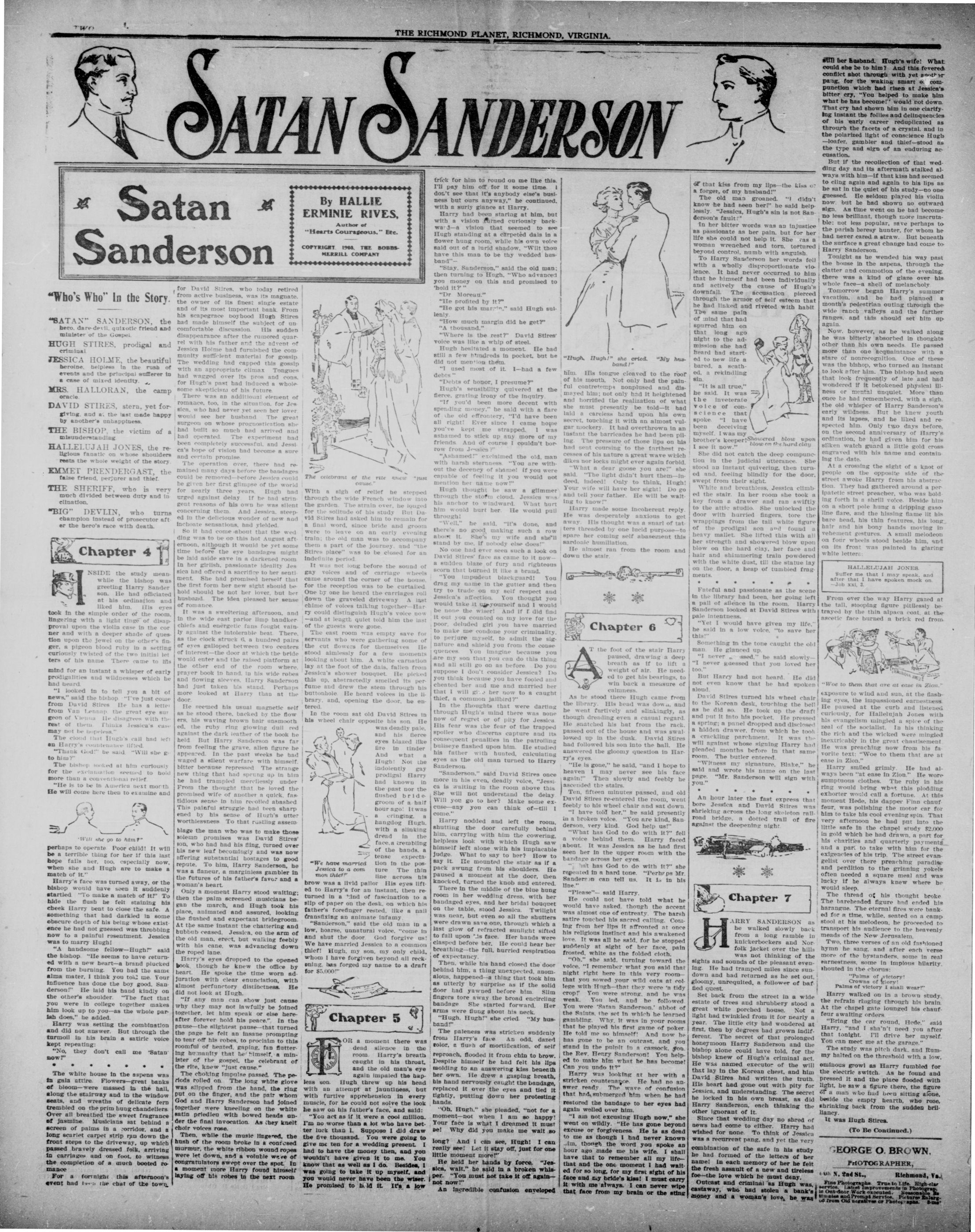
SATAN SANDERSON
Satan Sanderson
"Who's Who" In the Story.
"SATAN" SANDERSON, the hero, dare devil, quixotic friend and minister of the Gospel.
HUGH STIRES, prodigal and criminal
JESSICA HOLME, the beautiful heroine, helpless in the rush of events and the principal sufferer in a case of mixed identity.
MRS. HALLORAN, the camp oracle.
DAVID STIRES, stern, yet forgiving, and a TIRE, the last made happy by another's unhappiness.
THE BISHOP, the victim of a misunderstanding
HALLELUJAH JONES, the religious fanatic on whose shoulders rests the whole weight of the story.
EMMET PRENDERGAST, the false friend, perjurer and thief.
THE SHERIFF, who is very much divided between duty and in elitnation.
"BIG" DEVLIN, who turns champion instead of prosecutor after the hero's race with death.
Chapter 4
NSIDE the study means while the bishop was greeting Harry Sander son. He had officiated at his ordination and usurped.
INSIDE the study means while the bishop was greeting Harry Sander son. He had officiated at his ordination and liked him. His eyes took in the simple order of the room. lingering with a light tinge of disap proval upon the violin case in the corner and with a deeper shade of ques tion upon the jewel on the other's finger, a pigeon blood ruby in a setting curiously twisted of the two initial letters of his name. There came to his mind for an instant a whisper of early prodigialities and wildness which he had heard. "I looked in to tell you a bit of news," said the bishop. "I've just come from David Stires. He has a letter from Van Lenump the great eye surgeon of Vienna. He disagrees with the rest of them. Thinks Jessica's case may not be honest."
The cloud that Hugh's call had left en Harry's countenance lifted.
"Thank God!" be said. "Will she go to him?"
The bishop took at him curiously for the exclamation seemed to hold more than a conventional relief.
"He is to be in America next month. He will come here then to examine and perhaps to operate Poor child! It will be a terrible thing for her if this last hope falls her, too, especially now, when she and Hugh are to make a match of it."
Harry's face was turned away, or the bishop would have seen it suddenly startled "To make a match of it!" To hide the flush he felt staining his cheek Harry bent to close the safe. A something that had darkened in some obscure depth of his being whose existence he had not guessed was throbbing now to a painful resentment. Jessica was to marry Hugh!
"A handsome fellow—Hugh!" said the bishop. "He seems to have returned with a new heart—a brand plucked from the burning. You had the same alma mater, I think you told me. Your influence has done the boy good. Sanderson!" He laid his hand klindly on the other's shoulder. "The fact that you were in college together makes him look up to you—as the whole parish does," he added.
Harry was setting the combination and did not answer. But through the turmoll in his brain a satiric voice kept repeating:
"No, they don't call me 'Satan'
now!"
The white house in the aspens was
in gala attire. Flowers—great banks
of bloom—were massed in the hall,
along the stairway and in the window
seats, and wreaths of delicate fern
trembled on the prim hung chandeliers.
Over all breathed the sweet fragrance
of jasmine. Musicians sat behind a
screen of palms in a corridor, and a
long scarlet carpet strip ran down the
front steps to the driveway, up which
passed bravely dressed folk, arriving
in carriages and on foot, to witness
the completion of a much booted romance.
For a fortnight this afternoon's
event had led to the chat of the town
for David Stires, who today retired from active business, was its magnate. the owner of its finest single estate and of its most important bank From his scapegrace boyhood Hugh Stires had made himself the subject of uncomfortable discussion. His sudden disappearance after the rumored quarrel with his father and the advent of Jessica Holme had furnished the community sufficient material for gossip The wedding had capped this gossip with an appropriate climax. Tongues had wagged over its pros and cons, for Hugh's past had induced a whole-some skepticism of his future There was an additional element of romance, too, in the situation, for Jessica, who had never yet seen her lover, would see her husband. The great surgeon on whose prognostication she had built so much had arrived and had operated. The experiment had been completely successful, and Jessica's hope of vision had become a sure and certain promise.
The operation over, there had remained many days before the bandages could be removed—before Jessica could be given her first glimpse of the world for nearly three years. Hugh had urged against delay. If he had stringent reasons of his own he was silent concerning them. And Jessica, steeped in the delicious wonder of new and inchoate sensations, had yielded. So it had come about that the wedding was to be on this hot August afternoon, although it would be yet some time before the eye bandages might be laid aside save in a darkened room. In her girlish, passionate ideality Jessica had offered a sacrifice to her sentiment. She had promised herself that the first form her new sight should be hold should be not her lover, but her husband. The idea pleased her sense of romance.
It was a sweltering afternoon, and in the wide east parlor lumber bandk chiefs and energetic fans fought vainly against the intolerable heat. There, as the clock struck 6, a hundred pairs of eyes galloped between two centers of interest—the door at which the bride would enter and the raised platform at the other end of the room where, prayer book in hand, in his wide robes and bowing sleeves, Harry Sanderson had just taken his stand. Perhaps more looked at Harry than at the door.
He seemed his usual magnetic self as he stood there, backed by the flowers, his waving brown hair unsmoored, the ruby ring glowing dull red against the dark leather of the book he held But Harry Sanderson was far from feeling the grave, alien figure he appeared. In the past weeks he had waged a silent warfare with himself, bitter because repressed The strange new thing that had spring up in him he had trampled mercilessly under. From the thought that he loved the promised wife of another a quick, fastidious sense in him recoiled abashed This painful struggle had been sharpened by his sense of Hugh's utter worthlessness To that rustling assem-
blage the man who was to make those solemn promises was David Stress'son, who had had his fling, turned over his new leaf becomingly and was now offering substantial hostages to good repute. To him, Harry Sanderson, he was a flameur, a marginless gambler in the futures of his father's favor and a woman's heart.
Only a moment Harry stood waiting; then the palm screened musicians began the march, and Hugh took his place, animated and assured, looking the flushed and expectant bridegroom. At the same instant the chattering and bubbul ceased. Jessica, on the arm of the old man, erect, but walking feebly with his cane, was advancing down the roped lane.
Harry's eyes dropped to the opened book, though he knew the office by heart. He spoke the time worn adjuration with clear enunciation, with almost perfunctory distinctness. He did not look at Hugh.
"If any man can show just cause why they may not lawfully be joined together, let him speak or else here-after forever hold his peace." In the pause—the slightest pause—that turned the page he felt an insane prompting to tear off his robes, to proclaim to this roomful of heated, gaping, fan fluttering humanity that he himself, a minister of the gospel, the celebrant of the rite, knew "just cause."
The choking impulse passed. The periods rolled on. The long white glove was slipped from the hand, the ring put on the finger, and the pair whom God and Harry Sanderson had joined together were kneeling on the white satin plediem with bowed heads under the final invocation. As they knelt choir volces rose.
Then, while the music lingered, the hush of the room broke in a confused murmur, the white ribbon wound ropes were let down, and a voluble wze of congratulators swept over the spot. In a moment more Harry found himself laying off his robes in the next room
THE RICHMOND PLANET, RICHMOND, VIRGINIA
Author of
"Hearts Courageous." Etc.
COPYRIGHT 1988. THE BOBBS-
MERRILL COMPANY
A
The celebrant of the rite knew "just cause."
With a sigh of relief he stepped through the wide French window into the garden. The strain over, he lounged for the solitude of his study. But David Stires had asked him to remain for a final word, since bride and groom were to leave on an early evening train; the old man was to accompany them a part of the journey, and "the Stires place" was to be closed for an indefinite period.
It was not long before the sound of gay voices and of carriage wheels came around the corner of the house, for the reception was to be curtailed.
One by one he heard the carriages roll down the graveled driveway. A last chime of voices talking together—Harry could distinguish Hugh's voice now—and at length quiet told him the last of the guests were gone.
The east room was empty save for servants who were gathering some of the cut flowers for themselves. He stood almightly for a few moments looking about him. A white carnation lay at the foot of the dais, fallen from Jessica's shower bouquet. He picked this up, abstractedly smelled its perfume and drew the stem through his buttonhole. He heard voices in the library, and, opening the door, he entered.
In the room sat old David Sttres in his wheel chair opposite his son. He
was deadly pale, and his fierce eyes blazed like fire in tinder. And what a Hugh! Not the indolently gay prodigal Harry had known in the past nor the flushed bridegroom of a half hour ago! It was a cringing, a hangdog Hugh, with a slinking dread in the face, a trembling of the hands, a tense expectation in the posture The thin line across his
"We have married Jessica to a com man thief."
brow was a livid pallor. His eyes lifted to Harry's for an instant, then returned in a "lind of fascination to a slip of paper on the desk, on which his father's forefinger rested, like a nail transixing an animate infamy. "Sanderson," said the old man in a low, hoarse, unnatural voice, "come in and shut the door. God forgive us! We have married Jessica to a common thief! Hugh, my son, my only child, whom I have forgiven beyond all reckoning, has forged my name to a draft for $5,000!"
Chapter 5
OR a moment there was dead silence in the room. Harry's breath caught in his throat, and the old man's eye again impaled the hapless son. Hugh threw up his head with an attempt at jauntiness, but with furtive apprehension in every muscle, for he could not solve the look he saw on his father's face, and said: "You act as if it were a cool million. I'm no worse than a lot who have better luck than l. Suppose I did draw the five thousand. You were going to give me ten for a wedding present. I had to have the money then, and you wouldn't have given it to me. You know that as well as I do. Besides, I was going to take it up myself, and you would never have been the wiser. He promised to hold it. It's a low
trick for him to round on me like this. I'll pay him off for it some time I don't see that it's anybody else's business but ours anyway," he continued, with a surly glance at Harry. Harry had been staring at him, but with a vision turned curiously backward—a vision that seemed to see Hugh standing at a carpeted dais in a flower hung room, while his own voice said out of a birid shadow. "Wilt thou have this man to be thy wedded husband"— "Stay, Sanderson," said the old man; then turning to Hugh. "Who ad vanced you money on this and promised to 'hold it?' " Dr Moreau."
"He profited by it?"
"He got his marvin," said Hugh sullenly.
"How much margin did he get?"
"A thousand."
"Where is the rest?" David Stires' voice was like a whip of steel.
Hugh hesitated a moment. He had still a few hundreds in pocket, but he did not mention them.
"I used most of it. I—had a few debts."
"Debts of honor, I presume?"
Hugh's sensibility quivered at the fierce, grating irony of the inquiry.
"If you'd been more decent with spending money," he said with a flare of the old effrontery, "I'd have been all right! Ever since I came hope you've kept me strapped. I was ashamed to stick up any more of my friends. And of course I couldn't borrow from Jessica?"
"Ashamed! exclaimed the old, man with harsh sternness. "You are without the decency of shame! If you were capable of feeling it you would not mention her name now!"
Hugh thought he saw a glimmer through the storm cloud. Jessica was his anchor to windward. What hurt him would hurt her. He would pull through:
"Well," he said. "it's done, and there's no good making such a row about it. She's my wife and she'll stand by me, if nobody else does."
No one had ever seen such a look on David Stires' face as came to it now—a sudden blaze of fury and righteous scorn that burned it like a brand.
"You impudent blackguard! You drag my name in the gutter and then try to trade on my self respect and Jessica's affection. You thought you would take it up yourself and I would be none the wiser! And if I did find it out you counted on my love for the poor, deuded girl you have married to make me condone your criminality, to perjure myself, to admit the signature and shield you from the consequences. You imagine because you are my son that you can do this thing and all still go on as before. Do you suppose I don't consider Jessica? Do you think because you have fooled and cheated her and me and married her that I will give her now to a caught thief, a common jailbird?"
In the thoughts that were darting through Hugh's mind there was none now of regret or of pity for Jessica. His fear was the fear of the trapped speller who discerns capture and its consequent penalties in the patrolling bulseye flashed upon him. He studied his father with hunted, calculating eyes as the old man turned to Harry Sanderson.
"Sanderson," said David Stires once more in his even, deadly voice, "Jessica is waiting in the room above this. She will not understand the delay. Will you go to her? Make some excuse—any you can think of—till I come."
Harry nodded and left the room, shutting the door carefully behind him, carrying with him the cowering, helpless look with which Hugh saw himself left alone with his implacable judge. What to say to her? How to say it. He mounted the stair as if a pack swung from his shoulders. He paused a moment at the door, then knocked, turned the knob and entered. There in the middle of the blue hung room in her wedding dress, with her bandaged eyes, and her bridal bouquet on the table, stood Jessica. Twilight was near, but even so all the shutters were drawn save one, through which a last glow of refracted sunlight sifted to fall upon 'is face. Her hands were clasped before her. He could hear her breathing—the full, hurried respiration of expectancy.
Then, while his hand closed the door behind him, a thing unexpected, anomalous, happened—a thing that took him as utterly by surprise as if the solid floor had yawned before him. Slim fingers tore away the broad encircling bandage. She started forward. Her arms were flung about his neck.
"Hugh, Hugh!" she cried. "My husband."
The paleness was stricken suddenly from Harry's face. An odd, dazed color, a flush of mortification, of self reproach, flooded it from chin to brow. Despite himself he had felt his lips molding to an answering kiss beneath her own. He drew a gasping breath, his hand nervously caught the bandage, replaced it over the eyes and tied it tightly, putting down her protesting hands.
"Oh, Hugh." she pleaded, "not for a moment—not when I am so happy! Your face is what I dreamed it must be! Why did you make me wait so
long? And I can see, Hugh! I can really see! Let it stay off, just for one little moment more!"
He held her hands by force, "Jesica, wait," he said in a broken whisper. "You must not take it off again—not now!"
An incredible confusion enveloped
JOHNSON JAMES
"Hugh, Hugh!" she cried. "My husband!"
him. His tongue cleaved to the roof of his mouth. Not only had the painful contretements nonplused and dismayed him; not only had it heightened and horrified the realization of what she must presently be told—it had laid a careless hand upon his own secret, touching it with an almost vulgar mockery. It had overthrown in an instant the barricades he had been piling. The pressure of those lips on his had sent coursing to the farthest recesses of his nature a great wave which dikes nor locks might ever again forbid. "What a dear goose you are!" she said. "The light didn't hurt them—indeed, indeed! Only to think, Hugh Your wife will have her sight! Do go and tell your father. He will be waiting to know!"
Harry made some incoherent reply. He was desperately anxious to get away. His thought was a snarl of tatters threaded by one held purpose—to spare her coming self abasement this sardone humiliation. He almost ran from the room and down the stair.
Chapter 6
At the foot of the stair Harry paused, drawing a deep breath as if to lift weight of air. He need ed to get his bearings, t win back a measure o
T the foot of the stair Harry paused, drawing a deep breath as if to lift a weight of air. He needed to get his bearings, to win back a measure of calmness.
As he stood there Hugh came from the library. His head was down, and he went furtively and slinkingly, as though dreading even a casual regard. He snatched his hat from the rack, passed out of the house and was swallowed up in the dusk. David Stires had followed his son into the hall. He answered the gloomy question in Harry's eyes.
"He is gone," he said, "and I hope to heaven I may never see his face again!" Then slowly and feebly he ascended the stairs.
Ten, fifteen minutes passed, and old David Stires re-entered the room, went feebly to his wheel chair and sat down
"I have told her," he said presently in a broken voice. "You are kind, Sanderson, very kind. God help us!" "What has God to do with it?" fell a voice behind them. Harry faced about. It was Jessica as he had first seen her in the upper room with the bandage across her eyes. "What has God to do with it?" she repeated in a hard tone. "Perhaps Mr. Sanderson can tell us. It is in his line." "Please"—said Harry. He could not have told what he would have asked, though the accent was almost one of entreaty. The harsh satire touched his sacred calling. Coming from her lips it affronted at once his religious instinct and his awakened love. It was all he said, for he stopped suddenly at sight of her face, pain frosted, white as the folded cloth.
"Oh." she said, turning toward the voice. "I remember what you said that night right here in this very room—that you sowed your wild oats at college with Hugh—that they were a 'tidy crop'. You were strong, and he was weak. You led, and he followed. You were 'Satan Sanderson'. abbot of the Saints, the set in which he learned gambling. Why. It was in your rooms that he played his first game of poker. He told me so himself! And now he has gone to be an outcast, and you stand in the pulpit in a caskock. son, the Rev. Henry Sanderson! You helped to make him what he has become! Can you undo it?"
Harry was looking at her with a stricken countenance. He had no answer ready. The wave of confusion that had, submerged him when he had restored the bandage to her eyes had again walled over him.
"I am not excusing Hugh now," she went on wildly. "He has gone beyond excuse or forgiveness. He is as dead to me as though I had never known him, though the word you spoke an hour ago made me his wife. I shall have that to remember all my life—that and the one moment I had waited for so long, for my first sight of his face and my bride's kiss! I must carry it with me always. I can never wipe that face from my brain or the sting
of that kiss from my lips—the kiss or a forger, of my husband!" The old man groaned. "I didn't know he had seen her!" he said helplessly. "Jessica, Hugh's sin is not Sanderson's fault!" In her bitter words was an injustice as passionate as her pain, but for her life she could not help it. She cas a woman wrenched and torn, tortured beyond control, numb with anguish. To Harry Sanderson her words fell with a wholly disproportionate violence. It had never occurred to him that he himself had been individually and actively the cause of Hugh's downfall. The accusation pressed through the armor of self esteem that he had linked and riveted with habit
The same palm of mind that had spurred him on that long ago night to the admission she had heard had started to new life a bared, a scathed, a rekindling sin.
-
"It is all true," he said. It was the inveterate voice of conscience that spoke. "I have been deceiving myself. I was my brother's keeper! Showered blow upon blow on the hard clay I see it now." She did not catch the deep compunction in the judicial utterance. She stood an instant quivering, then turned and, feeling blindly for the door, swept from their sight.
White and breathless, Jessica climbed the stair. In her room she took a key from a drawer and ran swiftly to the attic studio. She unlocked the door with hurried fingers, tore the wrappings from the tall white figure of the prodigal son and found a heavy mallet. She lifted this with all her strength and showed blow upon blow on the hard clay, her face and hair and shimmering train powdered with the white dust, till the statue lay on the floor, a heap of tumbled fragments.
Fateful and passionate as the scene in the library had been, her going left a pall of silence in the room. Harry Sanderson looked at David Stires with pale intentness.
"Yet I would have given my life," he said in a low voice, "to save her this!" Something in the tone caught the old man. He glanced up.
"I never missed," he said slowly—
"I never guesed that you loved her too."
But Harry had not heard. He did
not even know that he had spoken aloud.
David Stires turned his wheel chair
to the Korean desk, touching the bell
as he did so. He took up the draft
and put it into his pocket. He pressed
a spring; a panel dropped and disclosed
a hidden drawer, from which he took
a crackling parchment. It was the
will against whose signing Harry had
pleased months before in that same
room. The butler entered.
"Witness my signature, Blake," he
said and wrote his name on the last
page. "Mr. Sanderson will sign with
you."
An hour later the fast express that
bore Jessica and David Stires was
shrieking across the long skeleton rail-
road bridge, a dotted trail of fire
against the deepening night.
Chapter 7
HARRY SANDERSON as he walked slowly back from a long ramble in knickerbockers and Norfolk jacket over the hills was not thinking of the
sights and sounds of the pleasant evening. He had tramped miles since sundown and had returned as he set out, gloomy, unrequited, a follower of baffled quest. Set back from the street in a wide estate of trees and shrubbery stood a great white porched house. Not a light had twinkled from it for nearly a year. The little city had wondered at first, then by degrees had grown indifferent. The secret of that prolonged honeymoon Harry Sanderson and the bishop alone could have told, for the bishop knew of Hugh's criminal act. He was named executor of the will that lay in the Korean chest, and him David Stires had written the truth. His heart had gone out with pity for Jessica, and understanding. The secret he locked in his own breast, as did Harry Sanderson, each thinking the other ignorant of it.
Since that wedding day no shred of news had come to either. Harry had wished for none. To think of Jessica was a recurrent pang, and yet the very combination of the safe in his study he had formed of the letters of her name! In each memory of her he felt the fresh assault of a new and tireless foe—the love which he must deny.
Outcast and criminal as Hugh was, castaway, who had stolen a bank's money and a woman's love, he was
sill her husband. Hugh's wife! What could she be to him? And this fevered conflict shot through with yet another pang, for the waking smart compunction which had risen at Jessica's bitter cry, "You helped to make him what he has become!" would not down. That cry had shown him in one clarifying instant the follies and delinquencies of his early career reduplicated as through the facets of a crystal, and in the polarized light of conscience Hugh-leaver, gambler and thief—stood as the type and sign of an enduring accusation.
But if the recollection of that wedding day and its aftermath stalked always with him—if that kiss had seemed to elong again and again to his lips as he sat in the quiet of his study—no one guessed. He seldom played his violin now, but he had shown no outward sign. As time went on he had become no less brilliant, though more inscrutable; not less popular, save perhaps to the parish heresy hunter, for whom he had never cared a straw. But beneath the surface a great change had come to Harry Sanderson.
Tonight as he wended his way past the house in the aspen, through the clatter and commotion of the evening, there was a kind of glaze over his whole face—a shell of melancholy.
Tomorrow began Harry's summer vacation, and he had planned a month's pedestrian outing through the wide ranch valleys and the farther ranges, and this should set him up again.
Now, however, as he walked along he was bitterly absorbed in thoughts other than his own needs. He passed more than one acquaintance with a stare of nonrecognition. One of these was the bishop, who turned an instant to look after him. The bishop had seen that look frequently of late and had wondered if it betokened physical illness or mental unquiet. More than once he had remembered, with a sigh, the old whisper of Harry Sanderson's early wildness. But he knew youth and its lapses, and he liked and respected him. Only two days before, on the second anniversary of Harry's ordination, he had given him for his silken watch guard a little gold cross engraved with his name and containing the date.
At a crossing the sight of a knot of people on the opposite side of the street awoke Harry from his abstraction. They had gathered around a peripatetic street preacher, who was holding forth in a shrill voice. Beside him on a short pole hung a dripping gasoline flare, and the hissing flame lit his bare head, his thin features, his long hair and his bony hands moving in vehement gestures. A small melodion on four wheels stood beside him, and on its front was painted in glaring white letters:
HALLELUJAH JONES.
Suffer me that I may speak, and after that I have spoken mock on.
-Job xxi. $
From over the way Harry gazed at the tall, stooping figure pitflessly betrayed by the thin alpaca coat, at the ascetic face burned a brick red from
"Woe to them that are at ease in Zion."
exposure to wind and sun, at the flashing eyes, the impassioned earnestness. He paused at the curb and listened curiously, for Hallelujah Jones with his evangelism mingled a spice of the zeal of the socialist. In his thinking the rich and the wicked were mingled inextricably in the great chastisement. He was preaching now from his favorite text: "Woe to them that are at ease in Zion."
Harry smiled grimly. He had always been "at ease in Zion". He wore sumptuous clothes. The ruby in his ring would bring what this plodding exhorter would call a fortune. At this moment Hede, his dapper Finn chaufeur, was polishing the motor car for him to take his cool evening spin. That very afternoon he had put into the little safe in the chapel study $2,000 in gold which he had drawn, a part for his charities and quarterly payments and a part to take with him for the exigencies of his trip. The street evangelist over there preaching paradise and perdition to the grinning yokels often needed a square meal and was lucky if he always knew where he would sleep.
The thread of his thought broke. The bareheaded figure had ended his harangue. The eternal fires were banked for a time, while, seated on a camp stool at his melodeon, he proceeded to transport his audience to the heavenly meads of the New Jerusalem.
Two, three verses of an old fashioned hymn he sang, and after each verse more of the bystanders, some in real earnestness, some in impious hilarity, shouted in the chorus:
"Palms of victory!
Crowns of glory!
Palms of victory I shall wear!"
Harry walked on in a brown study, the refrain ringing through his brain. At the chapel gate lounged his chauffeur awaiting orders.
"Bring the car round, Hede," said Harry, "and I shan't need you after that tonight. I'll drive her myself. You can meet me at the garage."
The study was pitch dark, and Rummy halted on the threshold with a low, ominous growl as Harry fumbled for the electric switch. As he found and pressed it and the place flooded with light, he saw a figure there, the figure of a man who had been sitting alone, beside the empty hearth, who rose, shrinking back from the sudden brilliancy.
It was Hugh Stires.
(To Be Continued.)
GEORGE O. BROWN
Fine Photographs. True to Life. High-class services. Latest Improvements in Photograph in Out-door Work executed. Reasonable Bills. Reasonable Enlargement from Old Sugessum or Photograph.
THE JUNET
SATURDAY.....JANUARY 9, '09.
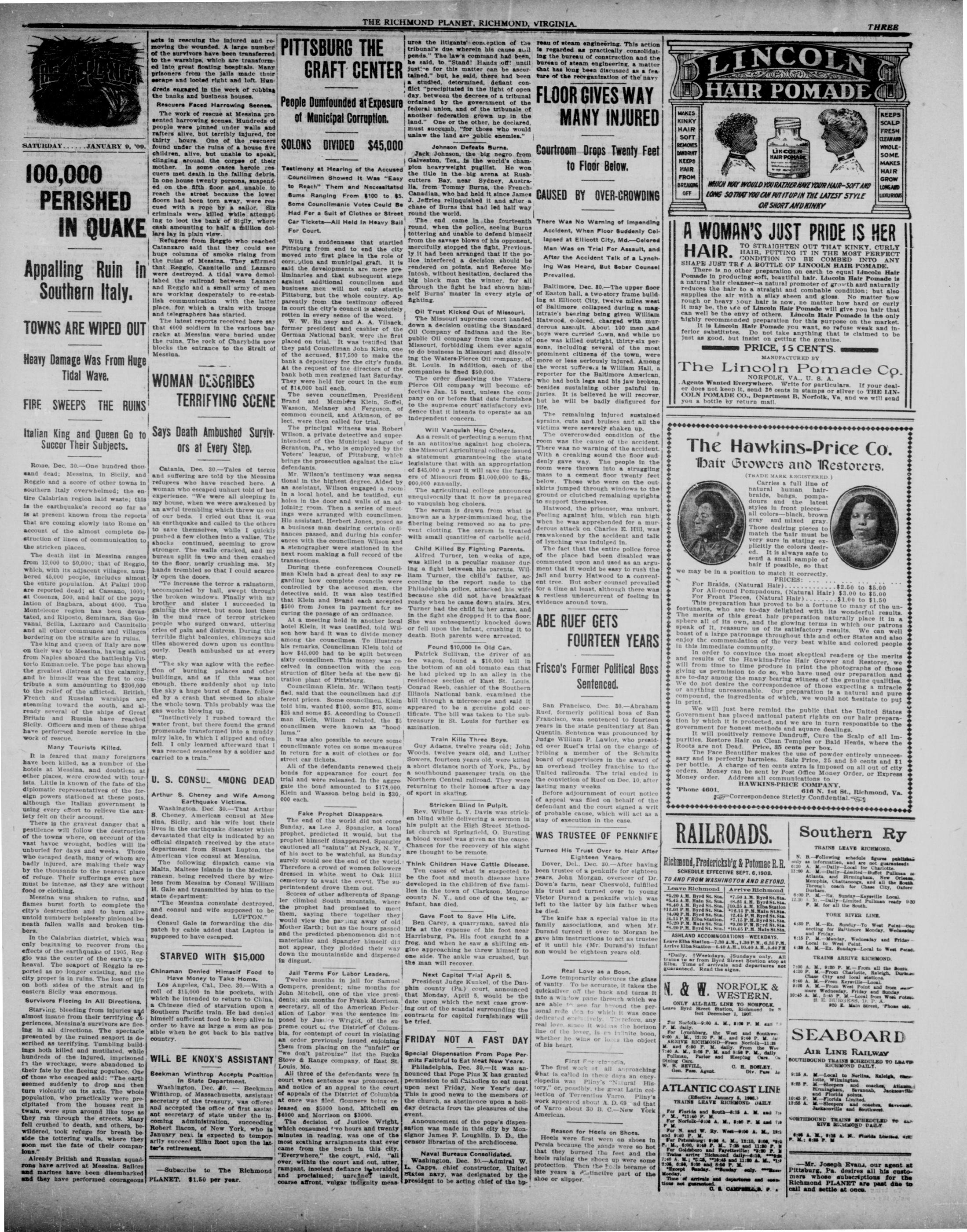
100,000 PERISHED IN QUAKE
Appalling Ruin in Southern Italy.
TOWNS ARE WIPED OUT
Heavy Damage Was From Huge Tidal Wave.
FIRE SWEEPS THE RUINS
Italian King and Queen Go to Succor Their Subjects.
Rome, Dec. 30.—One hundred thousand dead; Messina, in Sicily, and Reggio and a score of other towns in southern Italy overwhelmed; the entire Calabrian region laid waste; this is the earthquake's record so far as is at present known from the reports that are coming slowly into Rome on account of the almost complete destruction of lines of communication to the stricken places.
The death list in Messina ranges from 12,000 to 50,000; that of Reggio, which, with its adjacent villages, numbered 45,000 people, includes almost the entire population. At Palmi 1000 are reported dead; at Cassano, 1000; at Cosenza, 500, and half of the population of Bagbara, about 4000. The Montelone region has been devastated, and Riposto, Seminara, San Giovanni, Scilla, Lazzaro and Cannellolo and all other communes and villages bordering on the straits are in ruins.
The king and queen of Italy are now on their way to Messina, having sailed from Naples aboard the battleship Vittorio Emanuele. The pope has shown the greatest distress at the calamity, and he himself was the first to contribute a sum amounting to $200,000 to the relief of the afflicted. British, French and Russian warships are steaming toward the south, and already several of the ships of Great Britain and Russia have reached Sicily. Officers and men of these ships have performed heroic service in the work of rescue.
Many Tourists Killed.
It is feared that many foreigners have been killed, as a number of the hotels at Messina, and doubtless at other places, were crowded with tourists. Little is known of the fate of the diplomatic representatives of the foreign powers stationed at these posts, although the Italian government is using every effort to relieve the anxiety felt on their account.
There is the gravest danger that a pestilence will follow the destruction of the towns where, on account of the vast havoc wrought, bodies will lie unburied for days and weeks. Those who escaped death, many of whom are badly injured, are making their way by the thousands to the nearest place of refuge. Their sufferings even now must be intense, as they are without food or clothing.
Messina was shaken to ruins, and flames burst forth to complete the city's destruction and to burn alive untold numbers helplessly pionned beneath fallen walls and broken timbers.
In the Calabrian district, which was only beginning to recover from the effects of the earthquake of 1905, Reggio was the center of the earth's upheaval. The seaport of Reggio is reported as no longer existing, and the city proper is in ruins. The loss of life on both sides of the strait and in eastern Sicily was enormous.
Survivors Fleeing In All Directions.
Starving, bleeding from injuries and almost insane from their terrifying experiences, Messina's survivors are fleeing in all directions. The spectacle presented by the ruined seaport is described as terrifying. Tumbling buildings both killed and mutilated, while hundreds of the injured, imprisoned in the wreckage, were abandoned to their fate by the fleeing populace. One of those who escaped said: "The earth seemed suddenly to drop and then turn violently on its axis. The whole population, who practically were precipitated from the houses rent in twain, were spain around like tops as they ran through the streets. Many fell crushed to death, and others, bewildered, took refuge for breath beside the totering walls, where they soon met the fate of their companions."
Already British and Russian squadrons have arrived at Messina. Sailors and marines have been disembarked and they have performed courageous
nets in rescuing the injured and removing the wounded. A large number of the survivors have been transferred to the warships, which are transformed into great floating hospitals. Many prisoners from the jails made their escape and looted right and left. Hundreds engaged in the work of robbing the banks and business houses.
Rescuers Faced Harrowing Scenes.
The work of rescue at Messina presented harrowing scenes. Hundreds of people were pinned under walls and rafters alive, but terribly injured, for thirty hours. One of the rescuers found under the ruins of a house five children, alive, but unable to speak, clinging around the corpse of their mother. In some cases heroic rescuers met death in the falling debris. In one house twenty persons, suspended on the fifth floor and unable to reach the street because the lower floors had been torn away, were rescued with a rope by a sailor. Six criminals were killed while attempting to loot the bank of Sigly, where cash amounting to half a million dollars lay in plain view.
Refugees from Reggio who reached Catanzaro said that they could see huge columns of smoke rising from the ruins of Messina. They affirmed that Reggio, Cannitello and Lazzaro were destroyed. A tidal wave demolished the railroad between Lazzaro and Reggio and a small army of men are working desperately to re-establish communication with the latter place, for which a train with troops and telegraphers has started.
The latest reports received here say that 4000 soldiers in the various barracks at Messina were buried under the ruins. The rock of Charybdis now blocks the entrance to the Strait of Messina.
WOMAN DESCRIBES
TERRIFYING SCENE
Catania, Dec. 30.—Tales of terror and suffering are told by the Messina refugees who have reached here. A woman who escaped unhurt told of her experience. "We were all sleeping in my house, when we were awakened by an awful trembling which threw us out of our beds. I cried out that it was an earthquake and called to the others to save themselves, while I quickly pushed a few clothes into a vialise. The shocks continued, seeming to grow stronger. The walls cracked, and my bureau split in two and crashed to the floor, nearly crushing me. My hands trembled so that I could scarcely open the doors.
"To increase the terror a rainstorm, accompanied by hail, swept through the broken windows. Finally with my brother and sister I succeeded in galming the street, but soon lost them in the mad race of terror stricken people who surged onward, uttering cries of pain and distress. During this terrible flight balconies, chimneys and tiles showered down upon us continuously. Death ambushed us at every step.
"The sky was aglow with the reflection of burning palaces and other buildings, and as if this was not enough, the suddenly shot up into the sky a huge burst of flame, followed by a crash that seemed to shake the whole town. This probably was the gas works blowing up.
"Instinctively I rushed toward the water front, but there found the grand promenade transformed into a muddy mire lake, in which I slipped and often fell. I only learned afterward that I was rescued senseless by a soldier and carried to a train."
U. S. CONSUL AMONG DEAD
Arthur S. Cheney and Wife Among Earthquake Victims.
Washington, Dec 30.—That Arthur S. Cheney, American consul at Messina, Sicily, and his wife lost their lives in the earthquake disaster which devastated that city is indicated by an official dispatch received by the state department from Stuart Lupton, the American vice consul at Messina.
The following dispatch came via Malta, Maltese islands in the Mediterranean, being received there by wireless from Messina by Consul William H. Gale and transmitted by him to the state department:
"The Messina consulate destroyed, and consul and wife supposed to be dead.
LUPTON."
Consul Gale in forwarding the dispatch by cable added that Lupton is supposed to have escaped.
STARVED WITH $15.000
Chinaman Denied Himself Food to Have Money to Take Home.
Los Angeles, Cal., Dec. 30.—With a roll of $15,000 in his pockets, with which he intended to return to China, a Chinese died of starvation upon a Southern Pacific train. He had denied himself sufficient food to keep alive in order to have as large a sum as possible when he got back to his native country.
WILL BE KNOX'S ASSISTANT
Beekman Winthrop Accepts Position
In State Department.
Washington, Dec. 40. — Beekman
Winthrop, of Massachusetts, assistant
secretary of the treasury, was offered
and accepted the office of first assistant
secretary of state under the incoming
administration. succeeding
Robert Bacon, of New York, who in
January next is expected to temporarily succeed Elihu Root upon the latter's retirement.
— Subscribe to The Richmond
PLANET. $1.50 per year.
THE RICHMOND PLANET, RICHMOND, VIRGINIA
PITTSBURG THE GRAFT CENTER
Testimony at Hearing of the Accused Councilmen Showed It Was "Easy to Reach" Them and Necessitated Sums Ranging From $100 to $5. Some Councilmanic Votes Could Be Had For a Suit of Clothes or Street Car Tickets—All Held in Heavy Bail For Court.
With a suddenness that startled Pittsburg from end to end to end the city moved into first place in the role of corruption and municipal graft. It is said the developments are more preliminaries and that subsequent steps against additional councilmen and business men will not only startle Pittsburg, but the whole country. Apparently from the testimony offered in court the city's council is absolutely rotten in every sense of the word.
W. W. Ransey and A. A. Vilsack, former president and cashier of the German National bank, were the first placed on trial. It was testified that they paid Councilman John Klein one of the accused, $17,500 to make the bank a depository for the city's funds. At the request of the directors of the bank both men resigned last Saturday. They were held for court in the sum of $14,000 bail each.
The seven councilmen, President Brand and Members Klein, Soffel, Wasson, Melaney and Ferguson, of common council, and Atkinson, of select, were then called for trial.
The principal witness was Robert Wilson, a private detective and superintendent of the Municipal league of Scranton, Pa., who is employed by the Voters' league, of Pittsburg, which brings the prosecution against the nine defendants.
Mr. Wilson's testimony was sensational in the highest degree. Aided by an assistant, Wilson engaged a room in a local hotel, and he testified, cut holes in the door and walls of an adjoining room. Then a series of meetings were arranged with councilman His assistant, Herbert Jones, posed as a business man desiring certain ordinances passed, and during his conferences with the councilman Wilson and a stenographer were stationed in the next room making a full record of the transactions.
During these conferences Councilman Klein had a great deal to say regarding how complete councils were controlled by the accused men, the detective said. It was also testified that Klein and Brand each accepted $500 from Jones in payment for securing the passage of an ordinance.
At a meeting held in another local hotel Klein, it was testified, told Wilson how hard it was to divide money among the councilmen. To illustrate his remarks, Councilman Klein told of how $4,500 had to be split between sixty councilmen. This money was received in connection with the construction of filter beds at the new filtration plant of Pittsburg.
Councilman Klein, Mr. Wilson testified, said that the councilmen had different prices. Some councilmen, Klein told him, wanted $100, some $75, some $25 and some $5. According to Councilman Klein, Wilson related, the $5 councilmen were known as "hood-lums."
It was also possible to secure some councilmanic votes on some measures in return for a suit of clothes or for street car tickets.
All of the defendants renewed their bonds for appearance for court for trial and were released. In the aggregate the bond amounted to $178,000 Klein and Wasson being held in $30,000 each.
Fake Prophet Disappears
The end of the world did not come Sunday, as Lee J. Spangler, a local prophet, predicted it would, but the prophet himself disappeared. Spangler cautioned all "saints" at Nayack, N. Y. of his sect to be watchful, as Sunday surely would see the end of the world. Therefore a crowd of women followers dressed in white went to Oak Hill cemetery to await the event. The superintendent drove them out. Scores of other adherents of Spangler climbed South mountain, where the prophet had promised to meet them, saying there together they would view the passing away of old Mother Earth; but as the hours passed and the predicted phenomenon did not appear, they plodded their way down the mountainside and dispersed in disgust.
Jail Terms For Labor Leaders.
Twelve months in jail for Samuel Gompers, president; nine months for John Mitchell, one of the vice presidents; six months for Frank Morrison, secretary, all of the American Federation of Labor was the sentence imposed by Justice Wright, of the supreme court of the District of Columbia, for contempt of court in violating an order previously issued enjoining them from placing on the "unfair" or "we don't patronize" list the Bucks Stove & Range company, of East St. Louis, Mo.
All three of the defendants were in court when sentence was pronounced, and notice of an appeal to the court of appeals of the District of Columbia at once was filed. Gompers being released on $5000 bond. Mitchell on $4000 and Morrison on $3000.
The decision of Justice Wright, which consumed two hours and twenty minutes in reading, was one of the most scathing arrangements that ever came from the bench in this city. "Everywhere," the court, said, "all over, within the court and out, utter, rampant, insolent defiance is heralded and proclaimed; unrefined, insult, coarse affront, vulgar indignity means.
ures the litigants' conception of the tribunal's due wherein his cause still pends." The law's command had been, he said, to "Stand! Hands off! until justice for this matter can be ascertained," but, he said, there had been a studied, determined, defiant conflict "precipitated in the light of open day, between the decrees of a tribunal ordained by the government of the federal union, and of the tribunals of another federation grown up in the land." One or the other, he declared, must succumb, "for those who would unlaw the land are public enemies."
Johnson Defeats Burns
Jack Johnson, the big negro from Galveston, Tex., is the world's champion heavyweight pugilist. He won the title in the big arena at Rushcutters Bay, near Sydney, Australia, from Tommy Burns, the French-Canadian, who had held it since James J. Jeffries relinquished it and after a chase of Burns that had led half way round the world.
The end came in the fourteenth round, when the police, seeing Burns toterting and unable to defend himself from the savege blows of his opponent, mercifully stopped the fight. Previously it had been arranged that if the police interfered a decision should be rendered on points, and Referee McIntosh, without hesitation, declared the big black man the winner, for all through the fight he had shown himself Burns' master in every style of fighting.
Oil Trust Kicked Out of Missouri.
The Missouri supreme court handed down a decision ousting the Standard Oil Company of Indiana and the Republic Oil company from the state of Missouri, forbidding them ever again to do business in Missouri and dissolving the Waters-Pierce Oil company, of St. Louis. In addition, each of the companies is fined $50,000.
The order dissolving the Waters-Pierce Oil company will become effective Jan. 15 next, unless the company on or before that date furnishes to the supreme court satisfactory evidence that it intends to operate as an independent concern.
Will Vangulah Hog Cholera
As a result of perfecting a serum that is an antitoxine against hog cholera, the Missouri Agricultural college issued a statement guaranteeing the state legislature that with an appropriation of $45,000 a year it will save the farmers of Missouri from $1,000,000 to $5,000,000 annually.
The agricultural college announces unequivocally that it now is prepared to vanquish hog cholera.
The serum is drawn from what is known as a hyper-immunized hog, the fibering being removed so as to prevent clotting. The serum is treated with small quantities of carbolic acid.
Child Killed By Fighting Parents.
Found $10,000 In Old Can.
Patrick Sullivan, the driver of an ice wagon, found a $10,000 bill in the bottom of an old tomato can that he had picked up in an alley in the residence section of East St. Louis. Conrad Reeb, cashier of the Southern Illinois National bank, examined the bill through a microscope and said it appeared to be a genuine gold certificate. The bill was taken to the subtreasury in St. Louis for further examination.
Train Kills Three Boys
Guy Adams, twelve years old; John Woods, twelve years old, and Luther Sowers, fourteen years old, were killed a short distance north of York, Pa., by a southbound passenger train on the Northern Central railroad. They were returning to their homes after a day of sport in skating.
Stricken Blind In Pulloit
Rev. Wilbur L. Y. Davis was stricken blind while delivering a sermon in his pulpit at the High Street Methodist church at Springfield, O. Bursting a blood vessel was given as the cause. Chances for the recovery of his sight are thought to be remote.
Think Children Have Cattle Disease. Ten cases of what is suspected to be the foot and mouth disease have developed in the children of five families in the town of Clarkson, Monroe county N. Y., and one of the ten, an infant, has died.
Gave Foot to Save His Life
Ben Carey, a quarryman, saved his life at the expense of his foot near Harrisburg, Pa. His foot caught in a frog, and when he saw a shifting engine approaching he threw himself to one side. The ankle was crushed, but the man will recover.
Next Capitol Trial April 5.
President Judge Kunkel, of the Dauphin county (Pa.) court, announced that Monday, April 5, would be the date upon which the next case growing out of the scandal surrounding the contracts for capitol furnishings will be tried.
FRIDAY NOT A FAST DAY
Special Dispensation From Pope Perrits Faithful to Eat More New Years
mits Faithful to Eat Meat New Years.
Philadelphia, Dec. 30. It was announced that Pope Pius X has granted permission to all Catholics to eat meat upon next Friday, New Year's day. This is good news to the members of the church, as abstinence upon a holiday detracts from the pleasures of the event.
Announcement of the pope's dispensation was made in this city by Monsignor James F. Loughlin, D. D., the censor librarian of the archdiocese.
Naval Bureaus Consolidated
Washington, Dec. 30.—Admiral W. L. Cappus, chief contractor, United States navy, was designated by the president to be acting chief of the bu-
ream of steam engineering. This action is regarded as practically consolidating the bureau of construction and the bureau of steam engineering, a matter that has long been discussed as a feature of the reorganization of the navy
FLOOR GIVES WAY MANY INJURED
Courtroom Drops Twenty Feet to Floor Below. CAUSED BY OVER-CROWDING
There Was No Warning of Impending Accident, When Floor Suddenly Collapsed at Ellicott City, Md.—Colored Man Was on Trial For Assault, and After the Accident Talk of a Lynching Was Heard, But Sober Counsel Prevailed.
Baltimore, Dec. 30.—The upper floor of Easton hall, a two-story frame building at Ellicott City, twelve miles west of Baltimore collapsed during a magistrate's hearing being given William Hatwood, colored, charged with murderous assault. About 100 men and boys were carried down, and while no one was killed outright, thirty-six persons, including several of the most prominent citizens of the town, were more or less seriously injured. Among the worst sufferers is William Hall, a reporter for the Baltimore American, who had both legs and his jaw broken, besides sustaining other painful injuries. It is believed he will recover, but he will be badly disfigured for life.
The remaining injured sustained sprains, cuts and bruises and all the victims were severely shaken up.
The overcrowded condition of the room was the cause of the accident. There was no warning of the accident. With a creaking sound the floor suddenly gave way. The people in the room were thrown into a struggling mass to a cement floor twenty feet below. Those who were on the outskirts jumped through windows to the ground or clutched remaining uprights to support themselves. Hatwood, the prisoner, was unhurt. Feeling against him, which ran high when he was apprehended for a murderous attack on Charles E. Hill, was reawakened by the accident and talk of lynching was indulged in. The fact that the entire police force of the place had been disabled was commented upon and used as an argument that it would be easy to rush the jail and hurry Hatwood to a convenient tree. But sober counsel prevailed for a time at least, although there was a restless undercurrent of feeling in evidence around town.
ABE RUEF GETS
FOURTEEN YEARS
Frisco's Former Political Boss
Sentenced.
San Francisco, Dec. 30.—Abraham Ruef, formerly political boss of San Francisco, was sentenced to fourteen years in the state penitentiary at San Quentin. Sentence was pronounced by Judge William P. Lawlor, who presided over Ruef's trial on the charge of bribing a member of the Schmitz board of supervisors in the award of an overhead trolley franchise to the United railroads. The trial ended in the conviction of Ruef on Dec. 10, after lasting many weeks.
Before adjournment of court notice of appeal was filed on behalf of the defendant and the court signed a writ of probable cause, which will act as a stay of execution in the case.
WAS TRUSTEE OF PENKNIFE
Turned His Trust Over to Heir After Eighteen Years.
Dover, Del., Dec. 30.—After having been trustee of a penknife for eleven years, John Morgan, overseer of Dr. Down's farm, near Cheswold, fulfilled his trust and turned over to young Victor Durand a penknife which was left to the latter by his father when he died.
The knife has a special value in its family associations, and when Mr. Durand turned it over to Morgan he gave him instructions to act as trustee of it until his (Mr. Durand's) infant son would be eighteen years old.
Real Love as a Boon
Love temporarily obscures the glass of vanity. To be accurate, it takes the quicksilver off the back and turns it into a window pane through which we are able to see far beyond the personal roile don to which it was once dedicated exclusively. Therefore, any real love, since it widens the horizon line of the lover, is an infinite boon, whether he wins or loses the object of his heart.
First Encyclopedia
The first work at all approaching what is called in these days an encyclopedia was Pliny's "Natural History," or, possibly, the great Latin collection of Terrecentius Varro. Pliny's work appeared about A. D. 69 and that of Varro about 30 B. C.—New York American.
Reason for Heels on Shoes
Heels were first worn on shoes in Persia because the sands were so hot that they burned the feet and the heels raising the shoes up were some protection. Then the heels became of late years a distinctive part of the shoe or slipper.
LINCOLN
HAIR POMADE
MAKES
KINKY
HAIR
SOFT
REMOVES
DANDRIFT
KEEPS
HAIR
FROM
BREAKING
OFF
LINCOLN
HAIR POMADE
KEEPS
SCALP
FRESH
CLEAN AND
WHOLE-
SOME
MAKES
HAIR
GROW
LONG AND
LUXURIOUS
WHICH WAY WOULD YOU RATHER HAVE YOUR HAIR-SOFT AND
LONG SO THAT YOU CAN PUT IT UP IN THE LATEST STYLE
OR SHORT AND KINKY
A WOMAN'S JUST PRIDE IS HER
HAIR. TO STRAIGHTEN OUT THAT KINKY, CURLY HAIR, PUTTING IT IN THE MOST PERFECT CONDITION TO BE COMBED INTO ANY SHAPE JUST TRY A BOTTLE OF LINCOLN HAIR POMADE.
There is no other preparation on earth to equal Lincoln Hair Pomade in producing soft, beautiful hair. Lincoln Hair Pomade is a natural hair cleanser-a natural promoter of growth and naturally reduces the hair to a straight and combable condition; but also supplies the air with a silky sheen and gloss. No matter how rough or heavy your hair is now, no matter how hard or curly it may be, the use of Lincoln Hair Pomade will give you hair that can well be the envy of others. Lincoln Hair Pomade is the only highly recommended preparation for this market.
It is Lincoln Hair Pomade you want, so refuse weak and inferior substitutes. Do not take anything that is claimed to be just as good, but insist on getting the genuine.
The Lincoln Pomade Co
NORFOLK, VA, U.S.A.
Agents Wanted Everywhere. Write for particulars. If your dealer does not keep it, send 26 cents in stamps or silver to THE LINCOLN POMADE CO., Department B, Norfolk, Va, and we will send you a bottle by return mail.
The Hawkins-Price Co. Hair Growers and Restorers.
(TRADE MARK REGISTERED)
Carries a full line of natural human hair- braids, bangs, pompadours and the latest styles in front pieces— all colors—black, brown gray and mixed gray.
Those desiring pieces to match the hair must be very sure in stating explicitly the colors desired. It is always safe to send a small sample of hair if possible, so that we may be in a position to match it correctly.
PRICES:
For Braids, (Natural Hair) . . .
For All-round Pompadours, (Natural Hair) . . .
For Front Pieces, (Natural Hair) . . .
This preparation has proved to be a fortune to fortunate, who are to-day delighted with its use. The merits of this great hair preparation nature sphere all of its own, and the glowing terms in speak of it, reassure us of its satisfactory result boast of a large patronage throughout this and other enjoy the commendation of the very best white hair in this immediate community.
In order to convince the most skeptical real and results of the Hawkins-Price Hair Grower, will from time to time produce in print the phishing us permission to do so, who have used our are to-day among the many bearing witness of the. We do not desire the correspondence of those ever or anything unreasonable. Our preparation is a compound, the ingredients of which, we would re in print.
We will just here remind the public that Government has placed national patent rights on by which it is protected, and we are in turn government for honest methods and square deals. It will positively remove Dandruff. Cure the purities, Restore Hair on Clean Temples or Bald Roots are not Dead. Price, 35 cents per box.
The Face Beautifier makes the use of powder sary and is perfectly harmless. Sale Price, 25 are per bottle. A charge of ten cents extra is imposed orders. Money can be sent by Post Office Money Money order. Address all communications to
to be a fortune to many of the un-
nighted with its wonderful results.
reparation naturally place it in a
owing terms in which our patrons
satisfactory results. We can well
hout this and other States and also
very best white and colored people
best skeptical readers of the merits
the Hair Grower and Restorer, we
in print the photographs of those
who have used our preparation and
ag witness of the genuine qualities.
ence of those expecting a miracle
preparation is a natural and pure
which, we would not hesitate to put
the public that the United States
patent rights on our hair prepara-
we are in turn responsible to the
and square dealings
undruff, Cure the Scalp of all Im-
temples or Bald Heads, where the
cents per box.
the use of powder entirely unneces-
Sale Price, 25 and 50 cents and $1
extra is imposed on all out of city
post Office Money Order, or Express
unications to.
For Braids, (Natural Hair).....$2.50 to $5.00
For All-round Pompadours, (Natural Hair).....$3.00 to $5.00
For Front Pieces, (Natural Hair).....$1.00 to $1.50
This preparation has proved to be a fortune to many of the un-
fortunates, who are to-day delighted with its wonderful results.
The merits of this great hair preparation naturally place it in a
sphere all of its own, and the glowing terms in which our patrons
speak of it, reassure us of its satisfactory results. We can well
boast of a large patronage throughout this and other States and also
enjoy the commendation of the very best white and colored people
in this immediate community.
In order to convince the most skeptical readers of the merits
and results of the Hawkins-Price Hair Grower and Restorer, we
will from time to time produce in print the photographs of those
giving us permission to do so, who have used our preparation and
are to-day among the many bearing witness of the genuine qualities.
We do not desire the correspondence of those expecting a miracle
or anything unreasonable. Our preparation is a natural and pure
compound, the ingredients of which, we would not hesitate to put
in print.
We will just here remind the public that the United States
Government has placed national patent rights on our hair preparation
by which it is protected, and we are in turn responsible to the
government for honest methods and square dealings.
It will positively remove Dandruff, Cure the Scalp of all Impurities.
Restore Hair on Clean Temples or Bald Heads, where the
Roots are not Dead. Price, $35 cents per box.
The Face Beautifier makes the use of powder entirely unnecessary and is perfectly harmless. Sale Price, 25 and 50 cents and $1 per bottle. A charge of ten cents extra is imposed on all out of city orders. Money can be sent by Post Office Money Order, or Express Money order. Address all communications to
HAWKINS-PRICE COMPANY.
'Phone 4601.
616 N. 1st
Correspondence Strictly Confident
616 N. 1st St., Richmond, Va.
Strictly Confidential.
'Phone 4601. 616 N. 1st St., Richmond, Va.
Correspondence Strictly Confidential.
Southern Ry
N. H.—Following schedule figures published
on it as information, and are not guaranteed
at all.
11:00 A. M.—Daily-Limited-Buffet Pulman to
Atlanta and Hirringham, New Orleans,
Memphis, Chattanooga, and all the South
Tennessee coach for Chase City, Oxford
Durham.
Leave Richmond | Arrive Richmond
*5.20 A.M. Byrd St. Sta.
*5.45 A.M. Main St. Sta.
*8.40 A.M. Elba Station
*12.40 A.M. Elba Station
*14.15 P.M. Main St. Sta.
*14.00 P.M. Main St. Sta.
*14.15 P.M. Elba Station.
*14.25 P.M. Main St. Sta.
*5.20 P.M. Main St. Sta.
*8.20 P.M. Main St. Sta.
*7.50 A.M. Byrd St. Sta.
*7.50 A.M. Byrd St. Sta.
*9.00 P.M. Byrd St. Sta.
*10.45 P.M. Main St. Sta.
Durham
6:00 P. M.-Ex. S.
12:30 A. M.-Dally-
P. M. for all
FORE
6:30 P. M.—Ex. Sunday—Kayville Local.
12:30 P. M.—Limited Pulman ready 9:30
P. M. for all the South.
**RYEI RIVER LINE.**
4:30 P. M.—Ex. Sunday—To West Point—Cen-
necting for Baltimore Monday, Wednesday
and Friday.
8:15 P. M.—Monday, Wednesday and Friday—
Local to West Point.
7:00 A. M. 9:20 P. M.—From all the Boats
8:10 A. M.—From City, Kaleigh, Durkheim
Chase City and Montana
8:40 A. M.—From Keysville—Local
9:20 A. M.—From West Point and from
more West Point
10:45 A. M. 5:45 P. M.—From West Point
S. E. BURGESS, D. P. A
SEABOARD
SOUTHBOUND TRAINS SCHEDULED TO LEAVE
RICHMOND DAILY.
9:15 A. M.—Local to Norrlin, Raleigh, Glen-
lake. Wimington.
10:25 F. M.—Glenlake, coaches, Atlanta,
Birmingham, Savannah, Jacksonville,
and Florida solute.
10:45 P. M.—Glenlake.
10:45 P. M.-Florida Limited.
12:56 A. M.-Sleepers and coaches, Savannah,
Jacksonville and Southwest.
NORTHBOUND TRAINS SCHEDULED TO
RIVE RICHMOND DAILY.
6:08 A. M. 8:15 A. M.-Florida Limited. 8:35
P. M.; 8:38 P. M.
—Mr. Joseph Evans, our agent at Pittsburgh, Pa. desires all his customers whose subscriptions for the Richmond PLANET are past due to call and settle at once.
tions not guaranteed.
C. B. CAMPSELL, B. P. . Richmond PLA
call and settle
A. B. C. D. E. F. G. H. I. J. K. L. M. N. O. P. Q. R. S. T. U. V. W. X. Y. Z.
RAILROADS.
Richmond, Frederick'sk & Potomac R. R.
SCHEDULE EFFECTIVE SEPT. 1, 1908.
TO AND FROM WASHINGTON AND BEYOND.
ASHLAND ACCOMMODATIONS - WEEKDAYS.
Leave Elba Station - 7.30 A.M. 1.30 P.M. 6.35 P.M.
Arrive Elba Station - 6.40 A.M. 10.40 A.M. 5.40 P.M.
*Daily.* 1 weekdays. 1 Sundays only. All
times from Byrd Street Station stop at
Elba Station. No departures not
guaranteed. Read the sign.
ONLY ALL-RAIL LINE TO NORFOLK.
Leave Byrd Street Station, Richmond is 8
feet December 1, 1907.
For Norfolk 9-90 A. M., $:06 P. M. aas
P. M. daily.
For Lynchburg, the West and Southw
9:00 A.M. 10:20 P.M. M., and 9:40 P.M. M. da
ARRIVE RICHMOND—From Norfolk-11:28
M: 7:40 A.M. daily From the West
7:40 A.M. 10:20 P.M. M., daily
Pallman, Parlor and Sleeping Cars. On
Dining Cars.
W. B. BEVILL. C. H. BOSLEY.
Gen. Press. Agent. Div. Press.
ATLANTIC COAST LINE
For Florida and South--8:15 A. M. and 7:25
P. M. "11:50 P. M.
Norfolk-9:00 A. M., 8:00 P. M. and 7:58
P. M.
For N. and W. Ry. West-9:00 A. M., 13:10
and 9:40 P. M.
For N. and W. Ry. West-9:00 A. M., 13:10, 8:00
P. M. 6:00, 9:40 P. M. 7:25 and 11:40 P. M.
For Goldbobar and Fayetteville: "8:20 P. M.
Trains arrive Richmond daily-6:10, "8:20 P. M.
Trains arrive Richmond daily-11:40 A. M. "1:15
3:00, 6:50, 8:00 and 8:00
"Except Sunday, "8:00 Sunday only. **Exc
Monday. Time of arrivals and departures and so on.
THREE
```markdown
```
A. B.
TRAINS LEAVE RICHMOND.
TRAINS ARRIVE RICHMOND.
THE PLANET
all communications intended for publication should be sent as to reach us by Wednesday
TERMS IN ADVANCE
One Copy, one year. $1.50
One Copy, eight months. 1.00
One Copy, six months. .80
One Copy, four months. .50
One Copy, three months. .40
Single Copy .05
ADVERTISING RATES.
For one inch, one insert. $ .50
For one inch each subsequent insertion. .60
For two inches, three months. .6.00
For two inches, six months. .10.00
For two inches, nine months. .14.00
For two inches, twelve months. .20.00
Marriage and Funeral Notices, one inch. .50
Standing and Transient Notices per line. .10
*OSTAGE STAMPS OF A HIGHER DENOMINATION THAN THEIR RECEIVED STAMPS ON SIGNATURES
THE PLANET is issued weekly. The subscrip-
tion price, in $1.50 per rent in advance.
There is no for-way by which money can be sent by will at our risk. In a Post Office Money Order by Bank Check or Draft, or an Express money Order, and when none of these can be recurred, in a Registered Letter.
MONEY ORDERS—You can buy a Money Order at your Post Office, payable at the Richmond Post Office and we will be responsible for its arrival.
EXPRESS MONEY ORDERS can be obtained any office of the American Express Co., the United States Express Co., and the Well's Fargo if you are in any money. We will be responsible for money sent by the company.
Express Money Order is a safe and convenient way for forwarding money.
REGISTERED LETTER.—If a Money Order, Post Office or an Express Office is not within your reach, your Postmaster will Register the Letter you wish to send us on payment of ten cents. Then, if the Letter is lost or stolen, it can be traced. You can send money in this manner at our +4.
We cannot be responsible for money sent in letters in any other way than one of the four ways mentioned above. If you send your money to any other way, you must do it at your own risk.
RENEWALS, ETC.—If you do not want THE PLANET continued for another year after your subscription is run out, you then notify us by e-mail, and we will send you a note, decided that subcribers to newspapers who do not order their paper discontinued at the expiration of time for which it has been paid are required to up to date when they order the paper discontinued.
COMMUNICATIONS.—When writing to us to convey your subscription to or to discontinue your purchase, we will send you in full, otherwise we cannot find your name on our books.
CHANGE OF ADDRESS.—In order to change the name of a subscriber, we must be sent the former as well as the present address.
THAT HEAVYWEIGHT CHAMPIONSHIP.
No event in forty years has given more genuine satisfaction to the colored people of this country than has the signal victory of Jack Johnson in his 20-round bout with Tommy Burns the heavyweight champion of the world. The cause of this is not to be found in the satisfaction of knowing that a colored man can whip a white one for that species of superiority could be demonstrated in every day life, due primarily to the physical superiority of the average citizen of color, who is bent in the performance of his exacting duties, which tend to develop bone and muscle, but in the superior skill in training to that definite degree of excellence that caused the white referee to decide that Johnson, the Negro, won on points scored as well.
The further cause for this satisfaction is the action of President Roosevelt and the War Department in black-listing 167 soldiers in the United States Army and of creating the impression that they were inefficient, lawless and a positive menace to the service. The report from the United States Military Academy at West Point, N. Y., coupled with this victory at Sydney, Australia will tend much to rehabilitate the race in the good opinion of the people of the world. It may well be understood that Johnson's victory, strictly speaking has no racial significance, even though we may wish to view it in that light.
The people, who went to see him and who backed him with their money took him into their favor because of his demonstrated superiority along pugilistic lines. He is trained by white men, he is backed by white men and he is paid by white men. The profits to be made will be in the largest measure shared by white men. He is a fighting machine, a thing that can be exploited or destroyed by the white men in whose hands he has placed his interests.
His pursuit of Burns, who side-stepped as long as he could all agreements with him was evidently conducted at the instigation of white men. These white men knew "a good thing" when they saw it and they "warmed" to Johnson, training him "to the minute" and making him the superb "fighting machine" that he is today. It was a matter of business with them and they have accepted and backed Johnson because there is no white man in the world today, so far as they know capable of a similar training and development that produces such gratifying results.
To bring the matter to a close and make the case more thoroughly un
derstood, Johnson is in the same category and class of the blooded race horse: he is the object of adulation and expense to his owners. The success of the animal on the track in one or more races will line the pockets of the promoters and owners with hundreds of thousands of dollars in gold. Practically every Negro of prominence in the United States, during the last forty years has been given his place by this kindly, but practical interest of friendly white men.
The Negro, who is an original product, controlled and managed by his own kith and kin is a rarity. White men can make a Negro great and white men can destroy that same Negro with all of his greatness. There is a lesson in all of this which it will be well for the average colored man of intelligence to ponder. Johnson, without the proper training and the proper financial backing would be a "diamond in the rough." When white men drop him, he will go back to that obscurity from which he has emerged and there will be no citizen of color in the United States who will be able to furnish the skill, brains and capital to restore him to that prestige and popularity, which he has once lost.
It is well then that we study these significant facts with interest and profit and while cultivating the most friendly relationship with the white men of this country, at the same time profit by their ability and far-seeing judgment, to the end that we may not only get money, but study the methods and means by which we may retain it and place the best material I our race upon a basis, where Negro business fact, and Negro leadership, and Negro finance will give it the place and recognition, which now seems to be so easily attained through Caucasian sources.
---
BROWNSVILLE AND THE DETEC
TIVES.
That Senator J. B. Foraker of Ohio is proving to be a serious "thorn in the flesh" to the administration is certainly evident in view of the response made to his resolution of enquiry relative to the special detectives employed for the purpose of "shadowing" the ex-members of Companies B. C and D of the Twenty-fifth United States Infantry.
Secretary Wright was forced to admit that the War Department had expended fifteen thousand dollars of the people's money to prove these colored men guilty although the President of the United States had previously declared that there was no doubt of the guilt of all of them. In view of this announcement which is already fresh in the minds of the public, it will be amusing information to those who will read the following extract from the "confidential" letter of Secretary of War, William H. Taft.
In the ordinary routine of polite society and business dealings, this designation would mean that the letter was not intended for other eyes than those of the persin to whom it It must be that President Roosevelt in his Jesire to have the distinguished President-elect share the responsibility and to raise his administration in the estimation of the public has seen fit to request Mr. Taft to remove the veil of secrecy from the letter in question. But Hon. William H. Taft's judicial training got the better of his friendship for the President, for he said:
"If the bill now pending introduced by Mr. Warren, passes, it will throw upon you the duty of a further examination into the evidence to determine whether certain of those now discharged ought not to be restored on the ground that they were not parties to the shooting and did not know the persons who did it, and were unable to give any clews to the perpetrators.
"It becomes your duty, therefore, and that of the department, to make every effort possible to identify the men, who did the shooting, and to establish the innocence of as many as are innocent among those discharged."
It is not to be wondered that Mr. Taft marked this letter "confidential." It was advice given to one who needed advice. To a person versed in the law, it will be seen that he diplomatically informed President Roosevelt that the "burden of proof" rested with the accuser and not with the accused, that it was the business of the prosecuting department, which consisted of the President and the War Department, to prove these men guilty and that they should not be required to prove their innocence although the resolution of Senator Warren and his committee would seem to indicate that they would be required so to do.
The collapse of this investigation which had for its purpose, so far as President Roosevelt was concerned, the establishment of the guilt of these colored soldiers, while Secretary Taft suggested that this method of procedure be resorted to with the idea of establishing the innocence of some of them will be a most interesting and valuable addition to this phase of this justly celebrated case.
It foreshadows the dawning of a brighter day for this battalion and is an indication that under President Taft's administration at least prac-
THE RICHMOND PLANET, RICHMOND, VIRGINIA
tically all of the 167 men will be restored to their rank, place and pay in the army. At no time since the struggle began for their reinstitution has the outlook been brighter and the hope of a happy solution of the difficulty more imminent. Senator Foraker is indeed a "live proposition" and those who imagined that they saw his "finish" in the outcome of the legislative Republican caucus in Ohio will find themselves sadly disappointed.
THE UNMENDABLE BREAK.
I have broken my heart on occasion,
And found it would mend again soon;
I have broken my head; an abrasion
Was all you could see by next noon;
I can cure a smashed dish with mere
I can crack a bad joke and not kill;
But the hopeless, the mendless disaster
Is to break a new ten-dollar bill.
I once tried to break a young broncho,
And he was quite whole when I quit;
At last I saw with a merry honek-honk-O-
I have broken man's legs—but they knit.
I can break bread—the French
genre—
And still have some "dough" in my
"roll".
But I can't break a "bone" from a tenner
Without going "broke"—"pon my soul!
But, you ask me, why break into verses
On such an old broken-down theme?
Why break the commandment with
curse?
"Give truths that pre-date Academy?"
Why?—Because I have broken the brook?
I broke a thumb—Doc fixed the ache;
And to-day he sent (the old voodoo!)
A ten-dollar bill I can't break.
-Chester Firkins, In Puck.
PROOF.
"He's kind to his wife; when she gives him cold coffee in the morning he warms it over himself."—Chicago Journal.
In Japan.
Can you wonder at the emiling, unruffled countenance of the Japanese malden when you consider the fact that her style in dress has not changed in 2,500 years, and that instead of developing a crop of wrinkles over such duties as darning and mending, she turns these homely occupations into genuine pleasure? Where we would place an ugly patch or a puckered up bunch of darning, the Japanese girl will cover the hole with some exquisite bit of embroidery in the design of a bird, flower or butterfly.—New York Herald.
How to Tie Him Up
Mrs. Exe—Goodbye. I'm sorry my husband isn't in. I wish I knew some way of keeping him at home a little more.
Mrs. Wye—Let him buy a motor car.
Mrs. Exe—Why, he'd be out more than ever then.
Mrs. Wye—Oh, dear, no! Mrs. Dasher tells me her husband bought a motor a few days ago, and the doctor says he won't be out for six weeks.
His Wish Fulfilled.
The Jew peddler rapped timidly at the kitchen entrance. Mrs. Kelly, angry at being interrupted in her washing, flung open the door and glowered at him.
"Did yez wish to see me?" she demanded in threatenings tones.
The peddler backed off a few steps.
"Vell, if I did," he assured her, with an apologetic grin, "I got my wish, dank you."
His Book
"What did he do?"
"Why, don't you know? He's the author of that immense sensational success, "'Mollycoddles.'"
"Yes, but what else did he ever write?"
"Lots. 'How I Came to Write 'Mollycoddles.'' 'How I Came Darned Near Not Writing 'Mollycoddles.'' and—oh, a lot of things like that. He's a great writer."—Cleveland Leader.
Scared.
"Don't worry about John, mother." "Well, Eph, I don't suppose I should; but when one letter says his condition is so good and the next says that he'll have to get rid of his condition before the faculty will let him play football I'm awful afraid that he'll make himself sick and weak."—Puck.
Prudent.
"You say he is a tight-wad?"
"I should say he is! The only present I ever knew him to give anybody was a valentine, and he didn't buy that till the 15th of February, because he could get it cheaper then."—Cleveland Leader.
All for Appearance
Beggar—Spare a penny, sir? I'm starving.
Swell—Here's sixpence for you. I don't care a hang about your hunger, but for the sake of decency go and get shaved.
How It Went
The Boy—Boo, boo! Gus has swallowed my little engine.
Kind Stranger—Gracious! How could that happen?
The Boy—We were playing railway, and he was the tunnel.
MANY HEARTTRENDING SCENES
Survivors Are Crazed With Terror and Many Have Gone Mad From Their Terrible Experience—The Air Is Polluted From Stench of Decomposing Bodies—Relief Being Rushed to Survivors and Rescue Work Is Being Pushed.
Rome, Jan. 6.—The report from Messina that typhoid fever has broken out there has filled the authorities with alarming apprehension. It is realized here that unless proper sanitary precautions are taken at once the disease may spread far outside the ruined districts. Even though the present cases may prove to be dysentery, it is well known that this disease, under such conditions as prevail at Messina and Reggio would be likely to prove just as fatal as the earthquake itself.
King Victor Emanuel received Ambassador Grisloom, who presented him with the steamer Bayern in the name of the American relief committee, representing the American people. The Bayern is loaded with provisions and medical supplies, and is ready to proceed to the Strait of Messina. The king was greatly pleased, and said that the Americans were always first. His majesty advised the ambassador as to where the steamer should proceed and as to the best means of distributing its supplies to the unfortunates.
Thirteen thousand refugees have arrived at Naples up to date, of whom 6000 are wounded. They are receiving the best of care, but many of them have died of their injuries and others have gone mad. More than 50 percent of those taken out of the ruins after three days did not have strength left to survive their terrible experiences.
The United States gunbott Scorpion left Naples, carrying supplies, principally of sterilized milk, for distribution at Messina under the direction of the American consulate.
The latest news from Reggio shows that earthquake occurred there on Tuesday, the shocks being about twenty minutes apart. One of the heaviest shocks caused the collapse of a number of broken walls and added to the terror of the few survivors who remain there.
Professor Ricco, director of the observatory at Mount Aetna, estimates that the victims of the earthquake exceed 200,000. Others say the dead will reach 150,000. In the face of this awful disaster all Italy is appalled.
Two days spent amid the ruins of Messina and Reggio bring convincing evidence that the horror of the situation in the Stratts of Messina has in no sense been exaggerated.
Sickening Stench From Bodies.
Messina and Reggio have ceased to exist. In the ruins of the former city two-thirds of the inhabitants lie buried, while at Reggio one-half the people lost their lives. Messina counted 150,000 and Reggio 50,000 souls. Sickening stenches arise from the countless decomposing bodies, and the air for many miles out to sea is polluted. Vultures are congregating to prey upon the dead. It would be a blessing if fire should reduce what is left of these two cities to ashes.
The radius of ruin and death extends back with decreasing intensity for forty miles on the mainland and for thirty miles in Sicily.
The scenes for a distance along the water front made the stoutest heart quail. Little groups of men, women and children, half clothed, slept huddled together, crazed and numbed with grief and terror. They were awaiting boats to take them away. Where they went they cared not, their only desire was to leave this accursed spot, where they had lost their loved ones and their homes. No family was complete.
It was astonishing how many people still were being dug out alive Friday morning, four days after the catastrophe. While the correspondent lingered for an hour near one of these stations eleven wounded were brought in. They were almost naked, their bodies covered with blood and dirt, and they could hardly be recognized as human beings.
Although the air in Messina is heavy with the stench of purifying bodies, several groups of Sicilians have camped out in the cleared spaces of the city and obstinately refuse the invitation of the authorities to move away. The survivors of the disaster are so dazed and worn out that they are quite incapable of describing their experiences connected, but the accounts of all agree that the devastation was accomplished in less than one minute. The strata below the strait slipped along the line of a fort, then a tidal wave rushed in and out and all was over.
Both at Messina and Reggio the guards are having difficulty in protecting the survivors and the vast treasure in the ruined buildings from the bands of thieves that are swarming everywhere. It is reported that six Russian sailors have been shot by looters at Messina and that sixteen criminals have been killed at the same place within the last twenty-four hours. Six hundred persons engaged in pillaging have been arrested since Saturday. In an engagement at Reggio between the police and bandits two of the police were killed.
Work of Rescue Being Pushed.
Messina, Jan. 6.—The work of rescue is being pushed indefatigably by night as well as by day, and even now persons still alive are occasionally dug out from the ruins. An old woman was released from the wreckage of the
RECEIPT THAT CURES WEAK MEN--FREE.
I have in my possession a prescription for nervous debility, lack of vigor, weakened manhood, falling memory and lame back, brought on by excesses, unnatural drains or the follies of youth, that has cured so many worn and nervous men right in their own homes—without any additional help or medicine—that I think every man who wishes to regain his manly power and virility, quickly and quietly, should have a copy. So, I have determined to send a copy of the prescription, free of charge, in a plain, ordinary sealed envelope, to any man who will write me for it.
This prescription comes from a physician who has made a study of men, and I am convinced it is the surest-acting combination for the cure of deficient manhood and vigor-failure ever put together.
I think I owe it to my fellow man to send them a copy in confidence, so that any man, anywhere who is weak and discouraged with repeated failures may stop drugging himself with harmful patent medicines, secure what, I believe, is the quickest-acting, restorative, upbuilding, SPOTTOUCHING remedy ever devised, and so, cure himself at home quietly and quickly. Just drop me a line like this: Mr. A. E. Robinson, 3835 Luck Bldg., Detroit, Mich., and I will send you a copy of this splendid receipt, in a plain, ordinary sealed envelope, free of charge.
Church of San Francisco Monday evening. She did not seem to realize that she had been buried for so many days. She explained that she thought she was entombed in the church after having died a natural death and that she was living in the afterafter. Efforts to release the living will be continued for two days more in cases where there is reason to believe success may be met with. Those who have lost relatives and friends still continue to hope against hope, and no argument suffices to convince them that a further search is useless.
Aged Men Taken From Ruins Alive
Reggio, Jan. 6.—The work of rescue in general is proceeding here more smoothly. It is expected that Reggio will be practically evacuated by Wednesday, when the troops and sailors will be reduced, all told, to 1000 men.
Two aged men, each seventy years old, were abstracted from the ruins on Monday. A curious fact is the proportion of old people found alive after ten days of burial. They seem to have a greater power of endurance than the younger men and women.
$1,330,000 FOR VICTIMS
Congress Gives $80,000 and $330,000
Is Collected By Red Cross
Washington, Jan. 6.—Bountiful provision for the earthquake sufferers of Italy was made by the congress, and that, too, by unanimous vote. In the house there was vigorous hand clapping as the bill carrying the appropriation was sent on its way. The munificent sum of $800,000 was granted almost immediately after the reception in both houses of a message from the president calling attention to the calamity and the pressing need for aid for the stricken people of a sister nation. In addition to this over $330,000 has been collected through the Red Cross.
H. S. Burkes Relief to O
U. S. Rushen Relief to Quake Victims
Suez, Jan. 6.—The United States At-
tantic battleship fleet, completing two
days ahead of its schedule the next to
the longest run of its world girdling
cruise, arrived here Sunday from Colombo.
The converted cruiser Yankton enter-
ered the canal Sunday afternoon and
the supply ship Culgoa passed in a
night. The former has a number of
doctors on board and the latter a large
supply of provisions and stores. Both
will go to Messina at full speed.
Celtic Sails For Messina
New York, Jan. 6. — The United States supply ship Celtic, which was to have met the returning battleship fleet with holiday cheer, sailed out of New York harbor on an entirely different mission, but without changing a single item of her cargo. She will go to Messina to give a million and a half of navy rations to the earthquake sufferers.
The Celtic has in her cargo $150,000 worth of provisions, sufficient food for 50,000 people for one month; $32,000 worth of clothing, tents enough to accommodate 1000 persons and a large quantity of medical and surgical supplies.
BRIDE OF A MONTH VICTIM OF DAINTIES
Millville, N. J., Jan. 6.—Following an investigation made by physicians, Coroner Charlesworth announced that Mrs. Meta Dena, a nineteen-year-old bride, who died suddenly, was the victim of ptomaine poisoning.
Mrs. Denn, who was married only a month ago, was visiting her parents, together with her husband, and a variety of dainties had been prepared for the couple. Mrs. Denn became suddenly ill during the evening and died in great agony within a few hours.
It was at first believed that her death was due to poisoning, and rumors of the revenge of a former suitor were circulated.
MET A HORRIBLE DEATH
Fall Under Car and Every Bone In His Body Was Broken. Wilkens et al. Edited
Stivora, of Pittston, aged twenty-two, a brakeman on the Lehigh Valley railroad, met with a horrible death. He attempted to jump upon a moving caboose in the Coxton yards, and in doing so he fell and rolled under the car. The brake beams struck him, and when removed every bone in his body was broken.
$145 In Bank For Every Kansan.
Topkea, Kan., Jan. 6. — The state bank commissioner's report shows $145 on deposit in Kansas banks for every individual. The increase in one year is $20,000,000. The total deposits are $160,000,000.
92, He's Dying of Whooping Cough.
Bellefontaine, O., Jan. 6. — Thomas Flack, ninety-two years old, who recently celebrated his sixtieth wedding anniversary, is fatally ill of whooping cough.
COOL HEAD AVERTS HORROR Audience Quits Burning Theatre While Show Continues.
Fireman of Erle, Pa., Opera House Discovered Blaze, and After Calling on Actors to Continue, Requested the Audience to File Out—Scores Taken From Windows By Ladders.
"Keep the show going for God's sake," called Abraham Louch, the fireman of the Park Opera House at Erle, Pa., to the performers on the stage when he discovered that the building was on fire. His cool head probably averted a repetition of Chicago's Iroquois theater fire, for before the big audience realized the situation the house had been almost emptied. Although there were many narrow escapes and a dozen women fainted and had to be carried out, no one was seriously injured and much of the building was saved from destruction.
Every one of the 1500 seats in the theater was filled. The John Sullivan Amusement company was presenting "In the Nick of Time." Louch saw smoke issuing from the floor of the gallery and sent in a still alarm. He reached the rear of the stage before the audience was advised of the danger and, speaking just loud enough for the actors to hear him, appealed to them to continue the act. Then he stepped to the front and called to the audience to file out in order, giving them to understand that the fire was in an adjoining structure. No one tried to crowd until smoke began to fill the building. Then a crush began. The fire department saved scores from jumping from the third-story fire escapes by getting ladders up. In the front seats of the balcony were many women and children, and several, overcome by fright, fainted and were carried out. Of a dozen women carried into a nearby drug store, all had fainted but one, but they were soon revived. Mrs. William F. Schafer fell in an aisle, overcome by the smoke, but was near the end of the line and was not trampled. While she is suffering from shock she is expected to recover.
The fire is believed to have originated from defective electrical wiring between the ceiling of the balcony and the floor of the gallery.
President Answers House Resolution. Replying to the resolution of the house of representatives, asking the president to explain the references to the secret service in his recent annual message, Mr. Roosevelt sent a special communication to the house.
He declares that the representatives are wholly unjustified in assuming that the language of the message, which commented on the prohibition placed by congress on the use of secret service men in cases other than those of counterfeiting ("and one or two other matters which can be disregarded"), is intended to cast a slur upon them.
The language which the representatives wanted explained is as follows:
"The amendment in question operates only to the advantage of the criminal, of the wrongdoer. The chief argument in favor of the provision was that the congressmen did not themselves wish to be investigated by secret service men. A special exception could be made in the law prohibiting the use of the secret service force in investigating members of congress. It would be far better to do this than to do what actually was done and strive to prevent or at least to hamper effective action against criminals by the executive branch of the government." The special message declares that, notwithstanding the unbrage taken by congress at this wording, "a careful reading of this message will show that I said nothing to warrant the statement that 'the majority of the congressmen were in fear of being investigated by the secret service men' or 'that congress as a whole was actuated by that motive.' I did not make any such statement In this message."
Mr. Roosevelt declares the evidence that members of congress did not wish themselves investigated by secret service men is found in the debates recorded in the Congressional Record. He denounces as wholly unfounded a newspaper story to the effect that he wishes to make Chief Wilkie, of the secret service, a second Fouche, modeled after the notorious chief of police of Napoleon.
The real issue, says Mr. Roosevelt, is, "Does congress desire that the government shall have at its disposal the most efficient instrument for the detection of criminals and the prevention and punishment of crime, or does it not?"
William L. Mathues Dies Suddenly.
William L. Mathues, former state treasurer of Pennsylvania, died suddenly at his home at Media, Pa., at the age of forty-six years. The cause
of death was given by his physician as pneumonia, but it is generally believed that this illness was superinfected by Mr. Mathues' tribulations which were brought upon him by the Harrisburg capitol graft cases and his recent sentence of two years in the penitentiary for his part in the alleged conspiracy against the state. In March of the present year former State Treasurer Mathues, former Auditor General William P. Snyder, James M. Shumaker, former superintendent of public grounds and buildings, and John H. Sanderson, furniture contractor, were convicted of conspiracy in defraring the state out of $19,308 in a contract for wooden furniture.
On Dec. 18 last Mathues, Snyder, Shumaker and Sanderson were summoned before Judge Kunkel at Harrisburg to receive sentence. Each was sentenced to pay "$500 fine and the costs of the prosecution and underage imprisonment for two years at separate and solitary confinement in the eastern penitentiary." Pending an appeal to the superior court, the defendants were released on $25,000 bail each.
M: Mathues' collapse was due, it is stated, to a weakened heart. At Mr. Mathues' bedside at the time of his death was his wife and two of his sons, Samuel and Paul, and his physician. In an adjoining room his twelve-year-old son, the only child by his present wife, is lying at the point of death, with absolutely no hope of recovery.
Burton Will Be Ohio's Senator. All opposition to his nomination having disappeared, Representative Theodore E. Burton, of Cleveland, a prominent figure in the lower branch of congress for the past twenty years, will be named by acclamation for the United States senate as successor to Joseph B. Foraker. Following a conference at Columbus, O. Charles P. Taft, of Cincinnati, brother of the president elect, formally announced his withdraws from the race in the interest of harmony. Then came the deluge. Senator Foraker, learning that the delegation from his home county of Hamilton, pledged to Taft, would be turned over to Burton, admitted for the first time since the attacks were made upon him during the presidential campaign that he could no longer hope for a re-election.
Oil Trust Wins Big Elne Case
Denial of the federal government's petition for a review of the Standard Oil company's $29,000,000 case, upholding of the action of President Roosevelt in discharging the soldiers of the Twenty-fifth infantry for participation in the riots at Brownville, Tex., and also the upholding of the 80-cent gas rate in New York, were three important decisions by the United States supreme court.
There was no opinion read in the Standard Oil case. The chief justice merely announced that the court had decided not to grant the application of the government for a writ of certiorari.
Neaw Year Shooters Wreck Houses.
In their desire to fittling "shoot in" the new year several young men discharged several sticks of dynamite in High street, Lancaster, Pa. A dozen dwelling houses were wrecked and the grocery store of Mrs. Frank Myers was almost demolished.
Hundreds of window panes were broken and people fled in panic from their homes, fearing an earthquake. One of the "shooters" was, it is said, Elmer Sheaffer, and he has been arrested. The police are searching for the others.
Took Hydrophobia In Unusual Manner
Miss Ruby Green, daughter of a farmer living near Newburgh, Ga., died of hydrophobia contracted in an unusual manner. A mad dog recently bit a horse owned by Mr. Green, father of the young woman. The horse later went mad and was shot. Miss Green had a slight abrasion on her left arm, and in some manner this became infected while she was around the horse.
Record Price For Apples
The highest priced box of apples on record is now on exhibition in Chicago. The fruit is of the winesap tion here. The fruit is of the winesap variety, and won the grand sweep> stakes prize of $300 at the National Apple show held at Spokane. The present owners paid 60 cents apiece for the 112 apples in the box
---
Try to Kill "Riders'" Foe
An attempt to assassinate Attorney General Caldwell was made near his home at Union City, Tenn. The assailant escaped. Caldwell was followed from the railroad station by a man who shot at him twice as he neared his home. Caldwell is prosecuting the night riders at the trial here.
Count Boni Loses Suit.
The petition of Count Boni de Castellane that the custody of his three sons should be given to his mother, the Marquise de Castellane, was denied. The French court ruled that the children remain in the custody of their mother, Princess de Sagan, formerly Miss Anna Gould, of New York.
Briber Gets Four Years
E. A. S. Blake, the San Francisco contractor, who was convicted of attempting to bribe J. M. Kelly, a prospective juror in the Ruef bribery trial to vote for acquittal, was sentenced by Judge Dunne to four years imprisonment in the penitentiary at San Quentin.
Bull Kills Aged Farmer
James Reynolds, a wealthy farmer, living near Danbury, Conn., went into a field where a vicious bull was kept. Three hours later his son found the body in the lot, gored and mangled almost beyond recognition.
Monsignor O'Connell Chosen Bishop, Monsignor Dennis O'Connell, rector of the Catholic university at Washington, was appointed auxiliary bishop of San Francisco.
IT WILL PAY YOU To interest yourself in promoting the CIRCULATION of the RICHMOND PLANET.
THE PLANET
SATURDAY.....JANUARY 9,'09
POULTRY BEES
TRY IT ON YOUR HIVE.
An Entrance-Contractor Which Will Not Blow Away.
I have a bottom-board with % inch cleats on the front, tapering down to % at the back of the board, making an entrance % by the width of the hive. This size is used on good colonies for June, July and August, and also for the winter months while
ENTRANCE BLOCK
FULL ENTRANCE
MEDIUM ENTRANCE
SMALL ENTRANCE
How It Is Put On.
In cellar, writes A. Tien of Falmouth, Mich., in Bee Culture. When I wish to contract the entrance I use a notched stick held in position in front of the hive by a super spring. This is fitted between two small blocks. 5-13 by $ \frac{3}{4} $ by $ 2 \frac{1}{4} $ , fastened to the hive with two screws which hold the spring firmly. This entrance-block is cut out on one edge $ \frac{3}{4} $ by $ 4 \frac{1}{4} $ , on the other edge $ \frac{3}{4} $ by $ 8 $ . This is similar to the plan of E. H. Clare, p. 235, although I use one spring and one block which will stay in position. Neither wind nor chickens can remove it.
A $ \frac{3}{4} $ entrance suits me well in summer, and for cellar wintering; and in fall or spring it can be changed in an instant without hunting for entrance-blocks.
CULLING IMPORTANT.
Prof. Ort, Kansas Experiment Station Urges Thorough Work.
Not all poultry keepers cull their flocks closely enough. The best results come from careful culling. Prof. Orf of the Kansas experiment station emphasizes the matter thus;
Any chicken that is not paying for its food in growth or in egg production is a source of loss. As soon as the hatching season is over old roosters should be sent to the market. Market all hens two years or more of age. Send with these all the yearling hens that appear fat and lazy. By the time the young pullets are ready to be moved into quarters these hens should be reduced to about one half the original number. Some time later a final culling of the old stock should be made. Those that have not yet begun to molt should be sold, as they will not be laying again before the warm days of the following February. This system of culling will leave the best portion of the yearling hens, which, together with the early-hatched pullets, will make a profitable flock of layers.
Many farmers practice no intelligent culling of their chickens, but allow old hens, together with runty pullets and scrub cockerels, to consume the food and occupy the room that should be used for the workers of the flock. A small number of the best chickens will pay more profit than a house crowded full of everything raised. It has been repeatedly demonstrated that pullets are more profitable than older hens, but as yearling hens are considered better breeders and better sitters it is well to keep a few of them through their second winter.
The pullets in permanent quarters should be well fed, and if they have been hatched at the proper season will begin laying during the fall months. As the weather turns cold and rains set in, the pullets should be confined to the houses and given careful treatment, for an outbreak of roup may result.
Producers of pure-bred poultry should exercise great caution in keeping their stock pure by not allowing cockerels to run with their hens too late a period before eggs are used for hatching purposes. Very little care is taken in this line on the farm where a farmer has more than spoiled one pure breed of poultry.
Make Them Jump for It
To promote exercise of the fowls in cold weather hang up about three feet high in the henhouse or some dry shed pieces of meat, turnip, sugar beets, cabbage and like feeds for them to pick at. In this way they will not partake of too much of the feed and will get needed exercise on cold days.
Keep Them Busy.
Do not let the hens get in the habit of standing around all day doing nothing. When they do this it is an indication that they are too fat, disease
BORS AND INTEREST THEM IN THE PLANET
WE WILL HELP YOU TO OBTAIN A PREMIUM
COLORED INFANTRY IN RESCUE OF ROUGH RIDERS AT SAN JUAN HILL, JULY 2, 1898, SIZE 20X28 AND 20X24 INCHES, ADMIRAL DEWEY'S GREAT NAVAL BATTLE OFF CAVITE IN MANILA BAY, MAY 1ST, 1898, NAVAL BATTLE, DESTRUCTION OF ADMIRAL CERVERA'S SPANISH FLEET OFF SANTIAGO DE CUBA, JULY 3RD, 1898, SIZE 22X28 INCHES; LAND BATTLE, CAPTURE OF EL CANEY, EL PASO AND FORTIFICATIONS OF SANTIAGO, JULY FIRST AND SECOND, 1898, SIZE 22X28 AND 22X27 INCHES. WE WILL SEND YOU ONE OF ANY OF THE FOLLOWING BATTLES OF THE CIVIL WAR ON THE SAME TERMS. THE PICTURES LIKE THE OTHER BATTLES ARE FINISHED IN COLORS. THEY ARE 22X28 INCHES AND RETAIL AT ONE. DOLLAR EACH. WE WILL FURNISH FRAMES FOR ANY OF THESE FINE CHROMOS FOR 2 DOLLARS & 50CTS. EACH ADDITIONAL. BATTLE OF GETTYSBURG, BATTLE OF SHILOH, BATTLE OF FIVE FORKS, VA., BATTLE OF ATLANTA, GA., BATTLE OF SPOTTSYLVANIA, VA., BATTLE OF VICKSBURG, MISS., BATTLE OF LOOKOUT MOUNTAIN, TENN., BATTLE BETWEEN THE MONITOR AND THE MERRIMAC, BATTLE OF BULL RUN, VA., BATTLE OF CHANCELLORSVILLE, BATTLE OF THE BIG HORN. (CUSTER'S LAST CHARGE) STORMING OF FORT WAGNER, S. C., (COLORED TROOPS IN THIS FIGHT), BAT-
E OF NEW ORLEANS, LA., CAPTURE AND PATH OF SITTING BULL, THE GREAT INDIAN CHIEFTAIN; FORT PILLOW MASSACRE, FALL OF PETERSBURG, VA., BATTLE OF WINCHESTER, VA., BATTLE OF OLUSTEE, FLA. WE WILL SEND FAMILY RECORD, SIZE 22 BY 28, WHICH CONTAINS SPACE FOR PHOTOGRAPHS OF PARENTS AND TEN CHILDREN. WE WILL SEND SOLDIERS WAR RECORD (CERTIFICATE OF SERVICE IN UNITED STATES ARMY.)
FOR ONE YEAR EACH, OR THEIR EQUIVALENT, WE WILL SEND YOU A COPY OF UNCLE TOM'S CABIN, THE MOST INTENSELY INTERESTING BOOK IN THE COUNTRY. WE WILL SEND YOU A GOLD-PLATED BROOCH WITH YOUR PICTURE THEREIN, YOU TO
fed in such a manner that they do not have to work for it. Activity and eggs laying go together. Either make the beens active or keep ones that naturally are active.
FEEDING FOR EGGS.
Study the Flock and Avoid Overfeed ing as Well as Underfeeding.
With eggs at 33 cents a dozen, and the grocer predicting 40, every poultry breeder is anxiously asking what he can feed to secure eggs. "I feed my hens so and so, I keep them free from lice, I almost live with them, and don't get an egg," complains one. "Our eggs cost us from fifty to seventy-five cents a dozen," says another, outlining a method of feeding which surely should bring results if anything could. The trouble is few people begin early enough to feed for eggs. Strong, healthy hens will lay on a very badly balanced ration, sometimes with poor housing and apparently little care. The reason is because they are vigorous, because they are sufficiently strong to digest and assimilate enough food to produce eggs. A hen might come from the very best laying strain, she might be fed an abundance of egg-forming material, but if she has not the ability to digest her food she will never be a valuable layer.
The best ration and the cheapest ration is the ration which brings us the greatest number of eggs and keeps our hens in the best condition. Chickens require a liberal diet in cold weather; too often they are fed enough to keep up the animal heat, but not enough to produce eggs as well. Hence a perfectly healthy flock may be a flock of poor layers. Whether the hens are not laying because they have not the digestion to assimilate their food and turn it into eggs, or whether they are not laying because they have not the surplus material for eggs, is a point the owner must decide for himself. Well hatched, well raised hens will always lay if they have abundance of food and abundance of fresh air. How they are fed is important, but equal importance should be attached to how they are bred.
A GOOD COLONY HOUSE.
Style of Building Which Is Not Expensive and Is Portable.
During the dull season our local lumber dealer and his assistant built some portable colony poultry houses as follows, writes an Indiana correspondent of Orange Judd Farmer: The frame is securely bolted to the sills
Portable Colony House.
which are made sled-runner style. The walls are made from closely-fitted tongue and groove drop-siding. The floors are tight, and the ventilators covered with screen wire to keep out rats, weasels, etc.; the cover of roofing felt. Each house is painted. The size is 6 by 8 feet; 6 feet high in front and 4 at the back. They cost me $15 each for all material and work. Very likely they could be built for less in places where lumber is cheaper.
EGG MANAGEMENT.
Ration Which One Farmer Finds Effective with His Flock.
I have found no better egg ration than wheat and oats in the bundle for foreon and principal feed, with corn late in the afternoon, writes a South Dakota, in Orange Judd Farmer. A good, warm, well-seasoned mash of some kind on cold mornings three or four times a week is greatly relished, particularly if mixed with milk. The grain should be kept in the bundle and be fully three-fourths wheat. A little millet is excellent fed in the straw. I save much labor and other expense by feeding hens, sheep and other stock their grain in the bundle. Early cut corn and oats fed this way to stock give satisfactory results with me.
A steeply slanting floor in a henhouse can be kept dry and clean much easier than a level one. Feed bundle grain on the upper end, and straw and anything else will be scratched to the lower end, where there should be a small door to throw it out. The hens, if good, live ones, will sometimes scratch it out themselves. A floor 20 feet long should be at least 18 inches higher at one end than the other. Earth, gravel or cinders make a much better floor than boards.
With these surroundings, and the birds and feed described, with plenty of fresh water and green food, and a little fresh meat now and then, it is not a difficult thing to get both pleasure and profit from a large flock of poultry.
CACKLES.
Poultry products were never higher in price than they are to-day, and many farmers this year have begun to realize that poultry will yield them more profit than any other stock on the farm.
Pure-bred poultry pays, and it is none too early now to begin to select breeders for next season. Sell off all old males to prevent harmful inbreeding, and secure the very best new ones.
If your chickens are mixed and you wish to grow one kind only it will be well to build house and yard early this winter for confining the pure stock during the breeding season.
Keep the poultry house dry, light and clean. It has been found that chickens can stand considerable cold and do well if all other conditions are favorable.
Another One.
Hades isn't the only thing paved with good intentions—for instance, there's matrimony. - Detroit Free Press.
IN ORDER TO FURTHER INCREASE OUR STEADILY GROWING CIRCULATION WE WILL OFF
WE WILL SEND YOU THE PLANET AND THE ST LOUIS, MISSOURI, SEMI-WEEKLY GLOBE DEMOCRAT, ONE OF THE LEADING REPUBLICAN JOURNALS IN THE UNITED STATES FOR $2.25 PER YEAR FOR BOTH. WE WILL SENL YOU THE PLANET AND THE COSMOPOLITAN MAGAZINE FOR $2.25 PER YEAR FOR BOTH. WE WILL SEND YOU THE PLANET AND McCLURE'S MAGAZINE FOR $2.25 PER YEAR FOR BOTH.
OR THEIR EQUIVALENT, WE WILL SEND PICTURES, ONE ONLY, OF PRESIDENT THEODORE ROOSEVELT, DR. BOOKER T. WASHINGTON, BATTLE OF SANTIAGO, LAND BATTLE OF QUASIMAS NEAR SANTIAGO, JUNE 24, 1898, SHOWING THE NINTH AND TENTH COLORED CAVALRY IN SUPPORT OF ROUGH RIDERS. SIZE 20X28 AND 20X24 INCHES, LAND BATTLE AND CHARGE OF THE 24TH & 25TH
THE RICHMOND PLANET, RICHMOND, VIRGINIA
IF YOU WILL TALK WITH YOUR NEIGH
```markdown
```
FOR TWO YEARLY SUBSCRIBERS
FOR FIVE NEW SUBSCRIBERS
REQUISITE NUMBER IS OBTAINED, WE WILL FORWARD THE PRESENT INDICATED.
A PERSON WHO TRIES TO GET FORTY SUBSCRIBERS AND GETS TIRED MAY INDICATE HIS WISH AND WE WILL SEND THE PRESENT FOR THE NUMBER HE HAS SECURED OVER FIVE.
THE NUMBER WILL BE FOR NOT LESS THAN FIVE NOR MORE THAN TEN AND NOT LESS THAN TEN NOR M HAN TWENTY AND NOT LESS THAN Y NOR MORE THAN FORTY, TO DET THE PRIZE TO WHICH THE WORKER TLED.
IF ANYTHING IS DESIRED NOT SPECIFIED IN THIS LIST, WRITE US ABOUT IT AND WE WILL TELL YOU IN WHAT CLASS IT BE LONGS.
ADDRESS ALL ORDERS TO
JOHN MITCHELL, JR.,
311 North Fourth Street,
RICHMOND,
VIRGINIA.
A man in a suit is sitting in a chair. A man in a suit is standing in front of him.
LANET
EEEKLY
READING
UNITED
H.
T AND
R $2.25
T AND
YEAR
ND PIC-
THEO-
WASH-
D BAT-
JUNE 24,
H COL-
UGH RI-
LAND
& 25TH
```markdown
```
REQUISIT FOR WAR
SHOULD YOU DESIRE ANY COLORED JOURNAL IN THE UNITED STATES, WE WILL SEND IT TO YOU IN CONJUNCTION WITH THE PLANET AT A GREATLY REDUCED RATE FOR BOTH.
FURNISH THE PHOTOGRAPH, ONE FOUNTAIN PEN, GOLD POINT; ONE LADIES RING, ONE BREAST-PIN, GOLD FILLED; HALF DOZEN LINEN HANDKERCHIEFS, ONE ALARM CLOCK, ONE DOZEN NAPKINS, ONE HALF DOZEN TOWELS, ONE CHOCOLATE POT, ONE PAIR VASES, ONE PAIR KID GLOVES, ONE HAM, ONE TURKEY.
WE WILL SEND ONE CHINA SET, THIRTY-ONE PIECES; ONE NECKLACE; DICKENS, SHAKESPEARE, BYRON WORKS; ONE UMBRELLA, ONE PLAIN GOLD RING, ONE PAIR LACE CURTAINS 1,000 ENVELOPES, 1,000 SHEETS OF PAPER PRINTED AND DELIVERED; ONE TOILET SET ONE HALF CORD OF SAWED WOOD.
FOR TWENTY NEW SUBSCRIBERS
WE WILL GIVE ONE HANDSOME GOLD RING WITH OPALS, RUBIES OR PEARLS; ONE JEWELRY BOX FINISHED IN GOLD OR SILVER; ONE SILK SHIRT WAIST; ONE READY MADE DRESS, ONE GOLD WATCH, FILLED, WARRANTED FOR TEN YEARS, ONE ROCKING CHAIR, ONE LOAD OF COAL, ONE GROSS OF SOAP, EITHER WASHING OR TOILET; ONE BARREL OF BEST FLOUR, ONE PAIR BLANKETS, ONE MANICURE SET, ONE SEAMSTRESS WORK BOX, ONE PAIR SHOES, GENTS OR LADIES.
FOR FORTY YEARLY SUBSCRIBERS
OR EQUIVALENT, WE WILL GIVE ONE SEWING MACHINE, ONE DIAMOND RING, ONE GOLD WATCH, ONE PAIR FINE GOLD EARRINGS, ONE MUSIC BOX, ONE PHONOGRAPH, ONE READY MADE DRESS, ONE SUIT OF GENTLEMEN'S CLOTHES, ONE GOLD-HEADED CANE, ONE GOLD-HEADED UMBRELLA, ONE CHINA SET, ONE DOZEN SILVER-PLATED KNIVES AND FORKS, ONE HAT-RACK, ONE SILK DRESS, ONE WEEK'S TRIP TO THE SEASHORE, RAILROAD FARE AND HOTEL BILL PAID, FOR ANY RICHMOND WORKER. THESE OFFERS MAY BE TAKEN ADVANTAGE OF BY SENDING ONE OR TWO SUBSCRIBER'S NAMES AT A TIME. WE WILL KEEP A RECORD OF THEM; AS SOON AS THE
FOR TEN NEW SUBSCRIBERS
FIVE
not= the
COLORED
WE WILL
WITH THE
CED RATE
ONE FOUN-
DIES RING,
HALF DOZ-
ZE ALARM
ONE HALF
POT, ONE
MOVES, ONE
BERS
HIRTY-ONE
IS, SHAKES-
VELLA, ONE
CURTAINS
OF PAPER
OILET SET
D.
BERS
GOLD RING;
ONE JEW-
DR SILVER;
ADY MADE
LED, WAR-
ROCKING
A GROSS OF
DILET; ONE
AIR BLANK
AMSTRESS'
NTS OR LA
BERS
ONE SEW-
RING, ONE
GOLD EAR-
NOGRAPH,
BIT OF GEN-
D-HEADED
VELLA, ONE
ER-PLATED
BACK, ONE
TO THE SEA-
MOTEL BILL
ER.
IN ADVAN-
TWO SUB-
WE WILL
ON AS THE
```markdown
```
```markdown
```
REVENET
HEARTH AND HOME
SUGGESTIONS OF VALUE TO THE HOUSEKEEPER.
Proper Care of Irons Will Add Many Days to Their Usefulness—Emergency Shelf of Great Value to Cook.
Irons—It is very easy to spoil irons by keeping them constantly on the
consistently on the stove. They lose temper under such treatment, and will not retain the heat. As soon as the ironing is done, set the irons off the stove, and when they are cold put them
stove. They lose temper under such treatment, and will not retain the heat. As soon as the ironing is done, set the irons off the stove, and when they are cold put them away in a dry place. Irons are often injured by being stored where it is damp. It is a good plan to have a small closet especially for the articles required in ironing. About once in two or three months the irons should be thoroughly washed in a pan of warm water, in which a tablespoonful of lard has been dissolved. A place of brown beeswax tied in a cloth, or a little fine salt spread out on a paper is the best thing to remove roughness from the irons when in use.
Emergency Shelf—There are few things that give more honest comfort to a housekeeper than an emergency shelf or an emergency drawer, where a lock and key will prove valuable. In this drawer keep little dainties that, added to what you always have in the house, will enable you at a moment's notice to prepare an appetizing lunch-on for an unexpected guest or to supplement the regular menu of a dinner when an extra plate has to be provided for. Suggestions for this drawer are: A jar of cheese, can of salmon, one of sardines, some potted meat, jars of marmalade, boxes of fancy biscuit, sweet chocolate, ready for a hot drink, or cocoa and condensed milk. One housewife utilizes the top tray of her trunk for an emergency shelf. Probably it is the only place where she can have full control of the key.
Group of Timely Hints—Linen always needs more sprinkling than cotton, and should be rolled more compactly. Pull lace gently, opening the mesh with the left hand as you iron with the right. Save nut shells in an old paper bag until some time when you want something to brown very quickly in the oven. Then throw them on the fire and get the full benefit of the quick intense heat. Some college girls ordered their handkerchiefs marked in the exact center.
New Hat Rack—If your usual hat rack is overcrowded and there is a convenient shelf near by, in the under part screw double hooks. Place them at such a distance that a derby, when held rim up, will just slide in between the two staples and rest easily on the hooks. Thus several hats may be accommodated underneath a shelf out of the way of all dust.
Oil Stains—Cover the stain thickly with lard. Let it stand long enough to absorb all the grease. Then wash out in cold water and dry.
Delicious Condiment
Red peppers and green peppers make a delicious condiment for meat. Take four dozen red peppers and cut into small pieces. Grate two roots of horseradish and six good-sized onions; add two tablespoonfuls of celery seed, two of mustard seed and one of salt. Put all the ingredients into a granite kettle, add one quart each of vinegar and water. Let boll for ten minutes, then stir in one pound of brown sugar and let boll for one hour. Thin with a pint of vinegar before removing from the fire. An asbestos mat should be placed under the kettle. Otherwise the ketchup requires frequent stirring. Always use a granite or wooden spoon. Let cool before bottling.
Bread and Annie Pudding
Slice stale bread quite thin, buttering each slice, also peal, core and slice some nice tart apples. In a buttered dish put first a layer of bread slices, then of apples, sprinkling each layer of bread with two or three tablespoons of warm water, and the apple layers with two tablespoons sugar and a little cinnamon or nutmeg. Have top layer of bread, cover closely, bake in moderate oven $2\frac{1}{2}$ to three hours. Serve either hot or cold, preferably with thin cream.
Fold Rugs on Line
Buy a dozen of the largest safety pins, the kind used in fastening horse blankets. Throw one end over the line and pin together on each side, lengthwise. A dozen of these pins will hold quite a number of rugs and hold them on the line as long as you cure to beat them. This little bit of experiment only takes a few minutes longer, and sweetens one's temper wonderfully on cleaning days.
Aunt Ibbie's Pudding
Pare, core and quarter tart cooking apples, using enough to cover the bottom of a buttered baking dish. Make a sponge cake batter according to any favorite formula and pour over the pieces of apple in the pan. Bake in a moderate oven until the fruit is soft enough to be easily pierced by a straw. Serve with hard sauce. Vanilla, lemon or spice will do for flavoring.
Money Saver in Kitchen
A chopping machine is very often up
article that the master of the house does not care to furnish the needful cash for, and if he could only be brought to see what tasty dishes could be made out of the scraps off bones he would immediately rush off to the store and buy one.
THINGS WELL WORTH KNOWING
If there is no ink eraser handy try moistening a pencil eraser with a wet finger. It will rub out a bad mistake; but must be done carefully or the paper roughens. Benzine, naphtha or alcohol cleans the glass of pictures splendidly, and does not require the care that water does. It drys at once and gives the glass a brilliant polish with less rubbing. If a picture is to be reframed, hot water is the quickest way to separate the picture from its mount. Orange marmalalde is a pleasant change from lemon when serving afternoon tea. It is a new wrinkle to pass marshmallows with hot chocolate. When the candies are dissolved a pleasant flavor is given to the chocolate.
Much wear and tear on the nerves and, incidentally, much time is saved if the typewriter eraser is tied with a long string to the machine. The string should be amply long to reach to the end of the carriage when pushed to its farthest extent. White shoes are more easily polished if before using the prepared chalks they are slipped upon trees and carefully scrubbed off with a small brush dipped in warm water and soap. Avoid wetting the soles. A glorified hash can be made from cold roast beef to which is added boiled chestnuts, chopped mushrooms, a little currant jelly and sherry. Heat through and serve on rounds of toast. In roasting chestnuts at home be sure to smother them when done. Wrap in several folds of napkin or, better yet, flannel. The flavor is greatly improved.
Match safes should never be hung with ribbon. There will be no danger from fire if a fine copper wire is used instead. The copper color is more nearly invisible than the steel wires.
Queen Alexandra's Pudding
Every experienced housekeeper has a list of ten or a dozen simple puddings and if she is so lovely beset with boussallie worries she goes down the list and begins again, having confidence that whatever else goes wrong her puddings are all right.
Queen Alexandra's pudding had its origin in England. Melt two tablespoonfuls of batter in one-half pint of boiling milk, then let it cool. When it is quite cold stir in six eggs that have been thoroughly beaten with three tablespoonfuls of sifted sugar and the strained juice of one large lemon or of two small ones. Line a pudding dish with puff pastry, pour in the lemon mixture, twist some thin strips of the pasce across the top to form dinmond-shaped spaces, and twist another narrow stirp around the edge of the pudding. Bake it until firm in a moderate oven.
Mangle Is Indispensable
A wringing machine in this enlightened age is an indispensable adjunct to every household.
Not only does it save coal—for the washing is done sooner and gives a rest to the wrists, hands and arms of the tired housekeeper—but the clothes last twice as long as when wring by hand, for the water is pressed out without the fibers of the material being stretched and strained.
Mangles are like wringers, they save labor and time. Work the mangle steadily, not too quickly, and not by fits and starts. Fresh air is a vital necessity to every woman, and no convenience that will help her to get through the household more quickly and easily should be considered too expensive.
Bottled Grapes.
According to "Country Life in America," French vine growers preserve grapes until well into the winter by leaving five or six inches of stem when cutting the bunches. These stems are inserted in large mouthed bottles of water, the grapes themselves hanging outside. The bottles are placed in racks in the cellars where there is a uniform low temperature. As the water evaporates more is added to keep up the same quantity.
Household Notes.
If you need to drink hot water pour it from one jug to another several times to aerate it, thus removing the flat taste so objectionable to many palates.
Melt both ends off from small tin cans and stand them on a greased dripping pan for use in baking patty cakes; if well greased the cakes will slip out of the bottomless rings much more easily than from the regular patty tins.
Prune Sponge
Soak one pound of prunes over night in enough water to cover. In the morning stew in the same water till tender. Add one cup of sugar and put through a sieve to retain all stones and skins. To the pulp add one-half box of gelatine soften in one-half cup of water, the juice of one lemon and one orange. Beat till foamy. Add the stiffly beaten whites or two eggs and beat again till well mixed. Mold.
Tender Round Steak.
To fry round steak and make it tender, cut each piece the desired size, pound it a little, then dip each piece in a beaten egg, then in rolled cracker crumbs, fry until brown on both sides, season after removing from frying pan.
Spots on Windows or Mirrors
Spots on windows of mirrors. Finger spots and all grease and dirt can be removed from windows and mirrors by putting a few drops of ammonia on a piece of paper and rubbing.
German Proverb.
Good counsel is better than a thousand hands.
THE RICHMOND PLANET, RICHMOND, VIRGINIA
To Pure Love Madness
Dr. Bercillon of Paris says that love is simply a "fixed affective idea," and the symptoms are an increased sensitivity of the left side, hand, wrist and left temple. To cure it all one has to do is to set up a counter irritation, give the boy or girl physical exercises that will bring into play the muscles of the right side, and, behold, the madness is cured.
Decided.
Gabby caller came into our office to day and asked us whether we called our job a profession or a business. We answered—right away, without stopping to think—that it was a profession while we were writing the dope, but a business—such a business—when we were trying to sell it. This is an epigram. We made it.—Cleveland Leader.
Luck and the Gambler
Luck is another name for superstition. The whole betting mania is based on pure superstitious belief in a blind chance that will somehow turn and help a fellow out some time. And that's why the innocent victims keep coming in a never-ending stream, begging to be shorn. And verily, they are not disappointed.
To Protect the Food
It is not foreign meat alone that requires to be looked to. Our own home supplies call for more rigorous inspection, and to this end we must have public slaughter houses, where all meat can be inspected, and possibly a central clearing house, where the inspection would be a reality and not merely a name—Sanitary Record.
Forced to Consume Bakers' Bread.
In Dundee, as in other manufacturing towns in Scotland, bread is seldom made in the homes of wage earners. They economize rigorously in other ways, but pay the bakers a profit on their big, our pound loaves. There are no facilities in many of the one-room and two-bom houses of the poorer workingmen to make bread.
The Amateur Gunner
"Ma," asked the little rabbit, "is it true that pa was shot by an amateur gunner?" "Not at all!" snorted the mother rabbit, scornfully; "the gunner was shooting at something else, while your poor father sat behind him and laughed. Unfortunately the gun kicked, and the man sat down on your father and killed him."
Uses of Romance
I believe with all my soul in romance; that is, in a certain high-hearted, eager dealing with life. I think that one ought to expect to find things beautiful and people interesting, not to take delight in detecting meannesses and failures - Benson.
Discouraging Vagabondage
The Luxemburg government is treating incorrigible, vagabonds to *bread* and water for the first four days of their imprisonment, and to the lowest scale of ordinary diet twice a week afterward. The prisons are said to be emptying fast.
Japan grows about 40 times as much rice as is produced in the United States. Over seven per cent, of the land in the Japanese islands is used for the rice crop. In this country the proportion is one acre out of 2,000.
A fellow doesn't always know where to place his sympathy. A Massachusetts man with 50 children was arrested for nonsuport of recently arrived twins.-Toledo Blade.
Europe's Record Winter
All of the rivers of Italy were frozen over during the winter of 1344. It was so cold in Denmark that the wolves could not stay there in 1345, and they crossed to Jutland on the ice.
Uncle Eben's Wisdom
"Dar's lots o' ways o' benefitin' society." said Uncle Eben. "Sometimes you kin do mo' good to de public by workin' ten minutes wif a snow shovel dan by lecturn' two hours an' a half!"
Of Art.
Artists may produce excellent designs, but they will avail little unless the taste of the public is sufficiently cultivated to appreciate them—George C. Mason.
New York's Consumption of Tea.
New Yorkers drink tea as well as other things, and it is estimated that one pound of the herb is consumed by each inhabitant yearly.
Spend Much on Patent Medicines.
A New York Broadway druggist estimates that the people of the city spend $3,980,000 each year for patent medicines.
Strong Test of Friendship
Good friends can walk together, talk together, read together and work together, but you must be more than good friends to do nothing together.
Daily Thought.
We alone can keep the true record of our thoughts and are exclusively responsible for their character.
Richter: Man's great fault is that
he has so many small ones.
WHAT I D LOVE BEST.
I'd love to be her shadow,
That I might always see
That fairy form so witching,
And feel her near to me.
I'd love to be the waggle
That plays among her hair
To kiss those angel features,
And dream that heaven is there.
I'd love to be her footstool
(Oh! what indeed so sweet?)
To feel the gentle pressure
Of those two dainty feet.
I'd love to--shall I say it?
(Ah! then I'd cut a dash!)
I'd love to be her purse best.
For then I'd hold her cash.
N. WINSTON CONFECTIONER.
HEADQUARTERS FOR PURE ICE-CREAM.
WATER-ICES, ETC.
SPECIAL ATTENTION TO FAMILY TRADE.
Oysters RECEIVED DAILY AND
SERVED TO ORDER.
Opened to 12 o'clock every night.
Special Attention to Dealers
and the Wholesale Trade.
WINSTON'S
537 Brook Ave. Phone, 2253.
Let the PLANET do your Job-work.
JOHN M.
Higgins,
Dealer in
CHOICE GROCERIES,
WINES, LIQUORS
and CIGARS.
PURE GOODS, FULL VALUE FOR
THE MONEY.
1610 East Franklin Street.
[Near Old Market.]
Richmond. Virginia.
BOARD AND LODGING.
Meals Furnished At All Hours.
Prompt Service. Transient and Permanent Boarders and Lodgers Will Find it to Their Interest to Patronize Me. Meals Without Lodging or Lodging Without Meals.
'Phone 5570.
MRS, K. DREW.
322 N. 18th Street.
Richmond, Virginia.
N. WINSTON
HEADQUARTERS FOR
WATER-IN
SPECIAL ATTENTION
Oysters REC
Opened to 12 o'c
Special Attent
and the Whole
WIN
537 Brook Ave.
A YARN.
TO LONDON
"When Brinsted got $5,000,000 his family began to yearn to break into New York society. Chicago had be become too 'crass' for them."
"The old man must have kept on getting more and more. I hear that his wife and daughter are sick of New York and want to live in England now."—Chicago Record-Herald.
Death Blow to Love
Father—So you think our daughter has fallen in love with that young man?
Mother—She is perfectly infatuated with him.
Father—What do you propose to do?
Mother—That feeling of undying love which she has must be turned to aversion, or she may elope with him in spite of us. We must do it at once.
Father—But how?
Mother—We must try to give her the impress'on that none of the other girls wants him—New York Weekly.
Not Complimentary
Not Complimentary. A meeting of considerable interest was in progress on a certain camp
knights of Pythias,
This organization is one of the most powerful in the country and its progress has been phenominal. The Grand Lodge of Virginia has jurisdiction over all of the cities and counties in this state. Thirty males are required to organize a new lodge. The benefits paid constitute one of its strongest features, but the principles are greater than anything else. Founded on Friendship, based on Charity and established on Benevolence, the respectable, upright people of the state will find it an order worthy of their heartiest support.
It pays an endowment and burial benefit of of $200.00 for all ages. It pays $4.00 per week sick dues. The badge costing 75 cents each is the only absolutely necessary regalia. For information concerning the organization of lodges apply at the main office.
The Courts of Calanthe
The Courts of Calanthe
Is the Female Department of the Order. It requires a membership of thirty persons to organize a court. Its members are pledged to exhibit Fidelity, exercise Harmony and prove Love one for the other. It pays an endowment and burial benefit of $150.00. It pays $3.00 per week sick dues. The only expense for regalia is the cost of the badge, 50 cents and a rosette, costing 25 cents for funeral occasions.
THE BANDS OF CALANTHE or Children's Department also constitutes a feature and persons cannot do better than to enter the little ones into this mystic circle. The expense is nominal and the benefits all that could be expected. It pays from $1.00 to $1.50 sick dues and death benefits of from $30.00 to $40.00. If you have noPythian Lodge or Court or Band in your neighborhood, orgniz one.
For all information concerning the Children's Department address.
For all information concerning special rates of membership in the lodges and courts, address
KNIGHTS OF PYTHIAS
F.C.B.
only absolutely necessary rega
apply at the main office.
The Court
Is the Female Department of the
thirty persons to organize a co-
Fidelity, exercise Harmony and
an endowment and burial bene-
dues. The only expense for m
a rosette, costing 25 cents for f
THE BANDS OF CALA-
stitutes a feature and persons o
circle. The expense is nomin-
$1.00 to $1.50 sick dues and do
Lodge or Court or Band in you
For all information concern
For all information cone-
membership in the lodges and
CONFECTIONER.
FOR PURE ICE-CREAM.
SICES, ETC.
IN TO FAMILY TRADE.
REVIVED DAILY AND
SERVED TO ORDER.
clock every night.
ention to Dealers
essale Trade.
STON'S
'Phone, 2253.
ground. Dr. L., the minister In charge, called upon one of the brethren to lead in prayer, supporting him with vigorous amens and similar exclamations, and, at the same time hurriedly selecting the next hymn. "Oh, Lord," said the praying brother, "thou knowest that there are some on this camp ground whom we may never meet again—" "Lord, grant it!" fervently responded Dr. L—Judge.
Good at Arithmetic
Lady (in employment office)—As there is only my husband and myself in the family, I think you ought to be willing to come for less than you ask. There are only two persons to cook for.
Domestic—But, msm, when I'm wid you there 'u'd be three.—New York Weekly.
Restoring His Sense
"Come with me," said the policeman on the beat to the fake blind, deaf and dumb beggar on the corner. "The squire will give you a hearing to-morrow." "It will ruin my business," shouted the dumb man, "to give me a hearing. What's the use of a blind man seeing his finish?"—Baltimore American
EVER TRY IT?
Brown—I wonder if ballooning is pleasant?
Smith—I've always heard that there is nothing so painful as suspense.
Size of Raindrops.
Government scientists who have been measuring them say raindrops vary in size from the merest speck of water to two inches in diameter.
The Great Circus
The Coliseum, massive as it was was a mere toy in comparison with the Great Circus, which filled the valley between the Palatine and Aventine bills. The Coliseum is said to have been able to seat 80,000 people; while the seating capacity of the Great Circus was, at different periods, 150,000, 250,000, and lastly 380,000 spectators. The Great Circus was probably the most stupendous building ever erected for public spectacles.
N. A., S. A., E. A., A. AND A.
organization is one of the most powerful has been phenomenal. The Grand over all of the cities and counties in need to organize a new lodge. The longest features, but the principles handed on Friendship, based on Charity, the respectable, upright people of their heartiest support. An endowment and burial benefit of per week sick dues. The badge of gallia. For information concerning hurts of Calantia at the Order. It requires a memorial court. Its members are pledged and prove Love one for the other. Benefit of $150.00. It pays $3.00 per regalia is the cost of the badge, 50 funeral occasions. ANTHE or Children's Department cannot do better than to enter the final and the benefits all that could death benefits of from $30.00 to $4 your neighborhood, orgniz one. Using the Children's Department ad
THE ECONOMY,
303-5 North Third St
FINE
TAILORING
CLEANING, DYEING AND
REPAIRING
CHITMAN M. WHITE.
PROPRIETOR
STRAUST
Old Yacht
PURE W
Will Satisfy the
kin of stimulant
We have all grade
Cigars and Tobacco
us.
ISAAC STR
422 E. H.
Deskier in General Line of
FANCY AND STAPLE GROCERIEN
NOTIONS, FRESH MEATS, CI
GARS, TOBACCO, ICE
WOOD, COAL, &c.
11 N. 9TH ST. RICHMOND, V.
BOARDING & LODGING
Rates Reasonable. All the Comfort
of Home
Orders received by letter or telegraph
MRS. BOOKER, LEFTWICH.
PROPRINTRESS
816 N. 2nd St. Richmond, V.
BLACKWELL & BRO
ONE OF THE LEADING PAINTERS
Practical House and Sign Palletter
Graining and General Contractors.
... ALL WORK GUARANTEED .....
Cards, Letters or Orders.
...Give us a trial, you will never regret it.
Address, 608 St. Peter Street.
RIG HMOND. VA.
Phone 5688.
Nelson.s Hair Dressing can be bought at Jennings and Brown Drug Store, Pittsburg, Pa.
DR. P. B. RAMSLY,
DENTIST,
115 East Leigh St.
'PHONE, 816.
Parson Coleman — Wead, Sistah Cook! All dem fine clo'es an' on'y fl' cents foh de Lawd in de plate las' Sunday!
Sistah Cook—Yas, parson! An' lemme tell yo' dat de Lawd an mighty lucky t' git mah fl' cents, sein' az how Ab has t' pay a dollah down an' a dollah a week for dese same togs!— Puek.
Englishman—I say, ye know, what's the bookage to Boston?
Railroad Ticket Clerk—The what age?
Englishman—The bookage, ye know—the tariff. What's th' tariff?
Ticket Clerk—haven't time to talk politics.—N. Y. Weekly.
"There's going to be a big demand for those new-fangled divorces." said Mrs. Mumm the other evening.
"What new-fangled divorces?" asked Mr. Mumm.
"Why, that new kind, where a man can keep his wife, but gets an absolute divorce from her relations."
Took Him Up.
"Katie, do you know the policeman on this beat?"
"Sure I do, ma'am."
"He told me to-day he had taken up Esperanto."
"And, sure, what had the Oitalian been doin', ma'am?"
THE ECONOMY,
Luck.
The King's English
Bound to Sell.
ment also con-
e little ones into this mystic
id be expected. It pays from
$40.00. If you have noPythian
address,
TAYLOR, W. M.,
Hill St., Richmond, Va.
N MITCHELL, JR.,
311 N. 4th St., Richmond, Va.
STRAUS' SPECIAL
Old Yacht Club.
PURE WHISKEY
Will Satisfy the lever of the right
Do of stimulant. Special prices
Who have all grades of good liquors
Cigars and Tobacco. Call and seus.
Richmond, Virginia.
H F Jonathan
FISH, OYSTERS AND
PRODUCE.
120 N. 17TH ST., RICHMOND, VA.
ALL ORDERS WILL RECEIVE
PROMPT ATTENTION.
Long Distance 'Phone, 752.
SCHOOL SHOES.
Capitol Shoe & Supply Company,
No. 210 East Broad Street.
A complete stock of Boys,
Misses,' Men's, Ladies,' & Children's Shoes.
ALL THE LATEST STYLES.
Virginia's Most Successful Hair Culturist.
... PARLORS.....
108 E. Leigh St., - Richmond,
'Phone, 1034.
views and Correspondence
The largest and most up-to-date Hair Dressing Parlors in Richmond. The very best preparations that can be made for the hair, scalp, face and skin.
Graham's Superior Scalp Food for growing hair on bald heads and bare temples 25cts. per jar By mail. 35cts.
Graham's Superior Orange Flower Skin Foil for developing and beautifying the skin. 25cts a jar. By mail 35cts.
Graham's Superior Velvet Liquid Powder for giving the face a beautiful fair color. 25 cents a bottle. By mail 35cts.
Graham's Vegetable Hair Dye the best on market giving a rich natural color. $1.00 per bottle. By mail $1.25.
Mrs. Graham makes a specialty of massaging and beautifying ladies faces for parties and public gatherings. 35 cents.
Mrs. Graham skimpoos the head and puts it in a healthy condition. 25 cents.
All ladies who attend parties and other social gatherings should have their finger nails manicured and made beautiful, 25 cents.
Mr. Graham's preparations sell at eight. Ladies living in other cities and towns make good money by selling their preparations Write for terms to Mrs. Y. A. Graham, No. 108 E. Leigh St., Ricemond, Va.
— We are selling old papers of fifteen cents a hundred
```markdown
```
MICRO TAPT 80X 1920 THE
SATURDAY.....JANUARY 9, '09
DESCENT OF THE HOLY SPIRIT
Sunday School Lesson for Jan. 10, 1909
Specially Arranged for This Paper
LESSON TEXT—Acts 2:1-21. Memory verses 2:4.
GOLDEN TEXT.—"I will pray the Father, and he shall give you another Comforter, that he may abide with you for ever; even the Spirit of Truth."—John 10:14
TIME—May 27 or 28, A. D. 20, on a day of Pentecost, 50 days after the Passover at which Christ was crucified. The modern Whitsunday.
CONNECTION—Ten days after the last prayer, the Ascension, were spent in prayer and worship. Perhaps the oft-mentioned upper room; perhaps one of the rooms in the temple courts.
Comment and Suggestive Thought.
Three outward manifestations of the Holy Spirit's presence.—V. 2. "And suddenly." As they were praying. So the lightning breaks forth suddenly from the cloud, but the electricity that prepared for it had been gathering silently for hours. (1.) The "sound from heaven" (its source) "as of a rushing mighty wind." More clearly in the revisions, "as of the rushing of a mighty wind." It does not say that there was any wind, but only a sound as of a wind. No "whirlwind shook the building." "The audible sign filling the room announced the power represented by it as doing the same."—Brof. Hovey. "It (the sound) filled all the house," and was bearded beyond its walls by the multitudes (v. 6).
(2.) V. 3. The manifestation to the ear was followed by its manifestation to the eye. "Cloven tongues," not each tongue cleft into two parts, forked, but "the fly" was in the form of tongues which distributed themselves over the company, a tongue settling upon the head of each one."—Rackam. "Like as of fire." It was not real fire, as an organ of destruction, but with the appearance and brightness of fire, like that of the burning bush which Moses saw.
(3.) The third manifestation was through the gift of tongues.
The Significance of the Symbols of the Spirit—the Symbol of the Wind.—The Greek word, as the Hebrew word, for "spirit" is the same as that for "wind," which is a natural metaphor to represent the spirit. Jesus himself so uses it in John 3: 8.
1. It is an invisible power of which no one knows "whence it cometh or whither it goeth." But you cannot tell the causes, which are beyond our reach. Even to-day, when we have daily reports from the weather bureau, no one knows where and when a storm will arise. We see the storm and its direction, and can tell with great probability to what place it is going and when it will get there. But for beginning and end we know not whence it cometh nor whither it goeth.
2. But we recognize it by its effects, in sound, in music, in force, in life.
3. It is essential to life.
4. It is all-pervasive.
5. It is very powerful. The air is so powerful that even free dynamite smiting against it on one side crushes the rocks on the other. The other day the air from an explosion of dynamite swept away nearly a whole village.
6. Yet it is very gentle and delicate breathing around the rose, and gently touching the little child.
The Symbol of the Flame and Light
—1. It is mysterious in nature, ineffably glorious, everywhere present swift winged, undefiled, and undefilable.
2. It represents the healing power of the Holy Spirit, changing night into day.
3. It expresses this purifying power.
It is a disease destroyer, a refiner of gold.
4. It symbolized the comfort, warmth, cheer, fresh life, joy, peace, which the Holy Spirit imparts.
5. Fire is the symbol of intense energy and zeal. The Holy Spirit fills the soul yith glowing enthusiasm and unconquerable energy and zeal.
6. Light convinces the world of dust, of dirt, of a thousand evil things unknown in the darkness. For examples, a ray of light in a dusty room, and Tyndall's ray through the glass tube, showing seed germs that no other process could make known. So the Spirit convinces of sin, of the evils in the heart.
The truth of this lesson applies to boys and girls as well as to adults. It is said of the boy Jesus that "the grace of God" was upon him, while he "waxed strong, advanced in wisdom and stature, and in favor with God and man." John the Baptist also was filled with the Holy Spirit even from his birth.
Children need the Holy Spirit to help them to be good, and enable them to be disciples of Jesus.
The gift of tongues was an indorsement of the command to discipline all nations, an inspiration to obey it, and a pointer to the means. "The human tongue, illuminated and sanctified by fire from the inner sanctuary, was about to be the instrument of the gospel's advancement."
The Transformation of the Apostles.—One effect of this gift of the Holy Spirit upon the apostles was a wonderful change in them. It was almost a transfiguration experience.
This is the power we need for our own growth in grace, and in every good word and work.
The great need of the church is a fuller reception of this power of the
Holy Spirit. We are too cold, too afraid of deep feeling, too conventional, not too practical, but too inclined to let our practice of good works be barren of love and devotion.
WHEN FRYING FISH
WHEN FRYING FISH
SOME THINGS TO REMEMBER AND TO AVOID.
Fine White Bread Crumbs the First
Requisite in Order—Use Deep Pan
or Fat, Entirely Free
of Water.
To "egg and crumb and fry" is an
expression which is used exceedingly
often, and as
often as it is used
I have no doubt
that many under-
stand, but I am
equally certain
that there is some
one who does not.
To the latter it
must be a very ex-
often, and as often as it is used I have no doubt that many understand, but I am equally certain that there is some one who does not. To the latter it must be a very exasperating expression. Properly fried, fish is generally egged and crumbed, so we will begin with that as being about the easiest thing. Whether plain or fileted, the whole surface must be thoroughly coated, and is best skinned.
Suppose, then, there are some pieces of filleted fish to egg and crumbs. Have plenty of fine white bread crumbs passed through a steve and laid on a sheet of paper. Now brown bread crumbs, remember, for properly fried fish. A deep pan of fat is required, which is perfectly clear of crumbs or any sediment, and which is entirely free of water. Put this pan of fat (with the lid on to keep down smell) on a fire or gas when preparing the fish.
There being a good quantity, it takes some time to get the right heat, and it must not be heated too quickly.
Beat an egg on a plate; add one tablespoonful of water and one capeful of olive oil. Put one piece of fish into the egg, brushing it over with a small brush or turning it with a knife until completely covered. Drain and cover it with bread crumbs.
The fillets are now ready to be fried in the smoking hot fat.—Chicago Inter Ocean.
To Make Cream Whip.
Many housekeepers who like whipped cream as an accompaniment for broths, chocolate or desserts think they must order cream of a special richness. This generally must be done the day before and always costs double the price of ordinary cream.
One young woman discovered last winter a way of easily making her daily supply of cream whip. She merely added a teaspoonful of granulated sugar to every pint, had it ice cold and quickly whipped it to a thick froth in the churn.
A special whipped cream churn is, by the way, an investment that pays for every housekeeper. The old methods of using a fork and skimming off froth as it comes to the surface is a waste of time that the modern woman can not afford.
Chow Chow.
Chop one peek green tomatoes; drain. Scald tomatoes in salt water; one tablespoonful salt to four quarts water. Don't let boll, as that tends to soften it. Drain until cold. Put in jar and cover with vinegar. Let stand 24 hours; drain and return to jar. Take one gallon good vinegar, three pounds brown sugar, one tablespoonful cloves, allspice, ginger, mace two of cinnamon; put in bag and scald in vinegar. When hot pour into jar. Chop 12 medium onions, eight small green peppers (remove seeds), one pint grated horseradish; two ounces whole white mustard. Mix thoroughly.
Irish Potato Pie
Peel and boil potatoes and mash them well, with enough butter to enable you to beat them to a cream, adding salt as you do so. If you have enough potatoes for two pies, add to them three well-boaten egg yolks, sugar to taste and enough milk to make thin as custard. Add the juice and grated rind of a lemon. Fill open crusts with this mixture and bake. When done spread with a meringue made of the egg whites and sugar and return to the oven long enough to brown slightly.
A Cheap Custard
Is made by boiling a pint of milk and pouring it onto a tablespoonful of flour worked into a paste with cold water; stir till all is nicely mixed and cooled a little. Add two beaten eggs, sweeten, and flavor to taste, set in a clean saucepan, which has been rinsed with cold water, and simmer while stirring until the custard tastes cooked. Stir occasionally till cool, and then place in custard glasses.
Oriental Stew.
Take one large white onion, mince fine and brown in a stew pan with butter; terd; add some rich meat gravy and lay in the pan a few slices of meat that has already been cooked, such as roast beef, lamb, veal or mutton. Let simmer for a while and when the stew is thick and well cooked season with salt, pepper, a little paprika and curry powder and serve with poached eggs on top.
Keeping Kitchen Clean
To whiten kitchen tables, floors, etc., mix together half a pound of sand, half a pound of soft soap and four ounces of lime. Work all into a paste with a stick. When scrubbing, lay a little on the board and scour as usual. Afterward wash the wood with plenty of clean water. Wood thus treated can be kept spotlessly clean.
Rub Baby with Olive Oil
Rub baby's chest and spine with olive oil and it will prevent her from getting cold during the cold weather.
ABOUT PERFECTION IN SOUP.
Try the French Method of Preparing It with Vegetables.
While this has been given before in
THE RICHMOND PLANET, RICHMOND, VIRGINIA
these columns, it is such a satisfactory soup that I want every housekeeper, young or old, to add it to her stock recipes, and pass the secret of its making on to her friends, says a writer in the Chicago Inter Ocean. The ingredients required are: Two cupfuls each white turnip cut in cubes and potatoes cut in cubes, one cupful carrot cut in cubes, one cupful leeks (the white part), one large onion, a clove of garlic, one eschalot, a tablespoonful salt, three tablespoonfuls butter, one teaspoonful sugar, a third teaspoonful of pepper, and two quarts of water. Cut the onion fine and cook in the butter for half an hour. This must be done slowly, protecting from scorch. Then add the boiling water and carrots and cook half an hour longer. Add turnips, potatoes and seasoning and cook an hour. If you have parsley or cereffel add a tablespoonful minced about ten minutes before serving. This soup is improved if some bone or trimmings of meat be added, but this is not essential. A most delicious cream vegetable soup is made by rubbing a portion of the soup and a little salt to season. Let come just to the boiling point and serve with fried or toasted bread.
The Home.
Keep tacks in bottles. It saves opening many boxes to find a particular kind.
When cleaning house use plenty of turpentine in the scrub water. It means certain death to moths.
Left-over cereals need not be wasted. They are excellent fried like mush and eaten with sirup or honey.
Covering the pan when fish is frying is apt to make the fish soft. A solid, firm meat, that is at the same time flaky, is what the good cook likes.
Ammonia should not be used in the evening or near a fire, nor should the bottle be allowed to remain uncorked. It is inflammable and its fumes are not specially healthful.
A loaf of bread will keep fresh much longer if placed in a covered stone crock. Wrap in a large cloth to exclude air and keep the crock in a cool place. It is nicer than a tin vessel and much better than keeping bread in the refrigerator.
Peruvian National Dish
Take half a dozen onions, chop and fry till brown; take half a dozen dry, red peppers, soak two hours, then chop peppers fine and run through a colander; put peppers in with fried onions, add about a quarter of a pound of cheese (sliced), good lump of butter, size of an egg; take two slices bread, cut off crust and soak in one pint milk and put all in with onions and peppers; salt to taste, let simmer half an hour and keep stirring. Boil half a dozen eggs 20 minutes, cut eggs in half and garnish dish. Serve with boiled potatoes, and you will have a delicious dish.
A little garlic will improve it.
Gumbo Soup.
Use a chicken, which need not be young, and one half pound of bacon cut into small slices. Put the bacon in the bottom of the kettle, add the cut up chicken and fry to a nice brown. Add three quarts of water, one finely cut onion, and any sweet herb that may be preferred; boll slowly for three or four hours; strain off the liquor; skim off the fat; cut the meat into small pieces, and boil half and hour longer with a teacupful of boiled rice and a half teacupful of okra. Just before serving add a dozen oysters, cut in halves, and their juice.
To Dose Children
Pills and tablets may be easily swallowed if encased in a little snow. The average child will think it fun to swallow a tiny snowball. Before giving him a nauseating remedy like castor oil let the child hold ice in his mouth for a moment. The cold blunts the bulbs of taste and lets the medicine go down with greater ease. Teach the little tots to gargle their throats with plain water when they are well. It will not be necessary to teach them the trick when their throats are sore and need to employ gargle.
Mustard-Making
In making mustard it is a good plan to add a pinch of salt before mixing in the water. A spoonful of vinegar should always be used to moisten the dry mustard in the first instance, while a better result can be attained by stirring in warm water instead of cold when the mustard is not required in haste.
Honey Muzzins.
Sift together $1\frac{1}{2}$ pint flour, two teaspoons salt. Work in two tablespoons butter; beat and add three eggs, one teacup honey and half a pint of sweet milk. Pour in hot buttered muffin pans and bake in a hot oven.
Rub Off Feathers
An easy way to remove down from a duck or pn feathers from a chicken is, after the fowl has been well scalded, to take a rough towel and rub the fowl. This method saves much time and a tedious task.
Grease from Wall Paper
Grease may be removed from wallpaper, also marble and wood, by rubbing gently with a soft cloth dipped in gasoline. Care must be taken not to use too much gasoline on the paper and spotting it.
Clutching at a Straw
Gaston burst like a whirlwind in upon his friend Alphonse. "Will you be my witness?" he cried. "Going to fight?" "No; going to get married." Alphonse after a pause inquired: "Can't you apologize?"—From the French.
Conscientious. Indeed!
"I notice that a leading actress telephoned that her automobile was broken down and she couldn't attend a meeting of her creditors." "Wasn't that sweet of her! Going to all that trouble for a lot of fussy old creditors."
CONDENSED NEWS ITEMS.
Thursday, December 24.
James O'Brien, aged sixty-two years, a noted detective, died at Wilkes-Barre, Pa. of heart trouble.
New York state spent $2,500,000 for charity during the year just closed, according to a statement made by the state board of charities.
George Schre congost shot and killed his wife on the street at Dublin, Pa. and then, turning the weapon on himself, inflicted a probably fatal wound.
Figures compiled at the Pennsylvania state highway department indicate that the state has thus far completed 542 miles of good roads and that 223 miles are under contract or in course of construction.
Saturday, December 26.
Notice was issued that the Buck Ridge colliery at Shamokin, Pa. operated by Irish Bros., would resume operations Jan. 4.
Thomas Jackson, a young farmer of Bath county, Ky., shot and fatally wounded his father, Henry Jackson, during a quarrel.
Herman Wade, sixteen years old, and Lyle Misner, fourteen years old, were drowned in Stone lake, at Cascopolis, Mich., by breaking through the ice while skating.
In a collision between an automobile and a trolley car in .ew York, George C. Hurlburt, the aged librarian of the American Geographical society, and his daughter were fatally injured.
Monday, December 28.
Sixteen West Point cadets have been dismissed for deficiencies in discipline and mathematics.
While skating at Jewett City, Conn., Robert Teffrey and Hector Gingras, boys, were drowned.
John Kusalor, a well known musician and all-around athlete, was fatally burned by a gas explosion at Maplehill collery, near Shenandoah, Pa.
Claus Spreckels, one of the foremost German-American citizens of the United States and known as the sugar king of the Pacific coast, died of pneumonia at San Francisco.
Harry Erwin died at Locust Gap, Pa., from injuries received by being flung under a train Christmas eve, when he was in a hurry to reach Asheland to see his mother before she died. Tuesday, December 29.
The annual encampment of the G. A. R. will be held at Salt Lake City from Aug. 9 to 13.
Judge Hart, at Nashville, Tenn., has refused ball to Colonel Cooper, Robin Cooper and John D. Sharp, charged with the murder of Senator Carmack.
Out of work and heart broken over the loss of a six-months-old boy, who died two weeks ago, Louis Lotz shot and killed himself in his home in Philadelphia.
Dr. W. G. Weaver, for thirty years a member of the Wilkes-Barre, Pa., board of health, and one of the best known physicians in northeastern Pennsylvania, died of abdominal troubles.
Wednesday. December 30.
Fire destroyed the sawmill plant and basket factory of the Lovelace Lumber company at Brewton, Ala., entailing a loss of $200,000.
Three trainmen were killed and one was seriously injured in a head-on collision between two freight trains on the Big Four railroad at Knightstown, Ind.
Mr. and Mrs. Peter Nasullin, of Cleveland, O., were found dead from gas poisoning in their room in the home of the husband's stepbrother, Peter Palownka, in Brooklyn.
Steel has arrived and work begun on the new 20,000-ton battleship Florida at the Brooklyn navy yard, and there is talk of laying the keel on March 4 as a mark of honor to the inauguration of Mr. Taft.
MARRIED A CHINAMAN
Beautiful Granddaughter of Confederate General the Bride
Meridian, Miss., Dec. 30.—Miss Ollie Patton, granddaughter of the late General W. S. Patton, a former Confederate officer and past grand master of Mississippi Masons, married a Chinese man. The marriage violates the state law forbidding intermarriage between whites and persons of negro or Mongolian blood. Miss Patton is young and beautiful and an orphan.
Breaking Moose to Harness
Utica, N. Y., Dec. 30—Heney Trudell, of Mountain View, in the Adirondacks, has just procured in the Canadian northwest a trained moose. It is being broken to drive in harness, and the owner says the moose will outdistance the swiftest race horse.
PRODUCE QUOTATIONS
The Latest Closing Prices For Produce
and Live Stock.
PHILADELPHIA—FLOUR steady;
winter extras, new, $3.75@3.90; wint-
or items $4 @ 4.25; city mills, fancy,
$6.55@6.
RYE FLOUR dull, at $4.10@4.15 per
barrel.
WHEAT firm; No. 2 red, western,
$1.031@1.04.
CORN steady; No 2 yellow, local.
66@192.168.1.1
OATS quiet; No. 2 white, clipped,
56% lower grades, 54c.
YEAST steady; timothy, large bales,
$15 per poultry.
POULTRY-Live firm; hens, 12% @13%c; old roosters, 9%c. Dressed steady; choice fowls, 14c.; old rooster enclosure.
BUTTER steady; extra creamery,
34%c.
EGGS steady; selected, 38 @ 40c; nearby, 34c western, 34c.
EGGS steady; per bushel, 83 @85c. Sweet Potatoes steady; per basket, 40@50c.
Live Stock Markets
PITTSBURG (Union Stock Yards)—
CATTLE active and higher; choice
$6.50@6.75; prime, $6.20@6.40.
SHEEP higher; prime wetthers, $4.75
@6; culls and common, $2@2.50;
7.50@7.50; calves, $5@9.50.
HOGS higher; medium, $6.25@6.30;
mediums, $8.20@6.25; heavy
Yorkers, $6.10@6.20; light Yorkers,
$5.75@5.90; pigs, $5.50@5.60; roughs,
$4.50@5.50;
Ruse That Didn't Work.
"I've walked many miles to see you, slr," began the tramp, "because people told me you was very kind to poor chaps like me." "Indeed!" sald the genial, white-haired old man. "Are you going back the same way?" "Yes, slr." "Ah. Well, just contradict that rumor as you go, will you? Good morning-" "Milwaukee. News."
Origin of Muslim:
This favorite material of the "summer girl" derives its name from being first made at Mosul or Moussul, a town in Turkish Asia. From there it was introduced into India, and first brought to England in 1670. A few years afterward it was manufactured in large quantities in France and England, and in the present day English-made muslins rival in fineness the most delicate of gauzy muslins made in India.
When the Sea Flows Into the Seine. A strange phenomenon takes place at little Candeboe twice a year. The sea, announced by a thundering sound and an undulating swell that runs along the river's face, comes up from the channel and flows into the Seine. Tranquil and bitherto unruffled, the river receives this violent visitor in one undulous wave that rushes like a tide along the surface of the water. -Harper's Monthly Magazine.
Why Not?
Why may not a goose say thus: "All the parts of the universe I have an interest in: The earth serves me to walk upon, the sun to light me; the stars have their influence upon me; I have an advantage by the winds and such by the waters; there is nothing that you heavenly recof looks upon so favorably as me. I am the darling of Nature. Is it not man that keeps and serves me?"—Montaligne.
The Unattainable
The fiery orator was predicting that the bank guaranty scheme would win yet in spite of everything.
"But can you guarantee that the slot machine will deliver the stick of chewing gum?" demanded his bearers. Completely nonplused, he changed the subject—Chicago Tribune.
Think It Over.
She—If a man loves his wife as much as she loves him, he will stop wasting his money on cigars if she asks him.
He—Yes, but if his wife loves him as much as she ought to love a man who loves her enough to stop it if she asks him, she won't ask him.
Matter of Faith
"If you want help," asked the practical housewife, "why don't you apply to the Salvation Army?"
"Me an' the Salvation Army, ma'am," sullenly answered Saymold Storey, "differs in our the'logical views."—Chicago Tribune.
Why Not?
Lawyer—Do I understand you to say that you are acquainted with both parties?
Witness—Why—er I don't know whether you do or not. Do I hear you ask me the question?—Chicago Tribune.
A. Hayes
OFFICE AND WARE-ROOMS,
727 North Second Street
RESIDENCE, 725 N. 2nd St.
First-class Hacks and Caskets o all descriptions I have a spar room for bodies when the family have not a suitable place. All count try orders are given special attention. Your special attention is called to the new style Oka Caskets Call and see me and you shall be waited on individually.
S. W. ROBINSON.
NO. 23 NORTH 18TH ST
DEALER IN
FINE WINES, LIQUORS
CIGARS, &c.
All Stock Sold as Guaranteed.
PROMPT ATTENTION
Your patronage is respectfully solicited
60 YEARS' EXPERIENCE
PATENTS
TRADE MARKS
DESIGN
# COPYRIGHT & C.
Always sending a one-on-one question whether all invention is probably patentable. Communications surely contendful. HANDGIVEN Patents are patented. Patents taken through Munn & Co. receive special notice. = without charge, in the Scientific American. A handsomely illustrated weekly, largest circulation of any scientific journal. Terms, $2 a year; four months. $1. Sold by all newsletters. MUNN & Co. 36 Broadway, New York Branch, Office F. F. St. Washington, D.C.
JURGEN'S SON
JURGEN'S SON
Before making your purchase you would do well to call at the most reliable furniture house in the city and see the fine line of
OIL-CLOTHS And in fact everything that is needed in house furnishings.
Of every description; also the latest designs in ROCKERS and special CHAIRS. Our goods are the beat for the price and the price is very low. C. G. JURGEN'S SON, ADAMS AND BROAD STREETS.
A PROBLEM SOLVING INSTITUTION.
TO OWN YOUR HOME MEANS TO SOLVE THE NEGRO PROBLEM
REALTY IN ALL OF ITS BRANCHES 707 North Second Street, Richmond, Virginia. Telephone, 4854.
Everything Everything
IN FURNITURE AND
FURNITURE SPECIALTIES
FLOOR COVERINGS
CHRISTMAS GIFTS AND PRESENTS.
SYDNOR & HUNDLEY, INC.
Leaders.
709 711 713 EAST BROAD STREET.
709 711 713 EAST PROAD STREET.
Funeral Director, Embalmer and Liveryman.
All orders promptly filled at short notice by telegraph or telephone. Halls rented for meetings and nice entertainments. Plenty of room with all necessary conveniences. Large picnic or band wagons for hire at reasonable rates and nothing but first class, carriages, buggies, etc. Keep constantly on hand fine funeral supplies.
MEALS at All Hours—Hot or Cold. Board by Day, Week or Month. SOFT DRINKS.
---
W I JOHNSON,
Funeral Director and Embalmer.
Office & Warerooms, 207 N. Foushee St. Cor. Broad.
HACKS FOR HIRE.
Orders by Telephone or Telegraph filled. Weddings,
Suppers and Entertainments promptly attended.
Telephone, 686 Residence in Building.
Subscribe to the Pi.ANET.
K
Strange, Wonderful, but True are the awe stricken tests given by The Great Australian Medium.
PROF. D. D. BRUCE, M. D.
the only Living Apostle of Science of the Mysteries.
$5000 in Gold to any one in the sessing more power than any four mediums combined.
No card, trance or hand humbug Greatest Hindoo Medium in the World.
SO GREAT IS HIS POWER that we can tell you while in a Clairvieant state, all you wish to know with out a word being spoken. Come, all ye unbelieve's, scoffers and jeerers; bring all your skepticism with you—he will open your eyes to the private chamber mystery. Come all ye broken hearted wives, all with new spirits and let him lift the burden from your aching and jeans heart. He challenges the World to compete with him in causing a speedy marriage with the one you love; uniting the separated and bring
SEVEN
back the lost one. Traces lost wi-
stolen goods. Unearths hinter-
treasures. Removes evil influences
Crosses, Spells, Ill Luck, cures trac-
cks and Conjurations, gives Luck and
Success in all you undertake. Cures
the Tobacco and Llqor Habits.
Allows the Captive to be set Free.
He is the only one that will give
a Written Guarantee to complete
your business or refund your money
Are you sick? Do you know what
the trouble is with you? Come and
Consult Nature's Doctor.
Rheumatism, Insomnia, Lysteria
and all Diseases cured. Points given
on Horse Racing and all Games
of Chance.
No matter what ails you, come
and see this wonderful man. Reader
have you noticed that some people
have a hard time to get along
no matter how they toll, while other
ers have success. Many wealth;
men and women owe their success to
this wonderful man.
he will tell you whom you will marry. Will you be happy? He will tell you who your friends and enemies are. Can you tell? Don't take a leap in e dark, but be advised by this wonderful man. Greatest Prophet in existence.
He always succeeds when others fall. This is the chance of a lifetime. Don't let it pass you.
Office hours: 9 A. M. to 9:30 P. M.
Sunday: 2:30 to 7:30 P. M.
N. B.—Our consultation Fee is 50 cents. Sittings. $1.00. All letters containing $1.00 will be answered in full.
MAIN OFFICE:
510 8. 8th St.
Philadelphia, Pa.
BIGH
THE YLINGT
SATURDAY.....JANUARY 2, '09
PLAN TO REBUKE MR. ROOSEVELT
Committee Considering Drastic Measures.
CRISIS COMES THIS WEEK
Interesting Debates Are Expected When Report of Committee Is Made on That Portion of President's Message Referring to the Secret Service Legislation.
Washington, Jan. 6.—Drastic measures are being considered by the Parkins special committee of the house, appointed to recommend to the house action in defense of the body in reply to the criticism made by the president in his annual message in referring to the secret service legislation of last year.
After the meeting of that committee a report spread that the committee would recommend to the house that the portion of the annual message referring to the secret service be expunged from the record. Another report was that the recent message, in reply to the request of the house for more information on the subject, would be returned to the chief executive. Nelther report could be confirmed, as members of the committee refused to discuss the probable action. It is believed that the house will be called upon to take action Thursday, or by the end of the week at the latest.
One of the most interesting debates of the session is expected when the report of the committee is brought into the house. Friends of the president will resist any drastic action that may be recommended. On the other hand, Representatives Tawney, Smith, Sherley and Fitzgerald are preparing to defend themselves against the references to themselves in the message. Their remarks, however, will not be a personal defense, as they maintain that they should not be parties to any attempt to divert attention from the controversy, which is between congress and the president and not between themselves and the president. It was for these reasons that none of the representatives referred to would talk regarding the matter for publication.
GETS HYDROPHOBIA BY KISSING HUSBAND
Man Dead From Dread Disease Wife and Son III.
Pittsburg, Jan. 6.—A quarantine of at least 100 days has been placed over Springboro, Conneautville, Meadville, Brookville, Linesville and other towns in Crawford and adjoining counties because of the prevalence of hydrophobia and the presence of dogs said to be affected with rabies.
All dogs are being shot upon the streets of these towns as soon as they are seen.
Frank Lessler, of Springboro, died on Dec. 31. He had been bitten by a dog on Nov. 17. His wife, Olive Lessler, forty years old, and their son, Frank, Jr., thirteen years old, have become affected and are being treated at the Mercy hospital in Pittsburgh. Mrs. Lessler kissed her husband when he was suffering and contracted the disease in this manner.
MURDERED AND ROBBED
Farmer's Head Crushed In and His Pockets Rifled.
Durham, Conn., Jan. 6.—With the pockets of his trousers cut out and his $200 gone, John Asman, a farmer of Reed's Gap, was found in his barn, with his head crushed in. Nearby lay the club with which his murderer had beaten him to death.
The footprints of a farmhand have been traced across the lot from the barn. He has disappeared and posses are searching the surrounding country for him.
CANARY ISLANDS SHAKEN
Earthquake Overturned Furniture and
Sell Bells to Ringing.
Teneriffe, Canary Islands, Jan. 6.—
An earthquake shock, lasting twelve
seconds, was felt here. It overturned
furniture and set bells to ringing in
the houses. The people rushed into the
streets in a state of alarm, but no
damage was done.
TUBERCULOSIS IS COSTLY
Annual Cost to New York is Approximately $63,000,000.
Albany, N. Y., Jan. 6.—Considered from an economic standpoint, the annual cost of tuberculosis in this state is estimated by the state board of charities to approximate over $63,000,000, which includes the value of workers prematurely lost to the state.
W. C. Brown Heads New York Central.
New York, Jan. 6.—At the meeting
of the directors of the New York Central & Hudson River railroad the senior vice president of the road William C. Brown, was elected president to succeed William H. Newman who resigned Dec. 22.
CONDENSED NEWS ITEMS.
Thursday, December 31.
A. W. Troutman, an employee of a Kansas City produce company, committed suicide after confessing he had embezzled $720 of the firm's money. Professor Benjamin Franklin Clarke, professor emeritus of mechanical engineering at Brown university, died at Providence, R. L, aged seventy-seven years. In a coasting accident which took place in Upland, near Chester, Pa., John Morris, aged twelve years, received injuries which will probably terminate fatally. Friday, January 1.
Rev. W. Robson Notman, pastor of the Fourth Congregational church, of Chicago, who accepted a call to Glennridge, N. J., died of asthma in Bermuda, where he had gone for his health.
The United States produced $90,435,700 worth of gold and $37,299,700 worth of silver in 1907, according to statements obtained from mints, assay offices, smelting establishments and the producing mines.
Major Isaac Walker Maclay, who was present at the assassination of Abraham Lincoln, and who helped to carry the wounded president to the Peterson house and later ran for Dr. Todd, died in Yonkers, N. Y., aged sixty-seven years.
Saturday, January 2.
Governor Charles E. Hughes, of New York, was Friday inducted for a second term as chief executive of New York.
For three days the house of Miles Jane Gore, who lived alone at Wyoming, near Wilkes-Barre, Pa., had been closed, and when neighbors broke in they found her dead in the hallway. One hundred opossums, with the usual accompaniment of sweet potatoes, will grace the banquet table of the Atlanta, Ga., chamber of commerce on the evening of Jan. 15, when President Elect Taft will be the guest of honor of the city.
Monday. January 4.
Valentine Conry, a prominent young man, was held up by two men at Shenandoah, Pa., and so badly beaten that his life is despaired of.
Michael Ryan, convicted of ballotbox stuffing at a Cleveland primary, surrendered and began a one-year sentence after fighting it for three years.
Skulls of two soldiers who fell at the battle of Chickamauga were part of the plunder taken by burglaries from the Toledo, O., soldiers' memorial building.
Tuesday, January 5.
Daniel Miller, a well known citizen, living near Boyertown, Pa., who celebrated his 100th anniversary last August, died Monday.
Mrs. Harriet Estes, who is said to have been the only surviving daughter of the Revolution, died at Ithaca, N. Y., aged eighty-seven years.
Henry C. Potter, Jr., of Detroit, vice president of the People's State Savings bank, committed suicide at his home by shooting himself in the head.
Frank Davenport, a negro, who in November last shot and killed John Taylor, a reputable negro, in Norfolk county, was put to death in the electric chair in the state penitentiary at Richmond, Va.
Wednesday, January 6.
The president sent to the senate the nomination of Colonel George H. Terney to be surgeon general, medical corps.
Mah Hong, a Chinaman, was hanged at MacLeod, Alberta, by Radcliffe, Canada's official hangman, for the murder of his partner in a laundry.
Henry Revel, a well known Confederate veteran, aged sixty years, committed suicide near Waycross, Ga., by firing a shotgun with the aid of a stick.
An explosion which shook houses and shattered windows five miles distant occurred at Wood River, Ill., when an oil tank of 100,000 gallons capacity caught fire.
PRODUCE QUOTATIONS.
The Latest Closing Prices For Produce
and Live Stock.
PHILADELPHIA—FLOUR steady;
winter extras, new, $3.75@3.90; wint-
er clear, $4 @ 4.25; city mills, fancy,
$14.44; RYE FLOUR steady, at $4.10@4.15
per barrel.
WHEAT steady; No. 2 red, western,
$14.44 mill; No. 2 yellow, local,
$45@65.60.
OATS steady; No. 2 white, clipped,
56%c; lower grades, 54c.
HAY steady; timothy, large bales,
$15 per ton.
POULTRY—Live firm; hens, 13@
14c; old roosters, 10c. Dressed firm;
choice fowls, 14%c; old roosters, 10c
BEGGS firm; extra cream, 38c.
EGGS firm; cream, 36@38c.
nearby, 32c; western, 32c.
POTATOES steady, at $8@85c. per bushel.
Sweet Potatoes steady, at
40@50c. per basket.
Live Stock Markets.
PITTSBURG (Union Stock Yards)—
price, choice, $6.50 @ 67.5;
prime, $6.50 @ 60.5;
SHEEP lower; prime wethers, $4.75
@4.90; culls and common, $1.50@2.50;
lambs, $5@7.50; veal calves, $9@9.50.
HOGS active; prime heavies, $6.40
@6.45; medium, $6.90@6.35; heavy
Yorkers, $6.25@6.30; light, Yorkers,
$5.80@6; pigs, $4.60@4.70; roughs,
$4.50@5.60.
1909 JANUARY 1909
SUN MON TUE WED THU FRI SAT.
1 2
3 4 5 6 7 8 9
10 11 12 13 14 15 16
17 18 19 20 21 22 23
24 25 26 27 28 29 30
31
— Miss Fannie Cowan of North Third Street left last week to take charge of her school at Dispuntante
THE RICHMOND PLANET. RICHMOND. VIRGINIA
AN UPRTOTE PLANE.
Backward, turn backward. O T one, in the flight!
Give us an autumn day and a night.
Give us a "yellow" sans headlines to
A rustleless sturt and a hustleless man,
a babe teddy bearless, a microbelfess kiss,
a fastic fight fakeless, a straight-frontless
miss.
A gigglesless schoolgirl, and--better than that!
A summer-clad college man wearing a hat
I know, Father Time, that I'm asking too much.
Butting up to a day are a dinner was lunch.
Swing back to an age peroxideless for hair-
An eon ere "rats" made their rendezvous there—
An old-fashioned breakfast without Surredded Hay.
A season when farmers went whineless a day,
A burg moving-pictureless—ah, what a treat!
A grumless girl town, and a trolleyless street;
I'm asking too much, but I pray, Daddy Time.
For days when a song had both substance and rhyme!
—Bohemian Magazine.
Reward of Merit
Great Editor (new daily paper)—Have you finished that double-leaded leader on our marvelous increase of circulation and our phenomenal success?
Assistant — Yes, sir. Just got through.
"Did you refer to the paper as the most wonderful journalistic triumph since the days of Franklin?"
"Those were almost my very words."
"Good! Quick as the edition is on the street. I hustle around and see if I can borrow enough to pay your salary."—New York Weekly.
Quite Contented
The motorist was stopped by a policeman, the light on the car being insufficient. He gave his card to the officer: "John Smith," read the man in blue. "Go on with you! I want your proper name and address. We've too many Smiths about here. Now, look sharp!"
"Then," said the motorist, "if you must have it, it's William Shakespeare, Stratford-on-Avon."
"Thank you, sir!" replied the policeman. "Sorry to have troubled you." And he carefully entered the particulars in his book.
ALSO BLACK EYES.
A
Visiting Englishman—What are the most notable features about football as it is played here?
The Native—Broken noses.
How the World Wags.
Average Man—What has become of that old fool, Wilkins? Used to call himself a caboon or something.
Citizen—He happened to own a piece of land on which oil was found, and is now rich. Lives in a palace on the avenue.
Average Man (some hours later)—Hello! That looks like Gen. Wilkins.
Another Citizen—Yes, that's the general. Do you know him?
Average Citizen—Yes, indeed. The general and I are old friends.—N. Y. Weekly.
mast Welf
"Ah! There's where me old friend
Miggs lies. Left all 'e had to the or
phanage, 'e did."
"Did 'e really. We did he leave?"
"Six boys and five girls."
Welcome Home
Duchess of Barrowitz (to attendant)
—Who knocks at the castle gate at this unseemly hour?
Attendant (excellent)—It is thy son.
He brings with him an American wife with a purse large enough to pay all the family debts.
Duchess (with emotion)—Aquit my son and the purse—N. Y. Weeks.
More About Jack Johnson
(Continued From First Page.)
back into the arena to meet Johnson, take Corbett's talk seriously and offer a purse for a championship fight. Corbett would again be seen in the ring.
Corbett is now 42 years old, but he appears to be in perfect physical condition. Since the night of August 14, 1903, when Jeffries knocked him out in ten rounds, Corbett has had on a boxing glove only once.
SAYS HE'S IN CONDITION
"But I've always kept up my exercise," said Corbett to-day, "and physically I know I am in better condition than Jeffries or any of the others, outside of these young fellows, who would not have a chance on earth, anyway, with Johnson. I did not mean to start this talk of my meeting Johnson. I simply felt bad to see a colored man champion, and I told some friends one evening that I did not know of any man who had a chance with Johnson other than myself, unless it should be Jeffries.
"I don't want to be put in the position of apparently issuing a challenge to fight Johnson. I talked too much, because I felt so bad over that Australian fight, but if the Australian promoters should like the idea and give me six months in which to train, why I'll go into the game again, and I think I could get that championship."
Corbett said that he intended to do some active training at the Denver Athletic Club next week. He said that his weight had not changed much in several years, and that he could probably enter the ring weighing about 186 pounds stripped.
WAS DOUBLE-CROSSED.
Fight Experts Believe Johnson Trick ed Tommy Burns—Fooled at His Own Game.
New York, Jan. 3. —Did Jack Johnson double-cross Tommy Burns in the fight at Sydney?
Sporting men in various cities would like to have this point cleared up, for they have heard a rumor to the effect that Johnson, after agreeing to lay down, went in and fought on the level.
It will be remembered that ten days before the fight a letter from Johnson to a Western man was made public in which the Negro declared he intended to beat Burns, "no matter what arrangements had been made between Burns and Fitzpatrick."
Johnson also wrote that he cared more for the championship title than money, and that Burns did not have enough coin to make him throw the fight.
According to the rumor that is in circulation just now, Burns thought he had Johnson fixed, that is to say, he got a promise from the Negro to lay down, and in that way, making the result a sure thing, it was arranged to let Johnson have the privilege of betting $10,000 on Burns. Men who know Burns' methods say from the time he double-crossed Philadelphia Jack O'Brien, in Los Angeles, he proceeded to make all his fights sure things.
"I have excellent reason for believing," said a veteran referee and matchmaker, as this topic was discussed today, "that Burns was fooled at his own game. Burns insisted on having $20,000 of the purse, with only $5,000 for Johnson, because he thought it would compel Fitzpatrick and the Negro to 'do business' with him for a bunch of coin. If there was any deal of this kind, you can bet that Burns told Fitzpatrick that if Johnson would lie down there would be possibly $10,000 cash in it for him, which Fitz could turn round and bet on Burns.
"Anybody who knows Fitzpatrick will tell you that there is not a crooked hair in his head, but I'll bet that if Burns made any such proposition to him Fitz accepted it like a flash. In that case, Burns was assured that the big colored man would not knock him out, and for that reason he agreed to fight. Then Johnson, if the rumor is true, went in and beat Burns to death on the level, there being no escape for the white man.
"Fitzpatrick could easily explain to Burns that Johnson had double-crossed both of them, but you can bet that all the time Fitz was in with Johnson's play, for the Negro's manager knew that by beating Burns more money could be made in various parts of the world than by faking the mill in Sydney. It would not surprise me at all if Johnson did work in the double-cross, but whether he did or not, Burns never had a chance on earth to beat him."
$150.00 Endowment Paid.
Richmond, Va., Dec. 3, '08.
This is to certify that we have received from John Mitchell, Jr. Grand Chancellor of the Grand Lodge of Virginia, Knights of Pythias, N. A., S. A., E. A., A. and A. ($150.00) One Hundred and Fifty Dollars in payment of the death-claim of Brother Stanupp Hall, who was a member of Myrtle Lodge, No. 17, of Richmond, Va.
Signed—Mandy S. Hall, Beneficary, Per M. S. B.
$100.00 Endowment Paid.
Richmond, Va. Dec. 1908
This is to certify that I have received from John Mitchell, Jr.,
Grand Worthy Counselor of the
Grand Court of Virginia, Order of
Calanthe ($100.00) One Hundred
Dollars in payment of the death-
claim of Sister Judith Yancey, who was a member of Mildred's Court,
No. 242 of Richmond, Va.
Signed—Olivia Robinson,
Beneficiary.
Witnesses:
Mildred Johnson.
Peyton F. Johnson.
Anna Taylor.
Many Death Claims Paid.
$100.00 Endowment Paid.
Natural Bridge, Va., Dec. 30, '08.
This is to certify that I have received from John Mitchell, Jr., Grand Worthy Counselor of the Grand Court of Virginia, Order of Calanthe ($100.00) One Hundred Dollars in payment of the death claim of Sister Caroline Watts, who was a member of Hyacinth Court, No. 130 of Natural Bridge, Va.
(Mrs.) Margaret Moore, P. W. C.
(Mrs.) Janie B. Watts, W. C.
(Mrs.) Nannie Silvey, W. O.
(Mrs.) Florence V. Moore,
D. D. G. W. C.
$150.00 Endowment Paid.
Newport News, Va., Dec. 20, '08.
This is to certify that I have received from John Mitchell, Jr., Grand Chancellor of the Grand Lodge of Virginia, Knights of Pythias, N. A., S. A., E. A., A. and A., $150.00) One Hundred and Fifty Dollars in payment of the deathclaim of Brother Simon Jones, who was a member of Newport News Lodge, No. 74, or Newport News, Va.
A. E. Drake, C. C.
S. W. Drape,
W. L. Wilson
J. C. Allen, D. D. G. C.
$150.00 Endowment Paid.
Danville, Va., Dec. 26, 1908
This is to certify that I have received from John Mitchell, Jr.
Grand Chancellor of the Grand Lodge of Virginia, Knights of Pythias, N. A., S. A., E., A. and A., A. ($150.00) One Hundred and Fifty Dollars in payment of the deathclaim of Sir Whitfield Lewis, who was a member of Moravian Lodge, No. 13 of Danville, Va.
Signed—Nellie Reynolds,
Administratrix.
Witnesses:
T. C. Williams.
George W. Rison.
C. M. Smith. D. D. G. C.
$150.00 Endowment Paid
Winston-Salem, N. C., 1908.
This is to certify that I have received from John Mitchell, Jr. Grand Chancellor of the Grand Lodge of Virginia, Knights of Pythias, N. A., S. A., E., A., A. and A. ($150.00) One Hundred and Fifty Dollars in payment of the death claim of Brother Ed. Wilson, who was a member of Douglas Lodge, No. 69 of Martinsville, Va.
her
Signed—Henrietta X Wilson,
mark
Beneficiary.
Witnesses:
J. S. Fitts.
J. G. Lattie.
Witnesses
$150.00 Endowment Paid.
Portsmouth, Va., Dec. 21, '08.
This is to certify that I have received from John Mitchell, Jr.
Grand Chancellor of the Grand Lodge of Virginia, Knights of Pythias, N. A., S. A., E., A. A. and A. ($150.00) One Hundred and Fifty Dollars in payment of the death-claim of Brother James Smith, who was a member of Pride of the East Lodge, No. 33 of Portsmouth, Va.
Signed—James H. Smith.
Beneficiary.
Witnesses:
Frank Proctor, M. of Ex.
his
Clalborne X Page.
mark
$150.00 Endowment Paid
Richmond, Va., Dec. 3, '08.
This is to certify that we have received from John Mitchell, Jr.,
Grand Chancellor of the Grand Lodge of Virginia, Knights of Pythias, N. A., S. A., E. A., A. and A.,
($150.00) One Hundred and Fifty Dollars in payment of the deathclaim of Brother Warrington Fells, who was a member of Blooming Lily Lodge, No. 15 of Richmond, Va.
Signed—Maggie Fells,
Beneficiary.
Per M. S. B.
$150.00 Endowment Paid
Richmond, Va., Dec. 3, '08.
This is to certify that we have received from John Mitchell, Jr.,
Grand Chancellor of the Grand Lodge of Virginia, Knights of Pythias, N. A., S. A., E., A., A. and A. ($150.00) One Hundred and Fifty Dollars in payment of the death-claim of George Green, who was a member of Unity Lodge, No. 24 of Richmond, Va.
Signed—Rosa B. Green,
Beneficiary.
Per M. S. B.
$150.00 Endowment Paid
Richmond, Va., Dec. 3, '08.
This is to certify that we have received from John Mitchell, Jr.,
Grand Chancellor of the Grand Lodge of Virginia, Knights of Pythias, N. A., S. A., E., A. A. and A. ($150.00) One Hundred and Fifty Dollars in payment of the death-claim of Bro. Selldon Wiley, who was a member of North Star Lodge, No. 52 of Richmond, Va.
Signed—Roxie Wiley,
Beneficiary,
Per M. S. B.
A. J. CHEWNING Company
Real Estate Agents and Auctioneers
TRUSTEES AUCTION SALE OF THAT ATTRACTIVE DETACHED DWELLING, 1109 WEST LEIGH STREET, on Thursday, January 14, 1909 at 4:30 o'clock P. M. This most Desirable Home is practically new and contains 7 rooms conveniently arranged and lighted by gas. Porcelain bath tub in Bath Room. A. J. CHEWNING, Trustee, Immediately after the aforesaid Sale, We will Offer you THAT CHOICE VACANT LOT OF LAND, fronting 28 feet on the South Side of West Leigh Street, between Harrison and Hancock Streets. This is a Splendid Lot in a first class location and should attract your special attention. Terms: Easy and Announced at Sale.
Derivation of Goodness
But how will you find good? It is not a thing of choice; it is a river that flows from the foot of the Invisible Turtle, and flows by the path of obedience.—George Ellot.
Electricity's Beginnings.
The term "electricity" was derived from the Greek word meaning amber. Electricity itself is earliest described by Theophrastus (821 B. C.) and Pliny (70 A. D.), who mention the power of amber to attract straw and dry leaves. Dr. Gilbert of Colchester, physician to Queen Elizabeth (1540-1603) may be considered the founder of the science, as he appears to have been the first philosopher who carefully repeated the observations of the ancients and applied to them the principles of philosophical investigation.
How Some Men Work
"My boss," said the blonde stenog, nearly breaks his neck getting to office in the morning, and then he puts his feet on his desk and gazes out of the window. In the afternoon he makes golf appointments by telephone, and about 4:30 he is ready to begin dictation. He is rushed to death until about six, and he isn't the only one of his kind down town, either."—Louisville Courier-Journal.
Drop Individuality
Some women and some men remind one of springs coiled around themselves. Every accident they turn back to themselves, everything is a fancied slight, all activities center about their likes and dislikes. If they could forget their own inconsequence they would meet with greater happiness in life.
No Consolation
"Well, it's all over, my boy," sighed Mr. Oldboy, an antiquated bachelor. "Miss DeYoung has refused me. "But I suppose she let you down easy by promising to be a sister to you?" rejoined his friend. "No," replied Oldboy, bitterly. "She wouldn't even be a granddaughter to me."
Plea for Home Teaching
Modern parents devote less and less care and time to the education of their children, who are now sent earlier to school and kept there longer than was the custom in times past. Yet there are things, essential things, which parents alone can teach.—Vienna Zeitung.
Haunting Hungarian Melodies. What makes Hungarian music so typical, so fascinating, and so fresh is that it is almost entirely based on popular themes. The soul of the people is reflected in it, and such inspiration produces better results than so-called scientific and elaborate concoctions.
Mirthless Speed Makers
Progress is killing good humor. Engine drivers are no, so gay as the postitions of the ancient diligences used to be. And now we have the chaufeur—dumb, stern, and worried—replacing the loquacious and jovial coachman—Figaro, Paris.
Love All; Trust a Few
Love all, trust a few, do wrong to none; be able for thine enemy rather in power than use and keep thy friend under thy own life's key; be check'd for silence, but never tax'd for speech.—Shakespeare.
Overdoing It a Little
"Speaking of economy," says a character in one of Life's stories, "Gillett says that he is saving up for a rainy day." "H'm!" came the response, "His wife thinks he must be saving up for another flood."
Turn About Is Fair Play
Charitable Man (to beggar woman pushing her crippled husband in a wheel chair) 'And do you push your poor husband about in this chair all day long?' "Oh, no! We take turn about!" "Meggendorfer Blaster."
Europe's Record of Frost
Nearly all the vines in Europe were killed by frost in 891 and 893. On midsummer's day, 1033, in England, there was a frost so severe that it destroyed fruits.
Of Richard Rumbold
He never would believe that Providence had sent a few men into the world, ready booted and spurred to ride, and millions ready saddled and bridled to be ridden—Macaulay.
New York city leads in the number of her newspapers and periodicals, for she publishes the one-hundredth part of the entire output of the earth.
Our American Aristocracy
The women are the only aristocracy that America possesses, and therefore the men naturally and eagerly acknowledge their supremacy.
A Correction.
We made a mistake last week, it being George Minick who died instead of George Wolfe—Bixler Correspondence, Newport (Pa.) News.
A. J. CHEWNING Company.
Richmond, Frederickskig & Potomac R. R.
SCHEDULE EFFECTIVE JAN. 4, 1980.
TO AND FROM WASHINGTON AND BEYOND.
Leave Richmond
*5.20 A.M. Byrd St. Sta.
*4.20 A.M. Main St. Sta.
*6.38 A.M. Byrd St. Sta.
*6.38 A.M. Main St. Sta.
*4.40 A.M. Byrd St. Sta.
*4.40 A.M. Main St. Sta.
*12.01 P. Byrd St. Sta.
*12.01 P. Byrd St. Sta.
*4.15 P. Byrd St. Sta.
*4.15 P. Byrd St. Sta.
*5.15 P. Main St. Sta.
*8.20 P. Byrd St. Sta.
Arrive Richmond
*7.50 A.M. Byrd St. Sta.
*8.25 A.M. Byrd St. Sta.
*11.05 A.M. Elba Station
*11.05 A.M. Elba Station
*14.48 P. Byrd St. Sta.
*7.10 P. Byrd St. Sta.
*11.09 P. Byrd St. Sta.
*19.29 P. Byrd St. Sta.
*10.45 P. Main St. Sta.
*11.25 P. Main St. Sta.
ASHLAND ACCOMMODATIONS—WEEKDAYS.
Leare Elba Station - 7.45 A.M. 1.45 A.M. 6.30 P.M.
Arrive Elba Station - 6.40 A.M. 10.40 A.M. 5.40 P.M.
*Daily.* Weekdays. $ Sundays only. *Tail*
except Monday. All trains to or from Byrd
Station are guaranteed. *Time of arrivals
and departures not guaranteed.* Read the signs.
All Pullman cars, no local stops.
HAVE YOU A
HOME?
If not, why not, when a home is so easily secured in Omohundro's Plan on New North Road, near St. John's Church, $5.00 cash and $5.00 per month?
If you want to be somebody, buy land and own a home.
If you want to own a home, or buy land, see
M. H. OMOHUNDRO
Room 32. 1103 E. Main St., City
Colored Skin Made Lighter
For centuries the scientific men have been trying to make dark skin lighter colored, not by artificial whitening, but in a natural way. At last the CHEMICAL WONDER CO. of New York has discovered "COMPLEXION WONDER, which does bring a lighter natural color every time it is applied. The effect is not artificial. The lighter coloring is natural. The effect on the colored countenance is magical. The CHEMICAL WONDER CO. is the best friend the dark race ever had. It has preparations for kinky hair which exactly suit colored people. The WONDER COMB magnetic metallic, helps to straighten hair. It costs only fifty cents and will last a life-time.
The pomade called WONDER UNCURL keeps hair straight and pliable. The WONDER COMB and WONDER UNCURL when used together, will make any kinky hair dress well. If the hair is too short, use WONDER HAIR-GROW. This is a liquid fertilizer for the scalp. Just as fertilizers in the corn field make the corn stalks grow, so this liquid fertilizes the scalp and makes the hair grow longer. M. B. BERGER & CO., 2 Rector St. New York will send any of these WONDERS for fifty cents or all of them for $2.00 delivery free. Send post-office order or money. Information book free. If you desire to improve your appearance we will cheerfully write you without charge and promise that our WONDERS will help to advance colored people socially and commercially. Agen Wanted.
Straighten Your Hair
DEAR SIRS--I have used only one bottle of your pomade and now I would not be without it, for it makes my hair soft and set crags and easy to comb and also starts a new crown.
(Formerly known as Ozonized Ox Marrow)
By four years of success he has proved its merits. He is a successor of his brother, born, harsh, kinky or curly-hair straight, no glossy, and easy to comb, and arrange in a neat, orderly fashion. Remove and prevents dandruff, invigorates the scalp, stops the hair from falling out or breaking, and prevents it from vigor. Absolutely harmless - used with顽固 results even on the youngest children. Be a pleasure, as ladies of refinement everywhere are. Forl's Hair Pomade has imitators. Don't be using else alleged to be "just as good." If you want it to look good, Forl's Pomade- it will pay out. Look for this name
on every package.
If your dragon is cause supply you with the
gummie, we will send you
one bottle regular size for . . . $.50
Three bottles . . . 2.50
Six . . . 2.50
One bottle, not
in U.S.A. When ordering send Postal or Express
message all orders shipped promptly on
receipt of price. Address
The Ozonized Ox Marrow Co.,
13 Earl Kinlea St. Chicago, IL.
JSERT Kinlea St. MADE is made only in Chicago
by the above firm.
Agatee Wanted Everywhere
—For fine printing call at the
PLANET Office.