Richmond Planet
Saturday, May 8, 1909
Richmond, Virginia
Page text (machine-generated)
THE RICHMOND PLANET
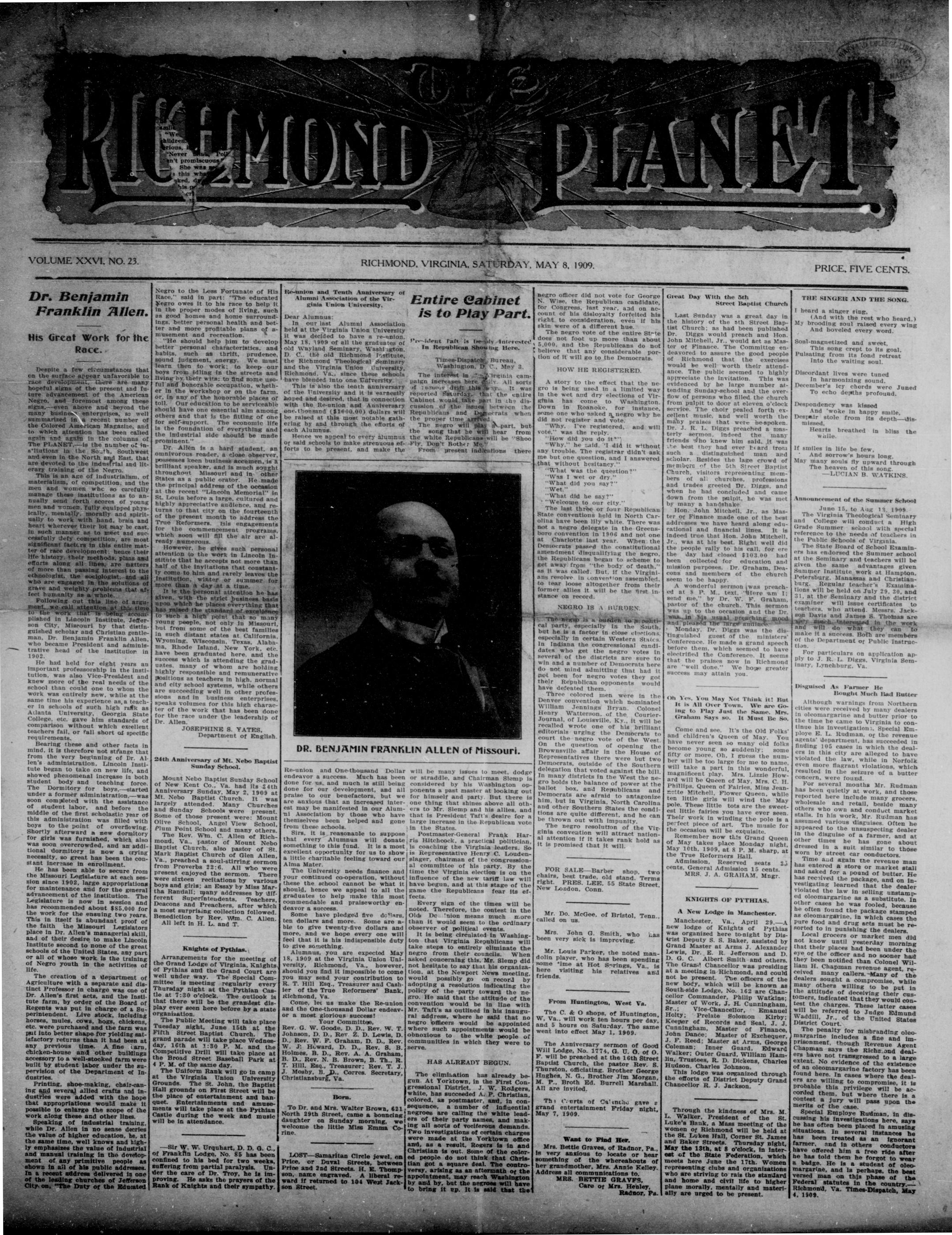
Dr. Benjamin Franklin Allen.
Race.
Despite a few circumstances that on the surface appear unfavorable to race development, there are many hopeful signs of the present and future advancement of the American Negro, and foremost among these signs—even above and beyond the many business enterprises, so well summarized in a recent number of the Colored American Magazine, and to which attention has been called again and again in the columns of The PLANET—is the number of institutions in the South, Southwest and even in the North and East, that are devoted to the industrial and literary training of the Negro.
This is an age of industrialism, of materialism, of competition, and the men and women who so carefully manage these institutions as to annually send forth scores of young men and women, fully equipped physically, mentally, morally and spiritually to work with hand, brain and heart wherever their lot may be cast, in such manner as to meet and successfully deny competition, are most significant factors in this entire matter of race development; hence their life history, their methods, plans and efforts along all lines, are matters of more than passing interest to the ethnologist, the sociologist, and all who are engaged in the solutions of grave and weighty problems that affect humanity as a whole.
Following out this line of argument, we call attention at this time to the work that is being accomplished in Lincoln Institute, Jefferson City, Missouri by that distinguished scholar and Christian gentleman, Dr. Benjamin Franklin Allen, who became President and administrative head of the institution in 1902.
He had held for eight years an important professorship in the institution, was also Vice-President and knew more of the real needs of the school than could one to whom the work was entirely new, while at the same time his experience as, a teacher in schools of such high rank as Atlanta University, Georgia State College, etc. gave him standards of comparison without which excellent teachers fall, or fall short of specific requirements.
Bearing these and other facts in mind, it is therefore not strange that from the very beginning of Dr. Allen's administration, Lincoln Institute began to take on new life, and showed phenomenal increase in both student body and teaching force. The Dormitory for boys—started under a former administration—was soon completed with the assistance of student labor, and before the middle of the first scholastic year of this administration was filled with boys to the point of overflowing. Shortly afterward a new dormitory for girls was furnished, which also was soon overcrowded, and an additional dormitory is now a crying necessity, so great has been the constant increase in enrollment.
He has been able to secure from the Missouri Legislature at each session since 1902, large appropriations for maintenance and for the general advancement of the institution. The Legislature is now in session and has recommended about $55,000 for the work for the ensuing two years. This in itself is abundant proof of the faith the Missouri Legislators place in Dr. Allen's managerial skill, and of their desire to make Lincoln Institute second to none of the great schools of the United States, any part or all of whose work is the training of Negro youth in the activities of life.
The creation of a department of Agriculture with a separate and distinct Professor in charge was one of Dr. Allen's first acts, and the Institute farm, by order of the Board of Regents was put in charge of a Superintendent. Live stock, including horses, mules, cows, hogs, chickens, etc. were purchased and the farm was put into better shape for yielding satisfactory returns than it had been at any previous time. A fine farm, chicken-house and other buildings accessory to a well-stocked farm were built by student labor under the supervision of the Department of Industries.
Printing, shoe-making, chair-caning and several allied crafts and industries were added with the hope that appropriations would make it possible to enlarge the scope of the work along these and other lines.
Speaking of industrial training, while Dr. Allen in no sense declares the value of higher education, he, at the same time, well knows and highly emphasizes the value of industrial and manual training in the development of any primitive people as shown in all of his public addresses. In a recent address delivered in one of the leading churches of Jefferson City on, "The Duty of the Educated
Negro to the Less Fortunate of His Race," said in part: "The educated Negro owes it to his race to help it in the proper modes of living, such as good homes and home surroundings, better personal health and better and more profitable plans of amusement and recreation.
"He should help him to develop better personal characteristics, and habits, such as thrift, prudence, sound judgment, energy. We must learn then to work; to keep our boys from idling in the streets and living by their wits; to find some useful and honorable occupation, whether in the workshop or on the farm, or, in any of the honorable places of toll. Our education to be serviceable should have one essential aim among others and that is the fitting of one for self-support. The economic life is the foundation of everything and the industrial side should be made prominent."
Dr. Allen is a hard student, an omnivorous reader, a close observer, possesses keen business acumen, is a brilliant speaker, and is much sought throughout Missouri and in other States as a public orator. He made the principal address of the occasion at the recent "Lincoln Memorial" in St. Louis before a large, cultured and highly appreciative audience, and returns to that city on the fourteenth of the present month to address the True Reformers. His engagements for the commencement programs, which soon will fill the air are already numerous.
However, he gives such personal attention to the work in Lincoln Institute that he accepts not more than half of the invitations that constantly come to him and rarely leaves the institution, winter or summer for more than a day at a time.
It is the personal attention he has given, with the strict business basis upon which he places everything that has raised the standard of excellence to such a high point that so many young people, not only in Missouri, but from some of the best families in such distant states at California, Wyoming, Wisconsin, Texas, Alabama, Rhode Island, New York, etc. have been graduated here, and the success which is attending the graduates, many of whom are holding highly responsible and remunerative positions as teachers in high, normal and city school systems, while others are succeeding well in other professions and in business enterprises, speaks volumes for this high character of the work that has been done for the race under the leadership of Dr. Allen.
24th Anniversary of Mt. Nebo Baptist Sunday School.
Mount Nebo Baptist Sunday School of New Kent Co., Va. had its 24th Anniversary Sunday, May 2, 1909 at Mt. Nebo Baptist Church. It was largely attended. Many Churches and Sunday Schools were present. Some of those present were: Mount Olive School, Angel View School, Plum Point School and many others. The Rev. Wm. C. Allen of Richmond, Va., pastor of Mount Nebo Baptist Church, also pastor of St. Mark Baptist Church of Glen Allen, Va., preached a soul-stirring sermon from Proverbs 22:6. All who were present enjoyed the sermon. There were sixteen recitations by various boys and girls; an Essay by Miss Martha Randall; many addresses by different Superintendents, Teachers, Deacons and Preachers, after which a most surprising collection followed. Benediction by Rev. Wm. C. Allen. All left in H. L.
Knights of Pythias
Arrangements for the meeting of the Grand Lodge of Virginia, Knights of Pythias and the Grand Court are well under way. The Special Committee is meeting regularly every Thursday night at the Pythian Castle at 7:30 o'clock. The outlook is that there will be the grandest display ever seen here before by a state organization.
The Public Meeting will take place Tuesday night, June 15 at the Fifth Street Baptist Church. The grand parade will take place Wednesday, 16th at 1:30 P. M. and the Competitive Drill will take place at the Broad Street Baseball Park at 4 P. M. of the same day.
The Uniform Rank will go in camp at the Virginia Union University Grounds. The St. John, the Baptist Hall grounds on First Street will be the place of entertainment and banquet. Entertainments and amusements will take place at the Pythian Castle during the week and music will be in attendance.
—Sir W. W. Urquhart, D. D. G. C., of Franklin Lodge, No. 85 has been confined to his bed for two weeks, suffering from partial paralysis. Under the care of Dr. Troy, he is improving. He asks the prayers of the Rank of Knights and their sympathy.
RICHMOND, VIRGINIA, SATURDAY, MAY 8, 1909.
M.
DR. BENJAMIN FRANKLIN ALLEN of Missouri.
Réunion and Tenth Anniversary of
Alumni Association of the Vir-
tual University
In our last Alumni Association held at the Virginia Union University it was decided to have a re-union, May 18, 1909 of all the graduates of old Wayland Seminary, Washington, D. C., the old Richmond Institute, the Richmond Theological Seminary and the Virginia Union University, Richmond, Va., since these schools have blended into one University. This is also the tenth anniversary of the University and it is earnestly hoped and desired, that in connection with the Re-union and Anniversary one-thousand ($1000.00) dollars will be raised at this most notable gathering by and through the efforts of each Alumnus. Hence we appeal to every alumnus or said schools to make strenuous efforts to be present, and make the
DR. BENJAMIN FRANK
Re-union and One-thousand Dollar endeavor a success. Much has been done for us, and much is still being done for our development, and all praise to our benefactors, but we are anxious that an increased interest may be manifested in our Alumni Association by those who have themselves been helped and gone from these schools.
Sirs, it is reasonable to suppose that every Alumnus will donate something to this fund. It is a most excellent opportunity for us to show a little charitable feeling toward our Alma Mater.
The University needs finance and your continued co-operation, without these the school cannot be what it should, hence we appeal to all the graduates to help make this most commendable and praiseworthy endeavor a success.
Some have pledged five dollars, ten dollars and more. Some are able to give twenty-five dollars and more, and we hope every one will feel that it is his indispensable duty to give something.
Alumnus, you are expected May 18, 1999 at the Virginia Union University, Richmond, Va., however, should you find it impossible to come you may send your contribution to R. T. Hill Esq., Treasurer and Cashier of the True Reformers' Bank, Richmond, Va.
Come, let us make the Re-union and the One-thousand Dollar endeavor a most glorious success!
Rev. G. W. Goods, D. D., Rev. W. T.
Johnson, D. D., Rev. Z. D. Lewis, D.
D., Rev. W. F. Graham, D. D., Rev.
W. J. Howard, D. D., Rev. S. B.
Holmes, B. D., Rev. A. A. Graham,
B. D., Rev. N. B. Brown, B. Th., R.
T. Hill, Esq., Treasurer; Rev. T. J.
J. Mosby, B. D., Corres. Secretary,
Christiansburg, Va.
Born.
To Dr. and Mrs. Walter Brown, 621 North 29th Street, came a bouncing daughter on Sunday morning, we welcome the little Miss Emma Corine.
LOST—Samaritan Circle Jewel, on Price, or Duval Streets, between Price and 2nd Streets. H. E. Thompson, name engraved. A liberal reward if returned to 104 West Jackson Street.
Entire Cabinet is to Play Part.
Entire Cabinet is to Play Part.
President Fait is deeply interested
In Republican Showing Here.
Times-Dispatch Bureau,
Washington, D. C., May 3.
The interest in "Virginia campaign increases here daily. All sorts of rumors drift this way. It was reported Saturday, that the entire Cabinet would take part in the discussion of the issues between the Republicans and Democrats when the proper time arrived.
The negro will play a part, but the song that he will hear from the white Republicans will be "Shoo Fly, Don't Bother Me."
From present indications there
LIN ALLEN of Missouri.
will be many issues to meet, dodge or straddle, and Chairman Slepem is considered by his Washington opponents a past master at looking out for himself and party. But there is one thing that shines above all others to Mr. Slepem and his allies, and that is President Taft's desire for a large increase in the Republican vote in the States.
Postmaster-General Frank Harris Hitchock, a practical politician, is coaching the Virginia leaders. So is Representative Henry C. Loudenslager, chairman of the congressional committee of his party. By the time the Virginia election is on the influence of the new tariff law will have begun, and at this stage of the game the Republicans fear its effects.
Every sign of the times will be noted. Therefore, the contest in the Old Dominion means much more than it would seem to the ordinary observer of political events.
It is being circulated in Washington that Virginia Republicans will take steps to entirely eliminate the negro from their councils. When asked concerning this, Mr. Slemp did not hesitate to say that his organization, at the Newport News meeting, would possibly go on record by adopting a resolution indicating the policy of the party toward the negro. He said that the attitude of the convention would be in line with Mr. Taft's as outlined in his inaugural address, where he said that no negro officers would be appointed where such appointments would be obnoxious to the white people of communities in which they were to serve.
HAS ALREADY BEGUN.
The elimination has already begun. At Yorktown, in the First Congressional District, J. W. Rodgers, white, has succeeded A. P. Christian, colored, as postmaster, and, in consequence, a number of influential negroes are calling the white leaders of their party names, and making all sorts of vociferous demands. Two investigations of certain charges were made at the Yorktown office and, as a result, Rogers is in and Christian is out. Some of the colored people do not think that Christian got a square deal. The controversy, arising as an aftermath of the appointment, may reach Washington by and by, but the negroes will have to bring it up. It is said that the
negro officer did not vote for George N. Wise, the Republican candidate, for Congress, last year, and on account of his disloyalty forfelt his right to consideration, even if his skin were of a different hue. The negro vote of the entire State does not foot up more than about 5,000, and the Republicans do not believe that any considerable portion of it will go to the Democrats.
HOW HE REGISTERED.
A story to the effect that the negro is being used in a limited way in the wet and dry elections of Virginia has come to Washington. Down in Roanoke, for instance, some one who asked a negro why he did not register and vote.
"Why, I've registered, and will vote," was the reply.
"How did you do it?"
"Why," he said. "I did it without any trouble. The registrar didn't ask me but one question, and I answered that without hesitancy."
"What was the question?"
"Was I wet or dry."
"What did you say?"
"Wet."
"What did he say?"
"Welcome to our city."
The last three or four Republican State conventions held in North Carolina have been illy white. There was not a negro delegate in the Greensboro convention in 1906 and not one at Charlotte last year. When the Democrats passed the constitutional amendment disqualifying the negro, the Republicans began to scheme to get away from "the body of death," as it was called. But, if the Virginiaans resolve in convention assembled, to tear loose altogether from their former allies it will be the first instance on record.
NEGRO IS A BURDEN
The negro is a burden to a political party, especially in the South, but he is a factor in close elections, especially in certain Western States. In Indiana the congressional candidates who get the negro votes in several of the districts are sure to win and a number of Democrats here do not mind admitting that had it not been for negro votes they got their Republican opponents would have defeated them.
Three colored men were in the Denver convention which nominated William Jennings Bryan. Colonel Henry Watterson, of the Courier-Journal, of Louisville, Ky., it will be recalled wrote one of his brilliant editorials urging the Democrats to court the negro vote of the West. On the question of opening the Brownsville affair in the House of Representatives there were but two Democrats, outside of the Southern delegation that voted against the bill. In many districts in the West the negro holds the balance of power at the ballot box, and Republicans and Democrats are afraid to antagonize him, but in Virginia, North Carolina and other Southern States the conditions are quite different, and he can be thrown out with impunity. The negro resolution of the Virginia convention will attract national attention if it takes rank hold as it is promised that it will.
FOR SALE—Barber shop, two chairs, best trade, old stand, Terms right. PRES. LEE, 55 State Street, New London, Conn.
Mr. Do. McGee, of Bristol, Tenn., called on us.
Mrs. John G. Smith, who has been very sick is improving.
Mr. Louis Parker, the noted mandolin player, who has been spending some time at Hot Springs, Va., is here visiting his relatives and friends.
From Huntington. West Va.
The C. & O shops, of Huntington, W, Va., will work ten hours per day, and 5 hours on Saturday. The same went into effect May 1, 1909.
The Anniversary sermon of Good Will Lodge, No. 1774, G. U. O. of O. P. will be preached at the 16th Street Baptist Church, the pastor Rev. S. Thurston, officiating Brother George Hughes, N. G., Brother Jim Morgan, M. P., Broth Ed. Burrell Marshall. All are invited.
The Courts of Calanthe gave a grand entertainment Friday night, May 7, 1909.
Want to Find Her.
Mrs. Bettie Graves, of Radnor, Pa. is very anxious to locate or hear something of the whereabouts of her grandmother, Mrs. Annie Kelley. Address all communications to.
Great Day With the 5th
Street Baptist Church
Last Sunday was a great day in the history of the 5th Street Baptist Church; as had been published Dr. Diggs would preach and Hon. John Mitchell, Jr., would act as Master of Finance. The Committees endeavored to assure the good people of Richmond that the exercises would be well worth their attendance. The public seemed to highly appreciate the invitation. This was evidenced by he large number attending Sunday-school and the overflow of persons who filled the church from pulpit to door at eleven o'clock service. The choir pealed forth excellent music, and well worth the mahya praises that were be-spoken. Dr. J. R. L. Diggs preached a masterly sermon, indeed the many friends who knew him said, it was the best they had ever heard from such a distinguished man and scholar. Besides the large crowd of members of the 5th Street Baptist Church, visitors representing members of all churches, professions and trades greeted Dr. Diggs, and when he had concluded and came down from the pulpit, he was met by many a handshake.
Hon. John Mitchell, Jr., as Master of Finance made one of the best addresses we have heard along educational and financial lines. It is indeed true that Hon. John Mitchell, Jr., was at his best. Right well did the people rally to his call, for ere the day had closed $103.00 had been collected for education and mission purposes. Dr. Graham, Deacons and members of the church seem to be happy.
A wonderful sermon was preached at 8 P. M., text, "Here am I; send me," by Dr. W. F. Graham, pastor of the church. This sermon was up to the occasion and the Dr. was, in his usual preaching mood and pleased the large audience.
Monday, Dr. Diggs was the distinguished guest of the ministers' Conference. He made a grand speech before them, which seemed to have electrified the Conference. It seems that the praises now in Richmond are "well done." We hope greater success may attain you.
Oh Yes, You May Not Think it! But
It is All Over Town. We are Going to Play Just the Same, Mrs.
Graham Says so. It Must Be So.
Come and see. It's the Old Folks' and children's Queen of May. You have never seen so many old folkes become young so suddenly; some fifty or more, Oh. I guess the number will be too large for me to name, will take a part in this wonderful, magnificent play. Mrs. Lizzie Howard will be Queen of May, Mrs. C. H. Phillips, Queen of Fairies, Miss Jeanette Mitchell, Flower Queen, while ten little girls will wind the May pole. These little tots are the sweetest little fairies you have ever seen. Their work in winding the pole is a perfect piece of art. The music for the occasion will be exquisite.
Remember now this Grand Queen of May takes place Monday night, May 10th, 1809, at 8 P. M. sharp, at the True Reformers Hall.
Admission. Reserved seats 25 cents. General Admission 15 cents. MRS.
KNIGHTS OF PYTHIAS.
A New Lodge in Manchester
Manchester, Va., April 29.—A new lodge of Knights of Pythias was organized here to night by District Deputy S. S. Baker, assisted by Grand Master at Arms J. Alexander Lewis, Dr. E. R. Jefferson and D. D. G. C. Albert Smith and others. The Grand Chancellor was presiding at a meeting in Richmond, and could not be present. The officers of the new body, which will be known as South-side Lodge, No. 162 are Chancellor Commander, Philip Watkins; Master of Work, J. H. Cunningham, Sr.; Vice-Chancellor, Emanuel Holty; Prelate Solomon Kirby; Keeper of Records and Seal, J. Cunningham, Master of Finance, John Dance; Master of Exchequer, J. F. Reed; Master at Arms, George Coleman; Inner Guard, Edward Walker; Outer Guard, William Hamlin, Trustees, R. D. Dickens, Charles Hudson, Charles Johnson.
This lodge was organized through the efforts of District Deputy Grand Chancellor R. J. Jackson.
Through the kindness of Mrs. M. L. Walker, President of the St. Luke's Bank, a Mass meeting of the women of Richmond will be held at the St. Lukes Hall, Corner St. James and Baker Streets. Thursday night, May the 13th, at 8 o'clock, in interest of the State Federation, which meets here June the 17th. Women representing clubs and organizations who are striving to raise the standard and home and civil life to higher plane morally, mentally and materially are urged to be present.
THE SINGER AND THE SONG
I heard a singer sing,
(And with the rest who heard.)
My brooding soul raised every wing
And hoveed every word.
Soul-magnetized and sweet,
This song crept to its goal.
Pulsating from its fond retreat
Into the waiting soul.
Discordant lives were tuned
In harmonizing sound.
December's icy chords were Juned
To echo depths profound.
Despondency was kissed
And 'woke in happy smile.
Despair stole from its depth—dismissed.
If smiles in life be few,
And sorrow's hours long.
May many souls fly upward through
The heaven of this song.
—LUCIAN B. WATKINS.
Announcement of the Summer School
June 15, to Aug 13, 1909.
The Virginia Theological Seminary and College will conduct a High Grade Summer school with special reference to the needs of teachers in the Public Schools of Virginia.
The State Board of School Examiners has endorsed the Summer school at the Seminary and teachers will be given the same advantages given Summer Institute work at Hampton, Petersburg, Manassas and Christianburg. Regular teacher's Examinations will be held on July 29, 30, and 31, at the Seminary and the district examiner will issue certificates to teachers, who attend. Messrs. Jackson Davis and James S. Thomas are very much interested in the work and will do what they can to make it a success. Both are members of the Department of Public Instruction.
For particulars on application apply to J. R. L. Diggs, Virginia Seminary, Lynchburg, Va.
Although warnings from Northern cities were received by many dealers in oleomargarine and butter prior to the time he came to Virginia to continue his investigation. Special Employee E. L. Rudman, or the revenue agents' department, has succeeded in finding 105 cases in which the dealers in this city are alleged to have violated the law, while in Norfolk even more flagrant violations, which resulted in the seizure of a butter concern, were found.
For several months Mr. Rudman has been quietly at work, and those reported here include many grocers, wholesale and retail, beside many others who own and conduct market stalls. In his work, Mr. Rudman has assumed various disguises. Often he appeared to the unsuspecting dealer in the disguise of a farmer, and at other times he has gone about dressed in a suit similar to those worn by street car conductors.
Time and again the revenue man has entered a store or market stall and asked for a pound of butter. He has received the package, and on investigating learned that the dealer violated the law in selling unstamped oleomargarine as a substitute. In other cases he was fooled, because he often found the package stamped as oleomargarine, in which cases the pure food and drug acts must be resorted to in punishing the dealers.
Local grocers or market men did not know until yesterday morning that their places had been under the eye of the officer and no sooner had they been notified than Colonel William H. Chapman revenue agent, received many callers. Many of the dealers sought a compromise, while many others willing to be put in the attitude of deceiving their customers, indicated that they would contest the charges. These latter cases will be referred to Judge Edmund Waddill, Jr., of the United States District Court. The penalty for misbranding oleomargarine includes a fine and imprisonment, though Revenue Agent Chapman says the Richmond dealers have not transgressed to a large extent. No evidence of the existence of an oleomargarine factory has been found here. In cases where the dealers are willing to compromise, it is probable this privilege will be accorded them, but where there is a contest a jury will pass upon the merits of the case.
Special Employee Rudman, in discussing his investigations here, says he has often been placed in amusing situations. In several instances he has been treated as an ignorant farmer, and in others conductors have offered him a free ride after he has told them he forgot to wear a badge. He is a student of oleomargarine, and is perhaps, the best versed man on this phase of the Federal statutes in the country. Richmond, Va. Times-Dispatch, May 4, 1909.
P
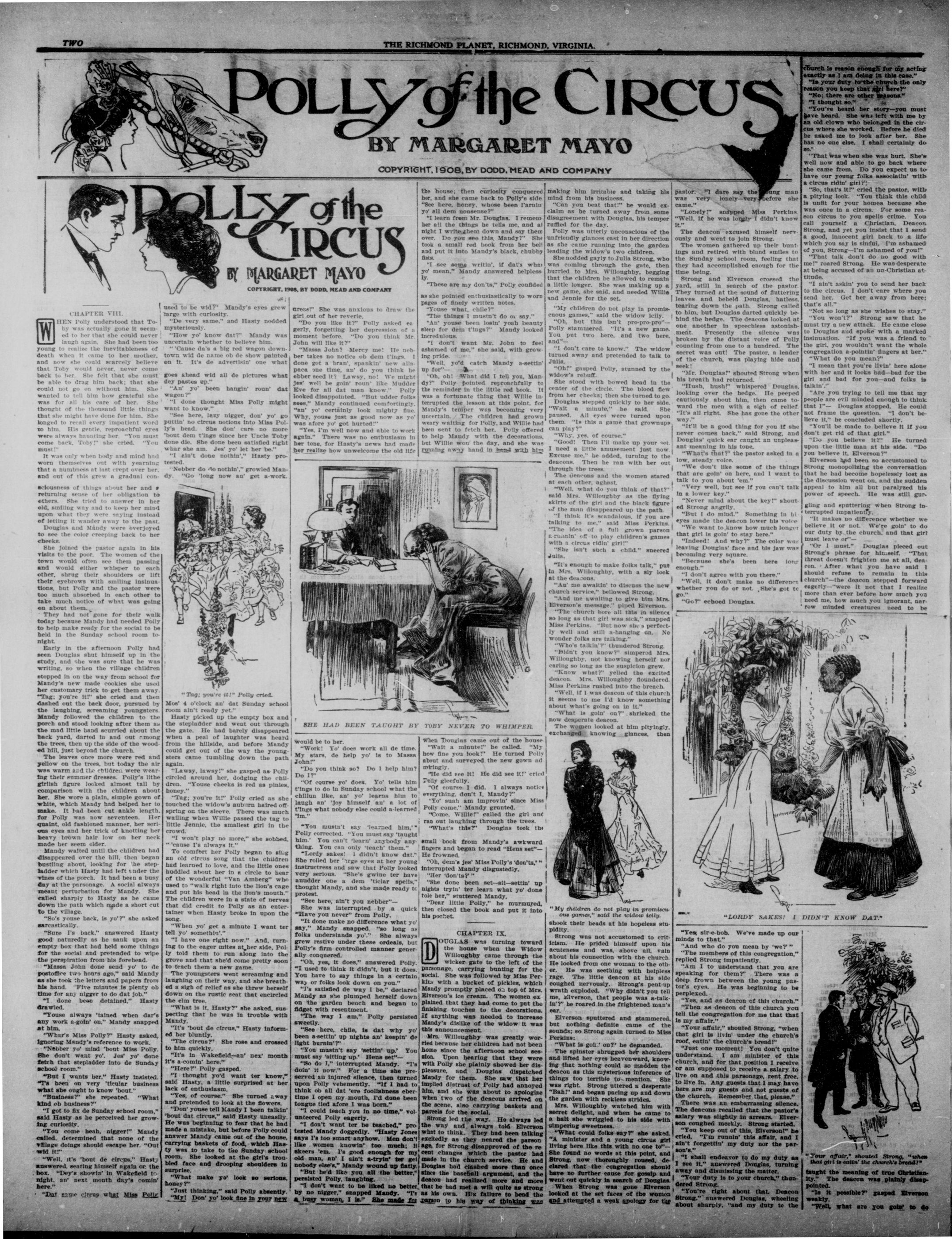
DOLLY of the CIRCUS BY MARGARET MAYO COPYRIGHT, 1908, BY DODD, MEAD AND COMPANY
TWO
CHAPTER VIII.
HEN Polly understood that Toby was actually gone it seemed to her that she could never laugh again. She had been too young to realize the inevitableness of death when it came to her mother, and now she could scarcely believe that Toby would never, never come back to her. She felt that she must be able to drag him back; that she could not go on without him. She wanted to tell him how grateful she was for all his care of her. She thought of the thousand little things that she might have done for him. She longed to recall every impatient word to him. His gentle, reproachful eyes were always haunting her. "You must come back, Toby!" she cried. "You must!"
It was only when body and mind had worn themselves out with yearning that a numbness at last crept over her, and out of this grew a gradual con-
eclusiveness of things about her and returning sense of her obligation to others. She tried to answer in her old, smiling way and to keep her mind upon what they were saying instead of letting it wander away to the past. Douglas and Mandy were overjoyed to see the color creeping back to her cheeks.
She joined the pastor again in his visits to the poor. The women of the town would often see them passing and would either whisper to each other, shrug their shoulders or lift their eyebrows with smiling instuctions, but Polly and the pastor were too much absorbed in each other to take much notice of what was going on about them.
They had not gone for their walk today because Mandy had needed Polly to help make ready for the social to be held in the Sunday school room tonight.
Early in the afternoon Polly had seen Douglas shit himself up in the study, and she was sure that he was writing, so when the village children stopped in on the way from school for Mandy's new made cookies she used her customary trick to get them away. "Tag, you're it!" she cried and then dashed out the back door, pursued by the laughing, screaming youngsters. Mandy followed the children to the porch and stood looking after them as the mad little band scurried about the back yard, darted in and out among the trees, then up the side of the wooded hill, just beyond the church.
The leaves once more were red and yellow on the trees, but today the air was warm and the children were wearing their summer dresses. Polly's little gritish figure locked almost tall by comparison with the children about her. She wore a plain, simple gown of white, which Mandy had helped her to make. It had been cut ankle length, for Polly was now seventeen. Her quaint, old fashioned manner, her serious eyes and her trick of knotting her heavy brown hair low on her neck made her seem older.
Mandy waited until the children had disappeared over the hill, then began bustling about, looking for the stepladder which Hasty had left under the vines of the porch. It had been a busy day at the parsonage. A social always meant perturbation for Mandy. She called sharply to Hasty as he came down the path which made a short cut to the village.
"So's youse back, is yo'?" she asked sarcastically.
"Sure I's back," answered Hasty good naturely as he sank upon an empty box that had held some things for the social and pretended to wipe the perspiration from his forehead.
"Massa John done send yo' to de postoffice two hours ago," said Mandy as she took the letters and papers from his hand. "Five minutes is plenty obtime for any nigger to do dat job."
"I done been detained," Hasty drawled.
"Youse always 'tained when dar's any work a-goin' on." Mandy snapped at him.
"What's Miss Polly?" Hasty asked, ignoring Mandy's reference to work.
"Nebber yo' mind 'bout Miss Polly.
She don't want yo' Jes' yo' done
fetch that stepladder into de Sunday
school room."
"But I wants her," Hasty insisted.
"It's on very 'ticular business
what she ought to know 'bout."
"Business?" she repeated. "What
kind ob business?"
"I got to fix de Sunday school room."
said Hasty as he perceived her growing
curiosity.
"You come heab, nigger!" Mandy
called, determined that none of the
village doings should escape her. "Out
wild it!"
"Well, it's 'bout de circus," Hasty
answered, seating himself again or the
box. "Dey's shown' in Wakefield to
night, an' next month day's comin'
here."
"Dat same circus what Miss Pollr
used to be wid? " Mandy's eyes grew large with curiosity.
"De very same," and Hasty nodded mysteriously.
"How yo' know dat?" Mandy was uncertain whether to believe him.
"Cause da's a big red wagon down-town wd de name ob de show painted on it. It's de advertisin' one what goes ahead wid all de pictures what dey pastes up."
"An' yo' been hangin' roun' dat wagon?"
"I done thought Miss Polly might want to know."
"See here, lazy nigger, don' yo' go puttin' no circus notions into Miss Polly's head. She don' care no more 'bout dem t'ings since her Uncle Toby done die. She done been satisfied right wha she am. She yo' let her be."
"I ain't done nothin'," Hasty protested.
"Nebber do do nothin'," growled Mandy.
"Go 'long now an' get a-work.
A
Mos' 4 o'clock an' dat Sunday school room ain't ready yet."
Hasty picked up the empty box and the stepladder and went out through the gate. He had barely disappeared when a peal of laughter was heard from the hillside, and before Mandy could get out of the way the youngsters came tumbling down the path again.
"Lawsy, lawsy!" she gasped as Polly circled around her, dodging the children. "Youse cheeks is red as pinies, honey."
"Tag; you're it!" Polly cried as she touched the widow's auburn haired offspring on the sleeve. There was much walling when Willie passed the tag to little Jennie, the smallest girl in the crowd.
"I won't play no more," she sobbed, "'cause I's always it."
To comfort her Polly began to sing an old circus song that the children had learned to love, and the little ones huddled about her in a circle to hear of the wonderful "Van Amberg" who used to "walk right into the lion's cage and put his head in the lion's mouth." The children were in a state of nerves that did credit to Polly as an entertainer when Hasty broke in upon the song.
"When yo' get a minute I want ter tell yo' somethu'l."
"I have one right now." And, turning to the eager mites at her side, Polly told them to run along into the grove and that she'd come pretty soon to teach them a new game.
The youngsters went screaming and laughing on their way, and she breathed a sigh of relief as she threw herself down on the rustic seat that encircled the elm tree.
"What is it, Hasty?" she asked, suspecting that he was in trouble with Mandy.
"It's 'bout de circus," Hasty informed her bluntly.
"The circus?" She rose and crossed to him quickly.
"It's in Wakefield—an' nex' month it's a comin' here."
"Here?" Polly gasped.
"I thought you'd want ter know," said Hasty, a little surprised at her lack of enthusiasm.
"Yes, of course." She turned away and pretended to look at the flowers.
"Don' youse tell Mandy I been talkin' 'bout dat circus," said Hasty uneasily. He was beginning to fear that he had made a mistake, but before Polly could answer Mandy came out of the house, carrying baskets of food, which Hasty was to take to the Sunday school room. She looked at the girl's troubled face and drooping shoulders in surprise.
"What make yo' look so serious, honey?"
"Just thinking," said Polly absently.
"My! Don' yo' look fine in your new
THE RICHMOND PLANET, RICHMOND, VIRGINIA.
BY MARGARET MAYO
COPYRIGHT,1908, BY DODD, MEAD AND COMPANY
A woman sits at a desk, her head resting on her knees as she looks down at a book. A man sits behind her, reading a letter. The scene is set in a room with a window and a painting on the wall.
SHE HAD BEEN TAUGHT BY TOBY NEVER TO WHIMPER
urges!" She was anxious to draw the girl out of her reverie.
"Do you like it?" Polly asked eagerly, forgetting her depression of a moment before. "Do you think Mr. John will like it?"
"Massa John? Mercy me! He nebler takes no notice ob dem tings. I done got a bran', spankin' new allapaca one time, an' do you think he ebber seed it? Lawsy, no! We might jest' we be gain roun' like Mudder Eve for all dat man know." Polly looked disappointed. "But udder folks sees." Mandy continued comfortingly.
"an' yo' certainly look mighty fine. Why, youse as just good now as yo' was afore yo' got hurted!"
"Yes, I'm well now and able to work again." There was no enthusiasm in her tone, for Hasty's news had made her realize how unwelcome the old life
SHE HAD BEEN TAUGHT BY
would be to her.
"Work! Yo' does work all de time.
My stars, de help yo' is to Massa John!
"Do you think so? Do I help him?
Do I 1?"
"Of course yo' does. Yo' tells him'tings to do in Sunday school what the chillun like, an' yo' learns him to laugh an' joy himself an' a lot of'tings what nobody else could a-learned 'im.'
"You mustn't say 'learned him,' Polly corrected. "You must say 'taught him.' You can't 'learn' anybody anything. You can only 'teach' them."
"Lordy sakes! I didn't know dat.' She rolled her' large eyes at her young instructress and saw that Polly looked very serious. "She's gwine ter have anudder one a dem 'ticlar spells,' thought Mandy, and she made ready to protest.
"See here, ain't you nebber-"
She was interrupted by a quick "Have you never" from Polly.
"It done make no difference what you say," Mandy snapped, "so long as folks understands yo." She always grew restive under these ordeals, but Polly's firm controlled manner generally conquered.
"Oh, yes, it does," answered Polly.
"I used to think it didn't, but it does. You have to say things in a certain way or folks look down on you."
"It's satisfied de way I be," declared Mandy as she plumped herself down on the garden bench and began toidget with resentment.
"The way I am," Polly persisted sweetly.
"See here, chifle, is dat why yo been a-settin' up nights an' keepin' de light burnin'?"
"You mustn't say 'settin' up. You must say 'sitting up', Hens set"—
"So do I," interrupted Mandy. "It's doin' it now." For a time she preserved an injured silence, then turned upon Polly vehemently. "If I had to think ob all dat 'ere foolishness ebertime I open my mouth, I'd done been tongue tied afore I was born."
"I could teach you in no time," volunteered Polly eagerly.
"I don't want ter be teached," protested Mandy doggedly. "Hasty Jones says 'Is too smart anyhow. Men don't like women knowin' too much; it skers 'em. It's good enough for my old man, an' I isn't a-tryin' ter get nobody else's." Mandy wound up flatly. "But he'd like you all the better," persisted Polly, laughing.
"I don't want to be liked no better by no nigger," snapped Mandy. "It's a busy woman, I is." She made for
the house; then curiosity conquered her, and she came back to Polly's side. "See here, honey, whose been larnin' yo' all dem nonsense?" "I learn from Mr. Douglas. I remember all the things he tells me, and all night I write them down and say them over. Do you see this, Mandy?" She took a small red book from her bell and put it into Mandy's black, chubby fists. "I see some writin', if dat's what yo' mean," Mandy answered helplessly. "These are my don'ts," Polly confided as she pointed enthusiastically to worm pages of finely written notes. "Youse what, chile?" "The things I mustn't do or say." "An' youse been losin' youn beauty steep for dem tings?" Mandy looked incredulous. "I don't want Mr. John to feel ashamed of me," she said, with growing pride.
"Well, yo'd catch Mandy a-settin' up for"—
"Oh, oh! What did I tell you, Mandy?" Polly pointed reproachfully to the reminder in the little red book. It was a fortunate thing that Willie interrupted the lesson at this point, for Mandy's temper was becoming very uncertain. The children had grown weary waiting for Polly, and Willie had been sent to fetch her. Polly offered to help Mandy with the decorations, but Willie wore the day, and she was running away hand in hand with him
TOBY NEVER TO WHIMPER.
when Douglas came out of the house "Wait a minute!" he called, "My how fine you look!" He turned Polly about and surveyed the new gown ad mingling. "He did see it! He did see it!" cried Polly gleefully. "Of course I did. I always notice everything, don't I, Mandy?"
"To' suah an improvin' since Miss Polly come." Mandy, grunted.
small book from Mandy's awkward fingers and began to read "Hens set"—He frowned.
"Oh, dem's Jes' Miss Polly's 'don'ts,'" interrupted Mandy disgustedly.
"Her 'don'ts?'"
"She done been set-sit-settin' up nights tryin' ter learn what yo' done tole her," stuttered Mandy.
"Dear little Polly," he murmured, then closed the book and put it into his pocket.
CHAPTER IX
DOUGLAS was turning toward the house when the Widow Willoughby came through the wicker gate to the left of the parsonage, carrying bunting for the social. She was followed by Miss Perkins with a bucket of pickles, which Mandy promptly placed on top of Mrs. Elverson's ice cream. The women explained that they had come to put the finishing touches to the decorations. If anything was needed to increase Mandy's dislike of the widow it was this announcement.
Mrs. Willoughby was greatly worried because her children had not been home since the afternoon school session. Upon hearing that they were with Poly she plainly showed her displeasure, and Douglas dispatched Mandy for them. She saw that her implied distrust of Poly had annoyed him, and she was about to apologize when two of the deacons arrived on the scene, also carrying baskets and parcels for the social.
Strong led the way. He always led the way and always told Elverson what to think. They had been talking excitedly as they neared the parson age for Strong disapproved of the recent changes which the pastor had made in the church service. He and Douglas had clashed more than once since the baseball argument, and the deacon had realized more and more that he had met a will quite as strong as his own. His failure to bend the parson to his way of thinking was
making him irritable and taking his mind from his business.
"Can you beat that!" he would exclaim as he turned away from some disagreement with Douglas, his temper ruffled for the day.
Polly was utterly unconscious of the unfriendly glances cast in her direction as she came running into the garden leading the widow's two children.
She nodded gaily to Julia Strong, who was coming through the gate, then hurried to Mrs. Willoughby, begging that the children be allowed to remain a little longer. She was making up a new game, she said, and needed Willie and Jennie for the set.
"My children do not play in promiscuous games," said the widow icy.
"Oh, but this isn't pro-pro-pro"—Polly stammered. "It's a new game. You put two here, and two here, and"—
"I don't care to know." The widow turned away and pretended to talk to Julia.
"Oh!" gasped Polly, stunned by the widow's rebuff.
She stood with bowed head in the center of the circle. The blood flew from her cheeks; then she turned to go. Douglas stepped quickly to her side.
"Wait a minute," he said. She paused. All eyes were turned upon them. "Is this a game that grownups can play?"
"Why, yes, of course."
"Good! Then I'll make up your set. I need a little amusement just now. Excuse me," he added, turning to the deacons. Then he ran with her out through the trees.
The deacons and the women stared at each other, agast.
"Well, what do you think of that?" said Mrs. Willoughby as the dying skirts of the girl and the black figure of the man disappeared up the path.
"I think it's scandalous, if you are talking to me," said Miss Perkins. "The idea of a full grown parson a ruananl' off to play children's games with a circus ridin' girl!"
"She isn't such a child," sneered Julia.
"It's enough to make folks talk," put in Mrs. Willoughby, with a sly look at the deacons.
"An' me awaitin' to discuss the new church service," bellow Strong.
"And me awaiting to give him Mrs. Elferson's message," pugged Elferson.
Everson's message," piled Everson.
"The church bore all this in silence so long as that girl was sick," snapped Miss Perkins. "But now she's perfectly well and still a-hanging on. No wonder folks are talking."
"Who's talkin'?" thundered Strong.
"Didn't you know?" simpered Mrs. Willoughby, not knowing herself nor caring so long as the suspicion grew.
"Know what?" yelled the excited deacon. Mrs. Willoughby floundered. Miss Perkins rushed into the breach.
"Well, if I was deacon of this church it seems to me I'd know something about what's going on in it."
"What is goin' on?" shrieked the now desperate deacon.
The women looked at him pityingly, exchanged knowing glances, then
J. H. H.
"My children do not play in promiscuous pames," said the vowel telly. shook their heads at his hopeless stupidity. Strong was not accustomed to criticism. He prided himself upon his acuteness and was, above all, vain about his connection with the church. He looked from one woman to the other. He was seething with helpless rage. The little deacon at his side coughed nervously. Strong's pent-up wrath exploded. "Why didn't you tell me, Elverson, that people was a-talkin'? he roared in the frightened man's ear. Elverson sputtered and stammered, but nothing definite came of the sounds; so Strong again turned to Miss Perkins: "What is goh.' on?" he demanded.
The spinister shrugged her shoulders and lifted her eyes heavenward, knowing that nothing could so madden the deacon as this raysister inference of things too terrible to mention. She was right. Strong uttered a desperate "Bah!" and began pacing up and down the garden with reckless strides.
Mrs. Willoughby watched him with secret delight, and when he came to a halt she wriggled to his side with amusing sweetness.
"What could folks say?" she asked.
"A minister and a young circus girl living here like this with no one to"—She found no words at this point, and Strong, now thoroughly roused, declared that the congregation should have no further cause for gossip and went out quickly in search of Douglas.
When Strong was gone Elverson looked at the set faces of the women and attempted a weak apology for the
C.
"LORDY SAKES! I DIDN'T KNOW DAT."
pastor. "I dare say the young man was very lonely—very-before she came."
"Lonely!" snapped Miss Perkins "Well, if he was lonely I didn't know it"
The deacon excused himself nervously and went to John Strong.
The women gathered up their buntings and retired with bland smiles to the Sunday school room, feeling that they had accomplished enough for the time being.
Strong and Elverson crossed the yard, still in search of the pastor. They turned at the sound of fluttering leaves and beheld Douglas, hatless, tearing down the path. Strong called to him, but Douglas darted quickly behind the hedge. The deacons looked at one another in speechless astonishment. Presently the silence was broken by the distant voice of Polly counting from one to a hundred. The secret was out! The pastor, a leader of the church, was playing hide and seek!
"Mr. Douglas!" shouted Strong when his breath had returned.
"Hush, hush!" whispered Douglas, looking over the hedge. He peeped cautiously about him, then came toward the men with a sigh of relief. "It's all right. She has gone the other way."
"It'll be a good thing for you if she never comes back," said Strong, and Douglas's quick ear caught an unpleasant meaning in his tone.
"What's that?" the pastor asked in a low, steady voice.
"We don't like some of the things that are goin' on here, and I want to talk to you about 'em."
"Very well, but see if you can't talk in a lower key."
"Never mind about the key!" shouted Strong angrily.
"But I do mind." Something in his eyes made the deacon lower his voice.
"We want to know how much longer that girl is goin' to stay here."
"Indeed! And why?" The color was leaving Douglas' face and his jaw was becoming very square.
"Because she's been here long enough."
"I don't agree with you there."
"Well, it don't make no difference whether you do or not. She's got to go."
"Go?" echoed Douglas.
"LORDY SAKES! I
"Yes sir-e-bob. We've made up our minds to that."
"And who do you mean by 'we?'"
"The members of this congregation," replied Strong impatient.
"Am I to understand that you are speaking for them?" There was a deep frown between the young pastor's eyes. He was beginning to be perplexed.
"Yes, and as deacon of this church."
"Then as deacon of this church you tell the congregation for me that that is my affair."
"Your affair," shouted Strong, "when that girl is live' under the church's roof, eatin' the church's bread."
"Just one moment! You don't quite understand. I am minister of this church, and for that position I receive or am supposed to receive a salary to live on and this parsonsage, rent free, to live in. Any guests that I may have here are my guests and not guests of the church. Remember that, please."
There was an embarrassing silence. The deacons recalled that the pastor's salary was slightly in arrears. Elverson coughed meekly. Strong started.
"You keep out of this, Elverson!" he cried. "I'm runnin' this affair, and I ain't forgettin' my duty nor the parson's."
"I shall endeavor to do my duty as I see it." answered Douglas, turning away and dismissing the matter.
"Your duty is to your church," thundered Strong.
"You're right about that. Deacon Strong," answered Douglas, wheeling about sharply, "and my duty to the
church is reason enough for my acting exactly as I am doing in this case."
"Is your duty to the church the only reason you keep that girl here?"
"No; there are other reasons."
"I thought so."
"You've heard her story—you must have heard. She was left with me by an old clown who belonged in the circus where she worked. Before he died he asked me to look after her. She has no one else. I shall certainly do so."
"That was when she was hurt. She's well now and able to go back where she came from. Do you expect us to have our young folks associatin' with a circus ridin' girl?"
"So, that's it!" cried the pastor, with a pitying look. "You think this child is unfit for your homes because she was once in a circus. For some reason circus to you spells crime. You call yourself a Christian, Deacon Strong, and yet you insist that I send a good, innocent girl back to a life which you say is sinful. I'm ashamed of you, Strong—I'm ashamed of you!" "That talk don't do no good with me!" roared Strong. He was desperate at being accused of an un-Christian attitude. "I ain't askin' you to send her back to the circus. I don't care where you send her. Get her away from here; that's all." "Not so long as she wishes to stay." "You won't?" Strong saw that he must try a new attack. He came close to Douglas and spoke with a marked insinuation. "If you was a friend to the girl, you wouldn't want the whole congregation a-poinkin' fingers at her." "What do you mean?"
"I mean that you're livin' here alone with her and it looks bad—bad for the girl and bad for you—and folks is talkin'."
"Are you trying to tell me that my people are evil minded enough to think that I"—Douglas stopped. He could not frame the question. "I don't believe it," he concluded shortly.
"You'll be made to believe it if you don't get rid of that girl."
"Do you believe it?" He turned upon the little man at his side. "Do you believe it, Elverson?"
Elverson had been so accustomed to Strong monopolizing the conversation that he had become hopelessly lost as the discussion went on, and the sudden appeal to him all but paralyzed his power of speech. He was still gurgling and sputtering when Strong interrupted impatiently.
"It makes no difference whether we believe it or not. We're goin' to do our duty by the church, and that girl must leave or"—"Or I must." Douglas pleced out Strong's phrase for himself. "That threat doesn't frighten me at all, deacon. After what you have said I should refuse to remain in this church"—the deacon stepped forward eagerly—"were it not that I realize more than ever before how much you need me, how much you ignorant, narrow minded creatures need to be
DIDN'T KNOW DAT."
F.
"Your affair," shouted Strong, "when that girl is eatin' the church's bread?"
taught the meaning of true Christianity. "The deacon was plainly disappointed.
"Is it possible?" gasped Elverson weakly.
"Well, what are you goin' to do
in addit et ducit el magis nihil al
SATURDAY . . . MAY 8, 1909.
about it?" asked Strong when he could trust himself to speak again.
"I shall do what is best for Miss Polly," said the pastor quietly, but firmly. He turned away to show that the interview was at an end. Strong followed him. Douglas pointed to the gate with a meaning not to be mistaken. "Good afternoon, deacon."
Strong hesitated. He looked at the pastor, then at the gate, then at the pastor again. "I'll go," he shouted, "but it isn't the end!" He slammed the gate behind him.
"Quite so, quite so," chirped Elverson, not having the slightest idea of what he was saying. He saw the frigid expression on the pastor's face; he coughed behind his hat and followed Strong.
CHAPTER X
DOUGLAS dropped wearily on to the rustic bench. He sat with drooped head and unseeing eyes. He did not hear Polly as she curried down the path, her arms filled with autumn leaves. She glanced at him, dropped the bright colored foliage and slipped quickly to the nearest tree. "One, two, three for Mr. John!" she cried as she patted the huge brown trunk.
"Is that you, Polly?" he asked absently.
"Now it's your turn to catch me," she said, lingering near the tree. The pastor was again lost in thought.
"Aren't you going to play any more?" There was a shade of disappointment in her voice. She came slowly to his side.
"Sit here, Polly," he answered gravely, pointing to a place on the bench.
"I want to talk to you."
"Now I've done something wrong." she pouted. She gathered up her garlands and brought them to a place near his feet, ignoring the seat at his side. "You might just as well tell me and get it over."
"You couldn't do anything wrong." he answered, looking down at her.
"Oh, yes, I could, and I've done it. I can see it in your face. What is it?" "What have you there?" he asked, trying to gain time and not knowing
A
"Now I've done something wrong," she pouted.
"Now I've done something wrong," she pouted.
how to broach the subject that in justice to her must be discussed.
"Some leaves to make garlands for the social." Polly answered more cheerfully. "Would you mind holding this?" She gave him one end of a string of leaves.
"Where are the children?"
"Gone home."
"You like the children very much, don't you, Polly?" Douglas was striving for a path that might lead them to the subject that was troubling him.
"Oh, no, I don't like them; I love them." She looked at him with tender eyes.
"You're the greatest baby of all." A puzzled line came between his eyes as he studied her more closely. "And yet you're not such a child, are you, Polly? You're quite grown up—almost a young lady." He looked at her from a strange, unwelcome point of view. She was all of that as she sat at his feet, yearning and slender and fair, at the turning of her seventeenth year. "I wonder how you would like to go away"—her eyes met his in terror—"away to a great school," he added quickly, filching from the very first hurt that he had inflicted, "where there are a lot of other young ladies." "Is it a place where you would be?" She looked up at him anxiously. She wondered if his "show" was about to "move on." "I'm afraid not," Douglas answered, smiling in spite of his heavy heart. "I wouldn't like any place without you," she said decidedly and seemed to consider the subject dismissed.
"But if it was for your good," Douglas persisted.
"It could never be for my good to leave you."
"But just for a little while," he pleaded. How was she ever to understand? How could he take from her the sense of security that he had purposely taught her to feel in his house?
"Not even for a moment," Polly answered, with a decided shake of her head.
"But you must get ahead in your studies," he argued.
She looked at him anxiously. She was beginning to be alarmed at his persistence.
"Maybe I've been playing too many perilous games."
"Not perilous, Polly, promiscuous."
"Indiscriminate." He rubbed his forehead as he saw the puzzled look on her face. "Mixed up," he explained, more simply. "Our game wasn't mixed up." She was thinking of the one to which the widow had objected. "Is it promiscuous to catch somebody?" "It depends upon whom you catch," he answered, with a dry, whimsical smile. "Well, I don't catch anybody but the children." She looked up at him with serious, inquiring eyes. "Never mind, Polly. Your games aren't promiscuous." She did not hear him. She was searching for her book. "Is this what you are looking for?" he asked, drawing the missing article from his pocket. "Oh!" cried Polly, with a flush of embarrassment. "Mandy told you."
"I thought I might help you if I learned everything you told me," she answered timidly. "But I don't suppose I could." "I can never tell you how much you help me, Polly." "Do I?" she cried eagerly. "I can help more if you will only let me. I can teach a bigger class in Sunday school now. I got to the book of Ruth today." "You did?" He pretended to be astonished. He was anxious to encourage her enthusiasm. "Um—hum!" she answered solemnly. A dreamy look came into her eyes. "Do you remember the part that you read to me the first day I came?" He nodded. He was thinking how care free they were that day. How impossible such problems as the present one would have seemed then! "I know every bit of what you read by heart. It's our next Sunday school lesson." "So it is."
"Do you think now that it would be best for me to go away?" She looked up into his troubled face.
"We'll see, we'll see," he murmured, then tried to turn her mind toward other things. "Come, now; let's find out whether you do know your Sunday school lesson. How does it begin?"
There was no answer. She had turned away with trembling lips. "And Rutu said"—He took her two small hands and drew her face toward him, meaning to prompt her.
"Entreat me not to leave thee," she plained. Her eyes met his. His face was close to hers. The small features before him were quivering with emotion. She was so frail, so helpless, so easily within his grasp. His muscles grew tense, and his lips closed firmly. He was battling with an impulse to draw her toward him and comfort her in the shelter of his strong, brave arms. "They shan't!" he cried, starting toward her.
Polly drew back, overawed. Her soul had heard and seen the things revealed to each of us only once. She would never again be a child. Douglas braced himself against the back of the bench.
"What was the rest of the lesson?" he asked in a firm, hard voice
"I can't say it now," Polly murmured. Her face was averted; her white lids futtered and closed.
"Nonsense! Of course you can. Come, come; I'll help you." Douglas spoke sharply. He was almost vexed with her and with himself for the weakness that was so near overcoming them. "And Ruth said, 'Entreat me not to leave thee'"—
"Or to return from following after thee"—she was struggling to keep back the tears"—for whither thou gost I will go, and where thou lodgest I will lodge. Thy people shall be m, people and thy God my"—She stopped.
"That's right; go on," said Doug as, striving to control the unsteadiness in his own voice.
"Where thou dislent will I die." Her arms went out blindly.
"Oh, you won't send me away, will you?" she sobbed. "I don't want to learn anything else just—except—from you." She covered her face and slipped, a little broken heap, at his feet.
In an instant the pastor's strong arms were about her; his stalwart body was supporting her. "You shan't go away. I won't let you—I won't! Do you hear me, Polly? I won't!"
Her breath was warm against his cheek. He could feel her tears, her arms about him, as she clung to him helplessly, sobbing and quivering in the shelter of his strong embrace. "You are never going to leave me—never!"
A row purpose had come into his life, the realization of a new necessity, and he knew that the fight which he must hence*orth make for this child was the same that he must make for himself.
(To Be Continued.)
IR HONEYMOON.
Cynthia—Stop this Instant, Hiram!
Don't you see there are a hundred people watching you kiss me up here?
Hiram—What do I care, Cynthia? Ain't this here the observation tower?
As It Appears.
now and then
Is relished by the best of men.
So from these lines it would appear
That those who at all nonsense sneer
Are plainly not the best of men.
Are plainly not the best of men.
THE RICHMOND PLANET, RICHMOND, VIRGINIA
Occupations arm the heart.
The larger the soul, the simpler the life.
Gold is tried by fire and man often by gold.
The faith that does not revise you needs revising.
You cannot conquer any weakness by coddling it.
The only pleasures enjoyed are those that are earned.
Love is eternal because it never worries about dying.
They are most harmed by flattery who are most hungry for it.
Taking a by-path to avoid duty we are sure to meet our deserts.
The mark of a free man is that he binds himself to some high duty.
No man comes to himself until he knows that he belongs to his world.
It is better to be wrecked through overzeal than to rot from overcaution.
Hypocrisy is simply failure to credit other people with ordinary discernment—Chicago Tribune.
FROM THE TALMUD
Good deeds are better than creeds.
He laid his money on the horns of a deer.
Attend no auctions if thou hast no money.
When the ox is down, many are the butchers.
The egg of to-day is better than the hen of to-morrow.
As a tree is known by its fruit, so is man by his works.
Hear sixty advisers, but be guided by your own conviction.
Birds of a feather flock together; and so with men—like to like.
The noblest of all charities is in enabling the poor to earn a livelihood.
Let not your heart with cares be filed, for care has many a victim killed.
An old man is a trouble in the house; an old woman is a treasure in the house.
LOG CABIN SAYINGS
Jedgemen' day looks fur off ter de sinners, but hit's my opinton d Kunnel Gabriel will wake us all up too soon.
Adam wuz de fust man in de fruit business, but as de president of a apple trust he never would 'a' been a success.
Hit's no wonder ol' Santa goes lak' a race hoss, kaze ever' time he stan's still de ol' sinners saddles all de sins on him.
Reason some folks ain't in no hurry ter go ter heaven is kase dey don't want de angels ter think dey got de idee dat her treasure won't keep 'twel dey come.
De roundness or de flatness er de worl' don't interfere my feelin'; what gifts me is how ter fence in one Il' patch er it whilst de yuther folks is reachin' er it all.
De married man what makes er success er his business is de same feller what listens ter what his ol 'oman says at de supper table.—Frank L. Stanton, in Uncle Remus' Magazine.
EPICUREAN EPIGRAMS
Prunes taste better than they sound.
From some kinds of preserves preserve us.
Onions make their own way; they don't have to be advertised.
Bottled sunshine sometimes turns out to be uncorked tempest.
It's not good taste to smack your lips; the good taste comes from smacking the lips of others.
GERMAN PROVERBS.
Those who sing the poorest usually sing the loudest.
To unlearn is sometimes much harder than to learn.
Whenever one judges one's self, the verdict is pretty sure to be acquittal.
Tears which are shed inward fan, rather than put out, the flame of anger.
Considerate.
Above the clanging of the engines Nero's fiddle squeaked its loudest.
"Best time of all. I can't disturb the neighbors."
And then the great man screeched forth the notes of "Ain't It a Shame, a Burning Shame?"
A fireman's taste seldom rups to burnt wood work.
One swallow doesn't make a spring, but a single frog does.
Exposed vice often tries to masquerade as injured innocence.
A man who talks to himself always has an interested listener.
Don't worry about what may happen; just as like as not it won't.
Most of the so-called visions that people see are nothing but nightmares.
It is just as easy to say kind words as the other kind—and they pay better.
Be partial to your opinions if you will, but don't try to force them on others.
Talk sense to a young girl and nonsense to an old one if you would please them.
It's easy to pose as a gentleman if you have money enough to enable you to carry out the bluff.
A visit to any so-called health resort will convince a man that the natives are not there for their health.
The ancients believed that the world was square. Evidently there were no grafters among the ancients.
Even a lightning calculator may fall accurately to estimate the speed of an automobile when he attempts to cross the street ahead of it—Chicago News.
DYSPEPTIC PHILOSOPHER.
Optimism is a good asset, if it isn't
overdone.
The world is made up largely of also
rans.
You can always tell a hard drinker
by his mug.
Even the promoter isn't always faith-
ful to his trust.
Success only comes to the man
who goes after it.
The near-genius who wears long hair
is seldom long headed.
The way of the transgressor is hard,
but it isn't lonesome.
Nowadays it's a poor rule that won't
work five or six ways.
It takes a certain amount of blow and bluster to raise the dust.
Every dog has his day, but unfortunately we can't all be dogs.
A man is generally on his mettle when he has a steely glitter in his eye.
To be treated as one of the family isn't always as pleasant as it sounds.
When Fame and Fortune travel together Fame generally takes a back seat.
One way to distract your attention from your vices is to parade your virtues.
REFLECTIONS OF A BACHELOR.
Whisky and running for office seem to inspire the most patriotism.
No matter how natural it is for a girl to be fat it's very unnatural for her to admit it.
A man never ought to be so good that even his wife can't conceal that he is a hypocrite about it.
There's nothing a man can be such a liar about as telling his son how different boys were in his time.
Lots of men would rather go to the poorhouse from their rum bills than to have a doctor's account no bigger than one day's pay.
A girl will never admit it's flirting unless it isn't.
Most people's tempers are fairly decent when they are sound asleep.
The less money a man has the more ways he knows how to spend it.
Babies are very determined to learn to talk a sane language in spite of all their female relatives.
The solidest enjoyment a woman gets out of life is when everybody is chased out of the house by her plans for house-cleaning—New York Press.
NUGGETS.
Vanity bears flowers, but no fruit.
NUGGETS.
Wisdom follows experience. If it would only catch up!
The worst wheel of a motor car is always the noliest one.
Try to get rich in a year, and you will go broke in six months.
Youth and folly think that twenty dollars and twenty years will last forever.
Generous Hearted Dame—You have not either, of you said a word in ac knowledgement of the food I am giving you
Saymold Storey (with his mouth full)—Lady, me pardner here. Mr. Wareham Long, will hev somethin' to say w'en we're done eatin'. He illus makes the arfter dinner speeches, mum
Ita Identity
"What was going on at your place last night, 'squire?' inquired Hi Spry,
"The house was all lit up, and—"
a stung party:
"Yep! Lot o' people came to spring
a surprise party on me, and I failed
to show up."—Puck.
A
Beggar—Can you give me any money or food? I'm hungry, yer honor.
Fat Alderman—Lucky beggar! I've not been hungry for years—London Daily.
And Under
"All is over between us," she cried. But quick she discovered her blunder. A woman with a long nose.
Soon showed there was still something under
Rebellion.
"John Henry," sharply spoke Mrs. Vick-Seen, "three a young man that comes here about five nights in the week to see Bridget, and I want you to tell him to quit coming, right off." "Alvira," said her husband, "you've been running this house for 16 years, and I have never disputed your authority in all that time, but this is where I kick! I am going to assert my manhood! If you want to stop that big, strapping, two-fisted young man from coming here to see Bridget, by the great horn spoon, Alvira, you'll have to do it yourself!"—Chicago Tribune.
Even.
Scientist—We are now getting messages from Mars and answering them. Inquirer—But you can't understand their messages, can you? Scientist—N—no. But then, they can't understand our answers, either. Cleveland Leader.
Those Girls.
"How long does it take a girl to learn to skate?" asked the matronly aunt.
"Er—it just depends on how many handsome young men there are to teach her," laughed the pretty niece.—Chicago Daily News.
Concealing Something
Bacon—Do you think it right to conceal the truth?
Egbert—No, I don't.
"Then, why do you keep your coat buttoned up to hide those egg stains on your vest?" —Yonkers Statesman.
A Wonder to Her
Sick Landlady (to boarder who has brought her dinner)—This coffee is vile. Is that what you had for dinner? Boarder—Yes. Sick Landlady—Strange what boarders will put up with!—Judge.
Wise Mother:
"Mrs. Frost always chooses a cross-eyed nurse-mail." "Why's that?" "So when the girl has one eye on the policeman she can have the other on the children."—Life
A Guarantee.
Manager—You say this is a play of the slums. Is it a clean play?"
Author—It couldn't be cleaner. The hero is a white wings and the heroine is a washerwoman. Baltimore American.
An Average Couple
Husband (impatiently)—The idea of asking such a question as that. It's disgraceful to be such an ignorantus. Why don't you read the papers?
Wife (tartly)—Because you grab the paper as quick as it comes, pore over it all through breakfast, then stick it in your pocket to read downtown, and, flually, forget to bring it home.
Husband (repentantly)—H'm! Well, my dear, I will order two papers and leave one here. Which paper shall I get for you?
Wife (joyously)—Get me the Dally Blanket, dear. That has all the dry goods bargains. New York Weekly.
The Earners
"I never read of any millionaire who can afford to be reckless and foolishly extravagant," says Mr. Taukaway, "without thinking what a lot of people must work for him for less than they ought to get."-Kansas City Times.
C. & O.
9:00 A. (Fast daily trains to Old Point,!
and
4:00 P. (Newport News and Norfolk.
4:00 A.-Daily. Local to Newport News.
5:00 P.-Daily. Local to Old Point.
8:00 P. (Daily. Louisville, Cincinnati, Chica-
11:00 A. go and St. Louis Pahnsburg.
8:00 A.-Daily. Chville, oxn. Sen. C. Forge.
8:55 P.-Week days. Local to Gordonville.
8:55 P.-Week days. Local to Gordonville.
8:55 P.-Week days. To Lynchburg.
TRAINS ARRIVE RICHMOND.
Local from East -8:45 A. M. 8:15 P. M.
Through from East -11:45 A. M. 7 P. M.
Local from West -9:45 A. M. 7:15 P. M.
Through -7:40 A. M. and 8:45 P. M.
James River Line -8:35 A. M. 8:50 P. M.
*Daily Exempt Sundays.
LINCOLN
HAIR POWDER
WHICH WAY WOULD YOU RATHER HAVE YOUR HAIR-SOFT AND
LONG SO THAT YOU CAN PUT IT UP IN THE LATEST STYLE
OR SHORT AND KINNY
A WOMAN'S JUST PRIDE IS HER
MANUFACTURED BY
The Lincoln Poma
NORFOLK, VA., U. S. A.
Agents Wanted Everywhere. Write for particul
er does not keep it, send 20 cents in stamps or si
COLN POMADE CO., Department B, Norfolk, Va.
you a bottle by return mall.
The Hawkins-Pric
Hair Growers and Res
The Lincoln Pomade Co
NORFOLK, VA., U. S. A.
Agents Wanted Everywhere. Write for particulars. If your dealer does not keep it, send 20 cents in stamps or silver to THE LINCOLN POMADE CO., Department B, Norfolk, Va. and we will send you a bottle by return mail.
The Hawkins-Price Co. Thair Growers and Restorers.
(TRADE MARK REGISTERED.)
Carries a full line of natural human hair-braids, bangs ponpadours and the latest tresses, black, brown, gray and mixed gray. Those desired pieces to match the hair must be very sure in stating explication of colors desired. It is always safe to sample a sample of hair if possible, so that we may be in a position to match it correctly.
PRICES-For Braids, (Natural Hair) $2.50 to $5.00; For Pompadours, (Natural Hair) $3.00.
For Front Pieces (Natural Hair) $1.00 to many of the to-day preparations with its wonderful results. The merits of this great urally place it is the best place to speak of it, reassure us of its satisfactory results. We can well be throughout this and other States and also enjoy the commendation and colored people in this immediate community. We must keep the leaders of the real HAWKINS-PRICE HAIR GROWER AND RESTORER, we will print in the photograph of those giving us permission to do preparation and are to-day among the many bearing witness of us. We do not desire the correspondence of those expecting a mini double crown natural and pure compound, the it would not hesitate to put in print.
We will just here remind the public that the United States national patent rights on our hair preparation by which it is put responsible to the government for honest methods and squirt control on Clean Temples or Bald Heads, where hee Roots are not Dead. The Face Beautifier makes the use of powder entirely unharmful. Sale Price, 25 and 50 cents and $1.00 per bottle. A choice of order. Money can be sent by P or Express Money Order. Address: 12345 Street.
Al hair) $1.00 to $1.50.
fortune to many of the unfortunate, who are
the merits of this great hair preparation nat-
ural hair products. We can well hoast of a large patronage
joy the commendation of the very best white
unil hair readers of the menus and results of the
STORER, we will from time to time produce
a permission to do so, who have used our
y bearing witness of the genuine qualities,
hose expecting a miracle or anything unre-
sure compound, the ingredients of which, we
that the United States Government has placed
on by which it is protected, and we are in
set methods and square dealings.
Hair Roots are not Dead. Price, $0 cents per box,
powder entirely unnecessary and is perfectly
1.00 per bottle. A charge of ten cents extra
can be sent by Post Office Money Order.
This Preparation has proved to be a fortune to many of the uniformties, who are to-dky delighted with its wonderful results. The merits of this great hair preparation naturally place it in a sphere all of its own, and the glowing terms in which our patrons can measure us of its satisfactory results. We can well boast of a large patronage throughout the city, and we can recommend of the very best white and colored people in this immediate community. In order to convince the most skeptical readers of the merits and results of the HAWKIN-PRICE HAIR GROWER AND RESTORER, we will from time to time produce in print the photographs of those giving us permission to do so, who have used our preparation and who are in the process of preparing the genuine qualities. We do not desire the correspondence of those expecting a miracle of unreasonable. Our preparation is a natural and pure compound, the ingredients of which, we would not hesitate to put in print. We must here remind the public that the United States Government has placed national patent rights in preparation by which is protected, and we are in turn responsible to the government for honest methods and honestly. It will positively remove Dandruff, Cure the Scalp of all Impurities, Restore Hair on Clean Temples or Bald Heads, who see Roots are not Dead. Price, $5 cents per box. The Face Beautifier makes the use of powder entirely unnecessary and is perfectly harmed by its use in a bottle. A charge of ten cents extra is imposed on all out of city orders. Money can be sent to: Express Money Order, Address all communications to:
HAWKINS-PRICE COMPANY,
616 N. 1st St., Richmond, Va.
correspondence Strictly Confidential.
616 N. 1st St., Richmond, Va.
Correspondence Strictly Confidential.
Southern Ry
N. R.-Following schedule figures published only as information and are not guaranteed: 6:20 A. M.-Daily-local for Charlotte. 11:00 A. M.-Daily-limited-Buffalo caller to Atlanta and Birmingham, New Orleans, Memphis, Chattanooga, and all the South. Through coach for Chase City, Oxford, Durham.
6:00 P. M.—Ex. Sunday—Keysville Local.
12:30 A. M.—Daily—Limited Pulman ready 9:30
P. M. for all the South.
YORK RIVER LINE.
4:30 P. M.—Sunday—To West Point—connecting for Baltimore Monday, Wednesday and Friday.
2:15 P. M.—Monday, Wednesday and Friday—Local to West Point.
8:40 A. M. Ex. Sunday: 4:10 P. M., daily
(Local).
From West Point: 8:20 A. M. daily; 10:45 A.
M. Wednesday and Friday: 5:45 P. M., except
Sunday.
S. E. BURGESS, D. P. A.
920 E. Main St., Phone 456.
JURGEN'S SON
Before making your purchase you would do well to call at the most reliable furniture house in the city and see the fine line of
And in fact everything that is needed in house furnishings.
Of every description; also the latest designs in ROCKERS and special CHAIRS. Our goods are the best for the price and
Our goods are the best for the price and the price is very low. C. G. JURGEN'S SON, ADAMS AND BROAD STREETS.
—Mr. Joseph Evans, our agent at Pittsburg, Pa. desires all his customers whose subscriptions for the Richmond PLANET are past due to call and settle at once.
—Subscribe to The PLANES.
```markdown
```
A
RAILROADS.
Richmond, Fredericksb/g & Potomac R. R.
TO AND FROM WASHINGTON AND BEYOND
Leave Richmond
Arrive Richmond
*5.20 A.M. Byrd St. Sta.
*5.40 A.M. Byrd St. Sta.
*12.50 P.M. Byrd St. Sta.
*14.00 P.M. Byrd St. Sta.
*14.50 P.M. Byrd St. Station.
*15.50 P.M. Byrd St. Station.
*8.20 P.M. Byrd St. Sta.
*7.50 A.M. Byrd St. Sta.
*18.25 A.M. Byrd St. Sta.
*12.15 P.M. Byrd St. Sta.
*12.45 P.M. Byrd St. Sta.
*7.10 P.M. Byrd St. Sta.
*10.30 P.M. Maln St. Sta.
Arrive Richmond
*7.50 A.M. B.M. Brd.Sta.
*8.25 A.M. Brd.Sta.
*11.05 A.M. Eba Stattos
*1.25 A.M. M. Main Sta.
*2.45 A.M. M. Main Sta.
*7.10 P.M. Brd.Sta.
*9.00 P.M. Brd.Sta.
*10.30 P.M. M. Main Sta.
ASHLAND ACCOMMODATIONS—WEEKDAYS.
Leave Elba Station—7.30 A.M., 1.45 A.M., 6.30 P.M.
Arrive Elba Station—6.40 A.M., 10.40 A.M., 5.30 P.M.
*Daily* · Weekdays · Sidings only. A Sunday is to or from Byrd Street Station stop at Elba Station. Departures departures not guaranteed. Read the sign.
N. & W. NORFOLK & WESTERN. ONLY ALL RAIL LINE TO NORFOLK.
ONLY ALL RAIL LINE TO NORFOLK.
Schedule in Effect April 11, 1900.
Leaves Brad Street Station, Richmond Road.
For Norfolk: 9:00 A. M; 3:00 P. M and 6:00
P. M.
For Lynchburg and the West-9:00 A. M., 12:10
P. M., 9:06 P. M.
ARRIVE RICHMOND.
From Norfolk-11:45 A. M., 6:50 P. M.
From the West-7:00 A. M., 2:05 P. M., 8:15
P. M.
ATLANTIC COAST LINE
TRAINS LEAVE RICHMOND DAILY.
For Florida and South: 8:15 A. M. and 7:25
P. M.
For Norfolk: 9:00 A. M., 8:00 P. M. and 6
P. M.
For N. and W. Ry., West: 9:00 A. M., 12:10
and 9:06 P. M.
For Peterburg: 9:00 A. M., 12:10, 3:00, *3:30
P. M., 9:06 P. M., 11:15 and 11:15 P. M.
For Goldberg: 9:00 A. M., 11:15 and 11:15 P. M.
Traina arrive Richmond daily: 6:10, 7:00 A. M.
,M*8:33 11:45 A. M. *10:45 A. M. *1:30 A. M.
,M*2:05, 6:50, 8:00 and 8:15 P. M.
*Except Sunday. *Sunday Only.
Time of arrival and departures and con-
nections not guaranteed.
C. S. CAMPBELL, D. P. A.
SEABOARD
9:10 A. M.-Local to Northland Raleigh, Char-
lotte, Wilmington.
12:25 P. M.-Sleepers and coaches, Atlanta, Sa-
vanah, Jacksonville and Florida polite.
10:55 P. M.-Sleepers and coaches Savannah,
Jacksonville, Atlanta, Birmingham and
Memphis
NORTHBOUND TRAINS SCHEDULED TO AR
RIVE RICHMOND DAILY
5:29 A. M., 5:36 P. M., 5:45 P. M.
THREE
KEEPES
SCALP
FRESH
CLEAN AND
WHOLE-
SOME
MAKES
HAIR
GROW
LONG AND
LUXURIOUS
MARY MAY
REFRIGERATORS,
MATTINGS,
OIL-CLOTHS
THE YEARLY
Published every Saturday by JOHN MITCHELL,
JR., at 311 N. Fourth Street, Richmond, Va.
JOHN MITCHELL, JR., - EDITOR.
All communications intended for publication should be sent so as to reach us by Wednesday.
TERMS IN ADVANCE.
One Copy, one year, $1.50
One Copy, eight months, 1.00
One Copy, six months, .80
One Copy, four months, .50
One Copy, three months, .40
Single Copy, .05
ADVERTISING RATES.
For one inch, one insertion.....$ .50
For one inch each subsequent insertion.....4.00
For two inches, six months.....6.00
For two inches, six months.....10.00
For two inches, nine months.....14.00
For two inches, twelve months.....20.00
Brittle and Transient Notices per line.....70
PONTAGE STAMPS OF A HIGHER DENOMINATION THAN TWO CENTS NOT RECEIVED ON SUBSCRIPTIONS.
THE PLANET is issued weekly. The subscription price is $1.50 per year in advance.
tice price is $1.50 per year in advance.
There are four ways by which money can be obtained. You can buy a Money Order, by Bank Check or Draft, or an Express Money Order, and when none of these can be procured, Registered Letter, a Money Order at your Post Office, payable at the Richmond Post Office and we will be responsible for its late arrival.
MONEY ORDERS can be obtained at any office of the American Express Co., the United States Express Co. and the Well's Fargo and Co.'s Express Company. We will be responsible for money sent by any of these companies. We will be safe and convenient way for forwarding money.
REGISTERED LETTER.—If a Money Order, Post Office or an Express Office is not within your city, you can send us a Letter you wish to send us on payment of ten cents. Then, if the Letter is lost or stolen, it can be traced. You can send money in this way. You can send money in payment of ten cents. We cannot be responsible for money sent in letters in any other way than one of the four ways mentioned above. If you send your money in any other way, you must do it at your own
RENEWALS, ETC. - If you do not want THE PLANET continued for another year after your subscription has run out, you then notify us by email Cost to continue it. The courts have decided that subscribers to newspapers do not order their paper discontinued at the expiration of time for which it has been paid are liable for the payment of the subscription up to date when they ord r the paper discontinued.
COMMUNICATIONS.—When writing to us to renew your subscription or to discontinue your paper, you should give your name and address in full otherwise we cannot find your name on our website.
CHANGE OF ADDRESS.—In order to change the address of a subscriber, we must be sent the former as well as the present address.
Entered at the Post Office at Richmond, Va. as second class matter.
Persons who believe themselves inferior are inferior.
A bad pay-master is usually the closest collector.
Ill-mannered children gather up trouble for their parents.
Folks who make trouble for both races should be tabooed by all classes
Hear-say testimony is always given full credence everywhere, but in the court-house.
Colored folks should continue to be unusually polite to the white folks and to the colored ones.
The world is no worse than it has always been. We just happen to know more about it.
The "want" line is always crowded, but there is plenty of room in the "do without" line.
When a man owns land and pays taxes, he can walk upright and look most any other man in the face.
Dr. Booker T. Washington would not consent to being sent out of the country, not even to Africa.
Self-defense is the first law of nature, and mobs should be shot down first and enquiries made afterwards.
Some people will stop an hour to listen to gossip, when they cannot find ten minutes to listen to business.
Well, all of the Powhatan murders have been electrocuted and yet there seems to be a desire to proceed with the slaughter.
Some people make one dollar and spend two dollars and then wonder why they feel like they are going crazy at the end of the year. If they would reverse the arrangement and make one dollar and spend fifty cents they would feel like they are going to be happy at the end of the year.
Men-women and women-men are in about the same category and both should be avoided. One is "bossy" and the other is effeminate.
We have lots of good white folks in Virginia. The only trouble is that they speak only in whispers when the Negro-haters are ranting.
It is stated that the deposed Sultan of Tnkey is worth more than five million dollars. We do not see why he should worry over being deposed.
When any one endeavors to create the impression that the colored people are in favor of lawlessness, you just give him the icy stare and go on attending to your own business.
A female, who is lazy is yielding to a natural tendency in the Southland, but one who is industrious is a "pearl" of great price. As to a lazy man,—well,—may the good Lord deliver us!
Colored folks are making remarkable progress financially and materially and they should be encouraged. Politically, they are losing ground but mark you, they will come again
Some families have men, who spend all and save nothing and some families have the women, who spend all and save nothing. In both cases, the one is finding fault with the other.
Colored folks, who engage in business have a hard time of it and colored men who engage in journalism have a harder time of it. Both do knee service to God while praying for the much-needed prosperity.
---
Some of the white journals were rejoicing because Emma Goldman, the anarchist had lost her citizenship and could be sent out of the country. Thousands of colored folks are happy for the first time over the fact that they are in possession of that priceless boon that prevents them from meeting with a similar fate.
President Roosevelt is having a "bully time" in Africa over yonder. "Africa" over here is having a "bully time" during his absence from the White House. Even the soldiers of the "Black Battalion" are to be reinstated.
We have no ill-feeling against Senator Tillman and if our recommendation will do him any good towards securing him one of the best jobs in hell, which is sure to be his last working place, he has but to make application for the same to this office. In the meantime, we apologize to Senator Tillman and to the public for the bluntness of our remarks, and the plain, unvarnished truth in our utterances.
The retirement of Superintendent William F. Fox as the official head of the public school system of this city will be universally regretted by all regardless of race or color. For well-night a decade he has conducted the affairs of this office in a manner, not only creditable to himself, but elevating to the system over which he presided.
He kept the public schools on such a high plane as to win the approval of every great educator who took the trouble to inspect its management. Mr. Fox's temperament and disposition especially fitted him for the task assigned to him. Despite of the many agravations, disappointments and exacting duties, he maintained an even temperament, and used a modulated tone of voice that tended to aid rather than hinder; accomplish results, rather than record failures.
He was respected by white and colored alike and his popularity, up to this date has not waned one iota. We have known him ever since his induction into office and we hope that his successor may study his characteristics and emulate his principles. Men of his kind and calibre are too few in number and we hope to gaze upon his like again.
SENATOR TILLMAN'S LATEST.
Senator B. R. Tillman has recovered sufficiently from his recent illness to be able to again start upon his mission of stirring up racial animosity and destroying sectional harmony.
He spoke in New York recently at the Knickerbocker Hotel and to the inspiration of the flowing bowl and sumptuous repast, he delivered himself upon the South in general and President Taft in particular. The report says:
THE RICHMOND PLANET, RICHMOND, VIRGINIA
"Senator Benjamin R. Tillman, at a dinner of the South Carolinians, at the Hotel Knickerbocker, last night, answered the argument of President Taft that the South should no longer remain solid in its devotion to the Democratic Party and declared that the South is solidly democratic "because the democratic party is the only white man's party." At the same time he declared there had been a great change in the North during the last decade on this subject.
"We are often asked," he said, "why we of the South vote the democratic ticket. My answer is that the democratic party is the only white man's party to-day and I am a democrat because I am a white-man's man. In our state there are 35,000 more Negro voters, if they were allowed to vote, than white voters. We have had eight years of Negro domination, and so long as democracy means the rule of the white man so long will we remain democratic."
According to the Tillman prescription, the way to break the "solid South" is to make the Democratic Party something else than a white man's party. If the North is in love with demagogery, it certainly should continue to welcome Senator Tillman. He is not exactly a freak, but he is the closest thing to it, without being the genuine article. He is quoted further:
"'I am thinking of a recent utterance of our President, a President whose presence in the White House is a comfort rather than a distress. He tried to show you people of New York that we of the South should become Republicans, join in the great game of grab at Washington and become one of the assets of the Republican Party. He said that we should forget the past and join the rest of the Union.'"
We do not see anything wrong in that proposition. But we do not think that President Taft had Senator Tillman in mind, when he made the statements with which he is accredited. He was speaking or the liberal, rejuvenated South and not that element known as the bourbon, moss-back Democratic contingent with which Mr. Tillman affiliates. We agree with the Southern Senator though when he says that President Taft's occupancy of the White House is a comfort rather than a distress as compared to another distinguished official who is now on a hunting expedition among a class of people, whom he does not love so well. He said:
"We are not out of the Union because we were whipped back, but I am, as I said before, a white man's man, and believe that God Almighty made white people out of better clay than he ever put in the best nigger on earth. And believing that I am for the civilization that produced John C. Calhoun and Robert E. Lee.
Now the above is buncombe, pure and simple, with not one thread of biblical history to support the same. But then this is Senator Tillman from South Carolina and he is saying these things in order to increase the "bump of conceit" in the head of the average white man, who would be simple enough to approve of his utterances.
Senator Tillman is quoted further:
The South clings to the democratic party, and until the republican party gives up the doctrine that the Negro is as good as the white man there is nothing for us of the South to do but to cling to the faith or our fathers.'"
Evidently the auditors of the Senator had not thought or the fact that the doctrine of civil equality was first enunciated by a Virginian, who has a world-wide renown as the writer of the Declaration of Independence. He did not tell those who listened to him that this doctrine of equality did not relate to the inherent abilities existent in a man so much as it did to his recognition as an equal before the law.
One white man is not the equal of some other white man, but when it comes before the bar of justice, his rights must be safe-guarded and his interests protected on a basis of equality sharply in keeping with the declaration of equality before set forth.
It seems to us that for the same reason Senator Tillman will discount the Scriptures and refuse to accept the teachings of the Saviour. And yet why should we be surprised, for in this world at least, "the Devil takes care of his own." Mr. Tillman said further.
"We South Carolinians must not forget that in the North there is still the almagamation of the races. In the North a white woman can marry a nigger, and on the south we have Cuba, ready to drop in our lap as soon as the capitalists say the word and furnish the arms and ammunition for the men in the bushes to start another revolution. In Cuba the white women marry niggers, and their mulatto children can be seen on every street. With a wall of fire to the north and another wall of fire to the south, what is there for us of the old Palmetto State to do if we surrender our rights?"
Some New Yorker would have done well to have remarked, "We New Yorkers must not forget that in the South there is still the amalgamation of he races. In the South, white men cannot marry Negro women, but they can use them as concubines and raise up children unto Abraham. Their mulatto children may be seen on every street." What the North does openly, the South does secretly; yet the evidences of its guilt are ever-present and are known or all men.
The Bible speaks of men of the Tillman type as hypocrites, whited sepulchres, filled with dead men's bones. In this day and time, he is known as a living talking machine, telling about the grabbing tendencies of the legislators at Washington, but saying nothing of his own grasping disposition in his injunction to "secure for himself and family ten of the best quarter lots."
"At the same time I want to speak of the great change that has come over the North in the last few years. One reason for this is that the old abolitionists are dying out, and we only find the agitator in some old soldier, who is drawing a pension he never earned, and who never saw a Confederate soldier, but who has of late years become a great warrior. Fifteen years after the North tried to pass a force bill to let niggers vote, the President of the United States declares that he will not appoint an officer in the government service who is obnoxious to us."
Yes and a great change has come over the South. Liberal minded white men are in evidence and it is this liberal element that is demanding the right to dictate the policies and the platforms of the political parties. The abolitionists are dying out. Senator Tillman, and so are the Negrohaters. One was needed to offset the other. With the disappearance of both, the equilibrium of this terrestrial globe is maintained. Soon sir, you will die out and your rabid utterances will be a memory.
You are to a great extent a curiosity now and of your seeming popularity is born of that curiosity to see the remarkable product of the unreconstructed statesman of the old school. Many or your utterances are discounted before you give voice to them and the public turns aside with a smile and murmurs that "it's only Pitchfork Tillman. Poor fellow, he can't help it."
President Taft has announced that he will not appoint a Negro to office in the Southland, who is obnoxious to a white man of the Tillman type and all Negroes, however capable are obnoxious to a Southerner of the Tillman type. So much for President Taft. And yet Senator Tillman tells the President that even this, is all in vain. Even if he throws the Negroes overboard and concedes that the equality of the Declaration of Independence is only a myth, the South will continue to remain solid.
Senator Tillman said:
"They say we must enforce the laws impartially, and we say we will not. We have nullified the Fourteenth amendment, and in every Southern State the Negro is disfranchised. We hear much about the 'grandfather clause' in our voting qualification. The reason we put that in is to give the poor white man who cannot read a chance to vote and to disfranchise the Negro."
Here then is an open declaration or defiance, a plain unvarnished statement that a Senator of the United States will disregard his oath of office. Was there ever a more shameless exploitation of an official's shame? We believe not. The liberal Democrats in the country will regard with disgust these disloyal utterances for they will tend to make solid every state of the North where reason holds sway and love for the Union is paramount. Senator Tillman concluded as follows:
"The Negro to-day is a republican asset. He holds the balance of power in Philadelphia and in Ohio, Indiana and Illinois. And so long as the republicans continue to use him as a political asset it is our duty to be true to the civilization of our father and to educate the North, as we have been doing during the last ten years."
So the South Carolinian is educating the North. The country is smiling at the teacher. The Republican managers are jubilant over the outlook for every speech that this fireeater makes for the South increases the majority of the Republican Party at the North. Ephraim may be joined to his idols in the South, but liberty and justice continue to roam unmolested in the States above the Mason and Dixon line.
Spring in the Park
They strolled through the park. Every few seconds he would blissfully squeeze her hand. And all the loungers and nurse malds on the benches grinned their broadest. "Clarence," she whispered, red with blushes, "stop this instant." "Oh, don't worry, darling," he laughed. "I am only showing my sentiment." "Yes, but I don't like that kind of sentiment."
A Mean Man
"There is an old proverb," she said,
"which tells us that one never knows
what one can do till one tries."
Feminine
Though cherishing the loftiest ideals, she still retained something of the quality of her sex.
"Is-it—er—perfectly safe for a woman to drive?" she faltered, hesitatingly, as she hitched her wagon to a star.-Life.
POINTS FOR THE RAILROADS
Under Decision of United States Supreme Court Anthracite Roads May Transport-Coal If Sold to Somebody Else—May Hold Stock In Coal Companies.
It has been many a day since a decision of the supreme court of the United States has been received with so much interest as was manifested in the decision of that court in what are known as the "commodities clause" cases, affecting the anthracite coal carrying railroads.
Analyzed, Justice White's decision is that congress did not transcend its constitutional authority in the enactment of the commodities provision, but on the other hand it was held that the government's construction of the provision had been entirely too comprehensive. As construed by the court, the sole object of the clause is to prevent carriers from being associated in interest with the commodities transported at the time of transportation, hence that the law only prohibits the transportation of articles when they have been produced by a railway company, which has not in good faith parted with them, when the company owns or controls, the commodity to be transported, and when the company has an interest direct or indirect in the commodity in a legal sense. It was especially held, however, that the prohibition does not apply to the ownership of stock in a producing company, but that a carrier may own stock in such a company and at the same time transport the product of that company.
Summed up, the act only compels companies to disassociate themselves from the products they carry. It thus appears, first, that the commodities clause is a vital and operative statute with respect to all products, such as coal, which the railroad companies actually own at the time of transportation, and that the railroads must sell such products to somebody else before they can lawfully ship them, and second, that unless the act is promptly amended so as to include stock ownership, the railroads can escape the law entirely by converting their direct ownership of coal properties into stock ownership by the organization of subsidiary coal companies. The effect of the decision under existing conditions is favorable to the railroads and the government lost on practically all points except in the sustenance of the principle involved.
Storm Left Trail of Death
An epidemic of cyclones and tornadoes, the like of which has not been known for many years, swept through the south, leaving in their wake scores of dead and manned bodies and the dismantled wrecks of property worth many millions.
The state of Tennessee was an especially heavy sufferer. Careful estimates indicate that at least fifty people were killed in the Volunteer state alone, while the loss in dollars and cents will not fall short of a million. At Fayetteville, Franklin and Hillsboro there was loss of life. The latter town is said to be practically destroyed, while at Centerville and adjoining villages the damage is reported very heavy both in lives and property. Near Pulaski, in Giles county, the death list reached twelve, and many were injured.
At Cuba many houses were blown down, and at Gillestown not even a shed was left standing. No fatalities were reported from either place, but information is very meagre. At Horn Lake, Miss., half a dozen lives were lost, and the property damage was very heavy. From neighboring towns come tales of men, women and children killed and homes wrecked. The tornado swept over into Arkansas and killed eight persons near Monmouth Springs, besides wrecking a score of buildings. Other points in Arkansas report heavy loss.
Roosevelt Party Bags Four Lions
Four lions are trophies of ex-President Roosevelt's camp in the Mau hills in British East Agrica, and the 200 native followers are joining with the Americans in celebrating the unusually good luck. Colonel Roosevelt's gun brought three of them to earth, each on the first shot. Thus one of the president's fondest ambitions has been realized, and he is proud, too, that the fourth of the jungle kings fell before the rifle of his son Kermit, who, however, took three shots to kill his quarry. Both father and son are jubilant. It was their first lion hunt, and so magnificent a kill was far beyond their expectations.
Coal Committees Sign Agreement
Coal Committees Sign Agreement. Peace between the mine workers and the operators in the anthracite coal regions of Pennsylvania is assured for another period of three years. The agreement continuing in force until March 31, 1912, the awards of the anthracite coal strike commission was signed in the board room of the Reading company in Philadelphia by the committee of seven on behalf of the mine owners and a similar committee representing the workers. With the exception of five added stipulations suggested by the miners, the agreement is identical with the one signed in New York three years ago. The mine workers' union is not officially recognized, the members of the miners' committee simply signing the agreement "on behalf of the representatives of the anthracite mine workers." The conference was a harmonious affair and ended with "everybody
Earpy," as one of the committees expressed it.
Killed In Elevator.
Silas A. Lentz, one of the proprietors of the Honest Shoe Manufacturing company, was instantly killed at the company's plant in Allentown, Pa. He was alone on the freight elevator, ascending, when he was seen to enter and fall, evidently under an attack of vertigo.
Engineer Laudenslager jumped for the chain to stop the elevator, but he was a moment too late, as Mr. Lentz's projecting head was crushed against the ceiling.
Cat Is Changing Into a Dog.
William Curd, a farmer living near Oakland City, Ind., has a maltese cat that is literally turning into a dog. The ears of the animal some time ago began to grow, and they are now three inches in length, while its hair has diminished until it resembles the coat of a dog. If the transition keeps up the cat will in a short time become a diminutive hound in appearance.
Favors Vaccinating Cows.
In an address made before New Jersey and Delaware farmers at Pennsgrove, N. J., on "Anthrax," the dreaded disease that has killed thousands of cows, Dr. E. F. Dawson, consulting state veterinarian, declared in favor of vaccination. He said that out of 5000 that were vaccinated last year this means all of treatment saved or protected all but seven head.
Life Sentence For Beach Harole.
Beach Hargis, who was convicted of the murder of his father, Judge James Hargis, at Irvine, Ky., was sentenced to life imprisonment.
Judge Hargis was the leader of one of the long feuds that have made Breathitt county, Ky., notorious. He quarreled with his son over the latter's drinking habits and the son shot him.
Got Rabies From a Cow.
The Pasteur institute of Ann Arbor, Mich., has received notice that a mother and her ten children will arrive there from Ludington, Mich., to take the Pasteur treatment. The are afflicted with an allilment supposed to be rabies and believed to have been contracted by drinking milk from an infected cow.
Girl Baby Heir to Dutch Throne
Girl Baby Heir to Dutch Throne. Wilhelmina, queen of the Netherlands, gave birth to a daughter. The condition of her majesty is satisfactory, the infant princess is doing well and Holland is celebrating the event from one end of the country to the other with expressions of joy such as seldom have been witnessed among this placid people.
Shot Himself In Church
Brooding over a quarrel with his sweetheart, Alexander Jennings, aged twenty-one years, son of wealthy parents, threw the congregation at a crowded clintown church at Little Hickman, near Nicholasville, Ky., into a panic by firing a bullet into his brain.
Married While In Water
A novel wedding ceremony was performed at Sailor Springs, III, when Pearl Johnson and Miss Nora Murray were baptized in a creek, and immediately afterward, while still standing in water waist deep, were married. Three hundred persons witnessed the ceremony.
Nails and Wire Reduced.
The American Steel and Wire company has announced cuts of $4 on wire nails, and $4 to $6 on various grades of wire. With the gradual reductions made heretofore this means a reduction of $7 to $9 on these products.
Drunkard's Act Kills Family
William Rose caused the death of himself, wife and two children by stopping his buggy in front of an interurban car at Gary, Ind. Rose had been drinking and purposely stopped his buggy on the track as the car approached.
Deranged by Illness; Drowned Self.
Mary Corbell, twenty-two years of age, the daughter of William Corbell, of Norfolk, Va., deranged by long illness, committed suicide by stealing from the house while other members of the family slept and drowning herself in a creek.
Brother and Sister Drowned
William and Pearl Withra, brother and sister, were drowned at Atlanta, Ga. as a result of a boat capsizing at Lakewood, a small lake near the city. Their boat overturned when a miniature squall struck it.
Father and Son Executed
John and William Brown, colored, were put to death in the electric chair in the penitentiary at Richmond, Va. John Brown, went to the chair first, the son following twelve minutes later.
Died of Sleeping Sickness
George J. Owens is dead at the City hospital in St. Louis of a malady diagnosed by the physicians as the sleeping sickness.
Thomas Dixon, Sr., Dies.
Rev. Thomas Dixon, Sr., father of Thomas Dixon, Jr., playwright and novelist, died at Lealigh, N. C. He was ninety years old.
Lake Full of Eyeless Fish.
Silver Lake, Ind., May 5. A hitherto unknown subterranean lake on the line between Kosciusko and Wabash counties broke out and submerged the highway to a depth of twenty feet and for a distance of more than 100 yards. The lake is full of eyeless fish.
Killed For Condemning Blo
Killed For Condemnning Ple.
Chicago, May 5.—Because he made derogatory remarks about a piece of ple. Herman Herzfeld, aged seventeen years, was struck over the head with a bottle and killed, it is said, by Peter Douglas, a waiter in a Halsted street restaurant. Douglas was arrested.
Mrs. Rockefeller III; Son Called.
New York, May 5.—John D. Rockefeller, Jr., left for Hot Springs, Va., where he has been called to the bedside of his mother who is reported ill with a heavy cold.
ACTOR GUILTY OF MURDER
First Degree Vendor Against Choeur S. Jordan, Who Killed His Wife. Cambridge, Mass., May 3—Choeur S. Jordan was found guilty by a jury in the Middlebury county court in the first degree on a charge of murdering his wife. Jordan showed no emotion, but three women among the spectators in court fainted.
The penalty for first degree murder in this state is death in the electric chair.
Jordan was a vaudeville actor, and was charged with the murder of his wife, Honora Jordan, at Somerville, Sept. 1 last. It is alleged that during a quarrel Jordan killed his wife by striking her on the head with a flat iron and that he afterward dismembered the body to conceal the crime.
Portions of the body were found in a trunk at a lodging house in Boston through the suspicions of a cabman who moved the trunk for Jordan. The woman's head was discovered later in the furnace at her home, and other portions of the body were found in a washtub. The police assert that Jordan confessed the crime. Jordan is a brother-in-law of Jesse L. Livermore, a New York cotton operator, and it is understood that the Livermore wealth was used in Jordan's defense.
CHILDREN KILLED
PICKING FLOWERS
Dover, Del, May 5.—Two children, Willie Fossett, aged fourteen years, and Nellie Marker, aged twelve, were struck by the northbound express on the Delaware railroad below Wyoming. The boy was crushed and hurt internally, while the little girl had one arm and one leg completely severed. The children were picking flowers near Hill's crossing, which is not guarded by a flagman. A freight train had just passed, and they started across the track, unaware of the proximity of the approaching express, that was hidden by a curve. Just as they stepped upon the track the train bore down upon them, and in an instant their lives were crushed out. The children were on their way to school at the time of the accident. Nearby some section hands were at work, and one of them was the father of the little girl victim. He was completely overcome on learning the horrible fate of his child.
ELOPERS JAILED
Woman and Indian Get Sentence at Binghamton, N. Y.
Binghamton, N. Y., May 5.—Mrs. Jennie Metz, of Tamaqua, Pa., and Roy Deerfoot, an Onondaga Indian, who had eloped, were sentenced to thirty days in jail and three months in the Onondaga county penitentiary, respectively, by City Judge Wales.
Mrs. Metz is the mother of four boys and left her position in a hotel at Milton, Pa., to travel with Deerfoot, who is an itinerant furniture polisher. The Indian said he only learned last week that the woman was married. When arrested here her husband begged her to return home, but she refused.
OIL CUT FIVE CENTS A BARREL
First Change In Pennsylvania and Other Grades Since 1907. Pittsburgh, May 5.—A reduction of 5 cents a barrel was announced by the Standard Oil company in the price of all grades of crude oil except ragland, which is unchanged. This is the first change in the Pennsylvania and most of the other grades since March 9, 1907, since which time the Pennsylvania crude has been quoted constantly at $1.78.
SHOT HIMSELF IN FIELD
Suicide Had Editorial Clipping Headed "Cowardice Kills"
Hagerstown, Md., May 5. — Martin Schallman, of Philadelphia, committed suicide in an open field in the suburbs of Hagerstown by shooting himself through the heart with a revolver. Despondency is the reason assigned for the act. In a card case in his coat pocket was found an editorial clipped from a Philadelphia paper, the caption of the editorial being "Cowardice Kills."
Maryland Village Burned
Baltimore, May 5.—Fire practically wiped out the historic village of Benedict, on the Patuxent river. The flames started from an oil stove in a store owned by A. M. Bowling, and in three hours had destroyed the Methodist church, the hotel, Johnson's store and every other building in the village except four houses on the shore of the river and one other, the residence of Thomas Shorter.
Baton Rouge, La., May 5.—Elmore Williams, colored, was sentenced in DeSoto parish to one hour in prison for involuntary manslaughter. He received upon his discharge the customary $5 in cash, new suit of clothes and pair of shoes.
Explosion Kills Five
Missoula. Mont., May 5.—Five men were killed by an explosion of dynamite that demolished a steam shovel outfit on the Northern Pacific railroad east of Missoula.
Boy Murderers Sent to Reformatory.
Roanoke, Va., May 5—Patrick and Arthur Craig, brothers, aged nine and twelve years respectively, who were arrested a week ago at Wise for killing their father because of alleged inhuman treatment, were sentenced to the state reform school. The boys slew their parent while he sleeps on a lounge in their home.
HORSE POWER
SATURDAY.....MAY 8, 1909.
DAINTY SANDWICHES
FORM AN INVALUABLE HELP TO THE HOUSEWIFE.
Solve Many Problems That Arise to
Plague the Busy Woman—Sug-
gestions That May Be New
to Readers.
The housewife who learns the art of
making dainty sandwiches is always
well fortified
against the problem of what to
have for an informal tea, a little
supper in her own
dining room after
the theater, or variety in her child's
lunch box.
well fortified against the problem of what to have for an informal tea, a little supper in her own dining room after the theater, or variety in her child's lunch basket. The bread used in making sandwiches should be close-grained and not too fresh. The kind that is baked in round tins is good, and for cheese and fish sandwiches rye and graham bread is mostly used. All the crusts should be cut from the bread with a sharp knife, fresh butter used which has been melted, and one should avoid having the sandwiches soggy.
Made of Fish—Pieces of fried halibut or any firm unsalted fish may be made into delicious sandwiches. Shred the fish, season and mix thoroughly with mayonnaise dressing. Spread on toasted rye bread, garnish with a bit of watercress and serve.
An Indian Sandwich—Cut the white meat of a cooked chicken in small pieces. Take the same quantity of boiled ham and four freshened anchovies and mince. Mix two cups of veloute sauce with one dessertspoonful of curry powder thinned with a little water. Stir over the fire until it becomes a thick sauce. Add the chicken and the ham and the juice of half a lemon. Cut slices of bread and fry them in butter until a light brown. Spread on the mixture and cover the sandwiches, serving while hot.
Of Nuts and Cheese—Use the meats of English walnuts, pecans and almonds. Cut into fine pieces and mix with a cream cheese. Spread the paste on toasted crackers and serve with olives.
Made of Peanuts—Peanuts mixed with mayonnaise dressing are popular, and chopped olives and small crisp cucumber pickles seasoned with capers and mixed with mayonnaise are also good.
Dates and figs chopped very fine and mixed with lemon juice may be spread on thin slices of bread and sprinkled with finely chopped nuts. An odd mixture for sandwiches is Oriental preserved ginger softened with a little cream. All kinds of candied fruits may also be used for filling.
A Kitchen Adjunct
A useful article for the kitchen is a small microscope. Show the cook how to use it. She will be horrified if once shown dates, prunes or figs that are germ-infested that she will take special palms in washing them. The microscope is also useful to examine cereals, cornmeal, buckwheat and other things, which unless kept airtight, may be unpleasantly infected. If part of every order that comes in from the grocer is carefully examined so that if not in good condition it may be returned at once, the loss will be his and not the buyer's.
Purce of Beets.
Wash and boll until tender six red beets. Mash through a sieve and season with two saltspoonfuls of salt and one of pepper, one tablespoonful of butter and one grated onion. Put one quart of milk into a double boiler, add half a capful of stale bread crumbs, two cloves and a bay leaf. Cook for 15 minutes, then pour in the beets. Pour the soup through a sieve and serve with squares of toasted Graham bread.
Popped Wafers
Slice a round ten-cent roll of cream cheese. Place a slice of cheese on a butter-thin wafer and press into the cheese the half of an English walnut meat. If the cheese is the snappy kind they will be delicious with ale; are very pretty to look at.
Lemon Dumplings
Half a pound of bread crumbs, half a pound of finely chopped suet, a quarter of a pound of dried flour, the rind and the juice of one lemon and two eggs. Mix all together well, form into dumplings, tie in cloths and boil two hours.
Minnehaha Filling
One cup white sugar, wet with three apoonsels of hot water. Bowl until it will wax when dropped into cold water, then stir into it the whites of two eggs, which have been well beaten, and one cup of chopped raisins.
Lyonnaise Potatoes
Cut cold boiled potatoes in small cubes and sprinkle with salt and pepper. Brown an onion in a tablespoonful of butter and add the potatoes; stir and cook five minutes. Add a little minced parsley and serve.
Sausage Dumplings
Boll four or five potatoes, mash and season with salt and pepper, add about one-half cup of flour and milk to make a thick paste. Roll it out. Pour hot water over one pound of sausage and take off the skins. Roll each one in a piece of the potato crust and bake
about one hour. Have the crust nicely browned.
Hard Sauce for Pudding.
One cup powdered sugar, one-quarter cup butter, creamed; one tablespoonful coffee, one teaspoonful of vanilla.
GET RIGHT KIND OF DUSTER
Subject of More Importance Than Is Generally Considered—Cheese-cloth the Best.
Not all housekeepers realize the importance of having the right kind of duster. They will get stiff calico or linty fabrics and rub them over wooden furniture, totally unconscious that they are not doing their work.
Cheesecloth makes the best general duster for wood, silk for fine ornaments or polished surface and heavy canton flannel for floors.
The chief objection to the cheese-cloth duster is that it must be hemmed, soils easily and soon gets silky. A substitute that is quite as good, little more expensive and saves much time is to buy a supply of red bandana handkerchiefs for use as dusters. If these are bought at wholesale they are cheaper and can be disposed of among one's friends.
Men's old silk handkerchiefs should never be thrown away when worn and thin. They are just the thing for dusting the polished surface of the piano, ivory ornaments and fine china and glass bric-a-brac.
The Home.
Embroideries and colored garments should be ironed on the wrong side.
Marble should be washed with ammonia and water rather than with soap and water.
A great many blemishes on wall paper may be removed with a rubber on a lead pencil.
Dried lemon peel sprinkled over coals will de roy any disagreeable odor about the house.
Combs soon warp and break if washed with water. A good stiff nail-brush cleans them well.
The bureau drawer can be made to open easily and noiselessly by rubbing it with common soap. To cool an oven while baking never leave the door open, but cool it by the drafts or removing one of the plates over the oven. An india-rubber hot-water bottle is easily cleaned. Wash it well with lukewarm water and soap, rubbing on the soap with a piece of flannel. Remove grease stains by saturating the spots with alcohol rather than benzine. Alcohol does not leave a ring around the spot afterward. Wash with cold water.
Boston Baked Beans
Wash one pint of little white beans and cover them with warm water. Soak over night, in the morning drain and cover with slightly salted water; cook until tender, but not broken; drain and stir into them salt to taste, two teaspoonfuls of dry mustard and a quarter cup of molasses and a quarter of a cup of brown sugar; put into a bean pot and in the center of the beans put half a pound of fat salt pork deeply gashed in several places; pour slowly into the beans a pint of boiling water and add a little more as they need it. Put the pot, closely covered, into the oven and bake slowly for at least four or six hours—longer if possible.
Stewed Rabbit
To prepare the rabbits for stewing, remove the internal organs, separating the liver from them. Rinse in cold water, cut in pieces and season with a tablespoonful of salt and one-half teaspoonful of pepper. Put a quarter pound larding pork, cut fine, in a kettle over the fire and fry to a light brown. Add a finely chopped onion and the rabbit pieces and cook for half an hour over a slow fire, stirring often. Sprinkle with a tablespoonful of flour, mix with the meat and gravy, pour in a pint of boiling water, cover and simmer until done. Just before serving add the juice of one-half a lemon.
Break into a bowl the whites of as many eggs as you think you will need for the amount of candy you wish to make. Add as much cold water as you have egg whites, then stir in XXX powdered or confectioners' sugar until the mixture is stiff enough to mold into shape with the fingers. Flavor with vanilla to taste and form into balls, cubes or lozenges, as you wish. Lay on plates or waxed paper to dry. Do not use ordinary powdered sugar or candy will be a failure if you do.
Hot-Milk Sponge Cake
Two eggs well beaten, one cup sugar, one cup flour, pinch of salt, two level teaspoons baking powder. This makes a rather stiff dough, and must be beaten till creamy, then add gradually one-half cup hot milk, not boiling, simply hot, and one teaspoon lemon extract. Bake in a moderate oven, in a loaf tin. This is fine and quite cheap also.
How to Boil Turnips
Turnips, carrots, onions and cabbage should be boiled in a great deal of water, taken off immediately and drained.
Too little water will turn the dark, and overcooking destroys the taste.
Lamb Chops.
A remedy for woolly taste of lamb chops. Rub chop thoroughly with a preparation of lemon juice and butter, in the proportion of one teaspoonful of butter to two of lemon juice. Broll them; they are delicious.
Drop Biscuit.
Take one quart flour, two heaping teaspoons baking powder, two tablespoons melted butter or lard. Stir in enough sweet milk to make stiff batter, drop in hot gem pans and bake in quick oven.
PADEREWSKI AND THE PIGS.
"Paderewaki," said an insurance man, "broke his finger nail last month and collected $5,000 in accident injury.
THE RICHMOND PLANET, RICHMOND, VIRGINIA
"I complimented Paderewski on his fame at the time of the accident. He laughed and told me modestly a story that depreciated his fame.
"He said that he takes a great interest in live stock. On his estate in Poland he has the best varieties of pigs, cattle, sheep, and chickens. While touring he never neglects an opportunity to add to this fine collection.
"In the west, once, he got an agent to buy him 50 pigs of a breed that had taken a lot of firsts and blue ribbons. A week or two after the purchase he unexpectedly went west himself, and, of course, motored out to the farm where his new pigs were. He wanted to look them over.
"The farmer, somehow, didn't catch his name. But he showed Paderewski his prize pigs, and he pointed out with a good deal of pride the 50 that had just been sold.
"Fine pigs, them,' he said, heartily. 'As line a lot of pigs as you'll see in a month's travel. I've just sold 'em, by the way, to Mr. Paderewski, the famous pig dealer from abroad.'"
The Mean Landlord
Mrs. Uptown (to lady caller)—I do think we've got the meanest, most penurious and grasping Shylock of a landlord that ever lived.
Caller—Why do you remain here then? Why not try some other place if you don't like the landlord?
Mrs. Uptown—That's just it! He's that mean he won't let us get far enough behind with the rent so it is really any object to us to move.—Judge.
His Idea.
Church—They say that if a human being continued to grow at the rate he does during his first year of life, he would be over 68 feet tall at the age of ten. What do you think of that?
Gotham—Why, I think a boy would have to put on long trousers pretty early in life.—Yonkers Statesman.
Had to Use It.
Bangs—I think I'll get married.
Wangs—You surprise me. I didn't think you had a girl.
Bangs—I haven't, but a fellow gave me a wedding ring to-day in part payment of a debt, and I've got to get the worth of my money.
CIPHER CODE.
Old Tramp—Hist, the deadly sign on the gate post.
New Tramp—W. what is it, pard?
Old Tramp—C. S. P.
New Tramp—And, what does dat stand fer? Care; special police?
Old Tramp—Worse dan dat. It
Old Tramp—Worse dan dat. I stands for cooking-school pie!
None Whatever.
With baseball men and pugilists Now all the rage. What chance have people who can act Upon the stage?
Tall Actor—Ah, Rudolph, why that sad expression?
Short Actor—I cannot help it, me lord. I shall die in the first act.
Tall Actor—Oh, it might be worse.
Short Actor—It couldn't be. There is a real chicken dinner in the second act.
An Honest Man.
"I never find any cream in this milk of yours," said the lady customer.
"Of course you don't, ma'am," replied the honest milk dispenser. "I never adulterate my milk with anything."
Fortunate
"They say Miss Screacher is a beautiful singer."
"It's a good thing she is, for no one would listen to the noise she makes if she weren't."—Princeton Tiger.
Making Up for Lost Time.
along—WHAT's
a N that loud wringling about in there?
Sexton—The ladies in, are holding
an adjourned meeting in the silence
room—Chicago Tribune.
Rather Undecided
Sanford—So you're in love with Miss Fairly. She's a decided blonde, isn't she?
Chappy—Well, er, I can't say that she's quite decided yet—Life.
Been There Before
The Client—Is my pocket. I understand that—go ahead.
Difference of Opinion.
Vestryman (making another attempt to light his cigar)—I don't like these noiseless matches.
Rev. Dr. Honeywell—I do. I received a fee of $50 once for marrying a deaf and dumb couple.
Extenuating Circumstances.
Attendant (in botanical gardens, sternly)—Don't you know it's against the rules to pluck flowers in here?
Little Girl—B-b-b-but, sir, I thought all that folks in glass houses shouldn't do was to throw stones.
With Sorrow to the Guest
"Your boy may be sowing his wild oats now, but he'll be a comfort to you in your old age."
"The deuce he will! If he keeps on the way he is for another year I ain't going to have any old age."
RECEIPT THAT CURES WEAK MEN-FREE.
Send Name and Address To-day- You Can Have It Free and Be Strong and Vigorous.
I have in my possession a prescription for nervous debility, lack of vigor, weakened manhood, falling memory and lame back, brought on by excesses, unnatural drains or the follies of youth, that has cared so many worn and nervous men right in their own homes—without any additional help or medicine—that I think every man who wishes to regain his manly power and virility, quickly and quietly, should have a copy. So, I have determined to send a copy of the prescription, free of charge, in a plain, ordinary sealed envelope, to any man who will write me for it.
This prescription comes from a physician who has made a special study of men, and I am convinced it is the surest-acting combination for the cure of deficient manhood and vigor-failure ever put together.
I think I owe it to my fellow man to send them a copy in confidence, so that any man, anywhere who is weak and discouraged with repeated failures may stop drugging himself with harmful patent medicines, secure what, I believe, is the quickest-acting, restorative, upbuilding, SPOTTOUCHING remedy ever devised, and so, cure himself at home quietly and quickly. Just drop me a line like this: Dr. A. E. Robinson, 3885 Luck Bldg., Detroit, Mich., and I will send you a copy of this splendid receipt, in a plain, ordinary sealed envelope, free of charge.
INCOME TAX AID TO RENT PAYERS
Senator Root Admits it Could Not Be Shifted.
HOW PROPERTY IS TAXED
New Yorker Shows by Statistics That Tax on Real Estate is Equivalent to an Income Tax of Fifteen Per Cent. Senator Bailey Condemns a Tax on Occupation.
Washington, May 5.—In the senate, during the debate on the proposed income tax, Mr. Root submitted statistics to show the extent to which the wealth of the country is now taxed by states, counties and municipalities.
"It is not a fact," said Mr. Root, "that in this republic property does not bear a very great proportion of the burden of taxation."
He gave figures to show that the ad valorem taxes levied upon property are at the rate of about three-quarters of 1 per cent, which he said, would be equivalent to an income tax of 15 per cent.
He said that in New York state real estate does not yield a net income of more than $3\frac{1}{2}$ to 4 per cent, so that he regarded this tax as very considerable.
"Who, at last, pays this real estate tax—the real estate owner or the renter?" asked Mr. Borah.
Mr. Root replied that it was imposed upon the property and paid by it in spite of any analysis that might be made as to where it came from.
"But if the income tax existed," interposed Mr. Borah, "it would catch a part of the tax that is shifted to the renter, would it not?
"Yes; oh, yes," responded Mr. Root.
While he said he was not arguing against an income tax, Mr. Root begged senators to remember "that the property of the United States now bears a tax for the support of government in the United States equal to nearly eight times the income tax that they are proposing to assess upon it."
While challenging Mr. Root to find anything in his remarks to the effect that the property of the United States did not pay a tax, Mr. Bailey asserted that property did not even approximately contribute according to its value to the support of the federal government. He declared that a tax on an occupation could not be defended in any forum in the world of conscience and common sense. It was his firm conviction, he said, that wealth ought to bear the tax. "It is a monstrous injustice," he insisted, "for a man after being compelled to wear a suit of clothes to tax him for buying it. I think it is not right that obedience to God's law, a law which made us hungry, should compel us to appease our appetites and yet be charged for the things which keep body and soul together."
BOY FOUND UNCONSCIOUS
Was In Culvert Three Days Without Food or Water.
Pittsburg, May 5.—Missing three days and searched for by citizens of half a dozen towns, Michael, the six-year-old son of Michael Sinco, a miner employed at the Clinton mines, was found lying unconscious at the bottom of a culvert near his father's home.
The child had been without food and water during all the time he was missing. After a physician had worked with him for hours it was announced that the lad would live.
AN AIRSHIP LINE
Zeppelin Concern to Open One For Traffic Next Year.
Stuttgart, May 5.—At a meeting of the Wurtemberg Aerial league Count Zeppelin announced that a company with which the Zeppelin Airship Construction company was connected had undertaken to establish a regular line of airships between Lucerne or Friedrichshaven and north Germany. The line, the count said, would be opened for traffic next year.
AS A TIME SAVER
THE CHAFING DISH WILL BE
FOUND OF DISTINCT VALUE.
Especially to Be Appreciated by the Mother to Warm Baby's Milk in a Hurry — Some Dishes Easily Prepared.
The chafing dish is valuable not only as a graceful means of entertaining a few friends of an evening, but as a time-saving device to the mother who has to get up in
The chafing dish is valuable not only as a graceful means of entertaining a few friends of an evening, but as a time-saving device to the mother who has to get up in the night to heat baby's milk, and to the business woman who dreads to go out for her meals in bad weather. Then, too, the chafing dish is invaluable of a Saturday or Sunday morning, when each member of the family comes down at a different time for his eggs and coffee. Everyone who owns a chafing dish knows how to make Welsh rabbit and fudge, but there are some more novel dishes for the informal little supper. The meal is of course not complete without a dainty little table and a frilly white apron for the hostess; and if she possess the true instinct of hospitality she will allow each guest to have some part in the savory preparations.
Shrimp are good at this time of year. A good way to prepare them is to lay a good sized can of them in water and let simmer for 20 minutes, then strain, and set the liquor aside for some future soup tureen. Next cut the shrimps in half and chill, making the usual white sauce in the blazer, adding a bay leaf and a blade of mace until it boils, add the shrimps, and when thoroughly heated, serve.
If the shrimps are to be the chief or only hot dish, they may prove more palatable if mixed with an equal quantity of canned French peas, which are added to the white sauce at the same time with the shrimps. It is nice to serve this compound on crackers.
Curried oysters are another great delicacy. These are prepared by browning one tablespoonful each of butter and flour with one teaspoonful of curry powder. Add gradually one-half cup of rich milk and one-half cup of strained liquor juice. Stir $ ^{+1} $ is mixture until quite thick and, if desired, add a few drops of lemon juice. Drop in 25 oysters, carefully examined. Cook until they are plump and serve at once. If one has on hand a respectable remnant of cold chicken or turkey, or even of veal, an appetizing chicken a in McDonald may be produced. Cut the meat into strips, cut firm, cold boiled potato into thin slices, cut one large truffle, if desired, into strips, and place in the blazer with three tablespoonfuls of butter. Now pour on a cup and a half of milk, season with salt and pepper, and serve as soon as hot. Bits of celery add to the flavor of the dish, whether coked with the milk or added raw at the last minute.
Eggs with black butter are another substantial supper dish. The recipe calls for three tablespoonfuls of butter, half a teaspoonful of vinegar, salt and pepper to taste, and three or four eggs as you have room for them in the blazer.
Cook the butter in the blazer until it is a dark brown—almost black. Break in the eggs then, one at a time, carefully, lest they should run, baste with the butter until they are done, adding the vinegar just before you take them up, and sprinkle with pepper and salt.
Tapioca Cream Without Eggs
Soak in water till soft three rounding tablespoonfuls of pearl tiapoca. Put one pint of milk, one-half teaspoonful of salt and the soaked tiapoca, with the water in which it soaked, in a double boiler. Stir often until boiling to prevent the tiapoca from jumping, then only occasionally till it gets thick. Then add sugar to taste, about one-half cup, and continue boiling till the consistency of heavy cream. This usually takes about two hours. When done remove from the fire, flavor with one teaspoonful of vaillau; stir in a teaspoonful of butter if desired, and serve cold.
Removing Scorch.
An old negro laudress is responsible for the following cure for bad scorched places caused by too hot irons: A half pint of vinegar is put on the stove in a porcelain-lined saucepan. To this is added the juice of a large onion and two ounces of fuller's earth. The mixture is boiled for five minutes, strained, cooled and bottled. In removing the scorch a little of the mixture is put on a clean white linen rag and rubbed over the scorched place until it disappears. Several applications may be necessary.
Two Suggestions
Rub bread and meat boards with cut lemons, then wash with cold water. It is much better than scrubbing or scraping.
If the upper part or edge of the saucepan is well buttered you will find that chocolate, milk and other liquids will not boil over.
String Bean Salad
String and wash one pint string beans. Boil till tender in salting salted water. Drain and when cold put in a salad bowl, season with salt, pepper and paprika, pour one teapoonful salad off over, also one half cupful vinegar, and serve.
To Polish Damp Shoes.
However damp boots or shoes may be they can be given a high polish if a drop or two of paraffin oil be added to the blacking. This also prevents the leather from cracking.
THE JUNKET AND THE PASTY
Characteristic Diheses of Cornwall That Are Fit to Serve by American Cooks.
The Junket.—Dictionary men are respectfully informed that the word junketing as signifying merrymaking arose from the custom of Cornish villagers to wall: out in pleasure parties
to farms, order junkets, bread and butter and tea and merrymake with all their might while the junkets were settling.
To make a junket put a pint of new milk in a presentable dish and stand on the back of the stove until at blood heat. Sweeten slightly, add a few drops of any flavoring preferred or leave it without flavoring. Add a teaspoonful of rennet, obtainable of grocers and druggists. Stand away to cool and "set." It should be smooth like clabber without visible whey. Cream may be scattered over the surface, or sugar or nutmex.
The Pasty (peculiarly Cornish.)—It consists of a turnover pie, filled with raw beefsteak, onion and potato, chopped in bits not larger than a marble. Naturally onions and potatoes must be cut thin to bake well. Cornish pastry is made of fine chopped suet, flour and water, but Americans will prefer their own pastry. Cornish fishermen like to take pasties out for their suppers in the boats and indeed it would be difficult to think of any one article so well suited for picnics.
SKIM MILK TO WASH LACE
Nothing Better Can Be Found, and Its Cheapness Is Also a Recommendation.
There is nothing so good to wash lace as plenty of skim milk. It can be had for small cost, so that the lace if much soiled can be put through several fresh supplies.
Most persons make the mistake of rinsing out the milk. Instead do not use water at all and iron while still damp. This gives just enough stiffness, does away with the necessity of starch or gum arabic and prevents the limpness that follows if the lace is ironed dry without stiffening.
The best way to dry lace that you do not wish to iron is to stretch it tight on a table covered with a clean white cloth, pull out the edges and pin into place with many pins. When dry it will look soft and almost like new.
Apricot Sherbet
To make it, drain the liquor from a can of apricots and set aside. Press the fruit through a colander. Soak a tablespoonful gelatin for one-half hour in cold water then add a cupful of boiling water and stir until dissolved. Make a sipup by cooking together two cupfuls of sugar and one of water, strain the apricot juice, add to it the juice of two oranges or an orange and a lemon, and turn over the pulp. Then add the soaked gelatin and the sipup that should have been chilled. Put into the freezer and when partially frozen add the stiffly whipped whites of two eggs and finish the freezing.
Dutch Applecake
Separate two eggs; add the yolks to a cupful and a half of milk, a table-spoonful of butter melted and half a teaspoonful of salt. Mix and add two cupfuls of flour that have been sifted with three level teaspoonfuls of baking powder, beat quickly, fold in the well-beaten whites of the eggs, and turn into a shallow greased baking tin. Cover the top with apples that have been pared, cored and quartered, putting the rounded sides up, and dust over with powdered sugar. Bake in a moderately quick oven for half an hour, or until the apples are tender, Serve with rich cream.
Individual Meat Pies
To use up cold roast beef or lamb, grind the meat up with a little onion, salt and pepper, to taste, and add a little gravity to make it moist. Butter as many cups as you will need, and half fill them with the meat mixture. Then fill the cups up with mashed potatoes, and sprinkle bits of butter on the top. Put in the oven and bake until heated through. I generally leave them in about 15 minutes. Serve tipped out on a platter, with the left over gravity poured over them, or if you have no gravity, use tomato sauce.
Shred the Eggshell.
Eggshells put into the coffee without crushing after the beverage is made don't clear it thoroughly. Wash the eggshell carefully before breaking the egg. In making the coffee shred the shell fine with the fingers and mix with the grounds before pouring on the water. The result is a clear, delicious looking cup with the use of even a small part of a shell.
Cottage Cheese Pie
One cup of fresh cottage cheese mashed fine, two well-beaten eggs and enough rich milk or cream to make the whole of the consistency of thin batter, add a handful of currants and flavor with nutmeg or cinnamon. Pour over single crust as for custard pie and bake in a moderate oven.
Flour Dumplings
Mix together one pint flour, two teaspoons baking powder, one teaspoon salt. Stir in gradually one scant cup of milk to make soft dough. Drop by spoonful into kettle. Contents must be boiling. Cover closely and boll ten minutes without lifting cover. Serve.
Makes Delicious Flavor
Some people like the unsweetened juice of a pineapple added to mayonnaise, especially when the mayonnaise is used on a fruit salad.
Different Strata
The irresistible high handshake chanced to meet the immovable low handshake. Whereupon they gave each other the cold shake and passed on.—Chicago Tribune.
Just as Good.
His Elder Sister—Phil, why don't you wear cuffs?
The Youth—Great Scott, Nell, I do! Look at my pants legs. will you?
They're turned up four inches!—Chicago Tribune.
"He must be. He accepted an invitation to a bridge party where they don't play for stakes."
FIVE
MORE ABOUT MARY.
Mary had a little goat:
A billy goat, you know;
And everywhere that Mary went
The goat was sure to go.
He followed her to church one day,
Which didn't look just right;
The sexton tried to put him out,
And then there was a fight.
The bad boys quickly gathered round:
They raised a lusty cheer
When Billy charged that good old man
In front, and flank, and rear.
In vain the sexton yelled: "Get out!"
And jumped, and dodged, and kicked,
For Billy bored right in, and soon
He had the sexton licked.
And still he wasn't satisfied,
He still kept boring in.
He traumatized, and jammed, and lammed,
and slammed.
That good old man like sin.
"What makes him butt the sexton so?"
The bad boys ask: "Cause why?"
The sexton butted first, you know!
Poor Mary made reply.
SOMETHING WRONG.
"This eyeglass is no good at all. I can't even see the hands of my watch."
More About Him.
Of gardening the city man
Oft little understands.
Yet never fails to raise a crop
Of blisters on his hands.
—Kansas, City Times
Quite a Difference
"How dare you?" exclaims the angry composer to his critic. "How dare you, sir, characterize my music as you have?"
"I don't understand you," demurs the critic.
"You said that my rhapsody impromptu was a bum tune!"
"Bum tune! Oh, my good friend, I said no such thing! I said it was a vagrant melody."—Judge.
The New Way.
"I understand you kissed your wife several times on leaving the house this morning."
"Yes, that is a fact."
"Why! You haven't kissed her for a long time before, have you?"
"No; but we are about to get a divorce, and I want her to feel pleasant about it!"—Yonkers Statesman
No Cause for Complaint
"I thought you said this house had an extra large back yard," said the prospective tenant. "So I did," answered the agent. "But it is only four feet deep, by actual measurement," protested the p. t.
"Well," rejoined the wily agent,
"the ordinary yard is only three feet,
you know."
Fashion Among the Ruralites.
Farmer's Wife—Good gracious, John!
There's the pig dragging off my new spring bonnet! What are you standing there laughing at?
Farmer—Poor beast! I don't wonder he took it for a basket of grub. But it's so funny to see my pig in your poke.
Light on the Subject.
"What's the matter, old man?"
"The matter, George, is that my gas bills are growing bigger and bigger every month."
"No wonder, Johnny; your wife has to sit up so late at night waiting for you to come home."—Chicago Tribune.
And when his M. C. franks to him
A lot of garden seeds.
He planted them in the rails
A spendid pile of weeds.
-Chicago Tribune.
Forgot That.
Redd—Is it a fact that it costs you more to keep your automobile than it cost to buy it?
Greene—It is.
"Well, I don't want anything that costs more to keep than it does to get."
"Why, you've got a wife, haven't you?"—Yonkers Stateman.
The One on Earth
The joyous press agent has sent a story to the music editor containing this statement:
"Mme. Homer is unique in the profession, in that she is happily married and devoted to her husband and children."
Unique! What a horrible profession it is!
Not Now
Mrs. Chugwater—Josiah, what is the unwritten law?
Mr. Chugwater—There isn't any. It's been written up in all the papers. I've told you that before.—Chicago Tribune.
Where the Trouble Was
Oh chap, why don't you make up your mind to marry and settle down?" "You chump, it takes two minds to do that, and I haven't quite got Freda's mind made up yet."—Chicago Tribune.
Their Scheme
Mrs. Knicker—How do you induce your cook to stay?
Mrs. Bocker—We give her an engagement ring that has to be returned.—Harper's Eazar.
At the Ball Game
Jack—Why, he's keeping the score.
Grace—Oh! and won't he give it up?
—Bohemian Magazine.
THE PLANET
PAUL AT ANTIOCH IN PISIDIA
Sunday School Lesson for May 9, 1909
Specially Arranged for This Paper
LESSON TEXT.—Acts 13:13-32. Memory
verses 28, 38
GOLDEN TEXT.—The word of the
Lord was published throughout all the
region.—Acts 13:49.
TIME—Immediately after the last lesson, probably (according to Prof. Ramamurthy)
PLACE.—Perga the capital of Pamphylia, on the southern coast of Asia and Antioch, the capital of Pidida, southern Galicia (southern Galicia). Suggestion and Practical Thought. Hitherto (see Acts 13:7, etc.) it had been "Barnabas and Saul;" now it is "Paul and Barnabas" (vs. 43, 46), or "Paul and his company," including Barnabas, John Mark, and perhaps others. Paul's ability as a leader has been proved at Cyprus, and was afterwards unquestioned.
V. 18. "John (Mark) departing from them returned to Jerusalem," his home. 1. Perhaps he did not like to see Paul superseding his cousin Barnabas. 2. Perhaps his mother was sick. 3. Perhaps, as one brought up strictly in Jerusalem, he objected to Paul's free intercourse with the Gentiles. 4. Perhaps he dreaded the perils of travel in the wild, bandit-infested region that lay before them. 5. Perhaps he had been weakened by the fever and felt unable to go on. Paul was not satisfied with the reason, whatever it was (Acts 15:37-40), and separated from Barnabas when, later, he insisted on taking Mark along. But Mark was ready for the second missionary journey, and was afterward restored to Paul's good opinion (see Inductive Study 2). "No man ever became great or good except through many and great mistakes."—Gladstone. "The only people who make no mistakes are dead people. I saw a man last week who has not made a mistake for 4,000 years. He is a mummy in the Eg., tian department of the British museum."—H. L. Wayland.
V. 24. "They went into the synagogue on the Sabbath day," as was their custom. Thus they wisely made their first appeal to the Jews. The Sermon as a Whole. "The task before Paul was difficult. He had to win the confidence and hold the attention of an audience to which he was quite unknown. He had to keep the ground of Israel's peculiar history and hope, and yet to show that at the holy city itself the Messiah had been rejected and crucified. But St. Paul was the very man for an emergency."—Donald Fraser, D. D.
"They keynote of Paul's sole message, repeated on a hundred occasions, and with infinite variations of emphasis, is found in St. Luke's account of his visit to Athens, in the words, 'he preached Jesus and the resurrection.' This first of his sermons of which we possess any portion may perhaps be regarded as a type of the Pauline sermon."—Rev. George Francis Greene.
It was (1) tactful, taking his hearers on their own ground; (2) humble, leaving himself out and exalting Christ; (3) courageous and frank, not hesitating to state the truth though it would offend preconceived views: (4) Biblical, bound up with the Scripture throughout; (5) practical, coming to a personal application, ending, as Lyman Beecher said every section should end, with a "snapper." Forgiveness, through Christ. That truth, as always in Paul's preaching, was the climax of this sermon. "Forgiveness," R. V., remission "of sin," is, literally, the putting or sending them away. It includes the removal of the penalty for sin, though not immediately all the consequences of sin. It includes the cleansing of the heart from sin and restoration to God's favor. These are wonderful and priceless gifts, and Christ offers them to us for the asking.
V. 45. "Envy (jealousy), when the Jews saw the multitudes" (of Gentiles). The Jewish leaders were angry (1) because others and strangers did what they could not do themselves; (2) because they differed from Paul's teaching, and especially his application of the Messianic hopes to the condemned and crucified Jesus; (3) because they themselves felt condemned by such warnings as those in vs. 40, 41; (4) because, though they would be pleased if the Gentiles would become Jewish proselytes by conformity to circumcision and other requirements, they objected strenuously to their admission on easier terms, such as Paul proposed.
Missionary Expulsions. This was the first of many similar expulsions suffered by Paul, and those were only the beginnings of such experiences endured by missionaries in all lands. Thus Judson and his comrades were driven from Calcutta. Thus Miline was driven from Canton, and compelled to begin missionary labors for China from the Malay Peninsula. Thus in 1835 all the missionaries were driven from Japan for two centuries. Thus John G. Paton, after a thousand perils, was driven from the island of Tanna. But in every case Christianity has returned, all the stronger for its experience of persecution.
What Is My Attitude Toward Truth? This question is of fundamental importance. The lesson illustrates four ways of answering it: (1) John Mark's way, following the truth while the road is easy, but deserting it when it becomes disagreeable and danger-
ous; (2) Paul's way, following the truth at all hazards, eagerly and joyously, wherever it leads; (3) the way of the Anfloch Jewish leaders, opposing the truth when it offends their pride and self-esteem and prejudices; (4) the way of the Gentile converts, accepting the truth readily and humbly, and publishing it abroad.
SUNFLOWER PHILOSOPHY.
Some people never have anything except ideals.
Poor and rich people have very funny notions of each other.
A man's liver is the ugliest part of him, and usually costs the most.
A woman who has buried one husband, separated from a second and lives unhappily with a third doesn't usually think very well of the men.
In the fullest interpretation of the term, a "society woman" is a woman with nothing to do, and who wouldn't do it if she had.
If a woman admits her husband's goodness it is usually in connection with something he has done for her kin.
The greatest joke in the world is perpetrated on any man who steals a girl's pocketbook. The penitentiary is so large, and the contents of her purse so small.
When a woman travels as far as ten miles on a railroad train she has a way of impressing those who got on the train after she got on with the fact that she started in New York two days ago, and is on her way to Manila.
It is getting to be harder all the time to be an ideal man to a child. A few years ago a child smiled down to the tips of its toes upon receiving a nickel, but these days it regards a dollar as nearer its size.
A woman was sitting around home, reading. Suddenly the woman made a violent exclamation. Those sitting around with her thought she had run across an announcement that a stepmother had murdered five or six stepchildren, at least. But the woman had encountered an advertisement of stockings at $25 a pair.—Atchison (Kan.) Globe.
SAYINGS FROM THE SANSKRIT.
"Remember me, O beloved!"—I will not remember thee."—"Memory is a duty of the heart."—"My heart thou hast stolen."
This has not been seen; that one thing is sown and another springs up; whatsoever seed is sown, that also springs up.
In doing base things, the mind of the evil man displays great shrewdness; in darkness the eyes of the owl see keenly.
Through meekness overcome the angry, through goodness the bad, through generosity the miser, through truth the liar.
Not alone shall a man enjoy a feast, not alone shall he take thought of his affairs, not alone shall he travel, nor watch alone when all others sleep.
Set not thy heart on things that are to be attained only through too great labor, through transgression of the law, or through humiliation before thy enemy.
Be not jealous of women. Care for them, share with them, speak kindly to them, be tender with them, give them sweet words, but let them not rule thee.—The Sunday Magazine.
WOMAN'S FIRST DUTY.
Health is woman's first duty.
Live in the open air and sunshine.
Keep early hours for sleep and plenty of them.
Dress judiciously, cool in summer, warm in winter.
Protect your ankles, the most sensitive part of the human body.
Masticate your food well and see that it is properly cooked and nutritious.
Let out tight clothing that you may have room to expand the diaphragm and breathe deeply.
Take off your high heels that throw the delicate organs out of place and injure your eyesight.
Keep mind and body active, your heart light and happy that you may bring sunshine into the home and be a power in the world. That is woman's first duty.
GETTING AT THE TRUTH.
At 23 he thought fate was making a special effort to keep him down.
At 35 he thought he might have done great things if his wife had not been such a handicap.
At 40 he believed he would have been a great man if his children had not made it necessary for him to cling to the sure things.
At 50 he was positive that there was a conspiracy against him on the part of his fellow men.
At 60 he felt that if he could have been 35 again nothing could have stopped him.
At 70 he began to believe that he had failed because of a lack of courage and inability to make the most of his opportunities.
—Subscribe to The PLANET.
THE RICHMOND PLANET, RICHMOND, VIRGINIA
VERSE WORTH READING
If we could see what lies ahead,
If we might look beyond to-morrow's
portals.
I wonder if we should, absolved from
dread.
Be happy-visaged and contented mortal.
Would all the hate and heartaches dis-
appear.
Would glee blot out all memories of
sorrow.
Would courage come to take the place of
fear.
If we could see what lies beyond to-
morrow?
If we could know what destinies the
fates
Are shaping now for us who blindly
blunder.
And fit in vain assault forbidden gates.
How would the knowledge profit us, I wonder.
Would all who stumble cease to grope in error?
We know that right is right, that wrong is wrong.
That thus it was ordained at time's beginning;
We know that honors to the wise belong.
That sorrow is the heavy price of sinning.
Yet foolishly we sin and venture where the currents, soon or late, will drag us astray.
If somehow all the future were laid bare,
How would beholding profit us, I wonder?
Simple.
It ain't the solemn promise that a big official makes
To guard the public welfare from bad fortune or mistakes
Which constitute the chief reliance of the happy throng
That gathers 'round to welcome him with cheering and with song.
It ain't the store of knowledge he may have at his command
That hatches of feel that he's the chap to take to a table
At moldin' public destinies. He manages to win
Our admiration by the way he does the best he kin.
We don't require the feller that's familiar with the trick
We want the feller citizen a-workin' with
hit. Not holdin' out on conscience any more
than brain or skill:
And so each adds his little 'shout unto
the general din.
A-feelin' satisfied to know he'll do the
best he kin
—Washington Star.
Beyond.
Beyond.
Puttin' and act, to-morrow thou shalt die.
Outretched in the sun's warmth upon the shore.
Thou sayst: "Man's measured path is all gone d'er;
Up all this years, steeply, with strain and sigl.
Man clomb until he touched the truth; and I.
Even I, am he whom it was destined for."
How should this be? Art thou, then, so soon as you were?
Than they who sowed that thou shouldst reap thereby?
Nay, come by hither. From this wave-washed mound
Unto the farthest flood-brim look with water.
Then reach on with thy thought till it be drown'd.
Miles and miles distant though the gray line be.
And though thy soul sail leagues and leagues beyond—
Still, leagues beyond those leagues there is more sea.
Dante Gabriel Rossetti
-Dante Gabriel Rossetti.
In the Attic.
Where gray webs quiver to and fro.
I slowly climb the creeaking stair
through the gap.
O trundle small, I hold so dear,
Half hidden is your nut brown wood:
Thee sray' gray dust of yesteryear
Has drawn you in a yellow bead
That dragged you in a vevet hood.
That spiders toil with steady zeal.
And the walls topple.
They link you with the spinning wheel
That rests beside the moldy wall.
O treasured friend of other days
What memories you now awake;
I watch (in dream) the sun's last rays,
and figures weird the shadows make.
And again I'm tucked away
A-laughing roping, quilted heap.
And hear once more through twilight
gray
A dear letter singing me to sleep.
-Victor A. Hermann, in New York Sun
Too Late.
To turn, and fall asunder, and forget,
And take up the dropped life of yesterday!
So ancient, so far off, is yesterday.
To the last hour ere I had kissed thy check!
Too late to say farewell!
Too late to say farewell!
Can aught remain hereafter as of old?
A touch, a tone, hath changed the heaven and earth.
And in a hand clasp, all begins anew,
Somewhat of me is thine, of thee is mine,
Too late to say farewell!
Too late to say farewell!
We are not Mayday masquerade, thou and I.
We have lived deep life, we have drunk
of tragic springs;
'Tis for light hearts to take light leave
of love.
But, ah! for me, for thee, too late, dear
Spirit!
The Love superne in myriad runnels frets
Time arid deserts, with the freshness
of the earth.
Agleam in dawning sunlight's misty sheen;
Or dev, infolded in the flowrets.
So gently on they glide, we pass along
Unnotting; when pervading everywhere,
As sweetest incense wafting in the air,
These silent streamlets breathe the oternal song
Of Love's unfathomed depths, which they disclose.
Fulfillment of a Prophecy
Hannibal, the illustrious general, driven to despair by his enemies, had taken poison and had laid himself down to die.
"Anyhow," he said, "my name will live in history."
His foresight was unerring.
Two thousand years later a town in Missouri was named in his honor.—Chicago Tribune.
A. Hayes
A. Hayes
OFFICE AND WARE-ROOMS,
727 North Second Street
RESIDENCE, 725 N. 2nd St.
First-class hacks and Caskets or
all descriptions. I have a spare
room for bodies when the family
have not a suitable place. All
country orders are given special attention.
Your special attention is called
to the new style Oak Caskets
Call and see me and you shall be
waited on individually.
only absolutely necessary regu-
apply at the main office.
The Court
Is the Female Department of the
thirty persons to organize a co-
Fidelity, exercise Harmony and
an endowment and burial bend
dues. The only expense for m
a rosette, costing 25 cents for r
THE BANDS OF CALA
stitutes a feature and persons a
circle. The expense is nomin-
$1.00 to $1.50 sick dues and d
Lodge or Court or Band in you
For all information concern
For all information conce-
membership in the lodges and
JOHN M.
Higgins,
Dealer in
CHOICE GROCERIES,
WINES, LIQUORS
and CIGARS.
PURE GOODS, FULL VALUE FOR
THE MONEY.
1610 East Franklin Street.
[Near Old Market.]
Richmond, Virginia.
N. WINSTON. CONFECTIONER.
HEADQUARTERS FOR PU
WATER-ICES, H
SPECIAL ATTENTION TO
Oysters RECEIVED
SER
Opened to 12 o'clock
Special Attention to
and the Wholesale
WINSTO
537 Brook Ave.
FOR PURE ICE-CREAM.
PRICES, ETC.
ON TO FAMILY TRADE.
RECEIVED DAILY AND
SERVED TO ORDER.
Clock every night.
Station to Dealers
Desale Trade.
STION-S
'Phone, 2253.
A RIDER AGENT IN EACH TOWN
and district to
ride and exhibit
our full particulare and special offer on once.
We ship you until you receive and approve your bicycle. We ship
and sell a cost expended in to dealers.
E TRIAL during which time you may ride the bicycle to
you are then not perfectly satisfied or do not wish to
to us at our highest grade bicycle it is possible to make
furnish the highest grade bicycle it is possible to make
one small profit above actual factory cost. You save $25
DO NOT BUY a bicycle or a pair of tires from our
corn out unheard of factory
effort to ride a bicycle.
FINISHED when you receive our beautiful catalogue and
our superb models at the wonderful
this year. We sell the highest grade bicycle less
We are satisfied with $1.00 profit above factory
your our bicycles under your own name plate at
day receipt.
We do not regularly handle second hand bicycles, but
our Chicago retail stores. These we clear out
or $10. Our retail stores mail free.
Retired roller chains and pedals, repairs and
half the usual retail prices.
PUNCTURE-PROOF $ 80
PIRES A SAMPLE PAIR
TO INTRODUCE, ONLY
HEADQUARTERS FOR PURE ICE-CREAM.
NO MONEY REQUIRED until you receive a special offer at once. We ship to anyone, anywhere in the U.S. without a cent deposit in advance, prepay freight, and ship it to you. At which time you may ride the bicycle and put it to any test you wish. If you are then, you will be able to keep the bicycle船 back it to us at our expense and you will not be out one cent. FACTORY PRICES it is possible to make to $25, middleman's profits by buying direct of us and have the manufacturer's guarantee at any price until you receive our catalogues and learn of factory prices and remarkable special offer to rider agents.
YOU WILL BE ASTONISHED when you receive our beautiful catalogue and when you receive our new price list. We sell the highest grade bicycles for less money. We sell the highest grade bicycles for less money. We sell the highest grade bicycles for less money. BICYCLE DEALERS, you can sell our bicycle for less money. BICYCLE DEALERS, you can sell our bicycle for less money. DOUBLE SECOND HAND BICYCLES. We do not regularly handle second hand bicycles, but our owner or dealer in by our Chicago retail stores. These we clear out promptly at prices from $150. We are proud to promote at prices from $150. We are proud to promote at prices from $150. COASTER-BRAKES single wheels, imported roller chains and pedals, parts, repair and
COASTER-BRAKES, single wheels, imported roller
equipment of all kinds at half the price
$ 8 50 HEDGETHORN PUNCT
SELF-HEALING TIRES
The regular retail price of these tires is
but to insure we will
still allow a sample car for you to try it.
4
NO MORE TROUBLE FROM PUNCTURES
NAILS. Tackles or Glass will not let the air out. Sixty thousand pairs sold last year. Over two hundred thousand pairs now in use.
DESCRIPTION: Made in all sizes. It is lively and colorful and is a special quality of rubber which never becomes porous and which closes up small punctures without allow- ing. The rubber, consisting of letters from satisfied customers stating that their tires have been properly up once or twice in whole season. They weigh no more than an ordinary tire, the puncture resisting qualities being given by the rubber. They are also tough and tread. The regular price of these tires is $2 per pair, but for advertising purposes we are making a special factory price to
good same day letter is received. We ship C. O. D. on
examined and found them strictly as represented.
(thereby making the price $4.65 per pair if you
want them to be shipped in a box. You will be
returned at OUR expense if for any reason they are
actually reliable and money sent to us as as safe as in a
well and that they will be shipped in a box.
Your tire you have ever used or seen at any price.
We then you want a bicycle you will give your order.
Since this remarkable tire offer,
we will give you money to send for a pair of
ornn Functure-Proof tires on approval and trial at
write for our big Tire and Sundry Catalogue which
today. DO NOT THINK OF BUYING a bicycle
omany anyone until you know the new and wonderful
learn everything. Write it NOW.
EMPANY, CHICAGO, ILL.
the price of only $4.88 per pair. All orders shipped same day letter is received. We ship C. O. D. on demand. You have examined and found them strictly as represented. We will allow a cash discount of $2.00 per pair and $0.55 per pair if you send FULL CASH WITH ORDER and enclose this advertisement. You will receive an as order as the tires may be returned at OUR expense if for any reason it is not satisfactory on examination. We are perfectly reliable and money sent to us is as safe as in a car. If you want to ride easier, run faster, wear better, last longer and look finer than any tire you have, we know that you will be so well pleased that when you want a bicycle you will give us your order. We will send you a trial order at once, hence this remarkable tire offer.
approval. You do not pay a cend until you have examined a
will allow a cash discount of 5 per cent (throbbing my
enclose this as
sending us an order as the tires may be late).
not satisfactory on examination. We are perfectly reliabl
eer wear better, last longer, a pair of tires you will find
know that you will be so well pleased that when you war
we want you to send us a trial order at once, hence this
IF YOU NEED TIRES Hedgehog Functu
the special introductory price quoted on; or write for our
describes and quotes all that makes our return at Q
DO NOT WAIT or a pair of tires from anyone
offers we are making. It only costs a postal to learn everyly
J. L. MEAD CYCLE COMPANY
IF YOU NEED TIRES don't buy any kind at any price until you send for a pair of
Bedghorn Puncture-Proof tires on approval and trial at
the special introductory price quoted above; or write for our big Tire and Sundry Catalogue which
describes and quotes all makes and kinds of tires at about half the usual prices.
J. L. MEAD CYCLE COMPANY, CHICAGO, ILL
AN UNSYMPATHETIC AUDIENCE.
"I dined with Somerset Maugham at the Ritz in London," said a poet, "Maugham, who now grinds out a million dollar comedy every month or two, began by writing tragedies in German.
"From tragedies in German to "Mrs. Dott!" I cried. 'How did you come to do it, Somerset?'
"He peeled the silver wrapping from a great black cigar.
"My German tragedies," he said, 'had few hearers, and those hearers were sympathetic. I, in those days, was like the science professor who found, one night, that his audience consisted of but a single person.
"The amphitheater was very large. The audience, a little man, sat high up and far back on the last bench.
"'My friend,' said the professor, genally, 'why don't you come near? You would hear much better on the front row.'
"'Oh, rats!" said the audience.
"I didn't come in to listen to you.
I came to get a warm."
"This hunt shall not be in vain!" thundered Teddy the strenuous.
---
```markdown
```
double
SECOND
usually have
Knights of Pythias,
KNIGHTS OF FYTHIAST
E.C.B.
It pays an endowment and burial benefit of of $200.00 for all ages. It pays $4.00 per week sick dues. The badge costing 75 cents each is the only absolutely necessary regalia. For information concerning the organization of lodges apply at the main office.
The Courts of Calanthe
The Courts of Calanthe
Is the Female Department of the Order. It requires a membership of thirty persons to organize a court. Its members are pledged to exhibit Fidelity, exercise Harmony and prove Love one for the other. It pays an endowment and burial benefit of $150.00. It pays $3.00 per week sick dues. The only expense for regalia is the cost of the badge, 50 cents and a rosette, costing 25 cents for funeral occasions.
THE BANDS OF CALANTHE or Children's Department also constitutes a feature and persons cannot do better than to enter the little ones into this mystic circle. The expense is nominal and the benefits all that could be expected. It pays from $1.00 to $1.50 sick dues and death benefits of from $30.00 to $40.00. If you have noPythian Lodge or Court or Band in your neighborhood, orgrniz one.
For all information concerning special rates of membership in the lodges and courts, address
Notice the thief rubber tread "A" and puncture strips "B" and "D," also rim strip "H" to prevent rim cuttings. This outfit is any other make-NOFT, LAFT120 and EASY RIDING.
"Aye, aye, mighty chief!" chorused the dusky guides.
"We shall bag a white rhinoceros and a white elephant."
"We shall!"
"And if for any reason we fail to sight a white rhinoceros and a white elephant we have a ton of whitewash in our caravan to use on the black ones. Forward!"
With a mighty thrashing of undergrowth, Teddy and his band vanished into the forest.
How She Read.
While auntie arranged the pantry shelves, her little niece handled the spiceboxes and called out each spice by name. Presently she said: "Auntie, I can read."
"Can you, dear?" answered auntie.
"Yes, auntie," came the reply, "but I don't read like you do. I read by the smell."—Delineator.
A Name Suggestion
"Was Bill much excited when he heard the news?"
"Very much so, and they took a very commercial way at the store to soothe his agitation."
"How so?"
"The manager said: 'Bill, collect yourself.'"
This organization is one of the most powerful in the country and its progress has been phenominal. The Grand Lodge of Virginia has jurisdiction over all of the cities and counties in this state. Thirty males are required to organize a new lodge. The benefits paid constitute one of its strongest features, but the principles are greater than anything else. Founded on Friendship, based on Charity and established on Benevolence, the respectable, upright people of the state will find it an order worthy of their heartiest support.
N. A., S. A., E. A., A. AND A.
organization is one of the most powerful has been phenomenal. The Grand Dearer all of the cities and counties in need to organize a new lodge. The largest features, but the principles lended on Friendship, based on Charity the respectable, upright people of their heartiest support. An endowment and burial benefit of per week sick dues. The badge of Galla. For information concerning arms of Calantia the Order. It requires a member court. Its members are pledged and prove Love one for the other. Benefit of $150.00. It pays $3.00 per regalia is the cost of the badge, 50 funeral occasions. INTHE or Children's Department cannot do better than to enter the real and the benefits all that could death benefits of from $30.00 to $40 our neighborhood, orgrniz one. ing the Children's Department ad
Mrs. ANNA TAYLOR, W. M.
120 W. Hill St., Richm
urning special rates of
courts, address
JOHN MITCHELL
311 N. 4th St.
THE ECONOMY,
303—5 North Third St
FINE
TAILORING
CLEANING, DYEING ANI
REPAIRING
CHITMAN M. WHITE,
PROPRIETOR.
STRAUSS
Old Yac
PURE W
Will Satisfy the
kin of stimulant
We have all grad
Cigars and Tobac
ns.
ISAAC STR
422 E. H
Dealer in General Line of
FANCY AND STAPLE GROCERIES,
NOTIONS, FRESH MEATS, CI-
GARS, TOBAOACO, ICE,
WOOD, COAL, &c.
11 S 4TH ST. RICHMOND, VA.
BOARDING & LODGING
Rates Reasonable. All the Comforts
of Home
Orders received by letter or telegraph
MRS. BOOKER LEFTWICH.
PROPRIETRESS.
816 N. 2nd St., Richmond, Va.
BLACKWELL & BRO.
Practical House and Sign Painters.
Grzinning and General Contractors.
.....ALL WORK GUARANTEED.....
Cards, Letters or Orders.
.Give us a trial, you will never regret it.....
Address, 608 St. Peter Street,
RICHMOND, VA.
.Phone 5688.
Nelson's Hair Dressing can be
bought in Salem and Brown Drug
Store, Pittsburg.
"Your husband says that when he is angry he always counts ten before he speaks," said one woman.
"Yes," answered the other. "I wish he'd stop it. Since he got dyspepsia, home seems nothing but a class in arithmetic."
Seemed to Awaken Memories.
Tommy—Paw, what is three-card monte?
Mr. Tucker—It's the most diabolical, infernal swindle that ever anybody—er—er—O, it's some sort of gambling game with cards, I believe, Tommy.—Chicago Tribune.
WRONG AGAIN.
Short 'Un—What's a libel, Bill?
Long 'Un—Um! Something to stick
on a box of soap.
Her Smile.
She had a smile that was divine.
I drank it as a man drinks wine.
And longing, thirting, drank it up—
I kissed her smile.
—Judge.
THE ECONOMY,
A Poor eventive.
the little ones into this mystic
d be expected. It pays from
$40.00. If you have noPythian
address,
TAYLOR, W. M.,
Hill St., Richmond, Va.
N MITCHELL, JR.,
211 N. 4th St., Richmond, Va.
STRAUS' SPECIAL
Old Yacht Club.
PURE WHISKEY
Will Satisfy the lever of the righa kin of stimuliant. Special prices. We have all grades of good liquors, Cigars and Tobacco. Call and see us.
ISAAC STRAUS & CO.,
422 E. Broad St.,
Richmond, Virginia.
H F Jonathan
FISH, OYSTERS AND
PRODUCE.
120 N. 17TH ST., RICHMOND, VA.
ALL ORDERS WILL RECEIVE
PROMPT ATTENTION.
Long Distance 'Phone', 752.
SCHOOL SHOES.
Capitol Shoe & Supply Company,
No. 210 East Broad Street.
A complete stock of Boys,' Misses,' Men's, Ladies,' & Children's Shoes.
ALL THE LATEST STYLES.
DR. P. B. RAMSEY,
DENTIST,
115 East Leigh St.
'PHONE, 816.
---
60 YEARS' EXPERIENCE
PATENTS
TRADE MARKS
DREAMS
COPYRIGHTS & C.
Anyone sending a sketch and description may quickly ascertain from whether an invention is probably patentable. Communications strictly confidential. HANDBOOK on Patents and free Golden squared of New York patents. Patents taken through Mann & Co. receive special notice, without charge, in the
Scientific American.
A handmade illustrated weekly. Largest circulation of any scientific journal. Teresa, $3 a year, four months, $1. Bold by all newsletters.
MUNN & Co. 381 Broadway, New York
Branch Office, 635 F. St., Washington, D.C.
Let the PLANET do your Job-work.
S. W. ROBINSON
NO. 23 NORTH 18TH ST.
DEALER IN
FINE WINES, LIQUORS,
CIGARS, &c.
All Stock Sold an Guaranteed.
PROMPT ATTENTION.
Your patronage is respectfully solicited.
```markdown
```
SATURDAY.....MAY 8, 1909.
ROAD AND FARM IMPROVEMENT
How It Is Being Worked Out in Ohio
Especially in Muskingum County.
There has been considerable agitation throughout Ohio over the good roads question for a number of years, writes D. Y. Geddes to Country Gentleman. The result was that a few years ago the state legislature authorized the organization of a state highway department principally for educational purposes, but the work soon became so great and the demands so insistent that the educational view has largely been lost sight of in the practical side of the question. This department is still in its infancy and is composed of a state highway commissioner and two assistants, together with resident engineers in various sections of the state. The state legislature, at its last session, authorized an appropriation of $5,000 per county, or a total of $440,000 for the 88 counties of the state. This amount is distributed pro rata to the counties, the state paying for 50 per cent. of the work done, the county for 25 per cent., the township for 15 per cent., and the property owners along the line of the improved highway for ten per cent. of the cost of the work in the given township.
These conditions have been taken advantage of in Muskingum county for the past two years toward obtaining a mile of brick road each year, the writer having had charge of all such work as resident engineer. One of the primary conditions in the application for a brick road is that the road must at one end join on a brick pave-
ment already laid, thus giving a long stretch of the paving instead of scattered patches over the country. The paving is of wittified paving brick, and is retained in place by rectangular concrete curbing five inches wide by 16 inches deep, set with its top flush with the brick. In this state, the maximum width of brick highway allowed by state law is 16 feet, with a minimum width of ten feet. This county applied for the maximum width, and two roads have been constructed in accordance with this 16-foot width.
Outside of each curbing is an earthen berme three feet wide, also flush with the curb, so that a vehicle may drive from the brick pavement out over the curbing to the earth if occasion requires, as it seldom does. Drainage is provided by means of a ditch on either side of the road, with a minimum depth of 18 inches below the crown of the pavement. The paving between curbing has a crown of five inches, and is constructed on an arc of a circle or on a parabola as occasion requires.
The accurate cross section here given shows these figures in plan. The excavation for the subgrade of the paving is first made with a true crown parallel to the finished surface of the road; this is then thoroughly rolled and compacted with a not less than six-ton steam roller. On this subgrade a bed or foundation of gravel is placed to a depth of seven inches, and the surface of this is constructed to a true crown and thoroughly rolled. On this is placed an inch of sand for a cushion on which the brick are laid. The brick are then rolled an sanded, after which the pavement is ready for use. The specifications for this class of work are very rigid and the work when completed is not only durable but pleasing to the eye. On the work done in this county, all horizontal angles are turned with regular degree curves and all vertical angles are replaced by vertical curves.
The cost of this work varies, but on the first piece of road paving, a stretch of 5,280 feet, known as the South river road, the total cost was $10,334, while the Frazeyburg road improvement, a stretch of 5,950 feet, was completed at a cost of $12,923.
This work has not been completed long enough for a severe trial, but after over a year of heavy service the South river road is in as good a condition as on the day it was finished.
ALL AROUND THE FARM
Look to the drain outlets. Do not let this month go by without rolling your meadows. The grass roots need to be pressed down into the earth now if you hope to save them. Use a piece of an old grain sack to wipe the earth off the plow when leaving the field. Then if you follow this by a rubbing with paper, you will have a share that will shine like a glass bottle. Go over your new seeding this spring, and, if it has winter-killed, sow on it a liberal amount of timothy and clover. We have sometimes thus saved a field, so that it did not have to be plowed up again. Two hundred pounds to the acre of nitrate of soda will help you to cut two tons of hay to the acre where you have been getting only one, providing there is any grass left to feel the strength of the fertilizer. Try a little piece to see.
One of my neighbors has a small sawing outfit—a buzz-saw and a gasoline engine to propel it. For putting a lot of wood in shape to burn in the kitchen stove and doing it in a few hours, it is the smoothest combination I ever saw.
ALFALFA BEST FARM CROP
Western Farmer Who Has Made the Crop Pay Well.
I farmed 160 acres for three years, since then have added some 1,100 acres to the original ranch, and usually winter 100 head of stock on dry raised alfalfa. This crop is one of the best for the dry farmer, and supplies a large amount of feed for little more than the cutting, writes a Colorado farmer in the Orange Judd Farmer.
The fall of 1908 was the driest in 28 years, and this winter finds us with a foot of snow all over the pastures, but with plenty of hay and grain to carry all our stock through in good condition. I thoroughly believe in combination farming. A farmer may just as well feed his own produce and secure the profits as allow some other man to do it. But it is more sensible in every way to get your feed first, then buy the stock.
Alfalfa will grow almost anywhere. The failures come from *hallow* plowing and planting other crops with it, which, of course, use up the moisture and kill it out. Ten pounds to the acre is sufficient. April is the best month. Harrow after cutting; disk when thoroughly established. Alfalfa, fall rye, winter wheat and corn are the best crops for the beginner. For spring grain the land should always be plowed deep and followed at least from the fall until spring or longer. Where the precipitation falls below ten inches I believe in following a whole year, a proceeding which has been adopted by the foremost dry farmers of Utah. In the matter of plowing, it is more practical to do a good job at the start than to try and supplement poor plowing by harrowing and cultivating crops all summer.
YIELDS ON SMALL FARMS
They Average Better Than Upon the Large Section.
The man who spoke was an old-time thresher. It was at Columbus, in Ward county, N. D., that he gave his opinion. The size for the farms was being discussed at the time. He said: "I have noticed this, that when I am threshing on a quarter section farm I get more bushels to thresh per acre than when I thresh on a half section farm. In fact," he said, "the larger the farm the less the bushels per acre." Doubtless this man was right. The more acres the average grain grower has the more he wants. He skims over his work, he has so many acres to cover. He does that work so poorly that low yields result. The season is blamed, when the fault lies with the farmer, declares the Orange Judd Farmer. He says the seasons are changing, when the change is with himself. It is a change from reasonably good to inferior farming. Such is the story of farming in several of the states beyond the Mississippi. Man in his reaching out for acres lets slip from his grasp the idea of good farming. The country suffers in consequence.
GOOD FARM BOOKS
Farmers Should Invest More in a Home Library.
The small investment made by farmers in agricultural books is one of the surprising things about the farmer's life. It would seem correct to say that not one farmer in a score adds one book a year to his library by purchase. His library is made up of books in the nature of reports. They are issued by the state or some such source. The enterprising mechanic has the best that has been issued in his line. The farmer goes on from year to year in much the same old fashion.
If good books could not be obtained this would not be matter for surprise, but books of this class are now being written. Not a few of them present information systematically arranged and easily understood. The cost compared to the worth of the book is not to be mentioned, says the Orange Judd Farmer, and yet the farmer reads them not, nor does he purchase them for his boy. He gives his calf every chance for highest development, but denies the same* to his boy.
PULLING FENCE POSTS
Frame Which Will Make the Task an Easy One.
I use a frame as shown in the cut.
Take two two by four inch pieces 36
inches long for up-
rights and one 32
inches long for the
bottom crosspiece,
and spike it se-
curely to the up-
rights three inches
from the ends so
that the ends will
settle in the ground
inches long for uprights and one 32 inches long for the bottom crosspiece, and spike it securely to the uprights three inches from the ends so that the ends will settle in the ground when the team begins to pull, thereby preventing slipping. Nail a one by six inch board on either side of the uprights at the top end. Loop a chain around the post near the ground, says the Farm and Home, throw it over the top of the frame and hitch the team to it. I like this divice better than a straight board, as some use, because it will not fall down in case the team takes a swinging pull or pulls in a circle.
The Fortunate Family
Lively plans for the future now occupy the time of the wideawake farmer. The principle trouble is obtaining farm help. Some are contemplating selling out, on account of their inability to obtain help to run their business, writes an Indiana farmer. The farmer that has help within his own family is fortunate and is doing well.
Woman's Way.
He asked her if she loved him.
And she, laughing, said, "Not I!"
Then she blushed and nestled closer.
And he blessed her for the life.
THE RICHMOND PLANET, RICHMOND, VIRGINIA
LIKE DOG, LIKE MAN.
Do you like the dog that growls
And slinks aside.
As if expecting kicks?
The dog whose hide
Shows the teeth of bricks
And flying sticks?
The dog that skuks along
As you go on your way,
And snarls, as if to say:
"Things are too wrong;
I haven't a friend.
And I hate you and your kind!
Life's a weary grind.
From beginning to end;
There's nothin' that's right.
Do you"s all lie?
If the question is fair,
Do you honestly care
For such a dog?
Do you like the dog that comes
And wags his tail
With a purpose you can't mistake?
The dog that says to you: "Shake!"
In a way that you cannot fail
To describe
No matter what your speech may be?
The dog that doesn't demand
Your sympathy
Or ask for pity, but just seems glad
That you came his way and that he has
The luck to meet you; the dog that seems
To shake his looks you in the face;
"Isn't this world a glorious place
And isn't it grand, whether one is a man
Or merely a dog, to be here
Doing the best one can
To add to the general cheer?"
We shrink from the growling dog in dread!
We kiss with hate and with lack of trust;
For the friendly dog a pat on the head
And a shake of the paw that is upward thrust!
Why are the snarling kind
When you might be one of the genial few?
Give the world good cheer and you'll quickly find
His Observation.
They were looking at the paintings in the art gallery.
"Alfred," said the young bride, "do you think angels really have wings?"
"No, Elfeda," answered the young husband. "The sweetest angel I know of isn't disfigured with a pair of wings, I am happy to say."
In ecstatic silence they continued to look at the paintings.—Chicago Tribune.
So Taking.
A lady with a camera.
Opee met a bull—ah, me!
She did not take his picture, but, Instead, she took a tree.
Judge.
FEMININE FINANCE.
He—So you got the hat out of your weekly household fund? How did you manage?
She—Why, it was awfully easy—just had the groceries · charged.—Fliegende Blaetter.
Not What You Expected
Press me closer, closer still,
With what fervor you can muster!
All my nerves responsive thrill,
Press me closer--mustard plaster!
Scholarly Ignorance
Prof. McGooze (stopping in front of a shop window)—My dear, that is the most remarkable collection of unique waste baskets I ever saw. Mrs. McGooze—Waste baskets! You helpless ninny! Those are the new styles of spring hats!—Chicago Tribune.
Wilder Still.
Bill-Oysters are sometimes regarded as dangerous, but they are not usually considered savage. A Queensland judge, however, has decided that they are wild beasts. Jill-Gee! I pity the lobster that gets up before that judge!—Yonkers Statesman.
Her Specification
He—So you think married life ought to be one grand, sweet song?
She—Yes.
He—What air would you prefer for this matrimonial song?
She—I think a millionaire.—Baltimore American.
The Answer.
What's your trade?
The Hobo—Lady, I'm a captain of
industry.
Not the Same.
Old Gentleman—How is your wife,
Uncle Rastus—convalescent?
Uncle Rastus—No, sah, she ain't
nuffin like dat, but de doctah done
said dis mawin' dat she am gettin'
bettah. Chicago Daily News.
Words and Deeds.
"You have said some remarkably sensible things," remarked the encourageng friend. "Yes," answered the youthful states man, "it's easy to say 'em, but I don't always manage to do 'em."
Reverence
"Why did you lift your hat to that man? He didn't look like a preacher, and I haven't heard anything about a great statesman or a renowned philosopher living in this town."
"Gee, didn't you know who that was? That was old man McSweeney. He's the father of one of the greatest pitchers in this part of the country."
A Stately Colonial.
Interior Pleasing and Welcome
About
Copyright. 1909. by P. T.
PERSPECTIVE VIEW—F
Interior Pleasing and Well Laid Out—Estimated Cost, About $3,000.
Copyright. 1909. by P. T. MacLagan. Newark. N. J.
THE HOME OF THE MASTER OF THE WEST
PERSPECTIVE VIEW—FROM A PHOTOGRAPH
BATH
DIVIDER
BATH
DINING ROOM
BARBELL
ROOM
PORCH
BALCONY
BEDROOM
BATH
BATH
BATH
BATH
BALCERY
FIRST FLOOR PLAN.
This design makes an exceptionally in appearance. The interior arrangement as well as pleasing effect. There is a found in more costly houses. Note a and fine staircase. First floor is trimmed except the parlor, which is enameled. finished natural. Two rooms finished second nine feet high; cellar seven ft. The stairs to the laundry are under the between hall and kitchen. Full mode heated with steam, and all walls and of plaster. Cost about $3,000. Size 28
This design makes an exceptionally fine colonial home, rich and effective in appearance. The interior arrangement is well laid out, both for comfort as well as pleasing effect. There is a grandeur about this house not always found in more costly houses. Note the reception hall with its nook, seat and fine staircase. First floor is trimmed in local hard wood and finished naturally except the parlor, which is enameled. Second floor trimmed in soft wood and finished natural. Two rooms finished in attic. First story ten feet high; second nine feet high; cellar seven feet high, with laundry under kitchen. The stairs to the laundry are under the main stairs, but lead from the lobby between hall and kitchen. Full modern plumbing throughout. The house is heated with steam, and all walls and ceilings are plastered with three coats of plaster. Cost about $3,000. Size 28 by 36 and ten foot porch.
THE OPTIMISTS
Here's to the girl with a laugh in her eye.
A twinkle alway in its brightness.
Who reader far is to laugh than to cry.
Who takes not life's weight, but its light.
Who dances across care, a sunshine ray.
When worry would make sorrow double.
Who has a great mission in unconscious way
By singing away toll and trouble.
Here's to the lad with a laugh on his lip.
And a cheery smile to his fellows,
Whose spirit of hope never trouble can
grip.
Whose buoyancy every heart mellows,
Who turns from the dark side a bright,
care-free face.
To take more persistent the bright one,
Who shakes off of gloom every possible
trace.
And the gospel of cheer holds the right
one.
Here's to the man and woman of hope,
The people who keep life's best savor,
Who into our lives with their own happy
scope.
Put having and strengthening flavor.
And if nothing more of the world's work
they did.
None else their wide usefulness smothers
For they keep alive faith, and hope might be hid—
De Ruyter—You see, I drop into poetry occasionally. Editor—Yes, so I see! You appear to drop clear through it!
The Full of Joy
If we might have the fruit without the blooming.
If we the planting time and waiting time could miss.
Not half so sweet would seem the garnered nectar.
The gracious year be robbed of half its bliss.
If careless we might gain our greatest longevity.
To human nature it would be as painted toy.
The swat of brow and anxious, weary waiting.
Perhaps is that we learn to know the world.
-Cora Lapham Hazard, in New York Tribune.
Time is Money.
Dentist—Certainly, I can pull your tooth, madam. It will cost you two dollars.
Lady—Two dollars? Why, other dentists only charge 60 cents.
CANDID.
Laid Out—Estimated Cost, $5,000.
MacLagan, Newark, N. J.
FROM A PHOTOGRAPH.
BALCORY
FIRST FLOOR
BED ROOM
10' X 10' X 10'
BALCORY
FIRST FLOOR
BED ROOM
10' X 10' X 10'
BALCORY
BED ROOM
10' X 10' X 10'
BALCORY
SECOND FLOOR PLAN
very colonial home, rich and effective
ent is well laid out, both for comfort
grandeur about this house not always
the reception hall with its nook, seat
in local hard wood and finished natural.
Second floor trimmed in soft wood and
in attic. First story ten feet high;
feet high, with laundry under kitchen.
the main stairs, but lead from the lobby
ten plumbing throughout. The house is
ceilings are plastered with three coats
by 36 and ten foot porch.
P. T. MAC LAGAN. Architect
Dentist—True, madam, but they hurry with their work, while I often spend an hour or more pulling a single tooth. I must charge for my time, you know.
Had Never Dreamed It.
"Ha, false and fickle maid!" he cried. "You say you never dreamed I was in earnest, yet a week ago you told your chum, Miss Ryal, that you were sure I would propose soon. Can you explain that?" "Easily," she replied, calmly. "I told her that when wide awake. In my dreams I always try to think of pleasant things."—Kansas City Times.
Honesty Rewarded
After dinner the restaurant patron proceeded to tip the waiter.
"Beg pardon, sir," said the waiter, examining the coin, "but this quarter is counterfeit."
"Is that so?" exclaimed the other.
"Ch, well, keep it for your honesty."
Truly Literary
Jinks—Harkins doesn't strike me as literary. Yet he declares that he never feels so comfortable as when he is snugly settled in his library. Binks—Oh, that's not surprising. His bookcase is a folding bed.—Harper's Weekly.
Reporter—What do you mean by saying that I use "paradoxical expressions?" Editor—I mean that you say impossible things. This story of yours, for instance, contains the phrase "bagpipe music."
Natural Obstacles
Artist—I will guarantee, sir, to
pat you a speaking likeness of
you.
Customer—Because she's dumb
Money's Worth
Mamma-I gave you a nickel yesterday to be good, and to-day you are just as bad as you can be.
Bobby-I know, but I'm trying to show you that you got your money's worth yesterday.
A Question.
Tokojama—No, honorable sir, our Japanese tongue contains no swear words.
Thompson—Gee! Can't you even think swear thoughts?
Naturally So.
"I wonder what man on record called the biggest bluff?"
"I think it was the man who named Gibraltar."
Matter of Shape
Mrs. Youngwed-I want three pounds of steak. please
Butcher--Yes, ma'am. Round steak! Mrs. Younggwd-Oh, I don't care whether it's round or square, just so it's nice and tender.
Impossible
Everything Everything
IN FURNITURE AND
FURNITURE SPECIALTIES
FLOOR COVERINGS
SYDNOR & HUNDLEY, INC.
Leaders.
709 711 713 EAST BROAD STREET.
Funeral Director, Embalmer and Liveryman. All orders promptly filled at short notice by telegraph or telephone. Halls rented for meetings and nice entertainments. Plenty of room with all necessary conveniences. Large picnic or band wagons for hire at reasonable rates and nothing but first-class, carriages, buggies, etc. Keep constantly on hand fine funeral supplies.
MEALS at All Hours—Hot or Cold. Board by Day, Week or Month. SOFT DRINKS.
POLITE ATTENTION.... GIVE ME A CALL
Mme. SYLVIA L. MITCHELL. Proprietress.
W. I. JOHNSON,
Funeral Director and Embalmer,
Office & Warerooms, 207 N. Foushee St. Cor. Broad.
HACKS FOR HIRE.
Orders by Telephone or Telegraph filled. Weddings,
Suppers and Entertainments promptly attended.
Telephone, 686. Residence in Building.
Subscribe to the PLANET.
Travel Up-to-Date
"Travel is awfully expensive, isn't it?"
"Oh, I don't know. I saved a lot on my last trip."
"How's that?"
"Oh, I collected enough soap and towels to furnish my house for two years, and besides. I took my camera along and forgot to take any films, and I've got enough hotel writing paper for the baby to scrawl on till he's grown up."—Yale Record.
Draw the Line
Baron Munchausen had just told one of his stories and somebody in the crowd had questioned the truth of
Everything is IN FURNITURE FURNITURE FLOOR C SYDNOR & H LEA 709 711 713 EAST
'Phone, 577.
A. D. H
Funeral Director, Embury
All orders promptly filled at ephone. Halls rented for me. Plenty of room with all necessary band wagons for hire at reason class, carriages, buggies, etc. Reral supplies.
No. 212 East
(Residence)
OPEN ALL DAY AND NIGHT
The People's
750 North 3rd St
MEALS at All Hours—Hot or Month. SO POLITE ATTENTION.....
Mme. SYLVIA L. MI
W. I. JO
Funeral Director
Office & Warerooms, 207
HACKS F
Orders by Telephone or Tele Suppers and Entertainment
Telephone, 686.
K.
Strange, Wonderful, but True are the awe stricken tests given by The Great Australian Medium.
PROF. D. D. BRUCE, M. D.
the only Living Apostle of Science of the Mysteries.
$5000 in Gold to any one in the World to compete with him. Possessing more power than any four mediums combined.
No card, trance or hand humbug. Greatest Hindoo Medium in the World.
SO GREAT IS HIS POWER that we can tell you while in a Clairavant state, all you wish to know with out a word being spoken. Come, all ye unbelievers, scoffers and jeers; bring all your skepticism with you—he will open your eyes to the private chamber mystery. Come all ye broken hearted wives, all with low spirits and let him lift the burden from your aching and jealous heart. He challenges the World to compete with him in causing a speedy marriage with the one you love; uniting the separated and bring
Subscribe to t
SEVEN
"That's all right," said the baron; "I know I'm a liar. But I lie merely for fun. I don't lie either for spite or for profit. I'm not a member of any Anan'as club."
Thus, while contributing to the incumabilia of unveracity, he escaped the imputation conveyed by the short and ugly word.
Getting It Right.
They asked him if his name was Tahft, and merrily the big man laughed. "Why, no," he said: "my name is Taft, Which, as you will find by consulting the vocabulary and paying paucityal attention to the marital indulgence the correct pronunciation of the word is therein."
Giving Everything
MATURE AND
SPECIALTIES
COVERINGS
HUNDLEY, INC.
Liders.
ST BROAD STREET.
Richmond, Va
PRICE,
Embalmer and Liveryman.
At short notice by telegraph or tele-
greetings and nice entertainments,
mary conveniences. Large picnic or
manable rates and nothing but first-
Keep constantly on hand fine fun-
St Leigh Street.
(No Next Door.)
HT.—Man on Duty All Night.
Restaurant,
St., Richmond, Va
For Cold. Board by Day, Week
OFT DRINKS.
GIVE ME A CALL
MITCHELL, Proprietress.
JOHNSON,
or and Embalmer,
N. Foushee St. Cor. Broad.
ATOR HIRE.
Telegraph filled. Weddings,
events promptly attended.
Residence in Building.
back the lost one. Traces lost or stolen goods. Unearths evil influences treasures. Removes evil influences Crosses, Spells, Ill Luck, cures tricks and Conjurations, gives Luck and Success in all you undertake. Cures the Tobacco and Liquor Habits. Allows the Captive to be set Free. He is the only one that will give a Written Guarantee to complete your business or refund your money Are you sick? Do you know what the trouble is with you? Come and Consult Nature's Doctor. Rheumatism, Insomnia, Hysteria and all Diseases cured. Points given on Horse Racing and all Games of Chance. No matter what ails you, come and see this wonderful man. Reader have you noticed that some people have a hard time to get along, no matter how they toll, while others have success. Many wealthy men and women owe their success to this wonderful man.
He will tell you whom you will marry. Will you be happy? He will tell you who your friends and enemies are. Can you tell? Don't take a leap in a dark, but be advised by this wonderful man. Greatest Prophet in existence.
He always Succeeds when others fail. This is the chance of a life time. Don't let it pass you.
Office hours: 9 A. M. to 9:30 P. M.
Sunday: 2:30 to 7:30 P. M.
N. B.-Our consultation Fee is 50 cents. Sittings, $1.00. All letters containing $1.00 will be answered in full.
MAIN OFFICE:
510 S. 9th St., Philadelphia, Pa.