Richmond Planet
Saturday, October 30, 1909
Richmond, Virginia
Page text (machine-generated)
THE RICHMOND PLANET
HARVARD COLLEGE LIBRARY
OCT 80 1909
CAMBRIDGE, MASS.
VOLUME XXVI, NO. 48.
RICHMOND, VIRGINIA, SATURDAY, OCTOBER 30, 1909
THE GREAT FIGHT
Further Recital. An Account of the Battle.
Jeffries to Meet the Colored Champion.
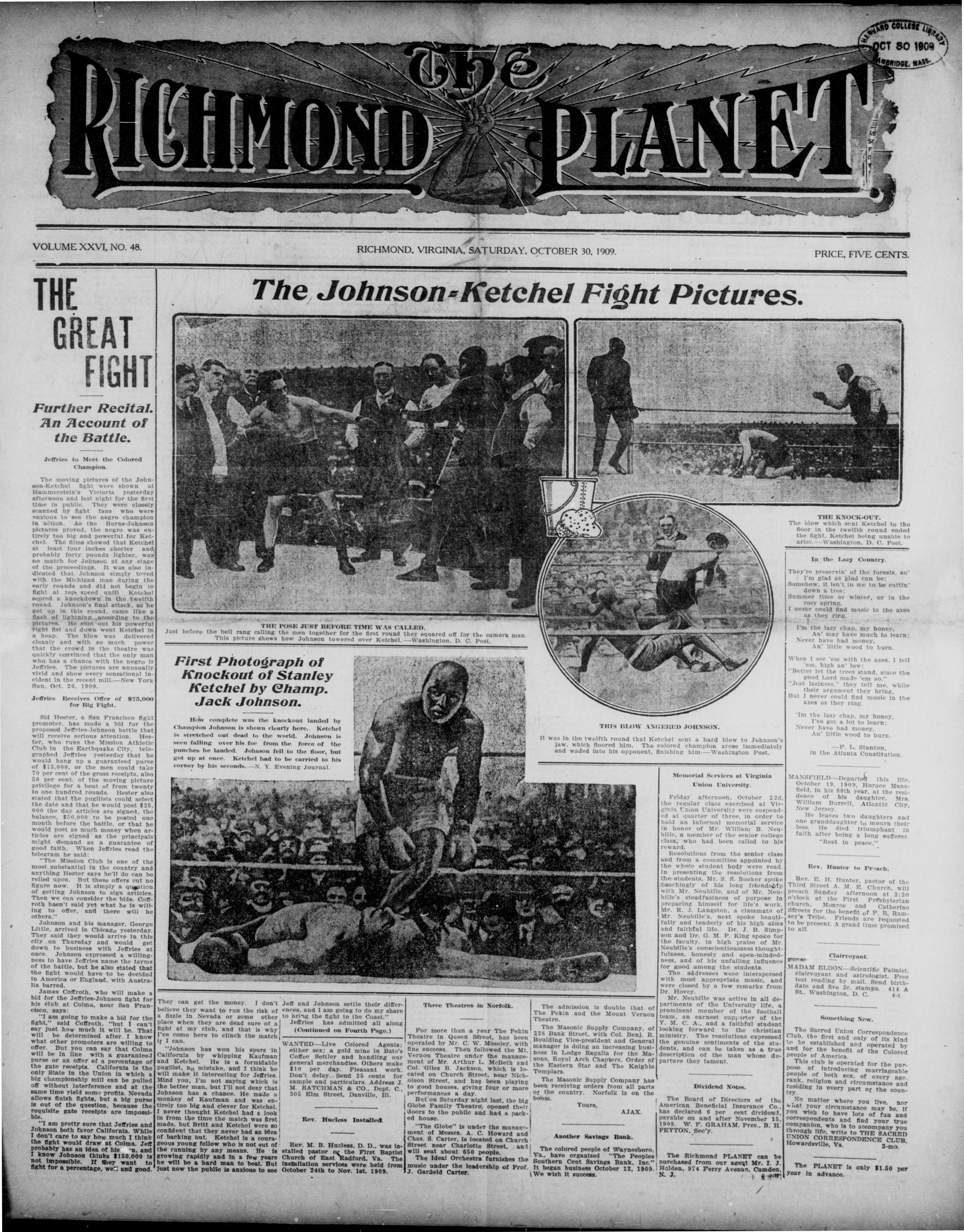
The moving pictures of the Johnson-Ketchel fight were shown at Hammerstein's Victoria yesterday afternoon and last night for the first time in public. They were closely scanned by fight fans who were anxious to see the negro champion in action. As the Burns-Johnson pictures proved, the negro was entirely too big and powerful for Ketchel. The films showed that Ketchel at least four inches shorter and probably forty pounds lighter, was no match for Johnson at any stage of the proceedings. It was also indicated that Johnson simply towed with the Michigan man during the early rounds and did not begin to fight at top speed until Ketchel scored a knockdown in the twelfth round. Johnson's final attack, as he got up in this round, came like a flash of lightning, according to the pictures. He shot out his powerful right fist and down went Ketchel in a heap. The blow was delivered cleanly and with so much power that the crowd in the theatre was quickly convinced that the only man who has a chance with the negro is Jeffries. The pictures are unusually vivid and show every sensational incident in the recent mill—New York Sun, Oct. 26, 1909.
Jeffries Receives Offer of $75,000 for Big Fight.
Sid Hester, a San Francisco fight promoter, has made a bid for the proposed Jeffries-Johnson battle that will receive serious attention. Hester, who runs the Mission Athletic Club in the Earthquake City, telegraphed Jeffries yesterday that he would hang up a guaranteed purse of $75,000, or the men could take 70 per cent of the gross receipts, also 50 per cent. of the moving picture privilege for a bout of from twenty to one hundred rounds. Hester also stated that the pugilists could select the date and that he would post $25,000 the day articles are signed, the balance, $50,000 to be posted one month before the battle, or that he would post as much money when articles are signed as the principals might demand as a guarantee of good faith. When Jeffries read the telegram he said:
"The Mission Club is one of the most substantial in the country and anything Hester says he'll do can be relied upon. But these offers cut no figure now. It is simply a question of getting Johnson to sign articles. Then we can consider the bids. Coffroh hasn't said yet what he is willing to offer, and there will be others."
Johnson and his manager, George Little, arrived in Chicago yesterday. They said they would arrive in this city on Thursday and would get down to business with Jeffries at once. Johnson expressed a willingness to have Jeffries name the terms of the battle, but he also stated that the fight would have to be decided in America or England, with Australia barred.
James Coffroth, who will make a bid for the Jeffries-Johnson fight for his club at Colma, near San Francisco, says:
"I am going to make a bid for the fight," said Coffroth, "but I can't just say how much it will be. That will be determined after I know what other promoters are willing to offer. But you can say that Colma will be in line with a guaranteed purse or an offer of a percentage of the gate receipts. California is the only State in the Union in which a big championship mill can be pulled off without interference and at the same time yield some profits. Nevada allows finish fights, but a big purse is out of the question, because the requisite gate receipts are impossible.
"I am pretty sure that Jeffries and Johnson both favor California. While I don't care to say how much I think the fight would draw at Colma, Jeff probably has an idea of his m., and I know Johnson thinks $150,000 is not impossible. If they want to fight for a percentage, well and good."
The Johnson-Ketchel Fight Pictures.
THE BOXING FIGHT
Just before the bell rang calling the men together for the first round the squared off for the camera man.
This picture shows how Johnson towered over Ketchel. —Washington, D. C. Post.
First Photograph of Knockout of Stanley Ketchel by Champ. Jack Johnson.
How complete was the knockout landed by Champion Johnson is shown clearly here. Ketchel is stretched out dead to the world. Johnson is seen falling over his foe from the force of the punches he landed. Johnson fell to the floor, but got up at once. Ketchel had to be carried to his corner by his seconds. — N. Y. Evening Journal.
They can get the money. I don't believe they want to run the risk of a fizzle in Nevada or some other place when they are dead sure of a fight at my club, and that is why I've come here to clinch the match if I can.
"Johnson has won his spurs in California by whipping Kaufman and Ketchel. He is a formidable pugilist, $n_0$ mistake, and I think he will make it interesting for Jeffries. Mind you, I'm not saying which is the better man, but I'll not deny that Johnson has a chance. He made a monkey of Kaufman and was entirely too big and clever for Ketchel. I never thought Ketchel had a look in from the time the match was first made, but Britt and Ketchel were so confident that they never had an idea of hacking out. Ketchel is a courageous young fellow who is not out of the running by any means. He is growing rapidly and in a few years he will be a hard man to beat. But just now the public is anxious to see
RICHMOND, VIRGINIA, SATURDAY, OCTOBER 30, 1909.
Jeff and Johnson settle their differences, and I am going to do my share to bring the fight to the Coast."
WANTED—Live Colored Agents; either sex; a gold mine in Bate's Coffee Settler and handling our general merchandise. Others make $10 per day. Pleasant work. Don't delay. Send 25 cents for sample and particulars. Address J. M. BATCHMAN & CO., Dept. C., 305 Elm Street. Danville, IL.
Rev. Hucless Installed
Rev. M. B. Hucless, D. D., was installed pastor of the First Baptist church of East Raddorf, Va. The United Methodist Church of from October 24th to Nov. 16th, 1987.
Three Theatres in Norfolk
For more than a year The Pekin Theatre in Queen Street, has been operated by Mr. C. W. Moseley, with fine success. Then followed the Mt. Vernon Theatre under the management of Mr. Arthur L. McBeth and Col. Giles B. Jackson, which is located on Church Street, near Nicholson Street, and has been playing to good houses, giving four or more performances a day.
But on Saturday night last, the big Globe Family Theatre, opened their doors to the public and had a packed house.
"The Globe" is under the management of Messrs. A. C. Howard and Chas. S. Carter, is located on Church Street near Charlotte Street, and will seat about 650 people.
The Ideal Orchestra furnishes the music under the leadership of Prof. J. Gardeld Carter.
I
A
It was in the twelfth round that Ketchel sent a hard blow to Johnson's jaw, which floored him. The colored champion arose immediately and waded into his opponent, finishing him.—Washington Post.
The admission is double that of The Pekin and the Mount Vernon Theatre.
The Masonic Supply Company, of 328 Bank Street, with Col. Benj. R. Boulding Vice-president and General manager is doing an increasing business in Lodge Regalia for the Masons, Royal Arch Chapters, Order of the Eastern Star and The Knights Templars.
The Masonic Supply Company has been receiving orders from all parts of the country. Norfolk is on the boom.
Another Savings Bank.
The colored people of Waynesboro, Va., have organized "The Peoples Southern Cent Savings Bank, Inc." It began business October 12, 1909 We wish it success.
Memorial Services at Virginia Union University.
Friday afternoon, October 22d, the regular class exercised at Virginia Union University were suspended at quarter of three, in order to hold an informal memorial service in honor of Mr. William B. Neubille, a member of the senior college class, who had been called to his reward. Resolutions from the senior class and from a committee appointed by the whole student body were read. In presenting the resolutions from the students, Mr. S. S. Booker spoke touchingly of his long friendship with Mr. Neubille, and of Mr. Neubille's steadfastness of purpose in preparing himself for life's work. Mr. R. J. Langston, a classmate of Mr. Neubille's, next spoke beautifully and tenderly of his high aims and faithful life. Dr. J. B. Simpson and Dr. G. M. P. King spoke for the faculty, in high praise of Mr. Neubille's conscientiousness thoughtfulness, honesty and open-mindedness, and of his unfailing influence for good among the students. The addresses were interspersed with most appropriate music, and were closed by a few remarks from Dr. Hovey.
Mr. Neubille was active in all departments of the University life, a prominent member of the football team, an earnest supporter of the Y. M. C. A., and a faithful student looking forward to the christian ministry. The resolutions expressed the genuine sentiments of the students, and can be taken as a true description of the man whose departure they lament.
Dividend Notes
The Board of Directors of the American Beneficial Insurance Co. has declared 6 per cent dividend payable on and after November 15 1909. W. F. GRAHAM, Pres., B. H. PEYTON, Sec'y.
The Richmond PLANET can be purchased from our agent Mr. I. J. Holden, 974 Ferry Avenue, Camden, N. J.
PRICE, FIVE CENTS
S.
The blow which sent Ketchel to the floor in the twelfth round ended the fight, Ketchel being unable to arise. —Washington, D. C. Post.
In the Lazy Country.
They're preservin' of the forests, an'
I'm glad as glad can be;
Somehow, it isn't in me to be cuttin'
down a tree;
Summer time or winter, or in the
rosy spring,
I never could find music in the axes
as they ring.
I'm the lazy chap, my honey,
An' may have much to learn;
Never have had money,
An' little wood to burn.
When I see 'em with the axes, I tell
'em, high an' low;
"Better let the trees stand, since the
good Lord made 'em so."
"Jest laziness," they tell me, while
their argument they bring.
But I never could find music in the
axes as they ring.
'Im the lazy chap, my honey,
I've got a lot to learn;
Never have had money,
An' little wood to burn.
—F. L. Stanton,
in the Atlanta Constitution.
MANSFIELD—Departed this life.
October 19. 1909, Horace Mansfield, in his 88th year, at the residence of his daughter, Mrs. William Burrell, Atlantic City, New Jersey.
He leaves two daughters and one granddaughter to mourn their loss. He died triumphant in faith after being a long sufferer.
Rev. Hunter to Preach
Rev. E. H. Hunter, pastor of the Third Street A. M. E. Church, will preach Sunday afternoon at 3:30 o'clock at the First Presbyterian church, Monroe and Catherine Streets for the benefit of P. B. Ramsey's Tribe. Friends are requested to be present. A grand time promised to all.
Clairvoyant
MADAM ELDON—Scientific Palmist,
clairvoyant and astrologist. Free
tour of the mall. Send birth-
date and five 2camps. 414 A
St. Washburn, D. C.
Something New
The Sacred Union Correspondence Club, the first and only of its kind to be established and operated by and for the benefit of the Colored people of America.
This club is operated for the purpose of introducing marriageable people of both sex, of every age, rank, religion and circumstance and residing in every part of the country.
No matter where you live, nor what your circumstance may be, if you wish to have lots of fun and correspondents and find your true companion, who is to accompany you through life, write to THE SACRED UNION CORRESPONDENCE CLUB, Howardsville, Va.
The PLANET is only $1.50 per year in advance.
VIA WIRELESS
NOVELIZED BY
THOMPSON BUCHANAN
FROM THE SUCCESSFUL PLAY.
BY WINCHELL SMITH, FREDERIC THOMPSON AND PAUL ARMSTRONG
VIA WIRELESS
---
Frederic Thompson. Copyright, 1908, by Frederic Thompson. All Rights Reserved.
"I WISH to talk to you, Edward," began Mr. Durant. His manner was serious, and Pinkney, who had known him so long, realized that he was seriously put out about something. At such times there was only one way to handle the steel magnate—that way was absolute obedience and prompt replies to his questions. Pinkney became all attention at once. "Yes, sir. What is it?" he asked. Durant consulted the paper in his hand.
"The royalty on this Rhinestrom gun," he asked—"am I correctly informed about it?"
"How much did you think it was?" asked the manager.
"According to the papers, we pay a royalty of $6,000 for every gun six inches or under and $1,000 an inch extra for every one over six. So for these twelve inch guns we are to forge we must pay $12,000 each."
"That's correct, sir," said Pinckney,
"It's too much," declared the steel
magnate sharply.
His manager ventured a protesting
gesture.
"I wrote you," he said, "and cabled
you before I signed the contract. It
was too risky waiting until your re-
turn."
"I don't see why," exclaimed Durant
impatiently. "I think you've
made a mistake this time, Edward—
grave mistake. That royalty I consider
outrageous."
The manager had to make a fight. "I'm very sorry, shr." he said apologetically, "but you know I have your interest at heart, and it seemed to me the only thing that could be done. You have trusted my judgment. It had to exercise it. The government liked this gun, and it meant an order that will keep us busy for a year. If we controlled the patents they were obliged to give us the contracts. There was no competition, you see, and then our price to the government leaves us a very fair profit even after this big royalty is paid." Durant shook his head. "Penny wise, pound foolish, I think it, Edward. To make a profit we have to charge the government a tremendous price that doesn't help our future business. It will give us a black eye when we want work next time."
"Well, I'm sorry, sir," said Pinckney apologetically. "I was working only for the best. I wanted to insure our contract with the government. As it is, you see, we do not begin work for two months, and there'll be a lot of wire pulling and hauling first." Durant nodded.
"Yes, if they find a gun they like better they can countermand our order."
Pinckney hesitated. He felt he had to go cautiously, but it would not do to let Mr. Durant guess his hand.
"Yes," he said slowly, "this fellow Sommers is here to have a gun forged that he's invented. He's got some pull at Washington, I'm certain of that."
"Don't see what difference that makes," replied the steel man.
"Oh," protested the manager, "suppose after they test the Sommers gun they give it preference over the Rhine-strom gun and countermand our order."
"I wish they would," he said. "We could still get the business and not gouge the government. Sommers is an officer in the navy and can claim no royalty. It would reduce the cost of every twelve inch gun $12,000." Pinckney bowed in agreement, then suggested:
"You are partly right, Mr. Durant, but if they took his gun there would be no certainty about our getting the order. We would have to compete in the open, and some one might underbid us."
"We can't help that," replied his chief, "Is Sommers' gun better than ours?"
Pinckney looked up indignantly.
"Of course not," he exclaimed, "but Sommers has inducement, and I do not trust him. I think he'd be capable of any dirty trick to have our gun turned down."
Durant laid his hand on the young manager's arm in kindly fashion.
"Now, now, Edward," he said meaningly, "I like your enthusiasm; it's good for the business, but you must not let your enthusiasm lead you to foolish hatred. This young Sommers seems to me to be a very decent sort of young fellow. I never saw him before tonight, but I was quite favorably impressed. Frances also seems to like him very much."
"So you've noticed that, too, have you?" sneeered the manager. Frances' father looked up sharply. "Yes, have you?" he asked.
Again Pinekney hesitated. It was time for careful work now. He could not afford to make an open rupture or say anything about a direct explanation, so he began using all his dino-
P
---
Durant shook his head.
Durant nodded.
Durant nodded, pleased.
Pinckney looked up indignantly
macy, suggesting by look and gesture rather than by open accusation what he meant.
"Yes, I have noticed it, Mr. Durant," he said. "I hoped I was mistaken. I would hate to see anything like that, because you know my interest in everything that concerns you, and particularly in Frances." He hesitated for a moment, wondering just how to go on.
"Yes, I understand your interest," said Durant kindly. "I understand that."
"Thank you, sir," exclaimed Pinkey gratefully. "You know, then, how hard it is for me to see her associate with such a fellow as Sommers and what a blow it would be if he were to make her fond of him."
Durant looked at the younger man keenly.
"Do you mean there's anything against this young fellow," he asked—"any reason why Frances should avoid him?"
"I-I'd rather not say, Mr. Durant," hesitated Pinckney. Durant was a straightforward old fighter who liked to have people come right out. "If you can't say right out, why do you intimate, Edward?" he demanded sternly. "I don't like people who beat about the bush. If you have anything on this young fellow, come right out and say so. Be prepared to prove it and don't beat about the bush and suggest all sorts of things against him merely because he's paying attention to Frances." Pinckney rose and drew himself up to his full height.
"I'm very sorry, Mr. Durant, that you should think me capable of such a thing," he said with dignity. "I thought my interest was too well proved for you to think that I would do anything underhanded. I say nothing against this fellow Sommers now, because I'm not prepared to prove it but, remember this, Mr. Durant, he's no good, and sooner or later you'll find it out. I only hope it won't be too late."
Durant looked at his young manager keenly. He had no reason to suspect that Pinkey would lie or do anything maliciously underhanded merely to put a rival out of the way. He had known Edward from a boy and found him always apparently devoted to the Durant interests. All this made him judge kindly when from another man he would not have tolerated mere backhiding.
"All right, Edward," he said kindly. "You've proved yourself devoted to me. I think this is just a little overenthusiasm in the Durant interests. As a general rule, I've found these naval chaps straightforward, decent young fellows, and I'd hate to believe otherwise. However, we'll watch him and see. Come to me if you get anything on him, but you know I will not stand for mere rumors and suspicions."
He stopped abruptly, for the door opened and the man of whom they were speaking, with Frances, came in. The quick eye of the girl caught her father's angry mood.
"What's the matter, dad?" she asked. The old man turned to her, with a smile.
"Nothing at all, little one, except Edward's been saying some things that interest me greatly, and to show him what I think I'm going to ask him to come to the study and continue the conversation. I'll leave you to entertain Leitenant Sommers if you'll excuse me."
"Mr. Sommers was just going," said Frances.
"Yes," broke in Sommers, "that bad time when I must say good night has arrived."
"How much longer will you be in Pittsburg, Mr. Sommers?" asked Durant.
"Only until my gun is forged," replied the lieutenant.
Pinckney looked up in surprise.
"Oh, then you intend to remain to see the forging of the gun yourself?" Sommers smiled at him.
"Is that surprising? I'm somewhat interested, you know."
"We're glad to have you, of course, Mr. Sommers," spoke up Durant. "Everything is at your service. Good night, sir."
The steel man shook hands and, turning, started to his study. Pinckney remained a moment behind.
"Of course," he began rather cautiously, "we are glad to have you, as Mr. Durant said, Mr. Sommers, but with your gun so well under way I don't see how you can possibly be of any help to us."
Just a slight hardening of his tone made Pinckney's speech mean only too plainly. "There's no use in your staying, because we don't want you."
But the naval man overlooked entirely the implication. Instead of taking offense he smiled courteously.
"I had no idea of being of any help. Mr. Pinckney. I only want to be on hand when the tempering is done."
"You mean at the work in the fur-
THE RICHMOND PLANET, RICHMOND, VIRGINIA
nace room" gasped the manager.
Sommers smiled.
"That's it exactly."
Pinckney was beginning to lose his temper.
"May I ask why?" he said sharply.
Sommers continued to smile.
"Only to be sure it is properly done," he explained.
Frances was standing by, watching the men and in her mind comparing them.
She saw Pinckney, big, aggressive, strong, an iron man, used to overriding all who opposed him, now matched and held by this quiet, smiling man, whose coolness and evident plant strength reminded her more than anything else of the finest tempered steel, tough, elastic, unbreakable, that outlasts iron every time. Now Pinckney was losing more of his temper.
"Have you any idea we are not competent enough to handle this job?" he demanded.
Sommers still smiled.
"Oh, no, of course not, only I prefer to see for myself, that's all. Ah!" He turned to see Mrs. Durant, who had entered. "Mrs. Durant, I fear I must say good night, much as I hate to. Thank you for a splendid evening." Mrs. Durant shook hands cordially. "Good night, Mr. Sommers. I hope you'll come up often while you're in town." Sommers bowed. "Thank you. You may be sure I'll come as often as I dare," he said. Then he turned and held out his hand to Frances. "Good night, Miss Durant." The girl shook her head. "I'm going to see you out," she said. He smiled gratefully. "Thanks." Next he turned to Pinckney.
Pinckney hesitated a moment. "Two o'clock sharp. Good night." Sommers bowed, turned and followed Frances out into the hall, leaving the girl's mother and Pinckney standing in the doorway staring at each other.
CHAPTER VI
THE door closed, and Pinckney turned to Mrs. Durant.
"Did you see that?" he exclaimed. "She's going to the door with him—going right out there with him. I never saw anything like it-in my life."
Frances mother smiled indulgently.
"Well, what if she is?" she said.
"For goodness' sake, Edward, let the child be polite."
Pinckney was losing all vestige of caution and self control.
"She's in love with him. I tell you, she's in love with him."
Mrs. Durant smiled.
"Frances in love with Mr. Sommers! Why, Edward, you're ridiculous."
The man was walking up and down the floor excitedly. Now he stopped in front of her.
"Ridiculous nothing!" he exclaimed.
"You won't say it's ridiculous when this peniless adventurer carries her off right under your eyes. I tell you. It isn't safe. He's not the kind of man to be with Frances. I should have protested before. I'm sorry I didn't. I tell you, Mrs. Durant, it makes my blood boll to see it. I can't stand it. I won't stand it."
"Edward!" Mrs. Durant was not smiling now. Her face was stern, grim, almost like her husband's. "Do you realize what you're saving?" she demanded sternly. "It isn't for you to criticise what Frances does one way or another. I will attend to that. Her father and I have charge of her and no one else. For you to make any such speech is presumptuous."
"I'm sorry," he said. "I suppose I was presumptuous, but"—his voice broke with real feeling, a feeling of fear and disappointed ambition that Mrs. Durant mstook for love—"it is hard after the dreams I've had and the plans we've made. I tell you, it's a fearful thing to stand by and see you and Mr. Durant calmly helping this sailor to win her."
Mrs. Durant smiled appealingly.
"Now, now, Edward," she said.
"You take it too seriously. You know that George and I have no idea of helping him to win her. If any one is helping him you are the one."
Pinckney looked at her amazed.
"I? he exclaimed.
Frances' mother nodded.
"Exactly," she said. "You are helping him by your very apparent jealousy. There is nothing that will spur a girl to be particularly nice to one man so much as a knowledge that some one she cares for is seeing and writhing."
Pinckney opened his eyes. Like many another schemer, he had devoted all his time to circumventing men, and he really knew comparatively little about women.
"But she hasn't seen that I notice it," he protested. "She's been too busy with him to notice anything."
The mother laughed out loud at his bitter tone.
"Nonsense, Edward. Mr. Sommers is a nice young man, and I don't blame her for enjoying his visits. Goodness knows, nice young men are not so plenitiful in Pittsburg."
Pinckney looked at her reproachfully. "I thought you at least were on my side," he complained. "I didn't expect you'd be against me."
He sat down in a big chair and stared gloomily at the fire. Mrs. Du rent came over to rest one hand afectionately on his shoulder.
"I am on your side, Edward," she said seriously. "You know that. Yes."
know perfectly well t'at her father and I both hope with all our hearts that some day we shall see you two married."
He turned eagerly and, reaching up, caught her hand.
"Then why don't you speak to her of it?" he exclaimed. "Let her understand your wishes."
The woman looked down on him with a pitying smile.
"You poor boy!" she said. "You must be desperate. You want me to propose for you. Well, if George Durant had come to my mother"— She ended with a nod almost savage.
"Perhaps he did for all you know," exclaimed Pinekney.
"No, he didn't. She was dead," snapped Frances' mother. "Now, you poor thing, don't be so tragic. Somers will go in a day or so, and in a few weeks he may be ordered to the north pole or the equator or goodness knows where. At any rate, he'll be out of her way and yours. See her to night. Talk with her. Let her see how you feel toward her. Now is a good time. She's coming back. I'll leave you."
But it was the butter instead of Frances, as expected, that entered the room.
"Filkins, where is Miss Durant?" asked Pinckney sharply. The butter turned.
"On the veranda with the navy gentleman, sir," he said.
Meanwhile, outside on the veranda Frances Durant and Lleutenant Somers stood side by side in the darkness saying goodbye. Back of them
C. 1900
"She's in love with him. I tell you she's in love with him."
shut off with the heavy hall doors, was the lighted house. In front, far below, showed the bright windows of the steel works, where the night shift toiled. Now and again, at irregular intervals, the sky was lighted with a sudden glare of the huge chimneys that blazed up and then died abruptly leaving the night blacker than before. For a time they stood looking out at the distant lights and the silence. As last it was the girl who spoke.
"And tomorrow night you will be down there tolling, watching, waiting as they forge the gun which is to make your fame," she said softly.
"And you?" he asked, just as low. In the darkness she looked up at him. "And I," she said—I shall be up here just where I am now, watching the lights and thinking and praying that all will be well."
Again they stood in silence for a time.
Then the man sighed.
"I am afraid to come back again," he began unsteadily. "I think I had better say goodbye to you tonight."
She moved slightly closer.
"Afraid?" It was a taunt tremulously given.
"Yes," he blurted. "I am afraid, and you know why."
She did not answer, and he rushed on, speaking low, eagerly, yet bitterly.
"You know I can't tell you what I wish to say. I haven't really the right. I am a penniless naval officer and you the daughter of the biggest steel man in the country. I haven't the right."
"What is it you wish to say?" she asked insistently. She was so close their hands touched as he turned to ward her. And, touching, the hands clung together.
"You know what I wish to say," he exclaimed. "If I had the right I'd tell you how much I love you. I'd tell you how from the first moment I saw you I wanted you, and you only. I'd tell you how I never have lived until I knew you and the rest of my life must be one dreary blank of grinding duty because I must lose you. I'd tell you that life with you would be more happiness than any man has the right to have. I'd tell you that I'd rather have one year of you than a million years on earth and all the honors that men could give me. I'd tell you"—he broke of bitterly for a second, then repeated—"I'd tell you enough to make you realize what an absolutely dreaming, idiotic fool I am, but I'd tell you enough to make you know how I suffer because I haven't the right to really tell you anything."
In the darkness the girl laughed a low laugh of pure delight.
"You are an absolute, idiotic, dreaming fool," she said, so softly, so tenderly, that he could not but understand "Frances."
He barely breathed her name. Then all reply was cut off, for she was in his arms with her own arms about his neck and their lips were tight to together.
It was nearly half an hour later when Frances Durant, her cheeks
fushed, her eyes misty with happiness, opened the big front door and stepped back into the lighted hall.
So much had happened in that short time. She had gone out an anxious, worried girl. She re-entered a glowing woman, loved and loving, sure of herself and happily confident of the future. They were not engaged. No indeed! They had solemnly assured each other of that fact. It would not do at all for the penniless naval officer to formally ask the hand of the steel king's daughter! But when his gun had been a great success and fame had come to him then he was to come and make his formal plea and ask her father for her hand. And she would be waiting eagerly for her lover, ready with her answer and prepared, no matter what happened, to follow him to the ends of the earth.
Edward Pinckney looked up with a sneer as she entered the library.
"Oh, he's gone, has he?" he said contemptuously.
The girl was too happy to mind the tone.
"You mean Mr. Sommers?" she said, affecting to misunderstand. "Yes; he's gone."
"Of course I mean that naval whip persnapper. Who do you suppose I meant?" he replied sharply. "You ought to have more sense. Frances than to stand out on that cold porch. You're likely to catch pneumonia or anything."
The girl smiled slightly.
"Oh, I wasn't cold," she said.
"I've been waiting to speak to you," began Pinckney again. "It's about something important."
Frances was in no mood for long, dull conversation. She wanted to get away by herself to think over the last half hour, to feel again the thrill of his touch, to hear again in her imagination the sound of his voice. So she spoke somewhat impatiently.
"Won't tomorrow do, Edward?" He shook his head with decision.
"No; tomorrow won't do, Frances. I want to talk to you tonight about something in which I am interested and in which your mother and father are interested also—something which we all wish to bring about."
The girl yawned. She did not have the least idea what he was going to say.
"Oh, very well, Edward, if it's anything you wish and mother and father wish, too, just consider that I have agreed and let it go at that. Don't worry me."
He stepped toward her suddenly and before she realized it had put his arm about her.
"Then we may announce the engagement at once," he said masterfully.
The girl recoiled, then tore herself from his arms.
"No," she said sharply, "you will not announce any engagement of mine if you mean yourself as the man."
His face darkened.
"You mean you don't care for me? he demanded.
She looked at him with a smile. "Of course I care for you. Edwards we've been brought up together. I've looked on you as a sort of big brother, but I don't care for you the least bit in the way you mean, and I never will."
"You mean you won't marry me?" he demanded angrily.
"Of course I won't marry you when I don't care for you," she retorted, beginning to lose her temper in turn. "Are you out of your senses? I've never had any idea of marrying you Edward. I will never have such an idea."
Pinckney saw all his dreams begin to tumble. It made him angry, desperate.
"You will marry me!" he exclaimed, stepping toward her. "I tell you you will marry me! What do you think I am—a fool? Do you suppose I'm an idiot, dreaming fool!"
The repetition of that phrase which she'd heard so recently roused the girl to fierce anger.
"Yes," she cried, "you are a dreaming, idiotic fool if you think I'm going to marry you or anybody else I don't love, whether you wish it or mother and father wish it or the whole world wishes it. Understand that once and for all. Good night." And, turning, she started for the door.
Pinckney's face was convulsed with rage. His hands were twitching. He could hardly control himself.
"Then you're going to marry this dirty adventurer, Sommers, are you?" he almost shouted.
The girl stopped short and whirled about, facing him. Her cheeks were bright, her eyes blazing with anger.
"I'm going to marry the man I love, Edward Pinckney" she explained to
a voice of controlled anger. "And that man will never be you. That's all you need know. He will never be you. Good night."
CHAPTER VII
SMITH, the foreman in charge of the Sommers gun, was raging drunk.
He lurched up and down in front of the furnaces, cursing the men, driving them here and there, making all manner of confusion, apparently without reason. O'Leary, his assistant, had done his best to quiet the half crazed foreman. O'Leary and every man on the job knew that the Sommers gun was in grave danger of being ruined. It had been scheduled to go into the furnace at 2 o'clock, but Smith shortly after noon had lurched in, called his men together and shoved
G.
"You mean you won't marry me?" he demanded angrily.
The gun into the furnace three hours ahead of time. Now it was nearly midnight, and unless the gun came out shortly every man knew that it would be completely ruined. It must come out, be brought to the proper temperature and then thrust into the tempering bath—a thousand gallons of oil.
The last time Smith had been in charge of the job he had put a gun into the bath at too high a temperature and it had burst at the proving ground. Smith on that occasion had been laid off and had not been brought back to work until the casting of the Sommers gun. Then Pinckney had sent for him and, after a long talk in his private office, had placed the disgusted foreman in complete charge of this new and very important piece of work.
At the casting of the Rhinestorm gun Pinckney himself had taken complete charge, staying in the furnace room until all the work was finished, and the marked difference in the handling of the two jobs had not escaped some of the shrewder workmen.
"Looks like they don't care a hang whether this one goes or not," O'Leary, the assistant foreman, had complained. "It's plain foolishness, putting Smith on the job. It'll just get him in trouble and won't do any good. That gun's bound to be a failure if we ain't careful."
The men had taken O'Leary's view of the matter and were doing all they could to make this job a success. Sommers during his stay about the works had become tremendously popular. They wanted to do their best for him; also O'Leary expected in the fall to marry Lucy Smith, the foreman's daughter, and therefore he had an interest in putting the job through right.
Sommers was to come down about 1:30 in the morning, when the gun was expected to go into the tempering bath. That was the important work, and he was determined to superintend it. However, with Smith putting the gun in three hours ahead of time there seemed every chance that unless Sommers should be warned of the change the gun would be in the bath and everything of importance over before the navy man should arrive.
In vain O'Leary leaped with Smith to do something about the gun.
"It's been in too long already. Smith," he urged. "Do you want to ruin this job? Who'll take care of you when you ruin another gun? You'll be down and out for good."
The foreman, swaying from side to side, looked at his assistant with a drunken leer.
"Who'll take care of me?" he sneered. "Don't you worry about who'll take care of me. I'm the best man about these works drunk or sober, and don't you forget it." O'Leary could not be put off.
"Then if you're the best man show it!" he shouted. "Show it by tending to business! That gun 'll be ruined in no time!"
Smith, broad, brutal, savage from drink, almed a blow at his assistant. "You will interfere!" he shouted. "You think you're a better man than I am! I'll show you! I'll let you know who's the boss of this here job!"
O'Leary dodged the blow and jumped out of the way as the foreman rushed. Again the foreman came at him, but the assistant grabbed an iron bar and stood ready.
"You take another step and I'll brain you!" he yelled above the roar and the clang of the tolling hammers. "You're drunk, and we're saving your job for you. Now you tend to it or I'll smash your head clean in."
Smith stopped, grumbling. He knew O'Leary was the strongest, coolest young fellow about the works. A fight with him sober would have been serious, and drunk the foreman knew he would not stand a chance. He stepped back.
"I'm tending to my job, O'Leary," he complained, half maudlin. "There ain't no call for you acting that way. You're trying to get my job, that's what. I'm doing right—just what I was told. Now, you let me alone."
"Sure, O'Leary, let him alone," urged the other men. "He'll come round, and we'll get the gun out on time."
Before more could be said an office boy appeared, coming from the front office.
"They want you in the office, O'Leary. Hustle up," he said; "it's important."
Out in the office Lucy Smith was explaining vigorously to the stenographer, Mazie O'Brien, that Smith in charge of the Sommers gun, was drunk on the job, and his wife, fearing something might happen, had sent the girl
over to beg O'Leary to take him.
"Sure, Lucy, that's all right. Of course O'Leary will do it for you," the good natured stenographer encouraged. "I'll just get out and give you a chance at him when he comes. When are you going to get married, anyhow?"
Lucy blushed and hesitated.
"I don't know exactly," she said. "We haven't talked much about it."
Mazie O'Brien smiled.
"Well, it's about time you're getting busy with that line of conversation, I think. Don't do to trust any of these steel hands. Two weeks is long enough for any girl to be engaged. I'll get out now and leave you alone," she ended as O'Leary, astonishment and worry showing on his begrimed face, entered the office.
"What's the matter, Lucy?" he asked anxiously.
The girl turned to him with eagerness.
"It's about father. Is he very bad?" The man hesitated.
"Well, he's got a few drinks in," he confessed at last. "But there hasn't been much trouble up to date."
"He's pretty ugly, ain't he?" asked the girl.
O'Leary laughed grimly.
"You know what your dad is when he's drunk, Lucy. He's tried to pick one or two scraps tonight, but the men are keeping away from him. I'll do my best to keep down trouble, you know that, Lucy."
The girl nodded.
"Yes, I know, Joe, you're mighty good," she said, "but if anything happens tonight you know he'll lose his job sure. I'm awful afraid, and mother's worse than I am, so I just came over to get you to look out for him. Is he doing his work all right?"
O Leary shook his head regretfully.
"That's what bothers me," he confessed.
"The Sommers gun's been in the fire too long now. If it don't come out of the furnace soon the gun 'll be no good at all."
The girl made a hopeless gesture.
"What do you think of that?" she complained.
"And he's the best man over here when he's sober. Can't you do anything, Joe?"
"I am doing all I can," he urged, as though in justification, "but if that gun's put in the oil bath after being too long in the fire the tempering will be bad."
Lucy wrung her hands despairingly.
"Let's get Mr. Marsh," she begged.
"Mr. Plinckney ain't here, but Mr. Marsh can take dad off the job and keep him from ruining everything. Sommers is such a nice man, too, and Miss Frances likes him. Oh, what are we going to do, Joe?"
O'Leary looked at her blankly. The situation was too much for him to manage.
"Marsh's acting funny, too," he complained. "He must know how Smith is, but he keeps away and don't say nothing to him. Guess he's afraid."
"Maybe I could go in and beg him. Couldn't I do that, Joe?" pleaded the girl.
She turned and started for the door which led into the works, but before she could reach it the door was pushed open and Smith, drumker and more enraged than ever, lurched into the office. At sight of Lucy and O'Leary together he straightened up, caught hold of the door a moment for support, then burst on them with a torrent of anger.
"What are you doing here?" he roared. "Why did you come in this office, Lucy? What business you got here, O'Leary? Ain't I seeing you hanging around my house enough without getting that girl in the office?" "I—I've got your dinner, father. I brought it over to you," faltered Lucy. "And why didn't you bring it to me right?" he shouted. "And why do you let this fellow in the office here be talking to you?" "Joe's all right, father," the girl urged. "He don't want you to make no mistake with the Sommers gun, that's all." The drunken foreman turned on his assistant with fury. "Oh, you don't, don't you!" Look here, you keep that mug of yours out of my affairs or I'll break it. Do you hear?"
But Joe O'Leary did not come of the race that could be bluffed. As Smith lurched toward him the assistant straightened into a position of defense, waiting for him.
"Don't waste your breath trying to scare me. Smith," he shouted. "You'd better be getting that gun out of the fire before it spills."
The sudden opposition sobered the drunken man for a moment.
"I got a fine assistant, ain't I?" he sneered. "Trying to tell me my business. I know what you're up to. You sneaked in here to talk to her; that's what you did. Now, you keep away from her after this, I tell you. Don't you come near her or I'll break you in two."
O'Leary looked the larger man up and down with fine Irish scorn.
"Break me in two!" he sneered. "If you was to break me in two either piece of me would get up and knock your block off. I tell you, if you ever lay a hand on me I'll kill you."
In a wild fury Smith rushed unsteadily. O'Leary landed once, staggering the big man, and then Lucy rushed in between them.
"Father! Joe! Don't!" she begged. "You'll both be discharged."
The jarring, staggering blow had knocked a little of the fight out of the bully. He still had sense enough to know that in an even battle his young, strong assistant would have a good chance, and, like most bullies, he didn't care for even battles. The plea of Lucy gave him a chance to change the direction of his anger.
"Discharged!" he yelled. "Who'll discharge me? I can clean out the whole works, and I"—
He was lurching about the office, swinging his arms wildly in time to his drunken threats, when the street door opened and Pinckney came in hastily. In a moment the manager saw that something was wrong. "What's the meaning of this?" he demanded sharply, stepping forward. Again the current of Smith's rage had found an object to dash against. All sense of discipline and fear of consequences was gone from him
SATURDAY...OCTOBER 30, 1909.
Then, besides, down in his heart he knew that Pinckney needed him and would scarcely dare to discharge him at this time. Instead of replying he heaved himself over until he stood face to face with the general manager.
"Do you think I'm afraid of you?" he demanded drunkenly.
Pinckney paid no attention to him, but turned and pressed the bell. When he spoke it was to the assistant.
"What are you doing here, O'Leary?" "Nothing, sir."
"Then get to work," ordered Pinckney sharply.
O'Leary hesitated.
"I can't leave Lucy, with him," he said, jerking his head toward Smith.
Pinckney nodded.
"I understand, but that's all right. You go back to work. I'll look after her."
"Yes, Joe, please go when he tells you," urged Lucy.
O'Leary nodded.
"All right; I'm going," he said. He reached the door, then turned and spoke threateningly to the drunken foreman. "See here, Smith, if you touch that girl I'll kill you, and don't forget it!"
Before Lucy's father could reply he turned and slammed the door after him.
Smith whirled, lurched toward Lucy with his hand upraised, but Pinckney stepped in front of him.
"Here, here, Smith!" commanded the manager sharply. "You've got no time for fooling. Remember. Put you in charge of the Sommers gun."
Smith straightened and leered with a drunken assumption of sarcasm.
"What if you did? Almost the
"What if you did? Ain't it being done to suit you?"
"Of course it is. I haven't complained, have 1?"
The foreman thrust his own face against that of the general manager.
"You'd better not complain!" he sneered threateningly. "I guess I know what's wanted of me."
Pinckney nodded.
"I'm sure you do, Smith," he said blandly. "I have every confidence in you; now go and look out for that gun, and, remember, until that job's out of the way you're boss. Don't let anybody interfere with you!"
The foreman shook one of his big arms.
"If any one interferes with me you know what they'll get," he roared. "You can let your life on that, and one of them is going to get it quick." Still muttering threats, he turned an staggered out of the works. Pinckney looked sharply at Lucy.
"You go home and stay there," he said.
The girl hesitated. Fear of what might happen with her father drunk and in charge of such important work gave her unusual courage.
"Excuse me, Mr. Pinckney, but father isn't himself. Do you think it safe to have him in charge tonight?"
The manager frowned so savagely that Lucy trembled.
"Oh, that's what brought you here, was it? You came over to manage the works, did you?" he sneered.
"I was afraid—that gun"—repeated the girl.
Pinckney broke in on her savagely,
"Well, the next time you keep your fears home. When I need you to look out for the works here I'll send for you. Now get out."
He turned from the frightened girl to the office boy, who at last had answered his ring.
"Send Marsh to my private office."
And without another look at the frightened girl the manager strode into his private office and slammed the door. Lucy, crushed and beaten, fearful that she had only made matters worse by coming, was hurrying out when the door from the works again opened, and Joe O'Leary, blood streaming down his face, staggered across the threshold and fell into a chair, gasping:
"He got me."
[TO BE CONTINUED.]
RIOT AT WEDDING PARTY
One Killed, Two Fatally, In Battle With Young Toughs.
Hammond, Ind., Oct. 20.—In a riot following a wedding party one man was killed, two fatally injured and six were more or less seriously hurt.
John Potocki, aged twenty-four, was shot through the heart and killed; James Kries, his brother-in-law, aged twenty-six, was shot through the breast and is dying at St. Margaret's hospital; the head of John Kulczky, of the West Hammond police, was split open, and he is dying at his home. Another policeman was also struck in the head.
A Polish couple, just married, gave a party to their friends at a dance hall. It was a select affair, and a crowd of village rowdies, angered because they were not invited, tried to break up the party. Police aid was sought, and a gang of young toughs threw Kulczky out of the hall before he could draw his revolver. The toughs followed him into the street, and he shot two as he lay on the ground with his skull fractured. Eight arrests were made.
TWO MAGAZINES COMBINE
Butterick's Increase Capital to $15,000,
Butterick's Increase Capital to $15,000,
000 and Take Over Everybody's.
New York, Oct. 20.—The stockholders of the Butterick company voted to increase the capital stock of the concern from $12,000,000 to $15,000,000 for
the purposeof taking over Everybody's Magazine. The stockholders of Everybody's had voted already in favor of the plan, and the arrangement will be consummated at once on the basis of exchanging three shares of Butterick for one of Ridgway.
USE BOW AND ARROW TO HUNT CHESTNUTS
Women and Boys Adopt Primitive Methods.
Women and Boys Adopt Primitive Methods.
Greenwich, Conn., Oct. 20.—Hunting with bows and arrows, which has been unknown in this town since the days when the Indians flourished here, has been revived within the last week, and it is not an uncommon sight when passing through the wooded sections in the outlying sections to come upon hunting parties of men and boys, and even women, armed in the fashion of the aborigines.
This reversion to the primitive has been taken up for practical purposes of hunting the shy and elusive chestnut.
The method consists of attaching a light string to the arrow and shooting it up over the high branches. At the end of the string is attached a rope. When the arrow falls the string is pulled and the rope drawn over the branch. It is then easy to shake the highest boughs of the tallest trees.
THE CHURCH TO ADVERTISE
Will Start a Country-wide Campaign to Reach the People.
New York, Oct. 20.—After the fashion of big business advertisers the combined Protestant churches of this country early in January will begin a campaign of advertising social, racial, economic and religious problems which imperil American life and American institutions. The advertising will be in newspapers, magazines, periodicals and books, and on posters and bill boards.
Advertising will be inaugurated under the Home Missions Council, representing a membership of 40,000,000 or more. It will be directed to the public at large, and such topics as the labor question, the immigration problem, the color problem and conditions in city and town will be discussed in the advertisements.
The campaign will be conducted under the general supervision of Rev. Charles Stealge, superintendent of the Presbyterian department of church and labor.
Baby Fatally Burned
Williamsport, Pa. Oct. 20. — Her fourteen-months-old baby, sitting on the kitchen table a mass of flames, was the sight that met Mrs. J. F. Yarison, of Sherman street, upon arising and going downstairs. The babe had been placed there by the father before he went to the home of a neighbor. A lighted lamp had been placed on the table close to the child, and it is from this, it is thought, that the babe's night lamp caught fire. The babe died within an hour.
RIDDER SAYS
TAFT BLUNDERED
VICTIM OF DESIGNING MEN
Publisher Tells the President American Mills Must Close or Move to Canada to Obtain Their Raw Material.
Chicago, Oct. 20.—"You were apparently misled by designing men into a serious blunder when, in the closing days of the tariff conference, they induced you to reverse your previous attitude upon print paper, and changed your notions of what the Mann committee recommended and of what the house of representatives had approved." Herman Ridder, president of the American Newspaper Publishers' association, has written to President Tafe, the letter being called forth by the printing of the full text of the president's recent speech at Winona, Minn.
"The Mann committee, after a ten months' investigation, marked by unusual thoroughness, reported that a rate of $2 would cover the difference in cost of production at home and abroad. The draft proposed absolutely safeguarded American paper mills against the serious Canadian tangle, which your advice to the tariff confeeers has since precipitated.
"The fixing of the rate on print paper at $3.75 per ton, which you advised, has decided the province of Quebec to prohibit the exportation of its pulp wood, and many American paper mills must close or move to Canada to obtain their supplies of raw material. The country is now in a fair way for a trade war with Canada because of your apparent failure to read correctly the Mann committee's recommendations.
"We sincerely trust that you can find some method of rectifying the mistake into which you were led. We fully appreciate the difficulties and responsibilities of your exalted office and we believe you are trying to do the best you can.
"We know that you must rely upon others for your information. We feel that every citizen is under obligation to help you. Therefore we write this letter to you."
THE RICHMOND PLANET, RICHMOND, VIRGINIA
Noah's Liniment contains no alcoholic or poisonous drugs and can be taken internally with safety. Noah's Liniment is the best remedy for Rheumatism, Scoliosis, Latape Back, Stiff Joints and Muscle Pain.
Cuta, Brulesca, Crampa,
Neuralgia, and All Neuromalia,
and all None Bone and Muscle Aches
with pain relieftale to relieve
money refunded by deal-
ing Sale Sold by Drug and Country
Streets, 28 cents, or
mailed on receipt of price
MOAH REMEDY CO.
RICHMOND, VA.
APPEAL GRANTED IN CAPITOL CASE
Penna. Supreme Court Glves Rehearing on Costs.
ONLY TWO DEFENDANTS LEFT
The Decision Keeps Ex-Auditor General Snyder and Ex-Superintendent of Grounds and Buildings Shumaker From Going to Jail.
Pittsburg, Oct. 20. — The supreme court of Pennsylvania allowed an appeal in the cases growing out of alleged "grafting" in connection with the building of the state capitol.
The appeal was taken on behalf of former Auditor General William P. Snyder and James M. Shumaker, former superintendent of grounds and buildings, the two survivors of the four defendants who were convicted in the Dauphin county court in March, 1908, of conspiracy to cheat the state in capitol "trimming," and sentenced to two years in the penitentiary.
John H. Sanderson, one of the defendants, died in May of this year, and William L. Mathues, former state treasurer, another of the defendants, died in December, 1908.
Neither Sanderson nor Mathues was named in the appeal to the supreme court, the opinion being that their estates have no right to that end. It is expected, therefore, that the nominal $500 fine imposed will be paid, and also a proportion of the costs.
Upon making their appeal from the superior court to the supreme court Snyder and Shumaker were required to renew their ball of $25,000 each pending the decision of the higher court.
The "Clothes-Tree" Case. Snyder and Shumaker were defendants in the famous Sanderson or clothing-tree case, so-called because of a fraudulent bill for such articles figuring prominently in it. Joseph M. Huston, the architect, originally indicted with the four defendants, was granted a severance and helped the state in the trial, winning the lasting enmity of Sanderson and estranging the other defendants from him.
The proceeding in which the appeal is allowed is an effort to escape the payment of costs, which have not yet been figured up, but which will run into the thousands of dollars. The appeal was taken immediately upon the decision of the superior court upholding Judge Kuenkle in refusing a new trial, and has had the effect of keeping the two defendants from going to jail. No date has been fixed for the hearing of argument.
By the decision of the court the case must be argued again before the supreme court. A denial of appeal would have meant that the two surviving defendants would be compelled to serve the sentence imposed upon them by the superior court.
Has Attended 1369 Births; to Retire,
Sayre, Pa., Oct. 20.—Dr. H. Plant,
of this city, after practicing here for
eighteen years, contemplates retiring.
He has been in attendance at the
births of 1369 children, and thinks he
has earned a rest.
Slayer of Women Hanged.
Johnstown, Pa., Oct. 20.—Thomas
W. Johns, who shot and killed his wife
and mother-in-law on Sept. 21, 1908,
was hanged in the yard of the county
jail at Ebansburg, Pa.
Clever Willie.
On his baby sister's head
Wille broke a piece of tile.
Mamma only smiled and said.
"That will hold her for awhile."
—Illustrated Bits.
He Is.
"Is Pilkington still working at his
perpetual motion?"
"If you mean the motion that lifts a
glass from the bar to his mouth, he is."—Houston Post.
A New One on Mary.
Mary had a little lamb,
And it began to sicken.
She sent it off to Packingtown,
And now it's labeled "Chicken."
—Lippincott's Magazine.
PRESIDENT'S TRIP NO INNOVATION
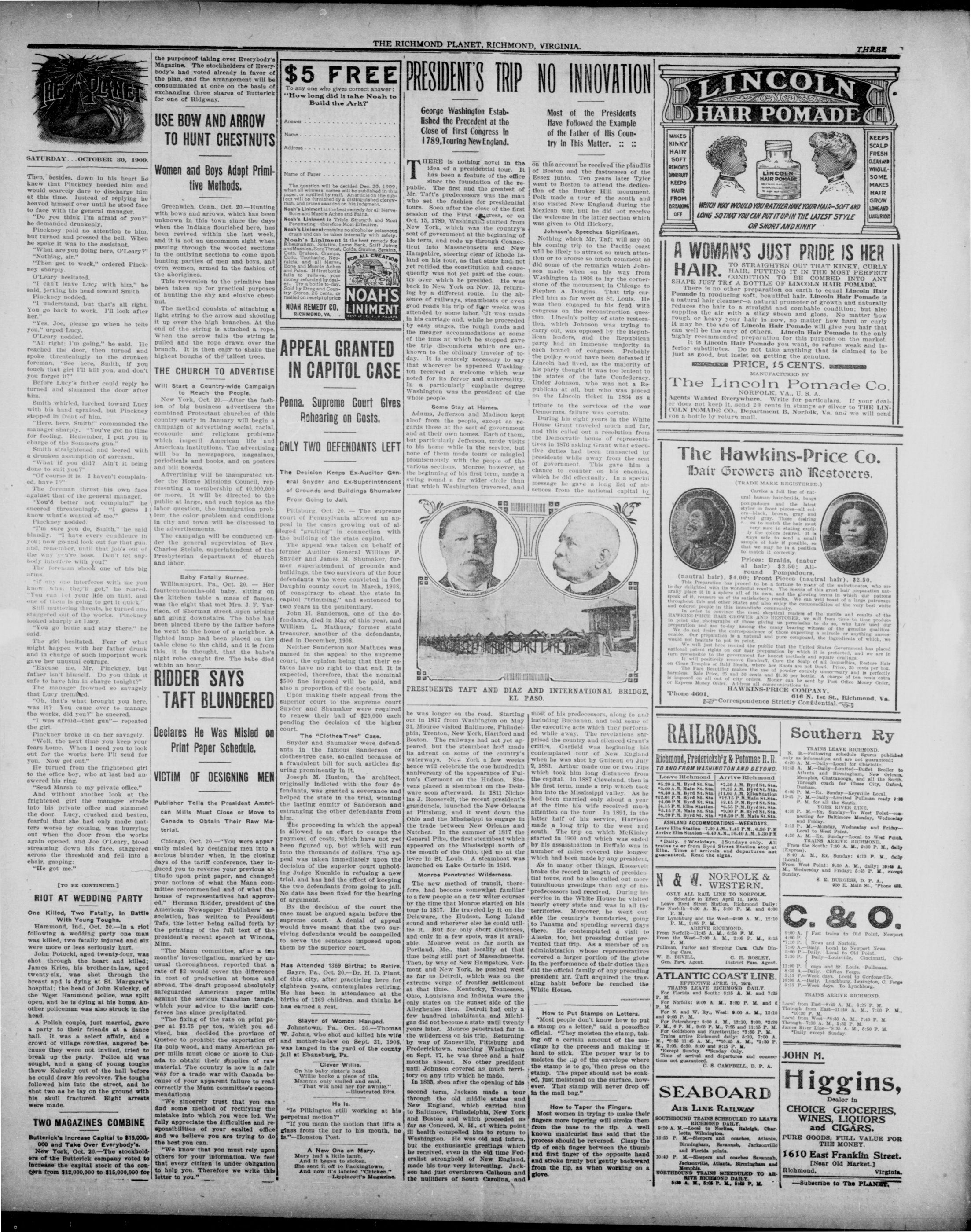
PRESIDENTS TAFT AND DIAZ AND INTERNATIONAL BRIDGE,
EL PASO.
George Washington Established the Precedent at the Close of First Congress In 1789,Touring New England.
THERE is nothing novel in the idea of a presidential tour. It has been a feature of the office since the foundation of the republic. The first and the greatest of Mr. Taft's predecessors was the man who set the fashion for presidential tours. Soon after the close of the first session of the First Congress, or on Oct. 15, 1789, Washington started from New York, which was the country's seat of government at the beginning of his term, and rode up through Connecticut into Massachusetts and New Hampshire, steering clear of Rhode Island on his tour, as that state had, not yet ratified the constitution and consequently was not yet part of the country over which he presided. He was back in New York on Nov. 13, returning by a different route. In the absence of railways, steamboats or even good roads his trip of four weeks was attended by some labor. It was made in his carriage and, while he proceeded by easy stages, the rough roads and the meager accommodations at some of the inns at which he stopped gave the trip discomforts which are unknown to the ordinary traveler of today. It is scarcely necessary to say that wherever he appeared Washington received a welcome which was noted for its fervor and universality. In a particularly emphatic degree Washington was the president of the whole people.
Some Stay at Homes.
Adams, Jefferson and Madison kept aloof from the people, except as regards those at the seat of government and at their own homes. Each of them, but particularly Jefferson, made visits to his home while in the service, but none of them made tours or mingled promiscuously with the people of the various sections. Monroe, however, at the beginning of his first term, made a swing round a far wider circle than that which Washington traversed, and
FRESIDENTS TAFT AND DIAZ
EL
he was longer on the road. Starting out in 1817 from Washington on May 31, Monroe visited Baltimore, Philadelphia, Trenton, New York, Hartford and Boston. The railways had not yet appeared, but the steamboat had made its advent on some of the country's waterways. New York a few weeks hence will celebrate the one hundredth anniversary of the appearance of Fulton's Clermont on the Hudson. Stevens placed a steamboat on the Delaware soon afterward. In 1811 Nicholas J. Roosevelt, the recent president's granduncle, launched the New Orleans at Pittsburg, and it went down the Ohio and the Mississippi to engage in the trade between New Orleans and Natchez. In the summer of 1817 the General Pike, the first steamboat which appeared on the Mississippi north of the mouth of the Ohio, tied up at the levee in St. Louis. A steamboat was launched on Lake Ontario in 1816.
Monroe Penetrated Wilderness
The new method of transit, therefore, had become somewhat familiar to a few people on a few water courses by the time that Monroe started on his tour in 1817. He traveled by it on the Delaware, the Hudson, Long Island sound and wherever else he could utilize it. But for only short distances, and only in a few spots, was it available. Monroe went as far north as Portland, Me., that locality at that time being still part of Massachusetts. Then, by way of New Hampshire, Vermont and New York, he pushed west as far as Detroit, which was on the extreme verge of frontier settlement at that time. Kentucky, Tennessee, Ohio, Louisiana and Indiana were the only states on the sunset side of the Alleghenies then. Detroit had only a few hundred inhabitants, and Michigan did not become a state until twenty years later. Monroe penetrated far in the wilderness on his trip. Returning by way of Zanesville, Pittsburg and Fredericktown, reaching Washington on Sept. 17. he was three and a half months absent. No other president until Johnson covered as much territory on any trip which he made.
second term, Jackson made a tour through the old middle states and New England, which carried him to Baltimore, Philadelphia, New York and Boston and which proceeded as far as Concord, N. H., at which point ill health compelled him to return to Washington. He was old and infirm, but the enthusiastic greetings which he received, even in the old time Federalist stronghold of New England, made his tour very interesting. Jackson had just overthrown Calhoun and the nullifiers of South Carolina, and
Most of the Presidents Have Followed the Example of the Father of His Country in This Matter. :: ::
on this account he received the plaudits of Boston and the fastnesses of the Essex junto. Ten years later Tyler went to Boston to attend the dedication of the Bunker Hill monument. Polk made a tour of the south and also visited New England during the Mexican war, but he did not receive the welcome in the latter section which was given to Old Hickory.
Johnson's Speeche Significant. Nothing which Mr. Taft will say on his coming trip to the Pacific coast will be likely to attract so much attention or to arouse so much comment as did some of the remarks which Johnson made when on his way from Washington in 1806 to lay the cornerstone of the monument in Chicago to Stephen A. Douglas. That trip carried him as far west as St. Louis. He was then engaged in his feud with congress on the reconstruction question. Lincoln's policy of state restoration, which Johnson was trying to carry out, was opposed by the Republican leaders, and the Republican party had an immense majority in each branch of congress. Probably the policy would have been defeated if Lincoln had lived, as the majority of his party thought it was too lenient to the states of the late Confederacy. Under Johnson, who was not a Republican at all, but who was placed on the Lincoln ticket in 1864 as a
tribute to the services of the war Democrats, failure was certain. During his eight years in the White House Grant traveled much and far, and this called out a resolution from the Democratic house of representatives in 1876 asking Grant what executive duties had been transacted by presidents while away from the seat of government. This gave him a chance to counter on his enemies, which he did effectually. In a special message he gave a long list of absences from the national capital by
AND INTERNATIONAL BRIDGE,
PASO.
most of his predecessors, along to and including Buchan, and told some of the executive acts which they performed while away. The revelations surprised the country and silenced Grant's critics. Garfield was beginning his contemplated tour of New England when he was shot by Guilete on July 2, 1881. Arthur made one or two trips which took him long distances from the capital. In 1887 Cleveland, then in his first term, made a trip which took him into the Mississippi valley. As he had been married only about a year at the time his wife received much attention on the tour. In 1891, in the latter half of his service, Harrison made a long trip to the west and south. The trip on which McKinley started in 1901 and which was ended by his assassination in Buffalo was in number of miles covered the longest which had been made by any president.
As in many other things, Roosevelt broke the record in length of presidential tours, and he also called out more tumultuous greetings than any of his predecessors had received. During his service in the White House he visited nearly every state and was in all the territories. Moreover, he went outside the country's boundaries, going to Panama and spending several days there. He contemplated a visit to Alaska, too, but pressing duties prevented that trip. As a member of an administration whose representatives covered a larger portion of the globe in the performance of their duties than did the official family of any preceding president Mr. Taft acquired the traveling habit before he reached the White House.
How to Put Stamps on Letters. "Most people don't know how to put a stamp on a letter," said a postoffice official. "They moisten the stamp, taking off a certain amount of the mucilage by the process and making it hard to stick. The proper way is to moisten the tip of the envelope where the stamp is to go, then press on the stamp. The paper should not be soaked, just moistened on the surface, however. That stamp will never drop off in the mail bag."
How to Taper the Fingers
Most women in trying to make their fingers more tapering will stroke them from the base to the tip. A well known manicurist has said that the process should be reversed. Clasp the tip of each finger between the thumb and first finger of the opposite hand and stroke firmly but gently backward from the tip, as when working on a glove.
LINCOLN
HAIR POMADE
MAKES
KINKY
HAIR
SOFT
REMOVES
DANDRUFT
KEEPS
HAIR
FROM
BREAKING
OFF
LINCOLN
HAIR POMADE
WHICH WAY WOULD YOU RATHER HAVE YOUR HAIR—SOFT AND
LONG SO THAT YOU CAN PUT IT UP IN THE LATEST STYLE
OR SHORT AND KINKY
KEEPS
SCALP
FRESH
CLEAN AND
WHOLE-
SOME
MAKES
HAIR
GROW
LONG AND
LUXURIOUS
A WOMAN'S JUST PRIDE IS HER
HAIR. TO STRAIGHTEN OUT THAT KINKY, CURLY HAIR, PUTTING IT IN THE MOST PERFECT CONDITION TO BE COMBED INTO ANY SHAPE JUST TRY A BOTTLE OF LINCOLN HAIR FOMADE.
The Lincoln Pomade Co.
NORFOLK, VA., U. S. A.
Agents Wanted Everywhere. Write for particulars. If your dealer does not keep it, send 20 cents in stamps or silver to THE LINCOLN POMADE CO., Department B, Norfolk, Va. and we will send you a bottle by return mail.
The Hawkins-Price Co. Hair Growers and Restorers.
(TRADE MARK REGISTERED.)
Carries a full line of natural human hair-braids, bands, pompadours and the latest styles in front pieces—all colors—black, brown, gray and mixed gray. Those desiring to match the hair must very sure in stating explicitly the colors desired. It is very safe to send a small sample of hair possible, so that we may be in a position to match it correctly.
Prices: Braids, (natur al hair) $2.50; All- round Pompadours, (nautral hair), $4.00; Front Pieces (nautral hair), $2.50.
(nautal hair), $4.00; Front B
This Preparation has prepared us with its wonderful results.
It is a place in a sphere all of its own, a
speak of it, its restoration of its natural
throughout this and other States and also cove
colored people in this immediate commu
in order to convince the most skepti
HAWKINS-PRICE IN PRINT to grow the give
in the photographs of those giving
preparation and are to-day among the man
We do not desire the correspondence of the
Our Business is a natural and it
would not hesitate to address all commu
We will just here remind the public the
national patent rights on our hair preparation
turn responsible to the government for honour
On Clean Temples or Bald Heals, where he
The Face Beautifier makes the use of
the Harmonic Sale Price, 25 and 50 cents and it
is imposed on all out of city orders. Money
Or Express Money Order. Address all commu
HAWKINS-PRICE
Phone 4001
Correspondence St
4.00, Front Pieces (nautical hair), $2.50,
proved to be a fortune to many of the unfortunate,
who are wonderful results. The merits of this great hair preparation nat-
al of its own, and the glowing terms in which our patrons
satisfy their results. We can well boast of a large patronage
States and also enjoy the commendation of the very best white
immediate community.
the most skeptical readers of the merits and results of the
WASHINGTON AND BOSTON MEDICAL HOSPITAL, have our
of those giving us permission to do their work, our
array among the many bearing witness of the genuine quality,
respectance of those expecting a miracle or anything unre-
sulted and pure compound, the ingredients of which, we
in print,
mind the public that the United States Government has placed
our hair preparation by which it is protected, and we are in
Davandruff. Our best methods and square dealings.
Dam Dandruff. Our best methods. Restore Hair
Heads, where hee Roots are not Dead. Our prices per box,
make the use of powder entirely unremarkable and is perfectly
city orders. Money can be sent by Post Office Money Order,
address all communications to
AWKINS-PRICE COMPANY,
616 N. 1st St., Richmond, Va.
respondence Strictly Confidential.
Our preparation has proved to be a fortune to many of the unfortunate, who are to-day selfishly seeking the best of this great hair preparation naturally place it in a sphere all of its own. The merits of this great hair preparation patrons speak of it, treasure as of its satisfactory results. We can well boast of a large number of them, and also enjoy the commendation of the very best white and colored people in this industry.
In order to convince the most skeptical readers of the merits and results of the HAWKINS-PRICE HAIR GROWER and RESTORER, we will from time to time produce in print the correspondence of those giving us permission to do so, who have used our preparation and are to doymove among the many bearing witness of the genuine qualities. We do not desire the correspondence of those expecting a miracle or anything unreasonable. Our preparation is a natural and pure compound, the ingredients of which, we would not hesitate to put in print.
We will remind the public that the United Government has placed national patent rights under the control by which it is protected, and we are in turn responsible to the government for honest notary and deploiing. We will positively remove Dandruff, Cure the Scalp of all hairs, Restore Hair on Chameleon Temples or Bald Heals, where hee Roots are not Dead. Price, 85 cents per box. We will make the use of powder entirely unnecessary and is perfectly harmless. Sale Price, 50 cents per bottle. A charge of ten cents extra is imposed on all out of city orders. Money can be sent by Post Office Money Order, or Express Money Order. Address all communications to
HAWKINS-PRICE COMPANY,
Phone 4601,
616 N. 1st St., Richmond, Va.
Richmond, Fredericksb'g & Potomac R. R.
TO AND FROM WASHINGTON AND BEYOND.
Leave Richmond | Arrive Richmond
*5.20 A.M. Byrd St. Sta.
*5.40 A.M. Byrd St. Sta.
*8.25 A.M. Byrd St. Sta.
*12.01 P.M. Byrd St. Sta.
*12.15 P.M. Main St. Sta.
*14.00 P.M. Byrd St. Sta.
*12.45 P.M. Byrd St. Sta.
*5.15 P.M. Main St. Sta.
*9.00 P.M. Main St. Sta.
*8.20 P.M. Byrd St. Sta.
*10.30 P.M. Main St. Sta.
ASHLAND ACCOMMODATIONS—WEEKDAYS.
Leave Elba Station—7.30 A.M., 1.45 A.M., 6.30 P.M.
Arrive Elba Station—6.40 A.M., 10.40 A.M., 5.30 P.M
* Daily, † Weekdays, ‡ Sundays only. All trains to or from Byrd Street station stop at Elba. Time of arrivals and departures not guaranteed. Read the signs.
N & W. NORFOLK & WESTERN.
ONLY ALL RAIL LINE TO NORFOLK.
Schedule in Effect April 11, 1908.
Leave Byrd Street Station, Richmond Daily:
For Norfolk - 9:00 A. M., 3:00 P. M. and 6:00
P. M.
For Lynchburg and the West - 9:00 A. M., 12:10
P. M., 9:06 P. M.
ARRIVE RICHMOND.
From Norfolk - 11:45 A. M., 6:30 P. M.
From the West - 7:00 A. M., 2:06 P. M., 8:15
P. M.
Pullman, Parlor and Sleeping Cars. Cafe Dining Cars.
ATLANTIC COAST LINE.
TRAINS LEAVE RICHMOND MAIL.
For Florida and South: 815 A. M. and 7:28
P. M.
For Norfolk: 9:00 A. M., 2:00 P. M. and 6
P. M.
For N. and W. Ry., West: 9:00 A. M., 12:10
and 9:00 P. M.
For Petersburg: 9:00 A. M., 12:10, 5:00; *$*:30 P. M., 6 P. M., 9:06 P. M., 7:35 and 11:15 P. M.
For Goldbardo and Fayetteville: *$*:30 P. M.
Trains arrive Richmond daily: 5:10, 7:00 A. M.
*$*:35 11:45 A. M., *$*:10:45 A. M., *$*:120 P. M.
*$*:20, 0.50, 8:00 and 8:15 P. M.
JOHN M.
Higgins,
Dealer in
CHOICE GROCERIES,
WINES, LIQUORS
and CIGARS.
Time of arrival and departures and connec
tions not guaranteed.
C. S. CAMPBELL, D. P. A.
SEABOARD
SOUTHBOUND TRAINS SCHEDULED TO LEAVE
RICHMOND DAILY.
10:40 P. M.-Sleepers and coaches Savannah,
Jacksonville, Atlanta, Birmingham and
Memphis.
NORTHBOUND TRAINS SCHEDULED TO ARRIVE RICHMOND DAILY.
5:20 A. M., 5:35 P. M., 5:45 P. M.
```markdown
```
MARIA MAYORA
RAILROADS.
THREE
[Name]
Southern Ry
TRAINS LEAVE RICHMOND
LEAVE RICHMOND.
N. B.-Following high figure, published only as information and not an advertisement.
6:20 A. M.-Daily-Local for Charlotte.
10:45 A. M.-Daily-Limited-Buffet Broiler to Atlanta, Shrimpingham, New Orleans, Memphis, Carmingham, all the South, Through coach for Chase City, Oxford, Durham.
6:00 A. M.-Ex. Sunday-Keysville Local.
11:45 P. M.-Daily-Limited-Mountain ready 9:00 P. M. for all the South.
YORK RIVER LINE.
4:30 P. M.-Sunday-To West Point-connecting for Baltimore Monday, Wednesday and Friday.
2:15 P. M.-Monday, Wednesday and Friday.-Local West Point.
4:30 P. M.-Ex. Sunday-Local to West Point, TRAINS ARRIVE RICHMOND.
From the South: 7:00 A. M., 9:30 P. M., daily (Express).
S. E. Ex. Sunday: 4:10 P. M., daily (Local).
From West Point: 9:30 A. M., daily: 18:45 A. M., Wednesday and Friday: 5:45 P. M., except Sunday.
S. E. BURGESS, D. P. A.
2020 E. Main St., Phone 444
C. & O.
9:00 A. | Fast trains to Old Point, Newport
9:00 K.
11:00 P. | cargo and St. Louis. Pullman.
8:30 A.D. | daily. Clifton Forge.
5:15 P. | Week days. Locals to Gordonville.
10:00 A.D. | Daily. Lynchburg, Lexington, C. Forge.
5:15 P. | Week days. To Lynchburg.
TRAINS ARRIVE RICHMOND.
Local from East—8:25 A. M., 8:25 P. M.
Through from East—11:40 A. M., 7:00 P. M., *10:30 P. M.
Local from West—8:30 A. M., 7:45 P. M.
Through: 7:30 A. M., 8:35 P. M.
James River Line—8:35 A. M., 6:50 P. M.
JOHN M.
PURE GOODS, FULL VALUE FOR
THE MONEY.
Subscribe to The PLANET.
FOUR
THE PLANET
Published every Saturday by JOHN MITCHELL,
JR., at 311 N. Fourth Street, Richmond, Va.
JOHN MITCHELL, JR., - EDITOR.
All communications intended for publication
should be sent so as to reach us by Wednesday.
TERMS IN ADVANCE.
ADVERTISING RATES
MONEY ORDERS—You can buy a Money Order at your Post Office, payable at the Richmond Post Office and we will be responsible for its delivery. EXPRESS MONEY ORDERS can be obtained at any office of the American Express Co., the United States Express Co., and the Well's Fargo and Co.'s Express Company. We will be responsible for your payment of the Express Money Order. The Express Money Order is a safe and convenient way for forwarding money. REGISTERED LETTER—If a Money Order, a Purchase of an Express Money Order, or within your reach of an Express Money Order, you wish to send us on payment of ten cents. If the Letter is lost or stolen, it can be traced. You can send money in this way. We cannot be responsible for money sent in letters in any other way than one of the four ways mentioned above. If you send your money in any other way, you must do it at your own expense. RENWALS, ETC.—If you do not want THE PLANET continued for another year after your subscription has run out, you then notify us by Post Card to discontinue it. The courts have ruled that you must not order their paper discontinued at the expiration of time for which it has been paid are hold liable for the payment of the subscription date when they ord r the paper discontinued.
COMMUNICATIONS—When writing to us to renew your subscription or to discontinue your paper, you should give your name and address in full otherwise we cannot find your name on our database. CHANGE OF ADDRESS—In order to change the address of a subscriber, we must be sent the farmer as well as the present address.
Entered at the Post Office at Richmond, Va. as second class matter.
Quarreling sometimes does good, but too much of it will make even a dog slick.
We are not mourning about either trifles or the big things. Life is too short.
Colored folks are sometimes disheartened, but they do not remain in that condition long.
There is so much to criticize that we some times are disposed to praise just to change the monotony of the situation.
Prince Ito of Japan, was assassinated in Korea, which goes to show that this trait of human character exists everywhere. Revenge is sometimes sweet, but the results following are usually bitter.
O
Eighty per cent of our people do not know what to do, and they will not heed the advice of the other twenty per cent who seem to have found out what to do and a method as to how to do it.
---
THE COLOR-LINE IN THE NAVY
President Taft is enjoying himself in his "swing around the country, but colored people will read with interest the following telegraphic report which will furnish additional evidence as to the attitude of the present administration towards them. Here it is:
Philadelphia, Oct. 27.—The color line has been drawn on the battle-ship Michigan, now at League Island preparing for her first voyage. This is by order of the navy department, which decrees that only white sailors and marines shall be shipped aboard the war ship. No reason is assigned for this departure from custom.
The full complement of the Michigan will consist of 695 officers and sailors and 57 marines. The battle-ship is now short 125 men. In a few days 100 seamen and coal passers will arrive from Newport, and the battleship will then be coaled and prepared for her voyage.
This information following closely the alleged action of the naval authorities in refusing the colored sailors on our war-ships permission to take part in the recent Hudson-Fulton Centennial celebration or rather the requiring them to remain on duty on the vessels while the
parade was in progress, emphasizes the above statement.
It may be that some of our people are blind, but they should be able to see, and some may be deaf, but they should be able to hear.
President Taft and his political associates have practically thrown the colored people over-board. They consider us as "wards of the nation," lacking equal political rights and privileges.
They sympathize with us in a way and would aid us, from a charitable stand-point, but if appearances and actions count for anything, "away down in their heart of hearts" they regard us as an undesirable element in the nation's growth and are administering to us the panacea of special treatment, just on the same order as that doled out to the Indians upon the government reservations of the Far West. Viewed form a stand-point of American citizen-ship, we feel like saying to the distinguished occupant of the White House, "Thou art no friend to Caesar."
---
DR. WASHINGTON IN THE
OUTLOOK
Dr. Booker T. Washington's "Story of the Negro" has awakened much interest. It will cause much more. It deserves careful consideration and should receive much attention. There is more in it than the mere recital of events and chronicling of events simply. He says;
"In my own State of Virginia Mr. Thomas Nelson Pase has given us, in "Uncle Billy" and "Uncle Sam," two typical characters whose study by those who wish to understand the human side of the Negro slave on the aristocratic plantations of that State. In Mr. Page's story "Meh Lady" Uncle Billy was guide philosopher, and friend to his mistress and her daughter in the dying times of war and in their days of poverty. He hid their silver, refused to give information to the Union soldiers, prayed the last prayer with his dying mistress, comforted her lonely daughter, and at last gave her away in marriage. In the story of "Marse Chan" Mr. Page lets Uncle Sam, the slave bodyguard, tell in the following language what happened to his young mass during the Civil War on the field of battle;
This then is the cause of the bond of union existing between the white men of the Southland "to the manner born" and the black men of the "old school. When you attempt to injure either "Uncle Billy" or his children or his grandchildren, there will always be a storm or protest first from the white men of this section and then a louder protest from the white women.
This love, one for the other surpasses human understanding, but like eternity, we trust will last forever more. To further emphasize this phrase of the southern question Dr. Washington says:
In the Palace of Fine Arts, in St. Louis, during the Exposition of 1904 there was a picture which made a deep impression on every Southern white man and black man who saw it who knew enough of the old life to understand what it meant. The Rev. A. B. Curry, or Memphis Tennessee, referring to this picture in a sermon in his home city on November 27, 1904, said: "When I was in the Palace of Fine Arts, in St. Louis, this summer, I saw a picture before which I stood and wept. In the distance was a battle scene; the dust of trampling men and horses, the smoke of can-
THE RICHMOND PLANET, RICHMOND, VIRGINIA
non and rifles filled the air; broken carringes and dead and dying men strewed the ground. In the foreground was the figure of a stalwart Negro man, bearing in his strong arms the form of a fair-haired Anglo-Saxon youth. It was the devoted body-servant of a young Southerner, bearing the dead body of his young master from the field of carnage, not to pause or rest till he had delivered it to those whose love for it only surpassed his own; and underneath the picture were these words—"Faithful Unto Death;" and there are men before me who have seen the spirit of that picture on more than one field of battle.
No reference that this distinguished educator made could be more impressive. It reaches the tenderest part of the heart in black and white alike, and the folly and follobs of the Negro are forgotten by the white man, and the stern rebuke and punishment meted by the white man are forgotten by the Negro. He says:
The slaves in Virginia and the border States were, as a rule, far superior, or at least they considered themselves so, to the slaves of the lower South. Even in freedom this feeling of superiority remains. Furthermore, the mansion house-servants, of whom Mr. Page writes, having had an opportunity to share to a large extent the daily life or their masters, were very proud of their superior position and advantages, and had little contact with the field-hands. It is, perhaps, not generally understood that in slavery days lines were drawn among the slaves just as they were among the white people. The servants owned by a rich and aristocratic family considered that the servants of "a poor white man," one who was not able to own more than half a dozen slaves, were not in the same social class with themselves. And yet the life of these more despised slaves had its vicissitudes, its obscure heroisms and its tragedies just like the rest of the world. In fact, it was from the plantation hands, as a rule, that the most precious records of slave life came—the plantation hymns. The field-hands sang these songs and they expressed their lives.
"Some time ago an old colored man who has lived for a number of years near the Tuskegee Institute, in talking about his experience since freedom, remarked that the greatest difference he had found between slavery and freedom was that in the days of slavery his master had to think for him, but since he had been free he had to think and plan for himself.
At another time out in Kansas I met an old colored woman who had left her home in Tennessee directly after the war and settled with a large number of other colored people in what is called "Tennessee Town," now a suburb of Topeka Kansas. In talking with her about her experiences in freedom and in slavery, I asked her if she did not sometimes feel as if she would not like to go back to the old days and live as she had lived on the plantation.
"Sometimes," she replied, "I feel as I'd like to go back and see my old massa and missus"—she hesitated a moment and then added, "but they sold my baby down South."
This description tallies with past conditions. He continues:
"Opposition to slavery, though silenced in the South, never wholly ceased there, and the evidence of its existence was the free Negro. In spite of the efforts that were made to limit and check emancipation of the slaves, the number of free Negroes continued to increase in the Southern as well as the Northern States and the existence of this class of persons was the silent protest of the Southern slaveholders against the system which he publicly defended and upheld.
"Under the conditions of slavery, the position of the free Negro was a very uncomfortable one. He was in a certain sense an anomaly, since he did not belong to either class. He was distrusted by the white people and looked down upon by the slaves. In spite of this fact, individual slaveholders—sometimes by providing in their wills for the emancipation and transportation of their slaves to a free State or to Liberia, sometimes by permitting individual slaves to buy their own freedom—were constantly adding to the number of "free persons of color." Among the most illustrious of those who freed their slaves were George Washington, John Randolph, and Chief Justice Roger B. Taney, author of the famous Dred Scott decision. When a master liberated his slaves by will, it was frequently with the explanation, expressed or understood that he believed slavery was morally wrong. When he allowed them to buy their own freedom, it was a practical recognition that the tem was economically a mistake, since the slave who could purchase his own freedom was one whom it did not pay to hold as a slave. This fact was clearly recognized by a planter in Mississippi, who declared that he had found it paid to allow the slaves to buy their freedom. In order to encourage them to do this, he devised a method by which they might purchase their freedom in installments. After they had saved a certain amount of money by extra labor, he permitted them to buy one day's freedom a week. With this much capital invested in themselves they were then able to purchase, in a much shorter time, a second, a third, and a fourth day's freedom, until they were entirely free.
A somewhat similar method was sometimes adopted by certain ambitions freedmen for purchasing the freedom of their families. In such a case the father would purchase, for instance, a son or a daughter. The children would then join with their father in purchasing the other members of the family. It was in this way, I have been informed by Mr. Monroe Work, who is at present a teacher at Tuskegee, that his grandfather purchased his wife and ten of his children, including Mr. Work's father. The grandfather, Henry Work, after securing his own freedom, went first to Cincinnati, and then to Decatur, Michigan, where
he owned a farm, and on this farm he and his children earned the money to purchase one by one the other members of the family. How much it cost the family to free itself in this way Mr. Work says he was unable to learn, he knows, however, that his father sold one time for $1,400. When Henry Woold, there were still three of his children in slavery whom he had not been able to redeem. Ex-President Gibson, or the Negro State of Liberia, told me that his father purchased himself and most of the other members of the family in installations and transported them to Liberia. Two sons, who did not care to go back to Africa, were left in slavery in this country, but with the understanding that after a certain time they were to become free
"In this and other ways, in spite of the fact that there were at this time something like 30,000 fugitives in Canada and 20,000 colonists in Africa and elsewhere, the number of free Negroes in the United States increased from 59,466 in 1790 to 434,495 in 1860. This was about ten per cent of the whole Negro population at that time. Of these free Negroes considerably mor than half —262,000—were in the Southern States. In the South, the three States of Maryland, Virginia, and North Carolina contained by far the largest number of the "free citizens of color," as they were sometimes called. At the census of 1860 the slave population of Maryland was something like $7,000 and the number of free Negroes was $3,942. From 1830 to 1860 the slave population of Maryland decreased nearly 16,000 while the population of free Negroes increased something over 31,000.
In estimating the number of slaves who were, in one way or another, given their freedom by their masters some account should be taken of those who were, for one reason or another, re-enslaved. A free Negro might be sold into slavery to pay taxes or to pay fines, and in Maryland free Negroes might be sold into perpetual slavery for the crime of entering the State. In 1829 the practice of selling any free Negro who could not account for himself, in order to pay the jail fines had become such a scandal as to attract public attention.
"There were other means by which a considerable number of free Negroes were re-enslaved. The practice of kidnapping, in spite of severe laws against it in all the Southern States, was carried on to a very great extent. In his book on the domestic slave trade, Professor Collins, of Claremont College, Hickory, North Carolina, estimates that the number of free Negroes kidnapped and sold into slavery "must have ranged from a few hundred to two or three thousand," and he adds, "it appears quite certain that as many were kidnapped as escaped from bondage, if not more."
But enough for this week. We shall consider this recital further in our next issue.
GEN.O.O. HOWARD DIES SUDDENLY
Last of Union's Civil War Commanders Passes Away.
HAD LONG MILITARY RECORD
Served Throughout the Civil War and Saw Action at Antietam, Gettysburg and Chattanooga—Retired in 1894.
Burlington, Vt., Oct. 27—Major General Oliver Otis Howard, U. S. A., retired, died suddenly at his home in this city of angina pectoris. He was the last of the Union commanders of the Civil War.
Major General Howard was born in Maine in 1830. He graduated from Bowdow college at the age of twenty and received an appointment at the military academy at West Point. Upon graduating in 1854 he was made a second lieutenant in the ordnance department. During the next year he accepted the position as professor of mathematics at West Point, with the rank of first lieutenant.
When the Civil War broke out General Howard resigned from the chain of mathematics, saying, when leave was refused him at the academy: "My country needs me." He went to the war as colonel of the Third Maine volunteers. At the first battle of Bull Run he commanded a brigade and was made a brigadier general soon after. He lost an arm at the Battle of Fain Oaks on June 1, 1862, but he resumed his command the next month and saw action at Antietam, Gettysburg and Chattanooga. For his services during Sherman's march to the sea he was made a brigadier general in the regular army. It was at this time that Sherman wrote to Grant concerning Howard: "I find him a polished and Christian gentleman, exhibiting the highest and most chivalrous traits of character."
At the close of the war he was appointed head of the Freedmen's Bureau and held this position for nine years. In 1877 General Howard engaged in Indian fighting, commanding an expedition against the Nez Percos. He afterward commanded the department of the Platte at Omaha, the department of the Pacific and finally came to Governor's Island as commander of the department of the coast. In 1894 he was retired with the rank of major general, and in 1908 the senate passed a bill placing General Howard on the retired list as a lieutenant general.
Coal Breaker Burned
surfaced.
Scranton, Pa. Oct. 23. The Sterrick
Creek breaker of the Temple Iron
company in Jesseu, was destroyed by
fire. Loss, $150,000.
Great Japanese Statesman Shot Dead in Manchuria.
THREE OTHERS ARE INJURED
Korean Fired Deadly Bullets at Railway Station at Harbin and Boasted That He Did It to Avenge His Country.
Harbin, Manchuria, Oct. 27.—Prince Hirobumi Ito, former Japanese president general of Korea, and probably Japan's foremost statesman, was assassinated here by a Korean, who had followed him here for the express purpose of killing him.
The motive of the assassin, who was arrested with two companions, was revenge.
The venerable Japanese diplomat was acknowledging the noisy welcome that had greeted him as he stepped down from the coach that he had occupied in the railroad train. Smiling and bowing, he turned to make his way toward the Russian finance minister, M. Kokosvoff, who was awaiting him on the station platform a few paces distant.
Susently a half dozen revolver shot, fired in quick succession, were heard, followed by the cries of those who were standing near the prince, who had either been wounded or imagined themselves to be. At the second report Prince Ito staggered and fell fainting. It was subsequently found that he had received three bullets, two of which entered the abdomen. Prince Ito did not recover consciousness and died twenty minutes later.
Three Others Wounded.
The fusillade of shots threw the crowd into a panic, and it was some time before it could be determined who, beside the prince, had suffered. When the excitement had somewhat subsided it was found that three other members of the party on the platform had been injured. Prince Ito's private secretary received a bullet, as did Japanese Consul General Kawakan and General Manager Tanaka, of the South Manchurian railway, who had moved closer to the prince as the firing began. It is not thought that these three are mortally wounded.
The perpetrator of the outrage was not hard to locate, as he stood defiantly in the crowd, revolver in hand. He proved to be a Korean and, with two companions of the same nationality, boasted of a conspiracy to take the life of the former resident general of Korea in satisfaction for the alleged tyranny of the prince over the Koreans.
As the police pounced on the three Koreans, the one who did the shooting exclaimed dramatically:
"I came to Harbin for the sole purpose of assassinating Prince Ito, to avenge my country."
None of the three Koreans attempted to escape. The assassin, while claiming to have been inspired by a patriotic motive and to believe that Japanese wrongs to Koreans justified his act, admitted under examination that he had a personal grudge against the Japanese statesman, who, while resident general in Korea, had caused the execution of several of the murderer's friends.
HARRY THAW LOSES APPEAL
Highest Court In New York Affirmas His Commitment to Asylum. Albany, N. Y., Oct. 27. — Harry K. Thaw's contention that he was illegally committed to the Matteawan State Hospital for the Criminal Insane, following his acquittal on the charge of murdering Stanford White in New York city, was overruled by the court of appeals.
The court affirmed the appellate division, second department, which upheld a decision of Supreme Court Justice Mills, of White Plains, dismissing a writ of habeas corpus and refusing to order Thaw's release from the Matteawan asylum.
Presbyterians Elect Moderator
York, Pa., Oct. 27.—Rev. Dr. Calvin C. Hays, of Johnstown, was elected moderator of the Pennsylvania Presbyterian synod, which convened in this city for its twenty-eighth annual session. He succeeds Rev. Dr. John B. Kendall, president of Lincoln university. The new moderator has been pastor of the First Presbyterian church, Johnstown, for twenty years. He is forty-eight years old.
Tried to Blow Up B. & O. Shops.
Baltimore, Oct. 27.—An unsuccessful attempt was made to dynamite the Riverside machine shops and round house of the Baltimore & Ohio railroad in South Baltimore. At the time of the explosion sixty men were at orw, and those in the machine shop, the building selected for destruction, were thrown from their machines by the force of the blast, but no one was injured.
Breaks Pledge; Dismissed From Army,
Washington, Oct. 27.—Found guilty
of breaking a pledge taken in 1906 to
abstain from the use of intoxicating
liquors for five years, First Lieutenant
Edward Terry, of the Twenty-second
infantry, has been dismissed from the
army. He was also charged with
drunkenness on duty.
Boy's Dog Guards His Grave
Reading, Pa., Oct. 27. — Stanley Green, thirteen years old, died here several days ago and was buried at a local cemetery. His brown dog lay under his bed during his illness, and under his coffin before he was burted. A day after the funeral the animal disappeared and was found crouching upon his former master's grave in a half famished condition.
The Great Fight (Continued From First Page.)
that he'd rather fight Johnson in California than anywhere else so that he is sure to give the proposition of Hester and Coffroth much serious thought. Jeffries knows all about Nevada. He was one or Corbett's seconds when the latter was defeated by Fitzsimmons at Carson City, and he remembers clearly what a financial frost that memorable affair was. For that reason it is believed that Jeffries will waste very little time in considering offers from the Nevada mining camps unless of course the money in bulk is first posted as a guarantee of good faith. Coffroth, who managed Johnson's rights with Kaufman and Ketchel, has demonstrated to the negro that he can get big money at Colma, and for that reason it is generally accepted as a fact that Coffroth has a string tied to the colored pugilist. When Johnson arrives here he will meet Jeffries and Coffroth in a joint conference, and if all hands are sincere the fight will be arranged without a hitch. There seems to be no further doubt that both pugilists want to fight, so that the signing of articles and the posting of forfeits seem to be just a matter of form. It is reasonably certain, however, that the fight will not take place before next April or May, as that is Jeffries's decision in the matter. If the match is made for that time, therefore, it will not be surprising if both men sign contracts to appear before the footlights for at least two months or more. Neither has been accused of steering clear of sure money.
Pug Gossip of "Jim" and the Negro By A. M. G.
The home-coming of Jim Jeffries on top of Jack Johnson's easy victory over Stanley Ketchel has set the pugilistic pot a-bolling, and it will continue to boil until the battle, which will decide the individual supremacy of the white and black races, has finally been decided. There is no good reason to doubt that Jeffries intends to fight, now that he has declared himself, any more than there is to aver that Johnson will funk when he learns that the ex-champion really intends to fight. There is good reason to believe that each man in his heart is convinced that he has it on the other. Jeffries when he was at his best was so much superior to every man he ever met inability, to give and take punishment, that he feels contemptuously sure that he can beat the negro in his present form. Johnson, with his wonderful defensive skill and great bulk, which places him on an equality with Jeffries physically, is so thoroughly convinced that the five years the ex-champion was out of the ring, has left a mark which no amount of training will ever overcome that he still offers to bet money that Jeffries will never fight him. It will be remembered that "Jeff" before retiring, refused to meet Johnson on the plea, that a white champion could never fight a colored man and that he only consented to come out from retirement after Tommy Burns had been defeated by Johnson in Australia, the black man having captured whatever claim Burns had to the championship. Jeffries listened to the call or the wild and began training.
"JEFF" NEEDS PLENTY OF WORK.
That was ten months ago, and now Jeffries says he is ready to make the match and will fight within six months. During this period of preliminary training Jeffries has reduced his weight to normal figures and seems much improved in health and appearance. As a side issue he has picked up about $50,000 in stage exhibitions, and it will not be all surprising if both he and Johnson should continue to pick up easy money in this way after signing to fight. This is the modern method of making money by men of prominence in all walks of life, but in this particular instance, the public will feel greater confidence in Jeffries if he decides to cut out the theatrical business until he has proven that he is still the champion. Let him do that and he can collect a fortune in exhibitions. His excessive weight, the accumulation of five years of leisure, necessitated Jeffries going slow in his work at the start, but there is now no such excuse. It is hard work he needs, and plenty of it, if he wants to get in the best possible condition for the fight. Nothing but a most thorough course of training will make Jeffries right for a battle with Johnson, and he owes it to the public to be in shape to do his best. He can never be the Jeffries of old, but he should try to get as near to that form as possible. No half-way preparation will suffice.
CAN JOHNSON HURT JEFFRIES?
Jeffries was born April 15, 1875, while Johnson first saw light three years later. March 31, 1878. Had Jeffries continued uninterruptedly in the ring these three years' difference in age might not cut much of a figure, but it means a lot under present circumstances. Jeffries knows the importance, and the fact that he still thinks that he can beat the colored man shows how cheaply he holds him. He probably holds him too cheaply, for Johnson is unquestionably a great fighter. No one but a great fighter could have done what Johnson did to Ketchel in that twelfth round. Johnson did to Ketchel what Ketchel did to O'Brien. Of course, Johnson had a great advantage in size and weight over Ketchel, and also caught him on a ruse in that final round, but that should in no way detract from the credit of his victory. Ketchel was heralded as the coming champion, and he fought with a fearlessness that caused Johnson to exercise caution in avoiding the vicious blows handed out in every round. Yet when the big black once cut loose Ketchel was beaten into submission by a few punches. The question now arises: What effect will such punches have on Jeffries? So far no one has been
able to knock Jeffries down. Can Johnson do what no other man has ever done?
"JEFF"A DIFFERENT PROPOSITION.
But Johnson will find a very different proposition than Ketchel in front of him when he faces Jeffries, for the ex-champion is a larger man in every way than the negro. The advantage of weight will be slightly in favor of Jeffries, while the crouching position Jim so often assumes makes him extremely hard to hit except with left-hand blows. Granting that Johnson has a better left than he has shown in his recent fights, he will still be outclassed in left-hand work, since the left is Jeff's best hand. In the mix-ups and clinches Johnson cannot throw his weight on Jeffries and push him about at will as he did with Ketchel, for the reason that Jim's strength will be equal or greater than his own. Both have dangerous rights, but Jeffries's is the more damaging of the two, since he aims to land it as his opponent is coming to him, while Johnson delights in playing safe by holding with his left while he hits with his right. Johnson's right uppercut is his best blow and it is an extremely dangerous one, but he will find Jeffries a harder man to uppercut any he has yet faced. If the fight ends in a one-punch knockout Jeffries will be more likely to land the blow than Johnson, for the reason that he hits the harder blow.
WILL MAKE "JEFF" FGRCE
FIGHT.
Johnson will very likely make Jeffries come to him most of the time, which will place the ex-champion at a disadvantage, since he is at his best as a defensive fighter. When "Jeff" abandons the crouch he is not hard to hit, but the man who hits him will always be in danger of a return. That will make Johnson
(Continued on Fifth Page.)
$3.50 RECIPE CURES WEAK
MEN-FREE
Send Name and Address Today
You Can have Free and Be
taken and will be invited.
I have in my possession a prescription for nervous debility, lack of vigor, weakened manhood, falling memory and lame back, brought on by excesses, unnatural drains, or the follicles of youth, that has cured so worn and nervous men right in their own homes—without any additional help or medicine—that I think every man who wishes to regain his manly power and virility, quickly and quietly, should have a copy. So I have determined to send a copy of the prescription free of charge, in a plain, ordinary sealed envelope to any man who will write me for it.
This prescription comes from a physician who has made a special study or men and I am convinced it is the surest acting combination for the cure of deficient manhood and vigor failure ever put together.
I think I owe it to my fellow man to send them a copy in confidence so that any man anywhere who is weak and discouraged with repeated failures may stop drugging himself with harmful patent medicines, secure what I believe is the quickest-acting restorative, upbuilding, SPOTTOUCHING remedy ever devised, and so cure himself at home quietly and quickly. Just drop me a line like this: Dr. A. E. Robinson, 3895 Luck Building, Detroit, Mich., and I will send you a copy of this splendid recipe in a plain ordinary envelope free of charge. A great many doctors would charge $3.00 to $5.00 for merely writing out a prescription like this—but I send it entirely free.
"The "Boston American," which is perhaps the leading real estate newspaper of Massachusetts, is reviewing present tendencies on the line of physical development throughout the entire nation. Here is its allusion to Virginia:
CHOICE RESIDENCE
SECTION IN SOUTH
Glen Allen, in Virginia, Is Being Developed on Large Scale for Home- Seekers.
A pleasant spot which unites the charm and wholesomeness of country life with city advantages and which, in a little while, is expected to be the capital's choicest residential district, is Glen Allen, Virginia, one of the beauty places of the South. Glen Allen is a natural park and forty years of forestry have done the preliminary work for its residential development.
The sale of this property, dotted with pretty villas and having eight or nine miles of private avenues and shady lawns is now being conducted by Captain John Cussons, of Glen Allen and many in the North have become interested in the location.
It is situated only twenty minutes from Richmond and on the connecting link between two great railway systems. Thousands of travelers pass Glen Allen daily, many of them describing it as the Deer Park, from the herds of deer which roam over its ample grounds.
It is also the seat of Forest Lodge, which is a spacious mansion of a hundred rooms, and situated in a beautiful park fronting the railway station. The growth of Richmond is helping to increase Glen Allen's popularity, for with the changing of the larger city its choice suburb is reaping benefits from investors and home buyers desirous of living out of the city and the latter is securing a beautiful location for an ideal home.
THE MECHANICS' SAVINGS BANK
The Modern Burglar and Fire=proof Vault With Its Steel
NOW OFFERS TO THE PUBLIC the facilities which it possesses for the safe-keeping of money, jewels, insurance papers, deeds, wills, stocks, bonds, and all valuables of whatever description at a reasonable cost. It holds choice real-estate, of which it will dispose on long time payments. It requests the patronage of the small depositor and the favor of the large one. Interest paid on all time deposits, remaining (60) sixty days and over.
PERSONS WHO HAVE BEEN UNEASY ABOUT THEIR DEEDS, INSURANCE PAPERS AND THE LIKE, will breathe a sigh of relief when they transfer them to the vault of the Bank, where they know that they are safe from fire and theft.
There is a specimen SAFETY DEPOSIT BOX at THE MECHANICS' SAVINGS BANK, which THE CASHIER OR THE TELLER Will show you and either will explain its workings.
The stock of the MECHANICS' SAVINGS BANK is now selling above par--to be exact it
1820
NOW OFF
ities which it
money, jewels
stocks, bonds,
scription at a
It holds cho
dispose on lom
the patronage
favor of the
time deposits,
over.
The Mo
Lining
PERSONS
ABOUT THEIR
AND THE LIN
when they tr
Bank, where
from fire and
There is
BOX at THE
which THE C
show you and
The stock
BANK is now
```markdown
```
```markdown
```
The Great Fight
(Continued From Fourth Page.)
more cautions than usual, and he is noted for taking few chances in a fight. Jeffries is naturally ais<sub>0</sub> very cautious, so there will doubtless be rounds in which little work is done, but the rally should be hot enough to satisfy a bull fighter. It will be real fighting, for the reason that the two men dislike each other most heartily. Jeffries makes no secret of his feelings toward Johnson, and the negro is human enough to wish to retaliate. There seems to be more public feeling over this coming battle than any that has taken place since the Fitzsimmons-Corbett contest at Carson City.
There has been a popular demand for Jeffries to come out of retirement and win back the championship from the black man, and if he succeeds he will win popularity that will equal John L. Sullivan's in the heyday or his glory. When at his best Jeffries was not a popular fighter, for the reason that his cautious style and great bulk made spectators favor his smaller opponent. It will be different when Jeffries faces Johnson. Nine out of ten followers of boxing will favor the white man, and if he wins his glory will be unlimited. A majority of those who will support Johnson will do it purely on mercenary grounds. They will bet on the negro, believing that he is now a better man than Jeffries, and their feelings will naturally follow their money interests.
Reports of the Johnson-Ketchel battle agree on several important points—that Johnson was too big and strong, too clever, a better ring general and a heavier hitter than many believed. Ketchel was game and showed that he was a natural fighter, but in going out of his class to meet the formidable negro a fatal mistake was made by his manager, Willus Britt. Ketchel a year ago made it clear that he did not want to go after the heavyweight title until he had gained more experience and weight. He is only a boy and is growing rapidly, for which reason he expressed a desire to wait for about three years before tackling a champion. But Britt, with his usual hit or miss policy, talked him into the fight with Johnson and in that way made a mess of the young pugilist's wing career.
Ketchel did his best under overwhelming odds, but that was about all. The fact that he knocked Johnson down in the twelfth round showed that he had his punch with him, but that he could not land it on the right spot because of the negro's clever defensive tactics. The way Johnson cut loose his attack after being floored, however, proved that he did not have the much discussed yellow streak and was a slugger as well as a boxer.
"It was a chance blow that beat me!" said Ketchel after the fight. "I thought I had him going after I put him down and sailed in wide
OF RICHMOND, VIRGINIA.
open. That is where I made a big mistake, for Johnson caught me un-awares as I rushed in and dropped me when I was as strong as a bull. I was in better shape than Johnson when the last round began and I never had an idea that he could put me out. I'd like to fight him again some time!"
"Ketchel is a tough young man, I'll admit, said Johnson. 'He is a hard hitter and he dropped me with a smash behind the ear. I was dazed for a few seconds, but when I saw him rushing in wide open I got the chance I was looking for. I knew I could stop him after the bout had gone two rounds and I made good. I'll fight Jeffries as soon as he is ready."
In addition to the $5,000 sife bet, Johnson got nearly $10,000 as the winner's share of the receipts. Ketchler's end of the spoils practically covered the amount of his side bet so that he got little or nothing for efforts to wrest the champion ship from the black fighter.—New York Sun.
Jack Johnson Whip Ketchel in 12th Round.
San Francisco, October 16—Joe Johnson vindicated his right to the heavyweight title today by knocking out Stanley Ketchel in the twelfth round. The end came so suddenly that when Ketchel rolled onto the floor and Referee Welsh counted him out the 10,000 persons crowding the arena were absolutely quiet for a full minute. Even Johnson, who leaned against the ropes half dazed by his own fall a moment before, did not seem to know what had happened.
The climax of the fight was crowded into thirty-four seconds. At the beginning of the last round there was little to judge from the preceding rounds to pick the winner. The men in the center of the ring clinched and wrestled to Johnson's corner the negro broke away and posing himself, dashed at Ketchel, who sprang to meet him. Ketchel drove his right at the black man's lowered head. Johnson ducked and the blow landed behind his car. He stumbled, fell and stretched out on the floor, landing heavily.
JOHNSON FOUGHT LIKE TIGER
Ketchel backed toward the ropes with a smile glimmering in his battered, blood-streaked face. Johnson rose slowly, as though dazed. As he straightened to his knees, his eyes encountered Ketchel' and with the fury of a wild beast, he leaped across the ten feet that separated them. His right fist shot to the white man's jaw. His left crashed to the stomach and the right swung again with the speed of lightning, catching Ketchel's head as he reeled back from the onslaught. Ketchel dropped in a heap, and Johnson, unable to stop his rush, sprawled across his beaten rival's legs and fell full length himself.
The negro snrang to his feet with a bound, but Ketchel was cut. Once
THE RICHMOND PLANET, RICHMOND, VIRGINIA
THIS BANKING INSTITUTION is no longer an experiment. It is conceded to be run upon and in accordance with the most improved rules of the best banking concerns in the United States. Its large spacious four story bank and office building is now in the course of erection and when completed will be one the most modern edifices of the kind in the Southland and will rank with the best white institutions of a similar kind and character.
is selling at ($5.00) five dollars per share above its face value and rating it on the basis of the past dividends, this stock pays seven per cent. to those who purchase now. The BOARD OF DIRECTORS has decided to place a limited amount on the market at $15.00 per share, to be exact, the block equals just ($10,000.) ten thousand dollars and application should be made for an allotment to the Cashier of the Mechanics Savings Bank at once or to some member of the Board of Directors. The first who come will be the first served.
```markdown
```
```markdown
```
as the seconds were counting over him he feebly moved his arms and rolled his head. He gave no other sign of life, and his seconds picked him up from the floor barely conscious. Johnson was still dazed. He clung to the ropes and looked about him in a bewildered way. The crowd broke into murmurings and seemed unable to realize that the fight was over.
GAME FIGHT BY KETCHEL
Ketchel won many friends by his showing today. From the time he entered the ring until he was carried out, he was game to the core. Outweighed overreached and in every way the physical inferior of his gigantic opponent, he fought a cool, well-placed, gritty fight. His face was puffed and he was bleeding at the nose and mouth before three rounds had passed, but he kept following the negro about the ring undaunted. Johnson appeared to be holding himself back all the time. Three times only did he look as though he event in to knock his man out—once when Ketchel landed a clean left hook on the jaw that broke the skin and raised a lump, once when a similar blow caught him from the other side and the last time when the fight ended.
Throughout (the fight, Johnson's "golden smile" flashed out at intervals over Ketchel's shoulder in the midst or their wrestling bouts. This happened whenever he picked the man down and the ground and set him down again in another place. He did it frequently and apparently without effort.
KETCHEL FOUGHT WARILY
Ketchel fought warily from the start. He kept at long range, avoiding many blows by clever ducking. But Johnson jabbed his left into the white man's face time after time. When they clinched the black man's head towered inches above Ketchel's head, and it looked as though a stripling was wrestling with a man.
Twice Ketchel was thrown to the floor by the rush of Johnson's attack. Neither time did a blow land. At other times Ketchel avoided the charges by skipping nimply to right or left or backing swiftly away. They sparred for openings for long periods and there was little real fighting through the earlier rounds. For reasons known only to himself, Johnson preferred to keep away, and when he had felt the force of Ketchel's wicked left hook, he seemed more than ever ready to go slow about his work.
WHAT JOHNSON SAYS
In his dressing room after the fight, Johnson said: "He is a good puncher and a strong man. I must say that he has given me a sorer chin than I ever had before," and he rubbed his swollen jaws reflectively.
"He can take some heavy blows," continued the negro. "See here," and he showed one of his gloves sodden with Ketchel's blood. There were several cuts on the leather. "That's where I uppercut him in the mouth," said Johnson. Ketchel said after he recovered that a chance blow had finished him. "I am in better condition than Johnson now," he said. "Look at him, he was dazed; but for that one blow I would have beaten him." The fight attracted the greatest crowd in years. Over 10,000 people were ranged about the walls and overflowed the seats.
FUGITIVE WHO SLEW HUSBAND RETURNS
Warren Woman Comes Back to Scene of Crime.
Warren, Pa., Oct. 27.—Her nervous system shattered, hair disheveled and clothing disarranged, Mrs. F. O. Anderson, who last Saturday wrote a letter to her son that she had killed her husband and was going to commit suicide, was taken into custody here soon after she had alighted from an eastern train. It is believed her mind is deranged.
Soon after receiving the letter from his mother Saturday the son, Elmer, went to his parents' home, five miles from this city, where he found his father dead, with two kalfie and three gunshot wounds in the back.
His mother could not be located. A thorough search was made of the Anderson farm and vicinity without success, and it was believed Mrs. Anderson had left for New York with the intention of going to her old home in Sweden.
Except that she had been in a "big town" nothing definite can be learned from the woman as to her whereabouts since Saturday.
MRS. ASTOR SEEKS_DIVORCE
Allegations of Millionaire's Wife Are Shrouded by Mystery.
New York, Oct. 27.—It was learned that on Oct. 16, the day after Mrs. John J. Aster arrived here from Ebrope, Supreme Court Justice Mills appointed Charles H. Young referee to take testimony in a suit brought by Mrs. Astor for a separation from Colonel John Jacob Astor. While it is said that the referee has held several hearings in the case, the allegations in the complaint could not be learned.
Up to the present time there had
WE HAVE ARRANGED for a limited number of Safety Deposit Boxes. They will be rented to our patrons at the rate of ($.25) twenty-five cents per month and upwards, payable in advance annually. Two keys will alone secure entrance to one of these boxes. The bank has one and the depositor the other. Both keys must be used, one after the other; before the safety-deposit box can be opened by either the Bank Cashier or by the depositor. This is a measure of safety which must be seen only to be appreciated.
```markdown
```
```markdown
```
been no intimation that the domestic life of Colonel and Mrs. Astor were not happy. They were married Feb. 1, 1891. Mrs. Astor was Alva L. Willing, daughter of Edward Shippen Willing, a banker, of Philadelphia. They have two children.
FLIES WITHOUT WRIGHT
Lieutenants Humphreys and Lahm Guide Aeroplane Successfully. College Park, Md., Oct. 27.—Unaccompanied by Wilbur Wright, the instructor, Lieutenants Humphreys and Lahm, of the aeronautical division of the signal corps, made successful flights in the government aeroplane. It was the first time in the United States that a Wright aeroplane had been guided through the air without carrying either of the Wright brothers. The two officers were warmly congratulated.
FOOTBALL PLAYER DIES
Wilmington Youth Waa Injured During Scrimmage In Game.
Wilmington, Del., Oct. 27.—Clarence Pierce, aged nineteen years, died at the Delaware hospital from injuries received in a game of football Saturday afternoon. During a scrimmage Pierce was thrown to the ground and several of the players jumped upon his stomach. The youth was carried to his home, and on Sunday his condition became so serious that he was taken to the hospital.
PRODUCE QUOTATIONS
The Latest Closing Prices For Produce
and Live Stock.
PHILADELPHIA — FLOUR firm;
winter low grades, $4.50@4.75; winter
clear, $4.90@5.10; city mills, fancy,
$6@6.25.
RY FLOUR quiet, at $4.15@4.35
per barrel.
WHEAT weak; No. 2 red, $1.14@
1.16.
CORN steady; No. 2 yellow, local 69@69%c.
OATS firm; No. 2 white, 46@46½c;
lower grades, 45c.
POULTRY: Live firm; hens, 14@
14½c; old roosters, 11c. Dressed firm;
14½c; old roosters, 12c. old roosters, 12c.
BUTTER steady; extra creamy,
33½c per lb.
EGGS steady; selected, 34 @ 36c;
nearby, 31c; western, 31c.
POTATOES firm; per bush., 60@65c.
Live Stock Markets.
PITTSBURG (Union Stock Yards)—
CATTLE active; choice, $5.50@
SHEEP strong; prime wethers, $4.60
@4.75; culls and common, $1.50@1.0
@4.75; culls and common, $1.50@1.0
lambs, $4@6.80; veal calves, $8.50@9.
HOGS higher; prime heavies, $8@8.
mediums, $7.90@7.95; heavy
Yorkers, $7.75@7.85; light Yorkers,
$7.40@7.65; pligs, $7.20@7.40; roughs,
$6.50@7.40.
Couple Asphyxiated In Bed.
Waterbury, Conn., Oct. 27. — Frank
Olear and his wife were found dead in
bed at their home here, having been
asphyxiated by illuminating gas.
OFFICERS AND BOARD OF DIRECTORS:
JOHN MITCHELL, JR., President.
H. F. JONATHAN, Vice-President.
THOMAS H. WYATT, Cashier.
John R. Chiles, John Mitchell, Jr.,
H. F. Jonathan, R. W. Whiting,
Thomas H. Wyatt, E. R. Jefferson,
D. J. Chavers, John T. Taylor,
Thomas Smith, Thomas M. Crump, Sec.,
J. J. Carter, A. D. Price,
The Famous Clothing Co. $10 & $15 Suits
THE FAMOUS CLOTHING CO. 124 East Broad Street.
W. I. JOHNSON,
Funeral Director and Embalmer,
Office & Warerooms, 207 N. Foushee St. Cor. Broad.
HACKS FOR HIRE.
Orders by Telephone or Telegraph filled. Weddings,
Suppers and Entertainments promptly attended.
Telephone, 686. Residence in Building.
```markdown
```
```markdown
```
```markdown
```
These are easily the peer of any garments hereabouts costing from $15 to $25 each.
Fashioned, too, in a faultless way, with great care exercised in their tailoring, so that they may be right up to "The Famous" requirement. They must be "right" to be here.
Fall Overcoats $10 and $15
Two special Values in light and heavyweight Overcoats. Both are unusual at the prices asked.
Garments most expertly tailored and created in the most fashionable manner.
They were built in one of America's greatest tailor shops, where only expert workmen find employment. Real Worth $15 to $25.
"The Famous" Brand
of Tailored Trousers
$3.00 and $4.00
Would be unusual if priced
at $5 and $6. Newest effects.
Many patterns.
Our Soft and Stiff
Hats at $2.00
Every stylish shape or
block that Fashion suggests
for Fall and Winter. Unmatched at the price outside
of "The Famous."
THE PLANET
Paul a Prisoner
—The Voyage
Sunday School Leason for Oct. 31, 1909
Specially Arranged for This Paper
LESSON TEXT.—Acts 27.1-26. Memory
verses 22-24.
GOLDEN TEXT."—Commit thy way
unto the Lord; trust also in him; and he
shall bring it to pass."-Psa. 37.5.
TIME—Summer and autumn of A. D.
59 or 60.
PLACE—On the Mediterranean sea, on
the way to Rome.
Suggestion and Practical Thought.
The voyage of life illustrated by
Paul's voyage toward Rome.
1. The Voyage on a Peaceful Sea. From Cesarea to Crete—Vs. 1-13. The ships. After it was determined to send Paul to Rome under military escort, the first thing was to find a ship. There was probably very little direct commerce between Cesarea and Rome, and hence they embarked in a trading vessel which coasted northward along the shores of Palestine to Sidon and around the eastern point of Cyprus, past Cilicia and Tarsus, and part of Pamphylia to Myra in Lycia, near the southwest angle of Asia Minor. The second ship was a large Egyptian merchantman loaded with grain from Alexandria.
The ship's company included Paul and other prisoners, Lake, who writes the account (note the "we" in the story); Aristarchus, an old friend of Paul who was one of the committee that accompanied Paul to Jerusalem with the collection for the poor (Acts 20:4); Capt. Julus, with a guard of soldiers from the Augustan band, besides we know not how many other passengers, and the crew.
The Peaceful Voyage—They sailed westward. It took them several days to reach the port Culidus on a peninsula at the extreme southwest point of Asia Minor, although the distance is only 130 miles.
The sailing was still difficult, and they put into a harbor called Fair Havens on the southern coast of Crete. Here they waunted for pleaser weather. But it was late in the season, and rough, stormy weather must be expected to prevail. Paul advised them to remain at Fair Havens till spring opened.
Paul's advice was good, but it is not strange that experienced seamen should not regard very highly the opinion of a scholarly landsman.
2. Storm Tossed on a Wintry Sea.
- Vs. 14:26. "There arose against it" (v. 14), the ship, a tempestuous wind," typhonic, tempestuous, like a whirlwind; a hurricane, a typhoon, a cyclone.
15. "When the ship was caught."
A very strong expression, implying that the wind seized hold of the ship, as it were, and whirled her out of her course. "We let her drive," R. V., "we gave way to it, and were driven" before the wind.
18. "The next day they," the sailors, "lightened the ship." The imperfect denotes that they began to lighten the ship, set about it by throwing out some of the cargo, not the precious wheat which was thrown overboard later (v. 28).
19. "Cast out with our cur own hands," that is, of the passengers as well as of the crew, "the tackling," "the furniture of the ship, its fittings and equipment, anything movable lying on the deck, upon which the passengers could lay their hands, such as tables, beds, chests, and the like."
20. "When neither sun nor stars . . . appeared." We have to remember that before the invention of the compass the sun and stars were the only guides of sailors who were out of sight of land. "All hope . . . was then, at last, henceforth, 'taken away."
The Vision of Cheer.—Now Paul comes to the front, the only one in the whole ship who could bring a message of hope. The reason for his assurance follows. An angel came to him with a message from God, as Jesus had appeared to his disciples in the tempest-tossed boat on the Sea of Gallilee.
The message was that he would be saved because he (v. 24) "must be brought before Caesar," as God had promised him before (Acts 23:11). Paul's safety was as sure as God's promise. The promise had been obsoured before this, but it had shone out again through riffs in the clouds, "God hath given thee all them that sail with thee." Doubtless Paul prayed earnestly for the safety of those who were in the ship with him; and their lives were granted in answer to his prayers. The good man is never selfish even in his prayers.
The Port to Which We Should Sail.
—A statesman declares that "The first requisite of one who would have a successful life, as of the pilot of a ship, is a knowledge of its goal. No helmsman however skilled in handling a wheel or experienced in seamanship would be trusted to guide a vessel unless he knew and could specify in which direction it should go. A knowledge of the goal of nations is the first essential of statesmanship," and also of manhood and womanhood.
The Riches of Christ
The great apostle, appreciating the riches of Christ, said they were his "treasure." Appreciating his own infirmities, he said that he held the treasure in an "earthen vessel," yet he dared in that earthen vessel to car
ry the treasure of the Gospel over all the world. We may not be brilliant; we may not be men of genius; we may have manifold infirmities; the very best we may have may be an earthen vessel, but let us fill that with the treasure of the Gospel.—Rev. Henry Clay Trumbull.
TO MEET THE CHILL
QUESTION OF AUTUMN TOPCOAT
IS IN ORDER.
Materials of Serge or Cheviot at Reasonable Cost May Be Transformed Into Really Dressy Fall Garments.
Almost the first garment to be considered with autumn wear is a topcoat of some sort, for with this covering many a summer gown may be worn until actually chill weather.
Those who are provided with the handsome sleeveless coats of cloth or silk or satin, which have so elegantly covered thin frocks and been such distinctive features of the past season will continue to wear them up to the last moment, with the addition of loose sleeves of a contrasting material, set in under the ornamental armholes. Some coats doctored in this way showed sleeves of silk with cloth and others of a heavy laced衣 with silk. In every
A
A Simple Double-Breasted Coat. case the two materials were effective together, and the reconstructed garment suggested still more good service to come.
One dressmaker's idea was to make the sleeves detachable. To all intents and purposes, they were sewed in the garment, but in reality they were held on with safety pins, a bias piece extending beyond the armhole gathering for this purpose.
First madam puts on her sleeves, fastening them at the shoulder and under the arm with a pin. After that, on goes the coat, whose shoulder portions, however, must be longer than is common, to hide evidence of the make-believe. The sleeves, in many instances, were close at the top and fell in a becoming bell over the hand.
The first new coats to appear with the young season are generally of a practical nature, such as hip-length garments as would be used for walking, or the long lengths which suggest rain and chill winds. Every wool coat material hitherto seen is repeated in these models now in every shop, and not uncommonly the upper garment of a tailor gown will follow the exact lines of the old coat. Brownns and grays, of course, predominate, as always, for odd coats, as these colors suit themselves to any gown. But numerous novelties in mixed materials are also seen, these admitting of dressy braid and velvet trimmings, which the plain cloth or cravenette coats in the best taste rarely show.
The sleeve of the new coat is, unfortunately, too close to admit of entire comfort except with the tightest undersleeves, but the mannish finish of most of the necks gives plenty of ease there. The shawl collar in single piece of velvet, satin or silk, is a favorite neck finish for a number of coats both for misses and women.
The dapper little garment sketched, whose very plainness is its chief charm, depicts the smartest topcoat of the season for women. A soft shade of brown covert or that with a greenish tinge—a pure tan would be too light for autumn use—is the preferred material; and if the coat is lined with farmer's satin or a stout quality of twilled silk, it would do service far into the winter. The lining is a very important point in the smartness of a coat, and the best effects always are obtained by having the doubling match the outside color as nearly as possible.
However, a coat in pale cream cloth may be lined and trimmed with black satin, for Paris models set the stamp of possibility on such freaks of fancy. But other French coats will show the garment and lining in one color, though a flowered figure in the lining may deepen the tone.
Pretty Bedroom Set
A sleeping room set may be made of woven linen brocade in French designs wherein soft blues and pinks and green mingle in dainty flower and ribbon patterns. These sets cost a little more than those of Dutch print, and some are designed to agree with certain wall and ceiling decorations. They go well also with plain unintended walls and ceilings and with both the heavier and the lighter makes of bedroom furniture.
THE RICHMOND PLANET, RICHMOND, VIRGINIA
One Hundred Young Men, not under Sixteen Years of Age, who Desire to be Something more than Ordinary "Hands"—who want to Earn More than Wages Generally Paid to "Hands"—to Come to the Agricultural and Mechanical College for the Colored Race and there Prepare Themselves to be Skilled Mechanics, Intelligent Farmers. Well Qualified Teachers. Graduates Earning from $30.00 to $150.00 Per Month. Board, Lodging and Tuition, $7.00 Per Month. Fall Term Begins September 1, 1909. For Free Tuition or for Catalogue Write,
PRESIDENT, DUDLEY, A. and M. College.
Greensboro, N. C.
"RACE ADJUSTMENT."
By PROF. KELLY MILLER, Howard University. Washington, D. C. A Book that is sane, sound conservative, concise. 2nd Edition, Price, $2.00. AGENTS WANTED IN EVERY TOWN where the Planet circulates. Liberal commission. Address, AUTHOR.
For the Higher Education of Young Women. For the Best. For Catalogues or Information, address LYMAN B. TEFFT, President.
The Avery College Training School Offers Special Inducements to Young Colored Women to Become Skilled Artists in Dressmaking, Millinery and Domestic Science. The Andrew Carnegie Hospital Connected with This Institution, Offers Splendid Opportunities to the Ambitious Young Colored Women to Become Trained Nurses. Uniforms are Furnished Free, Board, Furnished Room, Laundry and a Monthly Compensation are Offered to the Young Women in Training. Address all Communications to JOSEPH D. MAHONEY, Superintendent, Box 154, Northside, Pittsburgh, Pa.
Is Your Hair Beautiful
```markdown
```
Soft, S
POWER'S
HALF-PRODUCING
NELS
pornade
It makes your hair
tangled hair as
It keeps it from
and gives it that
Use Nelson's H
Soft, Silky and Long?
Does it smooth out nicely?
Can you do it up in any of the charm-
ing styles, so it will stay, and
make you proud of it?
Is it long and full of life?
Nelson's Hair Dressing
NELSON'S HAIR DRESSING is the finest hair pomade on the face of the earth for colored people. It makes your hair grow fast it makes stubby, kinky and tangled hair as soft and supple as silk. It makes it healthy. It keeps it from splitting or breaking off. It makes it rich and gives it that charm so longed for by all true ladies.
Nelson's Hair Dressing and you'll never have dandruff. will keep clean. The roots of your hair will have the necessary salp disease. You will be delighted with its delicate perfume. dressing is put up in handsome four-ounce square tin boxes, like the lady holds in her hand. Drugsgifts and box. If you can't get it, send us 30 cents and we will mail it now, or sit right down and write us. Address ACTURING CO., Richmond, Va. ed. Write Quick for Terms.
Use Nelson's Hair Dressing and you'll never have dandruff.
Nelson's Hair Dressing is put up like the agents everywhere sell it at 25 cents a box. If you can you a full size box postpaid. Go and buy it now, or alt r
NELSON MANUFACTURING
Live Agents Wanted.
N. WINS
Dressing is put up in hands like the lady how cents a box. If you can't get it, and buy it now, or sit right down.
FACTURING CO
Wanted. Write Q
WINST
Nelson's Hair Dressing is put up in handmade four-couche square tuxedo, like the lady holds in her hand. Drugstrips and agents everywhere sell it at 25 cents a box. If you can't get it, send us 30 cents and we will mail you a full size box postpaid. Go and buy it now, or sit right down and write us. Address
N. WINSTON,
CONFECTIONER Headquarters for Pure I Wholesale and Ret Special Attention to Family Trade, sions, Sunday Schools, Lawn F
Partners for Pure L
Wholesale and Re
on to Family Trade,
Day Schools, Lawn F
rers for Pure Ice-Cream
Resale and Retail.
to Family Trade, Picnics, Excur-
Schools, Lawn Parties, Etc.
based on Short Notice.
Headquarters for Pure Ice-Cream Wholesale and Retail. Special Attention to Family Trade, Picnics, Excursions, Sunday Schools, Lawn Parties, Etc. Furnished on Short Notice. Choice Pound and Wedding Cakes furnished to Order. Foreign and Domestic FRUITS AND DELICACIES.
603 North 2nd St., Richmond, Va.
JAMESSTOWN TERCENTENNIAL EXPOSITION MCMVII
COMMEMORATING THE FIRST PERMANENT TITLE DEPENDENT OF ENGLISH-SPEAKING PEOPLE IN AMERICA
AWARDED TO GEORGE O. BROWN.
Fine Photographs. True to Life. High-class Service. Latest Improvements in Photographic Out-door Work Executed. Reasonable Estimates and Prompt Service...Pictures Enlarged from Old Negatives or Photographs.
Does it comb easily without breaking?
Is it straight?
If you cannot say YES to all of the above questions, then you need
Pittsburgh, Pa.
knights of Pythias,
This organization is one of the most powerful in the country and its progress has been phenomenal. The Grand Lodge of Virginia has jurisdiction over all of the cities and counties in this state. Thirty males are required to organize a new lodge. The benefits paid constitute one of its strongest features, but the principles are greater than anything else. Founded on Friendship, based on Charity and established on Benevolence, the respectable, upright people of the state will find it an order worthy of their heartiest support.
It pays an endowment and burial benefit of of $200.00 for all ages. It pays $4.00 per week sick dues. The badge costing 75 cents each is the only absolutely necessary regalia. For information concerning the organization of lodges apply at the main office.
The Courts of Calanthe
Is the Female Department of the Order. It requires a membership of thirty persons to organize a court. Its members are pledged to exhibit Fidelity, exercise Harmony and prove Love one for the other. It pays an endowment and burial benefit of $150.00. It pays $3.00 per week sick dues. The only expense for regalia is the cost of the badge, 50 cents and a rosette, costing 25 cents for funeral occasions.
THE BANDS OF CALANTHE or Children's Department also constitutes a feature and persons cannot do better than to enter the little ones into this mystic circle. The expense is nominal and the benefits all that could be expected. It pays from $1.00 to $1.50 sick dues and death benefits of from $30.00 to $40.00. If you have no Pythian Lodge or Court or Band in your neighborhood, orgrniz one.
For all information concerning special rates of membership in the lodges and courts, address
KNIGHTS OF PYTHIA'S
1520
EGEB
only absolutely necessary rega
apply at the main office.
The Court
Is the Female Department of the
thirty persons to organize a co-
Fidelity, exercise Harmony and
an endowment and burial bene-
dues. The only expense for re-
a rosette, costing 25 cents for f
THE BANDS OF CALA-
stitutes a feature and persons of
circle. The expense is nomin-
$1.00 to $1.50 sick dues and do-
Lodge or Court or Band in you.
For all information concerni
For all information concer-
membership in the lodges and
USES FOR ADHESIVE PLASTER
From Marking Preserves to Mending Sudden Rent in Frock It Is Found Valuable.
A trained nurse was responsible for the suggestion that made strips of adhesive plaster a household friend in one family. The nurse said that in the hospitals she used this plaster for everything she wanted to label. It is easy to write on, can be cut any desired shape, and adheres quickly and firmly.
She labeled all her different medicine glasses in this way, as it did not blur so easily as paper labels if it became damp. She also used it in the diet kitchen for different supplies. It could be removed without the disagreeable crumbling of paper when it became soiled.
Since then the family has never been without a supply of "adhesive," as the nurse called it. It is used for every purpose, from marking preserves to mending a sudden rent in a frock.
The plaster can either be bought wound on spools, or what is much cheaper, in sheets about a half yard long, which can be easily cut or torn as needed.
When Making House Dresses.
In making up a shirt waist frock of washable material that is to see hard service is a good idea to make two waists to one skirt. The skirt wears twice as long as the blouse, and in this way the life of the frock is prolonged.
They will fade unequally? Not a bit of it, if the waists are worn alternately, not keeping one until the other is worn out.
Another useful tip for the morning frock is to have stocks made of the material with white pliquettes for a four in hand. There should be at least two to each waist, as a frock that is worked in gets soled more quickly in the collar than elsewhere. If the stock is not detachable the blouse must often go to the tub before its time.
Have the skirts cut to clear the ground by two inches, and do not select a model with many plaits if laundering is an item. With such a costume, covered by an apron, a woman is presentable at any minute, though she does her own housework.
To Mark Wide Hems
Turn first edge as usual, then adjust the gauge on your sewing machine to the desired width, making the stitch as long as possible, and run the article through without threading the needle. It is easy to do, and the needle holes show where to turn the hem.
W
First Clerk—Don't you think that for an ugly man Wasson is awfully vain since he came back from his vacation?
Second Clerk—Yes, but you know he was at a summer resort for three weeks and was the only man there.
Telephone Talks.
When Central doesn't answer.
And the tale you longed to tell
Gets no chance to be exploded
Stamp your foot and say: "Oh well!"
N. A., S. A., E. A., A. AND A.
organization is one of the most powerful has been phenomenal. The Grand over all of the cities and counties in need to organize a new lodge. The largest features, but the principles handed on Friendship, based on Charity the respectable, upright people of their heartiest support. An endowment and burial benefit of per week sick dues. The badge of gallia. For information concerning hurts of Calantia in the Order. It requires a member court. Its members are pledged and prove Love one for the other. Benefit of $150.00. It pays $3.00 per regalia is the cost of the badge, 500 funeral occasions. ANTHE or Children's Department cannot do better than to enter the final and the benefits all that could death benefits of from $30.00 to $450 our neighborhood, orgriz one. ing the Children's Department ad
THE ECONOMY,
303-5 North Third St
FINE
TAILORING
CLEANING, DYEING AND
REPAIRING
CHITMAN M. WHITE,
PROPRIETOR.
STRAUST
Old Yach
PURE W
Will Satisfy the
kin of stimulant
We have all grade
Cigars and Tobacco.
ISAAC STR
422 E. H.
BOARDING & LODGING
Rates Reasonable. All the Comforts
of Home
Orders received by letter or telegraph
MRS. BOOKER LEFTWICH,
PROPRIETRESS,
816 N. 2nd St., Richmond, Va
BLACKWELL & BRO
ONE OF THE LEADING PAINTERS
Practical House and Sign Palettes
Graining and General Contractors.
...ALL WORK GUARANTEED.....
Cards, Letters or Orders.
...Give us a trial, you will never regret it....
Address, 608 St. Peter Street,
RIEHMOND. VA.
Phone 5688.
JURGEN'S SON
Before making your purchase you would do well to call at the most reliable furniture house in the city and see the fine line of
REFRIGERATORS,
MATTINGS,
OIL-CLOTHS
And in fact everything that is needed in house furnishings.
Of every description; also the latest designs in ROCKERS and special CHAIRS.
Our goods are the best for the price and the price is very low.
C. G. JURGEN'S SON,
ADAMS AND BROAD STREETS.
John Vaughan,
315-317 N. 18th St., Richmond, Va.
First Class Lunch Room. Meals at
All Hours. Furnished Rooms,
Day or by the Week. Low-
est Rates.
Good Car Service to all Points of City.
A. Hayes
OFFICE AND WARE-ROOMS,
727 North Second Street
RESIDENCE, 725 N. 2nd St.
First-class Hacks and Caskets of
all descriptions. I have a spare
room for bodies when the family
have not a suitable place. All coun-
try orders are given special attent-
ion. Your special attention is call-
ed to the new style Oak Casketa
Call and see me and you shall be
waited on individually.
ment also con-
he the little ones into this mystic
ld be expected. It pays from
$40.00. If you have noPythian
address.
STRAUS' SPECIAL
Old Yacht Club,
PURE WHISKEY
Will Satisfy the lover of the right
kin of stimulant. Special prices.
We have all grades of good liquors,
Cigars and Tobacco. Call and see
us.
ISAAC STRAUS & CO.,
422 E. Broad St.
H F Jonathan
FISH, OYSTERS AND
PRODUCE.
114 N. 17th St., RICHMOND, VA.
ALL ORDERS WILL RECEIVE
PROMPT ATTENTION.
Long Distance 'Phone, 752.
SCHOOL SHOES.
Capitol Shoe & Supply Company,
No. 210 East Broad Street.
A complete stock of Boys,' Misses,' Men's, Ladies,' & Children's Shoes.
ALL THE LATEST STYLES.
DR. P. B. RAMSEY,
DENTIST,
115 East Leigh St.
'PHONE, 816.
60 YEARS' EXPERIENCE
PATENTS
TRADE MARKS
DESIGNS
COPYRIGHTS &c.
Anyone sending a sketch and description may quickly ascertain our opinion free from any annotations a pyramid journal, HANDBOOK on Patents sent free. Direct agency for securing patents. Patent taken. Through Munn & Co. receive special notice, without charge, in the
Scientific American.
A handsomely illustrated weekly. Largestcircumference of any securing journal. For every year; four months. $1. Sold by all newdesigners.
MUNN & Co. 361 Broadway, New York
Branch Office, 625 F St., Washington, D.C.
Let the PLANET do your Job-work
S. W. ROBINSON.
NO. 23 NORTH 18TH ST.
DEALER IN
FINE WINES, LIQUORS,
CIGARS, &c.
All Stock Sold as Guaranteed.
PROMPT ATTENTION.
Your patronage is respectfully solicited.
```markdown
```
TAFT'S JOURNEY A RECORD MAKER
Not Longer In Distance Covered, but Less Expensive Than That of Any of His Immediate Predecessors. ..
PRESIDENT TAFT's trip to the west and south will break all records of executive travel. Few, however, who do not know the president's plans would be able to guess how this projected tour will make history for itself. Three other presidents of the United States have journeyed to the far Pacific coast and, it would seem, established a few records of their own. Harrison, McKinley and Roosevelt all went on handshaking and speechmaking jaunts, and if they left anything undone in either line the newspapers of their day failed to record the fact. Every milestone along the transcontinental lines was harangued, and every coyote and prairie dog between the Mississippi and the great divide got a view of at least one of the three peramubulating presidents.
In the matter of miles to be covered Taft will not smash the Roosevelt record of 1903, for he expects to travel only a little more than 12,000 miles this fall. When his predecessor went to the coast six years ago he reeled off 13,000 miles before his return to Washington. It is in the line of economy
COPYRIGHT, BY UNDERWOOD & UNC
COPYRIGHT, BY UNDERWOOD & UNDERWOOD - N.Y.
that Taft will leave his predecessors hopelessly behind. In the tour he is planning he will be accompanied all the way by his old friend Democratic Simplicity.
Those rostering fellows Vain Show and Needless Expense, who were on the Harrison, McKinley and Roosevelt trips to the coast, will be left behind. No matter how strenuously they may endeavor to climb aboard when the president isn't looking, they will not be permitted under any circumstances to set foot on the executive's car. This is official and also remarkable, for who on earth ever heard of a public official traveling before at the public expense without taking one or both of these old favorites along? Quite often, it is true. Vain Show has been left off junkets planned and executed on the quiet, but never in history has Needless Expense been given such a cruel blow by a public servant.
congress, had a shspend at his discreet left office on March Mr. Taft about $17 untouched.
Up to the close of 1, Mr Taft spent at amount and then treasury the remaining $16,006.
As soon as the year appropriation was with midnight of J was no longer awaited up in the gey treasury and might retary of the treasure for which cash was it.
If the president, the 895 of his travel morning of June 30 been so disposed, he over to some railroad company for "lorry r
The President's Economy.
One paragraph will convince the most skeptical of the Mt. Taft's intention to hold expenses down to bedrock. The trip he is planning will cost the treasury no more than $15,000; the Roosevelt coast trip burned up $50,000 of good money. Taft will have only one and one-half cars at his disposal; Roosevelt had a train of five. Taft will travel on regular trains; Roosevelt "ran special" from Washington to Bellingham, from Bellingham to Los Angeles and from Los Angeles back to Washington again. Taft will be accompanied by only his secretary and one or two White House attaches, besides the members of the cabinet who are his guests. Roosevelt had a retinue of twenty in his wake.
Still, frugally as Taft will proceed to the Golden Gate and back, his going and coming will cost the United States treasury more than the journey of his predecessor six years ago. This sounds like a paradox, or as though the writer of these lines were qualifying to take a place in a sanitarium; but, nevertheless, it is a sober, sane and plain matter of fact.
A great railroad corporation paid the bill for the entire journey made by Roosevelt—for the Pullman cars, for the porters, waiters and train crews, for the food eaten, the cigars smoked and the cheering beverages consumed during all the sixty-six days that the presidential party was on wheels. So, too, did the railroads settle the bills for the Harrison and McKinley tours to the coast.
If the roads were so generous to Harrison, McKinley and Roosevelt, why not to Taft? Why should they not swing him around the circle, too, for a handshake with the great American voter and his wife?
No More Railroad Hospitality.
The answer is easy to find. The former presidents traveled west before the railroad rate law went into ef-
Will Cost Uncle Sam More
Than Any Other Tour on
Account of the New Rail-
road Rate Law. :: ::
Fect. If Mr. Taft were to accept free
transportation across the boundaries
of any of the sovereign states of the
Union or of the territories he would
be liable to fine and sentence to
the penitentiary. So, too, would the men
who gave him the free ride across the
sacred border lines.
It should not be forgotten that when Presidents Harrison, McKinley and Roosevelt rode at the expense of the railroad companies it was not against the law and that every line that handled the presidents' trains or paid for provender aboard their cars got back the money five for one. Crowds of thousands upon thousands flocked to the towns where the presidents were nilled to appear, and the crowds had to be hauled from their homes and back again. The extra business thus handled by the road repaid them many times over for the money they expended on the presidential travelers.
Taft's Traveling Fund.
President Taft has at his disposal $25,000 for traveling expenses during the present fiscal or governmental year which runs from July 1 to July 1 President Roosevelt, who was the first executive to be given a travel fund by
ERWOOD-N.Y.
congress, had a similar amount to spend at his discretion, and when he left office on March 4 turned over to Mr. Taft about $17,000 of the fund untouched.
Up to the close of the year, on July 1, Mr. Taft spent about $1,000 of this amount and then turned back to the treasury the remainder, something like $16,000.
As soon as the year for which the appropriation was made had ended with midnight of June 30 the fund was no longer available. It was swallowed up in the general fund of the treasury and might be used by the secretary of the treasury for any purpose for which cash was needed.
If the president, therefore, had $15,895 of his travel fund left on the morning of June 30 he might, had he been so disposed, have handed it all over to some railroad or steamship company for "Joy rides." But on the stroke of midnight the fund was snatched from him, and on July 1 he was absolutely broke so far as travel money was concerned.
When the president made his trip from the national capital to Beverly, Norwich and Lake Champlain, beginning July 3 and ending July 9, he had nothing left of the national travel fund to pay his expenses. It was a case of traveling "on his face" or putting his hand into his own pocket. Congress had not yet appropriated the $25,000 for the present fiscal year.
The railroads, however, were not disposed to be too hard on him. They knew they were not risking a great deal in waiting for the passage of the urgent deficiency bill, and they came to the rescue and provided transportation for him. That the railroads' confidence was not misplaced was soon made evident by congress waking up and, in spite of a mild opposition, making the appropriation.
MAY CHANGE LEGAL OATHS
District of Columbia Likely to Drop "So Help Me God."
Washington, Oct. 20.—The use of the words "so help me God" at the end of oaths may be prohibited in the courts of the District of Columbia, if congress passes a law which is now being drafted by the commissioners of the District of Columbia.
The bill under consideration is similar to one enacted by the Maryland legislature, and leaders of the bench and bar in Washington are being consulted as to the desirability of recommending its enactment by congress.
Deserter Shot Attempting to Escape.
Cheyenne, Wyo., Oct. 20.—The death is reported of Private Edward McDermott, of the Eleventh infantry, who was shot while attempting to escape from a soldier who was conducting him to the guardhouse at Fort Russell.
THE RICHMOND PLANET, RICHMOND, VIRGINIA
COOK ACCUSED OF FALSIFYING
Mount McKinley Guide Swears He Did Not Reach Top.
WAS FOURTEEN MILES SHORT
Declares His Personal Diary Was "Doctored" by Order of Cook, and That Picture of Summit of Mountain "Faked."
Edward N. Barrill, the guide who accompanied Dr. Frederick A. Cook on the attempted ascend of Mount McKinley, in Alaska, in 1906, and who has been quoted in news displayed during the past few days as saying Dr. Cook did not reach the summit of the mountain, is quoted extensively in the New York Globe in a long statement, which includes: "I Edwin N. Barrill, being first duly sworn, do on oath depose and say." etc.
The Globe's published affidavit of Barrill then goes into detail about the various stages of the trip, in which the guide absolutely denies that Dr. Cook ever reached a height of even 10,000 feet, whereas Dr. Cook in his book describing the ascent says the mountain is over 20,000 feet high. Barrill says that the illustration in Dr. Cook's book labeled "The Summit of Mount McKinley," was photographed according to the affidavit, at a point fourteen miles from the summit.
The photograph shows Barrill himself waving an American flag. The altitude of the spot shown, according to the guide's sworn statement, was "according to Dr. Cook himself" not over 9000 feet. Barrill says it did not exceed 8000 feet.
Concerning his entries in his diary, Barrill says: "As shown by my diary, we took to the ice on Sept. 9. From and including the 9th down to and including the 18th of September, all writings in my diary are by me, but were made under the direction of Dr. Cook. I also changed the dates during this time under his direction. The figures 12,000 on the date of Sept. 12 were changed by me at the dictation of Dr. Cook. On Sept. 12 Dr. Cook directed me to stop keeping my diary and leave the pages therein blank. I cannot now remember the exact dates or figures which I had in my diary before I was so directed to change them, but I know the elevation under what now appears Sept. 12 was not to exceed 9000, and I think it was 8000."
Suicide Ends Daring Hold-Up
A fashionably dressed bandit, who robbed the savings bank of D. M. Erskine & Company, in Highland Park, Ill. an aristocratic suburb of Chicago, on the Lake Shore railroad, committed suicide by shooting himself in the mouth when driven to bay by the Highland Park marshal and a posse of citizens.
A companion of the robber, who had driven him to the bank in an automobile, was captured immediately following the robbery, forcing the principal perpetrator of the daring daylight crime to flee on foot. He was engaged in a running duel with Town Marshal John Sheehan, who was the target for many bullets from the fugitive bandit's revolver, one of which went through the sleeve of his coat. After running several blocks and failing to drive back his pursuer, the robber ran into a shed, closely followed by Sheehan. When he saw Sheehan enter the shed with his revolver levelled at his head, the fugitive put the muzzle of his own revolver in his mouth and fired a shot which resulted in his death almost immediately.
The robbery was conducted in a deliberate and spectacular manner, the bandit securing about $500 in gold coin and bills after he had forced John C. Duffy, cashier of the bank; Miss Nellie Fitzgerald, the bookkeeper, and Joseph F. Richards, the receiving teller, into the cashier's cage just after the closing of business for the day.
Lived 18 Hours Under Capsized Boat
Lived 18 Hours Under Capsized Boat.
After living in the forepeak of a capsized vessel in Tangier sound, near Crisfield, Md., for eighteen hours, James O'Donnell, one of a crew of six thought to have been drowned after the rescue of the other five members of the crew, was rescued when the boat was turned over. O'Donnell owes his life to the fact that when the vessel turned over in the gale, considerable air was compressed into the hull, and this enabled him to breathe and remain alive, although trapped like a rat.
The accident occurred just off Deals Island. One of the heavy rollers hit the little vessel, and in a few moments it capsized. All of those on board, with the exception of O'Donnell, were able to jump off before the boat overturned. O'Donnell was in the forepeak, and when the vessel captized found himself in prison.
Sunday Captain Webster and some of the crew went out to his vessel to see about the damage and attempted to turn her over. After hard work they finally succeeded, and to their astonishment they found O'Donnell in the forepeak of the boat. He was in a very weak condition when rescued and could have held out very little longer.
Soars Above Eiffel Tower.
Count de Lambert, the French aviator, made a remarkable flight in a Wright biplane. From the Juvisy aviation field he flew to Paris, circled about the Eiffel tower, at times reaching a height of about 1000 feet, and returned to Juvisy.
The count received a tremendous ovation when he had landed.
The aeronaut left the aerodrome at Juvisy, traveling at a height of about 250 feet, and headed northward.
Half an hour later the people of Paris were amazed to see the biplane approaching the city, high in the air.
from the southwest.
As the machine neared the Slene it ascended higher and higher, finally passing above the Eiffel tower at an estimated distance of 300 feet or 1500 feet from the ground. It then described a wide curve and headed southward again.
Election Officers Jailed For Fraud.
The court at Pottsville, Pa., has sentenced five of the election officers of Reilly township to fines and terms of imprisonment ranging from six to eighteen months, and John Doyle, the judge of the Sheaandhoff Fifth ward, to three years, they having pleaded guilty at the September term of court to making false returns of the June primary election.
The members of the Reilly board and their sentences were: William Withelder, $100 fine, costs and eighteen months; John Roach and Frank Kachura, $100 fine, costs and one year; Oscar Kessler and Frank McGowan, $100 fine, costs and six months, graded according to importance of the office Doyle got a $500 fine and costs besides imprisonment.
U. S. Diplomat Found Dying In Street Ex-Judge William I. Buchanan, formerly American minister to Panama and later special envoy to Venezuela died in London. Sunday night a policeman who was patrolling Park lane found a man in evening dress clinging to the railings outside of No. 10. He was unable to speak and was evidently very ill. The policeman took him to St. George's hospital, where he died before the doctors could aid him. Death was caused by heart disease.
The body was taken to a mortuary, where it was identified by the manager of Clarlidge's hotel, where Mr. Buchanan frequently stayed. He went out to dine apparently well. There is no suspicion whatever of violence.
Storm Again Brings Death In South
With the known death list reaching a total of thirty-seven lives, and with thirteen others reported dead, with scores seriously injured and many others painfully bruised and scarred, and with the property damage running into a million dollars or more, the havoc and destruction of the storm, which swept middle and west Tennessee, Alabama, Georgia and portions of Arkansas and South Carolina
The storm was the worst that has visited this section of the south in years. Halves of counties were laid waste, towns were destroyed, plantations were greatly damaged, and from all sections of the storm swept area come reports of loss of life.
Stole Dead Woman's Ring: Swallows!
Upon the charge of the larceny of a diamond ring from a dead woman finger, Miss Margaret Landers, aged twenty-three years, of Lynn, Mass., was arrested. Although she denied her guilt at first, she admitted the theft later, and to the astonishment of the authorities declared that, fearing detection, she had swallowed the ring. Early in the morning Miss Landers went to the home of James Geary, where the body of Mrs. Geary was lying in a cassett. Miss Landers was a friend of the family, and was left alone with the body for a few moments. Later the diamond ring, which is valued at $150, was missed.
Confiscated Two Car Loads of Eggs.
Two solid car loads of eggs that weresent from Tampa, Fla., to Cuba to take advantage of the almost prohibitive price charged for the product there, were stopped at Knights Key at the time of the storm this week, confiscated by the railroad authorities and turned over to the several thou sand workmen who had lost all of their supplies. Eggs are now selling at $2 per dozen in Cuba.
Woman Dies In Church.
As the services were about to begin at St. Paul's Methodist church at Lancaster, Pa., Mrs. George W. Killian, sixty years of age, the wife of a prominent carriage manufacturer, was attacked with paralysis, dying in her pew a few minutes later. On account of the excitement the congregation had to be dismissed.
Negroes May Govern Ohio Town
Negroes May Govern Ohio Town.
The negro voters of the college town of Oxford, near Hamilton, O., who number 100 out of the less than 400 voters of the community, put in the field a complete ticket of candidates for the public offices. As there are three white tickets, the town faces the possibility of being governed by negroes.
Preacher Deposed at Own Request.
Rev. G. W. H. Troop, formerly assistant pastor of St. John's church in Georgetown, a suburb of Washington, was deposed from the Episcopal ministry by Bishop Alfred Harding. He was deposed at his own request for causes not affecting his moral character.
ExSenator Lindsay Dead
Former United States Senator William Lindsay, aged seventy-two years, died at his home at Frankfort, Ky. Mr. Lindsay was formerly chief justice of the Kentucky court of appeals and had served as state senator and representative before going to the United States senate.
Mrs. Thomas Edison Gets Lost Ring
West Orange, N. J., Oct. 20.—Mrs. Thomas A. Edison recovered a diamond ring worth $1100 which she gave up as lost six years ago. The young man who found it at that time had kept it ever since, believing it to be without value. He was rewarded with a check and the promise of a job, something he was in want of.
Acquitted of Murder
Paterson, N. J., Oct. 20—Alberto Flero, the young Italian who killed his stepfather, Emanuel Giglio, on July 8 last, was acquitted of murder by a jury. Giglio had been married to Flero's mother two weeks before the murder and treated his wife with great cruelty.
CONDENSED NEWS ITEMS.
Thursday, October 14.
Dr. Charles Thompson McCaughan, aged ninety-five years, a pioneer United Presbyterian minister, the oldest graduate of Miami university, died at Winterset, Ia.
Fireman O. J. Sutton was killed and eight persons were injured when an engine and two cars of the Austin & Northwestern railway plunged into a burning bridge over Watters creek, near McNeill, Tex.
In a pistol duel between Editor John F. Pulliam and John W. Robards in Pulliam's office at Harrodsburg, Ky., Robards was fatally wounded and Pulliam may have to have his arm amputated as a result of a bullet which crushed the bone.
Friday, October 18.
An unnamed donor has pledged $150,000 to the proposed $600,000 endowment fund for Wooster university, at Ironton, O.
Tony Baffa, self-confessed murderer of Guiseppe Fillipelli in Chicago several months ago, was sentenced to imprisonment for life.
Edgar Singer, a mail handler, employed by the Chicago Great Western railroad, was arrested at Chicago by postoffice inspectors on a charge of riffing mall pouches.
Noland C. Gertner, who is under indictment at Kingston, O., upon the charge of embezzling funds from the Scioto Valley bank ranging from $150,000 to $176,000, is under arrest at Kansas City, Mo.
Saturday, October 16.
The last of a number of paper mills at Rockton, Ill., near Beloit, Wils., was destroyed by fire, entailing a loss of $80,000.
Mrs. S. W. Block, wife of a dry goods merchant of Galveston, Tex., committed suicide in the Jewish hospital at Cincinnati by hanging herself with a towel.
Colonel Henry R. Harris, ex-congressman and third assistant postmaster general during the first Cleveland administration, died at his home at Odessadale, Ga., after a lingering illness.
Mrs. H. C. Edwards, wife of an Oakland dentist, and C. N. Anargyros, an Oakland cigarette manufacturer, were killed and seven others were injured in an automobile accident in a suburb of Oakland, Cal.
Monday, October 18.
Three men blew the sate in the bank at Avon, Minn., and secured $1700. A two-year-old son of William B. Enck died of ptomaine poisoning at Akron, Pa., after great suffering. The drowning of nine-year-old Howard Hollenbach, of Northampton, had the effect of reuniting his separated parents. Sentences aggregating 140 years for each were imposed at Rockford, Ill., upon Melvin Crowell and Henry Brown, said to have systematically robbed trains. Convicting him of second degree murder, a St. Louis jury recommended a twelve-year sentence for Thomas Kane, who killed Fred Mohrle, the slayer of Samuel Young, a political leader, whom Kane followed.
Tuesday, October 19.
David Q. Eggleston, secretary of the commonwealth of Virginia for the past eight years, is dead at Richmond, aged fifty-two years. At St. Johnsbury, Vt., L. E. Hull, aged fifty-six years, was found dead in bed by his wife, who had dreamed she saw him dead. Tacoma, Wash., has adopted the commission form of government four to one; the new charter provides for a mayor, four councilmen and a controller. Secretary Nagel removed from office Daniel D. Davies, immigration inspector at Chicago, because Davies had overcharged for meals to detained immigrants.
Wednesday, October 20.
Mrs. Jacob Erwin, seventy years old, of Lewisberry, dropped dead while visiting her daughter at New Market, near York, Pa.
Dr. M. J. Stack, for thirty-three years assistant superintendent for the government hospital for the insane in Washington, is dead of cancer.
Rev. Adrian F. VanHulst, ninety-three years old, was found dead in his room at St. Ignatius college, in Chicago, of accidental asphyxiation.
One man was shot and killed, another was wounded, two policemen, one of whom will die, were beaten with bottles and half a dozen others were injured in a fight following a Polish wedding celebration in Chicago.
PRODUCE QUOTATIONS
The Latest Closing Prices For Produce
and Live Stock.
PHILADELPHIA — FLOUR quiet;
winter iow grades, $4.40@4.60; winter
clear, $4.75@5; city mills, fancy, $6
@ 6.25.
RYE FLOUR steady, at $1.15@4.35
per barrel.
WHEAT quiet; No. 2 red, $1.17@
1.18.
CORN steady; No. 2 yellow, local
69@69%c.
OATS firm; No. 2 white, 46@46%c;
lower grades, 45c.
POULTRY: Live steady, hens, 13t
@ 14c; old roosters, 11c. Dressed firm;
choice fowls, 15c; old roosters, 12c.
BUTTER firm; extra creamy, 13c.
ECGS steady; selected, 30 @ 12c;
nearby, 27c; western, 27c
Live Stock Markets
PITTSBURG (Union Stock Yards)—
CATTLE steady: choice. $8.50/year.
PITT SURG (Unhol Stock Yards)—
CATTLE steady; choice, $6.10@6.75.
SHEEK slow; lambs steady; prime
wheels; $7.40@7.45; culls and com-
mon. $1.50@3.2; lambs, $4@7; veal
calves, $8.50@9.
HOGS lower; prime heaves, $7.50@
7.99; mediums, $7.70@7.75; heavy
Yorkers, $7.60@7.70; light Yorkers,
$7.30@7.50; pigs, $6.75@7.25; roughs,
$6.50@7.40.
Boy and Girl Get Hero Medals
Boy 2nd Girl Get Hero Medals.
New York, Oct. 20. — The United States Volunteer Life Saving corps presented medals or certificates of bravery to seventy-five swimmers who made rescues of drowning persons during the summer. Among the medal winners were Herbert Elder, twelve years old, and Mamile Kavanaugh, fifteen years old.
MORE MONEY—RACE PROGRESS
If colored people groom themselves daintily, destroy perspiration odors, remove grease shine from the face and use our new discoveries for improving the skin and dressing the hair they will be better received in the business world, make more money and advance faster.
The Chemical Wonder Company of New York is the best business friend colored people have. It improves their bodies as Dr. Booker T. Washington improves their minds. That company manufactures nine Chemical Wonders, which will make colored people as attractive as individual peculiarities will permit. Colored men in New York who use these Wonders hold better situations in banks, clubs and business houses and women have better positions, marry better, get along better.
(1) Complexion Wonder Creme will light up any colored face (black or brown), every time it is used. To prove this on one trial, we send demonstration sample for 10 cents. Regular jar 50 cents postpaid.
(2) Magneto-Metallic Comb called Wonder Comb. Can be heated before to help straighten and dress the hair. Costs 50 cents and will last a life time.
(3) Wonder Uncurl. When this pomade dressing is in the hair the kinks can be uncurled and the hair becomes flexible. When heated into the scalp and through the hair-with a Wonder Comb, any stiff, knotty hair will dress well. 50 cents postpaid.
(4) Wonder Hair Grow fertilizes the scalp and makes hair grow long, just as fertilizers in the soil make corn stalks grow. 50 cents postpaid.
(5) Odor Wonder Powder instantly destroys perspiration odor. People who neglect such chemical cleansing are obnoxious. 50 cents. postpaid.
(6) Odor Wonder Liquid. This fine toilet water surrounds the body with delicate perfume. When used with Odor Wonder Powder the condition of the body becomes perfect. If you can spare 50 cents extra order this luxury. 50 cents postpaid.
(7) Wonder Foot Powder keeps the feet dainty. 50 cents postpaid.
(8) Wonder Wash. A shampoo to clean from dandruff and insure the health of the hair and scalp. 50 cents postpaid.
(9) Shell Pink Creme will give light brown girls beautiful pink cheeks without make up appearance, 50 cents postpaid.
cheeks without made up appearance. 50 cents postpaid.
We guarantee all these Wonders as represented. We give advice free about hair, skin and scalp. Will send book on Attractiveness free. We will prove true business friends of colored people.
We wish one agent for every locality and guarantee against loss.
Only $2 capital required.
Always write to M. B. BERGER & CO., 2 Rector Street, New York.
We market all the Chemical Wonder Company preparations.
Everything Everything
IN FURNITURE AND
FURNITURE SPECIALTIES
FLOOR COVERINGS
SYDNOR & HUNDLEY, INC.
Leaders.
709 711 713 EAST BROAD STREET.
Phone, 577. Richmond, Va
A. D. PRICE,
Funeral Director, Embalmer and Liveryman.
All orders promptly filled at short notice by telegraph or telephone. Halls rented for meetings and nice entertainments. Plenty of room with all necessary conveniences. Large picnic or band wagons for hire at reasonable rates and nothing but first-class, carriages, buggies, etc. Keep constantly on hand fine funeral supplies.
No. 212 East Leigh Street.
(Residence Next Door.)
OPEN ALL DAY AND NIGHT.—Man on Duty All Night.
MEALS at All Hours—Hot or Cold. Board by Day, Week or Month. SOFT DRINKS.
PROF. D. D. BRUCE, M. D.,
Strange, Wonderful, but True are
the awe stricken tests given by The
Great Australian Medium.
PROF. D. D. BRUCE, M. D.
the only living Apostle of Science
of the Mysteries.
$5000 in Gold to any one in the
World to compete with him. Possessing more power than any four mediums combined.
No card, trance or hand humbug.
Greatest Hindoo Medium in the World.
SO GREAT IS HIS POWER that he can tell you while in a Clairvoyant state, all you wish to know with out a word being spoken. Come, all ye unbelievers, scoffers and jeers; bring all your skepticism with you—he will open your eyes to the private chamber mystery. Come all ye broken hearted wives, all with low spirits and let him lift the burden from your aching and jealous heart. He challenges the World to compete with him in causing a speedy marriage with the one you
SEVEN
love; uniting the separated and bring back the lost one. Traces lost or stolen goods. Unearths hidden treasures. Removes evil influences Crosses, Spells, Ill Luck, cures tricks and Conjurations, gives Luck and Success in all you undertake. Cures the Tobacco and Liquor Habits. Allows the Captive to he set Free.
He is the only one that will give a Written Guarantee to complete your business or refund your money. Are you sick? Do you know what the trouble is with you? Come and Consult Nature's Doctor.
Rheumatism, Insomnia, Hysteria and all Diseases cured. Points given on Horse Racing and all Games of Chance.
No matter what asks you, come and see this wonderful man. Reader have you noticed that some people have a hard time to get along, no matter how they tell, while others have success? Many wealthy men and women owe their success to this wonderful man.
He will tell you whom you will marry. Will you be happy? He will tell you who your friends and enemies are. Can you tell? Don't take a leap in the dark, but be advised by this wonderful man. Greatest Prophet in existence.
He always Succeeds when others fall. This is the chance of a life time. Don't let it pass you.
Office hours: 9 A. M. to 9:30 P. M.
Sunday: 2:30 to 7:30 P. M.
N. B.—Our consultation Fee is
50 cents. Sittings, $1.00. All letters
containing $1.00 will be
answered in full.
MAIN OFFICE:
510 S. 8th Street, Philadelphia, Pa
BIGH +
TAU
tae
NTS:
PS ye
* —_ bates ge?
SATURDAY. ._OCTORER 30, 1909
He Just Looked Wise.
He didn't spend the minutes
In the valley of the sighs:
He didn't have much wisdom—
He just
Looked
Wise.
He prophesied no weather
To take you by surprise:
He just surveyed the heavens,—
‘Oh, he just
Looked
Wise.
And so through life for wisdom
He won the envied prize;
He wasn't guilty of it—
‘Oh, he just
Looked
Wise.
—J. L. Stanton, in the
‘Atlanta Constitution.
COLORED CITIZENS OF NEW
ENGLAND PETITION CONGRESS
Also Ask Colored Race to Celebrate
Nationally “the ‘30th Annjgersary
of John Brown's Execution
At the sixth annual meeting of the
New England Suffrage League. W
Mr. Trotter president, held in Boston
this week, the following address was
adopted, and was ratified by a mass
meeting of over a thousand Colored
citisete
Whereas, present conditions repre
sent a serious crisis in the lives of
‘American Negroes, it is necessary
that we should consider what some
of these conditions are, and ways
and means of mecting and overcom
ing them. The great angers thoy
represent are the lowering of Col
ored Americans in the general
esteem, and the strengthening of
public prejudice against them. Some
of these blows at the welfare of the
American Negro are the many dect
sions by the Supreme Court which
denied justice to. the Nero, which
may be summarized as follows: Sup:
porting the distranchisement clauses
in the constitutions in the several
Southern states especially the Briek-
house case in Virginia, supporting
the state law in Kentucky, which
made co-education of the races in
Berea College a crime, the case in.
volving the rights of the Browns
Mille Wischarged Colored soldier
which the U. §, Supreme Court re:
fused to consider, thus sustaining
the unjust ruling of the Unites
States Circuit Court, and refusing t
allow the. 14th amendment to cove
lynching
President Taft's policies in hi
statement in his inaugural addres:
that he would not appoint any Col
ored citizen to federal position:
where there was objection from th
white people, are more oppressive
to the Negro than were Mr. Roose
velt's pofictes, as are his special ef.
forts to comply with the demands of
the southern oppressors of our race
in filling hundreds of offices with
White men which offices were here:
tofore allotted to the Negro. His ap-
proval of a lily white party in the
South means the elimination of the
Negro Republicans, who have beer
faithful to the party for many years
from all its councils and finally rot
him of the ballot. This we regard
as the “unkindest cut of all” whict
gives the league occasion to con:
gratulate itself for opposing his
nomination and election and to re
Joice in the fact that many of out
race who opposed our efforts have
been convinced that our stand was
right, and that the Negro race cat
no longer depend upon the Repub:
lean party to which it has prover
its loyalty for nearly fifty years by
Voting for its candidates in dangers
where he often risked his living, his
home and even his life.
He must eventually divide his vot
with such parties as may have men
who will stand by the Federal Con:
stitution including the 13th, 14th,
and 16th amendments, and who wil
assist in maintaining our rights as
American citizens. We deplore the
terrible increase of lynching and mot
violence in this country, and espe
cially in the Southern states, which
have put to death more than fout
thousand of our race, many of whon:
have been proven innocent of an}
crime,
We call upon congress to reduc
Southern representation as require:
by Sec. 2 of the 14th amendmen
and enforce the 15th amendment {1
those states which by revised consti
stitutions have so plainly denied thé
ballot because of color. We also de
mand that congress end nationa
sanction to fim-crow cars now glver
by the interstate commerce commis
sion by forbidding exclusion of any
interstate passenger for color.
Words fail to express our grat.
tude to Senator Foraker for his self-
sacrificing stand for justice to the
Colored soldiers,
We urge the Colored race to cele-
brate Dec. 29th as the 50th anni-
yersary of the execution of John
Brown, the martyr to freedom's
cause.
Rev. A. W. Ailams, Norwich,
Conn.; Mr. F. 8. Monroe, New Bed-
ford, Mass.; Mr. E. 'T. Morris, Cam-
bridge, Mass.; Mr. J. L. Davis, Mal-
den. Mass.; Mr. J. M. Arbuckle, Cam-
Bridge, Mam; Rev. J. H. Wildy,
Providence,
‘The speakers at the evening mass
meeting which was attentled by 1160
President ‘of the Nations! 3
of the
dent Political Teague: Dr. 'A) Me.
Kane, Rev. 8. W. Smith and Rev. J.
H. Wiley, of R. 1. Rev. Wm. H.
ap ae le ETS E.
Z_ Morris, Bishop, paid a
remarkable tribute to Editor Trotter
at tin Ginntien ane cae |
elared he should have opposed the
policiesyof Dr. Washington, long ago
amid loud applause.
"The officers elected were:
Officers were elected as follows. W.
M. Trotter, of Boston, president: J.
H. Magnett, of New Bedford, vice-
president-attarge; Charles King, J.
H. Wiley, J. W. Hil, vice-presidents:
A. W. Adams, of Norwich, recording
secretary: W. W. Ryan, of Newton,
corresponding secretary; Mrs. G.
Tyler, of West Newton. assistant
corresponding secretary; Emory T.
Morris, of Cambridge, treasurer;
Rev. O. E. Dennison, of Oak, Bluffs,
chaplain; George R. Crawford, of
Boston, sergeant-at-arms, Frederic S.
Monroe, of New Bedford, statisti-
clan; E. B. Jourdain, of New Bed-
forl, D. 8. Klugh, of New Haven,
S. W. Smith, of Providence, Walter
Gay, of Hartford, L. C. Parrish, of
Lynn, Hiram Conway, of Worcester,
B. W. Farris, of Boston, Clement G
Reed, of Norwich Handy Duncan
of Haverhill William H. Matthews,
of Newport, executive committee.
Littleton Notes.
| Littleton, N. C., Oct. 27, 1909.
Editor Richmond PLANET:
Please allow me space in your
valuable paper for the following
communteation:
At the South Street Baptist Church
this place is going to success. Satur-
day the 22rd, was conference day
and we added several new members
to the church, and on Sunday was
regular service day. Rev. L. J.
‘Alexander pastor, and at 11 o'clock
he opened service and the subject of
discourse was, “Pride and its Dam-
nable Influences” text was Prov. 13
chapter and 10th verse. He said,
“Pride was the cause of contentiv
between states and kingdoms 24.
Pride after the contention about re-
ligious matters and articles of faith
made of worship ete.
He preached a soul-stirring ser-
mon which touched the hearts of the
people. Rev. Alexander is a reviva-
list of renown, and has few equals
and no superiors.
Brother Joe Hall being the found-
er of the church, and a deacon, fs
doing all he can for the upbuilding
of the church,
Mrs. Berry W. Brown, is organist,
and bas a very fine choir which can-
not be excelled, which adds much to
the eervices.
Mr. B. W. Brown, left last week
for Suffolk to be at the bedside of
his sick sister, bub she died soon
after his arrival. She was a mem-
ber of several secret onters, and all
turned out to pay the last tribute of
a departed sister. During his stay
in Suffolk he noticed that the
PLANET had many staunch friends
at that place.
‘B. W. BROWN.
$150.00 Endowment Paid.
7 Norfolk, Va., Oct. 12, 1909.
This is to certify that I) have re-
ceived from John MitcHell, Jr.,
Grand Chancellor of the Grand
Lodge of Virginia, Knights of Pyth-
jas, N. A. 8. A. E.. A. A. and A.,
($150.00) One Hundred and Fifty
Dollars in payment of the Yeath-
clain of Brother Jordan Malone,
who was a member of Friendship
Lodge, No. 3, of Norfolk, Va.
Her X Mark
Signed: MARTHA MALONE,
Beneficiary.
Witnesses:
Geo. "W. Davenport, C. C.,
D. J. Roberts, K. of R. and S.,
N. M. Perkins, M. of F.,
M. IsbeHe, D. D., G. C.
$150.00 Endowment Paid.
Sinai, Va., Oct. 23, 1909,
‘This is to certify that I have re-
celved from John Mitchell, Jr.,
Grand Chancellor of the Grand
Lodge of Virginia, Knights of Pyth-
las, N. A. 8. A., E., A. A. and A.,
($150.00) One Hundred and Fifty
Dollars in payment of the death-
claim of Brother George Pollard,
who was a member of Mt. Pride
Lodge, No. 128, of Sinal, Va
Signed. HENRY WYATT,
Administrator.
Witnesses:
John Duncan, M. of W.,
Paul ©. Easley, C. C.,
M. D. Logan, D. D., G. C.
$150.00 Endowment Paid.
Binn’s Hall, Va., Oct. 22, 1909.
‘This is to cerify that I have re-
ceived from John Mitchell, Jr.,
Grand Chancellor of the Grand
Lodge of Virginia, Knights of Pyth-
jas, N. A. S.A., E., A, A. and A.
(3150.00) One Hundred and Fifty
Dollars in payment of the death-
claim of Brother F. V. Robinson
who was a member of Lily of the
Valley Lodge, No. 40, of Newport
News, Va.
Signed: AUDREY R. ROBINSON,
Bxecutrix.
| Friends Invited.
Dr. and Mrs. R. E. Jones cordially
Invite their friends to their tt®enty-
fifth marriage anniversary, Wednes-
day, Nov. 10, 1909, 5 to & P. M.
Jonesboro, at Fort Lee, Va.
‘Train leaves C. and’ O. station 5
P. M. sharp, returning leaves Fort
Lee §:14 P.M. No. cards.
Do You Know Them?
My father, William Agester, now
deceased, was born in Richmonil
Va., 1841 (7) amd was sold to Mr.
Joha Witherspoon in Lawrenceburg.
Ky., in 1849. His mother’s name
was martha Anne Page Cramp Eges-
ter. She afterwards married a Cox.
Her children were named John and
Chastine Cox. John Cox married a
lady by the name of Polly, and a
child by the name of Henry was
born to them.
If ony one knows of the where-
abouts of John Cox, or some of his
children, or can furnish any informa-
tion, please write MRS. JAS. COAK-
LEY, 214 14th Street, New Albany.
SHOT DOWN WHILE ATTEMPT
ING TO SAVE WIFE'S GOOD
NAME.
Evidence Before Coroner's Jury
Brings Out Fact That Conway,
Who Killed Torrence, Had Met
Murdered Man's Wife at Improper
Resorts and That They Had Been
Drunk Together.
Richmond, Va.. October 21.—
Mrs. Goldie C. ‘Torrence, of 711
North Twenty-ninth Street, widow of
bert E. Torrence, who’ was shot
Saturday afternoon by James Con-
way, who now mwaits trial on a
murder warrant, yesterday recited,
at the coroner's inquest, the inci-
dents which led to her husband's
visit to the saloon at 706 East
Broad Street, and told graphically
of her relations with his slayer. The
widow, now scarcely more than
twenty-two years old, entered tho
jury room heavily velled, and hes-
itatingly swore to tell the truth con-
cerning her actions.
While the woman was giving her
testimony in the basement of the
City Hall, the father, mother, broth-
ers and sisters of the dead man, who
gave his life in defense of her honor
were making the last arrangements
for his funeral, which took place yes-
terday from the home at 2118 West
‘Main Street. Mrs. Torrence's evi-
dence was scarcely more than a cor-
roboration of statements made at the
inquest of Mrs. Andrew Gentry, her
lfelong friend, through whom she
was introduced to Conway and to
‘Hugh Fairlamb. As far as is known
‘Mrs. Torrence never saw either man
except when the four were present
WIFE BARED HER DECEIT.
In her sworn statements Mrs
Torrence bared her decit, and ex-
plained her actions by saying she did
hot think her husband knew of her
intimate relations with the men. She
acknowledged that she had kissed
Fairlamb; that she had met the men
after ‘phoning to them, and that she
had taken drinks while in thelr
company.
Mrs. Gentry was far more free in
her expressions, some of which art
Rox contained In the coroner's record
than was Mrs. Torrence. Her ar-
knowledgements were that she had
seen Conway alone, and that she
had been to many ‘different places
with him to get drinks. She blamed
Mrs. Torrence for the renewal. of
her relations, although the state.
ment was modified by the explana.
tion that she had done everything
of her own accord. and against the
wishes of her husband
While Mrs. Gentry did not show
outward emotion, Mrs. Torrence
seemedt to be terrified by th. posi-
tion in which she found herself, and
shuddered when Mrs. Gentry's state-
ments Were read for her approval.
The hearing was attended by H.
M. Smith, of counsel for the de.
fendant, and by Major Louls Werner
who looked after the interests of the
Commonwealth.
WAS KILLED BY CONWAY,
Without specifying causes, and
with no reference ty incidents, the
Coroner's Jury at 2 o'clock yoster,
day finished its work of exaiining
witnesses and brought In the toh
lowing verdict
“Robert E. Torrence came to his
death by a wound inflictek by a
pistol in the hands of James Con
way, October 16, 1909."
The mystery, if any, which has
hitherto surrounded ‘the purpose of
Torrence's visit to Conway's saloon
was cleared up when the dead man's
wite testified that she had known
James Conway, and had met him
with Mrs, Andrew Gentry and Hugh
Fairlamb several times previous to
the tragedy
Mrs. Gentry, whose story of the
relations between Conway and. Mre
Torrence was told apparently Ina
straightforward mauner, was the
first witness to be heard. ‘She told
of meeting the two men in the home
of a Mra. Molloy, at Twenty-thied
and Main Streets, where she says
drinks were served them, and where
she and Mrs, Torrence became in.
toxicated.
This meeting occurred October 11,
and as a result of the condition of
her companion Mra. Gentry con.
sented to take a trip to Norfolk.
where they went that afternoon.
The day following they reached
Petersburg, and there they were met
by Falrlamb and Conway ‘and ‘ad.
vised to return to Richmond. One
significant fact in Mrs. Gentry’s tes-
timony is that she was invariably
escorted by Conway, while Fairlamb
was @lways Mrs. Torrence’s compan:
ton. Mrs. Gentry testified that she
had known Conway for two years,
but had not seen him for more than
© year until three weeks ago
ANDREW GENTRY TESTIFIES.
Andrew Gentry, husband of the
witness who preceded him on the
stand, told of Torrence’s first visit
to Fairlamb last Saturday morning,
AS near as he could remember it, be-
tween § and 9 o'clock. “IT approach’
ed Fairlamb first,” he said, “ and in-
troduced Torrence.” Torrence ask-
ed him if he knew his wife and re-
ceived the reply that he did not,
Later Fairlamb acknowledged hav-
ing met her, but said he had never
known her intimately. ‘Torrence
asked the time of meeting, and -~was
told that he had been introduced
to her on Friday afternoon of fair
week at the Fair Grounds.
“Torrence told him then, show-
ing him five pistol cartridges, that
he hoped he was telling the truth,
but that if he found he was lying he
would burn him up. ‘Torrence want.
ed to go immediately to Conway's
place, but I would not go, and we
Went to his brother's saloon, on West
Cary Street. ‘There we separated. I
did not know of his visit at night
until T heard of the shooting.”
|, Gentry did not know ansthing of
the relations between Fairlamb. or
Conway and Torrence's wife, at.
though he stated the pirpose of his
visit by saving he was looking after
his own interests.
TESTIMONY OF THE WIFE.
Mrs. Torrence, who was waiting
in the office of the Chief of Police,
‘ND PLANET RICHMOND, VIRGINIA.
More aud more the man of means and leisure is making his heme by fellow-
eee ere
Modern enterprise, the world over, is giving constantly Increased thought
wares coe ae emcee anne
——c
te eas a hes co age as te
Virginia.
This charming spot with its improvements is now for sale with the single
exception of the publishing house and its immediate surroundings.
Glen Alien is a pleasant country seat—a domain of park, and forest, richly
wooet yet close to the elge of Twentieth Century activities. It is twelve
minutes from Richmond; three hours from Washingtoo, and Sve and a balf
days from Losdon.
‘Tht Great Short Line which links the railroad aystems of the North
with thowe of the South is practically completed; and important results will
follow this achievement.
Six up-to-date roads have joinel forces in this work, and the bold enter:
Prise will dominate the development of that fertile region which extenis
from the Atlantic coast to the Valley of the Misimippl.
The point of convergence from the entire South is Richmond; and the
point of convergence from the North and West is Washington. Glen Allen is
fon the short link which unites these two vast systems, and Glen Allen is be-
yond comparison the most eligible spot on that link for « aplendid development.
‘The place i# dotte! wih pretty villas; and haa eight or nine miles of pri-
vate avenues and shady sequestere! lanes. Theumnde of travelers pam Glen
Allen dafly, many of them desctibing it aa the Deer Park, from the beris of
half'tamet deer which roam over ite ample groums, and which may be scen
from the ear windows for a mile or more
Glen Allen is the @rat of Forest Loge, which ia a spacious mansion of a
hundred rooms, furnished ant equipped throughout, and altuated in = beautiful
Park fronting the railway station
A all wescription will be mailed on request by the owner, CAPTAIN
CUSSONS, Clea Allen, Virginia
Be ee ee eater Cement weer area
2 rN , ;
: Ztpplication Blank;
: 3
> i 3
= For 100,000 to 1,000,000 Volunteers in the;
= 3
: ~amage Negro Race <a 3
Who Will Give From One Hour at Least to One Day in Labor Free 3
& Help Promote a Sare Plan to Deliver the Negro People From 4
$ Poverty in America, Which is Now So Fast Overtaking the Race, 3
:, 3
—— ______________;
: (Special to the True Light Army Director General.) 3
3 OMice, 74 Highland St., Boston, Mass.
:
> Dear Sir: T understand that you have a sure plan to deliver
$ {he Negro people of America from the woeful and helpless condi-
@ tion which is so swiftly coming upon us as a race and that in order
$ to get this plan to all the members of the race this year, you have
$ called for 100.000 to 1,000,009 volunteer helpers of the race who 4
> are willing to give a day in laborsor at least one hour in labor free 4
$ to help the True Light Army to get this sure plan for our success 4
$ io all of our people this year. "Now, sir my name q
3
es — ———-—, You may call on me at any time
Pe will, and I will give you one ——— free in labor at my home
istrict to help pun your plan in the hands of our people.
F padres bee ee as ae ie ee
:
5a Aes ee ee ee
$ Take notice, all Ubar ones In the Negro race who will unite
with the united workers of the True Light Army and help by giving
from one hour to one day in labor free to help get our plans of de-
livering the Negro race from ruination In America, Please fill out
the above blank, and mail it to the True Light Army, 74 Highland
Street, Boston, Mass.
P. S.—The labor will be light and easy; Any one who can walk
a mile in two hours can do the work.
PEEEOEEPESE SELES IEE SELES E EL ESE OEE OTSEGO SS:
mony was virtually a corroboration
of what Mrs. Gentry had said, except
that she asserted she had never tel-
ephoned for Conway or Fairlamb
except at Mrs. Gentry's request. She
stated that she had been with the
men and woman on several occasions
and emphasized that she had always
done so for the purpose of drinking.
‘The wife testified that the husband
was of @ very jealous nature, and re-
called a difficulty he had with a man
at the Reservoir summer before last.
Torrence was arrested for assault
and the case was decided in the Po-
lice Court. When asked whether or
not she had ever done anything to
make her husband jealous the wo-
man replied shat she had not.
_ “Don’t you think he had a right
to be jealous if you were running
around with other men?” asked the
coroner.
“I don't think he knew anything
about that,” she replied.
Mrs. Torrence denied that she
knew the reputation of the houses
she had visited with the men and
woman, and stated that in each case
the four were never out of sight or
hearing of each other. The witness
shuddered when Mrs. Gentry’s state-
ment that she had been seen to hug
and kiss Fairlamb was read, but aft-
er hesitation said: “I never kissed
him but once, In Petersburg we Wid
hot take anything to drink, and al-
though we went to a hotel, we were
all four in the sanfe room, My
trouble with my husband in the past
has not been continuous, but we
have quarrejed now and then.”
Mrs. Torrence was excused, and
the inquest ended with the state-
ment of Policeman Duffy, who ar-
rested Conway, that he had search-
ed Torrence and that he was not
armed.—Times-Dispateh.
Pew Reasons Why It Is Best.
Noah's Liniment gives relief for
all nerve, bome and muscle aches
and pains more quickly than any
other remedy known.
Its peculiar penetrating properties
are most effective.
Noah's Liniment may be used with
absolute confidence in its purity for
internal and external uses. Contains
no alcohol or poisonows drugs.
It is triple strength. A powerful,
speedy and sure pain remedy—there-
fore, most effective in producing de-
sired results.
Noah's Lintment not only contains
the, cid-tashioned ingredients, but
also embodies the latest and most im-
portant up-toddate discoveries known
and used in medical science.
Full purchase price refunded if it
fails to do all claimed, and 1s recom-
mended for rheumatism, — sciatied,
lame back, stiff joints and muscles,
sore throat, colds, strains, sprains,
cuts, bruises, cramp and colle, tooth-
ache and all’ nerve, bone and mvsele
aches and pains, both internal and
external. Sold’ by all dealers in
medicine, 25c. 50c. and $1. Every
‘package has Noah's Ark on it, ou1
registered trade mark, for your pro-
tection. Be sure and ‘get the
Kenuine.
| Noah Remody Co., Richmond, Va.
LINER STRANDS; 34 DROWN
Steamship Hestia Wrecked by Furious
Gale and Only Six Saved.
St. John, N. B, Oct. 27.—Thirty-tou:
lives are believed to have been los!
through the wrecking of the Donald
‘son line steamship Hestta on a shoa
Pear Old Preprietor ledge. Only sis
lives are known to have been saved
out of the ship's complement of forty
men. They were taken from the
Stranded vessel by a crew of lifesay.
ers who put out from the Seal Cove
station, on Grand Manan, and fought
their way through heavy seas and
around ledges until at last they came
alongside.
At least twenty of the crew, with
Captain Newman among their num-
der, managed to get away from the
Stricken vessel in a small boat, but
the craft was so overcrowded that it
was impossible to man the oars and
the boat went drifting out to sea be-
fore the stiff northwest gale, in danger
every moment of being capsized be-
cause of her heavy load.
5 eee an, Gee aa
Cleveland, O., Oct. 27.—A monument
that is the gift of the school children
of the United States will be erected in
Lake View cemetery to the memory of
the 165 school children who lost their
lives in the burning of the Collinwood
school building on March 4, 1908. A
penny collection for this purpose to-
talled $1900.
Sleep-Walker’s Fall Fatal.
Shamokin, Pa, Oct. 27. — Josiah
Shaffer, eighty-two years old, of Man-
data, fell from & second-story-window
of bis home during the night and was
Killed. He was subject to somnambu-
Matic attacks. Several times recently
he was found walking in his sleep by
members of the family |
: 2
; :
N. F. Jacobs & Son,
| Ninth St. Loan Office. |
: UNREDEEMED PLEDGES FOR, SALE
—————
; DIAMONDS, WATCHES, JEWELRY, GUNS, |
PISTOLS. WEARING APPAREL
OF ALL KINDS. :
; Complete Line of Hardware and all kinds of Musical |
Instruments—Drums, Brass and String Instru :
ments Bought, Sold and Exchanged. :
| Oth ST. LOAN OFFICE, | |
eg eee ee meres le
214, 216.218 & 220 N. 9th st.
RICHMOND, VIRGINIA.
PEPE CPOE TOOT OT Te ETE Pee ae FY, ee IU oe re i. ’
Raph gee oe ae een a
. . 4
=tHoward University, |
;
Washington, D. C.
Located in the Capitol of the Nation. Advantages unsurpassed. $
‘Campus of twenty acres. Modern, scientific and general equipment. «
: Plant worth over one million dollars. Faculty of one hundred. 1205 §
students last year. Unusual opportunities for self-support. 5
= THE COLLEGE OF ARTS AND SCIENCES >
= Devoted to liberal studies. Courses in English, Mathe-
matics, Latin, Greek, French, German, Physics, Chemistry, $
= Biology, History, Philosophy and the social Sciences such as 4
are given in the best approved colleges. Address Kelly Miller, ;
$e See
THE TRACKERS’ COLLEGE :
Affords special opportunities for preparation of teachers. 4
Regular college courses in Psychology, Pedagogy, Education, 4
ete., with degree of A. B.; Pedagogical courses leading to Pd. §
B. degree. High grade courses in Normal Training, Music, :
Manual Arts and Domestic Sciences. Graduates helped to po-
sitions. Address Lewis B. Moore, A. M. Ph. D., Dean. :
THE ACADEMY :
Faculty of ten. Three courses of four years each. High .
grade preparatory school. Address George J. Cummings, a. ¢
M. Dean. 4
THE COMMERCIAL COLLEGE .
Courses in Boox-keeping. Stenography, Commercial aw,
History, Civies, etc. Gives Business and English High Shool
education combined. Address George W. Cook, A. M., Dean.
SCHOOL OF MANUAL ARTS AND APPLIED SCIENCES
Furnishes thorough courses, Six instructors. Offers two
years limited courses in Mechanical and Civil Engineering.
PROFESSIONAL SCHOOLS,
THE SCHOOL OF THEOLOGY
ee aenane Five professors. Board and
thorough courses 6f study. Shorter English courses. Ad-
vantage ef connection with a great University. Students’ Aid.
Low expenses, Address Isaac Clark, D. D.. Dean,
THE SCHOOL OF MEDICINE: Medical, Dental and Pharmaceutic
Colleges.
Over forty professors. Modern laboratories and equip-
ment. Large building connected with new Freedmen’s Hos-
pital, costing half million dollars. Clinical facilities not sur-
passed In America. Pharmaceutic College, twelve professors.
Dental College, twenty-three professors. Post-Graduate School
and Polyclinic. Address Dr. W. C. McNeill, Secretary, 901 R
8t., N. W.
THE SCHOOL OF LAW
Faculty of eight. Courses of three years, giving thorough
knowledge of theory and practice of law. Occupies own
building opposite the Court House. Address Benjamin F.
Leighton, LL. B., Dean, 420 Sth St., N. W.
MRS. JOSIE A. GRABAN
Virginia’s Most Success-
ful Hair Culturist.
+++. PARLORS...
108 E. Leigh St. = Richmond,
ies "Phone, 1034.
108 E. Leigh St, ~ Richmond,
"Phone, 1034.
Private Parlors, Confidential Inte
views and Correspondence.
The largest and moet up-to-dat
Hair Dressing Parlors in Richmenc
The very best preparations that ea,
be made for the hair, scalp, fac
and skin.
Grabam's Superior Scalp Food to
growing hair on bald heads an:
vare temples 25cts. per jar Bb
nail, B6cts.
Graham's Superior Orange Flowe
Skin Fo * for developing and deaut
tying the skin, 26cte a jar. By mai
35ets.
| Graham's Superior Velvet Liqui
Powder for giving the face a beau
tiful fair color, 26 cents a bottle.
By mail 36cts.
Graham's Vegetable Hair Dye th
best om market giving a rich natura
gglcr, $1.00 per bottle. By maf
1.25,
Mrs. Granam maxes a specialty o
massaging apt beautifying tadier
faces for parues and public gatha
ings, 36 cents.
‘Mrs. Graham s.ampoos the hear
and puts it in @ healthy condition
26 cents.
All ladies who attend parties an:
other social gatherings should tay,
their finge: nails manteured anf
mate beautiful, 25 cents,
Mrs. Graham's preparations sel
ac sight. Ladies lying in other ef
tes and towns can make good mor
ey by welling these preparations
Write for terms te Mrs. J. A. Gre
ham, No. 108 B. Leigh St., Ries
mond, Va.
GLEN ALLEN
18 A LOVELY COUNTRY SEAT
twelve minutes from Richmond and
three hours from Washington. It is
oh the new short line, which links
the railroad systems of the South
with those of the North, and will
soon become the chosen milway rest
for that great tide of travel which
flows between New England and the
tropics. This property is for sale,
either as a whole or in villa sites.
For details, address the owner,
CAPTAIN CUSSONS, Ferest Lodge,
Glen Allen, Virginia.
Ford’s Hair Pomade
Fifty years of success have proved
the merits of thie preparation.
Whatis more attractive than a beautiful
head of hair? It has been the ambition of
women inallages. The use of Ford's Hair
Pemade makes stubborn, harsh, kinky or
curly hair softer, more pilable aad glossy,
easy tocomb and arrange in any style de-
Sired consistent with its length, as long as
the Pomade remains in the hatr. ‘This result
may be obtained by one thorough application
according to directions. Two to four appliea-
| tons ® month will keep the hair in eatisfac-
tory condition. and two tofour bottles, regular
‘Size. aro usually sufficient for a year, Dirom
tions with every bottie.
Ford’s Hair Pomade
Woscelpand etre 1 treme eet
dip stoeattching gad ponents dake pens
falling out or breakine off sud eites It som
ike and vigor.” Absolutely” barmaleen. Used
With splendid ‘results ‘even on ehtldren asd
Tetaate. “Delicately perfumed, its so iss
Gonstant Dicasure. A ‘most saiistactory colt
Sgelprevaration for Indies, geutlemen and
Don't buy anything else alleged to be“
Hest aalbaanate Senet re
If your druggist or eos) denier emametenss:
diy you with the genuine. we will send yea
° o fer. 8
Sypris reenter ote rs: 6.38
aS 4
(One oma TOMES
ow an expres eit potate in
EES itserecers eases
The Ozonized Ox Marrow Co.
Ts Weet Kinaie 88. ‘Okieage, Ti. |
eTQERS HALE POMADE tr made onto Coenge
“Agents Wanted Everywhere,
es
Bell Phone—Locust 1774-A.
HOTEL MACEO,
1418 Lombard 8t., Philadelphia.
Finely Equipped. All Modern Im-
provements. Restaurant and
Cafe. First-Class .Meals
style. t
Strangers Can be Accommodated.
‘Write tor farther information.
L, A. HUGHES, Proprietor,