Richmond Planet
Saturday, February 4, 1911
Richmond, Virginia
Page text (machine-generated)
THE RICHMOND PLANET
VOLUME XXVIII, NO. 10.
Editor Mitchell's Long Journey.
THE MORMON TEMPLE.
Many Wives for One Man.—Bringham Young's Monument and Tomb. Colored Girls Wanted.—Jack Johnson Barred From Hotel There.
(Continued From Last Week)
We were soon at the entrance to the great Mormon Temple. Visitors had gathered, and at periodical times, the guide would lead or accompany a large number through this wonderful Temple Block. It occupies ten acres, and is surrounded by a stone adobe wall twelve feet high and three feet thick. There are gates on all four sides. We entered the South gate and stood at the small building, which is known as the location of the Bureau of Information. Save for ourselves and Mr. Johnson, we were the only colored persons in the group. We saw the Assembly Hall, but our desire was to see the wonderful tabernacle and our wish was gratified.
THAT REMARKABLE TABERNACLE.
We entered at the West End and stood on a level with the pulpit. The interior was simple. The seats or banches were in keeping. The colling was one immense sounding board semi-circular in shape. It is proper to say that it was elliptical in shape for it seats 8,000 people and is 250 feet long. An ordinary city block is supposed to be 300 feet long, and an idiot can be obtained of the length of this structure when it is stated that it is wood. The wood is supporting there being no columns to support it. The huge pillows are from 10 to 12 feet apart, and they support wooden arches, 10 feet thick, and with spans of 150 feet. All of this work is put together with wooden pins, there being no nails or iron in the structure
COST MUCH MONEY
The building was erected from 1866 to 1867. The original cost of the building was $300,000. The organ cost extra. It is one of the most wonderful instruments in the world, and when its keys are touched, it is difficult to distinguish the notes from those of the human voice. It was in the midst of this group and under the leadership of the Mormon elder that we proceeded around the building and around the gallery. The seats there were not close to the wall, but were about three feet away from it. We were led to the other end of the gallery and the white janitor stood at the rostrum. He was 200 feet away. Our guide informed us that the janitor would talk in a whisper.
COULD HEAR THE PIN DROP.
We could hear him "Now," said he, "the Janitor will drop a pin on the floor and you can now listen and see if you can hear it strike the floor." We could hear the sound distinctly when the pin struck the floor. The acoustics are perfect. (Continued on Fifth Page.)
WILLIAMS LODGE
HAS A GRAND TIME.
The second annual banquet of Williams Lodge, No. 11, I. B. P. O. E. W., at Price's Hall, January 27th was a grand success. Grand Exalted Ruler, J. Frank Wheaton, of New York, was a prominent factor. The affair was one of the most enjoyable events of the season.
Traveling State Deputy Sir Powell B<sub>1</sub> Williams was universally commended for his admirable management. The guests were delighted.
Let me get you a good tenant for your flat or the whole house.
B. CURPHAR, Agent.
602 Second Street.
Phone: Monroe 588.
Contractor Lawson Dead.
Isaac Lawson, the well-known contractor and builder, died at his residence, 508 Et. James. Street. Iart Wednesday morning at a brief lit
Trouble in Old Manchester.
Becoming engaged in a dispute over some unknown question, Fred Coleman, colored, Tuesday night shot David Hilton, colored, in the fleebly part of his leg as the two colored men were standing on the corner of Sixteenth and Stockton streets. Had Hilton not seen Coleman draw his gun and turned to run, it is said, the thirty-two-callable bullet would have perhaps inflicted a fatal wound. Hilton was rushed to his home and a physician summoned. Dr. Vaughan, who attended the wounded man, said that the wound would probably not result fatally.
Officer Waymack, who is the night officer in charge of the Washington Ward police station, was apprised of the shooting scrape and immediately set out in pursuit of Coleman. He succeeded in rounding up the Negro on the corner of Fifteenth and Doleman within half a mile after the shot was fired. Coleman was taken to the police station and locked up. He will be given a hearing this morning before Justice Maurice in Police Court, Part 2.
Coleman claimed last night in the police station that Hilton had attacked him and knocked him down before he drew his gun, and that the shot had been fired in self-defense. Hilton tells a different version of the scrape.
MECHANICS' SAVINGS BANK.
Early Closing Hour.
All banks that belong to the Clearing House Association of Richmond are required to close now at 2 P. M. every day but Saturday. Those who do not do so are barred from affiliation with that body and from membership therein. Nearly all of the banks have compiled with this rule. The patrons of the Mechanics' Savings Bank are notified accordingly, closing at 4 P. M., as heretofore, the bank will close at 2 P. M.
OLD FASHION FAIR.
To Be Given By Colord People.
The Ladies' Auxiliary of the Woman's League Hospital this city, will give an old-fashion fair for the benefit of the Charity-Ward of the Hospital, at the Globe Theatre, North First Street, Feb. 14, 1911, to be continued until the 24th.
The fair will open on the first night with a chorus of 100 voices by some of the best talents of the city, and addresses will be delivered by the leading citizens of the city. The managers of the fair will have 15 or 20 booths in the hall, and each booth will be named after some of the business housed in the city. A constituent of the管理局 of the city, soliciting different articles to go into the booths. The ladies have done much good among the poor of the city and are known as charitable workers.
Through the kindness of Cant Andrew Pizzini and Mr. Wm. B Pizzini, the use of the building was donated at their expenses; the auxiliary consider it two hundred dollars as contributed toward the hospital, and they feel very grateful to these gentlemen and hope they may be able to return it in some future day.
MISS SALLIE LINDSAY,
Chairman.
ROBERT E. JONES, M. D.
Assistant Chairman
JAMES M. FRAYSSEN
General Director.
MECHANICS' SAVINGS BANK.
(Omaha, Nob., Enterprise)
We have just received a pamphlet from the Mechanica' Saving Bank of Richmond, Va., of which John Mitchell, Jr., is President. The booklet gives views and illustrations of the interior and exterior of the building and shows the progress the bank has made during its eight years of life.
There is something very remarkable about this bank. It is the best illustration of race progress with which we have met in all the years that have gone. It shows a combination of powers of mind and character which makes it possible for a black man in a land of dollars to start naked at the close of slavery and build up a bank and receive the deposits of white men who formerly held him or him in bondage. The bank has today over two hundred and twenty-five thousand ($225,000) dollars deposits, and during the last two months of 1910 increased in deposits over twenty-five thousand ($25,000) dollars.
We cannot say more than these figures themselves indicate to any reader of The Enterprise.
RICHMOND, VIRGINIA, SAT URDAY, FEBRUARY 4, 1911
MR. HUMPHREY PASSES AWAY.
DIED--At his home, in Huntington, W. Va., Jan. 23, 1911, MR. ROBT HUMPHEY, in the 49th year of his age.
He had been a resident of this city 35 years, and was highly respected by all who knew him. He had been employed at the C & O. Shops 30 years.
Worked with students were conducted from the Methodist Church, Rav. B. B. Morton officiating, assisted by Rev T. V. Bryant.
PRESENTATION.
At a regular communication of Richmond Lodge. No 66. A F and A. M. the Lodge Members were agreeably surprised by receiving a present of three lamb skin aprons for the Worshipful Master, Senior and Junior Wardens. three dozen white aprons and three dozen patens of gloves from Brother John C Russell of No 238. Henderson St. Jersey City, N J, a charter member. The Lodge voted him a vote of thanks, the same to be mailed to him through their secretary. A. Coots, and R W Anderson. Worshipful Master
CARD OF THANKS.
We desire to thank our many friends
for the kindness and sympathy
shown us during the long illness
and death of our husband and
father, Sandy W. Robinson May
God's richest blessings rest upon
them
HIS WIFE AND CHILDREN.
Sir Wm Woolfolk, of 701 St
James Street, who has been ill, is
out again, due to the skillful treat-
ment of Dr W H Hughen, Miss
Fannie Woolfolk, his slater, who has
been nursing him, has returned
to Washington, D. C.
---
WANTED- A Colored Doctor for
Radford. Now River and Rock
road. For further information
write R. Petitt, Radford, Va.
R. B. No 90.
Colored Woman Wins
By a compromise between the opposing lawyers the grand jury of the Hunting Court, Part 2, last Tuesday instructed to bring in a vordict of $250 damages in the case of Matto Moseby, colored, against the Virginia Railway and Power Company for injuries received while crossing the tracks of the company at the corner of Seventh and Perry streets. Suit was instituted several months ago by Munie Hill and Matto Moseby for damages amounting to $6,000 each from the Virginia Railway and Power Company. The Hill case was tried at the November term and the plaintiff was awarded a verdict of $600. This companion case of Matto Moseby never came to trial.
It is now announced that the vaduct or bridge across the Valley from Fourteenth and Marshall Sts., to Church Hill will be open to foot passengers in about two weeks.
METROPOLITAN COMPANY
The temperateuous career of the Metropolitan Mercantile and Realty Company, whose pretentious headquarters in this city on Fort-xxth street and Eighth avenue, wore sold at public auction in December, came to a final close Wednesday afternoon with the meeting of the stockholders at St James A. M. E. Church, Newark, N. J, and the announcement to them that the Attorney General's office of the State had revoked their charter, owing to their failure to pay taxes of over $3,000. The company was incorporated for $1,000,000 under the laws of New Jersey and as a consequence, as Secretary of the Company, P. E. Jones, said in the turbulent meeting with the revoking of the charter the company "is no more". The failure of the Metropolitan carries heavy loss and complete ruin in its wake to many hundreds of hard-working men and women and as many of them as crowded the Newark church caused a wild scene of charges and confusion when the fact was announced to them.
MEETING FIRST CALLED FOR CONFERENCE.
The meeting was originally called for a conference at the office of H. W. Harrott, the Newark agent and director, and such was the number that responded that the proposed conference had to seek the larger quarters of the church. Since the issue of the call, however, as it seems, on January 19, the Attorney General notified the company of the State's action and there was not sufficient time left to change the purpose of the summons. Only on Monday a committee of Newark business man and stockholders composed M. Mears. J. W. Freennm, J. H. Morsham, J. W. Holmes and James H. Hilton, called at the office and presented a petition that a meeting of the members be held at the office of directors. The directors were J. H Atkins, president of the company L. C. Collins, treasurer, P. E. Jones secretary, all of Newark, Wm H Lord of Connecticut, and H. W. Barrett. The petition relied that for the past six or seven years the company had been run in utter disregard of the laws of New Jersey.
COMPANY HASN'T A DOLLAR
Secretary Jones was the first to address the angry gathering many of whom had come from as far away as Atlantic City and Philadelphia, and despite the efforts of the president to keep him from saying too much, the suppressed murmuring about arrests and police caused the speaker to tell everything apparently that he knew and thought the public ought to know. In reply to a question from the audience he said, the company didn't have a dollar on hand or in the bank. He further said that under the receivers the stockholders wouldn't realize 5 per cent. H. H. Dennis, of the New York Blding Academy, 5 West Fifty sixth street, and a stockholder, produced a documentary statement from District Attorney Whitman's office to the effect that the company on July 31, 1910, reported that it had $110 on hand. I. C. Collins treasurer showed that the company had collected during the last ten years $435,000. He said the "net assets" of the company at the present time are $214,000 of which he claimed $157,000 was owed for in stocks.
STOCKHOLDERS DEMAND MONEY
A resolution was then made by the officers and directors of the company to the effect that the stockholders should consider some plan of reorganization, but this motion was drowned down and out by a storm of disapproval. Dr. Love爱lead a complete dissolution of the company and ringing words met the almost unanimous approval of the house. The audience was in mood to hear only of money but would have none of reorganization.
WOMAN PLEADS FOR WORKING
WOMEN.
Perhaps the most affecting speech of the afternoon was that of an obscure woman stockholder, who pitfully asked what disposition did they want to make of the women of the company, who are cooks, laundresses and maids, had dented themselves with the company almost alone for the last five years. —Amatordam News, New York, N. Y.
Ask to see my list of properties for sale. I have the best that's in the market.
B. A. CEPHAS, Agent,
602 N. Second Street.
—Read what our Advertisers say.
The True Reformers.
PROPERTY UNDER THE HAMMER.
That the Order of the True Reformers has been a failure for a long time, but that the people did not know it, seems to be borne out by facts which are now coming to light. The following notice of sale of the True Reformers' Hall at Newport News, Va., explains itself
TRUSTEE'S SALE OF VALUABLE REAL ESTATE IN THE CITY OF NEWPORT NEWS
By virtue of a certain deed of trust dated the 6th day of December, 1901 and recorded in the clerk's office of the Corporation Court of the City of Newport News Va., in Deed Book 27, page 415 and in Deed Book 35, page 88, default having been made in the payment of the debt thereby secured and being requested by the beneficiary so to do. I shall proceed to sell at public auction, upon the premises on Thursday, February 9th, 1911, at 12 o'clock M. the following described real estate.
Those two certain lots with a three story brick building and improvements thereon situate in the City of Newport News Virginia, known as lots numbers 39 and 40 in block number 33, on "Map of part of the City of Newport News, Virginia," which map is of record in the clerk's office of the Corporation Court of the City of Newport News in Plat Book No. 1, p. 3. (sold real estate being situate at the corner of Madison avenue and Twenty third street and commonly called "Columbia Opera Building" or "True Reformers Hall")
TERMS One-third cash balance in two equal installments at six and twelve months, with interest and secured by first mortgage or deed of trust upon the property, or all cash at the option of the purchaser
J C ROBERTSON, Trustee
608 N. Second Street,
Richmond, Va.
It will be seen that this mortgage was recorded six years ago. Unless some positive action is taken by the bank, it will take place all over the country.
SELLS BANK PROPERTY
A deed of bargain and sale was recorded January 31, 1911, from Mr Wm A M寡ure and Mr E M Pilchar, special commissioner of the Savings Bang, Grand Fountain United Order of True Reformers conveying to Mr Satko and wife (1300) one hundred and thirty acres of land. This property is situated nine miles from this city on White Oak Swamp and the record was in the Hource county court clerk's office.
OTHER REAL ESTATE TO GO
The work of liquidation is going steadily on, and the assets of the bank are being gradually converted into money. The receivers have given no intimation as to when they will report, although it is generally known that they are practically now ready to make a report. As the buildings are said to belong to the bank as a result of its ownership of the stock in the True Reformer Richmond Merchant and Industrial Association, which owned all of the halls of the True Reformers but two, it is now evident that a general sale of this property will steadily go on until the Order will have been shorn of all of its real estate.
THE QUESTION OF RECEIVER
SHIP
The meeting of the Grand Fountain may save to the Order the Home Office. If the Bureau of Insurance rules after the report of the receivers of the Savings Bank, Grand Fountain, United Order of True Reformers, that the assets of the Order are less than three annual assessments, then the license to do business will be revoked absolutely, and the last recourse will be to secure a receiver for the Order, who will be friendly to its Interests and to wind up the affairs of that body. This will result in the deposition of Grand Worthy Master Holmes, unless the receiver appointed sees fit to continue him in charge under his direction. It has now been ascertained that some of the True Reformer Bank officials are stating boldly that the bank is not in debt to the Order. It is known that the officials of the Order as represented by Grand Worthy Secretary W. P. Burrell declare em-
phatically that the bank is in debt to the Order. There is no longer any attempt to conceal the fact that there is friction between the True Reformer officials, not only on this, but on several other questions. The Executive Committee has taken no further action on the report relative to ex Superintendent Thos. W Taylor. The master will no doubt come up for action before the Grand Fountain. If the entire account is gone into, an effort will be made to show from the records and from Mr Taylor's own reports that he owes the Old Fols' Home Department near five thousand dollars that two thousand dollars
SLRELY DRIETING
The committee reported about nineteen hundred dollars. The whole affair is slowly, but surely drifting to a court litigation. Mr. Taylor claims that he does not owe as much as is charged against him, and he is willing to pay upon the basis of what he concedes he owes.
Tell me what you want. In the
Estimate line and I’ll get it for
Yoh!
Funeral of W. A. Johnson.
The last sad obsequies over all that was mortal of Mr Wm A Johnson, deservedly, popular scholar teacher and postoffice clerk, were held at the Leigh Street Methodus Church last Sunday afternoon at 11 a.m., crowded to overflowing notwithstanding the down-pouring rain.
ABLE SERMON
Prayer was offered by Rev Dc W T Johnson. The pastor, Rev Dr C E Hodges, officiated, and in an eloquent able colony portrayed the life and character of this good Christian gentleman devoted husband, loving father and sincere friend. The ro marks following the sermon from Rev Dc Johnson, W c Gray Ded E c H Johnson, W c Gray Ded E c H Johnson, who also alluded praiseworthy to the qualities of Mr Johnson and his usefulness to his race and State
SANG SWEETLY
Mine Fannie Payne Walker-Clarka by special request sang sweetly and methetically his favorite beautiful hymn "Face to Face" - a solo The choir also rendered several of his favorite hymns - "Will There Be Any Stars In My Crown" "Come Ye Di Consolate" "How Firm a Foundation." In a most touching and imprecise manner the closing prayer was fervently offered by Rev Dr Harper of Ashbury Chapel The many and costly floral designs and the large attendance of white as well as colored friends at the funeral attested the high esseon in which Mr Johnson was held in his community
MANY RESOLUTIONS.
Numerous resolutions and a telegram from Rev Dr W H Dean, of Lunchburg formerly of Rhondown were turned over to the family with out being read
The funeral though large, was efficiently managed by Mr. A. D. Price, the popular colored funeral director
The pall bearers were Honorary Mosewa R Emmett Harris, W. T. Wright W I Hopkins, R. B. Sampson and James Scott
Active E R Carter, Christopher Foster, Thomas Ligzon, P. H McKonzie J C Robertson and Robert Hill
"THE END OF THE CHAPTER."
The interment was made in Evergreen Cemetery with Masonic honors, King David Lodge, No 28, A. F. and A M (of which Mr Johnson was Past Master), Nelson Harris, W. M. officiating
Mr. Johnson's widow Mrs. Coral Geeze Johnson (nee Gordon) and twoaughters - Mrs. John Porter and Charlotte, survive him
Woman's National Jubilee
The colored people are invited to the opening meeting of the Woman's National Foreign Missionary Jubilee which will be held Sunday at the City Auditorium at 3 o'clock. The meeting will be conducted by Miss Miller, with a closing talk by Mrs. Helen B. Montgomery, and other visiting workers and missionaries. Speeches by a choir of several hundred young women. Mass meeting for colored people at First Baptist Church Monday afternoon, Feb. 6, 1911. Sds daily papers for time.
PRICE. FIVE CENTS
EDUCATION AND MISSIONS.
A Word to the Baptist Host:
Lynchburg, Va., Jan. 26, 1911
Dear Servant of God,—The first decade of the 20th century has passed away, and its labors are a sealed book. The future faces us and presents its problems. Our duty is plain. The fields are all white, ready to harvest. A race is to be elevated by a wise disposition of its own resources, reinforced by reasonable aid from others.
In Virginia large interests are at state churches must have a qualified minister, our schools good teachers, and our homes the right kind of mothers and fathers. We must help, both North and South, in this work.
Missionary work has dotted the State with churches and greatly elevated and improved the home life of the people. The race has made marvelous progress in thirty years. In view of these general conditions certain specific duties confront us all. The colored people, the colored Baptists own and control one high grade school in the State. What the churches have done for missions through the years since the Emancipation, the schools must do for education. If the 300,000 Nogro Baptists averaged cents each for the school, the school should cost 400,000 for this purpose. It costs about $30,000 a year to run the Virginia Union University. The Virginia Seminary and College costs about $12,000 for all purposes. Properly organized, these forces can make the Seminary the equal in every respect to many schools that cost five times as much
The course of study is the most advanced in the State offered to colored students, and no college has professors who have better opportunities to do good. Our teachers can do the work and are doing it.
The graduates of the school are doing a great work. They are measuring up to the tasks that come to them and are doing successful work. both North and South. They are so numerous that one cannot take space to mention them, but the instructor gives a long and honorable roll call.
Let us all organize our forces Every Negro pastor should bestir himself and send up more money for the Lord's work. We should easily raise $12,000 at Richmond In May. Let us do personal work and let us make personal pledges. This we ought to do in order to help the cause of missions and education. During the year the Seminary has been given the opportunity to plant at a cost of $2,250. It is quite successful. The students are pleased and the teachers are comfortable in their rooms. Our school now offers the best of accommodations. The rooms and halls are beautiful and every thing is attractive.
The coming meeting of the State Convention is to be a record-breaker. Let everybody go to Richmond. The Fifth Street church will do honor to itself its distinguished pastor and its God. We all will at it today. Other Richmond pastors will aid Dr. Graham and his great church.
JAMES R. L. DIGGS,
President Virginia Seminary.
---
Tribute From the Pacific Coast
---
(8an Francisco Cal, Western Outlook)
At the annual meeting of the stockholder of the Mechanical Savings Bank of Richmond, Va., Jno Mitchell, Jr., was re-elected to the board of directors, and by them president. Much of his report dealt with his trip to California, and he was listened to with rapt attention. The affairs of the bank were found to be in a most healthy condition, deposits for 1910 being the largest in its history by over $100,000 and reaching the splendid total of $684,524 86. If we had never been interested in Mr. Mitchell before, we are all now, especially since he has visited us and left the impression that he did, and anything about him and his work shall always find a place in our columns. We are proud of his achievements as showing the possibilities of the race and there are thousands no doubt who would like to see him visit us again and touch elbows with him.
Wanta To Pind Him.
I would like to know the whore-abouts of my brother, Robert L. Carrinton, kngfggigggag cestal otea Carrington. He was last heard from in 1908 in Guntersville, Alabama. His mother's name is Polly Carrington. South Boston, Halifax County, New York. He is a whore abouts, uplaetd abhrii abhrii abhrii abouts, please write his sister, Lisio C. Love, at 1380 U Street, N. W. Liberal reward offered for such information.
What could I forget? Why?
TWO
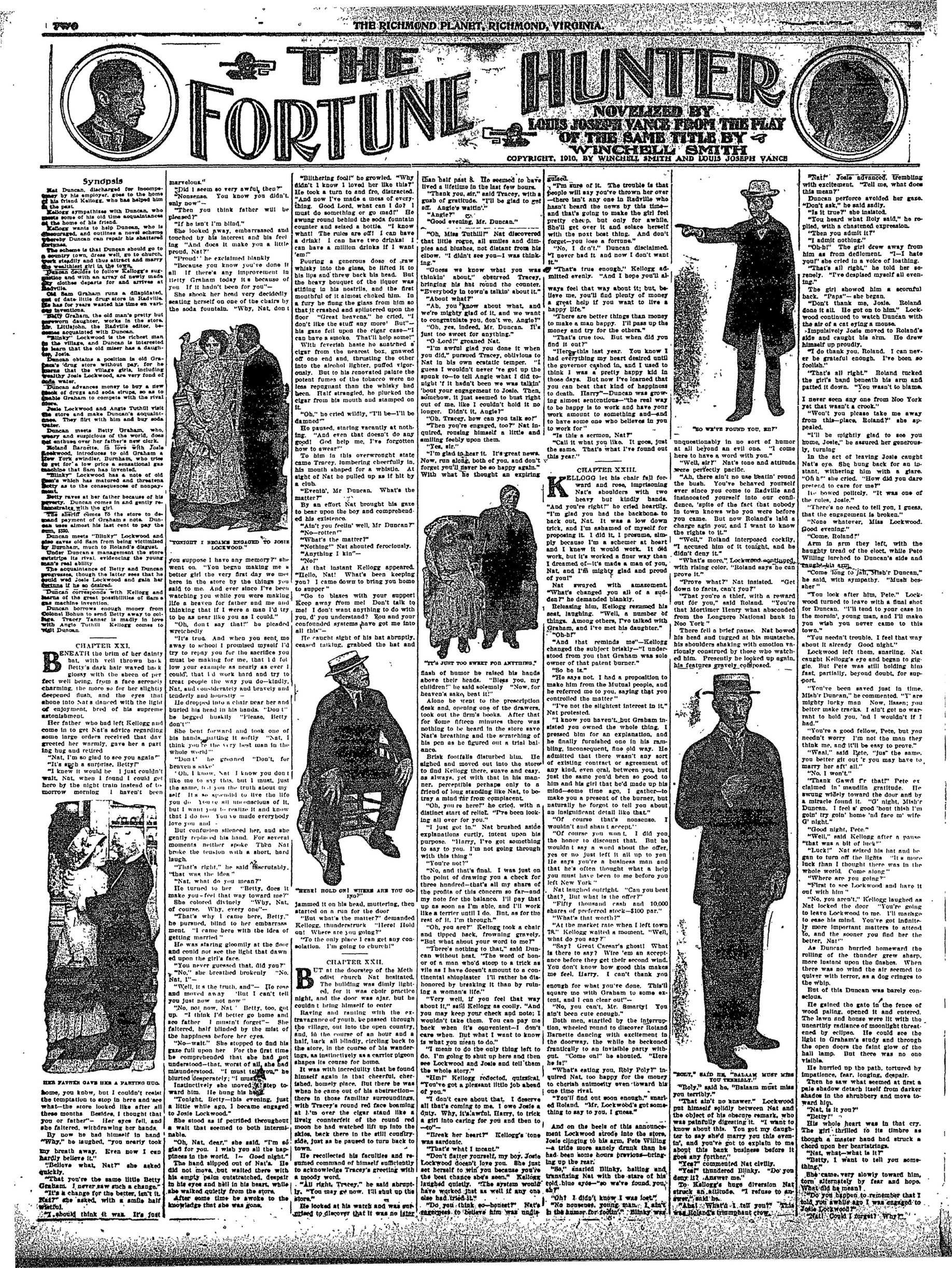
Synopsis
Nat Duncan, discharged for incompetence by his employer, goes to the home his friend Kallog, who has helped him with his work. Kallog sympathizes with Duncan, who meets some of his old time acquaintances of the home of his friend. Duncan, who is encouraged, and outlines a novel scheme whereby Duncan can repair his shattered furniture. The scheme is that Duncan should go to a dress shop, dress well, go to church, work steadily and thus attract and marry the wealthiest girl in the town. Duncan decides to follow Kallog's surge and with an array of made-up clothes departs for and arrives at Badville. Old Sam Graham runs a dilapidated, old of date little drug store in Badville and wasted his time on various inventions. BARRY Graham, the old man's pretty but worn daughter, works in the store. Littleton, the editor, becomes acquainted with Duncan. "Silky" Lockwood is the richest man in the village, and Duncan is interested to learn that the old miser has a daughter. Duncan obtains a position in old Duncan's 'drug store without pay, for he means that the village girl, including wealthy Joan Lockwood, is a very fond of
Duncan advances money to buy a new black of drugs and soda slurps, so as to enable Graham to compete with the rival Store.
The Lockwood and Angie Tuthill visit the store and make Duncan's acquaintance. They first with him and buy soda�er.
Duncan meets Betty Graham, who, weary and suspicious of the world, does not entusiasm over her father's new clerk.
Roland Barrette, 15 love with Joel and the other men, is to old Graham a few York swindler, Burham, who tries to get for a low price a sensational gas machine that Sam has invented.
"Blinky" Lockwood has a note of old Sam's which has matured and threatens Betty as to the consequences of nonpay-
Betty raves at her father because of his poverty. Duncan comes in and gently reconstructs with the girl.
The sheriff comes to the store to demand payment of Graham's note. Dunna uses almost his last cent to pay the sum, $200.
Duncan meets "Blinky" Lockwood and sales raves old Sam from being victimised by Burhan, much to Roland's disgust.
Under Duncan's management the store entirate: its rival, evideocling the young man's real ability.
The acquaintance of Betty and Duncan's people, though the latter sees that he could wed Joie Lockwood and gain her cartons. If he so desired.
Duncan corresponds with Kellogg and Barnes of the great possibilities of Barns. Duncan borrows enough money from Colonial Bohun to send Betty away to college. Tracey Tanner is madly in love with Tullah Tullah Duncan comes to well Duncan.
CHAPTER XXI
BENEATH the brim of her dainty hat, with velt worn back Bettys' dark hair waved back glossy with the sheen of perfect well being, from a face scronely charming, the more so for her slightly deepened flush, and the eyes that shone into Nat's danced with the light of enjoyment, bred of his supreme astonishment.
Her father who had left Kellogg and come in to get Nat's advice regarding some large orders received that day greeted her warmly, gave her a part in an interview, "Nat, I'm so glad to see you again"
"It's all a surprise, Betty."
"I knew it would be. I just couldn't wait, Nat, when I found I could get here by the night train instead of tomorrow morning. I haven't been
```markdown
```
HIKER PATTERN GAVE ME A PARTING GUO.
home, you know, but I could not realize the temptation to stop in here and see what—the store looked like after all three months. Besides, I thought that you or father—"Hat" her eyes fell, and she faltered, withdrawing ten hands.
By now he had himself in hand "Why." he insulted, "you nearly took my breath away. Even now I can hardly believe it."
"Bellove what, Nat?" she asked quickly.
"That you're the same little Betty Graham. I never saw such a change."
"It's a change for the better, isn't it. Half" she asked, with a smile half whisper.
"I should think it was. It's just
marvelous."
"Did I seem so very awful, then?"
"Nonsense. You know you didn't.
only now"—
"Then you think father will be pleased?"
"If he isn't I'm blind."
She looked away, embarrassed and touched by his interest and his feeling "And does it make you a little proud, Nat?" "Broud," he exclaimed blainly "because you know you've done it all the time," he improvement in itself. Gerton today it's because of you. If it hadn't been for you".
She shook her head very decidedly seating herself on one of the chairs by the acola fountain. "Why, Nat, don't
```markdown
```
"YOUNG! I BECAME ENGAGED TO JOSE LOCKWOOD."
you suppose I have any memory?" she went on. "You began making me a better girl the very first day we met here in the store by the things you said to me. And ever since I've been watching you while you were making life a heaven for father and me and thinking that if I were a man I'd try to be as near like you as I could." "don't say that!" he pleaded wretchedly.
"It's true. And when you sent me away to school I promised myself I'd try to repay you for the sacrifice you must be making for me, that I'd not low your example as nearly as ever I could. that I'd work hard and try to treat people the way you do—kindly, Nat, and considerably and bravely and tenderly and honestly.
He dropped into a chair near her and buried his head in his hands. "Dou't he begged huskily "Please, Betty don't."
She bent forward and took one of his hands, putting it softly. "Nat, I think you're the very best man in the whole world."
"Don't he greained "Don't, for heaven's sake."
"Oh, I know. Nat I know you don't like me to say this, but I must, just the same, tell you the truth about my life. It is a special kind of life you'd want in an inconsequious of it, but I want you to realize it and know that I do too. You've made everybody love you and..."
But confusion stilled her, and she gently replaced his hand. For several moments neither spoke. Then Nat broke the tension with a short, hard laugh.
"That's right," he said discreetly, "that was the idea."
"Nat, what do you mean?"
He turned to her. "Betty, does it make you feel that way toward me?"
She colored divinely. "Why, Nat, of course. Why, every one—"
"That's why I came here, Betty," he pursued, blind to her embarrassment. "I came here with the idea of getting married"
He was starting gloomily at the door and could not see the light that dawned upon the girl's face.
"You never guessed that, did you?"
"No," she breathed brokenly. "No, Nat, I."
"Well, it is the truth, and—" He rose and mourned it. "But I can't tell you just now of now."
"No, not now, Nat." Betty, too, got up. "I think I'd better go home and see father I couldn't forget." She faltered, half blinded by the mist of the happiness before her eyes.
"No-wait." She stopped to and haze gaze full upon her. For the first time he comprehended that she had not understood, that worst of all, she had misunderstood. "I must tell you," he blurted desperately. "I must
Instinctively he moved step toward him. He hung his head. "Tonight. Betty this evening, just a little while ago, I became engaged to Josie Lockwood." He stood as if perified throughout a room that seemed to both intermingle. "Oh, Nat dear," she said, "I'm so glad for you. I wish you all the happiness in the world. I — Good night."
After some time he awoke to the knowledge that she was gone.
"Biflinger fool!" he growled. "Why didn't I know I loved her like this?" He took a刀 and fro, distracted. "And now I've made a mess of everything. Good Lord, what can I do? I must do something or go mad!" He swung round behind the soda fountain counter and seized a bottle. "I know what! The rules are off! I can have a drink! I can have two drinks! I can have a million drinks if I want 'em!"
Pouring a generous dose of raw whisky into the glass, he lifted it to his lips and threw back his head. But the heavy bouquet of the liquor was stifling in his nostrils, and the first mouthful of it almost choked him. In a fury he flung the glass from him so that it crushed and splattered upon the floor "Great benvenu," he cried. "I don't like the stuff any more! But"—his gaze fell upon the cigar case—I can have a smoke. That'll help some!
With feverish haste he snatched a cigar from the nearest box, gnashed off one end and, thrusting the other into the alcohol lighter, puffed vigorously. But to his renovated palate the potent fumes of the tobacco were no leas reignant than the whisky had been. Half strangled, he plucked the cigar from his mouth and stamped on it.
"Oh," he cried wildly, "I'll be—I'll be damned"
He paused, staring vacantly at nothing. "And even that doesn't do any good. God help me, I've forgotten how to awear."
He him in this overwrought state came Tracey, lumbering cheerfully in his mouth shaped for a whistle. At sight of Nat he pulled up as if hit by a club.
"Evenbh!, Mr Duncan. What's the matter?"
By an effort Nat brought his gaze to bear upon the boy and comprehended his existence.
"An't you feelin' well, Mr Duncan?" "No—rotten."
"What's the matter?"
At that instant Kellogg appeared.
"Hello, Nat! What's been keeping you? I came down to bring you home to supper"
"Go to blazes with your supper! Keep away from me! Don't talk to me! I don't want anything to do with you, you'd understand? You and your confounded systems have got me into all this!"
He caught sight of his hat abruptly, ceased talking, grabbed the hat and
1
"HERE! HOLD ON! WHERE ARE YOU GOING?"
jammed it on his head, muttering, then started on a run for the door.
"Come on, I'm going to be commanded Kellog, thunderstruck "Here! Hold on! Where are you going?"
"To the only place I can get any consolation. I'm going to church!"
CHAPTER XXII
BUT at the doorstep of the Methodist church Nat hesitated. The building was dimly lighted, for it was choir practice night, and the door was jar, but he couldn't bring himself to enter. Raving and ranting with the extravagance of youth, he passed through the village, out into the open country, and, in the course of an hour and a half, back all blindly, circling back to the store, in the course of his wandering, as instinctively as a carrier pigeon shapes its course for home. It was with incredulity that he found himself again in that cheerful, cherished, homely place. But there he was when he came out of his abstraction—there in those familiar surroundings, with Tracey's round red face bouncing at it over the cigar stand like a lively counterfeit of the round red moon he had watched lift up into the skies, back there in the still conifer-side, just as he paused to turn back to town.
He recollected his faculties and resumed command of himself sufficiently to acknowledge Tracey's greeting with a moody word.
"All right, Tracey," he said abruptly. "You may go now. I'll shut up the store."
He looked at his watch and was surprised to discover that it was no later
COPYRIGHT, 1910, BY WINCHELL SMITH AND LOUIS JOSEPH VANCE
than half past 8. He seemed to have lived a lifetime in the last few hours.
"Thank you, sir," said Tracey, with a gush of gratitude. "I'll be glad to get off. Angie's waitin'."
"Angie?" he said.
"Good evening, Mr. Duncan."
"Oh, Miss Tuthill!" Nat discovered that little rogue, all smiles and dimples and blushes, not distant from his elbow. "I didn't see you—I was thinking."
"Guess we know what you was thinkin' about," observed Tracey, bringing his hat round the counter. "Everybody in town's talkin' about it."
"About what?"
"Ah, you know about what, and we're mighty glad of it, and we want to congratulate you, don't we, Angie."
"Yes."
"Oh, yes, indeed, Mr. Duncan. It's just too sweet for anything."
"O Lord!" groaned Nat.
"I am awful glad you done it when you did," pursued Tracey, oblivious to Nat in his own ecstatic temper.
"I guess I wouldn't ever've got up the spunk to—to tell Angle what I did tonight" it hadn't been we was talkin' "bout your engagement to Joelle. Then, somehow, it just seemed to bust right out of me, like I couldn't hold it no longer. Didn't it, Angle?"
"Oh, Tracer, how can you talk so?" "Then you are engaged, too?" Nat inquired, rousing himself a little and emiling feeble upon them.
"Yes, sir."
"I'm glad to hear it. It's great news. Now, run along, both of you, and don't forget you'll never be so happy again."
With what he thought an expiring
"IT'S JUST TOO SWEET FOR ANYTHING."
snaah of humor he raised his hands above their heads. "Bless you, my children!" he said solemnly "Now, for heaven's sake beat it!"
Alone he went to the prescription desk and, opening one of the drawers, took out the firm's books. After that for some fifteen minutes there was nothing to be heard in the store save Nat's breathing and the scratching of his pen as he figured out a trial balance.
Brisk footfalls disturbed him. He sighed and moved out into the store to find Kellogg there, save and easy, as always, yet with that in his manner, perceptible perhaps only to a friend of long standing like Nat, to botray a mind far from complacent.
"Oh, you re hero!" he cried, with a distinct start of relief. "I've been looking all over for you."
"I just got in." Nat brushed aside explanations curtly, intent upon his purpose. "Harry, I've got something to say to you. I'm not going through with this thing."
"You're not!"
"No, and that's final. I was just on the point of drawing you a check for three hundred—that's all my share of the profits of this concern so far—and my note for the balance. I pay that up as soon as I'm able, and I'll work like a terrier until I do. But, as for the rest of it, I'm through."
"Oh, you are?" Kellogg took a chair and tipped back, frowning gravely. "But what about your word to me?"
"There's nothing to that," said Duncan without hat. "The word of honor of a man who's stood to a trick as vile as I have doesn't amount to a continental shipmaster. I'll rather be dishonored by breaking it than by ruling it." "Gry well, if you feel that way about it," still Kellogg as coolly. "And you may keep your check and note; I wouldn't take them. You can pay me back when it's equivalent—I don't care when. But what I want to know is what you mean to do."
"I mean to do the only thing left to do. I'm going to shut up here and then see Lockwood and Josie and tell them the whole story."
"Him" Kellogg reflected, quizzical. "You've got a pleasant little job ahead of you."
"I don't care about that. I deserve all that's coming to me. I owe Josie a duty. Why, it's lawful, Harry, to trick a girl into caring for you and then to—to—"
"Breek her heart?" Kellogg's tone was sardonic.
"That's what I meant."
"Don't fatter yourself, my boy. Josie Lockwood doesn't love you. She just set herself to win you because you're the best chance she's seen." Kellogg laughed quietly. "The system would have worked just as well if any one else had tried it."
"Do you think so—hope? Nat's questions to believe you was unlucky."
"I'm sure of it. The trouble is that people will say you've thrown her over—there isn't any one in Radville who hasn't heard the news by this time—and that's going to make the girl feel pretty cheap, but only for awhile. She'll get over it and solace herself with the next best thing. And don't forget—you lose a fortune." No, I don't. Duncan disclaimed. "I never had it and now I don't want it."
"That's true enough." Kellogg admitted evenly. "And I hope you'll always feel that way about it; but, believe me, you'll find plenty of money a great help if you want to live a happy life."
"I'll better things than money to make a man happy. I'll pass up the money and try for the others."
"That's true too. But when did you find it out?"
"Harry this last year. You know I had everything my heart desired until the governor cashed in, and I used to think I was a pretty happy kid in those days. But now I've learned that you can beat that kind of happiness to death. Harry"—Duncan was growing almost acutuous—"the real way you can happily work with someone to something and—and to have some one who believes in you to work for"
"In this sermon, Nat"
"Call it what you like. It goes, just the same. That's what I've found out this year."
CHAPTER XXIII
KELLOGG let his chair fall forward and rose, imprisoning Nat's shoulders with two heavy but kindly hands.
"And you right?" he cried heartily.
"I'm glad you had the backbone to back out, Nat. It was a low down trick, and I'm ashamed of myself for proposing it. I did it. I presume, simply because I'm a schemer at heart and I knew it would work. It did work, but it's worked a finer way than I dreamed of—it's made a man of you, Nat, and I'm mighty glad and proud of you."
Nat swayed with amazement.
"What's changed you all of a sudden?" he demanded blankly.
Releasing him, Kellogg resumed his seat, laughing. "Well, a number of things. Among others, I've talked with Graham, and I've met his daughter."
"Oh-hi!"
"And that reminds me"—Kellogg changed the subject brakly—"I understood from you that Graham was sole owner of that patent burner."
"He says not. I had a proposition to make him from the Mutual people, and he referred me to you, saying that you controlled the matter."
"I've not the slightest interest in it." Nat protested.
"I know you haven't but Graham insisted you owned the whole thing. I pressed him for an explanation, and he finally furnished one in his rambling, inconsequent, fine old way. He admitted that there wasn't any sort of existing contract or agreement of any kind, even oral, between you, but just the same you'd been no good to him and his girl that he'd made up his mind—some time ago. I gather—to make you a present of the burner, but naturally he forgot to tell you about an insignificant detail like that."
"Of course that's nonsense. I wouldn't and shout accept."
"Of course you want. I did you, the honor to discount that. But he wouldn't say a word about the offer, yes or no you left it all up to you. He says you're a business man and that he often thought what a help you must have been to me before you left New York."
Nat laughed outright. "Can you beat that? But what is the offer?"
"Fifty thousand cash and 10,000 shares of preferred stock—$100 par." "What's that worth?"
"At the market rate when I left town 7R." Kellogg waited a moment. "Well, what do you say?"
"Say? Great Chessar's ghost! What is there to say? Wire'm an acceptance before they get their second wind. You don't know how good this makes me feel. Harry. I can't thank you enough for what you done. This'll square me with Graham to some extent, and I can clear out!" "No, you can't. Mr. Smarty! You ain't been cute enough."
Both men, startled by the insultation, wheeled round to discover Roland Barnette dancing with excitement in the doorway, the while he beckoned frantically to an invisible party without, "Come on!" he shouted, "Here he is!"
"What's eating you, Roby Poly?" inquired Nat, too happy for the money to cherish animosity even toward his one time rival.
"You'll find out soon enough," snarled Roland, "Mr. Lockwood got something to say to you, I guesa."
And on the beels of this announcement Lockwood strode into the store, Josie clinging to his arm, Pete Willing—a tride more surely drunk than he had been some hours previous—bringing up the rear.
"So, snarled Bilinky, hailing and transmitting Nat with the star of his blue eyes—so we were found, you say?
Oh! I didn't know. I was lost!"
"No nonsense, young man. I am in the humor for you." Bilinky was.
```markdown
```
"NO WE'VE FOUND YOU, ENT"
unquestionably in no sort of humor at all beyond an evil one. "I come here to have a word with you."
"Well, sir!" Nat's tone and attitude were perfectly pacific.
"Ah, there isn't no use beating' round the bush. You've behaved yourself ever since you come to Radville and insinulated yourself into our confidence, spite of the fact that nobody in town knows who you were before you came. But now Roland's laid a charge again you; and I want to know the rights to it."
"Well, Roland interposed cockily, 'I accused him of it tonight, and did him say it.'"
"What's more," Lockwood continued, with rising color. "Roland says he can prove it."
"Prove what?" Nat insisted.
"Get down to facts, can't you?"
"That you're a thief, with a reward out for you," said Roland. "You're that Mortimer Henry what abscended from the Longuque National bank in Noo York."
There fell a brief pause. Nat bowed his head and tugged at his mustache. his shoulders shaking with emotion rassiously construed by those who watched him. Presently he looked up again, his features gravely corrobed.
```markdown
```
"BOYL," said HIM, "BALAAM MUST MISS YOU TERRIBILLY."
"Holy," said he. "Palam must miss you terribly."
"That ain't no answer." Lockwood put himself solidly between Nat and the object of his obscure remark, who was painfully digging it. "I want to know about this. You got my daughter to say she'd marry you this evening, and you've got to explain to me about this bank business before it gets spawned."
"Yes," commented Nat clutty.
"Yes," thundered Dilhky. "Do you deny it? Answer me."
To Kallogy's huge diversion Nat struck an attitude. "I refuse to answer," said he.
"Ah! What's it, tell you?" This was Holland's trumpet cew.
"Nait" Joelo advanced, trembling with excitement. "Tell me, what does this mean?"
Duncan perforce avoided her gaze. "Don't ask," he said sadly. "Is it true?" she insisted. "You heard what Roby said," he replied, with a chastened expression. "Then you admit it!"
"Is admit nothing."
"Oh-bi!" The girl drew away from him as from depletion. "I—I hate you!' she cried in a voice of loathing. "That's all right." he told her serenely. "I've deplied myself all evening."
The girl] showed him a scourful back. "Papa!" she began.
"Don't thank me, Josie. Roland done it all. He got on to him." Lockwood continued to watch Duncan with the air of a cat crying a mouse.
"Impulsively Josie moved to Roland's side and caught his arm. He drew himself up proudly.
"I do thank you. Roland. I can never be grateful enough. I've boon so foolish."
"That's all right." Roland tucked the girl's hand beneath his arm and patted it down. "You wasn't to blame.
I never see any one from New York yet that wasn't a crook."
"Won't you please take me away from this—place. Roland?" she appealed.
"I'll be mighty glad to see you home, Josie," he assured her generously, turning
In the act of leaving Josie caught Nat's eye. She shung back for an instant, withering him with a glare. "Oh h!" she cried. "How did you dare pretend to care for me?"
He bowed politely. "It was one of the rules, Josie."
"There's no need to tell you, I guess, that the engagement is broken."
"None whatever, Miss Lockwood. Good evening."
"Come, Roland!"
Arm in arm they left, with the haughty tread of the eloc, while Pete Willing latched to Duncan's side and taught his arm.
"Come long to jah, Mish'r Duncan," he said, with sympathy. "Mush'bessher."
"You look after him, Pete." Lockwood turned to leave with a final shot for Duncan. "I'll tend to your case in the morning," young man, and I'll make you wish you never came to this town."
"You needn't trouble. I feel that way about it already Good night."
Lockwood left them, snarling. Nat caught Kellogg's eye and began to giggle. But Pete was still holding him flat, partially, beyond doubt, for support.
"You've been saved just in time, Mish'r Duncan," he commented. "We are mighty lucky man. Now, lissen; you better make tracks. I ain't got no warrant to hold you. 'nd I wouldn't if I had."
"You're a good fellow, Pete, but you needn't worry. I'm not the man they think me, and I'll be easy to prove."
"Waal," said Pete, "just the same, you better git out 'r you may have to marry her off all."
"No, I won't."
"Thank Gawd fr that!" Pete exclaimed in maudlin gratitude. He swung widely toward the door and by a miracle found it. "G' night, Mishir Duncan. I feel's good 'bout this I'm goin' try gain' home 'nd face 'm wife G' night."
"Good night, Pete."
"Well," said Kellogg after a pause "that was a bit of luck."
"Luck!" Nat seked his hat and he gan to turn off the lights. "It a more luck than I thought there was in the whole world. Come along."
"Where are you going?"
"First to see Lockwood and have it out with him."
"No, you aren't." Kellogg laughed an Nat locked the door. "You're going to leave Lockwood to me. I'll manage to ease his mind. You've got infinitely more important matters to attend You, and the sooner you find her the better, Nat."
As Duncan hurried homeward the rolling of the thunder grew sharp, more instant upon the flashes. When there was no wind the air seemed to quiver with terror, as a dog cringes to the whip.
But of this Duncan was barely conscious.
He gained the gate in the fence of wood paling, opened it and entered. The lawn and house were lit with the unearthly radiance of moonlight threatened by eclipse. He could see the light in Graham's study and through the open doors the faint glow of the hall lamp. But there was no one visible.
He hurried up the path, tortured by impatience, fear, longing, despair.
Then he saw what seemed at first a pale shadow detach itself from darker shades in the shrubbery and move toward hip.
"Nat, is it you?"
"Not?"
"Hate."
His mole heart was in that cry. The girl thrilled to its timbre as though a master hand had struck a chord upon her heartstrings.
"What what-what is it?"
"Better, I want to tell you something."
She came, very slowly toward him, torn alternately by fear and hope. What did he mean?
"Do you happen to remember that I told you awhile ago I was engaged to Jodie Lockwood?"
"Nail Could I forget? Why?"
---
"Because it's broken off, Betty." "Broken off. How? Why?" "Because it had to be, sweetheart—because I love you." She was close to him then. Her uplifted face shone like marble in the fading light.
"Nat, I-1 don't understand." "Then listen. I must tell you. It was all a plan, a scheme, my coming here, Betty. Everything I did, said, thought, was part of a contemptible trick. I meant to marry Jock-Lockwood, whom I'd never seen, for her money. Now you know what I was.
44
"BECAUSE I LOVE YOU."
dear. But it's different now. I'm not the same man who came to Radville ten months ago. I've learned a little to understand the right, I hope. I've learned to love and reverence goodness and purity and unselfishness, and—and I want to be a man, the kind of man you thought me, a man worthy of you and your love, Betty, because I love you. I want you to be my wife. And—oh, Betty, Betty—I need you to help me!
His voice broke. He waited, every nerve and fiber of him tense for her answer. While he had been speaking the onrush of the storm had blotted out the moon. There was only darkness there in the garden—deep, dense darkness—so thick he could not even see the shimmer of her dress.
Then suddenly she was in his arms, shaking and sobbing, straining him to her.
"Oh, Nat, my Natl I've loved you
from the first day I ever saw you!
You know I have."
"Better—welcomeheart!"
There came an abrupt, furious patter of heavy drops of water beating upon the foliage, splashing and rebounding from the house.
"Forever and ever, Nat?" "Forever and ever and a day, my dear—my dear."
A little later an anxious voice—old Sam's—hailed them from the house.
A
THEY WERE UNCONSCIOUS OF THE DOWN-POUR.
but was drowned by the downpour.
They were as unconscious of it as of the storm.
So that presently old Sam had to run down the path with a big umbrella to shield them until they should come to their senses.
THE END.
Origin of the Turban
The origin of the turban must be looked for not, as commonly believed, among Moslems, but as a sign of authority and honor dating back to the earliest periods of Jewish history. The term used in the Hebrew Bible for putting on the bonnet of the high priest is from a root meaning "to bind round." The words miter, hood, diadem, as used in the Old Testament, are only variations of the word turban. Jerome tells us that the turban has a place in the most ancient records of history. The variations as adopted by Mohammadians are many. Their own authorities hint at a thousand methods of arranging the turban, which show not only the tribe and religious distinction, but even the personal peculiarities of the wearer. An old legend traces the turban to an act of desperate courage recorded of the ancient Levantines. A brave band of warriors are said to have wrapped their winding sheets round their heads as they devoted themselves to certain death to save their comrades on the tatlinfield.
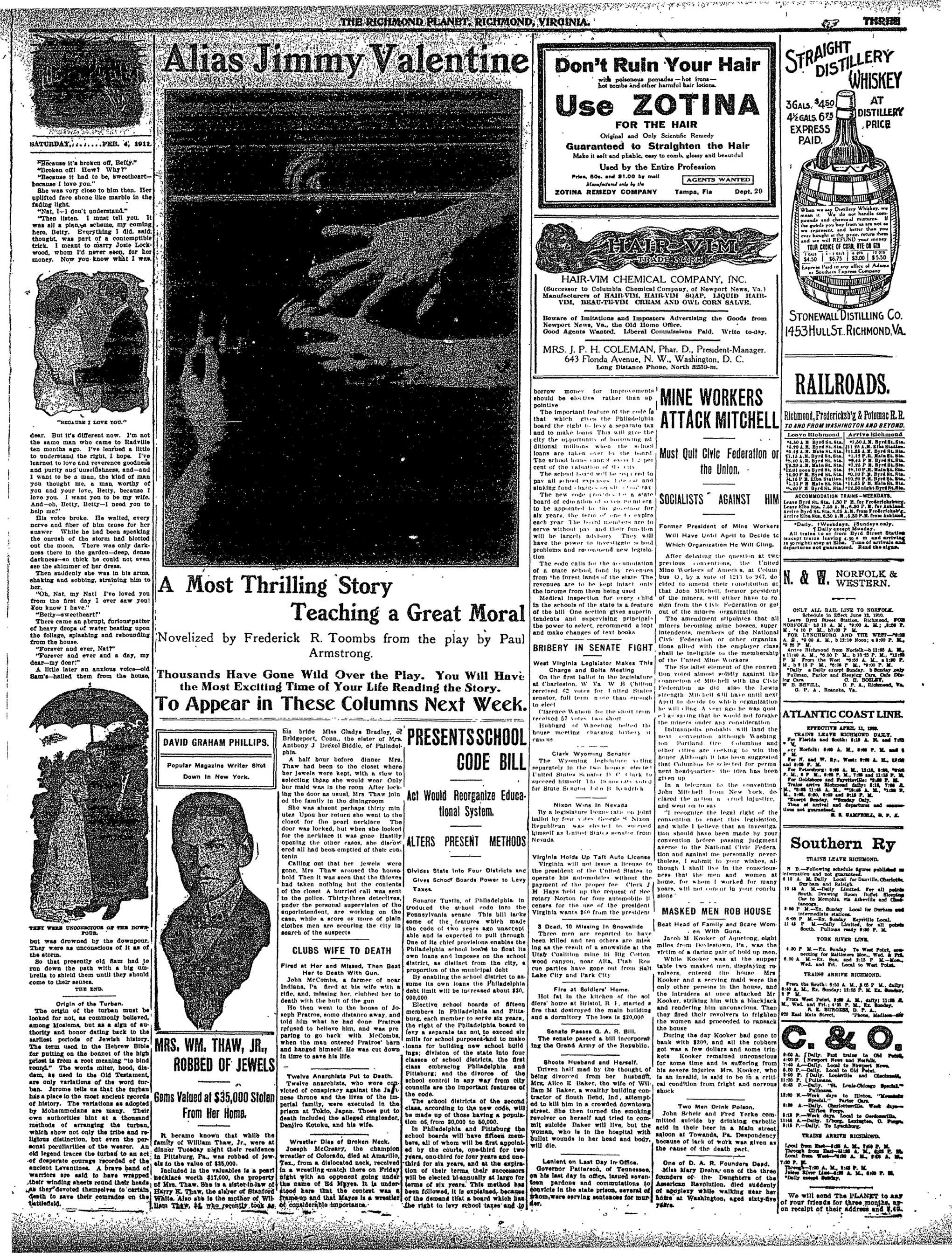
Alias Jimmy Valentine
A Most Thrilling Story Teaching a Great Moral
Novelized by Frederick R. Toombs from the play by Paul Armstrong. Thousands Have Gone Wild Over the Play. You Will Have the Most Exciting Time of Your Life Reading the Story. To Appear in These Columns Next Week.
Popular Magazine Writer Shot Down In New York.
[Pictorial portrait of a young man in formal attire].
MRS. WM. THAW, JR.,
ROBBED OF JEWELS
Gems Valued at $35,000 Stolen
From Her Home.
R became known that whilst the family of William Thaw, Jr., were at dinner Tuesday night their residence in Pittsburgh, Pa., was robbed of jewels to the value of $25,000.
Included in the valuables is a pearl necklace worth $17,000, the property of Mr. Thaw. Bhs is a sister-in-law of Harry K. Thaw, the slayer of Stanford White. Also bhs is the mother of William Thaw, $2, who recently took as
his bride Miss Gladys Bradley, of Bridgeport, Conn., the slater of Mrs Anthony J Drexel Biddle, of Philadelphia.
A half hour before dinner Mrs. Thaw had been to the closet where her jewels were kept, with a view to selecting those she would wear Only her maid was in the room After locking the door as usual, Mrs Thaw joined the family in the diningroom. She was absent perhaps thirty minutes Upon her return she went to the closet for the pearl necklace. The door was locked, but when she looked for the necklace it was gone Hastily opening the other cases, she discovered all had been emptied of their contents.
Calling out that her jewels were gone, Mrs Thaw aroused the household Then it was seen that the thieves had taken nothing but the contents of the closet A burried call was sent to the police. Thirty-three detectives, under the personal supervision of the superintendent, are working on the case, while a score or more of plain clothes men are scouring the city in search of the suspects
CLUBS WIFE TO DEATH
Fired at Her and Missed, Then Beat
Her to Death With Gun
He to Death With Gun.
John McCombs, a farmer of near Indiana, Pa. fired at his wife with a rifle, and missing her, clubbed her to death with the butt of the gun.
He then went to the house of Joseph Pratros, some distance away, and told him what he had done Pratros refused to believe him, and was paring to go back with McCombs, when the man entered Pratros' barn and hanged himself. He was cut down in time to save his life.
Twelve Anarchists Put to Death.
Twelve anarchists, who were convicted of conspiracy against the Japanese throne and the lives of the imperial family, were executed in the prison at Tokio, Japan. Those put to death included the allied ringleader, Denjiro Kotoku, and his wife.
Wrestler Dies of Broken Neck.
Joseph McCreary, the champion wrestler of Colorado, died at Amarillo, Tex., from a dislocated neck, received in a wrestling match there on Friday night with an opponent going under the name of Ed Meyers. It is understood here that the content was a frame-up and that Mayes is a wrestler of considerable importance.
Act Would Reorganize Educational System.
Divides State Into Four Districts and Gives School Boards Power to Levy Taxes.
Renator Tustin, of Philadelphia, introduced the school code into the Pennsylvania senate. This bill lacks some of the features which made the code of two years ago unacceptable and is expected to pull through. One of its chief provisions enables the Philadelphia school board to float its own loans and imposes on the school district, as distinct from the city, a proportion of the municipal debt.
By enabling the school district to assume its own loans the Philadelphia debt limit will be increased about $30,000,000.
Elective school boards of fifteen members in Philadelphia and Pittstburg, each member to serve six years, the right of the Philadelphia board to levy a separate tax not to exceed six mills for school purpose and to make loans for building new school buildings; division of the state into four classes of school districts, the first class embracing Philadelphia and Pittstburg; and the divorce of the school control in any way from city councils are the important features of the code.
The school districts of the second class, according to the new code, will be made up of those having a population of, from 20,000 to 50,000.
In Philadelphia and Pittsburgh the school boards will have fifteen members, all of whom will be first appointed by the courts, one-third for two years, one-third for four years and one-third for six years, and at the expiration of their terms, their successors will be elected bi-annually at large for terms of six years. This method has been followed, it is explained, because of the demand that a board which has the right to levy school taxes and in
HAIR-VIM CHEMICAL COMPANY, INC.
(Successor to Columbia Chemical Company, of Newport News, Va.)
Manufacturers of HAIR-VIM, HAIR-VIM SOAP, LIQUID HAIR-VIM, BEAU-TE-VIM CREAM AND OWL CORN SALVE.
Beware of Imitations and Imposters Advertising the Goods from Newport News, Va., the Old Home Office.
Good Agents Wanted. Liberal Commissions Paid. Write to-day.
MRS. J. P. H. COLEMAN, Phar. D., President-Manager.
643 Florida Avenue, N. W., Washington, D. C.
Long Distance Phone, North 3250-m.
borrow money for improvements should be elective rather than apointive
The important feature of the code is that which gives the Philadelphia board the right to levy a separate tax and to make loans. This will give the city the opportunity of borrowing additional millions when the school loans are taken over by the board. The school loans can exceed 1.2 percent of the valuation of the city.
The school board will be required to pay all school expenses, interest and sinking fund charges, all school tax.
The new code provides for a state board of education of seven purrums to be appointed by the governor for six years, the term of one to expire each year. The board members are to serve without pay and their function will be largely advisory. They will have the power to investigate school problems and recommend new legislation.
The code calls for the accumulation of a state school fund by revenues from the forest lands of the state. The revenues are to be kept intact only the income from them being used. Medical inspection for every child in the schools of the state is a feature of the bill. One section gives superintendents and supervising principals the power to select, recommend a loft and make changes of text books.
BRIBERY IN SENATE FIGHT
West Virginia Legislator Makes This
Charge and Bolts Meeting
On the first ballot in the legislature at Charleston, W. Va. W B Chilton received 62 votes for United States senator, full term note than enough to elect
Clarence Watson for the short term received 57 votes two short
Hubbard of Wheeling bolted the house meeting charging battery in canons
Clark Wyoming Senator
The Wyoming legislature voting separately in the two houses elected United States Senator D C Clark to succeed himself The Democrats voted for State Senator John B Kendrick
---
Nixon Wine In Nevada
By a legislature nominate on joint ballot by four votes George S. Nixon Republican was elected to succeed himself as United States senator from Nevada
Virginia Holds Up Taft Auto License
Virginia will not issue a license to the president of the United States to operate his automobiles without the payment of the proper fee. Clerk J M Hays hold up the request of Secretary Norton for four automobile licenses for the use of the president Virginia wants $60 from the president
3 Dead, 10 Missing in Snowslide
Three men are reported to have been Killed and ten others are missing as the result of a snowslide at the Utah Coalition mine in Big Cotton wood canyon, near Alta, Utah Rose parties have gone out from Salt Lake City and Park City
Fire at Soldiers' Home
Hot fat in the kitchen of the soil diers' home at Bristol, R. I., started a fire that destroyed the main building and a dormitory. The loss is $20,000.
Senate Passes G. A. R. Bill.
The senate passed a bill incorporating the Grand Army of the Republic.
Shoots Husband and Herself.
Driven half mad by the thought of being divorced from her husband,
Mrs. Alice E. Baker, the wife of William M. Baker, a wealthy building contractor of South Bend, Ind., attempted to kill him in a crowded downtown street. She then turned the smoking revolver on herself and tried to commit suicide Baker will live, but the woman, who is in the hospital with bullet wounds in her head and body, will die.
Lenient on Last Day In Office
Lenton on Last Day in Office.
Governor Patterson, of Tennessee,
on his last day in office, issued seventen
pardons and commutations to
convicts in the state prison, several of
women, were serving sentences for murder.
MINE WORKERS
ATTACK MITCHELL
Must Quit Civic Federation or the Union.
SOCIALISTS AGAINST HIM
Former President of Mine Workers Will Have Until April to Decide to Which Organization He Will Cling.
After debating the question at two previous conventions, the United Mine Workers of America, at Columbus O., by a vote of 1213 to 367, decided to amend their constitution so that John Mitchell, former president of the miners, will either have to resign from the Civic Federation or get out of the miners' organization
The amendment stipulates that all miners becoming mine bosses, super intendents, members of the National Civic Federation or other organizations allied with the employer class shall be inteligible to the membership of the United Mine Workers. The Socialist element of the convention voted almost solidly against the connection of Mitchell with the Civic Federation as did also the Lewis strength Mitchell will have until next April to decide to which organization he williling. A year ago he was quoted as saying that he would not forsake the miners under any consideration. Indianapolis probably will land the next convention although Washington Portland the Columbus and other cities are seeking to win the honor. Although it has been suggested that Columbus be selected for permanent headquarters the idea has been given up.
In a telegram to the convention John Mitchell from New York, declared the action a cruel injustice, and went on to say
"I recognize the legal right of the convention to enact this legislation, and while I believe that an investigation should have been made by your convention before passing judgment averse to the National Citie Federation and against me personally nevertheless, I submit to your wishes, although I shall live in the consciousness that the men and women at home, for whom I worked for many years, will not contour in your conclusions."
MASKED MEN ROB HOUSE
Beat Head of Family and Scare Women. With Guns.
Jacob M. Kooker of Aquetong, eight miles from Boulestown, Pa., was the victim of a daring pair of hold up men. While Kooker was at the supper table two masked men, displaying revolvers, entered the house Mrs Kooker and a serving maid were the only other persons in the house, and the intruders at once attacked Mr Kooker, striking him with a blackjack and rendering him unconscious. Then they fired their revolvers to frighten the women and proceeded to ransack the house.
During the day Kooker had gone to bank with $300, and all the robbers got was a few dollars and some trinkets. Kooker remained unconscious for some time and is suffering from his severe injuries Mrs. Kooker, who is an invalid, is said to be in a critical condition from fright and nervous shock.
Two Men Drink Poison.
John Scholel and Fred Yorke committed suicide by drinking carbolic acid in their beer in a Main street saloon at Towanda, Pa. Despondency because of lack of work was given as the cause of the death pact.
One of D. A. R. Founders Dead.
Miss Mary Doshan-one of the three founders of the Daughters of the American Revolution, died suddenly of apopley while walking her home at Washington, aged sixty-five years.
STRAIGHT DISTILLERY WHISKEY
3GALS. $450
4½GALS. 675
EXPRESS PAID.
AT DISTILLERY PRICE
When we say Distillery Whiskey, we mean it. We do not handle compounds and chemical mixtures. If the goods you buy from us are not so we represent, and better, that you ever bought at the price, return them and we will REFUND your money.
YOUR CHOICE OF CORN, RATE ON GIN
GALS $4.50
GALS $6.75
GALS $3.00
GALS $5.50
Express Paid to any office of Adama or Southern Express Company
STONEWALL DISTILLING CO.
1453 HULL ST. RICHMOND, VA.
RAILROADS.
ACCOMMODATION TRAINS - WEENDAYS.
Leave Bydr N.H. 1.30 M. P for Fredrickshaw.
Arrive Bydr N.H. 1.25 A.M. from Frederickshaw.
Arrive Klinen N.H. 6.30 A.M. 6.30 P.M. from Ankman.
* Daily, † Weekdays, † Sundays only.
All trains to or from Bydr Street Stations
(except trains leaving 4.30 a.m and arriving
departures not guaranteed). Read the sign.
N. & W. NORFOLK & WESTERN.
ONLY ALL BAIL LINE TO NORFOLK
Arrive Richmond from Northfell-b-11:25 A. M.
11:40 A. M. 8:50 P. M. 10:25 A. M. 9:125
P. M From the Wet b-9:50 A. M. a 1:25 F.
M b 12 P. M. 9:08 F. M. 9:00 P. M.
"Pally a Daily scorpion Sunday. b Sunday only.
Plarlor, Parlor and Sleeping Dale
Diving Cura.
B. BOLEY,
W B. BEVIL, D. P. A. Richmond, Va.
G. P. A. Roanoke, Va.
ATLANTIC COAST LINE
TRIANS LEAVE RICHMOND DAILY.
For Florida and North: 8:18 A. M. and 1:58
A. M. norfolk: 8:00 A. M. 8:08 P. M. and 8:08
P. M. for N. and W. By. West: 8:08 A. M. 1:58
and 8:08 P. M.
For Petrussia: 8:08 A. M. 13:18, 8:38
P. M. 8:38 P. M. 7:18 and 11:18 P. M.
For California: 8:38 P. M. 7:18 and 11:18 P. M.
Trusle arrive Richmond daily: 8:18, 7:08
A. M. 8:18 11:48 A. M. *18:18 A. M. 7:18 P. M.
A. M. 8:38, 8:00 and 11:18 P. M.
Oceans Time of arrival and departure and commu-
nations not guaranteed.
R. R. GAMFKELL, R. P. L.
Southern Ry
TRAINS LEAVE RICHMOND.
N. B—Following schedule figures published in
information book.
10 A. M. Daily. Local for Danville, Charlotte.
Durham and Raleigh.
10 A. M. Daily. Limited. For all potside
South Drawing Room Budget Sleeping
Cabin to Memphis, Asville and Chattanooga.
8:00 P M.-R.P. Sunday Local for Durham and
intermediate stations.
6:00 P M.-Midday Killen Valley.
11:45 P M.-Midday Limited, for all pots
South. Pullins ready 8:20 P M.
YORK RIVER LINK
4.80 P M — Ex. Sunday Te West Point, Post,
for Ballardville Mon., Wed. & Fri.
6.00 A M — Ex. Bon. and 7:15 P M — Mon.
Wed. and Fri. local to West Point.
TRAINS ARRIVE RICHMOND.
From the South: 6:50 A. M. P. K. M. d. Alfay
I. M. Ex. Burden: 12:50 P. M. K. K. Burden.
I. M. M.
From West Post, 8:00 A. M. daily) 11:35 A.
M. Wed. and Fri., 4:25 P. M. Kx. Bunny.
A. R. BURGESS, D. P. A.
620 East Main Street. 'Phone, Madison—618
C & O
8:00 A. Daily. Fast trains to Old Post.
(A transport lives and Newk.
8:00 A.-Daily. Local to W. New.
6:00 P. Daily. Local to Old Post.
8:00 P. Daily. Locustville and Ocknockett.
11:00 P. Pulham.
1:12 P—Week days. Local to Gardenia.
1:13 P—Daily. Local to Gardenia. G. Furge
1:14 P—Daily. To Letchworth.
TRAINS ARRIVE RICHDOND.
Local from East—$830 A. M. $600 P. M.
Through from West—$138 A. M. $625 P. M.
Local from West—$830 A. M. $830 A. M.
We will send The PLANET to any of your friends for three months, upon receipt of their address and $46.
publishal story Saturday by JOHN MITCHELL,
JR., at Bll N. Fourth Street, Richmond, Va.
JOHN MITCHELL, JR., EDITOR.
All communications intended for publication
should be sent so as to reach us by Wednesday.
TERMS IN ADVANCE
One Copy, one year,
One Copy, eight months,
One Copy, six months,
One Copy, four months,
One Copy, three months,
One Copy,
ADVERTISING RATER
For one inch, one insertion . . . $ 1.50
For one inch each subsequent insertion . . . $ 1.50
For two inches, three months . . . $ 1.00
For two inches, six months . . . $ 1.00
For two inches, twelve months . . . $ 1.00
For two inches, twelve months . . . $ 20.00
Marriage and Funeral Notices, one inch . . . $ 10.00
Standing and Transient Notices per line . . . $ 10.
POSTAGE STAMPS OF A HIGHER DENOMINATION THAN TWO CENTS NOT RECEIVED ON SUBSCRIPTIONS.
THE PLANET is issued weekly. The subscription price is $1.50 per year in advance.
You价需 four ways by which money can be sent by mail at our risk- In a Post Office Money Order, by Bank Check or Draft, or an Express Money Order, by Mail or of these can be registered Letter.
MONEY ORDERS- You can buy a Money Order at your Post Office, payable at the Richmond Post Office and we will be responsible for its delivery.
EXPRESS MONEY ORDERS can be paited at any office of the American Express Co. the United States Expen Co. and we will be responsible for money sent by any of these companies. The Express Money Order is a safe and convenient way for forwarding money.
REGISTERED LETTER-—A Money Order, your Post Office will not within the Postmaster will Register the better you wish to send us on payment of ten cents. Then, if the Letter is lost or stolen, it can be traced. You can send money in this manner you wish to send us on payment of ten cents. We cannot be responsible for money sent in letters in any other way than one of the four ways mentioned above. If you send your money any other way, you must do it at your own
BENEWALS, ETC.—if you do not want THE PLANET continued for another year after your subscription has run out, you then can contact us. We have decided that subscribers to newspapers who do not order their paper discontinued at the expiration of time for which it has been paid are held liable for the payees. of the subscription or date when they ordr $ the paper discounted. COMMUNICATION—When writing to us to renew your subscription or to discontinue your paper, you should give your name and address in otherwise we can and your name on the cover.
CHANGE OF ADDRESS—In order to charge
the address of a subscriber, we must be sent the
former as well as the present address.
Fatered at the Post Office at Richmond, Va.
on second class matter.
SATURDAY,.....FEB. 4, 1911
A great churchman fell, when Bishop A. Grant, of Kansas City, Kansas died. The A M E. Church could ill afford to lose him at this time. He was one of the most popular leaders in the Church. It is singular that his wife should die January 14, 1911, and that he should die January 22, 1911. The two will bask in God's sunshine on the banks of the river and sing songs of the great deliverance together His remains were interred at San Antonio, Texas. We knew him well, and his words of constant approval of our years of toll and racial endeavor were sweet music to our ears.
DR. WASHINGTON'S NEW PROV
OSTION.
---
We never had any doubt but what President Taft's proposition to postpone action on National Negro Exposition, commemorative of the ninth anniversary of the freedom of the colored people of this country, would result in its failure. When he recommended that Congress appoint a commission to inquire into the advisability of doing what he said should be done, then we knew that "the jig was up," so to speak, and that the pigeon-holling of this great proposition was at hand.
Hon. R. R. Wright took this same view of the matter. The Executive Committee of the National Negro Business League, under the advice and guidance of that great leader, Dr. Booker T. Washington, now proposes a general observance throughout the country in every State, country, and city, where the local orators can unburden themselves and stir a people to action. It looks to us that this is about all that they can do. Still this will not carry out the idea of a central exposition, and the effect will not be the same.
We believe that we should have held the exposition at our own expense, and not under the guidance or at the expense of the National Government. We are able to do it, if we will, and it would be a practical example of self-help and not of out-side charity. If wealthy white men
what we have raised ourselves, so well and so good. We find that one dollar raised by oursels will go further in the equation of race progenies than ten dollars raised for us by somebody else. We see no objection.
tion whatever to the plan, proposed, but we do not regard it in any sonas as being a substitute for the expedition proposition, or that it will even in a measure accomplish the purpose set forth in the original plan for recognition, which was made to the disinguished occupant of the White House.
A CHANGE OF FRONT.
The white citizens of Newport News, Va., seem to be on the legal and proper way to keep colored people from encroaching upon choice real estate owned by white people. The following clipping explains it self.
NEWPORT NEWS, VA, Jan 27 — Property owners living in and adjacent to the section of East End, bounded by Qpk and the streets avenues and Twenty-eighth and Twenty-seventh streets are much divided as to the advisability of turning their property over to negroes for residential purposes.
Following the action of a number of persons owning property in this neighborhood, in advertising the fact that they would put their houses and lots in the hands of real estate dealers to be offered for rent or sale to negroes others have prepared a written agreement in which they declare themselves in favor of retaining the present supposed "dead line" and agreeing not to sell their holdings. Several persons who are not in favor of turning this section over to the negroes, are circulating the agreement and it is being numerously signed
There can be no lawful objection to white people refusing to sell real estate to colored people. If a white man owns property, it is for him to say whether he will sell it or not and to whom he shall sell it. After it has been transferred to another person then that person has the same right to say to whom he will or will not sell it. All "dead lines" established in this manner will necessarily be respected, but when a man says that he will use a shotgun or dynamite against a lawful purchaser of property, then he becomes a law breaker.
We are certainly pleased to know that a sane, conservative lawful policy has superceded the wild outbursts of passion which have reverberated from one section of this country to the other and which has done much to injure the reputation and good name of this enterprising city of Virginia.
It is now evident that If Dr Booker T Washington intends to surrender his political influence and prestige at Washington, his friends are determined to continue the struggle. But we have no evidence or intimidation that he intends to do anything of the kind. Dr Washington does not notice the attacks made upon him and in this he is wise. When he is fairly and squarely confronted by some person of influence and asked concerning them, he always has an evasive answer to give or is prepared to discuss some phase of the educational question.
Just now, the anti Booker T. Washingtonites have scored heavily and they are following up their advantage by removing the Philadelphia Odd Fellows Journal to Washington, under the direct influence and guidance of that "prince" of political manipulators. Hon Henry Lincoln Johnson The band is already beginning to play and a "Kilkenny cat" discord is now heard from Editor Wm Calvin Chase, once an ardent anti-Booker T. Washingtonite, but now a devotee of that great leader. Everybody knows that Editor Chase likes nothing better than a figm. He is in his glory when he can be commissioned to "go after the enemy" The idea of having another colored journal in the District may not be altogether palatable either, but anyway, Editor Chase has this to say about the matter.
Some few months ago several bishops and two other distinguished colored Americans assured President Taft that he could take all the offices from the Southern colored Americans and appoint ex-Conferendae Democrats to them, and they would see that the colored voters throughout the country would stand for it. As a guarantee of this assurance Nov. 8, 1810, nine-tenths of the colored voters in this country repudiated this now Southern propagandist. Now here comes another Richmond in the fold in the person of our young and distinguished friend, Recorder H. Lincoln Johnson, from Atlanta, Ga. He, in company with Mr. Edward H. Morris, of Chicago, who, by the way, is a supporter of the Hon. Wm. Jennings Bryan, tells the President that the entire Odd Fellow fraternity, which numbers almost three hundred thousand, will support him for President in 1812. Just when Mr. Johnson got the assurance of all these Odd Fellows, that they indorse Mr. Taft's Southern policy, and that they will support him, The Bee would like to know. Whether the three hundred thousand or more Odd Fellows appointed Mr. Johnson and Mr. Morris special envoyes to President Taft? The Bee has the highest respect for Mr. Johnson, but it must say that he
is going little too far.
Mr. Morris, being for Mr. Bryan,
he must have assured the President
TWO
that the Negro Bryan Democrats are
for him also.
The Negro is a peculiar being. If
there was a Negro graveyard association
whose business is to bury the
dead, and Mr. Johnson was president
and Mr. Morris chief grave digger,
he no doubt would assume the President
the city of the dead over which
they had supervision would vote for
the President in 1912. Why didn't
Messrs. Morris and Johnson include
the entire colored press? They had
similar authority.
When a benevolent association is
turned into a political bunco trap, it
is about time to disband it.
Mr. Morris, who denounced the
Business League as being in politics,
turns the entire Odd Fellows into a
political auxiliary to the Republican
party.
Where is the consistency?
We are not reproducing its editorial upon the officals of the Grand United Order of Odd Fellows, for the reason that much of it appears to us to be libellous, unless the pugnacious editor has facts and figures to back up his contentions and he has not taken either his fellow-journalists or the public into his confidence in this matter. We are sat iself, though. Collector Whitefield McKinlay, Register of the Treasury, J. C. Nupler and other Booker T. Washington officeholders read that issue of the Washington Bee with evident satisfaction.
President Wm. H Taft has the two wings of Negro contention, practically, under one roof, and if he can call them together in a conference and bring harmony of action in their future efforts, he will have gone a long way towards solidifying the colored vote for himself and that portion of the Republican party, which he represents. The way the matter now stands, when the President names one colored man for office, all of the colored leaders on the other side set up a cry that he has made a mistake, and if he names the man the other fellows want he has a similar cry from the other side
The officeseekers are now doing the race more harm than good. We shall watch with interest the editorial policy of the Old Fellows Journal, a publication which cannot consistently be carried into the political arena, being the organ of a secret society organization. If political subjects can be kept out of its columns, while it is being published in Washington, the Central City for all political action, then indeed the millennium is at hand. By the way, Hon Henry Lincoln Johnson is a "worn" political preposition and it does look as though he will go to the front as the leading colored man in the political equation. It looks to us as if he has already obtained the ear of the distinguished occupant of the White House, and that one word from him now goes further than two words from the distinguished founder and saviour of Tuskogee Institute, Alabama. Will somebody convince us that we are mistaken in our conclusions?
Exvolution of the Angle.
Apples are new in the economy of the world's use and taste. At the beginning of the last century few varieties were known, and we can go back in history to a time when all apples were little, sour and puckery—crab apples and nothing else. The crab apple was and is in its wildness nothing but a rosebush. Away back in time the wild rose with its pretty blossoms that turn to little red balls, apple flavored, and the thorny crab had the same grandmother
Cursive Error
The Rev Dr. Richard Everett Hale told how a curious error crept into the translation of the Lord's Prayer into the Delaware Indian language. The English translator led as an assistant an Indian who knew English "What is 'hallow' in Delaware?" asked the translator. The Indian thought he said "hallow" and gave him the equivalent. Therefore the Delaware version of the Lord's Prayer reads "Our Father, who art in heaven, Lallowed be thy name."
A. Corrected
"Tommy" and the teacher to a bright grammar class pupil "correct the sentence" I kissed Jennie two threes.
"I kissed Jennie three threes." replied Tommy proudly - Chicago News.
His Ad. Answered:
A man stopped at a newspaper office on his way to the theater and placed an advertisement for a boy Half an hour later one fell from the gallery into his lap
Simple
"How do you keep your razor sharp?"
"Essay enough. I hide it where my wife can't find it."—Cleveland Philp Dealer.
Miles of Them
Lady (in modern bookstore)—I wish to see all of the latest books. Salesman—Very well, madam. Will you kindly step on board this scenic railway—Life.
There is record of wheat growing in China as far back as 3000 B. O.
Wanted Her to Have the Best Neil—Rather conceited, isn't her Belle I should say. He said the best was none too good for me, and then he promised—Philadelphia Record.
It's naturally when a man speaks with our thinking that he says what he thinks—Philadelphia Record.
$3.50. PRESIDENT FREE.
FOR, WEAR, MEN.
Send Names and Addres To-day
I have a prescription for nervous debility, lack of vigor, weakened manhood, falling memory and lame back, brought on by excesses, vunnatural drills, or the follicles of youth, that has cured so many worn and nervous men right in their own homes—without any additional help or medicine—that I think every man who wishes to regain his many power and virility, quickly and quietly, should have a copy. So I have determined to send a copy of the prescription free of charge, in a plain ordinary seated envelope to any man who will write me for it.
This prescription comes from a physician who has made a special study of men and I am convinced it is the surrest act combination for the cure of deficient manhood and vigor failure ever put together.
I think I owe it to my follow man to send them a copy in confidence so that any man anywhere who is weak and discouraged with repeated failures may stop drugging himself with harmful patent modifiers, so concern what I believe is the quick-acting restorative, upholding, SPOT-TOUCH ING Remedy over devised and so cure himself at. home quietly and quickly. Just as I am, Dr. BROBINSON, $895 Luck Building, Detroit Mich., and I will send you a copy of this splendid recipe in a plain ordinary envelope, free of charge. A great many doctors would charge $8.00 to $5.00 for merely writing out a prescription like this—but I send it entirely free.
The East Indian Hair Pomade Co.
273 Morris Avenue,
Elizabeth, N. J.
The wonderful East Indian Hair Treatment is the one to use for straightening the hair growing and beautifying it. Have pretty, long and straight hair and stop it from being kinky, splitting and falling out We can give it to you. We can do anything for the hair you want done, we are hair specialists with over 15 years' experience. We have customers everywhere. We are honest with you. If we fail we will refund your money. Drop a postal before buying for testimonials. We will be glad to refer you to our list of customers. Price by mail $2.25. Last three months. But you will not regret it. Agent paid salary. Wanted everywhere.
THE EAST INDIAN HAIR
POMADE CO.
273 Morris Ave.
EYES
TESTED FREE
To See Or Not to See Is the
Question.
If your eyes feel painful, hot or uncomfortable, or if they grow weary while reading, sewing, roning or looking at near objects of any kind, or if print blurs, your eyesight is defective, and should be attended to. The sooner the better.
I test eyes free and fit glasses and spectacles of all kinds. Lenses changed, and repair work of all kinds done. Satisfaction guaranteed.
Private visits made upon request.
H. M. WILLIAMS, JR., Optometrist, a graduate of the National College of St. Louis, Mo.; also a Theological Student of Virginia Union University.
Office. 617 N. Second Street.
Hours; all day Saturday and from 2:30 to 5:30 o'clock other week days.
'Phone, Madison, 2817.
The Code of Hammurabi
The so called "code of Hammurabi" was brought to light during the excavations on the site of Babylon and is looked upon as being one of the very oldest if not the oldest of all known records. It is believed to be at least 1,000 years older than the Mosaic law. King Hammurabi reigned over Babylon about the year 2200 B. C., and the laws he inscribed on the clay tablets for the most part no doubt long abdicate that time. The Mosaic law is supposed to have been given to Israel about 2200 B. C., and it would appear, therefore, that the Hammurabi code has the much greater antiquity—New York American.
Witness My Hand
In the early days only a few scholars knew how to write. It was then customary to sign a document by smearing the hand with ink and impressing it upon the paper, accompanied by the words, "Witness my hand." Afterward the seal was introduced as a substitute for the hand mark and was used with the words above quoted, the two forming the signature. This is the origin of the expression as used in modern documents.
The Nearest "He Ever Dame to it." "Colonel," she asked, "have you ever been up in a balloon?" "No," he answered, "but I got to talk art to a Boston lady once, and she had me away up in the air inside of two minutes."—Buckle.
Perverseing mediocrity is much more respectable and, misapprehably more useful than talented necessitary.—Hamilton.
---
Employed in Making Useful and Decorative Articles.
Upholstery Trimmings, Whisk Broom Holders, Etc. to Beautify the Home—Bags For Daily Shopping Use.
It is surprising what a host of pretty and useful articles can come from the application of ingenious fingers to a goodly supply of stout cord and raffia. Merely knotting and binding, with a little crochet stitch, will produce any number of household conveniences.
Take the shopping bag shown in the illustration. This is nothing but colored cord the thickness of a shoestring double knotted in diagonal rows. The work is done with a large needle, and the stitch is something like that used in renaissance work, or the knot may
Jellyfish
simply be doubled by the fingers, working over a pencil held as support and then withdrawn. The deep fringe is merely the cord raveled all its length. The draw string is also of cord. These bags may be made as large or as small as desired and may serve every purpose from coin purse to laundry bag. When skill has been gained by experience two colors may be so combined as to form a check or plaid effect.
A whisk holder can also be made of raffia. In fact, the whisk itself can be made of this material. Make the handle of crocheted cord, giving the appearance of a buttonhole edge. This same stitch may be used to replace slot rings on the ends of shaded cord, attaching the cord to the shade and working over a brass ring. The handle of the holder is of thinner cord of two colors skinned as the old fashioned zophyr reins were knitted, and the loops at each end are of thin rope or of twisted raffia. The holder itself is simply a raffia ring, the raffia being wound over cardboard like a napkin ring.
How fringe for upholstery may be made is shown in the lower picture. The pencil is again brought-to-play, the knots being made over it before it is removed. This time the knots are single ones, giving a hammock effect.
4
Indeed, this is the hammock-wave and may be so applied. The fringing at the edge is only half raveled, and the top loops are gained by the wooden yoke which holds the whole fringe.
Any number of other articles may be made on this same general principle. The crocheted cord makes picture frames and penwiper, the knotted cord children's horse reins and pen and pencil and toothbrush holders, the raffa penwipers and blotter tops and chains for holding back lace curtains.
Scrap baskets are made entirely of the caning in two shades of straw and the variations produced by combination of material and method are endless.
All these things can be made by children—in fact, it is part of their school work in some schools for manual training—and so there is no reason why any girl or woman should not learn to do them also. In a cottage room which boasts of rag rugs and cretonne hangings these knotted and corded accessories lend a final home-spun touch to the surroundings. If you are looking for harmony and appropriateness, here is a chance to show that you can fit the "trimmings" to the background.
To Remove Mud Stains
Carbobase of soda will remove the most obetinate of mud stains. Rub off with a cloth or channel dipped in the soda, then press well on the wrong side of the material with a warm iron.
IMITATION EMBROIDERY.
Lamp Shades, Banners and Blotters
Decorated With It Can Be
Made Very Beautiful.
This is but another name for pen or
cruel painting印刻 of Queen
Anne crowel work. The style is
particularly effective for the decoration
of lamp shades, banners and blotters.
Of Anything which you may be interested in along the line of medium on high grade FURNITURE, because share's no doubt about the fact that we can save you money and offer you a greater variety from which to choose than any other concern in the South. This is due to the volume we handle and to our excellent buying facilities.
Sydnor & Hundley, Inc.,
709-711-713 E. Broad St., RICHMOND, VA.
Furniture For The Home Beautiful.
OFFICES FOR RENT.
WELL LIGHTED, WELL VENTILATED OFFICES FOR RENT IN THE NEW MECHANICS' SAVINGS BANK BUILDING.
LIGHT, HEAT AND JANITOR SERVICE INCLUDED AT A RENTAL OF FROM $5.00 PER MONTH UPWARDS. THIS IS ONE OF THE MOST PALATIAL AND CONVENIENT STRUCTURES IN THE CITY AND THE SERVICE RENDERED IS FIRST-CLASS.
Apply to the AGENTS, or to MECHANICS' SAVINGS BANK,
214 East Clay Street, Richmond, Virginia.
D. J. FARRAR, CONTRACTOR AND BUILDER.
ALL KINDS OF CARI ENTRY.
OFFICE ROOM, NO. 405, MECHANICS' SAVINGS BANK BUILDING
Phone Monroo-2037.
RESIDENCE, 610 N. FIRST STREET--SHOP IN REAR.
Phone Monroo-2160.
Special Attention Paid to the Taking of Contracts for Building of
Any Style or Architecture. Job Work is Specially.
Fine Funeral Supplies, Fine Hacks and Hoeares, First Class Service.
HIGH GRADE CASKETS AT THE LOWEST PRICES.
All Orders Promptly Attended—Either Day or Night.
Hall for Meetings and Entertainments.
NO. 9 EAST DUVAL STREET.
RESIDENCE—118 East Leigh Street.
Proceed in this manner. Sketch or stamp the design on the material and delineate it with colors prepared on the palette and used as they come from the tubes, with cure to add a few drops of turpentine whenever plush or velvet is the foundation chosen.
Fill the hollow of the pen with paint, wipe off the back and proceed to define the salient features of the birds—for instance, drawing the pen toward you with flus, even strokes so as to cause the nib to spread and form the feather stroke, which is characteristic of the method. Hold the pen with the hollow side upward, placed firmly on the material, and draw with light yet firm touches. Should the pen turn over and form blots do not attempt to take it up, but draw the pen through it as if painting until it is removed. A small brush is convenient to lay the colors on the bills and a strong, fine pen on the claws. A still finer brush, held almost straight up and down, is indispensable for marking the eyes.
A coarse pen or fine brush is useful for the leaves and branches. When working leaves with the pen the strokes should be made to represent stitches. Cover the outlines, draw the pen toward the center exactly in the same direction as the stitches would be made with the needle. To hasten the painting very large leaves are filled with a coat of color inside of the outlines with a brush, and on this streaks are made by scratching over the colored layer with a pen. On smaller surfaces a needle is needed to produce the desired roughhed effect. When once the snack is obtained the process offers no difficulty and answers very well for birds, flowers, fruit and foliage. One important rule is to allow the work plenty of time to dry to prevent any cracking, since the paint, being necessarily laid on thickly, is apt to form little rolls, which crack if touched up while damp.
CRETONNE FURNITURE SLIPS.
Attractive One Made of Bright Colors
Will Make Chairs and Couches
Look Like New.
Few women realize how pretty and practical are furniture covers made from cretonne and other figured material or more housewives, would make use of such alips in renovating old and worn furniture. Incidentally these modern "alips" can be made by a woman who has had any experience in cutting patterns. Models for chair covers, etc. can be best made by cutting a design from three cent camcric and fitting it anglly with pins to the furniture.
When the exact dimensions of each piece are complete in cambric these trial alips must be unpinned and laid on the material from which the alips are to be constructed.
It is not necessary to bind the seams in these alps. Indeed, in a figured fabric the effect of such seams is undesirable. On plain dun colored fabrics life is introduced by the use of red or blue braid on the seams.
With figured goods French seaming is best. It makes a firm and neat finish and oblates the use of another color.
In slip covers the frame of the furniture is hidden by the material. They are precisely what they are called—"slips"—which easily can be taken off and put on. They must always be large enough to allow for shrinkage when first washed.
Bapted Water
When washing blouses, fine hand-kerchiefs, lice volls, tles, etc., put a small lump of orris root in the rinsing water. This imparts a delicate violet scent to them, much more preeminent than any that can be achieved by a sachet.
To Preserve Leather
To soften boots and shoes rub castor oil thoroughly into the leather. This will renew the elasticity and life of the leather. Any ordinary oil will answer the purpose, but castor oil is the best.
HEALTH AND BEAUTY
Many people who suppose that they have heart trouble should take steps to discover whether it is the heart that needs attention and care. Nine-tenths of the so called heart troubles are due to the bad condition of the liver and stomach.
Moderate exercise means an increased appetite for nutritious food, improved digestion, and little by little, in proportion to the exercise taken, new and better tissue will be formed. For the first thing in the morning only light exercise should be taken, just enough to quicken the circulation. This should be taken before, not after, the morning bath. Any lack of symmetrical beauty in the body may be remedied by judicial exercise for the development of all undeveloped parts. These exercises should be made judiciously under the advice of a physician or physical director.
His scripses.
"Why do you suppose he got married and died of the spice?"
"He probably doesn't believe in church lotteries." - Houston Post.
Social Function in the Pan.
"Are there social divertissements for his convict?"
SATURDAY, FEB. 1911
Editor Mitchell's Long
Then the guide proceeded to lectures
He told of the principles of Mormonism,
and he invited any of the visitors
to ask questions. We asked
questions, and soon found out that
we were the only questioner. Then
we went to the graveled walk on the
outside. We were told, too, that the
Mormons could pass from one building
to the other under ground.
ALL CAN PREACH.
We were told, too, that the Mormons have no preachers or ministers. Every Mormon is supposed to be qualified for this service. There are about 12 olders. Young men go out as missionaries for the Church. They receive no compensation and they owe it a great honor-to be of service to the Church. In many instances their parents provide them with the necessary means, but they are supposed to work their way and earn their subsistence among the people where they labor. When they return after five years' service they are provided for by the Church. This story was told in plain tense language by the guide, who was one of the elders of the Church. Every Mormon gives a tenth part of all he earns to the Church. This is the way the Church is supported. There are many, explained the Elder; who cannot pay anything.
THAT MORMON TEMPLE.
We now stood by the side of the magnificent Temple, which is not now open to the public. Explanations were made of the signs and symbols on the outside. Again, the visitors were invited to ask questions, and they naturally spoke of plural marriages. The Elder explained that no longer were plurals used in questioning, though seemed to umbrare him somewhat and he was evidently tired of answering questions.
SOME OF ITS DIMENSIONS
The Temple is 188 1-2 feet long by 90 feet wide. Its greatest height is 222 feet. The foundation walls are 16 feet wide. They are 8 feet deep. Above the ground they vary in thickness from 9 to 6 feet. The stone in the building was hauled from rock quarries by oysters, and moved to the site 49 miles. It sometimes took 4 yoke of oxen to haul one stone.
BAPTIZE BY IMMERSION
The building cost four million dollars. The Elder told us too that in the Temple they baptize living people for the dead ones. That is, a man would be baptized for his son, who was dead, and vice-versa. All baptism is performed by immersion. Inside, of the Temple is a font, support structures, following extract from one of the Mormon publications will prove to be of interest, inasmuch as it relates to marriages:
MARRIAQES.
Recurring to our guide's statement that marriages were performed in the Temple a lady in the party was a common marriage are recognized there.
"No," was the answer; "unfortunately hot quite all of our young people have that standing in the Church which will entitle them to go into our Temples, but a large majority of them are married in this or in one of the three other such buildings that we have in other parts of fish. There is a difference, however, between marriages solenized in our Temple and those performed elsewhere. The same power which Christ gave to His apostles, saying, "Whatsoever ye shall seal on earth shall be sealed in heaven and whatsoever ye shall loose on earth shall be loosed in heaven," is hold in our Church today, and marriages performed by that authority are blinded for all eternity. Thus we believe that the family ties that we form in this life, and which are so dear to us, will be perpetuated beyond the grave. Those sealing ordinances are performed in our Temples, and we roar them among the most sacred ceremonies of our Church. Those of our people who are married outside our Temples are married for this life only."
DIVORCES THERE. TOO.
"Are there any divorces in your Church?" asked the newspaper man.
"Of course," was the reply, "the same power which makes the bond may also loose it; but it is only upon the gravest grounds that church divorces are granted, and they are exceedingly rare."
"Who determines who may go into your Temples?" asked the clergyman.
The guide then explained that the Mormon Church is divided into small districts called wards, each of which is presided over by three man, a bishop and his two counselors. These bishops are expected to be acquainted with, all the members of their parish, and it is from them that recommendations are obtained, certifying
worstiness, to enter, the Temple. There are about 25 of these ecclesiastical wards in Salt Lake City, and about 600 in the whole Mormon Church. In each ward they have a meeting house or chapel where Sunday Schools are held Sunday mornings, also services Sunday evenings, and a week of the Quorum of the Priesthood and of the various auxiliary organizations mentioned by our guide in the Taboracle.
HOUSE-TO-HOUSE VISITS.
In this connection it was explained that in each of these wards the bishop has laboring under him a corps of "teachers," whose duty it is to visit every member in their respective districts once a month and thus share with the presiding authority the responsibility of instructing all members in their spiritual duties and exhorting them to faithfulness. These monthly house-to-house visits unlist the services of an army of church workers. Also as these "teachers" make their visits, they are expected to take cognizance of the temporal needs of the people, and if any are found to be poor and in need of relief this fact is reported to the bishop of the ward and that the people are supplied from funds in his keep. All of this for charity is in addition to the Woman's Relief Society organization in each ward, described by our guide in the Tubernacle. The Mormon, as our scientist remarked, have certainly solved for themselves the very grave social problems of poor relief. Their system avoids the evils and dangers of promiscuous distribution of charity.
SHOULD HAVE MORE THAN ONE WIFE.
It may be well to state that the Mormons believe in polygamy—that is, they believe that a man has the right to have as many wives as no desires. They observe, the Old Dispensation and follow in the footsteps of the Israelites and other nations of the Old World. It was only when the passage of the Edmunds Act forced them to forego these bounties to them as that took place, and yet many of them openly violated the law and many of them voluntarily pleaded guilty and served long sentences in the Federal prisons for having many wives, and then they came out and lived with their wives again.
A VIRGINIA MORMON.
It was in the midst of such scenes as these that we found ourselves. Our guide became deeply interested in us, when we gave him a booklet of the Mechanics' Savings Bank and told him that we were from Virginia. He was delighted. He took our card and gave us one of his own. When we passed out of the gate we looked back and saw him showing the booklet to a group of white people, and his face was wreathed in smiles. He told us, too, that his father came from Tazowell county, Va. We took an automobile ride and we were shown the home of Brigham Young and the house in which he lived with his favorite wife, and then they showed us the houses in which his other wives lived. Each wife had her own house. Some of them are alive and well today. Then they showed us the houses of the wives of other Mormons.
TRYING TIMES FOR A POLYGAMIST.
We wondered, too, if these Mormons had the same kind of wives that man had in the section of the country in which we lived. There many have the time of their lives in getting on with one wife. What would they do with three or four wives of the same spirit and temporament? Surely God must have been with them in order to keep down, jealous between Wife No. 1 and Wife No. 2, 3 and 4. But these people have prospered. There are many fine mansions in Salt Lake City and the wives are still maintained there. Attorney Marsh said that colored women were needed in that city for wives. "Send us some colored girls out here," he said. He is a bachelor. They told us, too, that there are some frightfully deformed children among the Mormons, although we saw no evidence of this. The men were fine looking, and the earnestness shown demonstrated the determination of the people.
JACK JOHNSON'S PRÉDICAMENT
Speaking of race discrimination later, Attorney Marsh told us that there was much race prejudice there. He had a suit enclosed now as the representative of Jack Johnson and against the Orpheum Hotel. It seems that when Jack Johnson wont to Salt Lake City he went to the Orpheum Hotel. The clerk permitted him and his wife to register. Mrs. Jack Johnson is a mulatto of the most pronounced type, and cannot be distinguished from a white woman. Jack Johnson wont with her, up to her room, and then he went out again. When he returned the clerk would not permit him to go up to his room. When questioned about it, the clerk said that he thought Mrs. Johnson was a white woman and that Jack Johnson was her valet. He had no idea that she was his wife.
WIYES BURIED WITH HIM.
Jack Johnson had to seek quarters elsewhere. On this he brought suit against the hotel company, and it is still pending. During our drive we saw the tomb of Brigham Young, the founder of Salt Lake City, and the designer of the famous tabernacle. His wives, or several of them, are buried with him. We saw the monument to Brigham Young. On the tablet was the inscription that he reached that site July 24, 1837, with 147 men, 3 women, 3 children, one boat 70 men, one boat 60 men, 36 oxen, 19 cows. The Temple was commenced April 6, 1853, and completed April 6, 1893. Standing on the outside, gazing up at the massive structure, we read those words: "Holiness to the Lord—The House of the Lord: Built by the Church of Jesus Christ of Latter Day Saints."
TRYING TO DISPOSSESS THEM
We had heard of the Mormons since childhood, but we never expect
to stand within the confines of the grounds of their Temple. They had grown, wealthy and influential, and the Church was all powerful. Some Mormons had split off from the Church, and for an hour we listened to a man's oration from an automobile, discoursing upon the doctrines of Mormonism. We saw, too, here an effort being made to wrest from those who now remained loyal the political power which they now possessed and to turn over to others the vast resources and accumulations of this truly remarkable people. We visited the Salt Palace, which had previously been destroyed by fire. Later we reached our starting point and were demounted, deeply meditating, for with the night would come an address by ourselves to a Salt Lake audience. But these were not all of the surprising scenes for us in Salt Lake City.
WHITE "HOPES" NEEDED.
W. W. Naughton, in N. Y. American,
"Lest we forget." A good deal has been written and said lately about "hopes" of the white race in the pugilistic line. It all comes of the overwhelming desire to locate a pale face capable of subduing one Jack Johnson, and it almost looks as though those who wish to see the supremacy in fistlecuffs restored to the Caucasian race are overlooking the fact that Johnson is not by any means the only dark sheep in the fighting fold. There are enough colored heavyweights in sight to tour the country as a Georgia minister show if boxing should fall into disfavor.
* In addition to Johnson we have the two Sams—Langford and McVey—Joe Jeannette, and the new man, flank Griffin. And that looks like a royal spad flush.
Of this bunch, of course, Johnson is best. For second choice Sam Langford would probably receive the popular vote, although from the way the light-heavy, Hank Griffin, is coming on, it looks as though Sam has a formidable rival for the distinction of the next best in the colored philanthus. Sam McVoy is big and muscular, and when he left these hospitable shores he was not regarded as the possessor of any particular degree of class. He has, however, gained a world of experience and the confidence which is born of experience by years of milling in Paris. It stands to reason that he must have learned to crack for any of the budding hopes of the white race.
LANGFORD RANKS SECOND.
Joe Jeannette, who is a much lighter man than McVey, once beasted big Sam in a contest in Paris, and as Jeannette has been defeated a couple of times since then by Sam Langford, there is justification for classing Langford higher than other McVey or Jeannette. When bill is said, the colored heavies present a big front, and if they were to form a union for the championship of presenting the championship of the Negro race, to our of "hopes" would admit that the task of recapturing the title is not quite so easy as it might at first appear.
A glance at the pugilistic brand of "hopos," as it is at present doesn't warrant the belief that a white man is to stand for the champion in the very near future. With Tommy Burns doubtful as to his ability to take up the game again, Al Kaufman is the one on whom the sporting public places the most reliance. Al, however, has not displayed any symptoms of world-beating capacity after six years of professional fighting. He is big, brave, and bony, but as a boxer he is anything but brisk. We could get a better line on him probably if his long-threatened match with Sigm Langlford could be brought to a head and carried through.
BURNS ANXIOUS TO FIGHT.
Tommy Burns is anxious to take up the activities of the ring again, but he is the proprietor of a game kno, and is not sure whether his crippled leg will stand training. Burns was always a conscientious worker, and by the same token a capable fighter, and if he decides it is safe to go ahead with his plans for re-entering the ring, he will probably prove he can hold his own with any of the other whites who have do. It may be, though, that Burns will never be quite as good as he was before he lost the title to Johnson. After that affair he fell into flesh, and it is a notorious fact that very few ring men have over got back to their original form after taking off the weight that accustomates during a long period of idleness. The main purpose of this article is to show that as the fighting situation stands there is need for every white man's hope that can be located. Comparisons between the white and the black will make it apparent that dusky skinned heavyweights at present before the public are not inferior to the whites.
SLAYER OF HARRIS
After detectives and police had been searching for him through the night and half the day, Loroy Henderson, colored, of 931 N. Thirty-third Street, was arrested yesterday by Detective-Sergeants Wiley and Kellam and Acting Detective Atkinson on a charge of murdering Henry Harris, colored, who was stabbed to death Saturday night within a few yards of his home, 4 Hague Street, Henderson find the scene immediately after the killing, and was at last located in a boat anchored near the Richmond Cedar Works. The detectives had procured information that Henderson had been lurking in that neighborhood, and they searched several boats before they got the right one. Henderson had locked himself in, and was entled in a boat, fast sleep when one of the detectives peeled in through the window. He
was ordered to come out, and told the officers to come on the other side. But they wore them cautious for that, and under the threat of a gun, he got up and opened the door. He was shaking with fear, and came near the cellar. He was taken to the First Station, where, obstructed with the detractives, he confessed that they had the right man. He gave them a detailed account of the killing, saying that Harris had threatened him with a razor, and was in the act of cutting him when he drew his own knife in self-defense. Harris was stabbed through the heart. He walked twenty yards to his doorway, where he fell dead.—Times-Dispatch. Jan. 30, 1911.
The Dog Question in Nazareth.
Among many incidents of his wandering through Palestine, recounted by Harry Frank in the Century, is this:
"An American who was in Nazareth long ago" said a native, "told me a strange story. I did not believe him, for it cannot be true. He said that in American people buy dogs." And the mere suggestion of so indulgent a transaction sent the assembled group into perverse of laughter.
"They do," I replied.
The pompous ex-major fell into such convulsions of merriment that his round face grew the color of bursalized copper.
"Buy dogs?" roared his sons in a chorus of several languages. "But what for?"
Never having settled that question entirely to my own satisfaction, I parled it with another. "How do you get a dog if you want one?"
"W:w:w:why?" answered the eldest son, wiping the tears from his eyes, "If any one wants a dog he tells some one else and they give him one. But whoever wants a dog?"
The Widow Was Comforted.
The WINDOW is Comforted.
"That she could be willing for construction with some will put upon certain passages of Scripture," remarked a clergyman. "I remember the story of one clergyman who went to call on a woman whose husband had recently died. He had expected, quite naturally, to find her heartbroken with the burden of her sorrow and was greatly surprised when she greeted him with a very happy smile and unshered him into the parlor.
"And what was the verse, sister? required the clergyman.
"I don't remember just where to find it, replied the widow, but it was made up of—only four words—four helpful words—"Why need I care?"
Eskimo Courtship
If European death suppresses astonish, the consulting "Wet" of a bride at marriage shocks an Eskimo woman. Not only must a bride show herself unconcerning; she must: If she represents herself and tribal traditions, scream and struggle with all her might, when her wooer or his envoy enters her family residence and, laying hold upon her, drags her, usually by the topknock, to her new home. She may be presented with a new lamp and water pail by her bridegroom, and she is as a general thing mightly pleased at her change of estate. But she is far too circumspect to show her pleasure or affection and keeps up a noisy demonstration until she feels that she has done all that a well bred maid should do. If she does not exercise proper discrimination in this matter her lord sometimes scratches the soles of her feet so that she cannot run away to her parents. - Harper's Bazar.
Turner's Little Afterthought
Turner's Little Afterthought
An English critic's reference to Turner's fine picture "The Wreck Boy" reminds a faithful, newspaper reader of a curious anecdote. in"connection with it. When Turner first sent this picture to the Royal academy it was hung among several brilliantly colored pictures. On varnishing day Turner found the effect of the dull gray rendering of a stormy sea altogether spoiled by its bright surroundings. Without a moment's hesitation he painted in the lighted buoy in the foreground, and its dab of crimson light showed so brilliantly in its gloomy setting that Turner's picture became the prominent one, and its rivals on each side were cast into the shade. It is curious, if true, that the most noticeable feature of the picture should have been an afterthought.—Boston" Tran script.
The Shrewd Banker
Thirteen years ago a banker lent a farmer $1,000 with which to buy stock. The farmer, of course, gave his note. The borrower lost on the stock deal and had hard luck generally, so he couldn't pay the note. Later he went away, and after many years he made good again and returned. The banker tried to collect his note, but it was outlawed by a lapse of thirteen years. One day the banker stopped at the man's farm and admitted his fine pumpkins. The farmer made him a present of two large ones. "I'll just credit these pumpkins on your old note," the banker said. "All right," the farmer said. That revived the obligation. The banker brought suit and recovered in full for the note and interest. -Kansas City Star.
Life's Limite.
All indications point to the fact that less than ten miles below our foot a red heat is maintained permanently and within twenty a white heat. Ten miles above us we have the .pillis, cold far below zero, of interplanetary space. To what a narrow zone of delicately balanced temperature is life confused?
Lane Drawn Out
Judge-What is your name? Prisoner- J. J. J. J. John Jones. Judge- Why do you have so many J's in your name? Prisoner- The preacher who christened me stuttered, str.-London Anwmer.
New Jersey Electra Martine.
New Jersey Elects Martine.
James E. Martine, of Plainfield, was elected as the United States senator in joint session of the New Jersey legislature to succeed Senator John Kean. Martine received 47 of the 61 Democratic votes, or six more than a majority of the two houses. Three votes were cast for ex-Senator Smith and one of the Democratic members did not vote. Ex-Governor Stokes received a majority of the Republican votes, 21 out of 30 being cast for him. Seven of the ten members who voted for Smith took advantage of his releasing them and voted for Martine. The three who remained loyal to Smith were Assemblymen McGowan, Phillips and Shalvey, all of Essex, Smith's home county.
Bschank Jury Disagreea
Unable to agree on a verdict, the jury in the case of Mrs. Laura Farnsworth Schenk, tried on a charge of poisoning her husband, John O. Schenk, was discharged by Judge Jordan at Wheeling, W. Va. The case will now be redocked and retried at the next term of court unless a continuance is asked. Five minutes before the jury was called into the courtroom the attorneys for both the gate and defense petitioned the court for the discharge of the jury. As soon as the jury was discharged it was announced that they had stood eleven for acquittal and one for conviction on almost every ballot taken. It was not possible to learn the number of ballots taken.
Mine Workers Elect New President.
According to the report of the toilers which was submitted to the international convention of the United Mine Workers of America at Columbus, Ohio, John P White, of Oskaloosa, Ia., was elected international president by a majority of 26,743
Thomas L. Lewis, the present international president, who was defeated, received 72,190 votes.
Frank Hayes, of Springfield, Ill., was elected vice president over B. S McCullough, of Bay City, Mich., by a majority of 18,376 votes.
Gas Kills Three Women.
Mrs Rebecca Robinson, seventy-seven years old, her sister, Mrs. Jenile Osborne, sixty eight years old, and her daughter, Mrs. Ella Royburger, thirty five years old, were asphyxated in their house on the south side of Easton, Pa.
The, bodies of the three women were found in an upstairs room in the celler there was a motor used to regulate the supply of illuminating gas used on the south side. This machine began to leak and the gas got into their room
Aeroplane Birds From Water
The aeroplane has added another conquest to its long list of achievements on San Diego bay, Cal., when an aeroplane driven by Glenn Curtis arose from the surface of the bay, flew two miles, returned to the starting place and alighted on the water as lightly as a guill.
Trilea to Kill His Child
W J Garrison, of Wyoming, near Wilkes-Barre, Pa, while demented, tried to murder his one-year-old child by throwing it under the wheels of a street car. The child struck the side of the car, however, and escaped with only severe bruises. Dr Garrison has been arrested
Dupert Re-elected Senator
There was not an anti-Dupont loader present in the Delaware legislature at Dover when the thirty-one Republican members all voted for the powder-manufacturer, who will now go to Washington to enter upon his first full term senatorship. The vote was. Dupont, 31; Saulbury, 21.
Boy of Five Kills Grandmother.
After his father had been arrested in connection with the shooting to death of his grandmother, a five-year-old boy at Danville, Ky., confessed that he had shot her accidentally while pointing an old shotgun at her in fun. He hid in an outbuilding all right.
Force Admiral to Realgn.
Rear Admiral Edward H. Berry, former commander-in-chief of the Pacific fleet, has resigned "for the good of the service."
His resignation was accepted, to take effect Friday. This action was taken with the approval of President Taft and was announced by Secretary Meyer after the cabinet meeting. His resignation will completely separate him from the naval service and he will draw no pay from the government.
Admiral Berry's resignation follows charges of a sensational nature preferred against him by officers of his fleet. They affected his personal habits and were unprintable in detail.
Crack Post Office Safe
Safe crackers got into the postoffice at Medford, near Mount Holly, N. J., and after blowing open the safe with nitro-pycerin took all the money and stamps. Entrance was gained through a side door. The safe was completely wrecked. Postmaster Holmes has not determined the loss.
Indicted Banker Declared Bane.
Joseph G. Robin, the indicted banker, was declared nane by a jury before Judge Swann in the general sessions in New York, and will have to stand trial. The jury was but a little short of half an hour in making up its verdict.
Sapeleigh--The doctor says there's something the matter with my head. Sharp--You surely don't pay a doctor to tell you that--Boston Transcript.
How Good He Was
George-- Do you think. I'm good
enough for you, darling? Daring--No.
George, but you're too good for any
other girl--Illustrated Bits.
Count the Times a Horse Rolls.
To see a horse when out at pasture rolling on the ground and encasinging to turn over on his back is a common sight, but how many people have noticed that in doing this he observes an invariable rule? The rule is that he always rolls over either at the first of third attempt—never at the second—and more than three attempts are never made. In other words, if the horse succeeds in rolling over at the first try, well and good—that satisfies him. But if the first attempt is a failure the second one always is. Then he either rolls quite over at the third or gives it up. He never makes a fourth. If horses are rolling on sloping ground they usually roll uphill. This is more easy of explanation than the strange custom regulating the number of attempts. As to this no adequate reason has ever been offered. Will those ingenious people who tell us a dog turns around before lying down and why ducks walk behind each other in a airing instead of abreast explain why a horse never makes four attempts to roll over and never succeeds at the second?-Exchange.
Dlamages of Fear:
If you are afflicted with an unreasonable fear of anything do not waste time being ashamed of yourself; hurry at once to a doctor, advises a writer in Success Magazine. A writer in the Dietetic and Hygienic Gazette has compiled a list of fear diseases from which it appears that everything, from screaming at mice to being afraid to go home in the dark, is a well recognized mental ailment. The tramp is in reality a sufferer from erophobia, or fear of work, often, complicated with aquaphobia, which make him shun the bathtub. Sidophobia and astrophobia cause timid ladies to go into the closet when they thunders and lightens. Any number of people have cat and dog phobias. Phantophobia is what you would have if you were afraid of your shadow, while an all around unqualified coward might be called a phantophobia. The list is long and includes every human weakness except the actress' horror of publicity.
A. Useful Past.
Despite the fact that the spider, next to the mouse, is most violently stimulating to feminine sensitivity, it is an insect of a very good character. It feeds exclusively upon other freshly killed insects and they are the kinds denounced by sanitary authorities, the housefly being its favorite quarry. Its service in reducing the numbers of this pest is considerable, because the spider is always busy, and he is present in countless numbers, says Leslie's Weekly. The reason why he is not more frequently seen is that he is retiring in his habits and abuns human society quite as much as that abuns him. He seldom bites anything but food, and even when in self defense he does assert himself the result is no worse than a mosquito bite or a bee sting. The touching story of "The Spider and the Fly" was evidently intended to invite sympathy for the fly.
Buttered Side Up
One of the stories which Lyle Hutchins, the old time clockmaker of Concord, N. H., delighted to tell related to the youth of Daniel Webster.
"One day," said the old man, "while I was taking breakfast at the tavern kept by Daniel's father, Daniel and his brother Ezekiel, who were little boys with dirty faces and snarly hair, came to the table and asked me for bread and butter. I compiled with their request, little thinking that they would become very distinguished men. Daniel dropped his piece of bread on the sandy floor, and the buttered side, of course, was down. He looked at it a moment, then picked it up and showed it to me, saying:
"What a pity! Please give me a piece of bread butter on both sides; then if I let it fall one of the buttered sides will be up."
Comets of the Past Century
Comets of the Past Century.
During the pluenteenth century 235 now comets were discovered as against sixty-two in the eighteenth century. The pluenteenth century also beheld a greater number of large and brilliant comets than did its predecessor. The finest of these were the comets of 1811, 1843, 1858, 1881 and 1882. In the year 1800 only one 'periodical comet was known, Halley's. Now many are known, of which at least seventeen have been seen at more than one return to perihelion.
Alabama's Capitals.
When Alabama was a territory its capital was at St. Stephens, in Washington county. The convention that framed the constitution under which it was admitted into the Union was held in Jihaville, where the first legislature met in October, 1819, and the first governor was inaugurated. Cahaba became the seat of government in 1820. In 1825 the capital was removed to Tuscaloosa, and in 1841 it was again removed, this time to Montgomery.
Didn't Want to See Much.
"What are you wearing that monocle for?" asked the theatrical manager. "You paid to see the show?" "Yes," replied the young man, "but I can see all I want of this show with the monocle." Yonkers Statesman.
A Touch of Nature
He was the worst boy in school; she was the teacher. She was angered by his stubbornness; he was defiant. She took him to the ball for punishment. Angrily she administered the penalty, and then somehow a great wave of pigs, for the boy swept over her. She looked at the worn coat of the little fellow. She thought of the frail body deprived of nourishing food. She thought of the hard and loveless home and of the starved soul of the poor kid.
Tears sprang to the teacher's eyes as the boy wailed for further punishment. Then he saw the tears. His own eyes grew moist and overflowed. Thinking of how the poor boy had no chance, in an impulse of love she put her arms around the boy, and they cried together.
That is religion.
She and the boy both found it—Merrill (Kai) News.
AGENTS FOR THE PLANET.
RICHMOND, VA.
W. H. White, 501 W. Leigh Street.
Peter Thompson, 422 E. Marshall
Street.
R. B. Sappon, 523 N. 3d St.
E. D. Thomas, 804 St. James St.
J. J. Nixon, 406 W. Leigh St.
Wm. H. Scott, 2318 E. Main St.
Miss Ruth Cary, 1018 N. 2d St.
N. Winston, 537 Brook Avo.
J. B. M. Singleton, 28th and 9-Milo
Road.
William Simms, 2225 E. Clay St.
James Faulkner, 309 N. 1st St.
J. T. Thompson, 1409 Hull Street,
Washington Ward.
James Young, W. Broad Street.
C. J. Quirk, 124 B. 2d St.
Mrs. Edloy Green, 303 Hull Street,
Washington Ward.
Mrs. Mary M. Simms, 1417 Hull St.,
Washington Ward.
LONG BRANCH, N. J.
Josao W. Shreaves, 88 Liberty St.
DEMOPOLIS, ALA.
Miss, Mary V Freemnn, Box 224,
Jackson Street.
McDOWELL, ALA
SALT LAKE CITY, UTAH
Charles Ludwig, P. O. Box 1776.
PITTSBURG, PA.
Jos. Evang, 2602 Webster Ave.
T. H. Harrison, 1310 Wylie Ave.
PHILADELPHIA, PA.
W Schure, 1218 Pine Street.
E P Mackens, 1116 Pine Street.
James E Warwick, 254 S. 11th St.
Mrs Lavinia Aldridge, 521 S. 12th
Street.
Young & Olds, 1600 South St.
Rev W Henri Robinson, 420 S 11th
Street
NEWPORT NEWS. VA.
Freddie Smith, 1358 29th St.
O J Harris, 1128 30th St.
DANVILLE, VA.
PROVIDENCE, R I.
Douglas A. A., P A. 910 Westminster Street.
NEW YORK, N. Y.
R A. Williams, 200 W. 63d St.
J E. Schmidt, 263 W. 35th St.
Samuel W Carr, 327 W. 40th St.
Anthony Burrell, 131 W. 53d St.
LOUISVILLE, KY.
Jesse E Brown, 1216 W Green St.
HELLO
AVIATOR DROPS INTO OCEAN
Forced to Descend When Ten Miles From Havana.
WAS PICKED UP UNHURT
J A. D. McCurdy, Running Short of Oil, Gave Up Trip From Key West to Capital of Cuba.
Within ten miles of the Cuban coast and only a short distance further from his goal the Camp Columbia aviation field at Havana, Cuba, J A D. M. Curdy, the Canadian aviator run out of lubricating oil and was compelled to abandon a magnificent flight from Key West, Ha.
When he saw that he could not quite reach Havana M. Curdy alighted safely on the calm sea, and the pontoons with which it was equipped floated the airplane until the United States torpedo boat destroyer Pauling, speeding along in its wake, had overtaken the aircraft McCurdy and his biplene were taken on board neither the worse for the mission.
At first it was thought that the aviator could make a new start from the deck of the destroyer but this proved impracticable, and after considerable delay the Pauling brought both machine and aviator to Hawaii. The other boats that marked the course across the strait had in the meantime joined the Pauling and the fleet came in together. McCurdy had covered approximately eight miles when he was obliged to descend, and though he failed to meet the requirements of the competition, he accomplished a feat unprecedented in cross-sea flying. Compared with the twenty mile flights across the English channel the performance stands out as far and away more remarkable. But for a slip in the amount of supplies it is not to be doubted that the trip would have been successful.
Great disappointment was felt by the thousands who had assembled to catch a glimpse of the birdman The aviation meeting opened Sunday, but the flight of McCurdy across the Florida strait was looked farward to as the big feature to start the meet under way and give a new impetus to the art of flying in Cuba. The Paulding was about thirty miles off shore, and when she reported that the Holmont racer had passed overhead going strong, thousands of pairs of eyes were strained soward. Then there was a prolonged interval, during which there was no sight of or word from the airman. The crowd became oppressed with a premonition that an accident had occurred and there was a feeling of relief, mingled with the disappointment at the receipt of the report that he had dropped into the water, but was picked up unharmed.
The flight was for a prize of $3,000, offered by the Havana Post and $3,000 appropriated by the Havana city council
New Tariff Pact With Canada.
The administration's reciprocity agreement with Canada was submitted to congress, with a special message from President Tafte urging its prompt enactment into law.
The agreement was presented concurrently to the Dominion parliament in Ottawa and within a few days bills will be introduced in the legislative body of each government designed to make the terms of the agreement. The concurrent legislation obviates the necessity of any negotiations on the subject between the two governments.
Generally speaking, the agreement opens the markets of the United States to Canada's loading agricultural products, notably wheat and other grain and also to her dairy products, fish, eggs and poultry, sheep, cattle and other liv animals. Her rough lumber also is admitted duty free to the United States, as is her print paper and wood pulp and several other raw materials.
In return for these concessions Canada takes down the bars altogether on cottonseed oil and American fruits and some other products and grants reduced duties on agricultural implements and other manufactured articles.
On the basis of results expressed in dollars and cents, Canada seems to have a little better of the argument in the agreement, although President Taft points out in his message that the benefits to be derived by the United States cannot be computed in this way at the present. The total value of articles now durable which the United States proposes to make free under the agreement is $39,811,000, or 76.4 per cent of the total durable importations of Canada into the United States in the fiscal year 1911. The total value of articles now durable which Canada proposes to make free is, on the other hand, only $16,955,000, which is 16.5 per cent of all the durable imports into Canada from the United States in the same year. The total amount of duties to be remitted by the United States under the agreement is $4,250,000, as compared with $4,250,000 with Canada.
Railrqad Official Who Geee Prosperity Ahead.
?
DOUBLE TRACK PLANS TO COST $75,000,000 Union and Southern Pacific to Spend Huge Sum.
The executive committee of the Union Pacific and Southern Pacific invoked in New York to complete the double tracking of their lines from the Mississippi to San Francisco. The Oregon State line from the junction with the Pacific main line at Granada, West to Huntington Oregon also the tracking the Columbia river in Oregon to Portland, a total distance of 105 miles. The cost of the double tracking of the lines is determined upon will aggregate upwards of $250,000, which will be distributed over a period of five years.
In a statement accompanying the announcement of the double tracking project the president, Robert S. Lovett, commented upon the reasons that had impelled the roads to reach their decision and declared the belief of himself and his associates that present conditions considered unfavorable to the railroads, were but temporary.
POSSE KILLS TWO
Desperadoes, Father and Son, Stain
After Long Chase.
Surrounded by a pose after a chase of
thirty miles Robert Howe and his
son were killed in a pitched battle of
several hours duration near Sierra
Blanca, about two miles southwest of
El Paso, Texas.
A second son, Guy Howe, twenty-
seven years old was wounded when the
pose first overtook the Howes.
The elder Howe shot and killed
Customs Guard Thomas L. O'Connor
at Fort Hancock when O'Connor
attempted to arrest him for the killing of I K McClure a special agent of the Santa Fe railroad, at Belen, N M
College Women Flee Fire In Nighties.
College Women Fire Fires in Nighties.
The Maryland College for Women,
at Lutherville, Baltimore county Md,
was destroyed by fire, entailing a loss
of $100,000. Little of value was saved,
many of the low or more students losing
all their effects. Occupants of
North hall where the fire started, fled
in a panic some of them in their
night dresses.
Dog Saves Two Children
Hex, an overgrown St. Bernard puppy owned by David Wilson, a farmer of Botoga, N.J. saved the lives of Wilson a two children.
Harry Wilson, twelve years old, and Grace, nine years old, fell through the ice, a small pond back of the Wilson earn Hex jumped in and pulled first the boy and then the girl ashore.
Both children had swallowed a quantity of water and were helpless for a time. As soon as he had them ashore the dog ran to the farmhouse and fetched the father.
Always Losing His Boat.
A colored man calling himself,
"Captain John E. Simpson" and at
times sailing under other names has
been persistently swimming both
white and colored people in Norfolk,
Portsmouth, Nowport News and
Phoebeus. His plan has been to
represent that he has money in a
colored bank in this city. He gets his
victim to write (o)John Mitchell, Jr.
President and tell him to send him
six hundred and fifty dollars or some
like amount at once to the person
who is writing the letter or advancing
him a small sum of money until
he has gotten his money from Rich-
mond.
He alleges that he is captain of a sailing vessel, which according to his letters has been lost near Thimble Light off Buckroo Boach and as he has been carrying on this kind of swindling for about two years, that boat is presumably wrecked every two or three weeks. He seeks that the letter be sent to him in care of the person who advances the money. He never comes back to see if the money comes as he directs. We have written continuously to the people, who send these letters, but we have had quite a time to keep up with him.
Keep clear of Captain John H.
Gimpson or anybody who looks like
him.
PHILLIPS DIES OF HIS WOUNDS
Goldsborough Heid Enmity Towards Author Because Novel Contained Characters Taken From His Family.
David Graham Phillips, the novelist, who was shot six times on Monday afternoon by Fitzhugh Coyle Goldsborough in Grammercy Park, died at the Bellevue hospital in New York.
Mr Phillips had been vomiting blood during the day, which symptom told the physicians that the perforation in the lung caused by a bullet which had entered the right chest and had passed out of the body near the left shoulder blade, was not healing.
Dr Eugene Puller, Mr Phillips' personal physician, gave the patient what relief he could, but the patient's condition became especially alarming The excessive pain of his abdominal wound during the day, the constant leakage of blood into the throat from his lung and intestinal sufferings following the administration of ether on Monday, had worn the novelist out During a severe spell of coughing he died At his bedside were Mrs Frevert, his sister, Mr Harrison Phillips and Dr Puller. Stuart Beveridge who roomed with David toalam Phillips at Depau universal had been at his bedside during the day, arriving from Washington, but he was compelled to leave for Washington again shortly after wards
Many magazine writers, novelists and actors visited the hospital, but instead of the children except Senator Browne were permitted to visit the patient's room. Many of the visitors and patients had sent floral gifts, and after they learned of the death of Mr. Phillips, those were arranged about his beer.
We evidence showing that Golds borough had county toward Mr. Phillips was located but at host no one seemed able to enough of this evidence together to show why Golds borough still have gone to the extreme of seating Phillips or, for that matter why Goldborough unless his brain were normal, should hold any enquiry at all.
Straight that the Colinist shot the man who became Mr Phillips had written a novel in which characters in one of his books which Goldborough thought were taken from Goldborough's own family in Washington, where Mr Phillips lived for a short while, were repeated to Harrison Phillips, and he was asked whether or not the publishers of the book had not sent out press notices at the time the book was published to the effect that some one had objected to the novel on the score that it caricatured members of a certain family
Harrison Phillips replied that he remembered that notices of this character had been sent out when the book left the press. He was asked whether he thought these notices were merely the work of the publisher's publicity department or founded on fact. He said that so far as he remembered they were founded on fact. He said, however, that neither he nor his brother nor sister knew the Goldsborough family. It was learned also that almost a year ago Goldsborough went to the city hall to complain to Mayor Gaynor about persons annoying him. During this visit the violinist mentioned to the mayor's secretary, Mr. Adamson, the name of David Graham Phillips, but not with any especial show of antimony.
PLEA FOR EDITOR
President Taft Asked to Pardon Bocallist Serving Jail Tarm.
Representative Campbell, of Kansas, petitioned President Taft for the release from prison of Fred D. Warren, a Socialist editor. Warren was sentenced recently for having offered a reward in printed form of $1000 for the return to Kentucky of former Governor W. S. Taylor, of that state.
Grafted Bhlphone Into Arm:
Burgeons in Boston are interested in the operation that was performed by Dr. Frederick J. Cotton at the City hospital upon William Favor, in which he removed a portion of Favor's shinbone and grafted it into his arm. Favor's arm was crushed under a car. It was found necessary to take out about two and a half inches of the bone of the upper arm. A silver of bone was taken from Favor's leg and placed within the aperture of his arm. Apparently the injured man is doing well.
Canada's Trade.
Trade figures for the first nineteen months of Canada's present fiscal year show that the total trade amounted to $577,899,628, an increase of $65,511,950. The increase was entirely in imports.
Arkansas For Income Tax.
The Arkansas house of representatives wont on record in favor of the proposed income tax 'amendment to the federal constitution by a vote of $0 to $.
Severely Mauled by a Lion.
*George Gray, brother of the British foreign minister, was severely mauled by a lion near the Ai river, East Africa. He was stalking lions with Sir Alfred Poace and others, when one of the beasts chased and seized him and worried him as a cat does a moust. He was rescued with the greatest of difficulty. He is recovering.
FORD'S
HAIR POMADE
THE OLD RELIABLE DRESSING FOR
KINNY ON CURY HAIR USE MAKES
STUBBORN, NARSH HAIR SOFTER; MORE
LIABLE AND GLOSSY, EASY TO COME AND
PUT UP IN ANGLE THE LENGTH WILL
PERMIT WRITE FOR TESTIMONIES, TELLING
HOW THIS REMARKABLE BEMEDY MAKES
SHORT, KINNY HAIR GROW LONG AND
WAY, BEST POMADE ON THE MARKET
FOR DANDRUFF, ITCHING OF THE SCALP
AND FALLING OUT OF THE HAIR.
BEWARE OF IMITATIONS, GET THE
GENUINE PUT UP IN 25 AND 50+ BOTTLES
WITH CHARLES FORD'S
NAME ON-EVERY PACKAGE.
SOLD BY DRUGGISTS.
IF YOUR DRUGGIST CANNOT SUPPLY
YOU, WE WILL SEND IT TO YOU DIRECT
AT THE FOLLOWING PRICES, SMALL SIZED
BOTTLE, 25*LARGE SIZED BOTTLE,50*
THE OZONIZED OX MARROW CO.
216 LAKE ST. DEPT. 10 CHICAGO, FILL
AGENTS WANTED.
'Phone, Monroe-2636.
Office Hours: 8 A. M. to 6 P. M.
Office: Mechanics' Savings Bank
Building, Rooms 201-5, 2nd Floor.
RICHMOND. VIRGINIA.
Nelson's Hair Dressing can be
scored from the agent, Mr. Joseph
Evans, 2602 Webster Avenue, Pitts-
burg, Pa.
"I am disappointed," said the doctor, "if I don't make a hundred dollars a day."
"Oh, come off!" they cried. "What are you giving us? You know you never make a hundred dollars a day."
"I know it," he assented plaintively, "and so I'm always disappointed."
--New York Press.
Queer Custom.
Comanche Pete—Yeh, parl, I knew lul. He died with his boots on. Foreign Tourist—Deah me! How very singular! Is that one of your—aw—fads out here?—Chicago Tribune.
PETER C. HAINS, JR.
Blayer of W. E. Annis Resigns Commission In Army.
PETER H.
Haina Resigns as Army Officer.
President Taft accepted the resignation from the army of Captain Peter C. Haina, Jr., Coast Artillery Corps, effective Jan. 28.
Captain Haina is now serving a nine years' penitentiary sentence for the murder of William E. Annis at Bayridge, N. Y., in 1809.
Captain Haina shot and killed Annis in the belief that the man had conducted himself improperly with Mrs. Haina. The shooting took-place near the Bayside Yacht club as Annis was about to row out to his yacht.
The sentencing of Captain Haina did not affect his status as an army officer. He was until Monday on the records as "detailed by civil authorities," but as he was not on duty did not receive pay.
Princeton Chair For McClellan.
George B. McClellan, ex-mayor of New York, is to be professor either of public affairs or political economy at Princeofon university, unless the plans of his friends, who have been active in his behalf, go awry.
It was announced that arrangements have been made for founding the chair in the university which McClellan will occupy. He is to take up his new duties next fall at the latest.
The sum needed to endow the new professorship is $80,000, and some of the former mayor's friends several weeks ago undertook to raise this sum. Among those who were most active in the work are James Martin, whom McClellan appointed city chamberlain at the salary of $15,000 a year, and ex-Controller Herrn A. Mettz.
knights of Pythias,
This organization is one of the most powerful in the country and its progress has been phenomenal. The Grand Lodge of Virginia has jurisdiction over all of the cities and counties in this state. Thirty males are required to organize a new lodge. The benefits paid constitute one of its strongest features, but the principles are greater than anything else. Founded on Friendship, based on Charity and established on Benevolence, the respectable, upright people of a late will find it an order worthy of their heartiest support.
It pays an endowment and burial benefit of of $200.00 for all ages. It pays $4.00 per week sick dues. The badge costing 75 cents each is the
The Court
Is the Female Department of the thirty persons to organize a co- Fidelity, exercise Harmony and an endowment and burial bene- dues. The only expense for me a rosette, costing 25 cents for f.
For all information concerning
John
3'
Nothing on earth is so valuable as a b as great trouble and cost, much more is the polishing that the schools can give it. The youth. Who would choose a poor physician. And who would choose an inferior school to increase the strength of character and of usefulness?
Dorfhitory, Virginia
Va. Union
Offers the Best H
COLORED V
IT HAS A FINE ACADEMY course in completed common school subjects.
ITS COLLEGE COURSE is broad and as high as those of any college for white of the Carnegie Board.
ITS PHILOSOPHICAL COURSE has for me Baptist schools. Hebrew, Greek and all that are given here. One hundred students for the of the school.
ITS NINE GRANITE BUILDINGS, has 12,000 volumes, its able faculty and the University to offer colored young men an en- of other races.
For further information, address the Free
VIRGIN
The Courts of Calanthe
Is the Female Department of the Order. It requires a membership of thirty persons to organize a court. Its members are pledged to exhibit Fidelity, exercise Harmony and prove Love one for the other. It pays an endowment and burial benefit of $150.00. It pays $3.00 per week sick dues. The only expense for regalia is the cost of the badge, 50 cents and a rosette, costing 25 cents for funeral occasions.
For all information concerning special rates of membership in the lodges and courts, address
John Mitchell, Jr. 311 N. 4th Street.
Nothing on earth is so valuable as a human mind. If a diamond is worth polishing at great trouble and cost, much more is the value of a boy or young man worth all the polishing that the schools can give it. The best education is not too good for a promising youth. Who would choose a poor physician to save a few cents when health is in danger? And who would choose an inferior school to save a few dollars when a better school will increase the strength of character and of mind for life and prepare one for a larger usefulness?
Va. Union University Offers the Best Higher Education to COLORED YOUNG MEN
IT HAS A FINE ACADEMY course including manual training for those who have
ITS COURSE COURSE is broad and complete. Its requirements and standing are
as high as those of any college for white youth in the State, according to the rating
of its TITOLOGICAL COURSE for many years been the standard course for colored
Baptist Schools. One hundred, Greek and all the regular subjects gives in Northern Seminaries
are given here. One hundred students for the ministry are enrolled in different departments
NY NINE GRANITE BUILDINGS, its finest equipped science laboratories, its library of 12,000 volumes, its able faculty and its full courses of study enable Virginia Union University to offer colored young men an education equal to that enjoyed by the favored of other races.
For further information, address the President,
VIRGINIA UNION UNIVERSITY.
RICHMOND, VIRGINIA.
Higgins, DEALER IN
Church Hill
FUNERAL, DIRECTOR AND EM
BALMER
Open Day and Night.
Office and Warerooms:
5006 3/4 P Street
Office 'Phone, 3387-L
Residence 'Phone, 6019;
1224 St. John Street
'RICHMOND, VA.
PURE GOODS, FULL VALUE FOR
THE MONEY.
1610 East Franklin Street.
(Near Old Market.)
BIGSTONE, VIRGINIA
A. Hayes,
First-class pieces and canvases of
ALL Descriptions. I have a Spare
Robot for BODIES when the Family
have set a multitask Piece. All country
Orders are Green Special Attention.
Your Special Attention is called
to the New Style OAK OAKBEDS,
Oak and oak Me. You will be
Wished on immediately.
---
```markdown
```
KNIGHT OF FAMILY
The progr
diction
are re
of its
else.
nevola
worthy
It p
pays $
only absolutely necesa
apply at the main office.
JOHN M.
CHOICE GROCERIES,
WINES, LIQUORS
and CIGARS.
60 YEARS' EXPERIENCE
PATENTS
TRADE MARKS DESIGNS
COPYRIGHTS & C.
Anyone seeking a sticker and description may
request a patent from the Patent Office. The
invention is probably written. Communications
strict postponed. MARK ON Patents
Patents taken through Manna & Co. receive
special stock, without charge, in the
Scientific American.
Authorized by the Library of Congress.
Publication of any寄送 journal. Terms, $5 a
year for months, $4. Sold by all newspapers.
MUNN & Co. 301 Broadway, New York
Boston O. Co. 603 E. Washington, D.C.
Residence, 725 N. 2nd St.
Alpheus Scott
WM. CARTER
721 N. SECOND ST.
For Correct Plumbing,
Steam and Gas Fitting.
'Phone, Monroe-1216.
—Gend in your Subscription for
The PLANET to-day.
S. W. ROBINSON
19 & 21 N. 18TH ST.
Dealer in
Fine Wines, Liquors,
Cigars, &c.
ALL STOCK SOLD
AS QUARANTENED.
PROMPT ATTENTION.
Your Promotion is Hopefully
Sold.
#
the lodges and courts, address
I, Jr.,
Street.
THE ECONOMY,
303-5 North Third St
FINE
CLEANING, DYRING AND REPAIRING.
CHITMAN M. WHITE,
PROPRIETOR.
STRAUS' SPECIAL
Old Yacht Club.
Will Satisfy the Lover on the Right Kind of Stimulant. Special Prices We Have All Grades of Good Liquors, Cigars and Tobacco. Oall and See Us.
ISAAC STRAUS & CO.,
422 E. Broad St.,
Richmond, Virginia.
H F Jonathan
FISH, OYSTERS AND
PRODUCE.
114 N. 17th St. BIGGOMOND, VA.
ALL ORDERS WILL RECEIVE
PROMPT ATTENTION.
Long Distance 'Phone, Madison-753.
BLACKWELL & BRO.
ONE OF THE LEADING PAINTERS
PRACTICAL HOUSE AND SIGN PAINTERS, GRAINING AND GENERAL CONTRACTORS
All Work Guaranteed. Cards, Letters or Orders. Give Us a Trial You Will Never Regret It.
ADDRESS:
608 St. Peter Street, Richmond, Va.
Telephone, Madison-0588.
JURGEN'S SON
Before making your purchase you would do well to call at the most reliable furniture house in the city and see the fine line of REFRIGERATORS, MATTINGS, OIL-CLOTHS And in fact everything that is needed in house furnishings.
Of every description; also the latest designs in ROCKERS and special CHAIRS.
Our goods are the best for the price and the price is very low.
C. G. JURGEN'S SON,
ADAMS AND BROAD STRINGS
THE LAND OF THE
FUTURE
PAUL MORTON DIES SUDDENLY
President of Equitable Life Victim of Apoplexy.
WAS STRICKEN IN HOTEL
His Family Was Summoned, But He Died Before They Arrived—Was Secretary of Navy Under President Roosevelt.
Paul Morton, president of the Equitable Life Assurance Society, was stricken with apoplexy just after he had gone to the Hotel Seymour, in New York, for the purpose, his friends said, of keeping an appointment with Paul L. Kierman, the lawyer.
Mr. Morton died an hour and a half later in an apartment just vacated by Mr. Kierman earlier in the day and just a few minutes before his wife and brother, Joy Morton, of Chicago, reached the house.
Coroner Feinberg, who is a physician, and Coroner's Physician O'Hanlon agreed after they had examined Mr. Morton's body and had talked with Joy Morton concerning his brother's condition that death was caused by apoplexy due to a rupture of a blood vessel in the brain, which resulted from arterio-sclerosis, from which Mr. Morton was found to be suffering within the past month. It was explained that a hotel maid had noticed Mr. Morton apparently in a faint in the hallway outside of suite 55, on the fifth floor. This suite had been vacated by Mr. Klennan and he had moved to a larger suite. The maid notified the telephone operator, and the manager of the hotel rushed up to the fifth floor. He helped the maid to assist Mr. Morton into the vacant suite. Word was sent for Dr. Henry Pearson.
When Dr. Pearson reached Mr. Morton's bedside he was unconscious, and it was apparent to Dr. Pearson that he had suffered a stroke of apoptosis. Then word was telephoned to Mr. Morton's house and to the Metropolitan club. Mrs. Morton was informed over the phone that her husband had fainted at the Seymour, and was asked to come to the hotel at once, but he was dead before she arrived
Paul Morton was born in Detroit, May 22, 1867, and wont to Nebraska with his parents six months later. He began his railroad career in the land department of the Burlington road in Iowa. In May, 1873, he was employed in the general freight office of the Burlington road at Plattsmouth, Neb., and from there he went to the general freight office in Chicago, being appointed assistant general freight agent of the Burlington in 1878 at the age of twenty-one. He occupied this and better positions in the freight service until 1886, when, at the request of the management of the Burlington, he took the position of general passenger agent
From the position of general passenger agent he was selected for the general freight agency, and remained with the Chicago, Burlington & Quincy in that position until 1890, when he engaged in the coal and iron business as president of a coal company operating in Iowa and Illinois, and vice president of what is now the Colorado Fuel and Iron company. He remained with these companies until the end of 1895, when he accepted the vice presidency of the Atchison, Topeka & Santa Fe railway, in charge of its commercial affairs.
In 1904, largely owing to his personal friendship for President Roosevelt, he accepted the secretaryship of the navy. In doing this he sacrificed a salary of $25,000 for one of $8000.
Mr. Morton was credited with possessing an independent fortune, variously estimated from $1,000,000 to $2,000,000, having made nearly $1,000,000 on the sale of the Indiana, Illinois & Iowa railroad to the Vandorbits. In deciding regarding President Roosevelt's offer, therefore, the monetary consideration did not enter into the question. In 1805 he was elected president of the Equitable Life Assurance society at a salary of $160,000 a year. Mr. Morton, in 1880, was married to Miss Charlotte Goodrich, an accomplished and popular young woman of Chicago. They had two daughters.
Files to Ship and Back to Shore.
Eugent D. Ely accomplished a great feat of aviation when he flew twelve miles from shore to the deck of the cruiser Pennsylvania, anchored in San Francisco bay, made a perfect landing on the warship, and after timing about his machine, launched it in the air again and flew back to the starting point.
The double flight occupied only an hour and a half. The greater part of that time was contained on the cruiser in preparing for the return flight.
Ely, who is a native son and one of the Curtles school of aviators, took the air from Saliridge Field where the Thirtieth Infantry was occupied for the occasion. He got off without a kick and sped the distance of twelve miles across the bay in almost nine miles.
Ely's machine broke through the mist and swept up the bay like an enormous gull, never wavering or fainting for an instant. The air was smoky and the aviator flow low, so that it was difficult to pick him up until he was a few miles away. A blast from the Pennsylvania's alron, which was taken up by a chorus of other whistles, gave the first warning of the aeroplane's approach. At brief intervals the alron shrieked. Thon as the aeroplane soared down toward the deck of the cruiser they all let go in a mighty toot. Ely flew through the cruiser squaron vory close to the water. He approached the Pennsylvania from her bows, swept past her for a few hundred yards and then circled back, mounting slowly, and settling lightly on the big platform that covered the ship's after deck and projected far out over the stern.
Ely-landed so lightly that his blpiano was hardly shaken. His machine, a Curtiss, was especially prepared for the experiment.
Double Murder In Barnyard.
The community about Riffes Crossing, W. Va. is astounded over a murder surrounded by mystery.
The bodies of J. L. Nickol, aged fifty-two years, a carpenter and contractor, and his son-in-law, Stephen Evans, aged twenty-six years, were found, riddled with bullets, in the barnyard of W. K Eades. The criefe was committed in broad daylight and within a short distance of their own home.
Thirty-eight shot entered Evans' face and head. Both eyes were shot out and four shot entered the brain. Nickel was evidently running away from his assailant. His body was found about 200 yards from where he had been shucking corn. He had fallen face down, fourteen shot entering his back. There were also eleven shot wounds on his fingers and two on his elbow. Two shot entered his neck. As far as known no one witnessed the crime, but the shots were heard.
W. K. Eades is under arrest. The evidence against him is circumstantial. J. L. Nickel formerly lived on the land where the shooting occurred and rented from Eades. About three months ago the house was burned down and Nickel and his son-in-law moved away. Nickel had a corn crop on the Eades farm, and Nickel and his son-in-law were shucking corn when shot. It appears that bad blood had existed between Eades and the murdered man for some time.
Squawa Die to Save Bablas
In order to save the lives of their babies, two Yankton Indian women, caught in a storm on the prairie at night near Roeeland, Tripp county, South Dakota, stripped off their blankets and wrapped the little ones in them, and then crooned them to sleep, while they themselves were frozen to death.
The women, with their husbands, were driving across the country when their wagon broke down. The men went to town for help. When they returned with a rescue party one of the women was dead from the cold and the other died in a short time. Both Indian babies were unharmed.
$10,000,000 More From Carnegie.
Andrew Carnegie has announced in New York city an additional gift of $10,000,000 to the Carnegie institution at Washington, making the total endowment now $25,000,000 and bringing the amount of Mr Carnegie's philanthropies close to $200,000,000.
The Carnegie institution was founded in 1802 for the purpose of higher education and advanced research The original endowment was $10,000,000, to which further gifts were added, making it $15,000,000, until this gift was announced
Short $74,000.
The retiring state treasurer of North Dakota, G. Luther Bickford, was arrested at Blamarck on a warrant charging him with the misappropriation of a sum said to be in the neighborhood of $74,000. He was held in $10,000 bail.
A second warrant was issued by Attorney General Miller and accuses Bickford with the misappropriation of $60,400 of the state's funds. This warrant was also served on Bickford.
Boy of Five Kills Grandmother.
After his father had been arrested in connection with the shooting to death of his grandmother, a five-year-old boy at Danville, Ky., confessed that he had shot her accidentally while pointing an old shotgun at her in fun. He hid in an outbuilding all night.
unit to Make strong fights. Hobby.
A privilege of Indiana, has introduced a hill in congress making
bribery in federal elections a felony
punishable by a fine of $1000 to $6000
and imprisonment for six months
to five years.
STATUES WEAR PANTS
First of Barnard Group Put In Place With Modest Drapings.
The first of the heroic marble figures of the Barnard group of statues at the capitol building. Harrisburg, Pa., was put into place and stripped of its covering and was found to be drapped with plaster of Paris.
The treatment is in line with what Barnard is reported to have promised when his attention was called to the protests against the unity of the figures.
The men in charge of the groups say that the plaster will remain unifl orders are received from Barnard or state officials to remove it.
Child Witnesses Mother's Sulcile.
Mrs. Ida Brooks, forty-one years old,
committed sulcile by hanging herself
in the room she occupied at the home
of Mr. and Mrs. Charles Saville, at
Eighth and Crosby streets, Chester,
Pa. Mrs. Brooks, daughter, Beatrice
four years old, awakening from sleep,
saw her mother suspended upon the
closest door.
THE RICHMOND PLANET, RICHMOND, VIRGINIA.
President of Equitable Life Society Diet Suddenly.
MARCO VIVIENDA MARCO VIVIENDA
Mrs. Martin Gets Seven Years.
Seven years in prison was the sentence imposed upon Mrs. Caroline B. Martin for the part she played in the death of Ocey Snead, her daughter, by Judge Tone Eyck at Newark, N. J.
Mrs. Martin, who had pleaded non vult to manslaughter when arraigned on an indictment charging her with murder, apparently expected a much lighter sentence and became greatly agitated when she learned her fate.
The body of Ocey Snead was found in a half-filled bath tub in a partly furnished house in East Orange, N. J., Nov. 29, 1809. The indictment of Mrs. Martin, the victim's mother; Mrs. Virginia A. Wardlaw and Mrs. Mary W. Snead, Ocey's aunt and mother-in-law, for murder, followed.
Mrs. Wardlaw died in jail. Mrs. Snead faces trial, but it is said that the indictment against her will be no loose扮.
Coal Mining is Dangerous
More than 29,000 fatal accidents occurred in the coal mines of North America in the twenty years ended with 1908, according to a report of the bureau of labor.
In the decade ending with 1908 the average fatality rate in North America was 3.13 per 1000, which was higher than the fatality rate in any other important coal field in the world. In the United Kingdom the rate was 1.29 per 1000 employees; in Austria, 1.35; in France, 1.81; and in Prussia, 2.18.
Charlton Loses.
The habeas corpus proceedings that were brought by Paul Charlton to prevent the extradition of his son, Porter Charlton, to toast to stand trial there for the murder of his wife, was dismissed by Judge Rollstab in the United States circuit court at Trenton, N. J. This means that Charlton must go back to Italy unless the supreme court of the United States reverses Judge Rollstab's decision.
Lloyd-George Goming Over.
J Owen Charles, a native of Wales and now a citizen of Scranton, Pa., arrived in New York city on board the Campania, announcing that Lloyd-George, chancellor of the exchqequer, and the most distinguished Welshman in British politics, would be here in the fall to attend a Welsh festival in Luna Park, Scranton
Kent Child In 8hcd: Dice
Kaurt Stehr, three years old, of Norfolk, Neb. died from the effects of the amputation of both his feet, which were frozen several weeks ago while sleeping in an unheated woodshed Henry Stehr, the child's stepfather, is in jail, awaiting an investigation of the case.
Finde Wife Dead Beale Him.
Harry Haas, thirty four years old, of 718 Walnut street, Wilmington, Doh. awakened and found his young wife dead in their bed beside him It is said she was stricken with apoplexy. The coroner is making an investigation. Hang is under a physician's care.
Bhe Wanta a Husband.
Mrs. K. Eberhart, of Union Hill, N. J., has written to Mayor Gebhardb, of Torro Hauto, Ind., asking him to find a husband for bor.
Mrs. Eberhart says she has learned there are more men in the west than women. She writes as if she regarded Torro Hauto as a far western city.
All Mall Cars Must Be Steel.
The house of representatives at Washington, after an extensive vote, adopted a provision in the postoffice appropriation bill that after July 1, 1916, all mail cars used on interstate railroads shall be of steel construction.
Easton Minister Died in New York. Roy. Edward Snyder, of Eaton, Pa., died of heart disease in the Thirty-third street station of the Hudson river tunnels in New York. In his coat was a notebook giving his name and addresses, and asking that in case of accident-bis wife should be notified.
* Flood Victim's Bkeleton.
The skeleton of one of the victims of the Johnstown, Pa. flood has been found near New Florence, twenty-two years after the flood. The bones will be interred in Grand View cemetery, where 777 other unidentified bodies of the flood lie buried.
Famous Yachtman Dias
Captain Charles Barr, the noted American yachtman, who three times saved the American's cup, died suddenly of heart trouble at Southampton, England. Captain Barr appealed to be in perfect health and was breakfasting, with his family, when suddenly he placed a hand upon his heart and with a cry of pain, fell forward in the arms of his wife, dead.
Bid Fair to Retain Their Favor
For a Long Time.
Gowns, Hats and Wraps For Afternoon
and Evening Wear Have Elaborate Display of This Dressiest
of Materials.
The craze for velvet is unabated,
and that it will last for quite awhile
sooms to be indicated by its appearance
on hats, wraps and afternoon
gowns.
The reason for this is, of course,
easy to discern. It is to semi-dress
gowns of not too severe cut that velvet—most of all black velvet—is especially adapted.
It is pretty in the coats also. A model recently was a long coat of silver gray or tan velvet, with ratine sailor collar and cuffs. The coat itself was lined with ratine of the same shade. Black velvet edging makes an effective touch. Of course if this were an evening wrap it might boast a lighter selection of colors—say white velvet with rose lavender satin cuffs and collar. But it is very smart just as it is in the tan or gray and black.
The hat to match was one of the very new high velvet turbans. It was trimmed only by silk braid edging on the butterfly bow.
A simple rock of black velvet is a good suggestion along this line. It should be cut almost on the lines of the "robe bobe," the upper part of the blouse being of chiffon over lace, the buttons on the bib to be of dull silver.
```markdown
```
The hat should be a round clooche shape of black velvet freed with er mino and with a white chanticleer plume in back.
How velvet is used in the dressy suit is best seen in the following description. Alice blue velvet is used, but a dark blue or green would really be better. Then a sailor collar of moire to match the velvet is edged with skunk fur. Turnback cuffs match the collar in effect.
A dashing military hat of black velvet goes well with this, with a high alget either of paradise feathers or of fur made in the shape of a quill.
The figure in our illustration has a distinct charm of its own and is a one piece frock of black velvet with a bodice of tucked black chiffon over white. The buttons are again of dull silver with frogs of silver brass.
The turban is of folded black velvet trimmed with an alget in back.
These hints, should be sufficient for any woman with taste to go to the velvet counter and choose such materials as will make up a modish dress and at the same time give her pleasure in making it
Mary Dean
Eat Ginger In the Morning.
If you are inclined to feel heavy and bad tempered in the morning when you rise try taking a plier or two of preserved ginger. For some reason it seems to sweeten the temper with the digestion and makes a healthful as well as a delicious breakfast or before breakfast daltry.
To Clean Enamel.
When the enamel becomes discolored scour it with a damp fannel dipped in garden mold, then rinse it in plenty of water. In this way the cleaning is effected without causing scratches or other damage.
CARE OF SKIN IN WINTER.
Water Should Be Used Sparingly, as it Has a Drying Effect Upon Cutlure.
When a woman's face is inclined to dryness in cold weather the lee she uses water on it the better for water has a drying effect and will aggravate the condition that the other agents
which are cleansing may soothe and even heal.
A person who is willing to take the trouble to use sweet cream daily on her face will give, the best of treatment. A tablespoonful of cream is sufficient for this bath. To every tablespoonful of cream should be put ten drops of tincture, of benzolin. This latter preserves the integrity of the cream and is an excellent application.
To use this mixture a small bit of old soft linen should be saturated and the face then thoroughly wet. The throat and the flesh behind the ears should also be bathed. Then with the finger tips the surface so anointed must be rubbed gently for five minutes. This will send the cream into the pores and loosen the dust. The face must then be wet with more cream. This last wash is to remove the soiled application.
Before retiring is the best time for this work. The last anointing must remain on all night. In the morning the face should be wiped with a lotion of one-eighth glycerin, the other seven parts being rosewater. The wash is intended to have just enough glycerin in it to prevent the astirring action of rosewater.
Honey should be used more often than it is, for it is bleaching and softening. In conjunction with other materials its thickness is overcrowd.
An excellent lotion is one made of two ounces of pure honey strained, one-half ounce each of glycerin and rectified spirits, one and one half drums of pure citric acid and three drops of musk.
The honey and glycerin are put into a china cup and set into hot water to mingle. The acid is put into the spirits, and when dissolved these two mixtures are blended. This can be used both as a cream and as a cleansing agent.
Care must be taken that the honey used is pure. Some of the so called "strained" is glucose and is entirely without honey.
TEA GOWNS.
The Characterless Fluffiness of Former Days Abandoned For More Perfect Fitting Garnments.
Under the influence of the broad views that have lately been taken in matters of dress and have led to the appropriation for feminine adornment of all the forms of beauty that could possibly be adapted to that purpose the tea gown has caused to be the pretty but charmless mass of a airy fabrics it once was'. This garment, which aforestime was generally not hug more than vanity in a tangleible form has taken to itself classic simplicity and dignity. It is true that some of the new tea gowns like some of the most newest gowns for formal social funitions cannot be worn by every woman since they demand grace and a good figure. Short, stout little women will always do well to keep to the modest style, for in these they have their own peculiar charm of winnow softness, and they could never look like Greek goddesses if they tried ever so hard.
One thing that has contributed to the simplicity of tea gowns as it has to that of other gowns as well is the richness of the materials used. One worn by a matron recently was of rose satin covered with gold face and trimmed at the bottom with fur. Over this robe which was absolutely simple in cut, with an empire bodice and V shaped neck, was a long, straight, sleeveless coat of green chiffon embridered with gold and bordered with green satin. Probably few would care to go in for magnificence as this, but the model is one that can be successfully developed in almost any kind of soft silken fabric, with a touch of gold trimming to give it dignity.
Many tea gowns are made in a manner similar to the one that has been described, though the shape of the outer garment varies considerably. A very attractive one was seen that had an underrobe of pale silk and a funtie of very tinted tepee de chine. The tunic was just a straight piece of material with a hole in the middle for the passage of the head, but because of its softness its linen were exquisitely graceful.
Two Made overa
Did you know that you could make over your old t-shirt shirt waistbands for house wear in the morning? Cut out the neck at the collar band and the sleeves at the cuffs. Supply instead plain percale low collars and turnback cuffs of some contrasting color. Cut off also the skirt sections which are usually torn by plumbing and supply a belt of the percale. This belt will fasten over the skirt, thus all you will need to complete your toilet when dressing hurriedly in the morning will be a plum to hold your collar closed.
Another made-over is the apron which was originally a fligere blouse. Use the front, cutting a bib of one sleeve and the ends of the other. The back will make the belt and face the lower edge. With a little ribbon run banding and a lace ruffle here is an apron you will not be ashamed to pour ten or do embroidery in.
CONSISTENT.
I well remember when the chill
Of bleak and cold November
Came on the world, and I shook through
through the chill of November;
I pinned for summer heat and pinned
For days when I could swathe
Out in the sun and not catch cold
Each time I left my shelter.
And now that such days have arrived
And the asphalt has melted,
On all the streets and all the world
For full a month has swelled,
Troubles of life sure for
Me to rise and hike it.
For some cool place and cuss the heat
But not for me, I like it.
A Blight Jolt
Sapleigh—As I was going down the
-aw—avonice this mawning,
a woman came running afth me, don-
cher know, and—
Miss Cutting (Interrupting) - Fast
We offer you, the Latest and Most Artistic Photos, at a More
Moderate Figure than you can obtain elsewhere.
Special Attention Paid to Children. Enlarging and Copying
Interior View Work.
We will also be pleased to Quote you Prices on Exterior and
from Old Photos, A Specialty.
'Phone, 577. Richmond, Va
Funeral Director, Embalmer and Liveryman. All Orders promptly filled at short notice by telegraph or telephone. Halls rented for meetings and nice Entertainment. Plenty of room with all necessary conveniences. Large Picnic on Band Wagons for Hire at reasonable rates and nothing but first-class Carriages, Buggies, etc. Keep constantly on hand fine funeral supplies.
OPEN ALL DAY AND NIGHT—Man on Duty All Night.
W. I. JOHNSON, Funeral Director and Embalmer, Office & Warerooms, 207 N. Foushee St. Cor. Broad. HACKS FOR HIRE. Orders by Telephone or Telegraph filled. Weddings, Suppers and Entertainments promptly attended. Telephone, 686. Residence in Building.
dou me, but what lunatic asylum had
he escaped from? :
Sapleigh -Why, how did you-aw-
know she was a lunatic?
Miss Cutting -You said she was run-
ning after you, and I am sure no woman
in her right mind would do such a
thing.
A HOT TIME.
Mike—Sure, an' yez ought to blin over to the house last noight. We had a blowout
Pat- Pant was it? Her wedding anniversary"
Mike-No, the gasoline stove.
Can't Learn Too Often
Another is teaching her how to swim.
Holding her head to count her fear!
Why are I kidding a looking giunt?
Why are the manading I tugt last year.
Lord Southey's Guilding
Lord Southbury's Guilfainte.
The most recent action of an eccentric man was Lord Southbury's cool arrangement for suicide by means of a guilfainte. He had a magnificent one erected in the drawing room of his house in the Rue du Luxembourg at Paris. The machine was of ebony inlaid with gold and silver, the framework carried with artistic skill; the knife, sharp as a razor, was of polished and ornamented steel. Preparing for death, his lordship had his hair cut close, and clothed in a robe of white silk, he kneed upon the platform under the knife before a mirror and pressed the spring which should release the knife. But the spring failed to work, and the sould be suicide decided to give the guilfainte to a museum instead of making a second attempt to end his life. It is said that he made an annual pilgrimage to see the guilfainte until the end of his life.
How the Chinese Preserve Grapes.
To preserve grapes the Chinese cut a circular piece out of a ripe pumpkin or gourd, making an aperture large enough to admit the hand. The in terior is cleaned out, the grapes placed inside and the cover replaced and pressed in firmly. The pumpkins are then put in a cool place, and the grapes retain their freshness for a long time. Careful selection of the pumpkin is requisite, the common field pumpkin, however, being well adapted for the purpose.
Quite Willing to Migrate
A traveler passing through a fever infected locality said to an Irish resident:
"Fat. I'm surprised that you stay in a place where people die so thick and fast."
"Faith." rejoined Pat. "If you'll be either teller' me, say a place where people silver die 'O'll move there to mourn an' end me days."
Hla Baley Stunt
"Dad, I was simply great in relay events," boasted the boy from college. "Good enough, son! We'll make use of them talent. You ma will soon be ready to relay the carpet." "Louisville Courts Journal."
PROF. D. D. BRUCE, M. D.,
Strange, Wonderful, but True are
the Awe Stricken Tests given by
the Great Australian Medium.
PROF. D. D. BRUCE. M. D.
The Only Living Apostle of Science
of the Mystories.
$5000 IN GOLD TO ANYONE IN
the World to Compete with him.
Possessing more Power than any
four Modluma combined
No Card, Trance or Hand Humbug.
GREATEST HINDOO MEDIUM IN
THE WORLD.
So Great is his Power that he can
tell you whilo in a Clairvoyant state
all you wish to know without a word
being spoken. Come, all ye unhail-
lowers, scoffers and jeers: bring
all your scoptism with you—he will
open your eyes to the Private Chamber
Mystery. Come, all ye broken-
hearted wives, all with low spirits
and let him lift the burden from
your aching and jealous heart. He
Challenges the World to compete
with him in causing a spoody mar-
riage with the one you love; unling
the separated and bring back the
last one. Traces lost or stolen goods
Uneartha hidden treasures. Removes
evil influencos, Crosses, Spells, Ill
Luck, Cures Tricks and Conjurations,
gives Luck and Success in all you
undertake. Cures the Tobacco Hab-
its. Allows the captive to be set free
He is the only one that will give a Written Guarantee to complete your business or refund your money. Are you sick? Do you know what the trouble I with you? Come, and Consult Nature's Doctor. Rheumatism, Insomnia, Hysteria, and all Diseases cured. Points given on Horse Racing* and all Games of Chance.
No matter what ails you, come and see this wonderful man. Reader, have you noticed that some people have a hard-time to get along no matter how they toil, while others have success? Many wealthy men and women owe their success to this wonderful man.
He will tell you whom you will marry. Will you be happy? He will tell you who your friends and enemies are. Can you tell? Don't take a leap in the dark, but be advised by this wond rful man. Greatest Phophet in Existence.
He always succeeds when others fail. This is the chance of a lifetime. Don't let it pass you.
OFFICE HOURS: 9 A. M. to 8:30
P. M. Sunday: 2:30 to 7:30 P. M.
N. B.—Our Consultation Fee is
50 cents. Sittings. $1.00. All letters
containing $1.00 will be answer
ed in full.
All Letters Must Have a Two-Cent
Stamp.
**MAIN OFFICE:**
510 8. 8th Street, Philadelphia, Pa.
Industrial Union Training School and
.
Orphanage for Boys and Girls
Normal, Preparatory and Orphanage Departments. We have a vacancy for a few smart girls in our Demeslo Department where they can earn money while going to school. Write at once to INDUSTRIAL UNION TRAINING SCHOOL, Box 200 Southern Pines, Moore County, M.C.
LACQUER
Promoted Pupils.
---
MONROE SCHOOL
Fourth R Grade--Helen Cross
Horace Hopson Louise Dandriee
Marie Jones, George Epps, Ordeal
Logan, Mario Green, Gertgude
Miner, William Hatcher, Violeta Parrish,
Bessie Henley, Eleonora Roy, Leola
Hill, Mary Thompson, Daisy Gray,
Benjamin Warner
Fourth A--Promoted Pupils-- Mary Hill, Herbert Johnson, Mary Lawls, Robert Bates, Elise Boyd, Joseph Eldridge, Celestine Franklin, Henry Harris, Ruth Herndon Joseph Johnson, Hodges Kenney, Rosa Morgan, Leon Owens, Leon Fridley, Rex Martin, Marla Tucker, Wm Washington, Lola West, Jessie Ranson Hortense Hill, Lella Liggans
Third B - First Honor --George W. Johnson
Others Promoted --Emma Garnett
Ida B - Goodman Louise Jones, Cliffon Pelham, Walter Thomas Percy Waddell, Thomas Willis, Ida R Beery, Abunie Brown, Robert R Brown, Martha P. Burrell, Emma Clalborne Lille Clykre, Eldridge Ford, Alphonzo graham, Maude E Harris, Wetlington M Harris Willis James, Geo D Johnson, Marille Johnson, Edward Peaton, Fannie Poythess, Fred Ryland, Mary Sales, Willie Stratley Willie Willis, Willie Stallings Denni Brown
一
Third A (1)—First Honors.—Alfred Brown, Alberta L. Hayes, Matte Jasper, Elizabeth B Lewis, Gee Mitchell, Vilian B. Wathen, Irene W. Washington, Ada B Washington Charlie Williams.
Others Promoted—Rebecca Birchett, Josephine Coles, W. A Harris Nelda Hopkins, Gertude L. Henderson, Lucille Johnson, Sidney W. Johnle, Milton Miller, Wm Mia Mary E. Mitchell, Perry N. Oliver D. Price, Alexander Pollard Alphonzo Ransom, Arthur L. Ridley, Charlotte e R Scott Ida B Staves, Lillie Smithers Norman E Wesley and Eugene Willis
---
Third A (2) Grade - First Hon
or - Floyd Johnson Daisy Jordan
Marlon Jordan
Others Promoted - Elizabeth Allen
James Belfield, Laurie Ammys
Moses Burton Burnett Booker, Will
Calloway, Ruby Brown Viola
Burrell, Angie Chiles Mary Coles
Hazella Coy Joseph Fountain, Wm
Harris, Desdemona Hicks, Lillie
Racks, Hutte Davis Olivia Divee
Little Drew, Alice Hill, Robert Jackson, Alfred Lee, George Mossey, Jas
Nelson, Edward Patterson, Isaac
Woodson, Julia Holmes Irene
Holmes Pearl Minor Mary Richard
son Mabel Granderson and Alry Lee
Woodson
Second B—First Honor—Albert Ford, Altryley Hackett Arlene Johnson and Cornelia Mede
Others Promoted Mary Brown Lella Johnson, Ethel Banks, Bessie Kibble, Virginia Burton, Gracie Keney, Lillian Beverley, Edgar Lee Helen Burton, Ophelia Lucas John Brown, John Martin, Robert Brown Leroy Martin, Robert Crawford Clarence Ross Thomas Chisholm Vhelma Rodgers, Lucille Cooper Maggie Scott, Mamie Coleman, Jeanamie Beretta Dean, Walter Smithers Sylvia Tiesler, Catherine Thomas, George Harris, Catherine Thompson, Webater Hill, Joseph Vaughn, Rebecca Holmes, Walter Scott, Peyton Johnson, Henry Wade Willie Johnnor Rebecca Woodson and Charles Washington
---
Second A (1)—First Honor—Jillus C Eggleston, George B. Nash, Viola Johnson, Louise Hall, Viola Robertson, Gertrude Logan, Viola Logan and Lacille Goodman
Others Promoted—Bernard Crawford, Nelson Peace, Emmanuel Carter, Milen D. Smith, Wm T Gray, Merit Robertson, Rellina Greene, Junius Lue Bittich, Yvonne Greene, Alexander White, Waltley Jones, Rosa B Anthony, Christopher Jones, da Brandon, Horace Jones, Joshua Green, Gratty Booker, Texas Anna Green, Horace Nash, Hallo B Logan, Louise Smith, Kathleen Ryland, Martha E Richardson and Thelma Thomas
一
Second A (2)—First Honor—James Braxton, Percy Harris, Orrin Jackson, Charlotte Frayslor, Edith Knight, Adolphus Williams, Eva Dickerson, Gertrude Daniels, Mabo Banks and Helena Coleman.
Others—Promoted—Richard Barlow, Lottlo Frayslor, John Bolling, Irene Goodman, Horace Evans, Grace Hobson, James Epps, Birtiana Boott, Arthur Funn, Lena Smith, Lewis Payna, Beatrice Stewart, Eddie Roberson, Esther Taylor, Isaac Williams, Rosa Anderson, Chostor Miles, Carolissa Watkins and Ellen Throughtgood.
First B—First Honor—Isetta Bowles, Alice Booker, Inez Smithers, Sophia Booker, Emma Shelton, Leah
Richardson, Isaan May Scott, Mary Fields, Odella Taylor, Joe Winston, James Randolph and Herbert White. Others Promoted—Eugene Scott, Julia Coleman, Gertrude Yancy, Nannie Johnson, Julia Lynch, Blanche Holmes, Sarah Harel, Joe Taylor, Lillie Little, Moses Taylor, Rebecca Mosby, Raymond German, Jas. Kibble, Clifton Anderson, Ilirabeth Clement, Elizabeth Johnson, John Smithers Olga Williams, Davish Tazwell, Moelle Robertson, Elise Preston, Hattie Roane and John 1111
First A. First Honor Ellita Collins Gertrude Jones, Mary Lee Jones, James Mealy Marshall Brown, Garret Brown Plainigan James, Moses White, James Turner and George Williams.
Other's Promoted Ruth Royster, Louise Woodson, Ruth Wesley, Luille Tucker, Sarah Clarke Mary Christian Rosa Williams Charron Bonner, Ruth Crawford, John Dandridge Rosa Johnson, Robert Ross Cortino Johnson James, Pridley Price Spurlocke, Roscoe Glasgow, Adel Williams, James Conway Mary Hunt Lewis Hopkins, Helen Guerrant Marie Harris, Lewis James Ford Louise Curtis and Mary J Johnson
Tuskegee Institute Alabama Jan
21 The Executive Committee of toe
National Negro Business League hold
its mid-winter session at Tuskegee
Institute, Alabama, Tuesday Wed
nesday and Thursday Jan 10th
11th and 12th
The members of the committee are
J C Napier, (chairman), Nashville,
Tenn J E Bush, Little Rock, Ark
S E Courtney M D D Masson, S
E A Purnell M D Indianapolis
Ind W I Taylor, Richmond, Va
D E Patterson Patterson Ohio
T W Andrews Sumter S C J B
Bell Houston Texas J C Thomas
New York City J C Jackson Lex
Inston Ky M M Lewy Pensacola
Folio R E Owens Los Angeles
C R E Jones New Orleans La
Ex Officio Booster T Hammond
President Tuskegee Institute
Ala Charles Banks, First Vice Pres
ident Mound Bayou Miss Emmet
J Scott Corresponding Secretary
Tuskegee Institute Ala Gilbert C
Harris, Treasury Boston, Mass
During the three-day sessions many important matters dealing with the strengthening of the national organization were considered. Among other things it was decided to hold the next meeting of the National Negro Business League at Little Rock, Arkansas August 16th, 17th and 18th 1911 Messrs Selsipo A Jones, President of the Arkansas State Negro Business League, and William Alexander, of the Local Negro Business League of Little Rock met with the Little Rock discussion of plans for the entertainment gates. The Little Rock committees are already at work and have matters well in hand for the approaching meeting.
Probably the most important matter and of general interest to the public discussed was the celebration of the Fifteenth Anniversary of the freedom of the Negro people of the United States. At Louisville in 1909 a resolution was passed by the National Negro Business League providing for the holding of a National Exposition to commemorate this event. It will be recalled that at the instance of officers of the National Negro Business League bills were last year introduced in the Senate and House of Representatives of the National Congress providing for the appointment of a commission to demean ways and men and to holding such avenues. These bills were not passed at the last session of Congress because they were brought under a suspension of the rules and at a time when they required a two thirds majority, and are still pending.
The Executive Committee after frankly discussing all phases of the matter unanimously came to the conclusion that in view of the short time that remains it would probably be impossible to hold a National Exposition, such as was planned, that would reflect credit upon the rage or show in any adequate way the progres which has been made by the Negro people during their freedom that was followed unanimously adopted by the Executive Committee and the suggestions contained therein are earnestly recommended to the consideration of the Negro people throughout the United States, namely
NATIONAL ANNIVERSARY CELLE
BRATION
1 In view of the fact that the Congress of the United States has thus far failed to make provision as suggested by President Taft in his message to Congress for a proper celebration of the fiftieth anniversary of the emancipation of the Negro in the United States of the further fact that should Congress now make an appropriation we fear the time would be too short to enable us to carry out a celebration in the form as first planned. Therefore, we the Executive Committee of the National Negro Business League advise that the race should not await the expected action of Congress, and suggest instead of the large central exposition as first planned, that the celebration should take place in October. That the first week in October, and he known as Fiftieth Anniversary Week.
3. That instead of a Central Exposition, the Schools, Churches and all other Societies and Organizations in each community unite and co-operate for the purpose of holding a local celebration; this celebration to take the form of an exposition of the progress in commercial, professional, moral, intellectual and religious directions, made by the race in that community.
4. We suggest that where it is possible these expositions be hold in connection with existing county or State fair organizations; it will not be necessary to change the regular dates for holding such county or State fair.
5. Wherever it seems feasible, the
county or the State should be made the unit of organization for the celebration instead of the local community.
6. We advise that especial effort be made to secure in addition to the physical exposition, a program of appropriate speeches and other literary features; the speakers to be as far as possible the strongest and best men that can be obtained, North and South.
7. We advise that wherever possible an effort be made to secure city, county or State aid to carry out the plans of the local committee.
8. We suggest that in case money is secured from Congress, it be apportioned among the States, to be expended under the control of the governor or some other State an authority, in proportion to the number of colored people residing in the different commonwealths.
9 We believe that the plans here outlined have several advantages over the plans previously proposed (a) First, it makes it possible to put the whole race to work in planning and preparing for the exposition and celebration suggested (b) It will enable more people to see the progress the Negro has made than would be possible if they had to travel many miles to some Central Exposition. 10 In conclusion, we strongly urge that our people begin now to plan and prepare for Fifth Anniversary, that this be made at once a means and an occasion for calling attention of the world to the immense progress the Negro race in America has made during fifty years of freedom.
It is the earnest hope and desire of the Executive Committee of the National Negro Business League that the above suggestions shall be read before the various churches, lodges and other organizations, to the end of the year. The University of Freedom shall be generally observed everywhere.
FROM DRAKES BRANCH, VA
A Marriage in the Country.
Drakes Branch Va --Re George Worton from Mecklenburg, last Sunday preached at Organ Hill Baptist Church. Rev Worton taught the Bible class, in Sunday School, after which he preached a very interesting sermon from text Daniel, 6 10 We had an invitation to Saxe, Va. a few days ago On our arrival at Mr D E Tucker we found ourselves surrounded by charming hats shimmering silks stunning gowns and dainty lingerie In the midst of which Rev W H. Clark united in matrimony Mrs Anne Wheeler of New York, and Edward Rogers of Mossingford, Va The presents were many and costly
High grade Restaurant good tables and polite help Everything fresh well cooked well seasoned and up to date
When in Drakes call
MRS FANNIE FOSTER
George Dupee Job Carpenter will call at your house and do your repairing work Don't forget a card will bring me
George Gallimore General Shoe Repairing All work neatly done and satisfaction guaranteed at reasonable prices Work from adjoining towns solicited
S T Harris Architect and Builder Let me estimate on that job before giving it out I can save you money
F R Banks Architectural Drawer and High Grade House Builder Estimates given on all kinds of drawing and building I can furnish all material
C. H. Taylor House and General
Painter. I can save you money by
painting that building. Don't let it
stand in another season. Drop me a
card.
Will write copy by mail for one or
two businesses. No charge until ser-
vice is satisfactory then reasonable.
Send data to L. J. SHEPERSON
---
$150.00 ENDOWMENT PAID
Norfolk, Va., Jan 30, 1811
This is to certify that I have received from John Mitchell, Jr. Grand Chancellor of the Grand Lodge of Virginia, Knights of Pythia N. A., S. A., E. A, A and A ($1,500.00). One Hundred and Fifty Dollars in payment of the尊贵学位 of Brother Alphonso Tucker who was a member of Benevolent Lodge, No. 34, of Norfolk, Va.
Witness —
Walter R. Henry, C. C
D J Maclin, K. of R and S
G. R Duke, M. of F
M Isbell, D. D, G. C.
$150.00 ENDOWMENT PAID.
Portsmouth, Va., Jan. 26, 1911.
This is to certify that I have received from John Mitchell Jr., Grand Chancellor of the Grand Lodge of Virginia, Knights of Pythias, N. A., S. A., E., A., A. and A. ($150.00).
One Hundred and Fifty Dollars, in payment of the death claim of Brother John Patterson, who was a member of Jonathan Lodge, No. 20, of Portsmouth, Va.
Signed:
HENRIETTA PATTERSON,
Beneclery.
Witness:—
Clarence Nicholson, C. C.
W. A. Myers.
Samuel Thomas, M. of F.
Archer Draw, D. D., G. C.
Richmond, Va., Jan. 30, 1911.
This is to certify that I have received from Jao, Mitchell, Jr., Grand Worthy Counselor of the Grand Court of Virginia, Order of Calanthe (500 000). Fifty Dollars, in payment of the death claim of Sister Camilla Quarles, who was a member of Milford's Court, No. 242, of Richmond, Va.
Witness—
Katie S. Thomas.
Mildred Johnson.
$100.00 ENDOWMENT PAID.
Rosnoke, Va. 1911
This is to certify that I have received from John Mitchell, Jr., Grand Worthy Counselor of the Grand Court of Virginia, Order of Calanthe ($100.00). One Hundred Dollars, in payment of the death claim of Brother K M Robinson, who was a member of Orton Court, No 136, of Ronnoke, Va.
Signed —
A B. COLEMAN,
Administrator.
Witness: —
Dr I D Burrell
$100.00 ENDOWMENT PAID.
---
New York, N Y, Jan. 28, 1911
This is to certify that I have received from John Mitchell, Jr., Grand Worthy Counsellor of the Grand Court of Virginia. Order of Calanthe ($100 00). One Hundred Dollars. In payment of the death claim of Sister Caroline Brooks who was a member of Virginia Court. No 166, of Richmond Va.
Witness:—
James Washington
David Brown
Stricken in the Postoffice.
The death of Wm. A Johnson a clerk in the Richmond Postoffice was tragic. He fell out realizing his end and calling to all of his associates good-bye. A doctor was secured and he was put in an ambulance and hurried to his residence 635 North Second Street. He died almost immediately after reaching there. He was well known here. He taught in the public schools of Henrico county for many years. He was of a retiring disposition and had many friends. His funeral took place at the Leigh-Street Methodist Church.
Y M. C. A. NOTES.
Last Friday evening was a live hour with the Y. M. C A Literary Director R W Miss delivered a special address to the members and all were helped. Editor Lorenza Johnson is making use of the many wires, so he finds himself crowded with news. The Social Committee under the directions of Chairman Darius Harris, was on hand to add to the pleasures of the hour.
10 A M the committee for the City home work was busy among the inmates and much good was accomplished.
The prisoners of the city jail were glad to see the committee for this work at 10 A M, and 19 of them were won for Jesus.
Mr C H Gaston at 4 P M, gave the boys a special address and the boys were happy
Lawyer P. J. Henry, of the Va
Union University, gave the men an
address at 5 30 P M. that will lin
ger with the men for days to come
Subject Lessons From the Life of
Joseph The lawyer reached the
hearts of the men. Prof E. T. Pol
lard, with the Y M. C: A chorus,
rendered special music, which gave
strength to the meeting President
W. H. Cary sang a special solo, and
the men rejoiced to hear our brother
5 P M today at the Y. M. C A.
building you will hear the explanation
on the Sunday-School Lesson by
Prof J W Barco of the Va Union
University
Workers' Meeting 9 30 A M at
the building
4 P M a special meeting for boys
at the Y. M. C. A.
Director N. W Bouldin will address
the men at 5 30 P M. at the
building. Special music under the
direction of Prof. E. T. Pollard.
We feel the death of our Director, W. A Johnson, koonly, and yet we humbly bow to the will of our heavenly Father. He was a faithful
Portugal to Pension Manual
Portugal to Pension Manuel.
The Diario do Notas, of Lisbon,
announces, that the Portuguese
government has decided to pay $3300
as a monthly pension to the deposed
King Manual. A check for the month
of October, November and December
already has been sent to him.
$80,000 Painting Stolen
The Ettoile Belge says the painting of the Virgin and Infant Christ, attributed to Quentin Matays, has been stolen from a house in Antwerp. It is valued at $20,000.
Bed Warmer Kills Woman.
A hot rock, used in warming the bed, set fire to her garments and caused the death of Mrs. Mary Carlisle at Lebanon, Ky. She was the widow of Colonel John B. Carlisle.
CARRY FIGHT TO THE SENATE
House Adopts the Resolution For Pacific Exposition by a Vote of 259 to 43.
After months of pulling and hauling by representatives of San Francisco and New Orleans, the house of representatives voted to the Pacific coast city the Panama canal exposition, to be held in 1915.
First the house voted 128 to 159 to take up the resolution to invite the other nations of the world to participate in an exposition at San Francisco instead of a hill of similar tonor for New Orleans. This showed where the victory was going and, after more discussion, the resolution itself went through with a whoop.
The votes in favor of it numbered 259, while only 43 votes were cast against it.
Now the fight between the two cities, which has been waged ever since congress convened, will be transferred to the senate.
in submitting the special rule under which the exposition was considered, Representative Daiszell, of Pennsylvania, and rules committee had been appointed to, as neither city was willing to have the other city's claims first considered.
It was theroupon determined to put the issue squarely up to the house and have a roll call on which those favoring the San Francisco proposition were to answer "San Francisco" and those favoring New Orleans to answer "New Orleans."
The San Francisco proposition was contained in a joint resolution which simply asked the government to recognize the exposition and invite foreign nations to participate.
The New Orleans proposition was contained in a house bill making recognition by the government, an invitation to foreign nations to participate and calling for an appropriation of $1,000,000 for a government exhibit.
The galleries held the greatest crowd of the session Many of the spectators were women Representative Kahn's resolution to invite foreign nations to participate in an exposition at San Francisco then came before the house It provided that the president should invite foreign nations to participate in the exposition when satisfied that $7,500,000 had been raised for the fair. Mr. Kahn asked that the amount be raised to $15,000,000 and the amendment was agreed to.
STEEL TRUST NET EARNINGS$25,990,978 Unfilled Orders on Hand Are 2,674,757 Tons.
Immediately after the regular quarterly meeting of the board of directors of the United States Steel Corporation in New York the statement of earnings for the last three months was given out.
The net earnings for that period were $25,390,978, as compared with $37,365,157 for the quarter ended on Sept. 30, $40,170,960 for the quarter ended June 30, and $37,616,876 reported at the end of the first three months in the year. Earnings for the corresponding quarter in 1809 were $40,982,746.
The net earnings for 1910 were $141,440,000. In 1908 they were $131,491,414, and in 1908 they were $91,847,710.
Unfilled orders on hand as of Dec
31, 1910, were 2,674,757 tons, unchanged
from the figures reported on Jan
10. This compares with 2,760,413 tons
on Nov 30, 1910, 2,871,949 tons on
Oct 31, 1910, 3,158,106 tons on Sept.
30, 1910, and 5,297,103 tons on Dec.
31, 1909.
At the meeting the regular quarterly
dividend of 1½ per cent on the common
and 1¾ per cent on the preformed
stock were declared
Carmelo Glves $1,250,000
It was learned that Andrew Carno-
gle has donated an additional $1,250,
000 in furtherance of his philanthrop
poss at his birthplace, Dunfermline, in
Scotland.
1911 FEBRUARY 1911
S M T W T F S
1 2 3 4
5 6 7 8 9 10 11
12 13 14 15 16 17 18
19 20 21 22 23 24 25
26 27 28
Duke of Connaught to Rule Canada.
The appointment of the Duke of Connaught, uncle of King George, as governor general of Canada, is officially announced in London.
duke to Montreal. He will enter upon the office in September and will hold the appointment for two years, which may be subject to a further extension.
STOCK
Reduction
SALE!
In order to reduce our stock of WINTER SHOES to make room for our large stock of SPRING AND SUMMER SHOES bought and which is now ready for delivery, we have CUT the price on all Shoes in stock.
Orlain of Tory.
Bir Walter Scott's explanation of the origin of "tory" as "give me" is not quite the same as that of other inquirers. According to a high authority, the word is Irish for a "pursuer" and was at first given to moss troopers, who for their own villainous purposes pretended to be on the side of the crown and the constitution and the rights of property and in that disguise haunted the bogs of Ireland, robbing the inhabitants in the name of the king. About 1030 those who "contended for the extreme prerogatives of the crown" had this contemptuous term applied to them by their opponents, and thus we arrive at the meaning of today Macaulay points out as a curious circumstance that "whig" and "tory" originally applied as a term of insult should so soon have been assumed with pride. An older circumstance is that two great English parties should have taken their titles the one from the bogs of Ireland and the other from the lowlands of Scotland—London Times.
Gilbert Islands Tipple.
Neither tea nor coffee is drunk in the Gilbert islands, but liquor named karafee, or toddy. It is the juice of the coconut tree, from which it is drawn daily at sunrise and sunset. To obtain it the natives climb up the tall trees and while extracting it keep up a constant yelling to let those below know that they are at work. The sap when fresh is a harmless and delicious beverage, but after it has been kept a day or two fermentation sets in and it becomes intoxicating. Karnafee does not, however, fly to the head, but a man who drinks it to excess loses the control of his legs. However, when this befalls a native he has sense enough to remain indoors and shows his face to no one, for if his chief should ever bear of it he would be tried and sentenced to hard labor and a heavy fine. In former days a native found intoxicated was tied to a tree and recovered a hundred lashes, the blood fairly streaming down his back. Besides this, all his lands were confacated to the king forever.
Didn't Call Him Names
Mickey's mother visited a young schoolteacher on the cast side the other day, says the New York Sun. As nearly as she could make out from the mother's splinterlings the teacher had been calling Mickey "names that no lady would use and no dacitn mother would stand for." The teacher thought hard, but could, recollect no time when she had given way to an impulse to call Mickey dreadful names. "Sure but you did," insisted the mother. "I don't know what you meant by it, but scurvy elephant is no else name to call a boy. That's what he said you called him—a scurvy elephant." "Scurvy elephant! No," said the teacher in a relieved voice; "I didn't call Mike a scurvy elephant. I called him a disturbing element, and I reiterate my statement."
Mickey's mother went home partially satisfied, but not quite sure that the teacher didn't been calling her names
To the Highest Bidder
Evan Tobacco buyers have their troubles. One of them, who represents a New York house, met a Connecticut man who had sold his crop. The buyer was anized at the price the man said he had received.
"You have been cheated," said he.
"You are entitled to more money than that."
"Well," replied the farmer, "nothing has been paid to bind the bargain."
"Then I'll give you 6 cents more a pound and a house at $100 for the
crop."
"Agreed," exclaimed the farmer, and he received a check for the full amount.
"Oh, by the way," observed the buyer, "who was my rival in this transaction?"
He was informed.
"I might have known it," said he sadly. "That man is my partner."—New York Press.
Bloodhounds to Halt an Uprising.
Storm swept Jamaica was in 1738 the scene of a rising of the negro plantation slaves. At first there were brushes between the soldiers of the island garrison and the insurgents, and lives were lost on both sides. Then the commander, General Walpole, behought him of having 100 dogs trained to track slaves brought from Cuba. These powerful and savage brutes, misnamed bloodhounds, were really of the mastiff tribe, says the London Chronicle. After being muzzled they were led to the position taken up by the malcontents. General Walpole sent a message to the slaves threatening to unmuzzle and unleash the animals if they did not surrender. The negroes, who had shown themselves to be by no means afraid of the bullets of the military, were now mad with terror. They threw down their arms and gave in. Remarks a contemporary historian of Jamaka. "It is pleasing to observe that not a drop of blood was spilled after the dogs arrived in the island."
Finding Hie Bride
In one part of the canton of Tielmo, in Switzerland, a very quiet marriage ceremony prevails. The bridegroom dresses in his "Sunday best" and, accompanied by as many friends and relatives as he can muster for the fete, goes to claim his bride. Finding the door locked, he demands admittance, the inmates ask him his business, and in reply he solicits the band of his chosen maldon. If his answer be deemed antifactory he is successively introduced to a number of matrons and maids, some perhaps deformed and others old and ugly. Then he is presented to some large dolls, all of which he rejects with scorn, amid general merriment. The bewildered bridegroom, whose impurity and temper are now surely tried, is then informed that his ladylove is absent and invited in to see for himself. He rushes into the house and searches from room to room until he finds her in her bridal dress ready to go to church. There are his troubles over and his state as a "benedict assured
To Make e Glass Gutter.
A glass cutter can easily be made with an ordinary mapping pen and a small piece of carborundum or carbide of silicon. Cut off a part of the nib to form a small tube. Fit a crystal or part of one of carborundum into the tube, take it out again and dip one end in cement and replace it. Next wind a piece of fine wire tightly around the tube and part of the handle and fix it in a north cut in the latter. Put it sided for a day to allow the cement to harden. A glass cutter made thus will do its work as well as the expensive diamond and a great deal better than the ordinary wheel cutter.
SHEET MUSIC
THE WEST COUNTY WEST COMPANY