Richmond Planet
Saturday, May 27, 1911
Richmond, Virginia
Page text (machine-generated)
THE RICHMOND PLANET
VOLUME XXVIII, NO. 26.
RICHMOND, VIRGINIA, SATURDAY, MAY 27, 1911.
PRICE TIVE CENTS.
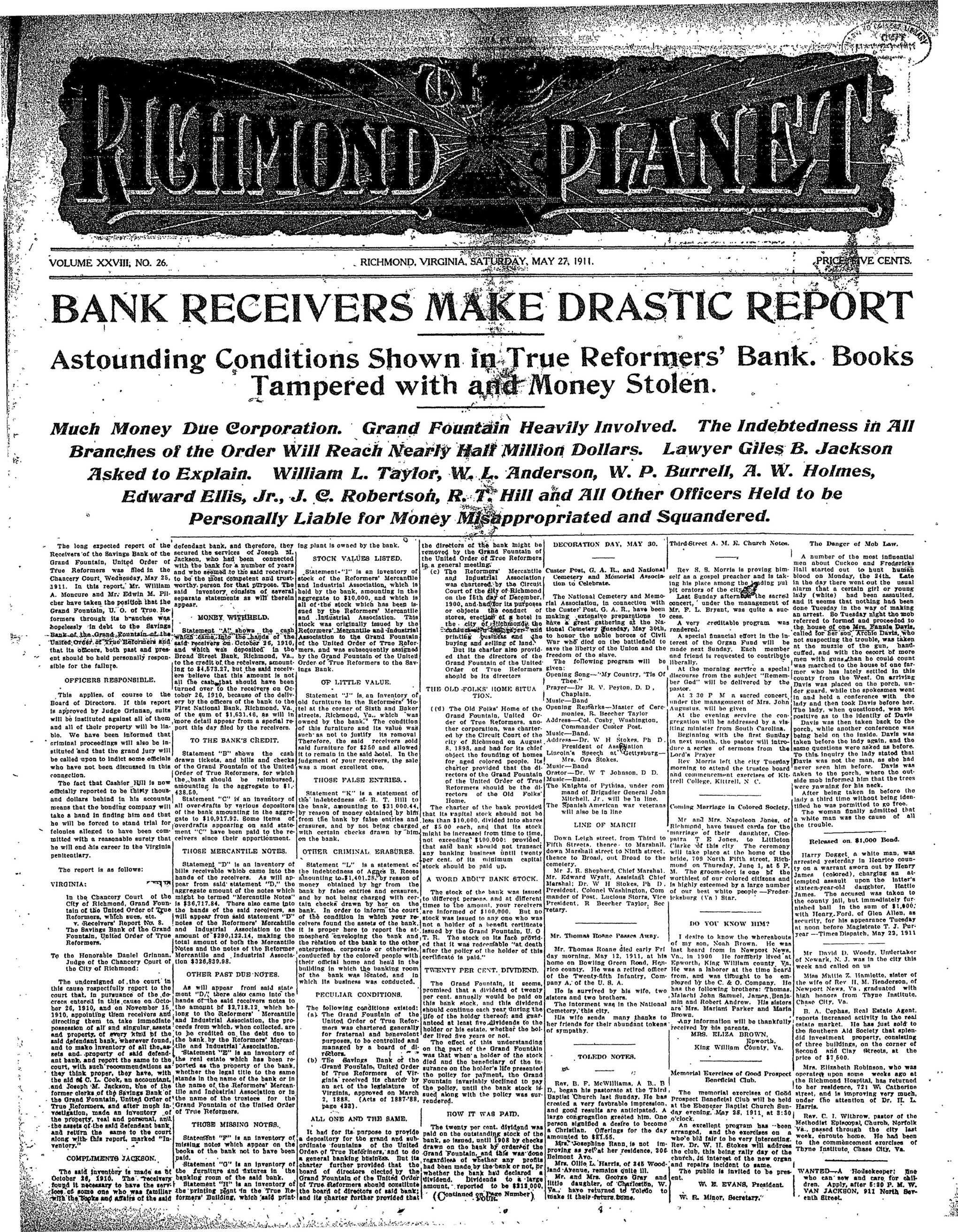
BANK RECEIVERS MAKE DRASTIC REPORT
Astounding Conditions Shown in True Reformers' Bank. Books Tampered with and Money Stolen.
OFFICERS RESPONSIBLE.
This applies, of course to the Board of Directors. If this report is approved by Judge Grinnan, suits will be instituted against all of them and all of their property will be liable. We have been informed that criminal proceedings will also be instituted and that the grand jury will be called upon to indict some officials who have not been discussed in this connection.
The fact that Cashier Hill is now officially reported to be thirty thousand dollars behind in his accounts means that the bonding company will take a hand in finding him and that he will be forced to stand trial for felonies alleged to have been committed with a reasonable surety that he will end his career in the Virginia penitentiary.
The report is as follows:
---
VIRGINIA:
In the Chancory Court of the City of Richmond, Grand Fountain of the United Order of True Reformors, which sues, etc. v. Receivers' Report No. 8. The Savings Bank of the Grand Fountain, United Order of True Reformers.
To the Honorable Daniel Grinnan. Judge of the Chancory Court of the City of Richmond:
The undersigned of the court in this cause respectfully report to the court that, in pursuance of the decrees entered in this cause on October 26, 1910, and on November 15, 1910, appointing them receivers and directing them to take immediate possession of all and singular, assets and property, of every kind of the said defendant bank, wherever found, and to make inventory of all the, assets and property of said defendant bank, and report the same to the court, with such recommendations as they think proper, they have, with the old of C. L. Cook, an accountant, and Joseph M. Jackson, the of the former clerks of the Savings Bank of the Grand Fountain, United Order of True Reformors, and after much investigation, made an inventory of the property, real and personal, and the assets of the said defendant bank, and return the same to the court along with this report, marked "Inventory."
COMPLIMENTS JACKSON.
The sold inventory is made on 81
October 26, 1910. The .recelvery
found it necessary to have the servi-
ces of some one who was familiar
with the Books and affairs of the said
defendant bank, and therefore, they secured the services of Joseph M. Jackson, who had been connected with the bank for a number of years and who seemed to the said receivers to be the most competent and trustworthy person for that purpose. The said inventory, consists of several separate statements as will therein appear.
· MONEY, WITHHELD.
Statement "All, shows the cash which came into the hands of the said receivers on October 26, 1910, and which was deposited in the Broad Street Bank, Richmond, Va. to the credit of the receivers, amounting to $4,573.27, but the said receivers believe that this amount is not all the cash that should have been turned over to the receivers on October 26, 1910, because of the delivery by the officers of the bank to the First National Bank, Richmond, Va. of the sum of $1,631.46, as will in more detail appear from a special report this day filed by the receivers.
TO THE BANK'S CREDIT.
Statement "B" shows the cash drawn, tickets, and bills and checks of the Grand Fountain of the United Order of True Reformers, for which the bank should be reimbursed, amounting in the aggregate to $1,438.50.
Statement "C" is an inventory of all overdrafts by various depositors of the bank amounting in the aggregate to $10,917.92. Some items of overdrafts appearing on said statement "C" have been paid to the receivers since their apportionment.
THOSE MERCANTILE NOTES
Statement "D" is an inventory of bills receivable whob came into the hands of the receivers. As will appear from said statement "D," the aggregate amount of the notes which might be termed "Mercantile Notes" is $36,717.84. There also came into the hands of the said receivers, as will appear from said statement "D" notes of the Reformer Morcantile and Industrial Association to the amount of $290,122.14, making the total amount of both the Morcantile Notes and the notes of the Reformer Morcantile and Industrial Association $326,839.98.
OTHER PAST DUE NOTES
As will appear from said statement "D," there also came into the hands of the said recoveries notes to the amount of $2,718.12 which belong to the Reformers' Mercantile and Industrial Association, the proceeds from which, whence collected, are to be credited on the debt due to the bank by the Reformers' Mercantile and Industrial Association. "Statement "E" is an inventory of the real estate which has been reported as the property of the bank, whether the legal title to the same stands in the name of the bank or in the name of the Reformers' Mercantile and Industrial Association or in the name of the trustees for the Grand Fountain of the United Order of True Reformers.
THOBE MISSING NOTES.
Statement But "I" is an inventory of missing notes which appear on the books of the bank not to have been paid.
Statement "G" is an inventory of the furniture and fixtures in the banking room of the said bank.
Statement "H" is an inventory of the printing point in the True Reformers' Building, which said print
STOCK VALUES LISTED.
Statement "I" is an inventory of stock of the Reformers' Mercantile and Industrial Association, which is held by the bank, amounting in the aggregate to $10,000, and which is all of the stock which has been issued by the Reformers' Mercantile and Industrial Association. This stock was originally issued by the Reformers' Mercantile and Industrial Association to the Grand Fountain of the United Order of True Reformers, and was subsequently assigned by the Grand Fountain of the United Order of True Reformers to the Savings Bank.
OF LITTLE VALUE.
Statement "J" is an inventory of old furniture in the Reformer's Hotel at the corner of Sixth and Baker streets, Richmond, Va., which was owned by the bank." The condition of this furniture and its value was such as not to justify its removal. Therefore, the said receivers sold said furniture for $250 and allowed it to remain in the said hotel. In the judgment of your receivers, the sale was a most excellent one.
THOSE FALSE ENTRIES.
Statement "K" is a statement of the indebtedness of R. T. Hill to the bank, amounting to $31 000.44, by reason of money obtained by him from the bank by false entries and erasures, and by not being charged with certain checks drawn by him on the bank.
OTHER CRIMINAL, ERASURES.
Statement "L" is a statement of the indebtedness of Agnes B. Rossa amounting to $1,401.28 by reason of money obtained by hrg from the bank by false entries and erasures, and by not being charged with certain checks drawn by her on the bank. In order to inform the court of the condition in which your recorder found the assets of the bank, it is proper here to report the at mespherid enveloping the bank and enterprise, enterprise, corporate or otherwise, conducted by the colored people with their official home and head in the building in which the banking room of the bank was located, and in which its business was conducted.
PECULIAR CONDITIONS
The following conditions existed:
(a) The Grand Fountain of the United Order of True Reformors was charted generally for fraternal and benevolent purposes, to be controlled and managed by a board of directors.
(b) The Savings Bank of the Grand Fountain, United Order of True Reformors of Virginia received its charter by an act of the legislature of Virginia, approved on March 2, 1888. (Acts of 1887'88, page 423).
ALL ONE AND THE SAME.
It had for its purpose to provide a depository for the grand and subordinate fountains of the United Order of True Reformers, and to do a general banking business. But its charter further provided that the board of directors elected by the Grand Fountain of the United Order of True Reformers should con constitute the board of directors of said bank; and its charter further provided that
the directors of the bank might be removed by the Grand Fountain of the United Order of True Reformers in a general meeting.
(c) The Reformers' Mercantile and Industrial Association was chartered by the Circuit Court of the city of Richmond on the 15th day of December, 1900, and had for its purposes or objects the conduct of stores, erected of a hotel in the city of Richmond the printing business and the buying and selling of land.
But its charter also provided that the directors of the Grand Fountain of the United Order of True Reformers should be its directors
THE OLD FOLKS' HOME SITUATION
(1) The Old Folks' Home of the Grand Fountain, United Order of True Reformers, another corporation, was chartered by the Circuit Court of the city of Richmond on August 8, 1898, and had for its chief object the founding of homes for aged colored people. Its charter provided that the directors of the Grand Fountain of the United Order of True Reformers should be the directors of the Old Folks' Home. The charter of the bank provided that its capital stock should not be less than $10,000, divided into shares of $500 each, and that its stock might be increased from time to time, not exceeding $100,000; provided that said bank should not transact any banking business until twenty per cent. of its minimum capital stock should be paid up.
A WORD ABOUT BANK STOCK.
The stock of the bank was issued to different persons, and at different times to the amount, your receivers are informed of $100,000. But no stock was issued to any one who was not a holder of a benefit certificate issued by the Grand Fountain, U. O T. R. The stock on its face provided that it was redeemable "at death after the policy of the holder of this certificate is paid."
TWENTY PER CENT, DIVIDEND.
The Grand Fountain, it seems, promised that a dividend of twenty per cent. annually would be paid on this bank stock, and this dividend should continue each year during the life of the holder thereof, and guaranteed at least five dividends to the holder or his estate, whether the holder lived five years or not. The effect of this understanding on the part of the Grand Fountain was that when a holder of the stock died and the beneficiary of the insurance on the holder's life presented the policy for payment, the Grand Fountain invariably declined to pay the policy, until the bank stock issued along with the policy was surrendered.
HOW IT WAS PAID.
The twenty per cent. dividend was paid on the outstanding stock of the bank, so issued, until 1908 by checks drawn on the bank by order of the Grand Fountain, and this was done regardless of whether any profits had been made by the bank or not, by whether the bank had declared a dividend. Dividends to a large amount, reported to be $212,000. (Continued on Page Number.)
Custer Post, G. A. R., and National Cemetery and Memorial Association to Celebrate.
The National Cemetery and Memorial Association, in connection with the Custer Post, G. A. R., have been making extensive preparations to have a great gathering at the National Cemetery Tuesday, May 30th, to honor the noble heroes of Civil War who died on the battlefield to save the liberty of the Union and the freedom of the slave.
The following program will be given:
Opening Song—"My Country, 'Tle Of Tree."
Prayer—Dr R. V. Peyton, D. D,
Chaplain.
Music—Band
Opening Remarks—Master of Ceremonies, R. Beecher Taylor
Address—Col. Cosby, Washington,
Commander Cluster Post.
Music—Band.
Address—Dr W H Stokes, Ph D,
President of Association
Lincoln's Speech at 'Gettysburg—Mrs. Ora Stokes.
Music—Band
Orator—Dr W T Johnson, D D.
Music—Band.
The Knights of Pythias, under com-
mand of Brigudler General John
Mitchell, Jr. will be in line.
The Spanish American war veterans
will also be in line.
LINE OF MARCH
Down Leigh street, from Third to Fifth Street, thence to Marshall down Marshall street to Ninth street, thence to Broad, out Broad to the cemetery.
Mr J. R. Shерферd, Chief Marshal. Mr. Edward Wyatt, Assistant Chief Marshal. Dr. W H Stokes, Ph D. President, Colonel Washington, Commander of Post, Lucian Storrs, Vice President, R Beecher Taylor, Secretary.
Mr. Thomas Roane Passes Away.
Mr. Thomas Roane died early Friday morning, May 12, 1911, at his home on Bowling Green Road, Hopico county. He was a retired officer of the Twenty-fifth Infantry, Company A, of the U. S. A.
He is survived by his wife, two sisters and two brothers.
The Intrument was in the National Cemetery, this city.
His wife sends many thanks to her friends for their abundant tokens of sympathy.
TOLEDO NOTES.
Rev. B. F. McWilliams, A B. B. D., began his pastorate at the Third Baptist Church last Sunday. He has created a very favrable impression, and good results are anticipated. A large congregation greeted him. One person signified a desire to become a Christian. Offerings for the day amounted to $21.55.
Mrs. Josephine Rann, is not improving as yet at her residence, 306 Belmont Ave.
Mrs. Ollie L. Harris, of 245 Woodland Avenue, remains quite ill.
Mr. and Mrs. George Gray and little daughter, of Charleson, W. Va., have returned to Toledo to make it their return home.
Third Street A. M. E. Church Notes.
Rev S. S. Morris is proving himself as a gospel preacher and is taking his place among the leading pulit orators of the city.
Last Sunday afternoon the sacred concert, under the management of Mr. F. L. Bryant, was quite a success.
A very creditable program was rendered.
A special financial effort in the interest of the Organ Fund will be made next Sunday. Each member and friend is requested to contribute liberally.
At the morning service a special discourse from the subject "Remember God" will be delivered by the pastor.
At 3:30 P M a sacred concert, under the management of Mrs. John Augustus, will be given.
At the evening service the congregation will be addressed by a visiting minister from South Carolina.
Beginning with the first Sunday in next month, the pastor will introduce a series of sermons from the Lord's Prayer.
Rev Morris left the city Tuesday morning to attend the trustee board and commencement exercises of Kittrell College, Kittrell, N.C.
Coming Marriage in Colored Society.
Mr and Mrs Napoleon Jones, of Richmond, have issued cards for the marriage of their daughter, Cleopatra T E Jones, to Littleton Clarke of this city. The ceremony will take place at the home of the bride, 709 North Fifth street, Richmond on Thursday, June 1, at 6 P.M. A room-bloomed one is on the worthiest of order books. It is highly esteemed by a large number of our best white people — Frederickburg (Va) Star.
---
DO YOU KNOW HIM?
I desire to know the whereabouts of my son, Nohh Brown. He was last heard from in Newport News, Va. in 1900 He formerly lived at Epworth, King William county, Va. He was a laborer at the time heard from, and was thought to be employed by the C. & O. Company. He has the following brothers: Thomas, Malachi John Samuel, James, Benjamin and Robert Andrew. His sisters are Mrs. Mariam Parker and Marla Brown. Any information will be thankfully received by his parents. MRS. ELIZA BROWN, Epworth, King William County, Va.
Memorial Exercises of Good Prospect
Beneficial Club.
The memorial exercises of Gold Prospect Benedictal Club will be held at the Ebonezer Baptist Church Sunday evening. May 28, 1911, at 8:30 o'clock.
An excellent program has been arranged, and the exercises on a who's bid fair to be very interesting. Rev. Dr. W. H. Stokes will address the club, this being rally day of the church, in interest of the new organ and repairs incident to same.
The public is invited to be present.
W. E. EVANS, President.
W. R. Minor, Secretary.
The Danger of Mob Law.
A number of the most influential men about Cuckoo and Fredrickson Hall started out to hunt human blood on Monday, the 24th. Late in the day there wont out the usual alarm that a certain girl or young lady (white) had been assaulted, and it seems that nothing had been done Tuesday in the way of making an arrest. So Tuesday night the mob referred to formed and proceeded to the house of one Mr. Fannie Davis, called for her son, Archie Davis, who not suspecting the trouble, was taken at the muzzle of the gun, handcuffed, and with the escort of more men with guns than he could count was marched to the house of one farmer who has lately settled in this county from the West Office. Driving Davis was placed in the porch, derger was in the spokeman wont hold a conference with the lady and then took Davis before her. The lady, when questioned, was not positive as to the identity of Davis. Davis was then taken back to the porch, while another conference was being held on the inside. Davis was taken before the lady again, and the same questions were asked as before. To this inquiry the lady stated that Davis was not the man, as she had never seen him before. Davis was taken to the porch, where the outside mob informed him that the trees were yawning for his neck.
After being taken in before the lady a third time without being identified he was permitted to go free. The woman finally admitted that a white man was the cause of all the trouble.
Released on. $1,000 Bond.
Harry Dogget, a white man, was arrested yesterday in Henrico county on a warrant sworn out by Henry James (colored), charging an attempted assault upon the latter's sixteen-year-old daughter, Hatty James. The accused was taken to the county jail, but immediately furnished ball in the sum of $1,800; with Henry, Ford, of Glon Allen, as security, for his appearance Tuesday at noon before Magistrate T. J. Puryear — Times Dispatch, May 23, 1911
Mr David D. Woody, Undertaker of Newark, N. J. was in the city this week and called on us
Miss Muttin Z. Hamilte, sister of the wife of Rev H. M. Henderson, of Newport News, Va. graduated with high honors from Thyne Institute, Chase City, Va.
B. A. Cophas, Real Estate Agent, reports increased activity in the real estate market. He has just sold to the Southern Aid Society that splendid investment property, consisting of three buildings, on the corner of Second and Clay Streets, at the price of $7,500.
Mrs. Elizabeth Robinson, who was operatively upon some weeks ago at the Richmond Hospital, has returned to her residence, 721 W. Catherine street, and is improving very much, under the attention of Dr. H. L. Harris.
Rev. C. I. Witrow, pastor of the Methodist Episcopal Church, Norfolk Va., passed through the city last week, enroute home. He had been to the commincentment exorces of Thyne Institute Chase City, Va.
WANTED—A Housekeeper! Nine
who can see and care for children.
Apply, after 5:20 P. M. W.
VAN JACKSON, 911 North Seventh
Street.
---
The
SYNOPSIS.
Evan Blount, son of "Boss" David Blount ("Senator Bagenalra"), has been rejected by Patricia Annera. Dick Annery offers him a position with the Transcontinental railway, which is fighting his boss, and of the railroad, and "Boss" Blount questioned. The boss demands that the railroad stop the use of crooked methods. Going west to meet his father; Evan meets a man who takes him for a forestry employee. Evan is kidnapped by a band of men, evidently corporation agents, and is being held in a mansion seemingly presided over by a woman. The house is Warrage Hall, Senator Blount's home, and the woman is Evan's stepmother whom he had never met. The senator purposes running Evan for attorney general despite the young man recent arrival in the state. Evan obeyed him, his father called a political trickster. McVickar defies Senator Blount to nominate Evan Patricia and her geologist father arrive at the Bagebrush capital. At McVickar's request Evan joins the railroad's forces as division council and political worker. He favors clean politics, but that his office is made a rallying point by small political hanger-on of the road.
Evan has his disagreement with Gantry about the road's mixing in politics. His father pulls wires unknown to him to help him invite voters to speak in a distant mining town. Hathaway has been trying to do business with the road and with Senator Blount, is to have a talk with Mrs Blount.
Hathaway wants a rebate from the road in consideration of political favors. He is trying to return to Evan and be repositioned to Evan and advised by Mrs Blount to put Professor Anners' name on his list of stockholders.
Evan's interview with Hathaway reveals the road's misdouglas. In a rage he tries to return to Evan and admitted to Mr. Vickar.
Patiella refuses Evan again. She advises him to stick to the road and work his resignation and sent into the field on a speaking tour.
Exposure of the railroad is threatened by Evan to Gantry unless rebating and other actions are taken. Evan suspects his secretary, Collins, of tampering with his desk.
The desk is blown up by a burglary. Evan告诉 Evan papers. Gantry tells him that he is getting to be too much for him to handle.
ON the following morning Blount found a telegram on his desk. It bore the vice president's name, and the date line was Twin Canyon City. It directed him to go to a remote portion of the stoe beyond the Lost River mountains to ex-
PT DIRECTED HIM TO GO TO A REMOTE PORTION OF THIS STATE
amino the papers in a right of way case which was coming up for trial at the next term of court.
This was in Kittredge's department, and Blount called up the superintendent on the phone. Kittredge was in his office, and he, evidently knew about the vice president's telegram; also he seemed very anxious to have the division counsel go to Lewiston at once, so anxious that he offered his own service car to be run as a special train.
Blount saw no way to evade a positive order from his chief, but he was more than suspicious that Gentry or Kittredge or possibly both of them were conspiring to get him away from the capital at the critical moment.
What did not occur to him at the time was the fact that Mr. McVickar's telegram might have originated in Kittredge's office.
Asking the superintendent to have the service car made ready immediately, he parked his hand bag, left a note for Patricia and began the useless journey. In all his traveling up and down the state he bid never found anything to equal the slowness of the special train. Four mortal hours were lost on the lonely lining. There was no station, and Blount could not telegraph. So far as he knew, the service car might stay there for a day or a week. It was all to no purpose that he quarrelled with his conductor. The train crew had orders to wall for
Honorable Senator Sagebrush
By
FRANCIS LYNDE
Copyright, 1910, by Street @ Smith
wetbound 17, and there was nothing to do but to keep on waiting.
*Late in the afternoon train, 17 or some other train came along, and the special was once more set in motion eastward, and at dinner time it was again sidetracked, eighty odd miles from its destination, and once more at a blind siding, where there was no telegraph office. The car was still standing on the sliding when Blount went to bed. But in the morning it was in motion again, jogging now on its leisurely way up the branch line.
At Lowston, the town at the end of the branch where the right of way trouble had originated, Blount found more delay, carefully planned for, as he had now come firmly to believe.
The plaintiffs in the right of way case were out of town, and their lawyers had gone to the capital. Blount saw that he might, wait a week without accomplishing anything; hence he immediately instructed his conductor to get orders for the return.
After having been gone a leisurely half hour the conductor came back to the service car to say that the single telegraph wire connecting Lewiston with the outer world was down and that the orders for the return journey could not be obtained until the telegraph connection was restored. At that point Blount took matters into his own hands.
There was a mining company having its headquarters in the isolated town, and Blount had met the manager once in the capital—met him in a social way and had been able to show him some little attention. Hiring a buckboard at the one livery stable in the place, he drove out to the Little Mary mine and luckily found Blatchford, the friendly manager. It did not take over a minute to renew the pleasant acquaintance and to state his dilemma.
"I'm hang, up here with my special train, the wires are down, and I can't get out," was his statement of the crude fact. "Didn't you tell me that you owned a motorcar?"
"I did," was the prompt reply "Want to borrow it?"
"You beat me to it," said Blount, laughing "That was precise, what I was going to beg for—the loan of your car I believe you told me that you had driven it from here to the capital"
"Oh, yes, several times. You ought to make it in six hours and a half or seven at the most. Drive me down to the burg and I'll put you in possession."
A little later Blount, found himself handling the levers of a very serviceable knucklecar car equipped for hard work on country roads. When he was ready to go he drove down to the railroad yard and hunted up his conductor "After you have had your vacation you may get orders, from Mr. Kittredge and take his car back to the capital," he told the man "When you do you may give him my compilments and tell him that I preferred to run my own special train."
The conductor grinned and made no reply, and he was still grimming when he mustered into the railroad telegraph office and spoke to the operator "I dunno what's up," he said, "but, whatever it was, the string's broke. Old Dave Ragebrush's son has borrowed him an automobiles and gone back to town on his own hook. Guess you'd better call up the division gis patcher and tell him the broken wire gag didn't work. Get a move on. We hain't got nothing to stay here for now."
The traffic manager had left his office for the day, but Blount found him at the railway club.
"Just a word, Dick," he began when he had overtaken Kittredge's accomplish in the grill room corridor. "Kittredge put up a job on me, and I think you helped him. I had to borrow an automobile to come back in from Lowiston."
"Confound you!" said Gantry heartily.
But that was all that he had a chance to say, since Blount had turned abruptly and was already leaving the club to go on to the hotel. Since the election was now no more than three days distant the Inter Mountain lobby was filled with groups of caucusing politicians. Not with standing the position he had taken and the open eyed fearlessness with which he had discussed the political situation publicly in every considerable town in the state. Evan Blount was still a puzzle to those whose ways were, by need and the force of circumstance the reverse of straightforward.
Blount was halted half a dozen times before he could make his way to the elevator, and the jumping process to which he was subjected at each fresh baling space amounted him. It was plainly evident that in spite of all he had said and done a considerable majority of the politicians were still regarding him as in some sense his father's lieutenant. Somewhat to his disappointment he found that Patricia had gone out with his father and his father's wife to dinner; hence he was forced to sit at a table in the cafe with three of the cautious politicians and was obliged to find his moderate pleasure in trying. to make their very evident perplexity less nothing of its apetence during the table
THE RICHMOND PLANET, RICHMOND, VIRGINIA.
When he reached his office on Saturday morning, after an early and solitary breakfast at the hotel, the young reformer scored, or thought he had scored, his first small victory. Among the envelopes on his desk was one bearing the imprint of the traffic office. It included a carbon copy of the notice required by law of a proposed charge in freight rates. Hastily comparing the figures with the memorandum in his pocketbook, Blount felt the tension relaxing for the first time in weeks. At the long last Gantry or his superiors had surrendered. The rates on lumber, electrical supplies and other commodities which had been given illegal preferentials were to be reduced to the figures given to the favored corporations.
Blount passed a busy Saturday, putting in most of his time at his desk. Calling up the hotel in the afternoon, he found that his father had taken Patricia and Honoria for a drive in the roadster, and at dinner time the automobile party had not yet returned. Blount went back to his office after a hasty dinner and worked late into the night. The eve of battle had arrived, and he was striving to clinch the nail of argument as well as he could by writing many letters to the political friends he had made in going up and down the state.
The Sunday proved to be a very quiet day, though the lobby of the Inter-Mountain was still the assembling place for the gathering clans of politicians. Blount went to church in the morning because Patricia insisted upon it, and his appearance in the pew as a member of the Honorable David's family would have caused fresh comment if there had been any church goers among the visiting politicians.
After lunch he borrowed the roadster and took Patricia for a drive. The day was perfect, and the roads were in good condition. When he had put distance between them and the Sunday quiet of the city streets he told Patricia of his experience with Kittredge's special train.
"Do you think it was intended?" he asked when he had finished his story.
"I haven't the slightest doubt of it now. More than that, I think the telegram bearing Mr McVickar's name was a bold forgery. But I am bringing them to time," he went on, exulting over his one small victory. "There is to be an evening up of freight rates, and one more room of the railroad house will be clean. I believe Mr McVickar has meant to be fair all along, but the overregressive subordinate is always the hardest ham to handle."
"I am glad," she said. And in the sunshine of her approval the young man spent a very happy afternoon. At breakfast Monday morning Evan Blount again made the senator's party of three a party of four and at table found a puzzling surprise lying in wait for him.
The critical day of days in the camp palen had arrived, and it was supposable on every hypothesis that the commander of an army would choose any other day rather than this be sent from his post. But at the breakfast table he heard his father anounce calmly that he was going to drive out to Wartrace, for no better stated reason than a purely routine purpose of having a talk with his much manager about the shipment of a trainload of beef cattle.
While Blount sat in open eyed as punishment the day was planned for there and then. The arrangement made was one that left *Patricia* free to keep an engagement at the Weatherford's* while the senator drove to Wartrace in the roadster. The little car, which *Patricia* had been told to call her own, was to be left at the garage, and she was to drive out in the afternoon, bringing Evan with her if he cared to come.
It was Mrs. Tonierva who made this arrangement, and in the midst of his astonishment Blount acknowledged a warm kindling of gratitude. If the little lady whom he was trying so consistently to dislike and accustomed to do her best to keep him and Patricia apart during the early part of the girl's visit she now appeared to be doing what she could to atone. Blount ventured one question and one only as it was addressed to his father. "Do you happen to remember that this is the final day before election?" he asked. "So it is, so it is, son," was the evin toned reply. "I thought maybe you had forgotten it." said Evan quietly.
"I have in a measure," smiled the boss, "and if you'll take my advice you'll forget it too. The political spellblender who hasn't said his say and done his do before sunrise this morning needn't expect that he's going to be able to dig the tree up by its roots between now and tomorrow morning." It was not until the younger man was leaving the table, excusing him golf on the plow of business, that the senator's wife clinched the arrangement for the afternoon.
"You'll come out with Patricia, won't you?" she said, putting it fairly up to him to consent or refuse. "Of course," he stammered. "I shall be delighted."
"You don't say it quite as if you meant it," laughed the one who was to drive him out to Wartrace, "but I'll be charitable and give you the benefit of the doubt. Where can I pick you up, say, between I and 2 o'clock? Mrs. Weatherford's lunch is to be really a French dejeuner, and I shall be able to get away early."
"If it wouldn't be too much trouble for you to stop by for me at the Temple court," Blount began, and when she nodded her acquiescence he went away, still wondering at his father's calm indifference on the very hour striking eye of the great battle.
CHAPTER XVII
THE BOOUNBACK.
It was on this same Monday morning, day of preparations for political battles, that Mr. Richard Gantry, answering a telephone call on the long distance line hastily closed his desk and left his office to make his way by quiet side streets to the Railway club garage. Kittredge
Car was in its place, over one of the pits, and the chauffeur was polishing the brass.
"Get her in commission in about three shakes of a dead lamb's tail. Haberstro," said the trainee manager briefly. "I've got to go somewhere in a hurry. Do you want an order from your boss?"
The chauffeur abook his head. "No; I guess it's all right. If you say so, Mr. Gantry," he replied. And a little later he had taken on his supply of gasoline and the motor was whirring merrily under the hood.
"Where to?" he asked when Gantry climbed to the mechanician's seat beside him.
"Out of town to the north by the quietest streets you can find. Then take the Queretaro county road. We are duo at Cliffcrest inn just about fifteen minutes sooner than we can get there."
No more than a quarter of an hour was consumed before the car had wound its way to the summit of the mea and was wheeling to a halt before the entrance of a small summer resort hotel perched among the pines at the edge of the canyon cliff. There were no guests on the hotel veranda, and Gantry knew that the inn's season had closed two weeks earlier. Yet he sprang from the car and went in as he expected to find the place open and occupied. It was open, and in the cozy guests' writing room, at one of the tables drawn up before a cheerful wood fire sat the vice president of the Trans continental seemingly in solitary state. But in the room beyond a battery of telegraph Instruments clicked baily, and a close observer would have remarked that the small table before the fire was fitted with a row of electric call buttons.
Cliffrent inn, deserted of guests, had been transformed into the hidden headquarters in the field of the commander in chief
"Well," said the great man, looking up quickly when Gantry entered. "You took your time about getting here. Whose car is that?"
"It is Kittredge's," said the traffic man.
"Botter tell him to get one that will make time," was the impatient comment. Then, "Sit down and bring the situation up to date, and talk fast. Time is precious today."
Gantry drew up a chair and gave a hasty resume of the political situation. Everything had been done that could be done, and so far as the trainee manager know the railroad forces were ready to meet the issue at the polls. At one point, and only one, the defenses were weak. It a that Gryson dealt, he explained. "It has been rather awkwardly handled, and if Evan Blount should happen to stumble upon it any time during the day I shouldn't like to answer for the consequence." "You ought to have made sure by getting him safely out of the way," was the rasping comment of the great man. "You are just common bunglers—you and Kiltridge—both of you." Gantry's gesture was of humorous denom.
"There's a limit, Mr McVickar. We couldn't very well garrate him and carry him off to a duffle. We have tried every way we could to muzzle him. So far as I know, he hasn't been doing anything incendiary since you were here last week, but I had to put one across on him about the equalizing of the freight rates"
"What did you do?" snapped the vice president.
"I mailed him what purported to be a carbon copy of the legal notice of a reduction. He doesn't know yet that he has the only copy- that the notice hasn't been posted in our stations, as the law directs. I'm hoping that he won't find it out until after tomorrow, when it won't make any especial difference"
Mr McVickar frowned again.
"Your expeditients have all been pretty crude, Gantry. You seem to persistently forget that you are dealing with a mighty sharp, shrewd young lawyer; that the chances are ten to one that young Blount discovered your plums fraud at once. Go back to the city and think up some scheme that will keep him busy today, too busy to smell out the facts in the Gryson matter"
Gantry got up and stood with his back to the fire.
"I'm all in, Mr. McVickar, and that's the humiliating fact. There isn't an other idea left in me," he confessed despairingly "Can't you help us out a little, Mr. McVickar?"
Being thus put face to face with the inventor test, the vice president did not hesitate a moment
"Of course" he grated. "If I have to do your thinking for you, Go back and get into communication with Gryson. Tell him the time has come to play the same game on young Blount that he played four years ago on Heretheger, the speaker of the house. He'll understand."
But now Gantry was shaking his head dubiously "I'll do what you say and do it quickly. But candidly, Mr. McVikar, I'm afraid of Gryson. If Blount should happen to go at him just right there might be consequences of another sort. Gryson is pretty sure as it is."
"Never mind about the consequences. Go and do as I tell you to. Then go around to the telephone exchange and tell the manager that I want a special operator—a man if he's got one—put on this long distance wire; that you want the connection broken between the capital and David Blount's country house and that, my wife is to be kept open to you and to Kittredge all day. Has Kittredge got his linemen out guarding the telegraph wires up here?
"Yes; all the way out from the cut-in at Grand canyon."
"All right. That's all. Now make that boy of yours burn the road getting back."
It was only a little after 0 o'clock when this conference was held in the greatest deserted mountain resort house at the head of Shonoho canyon. At 11 o'clock Blount, who was dictating to three stenographers in succession in his office in the Temple court, bad a caller.
"It's that fellow Gryson," said Col
Him, who had gone to answer the ant-room bell. "He says he's got to see you whether you want to see him or bot."
"Send him in," said Blount briefly. And a moment later the ex-bad man of the mining camps entered and carefully closed the door behind him.
"Well, what is it?" queried Blount snapping when Gryson drew up a chair and sat down.
"I'll tell you what that it isn't," said the ward boss sullyly. "I can't here to beg for no rakeoff. I've been given the double cross, and I'm sore."
Blount's smile was content; pious. "You doubtless got what was coming to you," he said coolly. "But go on and tell it out and don't waste time. This is another of my busy days."
"I want to get hold of a newspaper man," said Gryson; "that's what I want. If they're going to throw me down I'll squelch. It ain't too late yet. Money, talks with me every time. Your boss, McVickar, thought he had me coopered up in a barrel, but the other side saw his bld and raised it." "What other side?" quoried Blount. "There ain't but one other side in this state when your daddy gets into the ring and pulls off his coat," said the brike taker, with an evil leer. "You ain't been fighting round a couple of months without finding that out?" "Go on." was the terse command. "As I was a saying, money, talks, and right now, when everything is ready to pull off, Rhechen turns up and says the barrel's run dry. There ain't nothing left in it for me. By ciprina, I'll show him!"
Blount went into a reflective trance with half closed eyes. Sheehan was the machine organizer for the capital's "pay boss," some called him. David Blount's son saw the door to a chamber of hidden facts slowly opening before him. For some reason Gryson, the twice bought and sold, had been dropped, and his actuming motive now was philin revenge. "Tell it out and tell it straight, Gryson," he resumed at the end of the hesitant pause.
"It's in the registration lists in four wards of this town. They've been cooked up two to one. I've got the lists of the crooked names right here in my pocket. Sheehan knows, the committee of six knows, and the senator knows. But I'm the man that can swing in them extra votes, and more than that, by grats. He is the only man. When I told Sheehan that a little white ago he invited me to go to h-1. I'll show him."
Blount's brain was in a whirl, and his heart was pounding like that of a man who finds himself looking over the verge of a bottomless chasm.
"What is it that you want to do. Gryson?" he asked when he could control his voice sufficiently
"I want to give Sheehan and his machine crowd what's coming to 'em"
"Will you make additions to the fact of the false registration?"
"I'll do anything to get square with that crowd of throw-backs!"
"Your affidavit isn't much better than your unsupported word," said Blount coldly "Can you get any one else to swear to the facts with you?" "Sure I can. I can get a half dozen of the boys in my own gang that it do it." It was up to Blount fairly and squerely to say the word which would precipitate the greatest election scan-
WILL
JOHES
dal that had ever disturbed the peace of the Salemburgh State, and the central figure around which the story of corruption and bribery would center would be his father! For five long minutes he sat in grim silence, frowning at the miserable traitor, who was shifting unceasingly in his chair under the cold glaze of the hereditary Blount eyes. But when all was over the traitor had galued his point "Go to it," said Blount sharply "Swear out your own affidavit and get as many more as you can to back it up. Bring the papers here to me between 1 and 2 o'clock this afternoon. That's all! Now go before I am tempted to throw you out neck and beels. If somebody doesn't kill you for this piece of treachery you will be playing in big luck."
When Gryson was gone Blount put on his hat and went straight to the editorial rooms of the Daily Capital Blenkinson, the thin face, long hairred editor, was humped in his chair over his desk blue penciling copy like a man running a race against time.
"In just a minute," he said when Blount stood beside him. And then, sticking the copy on the hook, "Now I'm with you."
Blount had marked the unusual daytime activities in the newspaper office and had instantly put two and two-together
"You're at work pretty early for a morning paper force, aren't you. Blenkinson?" he asked.
"You bet we are!" was the quick reply.
"What is the matter?" queried Blount.
"Haven't you heard?" said the editor.
"Somebody—heaven only knows who—has been gathering up a lot of false registration evidence involving half a dozen of the principal towns in the state. The stuff came to us by a slog of underground route, but it's reliable all right. It's a corker. Thellen! Continued on 3rd Page."
Salary and Commission to Deputies Write Right Now for Full Particulars to the SOLID ROCK UNION, 1920 Dickinson St. PHILADELPHIA, PA JOHN CLINTON, JR., President.
Constitute a Feature, and Persons Cannot do Better to Let the little
Ones Join. Children received from Two to Twelve Years.
BENEFITS—$1.00 to $1.50 per week when sick and $8.00 to
$40.00 at death. Matrons wanted in all Localities. For organiza-
tion of New Bands and all particulars, write.
MRS. ANNA TAYLOR, W. M., 120 West Hill Street, Richmond, Va.
Mme. T. D. Perkins
4630 West 35th Ave., Denver, Col.
Madam T. D. Perkins, of Denver, Colorado, who has spent five years in study of the scalp, is now interesting women all over the globe in the care of the hair and scalp. No matter how dark your skin is, Madame Perkins' matchless scalp preparations and scientific method of treatment for cultivating, beautifying and growing the hair will grow your hair if there is no physical ailment to prevent. Her treatments have been successful where all others have failed. Have you written her? If not, and you want hair like her own, write her today. Be sure to enclose a four-cent stamp and write your name and address very plain if you expect a reply. Don't write unless you mean business. No agents' wanted.
---
```markdown
```
If a Woman have long hair, it is a Glory to Her: I Cor., 11:15.
Every Woman Can Have that Glory if She Wishes It.
This is for you. No more ironed hair, but soft, long, beautiful hair that need not be put on the dresser on retiring. Do you want this kind of hair? If so, write for particulars to Madam T, D. Perkins, the Scientific Scalp Specialist, of Denver, Colo., who is astonishing the world with her wonderful art of growing hair.
My own hair is my best advertisement. With these treatments my hair grew 17 inches in two years. It had remained one length (four inches) for 15 years. What I did for my hair I am doing for hundreds of others, and will do for you with my Matchless Scientific Scalp Preparations. My treatment stops falling hair or breaking off, cures split ends, removes dandruff and scalp scurf, causes the hair to grow long, no matter how short; soft, no matter how harsh; thick, no matter how thin; straight from the bulbs, no matter how kinky. First treatment will show wonderful improvement. Do not wait if you are interested in your hair. I give treatments all over the United States by mail. Write me at once. I send booklet of information, testimonials of those taking my treatment when four-cent stamp is enclosed. I do not have agents. I need a personal history of your hair and scalp and your physical condition.
All mail promptly answered when four-cent stamp is enclosed. I am the only woman of the race growing hair today who can show the public the real length my hair was when I first began treating it. Send for booklet if you mean business. You can secure these preparations only from me. None like them made in the world. The T. D. P. Scientific Scalp Preparation, Madam Perkins, Sole Agent.
Funeral Director, Embalmer and Liveryman.
All Orders promptly filled at short notice by telegraph or telephone. Halla rented for meetings and nios Entertainmentes. Plenty of room with all necessary conveniences. Large Picnic or Band Wagons for Hire at reasonable rates and nothing but free-class Carriages, Buggies, etc. Keep constantly on hand fine funeral supplies.
THE RICHMOND, PLANET, RICHMOND, VIRGINIA. TITLE
SATURDAY.....MAY 27, 1911.
The Honorable Senator Sagebrush
Continued from 2nd Page.
be 10,000 repeaters challenged in this state at the polls tomorrow, and no man living can tell what the outcome will be."
Blount saw a great light, which suddenly grew to clarifying brightness.
"Whom does the soundal involve Blinkinspy?" he asked quietly.
At this the long hair editor grew curiously embarrassed "You're with us. Blount, that I know. But you are also your father's son. There are only one machine and one boss in the Sage brush State."
Blount nodded dumbly. Then. "When will you go to press with the first edition of the paper?"
"At 3 a. m. sharp," was the reply.
Blount turned to go. "I may have another half column or so for you before that time," he said, "but you needn't hold the forms open for me. I'll call you over the phone if I have anything to say."
Once in the street, Blount went straight to the bank where he had rented the safety box. Five minutes in the privacy of the vault anteroom, with the unlocked box before him, confirmed his suspicions. The packet which he had so carefully secured was made up of blank papers folded to appear like the originals, and it became convincingly evident that his office safe had not been dynamited for nothing.
The matter which would appear under flaring scare heads the next morning would be the evidence which he himself had collected, carefully edited no doubt, so that it would leave out all that might incriminate anybody but the machine and the machine's boss—his father.
With a muttered threat of vengeance directed at his traitorous office force, Blount went slowly back to the Temple court and sat down to wait for Gryson's return, giving Collins orders to deny him to everybody else.
Once again in the history of the race it had become the duty of a son to betray a father. Blount saw his way lying clearly defined before him. He must take the andavants which Gryson would bring and lay them before Judge Hemingway, the one man in the capital, if not in the entire state, who would have the courage of his conitions and the high sense of duty to act, and act promptly. Blount saw the dreadful consequences marshaling themselves in readiness. His father would be implicated beyond any possibility or home of exculpation, and the people of the state—stirred as they would be by the widespread story of fraud which he himself had gathered—would show lit the mercy to the chief instigator of the frauds.
During the last half hour of waiting Blount could no longer sit still, and he was pacing the floor of the private fice, ten steps and a turn, monotonous, when Gryson was unmered in.
"I've got 'em, a full dozen of 'em"
growled the bribe tearing, taking a thick packet of papers on Blount's desk. "Now, then, what do I get out of it?"
Blount stopped short and whirled as if the demand had been a blow
"You'll get just what any other criminal gets when he turns state's evidence," he rasped. "You won't be prosecuted and sent to the penitentiary, as you deserve to be. Now-get out of hero, and don't let me have to tell you twice."
---
Gryson made a move as if he would repossess himself of the packet of affidavits, but Blount came between with the danger signals daming in his eyes.
"No, you don't!" he said sharply, "I told you to go—do it!" And, as once before, the bribe taker out muttering curses.
When the corridor door had closed behind the traitor Blount put the affidavits in his pocket and passed out quickly through the anteroom.
"I don't know when I shall be back," he said to Collins, with a hand on the door of egress. "Has any one called since noon?"
"No. Some lady sent a boy up to ask for you, but I sent word that you were not in, as you told me to."
Evan realized that he had unthinkingly barred Patricia out with all the others. And now she would drive to Wartruce Hall without him, and the terrible thing that must be done must be done before he should see her face again.
Lightning Kills Boy
Carl Dixon, a student, was instantly killed, three others seriously injured and six others shocked when lightning destroyed in school house at Metropolitan Mich., during a terrific electrical
KNOCK-OUT BLOW FOR OIL TRUST
Supreme Court Orders Standard Company to Dissolve.
Six Months Instead of Thirty Days Allowed For Breaking Up of Combination Guilty of Conspiracy and Monopoly In Restraint of Trade.
The Standard Oil Company of New Jersey must dissolve. This was the decision of the supreme court of the United States.
In a decision delivered by Chief Justice White the government won its long and hard fought dissolution case brought under the Sherman anti-trust law in that the Standard Oil company was guilty of conspiracy and monopoly in restraint of trade. The decree of the lower court was affirmed, but was modified in particulars, which Chief Justice White said were very slight indeed.
Associate Justice Harlan announced a dissenting opinion
Chief Justice White began the delivery of the opinion, but before the findings of the court were reached he read a great part of a 25,000 word review of the litigation and the evidence. This kept the crowd of ominent lawyers and government officials in the court room in suspense.
The decree of the lower court was modified so that there need not be "an absolute cessation of interstate commerce in petroleum and its products by such vast agencies as are embraced in the combination, a result which might arise from that portion of the decree which enjoined carrying on of interstate commerce not only by the New Jersey corporation, but by all of the subsidiary companies until the dissolution of the combination by the transfer of the stocks in accordance with the decree."
The court also extended the time from one to six months in which the dissolution must take place.
Probably the most important proposition of law laid down in the opinion was that the words in the statute "every restraint of trade" are not to be literally construed, but are to be construed in the light of reason.
On this point the court held that the position of the government that the supreme court had decided that any qualification of this phrase was precluded by previous decisions of the supreme court was erroneous.
Of the first two modifications the language of the chief justice's conclusion was.
"We construe the sixth paragraph of the decree not as depriving the stockholders or corporation of the right to live under the law of the land, but as compelling obedience to the law. As therefore the sixth paragraph as thus construed is not amenable to the criticisms suggested that was obviously right.
"We think that in view of the magnitude of the interests involved and their complexity that the delay of thirty days allowed for executing the decree was too short, and should be extended so as to embrace a period of at least six months.
"So also, in view of the possible serious injury to result to the public from absolute cessation of interstate commerce in petroleum and its products by such vast agencies as are embraced in the combination, a result which might arise from that portion of the decree which enjoined the carrying on of interstate commerce not only by the New Jersey corporation, but all the subsidiary companies, until dissolution of the combination by the transfer of the stocks in accordance with the decree should not have been awarded."
Five Smothered In Mine Fire.
Five lives were lost in the Boston mine of the Delaware & Hudson company, at Larksville, near Wilkes-Barre, Pa., by suffocation
The names of the dead are
George Preder, agen twenty years,
driver.
John Melodecki, aged seventeen, a
door boy.
Jacog Kenulla, aged thirty-nine, a
miner, single.
Charles Kermuskul, aged twenty-five, laborer, married
William Adamke, laborer, twenty-five years old, single
Fire started in a section of the mino where a number of rock miners were employed, but it was gotten under control without much difficulty. Eleven men were at work in that section.
Several rescue parties at the risk of their own lives then entered the workings and succeeded in taking out John Morrissley, Patrick Lloyd and John Benduus When brought to the surface they were quickly revived.
The rescuer returning to the gangway stumbled over bodies of the dead.
The latter were brought out as soon as possible. Several of the rescuer were overcome by the smoke and one of them was prostrated. He was rescued by a fourth-pushing party
Death of Bayard Puzzles Coroner.
Philip Bayard, of Wilmington, Del.
son of the late Thomas F. Bayard, secretary of state and ambassador to England under President Cleveland, died at the Garfield hospital in Washington Coroner Nevitt has ordered an investigation.
Mr. Bayard had been a patient at the hospital since Friday. Saturday evening he either fell or jumped from the window of his room on the third floor to the second floor veranda, where he was found in a semi-conscious condition.
A careful examination failed to indicate that Mr. Bayard had received any serious injury from his fall, but he suddenly collapsed and died.
He was only recently that Mr. Bayard
went to Washington from Baltimore,
where he had been visiting his sister.
He became ill and went to the hospital,
where his aliment was diagnosed as urticine poliooning. Two special
nurses were instructed not to leave
him alone, night or day. He was left
alone for ten minutes. When the nurse
returned she found his room empty
and a few minutes later he was found
below.
Murdered and Robbed.
In a little fringe of woods on the edge of Paradise creek, near Norfolk, Va., a murder was revealed when a party of searchers out scouring the country in quest of J. L. Benton, a merchant, who had been missing from his home on Deep Creek shell road since last Friday, found him with a gaping wound in his face. Robbery was undoubtedly the ruling motive of the crime and a shotgun was the weapon. Industrious and possessed of a large famil y to care for, Mr. Benton had accumulated considerable money, which he carried about with him wherever he went. He had in his pockets when he left his home on Friday morning nearly $900. When his pockets were searched the money was kone.
Army Aviator Killed.
Lieutonant George E. M. Kelly, of the Thirtieth infantry, U. S. A., was killed in a fall from a Curtiss aeroplane at Fort Sam Houston, Texas. He was making a flight and when about fifty feet from the ground shot forward from his seat, landing on his head. His skull was fractured and he died in a few minutes without regaining consciousness. When Lieutonant Kelly fell it was reported at first that the victim of the accident was Frank Coffyn, the Wright aviator Earlier dispatches sent out from San Antonio were to that effect.
Episcopals Elect Bishop-Conjudator, Rev Dr Philip Merrick: Ribnielander, of the faculty of the Episcopal Theological seminary. Cambridge, Mass., was chosen bishop-conjudator of the Protestant Episcopal diocese of Pennsylvania in the Church of St Luke and the Epiphany. Philadelphia.
Rev. Thomas J Garland, of Philadelphia, was then chosen for bishop suffragan The bishop-coadjutor chosen will succeed Bishop Mackay-Smith as head of the diocese, as the latter has announced his determination of retiring within a year after the consecration of a bishop-coadjutor.
Blinded by Wallpaper.
Mrs M J Anderson, aged thirty five years, lived at Homestead, Pa., will probably lose the sight of her right eye through gluing poisoned by tints in wall paper. She is now at a hospital suffering greatly.
She was having her rooms papered and the gift and red coloring matter brushed from the wall entered her eyes, causing them to become so inflamed that within a few hours she was totally blind Physicians declared that the coloring matter in the paper caused all the trouble
Train, Kills, Four Autolate.
Four men are dead as the result of a grade crossing accident at the Main street crossing of the Baltimore & Ohio railroad in Shelby, O, when a train struck an automobile that was driven by James Hissong, of Shelby. The dead are Hissling, owner of the car, a saloonkeeper, Samuel Winner, of Shelby, an employee of Hissong, J. J. Bell, of Hueyrus, a brower, and Mack Esterline, of Shelby, an insurance agent Hissong, Winner and Bell were instantly killed and Esterline died later
$1,000,000 Temple For Masons.
Work will begin immediately so the construction of the new $1,000,000 temple, for the Scottish Rite Masons in Washington, for which a contract has been let. President it will lay the cornerstone.
Dlaz and Rebels Practically Agree on Terms.
RIOTS FOLLOW TAKING OF CITY
Insurrectors Kill Forty Rioters to Restore Order In Pachuca — Banks Were Dynamited.
Francisco I. Madero, the provisional president of Mexico, and Francisco Carbajal, the federal peace commissioner, both declared in Juarez, Mex. that the prospects are bright for peace, that the next few hours will bring definite results.
Madero has agreed to recode from his demand for four cabinet members and accept three—the portfolios of war, justice and government, the latter meaning the control of the government of the states. The insurrections also got fourteen of the twenty-soven governors.
Dlaz all wished to concede the insurrects one of the cabin offices, who at first, held out for four. He was willing to permit them to have the portfolio of gobernacion, which is now vacant, the ingumbont of which will have more to do with restoring peace throughout the country than any other man. Without the ministry of war and the portfolio of justice, however, the insurrects say they will be handicapped. The insurrects wish to completely overhaul the courts.
The insurrects immediately after peace is declared will form a political party to be called the "Progressive" party, and as soon as peace is completely restored and Dlaz has resigned a national campaign will be launched, with Francisco I. Maduro undoubtedly as candidate for president.
It is declared that the peace pact, while virtually agreed to, will not be agreed until Diaz and Madero have agreed upon the cabinet appointees and the governors of the different states, so that there can be no chance of another break after the insurrection
army has been disbanded.
The army is to be held together and a truce is to be first declared, to be made nation-wide. If this is possible, so that there will be no further fighting while the phasidons are attempting to get together on the officials to be named.
The insurrection are-to-be given the free use of the telegraph wires. It is stated, so that Madero can communicate with his men in all parts of the republic before naming those he wishes for the different positions under the government.
Madero, although perfectly confident of peace, declares that he is preparing for war.
Forty Rioters Killed at Pachuca.
The force of federal troops which was being rushed to Pachuca, the capital of the state of Hidalgo, captured Sunday by the rebels, turned back on orders from Mexico City.
The rebels have imprisoned Governor Rodriguez and named Joaquín Gonzales provisional governor.
The rebels in their efforts to restore order killed forty rioters. Rioting and pillage occurred at Pachuca. The rebels became drunk and defied their commanders. The townpeople in terror barricaded themselves in their homes and remained in concealment. The banks were dynamited.
The city is quiet, but business is at a standstill. All of the banks have been wrecked, though the valuits are still intact. The state records and other governmental documents have been burned
LABOR MEN AND COUNSEL
Alton B. Parker, John Mitchell and Samuel Gompers.
AUSTON B. PARKER
CAPITOL MEMBER
AMERICAN MUSEUM
FELLOW
MUTCHELS
VIRGIL
GOMPERS
GO JAN FOR LABOR LEADERS.
Samuel Comporis, president, John Mitchell, vice president and Frank Morrison, secretary, of the American Federation of Labor, will not go to jail.
This was the decision of the supreme court of the United States in the labor contempt cases in which the three labor leaders were sentenced to prison.
The case grew out of the boycott of the Ducks Stove and Range company, of St. Louis, and the proceedings brought by that company against the three labor leaders for speeches and articles published in the American Federationist.
Setting aside the sentences of imprisonment imposed by the supreme court of the District of Columbia, the supreme court of the United States held that Comporis, Mitchell and Morrison had been erroneously sentenced.
By the finding of the lower court Comporis had been sentenced to one year in Jail, Mitchell to nine months and Morrison to six months.
Four Killed in Freight Wreck:
Four men were killed and three others seriously injured when two freight trains met head-on at Devil Curve, two miles south of Wile River Junction, VT. The wreckage caught fire, destroying some of the cars and burning the bodies of several of the victims.
Lady Decies Under the Knife.
Lady Decies, who before her marriage to Lord Decies was Miss Helen Vivien Gould, of New York, underwent an operation for appendicitis in London.
The operation was performed at the residence of her mother-in-law, Dowager Lady Decies, and is announced to have been most satisfactory
Appreciated Too Late.
"She had a good husband," said Mrs Babbleton.
"But she got a divorce from him."
"Yes. She didn't know what a good husband he was until also saw how generously he behaved about the all-money."—Chicago Journal.
Papa—There, there! You needn't kiss me any more. Tell me what you want. Out with it.
Daughter—I don't want anything. I want to give you something.
Papa—You do? What?
Daughter—A son-in-law. Jack asked me to speak to you about it.
The Best Typewriter That Money Can Buy
Remington
the cost of a good operator during the average life of a Typewriter is Several Thousand Dollars And remember that no operator can do the most work or the best work except on the best machine. Compare your outlay for the machine with your outlay for the operator and you will see why it is true economy to buy the
m
Remington
Remington
Typewriter
Company
(Incorporated)
000 E. Main St.,
RIOHIOH, VA.
JOHN POINDEXTER
and Company |
Practical House and Sign Painting.
Shop, 1112 N. First Street.
All Work Guaranteed.
THE ECONOMY,
303-5 North Third S
FINE
TAILORING
CLEANING, DYEING AND
REPAIRING.
CHITMAN M. WHITE,
PROPRIETOR.
STRAUS' SPECIAL
Old Yacht Club,
PURE WHISKEY
Will Satisfy the Lover on the Right
Kind of Stimulant. Special Prices
We Have All Grades of Good L
quons, Oigars and Tobacco, Call-
and See Us.
ISAAC STRAUS & CO.,
422 E. Broad St.,
Richmond, Virginia
H. F. JONATHAN.
FISH, OYSTERS AND
PRODUCE.
114 N. 17th St., RICHMOND, VA
ALL ORDERS WILL RECHIEVE
PROMPT ATTENTION.
Long Distance 'Phone, Madison-753
BLACKWELL & BRO.
ONE OF THE LEADING PAINTERS
PRACTICAL HOUSE AND SIGN
PAINTERS, GRAINING AND GENERAL CONTRACTORS.
All Work Guaranteed. Cards, Letters or Orders. Give Us a Trial You Will Never Regret It.
ADDRESS:
608 St. Peter Street, Richmond, Va.
Telephone, Madison-3688.
JURGEN'S SON
Before making your purchase you would do well to call at the most reliable furniture house in the city and see the fine line of
REFRIGERATORS,
MATTINGS,
OIL-CLOTHS
And in fact everything that is needed in house furnishings.
Of every description; also the latest designs in ROCKERS and special CHAIRS . Our goods are the best for the price and the price is very low. C. G. JURGEN'S SON, ADAMS AND BROAD STREETS READ What The PLANET'S Ad- porter says and profits thereby. Please mention us when answering them.
DRUGS.
A REPORT Is in Circulation that RICHARDSON's Drug STORE, Corner 17th and Venable Streets does not cater to the Colored Trade and Prescriptions written by Colored Doctors. I want to Contradict this and Say Most Emphatically I Have Always Glven Colored People My Courteous Attention and Most Sincerely Desire Their Patronage.
RESPECTFULLY,
W. W. RICHARDSON.
PROF. D. D. BRUCE, M. D. Strange. Wonderful, but True Are the Awe Stricken Tests Given
PROF D D BRUCE, m. d.
The Only Living Apostle of Science
of the Mysteries.
$5,000 IN GOLD TO ANYONE IN
the World to Compete with him.
Possessing more Power than any
four Medium combined.
No Card, Trance or Hand Humbug
GREATEST HINDO MEDIUM IN
THE WORLD
So Great is his Power that he can tell you while in a Chairvoyant state all you wish to know without a word being spoken. Come, all ye unbelevers scoffers and jeers - bring all your acceptance with you - he will open your eyes to the Private Chamber Mystery. Come, all ye broken hearted wives, all with low spirits and let him lift 'the burden from your aching and jeous hearts. He challenges the world to compete with him In causing a speedy marriage with the one you love, uniting the separated and bring back the lost one Traces lost or stolen goods unearths hidden treasures Removes evil influences, crosses, gnells, illuck, cures tricks and conjurations, gives luck and success in all you undertake. Cures the tobacco habit Allows the captive to be set free.
He is the only one that will give a Written Guarantee to complete your business or refund your money Are you seek? Do you know what the trouble with you is? Come and consult Nature's doctor
Rheumatism Inspinna, Hyaterla,
and all Diseases wrened. Points given
on Horse Racing and all Games of
Chance.
No matter what alls you, come
and see this wonderful man Reader,
have you noticed that some people
have 3 hard time to get along no
matter how they tell, while others
have success? Many wealthy men and
women owe their success to this won-
derful man.
He will tell you whom you will
marry. Will you be happy? He
will tell you who your friends and
enemies are. Can you tell? Don't
take a leap in the dark, but be ad-
vised by this wonderful man Great
Prophet in Existence.
He always succeeds when others
fall. This is the chance of a lifetime.
Don't let it pass you
OFFICE HOURS 9 A M to 9 30
P M Sunday 2 to 7 30 P M.
N. B - Our Consultation Fee is
50 cents, Sittings, $1.00. All let
letters containing $100 will be answer-
ed in full
All letters must have a twocent stamp.
Main Office: 510 South Eighth St.
Philadelphia, Pa.
---
Office: Mechanic's Savings Bank
Building, Rooms 201-5, Bed Floor.
BICOMMON,
VIRGINIA.
RAILROADS.
N. & W. NORFOLK & WESTERN
N. & W. NORFOLK & WESTERN
ONLY ALL-RAIL LINE TO NORFOLK
Babble in Efect Jan. 10, 1911.
Lewis in Efect Jan. 10, 1911.
FOR NORFOLK: "9:00 A.M. 8:00 P.M. 8:15 P.M.
FOR LYNCHBURD AND THE WEST": "6:18
A.M. 9:00 A.M. 8:00 P.M. 8:15 P.M.
Arrive Blmondd from Norfolk: "11:40 A.M.
6:35 P.M. 11:30 P.M. From the Went:
"0:50 A.M. 8:00 P.M. 8:15 P.M. 6:05 P.M.
"Daily, albly, on Sunday, b Sunday only,
Pulman, Farbor and Sleeping Cars, Cafe
Dining Car.
O. H. BOGLEY,
W. B. DEVILLD, P. A. Blichmond, FA.
A. Blichmond, FA.
ATLANTIC COAST LINE.
TRAINS LEAVE HICONIM DAILY
For Fligida and South 1:00 A.M. M; 8:18 A.M.
and N 1:55 P.M 10:30 P.M.
For Foerlok 9:00 A.M. M; 8:00 P.M. M; 4:28
P.M.
For N 8: Wr Rye West: 6:15 A.M. M; 9:00 A.M.
and N 10:30 P.M 6:15 A.M. M; 4:28
P.M.
For Petersburg: 1:00 A.M. M; 6:15 A.M. M; 8:18
A.M. 9:00 A.M. M; 12:10 P.M M; 3:00 P.M.
and N 10:30 P.M 7:35 P.M 9:00 P.M.
11:45 P.M
For Goldsboro and Fayetteville: *410 P M, Trains arrive Richmond daily: 400 P M, 510 A.M., 640 A.M., ***7:05 A.M., 7:37 A.M., **10:45 A.M., 11:40 A.M., *2:00 P.M., **215 P M., 6:05 P.M., 6:35 P.M., 8:00 P.M., 9:00 P M, 11:30 P M
*Except Sublay* **Except Monday** **Sunday**
*Time of arrival and departure* and *convenience*
Time of arrival and departure and con-
nections not guaranteed.
C. B. CAMPDELL, D. P.
Southern Ry
TIBAINS LEAVE RICHMOND.
N. B.-Following schedule figures published on information guide, grazing at 8:10 a.m. D. Mellly, for Danville, Charlotte Durham and Ralsh.
10:48 A. M. Dally, Limited. For all points South Drawing Room Buffet Sleeping Com to Memphis, via Ahlerthe and Chattanooga.
9.00 P. M.-Rx. Sunday, Local for Durham and
intermediate stations.
8:00 P. M.-Ex. Sunday, Keyverle Local.
11:40 P. M.-Ex. Sunday, potash
11:40 P. M.-Fullpillan Station, 8:30 P. M.
YORK RIVER LINE
4:30 P. M.—Kr. Sunday. To West Point, meet
sitting for Baltimore Mon., Wed. & Fri.
Sunday. To West Point, meet
Wed. and Fri. Local to West Point.
TRAINS RICHMOND.
From the South: 6:50 P. A. M. 8.05 P. M. daily.
9:40 A. M. Kr. Sunday. 12:55 P. M. Kr. Sunday.
From West Point, 9:30 P. A. M. daily. 11:30 P.
M. Wed. and Fri. 4:25 P. M. Ex. Sunday.
2:00 East Main Street. Burgess. Madison.
C & O.
9 00 A. Daily - Part trains to Old Point.
9 00 P. Newport News and Norfolk
1 40 A—Daily Local to Newport News.
1 40 P—Daily Local to Cincinnati and Cincinnati.
1 100 P. Pulhamna.
1 150 P—Daily "St Louis Special."
1 45 P—Daily "St Louis Special."
8 30 A—Daily charlotteville. Week days=
Hinton
1 5 16 A—Work days. Local to Gordonville.
1 5 16 P—Work days. Local to Fargo.
1 5 15 P—Work days To Lyonsburg.
THRUH ARRIVE MICHMON.
Local from East - 8 25 A. M. 7 50 P. M.
From from East - 11 35 A. M. 6 50 P. M.
Through from East - 8 30 A. M. 6 50 A. M.
20 P. M.
through-7 00 A M. 2 05 P M.
James River Line-8'35 A M. 6:18 P. M.
SEABOARD AIR LINE.
Southbound daily: 9 10 A. M. - Local to Nedalia, 12 30 M. - Sleepers and coaches, Atlanta Birmingham, 12 30 P. M. - Florida Limited, daily, except Sunday, 11 35 P. M. - Sleepers and coaches, Saranah, Jacksonville, Atlanta, Birmingham and scheduled to arrive Richmond daily. 12 30 P. M. - Birmingham, Monday, 4 05 P. M. - Birmingham,
—The PLANET is read all over this country and in foreign lands.
Always Losing His Boat.
A colored man calling himself,
"Captain John E. Simpson" and at
times sailing under other names has
been persistently swimming both
white and colored people in Norfolk,
Portsmouth, Newport News and
Phobus. His plan has been to re-
present that he has money in a col-
ored bank in this city. He gets his
victim to write to John Mitchell, Jr.,
President and tell him to send him
a message. He follows like
amount at once to the person
who is writing the letter or adva-
cing him a small sum of money until
he has gotten his money from Rl-
hmond.
He alloges that he is captain of a sailing vessel, which according to his letters has been lost near Thimble Light off Buckroe Beach and as he has been carrying on this kind of swindling for about two years, that boat is presumably wrecked every two or three weeks. He asks that the letter be sent to him in care of the person who advances the money. He never comes back to see if the money comes as he directs. We have written continuously to the people, who send these letters, but we have had quite a time to keep up with him.
Keep clear of Captain John E.
Simpson or anybody who looks like
hitch.
—Subscribe to THE PLANET.
the bank apparently had a large sum
THE HORTER
Published every Saturday by JOHN MITCHELL,
JR., at 311 N. Fourth Street, Richmond, Va.
JOHN MITCHELL, JR., ... EDITOR
All communications intended for publication
should be sent to us as to reach us by Wednesday
TERMS IN ADVANCE.
One Copy, per year $1.50
One Copy, eight months 1.10
One Copy, six months 50
One Copy, four months 50
One Copy, three months 40
Single Copy 0.50
ADVERTISING RATES.
For one inch, one inch erection $ 50
For one inch each subsequent erection 40
For two inches, three months 60
For two inches, nine months 10.00
For two inches, twelve months 14.00
Marriage and Funeral Services, one inch
Blasting and Transit Services, per line .10
POSTAGE STAMPS OF A HIGHER DENOMINATION THAN TWO CENTS NOT RECEIVED ON SUBSCRIPTIONS.
THE PLANET is latest weekly. The subscription price is $150 per year, in advance. Money Order can be sent by mail at our risk. In a Post Office Money Order, by Bank Check or Draft or an Express Money Order, and when none of these can be procured, in a Registered Letter.
MONEY ORDERS You can buy a Money Order at your Post Office payable to the Richmond Post Office, and we will be responsible for its late arrival.
EXPRESS MONEY ORDERS can be obtained at any office of the American Express Co. the Post Office, or Co.'s Express Company. We will be responsible for money sent by any of these companies. The Express Money Order is a safe and convenient way for forwarding money.
REGISTERED LETTER - If a Money Order, Post Office or an Express Office is not within your reach, you may wish to send your payment of letters with to the Post Office on payment of ten cents. If the letter is lost or stolen, can be travel. You can send money in this manner at our risk.
We cannot be responsible for money sent in letters in any other way than one of the four ways mentioned above. If you send your money any other way, you must do R at your own risk.
RESERVALS, ETC. - If you do not want THE PLANET continued for another year after your subscription has run out, you then notify us by Postal Card to discontinue it. The courts have allowed subscribers to pay the papers who do not order their paper discontinued at the expiration of time for which it has been paid are held liable for the payment of the subscription up to date when they order the paper discontinued.
COMMUNICATIONS - When writing to us to renew your subscription or to discontinue your paper, you should give your name and address to full information we cannot find your name on our books.
CHANGE OF ADDRESS - In order to change the address of a subscriber we must be sent the former as well as the present address.
Entered at the Post Office at Richmond, Va., as second class matter
SATURDAY MAY 27, 1911.
MURDERING PREACHERS.
It now seems that the Southern mobs are venting their spleen upon colored preachers, according to the latest reports now being sent over the country. The following telegraphic report will prove interesting reading.
Bainbridge, Ga. May 19 - The most sensational case tried at the present term of Decatur superior court was that of the State against H. A Gee, Oscar Spooner and Jim Polotevent, charged with the murder of a negro preacher by the hame of Cheatham. The defendants are young white farmers of good standing, and it was alleged that they at tempted to white cap Cheatham one night in April for some reason un disclosed, and that meeting with resistance on the part of the negro and his wife, their shot and killed him.
The evidence of the dead negro's wife was that she positively identified each of the defendants, although they attempted to disguise by blacking their faces. Each of the defensians proved a complete alibi, and received vindication at the hands of the jury by a verdict of not guilty. They belong to prominent families in this and adjoining counties, and are being congratulated on their acquittal. Their attorneys were Messrs O'Neal, Glipin, Spooner and Hartfield, of the Bainbridge bar.
The convenient alibi is in evidence and the positive testimony of this poor colored woman discounted, while the servant of God has gone to his long home. There are some touching features in connection with this outrage. The alleged guilty men were congratulated upon their acquittal by friends, some of whom no doubt had a part in this tragedy. It is evident, though, that the sentiment of some of the white people was against the meh accused of the murder. Were this not so, the prosecution would not have been pressed to this unsatisfactory conclusion.
But here is another report, and in this case, too, a preacher, is the victim:
Swainboro. Ga., May 21.—Rev. Ban Smith, the aged leader of the negro race in this section, was hanged to the limb of a tree and his body costs
widdled with bullets by a mob of white men at an early hour this morning because he had wounded Deputy Marshal Canady. Smith had had trouble with his young wife, and the latter had complained to the authorities. Deputy Marshal Canady went to the Smith home to arrest the preacher. The latter resisted and shot the officer, indicting a serious wound. Smith fled, but was pursued by a posse with bloodbounds and was captured about daylight in an ewampi near the town. Smith 'was brought back to town and hanged to a tree in sight of his home. Smith was very old, being white-headed and toothless, but for years his word had been law to the negroes of this section. He was noted for his oratory. While the mob was chasing Smith unknown parties dynamitted the Negro Old Fellows' Hall, entirely destroying it.
Smith is the second negro to be lynched in a week, the other being John McLeod, who killed Deputy Sheriff Woods. The lynching and use of dynamite have terrorized the negroes and many are flooring. A general exodus, which will work great damage to the planters, is threatened.
Rev Ben Smith realized that one excuse was about as good as another, and he took no stock in the announcement that a deputy who might be the leader of a mob had the right to arrest him and serve him in the same way the other preacher was served. He defended his home, and the leader was wounded. The murder which followed was incidental, so to speak. It is what would have followed if he had peaceably surrendered.
We do not see that there is any thing else to be done, but to stand up and be counted, to meet these lawless mobs with the handy shot gun, to stand amidst the flame and smoke of a burning cabin sending death and destruction in the midst of lawless trenchers and to die in defense of home and loved ones and then take the chances of going "shouting hbme to glory."
The accounts are pathetic, but the results are deplorable. Somehow and at sometime a change will come and rights denied will yet be accorded to one of the humblest and kindlest races of people God's sun ever shown upon
RECEIVERS MAKE REPORT.
The receivers of the Savings Bank of the Grand Fountain, United Order of True Reformers, have made their report Their names are William A Moncure, Esq. and Edwin M Pilcher, Esq. That they have performed their task well will hardly be doubted by those who take the time to read and analyze the exhaustive report The recommendations made and conclusions reached are in keeping with the facts adduced. They have not proposed any half-way measures, but make recommendations which provide for the complete examination of every department of the Grand Fountain, United Order of True Reformers, and its many branches.
The true status of affairs cannot be ascertained in any other way. There is hardly any doubt but what His Honor, Daniel Grinnan, will act in accordance with this recommendation. We had hoped that the failure was due to lack of knowledge on the part of the management and from a deficiency in business training, but there can be little doubt now but what we have a clear case of looting by somebody, which, coupled with the lack of business tact and ability, caused this stupendous shortage which now confronts the members of this great organization.
100 Pounds of Ice on His Back
100 Pounds of Ice on His Back
AND TEN POUNDS ON HIS HEAD.
He said the weather was so hot
he was trying to keep cool. After
talking with the gentleman, we said
to him. If you go to 314 E. Broad
Street and buy one of those cool
Alapacas or Sorge Conts you will throw
away your ley burden, as these goods
will keep you cool while the weather
is hot.
You will find there an up-to-date
line of underwear in Balbriggan, B. V. D. and Poronknit, short or long
sleeves, ranging in price from 50c. to 75c. and $1.00 per suit; and also
the Pepperell Joan Drawers, elastic
soams, 35c. and 50c. per pair.
We have single summer coats in
Sorges, Alapacas and Worsteds, from
50c. up to $6.50.
Our Straw Hat Department for
boys and men is up to date in all
shapes and styles, from 50c. to $3.00
per hat.
Give us a call; we will treat you
right, and do you good.
I. J. MILLER, Prop.
214 E. Broad Street.
Near Corner Third Street.
(Wrong Side)
THE RICHBIOND PLANET is the leading weekly journal in the State. Send in your subscription today. It costs only $1.50 Per Year in advance.
were paid in this manner. The pro-
ceeds from the sale of stock were
credited to the Real Estate Depart-
ment and dividends paid on stock
were charged on Real Estate Depart-
ment.
CREDITED TO STOCKHOLDERS.
The dividends thus declared were credited to the stockholders on the books of the bank. Many of these dividends were checked upon by the stockholders, but some yet remain to the credit of the depositor. The Reformers' Mercantile and Industrial Association first issued 50 shares of stock on April 12, 1900, to the Grand Fountain of the U. O. T. R. it subsequently on August 14, 1901, and on November 5, 1901 issued to the Grand Fountain of the U. O. T. R. certificates for 30 shares and 20 shares respectively. All of this stock was assigned to the Savings Bank of the Grand Fountain, U. O. T. R. in January, 1905.
MANY STORES CONDUCTED.
The Reformers' Mercantile and Industrial, Association conducted stores in Richmond, Va., Manchester, Va., Roanoke, Va., Portsmouth, Va., and Washington, D.C
The money necessary for conducting these stores was furnished by the bank and each store appears to have been operated at a heavy loss, as will be shown from the following: On July 1, 1910, there was due to the bank by the following departments and stores the following sums of money
Ronoke store . $ 16,471.79
Washington store . 5,245.91
Portsmouth store . 6,664.97
Manchester store 15,510.22
Brinipalp store
Manchester store 6,511.06
(Interest)
Richmond store 24,946.77
(Principal)
Richmond store 37,727.93
(Interest)
Hotel Reformer 17,012.09
Reformer Department 28,600.08
Real Est Depart' 42,991.98
Total. $200,782.80
The above accounts were credited with the following cash payments: 1910
July 1. Ronoke store $ 16,471.79
July 1. Wash store 5,345.91
July 1. Ports store 6,048.57
July 6. Man store 16,510.22
(Principal)
July 6. Man store 6,511.06
(Interest)
July 6. Richmond store 24,946.77
(Principal)
July 6 Richmond store 37,727.93
(Interest)
July 1. Hotel Reformer 17,012.09
July 1. Reformer depart' 28,600.08
July 1. Real Est Dep 42,277.88
Total ..... $200,452.30
NO MONEY PAID.
There was actually no money paid to the bank Notes of the Reformers' Mercantile and Industrial Association dated June 1, 1910, aggregating the sum of $251,947.14, were given to the bank and were treated as cash items. Said notes were on account of the above mentioned cash credits, aggregating the sum of $200,452.30 and also in payment of the following past due notes which were marked paid as of July 1, 1910 Manchester Store note for $636.00 Intense
The books of the Bank were so kept that it is impossible to learn for what the balance of said notes. $64, 268 66 was given. While the interesse is that said balance was an account of interest on overdrafts. At the time that said notes were given to the Bank and treated as cash items, there was an entry made of Interest collected $166,648 65.
LARGE OVERDRAFTS
While there is an interest account against the Richmond and Manchester Stores the Hotel Reformer. Reformers' Department and Real Estate Department do not appear to have been charged with interest, though the overdrafts of each had been running for a number of years. In addition to the above mentioned notes, aggregating $281,947.14, the Reformers Mercantile and Industrial Association also gave to the Bank on June 1, 1010 a note for $8,175.00.
DISCREPANCIES SHOWN.
While the ledger, accounts show that the above mentioned sums ago
regulating $200,452.30 were received
from the stores and departments on
July 1st and July 6th, 1910, the Receipt
Day Book shows that there was
received from them on July 1, 1910
the following amounts:
Manchester Store... $16,586.97
Portamouth Store... 6,048.57
Richmond Store... 53,020.25
Washington Store... 5,345.91
Roanoke Store... 16,471.79
Real Estate Department... 42,277.88
Hotel Reformer... 17,012.09
Reformer Department... 28,600.08
Total...
Total.....$185.165.84
The discropancy is in the amounts
1000 Samples At One-third the Original Price!
received from the Richmond and Man stated and promised your Receivers of the Savings Bank to the Grand July 30, 1906—check... 332.00
chester Stores.
STILL MADE OVERDRAFTS.
After the above mentioned overdrafts were balanced in this manner stated, other overdrafts were made as follows: Manchester Store ... $ 430.06 Hotel Reformer ... 486.78 The following departments appear to have had the following balances to their credit at the time that the Bank was closed and after forced balances had been made in July, 1910, as shown above Richmond Store ... $ 97.06 Reformer Department ... 2906.98 The overdrafts of the Reformer Department and the Real Estate Department began before the Reformers' Mercantile and Industrial Association was charted. It also appears that the finance department of the Grand Fountain of the United Order of True Reformers had a large overdraft for years before it began to keep a Mortuary Account and an Expense Account with the Bank.
TRUE CONDITION CONCEALED.
There was no single account of the Grand Fountain of the United Order of True Reformers kept, whereby the real balance against it at anytime could be ascertained.
What became of the large overdraft of the Grand Fountain at the time the Mortuary Account was opened, your Receivers have not been able to ascertain. This can be determined when the accounts between the Bank and the Grand Fountain are adjusted. There was no account kept with the Reformers' Mercantile and Industrial Association. All of the accounts on the books of the Bank are with the departments, whether departments of the Grand Fountain or of the Reformers' Mercantile and Industrial Association.
The Grand Fountain appears to have assumed the control of all of the departments, and they seem to have been treated as departments of the Grand Fountain.
RECEIVERS SURPRIZED AND PUZZLED.
The Reformer, a newspaper and the hotel were peculiarly departments of the Grand Fountain, and, as has been before stated, were in existence before the Reformers' Mercantile and Industrial Association was chartered. In connection with the real estate inventory returned with this report it is proper here to say that the officers of the Grand Fountain of the United Order of True Reformers (who as heretofore shown were the officers of the Bank) voluntarily told the Receivers that all of the real estate shown in gold inventory was the property of the Bank whether the legal title thereof showed on the court records to be in the name of the Bank, or in the name of the Reformers' Mercantile and Industrial Association, or in trustees of the Grand Fountain of the United Order of True Reformers as the same had been paid for with money of the Bank.
YIELDED UP OWNERSHIP
The officers of the Grand Fountain furnished the Receivers with the list of the property shown on the inventory and turned over the same to the Receivers to take charge and possession thereof as property and assets of the Bank. Most of their property was being used for lodge meetings and other purposes by the subordinate fountains of the Grand Fountain, and at the solicitation of the Grand Fountain your Receivers entered into a written agreement, renting to the Grand Fountain the property so used for a stipulated monthly rental of each piece.
TERMS OF AGREEMENT.
The officers of the Grand Fountain
stated and promised your Receivers that when requested so to do, the Grand Fountain and the Trustees would execute deeds conveying to the Bank all of said real estate standing in the name of Trustees of the Grand Fountain, and in pursuance of said promise, the Grand Fountain and the Trustees have executed and delivered to your Receivers deeds conveying to the Bank all of the aforesaid real estate except the property in Baltimore, Roanoke, Chesterfield County and Newport News.
REFUSED TO DEED MORE PROPERTY.
The property in Newport News, Va. was sold in the foreclosure of a deed of trust thereon; and your Receivers requested conveyance of the property in Baltimore, Roanoke and Chesterfield, but the request has been refused, and this refusal is no doubt due to the fact that several new officers and directors unfamiliar with the Bank's rights in the property have been installed into the management of the Grand Fountain.
HEAVY BOND LIABILITIES
In December, 1904 separate deeds of trust were executed and recorded conveying to a trustee the following property to secure the payment of bonds for the following amounts:
Washington property $54,484.00
Newport News property. 9,100.00
Lyndhurst property. 12,000.00
Baltimore property. 6,000.00
Portsmouth property. 5,000.00
The bonds thus secured were payable on demand, with interest at 3 per cent, and were executed by the Bank, these bonds your Receivers are informed, were delivered to the Grand Fountain, though for what purpose is not shown by the books of the Bank, and no debit entry was made on the books of the Bank against the Grand Fountain on account of said bonds so delivered to it. Subsequently all of said bonds, except the bond for $54.484 00 secured by deed of trust on the Washington property, were pledged by the Bank as collateral security for loans. The bond for $54.484 00 is now in the possession of the Grand Fountain of the United Order of True Reformers and claimed by the Grand Fountain as its asset and property.
THE HISTORY OF A BOND
It is claimed by the Grand Fountain that the history of this bond is as follows. In the fall of 1904, the insurance department of the Grand Fountain was passed on by the Insurance Commissioner of the District of Columbia and a statement was made (by whom compiled your Receivers are not informed) showing that the Grand Fountain had on deposit in the Bank $122,000.00.
ORDERED TO REDUCE DEPOSIT
The Insurance Commissioner stated that the deposit must be reduced. The execution and delivery of the $54,484.50 bond, and the other bonds secured as aforesaid, satisfied the requirements of the District of Columbia Insurance Commissioner and the license of the Grand Fountain and its affairs in the District of Columbia continued to pass muster. At the time the above mentioned bonds were issued and secured by a deed of trust on a lot of land in Danville, Virginia. Subsequently this land was sold and the bond cancelled when the property in Danville, Virginia now owned by the Bank was purchased.
GRAND FOUNTAIN OWED BANK
While the Grand Fountain, now claims that the said bond for $12,000 secured by # deed of trust on the Lynchburg property, was given by the Savings Bank to the Grand Fountain on account of the inliefnesses
of the Savings Bank to the Grand Fountain, the Grand Fountain, in annual meeting assembled, on the first Tuesday in September, 1904, adopted a presamble setting forth that the Savings Bank had advanced the Grand Fountain $12,000.00 for the purchase and improvement of the said Lynchburg property; that the Savings Bank desired the said $12,000.00 to be secured by a deed of trust on said, property and that the Savings Bank desired to execute a bond for $12,000.00, payable five years after date, and desired the Grand Fountain to secure said bond by a deed of trust upon said property and then resolved that the Board of Directors of the Grand Fountain be authorized and empowered to execute a good and sufficient deed of trust upon the Lynchburg property for the purpose of securing the bond of the Savings Bank for the sum of $12,000.00 to be issued December 6, 1904, that being the manner and form by which the Bank desired to secure said money
RECORDS DISPUTE CLAIM
The claim of the Grand Fountain that the bond for $12,000 00, along with the other bonds, was delivered to it by the Bank on account of its debtedness of the Bank to it, is not in accord with the resolution above mentioned.
Your Receivers have not seen the resolutions authorizing the deeds of trust in the Baltimore, Washington, Newport News, Portsmouth and Danville properties to secure bonds of the Savings Bank.
From an examination of the books made by your Receivers, the Grand Fountain did not on December 1st, 1904 have any money to its credit in the Bank, but on the contrary, in the judgment of your Receivers, the Grand Fountain was then a large debtor to the Bank and has at all times so continued to the present time.
INDEBTEDNESS DISPUTED
This indebtedness is disputed by the Grand Fountain and is an issue in the suit in which the undersigned were appointed receivers, as well as an issue in another suit in your Honor's Court and can only be determined after both sides have been heard, and the legal questions involved passed upon Your Receivers deem it improper in this report to undertake to make a statement of the accounts between the Bank and the Grand Fountain.
For the same reason your Receivers have not embraced in the statement of "Overdrafts" appearing on the inventory returned to Court with this report, any overdrafts which they found on their books of the Bank use by the Grand Fountain to the Bank
THIRTY-ONE THOUSAND DOLLARS
BTOLEN.
An has been horeototore stated in this report, R. T. Hill, Cashier of the Bank obtained from the Bank by false entries and erasures on his personal account and by the failure to charge himself with checks which he drew on the Bank the sum of $31, 000.44.
LAWYER GILES B. JACKSON
DREW MONEY.
Of the money so obtained' by him
the following items appear to have
been paid by him to Gilles B. Jackson:
May 15, 1905—check.....$ 230.00
January 9, 1906—check.....150.00
February 23, 1906—check.....250.00
August 4, 1906—check.....596.00
Apr. 30, 1906—check, D. G. 176.00
May 19, 1906—check.....25.00
March 23, 1906—check.....100.00
May 28, 1906—check.....337.00
June 11, 1906—check.....260.00
June 18, 1906—check, D. G. 193.00
July 14, 1906—check.....675.50
July 19, 1906—check.....250.00
July 30, 1906—check...
August 6, 1906—check...
August 24, 1906—check...
September 22, 1906—check...
October 22, 1906—check...
December 17, 1906—check...
December 17, 1906—check...
October 7, 1909—check...
October 7, 1909—check...
October 29, 1909—check...
April 9, 1910—erased.
LAWYER JACKSON EXPLAINS
It is due to Giles B Jackson to say that the item of $1,000, which he received from R. T. Hill was properly received by him to be used by him as R. T. Hill's attorney in the payment of a debt due by R. T. Hill. But as to the other items your Receivers are unable to learn for what purpose the money was paid to Giles B Jackson or how used
AMOUNT DUE DEPOSITORS.
Your Receivers found it necessary in order to arrive at the assets of the Bank, to have made a statement from the books of the Bank showing the balance due each of the depositors of the Bank. This statement is in the possession of the Receivers, but is not returned to court along with this report, as the decrees appointing your Receivers did not require them to make such a statement and for the further reason that the aforesaid statement can be of no real service until the names of the depositors are arranged alphabetically. This can be done by your Receivers, if desired by the Court, or it can be done by the Commissioner to whom this cause is hereafter to be referred for an accounting.
QUESTIONS DIVIDEND DEPOSITS.
There is included in the balance due some depositors dividends credited to them on account of stock of the Bank held by them. In the opinion of your Receivers all credits of dividends on stock were improperly made. The validity of all dividends paid should be enquired into.
While the books of the Bank show that the Old Folks' Home had to its credit at the time that the Bank closed the sum of $122,233.75, no account was taken of over-drafts a mounting to $7,196.85 on August 31, 1909, when the account was carried forward to another ledger. So far from carrying forward said overdraft there was carried forward a credit balance of $826.62. The said balance which now appears on the ledger in favor of the Old Folks' Home is subject to a reduction to $8,023.48. The overdrafts of the Old Folks Home continued over a long period of time. Interest is due to the Bank on account of these overdrafts. An accounting between the Old Folks' Home and the Bank is necessary to arrive at the real balance, if any due by the Bank to the Old Folks' Home.
CAUSTIC CRITICISM.
From the investigations made by your Recoveler they are of the opinion that the disaster that came to the Bank is due largely to the uses made by the Grand Fountain of the Bank's funds for the Grand Fountains purposes and to the gross negligence and mismanagement of the officers of the Bank to such an extent as to render them personally liable for such neglect and mismanagement.
OLD FOLKS' HOME TROUBLES.
The funds of the Bank appear to have been used when needed for any department of the Grand Fountain and of the Reformers' Mercantile and Industrial Association and for the Old Folks Home. No interest was actually paid by any of these departments for the money so used. While the Bank apparently had a large stock
SATURDAY.....MAY 27, 1911.
of money on deposit, there was always a comparatively small amount of money loaned out to borrowers in the regular course of business, and consequently the income of the Bank from interest on loans was very small. As has been herein forested, when the notes of the Reformers' Mercantile and Industrial Association were given to the Bank on July 1, 1910 there was an entry made of 'interest amounting to $106,648.66.
PAST AND PRESENT OFFICERS
RESPONSIBLE.
Your receivers are of the opinion that the present and past officers and directors of the Bank, who are the officers of the Grand Fountain are liable to the Bank for the losses it has sustained by the diversion of the funds of the Bank for the promotion of the various departments under the direct control of the Grand Fountain.
THOROUGH INVESTIGATION
DEMANDED.
NO MINUTES AVAILABLE.
The minutes, if any of all of the meetings of the stock-holders and directors of the Reformers' Mercantile and Industrial Association have not come into the hands of your Receivers. They have been informed that these minutes were kept alonside of the officers of the Grand Fountain and of its Directors. These records are in the possession of the officers of the Grand Fountain.
EDWIN M. PILCHER.
May 23rd, 1911.
ORDER WRECKED REFORMERS' BANK.
Report of Receivers Throws New Light On Situation.
(Richmond, Va., 'Times-Dispatch, May 25, 1911)
Reports filed yesterday in the Chancery Court by Wm. A. Mounce and Edwin Pilcher, receivers for the Savings Bank of the Grand Fountain, United Order of True Reformers, show that, contrary to the generally accepted statement to the effect that the great negro insurance Order and the white business by the failure of the bank, the real facts were the other way. The bank, the report says, was carried to insolvency by the operations of the various branches of the True Reformers' organization, to which it extendd credit, as well as by the peculations of Cashier R. T. Hill and Bookkoopor Agnes Reeus.
The report holds the officers of the insurance order responsible for the failure of the bank, and asserts that they are liable to it for the losses it has sustained by the diversion of the bank's funds for the promotion of various departments under the direct control of the Grand Fountain.
ASK AN ACCOUNTING.
It is recommended that a strict accounting be had with the Grand Fountain from the time of the organization of the bank. It is stated that while the bank had large sums on deposit, and was apparently prosperous, it had but few of the ordinary loans and discounts of a profitable nature, but had loaned a large part of its funds on small security and without interest to various branches of the Grand Fountain, especially the Reformers' Mercantile and Industrial Association. Some hope it will hold out to the departure of the listing of a large amount of real estate in many cities belonging both to the bank and to other branches of the Order. The value of this real estate can only be approximated.
A special report shows that on the day the receivers took charge of the bank/Cashier Hill attempted to deposit certain of the bank's funds in the Broad Street Bank of Richmond and deposited them at First National Bank, Judge Garner entered an order directing the First National Bank to show cause why this money had not been turned over to the receivers pn demand.
HILL GOT $80,000.
The rookers report that from an examination of the books it is shown that R. T. Hill, cashier of the bank, obtained from the bank "by false entries and erasures on his personal account, and by failure to charge himself with checks, which he drew on the bank, the sum of $1,000.64 off
the money so obtained, twenty-four checks aggregating $6,757.08 appear to have been paid by him to Giles B. Jackson". The receivers say that it is due to Jackson to state that the last item, of $1,000, received from Hill was properly received by him, to be used as Hill's attorney. "But as such, Hill has not received times, "your receivers are unable to learn" for what purpose the money was paid Jackson, or how used." The report goes on:
"From the investigation by your receivers, they are of the opinion that the disaster that came to the bank is due-largely to the uses made by the Grand Fountain, United Order of True Reformers, of the bank's funds for Grand Fountain purposes, and to the gross negligence and management of the officers of the bank to such an extent as to render them personally liable for such neglect and mismanagement.
FUNDS DIVERTED.
"The funds of the bank appear to have been used when needed for any department of the Grand Fountain and of the Reformers' Mercantile and Industrial Association, and for the Old Folks' Home. No interest was actually paid by any of these departments for the money so used. While the bank apparently had large sums of money on deposit, there was always a comparatively small amount of money loaned out to borrowers in the regular course of business, and consequently the income of the bank from interest on loans is very small.
"When notes of the Reformers' Mercantile and Industrial Association were given to the bank on July 1, 1810, there was an entry made of interest amounting to $166,648.66.
"Your receivers are of the opinion that the present and past officers and directors of the bank, who are the officers and directors of the Grand Fountain, and the Grand Fountain, are liable to the bank for the losses it has sustained by the diversion of the funds for the promotion of the various departments under the direct control of the Grand Fountain."
GRAND FOUNTAIN LIABLE.
"Your receivers recommend to the court that a strict accounting be had between the bank and the Grand Fountain from the organization of the bank day to and including the 26th day of October, 1910, when the bank was closed, and that the relationship of the Grand Fountain to all of the departments appearing on the books of the bank be ascertained, together with the responsibilities of the Grand Fountain for the expenditures of the bank's money, especially the finance department of the Grand Fountain, the expense fund, the mortuary fund, the Old Folks' Home, the Reformers' department, the hotel department and real estate departments."
The receivers state that if any minutes were kept of the meetings of the stockholders of the bank, they have been unable to locate them, suggesting that they were probably kept with the minutes of the Grand Fountain, the officers and directors of the two corporations having been the same.
MONEY IN FIRST NATIONAL
Report No. 9 of the receivers, filed at the same time, sets forth that R. T. Hill, cashier, and two other officers of this bank "hid in their possession $6,204.78, rightful money of the bank, which sum R. T. Hill was endeavoring to deposit in the Broad Street Bank, of Richmond, as a special fund, but which was nevertheless the property of the insolvent defendant bank." The receivers were informed and report that Hill was intercepted by an officer of the First National Bank of Richmond, and prevented from making the deposit, as he was endeavoring to do so, and not earlier than 2 P. M. on October 26, the said National Bank, with the authority, received from Hill, out of said $6,400.78, belonging to the defendant insolvent bank, the sum of $1,631.46, and the First National Bank has withheld same and refuses to turn it over to the receivers.
An addition states that notwithstanding its refusal to make payment the First National Bank and give all its assistance and assistance to the receivers.
JUDGE ISSUES RULE.
Judge Grinnan's order, on the basis of report No. 9, sets forth that it appearing that the First National Bank, of Richmond, and received of the cashier and other officers of the insolvent bank the sum of $1,031.46 on October 26, 1910, after the appointment and qualification of a receiver for the insolvent Savings Bank of True Reformers, and it appearing that the money was the property of the insolvent bank, and should have been delivered to the receivers appointed by the court, and since the First National Bank had refused to turn over or deliver the money, the rule directs the First National Bank to appear at the bar of the Chancery Court on June 5, at 10 o'clock A.M., "to show cause, if any it can, why it should not deliver the money to the receivers."
INVENTORY OF ASSETS.
Accompanying the report is an extended inventory of the assets of the insolvent bank, as of the Vate of the recoverorship, October 26, 1910, showing, among other items: Cash, $44, 573.37; tickets, $143.86; dreddrafts, $10,917.92; bills, receivable, $36, 717.84; notes of Reformers' Mercantile and Industrial Association, partly secured on real estate, $226,839.98; other notes, $2,782.12; loans, secured by death claim, $281.75.
Then follows a list of real estate, with descriptions of lots in Dauville and Richmond and real estate standing in the name of the Reformers' Morcantile and Industrial Association in Sanction, Cincinnati, Glaremont, Va., Washington, D. C., Lockhill, Va., and an unnamed high finance, it is stated in the report that the Washington city lot cost $10,000; that it was valued by the officers of the bank, in a statement furnished the receivers, at
$90,000., and is subject to a mortgage of $25,000, and of a
and mortgage of $44,484.
Real estate is also reported standing in the name of the Grand Pumpain, United Order of True Reforters in - Lynchburg, Portsmouth, Alexandria, Norfolk, Richmond, Ashland, Manchester, Baltimore and Roanoke, all having a considerable value, though the receivers, do not at this time undertake to place a market value on the real estate holding.
HILL'S FALSE ENTRIES.
A detailed report is made of "discrepancies and false entries made in the account of R. T. Hill on the checking side of his account, dating back to November 23, 1904, and aggregating $16,428.06. White similar false entries are reported to have been made by Hill on the deposit side of his account, amounting in the aggregate to $15,291.32. False entries and discrepancies are reported in the account of Agnes B. Reese on the checking side amounting to $529.19, and on the deposit side to $616. The items showing discrepancies in Hill's accounts occupy several pages of close typewriting, showing that the defaulency has been going on systematically for years past. As to methods, the report shows in some instances that checks were not charged that items were changed on the ledger, or erased from the ledger; accounts not entered on the day book, or the amount of the deposit increased, either on the deposit slip, before posting, or on the ledger.
No More Sore Feet.
"Good morning, Sister Johnson
how do you feel today?"
"All out of
"Sister Smith, I am all out of sorts today."
"What is the matter, Sister Johnson?"
"Since the hot weather came in I declare to you that my feet and corns hurt me so badly until I keep so miserable all the time."
"Why, my dear. I used to suffer with the same thing, but I went to 314 East Broad Street and bought me a pair of those nice low-cot soft shoes at $150, and they cured my feet. My feet are so comfortable now that I hardly know that I have feet."
We would advise any woman or man suffering with sore or tired feet to come to our store and see our line of high-cut and low-cut shoes that will cure corns and tired feet for women and men.
You will find an up-to-date line of low-cut and high-cut shoes in women, misses, men and children's shoes, ranging in price from $150 to $3.50. You also handle the fat ankle shoe for women, sizes 4' to 10's. Please call or 'phone Madison 4863-L, and we will send you samples on approval.
All goods guaranteed for the price or money refunded. Don't make a mistake in the place.
I. J. MILLER, Prop.
314 E. Broad Street.
Near Corner Third Street.
(Wrong Side)
$100.00 ENDOWMENT PAID.
Covington, Va., May 18, 1911
This is to certify that I have received from John Mitchell, Jr.
Grand Worthy Counselor of the Grand Court of Virginia, Order of Calantho, ($100.00). One Hundred Dollars. In payment of the death claim of Slater Caroline Green, who was a member of Jowel Court, No. 113, of Covington, Va.
Witnesses:—
E. B. Brown.
J F Mitchell.
E B Beatrice Beato.
WANTS TO LOCATE HER MOTHER
I would-like to know the whereabouts of my mother, Boadie Allan. She went away in 1892 from Oberlan, N. C. two miles from Raleigh, N. C. She was last heard from last October. The first time since she went away, She has had a child, and I am the youngest daughter that is trying to locate her.
My name is SUSIE ALLEN, 913
Walnut Street, Philadelphia, Pa
Summer School and Chautauqua of
Training School, Durham N.
School, Durham, N. C.
The National Religious Training School opens the Summer School and Chantuana July 6th and closes August 13th. Teachers and lecturers who are specialists in their particular lines will be in charge of instruction and lectures. Rare advantages offered in theology, teacher's courses, literary, domestic science, and industry. Many applications already filed. Last summer's success tells us we will not be able to accommodate all of our applicants. Fill your application with us now. Bulletins ready after March 1, 1911, announcing all features. For full particulars, address
NATIONAL RELIGIOUS
TRAINING SCHOOL
Durha 1, N. C.
Jas. E. Shepard, President.
Residence, 1823 12 St. N. W.
Phono, Main 2824.
JEANNETTE CARTER
PENSION AND CLAIM ATTY.
NOTARY PUBLIC.
Pension Vouchers Executed.
609 F St., N. W.—First Floor,
Washington, D. C.
THIS DEED
IS A FEDERAL
RIGHT TO
HAVE A
FEDERAL
RIGHT TO
HAVE A
FEDERAL
RIGHT TO
of Real Estate Development and therefore withdraw my property from sale to COLORED PEOPLE John Cussons, Glen Allen, Va.
Panama Hatters.
PANAMA AND STRAW HATS CLEANED, BLEACHED, BLOCK RETUMBED. AMERICAN HAT CO., HATTERS, FIFTH AND MARSHALL STS.
W. I. JOHNSON,
Funeral Director and Embalmer,
Office & Warerooms, 207 N. Foushee St. Cor. Broad.
HACKS FOR HIRE.
Orders by Telephone or Telegraph filled. Weddings,
Suppers and Entertainments promptly attended.
Telephone, 686. Residence in Building.
7000 Agents Wanted.
It Has the Endorsement of the Virginia State Board of Education. The Industrial History of the Negro Race, a recent publication has been so largely in demand that a second edition has just been published. It is sold throughout the country to both white and colored. It has been adopted by the State Board of Education of Virginia, which consists of the Governor, 'Attorney General, Superintendent of Public Instruction and Professors of the leading white colleges of Virginia, as a text book for the colored schools. Other states have strongly endorsed the book and are expected to adopt it. This is sufficient evidence to prove our claim that this is the greatest book now upon the market, and every colored person should have a copy in their library.
Agents are wanted in every State, County and Town to sell the subscription edition Write or apply to the INDUSTRIAL HISTORY PUBLISHING COMPANY, 511 North Second Street, Richmond, Va for terms and information.
The Magic Wash will all clean and injure the hair, because the comb is swept hailed. The steel heat hammer will also clean and injure the hair, because the comb is swept hailed. The Aluminum Comb is easily detached from the beating hair, after the bar is boasted the comb goes back into the pad and is held by a turn of the handle. The Magic Hester is also suitable for curling hair, has a cover and can be carried in a Magic Shampoo Drier $1.00. Magic Alcohol Hester $10.00. Liberal terms to agents. Write for Hester at: Media Shampoo Drier $1.00.
IS KEPT CONSTANTLY ON HAND IN COMPLETE ASSORTMENTS HERE.
YOU CAN SELECT IT IN PERSON OR ORDER BY MAIL, AS YOU MAY DESRE, WITH PERFECT RESULTS.
WRITE US FOR PRICES AND PICTURES.
OFFICES FOR RENT.
WELL LIGHTED, WELL VENTILATED OFFICES FOR RENT IN THE NEW MECHANICS' SAVINGS BANK BUILDING.
LIGHT, HEAT AND JANITOR SERVICE INCLUDED AT A RENTAL OF FROM $5.00 PER MONTH UPWARDS. THIS IS ONE OF THE MOST PALATIAL AND CONVENIENT STRUCTURES IN THE CITY AND THE SERVICE RENDERED IS FIRST-CLASS.
Fine Funeral Supplies, Pine Hacks and Hearses, First Class Service.
HIGH GRADE CASKETS AT THE LOWEST PRICES.
All Orders Promptly Attended—Either Day or Night.
Hall for Meetings and Entertainment.
HAIR-VIM
TRADE HARR
HAIR-VIM CHEMICAL COMPANY, INC.
(Successor to Columbia Chemical Company, of Newport News, Va.)
Manufacturers of HAIR-VIM, HAIR-VIM 80AP, LIQUID HAIR-VIM, BEAU-TE-VIM CREAM AND OWL CORN SALVE.
Beware of Imitations and Imposters Advertising the Goods from Newport News, Va., the Old Home Office.
Good Agents Wanted. Liberal Commissions Paid. Write to-day.
MRS. J. P. H. COLEMAN, Phar. D., President-Manager.
643 Florida Avenue, N. W., Washington, D. C.
Long Distance Phone, North 8250-m.
Is Your Hair Beautiful
Does it come easily without breaking?
Is it straight?
Does it smooth out nicely?
Can you do it up in any of the charming styles, so it will stay, and make you proud of it?
Is it long and full of life?
If you cannot say YES to all of the above questions, then you need
NELSON'S HAIR DRESSING is the finest hair dressing in the world. It makes your hair grow fast! It makes it stubborn, kinky and tangled hair as soft and people as alik. It makes it healthy, shiny and gives it charm so long for all true ladies.
PENSIONS! PENSIONS!!
If you ever served in any of the Wars of the tU. B. You are Entitled to a Pension. If You are now Drawing a Pension of less than $12.00 per month, If You are over 62 years of age, You are Entitled to an Increase. If You are the Widow or Dependent Sister of a Deceased Soldier, Sailor, or Marine You are Entitled to a Pension of $12.00 per month. If You Want a Pension, or an Increase, Write me the Facts, and I Will File Your Claim and Sorcure Your Pension or Increase.
HERMAN W, GRANT, Att'y., Room 600, F St., N. W., Wash., D. C.
D. J. FARRAR, CONTRACTOR AND BUILDER.
ALL-KINDS OF CARPENTRY.
OFFICE ROOM, NO. 405, MECHANICS SAVINGS BANK BUILDING
'Phone Monroe- 2637.
RESIDENCE, 610 N. FIRST STREET—SHOP IN REAR.
'Phone, Monroe- 2646.
Special Attention Paid to the Taking of Contracts for Building of
Any Style of Architecture. Job Work a Speciality.
The Convict Lease System
Deplorable Conditions--A White Lady's Plea--Mrs. Clarissa O. Keeler Makes Startling Disclosures.
(Continued From Last Wook)
* Four special agents of the De partment of Justice are now in Texas investigating conditions * * * have been in Texas quietly for six weeks, and their reports reveal a horrible state of affairs, exceeding in cruelty the barbarous conditions said to exist in the turpentine districts of Florida or in the hompquin districts of Mexico.
* The Government was stirred, to act by a pitiful story told by Joe Foller of St Joseph Mo. He is of good family and only 20 years old. The house he lived in was out of funds. He left the train at Somerville. There he was arrested and dined * * * he was sent to the county farm to work it out. His sentence was for sixty days. He * * * was sept on the county farm six months and then only released when too weak to work longer
Young Foller told the Federal authorities that he was taken to the farm and there put in shackles, which were kept on him day and night. He exhibited great scars on his ankles and wrists where the rusty bands had rubbed away the flesh cutting nearly to the bone. He related that when the boys did not fulfill their appointed task a negro man would sit on their heads while another negro would heat them almost into unconsciousness with a six-foot leather strap. He exhibited scars all over his body to prove his assertions. The hours of labor were long and foot poor and the sanitary conditions of the camp revolting. Negroes, and whites were housed together as were men and women. When leaving their task for the noon night the men were compelled to run to and from the field. * * * Failure to do so resulted in horrible wiping plings
"The names of other white boys * * * were supplied by Follor * * * When the grand jury at Austin took up the case * * * more than forty witnesses were present to testify as to the treatment they had received at this farm" The witnesses were from various cities and many were under 20 years of age. "Some of the witnesses had similar experiences on other convict farms in Texas * * * It is estimated that within the past year from 1,500 to 2,000 men have been illegally held in peonage in such county convict camps. In some instances * * * these convicts were leased to farmers and that the county officers profited by the labor. As a result a convict was held in a coming train and every man man found who had no friends was arrested, fined and placed in county convict gangs and then made to work on the farms. Often they were detained many months after their term of confinement had expired.
* * * It is said that conditions existing on the county convict farms were much worse than in the State (felony) convict camps * * * The county convict farms in certain parts of Texas have for many years been the worst in the world from the point of view of the convict.
In another communication from Austin to the Express the writer says. The Federal grand jury is in session and there are some forty witneses here being about 25 white men and 11 negroes * * *
"According to the stories told by persons who have been prisoners there conditions on several farms have been horrible beyond deserion, worse than the penitentiary in investigation showed. Men were driven to work beaten with bats until blood flowed and their bowels moved were made to commit unnotifiable crimes dogs were sticked on them for the amusement of the guards.
they were made to cut two or three miles to work were clad in thin cotton clothing with no underclothing during the coldest weather some fifty lived in a small room amidst fifth some had sores over their boots two had eyes gouged out two diced from inhuman treatment this white man died without disclosing his name * * Our girls stamped the prisoners. Some of them claim to be horribly cut and scarred * * "At one place the local peace officer would lay hands on a victim, arrest and condemn him on a trumped-up charge and cart him off to one of the farms * * It is said that just any stranger dragping into the town might * * he consigned to a farm and it would be many a day before he got away entering awful torment the mean time."
The San Antonio Express of Feb. 13, 1915, gives further information in regard to peonage in Texas, and shows without the fear of successful contradiction how "young white men from different parts of the United States were brought to Austin." * * to give testimony.* * * * in regard to the peonage that they have been made to suffer upon a Texas plantation. Most of these witnesses are under 20 years of age. Some of them only 17 years old when they were subjected to the most horrible cruelties. * * * and when they were permitted to leave the place they were physical wrocks. In most instances, these boys are the few fainties, and when they follow into the alleged clutches of the agent of the plantation they were guilty of no fense that would mark them as criminals."
The following account, written from Milwaukee, Wisconsin, under date of July 27, 1908, says:
"Mat Wagner, aged 16, returned yesterday from Texas, where he served part of six months for stoning a ride on a freight train, and says John Kullick, his chum, was benton to death in a Texas prison. Half an hour after one beating, says Wagner, Knilick dropped dead. He says third Milwaukee boy, a negro named Williams, is still in the prison and will die unless soon saved.
"The boys started from California."
when unable to get work because of a strike. They were taken off a train in Texas, beaten and set to work. Kulick was forced to work when dying, until he dropped dead. He was buried in the jail yard in a shallow trench with not even a pine box for a coffin.
GEORGIA'S CONVICT LEASE SYSTEM.
It is doubtful if any person has a more complete history of Georgia's constell lease system than the one who writes these lines: "Its presence has been marked by a trail of blood almost ever since its inception," one writer has truly declared. But all along the years the press has, at times made a gallant flight in its forts to upright It Judges, members of the State Legislature and private citizens have denounced the system in unmeasured terms, but without avail. The ring" which had gotten possession of the convicts when the State's finances were low on account of the Civil War, was not to be denied.
The official investigation of Georria's convict lease system in the summer of 1995 and the cruelties seemingly almost unparalleled exposed were so thoroughly advertised that I feel it unnecessary to do more than give a few incidents, and also refer to the "startling facts" brought to light showing the inhuman, illegal traffic in convicts by "middle men," the Chief Warden being one, which had been going on for years.
The Cleveland (Ga.) Courier said, "Right beneath our very nostrils has been arising almost the fumes of hell on earth, viz. the horribly shameful and inhuman state of affairs in our penitentiaries and yet we were as lenient of it perhaps as the deer upon the sides of the Blue Ridge and possessed not with the knowledge of the buzzard that soars above our heads, who may have appeased his terrible appetite on the remains of the victims of this most unmerciful system."
The following truthful accounts are some of the stories told before the Folder investigating committee and reported in the Georgia papers "Bleating to death of white and black convicts. Indescribable fifth wretched food inhuman driving and utter negligence by the prison commission were 'graphically described.'
Lips that heteroforest had been sealed under the shadow of the six pound lash poured forth tales of heart rending cruelties in the Georgia convict hells."
The Atlanta Georgian of July 14 tells the following story about the white convict, Jim Bankston, "to show what conditions prevail in the convict camps." * * * The story is true and the details can be verified by an eye witness."
They began beating Jim Banks
ton within four days after he reach
of S. Hill, convict camp.
Just why nobody knew because he
wanted and tried to dug he was
told. He was a white man without
many friends when he left Atlanta
for the strips and chains of Sugar
Hill . . .
He wasn't like some of the other
white men and negroes who were
suffering torture with him for they
were strong and could make a better
showing in the work of getting
out the iron ore. But he tried the
host he could.
Two wortling Tomlinson and Bleib
nis by name were the whipping
bissers who seemed to take a delight
in playing the strap on Banks
ton's body.
It became a common sight to see
Bankston whipped daily. The other
conservist wondered that he retained
one spark of life in the body that was
no horribly mutilated . . .
His beatings continued and the whipping boss deceived with an oath that he would work him or kill him. Finally Bankston was carried in to the barred pen. It was on a Friday. Then Bankston was forgotten. Not quite for his misgable comrades in torture tried to help him. Sunday afternoon a colored conduct passed the pen. He heard a horrible noise. He peered through the bars. His eyes became accustomed to the gloom he saw Bankston gagging for breath. He repaired Bankston dying and he helped carry him to the hospital.
"Then he found out why Bankston was dying. When his eyes he held Bankston's body presented he wondered the man had lived since Friday. His back and legs were covered with marks of the hash No Cossack with the dreadful Russian knight could have done worse * * * A most vital portion of his body * * * plainly visible was the mark of the hash. The flesh was about crushed through and the swollen contents were about to burst forth * * * Bankston died before supper time. News of Bankston's death leaked out, and with it a few details of his horrible death * * * The whipping boss was indicted. Whoever heard of a whipping boss being made to answer for his crimes? The system is too strong for that." The Georgian adds.
"There is now in Atlanta a respected negro in business for him self who spent a horrible months in Sugar Hill camp. White friends, believing him unjustly convicted, secured a pardon for him . . . . In those six months he remained at Sugar Hill . . . . was the death of Bankston.
"Many are the tales of horrible cruelty and torture that this man can tell, and every one is seared into his memory, until indelible. A volume could be filled with tales of these horrors—of shackles so tight they ate their way through skin and flesh toward the bone to finally clamp gangrened legs; of men being fed at 3 o'clock in the morning while chained in their hanks like hearts:
of brutal beatings with victims falling at command where they stood Winn. "But that boy was somebody's son! of beatings so brutal that things unprintable happened; of convicts shivering all night in reckoning wet, and nihilty clothes and of a multitude of gross violations of those beautifully and told him to look up! * * that humane rules the prison commission ordered framed in glass."
She couldn't, and was shot with the little one in her arms."
At a mass-meeting where the "horrore" of the system were vividly pictured, Judge Covington said in part:
"If the State had worked her own convicts for the past forty years instead of farming them out Georgia her to go to work. She couldn't, and was shot with the little one in her arms."
At a mass-meeting where the "horrore" of the system were vividly pictured, Judge Covington said in part:
"If the State had worked her own convicts for the past forty years instead of farming them out Georgia her to go to work. She couldn't, and was shot with the little one in her arms."
In a later issue of the Atlanta Georgian there appears the following:
"We had thought that enough of the horrors of the convict lease system had been presented through our columns to grouse the most heartless citizen of our State. We have not told the worst cruelties—some of them are too black to tell—and we shall never assume the responsibility of putting them in print. It seems, however, that as soon as we obey the call of deconcy to coarse printing these horrible disgraces on the name of our State the agonies of hell and cruelty slowly crawl forth to try to perpetuate the convict lease system. The little we have told is only the beginning
"The man who leases the convicts to use them makes them work from the moment they can see in the morning until it is too dark to work at night, feeds them the vileest of food gives them little clothing, and seats cruelty and deprivation simply for the dollars there are in them.
An old man who had been a preacher but who as evidence showed should have been in the insecure aneum **** was sentenced to twelve months for stealing an old pair of shoes. He was sent to Sugar Hill camp in Burton county he refused to eat anything and refused to work, so with the physician at the camp assisting two other men proceeded to whip him **** His legs were sore where the shackles had chafed the skin off. He had eaten hardly anything for fifteen days, and as he lay in his bank on Sunday before his death on Monday he requested a fellow convict to write to his daughter, giving her name and address saying he was prepared to die. On Monday he was struck a number of blows on the head and made to get off the ground, whipped on his back and shoulders until the bruises of the lash left testimony that the grave could not erase **** After he had been held and beaten he was chained to a tree with the chain run up into the forks of the tree and around under the old man's arms **** He writhed and struggled in this position until even the physician who helped to chain him to the tree said that after he had been there about ten minutes his hands fell and his head dropped over and he was dead **** Evidently no efforts were made to send word to any relative
"The doctor had said there was nothing the matter with the man but denied laziness * * * Another said they ought to take him out and kill him. And the verdict of the coroner's jury held a week after the man's death read as follows: 'We the coroner's jury, emplied to hold inquest over the body of... do find that he came to his death by the unlawful heating administered by Warden warden of the convict camp known as Sugar Hill camp.' This unfortunate prisoner was not a nero but a white man sixty-two years old. The Atlanta Georgian adds. The details of the store above are unprintable. The warden and physician were indicted by the grand jury were acquitted and are now administering justice and reform to Georgia's criminals."
"Auger named him had been given 10 licks. The witness said, 'You could have heard that nigger holler a mile. All the facts connected with his condition after the whipping were too dirty to tell.' A week or two later he died and his death was attributed to tuberculosis.
In 1906 a sixteen year old white boy named Winn was convicted of two rageful cases of potted ham and was sentenced to a term of hard labor in a coal mine, confined with hardened criminals black and white, to pay in chains, the penalty of his crime.
State I one morning upon a log cutting, his console's breakfast, he changed to spill some hot coffee upon a passing pig the property of the warden. Angered by this inoffensive accident the warden, an official of the State applied the lash to the tender flesh of the boy while being held down by groes.
Among other witnesses heard of the investigating committee was C. Lowis a guard at the Durham Co. and Coke Company at the Fox One Awn. was given sixty licks with a sanded leather strap and horribly mollated. Warden Goode during the whipping of Winn repeatedly drew the leather strap under his foot to get sand on U. A sanded strap takes the skin off. The whipping left him too weak to rise. He was sent to the hospital and never caught on. F C. Lowis the guard, who is a son of C H Lowen a former member of the legislature told her he saw Winn in the hospital next day and was told by him "I will never get out of here that whipping will kill me." His skin was so badly lacerated he could not lie on his back, and his flesh was black from the bruises made by the whipping. His death was given on the hospital records as due to pneumonia.
"Criminally killed by the State," says the Atlanta Constitution, after leaking atropine and their use. "What of the content that made possible this inhuman crime?"
"Enlightened humanity stands indicted before the nation—at least, of indifference and neglect which have been appalling in their consequences.
"It WILL NOT DO MERELY TO END THE ABHORRENT LEASE SYSTEM AND BAY THE WORK IS DONE!
"The real work is then just begun!
"The State must make it possible for other boys to have a chance at life, for as horrible as is the fate that came to the boy * * * its atrocity cannot descend below the depths of the system which sent him there to ment it or to enlarge, a hardened criminal!
"No higher, fonder call; no more pitiful or worthy plea has ever reached the ear of a Georgia legislature than is voiced in the brief but
piercing story of sixteen-year-old Winn.
"But that boy, was somebody's son!
"And he had a soul like you!
"And his God was yours!
"And if the gentle hand of Humanity had touched his heartarrings and told him to look up! * * * that boy would no doubt be living today, a good citizen instead of filling a felon's grave, to the shame of the State.
"Was proved that the boy was an unusually strong and healthy boy when he was sentenced to the coal mines. He was worked at night cleaning out the nines, sometimes in water. He contracted consumption, which, with the whipping, ended his life.
"He had been a model prisoner and his conduct exemplary."
The Atlanta Georgian of July 30, in continuing its report of the investigation, says:
"A fourteen-year-old negro boy, a mere child in statue, Dave Long, of Marietta, pulled up his shirt and showed it back covered with revoltigears which had been made there several months ago in Pinson's convict camp by a warden named Matthews.
"The boy's mother accompanied him to the committee room and told a pitiful story. She said she had received a telegram from a white man * * saying he (her boy) had been beaten nearly to death and that hot turpentine had been poured on him"
She went for her boy, and Warden Matthews told her he had heaten him to death and thrown him down the sluice. She then murdered a home home, who tried him under a doctor's hand who treated him from March until May of the present year (1908) Dr Nolan, who treated the boy, testified to his condition and said the boy's right hand was useless and his injuries permanent caused by the beatings he received.
The boy was put to dipping turpentine, and some received as many as seventy-five licks in a day he said for not doing enough work. There was a star on his body as large as a man's two hands made by the lash
The following is from The Atlanta Georglan, July 13 1908
"WHERE MEN OLE LIKE DOGS "
"White men negro men, negro women- in one building only separated by lattices the openings in which are large enough to reach an arm through
No hospital no place to eat Staves of brilled slave drivers who, with the lash soaked in water and rolled in sand so it will cut the flesh pay for their brides in human blood
A white man skid with over lies in his dirty bank no sheets on his bed he wear double shackles in his weakness he staggers and falls painting to the ground Two negro convicts pick him up and carry him back to his bank and they are the only ones who know he ever faints.
Take a typical case one building over a hundred contests existing in it, white men black men and black women Not a sign of a hos pital A negro man is stilled en with pneumonia he is a burden an expense The slave drivers don't want to be bothered with him, they allow a negro woman, not the man's wife to live in that room with him and over eight negro male convicts during the man's gekkess Hospital? Yes, that is the hos pital That is morally taught its contests by the great State of Georgia and 700 of them are sentenced for life they meet death in those surroundings Who is responsible?
A thining room a bath house, here it is. The building stands on posts just high enough off the ground that the men may walk under it sitting on the ground is a rough table. There are no slides to protect it in winter or in storm, and alongside the table is a trough with a water cooler it one end in this trough the men may wash their clothing such as they have on days and those who care to bath may set up in the trough and which as host they can though these beautiful rules say the convict shall be required to bathe at least once a week. "Privacy and decency are unthought of . . . The women are separated by lattice nobody cares." The food . . . It looks good to see it on the 'rules' but pork and corn bread three times, and sometimes the pork is alive (with worm) let it any wonder the men have gan grene where the shackles rub their legs?"
The case of Joe Frisby told by one of the best known lawyers in Atlanta who had been employed by Joe Frisby's father to get the boy out of the convict camp after he had been heaten nearly to death by a drunken guard
"Joe Frisby was an Atlanta white boy. One day he got drunk was arrested and given three months in the chain gang. This was in May 1906
'He was sent to Hamby's camp where he was working misdemeanor convicts, which was an illegal thing for Hamby. One night the boy walked out of this illegal camp he was brought back. 'Boat him,' was the order So Joe was tied down to the steel rail kept for that purpose, handcuffed to it with his back bared The lash came down and laid the flesh open. The boy shrieked in agony, but the guard, W J. C. — had heard shrieks before * The beating went on and on, the shrieks echoing where citizens beyond the camp could hear.'
The lawyer was powerless in his efforts to save the boy, and he was prosecuted, charged with having escaped, tried and sentenced to two months' additional time for having escaped
"In one of the camps a young negro convict was seen walking away and was shot, his body left unburied for ten days, and, the dogs ate it where the chalins did not hinder them."
During the investigation the account of a negro convict being amothered to death with blankets was again brought to light. It was done in a lumber camp.
The Atlanta Georgian of August 2 tells this story:
"A mother with her two-days-old babo sat on the ground leaning against a building in one of theamps—the birth took place there, tog. A guard saw her and ordered
her to go to work. She couldn't, and was shot with the little one in her arm."
At a make-meeting where the "horrors" of the system were vividly pictured," Judge Covington said in part:
"If the State had worked her own convicts for the past forty years instead of farming them out Georgia would today be $20,000,000 better off."
"I don't believe in taking a man who has stolen a ride on a railroad and putting blim to work building a railroad for men who have stolen it.
"In Georgia one of the white man's burdens is the welfare of the negro race that he dominates. And our burden of responsibility is not to make money out of negroes crucified and destroyed."
In recalling the case of the young white lad beaten to death for spilling hot coffee on a warden's hog, Judge Covington said: "The worst part was not the death of this young man for such a trifle, but the fact that the man who dealt with death still lives, untouched by the law and is left to propagate his own low kind."
In Judge Covington's speech before the legislature he "traced the bloody record" of Georgia's convict lease from the close of the Civil War down to the present time. He declared "The people do not wish to gather profit from cruelties and tortured nerves and muscles of human beings, they have no disposition to drive along highways along which are the unmarked graves of negroes that died of 'heart disease,' they do not care to have their children learn to flip the alphabet of language under a teacher paid by toll of men while shrinkling under the lash of the ben evolent deputy warden.
"This is the most profitable form of labor in the world, . . ." while Georgia has been receiving a few paltry hundreds of thousands of dollars, the lessees have accumulated their millions out of it . . . many a convict lessee has his white mansion "neath the white spreading onks. . . ."
"Nothing is sadder than the performance in our criminal courts.
"A convict is not a mule. . ."
Forty years of dishonor appeal to us. The rotting bones of men—im mortal men speak from unmarked graves Immortal spirits maligned by this system are now limping through both worlds.
"Men of Georgia three thousand years ago . . ." the Rebrew prophet proclaimed the coming of a Law giver before whose touch the prison doors should fall down and at whose command the lash should cease to hiss over the back of the toller.
He spent His time with sinless folks and died under sentence of the courts * * * * He swept past applauding angels from awful degradation to a throne. He was accompanied by a crucified thief.
Representative Seaborn Wright said in his speech before the House. If in Georgia our convict lease camps are turning out as gallant Bob Alston said thirty years ago, the offspring of convict guard and convict women. If the shrieks of helpless victims of convict guards ring out from the filthy pens of the system if visions of the malmed and the brushed and the dead pass before us in horrible succession through the long years of the past behind it all is the last of money.
"In this mad brutal criminal race for dollars the State leads, and behind the State is the rich conscience lessen with his paid lawyer and political agents, and last the whipping boss with bloody lash in hand and the prize for which they all tend is dollars' dollars' dollars"
Oh representatives of the people let us destroy this thing which has cursed us as no other thing has done."
He declared: "Every time a county convicted a negro it put $150 into its treasury. When a county wants $10 to build a courthouse what must it do?" Convict twenty negroes.
The editor of the Georgian of July 23 tells of the inspectors finding a negro convict sick with consumption too weak to speak, lying on the floor of a little building in which was kept the feed for no males. "He had scoured under his head and a quip but there was no store and no way to heat the place. It was in November and it was cold." He had been there for
The Chattahoochee Brick Company had had an unrestricted record for male toward both men and female contacts which have been worked at the battalion noose camp perhaps few men who have had charge of one camp have been more cruel than Captain Casey who as the late investigation showed was paid by both the taty and bosses to get all the labor possible to convict. The following tells something of Captain Casey, certainly as brought out in the summer of 1909.
"A negro who had been there just a few days, was put to work pitching brick in one of the camps. His hands were sore *.*. The concludes were always whipped when they didn't fill the clamp in a day.
"Captain Jim Casey came around and said 'Nigger, I'm going to murder you if you don't pitch those bricks faster.' The negro did not pitch to suit him, and finally Casey whipped him. Other, servants held him over a barrel and Casey lald the lash on. When they turned him loose the negro staggered around a little and fell over a lumber pile. They dumped him into a wheelbar row and carried him off to the hospital. * * * But the negro was doused when the doctrre came. * * * Warden Casey stalled on in charge there after the negro's death. But Foreman C., D Worthman was fired because he reported the whipping to the prison commission and triad to prosecute sombody. It." The deputy, Worthman, correlated the testimony of the other eye-witnesses concerning the whipping to death of the negro and also gave further particulars.
The publisher of the Atlanta Georgian in his issue of July 11, said: "The greatest evil in our State today is the convict lense system. Each week two men go down to the thyrd death in convict camps—same whipped to death. He has gone from year to year, and no one has had the courage to expose and fight it.
(You be Continued)
The Independent A STAUNCH FRIEND OF THE NEGRO
THE INDEPENDENT was founded in 1848 as a Weekly Magazine to secure the freedom of American slaves. In the sixty-two years that have followed, it has always been the friend and champion of the Negro Race. We have printed frequent articles from prominent Negroes and have closely followed their activities and successes. This attitude has cost us many thousand subscribers, but we have the courage of our own convictions. We feel we are publishing a Magazine that every Negro should read.
SEND $1.00 FOR SIX MONTHS
To acquaint you with the character and policy of THE INDEPENDENT, we shall be glad to accept a six months subscription for one dollar. Our regular price is $3 a year. We believe that by reading THE INDEPENDENT you will realize our fair attitude and position. Remember, THE INDEPENDENT is an Illustrated Weekly Magazine, and that you will therefore receive 26 copies for about four cents each. Use this blank.
THE INDEPENDENT
120 FULTON STREET
NEW YORK
Regular Subscription Price
$3.00 a Year
Enclosed find One Dollar
INDEPENDENT every week for
In answering please
Nothing on earth is so valuable as a
at great trouble and cost, much more is
polishing that the schools can give it. The
youth. Who would choose a poor physician
And who would choose an inferior school
increase the strength of character and de
usefulness?
Enclosed find One Dollar for which please send me THE
INDEPENDENT every week for Six Months.
Nothing on earth is so valuable as a human mind. If a diamond is worth polishing at great trouble and cost, much more is the mind of a boy or young man worth all the polishing that the school can give it. The book education is not your good life a promising youth. Who would choose a poor physician to save a few cents when health is in danger. And who would choose an inferior school to save a few dollars when a better school will increase the strength of character and of mind for life and prepare one for a larger usefulness?
Dormitory, Virginia Union University.
Va. Union
Offers the Best H
COLORED
IT HAS A FINE ACADEMY course in
completed common school subjects.
ITS COLLEGE COURSE is broad and
as broad as a thigh of any bollage for whip
of the Carnegie Board.
ITS THEOLOGICAL COURSE has for our
Baptist Schools. Hebrew, Greek and all th
are given here. One hundred students for
the school.
ITS NINE GRANITE BUILDINGS, Ma
of 12,000 volumes, its able faculty and its
University to offer colored young men an
of other news.
For further information, address the Pr
VIRGIN
JOHN M.
Higgins,
DEALER IN
Va. Union University Offers the Best Higher Education to COLORED YOUNG MEN
HB COLLEGE COURSE is broad and complete, its requirements and standing are as follows: an bachelor for *white* youth in the State, according to the rating of the Carnegie Board.
ITS THEOLOGICAL COURSE has for many years been the standard course for colored Baptist Schools. Hebrew, Greek and all the regular subjects given in Northern Seminaries are given here. One hundred students for the ministry are enrolled in different departments of the school.
ITS NINE GRANITE BUILDING. Its finely equipped science laboratories, its library of 12,000 volumes, its able faculty and its full sources of study enable Virginia Unions University to offer colored young men an education equal to that enjoyed by the favored of other races.
For further information, address the President,
VIRGINIA UNION UNIVERSITY,
RICHMOND, VIRGINIA.
CHOICE GROCERIES,
WINES, LIQUORS
% and CIGARS.
PURE GOODS, FULL VALUE FOR
THE MONEY.
1610 East Franklin Street.
(Near Old Market.)
60 YEARS' EXPERIENCE
PATENTS
TRADE MARKS
DESIGNS
COPYRIGHT A.C.
Anyone sending a sketch and description may quickly ascertain our opinion from whether an invention is patentable. Our Commission is particularly conditional. HANDSOME on Patents (tions strictly conditional). HANDSOME on Patents taken through Munn & Co. receive special notice, without charge, in the Scientific American.
A patent is a document of authority. A patent citation of any scientific invention is required four months. $L. Bold on all newspapers.
MUNN & Co. 301 Broadway, New York
Branch O. Ack, D.S. F. R., Washington, D.C.
A. Hayes,
Office and Ware-Rooms,
727 NORTH SECOND STREET.
Residence, 725 N. 2nd St.
First-class Hacks and Caskets of All Descriptions. I have a Spare Room for BODIES when the Family have not a suitable Place. All country-Orders are Given Special Attention. Your Special Attention is called to the New Style OAK CASKETS. Call and See Me and You shall be Waited on Individually.
SUBSCRIBE TO THE
Regular Subscription Price
$2.00 a Year
for which please send me The
for Six Months.
the mention The PLANET.
human mind. If a diamond is worth polishing
the mind of a boy or young man worth all the
best education is not too good for a promising
to save a few cents when health is in danger?
to save a few dollars when a better school will
mind for life and prepare one for a longer
University
Higher Education to
YOUNG MEN.
including manual training for those who have
complete. Its requirements and standing are
youth in the State, according to the rating
many years been the standard course for colored
regular subjects given in Northern Seminaries
as ministry are enrolled in different departments
only equipped science laboratories. Its library
full courses of study enable Virginia Union
education equal to that enjoyed by the favored
adfect.
UNIA UNION UNIVERSITY.
RICHMOND, VIRGINIA.
Alpheus Scott
Church Hill
FUNERAL DIRECTOR AND EM-
BALMER
Open Day and Night.
Office and Warcrooms;
8000¼ P Street.
Office 'Phone, 2837-L
Residence 'Phone, 6619;
1224 St. John Street,
RICHMOND, VA.
SEE
WM. CARTER
721 N. SECOND ST.
For Correct Plumbing,
Steam and Gas Fitting.
Phone, Monroe·1216.
Send in your Subscription for
The PLANET to-day.
S. W. ROBINSON
19 & 21 N. 18TH St.
Dealer in
Fine Wines, Liquors,
Cigars, &c.
ALL STOCK SOLD
AS GUARANTEED.
PROMPT ATTENTION.
Your Patronage is Respectfully
Solicited.
RICHMOND PLANET.
THE PLANET is the Leading Journal in the Country
We Do Linotype Work for the Trade.
We print CALENDARS. Our prices are as low as is consistent with First Class Work. We furnish Invitations for Balls, Weddings and Special Entertainments.
We have a Stock Room here in which we carry Book Paper, Bond Paper, Flat Writings, Manilla Paper, Envelopes. Card Board, Wedding Stock. in fact, Every thing in the Printing Line.
Commander-in-Chief of United Confederate Veterans.
```markdown
```
BLAMES LINCOLN FOR BRINGING ON WAR
"Dixie" melodios, sung by choirs from all parts of the south, overshadowed routine business at the opening session of the United Confederate Veterans' twenty-first reunion in Little Rock, Ark.
General Gordon, the commander-in-chief, announced that a cologram of greeting had been received from President Taft. It is the first message of this sort to be sent to a Confederate reunion by a Republican president. The veterans cheered generously and shouted: "Tell him that we knew we were right."
R. C. Cave, of St. Louis, the orator of the day, declared in the course of his address: "I hold that the responsibility for the Civil War, with all the blood and treasure that it cost and all the desolation and ruin that it wrought justly rests upon Abraham Lincoln and his adviser."
in bitterness, that he was simply discussing the facts of history, and that he accepted the changed conditions brought about by the war "Nevertheless," exclaimed the St. Louis-veteran, "when the Confederacy fell, the republic as formed by the fathers perished The states were robbed of their independence and became subject provinces of a centralized national authority."
LEAVES $1,500,000 TO NURSE
Walter Duryea Wills Bulk of Fortune to Miss Peregrine.
By the will of Walter E. Duryea, the crippled athlete and brokor, of New York, the bulk of his fortune, estimated at about $2,500,000, goes to Miss Eleanor Peregrine, a trained nurse, who acted as his housekeeper for the last twelve years of his life.
She is given $50,000 outright, $30,000 in trust, a house in Mont Clair, N. J., and all the residue of the estate, after certain legacies have been paid. Her total share is believed to be worth $1,500,000.
Walter Duryea broke his back in diving, in August, 1899. He spent the rest of his life in a harness, but despite his slender hold on life managed his affairs with great shrewdness.
PEANUT WAREHOUSE BURNS
200,000 Bushels Consumed and Flames Still Raging.
With the loss already of nearly a quarter of a million and the flames yet raging, what is believed to be the biggest peanut fire in the world's history began in Suffolk, Va.
More than 200,000 bushels of peanuts have been consumed, and the five-story warehouse of Brain & Co. has collapsed, causing many miraculous escapes. There are no known fatalities.
The loss on peanuts will exceed $200,000, and the damage already sustained on the building is $20,000. The insurance is estimated at $160,000.
Tin Plate Mille Close.
Six hundred employees of the Humbert mills of the American Stoil and Tin Plate company, in Connellsville, Pa., have been notified that their services will be no longer required after May 20. The announcement was also made that the works at Scottsdale would go on half time after Saturday.
Pocono Mountain Hotel Destroyed. Fire destroyed the Montanosa, the largest hotel in the Pocono mountains, near Stroudsburg, Pa. The loss is $200,000. The hotel, which was near the Delaware Water Gap, had a fashionable cellophane. Preparations were being made to open it for the season.
Hawaii Wants to Be a State. A petition for the admission of Hawaii to the Union as a state was received by the senate from the Hawaiian legislature. It was referred to the committee on territories.
THE RICHMOND PLANET, RICHMOND, VIRGINIA.
Bill-Heads, Letter and Note Heads, Envelopes, Business 2 Visiting Cards, Policies, Medical Blanks, Insurance Blanks, Financial Cards, Lodge Books, Labels, Checks, Check Books, Minutes, Pamphlets, Whole Sheet Posters, Handbills, Placards.
We have a supply of Fine Commencement Folders for Graduates of our Educational Hospital Institutions. They are here for Your Inspection.
Devoted to the Interests of the Citizens of Color.
ADDRESTED TRAINMEN'S UNION
Spoke of Trades Unions and Defined His Position In Regard to Government Clerks Joining Federation of Labor.
When President Taft arrived in Harrisburg, Pa., to address the convention of the railway trainmen he was greeted at the station by Governor Tener, of Pennsylvania, and a committee of the Brotherhood of Railway Trainmen
As he stepped from his car the president was presented with a badge of membership in the general lodge of the brotherhood and a gold badge of membership of the local lodge.
Owing to Mrs Taft's illness the president remained in the city but three hours.
In the few hours he was in Harrisonburg the president motored through streets that were lined with thousands of people, silent for the most part, because they had heard through bulleting posted about town of Mrs. Taft's illness, visited Representative Olmsted for a half hour and made a speech to several thousand people. The speech was delivered to the tenth biennial convention of the brotherhood of Railroad Trainmen of the United States and Canada.
The president was introduced by Governor Tener. It was a straight-from-the-shoulder'talk, the president made, but the delegates seemed to like it.
The president kept close to his text. He spoke of trades unions, their good and bad points, but he wound up by defining his position in regard to the affiliation with the American Federation of Labor or organizations of government clerks. The question, he said, is most likely to come up in congress. It presents a serious problem, which the president declared demanded the attention of the whole people. He said in part:
"I think some persons have gone to the extreme of holding that there ought to be no combinations of government employees permitted; I think, however, that in all governments, and I have given some examination to the subject, the government employees are permitted to combine and have associations for their betterment, but the proposition now is that such combinations should be allowed to affiliate with trades union organizations made
You will receive courteous attention and your patronage is earnestly solicited. Out of Town Orders Promptly Attended. If our prices are higher, you can go elsewhere if you can better them in the same grade and class of work. If our prices are lower, we stand ready to accept the business.
up of the employees of private employers, and to use the same methods in securing better terms of employment that are recognized as lawful and justifiable in the ordinary trade union, in other words, that it is entirely proper for combination of postal employees and others to combine in an association to affiliate with the American Federation of Labor, and then to hold in reserve as an instrument for enforcing their claims, presented to congress for increased compensation, or the betterment of terms in other respects, the boycott and the strike, which are instruments recognized by the American Federation of Labor and supported and justified by it when used by the trades unions affiliated in such federations.
"This presents a very serious question, and one which, if decided in favor of the right of government employees to strike and use the boycott, will be full of danger to the government of the republic.
"The government employees of France resorted to it and took the government by the throat. The executive was entirely dependent upon these employees for its continuance.
"I do not think that reasonably-minded trades union men who are fully alive to the necessity for rigorous means to enforce their rights in their controversies with capital and with their employers will fall to see the broad difference that exists between their case, in which they are contending for the benefit of their livelihood against the naturally selfish motives of their employers, and that of the class of government employees who are privileged not only in the amount of their composition, the less number of hours of their employment and the greater permanency of tenure and who serve the government of all the people, the very existence of which will be threatened should they combine together to quit the government service all at once and paralyze the benefit and the equal benefits that the government is propelled supposed and held to confer upon the people at large.
"It is likely that this question is going to be made an issue in congress and it calls for the most earnest consideration."
"The government employees are a privileged class, whose work is necessary to carry on the government and upon whose entry into the government service it is entirely reasonable to impose conditions that should not be and ought not be imposed upon those who serve private employers."
Bound With Wire; Thrown Into River.
The body of a man whose arms had been pinioned to his sides and his legs wrapped with heavy wire, was taken from the river at the Madison street bridge in Chicago. There is a single clue to his identity, the laundry mark "MA-455." The police opinion of this mystery is that the victim was murdered by "sluggers," that possibly he was slain as a result of labor troubles.
Two men shaking hands.
Journal in
tions of Color.
receive courteous attention and
in Orders Promptly Attended.
you can better them in the sam
we stand ready to accept the
North Fourth St
Long Distance Telephone, N
STEEL TRUST PROBE ORDERED BY HOUSE
Committee of Nine Authorized to Go Ahead.
Investigation of the United States Steel corporation to determine if it is operating in violation of the Sherman antitrust law was ordered by the house when it adopted the Stanley resolution providing for such an injuity.
The resolution, which is aimed to disclose whether the United States Steel corporation has any connection with the Pennsylvania railroad, the Pennsylvania Steel company, the Cambria Steel company and other concerns, was adopted without opposition following a short debate. A committee of nine members to be elected by the house will be authorized to conduct the investigation
---
Dickinson Quits Taft's Cabinet.
Jacob M. Dickinson, of Tennessee, will be succeeded as secretary of war in the Taft cabinet by Henry L. Stimson of New York.
The new secretary of war is an intimate friend of ex President Roosevelt and a progressive. He was defeated for governor of New York last fall.
The announcement of Mr. Dickinson's resignation and the selection of Mr Stimson as his successor was made at the White House. Mr Dickinson's resignation will become effective immediately upon the qualification of Mr Stimson.
Fire Building to Prove It Fireproof.
Arrangements are being made by John J Raskob, assistant treasurer of the Dupont Powder company, to prove that their $3,000,000 office, building at Tenth and Market streets, Wilmington, Del, is absolutely fireproof.
At a demonstration to which the fire chiefs of various cities, Insurance underwriters and contractors and builders are to be invited, Mr. Raskob is to set the office afire. It is his intention to start fires in various rooms and then close the doors.
He contends that when these are opened it will be found that the fire will have burned itself out.
Auto Cute Off Boy's Nose.
The mudguard of an automobile cut off the nose of Leon Bartnick, five years old, while he was playing in front of his home, 128 Flushing avenue, Astoria, New York The machine, which was driven and owned by Louis Bloom, of Astoria, got mixed up with a truck on the avenue. Bloom tried to get the car, out of the way of the truck just an young Bartnick and some of his playmates started to run across the street.
We Do Press Work for the Trade.
We have a full line of the
nionery to be obtained and
the United States. We sup-
plying Paper and Envelopes.
In the Court
And your patronage is earnest.
If our prices are higher, you
me grade and class of work.
the business.
Street, Richmond
Monroe-2213.
Promptly.
We a full line of the Finest Sta-
ty to be obtained anywhere in
United States. We supply Mourn-
ner and Envelopes.
The Country
patronage is earnestly solicited.
Our prices are higher, you can go else-
side and class of work. If our price
business.
et, Richmond, Va
-2213.
We have a full line of the Finest Stationery to be obtained anywhere in the United States. We supply Mourning Paper and Envelopes.
AGENTS FOR THE PLANET
W H White 501 W, Leigh Street,
Peter Thompson, 422 E Marshale
Street
R B Sampson, 523 N 2d St
J J Nixon, 406 W, Leigh St.
Wm H Scott 2218 E, Main St.
Miss Ruth Cury 1018 N 2d St.
W Nington, 537 Brook Ave.
J S M Singleton, 28th and 9 Mile
Road.
James Faulkner. 309 N 1st St
J T Thompson 1409 Hull Street.
Washington Ward
Tom Bird
Thomas Page, 815 State Street
R G Booker, 619 N 2nd Street.
A Ferguson 5100 N 29th St
Virgil Minnis, 532 N 2d Street
James L. Stewart, 426 Brook Ave.
T D Brown, 914 E Cary Street
A_W. Page, 821 N 30th St
David Page, Sr., 922 N 31st St.
LONG BRANCH, N J.
HACKENSACK, N. J.
D H Hassell, R R Ave., Nr Clay St
SALT, LAKE CITY, UTAH
Charles Ludwig P. O Box 1776.
PITTSBURG PA.
Jos Evans, 2815 Webster Ave
PHILADELPHIA, PA
W Schure 1218 Pine Street
E P Muckenna, 1116 Pine Street.
James E Warwick, 254 S 11th St
Mrs Lavinia Aldridge, 521 S 12th
Street.
Young & Olds, 1606 South St
Rev W Henri Robinson, 420 S 11th
Street
NEWPORT NEWS, VA:
Freddie Smith, 1358 29th St.
O J. Harris, 1128 30th St.
DANVILLE, VA.
Harry A Clark, 117 Craghead St.
George Thompson, 720 Monroe St.
PROVIDENCE, R I.
Douglas A. A., P. A., 910 Westminster Street.
NEW YORK, N. Y.
E A. William8, 200 W. 63d St.
J E. Schmidt, 263 W. 35th St.
Anthony Burrell, 131 W. 53d St
John Dow, 75 E. 116th Street.
LOUISVILLE, KY.
Jesse E. Brown, 1216 W. Green St.
BALTIMORE, MD.
Mrs O H. Carter, 502 W. Diddle St.
BUFFALO, N. Y.
A. Conley, 7 Potter Street.
ST. LOUIS. MO.
W A. Price, 5 N. 14th St.
HUNTINGTON, W. YA.
Wm. C. Claybrook, 821 18th St.
DRAKES BRANCH, VA.
Clem Green.
ly.
Finest Sta-
anywhere in
ply Mourn-
entry
tly solicited..
u can go else-
If our prices
nd, Va.
LOS ANGELES, CAL.
A. D Lacey, 790 San Pedro St.
PASADENA, CAL.
W. D Dent, 42 S. Fair Oaks Ave
FREEMAN, W VA.
Langston H. Thompson.
ATLANTIC CITY, N J.
A. E Edwards, 1908 Arctic Ave
I Herman Wood,
222 Evans Square
NEW ORLEANS, LA.
A. O Smith, 202 S. Rampart St
ASBURY PARK, N J.
Rouzeberry Bell, 118 Sylvan Ave.
NEWARK, N J.
E W Russell, 82 Stone St.
ELLISVILLE, MISS.
D J Randolph
BOSTON, MASS.
J W White 832 Tremont St
C Branum 687 Shawmut Ave.
BROOKLYN, N Y.
Wm A Dabney, 546 Herkimer St.
John S Ashby 47 Lexington Ave.
Samuel Williams, 81 Fleet Place.
TARBORO, N C.
V E Howard
WILMINGTON, N. C.
Wm H Moore
NORFOLK, VA
John DeBona, 610 Church St.
Thomas E W. Perry, 2 Jones
Place.
ATLANTA, GA.
Hopkins Book Concern.
V S Gibson, 240 Auburn Ave.
STAUNTON VA
J H Allen, 120 S. Augusta St.
A C Mabrey 127 F. Main St.
FARMVILLE, VA.
Rev R G Adams, 218 South St.
TOLEDO, OHIO.
Green Eaton, 646 E. Central Ave.
DEMOPOLIS, ALA.
Miss Annie L. Spencer, Box 224
CHICAGO IL.
R M Harvey, 3924 State Street.
CLIFTON FORGE, VA.
John N. Thomas, 30 E. Main.
Harry Taylor.
OKLAHOMA
Jos A Jones, 906 S. Robinson St.
WINSTON, N. C.
Lomuel Banks, 236-7 1-2 St.
DALLAS, TEXAS.
Gilmore & Baltimore.
717 Fairmount Street
CINCINNATI, O.
H B Brooks, 510 Y. 6th St.
MINNEAPOLIS, MINN.
M G Rutledge, Sr., 214 B. 3d St.
WASHINGTON, D. O.
Thomas L. Leatherwood, 1516-14th
Street.
Columbia News Agency, 921-D St.
N. W.
James A. Page,
133 L. St., N. W.
BO. EMPORIA, VA.
W. H. Webver, Box 86.
CHILESBURG, VA
S W. Marks, P O Box 6
Special Correspondents and Agents
F. Z. B. Peregrino,
121 Loop Street,
Cape Town, S. A.
J. B. Moore
26 itua dos Capitaces
Bahia, Brazil.
---
```markdown
```
KNIGHTS OF PYTHIA.
Many Questions Confronting Supreme
Lodge—The Trouble in Mississippi
—A Change of Name.
(By Horace D. Slatter)
Little Rock Ark, May 20—As the time for the meeting of the Supreme Lodge, Knights of Pythias, approaches, the issues and differences which will come up before that body and its affiliated organization, the Supreme Court of Calanthe, are being discussed pro and con by the "faithful" throughout the South.
Among the questions apparently before the members and the delegates more than any other is the one of change of name. Upon that all are agreed that something must be done if the organization wishes to hold its identity or its autonomy throughout the South. This one question, more than another, seems to be definitely settled.
THE MISSISSIPPI CASE
The one with a difference of opinion, the one that agitates the members more than any other question is the case of the Mississippi Court of Calanthe, and the muddle in which the Supreme Chancellor seems to have thrown it. The difference of opinion, however, seems to come from a lack of definite information as to the merits of the disagreement for it is hardly likely that knowing to what extremity the Supreme Chancellor has usurped his authority there can be any difference of opinion as to the merits of the controversy.
HARMONIOUS SESSION
In July 1908, at Moss Point, the Grand Court of Calanthe held a most successful and harmonious session its officers were elected and duly in stalled by the Supreme Counselor, John W Strauther Without any objection being offered as to procedure, the Grand Court adjourned Some time after the adjournment of this body, some persons, who evidently wanted to be officers, but whose names were not offered at the time of election, made charges against the State Court before the Supreme Counselor, who without trial, or the appearance of one, flow to the aid of the would-be officeholders, thereby arousing discord and establishing pandemonium in the Grand Court
AN ERROR OF JUDGMENT
No one was ever tried on the charge preferred, but the Supreme Counselor arbitrarily bundled matters together and dumped them before the Supreme Court at Kansas City. Here, as in Mississippi the Supreme Counselor is reported to have been the jirtish rather than an impartial judge. As such the Supreme Counselor appointed a committee on grievances, not to the end that grief, which was everywhere apparent should be disposed of, but that it might be indefinitely prolonged.
A PECULIAR PROPOSITION
In the exercises of Its commission the committee provided for and entered upon an expariate hearing of the grievances, where only the committee, the Supreme Counsellor, the would be officeholders were admitted. They who were being tried were absent by force of the whims of their accusers and the sublime indifference of the committee.
Finally the committee appeared upon the floor of the convention with its report, the object of which was the Impachment of the Rev. W. A. Scott, Grand Worthy Counsellor of the Grand Court of Mississippi Thanks to the nobility of the Supreme Court as a whole, the measure was defended
A COMPROMISE AGREED UPON
In the interest of harmony and brotherly love, for which the Order stands, the combatants entered-upon a compromise. This compromise provided that all charged against the Grand Court of Calanthe, jurisdiction of Mississippi and against the Grand Worthy Counselor should be withdrawn; that an extra session of the Grand Court should be held in Greenville; and that a Supreme Court committee should attend this session, which was to have been held on the 26th day of October, 1909. Not wanting offices to which they were not elected by a full and decisive majority of their constituents, the Grand Worthy Counselor and other officers of the Grand Court of Mississippi consented to the compromise.
THE AGREEMENT VIOLATED. With a full understanding of the compromise as herewith stated, no sooner had the parties returned to their respective homes from the Supreme Lodge at Kansas City than the Supreme Counselor gave it out that the Grand Court officers involved in the compromise would be tried upon new charges preferred at this special session, and that he would preside at the extra session in conjunction with the Supreme Court Committee. The withdrawn charges being renewed and the Grand Court of Mississippi, entering, by virtue of this edict, upon certain star chamber procedures, the organization was forced into the civil courts of Mississippi in order to protect what it conceived to be its rights, according to the law and
LOCAL BELF-GOVERNMENT.
The Grand Court of Mississippi contended, and now contends, that the Grand Courts have the right under the Supreme Court of Calanthe laws to govern themselves; that the Worthy Counselor of all the Grand Courts have the right to preside at all the sessions of these courts, that the Counselor, the Supreme Court and Supreme Court Committee can only try causes originating in Courts below it on appeal; that the Supreme Counselor can try questions of law, but not of fact, originating in the Court below the Supreme Court must be first tried in the inferior court and brought to the Supreme Court on appeal, and not otherwise; that in no case can the Supreme Patriarch ever try a Grand Court officer, suspend a Grand Court Chapter or withdraw the same.
THE LAW DISBEGARDED
These things bring about the contention on the part of the Grand Court of Mississippi, they declaring that the Supreme Counselor, John W. Strauther, in his life time, and the Supreme Patriarch, S W Groene have disregarded the laws of the Order
The Supreme Patriarch, S. W. Greene, has issued edicts suspending one set of officers of the Grand Court and installing others without warrant of law, trial, judge or hearing of any kind. The Mississippi Grand Court, through its officers, charges the Supreme Patriarch with directing the lawful taxes paid by a Grand Court refunded or taken from the chest of the oxhequer; that the Supreme Patriarch is now, and has been, carrying on a clandestine correspondence with the subordinate Courts and members of the Order in Mississippi, discord and disruption to the inevitable destruction and the usefulness of the Grand Court of Mississippi. It is fully apparent that the ultimate results, unless checked at Indianapolis, will be the subdivination of all the Grand Courts to the selfish whims of either a Supreme Counsellor or Supreme Patriarch, and a definition of the glory and the usefulness of the Court
---
Hard Work on Preachers.
To preach the gospel during the hot summer months and keep cool, we would advise you to visit 314 E Broad Street, where you will find a nice long Alapaca or Black Serge Coat, made up especially for the pulpit. With one of these coats on you can preach on the hottest day in July or August without feeling the heat.
These coats range in price from $4 50 to $5 00, $6 00, $7 00 and $8 00. They are guaranteed not to turn red or fade after using them for several seasons.
We also have pants to match, made with large legs, 19 to 20 inches at the bottom.
Dear brethren, please give us a call before making your purchases elsewhere
I J MILLER, Prop.
314 E Broad Street
Near Corner Third Street.
(Wrong Side)
SPECIAL PER CAPITA EXCURSION TO JACKSONVILLE AND TAMPA, FLORIDA, JUNE 8TH, 1911.
Richmond, Va., May 19, 1911
Southern Railway will sell very low rate tickets to Jacksonville and Tampa, Florida, and return June 6, 1911, limited to return June 13, 1911.
Fare for round trip ticket from Richmond to Jacksonville, $9.50, to Tampa, $11.50 Correspondingly low rates from intermediate points
For tickets and further information, call on nearest ticket agent, or write
S. E. BURGESS,
District Pass, Agt.
920 E Main Street,
Richmond, Va.
F.ORD'S
HAIR POMADE
THE OLD RELIABLE DRESSING FOR JUNKY OR CURLY HAIR IT USE MAKES STUBBORN, NARSH HAIR SOFTER, MORE PLIABLE AND GLOSSY, EASY TO COB and BUT UP IN ANY STYLE THE LENGTH WILL PERFECT WRITE FOR TESTIMONES, TELLING HOW THIS REMARKABLE REMEDY NAMES SHORT, KINNY HAIR GROW LONG AND WAKY, BEST POWDER ON THE MARKET FOR DANURFY, NITRING OF THE SCALE AND FALLING OUT OF THE HAIR. BEWARE OF IMITATIONS, GET THE GENERALLY UP IN 25S AND 504 BOTTLES WITH CHARLES FORD'S NAME ON EVERY PACKAGE.
SOLD BY DRUGGISTS.
IF YOUR DRUGGIST CANNOT SUPPLY
YOU, WE WILL SEND IT TO YOU DIRECT
AT THE FOLLOWING MUCKS, SMALL SIZED
BOTTLE, 25+ LARGE SIZED BOTTLE, 50+
THE OZONIZED OX MARROW CO.
216 LAKE ST. DEPT. 105 JORGAGO, BL.
AGENTS WANTED.
Rose's Rebuilding Sale!
In order to rebuild the store our entire Stock of Dry Goods, Notions and Gents' Furnishings will be reduced to prices to suit everybody. THIS IS NQ FAKE SALE, We must sell the stock in order to pull, down the Store to REBUILD it.
Our Stock consists of a Complete Line of New and Up-to-date SPRING and SUMMER Merchandise, such as Silks, Silk Ginghams, White Goods, Organdies, Lawns, Dress Ginghams, Domestic Goods, Etc. We have a Beautiful Line of Ladies' Musljn Underwear that will be sold at less than cost, also a large assortment of the Latest Styles in Shirt Waists, Kimonos, Neckwear, Ribbons, Etc.
Ladies' and Children's Hosiery, Boys' Pants, Jackets, Underwear, Etc. Table Linen, Oil Cloth, Napkins, Etc. Laces; Embroideries, Flouncings, Etc. We have a beautiful assortment of Jewelry and Novelties that we will Guarantee to wear.
Everything will be Reduced, so come early and get the first choice.
1521 W. Main St.
$3.50 Recipe Free,
For Weak Men.
Send Name and Address To-day
You Can Have It Free and He
Strong and Vigorous.
I have in my possession a prescription for nervous debility, lack of vigor, weakened manhoo, falling memory and lame back, brought on by excesses, unnatural drains, or the follies of youth, that has cured so many worn and nervous men right in their own homes—without any additional help or medicine—that I think every man who wishes to regain his manly power and virility, quickly and quietly, should have a copy. So I have determined to send a copy of the prescription free of charge, in a plain ordinary sealed envelope to any man who will write me for it.
This prescription comes from a physician who has made a special study of men and I am convinced it is the surest-acting combination for the cure of deficient manhood and vigor failure ever put together.
I think I owe it to my follow man to send them a copy in confidence so that any man anywhere who is weak and dislougued with repeated failures may stop drugging himself with harmful patent medicines, secure what I believe is the quickest-acting restorative, upbuilding, SPOT-TOUCH ING Remedy ever devised and so cure himself at home quietly and quickly. Just drop me a line like this: DR A. E. ROBINSON, 3895 Luck Building, Detroit Mich., and I will send you a copy of this splendid recipe in a plain ordinary envelope, free of charge. A great many doctors would charge $3.00 to $5.00 for merely writing out a prescription like this—but I send it entirely free.
Wanta To Find His Sister.
I have a sister living in the United States, just where I cannot say. She married a man by the name of Henry Wright, from the South Her name is Anna Z Wright. During 1876 she lived on Twenty-fourth street, between Seventh and Eighth avenue. New York city.
She was a member of Rev. Spellman's Church, of New York city.
Any information in regard to her whereabouts would be very satisfactory to her brother.
WM. J. KELLEY,
26 Bruce Street,
Port Jervis, N. Y.
In order to rebu
suit everybody. TH
Our Stock cons
Silk Ginghams, Whi
Muslin Underwear th
Neckwear, Ribbons, I
Ladies' and Chi
Embroideries, Flounc
We have a com
Corduroy Pants at O
Everything will
1521 W.
Wm. C. McCard, Cornellus C. Fittergerald, Solicitor, 327 St. Paul Street and 215 Courtland St. Baltimore, MD
RECEIVER'S SALE OF VALUABLE CHATTELS
The machinery, furniture, appliances and fixtures used in the Galloan Fisherman Printing Office:
By virtue of a decree of the Circult Court, No 2, of Baltimore city, the undersigned receivers will sell at public auction on the promises, rear of No. ——, Hampton, Va., on SATURDAY, the 10th DAY OF
At 10 b'clock A. M., the following:
1 six-colutan Babcock Standard
Printing Press, No. 6; 1 two-horses-
power motor (electric); 1 one-half
medium job press; 1 safe; 1 deak;
2 tables; 1 stove; 1 23 1-4 Rollance
Cutter; 1 Chandler Job Press, 8x10;
1 imposing stand, 26x44; 1 imposing
stand, 24x36; 5 sets shafts and pulleys;
6 chases; 1 lead cutter; 1
entro machine; 1 Stadling machine;
1 perforating machine; 4 double
stands; 26 double-cases body type;
2 cases wooden furniture; 1 clock
and other small articles that are used
in a well appointed printing office.
These goods, machinery, etc., will
be sold either as entirely or each
piece separate.
TERMS OF SALE: Cash.
WM. C. McCARD.
CORNELIUS C. FITZGERALD.
Receivers.
— Nelson's Hair Dressing can be secured from the Agent, Mr. Joseph Evans. 2602 Webster Avenue, Pittsburg, Pa.
On and after JULY 1st, 1911 every one receiving mall will be required to have a mall box or a letter slot in their door which will facilitate the prompt delivery of mall.
The Capifol Shoe and Supply Co, 210 EAST BROAD, ST., the only SHOE STORE in RICHMOND, owned and run by COLORED PEOPLE, has at quite some expense, designed and had made up three thousand (3,000) black enameled mall boxes, regular size, and beautifully lettered in gold—they would cost about seventy-five cents.
FREE TO OUR PATRONS. While they last each customer buying $1.50 and over for cash will be given one free. Those owing the store will be given one free on paying their accounts.
SPECIAL SALE FOR ONE WEEK.
Beginning SATURDAY, MAY 27th, 1911.
Ladles' Oxfords, pumps, straps and tles, in all
leathers, regular $3.00 values our price $1.45
Ladles' Oxfords, pumps, straps and tles, white
canvass goods value $3.00 our price, $1.35
Men's oxfords, tan, pat. leather, and gunmetal,
regular $4.50 and $5.00 value, our price $2.25
Other shoes and oxfords for ladles and gentle-
men from $1.50 to $5.00.
See our line of slippers, barefoot sandals and oxfords for children.
Capitol Shoe & Supply Co. Inc. 210 E. Broad Street Richmond., Va.
---
Don't Forget the Place,
Opposite West End School.
```markdown
```
On and after JULY in their door which will fac
The Capito
the only SHOE STORE I designed and had made u tered in gold—they would
FREE TO customer buy one free. The paying their a
SPR
Ladies' Oxford, pumps, s leathers, regular $3
Ladies' Oxford, pumps, s canvass goods v
See our line
Capito
210
se's R
build the store our entire Stoo IS IS NQ FAKE SALE, W ists of a Complete Line of M ate Goods, Organdies, Lawns, that will be sold at less than Etc.
Children's Hosiery, Boys' Pants, sings, Etc. We have a bea ulete line of Gents' Furnishin ost. Overalls, Working Shi be Reduced, so come early a
Don't F
Main St. R
Oppo
McCLURE'S MAGAZINE.
Contents For June, 1911.
An Old Woman of the Ronds.
A Poem Padraic Column
Some English Statesmen
Sydney Brooks
The Adventures of Miss Gregory
Porcelain Gibbon
The Governor of the Gaol
Illustrations by Charles Garka
Sparks. A Story
John Fleming Wilson
Illustrations by Henry Reuterdahl
Dalmyo's Gardens. A Poem
Winifred Webb
Critical Moments with Wild Animals
(Second Paper)
Ellen Velvin
Illustrated with photographs and drawings by Philip R. Goodwin
A Life-Long Lock. A Story
Eleanor Stuart
Illustrations by A. I. Keller
The Vision. A Poem
William Stanley Braithwaite
The Story of a Postoffice Clerk
Charles W. Elliot
The Experience of a Young Woman in the Civil Service of the United States
Masters of Capital in America
John Moody and Goo. Kibbe Turner
Wall Street: How Morgan Built the "Money Power"
In the Glow of a Peat Fire
Alexander Irvine
Illustrations by Edmund J. Sullivan
Wit and Humor in Congress
Herbert Bruce Fuller
Illustrations by Rollin Kirby
His Father's Faith. A Story
William / Marcus MacMahon
The Case of Richard Meynell
Chapters XIII-XIV
Mrs. Humphry Ward
Spend Your Vacation Up In the Mountains At The
Christiansburg Summer Normal
Since you must spend some time this summer extending a Normal, why not go to a place where the environment is pleasant as well as profitable? Christiansburg offers all that any other Normal offers in the way of a course of study, and has what no other Normal can give of climatic conditions.
It is the county seat of Montgomery county, on the Norfolk and Western Railroad, thirty miles from Rosnoke. It is in the valley between the Blue Ridge and Allegheny Mountains, and has an elevation of nearly 3,000 feet. The school has excellent dormitory facilities, including hot and cold baths, good table service and the natural beauty of its location is unrivalled by any other school in the State for purposes of a Normal. The climate is ideal. Light wraps are often necessary, and blankets are always required at night. The cost is very moderate. For further information address E. A. LONG, Conductor, Cambria, Virginia.
New Court at Cape Charles, Va.
Cape Charles: Va., May 19, 1911.
Cape Charles Court, No. 159, was
organized last night at the Masonic
Hall by Grand Worthy Counselor
John Mitchell, Jr., assisted by Special
Deputy G. C., Mrs. Kate M.
Thomas, of Richmond. They reach
Men's oxfords, tan, pat. leather, and gunmetal, regular $4.50 and $5.00 value, our price $2.25 Other shoes and oxfords for ladies and gentlemen from $1.50 to $5.00.
1521 W. Main St.
ed here from Old Point at 9:30 last night and went at once to the hall, where the members were awaiting them. The organization of the court was accomplished through the persistent efforts of Mrs. Olive W. Palmer, the energetic and accomplished wife of Dr. D. W. Palmer, of this city.
The following officers were installed: Worthy Counselor, Mrs. Bettle Kearnay; Inspector, Mrs. Olive W. Palmer; Inspectrix, Mrs. Helen Roach; Orator, Mrs. Martha Harris; Register of Deeds, Mrs. Kitty B. Henry; Register of Accounts, Mrs. Vandalia Church; Receiver of Deposits, Mrs. Kansas Godwin; Senior Directress, Miss Mary Washington; Junior-Directress, Mrs. Harriet Albrritt; Conductress, Mrs. Minnie Early; Assistant Conductress, Mrs. Tennille Johnson; Escort, Mrs. Mary Hardin; Herald, Mrs. Florence Church; Protector, Mrs. Elsie Garison; Trustees, Mrs. Nannie Patterson, Mrs. Lena Anderson and Mrs. Mary Fields.
After the initiation an address was delivered by Grand Worthy Counsellor John Mitchell, Jr., who complimented Mrs. Olive W. Palmer highly upon her work. A supper was served and all heartily enjoyed themselves. It was after 2 o'clock when the Grand Worthy Counsellor rotated. He took the 6:15 boat this morning, however, for Richmond, and was accompanied to the depot by Mr. and Mrs. D. W. Palmer. Pythianism is on a boom here, and the members are enthusiastic. The organization of the female department of the Order will do much to increase the interest here. We hope to have the Uniform Rank represented here in the near future.
```markdown
```
they last each will be given in one free on
K.
r, and gunmetal,
value, our price $2.25
hands and gentle-
$5.00.
made for children.
Co. Inc.,
Va.
sale!
reduced to prices to
REBUILD it.
se, such as Silks,
beautiful Line of Ladies'
irt Waists, Kimonos,
pkins, Etc. Laces;
guarantee to wear.
kwear, Etc. Men's
. Main St.
Y. M. C. A. NOTES.
The fellows of the Y. M. C. A.
Literary made a great hit last Friday evening. Every man braved the heat.
Last Sunday was a full day and all the men were extremely active, even our president, Mr. John S. Powell.
9:30 A. M. the workers' meeting at the Y. M. C. A. was good.
Our general secretary, B. C. Burrell, at 10 A. M. visited the young man who is to go to the electric chair.
The men on the City Home Committee were busy at 10 A. M., and the inmates were happy.
Nine prisoners were won for Christ in the city jail at 10 A. M. This committee did a great work for the Lord. The work in the jail is being felt.
-Lawyer James A. Chiles of Kentucky, addressed the boys at 4 P. M. at the Y. M. C. A. building. They were glad to see and hear him.
Mothers, send your boys to the boys' meeting at 4 P. M.
Mon, at the Pythian Castle, No. 727 North Third Street, 8:20 P. M.
By special request, Lawyer J. Henry Crutchfield will address the men on "As It Was Then, So It Is Now."
The Y. M. C. A. chorus will sing, under the direction of Prof. M. T. Pollard. Men, be on time, Come and we will make it comfortable for you. Got out of your coats if the weather is hot, Speak to the other man, and bring him.
Do not stop praying for the Y. M. C. A.