Richmond Planet
Saturday, July 15, 1911
Richmond, Virginia
Page text (machine-generated)
THE RICHMOND PLANET
VOLUME XXVIII, NO. 33.
RICHMOND, VIRGINIA, SATURDAY, JULY 15, 19H.
PRICE, FIVE CENTS.
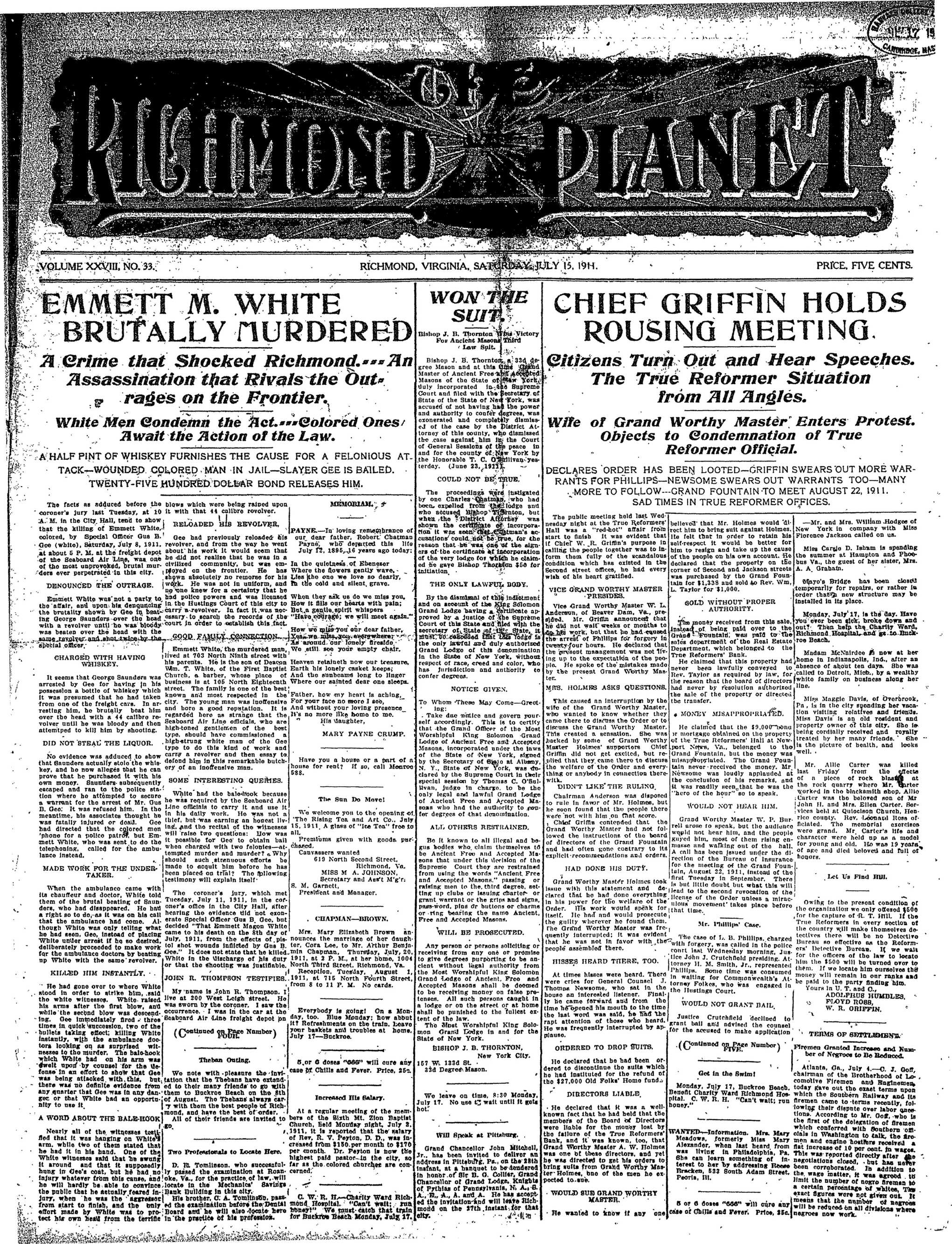
EMMETT M. WHITE BRUTALLY MURDERED
A Crime that Shocked Richmond. An Assassination that Rivals the Outrages on the Frontier.
White Men Condemn the Act.—Colored Ones/Await the Action of the Law.
A HALF PINT OF WHISKEY FURNISHES THE CAUSE FOR A FELONIOUS AT TACK—WOUNDED. COLORED MAN IN JAIL—SLAYER GEE IS BAILED. TWENTY-FIVE HUNDRED DOLLAR BOND RELEASES HIM.
The facts as adduced before the blows which were being rained upon coroner's jury last Tuesday, at 10 it with that 44 calibre revolver.
A. M. in the City Hall, tend to show that the killing of Emmett White, colored, by Special Officer Gus H. RELOADED HIS REVOLVER.
Gee had previously reloaded his Gee (white), Saturday, July 8, 1911, revolver, and from the way he went at about 5 P. M. at the freight depot about his work it would seem that of the Seaboard Air Line, was one he did not realize that he was in a of the most unprovoked, brutal mur- civilized community, but was em-ployed on the frontier. He has Where the flowers gently wave.
DENOUNCED THE OUTRAGE.
Emmet White was not a party to the affair, and upon his denouncing the brutality shown by Geo In beating George Saunders over the head with a revolver until he was bloody was beaten over the head with the same revolver and shot twice by the special officer.
CHARGED WITH HAVING WHISKEY.
It seems that George Saunders was arrested by Gee for having in his possession a bottle of whiskey which it was presumed that he had taken from one of the freight cans. In arresting him, he brutally boat him over the head with a 44 calibre revolver until he was bloody and then attempted to kill him by shooting.
DID NOT STEAL THE LIQUOR.
No evidence was adduced to show that Saunders actually stole the whiskey, and he now alleges that he can prove that he purchased it with his own money. Saunders subsequently escaped and ran to the police station where he attempted to secure a warrant for the arrest of Mr. Gus B. Geo. It was refused him. In the meantime, his associates thought he was fatally injured or dead. Geo had directed that the colored men 'phone for a police patrol', but Emmett White, who was sent to do the telephoneing, called for the ambulance instead.
MADE WORK FOR THE UNDERTAKER.
When the ambulance came with its chauffeur and doctor, White told them of the brutal beating of Snuders, who had disappeared. He had a right to do as it was on his call that the ambulance had come. Although White was only telling what he had seen, Geo, instead of placing White under arrest if he so desired, deliberately proceeded to make work for the ambulance doctors by beating up White with the same revolver.
KILLED HIM INSTANTLY.
He had gone over to where White stood in order to strike him, said the white witnesses. White raised his arms after the first blow, and while the second blow was descending. Gee immediately fired three times in quick succession, two of the bullets taking effect; killing White instantly, with the ambulance doctors looking on as surprised witnesses to the murder. The bale-hook which White had on his arm was dwelt upon by counsel for the defense in an effort to show that Gee was being attacked with this, but there was no definite evidence from any quarter that Gee was in any danger or that White had an opportunity to use it.
A WORD ABOUT THE BALE-HOOK
Nearly all of the witnesses testified that it was hanging on White's arm, while two of them stated that he had it in his hand. One of the White witnesses said that he swung it around and that it supposedly hung in Geo's cost, but he had no injury whatever from this cause, and he will hardly be able to convince the public that he actually feared injury, when he was the aggressor from start to finish, and the only effort made by White was to protect his own head from the ferrite
blows which were being rained upon it with that 44 calibre revolver.
RELOADED HIS REVOLVER
Gee had previously reloaded his revolver, and from the way he went about his work it would seem that he did not realize that he was in a civilized community, but was employed on the frontier. He has shown absolutely no remorse for his work. He was not in uniform, and no one knew for a certainty that he had policed powers and was licensed in the Hustings Court of this city to carry a revolver. In fact it was necessary to search the records of the court in order to establish this fact.
GOOD FAMILY CONNECTION
Emmett White, the murdered man, lived at 703 North Ninth street with his parents. He is the son of Deacon Wim. T. White, of the First Baptist Church, a barber, whose place of business is at 105 North Eighteenth street. The family is one of the best known and most respected in the city. The young man was inoffensive and bore a good reputation. It is regarded here as strange that the Seaboard Air Line officials, who are high-toned gentlemen of the best type, should have commissioned a high-strung white man of the Gee type to do this kind of work and carry a revolver and then essay to defend him in this remarkable butchery of an inoffensive man.
SOME INTERESTING QUEIMES.
White had the hale-dook because he was required by the Boardman Air Lone officials to carry it and use it in his daily work. He was not a trifle, but was earning an honest living, and the recital of the witnesses will raise two questions: How was it possible for Goe to obtain bail when charged with two felonies—attempted murder and murder? Why should such strenuous efforts be made to acquit him before he has been placed on trial? The following testimony will explain itself.
The coroner's jury, which met Tuesday, July 11, 1911, in the coroner's office in the City Hall, after hearing the evidence did not exonerate Special Officer Gus B. Geo, but decided "That Emmett Magon White came to his death on the 8th day of July, 1911, from the effects of pistol shot wounds inflicted by Gus B. Gee." It does not state that he killed White in the discharge of his duty or that the shooting was justifiable.
JOHN R. THOMPSON TESTIFIES.
My name is John R. Thompson. I live at 200 West Leigh street. He was sworn by the coroner. I saw the occurrence. I was in the car at the Scobair Air Lane freight depot on
(Continued Page Number)
Theban Outing.
We note with pleasure the invitation that the Thebans have extended to their many friends to go with them to Buckroe Beach on the 8th of August. The Thebans always carry with them the best people of Richmond, and have the best of order. All of their friends are invited to go.
Two Professionals to Locate Here.
D. J. Tomlinson, who successfully passed the examination at Roanoke, Va., for the practice, of law, will locate in the Mechanics' Savings Bank Building in this city. His brother, C. A. Tomlinson, passed the examination before the Dental Board and he will also locate here in the practice of his profession.
MEMORIAM.
PAYNE.—In loving remembrance of our dear father, Robert Chatman Payne, who departed this life July 12, 1895, 16 years ago today:
In the quietness of Ebenezer Where the flowers gently wave, Lies the one we love so dearly, In the cold and silent, grave.
When they ask us we do we miss you, How it fills our hearts with pain; But a gentle spirit whispers "Have courage; we will meet again."
How we miss you our dear father, Yes, we miss you everywhere; As around our lonely fireplace We still see your empty chair.
Heaven retalieth now our treasure, Earth his lonely casket keeps; And the sunbeams long to linger Where our sainted dear one sleeps.
Father, how my heart is aching, For your face no more I see, And without your loving presence It's no more like home to me.
His daughter.
MARY PAYNE CRUMP.
Have you a house or a part of a house for rent? If so, call Monroe 808-277-2222.
The Sun Do Movel
We welcome you to the opening of
"The Rising Ton and Art Co., July
15, 1911. A glass of "Ice Tea" free to
all.
Premiums given with goods purchas-
ed.
Canvassers wanted
619 North Second Street,
Richmond, Va.
MISS M. A. JOHNSON,
Secretary and Ass't M'g'r:
S. M. Garnett,
President and Manager.
CHAPMAN-BROWN.
Mrs. Mary Elizabeth Brown announces the marriage of her daughter, Cora Lee, to Mr. Arthur Benjamin Chapman, Thursday, July 20, 1811, at 2 P. M., at her home, 1004 North Third Street, Richmond, Va.
Reception Tuesday, August 1,
10:30 a.m. 15th Street, 11th
from 8 to 11 p.m. M, No. Cards,
110 West 11th Street
Everybody is going! On a Monday, too. Blue Monday; how about it? Refreshments on the train. Leave your baskets and troubles at home. July 17—Buckroe.
B. or G does "GGG" will cure any case B Chills and Fever. Price, 25.6
Increased His Salary.
At a regular meeting of the members of the Sixth Mt. Zion Baptist Church, held Monday night, July 3, 1911, it is reported that the salary of Rev. R. V. Peyton, D. D., was increased from $150 per month to $170 per month. Dr. Peyton is now the highest paid pastor in the city, so far as the colored churches are concerned.
C. W. R. H.-Charity Ward Richmond Hospital. "Can't wait; run honey!" We must-catch that train for Buckeye Beach Monday. July 17.
WON THE SUIT.
Bishop J. B. Thornton This Victory For Ancient Masons Third / Law Split.
Bishop J. B. Thornton, a 33d degree Mason and at this Time Grand Master of Ancient Free and Accepted Masons of the State of New York, duly incorporated in the Supreme Court and filed with the Secretary of State of the State of New York, was accused of not having had the power and authority to confer degrees, was exonerated and completely dismissed of the case by the District Attorney of this county, who dismissed the case against him in the Court of General Sessions of the peace in and for the county of New York by the Honorable T. C. O'Dillivan yesterday. (June 23, 1911)
COULD NOT BE TRUE.
The proceedings were instigated by one Charles Chatman, who had been, expelled from the lodge and who accused Bishop Thornton, but when the District Attorney was shown the certificate of incorporation it was seen that Chatman's accusations could, not be true, for the reason that he was one of the signers of the certificate of incorporation of the very lodge for which he claimed he gave Bishop Thornton $50 for initiation.
THE ONLY LAWFUL BODY
By the dismissal of this indictment and on account of the King Solomon Grand Lodge having a certificate approved by a justice of the Supreme Court of this State and filed with the secretary of State of the State, it must be acknowledged that the Vodgid is the only lawful and duly authorized Grand Lodge of this domination in the State of New York, without respect of race, creed and color, who has jurisdiction and authority to confer degrees.
NOTICE GIVEN.
To Whom 'These May Come—Great
Ing:
Take due notice and govern yourself accordingly. This is to certify that the Grand Officer of the Most Worshipful King Solomon Grand Lodge of Ancient Free and Accepted Masons, incorporated under the laws of the State of New York, signed by the Secretary of State at Albany, N. Y., State of New York, was declared by the Supreme Court in their special session by Thomas O. C. Sullivan, judge in charge, to be the only legal and lawful Grand Lodge of Ancient Free and Accepted Masons who had the authority to confer degrees of that denomination.
ALL OTHERS RESTRAINED
Be it known to all illegal and bogus bodies who claim themselves to be Ancient Free and Accepted Masons that under this decision of the Supreme Court they are restrained from using the words "Ancient Free and Accepted Masons." passing or raising men to the, third degree, setting up clubs or issuing charter or grant warrant or the grips and signs, pass-word, pins or buttons or charms or ring bearing the name Ancient, Free and Accepted Masons.
WILL BE PROSECUTED.
Any person or persons soliciting or receiving from any one or promise to give degrees purporting to be ancient without legal authority from the Most Worshipful King Solomon Grand Lodge of Ancient, Free and Accepted Masons shall be deemed to be receiving money on false pretensions. All such persons caught in a lodge or on the street or at home shall be punished to the fullest extent of the law. The Most Worshipful King Solomon Grand Lodge in and for the State of New York.
BISHOP J. B. THORNTON,
New York City.
157 W. 133d St.
33d Degree Mason.
We leave on time, 8:30 Monday,
July 17. No use tJ wait until it gets
hot.
Will Speak at Pittsburgh.
Grand Chancellor John Mitchell, Jr., has been invited to deliver an address in Pittsburg, Pa., on the 28th infant, at a banquet to be tendered in honor of Sir B. G. Collier, Grand Chancellor of Grand Lodge, Knights of Pythias of Pennsylvania, N. A., B. A., B., A., A. and A. He has accepted the invitation and will leave Richmond on the 27th instant for that city.
CHIEF GRIFFIN HOLDS ROUSING MEETING.
Citizens Turn Out and Hear Speeches. The True Reformer Situation from All Angles.
Wife of Grand Worthy Master Enters Protest. Objects to Condemnation of True Reformer Official.
DECLARES ORDER HAS BEEN LOOTED—GRIFFIN SWEARS OUT MORE WARRANTIES FOR PHILLIPS—NEWSOME SWEARS OUT WARRANTIES TOO—MANY MORE TO FOLLOW—GRAND FOUNTAIN TO MEET AUGUST 22, 1911. SAD TIMES IN TRUE REFORMER OFFICES.
The public meeting held last Wednesday night at the True Reformers Hall was a "red-hot" affair from start to finish. It was evident that if Chief W. R. Griffin's purpose in calling the people together was to inform them fully of the scandalous condition which has existed in the Second street offices, he had every wish of his heart gratified.
bellevold that Mr. Holmes would direct him to bring suit against Holmes. He felt that in order to retain his self-respect it would be better for him to resign and take up the cause of the people on his own account. He declared that the property on the corner of Second and Jackson streets was purchased by the Grand Foun.
Mr. and Mrs. William Hodges of New York in company with Miss Florence Jackson called on us.
Miss Cargle D. Isham is spending the summer at Hampton and Phoob bus Va., the guest of her sister, Mrs A. A. Grahain.
VICE GRAND WORTHY MASTER
" PRESIDES.
Vice Grand Worthy Master W. L. Anderson, of Beaver Dam, Va., presided. Mr. Grimlin announced that he did not walt weeks or months to do his work, but that he had caused the arrest of Phillips for forgery in county four hours. He declared that the present management was not living up to the expectation of the poep ing. He spoke of the mistakes made by the present Grand Worthy Master.
MRS. HOLMRS ASKS QUESTIONS.
This caused an interruption by the wife of the Grand Worthy Master, who wanted to know whether they came there to discuss the Order or to discuss the Grand Worthy Master. This created a sensation. She was backed by some of Grand Worthy Master Holmes' supporters Chief Griffin did not get excited, but replied that they came there to discuss the welfare of the Order and everything or anybody in connection there with.
DIDN'T LIKE THE RULING
Chairman Anderson was disposed to rule in favor of Mr. Holmes, but he soon found that the people there were not with him on that score. Chief Griffo contended that the Grand Worthy Master had not followed the instructions of the board of directors of the Grand Fountain and had often gone contrary to its explicit recommendations and orders.
HAD DONE HIS DUTY.
Grand Worthy Master Holmes took issue with this statement and declared that he had done everything in his power for the welfare of the Order. His work would speak for itself. He had and would prosecute the guilty wherever he found them. The Grand Worthy Master was frequently interrupted; it was evident that he was not in favor with the people assembled there.
HISSES HEARD THERE, TOO
At times blues were heard. There were cries for General Counsel J. Thomas Newsome, who sat in the house an interrelated listener. Finally he came forward and from the time he opened his mouth to the time the last word was said, he had the rapt attention of those who heard. He was frequently interrupted by applause.
ORDERED TO DROP SUITS.
He declared that he had been ordered to discontinue the suits which he had instituted for the refund of the $27,000 Old Folks' Home fund.
DIRECTORS LIABLE
He declared that H was a well-known fact that he had held that the members of the Board of Directors were liable for the money lost by the failure of the True Reformers' Bank, and it was known, too, that Grand Worthy Master A. W. Holmes was one of these directors, and yet he was directed to get his orders to bring suits from Grand Worthy Master Holmes, one of the men he expected to ap.
WOULD SUE GRAND WORTHY
MASTER.
He wanted to know if any one
bellevol' that Mr. Holmes would direct him to bring suit against Holmes. He felt that in order to retain his self-respect it would be better for him to resign and take up the cause of the people on his own account. He declared that the property on the corner of Second and Jackson streets was purchased by the Grand Fountain for $1,338 and sold $4 Rev. Wm. L. Taylor for $1,600.
SOLD WITHOUT PROPER AUTHORITY.
This money received from this sale, instead of being paid over to the Grand Fountain, was paid to the sales department of the Real Estate Department, which belonged to the True Reformers' Bank.
He claimed that this property had never been lawfully conveyed to Rev. Taylor as required by law, for the reason that the board of directors had never by resolution authorized the sale of the property or directed the transfer.
· MONEY MISAPPROPRIATED
He claimed that the $9,000 bond or mortgage obtained on the property of the True Reformers' Hall at Newport News, Va., belonged to the Grand Fountain, but the money was misappropriated. The Grand Fountain never received the money. Mr. Newsome was loudly applauded at the conclusion of his remarks, and it was readily seen that he was the "hero of the hour" so to sneak.
WOULD NOT HEAR HIM.
Grand Worthy Master W. P. Burrell arose to speak, but the audience would not hear him, and the people guyed him, most of them rising en masse and walking out of the hall. A call has been jailed under the direction of the Bureau of Insurance for the meeting of the Grand Fountain, August 22, 1911, instead of the first Tuesday in September. There is but little doubt but what this will lead to the second revocation of the license of the Order unless a miraculous movement takes place before that time.
Mr. Phillip' Case
The case of L. B. Phillips, charged with forgery, was called in the police court on Wednesday morning, Justice John J. Crutchfield presiding. Attorney H. M. Smith, Jr., represented Phillips. Some time was consumed in waiting for Commonwealth's Attorney Folkes, who was engaged in the Hustings Court.
WOULD NOT GRANT BAIL
Justice Crutchfield declined to grant ball and advised the counsel for the accused to make application (Continued on Page Number) FIVE.
Get in the Swim!
Monday, July 17, Buckroe Beach
Beneft Charity Ward Richmond Hospital.
C. W. R. H. "Can't wait; run
honey."
WANTED—Information. Mrs. Mary Meadows, formerly Miss Mary Alexander, when last heard from was living in Philadelphia, Pa. She can learn something of interest to her by addressing Reese Bracken, 533 South Adam Street, Peoria, Ill.
5 or 6 doses "666" will cure any
case of Chills and Fever. Price, $36.
Mr. and Mrs. William Hodge of New York in company with Miss Florence Jackson called on us.
Miss Cargile D. Isham is spending the summer at Hampton and Phoebe Va., the guest of her sister, Mrs. A. A. Grahain.
Mayo's Bridge has been closed temporarily for repairs, or rather in order that a new structure may be installed in its place.
Monday, July 17, is the day. Have you ever been sick, broke down and out? Then help the Charity Ward, Richmond Hospital, and get to Buckroe Beach.
Madam McNairdee is now at her home in Indianapolis, Ind., after an absence of about ten days. She was called to Detroit, Mich., by a wealthy white family on business along her line.
Miss Maggie Davis, of Overbrook, Pa., is in the city spending her vacation visiting relatives and friends. Miss Davis is an old resident and property owner of this city. She is being cordially received and royally treated by her many friends. She is the picture of health, and looks well.
Mr. Allie Carter was killed last Friday from the effects of a piece of rock blasted at the rock quarry where Mr. Carter worked in the blacksmith shop. Allie Carter was the beloved son of Mr John H. and Mrs. Ellen Carter. Services held at Quilcolson Church, Henrico county. Roy, Leonard Ross officiated. The memorial exercises were grand. Mr. Carter's life and character were held up as a model for young and old. He was 19 years, of age and died beloved and full of honors.
Let Us Find HILL.
Owing to the present condition of the organization we only offered $500 for the capture of R. T. Hill. If the True Reformers in every section of the country will make themselves detectives there will be no Detective Bureau so effective as the Reformers' Detective Bureau. If we wait for the officers of the law to locate him the $500 will be turned over to them. If we locate our ourselves the money will remain in our ranks and be paid to the party finding him. You're in U. T. and C., ADOLPHUS HUMBLES, FLOYD ROSS, W. R. ORRIFFIN.
TERMS OF SETTLEMENT
Firemen Granted Increase and Number of Negroes to Be Reduced.
Atlanta, Ga., July 4.—G. J. Goff, chairman of the Brotherhood of Locomotive Firemen and Enginemen, today gave out the exact terms upon which the Southern Railway and its firemen came to terms recently, following their dispute over labor questions. According to Mr. Goff, who is the first of the delegation of firemen which conferred with southern officials in Washington to talk, the firemen and engine hostlers received a flat increase of 10 per cent. in wages. This was reported directly after the negotiations closed, but has never been corroborated. In addition to the wage matter, it was agreed to limit the number of negro firemen to a certain percentage of whites. The exact figures were not given out. It means that the number of negroes will be reduced on all divisions where negroes now work.
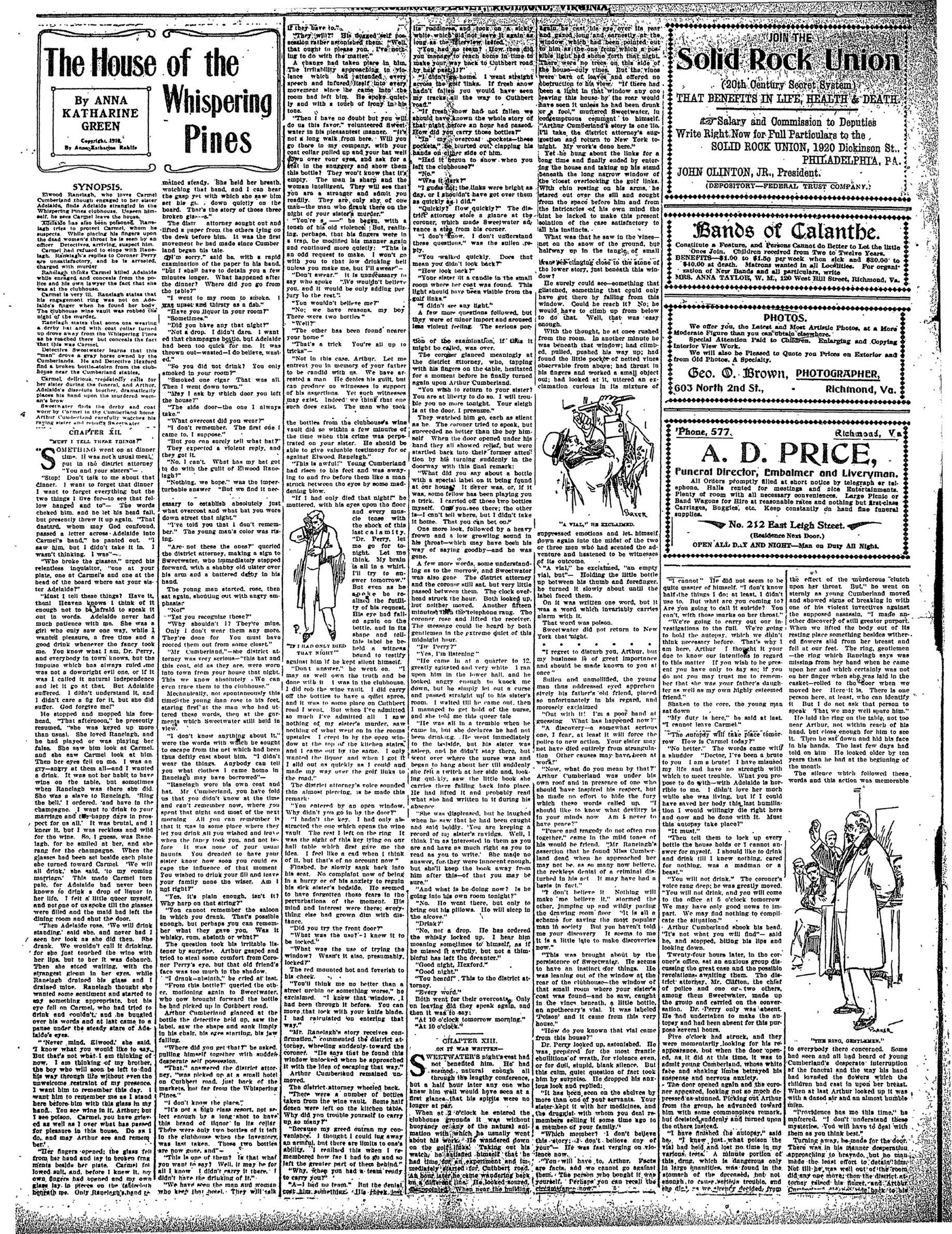
The House of the Whispering Pines
By ANNA KATHARINE GREEN
Copyright, 1918.
By Anna Katharine Rohle
SYNOPSIS.
Elwood Ranlagh, who loves Carmel Wood and thought engaged to her sister Adaldea, finds Adaldea strangled in the house, he sees Carmel leave himself, he sees Carmel leave the house. Adaldea has also been polished. Ranlagh tries to protect Carmel, whom he suspects. While placing his fingers upon the house, he sees Carmel detective, arriving, suspect him. Carmel had refused to elope with Ranlagh. Ranlagh's replies to Corner Perry and he is arrested, charged with murder. Ranlagh thinks Carmel killed Adaldea while enraged and conceals from the police and his own lawyer the fact that she was murdered. Carmel is very ill. Ranlagh states that his engagement ring was not on Adaldea's finger when he found her body. The clubhouse wife waved was robbed the day before. Ranlagh states that some one wearing a denial hat and with coat collar turned up drove away from the Whispering Lines as he reached there but conceals the fact that Detective Sweetwater learns that this "man" drove a gray horse owned by the Cumberlanda. He and Detective Hexford he himself clubhouse near the Cumberlanda clubhouse.
Carmel, delirious, repeatedly calls for her slater during the funeral, and Arthur, Adeladeo's dissolute brother, dramatically places his hand upon the murdered woman. Sweetheart finds the derby and coat worm by Carmel in the Cumberland home. Arthur Cumberland carefully waghes his raising sister and brings Sweetheart
CHAPTER XIL
"NEXT I TELL THAT THINGS"
"SOMETHING wont on at dinner time. It was not a usual meal, put in the district attorney "You and your sisters"—
"Stop! Don't talk to me about that dinner. I want to forget that dinner I want to forget everything but the two things I live for—to see that fellow hanged and to"— The words choked him, and he let his head fall, but presently threw it up again. "That distast, whom may God confound, passed a letter across-Adelaide into Carmel's hand," he panted out. "I saw him, but I didn't take it in. I wasn't thinking. I was"—
"Who broke the glasses," urged his relentless inquisitor, "one at your plate, one at Carmel's and one at the head of the board where eat your sister Adelaide?"
"Must I tell these things? Have it,
thou! Heaven knows I think of it
eight not to be afraid to speak it
out in words. Adaldo never had
much patience with me. She was a
girl who only saw one way, while I
wanted pleasure, a free time and a
good drink whenever the fancy took
me. You know what I am, Dr. Perry,
and everybody in town knows, but the
impulse which has always ruled me
was that I should not drink. I
would I call it natural independence
and let it go at that. But Adaldo
suffered. I didn't understand it, and
I didn't care a dig for it, but also did
suffer. God forge me!"
He stopped and mopped his forehead, "That afternoon," he presently resumed, "who was keyed up more than usual. She loved Ranclagh, and he had played or was playing her false she played and she and she Carmel look at him. Her eyes fell on me. I was an grry-angry at them all—and I wanted a drink. It was not her habit to have wine on the table, but sometimes when Ranclagh was there she did. She was a slave to Ranclagh. "Ring the bell," I ordered, "and have in the challenge, and have in the challenge, and have in the challenge," and days in pro-
pect for us all." It was brutal, and I knew it, but I was reckless and wild for the wine. So, I guess, was Ranlagh. for he smiled at her, and she rang for the champagne. When the glasses had been set beside each plate she turned toward Carmel. "We will all drink," she said, "to my coming marriage." This made Carmel turn pale for the solitude had never been known in the world, and her life. I felt a little queer myself, and not one of us spoke till the glasses were dilled and the mold had left the dining room and shut the door.
"Then Adelaide rose. 'We will drink standing,' said she, and never had I seen her look as she did then. She drank. We wouldn't call it drinking. for she just touched the wine with her lips, but to her it was doobach. Then she stood waiting, with the strongest gleam in her eyes, while Ranelagh drained his glass and I drained mine. Ranelagh thought she and I were sedent and started to say something appropriate, but his eye fell on Carmel, who had tried to drink and couldn't, and he burgled over his words and at last came to a pause under the steady stare of Adelaide's eyes.
"Never mind. Elwood," she said. I know what you would like to say. But that's not what. I am thinking of now. I am thinking of my brother, the boy who will soon be left to find his way through life without even the unwelcome restraint of my presence. I want him to remember this day. I want him to remember me as I stand here before him with this glass in my hand. You see wine in it. Arthur but I see poison. Carmel, I have grievous over what has passed for pleasure in this house. Do we do, and may Arthur see and remember her."
"Her fingers opened; the glass fell from her hand and lay in broken fragments beside her plate. Carmel felt lowed suit, and before I knew it, my own fingers had opened and my own glass lay in pieces on the tablelift height me. Only Starling's hand r
minded stenly. She held her breath, watching that hand, and I can hear the gap yet with which she saw him set his gait. down quickly on the board. That's the story of those three broken glae-
The distr attorney sought out and lifted a paper from the others lying on the desk before him. It was the first movement he had made since Cumberland began his tale.
"I'm sorry," said he with a rapid glint. "I used the paper in his hand. 'But I shall have to detain you a few minutes longer. What happened after the dinner? Where did you go from the table?'
"I went to my room to smoke. I gag upset and thirsty as a fish."
"Elave you liquor in your room?"
"Sometimes."
"Did you have any that night?"
"Not a drop. I didn't dare. I want ed that champagne bottle, but Adelaide had been too quick for me. It was thrown out—wasted—I do believe, wasted."
"So you did not drink? You only smoked in your room?"
"Smoked one cigar That was all. Then I went down town."
"May I ask by which door you left the house?"
"The side door—the one I always take."
"What overcame did you wear?"
"I don't remember. The first one I came to, I suppose."
"But you can surely tell what hat?" They expected a violent reply, and they got it.
"No, I can't. What has my hat got to do with the guilt of Elwood Ranlough?"
"Nothing, we hope." was the imperpetrable answer. "But we find it necessary to establish absolutely just what overcoat and what hat you wore down street that night."
"I've told you that I don't remember." The young man's color was rising.
"Are not these the ones?" queried the district attorney, making a sign to Sweetwater, who immediately stopped forward, with a shabby old uster over his arm and a battered denby in his hand.
The young man started, rose, then sat again, shouting out with angry emphasis.
"Not"
"Let you recognize these?"
"Why shouldn't I? They're mine. Only I don't wear them any more. They're done for. You must have rooted them out from some closet." "Mr Cumberland."—the district attorney was very serious." this hat and this cont, old as they are, were worn into town from your house that night. This we know absolutely. We can even trace them to the clubhouse." Mechanically, not spontaneously this time, the young man rose to his feet, starting first at the man who had uttered these words, then at the garments which Sweetwater still held in view. "I don't know anything about it." were the words with which he sought to escape from the net which had been thus defyed cast about him. "I didn't wear the things. Anybody can tell you what clothes I came home in Rapalegu may have borrowed."
"Rangeting wore his own coat and hat. Mr. Umberson, you have told us that you didn't know at the time and can't remember now, where you spent that night and most of the next morning. All you can remember is that it was in some place where they let you drink all you washed and leave when the fanny took you, and not before. It was none of your usual hunts. You dreaded to have your sister know how soon you could escape the influence of that moment. You wished to drunk your fill and leave your family none the wiser. Am I not right?"
"Yes, it's plain enough, isn't it? Why harp on that string?"
"You cannot remember the saloon in which you drank. That's possible enough, but perhaps you can remember what they gave you. Was it whisky, rum, absinthe or what?"
The question took his irritable listener by surprise. Arthur gasped and tried to steal some comfort from Coronor Perry's eye, but that old friend's face was too much in the shadow.
"I drank—nishlith," he cried at last. "In this bottle!" queried the other, molloning again to Sweetwater, who now brought forward the bottle he be picked up in Curtbert road.
Arthur Cumberland glanced at the boarded cabin in the lab, the label, saw the shape and sank implicitly in his chair, his eyes starting, his jaw falling.
"Where did you get that?" he asked, pulling himself together with audden designe self possession.
"That," answered the district attorney, "was picked up at a small hotel on Curtbert road, just back of the markets, not far from the Whispering Pines."
"I don't know the place."
"It's not a high class resort, not select enough by a long-shot to have this brand of liquor in its cellar. There were only two bottles of it left in the clubhouse when the inventory, was last taken. Those two bottles, this is one of them," is what you want to say? Well, it may be for all I know. I didn't carry it there. I didn't have the drinking of it."
"We have seen the man and woman who keep the hotel. They will talk
if they have to.
"They will." His dogged self possession rather astonished them. "Well that ought to please you. I've nothing to do with the matter. I had taken place in him. The irritability approaching to violence which had attended, every speech and infused itself into every movement since the came into the room had left him. He spoke quietly and with a touch of frony in his tone.
"Then I have no doubt but you will do us this favor," volunteered Sweetwater in his pleasantest manner. "I'm not a long walk from here. Will you go there in my company, with your coat collar pulled up and your hat well down over your eyes, and ask for a left in the sanguery and show them your coat collar. I will be empty. The man is sharp and the woman intelligent. They will see that you are a stronger and admit you readily. They are only shy, of one man—the man who drank there on the night of your sisters murder."
"You're a — —" be begin, with a touch of his old violence; but, rehilting, perhaps, that his fingers were in a trap, be modified his manner again and continued more quietly: "This is an odd request to make. I won't go on you to that love or desire bell unless you can but I'll never." "Don't awe." it is unnassessable to say who apoke "We wouldn't believe you, and it would be only adding purity to the rest." "You wouldn't believe me!"
"No; we have reasons, my boy. There were two bottles." "Well?" "The other has been found nearer your home." "That's a trick. You're all up to trick's." "Not in this case. Arthur. Let me entreat you in memory of your father to be candid with us. We have arrested him. He denies his guilt, but can produce no witnesses in support of his assertions. Yet such witnesses may exist. Indeed we think that one such does exist. The man who took the bottles from the clubhouse's whina vault did so within a few minutes of the time when this crime was perpetrated on your sister. He should be able to give valuable testimony for or against Elwood Randolph. "This wrist!" Young Cumberland had risen to his feet and was swaying to and fro before them like a man struck between the eyes by some maddening blow. "If I had only died that night!" he muttered, with his eyes upon the floor
and every muscle tense with the shock of this last calamity. "Dr. Perry, let me go for tonight. Let me think. My brain is all in a whirl. I'll try to answer tomorrow." But even as he spoke he realized the futility of his request. His eye had fallen again on the bottle, and in its shape and tell-tale label he beheld a witness bound to testify.
?
against him if he kept silent himself.
"Don't answer." he went on. "I may as well own the truth and be done with it. I was in the clubhouse. I did rob the wine vault. I did carry off the bottles to have a quiet spree. I was in some place on Curtbart road I went to. I admired so much I were admired all. I saw nothing of my sister's murder, saw nothing of what went on in the room upstairs. I creep in by the open window at the top of the kitchen statue, and I came out by the same. I only wanted the liquor and when I got it I sled out as quickly as I could and made my wine over the golf links to the road."
The district attorney's voice sounded this almost pleuring, as he made this remark:
"You entered by an open window. Why didn't you go in by the door?" "I hadn't the key. I had only a street mirror on which the window was. The rest I left in the room. It was the sight of this key lying on our hall table which that first gave me the idea. I feel like a bad when I think of it, but that's no account now."
Finished. he slowly sank back into his seat. No complaint now of being in a hurry or of his anxiety to regain his sick sister's bedside. He seemed to have forgotten those fears in the perturbations of the moment. His mind and interest were there; everyone else had grown dim with distance.
"Did you try the front door?"
"What was the uno!-1 knew it to be locked."
"What was the use of trying the window? Wasn't it also, presumably, locked?"
The red mounted hot and feverish to his cheek.
"You'll think me no better than a street unchin or something worse." he exclaimed. "I knew that window. I was more through it than you. You can more than lock with your knife blades. I had calculated on entering that way."
"Mr. Rangeligh's story receives confirmation," commented the district attorney, wheeling suddenly toward the coroner. "He says that he found this window unlocked when he approached it with the idea of escaping that way." Unumberland remained unmoved. The district attorney wheeded back. "There were a number of bottles taken from the wine vault. Some half dozen were left on the kitchen table. Why did you trouble yourself to carry up so many?" "Because my greed outran my convainment," I thought I could ing away an amoral, but there are limits on one's ability. When I remembered how I had left the greater part of them behind." "Why, when you had a team ready to carry you?"
"A-I had no team." But the dental
past-him. subtense. "Uls. this. leek. ick.
his ruddy dress, and took on a sickly white, which did not leave it again as long as the interview lasted.
"You had no team! How then did you manage to reach home in time to make your way back to Guthbert road by half past 11?"
"I didn't home. I went straight across the golf links. If fresh snow hadn't fallen you would have seen my tracks all the way to Guthbert road."
"If fresh snow had not fallen we should have known the whole story of that night before an hour had passed. How did you carry those bottles?" Pockets—those pocketz! he buried on the clapping his hands on other side of him.
"Had it begun to snow, when you left the clubhouse?"
"No."
"Was it dark?"
"I guess did; the links were bright as day, or I shouldn't have got over them as quickly as I did."
"quickly? How quickly?" The district attorney stole a glance at the coroner, which made Sweater water advenience a step from his corner. "don't show." I don't understand these questions." was the noun reply. "You walked quickly. Does that mean you didn't look back?"
"How look back?"
"Your sister it a candle in the small room where her coat was found. This light should have been visible from the golf links."
"I didn't see any light."
A few more questions followed, but they were of minor import and aroused less violent feeling. The serious portion of the examination, if this it might be called, was over.
The corner glanced meaningly at the district attorney, who, tapping with his fingers on the table, hesitated for a moment before he finally turned again upon Arthur Cumberland.
"You wish to return to your sister? You are at liberty to do so. I will trouble you. You are at your side. Your sleigh is at the door. I presume."
They watched him go, each as silent as he. The corner tried to speak, but succeeded no better than the boy himself. When the door opened under his hand they all showed relief, but were startled into their former attention by his turning suddenly in the doorway with this final remark:
"What did you say about a bottle with a special label on it being found at our house. It dler was, or, if it was, some fellow has been playing you a trick. I carried off those two bottles myself. One you see there; the other is—I can't tell where, but I didn't take it home. That you can bet on."
One more look, followed by a heavy frown and a low growling sound in his throat—which may have beeh his way of saying goodbye—and he was gone.
A few more words, some understanding as to the morrow, and Sweetwater was also gone. The district attorney and the coroner will act, but very little messed between them. The clock overhauled at the bar. Both looked but neither moved. Another fifteen minutes then the telephone rang. The coroner rose and lifted the receiver. The message could be heard by both gentlemen in the extreme quiet of this midnight hour.
"Dr. Perry?"
"Yes. I'm listening."
"He came in at a quarter to 12, greatly agitated and very white. I ran upon him in the lower hall, and he looked angry enough to knock me down, but he simply let out a curse and passed straight up to his sister's room. I waited he came out, then I managed to get hold of the nurse, and she told me this queer tale.
"He was all in a tremble when he came in, but she declares he had not been drinking. He went immediately to the bedside, but his sister was asleep, and he didn't stay there, but went over where the nurse was and began to hang about her till suddenly she felt a twitch at her side, and looking quietly, saw the little book she carried there falling back into place. He had lifted it and probably read what she had written in it during his absence.
"She was displeased, but he laughed when he saw that he had been caught and said boldly. 'You are keeping a record of my sister's ravages. Well, I think I am interested in them as you are and have as much right as you to read as you to write. She made no answer, for they were innocent enough, and I will keep the book away from him after this—of that you may be sure."
"And what is he doing now? Is he going into his own room tonight?" "No. He went there, but only to bring out his pillows. He will sleep in the alcove." "Drink?" "No, not a drop. He has ordered the whisky locked up. I hear him moaning sometimes to himself, as if he was foolishly, but with a thimble has left the decanter." "Good night, Hexford." "Good night." "You heard! This to the district attorney."
"Every word."
Both went for their overcoat. Only un leaving did they speak again, and then it was to say:
"At 10 o'clock tomorrow morning."
"At 10 o'clock."
SWEETWATER's night's cost had not benefited him. He had seemed, natural enough all through the lengthy conference, but a half hour later any one who knew him well would have seen at a first glance, that his spirits were no longer glance. That 2 o'clock he entered the clubhouse grounds it was without buoyancy or any of the natural estimation with which he usually went about his work. He wandered down on the golf links. Taking out his watch, he insulated himself that he had time for an experiment and immediately started for Cuthbert road. A bounter later he came wandering back on a different line. He looked soured. He approached. When near the building
again he cast his eye over its rear and gazed long and earnestly at the window, which had been pointed out to him as the one from which a possible light had shone forth that night. There were no trees on this side of the house—only yines. But the vines obscured the way of leaves and offered no obstruction to blinds there had been a light in that window, leaving this house by the rear would have seen it unless he had been drunk or a fool, muttered Sweetwater, in conducentuous commend to himself.
"Arthur Cumberland's story is one like I'll take the district attorney's suggestion and return to New York tonight. My work's done here."
Yet he hung about the links for a long time and finally ended by entering the house and taking up his stand beneath the long narrow window of the closest overlooking the golf links. With chin resting on his arms, he stared out over the sill and sought from the space before him and from the fatricicles of his own mind the lind he lacked to make this present location the case satisfactory to all his instincts.
What was that he saw in the vines—not on the snow of the ground, but halfway up in the tangle of small branches clinging close to the stone of the lower story, just beneath this window?
He surely could see—something that glistened, something that could only have got there by falling from this lind. He would have to climb up from below to do that. Well, that was easy enough.
With the thought, he at once rushed from the room. In another minute he was beneath that window; had climbed, pulled, pushed his way up; had found the little pocket of netted vines observable from above; had thrust in his fingers and worked a small object out; had looked at it, uttered an exclamation curious in its mixture of
BAXER
"A VIAL." HE FIGLADER.
suppressed emotions and let himself down again into the midst of the two or three men who had scented the adventure and hastened to be witnesses of its outcome.
"A vial," he exclaimed, "an empty vial, but"—Holding the little bottle up between his thumb and forefinger, he turned it slowly about until the label faced them.
On it was written one word, but it was a word which invariably carries alarm with it.
That word was poison.
Sweetwater did not return to New York that night.
* I regret to disturb you, Arthur, but my business is of great importance and should be made known to you at once.
Sullen and unmollified, the young man thus addressed eyed apprehensively his father's old friend, placed so unfortunately in his regard, and morosely excclaimed "Out with it! I'm a poor hand at guessing What has happened now?"
"A discovery—somewhat serious one, I fear, at least it will force the police to new action. Your sister may not have died entirely from strangulation. Other causes may have, been at work."
"Now, what do you do by that? Arthur Cumberland was under his own roof and in presence of one who had made him blinded his respect, but he made no effort to hide the fury which these words called up. I should like to know what devilty is in your minds now. Am I never to have peace?"
"Peace and tragedy do not often run together," came in the mild tones of his would be friend. "Mr Raninghall's assertion that he found Miss Cumberland dead when he approached her may not be, as so many now believe, the reckless denial of a criminal disturbed in his act. It may have had a basis in fact."
"I don't believe it. Nothing will make 'me believe it.' stormed the other, jumping up and wildly pacing the drawing room floor. "It is all a scheme for saving the most popular man in society. But you haven't told me your discovery. It seems to me it is a little late to make discoveries now."
This was brought about by the presence of Sweetwater. He seems to have given an invitation for things. He was leasing out of the window at the rear of the clubhouse—the window of that small room where his sister's coat was found—and he saw, caught in the vines beneath, a little bottle, an apothecary's vial. It was labeled "Polson" and it came from this very house."
"How do you known that vial come from this house?" Dr. Perry looked up, astonished. He was prepared for the most frantic exhibitions of wrath, for violence even, or for dulit, stupid, blank silence. But this calm, quiet question of fact took him by surprise. He dropped his anxious look and replied: "It has been seen on the shelves by more than one of your servants. Your sister kept it with her medicines, and the druggist with whom you deal remember selling it some time ago to a member of your family." "Which member? I don't believe this story. I don't bellow any of your" "He was fast verging on violence now." "You will have to, Arthur. Facts are facts, and we cannot go against them. The person who bought it was yourself. Perhaps you can recall the exaltation move."
Bands of Calanthe.
Conclude a Feature, and Persons Cannot do Better to Lot the little
Constitute a Feature, and Persons Cannot do Better to Twelve Years,
BENEFITS—$1.00 to $1.50 per week when paid to $4.00 at death. Matrons wanted in all Localities. For orga-
nizations of New Bands and all particulars, write
MBREFITS.
We offer you, the Latest and Most Artistic Photos, at a More
Moderate Figure than you can obtain elsewhere.
Special Attention Paid to Children. Enlarging and Copying
Interior View Work.
We will also be Pleased to Quote you Prices on Exterior and
from Old Photos. A Speciality.
Geo. O. Brown, PHOTOGRAPHER,
Funeral Director, Empalmer and Liveryman.
All Orders promptly filled at short notice by telegraph or telephone. Halls rented for meetings and also Entertainment. Places of worship necessary conveniences. Large Plenic or Band Wagons for Hire at reasonable rates and nothing but first-class Carringes, Buggies; etc. Keep constantly on hand fine funeral supplies.
PHOTOS.
We offer you, the Latest and Most Moderate Figure than you can obtain else Special Attention Paid to Children, Interior View Work. We will also be Pleased to Quote from Old Photos, A Speciality.
Geo. O. Brown, Ph. 603 North 2nd St.
'Phone, 577.
A. D. PH.
Funeral Director, Embalmer.
All Orders promptly filled at short ephone. Halls rented for meetings. Plenty of room with all necessary cone Band Wagons for Hire at reasonable rate Carringes, Buggies, etc. Keep constant supplies.
No. 212 East Leigh
(Residence Next B)
OPEN ALL DAY AND NIGHT—MA
"I cannot." He did not seem to be quite master of himself. "I don't know half the things I do; at least, I didn't use to. But what are you coming to? Are you going to call it suicide? You can't, with those marks on her throat." "We're going to carry out our investigations to the fall. We're going to hold the autopsy, which we didn't think necessary before. That's why I am here. Arthur I thought it your due to know our intentions in regard to this matter. If you wish to be present you have only to say so; if you do not you may trust me to remember that she was your father's daughter as well as my own highly esteemed friend."
Shaken to the core, the young man sat down.
"My duty is here," he said at last. "I cannot leave Carmel."
"The autopsy will take place tomorrow. How is Carmel today?"
"No better." The words came with a shudder. "Doctor, I've been a brute to you. I am a brute! I have misused my life and have no strength with which to meet trouble. What you propose to do with—with Adolalde is horrible to me. I didn't love her much while she was living, but if I could have saved her body this last humiliation I would willingly die right here and now and be done with it. Must she must take place?" "It must." "Then tell them to lock up every bottle the house holds or I cannot answer for myself. I should like to drink and drink till I knew nothing, cared for nothing, was a madman or a beast." "You will not drink." The coroner's voice rang deep; he was greatly moved. "You will not drink, and you will come to the office at 5 o'clock tomorrow. We may have only good news to impart. We may find nothing to compilate for the situation." Arthur Cumberland shook his head. "It's not what you will find"—said he, and stopped, biting his lips and looking down.
Twenty-four hours later, in the corner's office, set an anxious group discussing the great case and the possible revolutions awaiting them. The district attorney, Mr. Clifton, the chief of police and one or two others, among them Sweetwater, made up a committee to question the nation. Dr. Perry only was absent. He had undertaken to make the autopsy and had been absent for this purpose several hours. Five clock had struck, and they were momentarily looking for his reappearance, but when the door opened, as it did at this time, it was to admit young Cumberland, whose white face and shaking limbs betrayed his suspense and nervous anxiety. The door opened again and the corpse was put on much depressed as-attained. Picking out Arthur from the group, he advanced toward him with some commonplace remark, but decided suddenly and turned upon the others instead.
"I have finished the autopsy," said he. "I know just. what poison the vial had held, and lost no time in my various tastes. A minute portion of it, which I mistakenly found in large quantities, was found in the stomach of the deceased, but not enough, to cause serious trouble, and die soon, if we already decided, from
---
the effect of the murderous "clutch upon her throat. But." he on sternly as young Cumberland moved and showed signs of breaking in with one of his violent invectives against the supposed nassassin, "I made another discovery of still greater purport. When we lifted the body out of its resting place something besides withtertaking the supposed body and贴 on our feet at our nest. The ring, cautious—the ring which Ranlingh says was missing from her hand when he came upon her and certainly was not on her finger when she was laid in the casket—rolled to the door when we moved her. Here it is. There is one person here, at least, who can identify it. But I do not ask that person to speak. That we may well spare him." He laid the ring on the table, not too near Arthur, not within reach of his hand, but close enough for him to see it. Then he sat down and hid his face he told him. His hands had told him. He looked older by ten years than he had at the beginning of the month.
The silence which followed these,
words and this action was memorable.
PARKER
"THE RING, GENTLEMAN," to everybody there concerned. Some had seen and all had heard of young Cumberland's desperate interruption of the funeral and the way his hand had lavaded the flowers which the children had cast in upon her breast. When at last Arthur looked up it was with a dazed air and an almost humble mien.
"Providence has me this time," he muttered. "I don't understand these mysteries. You will have to deal with them as you think best."
Turing away, he made for the door. There was in his manner desperation, approaching to brayde, but he made the least effort to detain him. Not till he was well out of the room, did any one more; then the district attorney raised his fist, and Arthur Cumberland returned back to his
SATURDAY ... JULY 15, 1911.
FOR several days I had been ill. They were merciful days to me since I was far too weak for thought. Then there came a period of conscious rest, then renewed interest in life and my own fate and reputation. What had happened during this interval?
I had a confused memory of having seen Clifton's face at my bedside, but I was sure that no words had passed between us. When would he come again? When should I hear about Carmel and whether she were yet alive or morally dead, like her sister? I might read the papers, but they had been carefully kept from me. Not one was in sight. The nurse would undoubtedly give me the information I desired; but, kind as she had been, dreaded to consult a stranger about matters which involved my very existence and every remaining hope.
I would risk one question, but no more. I would ask about the inquest. Had it been held? If she said yes—ah, if she said yes!—I should know that Carmel was dead, and the news, coming thus, would kill me. So I asked nothing and was lying in a sufficiently feverish condition when the doctor came in, saw my state and, thinking to cheer me up, remarked blandly: "You are well enough this morning to hear good news. Do you recognize the room you are in?"
"I'm in the hospital, am I not?" "Hardly. You are in one of Mr. O'Hagen's own rooms." "(Mr. O'Hagen was the head keeper)." "You are determined now simply as a witness." "I was struck to the heart, terrified in an instant."
"What? Why? What has happened?" I questioned rapidly, half starting up, then falling back on my pillow under his astonished eye.
"Nothing," he parled, seeing his mistake and resorting to the soothing process.
"Send for Mr. Clifton." I said, "He's my friend; I can better bear—" "Hero he is," said the doctor as the door softly opened under the nurse's careful hand.
With a gesture to the nurse the doctor tiptoed out, muttering to Clifton as he passed some word of warning or casual instruction. The nurse followed, and Clifton, coming forward, took a seat at my side. He was cheerful, but not too cheerful, and the air of slight constraint which tinged his manner as much as it did mine did not escape me.
"Tell me why they have withdrawn their suspicions. I've heard nothing, read nothing, for days. I don't understand this move."
"You're stanch," he began "You have my regard. Flwood. Not many men would have stood the racket and sacrificed themselves as you have done. The fact is recognized now, and your motive—"
I must have turned very white, for he stopped and sprang to his feet, searching for some restorative. "Perhaps I had better, wait till tomorrow before I satisfy your curiosity," said he.
"And leave me to imagine all sorts of horrors? No! Tell me at once. Is—is—has anything happened at the Cumberlands?" "Yes. What you feared, has happened. No, no; Carmel is not dead. She is holding her own—just holding it—but that is something in one so young and naturally healthy."
I could see that I baffled him. It could not be helped. I did not dare to utter the question, with which my whole soul was full. I could only look my entreaty. He misunderstood it, as was natural enough.
"She does not know what is in store for her," were his words, and I could only lie still and look at him helplessly. "When she comes to herself she will have to be told, but you will be on your feet then and will be allowed, no doubt, to soften the blow for her by your comfort and counsel. The fact that it must have been you, if not he"—
"Did I? Did I about it, or was the shout simply in my own mind?"
"Yes-Arthur. His guilt has not been proved; he has not even been remanded; the sister's case is too pitiful and Coronet Perry too soft hearted, where any of that family is involved. But no one doubts his guilt, and he does not deny it himself. You know—probably no one better—that he cannot very consistently do this in face of the evidence accumulated against him, evidence stronger in many regards, than that accumulated against yourself."
Arthur! A booby and a boor, but certainly not the slayer of his sister, unless I had been woefully mistaken in all that had taken place in that clubhouse previous to my entrance info it on that fatal night. As I taught Clifford's eye fixed upon me I said: "Don't speak of me. I'm no thinking of myself. You speak of evidence. What evidence? Give me details. Don't you see that I am burning with curiosity? I shouldn't be myself till I bear."
"It all caine about through you" he went on. "You told me of the fellow you saw riding away from the Whispering Pines at, the time you entered the grounds. I passed the story, on to the coroner and he to a New York detective they had put on this case. He and Arthur's own nulty nature did the rest."
I cramped where I lay. This was my work. The person who drove out of the clubhouse grounds while I stood in the clubhouse hall was Calvin and
my claw I had given, instead of buffling and confusing them, had led directly to Arthur.
Seeing nothing peculiar-or, at all events, gravel; no evidence of having noted anything peculiar in my movement-Clifton went evenly on, pouring into my astonished ears His whole long story of the detective's investigations.
Instructively I did not feel as certain of Arthur's guilt as Clifton did. I knew Arthur even better. I did his sisters. He was as full of faults and as lacking in amiable and reliabla traits as any fellow of my acquaintance. But he had not the inherent snip which makes for crime. He lacked the vigor which-God forgive me the thought-lay back of Carmel's softer characteristics.
The episode of the ring confused me. I could make nothing out of it, could not connect it with what I myself know of the confused experiences of that night. But I could recall the dinner and the sullier aspect, not unmixed with awe, with which this boy contemplated his sister when his own glass fell from his nerveless fingers. My own heart was not in the business—it was on the elopement I had planned—but I could not help seeing what I have just mentioned, and it recurred to me now with fatal distinctness. The awe was as great as the sullenness. Did that, offer a good foundation for crime? I disliked Arthur. I had no use for the boy, and I wished with all my heart to detect guilt in his actions rather than in those of the woman I loved, but I could not forget that tinge of awe on features too heavy to mirror very readily the nicer feelings of the human soul. It would come up, and under the influence of this impression I said:
"Are you sure that he made no denial of this crime? That does not seem like Arthur, guilty or innocent." "He made none in my presence, and I was in the coroner's office when the ring was produced from its secret hiding place and set down before him.
There was no open accusation made, but he must have understood the silence of all present. We acknowledged some days ago, when confronted with the bothe found in Cuthbert road, that he had taken both it and another from the clubhouse just before the storm began to rage that night."
P.
"The hour; the very hour!" I muttered
"ARE YOU SURK HE MADE NO DENIAL?" He entered and left by that upper hall window, or so says, but he is not to be believed in his statements. Some of his declarations we know to be false."
"Which ones? Give me a specimen, Charlie. Mention something he has said that you know to be false."
"Well, it is hard to accuse a man of a direct lie. But he cannot be telling the truth when he says that he crossed the links immediately to Cuthbert road thus cutting out the ride home of which we have such extraordinary proof."
Under the fear of betraying my thoughts I hurriedly closed my eyes I was in an extraordinary position my self. What seemed falsehood to them struck me as the absolute truth. Carmel had been the one to go home: he without doubt, had crossed the links as he said. As this conviction penetrated, deeply and yet more deeply into my mind I shrank inexpressibly from the renewed mental struggle into which it plunged me. To have suffered myself—to have fallen under the ban of suspicion and the disgrace of arrest—had certainly been hard, but it was nothing to be holding another in the same plight through my own rush and ill advised attempt to better my position and Carmela by what I had considered a totally harmless subterfuge.
Forced by double to open my eyes, I met Clifton's full look turned watchfully on me. The result was calm ing. Even to my apprehensive gaze it betrayed no new entitlement. My struggle had been all within. No token of it had reached him. This he showed still more plainly when he spoke.
"There will be a close sifting of evidence at the inquest. You will not enjoy it, but the situation, hard as it may prove, has certainly improved so far as you are concerned. That should hasten your convulsions."
"Poor Arthur!" burst from my lips, and the cry was echoed in my heart.
"What sort of man would you make him out to be when you accuse him of robbing the whistle vault on top of a murderous assault on his slither."
"I know. It argues a brute, but he"
"Arthur-Cumberland is selfish, unresponsive and hard, but he is not a brute. I'm disposed to give him the benefit of my good opinion to this extent; Charlie. I cannot believe he first poisoned and then choked that mobile woman."
Clifton drew himself up in his turn, astonishment battling with renewed distrust.
"Either he or you, Ranelagh!" he exclaimed firmly.
"There is no third person. This you must realize."
Was Arthur in the clubhouse when I first stepped into it? It was just possible. I had been led to prerivicare as to the moment I entered the lower gateway, and he may have done the same as to the hour he left by the upper hall window. Whatever his denials on this or any subject, I was convinced that he know as well as I that Carmel had been in the building with her sister and was involved more or less personally in the crime committed there. Mahlit it not be simply as his accessory after the fact? If only I could believe this!
But she had gone in disguise to the Whispering Pines, and she had returned home in the same suspicious fashion.
The wearing of her brother Arthur's hat, and coat over her own womanly garments was no freak. There had been purpose in it—a purpose which demanded secrecy. That Adalie should have accompanied her under these circumstances was a mystery. But then the whole affair was a mystery, totally out of keeping in all its details with the characters of these women, save—and what a fearful exception I here make—the awful end, which, slain, bespoke the fury rush and impulse to destroy which marked Carmel's unbridled races.
Of a loss emotional attack she would be as incapable, as any other good woman. Poison she would never use. It's presence there was due to another's forthought, another's determination. But the poison had not killed. Both glasses had been emptied but—ah, those glasses! What, explanation had the police now for those. two emptied glasses? They had hitherto supposed me to be the second person who had joined Adeladea in this totally uncharacteristic drinking.
Knowing nothing of Carmel having been on the scene, they must ascribe this act either to Arthur or to me, and when they came to dwell upon this point more particularly they must see the improbability of her drinking with him under any circumstances. Then their thoughts would recur to me, and I should find myself again a suspect. The monstrous suggestion that Arthur had brought the Liquor there himself, had poured it out and forced her to drink it, poison and all, out of revenge for her action at the dinner table a short time before, did not occur to me then, but if it had there were the three glasses—he would not bring three, nor would Adolalde, nor, as I saw it, would Carmol.
Chos—however one looked at it, chasol Only one fact was clear—that Carmol knew the whole story and might communicate the same if ever her brain cleared and she could be brought to reveal the mysteries of that hour.
Did I really desire such a consummation? Only God could tell. I only know that the fear and expectation of such an outcome made my anguish for the next two weeks.
Would she live? Would she die? The question was on every tongue. The crisis of her disease was approaching, and the next twenty-four hours would decide her fate, and in consequence my own, if not her brother Arthur's. As I contemplated the suspense of these twenty-four hours I revolted madly for the first time against the restrictions of my prison. I wanted air, movement, the rush into danger, which my horse or my automobile might afford—anything which would draw my thoughts from that sick room and the anticipated stir of that lovey form into conscious life and suffering. Clifton told me no one was allowed in the sick room but the nurse and the doctor. Even Arthur was dined admission and was wearing himself out in his own room, as I was wearing myself out here, in restless inactivity. He expected her to sink and never to recover consciousness and was loud in his expressions of rebellion against the men who dared to keep him from her bedside when her life was trembling in the balance. But the nurse had hopes, and so had the doctor. As for Carline's looks, they were greatly changed, but beautiful still in spite of the cruel scar left by her fall against the burning bars of her sister's grate. No delirium disturbed the right immobility in which she now lay, I could await her awakening with quiet confidence in the justice of God. Thus Clifton in his ignorance.
The day was a bleak one, and the evening hours were no better. The hands on my watch crawled When the door finally opened it came as a shock. I knew that it was Clifton who entered, but I could not meet his eye. I dug my nails into both my palms and waited for his first word. When it came I felt my spirits go down, down. I had thought them at their lowest obb before. He hesitated and I started up. "Tell me." I cried—"Carmel is dead!" "Not dead," said he. "but still." Her testimony is no more to be relied upon than that of any other wandering mind."
{TO BE CONTINUED.}
Tom Sopwith, the young English aviator, who has only been flying since last October, made a flight from the Nassau boulevard aerodrome down to the Narrows in New York bay to greet the levlathian Olympic, of the White Star line, and after dropping a bundle of letters that barely, missed her deck, he circled back over the Bay Ridge club house of the Crescent Athletic club and dropped easily onto the base ball field of the Crescent club. With Sopwith rode a single passonger, R R. Sinclair.
The four smokestacks of the Olympia were slowly passing through the Narrows when the blipplane shot over the poplar hedge by the club grounds and headed out across the water for the steamer Just like a huge bird she seemed to drop out of the breast of a glowering thunderhead to worry a monster black crow
About 200 feet over the steamer's smokestacks she fleed, while the two thousand odd passengers of the liner split their throats in a gled cry, while hundreds enjoying the coolness of the west wind and other things on the club house porch shrieked and waved things. The steamer herself made not a crank out of deforestation for the aviator's nerves, it was said. Then Bop with dropped his bundle of missives. Accounts differ as the whether the package landed on deck or not. The aviator himself seems to think not, but that, like a blooming plummet, it dropped into the Narrows.
Ten Man Crushed to Death
Ten wormmen were crushed to death and half a dozen others were horribly injured in the collapses a of the roof and other parts of the Buffalo, N. Y., water department's new pump station at the foot of Porter avenue, on the lake front. Been of the man killed were working, in the pit of the pump house, and
GIRTED CLAIRVOYANT
The gifted clairvoyant, the great female wonder, born with the double (caule) veil. She is one of the old ancient Southern Clairvoyants of New Orleans. She is a living phrenologist and physiologist. She tells plainly what you are adapted for in life by reading your brain and mind. With a grasp of her hand she gives you a course of influence to enable you to overcome all bad luck. She has made thousands of homes happy. Read the fifth chapter, 9th verse of St. Matthew; "Blessed are the peacemakers for they shall be called the children of God." She reunites the separated, makes peace where there is confusion. Your husband or wife or sweetheart will never forsake you, but will love you and marry you sooner if you will only hood this lady's consultation. Read what several ladies of your city say: "Ye, we believe her a Godsod to us. My husband and I separated over a year ago, and just think, since I called on this lady, he returned to me. We are together and happy. This young lady says. The one I loved refused to call or write me. I called on this lady and we are now engaged. You can't afford to miss consulting this gifted lady. She is gifted to read characters. She challenges the world to excel her advice on love, losses, business, family and financial troubles. Reunites the separated, causes speedy marriages with one of your choice. No cards allowed in her place of business. No one's ill wishes filled: strictly a Christian lady, and tends entitlely on her heavenly gift. If you are painful or alling, think you have been withdrawn, go to see her. She spent eight years in the jungles of Africa, and has traveled through 24 States doing good wherever she went. Read St. John, 9th chapter, 33d verse: "If this man is not of God, he could nothing."
"I, for one, as in the midst. My heart ached from the cruel treatment of my husband and the way he would throw away his time and money, until I consulted this wonderful lady. It will soon be a year. Through her he has been a loving husband, and today he presents me with a lovely lot on which he will build a home. Tonguo can't praise her too highly.
Thousands are flocking to see this wonderful lady daily. Her powerful consultation when heeded has sent sunshine to the homes of all who called. Don't put off, but call at once, if you wish to enjoy futruro happiness. You may call at all hours, also Sundavn Don't delay. Highly endorsed by all the press, teachers, proachers, lawyers and doctors, and come well recommended by four of the leading lodges, the S. M. T. United Order of True Reformers, also the Calathan Court, the church society of her home, known by the United States Charity of the Missionary Church, and loved by all. God has endorsed her with an unsparkable blessing to aid humanity. She does nothing to be ashamed of.
She wants to hear from all that are in trouble or distress. Address MADAM McNAIRDEE, 1103 Gonato Ave, Indianapolis, Indiana.
Positively no attention paid to letters without one dollar inclosed.
In answering please mention The Planet.
their bodies are buried beneath hundreds of tons of steel, bricks and mortar
Jail Sentence For Banker.
Joseph D Reichmann, formerly president of the Carnegie Trust company in New York, was sentenced by Justice Vernon M Davie, sitting in the criminal branch of the supreme court, to serve four and one-half months in the penitentiary for making a false report to the state banking department of the condition of the trust company at the close of business on Aug 31 last
FLIES NEW YORK TO ATLANTIC CITY
Atwood Ends First Leg of Trip to Washington.
LANDS ON THE BEACH
Daring Birdman Fights Stuff Winds and Was Exhausted—Was in the Air Over Five Hours.
After fighting a thirty-mile wind dating his entire flight, Harry N. Atwood, the aviator, terminated the first leg of his air trip from New York to Washington in Atlantic City, N. J., when he made a wonderful landing in a small incised space in the center of a crowd of several thousand persons in front of the Marthorough-Dleinburgh hotel on the beach.
Before alighting Atwood planned up the beach between the Million Dollar and Ocean pieces to give the waiting thousands a thrill. He had been in the air for over five hours and was completely played out. The young birdman was met by a delegation of hotel men when he stepped from his machine. The enthusiastic "fans," who came from every direction, wont into a frenzy of enthusiasm and the police reserves were necessary to keep them from crowding too close.
Atwood was forced to descend three times during his flight aeward, to take on gasoline; first at Anbury Park, later at Tuckerton and again at Venice Park. His first supply of fifteen gallons was exhausted by his constant battle with a near-gale which impeded his progress and caused him to飞 250 air miles to cover a course of about 100 miles on land. So fatigued was the trip, Atwood decided to change his plans and rest for some hours.
The young aviator created frenzied epithelium as he hoover-over the top of the hotels fronting the boardwalk, by Olypia avenue and shot high in the air over the ocean. He circled the beach, dipping and cutting figure elegs in the, sight of thousands that had waffled patiently for, a glimpse of
his coming After darting A half mile to son, following the length of the ocean pier, Atwood started to descend He voligated to the soft sand at the foot of Ohio avenue, landing in a small space roped off from the crowd Police reserves were necessary to keep back the cheering crowd (greeted by) A T Bell, Allen K White C D White and Harry Cook, a committee representing the Atlantic City Aero Club. Atwood waved his hat to his admirers and walked up the beach to the 'Marlborough Hemen, with the throng tagging at his heels His car drums were dewdened by the constant whir of his engines and he was unable to hear distinctly until he had tested a half hour at the Marlborough Hemen.
"I was blown all over the lot," were his first words in describing his trip and its sensations. "I attempted to follow the coast line as much as possible, but several times was blown far from my course. There were times when the wind's velocity entirely stopped my headway, leaving no suspended in mid air and not moving a foot for several minutes. Again the wind would veer and toss the plane about dangerously. Those wind shifts were rather startling until I got used to them."
Five Dead In Pittsburg.
Pittsburgh experienced its hottest Fourth of July in six years, and for the third successive day the city swelled under a temperature up in the nineties from morning until dusk. The maximum temperature recorded was 95. Five deaths are reported and there were twenty two prostrations.
Two men are dead and thirty are
prostrated in Cincinnati as the result
of the intense heat of Tuesday. The
mercury rose to 108
JURGEN'S SON
JURGEN'S SON
Before making your purchase you would do well to call at the most reliable furniture house in the city and see the fine line of
REFRIGERATORS,
MATTINGS,
OIL-CLOTHS
And in fact everything that is needed in house furnishings
RUGS AND
CARPETS
Of every description; also the latest designs in ROCKERS and special CHAIRS.
Our goods are the best for this price and the price is very low.
C. G. JURGEN'S SON,
ADAMS AND BROAD STREETS
Will Satisfy the Lover on the Right
Kind of Stimulant. Special Prices
We Have All Grades of Good La-
quors, Cigars and Tobacco, Oat
and Bee Us.
ISAAC STRAUS & CO.,
422 E. Broad St.,
Richmond, Virginias
H. F. JONATHAN.
FISH OYSTERS PRODUCE
114 N. 17TH ST., RICHMOND, VA.
All Orders Will Receive
Prompt Attention.
Long Distance 'Phone, Madison-752
PROF. D. D. BRUCE, M. D.,
Strange, Wonderful, but True Are
the Awe Strickon Tests Given
By the Great Australian
Medium.
PROF D. D. BRUCE, M. D.,
The Only Living Apostle of Science
of the Mysteries.
$5,000. IN GOLD TO ANYONE IN
the World to Compete with him,
Possessing more Power than any
four Mediums combined.
No Card, Trance or Hand Humbug.
GREATEST HINDOO MEDIUM IN
THE WORLD.
So Great is his Power that he can tell you white in a Chlrvoyant state all you wish to know without a word being spoken. Come, all you ye unbellowers, scaffords and jeers: bring all your scenticism with you—he will open your eyes to the Private Chamber Mystery. Come, all you broken-hearted wives, all with low spirits and let him lift the burden from your aching and jealous hearts. He challenges the world to compete with him in causing a speedy marriage with the one you love, uniting the separated and bring back the lost one. Traces lost or stolen goods unearths hidden treasures. Romoves evil influences, crosses, spells, ill-luck, cures tricks and conjurations, gives luck and success in all you undertake. Cures the tobacco habit. Allows the captive to be set free.
He is the only one that will give a Written Guarantee to complete your business or refund your money. Are you sick? Do you know what the trouble with you is? Come and consult Nature's Doctor.
Rheumatism, Insomnia, Hysteria,
and all Diseases cured. Points given
on Horse Racing and all Games of
Chance
No matter what alls you, come
and see this wonderful man Reader,
have you noticed that some people
have a hard time to get along no
matter how they toll, while others
have success? Many wealthy men and
women owe their success to this won-
derful man.
He will tell you whom you will
marry. Will you be happy? He
will tell you who your friends and
onomies are. Can you tell? Don't
take a leap in the dark, but be ad-
vised by this wonderful man. Greatest Prophet in Existence.
He always succeeds when others
fail. This is the chance of a lifetime.
Don't let it pass you.
OFFICE HOURS: 9 A. M. to 9:30
P. M. Sunday: 2:30 to 7:30 P. M.
N. B.—Our Consultation Fee is
50 cents. Sittings, $1.00. All lot-
tors, containing $1.00 will be answer-
ed in full.
All lotters must have a two-cent
stamp.
Main Office: 510 South Eighth St.
Philadelphia, Pa.
'Phone, Monroe-2630.
Office Hours: 8 A. M. to 6 P. M..
DR. P. B. RAMSEY,
SURGEON DENTIST.
Office: Mechanics Savings Bank
Building, Rooms 901-6, End Floor.
BRICHMOND.
VIRGINIA.
RAILROADS.
ACCOMMODATION TRAINS — WEEKDAYS
Levoy Bldg St. 5.10, 5.10, M.P. Nig Frederickburg.
Levoy Bldg St. 7.50, M.P. A.M. 5.20, M.P. Nig Ankhel.
Arrive Kirk St. 6.50, A.M. 5.20, M.P. Nig Ankhel.
*Daily,* t Weekdays, $ Sundays only.
All trains to or from Brdst Street Station
(except trains leaving 5.30 a.m. m. and arriving
departures not guaranteed. Read the sign.
ONLY ALL-HALF LINE TO NORFOLK
Schedule in Effect January 10, 1911
Lease First Street Station, Richmond,
NORFOLK; 9:00 A. M., 9:00 P. M., 11:00 P. M.
FOR LYNCHBURG AND THE WEST: 9:28 A. M., 9:00 A. M., 9:00 P. M., 9:28 P. M.
Artie Richmond from Norfolk: 11:40 A. M.
and 23 P. M., 11:50 P. M. From the West:
9:50 A. M., 9:50 P. M., b1:15 P. M., 6:00 P. M.
*Daily, daily, ex. Sunday, Sunday only,
Pulman, Parlor and Sleeping Place, Ole's Dine,
Dining, 11:00 P. M., 11:00 P. M.
W. B. BEVILL, D. P. A., Richmond, Va.
G. P. A., Eggnorth, Va.
ATLANTIC COAST LINE
EFFECTIVE JANUARY 9, 1811.
FORTH LEAVE RICHMOND DAILY
Train No. 111.
M. and 725 P M. *10:30 P M.
For Norfolk: 9:00 A M. 8:00 P M. *6:18 P M.
For N. W & R. West: 6:15 P M. 9:00 A M. 8:00 P M. and 9:20 P M.
For Peterburg: 1:00 A M. 6:15 A M. 8:18
9:00 A M. 8:00 P M. 8:00 P M. 4:10 P M. 6:00 P M. 7:55 P M. 9:20 P M. 11:45 P M.
For Goldbardo and Fayetteville: *4:10 P M.*
Architect: *4:10 P M.*
5:10 A M. 6:40 A M. *7:70 A M.* 6:57 A M. *10:45 A M.* 11:40 A M. *2:00 P M.*
6:35 P M. 8:00 P M. 8:00 P M. 11:30 P M.
*Except Sunday *Except Monday.* *Sunday only*
Time arrival and departure and con-
clure, not guaranteed.
C. B. CAMDELL, D. P. A.
SOUTHERN RAILWAY.
TRAINS LEAVE RICHMOND.
N B.—Following schedule figures published as
information and not guaranteed.
6 10 A. M. Daily. Room for Danville. Charlotte
Dum M. Daily. Room for Danville.
10·45 A. M.-Daily. Limited. For all pots
South. Drawing Room Buffet Sleeping
Car to Anhevel.
S 88 P M.-Ek. Sunday. Local for Durham and intermediate stations.
YORK RIVER LINE
6 30 P M.-Ex. Sunday. To West Foul, not
seating for Baltimore Mon., Wed. & Fri.
6 00 A. M.-Ex. Sun. and $ 15 P. M.-Mos.
Wed. and Fr. Local to West Foul.
TRAINS ARRIVE RICHMOND.
From the South: 8:00 A. M. 8:05 P. M. dally
8:40 A. M., Ez Sunday. 12:00 P. M. Ez Sunday.
8 P. M.
From West Point, 9:00 A. M., dally. 13:00 A.
W. Wed. and Fri.; 4 25 P. M. Ez Sunday.
B. E. BURGERS, D. P. A.
9:00 East Main Street. 'Phone, Madison-488
C. & O.
9:00 A. Daily-Fast trains to Old Point.
4 00 P. Newport News and Norfolk
6 00 A.-Daily Local to Newport News.
7 00 A.-Daily Local to Old Point
8 00 P. Daily-Louisville and Cincinnati.
9 00 P. Pullman.
6 45 P - Daily "St. Louis Chicago Special"
Pulliman.
8 20 A - Daily Charlotteville. Week days—
Hilton.
6 15 P - Week days. Local to Corlinsonville.
10 40 A - Daily L. burg. Le. C. Forgre.
6 15 P - Week days. Local to Corlinsonville.
THIANS ARRIVE RICHMOND.
Local from East - 8 25 A. M. 7. 50 P. M.
Through from East - 11 25 A. M. 6. 35 P. M.
Local from West - 8 30 A. M. 9. 25 A. M.
7 20 P. M.
Through - 7 00 A. M. 2 45 P. M.
James Hitter Line - 8 35 A. M. 8 15 P. M.
SEABOARD AIR LINE.
Beethbound trains scheduled to leave Richmond daily 9:10 A.M. - Local to Norfins, 1:30 P.M. Sleepers and coaches, Atlanta, Birmingham Savannah Jacksonville and Florida points 8:12 P.M. - Florida Limited, daily, except Sunday 11:55 P.M. - Sleepers and coaches, Savannah, Jacksonville, Atlanta, Birmingham and Memphis Northbound trains scheduled to arrive Richmond daily 6:32 A.M. 9:20 A.M. except Monday, 6:05 P.M. 6:45 P.M.
--The PLANET is read all over this country and in foreign lands.
Always Losing His Boat.
A colored man calling himself,
"Captain John, E. Simpson" and at
times sailing under other names has
been persistently swimming both
whit and colored people in Norfolk,
Portsmouth, Newport News and
Phoebus. His plan has been to re-
present that he has money in a col-
ored bank in this city. He gets his
victim to write to John Mitchell, Jr.,
President and tell him to send him
six hundred and fifty dollars or some
like amount at once to the person
who is writing the letter or advancing
him a small sum of money until
he has gotten his money from Rich-
mond.
He alleges that he is captain of a sailing vessel, which according to his letters has been lost near Thimble Light off Buckroe Beach and as he has been carrying on this kind of swindling for about two years, that boat is presumably wrecked every two or three weeks. He asks that the letter be sent to him in care of the person who advances the money. He never comes back to see if the money comes as he directs. We have written continuously to the people; we send these letters, but we have had quite a time to keep up with him.
Keep clear of Captain John E. Simpson or anybody who looks like him.
---
Published every Saturday by JOHN MITCHELL,
JR., as 311 N. Fourth Street, Hickman, Va.
JOHN MITCHELL, JR., EDITOR
All communications intended for publication
should be sent so as to reach us by Wednesday.
TERMS IN ADVANCE.
One Copy, per year ..... $1.00
One Copy, eight months ..... 1.00
One Copy, six months ..... .80
One Copy, four months ..... .40
One Copy, three months ..... .40
Single Copy ..... .00
ADVERTISING RATES.
For one inch, one insertion $0.50
For one inch each subsequent insertion ..... 40
For two inches, three months $0.60
For two inches, six months $10.00
For two inches, nine months $14.00
For two inches, twelve months $20.00
Marriage and Funeral Notice, one inch..... $50
Standalone and Tranient Notice, per line..... $10
FONTAGE STAMPS OF A HURRED DENOMINATION THAN TWO CENTS NOT RECEIVED ON BUBSCRIPTIONS.
THE PLANET is issued weekly. The subscription price is $1.60 per year in advance.
ton rates is all you per year, in advance.
Money order can be sent by mail or nash - in a Post Office Money order, by bank check or draft, or an Express Money Order. Both types of these can be procured, in a registered Letter.
MONEY ORDERS - You can send a Money Order at your Post Office, payable to the Richmond Post Office, and we will be responsible for its late arrival.
Do for money sent by any of three companies, the Express for forwarding safe and convenient of money
EXPRESS MONEY ORDERS can be obtained United States Express Co. and the Wells Fargo and Co.'s Express Company. We will be responsible.
REGISTERED LETTER - If a Money Order, Post Office or an Express Office is not within the letter you wish to send on payment of ten cents. Then, if the Letter is lost or stolen, it can be sent and money in this manner at our risk.
We cannot be responsible for money sent in letters in any other way than one of the four ways mentioned above. If you send your money in any other way, you must do it at your own risk.
BENEWALS, ETC. - If you do not want THE PLANET continued for another year after your subscription has run out, you may notify the Post Office to run out of it. The courts have decided that subscribers to newspapers who do not order their paper to newspapers at the Post Office which it has been paid are held liable for the payment of the subscription up to date when they order the paper discounted.
COMMUNICATIONS: When writing to enquire your subscription or to discontinue your paper, you should give your name and address in full, otherwise we cannot end your name on our books.
CHANGE OF ADDRESS. In order to change the address of a subscriber we must be sent the former as well as the present address.
Entered at the Post Office at Richmond, Va., an account matter
SATURDAY
JULY 15, 1911.
"A SERIOUS MATTER"
The following editorial from the Richmond (Va.) News Leader of the 11th instant, will be appreciated by the colored people of this community.
The shooting of two negroes Saturday night by Officer Gee, and the killing of one who had hereoforeto define a good reputation, was a most unfortunate affair. Whether or not a crime has been committed will be for the courts to decide and without in any wise undertaking to forestall the findings of the court, we insist that the case be not passed over as a matter of course, and that there be no effort toush up a full complete and exhaustive investigation into it.
Officers of the law must necessarily protect themselves and enforce the law; they must defend themselves when attacked, and they must use necessary force to secure their priors. But this does not mean that they shall recklessly, headlessly or unnecessarily resort to the deadly weapons with which they are armed, or intimidate and especially that they shall not use them to any greater or further extent than the immediate extinctions of the occasion demand. The fact that the stain man was a nognust in no wise prevent full and complete justice being done. Less than a year ago there was another case of killing here by an officer of the law. Williams was shot by a bounty hunter and were many who thought that the case was disposed of in a singularly perfunctory fashion.
It may be that Officer Gee was on tirely justified, but this must be shown, and it must not go forth to the world that people, white or black, may be shot down on the streets of Philadelphia, but it must not men whose first duty it is to preserve the peace, and to protect the lives and safety of citizens.
The humblest negro in the city of Richmond has as much right to be protected in his life and safety as the most eminent and distinguished white citizen in the land.
This is a legal sermon in a few words, and it will have the effect of allaying the feeling of alarm which had taken possession of well-night every citizen of color in this community.
Citizens of the Gee type should not be treated with the right to carry firearms. They are a monace to the innocent as much so as they are to
---
the guilty. The evidence adduced by both white and colored witnesses emphasizes the fact that this was one of the most cold-blooded, inexcusable murders ever committed in this State.
| The only offense chargeable to White is that he stated that Gee had brutally beaten up one of the freight handlers and killed him. Gee had brutally beaten Saunders with a revolver. Gee had fired upon Saunders twice, and had wounded him. As Saunders had disappeared White thought he had killed him.
Gee advanced upon White and struck him on the head with a revolver, and when he raised up his arms to protect himself, with br without the bale hook in his hand, but admittedly on his arm where he was accustomed to carry it, then Gee shot at him three times, striking him twice, one of the shots doing its deadly work as he was falling forward on his face.
This is the evidence as corroborated by white witnesses and colored ones, and in the light of these statements we feel justified in denominating the affair a cruel, heartless, brutal murder.
That Gee obtained ball seems to be predicated upon the fact that only one side of the affair was presented to His Honor. When the testimony before the coroner's jury is read it is outside of the realm of reason to believe that the accused watchman would be bailed in a sum aggravating ten times the twenty-five hundred dollars exacted in the premises.
That the Richmond (Va) News Leader has seen the light and has had the courage to admit it will be gratifying information to every unprejudiced citizen of this community, regardless of race or color, politics or religion
JOHNSON IS A BIG HIT.
London July 8 — Heavyweight Champion Jack Johnson began a four weeks' engagement at a leading London music hall Monday night. That he is an immense drawing card goes without saying. The giant black is the talk of the town, and even the excitement of the coronation failed to quell the interest shown by the British sports in the person of Lil' Arthur. When he has concluded his present engagement Johnson will back to New York, where he has a couple of theatrical contracts to fill, after which he goes again to England where his world's tour under the direction of Hugh McIntosh, the Australian promoter, begins. Shortly after Johnson beat Tommy Burns for the championship title at the antiphonator the negro pugilist promised McIntosh that when he got ready to make a global circling trip he would do so by special arrangement with him.
Meltoh wanted him to start right away, but Johnson had other matters to attend to, the chief of which was bringing one of James J. Jeffries into a room and the Australian was compelled to await the colored hover's pleasure.
CONTRACTS ALREADY SIGNED
If it is reported that the contract with Meltonish is already signed, not that goes for much if Johnson should have a change of mind. The champion is the feature of many whims, and contract, contract, he usually does as he pleases. In fact, it has been a constant amazement how easily he has always managed to slide out of written agreements and just suit him at the eleventh hour.
But it is probable that he may carry through his contract with McJonathan as the schedule arranged is a tempting one and promises big financial returns. According to the terms set forth by the Australian, Johnson will give sparing exhibitions in England on the continent in China, Japan Straight Settlement, Australia, Fiji, Honolulu and Bali, Colombia.
himmah. During the year covered by the contract the champion also greeted to fight any three men that McIntosh may select as opponents for him.
NO ONE TO MAKE HIM'GO
That is possibly the easiest thing in the schedule as far as Johnson is concerned McIntosh will have a hard time picking out any one who can give the colored man much of a tuskie so completely does he out those all the white heavies. It is that the Australian shares the popular opinion that a negro opponent is not likely to draw well against Johnson outside of England, and in that country the money would not be big enough for the Johnson that Johnson demands $30,000 for his end if fitted against Langford the only member of his race capable of giving him a tough argument. It is now decided, however, that McIntosh will show Bill Lang into the breach when Johnson reaches the antithesis, articles having bore signage last week. True, Langford whipped Bill in a frazzle in their London muggy but McIntosh never did have much reason for Lang's bones, anyway, and the historian's countrymen would flood to see him take his medicine from Johnson's sable, flats.
STAGE LIFE SUITS JOHNSON
It will be remembered that prior to the Johnson-Jeffries affair, a world to the Johnson-Jeffries affair a world's tour was affirmed for John on much the same lines as that exploited by McIntosh. Everything was in readiness, even the dates being selected for the big white man's appearance at given points, as the parties who were, interested had received certain assurances that Jeffries would not be allowed to line. The
same dark sent who upset all their calculations by doubts of anything interfere to spoil his little, swing around the circle, which promises to be a great financial success, if he goes through with it. Stagelife always did appeal to Johnson, who regards fighting as a dislike, and a personal trip would amount, him unbounded facilities for basing in the limelight to his heart's content.
(Amsterdam News)
Ashbury Park, N. J., July 6.—A mass meeting of colored jellyfish which jammed the Second Baptist Church to the doors was held here last Sunday afternoon to protest against their being barred from the beaches. President Silas Scott of the People's Lyceum, presided, and among the speakers for the occasion were ex-Judge Raymond, of Asbury, Messrs. James L. Curtis, J. A. Robrors and James H. Anderson, of New York city. Among other visitors occurred in the meeting wore Messrs. Chad H. Glasgow, of Trenton, and Bert A. Glowes, of New York. All voiced the indignation of both the colored citizens and the colored summer visitors here over the most drastic odict of prejudice which Asbury Park has ever witnessed.
That there is a great deal of dissatisfaction against the present and administration there is no doubt. The colored taxpayers in Asbury Park pay taxes on over a half million dollars' worth of real estate and are not satisfied with the treatment they are receiving at the hands ob the beach for. For thirty-five years the colored people have had the privilege of a bath on the ocean front, and in a very detailed section of the beach, and have generally carried themselves with propriety that would be a credit to our rate of people. In the thirty-five years there have not been it. It is said, but three arrests for disorderly conduct. When in the course of the thirty-five years, something like one hundred thousand are arrested, bathing suits, besides the baths that have had their own bathing suits that it seems that the commissioners have long eye on this desirable spot for some time, and that no great surprise was manifested at their most unjust proceedings of appropriating it for white people, the correspondent for the News wanted to get at the bottom of the deal, having the interest of people at heart, they interviewed the secretary of the beach commissioners, who were very can did to say that the essence of the colored people was not concerned on the boardwalk, and that the beach was leased, and that was all there was to it.
BEACH SECRETARY MAKES THREAT
The correspondent then proceeded to show him the way none of his liking that the property holders existence depended on the people that come to Asbury Park on their hotel and not those that work in the hotel and also there were 8,000 colored people that spawn from two to three weeks in resort. And his highness came back, that the less the colored people had to say the better it would be for them as the hotel men would not employ colored waiters. Knowing this to be a bluff, and that the New York no one must duck in such a way, the gentleman's hands, saying that the colored waiters were cheaper and gave better service than any help they would get and that it was demonstrated very forcefully a number of years ago when the hotel men tried to substitute white girls in their places with nearly ruined some of the larger hotels for several seasons and that any philanthropic ten丹es on the hotel men that they gave the colored men work it was only a business proposition pure and simple.
COLORED VOTERS ELECTED
REPUBLICAN
The board of beach commissioners is composed of Messrs Berry, Hurick, Patterson and Secretary Shuman. The beach lessesses are Messrs Mitchell and Fryle, while Ashley Park's Mayor is the Hon Mr Apple. This is a Republican Administration from Mayor Appleby on down these seats to be nothing but the coldest influence to this injustice done the colored citizens who voted almost solidly for their election.
POST-OFFICE FOLK
GET HIGHER PAY
There was joy yesterday at the postoffice when Postmaster Edgar Allan. Jr announced that the department had decided favorably upon his recommendation that the salaries of chiefs of divisions and more than fifty clerks and carriers be increased. Mr Allan said that for some time he had been working to secure more wages for the postoffice employees, and he was greatly elated over his success.
The following chiefs of divisions will get more pay: W. Ross South ward, superintendent of mails, from $1,800 to $2,000; Walter D. Melton, from $1,800 to $2,000; Harry M. Lay, assistant superintendent of mails, from $1,800 to the city division, from $1,400 to Charles P. Hertz, assistant superintendent of mails, in charge of the mailing division, from $1,400 to $1,500; Charles I. Robinson, assistant superintendent of mails, in charge of registry division, from $1,300 to examinees Elmo S. Redwood, appointed examinees and given an increase of salaries from $1,200 to $1,400; A. T. Thornton, assistant of Station A, from $1,200 to $1,400; F. W. Schickel, superintendent of Station B, from $1,200 to $1,300. The increase in salaries will be
in africes will be
effective today, 1.13. Times-Disp
patch, July 1, 1983.
Emmett M. White Brutally Murdered.
Just Saturday, on the 8th of the month, at about quarter after 5 o'clock in the afternoon. I was in the car closing up. There were many persons there with me, but Emmett was not. Somebody called my attention to the altercation with Mr. Gee and Mr. Saunders. Mr. Gee, I was informed, was a special officer or a watchman. I looked out of the car at Mr. Gee. He was volver in his right hand pointing at Saunders. He was showing him up the platform with his left hand.
BATTERED HIS FACE.
He then battered his face with the revolver. He shot at him once when he attacked him. I did not see the commencement of the trouble between Mr. Gee and George Saunders. Mr. Gee forced George Saunders to sit on the box. Mr. Gee said: Send for the patrol wagon. George Saunders said: Let me put my shoes in. Then this box. I went into the cars. Then I went into shots. I looked out and I saw Saunders running out from the shacks with Mr Gee shooting at him. He shot at him once as I came out.
BLOOD ON HIS FACE
There was blood on Saunders's face. Mike 'White' comes back from 'phoning' for the patrol wagon. George Saunders had escaped from Mr. Gee. Mike asked where Saunders had gone. I and Mike went out to see if George Saunders had fallen. Comes up to the space. Just as we came up we met the tortor. Mike said that this man is terribly high up, but he is gone now.
GEE'S QUERY
Mr. Gee said: What have you got to do with it? He drew on his gun when he uttured the first word and held it against Emmett's head. He beat him over the head. White turned around and threw up his hands to defend himself. Mr. Gee then fired three times. "Mike" or Emmett did not have anything. He his hook hanging on his arm, his hand then it in his hand. He made no offer to strike him. It seemed that Emmett got offended because he talked to the doctor. White said the man that I sent to you for is beat up some terrible but he is gone now.
DREW OUT HIS GUN
He had said nothing offensive to Gee. The very first word he said to White he drew out the gun and put it into his face. He fired at White three times. I heard him fire five shots at Sanders. He reloaded his pistol. "He turns around to tell the ambulance doctor about the matter. The ambulance doctor said "Why, you have killed this man!" Someone asked the ambulance doctor to come and ask if something could be done for him. He came and looked at White, and he said "He's dead."
NO PROVOCATION GIVEN
White had not given any provocation to Gee at all. I don't see any reason why Gee should have asaulted him.
White made no effort to strike Gee. He only used his hands to keep Gee from striking him with the pistol.
Gee not say that he shot George Saunders. He heard him shoot at George Saunders.
The witness could not state whether the wounds were from the blows or from the shots. He could not say that the wounds on Saunders were from shots, but he heard the shots fired.
GEORGE HEATH TESTIFIES
George Heath was sworn and deposed. I live at 140 North Fifteenth street. I saw Mr Myers when Mr Myers came up and gacked for Saunders Mr Myers, said he took noctuaet Mr Myers, said he gave some down to the house. Mr Gee met on the platform. Mr Gee said "Whero's the whisky" Saunders I haven't got any whisky. He said he whisky George Saunders now got into his overalls and got out the of whisky and gave it to Mr Gee.
BEAT HIM OVER THE HEAD
I. Mr. Gee beat him over the head with a gun. Mr. Gee then pointed the revolver at him, the revolver went off before that. I will not say that he shot at him to his him. George sat down. They sont for the ambulance. Saunders sat down. Mr. Gee struck him again just before he sat down. George Saundera then said he wanted his shoes.
DIDN'T KNOW HIS SHOES
As the men did not know his shoes from any others, he let him go into the shock to get his shoes himself. Then I heard some one say that Geo. Saunders had gotten away. I heard him and I turned around and I heard Mr. bro. what have you got to do with it? I thought heuck him with the revolver and shot him immediately afterwards. Emmott did have a chance to defend himself. The second shot was fired as he was telling him that the third shot was fired after he was down. I do not know this. The third shot did not have time to balance himself and he fired. I went down there and all he had in White. The doctor had left him and there was no one there. The blood was flowing from his ear.
pened on on the spot was because he had already been sent for Boundung, he went home, because they were afraid of Mr. Gee, the house when it happened. I was about the length of two box cars from there. I went there and caught the doctor and asked him to please do something for him. Mr. Gee fired three shots at White, one after the other. I did see Mr. Gee, who knew white Hook's hook was hanging in. I did not know how it got there, or whether it was put there afterwards.
ED. FOSTER TESTIFIES.
Ed. Foster was sworn and deposed, I livo at 1801 Datacur street, South Richmond (Manchester), I saw White shot. I don't know exactly how it started, as I was about two years old. I saw Mr. Gee standing on three chairs. Mr. Gee was there talking to some of the clerks, I came on up there. I saw White come out of thefe car with the book on his right arm. After he came out Mr. Gee said something to him. Mr. Gee struck him with the knife he threw up his left arm. Mr. Gee fired and then he shot him as he felt.
SHOT HIM AFTER HE FELL
I did not see White take the hook off to strike Mr. Geo. When White felt I think that Mr. Geo went on into the car. Yes, I saw the doctor when he came up there. Mr. Geo certainly shot him after he fell. This is all that I know about it. I am not the shot him after he fell. I do not see the doctor was thore or not when the thing was going on. I was soiling cane on the platform just below where it appened.
CHARLES NELSON TESTIFIES
Charles Nelson was sworn and deposed I live at 607 St. James street. From the commencement I was down between the cars. I heard the first shot. I went down between the cars and came up to the office. Mr. Gee had the boy Saundra sat down by the house. Mr. Gee was the Saundra naked some one to get them. They couldn't find them, and then Saundra said I guess I'll go and get them myself.
SAUNDERS GOT AWAY
He then went into the shack. I heard a tussling in there, and then George ran out and got away. I heard the doctor talking to Mr. Gee. I heard them talking. I do not know what he saw. White there and I heard him say something. do not know what it was. I am Mr. Gee strike him, and then he shot him twice and he fell on the ground on his face.
HAD NOT STOLEN ANYTHING
White had not stolen anything. He had the hook on his arm. He did not attempt to strike Mr. Gee All the men there were employed by the company, they laden all kinds of merchandise, also beer and whiskey. I can only remember two shots as being fired. The first shot was while he was standing up, and the second shot was fired while he was falling
ELIJAH CROSS TESTIFIES
Ellijah Gros was sword and deposed. I live at 1414 North Twenty-eighth street. "Mike," an Emmette Miller was called was there. It was abolished in the one; I heard a report of a pilot. The men go behind the stealth to put on the clients. I heard a report of a pilot. I saw a crowd gathering. I met George Saunders and Mr Gee coming up. George was pretty bloody, the men are under arrest." Some of the men are under arrest and obey the man or it will be much worse" George did as he was told and sat down. I went on, when I heard a report of a pilot. I saw Mr Gee running to Broad street, he came to the pilot in his hand. He came to the man he said "Never mind. I'll get you." I went then on top of a big car. Just about this time a man came up
QUICK FIRING
I couldn't see who it was. I saw Mike, I mean Emmett, come up. He was talking to the ambulance doctor. Then I saw Mr. Gee talking. I could not hear what he said. Emmett said something and Mr Gee struck him with the pistol, and then he shot him. He shot him the second time. I know he was falling, and he fired on him the third time after he had fallen. Mr Gee was there for quite a while after the shooting. Gus B Gee is the name of the special officer.
ALFRED WILLIAMS' STATEMENT
Alfred Williams was sworn and deposed. I live at 1923 Compromise street. Maddox Hill. Mr. Gee passed in a trot by me Saturday evening while I was sweeping the floor. When he got up there he saw Gee. Saunders 'coming out. He shot and then struck him with the pistol. He got in front of him and marched him in front of the front. Poir shots were came and Saunders got away. Mike came and said that he was 'going to 'phone the ambulance. I heard blury say the ambulance. I know blury say it was. Mike said something to Mr. Gee. He struck Mike with the pistol.
STRUCK SECOND TIME
He struck him the second time;
when Mike threw his arm up to catch
a the second blow, when Mr. Gee froe
the shot him the second time as
he wished something. I heard
Mr. Gee say that he did not have
anything to do with it.
Mr. Gee rebelled his pistol. Mr.
Gee had a bottle which Saunders had
the bottle. Saunders gave him
the bottle. He was struck by
Mr. Gee. I do not want the arm
on which the hook was hanging
Gee had been previously feeling for
the bottle
ERNEST MAYO'S STATEMENT.
Ernest Mayo was sworn and deposed. I live at 933 North Twenty-eighth street. I was down at the lower end of the house. I saw Mr. Gee and George Saunders standing there talking. Mr. Gee asked him for the whiskey. George said he did not have any whiskey. He asked him agaid, and George gave him the platoit it. George then aimed his platoit it. George then aimed his head with the platoit. I heard later four or five shots. I saw George running along the platform. I thep went back to work. I then heard two or three shots. I don't know which. I went down to the place and Emmett had been shot. I heard Mr. Gee say that you are too smart; you don't know anything about it.
When I stopped off the platform
I was lying on the ground.
Mr. Geo had had a bite.
THE AMBULANCE DOCTOR'S STATEMENT.
Walter Otis Tunc, M. D. (white) ambulance surgeon, was sworn and deposed. I was not on duty. I was riding around in the ambulance. We got a call on Fifteenth and Frank He was found Mr. Gee and He was tailling. He was called. He showed us the white key, Emett White was standing there, and he said: "You killed him; you beat him to death." Mr. Gee stepped towards White. White had left on his right hand. His right hand was with his hook in it. It looked like a lick at Gee. They got together.
GEE FIRED TWICE
Mr. Goe threw up one hand and one shot was fired. It took effect in his chin. He fired the second shot. I got away. Mr. Goe ran out and the hook was hanging in his cont. The first time he fired it was in the chin. Then we rushed up to him and tried to control the hemorrhage which was coming from his ear.
A WORD ABOUT THE HOOK
Mr. Gee said: "Look at the hook." I do not know how it got into his coal except when he swung it around. The police on the scene right after the shooting. It looked to me as though Mr. Gee threw up his left arm and drew his revolver with his right.
• ROY FORD TESTIFIES
Roy Ford (white), chauffeur of the ambulance, was sworn and deposed. We were at First and Broad streets when we got the call to go to Fifth and Broad streets, and that second was shot. There were about 20 or 20 shots, got there about ten feet of the door when I heard one shot fired; then when I got in about the door I heard another shot immediately afterwards.
Mr Gee ran out and he said: "He came "near getting me." I saw a man lying on the floor. I saw that man there running around orying and tried to stop me. I stooped down and tried to stop the blood of blood as much as possible.
GEE WAS ARRESTED
Mr Bradley told Mr Gee to consider himself under arrest. He took him around to another box car in order to avoid trouble. Mr Gee is a special officer of the company and is authorized to carry a revolver. There were only two shots fired. If there were three shots fired two of the shots must have been fired simultaneously.
SAM HALL'S STATEMENT
Sam Hall was sworn and deposed. I live at 220 East Seventeenth street. South Richmond. I saw Emmet when he was there on the platform, what he gave. What have you got to do with it?" He struck him. He shot at him three times. He had struck him in the face first and then he shot him three times, seemed like all three struck him. Emmet had the hook in his hand. When Mr. Gee struck him his hands went up. The hook was in his hand.
GEORGE SAUNDER'S CASE.
The case of George Saunders was called in the police court last Wednesday morning. It was decided to postpone the case until the 19th instant, at which time the "Gee-case" at be tried. The cases were continued in the 21st instant and the witnesses were recognized to be present on that date.
THE SCENE PATHETIC.
The scene in the police court was in a manner pathetic. George Faun dors, tall and lank, had his head entlly covered with white bandages. His left cheek appeared to be swollen, while his right eye was slightly blood-shot. On the desk was a half-pint bottle of whiskey, which appeared not to have ever been unsoiled. Even the wore cork-screw was attached to it with a rubber band.
THE MAN WHO KILLED HIM
Gus B. Gee, the white watchman who killed White, sat behind the rail. He is tall, with gray hair and a mustache. His appearance is that of a lounger around a country store. Colonel H. M. Boykin, of the Seaboard Air Line Railroad, was there with other officials, while the large number of colored freight handlers present indicated that work had been suspended in the freight department of that line in this city.
LAWYERS RETAINED.
Attorney H. M. Smith, Jr. and Mr. E. Randolph Williams represented Geo. The brother of Emmett White was an interested observer. Attorney G. K. Pollock has been retained to investigate the newsworth's Attorney in the prosecution of the case. The indications now are that another able attorney will also be retained.
One of the most inhuman features of of George Saunders, all told, the reason that he had no one to grow on his bond.
A PITTIFUL GAME
He had his head bandaged, and should seen for a hospital, but upon the chaparral he wielded half-plot of liquor, valued at about 25 cents, he was sent down to salf to await the day of trial in the other case. Woll may it be said.
"Alas for the rarity
Of Christian charity
Under the sun
Oh, it was pitiful
With a whole city full,
Friends, he had none."
(Baltimore, Md., Afro-American)
Judges Morris and Rose, of the United States District Court, again struck a body blow at efforts to disfranchise the colored voters in the counties, when Judge Rose handed down an elaborate decision Wednesday, in which Judge Morris concurred against the democrats to the indictments against the Slave and John W. Milher. Democrat selection officials of Charles county and John Dulany, the printer of the alleged trick ballots used in the congressional election last year.
The indictments alleged that the election officials violated section 19 of the Penal Code in conspiring to prevent people legally qualified to vote from exercising that right. The first count of the indictments charged that the defendants hindered men from voting the congressional election of 11,111,000 of their race, and the second that they attempted to curtail the privilege of voting which the State guarantees to all its male citizens.
In summing up the history of the case, the court says that there are a large number of filiterate colored voters in Charles county and that the ballot was expressly constructed to confuse them.
After defining the various injuries to which a person may be subjected, Judge Rose's opinion follows in part:
It is not any wrongful act which alters the result of the election which is punishable under the section in question. It must be some act which is intended to prevent some citizen or citizens from exercising their constitutional rights.
"We that the conspiracy charged is a conspiracy to injure the negro voters in question in the free exercise of a right or privilege secured to them by the Constitution of the United States Defendants say that even this be so, the conspiracy charged in this case which must necessarily have been attended to injure others because they were Republicans, and not because they were Negroes. The form of ballot made no distinction as to race or color of the voter. The motive of the defendants might have been, as was charged in the indictment, to disgrantische Negro voters. If they knowingly prevent legal and qualified negroes from voting they offended against the statute. It would make no difference if in trying to do what they must do they also injured other voters. The court holds there is nothing in the contention that the names of the Negroes injured must appear in the indictment. Of the Dulany indictment the court holds that it is good as against the printer What the proof may be is another question.
Drube's Brach News
Jake's Branch, Va., July 10, 1911.
Dr Hall preached at St Michael Church Sunday, the occasion being his eighteenth anniversary sermon. The sermon was one long to be remembered comparing as he did the stability of the wagon with changes of man. People here are still watching the clouds and wishing for rain. Clem Green's horse got frightened at a pig the other day and ran away, throw him from the wagon. No bones were broken, but he was badly snaken up.
Richard Redd, arrested in Richmond, brought here for horse stealing, was sent to the penitentiary for life.
A merry crowd went hay riffing a few nights ago to Korsaville and bad a pleasant trip.
Mossar John Foro, Frank Ellis, Henry Branch, John Whitehead, Harrison Read and Misses Love Taylor, Ruth Taylor, etc., were among the merrymakers.
Miss Elsa Smith is having preenior beautiful, park near her home. She reads the soots are all in she will have Sunday-school thee Sunday evenings.
News has reached here from the lower end of the county that Fountain Coles has been badly beaten by Black Caps.
The story goes that two men present to be strangers in the community John Coles's house and asked to be down the way to the road that leads to Public Fork. John Coles sent his son, Fountain to the men out, and as they neared the road men came from the bushes. rose from the grass, came from behind trees and from every direction. Fountain was knocked down badly beaten that little hope is entered for his recovery. The Black Cap disappeared, and are as quiet as mice when cats are around.
All belong to the "Know Nothing Party."
The cause of the trouble could not be learned, but the Coles have a bad record. They moved from this town a few months ago. They were told and other troubles several times here. Mrs. Delta Hancock has started suit for divorce from Emmet Hancock.
Mrs. Martha Greed is quite tall as this writing.
Dr. Booker T. Washington Speaks—Blahop A. Walters Present—Dr. W. T. Johnson Delivers Sermon.
(By James A. Lightfoot)
Special to Richmond Planet.
Atlantic City, N. J., July 10, 1911.
Atlantic City, N. 3., July 10, 1911.
For two hours end and about a half President Taft was the guest of this city and the great Christian Endeavor or Convention being held there. He addressed upwards of eighteen thousand people in the large auditorium of the million dollar pier in the two gigantic meetings, and saluted by fully ten thousand and saluted by fully ten thousand along the line as he made his way to the hall, and at the Pennsylvanian station was given an ovation never before accorded any citizen of to any guest to this city. The President had just two and a half hours in which to address two great meetings, to address two great meetings, lunch with Captain Young in his palace at the end-of the pier and to have just a short friendly chat with the great Booker T. Washington.
"As I glance upon this platform," spoke the President, "I am conscious of being in the presence of a religious force for progress and good in the world that had its genesis nearly thirty years ago, and now is making its influence felt completely around the world, and through the expression and activity of four million living souls."
OF INTERNATIONAL PEACE.
in speaking of international peace, the President concluded: "And as I say, I did not come here to tell you about your own organization. I came to talk on a subject and cause in which I have in common with all the civilized people of the world an intense interest, and that is the avoidance of war by providing such instrumentalities for the settlement of international controversies as to make war remote because unnecessary.
"I observe that in your last convention, the twenty-fourth international convention, one of your resolutions was as follows:
"Resolved. That as followers of the Prince of Peace, weally ourselves with every offer, the is being made for suppression of war. The immense and increasing tax which war and preparation for war levy on peaceful industries and the frightful horrors of war itself, demand that every lover of God and humanity should unfit for its suppression."
"In the last twenty-five years we have made a great progress towards an international condition in which war is less likely than heretofore. It is true that in that time we have had several great wars. * * * Nevertheless as between the great countries of Europe which have armed themselves to the teeth since the German French war of 1870, peace has been maintained; and under the inspiration of a common desire for peace treaties have been made with reference to arbitration. The Hague and for the establishment of a court at The Hague the settlement of international disputes."
Concluding his address, Mr Taft said
"The heroism and exhibition of the noblest qualities of the heart and of the soul and mind of man that year makes possible, every student of history and of human nature must admit, but that that is accomplished with the horrible cost of sacrifice of human suffering and lives, and that an associate exhibition of the lowest moral qualities in man, of ambition, just of power, of cruelty, ghousian rapacity and corruption is equally true, and in very few cases, if any, can the historian say that the good of war was worth the awful sacrifice. And hence it is that we should all welcome as far as we can the effort to dispense the most possibly altogether wrong. Even if the伤痛 may not be entirely successful every movement which tends to discourage war, it ought to receive, and does receive, the earnest support of an organization that has the purposes and principles that actuate the society of the Christian Endeavor."
~SPEAKS OF BOOKER T.
"And in conclusion in speaking to a great body like, this I could not fail to say something of your, great speaker, Dr. Washington, who will speak to you, a man who is doing more for the uplift of a people a part of this great Commonwealth than any one man in the entire country—a man whose usefulness to his race, and I add to the entire country cannot be exaggerated."
BOOKER T. WASHINGTON SHOWS
C. E. IS HELPING THE
NEGRO.
Dr. Booker T. Washington was also given an enthusiastic reception at the station, where he was met by a delegation of the local Business League, and at the great Willington Hall on the million dollar prior his reception was a great ovation. He received cheers after cheer and the great chataquina salute. During their stay in the city Dr. and Mrs. Washington and their family were the house guests of Lawyer and Mrs. Isaac H. Nuttar at their beautiful cottages in Artois avenue.
where a dinner party and reception was given in their honor on Saturday from 5:30 to 8 P. M.
WASHINGTON'S ADDRESS.
"The colored race of America is grateful, of the privileges of being represented, at the 26th international convention of the Christian Endeavor Society," said Dr. Washington.
From the yary that this organization has manifested its interest and its liberality towards my race in no uncertain way. The International Endeavor Society is so broad in its scope and in its methods and work that it cuts through racial and color lines and aims to lift up and encourage all people regardless of race, color, gender and age. It offers a lean money much to this organization, it has been the means of inspiring, encouraging and saving a large number of young people who otherwise would have led worthless lives.
"It is always a help to a race as it is to an individual to fall in line with a great organization like this likened to a world movement such as this organization represents. "
"The President has spoken to you of the great prospect of international peace, but I want to impress upon your minds the great desire and the great necessity for interracial peace. That is I want to bring before you the accomplishment of the great lesson of Peace on Earth and Good Will Towards' Mankind. We have here an improved, method of dealing with the race problem everywhere, and that is that in whatever effort is made for the improvement of the Negro is to give him an opportunity to assist in this effort."
At Monday's meeting Dr. Washington was unanimously elected a trustee-at-large of the great international Christian Endeavor body.
WASHINGTON PRESENTS BISHOE
WALTERS TO TAFT.
At the great convention here one saw many strange mixtures of business, Christianity and politics. By some way it had been arranged that at a conference the deliberations of which Dr. Washington had been invited to attend, the Militant Bishop was questioned as to the possibility of how he could and when he would get aboard the band wagon of the Grand Old Party. This brought forth some real Democratic talk on the part of the Bishop. However, all passed off until the night the President spoke, when Bishop Walters was on the stand with the learned Tuskegean, who turned and asked the Bishop when he had met the President. The Militant one had not met William the Peace Maker, and incidentally the Republican, since he was Secretary of War. As soon as Mr. Taft came upon the stand he had a little personal swap of talk with Booker the Wise, and right there the trick was turned and the Bishop was presented in style to the President. On the next night the Bishop made public his change at the banquet given by the Colored-Men's Business League of Atlantic City, at which time he said in substance that somehow it had been so set that he had been trapped back into the party. Or whether he had been or not, that from this time on he would follow the advice of Dr. Washington in such matters. That is about as good notice of a transfer of policies and party alliances as any one may expect where those two politicians are concerned
DR JOHNSON ENJOYS TRIP.
Dr. Johnson, who is stopping at the Grinnance Cottage here, expressed himself as enjoying himself immensely. Owing to the great number of people of this city who have lived in Richmond or who now live there and spend a part of the year here, Dr. Johnson has certainly been the most popular divine in attendance upon this great convention. When he is not at the meetings he is holding receptions for the great number of Richmonders who call at his hotel to see him, and his wife is with him on his visit. The Doctor has preached two sermons here, and each time hundreds of people were turned away from the churches. Doctor Johnson was the guest of honor at the banquet given by the Business League, and made a strong and brilliant address. He will be long remembered here on account of the many friends made. And it is his credit and the good people of Richmond that he was unanimously elected to the board of trustees for another term of four years.
Norfolk, Va., July 7.—Unless the plans of the committee in charge of the movement to test Norfolk's new race segregation law are changed, the constitutionality of the ordinance will be attacked in the Richmond courts by negro residents of that city, as it is claimed the capital has a law similar to the measure adopted here. The local committee will, it is reported, provide funds and legal aid for the proposed suit in Richmond and the negro population of Newport down will also assist. Every meetings have been held here and many morora trained to institute proceedings, but the change in plans was later agreed upon by the enders.
$100.00 ENDOWMENT PAID
Richmond, Va., July 8, 1911.
This is to certify that I have received from John Mitchell, Jr., Grand Worthy Counselor of the Grand Court of Virginia, Order of Calanthe ($100.00), One Hundred Dollars in payment of the death claim of Bister, Della Ellis, who was a member of Planet-Court, No. 187, of Richmond, Va.
(Continued From Number ONE)
for bail before the judge of the Hustings Court. Grand Worthy Master A. W. Holmes, Grand Worthy Secretary W. P. Burrell, Colonel W. Graffin and Officers Bailey and Bolton were recognized as witnesses to appear before the judge of the Hustings Court on the 26th day of July, 1911.
TO THE HIGHER COURT.
The question of ball caused much embarrassment. The Commonwealth's Attorney objected to ball. General Counsel J. Thomas Newcombe was an interested listener. He sat behind the bar. There was a statement that other warrants would be aworn out against him. It was for this reason that objection was made to bailing the accused True Reformer official. The checks alloged to have boon forged were produced and certified to the Hustings Court.
JUDGE WELLS ACTS
Later application for ball was made to Judge Wells, who was sitting for Judge Witt, and General Contractor George N. Evans went on Mr. Phillips's bond in the sum of $1,600. Mr. A. D. Price could not be reached in time, and therefore did not appear to stand for the accused official.
STILL AFTER PHILLIPS
General Counsel J Thomas Newsome and Chlof W. R. Griffin swore out four more warrants for the arrest of General Business Clerk*L. B. Phillips, upon charges of forgery, Mr. Phillips is already out on ball of $1,600 with Mr. George N. Evans as surety
FORGED CHECKS
The checks and vouchers alleged to have been forged are as follows: No. 40521 dated October 25, 1999 in favor of W. G. L. Wyatt, signed by W. L. Taylor, G. W. M. It was enclosed by "W. G. L. Wyatt cashed to pay dept., L. B. P." Paid by the bank Nov. 13, 1999. Mr Wyatt has informed Chief Griff that he never received the money, neither was Mr. Phillips authorized to sign for the amount. The signature of W. L. Taylor is said to be a forgery.
TAYLOR'S NAME FORGED, TOO.
Check No. 40, 652, for $15.75 dated September 28, 1909, drawn in favor of L. D. Hodge, purporting to be signed by W. L. Taylor, President & Earl Ellis, Jr., endorsed "L. D. Hodge, cashed for money paid L. B P."
ONE OF THE LATEST.
Check No. 40,825, dated October 26, 1999 drawn in favor of L. D Hodge for $16.85 signed W. L. Taylor, President and G W. M. Endorado to settle with Dents. L. B. P." to S. P. Burrell, G. W. Secretary. "P."
CASHIER HILL: SIGNS CHECK.
Check Ko. 43,708 drawn in favor of M. A. Cooper for $20.00, purporting to have been signed by A. W. Holmes, G. W. M. It is signed as follows: "W. P. P. Burroll, P." R. T. Hill, G. W. T. Wrester. On the back is "M. A. Cooper, L. B. Phillips. The last name being under Cooper's name. All of the signatures are alleged to be for forgery. It is stated that 35 or 40 more, wagrants will be issued for Phillips.
Pressure Exerted.
Pressure is being brought to hear on J. Thomas Newsome by his many friends here and all over the State to resign as paid attorney. for the True Reformers, and to take up the fight independently, looking directly to the public for support. Newsome told his friends that in the event he took this course he would most likely select Mr. B. A. Cephas to assist in securing support to carry on the great fight.
Is Hill Here?
(Philadelphia, Pa., Solid Rock Herald)
"Have you been Hill since he has been in town?"
This was the question asked us several days ago by a certain divine, formerly of Richmond, Va., but now connected with a religious publication of this city. The Hill referred to is the erstwhile cashier of the True Reformers Bank of Richmond, Va., which closed its doors last all, and the affairs of the institution placed into the hands of recoverors. We advised our inquirer that we had not seen Hill, but had just published in our issue of June 24th that we had information that his whereabouts were known, and that he being abhorred by society could produce him at any time, when their demand of five hundred dollars was complied with by the management of the True Reformer organization.
Our friend deplored that we had made public the information, saying that it might "hurt his business." We told him that while we had heard time and again that Hill was here in Philadelphia, we had not published that he was, as the last time we saw him he was at a certain lawyer's office at Richmond, Vt. (March 1st), which lawyer we called upon during a hurried visit to the city. Upon hearing this our friend refused to discuss the subject further with us, for fear, he said, we might "give the trick away" in our columns. Whether he judged us, correctly
or not depended largely upon the impression upon us of the truthfulness of any information he might have had concerning the alleged, defaulter. But in Verification of the information we gave in our issue referred to, Chief W. R. Grisman a director of the Order, stationed at Washington, D. C., sent a special communication to the Richmond (Yal) Planet, giving similar details.
Whether or not Hill is 'being shadowed or in hiding in this city is of little moment.' If Hill be found and surrendered to the Virginia authorities, upon trial and conviction his doom will be legally sealed. But if the published conduct of the Board of Managers of the True, Reformer Order count for anything, there is no great anxiety with a portion of them for Hill's apprehension. They could sleep sounder with the knowledge that he "could never come back."
In dealing with the scapegoat narrated in the Bible, Leviticus 16: 10 reads: "But the goat, on which the lot fell to be the scapegoat, shall be presented alive before the Lord, to make an atonement with Him, and to let him go for a scapegoat into the wilderness." And the $2d verse of same verse is also used to let the goat for the scapegoat shall wash his clothes and bathe his flesh in water, and afterward come into the camp."
Now in view of all said and done to date in the True Reformer tangle, who can conclude otherwise than that there has been turned loose "scapegoat into the wilderness?" And instead of paying five hundred dollars to recapture the "goat," it would be easier to raise five thousand dollars from those who apparently have "washed their clothes" in the "atomment" procedure to keep the "goat" in the "wilderness." This particular "goat" might not be consented to be led toumb but be obliged to shear and open it its mouth. The trouble is there may result the shearing of several other "goats" in the general wind-up. However, as time goes on, we may gather more "goat" knowledge in the True Reformer calm worthy of publication.
Director W. R. Griffin Speaks to, the Brotherhood.
Richmond, Va., June 29, 1911.
to the Officers and Members of the
Grand Fountain, United Order
of True Reformers:—
Dear Brothren,—Having been appointed by the Board of Directors of the Grand Fountain, United Order of True Reformers, June 26, 1911, as chairman of the special committee of the Grand Fountain (W. R. Griffin, A. Humbles and W. L. Anderson) to look into and bring to the attention of the grand jury all acts of party or parties which are of a criminal nature and which have worked to the injury of the Grand Fountain, I beg to state that no pain will be spared to bring all guilty parties to justice in the shortest possible time. It has been announced through the report of the receivers of the bank that the Grand Fountain is indebted to said bank in large sums, but I beg to say that from the records of the Order this does not appear to be so, and while it is my intention to see that the bank is protected in every way and that every cost just due them is paid as far as possible, I do not see the necessity of wrecking the Grand Fountain by charging to her more liabilities that are due her.
To look after the interests of the Grand Fountain as against the receivers, accountants have been employed and they are now going over the records of the Grand Fountain in detail in order that we may be fully prepared to meet issue at each turn of the road.
We have in hand the evidence and arrangements have been made to bring about certain articles who by their acts have caused serious loss to the organization. These actions we believe will bring back to the organization its due.
EVERY MEMBER STAND UP.
It appears that the object of the receivers in to break up the Grand Fountain and to use the depositors money in buying up the first mortgage bonds on all property owned by the Grand Fountain and thus give the sale of the same.
To prevent this it is necessary that every member manfully face the issue, pay his his of the property so that the Grand Fountain will continue to pay death claims from week to week as the investigation goes on.
Yours in U T and C.
W. R. GRIPFIN, Director.
Since the receivers of the Savings Bank, Grand Fountain, United Order of True Reformers, have made their report to the Chancery Court of the city of Richmond, and in that report charge the cashier with making false entries, thereby injuring financially the Grand Fountain, United Order of True Reformers, and since upon such a report the Commonwealth has issued a warrant for his arrest; therefore be it Resolved, That we, the directors of the Grand Fountain, U. O. T. R., join in to the Commonwealth in the effort to lift the Commonwealth Cashier R. T. Hill and offer a reward of one hundred dollars ($100) toward said capture.
I. A. W. Holmes, Grand Worthy Master, Grand Fountain, United Order of True Reformers, do hereby offer an additional sum of Four Hundred Dollars ($400) making the amount Five Hundred Dollars ($500) for the capture of Cashier R. T. Hill who wrecked the Savings Bank of the Grand Fountain U. O. T. R. (Signed) A. W. HOLMES, Grand Worthy Master Grand Fountain, U. O. T. R.
Board of Directors, Grand FT. U. O.
True Reformers.
Messrs. Grjfm, Humbles and Ross.
mankind, or no charge, no matter what your disease, sickness or affliction may be, and restore you to perfect health. Thousands of people, the best and leading ones in the United States and Europe, will testify that I am one of the most wonderful healers of all complaints in the world. I use nothing but herbs, roots, barks, gums, balsams, leaves, seeds, berries, flowers and plants in my medicines. They have cured thousands that the most skilful physicians and the best hospital physicians in America and Europe have given up to tlie, and said there was no cure for them.
My Medicines Cure the Following Diseases: Heart Disease, Consumption, Blood, Kidney, Bladder, Stricture, Piles in any form, Vertigo, Quaky, Sore Throat, Lung, Dyspnea, Indigestion, Constipation, Rheumatism in any form, Palms and Aches of any kind, Colds, Bronchial Troubles, Sores, Skin Diseases, all Itching sensations, all Female Complaints, La-Grippie or Pneumonia, Ulcer, Carbuncles, Boils, Cancer in the worst form without the use of a knife or instruments, Exema, Pimples on face and body, Diabetes of Kidneys or Bright's Disease of the Kidneys. My Medicines cure any disease, no matter of what nature. Gonorrhoea and Syphilitic troubles a speciality.
Medicines sent anywhere. For full particulars, send write or call in person on
Hartshorn Memorial College,
RICHMOND, VIRGINIA.
Normal, College Preparatory and College Courses; Music and
Industrial Course.
CAREFUL OVERSIGHT FOR THE GIRLS.
The Best School for the Best Girls. Write for Catalogue and
Application Blank.
LYMAN B. TEFFT, A. M., D. D.
Station A.
A. B.
mankind, or no charge, no matter wi-
tion may be, and restore you to the
best and leading ones in the Unit.
I am one of the most wonderful heal-
use nothing but herbs, roots, barka-
ries, flowers and plants in my medica-
tion that the most skillful physicians and
ica and Europe have given up to tlie.
My Medicines Cure the Follow-
sumption, Blood, Kidney, Bladder, S
Quinsy, Sore Throat, Lung, Dyspepa-
matism in any form, Palms and Achess
Troubles, Sores, Skin Diseases, all it
plaints, La-Gripppe or Pneumonia, UR
worst form without the use of a kn
on face and body. Diabetes of Kidne-
My Medicines cure any disease, no m
and Syphilitic troubles a speciality.
Medicines sent anywhere. For
person on
L. J. HA
220 West Broad Street.
Hartshorn Medi-
RICHMOND
Normal, College Preparatory a
Industri
CAREFUL OVERSIG
The Best School for the Best
Application Blank.
members of the board of directors,
Grand Fountain, U. O. T. R., were
recognized in the sum of $300 by
Judge Witt to appear before the
grand jury of the Hustings Court of
the city of Richmond on Monday,
July 24, for the purpose of giving
evidence against officials of the Grand
Fountain, United Order True Reformers
for mismanagement of the affairs
of the organization. The committee
is now investigating the mortgaging
of the Newport News building and
other properties and the distribution
of the amount received on account of
mortgages. The committee
claims to have sufficient evidence
to make things decidedly interesting.
The people shall know the truth, so
says the committee. The committee
is also paying its respects to Old
Folks' Home matters.—The Reformer
The Appeal to Commonwealth's Attorney Folkes.
Alexandrin, Va. June, 1911
Hon Minetree Fowkes, Common
wealth's Attornoy, Richmond,
Va.
Dear Sir.-We, the Alexander Division,
United Order of True Reformers,
are writing you, asking and praying
to know if there is not some justice
for the members and depositors
of the late Reformers' Bank, which
went into the hands of a receiver
October 22, 1810. As yet there has
been no indictment, though the bank
had a full corp of officers. Can it
be possible that colored men who
misappropriate funds that were in
trusted to their keep, thrust them in
the hands of a receiver and escape
the law?
Who that Mr. Walsh, of Chicago,
and Mr. Morse, of New York
city, were convicted and sent to prison
for such crimes Mr. C. J. Rixey,
of Alexandrin, will be tried in September.
What we depositors would like to know is this: Shall we enter proceedings here in the court for our money deposited in said bank? Or criminal charges be preferred against them? Done by order of the Alexandria Division, 'U O of T. R
Wanted Attorney General to Act.
Hon S W Williams, Attorney General State of Virginia
Alexandria Va June 1911
Alexandria, M. June, 1911.
Dear Sir,—We, the Alexandrian Division, United Order of True Reformers, are asking and praying that something will be done towards arresting the officers of the Reformers' Bank. We were depositors in said bank. It failed October 22, 1910, with a full corp of officers. There has been no indictment as yet, and no old hold on the necessary information is withheld from the attorney to prevent him bringing the guilty parties to justice.
We would like to know if the depositors can't take some legal action here in Alexandria, Va. It is a fact that the information is truly withheld by its present officers. White men have received sentences for bank wrecking; why should not colored mon? Are they immune from all such banking laws?
We are crying out for justice, and any information whatever will be greatly appreciated in convicting the wrongdoers.
Respectfully yours,
Donna Dillon of Alexandria
Division, U. Q. of T. R.
ALEXANDRIA DIVISION IN THE LIMELIGHT
Clamoring For Action.
Washington, D. G., June, 1911.
Dear Editor, Please allow Alexandra Division a small space in your paper.
A sermon was preached to Alexan.
Medicines
To Cure All Diseases, or No Charge.
DO YOU LOVE HEALTH?
If so, call and see L. J. Hayden,
Manufacturer of Purp Herb Medicines,
220 West Brodd Street. My
Medicines cure all diseases known to
what your disease, sickness or affliction health. Thousands of people, United States and Europe, will testify that others of all complaints in the world. 1, gums, balsams, leaves, seeds, berries. They have cured thousands of the best hospital physicians in America, and said threes was no cure for them. Nursing Diseases: Heart Disease, Constriction, Piles in any form, Vertigo, Insidation, Constipation, Rheumatism of any kind, Colds, Bronchialaching sensations, all Female Comfort, Carbuncles, Bolls, Cancer in the life or Instruments, Exema, Pimplesys or Bright's Disease of the Kidneys. matter of what nature. Gonorrhoea.
AYDEN.
Richmond, Va.
Memorial College,
D, VIRGINIA.
and College Courses; Music and
Course.
RIGHT FOR THE GIRLS.
Girls. Write for Catalogue and
YMAN B. TEFFT, A. M., D. D.
Station A.
dria Division on Sunday, June 4th. Addresses were made by Miss Robb and Mr J W. Lewis, of Washington. Visiting members from our sister fountains were very noticeable. Representatives from Round Hill Star Fountain, Chesterbrook Fountain, Stone Castle Fountain, Golden Willow and Seminary Fountains, were very much enthused, and much was gald for the benefit of the Order. We feel assured that the Grand Fountain has come back. Our members are very much disappointed at not reading of some court proceedings before now.
WILL NOT BE SATISFIED
This division will not be satisfied until the guilty persons who willful, wrecked our bank, by misapproprinting the funds, causing dark clouds to hover about us, lowering our high standard and confidential spirit here and after, be brought to conviction and sentencil for such perpetrated crimes. (We desire you to insert this decision from a judge to John Doe) John Doe What have you to say, why sentence should be imposed upon you for misappropriating funds of the Reformers' Bank" The sentence of the court shall be that you shall be confined in prison for the maximum sentence and pay a fine of — thousand dollars for some
ASKS NO FAYORS.
Remember, we are enemies to all wrongdoers. This division is asking no favors, but desire Mr Holmes, Mr Burrell and all concerned to make a report of their research. We want justice, and we are going to have it, let come what may. We also urge that the session be called in August instead of September, a much earlier date, as September would be too late. It is no use for the old board of directors to say that they do not know anything, uncover, let's have the truth—and nothing else but the truth. Remember, this Order is not going to die, there will be members who will stick through thick and thin. It's going to be a reproduction of Hamlet, I fear, at our next session.
MAURICE ROUSELLE.
Chief.
Negro National Educational Congress to Meet.
The second annual session of the Negro National Educational Congress will meet in the city of Denver, Col. Aug. 12, 13, 14 and 15, 1911.
Summer School and Chautauqua of the National Religious Training School, Durham, N. G.
---
The National Religious Training School opens the Summer School and Chauquaita July 6th and closes August 13th. Teachers and lecturers who are specialists in their particular lines will be in charge of the instruction and lectures. Rare advantages offered in schoology, teachers courses, literary, domestic science, business and industry. Many applications already due. Lastummer's success tells us we will not be able to accommodate all of our applicants. Fill your application with us now. Bulletins ready after March 1, 1911, announcing all features. For full particular, address
NATIONAL RELIGIOUS
TRAINING SCHOOL,
Durba', N. C.
Jas. F. Shepard, President.
J. HENRY ORUTONFIELD.
ATTORNEY-ATT-LAW.
FIVB
AGENTS FOR THE PLANET.
RICHMOND, VA
W. H. White, 501 W. Leigh Street.
Peter Thompson, 482 M. Marshall Street.
R. D. Sampson, 523 N. 2d St.
J. J. Nixon, 405 1-2 W. Leigh St.
Wm. H. Scott, 2218 E. Main St.
Miss Rush Cary, 1018 N. 2d St.
N. Winston, 537 Brook Ave.
J. S. M. Singleton, 28th and 9 Mile Road.
C. D. Griffin, 224 S. 2d St.
William B. Smith, 3 W. Leigh St.
Tom Bird.
Thomas Page, 815 State Street.
Booker & Ford, 303 W. Leigh Street.
A. Ferguson, 1500 N. 2nd St.
Virgil Minnis, 532 N. 2d Street
James L. Stewart, 426 Brook Ave.
A. W. Pidge, 821 N. 30th St.
David Page, Sr., 922 N. 31st St.
Clarence Williams
1411 Ross Street.
M. C. Waller, 1100 W. Leigh St.
Mrs. Rosa Gibson, 3909 Sevengath St.
LONG BRANCH, N. J.
Jesse W. Shreaves, 88 Liberty St.
HACKENSACK, N. J.
D H. Hassell, R. R. Ave., Nr Clay St.
SALT LAKE CITY, UTAH.
Charles Ludwig, P. O. Box 1776.
PITTSBURG, PA.
Jos. Evans, 2815 Webster Ave.
PHILADELPHIA, PA.
W. Schure, 1218 Pine Street.
E. P. Mackens, 1116 Pine Street.
James E. Warwick, 254 S. 11th St.
Mrs. Lavinia Aldridge, 621 S. 12th
Street.
Young & Olds, 1606 South St.
Rev. W. Hearl Robinson, 420 S 11th
Street.
NEWPORT NEWS, VA.
Freddie Smith, 1358 291th St.
O. J. Harris, 1128 30th St.
DANVILLE, VA.
Harry A. Clark, 117 Craghead St.
PROVIDENCE, R. I.
Douglass A. A., P. A., 910 Westminster Street.
NEW YORK, N. Y.
E. H. Green, 48 E. 132d St.
E. A. Williams, 200 W. 63d St.
J. E. Schmidt, 268 W. 35th St.
John Dow, 75 E. 116th Street.
Cleveland G. Allen, 266 W. 53d St.
LOUISVILLE, KY.
Jesse E. Brown, 1216 W. Green St.
BALTIMORE, MD.
Mrs. G H. Carter, 502 W. Biddle St.
BUFFALO, N. Y.
A. Conloy, 7 Potter Street.
ST. LOUIS, MO.
W. A. Price, 5 N. 14th St.
HUNTINGTON, W. VA.
Wm C. Claybrook, 821 18th St.
DRAKES BRANCH, VA.
Clom Green.
LOS ANGELES, CAL.
A. D. Lacey, 790 San Pedro St.
FREEMAN, W. VA.
Langston H. Thompson.
ATLANTIC CITY, N. J.
A. E. Edwards, 1908 Arctic Ave.
NEW ORLEANS, LA.
A. O. Smith, 202 S. Rampart St.
ASURBY PARK, N. J.
Rouseberry Bell, 118 Sryn Ave.
D J. Randolph.
BOSTON, MASS.
J. W. White, 832 Tromont St.
C. Branum, 657 Shawmut Ave.
BROOKLYN, N. Y.
John S. Ashby, 47 Lington Ave.
Samuel Ward, 81 Fletch Place.
TARBORO, N. C.
V. E. Howard.
WILMINGTON, N. C.
Wen. H. Moore.
NORFOLK, VA.
Charles S. Morris, 386 Bank St.
John DeBona, 610 Church St.
Thomas E. W. Perry, 2 Joseph
& Place.
KNOXVILLE, TENN.
A. C. Kimbrough, 122 E. Vine St.
ATLANTA, GA.
Hopkins Book Concern.
STAUNTON VA.
J H. Allen, 120 S. Augusta St.
A C Mabrey, 127 E. Main St.
FARMVILLE, VA.
Rev. R. G. Adams, 218 South St.
TOLEDO, OHIO.
Green Eaton, 646 E. Central Ave.
DEMOPOLIS, ALA.
Miss Annie L. Spencer, Box 224.
CHICAGO, IL.
R M Harvey, 3824 State Street.
BLUE RIDGE SPRINGS, VA.
R H Moore.
DANVILLE, VA.
Clarence Galloway.
CAPE CHARLES, VA.
J. L. Cabanab.
CLIFTON FORGE, VA.
J N Thomas, Box 406
WINSTON, N. C.
Lomuel Banks, 336-7 1-2 St.
DAILAS, TEXAS.
Gilmore & Baltimore.
717 Fairmount Street.
CINCINNATI, O.
H. B. Brooks, 510 Y. 6th St.
MINNEAPOLIS, MINN.
M. G. Rutledge, Sr. 214 B. 2d St.
WASHINGTON, D. C.
J S. Jones, 100 U St., N. W.
H. W. Green, 928 U St., N. W.
Thomas L. Leatherwood, 1516-14th
Street.
Columbia News Agency, 921 D. St.
N. W.
SO. EMPORIA, VA.
W. H. Weaver, Box 86.
RALEIGH, N. C.
N. B. Blount, 22 W. Worth St.
MONBESSEN, PA.
Smith & Williams, 602 Sixth St.
Special Correspondents and Agents
F. Z. S. Pererrino,
121 Loop Street,
Cape Town, R. A.
J. S. Moore
28 jua dos Capitanea,
Bahia, Brazil.
The Man Farthest Down
By BOOKER T. WASHINGTON.
(The Fourth Article in the Serie
Called "The Man Farthest
Down")
NAPLES AND THE LAND OF THE IMMIGRANT.
I had crossed Europe from north to south before I got my Sirat glimpse of an engrant bound for America. On the way from Vienna to Naples I stopped at midnight at Home, and in the interval between trains I spent an hour in wandering about in the soft southern air—such air as I had not found anywhere since I left my home in Alabama. In returning to the station my curiosity was aroused, as I was passing in the shadow of the building by what seemed to me a large vacant room near the main entrance to the station. As I attempted to enter this room I stumbled over the figure of a man lying on the stone floor. Looking farther, I saw something like for or fifty persons, men as well as women, lying on the floor, their faces turned toward the wall asleep.
The room itself was apparently bare and empty of all furniture. There was neither a bench nor a table, so far as I could see, in any part of the room. It seemed that, without any expectation of doing so, I had wandered into the room reserved for emigrants and come and dentally upon one of the sights I most wanted to see in Italy—namely, a party of emigrants bound for America.
As near as I could learn these people were, for the most part passengers, who had come in from the surrounding country, carrying what little property they possessed on their backs or tied up in little bundles in their arms, and were awaiting the arrival of the traf. that was to take them to the port from which they could take ship for America.
I confess it struck me as rather pathetic that, in this splendid now and modern railway station in which the foreign traveler and the native Italian of the upper classes were provided with every convenience and luxury, sq little thought had been given to the comfort of those humble travelers, who represent the peo- ple most likely to presently most of the taxes and who, by their patient industry and thrift, have contributed more than any other class to such progress as Italy has made in recent years.
Later on I had an opportunity to pass through the country from which perhaps the majority of these emigrants had come. I traveled through a long stretch of country where only sees now and then a lonesome shepherd or a wretched hut with one low room and a cow stall. I also visited some of the little villages which one sees citing to the barren hillslopes to escape the poisonous mists of the plains here. There I saw the peasants below him in the middle of the way in which the low people in the rural districts have been neglected and oppressed. After that I was able to understand that it was no special hardship that these emigrants suffered at flame. Perhaps many of them had never before slept in a place as clean and sanitary as the room the railway provided them.
Early the next morning, as my train was approaching Naples my attention was attracted by the large number of women I saw at work in the fields. It was not merely the number of women but the heavy wrought-iron hoes, of a crude and primitive manufacture with which these women worked that aroused my interest. These hoes were much like the heavy tools I had seen the slaves use on the plantations before the Civil War. With these heavy iron tools I was soon to be scouring seemed to be hacking the soil, as apparently preparing it for cultivation others were merely leaning warily upon their tools as if they were overfired with the exertion. This seemed quite possible to me because the Italian women are slighter and not as robust as the women I had seen at work in the fields in Austria.
I inquired why it was that I saw so many women in the fields in this part of the country, for I had understood that Italian women as a rule, did not go so frequently into field work as the women do in Austria and Hungary. I learned that it was because so many of the men who formerly did this work, and end granted to America. As a matter of fact, three-fourths of the emigration from Italy to America comes from Sicily and the other southern provinces. There are villages in lower Italy which have been practically deserted there are others in while there but human population is left behind, and the whole population is more than half supported by the earnings of Italian laborers in America. There are cities within twenty miles of Naples which have lost with in ten years two thirds of their inhabitants. In fact, there is one little village not far from the city of which it is said that the entire male population is in America.
Ten days later, coming north from Sicily, I passed through the farming country south of Naples from which large numburs of emigrant go every year to the United States. It is a sad and desolate region, earthquakes, malaria, antiquated methods of farming and the general neglect of the agricultural population have all contributed to the miseries of the people. The land itself was a barren land worn out and saw—looked old worn out and deprived; and the general air of desolation is emphasized when, as happened in my case, one comes suddenly in the midst of the desolate landscape, upon some magnificent and lonely ruin, representing the ancient civilization that flourished here two thousand years ago.
Statistics which have been recently collected, after an elaborate
investigation, by the Italian government, show that, in a general way, the extent of emigration from south ern Italy is in direct ratio to the neglect of the agricultural classes. Where the wages are smallest and the conditions hardest, there emigration has reached the highest mark. In other words it is precisely from those parts of Italy where there are the greatest poverty, crime and ignorance that the largest number of emigrants from Italy go out to America, and I might add the smallest number return. Of the 1,935 emigrants who came to North and South America a from Traly in 1906, 330,415 came from Sicily and the southern provinces.
One of the most interesting experiences I had while in Europe was in observing the number of different classes and races there are in Europe who look down upon and take a hopeless view of certain of their neighbors because they regard them as inferior. For example, one of the first things I learned in Italy was that the people in northern Italy look down upon the people of southern Italy as an inferior race, heard and read many times while was in Italy stories and anecdotes illustrating the childishness, the superstition, and the ignorance of the peasant people and the lower classes generally in southern Italy. In fact, nothing that I have known or heard about the superstition of the Negro people in America compares with what I heard about the superstition of the Italian peasants. What surprised me more was to learn that statistics gathered by the Italian government indicate that in southern Italy, contrary to the experience of every other country, the agricultural laborers are physically inferior to every other class of the population. The people in the rural districts are shorter of stature and in a poorer condition generally than they are in the cities.
For all these reasons I was the more anxious to learn for myself what these people were like. I wanted to find out precisely in what this inferiority of the southern Italian consisted because I knew that these people were very largely descended from the ancient Greeks who by reputation at least were the most gifted people the world has ever known. The city of Naples offers some advantages for studying the southern population, since it is the port at which the stream of emigration from the small towns and farming districts of the interior reaches the sea. The exportation of laborers to America is one of the least nuances of that city. It was at Naples then, that I gained my earliest first-hand knowledge and acquaintance of the Italians of the south.
I think the thing that impression me most about Naples was the contrast between the splendor of its natural surroundings, the elegance and solidity of its buildings, and the dirt disorder and squatter in which the masses of the people live. It was early morning when I arrived in the city for the first time. The sun which was just rising over the black mass of Vesuvius, flooded the whole mass of Vesuvius, the surrounding country with the surrounding light in this soft light the bristle and white masses of the city shone against the projecting billide to the right and stretching away along the curving shores to the left hade a picture which I shall never forget.
Some of this sunshine seemed to have got into the veins of the people too, for I never saw anywhere so much sparkle and color, so much life and movement, as I did among the people who throng the narrow streets of Naples. I never heard before so many curious human noises or saw such vivid and expressive gestures On the other hand, I never saw any where before so many beggars, so many barefooted men, so many people waiting at the station and around the streets to pick up a casual job it seemed to me that there were at least six porters to every passenger who got off the train, and these porters were evidently well organized for I had the experience of seeing myself and my effects calmly parceled out among half a dozen of them, every one of whom demanded of course a separate fee for his services.
My experience in Europe leads me to conclude that the number of casual laborers, hucksters, vagrants, bonds and hunters of old job ones meets in a city in a pretty good index of the condition of the masses of the people. By this measure I think that I should have been able to say at the outset that there was in No. 100 larger class living in the dirt, dirtier and ignorance at the bottom of society in any other city I visited in Europe. I make this statement even though cities like Catania and Palermo, in Stettin, which are surrounded by an agricultural population just as wretched are little. If any, better than Naples in this respect
Very few persons who go to Naples merely as sightseers ever get acquainted. I suspect, with the actual conditions of the people. Most travelers who see Naples are carried away by the glamour of the sunshine the color, and the vivacity of the Italian temperament. For that reason, they do not see the hard struggle for existence which goes on in the narrow streets of the city, or if they do, they look upon the shifts and devices to which this light-hearted people are driven in order to live as merely part of the picturequeeness of the southern life and people.
I have been more than once through the slums and poorer quarters of the colored people of New Orleans, Atlanta, Philadelphia and New York, and my personal observation convinces me that the colored population of these cities is in every way many per cent better off than the
corresponding classes in Naples and the other Italian cities I have named, fish wonder—draw as far as the actual hardships they have to endure or the opportunities open to them, the condition of the Negro in these cities does not compare, in my opinion, with that of the masses of the Italianis in these southern Italian cities.
There is this difference also: the majority of the Negroes in the large cities of the South and North in the United States are from the country. They have been accustomed to range and wander in a country where life was loose and simple and existence hardly a problem. They have not been accustomed to either the comforts or the hardships of complex city life. In the case of the Italianis life in the crowded, narrow streets, and the unsanitary intimacy and confusion in which men, gouts and cat the here mingle, have become the fixed habit of continuation.
see a nuckaker—fish wonder—draw the not of those unhitching on with some cuckold not could, for the out where he was animal after he be Presently the mule from the wagon, motion and began staircase I was a followed.
A little way up case turned into a alloyway, which ded with people sitting in their d street; some were cooking food in brazers which we the street. One far spread in the middle had just sat down
It is not an unusual thing, for in instance, to find a cow or a mule living in close proximity, if not in the same room with the rest of the family and, in spite of the skill and artistic taste which show themselves everywhere in the construction and decoration of the buildings, the dirt and disorder in which the people live in these buildings are beyond desideration. For passing through the streets of these cities one meets a herd of goats wandering placially along over the stone pavements, nibbling here and there in the gutters or holding up in front of a house to be milked.
Even where the city government has made the effort to widen and improve the streets, let in air and sunlight, and maintain sanitary conditions, the masses of the people have not yet learned to make use of these conveniences. I recall, in passing along one of these streets, in the center of the city, which had been recently laid out with broad stone sidewalks and built up with hand some three and four story stone buildings, seeing a man and a cow standing on the sidewalk at the corner of the street. If seemed to me that the natural thing would have let the cow stand in the street and be oblivious to the sidewalk. But these people solidly look upon the cow as having the right sights as other members of the population. While the man who owned the cow was engaged in milling, a group of women from the neighboring temples stood about with their pitchers and gossiped, awaiting their turn at the row.
This method of distributing milk namely, by driving the animal to the front door and milking while you wait, has some advantages. It makes it unnecessary to sterilize the milk, and adulteration becomes impracticable. The disadvantage is that in order to make this method of milk delivery possible, the cow and the goats must become city dwellers and live in the same nar row streets with the rest of the population. Whatever may be true of the goat however, I am sure that the cow is not naturally adapted to city life and where, as is true in many instances, whole families are forced to crowd into one or two rooms, the cow stall is likely to be still more crowded. Under these conditions I am sure that the average cow is going to be neither healthy nor hungry
For my purposes it is convenient to divide the life of Naples into three classes. There is the life of the main avenues or boulevards where one sees all that is charming in Neapolitan life. The buildings are fland some streets are filled with car rides sidewalks are crowded with handsome dressed people. Occasionally one sees a harefooted neggar sleep on the marble steps of some public building. Sometimes one sees as I did, a woman tolling up the long street side by side with a donkey pulling a cart. There are a good many beggars, but even they are cheerful, and they hold out their hands to you with a rugged winkle in their eyes that somehow charms the pennies out of your pocket.
Then there is the life of the narrower streets, which stretch out in an intricate network all over the older part of the city. Many of these streets contain the homes as well as the workshops of the artisan class. Others are filled with the petty traft of buckets and small tradesmen. In the street you may find a long row of fish and vegetables or strings of fish and dangling from cords, surrounded by a crowd, chattering and gesticulating.
Neapolitan bargain hunters. In another street you will find, intermingle with the little shops, skilled artisans with their benches pushed half into the street at work at their various tasks. Here you will see a woodcarver at his open doorway busily engaged in carving out an elegant bit of furniture, while in the back of the shop his wife is likely to be engaged in getting the midday meal. A little farther along you may meet a goldsmith, a worker in iron or metal. One is making a piece of jewelry, the other is mending a kettle. In these streets sees in fact, all the old handiwork carried on in much the same manner and apparently with the same skill that they were carried on three hundred years ago.
Finally, there are the narrower darker, dirtier streets which are not picturequeues and into which no ordinary traveler ventures. This seldom visited region was, however, the one in which I was particularly interested, for I had come to Naples to see the people and to see the worst.
In the neighborhood of the hotel where I stayed there was a narrow winding street which led by a stone staircase from the main thoroughfare up the projecting hillside to one of those dark and obscure alleyways for which Naples, in spite of the improvements which have been made in recent years, is still noted. Near the foot of the staira there was a bakery, and not far away was the office of the State Lottery. The little street to which I refer is chiefly inhabited by fishermen and casual laborers, who belong to the poorest classes of the city. They are the patrons also of the lottery and the bakery, for there is no part of Naples that is so poor that it does not support the luxury of a lottery; and, I might add, there are few places of business that are carried on in a further manner than those bakeries of the popper classes.
I was passing this place late in the afternoon, when I was surprised to
see a nudistster---I think he was a fish vender---draw up his wagon in the foot of this stone staircase and begin unhitching his mule. I looked on with some curiosity, because I could not, for the life of me, make out where he was going to put that animal after he had unhitched him. Prosently the mule, having been freed from the wagon, turned of his own motion and began clamoring up the staircase. I was so interested that I followed.
A little way up the hill the staircase turned into a Mark and dirty alloyway, which however, was crowded with people. Most of them were sitting in their doorways or in the street; some were knitting, some were cooking over little charcoal braiders which were placed out in the street. One family had the tabl spread in the middle of the road and had just sat down vory contentedly to their evening meal. The street strewn with old bottles, dirty paparas, an manner of tranx; at the same time it was filled with sprawling tables with chickens, not to mention goals and the other household appenances. The mule however, was evidently familiar with the situation, and made his way along the street without escaping any surprise or disturbance to his own home.
I whistled several other streets during my stay in Naples which were, if possible in a worse condition than the one $ have described. In a city where every one lives in the streets more than half the time and where all the intimate business of life is carried on with a frankness and candor of which we in America have no conception. There is little difficulty in keeping how people live. I saw, for example, several cases in which the whole family, to the num $ of six or seven, lived. In a single room on a dirt floor, without a single window. More then that, this one room, which was in the basement of a large tenement house, was not as large as the average one-room Negro cabin in the South. I in one of these one room homes I visited there was a blacksmith shop in one part of the room, while the family life and sleep in the other part. The room was so small that I took the trouble to measure it, and found it $x13 feet in size.
Many of these homes of the poorer classes are nothing better than dark and damp cellars. More than once I found in these dark holes sick children and invalid men and women living in a room in which no ray of light entered except through the open door. Sometimes there would be a little candle burning in front of a crucifix beside the bed of the invalid but this flickering taper, lighting up some pale, wan face, only emphasized the dreary surroundings. It was a constant source of surprise to me that under such conditions these people could be cheerful, friendly and apparently contented.
I made some inquiry as to what sort of amusements they had. I found that one of the principal forms of amusement of this class of people is gambling. What seems stranger still this vice is in Italy a government monopoly. The State through its control of the lottery, adds to the other revenue which it extracts from the people not less than five million dollars a year, and this sum comes for the most part from the very poorest part of the population. There are, it seems, something like 1,700 or 1,500 offices scattered through the several large cities of Italy where the people may buy lottery tickets. It seemed to me that the majority of these offices must be in Naples, for in going about the city I saw them almost everywhere, particularly in the poorer quarters.
These lottery games were interesting that I determined to visit one myself and learn how the game was played. It seems that there was a drawing on Saturday. Any one may bet whatever amount he chooses that a number somewhere between one and ninety will turn up in the drawing. Five numbers are drawn if you win the lottery押金 to one. You may also bet that any two of the five numbers drawn will turn up in succession. In that case the bank pays the winner something like fifty to one. You may also bet that three out of five will turn up and in case you win the bank pays 250 times the amount you bet. Of course the odds are very much against the player, and it is estimated that the State gets about fifty per cent of all the money that is paid in. The art of the game consists, according to popular superstition, in picking a lucky number. In order to pick a lucky number, however, one must go to a fortune teller and have one's dreams interpreted, or one must pick a number according to some striking event for it is supposed that every event of any importance suggests some lucky number. Of course, all this makes the game more interesting and complicated, but it is after all a very expensive form of amusement for poor people.
From all that I can learn, public sentiment in Italy is rapidly being around to the evils which cling to the present system of dealing with the agricultural laborer and the poorer classes. But Italy has not done well by her lower classes in past. She has oppressed them with high taxes; has maintained a land system that has worn out the soil at the same time that it has impoverished the laborer. has left the agricultural laborer in insurance; has failed to protect them from the capacity of the large landowners; and has finally driven them to seek their fortunes in a foreign country.
In return, these emigrants have re-rapid their native country by vastly increasing their foreign commerce, by pouring back into Italy the earnings they have made abroad, by themselves returning with new ideas and new ambitions and entering into the work of building up the country.
country. These returned emigrants have brought back to the mother country improved farming machinery, new methods of labor, and new capital. Italian emigrants abroad not only contribute to their mother country a sum estimated at between five and six million dollars annually, Italian emigration has awakened Italy to the value of her laboring classes, and in doing this has laid the foundation for the prosperity of the whole country. In fact, Italy is another illustration that the country
tion of the man at the bottom affects the life of every class above him. It is to the class lowest down that Italy largely owes what prosperity she has as yet attained. —The (N. Y.) Outlook.
$3.50 Recipe Free.
For Weak Men.
WANTS TO LOCATE HER MOTHER
OLD PAPERS Use per hun-
dred at The
PLANET Office. Send when in need.
$100,00 ENDOWMENT PAID.
Randolph, Va., July 1, 1911.
This is to certify that I have received from John Mitchell, Jr.,
Grand Worthy Counselor of the Grand Court of Virginia, Order of
Calanthe ($100.00). One Hundred Dollars, in payment of the death-
claim of Sister Harriet Smith, who was a member of Randolph Court,
No. 150, of Randolph, Va.
Witnessen —
Rosa Mosley
George L. Coleman
Ida Mosley
Henrietta Lee
$150.00 ENDOWMENT PAID.
Charlotteville, Va., 1911
This is to certify that I have
received from John Mitchell, Jr.
Grand Chancellor of the Grand
Lodge of Virginia, Knights of Pythas,
N. A. S. A. E. A, A and A.
( $150 000 ), One Hundred and Fifty
Dollars, in payment of the death-
claim of Brother Cophas Wood, who
was a member of Eagle Lodge, No
53, of Charlotteville, Va.
Signed:
EMMA BOLDEN,
Beneficiary.
$150.00 ENDOWMENT PAID.
Richmond, Va., July 7, 1911
This is to certify that I have received from John Mitchell, Jr.
Grand Chancellor of the Grand
Lodge of Virginia, Nights of Pythias,
N. A. S. A. E. A. A. and A.
$150 000. One Hundred and Fifty
Dollars in payment of the death-
claim of Brother William Wray, who
was a member of North Star Lodge
No. 52, of Richmond, Va.
Signed —
EDGAR WRAY,
Administrator
Witnesses —
Wm H Coy
R N Williams.
Robert Gray, D. D. G. C.
Send Name and Address To-day-
You Can Have It Free and Be
Strong and Vigorous.
I have in my possession a prescription for nervous debility, lack of vigor, weakened manhoo, falling memory and lame back, brought on by excesses, unnatural drains, or the follies of youth, that has cursed as many men and nervous men right in their own homes—without any additional help or medicine—that I think every man who wishes to regain his many power and virility, quickly and quietly, should have a copy. So I have determined to send a copy of the prescription free of charge, in a plain ordinary sealed envelope to any man who will write me for it.
This prescription comes from a physician who has made a special study of men and I am convinced it is the surest-acting combination for the cure of deficient manhood and vigor failure ever put together.
I think I owe it to my follow man to send them a copy in confidence so that any man anywhere who is weak and illcouraged with repeated failures may stop drugging himself with harmful patent medicines, secure what I believe is the quickest-acting recursive, upbuilding, SPOTTOUCH Remedy over devised and so cure myself at home quietly and quickly. How can me a line like this: DR A. E. HINSON, 8896 Luck Building, Detroit mich., and I will send you a copy of this recipe in a plain ordinary envelope free of charge. A great manners would charge $3.00 to $5.00 formally writing out a prescription like this—but I send it entirely free.
-Nelson's Hair Dressing can be secured from the Agent, Mr. Joeben Evans, 2692 Webster Avenue, Pittsburgh, Pa.
I would like to know the whereabouts of my mother, Beadie Allen. She went away in 1892 from Oberlan, C. two miles from Raleigh, N. G. C. She heard from last October. That was the day she since she went away. She has five children, and I am the youngest daughter that is trying to locate her.
My name is SUSIE ALLEN, 923
Walnut Street, Philadelphia, Ph.
BLACKWELL & BRO.
PRACTICAL HOUSE AND SIGN PAINTERS, GRAINING AND GENEAL CONTRACTORS.
All Work Guaranteed. Cards, Letters or Orders. "Give Us a Trial You Will Now Reqre 16 ADDRESSS:
603 S. Peter Street, Richmond, Va.
Telephone: Madison, 5628.
THE INDEPENDENT was founded in 1848 as a Weekly Magazine to secure the freedom of American slaves. In the skiety two years that have followed, it has always been the friend and champion of the Negro Race. We have printed frequent articles front prominent Negroes and have closely followed their activities and successes. This attitude has cost us many thousand subscribers, but we have the courage of our own convictions. We feel we are publishing a Magazine that every Negro should read.
SEND $1.00 FOR SIX MONTHS
To acquaint you with the character and policy of THE INDEPENDENT we shall be glad to accept a six months subscription for one dollar. Our regular price is $3 a year. We believe that by reading THE INDEPENDENT you will realize our fair attitude and position. Remember, THE INDEPENDENT is an Illustrated Weekly Magazine, and that you will therefore receive 26 copies for about four cents each. Use this blank.
THE INDEPENDENT
130 FULTON STREET
NEW YORK
Regular Subscription Price
$3.99 a Year
closed find One Dollar for which please send me THE
INDENT every week for Six Months.
Enclosed find One D
INDEPENDENT every week
Enclosed find One Dollar for which please send me THE INDEPENDENT every week for Six Months,
In answering please mention The PLANET.
Nothing on earth is so valuable as at great trouble and cost, much more polishing that the schools can give it. Who would choose a poor physic And who would choose an inferior school Increase the strength of character and usefulness?
Dormitory, Virginia
Offers the Best COLORED
F. AAS A FINE ACADEMY course completed common school subjects.
ITS COLLEGE COURSE is broad and as high as those of any college for whil of the Carnegie Boards.
ITS THEOLOGICAL COURSE has for a Baptist Schools. Hebrew, Greek and all the are given here. One hundred students for all of the schools.
ITS NINE GRANITE BUILDINGS, stock of 12,000 volumes, its able faculty and the University to offer colored young men and of other information, address the P.
VIRGIN
JOHN M.
Higgins,
DEALER IN
earth is so valuable as a human mind. If a diamond is worth polishing and cost, much more is the value of a boy or young man worth all the schools can give fit. The best education is such for good health as it deserves. Would choose an inferior school to save a few dollars when a better school with length of character and of mind for life and prepare one for a larger dormitory, Virginia Union University.
Union University offers the Best Higher Education to COLORED YOUNG MEN.
NINE ACADEMIC course including manual training for those who have no school subjects.
COURSE in broad and complete. Its requirements and standing are of any college for white youth in the State, according to the rating board.
COURSE has for many years been the standard course for colored colleges. Greek and all the regular subjects given in Northern Seminaries are bunked students for the ministry are enrolled in different departments.
NINE BUILDINGS, its finely equipped science laboratories, its library its able family and its full courses of study enable Virginia Union colored young men an education equal to that enjoyed by the favored information, address the President,
Nothing on earth is so valuable as a human mind. If a diamond is worth polishing at great trouble and cool, much more is the mind of a boy or young man worth all the polishing that the schools can give it. The best education is not too good for a providing youth. Who would choose a poor physician to save a few cents when health is in danger? And who would choose an interior school to save a few dollars when a better school will increase the strength of character and of mind for life and prepare aoe for a larger usefulness?
Va. Union University Offers the Best Higher Education to COLORED YOUNG MEN
* completed common school subjects.
* ITS COLLEGE COURSE is broad and complete. Its requirements and standing are as much as those of any college for white youth in the State, according to the rating of the White Board.
* ITS THEROLOGICAL COURSE.
BOLOGICAL COURSE has for many years been the standard course for colored Baptist Schools. History, Greek and all the regular subjects given in Northern Seminaries are given here. One hundred students for the ministry are enrolled in different departments of the school.
FOR NINE GRANITE BUILDINGS, its finest equipped science laboratories, its library of 12,000 volumes, its able faculty and its full courses of study enable Virginia Union University to offer colored young men an education equal to that enjoyed by the favored of other races.
For further information, address the President,
VIRGINIA UNION UNIVERSITY.
RICHMOND, VIRGINIA.
JOHN M.
Higgins,
DEALER IN
CHOICE GROCERIES,
WINES, LIQUORS
and CIGARS.
PURE GOODS, FULL VALUE FOR
THE MONEY.
Alpheus Scott
Church Hill
FUNERAL DIRECTOR AND EM BALMER
Open Day and Night.
Office and Warerooms:
8000¼ P Street
Office 'Phone, 2337-L.
BANKLIN STREET
Market.)
VIRGINIA
Telephone, 00191;
1234 St. John Street.
RICHMOND, VA.
80 YEARS'
EXPERIENCE
SEE
60 YEARS' EXPERIENCE
PATENTS
TRADE MARKS
DESIGNS
COPYRIGHT AU
Anyone sending a sketch and description may
accept us as our opinion free whether an
invention or patent is already patented, handwritten on
those strictly confidential, handwritten on paper,
patents taken beyond Blankton Co. receive
special notice, without charge, in the
Scientific American.
A patent is an invention made by an inventor,
latest circulation of any existing patent, or
four months. E. Sold by personal
MUNN & Co. 38 Broadway, New York
Branch U. Co. Ft. F. Washington, D. C.
A. Hayes,
A. Hayes,
First-class Hacks and Caskets of All Descriptions. I have a Spare Room for BODIES when the Family have not a suitable Place. All country Orders are Given Special Attention. Your Special Attention is called to the New Style OAK CASKETS. Call and See Me and You shall be Waited on Individually. Phone, Mediator 2786.
SUBSCRIBE TO THE
DE TO THE RICHMOND PLANET.
SUBSCRIBE TO THE RICHMOND PLANET.
Residence, 725 N. 2nd St.
Regular Subscription Price
$2.00 a Year
WM. CARTER
721 N. SECOND ST.
For Correct Plumbing,
Steam and Gas Fitting.
Phone, Monroe-1210.
—Send in your Subscription for The PLANET to-day.
S. W. ROBINSON
19 & 21 N. 18TH St.
Dealer in
Fine Wines, Liquors,
Cigars, &c
ALL STOCK SOLD
AS GUARANTEED.
PROMPT ATTENTION.
Your Patronage is Respectfully
Solicited.
A Black Good Samaritan. (BY J. C. BRUCE)
(Continued From Last Week) arriving at the place the natives got
In the course of time Prof. Zwinkler reached Linn and was driven to the Hotel Angleborre, reaching which he set about finding Mr. John Daniel, who at that moment happened to be out. The professor registered and was assigned a room on the second floor (went adjoining the one occupied by John Daniel, which of course he did not know. He requested the hotel clerk to inform him immediately upon the arrival) of Mr. John Daniel which he promised to do. The professor in the meantime had wagged up and changed his clothes and returned to the hotel rotunda, where he lit a cipher and enjoyed himself, studying faces and making mental photographs of things he saw. Pressently there strolled into the hotel lobby a black man fully six feet tall well proportioned and not at all bad looking. He was dressed in neat fitting suit of white duck and wore a white and rather large hat, going to the desk to see if there was a cable or any letters for him, the clerk handed him a cable and two or three bettles.
Opening the cable, he read:
Engineer salled from N O
26. Skipper Liaison
GENPRNA, MANAGER
Addressing the clerk in Spanish he asked if any grange gentleman had called to see him. "Yes, senor; there sits over you a gentleman who wishes to speak with you." John Daniel went over to where the gentleman sat and spoke to him in Spanish, but the professor spoke no Spanish. Noticing his embarrassment, he addressed him in English, and he said he was Professor Zwinkler, of New York, late of Columbia College, and was sent down to Peru by the New York Mining and Development Company, and was the bearer of a letter to Mr John Daniels, its representative, whom he would like to meet, as he understood he was a guest of this hotel.
"I am John Daniels, sir."
"W-h-a!!"; you Mr. John Daniel," said the professor, looking at John Daniels quizzically, as if doubting the evidences of his senses.
"Why, certainly, sir, that is my name."
"Be seated, sir; you seem to be surprised," said Daniel, with a mercy twinkle in his eye. "Well Mr. Daniel," said the professor, recovering a little from his amazement. "I supposed you were an American gentleman." "I hope I am, sir," said John Daniel.
"I mean a white man, air."
"O!!" said John Daniel, "I see Well, I am a man, sir, and I am in the habit of judging men by their worth, and not their color."
"I meant no offence whatever sir. I have no prejudice to race or color, and I hope you will not consider what I have said or the way I have acted in any way meant to reflect upon you I supposed I was coming to meet a white American gentleman but instead I have met a black American gentleman."
"Thank you, sir," said John Daniel suavely.
"I have a letter here from the general manager, which I am to hand you, Mr. Daniel, producing which John Daniel took it and read it carefully and extending the hand which the professor grasped heartily, he led him into the dining room, where they both ate dinner together at the same table and talked long and earnestly about the business which had brought them to the land of Pizarro.
The professor, as they say down South, "cottoned" to John Daniel from the start. He saw that he was an exceptional black man; that he had culture and refinement and business ideas; that he was modest with out obsequiousness and that he had opinions which he was not ashamed or afraid to express in vigorous yet temperate language. He had never seen a genuine negro before at his beat, but here was one sitting before him who filled the measure of his expectations, he mused to himself.
After dinner they took a short drive around the city of about an hour's duration and returned to the hotel and repaired to John Daniel's room, where they talked until long past midnight of American opportunity commercially and industrially in the countries to the south of us. John Daniel showed the proof of the concessions that they had acquired from the Peruvian government and told him of other grants of lands timber lands and mineral lands on which he had an option. The professor was carried away with this news and he was more than pleased to learn that he had secured the concession for this long lost placer gold mine. For if export mining -opinion was worth anything this grant 'alone' if properly developed would make its promoters rich beyond the dreams of avarice. They smoked another black cigar and planned the trip to the properties for the following day. John Daniel promised to have as guides the natives who had first shown him the location of this treasure spot. Then they shook hands again and said, good-night rather than good monging, for it was 2 o'clock when their talk ended.
The next morning they wore up early despite the lateness of the hour at which they refried. After a 7 o'clock breakfast they were ready for the day's work ahead of them. John Daniel had his three Peruvian friends on hand, who were to act as guides and helpers. The professor had his big box of implements all ready; this the men placed in the native wagon, which John Daniel had hired for the day, and they all got in and were driven about three and one-half miles to the outskirts of the city.
arriving at the place the natives got out and led the way through a thick hedge to the gold bearing stream. The professor's trained eye had not been idle. John Daniel pointed out to him in the distance a small mountain, or very high hill, which was a part of his concession. The professor looked at it steadily for a moment or two. The sun was shining against it and he could see here and there evidences of the presence of gold in large quantities, if geology is an exact science, for in the crevices of the rocks on its sides and in the rocks themselves were to be seen particles of gold, like scales. He said to John Daniels, "There is plenty, of gold in the hill." "I know it," said John Daniels. "We'll go over there when we got our samples here."
The professor had a miner's pan in his outfit and he used it in getting the free gold out of the stream with "the washings of a half-dozen pans full he got nearly a pint of nuggets of varying sizes. These he placed in a canvas bag, marking the day they were washed and where. Then they went over to the hill of gold, for that was what it really was, and with his hammer he knocked off pieces of rock as large as his two fats. Running through this rock was a vol of pure gold. Gathering up the pieces, he took them back to the wagon, placing them in another canvas bag. The natives looked on wonderingly at the white man and the negro. Finally one of them said to John Daniel in Spanish: "If your child shows more of that kind of rock I will show you where there is some even better." "Very well, Juan," said John Dan'el, "take us to the place." They all got into the wagon, and after a drive of about two and one-half miles, they brought up at the foot of a very high mountain.
"Hero," said Juan in Spanish to John Daniel. "you will find plenty of rock filled with good gold; we natives do not know how to extract it, so we do not bother with it." The party led by Juan walked up the side of the mountain a distance of 200 or more feet. Prof. Zwinkler the while was examining closely the rock stratification and making mental calculations of the money value of this immense pile of mineral wealth which had for centuries been forming and of whose true value these people had no sort of idea. They stopped presently and Junna pointed out a place on the ridge of the mountain to John Daniel which showed that some one had been taking away rock. They asked John Daniel, "some one he took behind of us Juan." "Nobody but Emilio Sancher and myself, senor," answered Juan; "we took away some of this rock and broke it up trying to get the gold out to sell it to sailors."
John Daniel and Professor-Zwinkler laughed heartily, when the former translated to the party what Juan had said about extracting gold from a rock with a hammer. This rock has to be crushed in a machine and subjected to chemical process. Juan, before the gold can come out of it, said John Daniel, and his and his simple minded companions wished a break, with a little Sancrit throw in, neither of which they understood.
Professor Zwinkler with his little hammer had knocked off enough samples of the rock in the meantime to fill a small gummy sack. These he meant to send at once to New York for assay. He was strangely silent in the midst of so much natural wealth, and seemed afraid to speak his thoughts, lest the spell he broken. He eyed John Daniel affectively and his face showed that he had much to say to him in private. After browsing around for nearly an hour they descended the mountain slide, got into their wagon and drove back to their hotel in the city, arriving in good mode for dinner. Juan gave of the feast, the equivalent of five dollars in gold and hade them good-bye. Telling Juan that he might need him again on the following day and would send for him if he did, Juan and his companions were prostrate in thanks to John Daniels for his liberal gifts and left him with their faces wreathed in Peruvian amies.
After dinner Professor Zwinkler secured around and got from the hotel clerk a box large enough to pack the samples of gold quartz and ore which he had gathered. He directed that it be sent on the first steamer leaving for New York. The steamship Republic of Peru was sailing on Wednesday and the hotel porter was specially commissioned by Professor Zwinkler, who had changed his mind about having the matter attended to by the hotel clerk, to carry it directly to the ship and send it as freight, and to accelerate his movements, the professor gave him $5 (American gold). The professor then sought John Daniels, who was in his room writing some letters. He opened the door, and seeing him thus engaged anologized for the interunion.
"Oh, come right in, professor; take a chair—but first open that top drawer over yonder and get a good cigar, light it and dream for about two minutes, then I'll be with you." "Thanks," said the professor, "but don't hurry on my account; take your time. I'll smoke and think." "Good," said John Daniels, and the professor got himself a Havana, found a comfortable arm chair and filled his corner of the room with smoke.
John Daniels having now finished his letter writing rang for the porter and told him to take them to the clerk, have them stamped and deposit them in the letter, box. The servitor, bowed, accepted, the lib professioned him by John Daniel and with
THE RICHMOND PLANET, RICHMOND, VIRGINIA.
"Well, professor, what think ye of this day's work and discoveries?" asked John Daniel. "Do you think we have found some real gold?" "Why, Mr. Daniel?" answered the professor, I am perfectly amazed at what I have seen and learned today; why, surface indications show that there is gold enough in that mountain to pay the national debts of the world. It is remarkable how lavish nature has been in the distribution of her gifts. I never dreamed that I would ever be permitted to set foot on this part of God's foottool and to behold what I have behold today. I cannot describe to you in words my sensations on seeing gold actually bursting from that mountain inviting men to come and take it. And these simple minded natives neither know what to do with it nor know its value." "And you have secured a concession to this mountain, Mr. Daniels?" asked the professor, earnestly.
"Yes, sir, I have, not only to tide mountain, but also to some very valuable timber lands eight or nine miles beyond, containing many varieties of hard woods, which are almost as valuable as gold."
"Well, Mr. Daniel, you certainly deserve great credit for your enterprise, and I am sure that the company in New York will furnish you with all the money you require to develop these properties."
That is all that will be needed, professor, to put the business on a safe 'coting, and to make ton or two dozen millionaires. We have the material right here in P. I. our company has the motive power, the cash. As soon as you can have an assay made of your samples of ore and quartz with others that I shall give you, we will be ready to get down to real business. I will not submit a document to the company until I hear that it has made a satisfactory analysis of the quality of the specimens of gold ore from these mines. I know what that report is going to be for I have already had tests of it made for my own use; but the company will be better satisfied and will spend its money more willingly when it's own experienced as-sayer gives it a favorable report. Is not this so, professor? The professor was obliged to agree to John Daniels' argument, and to admit that his logic was eminently proper, in that it eliminated the elements of doubt and suspicion.
There is no room for either the one or the other in this transaction, said John Daniel, and if I believed there was I shouldn't be down here, he continued.
You can see yourself, professor, that this place mine and the one be yond have never been disturbed save by these natives, who have merely tickled the earth to secure gold enough to gratify their personal wants. Of its commercial value they have only the crudest conception and they absolutely do not know how to mine it or how to make it commercially valuable. So that it devolves, professor, as you must see, on those who do not know how and what to do with these great gifts of all. All should do them over and make them the purposes which He intended. Here are my agreements with the Peruvian government for these various concessions, said John Daniel, laying upon the table four formidable-looking documents, bearing great wax seals and the signature of the State officer, answering to our Secretary of Interior
The professor took up one after another of them and read them closely and critically.
"Why, Mr. Daniels," said he "you have certainly driven a close bargain. One thousand dollars per year for ten years on each of these four concessions is. a most remarkable bargain. Judging from the little I have already seen of these properties and their possible output I should not have demurred at paying $100,000 per year each for ten or even twenty years for the privilege of exhibiting and developing them. How on earth were you able to get them at such a ridiculously low price, Mr. Daniels?"
"I am sure I cannot tell you, professor; I seem to be fairly well liked by many of the influential men in this country. I have always shown a friendly feeling toward those among whom I have been thrown, and, though I say it myself since none are here to say it for me, I have always treated them with kindness and consideration. When I traveled the seas and held positions of command I always considered their requests whenever my ship was in a Peruvian port, when there was any work that had to be done. I presume I know more native Peruvians than I do people of any other race, and I do not know one who would refuse any reasonable request I could make of him. When you know these people as I know them, professor, you will not marvel at what you consider an extraordinary bargain (and it is an extraordinary bargain). But these people have not the Anglo-Saxon thirst for wealth, or their desire for power; they care nothing for other, but they set a high value on friendship, and will make any sacrifice, personal or material, for a friend. I owe my success, then, professor, to the fact that I am regarded and recognized as their friend. Tomorrow I will give you an interpreter, a young Peruvian—Anglo Masía—who speaks fairly good English. He will be here with six or seven other natives to pay me a visit; you may then have a fair practical demonstration of the extent and sincerity of the friendship of these people, if you will ask Angelo to ask his comrades in Spanish why they show so much regard for this black fellow in thus honoring him with an early morning call—say it in a way to carry the inference that I do not amount to much. I will be in halling distance, and when these Peruvians wake up to the fact that you intended to personally reflect on me I will come in and quell the uprising."
The professor laughed and said he would try the trick.
In the morning along came Angelo and six or seven others to the Hotel Angleberre to see El Nogro—Senor Danielle. They arrived, just after breakfast. John: met them in the hotel, Jobby, and led them into a reception room, where he shook hands with them all, and said, something plece to each of them. The professor
came in in the meantime and John introduced Angelo in English and told him to act as interpreter for his friend, the professor, who wanted to converse with his friends. He then excused himself for a few minutes and left the room, going into an adjoining room to await developments.
The professor and Angelo talked together for some moments in English, to the envy of the latter's associates. Finally the professor said, Mr. Finlayson, ask those men why in the world would they have come eleven miles ahead so early in the morning to see this black man? Who is he that he should be the object of so much homage?"
Angelo with a shrug of the shoulders, put the question to his comrades, and they began to talk to each other in very animated Spanish and to look at the professor somewhat meaningfully. They broke out singly and in pairs with questions to their questioner. As to his motive in asking of them such a question, he was not afraid of their friend. Was not their friend, El Negro, an honorable gentleman? Why then should he seek to impugn him? In the fierceness of the controversy John Daniels returned and calmed the disturbance, which a simple explanation told toiling it was all a joke, and was only meant to prove to this gentleman that their friendship for him was loyal and true.
(To be Continued)
The Question of Leadership
Editor The Planet:
Dear Sir, I have noted with interest the many articles which have appeared in the columns of your paper regarding "the question of leadership" of the race.
There has been much said along this line, and I hope that this same subject will continue to claim the people's attention until the best thoughts be drawn out and the project become a living being. As I have before stated, there has been much said along this line, many views expressed, and Prof. I. S. Moore has truly painted a picture for us. Mr Charles Jordan has also in part made some good suggestions, but the end is not yet.
Mr Jordan suggests that we present to the United States government a "bill for settlement, etc." before we choose a leader, but how can we expect to accomplish anything or even go forward without a leader? Furthermore to present a bill to the United States government for such purposes, without any preliminary or foregone accomplishments on our part, would simply be wasting of time, we had just as well to ask the devil to assist us to get to heaven. There have been hundreds of much smaller favors asked of this United States government by committee after committee; but what have we profited by them? We have had many committees to go to the White House and ask that the laws, which are upon our own statute books, be enforced, but all that we have ever gotten were promises, and often not that.
The United States government assumes the same position in dealing with the Negro question that Platee did in the crucifixion of Jesus—whenever a question is put to them for decision they simply fold their arms and say we have nothing to do with it—see you to it.
This is the Negro deal, and he must shuffle for himself. There is no way for us to accomplish our aim but to put our shoulders to the wheel and roll with all our might. God Himself will not help any people until they have done all that they can do.
The time is at hand that the Negro must make some move, and the most appropriate thing to my mind would be.
First—To organize a Negro Colonization Association
Second—Place at its head the most fitted men that the race can furnish.
Third—Let said association select some place—Africa or any other—for a permanent home for the Negro
Fourth—Let said association collect funds for the purchase of said home—
(a) From every individual in the country
(b) From every organization in the country.
(c) From every State and Territory in the Union.
(d) From the United States government
(e) Organize clubs to help raise the amount
WAR DEPARTMENT.
Rules Governing Examinations For Promotion to Commissioned Officers.
An to appointment of second lieutenants, the existing law, Act approved July 80, 1892, provides that—
"All unmarried soldiers under
thirty years of age, who are citizens of the United States, are physically sound, who have served honorably not less than two years in the army may compete for promotion under any system authorized by this act."
The act further provides that the President shall "Prescribe a system of examination of enlisted men of the army by such boards as may be established by him to determine their fitness for promotion to the grade of second lieutenant."
The existing regulations prescribed by the President for the examination of enlisted applicants for appointment of second lieutenant under the act of July 30, 1892, contain provisions as follows:
"An enlisted man who desires to appear for examination will submit through military channels an application so that it will reach his department commander on or before Feb. list of the year in which he desires to take the examination."
The company commander in forwarding such application will verify the statement of service as given, and will state specifically whether, in his opinion the soldier fulfills each of the conditions hereinbefore required and will add his remarks as to the aptitude of the applicant for the position sought
The post commander will, upon the receipt of such application cause the applicant to be examined by a medical officer as to his physical qualifications and will forward the report of such examination with the application, adding his remarks as to the aptitude of the applicant for the position sought.
Each department commander will each year convene a board of five officers, two of whom shall be medical officers, whose duties will be confined to inquiring into and reporting upon the physical qualifications of the applicants * to conduct the preliminary examination He will order before this board such applicants in his command as appear to fulfill the requirements herein indicated as necessary for appointment in the cavalry, field artillery and infantry, and will refer to the board the applications of the candidates with all papers received hearing on their service and character." As to the examination of civilian applicants for second lieutenant, the regulations prescribed by the President announce the requirements of the law—
"That vacancies in the grade of second lieutenant occurring in any fiscal year shall be filled by the appointment in the following order—namely, first, of cadets graduated from the United States Military Academy during that fiscal year, second, of enlisted men whose fitness for promotion shall have been determined by competitive examination, third, of candidates from civil life between the ages of twenty-one and twenty seven years", and "candidates from civil life will be selected by competitive examination from those designated by the War Department."
RESIDENTIAL COLOR LINE.
An ordinance providing for the further segregation of the races in Richmond has been prepared by Counselman A. L. Vonderlohr, of Henry Ward, and will be introduced in the Common Council next Monday night. The measure is designed to preserve order, protect property values and draw the line between residence sections for white and colored people. The full text, of the measure is as follows:
Be it ordained by the Council of the City of Richmond —
1. That it shall be unlawful for any white person to occupy as a residence or to establish and maintain as a place of public assembly, any house upon any street or alley between two adjacent streets on which a greater number of houses are occupied as residences by colored people than are occupied as residences by white people.
2. That it shall be unlawful for any colored person to occupy as a residence or to establish and maintain as a place of public assembly, any house upon any street or alley between two adjacent streets on which a greater number of houses are occupied as residences by white people than are occupied as residences by colored people.
3. That no person shall construct or locate on any block or square on which there is at that time no residence, any house or other building intended to be used as a residence, without declaring in his application for a permit to build, whether the house or building so to be constructed is designed to be occupied by white or colored people, and the building inspector of the city of Richmond shall not issue any permit in such case unless the applicant complies with the provisions of this section.
4. That nothing in this ordinance shall affect the location of residences made previous to the approval of their ordinance, and nothing herein shall be no construed as to prevent the occupation of residences by white or colored servants or employees on the square or block on which they are so employed.
6. Every person, either by himself or through his agent, violating, or any agent for another violating, any one or more of the provisions of this ordinance shall be liable to a fine of not less than one hundred nor more than two hundred dollars, recoverable before the police justice of the city of Kitchond, and, in the discretion of the police justice, such person may, in addition thereto, be confined in the city for not less than fifteen days nor ninety days. 6. This ordinance shall be in force from its passage. City Attorney Pollard has reviewed the proposed ordinance and pronounces it constitutional and legal in every way.
(Richmond, Va., News Lender, Feb.
4, 1911)
THE RICHMOND PLANET is the
lending weekly journal in the State.
Send in your subscription today.
It costs only $1.50 Per Year in advance.
HAIR VIM
TRADE MARK
OFFICES FOR RENT.
WELL LIGHTED, WELL VENTILATED OFFICES FOR RENT IN THE NEW MECHANICS' SAVINGS BANK BUILDING.
LIGHT, HEAT AND JANITOR SERVICE INCLUDED AT A RENTAL OF FROM $5.00 PER MONTH UPWARDS. THIS IS ONE OF THE MOST PALATIAL AND CONVENIENT STRUCTURES IN THE CITY AND THE SERVICE RENDERED IS FIRST-CLASS.
D. J. FARRAR, CONTRACTOR AND BUILDER.
ALL KINDS OF CARPENTRY.
OFFICE ROOM, NO. 405, MECHANICS SAVINGS BANK BUILDING
Phone Monroe-2037.
RESIDENCE, 610 N. FIRST STREET—SHOP IN REAR.
Phone, Monroe-2160.
Special Attention Paid to the Taking of Contracts for Building of
Any Style of Architecture. Job Work a Specialty.
W. I. JOHNSON,
Funeral Director and Embalmer,
Office & Warerooms, 207 N. Foushee St. Cor. Broad.
HACKS FOR HIRE.
Orders by Telephone or Telegraph alled. Weddings,
Suppers and Entertainments promptly attended.
Telephone, 686. Residence in Building.
THE MAGIC SHAMPOO DRIER
AND HAIR STRAIGHTENER
MAILED BY WHENEVER HILE $120
POSTAGE PAID.
THE MAGIC SHAMPOO DRIER
AND HAIR STRAIGHTENER
MAILED BY WHENEVER HILE $120
POSTAGE PAID.
LADIES LOOK!
Every lady can have a beautiful and luxurious head of hair. The umbrella she hair, removing the dandruff and is will straighten the curved head of hair.
The Maria will not burn as inlure the hair because the comb is straightened. The steel heat-inlet will not burn as inlure the hair because the comb is straightened. The Aluminum Gomb is easily detached from the heating bar, then after the bar is heated the comb goes back into place and is held by a turn of the handle.
The Magic Shampoo Drier B109, Magic Alcohol Heater B206. Liberal learns to agrain.
Write for Signature today,
Magic Shampoo Drier Co.,
Minneapolis, Minnesota.
London, July 4.—Jack Johnson celebrated the Fourth of July anniversary of the Reno battle by signing articles for a fight with Patrick Curran to a finish in Dublin, date to be settled at a meeting to be held at 1 o'clock tomorrow. Curran, who defeated Jack Roach, is considered Britain's best heavyweight. The match was arranged by John Flanagan, brother of the hammer thrower, who believes Curran has a good chance of winning, owing to Johnson's poor condition.
Johnson has been living high since his arrival here, getting fat. In his sparring match with Monte Cutier at Oxford Music Hall, opening last night Johnson exhibited a constant fear last Cutier hit him in the stomach, which showed that it was well fed. The champion appeared to weigh full 1920 pounds. Curran, who weighs 200 pounds, is in the best of condition, and is already training in anti-citation of the event.
Johnson's music hall dates prevent careful training. He plans to devote only one week in preparation for the fight. The purse will be $30,000 and each to make a side bet of $10,000. Johnson deposited his money, while Curran made a preliminary deposit of $2,500.
SEVEN
ROW IN CLARK UNIVERSITY.
Atlanta, July 5.—The fifteen negro trustees of Clark University, the men who are largely responsible for the hold this institution has upon the negroes of the State and the South east, have announced that they will resign in a body unless President E. K. Idleman is checked in his alleged discrimination against negroes.
President Idleman, the negro trustees charge, is planning to replace with white teachers from the North the negroes new holding professorships in the college.
It is also charged that the president has failed to forward to the board of managers at Cincinnati certain recommendations of the trustees, as it is his duty to do, substituting therefor recommendations of his own. The plans for displacing the negroes with whites were disclosed through a letter intended for the president but inadvertently directed to a member of the board of trustees.
Clark University is in the suburbs of Atlanta and owns property worth nearly $2,000,000. It is conducted under the auspices of the Northern Methodist Church and has a large attendance. The negro students, it is alleged, bitterly resent the scheme to replace negro professors with whi to replace negro professors with white men
SATURDAY.....JULY 15, 1911
TOLD DEPARTMENT
OF JUSTICE HE WAS
HELD IN PEONAGE
(Letter of Richard Addington)
I am one of many colored men that has been robbed of my freedom by the State of Virginia. The object being to deprive me of my real estate and personal property by false accusation I cannot get any legal advice here, therefore, I ask you. Does the Fifteenth Amendment to the United States Constitution require me to be a sponge to soak up money to be squeezed out by a rotten rebel State and spend my old age in disgrace and poverty. By years of hard labor I bought a piece of ground and built a house thereon. After paying taxes for five years I was taken slick at my home, where I lived alone.
OFFICERS DRAGGED HIM
Four policemen dragged me from my bed without any warrant and forced me to walk along the public streets barefooted in my drawers and undershift, a distance of four blocks to Queen Street police quarters.
A false charge was entered against me by the four policemen. This strange act was done at noon on January 21, 1909. I was locked up in a lousey fithy cell, without any bed, for two nights and not a mouthful to eat.
At 9 o'clock on the morning of January 23d I was taken to the courthouse, where not a word of evidence was spoken in my presence against me.
WOULD NOT SEND FOR WITNESSES.
I requested that my witnesses be examined at once, but was told that not any of my friends had been sent for Simmons said: Take into the jail. There was not any trial what ever. I was detained in jail fifty two days. The excuse from day to small pox, when lifted I can go home, day being a quarantine on account of On the thirteenth day of March, 1999 I was taken to a work house owned by the State of Virginia, where I served one year at hard labor, and would have been detained fonger, but I escaped by running away from there. A reward was offered for my return to the work house. I found my home and been broken into by the same, four policemen a day after I was locked up.
BROKE IN THE WINDOW.
The policemen used an axe to break in my window. The police led by Defective Pettis boost that they took away money by the bucket full, dug up my door to get more. Three wagon loads of personal property, which I value at six hundred dollars, were unlawfully removed from my home to the Queen Street police station from there disappeared. The list of items they seized of Atlas cement, a chest of carpenters tools (which I value at two hundred dollars), pickaxe, shovel, wheelbarrow, hoe, cement tools, as well as household goods, two coin silver hunting case railroad watches (B W. Raymond movements), Smith & Wesson revolver, bench vice, weighing twenty pounds, kit of kiffitting lock expert tools. Why was I sent to the work house. Is not that slavery in every meaning of the word, the names mentioned above, the names who would eat me doom? I send who estate advertised to be sold for the one year taxes coming due to the State of Virginia during the time I was locked up by the State.
A BILL AGAINST THE STATE.
How much money does the State owe me for the one year and fifty-four days I was forced to work in slavery at the work house owned by the State of Virginia?
If this is not a real case of slavery, then what do you understand slavery to be?
I was hunted down like a wild animal to obtain the reward offered by the work house. I called upon the judge of the highest court in Norfolk, Va. to hear my witnesses and set me free.
DECLARED NIM INNOCENT.
On January 30, 1911, the Honorable Judge Allan R Hankee, in open court declared me innocent of the false charges made against me two years previous, and a degree was recorded, ordering my property returned to me. Up to date of this writing the police have not returned to me the personal property, including money that they unlawfully took away from my home without any authority.
A WOMAN'S TREATMENT
A woman named Sarah Sales was put through almost exactly the same treatment that I went through, with the noteworthy exception that she was not led along public streets naked.
Sarah Sales lost all of her real estate forever. That being two lows fronting on the busy and improved Grant street, Norfolk, Va.
To return to my own case, my mother was a slave, owned by James D. Addington, and she was gotten in a family way by him, that resulted in my being born in the year 1854. He afterwards claimed two white wives. All on equality now.
My first dealings with the United States District Attorney at Richmond Virginia, came in the form of a sum
mons to appear as witness in behalf of the United States on June 9, 1911, at the courthouse in Norfolk, Va.
DIDN'T HAVE TIME TO TALK
I had only one hour in which to prepare for court. I found the United States District Attorney, Judge Lewis, very busy on another case before the court, stating that he had not any opportunity to talk with me, and designating the Assistant Attorney as my man to talk with. The Assistant Attorney is a man who is raised in Norfolk, knows to be not any friend to the colored man He. therefore, praised the mayor Norfolk and the police under him as men incapable of doing anything wrong.
GAVE NO ADVICE BEFOREHAND
The Assistant District Attorney failed to advocate beforehand with the Honorable Judge Allan R Hancock, who heard my witnesses in open court on January 30, 1911. The Assistant District Attorney was therefore totally unprepared to handle my case in the presence of the United States grand jury. This conversation with the Assistant Attorney took place in the hallway outside of the private room used by the grand jury, where I had been sitting five long hours waiting my turn.
A PHOTOGRAPHIC COPY.
The Assistant Attorney then went into the grand jury room with me, holding in his hand a photographic copy of my first letter to Washington, which he handed to the grand jury while I was being sworn. Immediately after being sworn I looked, around and found that the Assistant District Attorney had left the grand jury room, to which he did not return. The grand jury was excited about a curiosity printed on blue paper that they understood to be the original letter that I sent to Washington, D. C. Immediately after the oath the aith asked me Will you swear positively that you wrote this paper?
One of the jurymen then held up a blue paper with writing thereon, using white ink. The man was fully fifteen feet away from me. Having no opportunity to give any answer whatever I listened patiently to the jury arguing with each other in a polis excited manner. Most of them were standing about the man holding the blue paper, jocking over the shoulder of each other, backs towards me.
PECULIAR CONDITIONS
The words printed writing could be heard from several of the jurymen. One said "No human being could write like that. Not one of us ever saw any white ink. Witness must have bought that sheet of paper from a printing office. We have nothing to do with a printed circular Witness, you are excused."
The foreman behind the desk being the same man that handed the Bible to me when I was sworn, then said to me: "You are excused, you can go."
L. Richard D. Addington, herby state upon my oath that the above mentioned words constitute the whole examination before the grand jury. That not any other witness was examined, either before or after me. That not over ten minutes of time passed from beginning to the time I left the grand jury room. I found the Assistant District Attorney in his office, not especially doing anything, and he wrote a discharge for me at once. In the marshall's office I found the same grand jury receiving their pay by bank check. I was the last one, receiving a check on the National Bank of Commerce for one day as witness.
REFUSED TO PROSECUTE
The United States grand jury, serving during the June term of the court, yesterday refused to take any cognizance of a letter which was recently written to the Department of Justice at Washington by one Richard Addington, residing at 77 Grant street, Norfolk in which communication the writer had many hard things to say concerning the police department of Norfolk and the State of Virginia in general.
A blue print of the original letter of Addington was sent to Judge Lumford L. Lewis, United States District Attorney at Richmond, early this month by the Attorney General's office in Washington with a request that an investigation be made to see if it was possible that the "so-called Federal prosecute statute had been violated."
The grand jury, of which Thomas W. Willcox is the foreman, did not harry long in disposing of the complaint of Addington. The Inquisitorial body immediately reported an follows on the back of the letter:
"The grand jury investigated this matter and found no merit to the complaint."
LANGUAGE INSULTING.
The references of Addington, which were turned down by the Department of Justice in Washington first and later by the Federal grand jury, are insulting in the extreme. A paragraph of the letter he wrote to the Attorney General says:
"Do the Fifteenth Amendment to the United States Constitution require me to be a sponge to soak up money to be squeezed out by a rotten robel state?"
The writer in his letter further said that four policemen dragged him from his house without a warrant January 29, 1998, carried him to the Green street station, where 'T was confined on a dirty couch without food for two days'.
He went on to say in his letter to the Department of Justice that he escaped from the 'workhouse (such an institution does not exist)." The names mentioned above, he wrote, "constitute a ring of cannibals. What I want to know is how much money the State of Virginia owes me for one year and fifty-four days which I served in the workhouse as a slave."
MONEY BY THE BUCKETFUL
Addington further wrote that the officer who readded his house later "boasted that they had taken away
Police Detective Pettit, who was one of the officers mentioned in the infamatory letter, stated last night that the complainant was sent to the asylum, and so he undergone, escaped from there. The police officers say he would every once in a while take out a smoked glass and look at the sun, saying that he expected certain things to happen to the world.
Detective Pettit said that several bags of money were found on the premises occurred by Addington, but they were later returned to him, and the police department now, as a reward for the crime.
Before the present Federal grand jury adjourns it may be that Addington will be indicted for sending such a letter as he did through the mails to the Department of Justice at Washington. It is against the Federal laws for such an aptite to be deposited in the mails.
The above newspaper clipping was printed on June 10, 1911, by the Democrat's party advocate known as the Virginia Pilot. Under a new charter prepared for the city of Norfolk, Va., about four years ago, the mayor of Norfolk had not any power to prohibit the police law suit can be entered against the city for any unlawful act that a policeman is guilty of
A LAWYER'S DECLARATION.
The police are hired by the Richmond, Va., State officials, and the police are paid wages by the State of Virginia. The only jail in Norfolk is owned by the State of Virginia and operated by men employed by the State of Virginia. The police court is inside of that jail. The police magistrate is employed by the State of Virginia. The State cannot be sued for the unlawful acts of these men.
The above statement of facts was made by one of the most prominent lawyers in Norfolk, Va. I paid him for his advice. He is one of the lawyers that studied the law-points and wrote the new charter for the city. The police do not pay any taxes, for they do not own any property. A band of armed desperadoes hired by the State of Virginia, using unlawful ways to impose upon peaceable home owners who pay taxes thereon. There are many lawyers in Norfolk whose attention has not been called to the peculiar law points here exposed, and the city authorities are trying to conceal the above mentioned facts from all persons. RICHARD D. ADDINGTON, Norfolk, Va.
37 Grant Street
Have you a house or a part of a house for rent? If I call Monroe 588.
ANNUAL
EXCURSION
Fourth Baptist Church and
Sunday School to
Hampton, Va.
Tuesday, July 31, 1911
Adults: 80C
Adults: 80C
BAY, E. PAYNE, M.
LIFE'S MYSTERIES REVEALED.
By the Great Jewelry Palmier, PROFESSOR RAPHAEL He reads your life from cradle to old age tells everything names, dates, events facts about love marriage, family changes business success, all prospects, remembers cell infiltration street reduction, $2 reading for 50 cents this week (GONNY LYCK RAPHAEL 1014th Clay Street, Richmond, Virginia. If unable to call send fax and birthdate.
J. S. C. GOODWYN.
JEWELER & OPTICIAN 723 N SECOND ST.
RICHMOND, VIRGINIA.
The Only Colored Jewelry Store in the City.
THE
GRANITE BUILDING COMPANY Was Organized in 1886, for the Purpose of Helping Those having a Little, but not Enough
Money
To Purchase HOMES. This Company Since Organization has helped
Hundreds and Loaned
$ HUNDREDS OF THOUSANDS $
To Those, Tired of Paying Rent—
DO YOU WISH A
Home
If You Want to BUILD or PURCHASE, Call at the Office, 1110 East Main Street, City, Our Secretary will be Pleased to Give You All Information. Easy Monthly Return Commission. No Bounties. Withdrawal Fee. It is to Your Interest to Investigate Before Going Elsewhere.
GRANITE BUILDING CO.,
1110 E. Main Street.
Edward S. Rose, President.
E. P. Lyons, Jr. Sec. & Treas.
When in TOLEDO, OHIO Please Stop
at THE ROBINSON HOTEL,
For rooms & Baths. Furnished Rooms
for Rent by Day or Week. Hot
and Cold Baths. 20 Cents. Home
'Phone. A 5222. MISS JULIA
ROBINSON. 442-501-508 N. Erie
Street. TOLEDO, OHIO.
READ What The PLANTS' Ad-
vertises say and prefers
thereby. Please mention us when
answering them.
CAPITOL SHOE and SUPPLY COMPANY'S entire stock of ladies, gentlemen and children shoes, regardless of cost. Every pair of summer shoes in stock reduced in price.
MEN'S $4.00 to $5.00 Oxford in all Leathers for $2.85
MEN'S $3.00 to $3.50 Oxford in all Leathers for $1.85
MEN'S $2.50 to $3.00 Oxford in all Leathers for $1.45
WOMEN'S $4.00 Tie, Pat. Oxford and Pumps for $2.45
WOMEN'S $3.00 and $3.50 Ties, Pumps and Oxford for $1.85
WOMEN'S $2.00 to $2.50 Ties, Cravenetts and Velvet Pumps for $1.35
SPECIALS.
200 PAIRS WOMEN'S SHOES and OXFORDS, Irregular Sizes that Sold for $2.50 to $4.00, If You find Your Size You Get a BARGAIN—As They GO AT THIS SALE FOR 500. A PAIR.
300 Pairs Children Barfoot Sandals at 45c, 55c, 85c, $1.00 $1.20 $1.50
200 Pairs Roman Sandals for Girls, Misses and Ladies for 95c, $1.15, $1.75
200 Pairs Boys' and Men's Rubber Bottom Tennis that sold for 75c, & $1.00 for 45c & 52c a pr.
200 Pairs Girls' White Canvass Shoes and Slippers that sold for $3.50—This Sale $1.75
200 Pairs Girls' White Canvass Shoes and Slippers that sold for $1.50—This Sale 85c and 95c
100 Pairs Children's White, Gray, Pink and Blue Canvass Oxfords, were $1.50—This Sale 250 pr.
Capitol Shoe & Supply Co. 210 E. Broad St. Shoes for the whole family.
---
```markdown
```
CAPITOL S
stock of ladies
cost. Every p
MEN'S $4.00 to $5.00
for ...
MEN'S $3.00 to $3.50
for ...
MEN'S $2.50 to $3.00
for ...
200 PAIRS WOMEN'S S
Your Size You
300 Pairs. Children Barof
45c, 55c
200 Pairs Roman Sanda
Ladies for...
200 Pairs Boys' and Men
that sold for 75c. & $1
Capit
210 E. Broa
MEN'S
for
MEN'S
for
MEN'S
for
Technical Writings Effective.
(By J. J. Shepperson)
Drakes Branch, Va.
Editor The Planet.
Dear Sir.—As much is being said by business men about technical copywriting and doubt expressed as to its value, I take the liberty to say a word in its defence through your valuable and widely read paper.
Though each advocate claims the lion's share, it requires a trained mind to determine whether newspaper space, magazine space, street-car space, outdoor space or other mediums will be of the most value to a particular business.
To say that men have succeeded in business without the use of technique is simply saying that genius goes "ahead of rules—but geniuses are rare.
The fact that Edison and Steinmetz are ahead of other men in what is known about electrical science does not mean that the young electrical engineer should not try to know all the important principles of electricity that have been demonstrated as true, nor does it mean that these principles will fail. And so also it has been proven that the copywriter with his well-written, well-displayed advertisements, his harmonious type and proper mediums will render far better service and bring double the results gotten by unskilled writers; and it matters not whether it is desired to increase the business of a hair-growing firm, increase the patronage of a bank, a restaurant or any of the other hundreds of businesses drawing their trade through public channels. Just the point that will bring the sale, land the order or convince the prospective is often omitted by the untrained writer. Instances could be mentioned, but for lack of space. Our business men employ trained bookkeepers, stenographers, clerks, porters, etc., to look after certain parts of their business. Is it not more important to have trained service to build up and keep that business going?
Many business, men, full of hope and vigor, have been forced out of business because they failed. The follow, in many instances, blamed the newspaper or other medium that carried the message, when in fact the message didn't reach the prospective customer, or didn't reach him effectively, or didn't cause him to act.
The principles on which department stores were founded afford good data for attention—compelling advertisements. No more business only "soo-o" because business men now have a chance to keep their finger on the main pulse and watch their business grow.
$100.00 ENDOWMENT PAID.
Norfolk, Va., June 27, 1911.
This is to certify that I have received from John Mitchell, Jr., Grand Worthy Counselor, of the Grand Court of Virginia, Order of Calanthe ($100,00). One Hundred Dollars, in payment of the deathclaim of Sister Elizabeth Plummer, who was a member of Lily of the Valley Court, No. 247, of Norfolk, Va.
Witnesses:
Emma V. Keller, R. of A.
Alive B. B. W. C.
Missonne King, R. of D.
Fannie Cooke, D. D.
—G5 to the Mechanics. Savings
Bank Roof for P. pleasant evening.
---
```markdown
```
Match Any Shade In the
Latest Styles of Human
Hair From 25 Cents Up.
Complete Stock
Wholesale or Retail
Straightening Irons &
Combs, 25 Cents Up.
Best Hair Tones and
Face Preparations at
HAIRDRESSING
HUGHEY
PARLORS.
209 North Third Street.
Monroe-1850.
F.ORD'S
HAIR POMADE
THE OLD RELIABLE DRESSING FOR KINNY OR CURLY HAIR. IT USES MAKES STUBBORN, HARSH HAIR SOTTER, MORE PLIABLE AND GLOSSY, EASY TO CRAIN AND PUT UP IN ANY STYLE THE LENGTH WILL PERMIT WRITE FOR TESTIMONIES, TELLING HOW THIS REMARKABLE KNACKY MAKES SHORT, KINNY HAIR GROW LONG AND WAY. BEST POMADE ON THE MARKET FOR DANDRUPT, IGNITION OF THE SCALP AND FALLING OUT OF THE HAIR. BEWARE OF IMMITATIONS, GET THE GENTLE POT UP IN 25* AND 60* BOTTLES WITH CHARLES, FORD'S NAME ON EVERY PACKAGE.
SOLD BY DRUGGISTS.
IF YOUR DRUGGISTS CAN SUPPLY
YOU WILL SEND IT TO YOU DIRECT
AT THE FOLLOWING Prices: SMALL SHEET
BOTTLE 25* LARGE SHEET BOTTLE 50*
THE OZ OZIZED OX MARSHALL
226 LAKE ST. DEPT. 109 CHICAGO, IL.
AGENTS WANTED.
Special Notice!
Stop paying rent! We will lend you the money to buy or build homes or to pay off mortgages anywhere in the United States—only 5 per cent, simple annual interest. We give you ten and one-half years to repay loan at the rate of $7.50 per month on each $1,000 borrowed. We will show you how to choose a home than to pay rent. Call or write for full information. Call at our office any time we will be glad to explain our plan to you. Office open every Saturday night until 10 p.m.
NATIONAL HOME INVESTMENT COMPANY.
1017, Mutual Building, Richmond, Va.
WOMEN'S $4.00 Tie, Pat. Oxfords and Pumps
for $2.45
WOMEN'S $3.00 and $3.50 Ties, Pumps and
Oxfords for $1.85
WOMEN'S $2.00 to $2.50 Ties, Cravenetts and
Velvet Pumps for $1.35
200 Pairs Girls' White Canvass Shoes and Slippers
that sold for $3.50—This Sale.....$1.75
200 Pairs Girls' White Canvass Shoes and Slippers
that sold for $1.50—This Sale.....85c and 95c
100 Pairs Children's White, Gray, Pink and Blue
Canvass Oxfords, were $1.50—This Sale 25c pr.
$100 Reward
We will give $100.00 for any affection of the Eye, Ear, Nose or Throat we fail to improve, and furnish all the Medicines necessary in your case absolutely Free of Charge. If you have blurring, dizziness, neuralgia, headache, spots before the eyes, inflammation, granulation, winking, trembling spells, cataracts or any affection of the Eye, Ear, Nose or Throat, entailing not only positive injury to the Health, but untold Misery. CALL IMMEDIATELY.
Hill-Crest Sanitarium
115 EAST FRANKLIN STREET—Entrance Second Street.
HOURS: 9 A.M. to 1 P.M. 3 P.M. to 5 P.M.
(Consultations Free All This Week.)
How We Save You Money.....
How We Save You Money.....
FIRST—By buying in Car Lots, Direct from the Factories. SECOND—By Paying CASH and Taking Discounts. THIRD—By Saving Money
THIRD-By SELLING Many Times Over the Amount Sold by the Average Furniture Stores.
WE Want to Hear from Every Person, Who Wants Furniture at LOWEST PRICES.
Sydnor & Hundley, Inc.,
709-711-713 E. Broad St., RICHMOND, VA.
The Bay Shore Hotel
Open from May to October.
Situated on Chesapeake Bay, three miles from Fortress Monroe, Virginia; connects with Fortress Monroe, Hampton and Newport News by Electric Cars.
A good family Hotel, having twenty-two bed-rooms, spacious parlors and broad plazzas. A fine and safe bathing beach, good fishing, a large pavilion.
A delightful resting place with the best of every thing—There is always a breeze here when sleeping time comes.
For terms, address.
P. O. Box 364, Hampton, Va.
PANAMA HATTERS
PANAMA AND STRAW HATS
CLEANED, BURACHED
BLOCKED, RETURNED
AMERICAN HAT CO., HATTERS,
FIFTH AND MARSHALL STS.