Richmond Planet
Saturday, July 27, 1912
Richmond, Virginia
Page text (machine-generated)
PLANE
Wilson will stand by the Negro-
Tells Bishop Walters in interview
at Seagirt that Negro need not
have any fear in supporting his
candidacy—Has always been friend-
ly to the Negro—Dennis statement
that he would not admit. Negro
students while president of Prince-
ton—Democratic candidate pro-
mises to give the Negro a square
dual—Bishop Walters makes the
Governor declare himself—the
Bishop planned with Wilson—Negro Democrats address to the
country—Other News.
(Allen's National News Bureau,
252 West 53rd Street)
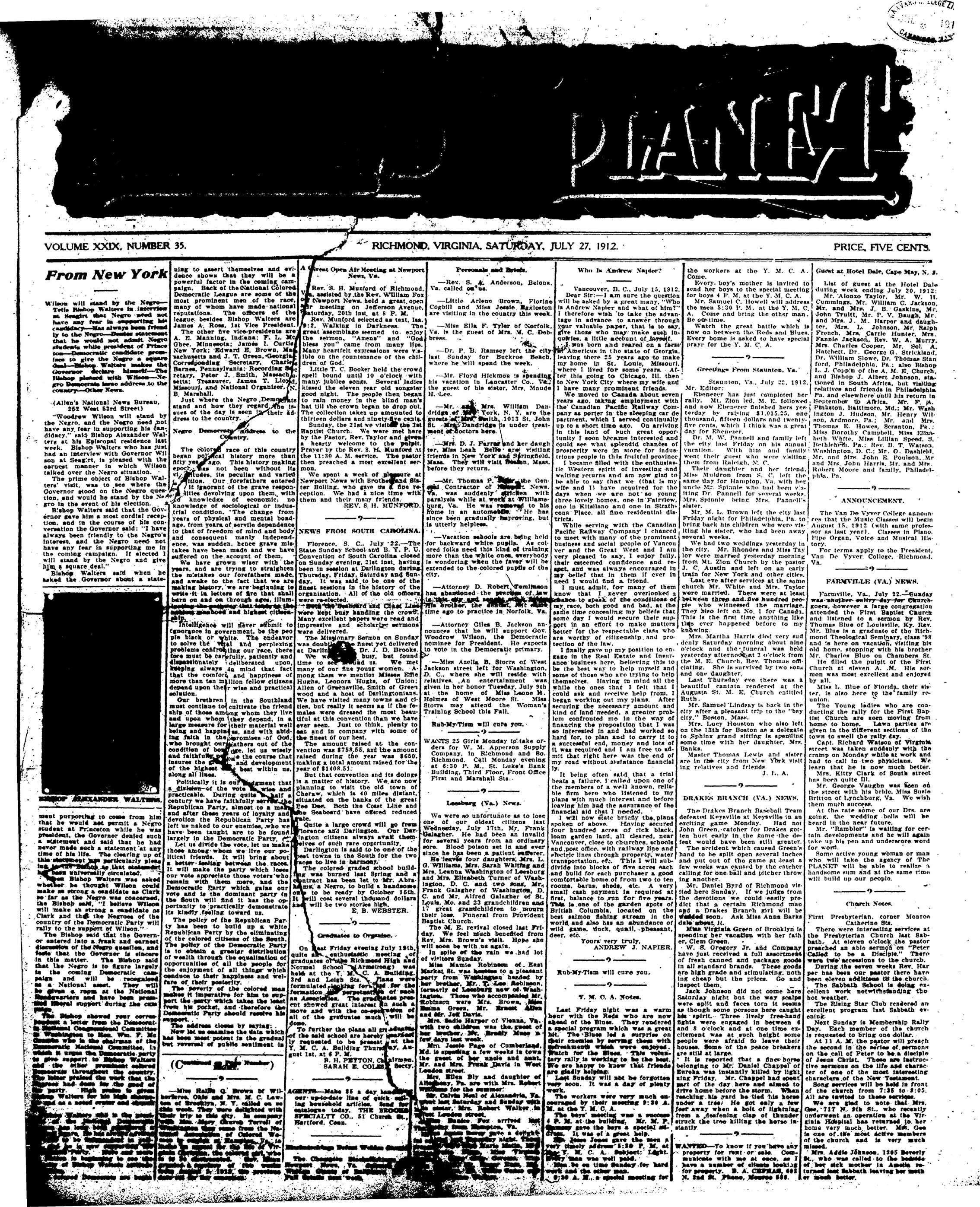
"Woodrew Wilson will stand by the Negro, and the Negro need not have any fear in supporting his candidacy." said Bishop Alexander Walters at his Episcopal residence last week. Bishop Walters who has just had an interview with Governor Wilson at Seagirt, is pleased with the earnest manner in which Wilson talked over the Negro situation. The prime object of Bishop Walters' visit, was to see where the Governor stood on the Negro question, and would he stand by the Negro in the event of his election. Bishop Walters said that the Governor gave him a most cordial reception, and in the course of his conversation the Governor said: "I have always been friendly to the Negro's interest, and the Negro need not have any fear in supporting me in the coming campaign. If elected I will stand by the Negro and give him a square deal."
Bishop Walters said when he asked the Governor about a state-
BISHOP ALEXANDER WALTERS.
ment purporting to come from him that he would not permit a Negro student at Princeton while he was president, the Governor denied such a statement and said that he had never made such a statement at any time of his life. The clearing up of this statement was particularly pleas to the Bishop as that statement has been universally circulated.
When Bishop Walter was asked whether he thought Wilson could make as strong a candidate as Clark so far as the Negro was concerned, the Bishop said, "I believe Wilson will make as strong a candidate as Clark and that the Negroes of the country of the Democratic Party will rally to the support of Wilson." The Bishop said that the Governor entered into a frank and earnest discussion of the Negro question, and feeds that the Governor is sincere in this matter. The Bishop said that the Negro is to figure largely in the coming Democratic campaign and will be recognized as a National asset. They will be given a room at the National Headquarters and have been promised liberal support during the campaign.
The Bishop showed your correspondent a letter from the Democrat in National Congressional Committee in Washington to Ken Wm. F. McGunn who is in the chairman of the Democratic National Committee, in which it urges the Democratic party to give support to Bishop Walters and the other prominent colored Democrats throughout the country. The letter praised the work that the Supreme had done for the good of the party. High praise to given Bishop Walters for his high character and as a noted writer and thoughtful man.
ning to assert themselves and evidence shows that they will be a powerful factor in the coming campaign. Back of the National Colored Democratic League are some of the most prominent men of the race, many of whom have made national reputations. The officers of the league besides Bishop Walters are James A. Rose, 1st Vice President. The other five vice-presidents are A. E. Manning, Indiana; F. L. McGhee, Minnesota; James I. Curtis New York; Edward E. Brown, Massachusetts and J. T. Green, Georgia. Corresponding Secretary, Charles Barnes, Pennsylvania; Recording Secretary, Peter J. Smith, Massachusetts; Treasurer, James T. Lloyd, Missouri, and National Organizer, N. B. Marshall.
Just where the Negro, Democrat stand and how they regard the issues of the day is seen in their address to the country.
Negro Democracy address to the Country.
The colored race of this country began political history more than fifty years ago. This history making epoch has not been without its vicissitudes, its peculiar and varied position. Our forefathers entered it ignorant of the grave responsibilities devolving upon them, with no knowledge of economic, no knowledge of sociological or industrial condition. The change from years of physical and mental bondage, from years of servile dependence to that of freedom of mind and body and consequent many independence, was sudden, hence grave mistakes have been made and we have suffered on the account of them.
We have grown wiser with the yearn, and are trying to straighten the mistakes our forefathers made, and awake to the fact that we are making history, we are beginning to write it in letters of are that shall burn on and on through ages, illumination the pathway that leads to the endless manhood and highest citizenship.
Intelligence will never submit to ignorance in government, be the people black or white. The endeavor to solve the vital and perplexing problems confronting our race, there fore must be carefully, patiently and dispassionately deliberated upon, keeping always in mind that fact that the comfort and happiness of more than ten million fellow citizens depend upon their wise and practical solution.
Our brethren in the Southland must continue to cultivate the friendships of those among whom they live and upon whom they depend, in a large measure for their material well-being and happiness, and with abiding faith in the promises of God, who brought our fathers out of the condition of bondage, let us wisely and faithfully pursue the course that insures the highest best within us, along all lines.
Politically it is our judgment that a division of the vote is wise and practicable. During quite a half a century we have faithfully served the Republican Party, almost to a man and after these years of loyalty and devotion the Republican Party has left us naked to our enemies, who we have been taught are to be found largely in the Democratic Party.
Let us divide the vote, let us make those among whom we live our political friends. It will bring about a better feeling between the races. It will make the party which loses our vote appreciate those voters who remain with them more, and the Democratic Party which gains our vote and is the dominant party in the South will find it has the opportunity to practically demonstrate its kindly feeling toward us.
The policy of the Republican Party has been to build up a white Republican Party by the eliminating of the colored citizens of the South. The policy of the Democratic Party is to obtain a greater distribution of wealth through the equalization of opportunities of all the people for the enjoyment of all things which conduce to their happiness and welfare of their posterity.
The poverty of the colored man makes it imperative for him to support the party which takes the least from his pocket, and therefore the Democratic Party should receive his support.
The address closes by saying:
Now let us examine the data which has been most potent in the gradual but reversal of public sentiment in
— Miss Hallee Q. Brown M. Wilberbrree, Obld and Mrs M. C. Lawson of Brooklyn, N. Y. called on me this week. They were delighted with their work to this city. In company with Mrs. Amy Church Torrell of Washington they came from the National Association of Oxford Women by request of Rampion, De. to include an appeal for the life of Virginia Catherine, the colored girl, who is to be dismembered. Rev. Mignon bury a sympathy of the women when August 5, 1922, the previous year for her accession.
Rev. S. H. Munford of Richmond, Va. assisted by the Rev. William Fox of Newport News, held a great, open air meeting on Jefferson Avenue, Saturday, 20th inst., at 8 P. M. Rev. Munford selected as text, Isa. 9:2. Walking in Darkness. The great assemblage seemed to enjoy the sermon, "Amens" and "God bless you" came from many lips. Many heartfelt expressions were visible on the countance of the children of God.
Little T. C. Booker held the crowd spell bound until 10 o'clock with many jubilee songs. Several ladies kissed the eleven year old songster good night. The people then began to rain money in the blind man's hat till the crown began to drop out. The collection taken up amounted to thirteen dollars and ninety-five cents. Sunday, the 21st we visited the Ist Baptist Church. We were met here by the Pastor, Rev. Taylor and given a hearty welcome to the pulpit. Prayer by the Rev. S. H. Munford at the 11:30 A. M. service. The pastor then preached a most excellent sermon.
We spent a week of pleasure at Newport News with Brother and Sister Bolling, who gave us a fine reception. We had a nice time with them and their many friends.
REV. S. H. MUNFORD.
2
NEWS FROM SOUTH CAROLINA.
Florence, S. C., July 22.—The State Sunday School and B. Y. P. U. Convention of South Carolina closed on Sunday evening, 21st inst., having been in session at Darlington during Thursday, Friday, Saturday and Sunday. It was said to be one of the finest sessions in the history of the organization. All of the old officers were re-elected.
Broad the Seaboard and Coast Lines were kept busy handling the crowd. Many excellent papers were read and imprintable and scholarly sermons were delivered.
The Missionary Sermon on Sunday was doubled and the finest yet delivered at Darlington. Dr. J. D. Brooks. We were busy, but found time to see around us. We met many of our fine young women. Among them we mention Misses Kate Hughes, Leonora Hughes, of Union; Allen of Greensville, Smith of Green wood and a host of Darlingtonians. We have visited many towns and cities, but really it seems as if the females were dressed the most beautiful at this convention than we have ever seen. Just to think, plenty to eat and in company with some of the finest of our best.
The amount raised at the convention was $758.55, and the amount raised during the year was $650, making a total amount raised for the year of $1408.51.
But that convention and its doings is a matter of history. We are now planning to visit the old town of Cheraw, which is 40 miles distant, situated on the banks of the great Pee Dee. Both the Coast Line and the Seaboard have offered reduced rate. Quite a large crowd will go from Florence and Darlington. Our Darlington citizens always avail themselves of such rare opportunity. Darlington is said to be one of the best towns in the South for the two races to live in harmony.
The colored graded school building was burned last Spring and a contract has been let to Mr. Abraham, a Negro, to build a handsome one to be ready by October 15th. It will cost several thousand dollars and will be two stories high.
E. B. WEBSTER.
Graduates to Organize.
On East Friday evening July 19th, quite an enthusiastic meeting of graduates of the Richmond High and Normal School (Armstrong) was held at the Y. M. C. A. Building, 3rd and Leigh Sts. Plans were formulated looking forward for the formation and the perpetuation of such an Association. The graduates present showed great interest in such a move and with the cooperation of all of the graduates much will be done.
To further the plans all graduates of the said school are hereby markedly requested to be present at the Y. M. C. A. Building Thursday, August lt. at 6 P. M.
AGENTS—Make $5 a day hand-held
our up-to-date line of quick-selling
household articles. Send for
catalogue today. THE BROOKS
SPECIALTY CO., 51 Church St.,
Hartford, Conn.
Personals and Briefs.
—Rev. S. A. Anderson, Belona, Va. called on us.
—Little Arlene Brown, Florine Cogbill and Miss Jessie Eggleston are visiting in the country this week.
—Miss Ella F. Tyler of Norfolk, Va. is the guest of Mrs. M. C. Debress.
—Dr. P. B. Ramsey left the city last Sunday for Buckroos Beach, where he will spend the week.
—Mr. Floyd Hickmon is spending his vacation in Lancaster Co., Va.; the guest of his sister, Mrs. Maude H. Lee.
—Mr. and Mrs. William Dandridge of New York, N. Y. are the guests of Mrs. Smith, 1013 St. John St. Mrs. Dandridge is under treatment of doctors here.
—Mrs. D. J. Farrar and her daughter, Miss Leah Belle are visiting friends in New York and Springfield, Mass. They will visit Boston, Mass. before they return.
—Mr. Thomas P. Burke the General Contractor of Boston News, Va. was suddenly stricken with paralysis while at work at Williamsburg, Va. He was received to his home in an automobile. He has since been gradually improving, but is utterly helpless.
Vacation schools are being held for backward white pupils. As colored folks need this kind of training more than the white ones, everybody is wondering when the faver will be extended to the colored pupils of the city.
Attorney D. Robert Tomlinson has abandoned the practice of law in this city and seems to have his brother, the dentist, left some time ago to practice in Norfolk, Va.
Attorney Giles B. Jackson announces that he will support Gov. Woodrow Wilson, the Democratic nominee for President. He expects to vote in the Democratic primary.
Miss Azella B. Storra of West Jackson street left for Washington, D. C., where she will reside with relatives. An entertainment was given in her honor Tuesday, July 9th at the home of Miss Leone H. Holmes of West Moore St. Miss Storra may attend the Woman's Training School this Fall.
Rub-My-Tism will cure you.
WANTS 25 Girls Monday to take orders for W. M. Apperson Supply Company, in Richmond and So. Richmond. Call Monday evening at 6:30 P. M., St. Luke's Bank Building, Third Floor, Front Office First and Marshall Sts.
Lancsburg (Va.) News.
We were no unfortunate as to lose one of our oldest citizens last Wednesday, July 17th, Mr. Frank Galagher. He had been an invalid for several years from an ordinary sore. Blood poison set in and ever since he has been a patient sufferer. He leaves four daughters; Mrs. L. G. Williams, Mrs. Sarah Whiting and Mrs. Leanna Washington of Leesburg and Mrs. Elizabeth Turner of Washington, D. C. and two sons, Mrs. Frank Galagher of Washington, D. C. and Alfred Galagher of St. Louis, Mo. and 23 grandchildren and 17 great grandchildren to mourn their loss. Funeral for Provident Baptist Church. The M. E. revival closed last Friday. We feel much benefited from Rev. Mrs. Brown's visit. Hope she will soon be with us again. In spite of the rain we had lot of visitors Sunday. Miss Mamie Robinson of East Market St. was hostess to a pleasant party from Washington headed by her brother, Mr. T. Lee Robinson, formally of Leesburg now of Washington. Those who accompanied Mr. Robinson were Mrs. Brown, Miss Bimma Green, Mr. Brent Allen and Mr. Jeff Davis. Mrs. Sadie Harper of Vienna, Va. with two children was the guest of her brother, Mr. Bradley Muse in days last week.
Mm. Jessie Page of Cumberland,
Md. is spending a few weeks in town
the guest of her uncle and aunt,
Mr. and Mrs. Frank Davis in West
London street.
Mr. Ellen Bly and daughter of
Allegory, Pa. are with Mrs. Robert
Woodhouse for the summer:
Mr. Calvin Neal of Alexandria, Pa.
guest at Saturday and Sunday with
the sister. Mrs. Robert Walker, in
West London street.
Alfred Bunce For arrived last
Wednesday from Huntington, Va.
Alfred Bunce gave a delight
to mind and joy Sunday night. They
presented to Mr. Karo Mahn, NFH
and Ms. Bunce Hahn, Mine Virtue
and Ms. Bunce Gorman, Hip
and Ms. Bunce Hahn, Hip
and Ms. Bunce Hahn, Hip
Who Is Andrew Napier?
Vancouver, B. C., July 15, 1912.
Dear Sir: I am sure the question will be asked by a great many, "Who is Andrew Napier and what of him?" I therefore wish to take the advantage in advance to answer through your valuable paper, that is to say, give those who may make such inquiries, a little account of myself. I was born and reared on a farm of Americus in the state of Georgia, leaving there 25 years ago to make my home in St. Louis, Missouri, where I lived for some years. After this going to Chicago, Ill. then to New York City where my wife and I have many prominent friends.
We moved to Canada about seven years ago, taking employment with the Canadian Pacific Railway Company as porter in the sleeping car departement, which I served continually up to a short time ago. On arriving in this land of much great opportunity I soon became interested and could see what splendid chances of prosperity were in store for industrious people in this fruitful province. I became filled with the enthusiastic Western spirit of investing and waiting returns and am now glad to be able to say that we (that is my wife and I) have acquired for the days when we are not so young three lovely homes, one in Fairview, one in Kitsilano and one in Strathcona Place, all find residential districts.
While serving with the Canadian Pacific Railway Company I chanced to meet with many of the prominent business and social people of Vancouver and the Great West and I am very pleased to say, I enjoy fully, their esteemed confidence and respect, and was always encouraged in my belief that in them if ever in need I would find a friend.
I must admit, for many of them know that I never overlooked a chance to speak of the conditions of my race, both good and bad, at the same time concealing my beliefs that some day I would secure their support in an effort to make matters better for the respectable class who are worthy of citizenship, and protection of the law.
I finally gave up my position to engage in the Real Estate and Insurance business here, believing this to be the best way to help myself and some of those who are trying to help themselves. Having in mind all the while the ones that I felt that I could ask and receive help from, I began working out my plans. After securing the necessary amount and kind of land needed, a greater problem confronted me in the way of financing the proposition that I was so interested in and had worked so hard for, to plan and to carry it to a successful end, money and lots of it was required and I am free to admit that right here was the end of my road without assistance financially.
It being often said that a trial heats a failure. I called upon one of the members of a well known, reliable firm here who listened to my plans with much interest and before leaving him had the assurance of the financial aid that I needed.
I will now state briefly the plans spoken of above. Having secured four hundred acres of rich black, loam garden land, all cleared, near Vancouver, close to churches, schools and post office, with railway line and electric lines through property, water transportation, etc. This I will subdivide into blocks of five acres each and build for each purchaser a good comfortable home of from two to ten rooms, barns, sheds, etc. A very small cash payment is required at first, balance to run for five years. This is one of the garden spots of British Columbia, located on the best salmon fishing stream in the world and also has an abundance of wild game, duck, quail, pheasant, deer, etc.
T. M. C. A. Notes.
Last Friday night was a warm hour with the Reds who are now ahead of the Blues. They rendered a special program which was a great hit. The Blues led a surprise on their enemies by serving them with refreshments which were enjoyed. Watch for the Blues. This voluntary rally is working to be the best. We are happy to know that friends are gladly helping.
Last Sunday will not be forgotten very soon. It was a day of plenty work.
The workers were very much encouraged by their meeting 9:30 A. M. at the T. M. C. A.
The boys' meeting was a success 4 P. M. at the building, Mr. M. P. gave the boys a special address. It was of a great help.
Mr. Jones gave the men a very timely address: 9:30 P. M. at T. M. C. A. Subject: Light. Henry man was well paid.
Men be on time Sunday for hard work and the other man.
the workers at the Y. M. C. A.
Come.
Every boy's mother is invited to
send her boys to the special meeting
for boys 4 P. M. at the Y. M. C. A.
Mr. Samuel C. Howell will address
the men 5:30 P. M. at the Y. M. C. A.
A. Come and bring the other man.
Be oocime.
Watch the great battle which is
now on between the Reds and Blues.
Every home is asked to have special
prayer for the Y. M. C. A.
Greetings From Staunton, Va.
Staunton, Va., July 22, 1912.
Mr. Editor:
Ebenezer has just completed her rally, Mt. Zion led, M. E. followed and now Ebenezer finished hers yesterday by raising $1,015.25, one thousand, fifteen dollars and twenty-five cents, which I think was a great day for Ebenezer.
Dr. M. W. Pannell and family left the city last Friday on his annual vacation. With him and family went their guest who were visiting them from Raleigh, N. C.
Their daughter and her friend, Miss Muldron from S. C. left the same day for Hampton, Va. with her uncle Mr. Spinnle who had been visiting Dr. Pannell for several weeks, Mrs. Spinnle being Mrs. Pannell's sister.
Mr. M. L. Brown left the city last Friday night for Philadelphia, Pa. to bring back his children who were visiting his sister, who had been away several weeks.
We had two weddings yesterday in the city. Mr. Rhondes and Miss Tay lor were married yesterday morning from Mt. Zion Church by the pastor J. C. Autin and left on an early train for New York and other cities.
Last eve after services at the same church Mr. White and Mrs. Taylor were married. There were at least between three and five hundred people who witnessed the marriage. They also left on No. 1 for Canada. This is the first time anything like this ever happened before to my knowing.
Mrs. Martha Harris died very sad
denly Saturday morning about nine
o'clock and the funeral was held
yesterday afternoon at 3 o'clock from
the M. E. Church. Rev. Thomas officiating. She is survived by two sons and one daughter.
Last Thursday eve there was a beautiful cantata rendered at the Augusta St. M. E. Church entitled Ruth.
Mr. Samuel Lindeay is back in the city after a pleasant trip to the "bay city," Boston, Mass.
Mrs. Lucy Houston who also left on the 15th for Boston as a delegate to Sphinx grand sitting is spending some time with her daughter, Mrs. Banks.
Master Thomas Lewis and sister are in the city from New York visiting relatives and friends.
DRAKES BRANCH (VA.) NEWS.
The Drakes Branch Baseball Team defeated Keysville at Keysville in an exciting game Monday. Had not John Green, catcher for Drakes gotten hurt early in the game—the defeat would have been still greater.
The accident which caused Green's hand to be split open several inches and put out of the game at least a few weeks was caused by the catcher calling for one ball and pitcher throwing another.
Mr. Daniel Byrd of Richmond visited here Sunday. If we judge from the devotions we could easily predict that a certain Richmond man and a Drakes Branch girl will be wounded soon. Ask Miss Anna Barks date about it.
Miss Virginia Green of Brooklyn is spending her vacation with her father, Clem Green.
W. S. Gregory Jr. and Company have just received a full assortment of fresh canned and package goods in all standard brands. These goods are high grade and stimulating, not ing cheap but the prices. Go and inspect them.
Jack Johnson did not come here Saturday night but the way scals were split and faces torn it seems as though some persons here caught his spirit. Three lively free-handights were engaged in between 6 and 8 o'clock and at one time excitement was at such height some people were afraid to leave their houses. Some of the peace breakers are still at large.
It is reported that a fine horse belonging to Mr. Daniel Chappel of Eureka was instantly killed by lightning Friday, Mr. Chappel had spent part of the day here and aimed to drive home before the storm. When reaching his yard he tied his horse under a tree. He got only a few feet away when a holt of lightning from a deafening clap of thunder struck the tree killing the horse instantly.
WANTED—To know if you have any property for rent or sale. Communicate with me at once, as I have a number of clients looking for property. B. A. CEPHAS, 608 N. 3rd St. Phone, Moore 555.
Guest at Hotel Dale, Cape May, N. J.
List of guest at the Hotel Dale during week ending July 20, 1912:
Mr. Alonzo Taylor, Mr. W. H. Cummings, Mr. William C. Jackson, Mr. and Mrs. J. B. Gaskins, Mr. John Truitt, Mr. P. V. Baugh, Mr. and Mrs. J. M. Harper and daughter, Mrs. L. Johnson, Mr. Ralph French, Mrs. Carrie Hunter, Mrs. Fannie Jackson, Rev. W. A. Murry, Mrs. Charles Cooper, Mr. Sol. A. Hatchett, Dr. George G. Strickland, Dr. William Slowe, Dr. Thomas Stanford, Philadelphia, Pa.; also Bishop L. J. Coppin of the A. M. E. Church, and Bishop J. Albert Johnson, stationed in South Africa, but visiting relatives and friends in Philadelphia Pa. and elsewhere until his return in September to Africa. Mr. F. A. Pinkston, Baltimore, Md.; Mr. Washington J. Hudson, Mr. Henry Wilson, Ardmore, Pa.; Mr. and Mrs. Thomas E. Howes, Seranton, Pa.; Miss Dorothy Campbell, Miss Elizabeth White, Miss Lillian Speed, S. Bethleigh, Pa.; Rev. B. T. Watson, Washington, D. C.; Mr. O. Dashield, Mr. and Mrs. John E. Poulson, Mr. and Mrs. John Harris, Mr. and Mrs. Robert Moore and family, Philadelphia, Pa.
ANNOUNCEMENT
The Van De Vyver College announces that the Music Classes will begin August 15, 1912 (with same professor as last year). Classes in Piano, Pipe Organ, Voice and Musical History.
For terms apply to the President, Van De Vyver College, Richmond, Va.
FARMVILLE (VA) NEWS.
Farmville, Va., July 22. Sunday was another entry day for Churchgoers, however a large congregation attended the First Baptist Church and listened to a sermon by Rev. Thomas Blue of Louisville, Ky. Rev. Mr. Blue is a graduate of the Richmond Theological Seminary, class '88 and is here on vacation, visiting his old home, stopping with his brother Mr. Charles Blue on Chambers St. He filled the pulpit of the First Church at eleven A. M. His sermon was most excellent and enjoyed by all.
Miss I. Blue of Florida, their sister, is also here to the family reunion.
The Young ladies who are conducting the rally for the First Baptist Church are seen moving from home to home. Lawn parties are given in the different sections of the town to swell the rally day.
Capt. Richard Watson of Virginia street was taken suddenly with the cramp on Monday while at work and had to call in two physicians. We learn that he is now much better.
Mrs. Kitty Clark of South street has been quite ill.
Mr. George Vaughn was seen on the street with his bride, Miss Susie Britton of Lynchburg, Va. We wish them much success.
At the rate some of our Drs. are going, the wedding bolls will be heard in the near future.
Mr. "Rambler" is waiting for certain developments and he will again take up his pen and underscore word for word.
Some active young woman or man who will take the agency of The PLANET will be able to realize a handsome sum and at the same time will build up our people.
Church Notes
First Presbyterian, corner Monroe
Catherine Sts.
There were interesting services at
the Presbyterian Church last Sabbath.
At eleven o'clock the pastor
preached an able sermon on "Peter
Called to be a Disciple." There
were two accessions to the church.
During the seven weeks Rev. Har
per has been our pastor there have
been eleven additions to the church.
The Rising Star Club rendered an excellent program last Sabbath evening.
Next Sunday is Membership Rally Day. Each member of the church is requested to bring one dollar.
At 11 A. M. the pastor will preach the second in the series of sermons on the call of Peter to be a disciple of Jesus Christ. These are instructive sermons on the life and character of one of the most interesting characters of the New Testament.
Song services will be held in front of the church from 7:35 to 8:05. All are invited to these services.
We are glad to note that Mrs. Gee, '171 N. 9th St., who recently underwent an operation as the Virginia Hospital has returned to her home very much better. Mrs. Gee is one of the most active members of the church and is very much missed.
Mrs. Addie Johnson, 1205 Beverly St., who was called to the bedside of her sick mother in Amelia returned last Sabbath leaving her moth or much better.
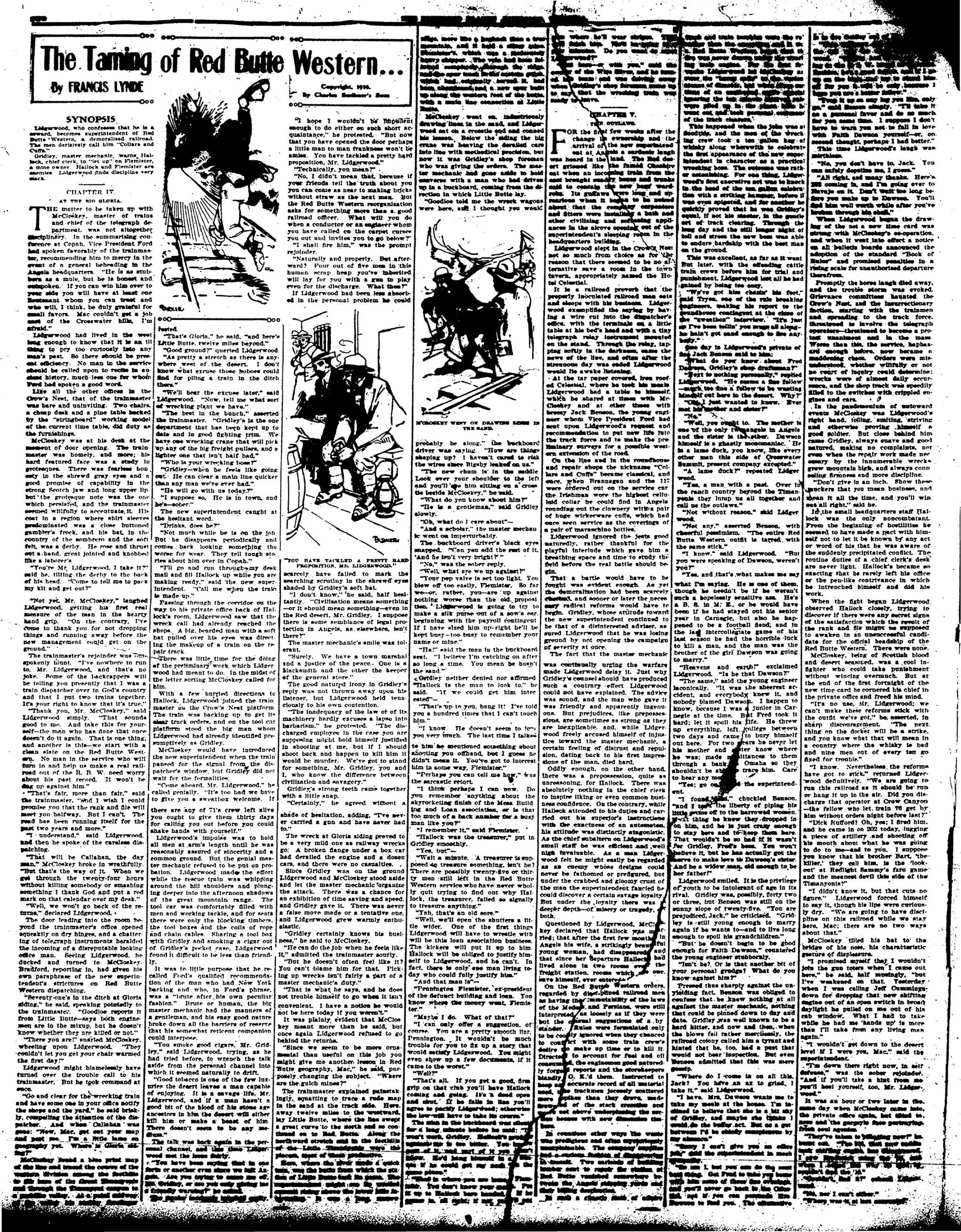
The Taming of Red Butte
SYNOPSIS
Lidgwick, who confesses that he is a oeward, becomes superintendent of Red Butte 'Western, a demoralised railroad, which denervally call him "Collare and Cuffa." Gridley, master mechanic, warns, Hallow, chief clerk, to "let up" on Flemister, a mine owner. Hallow and Flemister are enemies. Lidgwick finds discipline very
CHAPTER 15
AT THE BIO GLORIA
THE matter to be taken up with McClokey, master of trains and chief of the telegraph department, will be altogether
a apartment, was not altogether disciplinary. In the summaring conference at Copah, Vice President Ford had spoken favorably of the trainmaster, recommending him to mercy in the event of a general beheading in the Angels headquarters. "He is as stubborn as a mule, but he is honest and outspoken. If you can win him over to your side you will have at least one restaurant whom you can trust and who will. I think, be duly grateful for small flavors. Mac couldn't get a job most of the Crosswater hills, I'm afraid."
Lidgerwood had lived in the west long enough to know that it is an ill thing to pry too curiously into any man's past. So there should be present efficiency. No man in the service should be called upon to recite in an ancient history, much less one for whom Word had spoken a good word. Like all the other offices in the Crow's Next, that of the trainmaster was bare and uninviting. Two chairs, a cheap desk and a pine table backed by the "stringboard" working model of the, current time table, did duty as the furnishings.
McCloskey was at his desk at the moment of door opening. The trainmaster was homely, and more; his hard featured face was a study in grotesque. There was fearless bonesty in the shrewd gray eyes and a good promise of capability in the strong Scotch jaw and long upper lip but the grotesque note was the one which persisted, and the trainmaster seemed willfully to accentuate it. His coat in a region where shirt sleeves predominated was a close buttoned gambler's frock, and his hat, in the country of the sombrero and the soft felt, was a derby. He rose and thrust out a hand, great jointed and knobbed like a laborer's.
"You're Mr. Lidgerwood. I take it!" said he, tilting the derby to the back of his head. "Come to tell me to pack my kit and get out?"
"Not yet, Mr. McCloskey," laughed Lidgerwood, getting his first real measure of the man in the hearty hand grip. "On the contrary, I've come to thank you for not dropping things and running away before the new management could get on the ground."
The trainmaster's rebelder was mis-spokenly blunt. "I've nowhere to run, Mr. Lidgerwood, and that's no joke. Some of the backpackers will be telling you presently that I was a train dispatcher over in God's country and that I put two trains together. Are your right to know that it's true."
"Thank you, Mr. McCloskey," said Lidgerwood simply. "That sounds good to me. And take this for yourself—the man who has done that once doesn't do it again. That is one thing, and another is this—we start with a clean slate on the Red Butte Western. No man in the service who will turn in and help us make a real railroad out of the R. B. W. need worry about his past record. It won't be dig up against him."
"That's fair, more than fair," said the trainmaster, "and I wish I could promise you that the rank and the will meet you halfway. But I can't. The road has been running itself for the past two years and more."
"I understand," said Lidgerwood, and then he spoke of the careless dispatching.
"That will be Callahan, the day man," McClookey broke in wrathfully. "But that's the way of it. When we got through the twenty-four hours without killing somebody or smashing something I thank God and put a red mark on that calendar over my deak."
"Well, we won't go back of the return," declared Lidgerwood. The door leading into the room beyond the trainmaster's office opened quickly on dry hinges, and a chattering of telegraph instruments barred the incoming of a disreputable looking office man. Seeing Lidgerwood, he ducked and turned to McClonkey. Bradford, reporting in, had given his own paraphrase of the new superintendent's structures on Red Butte Western dispatching.
"Seventy-one's in the ditch at Gloria siding," he said, speaking pointedly to the trainmaster. "Good Joe reports it from Little Butte—says both engineers are in the mirup, but he doesn't know whether they are killed or not."
"There you are!" enailed McClonkey, wheeling upon Lidgerwood. "They couldn't let you get your chair warmed the first day."
Lidgerwood might blamelessly have turned over the trouble call to his trainmaster. But he took command at once.
"Go and clear for the wrecking train and have some one in your office notify the shops and the yard," he said briskly, compelling the attention of the dispatcher. And when Callahan was gone: "Now, Mac, got out your map and part me. I'm a little home on geography yet. Where is Gloria said?"
McChesty found a blue print map of the line and traced the course of the western division among the footsteps to the base of the Great Minneapolis and through the Minneapolis campus to a picturesque valley. As a point and way to the valley, he pointed forward.
Dexie
"That's Gloria, he said, "and here's Little Butte, twelve miles beyond."
"Good ground?" queried Lidgerwood.
"As pretty a stretch as there is anywhere west of the desert. I don't know what excuse those hobbes could find for piling a train in the ditch there."
"We'll bear the excuse later," said Lidgerwood. "Now, tell me what sort of wrecking plant we have."
"The best in the bunch," asserted the trainmaster. "Gridley's is the one department that has been kept up to date and in good fighting trim. We have one wrecking crane that will pick up any of the big freight pullers, and a lighter one that isn't half bad."
"Who is your wrecking boss?"
"Gridley—when he feels like going out. He can clear a main line quicker than any man we've ever had."
"He will go with us today."
"I suppose so. He is in town, and he's—sober."
The new superintendent caught at the heistant word.
"Drinks, does he?"
"Not much while he is on the job. But he disappears periodically and comes back looking something the worse for wear. They tell tough stories about him over in Copah."
"I'll go and run through my desk mall and fill Hallock up while you are making ready," said the new super-intendent. "Call me when the train is made up."
Passing through the corridor on the way to his private office back of Hallock's room, Lidgerwood saw that the wreck call had already reached the shops. A big, bearded man with a soft hat pulled over his eyes was directing the makeup of a train on the repair truck.
There was little time for the doing of the preliminary work which Lidgerwood had meant to do. In the midst of the letter sorting McCloskey called for him.
With a few hurried directions to Hallock, Lidgerwood joined the train master on the Crown's Next platform. The train was backing up to get it clear track orders, and on the tool car platform stood the big man whom Lidgerwood had already identified presumptively as Gridley. McCloskey would have introduced the new superintendent when the train panned for the signal from the dispatcher's window, but Gridley did not wait for the formalities. "Come ahead, Mr. Lidgerwood," he called genially. "It's too bad we have to give you a sweetbox welcome. If there are any of 71's crew left alive you ought to give them thirty days for calling you out before you could shake hands with yourself."
Lidgerwood's impulse was to hold all men at arm's length until he was reasonably assured of sincerity and a common ground. But the genial master mechanic refused to be put on probation. Lidgerwood made the effort while the rescue train was whipping around the hill shoulders and plunging deeper into the afternoon shadows of the great mountain range. The tool car was comfortably filled with men and working tackle, and for seats there were only the blocking timber, the tool boxes and the coils of rope and chain cables. Sharing a tool box with Gridley and smoking a cigar out of Gridley's pocket case, Lidgerwood found it difficult to be less than friendly.
It was to little purpose that he recalled Ford's qualified recommendation of the man who had New York backing and who, in Ford's phrase, was a "brute after his own peculiar fashion." Brute or human, the big master mechanic had the manners of a gentleman, and his easy good nature broke down all the barriers of reserve that his somewhat reticent companion could interpose.
"You smoke good cigars, Mr. Gridley," said Liddgerwood, trying, as he had tried before, to wrench the talk aside from the personal channel into which it seemed naturally to drift.
"Good tobacco is one of the few luxuries the desert leaves a man capable of enjoying. It is a savage life, Mr. Liddgerwood, and if a man hasn't a good bit of the blood of his stone age ancestors in him the desert will either kill him or make a beast of him. There doesn't seem to be any medium."
The talk was back again in the personal channel, and this time Lilgerwood met the James thirty.
"I hope I wouldn't be impatient enough to do either on such short acquaintance," he protested. "But now that you have opened the door perhaps a little man to man frankness won't be amiss. You have tackled a pretty hard proposition, Mr. Lidgerwood."
"Technically, you mean?".
"No, I didn't mean that, because if your friends tell the truth about you you can come as near to making bricks without straw as the next man. But the Red Butte Western reorganization asks for something more than a good railroad officer. What will you do when a conductor or an engineer whom you have called on the carpet curves you out and invites you to go below?" "I shall fire him," was the prompt rejoinder.
"Naturally and property. But afterward? Four out of five men in this human scrap heap you've inherited will lay for you with a gun to play even for the discharge. What then?" If Lidgerwood had been less absorbed in the personal problem he could
P. DANIELS
"YOU HAVE TACKLED A PRETTY HARD PROFESSION, MIR LIDENWOOD," scarcely have failed to mark the searching scrutiny in the shrewd eyes shaded by Gridley's soft hat.
"I don't know," he said, half bedtantly. "Civilization means something—or it should mean something—even in the Red desert, Mr. Gridley. I suppose there is some blundance of legal protection in Angels, as elsewhere, isn't there?
"The master mechanic's smile was tolerant.
"Surely. We have a town marshal and a justice of the peace. One is a blacksmith and the other the keeper of the general store."
The good natured irony in Gridley's reply was not thrown away upon his listener, but Lidgerwood held tennsionally to his own contention.
"The inadequacy of the law of the machinery hardly excuses a lape into barbarism." he protested. "The discharged employee in the case you are supposing might hold himself justified in shooting at me, but if I should shoot back and happen to kill him it would be murder. We've got to stand for something, Mr. Gridley, you and I, who know the difference between civilization and savagery." Gridley's strong teeth came together with a little snap. "Certainly," he agreed without a
ashide of hesitation, adding, "The never carried a gun and have never had to."
The wreck at Gloria siding proved to be a very mild one as railway wrecka go. A broken flange under a box car had derrilled the engine and a dozen cars, and there were no casualties.
Since Gridley was on the ground Lidgerwood and McClookey stood aside and let the master mechanic organize the attack. There was a chance for an exhibition of time saving and speed, and Gridley gave it. There was never a false move made or a tentative one, and Lidgerwood grew warmly enthusiastic.
"Gridley certainly knows his business," he said to McClookey.
"He can do the job when he feels like it" admitted the trainmaster sourly.
"But he doesn't often feel like it? You can't blame him for that. Picking up wrecks isn't fairly a part of a master mechanic's duty."
"That is what he says, and he does not trouble himself to go when it isn't convenient. I have a notion he would not be here today if you weren't." It was plainly, evident that McCloskey meant more than he said, but once again Lidgerwood refused to go behind the returns.
"Since we seem to be more ornamental than useful on this job you might give me another lesson in Red Butte geography, Mac," he said, purposefully changing the subject. "Where are the guilch mines?"
The trainmaster explained palmakingly, aquatting to trace a rode map in the sand at the track side. Here, away twelve miles to the westward, lay Little Butte, where the line swept a great curve to the north and so continued on to Red Butte. Along the northward stretch and in the southwest of the Little Thimnaghta wye the place, most of them productive.
Here, where the first battle of quick trail, was the battle from which the position of Lippa Bowie took the point. The impregnation, which was the first successful assault above the lower hill in southern Ireland, was a huge victory.
Billy move like a baggage then a two mountain, and it hold a baggage plane. Mountainer, which was a midwestern heavy shipper. The vans had been followed completely through the ridge, and the queen had escaped graph, which had, originally, hurried it. It had been abducted, and a new vans built up along the wonters foot of the bottle, with a main line connection at Little Bottle.
McCookey went on, industriously drawing lines in the sand, and Ladderwood set on a crochet god and conned his lesson. Below the siding the big crane was leaving the derrilled care into line with methodical precision, but now it was Gridley's shop foreman who was giving the orders. The master mechanic had gone aside to hold ourselves with a man who had driven up in a buckboard, coming from the direction in which Little Bottle lay.
"Goodlood told me the wreck wagons were here, and I thought you would
Pablo Picasso
MURCHEY WENT ON DRAWING LINES IN THE SAND.
probably be along," the backboard driver was saying. "How are thing-shaped up? I haven't cared to risk the wires since Bigaby leaked on us."
"The new chum is in the middle. Look ever your shoulder to the left and you'll give him sitting on a cross the beside McCloskey," he said.
"What do you know about him?" "He is a gentleman," said Gridley slowly.
"Oh what do I care about?"
"Oh, what do I care about?"
"And a scholar," the master mechan
ic went on imperturbably.
The backboard driver's black eye
snapped. "Can you add the rest of it.
And he isn't very bright?"
"No," was the sober reply.
"Well, what are we up against?"
"Your pop valve is set too light. You
blow off too easily. Fremister. So far
we- or, rather, you- are up against
nothing worse than the old proposal.
Lightswood is going to try to
make a silk prince out of a sow's car,
beginning with the payroll contingent.
If I have alized him up-right he'll
be kept busy - too busy to remember your
name or mine."
"Hah!" said the man in the buckboard
seat. "I believe I'm catching on after
so long a time. You mean he hasn't
the sand."
"Gordley neither denied nor affirmed
Hallock is the man to look to," he
said. "If we could get him inter-
cited."
"That's up to you. hang it! I've told you a hundred times that I can't touch him."
"I know. He doesn't seem to love you very much. The last time I talked to him he mentioned something about shooting you offhand, but I guess he didn't mean it. You've got to interest him in some way. Fleister."
"Perhaps you can tell me how," was the arsenic retort.
"I think perhaps I can now. Do you remember anything about the skyrocketing finish of the Mea Building and Loan association, or in that too much of a back number for a buoy man like you?"
"I remember it," said Fleming.
"Hallock was the treasurer," put in Gridley smoothly.
"Yes, but—"
"Wait a minute. A treasurer is supposed 4 treasure something, isn't he? There are possibly twenty-five or thirty men still left in the Red Butte Western service who have never wholly quit trying to find out why Hallock, the treasurer, failed so signally to treasure anything."
"Well, we'll open the shutters a little wider. One of the first things Lidgerwood will have to wrestle with will be this loan association business. The kickers will put it up to him. Hallock will be obliged to justify himself to Lidgerwood, and he can't. In fact, there is only one man living today who could fully justify him."
"And that man is"—
"Pennington Flemister, ex-president of the defunct building and loan. You know where the money went, Flemister."
"Maybe I do. What of that?"
"I can only offer a suggestion, of course. You are a pretty smooth liar. Pennington. It wouldn't be much trouble for you to fix a story that would satisfy Lidgerwood. You might even show up a few documents, if it came to the worst."
"Walter."
"That's all. If you get a good, firm grip on that club you'll have Hallock coming and going. It's a dead open and shut. If he falls in line you'll agree to pactly Lidgerwood; otherwise the law will have to take its course."
"Just keep on with you," said the owner of the Wife Willy, and he humbled his booth and was diving away when Gildafsy's shop disappeared up to see that the wrecking train was ready to leave.
FOR the first few weeks after the change in ownership and the arrival of the new superintendent cat at Angela a student laugh was heard in the land. The Red desert grinned like the famed Chamehit when an incoming train from the east brought sandy, borne and swampy sand to contain the new bear wardrobe. Its guards were long and spirraneous when it began to be noticed about that the company carpenters and fitters were installing a bath and other civilizing and softening appliances in the alcove opening out of the superintendent's sleeping room in the headquarters building.
Lidgwood slept in the Crowd. Nest not so much from choice as for the reason that there seemed to be no alternative save a room in the town tavern, appropriately named the Hotel Celestial.
It is a railroad proverb that the properly inoculated railroad man eats and sleeps with his business. Lidgwood exemplified the saying by having a wire cut into the dispatcher's office, with the terminals on a little table at his bed's head and with a tiny telegraph relay instrument mounted on the stand. Through the relay, tapping softly in the darkness, came the news of the life, and often after the strenuous day was ended Lidgwood would lie awake listening.
At the tar paper covered, iron roofed Celestial, where he took his means Lidgerwood had a table to himself which he shared at times with McChesley and at other times with brevy Jack Benson, the young engineer whom Vice President Ford had sent upon Lidgerwood's request and recommendation to put new life into the track force and to make the preliminary surveys for a possible western extension of the road. On the line and in the roundhouse and repair abode the nickname "Collars and Cuffs" became classical, and once, when Brannagan and the 117 were ordered out on the service car the Irishman wore the highest celluloid collar he could find in Angela rounding out the clownery with the pair of huge wicketware cuffs, which had once seen service as the coverings of a pair of marshmacho bottles.
Lidgerwood ignored the jets good matured, rather thankful for the playful interlude which gave him a breathing space and time to study the field before the real battle should begin.
That a battle would have to be fought was evident enough. As yet the demoralization had been scarcely checked, and sooner or later the necessary radical reforms would have to begin. Gridley, whose attitude toward the new superintendent continued to be that of a disinterested adviser, assured Lidgerwood that he was losing ground by not opening the campaign of severity at once.
was continually urging the warfare made Lidgerwood delay it. Just why Gridley's counsel should have produced such a contrary-effect Lidgerwood could not have explained. The advice was sound, and the man who gave it was friendly and apparently ingenuous. But prejudices, like prepossessions, are sometimes as strong as they are inexplicable, and, while Lidgerwood freely accused himself of injustice toward the master mechanic, a certain feeling of distrust and repulsion, dating back to his first impressions of the man, died hard.
Oddly enough, on the other hand, there was a prepositioning, quite as unreasoning, for Hallock. There was absolutely nothing in the chief clerk to inspire liking or even common business confidence. On the contrary, while Hallock attended to his duties and carried out his superior's instructions with the exactness of an automaton, his attitude was distinctly atagonistic. As the chief subtern on Lodgewood's small staff he was efficient and well nigh invaluable. As a man Lodgewood felt he might easily be regarded as an enemy whose designs could never be fathomed or prefigured, but under the crabbed and gloomy crust of the man the superintendent fancied he could discover a certain savage loyalty. But under the loyalty there was deeper depth—of misery or tragedy, both.
Questioned by Lidgerwood, McClure key declared that Hallock was married; that after the first few months in Angels his wife, a strikingly beautiful young woman, had disappeared, and that since her departure Hallock had lived alone in two rooms over the freight station, rooms which he one, save himself, ever entered.
On the Red Butte Western orders, regarded by disciplined railroad men as having the immutability of the laws of the Medici and Persians, were still interpreted as loosely as if they were but the casual suggestions of a bystander. Rules were formulated only to be coquely ignored when they changed to conflict with some train crew's desire to make up time or to kill it. Directed to account for fear and off consumed, the engineer good naturedly forged reports and the storekeepers blandly O. K.'d them. Instructed to keep and accurate record of all material used, the trackmen jocelyn scattered more supplies than they drove, made freeways of the stock creations and made not above understanding the service houses with new dimension timber.
In countless other ways the white war wagons predators and often imperiously unexplainable. The company supplies had a various station of disguising in Granada. Two varieties of building hound sent to repair the station of Badu Badu vanished somewhere between the Angola plains parks and their biking destination. It took a climactic stab of affray
Bush and Truman together were the ruler more than the occupying and in a bad State Washington liked to try to power dreams under the weak king crown. For the first president Lilburn Wood his presidency was the "tummy cup" by the western states of America, but when things were of an unsettling nature separating the two administrations, his wife piled up to the plan, but was not cut and both personal expenses of the trick classes.
This happened when the John was at bootship, and the men of the wrecking crew took a ten gallon bag of whisky along wherewith to celebrate the first appearance of the new superintendent in character, as a practical wrecking boat. The extreme was rather astonishing. For one thing, Lidgwood's first executive act was to knuckle in the head of the ten gallon celebration with a striking hammer, before it was even spigged, and for another he quickly proved that he was Gridley's equal, if not his mentor, in the gentle art of truck clearing. Through the long day and the still longer night of toll and stress the new bean was able to endure hardship with the best man on the ground.
This was excellent, as far as it went. But later, with the offending cattle train trains before him for trial and punishment, Lidgwood lost all he had gained by being too easy.
"We've got him chatter his feet," paid Tryon, one of the rule breaking engineers, making his report to the groundhouse contingent at the close of the "sweetheart" interview. "It's just so we've been told you must all aloge he hasn't got sand enough to see any body." One day in Lidgerwood's private of the Jack Benson said to him:
What do you know about Proof
Degree? Oddly, it's draftsmann?
"What you know about me?" Dawson, Gridley's sheep draftman. "Hert to nothing personally," replied Lidgerwood. "He means a fine follow—much too fine a follow to be wanting himself out here in the desert. Why? "Oh, I just wanted to know. Ever met his mother and sister? "No. "Well, you ought to. The mother is one of the only twins angels in Angels and the sister in the other. Dawson himself is a ghanty monomaniac. He is a lame duck, you know, like every other man this side of Crownwater Summit, present company excepted." "A lame duck?" repeated Lidger wood. "Yes, a man, with a past. Over in the ranch country beyond the Timanpeaks they limp us all together and call us the outlaws." "Not without reason," said Lidger wood. "Not any," asserted Benson, with cheerful pessimism. "The entire Red Butte Western outfit is tarred, with the same stick."
"I know," said Lidgerwood. "But you were speaking of Dawson, weren't you?" "Yes, and that's what makes me say what I'm saying. He is one of them, though he needn't be if he weren't such a hopelessly sensitive son. He's a B. B. in M. E. or he would have been if he had stayed out his senior year in Carmegie, but also he happened to be a football fiend; and in the last intercollegiate game of his last season he had the horrible luck to kill a man, and the man was the brother of the girl Dawson was going to marry." "Heavens and earth!" exclaimed Lidgerwood. "Is he that Dawson?"
Hungerwood is so the young engineer inexactly. "It was the sheerest accident, and everybody knew it, and nobody blamed Dawson. I happen to know, because I was a junior in Carnegie at the time. But Fred took it hard; let it spoil his life. He throw up everything, left you lullaby between two days and came to bury himself out here. For two years he never let his mother and sister know where he was; made mottances to them through a bank. Omaha so they shouldn't be able to trace him. Care to hear any more." "Yee; go on and the superintend-
"I found him," chuckled Benson. "and I took the liberty of piping his little game off to the harrowed women. What thing he knew they dropped in on him, and he is just crazy enough to stay here and to keep them here. That wouldn't be so bad if it wasn't for Gridley, Prew's been. You won't believe it, but he has actually got the nerve to make love to Dawson's sister. And be a widow man, old enough to be her father!"
Lidgerwood smiled. It is the privilege of youth to be intolerant of age in its rival. Gridley was, possibly, forty two or three, but Benson was still on the sunny slope of twenty-five. "You are prejudiced, Jack," he criticized. "Gridley is still young enough to marry again if he wants to—and to live long enough to spoil his grandchildren."
"But he doesn't begin to be good enough for Faith Dawson," countered the young engineer stubborbly.
"I'm not be? Or is that another bit of your personal grudge? What do you know against him?"
Pressed thus sharply against the unyielding fact, Benson was obliged to confess that he knew nothing at all against the master mechanic, nothing that could be plined down to day and date. Gridley was well known to be a hard hitter, and now and then, when the blows fell rather mercilessly, the railroad cotony called him a tyrant and hated that he, too, had a pest that would not bear inspection. But even Benson admitted that this was more good.
"Where do I come in on all this, Jack? You have an ax to grind, I take it," said Lidgerwood.
"I have. Mr. Davose wants me to take my meals at the house. I'm inclined to believe that she is a bit sad of Grifley, and maybe she thinks I could do the buffer act. But as a got between I'd be afraid compromises by my almaenus."
"Berry I can't give you an office job! didn't the superintendent in most companies."
"No am I but you can do my most best thing. Got Fred to take you home with him some of these fine evening, and you'll never go back to his office this, and if you can persuade him Davose to find you. The alternative."
welcome. "Welcome back, dear friend. I hope you are on the right. We hope you enjoy this session. Let me give you a brief tip on how to attend later. For you it will be only because I have you a better follow."
"Prove it on an any lay you like only go" and Benson simply. "Take it to a personal favor and do as much for you some time. I suppose I don't have to warn you not to fall in love with Patty Dawnow yourself—or, on second thought, perhaps I had better." This time Lidgewood's laugh was mirthful.
"No, you don't have to. Jack. You can safely demeet me, I guess."
"All right, and many thanks. Here 200 coming in, and I'm going ever to Davajo on it. Don't wait too long before you make up to Davajo. You'll find him well worth while after you've been through his shell."
When Lidgewood began the drawing of the net a new time card was strung with McCleosky's co-operation, and when it went into effect a notice on all balloons boards announced the adoption of the standard "Book of Euler" and promised penalties in a rising scale for unauthorised departure therefrom.
Promptly the horse laugh died away, and the trouble storm was evoked. Grievance committees haunted the Crew's Next, and the instructionary faction, starting with the trainmen and spreading to the track force, threatened to involve the telegraph operation—threatened to become a protest unanimous and in the mass. Were then this, the service, hephasard enough before, now became a maddening chase. Orders were misunderstood, whether willfully or not no court of inquiry could determine: wrecks were of almost daily occurrence, and the shop track was specially filled to the switches with crippled engines and cars.
In the pandemonium of untoward events McCloskey was Lidgerwood's right hand, toiling, smiling, striving and otherwise proving himself a good soldier. But close behind him came Gridley, always snave and good-natured, making no complaints, not even when the repair work made necessary by the innumerable wreckers grew mountain bleak, and always conned sinning firmness and more discipline.
"Don't give in an inch. Show these suckers that you mean business, and mean it all the time, and you'll win all right." said he.
In the small headquarters staff Hallock was the only noncombatant. From the beginning of hostilities he seemed to have made a pact with himself not to let it be known by any act or word of his that he was aware of the suddenly precipitated conflict. The routine duties of a chief clerk's desk are never light. Hallock's became so exacting that he rarely left his office or the pen-like contrivance in which he intrenched himself and did his work.
When the fight began Lidgerwood observed Hallock closely, trying to discover if there were any secret signs of the satisfaction which the result of the rank and the might we supposed to awaken in an unsuccessful candidate for the official headship of the Red Butte Western. There were none.
McCloskey, being of Scottish blood and desert seasoned, was a cool infighter who could take punishment without wincing overmuch. But at the end of the first fortnight of the new time card he cornered his chief in the private office and freed his mind.
"It's no use, use. Lidgerwood; we can't make these reforms stick with the outfit we've got," be asserted, in sharp discharmment. "The next thing on the docker will be a strike, and you know what that will mean in a country where the whisky is bad and nine men out of every ten go fixed for trouble."
"I know. Nevertheless, the reforms have got to stick." returned Lidgerwood definitively. "We are going to run this railroad as it should be run or hang it up in the air. Did you discharge that operator at Crow Canyon—the fellow who let, train 76 get by him without orders night before last?"
"Dick Rufford! Oh, yes; I fired him, and he came in on 202 today, lugging a piece of artillery and shooting off his mouth about what he was going to do to me—and to you. I suppose you know that his brother Bart, the Killer," they call him, is the "look-out" at Redlight Sammy's far game and the meanest devil this side of the Timanyonis!
"I didn't know it, but that cuts no figure." Lidgerwood forced himself to say it, though his lips were curiously dry. "We are going to have discipline on this railroad while we stay here. Mac; there are no two ways about that."
McCloskey tilled his hat to the bridge of his nose, his characteristic gesture of displeasure.
"I promised myself that I wouldn't join the gun tots when I came out here," he said, half muggingly, "but I've weakened on that. Yesterday when I was calling Jeff Cummings down for dropping that new shifting engine out of an open switch in broad daylight he pulled on me out of his cab window. What I had to take while he had me 'hands up' is more than I'll take from any living man again."
"I wouldn't get down to the desert level if I were you, Mac," said the superintendent.
"I'm down there right now, in self defense," was the sober robberier. "And if you'll take a hint from me you'll feel yourself, too, Mr. Ladder, wood."
It was an hour or two later in the same day when McCloskey came into, the private office again, but tended to now and the gangster face portraying fresh seal agitation.
"They've taken to following new们 he hunt out. "The bit, that new code took shifting english, has disappeared. I grew my Britishness among the UK, and when I asked him Why he kept it, couldn't find the 'a'."
"Don't forget, find 47 school Lilac word."
"Oh, nor I cann't other."
"Where was it at last answered?"
SATURDAY.....JULY 27, 1912
"Standing on the coal track under chute No. 8, where the night crew left it at midnight or thereabouts."
"But certainly somebody must know where it has gone," said Lidgwerd. "Yes, and, by grapples, I think I know who that somebody is!" "Who is it?" "If I should tell you you wouldn't believe it, and, besides, I haven't got the proof. But I'm going to get the proof," shaking a menacing forefinger. "and when I do..." The interruption was the entrance of Hallock coming in with the payrolls for the superintendent's approval. McClouse broke off short and turned to the door.
CHAPTER XI
EVERY MAN'S SHARE.
THIS switching engine mystery opens up a field that I've been trying to get into for some little time. Mac," the superintendent began after half an hour had elapsed and the trainmaster had returned to the private office. "Wastage, you mean?" queried the trainmaster. "That is what I have been calling it—a reckless disregard for the value of anything and everything that can be included in a requisition. There is a good deal of that. I know. The right of way is littered from end to end with good material thrown aside. But I'm afraid that isn't the worst of it." The trainmaster was nursing a knee and screwing his face into the reflective scheme of distortion.
"Those things are always hard to prove. If a company employee wants to steal and there isn't enough common honesty among his fellow employees to hold him down he can stay fast enough and get away with it." "By little, yes, but not in quantity pursued Lidgerwood." "We'll pay the petty thieves for the absent and look a little higher. Have you found any trace of those two carloads of company lumber lost in transit be tween here and Red Butte two weeks ago?" "No, nor of the cars themselves. They were reported as two transcontinental flats, initials and numbers plainly given in the car record. They seem to have disappeared with the lumber." "Which means?" queried the super-intendent.
"That the numbers or the initials, or both, were wrongly reported. It means that it was a put up job to steal the lumber."
"Exactly. And there was a mixed carload of lime and cement lost at about the same time, wasn't there."
"Yes."
Lidgerwood's swing chair righted itself to the perpendicular with a snap.
"It is an organized gang, and it must have its members wall scattered and have a good many members, too," he said conclusively. "That brings to the disappearance of the switching engine again. No one man made off with that single handed, Mac."
"Hardly."
"I believe we'll get to the bottom of all the looting on this switching engine business. They have overdone it this time. You can't put a locomotive in your pocket and walk off with it."
"But' the object, Mr. McCloskey—what possible profit could there be in the theft of a locomotive that can perilbe carried away nor converted into malleable junk?"
"The trainmaster abook his head."
"Twe stewed ever that till I’m threatened with softening of the brain," he confessed.
"Never mind. You have a comparatively easy job." Liddewood went on.
"That engine is somewhere this side of the Crosswater hills. Copah hasn’t seen it. It is too big to be hidden under a bushel basket. Find. It and you’ll be hot on the trail of the carload robbers."
McCloskey got upon his feet as if he were going at once to begin the search, but Liddewood destined him.
"Hold on. I'm not quite through yet. There is another matter. Some years ago there was a building and bean association started in Angola, the astonish object being to help the railroad men to own their homes. As I understand it, the railroad company fathered it. or at all events some of the officials took stock in it. When it died there was a considerable deficit, together with a failure on the part of the executive committee to account for a pretty liberal cash balance."
"I've heard that much," said the traimaster.
"Then we'll bring it down to date." Idgwerwood resumed. "It appears that there are twenty-five or thirty of the boats still in the employ of this company, and they have sent a committee to me to ask for an investigation, hearing the demand on the assertion that they were started into giving up their money to the building and loan people."
"I've heard that, too," McCluskey wrote. "The story goes that the home building scheme was promoted by the old Red Butte Western houses and if a man didn't take stock he got himself disfigured. If he did take it the premises were held out on the pavilion. It smelled like a good, old house-gunk with the M mail on." "My duty is clear," said Lidgwood. "I quote the Pacific Southwest community survey [1] responsible for the stillborn inhabitants of the old Red Butte Western estates. But I want to be careful patients. These more charges the school of the building and been come
pay with upon disobedience. There was a balance of several thousand dollars in the treasury when the explosion came, and it disappeared." "Well!" said the trainmaster. "The losers contended that somebody ought to make good to them. They also call attention to the fact that the building and loan treasurer, who was never able satisfactorily to explain the disappearance of the cash balance, is still on the railroad company's pay rolls." McCloskey sat up and tilted his
Boeck
MCCLOSEY TIPTOED TO THE DOORS AND OPENED IT WITH A QUICK JERK.
derby to the back of his head. "Gridley?" he asked.
"No. For some reasons I wish it were Gridley. He is able to fight his own battles. It comes nearer home. Mac. The treasurer was Hecklock."
McCloskey rose noiselessly, tiptoed to the door of communication with the outer office and opened it with a quick jerk. There was no one there.
"I thought I heard something," he said. "Don't you think you did?" Lidgerwood abook his head. "Hallock has gone over to the store's office to check up-the time walls. He won't be back today." McCloskey closed the door and returned to his chair. "If I say what I think you'll be asking me for proof, Mr. Lidgerwood, and I have none. Besides, I'm a prejudiced witness. I don't like Hallock." Quite unconscionally Lidgerwood picked up a pencil and began scribbling idly on his desk blotter. "I don't want to do Hallock an injustice," he went on, after a hesitate pause; "neither do I wish to dig up the past for him or for anybody. I was hoping that you might know some of the inside details and so make it easier for me to get at the truth. I can't believe that Hallock was culpably responsible for the disappearance of the money."
"I am not a fair witness," retterated McClonkey. "There's been gossip, and I've listened to it."
"About this building and loan me?" "No; about the wife."
"To Hallock's discredit, you mean?" "You'd think so. There was a scandal of some sort; I don't know what it was—never wanted to know. But there are men here in Angels who hint that Hallock killed the woman and sunk her body in the Timanyoni."
"Heavenly," exclaimed Lidgerwood under his breath. "I can't believe that, Mac."
"I don't know that I do, but I can tell you a thing that I do know, Mr. Lidgwood. Hallock is a, devil when it comes to paying a grudge. There was a freight conductor named Jackson that he had a shindy with in Mr. Ferguson's time, and it came to blows. Hallock got the worst of the fist fight, but Ferguson made a note of it and wouldn't have Jackson. Hallock bled his time like an Indian and worked it around so that Jackson got promoted to a passenger rule. After that it was easy."
"How so?"
"It was the devil's own game. Jackson was a handsome young fellow, and Hallock set a woman on him—a woman out of Out Biggs' dance hall. From that to holding out fares to get more money to squander was only a step for the young fool, and he took it. Having baited the trap and set it, Hallock sprung it. Jackson's got a couple of years to serve yet, I believe."
Lidgerwood was listening thoughtfully. The story which had ended so disastrously for the young conductor throw a rather lurid side light upon Jackson's accuser. Yet the superintendent was just enough to distinguish between gross vindictiveness and an evil which bore no relation to the vengeful one.
"A financially honest man might still have a weakness for playing even in a personal quarrel," he commented. "Your story proves nothing more than that."
"I know it."
"But I am going to run the other thing down, too." Lidgerwood insisted. "Hallock shall have a chance to clear himself, but if he can't do it he can't stay with me."
At this the trainmaster changed front as suddenly that Lidgerwood began to wonder if his estimate of the man's courage was at fault.
"Don't do that. Mr. Ladderwood. Don't stir up the devil in that long buried hide factor at such a time as this," he begged. "The Lord knows you've got trouble enough on hand as it is without digging up something that belongs to the husbands."
"I know, but justice is justice," was the decisive reminder. "The question is still a live one, as the complaint of the privilege committee proven. If I digge, my refusal to investigate will be used against me in the labor trouble which you say is below. I'm not going to doze. McChamley."
"You haven't asked my advice, Mr. Ladderwood, but here it is anyway," said McChamley. "The over-all of the five driver may year in TV-news Park. You must be credible."
Hawkins-Johnson MANUFACTURING CO. Hair Grower and Restorer,
616 N. 1st Street, Richmond, Va.
Telephone, Madison-4601.
Will positively remove all Dandruff and cure the scalp of all impurities. It will restore Hair on clean Temples and Bald Heads where the Roots are not dead.
SATISFACTION GUARANTEED. PRICE, 35 CENTS PER BOX.
THE HAWKINS-JOHNSON M'f g Co.'s Hair Grower and Restorer is now being used in this State and other States with phenomenal success. Its reputation for growing and restoring hair leaps into prominence wherever it is used.
MADAM HAWKINS-JOHNSON is known as the Hair Grower. Give her a fair trial and be convinced that she can do all that she claims, or money refunded. We are now in a position to sell the best hair for less money than ever before and can match all hair perfect. In ordering Hair, send sample. Transformations, $3.00, $4.00, $5.00 to $20.00. Braids, $2.50, $3.00 and $4.00.
Please remit by Cash, F. C. Money Order or Express Money Order.
that building and loan outfit. He and Hallock are at daggers drawn, for some reason that I've never understood. If you could get them together perhaps they could make some sort of statement that would quiet the kickers for the time being, at any rate." Lidgervood looked up quickly. "That's odd," he said. "No longer than yesterday Gridley suggested precisely the same thing." McCloskey was on his feet again and fumbling behind him for the door knob. "I'm all in," he grimaced. "When it comes to figuring with Gridley and Flemister and Hallock, all in the same breath, I'm done."
Lidgerwood made a memorandum on his desk calendar to take the building and loan matter up with Hallock the following day. But another wreck intervened, and after the wreck a conference with the Red Butte mine owners postponed all office business for an additional twenty-four hours. It was late in the evening of the third day when the superintendent's special steamed home from the weet, and Lidgerwood, who had dined in his car, went directly to his office in the Crow's Nest.
He had scarcely settled himself at his desk for an attack upon the accumulation of mail when Benson came in. It was a trouble call, and the young engineer's face advertised it.
"It's no use talking, Lidgerwood," he began, "I can't do business on this railroad until you have killed off some of the thugs and highbenders."
Lidgerwood dung the paper knife aside and whirled his chair to face the new complaint.
"What is the matter now, Jack?" he snapped.
"Oh, nothing much—when you're used to it, only about a thousand dollars' worth of dimension timber gone glamming; that's all. It's the Gloria bridge." We had the timbers all ready to pull out the old and put in the new,
Lidgwood was not a preface man, but what he said to Benson in the corticating minute or two which followed resolved itself into a very fair limitation of profanity, inclusive and world embracing.
"And you didn't have wit enough to leave a watchman on the job," he chafed. "By lifewards, this thing has got to stop, Benson! And it's going to stop if we have to call out the state militia and picket every mile of this rotten railroad!"
"Do it," said Benson gruntly, "and when it's done you notify me and I'll come back to work." And with that he trumped out and was too angry to remember to close the door.
Lidgerwood turned back to his desk savagely out of humor with Benson and with himself and raging inwardly at the mysterious thieves who were looting the company as boldly as an invading army might. At this the most inauspicious moment possible his eye fell upon the calendar memorandum, "See Hallack about B-L," and his finger was on the chief clerk's bell peah Before he remembered that it was late and that there had been no light in Hallack's room when he had come down the corridor to his own door.
The touch of the push button was only a touch, and there was no answering skirt of the bell in the adjoining room. But as if the intention had evoked it, a shadow crossed behind the superintendent's chair and came to rest at the end of the roll top desk. Lidgwood looked up with his eyes astonished. It was pallock who was standing at the desk's end, and he was pointing to the memorandum on the calendar rod.
"You made that note three days ago," he said abruptly. "I saw your train come in and your light go on. What bill of lodging was it you wanted to see me about?"
For an instant Lidder would failed to understand. Then he saw that in abbreviating he had unconventionally used the familiar sign "B.I." The common abbreviation of "bill of lodging."
"It down," he ripped off. "That isn't 'kill of hiding'; it's 'buffering and beating.'"
Earluck dragged the dog across chair into the circle behind him. The shaded dark plastic and gobble gobble skins of it, with pet bells in the mouth. "Well!" he said in the gentle voice that was so radiant like Chuckley's.
"We can not set the doggy alone."
Telephone, Madison-4601. Move all Dandruff and cure the Hair on clean Temples and Head. GARANTEED. PRICE.
-JOHNSON M'f'g Co.'s Hair Group and other States with phenomenal hair leaps into prominence where INS-JOHNSON is known as the Haired that she can do all that she claim to sell the best hair for less mo.ect. In ordering Hair, send $5.00 to $20.00. Braids, $2.50, $3. Cash, F. C. Money Order or Express.
PRICE, 35 CENTS PER BOX.
Hair Grower and Restorer is now phenomenal success. Its reputation is wherever it is used.
as the Hair Grower. Give her a she claims, or money refunded. or less money than ever before and send sample. Transform- 2.50, $3.00 and $4.00. Express Money Order.
"I don't care a hang for your chief clerkship," he said calmly, "but for reasons of my own I am not ready to quit on such short notice. When I am ready you won't have to discharge me Upon what terms can I stay"
Mrs. Annie Walbarrow, 4th & Broad.
W. H. White, 501 W. Leigh Street.
Peter Thompson, 422 H. Marshall Street.
Wm. H. Scott, 2218 E. Mala St.
Miss Ruth Cary, 1018 N. 2d St.
R. B. Sampson, 528 N. 2d St.
V. J. Nickerson, 24 W. Leigh Street.
N. Winston, 527 Brook Ave.
C. D. Griffin, 224 S. 2d St.
William B. Smith, 2 W. Leigh St.
Tom Bird.
Thomas Page, 515 State Street.
James L. Stewart, 436 Brock Ave.
David Page, Sr. 922 N. 51st St.
Clarence Williams
1411 Ross Street.
M. C. Walker, 1100 W. Leigh St.
B. Dandridge, 107 W. Baker Street.
W. H. Brown, 405 W. Leigh St.
LONG BRANCH, N. J.
THRUSTS HANDS INTO A LEOPARD'S MOUTH
Brave Mindu Sportman Overcomes Animal In Struggle.
P. L. Saulter, 1035-8th Avenue.
J. W. Nuby, 1736-7th St.
PORTSMOUTH, VA.
S. T. P. Cress, 2031 Bellingham St.
NEWPORT NEWS, VA.
Richard Robertson, 1810 River Sound.
J. C. Allen, 2107 Marshall Ave.
Charles G. Davin, 504-30th St.
from the man who, under other con-
ditions, would have gone diplomatically
into the smallest details. "Some
years ago you were the treasurer of
the Mesa Building and Loan association.
When the association went out of
business its books showed a cash
balance in the treasury. What became
of the money?"
Hallock was silent for a time, so long
a time that Lidgerwood burst out
impatiently. "Why don't you answer
me?"
"I was just wondering if it is worth
while for you to throw me overboard."
said the chief clerk, speaking slowly
and quite without heat: "You are
needing friends pretty badly just now,
if you only knew it. Mr. Lidgerwood."
The cool retort, as from an equal in
rank, added fresh fuel to the fire.
"I'm not buying friends with concessions to injustice and crooked dealing." Lidgerwood exploded. "You were in the railroad service when the money was paid over to you, and you are in the railroad service now. I want to know where the money went." "It's none of your business, Mr. Lidgerwood." "By heavens, I'm making it my business, Hallock! These men who were robbed say that you are an emblazer, a thief. If you are not you're got to clear yourself. If you are you can't stay in the Red Butte service another day; that's all." Again there was a silence surcharged with electric possibilities. When Hallock smoke it it was without answer.
"I've stated them," said the one who was angry. "Discharge your trust, make good in dollars and cents or show cause why you were caught with an empty cash box."
"You seem to take it for granted that I was the only grafter in the building and loan business," the chief clerk objected. "I wasn't. On the contrary, I was only a necessary cog in the wheel. Homebody had to make the deductions from the payroll, and—"
"I'm not asking you to make excuses," stormed Liddgerwood. "I'm telling you that you've got to make good! If the money was used legitimately you or some of your fellow officers in the company should be able to show it. If the others left you to hold the bag it is due to yourself, to the men who were held up and to me that you set yourself straight. Go to Flamister—he was your president, wasn't be?—and get him to make a statement that I can show to the grievance committee. That will let you out and me too."
Hallock stood up and leaned over the desk end. His saturnine face was a mask of cold rage, but his eyes were burning.
"If I thought you knew what you're saying," he began in the grating voice, "but you don't—you can't know!" Then, with a sudden break in the fierce tone: "Don't send me to Flemister for my clearance—don't do it, Mr. Lidgerwood. It's playing with fire. I didn't steal the money: I'll sweat to it on a stack of Bibles a mile high. Flemister will tell you so if he is paid his price. But you don't want me to pay the price. If I do—"
"Go on," said Lidgerwood, frowning. "If you do, what then? TO BE CONTINUED.
A notable sportsman of India, Kuwar Amad Singh, brother of the rajah of Kashipur, recently had a remarkable encounter with a leopard at Kashipur, in the Rajasthan district, near a Calcutta letter in the New York City. The Kuwar Jahabur was on sighting and unexpectedly came upon a leopard about 300 yards distant from Kuwar. He took with him 200 sticks, a yellow arrow bullet. The bullion network he found on the wife still handed him. While apparently it did him no harm.
The Kunwar Sahib, and his attend
anta, all on foot, followed up the wound
G. V.
PUT BOTH HANDS INTO THE ANIMAL'S MOUTH.
ed animal to some long grass, from which the leopard charged, making for one of the attendants. To save his follower the Kunwar Sahib, who is conspicuous in a family famous for personal bravery, shouted and drew the leopard on to himself.
As the brute charged him the Kunwar Sahib fired at him again with his 250. The hollow bullet this time simply burst on the skin without stopping the leopard, and, the bolt of the rife jamming, the Kunwar Sahib was left unprotected against the furious animal, which leaped upon him and bit him on the brow and cheek.
The Kunwar Sahib never lost his presence of mind and courageously pat both his hands into the animals mouth and held his jaws open. Then followed a struggle between man and leopard, which resulted in the leopard being thrown to the ground, and the Kunwar Sahi5, getting his hunting knife from his a ant, who had come to his assistance dispatched it. In the tussle, in ad inion to the bites on the face, the Kuru Sahib received some bad wounds on the hand, but medical assistance was available, and he is progressing satisfactorily.
AGENTS FOR THE PLANET.
RICHMOND, VA.
'esse W. Shreaves, 183 Belmont Ave.
HACKENBACK, N. J.
D H. Hassell, R. R. Ave., Mr Clay St.
OAKLAND, CAL.
E. F. Boyd, 3604 Central Ave.
Jae. H. Jackson, 3315 Central Ave.
C. Branum, 657 Shawmut Ave.
BROOKLYN, N. Y.
John H. Ashby, 135 Steuben St.
ATLANTIC CITY, N. J.
Charles M. Thomas 40 N. Indiana Av
Henry P. Douglass, 11 N. Kentucky
Aviana
Oscar Heinz, 21 N. Kentucky
TARBORO, N. C.
V. E. Howard.
WILMINGTON, N. C.
Wm. H. Moore.
NORFOLK, VA.
John DeBona, 610 Church St.
Thomas E. W. Perry, 2 Jones Place.
STAUNTON VA.
J. H. Allen, 120 S. Augusta St.
A. C. Mabrey, 127 E. Main St.
Wendall Derritt, 714 Nelson St.
FARMVILLE, VA.
Rev. R. Q. Adams, 818 South St.
CHICAGO, IL.
R. M. Harvey, 3924 State Street.
W. Gaughan, 2636 State Street.
D. Bishop, 512 E. 35th St.
BLUE RIDGE SPRINGS, VA.
Miss Marion Minter.
DALLAS, TEXAS.
Gilmore & Baltimore,
717 Fairmount Street.
WASHINGTON, D. C.
J. S. Jones, 1030 U St., N. W.
Columbia News Agency, 921-D St.
N. W.
RALEIGH, N. C.
N. B. Blount, 22 W. Worth St.
PHILADELPHIA, PA.
E. P. Mackens, 1116 Pine Street.
James E. Warwick, 254 S. 11th St.
Mrs. Lavinia Aldridge, 521 S. 12th
Street.
Harry A. Clark, 117 Craghead St.
PROVIDENCE, R. I.
Douglass A. A., P. A., 910 Westminster Street.
BUTLER, PA.
Walter Mills, 204 Mulberry St.
CAMDEN, N. J.
C. N. Green, 821 Kaighn Avenue.
PETERSBURG, VA.
E. H. Evans, 258 Harrison St.
HARTFORD, CONN.
George M. Hall, 150 Albany Ave.
ST. PAUL MINN.
W. J. Utley, 94 E. 5th Street.
NEW YORK, N. Y.
V. W. Anderson, 2169-5th Avenue,
Anthony Burrell, 131 W. 583rd St.
Mrs. Leanna Hamilton, 8 W 135th St.
Edward Gibson, 114 W. 125th St.
Samuel Hobbs, 228 E. 137th St.
R. A. Williams, 200 W. 62d St.
R. E. Schmidt, 265 W. 35th St.
PLAINFIELD, N. J.
Rev. J. A. Carter, 532 M. 3rd Street.
SALT LAKE CITY, UTAH.
Charles Ludwig, P. O. Box 1776.
LOUISVILLE, KY.
Jease E. Brown, 1216 W. Green St.
ST. LOUIS, MO.
W. A. Price, 5 N. 14th St.
DRAKES BRANCH, VA.
Clem Green.
LOS ANGELES, CAL.
A. D. Lacey, 790 San Pedro St.
NEW ORLEANS, LA.
World's News Co., Box 1124.
A. O. Smith, 202 S. Rampart St.
MONESSEN, PA.
Smith & Williams, 602 Smith St.
FARMVILLE, VA.
J. C. Carter, Box 132.
LEESBURG, VA.
Miss Cora L. Wright.
NEWARK, N. J.
Wm. H. Nelson, 99 High St.
FLORENCE, S. C.
E. B. Webster,
DURHAM, N. C.
J. Victor Adams, 405 Mobile Ave.
WINSTON-SALEM, N. C.
Royal Puryear, 713 E. 2nd St.
JETERSVILLE, VA.
Mrs. L. B. Clarkson, R. F. D. No. 1.
Box 77.
Special Correspondence and Agents
P. R. S. Peregrine,
131 Lugo Street,
Cape Town, S. A.
J. R. Moore
29 Acre 400 Clydean,
South, Brussels.
RAILROADS.
ONLY ALL RAIL LINE TO NORFOLE.
Schedule in Effect May 14, 1881.
Lovey Byrd Street station, Richmond, FOORFOLK: b10:10 A. M.; 9:00 A. M.; 8:00 A. M.
FOR LYNCBURG AND THE WEST: "10 A. M.; 10:00 A. M.; 8:00 P. M.; 9:00 P. M.
Arrive Richmond from Norfolk; all:10 A. M.; b11:45 A. M.; 9:00 P. M.; b10:10 P. M.; 9:10 P. M.
From the West; all:9 A. M.; 8:00 P. M.; 9:00 P. M.; b15:15 P. M.; 9:00 P. M.; 9:00 P. M.
Daily, a daily except Sunday, hursday only.
Fullman, Parlor and Sleepy Cottage Dining Car. D. P. A. O. H. DOWNS, Va.
W. B. BEVILL. Q. P. A. BONDEN VA.
ATLANTIC COAST LINE
TRAINS LEAVE RICHMOND DAILY.
For Florida and South: 6:18 A. M. 4:00
7:25 P. M. 1:00 A. M. Charlotte.
8:00 P. M. 9:00 A. M. 8:00 P. M.
4:10 P. M. *7:00 P. M.
For N. & W. Ry. West: 8:15 A. M. 10:00
A. M. *0:00 P. M. and 8:20 P. M.
For Petersburg: 1:00 A. M. 6:75 A. M. *10:10
A. M. 1:15 A. M. 9:00 A. M. 19:00 A. M.
A. M. 6:55 P. M. 6:55 P. M. *7:00
P. M. 7:55 P. M. 8:20 P. M.
For Goldbore and Payetteville: 8:15 P. M.
Trains arrive Richmond daily: 8:18 A. M.
6:40 A. M. 6:26 A. M. *8:27 A. M. *20:00
A. M. 1:16 A. M. *11:45 A. M. *20:00 P. M.
1:15 P. M. 6:38 P. M. 8:00 P. M.
9:00 P. M. *10:15 P. M.
*Krept Sunday. *Sunday only.
Time of arrival and departure and commissions
not guaranteed.
C. R. B. CAMPBELL, D. M.
SOUTHERN RAILWAY.
Premier Carrier of the Routes
OF LINCOLN BOROUGH
TRAINS LEAVE AUGUSTOON.
N. B. - Following schedule is published on
information and not guaranteed.
6:10 A. M - Daily-Local for Dennis Pea
ham and Raleigh. 10:46 A. M.—Daily Loved—For all points South. Drawing Beam Budget Sleeping One to Ashwille, N. O. 840 F. M.
Except Sunday—Local for Durham and Iotowood.
Atlanta and Birmingham, with Electric-Landed Drawing Room Sleeping Out. 11:46 P. M.—Daily Limited—For all points South.—Fullness ready at 9:00 P. M.
YORK RIVER LINE
4:30 P. M.—Ex. Sunday—To West Point, omnecting for Baltimore Monday, Wednesday and Friday. 6:06 A. M.—Expert Sunday and 6:06 P. M.—Monday, Wednesday and Friday—Local to West Point.
TRAIN ARRIVE RICHMOND.
From the South: 6:30 A. M.; 6:46 A. M.; 8:06 P. M.; daily—12:56 Except Sunday; 9:06 P. M. daily. From West Point: 6:30 A. M. daily 11:36 A. M. Wednesday and Friday; 4:35 P. M. Except Sunday.
E. E. BURCHER, D. P. A.,
907 East Main Street, Phoenix, Mexico
C & O
8:00 A. Daily—Past trade to Old Point
4:00 P. Newport News and Norfolk
7:48 A. Daily, Local to Newport New.
8:00 F. Daily, Local to Old Point
9:00 F. Daily—Louisville and Okinawa
11:00 P. Pullman
12:45 F. Daily, "St. Louis-Chicago Spoke" Pullman
8:00 A. Daily—Charlesburville, Week day
8:15 P. Week days. Local to Gordonville
10:00 A. Daily, L.B. Park, Lex., C. Purgo
8:15 F. Week days. To Lurchberg
TRAINING ARRIVE RICHMOND
Local from East-8:35 A. M., 7:00 F. M.
Through from East-11:00 A. M., 8:00 F. M.
Local from West-9:30 A. M., 9:00 A. M.
7:50 P. M.
Through-7:00 A. M., 8:45 P. M.
James River Line-9:00 A. M., 9:10 P. M.
SEABOARD AIR LINE
Southbound trains scheduled to leave Rishnwood daily 8:10 A.M.—Local to Nortina, 11th P.M.—Sleepers and coaches, Atlanta, Rishnabad, Surannah, Jaimovville and Florida patients 8:12 P.M.—Florida Limited, daily, enough day. 11:36 P.M.—Sleepers and coaches, Atlanta, Jacknowilla, Atlanta, Birmingham and Memphis. Northbound trains scheduled to arrive Richmond daily: 5:33 A.M., 9:33 A.M., except Monday, 8:05 P.M., 8:45 P.M.
---
ALPHEUS SCOTT
CHURCH HILL
Funeral Director and
Embalmer
OPEN DAY AND NIGHT.
Office and Warehouse:
2000% P Street.
Office 'Phone, Madison 287-L.
Residence — 1894 St. John St.
Ackley, Madison 6510.
LADY ATTENDANT.
Richmond, Virginia.
OLD PAPERS
PLANET BASE
JOHN M.
Higgins,
DEALER IN
CHOICE GROCERIES,
WINES, LIQUORS
and CIGARS.
PURD GOODS, FULL VALUE FOR
THE BUYER.
1610 East Franklin Street.
(New York, N.Y.)
---
Published every Saturday by JOHN MITCHELL
JL. at HI N. Fourth Street, Richmond, Va.
JOHN MITCHELL, JR., ... EDITOR
all communications intended for publication
should be sent no as to reach us by Wednesday.
TERMS IN ADVANCE
One Copy, per year ..... 81.30
One Copy, eight months ..... 1.08
One Copy, six months ..... 80
One Copy, four months ..... 36
One Copy, three months ..... 1.48
Single Copy ..... 48
ADVERTISING RATER
For one latch, one insertion ..... 8.00
For one latch each subsequent insertion ..... 8.00
For two latches, six smoothes ..... 10.00
For two latches, plus smooths ..... 14.00
For two latches and plus smooths ..... 20.00
For two latches and Furnal Nodem, one latch ..... 28.00
Standing and Transient Nodem, per line ..... 18.00
VINTAGE PLANETS OF A HIGHER DENOMINATION THAN TWO CENTS NOT RECEIVED ON SUBSCRIPTION!
THE PLANET is moved weekly. The subscription price is four cents per letter, in advance. We are four ways by which money can be sent by mail at our rank: In a Post Office Money Order, by Bank Check or Draft, or an Express Money Order, and when sent there can be enclosed a copy of the Letter.
MONEY ORDERS—You can buy a Money Order at your Post Office, payable at the Richmond Post Office, and we will be responsible for its late arrival.
EXPRESS MONEY ORDERS can be obtained at any office of the American Express Company, the National Express Company, the Wells Fargo Express Company. We will be responsible for money sent by any of these companies. The Express Money Order is a safe and convenient way for forwarding money.
BEGINNERED LETTER.—If a Money Order, Post Office or an Express Office is not within your reach, your Postmaster will Register the Letter you wish to send. If Letter is lost or stolen, it can be traced. You can send money in this manner at our risk.
We cannot be responsible for money sent in letters in any other way than one of the four ways mentioned above. If you send your money in any other way, you must do it at your own rate.
RENEWALS, ETC.—If you do not want THE PLANET continued for another year after your subscription has run out, you then notify us by mail by the address at the bottom of the notice. The court decided that subscription to newspapers who do not order their paper discontinued at the expiration of time for which it has been paid are hold liable for the payment of the subscription up to date when they order the paper discontinued.
COMMUNICATIONS.—When writing to us to renew your subscription or to discontinue your paper, you should give your name and address in full, otherwise we cannot find your name on our books.
CHANGE OF ADDRESS.—In order to change the address of a subscriber we must be sent the former as well as the present address.
Entered at the Post Office at Richmond, Va., on receipt of matter.
SATURDAY.....JULY 27, 1912
COLORED INDEPENDENTS DISRUPTED.
We have read with much interest, not unmixed with some amusement, the account of the annual meeting of the National Independent Political League, which met in Philadelphia, Pa. July 3, 1912 with Editor J. R. Clifford of Martinsburg, West Virginia presiding.
In looking over the list of names of prominent colored men present we were disappointed in not seeing that of Bishop Alexander Walters. The delegation according to the vote was 27 and of these six withdrew and formed a new organization or rather claimed to have possession of the old one, including its original principles.
Our good friend, the brilliant William Monroe Trotter was the "storm centre" of the agitation and he was accordingly "in his glory." The attitude of President J. R. Clifford and his devotion to the interests of the rafter can hardly be questioned and his independence is known of all men. It seems though that he was in a most embarrassing predicament. One report says that Hon. Henry Lincoln Johnson. Recorder of Deed of the District of Columbia under appointment by President Taft and an official who had not drawn an independent breath in about two years, it being about as much as his job is worth for him so to do, joined the National Independent League by the payment of the fee of one dollar.
This meant to a man skilled in parliamentary and political warfare that he and his supporters had captured the League and had a sufficient number of the 27 delegates to accomplish any given purpose. As we understand it, an independent must be an independent and not a "died in the wood" Republican or a "moss-back" Democrat. We could see how he could speak, and how he could beseach the independents for this campaign at least to support President Taft, but how he could declare his independence with a Taft collar riveted to his neck to the point of "choking him so death" is an amusing situation which calls for genuine laughter. In the language of the street, the skillful politician and statesman "put one
---
Now they advise you to go to 309 N. 2nd St. and get your Summer underwear and a sarge or alapaca coat that will only cost you $1.25 $2.00 $3.00 or $3.50 without being digressed by stealing them and save the cost in police court.
They would also advise every preacher in this city and county who has to preach so hard every Sunday trying to warn sinners to flee from the wrath to come to go there as early as possible and get one of these cool alapaca or sarge coats 42 inches long that will only cost you $2.50 $3.50 Best grade $5.00 and $6.00.
You will also find there an up-to-date line of collars ties and socks. They handle the best 25 cent silk sox in all colors in the market.
Don't forget them when you are in need of a nice serge suit for yourself or boy. All the $15; $18 and $20 serges have been reduced to $7.50 $8.60 and $10.00. Boys suits made from worsted fabrics from $1.50 to $3.00 and $4.00 per suit.
506 pairs single men's pants from $1.25. $2.50 to $3.00. Original price $2.00. $3.00. $4.00 and $5.00 per pair.
500 pairs boy's knee pants, knicker bocker style ranging in price 25 cents to $1.50 per pair. They handle boys knee pants in sizes from 4 to 18. They also have on hand a nice line of boys crash hats and caps from 19 cents to 39 cents. Please do not forget these people because Mr. Beek the city inspector ran them off Broad St. and caused them to move on a side street at 309 N. 2nd St. about 75 feet from Broad
J. HENRY CRUTCHFIELD.
#
over on the boys" at Philadelphia. "This could hardly have been done had President Clifford been on the floor instead of in the chair. He was there to put motions and when the house so voted, to carry them. To say that Delegate William Monroe Trotter with nuggy states the case mildly and that Rev. J. Milton Waldron was miserable emphasizes existing conditions. With the look of misery and rage on Brother Trotter's countenance came a smile of satisfaction on President Clifford's physiognomy, for who had hounded him more than the Agitator Trotter."
But we are a little too fast. The flight commenced over the adoption of the address to the country. When the paragraphs were read condemning expresident Roosevelt for his attitude in the Brownville affair, it produced bitter discussion and was finally stricken out by a vote of 21 to 6.
This led to the withdrawal of the able and energetic J. Milton Waldron D. D. of Washington, and the tireless and radical Editor William Monroe Trottier of Boston. Since Delegate Trottier supported President William Howard Taft in the primaries in Massachusetts and Hon. Henry Lincoln Johnson was the Taft emissary to the convention, it would seem that the Taft team was pulling in opposite directions, and that the Roosevelt element was strong enough to nullify the original programme as bad down.
In the Brownsville affair, we have been of the opinion and we still believe that both President Taft and ex-President Roosevelt are "tarred with the same stick," so to speak. One is about as blamable as the other. Neither has promised any relief whatever, and if ex-President Roosevelt is to be believed, President Taft has not done all that he could in this matter to alleviate the condition of the troops of the Black Battalion. As for the Hon. Henry Lincoln Johnson, he has returned to Washington by putting himself upon the back" over the same Italian hand, which he used at the meeting and upon the fock that when it came to the public meeting he was virtually the whole show.
It must be admitted that he is the shrewdest political proposition among our people that has been upon the stage in a long time and the Tatt people are making no mistake in using his talents in holding in line the "colored brother" North as well as South.
The bollers who went off with the minutes and who elected Rev. Byron Gunter of New York, President and Rev. J. Milton Waldron, National Organizer and Hon. William Monroe Trottier whom we have fittingly designated as "bell ringer" as Secretary, decided to propound three questions to all of the candidates now before the people. They are as follows:
"Are you in favor of equal rights and opportunities for colored citizens, and will you continue for the colored."
"Are you opposed to lynching and lawlessness, and will you, if elected, labor to make lynching a crime against the National Constitution punishable by Federal Government?" "Will you use every effort to have Jim Crow caws and disfranchisement abolished to the State Constitution abolished?"
The only thing lacking in all of this is some method to force the candidates to answer these questions. We are satisfied that both President Taft and ex-President Roosevelt will answer two of them in the affirmative. We are satisfied that Gov. Woodrow Wilson will refuse to answer any of them or will answer them with qualifying remarks. The result will be that the organization of which Rev. Byron Gunner is President will find favorable answers from the Prohibition candidate or from the Socialist candidate.
No wonder Hon. Henry Lincoln Johnson was glad when Waldrom and Trotter left. What would he have done if he had to carry those questions to President Taft's campaign manager, to be propounded to President Taft?
The holders declared that the National Independent League had violated the fundamental principle for which it was organized in that it had failed to adopt the resolutions condemning ex-President Roosevelt for his attitude in the Brownsville case. It is not explained though why these resolutions did not also carry a condemnation of President Taft, who was Secretary of War and the War Department was directly responsible for the drastic order.
It is a difficult matter to take sides in the controversy. As we understand it, the League could support either a Republican. Third Party or a Democratic candidate in a presidential election, but to leave the membership in a predicament where it may act upon its individual judgment is to virtually effect the dissolution of the League for any individual can do this.
The independent voters of the country looking to the league for advice and guidance must necessarily be all "at sea" upon this most important question.
We must admit that we cannot just understand Editor Trotter's position. The fundamental principles of the League condemn both Roosevelt and Taft and yet he supported the latter in the recent campaign in
Massachusetts, urging as his reason a desire to eliminate Hon. Theodore Roosevelt, the chief offender. When the League declines to adopt resolutions condemning Mr. Roosevelt and saying absolutely nothing about President Taft, he bolts the meeting. To be consistent, he should oppose both of them. Still, it emphasizes the fact that colored men are as yet factional in spirit and that they cannot agree upon anything vital to the interests of the race. There were Roosevelt people in the meeting of 27 delegates. Taft people and we suspect some Wilson people. They all have an opportunity now to go out and "interview" the respective candidates claiming a greater or lesser respective following.
Even Bishop Walters would not have dared to have had such resolutions in his pocket at the National Democratic Convention at Baltimore or upon the porch of the Wilson Cottage at Sea Girt. New Jersey. But what will Editor William Monroe Trotter do in November? He supported President Taft in the Massachusetts primaries and if he voted in the primaries, he is morally bound to support President Taft in November elections. Will he do it? If he does not intend to do it, how can he "square" his present actions with his past performances? We again state that the situation is amusing. Able colored men are on both sides of the controversy. Rev. Dr. J. Milton Waldron is a tower of strength in any cause to which he conservates his services.
Colored leaders in Northern States are noted for their lack of harmony and in Southern States, they are suffering from the same ailment. The National Independent League so far as its usefulness is concerned has expired. The resolutions adopted by both the majority and the minority show that neither side knows exactly what to do.
So far as any benefit to the colored people is concerned both sides might as well not to have met. They have advertised our weaknesses and held us up as a people to ridicule. We express regret that such able men as those noted were involved in the hassle. May we never gaze upon its like again.
"Thou Shalt Not Steal."
Two thieves broke in the store a 209 N. 2nd Street and stole therefrom a lot of Summer clothing. They took away 10 suits of our best 60 cents per suit underwear. Not being satisfied with these they looked as round and spied our cool alapaca and serge conts that we sell for $1.25, $2.00 and $3.00 and they grabbed up 12 of these. They were arrested and convicted and fined $10 each but the judge reduced the fine to $5.00 each if they would pay for the goods. They agreed to do this as the goods were so cheap for the price and kept them so cool during the hot weather that they concluded that they had a barcain.
I. J. MILLER, "That's All."
Virginia Christian, the young colored girl now confined in the peasantian, will go to the death chair, August 2, 1912.
She is the girl who murdered Mrs Ida Belbite in her home in Hampton several months ago, and who was sentenced to die July 19th, for that crime.
Governor Mann disposed of the case, July 18th which has been pending for sometime before him. He declined to interfere with the verdict of the jury.
In announcing his decision to let the law take its course, the Governor ordered that a respite till Friday, Aug. 2nd, should be granted the woman in order that she may prepare for the end.
The case is one which created a good deal of sensation at the time, due to the fact that the murder was one of the most dindolical in that section for years. Mrs. Belote had, employed the girl to do some laundry work, and when girlles were missing and asked for the girl became furious and attacked Mrs. Belote, who was an aged, frail woman, weighing only about ninety pounds. Virginia beat Mrs. Belote over the head with a poker, then shattered a cupidor over her head and finally stuffed a towel into her throat and mouth to prevent her screaming and alarming the neighbors. Defended by colored lawyers, they refused to let her take the stand in her own defense, and later made an appeal to the governor that the girl was never bright or well balanced. The date of execution has been extended to August 16, 1912.
The Law Kills a Woman.
Richmond, Virginia, July 19, 1912
Governor Mann has determined not to interfere with the sentence of death passed upon a young Negro woman who murdered her employer. We feel sure that the Chief Executive of the state came to such a decision only through great travail. Capital punishment, in any case, in severe to the point of tempting repugnance. In the case of a female—of whatever color or condition—natural resistance is interrupted.
natural repertoire is unlearned.
The matter sifts itself down to a question of law and of human responsibility<sup>2</sup>. Taken from either an angle, it is a knotty question. The law is made to fit general, instead of specific, conditions. To meet the inability of the law to judge individuals as well as cases, there was created the power of executive clemency. Governor Mama in this case was put to making a test between his personal inclination and his respect for the law. We feel with him for the necessity he was under, and are prepared to accept his decision as a thing that he could not himself avoid.
If, under any conditions, a woman ought ever to be executed by it, he be granted that the criminal in this case should mark the exception. We cannot, however, feel that the case ought ever to arise. Unlike some of our friends, we are complacent under the application of capital punishment, when a man takes the law into his own hands to avenge his own wrongs, satisfy his own lists, or further his own revenues. The case of a woman, however, we esteem to be different. No matter what the woman, she is heir to the mystery of creation. There is a respect which should attach even to the motherhood of a dog. To blast potential motherhood, to lay violent hands upon the fundamental premise of the very thesis of creation, is to carry the legal principle to an indefensible extreme. Modern law would honor itself, if to this extent it should lay aside its ancient principle, of equality to the creation of a discrimination which would have the endorsement of all humanity.
Do You Know Her?
Information is wanted of the whereabouts of Miss Josephine Cooks. When last heard of she was living at Elk Allen, Va. Her mother died some weeks ago in New York City and her uncle Mr. Adolphus Cooks is very anxious to locate her. Address J. E. SCHMIDT. 263 W. 36th St. New York, N. Y.
For Hot, Tender, Sore and Perspiring
Feet Use
EDDYS FOOT SHAMPOO.
The greatest thing out. Send 25c. to EDDY, 25th 9th Avenue, New York City.
EPOCH MAKING EVENT.
An event has transpired in the South which promises great things for that section and the entire nation. Sutton E. Griggs, the famous orator and author has brought to light an array of facts and has unbounded a line of reasoning that is quietly transforming the thought life of the whites of the South on the race question.
Dr. J. G. Merrill, ex-President of Fink University says; "I have heard so much of Wisdom's Call that I wish a copy of it. Send it to me."
Bishop L. B. Scott of the M. E. Church, says: "I believe it will change conditions in the South if it is read by any considerable number, of the leaders of that section."
Hon. Nosh W. Cooper, one of Tennessee's most widely known white lawyers, says: "It is really a wonderful book, full of the finest philosophy, cholest rhetoric and Christian ideas. Rev. Mr. Griggs is manifestly a great thinker, a GENIUS and a statesman."
The Chief of Police of Bartow, Fl., says: "That book has changed my views on the race question. I see that we white people have got to change our treatment of the Negroes." You do yourself and the cause of humanity an injustice when you neglect or delay to send for Wisdom's Call. The price is only fifty cents. Add five cents for postage.
THE ORION PUB. CO.
EAST STATEN, NASHVILLE, TN.
Being on there:—MUCKLOW, GREEN CASTLE, WACOMA, BURNWELL, STANDARD, HICKORY CAMP, DETROIT, TOMSBURG, all on PAINT CREEK in KANAWHA CO., W. VA. Also at the HICKORY ASH COAL CO. MINES on INDIAN CREEK and PEYTONA, also at the LEWIS COAL & COKE CO. MINE at CABIN CREEK JCT., and KNICKER BOCKER, on COAL RIVER.
Stay Away until the Strike is Ended.
Those who have been deceived into going into this section are cruelly treated and practically held in peonage. Trouble exists there and several persons have been killed as a result of these disturbances
RICHMOND HOSPITAL'S CAMPAIGN 406 E. Baker St. $40,000 NEEDED AT ONCE. $40,000
A NEW BUILDING is to be Erected on the present site of RICHMOND HOSPITAL as soon as the contributions are sufficient to warrant it. There are 40,000 Colored People in Richmond and we are asking for ONE DOLLAR at least from each one. Send it as soon as you read this to our DEPOSITORIES—The Mechanics' Savings Bank, The St. Luke Penny Savings Bank or to Dr. D. A. Ferguson, Secretary and Treas. (Over. St. Luke P. S. Bank, Corner First and Marshall Sts.
MEMORIAL ROOMS—The old patients of Dr. J. C. Ferguson, Dr. S. H. Dismond, Dr. Sarah G. Jones, Dr. A. W. G. Farrar, Dr. Charles White, Dr. Charles E. Wilder will have an opportunity to contribute to a Memorial Room in honor of each of the distinguished dead physicians. The old friends away will please send money direct to the Banks indicating the room it is for. The old friends in the city will please give to the President of the Clubs. (If not convenient then send to the Banks and get receipt).
Dr. Dismond's Club, Mrs. Ello O. Waller, Pres. Mrs. Martha Harper, V. Pres.; Dr. Sarah G. Jones' Club, Mrs. Mary E. Carter, President, Mrs. Eva Bowler, V. Pres.; Dr. A. W. G. Farrar's Club, Mrs. V. H West Giles, Pres.; Dr. Charles White's Club, Mrs. R. S. Patterson, Pres.; Dr. Charles E. Wilder's Club, Mrs. G. V. Williams, Pres.; Dr. J. C. Ferguson's Club, Mrs. Antonette Ferguson, Pres. Contributions not limited to $1.00. Send as many more as you please.
DO IT NOW! Any information desired by those who wish to contribute will be furnished by the Hospital, Banks, or the ladies in charge of each proposed Memorial Room.
RALEIGH, N. C.
UNDER THE EPISCOPAL CHURCH
CO-EDUCATIONAL.
COLLEGIATE
NORMAL
INDUSTRIAL
TRAINING SCHOOL FOR NURSES
Founded 1867.
Thirty Teachers
Excellent Library
Property Valued At $200,000
Moderate Expenses
Electric Lights
Spring Water for Drinking
Resident Physician
For Catalogue and further Information address
REV. A. B. HUNTER,
Principal.
A. Hayes,
Office and Ware-rooms,
797 MORRIS, SECOND STREET.
Beverages, 795 N. 2nd St.
Family into Borns and Outposts of All Bermuda. I have a Sport Board for BORNING when the Family have, and a reliable Plan. All country Coding are Given Special Atmnts. Your Special Attention is call on the New Style OAK CASKETS, then and you He and You shall be Presented of Individuality.
These, Medium-STREET.
SIX DEPARTMENTS.
EMIC DEPARTMENT
Prepare Its Students to Take up the
Line and Journalism.
MERCIAL DEPARTMENT
A Through Training in Book-keen
Stenography and Typewriting.
ATOMIC SCIENCE DEPARTMENT
In change of the Best Teachers,
Homekeeping, Cooking and Fin-
AL DEPARTMENT
Enhance Vocabulae, Plano, Vocalio-
NE INSTRUCTION DEPARTMENT
Att a limited number of young men a
RIGHT CLASSES
A Grammar and Academic Grades. W
and women for a Professional Course
ers and terms apply.
V. CHARLES HANNIGAN.
709 North First Street.
Offer a Thorough Training in Book-keeping, Commercial Law, Stoneography and Typewriting.
THE DOMESTIC SCIENCE DEPARTMENT
Will be in charge of the Best Teachers in Dressmaking, Millinery, Housekeeping, Cooking and Fine Laundry Work.
THE MUSICAL DEPARTMENT
HAIR PARLORS.
To the Friends, Customers and the Public in General:
MRS. ROSA E. WATSON invites you to her Hair Parlors, 812 St. James Street. You can be supplied with Braids, Puffs, Transformations and Pempadours. Combings made in Braids and Puffs can short notice. Straightening and Shampooing a Specialty.
Brightening Combs, Ornaments for the Hair, Hair Groomes and preparations of all kinds for the skin. Phone Moorus-2374.
612 ST. JAMES STREET, BROADBOND, VIRGINIA.
HELP WANTED.
Single Women, No Children, Ages 16 to 60; Also Compete for Private Families. Compete for Farming, Gardening, Misc. Good Wages Guaranteed. Send Us $1.00 With Recommendations.
WILL Secure Discount As Oversee.
SELECT EMPLOYMENT AGENCY. 119 Black Street, Hammersmith, W. J.
se A ys’
m
SATURDAY, ..... JULY 27,- 191
Cea ee a melee ee
ATTEMPTED 8TEAL °
WORRIES TAFT MEN.
Roosevelt May be Able to Pat
Through Seliure of Frewdential
“ Blectors i
WRST 25 BATLTLEGROUND
Bituadion Confronting Republicans Is
Discumed, at White House Con-
. fowemce
that the NOoseve re eee eye eetanal
Jteal Republican electors .in various!
states, and fs in a falr way of mak-
tng good on the theft, were made at!
the White House today by Republican.
Joadets who conferred with President
Tat. :
‘The conference related {0 the
serious situation in Kansas,, ‘South
Dakota, Penpaylvania, California
and other states, where the Roose-
yelt leaders have things: io splendid
xbape to support (Roosevelt men for
electorn under the cover and guise
“of Repyblican olectors.
Those who talked “with the preal-
dent and Secretary Hilles were Re-
presentatives Burke, Moore and
Campbell, tho former vice-chairman
of the Republican Coagressional
Committee, the Second secretary ‘of
the commfttec, and—-Mr. Campbell
siually jacercered decause of the pro
gram Of the Rooneveltera in Kansas.
Republican Congressional Candi-
dates are {nyolved in nearly all of
the,-states, ad if tho Republicans
Hope to elect a Republican House
Jn November they miuat get the co!
plications cleared up. Represe
tive McKinley, chairman of the,
publieah Congressional Comm
had aren the prexident earle Stn
the day. “4
“The cardinal plank ‘in the
Rooswvert platform ts "Thou — shalt
not sing.’ [Representative Burko
told the President and Mr. Hillos,
“but in South Dakota the third
party people shave ‘already pro
ceeded to attempt to steal the
Republican electoral yote of the
vate, the plainest, and most rot
ten game of. theft ever tried
th American politics. ‘The same
game Ix being followed: in other
xtates, and the worst of “it tm that
in some places possibly the regular
republicans will be helplens "
DENOUNCES ACTION IN SOUTH
* senator Gamble of South Dakota,
who alro saw ° President Taft de
nonsced the game in hi Atate ns
A steal and tolt the details. The
Tepubliean state commilttes — there
met to nominate electors ax provid:
ed in the law and to attend to
Other bintness, The committer
proceeded to nominate atratght out
Rooxrvelt mien an electors to — bo
placed on the Ucket ax Republicans,
and admits that if thay are elected tn
November, although they are sailing
under the name of Republicans, they
will, vote for Roosevelt. The Taft
republicans ft {x stated, have — the
recoutme in that state of putting the
regular republican electors on tho
ticket ty petition, und this Is koly
to be done.
‘The conference today however, re-
lated largely to the situation In
‘Kansas where the first test of strength
between the Roosevelt and Taft
men will come August 6 in tho pri-
marien to be held that day. These!
primaries will be for the homination,|
R® republicans. of a full stato tleket,|
congressional candidates, state lexts-
lature and electors." Governor
Stubbx and Senator Bristow are
both out for Roosevelt. and claim
that If the Roosevelt electors are
nominated in the primaries they can
under the‘heading of Taft as the
‘Reputtican nominee, but will vote
for Roonevelt In ‘the electoral college
The rexuiar Republicans in Kansas
are w&rking like beavers to defeat
this scheme, but do not know wheth]
er they will success. The Taft Re-
pudlicans have put up a ticket of,
electors: antt fie Rooserelt ‘people
have done the same thing. The;
Roosevelt people will sail onder the
name of Republicans, the Stubbs pro
kram being not to bring the new
party namg Into the game, but to
permit the whole scheme to be
worked out under the pretense of
Republicans. . .
TAPT MEN HAVE SO DEFENSE. |
If the Roosevelo electors carry },
the primaries and go upon the re-!
publican ticket, the Taft men under’
he Kanane laws will have absolutely;
10 defenses. ‘They cannot, put up
nother tlekot dy -petition or other-'
ine, and would be put tnto the’
osition of having tp vote for Demo- }
ratie electors to prorent Roosevelt
rom carrying the state or remaining
way from the polls and letting tae
tate go to Roosevelt. The Taft §
nen hope to win with their ticket
f electors, but they have the foll ;
tate admintatration and’ machinery |
gainst them end are dubfous as to
ow matters will turn out. £
‘Their one ray of hape ia that some §
¢ the electors nomiuated by ‘the &
oosevelt people will decline to ?
ecome parties to a plein steal of f
pe electoral vote of the state and >
iI announce that ff they xo upon *
19 _rapublican ticket they will vote’ ®
oF Taft for president tn-the electoral
atege. Taft candidates for’ elec:
ra ia the primaries are willing to
\thdrag If pledges of this kind are
ade by the Roosevelt men.
‘Senator -Certia and the Kansas
slegation im the house are prepara?
5. Weave for thar state =}.
eo up for the ptihary Gght -
{MORO PARSON FLERS
. JAIL IN RAIN OF SHOT,
C¥imbs Ladder From Power Howse
+ om Rllactiweli’s Inland to
NEAR DEATH BESIDE CABLE
Preechee, Dotag Time for Fake
"Damage Chee! Had Made Clothes,
pe For Flight. .-
(sew York Sun, July.6, ‘12.)
A Negro preacher who Is In prison
on Blackwell's Island because he
trumped ‘up take damage — sults)
againat the Setropol'tan Streot Rall-
way trled to get away from the th]
land yesterday by climbing-s slender
tadder which leads alongside a high
tenaion electric cable to the floor of
Queensboro Bridge. He was caught,
but not until he had dodged « dozen)
dulleta and run ® foot race against]
two bieycle policemen. Altogether
that Negro preacher had a busy half
hour of ft after he started up the|
ladder. *
Tho name of the climber is Da-
vid D. Lewis, He was one of a file’
lof thirty prisoners who were on the
way to the stone whed at the north)
end of the island. After breakfasy
when thay were being led to
day's work on the stone piles, Ley.
Is slipped out of ‘the line and Mia
in @ pawsr house which lew
against one of abo — Queer
Bridge piers. 2
‘The two guards in charge of fthe
prisoners didn’ notice Lewis bras
milaxing until he appeared on the
roof of the power house and atd
his hands on the ladder. They ’ fatt.
od a minute, thinking there gould
bo a fet of blue flame andf that
the Negro would fall back dea. It
was supposed as Superintfindent
Pririck B. Hayen of tho @ortson
naid, that the high power cae was
so hear he ladder that # one
could touch It and live.
But Lewls grabbed the tips of
the ladder and went Ike MMfroman
up the alde of a Durologdmemont
house. Bither the beef was of
lor else thé Insolatigae Grr the cablo
was better than Ye Hayes suppored.
“But you gybet I'm not golnk
Jto try it) p@rasid. 1 think ‘that
preacher JB a non-conductor.”.
The tg guards robbed their eyes
fand tgll brought their rifles to the
shower. Lewis wan abinnfag up
Juplauder itke a cat. In» minuto
was a speck agalnet the bastion
Mor the bridge. - The Kuardk could
Jnot hit him, they fred again and
Fagata unttt the magazines of thelr
rifles wore. empty.
| ‘tr we'd had the Olymple rifle
team here."" ‘anid Hayes, “we might
have had sa chance. As {t_ wan
[that fellow was too’ auick for us."
When Towle got in shelter of the
J piping ‘under the bridge he shed bis
prixon clothes. ‘They came flutter-
Ing to the ground while the xuarde
Jront word that Lewls had escaped.
The Blackwell Inland general alarm
war nounded and the police head:
Jaunrtors tried to reach the police
boxen at each end of the bridxe,
hoping Lewts could be ent off,
Jo Rur he wax too fant for thent,
He appeared on the footboant, al-
most deserted at that hour of the
morning, and xtarted toward the
Long Tiand shore... Ie walked
quickly and tna few fiinutes he wax
Ina ntone'x throw of freedom.
Then he caught steht of to po-
|iteomen on bicycles. Flood. and
MeAdaufs. They had not heard the
firing. But they raw Lowla come over
the ed@> of the bridge. He wore
clothea¥of a rough sort, Kuch ax n
painterfures when he Ix at work,
and th¥ policenien’ figured that he
had left a pulnt pot somewhere
among the cables. Iewix hnd mado
the clothes hirhsclf In off momenta.
The wRbt of the policemen was
more than Lewis could stand. He
ducked and ran. He thought word
had reaghed the police boxes and
that thede two men hat heen sent
out to pldk him up. :
McAdaths and Flood thought he
was running for no good — reason.
xo they took sfter him. He doud-
led gn fps teal and minde back to
the Mgghattan end of the bridge.
The pUlemen pelalled after bin at
top 41 Lowls who ta only 26
yearn old@y a runner. He made
great Umoe a@hwas almont in Man-
hattan -before polleemen got
him. | They took to the Fast
Bixty-Seventh attest sation
and, put bim under lock Wpd hers
Lewis had only lx. more: months
of his xentence toserve. Back In
February Judge Mulqueen seaterced
him to eleven months and jtwenty-
nino“Hays in the: penitentiary. As
eSuperingendent Hayes ald, | Lewis
had given up preaching for} some-
thing more profiable. The Spharxo
‘against him was petit larceny. He}
had! been collecting — fradyiulent!
claims from the Metropolitan yJines.
Ines.
Lewis was fixing for his “ eycape
for sometime. He cut up a Blan.
ket and made wimeelf a palr | -of
trousers, and then took a coupld of
towels and made himself a coat.\He:
transformed two pairs of sox int a
cap. He bad been wearing th
ghinga under his prison clothes Apr
peveral days , and he admitted yay.’
“Court of the City of Richmond, thi
‘rd day of July, 1913
" In Chancery -
Sarah Mose....5....,-1,Defesdan
> The object of this suit ts to obtais
by the plata from the Gesendast
a Divorce, a Vinewlo Matrimontt up
on the ground ef Desertion. And te
a@idavit having bea made aad fled
that the defendant fs 2 nea-restéent
of the State of Virginia, tt ta ordered
that the said defendant, Sarah Moss
sprhar here within Sfleoa days after
the due publication of this order
and do whatever may be necessary.
to protect her interest herein. =
+ copy, -
‘Teate—P. P. WINSTON, .
: Clerk,
J. HENRY CRUTCHFIELD, pq.
gi21S EB Brosd wt 8
“© “Biko, Ya
sissies y mist
Consul Genoral Orem's Levees
- May i, 1011.
Jobn Mitehell¥ Jr., Béiter of
> mand Planet, ‘Richmond, Vs
"My Dear ‘Johan Mitchelt.—t afl,
been trying to locate Joba Rich@Z yg
brother of Willlam Richmond, JC eo)
cred Americom who died here Mayon
three weeks after his arrival Abr ms.
lignant malaria, called the BICC y wa.
ter fever ont here. Will sche
mond regitered in thie OMe as as
American citizen, giving Js his near
eet -kin, Joba Richmon@l wnces post
office address $2 Amerficy “was given
at Pembroke Store Pofliumce, Camp-
Delt county. Va a
1 addressed a
Department. reportiaf ue death: ot
William Richmond, requesting that
they assist me in Ic ting the bro’ber
of the deceased. ‘he department
acknowledged the eosin: or the die-
pater. I wrote Bobn Richmond,
sending the letter Pio the above ad.
dress. The leer was ‘returned
marked uncalle® tor.
Ths Property of the deceased, cov
eating of trAveling bag. clothing,
money and frank book are in my
possession. /'y am anxions that bie
letects h his brother, or if he!
de dena g’ sattatactory proof -of the
fast be furntebed in order that:
n proceed im sattling the estate,
T cnow no one better qualified than
lyouraelf to whom I can turn for as
|aistance. Will you help me find the
heir of William Richmond?ssesees
I. take (this opportunity to con-
jgratulate you upon’ the shenata
showing’ of the Mechanics’ Bank {2
fits achievements in the field of 6
nance. If Industry, honest endeav-
jor, perseverance, determination and
|intetixent management are easen-
jtials of success (and they are) then
your future and the success of the
reat Onancial Institution of which
you are the honored head Is assured.
"Many Americans, white and col:
lored. come out here and lead care-
leon lives, disrexarding advice as to
the care of their health, and quickly
nay the penalty to an early rave
|} Tam, str,
Your obedient servant,
WM. D. CRUM.
American Consul-General
Liberia, Africa.
% Do You Know Him? ~
Columbia, Va, March 19, 1912,
Mr. Jobn Mitchell: Jr..”
Richmond, Va. .
My Dear Str,
1 aée published tn your valuadlé
paper fhe letter of Cons) General
Crum May 1, 1912 stating the death
of Williac Richmond any trying to
locate John Richmond. 1 wish to
say that I had a brother by the name
of William Richardson. bora tp Cum-
berland, Va. and reared in Columbia,
Va. He went to Richmond, Va. and
lived there many years. He left
Richmond, Va, on the 8th of Septem-
ber, 1896 and I have not heard of
him since: I could not tell {¢ he
was dead or allve.
He bad a acaz on the right cheek
and he had a scar under the right eye
and one on the chip. All three of
the scars are visible and will last bim
tothe grave. He was about five feet
ten Inches and weighed about 176
or 1S0 pounds when I saw bin lant,
Yalso send you the piece that I
clipped from the paper or The
PLANET. Please Ond bim 1f you
can, for me.
. Yours very truly, «
JOUN J, RICHARDSON,
Address: Columbia, Fiuvanna Co. Va,
JURGEN'S. SON
Le liner eet
Before making your Purchase
you would do well to call at
the Most Reliable Furniture
House in the City and See the
Fie Linercl asx wea
REFRIGERATORS,
MATTINGS, OIL-CLOTHS
And in fact everything that is
needed in house furnishings.
RUGS AND CARPETS.
Of every’ description; also the
latest designs in ROCKERS
and Special CHAIRS.
#ar'Our goods are the best for
the price and the price is very low
'C.G. JURGEN’S SON |
Adams and Broad Streets. :
-@-@-'
| Eyes Tested Free; Giasees and
Spectacles of all kinds Fitted; Lenses
Matched or Changed; Repair Work
Nest'y Done. Private visits: made
om request,, Hundreds oi Satisfied
CutQvmgrs end an ever incressing
patron are my references as to
my eficiewcy abd relfadiiity.
x x (WILLIAMS, JF...
{Graduate of\\the National Optical
College of\ Ht. Louls, Mo.) :
Ofice: 068 ¥, ‘&, Richmond, va
: eo vaane’
ENTS
2 oe
. es
as perro fe
RRS hoe Sr ns
Te ee
eer reeees ee:
Safar pt =~
Cae ml
ie pened. nd |
The Marvelause Tonic-Dressing
——————_—_—_———————— ‘
. “NOTHING ELSE LIKE IT”
: SCRECHCSESCECCCCECE
« “6Ra 99
3 “Bong-Ola” 3
; A
; TROP Mark. ;
‘
; . * : :
> - ‘
ee —— :
‘FOR THE HAIR :
| cree rene ieee serene SEES Tengen EEESEESTEENNEEEEinrerstigne,, A
= : ;
‘The Greatont Dressing and Grower Known. Makes the hair soft. {
‘ pliable and wilky, Removes and Prevents Dandruff, Stops Itching
, falling out and breaking off of hair and 60 prevents Baldness;
) Invigorates the Scalp; Makes the Halr Grow by Imparting new
Lite and Vigor to the Roote.
eg .Elegantly Pertumed and Harmless.
; Guaranteed. under the Pure Food and Drugs Act of June 30, 1908.
a Serial No. 26,417.
. Ite continued application will aurely tuke out the “kink” aad make
the most stubborn and knotty halr soft ani eaxy to comb, without
; that “Kreaay” effect of cheap preparations. 3
—Alttractively putup in Handsome Orlental Jars—— 3
PRICE 25 CENTS POSTPAID. 3
| AMERICAN SALES CO 3
, Pi ne ?
‘Norfolk, Va. Agents Wanted.
Be ee ee rasp eg eM
Bay Shore Hotel
$ Open From May to October. 3
* Situated en Chesapeake Bay, three miles from 4
Fortress Monroe, Virginia;—connects with Fort- %
ress Monroe, Hampton, and Newport News by 4
electric cars. 7 °
A good family hotel, having twenty-two bedrooms, °°
spacious parlors and broad ptazzas. A fine and safe 4
bathing beach, good fishing, a large pavilion.
A delightful resting place with the best of everything “s°
There ts always a breeze here whén sleeping time =
comes.- For Terms Aporess: $
THE BAY SHORE HOTEL co _
BUCKROE BRACH, VIRGIN,
Scpetectesteteatoatoctodedettetectostestedpeecectestestedesbeseds
Founoep Ocr., 12, Becins 20TH Yr’s Work }
1892. ' Sept., Bry. 1912, i
The TEMPERANCE INDUSTRIAL and :
COLLEGIATE INSTITUTE. CLAREMONT, VA. :
Opens Upon Its Twentieth Year's Work September 30, 1012 §
Op Monday Soptember 20th, Lincoln Hall, a brick, stone and co |
ment bullding, 133 1-2 by 49 1-2 feet, 4 story Mghted with electricity |
{ and heated with steam and equipped with every modern improve 4
sment at a cot of $49,000. This commodious building will Le oponed }
for the reception of lady pupils Sept. 27th, 28th and got taclusive. |
“Old Bagi¢y Hall” lighted with electricity and heated with steam |
and equipped with every modern Improveimebt, Will be open for tbe |
reception of male pupils Sept 26th, 27th, 28th and SOth Inclusive.
‘The Temperance, Industrial and Collegiate Institute Is situated
within threefourths of @ mile of the Claremont village and fronts
the “Ancient James River" and is seventy-five feet above ite lev-
Cl citmate delightful, with the beet Artesian well water and is free
from Majaria and Chills. One of the best moral, religious Inatitu-
tions in the country. . $9.50 muat be paid as an Entrance Fee, all
pupils must pay. $9.60 per montl. Pupils desiring to enter school
on September 27th, 88h and 30th should send in their applications
at once. ‘Those who make a remittance for entrance fees should
tend all money by Post Ofice Order.
Pupils coming from the South, by Norfolk can taxe the U, 8. Mail
Steamer “Pocahontas” at Notfolk on Tuesday, Thursday and
Saturday of each week. Those coming from the North by Richmond
can take same steamer at the foot of Main (Bast Main) St. Rich-
mond, Va., Monday Wednesday and Friday of each week. All can
land at the John Hay Wharf right upon the school grounds, at the
foot of the bill, =e Sisee
‘The Institution is monsectarian and non-political, but strict!
Moral, Religious and Industriel, Suudenta are. taugut. Bclendiae
pernise, the Conenes ‘Trade; Harness and Show akties Plata
and Faacy Gewing with Dreesmaking, Cooking a
and general Domavtte Science. a ete ee
BOARD AMD TUITION, PER MONTH, $9.50. =
Extra charges are.made for Music and Elocution. Girls must dé
their own laundry work. Boys can have their laundry done in the
Institution's Lawadry at $1.00 per month. Swearing, Smoking, use
of Intoxicant Liquors, Making Debts in the Village: idleness; Laz
Ress, Tmpolitenses wilkwaet be tolerated once in any pupil.’ Alt
students desiring roo: 1d write to the President at once. Bach
student can Work out from $3.50 to $4.60 per month. All students
Pust do some work: er fyrther information write to”
ROF. JOHN 3. SMALL , PH. D a
aor. Joun ‘ President, Lock Box 166
EIR ew aoe See OO LLL OLED OHO BALE A GI
| BUGHES~—_—_____-______nucuks §
Combination - hair Straightner
| . and Bair Grower, ‘
PRICE $1.00" SOLD & MANUFACTURED BY
| Hughes Mfg Co., ye 2nest-yy,
_ Bands of Calanthe'
mag sera ee ae ee
in beet even meee
) PLANER, MOOSUSONR, TERGSHLs.
Gi FOE RRR PR ep eR eT
Be: ee
F . RRS og % {
Ran Ee" gar i
Lo > *
ean |
og f be
i E Fl =e
: ee
HOTEL DALE,
- CAPE MAY, N. J.
This magnificent hotel replete with every modem improvement, claims
distinction for its focation; direct Southem exposure. Superla-
tive in construction, appointments, service and refined patronage.
Endorsed by leading representative citizens.
Concerts daily by the Abyssinia Orchestra. Garage, bath-houses,
tennis, etc., on premises. .
Spccial attention given to ladies and childyen. Literature and infor-
mation mailed upon request.
4a. E. W. DALE. Owner and Proprietor.
SPOSFAOPR LEI S009999- 090-90
BADGES! BANK HRSI BUTTONST $
: BADGES & BUTTONS. INC.
509 AMERICAN NATIONAL BANK BUILDING, °
RICHMOND, VIRGINIA. 2
$ UNIFORMS! REGALIAI EMBLEMSSI 2
rn Me stn abe Min ae On te ate ote aha sa ae che che ohn che bin ate ate ate c%n a8
y L. J. HAYDEN
MANUFACTURER OF
| \ eo ae Pure Herb
MAW, tess 4 nee)
i Ra
RSS
AS ee * Medicines.
Lt aN 4 —
jit ee \ To Cure All Dixoases, or No Charges,
A van a y x DO YOU LOVE HEALTH?
\ aa
i Are If no, call and seo L. J. Haydon
uty i ‘i Manufacturer of Pure Morb Sfedi-
N\A’ cines, 220 Wert Broad Street. My
wi Medicines cure all dineases known to
mankind, or no charge, no matter what your disease, alcknoss or afflic-
tlon may be, and restore you to perfect health. Thousands of people,
the best and leading ones in the United States and Europe will testify
that Iam one of the most wonderful healers of all complaints in the
world, ,I uso nothing but herbs, roots, barks. gums, bdataams, leaves,
seeds, berries, flowers and plants io my medicines. They have cured
thousands that the moat wkiliful phyxiciana aad the beat horpttal physt
cluna In America and Europe bave given up to die, and sLid there wae
ho cure for them,
My Medicines Cute the Following Disoanex: Heart Tisease, Gon-
xumption, Blood, Kitney, Bladder, Stricture, Piles in any form, Vertigo,
Quinsy, Sore Throat, Lung, Dyxpepsta. Inaigestion, Constipation, Rheu-
matiam in any form, Pains and Aches of any kind, Colds, Bronchial
Troubles, Sores, Skin Diseases, ol) Itching ‘sensations, all Femalo Com-
plaints, La Grippe or Pneumonia, Ulcer, Carbuncles, Boils, Cancer in the
worst form without the use of a knife or instruments, Eczema, Pimples
on face and body, Diabetes of Kidneys or Bright's Disease of the Kid-
neys. My Medicines cure any disease, no matter of what nature. Gon-
orrhoea and Syphillitic troubles a specialty.
Medicines nent anywhere, For full particulars, sond, write or call
in pereon on
L. J. HAYDEN, :
220 West Broad St., - Richmond, Va.
f
i Quinade
| i +< 1A Perfect Hatr Dressing and Hair Tonto Combined. Wil!
make the Hair Soft and Pliable: will care Dandruf s@4
G.» keep the Scalp tn clean, healthy condition.
[¥ 2S ‘Ss Gone Tdberal Samples Sent om Application, *
. Quinacomb - :
Yn A Comb made’ of specially tempered metal so a8 to
amy retain the proper degree of heat. Used in conjunc
tlon with QUINADE will remove the curl trom and
straighten the hair. I'rice 50 Cema. .
“eX eet Preeti my DRUG COMPANY,
., SER, OH | Mew York. :
POSSOOSooreoesssesssssessseoovosoooroooe toeeesooesese
Great Combination Offer. .
ee
Send‘us $2.00 and secure the Richmond Planet
and The Crisis for one year and thereby save 50 cents.
The Crisis is the magazine published by the Natlonal
Association for the advancement of colored people, etc. .
WEE" Make money order payable to Planet Publishing
Company, etc. -
‘W. I. Johnson, -
. FUNERAL DIRECTOR, EMBALMER AND
LIVERYMAN.
10 West Leigh Street, Richmond, Virginia.
LARGE CAPACIOUS WARR-ROOMS, FILLED WITH THE LATEST
STATES. PROMPT AND FOLITS BERVICE., ORDAE RBSPOT,
_ HD TO DaY OR MIGHT. oo
‘Determined to furnish the very BEST. service at
the LOWEST Hates possible, the Patronage ef
LONG, DIBTANC “PHOWS; KDEGOM—<86, | :
SATURDAY.....JULY 27, 1912
Farm Dairying
Oxford Wrangler, Jersey Bull, Owned by Lord Rothschild
By LAURA ROSE
Demonstrator and Lecturer In Dairying
at the Ontario Agricultural College,
Guelph, Canada.
[Copyright, 1911, by A. C. McGherrn & Co.]
MOST country people are English enough to like home grown and homemade food products. This is mainly why the making of small farm cheese appeals to them. If made at the time of the year when milk is cheapest one can produce an extra nice quality of cheese at a very reasonable cost.
Cheese does not hold its proper place in our dietary. It should be more largely used on our tables and should often take the place of meat at a meal.
The process of manufacturing cheese on the farm should be as simple as possible, and the time from starting until the cheese is put to press should be between four and five hours. The milk must be sweet and pure, and especially of good flavor. If the fresh morning's milk be mixed with the previous day's milk properly cared for, it is usually in about the right condition for making cheese in regard to the acidity.
In factory work much stress is laid on having the milk at a proper ripeness before setting it, and either the acidimeter or the rennet test is used to determine the amount of acid present in the milk. With the acidimeter it should show from .19 to .19 per cent of acid; by the rennet test, 20 to 24 seconds, when in condition for setting.
A large tin or churn or new tub—in fact, any clean vessel which will hold milk and not injure it—will answer an a cheese vat.
Heat the milk to 80 degrees F. by setting it on the stove and stirring or by placing a clean can of hot water in it. Be prepared to go on with the work or the milk kept at this temperature may develop too much acid.
If the cheese is to be colored use a small teaspoonful of cheese color to 100 pounds of milk (ten gallons). Add the color to a pint of the milk and stir well into the milk in the vat.
For every twenty-five pounds of milk use one teaspoonful of rennet. Try to get the rennet at a cheese factory. Junket or rennet tablets, such as druggists sell, are often not satisfactory. Dilute the rennet in a pint of cold water and pour it in a stream up and down the milk, stirring well all the time and continue stirring two or three minutes. Cover the vat to keep the milk warm.
Try the milk occasionally to see when it has sufficiently coagulated by inserting the index finger into the curd and with the thumb making a dent or slight cut in the curd just at the base of the finger, then slowly moving the finger forward. If the curd breaks clean like a firm but tender custard it is ready to cut. The time from setting or adding the rennet to cutting is usually about twenty minutes. The older or ripe the milk the more quickly the rennet will act upon it. Overripe milk will give a dry, acidulous cheese.
Cutting the Card.
If you expect to make much cheese I would advise getting a set of curd knives. Use the horizontal knife first, cutting slowly lengthwise of the vat. Then with the perpendicular knife cut crosswise and afterward lengthwise of the vat. This makes the curd into cubes from a quarter inch to a half inch square, according to the knife used. For factory work the quarter inch wire knife is highly recommended. While more tedious, a long bladed carving knife or a thin bladed sword answers the purpose. First cut lengthwise into strips one-third inch wide, then crosswise the same, then horizontally as well as you can. Begin stirring gently, and continue the cutting if the carving knife is used till the curd is of uniform size.
While the stirring is going on heat may be slowly applied. The vat may be set in a vessel holding warm water, or a clean can filled with hot water may be put into the vat. After the whey has separated pretty well from the curd a painful may be dipped out and heated to 150 to 140 degrees. Do not have any cord to the whey. The warm whey is returned to the vat, and in a little while more whey may be dipped out and heated. Half an hour should be taken to get the curd heated to 25 degrees. If heated too quickly the curd does not erupt enough moisture, and a weak heated cheese in the break. It is a bad shock to get the curd too warm. After it is brought to 25 degrees it is not necessary to stir immediately, but it must be frequently stirred to protect the curd from melting.
ting, and the temperature must be maintained. It is well to keep the vat covered. The curd is equally ready to dip in from three and a quarter to three and a half hours from the time the rennet is added to the milk. The right curd
dition for the curd to be in it at the stage may be ascertained by feeling the curd. If it is rather firm, has a shiny appearance and falls apart when pressed in the hand. It is ready to have the whey drawn. By the acidimeter it should show from 18 to 19 per cent of acid, or when a little of the curd is squeezed well in the hand and pressed against a hot iron (a stove) poler answers the purpose and gently withdrawn if it leaves hairlike threads a quarter of an inch long on the iron it is a sign the whey should be removed. If the vat is without a tap dip the curd and whey into a strainer dipper or colander and put the curd in a large cheesecloth on a level butter worker. If you have not a butter worker device a wooden rock for the bottom of a large tin and spread the cloth over it. The curd must be well stirred for ten or fifteen minutes to allow the whey to escape.
The curd may now be salted at the rate of one ounce to every twenty-five pounds of milk. Sprinkle the salt over the curd, stir well and allow it to stand ten or fifteen minutes.
The Cheese Hoop.
One cannot get along without a cheese hoop. It may be made of wood or heavy tin, but must be round, straight, strong and the end clean cut without any rim. A nice size is 6 inches in diameter by 12 inches high. This will press a cheese weighing from six to ten pounds. The circle or follower of wood placed in the hoop on top of the cind must fit well or the cheese will have shoulders. A bandage may be made of ordinary tin and should fit closely inside the hoop and be four inches higher than the hoop, but must have no wire rim around it. Cut a piece of cheese cloth the length of the bandager and the width around it. Sew up the sides and run a thread around one end and slip it on the outside of the bandager.
Place the hoop on a board in a tin pan, put a square of cotton wet in the hot water on top of the hoop, then place on the prepared bandager and above it to the bottom. Put in the salted curd, press down well with the hand, pull up the bandager and the cheese is inside the cheesecloth in the hoop; lay on a square of wet cotton and put on the follower.
Many contravantages may be used to supply the pressure. A cider press answers. I use the old fashioned fulcrum and lever press, as with it the pressure is continuous. This press is easily con-
D
C
CHEESE AND CURD BREWER
[A—Curd from milk cooled, but not scrubbed; B—curd from milk aerated and cooled. The numerous round holes which are shown in B are the result of the growth of gas forming bacteria in the milk. The formation of gas holes in the curd is usually accompanied by very objectionable flavors]
structed. Get a strong board or a piece of scantling eight or ten feet long. Place it under a ledge, put the cheese on the floor or on a bench near the ledge and put a small block or board on the center of the cheese for the scantling to rest on. Place a heavy weight—about fifty pounds—on the end of the scantling. It is well not to put all the weight on at once.
Dressing the Cheese.
The next morning the cheese should be taken from the hoop, dampened with hot water on the outside, the bandage pulled up and trimmed so as to allow it to extend half an inch over the ends. Cut a circle of stiffened cheesecloth the size of the top, place carefully on the cheese, cover with a square of wet cotton, place the hoop on top and force the cheese into it. Finish off the other end in the same way. Put again to press till the next day. Take from the hoop and place in a cool collar, turning it upside down every day for a month, and after that occasionally.
Do not worry if it molds. The mold will be on the outside only and should be well washed off before the cheese is cut. At the end of two months it should be ready for eating, but is better if kept for five or six months.
If the milk is sweet and good, and the necessary care be taken in the manufacture this method produces a rich, meaty cheese, much liked by every one. The cheese resembles a nice Canadian cheddar, but is more open and softer in texture.
COMPOSITION OF A CHEDDAR CHEESE.
In European countries there are many varieties of soft cheese made. These cheeses are gaining favor on this continent. Some of the varieties are study made at home and make a pleasant cheese.
Farm Dairying
Golden Lot of Intrigue
XVL.-The Babcock Milk Test
By LAURA ROSE,
Demonstrator and Lecturer in Dairying
at the Ontario Agricultural Col-
lege, Guelph, Canada.
[Copyright, 1211, by A. C. McClurg & Co.]
THE Babcock tester reveals the
profitable and unprofitable
cows. It condenses or praises
the work of the separator. It
reveals the loss of fat in whey and buttermilk, and it puts a check on dishonesty by having milk and cream sold on the value of their fat content. No dairyman should feel his equipment complete without one. It is simple, quick and cheap. A four bottle Babcock tester, complete, can be had for $5 of $10.
Milk testing is not a complicated or tedious thing to do. A careful boy or girl, fougout or fifteen years old can soon learn to make correct tests. There is no better way of getting the children interested in the cows. The Labeck test is a simple, quick, cheap and reliable test for determining the percentage of fat in milk, cream, etc.
General Rules. For Making the Test.
All the glassware must be perfectly clean. Wash it in a strong solution of soda and rinse it well afterward.
Have a representative sample of the milk or cream to be tested. It must be from the entire milk, well mixed. Samples of cream, skimmilk, buttermilk and whey must be taken from the bulk after being well stirred from the bottom to the top. At the time of making the test the sample should be poured from one vessel to another, so as to obtain a thorough and even mixture. It should be at a temperature of between (3) and 70 degrees.
A 17.0 cubic centimeter pipette is used to take the measure of milk required. Insert the small end in the milk and the other end in the mouth, draw up the air and the milk rises in the tube. When the pipette is filled with milk, quickly place the index finger of the right hand over the top of the pipette. Hold the pipette on a level with the eye and slowly allow a little air to get in by slightly easing the pressure of the finger. The milk will run out in proportion to the air air mitted. When the milk exactly reaches the line indicating the proper amount for a test quickly press down the finger.
Every Test Must Be Accurate.
A test is of little or no value unless it is in every way accurate.
Place the point of the pipette in the neck of the bottle, but do not above it in tightly; remove the finger from the end, and the milk run into the bottle. Blow to get the last drop. Pour into the acid, measure 27.5 cubic centimeters of commercial sulphuric acid, with a specific gravity of 1.25. When adding it to the milk hold the test bottle on a slant, so as to allow the acid to run down the neck and under the milk and not fall directly on top of it.
By giving the bottle a gentle motion, thoroughly mix the acid and the milk. Never point the neck of the bottle toward your own face or in the direction of any one who. The contents of the bottle get very hot by the action of the acid. The acid dissolves all the constituents of the milk except the fat, which it heats and liberates. Epirubic acid is dangerous. It cations in cloth and burns the skin. It gets on the hands or clothes immediately wash with water. Ammonia checks its action on cloth or leather and restores the color. The acid must be kept on glass or stone jar or bottle and always kept corked.
When each sample to be tested is taken as described put the bottles in the machine, placing them so as to maintain the balance and whirl for four or five minutes. Run the machine and add sufficient hot water at a temperature of 140 degrees to float the fat into the marked scale space on the neck of the bottle. Rotate the machine again for two minutes, then place the bottles in water at about 140 degrees, having the water reach as high as the top of the fat in the neck, and read the fat column when at that temperature. It is well to use a pair of dividers or compasses for measuring the fat. The points of the dividers should be placed at the extreme upper and lower limits of the fat column. Then carefully place the one point of the dividers at the zero mark of the scale. The division at which the other point touches will show the percentage of fat in the sample tested.
The small divisions of the scale read two-tenths of 1 per cent, the large divisions equal 1 per cent on the whole milk bottles. Therefore if the fat content are three large spaces and four small ones the milk tested contains three and eight-tenths pounds of fat per 100 pounds of milk or is said to have 8.8 per cent fat.
full and well filled with a large back.
The in dishpan gentle continuation of
pette for measuring the cream. Blance
the pipette with a little water to get
out the full complement of cream. After
mixing the cream and acid add the
hot water before whirling and whirl
for five minutes. Place the bottles in
hot water before reading.
Each division, of the scale reads one-
half or 1 per cent, according to the
marking.
The proper amount of cream or milk,
etc., for a test in eighteen grams.
Owing to the small percentage of fat
in skimmilk, buttermilk and whey, to
get accurate tests double necked test
bottles should be used.
The amount is taken in a 17.6 cubic centimeter pipette and tested in the manual way. The milk has to be delivered slowly into the larger neck or it bubbles out. The scale on the neck reads to one-hundredth of 1 per cent. One large division reads five-hundredths or .05 per cent fat.
It is not always convenient nor is it necessary to test daily when a yearly record is being kept of a herd or when milk or cream is delivered at a factory. We will suppose a hard test is to be kept. There should be a pint bottle with a long tight fitting cool for each cow. The cow's name or number should be plainly written on a label which is gunned well on the bottle, then given two counts of shellac so as not to have the label wash off.
The bottles should be placed on a convenient shelf in the milk room separated from the stable. Hanging near should be a pair of spring scales set to record the not weight of milk. The milk pails should be all the same weight. On a board by the shelf should be tacked a record sheet to mark the pounds of milk at each milking.
To keep the milk from curdling in the test bottles a preservative is necessary. The one commonly used in seven parts dichromate of potash to one part of corrosive sublimate, but three parts of the former to one of the latter give better results. This is potassium, but as it turns the milk a decided yellow no one is apt to drink it. Put about as much of this powder as can be lifted on a ten cent piece into each bottle. This amount of preservative will keep the sample good from two to four weeks, according to the heat of the weather. If very warm use more. Avoid too much, as it spoils the test, giving burnt readings. Preservative tablets may be procured and are more convenient.
The sample is taken night and morning by means of a long handled one.
THE ARTIFICIAL GARNET, A LABOR SAVING CONVIENENCE
sure dipper, and precaution must be taken to pour the milk so measured into the proper bottle.
When the test is only made for nightly or monthly, the samples must be taken for two or three days, as that content may vary.
To prepare composite samples for boiling set the bottles in water at 110 degrees to melt any cream on the sides of the bottles. Mix well by pouring from one vessel to another. Take the samples as usual, but cool to about 80 degrees before adding the acid. Use slightly less acid than for ordinary testing.
To Find the Pounds of Fat.
To find the pounds of fat produced during the period the test has covered multiply the test by the pounds of milk given and divide by 200.
To find the proximate number of pounds of butter divide the total pounds of fat by six and add the result to the pounds of fat, and it will equal the pounds of butter.
The lactometer to an instrument to determine the specific gravity, of milk. The term specific gravity means the weight of a solid or liquid compared with an equal volume of water at 30.2 degrees F. Average whole milk has a specific gravity of 1.052, which indicates that milk is .032 heavier than water.
Milk inspectors rely on the lactometer to detect whether milk has been watered or skimmed or both.
In butter and even to a greater extent in cheese making the necessity for knowing the exact amount of acid at the different stages of manufacture has introduced the simple, quick, cheap method known as the alkaline test, which gives the percentage of acid present in the sample tested.
This Hart case tester is used for determining the case content of mills and when it is more generally known and used is likely to prove valuable to cheesemakers.
GENERAL MARKETS
PHILADELPHIA — FLOUR duil;
winter clear, $47.50; city milk
fancy, $1.15@6.48.
RYE FLOUR duil, at $4.85$ per
bottle.
WHEAT duil, No. 2 red, $9c.$11
CORN duil; No. 2 yellow, $11%
$3c.
OATS arm; No. 2 white, $77%c.;
lower grade, $1c.
FOULTRY: Live standby; home, 15$.
choice forst, 18%c.; old rainforest,
18%c.; oak cottage, hainor,
15 per lb.
BOGS standby; colored, 15$ 20%;
boys, western, 15%;
boys, full standby; pow, 74%c.;
boys, barrel
Always Loving His Best.
A colored John selling liquor,
"Captain John B. Shipley," and in three mails under other names has been persuaded to sell both white and colored people to Punjab Portsmouth, Newport, Hunt and Phloxon. His plan has been to present that he has been in a loved bank in this city. He gain his vision to write to John Hickman, Sr. President and tell him to send him his hundred and fifty dollars or some like amount at dear to the person who is writing the letter or advancing him a small sum of money until he has gotten his money from Richmond.
He alleges that he is explain of a selling vessel, which according to his letter has been lost near Tahleh Light of Buckroe Beach and as he has been carrying on this kind of swindling for about two years, that boat is presumably wrecked every two or three weeks. He makes that
Why Not Now?
Eventually.
Imported & Domestic
LIQUORS
S. W. ROBINSON
Mail Order House,
Richmond, Va.
AUSTRALIAN MEN'S POLICEMAN AND NORSE
"Bad" Mount Takes His Miser into Danger.
Village King, a green police horse ridden by Mounted Patrolman Florence McAuliffe of the Rockaway Beach proctect, New York city, justified his reputation as a "hoodoo" by suddenly bolting with his rider near the Jamaican bay side of Rockaway Point and dashing into a small hiel of the bay, where he sank in quicksand to his hancenm McAuliffe kept his seat on the strangling horse, and as he sank deeper he was compelled to clamber up on the saddle and cling to the horse's mantle to keep from being sucked under himself.
The spot where the accident occurred is more than a half mile from Rockaway Point, at which Rockaway's hotel is located. On one side of the road is waste of salt swamps and as the other the bay. The nearest human habitation is the hotel, and the possibility of attracting assistance seemed hopeless. After McAuliffe had spent more than thirty minutes in his uncomfortable pe
Notling on earth is so valuable as a Human Bldg. It is diamond in worth publishing at great trouble and cost, much more in the hands of a boy or young man worth all the painting that the schools can give. The best instruction that is good for a grasping Jewel. Who would choose a poor playgirl to a more a few million in change? And who would choose an interior school a few dollars when a better school will increase the strength of character and of used for life and prepare one for a larger audience?
D. B.
Praetorium Dittatum, Praetorium
NINE MARY ACADEMY COURSE INSTITUTE. If annual training for those who have completed course ITS COLLEGE COURSE is broad and complete. Its requirements and standing are as high as those of any college for white youth in the State, according to the rating accorded by ITS TECHNOLOGICAL COURSE for every year you have the standard course for colored Baptist Schools. Hebrew, Greek and all the required courses given in Northern Seminaries are given here. One hundred students for the Ministry are enrolled in different departments. ITS NINE GRANITE BUILDINGS, its family equipped laboratory, the library of 12,880 volumes, its elite faculty and its full study schedule Virginia Union University to offer colored men an education equal to that acquired by the invited of other University to offer colored men an education equal to that acquired by the invited of other University. For further information, please contact the Institute.
sition he noticed that Village King had sunk until his nostrils were from time to time buried beneath the water and his struggles were becoming weaker and weaker. Then the policeman be thought himself of his revolver and, drawing it from the holster, fired six shots in the air.
The reports attracted the attention of John Roxbury, brother of the proprietor of the hotel, who with a companion, Harry Nell, started out in a rowboat to investigate. When he reached the opposite side of the inlet he cautiously brought the boat near enough to the borne and man to enable the rider to leap from the animal's back into the boat. An soon as Mr. Auliffe had been taken to the hotel a rescue party was assembled, and it dragged Village. King to shore by means of heavy ropes, fastened to either side of the caddle girth.
The horse has been a police mount for six months, and McAuliffe, who is a splendid borneman, was assigned to complete the training of it. Since that time the policeman has been injured three times owing to the animal's vicious spirit.—New York Times.
THE ECONOMY,
33½ North Third Street.
FINE
TAILORING
CLEANING, BUILDING AND
REPAIRING.
CHITMAN M. WHITE,
PROPRINTOR.
STRAUS' SPECIAL
Old Yacht Club,
PURE WHISKEY
Will satisfy the Lovers on the Night
Head of Shore. Special Prices
We Have All Gardens of Good Liquor,
Cigars and Substances Bull
and Sons Dr.
ISAAC STRAUS S & CO.,
422 E. Bread St.,
Richmond, Virginia
H. F. JONATHAN.
FISH OYSHTERS PRODUCE.
A. D. PRICE,
Funeral Director, Embalmer and Liveryman.
All Duties promptly filled at short notice by telegram or telephone. Halls rented for maximum and also Batteriesman. Priority of room with all necessary arrangements. Lodge Plans by Bond Wagons for hire at reasonable rates and nothing but Simplest Overtagen, Baggage, etc. Keep constantly on hand five funeral supplies.
No. 212 East Leigh Street.
(Residence Num Door.)
OPEN ALL DAY AND NIGHT—Men on Duty All Night.
D. J. Farrar,
Contractor and Builder.
ALL KINGS OF CANTONMENT.
OFFICE ROOM, NO. 405, MIDDLEBURY RAVINGS BANK BUILDING
'Towns Hiding-1877.
RIDDENICK, 620 N. FIRST STREET—SHOP IN REAR.
Photo, Hancock City.
Special Attention Filed to the Building of Construction for Building of Any Style of Architecture. Job Work a Specialty.
MAGIC BIRD
SUBLICE TO THE RICHARD PLANET.
M. Ordin Will Reside
Prompt Attention.
Long
Distance Thru. Madison-176.
Gathered on 1920 PLATINUM.
MECHANICS SAVINGS BANK
Safe for Deposits
Sound for Finance
When sickness is at your door and suffering is a constant attendant, then the Bank Account is the Ministering Angel of Mercy. It sooths and encourages you and will nurse you back to health. There is nothing earthly, like the ready cash.
Call and see us today or to-morrow or the next day. Ten Cents will start you to saving. One Dollar will commence an interest account.
```markdown
```
From New York
(Continued From Page Number ONE.
the general treatment of the colored American. Twenty-five years ago that Nation had in fact and in substance a real Republican Party, the party of Lincoln, Grant, Sumner and Douglass, but now the name only, the mere shadows of its former self.
Could these great statesmen and builders of the party look from beneath the sacred monuments under which their remains are enclosed and gaze over the political field would fall to discover a single remnant of the principles of its original platform.
The retreat has been complete, its principle abandoned on every hand. It has shown the white feather, cow ardice especially in defending the constitutional rights of the colored American which has constituted an immense loyal constitution.
Dr. Brooks Praises the Socialist Party.
Rev. Dr. W. H. Brooks, pastor of St. Marks M. E. Church is an address before the Y. M. C. A. last Sunday afternoon praised the Socialist Party and called it one of the greatest parties of the day.
"I believe, said Dr. Brooks, "of all the parties of the day the Socialist Party is doing more to reach the masses than any other. It will eventually be the strongest party or the day. The only objection I have to the Socialist as a party is, it does not recognize God."
Virginia Architect, at Columbia Sum
mer School.
Among the young men of the race attending the Summer School of Columbia University is Romulus Archer, a young architect in Norfolk, Va. Mr. Archer is one of the most prominent architects in Norfolk, and has drawn up plans for the new Zion Church and the Knights of Pythias. Mr. Archer is doing work in the school of architecture at Columbia, in further preparation for his life's work. He is one of the most prominent young men of Norfolk and is the son of a prominent contractor of Norfolk.
General News
Mrs. Lella Walters, wife of Bishop-Walters, and her little son Hillis are back from Ashbury Park. She reports a pleasant time at the Seashore.
Rev Dr. C. T. Walker, the noted clergyman of Augusta is visiting in the Metropolis.
Negro business men of the Metropolis are centering their attention on the National Negro Business League which is to meet in Chicago the latter part of August.
Your correspondent is making preparation to widely circulate The PLANET. The PLANET has a strong hold in the Metropolis.
The Sunday Tribune, one of the largest dailies of the Metropolis carried an interview Sunday from Bishop Walters by your correspondent.
NEGROES MAY VOTE
Primary Law Passed by Legislature Does Not Shut Out the Black Man.
Formerly, under the rules laid down by the Democratic party authorites, only white Democratic voters could participate in the primary; but under he fact known as the "Byrd Primary Law," adopted by the last General Assembly, "all persons qualified to vote at the election for which the primary is held, may vote at the primary."
Under certain conditions as to supporting the nominees voted for at such primary, under this section, 8 of the said primary law, I am of the opinion that Negroes as well as white people, complying with the provisions of the act have a right to vote at the coming primary. If there were any provision in this act excluding Negroes as such the act would be unconstitutional.
The foregoing statement made by Major Miles M. Martin, chairman of the City Democratic Committee, is self explanatory. His views are concurred in by others including Speaker Byrd who had a hand in the primary law passed by the last General Assembly, though the statute was far from passing in the form desired by him.
Under the circumstances, there is nothing that can be done, though the situation is hardly as grave as it might appear at the first glance. Few Negroes vote in Virginia and the percentage of those that cast Democratic ballots is exceedingly small.
No particular apprehension is felt, therefore over the revelations made by Major Martin.
The chairman of the city committee said this morning that it was his purpose to make the coming presidential campaign in Richmond the liveliest the city has ever known. This plan, however, has nothing to do with the provisions of the Byrd law. It is based on a desire to bring out a large vote, so that the Virginia capital hereafter may be more potential in party councils. The political power of a city or county—as far as at least, as the number of delegates to which it is entitled is concerned—is based on the vote it earns in presidential elections.
Major Martin thinks that the suffrage of Richmond in recent years have been too apathetic. Between
now and November he intends in some way to reach every democrat in the city. In addition to planning many public meetings he will probably use campaign literature. -Richmond Va., Journal, July 9, 1912.
As to the. "Championship."
A superheated correspondent writes us, in indignant protest against our expression of gratification that the "World's Championship" of pandom still rests with Jack Johnson. Evidently, he has taken at their face value the reports from the ring side, which are professionally thrilling, and which in their serial recital of the blow dealt and delivered can make about as tame as the gestures of J. Ham Lewis appear a facsimile reproduction of the fight at the bloody angle. He wishes us to note that, at the time he was disqualified for using his head in an effort to do with his skull what he could not do with his fists. Flynn was "going strong," like a "bull at a gate," and from this fact he infuores that Johnson was tired and was only saved by the interference of the police.
Our correspondent has failed to take note of one very important phase of present day prize fighting, the moving picture contract. The companies that engage to pay royalties on the films they take are very careful to see that they get their money's worth. As a rule they stipulate for at least ten rounds, which must be active but not conclusive. As a result, no big fight now-a-days witnesses a knockout before the tenth round. Our champion of the dignity of the white race in the squared circle compares Flynn with John Paul Jones; to whom he credits the statement that he "had first begun to fight." Mixed in his history as he is, we still credit our correspondent with sincerity. He wants us to "deduce a lesson" from Flynn's "unparable physical courage." We see that he has failed to glimpse the intendment of the lesson which we wished to inculcate.
Believe us, "Caucasian," when we say that the spectacle of a great Negro heating a smaller white man would give us no pleasure. But when the white man courts the heating, when he puts himself on an equality with the Negro, whence our hot blood might say, our mind rejoices in the white man's defeat. Johnson must be credited with being a physical marvel. It is idle talk to say that, on a purely physical test, one white man is equal to two or three Negroes. It is different when the test of moral courage is involved, perhaps, when the question is pride, or the determination to maintain race supremacy. Even then, the white man performs adopts the gun, and his victory is more a matter of willingness to die than ability to kill. But the prize ring puts the contestants on the deades of all levels; and that being true, is a matter of congratulation that a white man who seeks such a level should find in his quest the humiliation. Be deserves.
Two things seem to be fairly certain about this latest prize fight: one of them is that Johnson could have disposed of Flynn for the count at any moment after the fight started, had not his obligation to the picture concerns intervened to stay his hand; the other is that a white man who would try—as Flynn did—to butt heads with a Negro did not have brains enough to heat a boss drum.—Richmond Virginia, July 10.
Do You Know Him?
Gate City, Va., July 22, 1912.
Editor of The Richmond PLANET.
I write these lines in hope of finding some of my father's relatives. My father was born and raised in Allemarle county, Virginia. He belonged to one Dr. Farrar. When about 18, he was taken to Richmond, Va., as a slave, where he remained for some time, until purchased by a gentleman of this town by the name of Henry S. Kane. He was brought to Gate City, Va. with several others by Henry S. Kane about the year of 1849. His name was Daniel Farrar, he also went by the name of Daniel Ross. He had some brothers and sisters. I know not how many. He had one brother named Warwick. If I am not mistaken he said this brother was sold into Missouri. His brother was also older than he.
My father died when I was but an infant in 1659. I know nothing of him except what I have heard my mother say. She having died some years ago deprives me of any information, which I might be able to get from her were she still living.
If there is any one living in Albemarle county or any where else that can give any information that will enable me to find any of my relatives I should be glad to have it. I am more than 50 years old and have never been able to find any of my father's people.
Very respectfully,
WARWICK D. MORISON
Claims to Know Him.
113 E. 16th St., So. Richmond, Va.
July 22, 1912.
Mr. John Mitchell, Jr.
Sir:—Seeing in your paper, The Richmond PLANET, of July 20th inst. a notice of the demise of William Richmond in Liberia, Africa. I must beg leave to say that I. Young Richmond, had a cousin by the name of William. He has been gone for over 28 years. We have been unable to get any trace of him after leaving home.
I am a first cousin of William Richmond, also John Richmond, his brother er. When last I heard from him he was living in Durham, N. C.
Will you kindly ask the American Counsel, General, Mr. William D. Crum to withhold the settling of his estate until I find his brother, John Richmond and, as certain his wishes me to the winding up the estate. Whinging to hear from you soon, I am
YOUR RESPECTIVELY.
YOUNG RICHMOND.
THE RICHMOND PLACE
VIRGINIA: In the Laws and Regulations
Court of the City of Richmond,
the Sixth day of July, 1912.
George Banks.....Defendant
The object of this suit is to obtain by the plaintiff from the defendant a Divorce, a Vinculo Matimonil upon the ground of Desertion. And an affidavit having been made and filed that the defendant is a non-resident of the State of Virginia, it is ordered that the said defendant, George Banks, appear here within 15 days after the due publication of this order and do whatever may be necessary to protect his faterest herein.
A Copy.
Teste, P. P. WINSTON, Clerk
You'll take notice that I shall on the 10th day of September, 1912, at the office of Phil B. Sheld, room No. 701 Travellers Insurance Building, situated on the North side of Maln street, between (11) Eleventh and (12) Twelfth streets in the City of Richmond, Virginia, between the hours of 9 o'clock A. M. and 6 o'clock P. M. of that day proceed to take the depositions of Witnesses to be read as evidence in my behalf in a certain suit in Chancery depending in the Law and Equity Court for the City of Richmond, Virginia, wherein you are defendant and I am plaintiff and if from any cause the taking of the said depositions be not commenced on that day or if commented be not concluded on that day the taking of the same will be adjourned and continued from day to day, or from time to time at the same place, and between the same hours until the same shall have been concluded.
Respectfully,
FANNIE BANKS,
By Counsel.
J. HENRY CRUTCHFIELD, pq.
Office: 1215 E. Broad street,
Richmond, Virginia.
Annual Mountain Excursion
VIA SOUTHERN RAILWAY.
Premier Carrier of the South.
To Asheville, Black Mountain.-Hendersonville, Hot Springs, Lake Toxnaway and Waynesville, North Carolina.
TUESDAY, AUGUST 6TH, 1912.
Two Weeks in "The Land of the Sky" "Sapphire Country," "The Balsam" at Minimum Cost.
Tickets on sale for all regular trains of Tuesday, August 6th, 1912 from Richmond, West Point, South Boston, Danville, Chasd City and intermediate stations, good returning leaving Asheville up to and including Tuesday, August 20th, 1912.
Through coaches and Pullman sleeping cars to Asheville, without change.
Fare Round Trip from Richmond to Asheville, $7.50; from Danville, $4.50; from South Boston, $5.25; from Chase City, $6.25; from Burkeville, $6.75; from West Point, $7.50. Proportionate fares to other resorts named and from all intermediate stations West Point to Danville and Chase City.
For detailed information, booklets on the Western North Carolina Country, Pullman reservations, etc., write S. E. BURGERS, District Passenger Agent, Richmond, Va., or consult nearest Ticket Agent, SOUTHERN RAILWAY.
Notice to the Public.
Mme. M. E. Holmes, graduate Scalp Specialist and Hair Culturist of No. 16 W. Leigh St. is now open for business and prepared in every way to take care of her customers and the public in her special line of work. A high grade of scalp and skin foods for sale. For engagements call up 'Phone Monroe 1275.
COLORED PEOPLE'S HAIR.
We are the Largest Manufacturers of Colored People's Hair in the country. We make everything in its line, and our prices are much lower than those quoted elsewhere. Send a 2-cent stamp for catalogue and prices. Agents Wanted.
HUMANA HAIR COMPANY, Dept. I
23 Duane Street, New York City.
Educate! THE YOUNG MEN.
To have happy homes, good church
on, strong societies they must have
an intelligent head. The boys of
oldday must be prepared to meet the
responsibilities of the future. The
AGRICULTURAL & MECHANICAL
COLLEGE offers splendid advantage
for practical training for young men
Open all the year. For makes only
Board, lodging and tuition $7.00 per
month. For entitlement and other in-
formation address.
JAMES B. DUDLEY, President,
Greenboro, N. C.
HSTOCK!
REDUCING SALE
AT
Capitol Shoe & Supply Co's
NEW STORE.
The image provided is too blurry and low-resolution to accurately recognize any text. It appears to be a blank or heavily distorted image with no discernible content. Therefore, no text can be extracted from this image.
Don't miss this sale as it will pay you to buy shoes at these prices for next year's wear, as all shoes will be higher next season.
In arranging for this sale we have Disregarded Cost and Profit making, our only object is to Raise Money to move our fall and winter stock of fine Shoes for Ladies,
Don't miss this sale as it will p wear, as all shoes will be higher next
GENTS-FURNISHING DEPT
Good Hemstitched Handkerchiefs, for, much more, this sale 3c., 5 and Silk Half-hose sold for $1.00, this 50c. President Suspenders, sold ev where for 50cts., this sale 46c.
GENTS FURNISHING DEPT.
Good Hemstitched Handkorchiefs, sold for, much more, this sale 3c., 5 and 10c. Silk Half-hose sold for $1.00, this sale 50c. President Suspenders, sold everywhere for 50cts., this sale 46c.
GENTS'SHOE DEPARTMENT.
Stock Nos. 217, 218 & 219—Tan, gun-metal patent leather pumps, sold for $3.00 $4.00. This sale $2
36X, 37N & 37S—Dull calf button button and gun-metal lace, sold for and $4.50. This sale $2
2266, 21.77, 2261, 665, 669, 848 & Gun-metal, Tan and Pat. Ox. this sold for $3.50 and $4.00 to close out quickly. This sale $1
39-6, 39-3, 38P & 38K—The fair Cosby Shoe in Tan & gun-metal; Ox regular price $4.50 and $5.00 sale $3
CHILDREN'S SHOE DEPARTMENT
Infants' & Children's Oxfords, slipp and summer shoes, which sold from 75c to $3.00.
This sale $22c up
CHILDREN'S SHOE DEPARTMENT. Infants' & Children's Oxfords, slippers and summer shoes, which sold from 75c to $3.00.
Be sure to bring ad with you and call for shoes wanted from this LIST. They Are All Telling It
They Are All Telling It !!!! TELLING WHAT? THAT MOUNT 0 GOES TO BUCKROE AUGUST 1 PLUS
LADIES' SHOE DEPARTMENT.
Stock Nos. 786—White Canvass Pumps sold for $150. This sale ..... 84c
100 Prs. Rice & Hutchin's May Fair Pumps, in patent leather, Tan and dull kid, sold for $3.50 and $4.00. This sale ..... $176
312,334,335 & 331—White Canvass and Pat. leather pumps sold for $2.00 This sale ..... $126
8614,8617,8624 & 8629--Ladies' fancy Colonial pumps, in Tan, Black Velvet, Black & White Satin, Lavender, Champagne, and other colors, which sold for $350 & $4.00. This sale ..... $264
8611,8609,8630 & 8631—Ladies' fine blucher Oxfords in Pat. leather, tan and dull kid, which sold for $3.50 and $4.00. This sale ..... $246
2902,8622,8623 & 714—Ladies' fine pumps in tan and white canvass, which sold for $3.80. This sale $186
98-4,2789 & 96D—Ladies' fancy strap pumps, in tan & patent leather, sold for $3.80. This sale $216
5 or 8 doses $66 will break any case of Chills and Power; it notes on the liver better than Calcineur, and does not grieve or distress. 26 cents.
1. 2. 3. 4. 5. 6. 7. 8. 9. 10. 11. 12. 13. 14. 15. 16. 17. 18. 19. 20. 21. 22. 23. 24. 25. 26. 27. 28. 29. 30. 31. 32. 33. 34. 35. 36. 37. 38. 39. 40. 41. 42. 43. 44. 45. 46. 47. 48. 49. 50. 51. 52. 53. 54. 55. 56. 57. 58. 59. 60. 61. 62. 63. 64. 65. 66. 67. 68. 69. 70. 71. 72. 73. 74. 75. 76. 77. 78. 79. 80. 81. 82. 83. 84. 85. 86. 87. 88. 89. 90. 91. 92. 93. 94. 95. 96. 97. 98. 99. 100.
Gentlemen and Children and tq make room in our crowded store for the same. We have made prices on all summer SHOES that will move them at once.
DEPARTMENT.
Canvass Pumps sold for sale ... $84c
& Hutchin's May Fair patent leather, Tan and $3.50 and $4.00. This sale ... $1 76
& 331—White Canvass pumps sold for $2.00 ... $1 26
4 & 8629—Ladies' fancy in Tan, Black Velvet, Satin, Lavender, Chamber colors, which sold for this sale ... $2 64
30 & 8631—Ladies' fine in Pat. leather, tan and sold for $3.50 and $4.00. ... $2 46
23 & 714—Ladies' fine and white canvass, which $3.50. This sale $1 86
6D—Ladies' fancy strap & patent leather, sold for this sale ... $2 16
Supply Co.
Richmond, Va.
WANTED—General Agent for the National Real Estate Association.
Address J. A. MOORE, 618 Franklin St., Johnstown, Pa.
WONDERFUL RESULTS
ON SHORT NOTICE
I have used your Pamada. No the best thing I ever used for making your hair he smooth. I have not flushed my first bottle, but can see wearing your hair, written Mr. Leonard R. Mays of Elkerville, A. O.
Try Pamada's Hair Pamada for smooth shinless and severely hair and Pamada's Royal White Shin Lotion for the dampness. Also try through the Hair. We keep shalt and that condition (gently maintained by the Company) the hair.