Richmond Planet
Saturday, December 14, 1912
Richmond, Virginia
Page text (machine-generated)
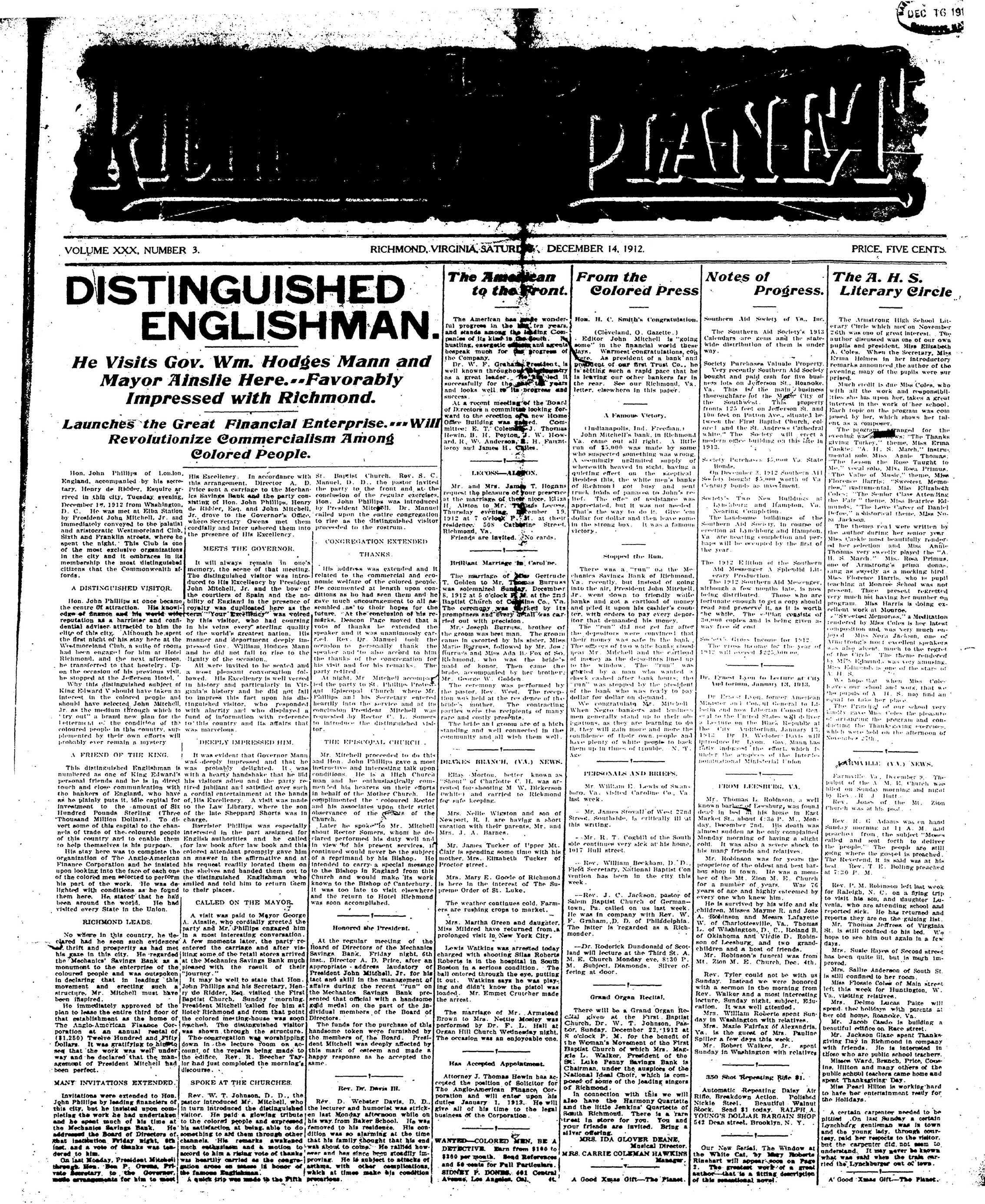
DISTINGUISHED ENGLISHMAN
He Visits Gov. Wm. Hodges Mann and Mayor Ainslie Here.--Favorably Impressed with Richmond.
Launches the Great Financial Enterprise. Will Revolutionize Commercialism Among
VOLUME XXX, NUMBER 3.
DISTIN
EN
He Visits Gov
Mayor Ain
Impress
Launches the Great
Revolutioniz
Hon. John Phillips of London, England, accompanied by his secretary, Henry de Ridder, Esquire arrived in this city, Tuesday evening, December 17, 1912 from Washington, D. C. He was met at Elba Station by President John Mitchell, Jr. and immediately conveyed to the palatial and aristocratic Westmoreland Club, Sixth and Franklin streets, where he spent the night. This Club is one of the most exclusive organizations in the city and it embraces in its membership the most distinguished citizens that the Commonwealth affords.
A DISTINGUISHED VISITOR
Hon. John Phillips at once became the centre of attraction. His knowledge of finance and his world wide reputation as a barrister and confidential advisor attracted to him the elite of this city. Although he spent the first night of his stay here at the Westmoreland Club, a suite of rooms had been engaged for him at Hotel Richmond, and the next afternoon he transferred to that hostelry. Upon the occasion of his previous visit he stopped at the Jefferson Hotel.
Why this distinguished subject of King Edward V should have taken an interest in the colored people and should have selected John Mitchell Jr. as the medium through which to "try out" a brand new plan for the betterment of the condition of the coloured people in this country, supplemented by their own efforts will probably ever remain a mystery.
A FRIEND OF THE KING
This distinguished Englishman is numbered as one of King Edward's personal friends and he is in direct touch and close communication with the bankers of England, who have as he plainly puts it, idle capital for investment to the amount of Six Hundred Pounds Sterling (Three Thousand Million Dollars). To divert some of this capital to the channels of trade of the coloured people of this country and to enable them to help themselves is his purpose. His stay here was to complete the organization of The Anglo-American Finance Corporation and he insisted upon looking into the face of each one of the colored men selected to perform his part of the work. He was delighted with conditions as he found them here. He stated that he had been around the world. He had visited every State in the Union.
RICHMOND LEADS
No where in this country, he declared had he seen such evidences thrift and prosperity as had met his gaze in this city. He regarded the Mechanics' Savings Bank as a monument to the enterprise of the coloured people and was outspoken in declaring that in leading this movement and erecting such a structure, Mr. Mitchell must have been inspired. He immediately approved of the plan to lease the entire third floor of that establishment as the home of The Anglo-American Finance Corporation at an annual rental of (81,250) Twelve Hundred and Fifty dollars. It was gratifying to him to see that the work was well under way and he declared that the management of President Mitchell had been perfect.
MANY INVITATIONS EXTENDED.
Invitations were extended to Hon. John Phillips by leading financiers of this city, but he insisted upon completing the work he had undertaken and he spent much of his time at the Mechanics Savings Bank. He addressed the Board of Directors of that institution Friday night, 6th inst., and a vote of thanks was tendered to him.
On last Monday, President Mitchell through Hon. Ben P. Owens, Private Secretary, to the Governor, made arrangements for him to meet
Colored People.
His Excellency. In accordance with this arrangement, Director A. D. Price sent a carriage to the Mechanics Savings Bank and the party consisting of Hon. John Phillips, Henry de Ridder, Eaq. and John Mitchell, Jr. drove to the Governor's Office, where Secretary Owens met them cordially and later ushered them into the presence of His Excellency.
MEETS THE GOVERNOR.
It will always remain in one's memory, the scene of that meeting. The distinguished visitor was introduced to His Excellency by President John Mitchell, Jr. and the bow of the courtiers of Spain and the nobility of England in the presence of royalty was duplicated here as the term "Your Excellency" was voiced by this visitor, who had coursing in his veins every sterling quality of the world's greatest nation. His manner and deportment deeply impressed Gov. William Hodgson Mann and he did not fall to rise to the dignity of the occasion.
All were invited to be seated and a most pleasant conversation followed. His Excellency is well versed in history and particularly in Virginia's history and he did not fall to impress this fact upon his distinguished visitor, who responded with altruity and who displayed a fund of information with reference to this country and its affairs that was marvelous.
DEEPLY IMPRESSED HIM
It was evident that Governor Mann was deeply impressed and that he was probably delighted. It was with a hearty handshake that he lifted his visitors adieu and the party retired fabulant and satisfied over such a cordial entertainment at the hands of His Excellency. A visit was made to the Law Library, where the son of the late Sheppard Shorts was in charge.
Harrister Phillips was especially interested in the part assigned for English authorities and he called for law book after law book and this colored attendant promptly gave him an answer in the affirmative and at his request readily located them on the shelves and handed them out to the distinguished Englishman who smiled and told him to return them to their places.
CALLED ON THE MAYOR
A visit was paid to Mayor George A. Atalne, who cordially greeted the party and Mr. Phillips engaged him in a most interesting conversation. A few moments later, the party rented the carriage and after visiting some of the retail stores arrived at the Mechanics Savings Bank much pleased with the result of their "journey." It may be well to state that Hon. John Phillips and his Secretary, Henry do Ridder, Eq. visited the First Baptist Church. Sunday morning, President Mitchell called for him at Hotel Richmond and from that point the colored meeting-house was soon ruined. The distinguished visitor was shown through the structure. The congregation was worshipping down in the lecture room on account of the repairs being made to the edifice. Rev. R. Beecher Taylor had just completed the morning's discourse.
SPOKE AT THE CHURCHES
Rev. W. T. Johnson, D. D., the pastor introduced Mr. Mitchell, who in turn introduced the distinguished visitor. He paid a glowing tribute to the colored people and expressed his satisfaction at being able to do something to aid them through other channels. His remarks awakened much enthusiasm and a motion to accord to him a rising vote of thanks was heartily carried as the congregation rose on message in honor of the famous Englishman.
A quick trip was made to the Fifth
RICHMOND, VIRGINIA, SATURDAY, DECEMBER 14, 1912.
St. Baptist Church, Roy, S. C.
Manuel, D. D., the pastor invited
the party to the front and, at the
conclusion of the regular exercises.
Bon. John Phillips was introduced
by President Mitchell. Dr. Manuel
called upon the entire congregation
to rise as the distinguished visitor
proceeded to the rostrum.
CONGREGATION EXTENDED
THANKS.
His address was extended and it related to the commercial and economic welfare of the colored people. He commented at length upon conditions as he had seen them and he gave much encouragement to all assembled not to their hopes for the future. "At the conclusion of his remarks, Deacon Page moved that a vote of thanks he extended the speaker and it was unanimously carried. Rev. Dr. Manuel took the occasion to personally thank the speaker and to also accord to him the thanks of the congregation for his visit and for his remarks. The party retired.
At night, Mr. Mitchell accompanied the party to St. Phillips Protestant Episcopal Church where Mr. Phillips and his Secretary entered heartily into the service and at its conclusion President Mitchell was requested by Rector C. L. Somers to introduce the distinguished visitor.
THE EPISCOPAL CHURCH.
Mr. Mitchell proceeded to do this and Hon. John Phillips gave a most instructive and interesting talk upon conditions. He is a High Church man and he enthusiastically commented his hearers on their efforts in behalf of the Mother Church. He complimented the coloured Rector and his associates upon their strict observance of the services of the Church.
Later he spoke to Mr. Mitchell about Rector Somers, whom he declared performed his duty well and in view of his present services. If continued would never be the subject of a reprimand by his Bishop. He intended to carry a special message to the Bishop in England from this Church and would make its work known to the Bishop of Canterbury. It was too late to visit elsewhere and the return to Hotel Richmond was soon accomplished.
Honored the President.
At the regular meeting of the Board of Directors of the Mechanics Savings Bank. Friday night, 6th inst., Director A. D. Price, after an appropriate address laudatory of President John Mitchell, Jr. for his tact and skill in the management of affairs during the recent "run" on the Mechanics Savings Bank presented that official with a handsome gold medal on the part of the individual members of the Board of Directors.
The funds for the purchase of this handsome token were furnished by the members of the Board. President Mitchell was deeply affected by this mark of esteem and made a happy response as he accepted the same.
Rev. Dr. Davia Ill.
Rev. D. Webster Davis, D. D. the lecturer and humorist was strenched last Monday afternoon while on his way from Baker School. He was removed to his residence. His condition was so alarming at the time that his family thought that his end was about to come. He rallied however and has since been steadily improving. He is subject to attacks of asthma, with other complications, which at times make his condition precarious.
The American has made wonderful progress in the last ten years, and stands among the leading Companies of its kind in the South. He hustling, energetic office and agents bospeak much for the progress of the Company.
Dr. W. F. Graham President, is well known throughout the country as a great leader. He reached it successfully for the past fifty years and looks well to its progress and success.
At a recent meeting of the Board of Directors a committee looking forward to the erection of a new Home Office Building was started. Committee: E. T. Coleman. J. Thomas Hewin, B. H. Peyton, J. W. Howard, R. W. Anderson, B. H. Fauntleroy and James H. Culles.
Mr. and Mrs. James T. Hogans request the pleasure of your presence at the marriage of their niece, Eliza H. Alston to Mr. Thomas Leoneus Thursday evening. December 19 1912 at 7 o'clock P.M. at their residence: 508 Catharine Street, Richmond Va.
Friends are invited. No cards.
Brilliant Marriage in Caroline
The marriage of Miss Gertrude T. Golden to Mr. Thomas Burruss was solemnized Sunday, December 8, 1912 at 5 o'clock B.M. at the 2nd Baptist Church of Columbia Co., Va. The ceremony was marked by its promptness and every detail was carried out with preciation.
Mr. Joseph Burruss, brother of the groom was best man. The groom came in escorted by his sister, Miss Marie Burruss, followed by Mr. Jos. Burruss and Miss Ada B. Fox of So. Richmond, who was the bride's maid of honor. Then came the bride, accompanied by her brother; Mr. George W. Golden.
The ceremony was performed by the pastor, Rev West. The reception was held at the residence of the bride's mother. The contracting parties were the recipients of many rare and costly presents.
The bride and groom are of a high standing and well connected in the community and all wish them well.
DRAGES BRANCH. (VA.) NEWS.
Elias. Morton, better known as "Shout" of Charlotte C. H. was arrested for shooting M. W. Dickerson (white) and carried to Rickmond for safe keeping.
Mrs. Nellie Wigton and son of Newport, R. L. are having a short vacation with their parents, Mr. and Mrs. J. A. Barnes.
Mr. James Tucker of Upper Mt. Clair is spending some time with his mother, Mrs. Elizabeth Tucker of Proctor street.
Mrs. Mary E. Goodle of Richmond is here in the interest of The Supreme Order of St. Luke.
The weather continues cold. Farmers are rushing crops to market.
Mrs. Martha Green and daughter, Miss Mildred have returned from a prolonged visit in New York City.
Lewis Watkins was arrested today charged with shooting Silas Roberts Roberts is in the hospital in South Boston in a serious condition. The ball entered through the eye, putting it out. Watkins says he was playing and didn't know the pistol was loaded. Mr. Emmet Crutcher made the arrest.
The marriage of Mr. Armstead Brown to Mrs. Nettle Mosley was performed by Dr. F. L. Hall at Organ Hill Church Wednesday night. The occasion was an enjoyable one.
Has Accepted Appointment.
Attorney J. Thomas Hewin has accepted the position of Solicitor for The Anglo-American Finance Corporation and will enter upon his duties January 1. 1913. He will give all of his time to the legal business of the Corporation.
WANTED—COLORED MEN, BE A
DETECTIVE. Earn from $160 to
$260 per month. Send References
and 50 cents for Full Particulars.
SIDNEY P. DONNEL. 601 Central
Avenue, Los Angeles, Cal. 4t.
From the Colored Press
Hon. H. C. Smith's Congratulation.
(Cleveland, O. Gazette.)
Editor John Mitchell is "going
some" in the financial world these
days. Warmest congratulations, con-
fere. As president of a bank and
president of our first Trust Co., he
is setting such a rapid pace that he
is leaving our other bankers far in
the rear. See our Richmond, Va.
letter, elsewhere in this paper.
A Famous Victory.
(Indianapolis, Ind. Freedman.
John Mitchell's bank, in Richmond
Va. came out all right. A little
run of $3,000 was made by some
who suspected something was wrong.
A seemingly unlimited supply
of wherewith heaved in sight, having a
quieting effect on the so-called
Besides this, the white men's banks
of Richmond got busy and sent
truck loads of pamphlets to John's relief.
The offer of assistance was
appreciated, but it was not needed.
That's the way to do it. Give him
dollar for dollar and then leave some
in the strong box. It was a famous
victory.
Stopped the Run.
There was a "run" on the Mechanics Savings Bank of Richmond, Va. recently, but instead of going into the air, President John Mitchell, Jr. went down to friendly white banks and got a cartoon of money and pled it upon his cashier's counter, with orders to pay every deportor that demanded his money. The "run" did not get far after the depositors were convinced that their money was safe in the bank. The officers of two white banks stood near Mr. Mitchell and the cartoon of money as the depositors lined up to the window. The "run" was started by a man who wanted a check cashed after bank hours; the "run" was stopped by the president of the bank who was ready to pay dollar for dollar on demand.
We congratulate Mr. Mitchell. When Negro bankers and businessmen generally stand up to their obligations, as they are learning to do it, they will gain more and more the confidence of their own people and have plenty of white people to back them up in times of trouble. N. Y. Age.
PERSONALS AND BRIEFES.
Mr. William D. Lewis of Swanboro, Va. visited Caroline Co., Va. last week.
Mr. James Stovall of West 22nd Street, Southside, is critically ill at this writing.
Mr. R. T. Cogbill of the South side continues very sick at his home, 1017 Hull street.
Rev. William Beckham, D. D. Field Secretary, National Baptist Convention has been in the city this week.
Rev. J. C. Jackson, pastor of Salem Baptist Church of Germantown, Pa. called on us last week. He was in company with Rev. W. F. Graham, D. D. of Philadelphia. The latter is regarded as a Richmonder.
Dr. Roderick Dundonald of Scotland will lecture at the Third St. A. M. E. Church Monday eve, 8:30 P. M. Subject, Diamonds. Silver offering at door.
Grand Organ Recital.
There will be a Grand Organ Recital given at the First. Baptist Church, Dr. W. T. Johnson, Pastor, Sunday, December 22, 1912 at R o'clock P. M. for the benefit of the Woman's Movement of the First Baptist Church of which Mrs. Maggie L. Walker, President of the St. Luke Penny Savings Bank is Chairman, under the auspices of the National Ideal Choir, which is composed of some of the leading singers of Richmond.
In connection with this we will also have the Harmony Quartette and the little Jenkins' Quartette of South Richmond. There is a rare treat in store for you. You and your friends are invited. Bring a silver offering.
MRS. IDA GLOVER DEANE
Musical Director.
MRS. CARRIE COLLEM HAWKINS
A Good Xmas Gift—The Planet.
Notes of Progress.
Southern Aid Society of Va., Inc.
The Southern Aid Society's 1913 Calendars are gems and the statewide distribution of them is under way.
Society Purchases Valuable Property.
Very recently Southern Aid Society bought and paid cash for five business lots on Jefferson St. Roanoke, Va. This is the main business thoroughfare for the West City of the Southwest. This property fronts 125 feet on Jefferson St. and 100 feet on Patton Ave., situated between the First Baptist Church, colorel and the St. Andrews Cathedral white. The Society will erect a modern office building on this site in 1913.
Society Purchases $5,000 Va. State Bonds.
On December 2, 1912 Southern Aid Society bought $5,000 worth of Va. Century bonds as investment.
Society's New Buildings at Lynchburg and Hampton, Va.
Nearing completion.
The handsome buildings of the Southern Aid Society, in course of erection at Lynchburg and Hampton, Va. are hosting completion and perhaps will be occupied by the first of the year.
The 1912 Edition of the Southern Aid Messenger A Splendid Literary Production.
The 1912 Southern Aid Messenger, although a few months late, is now being distributed. Those who are fortunate enough to get a copy should read and preserve it, as it is worth the while. The edition consists of 200 copies and is being given away free of cost.
Society's Gross Income for 1912.
The gross income for the year of 1912 will exceed £25,200 on
---
Dr. Eynest Lyon to Lecture at City
Andorran, January 13, 1913.
Dr. Edward Lyon, former American Minister and Consul General to Liberia and now Liberian Consul General to the United States will deliver a lecture on the Black Republic at the City Auditorium, January 13, 1912. Dr. D. Webster Davies will introduce Dr. Lyon. Gov. Mann has fifty inches' the effort, which is under the auspices of the Intercontinental Ministerial Mitchell Union
FROM LEESBURG, VA
Mr. Thomas L. Robinson, a well known barrister of Leesburg, was found dead in bed in his house in East Market St., about 4:30 P. M., Monday, December 2nd. His death was almost sudden as he only complained Monday morning of having a slight cold. It was also a severe shock to his many friends and relatives.
Mr. Robinson was for years the proprietor of the oldest and best barrison shop in town. He was a member of the Mt. Zion M. E. Church for a number of years. Was 76 years of age and highly esteemed by every one who knew him.
He is survived by his wife and six children, Misses Mayne R. and Jone A. Robinson and Messam Lafayette W. of Charlottenville, Va., Thomas L. of Washington, D. C., Roland B. of Oklahoma and Vifidie D. Robinson of Leesburg, and two grandchildren and a host of friends.
Mr. Robinson's funeral was from Mt. Zion M. E. Church, Dec. 4th.
Rev. Tyler could not be with us Sunday. Instead we were honored with a sermon in the morning from Rev. Walker and a most interesting lecture, Sunday night, subject, Education. It was well attended.
Mrs. William Roberto spent Sunday in Washington with relatives.
Mrs. Mazlo Fairfax of Alexandria,
Va. in the guest of Mrs. Pauline
Spiller a few days this week.
Mr. Robert Walker, Jr. spent Sunday in Washington with relatives
350 Shot Repeating Rifle #1.
Automatic Repotting Daley At
Rifle, Breakdown Action. Poliaski
Nickle Steel. Beautiful Walnut
Stock. Send $1 today. RALPH A.
YOUNG'S DOLLAR BARGAIN SHOP
542 Dean street. Brooklyn. N. Y.
Our New Serial, The Window at
the White Cat, by Mary Roberta
Rinehart will appear soon on Page
2. The greatest work of a great
author—that is a fitting description
of this sensational novel.
DEC TG 191
PRICE, FIVE CENTS.
The A. H. S. Literary Circle
The Armstrong High School Literary Circle which met on November 26th was one of great interest. The author discussed was one of our own pupils and president, Miss Elizabeth A. Coles. When the Secretary, Miss Erma Holmes in her introductory remarks announced the author of the evening many of the pupils were pursed.
Much credit is due Miss Coles, who with all the work and responsibilities she has upon her, takes a great interest in the work of her school. Each topic on the program was composed by her, which shows her talent as a composer.
The program arranged for the evening was called: "The Thanks giving Turkey" theme, Miss Erma Caskie: "A. H. S. March," instrumental solo, Miss Annie Thomas: "The Lesson the Rose Taught to Me," vocal solo, Miss Rosa Primus: "The Value of Muscle" theme, Miss Florence Harris: "Sweetest Memories," instrumental, Miss Elizabeth Coles: "The Senior Class Attending the Fair" theme, Miss Bearice Edmunds: "The Love Career of Daniel Benton," a historical theme, Miss Nora Jackson.
The themes real were written by the author during her senior year Miss Caskie most beautifully rendered her selection and Miss Annie Thomas very sweetly played the "A. H. S. March." Miss Rosa Primus, one of Armstrong's prima donas, sang as sweetly as a mocking bird. Miss Florence Harris, who is pupil teaching at Monroe School was not present. Those present regretted very much not having her number on program. Miss Harris is doing excellent work at Monroe.
"Sweetest Memories," a Meditation rendered by Miss Coles is her latest composition and was very much enjoyed. Miss Nora Jackson, one of Armstrong's most excellent speakers was also about, much to the regret of the Circle. The theme rendered by Miss Edmunds was very amusing. Miss Edmunds is one of the stars of A. H. S. March.
We hope that when Miss Cole leaves our school and work, that we the pupils of A. H. S. may find an equal to take her place.
The Principal of our school very kindly gave Miss Cole the pleasure of arranging the program and conducting the Thanksgiving exercises, which were held on the afternoon of November 27th.
---
ARRIVALLE (VA) NEWS
Farmville, Va., December 9. The palace of the A. M. E. Church was filled on Sunday morning and night by Rev. R. J. Huff.
Rev. Jones of the Mt. Zion Church was at his post.
Rev. R. G. Adams was on hand Sunday morning at H. A. M. and reached from the subject "Moses called and sent forth to deliver the people." The people are still going where the gospel is preached. The Reverend, it is said was at his best. Rev. T. E. Bolling preached at 7:30 P. M.
Rev. P. M. Robinson left last week for Raleigh, N. C. on a flying trip to visit his son, and daughter Luvenia, who are attending school and reported sick. He has returned and reports they are on the gaining list.
Mr. Thomas Jeffreys of Virginia St. is still confined to his bed. We hope to see him out again in a few days.
Mrs. Susie Hayes of Second street has been quite ill, but is much improved.
Mrs. Sallie Anderson of South St. is still confined to her room.
Miss Floris Cole of Main street left this week for Huntington, W. Va., visiting relatives.
Mrs. Delmo Lucas Paige will spend the holiday with parents at her old home, Roanoke, Va.
Mr. Jacob Casado is building a beautiful cottage on Race street.
Mr. Jackson Glaze spent Thanksgiving Day in Richmond in company with friends. He is interested in those who are public school teachers. Misen Ward, Branch, Price, Counsins, Hilton and many others of the public school teachers came home and spent Thanksgiving Day.
Miss Pearl Hilton is working hard to hate her entertainment ready for the Holidays.
A certain carpenter needed to be pitied. On last Sunday a certain Lynchburg gentleman was in town and the young lady, through courtesy, paid her respects to the visitor, but the carpenter did, not seem to understand. It may never be known what was said when the train carried the Lynchburger out of town.
A 'Good Xmas Gift'—The Planet.
---
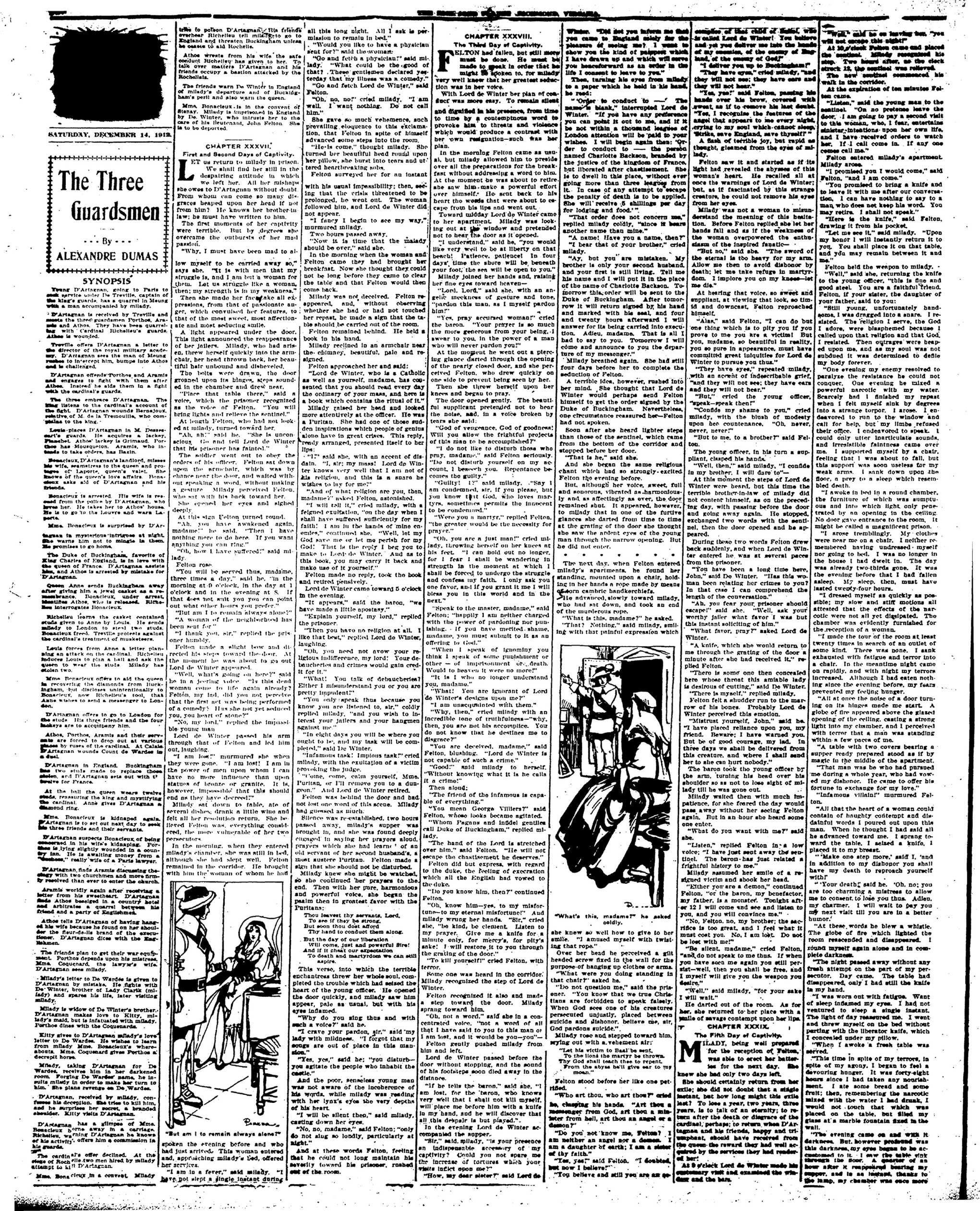
The Three Guardsmen
SYNOPSIS
Twang D'Artagnan, going to Paris to seek service under De Treville, captain of the king's guards, has a quarrel in Meung D'Artagnan is received by Treville and meets the three guarden Porthos, Aramis and Athos. They have been quarrelling with Cardinal Richelieu's guards. Athos is wounded.
Treville offers D'Artagnan a letter to the director of the royal military academy, and engages to fight with them after Athos. Instead he aids them in a fight with the cardinal's guards.
The three embrace D'Artagnan. The fight, D'Artagnan wounds Bernajour, relative of M. de la Trenouille, who compilates to the king.
Louis-places D'Artagnan in M. Dessert-sart's guards. He acquires a lackey, Panchest, lackey in Grimaud. Porthest, who intends to take others, has Hazin.
Bonavictus, D'Artagnan's landlord, misses his wife, seamstress to the queen and protégé of Laporte, queen's valet. She knows of the queen's love affairs. Bonavictus asks aid of D'Artagnan and his friends.
Bonavictus is arrested. His wife is rescued from the police by D'Artagnan, who loves her. He takes her to Athos' house. He is to go to the Louvre and warn LaPorta.
Mina. Bonavictus is surprised by D'Artagnan in mysterious intrigue at night. She warns him not to mingle in them. He promises to go home.
The Duke of Buckingham, favorite of King Charles of England, is in love with the queen of France. D'Artagnan assists him, and Athos is arrested by mistake for D'Artagnan.
Queen Anne sends Buckingham away after giving him a jewel casket as a remembrance. Bonavictus, under arrest, misses Athos, who is released. Richard interrogates Bonavictus.
Richelle learns the casket contained钻石 given to Anne by Louis. She sends it to Buckingham and Bonavictus frees. Tritheil protests against the cardinal's treatment of musketeers.
Louis forces from Anne a letter planning an attack on the cardinal. Richelieu induces Louis to plan a ball and ask the king to wear the studs. Milady has donated two. Mme Bonacieux offers to aid the queen in recovering the diamonds from luckingham, but discloses unintentionally to Bonacieux, now Richelieu's tool, that Anne wishes to send a messenger to London.
D'Artagnan offers to go to London for the studs. His three friends and the four hockeys are to accompany him.
Athos, Porthous, Aramis and their servants are forced to drop out at various places by ruses of the cardinal. At Calais D'Artagnan wounds Count de Wardes in a duel.
D'Artagnan in England. Buckingham has two studs made to replace those stolen, and D'Artagnan sets out with D'twelve for France.
At the ball the queen wears twelve studs, measuring the king and mourning the cardinal. Anne gives D'Artagnan a diamond ring.
Mme Bonacieux is kidnapped again. D'Artagnan is to set out next day to seek the three friends and their servants.
D'Artagnan suspects Bonacieux of being concerned in his wife's kidnaping. Fortune is lying slightly wounded in a country ann. He is awaiting money from a business, really wife of a Paris lawyer.
D'Artagnan, finds Aramis discussing theology with two churchmen and more firmly resolved than ever to enter the church.
Aramis worldly again after receiving a letter from his sweetheart. D'Artagnan finds Aramis beseled in a country hotel and arbitrates a quarrel between his friend and a party of Englishmen.
Atos tells D'Artagnan of having hanged his wife because he found on her shoulder the fleur-de-lis brand of the execution. D'Artagnan dices with the Englshmen.
The friends plan to get their war equipment. Portos depends upon his mistress. Minus the lawyer's wife. D'Artagnan sees milady.
Milady's letter to De Wardee is given to D'Artagnan by mistake. Heights with De Wintner, and mother of Lady Charik (milady) and spares his life, later visiting milady.
Milady is widow of Winter's brother, D'Artagnan makes love to Kitty, milady's maid, but is infatuated with milady. Porthos dines with the Coquenarda.
Kitty gives to D'Artagnan milady's love letter to De Wardes. He wishes to learn from milady Milla. Bosacieux's whereabouts. Coquenard gives Porthos a decrept horse.
Milady, taking D'Artagnan for De Wardes, receives him in her darkened room. Forging De Wardes' name, he insults milady in order to make her turn to him. She plans revenge on De Wardes.
D'Artagnan, received by milady, confesses his deception. She tries to kill him, and he surprises her secret, a branded shoulder. Kitty visits D'Artagnan.
D'Artagnan has a hipspe of Mme. Bonacieux comes away in a carriage. Richaleu, warning D'Artagnan he knows of his activity, offers him a commission in his guarda.
The cardinal's offer declined. At the stage of Rock's two men hired by milady attempt to kill D'Artagnan.
Milla. Bonacieux in a convent. Milady
tries to pollen D'Artagan. His friends overhear Richelle tell milagres to go to England and threaten Buckingham unless he ceases to aid Kochela.
Atos writes from his wife the safe conduct Richelle has given to her. To talk over matters D'Artagan and his friends occupy a beaion attacked by the Rochelais.
The Friends warn De Winter in England of Emily's departure and of Buckingham's peril and also warn the queen.
Mima Bonacieux. is in the convent of Emily is imprisoned in England by De Winter, who intrusts her to the care of his lieutenant, John Felton. She is to be deported.
CHAPTER XXXVII.
we left her. All her mishap she owes to D'Artagnan without doubt. From whom can come so many disgraces heaped upon her head if not from him? He knows her brother in law; he must have written to him. The first moments of her captivity were terrible. But by degrees she overcame the outbursts of her mad passion.
"Why, I must have been mad to allow myself to be carried away so" says she. "It is with men that my struggle is, and I am but a woman for them. Let us struggle like a woman, then; my strength is in my weakness." Then she made her face like all expressions, from that of passionate anger, which consulted her features, to that of the most sweet, most affectionate and most seducing smile.
A light appeared under the door. This light announced the remembrance of her fellers. Milady, who had arisen, throw herself quickly into the armchair, her head thrown back, her beautiful hair unbound and disheveled.
The boots were drawn, the door groaned upon its hinges, steps sounded in the chamber and drew near.
At length Felton, who had not looked at milady, turned toward her. "Ah, ah!" said he. "She is unconscious. Go and tell Lord de Winter that his prisoner hasainted." The soldier went out to obey the orders of his officer. Felton sat down upon the armchair, which was by chance near the door, and waited without speaking a word, without making a gesture. Milady perceived Felton who sat with his back toward her. She opened her eyes and sighed deeply. At this sign Felton turned round. "Ah, you have awakened again, madame!" he said. "Then I have nothing more to do here. If you want anything you can ring." "Oh, how I have suffered!" said milady.
Felton rose.
"You will be served thus, madame, three times a day," said he. "in the morning at 0 o'clock, in the day at 1 o'clock and in the evening at 8. If that does not wait you can point out what other hours you prefer."
"But am I to remain always alone?"
"A woman of the neighborhood has been sent for."
"I thank you, sir," replied the prisoner humbly.
Felton made a slight toow and directed his steps toward the door. At the moment he was about to go out Lord de Winter appeared.
"Well, what's going on here?" said he in a jeering voice. "This dead woman come to life again already?"
Felton, my lady, did not perceive that the first act was being performed of a comedy. Has she not yet reduced you, you heart of stone?
"No, my boy!" replied the impassible young man.
Lord de Winter passed his arm through that of Felton and led him out, laughing.
"I am lost!" murmured she when they were gone. "I am lost! I am in the power of men upon whom I can have no more influence than upon status of bronze or granite. It is, however, impossible that this should end as they have decreed."
Milady sat down to table, ate of several dishes, drank a little wine and felt all her production return. She believed Felton was, everything considered, the more vulnerable of her two persecutors.
In the morning, when they entered milady's chamber, she was still in bed, although she had slept well. Felton remained in the corridor. He brought with him the woman of whom he had
P. BACON
spoken the evening before and who had just arrived. This woman entered and, approaching milady's bed, offered her services. "I am in a fever," said milady. "I have not slept a single instant during
"Would you like to have a physician sent for?" said the woman:
"Go and fetch a physician," said miliady.
"What could be the good of that?" These gentlemen declared yesterday that my illness was a comedy.
"Go and fetch Lord de Winter," said Felton.
"Oh, no, no!" cried miliady. "I am well. I want nothing. Do not call him."
She gave so much vehemence, such prevailing eloquence to this exclamation, that Felton in spite of himself advanced some steps into the room.
"He is come," thought miliady. She turned her beautiful head round upon her pillow, she burst into tears and uttered heartbreaking sobs.
Felton surveyed her for an instant with his usual impossibility; then, seeing that the crisis threatened to be prolonged, he went out. The woman followed him, and Lord de Winter did not appear.
"I fancy I begin to see my way," murmured miliady.
Two hours passed away
"Now it is time that the maidy should be over," said she.
In the morning when the woman and Felton came they had brought her breakfast. Now she thought they could not be long before they came to clear the table and that Felton would then come back.
Felton remained behind. He held a book in his hand. Milady reclined in an armchair near the chimney, beautiful, pale and resigned. Felton approached her and said:
"Lord de Winter, who is a Catholic as well as yourself, madame, has consented that you should read every day the ordinary of your mass, and here is a book which contains the ritual of it." Milady raised her head and looked more attentively at the officer. He was a Puritan. She had one of those sudden inspirations which people of genius alone have in great crises. This reply, ready arranged, presented itself to her lips:
"I'll said she, with an accent of disdain. "I, air; my mass. Lord de Winter knows very well that I am not of his religion, and this is a snare he wishes to buy for me"
"And of what religion are you, then, madame? asked Felton, astonished.
"I will tell it," it cried mildly, with a feigned exultation, "on the day when I shall have suffered sufficiently for my faith: I am in the hands of mine enemies," continued she. "Well, let my God give me or let me perish for my God. That is the reply I beg you to make to Lord the Winter. And as to this book, you may carry it back and make use of it yourself."
Felton made no reply, took the book and retired pensively. Lord the Winter came toward 5 o'clock in the evening.
"It appears," said the baron, "we have made a little apostasy."
"Explain yourself, my lord," replied the prisoner.
"Then you have no religion at all. I like that best," replied Lord do Winter, laughing.
"Oh, you need not not your religious indifference, my lord! Your debucheries and crimes would gain credit for it."
"What! You talk of debaucheries! Either I misunderstand you or you are pretty impudent!"
"You only speak thus because you know you are listened to, air," coldly replied mildly, "and you wish to interest your jailers and your hangmen against me."
"In eight days you will be where you ought to, and my task will be completed," said De Winter.
"Infamous task! Impulsive task!" cried mildly, with the exultation of a victim proclaiming the judge.
"Come, come, calm yourself, Mme Puritan, or I will remove you to a dungeon." And Lord de Winter retired.
Felton was behind the door and had not lost one word of this acuse. Milady had guessed as much.
Silence was re-established, two hours passed away, milady's supper was brought in, and she was found deeply engaged in saying her prayers aloud, prayers which she had learnt of an old servant of her second husband, a most austere Puritan. Felton made a sign that she should not be disturbed.
Milady knew she might be watched, so she continued her prayers to the end. Then with her pure, harmonious and powerful voice, she began the psalm then in greatest favor with the Puritans:
"Thou leavest thy servants, Lord,
To see if they be strong.
But soon thou dost afford
Thy hand to conduct them along.
But the day of our liberation
Will come, just and powerful Fire!
And if it cheat our expectation
To death and martyrdom we can still
aspire.
This verse, into which the terrible
enchantress throw her whole soul, com-
pleted the trouble which had seized the
heart of the young officer. He opened
the door quickly, and milady saw him
appear, pale as usual, but with his
eyes infamed.
"Why do you sing thus and with
such a voice?" said he.
"I crave your pardon, sir," said my
lady with mildness. "I forgot that my
songs are out of place in this mansion."
"Yes, yes," said he; "you disturb-
you agitate the people who inhabit the
castle."
And the poor, senseless young man
was not aware of the incoherence of
his words, while milady was reading
with her lynx' eyes the very depths
of his heart.
"I will be silent then," said miady, casting down her eyes.
"No, no, madame," said Felton; "only do not sing so loudly, particularly at night."
And at these words Felton, feeling that he could not long maintain his severity toward his prisoner, rushed out of the room.
```markdown
```
FELTON had fallen, but still more must be done. He must be made to speak in order that he might be spoken to, for milady very well knew that her greatest seduction was in her voice.
With Lord Lord Winter her plan of conduct was more easy. To remain silent and dignified in his presence, from time to time by a contemptuous word to provoke him to threats and violence which would produce a contrast with her own resignation—such was her plan.
In the morning Felton came as usual, but milady allowed him to preside over all the preparations for the breakfast without addressing a word to him. At the moment he was about to retire, she saw him make a powerful effort over himself. He sent back to his heart the words that were about to escape from his lips and went out.
Toward midday Lord Lord Winter came to her apartment. Milady was looking out at the window and pretended not to hear the door as it opened.
"I understand," said he, "you would like very well to be at liberty on that bench! Patience, patience! In four days' time the shure will be, beneath your foot; the sea will be open to you." Milindy joined her hands and, raising her fine eyes toward heaven—
"Lord, Lord," said she, with an angelic meekness of gesture and tone,
"pardon this man, as I myself pardon him!"
"Yes, pray accured woman!" cried the baron. "Your prayer is so much the more generous from your being. I swear to you, in the power of a man who will never pardon you!"
At the moment he went out a piercing glance darted through the opening of the nearly closed door, and she perceived Felton, who drew quickly on one side to prevent being seen by her. Then she throw herself upon her knees and began to pray.
The door opened gently. The beautiful supplicant pretended not to bear the noise, and, in a voice broken by tears she said:
"God of vengeance, God of goodness;
Will you allow the frightful projects
of this man to be accomplished?"
"I do not like to disturb those who
pray, madness," said Felton seriously.
"Do not disturb yourself on my account,
I beseech you. Repentance becomes the guilt."
"Gulty! I?" said milady. "Say I am condemned, sir, if you please, but you know that God, who loves martyrs, sometimes permits the innocent to be condemned."
"Were you a martyr," replied Felton.
"the greater would be the necessity for prayer."
"Oh, you are a just man!" cried milady, throwing herself on her knees at his feet. "I can hold out no longer, for I fear I shall be wandering in strength in the moment at which I shall be forced to undergo the struggle and confess my faith. I only ask you one favor, and if you grant it me I will bless you in this world and in the next."
"Speak to the master, madame," said Pelton; "happily I am neither charged with the power of pardoning nor punishing. If you have metted, shame, madame, you must submit to it as an offering to God."
"When I speak of ignominy you think I speak of some punishment or other — of imprisonment or death. Would to heaven it were no more!"
"It is I who no longer understand you, madame."
"What! You are ignorant of Lord do Winter's designs upon me?"
"I am unacquainted with them."
"Why, then," cried mindly with an incredible tone of truthfulness—"why, then, you are not his accomplice. You do not know that he destines me to disgrace?"
"You are deceived, madame," said Felton, blushing. "Lord de Winter is not capable of such a crime."
"Good," said mindly to herself. "Without knowing what it is he calls it a crime!"
Then aloud:
"The friend of the infamous is capable of everything."
"You mean George Villiers?" said Felton, whose looks became agitated. "Whom Pagans and indulgent gentiles call Duke of Buckingham," replied milady.
"The hand of the Lord is stretched over him," said Felton. "He will not escape the chastisement he deserves."
Felton did but express, with regard to the duke, the feeling of excretion which all the English had vowed to the duke.
"Do you know him, then?" continued Felton.
"Oh, know him—yes, to my misfortune—to my eternal misfortune!" And miliy wring her hands. "Sir," cried she, "the kind, be clement. Listen to my prayer. Give me a knife for a minute only, for mercy, for pity's sake! I will restore it to you through the graining of the door."
"To kill yourself!" cried Felton, with terror.
Some one was heard in the corridor. Milady recognized the step of Lord de Winter.
Felton recognized it also and made a step toward the door. Milady sprang toward him.
"Oh, not a word," said she in a concentrated voice. "not a word of all that I have said to you to this man or I am host, and it would be you—" Felton gently pushed milady from him and left.
Lord de Winter passed before the door without stopping, and the sound of his footsteps soon died away in the distance.
"If he tells the baron," said she, "I am lost, for the baron, who knows very well that I shall not kill myself, will place me before him with a knife in my hand, and he will discover that all this despair is but played."
In the evening Lord de Winter accompanied the sopper.
"Bhr," said, mildly, "is your presence an indispensable accessory of my captivity? Could you not spare me the increase of tortures which your wits inflict upon me?"
"How, my dear sister?" said Lord Go
When. Did not you know me that you came to England solely for the pleasure of me吗 me? I want to show you the kind of paupst which I have drawn up and which will serve you beforward as an order in the life I consent to leave to you."
Then, turning his eyes from mildly to a paper which he held in his hand, he read:
"Order to conduct to —' The name is blank." interrupted Lord de Winter. "If you have any preference you can point it out to me, and if it be not within a thousand leagues of London attention will be paid to your wishes. I will begin again then: Order to conduct to —' the person named Charlotte Backon, branded by the justice of the kingdom of France, but librated after chastisement. She is to dwell in this place, without ever going more than three leagues from it. In case of any attempt to escape the penalty of death is to be applied. She will receive 5 shillings per day for lodging and food."
"That order does not concern me," replied milady coldly, "since it bears another name than mine."
"A name! Have you a name, then?" "I bear that of your brother," cried milady.
"Ay, but you" are mistaken. My brother is only your second husband, and your first is still living. Tell me his name and I will put it in the place of the name of Charlotte Backson. Tomorrow this order will be sent to the Duke of Buckingham. After tomorrow it will return signed by his hand and marked with his seal, and four and twenty hours afterward I will answer for its being carried into execution. Adieu, madame. That is all I had to say to you. Tomorrow I will come and announce to you the departure of my messenger."
Milady breathed again. She had still four days before her to complete the seduction of Felton.
A terrible idea, however, rushed into her mind. She thought that Lord de Winter would perhaps send Felton himself to get the order signed by the Duke of Buckingham. Nevertheless, one circumstance reassured her—Felton had not spoken.
Soon after she heard lighter steps than those of the sentinel, which came from the bottom of the corridor and stopped before her door.
"That is he." said she.
And she began the same religious chant which had so strongly-excited Felton the evening before.
But, although her voice, sweet, full and sonorous, vibrated as harmoniously and as affectingly as ever, the door remained shut. It appeared, however, to mildly that in one of the furtive glances she darted from time to time at the grating of the door she thought she saw the silent eyes of the young man through the narrow opening. But he did not enter.
"What is this, undame?" he asked,
withing that whimful expression which
D.
"What's this, madame?" he asked coldly.
she knew so well how to give to her smile. "I amused myself with twisting that rope."
Over her head he perceived a gift headed screw fixed in the wall for the purpose of hanging up clothes or arms. "What were you doing standing in that chiffre" asked he.
"Do not question me," said the prisoner. "You know that we true Christians are forbidden to speak falsely. When God sees one of his creatures persecuted unjustly, placed between suicide and disloyance, believe me, sir, God pardons suicide."
Milady rose and stepped toward him, saying out with a rehearsal air: "Let his victim to Baal be sent."
"Who art thou, who art thou?" cried he, chasing his hands. "Art thou a messenger from God, art thou a minister from hell, art thou an angel or a demon?"
"Do you not know me, Felton? I am neither an angel nor a demon. I am a daughter of earth; I am a sister of thy faith."
"Yes, yes," said Felton. "I doubted, but now I believe."
"You believe and still you are am go
comparison of that child of Haiti, who is called Lord de Winter! You believe and yet you deliver me into the hands of my omission, of the economy of England, of the economy of God!
"I deliver you up to Bootstammham!"
"They have owed," crimed mildly, "and they will not see; they have care and they will not hear."
"Yes, you!" said Felton, passing his hands over his brow, covered with sweat, as if to remove his last dent.
"Yes, I recognize the features of the angel that appears to me every night, crying to my soul which cannot sleep, 'Strike, save England, save yourself'."
A flash of terrible joy, but rapid as thought, gleamed from the eyes of miliy.
Felton saw it and started as if its light had revealed the abysses of this woman's heart. He recalled all at once the warnings of Lord de Winter; but, as if fascinated by this strange creature, he could not remove his eyes from her eyes.
Miliy was not a woman to misunderstand the meaning of this hesitation. Before Felton replied she let her hands fall and as if the weakness of the woman overpowered the enthusiasm of the inspired fanatic—"But no," said she. "The sword of the woman is too heavy for my arm. Allow me then to avoid dishonor by death; let me take refuge in martyrdom. I implore you on my knees—let me die."
At hearing that voice, so sweet and suppliant, at viewing that look, so timid and downcast, Felton reproached himself.
"Alas," said Felton, "I can do but one thing which is to pity you if you prove to me you are a victim! But you, madame, so beautiful in reality, you so pure in appearance, must have committed great iniquities for Lord de Winter to pursue you thus."
"They have eyes," repeated milady, with an accent of indescribable grief, "and they will not see; they have earn and they will not hear."
"But," cried the young officer, "speak—speak then."
"Conde me my shame to you," cried milady, with the blush of modesty upon her countenance. "Oh never, never, never."
"But to me, to a brother?" said Felton.
The young officer, in his turn a suppliant, clapped his hands.
"Well, then," said misily, "I confide
in my brother. I will dare to"—
In my brother, I will dare to—
At this moment the steps of Lord de Winter were heard, but this time the terrible brother-in-law of milady did not content himself, as on the preceding day, with passing before the door and going again. He stopped, exchanged two words with the sentinel, then the door opened and he appeared.
During these two words Felton drew back suddenly, and when Lord de Winter entered he was at several paces from the prisoner.
"You have been a long time here, John, and Do Winter. "Has this woman been relating her crimes to you? In that case I can comprehend the length of the conversation."
"Ah, you fear your prisoner should escape!" said she. "Well, ask your worthy jailer what favor I was but this instant soliciting of him."
"What favor, pray?" asked Lord de Winter.
"A knife, which she would return to me through the grating of the door a minute after she had received it," replied Felton. "There is some one then concealed here whose throat this amitable lady is desirous of cutting," said Dw Winter. "There is myself," replied miliady. Felton felt a shudder run to the marrow of his bones. Probably Lord de Winter perceived this emotion. "Mistrust yourself, John," said he. "I have placed reliance upon you, my friend. Beware; I have warned you. But be of good courage, my lad. In three days we shall be delivered from this creature, and where I shall send her to she can hurt nobody." The haron took the young officer by the arm, turning his head over his shoulder as not to lose sight of miilty till he was gone out. Milndy waited then with much impatience, for she feared the day would pass away without her seeing Felton again. But in an hour she heard some one enter.
"What do you want with me?" said abe.
"Listen," replied Felton in a low voice: "I have just sent away the sentinel. The baron-has just related a frightful history to me."
Milady assumed her smile of a resigned victim and shook her head.
"Either you are a demon," continued Felton, "or the baron, my bonefactor, my father, is a monster. Tonight after 12 I will come and see and listen to you, and you will convince me."
"No, Felton, no, my brother; the sacrifice is too great, and I feel what it must cost you. No, I am lost. Do not be lost with me."
"Be silent, madame," cried Felton, "and do not speak to me thus. If when you have seen me you still persist-well, then you shall be free, and I myself will give you the weapon you desire."
"Well," said milady, "for your sake I will wait."
He darted out of the room. As for her, she returned to her place with a pail of savage contempt upon her lips.
CHAPTER XXXIX.
The Fifth Day of Captivity.
MILADY, being well prepared for the reception of Felton, was able to erect her batteries for the next day. She
MILADY, being well prepared for the reception of Felten, was able to erect her battles for the next day. She knew she had only two days left. She should certainly return from her exile; she did not doubt that a single fortune, but how long might this write last? To lose a year, two years, three years, is to talk of an eternity; to return after the death or disgrace of the cardinal, perhaps; to return when D'Artagnan and his friends, happy and triumphant, should have received from the queen. the reward they had well acquired by the services they had rendered her:
As 8 p'clock Lord do Winter made his customary visit and examined the window and the barn.
"Well, and be on leaving ten, 'you will not escape this night'."
At the expiration of ten minutes Felton came.
"Listen," said the young man to the sentinel. "On no pretense leave the door. I am going to pay a second visit to this woman, who, I fear, entertains minister, intentions upon her own life, and I have received orders to watch her. If I call come in. If any one comes call me."
Felton entered milady's apartment. Milady arose.
"I promised you I would come," said Felton, "and I am come."
"You promised to bring a knife and to leave it with me after our conversation, I can have nothing to say to a man who does not keep his word. You may retraite. I shall not speak."
"Here is the knife," said Felton, drawing it from his pocket.
"Let me see it," said milady. "Upon my honor I will instantly return it to you. You shall place it on that table, and you may remain between it and me."
Felton held the weapon to milady. "Well," said she, returning the knife to the young officer, "this is fine and good steel. You are a faithful Friend. Felton, if your sister, the daughter of your father, said to you: "Still young, unfortunately handsome, I was dragged into an snare. I resisted. The religion I serve, the God I adore, were blasphemed because I called upon that religion and that God, I resisted. Then outrages' were beheaded upon me, and as my soul was not subdued it was determined to defile my body forever.
"One evening my enemy resolved to paralyze the resistance he could not conquer. One evening he met a powerful narcotic with my water. Scarcely had I finished my repeat when I felt myself sink by degrees into a strange torpor. I arose. I endeavored to run to the window and call for help, but my limbs refused their office. I endeavored to speak. I could only utter inarticulate sounds, and irresistible faintness came over me. I supported myself by a chair, feeling that I was about to fall, but this support was soon useless for my weak arms. I sank down upon the floor, a prey to a sleep which resembled death. "I awoke in bed in a round chamber, the furniture of which was sumptuous and into which light only penetrated by an opening in the ceiling. No door gave entrance to the room. It might be called a magnificent prison.
"I arose tremblingly. My clothes were near me on a chair. I neither remembered having undressed myself nor going to bed. I was no longer in the house I had dwelt in. The day was already two-thirds gone. It was the evening before that I had fallen asleep. My sleep, then, must have lasted twenty-four hours.
"I dressed myself as quickly as possible; my slow and stiff motions all attested that the effects of the narcotic were not all yet digested. The chamber was evidently furnished for the reception of a woman.
"I made the tour of the room at least twenty times in search of an outlet of some kind. There was none. I sank exhausted with fatigue and terror into a chair. In the meantime night came on rapidly, and with night my terrors increased. Although I had eaten nothing since the evening before, my fears prevented my feeling hunger.
"All at once the noise of a door turning on its hinges made me start. A globe of fire appeared above the glazed opening of the ceiling, casting a strong light into my chamber, and I perceived with terror that a man was standing within a few paces of me.
"A table with two covers bearing a supper ready prepared stood as if by magic in the middle of the apartment.
"That man was he who had parured me during a whole year, who had vowed my dishonor. He came to offer his fortune in exchange for my love."
"Infamous villain!" murmured Felton.
"All that the heart of a woman could contain of haughty contempt and disdainful words I poured out upon this man. When he thought I had said all he advanced toward me. I sprang toward the table. I seized a knife, I placed it to my breast.
"Make one step more," said I, 'and in addition to my dishonor you shall have my death to reproach yourself with'
"Your death said he. 'Oh, no; you are too charming a mistress to allow me to consent, to lose you thus. Adlen, my charmer. I will wait to pay you my next visit till you are in a better humor."
"At these, words he blew a whistle. The globe of fire which lighted the room rescended and disappeared. I round myself again alone and in complete darkness.
"The night passed away without any fresh attempt on the part of my persecutor. Day came. The table had disappeared, only I had still the knife in my hand.
"I was worn out with fatigue. Want of sleep insamed my eyes. I had not ventured to sleep a single instant. The light of day measured me. I went and threw myself on the bed without parting with the liberator knife, which I concealed under my pillow.
"When I awoke a fresh table was served."
"This time in spite of my terrors, in spite of my agony, I began to feel a devouring hunger. It was forty-eight hours since I had taken any mountaintment. I ate some bread and some fruit; then, remembering the narcotic mixed with the water I had drank, I would not touch that which was placed on the table, but filled my gins at a marble fountain fixed in the wall.
"The evening came on and with it darkness. But however produced was this darkness, my eyes began to be accustomed to it. I saw the table vink through the door. A quarter of an hour after it reappeared bearing my supper, and as it leapt, thanks to the lamp, my chamber was once more
---
lighted.
"I was determined to eat only such objects, as could not possibly have anything superficial introduced into them. I drew another glass of water.
"After awallowing a mouthful or two it appeared to me not to have the same taste that it had in the morning. A suspicion instantly seized me. I stopped, but I had already drunk half a glassful of it.
"If half an hour had not passed when the same symptoms began to appear, only as I had drunk only half a glass of the water I contended longer, and instead of falling entirely asleep I
R. D. B.
"Tell me who this man, was!" cried the young officer.
"Tell me who this man, wasal" cried the young officer.
sank into a state of drowsiness.
"I dragged myself toward the bed, but I could not reach the bolster. I sank on my knees, my hands clasped around one of the bedposts. Then I felt that I was lost."
Felton became frightfully pale, and a convulsive tremor crept through his whole body.
"And what was more terrible," continued mildly, "was that at this time I retained a consciousness of the danger that threatened me.
"I saw the lamp ascend and leave me in darkness. Then I heard the creaking of the door. I felt instinctively that some one approached me. I endeavored to make an effort, I attempted to cry out. By an incredible effort of will I even raised myself up, but only to sink down again immediately and to fall into the arms of my persecutor."
"Tell me, who this man was!" cried the young officer.
Milady saw at a single glance all the painful feelings she inspired in Felton, but she would not spare him a single pang.
"Only this time it was no longer an inert body without feeling that the villain had to deal with. I struggled. I heard him cry out:·
"These miserable Puritans! I knew very well that they tired out their executioners, but I did not think they had been so strong against their lovers! Alas, this desperate resistance could not last long!
"My first impulse on coming to myself was to feel under my pillow for the knife I had not been able to reach. But on taking this knife, Felton, a terrible idea occurred to me and did not leave me. It is of this that I now bear the punishment."
"Continue, continue!" said Felton. "I am eager to see you attain your vengeance!".
"Oh, I resolved that it should take place as soon as possible. I had no doubt he would return the following night. During the day I had nothing to fear.
"Evening came, the ordinary events were accomplished. I only ate some fruit. After supper I exhibited the same marks of languor as on the preceding evening, but this time, as if I yielded to fatigue. I dragged myself toward my bed, let my robe fall, and got in.
"I found my knife where I had placed it, under my pillow, and, while feigning to sleep, my hand grasped the handle of it convulsively."
"At length I saw the lamp rise softly and disappear, in the depths of the ceiling. At length I heard the noise of the door which opened and shut; I heard, notwithstanding the thickness of the carpet, a step which made the floor creak; I saw, notwithstanding the darkness, a shadow which approached my bed."
"Make haste, make haste!" said Felton. "Do you not see that every one of your words burns me like molten lead?"
"Then," continued milady, "when I saw him near me, stretching out his arms to find his victim. I struck him in the middle of his breast.
"The miserable villain! He had foreseen all! His breast was covered with a coat of mail; the knife was bent against it.
"Ah, ah!" cried he, seizing my arm and wrestling from me the weapon. You want to take my life, do you, my pretty Puritan! Come, come; calm
yourself, my sweet girl. You don't love me; tomorrow you shall be free. "I had but one wish, and that was that he should kill me. "Beware," said I, for my liberty is your dishonor. I will tell everything. I will denounce this palace of infamy. You are placed on high, my lord, but tremble. Above you there is the king. Above the king there is God! "Then you shall not leave this place," said he. "So be it," cried I, 'then the place of my punishment will be that of my comb.' "You shall have no weapon left in your power.' "I will allow myself to die with hunger.' "Come, come," said the wretch, "is not peace much better than such a war as that? I will restore you to liberty this moment. I will proclaim you a piece of immaculate virtue."
"I will denounce you before men as I have denounced you before God!"
"Well, everything considered, you are very well off here. You shall want for nothing, and if you choose to die of hunger—why, that will be your own fault."
"At these words he retired. I heard the door open and shut, and I remained overwhelmed, still less, I confess it, by my grief than by the shame of not having avenged myself."
"I kept his word. All day, all the next night passed away without my seeing him again. I neither ate nor drank. I was, as I had told him, resolved to die of hunger."
"The second night the door opened. I was lying on the floor, for my strength began to abandon me.
"Well," said his voice, "are we softened a little? Will we not pay for our liberty with a single, promise of silence? Come, take a little oath for me on the cross. I won't ask anything more of you."
"Upon the cross," cried I, rising, for at that abbreviated voice I had recovered all my strength; upon the cross! I swear to denounce you everywhere as a murderer, as a despoter of honor, as a base coward!
"Beware," said the voice in a threatening accent that I had never yet heard. "I have an extraordinary means which I will employ, but in the last extremity."
"I mustered all my strength to reply to him with a burst of laughter. He saw that from that time it was war to the death between us.
"Listen," said he, "I give you the rest of the night and the day of tomorrow. Reflect, promise to be silent, and riches, consideration, even honor shall surround you. Threaten to speak and I will condemn you to infamy."
"Oh, leave me," said I. "Begone, if you do not desire to see me dash my head against that wall before your eyes."
"Very well; it is your own doing—till tomorrow evening then!"
Felton leaned for support upon a piece of furniture, and miliady saw with joy of a demon that his strength would fall him, perhaps before the end of her rectal.
[TO BE CONTINUED.]
Make the Best of it.
A merry heart, a merry laugh,
A face with lots of sun in it.
A merry tongue with merry chaff,
And quip with lots of fun in it!
If trouble comes—and troubles will—
When others make a guest of it
Keep on a smiling face and still
Strive on and make the best of it.
And if the worst comes to the worst
And life has no more heat in it—
Well, there are fewer clouds to burst,
So why not make the best of it?
Then learn to leave behind you care.
A fool but walks abreast of it.
Don't be a victim to despair,
But always make the best of it.
—La Touche Hancock.
A Matter For Investigation.
A rather amusing story is being told by a Japanese gentleman in connection with the late emperor of Japan.
As we know, the late emperor was regarded with the greatest veneration by his subjects, and it appears that this attitude of awful reverence was maintained also by his ministers in spite of the fact that affairs of state make it necessary for them to see him and converse with him very frequently.
One of these ministers, the Marquis Matsugai, used to experience agonies of nervousness every time he had an audience of his sovereign, and he was never able to say anything distinct in reply to him except the set phrase, "I shall have careful investigation made, your majesty."
This generally brought him safely through a short audience, but one day unfortunately the emperor condescended to discuss the marquis' more private affairs.
"How many children have you?" the emperor asked.
Back came the inevitable phrase, "I shall have careful investigation made, your majesty."
The story loses nothing from the fact that the marquis had a very large family.
Wanted Particulars
"Please give me the two two-cent stamps for my master. He desires to write to his mother and his aunt."
"Here are the stamps." "Yes, but which one is for the moth or and which for the haunt?"—Peke Mole.
Odair of the Hale
In the public places in Athens one or two thousand years ago the Greeks set up the statues of their gods and goddesses. To guard against the possibility of the rain staining the marble faces of their masterpieces they used to protect each with a large metal plate at the top of the head. These were mistaken by the pre-Raphaelite painters for emblems of divinity. Accordingly to this day we see around the pictured heads of Christian saints the curious little ring which is known as the halo—Exchange.
"M."
Hermes (earnestly)—Denrest, if I were you I couldn't live without me—London Times.
VANITY'S VISIONS.
Original and Unusual Gowns and Trimmings For Mediatic Women.
Original and smart is a gown with a little orange scherlet coat, the cloth left with cut edges and the sole roller being a handsome black and silver embroidery on the upatanding collar, worn with a black satin stock.
CHARINO DISH APRON.
The skirt is of cleverly draped supple black silk of the fallie order. It is finished with a group, set in a triangle to hold in place one portion of the drapery, of flat black and silver interplated braid buttons. Yellows and greens take precedence in evening fabrics. Yellow is used with almost any other color desired. Many of the new suits have yellow, satin linings. Vivid blues and greens are also favored. In some of the newest street costumes the coats are entirely of fur, mostly in moles, Hudson seal,ermine or sable.
A long stole of black fox looks well with an autumn walking suit. Pretty little aprons such as these find many uses. They are charming for the chafing dish supper and they are pretty and practical to wear when fancy work is in progress.
JUDIC CHOLLET.
This May Manton pattern is cut in one size only. Send 10 cents to this office, giving number, 758, and it will be promptly forwarded to you by mail. If in haste send an additional two cent stamp for letter postage. When offering use coupon.
FASHION WHIMS.
A Little Talk About the Vagaries of the Tailor Made.
There should under all circumstances be included one good looking tailored costume in the wardrobe. This should be cut with simple but becoming lines and should be of one of the rough material—rattine, wool eponge, boucle, a disgonial—or, if it is to fulfill the functions of two suits, of velours de laine, corduroy or even velvet. When there
F
are to be two tailored suits in the wardrobe a rough material for this trotteur costume is advisable. The skirt is plain, and for the tailored suit, to be used for walking, shopping, etc., this is advisable. There are various ways of breaking the severeness of such a skirt which are quite permissible in even the strictest of tailor made costumes—the fold or lap over plats at the side of the front and back panel or injet in clusters at the bottom, straps, touches of braid, panels, etc. The stromt, narrow skirt, however, is still very much in favor, and if it is not, too tight it is very youth producing and pretty.
Nothing ever takes the place in a girl's wardrobe of the simple shirt waist in mannish style. The waist illustrated is one of the most modish designs of the season.
JUDIC CHOLLET.
This May Manton pattern is cut in sizes for girls of sixteen and eighteen years of age. Send 10 cents to this office, giving number, name, or promptly provide to you by mail. Send an additional two cent stamp for letter postage. When ordering use coupon.
Ancient Locks
Locks were used in the time of the pharaohs. At Karnak the visitor is shown the sculptured representation of a lock which is almost exactly like one kind of lock used in Egypt at the present day. Homer says that Penelope used a brass key to open her wardrobe. He adds that it was very crooked and
Hawkins-Johnson MANUFACTURING CO., Hair Grower and Restorer,
616 N. 1st Street, Richmond, Va. Telephone, Madison-4601. Will positively remove all Dandruff and cure the scalf of all impurities. It will restore Hair on clean Temples and Bald Heads where the Roots are not dead. SATISFACTION GUARANTEED. PRICE. 35 CENTS PER BOX.
THE HAWKINS-JOHNSON being used in this State and other States for growing and restoring nair leaps in MADAM HAWKINS-JOHNSON fair trial and be convinced that she can We are now in a position to sell the can match all hair perfect. In mations, $3.00, $4.00, $5.00 to $20.00 Please remit by Cash, P. C. Mcr
THE HAWKINS-JOHNSON M'f'g Co's Hair Grower and Restorer is now being used in this State and other States with phenomenal success. Its reputation for growing and restoring hair leaps into prominence wherever it is used.
MADAM HAWKINS-JOHNSON is known as the Hair Grower. Give her a fair trial and be convinced that she can do all that she claims, or money refunded. We are now in a position to sell the best hair for less money than ever before and can match all hair perfect. In ordering Hair, send sample. Transformations, $3.00, $4.00, $5.00 to $20.00. Braids, $2.50, $3.00 and $4.00.
Please remit by Cash, F. C. Money Order or Express Money Order.
---
will curve it for "himself." No one cared to try the horse, however, so it was decided that all would be content with half rations of beef, and the other joint was left severely alone. After dutton was over, one of the orderlies confessed that he had misplaced the joints, and the beef was still intact.—London Answers.
Gregory is the kindest hearted person in the world and always ready to do a good turn for anybody, he is friend
JACK
New York Banker Says He Firmly Believes IL THE FAMILY'S THEORY, ALSO
THE GRAABBED THE ING passenger
PACKAGE. The car had start-
ed, but the old man looked around at
sound of the shouting, and Gregory
let fly the parcel. The paper slipped
off, a long string of link sausages sailed through the air and inspected the old gentleman's silk hat dangling over his face, which grew purple with rage. In the same moment the kind hearted Gregory felt himself seyed by a strong clutch, and a wall broke upon the car, as a stout German woman lamented her lost treasure.
"You throw out
mine wurz," she
cried over and
over—"mine echt
German wurz"
I take my daughter
once! Ach, where
is now in the
wurz already?" New York Press.
Phone, 577. Richmond, Va.
A. D. PRICE,
Funeral Director, Embalmer and Liveryman.
All Orders promptly filled at short notice by telegraph or telephone. Halls rented for meetings and also entertainments. Plenty of room with all necessary conveniences. Large Picnic or Band Wagons for Hire at reasonable rates and nothing but first-class Carriages, Baggles, etc. Keep constantly on hand fine funeral supplies.
No. 212 East Leigh Street.
(Broadstone East Door.)
OPEN ALL DAY AND NIGHT—Man on Duty All Night.
Bands of Calantbe
Constitute a Furniture, and Pursue Command de Nature to Lest the Little
Ocean Join. Children received from Two to Twelve Years.
BENNETTIN—$1.90 to $4.40 per week when skirt and $20 to $40
at Death. Hiremen required in all Landslight. Two organization
of New Bands and all performances, with
MRS. ANNE TAYLOR, W. M., 120 West 118 Street, Richmond, Va.
had an ivory handle. A Greek writer who lived in the last half of the twelfth century explains that such keys were undoubtedly very ancient, although still to be seen in Constantinople and elsewhere. Roman locks, like the Egyptian, required a partial sliding of the key. They were, however, more intricate.
DOROTHY ARNOLD
WAS KIDNAPPED?
Heilress Said to Have Been Carried Off by White Slavers and Killed to Prevent Discovery.
In the course of a talk on "white slavery" at the Metropolitan Temple in New York city, James Lees Laidlaw, the banker, mentioned Dorothy Arnold, who disappeared about three years ago, and stated that he had known her from the time when she was a little girl, and that he knew now that the Arnolds realized "that the worst" had happened to her.
Mr. Laidlaw explained that he had mentioned the case of Dorothy Arnold's disappearance as an illustration of what he believed to be a fact that white slavery might come home to any family in New York, he matter what its financial or social position.
He said that he had known the Arnolds for many years and was somewhat familiar with their efforts to find Miss Arnold, although he was not speaking in any way by authority of the Arnold family.
He said that he believed, and knew that the Arnolds believed, that Dorothy Arnold had been kidnapped, probably by-white slavers, and he went on to say that he himself believed that when the kidnappers discovered that their victim was a member of a family of sufficient means to enforce a continued search for her, she was murdered to prevent discovery.
Mr. Laldlaw and his wife have interested themselves in the white slave and other social problems, and the banker was careful to have it understood that he mentioned the Dorothy Arnold case only as an illustration of what may happen to girls and young women of gentle birth and breeding if the slavers can lay their hands on them.
While not professing to be able to give details of her disappearance, Mr. Laldlaw is of the opinion that Miss Arnold was captured while crossing Central park, was bundled into an automobile and carried off. The hue and cry raised at her disappearance informed the kidnappers of the identity of their victim, and in order to prevent her from giving evidence against them they murdered her.
John 8. Keith, attorney for the Arnold family, said that the kidnapping theory had been entertained by the family since a month or six weeks after the disappearance of Miss Arnold, and that nothing had developed to alter their belief in that theory. Mr. Keith said also that the family believed that white slavery was at the bottom of the kidnapping, although robbery also might have been a factor. The family also believes that the young woman was murdered, probably soon after her capture, for otherwise she would have contrived to communicate with some of the searchers. Furthermore, Mr. Keith said, even if her kidnappers had not killed her, the young woman long ago would have died as a result of the life to which the family fears she would have been forced if living.
Their Joint of Beet.
During the Kunleberie siege a colonial in charge of the men one night addressed, this little speech to his fellow officers: "Gentlemen, I am sorry to say we were only able to draw half our ration in beef today. This joint' I am carrying in beef; at the other end of the table the joint is horse. If any one would like to try the other, perhaps he
PRICE, 35 CENTS PER BOX.
Hair Grower and Restorer is now nominal success. Its reputation is wherever it is used.
as the Hair Grower. Give her a she claims, or money refunded. or less money than ever before and send sample. Transfor- 2.50, $3.00 and $4.00. Express Money Order.
THE ECONOMY,
316 North Third Street.
FINE
TAILORING
STRAUS' SPECIAL Old Yacht Club,
, CONTRACTOR AND BUILDER.
BIDS OF CARPENTRY.
MECHANICS' SAVINGS BANK BUILDING
in Montrose-2007.
FIRST STREET—SHOP IN BEAR.
in Montrose-3106.
The Taking of Contracts for Building of
Structure. Job Work a Specialty.
The Lost Wurz.
or stranger. The other day he was in a Third avenue car, standing because there was no vacant seat, when a dignified old man rose, indicated the place he left with a courteous bow and got out at Forty second street. Gregory accepted the seat, but hardly had taken it when he noticed a neat package on the floor. With a bound he grabbed the package and was up and after the departing passenger. The car had start-
```markdown
```
Slight Mistake.
"Walter, what does this mean—25
frances for two hard boiled eggs?"
"Very sorry, sir. Slight mistake, sir.
I've given you the bill intended for the
American at the next table" — Pete
Mele.
Got Thinned Out.
Hewitt--but I thought you had a fad
job? Jewett--guess it struck some
obesity cure--New York Press.
CLEANING, DYING AND REPAIRING.
CHITMAN M. WHITE,
PROPRINTOR.
PURE WHISKEY
Will Satisfy the Lover on the Right
Kind of Stimulant. Special Prises
We Have All Grades of Good La
quorn, Oignar and Tobacco. Call
and See Us.
ISAAC STRAUS & CO.
422 E. Broad St.,
H. F. JONATHAN.
FISH OYSTERS PRODUCE
114 N. 177TH ST. JOHMOND, VA.
All Orders Will Receive
Prompt Attention.
Long Distance Phone, Madison-752.
RAILROADS.
ONLY ALL RAIL LINE TO NORFOLK
Schedule in Effect May 14, 2011.
Leave Hyrd Street station, Richmond, PUS
NORFOLK; 85:10 A. M., 87:08 A. M., 88:08 B.
M., 84:10 P. M., 87:08 P. M.
FOR LYNCHBURO AND THE WEBT: '858 M. P.
Arrive Richmond from Norfolk; '858 M. P.
bl11:6 A. M., '858 M. P., '858 M. P., '858 M.
bl16: From the Work: '858 A. M., '858 A. M., '858 A. M.
bl16: From the Work: '858 A. M., '858 A. M.
'Daily, a daily except Business, business only,
Pollman, Parlor and L寝ing Care, Oath Dining
Cark.
W. B. REVILL, O. P. Revill,
ATLANTIC COAST LINE
DAVID
For Florida and South: 9:18 A. M and
7:26 P. M; 1:00 A. M. Charlotte.
For Kortokt: "8:18, 9:00 A. M, "8:00 P. M,
9:10 P. M, "7:00 P. M.
For N. A. W. Ry. West: 6:15 A. M, 8:00
A. M, "2:00 P. M and 9:20 P. M.
Fat line
P. M. 8:00 P. M. and 8:30 P. M.
F. M. 8:00 P. M. and 8:30 P. M.
A. M. 8:15 P. M. 8:00 P. M. 8:30 P. M.
8:00 P. M. 6:10 P. M. 6:55 P. M. "7:00
P. M. 7:15 P. M. 8:00 P. M. 11:45 P. M.
Goldenbrook and Payetteville: "11:45 P. M.
Trains arrive Rochester and Burlington: "11:45 P. M.
6:00 A. M. 6:15 A. M. 6:37 A. M. "7:00 P. M.
"11:45 A. M. "11:45 A. M. "7:00 P. M.
6:00 P. M. 6:05 P. M. 6:55 P. M. "8:00 P. M.
8:00 P. M. 11:45 P. M.
Except buses, except only.
Time of arrival and departure and information
not guaranteed.
G. E. CAMPBELL, B. P. M.
SOUTHERN RAILWAY.
Premier Carrier of the South.
TRAINS LEAVE RICHMOND.
N. B.—Following schedule figures published
in information and not guaranteed.
A. M. Daily-Local for Charlotte Burham
A. M. 10:46 M. Daily-Local
For all point stations. Drawing Car-Burham
Stepping Car to Admiralville. M. G. P. M.
Except Sunday-Local for Durham and in-
side stations. 8:00 P. M. Fully-For Durham
and Nirmingham, with Electric-Light-
Drawing Car. Stepping Car. 11:46 P. M. Fully-
Limited-For all point stations-Pullman many
at 8:00 P. M.
YORK RIVER LINK.
4:30 P. M. K.-Excundy, To West Point, con-
necting for Bulkmon Monday, Wednesday and
Friday. 8:00 P. M.-Excundy Sunday and 8:40
P. M.-Monday, Wednesday and Friday-Local
to West Point.
TRAINS ARRIVE RICHMOND.
From the South: 8:00 A. M.; 8:20 A. M.
8:00 P. M. Daily-11:25 Excundy Point; 8:20 A. M.
m daily. Point Point: 8:00 A. M. daily
11:25 A. M. Wednesday and Friday; 4:00 P. M.
Excundy Point.
E. K. BURGESS, D. F. A.
207 Kest Main Street, Madison, Wisconsin
C. & O.
9:00 A. Daily—Post trains to Old Point.
6:00 P. Newport News and Norfolk.
6:00 P. Daily. Local to Newport News.
P. Daily. Local to Old Point.
6:00 P. Daily—Lockerill and Cluckett.
11:00 P. Pulman.
8:15 P. — Week day. Locals to Gordonville.
8:15 P. — Delly. L'borz, L'bax, C. O. Gwyn.
8:15 P. — Dalley. L'borz, L'bax, C. O. Gwyn.
8:15 P. — TRAINS ARRIVE NICHMON.
Local from East: 8:25 A. M. 7:20 P. M.
Local from West: 8:25 A. M. 7:20 P. M.
Local from West: 8:25 A. M. 8:20 P. M.
8:25 P. M.
Through-7: 68 A. M. 0: 61 P. M.
James River Lake-7: 68 A. M. 0: 61 P. M.
SEABOARD AIR LINE
Southbound trains scheduled to leave Richmond daily: 9:10 A.M.—Local to Northem, 1:00 P.M.—Sleeper and seaches, Atlanta, Bismarck, Savannah, Jacksonville and Florida palms; 12 P.M.—Florida: Limited, daily, except Sunday. 11:00 P.M.—Sleeper and seaches, Atlanta, Jacksonville; Northbound trains scheduled to receive Richmond daily: 5:00 A.M., 0:00 A.M., except Monday, 5:00 P.M., 5:00 P.M.
ALPHEUS SCOTT
CHEBORH HILL
Funeral Director and
Embalmer
OPEN DAY AND NIGHT.
Office and Warehouse!
8000 1/2 P Street.
Office 'Phone, Madison 2007-L.
Residence—1015 St. James Street
'Ashleigh, Madison 6819.
LADY ATTENDANT.
Richmond, . . . Virginia.
OLD PAPERS PLANET
JOHN M.
Higgins,
DEALER IN
CHOICE GROCERIES,
WINES, LIQUORS
and CIGARS.
PURE GOODS, FINE VALUE MRS
THE BENNY.
1610 East Franklin Street.
(1600 1610 MAIN ST.)
---
Published every Saturday by JOHN BITCHER,
816 N. 811 Pine Street, Richmond, Va.
JOHN MITCHELL, JR., .. EDITOR
TERMS IN ADVANCE
One Copy, per year ..... $1.56
One Copy, eight months ..... 1.00
One Copy, six months ..... .86
One Copy, four months ..... .54
One Copy, three months ..... .46
Single Copy ..... .08
ADVERTISING RATER
For the inch, one insertion.....8.60
For one inch each subsequent insertion.....47
For two inches, three months.....6.00
For two inches, six months.....10.08
For two inches, nine months.....16.08
For two inches, twelve months.....20.07
Marriage and Funeral Notice, one inch.....10
Reading and Transient Notice, per line.....10
*POSTAGE STAMP OF A HIGHER DEKIMON
TION THAN THE STAMP OF A LESS DEKIMON
TION ON SUBSCRIPTION.
THE PLANET is in demand weekly. The subscription price is $1.50 per year, in advance. There are four ways by which money can be sent by mail at our site: In a Post Office Order, by Bank Check or Draft, or in the Money Order, by Bank Check or Draft, or in the form of these can be sent.
MONEY ORDERS—You can buy a Money Order at your Post Office, payable at the Richmond Post Office, and we will be responsible for the late arrival.
EXPRESS MONEY ORDERS and be obtained at the Office of the American Express Co., the United States Express Co., and the Walla Walla and Co.'s Express Company. We will be responsible for money sent by any of these companies. The Express Money order is safe and convenient, and convenient money.
REQUESTED LETTER.—If a Money Order, Post Office or an Express Office is not within your reach, your Postmaster will Register the Letter you wish to send to us. If Letter is lost or stolen, it can be traced. You can send money in this manner at our risk.
We cannot be responsible for money sent in letters in any other way than one of the four ways mentioned above. If you send your money in any other way, you must do it at your own risk.
NENKWALP, ETO.—If you do not want the PLANET continued for another year after your subscription has run out, you mayify your money in another way. The courteous decision that subscribers to newspapers who do not order their paper discontinued at the expiration of time for which it has been paid are liable for the payment of the subscription up to date when they order the paper discuss.
COMMUNICATION—When writing to us to renew your subscription or to discontinue your paper, you should give your name and address in 11. otherwise we cannot find your name or address.
CHANGE OF ADDRESS—In order to change the address of a subscriber we must be sent the former as well as the present address.
Exerited at the Post Office at Richmond, Va., as second-class matter.
SATURDAY, DECEMBER 14, 1912.
THE GOVERNORS ON RECORD
That Gov. Cole L. Blease of South Carolina has outlawed himself and made himself appear ridiculous in the eyes of the civilized world hardly admits of a question. That he disgraced the State he represents and reflected sadly upon the intelligence of the electorate that elevated him to office is equally apparent. When he championed lynching and thereby countenanced the most insultious method for the breaking down of the institutions which he is sworn to support, he brought down upon himself the execration and contempt of all law-abiding citizens.
When he was naked about the oath to uphold the laws, and which oath, he had solemnly taken before he could enter upon the duties of his office, he in effect declared that he would violate his oath. This placed him in the category of dishonorable men and these officials, some of whom were staid jurists were not disposed to associate with him. Gov. Emmot O'Neal of Alabama was not slow to realize the embarrassing position in which the Governor of South Carolina had endeavored to place the Southern members of the Conference and he offered a resolution against lynching, which was followed, by a timely substitute offered by Gov. William Hodges Mann of Virginia. The resolution was as follows:
"Resolved, That it is the sentiment of the Governors' Conference, in session at Richmond, Va., December 6th, 1912, that the whole power of the several states should be used whenever necessary to protect persons accused of crime of every kind against the violence of mobs and to provide for speedy, orderly and impartial trials by courts of competent jurisdiction, to the end that the laws for the protection of life and property be duly enforced and respected by the people."
This then puts the Governors on record and is in the nature of a rebuke to South Carolina's Chief Executive. It is indeed gratifying to every lover of justice to note the type of statesmen that the Democratic managers of the Southland are elevating to high offices.
It is to this class of men that the colored people are now making their appeals and are supporting their support. Many are doing it at the polls.
while others by words of truth and wisdom are doing much to clarify the situation to the end that the better class of white people and the better class of colored people may clasp a glad hand and work shoulder to shoulder for the industrial and financial prosperity of this great country of ours. Gov. Mann has many critics, but he possesses a kind of wisdom which has tended to elevate him not only in the estimation of the people of this commonwealth, but in the good opinion of the citizens of this great nation as well.
$100.00 Endowment Paid.
This is to certify that we have received from John Mitchell, Jr.
Grand Worthy (Counsellor of the Grand Court of Virginia, Order of Calanthe, ($100.00) One Hundred Dollars in payment of the death-calm of Sister Lucy Sheffey, who was a member of Magic City Court.
No. S. of Roanoke, Va.
Signed - E. I. Turry,
Ella Terry,
Guardians.
Witnesses:
Julia E. Cooper.
Lucy Addison.
$100.00 Endowment Paid.
Portsmouth, Va., 1912.
This is to certify that I have received from John Mitchell, Jr.
Grand Worthy, Counselor of the
Grand Court of Virginia, Order of
Calanthe, ($100.00). One Hundred
Dollars in payment of the death
claim of Sister Classic Martin, who
was a member of St. Mary's Court,
No 101 of Portsmouth, Va.
Signel Dudley Martin.
Beneficiary.
Witnesses:
Mattie Copeland
Mamie Laigh.
$100.00 Endowment Paid
This is to certify that I have received from John Mitchell, Jr.
Grand Worthy Commissor of the
Grand Court of Virginia, Order of
Calanthe ($100.00) One Hundred
Dollars in payment of the death
claim of Sister Margaret Porthett
who was a member of Arta Court.
No. 13, of Portsmouth, Va.
Signed, Leigh O. Garner,
Benefectary.
Witnesses.
Hortense Burke
her
Fannie A Conway
mark
$150.00 Endowment Paid.
Richmond, Va., Dec. 6, 12.
This is to certify that I have received from John Mitchell, Jr.,
Grand Chancellor of the Grund
Lodge of Virginia, Knights of Pythias,
N. A., S. A., E. A., A., and A.
($15,000) One Hundred and Fifty
Dollars in payment of the dosta-
claim of Brother J. W. Nash, who
was a member of Rivanna Lodge, No.
146 of Richmond, Va.
Signed Mrs. F. W. Nash.
Beneficiary.
Witnesses:
W. E. Hardy
Robert Gray, D. D. G. C.
$150.00 Endowment Paid.
Danville, Va., 1912.
This is to certify that I have received from John Mitchell, Jr.
Grand Chancellor of the Grand
Lodge of Virginia, Knights of Pythias,
N. A., S. A., E. A., A. and A.
($150.00) One Hundred and Fifty
Dollars in payment of the deatac-
claim of Brother Howard Woolridge,
who was a member of Moravian
Lodge, No. 13, of Danville, Va.
Signed--Fannie M. Woolridge
Beneficiary.
Witnesses:
A. H. Claiborne.
W. P. McAden.
Geo. W. Rison, D. D. G. C.
$150.00 Endowment Paid
Petersburg, Va., Nov. 29, 1912.
This is to certify that I have received from John Mitchell, Jr., Grand Chancellor of the Grand Lodge of Virginia, Knights of Pythias, N. A., S. A., E., A., A. and A. ($150.00) One Hundred and Fifty Dollars in payment of the deedal claim of Brother Charles W. Washington, who was a member of Mc Kinley Lodge, No. 50 of Petersburg, Va.
Signed—Bessie Washington.
Beneficiary.
Witnesses:
Thomas Butler.
Madison Lowry, C. C.
James M. Wilkerson.
Edward W. Wood, D. D. G. C.
$150.00 Endowment Paid
This is to certify that I have received from John Mitchell, Jr. Grand Chancellor of the Grand Lodge of Virginia. Knights of Pythians, N. A., S. A., E., A., A., and A. ($150.00) One Hundred and Fifty Dollars in payment of the death claim of Brother George Douglas, who was a member of Pride of the East Lodge, No. 33 of Portsmouth, Va.
Samuel Hodges, M. of F.
Frank Proctor, M. of Ex.
Archer Drew, D. D. G. C.
Subscribe to The Richmond PLANET. $1.50 per year.
```markdown
```
Mrs. Robert Goolet, the New York society leader, died in her Paris residence, 36 Avenue D'Touraine.
Mrs. Goetel was taken seriously till in August this year, while on her yacht Nahima, at Southampton, and her alliment was diagnosed as cancer.
Mrs. Goetel immediately left for France to undergo treatment. Reports as to her condition since her arrival in Paris had been so favorable that her death was unexpected. The body will be sent to America for burial.
Tried to Cremate Old Man.
The Siegfriedsville scouten, near Herwick, Pa., which starred the country twenty-eight years ago with the grewsome Kester brothers' murder, and where seven years ago, Thomas Miller was murdered, his home destroyed and the body carried aways, has furnished another crime that for feudishness ranks with the others. The third, however, was unsuccessful.
Joseph Dench, an eighth-year-old bachelor, tenants a small shack near the scene of the Kester murders, in a secluded district beyond the Nosco-pock mountains. He had been in bed only a few hours the other night when he was awakened, presumably by the fumes of burning oil, with the flames already eating in from the outside.
He was able to put out the fire and found that his home had been surrounded with pine wood saturated with oil. His timely discovery alone made it possible to learn of the attempted crime, as the attempt on his life would have passed as an accident.
Theological Student Held For Murder.
First degree murder was charged against Marshall Copeland, a theological student in Morrisville college, in a warrant issued in Springfield, Mo.
Copeland, it is alleged, fatally stabbed Bryan Crane, an other student, last Saturday, following a hazing of which Copeland was the victim.
Crane, aged sixteen years, died in a hospital on Tuesday night. Copeland is twenty six years old and has a wife and one child.
Four-Year-Old Boy Stain by Chum.
George Button, a four-year-old boy,
fatally shot Ray Adams, the same age,
at Mills, Pa.
The Adams boy aimed a popgun at
his companion, who in turn fired a
revolver which had been left on a table
in the room where they were playing.
The bullet entered the Adams boy's
mouth and passed through the lower
part of his skull.
Open Fireplace Fatal to Child.
The little three-year-old daughter
of Robert Stone, of Sketrock, near
Cape Charles, Va., was burned to
death while standing about the fire in
an old-fashioned fireplace. The blaze
from the wood sticks caught her clothing
and she was enveloped in flames
and almost burned to a crisp before
being discovered.
Gas Kills Dominican Leader
Don Jose Thomas Ramirez, chief of staff to President Victorio, of Santo Domingo, who came to New York for treatment for two bullet wounds, was found dead from gas asphyxiation in his hotel. Death is believed to have been accidental.
Horse Prices Break Records."
Horses are bringing unusually high prices at present in Ephratn. Pa. One man sold twenty-eight head of Iowa stock at an average uprice of 0231. Thirteenth head averaged $297, the highest for years.
Corn Vield of 133 Bushels.
I. B. Long, of near Richland, Pa., took from eighty and three-quarter acres of land 214 four-horse loads of corn, each containing fifty bushels, or 16,700 bushels, which was at the rate of 123 bushels per acre.
A Remedy.
Benham—He called me a drivelling
Slot. Mm. Benham—Well, don't drive-
el—Exchange.
Senate Elects Sergeant-at-Arms.
The senate elected E. Livingston
Cornelius, of Maryland, sergeant-at-
arms. He succeeds Colonel Daniel M.
Bansdell, who died recently.
Golonel Roosevelt May Be Cited For Contempt If He Enters State—Several Editors Held.
At the formal opening of the Progressive party's national conference in Chicago Colonel Roosevelt repeated and emphasised his criticism of the act of the supreme court of Idaho in ruling Progressive electors from the ballot in the November election.
Not to criticise the decision, for which several Boise editors, who quoted the colonel's original strictures, have been cited for contempt, would have been cowardly, the colonel asserted. Roosevelt himself may be cited for contempt if he enters Idaho.
"The Boise Capital News," said Colonel Roosevelt, "was the only paper that had the courage to criticise the decision. I hold that it would have been cowardly not to have criticised such an outrageous decree. The sovereast criticism the papers contained, however, was in a telegram from me. "I did not make it half strong enough; it was much worse than the ordinary bad decision. I hold that the decision was outrageous and it was the duty of every honest citizen to protest against it and denounce it in the strongest terms. "Now the court has cited Publisher Sheridan and other editors for contempt. The court has it within its power, by inflicting a sufficiently heavy fine, to ruin the only paper, in Idaho with the strength to hold out against it.
"I advocate that the Progressive party pay any fine that may be inflicted, and that we send the best lawyers obtainable to Idaho to fight the case and to give it the widest publicity. The action of the Idaho court is not only against the people of Idaho, but against the whole citizenship of the United States, and the people should use every effort to combat the outrage.
"It is to prevent just such outrageous decrees that the Progressive party advocates the recall of judicial decisions."
Roosevelt finished his address amid tumultuous cheers, in the midst of which arose the cry: "Let's hear from Idaho."
In response J. H. Gibson, of Cald well, Idaho, brought further cheering when he said:
"The supreme court of Idaho, in stead of being in position to cite editors for contempt should be wearing stripes."
William Allen White, of Kansas, the next speaker, adhered to the theme of court criticism with respect to the defeat for governor of Kansas of Arthur Capper, who lost by twenty-nine votes. He declared there were 5000 votes cast which never were counted, but that despite this "the Kansas court declined to permit a recount."
"You will be cited for contempt," cried some one in the audience.
"That's all right," answered the speaker; "I always said that the fun of a jack rabbit should be substituted for theermine."
Roosevelt's attack on the court came in the course of a long address with which he opened the national conference. In it he declared the new party had come to stay and did not contemplate making terms with the Republican party.
The colonel early digressed from his set address to thank those who had contributed to the campaign fund. To give emphasis to this, Roosevelt walked to the front of the platform and pointed to William Flinn, George W. Perkins, Frank A. Munsey and C. S. Bird. Calling each by name, he continued:
"I not only want to thank you, but to say that I have been happy to be associated with you. I want to say that there have been no more disinterested Progressives than yourselves. Nobody will ever have to investigate me to learn that I knew of these contributions and was very much obliged for them."
PARENTS BLIND THEIR CHILD
Gouged Out Its Eyes to Make It More Pitiful as a Beggar.
A man and wife, living in the village of Gave, in the province of Catalonia, France, were caught in the act of gouging out the eyes of their five year-old child, with the object of making it more pliable and thus able to obtain as a beggar more sympathy from the public.
The other inhabitants of the village were attracted by the child's screams and when they arrived on the scene found that it had already been illnited and otherwise mutilated.
Killed by Blast In Pottsville Mine.
Charles Schamus, aged twenty-two was killed and William Barton was probably finally injured by a prema ture blast at the St. Nicholas colliery near Pottsville, Pa.
OBSTINACY
There is something in obstinacy which differs from every other human passion. Whenever it fails it never recovers, but either breaks like iron or crumbles suddenly away like a fractured arch. Most other passions have their period of fatigue and rest, their sufferings and their cure, but obstinacy has no resource, and the first wound is mortal—Johnson.
[Image of a silhouette of a man's head and shoulders, with no facial features or clothing details].
New York, Dec. 11—"Bridgey" Webber, one of the four informers in the Becker murder trial, returned with his wife from a trip to Havana with the amazing statement that there was no plot to kill Herman Rosenthal, so far as he knows.
Webber persisted in this statement in the face of reminders that he had testified differently as a witness in the Becker trial and the trial of the four gunmen.
Webber is bitter against his fellow informers—Iosee, Vallon and Schepps—particularly Schepps. He says he never would have confessed and had just paid Max G. Steuer, a lawyer $10,000 for a defense when he hear Jack Rose had confessed. Then he "got in line."
No mention of killing Herman Rosenthal was ever made to him, Webber declared, but he had talked with Rose about buying Rosenthal off or of scaring him out of town. The gunmen, according to Webber, were employed to "throw a scarce into Rosenthal," and two of them got drunk and killed him instead. Webber's sensational statement that he knew of no plot to kill Rosenthal was outlined to Assistant District Attorney Moss, who conducted the prosecution in the Becker and the gunmen cases. Moss was surprised and said:
"This is the first time I ever heard such a story. During the preparation of the trials Webber never said there was no murder plot. On the contrary, he repeated to me the story he subsequently told on the stand. I understand Webber wants to live in New York. Perhaps he is trying to make his stay here more peaceful by placating the friends of the men convicted of the murder of Roenthal."
GIRL DIES OF ATTACK
Louella Marshall, Who Was Waylaid by Man, Succumbs to Injuries. Miss Louella Marshall, the young woman who was attacked and beaten by a negro on the Pennington road last week, died in the hospital in Trenton, N. J.
The young woman has been in a serious condition ever since she was found nearly unconscious on the night of the attack. She never recovered consciousness fully enough to tell more than that she had been attacked by a colored man.
Charles Ramsey, aged twenty-one, colored, is under arrest in Rahway, suspected of attacking Miss Marshall, as the result of which she died. Ramsey was arrested for stealing a ride on the railroad, and in his sleep in the station house twice mentioned the name of the woman, and when aroused asked: "How long a sentence will I get for the deed?"
Care of the Eyes
On rising in the morning the eye should be bathed gently in cold water. Twenty passes are said to be decidedly strengthening. While using them closely they should be rested at intervals of an hour or two, for the strain of constant reading, etc., is like that of extending the arms at a certain height immovably. Imagine, then, the taxing of the eyes, which cannot complain save after years of irreparable neglect. When dust settles in the eyes warm water will soothe them of any inflammation.—Exchange.
*Foorpade Get $29,100*
Joseph Merochnick, a diamond importer, of New York city, was robbed of unset diamonds valued at $27,500 and $1600 in currency in Chicago by two nexroes, according to the report that was made to the police. Merochnick was beaten over the head and one of his hands was slashed with a knife. His cavat, in which he wore a diamond pin, was cut off by the robber.
Three-Year-Old Girl Burned to Death
A three-year-old daughter of Thomas Fitzhugh was burned to death in Norristown, Pa. She was left alone in the house while the mother went to a store. The child set herself afire in playing with matches.
QUINADE
GROWS HAIR RESOVES DANDRUFF
This best preparation for making Kinky, Coarse High salt and pliable and easy to put up in any style dressed.
Liberal SAMPLE SENT ON APPLICATION
QUINACOMB
To straighten the hair quickly, use in conjunction with Quinade our QUINACOMB a comb made of specially tempered metal, so as to retain the proper degree of heat. This comb can also be used to dry the hair quickly after shampooing.
QUINASOAP
The ideal shampoo soap thoroughly cleanses the scalp and is especially adapted to be used in connection with Quinade.
SEEBY DRUG CO., NEW YORK
Quinade 25c. Quinacombs 50c. Quinasoap 25c. At all drug stores
Van De Vyver College, North 1st St., Richmond, Va.
Reopens September 16, 1912.
Will Prepare Its Students to Take up the Study of Law, Medicine and Journalism.
THE COMMERCIAL DEPARTMENT
Offers a Thorough Training in Book-keeping, Commercial Law, Stenography and Typewriting.
THE DOMESTIC SCIENCE DEPARTMENT
Will be in charge of the Best Teachers in Dressmaking, Military, Housekeeping, Cooking and Fine Laundry Work.
THE MUSIC DEPARTMENT
Will Embrace Vocal Culture, Piano, Vocalion and Pipe Organ.
AUTOMOBILE INSTRUCTION DEPARTMENT
Will fit a limited number of young men as Chaunders.
THE PAINTING DEPARTMENT
Offers a Complete Course of Carvriage and House Painting,
Hardwood Finishing and Frencoing.
SPECIAL NIGHT OLAMES
In the Grammar and Academic Grades. We prepare young
men and women for a Professional Course and the Civil
Service in our Night School.
L. J. HAYDEN
MANUFACTURER OF Pure Herb
TO CURE ALL DISEASES,
OR NO CHARGES.
DO YOU LOVE HEALTH?
If so, call and see L. J. Hayden
Manufacturer of Pure Herb Medicines,
220 West Broad Street. My
Medicines cure all diseases known to
or what your disease, sickness or affliction perfect health. Thousands of people, in United States and Europe will testify herbal healers of all complaints in the h, rots, barks, gums, balsam leaves, as in my medicines. They have cured physicians and the best hospital physician given up to die, and said there was **Dowling Diseases:**—Heart Disease, Conr., tructure, Piles in any form, Vertigo, Depression, Indigestion, Constipation, Rheum, Aches of any kind, Colds, Bronchial allching sensitious, all Female Com., Weer, Carbuncles, Bolls, Cancer in the knife or instruments, Eczema, Pimples kidneys or Bright's Disease of the Kidneys, no matter of what nature. Gona specialty. For full particulars, send, write or call
mankind, or no charge, no matter what your disease, sickness or affliction may be, and restore you to perfect health. Thousands of people, the best and leading ones in the United States and Europe will testify that I am one of the most wonderful healers of all complaints in the world. I use nothing but herbs, rots, barks, gums, balsam leaves, seeds, berries, flowers and plants in my medicines. They have cured thousands that the most skillful physicians and the best hospital physicians in America and Europe have given up to die, and said there was no cure for them.
My Medicines Cure the Following Diseases:—Heart Disease, Consumption, Blood, Kidney, Bladder, triculture, Piles in any form, Vertigo, Quinay, Sore Throat, Lung, Dyspnea, Indigestion, Constipation, Rheumatism in any form, Palms and Ashes of any kind, Colds, Bronchial Troubles, Sores, Skin Diseases, all tching sensations, all Female Complaints, La Grippe or Pneumonia, Ucer, Carbuncles, Bolls, Cancer in the worst form without the use of a knife or instruments, Exema, Pimples on face and body, Diabetes of Kidneys or Bright's Disease of the Kidneys.
My Medicines cure any disease no matter of what nature. Gonorrhoea and Syphilitic troubles a specialty.
Medicines sent anywhere. F r full particulars, send, write br call in person on!
L. J. HAYDEN.
Richmond, Va.
ORS.
the Public in General:—invites you to her Hair Parlors, 813 supplied with Braids, Puffs, Trans-Combings made in Braids and Puffs and Shampooing a Specialty.ments for the Hair, Hairr. Greases for the skin. 'Phone Monroe-3874. RICHMOND, VIRGINIA.
WONDERFUL RESULTS ON SHORT NOTICE
To the Friends, Customers and the Public in General:—
MRS. ROSA E. WATSON invites you to her Hair Parlors, 813 St. James Street. You can be supplied with Braids, Puffs, Transformations and Pompadours. Comblings made in Braids and Puffs on short notice. Straightening and Shampooing a Specialty. Straightening Combs, Ornaments for the Hair, Hair, Grease and preparations of all kinds for the skin. 'Phone Monroe-8374, 812 ST. JAMES STREET, RICHMOND, VIRGINIA.
I have used your Pomade. Its best thing I ever used for making curly hair lie smooth. I have not finished my first bottle, but can see wonderful results, writes Mrs. Louise K. Hayes of Pineville, S. C.
Try Ford's Hair Pomade for hard stubborn and unruly hair and Ford's Royal White Skin Lotion for the complexion. Ask your druggist for them. Be sure and get the genuine (Ford's) manufactured by the Organized Or Marrow Company, Chicago, Ill.
E. Hayes,
Office and Ware Rooms,
797 NORTH SECOND STREET.
Residence, 726 N. 2nd St.
First class Names and Custodies of ALL Descriptions. I have a Spare Room for BODIES when the Family have not a suitable Place. ALL country Orders and Given Special Attention. Your Special Attention is called to the New Style OAK CASKBOTTLE Cust and See Me so you shall be Wanted at Definitely.
J.
HAIR PARLORS.
How Trees Are Balanced.
A tree grows in perfect balance on every side. When a large branch aboots out on one side one of equal size or two smaller appear on the other. The roots are balanced in the same way, a large branch on one side being matched by a large root. The center of gravity is thus always perfectly maintained.
Butler's Flag.
Feb. 21, 1800. General Benjamin F. Butler presented to congress the first genuine American flag, made of American materials by American labor, ever constructed in this country. Prior to that time all American government flags had been made of English bunting. (Since then all our official flags have been the product exclusively of American material and labor.
YOUR OWN TROUBLES
One of the great lessons of life is to learn to consume our own smoke—that is, not to inflict on outsiders our personal sorrows and petty morbidity, not to keep thinking of ourselves as exceptional cases.
Other people have troubles as well as ourselves.
Medicines.
```markdown
```
ENGLAND ASKS FOR ARBITRATION
Protasts Against Examination of U.S. Ships From Canal Tolls.
Great Britain Claims Equal Rights With American Shipping In Using the Canal.
Formal demand upon the government of the United States either to repeal the act of congress granting free passage through the Panama canal to American ships engaged in coastwise trade or the submission of the controversy to arbitration, was made by James Bryce, ambassador of Great Britain, in a lengthy statement presented to Secretary Knox in Washington.
The statement, which bears the signature of Sir Edward Grey, British minister of foreign affairs, is an amplification of the original note of protest presented by A. Mitchell Innes, British charge d'affaires, on July 1 last.
It endeavors to establish by argument the soundness of the British contention that the legislation favoring American ships is in violation of the treaty rights of Great Britain with regard to the Panama canal. The note further gives warning that another protest will be forthcoming from Great Britain if it is held by the government of the United States that the disbursement from the use of the canal of ships in which any railroad under the jurisdiction of the interstate commerce commission has an interest and ships whose owners may be adjudged guilty of violating the Sherman antitrust law. The note states that the British government now asumes that these two clauses do not apply to or affect American ships.
In regard to arbitration, it is stated that the British government has taken cognizance of the fact that many persons of note in the United States—whose opinions are entitled to great weight—hold that the act of congress in question does not infringe the treaty obligations of the United States and therefore it is declared the British government is perfectly willing to submit the question to arbitration if the United States prefers. This significant sentence is added, however:
"A reference to arbitration would be rendered unnecessary if the government of the United States should be prepared to take such steps as would remove the objections to the act which his majority's government have stated.
Though neither the president or Secretary of State Knox have ever made any declaration as to whether the United States would be willing to suit the controversy over canal tolls to arbitration, it has been generally assumed that this government would refuse to arbitrate the dispute with Great Britain.
Sir Edward Grey in the note presented to Mr. Knox hattens to deny that the British government is at tempting to deny the right of the United States to grant subsidies to its shipping interests, and thus deprive it of the same rights enjoyed by other nations and which will send subjugated vessels through the Panama canal.
The British argument on the main point at issue rests chiefly on the Hay-Paucefoote treaty of 1901. The main point of the argument is that if any American ships are granted the free use of the canal, British ships using the canal will be forced to bear more than a proper share of the burden of the cost of the upkeep of the canal and interest charges on its cost of construction. This, it is claimed, is in violation of the clause of the Hay-Paucefoote treaty, which declares that all charges made by the United States for the use of the canal shall be just and equitable.
Girl Strangely Shot.
Miss Beth Mergeant, the sixteen year-old daughter of Oliver Mergeant of Northumberland, Pa., is is a critical condition, having been shot by an unidentified man, a bullet entering her right breast. So far as is known she had no sweetheart nor enemies.
Miss Mergeant and a young niece were alone at the Mergeant_home when the elder girl went to the kitchen to procure lunch. The elder girl opened the door leading to a porch and walked out to get a milk bottle when a young man stopped from behind a corner of the house and, deliberately pointing a revolver at her, fired.
Her assailant fled and she fell over senseless to the porch. Her niece found her covered with blood. Earl Hendershott, a bank official, living across the street, hearing the crier of the nicle, hurried to the place and carried the wounded girl indoors, after which a physician was summoned. He restored the girl to consciousness, and after a probe recovered the bullet.
Major Mallery Jumps to Death.
Major John Connail Mallery, H. S.
a. retired a member of New York
Philadelphia, Newport, and Albany most exclusive set, leaped to death from a room in his suite on the tahitian floor of the Manhattan hotel in New York city. The suicide was most dramatic. At least a hundred persons in the street saw the leap, and many shouted so the aged man to go back as they gave his pulse himself on the window wall. His body struck the sidewalk with a terrific crash, landing directly in front of a young girl in her say to work. She screamed with horror and fainted, falling beside the body. Major Malters' body crashed headfirst on the sidewalk, and the sight was so fearful that several women became bystrical. The suicide occurred during the rush hours when thousands were pouring from subway exit and the Grand Central station.
In a few minutes a crowd of several thousand gathered, blocking all street car traffic in the neighborhood. The body, clad only in pink silk pajamas, lay on the sidewalk, surrounded by a dense crowd, until the reserves arrived and cleared a space in front of the hotel.
Major Mallery harbored suffering from melancholia for a long time. He was in such a state of depression that his valet was under orders to watch him constantly.
Takes Bath Only When Forced.
Although a good worker, temperate in his habits and an excellent provider for his family, Joseph Notis, of Larhaville, near Wilkes-Barre, Pa., positively refused to be coaxed or driven to take a bath, his family told a justice of the peace.
For three weeks Notis slept in his mining clothes, and efforts of his family to persuade him to wash were fruitless.
In despair Mrs. Notle went to "Squire Edward Burke and caused her husband's arrest, charging that he would not take a bath. She appeared against him at a hearing, as did his sons and daughters, and all testified that he had a great dislike for soap and water.
"The verdict of this court," said the "squire to Notis, "is that you take a bath."
Then turning to Constable Joseph Husted, the "squire said:
"Here is money to buy scrubbing brushes and soap. Take this man to his home, and if he won't bathe, use what force is necessary to subject him to a thorough scrubbing. Scrub him until his skin shines."
Husted returned in two hours and reported that he had to force the man to a bath, but that he had carried out orders.
$1,159,446 Used to Elect Wilson. It cost the Democratic national committee $1,159,446 to carry the election for Wilson and Marshall, according to its final statement of contributions and expenses filed with the house in Washington. Charles R. Crane, Chicago, was the heaviest contributor, with $40,000, closely presed by Cleveland H. Dodge, of New York, $35,000, and Herman Ridley, $40,075. The total of $1,110,952 contributions received by the committee came from $8,934 separate contributors, of which all except 1625 were in amounts less than $100.
William J. Bryan gave $1000, as did David R. Francis, former secretary of the interior; Mayor John P. Fitzgerald, of Boston; Senators Newlanda and O'Gorman. Senator Watson contributed $750, and Governor Foss, former Senator William A. Clark and Roger Sullivan gave $5000 each. George P. Bae, president of the Philadelphia & Reading railroad, gave $1000; B. P. Yokum, $2500, and J. D. Phelan, former mayor of San Francisco, $2000.
John Barton Payne put $15,000 into the committee's cheats; Judge J. W. Gerard, $13,000; John H. Schilb and B. M. Bafuch, $12,500 each.
Many Cancer Deaths in Pennsylvania. Deaths from cancer were over half the total of deaths due to tuberculosis in various forms in Pennsylvania in September, according to reports made to the bureau of vital statistics of the state department of health.
In all 9069 deaths were reported, against 17,340 births. Cancer caused 451 death; tuberculosis of the lungs, 602; and tuberculosis or other organs, 102, while pneumonia was responsible for 363. Deaths from violence numbered 735.
Had Plans of John D.'s Home.
Written directions to the house of John D. Rocketeller, at Paconticola Hills, N. Y., and notes describing a method by which entrance to the multi-millionaire's home could be effected, were found in the packets of a man arrested in New York, charged with burglary N. J.
The man, who was his name as Michael Ryan, carried a pair of opera glasses and a set of burglar tools.
Five Killed by an Explosion.
Five men were killed by a boiler explosion at a saw mill near Wilsondale; Wayne county, W. Va.
GENERAL MARKETS
PHILADELPHIA — FLOUR dull;
winter clear, 4.45; city mills fancy,
4.25&5.00
FLOUR quiet; per barrel, 3.60
¢27.5
WHEAT quiet; No. 2 red, 94% 94½%;
cooky; No. 2 yellow, 55% 56½%;
OATS quiet; No. 2 white, 40%; to-
r grades, 38¢.
POLLUTY: Live stove, heavy, hens, 12¢;
cooked meat, 10½%; old roost-
farm, choice fowl, 16½%; old roost-
farm, 12½%; turkeys, 23¢.
BUTTER steady: fancy creamery
$3c per lb
BUTTER steady: selected, 37 @ 41c.
BUTTER steady: western, 23c.
POTATOES steady: 70@73c. bush.
Live Stock Markets
PITTSBURGH (Union-Stock Yardas
choice, $19.50/90.00)
prime, $8.60/90.00
SHEEP slow: prime wether, $4.25
$4.50; culls and common, $2.75/7.00
$5.00; weal calves, $10.50/11.50
HOGS higher: prime beaver, $7.75
$8.00; light Yorkshire, $7.00/7.50
$7.50; light Yorkshire $7.00/7.60;
pls. $7.00/7.80; roughs, $6.75/7.00
From New York
From New York
Noted Educator in Terrifying Address at Carnegie Hall Outfits Green Programs Rape Has Made Since Emancipation - Pays Taxes on 800,000,000 worth of Property - Dr. Wise, Promising Jewish Rabbi who Presided says, "America is broad enough to honor a Washington, whether his name be George or Booker." - Colored Sailors are Decriminalized Against in U. S. Navy - Planet Correspondent Devlews Groom: Decriminalization Against Colored Men - Will Ask (Congress to set aside Warship'p for Negroes - Bishop Walkers Notably Honored - Hailed as the New Leader - President Elect Wilson'wilen (Congratulations - A Young Virginian Making Good in the Metropolis - West Virginia'n Orphan Band Here - General Notes.
(Albena's National News Bureau.)
252 West 53rd Street.)
Dr. Booker T. Washington, head of the Tuskegee Institute, which he has made famous, and the renowned educator, delivered the first of his series of addresses in the Metropolis last Sunday morning at Carnegie Hall, at the regular Sunday morning service of the Jewish Synagogue. The large popular auditorium of the Metropolis, with its seating capacity of 5000 was crowded with a large and representative audience, making up some of the most prominent and influential citizens of this city. The splendid outpouring of New York's wealthiest and most honored citizens testified to the large drawing powers of Dr. Washington and the great hold he has on the American people. In a thrilling address Dr. Washington told what the race had done since freedom, how it had proved by the great progress made in all lines of endowments that it was entitled to its freedom, and said the Negro has been the only race to look the white man square in the face and survive.
"Each year," said Dr. Washington, "about $20,000 is appropriated by Congress for the support of the American Indian, but not a single dollar has been set aside by Congress since his freedom for his support." Dr. Washington made a complete review of the Negro's history in this country, told how the first 20 slaves were brought to this country, and how they grew to 4,000,000 and how today they stand in this country, 10,000,000 freemen. Dr. Washington was presented by Rabbi White, one of the most prominent of the Jewish Rabbits of this country, who said in his presentation of the educator, "I am proud of the fact that America is broad enough to honor a Washington, whether his name be George or Booker. Dr. Washington is one of the greatest leaders of the American people."
The great educator was in especially good form, and bore an expression of confidence and of good cheer. His address had special reference to the approaching Semi-Centenary Celebration of the issuance of the Emancipation. Dr. Washington spoke as follows: "This coming January 13th, my race will be free fifty years. We hope to celebrate our freedom in every hamlet, town or city where a number of Negroes live, with some special form of exercise. . . . "I was born a slave. I do not know just where or when. I just know I was born. I remember well when I was a boy, I with a number of others and my mother was summoned to the "Big house" as it was called in those days. I remember whenever we were called to the "Big house" it meant that we were going to hear about freedom. I recalled that a man read something on a piece of paper and my mother leaned over and whispered and said, "Now my son, we are free."
i Continuing, Dr. Washington said: "Nearly three hundred years ago my race began its existence in this country. 20 members of my race were brought to this country in slavery, and that number increased until, when Lincoln signed the Emancipation Proclamation there were 4,000,000 slaves. We have now grown to 10,000,000 free people, 1,000,000 living in the North and Western section of the country and the other 9,000,000 living in the South. There are more Negroes in America than there are people in the Dominion of Canada and Mexico. Since we have become free, we proved our ability to live. Our race is increasing to healthy rate. We have identified ourselves with the interest of the community. We honor the same flag of the other people, and race pride is growing among us.
"Among the large number of graduates of Tuskegee with one or two exceptions not a single one has ever been arrested and placed in jail. Since our freedom we have proved our ability to get hold of property.
"In this country today the Negroes pay taxes on $20,000,000-worth of property. In Virginia last year Negroes bought 400,000 more farms than were owned last year. We operate 10,000 business houses and have today 57 banks. Fifty years ago but three percent of my race could read and write, but to-day over 68 percent can read and write.
"I would like to call-your attention," said Dr. Washington, "to the Negro town at Mount Bayon, Mine. This community was larger than twenty-five acres ago by balah. T. Montgomery. The community has grown to a town of 5000 people. Last week a Cotton Oil Mill, the first of the race in this country which was built by Negro labor and capital was dedicated, coating $100,000."
Dr. Washington closed his address in telling of the pleasant relationship between the races in the South today.
Dr. Weldington's Busy Week.
Dr. Washington has a busy week before him in the Metropolis. He is scheduled to deliver many addresses in and about the city. Thursday evening he will speak to the colored citizens of the Metropolis at Abyssinia in Baptist Church in West 40th St. in the interest of the movement to
establish a colored hospital in this city. The meeting will be a notable one and a large number of prominent men will speak along with Dr. Wash ington. At the conclusion of the meeting a banquet will be tendered to Dr. Washington by the citizens of the Metropolis. The educator's visit to the Metropolis is generally watched with much interest. He has a large number of friends here.
STATEMENTS
CONDITION
84
Located at 18 of Henricus
Colored Sailors Discriminated Against in the Navy.
The PLANET readers will recall that a few weeks ago reference was made to the recent Naval parade held in this city in which colored sailors were barred. Your correspondent called attention to the matter in articles which appeared in the daily papers of this city and which created white discussion.
Your correspondent kept up his fight for the colored sailors and has succeeded in getting to the bottom of one of the worst cases of discrimination to which the colored man has been the victim ever heard of in this country. The colored sailors from the various warships after reading your correspondent's letters in the daily press in demanding to know why the colored boys were left out of the parade, because ingreed and have sent many letters telling of the unjust discrimination against them in the U. S. Navy.
The colored sailors are grossly discriminated against in the Navy and the Naval Department is making an effort to keep from enlisting them in the service. Colored sailors are not enlisted as Seamen, they are never promoted above rank of Steward, are barred from all social life aboard the ships, are not allowed in the reading room or the libraries and practically isolated aboard the vessels. Among the recent letters which your correspondent has received from the colored sailors complaining of the discrimination against them is the one herewith published.
Letter From Colored Sailor
"My. Dear Mr. Allen: In reference to your letters which appeared in the daily press regarding the absence of Negro sailors in the parades, being a colored petty officer in the Navy myself, I feel it my duty to respond that few people outside of the Naval service are aware of the discrimination which preyalls at present in the United States Navy. The reason that there are no Negro sailors in the naval parades is that the parade is made up of men from the deprived class of the ships other words, the seamen of the service. There are no colored men in this branch of the service, an the Navy Department no longer enlists them as such.
"At present the Negro recruits are allowed to enlist only in certain branch and are kept messmen and never promoted to a higher rank save that of a steward, who does not rank with a petty officer. He is discriminated against in that on account of his color he cannot enlist as a real seaman and when serving on board he is deprived of the regular system of shore leave. Like the rest of the crew he barred from entertainment such as smokers, sole and is denied the ship's library and not allowed to perform the duty of which the uniform he wears really represents.
"A number of these men desert from time to time after finding out how much they are discriminated against, and that they are sailors only in that they wear the uniform. There are still quite a number of colored petty officers and a few seamen remaining in the Navy, but these are nearly all old men who were enlisted during the Spanish-American War or a little later, and are now isolated to obscure places on duty.
"When these men have passed or retired from the service of the Navy our Navy will be entirely without colored sea fighters unless some good American should expose widely this fact in the action against this matter which the Navy Department so far has kept a secret."
This letter was reproduced in the daily press of this city a few weeks ago and created a stir. Your correspondent has brought the matter before Congress and is making an effort to bring up the matter in the present session of Congress.
The attention of Secretary Meyer of the Navy has been called to the matter, and the matter will be threshed out to the last. Your correspondent is receiving the congratulations of promising the colored citizens for revealing this gross case of discrimination against the colored gallons.
CLEVELAND G. ALLEN
Full account of the Reception tendered Bishop Waiters last Wednesday evening at Young's Casino, New York City, will appear next week.
TAFT TO TEACH AT YALE
President to Accept Professorship in Law School.
President Taft will not go to Cincinnati and practice law when he quits the White House, but has agreed to accept professorship in the Yale law school.
This statement was made authoritatively in New York by a close friend of President Taft, who said he was acquainted with the president's plans.
It was stated that President Taft will accept the Kent professorship of law, which has been unfulfilled since the death of Edward J. Phlose in 1900.
The Good One.
"There is but one good wife in the town," said a clergyman in the course of his sermon—the congregation looked expectant—and "every married man thinks he's got her." added the minister.
Steel Orders Increase
The United States Steel corporation reports orders on its books on Nov. 20
as 7,552,831 tons. This is an increase of 288,502 tons, the amount of orders
Oct. 31 having been 7,554,831 tons.
Located at Richmond, in the County of Hearne, State of Virginia, at the close of business, 30th day of November, 2015, the State Corporation Commission.
RESOURCES.
Loans and discounts..... $54,717.20
Overdrafts, secured... $3327. 79; unsecured, $945.61. Bonds, securities, etc. owned, including promium on same..... 2630.00 Banking house and lot..... 4105.99. Other real estate owned... 10336.93. Furniture and fixtures..... 6358.06 Exchanges and checks for next day's clearings..... 1165.87 Other cash items..... 367.18 Due from National Banks..... 8343.24 Paper currency..... 2362.30 Fractional paper currency, nickels and cents..... 102.44 Gold coin..... 645.00 Silver coin..... 753.35
LIABILITIES
Capital Stock paid in
Surplus fund
Undivided profits, less
amount paid for interest,
expenses and taxes
Individual deposits, including
saving deposits
Demand certificates of deposit
Savings Deposits
Certified checks
Cashier's checks outstanding
Reserved for accrued interest on deposits
Reserved for accrued taxes
All other items of liability viz.
3300.00
15000.00
I. Thomas H. Wyatt, Cashier, do solemnly swear that the above is a true statement of the financial condition of The Mechanics Savings Bank of Richmond, located at Richmond, in the County of Henrico, State of Virginia, at the close of business on the 26th day of November, 1912, to the best of my knowledge and belief.
THOMAS H. WYATT, Cashier
Correct---Attested:
THOMAS SMITH,
JOHN T. TAYLOR,
D. J. CHAVERS.
Directors.
State of Virginia, City of Richmond,
Sworn to and subscribed before me by Thomas H. Wyatt, Cashier, this 6th day of December, 1912.
JNO. H. BRAXTON, Notary Public
my commission expires March 1, 13
New Flats
Three and four room brand new
Brick Flats, with city water, one
block from terminus of Richmond
and Henrico car line. $9.50 per
month, water included.
ELAM AND FUNSTEN,
1113 E. Main Street.
Phone. Malibu-1962.
A Funny Eagle.
A Russian grand duke was once the guest of a German prince. It was early in the last century. In Russia the imperial double headed eagle is to be seen everywhere and on everything throughout the empire stamped, painted, embroidered or sculptured. At that period the education of grand dukes was somewhat limited. This grand duke went out shooting in Germany and, among other things, shot a large bird. He asked an experienced hunman who accompanied him what the bird was. "An eagle, your highness," was the answer. The grand duke turned on him in an irradiated way. "How can it be an eagle," he asked, "when it has only one head?"
Cooking Accounts
The word cook, used in the sense of "cook up accounts", is generally put in quotation marks, but the phrase has been almost long enough in use to give it indispensable standing. Smalllett wrote of "cooking accounts" in 1751, and proofs were "cooked" a century earlier, but somehow "cook" remains what the dictionaries call "loquial" in this sense, while "conect" has the status of a fully accepted word. The Humans used "concoct" and the simple "coquoe" alike in the metaphorical sense of pondering and devising, but the obvious metaphor of "cooking" accounts never occurred to them.
Explained.
"So your engagement to Miss Jo-rocks is broken?" said Dubble.
rocks is broken?" said Dubbleigh.
"Yes," sighed Higgins. "Her mother said she was a first class cook, and I saw at once I'd never be able to keep her."—Harper
THE WAY TO LIVE
Let me but live my life from year to year.
With forward face and unrelenting soul.
Not hurrying to nor turning from the goal.
Not mourning for the things that disgrace
In the dim past nor holding back in tear
From what the future veils, but with a whole
And has joy heart that pays the toll
To you and ase and travels on with cheer.—Henry van Dyke.
Why Not be a Chiropodist?
Why Not be a Chiropodist?
Learn a profession in a few weeks that will pay you from $2,000 to $5,000 yearly, and will give you prestige the rest of your life! No matter where you live or what your occupation, I will teach you by mail to be a Specialist in Diseases of the Foot. A Graduate Chiropodist. I only want 15 minutes of your time daily. Eighty (80) per cent of the people must have their feet cared for by a Chiropodist, either in their homes or at the Chiropodist's office. You are wanted for this lucrative profession, so get started today and build up an independent practice. It has been done, and you can do it. This profession is open to men and women.
---
HAVE YOU BEAUTIFUL HAIR
WE are the only Importers and Manufacturers of Real Colored People's Hair. Also Wavy Hair.
We absolutely guarantee our hair to stand combing and washing and to retain its color and crimp.
Wigs, Plats, Braids, Transformations and Puffs to stock or to order; all shades, none too difficult.
London: London Combs and Toilet Articles.
New York: New York Man's Hair's Fair Emporium.
Send two cents stamp for this letter. Mail to The Old Religious Man. Baury's Fair Emporium
456 8th Avenue HOLLYWOOD NEW YORK
The three heaviest men of whom any mention is made in history were Miles Darden of Tennessee, Lewis Cornellus of Pennsylvania and Daniel Lambert of England. Darden died in 1857. When in health he was seven feet six inches in height and weighed over 1,000 pounds. There is no record of the date of the death of Cornellus, which occurred in Pike county, Pa., but the account says that he was born in 1704. When in his prime he measured eight feet two inches around the waist, was six feet tall and weighed 645.5 pounds. Daniel Lambert was an English frank who died in June, 1890. He was of average height, but weighed 739 pounds.
H
HAT
The Three Heaviest Men.
A Royal Slip.
Considerable amusement was once caused by a slip of Emperor Nicholas pen in accepting the offers of several companies of Siberian militia who volunteered for service at the front. The petition read, "We humbly lay at your majesty's feet our desire to be permitted to fight and die for the fatherland." The emperor in accepting wrote on the margin of the petition in his own hand, "I thank you sincerely and hope your wishes may be fully realized."
Superfluous.
Blobba- I suppose there are times when all doctors have to give superduous treatment. Blobba-Yes; I once knew one who prescribed a nerve tonic for a man who turned out to be a book agent.-Philadelphia Record.
VIRGINIA- In the Law and Equity Court of the City of Richmond, the 20th day of November, 1912.
Lillie Eubank, Wyatt Eubank, her husband, Ida Anderson and Lula Pettus ..... Plaintiffs vs.
Fannie Brown, William Brown, Birdle Wilson, Thomas Wilson, her husband and Christopher Brown
The object of this suit is to partition a certain lot of land of watch Joseph Hill died sleezed and possessed situated and being in the city of Richmond, fronting together 244 feet on the East side of Baker Street bounded by Baker and Coulter Sts. and an alley 12 feet wide, numbered 8, 9, 10, 11, 12, more fully described in a deed of Owen O'nell and wife to the said Joseph Hill, recorded in D. B. 94 p 280, Honrico County Court, clerk's office, among those entitled thereto, if the same can conveniently be done unless one of the parties interested is willing to take over the whole property and pay the money for the same, if not, to have the property sold and the money divided among those entitled thereto; to take an account of all liens, if there be any and the order of their priority.
And an amdavit having been made and filed that the defendants, Birdie Wilson and Thomas Wilson, her hus band, are non-residents of the State
of Virginia, it is ordered that the said defendants, Birdie Wilson and Thomas Wilson, her husband, appear here within fifteen days after the duplication of this order, and do what may be necessary to protect their interest herein.
A Copy
Teste: P. P. WINSTON, Clerk.
GILES B. JACKSON, pq.
Educate!
To have happy homes, good church us, strong societies they must have an intelligent head. The boys of today must be prepared to meet the responsibilities of the future. The AGRICULTURAL & MECHANICAL COLLEGE offers splendid advantage for practical training for young men Open all the year. For males only. Board, lodging and tuition $7.00 per month. For catalogue and other information address. JAMES R. DUDLEY, President, Greenbore, N. O.
Reliable Hat Repairing
MEN'S SOFT, STIFF & SILK HATS,
PANAMA AND STRAW HATS, Cleaned,
Blocked, Retrained Like Now;
Manufacturing, Retailing, Repairing.
AMERICAN HAT COMPANY,
501 E. Marshall, Corner Fifth St.
COUGH!
Don't neglect yourself when you have a COUGH. There is nothing more likely to lead to SERIOUS COMPLICATIONS.
JEFFRIES NO. 1
NO1
TRADE
MARK
Will relieve your cough soon after taking. For Throat and Lung Trouble it has no equal. You can depend on it. SEE the trade mark on every bottle. Price, 25c. SOLD at all drug stores. If your drugglst hasn't it, write THOS. TABB JEFFRIES, 214 E. Broad St., Richmond, Va. COLORED PEOPLE'S HAIR
We are the largest manufacturers of colored people's hair. We make wigs, switches, braids, transformations and all styles of hair that can comb the same as your own hair. We also sell straightening combs, hair nets and cut hair by the pound. Our prices are lower than those quoted elsewhere. Send two cent stamp for Catalog. Agents Wanted.
HUMANIA HAIR COMPANY.
Dept. A, 23 Duane-St. N. Y. City.
Do You Know Him?
I am very anxious to locate my brother, William Hill. When last heard of he was living with my father William Hill, who died at 1209 N. 32nd St., Richmond, M. I have not seen him in 27 years, when I a little girl, was left in Petersburg, V. with Elizabeth Robinson. Please address all information; MRS. MARY FRANCES GORDON, 49 W. 57th St., Care of Mrs. Lockwood, New York, Y.
JURGEN'S SON
Before making your Purchase you would do well to call as the Most Reliable Furniture House in the City and See the Fine Line of
REFRIGERATORS.
MATTINGS, OIL-CLOTH And in fact everything that is needed in house furnishings.
Of every description; also the latest designs in ROCKERS and Special CHAIRS. Our goods are the best for the price and the price is very low. C. G. JURGEN'S SON Adams and Broad Streets
SATURDAY, DECEMBER 14, 1912.
JEEMS' HONESTY.
He Goes Into the Real Estate Business.
AND STAYS FOR SIXTY DAYS.
But at the End of That Time His Straight Life Ralls Upon Him, and the Other Member of the Firm Loses Out, Via Knockout Dropt Route.
Bv M. QUAD
WAS on the circus grounds in a town in Ohio, and while I was watching a sharper throw the throw told about and describe the guiltless as to which it was the queen a man besides me whispered "Ahgo!" I had thought the world honest and full of brotherly love." "And it gives you a pain to discover your error!" I replied "Believe me, it does." He was a large man of middle age and a serene countenance. You saw at a glance that he had no wickedness in his soul. He was a man that would
D.
never trade jackknives with a boy and give the little fellow a raw deal. I trusted him at once.
"Ever up against green goods?" I ventured to ask.
"You refer to the verdure of the pasture, I take it," he replied, "and I will, reply that I have dealt in his good."
"Most men have a motto to gibble them."
"Yeah, and I have one. It is, 'Honesty is the best policy.' Ahum."
"And mine is, 'There is a sucker born every minute.'"
He sighed and rolled up his eyes, and during the minute's silence that followed the man of the sells caught Uncle Rube for a five dollar bet. Then the good man said:
"Son, I cannot believe you have ever dealt in consumption curses."
"Nay, nay. Take another look at the back of my neck and observe the scars and callouses of a son of toll. I rise with the dark and bite me to my labors."
"It warms my heart to hear this. You have a name."
"Yes. I bought one awhile ago for convenience sake. It is Jeems—just Jeems. And yours."
Two Kindred Boule
"They will both serve. In our wanderings around the world we may not accidentally do something that we should be ashamed to have our mothers know. See?"
"Thoughtful and considerate young man! But I judged you to be such Ah-um! In sowing my buckwheat a few weeks ago I strained my back and am now laying off to give it a rest."
"And in splitting rails last month I loosened the rivets of three or four of my ribs and must take a vacation to let them tighten up again."
"And meanwhile?" queried Jones.
"Should a business opening present itself I shall take advantage of it."
He gave my hand a corollary squeeze and led me away to one of the circus wagons, and we found seats on the tongue he said:
"Jeems, we all have our limits-all except Wall street."
"I believe you."
"Ahum! Also, that I should be obliged to confess to my limit on honesty is a sixty day one. At the end of that time I am overcome with a desire to do the other feller. I may go as far as to say that after restraining myself for the period named I would even rob a church. How is it with you? Give me your confidence."
"My limit has never been over thirty days, and it has given me a weak heart to go that long, but if there was a big thing on hand I might struggle with thirty days longer. If I died under it my wealth could be used in teaching the Chinese to chew plug tobacco instead of steeping it with their tea. Have you a thought that has been working overtime in the back of your head?"
They Go Into Partnership
"Ah-um! Jeema, there is the real estate business."
"It beats green goods if properly conducted."
"There is Lake Erie."
"And there is much real estate under it."
"Ah um! Jeems, I observe that you catch on to ideas with great alacrity."
"The syndicate we are to form is the Lake Erie-Real Estate Syndicate."
"Ah-um!"
"For the sale of water lots by the foot or nere"
"Ah-ny"
"So much down and the balance in installments"
"Jeems, you have surely been there. Can you write a glowing and convincing advertisement?"
"I have made the Uncle Rubes buy shares in a mere hole in the ground."
"We need a thighsand plunks, Jeems."
"I have my five hundred here."
"And about our honesty with each other! She'll be for the sixty days! Shall it be a gentleman's agreement?"
"It shall!"
That was all. We opened an office three days later. I wrote the advertisements for the newspapers.
They glowed.
They were gold plated.
They appeared.
They continued the men who had never yet been convinced that real us take was more profitable than bank stock.
The Getaway
I spoke of the views over the lake. I warranted the fertility of the soil. I wring in the cool breeze. I spoke of the delights of fishing from your own back door. I said that the property had never been in market before and that the price should sell every foot of it within thirty days. There was a lot more, of course, and when just Jones had read it over he sighed and said: "Joeens, I was not mistaken in you. You are an honest young man. I am almost inclined to buy two of these lots myself."
The public fell. It always falls if the advertising is right. There were nibbles and then bites. We had a map and we had the town of New Venice laid out and all the lots numbers. We had 5,000 acres divided into thirty acre tracts for orchards, vineyards and truck farms. All were comfortably snake under thirty feet of water, but the map didn't show that, and we volunteered no information.
The successful real estate man at ways leaves something to the imagination of the buyer.
No questions were asked that an untruthful man couldn't readily answer, and the police didn't bother. No buyer went out to view his bids or nrecs. Our advice was to remain quiet and hold for a raise. It was accepted. It is always accepted. We of course, meant till the bottom of the lake should rise up, but we didn't say so in so many words.
There is a time for the real estate man to talk and a time for him to keep mum.
When the sixty days were up we had no more real estate. In place of it we had $7,000 in the bank.
"Ah-um!" sighed just Jones as we met together.
"It's been a great strain," says I.
"It sure has, but thank heaven it's over with."
It was now for us to do each other if we could. He saw it in my eyes and I saw it in his. It came to me that he was going to give me away to the police as a suspicious character and make off with the sends, and at lunch I gave him knockout drops and saw him safely to his room. Then I drew the money and winged my way. He was a good man, but the gentleman's agreement had been for sixty days, and I had almost ruined my health to keep it.
Frozen Pipes.
A negro, with an old gray mule hitched to a ramshackle wagon, stood on the incline of Capitol hill, in Washington, during one of the worst short storms in January.
The old man huddled in his rabbit skin cap, shivering; the mule was trembling with the coil. According to Everybody's Magazine, two congressmen, waiting for a belated car, were attracted by the strange outfit and wondered, as time went on and the negro made no effort to depart, what allied the old fellow.
One of the congressmen walked over and said, "Why don't you move on, uncle?"
The old negro pointed a trembling finger at his "team" and replied, "Cause dis yere' mule won't go' less I whistle at him, and it's so cold I can't whistle."
Up to the Family.
If at first you don't succeed
some of your relations will tell
each other why you never will
succeed.—Puck.
Pretty Slick.
"That fellow is too slick for me. Sold me a lot that was two feet under water. I went around to demand my money back."
"Get it?"
"Get nothing! Then he sold me a second hand gasoline launch and a copy of 'Venetian Life' by W. D. Howell."—Louisville Courier-Journal.
A High Hat
"Really, Jane, dear," said Mr. Bobbeter to his wife as they sat down in the theater, "your hat is too high. Take it off and put it in your lap." "Well, I like that!" snapped Mrs. Bobbeter. "If I put that hat in my lap how am I going to see over it?"—Spokane Spokesman-Review.
Her Little Joke
Wife—John. I wish you'd drop into the hardware store on your way home and get a water cracker.
Hub—A water cracker—in a hardware store?
Wife—Certainly! An ice pick, stupid!—Boston Transcript.
YOU will help The PLANET, K, when answering our advertisers, you will mention our name.
A Story of Real Thrills!
THE WINDOW
"The Greatest Work of a Great Author"—That is a Fitting Description of the Sensational Novel of Politics, Love and Intrigue
The Window at the White Cat BY MARY ROBERTS RINEHART
The Scrap Book
Didn't Understand
The daughter of an old farmer was reading the local paper to him. She had got to the personal paragraphs and read this:
"Mrs. William Morritta, nee Black, has returned from a visit to her parents in London."
"I don't quite understand that," said the old gentleman.
"What don't you understand?" inquired the daughter.
"That part about Mrs. William Morritta, nay Black. What does nay Black mean?"
"Oh, that's French and means that she was born Black."
"Born black!" exclaimed the father excitedly.
"Yes. 'Nee' is French for 'born.'"
"Well, it ain't so," ejaculated the old man, jumping up and shaking his fist.
"I knew her parents, and they were as white as anybody that ever lived, and I'll write to that editor about it."
Before he started off, however, the daughter explained matters, and the old gentleman cooled down.
Carving a Name
I wrote my name upon the sand
And trusted it would stand for aye.
But soon, alas, the refudent sea
Had washed my feeble lines away!
I carved my name upon the wood
And after years returned again.
I missed the shadow of the tree
That stretched of old upon the plain.
To solid marble next my name
I gave as a perpetual trust.
An earthquake rent it to its base,
And now it lays o'rallid with dust.
All these have failed. In wiser mood
I turn and ask myself, "What then?"
If I would have my name endure
I'll write it on the hearts of men.
In characters of living light,
Of kindly deeds and actions wrought.
And these, beyond the touch of time,
Shall live immortal as my thought.
—Henriot Alger.
The Mayer Wanted to Know.
In an English town a man who was injured in a serious case of assault was driven to the hospital on a brewer's dray, and the shaking he received in transit considerably retarded his recovery.
"Why wasn't the police station ambulance there to remove him?" demanded the mayor, who was chairman of the justice.
"It generally is when most needed."
"Injection documented the mayor."
"In what way were you using it on this particular occasion? Don't evade the question, sir. I demand an answer."
"Very well, sir; as you insist I will tell you," replied the chief constable. "It was carrying back the gold and silver plate your wife borrowed for the mayoral banquet."
"Then the mayor grew crimson and fiercely threatened to clear the court 'if any more of that senseless tittering is heard.'"
He Balked.
A dudging composer took his first opera to Massenet. "You know, of course," began the visitor, "that Mollere used to read his pieces to an old woman in the belief that scenes which found favor with her would be liked also by the audience. My reason for asking you to listen to my work is somewhat the same. I know that whatever please you will also please the public." "You are very kind," replied Massenet, "very kind indeed, but really, since you are not Mollere, I see no reason why I should be your old woman."
Unreasonable.
A Scottish farmer whose farm win on the bills to the north of Strathmore had bought, while on a visit to Perth, his stock of matches for the winter possibly one or two of the boxes may have got damp on the way home. Anyway, when his wife took out the first box she found that the matches would not light. The farmer also tried them unsuccessfully, taking samples from several boxes.
On his next visit to Perth he took the pile of matchboxes with him and threw them indignantly on the counter of the tobaccoist with the remark, "They wanna light!"
"Winna light!" repeated the shopkeeper, surprised. He took out one match, drew it smartly across the side of his trousers leg and brought it up alight. The farmer watched him intently, and the shopkeeper repeated this with a number of the matches, each of which spluttered into flame. "What do you mean," he demanded. "by sayin' they winna light?" "Aye," said the farmer. "but do you think I can come doon at the road to Perth to have a rub o' your breeks every time I want a light?"
Well Retieflied.
A priest was giving a lecture on the evil of great wealth. In the audience was a man the priest knew. The man was the father of seven girls, and the lecturer pointed to this man as an example. "Think," said the priest, "of being the proud father of seven daughters. Think who is happier—the man with a million dollars or the man who is the father of seven daughters."
will ask you. Mr. Sheklon, who do you think is the happier? said the priest, pointing to the subject of his argument. The man arrose and said: "Father, I think that a man with seven daughters is the happier. A man with a million dollars worries for more. A man with seven daughters never does."
NO SENSE OF HUMOR.
A Scientist's Criticism of a Comic Book For Children.
Charles Monselet, a Frenchman of letters, published a couple "scientific dictionary" for the benefit of children, who found no little amusement in his odd accounts of things in the animal world which were perfectly familiar to them, but which were described in a rather fantastic way in M. Monselet's book.
The editor of a certain scientific journal, however, was much surprised and shocked at M. Monselet's ignorance when he took up the book, and he wrote an article about it in his paper, which ran as follows:
"A certain M. Monselet has published a dictionary for the use of children, which contains definitions showing the most extraordinary ignorance, such as the following:
"Hardline—A little fish without any head which lives in oil."
"As if a fish could live without a head and in oil."
"Another definition:
"Parrot—A bird somewhat resembling the pigeon, generally green when it is not red or yellow or blue. Cockatoos sometimes live to be a hundred years old, except when they are stuffed, and then there is no limit to the length of their life."
"Now, it happens that the parrot is not a pigeon at all and never, has the colors that M. Monselet gives to him, and, in abort, this M. Monselet knows no more of natural history than he has grains of common sense."
How He Took the Plate
The physician had been treating a man for dyspepsia for a long time, and finally, wishing to know how his patient was coming on, he told him to take a pickle just before going to bed and see if he could hold it on his stomach overnight. The next day the man called, and the physician asked him the result.
"Oh, it was all right, doctor," he said, "as long as I was awake, but when I want to sleep it rolled off."
The Duchess of Connaught's Story:
We were once staying with the Abercorn, related Lord Bessmore in Things I Can Tell," when the Duke and Duchess of Connaught honored them with a visit, and my hostess said to me, "Now, I count on you to amuse
```markdown
```
```markdown
```
ITS THIPOLOGICAL COURSE has for many years been the standard course for colored Baptist Schools. Hebrew, Greek and all the regular subjects given in Northern Seminaries are given here. One hundred students for the Ministry are compiled in different departments of the school.
ITS NINE GRANITE BUILDINGS, its finest equipped science laboratories, its library of 12,000 volumes, its able faculty and its full courses of study enable Virginia Union University to offer colored men an education equal to that enjoyed by the favored of other races.
For further information, address the President.
VIRGINIA UNION UNIVERSITY.
ROCHEBOND, VIRGINIA.
PHOTOS.
Latest and Most Artistic Photos, at a More
you can obtain elsewhere.
Paid to Children. Balarging and Copying
licensed to Quote you Prices on Exterior and
Specialty.
Brown, PHOTOGRAPHER,
St., Richmond, Va.
THE MAGIC SHAMPOO DRIER
AND HAIR-STRAIGHTENER
MAILED ANYWHERE IN U.S. $1.00
POSTAGE PAID.
SEND MONEY BY POST OFFICE HONEYORDER.
Every lady can have a beautiful and luxuriant head of
hair if she wishes. After a shampoo or bath the
Magic dries the hair, removing the dandruff; and it will
straighten the curliest head of hair.
The hair, becomes the combie never heated. The stool heat-
put into the flame of the alcohol or gas heater,
detached from the heating bar, then, after the bar is heat-
and is held by a turn of the candle,
able for curling irons, hair and can be carried in a
11:00. Magic Alcohol Boater $8.00. Liberal terms to agents.
We offer you, the Latest and Most Artistic Photo, at a More Moderate Figure than you can obtain elsewhere.
Special Attention Paid to Children. Balarging and Copying Interior View Work.
LADIES LOOK!
Every lady can have a beautiful and luxurious head of hair if she uses a BMKK. After a magicoor or hair the Magic dress the hair, removing the dandruff; and it will straighten the curled head of hair.
The Magic will not have an inlay the hair, because the comb is never heated. The steel heating bar which burns the hair, is placed into the alcohol or gas heater.
The Aluminum Comb is easily detached from the beating iron, after the bar is heated the comb goes back into place and is held by a term of the handle.
The Magic Heater is also suitable for curling irons, has a cover and can be carried in a magic shampoo Drier $10. Magic Alcohol Heater $2.20. Liberal terms to agents.
Write for literature today.
---
the duchess after dinner." Lord Romans
told her many stories. "Then the
J.
"I WON'T HAVE A FOOT WARMER."
duchess said: "I think it is my turn to try to relate something funny, so I'll tell you what happened to the duke and myself coming up here. At every station where the train stopped a porter came up to our carriage with a foot warmer, and at last the duke got so annoyed that, forgetting the same thing had occurred all down the line, he said to the mah: 'Go away. I've told you three or four times already that I won't have a foot warmer.' Ach, duke, darlin', don't be angry,' answered the porter. 'Sure, an' it's stone told.'
Twice of the Family Total
Arthur was the feeble minded son of a family who were none too bright themselves. The father was often compelled to apologize for his son's remarks when they had company. One day the family entertained the minister for dinner, and Arthur made a remark that called for an explanation.
"You see," began the father, "when Arthur was a small boy he ran away and wandered into the woods. A big storm came up and blew a Humb off a tree, striking him on the head. Since the accident he has never been very bright."
Arthur was silent for a few moments before he blurted out:
"Huh! It was a durn long limb—struck the whole family."—National Monthly.
A Vita Blander.
One of the curriculums of the house of
commons, very rarely seen, was Erie
Druz, for many years member for a
Dorchester borough. Ones at a general
election on the day previous to
the nomination he but not the follow-
Minneapolis. Minnesota.
Why Not Now?
Eventually.
Imported & Domestic
LIQUORS
S. W. ROBINSON
Mail Order House,
Richmond, Va.
ing address to his constituents; "Electors of Wareham! I understand that some evil disposed person has been circulating a report that I wish my tenants and other persons dependent upon me to vote according to their conscience. This is a dastardly lie, calculated to injure me. I have no wish of the sort. I wish and I intend that these persons shall vote for me."
Shadeclay Forests.
Large tracts of dense forests in Australia are practically shadeless. Many kinds of trees in that strange country turn their edges instead of the flat surface of the leaves to the sun, and thus one may stand under a tree of enormous size and be as fully exposed to the sun as though they were in the open plain. Travel through these forests is said to be exceedingly arduous work, as the trees, while they do not cut off the sun, prevent the breeze from reaching the ground, and thus the traveler experiences a stiffing beat.
No Placed Politics
Lord Dufferin delivered an address before the Greek class of the McGill university about which a reporter wrote: "His lordship spoke to the class in the purest ancient Greek, without mispronouncing a word or making the slightest grammatical solemn." "Good heavens!" remarked Sir Hector Langevin to the late Sir John A. Macdonald, "how did the reporter know that?" "I told him," was the Conservative statesman's answer "But you don't know Greek." "True, but I know a little about politics."
Not Be Green as He Looked
Not So Green as He Looked.
During the war between the states there was an Irishman of the Thirty-ninth Indiana, who, while on the skirmish line at Dallas, saw a good chance to capture a Confederate. He availed himself of the opportunity, captured his man, and was passing to the son with his prisoner, when one of his comrades called out to him: "Pat, let me have that man. I will take his son to General O'Donnell, our brigade commander." "Niter mind, me boy," replied Pat. "I left a million back over the hill there. On return, and rear one of theads over and take him to General O'Donnell."
HIGH GRADE JOB WORK
THE PLANET is the Leading Journal in the Country
---
We Do Linotype Work for the Trade.
We print CALENDARS. Our prices are as low as is consistent with First Class Work. We furnish Invitations for Balls, Weddings and Special Entertainments.
We have a Stock Room here in which we carry Book Paper, Bond Paper, Flat Writings, Manilla Paper, Envelopes. Card Board, Wedding Stock. in fact, Every thing in the Printing Line.
JOHNNIE'S DECISION.
LEFT a note beneath dad's plate
Last night in which I tried to state
What my position is on schools
An' spellin' books an' slates an'
rules.
"Deer dad"—that was the way I wrote
To him an' put it in the note—
"I have decided I am sore
On school, so I won't go no more
When it begins. I want to go
An' git a job to work at. So
No more at present." I wrote then
Baneath, "Your lovin' little Den."
When dad turned up his plate an' seen
The note he took it up between
His thumb an' finger this away
An' read it through an' didn't say
A word, but give a sort o' frown
An' folded it an' laid it down
An' et his supper. Then he lit
His pipe an' set there smokin' it
Till bedtime. Then I said good night.
An' he said: "Good night, son! Sleep tight!"
An' when I had got nearly half
The way upatails I heard him laugh.
This mornin' before I come down
Dad had gone to his work in town;
An' when I turned my plate up, gee,
There was another note for me!
It said: "Dear son, by this you'll know
I have decided you're to go
To school when school begins again!
Schools are for boys and work for men.
I work for you, so you must be
Good and must go to school for me
Or else meet me out in the shed.
Dad." So I'll just do as he said.
What?
"Andrew Carnegie tells a tale about taking a German financier traveling in America on a visit to Niagara falls.
The millionaire, accustomed to outbursts of wonderment and enthusiasm, was not a little astonished to see his Teutonic friend stand and gaze stolidly minute after minute upon that roaring cataract without evincing the faintest emotion.
Finally, unable, as he admits, any longer to conceal his chagrin and disappointment, Mr. Carnegie turned to his companion and asked:
"Don't you think that's a wonderful sight?"
"Vot?' asked the German.
"Why, that gigantic body of water pouring over that lofty precipice."
The gentleman from the Fatherland stood for a few seconds longer, then looked up blandly and asked: "Vell. Vat's to hinder it?"—Lou Angeles Herald.
Self Made Ego.
It is difficult to convince a self made man that he has cheated himself.—Chicago News.
incredible.
While the agent was selling farm machinery at the house, the friend at the gate held his horse, and a conversation took place with the small boy of the family.
With grave incredulity he was saying: "Are you sure you are only nine years old? I think there must be
The boy was positive, but to make sure, "Ma!" he called, "nin't I just nine years old?" "Yes, son."
After a time he ventured, "Say, minister, what made you think I was more than nine years old?" "Why," said the stranger, "I could not understand how you could get so dirty in nine years."—Christian Herald.
The Underdog.
The Underdog.
Benny Bull-Bill Feathers is a mollein looking dog.
Harry Hound-Yes; he's a melancolle.-New York Globe.
A Bardain.
"I have lost that poem submitted by Wombat," said the magazine subeditor. "Guess we'll have to pay him for it." "Dear me!" said the chief. "I wonder if he would not be content if we returned him two poems by another author."—Washington Herald.
Model of 1912.
Where there's a will there is a way to content it.—Judge.
Over the Footlights
"At last my ambition to be on the stage is achieved," said the cabbage as it whizzed past the ear of the actor and landed safely. "Yes," observed the accompanying egg, "I, too, was just spoiling for the chance."—Fun Magnazine.
Effected a Sale.
A tramp was passing a marine store, and, seeing the man at the door, he asked in a joking way, "Do you buy rags and bones?" "You've guaranteed it first time, old shop," answered the man. "Get on the scales."—London Telegraph.
THE RICHMOND PLANET, RICHMOND, VIRGINIA.
Bill-Heads, Letter and Note Heads, Envelopes, Business & Visiting Cards, Policies, Medical Blanks, Insurance Blanks, Financial Cards, Lodge Labels, Checks, Check Books, Minutes, Pamphlets, Whole Sheet Handbills, Placards.
We have a supply of Fine Commencement Folders for Graduates of our Educational Hospital Institutions. They are here for Your Inspection.
Devoted to the Interests of the Citizens of Color.
AGENTS FOR THE PLANET
RICHMOND, VA.
Mrs. Annie Walbarrow, 4th. & Broad.
W. H. White, 501 W. Leigh Street.
Robert R. Roper, 405 W. Leigh St.
Peter Thompson, 710 N. First St. Street.
Wm. H. Scott, 2218 E. Main St.
R. B. Sampson, 523 N. 2d St.
N. Wipston, 537 Brpok Ave.
C. D. Griffin, 224 E. 2d St.
William B. Smith, 3 W. Leigh St.
Tom Bird.
Thomas Page, 815 State Street.
David Page, nr., 923 N. 81st St.
Clarence Williams
1411 Itoes Street.
M. C. Waller, 1100 W. Leigh St.
E. Dandridge, 107 P.. Baker Street
LONG BRANCH, N. J.
'ease W. Shreaves, 182 Belmont Ave
OAKLAND, CAL.
J. W. Nuby, 1786-7th St.
PORTSMOUTH, VA.
J. T. P. Cross, 2621 Effingham St.
NEWPORT NEWS, VA.
J. C. Allen, 2107 Marshall Ave.
Charles G. Davis, 604-25th Ft.
CLEVELAND, O.
J. E. Branham, 4401 Central Ave.
E. F. Boyd, 2604 Central Ave.
Frank H. Weaver, 3315 Central Ave.
BOSTON, MASS.
C. Branum, 457 Stawmut Ave.
BROOKLYN, N. Y.
Mrs. L. Langon, 516 Classon Ave.
John H. Ashby, 136 Steuben St.
TARBORO, N. C.
V. B. Howard.
STAUNTON VA.
J. H. Allen, 120 S. Augusta St.
A. C. Mabrey, 132 E. Main street.
You will receive courteous attention and your patronage is earnestly solicited. Out of Town Orders Promptly Attended. If our prices are higher, you can go elsewhere if you can better them in the same grade and class of work. If our prices are lower, we stand ready to accept the business.
Rev. R. G. Adams, 818 South St.
Mrs. Pearl L. Madden, 502 Main St
CHICAGO, ILL.
J. Hamilton, 3220 State street.
W. H. Gans, 28th and State street.
A. D. Hayes, 3640 State St.
R. M. Harvey, 3924 State Street.
W. Gaughan, 2636 State Street.
BLUE RIDGE SPRINGS, VA.
Miss Marion Minter.
DALLAS, TEXAS.
Gilmore & Baltimore,
717 Fairmount Street.
WASHINGTON, D. C.
J. S. Jones, 1030 U St., N. W.
Columbia News Agency, 921-D St. N. W.
RALEIGH, N. O.
N. B. Blount, 22 W. Worth St.
.PHILADELPHIA, PA.
Thomas Levin, 1327 S. 5th street
Mrs. P. Penn, 732 S. 18th street
Union Post Card Co.
We Do PressWork for the Trade.
We have a full line of the stationery to be obtained at the United States. We supply Paper and Envelopes.
and your patronage is earned. If our prices are higher, you may grade and class of work the business.
Street, Richmo
Monroe-2213.
COLUMBUS, O.
N. A. Ormes, 1271 Mt. Vernon Ave.
MUSKOGEE, OKLA.
D. E. Woolradre, Box 432
PULASKI, VA.
J. M. Buford.
GARY, IND.
L. J. Phillips, 1648 Washington St.
CHATTANOOGA, TENN.
Rollins Broso, 137 E., 9th street.
BLUE RIDGE SPRINGS, VA.
Roosevelt Hunt.
Promptly.
We a full line of the Finest Stats to be obtained anywhere in United States. We supply Mourn-er and Envelopes.
The Country
Patronage is earnestly solicited. Prices are higher, you can go elsewhere and class of work. If our price business.
t, Richmond, Va
-2213.
We have a full line of the Finest Stationery to be obtained anywhere in the United States. We supply Mourning Paper and Envelopes.
Special Correspondents and Agents
F. Z. S. Peregrino,
121 Loop Street,
Cape Town. S. A.
Prof. I. S. Moore,
26 Rua dos Capitaes,
Bahia, Brazil.
Mrs. Hannah
516 N. HA
PHONE MADISON 7165.
BADGES AND REGALIA
Odd Fellows and Household of
P e Furnished Lodges Entr
Mrs. Hannah L. John
516 N. HARRISON ST.,
TE MADISON 7165.
BADGES AND REGALIA OF EVERY DESIGN
Mollows and Household of Ruth Badges A
Furnished Lodges Entirely Free of Cost of
Mrs. Hannah L. Johnson,
516 N. HARRISON ST.,
PHONE MADISON 7165. RICHMOND, VIRGINIA.
BADGES AND REGALIA OF EVERY DESCRIPTION.
Odd Fellows and Household of Ruth Badges A Specialty. Sample Furnished Lodges Entirely Free of Cost or Obligation.
Great Combination Offer.
Send us $2.00 and secure the Richmond Planet and The Crisis for one year and thereby save 50 cents. The Crisis is the magazine published by the National Association for the advancement of colored people, etc. Make money order payable to Planet Publishing Company, etc.
10 West Leigh Street, Richmond, Virginia. LARGE CAPACIOUS WARE-ROOMS. FILLED WITH THE LATEST DESIGNS FROM THE BEST MANUFACTORIES IN THE UNITED STATES. PROMPT AND POLITE SERVICE. ORDERS RESPONDED TO DAY OR NIGHT.
Determined to furnish the very BEST service at the LOWEST Rates possible, the Patronage of the Public is Solicited.
LONG DISTANCE PHONE, MADISON—488.
ly.
The Finest Sta-
nywhere in
apply Mourn-
ntry
stly solicited..
you can go else-
If our prices
nd, Va.
World's Largest Pharmacy. The largest pharmacy in the world is not to be found in this country, but in Moscow. It goes by the name of the "Old Nikolska Pharmacy," for it was established more than two centuries ago. The present immense quarters were especially constructed for the business when it was acquired in 1833 by the father of the present manager.
The Counsel of Deepair.
"I want a piece of meat without any bone, fat or gristle," said the bride, on her first trip to market.
"Yes, ma'am," replied the butcher.
"I would suggest that you take an egg."—Youth's Companion.
"Have you noticed any change in your husband with the passing years?" "Yes; he used to tell me of his throbbing heart. Now he talks exclusively about his liver." - Louisville Courier-Journal.
L. Johnson,
RISON ST.,
RICHMOND, VIRGINIA.
F EVERY DESCRIPTION.
Ruth Badges A Specialty. Sam-
Free of Cost or Obligation.
Such Is Life.
THE TIME IS NOW.
THE MECHANICS SAVINGS BANK
The Holidays are Coming and the Opportunity of a Lifetime Confronts You.
Our palatial institution is at your service and we cordially invite you to make use of its many conveniences. We loan money on real estate and good negotiable paper. We are loaning money now. Call and see us. For further information, apply to the President or to the Cashier. The humble and the lowly; the thrifty and the unexcitable citizen will find this bank a veritable place of refuge in time of trouble.
SAVE YOUR MONEY. DO NOT SPEND IT. OLD AGE IS WINTER. Youth is summer time. Try opening a Bank Account with us.
We Receive as Small a sum as TEN CENTS and pay interest on one dollar and upwards.
Our Bank is run upon sound business principles. That it is safe and sound, no longer admits of a question. We have erected a palatial banking house for your comfort with every MODERN convenience. We solicits the deposits of the public. Advice on financial matters given free. If you wish to save money, come and see us. If you wish to purchase a home come and tell us about it. If you wish to borrow money, and have good security, we are here wishing to accommodate you.
FOR REFERENCES: State Bank Examiner, American National Bank and the First National Bank of Richmond, Va., National Park Bank of New York and our own reputation for fair and square
THOMASH. WYATT, Cashier.
New York Clearing House Official Explains That High Call Rates Are to Get Money Needed For Speculation. The first testimony regarding "concentration of credit" was heard by the house banking and currency committee in its investigation of the so-called money trust in Washington.
OF RICHMOND, VIRGINIA.
W. E. Frew, president of the Corn Exchange bank, of New York, and chairman of the New York clearing house committee, occupied the stand and was put through a grilling examination by Samuel Untermyer, counsel for the committee. Through Mr. Frew Mr. Untermyer put into the record evidence of trust agreements by which five men control two of New York's greatest financial institutions, the Bankers' Trust company and the Guarantee Trust company, with aggregate deposits of nearly $400,000,000.
The Bankers', Trust company, Mr. Frew said, was controlled by H. P. Davison, George B. Case and Daniel G. Reid; the Guarantee company by H. P. Davison, George F. Baker and William Porter.
These men hold and vote all of the stock of the companies except enough to allow a board of directors to quality, and under the trust agreements have absolute authority over the affairs of the companies, even in the acquisition or merger of other institu
THE RICHMOND PLANET, RICHMOND, VICTORIA.
The image provided is too blurry and pixelated to accurately recognize any text. It appears to be a grayscale photograph of a person standing in front of a building. The person is wearing a dark top and light-colored pants. The background consists of a large building with a high ceiling and multiple windows. The sky is overcast, and the overall tone of the image is dark and muted.
THOMAS M. CRUMP, Secretary.
Mr. Untermyer also secured from Mr. Frew a description of the method by which money was attracted to New York when small-country merchants and farmers demand funds for the moving, of crops or the accommodation of their business affairs.
Mr. Frew said that the money was needed on the New York stock exchange for speculative purposes; that country banks kept large sums on deposit in New York, and that when the "home" demand for money became strong the New York price of money rose, and the country banks, in order to gain the big interest-charges, put their money out in call loans on the New York-stock exchange. All of these loans are based on stock exchange collateral. Mr. Untermyer elicited from the witness.
When Mr. Untermyer endeavored to attribute the enormous growth of the Bankers' Trust company to the influence of J. P. Morgan & Co. Mr. Prew objected, and the lawyer grew bitter. He finally pinned the witness down to the admission that the "Morgan influence" might have aided the company.
JOHN MITCHELL, JR., President,
Mr. Untermyer connected up Messrs. Davison, Case and Porter with the Morgan company.
Mr. Untermyer questioned Mr. Frew rather sharply as to how he classified the cost of collecting, out-of-town checks. Mr. Frew said it was a "loss," but the lawyer insisted upon calling it an "expense."
"What you want to do is to make the customer pay the expense of conducting your business, after he has given you the use of his money." Mr. Untermyer observed.
"The Morgan influence" formed the basis for most of the day's session. Mr. Fetermyer first took up the Bankers' Trust company. Mr. Frew said its management was held by a trust committee, composed of H. P. Davison, George R. Case and Daniel G. Reid. Mr. Davison is associated with J. P. Morgan & Co., and Mr. Reid is a director in the United States Steel corporation. Mr. Frew said the three men administered the affairs of the company, elected its board of directors and controlled its operations.
Rock do not grow in the sense that a plant grows. They may increase by accretion, and they may undergo chemical change. The old sea bed, being lifted up, becomes sandstone and limestone. The volcanic ash and lava strewn over the plains become tufa, hard enough for building stone. The pebbly shore of a river becomes conglomerate. The simple mineral does grow, however, when it takes a crystal form. The sparkling prism of quartz increases from an atom to a crystal as large as a forearm by a process of addition and assimilation, wonderfully slow, but beautifully regular, exactly as crystals of ice form on the window-pane.
Major Generalship For Col. Goethals,
Senator Saunders, of Tennessee,
has introduced a bill in the senate
providing for the appointment by the
president of Colonel Goethals, engineer in charge of the Panama canal construction, to be a major general in the army. The bill created a new major generalship.
H. F. JONATHAN, Vice-President.
Miner Falls 750 Feet in Shaft.
Missing a cage as it passed the landing, Rudolph Oehler, a miner, fell 750 feet in a shaft of the Illinois Coal company's mine at Pana, near Decatur, Ill., and was killed.
Longworth to Head Bank.
Congressman Nicholas Longworth, who was recently degrated for re-election to congress, is to become the head of a great banking and trust company in Cincinnati.
If you are thinking of renting out your property, or changing your agent, you should secure my services at once. I make a specialty of the collection of roots, and give all such business my personal attention, thereby assuring you the very best results.
B. A. OMPMAE, 528 N. 2nd Dr., Phona, Marseus 528.
Watch for the announcement of our next serial story, which will commence on page two soon. Don't miss the first installment.
FORCES
FORCES
FORCES