Richmond Planet
Saturday, July 19, 1913
Richmond, Virginia
Page text (machine-generated)
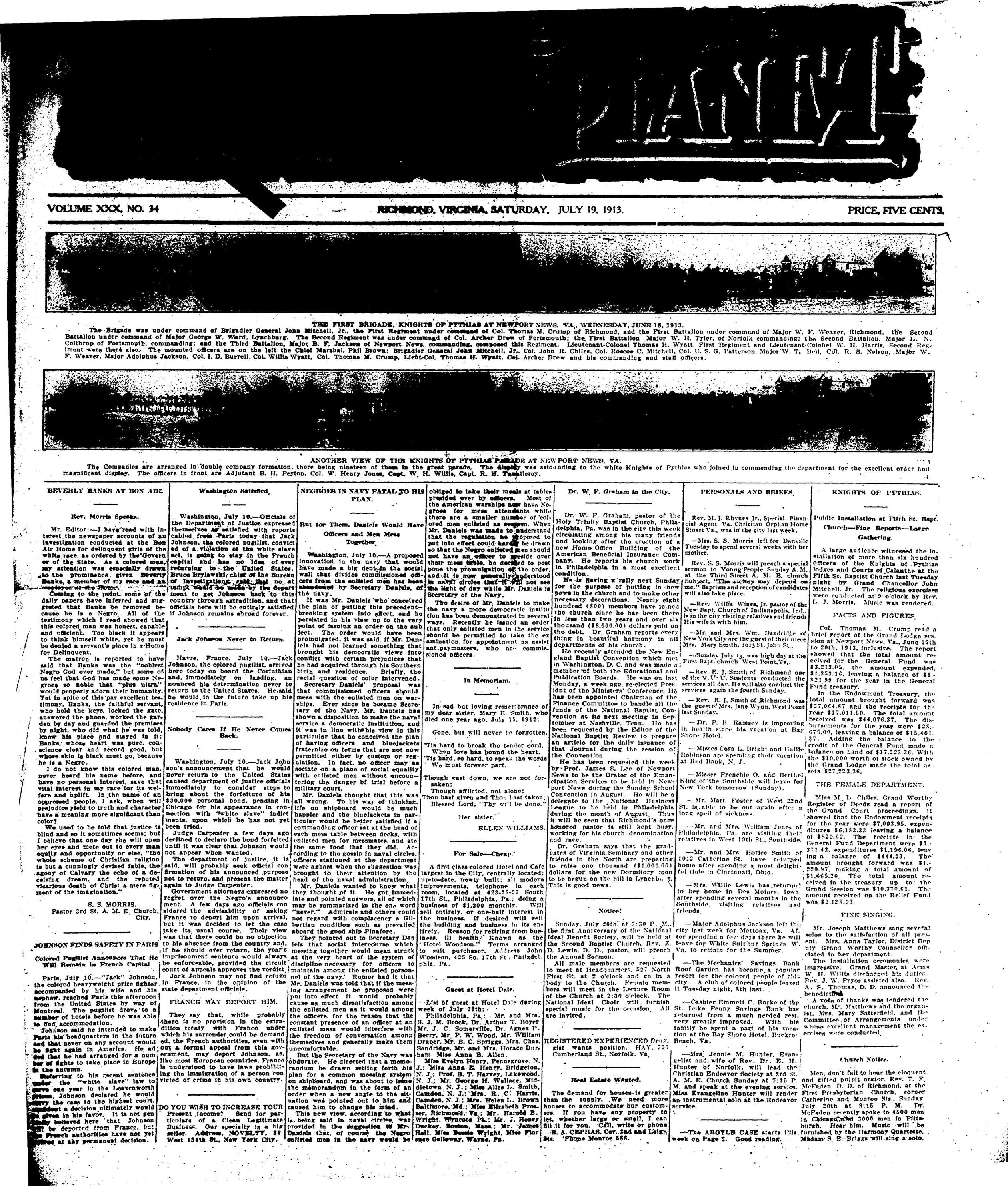
THE FIRST BRIGADE, KNIGHTS OF PYTHIAS AT NEWPORT NEWS, VA., WEDNESDAY, JUNE 18, 1913.
The Brigade was under command of Brigadier General John Mitchell, Jr., the First Regiment under command of Col. Thomas M. Crump of Richmond, and the First Battallion under command of Major W. F. Weaver, Richmond, the Second Battallion under command of Major George W. Ward, Lynchburg. The Second Regiment was under command of Col. Archer Drew of Portsmouth; the First Battallion Major W. H. Tyler, of Norfolk commanding; the Second Battallion, Major L. N. Colthrop of Portsmouth, commanding; and the Third Battallion, Major B. F. Jackson of Newport News, commanding, composed this Regiment. Lieutenant-Colonel Thomas H. Wyatt, First Regiment and Lieutenant-Colonel W. H. Harris, Second Regiment were there also. The mounted officers are on the left the Chief Marshal, Phil Brown; Brigadier General John Mitchell, Jr., Col. John R. Chiles, Col. Roscoe C. Mitchell, Col. U. S. G. Patterson, Major W. T. Bell, Col. R. S. Nelson, Major W. F. Weaver, Major Adolphus Jackson, Col. I. D. Burrell, Col. Willis Wyatt, Col. Thomas M. Crump, Light-Col. Thomas H. Wyatt, Col. Archer Drew and his commanding and staff officers.
VOLUME XXX, NO. 34
The Brigade was under Battallon under command of Colthrop of Portsmouth, commitment were there also. The F. Weaver, Major Adolphus J.
The Companies are arr magnificent display. The office
BEVERLY BANKS AT BON AIR.
Rev. Morris Speaks.
Mr. Editor:—I have read with interest the newspaper accounts of an investigation conducted at the Bon Air Home for delinquent girls of the white race, as ordered by the Governor or the State. As a colored man, my attention was especially drawn to the prominence given Beverly Banks, a member of my race and an employee at the Home.
Coming to the point, some of the daily papers have inferred and suggested that Banks be removed because he is a Negro. All of the testimony which I read showed that this colored man was honest, capable and efficient. Too black it appears to think himself white, yet he must be denied a servant's place in a Home for Delinquent.
The matron is reported to have said that Banks was the "noblest Negro God ever made," but some of us feel that God has made some Negroes so noble that "plus ultra" would properly adorn their humanity. Yet in spite of this par excellent testimony, Banks, the faithful servant, who held the keys, locked the gate, answered the phone, worked the garden by day and guarded the premises by night, who did what he was told, knew his place and stayed in it; Banks, whose heart was pure, conscience clear and record good, but whose skin is black must go, because he is a Negro.
---
I do not know this colored man, never heard his name before, and have no personal interest, save that vital interest in my race for its welfare and uplift. In the name of an oppressed people, I ask, when will prejudice yield to truth and character have a meaning more significant than color?
We used to be told that justice is blind and so it sometimes seems; but I believe that one day she will open her eyes and mote out to every man equity and opportunity or else, "the whole scheme of Christian religion is but a cunningly devised fable, the agony of Calvary the echo of a deceling dream, and the reputed vicarious death of Christ a mere fig-ment of the imagination."
S. S. MORRIS.
Pastor 3rd St. A. M. E. Church.
City.
JOHNSON FINDS SAFETY IN PARIS
Colored Pugilist Announces That He Will Remain in French Capital
Paris, July 10.—"Jack" Johnson, the colored heavyweight prize fighter, accompanied by his wife and his nephew, reached Paris this afternoon from the United States by way of Montreal. The pugilist drove to a number of hotels before he was able to find accommodation.
Johnson said he intended to make Paris his headquarters in the future and that never on any account would he fight again in America. He added that he had arranged for a number of fights to take place in Europe in the autumn.
Referring to his recent sentence under the "white slave" law to serve one year in the Leavenworth prison, Johnson declared he would carry the case to the highest court, president a decision ultimately would be given in his favor. It is not genially believed here that Johnson will be deported from France, but the French authorities have not yet ordered at any permanent decision.
Washington, July 10.—Officials of the Department of Justice expressed themselves as satisfied with reports cabled from Paris today that Jack Johnson, the colored pugilist, convicted of a violation of the white slave act, is going to stay in the French capital and has no idea of ever returning to the United States. Bruce Brylawski, chief of the Bureau of Investigations, said that no attempt would be made by the deportment to get Johnson back to this country through extradition, and that officials here will be entirely satisfied if Johnson remains abroad forever.
Jack Johnson Never to Return.
Havre, France, July 10.—Jack Johnson, the colored pugilist, arrived here today on board the Corinthian and, immediately on landing, an nounced his determination never to return to the United States. He said he would, in the future take up his residence in Paris.
Nobody Cares If He Never Comes Back.
Washington, July 10.—Jack Johnson's announcement that he would never return to the United States caused department of justice officials immediately to consider steps to bring about the forfeiture of his $30,000 personal bond, pending in Chicago for his appearance in connection with "white slave" indictments, upon which he has not yet been tried.
Judge Carpenter a few days ago declined to declare the bond forfeited until it was clear that Johnson would not appear when wanted.
The department of justice, it is said, will probably seek official confirmation of his announced purpose not to return, and present the matter again to Judge Carpenter.
Government attorneys expressed no regret over the Negro's announcement. A few days ago officials consoled the advisability of asking France to deport him upon arrival, but it was decided to let the case take its usual course. Their view was that there could be no objection to his absence from the country and, if he should ever return, the year's imprisonment sentence would always be enforceable, provided the circuit court of appeals approves the verdict.
Jack Johnson may not find refuge in France, in the opinion of the state department officials.
FRANCE MAY DEPORT HIM
They say that, while probably there, is no provision in the extradition treaty with France under which his surrender could be demanded, the French authorities, even with out a formal appeal from this government, may deport Johnson, as, like most European countries, France is understood to have laws prohibiting the immigration of a person convicted of crime in his own country.
DO YOU WISH TO INCREASE YOUR Present Income? Send for particulars of a Clean Legitimate Business. Our specialty is a big seller. Address, NOVELTY. 88 West 134th St., New York City.
Washington, July 10.—A proposed innovation in the navy that would have made a big dent in the social wall that divides commissioned officers from the enlisted men has been abandoned by Secretary Danfels, of the navy.
It was Mr. Daniels who conceived the plan of putting this precedent—breaking system into effect, and he persisted in his view up to the very point of issuing an order on the sub ject. The order would have been promulgated, it was said, if Mr. Daniels had not learned something that brought his democratic views into conflict with certain prejudices that he had acquired through his Southern birth and residence. Briefly, the racial question of color intervened. Secretary Daniels' proposal was that commissioned officers should mean with the enlisted men on warships. Ever since he became Secretary of the Navy, Mr. Daniels has shown a disposition to make the naval service a democratic institution, and it was in line with his view in this particular that he conceived the plan of having officers and bluejackets fraternize on terms that are not now permitted either by custom or regulation. In fact, no officer may as sociate on a plane of social equality with enlisted men without encountering the danger of trial before a military court.
Mr. Daniels thought that this was all wrong. To his way of thinking, life on shipboard would be much happier and the bluejackets in particular would be better satisfied if a commanding officer sat at the head of each mess table between decks, with enlisted men for messmates, and ate the same food that they did. According to the gossip in naval circles, officers stationed at the department were aghast when the suggestion was brought to their attention by the head of the naval administration.
Mr. Daniels wanted to know what they thought of it. He got immediate and pointed answers, all of which may be summarized in the one word "never." Admirals and others could not regard with complacency a Gibertian condition such as prevailed aboard the good ship Pinafore.
They pointed out to Secretary Daniels that social intercourse which messing together would mean struck at the very heart of the system of discipline necessary for officers to maintain among the enlisted personnel of the navy. Rumor had it that Mr. Daniels was told that if the meaning arrangement he proposed were put into effect it would probably cause as much dissatisfaction among the enlisted men as it would among the officers, for the reason that the constant presence of an officer at an enlisted mess would interfere with the freedom of conversation among themselves and generally make them uncomfortable.
But the Secretary of the Navy was obdurate. He directed that a memorandum be drawn setting forth his plan for a common messing system on shipboard, and was about to issue the memorandum in the form of an order when a new angle to the situation was pointed out to him and caused him to change his mind.
This new view, according to what is being said in naval circles, was provided in the suggestion to Mr. Daniels that, of course, the Negro enlisted men in the navy would be
obliged to take their meals at tables presided over by officers. Most of the American warships now have Negroes for mess attendants, while there are a smaller number of colored men enlisted as seamen. When Mr. Daniels was made to understand that the regulation he proposed to put into effect could hardly be drawn so that the Negro enlisted men should not have an officer to preside over their mess table, he decided to post pore the promulgation of the order, and it is now generally understood in naval circles that it will not see the light of day while Mr. Daniels is Secretary of the Navy.
The desire of Mr. Daniels to make the navy a more democratic institution has been demonstrated in several ways. Recently he issued an order that only enlisted men in the service should be permitted to take the examination for appointment as assistant paymasters, who are commissioned officers.
In Memoriam.
In sad but loving remembrance of my dear sister, Mary E. Smith, who died one year ago, July 15, 1912:
Gone, but will never be forgotten.
"Tis hard to break the tender cord.
When love has pound the heart.
Tis hard, so hard, to speak the words
We must forever part.
Though cast down, we are not forsaken;
Though afflicted, not alone;
Thou hast given and Thou hast taken;
Blessed Lord, "Thy will be done."
Her sister.
ELLEN WILLIAMS.
For Sale—Cheap.
A first class colored Hotel and Cafe largest in the City, centrally located; up-to-date, newly built; all modern improvements, telephone in each room, located at 423-25-27 South 17th St. Philadelphia, Pa.; doing a business of $1,200 monthly. Will sell entirely, or one-half interest in the business. If desired will sell the building and business in its entirety. Reason for retiring from business, ill health. Known as the "Hotel Woodson." Terms arranged to suit purchaser. Address John Woodson, 425 So. 17th St. Philadelphia, Pa.
Guest at Hotel Dale.
List of guest at Hotel Dale during week of July 12th:
Philadelphia, Pa.; Mr. and Mrs.
S. J. M. Brock, Dr. Arthur T. Boyer
Mr. J. C. Somerville, Dr. Agnes P.
Berry, Mr. P. W. Wood, Mr. William
Draper, Mr. B. C. Spriggs, Mrs. Chas.
Sandridge, Mr. and Mrs. Horace Durham
Miss Miss Anna B. Allen.
Miss Evelyn Henry, Penngrove, N.
J.; Miss Anna E. Henry, Bridgeton,
N. J.; Prof. B. T. Harvey, Lakewood.
N. J.; Mr. George H. Wallace, Middletown
N. J.; Miss Alice L. Smith,
Camden, N. J.; Mrs. R. C. Harris,
Camden, N. J.; Mrs. Helen L. Brown
Baltimore, N. J.; Mrs. Elizabeth Prosser,
Richmond, Va.; Mr. Harold B.
Wright, Wyncote Pa.; Mr. J. Henry
Duckey, Boston, Mass.; Mr. James
Hall, Miss Bunce Wright, Miss Florence Galloway, Wayne, Pa.
Dr. W. F. Graham, pastor of the Holy Trinity Baptist Church, Philadelphia, Pa. was in the city this week circulating among his many friends and looking after the erection of a new Home Office Building of the American Beneficial Insurance Company. He reports his church work in Philadelphia in a most excellent condition.
He is having a rally next Sunday, for the purpose of putting in new pews in the church and to make other necessary decorations. Nearly eight hundred (800) members have joined the church since he has been there in less than two years and over six thousand ($6,000.00) dollars paid on the debt. Dr. Graham reports every thing in beautiful harmony in all departments of his church.
He recently attended the New England Baptist Convention which met in Washington, D. C. and was made a member of both the Educational and Publication Boards. He was on last Monday, a week ago, re-elected President of the Minister's Conference. He has been appointed Chairman of the Finance Committee to handle all the funds of the National Baptist Convention at its next meeting in September at Nashville, Tennessee. He has been requested by the Editor of the National Baptist Review to prepare an article for the daily issuance of that Journal during the session of the Convention.
He has been requested this week by Prof. James S. Lee of Newport Nowa to be the Orator of the Emancipation Services to be held in Newport News during the Sunday School Convention in August. He will be a delegate to the National Business League to be held in Philadelphia during the month of August. Thus it will be seen that Richmond's once honored pastor is still kept busy, working for his church, denomination and race.
Dr. Graham says that the graduates of Virginia Seminary and other friends in the North are preparing to raise one thousand ($1,000.00) dollars for the new Dormitory soon to be begun on the hill in Lynchbo. This is good news.
Notice:
Sunday, July 20th, at 3:30 P. M. the first Anniversary of the National Ideal Benefit Society, will be held at the Second Baptist Church, Rev. Z. D. Lewis, D. D., pastor, will preach the Annual Sermon.
All male members are requested to meet at Headquarters. 527 North First St. at 2 o'clock and go in a body to the Church. Female members will meet in the Lecture Room of the Church at 2:30 o'clock. The National Ideal Choir will furnish special music for the occasion. All are invited.
REGISTERED EXPERIENCED Drugs
glat wanta position. HAY, 730
Cumberland St, Norfolk, Va.
Real Estate Wanted.
The demand for houses is greater than the supply. We need more houses to accommodate bur customers. If you have any property to let, whether large or small, I can fill it for you. Call, write or phone B. A. CEPHAS. Cor. 30 and Leigh 884. Phone Monroe 588.
Rev. M. J. Rhynes Jr., Special Financial Agent Agent Va. Christian Orphan Home Stuart Va., was in the city last week.
—Mrs. S. S. Morris left for Dansville Tuesday to spend several weeks with her mother.
Rev. S. S. Morris will preach a special sermon to Young People Sunday A.M. at the Third Street A. M. B. church Subject. "The victory may depend on me." Baptism and reception of candidates will also take place.
—Rev. Willis Wines, Jr. pastor of the New Bapt. Church of Indianapolis, Ind., is in the city visiting relatives and friends His wife is with him.
—Mr. and Mrs. Wm. Dandridge of New York City are the guest of their niece Mrs. Mary Smith, 1013 St. John St.
—Sunday July 13, was high day at the First Bapt. church West Point, Va.
—Rev. E. J. Smith of Richmond one of the V. U. U. Students conducted the services all day. He will also conduct the services again the fourth Sunday.
—Rev. E. J. Smith of Richmond was the guest of Mrs. Jane Wyun, West Point last Sunday.
—Dr. P. B. Ramsey is improving in health since his vacation at Bay Shore Hotel.
— Misses Cora L. Bright and Halle Robinson are spending their vacation at Red Bank, N. J.
— Misses Frenchle O. and Berthel King of the Southside will leave for New York tomorrow (Sunday).
— Mr. Matt. Foster of West 22nd St. is able to be out again after a long spell of sickness.
— Mr. and Mrs. William Jones of Philadelphia. Pa. are visiting their relatives in West 19th St., Southside.
— Mr. and Mrs. Horse Smith of 1012 Catherine St. have returned home after spending a most delightful time in Cincinnati, Ohio.
— Mrs. Willie Lewis has returned to her home in Des Moines, Iowa after spending several months in the Southside, visiting relatives and friends.
— Major Adolphus Jackson left the city last week for Mettoxa, Va. After spending a few days there he will leave for White Sulphur Springs W. Va. to remain for the Summer.
The Mechanics' Savings Bank Roof Garden has become a popular resort for the colored people of this city. A club of colored people leased it Tuesday night, 8th inst.
Cashier Emmett C. Burke of the St. Luke Penny Savings Bank has returned from a much needed rest, very greatly improved. With his family he spent a part of his vacation at the Bay Shore Hotel, Buckrobe Beach, Va.
Mrs. Jennie M. Hunter, Evangelist and wife of Rev. Dr. E. H. Hunter of Norfolk, will lead the Christian Endeavor Society at 3rd St. A. M. E. Church Sunday at 7:15 P. M. and speak at the evening service. Miss Evangeline Hunter will render an instrumental solo at the Endeavor service.
The ARGYLE CASE starts this ful week on Page 2. Good reading.
PRICE, FIVE CENTS
F. F. Weaver, Richmond, the Second
the Second Battalion, Major L. N.
Mont-Colofiel W. H. Harris, Second Reg-
Bell, Col. R. S. Nelson, Major W.
department for the excellent order and
KNIGHTS OF PYTHIAS.
Public Installation at Fifth St. Bapt.
Church—Fine Reports—Large
Gathering.
A large audience witnessed the installation of more than six hundred officers of the Knights of Pythian lodges and Courts of Calanthe at the Fifth St. Baptist Church last Tuesday night by Grand Chancellor John Mitchell Jr. The religious exercise were conducted at 9 o'clock by Rev. L. J. Morris. Music was rendered
FACTS AND FIGURES
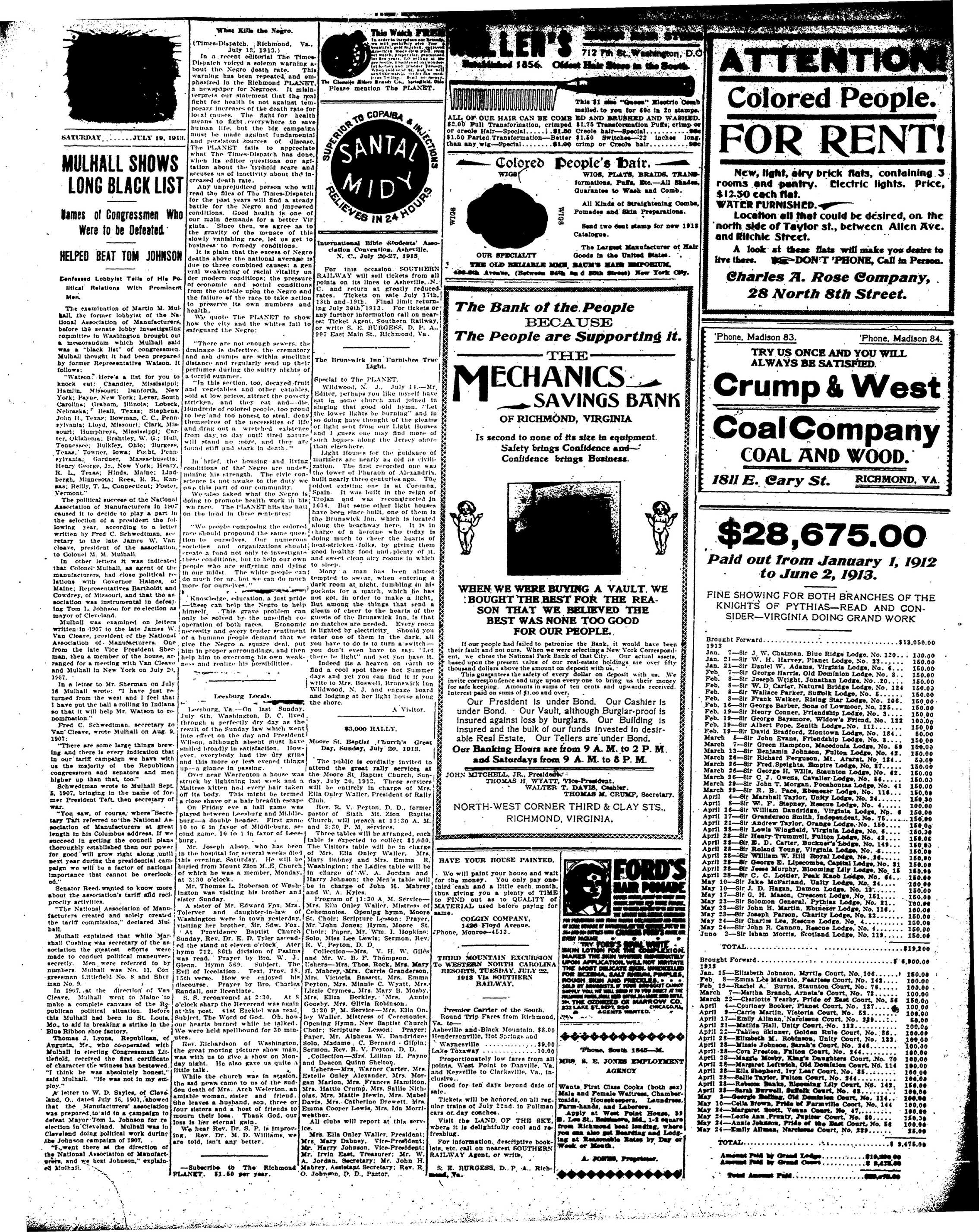
Col. Thomas M. Crump read a brief report of the Grand Lodge session at Newport News, Va., June 17th to 20th, 1913, inclusive. The report showed that the total amount received for the General Fund was $3,213.05, the amount expended, $1,533.16, leaving a balance of $1,821.99 for the year in the General Fund treasury.
In the Endowment Treasury, the total amount brought forward was $27,064.87 and the receipts for the year $17,011.50. The total amount received was $44,076.37. The disbursements for the year were $28,675.00, leaving a balance of $15,401.37. Adding the balance to the credit of the General Fund made a balance on hand of $17,223.36. With the $10,000 worth of stock owned by the Grand Lodge made the total assets $27,223.36.
THE FEMALE DEPARTMENT
Miss M. L. Chiles, Grand Worthy
Register of Deeds read a report of
the Grand Court proceedings. It
showed that the Endowment receipts
for the year were $7,003.95, expen-
ditures $6,163.33 leaving a balance of
$820.62. The receipts in the
General Fund Department were $1,
311.43, expenditures $1,196.06, leav-
ing a balance of $444.23. The
amount brought forward was $1,
220.97, making a total amount of
$1,665.20. The total amount re-
ceived in the treasury up to the
Grand Session was $10,370.61. The
amount received on the Relief Fund
was $2,126.03.
FINE SINGING
Mr. Joseph Matthews sang several solos to the satisfaction of all present. Mrs. Anna Taylor, District Deputy Grand Worthy Counsellor officiated in her department.
The Installation ceremonies were impressive. Grand Master at Arms W. H. Willis discharged his duties. Rev. J. W. Pryor assisted also. Rev. A. S. Thomas, D. D. announced the benedicture.
A vote of thanks was tendered the church, Mr. Matthews and the organist, Mrs. Mary Satterfield, and the Committee, of Arrangements under whose excellent management the exercises were conducted.
Church Notice
Men, don't fail to hear the eloquent and gifted pulpit orator. Rev. T. F. McFaden D. D. of Richmond, at the First Presbyterian Church, corner Catherine and Monroe Sts., Sunday. July 20th at 8:15 P. M. Dr. McFaden recently spoke to 4500 men in Chicago and 3000 men in Pittsburgh. Hear him. Music will be furnished by the Harmony Quartette. Madam S. E. Briggs will sing a solo.
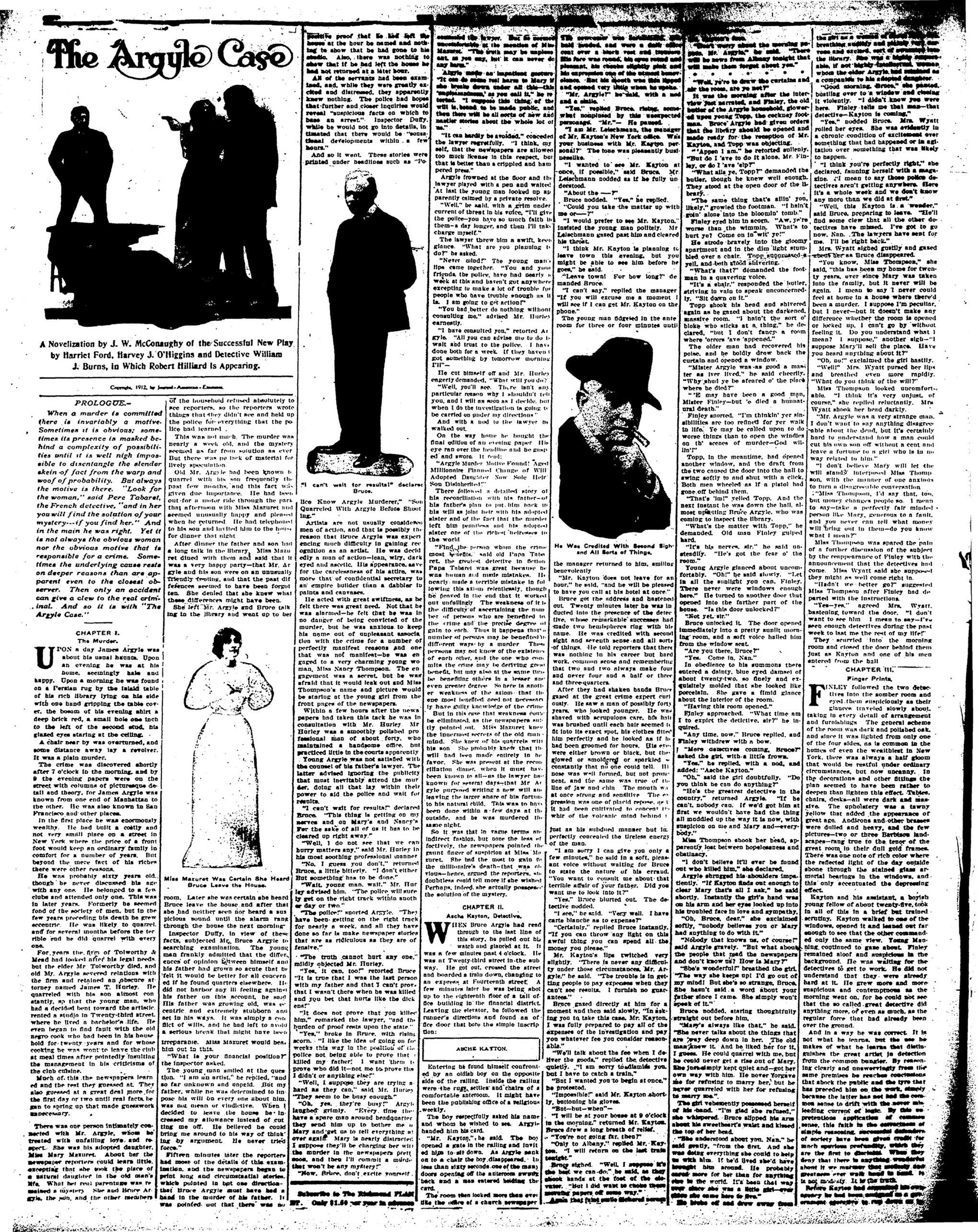
The Argyle Case
A Novelization by J. W. McConaughey of the Successful New Play by Harriet Ford, Harvey J. O'Iliggins and Detective William J. Burns, in Which Robert Hilliard Is Appearing.
Copyright, 1912, by Journal - American Emmas
PROLOGUE-
When a murder is committed there is invariably a motive. Sometimes it is obvious; sometimes its presence is masked behind a complexity of possibilities until it is well nigh impossible to disentangle the elander skein of fact from the warp and woof of probability. But always the motive is there. "Look for the woman," said Pere Tabaret, the French detective, "and in her you will find the solution of your mystery---if you find her." And in the main he was right. Yet it is not always the obvious woman nor the obvious motive that is responsible for a crime. Sometimes the underlying cause rests on deeper reasons than are apparent even to the closest observer. Then only an accident can give a clew to the real criminal. And so it is with "The Argyle Case."
UPON a day James Argyle was about his usual haunts. Upon an evening he was at his home, seemingly hale and happy. Upon a morning he was found on a Persian rug by the isalad table of his rich library lying on his side with one hand gripping the table cover, the bosom of his evening shirt a deep brick red, a small hole one inch to the left of the second stud, his glazed eyes staring at the ceiling.
A chair near by was overturned, and some distance away lay a revolver. It was a plain murder.
The crime was discovered shortly after 7 o'clock in the morning, and by 9 the evening papers were on the street with columns of pictures detail and theory, for James Argyle was known from one end of Manhattan to the other. He was also known in San Francisco and other places.
In the first place he was enormously wealthy. He had built a costly and not very small place on a street in New York where the price of a front foot would keep an ordinary family in comfort for a number of years. But beyond the mere fact of his riches there were other reasons.
He was probably sixty years old, though he never discussed his age with any one. He belonged to a few clubs and attended only one. This was in later years. Formerly he seemed fond of the society of men, but in the few years preceding his death he grew eccentric. He was likely to quarrel and for several months before the terrible end he did quarrel with every one.
For years the firm of Tolworthy & Mead had looked after his legal needs but the elder Mr. Tolworthy died, and old Mr. Argyle secured relations with the firm and retained an obscure attorney named James T. Hurley. He quarreled with his son almost constantly, ap that the young man, who had a decided bent toward the artistic rented a studio in Twenty-third street, where he lived a bachelor's life. He even began to find fault with the old negro cook who had been in his house hold for twenty years and for whose cooking he was want to leave the club at meal times after pointedly insulting the management in his criticisms of the club culinary.
Much of this the newspapers learned and the rest they guessed at. They also guessed at a great deal more for the first day or two until real facts began to spring up that made guesswork unnecessary.
There was one person intimately connected with Mr. Angyle, whom he treated with unfailing love, and respect. She was his adopted daughter, Miss Mary Maxure. About her the newspaper reporters could learn little, excepting that she took the place of a natural daughter in the old man's life. What her real parentage was remained a mystery. She and Benie Angyle, the pain, and the other members
CHAPTER 1
Of the household refused absolutely to see reporters, so the reporters wrote things that they didn't see and hold up the police for everything that the police had learned.
This was not much. The murder was nearly a week old, and the mystery seemed as far from solution as ever. But there was no lack of material for lively speculation.
Old Mr. Argyle had been known to quarrel with his son frequently the past few months, and this fact was given due importance. He had been out-for a motor ride through the park that afternoon with Miss Mazuret and seemed unusually happy and pleased when he returned. He had telephoned to his son and invited film to the house for dinner that night.
After dinner the father and son had a long talk in the library. Miss Mauna ret dined with them and said that it was a very happy party—that Mr. Argyle and his son were on an unusually friendly feasting, and that the past differences seemed to have been forgot ten. She denied that she knew what these differences might have been. She left Mr. Argyle and Bruce talk ing in the library and went up to her
```markdown
```
Miss Mazuret Was Certain She Heard Bruce Leave the House.
room. Later she was certain she heard Bruce leave the house and after that she had neither seen nor heard a suspicious sound until the alarm rang through the house the next morning. Inspector Duffy, in view of these facts, subjected Mr. Bruce Argyle to searching examination. The young man frankly admitted that the differences of opinion between himself and his father had grown so acute that he felt it would be better for all concerned if he found quarters elsewhere. He did not harbor any ill feeling against his father on this account, he said. His father was growing old, was centric and extremely stubborn and set in his ways. It was simply a conflict of wills, and he had left to avoid a serious break that might have been irreparable. Miss Mazuret would bear.
irreparable. Miss Mazurce would be him out in this.
"What is your financial position?" the inspector asked.
The young man smiled at the question. "I am an artist," he replied, "and so far unknown and onepid. But my father, while he was determined to impose his will on every one about him, was not mean or vindictive. When I decided to leave the house he increased my allowance instead of cutting me off. He believed he could bring me around to his way of thinking by argument. He never tried force."
Fifteen minutes inter the reporters had most of the details of this examination, and the newspapers began to print long and circumstantial stories, which pointed in but one direction that Bruce Argyle must have had a hand in the murder of his father. It was pointed out that there was no
Justice proof that he had left the house at the hour he were and nothing to show that he had gone to his studio. Also, there was nothing to show that if he had left the house he had not returned at a later hour.
All of the servants had been examined, and, while they were greatly excited and distressed, they apparently knew nothing. The police had hops that further and closer inquiries would reveal "aspicious facts on which to base an arrest." Inspector Duffy, while he would not go into detainment,imated that there would be "someational developments within a few hours."
And so it went. These stories were printed under headlines such as "Io-
1
"I can't wait for result!" declared Bruce.
"I can't wait for result!" declared Bruce.
Ice Know Argyle Murderer," "Sou Quarreled With Argyle Before Shooting."
Artists are not usually considered men of action, and that is possibly the reason that Bruce Argyle was experiencing much difficulty in gaining recognition as an artist. He was decidedly a man of action—lean, wiry, dark eyed and asetic. His appearance, save for the carelessness of his attire, was more that of confidential secretary to an empire builder than a dabbler in palms and caverns.
He acted with great swiftness, as he felt there was great need. Not that he was alarmed—he felt that he was in no danger of being convicted of the murder, but he was anxious to keep his name out of unpleasant association with the crime for a number of perfectly manifest reasons and one that was not manifest—he was engaged to a very charming young woman, Miss Nancy Thompson. The engagement was a secret, but he was afraid that it would leak out and Miss Thompson's name and picture would be starting at the young girl from the front pages of the newspapers.
Within a few hours after the news papers and taken this task he was in consultation with Mr. Hurley. Mr Hurley was a smoothly polished professional man of about forty, who maintained a handsome office, but practiced little in the courts apparently
Young Arglee was not satisfied with the counsel of his father's lawyer. The latter advised ignoring the publicity that must inevitably attend the murder, doing all that lay within their power to aid the police and wait for results.
"I can't wait for results!" declared Bruce. "This thing is getting on my nerves and on Mary's and Nancy's. For the sake of all of us it has to be cleared up right away."
"Well, I do not see that we can hurry matters any," said Mr. Hurley in his most soothing professional manner. "No, I guess you don't." returned Bruce, a little bitterly. "I don't either But something has to be done."
"Wait, young man, wait." Mr. Hurley advised him. "The police will surely get on the right track within another or day or two."
"The police" snorted Ariely. "They have been getting on the right truck for nearly a week, and all they have done so far is make newspaper stories that are as ridiculous as they are of fensive."
"The truth cannot hurt any one," mildly objected Mr. Hurley.
"Yes, it can, too!" reported Bruce. "It is true that I was the last person with my father and that I can't prove that I wasn't when he was killed and you bet that hurts like the dick end."
"It does not prove that you killed him," remarked the lawyer, "and the burden of proof rests upon the state."
"Yes," broke in Bruce, with rims scorn. "I like the idea of going on for weeks this way in the position of the police not being able to prove that killed my father." I want them to prove who did it—not me to prove this I didn't or anything else."
"Well, I suppose they are trying a hard as they can," said Mr. Hurley. "They seem to be busy enough."
"Oh, yes, they're busy!" Angly
laughed grimly. "Every time the
have a spare man around headquarter
they send him up to bother me on
Mary and get us to tell everything
on over again. Mary is nearly distracted
I suppose they'll be charging her with
the murder in the newspapers pretty
soon, and then I'll commit a mishap
that won't be any mystery."
Now, Bruce, don't excite yourself.
commanded the lawyer. But he seemed accommodate at the mention of Miss Mamast. "The truth may be unpleasant, as you may, but it can never do any harm."
Angie made an impatient gesture: "It can do some real harm to Mary if she breaks down under all this this implacableism, as you call it," he retested. "I suppose this thing, of the will, is bound to be made public, and then there will be all sorts of new and master stories about the whole lot of us."
"It can hardly be avoided," conceded the lawyer regretfully. "I think, my self, that the newspapers are allowed too much license in this respect, but that is better than a crippled and hampered press."
Angie frowned at the door and the lawyer played with a pen and waited. At last the young man looked up apparently calm by a private resolve.
"Well," he said, with a grim under current of threat in his voice. "I'll give the police you have so much faith to them—a day longer, and then I'll take charge myself."
The lawyer threw him a swift, keen glance. "What are you planning to do?" he asked.
"Never mind!" The young man lips came together. "You and your frienda the police, have had nearly a week at this and haven't got anywhere excepting to make a lot of trouble for people who have trouble enough as it is. I am going to get action!" "You had better do nothing without consulting me," adried Mr. Hurley earnestly.
"I have consulted you," retorted Aigle. "All you can advise me to do is wait and trust to the police. I have done both for a week. If they haven't got something by tomorrow morning I'll."
He cut himself off and Mr. Hurley engenderly demanded, "What will you do? "Well, you'll see. There isn't any particular reason why I shouldn't tell you, and I will as soon as I decide but when I do the investigation is going to be carried on under my directions."
And with a nod to the lawyer walked out.
On the way home he bought the final edition of an evening paper. His eye ran over the headline and he gnapped and swore. It took:
"Argyle Murder Motive Found! Aged Millionaire Planned Change of Will Adopted Daughter Now Sole Heir Son Dislainherst."
There followed a detailed story of his reconciliation with his father—of his father's plan to put him back to his will as joint heir with his adopted sister and of the fact that the murder left him penniless and his adopted sister one of the richest beneficiaries to the world.
"Find the person whom the crime most benefits, said old Papa Tates ret, the greatest detective in fiction. Papa Tabard was great because he was human and made mistakes. He nearly made a terrible mistake in following this axiom scientifically, though he proved in the end that it worked out unfailingly. The weakness of it is the difficulty of ascertaining the number of persons who are benefited by the crime and the precise degree of gain to each. Thus it happens that number of persons may be benefited by different ways by a murder. These persons may not know of the existence of each other, and the one who commits the crime may be deriving great benefits, but may also at the same time be benefiting others in a lesser and even greater degree. So here is another weakness of the axiom that the most benefited need not necessarily have guilty knowledge of the crime.
But in this case that weakness could be eliminated, as the newspaper actually pointed out. Miss Mazurte knew the innermost secrets of the old man mind. She knew of his quarrels with his son. She probably knew that the will had been made entirely in the favor. She was present at the reception dinner, when it must have been known to all—as the lawyer known for several days—that Mr Angle purpose writing a new will and leaving the larger share of his fortune to his natural child. This was to have been done within a few days at the outside, and he was murdered the same night.
So it was that in vague terms and indirect fashion, but none the less of effectively, the newspaper pointed the guntner of suspicion at Miss Mazurte. She had the most to gain from the millionaire's death—that was obvious—hence, argued the reporters, doubtless could tell more if she wished Perhaps, indeed, she actually possessed the solution of the mystery.
CHAPTER II.
Asche Kayton, Detective.
WHEN Bruce Argle had read through to the last line of this story, he pulled out his watch and glanced at it. It was a few minutes past 4 o'clock. He was at Twenty-third street in the subway. He got out, crossed the street and boarded a train down, changing to an express at Fourteenth Street. A few minutes later he was being shot up to the eighteenth floor of a tall office building in the financial district. Leaving the elevator, he followed the runner's directions and found an office door that bore the simple inscription:
ABCHE KAYTON
Entering he found himself confronted by an oldish boy on the opposite side of the railing. Inside the railing were the ruff, settles and chairs of a comfortable antenor. It might have been the publishing office of a religious weekly.
The boy respectfully asked his name and whom he wished to see. Argyll handed him his card.
"Mr. Kayton," he said. The boy opened a gate in the railing and invited him to sit down. As Argyll snuck on to a chair the boy disappeared. In less than sixty seconds one of the many doors opening of the antenor awoke back and a man entered holding the card.
The room then looked more than ever like the office of a church newspaper.
The newcomer was satisfied, and held hands, and were a daily after coat over a black vest and trousers. His face was round, his eyes round and pleasant, his cheeks slightly pink and his expression one of the stern benemence. But his mouth was the liped and opened very little when he spoke. "Mr. Angry!" he said, with a nod
"Mr. Angelo!" he said, with a nod and a smile.
"Yes," replied Bruce, rising, somewhat nonplanned by this unexpected personage. "Mr." He paused.
"I am Mr. Leischmann, the manager of Mr. Kayton's New York office. Was your business with Mr. Kayton personal?" The tone was pleasantly businesslike.
"I wanted to see Mr. Kayton at once, if possible," said Bruce. Mr. Leischmann nodded as if he fully understood.
"About the —"
Bruce nodded. "Yes." he replied.
Bruce nodded. "Tea, he replied.
"Could you take the matter up with me or—7"
"I would prefer to see Mr. Kayton. insisted the young man politely. Mr. Leischmann gared past him and cleared his throat.
"I think Mr. Kayton is planning to leave town this evening, but you might be able to see him before he goes," he said.
"Leave town! For how long?" demanded Bruce.
"I can't say," replied the manager. "If you will excuse me a moment I will see if I can get Mr. Kayton on the phone."
The young man nodded in the ante room for three or four minutes until
A.
He Was Credited With Second Sight and All Sorts of Things.
the manager returned to him, smiling benevolently
"Mr. Kayton does not leave for an hour," he said, "and he will be pleased to have you call at his hotel at once."
tour. He said, and he will be present to have you call at his hotel at once. "I thought got the address and business out. The mini-museum has been introduced into the presence of the detective, whose remarkable successes had made two hemispheres ring with his name. He was credited with second sight and seventh sense and all sorts of things. He told reporters that there was nothing in his career but hard work, common sense and remembering that two and two always make four and never four and a half or three and three quarters.
After they had shaken hands Bruce gasped at the great crime expert curiously. He saw a man of possibly forty years, who looked younger. He was shaved with scapulars care, his hair was brushed until each hair seemed to fit into its exact spot, his clothes fitted him perfectly and he looked as if he had been groomed for hours. His eyes were either brown or black, but the glowed or amolderged or sparkled constantly that no one could tell. His nose was well formed, but not prominent, and the same was true of the line of jaw and chin. The mouth was at once strong and sensitive. The expression was one of phlegm repose, and it had been cultivated to conceal the whir of the volcanic mind behind it just as his subdued manner but in perfectly concealed the tireless energy of the man.
"I am sorry I can give you only a few minutes," he said in soft, pleasant voice without waiting for Bruce to state the nature of his erraud. "You want to consult me about that terrible affair of your father. Did you want me to look into it?" "Yes." Bruce blurted out. The detective nodded. "I see," he said. "Very well. I have carte blanche as to expense?" "Certainly," replied Bruce instantly. "If you can throw any light on this awful thing you can spend all the money you please." Mr. Kayton's lips twitched very slightly. "There is never any difficulty under those circumstances. Mr. Angle," he said. "The trouble is in getting people to pay expenses when they can't see results. I furnish no guarantees."
Bruce gazed directly at him for a moment and then said slowly, "In asking you to take this case, Mr. Kayton, I was fully prepared to pay all of the expenses of the investigation and pay you whatever fee you consider reasonable."
"We'll talk about the fee when I deliver the goods," replied the detective quietly. "I am sorry to dismish you, but I have to catch a train."
"But I wanted you to begin at once," he protested.
"Iimpossible!" said Mr. Kayton shortly, butting his gloves.
"But—but—when—"
"I will be at your house at 9 o'clock in the morning," returned Mr. Kayton. Bruce drew a long breath of relief. "You're not going far, then!"
"Only to Albany," replied Mr. Kayton. "I will return on the last train tonight."
Bruce sighed. "Well, I suppose it's the best we can do," he said, as they shook hands at the foot of the elephant. "But I did want to choose those morning papers off some way." Again that faint smile flickered nervously.
---
"Don't worry about the morning person, Mr. Angrya, be said. "There will be news from Alamy tonight that will make them forget about you."
"Well, you're to draw the curtains and ask the room, are you not?"
It was the morning after the interview just narrated, and Finley, the old better of the Argyle household, glowered upon young Topp, the cockney footman. Bruce Angrya had given orders that the library should be opened and made ready for the reception of Mr. Kayton, and Topp was objecting.
"Appen I am." he retorted sullenly. "But do I 'ave to do it alone. Mr. Finley or do I 'ave 'alb?
"What alls ye, Topp?" demanded the butter, though he knew well enough. They stood at the open door of the library.
"The same thing that's allin' you, likely, growled the footman. "I hain'g'goin' alone into the bloomin' tomb.
Finley eyed him in acorn. "Aw, ye' worse than the winnin'. What's to hurt ye? Come on in 'wit ye'."
He strode bravely into the gloomy apartment and in the dim light stumbled over a chair. Topp, suppressed a yell, and both stood silvering.
"What's that?" demanded the footman in a quivering voice.
"It's a chair," responded the butler, striving in vain to speak unconcernedly. "Sit down on it."
Topp shook his head and shivered again as he gazed about the darkened, massive room. "I hain't the sort of bloke who sticks at a thing," he declared, "but I don't fancy a room where 'orrors' have appeared."
The older man had recovered his police, and he boldly drown back the curtain and opened a window.
"Mister Argyle was as good a master as ever lived," he said cheerily. "Why shu'ye be afraid of the place where he died?"
"I may have been a good man, Mister Finley—but 'e died a natural death."
Finley snorted. "I'm thinkin' yer sinabilities are too refined for yer walk in life. Ye may be called upon to do worse things than to open the winds on tb' scenes of murder—God willn't!"
Topp, in the meantime, had opened another window, and the draft from the two caused the door into the hall to swing softly to and shut with a click. Both men wheeled as if a pistol had gone off behind them.
"That's 'im!' yelled Topp. And the next instant he was down the hall, almost unputting Bruce Argyle, who was coming to inspect the library.
"What's the matter with Topp," he demanded. Old man Finley gulped hard.
"It's his nerves, sir." he said unsteadily. "He's got the fear of the room."
Young Argyle glanced about uncomfortably. "Oh!" he said slowly. "Let in all the sunlight you can. Finley. There never were windows enough here." He turned to another door that opened into the farther part of the house. "In this door unlocked?"
"Not yet, sir."
Bruce unlocked it. The door opened immediately into a pretty sunlit morning room, and a soft voice hailed him from the window seat.
"Are you there, Bruce?"
"Yes. Come in, Nan."
In obedience to his summons there entered a dalty, blue eyes damned of about twenty-two, so finely and exquisitely molded that she looked like porcelain. She gave a firm glance about the interior of the room.
"Having this room opened."
Finley approached. "What time am I to exploit the detective, air? he inquired. "Any time, now," Bruce replied, and Finley withdrew with a bow.
"Oh, said the girl doubtfully, 'Do you think he can do anything?' "He's the greatest detective in the country," returned Argyle. "If he can't, nobody can. If we got him at first we wouldn't have had the thing all muddled up the way it is now, with suspicion on me and Mary and—everybody." Miss Thompson shook her head, apparently lost between hopelessness and obstinacy. "I don't believe it'll ever be found out who killed him," she declared. Argyle struggled his abounds impatiently. "If Kayton finds out enough to clear Mary that's all I ask," he said shortly. Instantly the girl's hand was on his arm and her eyes looked up into his troubled face in love and sympathy. "Oh, Bruce, dear," she exclaimed softly, "nobody believes you or Mary had anything to do with it." "Nobody that knows us, of course!" said Argyle gravely. "But what about the people that read the newspapers and don't know us? How is Mary?"
"She's wonderful! breathed the girl,
'The way she keeps up! I'd go out of
my mind! But she's so strange, Bruce.
Bruce hasn't said a word about your
father since I came. She simply won't
speak of it."
Nodded, staring thoughtfully
straight out before him.
"Mary's always like that," he said.
"She never talks about the things that
are way deep down in her. The old
man knew it. And he liked her for it,
I guess. He could quarrel with me, but
he could never get a rise out of Mary.
She justly kept quiet and—got her
own way with him. He never forgave
she for refusing to marry her, but he
never quarreled with her for refusing
to marry me."
The girl vehemently possessed herself
of his hand. "I'm glad she refused,
she whispered. Bruce slipped his arm
about his sweetheart's waist and kissed
the top of her head.
"She understood about you. Nan. she said greatly, 'from the first. And she was doing everything she could to help us with him. If he'd lived she'd have brought him around. He probably moved more for her than for anything else in the world. It's been that way since she was a little girl—ever since she came here to grow."
the gift as a reward of kindness and bravery, sensitivity and politely wary nerves and exuded, sort of窒息感less the library. She was a highly compatible, if not highly intelligent, woman whom the older Angela had summoned as a companion to his adopted daughter. "Good morning, Grove," she pasted, bustling over to a window and closing it violently. "I didn't know you were here. Finley tells me that man—that detective—Kayton is coming."
"Yes," nodded Bruce. Mrs. Wyatt polled her eyes. She was evidently in a chronic condition of excitement over something that had happened or in agitation over something that was likely to happen.
"I think you're perfectly right," she declared, fanning herself with a magazine. "I mean to say those police detectives aren't getting anywhere. Here it's a whole week and we don't know any more than we did at first."
"Well, this Kayton is a wonder," said Bruce, preparing to leave. "He'll find some clew that all the other detectives have missed. I've got to go now. Nan. The lawyers have sent for me. I'll be right back."
Mrs. Wyatt sighed gustily and gazed clockwise as Bruce disappeared.
"You know, Miss Thompson," she said, "this has been my home for twenty years, ever since Mary was taken into the family, but it never will be again. I mean to say I never could feel at home in a house where there'd been a murder. I suppose I'm peculiar, but I never—but it doesn't make any difference whether the room is opened or locked up, I can't go by without feeling it. Do you understand what I mean? I suppose," another sigh—"I suppose Mary'll sell the place. Have you heard anything about it?"
"Oh, no!" exclaimed the girl hastily. "Well!" Mrs. Wyatt pursed her lips and breathed even more rapidly. "What do you think of the will?"
Miss Thompson looked uncomfortable. "I think it's very unjust, of course," she replied reluctantly. Mrs. Wyatt shook her head darkly.
"Mr. Argyle was a very strange man. I don't want to say anything disagreeable about the dead, but it's certainly hard to understand how a man could cut his own son off without a cent and leave a fortune to a girl who is in no way related to him."
"I don't believe Mary will let the will stand? interposed Miss Thompson, with the manner of one anxious to turn a disagreeable conversation.
"Miss Thompson, I'd say that, too, but money changes people so. I mean to say—take a perfectly fair minded person like Mary, generous to a fault, and you never can tell what money will bring out in them—do you know what I mean?"
Miss Thompson was spared the pain of a further discussion of the subject by the resuppression of Finley with the announcement that the detectives had come. Miss Wyatt said she supposed they might as well come right in.
"Hadn't we better go?" suggested Miss Thompson after Finley had departed with the instructions.
"Yes-yes," agreed Mrs. Wwatt, hastening toward the door. "I don't want to see him. I mean to say—I've seen enough detectives during the past week to last me the rest of my life!" They scurried into the morning room and closed the door behind them just as Kayton and one of his men entered from the hall.
Finger Prints
FUNLEY followed the two detectives into the somber room and eyed them suspiciously as their
glances traveled slowly about taking in every detail of arrangement and furnishings. The general scheme of the room was dark and polluted oak, and since it was lighted from only one of the four sides, as is common in the homes of even the wealthiest in New York, there was always a half gloom that would be restful under ordinary circumstances, but now uncanny. In the decorations and other sitings the plan seemed to have been rather to deepen than lighten this effect. Tables, chairs, decks—all were dark and massive. The upholstery was a tawny yellow that added the appearance of great age. Addrums and other brasses were dulled and heavy, and the few pictures—two or three Barbison landscapes—rang true to the tenor of the great room in their dull gold frames. There was one note of rich color where the reflected light of the day outside shone through the stained glass armorial bearings in the windows, and this only accentuated the depressing effect.
Kayton and his assistant, a boyhun young fellow of about twenty-five, took in all of this in a brief but trained scrutiny. Kayton walked to one of the windows, opened it and leaned out far enough to see that the other commanded only the same view. Young Manning, continued to gaze about. Finley remained aloof and suspicious in the background. He was waiting for the detectives to get to work. He did not understand that they were already hard at it. He grew more and more suspicious and contemptuous as the morning went on, for he could not see that the so called great detective did anything more, of even as much, as the regular force that had already been over the ground.
And in a way he was correct. It is not what he learns, but the use he makes of what he learns that distinguishes the great artist in detection from the common bungler. By reasoning clearly and unawervingly from the same premises he reaches conclusions that shock the public and the tyr that has preceded him on the work, simply because the latter has not had the common sense to drift with the never-mi-leading current of logic. By the unprecedented application of common sense, this faith in the correctness of simple reasoning, successful defenses of society have been given credit for much spurious profundity, which they are the first to discredit. When they deny that there is anything wonderful about it we murmur that nobody does greatness ever wail hard in hand. It is not modicum. It is the truth.
Before Kayton had appointed his own
secretary he had landed, assigned to a gov-
ernment secretary to run down the
```markdown
```
one of counterfeit bills of large denom
inations. He made no brilliant stroke
—no spectacular coups of reasoning
```markdown
```
Young Manning Continued to Gaze About.
He worked hard. He stuck to the trail and week by week and month by month he followed it until it led into the office of the federal district attorney and United States marshal of one of the largest cities in the United States. Here a weak man would have hesitated and said that while two and two make four, ordinarily, in this case two and two must make four and a half. But Kayton didn't. He knew that he had followed the one trail, and he continued to follow until, when they were arrested, the two officials confessed. He had only adhered to the axiom that nothing which is logical is impossible. If the evidence pointed that way he would investigate an archbishop with as little hesitation as he would an arch forger.
This was the man that old Finley regarded so sourly as he gazed out into the garden off the library windows and surveyed the rear elevations of the neighboring houses. Manning addressed the old butter first.
"I suppose the police from head quarters have been over everything in this way the furniture was found."
"One chair was tiny on its back, crudely replied the butter. Manning thought swiftly.
"If I'm, I wonder how that happened," he murmured.
"If you knew that and had you supper you could go to bed," growled the old servant. Manning grinned.
"You're Irish, eh?"
Kayton came back from the window and appraised the stubborn old man quickly and silently.
"You're a great detective, Joe," he said grimly. Then he addressed Finley with studied courtesy.
"Can you put that chair the way it was?"
"I cannot" responded the old man promptly.
"The body was lying on its side, was it?" pursued Kayton calmly.
"That's as maybe." grunted Finley. Manahua was unable to restrain him.
```markdown
```
"You're a great detective, Jon," he asks grimly.
self at this cavailer treatment of his revered chief.
"Say, you better open up!" he snarls.
"You may be hanged on this one yourself yet."
The baker smorted contemporaneously
"T'll will you me win them," he be
routed, moving toward the door
"You'll be needin' 'em."
"What's his name?" demanded Kay
tom is a whisper.
"Finley," replied Manning in the same guarded tone. Kayton raised his voice.
"Joe, get Mr. Finley in here," he commanded. "He's the man that can help us."
"Why, be a Finley," replied Manning. The old servant stopped and turned. Kayton approached him eagerly.
"Are you Mr. Finley?" he demanded. That personage swelled his chest.
"I am," he declared importantly.
"Well! Why didn't you tell us that at first?" Kayton's tone was a marvel of cordiality and reproach. "I under stand your confidential relations with the household and with Mr. Argyle and young Mr. Argyle tells me that you're in a position to be of the great assistance to us."
The old butler's face told of a struggle between completely gratified vanity and general indignation over the whole situation. His next remark was a mixture of the two.
"Well, sir, I can tell you this." he declared. "I lay no great store by detectives."
"You're quite right," agreed Kayton in hearty sympathy.
"A class of men with so little intelligence that they would put suspicion on Miss Mary?" went on Finley indiscretly, at the same time subtly making it clear that he excluded Kayton from the general condemnation. "They're beyond the assistance of any honest man."
"Did you try to help them?" inquired Karton.
"Help them!" exploded the old man "Man alive, how can you come between a fool and his folly? They'd hear no word from me. Their minds what they had of 'em—were all set on one thought." "Well, Mr. Finley," said Kaytor soothingly, "that's the very reason we're here. Now tell us the facts you know them. You found the body:"
"I did not," returned Finley instantly, with some traces of his indignation but with a manifest change of attitude toward the new investigator. "I was quiet in me bed when the man—Andy—boosted in on me. 'He's dead,' he says 'stark dead on the fure in there.' 'Who's dead? I says. 'Mr. Argyle says he—"
"Who's Andy?" interrupted Kayton. "Dan Scully's boy," replied Finley. "Him that?"
"How long's he been here?"
"Time out o' mind, nearly as long as meself."
"What does he do?"
"He makes himself useful when he tell him. He's a simple soul," adds the old man in the manner of one speaking of the feeble mind."
"Bend for him," said Kayton curiously. Old Finley promptly rang the bell.
"Who else was in the house?" wowed on the detective. Finley wrinkled his forehead and ticked off the inmates on his fingers.
"Myself, Miss Mary, the girl, Kittie Topp, the footman and the cook," replied. "Mrs. Wyatt was away. Mr. Bruce, Mr. Argyle's son, was here for dinner that night and went away early."
"Did you see him go?" asked Kay ten swiftly, with a keen glance at the old man's face.
"I did not. By 11 o'clock I made fast for the night, with Mt. Angley sitttin' here and Miss Mary in her chamber. And how they got in that did this that's the thing for you to learn, air. But when they done it they went out that door, for I found the small chain off and the bolt drawn in the morning. And let me tell you this, air," went on Finley, his indignation rising again. "There's no nothin' but wickedness in this doubt o' Miss Mary. There's things in nature and things that are not—Andy, come in here."
A tall, shambling young man, with a highly nervous manner, clad in the blue denim of the workman, who had appeared at the hall door while Finley was talking, shuffled reluctantly forward in obedience to the command, smoothing down his stringy black hair with both hands as he advanced. Kayton glanced at him, but continued to address the butler.
"Did Andy come first to you?"
"He did," nodded Finley. "And it was me that roused Miss Mary. When we found he was dead she got Mr. Bruce and the doctors were straight away, and they got the police, and from 'that it began—trouble without end. Reporters besiege' us and no man above suspicion and slanders in the papers on'all of us, with photo graphs of this and that and pictures out of their own fancy, and the public in its innocency perverted."
"Did you hear anything in the night? Kayton broke in abruptly, addressing the newcomer. Andy gazed apprehensively about the room and shook his head.
"Trust him to hear anything," put in Finley.
"What time did you go to bed?' went on Kayton.
Andyidgeted and looked appealing by at his master.
"He don't know, sir," Finley explained. "He don't live by the clock. He goes to bed by habit and gets up by habit."
Kayton shrugged his shoulders slightly and turped to the old butler again. "Suppose you two arrange this furniture the way you found it that morning."
But it was the old butler who did it. Andy followed him about in apparent willingness to help, but the atmosphere of the room seemed to have a besambling effect on his muscles.
Finley solemnly, with many pauses for reflection, moved the chairs out of the military order and pushed them about the poor, overturning one seat the table. Andy graciously avoided that particular point.
"They were all wheeled about every which way," the butler explained as he dumbbelled his task. "Nuttilis was as it should be, he made a hard fight."
Kayne nodded abstractly. He was studying the new arrangement of the chair.
"Where was the body—there?" he indicated a spot between the table and the overturned chair.
"It was," declared Finley. "An' the pistol yonder." He indicated a spot at a considerable distance from the chair.
"Lying on his back?" went on Kay, ton reflectively.
"On his back, but a little to one side," corrected Finley. "With the in blecloth clutched in bla hand. Andy lay yourself down there and show the officer."
Andy started to obey almost mechanically. Then he stopped with a start
2
"Let's see if we've got anything here
Joe."
"Let's see if we've got anything here Joe."
and drew back, with the first words he had spoken since he had entered the library.
"Not me!" he protested in a trembling voice that did not conceal a richer brougge than Finley's. "There's bad luck to it."
"Never mind that." Interposed Kayton. "Was the tablecloth dragged from the table?"
"About halfway, sir," answered the butler. "And some books on top of him."
Kayton lifted the heavy tapestry cover and peered closely at the polished wood.
"When was this cover put back?" he asked suddenly.
Finley scratched his chin and came nearer.
"That's hard to say, sir." he said Kayton straightened up and his face was grave.
"It may be very important," he said in a low tone that instantly impressed the old servant with a new sense of his responsibilities.
"Well-" Finley was thinking hard—"I mind I was straightening the room when one I the doctors come in and he stopped me until the coroner should come, but I had already put back the cloth an' the books."
"Has it been touched since?"
"It has not." A quick gleam passed over Kayton's face and was gone in an instant. "Not so much as dusted." Finley assured him. Kayton nodded and dismissed Andy...Finley apologizing for the young man's behavior.
"That's all right," the detective told him. "I want to see the footman, Mr. Finley."
Finley for an instant regarded him doubtfully, and then with a "very good, air," went out into the hall. His coattails had not disappeared before Kayton and his assistant had whipped books and cover off the table.
"Let's see if we've got anything here, Joe," said the chief. The young man produced a package of powder and dusted the top of the table with a dexterity and swiftness that spoke of long practice. Then the two men stooped and blew off the dust, and Kayton ran his eyes over the polished surface. The great detective shook his head doubtfully as he scanned the few fingerprints.
"This is a cold trail, Joe," he said. "I suppose these are Finley's. But—he indicated two little rows of marks—"a woman has been holding on here with both her hands."
Manning bent over and examined them.
"That might have been the girl," he remarked.
"Yes," nodded Kayton, "and she was sitting down. Here are her eight finger prints. See if you can get her thumbs under the edge there." He moved on around, looking closely at every square inch. "She doesn't repeat," he said at last. "We'll have to take these all Joe."
[TO BE CONTINUED.]
LIFE.
The common problem—yours mine, every one's—
Is not to fancy what were fair in life
Provided it could be, but, finding first
What may be, then find how to make it fair
Up to our means—a very different thing.
My business is not to remake myself.
But make the absolute best of what God made.
—Robert Browning.
Life is a leaf of paper white
Whereon each one of us may write
His word or two, and then comes night.
Greatly begin. Though thou have time
But for a line, be that sublime.
Not failure, but low aim, is crime.
—James Russell Lowell.
OLD FAVORITES.
THE HIGH TIDE AT GETTYSBURG.
CLOUD possessed the hollow field.
The gathering battle's smoky shield.
Athwart the gloom the lightning flashed.
And through the cloud some horsemen dashed.
And from the heights the thunder pealed.
Then at the brief command of Lee
Moved out that matchless infantry.
With Pickett leading grandly down.
To rush against the roaring crown
Of those dread heights of destiny.
Far ahead the angry guns
A cry across the tumult runa.
The voice that rang through Bhi-loh's woods
And Chickamauga's solitude.
The fierce south cheering on her sons!
Ah how the withering tempest blew
Against the front of Pettigrew.
A Khamain wind that scorched and singed
Like that infernal flame that fringed
The British squares at Waterloo!
A thousand fell where Kemper left;
A thousand died where Garnett bled;
In blinding smoke and strangling smoke
The remnant through the batteries broke
And crossed the works with Armistead.
"Once more in Glory's van with me!"
Virginia cried to Tennessee.
"We two together, come what may,
Shall stand upon these works today!"
(The redest day in history.)
Bravis Tennessee. In reckless way Virginia heard her comrade say: "Close round this rent and riddled rag!" What time she set her battleflag Amid the guns of doubleday.
UT who shall break the guards that wait Before the awful face of Fate! The uttered standards of the south Were shriveled at the cannon's mouth, And all her hopes were desolate.
In vain the Tennessee set Hills breast against the bayonet! In vain Virginia charged and raged. A tigress in her wrath uncaged, Till all the hill was red and wet!
Above the bayonets, mixed and crossed, Men saw a gray, gigantic ghost Receding through the battle cloud And heard across the tempest loud The death cry of a nation lost!
The brave went down! Without disgrace
They leaped to Iain's red embrace.
They heard Faine's thunders wake
And saw the dazzling sunburst
break
In smiles on Glory's bloody face.
They fell who lifted up a hand
And hade the sun in heaven to
stand!
They smote and fell who set the
bars
Against the process of the stars
And stayed the march of Mother-
land!
They stood who saw the future
come
On through the fight's delirium:
They smote and stood who held the
hue
Of helpless on that slippery slope
Amid the cheers of Christendom.
God lives! He forged the iron will
That clutched and held that trem-
bling hill
God lives and reing! He built and
fled
The heights' for Freedom's battle-
ment
Where floats her flag in triumph
still!
Fold up the banners! Smelt the
guns!
Love rules! Her gentler purpose
runs.
A mighty mother turns in tears
The pages of her battle years.
Lamenting all her fallen sons!
- Will H. Thompson
SUMMER.
SUMMER.
WINTER is cold hearted;
Bring is yea and pay;
Autumn is a weather-
cock
When Robin's not a beggar,
And Jenny Wren's a bride,
And larks hang singing, singing,
Singing
Over the wheatfields wide,
And anchored hills ride,
And the pendulum spider
Bwings from side to side.
And the blue black beetles transact
business.
And gnats fly in a host,
And furry caterpillars husten
That no time be host,
And moths grow fat and thrive,
And ladybirds arrive.
Before green apples blush,
Before green hats embrown,
Why, one day in the country
Is worth a mouth in town,
Is worth a day and a year
Or the dusty, mostly lag-last fashion
That days drone elsewhere.
—Christina Rossetti.
MELANCHOLY
SHE dwells with beauty-beauty that must die.
And joy, whose hand is ever at his lips.
Bidding adieu; and acting pleasure high.
Turning to poison while the bee mouth sip.
Aye, in the very temple of delight
Velled Melancholy has her sovereign abrine.
Though seen of none give him whose strenuous tongue
Can burst joy's grape against his palate.
His soul shall taste the sadness of her might
And be among her cloudy trophies hung
—Keats
How to Keep Doughnuts Fresh.
To keep doughnuts fresh and moist tear up pieces of paper (clean paper bags will do) and scatter between the doughnuts and on the bottom and top.
Leave them there while using the doughnuts. They absorb the grout and keep them fresh and moist.
Use new papers for each batch.
RACE PREJUDICE.
The race problem has been a stumbling block to nations. It is easy to deceive the folly of race prejudices. But we are not all philosophers. And it is too harsh to blame only the Californiaans for their dislike of aliens different in race. The Greeks and Romans, the Hebrews and Hindus, the Chinese and Japanese, even the Teutons and the Anglo-Saxons, have during their history often shown, a disposition to regard themselves as the only chosen sons of God, and to place other races under the ban of "barbarians" or "inferiors." Nor do I ignore the indisputable fact of an inequality existing among races, as there is such an inequality among human beings of the same race. Injustice comes only when the color of the skin is made the sole criterion of inferiority.—Dr. Topokichl Iyenga, Lecturer at University of Chicago.
DUTY.
I slept and dreamed that life was beauty.
I woke and found that life was duty.
Was the dream, then, a shadowy lie?
Toll on, sad heart, courageously.
And thou shalt find the dream to be
A noonday light and truth to thee.
—Ellen Sturgis Hooper.
SAID OF WOMANKIND.
An old couchette has all the defects of a young one, and none of her charms. Antonie Dupuy.
It is to woman that the heart appease when it needs consolation. Charles Albert Demouster.
The brain women never interest us like the heart women. White roses please less than red. Oliver Wendell Holmes.
Muddens, like moths, are ever caught by glove. And Mannion wins his way where scraghs might despair. Lord Ripon.
A woman for a general and the soldiers will be women. Latin Praeber.
Progressive.
"Your father just told me not to hang around here after 10 o'clock," said Reginald.
"Did it hurt your feelings?" asked Ethelinda.
"No. I feel rather encouraged. It is the first time he has given a sign that he was aware of my existence."
— Washington Star.
HOTEL
HOTEL DALE
THE HOTEL
CAPE MAY, N. J.
This magnificent hotel, local beautiful seashore resort in the modern improvement, superlative in service, and refined patronage, bath houses, tennis, etc., on preen to ladies and children. Send
E. W. D.
This magnificent hotel, located in the heart of the most beautiful seashore resort in the world; replete with every modern improvement, superlative in construction, appointments, service, and refined patronage. Orchestra daily. Garage, bath houses, tennis, etc., on premises. Special attention given to ladies and children. Send for booklet..
E. W. DALE, Owner
D. J. FARRAR, CONTRACTOR AND BUILDER. ALL KINDS OF CARPENTRY. OFFICE ROOM, NO. 405, MECHANICS' SAVINGS BANK BUILDING 'Phone, Monroe----2637. RESIDENCE, 610 N. FIRST STREET----SHOP IN REAR 'Phone, Monroe----2166. Special Attention Paid to the Taking of Contracts for Building of Any Style of Architecture. Job Work a Specialty.
Phone, 577. Richmond, Va.
A. D. PRICE,
Funeral Director, Embalmer and Liveryman.
All Orders Promptly Filled at Short Notice by telegraph or telephone. Halls rented for meetings and nice Entertainments. Flatty of room with all necessary conveniences. Large Picnic on Band Wagons for Hire at reasonable rates and nothing but fire-clay Chevrignet, Brugge, etc. Keep constantly on hand fine funeral supplies.
No. 212 East Leigh Street.
(Residences North Dover.)
OPEN ALL DAY AND NIGHT—Hours on Duty All Night.
FOURTH OF JULY FUN.
How to Arrange an Al France Repeat For Independence Day.
Independence day is a frolic for young and old, and even at home the meals are usually served in picnic form. It adds more to the nature of the holiday to have an informal entertainment, and it certainly is much easier where there is a party of guests. One enjoyable picnic luncheon was served in the dining room of a country house because the tail of the previous day had made the lawn unfit for use.
The fourteen guests sat around the room as they chose, and the bare table was partially covered by a centerpiece and dollies of ceylet embroidery. Platters of cold sliced ham and tongue dressed with parsley, a brick of potted chicken and several varieties of preserves and a generous supply of potato chips represented the solids, with homemade lettuce sandwiches and plenty of good bread and butter.
Hard boiled eggs cut in half, with the whites used as cups, contained the powdered yolks, mixed with salt, paprika and a little mustard. These were held in a nest of lettuce leaves and were served with French dressing.
Cantaloupes and homemade spongecake and delicious coffee salted nuts and must paste completed a homely but enjoyable repast, which was served on wooden picnic platters, with which together with a paper napkin, each guest was provided. A large bowl of wild flowers grated the center of the table, and the meal had the advantage of being free from the manuring insects and piddlers which are prone to disturb an outdoor repast.
THE ECONOMY,
316 North Third Street.
FINE
TAILORING
CLEANING DYEING AND
REPAIRING.
CBITMAN M. WHITE,
Proprietor.
STRAUS' SPECIAL
Old Yacht Club,
PURE WHISKEY
Will Society the Lover on the Right
Kind of Strikes. Special Prices.
We Have All Grades of Good Liquors,
Cigars and Tobacco. Call
and See Us.
ISAAC STRAUS & CO.,
422 E. Broad St.
Richmond, Virginia
DALE
ed in the heart of the most world; replete with every mod- construction, appointments, Orchestra daily. Garage, nuises. Special attention giv- for booklet.. ALE, Owner
N. & W.
ONLY ALL RAIL, LINE TO NOBULLE.
Scheduled in Effect September 16, 2012.
Levine Street Street, Norfolk.
NORFOLK: "9:00 A. M., "2:00 P. M., "4:10 P. M.
FOR LYNCHBURG AND THE WHIST: "8:25 A.
M., "9:00 A. M., "2:00 P. M., "4:10 P. M.
from Norfolk: "12:15 A. M.
"8:25 A. M., "12:15 A. M., from the West:
"8:40 A. P., "12:10 P. M., b1:10 P. M., "8:25
P. F., "9:00 P. M.
"Daily," a Daily K. Sunday, b Sunday Only.
W. O. BAUNDERS, O. P. Mgr.
W. O. BAUNDERS, O. P. Mgr.
C. H. HOSLEY, D. P. A., Richmond,
ATLANTIC COAST LINE
FLORIDA (A MONTREAL) DAILY.
For Florida 9:18 A. M. and
7:36 P. M. 1:00 A. M. and
Norfolk: "*8:18 A. M. "7:00 P. M.
4:10 P. M. "7:00 P. M.
For N. & W. Ry. West: "8:18 A. M. 10:00
A. M. "2:00 P. M. and 8:20 P. M.
For Palm Beach: 1:00 A. M. 6:28 A. M. "8:00
A. M. 10:00 A. M. 20:00 A. M.
"0:00 P. M. 4:10 P. M. 11:00 P. M.
P. M. 7:28 P. M. 8:18 P. M. 11:48 P. M.
For Goldsboro and Payetteville: "8:18 P. M.
Tralus arrive Richmond daily: 8:28 A. M. 6:00 A. M. 6:28 A. M. "8:00 A. M. 6:28 A. M. "8:00 P. M.
"1:15 P. M. 6:28 P. M. 8:00 P. M.
"1:15 P. M. 8:00 P. M. P. M.
"Knexpt Sunday. "Sunday only.
Time of arrival and departure and commute
set guaranteed.
G. & G. GAYFELL, BALY.
SOUTHERN RAILWAY.
Premier Carrier of the South.
TRAINS LEAVE RENOUND.
N. B. — Following schedule figures published in information quarterly.
6:18 A. M. — Daily quarterly.
Charlotte Ham and Raleigh. 10:20 A. M. — Daily quarterly.
Ad-for all points south. Dwrter Room Bedroom.
Crawling Car to Adville.
6:20 P. M.
Expertly Book for Durham and Intermediate stations.
4:20 P. M.
Atlanta and Mirmingham.
Drawing Room Sleeping Car. 11:45 P. M. — Daily Limited-For all points south — Pullman study at 8:30 P. M.
WORK RIVER LINK.
6:30 P. M. — Ex. dr. — To West Point.
moving for Baltimore Monday, Wednesday and Friday.
6:40 A. M. — Ex. dr. — To West Point, Wednesday and Friday.
TRAINS ARRIVE RENOUND.
From the South: 6:20 A. M.; 8:40 A. M.
From the South: 6:20 A. M.; 12:30 Excpt Sunday. 8:40 P. M.
m daily. West Point: 9:40 A. M.
11:45 A. M. Wednesday and Friday; 4:50 P. M. Excpt Sunday.
R. R. BURGESS, D. F. A.
907 Best Male Street, Phone Number: 212-745-7000
C. & O.
7:20 A.-Local-Daily-Newport News.
8:15 A.-Local-Daily-Charlotteville, Ransom
Sunday Times.
*8:00 A.-Express-Daily-Nortolik, Old Point.
*10:00 A.-Local-Daily-Lyndsburgh, Lexington,
Clifton Forge.
*12:00 Noon-Express-Nortolik, Old Point.
*12:15 P.-Express-Nortolik, Lexington.
*4:00 P.-Express-Daily-Nortolik, Old Point.
*8:00 P.-Local-Daily-Newport News, Old Point.
*8:15 P.-Local-Ex. Sunday-Gardenville.
*8:15 P.-Local-Ex. Sem.-Gardenville.
*8:40 P.-Lincoln-Daily-Glensburg, Ohio.
*11:00 P.-Express-Daily-Glensburg, Ohio.
*11:00 P.-Express-Daily-Louisville.
*Steepers, Parker Care.
# ARYLIE RICHMOND-Local Steam
Knot: 8:45 A. M. 8:25 F. M. 8:28 F. M.
Knot: 11:20 A. M. 8:26 F. M. 8:28 F. M.
Knot: 11:20 A. M. 8:28 F. M. =*8:28 A. M.
and 7:20 F. M. T. Merging: 8:28 F. M. 11:28 A.
and 8:28 F. M.
James River Line: ***128 A. M., 7128 P. M.**
***Daily Except Sunday.**
SEABOARD AIR LINE
Boutside train: scheduled to have Richmond daily: 9:00 A. M.-Local to Houlton. 1:10 P. M.-Hopper and coaches, Atlanta. Birmingham, favarach, Jacksonville. 1:35 P. M.-Birmingham, favarach, Atlanta, Birmingham, Memphis. 1:00 P. M.-Hopper and coaches, Scotville. Northbound train: scheduled to have Richmond daily: 8:25 A. M., 7:49 A. M., 5:05 P. M., 5:50 P. M. Local.
ALPHEUS SCOTT
CHURCH HILL
Funeral Director and
Embalmer
OPEN DAY AND NIGHT.
Office, 2006 P St., Phone Mad. 1327
Residence, 1015 St. James St.,
Phone. Mad. 6619
Paraphernalla, Material and
Service of the Best, Reliable
Service, Moderate Rates.
MADAME SCOTT, Embalmer for
for Women and Children and in
attendance at funerals.
OLD PAPERS
PLANET OFFICE
JOHN M.
Higgins,
DEALER IN
CHOICE GROCERIES,
WINES, LIQUORS
and CIGARS.
PURE OCCAS, FULL VALUE FOR
THE MOUNT.
1610 East Franklin Street.
(New York, N.Y.)
Published every Saturday by JOHN MITCHELL,
JR., at 811 K. Fourth Street, Richmond, Va.
JOHN MITCHELL, JR., ... EDITOR
all communications intended for publication
should be sent as no as to resend us by Wednesday.
TERMS IN ADVANCED
One Copy, per year ..... £1.50
One Copy, right months ..... 1.00
One Copy, all months ..... .80
One Copy, four months ..... .60
One Copy, three months ..... .40
Blank Copy ..... .20
ADVERTISING RATING
For one inch, one insertion.....8.84
For one inch, each subsequent insertion.....6.66
For two inches, three inches.....6.66
For two inches, six months.....10.00
For two inches, nine months.....14.00
For two inches, twelve months.....36.66
Marriage and Funeral Notices, one inch.....36.66
Marriage and Funeral Notices, per line.....36.66
*OFFICE STATES OF A MICHER DENOMINATION YHAS OR A MICHER DENOMINATION SUBSCRIPTION.
THE PLANET is imaged weekly. The subscription price is $5.00 per year, in advance. There are four ways by which money can be sent by mail at our station: in a Money Order, by bank Cheque or when money on a Money Order, and when some of these can be provided, in a Registered Letter.
MONEY ORDER—You can buy a Money Order at your Post Office, payable at the Richmond Post Office, and we will be responsible for its arrival.
EPHRAIM MONEY ORDERS can be obtained by any of the American Express Co., the United States Express Co., and the Wells Fargo and Co.'s Express Company. We will be responsible for money sent by any of them companies. The Express Money Order is a safe and convenient way for forwarding money.
REGISTERED LETTER—If a Money Order, Post Office or an Express Office is not within your reach, your Postmaster will register the Letter you wish to send as an payment envelope. Then, if the Letter is not sent to a stolen, it can be traced to the one used money in this
We cannot be responsible for money sent in letters in any other way than one of the four ways mentioned above. If you send your money in any other way, you must do it at your own risk.
BENKWALA, ETC.—If you do not want THE PLANET continued for another year after your subscription has run out, you then notify us by Postal Card to discontinue it. The source decided that subscription does not continue and discontinued at the expiration of time for which it has been paid are held liable for the payment of the subscription up to date when they order the paper discontinued.
COMMUNICATION.—When writing to us to raise your subscription or to discontinue your paper, you should give your name and address in full otherwise we cannot find your name on our books.
CHANGE OF ADDRESS.—In order to change the address of a subscriber we must be sent the letter as well as the present address.
Entered at the Post Office at Richmond, Va., as preceded matter.
SATURDAY... JULY 19, 1913.
Passion and pride wreck the best organizations in the land.
The banks of the country have plenty of money, but they are holding it for emergencies.
Gov. Suller of New York may spend restless nights, but he is seeing to it that Tammany Hall spends sleepless ones.
---
The trouble is not so much that colored folks are divided but that their leaders are all the time disagreeing among themselves.
We sometimes think that the rising generation of both races is deficient in intellect and lacking in intelligence. They don't think.
From Japan to Mexico is a long distance, but both seem to be knocking at the door of the Wilson administration at the same time.
President Woodrow Wilson is having "the time of his life" with some of the members of his official family and the many diplomatic questions now pressing for a solution.
---
Those persons who are lamenting about the hard times the colored folks are having seem to forget that these particular people were born in hard times and conceived in days of trouble. They ahed trouble like water from a duck's back.
It is difficult to reform a child at T. minstern years and it is well-nigh im- our possible to bring the average person tand back to the paths of rectitude after was a lifetime of sin and degradation. got
The children are doing much good, a j o b but they could do much more through and the agency of the Sunday Schools they
. If the colored people will "pattern after" the Roman Catholics and save the babies and train the children by organized methods, most noticeable in orphan asylums and kindergartens, our criminal record will be reduced and the need of reformatories discounted.
There is a concerted movement on the part of the patriotic, justice-loving white people of this city to better the living conditions of the colored people of this community. We should not do anything to "chill" this movement or to create the impression that these efforts are not appreciated.
The white female who has just brought suit against Gov. Sulzer of New York for breach of promise, five years after the alleged violation of the contract should either seek the friendly protection of a sanitarium for the insane or go in search of a foot-killer. She has secured a notoriety that creates disgust for her and sympathy for the object of the attack, who is now happily married.
THE CASE OF MR. BRYAN.
Hon. William J. Bryan, who for the last decade has been noted as a critic and an expounder of theorize now finds that this kind of activity has destroyed his ability to engage in constructive duties. He has declared that while the common idea is in keeping with the well-known declaration, "Talk is cheap," he has been able to demonstrate to those who engaged his services that, "Talk is dear."
When men indulge in criticizing the work of others, it is direct evidence that they themselves are unable to do as well as those they criticize. The only exception to this rule are those men who are performing satisfactory similar duties to those performed by the people, whom they criticize.
Hon. William J. Bryan, Secretary of State and accordingly the president in President Woodrow Wilson's cabinet is quoted in the telegraphic reports as follows.
Asheville, N. C., July 12.—Secretary of State Bryan took occasion while delivering a stock Chastanqua lecture at Hendersonville, a few miles from here, to-day to explain the reason for his going upon the lecture platform. He said he was forced to lecture to sipple out his salary as a member of the Council which he declared was not enough to meet his expenses.
To start with the Bryan lecture via
lated all president in western North
Carolina, being the first paid attrac-
tion ever allowed on Sunday. Tho-
ranks of visitors attracted by the
presence of the Secretary of State,
the special trains which ran to
Hendersonville last night, and this
morning.
In the course of the lecture Secre-
tory Bryan announced that there
never would be another Democracie
convention. He said all future candidates would be nominated by pre-
ferential primaries.
Afterward, the Secretary wrote out a statement for the newspaper men on why he was forced to take to the lecture platform. It roads as follows: "As this is my first Chautauqua lecture since becoming a member of the Cabinet, it may not be out of place to say that I find it necessary to lecture in order to supplement the salary which I receive from the Government, the salary not being sufficient to cover my expenses. As I have lectured for eighteen years, this method of adding, to my income is the most natural one to which to turn and I regard it as extremely legitimate. I know of no better audience than the Chautauqua audience. "I did not think it improper to go from the Chautauqua platform into a Presidential race and if I had been elected President I would have thought it no stepping down to return to the Chautauqua platform.
"These meetings enable me to keep in touch with the people. I know of no better opportunity than they offer to present a message worth presenting to those to whom it is worth while to present a message."
It is inconceivable to us why Mr. Bryan should not have realized and understood that in making such a defense of his course, he was violating every rule of propriety and reflecting upon the great government that he represented and for which he is the chief spokesman. The logical conclusion is that Hon. William J. Bryan places a higher value upon money than he does upon the rules of propriety.
It would be just as proper for His Excellency Woodrow Wilson to accept compensation for addresses delivered as it would be for his Secretary of State to do so. If Mr. Bryan finds the duties of office too exacting and the salary not commensurate with the services rendered, he should resign the office. Our opinion is that Hon. William J. Bryan is fitted for a job where some other man will do the work.
This reminds us of an incident in our own career. One of our acquaintances was in "hard luck" and he was voting the wish that he could get a federal office. We told him of a job that we thought he could get, and it was especially desirable, as there would not be much work for
him to do. He regarded our suggestion with disdain and plainly stated that he didn't want it. We were puzzled and, we wanted to know why he had changed his attitude. "I haven't changed," he replied. "I do want an office with a salary, but I don't want to work. I want to get on the government payroll. Why, work. I can get that anywhere. It's the money I want,—without the work." This seems to be Hon. William J. Bryan's predicament. He is disguised with a job which carries with it work. He wants the pay, but who wants the work? In explanation of his attitude, he is quoted:
"I am glad to have the criticism brought to my attention. I believe in criticism of public officials. Criticism is helpful. If a man makes a mistake, criticism enables him to correct it; if he is unjustly criticised the criticism helps him. I have had my share of criticism since I have been in public life, but it has not prevented my doing what I thought proper to do.
"In devoting a part of my vacation to lecturing I am doing what I believe to be proper, and I have no fear whatever that any unblased person will criticise me when he knows the facts."
"For seventeen years the sources of my income have been writing and beating, but each year I have made more public speeches without compensation and where I have paid my own travelling expenses than I have where compensation was received. My earning capacity has been large and I have made not only an income sufficient for my impulse needs, but have saved on an average something more than $10,000 a year. "In accepting the office which I now hold I gave up the opportunity to add to my accumulation, for I do not expect to increase during my term the amount I have laid aside, that is I am willing to forego whatever advantage I might derive from the acquiring of $10,000 more for the privilege of serving the country in this office during the coming four years.
"I will do more if necessary, but I do not believe that fair-minded people will ask of me. Therefore until I see some reason for changing my purpose I expect to lecture enough to bring my income up to my expenses, these lectures to be delivered during the time that other officials give to their vacations.
"In addition to supplementing my salary I hope that my lectures do good—people who attend them would not do so if they did not think they received their money's worth, but I would be glad to spend my vacation resting instead of lecturing if I could do so without eating in upon the amount that I have laid away as a protection against old age."
We do not know by what standard of ethics Secretary Bryan can hope to "square" his obligations to the government with his desire to augment and increase his private fortune. His "lust for gold" in this case will prove his undoing and his chance for the office of President of the United States goes platinuming in the distance.
That he has disgusted his party associates roe without saying and the action of Senator Bristow of Kansas in offering those irenical resolutions which accentuate the grievous nature of the offense and fix the attention of the country upon the incident is being cordially approved by his associates. That they are "laughing in their sleeves" at Mr. Bryan's predicament "goes without question." But here are the resolutions:
Whereas, from 1789 to 1799 the salary of the Secretary of State was $2,500 per annum, during which period the office was occupied by Thomas Jefferson and Edmund Randolph; and
Whereas, from 1799 to 1819 the salary of the Secretary of State was $5,000 per annum, during which period the office was filled by such eminent statesmen as John Marshall, James Madison, James Monroe and John Quincy Adams; and.
Whereas, from 1819 to 1853 the salary of the Secretary of State was $6,000 per annum, during which period the office was occupied by such eminent statesmen as Henry Clay, Martin Van Buren, Daniel Webster, John C. Calhoun and James Buchanan; and.
Whereas, from 1853 to 1911 the salary of the Secretary of State was $8,000 per annum, during which period that high office was occupied by such eminent statesmen as William H. Seward, James G. Blatine, Thomas E. Bayzard, Walter Q. Gresham, Richard Olney, John Sherman, John Hay and Ellihu Root; and.
Whereas, during this long period of time no one of these eminent states men was compelled to neglect the duties of the office because of the meagreness of the salary; and.
Whereas, during the year 1911, the salary of the Secretary of State was increased from $8,000 to $12,000 per annum; and.
Whereas, the "Great Commoner" now holding that high office, Hon. William Jennings Bryan, has stated in the public press that the salary of $1,000 per month is not sufficient to enable him to live with comfort, and that, because of the meagreness of the salary of $12,000 per annum he is compelled to neglect the duties of his office and go upon the lecture platform in order to earn a living; and.
Whereas, there are now pending before the Department of State matters of the highest importance, to the nation affecting the relations of our country with Mexico, Japan, England and other foreign countries that demand the most earnest, careful and continuous attention of the Secretary of State; therefore, be it Resolved, That the President be requested, if not incompatible with public interest, to advise the Senate what would be a proper salary to
double him to give his time to the discharge of his public duties, for which he is being paid the sum of $1,000 a month; and be it further Resolved. That the President be respectfully-requested to give this subject as prompt attention as his convenience will permit in order that Congress may take immediate steps to relieve the country from the great loss which it suffers by being deprived of the services of the present Secretary of State, though it is paying for such service at the rate of $1,000 per month.
No such caustic criticism, unanswerable from start to finish has ever been administered in this manner to an official of Mr. Bryan's prominence and popularity. When it was offered and entered upon the public records of the United States Senate, the purpose for which it was offered had been accomplished. Even President Wilson, who is bearing the dual responsibility of President and Secretary of State will appreciate the full force and justness of the rebuke.
Mr. Bryan should either resign or attend to his duties. Every dictate of justice and fair-play demands it. Senator Shafrath asserted that Mr. Bryan told him he did not wish an increase of salary. We believe him for the complaint now is that he is increasing his own salary—at the expense of the government.
THE CONQUEST—The Story of a
Grover Pioneer. By the Pioneer. From
the Woodruff Press, Lincoln, Neb. In
its second edition. Price $1.50.
"The Conquest." written by "a
pioneer Negro." is a very interesting
story of a young man who, by a hard
and manly struggle, possessed of
thrift, fact, push, and energy, forged
his way. In 9 years, from a mental
life of a wop, at a dollar and shalf
a day, to power, influence and a
fortune of thirty thousand dollars.
This young man was an adventurer
a lover of travel, a keen observer and
a splendid story teller.
"The Conquest." is interspersed
with a bit of romance here and there
and the story is told in a lively,
interesting manner, with a touch of
human nature in every line.
The story of his life in Southern Illinois, his discontent and subsequent venture in the great city of Chicago, the breathless moments spent in hunting for a job and the heart-rending throbs from disappointment, make up chapters that are intensely interesting. Being possessed of an adventurous, pioneer spirit himself, he seems to be unduly impatient with the progress of the race as a whole. His criticism of Armour avenue, Dearborn street and some parts of Wabash avenue, is apparently harsh, but there is no doubt that some of it is well-drammed.
doubt that some of it is well deserved. While it was a custom of old writers, for certain reasons, to abbreviate, and is yet indulged in to a certain extent. It seems that the numerous abbreviations or unintelligible words are unnecessary and unintelligible, especially when he is so very plain in many other instances, where concealment would probably have been a better policy. The author is endowed with a forbid imagination, he builds cities on the western plain by magic art and transplants them with the facility of a nymph. There is a sympathetic touch of true romance in the chapter of the little Scotch girl. The author probably threw his chances in life, for real happiness, to the winds, when he sacrificed his love for the little Scotch girl to race loyalty.
The principal part of the rest of the story deals with his courtship, marriage and separation. His solitary loneliness, deceptive desertion and acrimonious abuse by his "loving" father-in-law and the rest of the family.
"The Conquest" is a splendid story of western life, dedicated to the Hon. Booker T. Washington
FREE FREE FREE
$5.00 CASH will be paid to the person sending us the best 20 word advertisement for the facinating and beautifying AMOUR DORE'.
Only users of the Facinating AMOUR DORE' are entitled to enter this competition therefore all answers must be accompanied by the envelope that comes with a 20c package of AMOUR DORE'. You can get it from your druggist or direct from the manufacturers. 20 Cents.
THE DON'T GRAFT GO
THE BDN GRAVE CO. Fortumera
Congest.胶卷. July 21, 1913
Do You Know Them?
The Richmond PLANET.
Dear Sir: Will you kindly inform me of the whereabouts of my brother Alfred Hill, or his daughter, Mary Hill. When I last heard from my brother, he was living at No. 16 Haven Road, New Richmond. Since then I have written three letters and can't get an answer. I am an old pension veteran and my brother is all I have living and I wish to hear from him.
Yours truly,
RICHARD HILL.
Answer in care of Mrs. M. L. Lawrence. 36 Ruggles Street, Suite 2, Roxbury, Mass.
Do You Know Them?
I desire to know the whereabouts of Boatie Olsen, the mother of Susan Green. She lived in Petersburg, Va. She belonged to Billy Moody. Her husband's name was Henry Olsen. She had four other children. Their names were Jordan, Rachel Jane and Martha. Any information will be thankfully received.
R. D. DAVINSON GRT, Newberry F.
R. D. S., U. F., R. No. 6, Box 27.
Blossom Browning of Richmond, Va.
Martyr to Fashion.
On a warrent charging indecent exposure, Mayor Alnake and Police Chief Werpeast made the first arrest in Richmond, Va., for the wearing of slit skirts.
Blossom Browning is the name, the young prisoner gave at the station house. Women friends ballied her for appearance in police court.
The girl contends that her dress was the fashion, was bought in a licensed department store and suited her taste, and she has retained counsel to defend her.
ALFONSO GETS $500,000
Sanity of Frenchman Who Made Be-
guest Uphold by Court
quest Uphold by Court.
King Alfonso of Spain soon will be able to enjoy a windfall of $500,000 bequeathed to him by Albert Sapene, formerly mayor of a small town near Toulouf, France, who died in an may-um some time ago.
The civil court uphold the testator's will, which his sister and other relatives had sought to have set aside on the plea that he was insane when he made it. It was because he was an ardent royalist that the testator chose King Alfonso as a beneficary.
Alligator Scuttles a Boat
While Daniel Clifford and Michael Hogan were fashing on Wood's pond at Lenox, Mass., their boat was scuttled and both men were thrown into the water by an alligator supposed to have escaped from New Lenox.
Mother and Daughter Die.
Sitting beside her sick daughter, Mrs. Mary A. Guest, eighty-one years old, died suddenly of paralysis at her home in Pottstown, Pa. Her daughter died just one hour later.
McKeesport Bank Opens Again.
The First National bank, of McKeesport, Pa., which closed its doors as a precautionary measure, resumed business upon telegraphic advice from the treasury department.
Do You Know Them?
I desire to know the whereabouts of my four brothers. I left there 25 years ago. One of my brothers was named Thomas Jefferson and another's name is Mencer Thomas. Any information will be thankfully received.
ROBERT COLE. P. O. Box 1025,
Marguetto, Mich.
THIS MAN
A
Earns $125.03
to $150.00 per
month in salary
and tips. DO
YOU? If not,
you have the
wrong job. Why
put up with a
judging, poorly
paid position,
when so many
thousand good
places are open to you. Write
to us and we will show you how
you can become a Pullman Car
Porter and in a short time, and
have this income for life.
Easy, pleasant work, good chances for travel and advancement.
For full free information, write today to AMERICAN SERVICE SCHOOL
Dock 5. 80 Fifth Avenue,
New York City.
JURGEN'S SON
JURGEN'S SON
EVERYBODY BE COMFORTABLE
Fine, Large, Strong, Solid Oak
Morris Chair, Upholstered in Leatherette. Tufted, Back; Handsomely
Machine Carved, is a Bargain you don't see often at $4.98. See it in
our window. We have other Morris
Chairs as high as $54.
You Can Pay Your Bill February
5th and Save Your Discounts.
JURGENS' ANNUAL CHRISTMAS
$100,000.00 Worth of
FURNITURE AND RUGS
Reduced 20, 25, 33 1-3, & 50 percent.
Not only do you save big money
by making your purchase at this sale
but when you get 'your Christmas
presents of us you are giving something
sensible and useful. Our furniture
is noted for its lasting qualities.
ADAMS AND BROAD STREETS
Agricultural & Mechanical COLLEGE.
Open All the Year. For Males Only. Supported by North Carolina and by the National Government. Fall Term begins September 1, 1913. Board, Lodging and Tuition $7.60 per month. Write today for catalog and free tuition. Send $1.60 and secure lodging accommodations. JAMES B. DUDLEY, President, A. AND M. COLLAGE, Greenbore, N. C.
A man believed to be a member of the Tenth United States cavalry, one of the colored cavalry regiments that is on its way from Fort Eman Allen, Vermont, to Winchester, Virginia, attacked Miss Aurora Bruckart after he had knocked her escort, Harry Mohler, unconscious at Carlisle, Pa. The girl's screams alarmed the assailant and he feel. Colonel J. C. Greham, commanding, the troopers, had the men assembled, but Miss Bruckart could not pick out her assailant. One member of the regiment was missing, and he is being sought by the police of Carlisle, where the cavalrymen camped.
Two Dupont Powder Millis Blow Up. Two grinding mills of the E. I. Dupont de Nemours Powder company at their Hagley yards, near Wilmington, Del., blew up. No one was injured. About 1000 pounds of powder exploded.
Female E
Female Embalmer.
MADAM LUCIE CHRISTIAN SCOTT is associated in business with her husband, Mr. Alpheus Scott. Madam Scott claims the honor of being the only Negro woman in the State of Virginia—holding a State license to practice Embalming, and is indeed, one of the few women in the United States, Embalming and Conducting Funerals. She ranks with the best in her profession.
She is prominent in fraternal organizations, namely: Courts of Calanthe, I. O. of St. Luke, I. O. of G. Samaritans, Household of Ruth, Tonts, Sons and Daughters of Richmond. Shepherds of Bethlehem and Ideal Benefit Society.
Your Patronage and Influence will be greatly appreciated. Please remember that she is always at your service.
Reliable Service at Moderate Rates.
OFFICE: 3006 P Street, 'Phone, Madison 2337.
RESIDENCE: 1015 St. James St,
'Phone, Madison 6619.
Van De
Colle
North 1st St., R
Reopens September
SEVEN DEPARTMENT
THE ACADEMIC DEPARTMENT
Will Prepare Its Students to
Medicine and Journalism.
THE COMMERCIAL DEPARTMENT
Offers a Thorough Training
Law, Stenography and Typography.
THE DOMESTIC SCIENCE DEPARTMENT
Will be in change of the B
Military, Housekeeping, Cook
THE MUSIC DEPARTMENT
Will Embrace Vocal Culture, P
AUTOMOBILE INSTRUCTION DEPARTMENT
Will at a limited number of
THE PAINTING DEPARTMENT
Offers a Complete Course of
Hardwood Finishing and Fres
SPECIAL NIGHT CLASSES
in the Grammar and Academic
men and women for a Prof
Service in our Night School.
For particulars and terms apply,
REV. CHARLES HAR
709 North Flr
Van De Vyver College,
Reopens September 16, 1912.
SEVEN DEPARTMENTS.
THE ACADEMIC DEPARTMENT
Will Prepare Its Students to Take up the Study of Law, Medicine and Journalism.
THE COMMERCIAL DEPARTMENT
Offers a Thorough Training in Book-keeping, Commercial Law, Stenography and Typewriting.
THE DOMESTIC SCIENCE DEPARTMENT
Will be in charge of the Best Teachers in Dressmaking, Military, Housekeeping, Cooking and Fine Laundry Work.
THE MUSIC DEPARTMENT
Will Embrace Vocal Culture, Plano, Vocalion and Pipe Organ.
AUTOMOBILE INSTRUCTION DEPARTMENT
Will at a limited number of young men as Chauffers.
THE PAINTING DEPARTMENT
Offers a Complete Course of Carriage and House Painting, Hardwood Finishing and Prescoating.
SPECIAL NIGHT CLASSES
In the Grammar and Academic Grades. We prepare young men and women for a Professional Course and the Civil Service in our Night School.
For particulare and terms apply.
REV. CHARLES HANNIGAN. President,
709 North First Street, Richmond, Va.
---
A. H.
mankind, or no charge, no matter what the intention may be, and restore you, to perfect the host and leading ones in the United that I am one of the most wonderful host world. I use nothing but harm, rots and seeds, berries, Sowers and plums in my thousands that the most skillful physician clans in America and Europe have given no cure for them.
My Medicine Unite the Polling Institution, Blood, Kidney, Hidden, triste Quinay, Sore Throat, Lung, Dyspnea, I matrium in any form, Palms and Agnes of Troubles, Sore, Skin Diseases, all taking plaints. In Gripe or Pneumonia, Hear, worst form without the use of a halftone on face and body, Diabetes of Kidneys or eyes. My Medicine can any doubt so, or perhaps and Syphilis troubles a special Medicine can anywhere. I full in person on 21
mankind, or no charge, no matter what your disease, sickness or illiation may be, and restore you to perfect health. Thousands of people, the best and leading ones in the United States and Europe will certify that I am one of the most wonderful healers of all complains in the world. I use nothing but harm, rots barks, gums, balances knees, seeds, berries, Sowers and plants in my medicines. They have cured thousands that the most skillful physicians and the best hospital physicians in America and Europe have given up to die, and sold there was no cure for them.
My Medicine Oure the Fallen King Disease:—Heart Disease, Consumption, Blood, Kidney, Bladder, tructure, Piles in any form, Vertigo, Quinquia, Sore Throat, Lung, Dyspnoea, Indigestion, Constipation, Illumination in any form, Pains and Aches of any kind, Colitis, Broughton Troubles, Sore, Skin Disease, all tishing symptoms, all Fusible Complaints, In Gripe or Pneumonia, Hear, Carburbon, Bells, Quality in the worst form without the use of a life or instrument, Bone, Plasma on face and body, Diabetes of Edema or Bright's Disease of the Midnays.
My Medicine oure any dime so, no matter of what nature, Corrheon and Spyphilite treasures a specialty.
Medicines oure anywhere. If I fall sick,
L. J. HAYDEN.
220 West Broad St.
220 Wexford St. Richmond, Va.
Pantele and Suito are
Embalmer.
1. 2. 3. 4. 5. 6. 7. 8. 9. 10. 11. 12. 13. 14. 15. 16. 17. 18. 19. 20. 21. 22. 23. 24. 25. 26. 27. 28. 29. 30. 31. 32. 33. 34. 35. 36. 37. 38. 39. 40. 41. 42. 43. 44. 45. 46. 47. 48. 49. 50. 51. 52. 53. 54. 55. 56. 57. 58. 59. 60. 61. 62. 63. 64. 65. 66. 67. 68. 69. 70. 71. 72. 73. 74. 75. 76. 77. 78. 79. 80. 81. 82. 83. 84. 85. 86. 87. 88. 89. 90. 91. 92. 93. 94. 95. 96. 97. 98. 99. 100.
De Vyver College, Richmond, Va.
September 16, 1912.
DEPARTMENTS.
MENT
Students to Take up the Study of Law.
MENT
Cooking in Book-keeping, Commercial Typography.
DEPARTMENT
The Best Teachers in Dressmaking.
Cooking and Fine Laundry Work.
DEPARTMENT
Sure, Plano, Vocalion and Pipe Organ.
DEPARTMENT
Of young men as Chauffers.
USE
Of Carriage and House Painting.
Prescoting.
Academic Grades. We prepare young Professional Course and the Civil School.
HANNIGAN. President,
North First Street, Richmond, Va.
L. J. HAYDEN
MANUFACTURER OF Pure Herb
TO CURE ALL DISEASES,
OR NO CHARGES.
DO YOU LOVE HEALTH?
If so, call and see L. J. Hapden
Manufacturer of Pure Herb Medicines,
220 West Broad Street. My
Medicines cure all diseases known.
what your disease, sickness or affliction health. Thousands of people, United States and Europe will identify healers of all complaints in the rots barks, gums, balances heaven, in my medicines. They have cared physicians and the best hospital physicians given up to die, and said there was living Disease:—Heart Disease, Constriction, Flesh in any form, Portion, India, Indigestion, Constipation, Rhizomes of any kind, Cushion, Brought upon taking symptoms, all Puffiness Cause, Carbunosis, Bells, Candle in the life or instruments, Bone, Pigmentays or Bright's Disease of the Mids, no matter of what nature. Generally, if full participation, good, write gr. well.
Richmond, Va.
SATURDAY... JULY 18, 1912.
JOHNS CHARGED WITH MURDER
Flaance of Lake Victim Hold Without Bail.
Suspicion: Aile Envelops the Father of Alice Crispell and He Is Under Surveillance.
Herbert Johns, accused of murdering his sweetheart, Alice Crispell, whose body was found in Harvey's lake, was held on the charge of murder in the first degree after a hearing before an alderman in Wilkes-Barre, Pa.
A coroner's Jury had exonerated Jobs of any connection with the tragedy, although deciding that the girl met her death through violence.
Although Johns will now face trial on the charge of killing the girl, with whom he spent the last night she was seen alive, a tangle of suspicion has also enveloped William Crispell, the girl's father, who it is alleged, once threatened to kill her because of her warywardness and irregular habits.
A man in the dark, seen hiding along the road near the scene of the tragedy, about the time the girl is thought to have lost her life, is believed by some to have been the father, who observed her in company with Johns during the day, but did not speak to her.
William Alchor, who was with Johns and the girl on the night of July 4, at the Oneonta hotel, Harvey's Lake, was the first witness. He said the girl had a few drinks and was slightly ill after drinking a lemon and saltzet. He was forced to admit that he heard Alice coax Johns to accompany her home, promising to get a place for him to stay with a relative.
Mrs. Martha Holcomb, a sister of Alice, admitted that Alice was slightly under the influence of liquor and that she was sick during the early evening.
George Casterline told of finding the body. Dr. P. J. Hirziks added to his testimony at the coroner's inquest, saying that he had been engaged to ascertain if Alice Crispell met with foul play. He was asked concerning the abrasion over the left eye, and said the wound had not bled. He declared he had not examined the stomach or the lungs. He said that it would be possible for the girl to have been dead when thrown into the water and that the lungs would not fill with water in such a case. He gave drowning as the cause of death. Third degree methods were used in examining the father of Alice. He clung tenaciously to his story that he was home in bed at the hour the girl was last seen alive. He was unnerved by the ordeal of the sweatbox and showed signs of great anxiety, but he offered nothing that would tend to break down his original story.
Crispell's admissions that he had threatened to shoot the girl and his statements that he was often called upon to chastise her because of her irregular habits, prompted the authorities to suspect that he might have lain in wait or the girl and in beating her pushed her into the lake.
Letters which the authorities have in their possession show that Herbert Johns, the girl's lover, was never anxious to meet the girl's father. The letters hinted that Johns was blamed for the girl's waywardness.
This has led the authorities to believe that Crispell may have become angered when he saw the girl and Johns together at the Oneonta hotel and that he waited along the roadway for her.
It is reasoned that if John did leave the girl, as he says he did, that the father might have been the mysterious man in a dark suit and met his daughter, and as a result of a possible attempt to chastise her caused her to fall into the lake.
Wilmington Man Dives on Rock.
A reception to the members of the retiring Wilmington, Del., city council by the new members, held at the cottage of J. Frank White, the new council president, at Fenton's Roach, was brought to a close by a serious accident.
Samuel H. Benson, the retiring president, lies in a critical state, suffering from complete paralysis of the lower limbs, partial paralysis of the arms and concussion of the brain.
The injuries were suffered when Mr. Benson dived from the end of the pier and. 41 is supposed, struck his head on a rock.
Clerk of the council, Mark Mc Manus, who was standing on the end of the pier, says that when the body of the unconscious man rose to the surface he saw blood streaming from his head. Mr. Benson was foundering in the water.
Mc Manus shouted to Former Councilmen E. A. Higgins and Samuel Minger. They brought Benson to the shore. Dr. Norris Millikin, a potterer closed the jagged wound in the head with seven stitches. It was then that the paralysis was discovered.
It is impossible to move the injured man to the hospital, because his condition is no critical.
Railroads Will Pay Semi-Monthly.
The act passed by the Pennsylvania legislature of this year requiring corporations and other employers to pay at least semi-monthly, although containing an optional clause, will be live up to by the railroads and other big corporations of Pennsylvania.
The Pennsylvania, Philadelphia & Reading, Baltimore & Ohio, Lohigh Valley, Delaware, Lackawanna & Western and other common carriers, it was learned, are making ready to comply with the new law this month.
Hundreds of thousands of employees will be affected by the law, which became operative July 1, with the provision that it would not be obligatory in the event of an agreement to the contrary being entered into by employers and employees.
Generally speaking, the new law will be put into effect on July 15, and will entail the employment of many additional clerks by the big corporations; particularly in railroad division offices, of which there are twenty-six in the case of the Pennsylvania railroad alone east of Pittsburgh.
Bryan Can't Live on $12,000
Not content with having knocked the breath out of official Washington by declared from the Chautauqua lecture platform that he is obliged to lecture to eke out a living on his $12,000 salary. Secretary of State William J. Bryan let it be known that he will spend next Thursday at Mountain Lake Park, Mr., on another Chautauqua platform. This twenty-four-hour trip on Thursday is to be the curtain raiser to the six-weeks-trip through the middle west, crammed with speaking engagements.
Mr. Bryan's statement from the Chautauqua platform from Henderson, N. C., was the talk of Washington. On all sides Mr. Bryan was universally censured, first, for using the time which he is supposed to devote to the affairs of state to earn money by making Chautauqua lectures, and second, for issuing a statement to the effect that he could not live on his $12,000 a year salary.
Men known as Mr. Bryan's political and personal friends were prominent among those who criticized him most for making such a statement. They characterize it not only as in bad taste, but also as a political blunder. They pointed out that the people of the rural districts and the wage earners of the cities, who make up the greater part of Mr. Bryan's tremendous political following, will be surprised to find out that the Commoner cannot get along on a modest $1000 a month.
One Bec Sting Killa Farmer.
When John Pickerling, forty-eight years old, a farmer of Woodbourne, near Bristol, Pa., was working on his farm, he was stung on the back of the neck by a large bee and died within fifteen minutes. No medical aid could be obtained in time to save the man's life. Dr. Heritage, of Langworth, was summoned, but did not arrive in time. Dr. Heritage says that death was the result of paralysis of the heart, caused by the bee's sting. The case is the first of its kind ever known in this vicinity, and it attracting widespread attention throughout the neighborhood. The medical profession is deeply interested.
8lx Artillerymen Killed.
When a flat car conveying troops to the drill ground at Fort Milla, near Manila, Philippines, jumped the track and was overturned, six men belonging to the coast artillery were killed. Thirty other soldiers were injured. The following is the list of the dead: Private Roy Manes, quartermaster's corps; Corporal Louis G. Koenig. Private Elmer Mertzinger. Private John Paul, Private A. R. Wills. Private George Hughes. All were members of the Ninety-fourth company of the Coast Artillery corps.
Swain Heads Educators
Joseph Swain, president of Swarthmore college, was elected president of the National Educational Association by unanimous vote in Salt Lake City, Utah. Grace M. Sheperd, state superintendent of the Idaho schools, was reelected treasurer. Durand W. Springer, of Ann Arbor, Mich., is continued as secretary.
Robbed of $32,000 in Jewels.
Mrs. John F. Martin, of New York, was robbed of jewelry valued at $23,000 at her hotel on the Place Vendome in Paris.
She had left the Jewels wrapped in a handkerchief on the table. When she went to her room to dress for dinner they were no longer there.
Has a Real Golden Wedding.
M. Spiritidnoff, a very wealthy man of Moscow, Russia, has issued 200 invitations to his golden wedding celebration. The invitations are on cards of pure gold, each weighlink three-quarters of an ounce. The words are wrought in enamel.
GENERAL MARKETS
PHILADELPHIA — FLOUR weak;
MILLE 5.60; 6.40; cily mills;
fancy 5.60; 6.40.
RYE FLOUR quiet, at $3.50@3.75
per barrel.
WHEAT quiet; No. 2 red, n. c, 90
90%c.
CORN firm; No. 2 yellow, 16¢/6c.
OATS quiet; No. 2 whit, 45¢/12c.
46c; lower grades, 46c.
46c; lower grades; live steady; hens, 18
18¢/6c; old roosts, @18c; Dressed
firm; choice fowls, 18¢/4c; old roosts,
13¢/4c.
BUTTER quiet; fancy creamery,
$0c. per lb
EGGSH steady; selected, 26 $ 28c.;
nearby, 24c. western, 24c.
POTATOES steady, at 65c$1.80
per barrel.
Live Stock Market
PITTISHURGH (Union Stock Tards)
chice. $16.00; $9.00;
brine. $3.00; $3.50;
SHEEP strong; prime wothers. $5.40
$6.60; cults and common, $2.60 $3.60;
lumber, $5.60 $8.25; veal calves, $12
12.40.
HOGS slow; prime heavies. $9.35
9.40; mediums and heavy Yorkers.
$9.45; light Yorkers and plows.
$9.70; roughs. $8.25.
Submarine to the PLANET.
$1.50 per year to advance.
Alice Crispell, Who. Was Found Dead and Herbert Johns.
Q
After a thrilling struggle in a gale on the storm-lashed Schuylkill river at Norristown, Pa., four young women in a skiff were upset and three of them drowned, while the fourth was able to cling to the overturned boat and kept afloat until rescues came. Helen, daughter of Rev. C. Wesley Green, pastor of the Chestnut Hill Methodist church; Mary, daughter of William Livergood, of Norristown, and Emma, daughter of John M. Rex, of Norristown, were drowned, and it was Margaret Green, sister of one of those drowned, who saved herself by clinging to the boat. The four, whose ages range under thirty years, had been picnicking and bathing at the head of Harbadoes Island, a popular pleasure park in the middle of the river, opposite the upper end of Norristown. When the terrific storm approached they started for the Swartley boathouse; where they had hired the boat, a round-bottom steel craft.
They had gone several hundred yards from the island boat landing, when the storm broke in all its fury. In their excitement, as Miss Margarot Green and Miss Livergood were rowing, Miss Livergood a car came out of the lock. Either this dipped the boat or the high wind caused the waves to wash over the sides, and the girls, panee stricken, stood up in the boat, and this caused the craft to go down.
TurBey Beaumca War
The Turkish army started Saturday to march on Adrianople. An imperial decree ordered the advance-guards to occupy, the territory which remained to Turkey after the signing of the treaty of peace in May and which is not now occupied by Ottoman troops, but Bulgarians.
According to the Agence Ottoman, the advance, which apparently took place both from the Techatalja lines and the Gallipil peninsula, encountered no resistance.
All bulgarians have been stopped and the officers and men who are now absent will repoln their regiments. The government has again requisitioned horses and transport facilities, and everything points to Turkey's intention to take an active part in the war now proceeding between Bulgaria and the other Balkan states.
The report of forty-five public co-registrators of the United States, just given out in New York, shows that on July 1 there were stored in these houses 2,922,800 cases of eggs, thirty dozen to the case.
At the same date last year the holdings were 3,330,500 cases, showing a shortage in the holdings of 407,700 cases.
Storage eggs today are worth $7.20 a case, so that the holdings on July 1 were worth $21,441,160 at wholesale.
Cuban Police Chief Dies of Wounds.
General Armando Riva, chief of the Cuban national police, who was shot and mortally wounded during a political argument on the plaza in Havana, Cuba, Monday night, is dead.
A charge of murder was subsequently lodged against General Ernesto Asbert, governor of the province of Havana, and two others. Troops were placed in all the principal streets after, Riva's death, for fear of an outbreak of political riots.
Jack Johnson Will Never Return.
Return to the United States.
Jack Johnson, the colored pugilist, arrived in Havre, France, on board the steamer Corinthian, and immediately on landing announced his determination never to return to the United States. He said he would in the future take up his residence in Paris.
Approves New Marine Barracks.
Secretary of the Navy Daniels has decided to approve the construction of new marine barracks in Philadelphia at a cost not in excess of the $170,000 authorized by congress.
Sultan Decóratos América
The sultan of Turkey has decorated Mrs. W. W. Rockhill, the wife of the American ambassador; Major Ford and Secretary Alton Davis, of the T. M. C. A. is recognition of the sacrificing services which they resorted to Turkish wounded throughout the late war.
HAIR PARLORS.
To the Friends, Customers and MRS. ROBA E. WATSON St. James Street. You can formations and Pompadours on short notice. Straighten Straightening Combs, and preparations of all kinds 812 ST. JAMES STREET.
Virginia The Seminar Lynch
COLLEGE OF LIBERAL ART
Course. Scientific Course
Science (B. S.)
THEOLOGICAL SEMINARY, degree Bachelor of Divine Sociology and Social Psychology
ACADEMIC COURSE, which fessional schools.
NORMAL DEPARTMENT, offering extensive work in Peach Three hundred and five States, So. and W. Coast Africa
Strong, efficient experience.
Who Can This M
PUZZLING F
Furnish the SENSATION
WHO MADE
Was it the dead man had millions to gain?
Was it his son, fro in anger?
Or was it some int accomplice?
ONLY THE FINGER
Boda, Customers and the Public in General:
OSA E. WATSON invites you to her Hair
Street. You can be supplied with Braids,
and Pompadours. Combings made in Bras-
tles. Straightening and Shampooing a
Shening Combs, Ornaments for the Hair,
Ornaments of all kinds for the skin. Phone
JAMES STREET. - MICHMOND.
India Theologic
Seminary & Col
MRS. ROSA E. WATSON Invites you to her Hair Parlors; 812 St. James Street. You can be supplied with Braids, Puffs, Transformations and Pompadours. Combings made in Braids and Puffs on short notice. Straightening and Shampooing a Specialty. Straightening Combs, Ornaments for the Hair, Hair Groomes and preparations of all kinds for the skin. 'Phone Monroe-3874. 812 St. JAMES STREET. MICHMOND, VIRGINIA.
Virginia Theological Seminary & College.
Lynchburg, Va.
F LIBERAL ARTS, standard Bachelor of
Scientific Course leading to the degree o
(B. S.)
AL SEMINARY, with full theological coun
bachelor of Divinity (B. D.), including Gr
y and Social Psychology.
COURSE, which prepares for college, teach
schools.
PARTMENT, offering special training to t
spective work in Pedagogy and Education. Co
undred and five students last year, repress
d W. Const Africa. So. America and British
client experienced faculty.
COLLEGE OF LIBERAL ARTS, standard Bachelor of Arts (B. A.) Course. Scientific Course leading to the degree of Bachelor of Science (B. S.)
THEOLOGICAL SEMINARY, with full theological course leading to degree Bachelor of Divinity (B. D.), including Greek, Sociology and Social Psychology.
ACADEMIC COURSE, which prepares for college, teaching and professional schools.
NORMAL DEPARTMENT, offering special training to teachers. Doing extensive work in Pedagogy and Education. Co-Educational. Three hundred and five students last year, representing fifteen States, So. and W. Coast Africa, So. America and British West Indies. Strong, efficient experienced faculty.
O Can So
is Myster
CALLING FINGER PRINTS
Furnish the only clew to a
INTSATIONAL MURDER
O MADE THE
the dead man's beautiful ward,
millions to gain?
his son, from whom he had p
er?
if it some interested third party e
licia?
THE FINGER PRINTS CAN
Who Can Solve This Mystery?
Was it the dead man's beautiful ward, who had millions to gain?
Was it his son, from whom he had parted in anger?
Or was it some interested third party or an accomplice?
---
For the answer read
The Argyle Ca
by J. W. McConaughy from
passful play by Harriet For
survey J. O'Higgins and De-
tective William J. Burns.
nences this week
Two. The grea
y ever solved.
"The Arg Novelized by J. W.
Commences Page Two. mystery ever
Commences this week on Page Two. The greatest mystery ever solved.
U. S. CORPORATIONS EARNINGS INCREASE
Profits For. 1912 Show Increase of $400,000,000.
Corporations of the United States earned $3,304,000,000 above all expenses during the calendar year, of 1912, exceeding all previous records since the enactment of the corporation tax law by $400,000,000.
This banner showing was divulged by the compilation of assessments made by Commissioner William H. Osborn, of the internal revenue bureau, under the corporation tax law.
The increased prosperity of the corporations is expected to yield the federal government more than $26,000,000, including $3,000,000 of omitted taxes for previous years. This represents the greatest amount of corporation taxes ever assessed by the treasury, exceeding the returns of the previous year by $7,000,000. Most of the assessments already have been paid, but some of them will be the subject of litigation.
---
O
```markdown
```
---
and the Public in General:
N invites you to her Hair Parlors; $1
be supplied with Braids, Puffs, Trans-
Combings made in Braids and Puffs
ing and Shampooing a Specialty.
Ornaments for the Hair, Hair Grease
is for the skin. Phone Monroe-3874
RICHMOND, VIRGINIA.
Theological
Library & College,
TS, standard Bachelor of Arts (B. A.) leading to the degree of Bachelor of with full theological course leading to city (B. D.), including Greek, theology, prepares for college, teaching and pro- doring special training to teachers. Dola-logy and Education. Co-Educational, students last year, representing fifteen A., So. America and British West Indies, and faculty.
ROBERT C. WOODS, President.
Can Solve
Mystery?
INGER PRINTS
only clew to a
NAL MURDER
DE THEM?
man's beautiful ward, who
m whom he had parted
rested third party or an
PRINTS CAN TELL
yle Case"
this week on
The greatest
solved.
L. F. Speer, chief of the corporation
tax division of the treasury, said the
corporations' earnings indicated that
business conditions of 1912 were better
than any previous recorded year.
The great not growth of $400,000,000
was made, he added, despite increases
in incorporate indebtedness and in
wage scales.
The 'total number of corporations during 1912 was about 310,000, an increase of seven per cent over 1911, and compared with increases of six per cent in 1911 over 1910, and less than four per cent in 1910 over 1909. Abtut 15,000 corporations failed to make returns for 1912 earnings and are subject to penalties.
Boy Gives Life to Win Game.
Boy Gives Life to Win Game.
Racing for a fly in a game of base
ball, John Zupa, eleven years of age
of Wilkes-Barre, Pa., caught the ball
which retired the side and saved the
day for his club, but in making the
catch he toppled over the bank of the
Susquehanna river and drowned.
Base Roll Blow in Fetal.
Fuel Dress, twenty-three years old, married, who was struck on the head by a buse ball on Friday, and who had been unconscious since died at the Homeopathic hospital in Wilmington, but
.
Nothing on earth is so valuable as a Human Mind. If a criminal is worth pelting at great trouble and cost, much more in the mind of a boy or young man worth all the polishing that the schools can give it. The best education is not too good for a promising growth. Who would choose a poor physician to save a few cents when health is in danger? And who would choose an inferior school to save a few dollars when a better school will increase the strength of character and of mind for life and prepare one for a larger麻烦?
```markdown
```
Virginia Union University. Offers the Best Higher Education to COLORED YOUNG MEN
It has a Fine ACADMETY COURSE including manual taining for those who have completed common subject subjects.
Its COLLEGE COURSES in Broad and complete. Its requirements and standing are as high as those of any college for white youth in the State, according to the rating of the Carnegie Board.
Its THEOLOGICAL COURSES has for years been the standard course for colored Baptist Schools. Hebrew, Greek and all the regular subjects given in Northern Seminaries are given here. One hundred students for the Ministry are enrolled in different departments of the school.
Its NINE GRANITE BUILDINGS, its finely equipped science laboratories, its library of 13,900 volumes, its able faculty and its full courses of study enable Virginia Union University to offer colored men an education equal to that enjoyed by the favored of other races.
For further information, address the President.
Right on the Beach THE BAY SHORE HOTEL.
OPEN FROM MAY TO OCTOBER.
The best summer hotel with the most delightful surroundings.
Situated on Chesapeake Bay, RIGHT ON THE BEACH, three miles from Fortress Monroe, Virginia.
A charming location, a fine and safe bathing beach and good fishing.
Thirty-two bedrooms, spacious parlor, broad prazzis and a large pavilion.
Thirty-two bedrooms, spacious parlor, broad pazzis and a large pavilion. The bedrooms are furnished in a combination of several bed rooms, baths, patios, baths and an up-to-date kitchen.
rooms, baths, parches and an up-to-date kitchen.
Our patrons will be delighted with "Dear Old Bay Shore" enlarged and beautified.
No restless nights here for the breezes blow while you sleep.
TERMS MODERATE. Address
The Bay Shore Hotel Co.
Good trolley car service between the hotel and Hampton, Fortress Monroe and Newport News.
Denver, Colo., Jan. 24, 1913.
To Wm It May Concern, pr the
Pastor of the Church:
Dear Sir: I am trying to locate a Mrs. Vicky Powell or some of her children. I wish to inform them about her son, Daniel Laurence Powell. If you can find any relatives of Daniel L. Powell in Richmond, Va. please let them communicate with me immediately. I know his relatives live in Richmond but I don't know their addresses. I wish to inform them of something important. I am respectfully yours.
DANIEL LAYTON.
3526 West 6th Ave., Denver, Colo.
NEW 1913 CATALOGUE.
We are the largest importers and manufactures of colors, people's hair and our products in this line. We make wide, versatile brads, transformation and all styles of hair that can comb the same as your own. We also sell designer combs, hair ties and cut hair by the pound. We guarantee all our hair and our prices are lower than those quoted elsewhere. Bend two-cent stamp and we will almost freely free our illustrated catalogue. Agent wasted.
HUMANIA HAIR COMPANY.
Dept. D, 23 Dane 88. New York City.
Office and Ware-Rooms,
727 NORTH SECOND STREET.
Residence, 725 N. 2nd St.
First-class Hacks and Caskets of All Descriptions. I have a Spare Room for BODIES when the Family have not a suitable Place. All country Orders are Given Special Attention. Your Special attention is call ed to the New Style OAK CASKETS Call and See Me and You shall be Waited on Individualy.
Phone: Medium: 8792
TEACHERS WANTED:
We have a great demand for Colored Teachers for both Public and Private Schools in this and other States. We are making a specialty in securing teachers for Virginia Schools. These holding certificates in force will communicate with us at once. VA. TEACHING CO-OPERATIVE ASSOCIATION
ASSOCIATION,
14 Bst 13th St. Se. Richmond, Va.
Branch Office, 718 N. 2nd St.
VIRGINIA. UNION UNIVERSITY.
RICHMOND, VIRGINIA.
in the Beach
SHORE HOTEL.
IN MAY TO OCTOBER.
bel with the most delightful sur-
like Bay, RIGHT ON THE BEACH, three
address Monroe, Virginia.
safe bathing beach and good fishing.
pariors, broad pizzas and a large pavilion.
improved by the addition of several bed-
and an up-to-date kitchen.
with "Dear Old Bay Shore" enlarged and
breeds blow while you sleep.
TE. Address
Shore Hotel Co.
J. HENRY ROBINSON; M'G'R.
between the hotel and Hampton, Portress
NO. 4.
H.M.WILLIAMS.JR.
So. Just Ask Others About Our Service. Nothing Succeeds Like Success—WE SUCCEED.
OUR MOTTO—"A Satisfied Patron Means More Patrons."
Eyes Tested, Glassos Fitted. The
best of everything—Optical. Private
visits made upon request.
HOURS—From 7:30 A. M. to 2:30
P. M.; from 3:30 P. M. to 7:30
P. M.
THE H. M. WILLIAMS
S. W. ROBIMSON & SON
DEALERS IN
HIGH GRADE
LIQUORS.
PHONE MONROE 2313.
19 and 21 N. 18th St.,
Richmond, Va.
WONDERFUL RESULTS
I have used your Pomade. Its the best thing I ever used for make-ur-ur hair. lie smooth. I have finished my first bottle, but see wonderful results, writes Mrs. Louise E. Hayes of Pineville, S.C.
Try Ford's Hair Pomade for hard stubborn and unruly hair and Ford's Royal White Skin Lotion for the complexion. Ask your druggist for the best. Be sure and get the genuine (Ford's manufactured by the Ozonised Or Marrow Company, Chicago, Ill.
If You Want Your
CHAIRS GANDED NEATLY,
Call up LEONARD CEPHAS, Taena,
Madison 1687, or Leave Orders at
913 NORTH FIRST ST.
Satisfaction Guaranteed.
---
SATURDAY.....JULY 19, 1913.
The Scrap Book
One Better.
While the late Pritz Thaulow, the distinguished but in artist, was serving his turn on the International jury of awards of the Carnegie Institute provisional for his stay in Pittsburgh were made at a hotel in which the furnishings were most complete and elaborate. The thing that most delighted
Thawlow during his stay was the eminent professor furnished for bathing and made to essay by the Pittsburgh atmosphere. Thawlow fairly revealed in his porchroom and matte tub, the test-solated payment and silvered plumbing. One night Mrs Henry Frick had him to dinner. In a full of the conversation he offered to his hostess with the thought appointed in his mind. "You take a both early day?" he blurted. It was admitted "I lost yet" cried Thawlow, with a boy's delight. "I take two."
Caring Your Life
Chisel to be held and a sculpture to lay,
With his hand the stone before him.
And his foot the wrist with a scale of joy
As an anvil it shall pass over him
He can throw that stone on the shapeless
stone
With his hand a chisel to lay,
With newness own light the sculpture
shown.
He has cast the angel vision
Reptile to be held and we stand
With his hand we travel before us
We will carry a command
Our hand will pass over us
If we carry the stone in the pliding stone
With his hand a chisel to lay,
He has cast the angel vision
Our hand will pass over us
A Lottie But Awhward.
"It was to say the least of it," a London letter remarks, "just a little bit awkward that the electric light went out the other evening at the town house of a presumably wealthy widow who had been doing a good deal of political entertaining of late. The guests, to the number of a dozen, had just finished their soup when the unfortunate incident occurred. The scramble to find a sufficient number of candles so that the dinner might proceed was attended with a good deal of difficulty and no little amusement. The butler, who is desirous as being a bit new to his job, was immediately sent off to telephone to the electric company, report the catastrophe and demand immediate attention to the matter. It was a trying moment for the guests when he returned to the dining room and announced in real cockney accent, "Please, my lady, the gentleman what's on the telephone says they sent several warming letters unless the account was paid active steps would have to be taken." — New York Tribune
A New Job For Martin Luther.
The little woman who occupied a seat close to the lecturer on a rubber neck wagon which was bowling down. Fourteenth street in Washington's one day was curious. She was determined to get her money's worth out of the trip. The wagon was passing the famous statue of Martin Luther, which stands on a triangle near a Lutheran church.
"On your left," said the lecturer, as surnaming a pose which would have done credit to Solomon. "Is the statue of Martin Luther."
"Who was Martin Luther?" asked the little woman.
"Why," replied the lecturer in disdain. "Hey, Dr Luther, the first pastor of this church"—Popular Magazine.
Shop to a George
Samson, the batter at the 'big house' on the platinum, enjoyed the plums ures of the table as well as his master. He was even supported of taking tid bits from dishes before they were brought to the table, and he had a no tious weakness for roast goose. When, therefore, one day he served the goose with one leg missing the master spike to him sharply.
"Where's that other leg, you black, rascal?" he asked.
Samson looked at the maimed bird with a great air of innocence.
"I don't you know, sah, no goose ain't never got but one leg, sah?"
"The devil it hasn't." replied the master.
"Yarsh, Ikin show you, sah, if you could spar'd time to come look at 'em"
"Show me, then," said the master, riling, "and be quick about it."
Samson solemnly led the way to the duck pond. There in the shallow water the geese stood on one leg.
"Dar day is, sah," said Samson.
"None of our geese has more'n one leg sah."
But the master said "Shoo!" and the geese put down both legs and ran away.
Samson was not disconcerted. He grinned engagingly.
"You ain't said shoo to de geese on do table, sah."—New York Post.
The Taft Vote In Ohio
Gus J. Karger, a Washington news paper man, wrote much of the press staff for Mr. Taft's campaigns both before the convention and afterward. He is a very close friend of Mr. Taft. Karger is from Ohio and served on the reception committee at a dinner given by the Ohio society to Mr. Taft. "Hello, Gus!" joked the president. "Are you one of these Ohio chapels?" "Here!" replied Karger. "I'm the
fellow who voted for you out there."
"But," persisted Mr. Taft. "I got two votes in Ohio."
"Well," said Karger; "the other one was your own"—Saturday Evening Post.
THE DEAN AND HIS WIFE.
They Gave a Gang of Blackguards an Awful Surprise.
In the early part of the nineteenth century Vanxhall garden was the resort of many respectable persons, especially of those who came up from rural England to see London sights. During one season it was infested by a band of roughs, who made it their occupation to insult and molest the most quiet, decent people, especially any whom they guessed to be country visitors. They became such a nuisance that several men about town, among whom were Lord Alranley and Keppel Craven, laid a plot to get rid of them.
They hired Mendoza, the famous prizedighter, and dressed him up as a dean, with a shovel hat and apron. Another prizedighter, a short man, was dressed as a middle aged lady and passed as the deme's wife, and one
C. W. JACK
evening they were seated at Vauxhall in a conspicuous position to watch the fireworks. It was not long before the old fashioned, countried pair attracted the attention of the gang, who insulted them with every kind of coarse railway and insult, all of which they bore very meekly.
At length one of the persecutors, growing bolder by impunity, stepped up to the dean and squirted an orange into his eye on this dean, rising, said in a neck, quiet tone, "Really, gentlemen. I have borne a great deal, but I must put a stop to this." With that his hat went one way and his coat another, and, followed by his "wife," he sprang into the middle of the party, hitting out in all directions. Filled with astonishment and terror, some fled and some tried to show fight, but the handling they got from the prizefighters was too severe for the fractions to last long.
All the time Lord Alexander and his friends, who were joyously watching the fray, were calling out in delight: "Go it, Mr. Dean! Give it 'em, Mrs. Dean!" An effectual step was thus put to the annoyance—London Spottator.
Politeness.
There is no polite like politeness, and a good manner is the best thing in the world either to get one a good name or to supply the want of it.
Probably the Germ.
Mr. Greene was threatened with a contagious disease, and when his little son, Ned, who was of very affectionate disposition, came to embrace him before retiring he said:
"Neddie, my boy, you mustn't hug me. You'll catch the scarlet fever."
Ned looked at his father in amazemen for a moment. Then he asked:
"Say, father, who did you hug?"
His Savage Retort.
Ordinarily the members of the house are anxious to do anything in their power for their constituents and to be as polite as possible about it. But once in awhile the rule is broken. An office secker was trying to persuade a southern member that as a hard working political lieutenant he should be rewarded with a piece of the government payroll.
"There's no use in talking about it." exclaimed the congressman roughly. "You're not competent to fill these jobs up here."
The constituent, insulted by the tone more than the matter of the remark, turned immediately to go out of the office.
"Walt a minute," called the lawmaker, realizing that he had been impolite and reaching for a printed document on his desk. "Have you read my last speech?"
Replied the job seeker, with beautiful contempt. "I hope I have."—Chicago Record-Herald
The Kindness of Kansas.
A man from Illinois moved into a Kansas community. He was impressed with his own importance, and one night soon after his arrival he found an opportunity to make a speech at a social gathering.
He began as follower:
"Fellow citizens of my adopted state of Kansas, a few years ago I was a member of the Illinois legislature"—
An old farmer rose right here and interrupted.
"Of course," he said, "It is right and proper for the new brother to let us know about his past life and what he has done, but I want to say if he has lived a decent and honest life since his term expired nobody round here will throw up the past at him."—Saturday Evening Post.
LAUGHTER.
How much lies in laughter, the cipher key wherewith we decipher the whole man! Some men wear an everlasting barren slimmer; in the smile of others lies a cold glitter as of ice. The fewest are able to laugh, what can be called laughing, but only sniff and titter and snigger from the throat outward or at best produce some whiffling, husky cathaination, as if they were laughing through wool. Of none such comes good. The man who cannot laugh is not only fit for treasons, stratagems and spoils, but his whole life is already a treason and a stratagem. - Carryllo.
REFLECTIONS ON MAN.
Our days begin with trouble here;
Our life is but a spain,
And cruel death is always near,
So frail a thing is man
- New England Primer.
Remember that man's life lies all within the present, as 'tweed but a hear's breath of Hime; as for the rest, the past is gone, the future yet unsear. Short, therefore, is man's life, and narrow is the corner of the earth where he dwells - Marus Aurelius.
If a man does not make new acquaintances, as he advances through life he will soon find himself left alone. A man, sir, should keep his friendship in a constant repeat. - Satquet John on
Men fear death as children fear to go in the dark, and as that natural fear in children is increased with tales, so is the other—Frisch's Bacon.
LABOR
For there is a perennial nobleness and even sacredness in work. Were he never so be knighted, forgeful of his high calling, there is always hope in a man that actually and earnestly works. In idleness alone is there perpetual despair. Work, never so manmounish, mean is in communication with nature. The real desire to get work done will itself lead one more and more to truth, to nature's appointments and regulations, which are truth. The latest gospel in this world is, "Know thy work and do it." "Know thy self." Long enough has that poor "self" of thine tormented these. Thou wilt never get to know it, I believe. Think it not thy business, this of knowing thyself. Thou art an unknowable individual. Know what thou canst work at and work at it like a Hercules. That will be thy better plan - Thomas Carlyle.
HOME.
HOME.
If solid happiness we prize,
Within our breast this jewel lies,
And they are fools who roam.
The world has nothing to be stow.
From our own selves our joys
must flow.
And that dear hurt our home.
—Nathaniel Cotton
Such is the country's boast
wherever we roam—
His first best country ever is at
home.
—Oliver Goldsmith.
Aye, now I am in Arden—the
more fool I. When I was at
home I was in a better place, but
travelers must be content—
Shakespeare.
Anacharsis, coming to Athens, knocked at Solon's door and told him that he, being a stranger, was come to be his guest and contract a friendship with him, and Solon replying, "It is better to make friends at home," Anacharsis replied. "Then you that are at home make friendship with me." - Plutarch.
TO A CROW.
Bold, amiable, elon outlaw, grave and wise.
For many a good green year thou hast withstood.
By dangerous, planted field and haunted wood.
All the devices of thine enemies.
Gleaning thy grudged breed with watchful eye.
And self relying soul. Come ill or good.
Bilthe days, then sweet, thou feathered Rollin Hood!
Thou makst a jest of farm land boundaries.
Take all thou mayst and never count it crime.
To rob the greatest robber of the earth.
Weak visioned, dull, self hauling man, whose worth
Is in his own esteem. Bide thou thy time.
Thou know'st far more of nature's lore than he.
And her, wide lap shall still provide for three.
—Robert Burns Wilson.
Describing a Railroad:
The Pall Mall Gazette in 1800 asked its readers to name the worst railway in England. And one English kicker answered thus: "Fair—The Southeastern railway is the very worst railway in the world. The engines are asthmatic. Its lambs are trimmed by foolish virginine. Its horses are excursive. Its car
Brown lies in the snow in winter and sees furious in summer. Its motto is supernaturality. Its principal station is approached, through the neck of a bottle. It ruins the temper, destroys the digestion and enables one to realize the horrors of Dante's "Inferno." I am, sir, your obediently, the Worm Who Turns."
FASHION HINT
By JUDIC CHOLLET
Skirts that are slightly draped are among the most approved of the season. This four gored model shows drapery at the front edges of the side portions, and the front and back portions form panels. The inturn at each edge, of these portions gives freedom for walking with-
```markdown
```
POUR PIECE DRAWED SKIRT,
out increasing the apparent width of
the skirt. The model is slightly gathered
at the upper edge, whether it is
finished at the high or the natural
walst line; but, if preferred, darts can
be taken up at the side portions.
The model is adapted to any material
soft and graceful enough to hang in
folds.
For the medium size the skirt requires five and a half yards of material twenty seven inches wide.
This May edition pattern is cut in sizes from 10 to 15 inches waist measure. Send 10 cents to the office giving number, N52, and it will be promptly forwarded to you by mail if in basic and an additional two cent stamp for letter postage. When ordering a coupon.
No..... N.....
Name .....
Address .....
.....
FASHION HINT
By JUDIC CHOLLET
Everything that is belted is fashionable this summer. This smart little house jacket is in the height of style, for it includes, in addition to the belt, the slightly open neck and pretty rolling collar. Elbow and long sleeves both are worn, so that the wearer may take her choice as to which she will have. If the plain stitched belt is not becoming
THE NEW YORK TIMES
a drapped one can be substituted or adjusted over the plain one.
All the dainty materials of the summer are appropriate for the jacket, which has only front and back portions, and the belt holds the fullness at the waist line.
For the medium size the jacket will require three and three-quarter yards of material twenty-seven inches wide, with three-quarter yards for belt and collar.
This May Manton pattern is cut in sizes from 34 to 43 inches bust measure. Need 20 cents to this office, giving number, 798, and it will be promptly forwarded to you by mail. If in haste send an additional two cent stamp for letter postage. When ordering see coupon.
No....... Size.....
Name.....
Address.....
.....
I have in my possession a prescription for nerves debility, lack of vigor, weakened manhood, falling memory and lame hack, brought on by excess, unnatural drama, or the follicles of youth, that has cursed me many worn and nervous men right in their own house—without any additional help or medicine—that I think every man who wishes to regain his many power and virility, quickly and quietly, should have a copy. So I have determined to send a copy of the prescription free of change, in a plain ordinary sealed envelope to any man who will write me for it.
This prescription comes from a physician who has made a special study of men and I am convinced it is the surest acting combination for the cure of deficient manhood and vigor failure over not together.
I think I owe it to my follower man to send them a copy in confidence so that any man anywhere who is weak and discouraged with repeated failures may stop drugging himself with harmful potent medicines, ensure what I believe is it's quickest-saving vestorative, upbuilding, SPOTTOUCH ING Remedy ever devised, and so cure himself at home quietly and quickly. Just drop me a line like this: DR. A. E. HOBINSON, $895 Luck Building, Detroit Mich., and I will send you a copy of this splendid recipe in a plain ordinary envelope, free of charge. A great many doctors would charge $3.00 to $5.00 for merely writing out a prescription like this—but I send it entirely free.
FASHION HINT
By JUDIC CHOLLET
Everything that gives the long waisted or balkan effect is smart this summer. The little costume pictured is adapted to a great variety of materials and is one of the available, practical kind that can be worn on a number of occasions.
The frock on the figure is made of the favorite eponge, with trimming of Bulgarian colors, but in the small view there is a hint for the blouse in plain color combined with a checked skirt. For the sixteen-year-old size the blouse will require three and a half
S
yards of material twenty-seven inches wide, with a half yard extra for the collar and another half yard for the chemistette.
This May Manifold pattern is cut in sizes for girls fourteen, sixteen and eighteen years of age. Send 10 cents to this office, giving number, 101 and it will be promptly formed to you by mail. If in haste send an additional two cent stamp for letter postage. When ordering use coupon.
No. ......... Size .....
Name .....
Address ....
HEALTH HINT FOR TODAY.
Exercise favors the growth of bone and muscle. It quickens the elimination of waste products. It accelerates the work of the liver, the lungs, the skin and the kidneys. It makes more active the brain. It brightens the eye, clears the skin and tones up the whole organism. The appetite is taude keener, and digestion is added by a greater appetite for food.
But while exercise is absolutely necessary to health and to a perfect digestion, it does not always achieve this end, as for instance, when it is taken too soon before or after meals. No one should exercise immediately preceding or following a meal, one hour before and two hours after eating, being the better time. It is fairly safe, however, to fix the time preceding a meal at one hour, for the stomach is then somewhat empty.
MISTER.
We offer you the latest and most accurate photos, at a price
increasing figure than you can obtain elsewhere.
Special attention field to Children, Babies and Children's
Interior Wear Work.
We will also be pleased to quote you prices on Batches and
from Old Photos, A Speciality.
Geo. O. Brown, PHOTOGRAPHER,
603 North 2nd St., Richmond, Va.
MAGIC SHAMPOO DRIER COMPANY, MINNEAPOLIS, MINNESOTA
MAILDAY HOUR IN U.S. CITY
200 MAY BY POST OFFICE MONEY CARD
Address all letters to MAGIC SHAMPOO DRIER
Minneapolis Munn not to individuals.
A BEAUTIFUL HEAD OF HAIR IS A LADY'S CROWNING GLORY.—And every lady can have it if she will use the Magic. The Magic will dry the hair after a shampoo or bath, and straightens the earliest head of hair. It will also stimulate its growth. The Alkalmium Comb cannot injure the hair, because it is never heated direct, but takes its heat from the heating bar which is heated on our Alkalmium Heater, or any other heater. We advise the use of Hayer's Hair Pens to Best on the market. Price per box, $6. Alcohol heater, price $8. Liberal terms to agents.
Write for literature today.
HEALTH HINT FOR TODAY.
To Remove Superfluous Hair. It is generally conceded that the only way to permanently remove superfluous hair growth from parts of the body where they should not normally exist and which are a source of embarrassment and annoyance, particularly to a woman, when in an exposed part of the skin, is through electrolysis. But when the hairs are very numerous this process is very slow and tedious and the results usually unsatisfactory. Dr. William A. Pusey gives the following advice in such cases: Clip the hair close to the skin with manicure scissors. He gives it as his opinion that this does not stimulate the growth, as shaving of the use of chemical dephilators is likely to do. If the hairy growth is dark it may be rendered less noticeable by frequent peroxide of hydrogen solution applications which bleach the hair, keep it dry and have a tendency to diminish the growth.
HEALTH HINT FOR TODAY.
A well known doctor quite no
identically discovered that high
collars produce nervous head
aches among both men and women.
He noticed that all his patients
who were troubled with
headache and giddiness wore a
high and rather tight collar,
which compressed the neck.
When this was removed and not
worn for some days the head
ache disappeared. It is just the
same with women who wear
high collars, homes or stuff neck-
bands or the high thin collar.
If they are troubled with giddiness
and headaches they will
probably gain immediate relief
by changing to a lower and easter
fitting collar.
Rivers Frozen Solid.
During several months of each year some of the great rivers of Siberia are frozen solid to the bottom, but the nashes imprisoned in the ice maintain their vitality and resume their active life when the ice melts in the spring.
HEALTH HINT FOR TODAY.
A Safe Cough Remedy.
A dose of cool liver oil is a very safe remedy for the ordinary cough. Some coughs arise from a little throat irritation and are generally dry and hacking. Relief can be obtained by dissolving some sugar candy in a little lemon juice, and taking occasionally a teaspoonful. For those who are troubled with a tickling cough we would advise them to carry some glycerin lozenges and take one the moment they feel the least irritation.
HEALTH HINT FOR TODAY.
Avoid Sore Throat
The aliment popularly termed "clergyman's sore throat," due, in many cases, to unwise use of the voice, represents inflammation of the vocal cords, which are folds of membrane contained within the larynx. It is the vibration of these cords, set in operation by currents of air passing from the lungs, which produces the voice. A certain amount of pain and swelling is also associated with troubles of the voice box, this plan in many cases being associated with difficulty in swallowing.
Rest of the voice should be strictly observed, while smoking must be strictly prohibited, seeing that the tobacco vapor in an intense irritant of the throat and adjacent parts. If there is much swelling and pain the application of a sponge wrung out of hot water to the front of the larynx will afford relief. The patient should remain in a room the temperature of which is even, but not of too high a character. The food should consist of liquids, including milk, soup and the like, and small pieces of fire may be sucked if the irritation is of acute character.
FASHION HINT
FASHION HINT
---
By JUDIC CHOLLET
The blouse with a square yoke is the undoubted favorite of the moment. This one is finished with an exceptionally pretty collar that includes small pointed revers. It has hemmed edges that are also corded. It is excellent for soft silk and charming of volle, crepe de chine or marquette and is delightful developed in lawn or batiste. For the sixteen-year-old size the waist will require three yards of twen-
1234
ly-serve luch material and a half yard for collar and cuffs of contrasting material.
This May Manton pattern is cut in sizes for girls of fourteen, sixteen and eleven years of age. Send 10 cents to this office, giving number, 200, and it will be promptly forwarded to you by mail. If in haste send an additional two cent stamp for letter postage. When ordering use coupon.
HEALTH HINT FOR TODAY.
In the treatment of anaemia there is need for a complete change of environment. The means to be adopted to insure recovery are that the patient should live in fresh country air and have a generous diet, including a little meat daily. A little Bungy wine may be taken once or twice daily at meals. The remedy upon which reliance is placed by physicians is, of course, iron, this being administered by way of adding to the red corpuscles of the blood element in which they are efficient. This iron may be given in the shape of the tincture of perchloride of iron or similar preparations to the extent of from ten to fifteen drops twice or three daily in water after meals. Diluted iron is also given in similar doses.
In taking any tonic which con-
tains iron it must be remembered
that iron has a very bad of-
fect on the tooth, tending to tame
them black, and for this reason
the medicine or tonic should be
taken through a glass tube.
There is no especial diet for
annemia, but those suffering
from it should eat nourishing
foods, such as red meats, rare
roast beef, potatoes, peas, corn,
plenty of bread and butter and
drink milk and other fattening
substances.
How to Freeze Wire Screws
HIGH GRADE JOB WORK
In Fact Printing of All Kinds Executed Promptly.
THE PLANET is the Leading Journal in the Country
JOHN MITCHELL, JR., 311 North Fourth Street, Richmond, Va. Long Distance Telephone, Monroe-2213.
We Do Linotype Work for the Trade.
We print CALENDARS. Our prices are as low as is consistent with First Class Work. We furnish Invitations for Balls, Weddings and Special Entertainments.
We have a Stock Room here in which we carry Book Paper, Bond Paper, Flat Writings, Manilla Paper, Envelopes. Card Board, Wedding Stock. in fact, Every thing in the Printing Line.
GEN. E. BURD GRUBB.
Who Died In Hospital After an Operation.
```markdown
```
General E. Burd Grubb Dies.
General E. Burd Grubb, former United States minister to Spain, and for the last two years superintendent of the New Jersey Home for Disabled Soldiers, at K earney, died at St Michael's hospital in Newark, N. J.
General Grubb had been in the hospital for three weeks, and recently underwent an operation for a cataract. He recovered from the operation, but later contracted pneumonia.
Mrs. Grubb was at the bedside of her husband when the end came and is prostrated as the result of her constant attendance.
Before becoming superintendent of the soldiers' home General Grubb had made his home in Edgewater Park N. J. where at one time he had amassed great wealth as an from founder. Some years ago his fortune dwindled away.
General Grubb was born in Burlington, N. J., in 1841. He had just left school in that city when the Civil War broke out, and he responded to President Lincoln's first call for volunteers. He was sergeant of Company C. Third New Jersey Volunteers, for a few months, when he was advanced to the rank of second lieutenant. In November, 1861, he became first lieutenant of Company D. He served throughout the war from Bull Run until Lee's encampment at Appomattox and earned a record for bravery on many occasions. He was on the staff of General John McCormack and of General Taylor.
STRIVE AND WAIT.
Strive, yet I do not promise
The prize you dream of today
Will not fade when you think to
grasp it
And melt in your hand away,
But another and holler treasure
You would now perchance disdain
Will come when your toll is over
And pay you for all your pain.
Wait, yet I do not tell you
The hour you long for now
Will not come, with its radiance
vanished
And a shadow upon its brow.
Yet far through the misty future,
With a crown of starry light,
An hour of joy you know not
Is winging her silent flight.
—Adelaide A. Procter.
DRESS AND MANNERS.
Good manners to those one does not love are no more a breach of truth than "your humble servant" at the bottom of a challenge is. They are universally agreed upon and understood to be things of course.
Any affectation whatsoever in dress implies in my mind a flaw in the understanding.
Dress yourself fine where others are fine and plain where others are plain, but take care always that your clothes are well made and fit you, for otherwise they will give you a very awkward air.
Good manners are to particular society what good morals are to society in general—their cement and their security.—Lord Chesterfield.
CONFUCIAN MAXIMS.
The path of duty lies in what is near, and men seek for it in what is remote. The work of duty lies in what is easy, and men seek for it in what is difficult.
Hold faithfulness and sincerity as first principles.
Good leads men to tranquil security.
For one word a man is often deemed to be wine, and for one word she is often deemed to be foolish. We ought to be careful indeed in what we say.
Let me not say that heaven is high above alone me. It ascends and descends about our dolom.
It daily imparts us wherever we are.
Bill-Heads, Letter and Note Heads, Envelopes, Business & Visiting Cards, Policies, Medical Blanks, Insurance Blanks, Financial Cards, Lodge Labels; Checks, Check Books, Minutes, Pamphlets, Whole Sheet Handbills, Placards.
Devoted to the Interests of the Citizens of Color.
HOW TO WASH BLANKET
You must never rub soap upon wool blankets, and they must never be put into water of different temperatures.
Any of the many white soaps are good for washing wool blankets. Cut up two bars of soap and boil them in eight quarts of water. When it is all dissolved turn four quarts into a tub half full of tepid water, with a half cupful ammonia added. Put your blankets in this and rinse them up and down and rub them and squeeze them through the hands. Unless there are very bad spots do not rub them on the board.
After they have been treated in this way until you are sure that they are fairly clean put them in another tub of water the same temperature to which you have added the three quarts of soapy water and go through the same treatment as you did at first. Take them out and put them into still another tub of water the same temperature and add to this water the remaining quart of soap. Never rinse blankets in clear water. Put them through the wringer and hang them up to dry in a rather warm place—in the sun if possible. Pull and straighten them into shape.
If they are very fine blankets quite a good way to dry them is to put them on a curtain frame and stretch them down; otherwise you must be very careful to stretch them and pull them straight by hand.
Never put anything made of wool into very hot water, as it fulls and thickens it. If you have cotton quilts "like mother used to make" these can be laundered very easily if you have a washing machine (and surely every woman who has a large family should have one). Use the same soapy water made a little stronger than was given for washing the blankets and put them in the machine and rinse them in clear cold water.
Meanings of Dyka
"Dyke" has even more divergent meanings than ditch in Lincolnshire and bank in Holland. In Scotland it means a low wall or fence of turf or unmortgaged stones, and in some parts of northern England a "dyke" is a hedge. Yet there are other northern districts where it is a pond. Originally, in English at any rate, "dyke" or "dike" and "ditch" both mean what ditch still means to us, but as the digging out of a ditch necessarily involves the raising of a mound with the dyk
We have a supply of Fine Commencement Folders for Graduates of our Educational & Hospital Institutions. They are here for Your Inspection.
You will receive courteous attention and your patronage is earnestly solicited. Out of Town Orders Promptly Attended. If our prices are higher, you can go elsewhere if you can better them in the same grade and class of work. If our prices are lower, we stand ready to accept the business.
out earth the words came to signify ditch and mound together and eventually in some cases the mound alone. London Standard.
Motor Runs Down Parading Children. One child was killed and a dozen others injured when a touring car crashed into a parade of 300 school children marching to the West Pittsburgh, Pa., celebration. The chauffeur was pulled from the automobile and an effort made to lynch him, but policemen burried him too a station.
AGENTS FOR THE PLANET.
RICHMOND, VA.
Mrs. Annie Walbarrow, 4th & Broad.
W. H. White, 501 W. Leigh Street.
Peter Thompson, 716 N. First St.
Street.
Wm. H. Scott, 3218 B. Mala St.
N. Winston, 537 Brook Ave.
William B. Smith, 3 W. Leigh St.
Tom Bird.
Thomas Page, 815 State Street.
Clarence Williams
1411 Ross Street.
M. C. Waller, 1160 W. Leigh St.
E. Dandridge, 167 R. Baker Street
SO. RICHMOND, VA.
Walter Roberson, R. F. D. No. E,
Box 34.
LONG BRANCH, N. J.
Jesse W. Shreaves, 182 Belmont Ave.
OAKLAND; CAL.
J. W. Nuby, 1786-7th St.
NEWPORT NEWS, VA.
J. C. Allen, 3107 Marshall Ave.
Charles G. Davis, 604-25th St.
CLEVELAND, O.
Reuben Neal Mitchell, 10709 Frank
Ave., E. C.
J. B. Branham, 4691 Central Ave.
H. F. Boyd, 2604 Central Ave.
Frank H. Weaver, 2815 Central Ave
BOSTON, MASS.
C. Branum, 687 Stewart Ave.
11
Journal in
excess of Color.
receive courteous attention as
own Orders Promptly Attended.
you can better them in the sa-
we stand ready to accept
North Fourth St.
Long Distance Telephone,
BROOKLYN, N. Y.
Mrs. L. Langon, 516 Classon Ave.
John H. Ashby, 135 Steuben St.
TARBORO, N. C.
V. E. Howard.
STAUNTON VA.
J. H. Allen, 120 S. Augusta St.
STEUBENVILLE, O.
W. H. Greene, 752 N. 8th St.
ATLANTIC CITY, N. J.
Harold P. Douglass, 11 N. Kentucky
Avenue.
WILMINGTON, N. O.
Wm. H. Moore.
NORFOLK, VA.
Walter R. Henry, 19 C Avenue.
Huntersville.
John DeBona, 610 Church St.
Thomas E W. Perry. 2 Joseph Place.
Rev. R. G. Adams, 218 South St.
CHICAGO, ILL.
A. D. Hayes, 2640 State St.
R. M. Harvey, 2924 State Street.
W. Gaughan, 2636 State Street.
F. Bishop, 8 W. 27th St.
WASHINGTON, D. C.
Columbia News Agency, 921-D St.
N. W.
C. L. Battle, 1020 You St., N. W.
RALSIGH, N. C.
Union Post Card Co.,
N. E. Corner 16th and South Six.
E. P. Mackens, 1116 Pine Street.
James E. Warwick, 354 S. 11th St.
J. A. Stokes, 1611 Pitwater St.
Quaker City Advertising Company,
1321 Pine Street.
DANVILLE, VA.
Harry A. Clark, 117 Craighead St.
PROVIDENCE, R. I.
Douglas A. A., P. A., 910 Westminster Street.
We Do PressWork for the Trade.
We have a full line of the stationery to be obtained at the United States. We supply Paper and Envelopes.
and your patronage is earned. If our prices are higher, you grade and class of work the business.
Street, Richmo
Monroe-2213.
NEW YORK, N. Y.
W. E. Hill, 244 W. 18th St., Basement.
Cleveland G. Allen, 252 W. 63d St.
Mrs. Leanna Hamilton,
263 West 134th street.
Samuel Hobbs, 228 E. 127th St.
E. A. Williams, 200 W. 63d St.
J. E. Schmidt, 263 W. 25th St.
LOT, VA.
Rev. R. J. Langston.
AMBURG, VA.
Promptly.
We a full line of the Finest Sta-
ty to be obtained anywhere in
United States. We supply Mourn-
ber and Envelopes.
The Country
patronage is earnestly solicited
for prices are higher, you can go else-
d and class of work. If our price
ness.
St, Richmond, Va
-2213.
NEW YORK, N. Y.
Mill, 244 W. 18th St., Base
G. Allon, 262 W. 65d St.
We have a full line of the Finest Stationery to be obtained anywhere in the United States. We supply Mourning Paper and Envelopes.
Samuel Hobbe, 228 B. 127th St.
E. A. Williams, 200 W. 63d St.
J. E. Schmidt, 268 W. 25th St.
LOT, VA.
Rev. R. J. Langston.
AMBURG, VA.
J. H. Walker.
ASBURY PARK, N. J.
E. K. Thumm,
HARMONY
Deacon, Cary G.
SAF
Deacon W. H.
YONKI
John W. Adams
R. Bell, 102 Springwood Ave.
SALT LAKE CITY, UTAH.
Charlee Ludwig, P. O. Box 1776.
LOUISVILLE, KY.
Jesse E. Brown, 1216 W. Green St.
R. Bell, 102 Springwood Ave.
SALT LAKE CITY, UTAH.
Charles Ludwig, P. O. Box 1776.
LOUISVILLE, KY.
Jesse E. Brown, 1216 W. Green St.
NEW ORLAANS, LA.
World's News Co., Box 1124.
A. O. Smith, 202 S. Rampart St.
LOS ANGE
William S. Brown
DETRO
New York Book
492 Antoine S
BLUEFIE
Richard K. Walt
FULA
J. M. Buford.
MONESBEN, PA.
Smith & Williams, 603 Sixth St.
LEESBURG, VA.
Miss Cora L. Wright.
FLORENCE, S. O.
E. B. Webster,
SUSAN, VA.
MONESBEN, PA.
Williams, 602 Sixth St.
LEESBURG, VA.
L. Wright.
FLORENCE, B. O.
Oster,
SUSAN, VA.
OARD
L. J. Phillips, 1
CHATTANO
Rollins Broso, 1
Special Correspondent
F. Z. S. Peregrine
121 Loop St
Prof. I. S. Mo
26 Rua dos C
Dahlia Bursi
10 West Leigh Street, Richmond, Virginia. LARGE CAPACIOUS WARE-ROOMS, FILLED WITH THE LATEST DESIGNS FROM THE BEST MANUFACTORIES IN THE UNITED STATES. PROMPT AND POLITE SERVICE. ORDERS REFERRED TO DAY OR NIGHT.
Determined to furnish the very BEST service at the LOWEST Rates possible, the Patronage of the Public is Solicited.
ly.
Finest Sta-
nywhere in
ply Mourn-
entry
tly solicited..
you can go else-
If our prices
nd, Va.
PASSAIC, N. 2.
W. 7. Smith, 414 Main Ave.
PITTSBURG, PA.
Mrs. Charlotte Brightwell, 3151
Penn. Avo.
E. K. Thumm, 1403 Wylie Avenue.
HARMONY VILLAGE, VA.
Deacon. Cary G. Laws.
SALUDA, VA.
Deacon W. H. Banks.
YONKERS N. Y.
SATURDAY.....JULY 19, 1913.
MULHALL SHOWS LONG BLACK LIST
Confessed Lobbyist Tells of His Political Relations With Prominent Men.
The examination of Martin M. Mulhall, the former lobbyist of the National Association of Manufacturers, before the senate lobby investigating committee in Washington brought out a memorandum which Mulhall said was a "black list" of congressmen. Mulhall thought it had been prepared by former Representative Watson. It follows:
"Watson! Here's a list for you to knock out! Chandler, Mississippi; Hamlin, Missouri; Danforth, New York; Payne, New York; Lever, South Carolina; Graham, Illinois; Lobec, Nebraska;" Beall, Texas; Stephens, John H. Texas; Bowman, C. C., Pennsylvania; Lloyd, Missouri; Clark, Missouri; Humphreys, Mississippi; Carter, Oklahoma; Brantley, W. G.; Hull, Tennessee; Bulkley, Ohio; Burgess, Texas;" Towner, Iowa; Pocht, Pennsylvania; Gardner, Massachusetts; Henry George, Jr., New York; Henry, R. L. Texas; Hinds, Maine; Lindbergh, Minnesota; Rees, R. R. Kansas; Reilly, T. L. Connecticut; Foster, Vermont."
The political success of the National Association of Manufacturers in 1907 caused it to decide to play a part in the selection of a president the following year, according to a letter written by Fred C. Schwedtman, secretary to the late James W. Van cleave, president of the association, to Colonel M. M. Mulhall.
In other letters it was indicated that Colonel Mulhall, as agent of the manufacturers, had close political relations with Governor Haines, of Maine; Representatives Bartholdt and Cowdrey, of Missouri, and that the association was instrumental in defeating Tom L. Johnson for re-election as mayor of Cleveland.
Mulhall was examined on Letters written in 1907 to the late James W. Van Cleave, president of the National Association of Manufacturers. One from the late Vice President Sherman, then a member of the house, arranged for a meeting with Van Cleave and Mulhall in New York on July 20, 1907.
In a letter to Mr. Sherman on July 16 Mulhall wrote: "I have just returned from the west and I feel that I have put the ball-rolling in Indiana so that it will help Mr. Watson to renomination."
Fred C. Schwedtman, secretary to Van Cleave, wrote Mulhall on Aug. 9, 1907:
"There are some large things brewing and there is every indication that in our tariff campaign we have with us the majority of the Republican congressmen and senators and men higher up than that, too."
Schwedtman wrote to Mulhall Sept. 5, 1907, bringing in the name of former President Taft, then secretary of war.
"You saw, of course, where Secretary Taft referred to the National Association of Manufacturers at great length in his Columbus address. If we succeed in getting the council plans thoroughly established then our power for good will grow right along until next year during the presidential campaign we will be a factor of national importance that cannot be overlooked."
Senator Reed wanted to know more about the association's tariff and reciprocity activities.
"The National Association of Manufacturers created and solely created the tariff commission," declared Mulhall.
Mulhall explained that while Marshall Cushing was secretary of the association the greatest efforts were made to conduct political maneuvers secretly. Men were referred to by numbers. Mulhall was No. 11. Congressman Littlefield No. 8 and Sherman No. 9.
In 1697, at the direction of Van Cleve, Mulhall went to Maine to make a complete canvass of the Republican political situation. Before this Mulhall had been in St. Louis, Mo. to aid in breaking a strike in the Blue Ribbon shoe factory.
Thomas J. Lyons, Republican, of Augusta, Me., who co-operated with Mulhall in electing Congressman Littlefield, received the first certificate of character the witness has bestewed. "I think he was absolutely honest," said Mulhall. "He was not in my employ."
letter to W. D. Sayles, of Cleveland, O.. dated July 16, 1907., showed that the Manufacturers' association was prepared to aid in a campaign to defeat Mayor Tom L. Johnson for reelection in Cleveland. Mulhall was in Cleveland doing political work during the Johnson campaign of 1907. "I went there at the direction of the National Association of Manufacturers, and we beat Johnson," explained Mulhall.
---
What Kills the Negro.
(Times-Dispatch, Richmond, Va.
July 12, 1913.)
In a recent editorial The Times-Dispatch voiced a solemn warning about the Negro death rate. This warning has been repeated, and emphasized in the Richmond PLANET, a newspaper for Negroes. It misinterpret our statement that the real fight for health is not against temporary increases of the death rate for local causes. The fight for health means to fight everywhere to save human life, but the big campaign must be made against fundamental and persistent sources of disease. The PLANET fails to appreciate what The Times-Dispatch has done, when its editor questions our agitation about the typhoid scare and accuses us of inactivity about the increased death rate.
Any unprejudiced person who will read the files of The Times-Dispatch for the past years will find a steady battle for the Negro and improved conditions. Good health is one of our main demands for a better Virginia. Since then, we agree as to the gravity of the menace of this slowly vanishing race, let us get to business to remedy conditions.
It is plain that the excess of Negro deaths above the national average is due to three combined causes: a general weakening of racial vitality under modern conditions; the pressure of economic and social conditions from the outside upon the Negro and the failure of the race to take action to preserve its own numbers and health.
We quote The PLANET to show how the city and the whites fall to unguarded the Negro:
"There are not enough sewers, the drainage is defective, the crematory and ash dumps are within smelting distance and regularly send up their perfumes during the sultry nights of a torrid summer.
"In this section, too, decayed fruit and vegetables and other eatables, sold at low prices, attract the poverty stricken, and they eat and die. Hundreds of colored people, too proud to beg and too honest to steal, deny themselves of the necessities of life and drag out a wretched existence from day, to day until tired nature will stand no more, and they are found stiff and stark in death."
In brief, the housing and living conditions of the Negro are undermining his strength. The civic conscience is not awake to the duty we owe this part of our community.
We also asked what the Negro is doing to promote health work in his race. The PLANET hits the nail on the head in these sentences:
"We people composing the colored race should propound the same question to ourselves. Our numerous societies and organizations should create a fund not only to investigate these conditions, but to help our own people who are suffering and dying in our midst. The white people can do much for us, but we can do much more for ourselves."
Knowledge, education, a just pride—these can help the Negro to help himself. This grave problem can only be solved by the unselfish cooperation of both races. Economic necessity and every tender sentiment of a humane people demand that we give the Negro a square deal, put him in proper surroundings, and then help him to overcome his own weakness and realize his possibilities.
Leesburg, Va.—On last Sunday, July 6th, Washington, D. C. lived through a perfectly dry day as the result of the Sunday law which went into effect on the day and President Wilson, although absent must have smiled broadly in satisfaction. However, everybody had the dry grins and this more or less evened things up—a glance in passing.
Over near Warrenton a house was struck by lightning last week and a Maltese kitten had every hair taken off its body. This might be termed a close shave or a hair breadth escape.
On Friday eve a hall game was played between Leesburg and Middlesburg—a double header. First game 10 to 6 in favor of Middlesburg, second game, 10 to 1 in favor of Leesburg.
Mr. Joseph Abso, who has been in the hospital for several weeks died this evening, Saturday. He will be buried from Mount Zion M. E. Church of which he was a member, Monday, at 3:30 o'clock.
Mr. Thomas L. Roberson of Washington was visiting his brother and sister Sunday.
A sister of Mr. Edward Fox, Mrs. Toliver and daughter-in-law of Washington were in town yesterday, visiting her brother, Mr. Sdw, Fox.
At Providence Baptist Church Sunday, Rev. Dr. E. D. Tyler ascended the stand at eleven o'clock. Ater hymn 712, 866 division of Psalms was read. Prayer by Bro. W. J. Glenn, Hymn 569. Subject. The Evil of Icelocation. Text. Prov. 18, 15th verse. How we enjoyed his discourse. Prayer by Bro. Charles Randall, our licentiate.
S. S. reconvened at 2:30. At S. o'clock sharp the Reverend was again at his post. 41st Ezekiel was read Subject. The Word of God. Oh, how our hearts burned while he talked. We were held spellbound for 30 minutes.
Rev. Richardson of Washington, the great moving picture show man, was with us to give a show on Monday night. He also gave us quite a little talk.
While the church was in session, the sad news came to us of the sudden death of Mrs. Arch Wetzelton, an amabil woman, sister and friend. She leaves a husband, son, three or four sisters and a host of friends to mourn their loss. Thank God, our loss is her eternal gain.
We hear Rev. Dr. S. P. is improving. Rev. Dr. M. D. Williams, we are told, isn't any better.
- Subscribe to The Richmond
PLANET. $1.50 per year.
SUPERIOR TO COPAIBA & INJECTIONS
SANTAL
MIDY
RELIEVES IN 24 HOURS
International Bible Students' Association Convention, Asheville,
N. C., July 20-27, 1913
For this occasion SOUTHERN
RAILWAY will sell tickets from all
points on its lines to Ashville, N.
C. and return at greatly reduced
rates. Tickets on sale July 17th,
18th and 19th. Final limit returning
July 30th, 1913. For tickets or
any further information call on nearest
Ticket Agent, Southern Railway,
or write S. E. BURGESS, D. P. A.
907 East Main St, Richmond, Va.
The Brunswick Inn Furnishes True Light.
Special to The PLANET.
Wildwood, N. J., July 14.—Mr. Editor, perhaps you like myself have sat in some church and joined in singing that good old hymn, "Let the lower lights be burning" and in so doing have thought of the gleams of light sent from our Light House and I guess one may find more of such houses along the Jersey shore than elsewhere.
Light Houses for the guidance of mariners are nearly as old as civilization. The first recorded one was the tower of Pharos of Alexandria, built nearly three centuries ago. The oldest existing one is at Corunna, Spain. It was built in the reign of Trojan and was reconstructed in 1634. But some other light houses have been since built, one of them is the Brunswick Inn, which is located along the beachway here. It is in charge of a heroine who today is doing much to cheer the hearts of heat-striken folks, by giving them good healthy food and plenty of it, and sweet clean airy rooms in which to sleep.
Many a man has been almost tempted to swear, when entering a dark room at night, tumbling in his pockets for a match, which he has not got, in order to make a light. But among the things that send a gleam of cheer to the hearts of the guests of the Brunswick Inn, is that no matches are needed. Every room is lighted by electricity. Should you enter one of them in the dark, all you have to do is to turn a switch—you don't even have to say, "Let there be light" and yet you have it. Indeed its a heaven on earth to find a cool spot these hot Summer days and yet you can find it if you write to Mrs. Bowwell, Brunswick Inn Wildwood, N. J. and engage board and lodging at her light house along the shore.
$3,000 RALLY.
Moore St. Baptist Church's Great Day, Sunday, July 20, 1913.
The public is cordially invited to attend the great rally services at the Moore St. Baptist Church, Sunday, July 20, 1913. These services will be entirely in charge of Mrs. Ella Onley Waller, President of Rally Club.
Rev. R. V. Peyton, D. D., former pastor of Sixth Mt. Zion Baptist Church, will preach at 11:30 A. M. and 2:30 P. M. services.
Three tables will be arranged, each table is expected to collect $1,000. The Visitors table will be in charge of Mrs. Ella Onley Waller, Mrs. Mary Dahney and Mrs. Emma R. Washington; the Ladies table will be in charge of W. A. Jordan and Harry Johnson; the Men's table will be in charge of John H. Mabrey and W. A. Kyles.
Program of 11:30 A. M. Service—Mrs. Ella Onley Waller, Mistress of Cohemonies. Openipg hymn, Moore St. Choir; Scripture Lesson; Prayer; Mr. John Jones; Hymn, Moore St. Choir; Paper, Mr. Wm. I. Hopkins; Solo, Miss Lee Lewis; Sermon, Rev. R. V. Peyton, D. D.
Collection—Mrs. V. H. W. Giles and Mr. W. B. P. Thompson.
Ushers—Mrs. Thos. Rock, Mrs. Mary H. Mabrey, Mrs. Carrie Granderson, Mrs. Victoria Bassett, Mrs. Emma Peyton, Mrs. Minnie C. Wyatt, Mrs. Lizzie Crymes, Mrs. Mary B. Mosby, Mrs. Eliza Borkley, Mrs. Annie Goosby, Mrs. Olivia Robinson.
3:30 P. M. Service—Mrs. Ella Onley Waller, Mistress of Cohemonies. Opening Hymn, New Baptist Church Choir; Scripture Lesson; Prayer; Paper, Mr. Alpheus W. Dandridge; Solo, Madame C. Bernard Glinpin; Sermon, Rev. R. V. Peyton, D. D.
Collection—Mrs. Lillian H. Payne and Deacon Quinn Shelton.
Ushers—Mrs. Warner Carter, Mrs. Estelle Onley Alexander, Mrs. Morgan Marlon, Mrs. Frances Hamilton Mrs. Hattie Crump, Mrs. Sallie Nicholas, Mrs. Mattle Hewin, Mrs. Mabel Davis, Mrs. Catherine Drewett, Mrs. Emma Cooper Lewis, Mrs. Ida Morrlewether. All clubs will report at this service. Mrs. Ella Onley Waller, President; Mrs. Mary Dabney, Vice-President; Mr. Mary Johnson, Vice-President; Mr. Irvin East, Treasurer; Mr. W. A. Jordan, Secretary; Mr. John H. Mabrey, Assistant Secretary; Rev. R. O. Johnson, D. D. Pastor.
ALL OF OUR HAIR CAN BE COMB
$2.00 Full Transformation, crimped
or creole Hair—Special. . . . | $1.50
$1.50 Parted Transformation—Better
than any wig—Special. . . . | $1.00
Colored Pe
WIGS
WIGS
OUR SPECIALTY
THE OLD RELIABLE MME
488-8th Avenue, (Between 84th
The Bank of the
BECA
The People are
THE
MECHAN
SAV
OF RICHMOND
Is second to none of the
Safety brings Co
Confidence bring
Colored People's 1st
WIGS, PLAT
formations, P
Guarantee to
All Kinds of
Pomades and
Send two 6x
Catalogue.
The Largest
Goods in the
Bank of the People
BECAUSE
People are Supported
THE
ECHANICS
SAVINGS
OF RICHMOND, VIRGINIA
and to none of its size in equ
Safety brings Confidence and
Confidence brings Business
MECHANICS SAVINGS BANK
Is second to none of its size in equipment. Safety brings Confidence and Confidence brings Business.
```markdown
```
WHEN WE WERE BUYING BOUGHT THE BEST SON THAT WE BE BEST WAS NONE FOR OUR PRESENT
If our people had failed to patronize their fault and not ours. When we were present, we chose the National Park Bank based upon the present value of our rethousand dollars above the amount on deposit. This guarantees the safety of every invite correspondence and urge upon every for safe keeping. Amounts in sums of the Interest paid on sums of $1.00 and over.
Our President is under the under Bond. Our Vault, all insured against loss by burglars insured and the bulk of our fable Real Estate. Our Teller
Our Banking Hours are from and Saturdays from 9
JOHN MITCHELL, JR., President
THOMAS H. WYATT, VP
WALTER T.
NORTH-WEST CORNER T
RICHMOND, V
WE WERE BUYING A VARIETY THE BEST FOR THIS STATE THAT WE BELIEVED THE BEST WAS NONE TOO GOOD FOR OUR PEOPLE.
had failed to patronize the Bank, it took ours. When we were selecting a New National Park Bank of that City, our present value of our real-estate holding above the amount on deposit with us, was the safety of every dollar on deposit and urge upon every one to bring Amounts in sums of ten cents and units of $1.00 and over.
Resident is under Bond. Our Vault, although Burglar lost loss by burglar. Our in the bulk of our funds Invested estate. Our Tellers are under Hours are from 9 A. M. on Saturdays from 9 A. M. to 8 P.M.
L. JR., President.
MAS H. WYATT, Vice-President.
WALTER T. DAVIS, Cashier.
THOMAS M. CRUZ.
BEST CORNER THIRD & CENTER RICHMOND, VIRGINIA.
WHEN WE WERE BUYING A VAULT, WE BOUGHT THE BEST FOR THE REASON THAT WE BELIEVED THE BEST WAS NONE TOO GOOD FOR OUR PEOPLE.
If our people had failed to patronize the Bank, it would have been their fault and not ours. When we were selecting a New York Correspondent, we chose the National Park Bank of that City. Our actual assets, based upon the present value of our real-estate holdings, are over fifty thousand dollars above the amount on deposit with us.
This guarantees the safety of every dollar on deposit with us. We invite correspondence and urge upon every one to bring us their money for safe keeping. Amounts in sums of ten cents and upwards received. Interest paid on sums of $1.00 and over.
Our President is under Bond. Our Cashier is under Bond. Our Vault, although Burglar-proof is insured against loss by burglars. Our Building is insured and the bulk of our funds Invested in desirable Real Estate. Our Tellers are under Bond.
JOHN MITCHELL, JR., President
THOMAS H. WYATT, Vice-President.
WALTER T. DAVIS, Custiter.
THOMAS M. CRUMP, Secretary
NORTH-WEST CORNER THIRD & CLAY STS.,
RICHMOND, VIRGINIA.
HAVE YOUR HOUSE PAINTED.
We will paint your house and wait for the money. You only pay one-third cash and a little each month, thus giving you a plenty of TIME to FIND out as to QUALITY of MATERIAL used before paying for same.
COLGIN COMPANY,
1426 Floyd Avenue.
Phone, Monroe-4513.
THIRD MOUNTAIN EXCURSION
To WESTERN NORTH CAROLINA
RESORTS, TUESDAY, JULY 22.
1918 VIA SOUTHERN
RAILWAY
Premier Carrier of the South.
Round Trip Fares from Richmond,
Va. to—
Asheville and-Black Mountain. $8.00
Hendersonville, Hot Springs and
Proportionately low fares from all points, West Point to Danville, Va. and Keysville to Clarksville, Va., inclusive.
Good for ten days beyond date of sale.
Tickets will be honored, on all regular trains of July 22nd, in Pullman cars or day coaches.
Visit the LAND. OF THE SKY, where it is delightfully cool and refreshing.
For information, descriptive booklets, etc. call on nearest SOUTHERN RAILWAY Agent, or write,
S. E. BURGESS, D. P. A. Richmond, Va.
---
```markdown
```
---
This $1 size "Queen" Electric Comb
malled, to you for 60c in 20 stamps.
ED AND BRUSHED AND WASHED.
$1.75 Transformation Puffs, crimp or
Crode hair—Special.....$60
$1.50 Switches—22 inches long,
crimp or Crode hair.....$60
People's Hair.
WIGS, PLATS, BRAIDS, TRANSFORMATIONS, Puffs, Etc.—All Shades, Guarantee to Wash and Comb.
All Kinds of Straightening Combs, Pomades and Skin Preparations.
Send two cent stamp for new 1913 Catalogue.
The Largest Manufacturer of Hair Goods in the United States.
MB. BAUM'S HAIR IMPORIUM, 47th and 50th Street) New York City.
the People
CAUSE
are Supporting it.
THE
ANICS
SAVINGS BANK
LOND, VIRGINIA
of its size in equipment.
Is Confidence and
brings Business.
BUYING A VAULT. WE
UST FOR THE REA-
THE BELIEVED THE
ONE TOO GOOD
FOR PEOPLE.
Promize the Bank, it would have been
were selecting a New York Correspond-
bank of that City. Our actual assets,
our real-estate holdings are over fifty
on deposit with us.
Every dollar on deposit with us. We
on every one to bring us their money
of ten cents and upwards received.
Under Bond. Our Cashier is
not, although Burglar-proof is
burglarars. Our Building is
our funds invested in desir-
Tellers are under Bond.
From 9 A. M. to 2 P. M.
From 9 A. M. to 8 P. M.
T. Vice-President.
T. DAVIS, Cashier.
THOMAS M. CRUMP, Secretary.
ER THIRD & CLAY STS.,
D, VIRGINIA.
FORD'S
HAIR POMADE
POURES MANAGEMENT TO GIVE YOU
BEST BRAIN, SKIN AND HAIR FORM.
WAY TO BE READY TO GO TO THE
LASTER FOR FASHION FORM FORMING, DEVELOPMENT AND
FOR PERFORMANCE FORM FORMING, DEVELOPMENT AND
FOR SALON RETURN OF PERFORMANCE. GET THE GUIDE TO BE
20- and 30-METERS WITH CURSORS FORM'S MAKE AND
EVERY PACIFIC.
TRY FORD'S NEW WRITE
SKIN LOTION FOR THE COMPLEXION
MAKES THE SKIN WINTER IMPONENTALLY
UPON APPLICATION. WILL NOT INITIATE
THE MOST DELICATE SKIN. UNPROTEILLED
BY BECRIMEN, SALT BURN, PRIMES,
ROUGH SKIN AND PROCESSOR. THE
CURRENT METHOD CANNOT
SUPPLY YOU WHAT WE WILL DO TO PAY DESTINY AT THE
FULLNESS FORMALIZED AND BETWEEN JEANE SMITH
304 THE GZONEZED OR MARROW CO.
322 LAKE 57, BEST, 830
AGENTS WANTED.
```markdown
```
Phone, South 1845—M.
MRS. S. E. JONES EMPLOYMENT AGENCY
Wants First Class Cooks (both sex)
Male and Female Waitress, Chambermaids, Housekeepers, Laundress, Farm-hands, and Laborers.
Apply at West Point House, $9
M. Lee St., Richmond, Md., 1-3 square from Richmond boat landing, where you can also get Boarding and Lodging at Reasonable Rates by Day or Week or Month.
A. JONES, Proprietor.
---
New, light, airy brick flats, containing 3 rooms and pantry. Electric lights. Price, $12.50 each flat. WATER FURNISHED. Location all that could be desired, on the north side of Taylor st., between Allen Ave. and Ritchie Street. A look at these flats will make you desire to live there. DON'T 'PHONE, Call in Person.
Phone, Madison 83. Phone, Madison 84.
TRY US ONCE AND YOU WILL
ALWAYS BE SATISFIED.
Crump & West
Coal Company
COAL AND WOOD.
1811 E. Cary St. RICHMOND, VA.
FINE SHOWING FOR BOTH BRANCHES OF THE KNIGHTS OF PYTHIAS—READ AND CONSIDER—VIRGINIA DOING GRAND WORK
Brought Forward. $ 6,900.00
1913
Jan. 15 — Elizabeth Johnson, Myrtle Court, No. 106.
Feb. 18 — Emma Lee Marable, Fearless Court, No. 142.
Feb. 19 — Rachel A. Burns, Staunton Court, No. 76.
March 7 — Martha Branch, Arneta's Court, No. 72.
March 22 — Charlotte Yearby, Pride of East Court, No. 56
April 4 — Courtney Booker, Planet Court, No. 127.
April 9 — Carrie Martin, Victoria Court, No. 52.
April 17 — Emily Allman, Narcissus Court, No. 229.
April 21 — Matilda Hall, Unity Court, No. 123.
April 22 — Tahleen Skinner, Golden Rule Court, No. 86.
April 28 — Elizabeth M. Robinson, Unity Court, No. 123.
April 28 — Minnie Johnson, Sarah's Court, No. 246.
April 28 — Cora Preston, Fulton Court, No. 244.
April 28 — Margie Mooby, King's Daughters Court, No. 70
April 28 — Margaret Loftwich, Old Dominion Court, No. 114
April 28 — Ella Shepherd, Ivy Leaf Court, No. 85.
April 28 — Sallie Taylor, Fulton Court, No. 244.
April 28 — Robbie Bankz, Blooming Lily Court, No. 142.
April 28 — Sarah Burwell, Suffolk Court, No. 63.
May 2 — George Boffing, Old Dominion Court, No. 114.
May 10 — Cecilia Brown, Pride of Farmville Court, No. 144
May 14 — Margaret Scott, Venus Court, No. 47.
May 24 — Lorela Ann Prenty, Jupiter Court, No. 80.
May 24 — Annie Johnson, Pride of the East Court, No. 56
May 24 — Emily Allman, Narcissus Court, No. 229.
TOTAL..... $ 9,475.00