Richmond Planet
Saturday, April 22, 1916
Richmond, Virginia
Page text (machine-generated)
NET
VOLUME XXXIII, NO. 23
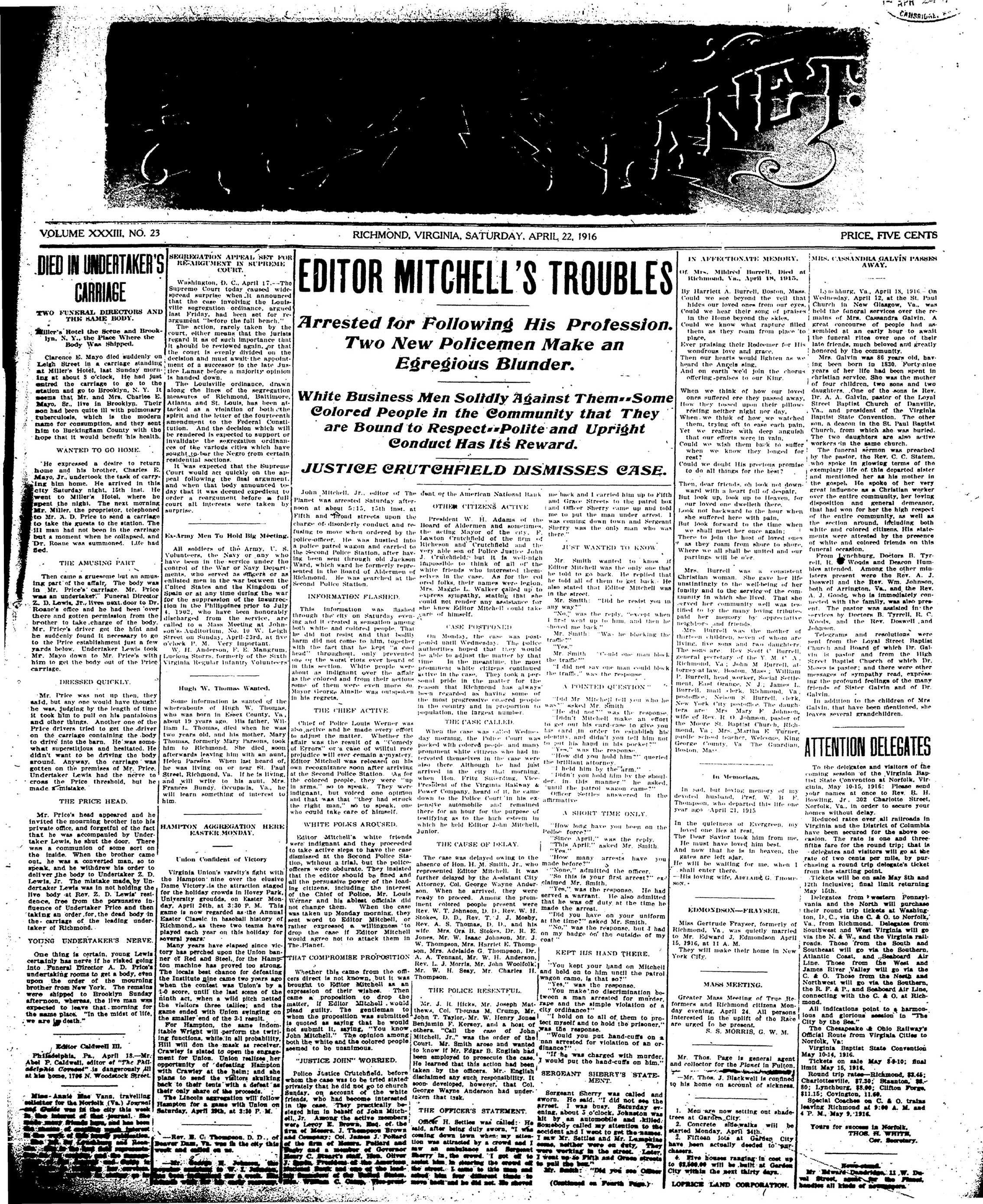
DIED IN UNDERTAKER'S CARRIAGE
TWO FUNERAL DIRECTORS AND THE SAME BODY.
Miller's Hotel the Scene and Brooklyn, N. Y., the Place Where the Body Was Shipped.
Clarence E. Mayo died suddenly on Leigh Street in a carriage standing at Miller's Hotel, last Sunday morning at about 3 o'clock. He had just entred the carriage to go to the station and go to Brooklyn, N. Y. It seems that Mr. and Mrs. Charles E. Mayo, Sr., live in Brooklyn. Their son had been quite ill with pulmonary tuberculosis, which is the modern name for consumption, and they sent him to Buckingham County with the hope that it would benefit his health.
WANTED TO GO HOME.
He expressed a desire to return home and his brother, Charles E. Mayo, Jr. undertook the task of carrying him home. He arrived in this city Saturday night, 15th inst. He went to Miller's Hotel, where he spent the night. The next morning Mr. Miller, the proprietor, telephoned to Mr. A. D. Price to send a carriage to take the guests to the station. The ill man had not been in the carriage but a moment when he collapsed, and Dr. Roune was summoned. Life had fled.
THE AMUSING PART
Then came a gruesome but an amusing part of the affair. The body was in Mr. Price's carriage. Mr. Price was an undertaker. Funeral Director Z. D. Lewis Jr., lives next door to Dr. Roane's office and he had been over there and gotten permission from the brother to take charge of the body. Mr. Price's driver got the hint and he suddenly found it necessary to go to the Price establishment just a few yards below. Undertaker Lewis took Mr. Mayo down to Mr. Price's with him to get the body out of the Price carriage.
DRESSED QUICKLY.
Mr. Price was not up then, they said, but any one would have thought he was, judging by the length of time it took him to pull on his pantaloons and other things. Another one of the Price drivers tried to get the driver on the carriage containing the body to drive into the barn. He was somewhat superstitious and healtated. He didn't want to be driving the body around. Anyway, the carriage was gotten on the premises of Mr. Price. Undertaker Lewis had the nerve to cross the Price threshold, but he made a mistake.
THE PRICE HEAD
Mr. Price's head appeared and he invited the mourning brother into his private office, and forgetful of the fact that he was accompanied by Undertaker Lewis, he shut the door. There was a communion of some sort on the inside. When the brother came out, he was a converted man, so to speak, and he withdrew his order to deliver the body to Undertaker Z. D. Lewis, Jr. The mistake made by Undertaker Lewis was in not holding the live body at Rev. Z. D. Lewis' residence, free from the persuasive influence of Undertaker Price and then taking an order, for, the dead body in the carriage of the leading undertaker of Richmond.
YOUNG UNDERTAKER'S NERVE
One thing is certain, young Lewis certainly has nerve if he risked going into Funeral Director A. D. Price's undertaking rooms to get a body, even upon the order of the mourning brother from New York. The remains were shipped to Brooklyn Sunday afternoon, whereas, the live man was expected to leave that morning for the same place. "In the midst of life, we are in death."
Editor Caldwell III.
Philadelphia, Pa., April 18.—Mr. Abel P. Caldwell, editor of "The Philadelphia Comet" is dangerously all at his home, 1796 N. Woodstock Street.
Mine-Annie Mine Vann, travelling collector for the Norfolk (Va.) Journal and Guide was in the city this week in the interest of that journal. She made many Strokes here, and has been in the史记 of emulating much interest in the work of this book publication. She left for Lynchburg and Houston in the last fall to represent the company, and the manager of the company and Guide in
SEGREGATION APPEAL SET FOR REARGUMENT IN SUPREME COURT.
Washington, D. C., April 17.--The Supreme Court today caused widespread surprise when it announced that the case involving the Louisville segregation ordinance, argued last Friday, had been set for reargument "before the full bench."
The action, rarely taken by the court, either means that the jurists regard it as of such importance that it should be reviewed again, or that the court is evenly divided on the decision and must await the appointment of a successor to the late Justice Lamar before a majority opinion is handed down.
The Louisville ordinance, drawn along the lines of the segregation measures of Richmond, Baltimore, Atlanta and St. Louis, has been attacked as a violation of both the spirit and the letter of the fourteenth amendment to the Federal Constitution. And the decision which will be rendered is expected to support or invalidate the segregation ordinances of the various cities which have sought to bar the Negro from certain residential sections.
It was expected that the Supreme Court would act quickly on the appeal following the final argument, and when that body announced today that it was deemed expedient to order a reargument before a full court all interests were taken by surprise.
Ex-Army Men To Hold Big Meeting
All soldiers of the Army, U. S. Volunteers, the Navy or any who have been in the service under the control of the War or Navy Departments, who served an engrish or an enlisted men in the war between the United States and the Kingdom of Spain or at any time during the war for the suppression of the insurrection in the Philippines prior to July 4, 1902, who have been honorably discharged from the service, are called to a Mass Meeting at Johnson's Auditorium, No. 10 W. Leigh Street on Sunday, April 23rd, at five o'clock P. M. Very important. W. H. Anderson, F. E. Mangrum, Luciong Stors, formerly of the Sixth Virginia Regular Infanty Volunteers
---
Hugh W. Thomas Wanted.
Some information is wanted of the whereabouts of Hugh W. Thomas, who was born in Essex County, Va., about 19 years ago, his father, William L. Thomas, died when he was two years old, and his mother, Mary Thomas, formerly Mary Paroons, took him to Richmond. She died soon afterwards leaving him with an aunt, Helen Paroons. When last heard of, he was living on or near St. Paul Street, Richmond, Va. If he is living, and will write to his aunt, Mrs. Frances Bundy, Occupanda, Va., he will learn something of interest to him.
HAMPTON MGRGREGATION HERE
EASTER MONDAY.
Union Confident of Victory
Virginia Union's varality's fight with the Hampton nine over the elusive Dame Victory is the attraction staged for the holiday crowds in Hovey Park, University grounds, on Easter Monday, April 24th, at 3:30 P. M. This game is now regarded as the Annual Easter Classic in baseball history of Richmond, as these two teams have played each year on this holiday for several years:
Many years have elapsed since victory has perched upon the Union banner of Red and Steel, for the Hampton machine has proved too strong. The locals best chance for defeating the Institute nine came two years ago when the contest was Union's by a 1-0 score, until the last scene of the ninth act, when a wild pitch netted the visitors three tallies; and the game ended with Union swinging on the smaller end of the 3-1 result.
For Hampton, the same indomitable Wright will perform the twirling functions, white in all probability, Hill will don the mask as receiver. Crawley is slated to open the engagement for Union. Union realizes her opportunity of 'defeating Hampton with Crawley at the helm; and she plans to send the visitors skulking back to their tents with a defeat as their only share of the proceeds.
The Lincoln aggregation will follow Hampton for a game with Union on Saturday, April 29th, at 3:30 P. M.
—Rev. B. C. Thompson, D. D., of Beaver Dam, W. Va. was in the city this week and called on us.
—Mr. George H. Johnson, the popular assistant to W. J. Johnson, has been appointed for a week. His office will be for the entire month.
EDITOR MITCHELL'S TROUBLES
Arrested for Following His Profession. Two New Policemen Make an Egregious Blunder.
White Business Men Solidly Against Them Some Colored People in the Community that They are Bound to Respect Polite and Upright Conduct Has Its Reward.
JUSTI@E @RUT@HFIELD DISMISSES @ASE.
John Mitchell, Jr., editor of The Planet was arrested Saturday afternoon at about 5:15, 15th inst. at Fifth and Broad streets upon the charge of disorderly conduct and refusing to move when ordered by the police-officer. He was hustled into a police patrol wagon and carried to the Second Police Station, after having been sent through old Jackson Ward, which ward he formerly represented in the board of Aldermen of Richmond. He was garrenced at the Second Police Station.
INFORMATION FLASHED
This information was flashed through the city on Saturday evening and it created a sensation among both white and colored people. That he did not resist and that bodily harm did not come to him, together with the fact that he kept a "cool head" throughout, only prevented one of the worst riots ever heard of in this section. White people were about as indignant over the affair as the colored and from their actions some of them were even more so. Mayor George Ainslie was outspoken in his regrets.
THE CHIEF ACTIVE
Chief of Police Louis Werner was also active and he made every effort to adjust the matter. Whether the affair was the result of a "Comedy of Errors" or a case of willful race prejudice will ever remain a mystery. Editor Mitchell was released on his own recognition soon after arriving at the Second Police Station. As for the colored people, they were "up in arms," so to speak. They were indignant, but voiced one opinion and that was that "they had struck the right man," so to speak, one who could take care of himself.
WHITE FOLKS ABOUTED
Editor Mitchell's white friends were indignant and they proceeded to take active steps to have the case dismissed at the Second Police Station, without a trial, but the police-officers were obdurate. They insisted that the editor should be fined and all the persuasive power of the leading citizens, including the interest of the Chief of Police, Mr. Louis Werner and his ablest officials did not change them. When the case was taken up Monday morning, they sent word to Editor Mitchell, or rather expressed a willingness to drop the case if Editor Mitchell would agree not to attack them in the Planet.
THAT COMPROMISE PROPOSITION
Whether this came from the officers direct is not known, but it was brought to Editor Mitchell as an expression of their wishes. Then came a proposition to drop the matter, if Editor Mitchell would plead guilty. The gentleman to whom the proposition was submitted is quoted as saying that he would not submit it, saying, "You know John Mitchell." The opinion among both the white and the colored people seemed to be unanimous.
"JUSTICE JOHN" WORRIED.
Police Justice Crutchfield, before whom the case was to be tried stated privately that he did not go to church Sunday, on account of the white friends, who had become interested in the case. They practically besieged him in behalf of John Mitchell, Jr. Among the active members were Leroy E. Brown, Eq. of the firm of Moors J. Thompson Brown and Company; Col. James J. Pollard of the firm of Moors. Pollard and Budby and a member of Governor Mary C. Stuart's staff, Hsu. Oliver J. Sparks, President of the American National Bank and one of the leading members of the United States, Sir William C. Oates, Treasurer.
OTHER CITIZENS ACTIVE
President W. H. Adams of the Board of Aldermen and sometimes the acting Mayor of the city, E. Lawton Crutchfield of the firm of Richison and Crutchfield and the very able son of Police Justice John J. Crutchfield; but it is well-wishable to think of all of the white friends who interested themselves in the case. As for the colored folks their names were legion. Mrs. Maggie L. Walker called up to express sympathy, stating that she could not render any assistance for she knew Editor Mitchell could take care of himself.
CASE POSTPONED
On Monday, the case was postponed until Wednesday. The police authorities hoped that they would be able to adjust the matter by that time. In the meantime, the most prominent white citizens continued active in the case. They took a personal pride in the matter for the reason that Richmond has always been regarded as having some of the most progressive coated people in the country and in proportion to population, the largest number.
THE CASE CALLED
When the case was called Wednesday morning, the Police Court was packed with colored people and many prominent white citizens who had interested themselves in the case were also there. Although he had just arrived in the city that morning, when Hon. Fritz Sitterding, Vice President of the Virginia Railway & Power Company, heard of it, he came down to the Police Court in his expensive automobile and remained there for an hour for the purpose of testifying as to the high esteem in which he held Editor John Mitchell, Junior.
THE CAUSE OF DELAY.
The case was delayed owing to the absence of Hon. H. M. Smith, Jr., who represented Editor Mitchell. It was further delayed by the Assistant City Attorney, Col. George Wayne Anderson. When he arrived, they were ready to proceed. Among the prominent colored people present were Rev. W. T. Johnson, D. D. Rev. W. H. Stokes, D. D., Rev. T. J. Mosby, Rev. A. S. Thomas, D. D., and his wife, Mrs. Ora B. Stokes, Dr. R. E. Jones, Mr. W. Isaac Johnson, Mr. J. W. Thompson, Mrs. Harriet E. Thompson, Mrs. Adaldea G. Thompson, Dr. A. A. Tennant, Mr. W. H. Anderson, Rev. L. J. Morris, Mr. John Woolfolk, Mr. W. H. Seay, Mr. Charles H. Thompson.
THE POLICE RESESTFUL
Mr. J. R. Hicks, Mr. Joseph Matthews, Col. Thomas M. Crump, Mr. John T. Taylor, Mr. W. Henry Jones Benjamin F. Kersey, and a host of others. "Call the case of John Mitchell, Jr." was the order of the Court. Mr. Smith arose and wanted to know if Mr. Edgar B. English had been employed to prosecute the case. He learned that this action had been taken by the officers. Mr. English disclaimed any such responsibility. It soon developed, however, that Col. George Wayne Anderson had undertaken that task.
THE OFFICER'S STATEMENT
Officer H. Settles was called: He said, after being duly sworn, "I was coming down town when: my attention was attracted by a crowd and I saw an ambulance and florentine glory in the crowd. I got off to assist him in staring at the crowd of the street. I came to this man and asked him four different times to move back and he did not. He stared
me back and I carried him up to Fifth and Grace Streets to the patrol box and Officer Sherry came up and told me to put the man under arrest. I was coming down town and Sergeant Sherry was the only man who was there."
JUST WANTED TO KNOW
Mr. Smith wanted to know if Editor Mitchell was the only one that he told to go back. He replied that he told all of them to get back. He also stated that Editor Mitchell was in the street.
Mr. Smith: "Did he resist you in any way?"
"No," was the reply, "except when I first went up to him, and then he showed me back."
Mr. Smith: "Was he blocking the traffic?"
"Yes."
Mr. Smith: "Could one man block the traffic?"
"I did not say one man could block the traffic," was the response.
A POINTED QUESTION:
"Did Mr. Mitchell tell you who he was?" asked Mr. Smith.
"He did not!" was the response.
"Didn't Mitchell make an effort to get out his card-case to give you his card in order to establish his identity, and didn't you tell him not to get his hand in his pocket?" "Yes." was the response.
"How did you hold him?" queried the brilliant attorney.
"I held him by the arm."
Officer Settles answered in the affirmative
A SHORT TIME ONLY
"How long have you been on the Police force?"
"Since April," was the reply.
"This April," asked Mr. Smith.
"Yes."
"How many arrests have you made before?"
"None," admitted the officer.
"So this is your first arrest?" exclaimed Mr. Smith.
"Yes," was the response. He had served a warrant. He also admitted that he was off duty at the time he made the arrest.
"Did you have on your uniform at the time?" asked Mr. Smith.
"No," was the response. I had on my badge on the outside of my coat."
KEPT HIS HAND THERE.
"You kept your hand on Mitchell and hold on to him until the patrol wagon came, is that so?"
"Yes." was the response.
"You make no discrimination between a man arrested for murder, rape and the simple violation of a city ordinance!"
"I hold on to all of them to protect myself and to hold the prisoner," was the response.
"Would you put hand-cuffs on a man arrested for violation of an ordinance?"
"If he was charged with murder, I would put the hand-cuffs on him."
SERGEANT SHERRY'S STATEMENT.
Sergeant Sherry was called and sworn. He said, "I did not see the arrest. I was busy. Saturday evening, about 5 o'clock, Johnston was hit by an automobile and killed. Somebody called my attention to the accident and I went to get the names. I saw Mr. Settles and Mr. Lampkins came, neither were on duty. They were working in the street. Later, I went up to Fifth and Green streets to pull the bus."
Mr. Smith: "Did you see Officer
(Continued on Fourth Page.)
IN AFFECTIONATE MEMORY,
Of Mrs. Mildred Burrell, Died at Richmond, Va., April 18, 1915.
By Harriett A. Burrell, Boston, Mass.
Could we see beyond the veil that hides our loved ones from our eyes.
Could we hear their song of praises in the Home beyond the skies.
Could we know what rapture filled them as they roam from place to place.
Ever praising their Rodeemer for His
wondrous love and grace.
Then our hearts would lighten as we heard the Angels sing.
And on earth we'd join the chorus offering-praises to our King.
When we think of how our loved ones suffered ere they passed away, How they tossed upon their pillows resting neither night nor day, When we think of how we watched them, trying oft to ease each pain, Yet we realize with deep anguish that our efforts were in vain, Could we wish them back to suffer when we know they longed for rest? Could we doubt His precious promise to do all things for the best?
Then, dear friends, oh look not downward with a heart full of despair, But look up, look up to Heaven, for our loved one dwelleth there. Look not backward to the hour when she suffered here with pain, But look forward to the time when we shall meet her once again; There to join the host of loved ones as they roam from shore to shore, Where we all shall be united and our partings will be over.
Mrs. Burrell was a consistent Christian woman. She gave her life unstintingly to the well-being of her family and to the service of the community in which she lived. That she served her community well was testified to by the many loving tributes paid her memory by appreciative neighbors and friends.
Mrs. Burrell was the mother of thirteen children, seven of whom are living, five sons and two daughters. The sons are Rev Scott C Burrell general secretary of the Y M C A A Richmond, Va; John M Burrell, attorney at law, Boston, Mass; William P. Burrell, head worker, Social Settlement, East Orange, N J; James L. Burrell, mail clerk, Richmond, Va; postoffice, Nelson S. Burrell, New York City postoffice. The daughters are: Mrs Mary F Johnson, wife of Roy O J Johnson, pastor of the Moore St. Baptist Church, Richmond, Va; Mrs. Martina E Turner, public school teacher, Welcome, King George County, Va The Guardian, Boston, Mass.
In Memory
In sad, but loving memory of my devoted husband, Pref. W. B. F. Thompson, who departed this life one year ago. April 21, 1915
In the quietness of Evergreen, my loved one lies at rest.
The Dear Savior took him from me
He must have loved him best.
And now that he is in heaven, the
gates are left ajar.
He will be waiting for me, when I
shall enter there.
—His loving wife, ADLADEE G. THOMPSON.
EDMOSDSON—FRAYSER
Miss Gertrude Frayser, formerly of Richmond, Va, was quietly married to Mr. Edward J. Edmondson April 15, 1916, at 11 A. M. They will make their home in New York City.
MASS MEETING
Greater Mass Meeting of True Reformers and Richmond citizens Monday evening, April 24. All persons interested in the uplift of the Race are urged to be present. S. S. MORRIS, G. W. M.
Mr. Thos. Page is general agent and collector for the Planet in Fulton.
—Mr. Thos. J. Blackwell is confined to his home on account of sickness.
1. Men are now setting out shade trees at Garden City.
2. Concrete sidewalks will be started Monday, April 34th.
3. Fifteen jobs at Garden City have been actually deeded to purchasers.
4. Five houses ranging in cost up to $1,500.00 will be built at Garden City within the next thirty days.
MRS. CASSANDRA GALVIN PARSEN
AWAY.
Lynchburg, Va., April 18, 1916 - On Wednesday, April 12, at the St. Paul Church in New Glasgow, Va., was held the funeral services over the remains of Mrs. Cassandra Galvin. A great concourse of people had assembled at an early hour to await the funeral rites over one of their late friends, much beloved and greatly honored by the community. Mrs. Galvin was 86 years old, having been born in 1830. Forty-nine years of her life had been spent in christian service. She was the mother of four children, two sons and two daughters. One of the sons is Rev. Dr. A. A. Galvin, pastor of the Loyal Street Baptist Church of Danville, Va., and president of the Virginia Baptist State Convention. The other son, a deacon in the St. Paul Baptist Church, from which she was buried. The two daughters are also active workers in the same church.
The funeral sermon was preached by the pastor, the Rev. C. C. Statem, who spoke in glowing terms of the exemplary life of this departed sister and mentioned her as his mother in the gospel. He spoke of her very great influence as a Christian worker over the entire community, her loving disposition and general demeanor, that had won for her the high respect of the entire community, as well as the section around, including both white and colored citizens. His statements were attested by the presence of white and colored friends on this funeral occasion.
From Lynchburg, Doctors B. Tyrrell, R. Woods and Deacon Humblies attended. Among the other ministers present were the Rev. A. J. Doswell and the Rev. Wm. Johnson, both of Arrington, Va., and the Rev. A. J. Goodo, who is immediately connected with the family, was also present. The pastor was assisted in the services by Doctors B. Tyrrell, R. C. Woods, and the Rev. Doswell, and Johnson.
Telegrams and resolutions were sent from the Loyal Street Baptist Church and Board of which Dr. Galvin is pastor and from the High Street Baptist Church of which Dr. Moses is pastor; and there were other messages of sympathy read, expressing the profound feelings of the many friends of Sister Galvin and of Dr. Galvin.
In addition to the children of Mrs Galvin, that have been mentioned, she leaves several grandchildren.
ATTENTION DELEGATES
To the delegates and visitors of the coming session of the Virginia Baptist State Convention at Norfolk, Virginia, May 10-15, 1916: Please send your names at once to Rev. R. H. Howling, Jr., 302 Charlotte Street, Norfolk, Va. in order to secure your homes without delay.
Reduced rates over all railroads in Virginia and the District of Columbia have been secured for the above occasion. The rate is one and three-fifths fare for the round trip; that is delegates and visitors will go at the rate of two cents per mile, by purchasing a round trip delegate's ticket from the starting point.
Tickets will be on sale May 8th and 12th inclusive; final limit returning May 15th.
Delegates from western Pennsylvania and the North will purchase their round trip tickets at Washington, D. C., via the C. & O. to Norfolk, Va. from Richmond. Delegates from Southwest and West Virginia will go via the N. & W., and the Virginia railroads. Those from the South and Southeast will go via the Southern, Atlantic Coast, and Seaboard Air Line. Those from the West and James River Valley will go via the C. & O. Those from the North and Northwest will go via the Southern, the R. F. & P., and Seaboard Air Line, connecting with the C. & O. at Richmond.
All indications point to a harmonious and glorious session in "The City by the Sea."
The Chesapeake & Ohio Railway's Official Route from Virginia Cities to Norfolk, Va.
Virginia Baptist State Convention May 10-14, 1916.
Tickets on sale May 8-10; final limit May 15, 1916.
Round trip rates—Richmond, $3.45; Charlottesville, $7.30; Staunton, $8.80; Lynchburg, $8.00; Clifton Forge, $11.15; Covington, 11.60.
Special Coaches on C. & O. trains leaving Richmond at 9:00 A. M. and 4 P. M., May 9, 1916.
Yours for success in Norfolk.
THOS. H. WHITE,
Cer. Secretary.
News stated.
Mr. Edward Dandridge, II. W. Dural Street, assist for the Planet, handles all kinds of newspapers.
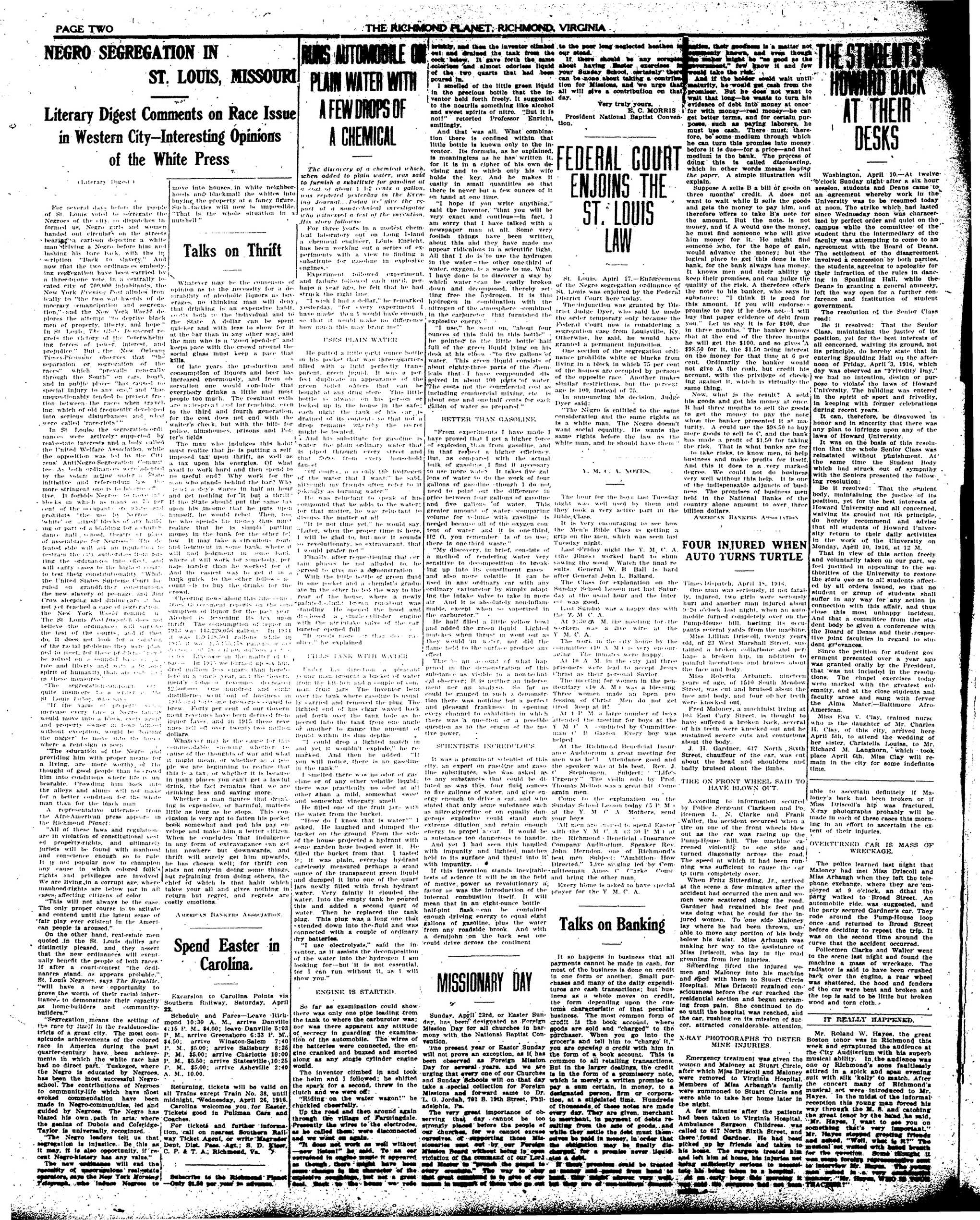
Literary Digest Comments on Race Issue in Western City-Interesting Opinions of the White Press
PAGE TWO
NEGRO SEGREGATION
Literary Digest Com-
in Western City—I
of the W
(Literary Digest)
For several days before the people of St. Louis voted to adjourn the Negroes of the city to dispatches formed us, Negro girls and women bearded out circularly on the street bearded a cartoon depicting a white man driving a Negro before him and hissing his bare back, with the script "Back to slavery." And now that the two ordinations embody registration have been carried by a three-second vote in a centrally located city of 700,000 inhabitants, the New York Post Post alludes from locally to "the two war hoods of democracy ennunciation and segregation" and the New York World declares the attempt to deprive black men of property, liberty, and hope. In St. Louis, The New York Post regrets the victory of the overwhelming forces of power, interest, and prejudice. But, the New Orleans Times-Daily observes that "the separation or segregation of the races" which "prevails generally through the South" on cars, boats, and in public places "has caused special injury to any one" and "has unquestionably tended to prevent fraction between the races when travel, which of old frequently developed into serious disturbances, and what were called 'race plots'."
In St Louis, the segregation ordinances were actively supported by real estate interests and a body called the United Welfare Association, while the opposition was led by the Citizens' AntiNegro Segregation Committee. As both ordinances were adopted by the volkswagen under a State initiative and referendum law, the more stringent one is to be effective. It forbids Negroes to move into blocks in which as many as 75 percent of the occupants are white and prohibits "the use of Negroes."
white or part of a building for a church, building or part of a building for a church, health hall, theatre, piece of assemblage for Northeast. The dedicated side will ask an仰望 to restrain the city authorities from putting the ordinances into effect, and will carry cases to the highest court to test their constitutionality. While the United States Supreme Court has ruled on grandfather constitution, the new slavery of peacage and Jim Crow sleeping and dining care has not reached a case of segregation the New York World remanded to The St Louis Post-Dispatch does not believe the ordinance will survive the test of the courts, and if they do, it does not look for a contempt of the racial problems they were placed to meet, for these problems he has tried to free and liberty and to free spirit of humanity, that are embodied in these measures.
"The segregation compartment is quite insimene to a writer of the St Louis Post-Dispatch."
"If the value of property increases every time a Negro family would move into a block every year and property owner in town sold without exception, would be having the bigger to move into the house where a rent-sign is seen.
"The education of the Negro and providing him with proper means for a living, are more worthy, of the thought of good people than to crowd him into conditions where life is unbearable. "Fawning him back into the alleys will not make for a better condition for the whitman than for the black man.
A representative utterance from the Afro-American press appears in the Richmond Planet.
"All of these laws and regulations are in violation of constitutional vested property-rights, and ultimately jurists will be found with manhood and conscience enough so to rule. It is not popular now to champion any cause in which colored folk's rights and privileges are involved. We are living in a corrupt age, where manhood-rights are below par in all cases, affecting citizens of color. "This will not always be the case. The only proper course is to agitate and contend until the latent sense of fair play ever existent in the American people is aroused." On the other hand, real-estate men quoted the St. Louis dailies are distinctly pleading, and they assert that the poor ordinances will eventually benefit the people of both cities. If after a court-content "the drillances stand, as appears probable." St. Louis Negroes, says The Republic, "will have a new opportunity to prove the worth of their racial inheritance to demonstrate their capacity as home-builder and community-builders."
"Segregation means the setting of the race by itself in the residence-districts of a great city. The most compulsions achievements of the colored race in America during the past quarter-century have, been achievements in which the white race has had no direct part. Tuskegee, where the Negro is educated by Negroes, has been the most successful Negro-school. The contributions of Negroes to community-life which have most evoked commendation have been made in Negro-communities, led and guided by Negroes. The Negro has blazed his own path in art, where the genius of Dubois and Coleidge-Taylor is universally recognized.
"The Negro leaders tell us that segregation is injustice. Be this as it may, it is also opportunity, if recent Negro-history has any value."
The new endeavors will end the necessity of unconstrained real estate operations, says the New York Morning Telegram, who induce Negroes to
move into houses, in white neighborhoods and blackmilk the whites into buying the property at a fancy figure. Such facties will now be impossible. "That is the whole situation in a nutshell."
Talks on Thrift
Talks on Thrift
Whatever may be the consensus of opinion as to the necessity for a desirability of alcoholic liquors as beverages, no thinking man will deny that drinking is an expensive habit, mostly both to the individual and to the State. A dollar can be spent quicker and with less to show for it at the bar than in any other way, and the man who is a "good spender" and keeps pace with the crowd around the social glass must keep a pace that kills.
Of late years the production and consumption of liquors and beer has increased enormously, and from so servatious men would conclude that everybody drinks a little and most everybody too much. The resultant exods are widespread far reaching even to the third and fourth generation, for the cost does not end with the waiter's check, but with the bills for police, alimonees, prisons and Potter's fields.
The man who indulges this habit must realize that he is putting a self-imposed tax upon thrift, as well as a tax upon his energies. Of what await to work hard and then spend to no useful end? Why work for the man who stands behind the bar? Why (if) a day's wages in half an hour and get nothing for it but a thrill? If the State should put the same tax upon his income that he puts upon himself, he would rebel. Then, too, he spends his money thus must realize that he is simply putting money in the bank for the other fee. It may take a certain routine and judgment in some bank, where it will and judgment in some bank where it will work for somebody, per hape harder than he worked for it. And the easiest way to get it in a bank quick to the other follows a count- to buy the drinks for the crowd.
Cheering news along this connection, government reports on the consumption of liquor for the past year. Alcohol is lessening its tax uptake. The consumption of liquor in 1914 was 142,292,600 gallons. In 1914 it was 139,135,941 gallons while in 1915 it was 135,135,941 gallons and in 1916 it was 135,135,941 gallons. In 1915 we burned up seven million barrels of oil less than heretofore in a single year, and the Government's tobacco revenues decreased $200 million. The hundred and eight distilleries went out of business in 1915 and the breweries used to brew. Forty per cent of our Government revenues have been derived from liquor laves, and in 1915 these revenues fell off over twenty two million dollars.
What may be the cause for the commotion, showing whether the cause of the thoughts of war and what it might mean, or whether as a people we are beginning to rethink that this is a tax, or whether it is because in many places you can't get a lawful drink, the fact remains that we are drinking less and saving more. This conclusion is very apt to fatten his pocket book somewhat and pad his pay envelope and make him a better citizen. When he concludes that indulgence in any form of extravagance can get him nowhere but downwards, and thrift will surely get him upwards, he has chosen well; for thrift consists not only in doing some things, but refraining from doing others, the chief of which is that habit which takes all and gives nothing in return but regret, and regrets are costly emotions.
AMERICAN BANNERS ASSOCIATION.
Spend Easter in Carolina.
Excursion to Carolina Points via Southern Railway, Saturday, April 22.
Schedule and Fares—Leave Richmond 10:30 A. M., arrive Danville 4:15 P. M., $4.00; leave Danville 5:03 P. M., arrive Greenaporo 6:33 P. M., $4.50; arrive Winston-Salem 7:40 P. M., $6.00; arrive Salisbury 8:25 P. M., $5.00; arrive Charlotte 10:00 P. M., $5.50; arrive Stateville 10:25 P. M., $5.50; arrive Asheville 2:40 A. M., 10.00.
Returning, tickets will be valid on all Trains except Train No. 38, until midnight, Wednesday, April 26, 1916. Carolina welcomes you in Easter. Tickets good in Pulman Cars and Coaches.
For tickets and further information,
call on nearest Southern Rail Station,
Dist. Post, or write Mgr. Manager
C. P. & T. A.; Richmond, Va.
Subscribe to the Richmond Flight
Only $1.50 per year in advance
THE RICHMOND PLANET; RICHMOND, VIRGINIA
RUNS AUTOMOBILE ON PLAIN WATER WITH A FEW DROPS OF A CHEMICAL
The discovery of a chemical which when added to plain water, was said to furnish a substitute for gasoline at a cost of about 1.12 cents a patio, was reported yesterday in the Evening Journal. Today we drive the report of a non-technical investigator who witnessed a test of the invention. His story follows.
For three years in a modest chemical laboratory out on Long Island a chemical engineer, Leub Enrleht, has been working out a series of experiments with a view to finding a substitute for gasoline in explosive engines. The experiment followed experiment, and failure followed each unit, perhaps a year ago, he felt that he had struck the right line.
"I wish I had a dollar," he remarked yesterday, "for every experiment I have made, that I would have enough so that it would make no difference how much this may be me."
USES PLAIN WATER
He patted a little grey ounce bottle in his pocket that was threequarters filled with a light perfectly transparent green liquid. It was a perfect duplicate in appearance of the green toilet water that can be bought at any drug store. This little bottle is always on his person or locked up to the house in the safe; each night the tank of his car is drained of its content so that the drop remains solely the secret might be located.
And his substitute for gasoline is water the plain ordinary water that is piped through every street and that flows from every household faucet.
"Of course, it is only the hydrogen of the water that I want," he said, although my friends often refer to it as poisoning water."
He was reluctant to speak of his compound that he adds to the water; for that matter, he was reluctant to discuss the matter of all
"It is not time yet," he would say "Later, when the proper time is here I will be glad to, but now it sounds so revolutionary, so extravagant, that I would prefer not." Finally after requesting that certain phases be not alluded to, he agreed to give me a demonstration.
With the little bottle of green fluid in one pocket and a chemist's graduate in the other he lob the way to the rear of the house, where a newly painted little brown repaint was standing. He opened the hood and disclosed a, a chemical cylinder engine, a fuel tank, and a, a fuel cylinder engine, the car's blower opened full. "It would come out, or than do no other," he explained.
FIELDS TANK WITH WATER
Under low direction, a plaster young man brought a basket of water from the kit box and a couple of common fruit jars. The inventor beet over the tank where gasoline is usually carried and removed the plug. The lighted end of his cigar waved back and forth over the tank hose as he peered into the tank from one angle of another to gauge the amount of liquid within its dim depths.
"I could drop a lighted match in and yet it wouldn't explode." he remarked. And then he added "If you will notice, there is no gasoline in it." He smelled there was no odor of gasoline or of any other vehicle oil; there was practically no odor at all other than a mild, somewhat sweet and somewhat vinegar smell. He filled one of the fruit jars with the water from the bucket.
"How do I know that is water?" I asked. He laughed and dumped the bucket on the ground. From the side of the house projected a hydrant with some garden hose looped over it. He filled the bucket from that. I tasted it. It was plain, everyday hydrant carefully measured perhaps a scant ounce of the transparent green liquid and dumped it into one of the quart jars newly filled with fresh hydrant water. Very faintly it clouded the water. Into the empty tank he poured this and added a second quart water. The second quart water This plug was a long one that extended down into the fluid and was connected with a couple of ordinary dry batteries.
"I use electrolysis," said the inventor, as it assists the decomposition of the water into the hydrogen I am looking for—but it is not essential, for I can run without it, as I will show you."
ENGINE IS STARTED
So far as examination could show there was only one pipe loading from the tank to where the carburator was; nor was there apparent any attitude of secrecy in guarding the examination of the automobile. The wires of the batteries were connected, the engine cranked and buzzed and snorted along as any single cylinder engine would.
The inventor climbed in and took the helm and I followed; he shifted the spark for a second, threw in the clutch and we were off:
"Riding on the water wagon!" he chuckled cheerfully.
Up the road and then around again through the village of Farmingdale. Presently the wires to the electrodes, as he called them, were disconnected and we went on again.
"It does not work as well without—now listen!" he said. To an outposted in engine music it appeared as though, there might have been some change in the character of the engine sounds, but not a great deal. So on the house we rode.
brinkly, and then the inventor climbed out and drained the tank from the cook below. It gave forth the many colorless and almost odorless liquid of the two quarts that had been poured in.
I smelled of the little green liquid in the precious bottle that the inventor held forth freely. It suggested to the nostrils something like alcohol and sweet spirits of nitro. "But it is not!" retorted Professor Enricht, smiling.
And that was all. What combination there is confined within that little bottle is known only to the inventor. Its formula, as he explained, is moultingless as he has written it, for it is in a cipher of his own deviling and to which only his wife holds the key. And he makes it easily in small quantities so that there is never but a few ounces of it on hand at one time.
"I hope if you write anything, said the inventor, "that you will be very exact and cautious—in fact, I am sorry that I have talked with a newspaper man at all. Some very foolish things have been written about this and they have made me appear ridiculous in a scientific light. All that I do is to use the hydrogen in the water—the other one third of water, oxygen, to a waste to me. What I have done is to discover a way by which water can be easily broken and decomposed, thereby setting free the hydrogen. I have hydrogen in combination with the nitrogen in combination with the carbonate that furnished the explosive energy."
"I use," he went on, "about four courses of this fluid in this bottle" he pointer to the little bottle half full of the green liquid lying on his desk at his elbow "to five gallons of water. This green liquid consists of about eighty-three parts of the chemicals that I have compounded dishes. I do not pour any water. The costs not the commercial mixing, etc. are about one and one half cents for each gallon of water so prepared."
BETTER THAN GASOLINE
"From experiments I have made I have proved that I get a higher force of explosion than from gasoline, and in that respect a higher efficiency. But, as compared with the actual bulk of gasoline, I find it necessary to use more water. It takes five gallons of water to do the work of four gallons of gasoline though I do not need to point out the difference in price between four gallons of gasoline and five gallons of water. This greater amount of water compares volume for volume with gasoline is needed because all of the oxygen content of water and it is one third, 112 O, you remember is of no use; there is one third waste."
"My discovery, in brief, consists of a method of rendering water very sensitive to decomposition to breaking up inert constituent gases which will be used in any ordinary car with an ordinary carburetor by simply adapting the intake valve to take in more air. And it is absolutely non-inflamable, except when so vaporized in the carburetor."
He half filled a little yellow bowl and added the green liquid. Lighted matches when thrups in went out as they would in water, nor did the flame hold to the surface produce any effect.
This is an account of what happened in the demonstration of this substance as visible to a non-technical observer; it is neither an indemnement nor an analysis. So far as could be gauged in such a demonstration there was nothing but a perfect and pleasant frankness in opening every channel to exhibition in which there was a question or a possible question as to the origin of the motive power.
SCIENTISTS INCREDULOUS
It was a prominent scientist of this city, an expert on gasoline and gasoline substitutes, who was asked as to any substances that could be diluted as was this, four fluid ounces to five gallons of water, and give energy enough to drive a car, and who stated that only some substance such as nitroglycerine or on equally dangerous explosive could stand such extreme dilution and retain enough energy to propel a car. It would be a substance too dangerous to handle. And yet I had seen this haphled with impunity and lighted, matches held to its surface and thrust into it with impunity. If this invention stands inevitable of science it will be in the field of motive power as revolutionary a factor as the introduction of the internal combustion itself. It will mean that in an eight-ounce bottle half-pint flask—can be contained enough driving energy to equal eight gallons of gasoline, plus the water from any roadside brook. And with a demijohn on the back seat one could drive across the continent.
MISSIONARY DAY
Sunday, April 23rd, or Easter Sunday, has been designated as Foreign Mission Day for all churches in harmony with the National Baptist Convention.
The present year or Easter Sunday will not prove an exception, as if he has been observed as Foreign Mission Day for several years, and we are urging that every one of our Churches and Sunday Schools will on that day take a special collection for Foreign Missions and forward same to Dr. L. G. Jordash, 781 B. 19th Street, Philadelphia, Pa.
The very great importance of observing that day cannot be too strongly placed before the people of our churches, for we cannot excuse our observance of our Mission Day out by our Foreign Mission Board without being in open violation of the command of our Lord and Master to "praise the people to every creature." The way to show that great commitment is to give our business in support of these our
to the poor long neglected heathen
our stand.
If there should be any scraps about having Master exercises in your Sunday School, certainly there can be more about taking a contribution. Wishless, and if you urge that all will give a contribution on that day.
Very truly yours,
E. C. MORRIS
President National Baptist Convention.
FEDERAL COURT
ENJOINS THE
ST. LOUIS
LAW
St. Louis, April 17. - Enforcement of the Negro segregation ordinance of St. Louis was enjoined by the Federal District Court here today.
The injunction was granted by District Judge Dyer, who said he made the order temporary only because the Federal Court now is considering a segregation case from Louisville, Ky. Otherwise, he said, he would have granted a permanent injunction.
One section of the segregation ordinance prohibits white or blacks from living in a block in which 75 per cent of the houses are occupied by persons of the opposite race. Another makes similar restrictions, but the percent age is 190, instead of 75.
In announcing his decision, Judge Dyer said:
"The Negro is entitled to the same consideration and the same rights as is a white man. The Negro doesn't want social equality. He wants the rights before the law as the white man, and he should have them."
Y. M. C. A. NOTES.
The hour for the boys last Tuesday night was well used by them and they took a very active part in the Bible Class.
It is very encouraging to see how the Men's Bible Class is getting a grip on the men, which was seen last Tuesday night.
Last Friday night the Y. M. C. A. (the Blues) worked hard to shun sowing the wood. Watch the final results. General W. B. Ball is hard after General John L. Ballard.
The Class for explanation on the Sunday School Lesson met last Saturday at the usual hour and the inter-net was good.
Last Sunday was a happy day with the E. M. C. A.
At 9:30 A.M. the meeting for the workers was a live wire at the Y. M. C. A.
The work in the city home by the committee (10 A.M.) is very encouraging. The inmates were happy.
At 10 A.M. in the city jail three prisoners were led to accept Jesus Christ as their personal Savior.
The meeting for women in the penitentiary (10 A.M.) was a blessing. Three prisoners made an open profession of Christ. Men do not get tired keep at it.
At 1 P.M. a large number of boys attended the meeting for boys at the Y. M. C. A. combined by Committee-man C. E. Gates. Every boy was helped.
At the Richmond Beneficial Insurance Auditorium a great meeting for men was he'd Attendance good and the speaker was at his best. Rev. J. C. Stephenson. Subject: "Life's Urgency" The violin solo by Prof. Thomas Melton was a great hit Come again men.
Come to the explanation on the Sunday School Lesson today (5 P M) at the Y M C A Mothers, send your boys to the Y are to attend Easter with the Y M C A (3:30 P M) at the Richmond Beneficial Insurance Company Auditorium, Speaker Roy John Herndon, one of Richmond's best men Subject: "Ambition-How Directed." Live singing led by Committeeman Amos C. Carke. Come and bring the other man.
Every home is asked to have special prayer for the Y M C A.
Talks on Banking
It so happens in business that all payments cannot be made in cash, for most of the business is done on credit in one form or another. Small purchases and many of the daily expenditures are cash transactions; but business as a whole moves on credit, the form depending upon the customs characteristic of that peculiar business. The most common form of credit is the book account, where goods are sold and "charged" to the purchaser. When you go into the grocery and tell him to "charge it" you are opening a credit with him in the form of a book account. This is common to all retailing transactions. But in the larger dealings, the credit is in the form of a promissory note, which is merely a written promise to pay a sum certain, in money, to a designated person, firm or corporation, at a stipulated time. Hundreds of thousands of these notes are made every day. They are given, merchant to merchant, in payment of debts resulting from the use of notes, and while they settle the debt must themselves be paid in money, in order that the obligation may be finally discharged, for a promise never liquidates a debt.
If their problems could be treated as money and material from hand to hand, they might allow very well, but their are of insufficient strength.
nation, their goodness is a matter not
commonly known, and even though
the matter might be "an good as the
government," few know it and few
would take the risk.
And if the holder should wait until maturity, he would get cash from the promiseer. But he does not want to wait that long—he wants to turn his evidence of debt intb money at once for with money—real money—he can get better terms, and for certain purposes, such as paying laborers, he must use cash. There must, therefore, be some medium through which he can turn this promise into money which is due for payment and the medium is the bank. The process of doing this is called discounting, which in other words means buying the paper. A simple illustration will explain.
Suppose A sells B a bill of goods or three months' credit. A does not want to wait while B sells the goods and gets the money to pay him, and therefore offers to take B's note for the amount. But the note, is not money, and if A would use the money, he must find someone who will give him money for it. He might find someone who, for the hope of gain, takes the money in a logical place to get this done is the bank, for the bank always has money. It knows men and their ability to keep their promises, and can judge the quality of the risk. A therefore offers the note to his banker, who says in substance: "I think B is good for this amount. If you will endorse a promise to pay if he does not—I will buy that paper evidence of debt from you." Let us say it is for $100, due in three months. The banker knows that at the end of the three months he will get the $100, and so gives A $150 as the fee for the interest on the money for the time. Ordinarily the banker would not give A the cash, but credit his account, with the privilege of checking against it, which is virtually the same thing.
Now, what is the result? A sold his goods and get his money at once. B had three months to sell the goods to get the money to pay the note when the banker presented it at maturity. A could use the $25.00 to buy more goods to sell to C, and the bank has made a profit of $1.50 for taking the risk. That is what banks are for to take risks, to know men, to help business and make profits for itself. And this it does to a very marked degree. We could not do business very well without this help. It is one of the indispensable adjuncts of business. The promises of business men held in the National Banks of the country alone amount to over three billion dollars.
AMERICAN BANKERS ASSOCIATION
FOUR INJURED WHEN AUTO TURNS TURTLE
Time Dispatch, April 19, 1916.
One man was seriously, if not fatally, injured, two girls were seriously hurt and another man injured about 3:20 a.m. lost night, when an auto mobile turned completely over on the Pump-House hill, hurling its occupants several yards from the machine. Miss Lillian Driscoll, twenty years old, of 23 West Marshall Street, sustained a broken collarbone and perhaps a broken hip, in addition to painful haematuries and bruises about the face and body.
Miss Roberta Arbaugh, nineteen years of age, of 1510 South Meadow Street, was cut and bruised about the face and body, and four of her teeth were knocked out.
Madam Marianne a machinist living at 191 East Cary Street, is thought to have suffered a broken back, several of his teeth were knocked out and he sustained severe cuts and contusions about the body.
J. H. Gardner, 617 North Sixth Street, chauffeur of the car, was cut about the head and shoulders and badly bruised about the limbs.
TIRE ON FRONT WHEEL SAID TO
HAVE BLOWN OUT.
According to information secured by Police Sergent Clarkson and Poithecen L. N. Clarke and Frank Walker, the accident occurred when a tire on one of the front wheels blew out as the car was racing up the Pump-House hill. The machine careened violently to one side and turned diagonally across the road. The speed at which it had been running was sufficient to cause the car to turn completely over. When Fritz Sitterling, Jr. arrived at the scene a few minutes after the accident had occurred the men and women in the car along the road. Gardner had regained control and was doing what he could for the injured women. To one side Maloney lay where he had been thrown, unable to move any portion of his body below his waist. Miss Arbaugh was making her way to the assistance of Miss Driscoll, who lay in the road grinding from her injuries.
Sterling lifted the injured women and Maloney into his machine and aided with them to Stuart Circle Hospital. Miss Driscoll regained consciousness before the car reached the residential section and began screaming from pain. She continued to do so until the hospital was reached, and the car, rushing on its mission of succor, attracted considerable attention.
N-RAY PHOTOGRAPHS TO DETER
MINE INJURIES
Emergency treatment was given the women and Maloney at Stuart Circle, after which Mjus Driscoll and Maloney were removed to Virginia Hospital. Members of Mjus Arbaugh's family were summoned to Stuart Circle and were able to take her home later in the night.
A few minutes after the patients had been taken to Virginia Hospital, Ambulance Sergeon Childress, was called to 617 North Sixth Street, and there found Gardner. He had been picked up by friends and taken to his home. The surgeon treated him and left him of home, his injury not being sufficiently serious to necessitate his being taken to a hospital. At an early hour this morning he
THE STUDENTS
HOWARD BACK
AT THEIR
DESKS
Washington, April 10—At twelve o'clock Sunday night after a six hour session, students and Deans came to an agreement whereby work in the University was to be resumed today at noon. The strike which had lasted since Wednesday noon was characterized by perfect order and quiet on the campus while the committee of the student thru the intermediary of the faculty was attempting to come to an agreement with the Board of Deans. The settlement of the disagreement involved a concession by both parties, the students, agreeing to apologize for their infraction of the rules in dancing in Spandling Hall, while the staff in granting a general amnesty, left the way open for a further conference and institution of student government.
The resolution of the Senior Class road:
Be it resolved: That the Senior Class, maintaining the justice of its position, yet for the best interests of all concerned, waving its ground, not its principle, do hereby state that in entering Spaulding Hall on the afternoon of Friday, April 3, 1916, which day was observed an "Frivolity Day," we had no intention, design or purpose to violate the laws of Howard University. The building was entered in the spirit of sport and frivolity, in keeping with former celebrations during recent years.
It can, therefore, be disavowed in honor and in sincerity that there was any plan to infringe upon any of the formal privileges.
It was on the basis of this resolution that the whole Senior Class was reinstated without punishment. At the same time the Student Body which had struck out of sympathy with the Seniors presented the following resolution:
Be it resolved: That the student body, maintaining the justice of its position, yet for the best interests of Howard University and all concerned, waiving its ground not its principle, do hereby recommend and advise that all students of Howard University return to their daily activities in the work of the University on Monday, April 10, 1916, at 12 M.
That in view of this action freely and voluntarily taken on our part, we feel justified in appealing to the authority of the University to restore the status order to all students affected by all other issues, so that no student or group of students shall suffer in any way from any action in connection with this affair, and close this most unhappy incident.
And that a committee from the student body be given a conference with the Board of Deans and their respective joint faculties in regard to student grievances.
Since the petition for student government presented over a year ago was granted orally by the President, that was not included in the resolutions. The chapel exercises today were marked with the greatest solemnity, and at the close students and faculty arose and sang with fervor the Alma Mater.-Baltimore Afro-American.
Miss Eva V. Clay, trained nurse who is the daughter of Mr. Charles H. Clay, of this city arrived here April 5th, to attend the wedding of her sister, Christelia Louise, to Mr. Richard M. Langhorn, which took place April 6th. Miss Clay will remain in the city for some indefinite time.
able to ascertain definitely if Maloney's back had been broken or if Miss Driscoll's hip was fractured, X-ray photographs probably will be made in each of these cases this morning in an effort to ascertain the extent of their injuries.
OVERTURNED CAR IS MASS OF WRECKAGE.
The police learned last night that Maloney had met Miss Driscoll and Miss Arhaugh when they left the telephone exchange, where they are employed at 9 o'clock, an dthat the party walked to Broad Street. An automobile ride, was suggested, and the party secured Gardner's car. They rode around the Pump-House loop once and returned to Broad Street before deciding to repeat the trip. It was on the second time around the curve that the accident occurred.
Policemen Clarke and Waller went to the scene last night and found the machine a mass of wreckage. The radiator is said to have been crushed in the engine, a rear wheel was shattered, the engine of the car were bent and broken and the top is said to be little but broken wood and torn cloth.
IT REALLY HAPPENED
Mr. Roland W. Hayes, the great Boston toner was in Richmond this week and captured the audience at the City Auditorium with his superb musical ability. In the audience was one or Richmond's sons faultlessly attired in a spik and span evening suit with silk 'kelly' to match. After the concert many of Richmond's musical art were introduced to Mr. Hayes. In the midst of the informal reception this young man forced his way through the M. S. and catching the great tenor by the hand he said, "Mr. Hayes, I want to see you on something that's very important." Mr. Hayes stopped greeting friends and asked, "Well, what is it?" The young man with hands breath for the question. Some thought it was more foreign than greeting someone to interview Mr. Hayes. The young man asked in a very confident manner, "Mr. Hayes, WHO IS YOUR TEACHER?"
```markdown
```
MARY PAGE. "an actress, is accused of the murder of James Pollock, and is defended by her lover Philip Langdon. Pollock has been pursuing Mary for many months endeavoring to win her love and her band in marriage, but his attentions have been very unwelcome to her. Knowing her stage aspirations, he has, unknown to her, financed her starring tour under the management of Daniels. On the night of the murder, Mary leaves the banquet hall in the Hotel Republic and enters the Gray Room alone expecting to meet Langdon. She has been lured there by Pollock, who has been drinking.
A few moments later a shot is heard and Langdon and others, upon entering the Gray Room and James Follock shot through the heart and Murry Page lying in a faint bedside him with Follock's revolver not six inches from the ends of her fingers.
DANIELS' PROMISE
LANGDON surveyed the huge pile of mail on his desk with a half rusful, half whitman-silent smile. Despite the fact that he had worked half the night, his cool plunge and a cup of strong coffee had sent him down town early, tilted with energy, and he had planned to "clean up" his letters at the office before proceeding to Court.
He had not, however, counted upon the sympathy and the antipathy that the now famous trial of Mary Page was arousing.
Nor had he counted upon the propensity of the American public to
A
This Man Omitted the Usual Formality of Signing His Names.
write letter, and in consequence it was not a few hours' work, but the labor of days that lay before him in that multitudinous array of envelopes.
There were letters denouncing him because the writers thought he was aiding in the miscarriage of justice because of his efforts on behalf of Mary Page; there were others praising him extravagantly for his efforts in her behalf; there were still others threatening him with death if he persisted in his efforts to clear Mary of the charge of murder, efforts which would expose certain members of the under world in the great city. There were letters from some people and insane people, letters from sentimental girls who equally sentimental, young men who had been impressed with Mary's beauty and innocence; there was even one letter from a man who declared that he himself had committed the murder and would go on the stand and confess all for five dollars. This man omitted the usual formality of signing his name.
Bends the letters lay the morning paper, all of them, with the accounts of the most marked heavily with blue pencil, ready to be clipped and pasted in the same stamp book. As Longley now lies his chair and set down the position of the nearest paper sample on the desk.
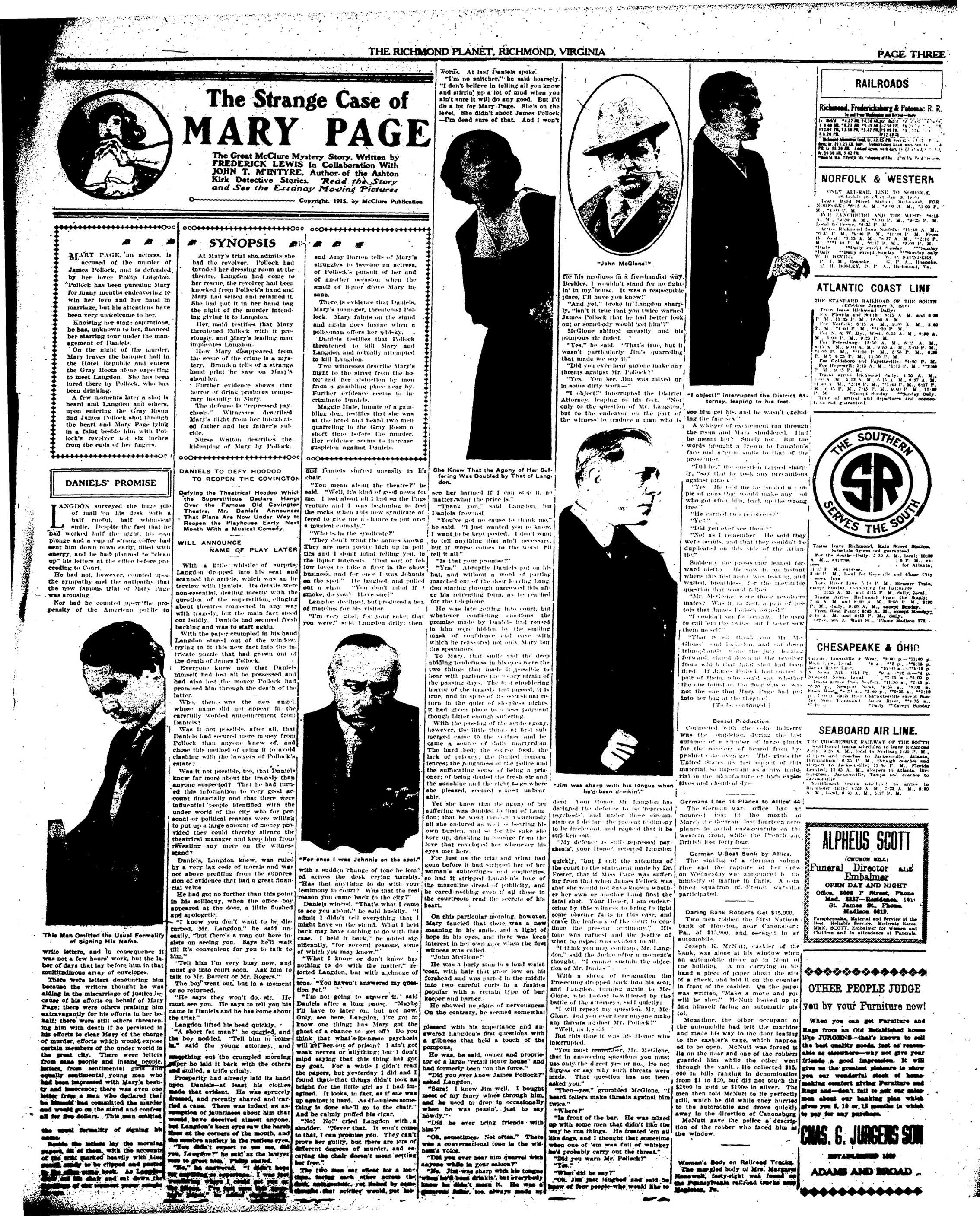
The Strange Case of MARY PAGE
The Great McClure Mystery Story. Written by FREDERICK LEWIS In Collaboration With JOHN T. M'INTYRE. Author of the Ashton Kirk Detective Stories. Read the Story and See the Essanay Moving Pictures
SYNOPSIS
At Mary's trial she admits she had the revolver. Pollock had invaded her dressing room at the theatre. Langdon had come to her rescue, the revolver had been knocked from Pollock's hand and Mary had seized and retained it. She had put it in her hand bag the night of the murder intending giving it to Langdon. Her maid testifies that Mary threatened Pollock with it previously, and Mary's leading man implicates Langdon. How Mary disappeared from the scene of the crime is a mystery. Brandon tells of a strange hand print she saw on Mary's shoulder. Further evidence shows that horror of drink produces temporary insanity in Mary.
The defense is "repressed psychosis." Witnesses described Mary's flight from her intoxicated father and her father's suicide. Nurse Watton describes the kidnapping of Mary by Pollock.
DANIELS TO DEFY HOODOO TO REOPEN THE COVINGTON
Defying the Theatrical Hoodoo Which the Superstitious Declares Hangs Over the Famous Old Covington Theatre, Mr. Daniels Announces That Plans Are Now Under Way to Reopen the Playhouse Early Next Month With a Musical Comedy.
With a little whistle of surprise Langdon dropped into his seat and scanned the article, which was an interview with Daniels. Its details were non-essential, dealing mostly with the question of the superstition, eliciting about the theatre connected in any way with tragedy, but the main fact stood out boldly. Daniels had secured fresh backing and was to start again.
With the paper crumpled in his hand Langdon stared out of the window, trying to fit this new fact into the intricate puzzle that had grown out of the death of James Pollock.
Everyone knew now that Daniels himself had lost all he possessed and had also lost the money Pollock had promised him through the death of the latter.
Who, then, was the new angel, whose name did not appear in the carefully worded announcement from Daniels?
Was it not possible, after all, that Daniels had secured more money from Pollock than anyone knew of, and chose this method of using it to avoid clashing with the lawyers of Pollock's estate?
Was it not possible, too, that Daniels knew far more about the tragedy than anyone suspected? That he had turned this information to very good account financially and that there were influential people identified with the under world of the city who for personal or political reasons were willing to put up a large amount of money provided they could thereby silence the theatrical manager and keep him from revealing any more on the witness stand?
Daniels, Langdon knew, was ruled by a very lax code of morals and was not above profiting from the suppression of evidence that had a great financial value.
He had got no further than this point in his soliloquy, when the office boy appeared at the door, a little flushed and apologetic.
"I know you don't want to be disturbed, Mr. Langdon," he said uneasily, "but there's a man out here insists on seeing you. Says he'll wait till it's convenient for you to talk to him."
"Tell him I'm very busy now, and must go into court soon. Ask him to talk to Mr. Barrett or Mr. Rogers."
"The boy went out, but in a moment or so returned.
"He says they won't do, sir. He must see you. He says to tell you his name in Daniela and he has come about the trial."
Langdon lifted his head quickly.
something out the crumpled morning super he laid it back with the others and smiled, a trifle grimly.
Prosperity had already fitted its hand upon Daniels—at least his clothes made that evident. He was sprucely dressed, and recently shaved and carried a cane. There was indeed an assumption of jaundice about him that would have deceived almost anyone, but Langdon's keen eyes saw the harsh lines at the corners of the mouth, and the numbe rarity in the rattlesome eyes.
"You didn't expect to see me, did you, Langdon?" he said as the lawyer rose to greet him. Philip smiled.
"No," he answered. "I didn't hope for anything so serious. I was just something where I could get you on the plane. For you, you take the higher plane," he added.
THE RICHMOND PLANET. RICHMOND. VIRGINIA
---
and Amy Barton tells of Mary's struggles to become an actress, of Pollock's pursuit of her and of another occasion when the smolt of lion drove Mary inane.
There is evidence that Daniels, Mary's manager, threatened Pollock. Mary fails on the stand and again goes insane when a policeman offers her whisky.
Daniels testifies that Pollock threatened to kill Mary and Langdon and actually attempted to kill Langdon.
Two witnesses describe Mary's flight to the street from the hotel and her abduction by men from a gambling place near by. Further evidence seems to incriminate Daniels.
Maggie Hale, inmate of a gambling den, testifies that she was at the hotel and heard two men quarrelling in the Gray Room a short time before the murder. Her evidence seems to increase suspicion against Daniels.
---
and Daniels shifted unceasily in his chair.
"You mean about the theatre?" he said. "Well, it's kind of good news for me. I lost all about I had on the Dugs venture and I was beginning to feel the rocks when this new syndicate of fered to give me a chance to put over a musical comedy."
"Who is in the syndicate?"
"They don't want the names known. They are pretty high up in politics and I don't mind telling you, to the liquor interests. That sort of fellow loves to take a flyer in the show business, and for once I was Johnnie on the spot." He laughed, and pulled out a cigar. "You don't mind if I smoke, do you? Have one?"
Langdon declined, but produced a box of matches for his visitor.
"I'm very glad, for your sake, that you were." Langdon dilled; then
A.
"For once I was Johnnie on the spot."
with a sudden change of tone he learnt
ed across the desk crying in harsh.
"Has that anything to do with your
testimony in court? Was that the real
reason you came back to the city?"
Dankels winced. "That's what I came
to see you about," he said huskily.
"I admit I didn't tell everything that I
might have on the stand. What I held
back may have nothing to do with this
case. I held it back," he added signifi-
cantly, "for several reasons, some
of which you may know."
"What I know or don't know has
nothing to do with the matter," re-
torted Langdon, but with a change of
tone. "You haven't answered my question yet."
"I'm not going to answer it," said Daniels after a long pause. "Maybe I'll have to later on, but not now. Only, see here. Langdon, I've got to know one thing; has Mary got the ghost of a chance to—get off? Do you think that what's its name psychosis will get her out of prison? I don't get weak nerves or anything; but I don't mind saying that this thing has got my goat. For a while I didn't read the papers, but yesterday I did and I found that—that things didn't look as bright for the little girl as I had imagined. It looks, in fact, as if she was up against it hard. And—unless something is done she'll go to the chair." And he calmly puffed his cigar. "Not! Not!" cried Langdon with a shudder. "Never that. It won't come to that, I can promise you. They can't prove her guilty, but there are lots of different degrees of murder, and escaping the chair doesn't mean setting her free."
They two men not attend for a long time, facing each other across the bank, antiparachthic, not linked by any example, the neither would put into
wolfs. At just ruthless spoke.
"I'm no snatcher," he said hoarsely.
"I don't believe in telling all you know and stirrin' up a lot of mud when you ain't sure it will do any good. But I'd do a lot for Mary-Page. She's on the level. She didn't shoot James Pollock—I'm dead sure of that. And I won't
THE WOMEN'S HERITAGE
She Knew That the Agony of Her Suffering Was Doubled by That of Langdon.
see her harmed if I can stop it, no matter what the price is.
"Thank you," said Langdon, but Daniels frowned.
"You've got no cause to thank me," he said. "I just wanted you to know. I want to be kept posted. I don't want to tell anything that isn't necessary, but if worse comes to the worst I tell it all."
"Is that your promise?"
"Yes." Abruptly Daniels put on his hat, and without a word of parting marched out of the door leaving Langdon staring through narrowed lips after his retraining form, as he reached for the telephone.
He was late getting into court, but whatever conflicting emotions the promise made by Dumbless had roused in him were hidden by the smiling mask of confidence and ease with which he reassured not only Mary but the spectators.
To Mary, that smile and the deep abiding tenderness in his eyes were the two things that made it possible to bear with patience the worry strain of the passing days. The first shuddering horror of the trapsy had passed, it is true, and in spite of its occasional return in the quiet of sloppy nights, it had given place to a less polignant though bitter enough suffering.
With the passing of the acute agony, however, the little things at first submerged came to the surface and became a source of daily martyrdom. The hard last; the course food; the lack of privacy; the limited convenience; the roughness of the police and the suffering sense of being a prisoner; of being denied the fresh air and the sunshine and the right to go where she pleased, seemed almost unbearable.
Yet she knew that the angony of her suffering was doubled by that of Langdon; that he went through wartornly all she burdened, and so for his sake she bore up, drinking in courage from the love that enveloped her whenever his eyes met her.
For just as the trial and what had gone before it had stripped her of her woman's subterfuges and conspiracies, so had it stripped Landon's love of the masculine dread of publicity, and he cared nothing even if all those in the courtroom read the secrets of his heart.
On this particular morning, however, Mary fancied that there, was a new meaning in his smile, and a light of hope in his eyes, and there was keen interest in her own gaze when the first witness was called.
"John McGilloue."
He was a burly man in a loud waistcoat, with hair that grew low on his forehead and was parted in the middle into two careful curls in a fashion popular with a certain type of bar keeper and barber.
He showed no signs of nervousness. On the contrary, he seemed somewhat pleased with his importance and answered Langlois's first questions with a glibness that held a touch of the pompous.
He was, be said, owner and proprietor of a large "retail liquor house" and had formerly been "on the force."
"Did you ever know James Pollock?" asked Langdon.
"Sure! I knew Jim well. I bought most of my fancy wines through him, and he used to drop in occasionally when he was passin', just to say howdy."
"Did he ever bring friends with him?"
"Oh, sometimes. Not often." There was a conversational tone in the witness's voice.
"Did you ever hear him quarrel with anyone while in your salon?"
A.
"John McGional"
For his madness in a free-handed way. Besides, I wouldn't stand for no fight in my house. It was a respectable place. I'll have you know."
"And yet," broke in Langdon sharply, "can't it true that you twice warned James Pollock that he had better look out or somebody would get him?" McGone shifted uneasily, and his pompous air faded.
"Yes," he said. "That's true, but it wasn't particularly Jim's quarrelling that made me say it."
"Did you ever hear anyone make any threats against Mr. Pollock?"
"Yes. You see. Jim was mixed up in some dirty work—"
"I object." Interrupted the District Attorney, leaping to his feet. "Not only to the question of Mr. Langton, but to the endeavor on the part of the witness to traduce a man who is
M.
"Jim was sharp with his tongue when he'd been drunkin'."
dend. Your Honor, Mr Langdon has declared the defense to be 'repressed psychosis' and under those circumstances I declare the present testimony to be freaked out, and request that it be struck out.
"My defence is still 'repressed psychosis', your Honor, retorted Langdon quickly, 'but I call the attention of the court to the statement made by Dr. Foster, that if Miss Page was suffering from that when James Pollock was shot she would not have known whether her own or another hand fired the fatal shot. Your Honor, I am endeavoring by this witness to bring to light some obscure facts in this case, and crave the lenency of the court to continue the present testimony.' His tone was earnest and the justice of what he asked was evident to all.
"I think you may continue, Mr. Langdon," said the Judge after a moment's thought. "I cannot sustain the objection of Mr. Duas."
With a shrug of resignation the Prosecutor dropped back into his seat, and Langdon, turning again to McGlone, who looked bewildered by the battle of the attorneys, said quietly: "I will repeat my question, Mr. McGlone, and you hear anyone make any threats against Mr. Duas?" "Well, as I said, But this time it was his Honor who interrupted. "You must remember, Mr. McGlone, that in answering questions you must use only the direct yes or no, so not digress or say why such threats were made. That question has not been asked you." "Then—yes," grumbled McGlone, "I heard fellers make threats against him twice." "Where?"
"I in front of the bar. He was mixed up with some men that didn't like the way he run things. He treated 'em all like dogs, and I thought that sometime when one of 'em was full of whiskey he'd probably carry out the threat."
"Did you warn Mr. Pollock?"
"Yes."
"What did he say?"
"Oh. Jim just laughed and said he knew of four people who would like to
M.
"I object!" interrupted the District Attorney, leaping to his feet.
see him get his, and he wasn't excluding the fair sex.
A whisper of excitement ran through the room and Mary shuddered. Had he meant her? Surely not. But the words brought a frown to Langdon's face and a grim smile to that of the prosecutor.
"Did he," the question rapped sharply, "say that he took any precautions against attack."
"Yes. He took me he parked a couple of guns that would make any one who got after him, back up the wrong tree."
"He carried two revolvers?"
"Yes."
"Did you ever see them?"
"Not as I remember. He said they were beauties, and that they couldn't be duplicated on this side of the Atlantic."
Suddenly the prosecutor leaned forward alertly. He saw in an instant where this testimony was leading, and waited, breathless, for the inevitable question that would follow.
"Mr. McGlone were these revolvers mates? Was it in fact, a pair of pistols that James Foleck owned?
"I couldn't say for certain. He used to call him the twins, but I never saw them myself."
"That is all thank you, Mr McGlone," said Jackson, and sat down trumpeting gently while the jury beating forward, stared down at the revolver from which that fatal shot had been fired. If James Foleck had owned a pair of them, who could say whether the one found on the floor was or not the one that Mary Page had put into her bag at the theatre?
"You be confined!"
Benzol Production
Connected with the coke industry was the completion, during the last summer of a number of large plants for the recovery of benzol from by-product coke over gas. This gives the United States its first output of this material, so important as a raw material in the manufacture of high explosives and chemical dye.
Germans Lose 14 Plans to Allies' 44
The German war office has an announced that in the month of March the German lost fourteen airplanes in aerial engagements on the western front, while the French and British lost forty four.
German U-Boat Sunk by Allies.
The sinking of a German submarine and the capture of her crew on Wednesday was announced by the ministry of marine in Paris. A combined squadron of French warships participated.
Daring Bank Robbets Get $15,000.
Two men robbed the First National bank of Houston, near Canonsburg; Pa., of $15,000, and escaped in an automobile.
Joseph K. McNutt, cashier of the bank, was alone at his window when an automobile drove up in front of the building. A man carrying in his hand a piece of paper about the side of a check, and laid it on the counter in front of the cashier. On the paper was written, "Make a move and you will be shot." McNutt looked up to find himself facing an automatic pistol.
Meantime, the other occupant of the automobile had left the machine and made his way to the door loading to the cashier's cage, which happened to be open. McNutt was forced to lie on the door and one of the robbers guarded him while the other went through the vanit. He collected $15,000 in bills ranking in denomination from $1 to $20, but did not touch the $2000 in gold or $2000 in silver. The men then told McNutt to lie perfectly still, which he did while they hurried to the automobile and drove quickly away in the direction of Canonaburg. McNutt gave the police a description of the robber who faced him at the window.
Woman's Body an Railroad Tracks
The mugged body of Mrs. Margaret
Hanewalk, forty-eight was found on
the Fannieyevans railroad tracks near
Magnolia, Pa.
NORFOLK & WESTERN
NORFOLK & WESTERN
ONLY ALL-RAIL LINE TO NODFOLK. (Schedule in effect Jan 3, 1976)
Lowe Byrd Street Station, Richmond, FOR NODFOLK: *0-15 A.M., 9:00 A.M., *3:00 P.M., *100 P.M.
FOR LYNCHBURG AND THE WEST *6:18 A.M., *9:30 A.M., *3:00 P.M., *9:30 P.M., *9:30 P.M.
Local to Crewe, *6:25 P.M.
Arroe Richmond from Norfolk: *11:40 A.M., *6:35 P.M., *9:00 P.M., *11:30 P.M., From the West: *0:15 A.M., *8:37 A.M., **2:10 P.M., ***1:40 P.M., *6:17 P.M., *9:00 P.M., *Daily ***Daily except Sunday ***Sunday
W.D. BEVILLE, W.C. SANDER, P.T. M., Heanoke, G.P.A., Hosooke, C.H., BOBLEY, D.P.A., Richmond, Va.
ATLANTIC COAST LINE
THE STANDARD HAILROAD OF THE SOUTH
(1842-August January 3, 1916)
Train In Service
Train for Florida and North: 8:15 A. M. and 6:00
P. M. 11:35 P. M. 12:00 A. M.
For Norfolk: 8:15 A. M., 9:00 A. M., 8:00
P. M. 11:35 P. M. 12:00 A. M.
For N. A. W. Hy., West: 8:15 A. M., 9:00 A. M.
M. 3:00 P. M., 9:25 P. M.
For Petrieburg: 12:00 A. M., 6:15 A. M.
P. M. 11:35 P. M., 9:00 A. M., 3:00 P. M.
4:00 P. M., **4:10 P. M., 6:55 P. M., 6:00
P. M., 9:25 P. M., 11:50 P. M.
For Gollibaldson and Fayetteville: **4:00 P. M.
For Ilexburg: **4:15 A. M., **1:15 P. M., **2:00
P. M., 9:25 P. M.
Trains arrive Richmond Daily: 6:20 A.M.
7:00 A.M. 9:13 A.M. 6:15 A.M. 8:57 A.M.
11:00 A.M. 11:10 P.M. 11:40 P.M. 6:17 P.M.
M. 6:15 P.M. 7:05 P.M. 8:40 P.M.
P.M. "Accept Sunday" "Sunday Only"
Time of arrival and departure and co-operation not guaranteed.
THE SOUTHERN
SR
SERVES THE SOUTH
Trains leave Richmond, Main Street Station.
Schedule figures not guaranteed.
Bombardier-July 23 5:30 A.M. M. A. 10:30
A. M. M. express
B. M. M. express
For Atlanta
S. P. M. express
S. P. M. Mail for Nassau and Chase City
work days
Arizona River Line 5 A11 P. M. Steamer Train,
event Sunday, connecting for M.
7:00 A.M. M and 6:00 P. M, daily, local,
Trains Arrive Richmond From the South:
7:00 A.M. M and 8:00 A.M. M, 8:00 P. M, 8:30
P. M, daily, 8:30 A.M. M, accept Busy,
P. M, daily, 8:30 A.M. M, accept Busy,
9:00 A.M. M and 10:00 P. M, except Monday,
9:00 A.M. M and 10:00 P. M, except Monday,
9:00 A.M. M, State N. State N. State N.
CHESAPEAKE & OHIC
Costa, Louisville & West, "8:00 p.m." 11:00 p.m.
Main Line, Local "N a "2 p.m. "5:18 p.m.
James River Line, "16:00 a.m. "5:16 p.m.
S. News, N.K., Old Fl., "9 a.m. "12 pm "4 p.m.
Newport News, Local "7:15 a.m. "5:00 p.m.
Truro arrive from Nofolk, "11:50 a.m. "2:45 p.m.
"6:50 p.m., Newport News," "9:55 a.m., "8:00 p.m.
From West "50 a.m., "3:40 p.m., "9:35 a.m., "1:10 p.m.
"7:00 p.m., Newport, Charlottesville except Bunder from Thimmont. James River, "9:35 a.m., "7:10 p.m.
Daily "Except Sunday
SEABOARD AIR LINE
THE PROGRESSIVE RAILWAY OF THE SOUTH
Southbound trains scheduled to leave Richmond
daily 9:35 A M., local to Norfolk; 1:30 P M.,
Milton; and coaches to Jacksonville, Atlanta,
Birmingham; and sleeper to Jacksonville; 11:30 P M., M.
Florida Limited, 12:45 P M., a sleeper to Atlanta,
Birmingham; Jacksonville, Tampa and coaches to
Jacksonville. Southbound trains scheduled to arrive
in Richmond daily 4:30 A M. 7:25 A M., 8:30
A M., local, 9:35 A M., 10:35 A M.,
ALPHEUS SCOTT
(CHURCH HILL)
Funeral Director and
Embalmer
OPEN DAY AND NIGHT
Office, 2006 P. Street, Phone
Mad. 2237—Randence, 1014
St. James St. Phoca,
Madison 6819.
Paraphernula, Material and Service of the
Best Reliable Service. Moderate Rates.
MMK. SCOTT. Embalmer for Women and
Children and in attendance at Funerals.
OTHER PEOPLE JUDGE you by your Furniture now!
When you can get Furniture and Rugs from an Old Established house like JURGENS—that's known to sell the best quality goods, just as reasonable as elsewhere—why not give your friends a good impression. It will give us the greatest pleasure to show you our wonderful stock of homemaking comfort giving Furniture and Rugs and—don't fail to ask our menon about our banking plan which gives you 5, 10 or 15 months in which to pay for any purchase.
CMAS. G. JURGENS SON
ESTABLISHED 1889
ADAMS AND BROAD
Published every Saturday by John Mitchell, Jr.
All North Fourth St., Richmond, Va.
JOHN MITCHELL, JR....EDITOR
All communications intended for publication
should be sent as in 10 reach us by Wednesday
Enferred at the Post Office at Richmond, Va.
as second class matter.
SATURDAY.....APRIL 22, 1916
If it is not one trouble, it is another.
We should humble ourselves. We should not surrender fundamental rights without a struggle
---
As the years come and go, they increase in speed apparently and shorten in length to the older people.
When Hox. Woodrow Wilson was President of Princeton College he learned perfectly the art of writing notes
The only thing we have at present in the war line is the war tax and this is being collected with studied regularity.
Colored folks, we should not lose heart. We have hundreds and then sands of good white friends left. Let us deserve their friendship.
Let us continue to cultivate a friendly relationship with the white folks even though we get some hard puts sometimes in so doing
---
A satisfied woman is one of God's best gifts to man. He didn't give many of these kind of gifts, however, if we are to accept the whispered testimony of most married men
You may say what you will, but when the colored folks got out 50 politics absolutely, they surrendered the most potent weapon they had obtain official recognition
---
Cultured men here now vote as individuals, they should vote again as a body. A strong political organization, conservatively managed would do a world of good.
JOHN MIRCHELL, Jk, the banker and citizen is able to defend himself and to obtain his rights, but what chance would a poor, friendless colored man have if he did not have the financial influence and influence possessed by JOHN MIRCHELL, Jk, to back him"
Whoever has charge of the sent official bureau of the White House certainly understands the business. The information given one day may be contradicted the next, according to public opinion as gauged from the "Weather-Nane" of the White House.
Be polite and obliging, colored folks.
Make friends with your white neighbors. Then when you get into trouble a word of commendation from them will do more good than ten words from your own kind and kindred. It's an unfortunate fact, but it is as true as preaching.
THAT REVELATION
In the face of the vindication secured in the Police Court last Wednesday, when Hon. H. M. Smith, Jr. submitted our case to the calm passionate judgment of JUSTICE JOIN J. CHURCHFIELD in the face of our plain statement of the facts in the case and the testimony of three officers of the police force of this city, and upon the recommendation of that able descendant of the great THOMAS JETTIPERON, COL. WAYNE ANDERSON, dismissed the case, we felt that after all, life was worth living and that the upright conduct of half a century had at last secured its reward.
What what be sold of the army of white men, who came to our support? Distinguished children We Hon. OLIVEN J. SANDER, Hon. WILLIAM C. CAMP, FREEMAN WILLIAM H. ADAMS, LADY
---
E. BROWN, Esq.; COL. JAMES J. POST LAND, F. LAWTON CRUTCHFIELD, Esq.; HON. H. L. HULCK, HON. FRITH SMITH, and a host of others too numerous to mention. They knew that it has been our effort during a life-time to be polite and obliging to everybody, to avoid giving offense and in advising the colored people of this community to do the same thing.
As for that veteran and popular official, CAIRT. GEORG W. ERS, we cannot say too much and our appreciation of the manly stand of MAXON GEORGE AINSLEE and CHELLE or POLICE WESWER, deserves the heartiest commendation of the community. We have no desire to consider this a victory in a personal sense. It emphasizes the fact that colored people have a chance here in the Southland; that their own conduct will give it to them. The misguided men, who committed the blunder and then refused to correct it, are the objects of our committalion.
We have on the police force of Richmond some of the best white men that ever trod Virginia's soil. We pay tribute to them. On the other hand, there is a bond of union between the better class of white people and the better class of colored people. When the one or the other is in trouble all race relationship is for better and they come mutually together for mutual comfort and protection. We have not lost faith in the Southland the land of our mothers.
We have not lost faith in the white man of this section for we know that all great questions now pending before the country will be settled right here on a basis of equity and justice. Let us hope that the star seeing colored people of this country will see to it that they send to the rear the disguiting, criminal classes and us. We should not be discouraged. Let us look upward and not downward. Let us trust the better cloos of the white people of the south.
Goo will touch their hearts and through the veil of apparent prejudice they will reach down and lift us up. We would to Goo that this arrest had not taken place, but after all, it is His will and His way. The attempt to injure us has served to elevate us and certainly it has tended to make it plain to every one that merit is re centred, and correct living placed upon a palestal by the best white people that Virginia has ever produced.
THOSE OFFICERS PREDICAMENT
When I become Senator CHARLES A. SMITH secretary of the white collar in the Police Court last Wednesday and more that he did not know the most prominent citizen of color in his district, that he did not know the man who has been publishing a newspaper at one place in his district for fifteen years, and who is President of the savings bank, and who pays taxes to the city and State amounting in all departments of the enterprises with which he is connected, aggregating more than $5,000 per year, we are of the opinion that he emphasized his unfitness for the job that he holds.
We cannot understand how the city can permit this condition of affairs to continue. This officer admitted under path that he subjected a citizen
of this kind and character to the same kind of indignities for a mere city ordinance violation that he did the worst crook and the meanest criminal in the city. Gentlemen, these conditions cannot continue. There are enough good white people here and good colored people to put a stop to it.
As for Officers Serrills and Learners, their predicament was so ridiculous in the face of the known facts as to make it pitiable. Race prejudice used to reign in Richmond to a greater degree than now, but thank Gore, the pendulum is slowly swinging the other way.
---
A PESSIMISTIC VIEW.
The New York Sun seems to take a pessimistic view of the situation in Mexico. It says:
"The second expedition into Mexico, officially known as the pursuit of Villa, has now lasted four weeks and the van of the American army is somewhere in Chihuahua about 400 miles from the border. A bulletin that the quarry was dead or run down, confirmed by the testimony of responsible Mexicans and Americans who knew the outlaw by sight, would bring our 12,000 troops—horse, foot and artillery—back to the frontier as fast as they could come, for Chihuahua to them is what Texas was to General Meridian fifty years ago.
It continues:
"The General said that if he had a lot in Texas and another in Gehena he would elect to live in Gehena. In heat, dust, aridity, rattlesnakes and pestful insects the Chihuahua species are infinitely less attractive than the Tumor that American know. Accordingly the American army would regiment to evacuate Mexico. No one in Washington would be more do-
lighted to learn that the end of the petorious bandit, had come than our soldiers. The second adventure below the line would prove to be more of a success than the intervention at Vera Cruz, which, as a matter of fact, was a negative success at best and somewhat expensive. But if Villa continues to elude his pursuers, what will the situation be?
This is the country in which white and black troops are traveling in a hunt for a Mexican chieftain, who knows every bridle-path and every foot-route in this disagreeable climate. And again:
"Every court in this State has been open to me, as a newspaper man, including this one. I have reported news among the colored people of this city for the Times-Dispatch, News Leader, Richmond Journal and the Dally Virginian. I have been accorded admission also to the jails and the penitentiary of this commonwealth and have been permitted to attend all public hearings. I am 52 years of age."
and privileges of the press.
ALL OPEN TO HIM.
"Already in Washington there are hints, that the expeditionary army may be withdrawn when the Villistas are scattered to the four winds and the Carranza troops are in strong enough force to take up the chase. But as the object of the American penetration was to take or kill Francisco Villa, and as there could be no assurance that his enemies would be able to make an end of him, would not withdrawn, be a confession of failure? The only thing to be done is to remain in Mexico and keep up the pursuit.
General Carranza has consented to the presence of American troops in Mexican territory for police duty and his Minister of War, General Obregon, is cooperating with General Porshing in the campaign against Villa. There can be no doubt that the Mexican Government desires the extermination of the outlaw. Hitherto the American soldiers have got on well with the Mexican population, and their commander is never wanting in tinct. So long as matters are going, smoothly there is no occasion to indulge in digal accusation.
"It is the business of General Parishing to 'get' Villa; it should be the policy of the Administration to stick All the work would probably have to be done over again if the expeditionary force were to be withdrawn now. But if the real object is achieved and Villa causes to trouble the border, our relations with Mexico should enter upon a satisfactory stage so far as the recognized Carranza Government is concerned."
This editorial was written prior to Gov. Carranza's declaration that he had never consented to the entrance of American troops on Mexican soil and asking for their immediate withdrawal to United States territory. What will be said now? The Mexicans may be slow in some things, but in the realm of diplomacy, they are 'pastmasters' at the business.
BOLAND W. HAYES PLEASE
RICHMOND AUDIENCE
The Sabbath Gloe Club presented Mr. Roland W. Hayes, the great Boston tenor, last Monday night to a very appreciative audience at the City Auditorium. Mr. Hayes surpassed all expectations. His sweet tenor literally charmed the audience. The conditions by the Gloe Club were excellent. The blending of the voices was perfect. Much comment was heard on the imitation of a bell and whistle. Mr. Hayes was accompanied by Mr. W. L. King, of Philadelphia, Pa., a very competent accompanist.
EDITOR MITCHELL'S TROUBLES
(Continued from First Page)
Settles with his hand on Mitchell's shoulder?"
"I don't remember."
"Did you know that Mitchell at tempted to show his card in order to establish his identity."
JUST OFF DUTY
He stood aside and then Officer M. F. Lumpkin testified "I got off duty that afternoon at 25 minutes to 4 o'clock. As the car was coming up, I saw a tremendous crowd. I got off and began helping Sergeant Sherry to get the crowd off the side-walk. I came around the side-walk and I heard Mr. Sottle trying to get this man out of the way. I saw him put his hands on the officer's breast and I said, "Arrest that man, and he carried him to the patrol box." Mr. Smith: "Did you see Mitchell attempt to get out his card-case to establish his identity and did you hear the officer tell him not to put his hand in his own pocket?" "Yes," was the response. "How long have you been on the Police force?"
Mr. Smith: "How many arrests have you made?"
"Three or four," was the reply.
Mr. Smith: "Didn't Officer Settle object to Mitchell putting his hand n to his pocket?"
The officer answered in the affirmative.
ANOTHER WITNESS.
I. W. Lowe was sworn and testified that he was passing. He said: "I was in an automobile and saw the officers trying, to get the crowd back and I saw the officer carry this man across the street. He was pulling back. I saw him at the box. I saw him trying to get a book out of his pocket. I do not know any of the police officers. I am with the International Harvester Company."
EDITOR MITCHELL SWORN
Col. George Wayne Anderson announced that this ended the testimony for the prosecution. Attorney H. M. Smith, Jr., called for Editor John Mitchell, Jr., to take the stand. He was sworn and testified as follows: "I am editor of the Planet and President of the Mechanics Savings Bank. I am also Grand Chancellor of the Knights of Pythias in this State. I have been in the newspaper business for more than thirty years, and as much, am entitled to all of the rights
ALL OPEN TO HIM
"Every court in this State has been open to me, as a newspaper man, including, this one. I have reported news among the colored people of this city for the Times-Dispatch News Leader, Richmond Journal and the Dally Virginian. I have been accorded admission also to the jails and the penitentiary of this common wealth and have been permitted to attend all public hearings. I am 62 years of age."
NEVER ARRESTED BEFORE.
In response to the query of Attorney Smith, he announced that he had never been arrested before in his life. Col. Anderson objected, to the line of testimony, but Justice Crutchfield ruled that it was proper and the examination proceeded. "Lost Saturday day," said the witness, "I was in my office at 311 N. Fourth Street, when my clerk came in and stated that a white gentleman had been badly injured by an automobile. I had been in consultation with Mr. A. Wade Lamb, about a $24,000 proposition which may reach $35,000. I said to him, 'Let's go up there and see about
CLEARING THE STREET.
"He wont on ahead of me. When I got there, the man had been removed. The police were clearing the street. I went up to the officer standing by the iron post and inquired if the gentleman was body hurt. 'He's just dead,' was his reply. I then went over to the corner of Fifth and Broad streets, near the Thatoo, and asked a white gentleman where he was killed. He pointed to the place from whence I had come. I looked and I saw a pool of blood there. It was just back of the officer to whom I had been speaking.
TAKING DOWN NAMES
"I saw a Police-officer, Sergeant Sherry, taking down the names of witnesses in the street. I had left my office bare-headed. I went over to the group of some 6 or 7 persons. One of them was describing just how the accident occurred. Suddenly a man not attired in uniform came over to me and said, "Move on." I stepped back nearer the group. Then he caught me by the shoulder and carried me first to Fifth and Broad streets on the north side, then on the east side of Fifth street to the corner of Fifth and Grace streets.
HELD FOR HALE AN HOUR
He kept me standing there for half an hour without releasing his hand on my shoulder. On my way there I reached for my card case to show him one of my engraved plate cards, but he warned me not to put my hand into my pocket. I told him that I was editor of The Planet. I told him that he had no need to hold me. I would go with him. This had no effect on him whatever. Then I told him that I would take the matter up with the Board of Police Commissioners.
NO NEED TO DO IT.
When Sergeant Sherry came up, I told him that there was no need for this officer to hold me by the shoulder. Sergeant Sherry's reply was, "You are a prisoner." He then called for the patrol wagon and for half an hour. I stood out there in the street with this officer's hand on my shoulder. White and colored friends came up and asked if they could assist me. I told them to call up Chief Louis Werner. The message came that he was at the ball park but they would get into communication with him as soon as possible.
SENT ON A JOY RIDE
When the police patrol came, I was ushered into it and sent on a joy ride, which may well be called a misery ride, through Old Jackson Word in order to humiliate me. They had given the driver a fake call to 2 East Federal street. When we got there, there had been no call or sign of disorder. When the patrol automobile came up, the driver knew me and said, "Hello, John, what are you doing here?"
SEARCHED AT THE POLICE STATION
When we arrived at the Second Police Station, I was ushered in. A police-officer began to take my watch out of my pocket. I asked him what he was going to do. He said it was the custom to search all prisoners. I had never before had my pockets searched by either a pickpocket or a highwayman. This officer took my money out of my pocketbook, amounting to nearly $50.00. Col. George Wayne Anderson objected to this testimony, but Attorney H. M. Smith, Jr. was on his feet in an instant.
CONTENTION SUSTAINED.
He declared the witness had a right to proceed. Judge Crutchfield sustained his contention and Editor Mitchell Mattinued. He took my pencils and my watch and he put them into a yellow envelope. The officer enquired if he should lock me up. I asked for Captain George W. Epps, who was in charge of the station and when told that he was there, asked for him to come in. He came in and when he saw me he smiled, saying with apparent surprise, "How are you, John? You should have been to see me before. As you wouldn't come to see me I am glad they have brought you up here to do it. What's the trouble?"
ORDERED TO RETURN PROPERTY
"He told the desk-sergeant to return to me everything that had been taken. Other officers came in with whom I was acquainted and they heard the story of the arrest. They wanted to know who arrested me. I told them and they said it was done by the new officers on the force. I left their all in better humor. Then I came to the Planet office."
If so, call and see L. J. Hayden, Manufacturer of Pure Herb Medicines, 220, West Broad Street. My medicines will cure you, or no charge, no matter what your disease, sickness or affliction may be, and restore you to perfect health. Hundreds of people, the best and leading ones in the United States and Europe.
have testified that I am one of the most wonderful in the world. I use nothing but herbs, roots, seed, berries, flowers and plants in my medicine and that the most skillful and best hospital Europe have given up to die and said there was.
MY MEDICINES CURE THE FOLLOWING Blood, Kidney, Bladder, Stricture, Piles in any Throat, Dipepsia, Indigestion, Constipation, Palms and Aches of any kind, Colds, Bronchitis all Itching Sensations, Female Complaints, Le Carbuncles, Bolls, Cancer in its worst form with ment, Eczema, Pimples on face and body, Disease of Kidneys. My Medicines cure any dureture, or your money refunded. MEDICINES SHE FOR FULL PARTICULARS, SEND
L. J. Hayden, 220 W. Broad
most wonderful healers of all complaints
herbs, roots, barks, gum, balsams, loaves
my medicines. They have curd thou-
nest hospital physicians in America and
sold there was no cure for them.
FOLLOWING DISEASES: Heart Disease,
Piles in any form, Vortigo; Quinay, Sore
constipation, Rhumatism in any form,
Kids, Bronchial Troubles, Skin Diseases,
Implants, LaGripe, Pneumonia, Utero,
first form without use of kufo or instru-
nd body, Diabetes of Kidneys, Bright's
a cure any disease, no matter what na-
EDICINES SENT ANYWHERE.
LARS, SEND OR CALL ON
V. Broad, Richmond, Va.
have testified that I am one of the most wonderful healers of all complaints in the world. I use nothing but herbs, roots, barks, gum, balms, leaves seed, berries, flowers and plants in my medicines. They have cured thousands that the most skillful and best hospital physicians in America and Europe have given up to die and said there was no cure for them.
MY MEDICINES CURE THE FOLLOWING DISEASES: Heart Disease, Blood, Kidney, Bladder, Stricture, Piles in any form, Vertigo, Quinny, Sore Throat, Dyspepsia, Indigestion, Constipation, Rheumatism in any form, Palms and Aches of any kind, Colds, Bronchial Troubles, Skin Diseases, all Itching Sensations, Female Complaints, LaGrippie, Pneumonia, Ulcer, Carbuncles, Bolls, Cancer in its worst form without use of knifo or instrument, Eczema, Pimples on face and body, Diabetes of Kidneys, Bright's Disease of Kidneys. My Medicines cure any disease, no matter what nature, or your money refunded. MEDICINES SENT ANYWHERE.
FOR FULL PARTICULARS, SEND OR CALL ON
L. J. Hayden, 220 W. Broad, Richmond, Va.
Brown took the stand and he stated that he had known Editor Mitchell for about twenty years. He had a sentimental voice, and many people misunderstood him for that reason, but he was a credit to his race and to the city of Richmond. His course worked for the good of the community.
Ex-Councilman Gilbert K. Pollock was called, and he testified that he had, known Editor Mitchell for about twenty years, and he regarded him as one of the beat citizens of the community. Capt. George W. Epps took the stand and stated that he had known Editor Mitchell, whom he delighted to call "John," for about thirty years. He had been somewhat rampant when in politics, but since that time, he had calmed down, and he regarded him as being one of the best men he knew.
When this was concluded, Attorney H. M. Smith, Jr., attpugh he had a "cloud" of witnesses there ready to retute the testimony of the police officers, deceived it unnecessary to call them to the stand. Editor Mitchell's statement had been so convincing and had so deeply affected every person in the court room that he decided to "let well enough alone," and to submit the case upon the statement of Editor John Mitchell, Jr., with the three police-officers.
Colonel George Wayne Anderson, who is a lineal descendant of the great Thomas Jefferson, arose and addressed the Court. He said if it were not for the fact that Mitchell had stated that he had a right on the street and that he still believed he had the right, he might drop the case. He had only a privilege. The proponderance of testimony was that he had refused to move when ordered. As so many distinguished citizens had testified as to his standing and his power for good, he believed that it would be an injury to him and to his race to ask that fina be imposed upon him, but he would ask the court to dismiss the case while at the same time admonishing him not to disobey the police.
He had hardly reached his beat before Attorney Smith was on his feet. He stated as follows: "If you honor please, we are here for a vindication in this court. We are not here asking any favors. John Mitchell does not care anything about the fuse. He is here seeking vindication. I wish to say right here, that if your Honor intends to admonish him, and there is no law for so doing, he must either be acquitted or fined. We ask you to fine him, and we will take it up stairs."
He sat down. Judge Crutchfield said: "I have carefully considered what has been said by the City Attorney. According to his statement, I cannot fine the accused. There is nothing for me to do but to dismiss him. The case is dismissed." There was a hum of suppressed approval. Both white and colored expressed satisfaction. Even the police-officers, who had testified, spoke in subdued tones and they went out to their beats.
During the many tills / between counsel and witness, Editor Mitchell had used the word "little" in describing a policeman, and Col. Anderson had objected. Judge Crutchfield ruled that it could be used in one sense and not in another. Editor Mitchell was congregated on every side. The film for the alleged offense was only $6.99. Hon. H. M. Smith, Jr., called him to tell him that he did not make any charge whatever for his survival, believing, as he did, that he was wrong by a most notable mistake.
about this sending of Editor Mitchell through old Jackson Ward, and Col George Wayne Anderson asked the witness it he believed that this was done intentionally.
"Of course I do," was the response. "Why do you think so?"
"Because there was no call at 2 E. Federal Street."
"Which omgrd did this?"
"I do not know," said the witness. "All I know is that the officer on the police patrol said he had a car at that number and that was the number given to him."
THE CASE OF THE SPITE WORK.
"I presumed it was given to him by one of the officers at 5th and Grace."
"Have you any other reasons?" queried Col Anderson.
"Yes, I have." was the response. "What is it?"
"A colored man was robbed of his money on a delivery wagon near the National Cemetery, and he was tied to a tree with wire. The new officers, investigating the case, did not and the white men who robbed him, but put him in the station house, charging him with stealing his own money and tying himself."
NO ATTACK UPON THE POLICE
Col Anderson. "Then you were making an attack on the police force?"
"Not at all, we have one of the best police forces of any city, in the country. I said in the Planet, in commenting upon it, that the old line officers should be placed in charge of the new men in order to increase the efficiency of the service. It was for this reason that this animal existed against me and this is why, I presume, that they were attempting to get even."
THAT FAKE CALL.
Attorney Smith then asked Sergeant Sherry if he knew anything about this fake call. He asked him if he knew John Mitchell. He anawed in the negative. Officer Settles said that he did not know him, and Officer Lumpkins testified to the same thing. This ended the testimony with the dramatic conclusion, when Editor Mitchell said to the court in response to the queries of Attorney Smith, that he find always, during twenty years, advised colored people to obey the police-officers. His plan was to submit for the time being to a transcending of authority and then take the matter higher up.
AN EDITORIAL OATH.
In response to the question of shovin' the police officer, Editor, Mitchell said, "I swear before Almighty God that I did not put my hands on that police officer; that I did not resist him in any way. There was silence in the court room. He had also told under cross-examination that he had been born at Laburnum, the place now occupied by the wealthy Mr. Bryan; how he had attended the public schools of this city, graduating from the Richmond High and Normal School.
WANTS HIM TO SWAP PLACES.
Now he concluded with the statement when Col. Anderson asked him if he had any feeling over the affair, he replied, "Yes. I have feeling over the affair. How would you feel Colonel, if you had been similarly treated?" There was no response from the distinguished representative of the city. But the shaft had been driven home, so to speak. Attorney Smith called for Hon. William H. Adams, President of the Board of Aldermen. He asked how long he had known. John Mitchell. He said for about twelfth years.
He reminded him as one of Richardson's best citizens. He continued worked for the good of his people and the community. Man, father
HAT
```markdown
```
OTHERS TESTIFY.
DID NOT USE WITNESSES
THAT GREAT VIRGINIAN
NO COMPROMISE DECISION
HIS HONOR RULES
MANY AMUSING TILTS
The OLD SCHOOL, also known as Great School, is now closed to any other purpose. It shall be closed in the meantime by 10:30 P.M. BOSTON, CHICAGO, OH. 112.2 K. P. R. 200, BOSTON, OH.
EASTER IS COMING.
The 20th Annual Foreign Mission Easter Programme are now ready for Sunday Schools. Good recital times, for inspiration of old and young, to gather life and service in Religious Work. Live spiriting, sweet songs with music. ORDER TO DAY.
Write REV. L. G. JORDAN,
701 S. 19th St., Philadelphia, Pa.
GET ALL YOU NEED FREE.
A. HAYES' SONS
FUNERAL DIRECTORS
727 N. SECOND ST.
Residence, 725 N. 2nd St.
FIRST-CLASS AUTOMOBILE
AND HACKS. CASKETS OF
ALL DESCRIPTIONS.
Chapel Service Free to
All of Our Patrons.
ALL COUNTRY ORDERS ARE
GIVEN OUR SPECIAL
ATTENTION
PHONE, MADISON 2778
OPEN DAY AND NIGHT.
The Planet is for sale in many of the cities, all over the country, for five cents. If you cannot secure one, send your subscription and it will be sent to your door each week. Don't hesitate in answering our advertisers. It helps them, yourself and The Planet.
JEFFRIES NO. 1
No.1
TRADE MARK
Cough Mixture
RELIEVES QUICKLY COUGH,
COLDS, HOARBNESS, CROUP,
SORE THROAT,
and All Attfections of the Throat,
Chest and Lunga. Stops your Cough
soon after taking. Especially reco-
dited to Speakers and Singers. It
relieves the Throat and strengthens
the Voice. Has been tested and
found to be the best and purest
Cough Remedy on the Market.
All Drugsista, 25c, 50c, $1.00.
All Druggista, 25c, 50c, $1.00.
If your Drugstist hasn't it, call
phone or write to,
TEOS. TABB JEFFRIES
Manufacturing Pharmacist
214 E. Broad St.. Richmond, Va.
Goods sent by parcel post or
on press, upon receipt of price, stamps
or money order.
Why Do You Worry About Your Eye?
QUALITY SERVICE
M. R. FERMER, O. G.
Successor to M. M. Williams
502 NORTH SECOND STREET
We Grind Our Own Lenses.
EDW. STEWART
200 SOUTH SECOND STREET
BRIDGESDON, VA.
DEALER IN FANCY GROCERIES
FRESH MEATS, VEGETABLES
FRESH AN DOYSTERS
PHONE, MADISON 1687.
BOARD AND LODGING
BY THE DAY OR WEEK.
family Service in Good Locality.
Terms Revised.
MRS. ROCKER T. LEPTWICH
218 X. Second Street, Bridgesdon, Va.
Read our Ads. You will be supplied by answering them.
IS NO USE - BUT YOU'LL HAVE TO BUY IT THEN
BUY IT - I SHOULD SAY NOT - IT IS NOT MY FAULT YOU MAKE YOUR RANGE GO TIGHT
THE BOSS SAID I WAS TO LET NOTHING GET OUT OF MY HAND WITHOUT BEING PARDON FOR
OH DEAR, WHAT WILL I DO?
HE'S PROPOSING TO MY GIRL!! — AND HOLDING HER HAND
WILL YOU CONSENT TO BUYING THE RING?
OH DEAR!
NO BODY BETTER NOT BE MAKIN' NO LOVE TO MY GIRL!!
On! On! On! Where? To Tidewater, to Norfolk, to the First Church. Tidewater is a splendid section for the Convention to sit. It is prepared materially. Its soil is fertile and profile in productions. Industries are numerous and diversified. wages are good, money is usually plentiful and even now that section is in a state of prosperity. Food is abundant, vegetables, sea food and other edibles are in plentitude.
Then in Tidewater the Baptists who are identified with us are numerous, strong and active. And they are generous and hospitable. So we shall be well cared for in Norfolk, for Norfolk in size and numbers is the head of her adjacent territory. We have a large number of Churchos in Tidewater and we expect every one of them to represent, and not that only but that they will not have to pay much traveling expenses, no doubt, they will make high water mark in finances for the Convention.
Our Convention meets in the First Baptist Church, which is at least one of the oldest, strongest and best Churches in our State. I am satisfied that she has the largest Baptist Sunday School in Virginia and one of the best organized Sunday Schools in our great country. The First Baptist Church of Norfolk is pastored by a fine, young, strong, active, progressive, Christian man, who will delight in being the hospitable host of the Convention. And the membership of that Church are up-to-date well-trained Christians and they are busy, so busy, making ready for our coming.
On to Tidewater! On to Norfolk!
On to the First Church! On! On!
On! When? May the 10-14. Wednesday, May 10th at nine o'clock in the morning the Virginia Baptist State Convention will be called to order. The roll will be called and all are asked to be present to answer to their names. The Convention will close on Sunday night, May 14th.
Sunday afternoon at 3:30 will be a memorial service in memory of our heroes who have been called from the field since we met in Danville. And those who cannot possibly remain over Sunday certainly cannot afford to leave without hearing the program for Friday. We not only have strong men on the former part of the program, but some of the ablest men of the race are programmed for Friday, both day and night. And we want all to hear these men of national fame.
On Friday night that philosopher, that psychologist, that orator, ex-Congressman George W. Murray, will deliver one of his famous addresses, "The Second Emancipation." To hear this man once means a desire to hear him always. Remember—May 10-14, 1916.
On. On! On! Who? You and your brethren from Virginia, and a goodly number from the District of Columbia, Maryland, Pennsylvania, New Jersey, New York, Rhode Island, North and South Carolina and a few even from other States still. On to Norfolk, you giants of a mighty race; on to Norfolk, you moral exemplars; on to Norfolk, you intellectual sages; on to Norfolk, you heroes of the cross, you priests, prophets and lay men; on to Norfolk, all Baptist Christians who believe in the ideas of the Virginia Baptist State Convention.
On! On! On! For What? - To help to be helped; to instruct, to be instructed; to teach and to be taught. On to Norfolk for concentration, inspiration and information. It is worth while to attend this Convention. The Virginia Baptist State Convention is a brotherhood with the spirit of brotherly love. It is a brotherhood in spite of its diversification.
Our Convention is composed of men of all ages, all ages, all calling and stations. It is composed of men from many States, men from different schools and some from no school. But State lines do not divide us. School affiliations do not separate us. Men of our body who are from one school are proud of the men from all the other schools, just so they make good. And those who are not from any school are proud that they
charley Insists on Money For Ring
EASTER SUNDAY, 1916.
THE RESURRECTION
FROM PAINTING BY NAACK
Charley Chaplin's Comic Capers
avail themselves of the privilege of supporting schools and especially our school, The Virginia Theological Seminary and College. We do not allow the school question to separate us.
And when it comes to age, the younger brethren honor the fathers who are with us who have blazed the way and led on with this Baptist host. And the older brethren are simply glad to see the younger ones growing up and becoming stronger as the days go by.
The Virginia Baptist State Convention is a brotherhood. A brotherhood where its constituents are brotherly. The golden cord of Christian courtesy and brotherly kindness runs from breast to breast. We do not measure our spirit toward our brethren by the sizes of their Churches. The spirit of Christian fellowship prevails among us. Since we left Lexington we have not had an average of one point of order a year on the floor of our body.
On to Norfolk as the sons of God, as conservators of peace, pleasure and propriety. On to Norfolk with heads full of wisdom, hearts full of the Spirit and pursues full of gold. Let us raise $5,000.00 in Norfolk.
THE RICHMOND PLANET, RICHMOND, VIRGINIA
On to Tidowater! On to the First Baptist Church!
Yours for the work,
A. A. GALVIN.
President Va. Bapt. State Convention
ASSOCIATION, ATTENTION:
The Delegates to the General Association, that is to meet in the Bank Street Baptist Church—
This is to request all the delegates who are expecting to attend the General Association that is to meet with the Bank Street Baptist Church, May 10th, to write to Dr. Charles S. Morris, notifying him of their purpose to come as delegates.
Mrs. Gill's Excursion to Washington
Easter Monday, April 24th. Train will leave Elba Station at 9 A. M.
Returning, will leave Washington April 26th, at 6 P. M. Round trip $2.75.
AGENTS, GET BUSY!
Agents get busy. You can make $50 to $100 per week selling the wonderful Mini-Ki-Cop. Thousands need it. Marvous Invention for the relief of sick and suffering men and women. Don't wait! Send for an appointment at once. I want bright, wide awake men and women. Here is a brand new field. Nothing like it before. The chance of your life. Act quickly. Write for terms to R. J. Stone, 619 N. Second Street, Richmond, Va.
Your Table Will Not Be Complete Without An Assortment of These Menow Brands
L. W. Harper, Overholt, Cascade,
Robinson's AAA Private Stock
Bumgardner Mountain Rye, per qt, $1
Your Appetite Will Be Improved
Should You Use
Pedro Sherry (Imported) per qt. $7.75
Tokay, Catawba, Port, Sherry and
Blackberry (fine domestic) per
qt., $.50
All Goods Delivered
Ran, 2013
S. W. ROBINSON & BON, INC.
The United States Steel corporation announced in New York an other advance in the wages of its employees amounting to ten per cent, effective May 1.
This follows a ten per cent advance made in February. Both together represent a total increase in wage payments of between $20,000,000 and $30,000,000.
Explosion Kills One; Hurts Four.
T. W. Rootnson, track foreman at Exmore, Va., was killed, and four laborers injured, one of them seriously, when the gasoline engine of the handcar with which the gang was going to work exploded at Palmer, a few miles north of Exmore.
A carload of arms and ammunition resigned to Mexico was seized by United States military authorities at Eagle Pass, Texas, and placed under guard pending investigation as to its destination.
TELLS WHEN U. S. CAN FIGHT
No War Except For Mankind Says Wilson.
ADDRESS BEFORE WOMEN
America Will Have Forgotten Tradition if She Fights for Herself, President Declares.
In an address welcoming the Daughters of the American Revolution gathered in Washington for their annual congress, President Wilson said that the only excuse America ever can have for the assertion of her physical force is that she asserts it in behalf of humanity.
He was speaking of the purpose of the republic—born to serve the res of the world just as much as itself—and had just said that the nation will have forgotten her traditions when over she fights merely for herself undor such circumstances as will show that she has forgotten to fight for al mankind.
The president was enthusiastically applauded. When he was introduced by Mrs. William Cumming Story, president general of the organization, the audience stood and cheered, and many of the women waved American flags. He said:
"Tradition is a handsome thing in proportion as we live up to it. If we fall away from the tradition of the fathers, we have dishonored them. If we forget the tradition of the fathers we have changed our character and we have lost an old impulse, we have become unconscious of the principles in which the life of the nation itself is rooted and grounded. Therefore this organization undertook to keep those who fell under its influence constantly reminded of the circumstances of the birth of this nation and of the significance of the birth of this nation. That significance was a very singular significance. No other nation was ever born into the world with the purpose of serving the relief of the world just as much as it served its self.
"The purpose of this nation was to one sense to afford an asylum to men of all classes and kinds who desire to be free and to take part in the administration of a self-governed com monwealth. It was founded in order that man of every sort should have
NEVER BAY YOU CAN'T TAKE A GOOD Picture. THICL ONE. IF YOU DON'T MOVE: "Airt Aphotoview"
THE FRENCH ART SHOW
OUR SPECIAL OFFER FOR A LITTLE 4 ART PORTRAITS, REGULAR
1 BLACK- AND WHITE ART PORTRAIT, size 916.
1 NEPTA ART PORTRAIT, size 916.
1 CYKO LINES ART PORTRAIT, size 916.
1 WATER COLORED ART PORTRAIT, size 916.
SATISFACTION GUARANTEED OR MONEY BETWEEN THESE PORTRAITS
PHONE: RANDOLPH 5023
Photographs make pleasing gifts. We make please.
A LIST OF PRICES: (Cabinet Portraits, $2.00 per dozen and up. Panels, $1.00)
The French PERCE TAPPIN, Proprietor
A. D. PRICE, 2121
FUNERAL DIRECTOR
LIVERY
All orders promptly filled at the ephone. Halls rented for meet. Plenty of room with all necessary or Band Wagons for hire at rear first class Carriages, Buggies, etc. fine funeral supplies.
Open All Day and Nights
PHONE, MAD. 577.
```markdown
```
PERCE TAPPIN. Proprietor 534 N. SECOND ST.
A. D. PRICE, 212 EAST LEIGH STREET,
A. D. PRICE, 212 EAST LEIGH STREET,
FUNERAL DIRECTOR, EMBALMER AND LIVERYMAN. All orders promptly filled at short notice by telegraph or telephone. Halls rented for meetings and nice entertainments. Plenty of room with all necessary conveniences. Large Picnic or Band Wagons for hire at reasonable rates and nothing best first class Carriages, Buggies, etc. Keep constantly on hand fine funeral supplies.
Open All Day and Night—Man on Duty All Night PHONE, MAD. 577. RICHMOND, VA. (Residence next door.)
Charley Is. Misu
Copyright, 1918, by J.
Charley Is. Misunderstood
proof given that a commonwealth o that sort was practicable, not only, but could win-its standing of distinction and power among the nations of the world, and America will have forgot ten her traditions whenever upon any occasion, she fights merely for herself under such circumstances as will show that she has forbidden to fight for all mankind. And the only excuse that America can ever have for the assertion of her physical force is that she asserts it in behalf of the interest of humanity.
"What a splendid thing it is to have so singular a tradition - a tradition of unselfishness! When America can be to be unselfish, she will cease to be America. When she forgets the traditions of devotion to human rights in general which gave spirit and fan pulse to her founders she will have lost her title deeds to her own nationality.
"So it is, to my mind, a very happy circumstance that here in the capital of the nation, in this home of your own building, you should meet every year in order to keep bright the fire that have always burned upon this altar of devotion to human rights. That is the life of this society of distinction and to immortality."
Miss Frances J. Martin, book
keeper for the Phaghair Hardware
Specialty company, of New Haven
Conn., was held up on the street at
the entrance to the company's office
by an unidentified man and robbed
of $300, the company's payroll, which
she was carrying in a satchel. Tac
robber escaped.
According to Miss Martin, the man
stopped her and asked about egotism
work. Suddenly he snatched the
satchel and ran. She followed him
for a block, shouting for help.
In sad, but loving remembrance of my dear sister, Cella Jones, who departed this life on February 14, 1916, at Buckingham County, Va. She was a faithful member of Bethel Church, Baltimore, Md. for over 18 years and was much loved by all who knew her. She was also a member of Mary Maxdalene Court, No. 9. Oh, sad it is to me.
Yes, dear slater, thou art gone.
Thy much loved voice we hear no more.
But hope to meet thee on that bright shore.
Where parting is no more.
Sleep on, dear slater, take thy rest.
We loved thee, but God loves thee best.
And He called their home to rest.
JESSE SCRUGGS
PICTURE - WE CAN MAKE YOU
BET BELIEVE IT, TRY IS
TO LAND ALWAYS
STUDIO 534 N. SECOND ST.
LIMITED NUMBER OF DAYS, IS
R PRICE, $10.50—FOR $5.00
$3 OR 2 PORTRAITS FOR $5
$16
REFUNDED -
ITS ARE MADE BY APPOINTMENT ONLY
RESIDENCE—RANDOLPH 1467 J
ing photographs Make an appointment today
per dozen and up. Postal Cards, 75 cents
$1.00 per dozen and up.
Art Studio
534 N. SECOND ST.
EAST LEIGH STREET,
R. EMBALMER AND
LYMAN.
short notice by telegraph or tel-
tings and nice entertainments.
by conveniences. Large Picnic
reasonable rates and nothing but
etc. Keep constantly on hand
—Man on Duty All Night.
RICHMOND, VA.
understood
J. Keoley.
DON BETTER NOT BE
IN NO LOVE
TO MY GIRL!!
PAGE FIVE
Graba Payroll From Girl.
In Memoriam.
The I
The IRON TRAIL
BY
REX BEACH
Copyright, 1913, by Harper & Brothers.
CHARACTERS
Murray O'Neil, the Irish prince, a railroad builder determined to open up rich Alaskan territory. He is a man of magnetic presence and inexhaustible power and resourcefulness. With a faithful picked crew of engineers and bridge and iron workers he attacks the natural barriers in the unknown country. Curtis Gordon, an unscrupulous promoter and schemer. He is a man of unusual talents. He is insanely jealous of the wonder working of O'Neil. Eliza V. Appleton, young newspaper woman and magazine writer.
Natalie Gerard. Her mother has an unfortunate love affair with Gordon. After her rescue by O'Neil from death by drowning she and the Irish prince become warm friends.
Dan Appleton, Eliza Appleton's brother. He works as an engineer for Gordon and then casts his fortunes with the Irish prince. The team work of Dan and Eliza helps wonderfully in the tremendous Alaskan undertaking.
Then there are Tom Slater, Dr. Gray and many others ever ready to lay down their lives for the magnetic, lion hearted Irish prince.
CHAPTER I.
THE ship stone through the darkness with extremest caution, feeling her way past bay and promontory. Around her was none of that phosphorace glow which lies above the open ocean, even on the darkest night, for the mountains run down to the channel either side. In places they overhung, and where they lay upturned against the dim sky it could be seen that they were nimble with heavy timber. All day long the Nebraska bad made her way through an endless succession of straits and sounds. Low squeezing through an inlet so narrow that the somber spruce trees seemed to be within a short stone's throw, again plowing across some open reach where the pulse of the north Pacific could be felt. Out through the openings to seaward stretched the realest ocean, on across uncounted leagues, to Saghalien and the rim of Russia's prison yard.
Always near at hand was the deep green of the Canadian forrests, denser darker than a tropic jungle, for this was the land of "plenty waters." The hillsides were carved knee deep with moss, wet to saturation. Out of every gulch came a brawling stream whipped to milk white frenzy; snow lay heavy upon the higher levels, while now and then from farther island peeled a glacier, like some dend monster crushed between the grime peaks. There were villages, too, and fishing stations, and mines and quarries. These burst suddenly upon the view, then slipped past with dreamlike swiftness. Other ships swung into sight, rushed by and were swallowed up in the labyrinthine maze aster.
Those passengers of the Nebraska who had never before traversed the "inside passage" were loud in the praises of its picturesque, while those to whom the route was familiar seemed to find an ever fresh fascination in its shifting scenes.
Among the latter was Murray O'Nell. The whole north coast from Battery to St. Elissa was as well mapped in his mind as the face of an old friend, yet he was forever discovering new vistas, surprising panoramans, amazing parinations of color and topography. The mysterious rifts and passageways that opened and closed as if to lure the ship astray, the trackless confusion of islets, the siren song of the waterfalls, the silent hills and glaciers and snow soaked forests—all appealed to him strongly, for he was at heart a dreamer.
Yet he did not forget that scenery such as this, lovely as it is by day, may be dangerous at night, for he knew the weakness of steel bulls. On some sides his experience and business training had made him steely practical and pratic. Shops around no manner of enthousiasm in him except as means to an end. Rattlesnakes had no glamor of romance in his eyes, for, having built a number of them, he had cultivated all possible means regulating the "hide hope," and once the mills were full he was gift to have interest in them. Silhouettes he was almost proud in the town quiet ways, intervening practical thoughts with fond
PAGE SIX
ful visions, and he laved his dreams.
He was dreaming now as he leaned upon the bridge rail of the Nebraska peering into the gloom with watchful eyes. From somewhere to port came the occasional commands of the officer on watch, school instantly from the inky interior of the wheelhouse. Up overside rose the whisper of rushing waters, from underfoot came the rhythmic beat of the engines far below. O'Nell shook off his mood and began to wonder silly how long it would be before Captain Johnny would be ready for his "nightcap".
He always traveled with Johnny Breeman when he could manage it, for the two men were been companions. O'Nell was want to live in Johnny's cabin or on the bridge, and their nightly libation to friendship had come to be a matter of some ceremony.
The ship's master soon appeared from the shadows a short, trim man with gray hair.
"Come," he cried. "It's waiting for us."
O'Nell followed into Brennan's luxurious, well lit quarters, where on a manhole skiboard was a tray holding decanter, slipon and glasses, together with a bottle of ginger ale. The captain, after he had mislaid a beverage for his passenger, opened the bottle for himself. They raised their glasses allently.
"Now that you're past the worst of it," rnarked O'Nell. "I suppose you'll turn in. You're getting old for a hard run like this, Johnny."
Captain Brennan snorted. "Old? I'm a better man than you, yet. I'm a teetother, that is why. I discovered long ago that salt water and whisky don't mix."
"O'Nell stretched himself out in one of Breman's easy chairs "Really," he said. "I don't understand why a ship carries a captain. Now, of what earthly use to the line are you, for in instance, except for your beauty, which no doubt, has its value with the women? I'll admit you preside with some grace at the best table in the dining salon, but your officers know those channels as well as you do. They could make the run from Seattle to Junction with their eyes shut."
"Indeed they could not, and neither could I."
"Oh, well, of course I have no respect for you as a man, having seen you with it your uniform."
The captain chimed in through enjoyment of this railway. "I'll say nothing at all of my saemship," he said, relishing into the faintest of browns "but there's no denying that the master of a ship has many unpleasant and disgusting duties to perform. He has to amuse the prominent passengers who can't amuse themselves, for one thing, and that takes tact and patience. Why, some people make themselves at home on the bridge, in the chard room, and even in my living quarters, to say nothing of consuming my expensive wines, liquors and cigars."
"Meanting me?"
"I'm a brutal seafaring man, and you'll have to make allowances for my well known bresqueness. Maybe I could mean you. But I'll say that next to you Curtis Gordon is the worst grafter I ever saw."
"You don't like Gordon, do you? O'Nell queried with a change of tone: "I do not! He went up with me again this spring, and he had his widow with him too." "His widow?"
"You know who I mean—Mrs. Gerard. They say it's her money he's using in his schemes. Perhaps it's because of her that I don't like him." "Ah-h! I see."
"You don't see, or you wouldn't grin like an ape. I'm a married man. I'll have you know, I'm still on good terms with Mrs. Breuman, thank God. But I don't like men who use women's money, and that's just what our friend Gordon is doing. What money the widow didn't put up her grabs from the schoolmasters and servant girls and society matrons in the east. What has he got to show them for it?" "A railroad project, a copper mine, some coal claims."
"Bah! A menagerie of wildcats!"
"You can't prove that. What's your reason for distracting him?" "Well, for one thing, he knows too much. Why, he knows everything, he does. Art, literature, politics, law, finance and draw poker have no se
creets from him. He's been everywhere—and back—twice; he speaks a dozen different languages. He outargued me on poultry raising, and I know more about that than any man living. He can handle a drill or a coach and four; he can tell all about the art of ancient Babylon, and he boasts me playing trubage, which shows that he isn't on the level. He's the best informed man outside of a university, and he drinks tea of an afternoon, with his legs crossed and the saucer balanced on his heel. Now, it takes years of hard work for an honest man to make a success, at one thing, but Gordon never failed at anything. I ask you if a living authority on all the branches of human endeavor and a man who can beat me at will doesn't make you miserable." But at all, I've been you yourself." "I was sick," said Captain Bruman. "The man is brilliant and well ado-
THE RICHMOND PLANET, RICHMOND, VIRGINIA
cated and wealthy, for only a little that he should excite the jealousy of a weaker intellect."
Johany opened his lips for an explosion, than changed his mind and agreed sourly.
"He's got money, all right, and he knows how to spend it. He and his valet occupied three cabins on this ship. They say his quarters at Hope are palatial."
"My dear grampus, the mere love of luxury doesn't argue that a person is dishonest."
"Would you let a hired man help you on with your underclothes?" demanded the mariner.
"There's nothing criminal about it."
"Humph! Mrs. Gerard is different. She's all class! You don't mind her having a maid and speaking French when she runs short of English. Her daughter is like her."
"I haven't seen Miss Gernal."
"If you'd sit about the ship instead of wearing out my morris chair you'd have that pleasure. She was on deck all morning." Captain Brennan fell silent and poked with a stubby forefinger at the knee in his glass.
"Well, out with it," said O'Nell after a moment.
"I'd like to know the inside story of Curtis Gordon and this girl's mother."
"Why bother your head about something that doesn't concern you?" The speaker rose and began to pave the cabin floor, then in an altered tone inquired, "Tell me, are you going to hand me and my horse of Kyak bay?" "That depends on the weather. It's a rotten harbor. You'll have to swim them ashore."
"Suppose it should be rough?"
"Then we'll go on and drop you there coming back. I don't want to be caught on that show with a southerly wind, and that's the way it usually blows." "I can't wait." O'Neill declared. "A week's delay might ruin me. Rather than go on I swim ashore myself, without the horses."
Even as Brumman spoke the Nebraska seemed to halt, to jerk backward under his feet. O'Neill, who was standing, dung out an arm to steady himself, the empty glinger ale bottle fell from the sideboard with a thump. Loose articles hanging against the side walls swung to and fro; the heavy draperies over Captain Johnny's bed swayed. Brumman leapt from his chair; his ruddy face was mottled, his eyes were wide and horror stricken.
"Dimention!" he gasped. The cabin door crashed open ahead of him, and he was on the bridge, with O'Nell at his heels. They saw the first object eliciting him to the rail; from the pilot house window came an excited burst of Norwegian then out of the door rush on a quartermaster.
The steady, muffled beating of the machinery crashed, the ship seemed suddenly to lose her life, but it was plain that she was not ground, for she kept moving through the glamour. From down forward came excited voices as the crew beared up out of the forecastle.
Bremen heated to the telegraph and signalled the engine room. He was calm now, and his voice was sharp and steady.
"Go below. Mr James, and find the extent of the damage," he directed, and a moment later the hull began to throb once more to the thrust of the propeller. Inside the wheelhouse Swan had recovered from his panic and repeated the master's orders mechanically.
"Tell me where and how I can help." Murray offered. His first thought had been of the possible effect of this catastrophe upon his plans, for time was pressing. As for danger, he had looked upon it so often and in so many forms that it had little power to stir him, but a shipwreck, which would halt his northward rush, was another matter.
Brennan stepped into the chart room, but returned in a moment to say.
"There is no place to beach her this
"There's no place to beach her this side of Halliburton bay."
"How far is that?"
"Five or six miles."
"You'll have to beach her!"
"I'm afraid so. She feels queer."
Up from the cabin deck came a handful of men passengers to inquire what had happened, behind them a woman began calling shrilly for her husband.
"We touched a rock," the skiipper cried briefly. "Knolly go below and stop that squawking. There's no danger."
The captain rang for full speed, and the decks began to strain as the engine increased its labor. "Get your passengers out and stand by the boats," he ordered. "Take it easy and don't alarm the women. Have them dress warmly, and don't allow any crowding by the men. Mr. Tomlinson, you hold the steerage gang in check. Take your revolver with you." He turned to his silent friend, in whose presence he seemed to feel a cheering sympathy. "I knew it would come sooner or later. Murray," he said. "But-magnificentummies! To touch on a clear night with the sea like glass!" He sighed colorfully. "It'll be tough on my misunderstandings."
"O'Null laid a hand upon his shoulder,
"It wasn't your fault, and there will be room in the last boat for you. Understand?" Brennan hesitated, and the other continued roughly: "No nonsense, now! Don't make a dashed fool of yourself by sticking to the bridge. Promise?"
"I promise."
"Now, what do you want me to do?"
"Keep those dear passengers quiet. I'll run for Halibut bay, where there's a sandy beach. If she won't make it I'll turn her into the rocks. Tell 'em they won't wet a foot if they keep their heads."
"Good! I'll be back to see that you behave yourself." The speaker laughed lightly and descended to the deck, where he found an incipient, punk-faced towards were pounding on sternroom doors, halfched men were running about aimlessly, palied fusses passed forth from windows, and there was the sound of running food, of shaming deurn of skull, hysterizing vomen.
'O'Neil saw a wisterious shirting lustily upon a door and hated him almost heartily:
"Everybody said 'What can be shaming?' As he turned away shirting so
All him roughly by the arm and, thrilling his face close to the other's, said honestly:
"If you yell again like that I'll toss you overboard."
"God help us, we're going"—
O'Nell shook the fellow until his teeth rattled; his own countenance, or dinarily so quiet, was blaxing.
"There's no danger. Act like a man and don't start a stampede."
The steward pulled himself together and answered in a calmer tone;
"Very well, sir. — I am sorry, sir."
Murray O'Nell was known to most of the passengers, for his name had gone up and down the coast, and there were few places from San Francisco to Nome where his word did not carry weight. As he went among his fellow travelers now, smiling, self contained, unruffled, his presence had its effect. Women ceased their shrilling, men stopped their senseless questions and listened to his directions with some comprehension. In a short time the passengers were marshaled upon the upper deck where the lifeboats hung between the davits. Each little craft was in charge of its allotted crew, the electric lights continued to burn brightly, and the paddle gradually wore itself out. Meanwhile the ship was running a desperate race with the sea, striving with every ounce of steam in her boilers to find a safe berth for her mutt lated body before the intrush of waters drowned her fires. That the race was close even the dullest understood, for the Nebraska was settling forward and plowed into the night bed down, like a thing muddled with pain. She was becoming unmanageable, too, and O'Nell thought with pity of that little ironhearted shipper on the bridge who was fighting her so furiously.
There was little confusion, little talking, upon the upper desk now. Only a child whimpered or a woman sobbed by herselfly. Put down forward among the storage passengers the case was
@ R. L.
different. These were mainly Montenegrois, Poleska's of Slavs bound for the construction camps to the west ward and they surrendered from side to side like cattle, requiring Tundssia's best efforts to keep them from rushing afft.
In these circumstances the wait be came almost unbearable. The man seemed hours long, the趴es stretche into leagues, and with every money of surprise the ship sank lower. The end came unexpectedly. There was a sudden startled entry into the Nebelstroms (for a second time that night) She force softly, rolled and bumped itself, then came to rest. Captain Becman shot from the turbine.
"This was lifeless, the James and lower away carefully."
A cheer rose from the bubbled passengers.
The longer room was still dry, it seemed for the last time the light burned without a dicken even after the grims clothes and stools had come pouring up on deck.
(TO BE CONTINUED.)
THE OTHER FELLOW EMBAR RASSED.
Hon. Harry C. Smith, editor of the Cleveland (Ohio) Gazette, seems to be finding out lots of things these days. He has been laboring early and late to bring to the attention of the Board of Censors of Ohio in general, and Gov. Willis in particular, the attempts of the "Birth of a Nation" managers and other similar race-prejudice-breaking photoplays to enter the moving-picture houses of Ohio. He had succeeded in having them all barred from the Commonwealth. His efforts in arousing public sentiment, too, had been a notable success. Now he discovers for the first time, after reading a report of the National Association for the Advancement of Colored People that the great organization, with headquarters in New York, claims practically all the credit for so doing.
We do not know how this brilliant Ohioan will take it, but from reading a recent issue of his journal, we draw the conclusion that he is indignant and wants antisemitism. The present situation is yetly dimmerring for both parties—Bilhannah (Va.) Pleasen. The Grotte led the fight to how the victors photographed from this state and Ohio Afro-Americans and a few of their white friends were most active in the event. We must think it is the credit and are not accusing
particularly, as far as *The Gasteite* is concerned; nor are we embarrassed, in the least. Those *N. A. A. O. P.* officials, making the "extravagant claims" we called attention to in a recent issue of *The Gasteite*, ought to feel considerably embarrassed about this time, however.
SUTREME CHANSELLER GREEN
LOSEH HIS SUIT IN COURT.
S. W. Green, Supreme Chancellor of the Knights of Pythias of America nearly two years ago, was taken from a sleeping car in Mississippi, and, even though he was an interstate passenger, was arrested in some little town there and fined for violating the separate car law of that state. He entered suit against the railroad for this indictment, and the case has just been decided against him. He will, however, appeal to the United States Supreme Court, where it is believed that Mr. Green's contentions will be sustained. - Augustus (Ca.) Baptist
SAYS COLLIER'S WEEKLY DOES NOT DESIRE OUR PEOPLE'S PATRONAGE.
Services of Enterprising Young Man
Dispensed With When Found
to be Colored.
Omaha, Neb., March 31.
Mr. Editor:
I wish to bring to the attention of
the colored people of the United States
the fact that Colliers Weekly does not
want colored subscribers. The follow-
ing statement contains the essential facts.
On the 6th of March I was employed
by the Collier manager at Omaha, to
solicit for the magazine club offer of
Colliers Weekly. A few days later an
auditor from New York arrived to
check accounts and stock, and hap-
pening to see me turning in subscriptions, ordered the local manager to
discharge me for the reason that Colliers wanted neither colored so
illicitors or colored subscribers. All
my orders were held up at once, and I was notified that my services were
no longer wanted.
I did not care anything about the discharge, but felt that it was up to me to ascertain the truth of the statement, and if true, to publish same. I therefore wrote to Colliers and received a reply which substantiated the remarks of the auditor. The letter said:
"The attached card will give you a list of occupations; the people engaged in said occupations we do not care to do business with."
The card referred to enumerates waiters, barbers, bell boys, porters, railroad men, laborers, etc., as understrables, and under division eleven states specifically that "Soldiers, sailors, negroes, etc., are not wanted. This card, of course, is supposed to reach only the hands of Collier solicitors, but F. H. Rice, chief of branch administration, took pain to place a cross beside the word Negroes to be sure that it would not be overlooked. No further comment is necessary."
REDUCED EMASES BY WAY OF SOUTHERN RAILWAY.
Reduced Lakes via Southern Railway from Richmond, VA to Birmingham, Ala., $14.55 round trip Account E. N. Kawaui, Monterey, CA
To Ashville, N. C. $11.60 round trip
Account Southern Baptist Convention,
May 17-24, 1916.
Tickets to be sold May 15 to 17
inclusive, limited May 21, with privilege
of extension to June 15, 1916.
For information, Sleeping Car reservations,
etc., call on, or write,
Magruder Dent, District Passenger Agent, 907 E. Main Street, Richmond,
Va. S. D. Kiser, C. P. & T. A., Richmond, Va.
Bells on Roller Skates
Chief of Police Thomas Zell of Harrisburg, Pa., has urged all children to the bolls to their roller skates, so that drivers will hear them coming around corners.
GENERAL MARKETS
PHILADELPHIA -- FLOUR quiet;
winter clear, $5.10/5.50; city mills,
$6.60/6.90.
RYE FLOUR—Steady; per barrel,
$1.17/6.10.
WHEAT firm: No. red, $1.17/6.10.
CORN sitf: No. 2 yellow, $82.82c;
OATS quiet: No. 2 white, $51.51c;
POULTRY: Live steady; hems 194c;
$8c.; old roosters, 192c. Dressed steady; choice fowls, 212c.; old roosters, 18c.
CHICAGO, HIGHS-STOCK. Mixed
and butchers, $7.50 @ 19; good heavy,
$7.70 @ 9.85; rough heavy, $9.40 @ 2.55;
light, $8.50 @ 10; pligs, $8.50 @ 2.25; hulk,
$8.50 @ 9.25.
CATTLE — Steady, loc. lower.
Doeves, $7.50 @ 10; cows and heifers,
$8.50 @ 10; stockers and feeders,
$8.50 @ 7.0; Texans, $7.50 @; calves,
$8.50 @ 10.
**SHEEP**-10c lower. Native and
amounts. $0.16 @ 9.20; lambe, $9.25
11.10
Brain Record Broken
A new world's record in the pro-
duction of merchant bar steel was
established at the Duquesne Steel
Works, at Pittsburgh, P. in March.
A No. 6 ten-inch mill produced 20,
600 tons during the month.
To Start Into Rolling Mill,
L. P. Nagle, M. Coatesville, has
launched the largest rolling mill at Say-
fort, near Reading, Pa., which has been
hike a number of years, and soon will
summe up operations. It will image oen-
diment in a large room of nine.
D. J. FARRAR, Contractor & Builder
Office, Room 405, Mechanics' Bank Building
PHONE, RANDOLPH 2027
Residence, 619 N. First St.—Shop in Rear. Phone, Randolph 2027
Special Attention Paid to the Taking of Contracts for Building
of Any Kind of Architecture. Job Work A Specialty.
BEAUTIFUL HEAD OF HAIR IS A LADY'S CROWNING GLORY.—And every lady can have it if she will use the Magic. The Magic will dry the hair, after a shampoo or bath, and straighten the earliest head of hair. It will also estimate its growth. The Alabamian Comb cannot injure the hair, because it is never heated direct, but takes its heat from the heating bar which is heated on our Alcohol Heater, or any other heater. We advise the use of Harver' Hair Pens to best on the market. Price per box, $4. Alcohol Heater, price $10. Liberal terms to agents.
Write for Literature today.
MAGIC STAMPOO DRIER COMPANY, MINNEAPOLIS, MINNESOTA
PHOTOS—We Offer you the Latest and Most Artistic Photos at a More Moderate Figure than you can obtain elsewhere. Special Attention Fold to Children. We will also be Please to Quote you Prices on Exterior and Interior View Work.
ENLARGING AND COPYING FROM OLD PHOTOS A SPECIALTY.
GEORGE O. BROWN, Photographer
603 NORTH SECOND ST., RICHMOND, VA.
YOU CAN BE BEAUTIFUL
Let us help you
Halo Hair Company
L.I.C. NEW YORK
Female Embalmer
HELLER'S HUMAN HAIR STORE
712—SEVENTH STREET, WASHINGTON, D. C.
ESTABLISHED 1896. OLDEST HAIR STORE IN THE SOUTH.
Here is the Straightening CORR that will give you Perfect SATISFACTION.
This One Dollar Bram Comb will be sent to your address prepaid for 75c.
Bank Storage or Fast Office Money Order.
STORE NOT MOVED in the Best Hair Synthetic made. It is made from the parent or mother. It will make the most softness and likely will straighten. It makes the hair grow. Great haircut. Best of all. Fashion and is clean by hand.
MADAME LUCIE CHRISTIAN SCOTT is associated in business with her husband, Mr. Alpheus Scott. Madame Scott claims the honor of being the only Negro woman in the State of Virginia—holding a State license to practice Embalming, and is indeed, one of the few women in the United States embalming and conducting funerals. She ranks with the best in her profession.
She is prominent in fraternal organizations, namely, Courts of Calanthe, I. O. of St. Luke, I. O. of Good Samaritans, Household of Ruth, Tents, Sons and Daughters of Richmond, Shepherds of Bethlehem and Ideal Benefit Society.
Your patronage and influence will be greatly appreciated. Please remember that she is always at your service. Reliable service at Moderate rates.
3006 P St., Phone, Madison 2337
RESIDENCE
1015 St. James St., Madison 6619
```markdown
```
FLORENCE, S. C.
Florence, S. C., April 20, 1916.—Rev. E. W. Dix, pastor of the Mt. Zion Baptist Church at Sumter, S. C., has gone to Jenkinstown, Pa., to preach for Rev. J. H. Penson.
The Rev. Dix was a successful pastor of the Mt. Mt. Pisgah Baptist Church at Marion, S. C. He also filled important positions in the association of his county.
He enjoys reading Negro literature and is able and willing at all times to lydd a helping hand to any movement that promises race improvement. He lectures at Jenkinstown Monday night, April 24th.
Mrs. Laura Miles has gone to Darlington, S. C. She had been to New York visiting her sons. Her brother, W. D. Jenkins, died recently at Brunswick, Ga., leaving her a part of his estate.
Mrs. Julia Williams and daughter, Dalay, have gone to Warner, S. C.
Mrs. W. H. Carter, principal Floydale School, left for New York, the 17th inst.
Mrs. Ellen N. Story, of Wilmington, N. C., has returned from Hennettville, S. C., where she attended the funeral of Dr. E. J. Sawyer, her relative.
Work is to begin at once on the erection of a passenger station in the Seabord lot near their freight depot, West Fibrence.
The Atlantic Coast Line R. R. Co. has agreed to pay half the cost of brick pavement of Front Street, between Dorgan and Irby.
Messrs. B. J. Good and J. D. McNair called the Planet high class literature.
Mrs. Harneath Weatherspoon accompanied the body of her brother, James W. White, from Washington, D. C., to Dillon, S. C. She will spend about three weeks visiting friends and relatives at Lydia, Hartsville, Latta and Dillon, S. C.
Mr. J. H. Russell, chauffeur for Captain Coker, has returned from Hartsville, S. C.
Mrs. Florence Wilson Simpkins, oldest daughter of the late Rev. J. E. Wilson, died at Orangeburg, Sunday, April 16, 1916.
Dr. E. J. Sawyer, Jr., son of Prof. E. J. Sawyer, of Bonnettsville, S. C. died Thursday, April 13th.
Mr. Clayton Brown was killed in a wreck on the A. C. L. Railroad recently and his body brought here for burial on Sunday evening, the 16th inst.
Mrs. C. E. Godbold and Miss Ruble M. Webster have been practicing the children of Trinity Baptist Church for Easter exercises on Sunday night, the 23rd inst.
The M. E. Church at Darlington, S. C. has recently celebrated its 60th anniversary. Rev. W. S. Thompson pastor.
Mr. J. C. Lester, one of our leading contractors, left the city Sunday, the 16th inst., to visit relatives at Marion, S. C.
Mrs. Idella Hines accompanied her husband, Rev. I. J. Hines, to his work Sunday, 16th, to the Mt. Rona Baptist Church.
Mr. Arthur Page has gone to Rowland, N. C., on a short visit.
Mrs. Malinda Bishop has gone to Long Branch, N. J., vice Richmond, Va. She and her sister, Mrs. Hall, runs the Chesterfield College at Long Branch, N. J.
Miss Alma Bacote, of Society Hill, S. C., passed through the city recently on route for home. She was returning from her school closing, the Bay Branch School, near Timmonsville, S. C. At the closing of the school on Friday, when the quest was asked as to the return of Miss Alma for another year, all hands of both pupils and teacher went up at once. Miss Alma is a graduate of the Benedict College at Columbia, S. C.
At a regular monthly meeting of the Knights of Toussaints of this city, on Monday, April 10, eleven new members were added, and on Monday the 24th first, four more are to be added, added.
Mr. A. H. Rogers, Worthy General, speaks vory encouragingly of the Order, and feels that in the near future it will be among the largest and safest in the Eastern part of the State.
E. B. WEBSTER
Leenburg, Va.—Mrs. Thomas Dorsey is visiting friends in Washington the week-end.
Rev. J. E. Dotson was at his best all day Sunday. At 11 o'clock he spoke from 2Cor. 9-12; theme, "God's Grace." He poured some hot shot down on us. Some of his members have contributed more to the movies than they have to the church. Oh! how many are doing that?
Mrs. Sarah Whitening spent Friday of last week in Washington.
Mrs. Frank Collins and sister arrived home last week from Richmond. Dunedin in home from Petersburg.
Our meeting ended last week at the Baptist church with several accolades.
Mrs. H. W. Tucker will return on the same day of week to get a picture on "The Daily News" "Way" Admissions will be held on the same day.
THE GEM HAIR GOODS CO.
235 Duffield St., Brooklyn, N. Y.
GEM SKIN WHITENER
Before Using After Using
Here Comes the Problem, when desired in which can be used for bleaching and whitening of hair, in emollients, diffusing, and enchanting. On its own it is not advisable to use it alone. It is best to use it in conjunction with other treatments designed to whiten the hair without overpowering it. It is also important to use it only when it is safe and appropriate for the hair.
benefit of Old Folk's Home.
Mrs. B. P. Diggs and Miss Sallie Davis stands at the head of that committee. No one ought to miss this lecture. He says he will give fifty cents to any that can go to sleep during the lecture.
Hrs. Mary Elsey, of Alexandria, Va. left for that city Saturday on the 6 o'clock car.
Miss Mary B. Helma left for Washington Saturday, where she will spend some time with friends.
We hear there will be "something doing" soon.
Miss Berta Turner was in the city of Washington Saturday, shopping.
W. L. J.
MANY SPEAK A GOOD WORD FOR EDITOR JOHN MITCHELL JR.
Pending the appearance of additional witnesses, the case of John Mitchell, Jr., editor of the colored weekly paper, "The Planet," was continued in Police Court yesterday to tomorrow. H. M. Smith, Jr., represents Mitchell.
Mitchell was arrested Saturday afternoon for refusing to move. As was stated in The Virginian yesterday, Mitchell claims he had done nothing for which to be arrested. Was not loitering, but was at the scene of an automobile accident, in the discharge of his duties a reporter for his paper.
A number of prominent citizens have interested themselves in the case in Mitchell's behalf, and it is quite likely that there will be a large attendance at the hearing tomorrow. Mitchell's generally courteous manner is well-known by hundreds of citizens, who cannot believe he willfully violated the ordinance. Richmond Virginian—April 18, 1916.
EDITOR JOHN MITCHELL PLACED UNDER ARREST.
John Mitchell, Jr., editor and owner of "The Planet," a colored weekly paper, one of the most widely-known colored men in Virginia, once a member, of the Board of Aldermen from Jackson Ward, was arrested Saturday afternoon, on the charge of refusing to move, when ordered to do so by the police.
Mitchell claims he was standing in the crowd at Fifth and Broad Streets seeking information as a reporter for his paper, concerning an automobile accident. He claims to have had the right to pursue his calling, and says he was not at the place as a loiterer. The case will be called in Police Court today. Richmond Virginia—April 17, 1916.
EDITOR OF THE PLANET 18 PUT UNDER AREST.
John Mitchell, Jr., colored, editor of the Richmond Planet, was arrested at Fifth and Broad Streets Saturday afternoon by Police-Sergeant Sherry and Police Settles and Lumpkin on a charge of being disorderly on the street and refusing to move when ordered to do so by the police. He was taken to the Second Police Station, where he was bailed for his appearance in the Police Court this morning. According to the police, Mitchell was at the corner when R. T. Johnson was struck by an automobile driven by Charles Timberlake, colored, and fatally injured, dying at Virginia Hospital several hours later without having regained consciousness. Mitchell is alleged to have made himself conspicuous in questioning the chauffeur of the car and in the circle of men immediately around Mr. Johnston before he was removed to the hospital by Ambulance Surgeon Childress.
The police endeavored to move the crowd back from around Johnston, and ordered Mitchell, with several other men, to get back and to move on from the vicinity. Mitchell is said to have refused to do so, claiming that he was at the scene in the interest of his paper. When he persistently refused to leave the spot, according to the police report, the policeman arrested him.
At the Second Police Station Mitchell is said to have upholded the officers for riding him to the station in the patrol wagon, and particularly for the fact that he was taken through Jackson Ward and into the station with other prisoners. The police say they had another call for the patrol from a Jackson Ward patrol box, immediately after Mitchell's arrest, and that the car collected the prisoners from each of these boxes before returning to the station, which is in temporary quarters for uptown — Times-Dispatch. April 17, 1916.
THE GEM
235 Duffield St.
GEM SKIN
Before Using
THE RICHMOND PLANET. RICHMOND. VIRGINIA
A GENERAL SURVEY OF THE WAR
A GENERAL SURVEY OF THE WAR
* London reports that Walter H. Page the American ambassador, has an nounced that analysis of metal fragments found on the steamship Sussex showed they belonged to a German torpedo.
Four more unarmed merchantmen three neutral, have been torpedoed London says Holland is reported about to protest against the slaking of the schooner Elsina Helfa by a submarine Her recent war preparations are explained as the result of certain information suddenly reaching the governmeq.
The French, assuming the offensive north of Verdun, have gained ground in Calliste wood, near douaumont, in which sector the Germans were driven back with heavy loss, Paris anounces.
THURSDAY.
A desperate struggle around Verdun lasted all Wednesday afternoon and Wednesday night resulted in substantial gains for the French west of the river Meuse, according to the Paris war office, while east of the stream German attacks on French positions were repulsed. At one point Hautcourt, however, it is admitted the Germans succeeded in penetrating the village.
The French gains north of Avo court, where General Petain's troops succeeded in capturing a large portion of the position known as Bolt Carre, or "Square woods."
The northeast coast of England was raided Wednesday night by Zepp Hair their fifth visit within six days. They operated in the vicinity of Hull and Whitby, and struck inland to Leeds. A child was killed and eight other persons injured.
FRIDAY.
The German, in a night attack penetrated a French first line trench between Bethlehem court and Chattin court, at the apex of the northwestern defenses of Vordon. The French, by counter attacks, recovered part of the ground. Paris reports continued progress in the French offensive in the Douaumont section east of the Meuse. On the Russian front the German give signals of starting an offensive Troop movements on the Dyina from are prevented by the thawing of the marshes, but south of Dyask Touart artillery has been blamed a violent fire. The Stim'a, formerly a P. and O line steamship, which has been used by Britain as a transport, has been torpeded in the Mediterranean Eleven salaries, all Asiatics, were drowned.
SATURDAY
Germany announces that the Sussex
was not attacked by one of her U
boats or other warships.
The Germans gained a footing it
French field works south of Haucourt
NOW IS THE TIME! SUBSCRIBE
TO THE RICHMOND PLANET. $1.50
PER YEAR IN ADVANCE.
FREE TO COLORED WOMEN OUR 1916 STYLE BOOK.
We are the largest manufacturer of colored women's clothing and in order to introduce our goods we are proud to free our latest book, show styling styles all hair will possibly show combing and washing the mind as you own. We guarantee every article we sell or merely refund.
We manufacture a STRAIGHTENING COMB of solid brass, with extra heavy back, absolutely the best and most serviceable made, fully guaranteed. With each comb we mail our order to the manufacturer and our order for this straightening comb today. Postal # 387a.
A FULL LINE OF Hair Brushes, Nets and
Tubes Articles in illustrated and can be,
bought for less than offered elsewhere,
bend two or three back to-day.
AGENTS WANTED
HUMANIA HAIR COMPANY,
DEPT. D—18-117 Park, New York.
Do You Want an Umbrella?
Well, here it is. The Hull Bros. Umbrella Company will guarantee them. The Detachable Handle enables you to reduce its length and put it into your traveling bag or trunk without injury to the Umbrella. We have ordered a consignment of these Umbrellas, all of which are excellent quality. Twenty-five Dollars worth of Umbrella Coupons entitle you to one Umbrella, lady or gent. Specify the kind you want and we will send the Umbrella upon receipt of the Coupons.
For every cent paid on a subscription or job work you are entitled to a coupon for that amount. Our customers who pay for their work can get Coupons and secure an Umbrella. We do not allow Umbrella Coupons and Voting Coupons, too. You can get the one or the other. Call at The Planet Office and inspect the Umbrellas. When you purchase a copy of The Planet for five cents, this gives you five cents worth of Coupons. When the number you have equals $25.00, bring them to The Planet Office and get a Ladies' or a Gent's Detachable Handle Umbrella.
The Planet will be sent to you four months for fifty cents; six months for eighty cents; one dollar and fifty cents per year. We Print Bills, Tickets, Letter-heads, in fact, everything. We do Linotype Work for the Trade, at the Lowest Prices.
THE RICHMOND PLANET
311 N. Fourth St.
Phon
Phone, Randolph 2213 The Planet, 311 N. 4th St.
northwest of Jordan, where the crew primus trumpet are pounding the French allusion both sides. German attacks in the slope of Port Van were repulsed.
Three British vessels have been sunk, one by a torpedo. The Brampton recorder in Philadelphia is supposed to have been mined. U-boat shelled the French passenger steamship Colon in the Mediterranean without warning, but the vessel escaped.
A French submarine has sunk at Austrian transport in the Adriatic.
SUNDAY.
The capture by French troops on about 150 metres of German trench southwest of Donaumount village and northeast of Verdun, was announced by the French war office. In the communicating trenches south of the village the French also made progress and the offensive in that sector continues. West of the Menoue the artillery action has slackened.
The Germans made two grenade attacks on the French positions in the Callettole wood, in the Donauumont region, but both of these were repulsed the statement adds.
Shots were exchanged by Frencel and German cavalry detachments along the Macedonian front yesterday says a Havas despatch from Salonika. A few men were killed and other wounded.
German U-boats sunk three ships one a steamer in the Mediterranean when nine of the crew wore drowned and ninety-one others rescued.
MONDAY
The Germans have penetrated the French lines for a distance of about 500 yards in a desperate struggle in the vicinity of Dead Man's Hill Everywhere else, Paris reports, in an offensive movement on Verdun that was carried along on a thirteen-mill front, the Germans were repulsed.
Ambassador Gerard is expected to receive Berlin's answer to Washing tom's Sussex inquiry. The United States is still without official information regarding German's reported denial that the Sussex was attacked by one of her Uboats.
London reports that five more British steamships have been torpedoed. The Turks, failed in an attempt to dislodge the Russians near Trebisond. They are preparing to defend the city to the limit.
An attempt was made to assemble George Wasson, of Little Georgetown, near Hagerstown, Md., as he was sitting on a couch near a window at his home conversing with Harry Funkwell, Joseph Dugan and Mike Palmer, the housekeeper.
The would-be assassin tried a shotgun, part of the loud entering Wasson's face, neck and arm. The window each was blown into like a doorbell, then struck Mike Palmer on the head, instigating him to drop himself. Wasson will be arrested.
How To Get One.
The IRON TRAIL
By REX BEACH
REX BEACH
ALL STAR SERIAL LIST
Our New Star Serial Is Another Alaska Romance In Which the Author of "The Silver Horde," "The Barrier" and "The Spoilers" Is at His Best.
Richmond, Virginia
PAGE SEVEN
la?
e them.
into your
dered a
ne Um-
Umbrella
ed to a
can get
ons and
the Planet
you five
D), bring
Handle
ths for
inotype
UMBRELLA COUPON
GOOD FOR 5 CENTS
The Planet, 311 N. 4th St.
SATURDAY.....APRIL 22, 1916
"SIGNIFICANCE OF EASTER."
Easter Day, it may well be said
The gladest day of Christian year;
It marks the coming from the dead
of a King since sovereign here.
Christ the Savior, is His name,
Born a babe in Bethlehem;
Thru King David like He came,
Brought peace on earth, good will
to men.
Christmas leads us to a manger:
Wrapped in swaddling band we
will find.
At the world's predicted stranger:
Man in flesh but God in mind.
From His birth cruel folk despaired
Him;
Mocked Him all ways they could
find.
In all this Christ didn't present them
All of His words were sweet and
kind.
Do not dare to tell the story.
He's gone to reign upon His throne
"Christ is risen" this was given
First to Mary at the tomb;
Then we tith well get to heaven,
or meet our everlasting death
R. D. CRAWLEY, 1946
EDITOR MITCHELL'S TRAVELS
AN AUTOMOBILE AND ITS OWNER—SEEING ST. LOUIS AND ATTRACTIONS—GREAT HIGH SCHOOL—ITS MANAGEMENT.
Mr C K Robinson is the unfortunate owner of an automobile. I say unforgunate for the reason that he was bewaitting the fact that he expected to receive in a few days a bill for "hospital expenses for the car which was now out of service. That Sunday night, I had been two men in an automobile, and Mr Robinson recognized it at once as being his machine. It was running so well that he called to them to enquire if he could now secure the use of it.
COULD NOT STOP
Our car over-took them, but they called back that they could not afford to stop the machine for if they did they would have a difficult time starting it again. They would run it and one of the men would jump out and trot along at the side I observed the performance with much amusement he told about some part of the machine being a little tight. On Monday morning, I awoke early in the Gordon's mansion and when I went forth I found out that I practically had possession of the house for no one had arisen.
A FINE LAUNDRY
I had breakfast with Mr Gordon, accomplished Madame and then went out to the car line to find the proprietor of that undertaking establishment and laundry, Mr. W. C Gordon who had left word for me to come down and see him. When I arrived at the undertaking establishment, it was 10 o'clock and he had gone to look after a funeral. I wandered about his establishment, joked his clerk and then went to the laundry. The latter place was filled with machinery of the most improved type. Colored females seemed to have full sway, while the manager was out soliciting business.
WELL SUITED FOR THE PURPOSE
The spacious building was well suited for the purpose, and success seemed to have crowned the venture Mr. Gordon was not a man to do things by halves. I was much interested. I visited the offices of Dr. T. A. Curtis. He was busy as was also his brother, 'Dr. W. P. Curtis. I then found the office of Mr. J. R. Inge. He had on his window the announcement that this was the consulate of the Republic Liberia. He had a copy of the Planet there, too, and I scanned its pages, for I had not seen one of so late an issue. He is doing well. I then went to the establishment of the C. K. Robinson Printing Company. Just why he designates it in this manner unless it is to appeal to the vanity of his brilliant and progressive wife. I have never known, for he is about the only "company" I saw around there, except his wife.
THAT MUTUAL PLEDGE
As she pledged herself to honor and obey him when he married her, I did not deem it necessary to consider her in connection with the matter, for those two are one. Mr. Robinson was about as busy "as a hen with one chicken." A man was working on his printing press, just like the other men had been working on his automobile. The linetype machine, to my surprise, was running and doing good service. Mr. Robinson began to list with me the signs of expense with references to requisits of the machinery, which had been imposed upon the C. K. Robinson Printing Company, but which, when it came to moving, had
ed upon just one member of the
Company—C. K. Robinson.
THOSE AUTOMOBILE PROMISES.
I laughed, heartily for I had an office much more expensive and I knew just what I would have to meet when the train pulled into the station at Richmond, Va. We were still waiting for that Robinson automobile, which was to be in front of his printing plant at 1 P. M., then 2 P. M., then 2:30. But how could they help it? We went around to the garage and repair shop and we found two half-naked colored men working on that same car. They were cheerful. It would be Mr. Robinson, who wouldn't be cheerful when he saw the bill. They were determined to have it all right, when it left the shop.
MISSOURI HOSPITALITY
Another promise and we left. I had dinner with Mr. Robinson. He looked at me sternly when I reached for my wallet and he paid the bill. I had extended courtesies to his Madame in Virginia and he was extending courtesies to me in St. Louis, Missouri. The car came, and I must say that the men who had been working on it fulfilled every expectation. It was running fine and "C K" was happy. We went to the site of the Exposition. I visited the Summer High School and met Prof. Frank L. Williams, the principal. This school cost the city of St. Louis, half a million dollars. It has every modern convenience. The main hallway is approximately 300 foot long
EVERY MODERN CONVENIENCE
It has lavatories for the pupils, lockers, and a hunch service that surpassed any I had ever seen. It had a chemical department, machinery department, arrangements for purifying the air in the school, an auditorium, sewing department, in fact every thing that one could wish. The cost of operating this school is three hundred thousand dollars per year.
ROANOKE, VA
Church Services—Personal Mention
Cadets, Hike—Shooting Affairs.
Sunday morning the Rev C T
Wurks filled the pulpit at eleven
at the High Street Baptist
Church for the Rev James H Burks
is in Philadelphia visiting Rev. Hall
and to recuperate his physical condition
Mrs Burks indisposed but getting better
The stock brought a fine baby girl
to the house of Mr. and Mrs. John
Taylor at 109th Avenue N. E.
Friday April 14, 1936, of which they
are very proud.
There was a grand rally at the
First Baptist Church, Sunday which
wound up at night with some of
Rome's eight hundred dollars.
Kev. George R. Jones, P. E. of the Rocky Mountain District A. M. E. Church filled the pulpit of above named Clinton at eleven o'clock and delivered one of the most able discourses I have listened to for many years. The entire audience was highly pleased.
The Rev. Goodman, a transferred man to Virginia Conference preached Sunday night at eight o'clock to quote a fine audience. He is a wonderful divine and held his audience spellbound during his entire argument and all were eager to have him continue when he closed.
Mr. Randy) Garret and Mrs. Bell Garret, his wife, left Roanoke, Monday evening at 6:15 o'clock by way of the Memphis Special, to visit their sister, Mrs. N. L. Branch, 60-132nd street, New York, N. Y., where they will re-enter the future. We hope them health and happiness during their own
The springtime has put its appearance in this section of the mountains.
Mrs. Mary J. Colvin left for Philadelphia and Baltimore, Wednesday April 19 for a monthly vacation.
The senior company of Cadets will hike from Roanoke to Lynchburg, Va. Sunday, to arrive in Lynchburg Monday and spend the day in the Hill City and will return to their home city, arriving Tuesday morning. They will be under escort of Captain John Hayes and Captain H. L. Shelton and Eugene Brown of Roanoke.
James Dehaden was shot Saturday evening in a Norfolk Avenue pool room by the manager. He is out on bail of $660.
Rev. George C. Taylor, D. D. was returned to Mt. Zlon A. M. E. Church and the people of Roanoke generally are glad to have him in their midat for another year.
Lavy Barbair was shot Sunday evening by another youth while playing with a gun. It was purely accidental and yet children should be taught not to play with deadly weapons.
WEST POINT. VA.
West Point Public School Wins in
Spelling Match at County Fair.
On last Friday, the King William County School Fair was held at Mt. Sinai. The exhibits were many, showing great taste and skill. The attendance was large. Several addresses were made, after which the spelling match took place. There were ten schools contesting. The gold medal was awarded to Miss Bertha Holmes and the handsome flag to Miss Ethel Allen, both of West Point school. Both of those young ladies deserve great credit for the manner in which they acquitted themselves and for the honor conferred upon them as students of our public schools. The school contemplates having a flag raising in the near future.
Mr. and Mrs. B. Alles and Mr. and
Mrs. B. Lacy also attended the Fair,
and report a fine trip.
Mrs. Helen Williams left here
Wednesday for New York, where she
expires to spend the summer.
Mr. William Morris is on the staff list.
Mr. Robert Carter is much better,
and able to be out again.
Mr. Sterling has returned from a short visit with his sister in Greenville, N. C.
ANNUAL BOARD MEETING
Roanoke, Va., April 17, 1916.
To the Board, of Trustees, Virginia
Theological Seminary and College:
My dear co-workers.
Our annual board meeting will
soon be upon us. This has been a
year of achievement and progress,
and as a Board our quota of service
as a contribution to the progress of
our denominational and racial work
must stand out clearly.
I am due you an explanation; I
have been greatly afflicted since our
last meeting. Under a multiplicity of
duties, demanding and perplexing,
my physical frame was forced down
under the strain and my nerves were
practically shattered and it has been
the battle of my life to recuperate.
I am better, but not well, entirely.
This accounts for my silence.
Now I appeal to you in most earnest terms to do all that is possible through your churches and come prepared to individually do something worth while, and something worthy of our Board, for our educational work at Lynchburg. Our work is a tremendous one and our opportunities to succeed are practically unparalleled. I am sure you appreciate the responsibility resting upon you, incident to the carrying on of the work that we are doing. And knowing your duty, I am persuaded that, you are going to address yourselves to it. Remember then, to come to the meeting filled with the spirit of peace and good will. Come with ideal suitable for a construction and progressive meeting. Come prepared to add money and thought to the cause
My personal observation leads me to say that our institution is in a magnificent condition and that we shall hear a glowing report, giving detailed information as to our work, since our last meeting, the city has extended water to the institution and it has been put through all the buildings, giving us now every modern facility. We need money to meet this demand. In addition to this, there are other demands upon us, that we must meet.
There has been committed to our trust, the keeping and fostering of an institution of learning for the moral spiritual, and mental development of our people. The very idea is wonderful. To do well with this work calls for the best that we are and the most that we can do. Yet we are thoroughly capable to do it. This we know because we have been doing the work in a great way. God is expecting us to do our duty and to measure up to our capacity for service. The institution is our and looks to us.
HOW TO GET THE NATIONAL BAPTIST CONVENTION TOGETHER
1. Let E. C. Morris, D. P. and E. P. Jones, D. P. appoint a committee of three each, and let these six appoint one more
2. Let this committee agree on a place of meeting for the contending conventions to hold the next annual session together as one body, with the two supposed presidents presiding in the same hall and under the same roof
3. Let this committee of seven constitute a committee on enrollment Let the enrollment of messengers by the committee of seven at this consolidating and reuniting Baptist body, be provided for in this manner:
1. Let each State-Convention send as many messengers as she may wish, but must not send less than twenty dollars for each messenger or delegate sent
2. Let each Baptist Association send as many messengers as they desire, provided each Association send not less than ten dollars for each messenger sent
3. Let each Baptist Church or Auxiliary send as many messengers as they desire, not exceeding ten, with five dollars each.
This plan will not only limit the delegation so as to not have an unwelldy body, but it puts the plan upon a strict Baptistic principle of giving the consolidating convention an organic representation and thereby leaves out the questionable idea of individual membership on a financial basis.
Personally, as an old Baptist of more than forty years standing, and forty-two years a minister of the gospel, I am utterly opposed to Baptist Organizations that are supposed to be representative, basing the rights of membership solely upon finances. I believe that every one that votes in the National Baptist Convention should represent some organization, having been duly authorized.
Every member of the National Baptist Convention should be appointed or elected by some church or some church auxiliary, district or state organization or executive board. Our denomination should not be individualized. Our annual meetings should be composed of authorized messengers. But when a person is constituted a member of an organization by financial qualification alone, they represent no one but themselves. Therefore I am unqualifiedly opposed to this 'promiscuous way' or drumming up delegates or messengers at our annual gatherings and enrolling everybody that can pay the price without being required to present the least proof of being a Baptist in good standing.
This indiscriminate way of enrolling persons for conventional membership has caused the promotion to be made against as of enrolling other denominations as messengers, with power to vote on Baptist missions on the simple payment of a financial consideration.
banned and all three Bishops should stand together for the sake of Bishops' perpetuity and see to it that this strange innovation of a financial basis for individual membership in our Bishops' bodies should be banished forever. A. R. GRIGGS.
TROY, N. Y.
Troy, N. Y., April 17.—Mrs. Mar-
in Jackson, of Selkirk was in the
city Sunday, April 16, attending the
great evangelistic tabernacle meet-
ings going on here by H. C. Hart
and Maganat. These meetings are
going on from April 2 to May 14.
We believe they will do Troy much
good.
Miss Christine Archer is doing
very well in Lenord Hospital, North
Troy.
Miss Mary Davis and Miss Thomson,
who are in The Samaritan Hospita-
l age improving fine.
A man by the name of James Wat-
son died in this city about April
2, 1916. It is hard to find out about
his people. It seems that his home
was in Tampa, Florida.
Mr. Theodore Johnson, the barber
of this city died April 6. Rev. J.
L. Carlie preached, his funeral on
the 8th inst.
Mrs. Harriet Goldman, of this city was born in campdon, Prince Edward county, Va. In 1876 and came to Troy in 1902. She died in the home of her oldest daughter, Mrs. William Collins, 66 Harrison Place, April 11, three P. M. and her funeral was preached by the Rev. J. A. Taylor from The Gospel Chapel, Friday, April 14, two P. M. She leaves five children, five grandchildren, two small children, boy and girl and three large girls, Mrs. H. Goldman was about forty years old and after a long sickness was laid away to rest in the old Mt Idin Cemetery in this city Friday, April 14, 1916.
Mrs. Bertril West went to The Samaritan Hospital Friday, April 14, 1916.
Mr. Olivet Sunday
11:30 A.M. Truth Will Prevail
by the pastor, Rev. J. Andrew Bowler.
8:30 P.M. A special sermon, "The
Great Sin, by Rev. Jacob Turner.
All are welcome.
Where Shall I Attend Summer School?
In a County Teachers' Institute the question arose as to where was the best place to attend Summer School. All phases of the question were discussed pro and con. The advantages offered, the probable expense, the conveniences provided, the merits of the location, the character of the instructors, were all carefully considered. After much discussion, it was decided that the Christiansburg Normal was most suitable for he following reasons.
1. It is easily accessible. On the main line of the N. & W. with twelve passenger trans daily connecting with lines to all parts of the State.
2. It is up in the mountains. It is rather difficult to do much studying in July when the thermometer registers 100 degrees in the shade. At Christiansburg the days are delightfully cool and blankets are required at night—an ideal situation for study.
3. The instructors are capable and competent. On the Christiansburg Faculty are teachers of long experience in institute work. Their work has received the highest rating, and teachers who have been in their classes are loud in their praise of their methods.
4. The expense is very moderate. If you have not already done so, it would be well to apply for admission to Christiansburg at once. Only a limited number can be accommodated. Write to
E. A. LONG, Conductor,
Cambria, Virginia
Money Made Easily
Money Made Easily
If you have the time and are in position to become an Agent and will take up the sale of our line of Toller Articles, you can make Money Easily and establish a good business of your own that will be worth much to you. Our articles are considered by us, and thousands of others, who voluntarily testify to their merit, and will prove to you, the best on the market. You can make 100 per cent profit and we will aid and protect you in building up a substantial trade. You can start in a small way. Agents all over the United States are making good and are delighted with the articles and the work. If we can only get you started, it is easy to secure your co-operation ever afterwards. Just sit down and write us for particulars and enclose this ad. However, we only appoint agents in such localities where we are not now represented, and when a new agent takes up the work we protect them by not selling others to take advantage or their business.
We want you to sell "White's Specific" Face Cream (bleach). Cold Cream, Face Powder (in assorted colors, including brown) Soap and Hair Dressing.
In answering your inquiry for particulars we will also forward you samples of above articles, free of charge. Write us at once.
WHITE'S SPECIFIC TOILET CO. Dept. "D" Nashville, Tennessee
AGENTS WANTED TO SELL MEMORIAL EDITION BOOKS T. WARNING-T. HEND FOR INFORMATION—1907 NORTH WOODBROOK STREET, PHILA., PA.
Monday, April 24th, is to be second Inspection Day at Garden City. Lots at Garden City are 100 feet wide, or the same width as the lots in Ginter Park. We planned to publish in this paper, today, the names of five persons who have signed contract to build houses at Garden City within the next thirty days.
While we had to get this matter to press too early to publish these names, we can positively state that five houses will be built at Garden City within the thirty days.
The streets have been graded, and men are now at work setting out shade-trees, concrete workers will start laying the side-walks on Monday, and we advise that by all means you go to Garden City on this day, by the Richmond and Ashland Electric Line, to Holly Brook Station.
LOPRIRE LAND CORPORATION
INTER-COLLEGIATE
BASEBALL
LINCOLN
vs.
UNION
Saturday, April 29
HOVEY PARK
3:30 P. M.
ADMISSION TWENTY-FIVE CENTS
SPECIAL NOTICE.
To our friends and patrons: Dr. Roscoe C. Brown and Mr. S. W. Robinson, Jr. announce the opening of a Real Estate, Loan, Insurance and brokerage office on April 4, 1914 under the firm name of Brown and Robinson, in the St. Luke Bank Building, First and Marshall Streets. It shall be our practice to give, prompt and confidential advice and service to our patrons, and to take personal interest in general conditions and affairs of the community as well as in the affairs of business. See regular and classified announcements in other editions of this paper.
WANTED
WANTED
WANTED 50 GOOD RELIABLE
WOMEN to come for work as
Cooks, Chambersmaidens, Waltresses
and General Houseworkers. Good
wages; good home to the right
parties. Write SLYVIA L. MITCHELL.
Employment Agency. 666
Bloomfield Ave, Montclair, N. J.
Deputy Wanted
Wanted a Deputy to work the State of Virginia for the althful Sirs and Ladies of Harmony. A good inducement for a good and faithful worker. For further information write GEORGE B. PAXTON, 614 N. East, BL. Indianapolis, Ind.
DO YOU KNOW THEM?
IF ROBERT BROWN, formerly living at 1313 St. John Street, will calls and see R. E. MALONE, 611 East Broad Street, Regal Shoe Store he will hear something to his interest.
I would like to find out, if possible, the whereabouts of my slater, Mary Martha Outlaw; before, her marriage, Mary Martha West. She married a man in 1884, by the name of Julius Outlaw. She then left Baltimore, Md., and went to Richmond, Va., to live. She has two more brothers, Fitzhugh West and Lee G. H. West. Father died in Baltimore, Md., August 21, 1884. Any information will be gladly received by her brother, William H. West, Jr., 413 14th St., N. E., Washington D. C.
Charlie M. Walbarrow, of 311 N.
Fourth Street, Richmond, Va., left
his home June 20, 1913. If any one
knows his whereabouts, kindly notify
Annie Walbarrow, 311 N. Fourth St.
Richmond, Va. His mother wants
him to come home. Money for transporta-
tion.
I am very anxious to locate, if
possible, Miss Mandy Boyd, my sister.
My name was Julia Boyd. Our
father was a Minister at the Baptist
Church, but he and the family left
Richmond, Va. some years ago. I am
married now and living in Dharon-
port, Iowa. If any one can in
any way let me know anything about
them, please write.
MRS. JAMES WHEELER, 326 West
Tenth Street, Davenport, Iowa.
Fairbanks, Alaska, Feb. 2, 1916.
To the Editor of the Planet,
Richmond, Va.:
Dear Sir,—I am writing to locate
the relatives of the late Roland Griffin.
Deceased was born in Park, Kentucky,
in 1857 or 1858. He went to Chicago
in the early Eighties, and there worked
as teamster for years, and also married
in Chicago.
He has three brothers, to-wit:
Dave, George and Al. The present
whereabouts of the brothers and wife
unknown to the writer.
Any information will be gladly re-
served by
Yours truly,
S. B. H., P. O. Box 720
Fairbanks, Alaska.
This Popular Two-door Super
LEONARD CLEANABLE REFRIGERATOR
$18.00
SAFE
SANITARY
ECONOMICAL
$18.00
EASY TERMS
TRIGGER LOCKS
WILL LAST A
LIFETIME
Large enough for the ordinary family, with all the famous Leonard Improvements: ten heavy walls keep cold in and heat out. Galvanized steel ice tank and celebrated Leonard one-piece porcelain lined food chamber. Best refrigerator value in the city. Other styles and sizes at $7.75 up. Make your selection now before hot weather arrives for good.
HOTEL DALE, Cape May, New Jersey OPENS APRIL 1
This Magnificent Hotel, located in the heart of the most beautiful seashore resort in the world; replaces with every modern improvement, superlative in construction, appointments, service, refined patronage. Orchestra daily, garage, bath houses, tennis, etc., on premises. Special attention given to ladies and children, best for booklet. E. W. DALL, OWNER
THE STAR HAIR GROWER
A WONDERFUL HAIR DRESSING & GROWER
One Thousand Agents Wanted. Good Money made.
We want Agents in every city and village to sell
The Star Hair Grower This is a wonderful pre-
paration. Can be used with or without straighten-
ing irons. Sells for 25c per box—one 25c box will
prove its value. Any person that will use a 25c
box will be convinced. No matter what has failed
to grow your hair, just give the Star Hair Grow-
er a trial and be convinced. Send 25c for full
alex box. If you wish to be an agent, send $1 and
we will send you a full supply that you can begin
work at once; also agents' terms.
Send all money by Money Order to THE STAR
HAIR GROWER, Mfs., Northern Branch, 1113
Clark St., Evanston, Ill.; Southern Branch,
Box 812, Greensboro, N. C.
Note—Persons living in the South can get
their goods 3 days earlier if they will order from
The Star Hair Grower, Mfr., Box 812 Greensboro
North Carolina.
PUBLIC ANNOUNCEMENT
On account of a large fire in New York City, which resulted in the loss to us of our entire stock of paper, the COLORED AMERICAN REVIEW will be late for April. We have therefore, decided to combine the April and May issues. This number will be out on or about April 20th, BIGGER, BRIGHTER AND MORE INTERESTING THAN EVER
---
6
PUBLIC AN
On account of a large fire resulted in the loss to us the COLORED AMERICA for April. We have the April and May issues on or about April-2001 AND MORE INTER
Announcement
Dr. C. S. Cowan, Dentist, announces the opening of his dental office April 5th in the Mechanics Savings Bank Building, Third and Clay Sta Rooms 308-9, third floor. Phone Randolph 2276.
Clarence Cameron
White
Hampton Quartet
Henry Lee Grant
CITY AUDITORIUM
WEDNESDAY, APR. 29, 8:15 P.M.
ADMISSION 25-35-50C.
Tickets on Sale at Bragg Bros.
and Cooley Company.
Mrs. Eva B. Evans
SCALP SPECIALIST
10 EAST DUVAL ST.
Phone, Madison 6943-J
Miss. C. J. Walker's Improved
Hair Culture System Used.
A recent graduate from Walker's Hair Parlor and Lola College of New York City.
All Engagements strictly by appointment.
ANNUAL EASTER EXCURSION TO
BALITMORE
Southern Railway and Chesapeake
S. S. Company. $3.50 round trip.
First class in every particular.
Saturday, April 22.
Return Limit—Leave Baltimore-not
later than Tuesday evening. April 25.
arriving Richmond, Wednesday morning.
April 26th, 1916.
York River Line. Schedule—Leave
Richmond, Main St. Station. 5:10
P. M. Arrive West Point 6:15 P. M.
Leave West Point (Steamer "City of
Annapolis") 6:15 P. M. Arrive Baltimore
7:00 A. M.
Seafood, Staterooms and Baths.
For further information, reservations,
etc., call or write: Magruder
Dent, Dist. Pass. Agt., or S. D. Kiser,
C. P. & T. A., 907 East Main Street,
Richmond, Va.
The Negro Agricultural & Technical College of North Carolina
(Formally the Agricultural and Mechanical College for the Colored Race)
GREENSBORO, N. CAROLINA
SUMMER SCHOOL
For Progressive Students
SEVENTH Annual Session
JUNE 28-JULY 28, 1836
Easy terms, pleasant campus,
pleasant surroundings. New terms or existing admits by
R. R. James, Director. Send in
and receive benefits to education
and K. M. M. President, Carolina.