Richmond Planet
Saturday, July 22, 1916
Richmond, Virginia
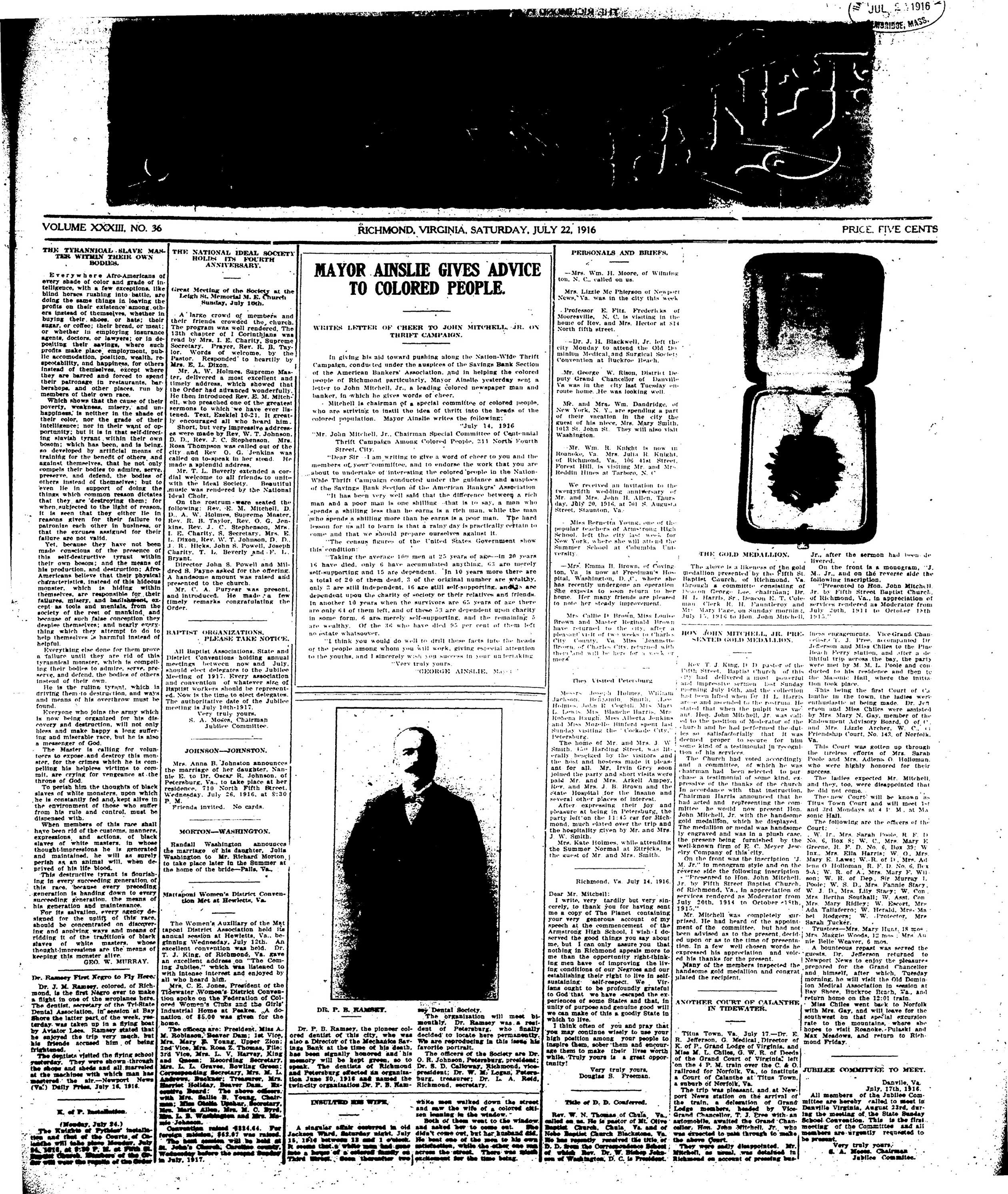
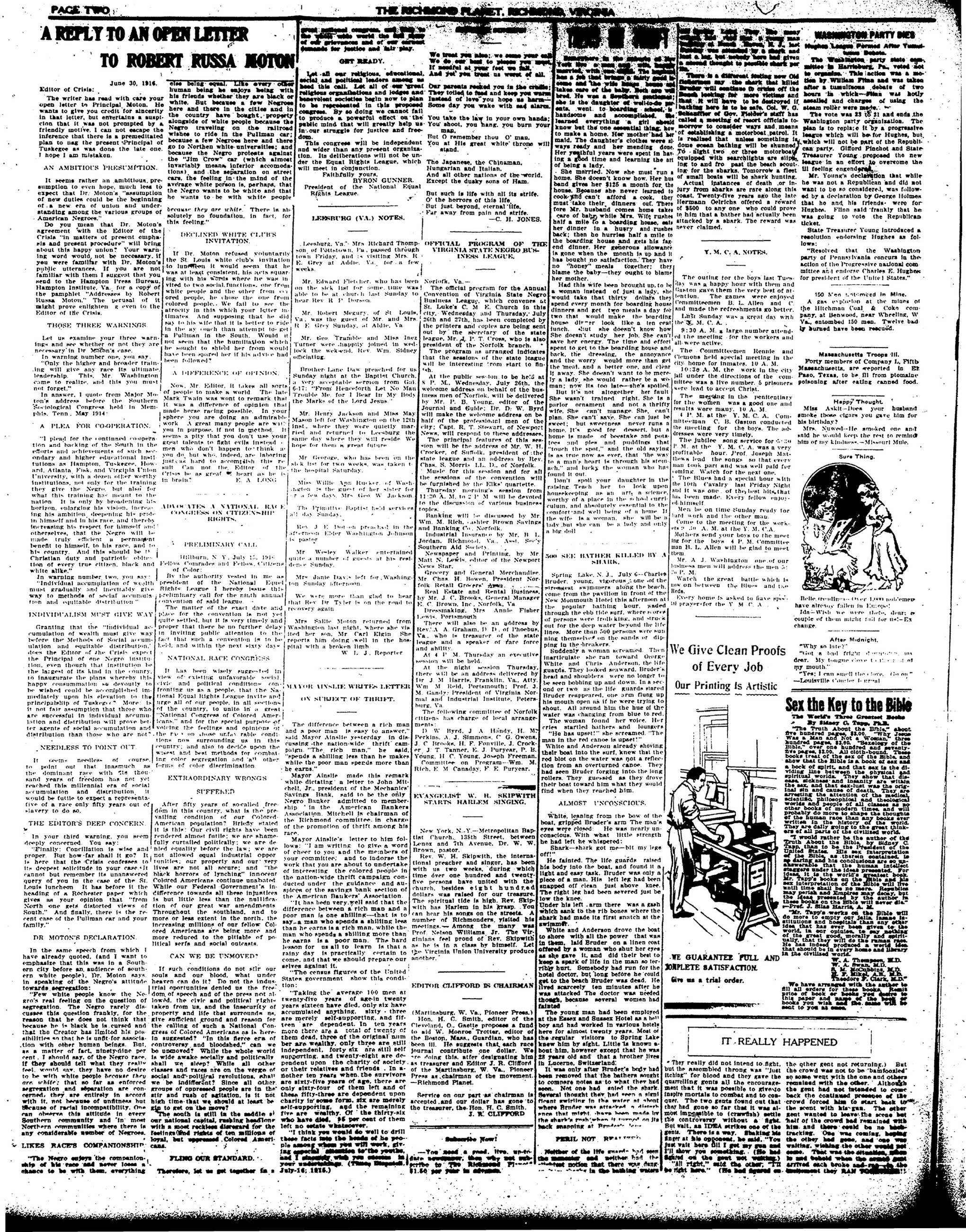
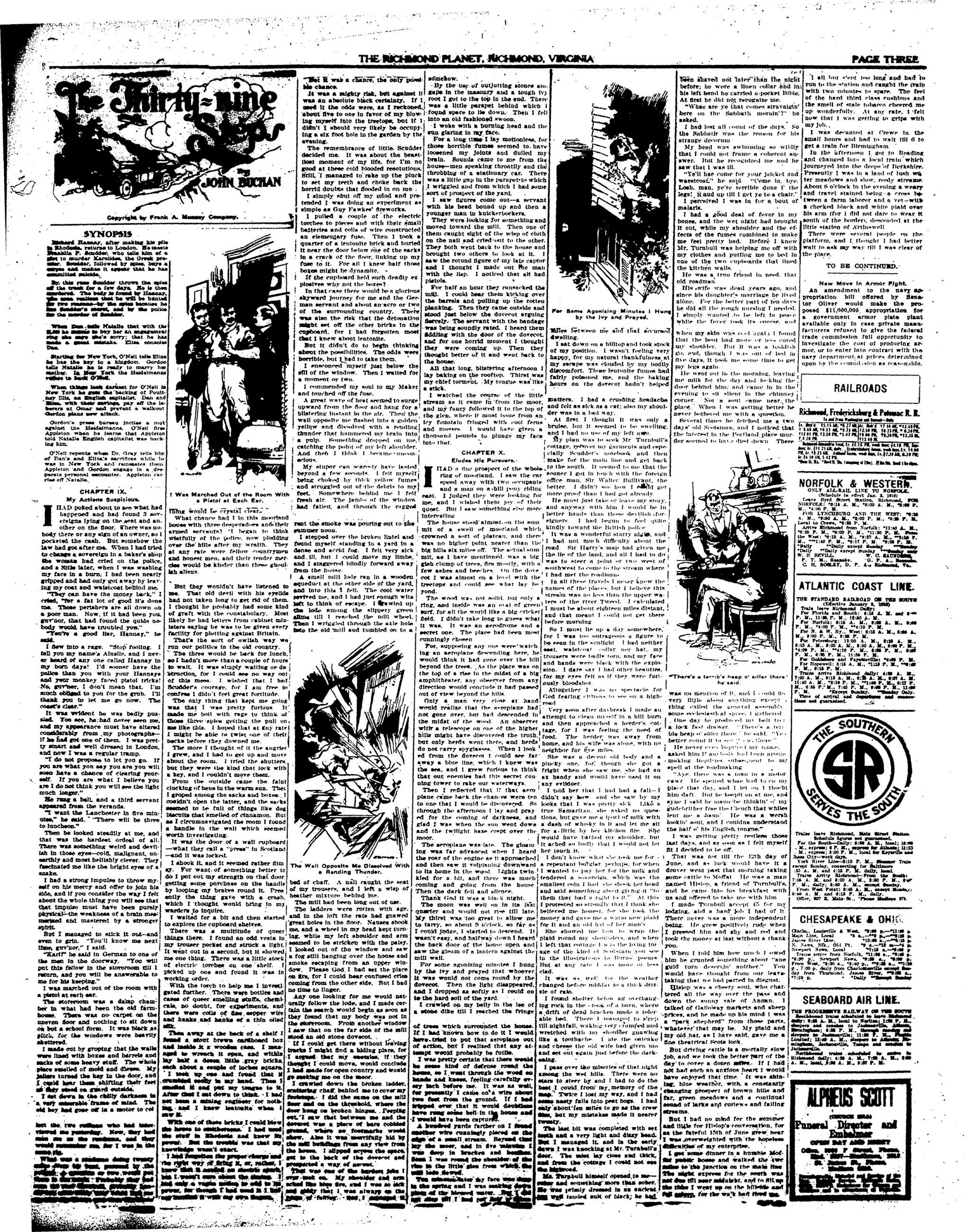
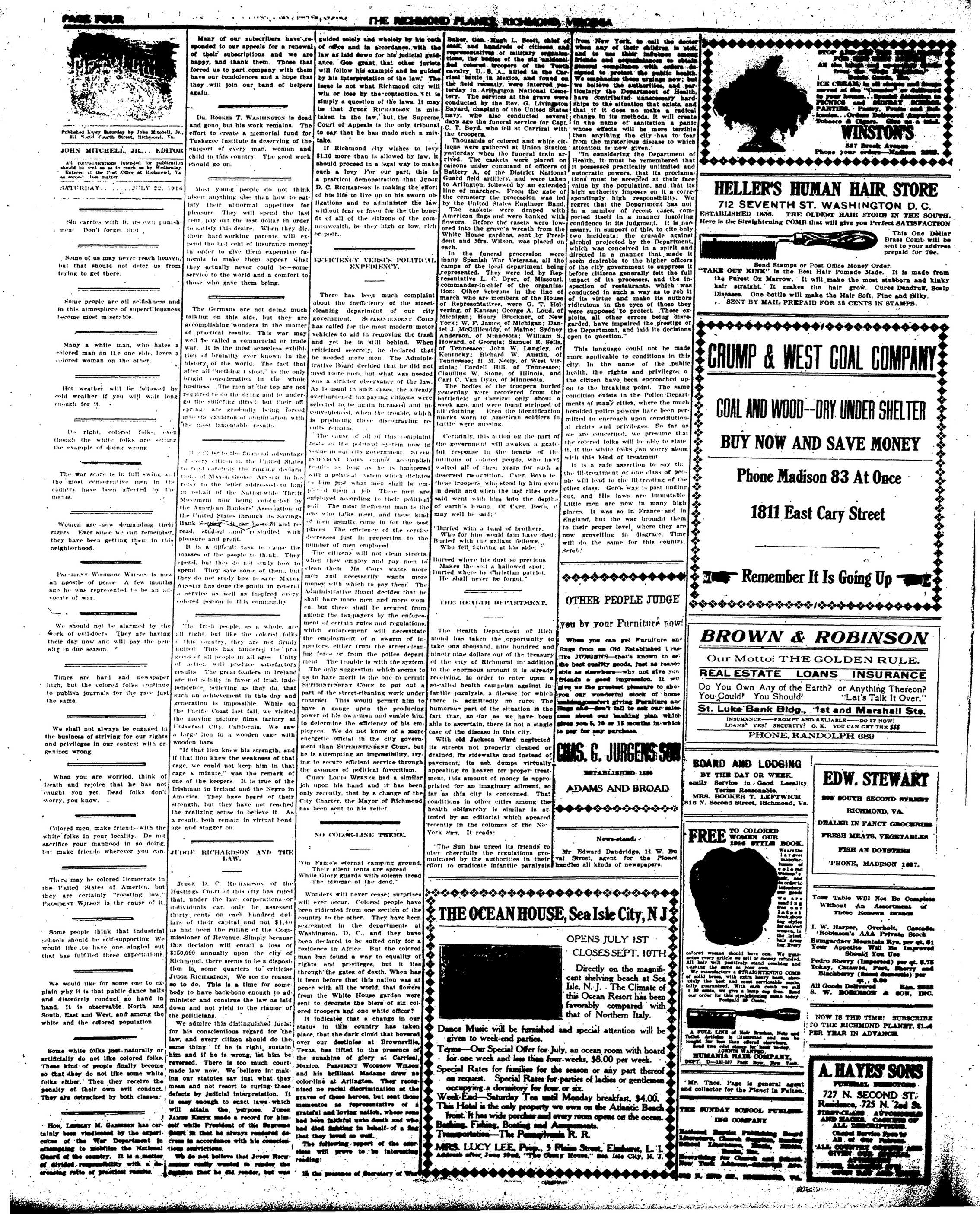
Page text (machine-generated)
VOLUME XXXIII, NO. 36
RICHMOND, VIRGINIA, SATURDAY, JULY 22, 1916
PRICE, FIVE CENTS
THE TYRANNICAL SLAVE MASTER WITHIN THEIR OWN BODIES.
Everywhere Afro-Americans of every shade of color and grade of intelligence, with a few exceptions, like blind horses rushing into battle, are doing the same things in leaving the profits on their existence among others instead of themselves, whether in buying their shoes, or hate; their sugar, or coffee; their bread, or meat; or whether in employing insurance agents, doctors, or lawyers; or in depositing their savings, where such profits make place, employment, public accommodation, position, wealth, respectability, and happiness, for others instead of themselves, except where they are barred and forced to spend their patronage in restaurants, barbershops, and other places, run by members of their own race.
Which shows that the cause of their poverty, weakness, misery; and unhappiness; is neither in the shade of their color, nor the grade of their intelligence; nor in their want of opportunity; but it is in that self-directing slavish tyrant, within their own bosom; which has been, and is being, so developed by artificial means of training for the benefit of others, and against themselves, that he not only compels their bodies to admire, serve, preserve, and defend, the bodies of others instead of themselves; but to even lie in support of doing the things which common reason dictates that they are 'destroying them; for when, subjected to the light of reason, it is seen that they either lie in reasons given for their failure to patronize each other in business, or that the excuses assigned for their failure are not valid.
Yet, because they have not been made conscious of the presence of this self-destructive tyrant within their own bosom; and the means of his production, and destruction; Afro-Americans believe that their physical characteristic, instead of this hideous monster, which is hiding within themselves, are responsible for their failures, misery, and imprisonment, except as tools and meniax, from the society of the rest of mankind, and because of such false conception they despise themselves; and nearly everything which they attempt to do to help themselves is harmful instead of helpful.
Everything else done for them prove a failure until they are rid of this tyrannical monster, which is compiling their bodies to admire, serve, preserve, and defend, the bodies of others instead of their own.
He is the ruling tyrant, which is driving them to destruction, and ways and means of his overthrow must be found.
Everyone who joins the army which is now being organized for his discovery and destruction, will not only bless and make happy a long suffering and miserable race, but he is also a messenger of God.
The Master is calling for volunteers to expose and destroy this monster, for the crimes which he is compelling his helpless victims to commit, are crying for vengeance at the throne of God.
To perish him the thoughts of black slaves of white monsters, upon which he is constantly fed and, kept alive in the environment of those who suffer from his rule and control, must be dispensed with.
When members of this race shall have been rid of the customs, manners, expressions, and actions, of black slaves of white masters, in whose thought-impressions he is generated and maintained, he will as surely perish as an animal will, when deprived of his life blood.
This destructive tyrant is flourishing in every succeeding generation of this race, because every preceding generation is handing down to every succeeding generation, the means of his generation and maintenance.
For its salvation, every agency designed for the uplift of this race, should be concentrated on discovering and ambling ways and means of ridding it of the traditions of black slaves of white masters, whose thought-impressions are the means of keeping this monster alive.
Dr. J. M. Ramsey, colored, of Richmond, is the first Negro ever to make a flight in one of the airplanes here. The dentist, secretary of the Tri-State Dental Association, in session at Bay Shore the latter part of the week, yesterday was taken up in a flying boat by Aviator Leon. Ramsey stated that he enjoyed the trip very much, but his friends accused him of being frightened.
The deputies visited the flying school yesterday. They were shown through the shops and sheds and all marveled at the machines with which man has mastered the air.—Newport News (Va.) Daily Press, July 16, 1916.
K. of P. Installation.
(Monday, July 24.)
The Knights of Pythiae installation and that of the Courts, of Chicago will take place Monday, July 24, 1916, at 8:30 P. M. at Fifth Street Church. Members of the Order will wear the robes of the Order.
THE NATIONAL IDEAL SOCIETY HOLDS ITS FOURTH ANNIVERSARY.
Great Meeting of the Society at the Leigh St. Memorial M. E. Church Sunday, July 16th.
A large crowd of members and their friends crowded the church. The program was well rendered. The 13th chapter of 1 Corinthians was read by Mrs. I. E. Charity, Supreme Secretary. Prayer, Rev. R. B. Taylor. Words of welcome, by the Pastor. Responded to heartily by Mrs. E. L. Dixon.
Mr. A. W. Holmes, Supremo Master, delivered a most excellent and timely address, which showed that the Order had advanced wonderfully. He then introduced Rev. E. M. Mitchell, who preached one of the greatest sermons to which we have ever listened. Text. Eszekel 10-21. It greatly encouraged all who heard him. Short, but very impressive addresses were made by Rev. W. T. Johnson, D. D., Rev. J. C. Stephenson, Mrs. Rosa Thompson was called out of the city and Rev. O. G. Jenkins was called on to speak in her stand. He made a splendid address.
Mr. T. L. Beverly extended a cordial welcome to all friends to unite with the Ideal Society. Beautiful music was rendered by the National Ideal Choir.
On the rostrum were seated the following: Rev. E. M. Mitchell, D. D. A. W. Holmes, Supreme Master, Rev. R. B. Taylor, Rev. O. G. Jenkins, Rev. J. C. Stephenson, Mrs. I. E. Charity, S. Secretary, Mrs. E. L. Dixon, Rev. W. T. Johnson, D. D. J. R. Hleks, John S. Powell, Joseph Charity, T. L. Beverly and F. L. Bryant.
Director John S. Powell and Mildred S. Payne asked for the offering. A handsome amount was raised and presented to the church.
Mr. C. A. Purgey was present, and introduced. He made a few timely remarks congratulating the Order.
BAPTIST ORGANIZATIONS.
PLEASE TAKE NOTICE.
All Baptist Associations, State and District Conventions holding annual meetings between now and July, should elect delegates to the Jubilee Meeting of 1917. Every association and convention of whatever size of Baptist workers should be represented. Now is the time to elect delegates. The authoritative date of the Jubilee meeting is July 10th-1917. Very truly yours. S. A. Moses, Chairman Jubilee Committee.
JOHNSON JOHNSTON.
Mrs. Anna B. Johnston announces the marriage of her daughter, Nannie E. to Dr. Oscar R. Johnson, of Petersburg, Va., to take place at her residence, 710 North Fifth Street. Wednesday, July 26, 1916, at 8:30 P.M. Frienda invited. No cards.
MORTON—WASHINGTON.
Randall Washington announces the marriage of his daughter, Julia Washington to Mr. Richard Morton, to take place later in the Summer at the home of the bride-Pallas, Va.
Mattaponi Women's District Convention Met at Howletta, Va.
The Women's Auxiliary of the Mattaponi District Association hold its annual session at Hewletta, Va., beginning Wednesday, July 12th. An excellent convention was held. Dr. T. J. King, of Richmond, Va. gave an excellent address on "The Coming Jubilee," which was listened to with intense interest and enjoyed by all who heard him.
Mrs. C. E. Jones, President of the Tidewater Women's District Convention spoke on the Federation of Colored Women's Clubs and the Girls' Industrial Home at Peakes. A donation of $5.00 was given for the home.
The officers are: President. Miss A. M. Roblsonan, Beaver Dam; 1st Vice, Mrs. Mary R. Young, Upper Zion; 2nd Vice, Mrs. Rosa Z. Thomas, File; 3rd Vice, Mrs. L. V. Harvey, King and Queen; Recording Secretary, Mrs. L. L. Graves, Bowling Green; Corresponding Secretary, Mrs. M. L. Andrew, Buckner; Treasurer, Mrs. Harriet Holiday, Beaver Dam. Executive Board: The above officers, with Mrs. Sallie B. Young, Chairman; Mimi Chalkie Upnahr, Secretary; Mrs. Maria Allen, Mrs. M. C. Byrd, Mrs. L. B. Washington and Mrs. Marie Johnson.
Convention raised $834.64. For foreign mission, $62.07 was raised. The best question will be held at John's Church, Charlotte county, Wednesday before the second Sunday in July, 1917.
RICHMOND, VIRGINIA, SATURDAY, JULY 22, 1916
MAYOR AINSLIE GIVES ADVICE TO COLORED PEOPLE.
WRITES LETTER OF CHEER TO JOHN MITCHELL, JR. ON
THRIFT CAMPAIGN.
In giving his aid toward pushing along the Nation-Wide Thrift Campaign, conducted under the auspices of the Savings Bank Section of the American Bankers' Association, and in helping the colored people of Richmond particularly, Mayor Alnale yesterday sent a letter to John Mitchell, Jr., a leading colored newspaper man and banker, in which he gives words of cheer.
Mitchell is chairman of a special committee of colored people, who are striving to instil the idea of thrift into the heads of the colored population. Mayor Alnale writes the following:
"July 14, 1916
"Mr. John Mitchell, Jr., Chairman Special Committee of Centennial Thrift Campaign Among Colored People, 311 North Fourth Street, City.
"Dear Sir, I am writing to give a word of cheer to you and the members of your committee, and to endorse the work that you are about to undertake of interning the colored people in the Nation-While Thrift Campaign conducted under the guidance and auspices of the Savings Bank Section of the American Bankers' Association.
"It has been very well said that the difference between a rich man and a poor man is one shilling - that is to say, a man who spends a shilling less than he earns is a rich man, while the man who spends a shilling more than he earns is a poor man. The hard lesson for us all to learn is that a rainy day is practically certain to come and that we should prepare ourselves against it.
"The census figures of the United States Government show this condition:
"Taking the average 100 men at 25 years of age—in 30 years 16 have died, only 6 have accumulated anything, 63 are merely self-supporting and 15 are dependent. In 10 years more there are a total of 20 of them dead, 3 of the original number are wealthy, only 3 are still independent, 16 are still self-supporting, and 23 are dependent upon the charity of society or their relatives and friends. In another 10 years when the survivors are 65 years of age there are only 64 of them left, and of these 53 are dependent upon charity in some form, 6 are merely self-supporting, and the remaining 5 are wealthy. Of the 36 who have died 95 per cent of them left no estate whatsoever.
"I think you would do well to drill these facts into the heads of the people among whom you will work, giving especial attention to the youths, and I sincerely wish you success in your undertaking."
---
[Name]
Dr. P. B. Ramsey, the pioneer colored dentist of this city, who was also a Director of the Mechanics Savings Bank at the time of his death, has been signally honored and his memory will be kept green, so to speak. The dentists of Richmond and Petersburg effected an organization June 50, 1916 and named the twin-city organization Dr. P. B. Ram-
INSULTED MRS WIPK.
A singular affair occurred in old Jackson Ward, Saturday night, July 15, 1916 between 13 and 1 o'clock. It seems that, a white man had gone into a house of a colored family on Third Street. Goen therafter two
"July 14. 1916
German Special Committee of Contennial
ing Colored People, 311 North Fourth
to give a word of cheer to you and the
hand to endorse the work that you are
acting the colored people in the Nation-
cized under the guidance and auspices
of the American Bankers' Association
that the difference between a rich
shilling—that is to say, a man who
earns is a rich man, while the man
can he earns is a poor man. The hard
that a rainy day is practically certain to
separate ourselves against it.
The United States Government show
men at 25 years of age—in 20 years
accumulated anything, 63 are merely
dependent. In 10 years more there are
of the original number are wealthy,
6 are still self-supporting, and 6 are
society or their relatives and friends.
survivors are 65 years of age there
if these 53 are dependent upon charity
self-supporting, and the remaining 5
have died 95 per cent of them left
to drill these facts into the heads
u will work, giving especial attention
fresh you success in your undertaking
truly yours.
GEORGE AINSLIE. N.
Dental Society.
The organization will meet bi-monthly, Dr. Ramsey was a resident of Petersburg, who finally decided to locate here permanently. We are reproducing in this issue his favorite portrait.
The officers of the Society are Dr. O. R. Johnson, Petersburg, president; Dr. S. D. Calloway, Richmond, vice-president; Dr. W. M. Logan, Petersburg, treasurer; Dr. L. A. Reid, Richmond, secretary.
white men walked down the street and saw the wife of a colored citizen leaming in the window.
Both of them went to the window, and asked her to come out. She didn't come out, but her husband did. He bent one of the men to his own satisfaction, while the other one man across the street. There was much excitement for the time being.
PERSONALS AND BRIEF'S.
—Mrs. Wm. H. Moore, of Wilmington, N. C., called on us.
Mrs. Lizzie Mc Pherson of Newport News, Va. was in the city this week
Professor E. Fitz. Fredericks of Mooresville, N. C. is visiting in the home of Rov. and Mrs. Hector at N14 North fifth street.
Dr. J. H. Blackwell, Jr. left the city Monday to attend the Old Do minibn Medical, and Surgical Society Convention at Buckroe Beach.
Mr. George W. Rison, District Deputy Grand Chancellor of Danville Va was in the city last Tuesday on route home. He was looking well.
Mr. and Mrs. Wm. Dandridge, of New York, N. Y., are spending a part of their vacation in the city the guest of his niece, Mrs. Mary Smith, 1013 St. John St. They will also visit Washington.
Mr. Wm. R. Knight is now in Roanoke, Va. Mrs. Julia R. Knight, of Richmond, Va., 105 41st Street, Forest Hill, is visiting Mr. and Mrs. Reddin Hines at Tarboro, N. C.
We received an invitation to the twenty-fifth wedding anniversary of Mr. and Mrs. John H. Allen, Thursday, July 20, 1916, at 701 S. Augusta Street, Staunton, Va.
Miss Bernetta Young, one of the popular teachers of Armstrong High School, left the city last week for New York, where she will attend the Summer School at Columbia University.
Mrs. Emma B. Brown, of Covington, Va. is now at Freedman's Hospital, Washington, D.C., where she has recently undergone an operation. She expects to soon return to her home. Her many friends are pleased to note her steady improvement.
Mrs. Calle D. Brown, Miss Louise Brown and Master Reginald Brown have returned to the city, after a pleasant visit of two weeks to Charles City County, Va. Miss Jeannette Brown, of Charles City, returned with them and will be here for a week or more.
They Visited Petersburg
Messrs Joseph Holmes, William Jackson, Benjamin Smith, Lee Holmes, John R. Coglull, Mrs. Mary L. Lewis, Mrs. Blanche Harris, Mrs. Robena Haugh, Miss Alberta Jenkins and Miss Mozelle Binford spent last Sunday visiting the "Cookade City" Petersburg.
The home of Mr. and Mrs. J. W. Smith, 650 Harding Street, was literally besieged by the visitors and the host and hostess made it pleasant for all. Mr. Irvin Grey soon joined the party and short visits were paid Mr. and Mrs. Arkell Ampoy, Rev. and Mrs. J. B. Brown and the state Hospital for the Innae and several other places of interest.
After expressing their joy and pleasure at being in Petersburg, the party left on the 11:45 car for Mcchond, much elated over the trip and the hospitality given by Mr. and Mrs. J. W. Smith.
Mrs. Kate Holmes, while attending the Summer Normal at Ettricks, is the guest of Mr. and Mrs. Smith.
Richmond, Va. July 14, 1916.
Dear Mr. Mitchell:
I write, very tardily but very sincerely, to thank you for having sent me a copy of The Planet containing your very generous account of my speech at the commencement of the Armstrong High School. I wish I deserved the good things you say about me, but I can only assure you that nothing in Richmond appeals more to me than the opportunity right-thinking men have of improving the living conditions of our Negroes and our establishing their right to live in self-sustaining self-respect. We Virians ought to be profoundly grateful to God that we have escaped the experiences of some States and that, in unity of purpose and genuine good will we can make of this a goodly State in which to live.
I think often of you and pray that you may continue wisely to use your high position among your people to inspire them, sober them and encourage them to make their lives worth while. Truly yours is a great opportunity!
Very truly yours,
Douglas S. Freeman.
Title of D. D. Conferred.
Rev. W. N. Thomas of Chula, Va. called on an a. He is pastor of Mt. Olive Baptist Church, Chula, Va. and of Nobe Baptist Church Blackstone, Va. He has recently received the title of D. D. from the Correspondence School of which Rev. Dr. W. Bliss Johnson of Washington, D. C. is President.
A
THE GOLD MEDALLION.
The above is a likeness of the gold medallion presented by the Fifth St. Baptist Church, of Richmond, Va. through a committee consisting of Deacon George Loe, chairman; Dr H. L. Harris, Sr., Deacon E. T. Coleman, Clerk R. H. Pauntieroy and Mr. Mary Page, on Sunday morning, July 15, 1916 to Hon. John Mitchell.
HON JOHN MITCHELL, JR. PRESENTED GOLD MEDALION
---
Rev T. J. King, D. D. pastor of the Fifth Street, Baptist Church of this city had delivered a most powerful and impressive sermon last Sunday morning July Fifth, and the collection had been lifted when Dr H. L. Harris arrived and ascended to the rostrum. He stated that when the pulpit was vacant, Hon. John Mitchell, Jr. was called to the position of Moderator of the church and he had performed the duties so satisfactorily that it was deemed proper to secure for him some kind of a testimonial in recognition of his services.
The Church had voted accordingly and a committee, of which he was chairman had been selected to purge a testimonial of some kind, expressive of the thanks of the church. In accordance with that instruction, Chairman Harris announced that he had acted and representing the committee he would now present Hon. John Mitchell, Jr. with the handsome gold medalion, which he displayed. The medalion or medal was handsomely engraved and was in a plush case, the present being furnished by the well-known firm of E. C. Meyer Jewelry Company of this city.
On the front was the inscription 'J. M. Jr.' in monogram style and on the reverse side the following inscription
"Presented to Hon. John Mitchell Jr. by Fifth Street Baptist Church, of Richmond, Va., in appreciation of services rendered as Moderator from July 20th, 1914 to October 19th, 1915."
Mr. Mitchell was completely surprised. He had heard of the appointment of the committee, but had not been advised as to the present, decided upon or as to the time of presentation. In a few well chosen words he expressed his appreciation and voiced his thanks for the present.
Many of the members inspected the handsome gold medallion and congratulated the recipient.
ANOTHER COURT OF CALANTHE IN TIDEWATER.
Titus Town, Va. July 17—Dr. E. R. Jefferson, G. Medical, Director of K. of P., Grand Lodge of Virginia, and Miss M. L. Chiles, G. W. R. of Deeds of the Grand Court of Virginia, left on the 4 P. M. train over the C. & O. railroad for Norfolk, Va., to institute a Court of Calanthe at Titus Town, a suburb of Norfolk, Va.
The trip was pleasant, and at Newport News station on the arrival of the train, a delegation of Grand Lodge members, headed by Vice-Grand Chancellor, T. J. Prue with an automobile, awaited the Grand-Chancellor, Hon. John Mitchell, Jr., who was expected to pass through to make the above Court.
They were easily disappointed. Mr. Mitchell, as usual, was detailed in Richmond on account of pressing bus
PRICE. FIVE CENTS
```markdown
```
Jr., after the sermon had been delivered.
On the front is a monogram, "J. M. Jr., and on the reverse side the following inscription.
"Presented to Hon. John Mitchell Jr. by Fifth Street Baptist Church, of Richmond, Va., in appreciation of services rendered as Moderator from July 20th, 1914 to October 19th, 1915."
iness engagements. Vice Grand Chancellor T. J. Pree, accompanied Dr. Jefferson and M. Miss Chiles to the Pine Beach Ferry station, and after a dullful trip across the bay, the party were met by M. M. L. Poole and conducted to his residence and then to the Masonie Hall, where the initiation took place.
This being the first Court of Canthare in the town, the ladies were enthusiastic at being made. Dr. Jefferson and Miss Chiles were assisted by Mrs. Mary N. Gay, member of the Endowment Advisory Board, O. of C, and Mrs. Lizzle Archer, W. C., of Friendship Court, No. 143, of Norfolk, Va.
This Court was gotten up through the tireless efforts of Mrs. Sarah Poole and Mrs. Adrena O. Holloman, who were highly honored for their success.
The ladies expected Mr. Mitchell, and they, too, were disappointed that he did not come.
The new Court will be known as Titus Town Court and will meet 1st and 3rd Mondays at 4 P. M. at Ma sonic Hall.
The following are the officers of the Court:
W. I. Mrs. Sarah Poole, R. F. D. No. 6, Box 8; W. C., Mrs. Mary E. Greene, R. F. D. No. 6, Box 39; W. Inx., Mrs. Ella Harris; W. O., Mrs. Mary E. Laws; W. R. of D., Mrs. Adema O. Holloman, R. F. D. No. 6, Box 9; W. R. of A., Mrs. Mary F. Wilson; W. R. of Dep, Sir Murray L. Poole, W. S. D., Mrs. Fannie Stary, W. J. D., Mrs. Lily Stary; W. Con, Mrs. Bertha Southall; W. Asst. Con, Mrs. Mary Ridley; W. Escort, Mrs. Ada Tallferro; W. Herald, Mrs. Mael Rodgern; W. Protector, Mrs Sarah Tucker.
Trustees—Mrs. Mary Hunt, 18 mos. Mrs. Maggie Woods, 12 mos. Mrs. Annie Belle Weaver, 6 mos.
A bounteous repast was served the guests. Dr. Jefferson returned to Newport News to enjoy the pleasures prepared for the Grand Chancellor and himself, after which, Tuesday morning, he will visit the Old Dominion Medical Association in session at Ray Shore, Buckroe Beach, Va., and return home on the 12:01 train.
Miss Chiles went back to Norfolk with Mrs. Gay, and will leave for the southwest on that special excursion rate to the mountains, where she hopes to visit Roanoke, Pulsaski and Max Meadows, and return to Richmond Friday.
JUBILEE COMMITTEE TO MEET
Danville, Va
July. 17th. 1916.
July, 1916
All members of the Jubilee Committee are hereby called to meet in Danville Virginia, August 23rd, during the meeting of the State Sunday School Convention. This is the first meeting of the Committee and all members are urgently requested to be present.
Very truly yours,
G. A. Moeen, Chairman
Jubilee Committee.
A REPLY TO AN OPEN LETTER TO ROBERT RUSSA MOTON
PAGE TWO
June 30. 1916.
Editor of Crisis:
The writer has read with care your open letter to Principal Moton. He wants to give you credit for sincerity in that letter, but entertains a suspicion that it was not prompted by a friendly motive. I can not escape the inference that there is a premeditated purpose behind the Principal of Tuskegee as was done the late one. I hope I am mistaken.
AN AMBITIOUS PREEMPTION
It seems rather an ambiguous, presumption to even hope, much less to expect that Dr. Moton's "assumption of new duties could be the beginning of a new era of union and understanding among the various groups of American Negroes. Do you mean that Dr. Moton's agreement with the Editor of the Crisis "in matters of present emphasis and present procedure" will bring about this happy union? Your warning word would, not be necessary. If you were familiar with Dr. Moton's public utterances. If you are not familiar with them I suggest that you send to the Hampton Press Bureau, Hampton Institute, Va., for a copy of the pamphlet "Robert R. Moses." The personal it might prove enlightening given to the Editor of the Crisis.
THOSE THREE WARNINGS
Let us examine your three warnings and see whether or not they are necessary in Dr. Moffa's case.
In warning number one, you say, "Only the higher and broader training will give any race its ultimate leadership. This, Mr. Washington come to realize, and this you must not forget."
In answer, I quote from Major Moton's address before the Southern Sociological Congress held in Memphis, Tenn. May 1914:
A PLEA FOR CO-OPERATION
"I plead for the continued cooperation and backing of the South in the efforts and achievements of such non-ordinary and higher educational institutions as Hampton, Tuskegee, Howard, Atlanta Fisk, and Virginia Union University, with a dozen other worthy institutions, not only for the training they give the Negro, but also for what this training has meant to the nation. It is only by broadening his horizon, enlarging his vision, increasing his ambition, depending his perseverance himself and in his race, and thereby increasing his respect for himself and others, that the Negro will be made truly efficient a permanent benefit to himself, to his race, and to his country. And this should be the Christian duty and patriotic objection to true citizen, black and white alike."
In warning number two, you say: "Individual accumulation of wealth must gradually and inevitably give way to methods of social accumulation and compatible distribution."
INDIVIDUALISM MUST GIVE WAY
Granting that the "individual accumulation of wealth must give way before the Methods of Social accumulation and equitable distribution," does the Editor of the Crisis expect the Principal of one Negro institution, even though that institution be the largest of its kind in the country, to inaugurate the plans whereby this happy consumption so devoutly to be wished could be accomplished immediately upon his elevation to the principalship of Tuskegee. More: it is not fair assumption that those who are successful in individual accumulation and distribution will prove better agents of social accumulation and distribution than those who are not
NEEDLESS TO POINT OUT
It seems needless of course to point out that inasmuch as the dominant race with its thou sand years of freedom has not yet reached this millennial era of social accumulation and distribution, it would be futile to expect a representative of a race only fifty years out of slavery to do so.
THE EDITOR'S DEEP CONCERN.
In your third warning, you seem deeply concerned. You say:
"Finally: Conciliation is wise and proper. But how far shall it go? It is here that the Crisis confesses to its deepest solicitude in your case: it cannot but remember its unanswered plea of years in the St. Lucia luncheon. It has before it the heading of a Rochester paper which gives as your opinion that "from North one gets distorted views of South." And finally, there is the recent case of the Pullman car and your family."
DR MOTON'S DECLARATION
In the same speech from which I have already quoted, (and I want to emphasize that this was in a Southern city before an audience of southern people) Dr. Moton says smoking is the Negro's attitude inwardly segregation:
"Few white people know the Negro's real feeling on the question of segregation. The Negro rarely discusses this question frankly, for the reason that he does not think that because he is black he is cursed and that the Creator has limited his possibilities so that he is unit for association with other human beings. But, as a matter of fact, ninety-nine percent I should say of the Negro race you would call black, you feel would like they have no desire to be with white people because they are white; that so far as enforced segregation and separation are concerned, they are entirely in accord with it, not because of unfitness but because of racial incompatibility. One can observe this attitude in every Southern community and 'in' most Northern communities where there is any considerable number of Negroes.
LIKES RACE'S COMPANIONSHIP
"The Negro enjoys the companionship of his race and never loses a chance to be with them, everything
also being equal. Like every other human being he enjoys being with his friends whether they are black or white. But because a few Negroes here and there in the cities and in the country have bought, property alongside of white people because the Negro traveling on the railroad wishes to ride in the Pullman car; because a few Negroes here and there go to Northen white universities; and because the Negro protests against the "Jim Crow" car (which almost invariably means inferior accommodations) and the separation on street sees the feeling in the midst of the avrage white person in pursuit that the Negro wants to be white and that he wants to be with white people because they are white. There is absolutely no foundation, in fact, for this feeling."
DECLINED WHITE CLUBS
INVITATION.
If Dr. Moton refused voluntarily the St. Louis white club's invitation to function it would seem that he was at least consistent, his acts squarring with his social functions, where he was invited to two social functions, one from white people and the other from colored people. We fail to see the atrocity in this which your letter intimates. And supposing that he did say to his wife that it is better to ride in the ay coach than attempt to get a Pullman in the South. Would it not seem that the humiliation which he sought to shield her from would have been spared her if his advice had been followed?
A DIFFERENCE OF OPINION.
Now, Mr. Editor, it takes all sorts of people to make a world. The late Mark Twain was wont to remark that it was a difference of opinion that made horse racing possible. In your sphere you are doing an admirable work. A great many people are wait you in purpose, if not in method. It seems a pity that you don't use your great talents to fight evils instead men who don't happen to think as you do, but who, indeed, are laboring just as hard to accomplish this result. Can not the Editor of the Crisis be as great heart as he is in brain? E. A. LONG
ADVOCATES A NATIONAL RACE
CONGRESSION AT TITIZANSHIP
PRELIMINARY CALL
Hillburn, N. Y. July 15, 1991
Fellow Conrades and Fellow Citizens of Color:
the authority vested in me as president of the National Equal Rights League I hereby issue this preliminary call for the ninth annual convention of sold league.
The matter of the exact date and place for the convention is not yet quite settled, but it is very timely and proper that there be no further delay in inviting public attention to the fact that such a convention is to be held, and within the next sixty days.
NATIONAL RACE CONGRESS
It has been wisely suggested in view of existing unfavorable social, civic and political conditions confronting us as a people, that the National Equal Rights League invite and urge all of our people, in all sections of the country, to unite in a great "National Congress of Colored Americans" and for the special purpose of voting the feelings and opinions of the race on those unfairable conditions now surrounding us in this country; and also to decide upon the wisest and best methods for combating color segregation and all other forms of color discrimination.
EXTRAORDINARY WRONGS
SUFFELED
After fifty years of so-called free dem in this country, what is the prevailing condition of our Colored American population? Briefly stated it is this: Our civil rights have been rendered almost futile; we are shamefully curtitled politically; we are denied equality before the law; we are not allowed equal industrial opportunities; our property and our very lives are not all secure; and "the black horrors of lynching" innocent Colored Americans continue unabated. While our Federal Government's difference towards all these injustices is but little less than the multifaceted injustices throughout the southland, and to more or less extent in the north, the increasing millions of our fellow Colored Americans are being more and more reduced to the pitiful of political serfs and social outcasts.
CAN WE BE UNMOVED?
If such conditions do not stir our souls and our blood, what under heaven can do it? Do not the industrial opportunities denied us the freedom of speech and of the press not allowed, the civic and political right-taken from us, and the insecurity of property and life that surrounds us give sufficient ground and reason for the calling of such a National Congress of Colored Americans as in here in suggested? "In this fierce era of controversy and bloodshed," can we be unmoved? While the whole world is wide awake socially and politically shall we sleep? While all other classes and races are on the verge of social and political revolutions, be indifferent? Be indifferent? Other groups of oppressed people are in the stir and rush of agitation, is it not high time that we should at least begin to get on the move?
The south is still in the middle of our national capital, rushing headwinds with a most reckless disarray for the feelings and rights of ten millions of loyal, but appressed Colored Americans.
FLING OUR STANDARD. . .
Therefore, let us get together for a
THE RICHMOND PLANET, RICHMOND, VIRGINIA
good national congress, and likely to
the world, while the world will the bulk
of our grievances and of our current
demands for justice and fair play.
Let all our religious, educational social and political leaders among us head this call. Let all of our great religious organizations and lodges and benevolent societies begin now to plan to be represented in this proposed congress. By so doing we cannot fail to produce a powerful effect on the public mind that will greatly help us in our struggle for justice and freedom.
This congress will be independent and wider than any present organization. Its deliberations will not be under the Equal Rights League, which will meet in conjunction.
Faithfully yours,
BYRON GUNNER.
President of the National Equal Rights League.
LEBSBURG (VA.) NOTES.
Loeburg, Va.; Mrs. Richard Thompson of Pottstown, Pa. passed through town Friday, and is visiting Mrs. R E. Grey at Addie, Va. for a few weeks.
Mr. Edward Fletcher, who has been on the sick list for some time was able to at church last Sunday to hear Rev R P Dorson.
Mr. Robert Megury of St Louis, Va. was the guest of Mr. and Mrs. R E Grey Sunday, at Addie, Va.
Mr. Geo Tramble and Miss Inez Turner were happily joined in wedlock the week-end, Rev Wm. Sidney officiating.
Brother Lane How preached for us Sunday night at the Baptist Church a very acceptable sermon from Gal 6:17; "From Henceforth Let No Man Trouble Me for I Bear In My Body the Marks of the Lord Jesus."
Mr. Henry Jackson and Miss May Mason left for Washington on the 12th inst., where they were quietly married and returned to Leesburg the same day where they will reside. We hope for them a great future.
Mr. George, who has been on the slok list for two weeks, was taken to the hospital Saturday.
Miss Willie Ann Rucker of Washington is the guest of her sister for a few days. Mrs. Gee W. Jackson.
The Primitive Baptist held services all day Sunday.
Rev J. E. Dotson preached in the afternoon Elder Washington Johnson is pastor.
Mr. Wesley Walker entertained quite a number of guests at his residence Sunday.
Mrs. Janie Days left for Washington Sunday afternoon.
We were more than glad to hear that Rev Dr Tyler is on the read to recovery again.
Mrs. Salile Moton returned from Washington last night, where she visited her son, Mr. Carl Elgin. She reports him doing well in the hospital with a broken limb.
W. L. J. Reporter
MAYOR AINSLIE WRITES LETTER
ON SUBJECT OF THRIFT
The difference between a rich man and a poor man is easy to answer," said Mayor Ainsley yesterday in discussion the nation-wide thrift campaign. "The rich man," he said, "spends a shilling less than he makes while the poor man spends more than he earns.
Mayor Ainsley made this remark when distracting a letter to John Mitchell, Jr., president of the Mechanics' Savings Bank, said to be the only Negro Banker admitted to membership in the American Bankers Association. Mitchell is chairman of the Richmond committee, in charge of the promotion of thrift among his race.
Mayor Ainsley's letter to him follows: "I am writing to give a word of cheer to you and the members of your committee; and to indorse the work that you are to undertake in the nation-wide thrift campaign conducted under the guidance and aids of the savings bank section of the American Bankers' Association.
"It has been very, well said that the difference between a rich man and a poor man is one shilling—that is to say, a man who spends a shilling less than he earns is a rich man, while the man who spends a shilling more than he earns is a poor man. The hard lesson for us all to learn is that a rainy day is practically certain to come, and that we should prepare our selves against it.
"The census figures of the United States government show this condition:
"Taking the average 100 men an twenty-five years of age in twenty years sixteen have died, only six have accumulated anything, sixty-three are merely self-supporting, and fifteen are dependent. In ten years more there are a total of twenty of them dead, three of the original num ber are wealthy, only three are still independent, forty six are still self-supporting, and twenty-eight are dependent upon the charity of society or their relatives and friends. In another ten years when the survivors are sixty-five years of age, there are only sixty-four of them left and of these fifty-three are dependent upon charity in some form sixteen are self-supporting and the remaining thirty. Of the thirty-six who have died, 95 per cent of them left no estate whatsoever.
"I think you would do well to drill these facts into the heads of the people among whom you will work, giving special attention to the youth, and I shouldly with you encourage in your understandings. (Thomas Hippad.) July-16, 1815.)
---
We treat you also; we come your end
We do our best to please you need
If miscellaneous at your feet we fail.
And yet you treat us worst of all.
Our parents rocked you in the crises;
They tottled to feed and keep you warm
Instead of love you hope us harm—
Some day you wake with sad alarm.
You take the law in your own hands;
You shoot, you hang, you burn your
man,
But O remember thou O'man,
You at His great white throne will
stand.
The Japanese, the Chinaman,
Hungarian and Italian,
And all other nations of the world.
Except the dukey sons of Ham.
But such is life with all its strife.
O' the horrors of this life,
But just beyond, eternal life,
Far away from pain and strife.
—C. H. IONES
OFFICIAL PROGRAM OF THE VIRGINIA STATE NEGRO BUSINESS LEAGUE.
Norfolk, Va. —
The official program for the Annual Convention of Virginia State Negro Business League, which convenes at St. Luke's C. M. E. Church in this city, Wednesday and Thursday; July 31, which has been completed by the printers and editors, out by the secretary of the state league, Mr. J. P. T. Cross, who is also president of the Norfolk branch.
The program as arranged indicates that the sessions of the state league will be interesting from start to finish.
At the public session to be held at S P. M. Wednesday, July 26th, the welcome address on behalf of the business men of Norfolk, will be delivered by Mr. P. B. Young, editor of the Journal and Guide; Dr. D. W. Byrd will make the welcome address on behalf of the professional men of the city; Capt. R. T. Stewart, of Newport News, will respond to these addresses.
The principal features of this session will be the address of Mr. W. H. Crocker, of Suffolk, president of the state league and an address by Rev. Chas. S. Morris, L.L. D., of Norfolk.
Mike's session and for all the sessions of the convention will be furnished by the Elke'sattle.
Thursday morning's session from 11:20 A. M. to 2 P. M. will be devoted to the discussion of various business topics.
Banking will be discussed by Mr. Wm. M. Rich, Ashler Brown Savings and Banking of Norfolk.
Industrial Insurance by Mr. B. L. Jordan, Richmond, Va., Assist. Secretary Southern Aid Society. Newspaper and Printing, by Mr. Matt N. Lewis, editor of the Newport Grocery and General Merchandise Mr. Chas H. Bowen, President Norfolk Retail Grocers' Assist.
Real Estate and Rental Business by Mr. J. C. Brooks, General Manager E. C. Brown, Inc., Norfolk, Va.
Dressmaking, Mrs. Annie Flisher
Lewis, Portsmouth
There will also be an address by
Rev. A. A. Graham, D. D. of Phoebe,
Va., who is treasurer of the state
league and a speaker of rare force
and ability.
M. M. Thursday an executive
session will be held.
At the night session Thursday,
there will be an address delivered by
Dr. J. M. Harris, Franklin, Va., Atty.
Wm. M. Relfs, Portsmouth; Prof. J.
M. Gandy; President of Virginia Normal
and Industrial Institute, Petersburg,
Va.
The following committee of Norfolk
citizens has charge of local arrangements:
W. Hyrd, J. A. Hindy, H. M.
Porkins, A. J. Simmons, C. G. Owens,
C. J. Brooks, H. F. Fonville, J. Crocker,
J. T. Tanner, E. J. Puryear, P. H.
Young, H. C. Young, Joseph Freeman,
Committee on Program—Wm. M.
Rich, E. M. Canaday, F. E. Puryear.
EVANGELIST W. R. SKIPWITH STARTS HARLEM SINGING.
---
New York, N.Y.-Metropolitan Baptist Church, 138th Street, between Lenox and 7th Avenue, Dr. W. W. Brown, pastor.
Rev. W. H. Skipwith, the international preacher and singer, has been with us two weeks, during which time over one hundred and twenty-five persons have united with the church, besides eight hundred dollars was raised for our treasure. The spiritual tide is high. Rev. Skipwith has Harlem in his krasp. You can hear his songs on the streets. A number of Richmonders did his work — Rings did many was Prof. Nelson Williams Jr. The Virginiaans feel proud of Rev. Skipwith as he is in a class by himself. Let the Virginia Union University produce another.
EDITOR CLIFFORD IS CHAIRMAN
(Martinburg, W. Va., Pioneer Press.)
Hon. H. C. Smith, editor of the
Cleveland, O. G.ette proposes a fund
to aid W. Monroe Trotter, editor of
the Boston, Mass., Guardian, who has
been ill. He suggests that each race
journal contribute one dollar. We
are doing this, after designating him
as treasurer and Editor J. R. Clifford
of the Martinburg, W. Va., Pioneer
Press as chairman of the movement.
—Richmond Planet.
Service on our part as chairman is
accepted, and our dollar has gone to
the treasurer, the Hon. H. C. Smith.
J. R. CLIFFORD
Subscribe Now!
You need a road. Live, update
date newspaper, then why not sub
peribe to The Ridgemond Place
$1.50 per year in advance.
Somewhere in the suburbs of New York live a man and with her husband, with one daughter. The husband has a job that brings a hardy good life to some and the wise house and takes care of the baby. Both are well bred. He was a Southern gentleman; she is the daughter of well-do parson event, to boarding school, is handsome and accomplished. She learned everything the girl knew but but the one essential thing he to make a home. Her mother had her maid. The daughter's clothes were always ready and her mending done. Her youthful years were spent in having a good time and learning the art of being a lady.
She married. Now she must run a home. She doesn't know how. Her husband gives her $125 a month for the house. Because she never learned to cook and can't afford a cook, they must take their, dinners out. There fore Mr. husband comes home take care of baby while Mrs. Wife rushes half a mile to a boarding house, eats her dinner in a hurry and rushes back; then he hurries half a mile to the boarding house and gets his flag end dinner. Her generous allowance is gone when the month is up and it has bought no satisfaction. They have no "honey" meals together; they blame the baby—they ought to blame her mother.
Had this wife been brought up, to be a woman instead of just a lady, she would take that thirty dollars she spend every month for boarding house dinners and get two meals a day for two that would make the boarding house driver look like a ten cean lunch. Sut. she doesn't know how She doesn't study her job. She can't save her energy. The time and effort spent to get to the boarding house and back, the dressing, the annoyance and the worry would more than get the meal, and a better one, and clean it away. She doesn't want to be merely a lady, she would rather be a woman; now its too late--she's applied. But it's not altogether her fault. She wasn't taught. She isn't a ornament and not that thirty wife. She can't manage. She can't plan. She can't say. She can just be sweet; but sweetness never runs a home. It is good for dessert, but a home is made of beetle and potatoes and pies and puddings that "touch the spot," and the old saying is as true now as ever, that "the way to a man's heart is through his stomach," and lucky the woman who has found it out.
Don't spell your daughter in the raiding. Teach her to look upon housekeeping as an art, a science worthy of a place in the school curriculum, and absolutely essential to the comfort and well being of her life. After a tenure, she will be a lady but she can be a lady and only a big doll.
500 SEE BATHER KILLED BY A SHARK.
Spring Lake, N. J., July 6-Charles Bruder, young, vigorous, one of the strongest swimmers along the beach, come from the pavilion in front of the New Monmouth Hotel this afternoon at the popular battling hour, waded through the ebb tide surf, where scores of persons were frothing, and struck out for the deep water beyond the lifelines. More than 500 persons were sinking themselves on the sands or dipping in the breakers, and screamed. Then particulate she ran toward George White and Chris Anderson, the life-guards. They looked seaward. Bruder's head and shoulders were no longer to be seen hobbling up and down. In a second or two as the life guards guarded Bruder reappeared, one arm flung up his mouth open as if he were trying to shout. All around him the hue of the water was changing from blue to red.
The woman found her voice. Her cries startled hathers and loungers "He has upset!" she screamed. "The man in the red canoe is upset!" White and Anderson already shoving their boat into the surf, knew that the red blot on the water was not a reflection from an overturned canoe. They had seen Bruder forging into the long rollers. They guessed as they drove their boat toward him what they would find when they reached him.
ALMOST UNCONSCIOUS.
White, leaning from the bow of the boat, gripped Bruder's arm. The man's eyes were closed. He was nearly unconscious. With what little strength he had left he whispered: Shark—shark got me—bit my leg off!" He fainted. The life guards raised his body into the boat, and found it a light and easy task. Bruder was only a piece of a man. His left leg had been snapped off clean just above knee. The right leg had been severed just below the knee. Under his left arm there was a gash which sank to the rib bones where the shark had made its first snatch at the swimm
White and Anderson drove the boat to shore with all the power that was in them, laid Bruder on a linen coat offered by a woman who shut her eyes as she gave it, and did their best to keep a spark of life in the man so terrifying hurt. Somebody had run for the hotel doctor, but long before he could get to the beach Bruder was dead. He lived scarcely ten minutes after he was attacked. The doctor was needed though, because several women had falted.
The young man had been employed at the Essex and Sussex Hotel as a hell boy and had worked in various hotels here for almost twenty years. Most of the regular visitors to Spring Lake knew him by sight. Little is known about him, however except that he was 28 years old and that a brother lives in Lucerne, Switzerland.
It was only after Bruder's body had been removed that the bathers sought to compare notes as to what they had seen. Not one had soiled the shark. Several thought they had seen a similar swelling in the water at where Bruder was attacked a distance once that might have been made by the shark's grasp when it turned on its back scanning at Bruder's loot.
PERIL NOT REALIZED
Mother of the life award had seen the mummies and mother had the smallest notion that there was danger in the building waters
His family loved Taye. He many
times had told him a young man
would be much better. H. J. had
housing was provided by a shark and
had a cat, but nobody here had given
a moral thought to possible shark per se.
There is a different feeling new C.O. fisherman say the shark that killed Bruder will continue to cruise off the beach looking for more victims and that it will have to be destroyed if bathing here is to be safe. Col. W. G. Skissaker of Gov. Fielder's staff has called a meeting of resort officials to tomoor to consider ways and means of establishing a motorboat patrol. It is realized that unless something is done ocean bathing will be shunned. To night two or three motorboat equipped with searchlights are slipping to and fro past the beach scouting for the sharks. Tomorrow a fleet of small boats will be shark hunting. Equipment of death from jaws are rare along this coast. Twenty-five years ago the late Hermann C. Richels offered a reward of $500 to any one who could prove to him that a bather had actually been attacked by a shark. The reward was never claimed.
Y. M. C. A. NOTES.
The outing for the boys last Tuesday was a happy hour with them and Gaston gave them the very best of attention. The games were enjoyed Committeemen B. L. Allen and C and made the refreshments go better. Last Sunday was a great day with the M. C. A.
9:30 A. M. a large number attended the meeting for the workers and all were active.
The Committeemen Rennie and Clemons held special meeting in the city home for inmates. 10 A. M.
10:30 A. M. the work in the city jail under the directions of the committee was a five number. 5 prisoners were lead to accept Christ.
The meeting in the penitentiary for the prisoner was a good one and results were good.
4 P. M. at the Y. M. C. A.
Committeeman C. B. Gaston conducted the meeting for the boys. The addresses were very timely.
The Jubilee song service for 50
P.M. at the Y. M. C. A. was a very
profitable hour. Prof. Joseph Matthews
leads the songs so that every man took part and was well paid for
coming. Watch for the next one.
The Blues had a special hour with
the 10th Cavalry last Friday Night
and it was one of the best bites that
has been made. Every fellow enjoyed
himself.
Men be on time Sunday ready for
hard work and the other man.
Come to the meeting for the work.
Mr. A. J. Washington one of our business men will address the men 5:00 P. M.
Watch the great battle which is now on between the Blues and the Reds.
Every home is asked to have special prayer for the Y. M. C. A.
We Give Clean Proofs of Every Job
Our Printing Is Artistic
A
WE GUARANTEE FULL AND
COMPLETE SATISFACTION.
Give us a trial order.
We have arranged
fill all orders for
price of book or
this paper and a
book you wish to
sent to you as en
IT REALLY HAPPENED
"They really did not intend to fight, the one but the assembled throng was" "Just the bitching" for blood and they gave the so-called quarrelling rents all the encouragement that it was possible to give to the conspiracy to combat and to con-quer. The two gens found out that crowder they had gone so far that it was all the most impossible to (crowdn) settle gens. It was without a right light. But wait, an IDEA still exists of the gens. There is a way. Shaking his tracinger at his opponent, he mid. "You the just wait here fill I get my gun and wait I'll show you something. (He had come Sighed on the gent not waiting). be me "all right," said the other, "I'll arrive be right here." (He had figured on family
The Washington party state oppo-
mite in Harrisonburg, Pa., voted not
to organization. This action was a motion
by William Flinn and was taken
after a tumultuous debate of two
hours in which *Stan* was bodily
assaulted and charges of using the
steam roller were made.
The vote was 23 to 21 and ends the
Washington party organization. The
plan is to replace it by a progressive
league which will be for Hughes, but
which will not be part of the Republi-
can party. Gifford Pinchot and State
Treasurer Young proposed the new
league in an effort to overcome the
ill feeling engendered.
Mr. Young's declaration that while
he was not a Republican and did not
want to be so considered, was follow-
ed by a declaration by George Holmes
that he and his friends- were for
Hughes. Flinn said frankly that he
was going to vote the Republican
ticket.
State Treasurer Young introduced a resolution endorsing Hughes as follows:
"Resolved that the Washington party of Pennsylvania concurs in the action of the Progressive national committee and endorse Charles E. Hughee for president of the United States."
150 Men attended in Mine.
A gas explosion at the miles of the Hitchman Coal & Coke company, at Benwood, near Wheeling, W Va., entombed 150 men. Twelve badly burned have been rescued.
Forty members of Company L, Nith
Missachusetts, are reported in EB
Paso, Texas, to be fill from plumage
poisoning after eating canned food.
Miss Askit—Does your husband smoke those cigars you gave him for his birthday?
Mrs. Nuwed—He smoked one and said he would keep the rest to remind him of my kindness.—Misscur Mule.
Sure Thing.
Belle trouvaille. Over laiss monteur
have already fallen in Europe.
In-Wha we were there, dear,
of them might tail for an-Ex
change.
"Got a bad fright. Damn it, my dear. My tongue came to the end of my mouth."
"Yes. I can smell the love. Go on."
Louisville Courier Journal
Sex the Key to the Bible
The World's Three Greatest Books
By Sidney C. Tennant, Ph.D.
The Truth About the Bible. About five hundred pages, $1.00. "Why Jesus Was a Man and Not A Woman," three hundred pages, $2.00. "Barclary of the Bible," one of the bestsred of the Bible, five pages, $2.00. All cloth-bound. These books treat the sex of the Bible, and show that the Bible is a book of sex and a spirit, and that sex is the dividing line between the two religious worldies. They show that disease, sickness and insanity are within the same as the sexual lives the original sin and cause of death. The arresting the attention of the medical, scientific, philosophical and theological, and the past and the Chinese, the most popular and most well-known book of modern times. It probably do more to shape the thoughts of the human race than any books ever read. The history of the spirit. They are daily going to the great thinkers of all parts of the civilized world.
I would rather be the author of the Truth About the Bible. The Kidney C. was the book of the United States of the United States. His sex interpretation of the Bible, as therein contained, is an interesting and his conclusions are so unparalleled under the农林牧渔的条款. For example, it is the world's greatest book. Mr. Tapp's books on the Bible and his life are very simple, but the time shall be no more. Republics may perish and Empires may decay, but the death presented by the author in the book is still still still never die.
Pre-J. Bliss Harris, A. M.
Mr. Tapp's works on the Bible will do more to empty our jalal, imamate institutions and hospitals than any other world, in our opinions, to say nothing of the great good, morally and spiritually, that they will do the human race. They will produce a world idea that should be in our home and library in the civilized world.
We have arranged with the author to fill all orders for these books. Remit the order to the publisher, this paper and range of the book or to your agent, and the same will be sent to you.
the other gent not returning.) But the crowd was not to be 'bamboo-finned' so some went with the one and others remained with the other. Although the gent had not intended to come back the continued presence of the crowd led to the scent with his gun. The other gent wanted to leave the scene but half of the crowd had remained with him and there could be no backtracking. One was coming, hoping the other had gone, and one was waiting, wishing the other would put come. That was the situation, when the same crowd arrived each broke and wished the investment they BAN BOW.
Maggachusette Troops: III
After Midnight
W. A. Thompson, M.D.
W. A. Swan, M.D.
W. A. Mochibins, M.D.
W. A. Dobson, M.D.
D. Dobson, C. M.D.
The Thirty=nine Steps
by
JOHN BUCHAN
Copyright by Frank A. Munsey Company.
SYNOPSIS
Richard Hannay, after making his pile in Rhodesia, returns to London. He meets Franklin P. Soudder, who tells him of a girl he met. Soudder, followed by spies, buys a cuppe and makes it appear that he has committed suicide.
By this ruse Soudder throws the spice off the trunk for a few days. He is then seen with the cuppe, who gives realism that he will be hainted for two reasons—by the spice because he the Soudder's heart, and by the police for the murder of Soudder.
When Dan, tells Natalea that with the 1100 he means to buy her an engagement ring she says she's sorry; that he has made a great mistake. Eliza console Dan.
Starting for New York, O'Nell tells Eliza he has the key to a kingdom. Gordon mother, to marry her mother. In New York the Heidemanns ruhes to back O'Nell.
When thames look latest for O'Nell in New York he gets the backing of Poultbay Illis, an English capitalist. Dan and Eliza, with their savings, pay off the lair Gordon plans now attack.
Gordon's press bureau facets a moot against the Heidmannia. O'Nell fire Appleton when he learns that Appleton told Natalie English capitalist was backing him.
O'Nell repents when Dr. Gray tells him of Dani's and Eliza's sacrifices while he was in New York and remonstrates them. Gordon engages in a desperate personal encounter. Appleton carries off Natalie.
My Action Suspicious.
I HAD poked about to see what had happened and had found 3 sovereign lying on the seat and an other on the floor. There was no body there or any sign of an owner, so I pocketed the cash. But somehow the law had got after me. When I had tried to change a sovereign in a bakery's shop the women had cried on the police, and a Little later, when I was washing my face in a burn, I had been nearly gripped and had only got away by leaving my coat and white coat behind me. I was the money he cried, "for a fat lot of the good It does me. Those perishers are all down on a poor man. Now, if it had been you, guv'nor, that had found the quick nobody would have troubled you." "You've a good liar, Hannay," he said.
I saw into a rage. "Stop fooling. I tell you my name's Alnalle, and I never heard of any one called Hannay in my born days! I'd sooner have the police than you with your Hannays and your monkey face platil tricks! No, guvher, I don't mean that. I'm much obliged to you for the grub. I thank you to let me go now. The coast's clear."
It was evident he was badly puxed. You see, he had never seen me, and my appearance must have altered considerably from my photographs—if he had got one of them. I was pretty hard to find dwarfed in London, and now I was a regular tramp. "I do not propose to let you go. If you are what you say you are you will soon have a chance of clearing yourself. If you are what I believe you are I do not think you will see the light much longer."
He rang a ball, and a third servant appeared from the veranda.
"I want the Lanchester in five minutes," he said. "There will be three to lunchme."
Then be looked steadily at me, and that was the hardest ordeal of all. There was something weird and devilish in those eyes—cold, malignant, unearthly and most bellishly clever. They fascinated me like the bright eyes of a snake.
I had a strong impulse to throw myself on his mercy and offer to join his side, and if you consider the way I felt about the whole thing you will see that that impulse must have been purely physical—the weakness of a brain mesmerized and mastered by a stronger spirit.
But I managed to stick it out—and even to grin. "You'll know me next time, guvvov," I said.
"Karl!" he said in German to one of the men in the doorway. "You will put this fellow in the storeroom till I return, and you will be answerable to me for his keeping."
I was marched out of the room with a pistol at each ear.
The storeroom was a damp chamber in what had been the old farmhouse. There was no carpet on the uneven floor and nothing to sit down on but a school form. It was black as plich, for the windows were heavily shuttered. I made out by groping that the walls were lined with boxes and barrels and macks of some heavy stuff. The whole place smelled of mold and disease. My jailers turned the key in the door, and I could hear them shifting their feet all they stood on guard outside. I set down in the chilly darkness in a very comfortable frame of mind. The old boy had gone off in a motor to colt but the two rulers who had interviewed me yesterday. Now, they had seen me on the roadman, and they would remember me, for I was in the same fit.
What was a problem doing twenty
cales after the best, pressed by the
prison, a question or two words put
there to them? Probably she had
made the worst decision, probably
harmed herself only because she had
not been punished properly.
A. M.
I Was Marched Out of the Room With a Pistol at Each Ear.
Thing would be crystal clear.
What chance had I in this moorland house with three desertees and their armed servants? I began to think wistfully of the police, now plodding over the hills after my wrath. They at any rate were fellow countrymen and honest men, and their tender mercies would be kinder than these ghoulish allens.
But they wouldn't have listened to me. That old devil with his eyelids had not taken long to get rid of them. I thought he probably had some kind of graft with the constabulary. Most likely he had letters from cabinet ministers saying he was to be given every facility for plotting against Britain.
That's the sort of owlish way we run our politics in the old country.
The three would be back for lunch, so I hadn't more than a couple of hours to wait. It was simply waiting on destruction, for I could see no way out of this mess. I wished that I had Scuddera's courage, for I am free to confess I didn't feel great fortitude.
The only thing that kept me going was that I was pretty furious. It made me boil with rage to think of those three skins getting the pull on me like this. I hoped that at any rate I might be able to twist one of their beaks before they downed me.
The more I thought of it the angrier I grew, and I had to get up and move about the room. I tried the shutters, but they were the kind that lock with a key, and I couldn't move them.
From the outside came the faint clocking of hems in the warm sun. That I groped among the sacks and boxes. I couldn't open the latter, and the sacks seemed to be full of things like dog biscuits that smelled of cinnamon. But as I circumnavigated the room I found a handle in the wall which seemed worth investigating.
It was the door of a wall cupboard — what they call a "press" in Scotland — and it was locked.
I shook it, and it seemed rather dim. For want of something better to do I put out my strength on that door getting some purchase on the handle by looping my braces round it. Pressently the thing gave with a crash, which I thought would bring in my warders to inquire.
I waited for a bit and then started to explore the cupboard shelters.
There was a multitude of queer things there. I found an odd vesta in my trouser pocket and struck a light. It went out in a second, but it showed me one thing. There was a little stock of electric torches on one shelf. I picked up one and found it was in working order.
With the torch to help me I investigated further. There were bottles and cases of queer smelling stuff, chemicals, no doubt, for experiments, and there were colds of fine copper wire and banks and hanks of a thin oiled silk.
Then away at the back of a shelf I found a about brown cardboard box and inside it a wooden case. I managed to wrench it open, and within my half a dozen little gray bricks each about a couple of inches square. I took up one and found that it crumpled easily in my hand. Then I smelled it and put my tongue to it. After that I sat down to think. I had not been a mining engineer for nothing, and I knew leonite when I saw it.
With one of these bricks I could blow the house to another. I had need the stuff in Rhodesia and knew it power. But the trouble was that my knowledge wasn't exact.
I had found the proper charge and the right way of bring it, or rather, I knew that it needed an electric socket. I wasn't sure a voltage needed to add to its power, for though I had used it. I had my machine it with my own equipment.
THE RICHMOND PLANET, RICHMOND, VIRGINIA
But it was a chance, the only possible chance.
It was a mighty risk, but against it was an absolute black certainty. If I used it the odds were, as I reckoned, about five to one in favor of my blowing myself into the treetops, but if I didn't I should very likely be occupying a six foot hole in the garden by the evening.
The remembrance of little Scudder decided me. It was about the beast-lost moment of my life, for I'm no good at these cold blooded resolutions. Still, I managed to take up the pluck to set my teeth and choke back the horrid doubts that flooded in on me.
I simply shut off my mind and pretended I was doing an experiment as simple as Gaukaw fireworks.
I pulled a couple of the electric torches to pieces and with their small batteries and colls of wire constructed an elementary fuse. Then I took a quarter of a lentonite brick and buried it near the door below one of the sacks in a crack of the floor, linking up my fuse to it. For all I knew half those boxes might be dynamite. If the cupboard held such deadly explosives why not the boxes?
In that case there would be a glorious skyward journey for me and the German servant and about apache or two of the surrounding country. There was also the risk that the detonation might set off the other bricks in the cupboard, for I had forgotten most that I knew about lentonite.
But it didn't do to begin thinking about the possibilities. The odds were horrible, but I had to take them.
I enclosed myself just below the sill of the window. Then I waited for a moment or two.
I commended my soul to my Maker and touched off the fuse.
A great wave of heat seemed to surge upward from the floor and hung for a blistering instant in the air. Their wall opposite me flashed into a golden yellow and dissolved with a reading thunder that hammered my brain into a pulp. Something dropped on me, catching the point of my left shoulder. And then I think I became unconscious.
My stupor can scarcely have lasted beyond a few seconds. I felt myself being choked by thick fumes and struggled out of the debris to my feet. Somewhere behind me I felt fresh air. The jams of the window had fallen, and through the rugged rent the smoke was pouring out to the summer noon.
I stepped over the broken lintel and found myself standing in a yard in a dense and airid fog. I felt very sick and ill, but I could move my limbs, and I staggered blindly forward away from the house.
A small mill lodge ran in a wooden squeduct at the other side of the yard, and into this I fell. The cool water revived me, and I had just enough wits left to think of escape. I laughed up the lode among the slippery green alms till I reached the mill wheel. Then I wriggled through the axle hole into the old mill and tumbled on to a
D. B.
The Wall Opposite Me Dissolved With a Rending Thunder.
bad of chaff. A nail caught the seat of my trousers, and I left a wisp of heather mixture behind me.
The mill had been long out of use.
The ladders were rotten with age, and in the loft the rats had grawned great holes in the floor. Names shook me, and a wheel in my head kept turning, while my left shoulder and arm seemed to be stricken with the palay. I looked out of the window and saw a fog still hanging over the house and smoke escaping from an upper window. Please God, I had set the place on fire, for I could hear confused cries coming from the other side. But I had no time to linger.
Any one looking for me would naturally follow the lode, and I made certain the search would begin as soon as they found that my body was not in the storeroom. From another window I saw that on the far side of the mill stood an old stone dovet.
If I could get there without leaving tracks I might find a bidding place, for I argued that my enemies, if they thought I could move, would conclude I had made for open country and would go seeking me on the moor.
I crawled down the broken ladder, scattering chaf, behind me to cover my footsteps. I did the same on the mill floor and on the threshold, where the door hung on broken hinges. Peeping out, I saw that between me and the doorway was a piece of bare cobbed ground, where no footmarks would show. Also it was mercifully hid by the mill buildings from any view from the house. I slipped across the space, got to the back of the door-oat and propped a way of arrow.
That was one of the hardest jobs I ever took on. My shoulder and arm ache like bicep fire, and I was no sick and giddy that I was always on the plains of falling. That, I managed to
somehow.
By the use of outlitting stones and grapes in the masonry and a tough try root I got to the top in the end. There was a little parapet behind which I found space to lie down. Then I fell into an old fashioned woon.
I woke with a burning head and the sun glaring in my face.
For a long time I lay motionless, for those horrible fumes I seemed to have loosened my joints and dulled my brain. Sounds came to me from the house—men speaking throttly and the throbbing of a stationary car. There was a little gap in the parapet to which I wrigged and from which I had some sort of prospect of the yard.
I saw figures come out—a servant with his head bound up and then a younger man in knickerbockers.
They were looking for something and moved toward the mill. Then one of them caught sight of the wrap of cloth on the nail and cried out to the other. They both went back to the house and brought two others to look at it. I saw the round figure of my late captor and I thought I made out the man with the lap. I noticed that all had pistols. For half an hour they ransacked the mill. I could hear them kicking over the barrels and pulling up the rotten planking. Then they came outside and stood just below the dovecot arguing fiercely. The servant with the bandage was being soundly rated. I heard them adding with the door of the dovecot, and for one horrid moment I thought they were coming up. Then they thought better of it and went back to the house.
All that long, bilistering afternoon I lay baking on the rooftop. Thirst was my chief torment. My tongue was like a stick.
I watched the course of the little stream as it came in from the moor, and my fancy followed it to the top of the glen, where it must issue from an fey foundation fringed with cool forms and messes. I would have given a thousand pounds to plunge my face into that.
CHAPTER X.
Eludee His Puruvers
I TAD a fine prospect of the whole ring of moorland. I saw the car speed away with two occupants and a man on a billpony riding east. I judged they were looking for me, and I whined their joy of their quest. But I saw something else more interesting.
The house stood almost on the summit of a swell of moorland which crowned a sort of plateau, and there was no higher point nearer than the big hills six miles off. The actual summit, as I have mentioned, was a big clump of trees, first mostly, with a few ashes and beetles. On the dovecot I was almost on a level with the treetops and could see what lay beyond.
The wood was not solid, but only a ring, and inside was an oval of green surf, for all the world like a big cricket field. I didn't take long to guess what it was. It was an aseodrome and a secret one. The place had been most cunningly chosen.
For, supporting any one we were watching an aerospace descending here, he would think it had gone over the hill beyond the trees. As the place on the top of a rise in the midst of a big amphitheater, any observer from any direction would conclude it had passed out of view beyond the hills.
Only a man very close at hand would realize that the aerospace had not gone over, but had descended in the midst of the wood. An observer with a telescope on one of the higher hills might have discovered the truth, but only herds went there, and herds do not carry skyplanes. When I looked from the dower I could see far away a blue line, which I knew was the sea, and I grew furious to think that our enemies had this secret conning tower to take our waterways.
Then I reflected that if that aero plane came back the wings were ten to one that I would be discovered. So through the afternoon I lay and prayed for the coming of darkness, and glad I was when the sun went down and the twilight light crept over the moon. The aeroplane was late. The glooming was far advanced when I heard the roar of the engine as it approached and then saw it volpinning downward to its home in the wood. Lights twinkled for a lift, and there was much coming and going from the house. Then the dark fell and silence. Thank God it was a black night.
Thank you! it was a black night.
The moon was well on in its last quarter and would not rise till late. My thirst was too great to allow me to tarry, so about 9 o'clock, so far as I could judge, I started to descend. It wasn't easy, and halfway down I heard the back door of the house open and saw the gleam of a lantern against the mill wall.
For some agonizing minutes I hung by the ivy and prayed that whoever it was would not come round by the dovecot. Then the light disappeared, and I dropped as softly as I could on to the hard soil of the yard.
I crawled on my belly in the lee of a stone dike till I reached the fringe of trees which surrounded the house.
If I had known how to do it I would have tried to put that aeroplane out of action, but I realized that any attempt would probably be futile.
I was pretty certain that there would be some kind of defense round the house, so I went through the wood on hands and knees, feeling carefully every inch before me. It was as well, for presently I came on a wire about two feet from the ground. If I had stepped over that it would doubtless have rung some bell in the house and I would have been captured.
A hundred yards further on I found another wire continually placed on the edge of a small stream. Beyond that lay the moor, and in five minutes I was deep in bracken and bushes. Seem I was round the shoulder of the rise in the little glen from which the willows showed.
Ten minutes later my face was deep in the spring and I was snaking deeper pines of the bleached water. But I did not stop all the time. I had not stopped.
CLOUDY
For Some Agonizing Minutes I Hung
by the Ivy and Prayed.
Miles between me and that recurred
dwelling.
I sat down on a billtop and took stock
of my position. I wasn't feeling very
happy, for my natural thankfulness at
my escape was clouded by my bodily
discomfort. Those lentilite fumes had
fairly poisoned me, and the baking
hours on the dovecot hadn't helped
matters. I had a crushing headache
and felt as sick as a cat; also my shoulder was in a bad way.
At first I thought it was only a bruise, but it seemed to be swelling, and I had no use of my left arm.
My plan was to seek Mr Turnbull's
cottage, recover my garments and especially Souders's notebook and then make for the main line and get back to the south. It seemed to me that the sooner I got in touch with the foreign office man, Sir Walter Bullwant, the better. I didn't see how I could get more proof than I had already
He must just take or leave my story, and anyway with him I would be in better hands than those devilish forglers. I had begun to feel quite kindly toward the British police. It was a wonderful starry night, and I had not much difficulty about the road. Sir Harry's map had given me the lie of the land, and all I had to do was to steer a point or two west of southwest to come to the stream where I had met the roadmen. In all these travels I never know the names of the places, but I believe this stream was no less than the upper waters of the river Tweed. I calculated I must be about eighteen miles distant, and that meant I could not get there before morning.
So I must lie up a day somewhere, for I was too outraged a figure to be seen in the sunlight. I had neither seat, walstool, dollar bag, hat, my trousers were badly torn, and my face and hands were black with the explosion. I dare say I had other beauties, for my eyes felt as if they were furiously bloodshot.
Atogether I was no spectacle for God fearing citizens to see on a high road.
Very soon after daybreak I made an attempt to clean myself in a hill burn and then approached a herder's cottage, for I was feeling the need of food. The herder was away from home, and his wife was alone, with no neighbor for five miles.
She was a decent old body and a plucky one, for though she got a fright when she saw me, she had an ax handy and would have used it on any evildoer.
I told her that I had had a fall—I didn't say how and she saw by my looks that I was pretty sick. Like a sure Samarian, she asked no questions, but gave me a milk of milk with a dash of whisky in it and let me sit for a little by her kitchen fire. She would have batted my shoulder, but it ached so badly that I would not let her touch it.
I don't know what she took me for a repentant bolder jealousy, for when I wanted to pay her for the milk and tendered a sovereign, which was the smallest coin I had she shecked her head and said something about giving it "to them that had a right to it". At this I protested so strongly that I think she believed me honest, for she took the money and gave me a warm new plaid for it and an old hat of her man's. She showed me how to wrap the plaid round my shoulders, and when I left that cottage I was the living image of the kind of Scotland you see in the illustrations to Burt's passim. But at any rate I was more or less clad. It was as well, for the weather changed before midday to a thick drinkle of rain.
I found shelter below my overhang-ing rock in the rock of a burn, where a drift of dead broken made a tolerable bed. There I managed to sleep till nightfall, waking very damped and wretched with my shoulder gnawing like a toothache. I ate the outskirts and cheese the old wife had given me and set out again just before the dark-ening.
I pass over the miseries of that night among the wet hills. There were no stars to steer by and I had to do the best I could from my memory of the map. Twice I lost my way, and I had some nasty falls into pest bogs. I had only about ten miles to go as the crew film, but my mistakes made it nearer twenty.
The last bit was completed with set teeth and a very light and dixy head. But I managed it, and in the early down I was knocking at Mr. Terabell's door. The most my jaws and thick, and from the cottage I could not see the bedroom.
M. Tsuruball himself opened to me—cubed and something more than sober. He was primarily dressed in an ancient well tended suit of black; he had
been shaved not later than the night before; he wore a linen collar and in his left hembroid he carried a pocket Bible. At that he did not recognize me. He ate are ye that comes straight in here on the Sabbath morning? he asked. I had lost all count of the days. So the Sabbath was the reason for his strange decorum. My head was swimming so wildly that I could not frame a coherent answer. But he recognized me and he saw that I was ill. "Tell he come for your jacket and wastestout," he said. "Come in, lye, Losh, man, you're terrible dune I the legs! Haud up till I get ye to a chair." I percured I was in for a bout of malaria.
I had a good deal of fever in my bones, and the wet night had brought it out, while my shoulder and the effects of the fumes combined to make me feel pretty bad. Before I knew Mr. Turnbull was helping me off with my clothes and putting me to bed in one of the two cupboards that lined the kitchen walls.
He was a true friend in need, that old roadman.
His wife was dead years ago, and since his daughter's marriage he lived alone. For the better part of ten days he did all the rough nursing I needed. I simply wanted to be left in peace while the fever took its course, and when my skin was cool again I found that the boot had more or less curled my shoulder. But it was a baddish gown, and though I was out of bed in the days, it took me some time to get my legs again.
He went out in the morning, leaving me milk for the day and beckoning the door behind him, and came in in the evening to sit silent in the chimney corner. Not a soul came near, the place. When I was getting better he never bothered me with a question. Several times he fetched me a two days' old Scotchman, and I noticed that the interest in the Portland place murder seemed to have died down. There
mendo
"There's a terrible heap 'o' eller there he said."
was no mention of it, and I could the very little about anything except a thing called the general assembly some eyewitness space I gathered.
One day he produced my left for a look fast drawer. "There's a fern beap beap 'o' aller there he said. "Yer better count it to see 'o' there."
He never ever impressed my name,aked him if my look had been made making hippies substance to my spell at the roadmaking.
"Aye, there was a man in a motor caver. He spotted whale had taken my place that day, and I let on I thought him drift. But he kept on at me, and syne I said he man he think'd of a godfather free the clutch that whitened me a jaim. He was a wretch lookin' soul, and I couldna understand the half of his English tongue.
I was getting pretty restless those last days, and as soon as I felt myself it decided to be off.
That was not till the 12th day of June, and as luck would have it a drover went past that morning taking some cattle to Moffat. He was a man named Hispion, a friend of Turmullbull, and he came into his breakfast with us and offered to take me with him. I made Turmullbull accept G for my lodging, and a hard job. I had of it. There never was a more independent being. He grew positively rude when I pressed him and shy and red and took the money at last without a thank you.
When I told him how much I owed him he grunted something about "aane guid turn descrin' anther". You would have thought from our leavetaking that we had parted in disgust. Halop was a cheery soul, who chattered all the way over the pass and down the sunny vale of Abman. I talked of Galloway markets and sheep prkes, and he made up his mind I was a "pack shepherd" from those parts, whatever that may be. My plaid and my old hat, as I have said, gave me a fine theatrical Scota look.
But driving cattle is a mortality slow job, and we took the better part of the day to cover a dozen milies. If I had not had such an anxious heart I would have enjoyed that time. It was shining, blue weather, with a constantly changing prospect of brown hills and far, green meadows and a continual sound of larks and curlews and falling streams.
But I had no mind for the summer and little for Hillop's conversation, for as the fateful 15th of June grew near I was overweighted with the hopeless difficulties of my enterprise. I got some dinner in a humble Moffett public house and walked the two miles to the junction on the main line. The night express for the north was not due till near midnight, and to fill up the time I went up on the hillside and full gallerion, for the walk had fired me.
PAGE THREE
I all but stout too long and had to run to the station and caught the train with two minutes to spare. The feel of the hard third class cushions and the smell of stale tobacco cheered me up wonderfully. At any rate, I felt now that I was getting to grips with my job.
I was decanted at Crewe in the small hours and had to wait till 6 to get a train for Hirmingham.
In the afternoon I got to Reading and changed into a beat train which journeyed into the deepest Barkshire. Presently I was in a land of lush wet meadows and show, ready streams. About 8 o'clock in the evening a weary and travel stained being a cross between a farm labourer and a vet-with a checked black and white plaid over his arm (if I did not dare to wear it south of the border, descended at the little station of Arthswell.
There were several people on the platform, and I thought I had better wait to ask my way till I was clear of the place.
TO BE CONTINUED.
An amendment to the navy appropriation bill offered by Senator Oliver would make the proposed $11,000,000 appropriation for a government armor plate plant available only in case private manufacturers refused to give the federal trade commission full opportunity to investigate the cost of producing armor, or to enter into contract with the navy department at prices determined upon by the commission as reasonable.
RAILROADS
Richmond, Frederickshaw & Potomac R. R.
In and Out, Yankees, 1987
1. Bch'd 15.15 AR, *5.27 AR, Jr., Bch'd 17.50 AR, *12.40 PR, 1.40 AR, 19.23 AR, *9.35 AR, 12.50 PR, 16.25 PR, *6.30 PR, 11.01 PR, 13.50 PR, *5.47 PR, 19.00 PR, 19.30 PR, *12.35 PR, 1.20 PR, 112.40 PR
Belatedlambda's loc. 1. 22.15 PR, week days: 4.18 PR, Sunday days: 1. 21.25 PR, day. Tredrichberg lacon. week days: 1. 14.00 PR, 1. 10.25 AR, Toldad lacon. week days: 1. 27.30 AR, 6.30 PR, 1. 16.10 AR, 5.42 PR.
Lease 8918 Street Station, Richmond, FOR NORFOLK: "8115 A. M." "8:00 A. M." "8:00 P. M."
FOR LYNCHBURG AND THE WEST: "8125 A. M." "8:00 A. M." "8:00 P. M."
A. M." "8:00 A. M." "8:00 P. M."
Arrive Richmond from Norfolk: "11:40 A. M." "8:30 P. M." "9:00 P. M." "11:30 P. M."
P. M." "11:40 P. M." "10:17 P. M." "9:00 P. M."
Daily "Daily" accept Sunday
Daily except Sunday O. R. RAUPHEN
B. W. BELL
P. T. M. Reanoke
O. P. A. Reanoke
ATLANTIC COAST LINE
THE STANDARD RAILROAD OF THE SOUTH
12800
Trains arrive Richmond, Daly:
For Florida and South: 8:18 A. M. and 6:48
A. M.
For Norfolk: 8:18 A. M. and 6:48 A. M.,
8:48 P. M.,
4:00 P. M.,"2:10 P. M.
8:48 A. M.,"8:20 A. M.,
8:00 P. M.,"8:00 P. M.
For Petersburg: 12:50 A. M., 8:15 A. M., 8:15 A. M., 9:00 A. M., 9:50 A. M., 8:00 P. M., 9:09 P. M., 9:10 P. M., 9:25 P. M., 9:30 P. M., 9:35 P. M., 11:50 P. M.
For Goldsboro and Fayetteville: 6:50 P. M.
For Hopewell: 5:15 A. M., 7:15 P. M., 8:00 P. M., 9:15 P. M.
Trains arrive Richmond daily: 4:20 A. M. H. 7:20 A. M. H. 11:00 A. M. 7:20 A. M. 7:20 A. M. 8:12 P. M. 8:12 P. M. 8:12 P. M. 7:45 P. M. 8:00 P. M. 11:00 P. M.
Time of arrival and departure: "Sunday Only."
Time of arrival and departure: "Sunday Only."
THE SOUTHERN
SERVES THE SOUTH
Trains leave Richmond, Mats Street Station.
Rockville express department.
For the South-Daily: 8:20 A. M. local; 11:23
M. express 8:20 P. M. express for Kirkwood; 11:23
M. express 8:20 P. M. local for Keysville and
Mats City-week days.
York River Line - B-110 P. M., Bismarck Train
Line - B-110 P. M., Bismarck Train
- 15:25 A.M. to 15:35 P.M., daily, local.
Trains Arrive Richmond - from the South:
P. M., daily; 15:35 A.M. - except Sunday.
From West Point: 16:45 A.M. - except Monday.
Officer W. E. K. Malp, M.P., from Mount Vernon 75
CHESAPEAKE & OHIG
CHESAPEAKE & OHIG
Clockle, Louderlie & West. 7:20 p. -11:20 p.
Main Line, Local. 7:20 p. -11:20 p.
N. News, N.H., Old Pt. 7:20 p. -11:20 p.
Newport News, Local. 7:15 a. -11:20 p.
Newport News, Local. 7:15 a. -11:20 p.
6:20 p. Newport News. 7:20 a. -11:20 p.
From West. 7:30 a. -11:20 p. 7:30 a. -11:20 p.
From Thurwood. 7:30 a. -11:20 p. Day from Thurwood. 7:30 a. -11:20 p. Daily Sunday.
SEABOARD AIR LINE
THE PROGRAMMVE RAILWAY OF THE SOUTHE Southbound trains scheduled to leave Richmond daily: 9:30 A.M., local to Northem; 1:30 P.M., deepers and coaches to Jacksonville, Minnesota, Nuremberg; 6:30 P.M., through second and sleepers to Jacksonville; 11:30 P.M., Nuremberg Limited; 13:46 A.M., sleepers to Al素峰, Nurembergham, Jacksonville, Tampa and coaches to Jacksonville.
Northern trains scheduled to arrive in Richmond daily: 4:30 A. M. 7:20 A. M. 9:20 A. M. local, 9:20 A. M. 9:20 P. M.
ALPHEUS SCOTT
(CHURCH BILLS)
Funeral Director and Embalmer
OPEN DAY AND MONDAY
Office, 3040 P Street, Plano,
Mid. 1877—Midland, 1879.
St. James St., Plano,
Midland, 1878.
Downtown Memorial and Burial of the
Funeral Director and Embalmer for the
Cemetery and to be memorialized at
HEARLY
Published Every Saturday by John Mitchell, Jr.
211 North Fourth Street, Richmond, Va.
JOHN MITCHELL, JR... EDITOR
All communications intended for publication
should be sent so as to reach us by Wednesday
entered at the Post Office at Richmond, Va
as second mail matter.
SATURDAY... JULY 22, 1916
Sin carries with it its own punish-
ment. Don't forget that.
---
Some of us may never touch heaven, but that should not deter us from trying to get there.
Some people are all selfishness and in this atmosphere of supercelliousness become most mineralable
Many a white man, who hates a colored man on the one side, loves a colored woman on the other.
Hot weather will be followed by cold weather if you will wait long enough for it.
Do right, colored folks, even though the white folks are setting the example of doing wrong.
---
The war score is in full swing and the most conservative men in the country have been affected by the mania.
---
Women are now demanding their rights. Ever since we can remember, they have been getting them in this neighborhood.
President Wendy Winston is now an apostle of peace. A few months ago he was represented to be an advocate of war.
---
We should not be alarmed by the work of evil-doers. They are having their day now and will pay the penalty in due season.
Times are hard and newspaper high, but the colored folks continue to publish journals for the race just the same.
We shall not always be engaged in the business of striving for our rights and privileges in our contest with organized wrong.
---
When you are worried, think of death and rejoice that he has not caught you yet. Dead folks don't worry, you know.
.
Colored men, make friends with the white folks in your locality. Do not sacrifice your manhood in so doing, but make friends wherever you can.
There may be colored Democrats in the United States of America, but they are certainly "roosting low." PRESIDENT WILSON is the cause of it.
---
Some people think that industrial schools should be self-supporting. We would like to have one singled out that has fulfilled these expectations.
We would like for some one to explain why it is that public dance halls and disorderly conduct go hand in hand. It is observable North and South, East and West, and among the white and the colored population.
Some white folks just-naturally or artificially do not like colored folks. These kind of people finally become so that they do not like some white folks either. Then they receive the penalty of their own evil conduct. They are detracted by both classes:
How, LANDLAT M. GANKESON has certainly been vindicated by the experience of the War Department in attempting to mobilize the National Guard of the country. It is a matter of divided responsibility with a decreasing ratio of practical results.
Many of our subculturers have, responded to our appeals for a renewal of their subscriptions and we are happy, and thank them. Those that forced us to part company with them have our condolences and a hope that they will join our, band of helpers again.
---
DR. BOOKER T. WASHINGTON is dead and gone, but his work remains. The effort to create a memorial fund for Tuskegee Institute is deserving of the support of every man, woman and child in this country. The good work should go on.
---
Most young people do not think about anything else than how to satisfy their abnormal appetites for pleasure. They will spend the last cent, pay out the last dollar in order to satisfy this desire. When they die, their hard working parents will expend the last cent of insurance money in order to give them expensive funerals to make them appear what they actually never could be—some service to the world and a comfort to those who gave them being.
The Germans are not doing much talking on this side, but they are accomplishing 'wonders' in the matter of practical results. This war may well be called a commercial or trade war. It is the most senseless exhibition of brutality ever known in the history of the world. The fact that after all "nothing I sleet," is the only bright consideration in the whole business, the men at the top are not required to do the dying and to undergo the suffering direct, but their offspring are gradually being forced into the cauldron of annihilation with the most lamentable results.
---
It will be to the financial advantage of every citizen in the United States to read carefully the ranging declarations of Mayo Good Ainsur in his reply to the letter addressed to him in behalf of the Nation while Thrift Movement now being conducted by the American Bankers' Association of the United States through its Savings Bank Society, it can be read and reread, studied and restudied with pleasure and profit.
It is a difficult task to cause the masses of the people to think. They spend, but they do not study how to spend. They save some of them, but they do not study how to save Mayo Ainsur has done the public in general a service as well as inspired every colored person in this community.
---
The Irish people, as a whole, are all right, but like the colored folks on this country, they are not firmly united. This has hindered the progress of all people in all ages. Unity of action will produce satisfactory results. The great leaders in Ireland are not solitary in favor of Irish independence, believing as they do, that such an achievement in this day and generation is impossible. While on the Pacific Coast last fall, we visited the moving picture films factory at Universal City, California. We saw a large lion in a wooden cage with wooden bars.
"If that lion knew his strength, and if that lion knew the weakness of that cage, we could not keep him in that cage a minute." was the remark of one of the keepers. It is true of the Irishman in Ireland and the Negro in America. They have heard of their strength, but they have not reached the realizing sense to believe it. As a result, both remain in virtual bondage and stagger on.
JUDGE RICHARDSON AND THE LAW.
JUDGE D. C. RICHARDSON of the Hustings Court of this city has ruled that, under the law, corporations or individuals can only be assessed thirty cents on each hundred dollars of their capital and not $1.40 as had been the ruling of the Commissioner of Revenue. Simply because this decision will entail a loss of $150,000 annually upon the city of Richmond, there seems to be a disposition in some quarters to criticize JUDGE RICHARDSON. We see no reason so to do. This is a time for somebody to have back-bone enough to administer and construe the law as laid down and not yield to the clamor of the politicians.
We admire this distinguished jurist for his conscientious regard for the law, and every citizen should do the same thing. If he is right, sustain him and if he is wrong, let him be reversed. There is too much court-made law now. We believe in making our statutes say just what they mean and not resort to curing those defects by judicial interpretation. It is easy enough to enact laws which will attain the purpose. Junex James Kerrn made a record for himself while President of the Supreme Court in that he always rendered decrees in accordance with his conscientious convictions.
We do not believe that Junex Brownman really wanted to render the decision that he did render, but was
guided solely and wholly by his own office and in accordance, with the law as laid down for his judicial guidance. Goes great, that other jurists will follow his example and be guided by his interpretation of the law. The issue is not what Richmond city will win or lose by the contention. It is simply a question of the laws. It may be that Jupiter Richardson is mistaken in the law, but, the Supreme Court of Appeals is the only tribunal to say that he has made such a mistake.
If Richmond city wishes to levy $1.10 more than is allowed by law, it should proceed in a legal way to make such a levy. For our part, this is a practical demonstration that Jupiter D. C. Richardson is making the effort of his life to live up to his sworn obligations, and to administer the law without fear or favor for the benefit of all of the citizens of the commonwealth, be they high or low, rich or poor.
---
EFFICIENCY VERSUS POLITICAL
EMPEDICY.
---
There has been much complaint about the inefficiency of the street cleaning department of our city government. SUPERINTENDENT COIN has called for the most modern motor vehicles to aid in removing the trash and yet he is still behind. When criticized severely, he declared that he needed more men. The Administrative Board decided that he did not need more men, but what was needed was a stricter observance of the law. As is usual in such cases, the already overburdened tax-paying citizens were selected to be again harassed and inconvenienced, when the trouble, which is producing these discouraging results remains.
The cause of all of this complaint rests on the political system now in vogue in our city government. Struggling CONS cannot accomplish results as long as he is hampered with a political system which dictates to him just what men shall be employed upon a job. These men are employed according to their political null. The most inefficient man is the one who takes most, and these kind of men usually come in for the best places. The efficiency of the service decreases just in proportion to the number of men employed.
The citizens will not clean streets when they employ and pay men to clean them. Mr. Coons wants more men and necessarily wants more money with which to pay them. The Administrative Board decides that he shall have more men and more women, but these shall be secured from among the taxpayers by the enforcement of certain rules and regulations, which enforcement will necessitate the employment of a swarm of inspectors, either from the street-cleaning force or from the police department. The trouble is with the system. The only suggestion which seems to us to have merit is the one to permit SUPERINTENDENT COUN to put out a part of the street-cleaning work under contract. This would permit him to have a gauge upon the producing power of his own men and enable him to determine the efficiency of his employees. We do not know of a more energetic official in the city government than SUPERINTENDENT COUN, but he is attempting an impossibility, trying to secure efficient service through the avonues of political favoritism. CINEMA LOUIS WERNER had a similar job upon his hand and it has been only recently, that by a change of the City Charter, the Mayor of Richmond has been sent to his relief.
NO COLOR-LINE THERE.
"On Fame's eternal camping ground, Their silent tents are spread. White Glory guards with solemn tread The bivouac of the dead."
Wonders will never cause; surprises will ever occur. Colored people have been ridiculed from one section of the country to the other. They have been segregated in the departments at Washington, D. C., and they have been declared to be suited only for a residence in Africa. But the colored man has found a way to equality of rights and privileges, but it lies through the gates of death. When has it been before that this nation was at peace with all the world, that flowers from the White House garden were sent to decorate the bliss of six colored troopers and one white officer?
It indicates that a change in our status in this country has taken place, that the dark cloud that hovered over our destinies at Brownville Texas, has lifted in the presence of the sunshine of glory at Carrimal Mexico. PRESIDENT WOODROW WILSON and his brilliant Madame drew no color-line at Arlington. They recognized no racial discrimination at the graves of these heroes, but sent those mementos as representative of a grateful and loving nation, whose son had been faithful unto death and who had died fighting in behalf of a flag that they loved so well.
The following report of the experience will prove to be interesting reading:
Dance Music will be furnished and special attention will be given to week-end parties.
Terns—Our Special Offer for July, an ocean room with board for one week and less than four weeks, $8.00 per week.
Special Rates for families for the season or any part thereof on request. Special Rates for parties of ladies or gentlemen occupying a dormitory for four or six.
Week-End—Saturday Tea until Monday breakfast, $4.00. This Hotel is the only property we own on the Atlantic Beach front. It has wide porch and every room opens on the ocean. Bathing, Fishing, Boating and Amusements. Transportation—The Pennsylvania R. R.
MRS. LUCY LEE, Prep., 5 Plains Street, Elmhurst, L. I.
Address after June 20th, "The Obama House," Ben Isle City, N. J.
Baker, Gen. M. Hugh L. Scott, chief of staff, and hundreds of citizens and representatives of military organizations, the bodies of the six unidentified colored troopers of the Tenth cavalry, U. S. A., killed in the Carrival battle in Mexico, and found on the field recently, were interred yesterday in Arlington National Cemetery. The servicemen at the grave were conducted by the Rev. G. L. Livingston Bayard, chaplain of the United States navy, who also conducted several days ago the funeral service for Capt. C. T. Boyd, who fell at Carrizal with the troopers.
Thousands of colored and white citigens were gathered at Union Station yesterday when the funeral train arrived. The caskets were placed on caisons under command of officers of Battery A, of the District National Guard field artillery, and were taken to Arlington, followed by an extended line of marchers. From the gate of the cemetery the procession was led by the United States Engineer Band. The caskets were draped with American flags and were banked with flowers. Before the cases were lowered into the grave a wreath from the White House gardens, sent by President and Mrs. Wilson, was placed on each.
In the funeral procession were many Spanish War Veterans, all the camps of the local department being represented. They were led by Representative L. C. Dyer, of Missouri, commander-in-chief of the organization. Other veterans in the line of march who are members of the House of Representatives, were G. T. Helvering, of Kansas; George A. Loud, of Michigan; Henry Bruckner, of New York; W. F. James, of Michigan; Daniel J. McGillcuddy, of Maine; Sydney Anderson, of Minnesota; William S. Howard, of Georgia; Samuel R. Sells, of Tennessee; John W. Langley, of Kentucky; Richard W. Austin, of Tennessee; H. M. Neely, of West Virginia; Cardell Hill, of Tennessee; Claudius W. Stone, of Illinois, and Carl C. Van Dyke, of Minnesota.
The bodies of the troopers buried yesterday were recovered from the battlefield at Carrizal only about a week ago, and were found stripped of all clothing. Even the identification marks worn by American soldiers in battle were missing.
Certaintly, this action on the part of the government will awaken a grateful response in the hearts of the millions of colored people, who have waited all of these years for such a deserved recognition. Carr. Boyd be these troopers, who stood by him even in death and when the last rites were said went with him into the depths of earth's brow. Of Carr. Boyd, it may well be said:
"Buried with a band of brothers.
Who for him would fain have died?
Buried with the gallant fellows.
Who fell fighting at his side."
Buried where his dust so precious
Makes the soil a hallowed spot;
Buried where by Christian patriot.
He shall never be forgot.
---
THIS HEALTH DEPARTMENT.
The Health Department of Richmond has taken the opportunity to take one thousand, nine hundred and ninety-nine dollars out of the treasury of the city of Richmond in addition to the enormous amount it is already receiving. In order to enter upon a so-called health campaign against infantile paralysis, a disease for which there is admittedly no cure. The humorous part of the situation is the fact that, so far as we have been able to ascertain, there is not a single case of the disease in this city.
With old Jackson Ward neglected its streets not properly cleaned or drained, its sidewalks mud instead of pavement; its ash dumps virtually appealing to heaven for proper treatment, this amount of money is appropriated for an imaginary alliment, so far as this city is concerned. That conditions in other cities among the health obligarchy is similar is attested by an editorial which appeared recently in the columns of the New York Sun. It reads:
"The Sun has urged its friends to obey cheerfully the regulations promulgated by the authorities in their effort to graduate infantile paralysis
```markdown
```
from New York, to call the doctor when any of their children in sick, and to use their influence among friends and acquaintances to obtain general compliance with orders designed to prevent the public health. We emphasize these urgings now; but we believe the authorities, and particularly the Department of Health, have contributed unnecessary hardships to the situation that exists, and that if it does no make a radical change in its methods, it will create in the name of sanitation a panic whose effects will be more terrible than anything the city has to fear from the mysterious disease to which attention is now given.
"In considering the Department of Health, it must be remembered that it possesses practically unlimited and automatic powers, that its proclamations must be accepted at their face value by the population, and that its high authority imposes on it a correspondingly high responsibility. We regret that the Department has not in a number of recent cases, compounded itself in a manner inspiring confidence in its judgment. It is necessary, in support of this, to cite only two incidents: the crusade against alcohol projected by the Department, which was conceived in a spirit and directed in a manner that made it seem desirable to the higher officers of the city government to suppress it before citizens generally felt the full impact of its processes, and the inspection of restaurants, which was conducted in such a way as to rob it of its virtue and make its authors ridiculous in the eyes of those they were supposed to protect. These exploits, all other errors being disregarded, have impaired the prestige of the Department, and laid its decisions open to question."
This language could not be made more applicable to conditions in this city. In the name of the public health, the rights and privileges of the citizen have been encroached upon to the breaking point. The same condition exists in the Police Departments of many cities, where the much heralded police powers have been permitted to encroach upon constitutional rights and privileges. So far as we are concerned, we presume that the colored folks will be able to stand, if the white folks can worry along with this kind of treatment.
It is a safe assertion to say that the ill-treatment of one class of people will lead to the ill-treatment of the other class. God's way is past finding out, and His laws are immutable. Little men are now in many high places. It was so in France and in England, but the war brought them to their proper level, where they are now grovelling in disgrace. Time will do the same for this country. Selah!
```markdown
```
OTHER PEOPLE JUDGE
yeu by your Furniture now!
When you can get Furniture and Rugs from an Old Established business like JURGEN'S—that's known to sell the best quality goods, just as reasonable as elsewhere—why not give your friends a good impression. It will give us the greatest pleasure to show you our wonderful stock of home building comfort giving Furniture and Rugs and—don't fail to ask our salesmen about our banking plan which gives you 5, 10 or 15 months in which to pay for any purchase.
CHAS. G. JURGENS SON
ADAMS AND BROAD
Mr Edward Dandridge, 11 W. De val Street, agent for the Planet, handles all kinds of newspapers.
E, Sea Isle City, N J
OPENS JULY 1ST
CLOSES SEPT. 10TH
Directly on the magnificent shelving beach at Sea Isle, N. J. . The Climate of this Ocean Resort has been favorably compared with that of Northern Italy.
and special attention will be
July, an ocean room with board
our weeks, $8.00 per week.
the season or any part thereof
or parties of ladies or gentlemen
r. or six.
On Monday breakfast, $4.00.
we own on the Atlantic Beach
every room opens on the ocean.
Amplements.
in R. R.
Plains Street, Elkhurst, L. I.
my House." Bea Lois City, N. J.
```markdown
```
HELLER'S HUM
712 SEVENTH ST.
ESTABLISHED 1850. THE OLD
Hero is the Straightening COMB th
Send Stamps or Pens
"TAKE OUT MINK" is the Best
the Purest Ox Marrow. It w
hair straight. It makes the
Diseases. One bottle will ma
. SENT BY MAIL PREPAID
CRUMP & WEST
COAL AND WOOD--
BUY NOW AND
Phone Madise
LER'S HUMAN HAIR
SEVENTH ST. WASHINGTON
O 1856. THE OLDEST HAIR STORE
brightening COMB that will give you Perfe-
tion.
Send Stamps or Post Office Money Order
"KINK" is the Best Hair Pomade Made.
Ox Marrow. It will make the most st
ight. It makes the hair grow. Cur
One bottle will make the Hair Soft. Fri
BY MAIL PREPAID FOR 35 CENTS IN
P & WEST COAL CO
AND WOOD--DRY UNDER S
Y NOW AND SAVE MORE
Phone Madison 83 At On
HELLER'S HUMAN HAIR STORE
712 SEVENTH ST. WASHINGTON D. C.
ESTABLISHED 1850. THE OLDEST HAIR STORE IN THE SOUTH.
Here is the Straightening COMB that will give you Perfect SATISFACTION
Bend Stamps or Post Office Money Order.
"TAKE OUT KINK" is the Best Hair Pomade Made. It is made from
the Purest Ox Marrow. It will make the most stubborn and kinky
hair straight. It makes the hair grow. Cures Dandruff, Scalp
Diseases. One bottle will make the Hair Soft, Fine and Silky.
SENT BY MAIL PREPAID FOR 35 CENTS IN STAMPB.
Phone Madison 83 At Once
1811 East Cary Street
Remember It
BROWN &
Our Motto: THE O
REAL ESTATE LOA
Do You Own Any of the Ea
You Could! You Should!
St. Luke Bank Bldg.
INSURANCE — PROMPT AND
LOANS? YES! SECURITY? O
PHONE, RAN
Remember It Is Going Up
TOWN & ROBINS
otto: THE GOLDEN R
STATE LOANS INSUR
on Any of the Earth? or Anything!
You Should! "Let's Talk
Bank Bldg., 1st and Marsh
NCE — PROMPT AND RELIABLE — DO IT NO
VKS! SECURITY? O. K. YOU CAN GET THE
PHONE, RANDOLPH 689
BROWN & ROBINSON
Our Motto: THE GOLDEN RULE.
REAL ESTATE LOANS INSURANCE
Do You Own Any of the Earth? or Anything Thereon?
You Could! You Should! "Let's Talk It Over."
St. Luke Bank Bldg., 1st and Marshall Sts.
INSURANCE——PROMPT AND RELIABLE——DO IT NOW!
LOANS? YES! SECURITY? O. K. YOU CAN GET THE $$$
PHONE, RANDOLPH 689
BOARD AND LODGING
BY THE DAY OR WEEK.
family Service in Good Locality
Terms Reasonable.
MRS. BOOKER T. LEFTWICH
816 N. Second Street, Richmond, Va.
FREE TO COLORED WOMEN OUR
1916 STYLE BOOK.
We are the lars great manchurians of colored women in hair, and in order to introduce our goods we are using our latest book, show long styles for colored women, in the latest half dressing. Every
colored woman should have one. We guarantee every article we sell or money refunded. All our men will positively stand combing and tashing the armour we manufacture a STRAIGHTENING COMB of solid brass, with extra heavy steel, absolutely the best and most serviceable made, fully guaranteed. With each comb we sell it to customers, we give it a happy day, and our order for this straightening comb today. Postpaid 80 Cents.
A FULL LINE OF Hair Brush, Nets and Tailored Articles is illustrated and can be bought for him than offered elsewhere. Send two of our brushes to book to-day. AGENTS WORKED.
NUMANIA HAIR COMPANY,
DEPT. D—183-187 Park Row, New York.
Mr. Thos. Page is general agent and collector for the Planet in Fulton.
THE SUNDAY SCHOOL PUBLISHING COMPANY
National Baptist Publishing Board
Libraries, Church Supplies, Sunday
School Literature, Health, Education,
Burden, Bus.
Everything for Church and School;
New York Address: 6200 Fifth Ave.
JOHN H. SEND OF, HAMMOND, VT.
Post Office Money Order.
Best Hair Pomade Made. It is made to
will make the most stubborn and k
the hair grow. Cures Dandruff, B
make the Hair Soft, Fine and Silky.
AID FOR 35 CENTS IN STAMPS.
ST COAL COMPANY
DRY UNDER SHELTER
ND SAVE MONEY
ison 83 At Once
It Is Going Up
ROBINSON
THE GOLDEN RULE.
LOANS INSURANCE
Earth? or Anything Thereon?
"Let's Talk It Over."
1st and Marshall Sts.
AND RELIABLE—DO IT NOW!
O. K. YOU CAN GET THE $$$
ANDOLPH 689
EDW. STEWART
200 SOUTH SECOND STREET
RICHMOND, VA.
DEALER IN FANCY GROCERIES
FRESH MEATS, VEGETABLES
FISH AN DOGSTERS
'PHONE, MADISON 1637.
Your Table Will Not Be Complete Without An Assortment of Those Menown Brands
I. W. Harper, Overholt, Cancade, Robinson's AAA Private Stock Bumgardner Mountain Rye, per qt. $1 Your Appetite Will Be Improved Should You Use
Pedro Sherry (Imported) per qt. $7.75 Tokay, Catawba, Port, Sherry and Blackberry (Imported) per qt., $8.90
All Goods Delivered Ran. 2018
8. W. BORNISON & SON, INC.
NOW IS THE TIME! SUBSCRIBE TO THE RICHMOND PLANET. $1.60 PER YEAR IN ADVANCE
A. HAYES' SONS
FUNERAL BURGOTORS
727 N. SECOND ST.
Residence, 725 N. 2nd St.
FIRST-CLASS, AUTOMOBILE
AND HACKER, CASKETS OF
ALL DESCRIPTIONS.
Chased Service Free to
All of Our Patrons.
ALL COUNTRY ORGANIZED
GIVEN OUR OFFICIAL
ATTENTION
FISHER, HARVEY, FIVE
OVER BAY AND SEA.
This One Dollar
Brass Comb will be
sent to your address
prepaid for 79c.
It is made from stubborn and kinky trees Dandruf, Scalp line and Silky.
COMPANY
SHELTER
MONEY
ANCE
UP
SON
RULE.
CRANCE
G Thereon?
k It Over."
Mall Sts.
Now!
nx $$$
Holt, Cascade,
Private Stock
Rye, per qt. $1
Be Improved
Use
ed) per qt. $.75
st. flerry and
fumantie) per
$0
Ram. 2012
SON, INC.
IF YOU DID NOT JOIN THIS CLUB FOR 1916, YOU SHOULD JOIN THE ONE NOW FORMING FOR 1917. THE VACATION CLUB CARDS ARE NOW READY. FIFTY WEEKS WILL SAVE UP FOR YOU $25.00 PLUS THE INTEREST. YOU NEED REST. YOU WANT A VACATION. WHY NOT SAVE UP EITHER 25 CENTS PER WEEK OR 50 CENTS PER WEEK AND ENJOY YOURSELF NEXT SUMMER
THE PLAN IS SIMPLE AND YOU WILL HARDLY MISS THE MONEY. MOREOVER, IF YOU CAN SAVE MONEY FOR A VACATION, YOU CAN SAVE MONEY FOR THE RAINY DAY. CALL AND SEE US ABOUT IT. WE ARE READY TO SERVE YOU. The Christmas Savings Club for Christmas, 1917 will soon be ready, too. This Club closes in November. In these Clubs, you do not even ask for your money. It is mailed to you without the asking. If you wish to save more than one Class gives, join two or more classes and thus increase the amount of money you are to receive.
If you have saved up some money, call and see us about buying a Home for you or about selling you one of the many houses that we own or control. The terms are easy and the results are sure. We can arrange loans on your Richmond real estate. We are dealers in Money as much so as we are savers of Money. Try one of our Safety Deposit Boxes. You will be surprised to know how much comfort these little receptacles can be to you, protected as they are by a Burglar Proof Vault and all of the safety and security that our Bank affords.
JOHN MITCHELL, JR., THOMAS M. CRUMP, E. R. JEFFERSON, R. W. WHITING, JOHN T. TAYLOR, A. D. PRICE, J. J. CARTER, W. F. GRAHAM.
Mechanics Savings Bank, North-west Cor. Third and Clay Sts., Richmond, Virginia.
---
WELL! - IT'S 11:30 - PRETTY NEAR TIME FOR LUNCH
11:30 YOUR GRANDMOTHER IT'S 40' CLOCK IN THE AFTERNOON
I JUST SET MY WATCH BY THE DEPOT CLOCK - I KNOW IT'S 11:30
SO DID I - 90 DID I - COME ON - ILL PROVE IT'S 70' CLOCK IN THE AFTERNOON
THERE - SEE? - H O'CLOCK
THAT CAN'T BE RIGHT
LOOK - WHAT I TELL YOU? - 11' 30
HUMPH!
AW PHILBERT - WE'RE BOTH WRONG - SEE - IT'S 9:15 - SAYS RIGHT HERE - THIS CLOCKS RUNNING ON TIME
THAT'S RIGHT
RUNNING ON TIME
NO BL MARINE KOKOHO DENVER ... MONTREAL HANANA PHILA PETROCARP DEKIN PARKS (M) BERLIN KALAMAZON PARKS
For further information see the President or Cashier.
Buckner, Va., July 17 1916
Editor of the Planet:
Dear Sir—Since reading the account of the most brutal lynching on the Negro youth in Waco, Texas, as it appeared in the last week's issue of your paper, I submit the following questions:
First, What will be the attitude of the Negro respecting said lynching?
The next question is, I noticed in the editorial columns of the Times-Dispatch a few days ago, that said editor in commenting on the bravery and heroism displayed by those Negro soldiers who went smilingly to their death in defence of what is supposed to be their country, said the incident was nothing for this country to be ashamed of.
I would like to know if the Times Dispatch sees anything in the above mentioned lynching to be ashamed of, when a member of the race to which those soldiers belonged was brutally mobbed right in the midst of a prosperous and enlightened people, after sentence of death had been passed upon him. I ask again, what about it?
Is this one of the traditions of the South to which one of our leaders referred when he said he had learned to respect them one and all?
We are glad to say, Mr. Editor, that while the efforts put forth by your paper many years ago in waging war against lynch law, was not appreciated by the people you attempted to serve. Yet, another way opportunity has opened up to us in which we may register our protest and assist, in a
WE ARE SENDING OUT Vacation Club Checks!
Charley Chaplin's Comic Capers
tangible way, in wiping out a menace which, aside from the injustice it does the Negro, is a blot upon American civilization.
We wonder if the Negroes of this country will forfeit the gift of $2,000 offered by our two white friends in the North, as a result of the failure to raise the other $8,000.
I think it is high time that the Negro was coming out and taking a stand for justice and equal rights. Someone will say, as usual, it isn't time, or we must be conservative. To my mind, we have waited fifty years and have used all manner of conservatism, but has it done any good? Are we not more discriminated against than we were ten or fifteen years ago?
Still, we should hold our peace and not say that we want better treatment. The big reason we do not get more consideration at the hauds of the law, is that whenever we make a complaint about our treatment, some big would-be-leader Negro steps up and says we are too hasty, or use common sense.
I believe we, as a race, should do all we can to see that Negro criminals and the vicious element among us should be dealt with as such, but we should raise our voice and demand fair trial. I am not quito as partial to the Negro as the old man, who, when asked how he stood on the question he said. "Boss, I think if the white man can commit a crime and go crazy, I think the Negro ought to be allowed to go crazy after he has committed a crime."
I say I am not willing to even let the Negro off that easy, but as I said to a white neighbor of mine a few days ago, who, by the way, is a Southerner and a Democrat, he wanted to
THE RICHMOND PLANET, RICHMOND, VIRGINIA
THOMAS M. CRUMP, VICE-PRESIDENT
know my position. I told him that much ado is being made nowadays as to the Negroes' Americanism, and that I believe we ought to do our duty when called upon, but I just wanted to be treated as an American—one hundred per cent. American, when there was no war going on. He, after a littel hesitation, could not resist those manhood proclaimings which all real men possess, so he indorsed thy position.
Take the Major Moton incident. The very fact that no protest was made to the treatment accorded his wife will mean that other Negroes even though unlike the Major, will wish to ride in Pullman cars because they have the price and the legal right, yet will be denied said privilege.
No. Mr. Editor, I wish to apologize for being so scorching in my remarks, but I mean to say that I see no place in this age, and under the existing circumstances, for any hyphenated Negroes.
We, as Negroes, don't want them, and the white man, in the long run, can't treat them, for as one has said:
I beg to remain yours for equal rights before the law.
R. S. JOHNSON.
Buckner, Va.
HOTEL DALE ARRIVALS.
Philadelphia--Mr. and Mrs. J. C. Henderson, Mr. and Mrs. L. Binns. Miss Ella Bell, Dr. and Mrs. R. W. Bailey, Germantown; Dr. and Mrs.
Atolne and daughter, Misa E. Minter
Jas. C. B. Antwood, Dr. C. F. Atolne
R. M. Bennett, Dr. and Mrs. Milter
White and son, Mrs. L. White, Misses
Ethel and Riba Bascom, Dr. E. L. Sar-
sent, Priscilla Chambera, Mrs. E
Harris, Mossra, John A. Harris, Hunt
ter, Staples, Dr. J. A Jenkins, I. Ward
Wilson, Lee G. Warwick Herbert
Johnson, Julius Baptiste, M. M. Dor-
ster, Sillus King.
New York—Misa Arminta King, Mr.
and Mrs. E. B. Fainweather, Mr.
Henry Blake, Cleveland, O.; Edna
Pretto, St. Croux, D. W. L., Miss H.
A. Burr, Lewiston Me
Baltimore—Master Dunbar Young, Mr. and Mrs. Geo. E. Frey, B. W Hill, Ardmore, Pa.; Mr. Geo. Nugent, Chester, Pa.; Theodore F. Hall, Trenton, N. J.; Mrs. Walter Miller Lawnside, Mr. Walker Miller Lawnside, New Jersey; Miss Leah F. Miller, Lawnside, N. J.; Mrs. W. E. Johnson, Mr. and Mrs. E. S. Mouaserone, Mrs. N. Bryant.
Capo May—Messrs. C. S. R. Higginbotham, Atlanta, Ga.; Joe, Kanoy, Winston-Salem.
BIG NAVY PROGRAM WINS
For Eight Capital Ships and 157 Vessels in Three Years.
The senate adopted the enlarged building program of the naval bill by a viva voce vote.
It proves for the construction with in three years the erection of all classes and of all classes and of all classes and of four battle forts to be built next year.
It is a view that the senate re-jected it.
The Pacific coast. It was argued that the amendment would be an infringement on the constitutional authority of the president as commander-in-chief of the navy.
Senators Jones and Phelan insisted that the Pacific coast always had been alighted in naval ships and the latter emphasized dangers of Japanese invasion. Opponents of the amendment declared that it would prove a great embarrassment to the navy and declared the Pacific coast always would be adequately protected in the assignment of warcraft.
Senator Clapp opposed the building program and secluded the danger of war with a foreign power.
Latrobe Guardsman Drowns
Latrobe Guardsman Drowne.
The Thomas Haag, of Latrobe, a private of Company M, Tenth Pennsylvania Infantry, was drowned in the Rio Grande, at Boquillas, ninety one miles from Marathon, Texas.
Captain Thomas R. Anderson, now in charge at Boquillas, reported the drowning to Victor Henry W. Coulter, by the army telephone Haag's company is. Under parcel duty at Boquillas.
U. S. Haa Lincoln Cabin
President W. W. n signed a bill accepting on behalf of the federal government the decree in which Abraham Lincoln waived his pear Hodgenville, Ky., and ordered the ball inclosing the caption was given to the Lincoln Farm a
SUBSCRIBE TO THE PLANET NOW!
PHOTOS--We Offer you the Latest and Most Artistic Photos at a More Moderate Figure than you can Obtain Elsewhere. Special Attention Paid to Children. We will Also be Pleased to Quote You Prices on Exterior and Interior View Work.
A. D. PRICE. 212 EAST LEIGH STREET.
FUNERAL DIRECTOR, EMBALMER AND LIVERYMAN
All orders promptly filled at short notice by telegraph or telephone. Halls rented for meetings and nice entertainments. Plenty of room with all necessary conveniences. Large Picnic or Band Wagons for hire at reasonable rates and nothing but first-class Carriages, Buggies, etc. Keep constantly on hand fine funeral supplies.
Open All Day and Night-Man on Duty All Night.
PHONE, MAD. 577 RICHMOND, Va.
(Residence next door)
Charley Gets Wise Quickly
Copyright, 1916, by J. Kealey:
PAGE FIVE
---
SNARK KILLS TWO AND WOUNDS LAD IN AN INLAND CREEK
Malawai, N. J., July 12. A man eating shark which had eaten from the Atlantic Ocean swam through Haritan Bay and up Malawai Creek this afternoon, killed a boy swimmer, mangled a man so badly that he died in two hours and savagely bowed a second boy father, taking away all mannequins. The dead boy was Lester Stillwell, twelve year old son of Mr. and Mrs. William Stillwell of Malawai. His body had not been recovered late to night, although searching parties with dragging irons and dynamite hunted long and thoroughly. The man, who was attacked as he was making for shore with Stillwell, Fisher, a popular young man of this place. His right leg was torn and, he was so weak after his removal to the Monmouth Memorial Hospital at Long Branch that the surgeons did not dare to amputate. Death resulted from shock and loss of blood. Fisher remained conscious until he died, at 7:40 H. M. Talking with Dr. Fisher, Fisher had the body of Stillwell under his arm when the shock attacked him.
"I was about to swim for the shore," he said, "when I was grabbed by my right leg. I knew then it was all up with me."
THOUGHT SHARK WAS A LOG
The third victim of the shark was ten-year-old Joseph Dunn, a summer visitor, here, who is said to live in New York. He is unstaffed Hospital in New Brunswick. The doctors hope to save his life, but he was battling with Albert O'Hara, Frank Closest and other boys near his own age at Wykoff's skiff about 500 yards from the mouth of Matawan creek which is about fifty feet wide. O'Hara got a glimpse of what he supposed to be a bog on the surface of the water, and he was startled to ward him. He was near the recoiled it in a few strokes. As he was pulling himself up a ladder the shark just missed him, and he saw the glaucal fin cut the water. Stillwell, who was swimming a few feet from the shore, apparently was caught in a danger. The shark swam toward him in a arm or a leg and bore him under.
His companions shouted as only terror-striken boys can yell, and it wasn't long before several frightened persons were standing on the shore. Among the early arrivals was Stanley Fisher. He was a strong, powerfully built man, and practice had made him much at home in the water. Stripping to the waist, he dived into the creek and started to look for the Stiff well boy, believing the shark had disappeared after his work of death.
BODY FOUND AT BOTTOM
It wasn't very long, perhaps half an hour, after Stillwell was dragged down that Fisher discovered his body on the muddy bottom. A moment later there was a scream and Fisher cried out that he was being attacked. At that moment the man eater's teeth were sunk deep in his leg near the thigh. People on shore saw him finging his hands helplessly over his head and then he went under. The man ran red around him as two men in him were sliding in the search for young Stillwell went to his rescue. Fisher was taken ashore.
Dr. George C. Reynolds of Matuaan was sent for a hurry. He examined Fisher as he still lay naked on the bank of the crook. He found that the flesh of the right leg had been ripped off from the hip to the knee, leaving a jagged wound about eighteen inches long. The bone was not crushed. The physician estimated that about 50 pounds of flesh were missing. There were 10 other marks. A train was stopped and the young man was taken to the hospital at Long Branch.
After the first shock of the tragedy had passed word was received that young Dunn had been attacked by a shark further toward the mouth of the reef the boy was swimming in the water with his father the New Jersey company when a shark grabbed him by the leg and tore off the flesh from the knee down. Sharked villagers sent for Dr. Reynolds who was administering to Fish and then called for Dr. H. S. Gossett. After returning from St. Peter's Hospital tonight Dr. Codye described the Dun boy's wound: "The front and sides of the boys leg were cut into ribsons from the knee to the ankle by the teeth of the shark. The bones were not crushed and the main part in the calf of the log were not cut. There is a chance of saving the boy's leg."
SETS ACROSS CREEK
All through Matataw and up and down Matataw creek the news of the sharks visit far from the natural waters of sharks, sped by telephone and by word of mouth and it wasn't long before 400 or 500 people were running the banks in the hope of getting some of the man eaten. Somebody proposed running a net across the creek to prevent the shark from making his way back to Stiritan Bay and thus cut through lower New York Bay and back to the Atlantic. Fishermen were quickly impressed into service and nets were stitched to the suggestion was made to kill the shark. If he were still in the neighborhood and Asher P. Woolley of Matataw produced enough explosive to kill a dozen sharks. It was hoped also by exploding the dynamite that the body of the Ritwell boy might be brought to the surface. Several charges were set off and although many fish were killed there were no boys in the boys' body. This led many to believe that the shark had carried the little fellow away.
County. Detective Smith of Freehold and Recorder. Van Baskirk of Key-
port had charge of the work of looking for young Stillwell's body and they were not far away when Father was pulled in. They were in a boat and helped to drag him out with the assistance of George Bellow and Arthur Smith. Many stories were told tonight by persons who said they had seen what they believed to be fins of sharks as they swam up and down the creek. Thomas Cottrell, a fisherman, said he was sure he saw an eight foot shark that breached from the bottom abelow a clock in the afternoon. He was confident this was the one that attacked the two boys and the man. The fact that so many were bitten within such a short time led many to believe more than one shark was responsible.
CONSTERNATION ALONG COAST
An hour after the tragedy not a person was to be found in the water from Raritan Bay to Matawan. Mothers ran to the bank of the creek shrieking and dragged their small sons out of the water. Old time fishermen shook their heads sadly and warned all hands not to go bathing for a white. They professed not to understand how sharks took it into their heads to travel so far inland and said small things were unheard of before. All along the Jersey coast, now thronged with summer visitors, telephone messages from Matawan caused conspirations. Arrangements were made by bathing house keepers who have not already placed protecting nets around their beaches to do so at once. It is understood an effort will be made by people presumably identified with the management of Jersey reports to eplist the assistance of Gov. John H. McCarthy down and destroy the shark or sharks which have been causing deaths in water hitherto considered absolutely safe.
This is the third time since July 2 that sharks have killed bathers along the Jersey coast. On that day Charles E Van Sant, a young Philadelphia, met his death off Beach Haven. Four days later Charles Bruder of Spring Lake was attacked 100 feet beyond the self-fishing Limits at that place and his boys were bitten off.
At Coney Island last night bathhouse keepers said that, although they didn't think there was much danger that sharks would visit that resort, they are going to take precautions and not their coming. Lifeguard-written in boats beyond the lifelines to book out for their possible approach. It necessary they said, the men will be armed with rifles. It has also been proposed to have fishermen stationed off the boats with battled shark books.
At the meeting of the Caney Island Board of Trade to which most of the bathhouse proprietors belong, the question of taking measures to protect bathers against attacks by sharks will be considered from every angle.
AT THE R. L ACADEMY.
---
Urtiana, Va. July 17, 1916.—We visited the summer school at the R I Academy, Orlando, Va. on last Friday, the 14. We were very much impressed at the large number of students there, this being the first year of the school. They have about forty students on our staff. Prof T. C Irvin of Petersburg, in instructor of the school, and instructor in civil government and hygiene. Prof J. H Walker of Amburg, instructor in grammar, agriculture, physical geography, and manual training. Miss Mary Coleman, of Fredricksburg, teaches reading and spelling. Miss Mary Randall, of Goochland, teaches reading and Virginia history. Prof W. E Robinson, principal R I Academy, instructor in English history, geography and mathematics. Among some of the visitors during the session were Rex J. A. Martin, Wm. Yates, Hon. and Mrs. T. C. Walker and daughters, Miss Annie and Grace Walker, Miss L. A Jenkins and Sarah L. Amal, Mr J. C. Walker, dined with Mr R. H Cautherne of Dunnsville, on last Friday, the 14th.
The marriage of Mr. Thomas V. W. Williams and Mrs. Arattia Braston has been announced.
Mr and Mrs Douglass Franzer, Mr and Mrs Aaron Fastman and Mrs Lula Weeks visited Mrs Mary Carter last Sunday.
Mr and Mrs W E Green visited Mr Joe Whitting last Sunday.
Mrs Sarah C Campbell visited Miss Saile Wood from Saturday to Monday.
It did happen on July 14. A young man and lady were returning from a distant trip on the evening of July 14. They had a full view of the firmament, but they could not notice anything strange about the moon until the gent had taken her to her stopping place, and was told the moon was in eclipse.
Seeing and not reading... J C Boudy sells the Planet and be wist
There are Christmas Saving Clubs connected with Banks in all parts of the country which provides a method of weekly savings to be paid just before Christmas every year and in this month, the money during the holidays to add to the forties and pleasures of the home. But the Mechanics Saving Bank of Richmond, Va., of which Editor John Mitchell is president, in the only bank we know of anywhere which has a vacation Savings Club, which provides a monthly savings plan that when the hot summer days of summer come, one may be able to take a few days rest and recreation. This is an original idea and the plan is growing in favor and affords an opportunity of a short vacation each week, and thus also be able to enjoy one—Louisville (Ky.) American Boatist.
THE NICHMONE PLANET, NICHMOND, VIRGINIA
Hetty Green—one might almost say that in her time she was remarkable a personage as Jeanne d'Arcar. harring the religious inspiration. For Hetty Green fought the big men of her generation in the civil wars. And the records show she usually fought them tq a standstill.
She fought thirty years to secure control of the estate her father had left her. He was a magnate of great capitals of the whale ships when whaling was an enormously profitable trade. For example, she might have fleeced of famous icebergs. Sometimes it was sought to show that she was eccentric, even insane. She got control of the estate. Then she went into Wall Street. Where her husband had failed for a million she made the "buccaneera" there literally doff their hats to her. She has been variously painted. And these authentic anecdotes show that she has variously appeared.
The financial district saw her as a strong-featured, grizzled woman, stalwart, broad in the shoulders and arms, dowdyish in her old black dresses, but too calmly owed to have bored for a long time with heap of amazing investment. In the end—and they swore about it they found the old woman their superior.
Hetty Green was wise. And she had a smiling wisdom. Nature sometimes seems to shape real life after fiction. Hetty Green bore a biting sweetness. Hetty Green of "David Copperneld." That old lady was an amateur who had a heart.
Readers who know about Betty Trotwood will read these anecdotes with pleasure and, indeed, delight. To the reader who possibly may not know Aunt Betty Trotwood these anecdotes will serve as a fair introduction to both interesting women. Mrs Green and her son, E H R Green, owned the small Texas Midland Railroad, and she was indignant at the flood of requests for passes. So she sent out a card calendar to politicians and all others who had presented themselves as candidates for railroad graft. She drew down the Bible on them and told them that it affirmed MONDAY. "There shall not pass" Numbers 14, 15.
TUESDAY "Suffer not a man to pass" Judges, 41, 28.
WEDNESDAY "The wicked shall not more pass" Nabun 1, 15.
THURSDAY "This generation shall not pass." Mark, alt. 29
FRIDAY By a perpetual decree
it cannot pass" Vienna, 12. 2
SATURDAY "None shall pass"
Isabell, xxivv, 10
SUNDAY So he paid the fare
the roof and went Jonah, 1. 2
Joseph H. Chote was once the attorney for the defense in a suit against Hetty Green, whose eloquence he undoubtedly feared. During the trial she had kept away from the court fearing to be served with papers in counter suits. But she felt that something must be done to counteract the effect of Mr. Chote's eloquence. So on learning that the great man had risen to make the case against her, she with a heavy Spanish vault and seated herself in a conspicuous place. Chote's argument was so brilliant that she squirmed in her chair, but suddenly, lifting her vell, just as Chote reached his highest flight of oratory, she began to away and sob violently, and then flashed forth a hue white pillow sham with which to stanch her tears. The effect was so ludicrous that spectators, jury, and even the Judge, joined in a roar of laughter, and Chote never finished the brilliant argument.
She was asked her opinion of Roosevelt when he was in the White House.
"He hasn't made good," she replied sternly. "What would you think if I were to say every day for years that I was going out and kill a muskrat and then never did it."
She used to take particular delight in giving a touch of ridicule to all references she made of Joseph H. Choute, who frequently opposed her interests in litigations. Once she recounted:
"Why, I've known him a long, long time so long I can remember he used to come around and whisper lose tales to me. What do you think of that. And I used to call him to them with his entire cars. But he Cherub now. He's turned former and is sprouting wings."
In a litigation before a referee she had obstrupers in her remarks and interruptions of the proceedings.
"Now," said a lawyer, "In this body of this paper. Huh? 'body'?" he interjected; the girl goes at my throat.
"Sit down, Mrs. Green," cried the referee.
"Well, that's what he'r after,
When you get a woman by the throat
you can make her sign anything
and"——
"Mrs. Green!" This time the referee
welled "Sit DOWN!"
"I'd rather stand up. I have a cramp." was her smiling reply.
A lawyer named Lane-tried to collect a $5,000-fee from Mrs. Green and look her to court about it. But Hetty Green had a signed agreement written on the letter-head of the Chemical National Bank, in which Lane had agreed not to choke her "any amount that will not be satisfactory to you and your husband."
"She met me in the Chemical Bank on one morning. Lane-tried, "pulled this agreement out of her pocket, seized me by the coat collar, jammed me against the wall and shook her ginger in my face and said: "See here! If you don't sign this paper I'll throw you out of the case."
"Ever held up before?" asked Mrs. Green's lawyer.
"Not so thoroughly," sighed the lawyer.
She was indicted to watch a Judge dispose of thirty divorce cases in one day in a Brooklyn court, and this was the shreded old woman's case.
meet on her experience:
"Divorce Day, they call it! Well, what can you expect? These women get married and their sole ambition is to wear fine clothes, bleach their hair, wear ray ribbons and fine laces. Home is the last place they want to think of. They go parading around with their vulgar styles and think they are beauties. Next their husband beads them to bed and then trouble begins and they find themselves here. Oh, I know. I've lived around hotels, and I know what these women are."
---
She was frequently accused of changing her address every little while for the purpose of dodging the taxes of the different communities. 20% of googolpun laupusumum xuy some admission of this character out of her.
"Where do you live now?"
"Nowhere—I have no home," the wealthiest woman in the world replied.
"Do you live at the Hotel St. George in Brooklyn?"
"No, you can't tax me there. I never lived there only stayed. I paid my bill and left this morning. My handbag is all I had there. My trunks are up at Bollows Falls."
"Then where do you sleep nights?"
"I don't know. Can't you recommend a good place?"
That finished the tax commissioner.
Only once in her life was Hetty Green known to borrow money. On that day she got a loan of a nickel from a Hoboken rollley car conductor and three cents for a ferry from a New York from a custodian. She had started from her home with only a fifty-cent piece in her purse and it turned out to be counterfeit; so she had to borrow the eight cents to get to New York.
It has been perhaps forgotten that her husband, Edward Green, was known in Wall Street as the spend thrift. He was no fortune hunter. He had made $1,000,000 in East India trade, but when completely broke in Wall Street, and it was characteristic of his wife, whose name was Elizabeth, $15,000,000, that she would send none of her money after his in an effort to save his affairs. But she always insisted on his receiving from her an income to keep him in comfort, even luxury, with a membership in good clubs and a library of books which he loved. They lived apart, but were on perfect terms, friend to friend when he returned to the back office where he lived to nurse him. There was a strict rule of the house: that the women might not enter but letty Green simply pushed clock and manager aside and installed not only herself, but her daughter, in Mr Green's rooms.
In bringing out her daughter, Sylvia, Hetty Green housed her purse strings astonishingly and entertained society on gold-plate. But she made no effort, to appear other than a homely, practical old woman, and it told that at the dinner an exquisite youth lifted his glass to the hostess and said:
"Really a rare vintage, Mrs. Green."
"Well, it ought to be," she informed him, "it cost me $a bottle."
She was recognized as Hetty Green, richest woman in the world, on entering a modest Boston lunch room, and a waitress hastened to ask her order.
"Some doughnuts!"
As they were put before her:
"Powdered sugar."
After she had eaten one:
"Isn't it the custom to offer cheese free of charge with pie or cake?"
"Yeah!"
"Cheese, please."
She ate doughnuts and cheese to a complete lunch and tossed off a complete dinner.
"Anything more malam."
"Check, please."
And the pichest woman in the world put down a nickel, took up her bulky, old umbrella and departed with her business-like stride.
Hetty Green may have imposed economies, and even poverty's way, at times on herself, but toward her children she was over generous, and great love existed always between them. When Col. Edward Green was "Eddie" he was staying at a hotel with his mother, and the housekeeper complained that Eddie and his guests were ruining the pillows with pillow fights.
"How many did he destroy?" asked the mother curly.
"About a dozen."
"Order a dozen new pillows and send the bill to me and keep up the supply. I wouldn't indulge him in anything that would turn him out a fool, but the boy is growing and needs the exercise."
Repairs were being made on one of her buildings in Broad Street. She kept tab on every man and the way he put in his time. One morning a painter was five minutes late.
"You're around pretty early, isn't you. Mrs. Green?" he inquired half-soliciously.
"Just right, I'm around pretty early," she answered with her cool gray eyes on him. "If I didn't watch you all the time you'd soon be owning this building and I'd be doing the painting."
---
The conclusion of an important transaction demanded the transfer of $100,000 of Hetty Green's bonds and stock certificates from the Chemical National Bank to Philadelphia. The thought of travel worried MF Green, and she consulted President Williams of the bank. The thought of Mara Green, any express company will undertake the duty for you and assume all responsibility." "What will they charge?"
"So much a paper—in all about $100."
"Huh!" cried the woman financier. "And I can carry them myself to Philadelphia, for $4." And she, did.
She wasn't so "not" in her ways that she could not sometimes change her mind. For instance, in 1808, when she had to travel a good deal between Boston and New Bedford and other places, and completed that it was writing her history, somebody may have said,
"Auto!" demanded Hettie Green. "I'd rather have a donkey. Autos like giving tips, tips, are extravagant things. They chug, chug, chug along, wasting money, destroying nerves, breaking down and smashing property. They often kick worse than a mule. No, I'll go riding the old way."
But ten years later, due to the influence of her son, she tried autos and forgave them—even praised them.
"Long ago—very long ago, there had been a Hetty Green, the old whaler's daughter and hefress—in her youth. To an interviewer she spoke of it as follows:
"To look at me now you would not believe I was a handsome woman once. I had the most beautiful, long eye-lashes and my hair was golden brown and so long I could sit on it. My cheeks were so pink and pretty! And how soft my flesh is yet! And she rolled up the sleeve of her black diary waist."
"Twenty thousand people came to look at me when I used to go to Saratoga. President Van Buren of the United States, Lord This and Lady That used to entertain me. But I have been too busy spanking people of late and fighting to think much about clothes.
"Now, there is my daughter Sylvia, who married Matthew Astor Weeks. She wears corals all day and keeps her hair dressed, but she fratified, does a lot of entertaining. When she came to see me a while ago in New York she was so tired she went to bed for two days."
The conversation had revered to a popular actress who had declared that her beauty doctors and masseuses cost her $200 a week.
"Did you ever hear of such a fool!" she snapped. "She had better invest that money for a rainy day. She won't be popular always, and all the beauty doctors in all the world can't undo the work of Time. The money she is throwing away for such footbusiness she will need for bread some of these days. I have no patience with people like that!"
But, slack! when later she took the notion to play the York and Newport charity game for a time, it is stated that she spared sufficient out of her little store to get a little beauty doctor work for herself.
Hetty Green took out a license to carry a pistol. Asked why, she replied:
"Mostly to protect myself against lawyers. I'm not so much afraid of burglars or highwaymen."
It was during one of her rare sojourns with a protective surroundings. This time the St. Regis, where she had been several weeks and was departing. Expectant attendants lined up on her way out.
"Taxicab?" said the boldest "It looks like rain, Mrs. Green."
"It doesn't look like rain to me," she replied. "And bedded. I always have my umbrella." But a twinkle just then came into the old lady's eye and she said: "But boys, that reminds me of something." They crowded about expectantly. But me, no movement toward her handbag. Instead, she continued: "It reminds me that you all ought to take plenty of exercise in the open air—walking. It will do you a world of good."
. . .
During one of the periods of her economical living streaks Mrs. Green was staying at a moderate-priced boarding house, where a jobless young stenographer came to know her. The girl finally landed a position for $12 a week and told Mrs. Green of it.
"You've got to leave here," said the old woman emphatically. "You are not earning enough to pay so much for your keep. I'll tell you where to go. There's a hotel for working girls I know. I lent the man the money to build it. There are washrooms there are sowing rooms. Make your own clothes and are for them. You can buy them. It will cost you only $4. Save $6 out of your $12. Do not go out nights. Watch your company. Do what I tell you and you'll get on. Anybody can. The trouble is most people don't know the value of five cents. You be advised. Don't figure in dollars, figure in pennies, and save them."
. . .
With all her reputation as one given to economies, it was a surprising statement made many years ago by Dr. James Hawley Burtenshaw, chairman of the County Medical Society, in an address on "Abuses of Medical Charity," in a notorious piece of gossip, said he: "that one of the richest women of this country was once a patient at a charitable dispensary in this city. Yes, I refer to Hettie Green. The woman worked upon the sympathies of the attending physician to such an extent that out of sheer pity he admitted her to his private office. It went on for two months, but a fellow physician, seeing her coming out of the other's office, recognized in hisability two women. She nudged her identity, but the doctor sent her a bill for $600, and in the end she had to pay."
It is fair to add that Mrs. Green hotly denied this accusation.
As to "society," Hetty Green declared:
"I believe when persons get married it's for life. There wouldn't be any problems if they were little careful about whom they married. That's where society comes in. Lots of folderel and foolishness, perhaps, but a pretty good thing. Young people ought to go in society. That's where they have a chance to look around and see whom they want to marry. How are they supposed to marry? And if life partner they are getting if they don't go out to these and look each other over."
Harry Green nearly brought Collis P. Rustington to rule once. She had $1,000,000 deposited in one of his hands and, found that he was using her husband's money in investments that she regarded as childish. Boulder, where she had been dealt in which she might she had come to make Hunt-green sit up and take this perchant notion of her. She appeared before an author of the bank, a Mr. Stewart, and sold:
not in checks; in cash, please."
"Is there no other way, Mrs. Green?" he asked; beginning to perspire.
"None," said she. "Cash, please."
She got it—after a scurrying of many bank* messengers—in all kinds of money and in such bulk that four messengers had to carry it for her, the while the rumer got out that Huntington was going to amash. As a matter of fact he did have a narrow escape.
"Only a few days before her death her son was asked by a reporter: 'Mother,* attend to her own business.'"
The Colonel laughed aloud.
"Well, if you heard her put me over the jump every day, you'd think so. She scops me for the way I handle her affairs and says she surely made a mistake, in my education or I would be doing things better—New York World, July 9, 1916.
A GENERAL SURVEY OF THE WA?
WEDNESDAY
Yard by yard the German lines are being pushed back by the allies under the steady hammering of their offensive movement on the western front. New progress for both the French and the British is reported by Paris and London. While keeping up the work of clearing the southern bank of the Somme the French are now pushing eastward from Curu, north of that stream, and have carried two lines of German trenches there.
The advance on the south bank included the capture of Sormont farm, opposite Clery, which is four and a half miles north of Peronne, this important German supply centre is already under fire of the French guns. Fighting at Verdun continues with unabated fury.
Petrotroug reports gains in their offensive against that part of the Austro-German centre held by Prince Leopold of Navarra. Cossacks are reported to be raiding on the Hungarian plains.
THURSDAY
After capturing second line German positions along a six-kilometer front south of the Somme, in northern France, and making notable advances north of that stream, the French temporarily halted their infantry offensive. Hard fighting continued along the British line and a slight advance was scored by General Hak's forces in the vicinity of Thiepval.
The French push to the south of the river now threatens Barieux and Villers-Carbonnel, crucial positions in the German defence of the railway center of Peronne.
Russian forces have broken through the first line positions of von Hindenburg in the Ivy sector, according to Petrograd advices. The Russians have cut the railway from Koromezo, Hungary, to Lemberg, and threatened to flank General Bothmer's army.
FRIDAY
A great battle is raging along virusy the entire front of the British of fensive in northern France. At day break the British launched a new drive east of Albert. Important tactical successes were gained in several sectors, London announces. The Germans simultaneously attacking near the river Ancre and north of Fricourt, succeeded in temporarily occupying two or three hundred yards of ground loot in the earlier British drives. There is a comparative full in the fighting about Verdun so far as the infantry is concerned, but artillery actions on the right bank of the Meuse are still visible. Berlin admits a defeat by the Russians in Volhynia, forcing the abandonment of a salient toward Czartoryak. Unofficial Petrograd advises to Italy assert that the Germans, defeated in three main sectors, are retiring along the entire Russian front. Other despatches tell of a terrific bombardment of the Riga lines and of an apparent Austrian collapse along the Dneist.
SATURDAY
In the Anglo-French offensive in northern France the British are strengthening the positions won yesterday in their drive to bring their lines up to a level with those of the French on their right flank. Heavy French guns now being brought up are counted upon to assist in a further advance of the British by pounding the southerly side of the German salient south and east of Containment Petragrad announces further programes the Czartorysk region, the capture of Manevich, bringing the Runoff to the enemy's miles Kovel. The offensive is being held with a screaming intensity in four zones. General von Bothmer, in the south, has commenced his retreat. It is expected he will make a stand at Stanislau in the attempt to save Lemberg.
SUNDAY
Further progress by both French and British in the drive against the German lines was announced in London.
The British official statement contained the news that gains had been made near Ovillers; and that in another sector a group of defended buildings had been captured.
Important gains were announced at Petrograd. The Russians occupied the town of Delatyn, in Galicia, in their drive toward Kovel.
Capture of arms, ammunition and other material in an infantry advance toward Forml in the Molina Basin in the Upper Astice, was announced by the Italian war office.
MONDAY
The British and French report advances on the north and south of the Summe river, respectively, although the Berlin war office announces the receipt of some of the positions taken by the allies.
The French are now within a mile of Persona, their guns and even a small
arms being able to sweep the palms in front of this important town. Three German attacks in the Voyage were checked, the French declare. In the Champagne Joffre's troops captured 547 yards of trenches. The Russians have driven the Tetons back of the Stokhod line in an advance on Kovel and have crossed the Stockhod at Ugil.
Horse's Kick May Kill Boy. Kicked in the stomach by a horse, George Miller, aged eighteen. W. Bloomburg, Pa., is near death. He was unconscious when found.
ROBERT W. WOOLLEY
Selected as Pubility Director of the Wilson Campaign.
17
Robert W. Wolley, director of the United States mint, has been selected to lead the Democratic national committee. He had charge of the campaign four years ago when President Wilson first ran for president.
Reading Will Tag Children.
Reading boys and girls ill with whooping cough are to be tagged when taken into public places. This is to warn others liable to "catch" the disease.
Council, acting as a board of health, passed a resolution compelling children ill with the disease and taken up places to wear a label on their sleeve.
The officials say that because children afflicted with whooping cough are "commonly supposed to have it nine weeks coming and nine weeks going," it is too long to confine them to their homes under quarantine restrictions. Thus they are to be allowed out of doors privileges if tagged.
High Meat Prices to Continue.
High meat prices probably will continue indefinitely.
This is the conclusion of the department of agriculture as set forth in an exhaustive report on the situation.
High meat prices prevail throughout the world. One reason for this is the fact that production has failed to keep pace with the increased consumption.
While holding out little or no hope for a reduction in meat prices in the near future, the report says there will probably be a gradual growth and expansion in the world's production of beef, mutton and pork, which may or may not equal the rate of increase of the meat-eating population.
We Give PERSONAL ATTENTION to Every Job
No. Matter How Small
Our Printers Do Thorough Work.
```markdown
```
As a result whenever a job leaves our office it is a perfect product.
GIVE US A TRIAL ORDER.
"Sparkler" inal to Girl. Rena Deflicco, save years, of Johns-
town, Pa. is dead of burns received when a playmate held a lighted "spark-
her" against her dress late Tuesday. The little one's clothing ignited and she died.
SATURDAY.....JULY 22, 1916
MAN WHO SENT LINCOLN CON- SPIRATORS TO DEATH TELLS STORY OF EXECUTION.
William Coxhall, Who Sprung Trap
At Penitentiary Here, Gives Details
Of Event—Would oNt Have Volunteered.
Beaver Dam, Wis., July 15.—Living in Beaver Dam today is a man who not only knew and saw those captivators who died upon the scaffold for the murder of President Lincoln, but who played a part in the drama of which they were the central figures. It was he who participated in their execution, who saw them led forth to their doom in the old arsenal at Washington, and who sprung the trap that shot Mrs. Surratt and Lewis Payne to their death 51 years ago yesterday. William Coxshall was 22 years old at the time of the execution. A farmer boy of East Troy, Wis., he first enlisted on September 30, 1861, served nine months with Company I. Thirteenth Wisconsin volunteer infantry, and was discharged for disability. He returned to his home in the North, and, but for chance, would not have played the part allotted him on the memorable July day three years later.
It was in March, 1864, that he was working in the yard of his home when a neighbor's boy, a chum of Coxshall, stopped on his way to East Trox.
SENT TO WASHINGTON.
To town they went, and together they enlisted in Company K. Thirty-seventh volunteer infantry. Wisconsin. Three days later they were before St. Petersburg. In that campain Coxshall was put to work at the mining operations, by which it was hoped to carry the fortifications. He saw his chum fall dead beside him, his head bored with a bullet. Then came the famous morning charge, with the explosion of the mine and the huddling of the Federal forces into the huge hole left by it. Coxshall lost the forefinger of his left hand.
Infection set in. Gangrene threat, ened, and Coxshall was ordered to the hospital. Then came a furlough, and, after that, he was transferred to Company F of the veteran reserve corps at Washington.
There he was serving when the tragic events of the fateful April 14 transpired.
President, Lincoln was shot by Booth at 10:15 o'clock in his box at Ford's Theater while watching a performance of "Our American Couin." presented by Laura Keene's company, Spangler. Booth's valet, assisted in his master's escape from the building. Heroid accompanied him on his eleven days' flight in the swamps and woods, surrendering when the two finally were brought to bay in the barn. Booth was shot by Sergt. Boston, Sorbett.
ATTACK ON SEWARD
Lewin Payne, who accompanied Booth to the theater on the night of the assassination, left him as he entered the place. Payne went to the home of Secretary of State William H. Seward, stabbed him as he lay in bed, and escaped after a hand-to-hand conflict with members of the household. He was arrested later at the Surratt home.
Atzerodt had been delegated to kill VicePresident Andrew Johnson, but failed to get near him, though he went so far as to gather his weapons for the deed. To John Surratt had been assigned the death of Gon. Ulysses S. Grant. He fled from Washington before the murder of Lincoln, and was not found until he was taken in Europe long after the popular feeling abated.
Mrs. Surratt, the mother of John Surratt, furnished the meeting place for the conspirators, was cognizant of their schames and took food and clothing to Surrattsville., outside of Washington for Booth and Herold after their flight.
Excitement reigned supreme following the murder of Lincoln. Suspects were picked up on all sides. Many were questioned and released. Many were held. One by one the participants in the conspiracy were arrested, with the exception of Surratt, the fugitive. A military commission, of which Gen. Lew Wallace, author of "Ben Hur," was a member, got in judgment. The trial commenced May 13. The finding was made on June 29, and transmitted to President Andrew Johnson. On July 6 an order of approval of findings and sentences was issued by the War Department, with the President's order.
STATIONED AT PENITENTIARY.
Meantime, Coxhall had been stationed near the old penitentiary at Washington, used as an arsenal during the war, where the conspirators were confined as they were brought in. Gen. Hancock was in charge of the arsenal, while Gen. Hartranft had been assigned as special provost marshal general for purposes of the trial, attendance upon the commission and the execution of its orders. Col. Christian was appointed his assistant and had direct supervision of the execution.
Members of the "invalid corps" were placed on guard duty at the arsenal. From 100 to 120 men reported each morning for duty and were given their orders. The work offered little relief from monotony... Anything in the way of excitement was eagerly welcomed. So it was when July 6 dawned.
"Of course, on that day we of the corps, were ignorant of the findings of the commission," Mr. Cornish said, "in reading his experience and his part in the execution of the conspirations." Old Both come in where we
Female Embalmer
more armored.
I went farable-bodied man to惩罚 for special duty, he said. None of us waited to hear what that duty was. We were eager for anything to vary the routine. Plenty of volunteers stepped forward. He looked up, over and pinned out several. I was among them. We followed him into the yard of the arsenal, and there we had the first hint of what we were to do. The gallows was standing, ready for the execution.
DAY OF EXECUTION.
"Next day we were called out early, for we had been released from all other duties on these occasions. All were in our places some time before the hour set for the execution. It was planned that it should take place as near 2 o'clock as circumstances would permit. As a matter of fact, it was delayed for some time through the non-appearance of Gen. Hancock, whose presence was necessary. "As soon as we were in our places, flags were run up, the soldiers about the walls stood at attention, a little gate behind the scaffold opened, and the condemned appeared.
"Mrs. Surratt came first, dressed in black and heavily veiled. Two priests supported her, for she staggered from side to side, and required their aid at every step. Soldiers followed, and then came Atzerodt and his minister. He wore a jong white nightcap on his head, and would have been ridiculous under different circumstances. Herold and his minister followed, and last of all, Payne. A quartet of soldiers guarded each of them.
"With the exception of Payne, all were on a verge of collapse. They had to walk beside the open graves in order to reach the gallows steps, and they could gaze down into the holes and touch the rude pine boxes that were to be their coffins. The sight probably aided in their undoing. But Payne was as stolid as though he were a spectator. He wore a small straw hat, which he had taken from one of the officers, and kept it on until the death cap was placed on his head.
"The condemned were led up the stairs," and there Col. Rath seated them in armchairs. Mrs. Surratt was placed at the right with Payne next to her. Then came Herold and Atzerodt. Both Mrs. Surratt and Payne stood on the drop I pulled.
"I umbrellas were held over Mrs. Surratt's head and above Gen. Hartranft, who read the warrants and findings I could hear his voice from my position and could distinguish some of the conversation. I heard Mrs. Surratt's last words.
As a soldier fastened Mrs. Surratt, she complained of the bonds.
"It hurts," she said.
"It won't hurt long," one of the soldiers answered.
"The nooses were finally adjusted, and everything was in readiness. Payne stepped forward before they fastened his legs, until he stood at the very front edge of the drop above me. The other three barely passed the breaking line until they were forced to do so. Mrs. Surratt had to be pushed on, and even then stood far back.
"Col. Ruth came down the steps and took his place in front of the scaffold, where we could see him. I and my companion were at our posts at the end of the timbers. All was ready.
"The colonel raised his hands. Three times he brought them together in a noiseless handclap. At the third clap we swung against the supports with all our might.
DEAD IN TWENTY MINUTES.
"The drops fell
"Three of the bodies shot straight down. Mrs. Surratt, who had barely stepped beyond the break, lurched forward, alld off, and fell, her body gathering momentum and swinging to and fro at the end of the rope like a pendulum.
"Twenty minutes later Maj. Porter, the preleading surgeon, pronounced the quartet dead. Ten minutes after that the detail cut down the bodies and buried them.
"Had we known what it was we were to do that day we volunteered, none of us would have stepped forward. But once we entered the task, there was no withdrawing. We were soldiers, and such things were a part of a soldier's duty during the fearful days that surrounded the assassination of Abraham Lincoln."
COLUMBIA. S. C. LETTER
Columbia, S. C. July 17, 1916. I left Florence Tuesday morning, over the Coast Line for Chester via Columbia, arriving at Chester Wed-
MADAME LUCIE CHRISTIAN SCOTT is associated in business with her husband, Mr. Alpheus Scott. Madame Scott claims the honor of being the only Negro woman in the State of Virginia—holding a State license to practice Embalming, and is indeed, one of the few women in the United States embalming and conducting funerals. She ranks with the best in her profession.
She is prominent in fraternal organizations, namely, Courts of Calanthe, I. O. of St. Luke, I. O. of Good Samaritans, Household of Ruth, Tents, Sons and Daughters of Richmond, Shepherds of Bethlehem and Ideal Benefit Society.
Your patronage and influence will be greatly appreciated. Please remember that she is always at your service. Reliable service at Moderate Rates
3006 P Street, Phone, Mad. 2337
RESIDENCE
1015 St. James St. Medford 6100
THE RICHMOND PLANET, RICHMOND, VIRGINIA
noday evening 6:38.
To accommodate the crowd the South
ern put an extra coach. We were
met at the station by Prof. R. L. Pik
ley, the secretary and pastor, Rev. J.
S. Daniels and others.
I had the pleasure of stopping with
Dr. W. G. Walls in Columbia Street.
Mr. Oscar Macon furnished meals.
Dr. Walls is single and has a large college to himself, and a more congenial man is hard to find.
Dr. Walls, after finishing here at Brainard Institute, completed the course at Liscin University. He then finished at the Boston College of Pharmacy and Surgery. He took also a hospital course. Dr. Walls passed the medical board of Maine, New York and South Carolina. He has succeeded at Chester, and owns valuable real petate.
Rev. J. S. Daniels, the pastor of Calvery Baptist Church at Chester, and Prof. S. L. Finley, royally entertained the convention.
The addresses of the Mayor, Hon. Z. V. Davidson, for the city, was fine. He said there never has been a lynching in the county of Chester, Mr. J. A. Hofner, for the white churches and Sunday schools, made a fine impression on his hearers.
Rev. T. H. Ayers, D. D., pastor of the Presbyterian Church, on behalf of the colored churches, was at his best and created quite a favorable impression.
Mrs. S. L. Finley, on behalf of Calvary Baptist Church, read a paper that showed careful preparation by a developed mind. She received many congratulations as a result.
Rev. J. E: Kirkland, pastor of the First Baptist Church at Newberry, S. C., Miss Mamie Brock, of Greensville, being absent, the appointee responded as was expected. Rev. Kirkland delivered without a chance to prepare, a most excellent address.
Many fine papers were read. We mention in particular, Rev. G. B. Hancock, A. B., principal of Seneca Institute, Seneca, S. C. Subject, "The Interrelationship of Bible Study and Sound Scholarship." It was towering to say the least.
Rev. J. S. Earl, D. D., of Spartanburg, B. S. C. Subject, "The Bible Origin of the Sunday School." The paper was carefully prepared and delivered with ease. All enjoyed it.
I left Chester in a rain storm on Saturday morning, arriving in Columbia at 11:30, damp to the core.
Dr. Walls insisted that I wait till the rain was over, but my candle at Chester was burning low, and at a very early hour without breakfast, umbrella or the like. I made my way to the church for my speech then to the station and boarded the train.
While at the station in Columbia, I met many old friends, not able to reach home on account of the flood.
While in Columbia I met Dr. Cooper and Mr. I. S. Levy, the merchant tailor. Mr. Levy is doing a very fine business.
Mr. Richard Jones passed through the city recently on route for Charleston to settle an estate of his father, who died recently in Charleston, S. C.
Mr. John D. Belton, an employee of the Geographical Society of Washington, D. C., has gone to Hendersonville, N. C. Just recently he has been licensed by the Mt. Carmel Baptist Church of Washington, D. C., to preach, and he is studying for the same. I was favorably impressed with him.
Miss Hattie Jones, of Sumter, S. C., passed through the city of Columbia, returning from the State Sunday School Convention at Chester, S. C.
Rev. E. W. Dix, having recently returned from a trip North, was seen at the State Convention at Chester last week. Rev. Dix is pastor of Enon Baptist Church, Sumter County, and Mt. Zion at Sumter, S. C.; also Moderator of Central Jordan Union, Sumter County, S. C. He reports success of his work.
Prof. S. L. Thomas, for twenty-five years superintendent of St. Paul Sunday School at Anderson, S. C. and Club Rocky River Association, for more than fourteen years, was at Chester attending the convention with his Sunday School representatives.
Mr. Jas H. Good, general manager of the South Carolina Mutual Insurance Company, of Columbia, read an interesting account of his company's standing at the Convention at Chester, July 13.
Miss Matilda Wigfall of Ridge Spring, S. C. passed through the city of Columbia recently en route to the State Summer School at Orangeburg, S. C.
Mr. E. H. Hardin, a prosperous farmer of Chester S. C. visited the city during the Convention.
Rev. H. C. Anderson, of Anderson, S. C. preached the introductory sermon at the Convention Thursday morning at Chester, S. C. It was an able sermon and much enjoyed.
Mrs. Rosa Hampton returned from Dillon to Palmetto, Fla., recently.
```markdown
```
Do You Want an Umbrella?
Well, here it is. The Hull Bros. Umbrella Company will guarantee them. The Detachable Handle can bea you to reduce its length and put it into your traveling bag or trunk without injury to the Umbrella. We have ordered a consignment of these Umbrellas, all of which are excellent quality. Twenty-five Dollars worth of Umbrella Coupons entitle you to one Umbrella, lady or gent. Specify the kind you want and we will send the Umbrella upon receipt of the Coupons.
For every cent paid on a subscription or job work you are entitled to a coupon for that amount. Our customers who pay for their work can get Coupons and secure an Umbrella. We do not allow Umbrella Coupons and Voting Coupons, too. You can get the one or the other. Call at The Planet Office and inspect the Umbrellas. When you purchase a copy of The Planet for five cents, this gives you five cents worth of Coupons. When the number you have equals $30.00, bring them to The Planet Office and get a Ladies' or a Gent's Detachable Handle Umbrella.
The Planet will be sent to you four months for fifty cents; six months for eighty cents; one dollar and fifty cents per year. We Print Bills, Tickets, Letter-heads, in fact, everything. We do Linotype Work for the Trade, at the Lowest Prices.
---
Rev. Hall of the Union Baptist Church, has purchased for himself a new automobile. His people appreciate his service.
BRITISH TAKE KEY ON SOMME FRONT
Recapture Contalmaison North of River and French Lines.
BRITISH OFFICER LOSS LARGE
French Continue to Make Gaine—Effect a Ring of Fire Around the Town of Peronne.
After a bloody battle which was marked, no less by the violence of the direct attacks than by the fury of the counter assaults of the Germans, the British are again in the shell-ruined village of Contalmaison, regarded as a key position on the Bomme front. Official announcement of the recapture was made by the war office.
The British had previously taken the town, after it had been shattered by artillery fire, but had to give it up. A second fire was launched and after a series of night attacks, the Germans were again driven out. (Contalmaison lies between the Ancre and Bomme rivers, about eight miles south of Bapaume, the immediate objective of the British offensive).
Several lines of trenches in Manetts wood were also taken by the British.
The casualty list of British officers is the largest which has been issued since the beginning of the offensive. It contains the names of seventy three officers, many of whom belonged to the Newfoundland contingent.
The Germans are heavily shelling the allied front from Lens to the Belgian coast, but thus far there has been no attempt at infantry actions except for the usual raids on both sides.
The war office says the British captured a heavy howitzer, three field guns and 296 unwounded prisoners, including three officers.
The French continue to report satirical progress in their offensive in Picardy. Monday's operations again were confined to the southern outlines, which has consolidated and extended its hold upon the northern outlines opposite Peronne.
The outstanding success of the day was the capture of all the German positions on Hill 97, the highest point of the phantom. The first French rush on Sunday carried them to the western slope of the hill on which they made good their footing; but the troops landing there had been stalled until
How To Get One.
Richmond, Virginia
adequate preparation permitted an attack on the farm buildings at the summit which the Germans had converted into a small fortress, being made with scarce speed and few casualties. They are now in full possession of this height, from which they look into Peronne, 150 feet below. The result they claim from the fighting is command of the left bank of the Somme from east to Feuillères to a point opposite Flaucourt, the Germans holding only a few positions on the edges of the river.
Despite the pressure against their lines in Picardy, the Germans continue their attacks on the Verdun front. They made an attack on the French positions from Fleury to a point east of Chenols. They succeeded in penetrating advanced French trenches at some points, but were expelled immediately, says the Paris war office statement. This statement says that south of the Somme the French in the last two days have taken more than 1300 prisoners.
50,000 GUARDSMEN NEEDED
After Three Weeks, 43,000 of Possible 130,000 o to Front.
Major General Leonard Wood, commander of the department of the east, announced in New York that, after three weeks and a day since President Wilson's orders for the mobilization of the national guard, only 43,000 men have been sent to the front, out of a possible 130,000 in command of twenty-two states and the District of Columbia.
This means, he declared, that there are 90,000 men yet to be sent to the border.
General Wood asserted that there were now in camp about 41,000 men and that the difference between 41,000 men and 90,000, which would be the full war strength, of the commands, is yet to be enlisted and enrolled in the federal service.
AFTER HAWK, KILLS SON
Lad Passes in Front of Father as Gun is Discharged.
Hiram C. Mosteller, eight years old, was accidentally shot and killed by the premature explosion of a gun in the hands of his father, William H. Mosteller, of Eldred township, near Williamsport, Pa.
When a chicken hawk appeared over his chicken coop, Mosteller sent the boy into the house for his shot gun. The lad soon brought the firearm.
As Mosteller was preparing to shoot the hawk, the gun prematurely discharged. At the same instant the lad passed in front of his father and the entire discharge entered his back. The boy fell dead.
The unified orders of the United States Steel corporation on June 20 stood at 69,640,456 tons, a decrease of 297,340 tons, compared with those on May 31, according to the monthly statement. This also compared with 4,679,196 tons on June 20 last year.
Phone, Randolph 2213
Smaller Steel Orders
Query and Reply
What kind of organization is the United Confederate Veterans? Is it political? When was it started?
It is not political. It was organized at New Orleans, June 10, 1899. Its avowed purpose is social, literary, historical and benevolent. Its constitution says that it "will endeavor to unite in a general federation all associations of Confederate veterans, soldiers and sailors now in existence or hereafter to be formed; to gather authentic data for an impartial history of the war between the states; to preserve relief or mementes of the same; to cherish the ties of friendship that should exist among men who have shared common dangers, common sufferings and privations; to care for the disabled and extend a helping hand to the needy; to protect the widows and the orphans and to make and preserve a record of the services of every member, and as far as possible, of those of our comrades who have preceded us in eternity." State organizations are authorized and are called divisions. The permanent headquarters of the association is at New Orleans. Number of camps, 1,798; number of members according to last report, estimated at about 40,000 to 50,000.
To what company of cavalry do negroes belong in the army? How many negroes in the United States army?
The Ninth and Tenth cavalry; also the Twenty-fourth and Twenty-fifth infantry and two companies of army service school detachment. About 5,000
Please tell me, the names of the statesmen who composed the conference of Berlin to settle the Balkan question in 1878 and the countries which they represented.
The delegates from Great Britain at the congress of Berlin, 1878, were Lord Beaconfield, Lord Sallisbury, and Lord Russell; from Russia, Prince Gortachaoff, Count Shuvaloff and Baron d'Ouclair; from Germany, Prince Bismarck; Prince Hohenlobe and General von Buelow; from Austria-Hungary, Count Andrassy, Count Karolyi and Baron Haymerie; from France, M. Waddington and the Comte de Saint-Vallier; from Italy, Counta Corti and de Launay, and from Turkey, Karatheodori Pansa, Sadoulah Bey and Mehmet All Pansa. Delegates from Montenegro, Serbia, Greece and Romania attended the sessions in which their states were concerned, but were not members of the congress. The object of the conference was to settle the eastern question and especially those of it which had grown out of the Russo-Turkish war.
How much money have Austria, Turkey, Russia, France, Germany and Great Britain invested in the United States?
According to some apparently good authorities, Great Britain has about 57,000,000,000, Germany $11,000,000,000, France $8,000,000,000, the most none.
Umbrella?
any will guarantee them.
length and put it into your
umbrella. We have ordered a
excellent quality.
entitle you to one Um-
we will send the Umbrella
ne.
k you are entitled to a
for their work can get
Umbrella Coupons and
other. Call at The Planet
cents, this gives you five
equals $30.00, bring
ent's Detachable Handle
fty cents; six months for
rything. We do Linotype
UMBRELLA COUPON
GOOD FOR 5 CENTS
The Planet, 311 N. 4th St.
PACL SEVEN
In order to settle a friendly argument please inform us why the term "oordon blau" was transferred from the knights of the St. Eaprit to proficient cooks?
A "cordon bleu" was originally a knight of the Ancient Order of the Holy Ghost, founded by Henry III. (1574-1588), on the occasion of his accession to the throne of France. The order consisted of 100 knights, each sive of officers, and was at one time the highest order in the kingdom, so called on account of the color of the ribbon from which the cross of the order was suspended. In the course of time this appellation was bestowed upon any one that had achieved entpence in his profession. The commander de Sonve, Compte d'Orléane and some others, who were cordons bleu, met together as a sort of club and were noted for their well appointed dinner; hence, when any one had dined well he said, "Well, that is a true foot of the cordons bleu." Finally the term was applied only to first rate cooks, who, after an examination, received a medal suspended from a blue ribbon. Little says that the blue apron formerly worn by many cooks may have helped to earn for them this flattering designation.
Why is the term Latin American applied to South America?
Latin America refers to the nations south of the United States, whose dominant class came from the Latin group of Europeans, Spanish or Portuguese.
Who was the first newspaper woman in America?
Mrs. Anne Royall, born in Maryland in 1700, the widow of a Virginia Revolutionary officer. When she failed to obtain a pension from the government she established a newspaper in Washington, using an old Ramage printing press, a font of lettered long primer type and was added by runaway apprentices. Her small weekly sheet was first known as the Paul Pry and later as the Huntress. Mrs. Royall interviewed all distinguished persons who came to Washington and if they subscribed to her paper complimented them effectively. If they declined she blackguarded them in the most venomous terms. Her philippines were greatly feared, and the woman finally became so obnoxious that she was indicted by the grand jury as a common soldier and sentenced to be ducked. This sentence was finally commuted to fine and imprisonment. It is said she had not personally and talked with every man who became president from Washington to Lincoln.
How old was Napoleon when he died,
and where did he die?
Napoleon died in incapacity on the island of St Helena in 1821, aged fifty-two years.
Subscribe to The McMahon Piano
Only $1.50 per annum.
---
```markdown
```
At the home of Mr. J. L. Pittman No. 212 7th Avenue, N. E. was the scene of a gaytie reception given in honor of Miss Pittman who had just returned home from Richmond, games and music were indulged in until f2 o'clock when the guest were invited into that most unique dining room where the table was laden heavily with the delicacies of the season.
Mr W. O. Hickman, presided at the punch bowl, those present were, Mrs. Jas. Williams, of Pittsburgh; Miss. Eliza Dawkins; Mrs. Robt. Clark; Mrs. John H. Fowkes; Misses Clarra Wallace; Magnolia Pittman; Miss. Sophia Pittman; Messrs. W. O. Hickman; Luther Hurt; Milton Jefferson, Delany Pittman, Naylor Pittman; and Albert Pittman.
Mr. and Mrs. George Thornton were called to Richmond July 5th, on account of the death of her brother-in-law, Mr. Joe Gains, they returned Monday.
Miss. C Kyles of Richmond, le
visiting her aunt, Mrs. Geo. Thornton,
Mrs. Alice Dent, of No. 37 4th Ave.
who has been quite indisposed in
much improved under the treatment
of that efficient philantr Dr. Geo. E
Moore M. D.
Mrs Gertrude Patterson of Lynch-
burg is visiting Mrs. R. L. Clark of
33 4th Ave. N. W.
Mrs Litzie Stanfield is in Roan-
oke, Va from Columbus Ohio also
the little daughter of W. O. Stanfield,
little Gladies who has been living
in that city. They are visiting Mr. and
Isaac Stanfield, Mrs. M. E. Stanfield,
Mr. and Mrs. Catherine Stanfield of
No. 133 Wells Alley, N. W., Mr. and
Mrs. Adelle Stanfield of 9th Ave. N.
W. and numerous friends of Roan-
oke. They will return home Friday
morning, July 21.
Little Gladies is the pet child of our family Her mother died when she was quite young she is being cared for and instructed by her aunt Lizzie the wife of Mr Joseph Stanfield, now of Champion Axe, Columbus Ohio. Mrs Helen Barlow Stanfield, Mrs Lizzie Stanfield and Little Gladies took lunch with Mr. and Mrs. Catherine Stanfield. Tuesday evening, July 11 - Mrs Helen Barlow returned to the city on Wednesday morning July 12th from Pittsburg, Pa. where she had resided, since Sept. last with her sister, also her little son, Master Clem on Barbour He will return to Pittsburg, about the latter part of August. He has an aunt in Homestead Madam Chas Barkadale who has been spending several days with his aunt Mrs G. S. Edmondson of No. 321 10th Ave, N E Roanoke, Va. has returned to her home No. 1442 Kerrough Street, Philadelphia, Pa. After a delightful stay with her relatives and many friends of the city of Roanoke.
The funeral of Joshua Calloway who died July 15th, took place Sunday, July 16th from the 3rd Baptist church interment in the Midway Cemetery. The deceased was a resident of 11th Ave N. E. He leaves a mother, sister and many friends to mourn their loss.
Dr James Mills and Miss Bell Bailey were united in Holy Wedlock June 25th at 10 o'clock in Rinfield, W. Va. They resided at the corner of Norfolk Ave. and 11th St. W. Roanoke, Va.
Mrs. Brooks who has been very sick for several weeks is much improved. She and her daughter reside on the corner of Eleventh and Salem Ave. West. They really should have the care and consideration of the Christian people, for indeed it is an occasion which should demand our attention to note the kindly care of a faithful daughter in her loving devotions to her mother during the days when care is most needed. God will take care of those who forget not their mothers.
The Rev. George C. Taylor, D. D., seemed to be at his best at 11 o'clock Sunday morning and delivered the gospel message to an appreciative audience. The weather was seemingly unfavorable, yet a very creditable attendance was present at Mt. Zion A. M. E. Church.
At 8:30 the Rev. William Holland filled the pulpit of Mt. Zion A. M. E. Church. Having delivered the very concise discourse to the satisfaction of his hearers, he concluded in about twelve minutes. He had sold something that all could spend the remainder of the coming week thinking and meditating over. Text, Rev. 7-9 Subject "Numberless Multitudes."
BASE BALL.
Roanoke will meet the strong Brooklyn Slides, of Richmond, in Roanoke, Wednesday and Thursday, 19th and 20th. The champions of the East and West will decide who is who. Roanoke has won 11 and lost 5 this season and they have recently secured four new players to strengthen the club.
Mr. Jonee Simms and Mr. Byrd Wade have the management of Roanoke, Va. and Knoxville. Teen, clubs and would like to hear from the Baltimore ball club to arrange to play them a series of games in Roanoke or Baltimore. The club has been after the Baltimore team for games, for sometime and would be delighted to hear from them.
Mrs. McDuffie and daughter, Elizabeth of Clear Water, Florida, are visiting Mrs. Paul V. Smith, 127-3rd Avenue, N. W. They will be here some time.
BOSTON THEATRE
The polite moving picture house is crowded three times a day with clean moral and instructive pictures. They are striving to give the host that can be put on the screen. Polite waiters will serve you soft drinks and ice cream between acts.
Miss Louise Jordan, of Bristol, Va.
Town, is the guest of Mrs. Florence
Mitchell, 523-8th Ava., N. W.
Mrs. Alice V. Jefferson and son,
Master Robert, are visiting relatives
and friends in Bedford City and
Lynchburg, Va.
RETURNED FROM BUSINESS TRIP
Mr. John W. Ewell returned from Richmond, Norfolk and Buckroe Beach. In Richmond, he paid the American Beneficial Insurance Company a business call on matters concerning the local office of which he is manager. Mr. Ewell called his staff of axents Thursday afternoon and told them many good things concerning the work, after his visit, to the home office.
Mr. and Mrs. Alfred Meadows, Usa. and Gaynelle Brown, Harry and Alfred Carter returned to Roanoke. Thursday after, spending ten days visiting their daughter, in Jersey City and Newark, N. J. They reported a most delightful trip.
Mrs. Mary Davis, of Danville, Va. is visiting her daughter, Mrs. Mattie Davis, 11-3rd Avenue, N. W.
Mr. Herbert, Alonza D. Harth and Paul Johnson left for Hartford, Conn to join P. V. Smith, Prof. McKoy and William Hale, who have been there some little time.
A. D. Harth and Paul Johnson left the party and have gone to Atlantic City.
DR. KING HERE
Professor King of Virginia Union University, Richmond, in finding a bit of rest and refreshing, at our Bonhomme Hotel. In conversation with him, I learned that he was returning from a visit to the Christianaburg Industrial School and his enthusiasm over the work of the school was abounding. The school has had a varied history—many struggles, but marked usefulness. Now the better days are dwelling; an endowment has been secured—new buildings are to be added and the working forces are to be materially increased.
The school has a delightful location, owns a productive farm of 185 acres and enjoys the sympathy and cooperation of the entire community. It is, and will remain, a smaller Hampton Institute. It has enjoyed the fostering care of the denomination of Friends and to them the school the community and the State of Virginia owes a large debt. In the last report of the school I find the following history:
"The purchase of the farm at Crixtonburg is not without a touch of romance. In slavery days it belonged to a large planter, who owned many slaves. The old slave "mansion, where the master's family lived, is now used as a school building and the fields, which knew the snackiest treat of a people two generations ago, are now the means to help to unlose the fetters which their thirst fororged upon the minds of their grandchildren." Verify, what both God wrought!
PROGRAM AT MAPLE STREET
Come one, come all. Where? To
Napole Street Baptist Church, to help
in a struggle, Sunday, July 23, 1916
11 a.m. A.M. preaching by pastor
Rev James Rose. At P.M. presen-
ted by Rev M. L. Gordon, after
which Corner Stone Lasting will take
place. It will be laid by Reanoke
Lodge, No. 3225. The young Min-
isterial Conference will also assist in
the laying of the Corner Stone, also
the Elder Conference. Music will
be rendered by Jerusalem Baptist
Church Choir.
The Male Street Baptist Church
was organized in 1911, under pastoral
charge of Rev P. J. James. New
Members, 19. It was rebuilt 1913
under the pastoral charge of Rev
James Rose.
Committee on Arrangements are
W. M. Garett, Annie White, Colle-
Carter W. L. Carter, W. E. Fellings,
John Woolde, Thomas Woolde, Bro-
ther Fields and all members of the
Church.
Few remarks will be made by W. E. Davis, the missionary of Second Avenue.
Rev. J. S. Rose, Pastor, W. L. Carter, Clerk.
Rev. E. E. Ricks, Minister of the First Baptist Church, has solved the problem of the Summer evening service by illustrating his sermons During July and August his subject is "Sunday Nights With Jesus." Many beautiful scenes in the Life of Christ are thrown on the canvas while short plain, practical and helpful talks are given, interspersed by "Songs in the Night" and illustrated solos.
Rev. J. H. Burks continues to improve and it seems that it won't be long before Dr. Burks will be entirely restored to his health.
Mr. R. L. Dundie, of 307-5th Ave.
N. W., who has been ill for some
time, is some better at this writing.
Rev. S. R. Waton preached at the
High Street Baptist Church, Sunday
night. Rev. Watson is one of Virginia
Theological Seminary and College's coming ministers.
NEWPORT (R. L.) NOTES.
The condition of Miss Madeline Gaines is quite critical. Presiding Elder Gibbons will leave Saturday to make his first quarter of sighting his Churches in his district. Every one is getting ready for the Alpha Recognition on August 17th.
Mr. O. F. Benson, of New York, is visiting his mother. Mr. Benson is the representative of the Chicago Defender.
The many friends of Mrs. M. Randolph are glad to see her about again after being confined to her home with Bronchitis.
Have you received an invitation for the reception of the Etna Tennis Club?
The funeral of Harry Dullis, occurred Sunday at two o'clock, from the Mt. Zion A. M. E. Church, the pastor, the Rev. Written officiating. The church was filled with the many friends of the young man. There were many who wore at his untimely death. The funeral offered by friends numbered 34 places. His employer was present and joined with relatives in tears over the sudden departure of this young man.
SPECIAL SUMMER PRICE
REDUCTIONS ON THESE
SUPERB CHINA
CABINETS.
Your opportunity to secure an exceptional value—grasp it today. There's nothing that will add so much distinction to your dining room. In oak, or mahogany in a wide variety of styles and prices.
Remember—a small payment down is all you pay now
Rountree Cherry Caps
FURNITURE & VICTORIA
111-113-115 WEST BROAD
20TH ANNUAL MEETING OF THE LOTT CAREY BAPTIST FOR EIGN MISSION CONVENI
Twentieth annual convention of Lott Carey Baptist Foreign Mission Convention will convene at Sharon Baptist Church of Baltimore, Stricker and Pressman Streets, N. W., Baltimore, August 27, 10 A. M., Wednesday before the first Sunday in September, 1916.
Because of the high cost of living, delegates will be charged $1.00 per day, paid when they register, and assigned homes by cards, where they will stop during the Convention's session. The dollar will include meals served at the church and pay for the lodging.
The indications are that more delegates will be present than at any previous annual meeting of the Convention. The pastor, officers and members will do everything they can to make the delegates' stay white in Baltimore pleasant. Delegates will add to their comfort by informing the pastor they will attend the Convention, on or before August 20, 1916.
Address the pastor, Rev. W. M. Alexander, D. D., 1625 Drudl Hill Avenue, Baltimore S. J. Mosby, burh clerk.
---
Delegates and Visitors headed by President C. S. Brown, of Winton, N.C. and from all parts of the country will be present. Reports of the field in Africa, and Haiti will be made and discussed and plans made for future work.
The special feature of the meeting will be a report of President Brown's visit last spring to Haiti, by order of the Convention 1915, to look over the field. Dr. A. M. Moore, of Durham, N.C. who accompanied President Brown, at his own expense, will also make a report.
The Woman's Auxiliary of the General Convention will bring together the largest body of the most active women in Baptist churches in affiliation with the general Convention.
Mrs. A. L. McGuinn is Corresponding Secretary of the Auxiliary, and Rev W. M. Alexander is Corresponding Secretary of the general Convention, and has held the position during the Convention's history.
The Convention promises to be an extra event among the colored Baptists of Baltimore.
Man Killed by Belt
William Moyer, in charge of the trimming presses at Briston Shoe works Cattalasau, Pa., was instantly killed when caught in a belt which, contrary to orders, he attempted to fix without Stopping the motion. At the time men were all through the plant putting in belt guards at a cost of $1,000.
Kills Wife and Himself
James S. Smith Jr. 181 years old,
a farmer near Wilkesboro, Pa., shot
and killed Mr. Wilson in a committee
shelter. The nine men of the
couple wounded the sergeant.
BOYDTON ACADEMIC AND BIBLE
INSTITUTE, BOYDTON, VA.
A school for both sexes of, the
colored race. Grammar, academic,
commercial, normal and Bible courses
Next session opens September 4,
1916. Send for catalogue or in-
formation. Principal J. H. Hartman,
Boydton, Va.
French Art Studio
854 N. Second St.—Maker of High
Grade Portraits. We also make a
specialty of amateur work. Photos
made by appointment only. Photos
Handschrifted. Always at your
service., Marco Tappus, Proprietor.
Rexford Oyster, Manager.
DR. C. S. COWAN, Dentist
MECHANICS BANK, BUILDING,
Third and Clay Streets, Richmond
Rooms 802-9—Third Floor
Phone Randolph 2276—
—Hours, 9 to 1; 2 to 6
Sundays and Other Hours by Appointment.
CABINETS MAY BE HAD IN OAK, MISSION OR MAHOGANY. NO. 1 HAS A POWERFUL SINGLE SPRING MOTOR AND WILL PLAY TWO 10- OR ONE 12-INCH RECORD ON A SINGLE WINDING NO. 2 IS EQUIPPED WITH A MOTOR GUARANTEED TO PLAY FIVE 10-INCH RECORDS ON ONE WINDING. THIS MACHINE HAS NEEDLE CUPS SIMILAR TO THOSE IN EXPENSIVE MACHINES. TURN-TABLES 10 INCH DIAMETER. ALL METAL PARTS NICKEL PLATED AND HIGHLY POLISHED.
THE PLANET,
311 N. 4th St., Richmond, Va.
---
This Macdidreent Hotel, located in the heart of the most beautiful seahow resort in the world, replete with every modern improvement, superlative in construction, appointment, service, and refined patronage. Orchestra daily, garage, bath houses, teams, etc., on premises. Special attention given to ladies and children. Send for booklet.
```markdown
```
BECOMES
STRAIGHT
SOFT
GLOSSY
LONG
It acts quickly on the Hair and Scalp. You see the kinks disappear. All your nappy, coarse, stubborn, kinky hair made straight, smooth, silky, glossy, so it can be easily combed and brushed without showing any kinks. Herolin Hair Dressing makes hair grow fast, long and beautiful, stopping dandruff and itching of the scalp and falling Hair at once.
PROVE IT FOR YOURSELF.
Send 20 cents (stamps or coins for a big one of Herolin. Agents Wanted. Write today.
HEROLIN MEDICINE COMPANY,
Atlanta, Georgia
Plano and Pipe Organ Lessons
Palatiting in Crayon, Pastel
and Oil, Illustrating
and Designing
A Specialty.
1430 N. 1st St. Phone No.
```markdown
```
WANTED
AGENTS WANTED—To represent us in handling our New Discovery—BON MARCHE HAIR GROWER and SCALP FOOD. Beat on the market. Guaranteed results. Fast seller. Agents coining money. One agent in Texas sold 100 boxes in three days; another sold 16 boxes in two hours. Write at once for particulars. The MADONIA COMPANY, Lock Box 1010, Indianapolis, Indiana.
WANTED—Position of Clerk. Have had long experience in the grocery business. References furnished. WILLIAM S. FOSTER, Spartanburg, S. C.
LIVE AGENTS Wanted—PROTECTO.
Safe at last—A new discovery—A
powder that makes kerosene and
gasoline non-explosive. Makes a
brighter light, saves oil, no crust
on wick. Purifies oil; no smell
from oil. For particular, address
Andrew E. McCurdy, Marietta, Pa.
WANTED—25 Men and Women to
sell Sick and Accident Insurance,
on commission. Apply Mechanics
Bank Bldg., Room 264—2nd floor.
WANTED—50 GOOD RELIABLE
WOMEN to come for work as
Cooke, Chambermaid, Waitress
and General Houseworkers. Good
wages, good hours to the right
parties. Write ST.VIA L. MITCH-
BILL, Employment Agency, 666
Birmingham Ave, Birmingham, N. J.
magnolia, Inc.
$75 Worth of Umbrella Coupons
$100 Worth of Umbrella Coupons
ROBERT C. SCOTT, Funeral Director
FIRST CLASS LIVERY. OFFICE 2220 E. MAIN ST. TELEPHONE, RANDOLPH 2073. ALL NIGHT AND SUNDAY, CALL RANDOLPH 2703. RICHMOND, VIRGINIA
D. J. FARRAR, Contractor & Builder
Office, Room 405, Mechanics Bank Bldg. Phone, Ran. 2637 Residence, 610 N. First St. Shop in Rear. Phone, Randolph 2166 Special Attention Paid to the Taking of Contracts for Building of Any Kind of Architecture. Job Work A Specialty.
MR. BERROC LEILE
THE MEMORIAL OF A MEMORIAL
PRESENTED BY
DENIS V. 1793
BLANCOVILLE, GA. 1793
BALDWIN 1797
FIELD 1872
LEILE
Go With FISH Street Baptist Sunday School to Buckroe Beach, on August 7th. A Snoo day at the shoreboat for $1.00 round trip. August 7th in the day.
The East India Hair Grower
will promote a full Growth of Hair. Will also Nestore the Strength, Vitality and the Beauty of the Hair N Your Hair is Dry and Wry Try—EAST INDIA HAIR GROWER.
If you are bothered with Failing Hair, Dan Druff, Iichiag Scalp, or any Hair Trouble, we want you to try a jar of East India Hair Grower. The remedy contains medical properties that go to the roots of the Hair, stimulate the skin, helping nature to do its work. Leaves the hair soft and silky. Perfumed with a balm of a thousand flowers. The best known remedy for heavy and beautiful Black Hairworn, also restores Gray Hair to its Natural Color. Can be used with Hot Iron for Stimulating.
Brown Bast by Mail, 50a, R. R. LYOND, Qld. Age, 864 Best Second St, Gloucester City, Gl. 160 extra for postage.