The Rising Son
Friday, June 26, 1903
Kansas City, Missouri
Page text (machine-generated)
PRINGSON
It Pays to Advertise in the Rising Son for it Reaches More Homes of Colored Peop.e than any other Paper in the State.
VOLUME VII.
The Far-scaling Police.
The Farscising Police.
An old naval joke has been resurrected in South Africa. According to a newspaper there a beggar has been going about Beanfort, Cape Colony, soliciting alms, and declaring among other things that he had a horse shot under him at Trafalgar, which was, of course, a naval battle.
"The police," says the paper, "believe he is an impostor."
Destroying Brown-Tall Moths.
The offer of rewards by a newspaper in Salem, Mass., for the collection of nests of the brown-tail moths was so effective that within two weeks 140, 215 nests were brought in. One lad collected 19,314 nests and won the first prize, $25. The next largest number was 18,344 for which the second prize, $15, was paid.
Give Up Bicycle Manufacturing:
Give Up Bicycle Manufacturing. Owing to the remarkable decline of bicycles in popularity and demand the Remington Arms company, one of the largest producers in New York, has discontinued manufacturing them. A quantity of special machinery has accordingly been consigned to the scrap heap.
Letters Written by "L'Aiglon."
Letters Written by "L'Aiglon." The poor young Duc de Reichstadt left many letters, some of which have just been published for the first time in an Italian monograph. The volume includes the reports made to the cabinet at Vienna regarding the "Eaglet's" education.
Bare and Costly Gold Fish
One of the rarest and most expensive of Chinese gold fishes is the brushtail, a pair of which sells for $1,000. Probably there is no other living thing of its size and weight that is worth so much money.
Foreigners Who Speak No English. Every state in the union has people who can speak no English. South Carolina has fewest foreigners. Only 65 of its people are unable to speak English. Minnesota, on the other hand, has 75,000.
Suspended a Finnish Newspaper
Suspended a Finnish Newspaper.
Because it did not print an imperial manifesto in a sufficiently prominent position a leading newspaper in Helsingfors, Finland, has been suspended by the Russian censor.
Marked Decrease in Tuberculosis.
"All over the world," said Dr. H. T. Bulestrode a few days ago, at the College of Surgeons in London, England. "there is now a marked decrease in tuberculosis."
Record Span of Cantilever Bridge.
The strait of Causo, between Cape Breton and the mainland of Nova Scotia, is about to be bridged with a cantilever having the record span of 1,800 feet.
German Railroad Travel
Almost half of all railway travel in Germany is third-class. More passengers use fourth-class than second, and less than one in twenty rides first-class.
Refuse to Pay Taxes
There has lately been formed a French League which refuses to pay taxes—an outgrowth of the government's closing of the Catholic schools.
Bell Tolled by Electricity.
The 22-ton bell at the Sacre Coeur church in Paris is toled by electricity. A single boy-boy can thus do the work which formerly took five men.
High License Decreases Saloons
High License Decreases Saloons.
High license went into effect in New York city May 1, and as a result 718 hotel and saloonkeepers went out of business. Under the new law licenses were advanced from $600 to $900 in Brooklyn and from $800 to $1,200 in Manhattan and the Bronx.
Have Faith in Education.
An official report shows that at the end of last year there were in Japan 97 agricultural schools, six fishery schools, twenty-eight technical schools, fifty commercial schools, seven mercantile schools and sixty-two industrial schools.
APES SING IN CONCERT.
African Traveler Tells of a Remarkable Performance
In the Zoological garden at Berlin may be seen a curious-looking ape. It is a member of the species known as "guereza."
Herr Schilling, an African traveler, shot it near Kilmandscharo, in German East Africa, but the animal was not badly wounded, and he soon succeeded in restoring it to health.
This is the first adult "guereza" which has ever been seen in captivity in Europe. Three young apes of a somewhat similar type, whose home is in Abyssinia, were captured some time ago, but died very soon after they were photographed.
An interesting fact about the "guerezas" is that they hold a regular concert in their native woods every night, which, while not very musical, since it consists merely of a succession of growls, produces a startling effect on those who hear it for the first time.
UNCLE SAM'S PENSION ROLLS.
How the Vast Sums Are Paid Throughout the Country.
Some idea of the vastness of the funds paid out at the various pension agencies throughout the country every three months is given in a requisition just forwarded by the secretary of the interior to the secretary of the treasury. The requisition calls for an aggregate of $10,955,000, and is to be paid to small armies of veterans from half a dozen of the agencies during the first week in March. Payments are made at each agency quarterly, but for convenience sake the agencies are divided into three groups, each group paying off on a different month. Following are the figures for March: Boston, Mass., $1,810,000; Augusta, Me., $700,000; Washington, D. C., $1,910,000; Columbus, Ohio, $3,750,000; San Francisco, Cal., $1,155,000; Detroit, Mich., $1,600,000.
Time Brings Changes.
"Well, dearest," he wrote, "it is the old, old story, this story of love, the divine music of the heart. It is the basis of all the world's poetry and song; we never grow tired of it or desire any change in its main features. I can come as near describing my delight in getting your letter as in describing the fragrance of the rose or the beauty of a sunset. Each word you write takes on a new meaning as it drops from your pen. There clusters around the little incidents of our acquaintance the sweetest, tenderest memories. I look—I see your face. I look forward and it is there—it is entwined in every hope, wrapped up in every joy." And now she is suing him for breach of promise!
She Wanted to Know.
A Chicago dentist tells this story:
"Some years ago a young woman recently from the Emerald isle called at my office to have some dental work done. I examined her teeth and found that among them was one so badly wasted that it was not worth filling. I told her this. 'How long,' she asked, 'do you think it would last if it were filled?' 'I have no idea,' I replied, 'Not very long, anyway.' 'Well, how long do you think?' she persisted. 'I cannot say,' I returned. 'I would not guarantee it for any length of time. Still anxious and determined to secure a favorable and definite answer, she asked: 'Will it last longer than you think it will?'
To the Public.
Why suffer from discharges from the venerial organs and ruin your digestion with nauseous, ill tasting medicines or strong injections that may stricture you for life or necessitate a painful and expensive surgical operation when by using Dr. Comb's celebrated remedy for three nights you are guaranteed a cure. Nothing to take or inject. Good for male or female. Write at once for terms to Dr. Combs, 908 E. 12th St., Kansas City, Mo.
KANSAS CITY MO., FRIDAY, JUNE 26, 1903.
NATIONAL NEGRO BUSINESS LEAGUE
League decided at its last meeting, to hold the fourth annual session of the organization at Nashville. Tennessee, during the month of August, 1903. The Executive Committee has decided upon Wednesday, Thursday and Friday, August 19, 20 and 21, as the dates for the meeting.
The Local Negro Business League of Nashville has already begun making thorough and elaborate preparations for the entertainment of the National body, and there is every indication that the coming meeting will be the largest and most important in the history of the organization.
BOKER T. WASHINGTON. Pres.
CALL FOR MEETING OF NATIONAL
AFRICAN AMERICAN COUNCIL
To the members of the National Afro-American Council, Delegates from Local Councils and Affiliated Organizations, such as Churches, Colleges, Benevolent Societies, Newspapers and other Race Organizations. Greeting: The Sixth Annual Session of the National Afro-American Council will be held at Louisville, Ky., July 1st, 2d, and 3rd, 1908.
WILIAM A. PLEDGER
A Wonder of Science.
The method known as spectrum analysis originated in the discovery of Fraunhofer that a ray of light decomposed and split up into its seven principal colors, numerous fine and thick, black and colored lines, the number of which soon grew to hundreds and now amounts to thousands. Kirchhoff and Bunsen found (1859) that these lines have their origin in the chemical components of the burning or shining substance, and that each element produces particular invariable lines, allways appearing in the same place and spectrum—sodium, for example, a light, broad, yellow line; thallium, a blue, rubidium, three green lines, etc
Zurich Cleared of Bad Characters
As a result of the introduction of the Bertillon system by the Zurich police the town has practically cleared out all its bad characters. Even tramps give the place a wide berth, for as soon as a person is arrested he is photographed and his measurements taken, even if the charge is not serious. Of late the police have had so little to do that there is talk of reducing the number of the force. So few crimes are committed in the town that Zurich is considered to be the most moral town in Switzerland.
Juries Many Times Disagree
Two juries have disagreed in the case of William Gardiner, twice tried for murder. There is no precedent for this in England, but in the north of Ireland some years ago a police superintendent was tried three times for the murder of a bank clerk, and then confessed. In the first trial of Gardiner only one juryman stood out against conviction; but in the second trial it is believed that the majority of the jury were for acquittal.
Not Usually So Fatal.
A man from Pittsburgh was introduced to Representative Littlefield of Maine the other day. "I spoke in Pittsburgh last fall," said Littlefield. "Yes," replied the Pittsburg man. "I ran for office there and I was beaten by only 7,000." "Heaven!" said Littlefield. "I am not usually so fatal as that. I spoke out in Omaha in 1900 for 'Dave' Mercer and they didn't beat him until 1902."
Hard on Lemon Growers
The mixing of aqua fortis, which costs but a few cents a quart, with essence of lemon, has reduced the price of the essence in Italy to twenty-three cents per pound, while the pure essence is worth four or five times as much.
When doctors pay visits they expect the visits to pay them.
International Rifle Shoot.
In the competition under the management of the English National Rifle Association for the Palma trophy at Bisley, each team must have eight members, who shall use the national military arm of the country it represents, each member to have fifteen shots, without artificial rest, at $00, at $00 and at 1,000 yards, the bulls eye being thirty-six inches across.
Nearly Drowned in Cider
Leo de Mille, a young farmer of Geneva, N. Y., was just starting to empty some cider from one barrel into another when the bung flew out, striking him in the eye and rendering him unconscious. The contents of the barrel followed and the young man was nearly drowned before he could be rescued.
Veteran Actress in Splendid Health
Fanny Herring, the actress who charmed the audience of the Old Bowery Theater thirty or forty years ago, celebrated her seventy-first birthday recently. After nearly fifty years on the stage she retired to her farm in Connecticut, where she now lives in the best of health.
Lignite as Smokeleas Fuel
Thousands of square miles of lignite underlie the Dakotas and Montana, while another belt extends from Florida to Texas. Briquettes for fuel are to be made from it. The manufacture of briquettes may solve the problem of smokeless fuel for cities.
Growth of Cotton Manufacture.
A few years ago the United States exported all its cotton. Last year, out of a total crop of nine million bales, it leapt for home manufacture over four million, of which Northern mills are using 2,200,000.
Replica of St. Mark's Campanile
There is in existence an exact replica of St. Mark's Campanile, though on a smaller scale. It was built 130 years ago by the Empress Catherine II. at Narechta, in the province of Kostroma.
High Prices for Opera Seats
Seats are dearer at the Paris opera house than in any other European capital, in spite of the fact that the state gives the building rent free and an annual subvention of £32,000.
Floating Dock Makes Long Tow.
The Durban floating dock, recently wrecked in Mossel bay, was towed by the steamer Baralong. The combined length of steamer, hawser and pontoon was 2,100 feet.
The Deepest Atlantic Sounding.
The deepest Atlantic sounding yet discovered is 27,866 feet. It was taken 100 miles north of Porto Rico. The Pacific has a spot near Guam 4,300 feet deeper.
Inebriety Among English Women.
The farm colony for inebriate women at Duxhurst, England, has applications from 3,000 women a year in excess of the number it can accommodate.
Steps were taken recently toward forming in Paris a Canadian chamber of commerce to extend commercial relations between France and Canada.
Model Building for Workmen.
Krupp's works at Essen are remarkable for their model buildings for workmen. Herr Krupp owned 5.463 of these, each with a small garden.
Origin of Natural Gas
The origin of natural gas is the action of water upon aluminum carbid, by which methane is evolved.
Something Must Be Wrong
Germany, with 1.083 paper mills, makes only half as much paper as England with but 300.
Dr. Jameson New Sorry.
Dr. Jameson, in reply to an address at Cape Town recently, referred to the famous raid as a blunder which he had explated, and which he had hoped had been condoned.
THE FACE AND THE COLLAR
Easy Means by Which a Stout Man May Make Himself Look Thin.
Men who do not want to look any fatter in the face than they can help have an easy means of accomplishing their purpose. Not all of them are aware of the effect that may be created by the form of a collar or cravat.
"The stout man who wants to look as thin as he can," said the haber dasher's clerk, "ought to wear a tie of the kind known as a four-inch. Preferably it should be dark in color and drawn tight. That carries down the line of the face and lengthens it to a degree that tends to make the face thinner.
"Another aid to making a man look thin is in the height of his collar. Stout men who want to look thin should wear high collars and closed ones. Any collar that opens in front makes one look stouter under nearly every circumstance. Such collars are becoming to the thin men.
"The fat man should avoid the kind of tie that has a horizontal effect. This will add pounds to his appearance—in his face at least. On the contrary, this cross effect will make the thin man look stout."—New York Sun.
GOD WAS NOT DISPLEASED
How Little One Obtained Absolution for a Fib.
Little Dorothy Perkins was usually a truthful child. When she was not truthful she was plausible.
Coming in from her walk one morning she informed her mother that she had seen a lion in the park.
No amount of persuasion or reasoning wavered her statement one hair's breadth, so at night, when she slipped down beside her knee, her mother said: "Ask God to forgive you for that fib, Dorothy."
Dorothy hid her face for a minute; then she looked straight into her mother's eyes with her own shining like stars, and said: "I did ask him, manna dearest, and he said: 'Don't mention it. Miss Perkins. That big dog has often fooled me.'"
Yes Children Do Lie
Do children lie? Yes; constantly, persistently, and universally, says Kindergarten Magazine. A child does not tell the truth, because he could not, He does not know the truth, and his approximation to the truth is much vaguer than ours. And there are certain qualities of his mind which make it inevitable that he should pervert the truth. In the first place, truth is synonymous with knowledge. He does not know what truth is. In the second place (and it is the same with us), children gradually approximate the truth. They have their ideas of truth. In the third place, the child's imagination drives him often to tell what is not true.
Bound to Win:
"Yes," said the young wife, "Henry and I had some words this morning, and I can't deny that he got the best of it." "That will never do," returned the experienced neighbor. "You can't afford to start in married life that way." "I know it," answered the young wife. "I've thought it all over, and when he comes home to night I'm going to bring him to terms so quick that he'll hardly know what's happened." "That's right, my dear. Show some spirit. What are you going to do?" "I'm going to bring up the subject again and then cry."—Stray Stories.
Claims Part of Scotch Estate.
Claiming descent from the duke of Sutherland of three generations ago, Mrs. Edmund D. Hennessey, wife of a lawyer living in Brooklyn, is planning a fight for a part of the estates of the dukedom of Sutherland in Scotland. "My great grandmother was Mary Sutherland, granddaughter of Lord Rotsy Dufus, and a niece of the then duke of Sutherland," says Mrs. Hennessey. "She married Michael Googan, an Irish physician, with whom she came to New York to live. Later the family went West."
To Celebrate Library Jubilee.
Manchester, England, is soon to celebrate the jubilee of its free library. During the fifty years over 52,000,000 books have been drawn out.
NUMBER 17.
The Workings of Trusts.
The Workings of Trusts.
An eminent English student of economics, Prof. Smart, regards the trusts in Britain as, in the main, the elimination of the unnecessary—the unnecessary persons, the unnecessary processes, the unnecessary machinery of production and distribution. They mean smaller cost of raw materials, the dispensing with costly advertisements, larger shipments, fewer middlemen and a smaller staff." He does not refer to the elimination of unnecessary points.
The Congressional Pun:
"What has the capitol got that you will never have?" asked Congressman Fletcher of Minnesota of Congressman Tawney "Give it up" said Tawney. "Two white wings," said Fletcher. "Pretty tail, pretty tail," admitted Tawney "But what has the capitol got that you give to applicants for office?" "It's too many for me," replied the Minnesota man. "A marble stair." At this point quits were called.—Baltimore Herald.
The Cost of Human Life.
A German mathematician estimates that the average man who lives to be seventy years old consumes $10,000 worth of food in his life.
Equators of Mars and the Earth
The equator of Mars is inclined to the plane of its orbit about 25 degrees. That of the earth is inclined 23 degrees, 24 minutes.
Immense Atlas in British Museum.
The British museum has an atlas 7 feet high, of the fifteenth century. It is supposed to be the largest book in the world.
Dues Paid to the Sea
One thousand twenty five British seamen lost their lives during 1901, but only twelve passengers by British ships.
New Play Must Attract Many
A new play to be financially successful should attract at least 50,000 spectators in its first three months run.
Why Cats Hate Water
Cats hate water because their fur has nothing oily about it, and consequently takes a long time to dry.
Poet to the Front.
A poet and journalist, L. P. Hill, was the first resident of Atlanta, Ga., to pay his city taxes this year.
There are only ten warships now in the Spanish navy. The largest is the "Pelago" of 2,990 tons.
Mexicans Have Small Feet.
Mexicans have the smallest feet of any nation. The average Mexican wears a No. 6 boot.
Light-Haired People Live Long.
Light-haired people, it is said, as a rule live longer than those having dark hair.
Second German Cable Laid
The German Cable company has finished lay its second line to New York as far as the Azure islands, 1,200 miles.
Lighthouses
The upkeep of the relief stations and
bightonhes on Sabel island costs the
Canadian government $60,000 a year.
Hops Grown in England.
There were 3.964 acres of hops cultivated in England last year, as against 4.029 the year before.
How Sound Travels
In dry air sound travels 1,442 feet a second. In water 4,900 feet and through iron 17,500 feet.
Great Saving of Coal
Doubling the size of a steamer halves the consumption of coal per ton of displacement.
Whisky Distilleries of Scotland.
Scotland has 156 whisky distilleries.
All the rest of the kingdom has only thirty six.
ON OO EEE eeee_eee_e_e_eeeeEtlleeee_ ___
Capt. Roper-Curzon Dissipates His Patri-
mony in Vain Effort to Undo the Chains
Forged by Cupid —Now Ready to Begin
Life Anew oe ow oY
Cart, Arthur ric Paget RoperCumy While waiting for the estate to a
fon Las spent 04.000 in America tu | settled up Capt. RoperCurzon eons
three years trying to forget an Ameri | ceived the idea of taking a party of
can git fix frienda to the Klondile. His expe
Ho is ay Qn, having dissipate | dition was organtved on the most
the tnst ! heritance, and [elaborate seale, He engaged an escort
he ts now Ke \ fe anes, | of irregular soldiers under command
He betor a family that traces [of Sergt. Mortimer, one of Canada’a
{te lineage ba cine of Henry | bestknown scouts, and now of the
mT sof it have becu peers | Toronto Mounted Rifles, |
ot fs years The Edmonton route of dreadful
A Erie Paget Roper-Carzon | memory was chosen, The Roper-Cure
was a {experience when he | son party made a sensation along the
fist met Miss 4 Gwenne, | trail, Everywhere they went he made
a he w y twenteethree. | prodigal cifts of blankets and trinkets
H and t ‘ en him to the ludians. ‘Their fame preceded
bya and wher, £4V@ them, ‘The news spread from camp to
him atmnda 1 He mot camp that ‘the lithe white god has
his At Heart on board @ | come,” and RoperCurzon cand to be
€:
(Cag <t
ar
ship that was cruising on the Mediter-
Fareat
Miss Gwynne was very lovely, and
fhe had the breery charm ant fresh-
ress, the lively independence and
herve which make American women
fe attractive to Britishers. Young
RoperCurron fell head ever heels in
love with her,
He gained a reluctant consent from
Miss Gwynne, bit her parents did not
Took with favor upon the proposed
mateh, ‘The mother especially oppes:
edit, The Gwynnes insisted that
Roper-Curzon must cain the consent
of lis family efore he married thelr
danehter
Chreon Nurried to Eneland and
Straizthway songnt his father, mal
the w clean Wreast of the whole affair,
You must not marry heneath your
position,” ried the eluer Roper-Cur-
zon, aliing a threat of disinheritanen,
So the young man lingered in Lan:
don, ‘The pleased father inereased his
@lowance and Arthur Erie Roper
Carzon tried to enjoy life in social dis
sipation
After more than two years of sepa:
ration he decided to. suctifice every:
thing and seck her in America, to
marry her if he conld persuade her to
consent. He gathered a smail amount
of money and started for Canada, He
Nad told his father of his determalna:
tion, and the old gentleman promptly
stopped his allowanee.
When the young man reached To
ronio It was to find that his sweet
heart was married. She had not
made a brilliant match from a mate
Tial or social standpoint, but she was
eupremely happy.
Capt, Roper-Curzon realized that bs
must forget in good earnest. He de
cided to settle in Canada, to become §
farmer in the far Northwest,
He enrolled ax a stulent in the On
tario Agricultural College at Guelph
He learned how to rake and hoe an
plow. He milked cows, fed hogs an
performed the other work required 01
a farm
He wrote to his father, saying tha
he woud not marry Miss Gwynne, Hi
@id not think it necessary to explal
the reason, Also he told what he wa
(yore
os Ly
gq —_—
Nope
yl y aee
Y ; r i ; f .
Th /| f ye
@ A ‘ ‘ *
(iss mace nore GWYNNE
doing, The father was immensely
Pleased, He forwarded handsome re
mittances and advised his son to keep
at work on a farm, And Capt, Roper
Curzon followed his parent's advice—
for a time,
Refore he had finished his first six
months tn the farm-school bis father
died, Thon, in the language of one
of his friends, “Roper-Curzon dropped
the rake and reached for the roll; the
fireworks commenced immediately.”
His share of the estate was little
Yeas than $300,000.
| While waiting for the estate to be
settled up Capt. Roper Curzon con:
ceived the idea of taking a party of
six friends to the Klondile. His expe:
dition Was organized on the most
elaborate seale, He engaged an escort
of irregular soldiers under command
of Sergt. Mortimer, one of Canada’s
Iesthnown scouts, and now of the
‘Teronto Mounted Riftes,
The Edmonton route of dreadful
memory was chosen, The Roper-Curs
n party made a sensation along the
trail, Everywhere they went he made
prodigal effts of blankets and trinkets
to the Indians, ‘Their fame preceded
them, ‘The news spread from camp to
camp that “the litle white god has
ome,” and Roper-Carzon came to bo
Widely Known as “The Little White
God.”
He quickly tired of the rigors and
hardships of arctic travel, Their ont:
Ht was not suited for fast progress in
that country, One day Capt. Roper
Curzon said to the others
“Boys, Fm tired of Indian bueks and
squabbling squaws; let's go back
where there is something decent to
eat and something going on.”
Of conrse they were willing to re
turn, He was paying for the whole
show, ‘The heal of the party gave
‘their gnides pretty much all of the
euttit, including font horses, and ted
his friends to Winnepeg. ‘The Klon-
dike trip cost him something more
than $10,000,
At Winnipes an flea strnek him,
cand as a resnit there appeared am ad:
Vertisoment that read like this:
| “Any young woman wishing to learn
something to her advantage and. te
seeure a pleasant home will communt
cate with
A fictitions name was given, and the
answers were to be addressed in ear
of the newspaper,
In another newspaper an advertise
ment requested any young man wish
ing to secure a home on easy terms tc
write to him,
There was no lack of applicants, The
Captain made a selection from among
the song women and from the young
ten, He went to them separately anc
}tolt them what was in his mind, I
they world axree to marry each othe
ten minutes after they met for th
eats, A A
Avan aN
( \ emee.: \
p f are
| —, NJ
* y
Ly
Matchmak. uae
first time they would have a house,
furniture and all, The young couple
agreed
He brought them together, had @
minister waiting and they were
promptly married, He also furnished
the bridal dinner.
Then it occurred to him that the
paiy ought to have a wedding trip, so
he took them to Toronto and after
ward to Boston, They had everything
‘that money could buy—-the finest
suites in the best hotels, the most
elaborate dinners and carriages at
their disposal, ‘They were permitted
to buy everything they wanted in the
way of clothes,
“That was really a delightful ex-
perience," said Capt. Roper-Curzon
reminiscently. ‘Those people had the
Jolliest kind of a ume, I don't know
what it cost me—something more than
$5,000, T believe.” ,
He didn’t stay long in the West, but
went back to Toronto, He had not
succeeded in forgetting his old sweet:
heart. Melancholy possessed him. He
resolved to give a dinner that was in
harmony with his state of mind, Hts
famous “dead man's feast” was the
resiut
The dinner took place on Friday, the
1th of the month, and thirteen covers
Were laid, There were — thirteen
courses, thirteen waiters and an or
chestra shrouded in black composed
of thirteen players,
In the center of the table was @ per
fect articulated skeleton, which at cer
| Gain Intervals stood up and rattled It
vones while the orchestra played 4
kruesome airge,
At the stroke of every hour figure
dressed as shades passed before th
diners, and when midnight tolled 1
curtain rolled up disclosing a Brocket
scene, while Dats fluttered about th
room.
This pleasant conceit cost Capt
|| Roper-Curzon something more thai
| $1,200,
/| On Feb. 4 last Capt, Roper-Curzo
|| announced that he was broke, Sine
»|then he has been taking a real an
cheerful interest tn life, At thirty-on
|e is aboai to start forth to make bi
fortune.
| Ne agree =
i Nhe =: a oar np
AY he Uae 3 WET,
alee 5H NES a, \\
(ee SW, — f
Bets HM ee tie a FA an Hess
hes. eS PGI
Ss ee OF Mian Ne Sigrid SS.
ARs Ss ah a Ds RE og et
MGC
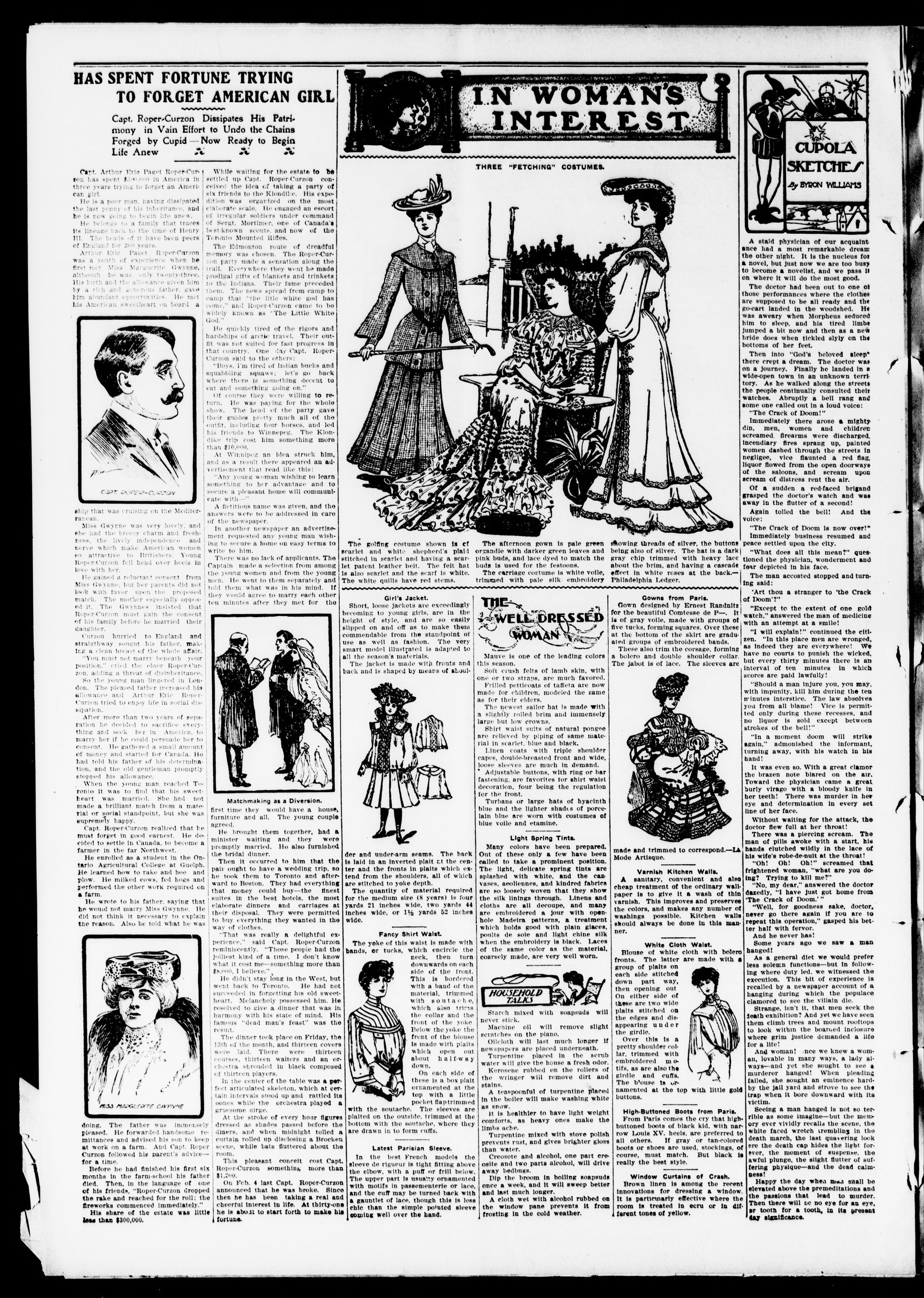
The golfing costume shown fs ef
scarlet and whito shepherd's platd
stitched in searlet and having a sear:
let patent leather belt, The felt hat
is also scarlet and the scarf ts white,
The white qitills have red stems.
nner
Girl's Jacket.
Short, loose jackets are exceedingly
becoming to young girls, are in the
height of style, and are so easily
slipped on and off as to make ther
commendable from the standpoint of
use as well as fashion. ‘The very
smart model illustrated is adapted to
all the season’s materials,
The jacket is made with fronts and
back and is shaped by means of stoul-
eT,
‘om
sacs |
ay
Hf Ea! |
RE \ y
ij
dj ry
der and under-arm seams. The back
{is laid in an inverted plait ct the cen-
ter and the fronts in plaits which ex-
tend from the shoulders, all of which
are stitched to yoke depth,
The quantity of material required
for the medium size (8 years) is four
yards 21 inchoa wide, two yards. 44
inches wide, or 1% yards 52 inches
wide,
Fancy Shirt Waist.
The yoke of this waist is made with
bands, or tucks, which encircle the
Beck, ‘nen ‘ure
downwards on each
side of the front.
This is bordered
with a band of the
material, trimmed
with soutache,
which ais. trims
the collar and the
front of the yoke
Relow the yoke the
front of the blouse
4s made with plaits
whieh open out
about halfway
down,
On each side of
these is a box plait
ornamented at the
top with a little
pocket flaptrimmed
as downwards on each
B side of the front.
F 2 This is bordered
= with a band of the
material, trimmed
Q with soutache,
x which @iso trims
ry front of the yoke
ELLA Bolow the yoke the
i A) front of the blouse
\ is made with plaits
f} which open out
Nin M about halfway
down.
N 2 On each side of
<> A these is a box plait
He SY) crramented at tne
mY top with a little
pocket flap trimmed
with the soutache. The sleeves are
plaited on the outside, trimmed at the
ottom with the soutache, where they
fre drawn in to form cuffs,
Latest Parisian Sleeve,
In the best French models the
sleeve de rigueur is tight fitting above
the elbow, with a puff or frill below,
‘The upper part 1s usuazy ornamented
with motifs in passementerie or lace,
and the cuff may be turned back with
& gauntlet of lace, though this Is less
chic than the simple potuted sleeve
eoming well over the hand.
The afternoon gown is pale green
organdie with darker green leaves and
buds is used for the festoons.
‘The carriage costume is white voile,
trimmed with pale silk embroidery
THE. a 2
‘ ‘
3-SWELE ORES SED
FS ss Ne . ay
" Waar
Pc ea. NSwy
Mauve is one of the leading colors
this season,
Soft crush felts of lamb skin, with
one or two straps, are much favored,
Frilled petticoats of taffeta are now
made for children, modeled the same
as for their elders.
‘The newest sailor hat is made with
a slightly rolled brim and immensely
large Dut low crowns,
Shirt waist suits of natural pongee
are relieved by piping of same mate
rial in scarlet, blue and black,
Linen coats with triple shoutder
capes, double-breasted front and wide
loose sleeves are much in demand.
* Adjustable buttons, with ring or bat
fastening, are favorites tor shirt wats
decoration, four being the regulatior
for the front.
‘Turbans or large hats of hyacinth
blue and the Mghter shades of porce
lain blue are worn with costumes o
biue voile and etamine.
Lleht Spring Tints.
Many colors have been prepared,
Out of these only a few have been
called to take a prominent position,
The light, delicate spring tints are
splashed with white, and the can
vases, aeoliennes, and kindred fabrics
are so loosely woven that they show
the silk linings through. Linens and
cloths are all decoupe, and many
are embroidered a jour with open-
Hele Actin. patterns: a trestioent
which holds good with plain glaces,
poults de sole and lght chine silk
when the embroidery is black. Laces
of the same color as the material,
coarsely made, are very well worn.
| Ear
| eee .
|
HOUSEHOLD YS eye]
TALKS, EON
Starch mixed with soapsuds will
never stick,
Machine oll will remove slight
scratches on the piano.
Olicloth will last’ much Tonger if
newspapers are placed underneath,
Turpentine placed in the | scrub
water will give the house a fresh odor.
Kerosene mbbed on the rollers of
the wringer will remove dirt and
stains,
‘A teaspoonful of turpentine placed
in the boiler will make washing white
as snow,
It is healthier to have light weight
comforts, as heavy ones make the
limbs ache.
Turpentine mixed with stove polish
prevents rust, and gives brighter gloss
than water,
Creosote and alcohol, one part cre
‘osite and two parts alcohol, will drive
‘away bedbugs.
Dip the broom in boiling soapsuds
once a week, and it will sweep better
and Inst much longer.
‘A cloth wet with alcohol rubbed on
the window pane prevents it from
frosting in the cold weather.
sowing threads of silver, the buttons
being also of silver. The hat is a dark
gray chip trimmed with heavy lace
about the brim, and having a cascade
effect in white roses at the back.—
Philadelphia Ledger.
RRR
Gowns from Paris,
Gown designed by Ernest Randnitz
for the beautiful Comtesse de P—. It
is of gray voile, made with groups o!
five tucks, forming squares. Over these
at the bottom of the skirt are gradu
ated groups of embroidered bands.
These also trim the corsage, forming
@ bolero and double shoulder collar
The jabot is of lace. The sleeves are
Geos }
A
Ca),
See Tie
Bete
GBR: 4 aK) R
1am Gg ‘
A ‘a os
bs
n\n &. F
‘Viger Ame
i eae
SSIS
CNS
ot La Bes
ROS ean ae
eo
made and trimmed to correspond.—La
Mode Artisque.
Varnish Kitchen Walls,
A sanitary, convenient and also
cheap treatment of the ordinary wall-
paper is to give it a wash of thin
varnish. This improves and preserves
the colors, and makes any number of
washings possible. Kitchen walls
should always be done in this man.
=
White Cloth Waist.
Blouse of white cloth with bolere
fronts. The latter are made with «
group of plaits on
each side stitched
down part way, :
On either side of ce,
these are two wide at
plaits stitched on
the edges and dis ff \
appearing under {il \\
the girdle, i )
Over this te a fil t
pretty shoulder col iat N i
lar, trimmed with oN
embrofdered mo
tifs, as are also the
girdle and cuffs,
Mma Ma al
group & pie
each side stitched
down part way, “
On either side of ne,
these are two wide - ee
plaits stitched on OR
the edges and dis- iy
appearing under ih
the girdle, n i
Over tie te a fil i
pretty shoulder cot iat tl
lar, trimmed with oN
embroidered mo
tifs, as are also the
girdle and cuffs,
The blouse ts ur ”
namented at the top with little gold
buttons,
High-Buttoned Boots from Paris.
From Paris comes the cry that high
buttoned boots of black kid, with nar
row Louis XV. heels, are preferred to
all others, If gray or tan-colored
boots or shoes are used, stockings, of
course, must match. But black 1s
really the best style.
Window Curtains of Crash.
Brown linen is among the recent
innovations for dressing a window.
It 1s particmarly effective where the
room is treated in ecru or in dif
ferent tones of yellow.
| vast
iim ~CUPOLA
l
By BYRON WILLIAMS
eae
ance had a most remarkable dream
the other night. It ts the nucleus for
& novel, but just now we are too busy
to become a novelist, and we pass it
on where it will do the most good.
The doctor had been out to one of
those performances where the clothe
Are supposed to be all ready and the
go-cart landed in the woodshed. He
was aweary when Morpheus seduced
him to steep, and his tired limbe
jumped a bit now and then as a new
bride does when tickled slyly on the
bottoms of her feet.
Then into “God's beloved sleep*
there crept a dream. The doctor was
on a journey, Finally he landed in
wide-open town in an unknown terrt
tory, As he walked along the streets
‘the people continually consulted their
watches. Abruptly a bell rang and
some one called out in a loud voice:
“The Crack of Doom!”
Immediately there arose @ mighty
din, men, women and children
screamed. firearms were discharged,
incendiary fires sprang up, painted
women dashed through the streets in
negligee, vice flaunted a red flag,
liquor flowed from the open doorwaye
of the saloons, and scream upon
scream of distress rent the air.
Of a sudden a red-faced brigand
grasped the doctor's watch and wae
away in the flutter of a second!
Again tolled the bell! And the
voice:
“The Crack of Doom is now over!"
Immediately business resumed and
} peace settled upon the city.
‘| “What does all this mean?” ques:
* tloned the physician, wonderment and
t foar depicted in his face.
| ‘The man accosted stopped and turn-
tng said:
"| ‘Art thou a stranger to ‘the Crack
of Doom’?
| “Except to the extent of one gold
t! watch,” answered the man of medicine
' with an attempt at a smile!
°| 1 will explain!” continued the cit
"|zen, “In this place men are wronged,
, 88 indeed they are everywhere! We
. have no courts to punish the wicked,
; but every thirty minutes there is an
interval of ten minutes in which
scores are paid lawfully!
“Should a man Injure you, you may,
with impunity, kill him during the ten
minutes interstice. The law absolves
you from all blame! Vice is permit-
ted only during these recesses, and
no liquor is sold except between
strokes of the bell!”
“In a moment doom will strike
again,” admonished the informant,
turning away, with his watch in bis
band!
It was even so. With a great clamor
the brazen note blared on the air.
Toward the physician came a great
burly virago with a bloody knife in
her teeth! There was murder in her
eye and determination in every set
line of her face.
Without waiting for the attack, the
doctor flew full at her throat!
There was a piercing scream. The
man of pills awoke with a start, his
4 hands clutched wildly in the lace of
his wife's robe-de-nuit at the throat!
“Oh! Oh! Oh!" screamed that
frightened woman, “what are you do-
o|ing? Trying to kill me?”
| “No, my dear,” answered the doctor
n{dazedly, “I have just got home from
e|‘The Crack of Doom.'”
t] “Well, for goodness sake, doctor,
s|never go there again if you are to
»- |Tepeat this operation,” gasped his bet.
ter half with fervor.
And he never has!
Some years ago we saw a man
| hanged!
‘a| As a general diet we would prefer
less solemn functions—but in follow:
ing where duty led, we witnessed the
execution. This bit of experience is
recalled by a newspaper account of a
hanging during which the populace
clamored to see the villain die.
Strange, isn’t it, that men seek the
death exnibition? And yet we have seer
them climb trees and mount rooftops
to look within the boarced inclosure
| where grim justice demanded a life
for a life!
And woman! -nce we knew a wom
an, lovable in many ways, a lady al
ways—and yet she sought to see 4
murderer hanged! When pleading
failed, she sought an eminence hard
14 | by the jail yard and strove to see th
trap when it bore downward with its
victim.
Seeing a man hanged is not so ter
h-|rible as some imagine—but the mens
Jory ever vividly recalls the scene, the
to | White faced wretch trembling in th:
4 {death march, the last quavering loo}
ot [ere the death cap hides the light for
is|tver, the moment of suspense, th
awful plunge, the slight flutter of suf
fering physique—and the dead calin
ness!
nt | Happy the day whea maa onal b
w. {elevated above the premeditations an
ve jthe passions that lead to murder
if, |Then there will uc no eye for an eye
er tooth for a tooth, in its presen
Office of Dr. W. C. COMBS, Phd. Physician and Surgeon, Also Specialist On all Nervous Diseases caused by opium, morphine, cocaine, chloral and all other drug habits, likewise the whiskey habit. CURE GUARANTEED IF CASE IS TAKEN. TERMS REASONABLE. Office: 906 East 12th Street, Kansas City, Missouri.
Dear Sir: A friend of mine just back from out West says you cured him of the jag habit. Faith but he looks like a peach. I you cured him you can cure me. I drink about 25 or 30 cocktails and highballs a day and a few whisky straights. Send your jag cure C. O. D., or telegraph at my expense the price, and I will send the coin at once. Yours truly.
Dr. Wm. Clifford Combs, Phd. New Discovery for Whiskey, Opium, Morphine, Cocaine, Chloral and all Other Drug Habits. Labratory, 906 East Twelfth St., Kansas City, Missouri. Down Town Office, 908 East Twelfth St.
Dr. W. C. Combs, Kansas City, Mo.,
Dear Doctor: I am doing splendidly. Send me by return mail, or better, perhaps, by the United States Express Company, $10 worth of your specific for the morphine habit. I think that amount of your great discovery and cure will cure me.
Would have been off on the first small bottles if I had not got down with a low fever and a diarrhoeae and while unconscious the doctors told my friends
Office of Dr.
Physician
On all Nervous Dis
and all oth
CURE GUARANTEE
Office: 906
Hot Springs, Ark..
April 8, 1903.
Dr. Combs.
Dear Sir: While at the Baltimore hotel, in Kansas City last month, a friend of mine and a patient you had cured of the dope habit gave me one of your cards and strongly advised me to consult you and take your treatment, if you thought my kidneys were not too far yone to make it worth while to be treated. But I put it off, and also the other business which brought me there, until I found out that Dr. riffith had left Kansas City for a rest at Hot Springs. I came on here without seeing you. Dr. Griffith, after seeing me, refuses to operate on me so long as I am taking morphine. It is the case with so many here. I am using 1-300 of a grain of atrophine sulp. 2 grs. of morphine at a dose, hypodermically, three to four times a day and through the night. Have only used it one year. Send blank to be filled out and terms, or the medicine C. O. D. if you think proper. Yours respectfully.
MRS. GRACE BISHOP.
621 Central Street, Hot Springs, Ark.
Dr. Combs.
Dear Sir: A friend of mine just be him of the jag habit. Faith but he looks can cure me. I drink about 25 or 30 cock whisky straights. Send your jag cure C. the price, and I will send the coin at on
Dr. Combs.
I would die unless he shot morphine into me. By the time I had come to myself, they had got two or three squirts into me. But I stopped that business quick, because I no longer crave the stuff. But getting the accursed stuff into my system again put me back some I think. But $10 worth more of yohr medicine will get it out and leave some to spare.
I tell the boys about you from my ranch in Dakota to my home in Texas. They can't understand my refusing to go with them into the hop
W. C
And S
ases cause
drug hab
IF CASE
ast 12th
W. C. COMBS, A
d Surgeon, Also
caused by opium, morp
ug habits, likewise the w
CASE IS TAKEN. T
12th Street, Kansas
To the Public, Greetings:
Public, Greetings: Sir, or Madame or Miss: I beg the favor of your perusal of the your deep interest in the welfare of suffering humanity with all and piteous suffering and despair. ten years ago I found by tedious labor and long, patient research that I provided a remedy in an herb that would actually stop the craving, morphine, cocaine, chloral or any of the drug habits; cure the ha
Dear Sir, or Madam sake of your deep interest frailties and piteous suffer Fifteen years ago I nature had provided a rent for opium, morphine, coca without suffering, nervou The hard is so ominous
Dear Sir, or Madame or Miss:—I beg the favor of your perusal of this sake of your deep interest in the welfare of suffering humanity with all its frailties and piteous suffering and despair.
Fifteen years ago I found by tedious labor and long, patient research that nature had provided a remedy in an herb that would actually stop the craving for opium, morphine, cocaine, chloral or any of the drug habits; cure the habit without suffering, nervous jerking of the muscles, hot and cold flashes, etc. The herb is so simple, so common, so seemingly harmless that there is no record of any druggist or chemist experimenting with it; no book on medicine has a thing to say for or against it; yet in the accidental chewing of this herb in my nervous craving in the woods far from my drug store, I had accidentally stumbled on an herb destined to be the greatest boon to suffering humanity since the discovery of quinine. For fifteen years I have been curing victims of the drug and whisky habits whenever they have applied to me. To-day I have several thousand written testimonials from grateful people, men and omen, whom I have cured. These cases are from all the walks of life, such as mechanics, farmers, stockmen, druggists, physicians, lawyers, and even ministers. My case books show the hames of hundreds of cases cured whose social position, modesty, and financial standing would not allow their names to be made public. For I never publish these letters without the writer's consent.
Oh, the blessed delight of feeling life and health coursing through your veins. To rise with the lark, feeling strong and happy. To drive twenty or thirty miles into the country without a thought as to whether there are any saloons or drug stores out there. To lift up your head once more in life and look your fellow man straight in the face without one thought of shame. To step forth briskly, as you did in youth, and leave forever behind you that tired feeling, that dragging of the feet, that hang down look, that wrinkled, yellow, blotched skin, those dead looking, hollow eyes; those restless nights and hideous nightmares, and look the world square in the face, with the full assurance that once more you are a man, or woman, as the case may be.
I am restoring health to mental and physical wrecks. Each day of my life some one warmly shakes my hand and says, "God bless you, Doctor." If you are not cursed with the drug or drink habit, perhaps you know of some one who is. Blessings will ever be showered on your head if you can point out the way by which that lost one can be saved.
Address all communications to Dr. Combs, h. D., 908 East 12th street, Kansas City, Mo. Your letters will be returned to you if you so desire. All letters are strictly confidential unless you desire them published.
My terms are more than reasonable. I guarantee a cure when I take a case. References furnished if desired. Yours truly. Dr. W. C. COMPS. M.D.
I am happy to write that the last bottle of medicine you shipped reached us saely and has completely restored my daughter's health. The old scars from the hypodermic needle in using morphine and cocaine seem to be fading away. ill they all leave? Heaven reward you for what you have done for me and mine. AMELIA GROOVES.
980 E. 12th St., Kansas City, Mo., June, 1903.
Dr. Combs.
joints and hit the pipe, and don't seem able to realize that it is possible that for over two weeks I have not smoked a single yen, yet was able to keep on my feet or in the saddle all day long, day in and day out, until I got this fever and bowel trouble by drinking too much alkali water. Doc, you are great. Send medicine C. O. D. to your most grateful J. C. BLACK. Dalhart, Texas.
Phd.
to Specialist
ine, cocaine, chloral
iskey habit.
RMS REASONABLE.
City, Missouri.
Dalhart, Texas, June 25, 1903.
Dr. Combs,
Dear Sir: Your favor of May 24th
received. Will say that I am taking from
10 to 16 grains of morphine daily. Used
it over two years. Run down mentally
and physically. Send me a $5 trial bottle
by U. S. Express Co. You have done
wonders for Mr. Black. He looks 20
years younger. Yours truly,
ARTHUR CAWSON,
Dalhart, Texas.
Los Angeles, Cal., June 8, 1903.
Dear Sir: Never can I be thankful enough to you for restoring me to manhood and to society. Nothing but your wonderful discovery could have stopped the whisky habit on me. I sent your money for the medicine with the order.
Accept this $25 as a slight present in token of my good wishes for your success. Forever your friend.
HENRY JOHNSON.
New York, N. Y., June 8th, 1903.
New Orleans, La., May 10th, 1903.
the last bottle of medicine you shipped reached restored my daughter's health. The old scars using morphine and cocaine seem to be fading even reward you for what you have done for AMELIA GROOVES.
bs, Phd.
and all Other Drug Habits.
Correspondents wanted in every city and town in this state. Write us.
ALL news matter intended for pub-
llication should reach our office not la-
ter than Tuesday, of each week and
must be signed by the writer not for
publication, but as guarantee of auth-
enticity.
OFFICE-No. 117 West Sixth St.
Kansas City, Mo.
Advertising Rates,
For one inch, one insertion . $ 8.00
For one inch, each subsequent insertion . $ 8.00
For two inches, three month . $ 8.00
For two inches, six month . $ 8.00
For two inches, nine months . $ 10.00
For two inches, twelve months . $ 15.00
OLDEST NEGRO JOURNAL
... IN KANSAS CITY,
TWICE ALL
THE REST.
The paid circulation
of THE RISING SON
is more than double
the combined circula
tion of all the other
Kansas City Golored
weekly newspapers.
Kansas City, Mo., March 3, 1903.
Office of the Postmaster,
Publishers, Rising Son.
In response to your inquiry, I beg to say your publication is duly entered as second class matter at this office and regularly mailed.
The Rising Son is the only paper published by Colored people in Kansas City, Mo., that is entered at the post office as second class mail.
The burning of the Negro at the stake in Wilmington, Del., a few days ago, if the dispatches are true, made a contession of his guilt: "as he sows, so he reap," saith the Bible. The honest Negroes have no respect for a man of their own race who will commit such a crime on a woman and think the punishment cannot be too severe.
He appealed to the mob for mercy. But why did he not grant mercy to the poor girl in her appeals to him for mercy?
THE NEGRO AS HE STANDS IN THE MIDST OF MODERN CIVILIZATION, AND HIS ENVIRONMENTS.
The Negro minister of the gospel has a field to preach and each in, which reaches from the Atlantic ocean on the East to the Pacific waters on the far West, and from the Great Lakes in the North to the Everglades of Florida on the South. The harvest is ripe, and his work is to teach an unfortunate and neglected people who in the days of clavery were taught not to recognize the institutions of the marriage relation, and most of whom were conceived and brought forth in sin. Yes, they were born badly, reared, and come up without proper training, either in morals, virtue or in their relations with their fellow man. A people who for two hundred and fifty years were taught not to regard the institution of marriage—and who were encouraged in lusty things of the world. Their moral and social life was not regarded—the animal of the race was sought to be developed, and the arms of a Christian civilization were hidden from the Negro for two hundred and fifty years. Many of those who now preach and lecture of the Negro as a failure, in the days gone by forty years ago, would preach to his white hearers: "Repent, be lieve, and be sound upon the terms of the gospel."
To the Negro congregations the minister would often take for his text: "Servants, obey your master and you will be saved." This deception was carried on for over seven generations, but in God's own good time he removed the bonds of slavery, and left 8,000,000 of these people in ignorance, penitility and almost without a hope in the star of Bethlehem. Their liberation grew out of a cruel war and the circumstances naturally caused their former owners to take issue with any movement on the part of the Lincoln government looking toward their elevation. The first move that called them together was the Negro minister in the church and Sabbath schools. The next was the Negro teacher and they have had charge of the destiny of the race for nearly forty years. Have they been faithful to their station and the people of whom they have fashioned to their liken?
We are constrained to think that while they have done much to schools, they could have done far more by a united effort. The minister should have laid more stress on morality and industry—the teacher should have sought to make good readers and good spellers of his pupils. Has he succeeded on these lines? We think not.
The pupil in most instances has been pushed ahead in advance of his ability to comprehend and master, he has been often too soon taken out of his English course and put in classes of the languages, and we want to say here that the teacher and preacher in many instances are one and the same. In some instances the morals of these men and women have not always measured to the golden rule.
Prof. John H. Jackson who served as president of Lincoln Institute very successfully for three years has since been in Colorado Springs, where he held an excellent position in the office of County assessor. He has been devoting his leisure to literary work, and has just finished a book which goes to press at once, and will be shortly in the hands of the reviewers. He has always taken high ground on all race questions and his book will be accorded a hearty welcome at this time when strong words are needed on matter moral, social, political, educational. By the way, Prof. Jackson thinks the languishing Christian Recorder should be 'in the hands of a layman who will not be bothered about getting into a bishop's robe and who will therefore have more time to give the great A. M. E. church a weekly paper worthy of its great membership. At the next general conference he will offer his services as editor and they who know about his experience, his honesty and energy are willing to predict that in his hands the R-record will enter upon a brilliancy and usefulness.
LEXINGTON NEWS.
Rev. Green, of Marshall, Mo., was in the city on Monday, the guest of Dr. Howard.
Rev. Gilbert and Miss Glover Hawkins lett for the District conferences and Sunday School convention Tuesday morning.
Mrs. T. McComnic, of Omaha, Neb., the mother of Mr. Thomas Jenkins, is in the city.
Madame Staples, of Kansas City, was here Friday, 19th, and sang at the A. M. church. She is a fine songster and everybody was pleased that heard her. She will be here again on the 10th of next month, at which time they expect to have a grand time.
Mr. Lewis Woods, the proprietor of the Risin Son, was here. He was her manager. Come again when you can introduce such musical talent at that.
Mr. Matthews and Mr. Foreliff have sold out their restaurant to Mr. Lize Hugh. He asks the patronage of everybody. He now subscribes for the Rising Son, as all public men and women should do.
There are quite a number of public men and women that do not subscribe and when they do anything they want it in the paper. He who lives by the public should support public enterprises.
Miss Sarah Graham and Miss Daisy Goodwin and several of the choir members attended the Sunday School convention at Nelson, Mo.; also Rev. Howell.
Rev. Jones, of Booneville, Mo., preached at the Second Baptist church morning and evening Sunday, and night.
Rev. T. Ward preached Monday
The annual sermon of the Tabernacle and Temple was preached Sunday at the Second Baptist church by Rev. A. A. Gilbert, which was largely attended. Everybody enjoyed the sermon.
Mr. Israel Burles is still confined to his bed. Also Mrs. Lonza Gray is still on the sick list.
LINCOLN INSTITUTE OF TO-DAY.
Lincoln Institute, which presents represents the highest form of public instruction for the Negro youth in Missouri, is situated at Jefferson City. This has been without question the most prosperous year in the history of Lincoln Institute. It compares favorably with other institutions of higher education of this country; its Normal and collegiate departments show well in the catalogues, but better at the institution in active working operation. This institution has been gradually growing for the last decade, but it remained for this last year to eclipse all former records of the school. The highest former attendance was that of last year, 240; and this year, 350. This is due to the result of the wide range of advertisement given this year by President B. F. Allen, A. M., the efficient and newly elected president, who has so ably presided over the institution this year. The institution is particularly fortunate in having such a man of education to preside over it. The Board of Regents, as well as the students, appreciated the great amount of good that was being carried on by him this year to such an extent that the Regents reelected him for a period of two years longer. President Allen is a man of great sagacity and ceaseless industry. Lincoln Institute under his management in the ensuing future years, as it has in this past year, will continue to rise to the very high ideal of its president and will take its place in the rank with all the leading colleges in this country. It is right and proper that every colored family, especially in this state of Missouri, should its appreciation for this institution which has been so generously provided by the state for the education of the colored youth, by patronizing it. There ought to be a thou sand students at this grand and glorious institution this ensuing year lous institution. There are here in they are here in Missouri, and need just the kind of manual and intellectual training that the state here pro
vides free. Let us join the worthy President Allen and his faithful faculty in the good work, and make Lincoln Institute the great of great Negro colleges.
A woman will never believe a man is suffering grief unless he buries his face in his hands.
NURCH
AND
SUNDAY
SCHOOL.
AND SECRET LODGES.
Cosmo 414 AND Lodge No. 285. G.U.O.of O.F. meets at 1413 E. 18th st. 2nd and 4th Wednesdays-evenings in each month, at 8 o'clock. J. H. Heltz, N. G.; W. R. Patterson, P. 8.
St. Mary's Tabernacle, No. 2, meets first and third Fridays in each month at 1734 Grand avenue. Daughter Lulu Beasley H. P. Daughter Mary Finley, Secondea.
St Hallyd Tubercleau No. 7 meets first and St Llithaid K. Rav. N. C. Phillips avenue. Daughter Martha Johnson H. Slughter Abbie L. Pyles, Sosothena.
Gate City Lodge, No. 4679, U. O. of O. P. meets at 1413 E. 18th Street, every first and third Fridays, of each Monday.
E. S. LEWIS, P. S.
St. John's Chapel, on Bell St. Between 9a and St. Louis ave, Rev. N. C. Buren, pastor. Sunday services 11 a. m. and 3:30 p. m. Sunday school at 8:30 a. m. Prayer meeting Wednesday evening and Teachers meeting Thursday evening.
Vine Street Baptist church, T. H. Ewing, pastor. Sunday services 11 a. m. and 7:30 p. m. Sunday school, 2:30 Prayer meeting Friday evening.
Ebenezer A. M. E. Church, cor. 20 and Holmes. Rev. A. A. Gilbert, pastor. Sunday services, 11 a. m. and 7:30 p. m. Sunday school, 3:30 p. m.
Pritchard Lodge No. 42, A. F. and A. M., meets second and fourth Monday evenings in the month. J. W. Crowe, W. M., H. J. Spigener, Secy.
Allen Chapel, south-east corner 10th and Charlotte streets Rev. O. J. W. Scott, pastor. Sunday services 11 a m. and 7:30 p.m. Sunday School, 2:30 p.m. Class Meeting Tuesday, 8 p.m. Praye. Wednesday, 8 p.m. Choir practice Monday evening.
Second Baptist church, corner Tenth and Charlotte. S. W. Bacove, D. D., pastor. Sunday services: Preaching, 11 a.m. and 7:15 p.m.; Sunday school, 2 p.m. Weekly meetings, Monday B. Y. P. U. meeting, 8 p.m. Wednesday night, prayer meeting.
Highland Avenue Baptist church Sunday services, 11 a. m. and 8 p.m. Preaching, Wednesday evening, 8 p.m. Praise meetings Monday evening B. Y. P. U. Sunday school 2 p.m.
G. W. Boyd, Pastor.
MRS. A. B. CUMMINGS, Clerk.
Pleasant Valley Baptist church, Rosedale, Kansas, Sunday services, Preaching 11 a.m. and 8 p.m.; Sunday school, 9:30 a.m.; B. Y. P. U., 7 p.m.; W. H. F. and M. Society, Thursday evening praise meeting.
Rev. H. E. STRUCKLAND, Pastor TUCKER, Clerk.
Pleasant Green Baptist church, Independence and Tracy ave. Sunday school, 9:30 a.m. Preaching, 11 a.m. and 8 p.m. B. Y. P. U., 6:30 p.m. Weekly services—Prayer meetings and missionary, Wednesday evenings at 8 o'clock p. m. Young People's Literary and Progressive Club, Thursday evenings. Church meeting, Friday before the second Sunday in each month.
E. M. WILSON, Pastor. Residence 1603 East 13th st.
Burns Chapel, M. E. Church.
Sunday School, 9:30 a. m.
Preaching, 11:00 a. m.
Cass Meeting, 2:30 p. m.
Epworth League, 7:00 p. m.
Preaching, 7:45 p. m.
Literary Tuesdays 8:00 p. m.
Prayer Meeting, Wednesday, 8:00
p. m.
Class Meeting, Thursdays 8:00 p. m.
Corner 11th and Highland, J. M.
Harris, Pastor.
C. H. COUNTEE, Mgr. W. B. COUNTEE
TEL. 780 GRAND.
COUNTEE BROS.,
Undertakers.
Licensed Embalmers.
Carriages and flowers furnished for all occasions.
'784 ..... Telephone ..... 4178
WALL'S
Laundry Co.,
First-Class Work & Prompt Delivery.
708 E. 12th St., Kansas City, Mo.
STRICTLY FIRST-CLASS
...IB THE...
ST. LOUIS, MO.
MEALS AT ALL HOURS.
Oysters in any Style. Services strictly
first-class. Ladies and Gents dine up
staina.
Z. T. JORDAN, Manager
Mrs. Bottle Jordan
Can be found at her old
stand at 419 Cherry St.....
Dressmaking and Plain Sew-
ing.....Old Clothes Made
Over.
---
MRS. BETTIE JORDEN can be found at her old stand.
Dressmaking and Plain Sewing.
Old clothes made over.
WORKS AT CUT PRICES
s Fire Crackers 5c
to save you money on
Paints and Glass.
FIRE WO
2 Packs Fire
We can also save
Drugs, Paints
E WORKS AT
Packs Fire Crackers 5
can also save you mon
rugs, Paints and Glass
FIRE WORKS AT CUT PRICES
We can also save you money on Drugs, Paints and Glass.
Prescriptions filled at LOWEST PRICES
Surface's Drug Store 181
C. COLLIN
ce's Drug Store 18th . COLLINS
Drug Store 18th & Lydia COLLINS,
Surface's Drug Store 18th & Lydia
The Leading Dry Gooods Store.
Millinery, Notions, Ladle
ing Goods, Boo
Since the waters have re
again prepared and made a g
have been busy preparing our
is complete in our lines for t
are now prepared to furnish
merchandise during the mon
largest and most complete st
see for yourself.
1429-31-33-35-3
Corner
H. D. SIMMONS, OPTI
Bury, Notions, Ladles' and Gents For
ing Goods, Boots and Shoes.
Since the waters have receded and our city is b
in prepared and made a good place to live in
been busy preparing our stock for the trade w
complete in our lines for the summer trade and
now prepared to furnish anything in the lin
handise during the month of July. We have
fast and most complete stock in the city--- Com
or yourself.
9-31-33-35-37 E. 18th
Corner of Flora.
AMONS, OPTICIAN, 1116 CAMPBEL
mens, Ladies' and Gents Furnish-
hoods, Boots and Shoes.
letters have receded and our city is being
and made a good place to live in--we
preparing our stock for the trade which
lines for the summer trade and we
to furnish anything in the line of
ing the month of July. We have the
complete stock in the city--- Come and
3-35-37 E. 18th St.
corner of Flora.
OPTICIAN, 1116 CAMPBELL ST., K. C. MO.
This is a Colored Man.
Eyes Tested Free
Millinery, Notlons, Ladies' and Gents Furnishing Goods, Boots and Shoes.
Since the waters have receded and our city is being again prepared and made a good place to live in--we have been busy preparing our stock for the trade which is complete in our lines for the summer trade and we are now prepared to furnish anything in the line of merchandise during the month of July. We have the largest and most complete stock in the city----Come and see for yourself.
H. D. SIMMONS, OPTICIAN, 1116 CAMPBELL ST., K. C. MO.
This is a Colored Man.
Eyes Tested Free
Solid Gold and Gold filled Eye Glasses and
Spectacles for sale on Easy Payments.
American Mutual Aid Association, St.
Gentlemen:—I want to thank you
of the claim that was due me for the
also want to thank your agent, Mr. G.
me and your doctor for his visiting me
was a great saving for me since it o
We don't go around boasting abo
others to do this.
Those persons who feel that the
and sickness, we courteously invite
this nature, and if you find any or
privileges, and benefits that we do,
company; but if not, then we throw
Whether you would be insured or not
to post you on the laws of fraternal
Mutual Aid Association, St. Louis, Mo.
hen:—I want to thank you for the promptness in
that was due me for the time that I was serio-
tly thank your agent, Mr. G. A. Clay, for his regular
or doctor for his visiting me every day while I was
saving for me since it cost me nothing.
Yours for success,
SUSI
It go around boasting about what we have done
this.
persons who feel that they should be insured ages
as, we courteously invite you to investigate all
and, if you find any one among them that will
and benefits that we do, then we appeal to you to
but if not, then we throw open our books for you
you would be insured or not, call to see us; we wo
on the laws of fraternal insurance.
association, St. Louis, Mo.
to thank you for the promptness in the payment
me for the time that I was seriously ill, and I
agent, Mr. G. A. Clay, for his regular attention to
is visiting me every day while I was sick, which
me since it cost me nothing.
Yours for success,
SUSIE BOGGS.
boasting about what we have done; we allow
feel that they should be insured against accidents
usually invite you to investigate all companies of
find any one among them that will afford you the
that we do, then we appeal to you to go in to such
we throw open our books for your enrollment.
insured or not, call to see us; we would be pleased
of fraternal insurance.
American Mutual Aid Association, St. Louis, Md.
Gentlemen:—I want to thank you for the promptness in the payment of the claim that was due me for the time that I was seriously ill, and I also want to thank your agent, Mr. G. A. Clay, for his regular attention to me, and your doctor for his visiting me every day while I was sick, which was a great saving for me since it cost me nothing.
Yours for success,
SUSIE BOGGS.
We don't go around boasting about what we have done; we allow others to do this.
Those persons who feel that they should be insured against accidents and sickness, we courteously invite you to investigate all companies of this nature, and if you find any one among them that will afford you the privileges, and benefits that we do, then we appeal to you to go in to such company; but if not, then we throw open our books for your enrollment. Whether you would be insured or not, call to see us; we would be pleased to post you on the laws of fraternal insurance.
G. ACLAY, Organizer, 1106 Charlotte St.
W. G. COMBS, Examiner, 1104 Charlotte St.
---
---
---
For Good Service in Grocery and Meat Business . . .
CALL UP 455 GRAND
THAT'S ALL
WILL DO THE REST
S. W. COR, 21ST and SUMMIT.
L. W. SUMPTER & SON,
UNDERTAKERS, EMBALMERS
Tel. 261 Main. 609 Main St.
CREWS @ CAMPBELL
806 and 808 East 12th St.
Barber Shop and
Pool Hall.
All the choice brands of cigars and tobaccos. Robert Simpson. H. M. Kennedy, Allan Bates, Barbers.
Solid Gold and Gold filled Eye Glasses and Spectacles for sale on Easy Payments.
No. 730 Charlotte, St.
Kansas City, Mo., Aug. 1902.
WONDERFUL DISCOVERY
Curly Hair Made Straight By
TAKEN FROM LIFE!
BEFORE AND AFTER TREATMENT.
ORIGINAL
OZONIZED OX MARROW
(Copyrighted)
This wonderful hair made is the only safe preparation in the world that makes kinky or curly hair straight as shown above. It nourishes the scalp and prevents the hair from falling out of breaking off, cures dandruff and makes the hair grow and they hold over forty years and need by thousands. Warranted for the hairs, the time, preparation, ever solid straightening kinky hair. Beware of imitations. Get the Original Owned OX. If a owner at the guinea never fails to keep the hair straight, soft and beautiful. A toilet process is for ladies, gentlemen and children. Please only performed. The great advantage of this wonderful pomade is that by its use you can always own your hair as home. Giving to its superior and lasting qualities it is the best and most economical. It is not possible for myself to produce a preparation equal to it. Full directions with every bottle. Only 400 cups. Hold by droughting and desர்ger's hand and the 40 cups for one bottle or 81.40 for three bottles. We pay all express charges. Send some to the best price. Write your name and address plainly to OZONIZED OX MARROW CO., 76 Webash Avenue, Chicago, Illinois.
Heim's
KANSAS CITY
$11
EMB. CO.
OLD
LAGER
SPECIAL BREWS
SCHARNAGEL SELECT
KYFHIAUSER
PERFECTION
1880 1890 1900
SALES: 12000 39946 150378
BBLS. BBLS. BBLS.
SEND FOR PRICE LIST.
FAST MAIL SERVICE
A GOOD THING
MISSOURI
PACIFIC
RAILWAY
PUSH IT ALONG
The Train Service of the Missouri
Pacific.
The four flyers that leave Kansas City Union depot daily for St. Louis and all points East—note the leaving time: 9:50 a. m.; 1:10 p. m.; 9:15 p. m. and 10:45 p. m. No other line from Kansas City offers to the traveling public such train service via St. Louis. Note the new departure of the fast mail at 1:10 p. m. arives in St. Louis at 10 p. m.; close connections in St. Louis with the Grand Union stations with Eastern and South-eastern trains. The only line leaving Kansas City after the Operas, Lodge meetings and Sunday night Church service, at 10:45 p. m. and arriving in St. Louis at 7:20 a. m., in time for all Eastern connections.
9:55 p. m.—10:50 a. m.: Omaha & St.
Paul Express.
Elegant equipment, Pullman Sleepers
and Compartment cars; Reciling
Chair cars, (all sects free). For all
information and tickets call at
Union Depot and 921 Main St. City Offc.
E. S. JEWETT, Pass. & Ticket Agent.
J. B. LESTER,
BARBER SHOP.
559 GRAND AVE.
Hot and Cold Baths 25c
Large, New Porcelain Tube.
Good barbers. Give us a Call.
...AND...
Table Luxuries
Vegetables in Season.
Fresh & Salt Meats.
Teas & Coffees.
G. JONES,
E 17th St., Kansas City, Mo.
When UNEEDA
Shave or Hair Cut or Shampoo
GO TO
C. A. Evans' Barber Shop
For first class work.
107 E. 14th St. Kansas City, Mo.
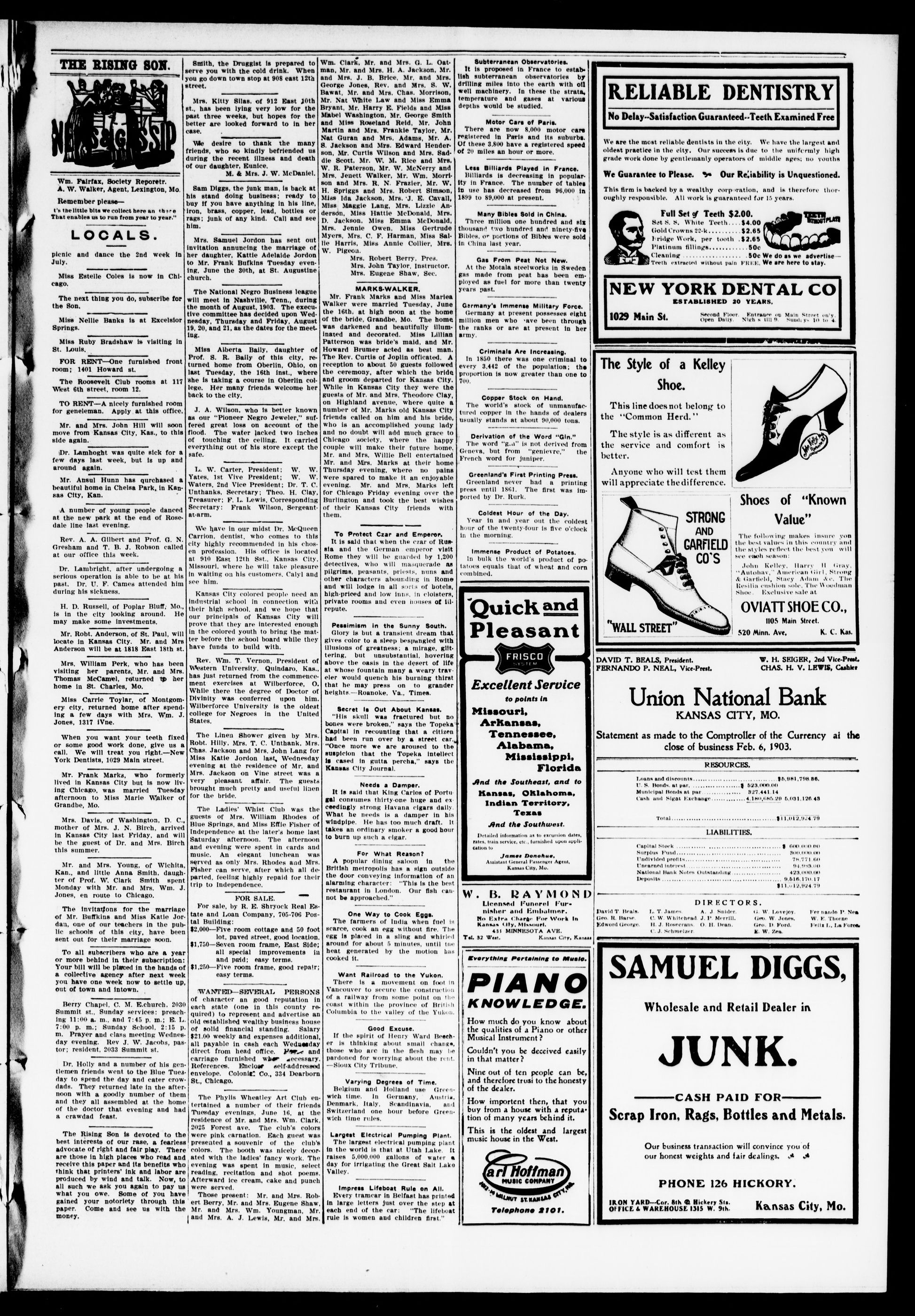
NEWS&GSSIP
Wm. Fairfax, Society Reporetr.
A. W. Walker, Agent, Lexington, Mo
Remember please—
the little bats we collect here an thence
That enables us to run from year to year."
LOCALS.
picnic and dance the 2nd week in July.
Miss Estelle Coles is now in Chicago.
The next thing you do, subscribe for the Son.
Miss Nellie Banks is at Excelsior Springs.
Miss Ruby Bradshaw is visiting in St. Louis.
FOR RENT—One furnished front room; 1401 Howard st.
The Roosevelt Club rooms at 117 West 6th street, room 12.
TO RENT—A nicely furnished room for geneleman. Apply at this office.
Mr. and Mrs. John Hill will soon move from Kansas City, Kas., to this side again.
Dr. Lamhoght was quite sick for a few days last week, but is up and around again.
Mr. Ansul Hunn has purchased a beautiful home in Chelsa Park, in Kansas City, Kan.
A number of young people danced at the new park at the end of Rose-dale line last evening.
Rev. A. A. Gilbert and Prof. G. N. Gresham and T. B. J. Robson called at our office this week.
Dr. Lambright, after undergoing a serious operation is able to be at his past. Dr. U. F. Cames attended him during his sickness.
H. D. Russell, of Poplar Bluff, Mo., is in the city looking around. He may make some investments.
Mr. Robt. Anderson, of St. Paul, will locate in Kansas City. Mr. and Mrs. Anderson will be at 1818 East 18th st.
Mrs. William Perk, who has been visiting her parents, Mr. and Mrs. Thomas McCamel, returned to her home in St. Charles, Mo.
Miss Carrie Toylar, of Montgomery city, returned home after spending a few days with Mrs. Wm. J. Jones, 1317 iVne.
When you want your teeth fixed or some good work done, give us a call. We will treat you right.—New York Dentists, 1029 Main street.
Mr. Frank Marks, who formerly lived in Kansas City but is now living Chicago, was married Tuesday afternoon to Miss Marie Walker of Grandbe, Mo.
Mrs. Davis, of Washington, D. C., mother of Mrs. J. N. Birch, arrived in Kansas City last Friday, and will be the guest of Dr. and Mrs. Birch this summer.
Mr. and Mrs. Young, of Wichita, Kan., and little Anna Smith, daughter of Prof. W. Clark Smith spent Monday with Mr. and Mrs. Wm. J. Jones, en route to Chicago.
The invitations for the marriage of Mr. Buffkins and Miss Katie Jordan, one of our teachers in the public schools of this city, have been sent out for their marriage soon.
To all subscribers who are a year or more behind in their subscription: Your bill will be placed in the hands of a collective agency after next week you have one week now to settle up, out of town and intown.
Berry Chapel, C. M. E.church, 2030 Summit st., Sunday services: preaching 11:00 a. m., and 7:45 p. m.; E. L. 7:00 p. m.; Sunday School, 2:15 p. m. Prayer and class meeting Wednesday evening. Rev J. W. Jacobs, pastor; resident, 2033 Summit st.
Dr. Holly and a number of his gentlemen friends went to the Blue Tuesday to spend the day and cater crowdads. They returned late in the afternoon with a goodly number of them and they all assembled at the home of the doctor that evening and had a crawdad feast.
The Rising Son is devoted to the best interests of our rase, a fearless advocate of right and fair play. There are those in high places who read and receive this paper and its benefits who think that printers' ink and labor are produced by wind and talk. Now, to all such we ask you again to pay us what you owe. Some of you have gained your notoriety through this paper. Come and see us with the money.
Smith, the Druggist is prepared to serve you with the cold drink. When you go down town stop at 908 east 12th street.
Mrs. Kitty Silas, of 912 East 10th st., has been lying very low for the past three weeks, but hopes for the better are looked forward to in her case.
We desire to thank the many friends, who so kindly befriended us during the recent illness and death of our daughter, Enunice.
M. & Mrs. J. W. McDaniel.
Sam Diggs, the junk man, is back at his stand doing business; ready to buy if you have anything in his line, iron, brass, copper, lead, bottles or rags; junk of any kind. Call and see him.
Mrs. Samuel Jordon has sent out invitation announcing the marriage of her daughter, Kattie Adelaide Jordon to Mr. Frank Bukfins Tuesday evening. June the 30th, at St. Augustine church.
The National Negro Business league will meet in Nashville, Tenn., during the month of August, 1903. The executive committee has decided upon Wednesday, Thursday and Friday, August 19, 20, and 21, as the dates for the meeting.
Miss Alberta Baily, daughter of Prof. S. R. Baily of this city, returned home from Oberlin, Ohio, on last Tuesday, the 16th inst., where she is taking a course in Oberlin college. Her many friends welcome her back to the city.
J. A. Wilson, who is better known as our "Pioneer Negro Jeweler," suffered great loss on account of the flood. The water lacked two inches of touching the ceiling. It carried everything out of his store except the safe.
L. W. Carter, President; W. W. Yates, 1st Vive President; W. W. Waters, 2nd Vice President; Dr. T. C. Unthanks, Secretary; Theo. H. Clay, Treasurer; F. L. Lewis, Corresponding Secretary; Frank Wilson, Sergeant-at-arm.
We have in our midst Dr. McQueen Carrion, dentist, who comes to this city highly recommended in his chosen profession. His office is located at 910 East 12th Sst., Kansas City, Missouri, where he will take pleasure in waiting on his customers. Calyl and see him.
Kansas City colored people need an industrial school in connection with their high school, and we hope that our principals of Kansas City will prove that they are interested enough in the colored youth to bring the matter before the school board while they have funds to build with.
Rev. Wm. T. Vernon, President of Western University, Quindaro, Kas, has just returned from the commencement exercises at Wilberforce, O. While there the degree of Doctor of Divinity was conferred upon him, Wilberforce University is the oldest college for Negroes in the United States.
The Linen Shower given by Mrs. Robt. Hilly, Mrs. T. C. Unthank, Mrs. Chas. Jackson and Mrs. John Lang for Miss Katie Jordon last, Wednesday evening at the residence of Mr. and Mrs. Jackson on Vine street was a very pleasant affair. The guests brought much pretty and useful linen for the bride.
The Ladies' Whist Club was the guests of Mrs. William Rhodes of Blue Springs, and Miss Eiffle Fisher of Independence at the later's home last Saturday afternoon. The afternoon and evening were spent in cards and music. An elegant lunchean was served as only Mrs. Rhodes and Mrs. Fisher can serve, after which all departed, feeling highly repaid for their trip to Independence.
FOR SALE.
For sale, by R. E. Shryock Real Estate and Loan Company, 705-706 Postal Building:
$2,000—Five room cottage and 50 foot lot, paved street, good location.
$1,750—Seven room frame, East Side; all special improvements in and psid; easy terms.
$1,250—Five room frame, good repair; easy terms.
WANTED—SEVERAL PERSONS of character an good reputation in each state (one in this county required) to represent and advertise an old established wealthy business house of solid financial standing. Salary $21.00 weekly and expenses additional, all payable in cash each Wednesday direct from head office. Place and carriage furnished when necessary. References. Enclosure self-addressed envelope. Colonia Co., 334 Dearborn St., Chicago.
The Phyllis Wheatley Art Club entertained a number of their friends Tuesday evenings, June 16, at the residence of Mr. and Mrs. Wm. Clark, 2025 Forest ave. The club's colors were pink carnation. Each guest was presented a souvenir of the club's colors. The booth was nicely decorated with the ladies' fancy work. The evening was spent in music, select reading, recitation and shot poems. Afterward ice cream, cake and punch were served.
Those present: Mr. and Mrs. Robert Berry, Mr. and Mrs. Eugene Shaw, Mr. and Mrs. Wm. Youngman, Mr. and Mrs. A. J. Lewis, Mr. and Mrs.
Wm. Clark, Mr. and Mrs. G. L. Oatman, Mr. and Mrs. H. A. Jackson, Mr. and Mrs. J. B. Brice, Mr. and Mrs. George Jones, Rev. and Mrs. S. W. Bawat, Mr. and Mrs. Chas. Morrison, Mr. Nat White Law and Miss Emma Bryant, Mr. Harry E. Fields and Miss Mabel Washington, Mr. George Smith and Miss Roseland Reld, Mr. John Martin and Mrs. Frankie Taylor, Mr. Nat Guran and Mrs. Adams, Mr. A. S. Jackson and Mrs. Edward Henderson, Mr. Curtis Wilson and Mrs. Saddle Scott, Mr. W. M. Rice and Mrs. W. R. Paterson, Mr. W. McNerry and Mrs. Jenett Walker, Mr. Wm. Morrison and Mrs. R. N. Frazier, Mr. W. H. Spriggs and Robert Simson Miss Ida Jackson, Mrs. J. E. Cavall, Miss Maggie Lang, Mrs. Lizzie Anderson, Miss Hattie McDonald, Mrs. D. Jackson, Miss Emma McDonald, Mrs. Jennie Owen, Miss Gertrude Myers, Mrs. C. F. Harman, Miss Salie Harris, Miss Annie Collier, Mrs. W. Pigeon.
Mrs. Robert Berry, Pres.
Mrs. John Taylor, Instructor.
Mrs. Eugene Shaw, Sec.
MARKS;WALKER
Mr. Frank Marks and Miss Mariea Walker were married Tuesday, June the 16th, at high noon at the home of the bride, Grandbe, Mo. The home was darkened and beautifully illuminated and decorated. Miss Lillian Patterson was bride's maid, and Mr. Howard Brumer acted as best man. The Rev. Curtis of Joplin officiated. A reception to about 50 guests followed the ceremony, after which the bride and groom departed for Kansas City. While in Kansas City they were the guests of Mr. and Mrs. Theodore Clay, on Highland avenue, where quite a number of Mr. Marks old Kansas City friends called on him and his bride, who is an accomplished young lady and no doubt will add much grace to Chicago society, where the happy couple will make their future home, Mr. and Mrs. Willie Bell entertained Mr. and Mrs. Marks at their home Thursday evening, where no pains were spared to make it an enjoyable evening. Mr. and Mrs. Marks left for Chicago Friday evening over the Burlington and took the best wishes of their Kansas City friends with them.
To Protest Czar and Emperor
10 Protect Czar and Emperor.
It is said that when the czar of Russia and the German emperor visit Rome they will be guarded by 1,200 detectives, who will masquerade as pilgrims, peasants, priests, nuns and other characters abounding in Rome and will lodge in all sorts of hotels, high-priced and low inns, in cloisters, private rooms and even houses of ill-repute.
Pessimism in the Sunny South.
Pessimism in the Sunny South. Glory is but a transient dream that gives color to a sleep bespangled with illusions of greatness; a mirage, glittering, but unsubstantial, hovering above the oasis in the desert of life at whose fountain many a weary traveler would quench his burning thirst that he may press on to grander heights—Roanoke, Va., Times.
Secret Is Out About Kansas.
"His skull was fractured but no bones were broken," says the Topeka Capital in recounting that a citizen had been run over by a street car, "Once more we are aroused to the suspicion that the Topeka intellect is cased in gutta percha," says the Kansas City Journal.
Needs a Damper.
It is said that King Carlos of Portugal consumes thirty-one huge and exceedingly strong Havana cigars daily. What he needs is a damper in his windpipe. He has too much draft. It takes an ordinary smoker a good hour to burn up such a cigar.
For What Reason?
A popular dining saloon in the British metropolis has a sign outside the door conveying information of an alarming character: "This is the best restaurant in London. Our fish cannot be approached."
One Way to Cook Eggs
The farmers of India when fuel is scarce, cook an egg without fire. The egg is placed in a sling and whirled around for about 5 minutes, until the heat generated by the motion has cooked it.
Want Railroad to the Yukon.
There is a movement on foot in Vancouver to secure the construction of a railway from some point on the coast within the province of British Columbia to the valley of the Yukon.
Good Excuse.
If the spirit of Henry Ward Beecher is thinking about small change, those who are in the flesh may be pardoned for worrying about the rent. —Slox City Tribune.
Varying Degrees of Time
Belgium and Holland use Greenwich time. In Germany, Austria, Denmark, Italy, Scandinavia, and Switzerland one hour before Greenwich time rules.
Largest Electrical Pumping Plant. The largest electrical pumping plant in the world is that at Utah Lake. It raises 5,000,000 gallons of water a day for irrigating the Great Salt Lake Valley.
Impress Lifeboat Rule on All. Every tramcar in Belfast has printed in large letters just over the step at each end of the car: "The lifeboat rule is women and children first."
Subterranean Observatories
It is proposed in France to establish subterranean observatories by drilling miles into the earth with oil well machinery. In these the strata, temperature and gases at various depths would be studied.
Motor Cars of Paris
There are now 8,000 motor cars registered in Paris and its suburbs. Of these 3,800 have a registered speed of 20 miles an hour or more.
Less Billiards Played in France.
Billiards is decreasing in popularity in France. The number of tables in use has decreased from 96,000 in 1899 to 89,000 at present.
Many Bibles Sold in China
Three million one hundred and six thousand two hundred and ninety-five Bibles, or portions of Bibles were sold in China last year.
Gas From Peat Not New.
At the Motala steelworks in Sweden gas made from peat has been employed as fuel for more than twenty years past.
Germany's Immense Military Force.
Germany at present possesses eight million men who have been through the ranks or are at present in her army.
In 1850 there was one criminal to every 3,442 of the population; the proportion is now greater than one to 700.
Copper Stock on Hand
The world's stock of unmanufactured copper in the hands of dealers usually stands at about 90,000 tons.
Derivation of the Word "Gin."
The word "gin." is not derived from Geneva, but from "genievre," the French word for juniper.
Greenland's First Printing Press.
Greenland never had a printing press until 1861. The first was imported by Dr. Rurk.
Coldest Hour of the Day.
Year in and year out the coldest hour of the twenty-four is five o'clock in the morning.
Immense Product of Potatoes.
In bulk the world's product of potatoes equals that of wheat and corn combined.
Quick and Pleasant FRISCO SYSTEM
Missouri,
Arkansas,
Tennessee,
Alabama,
Mississippi,
Florida
And the Southeast, and to
Kansas, Oklahoma,
Indian Territory,
Texas
Detailed information as to excursion dates, rates, train service, etc., furnished upon application to
James Donohue,
Assistant General Passenger Agent,
Kansas City, Mo.
W. B. RAYMOND
Licensed Funeral Furnisher and Embalmer.
No Extra Charge For Work In
Kansas City, Missouri.
David T. Beals
Geo. R. Barse
Edward George
431 MINNESOTA AVE.
Tel. 32 West. Kansas City, Kansas
Everything Pertaining to Music.
PIANO
KNOWLEDGE.
How much do you know about
the qualities of a Piano or other
Musical Instrument?
Couldn't you be deceived easily
in that matter?
Nine out of ten people can be,
and therefore trusi to the honesty
of the dealer.
How important then, that you buy from a house with a reputation of many years behind it.
This is the oldest and largest music house in the West.
arl Hoffman
MUSIC COMPANY
403-34 MILNUT ST. KANSAS CITY, MO
Telephone 2101.
---
RELIABLE DENTISTRY
No Delay--Satisfaction Guaranteed--Teeth Examined Free
We are the most reliable dentists in the city. We have the largest and oldest practice in the city. Our success is due to the uniformly high grade work done by gentlemanly operators of middle ages; no youths
We Guarantee to Please. Our Re'iability is Unquestioned.
This firm is backed by a wealthy corporation, and is therefore thoroughly responsible. All work is guaranteed for 15 years.
Full Set of Teeth $2.00.
Set S. S. White Teeth.....$4.00
Gold Crowns 22-k.....$2.65
Bridge Work, per tooth.....$2.65
Platinum fillings.....$50c
Cleaning.....$50c We do as we advertise—
Teeth extracted without pain FREE. We are here to stay.
Full Set of Teeth $2.00.
TEETH
WITHOUT PLATE
Full Set & Teeth $2.00.
Set S. S. White Teeth.....$4.00
Gold Crowns 22-k.....$2.65
Fridge Work, per tooth.....$2.65
Platinum fillings.....$50
Cleaning.....$50c We do as we advertise—
Teeth extracted without pain FREE. We are here to stay.
NEW YORK DENTAL CO
ESTABLISHED 20 YEARS.
1029 Main St.
Second Floor. Entrance on Main Street only.
Open Daily. Nigh's till 9. Sundays to 10.
The Style of a Kelley
John Kelly
Pomona
This line does not belong to the "Common Herd."
The style is as different as the service and comfort is better.
Anyone who will test them will appreciate the difference.
STRONG
AND
GARFIELD
CO'S
"WALL STREET"
The following makes insure you
the best values in this country and
the styles reflect the best you will
see each season:
John Kelley, Harry H. Gray,
"Autobay," American Girl, Strong
& Garfield, Stacy Adam & c. The Resilia cushion sole. The Woodman
Shoe. Exclusive sale at
K. C. Kas.
W. H. SEIGER, 2nd Vice-Preset
CHAS. H. V. LE WISCH, Cashier
DAVID T. BEALS, President. W. H. SEIGER, 2nd Vice-President.
FERNANDO P. NEAL, Vice-Prest. CHAS. H. V. LEWIS, Cashier
Union National Bank
KANSAS CITY, MO.
Statement as made to the Comptroller of the Currency at the close of business Feb. 6, 1903.
RESOURCES.
Loans and discounts..... $6,981,798.86.
U. S. Bonds at par..... $523,000.00
Municipal Bonds at par..... 327,441.14
Cash and Signal Exchange..... 4,180,685.29 5,031,126.49
Union National Bank
KANSAS CITY, MO.
Statement as made to the Comptroller of the Currency ai the close of business Feb. 6, 1903.
RESOURCES.
Loans and discounts ..... $6,981,798.86.
U.S. Bonds at par ..... $523,000.00
Municipal Bonds at par ..... 327,441.14
Cash and Signet Exchange ..... 4,180,685.29 5,031,126.43
Total ..... $11,012,924.79
LIABILITIES.
Capital Stock ..... $ 600,000.00
Surplus Fund ..... 300,000.00
Undivided profits ..... 78,771.60
Unearned interest ..... 94,983.00
National Bank Notes Outstanding ..... 423,000.00
Deposits ..... 9,516,170.17
$11,012,924.79
DIRECTORS.
LIABILITIES.
Capital Stock ..... $ 600,000.00
Surplus Fund ..... 300,000.00
Undivided profits ..... 78,771.60
Unearned interest ..... 94,983.00
National Bank Notes Outstanding ..... 423,000.00
Deposits ..... 9,516,170.17
$11,042,924.79
DIRECTORS.
L. T James. A. J. Snider
C. W. Whitehead. J. P. Merrill.
H. J. Rosecrans. O. H. Dean.
C. J. Schmelzer.
G. W. Lovejoy
Geo. W. Jones
Geo. D. Ford
E. W. Zea.
David T. Beals. L. T. James. A. J. Snider. G. W. Lovejoy. Fer nando P. Nea.
Geo. R. Barse. C. W. Whitehead. J. P. Merrill. Geo. W. Jones. W. E. Thorne.
Edword George. H. J. Rosecrans. O. H. Dean. Geo. D. Ford. Felix L. La Force.
C. J. Schmelzer. E. W. Zea.
SAMUEL DIGGS,
Wholesale and Retail Dealer in
SAMUEL DIGGS,
Wholesale and Retail Dealer in
JUNK.
CASH PAID FOR
Scrap Iron, Rags, Bottles and Metals.
Our business transaction will convince you of
our honest weights and fair dealings.
PHONE 126 HICKORY.
IRON YARD...Cor. 8th @ Hickery Sts.
OFFICE & WAREHOUSE 1315 W. 9th.
Kansas City, Mo.
The Autumn Wind.
The voice of the autumn wind,
As sad as the mourning sea.
And it sets astir the chords
Of the harp of memory!
It sets the chords astir.
And my heart throbs quick again
With the old, old thrill of love,
With its ecstacy and pain.
Clinton Scollard in Leslie's Monthly.
Phantom's Warning
About the bread hearth in its customary manner the family had assembled after the evening meal, and Henry Carroll, the city cousin, come to the country to restore failing health, found his first visit into a Kentucky home not so dull as he had anticipated.
The conversation hulled. Silence was broken, only by the ticking of the clock. Suddenly Carroll heard the faint pait a pat of a galloping horse on the frozen turnip. He walked to the window overlooking the road, and the sharp air bore the sound more clearly to him.
"I wonder who that can be, riding so wildly at this time of night?" he asked.
"Some drunken fellow going home, I suppose," said Mr. Rankin, indifferently, but with a significant look at his wife.
"He rides like a wild man!" exclaimed Carroll. "Come here! Look at him! One would think both man and beast were hunted—were fleeing from the devil himself!"
Martha ran to the window and gazed for a moment at the fast-disappearing horseman. "Papa, maybe it's our ghost—'Rob the rider'—and Aunt Dinah once met."
The mournful bay of foxhounds disturbed by the hoof beats and the suggestion of a chase gave her remark a tinge of color. Both Mr. and Mrs. Rankin had kept their seats while the rider passed, and now tried in vain to lift the gloom his appearance had left in passing. Carroll noticed this and half laughingly inquired if Martha's ghost was a reality.
"Not at all; simply a stupid old story of the negroes," said Mr. Rankin. He spoke in an unconvincing manner, however, and the fireside group relapsed into a moody silence. Carroll slept little that night in the great room assigned to him. Among the old pictures on the walls, which he casually looked over as he undressed, he was struck by a tarnished portrait of a girl who closely resembled Martha. No name was written on the worn gilt frame, but on the dust-covered back he found scrawled, "Martha Rankin, 1830." Even when Carroll put out the light that face stood between him and sleep. Those eyes haunted his brain. So, too, did the flying horseman and the troubled face of his host and the remark of the young Martha.
The brilliant, fitful sunlight of a spring day strained into winter was streaming into his room ere Carroll awakened. The refreshing bath and the wholesome smell of the country cleared his head, and he smiled at the foolish fancies of the night. Carelessly he ran down the broad stairs of the stately mansion in a manner calculated to startle into life the sweet-faced dames and the starched-collared soldiers of the revolution whose portraits smiled from their gilded frames studding the hallway.
Martha's remark about Aunt Dinah's
```markdown
```
The dim figure of a horseman dashing Along.
ghost remained in Carroll's head, however, and having nothing to do, he strolled out to the cabin to hear her story. It was Aunt Dinah's favorite yarn, and she unbent with right good will, proud of having the stranger cousin for a listener.
"Good Lawd, honey, an' you achshally ain't heabed dat tale? Miss Martha wuz her name, an' she loved
Mars Rob Gregory, what had a heap o' fine horses. He kep 'comin' an' comin' heah ter see Miss Martha twell everybody said dey sho' would marry. Den dey had a fallin' out an' he didn't ome no moah. Miss Martha didn't let on, but she sartinly did love Mars Rob, an' kep 'pinin' an' pinin' away twell she wuz nig ded. One Sunday dey all went to church at de Cross Roads, 'cepen' her. When dey come back her maw, Miss Ellen, found her on de floah in de parler—ded. She had shot herself in de corner by de
M. M.
He clapped her in his arms and whispered: "I won't go home to-morrow."
window, whar she an Mars Rob uster set.
"Wall, don't jes' reckelleck, but folks do say Mars Rob died jes' after. Anyway, he took her death mighty hard, 'cause it wuz his fault, an' he ought to have made up with her. He uster ride 'bout de country on his big geldin' jes' like mad. One night I seed him go by heah like all de devils' wuz followin'. De nex mawnin' dey found him by de crick, his big geldin' standin' over him. He had shot hissef in de heart.
"I dunno, chile, but ever since den dey say Mars Rob ride by heah when sweethearts ob de county fall out. I seed him once when Mars Walker an' Miss Mary Rogers had dere trubble--but dat's another tale, honey. Anyway, folks don't come dis away nights no moah."
And so Aunt Dinah rambled on, eager to tell other stories of the past. Carroll kept the incident in his mind for a while, and then let it drop as a darky superstition. He devoted himself to the task of building up his health, going hunting, riding to neighborhood fox meets, driving Martha to dances and parties, and in other ways filling out the routine of life in the country. In following this social round he found that the chase after health can sometimes be made a cheerful occupation, especially with a girl like Martha to help one.
One afternoon, as Carroll and Martha were returning from town they let their horses take their own pace and settled themselves comfortably back on the buggy seat and listened to the hum of the wheels and drank in the charm of the country.
Looking dreamily into Martha's eyes as the carriage rolled homeward, the question, which he had as yet put to himself only vaguely, came to him. "Does she like me?" He dared not trust himself to ask as to love. While he was turning about this, to him, startling suggestion, a young farmer of the neighborhood whom Carroll had often imagined to be covertly fond of Martha cantered down the road toward them. He pulled up sharply, bowed to Carroll, and directed to Martha a few commonplace inquiries about her family, the crops and the next party to be given. Carroll thought he saw a blush steal over her cheek as the young man talked, and after he had ridden on, half in jest, but a bit in earnest, he asked if that were her sweetheart. The blush mounted higher as she denied it. Carroll unreasoningly and jealously insisted that he was, and finally Martha poultingly suggested that in any event it was a matter that did not concern him. The clouds had fallen. Carroll had had his question answered.
At supper he announced to his host that his health was now fully regained and that an urgent letter from home would take him away the following morning. Mr. and Mrs. Rankin expressed regret. Martha coldly said she was sorry, and continued the meal in silence.
That night Carroll retired early to his room, but not to sleep. His pride was deeply hurt, and he was indignant. He called himself "Idiot!" and other pleasant things. "She didn't have the heart to say she was sorry! Love! Bosh!"
Finally, putting on a light overcoat, he started for a walk upon the pike. It was near midnight when he turned again into the little valley. The full light of the moon was obscured by a mist which rose from the river and spread over the valley. The brooding silence of the night was broken now and then by the distant cry of a fox nound, the low neigh of a horse, or the tinkle of a sheep bell.
"Clackey- clack! clackey- clack!"
There was borne in on Carroll's ears the distant sound of a galloping horse upon the turnpike. Could it be the phantom of Aunt Dinah's story?
"Clackey- clack!" The horse was coming nearer. The forgotten tale sprang vividly into Carroll's mind, and he felt the chill of the unearthly creep over him. Sweethearts had quarreled. The phantom rider was due! Bang! Crash! Crash! and Carroll saw a wildly speeding horseman flash across the bridge and come up the road toward him with uncontrolled gait.
Carroll, forgetting all of the improbability of the tale, ran to the roadside and tried to scale the stone fence. But it was too high for him to scale in his nervous condition, and he crouched against it, his eyes glued upon the ever-advancing figure. It thundered along. Now it was almost upon him. A vision of a horse of thoroughbred build, with foam flying from its mouth, with flanks heaving, and of a darkly clad rider with gaze fixed ahead, a cloud of dust, a sound of distant hoofbeats, and Carroll, completely cowed, fled toward the house. On the veranda he met Martha, strangely pale.
He clasped her in his arms and whispered: "I won't go home to-morrow." Walter S. Hiatt in New York Times.
ARTISTS AND THEIR MODELS.
Beauty of Face and Form Are Rarely Found Together.
Artists say it is curious but nevertheless true that beauty of face and form are not often found in one and the same person. The woman who has an ideal face frequently falls from the standpoint of figure, so that painters are obliged to make their ideal figure from half a dozen models. From one will come a beautiful throat or arm or shoulder; from another a perfect back, and so on. Even after that the painter has to idealize his figure—to throw into it whatever form of fleeting expression he desires.
Once in a while his model gives him unconscious help. The model who posed for Church's "Fairy Tale" used to tell of having once stood before the picture at an exhibition, listening to the comments of enthusiastic visitors. They commended the fanciful painting, but marveled most of all at the wonderful look which the artist had managed to get into the woman's face. The model herself was able to enlighten them.
"He didn't have to idealize for that wonderful look," she said. "I remember the day it was painted. I was wondering whether he was going to pay me by the day or the week."
A photographic artist tells this little story of a model. She was a simple, rather shallow, straightforward girl when not at work. When she posed her beautiful, mobile face expressed the most varying emotions. The artist used to wonder if she felt one-quarter of what her expression indicated. His doubts were set at rest one day. After the girl had posed with an exalted aspect that enraptured the artist he waited to hear her deliver some sublime inspired thought. But she merely looked up wistfully into his face and said:
"Oh, how hungry I am."
The Ringing Roll of "Dixie."
The old brigades march slower now—the boys who wore the gray—
But there lie an' battle spirit in a host of' them to-day!
They hear their comrades callin' from the white tents far away.
An' answer with the ringin' roll of "Dixie!"
They feel the old-time thrill of it—the battle plains they see—
Again they charge with Jackson, an' face the fight with Lee;
An' the shoutin' hills are answered by the thunders of the sea.
When they rally to the ringin' roll of "Dixie!"
The battle-fields are volceless—once wet with crimson rain;
O'er unknown graves of heroes wave golden fields of grain;
But phantom forms—the leap to life, and cheer the ranks again.
Far-answering to the ringin' roll of "Dixie!"
Beat, drums! the old-time chorus; an' bugles, blow your best;
-Frank L. Stanton in Atlanta Constitution
Believes in Woman Suffrage.
Gov. Garvin of Rhode Island has put himself on record as a believer in woman suffrage. In a recent address before the Rhode Island Woman Suffrage association he said: "I think woman suffrage will be adopted in Rhode Island and in other New England states. It has been tried in other states and has worked well, and sooner or later it will prevail throughout the Union."
HIS SERVICES NOT REQUIRED.
IOWA
PROGRESSIVE
CHARITY
RESTORATION
KINGLY
TWEETS
PROTECTION
GROVER CLEVELAND
GROVER CLEVELAND
HE LOOMS UP AGAIN AS A POS-
SIBLE NOMINEE.
Will the Democrat Bring Forward as Their Candidate the Man Whose Election in 1892 Cost More in Money and Suffering Than the Civil War?
The American Economist does not often concern itself with a discussion of the merits of an improbable, much less an impossible, presidential candidate. However, both the improbable and impossible sometimes happen, and as no one man in our history has had a more disastrous influence upon our industrial life than the subject of this sketch, we propose simply to remind our readers of Grover Cleveland's contribution to his country's history, and what he would do again, if placed in a position to accomplish his purpose, which, we may add, was not fully accomplished in the first instance.
It was decided in 1884 that a man's domestic faults need not affect his public life and executive ability. Mr. Cleveland was elected in that year in spite of his shortcomings as a man, and because of his good fortune as a politician. He was elected not because of his own strength, but because of the weakness of his opponent's campaign and the lack of complete harmony in his opponent's party. His first administration has left nothing worth remembering, except his message to the Fiftieth Congress in December, 1887. Mr. Cleveland had studied his Cobden club literature well and stated precisely, if not honestly, some of their most important tenets. The message was devoted almost wholly to the tariff and taxation, and its several thousand words can be put
HIS SERVICES
IOWA
PROGRESSIVE
MARIFF
MASSION
into two of its sentences as indicating the tenor of the whole. These two sentences follow:
"But our present tariff laws, the vicious, inequitable and illogical source of unnecessary taxation, ought to be at once revised and amended. These laws, as their primary and plain effect, raise the price to consumers of all articles imported and subject to duty by precisely the sum paid for such duties. . . . So it happens that while comparatively a few use the imported articles, millions of our people, who never use and never saw any of the foreign products, purchase and use things of the same kind made in this country, and pay, therefore, nearly or quite the enhanced price which the duty adds to the imported articles."
These are false statements, and Mr. Cleveland knew them to be false, for he could have gone into the open market and bought hundreds of articles at a less price than the duty on similar imported articles of no better quality. His message defeated him for reelection, and a Republican Congress and President thought best to revise the tariff, and the McKinley law was the result. The effects of that law were marvelous. In May, 1892, Edward Atkinson, the noted statistician and free trader, who was in full possession of his mental faculties at that time, said in the Forum:
"There never has been a period in the history of this or any other country when the general rate of wages was as high as it is now, or the prices of goods relatively to the wages as low as they are to-day, nor a period when the workman, in the strict sense of the word, has so fully secured to his own use and enjoyment such a steadily and progressively increasing proportion of a constantly increasing product."
Such testimony was repeated by the commercial agencies, by the President in his message to Congress and by the whole honest press of the country. And yet Grover Cleveland was again nominated, and, adopting the double dealing tactics of Polk and Dallas in 1844, was elected by a very positive popular and electoral vote. We have not to do now with the methods of that campaign, but with the result. For the first time since the election of Abraham Lincoln in 1860 the three branches of the government were to be in the hands of the Democratic, free trade party. The very moment that the people, and particularly the commercial world, realized this there was consternation in every industrial and financial circle. Wise capitalists, shrewd manufacturers and cautious
---
merchants know what was before them. That grim specter, sure to materialize in to the evil monster, free trade, which had more than once devastated our land and impoverished our people, was bound to come. It mattered not just how soon, or in just what form; we must prepare for it as best we could and take the consequences—and we did.
It was not as bad as Mr. Cleveland would have had it. Mad clean through he would not sign his party's law. But that Gorman-Wilson tariff did its work most effectively, and completed the panic and ruinous work begun in its anticipation. Is there need to recall those awful years? Is there need to repeat the billions of dollars lost, the suffering, the sickness, the sadness that entered almost every home in the land?
We are loyal and patriotic enough to add our plaudits to those of the multitude when cheering an ex-president of the United States. We are willing to blur our memory, to wipe off the slate and say, "Well, in the light of later events perhaps it was all for the best. We need adversity once in a while; we must learn by experience." And so we find no fault in the hearty greeting and acclaim given to our rapidly ageing ex-president; but when the mugwump and free-trader and politician step in and turn patriotism into politics we say No; never again must Grover Cleveland be in power and gain the opportunity to conspire and ruin our country. Once is enough and though we may condone we must not forget. Far more than the civil war did Grover Cleveland cost our country in financial loss. More lives were sacrificed through sickness and sorrow, through despair and poverty through hunger and cold, than by the bullets of the rebellion.
If free traders, if mugwumps, if Democrats do not forget, then the peo
NOT REQUIRED.
ple must remember for them. Groves Cleveland must never be President again. He should never even be a candidate, and he ought not to be so much as thought of in that respect.—American Economist.
Queer Kind of Wall.
Those who regard the Dingley tariff as a Chinese wall will probably revise their opinion when they learn that the imports into the United States during the twelve months ending Jan. 31 1903, aggregated $975,283,637. The Dingley tariff, like all well-drawn protective measures, tends to increase imports rather than diminish them, as by making the nation prosperous, it enables the people to buy more from foreigners. But while under the stimulus of a tariff like the Dingley act our imports are increased, their nature is greatly changed. Instead of importing manufactured articles ready for consumption in increasing quantities, we increase our imports of raw materials from abroad for the use of our indus tries. Thus, in the calendar year 1903 the manufacturers' materials imported amounted to $453,000,000, against $248,000,000 in the calendar year 1896. We also enlarge our takings of manufactured articles ready for consumption but our increasing imports in this classification are made up of things which we do not ourselves as yet produce as well as the foreigner, but which we are rapidly learning to turn out as well as he does.—San Francisco Chronicle.
The Tariff and Banking
The phenomenal increase in bank deposits and loans since the free trade period can be seen from the following:
March 9, 1897 April 9, 1903.
Loans ... $1,888,009,291 $3,403,217,618
Deposits ... 1,688,219,961 $1,688,275,260
Cash ... 420,281,615 536,214,834
These deposits are in addition to almost an equal amount in the savings banks, and represent the daily balances of merchants and business concerns. They confirm the statement that we are doing double the business under protection that we were under free trade. It seems hardly time to revise such a tariff as we are now prospering under, either up or down. It will indeed, be well to let well enough alone.
Its Beneficiaries.
"The tariff is always revised in the interest of its beneficiaries," says Editor Bryan. The principal beneficiaries of the American protective tariff policy are the people of the United States.—Oswego Times.
HUMOR
OF THE DAY
The Music Cure.
"I observe," said the cheerful boarder, "that they are trying to cure the sick trees in Boston commons with music."
"Popular music, I suppose," said the boarder who puns.
"I wonder how yew would like it," growled the cynical boarder.
"I know I'd soon be sycamore." murmured the cheerful boarder as he reached for the butter, and there the subject was dropped.
Keeping In Practice.
"Do you know this Gov. Pennypacker of Pennsylvania?"
"No, I don't. Why?"
"I thought mebby you did. He has just muzzled the state press, and I didn't know but what I'd like to have him come around and see if something can't be done with my mother-in-law."
Considerable.
Deacon Kindleigh—So poor Brother
Littleton left all he had to the Children's home. Did he have much?
Sister Sourleigh—Eight boys and three girls.
Bridget Was Ashamed.
Mistress (angrily)—Bridget, I find that you wore one of my evening gowns at the ball last evening. It's the worst piece of impudence I ever heard of. You ought to be ashamed of yourself."
Bridget (meekly)—Ol wus, mum; Ol wus, and me young man said as if Oliver wore such a frock in public agia he'd break our engagement.
Talking Shop.
Dolly—So Simpkins, the cashier of the bank, proposed to you last night? Polly—Yes; and I promised to marry him.
"Did he ask your father's permission?"
"Yes; he said he would ask papa to indorse my promissory note."
In After Years
Mrs. Whoopem—There was a time when I was actually proud of the powerful voice you put into your college yell; but now I wish it had been only a whisper.
Whoopem—Why do you say that, my dear?
Mrs. Whoopem—Because the baby has inherited the aforesaid yell; that's why.
Elsie—Oh! you can be the manager. I'll be what they call the "bella donna."
A
Gazer (an astronomer)—Can you suggest a suitable inscription for my new telescope?
Boozer (a drinker)—Sure. How would "Here's looking at you" do?
The Deacon's Opinion
"Yes, suh," said the old colored brother, "dat boy is so fond er tradin' dat I ve'ly believes dat ef he wuz in heaven, en day let him come back for a holiday, he'd sell his return ticket en trust ter bein' blowed back by a harricane!"
A Stagger.
Wlgwag—Was it a stag affair?
Guzzler—Worse than that; it was
stagger.
In a layer of sea-water a mile square and 600 ft. deep there are sixteen tons of chalk.
THE K. C. S. ALMANAC FOR 1903
The Kansas City Southern Railway's Almanac for 1903 is now ready for distribution. Farmers, stock-rivers, fruit-growers, truck gardeners, manufacturers, merchants and others seeking a new field of action or a new home at the very lowest prices, can obtain reliable information concerning Southwestern Missouri, the Cherokee and Choctaw Nations in the Indian Territory, Western Arkansas, Eastern Texas, Northwestern Louisiana and the Coast country, and of the business opportunities offered therein.
Write for a copy of the K. C. S. Almanac and address, S. G. Warner, G. P. A., K. C. S. Ry., Kansas City, Mo.
The apothecary actually rejoices in the fact that most of his wares are a drug on the market.
Put your fin-
trade mark. Tell your dealer you want the best starch your money can buy. Insist on having the best DEFIANCE. It is 16 ounces for 10 cents. No premiums, but one pound of the very best starch made. We put all our money in the starch.
It gives satisfaction or money back.
THE DEFIANCE STARCH CO.
Omaha, Neb.
SOZODONT
TOOTH POWDER
There is no Beauty
that can stand the disgustment of bad
teeth. Take care of your teeth. Only
one way—
SOZODONT
Cooling as a shower on a hot day
Hires
Rootbeer
Sold everywhere or by mail for 25 cents. A package market five cents.
CHARLES E. HIRES COMPANY,
Halbro, Pa.
Sand-blinded sufferers who have not heard of the efficacy of
MITCHELL'S
EYE SALVE
should know that this reliable Salve is
in constant demand wherever the com-
plaint is prevalent.
LEWIS'S SINGLE BINDER
STRAIGHT & CIGAR
ANNUAL
SALE OVER 5,600,000
Your jobber or direct from Factory, Peoria, Ili
A Farm All
There are at present on homeseekers in the Great
Low-rate round-trip homese tickets, first and third Tuesday Fe to Kansas, Colorado, New and Texas.
Very low round-trip excursion August.
Write and tell us where you think of go information about good farm lands at low Southwest sure to advance. We will tell ye
AFarm All YourOwn!
There are at present exceptional opportunities for homeseekers in the Great Southwest and California.
Low-rate round-trip homeseekers' and one-way settlers' tickets, first and third Tuesdays each month, over the Santa Fe to Kansas, Colorado, New Mexico, Arizona, Oklahoma and Texas.
Very low round-trip excursion rates to California in July and August.
Write and tell us where you think of going. We will send you land literature and information about good farm lands at low prices. Values in certain portions of the Southwest sure to advance. We will tell you about it.
Aitchison,
Topaka &
Santa Fe
Baltway
Santa Fe
General
Passenger
Office,
Chicago
DON'T STOP TOBACCO SU
off the habit of smoking and chewing gradually. They
punished. Will sweeten your breath. Improve your
by mail—s beach. $2.50. EUREKA
DON'T STOP TOBACCO SUDDENLY and shock your nervous system.
Use BACO or Curo and
the hobbit of smoking and chewing gradually. Three boxes guaranteed to cure the worst case or money
offered to treat a cough and a breath. Weigh your weight or druggy or
3 boxes 25,25,25.
BURKEA CHEMICAL CO. GROUPS
GROUPS
IN EVERY WALK OF LIFE
People in every walk of life have bad backs.
A
Cure sick
kidneys and
back a c he
quickly dis-
appears.
Read this
test i mony
and learn how it can be done.
A. A. Boyce, a farmer living three and a half miles from Trenton, Mo., says: "A severe cold settled in my kidneys and developed so quickly that I was obliged to lay work on account of the aching in my back and sides. For a time I was unable to walk at all, and every makeshift I tried and all the medicine I took had not the slightest effect. My back continued to grow weaker until I was unfit for anything. Mrs. Boyce noticed Doan's Kidney Pills advertised as a sure cure for just such conditions, and one day when in Trenton she brought a box home from Chas. A. Foster's drug store. I followed the directions carefully when taking them and I must say I was more than surprised and much more gratified to notice the backache disappearing gradually, until if finally stopped."
A FREE TRIAL of this great kidney medicine which cured Mr. Boyce will be mailed on application to any part of the United States. Address Foster-Milburn Co., Buffalo, N. Y. For sale by all druggists, price 50 cents per box.
South Sea Elephant.
A Southern sea elephant captured by a whaling vessel on an island in the Antarctic circle, has been received by the National Museum at Washington. It is an amphibian with but the suggestion of a trunk, which has no prehensile power.
ALTON RESUMES FAST ST. LOUIS
TRAIN SERVICE.
Passengers destined to St. Louis and points east should go via the Kansas City gateway, thereby securing the advantage of the Chicago & Alton's fast night train, leaving Kansas City at 9 p. m., arriving in St. Louis at 7:08 p.m. Chair cars free of extra charge. Compartment sleeping cars. The Alton keeps them light a shining just ahead of the rest. Write to L. D. Cooper, Traveling Passenger Agent, Chicago & Alton Railway, Kansas City, Mo., for lowest rates.
It's the black sheep of the family that often masquerades as spring lamb.
Don't you know that Defiance Starch besides being absolutely superior to any other, is put up 16 ounces in package and sells at same price as 12-ounce packages of other kinds?
Don't judge people by their clothes unless you see the family wash out on the line.
Hall's Catarrh Cure
Is a constitutional cure. Price, 75c.
Some judges indulge in epigrams and others in long sentences.
I am sure Piso's Cure for Consumption saved my life three years ago—Mrs. Thos. Robbins, Maple Street, Norwich, N. Y., Feb. 17, 1900.
A woman's idea of a miser is a man who refuses to pay her a compliment.
FITS Permanently Cured, we fit or pernicious asserts first day for our new friend. For FREE $2.00 trial bottle and treaties, E. B. H. Kline, Ltd., 191 Arch St., Philadelphia, Pa.
Women go flirting in the same spirit that men go fishing.
DON'T SPOIL YOUR CLOTHES.
Use Red Cross Ball Blue and keep them white as snow. All grocers. 5c. a package.
Every man has his traits—for which the lawyer is thankful.
Storekeepers report that the extra quantity, together with the superior quality of Defiance Starch makes it next to impossible to sell any other brand.
Nothing bores the optimist like the history of other people's troubles.
Sensible Housekeepers will have Defiance Starch, not alone because they get one-third more for the same money, but also because of superior quality.
Hard work is the best sort of physical culture.
General
Passenger
Office
Chicago
SAVED BY BRIGHT REPLY.
How Smart Midhailman, Got Himsel
Out of Berrang.
On board a man-of-war bound to San Francisco from China was a young midshipman named Walters. He was a favorite with the officers and had in him the talent for making a fine officer. The midshipmen or board stood their watch forward, and every hour it was their duty to come aft and write up the weather columns of the ship's log, showing the readings of the barometer and thermometer and to heave the ship's log to ascertain her speed.
The captain, in company with the officer of the deck, was walking the weather side of the deck conversing when Midshipman Walters came afte to write up the log. The barometer, a mercurial one, was hung in the captain's cabin, and Walters, after having read it, helped himself liberally to the captain's sherry on the cabin side board. In walking the deck the captain happened to glance down the cabin skylight and saw the midship man's proceedings. When Walters came up on deck to heave the log the captain addressed him as follows: "How is the barometer, sir?" Walters saluted and said: "Steadily rising, sir; steadily rising." The captain then asked: "And how is the decanter, sir?" Walters was taken aback, but with a steady voice replied: "Steadily falling, sir; steadily falling."
This reply was too much for the captain, and, bursting out laughing, he said: "Young man, your bright reply has saved you from punishment; but it is a long way to Frisco, so hereafter I beg of you not to consult the deanter as often as you do the barometer."
TROUBLES OF A RACONTEUR.
Always Some Eyewitness to Spoil Good Story.
The late John T. Crisp was a participant in the battle of Westport. He liked to describe the engagement from his point of view, and he never failed to interest his auditors. A few years ago, while seated at a "round table" in a downtown cafe, he gave, according to a friend, free vent to his wonderful imagination, in the presence of Richard Gentry and others who were at the scene of battle at the time it raged the fiercest.
The colonel told of the way his company had charged the enemy, of how the Federalists were put to flight, and of how he himself had been in the forefront of the bloody battle.
Gentry, who was a member of Crisp's company, finally interrupted a beautiful piece of word painting about the horrors of war by saying: "Now, colonel, you know you ran like — on that day. I was running with you and you kept ahead of me until we were out of range of the Union guns. Yes sir, you ran, sir; by gad, sir, you retreated, sir, and I retreated with you." Col. Crisp, so the story goes, calmly looked at Gentry for a moment and then, in his most explosive manner, exclaimed: "I never told a good story in my life that some blanked eyewitness did not jump up and spoil it."—Kansas City Star.
Kipling to His Comrade-Poets.
Let the lover sing of his lady—
That is part of God His plan.
Let the gentle sing as he feeleth—
That also is God to man.
But for you, my comrades, I order
We shall question from sod to star;
"We shall paint the thing as we see it
For the God of things as they are."
When we strike we shall strike with fire,
When we bless we shall bless with joy—
With the fire that God lent us,
With the gladness unknowing alloy.
Yet even as each knoweth his weakness,
We shall firestrike only to bless;
And even as each knoweth his sorrow,
We shall shadden that sorrow be less
This have we sworn, my comrades,
Wherever we scatter or shift—
My wild, gentle, true-hearted comrades,
Dear comrades, forever adrift,
And shall call us to
To answer the orders He made.
We shall fall into rank and salute Him
"Like gentlemen unafraid."
—T. F. Watson in Pittsburg Gazette.
House of Lords Membership
The British house of lords has long since ceased to be a strictly hereditary body. Over 200 of its 590 members owe their presence to other causes than descent. Quite a number of the hereditary lords are debarred from voting by the fact that they are either minors, undischarged bankrupts or inmates of lunatic asylums. The non-hereditary lords comprise the archbishops and bishops of the Church of England and those who have been created peers by Queen Victoria and King Edward for special services rendered to the crown.
"One More Day!"
have quaffed the wine of life;
Why should I drain the glass?
I have seen the buds unfold
In their setting of dewy grass.
Why watch the flowers droop?
Why wait till the grass is dead?
What more has life to offer
When youth and joy have fled?
Yet the coward soul, in fear,
Will shrink from the beckoning hand
Or the boatman's whispered word
As ever he waits on the strand;
It will drain the bitter dregs.
It will watch the flower dewy;
For a ruined life is still a life—
God grant us one more day!
—Fannie Bamber Knapp in Chicago Inter
Ocean.
In Jail for Sneezing.
As one of the good, kind ladies was walking along the tier after the church was over, saying kind words to the unfortunate sons of Adam, she stopped in front of cell 602 on the sixth floor. She said: "My good, kind man, what in the world ever put you in here?" He said, "Sneezing." She said, "My goodness! How in the world could they put you in here for sneezing?" He said, "I woke the gentleman up."
fows Forms 84 Per Acre Cash,
balance is crop till paid. MULHALL, Sioux City, IA.
The Three Healthiest States.
The yearly number of deaths per
thousand of population in Idaho is
6.62; in Oregon, 8.76; in Washington,
9.68. Compare these figures with the
death rate in New York, which is
16.58, and with Massachusetts, which
is 19.16—both being typical eastern
states with a low death rate—and it
will be seen that they are the most
healthy states in the Union.
Exempt from Plague.
A few years ago it would have seemed absurd to promise that the great commercial ports of the world could be made absolutely free from danger of invasion by such epidemics scourges as cholera and plague, but a careful investigation of the elements of danger and a rigid enforcement of quarantine regulations have made all our cities exempt from infection.
Asparagus Farms.
In California they raise asparagus in large lots. On one of the reclaimed Bouldin islands there is a farm of 8,000 acres devoted exclusively to the growing of this vegetable, the crops of which are large enough to supply one cannery.
A Cure for Dropsy.
Sedgwick, Ark., June 22d.—Mr. W. B. Taylor of this place says:
"My little boy had Dropy. Two doctors—the best in this part of the country—told me he would never get better, and to have seen him anyone else would have said they were right. His feet and limbs were swollen so that he could not walk nor put on his shoes.
"When the doctors told me he would surely die, I stopped giving him their medicine and began giving aim Dodd's Kidney Pills. I gave him three pills a day and at the end of eight days the swelling was all gone, but as I wanted to be sure, I kept on with the pills for some time, gradually reducing the quantity, till finally I stopped altogether.
"Dodd's Kidney Pills certainly saved my child's life. Before using them he was a helpless invalid in his mother's arms from morning till night. Now he is a healthy, happy child, running and dancing and singing. I can never express our gratitude.
"Dodd's Kidney Pills entirely cured our boy after everybody, doctors and all, had given him up to die."
New Submarine Boat
The Protector differs chiefly from the Holland and other types of submarine boats in being able to run along on wheels upon the floor of the ocean. Traveling on the bottom is declared to be the most simple, safe and reliable method known to underwater navigation. There are two wheels fitted to the keel—one in advance of the other. They are three feet in diameter, with nine-inch face.
Meals by Electricity.
Automatic bars have become so successful in Switzerland that a company has been formed to supply the Swiss and their visitors with electric automatic restaurants where, as of by magic meals, ranging from the modest chop and chips to the elaborate six-course table d'hote, will be served by electricity to all comers.
Light Fluctuations
The fluctuations of the light of Nova Geminiorum is often as much as half a magnitude in twenty four hours, like that of Nova Persel No. 2.
Japanese florists have succeeded in cultivating a rose which looks red in the sunlight and white in the shade.
Heating Surface of Boiler.
The heating surface of the boiler of a modern locomotive is equal to a surface 50ft long by 47ft wide.
BRAIN BUILDING.
How to Feed Nervous Cases.
Hysteria sometimes leads to insanity and should be treated through feeding the brain and nerves upon scientifically selected food that restores the lost delicate gray matter. Proof of the power of the brain food Grape-Nuts is remarkably strong.
"About eight years ago when working very hard as a court stenographer I collapsed physically and then nervously and was taken to the State Hospital for the insane at Lincoln, Neb., a raving maniac.
"They had to keep me in a strait-jacket, and I was kept in the worst ward for three months. I was finally dismissed in the following May, but did no brain work for years until last fall, when I was persuaded to take the testimony in two cases. One of these was a murder case, and the strain upon my nervous system was so great that I would have broken down again except for the strength I had build up by the use of Grape-Nuts. When I began to feel the pressure of the work on my brain and nerves I simply increased the amount of Grape-Nuts, and used the food more regularly.
"I now feel like my old self again and am healthy and happy. I am sure that if I had known of Grape-Nuts when I had my trouble eight years ago I would never have collapsed and this dark spot in my life would never have happened. Grape-Nuts' power as a brain food is simply wonderful, and I do not believe any stomach is so weak that it cannot digest this wonderful food. I feel a delicacy about having my name appear in public, but if you think it would help any poor sufferer you can use it." Name given by Postum Co., Battle Creek, Mich.
There are desserts and desserts. The delicious, health-giving kind are told about in the little recipe book found in each package of Grape-Nuts.
And She Hadn't a Word to Say.
And one had a word to say.
"Wasn't it disgraceful how every one sat with head erect and eyes looking forward while the minister said grace?" Thereupon when some one innocently asked the indignant maid how she happened to be so well posted about the behavior of the other diners, she hadn't a word to say.
Dealers say that as soon as a customer tries Defance Starch it is impossible to sell them any other cold water starch. It can be used cold or boiled.
Illiterates in Britain.
In the election of 1892 there were in England and Wales 46,109 illiterates; in Scotland, 4,577; in Ireland, 84,319. At the 1895 elections the figures were: Illiterates in England, 28,521; Scotland, 4,062; Ireland, 40,357.
To Enter the Transvaal.
The number of Americans who may enter the Transvaal or Orange river colony is limited to fifty a month, and each must have a permit, the blank application for which can be had of any British consul. And, too, an affidavit must be made that the applicant has sufficient means to support himself and family after arriving.
Hundreds of dealers say the extra quantity and superior quality of Defiance Starch is fast taking place of all other brands. Others say they cannot sell any other starch.
Many a man has gone to the bad through the efforts to be regarded as a good fellow.
GOOD HOUSEKEEPERS
Use the best. That's why they buy Red Cross Ball Blue At leading grocers Sebuts.
A man likes to call on female intellect but to live with female intelligence.
N
Skin Humours, Scalp Humours, Hair Humours,
Wbether Simple Scrofulous or Hereditary
Speedily Cured by Cuticura Soap, Ointment and Pills.
In the treatment of torturing, disfiguring, itching, scaly, crusted, pimply, blotchy and scrofulous humours of the skin, scalp and blood, with loss of hair, Cuticle Soap, Ointment and Pills have been wonderfully successful. Even the most obstinate of constitutional humours, such as bad blood, scrofula, inherited and contagious humours, with loss of hair, grandular gawks, ulcers, oat patches in the throat, most sore eyes, copper-coloured blotches as well as bolls, carcinels, scurvy, sties, ulcers and sores arising from an impure or impoverished condition of the blood, yield to the Cuticle Treatment, when all other remedies fail.
And greater still, if possible, is the wonderful record of cures of torturing, disfiguring humours among infants and children. The suffering which Cucicura Remedies have alleviated among the young, and the comfort they have afforded worn-out and worried parents, have led to their adoption in countless homes as priceless curatives for the skin and blood. Infantile and birth humours, milk crust, scaled head, eczema, rashes and every form of itching, scaly, pimply skin and scalp humours, with loss of hair, of infancy and childhood, are speedily, permanently and economically cured when all other remedies suitable for children, and even the best physicians, fail.
Sold throughout the world, Cucicura Recreat, the size of Chocolate Cured Pills, be perusal of all, Cucicura Recreat, Paris, 5 Rue de la Paix, London, 119 Columbus Avenue, Pritzler, a Chain Corp., Belle Props.
```markdown
```
So says Mrs. Josie Irwin, of 325 So. College St., Nashville, Tenn., of Lydia E. Pinkham's Vegetable Compound.
Never in the history of medicine has the demand for one particular remedy for female diseases equalled that attained by Lydia E. Pinkham's Vegetable Compound, and never during the lifetime of this wonderful medicine has the demand for it been so great as it is to-day.
From the Atlantic to the Pacific, and throughout the length and breadth of this great continent come the glad tidings of woman's sufferings relieved by it, and thousands upon thousands of letters are pouring in from grateful women saying that it will and positively does cure the worst forms of female complaints.
Mrs. Pinkham invites all women who are puzzled about their health to write her at Lynn, Mass., for advice. Such correspondence is seen by women only, and no charge is made.
ERVOUSWOMEN
Nine out of ten women are nervous—suffering in silence. Sick headache is one of the first symptoms—things go on from bad to worse until utter collapse.
Don't delay—if you have frequent headaches that is a sure indication your stomach is wrong. Indigestion, dyspepsia, constipation, liver and kidney troubles soon follow.
Dr. Caldwell's Syrup Pepsin
(A Laxative)
will quickly seek out and correct stomach complications — headaches disappear, your appetite is good, refreshing sleep is induced.
Dr. Caldwell's Syrup Pepsin is very pleasant to take, and is sold by all drug-gists—50c and $1 bottles.
SENT FREE. Trial bottle and valuable book on stomach troubles.
PEPSIN SYRUP COMPANY,
Monticello, Ill.
URS WESTERN CANADA
is attracting more attention than any other district in the country.
"The Granary of the World" "The Land of Sunshine." The Natural Feeding Grounds for Stock Area under crop in 1902, ... 1,987,330 acres. Yield 1902, ... 117,868,756 bushels.
FARMS
WESTERN CANADA FREE Abundance of Water: Fuel Plentiful; Building Material Cheap; Good Grass for pasture and hay; a fertile soil; a sufficient rainfall and a climate giving an assured and adequate season of growth.
FARMS
WESTERN
CANADA
FREE
Abundance of Water: Fuel
Church Good Grass for pastures
and bays, a fertile soil, a such
client rainfall and activate giving
a adequate season of growth.
HOMESTEAD LANDS OF 160 ACRES FREE,
the only charge for which is $10 for making entry.
Close to Churches, Schools etc. Railways tap all
superior railways for transportation to
Superintendent of Immigration, Ottawa, Canada,
or to J. R. Cawford, 822 Wainut St, Kansas City, Mo.
the authorized Canadian Government Agent, who
supplies you with certificate giving you reduced
railway pay, etc.
FREE TO WOMEN!
PAXTINE
TOILET
To prove the housing and
cleaning power of Paxtine
Toilet Antiseptic we will
mail a large trial package
with certificate giving you
absolutely free. This is
a tiny sample, but a large
package, enough to con-
tinue anyone over the course
are praising Paxtine for what
it has done in local treat-
PAXTINE
TOILET
To prove the healing and cleansing power of Paxtine I will mail a large trial package with book of instructions absolutely free. This is no a tiny sample, but a large package, made even more noticeive of its value. Women all over the country are praising Paxtine for what it is, a cleansing vaginal douche, for sore throat, nasal cataract, as a mouth wash and to remove tartar and written the teeth. Send today, a postal card will do.
Sold by drugstores or sent postpaid by no. 50 cents, large box. Satisfaction guaranteed. THE R. PAUL HILL BOSTON, MASS. 211 COLUMBIA Ave.
ARREST IT-S50 REWARD
A bottle of EC-ZINE will be sent free to all of the hair, hairs, with, uber-mouth, hairs, as, sties, an im of the treatment.
STOCK
SCALES
$20 & Up.
WANTED — AGENTS for latest patented hairs and cuticles using the ave. affarents.
CHAMPION TRUSS EASY TO FIT
Att Your Physician's Advice BOOKLET FREE.
Philadelphia Truss Co. 610 Locust St. Philadelphia, Phila.
When Answering Advertisements Kindly Mention This Paper.
PISO'S CURE FOR
CURSES WHERE ALL ELSE FAILS.
Best Cough Syrup. Tastes Good. Use
in time. Sold by druggists.
CONSUMPTION
Let us look no longer on the past, but to the future. Let us seek to make life worth living and our home comfortable. This we will help you to do, if you will help yourselves. Come and see us.
Could any honest man ask for more?
The house of Rhodes, Haverty & Huppe, has always been known as the friend of the poor class. Thousands of comfortable, happy homes stood a few days ago monuments to its liberal and fair treatment, and to day, in the hour of distress of the perple it comes again to their rescue, and offers terms upon which the most distressed sufferer can recuperate, live and be happy and hopeful. The company arises to the emergency--you may do the same. All we ask is that you treat us fairly and liberal as we treat you, and we will be your friends now as in the past. Go see for yourself.
---
reasona
tress an
lifetime.
for your
position
If you are in need, come and see us at once. We will spare the time to wait on you and supply your wants for we are bound to agree.
THE new, non-falling and infallible combined treatment for the human Hair, OZONO and CEDROLINE, used conjointly with COBOL, head of the length, ustre, life, and beauty. One year ago the directors of the BOSTON CHEMICAL CO., with the sole purpose and intention to produce a new and improved treatment for the Hair, appropriated the sum of $0.00 for this purpose alone. The services of three of the world's leading chemists were secured, who after two years of investigation and costly experiments, have successfully formulated a treatment so potent and painful, yet so harmless and useful, that it causes upon the Hair border upon the miraculous. This treatment can be used in all faith and confidence, as it is certain that the treatment will treat the Hair to grow long and luxurious, straight, and of a most delicate and pliable texture. It prevents the tendency of the Hair to grow out on all bald spots, scant partings. It also prevents the Hair from falling, breaking off, and splitting at the ends. This great combined treatment is now the most wonderful remedy for the hair in the whole wide world. The most generous offer made by any firm on earth. Cut out this advertisement, and send to us, with only $1.50, and, immediately upon receipt of same, we will send to you a full and complete treatment, consisting of one 1-pint package of CEDROLINE, the two large bottles of CEDROLINE, the lightning Hair Grower, worth $2.00; also one large package of our latest discovery, POWDERED EGG SHAMPOO, worth $5c.; also one bar of discovery, POWDERED HELENINE, worth $2.00; also two large bottles of CEDROLINE, the most wonderful toilet specialty of the day, worth $2c. This grand collection, worth in all beent on receipt of $1.50 and your name and address, with full, plain, and complete with our beautiful Souvenir Catalogue, justly called the toilet educator of the day.
NOTE.—To all who have ever bought OZONO we will send this great bargain offer for only $1.00. Your word will be sufficient. Simply tell us when and where you bought it. This liberal offer is made with the object of securing good Agents, who can simply own money selling our preparations. No matter where you live, we can get our goods safely to you. Do not delay; order to day. Address
BOSTON CHEMICAL CO., 310 E. Broad Street, Richmond, Va.
A. WEBER, MERCHANT TAILOR,
If you want a suit to order here is the place to go and save money. Why? Because we pay no rent. Come and see us.
Style, Fit and Finish Up-to-Date.
2825 S. W. Blvd. Kansas Ci
NEGRO ENTERPRISE.
Smoke a
Paul Laurence Dunbar Cig
PRICE 8 CENTS.
NEGRO ENTERPRISE.
Smoke a
Paul Laurence Dunbar Cigar.
PRICE 5 CENTS.
This cigar is made exclusively of high grade imported Havana Filler Tobacco, with a Sumatra wrapper, and a better cigar cannot be bought, even at a cost of twenty-five cents each.
COLORED
Main office Chicago,
An Ad placed in
COLORED-AMERICAN CIGAR CO.,
Main office Chicago, Ill.
Anthony Overton, Manager Western Division,
Station "A" Kansas City, Mo.
An Ad placed in the Rising Son brings custom
help
ee us.
ask
Pbody
J A. HUPPE' MGR.
611 MAIN STREET
funds now
or firm of Rhodes, Haworth reasonable prices on tress and suffering, the lifetime. So any person for yourself and home position to help you
the and prepare the supply fund to
The prices of good goods could be its 20 or more brand market and buy at the give to the people the goods for the the lea emergency, and you for the same class of
Kansas City, Mo
RISE.
bar Cigar.
BIGAR CO.,
Manager Western Division,
Kansas City, Mo.
in brings custom
and the
ing or
assure
Bargains
baby rings
A
THE FLOOD!
Rhodes, Fluerville & Happe
FURNITURE CO.
J.A. HUPPE MGR.
611 MAIN STREET
FURNITURE, CARPETS, STOVES.
COMPLETE MOUSE FURNISHERS
CASH OR CREDIT
Kansas City, Mo. 190
firm of Rhodes, Haverty & Huppe, whose warm heart, small payments and reasonable prices on furniture would enable him to do more, in the hour of distress and suffering, for his people than with any other similar firm in a short lifetime. So any person who is a flood sufferer and wants furniture, you will, for yourself and honor to the only colored man in Kansas City who is in a position to help you in the way of furniture.
The prices of Rhodes, Haverty & Huppe have always been as low as goods could be sold for. The immense purchases of this house to supply more branches, backed by its unlimited capital, enables it to go into the and buy at the lowest possible prices, and it always has been its policy, the people the benefit of its ability to buy cheap, by selling them the best the least possible profit. This rule will hold good in the present, and you will find prices as low as any house in the United States class of goods.
WABASH
"FOLLOW THE FLAG."
5 Daily Trains 5
The prices of Rhodes, Haverty & Huppe have always been as low as good goods could be sold for. The immense purchases of this house to supply its 20 or more branches, backed by its unlimited capital, enables it to go into the market and buy at the lowest possible prices, and it always has been its policy to give to the people the benefit of its ability to buy cheap, by selling them the best goods for the the least possible profit. This rule will hold good in the present emergency, and you will find prices as low as any house in the United States for the same class of goods.
Kansas City to St. Louis. Unsurpassed service, smooth track, fast time. All trains on the Wabash run directly through the World's Fair grounds, St. Louis, in full view of all the magnificent buildings—the Wabash is the only line that does it.
Wabash Train No 8.
Leaving Kansas City 6:15 p. m., arrives Niagra Falls and Buffalo next evening, aud New York and Boston second morning, saving a day's travel. Through service. Wabash is the only line that does it.
L. S. McCLELLAN,
Western Passenger Agent. Kansas City, Mo.
Is This Really True?
Kansas City's Pioneer Negro Jeweler, J. A. WILSON, 1616 W. 9th St., KANSAS CITY, MO. Mr. Wilson in soliciting the patronage of his friends and the public either in buying his goods or in repairing of watches and jewelry (which is a specialty) assures nothing less than complete satisfaction.
Bargains in diamond rings, engagement and wedding rings, baby rings, ladies' gold guards, etc., can always be obtained.
A. G. RHODES, PRESIDENT
```markdown
```
The subject of this sketch, Cap. I. H. Jordan, who for a number of years was one of the notable figures with the firm of Rhodes, Haverty & Huppes, at 611 Main St. Some months ago he severed his connection with that firm and was engaged with another of the same business. But, in the act of God, coursing the raging waters to lay waste and make barren the thousands of once happy homes, where comfort, love and contentment once reigned supreme, He saw that in order to serve his people. He called upon him to return to the
J. A. MUPPE SECRETARY
READ THIS.
If ills galore affect you sore
And paints beset you more and more,
Then do not stop; run, skip or hop
To SMITH'S Apothocary Shop.
With drops and pills he'll cure your
ills
And "PIGE" will bring around the
bills.
He will deliver your goods free of charge if you will call
Yes! Some of the choicest qualities and
prettiest designs in Watches and Jewelry
are in the show window of : : : :
There are only a few incidents in history more appalling than the disastrous flood from which the people of our city are now suffering. Among the recent disasters which are still fresh in our memories are the eruption of Mt. Pelee and the Galveston Tidal Wave. The losses in property in this city was greater in extent than in either of these great disasters, and while the loss of life was not so appalling, still the loss of homes and property of the poor, the enforced idleness of honest workmen and throwing on the charity of the more fortunate, thousands of self-respecting, honest heads of families, brings to us a condition of suffering seldom in a community which in ordinary times is amply able to protect itself, and where honest labor asks charity from no man.
a short
you will,
s in a
a short
you will,
is in a
In this hour of our dire distress and real destitution of our people, it is a fair warning to, and they should heed it. Go to work and do something; learn to patronize racial enterprises; profit by the past and live for the future.
J. L. WILLIAMS,
Blacksmithing, Horse Shop. Good Ma Workmans 707 Independence Ave. Only First Class The Very Residence 416 Laurel
GENERAL
Blacksmithing, Horseshoeing and Wagon Repair Shop. Good Material and First-Class Workmanship guaranteed.
707 Independence Ave. Kansas City, Mo.
Only First Class Colored Shop in the City.
The Very Lowest Prices.
Residence 416 Laurel. Telephone 1052 Red.
Blacksmithing, Horseshoeing and Wagon Repair Shop. Good Material and First-Class Workmanship guaranteed. 707 Independence Ave. Kansas City, Mo. Only First Class Colored Shop in the City. The Very Lowest Prices. Residence 416 Laurel. Telephone 1052 Red.
MOBERLY EXCURSION,
$1.25 - ROUND
SUNDAY
WABA
Grand Outing, Baseball,
and P
$1.25 - ROUND TRIP - $1:25.
SUNDAY, JUNE 14th,
VIA
WABASH LINE.
Grand Outing, Baseball, Band Concerts, Beautiful Parks and Picnic Grounds.
Grand Outing, Baseball, Band Concerts, Beautiful Parks and Picnic Grounds.
The Stoeltzing Stove and Hardware Co.
CHEF'S OVEN
PURITY DAIRY CO.,
Manufacturers of Ice
We are fitting our plant up
make a specialty of serving
Wholesale Prices. Do not
Call
1515-1517 East 18th St.,
Manufacturers of Ice Cream & Ices. We are fitting our plant up to be the best in the City. We make a specialty of serving Churches, Lodges at parties at Wholesale Prices. Do not give an order until you Call up 396 East.
We are fitting our plant up to be the best in the City. We make a specialty of serving Churches, Lodges at parties at Wholesale Prices. Do not give an order until you
---
BRANCHES.
```markdown
```
Best Stoves Made.
Largest Stock in City.
Prices the Lowest.
Wholesale and Retail
Agents for...
Steel Ranges, Steel Oven Cook Stoves, Base Burners, Furnaces, and all goods made by the...
Peninsular Stove Co.
German Heater, Soft Coal Baseheater, Cole's Hot Blast, Air Tight for Coal and Wood, Clermont Oak Stoves, Schill Steel Ranges and Furnaces.
1329 Grand Ave.
Kansas City, Missouri.