The Rising Son
Thursday, September 20, 1906
Kansas City, Missouri
Page text (machine-generated)
Rising Son
It Pays to Advertise in the Rising Son for it Reaches More Homes of Colored People than any other Paper in the State.
VOLUME XI.
LINCOLN INSTITUTE NOTES.
The character and qualifications of its graduates is perhaps the best test of a school's growth and development, and with this as the standard, Lincoln Institute in the hands of President B. F. Allen, enjoys rank as one of the leading institutions of the country. Every year this school reaches a higher, better and larger class of students; every year its own standard of excellence along all educational lines becomes higher and a diploma from Lincoln Institute is now recognized, not only throughout Missouri, but in Oklahoma, parts of Illinois, Iowa, Kansas and several other states.
Over three hundred students were enrolled this year at the close of the second week and every incoming train brings its quota, in many cases bringing scholars who never before matriculated in a negro school.
Lincoln Institute is unique among schools for negroes in having almost continuous sessions. The summer term begins immediately after the close of the spring term and the fall and winter term three weeks after the close of the summer school. If any institution can beat this record, we shall be glad to know of it.
Nearly one-third of the graduates from the Half-course or Sophomore Normal course of 096 is teaching upon the certificates received in June. The class numbered nearly sixty and those to whom reference is made consist mainly of young people dependent upon their own resources and who, having taught a few years, will return with the fruit of their labor to complete the full course and receive the life diploma, granted to the graduate from the Senior Normal course. The advantages to be gained from the possession of these certificates and diplomas may be seen at a glance.
INDEPENDENCE NOTES.
Will the superintendent of the A. M. E. church still try to act as superintendent with her little children locked up at home?
Rev. Winroe of the Second Baptist church surprised his members last Sunday night by resigning.
Rev. Fitts will not have to resign when the grand jury gets through with him we hope.
What was the matter with the young people who went to the country last week? It is reported that they all came back crooked with the exception of Miss Lucy Bush and Mrs. Noland.
Rev. Winroe had an excellent meeting at 3 o'clock last Sunday.
Attend the league at the A. M. E. church. It is progressing nicely.
Miss Nellie Ragland has returned home from New York.
Parents you cannot be too particular with whom you allow your girls and boys to associate, neither can you be too particular about what paper to subscribe for. So subscribe for the Rising Son and find out what your own race of people are doing. Rev. Howard attended the Grand Lodge last week, but he has returned and is still working for Uncle Sam. Prof. Coleman spent two days visiting in our city last week. Mrs. Emma Salsbury and Misses Richardson of Kansas City, Kan., visited in our city Sunday.
Antistrenuous.
Rickett—I say, Easyin, how did you happen to marry a widow?
Easyin-Oh, I did my courting as I do everything else—along the line of least resistance—Chicago Daily News.
Soothing Her.
Miss Jellers—I'll never speak to her again! She told a friend of mine that I was an old cat.
Miss Capsicum—I wouldn't mind it, dear. She knows as well as I do that you are not 40 yet.—Chicago Tribune
BLAMED IT ALL ON GRANDPA.
Parishioner Evidently Had Taken to Heart Pastor's Sermon.
They are telling a very good story in a certain church congregation of one of the large cities. Recently the pastor of a church preached a sermon on temperance. He expressed himself of the belief that intemperance was frequently a disease, and that sometimes those afflicted could trace back the inception of their desires to their grandfathers. He said he had known instances of sons of sober, temperate men who became victims of the drink habit. On tracing back it it was found that their grandfathers had held strong desires for drink.
Now, the sermon made quite an impression, particularly upon a member of the congregation who was known to have occasional love for liquor. Not long after the sermon was preached the minister was walking home at night, and he met the member of his congregation who had lapses from sobriety. The man was decidedly the worse from liquor, but he recognized his clergyman, and, not waiting for him to speak, said: "Good evening Mr. —. Don't you think for a minute that this is me that's drunk. This is my grandfather. I'm all right."
TIRED OF PROLONGED SILENCE
Mourner Dispelled Gloom of Funeral
by His Remark.
It was a sultry afternoon for a funeral, and everyone but the corpse was restless and uneasy. Harry Kay, the deceased, came from Yorkshire, England, early in the '70s and settled on a farm near Scarboro, Me. They were waiting for the minister to arrive and begin the last rites, and the conversation of the mourners, as is usual at a funeral, had been carried on in whispers, and the pauses between were growing longer. Still no minister appeared to break the monotonous silence.
Finally, the stillness and inactivity growing more oppressive than he could bear, a ruddy-faced farmer, changing knees and shifting uneasily in his chair, looked up suddenly with a twinkle in his English blue eyes and said, with a good old Yorkshire drawl: "Oo smoke larst?"
Not R. Kipling's Mulvaney.
Patrick Mulvaney was on the witness stand during the trial of Capt. Hammer and Hubbard before Judge Cabanniss, says the San Francisco Chronicle. Mulvaney objected to going on record as Patrick. He preferred "Pat," as his friends at Fort Bragg did not know him by any other name. Mulvaney, besides being a good witness for the defense, was airy and humorous. As he was leaving the stand, Judge Cabanniss asked him: "Have you ever been in India, Mr Mulvaney?"
"No, sor."
"Then you don't know your great compatriot Mulvaney?"
"No, sor."
"Have you ever heard of Rudyard Kipling, Pat?"
"No, sor. I have not. But, yer' anner, he don't live in Fort Bragg. I am sure aat that," and Mulvaney left the dais with a puzzled look, amid roars of laughter from the assembled crowd.
Why We Call It "Studio."
"Studio" is one of the many foreign words that have acclimatized themselves in the English language. It is a recent import from Italy, unknown to Johnson's dictionary, and apparently not occurring before the nineteenth century; but it has supplied a want. "Study," which is the real English for "study," suggests a room for reading and writing, and "workroom." lacks distinctiveness. The French get along with "atelier," which literally means a place in which small planks are prepared—in other words, a carpenter's work shop.
The Old and the New.
The man who gives up the morning paper foregoes reading news 12 to 24 hours old. The man who gives up his afternoon paper loses the news fresh as it happens.—Memphis News-Scientist.
[Name not visible in the image]
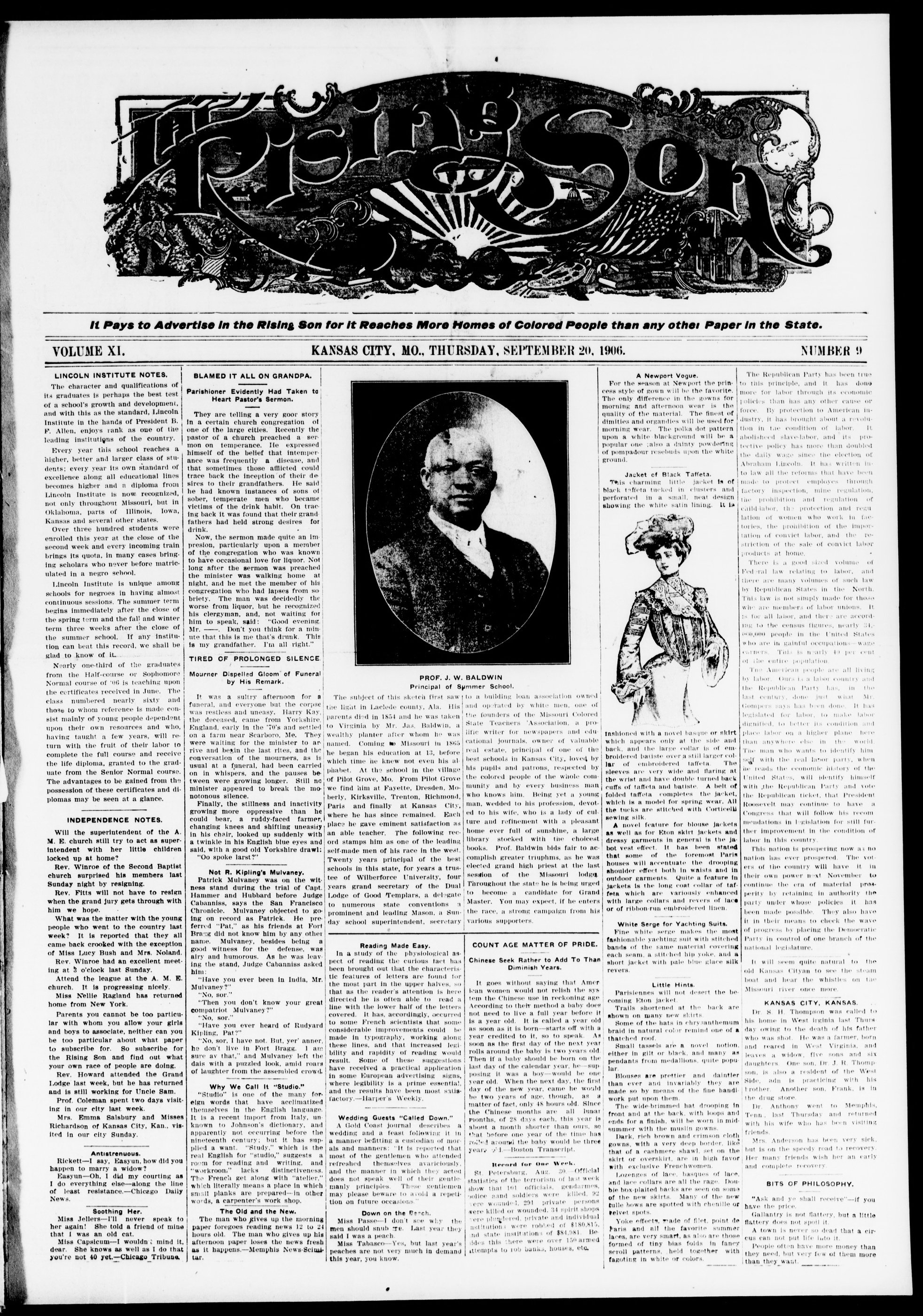
PROF. J. W. BALDWIN
Principal of Summer School.
The subject of this sketch first saw the light in Laclede county, Ala. His parents died in 1854 and he was taken to Virginia by Mr. Jas. Baldwin, a wealthy planter after whom he was named. Coming Missouri in 1865 he began his education at 13, before which time he knew not even his alphabet. At the school in the village of Pilot Grove, Mo. From Pilot Grove we find him at Fayette, Dresden, Moberly, Kirksville, Trenton, Richmond, Paris and finally at Kansas City, where he has since remained. Each place he gave eminent satisfaction as an able teacher. The following record stamps him as one of the leading self-made men of his race in the west. Twenty years principal of the best schools in this state, for years a trustee of Wilberforce University, four years grand secretary of the Dual Lodge of Good Templars, a delegate to numerous state conventions a prominent and leading Mason, a Sunday school superintendent, secretary
In a study of the physiological aspect of reading the curious fact has been brought out that the characteristic features of letters are found for the most part in the upper halves, so that as the reader's attention is here directed he is often able to read a line with the lower half of the letters covered. It has, accordingly, occurred to some French scientists that some considerable improvements could be made in typography, working along these lines, and that increased legibility and rapidity of reading would result. Some of these suggestions have received a practical application in some European advertising signs, where legibility is a prime essential, and the results have been most satisfactory.—Harper's Weekly.
Wedding Guests "Called Down."
A Gold Const journal describes a wedding and a feast following it in a manner befitting a custodian of morals and manners: "It is reported that most of the gentlemen who attended refreshed themselves avariciously, and the manner in which they acted does not speak well of their gentlemanly principles. These gentlemen may please beware to avoid a repetition on future occasions."
Down on the Beach.
Miss Passe—I don't see why the men should snub me. Last year they said I was a peach.
Miss Tabasco—Yes, but last year's peaches are not very much in demand this year, you know.
Reading Made Easy
.
to a building loan association owned and operated by white men, one of the founders of the Missouri Colored State Teachers 'Association, a prolific writer for newspapers and educational journals, owner of valuable real estate, principal of one of the best schools in Kansas City, loved by his pupils and patrons, respected by the colored people of the whole community and by every business man who knows him. Being yet a young man, wedded to his profession, devoted to his wife, who is a lady of culture and refinement with a pleasant home ever full of sunshine, a large library stocked with the choicest books. Prof. Baldwin bids fair to accomplish greater triumphs, as he was elected grand high priest at the last session of the Missouri lodge. Throughout the state he is being urged to become a candidate for Grand Master. You may expect, if he enters the race, a strong campaign from his various supporters.
COUNT AGE MATTER OF PRIDE.
Chinese Seek Rather to Add To Thar Diminish Years.
It goes without saying that American women would not relish the system the Chinese use in reckoning age. According to their method a baby does not need to live a full year before it is a year old. It is called a year old as soon as it is born—starts off with a year credited to it, so to speak. As soon as the first day of the next year rolls around the baby is two years old. Then if a baby should be born on the last day of the calendar year, he—supposing it was a boy—would be one year old. When the next day, the first day of the new year, came he would be two years of age, though, as a matter of fact, only 48 hours old. Since the Chinese months are all lunar months, of 28 days each, this year is about a month shorter than ours, so that before one year of the time has rolled around the baby would be three years $^{21}$—boston Transcript.
Record for One Week
St. Petersburg, Aug. 30—Official statistics of the terrorism of last week show that 191 officials, gendarmes, police and soldiers were killed, 32 were wounded, 291 private persons were killed or wounded, 34 spirit shops were plugged, private and individual institutions were robbed of $180,815, and state institutions of $84,981. Besides this there were over 150 armed attempts to rob banks, houses, etc.
A Newport Vogue.
For the season at Newport the princess style of gown will be the favorite. The only difference in the gowns for morning and afternoon wear is the quality of the material. The finest of ditties and organdles will be used for morning wear. The polka dot pattern upon a white background will be a popular one also a dainty powdering of pompadour resebuds upon the white ground.
Jacket of Black Taffeta.
This charming little jacket is of black teffa tucked in clusters and perforated in a small neat design showing the white satin lining. It is
```markdown
```
nashioned with a novel basque or skirt which appears only at the side and back, and the large collar is of embroidered batiste over a still larger collar of embroidered taffeta. The sleeves are very wide and flaring at the wrist and have double turned back cuffs of taffeta and batiste. A belt of folded taffeta completes the jacket, which is a model for spring wear. All the tucks are stitched with Corticelli sewing silk.
A novel feature for blouse jackets as well as for Eton skirt jackets and dressy garments in general is the jacket vest effect. It has been stated that some of the foremost Paris houses will accentuate the drooping shoulder effect both in waists and in outdoor garments. Quite a feature in jackets is the long coat collar of taffeta which are variously enhanced with large collars and revers of lace or of ribbon-run embroidered linen.
White Serge for Yachting Suits.
Fine white, serge makes the most fashionable yachting suit with stitched bands of the same material covering each seam, a stitched hip yoke, and a short jacket with pale blue glace silk revers.
Little Hints.
Parisiennes will not desert the becoming Eton jacket.
Trails shortened at the back are shown on many new skirts.
Some of the hats in chrysanthemum braid in natural color remind one of a thatched roof.
Small tassels are a novel notion, either in gilt or black, and many as pendants from medallions, quite popular.
Blouses are prettier and dainter than ever and invariably they are made so by means of the fine handiwork put upon them.
The wide brimmed hat drooping in front and at the back, with loops and ends for a finish, will be worn in mid-summer with the muslin gowns.
Dark, rich brown and crimson cloth gowns, with a very deep border, like that of a cashmere shawl, set on the skirt or overskirt, are in high favor with exclusive French women.
Lozenges of lace, basques of lace, and lace collars are all the rage. Double box-plaited backs are seen on some of the new skirts. Many of the new tulle bows are spotted with chenille or velvet spots.
Yoke effects, made of fillet, point de Paris and all the favorite summer laces, are very smart, as also are those formed of tiny bias folds in fancy scroll patterns, held together with fagoting in white or colors.
NUMBER 9
The Republican Party has been true to this principle, and it has done more for labor through its economic policies than has any other cause or force. By protection to American industry, it has brought about a revolution in the condition of labor. It abolished slave-labor, and its protective policy has more than doubled the daily wage since the election of Abraham Lincoln. It has written into law all the reforms that have been made to protect employees through factory inspection, mine regulation, the prohibition and regulation of cauld-labor, the protection and regulation of women who work in factories, the prohibition of the importation of convict labor, and the restriction of the sale of convict labor products at home.
There is a good sized volume of Federal law relating to labor, and there are many volumes of such law by Republican States in the North. This law is not simply made for those who are members of labor unions. It is for all labor, and there are according to the census figures, nearly 34, 600,000 people in the United States who are in gainful occupations—wage earners. This is nearly 40 per cent of the entire population.
The American people are all living by labor. Ours is a labor country and the Republican Party has, in the last century, done just what. Mr. Gompers says has been done. It has legislated for labor, to make labor dignified, to better its condition and place labor on a higher plane here than anywhere else in the world. The man who wants to identify himself with the real labor party, when he reads the economic history of the United States, will identify himself with the Republican Party and vote the Republican ticket, that President Roosevelt may continue to have a Congress that will follow his recommendations in legislation for still further improvement in the condition of labor in this country.
This nation is prospering now as nation has ever prospered. The voters of the country will have it in their own power next November to continue the era of material prosperity by retaining in authority the party under whose policies it has been made possible. They also have it in their means to check the wave of progress by placing the Democratic Party in control of one branch of the national legislature.
It will seem quite natural to the old Kansas Cityan to see the steam boat and hear the whistles on the Missouri river once more.
KANSAS CITY KANSAS.
Dr. S. H. Thompson was called to his home in West irginia last Thursday owing to the death of his father who was shot. He was a farmer, born and reared in West Virginia, and leaves a widow, five sons and six daughters. One son, Dr. J. R. Thompson, is also a resident of the West Side, adn is practicing with his brother. Another son, Frank, is in the drug store.
Dr. Anthony went to Memphis, Tenn., last Thursday and returned with his wife who has been visiting friends.
Mrs. Anderson has been very sick, but is on the speedy road to recovery. Her many friends wish her an early and complete recovery.
BITS OF PHILOSOPHY.
"Ask and ye shall receive"—if you have the price.
Gallantry is not flattery, but a little flattery does not spoil it.
A town is never so dead that a circus can not put life into it.
People often have more money than they need, but very few of them more than they want.
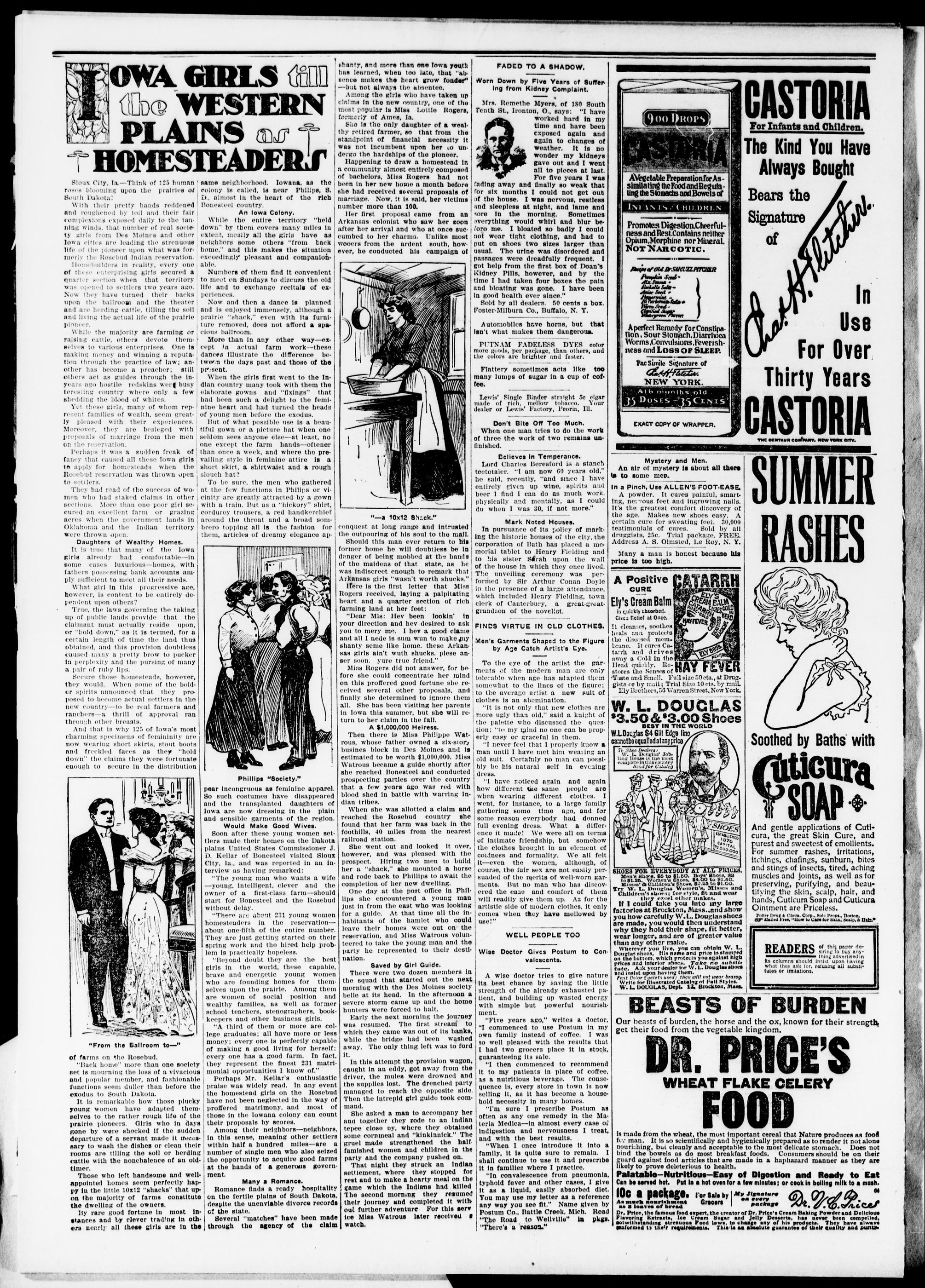
IOWA GIRLS till the WESTERN PLAINS as HOMESTEADERS
Sloux City, Ia.—Think of 125 human roses blooming upon the prairies ot South Dakota.
With their pretty hands reddened and roughened by toil and their fair complexions exposed daily to the tanning winds, that number of real society girls from Des Moines and other Iowa cities are leading the strenuous life of the pioneer upon what was formerly the Rosebud Indian reservation.
Homebuilders in reality, every one of these enterprising girls secured a quarter section when that territory was opened to settlers two years ago. Now they have turned their backs upon the ballroom and the theater and are herding cattle, tilling the soil and living the actual life of the prairie pioneer.
While the majority are farming or raising cattle, others devote themselves to various enterprises. One is making money and winning a reputation through the practice of law; another has become a preacher; still others act as guides through the in-years ago hostile redskins were busy interesting country where only a few shedding the blood of whites.
Yet these girls, many of whom represent families of wealth, seem greatly pleased with their experiences. Moreover, they are besieged with proposals of marriage from the men on the reservation.
Perhaps it was a sudden freak of fancy that caused all these Iowa girls to apply for homesteads when the Rosebud reservation was thrown open to settlers.
They had read of the success of women who had staked claims in other sections. More than one poor girl secured an excellent farm or grazing acres when the government lands in Oklahoma and the Indian territory were thrown open.
Daughters of Wealthy Homes.
It is true that many of the Iowa girls already had comfortable—in some cases luxurious—homes, with fathers possessing bank accounts amply sufficient to meet all their needs.
What girl in this progressive age, however, is content to be entirely dependent upon others?
True, the laws governing the taking up of public lands provide that the claimant must actually reside upon, or "hold down," as it is termed, for a certain length of time the land thus obtained, and this provision doubtless caused many a pretty brow to pucker in perplexity and the pursuing of many a pair of ruby lips.
Secure those homesteads, however, they would. When some of the holder spirits announced that they proposed to become actual settlers in the new country—to be real farmers and ranchers—a thrill of approval ran through other breaches.
And that is why 125 of Iowa's most charming specimens of femininity are now wearing short skirts, stout boots and freckled faces as they "hold down" the claims they were fortunate enough to secure in the distribution
THE FASHION
"From the Ballroom to—"
of farms on the Rosebud.
"Back home" more than one society set is mourning the loss of a vivacious and popular member, and fashionable functions seem duller than before the exodus to South Dakota.
It is remarkable how those plucky young women have adapted themselves to the rather rough life of the prairie pioneers. Girls who in days gone by were shocked if the sudden departure of a servant made it necessary to wash the dishes or clean their rooms are tilling the soil or herding cattle with the nonchalence of an old-timer.
Those who left handsome and well-appointed homes seem perfectly happy in the little 10x12 "shacks" that upon the majority of farms constitute the dwelling of the owners.
By rare good fortune in most instances and by clever trading in others nearly all these girls are in the
same neighborhood. Iowa, as the colony is called, is near Phillips, S. D., almost in the heart of the rich Bonestel country.
An Iowa Colony.
While the entire territory "held down" by them covers many miles in extent, mostly all the girls have as neighbors some others "from back home," and this makes the situation exceedingly pleasant and companionable.
Numbers of them find it convenient to meet on Sundays to discuss the old life and to exchange recitals of experiences.
Now and then a dance is planned and is enjoyed immensely, although a prairie "shack," even with its furniture removed, does not afford a spacious ballroom.
More than in any other way—except in actual farm work—the dances illustrate the difference between the days past and those of the present.
When the girls first went to the Indian country many took with them the elaborate gowns and "fixings" that had been such a delight to the feminine heart and had turned the heads of young men before the exodus. But of what possible use is a beautiful gown or a picture hat when one seldom sees anyone else—at least, no one except the farm hands—offener than once a week, and where the prevailing style in feminine attire is a short skirt, a shirtwaist and a rough slouch hat?
To be sure, the men who gathered at the few functions in Phillips or vicinity are greatly attracted by a gown with a train. But as a "hilekory" shirt, corduroy trousers, a red handkerchief around the throat and a broad sombrero topping all is the fashion for them, articles of dreamy elegance ap-
A
Phillips "Society."
pear incongruous as feminine apparel. So such costumes have disappeared and the transplanted daughters of Iowa are now dressing in the plain and sensible garments of the region.
Would Make Good Wives.
Soon after these young women setters made their homes on the Dakota plains United States Commissioner J. D. Kellar of Bonesteel visited Sloux City, Ia, and was reported in an interview as having remarked:
"The young man who wants a wife—young, intelligent, clever and the owner of a first-class farm—should start for Bonesteel and the Rosebud without delay.
"There are about 231 young women homesteaders in the reservation—about one-fifth of the entire number. They are just getting started on their spring work and the hired help problem is practically hopeless.
"Beyond doubt they are the best girls in the world, these capable, brave and energetic young women who are founding homes for themselves upon the prairie. Among them are women of social position and wealthy families, as well as former school teachers, stenographers, bookkeepers and other business girls.
"A third of them or more are college graduates; all have more or less money; every one is perfectly capable of making a good living for herself; every one has a good farm. In fact, they represent the finest 231 matrimonial opportunities I know of."
Perhaps Mr. Kellar's enthusiastic praise was widely read. In any event the homestead girls on the Rosebud have not been neglected in the way of proffered matrimony, and most of those in the lowana colony can count their proposals by scores.
Among their neighbors—neighbors, in this sense, meaning other settlers within half a hundred miles—are a number of single men who also seized the opportunity to acquire good farms at the hands of a generous government.
Many a Romance.
Romance finds a ready hospitality on the fertile plains of South Dakota, despite the unenviable divorce records of the state. Several "matches" have been made through the agency of the claim
shanty, and more than one Iowa youth has learned, when too late, that "absence makes the heart grow fonder"—but not always the absentee.
Among the girls who have taken up claims in the new country, one of the most popular is Miss Lottie Rogers, formerly of Ames, Ia.
She is the only daughter of a wealthy retired farmer, so that from the standpoint of financial necessity it was not incumbent upon her so undergo the hardships of the pioneer.
Happening to draw a homestead in a community almost entirely composed of bachelors, Miss Rogers had not been in her new home a month before she had received several proposals of marriage. Now, it is said, her victims number more than 100.
Her first proposal came from an Arkansas colonist who saw her soon after her arrival and at once succeeded to her charms. Unlike most wooers from the ardent south, however, he conducted his campaign of
WASHING
"—a 10x12 Shack."
conquest at long range and intrusted the outpouring of his soul to the mall. Should this man ever return to his former home he will doubtless be in danger of being mobbed at the hands of the maidens of that state, as he was indiscreet enough to remark that Arkansas girls "wasn't worth shucks." Here is the first letter that Miss Rogers received, laying a palpitating heart and a quarter section of rich farming land at her feet:
"Dear Mis: Hev been lookin' in your direction and hev desired to ask you to mery me. I hev a good clame and all I nede is sum wun to make my shanty some like home. these Arkansas girls ain't wuth shucks, please anser soon, sure true friend."
Miss Rogers did not answer, for before she could concentrate her mind on this proffered good fortune she received several other proposals, and finally she determined to ignore them all. She has been visiting her parents in Iowa this summer, but she will return to her claim in the fall.
A $1,000,000 Heiress.
Then there is Miss Philippe Watrous, whose father owned a six-story busines block in Des Moines and is estimated to be worth $1,000,000. Miss Watrous became a guide shortly after she reached Bonesteel and conducted prospecting parties over the country that a few years ago was red with blood shed in battle with warring Indian tribes. When she was allotted a claim and reached the Rosebud country she found that her farm was back in the foothills, 40 miles from the nearest railroad station. She went out and looked it over, however, and was pleased with the prospect. Hiring two men to build her a "shack," she mounted a horse and rode back to Phillips to await the completion of her new dwelling.
One day at the post office in Phillips she encountered a young man just in from the east who was looking for a guide. At that time all the inhabitants of the hamlet who could leave their homes were out on the reservation, and Miss Watrous volunteered to take the young man and the party he represented to their destination.
Saved by Girl Guide.
There were two dozen members in the squad that started out the next morning with the Des Moines society belle at its head. In the afternoon a severe storm came up and the home hunters were forced to halt.
Early the next morning the journey was resumed. The first stream to which they came was out of its banks, while the bridge had been washed away. The only thing left was to ford it.
In this attempt the provision wagon, caught in an eddy, got away from the driver, the mules were drowned and the supplies lost. The drenched party managed to reach the opposite side. Then the intrepid girl guide took command.
She asked a man to accompany her and together they rode to an Indian tepee close by, where they obtained some cornmeal and "kinkinnick." The gruel made strengthened the half-famished women and children in the party and the company pushed on. That night they struck an Indian settlement, where they stopped for rest and to make a hearty meal on the game which the Indians had killed. The second morning they resumed their journey and completed it without further adventure. For this service Miss Watrous later received a watch.
FADED TO A SHADOW
Worn Down by Five Years of Buffering from Kidney Complaint.
Mrs. Remethe Myers, of 180 South Teenth St., Ironton, O., says: "I have
I worked hard in my time and have been exposed again and again to changes of weather. It is no wonder my kidneys gave out and I went all to pieces at last. For five years I was
worked hard in my time and have been exposed again and again to changes of weather. It is no wonder my kidneys gave out and I went all to pieces at last. For five years I was fading away and finally so weak that for six months I could not get out of the house. I was nervous, restless and sleepless at night, and lame and sore in the morning. Sometimes everything would whirl and blur before me. I bloated so badly I could not wear tight clothing, and had to put on shoes two sizes larger than usual. The urine was disordered and passages were dreadfully frequent. I got help from the first box of Doan's Kidney Pills, however, and by the time I had taken four boxes the pain and bloating was gone. I have been in good health ever since."
Sold by all dealers. 50 cents a box.
Foster-Milburn Co., Buffalo, N. Y.
Automobiles have horns, but that isn't what makes them dangerous.
PUTNAM FADELESS DYES color more goods, per package, than others, and the colors are brighter and faster.
Flattery sometimes acts like too many lumps of sugar in a cup of coffee.
Lewis' Single Binder straight 5c cigar made of rich, mellow tobacco. Your dealer or Lewis' Factory, Peoria, Ill.
Don't Bite Off Too Much.
When one man tries to do the work of three the work of two remains unfinished.
Lord Charles Beresford is a stanch tecotaier. "I am now 60 years old," he said, recently, "and since I have entirely given up wine, spirits and beer I find I can do as much work physically and mentally, as I could do when I was 30, if not more."
Mark Noted Houses.
In pursuance of its policy of marking the historic houses of the city, the corporation of Bath has placed a memorial tablet to Henry Fielding and to his sister Sirah upon the wall of the house in which they once lived. The unveiling ceremony was performed by Sir Arthur Conan Doyle in the presence of a large attendance, which included Henry Fielding, town clerk of Canterbury, a great-great-grandson of the novelist.
FINDS VIRTUE IN CLD CLOTHES.
Men's Garments Shaped to the Figure by Age Catch Artist's Eye.
To the eye of the artist the garments of the modern man are only tolerable when age has adapted them somewhat to the lines of the figure; to the average artist a new suit of clothes is an abmination.
"It is not only that new clothes are more ugly than old," said a knight of the palette who discussed the question; "to my mind no one can be properly easy or graceful in them.
"I never feel that I properly know a man until I have met him wearing an old suit. Certainly no man can possibly be his natural self in evening dress.
"I have noticed again and again how different the same people are when wearing different clothes. I went, for instance, to a large family gathering some time ago, and for some reason everybody had donned full evening dress. What a difference it made! We were all on terms of intimate friendship, but somehow the clothes brought in an element of coldness and formality. We all felt it—even the women, although, of course, the fair sex are not easily persuaded of the merits of well-worn garments. But no man who has discovered the ease and comfort of them will readily give them up. As for the artistic side of modern clothes, it only comes when they have mellowed by use!"
WELL PEOPLE TOO
Wise Doctor Gives Postum to Convalescents.
A wise doctor tries to give nature its best chance by saving the little strength of the already exhausted patient, and building up wasted energy with simple but powerful nourishment.
"Five years ago," writes a doctor, "I commenced to use Postum in my own family instead of coffee. I was so well pleased with the results that I had two grocers place it in stock, guaranteeing its sale.
"I then commenced to recommend it to my patients in place of coffee, as a nutritious beverage. The consequence is, every store in town is now selling it, as it has become a household necessity in many homes.
"I'm sure I prescribe Postum as often as any one remedy in the Materia Medica—in almost every case of indigestion and nervousness I treat, and with the best results.
"When I once introduce it into a family, it is quite sure to remain. I shall continue to use it and prescribe it in families where I practice.
"In convalescence from pneumonia, typhoid fever and other cases, I give it as a liquid, easily absorbed diet. You may use my letter as a reference any way you see fit." Name given by Postum Co., Battle Creek, Mich. Read "The Road to Wellville" in pkgs. "There's a reason."
900 DROPS
CASTORIA
A Vegetable Preparation for Assimilating the Food and Regulating the Stomachs and Bowels of
INFANTS/CHILDREN
Promotes Digestion, Cheerfulness and Rest. Contains neither Opium, Morphine nor Mineral.
NOT NARCOTIC.
Recipe of Old Dr. SANCULZ PATCHER
Pumpkin Seed -
Alk. Stone -
Richelle Salt -
Aduce Salt -
Pumpkin Seed -
Alk. Stone -
Worries Seed -
Clarified Sugar
Whiskey Flavor
A Perfect Remedy for Constipation, Sour Stomach, Diarrhoea Worms, Convulsions, Feverishness and LOSS OF SLEEP.
Fac Simile Signature of
Charles H. Fletcher
NEW YORK.
A16 months old
35 DOSES - 35 CENTS
EXACT COPY OF WRAPPER.
CASTORIA
For Infants and Children.
The Kind You Have Always Bought
Bears the Signature of
Charles H. Fletcher.
In Use For Over Thirty Years
CASTORIA
THE GENTAUR COMPANY, NEW YORK CITY.
BEASTS OF BURDEN
BEASTS OF BURDEN
Our beasts of burden, the horse and the ox, known for their strength, get their food from the vegetable kingdom.
DR. PRICE'S
WHEAT FLAKE CELERY
FOOD
is made from the wheat, the most important cereal that Nature produces as food for man. It is so scientifically and hygienically prepared as to render it not alone nourishing, but cleanly and acceptable to the most delicate stomach. Does not bind the bowels as do most breakfast foods. Consumers should be on their guard against food articles that are made in a haphazard manner as they are likely to prove deleterious to health.
Palatable—Nutritious—Easy of Digestion and Ready to Eat
Can be served hot. Put in a hot oven for a few minutes; or cook in boiling milk to a mush.
Dr. Price, the famous food expert, the creator of Dr. Price's Cream Baking Powder and Delicious Flavoring Extracts, Ice Cream Sugar and Jelly Desserts, has never been compelled, notwithstanding strenuous Food laws, to change any of his products. They have always conformed to their requirements. This is an absolute guarantee of their quality and purity.
Mystery and Men.
An air of mystery is about all there is to some men.
In a Pinch, Use ALLEN'S FOOT-EASE.
A powder. It cures painful, smarting, nervous feet and ingrowing nails.
It's the greatest comfort discovery of the age. Makes new shoes easy. A certain cure for sweating feet. 30,000 testimonials of cures. Sold by all drugstores, 25c. Trial package, FREE.
Address A. S. Olmsted, Le Roy, N. Y.
Many a man is honest because his price is too high.
CATARRH
ELY'S
CREAM EALM
CREAM EALM
CREAM EALM
HEAR
HEAR
HEAR
MAX FEVER
BREATHING
BREATHING
ELY BROS.
ELY BROS.
HAY FEVER
A Positive CURE
It cleanses, soothes
heals and protects
the diseased mem-
brane. It cures Catarrh
and drives away a Cold in the
Head quickly. Restores the Senses of
Taste and Smell. It
pistles or by mail; it
W. L. DOUGLAS
$3.50 & $3.00 Shoes
BEST IN THE WORLD
W.L.Douglas $4 Gift Edge line
cannot be equalled at any price
To Shoe Dulcera:
W. L. Douglas' Job-
ling House is the most
complete in the country
Send for Catalog
SHOES
ESTABLISHED
1875
CAPITAL
$200,000
SHOES FOR EVERYBODY AT ALL PRICES
Mona's Shoe, $1.60. ALL BOY Shoes, $8.
Mary's Shoe, $1.20. ALL BOY Shoes, $8.
Mississippi & Children's Shoes. $3.95 to $1.00.
Try W. L. Douglas Women's shoes and
Children's shoes, and wear
they excel other makes.
If I could take you into my large
factories at Brockton, Mass., and show
you how carefully W. L. Douglas shoes
are made, you would then understand
why they hold their shape, fit better,
wear longer, and are of greater value
than any other make.
W. L. Douglas shoes. His name and price is stamped
on the bottom, which protects you against high
prices and interior shoes. Take no substitute
for W. L. Douglas shoes and insist upon having them.
First Color Eyelids used: they will not wear bracey
First Color Eyelids used: they will not wear bracey
W. L. DOUGLAS, Dept. 2, Brockton, Mass.
SUMMER RASHES
1
Soothed by Baths with Cuticura SOAP And gentle applications of Cuticura, the great Skin Cure, and purest and sweetest of emollients. For summer rashes, irritations, itchings, chafings, sunburn, bites and stings of insects, tired, aching muscles and joints, as well as for preserving, purifying, and beautifying the skin, scalp, hair, and hands, Cuticura Soap and Cuticura Ointment are Priceless.
Potter Drug & Chem. Corp., Sole Props, Boston
Mailed Free. "How to Care for Skin, Scalp, & Hair."
READERS of this paper design simple signs any additional instructions to advise its columns should insist upon having the signs refused using all substitutes or imitations.
Wheat in Western Canada
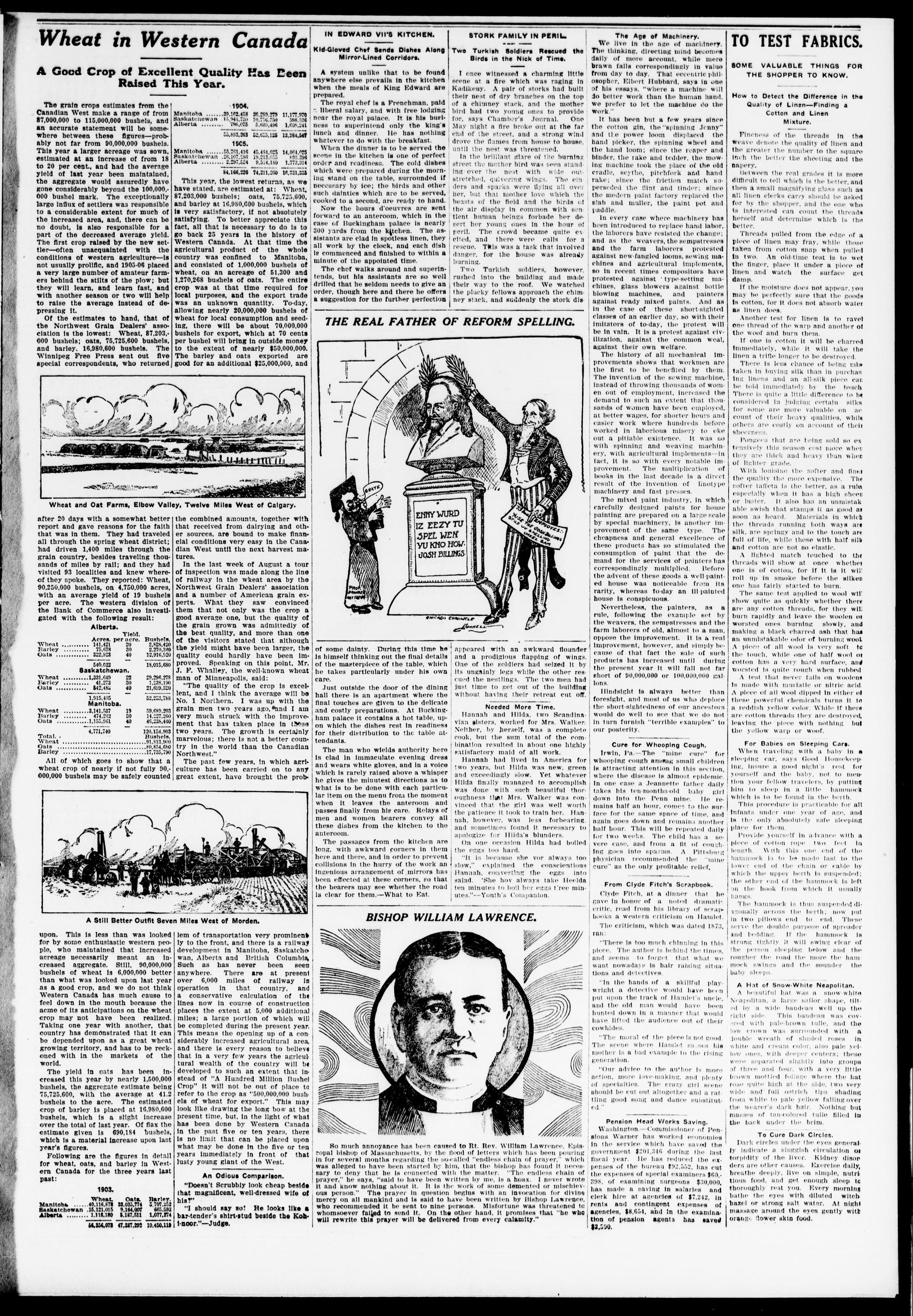
Wheat and Oat Farms, Elbow Valley, Twelve Miles West of Calgary.
A Still Better Outfit Seven Miles West of Morden.
The grain crops estimates from the Canadian West make a range of from 87,000,000 to 115,000,000 bushels, and an accurate statement will be somewhere between these figures—probably not far from 90,000,000 bushels. This year a larger acreage was sown, estimated at an increase of from 18 to 20 per cent., and had the average yield of last year been maintained, the aggregate would assuredly have gone considerably beyond the 100,000,000 bushel mark. The exceptionally large influx of settlers was responsible to a considerable extent for much of the increased area, and, there can be no doubt, is also responsible for a part of the decreased average yield. The first crop raised by the new settler—often unacquainted with the conditions of western agriculture—is not usually prolific, and 1905-06 placed a very large number of amateur farmers behind the stilts of the plow; but they will learn, and learn fast, and with another season or two will help to raise the average instead of depressing it.
Of the estimates to hand, that of the Northwest Grain Dealers' association is the lowest: Wheat, 87,203,000 bushels; oats, 75,725,600 bushels; and barley. 16,980,600 bushels. The Winnipeg Free Press sent out five special correspondents, who returned
Wheat and Oat Farms, Elbow Vall
after 20 days with a somewhat better report and gave reasons for the faith that was in them. They had traveled all through the spring wheat district; had driven 1,400 miles through the grain country, besides traveling thousands of miles by rail; and they had visited 93 localities and knew where of they spoke. They reported: Wheat, 90,250,000 bushels, on 4,750,000 acres, with an average yield of 19 bushels per acre. The western division of the Bank of Commerce also investigated with the following result:
Alberta.
Acres. per acre. Yield.
Bushels.
Wheat 141,421 20 2,928,430
Barley 75,678 30 2,270,340
Oats 322,923 40 12,918,520
540,622 18,015,680
Sakatchewan.
Wheat 1,311,649 22 19,296,278
Barley 41,273 30 1,238,190
Oats 542,485 40 21,689,320
1,915,405 22,523,788
Manitoba.
Wheat 3,141,537 19 53,689,203
Barley 474,292 30 14,227,250
Oats 1,155,361 40 40,238,440
4,771,740 120,154,903
Total. Bushels.
Wheat 91,813,900
Oats 80,854,680
Barley 17,735,790
All of which goes to show that a wheat crop of nearly if not fully 90,000,000 bushels may be safely counted
A Still Better Outfit Seve
upon. This is less than was looked for by some enthusiastic western people, who maintained that increased acreage necessarily meant an increased aggregate. Still, 90,000,000 bushels of wheat is 6,000,000 better than what was looked upon last year as a good crop, and we do not think Western Canada has much cause to feel down in the mouth because the acme of its anticipations on the wheat crop may not have been realized. Taking one year with another, that country has demonstrated that it can be depended upon as a great wheat growing territory, and has to be reckoned with in the markets of the world.
The yield in oats has been increased this year by nearly 1,500,000 bushels, the aggregate estimate being 75,725,600, with the average at 41.2 bushels to the acre. The estimated crop of barley is placed at 16,980,600 bushels, which is a slight increase over the total of last year. Of flax the estimate given is 690,184 bushels, which is a material increase upon last year's figures.
Following are the figures in detail for wheat, oats, and barley in Western Canada for the three years last past:
1903.
Wheat. Oats. Barley.
Manitoba ..... 40,116,878 33,035,774 5,707,252
Saskatchewan ..... 15,121,015 9,164,704 665,392
Alberta ..... 1,118,180 5,187,531 1,077,774
..... 64,356,078 47,387,292 10,450,118
---
Manitoba ..... 55,751,416 45,484,925 14,064,924
Saskatchewan 106,107,258 19,213,055 893,268
Alberta ..... 2,257,524 9,514,180 1,773,144
British Columbia ..... 84,166,226 74,211,390 16,721,235
This year, the lowest returns, as we have stated, are estimated at: Wheat, 87,203,000 bushels; oats, 75,725,600, and barley at 16,980,000 bushels, which is very satisfactory, if not absolutely satisfying. To better appreciate this fact, all that is necessary to do is to go back 25 years in the history of Western Canada. At that time the agricultural product of the whole country was confined to Manitoba, and consisted of 1,000,000 bushels of wheat, on an acreage of 51,300 and 1,270,268 bushels of oats. The entire crop was at that time required for local purposes, and the export trade was an unknown quantity. To-day, allowing nearly 20,000,000 bushels of wheat for local consumption and seeding, there will be about 70,000,000 bushels for export, which at 70 cents per bushel will bring in outside money to the extent of nearly $50,000,000. The barley and oats exported are good for an additional $25,000,000, and
ey, Twelve Miles West of Calgary.
the combined amounts, together with that received from dairying and other sources, are bound to make financial conditions very easy in the Canadian West until the next harvest matures.
In the last week of August a tour of inspection was made along the line of railway in the wheat area by the Northwest Grain Dealers' association and a number of American grain experts. What they saw convinced them that not only was the crop a good average one, but the quality of the grain grown was admittedly of the best quality, and more than one of the visitors stated that although the yield might have been larger, the quality could hardly have been improved. Speaking on this point, Mr. J. F. Whalley, the well-known wheat man of Minneapolis, said:
"The quality of the crop is excellent, and I think the average will be No. 1 Northern. I was up with the grain men two years ago, and I am very much struck with the improvement that has taken place in these two years. The growth is certainly marvelous; there is not a better country in the world than the Canadian Northwest." The past few years, in which agriculture has been carried on to any great extent, have brought the prob-
en Miles West of Morden.
lem of transportation very prominently to the front, and there is a railway development in Manitoba, Saskatchewan, Alberta and British Columbia. Such as has never been seen anywhere. There are at present over 6,000 miles of railway in operation in that country, and a conservative calculation of the lines now in course of construction places the extent at 5,000 additional miles; a large portion of which will be completed during the present year. This means the opening up of a considerably increased agricultural area, and there is every reason to believe that in a very few years the agricultural wealth of the country will be developed to such an extent that instead of "A Hundred Million Bushel Crop" it will not be out of place to refer to the crop as "500,000,000 bushels of wheat for export." This may look like drawing the long bow at the present time, but, in the light of what has been done by Western Canada in the past five or ten years, there is no limit that can be placed upon what may be done in the five or ten years immediately in front of that lusty young giant of the West.
An Odious Comparison.
"Doesn't Scrubbly look cheap beside that magnificent, well-dressed wife of his?"
"I should say so! He looks like a bar-tender's shirt-stud beside the Kohi-noor."—Judge.
IN EDWARD VII'S KITCHEN.
Kid-Gloved Chef Sends Dishes Along Mirror-Lined Corridors.
A system unlike that to be found anywhere else prevails in the kitchen when the meals of King Edward are prepared.
The royal chef is a Frenchman, paid liberal salary, and with free lodging near the royal palace. It is his business to superintend only the king's lunch and dinner. He has nothing whatever to do with the breakfast.
When the dinner is to be served the scene in the kitchen is one of perfect order and readiness. The cold dishes which were prepared during the morning stand on the table, surrounded if necessary by ice; the birds and other such dainties which are to be served, cooked to a second are ready to hand.
Now the hours d'oeuvres are sent forward to an anteroom, which in the case of Buckingham palace is nearly 300 yards from the kitchen. The assistants are clad in spotless linen, they all work by the clock, and each dish is commenced and finished to within a minute of the appointed time. The chef walks around and superintends, but his assistants are so well drilled that he seldom needs to give an order, though here and there he offers a suggestion for the further perfection
THE REAL FATHER C
GRATE
ENNY WU
IZ EEZY
SPEL WA
YU KNO
JOSH BIL
PROK
BANQUES
NET FREES
THE REAL FATHER OF REFORM SPELLING.
ENNY WURD
IZ EEZY TU
SPEL WEN
YU KNO HOW.
JOSH BILLINGS
PROK
BROKEN
AMY TREASURE
CHICAGO CHRISTIE
LONHILL
of some dainty. During this time he is himself thinking out the final details of the masterpiece of the table, which he takes particularly under his own care.
Just outside the door of the dining hall there is an apartment where the final touches are given to the delicate and costly preparations. At Buckingham palace it contains a hot table, upon which the dishes rest in readiness for their distribution to the table attendants.
The man who welds authority here is clad in immaculate evening dress and wears white gloves, and in a voice which is rarely raised above a whisper he gives the minutest directions as to what is to be done with each particular item on the menu from the moment when it leaves the anteroom and passes finally from his care. Relays of men and women bearers convey all these dishes from the kitchen to the anteroom.
The passages from the kitchen are long, with awkward corners in them here and there, and in order to prevent collisions in the hurry of the work an ingenious arrangement of mirrors has been effected at these corners, so that the bearers may see whether the road is clear for them.—What to Eat.
BISHOP WILLIAM LAWRENCE.
E
P. R.
So much annoyance has been caused to Rt. Rev. William Lawrence. Episcopal bishop of Massachusetts, by the flood of letters which has been pouring in for several months regarding the so-called "endless chain of prayer," which was alleged to have been started by him, that the bishop has found it necessary to deny that he is connected with the matter. "The endless chain of prayer," he says, "said to have been written by me, is a hoax. I never wrote it and know nothing about it. It is the work of some demented or mischievous person." The prayer in question begins with an invocation for divine mercy on all mankind and is said to have been written by Bishop Lawrence, who recommended it be sent to nine persons. Misfortune was threatened to whomsoever failed to send it. On the other hand, it promises that "he who will rewrite this prayer will be delivered from every calamity."
STORK FAMILY IN PERIL
Two Turkish Soldiers Rescued the Birds in the Nick of Time.
I once witnessed a charming little scene at a fire which was raging in Kadikuye. A pair of storks had built their nest of dry branches on the top of a chimney stack, and the mother bird had two young ones to provide for, says Chamber's Journal. One May night a fire broke out at the far end of the street, and a strong wind drove the flames from house to house, until the nest was threatened.
In the brilliant glare of the burning street the mother bird was seen standing over the nest with wide out stretched, quivering wings. The cinders and sparks were flying all over her, but that mother love which the beasts of the field and the birds of the air display in common with sentient human beings forbade her desert her young ones in the hour of peril. The crowd became quite excited, and there were calls for a rescue. This was a task that involved danger, for the house was already burning.
Two Turkish soldiers, however, rushed into the building and made their way to the roof. We watched the placky fellows approach the chimney stack, and suddenly the stork dis
OF REFORM SPELLING.
IMPROVES:
USE THE TONS OF BILLS
STILL UP A REALLIAN
UNDER BANK
appeared with an awkward flounder and a prodigious flapping of wings. One of the soldiers had seized it by its ungainly legs while the other rescued the nestlings. The two men had just time to get out of the building without having their retreat cut off.
Needed More Time.
Hannah and Hilda, two Scandinavian sisters, worked for Mrs. Walker, Neither, by herself, was a complete cook, but the sum total of the combination resulted in about one highly satisfactory maid of all work.
Hannah had lived in America for two years, but Hilda was new, green and exceedingly slow. Yet whatever Hilda finally managed to accomplish was done with such beautiful thoroughness that Mrs. Walker was convinced that the girl was well worth the patience it took to train her. Hannah, however, was less forbearing, and sometimes found it necessary to apologize for Hilda's blunders.
On one occasion Hilda had boiled the eggs too hard.
"It is because she vor always too slow," explained the conscientious Hannah, converting the eggs into salad. "She how always take Heelda ten minutes to boil her eggs three minutes."—Youth's Companion.
THE NEW YORK TIMES
The Age of Machinery.
We live in the age of machinery. The thinking, directing mind becomes daily of more account, while mere brawn falls correspondingly in value from day to day. That eccentric philosopher, Elbert Hubbard, says in one of his essays, "where a machine will do better work than the human hand, we prefer to let the machine do the work."
It has been but a few years since the cotton gin, the "spinning Jenny" and the power loom displaced the hand picker, the spinning wheel and the hand loom; since the reaper and blinder, the rake and tedder, the mowing machine took the place of the old cradle, scythe, pitchfork and hand rake; since the friction match superseded the flint and tinder; since the modern paint factory replaced the slab and muller, the paint pot and paddle.
In every case where machinery has been introduced to replace hand labor, the laborers have resisted the change; and as the weavers, the sempstresses and the farm laborers protested against new-fangled looms, sewing machines and agricultural implements, so in recent times compositors have protested against 'type-setting machines, glass blowers against bottle blowing machines, and painters against ready mixed paints. And as in the case of these short-sighted classes of an earlier day, so with their imitators of to-day, the protest will be in vain. It is a protest against civilization, against the common weal against their own welfare.
The history of all mechanical improvements shows that workmen are the first to be benefited by them. The invention of the sewing machine, instead of throwing thousands of women out of employment, increased the demand to such an extent that thousands of women have been employed, at better wages, for shorter hours and easier work where hundreds before worked in laborious misery to eke out a pittable existence. It was so with spinning and weaving machinery, with agricultural implements—in fact, it is so with every notable improvement. The multiplication of books in the last decade is a direct result of the invention of linotype machinery and fast presses.
The mixed paint industry, in which carefully designed paints for house painting are prepared on a large scale by special machinery, is another improvement of the same type. The cheapness and general excellence of these products has so stimulated the consumption of paint that the demand for the services of painters has correspondingly multiplied. Before the advent of these goods a well-painted house was noticeable from its rarity, whereas to-day an ill-painted house is conspicuous.
Nevertheless, the painters, as a rule, following the example set by the weavers, the sempstresses and the farm laborers of old, almost to a man, oppose the improvement. It is a real improvement, however, and simply because of that fact the sale of such products has increased until during the present year it will fall not far short of 50,000,000 or 100,000,000 gallons.
Hindsight is always better than foresight, and most of us who deplore the short-sightedness of our ancestors would do well to see that we do not in turn furnish "terrible examples" to our posterity.
Cure for Whooping Cough:
Irwin, Pa.—The "mine cure" for whooping cough among small children is attracting attention in this section, where the disease is almost epidemic. In one case a Jeannette father daily takes his ten-month-old baby girl down into the Penn mine. He remains half an hour, comes to the surface for the same space of time, and again goes down and remains another half hour. This will be repeated daily for two weeks. The child has a severe case, and from a fit of cough goes into spasms. A Pittsburgh physician recommended the "mine cure" as the only profitable relief.
From Clyde Fitch's Scrapbook
Clyde Fitch, at a dinner that he gave in honor of a noted dramatic critic, read from his library of scrapbooks a western criticism on Hamlet. The criticism, which was dated 1873, ran:
"There is too much chinning in this piece. The author is behind the times, and seems to forget that what we want nowadays is hair raising situations and detectives.
"In the hands of a skillful playwright a detective would have been put upon the track of Hamlet's uncle, and the old man would have been hunted down in a manner that would have lifted the audience out of their cowhides.
"The moral of the piece is not good. The scene where Hamlet sues his mother is a bad example to the rising generation.
"Our advice to the author is more action, more love-making, and plenty of specialties. The crazy girl scene should be cut out altogether and a rattling good song and dance substituted."
Pension Head Works Saving
Washington—Commissoner of Pensions Warner has worked economies in the service which have saved the government $201,344 during the last fiscal year. He has reduced the expenses of the bureau $2,552, has cut the expenses of special examiners $60,398, of examining surgeons $30,000, has made a saving in salaries and clerk hire at agencies of $7,242, inrents and contingent expenses of agencies, $8,654, and in the examination of pension agents has saved $2,500.
TO TEST FABRICS.
SOME VALUABLE THINGS FOR
THE SHOPPER TO KNOW.
How to Detect the Difference in the
Quality of Linen—Finding a
Cotton and Linen
Fineness of the threads in the weave denote the quality of linen and the greater the number to the square inch the better the sheeting and the napery.
Between the real grades it is more difficult to tell which is the better, and then a small magnifying glass such as all linen clerks carry should be asked for by the shopper, and the one who is interested can count the threads herself and determine which is the better.
Threads pulled from the edge of a piece of linen may fray, while those taken from cotton snap when pulled in two. An old-time test is to wet the finger, place it under a piece of linen and watch the surface get damp.
If the moisture does not appear, you may be perfectly sure that the goods is cotton, for it does not absorb water as linen does.
Another test for linen is toravel one thread of the warp and another of the woof and burn them. If one is cotton it will be charred immediately, while it will take the linen a trifle longer to be destroyed. There is less chance of being mistaken in buying silk than in purchasing linings and an all-silk piece can be told immediately by the touch. There is quite a little difference to be considered in judging certain silks for some are more valuable on account of their heavy qualities, while others are costly on account of their sheerness. Pongees that are being sold so extensively this season cost more when they are thick and heavy than when of lighter grade.
With bonfire the softer and finer the quality the more expensive. The softer taffetta is the better, as a rule especially when it has a high sheer or luster. It also has an unmistakable swish that stamps it as good as soon as heard. Materials in which the threads running both ways are silk, are springy and to the touch are full of life, while those with half silk and cotton are not so elastic.
A lighted match touched to the threads will show at once whether one is of cotton, for if it is it will roll up in smoke before the silken one has fairly started to burn.
The same test applied to wool will show quite as quickly whether there are any cotton threads, for they will burn rapidly and leave the woolen or worsted ones burning slowly, and making a black charred ash that has an unmistakable odor of burning wool. A piece of all wool is very soft, to the touch, while one of half wool or cotton has a very hard surface, and worsted is quite rough when rubbed. A test that never fails on woolens is made with mumfatic or nitric acid. A piece of all wool dipped in either of these powerful chemicals turns it to a reddish yellow color. While if there are cotton threads they are destroyed, leaving the piece with nothing, but the yellow warp or woof.
For Babies on Sleeping Cars
When traveling with a baby in a sleeping car, says Good Housekeeping, insure a good night's rest for yourself and the baby, not to mention your fellow travelers, by putting him to sleep in a little hammock which is to be found in the berth. This procedure is practicable for all infants under one year of age, and is the only absolutely safe sleeping place for them.
Provide yourself in advance with a piece of cotton rope two feet in length. With this one end of the hammock is to be made fast to the lower end of the chain or cable by which the upper berth is suspended; the other end of the hammock is left on the hook from which it usually hangs.
The hammock is thus suspended diagonally across the berth; now put in two pillows end to end. These serve the double purpose of spreader and bending. If the hammock is strong tightly it will swing clear of the person sleeping below and the rougher the road the more the hammock swings and the sounder the baby sleeps.
A Hat of Snow-White Neanolitan
A beautiful hat was a snow-white Neapolitan, a large sailor shape, tilted by a wide bandeau well up the right side. This bandeau was covered with pale-brown tulle, and the low crown was surrounded with a double wreath of shaded roses in white and cream color, also pale yellow ones, with deeper centers; these were separated slightly into groups of three and four, with a very little brown mottled foliage where the hat rose quite high at the side, two very wide and full ostrich tips shading from white to pale yellow falling over the wearer's dark hair. Nothing but masses of tan-colored tulle filled in the back under the brim.
To Cure Dark Circles.
Dark circles under the eyes generally indicate a shaggy circulation or torpidity of the liver. Kidney disorders are other causes. Exercise daily, breathe deeply, live on simple, nutritious food, and get enough sleep to thoroughly rest you. Every morning bathe the eyes with diluted witch hazel or strong salt water. At night massage around the eyes gently with orange. Power skin food.
GEWIS WOODS..... Business Manager.
Entered at the Post Office at Kansas City,
as Second Class Matter.
Correspondents wanted in every city
and town in this state. Write us.
respondents wanted in every city
and town in this state. Write us.
All news matter intended k r pub-
lication should reach our office not
after Tuesday, of each week and
must be signed by the writer not for
publication, but as guarantee of auth-
enticity.
WFIOE-No. 117 West Slitt. St.
Kansas City, Mo.
Advertising Rates
OLDEST NEGRO JOURNAL
... IN KANSAS CITY.
TWICE ALL
THE REST.
The paid circulation
of THE RISING SON
is more than double
the combined circu-
lation of all the other
Kansas City Golored
weekly newspapers.
SHOULD CASH ANDERSON BE RE-
PLACED.
The newspapers of this city are demanding the head of Cash Anderson. The Rising Son stands strongly out against this. A truer, and nobler white man never lived? Cash Anderson has more feeling for the negro than even our present mayor. He has always stood for negro appointments, day and night. It is because he had so many negroes employed that they are after him. The Son stands for the mayor to keep him in his present position.
The County Convention, which was held in Convention Hall last Saturday, goes without saying that the work was well done, and the candidates that were chosen were chosen by a practically unanimous vote. Following that, was the Congressional convention, held Tuesday, September 18, and Edgar C. Ellis was unanimously renominated to be our Standard Bearer for Congressman in the Fifth Congressional District. Mr. Ellis is a very able man, and should receive the full vote of his constituents in order that he may have a second term. Thos. Marks, our able Chairman of the City Central Committee was elected chairman of the Republican County and Congressional Committee. We may expect a successful campaign.
Dr. T. C. Unthank, the so called political leader and job holder under the present administration is not a capable man to lead the negro republicans. No man is a capable leader who is always trying to further his own selfish ends. The Son stands out against such men as Unthank, who, with one or two men form a clique or combination for dirty deals, trying to shape the destiny of the negro voters. Dirty politics will reap their own reward. What you sow, so shall you reap The reaper's name is death, Political Death.
Mr. W. C. Hueston is in demand as an emancipator orator. He is to deliver orations of the above nature at Ottawa, Kan., Saturday, Sept. 22, and at St. Joseph, Mo., Monday evening, Sept. 24th. Hueston is a pleasing speaker with ripe logic, and a forceful personality, and we predict that these assemblages will receive a treat well worth hearing.
Cheap gas is the proposition now before the people of Kansas City. Cheap gas is what they want and cheap gas is what they ought to have.
The young men who have come under the dominating influence of his personality have to a great extent inherited this peculiar gift of nature.
The people can hardly appreciate the valuable service Prof. Yates is rendering to this city and of the great work he is doing. As a thinker he has few peers in this city or state. He has been connected with the schools of this city for about twenty-five years. Not only has he rendered a great service from an educational standpoint, but he has also done good from a political standpoint.
When the Negroes of this city begin to classify the leaders who have shaped the destiny of the black people in this community, well may they say with sincerity and fervor: "There stands one of the noblest Negroes of them all."
PROTECT THE MAN IN UNIFORM.
Let the government in Washington beware lost it be stamped by the clamor which is being raised against the Negro soldiers at Brownsville. Several of the soldiers undoubtedly committed offenses against the law. But the aggressors in the first place were not the black soldiers, but the white citizens. A Negro soldier, in uniform, was knocked down by a white man for passing a party of white men and women on the street. So far as learned, the soldier behaved himself. He offered no insult to anybody. He violated no ordinance, municipal or divine. The streets of Brownville, in theory at least, are open to all sorts of people, red, black and white, who conduct themselves with propriety.
After the insult and maltreatment to their comrade a party of Negro soldiers raided a saloon, and in the disorder which ensued one or two lives were lost. This is deplorable, and the Negro culprits should be punished. But what about the white offender who started the disorder? Is there to be no punishment for him? Is the black man, even when he wears the United States uniform, to be assailed when he walks the streets peacefully. Race prejudice is strong in Brownville. So it is all over Texas, all over the south, and throughout part of the north and west. This is unfortunate for both whites and blacks. But when a black man wearing the uniform of the United States is assailed on the street for no other offense except that of having a black skin it is time for the government which he defends to come to his rescue.
A long trip through the South in a dirty, ill-ventilated, poorly-equipped "jim-crow" car will convince the most violent opponent of the late Foraker amendment to the rate bill that the defeat of that measure by the hysterical clamor of certain short-sighted individuals around Boston was a racial calamity. A law insisting upon equal accommodations for equal fares in the South would not have fastened the "jim-crow" policy upon the North, and the gang that lobbied against the well-intentioned Foraker amendment ought to have had sense enough to have known it.
Joe Gans' signal victory over Battling Nelson cinches the hold of the dark-hued Baltimore upon the lightweight championship, which so many wished to deny him, because of his color. The real sporting men of the country pinned their faith to Gans' generalship in the ring, and placed their money upon whom their keen perception told them was the better man. The true sportman wishes to win, and doesn't care a rap for racial differences. They tied to Gans because he could deliver the goods. In the final analysis, merit knows no color line. Be good!
It is high time that negroes began to study how the affairs of civilized people are run, and it is high time that they stop sniveling and whining about lack of rights and opportunities. Take the negroes of this community alone. What is there to hinder them from establishing a store, dealing in any one of the necessaries of life, so far no color line is drawn in wages and there is plenty of work of the common variety—such work as gives the poor white man a start. Cooperative concerns on a large scale, that is, those embracing many partners or stockholders, are possible only among people who are intelligent enough to think alike along important lines.
But there is nothing to prevent two or three negroes getting together and establishing a business except the great failings on our own part, lack of pride in seeing any negro succeed and lack of common sense enough to put at the head of all important matters those best fitted to do the work required.
There are men of integrity right here in Kansas City who have the means and the ability to conduct a grocery store, a clothing store or a shoe store, but who, though clean in every respect and worthy, cannot secure the patronage of negroes of this city who are clamoring for rights and privileges.
The negro should sit down and study himself a while, and learn the fact that unless he appreciates his own, nobody else will do so. He must learn how great are the possibilities that lie dormant in his ranks.
Certain defeat and destruction awaits that people who prefer vice to virtue, heathendom to Christianity.
The Informer of Detroit ,Mich., says:
If the high-toned Afro-American social clubs admit all classes on terms of equality, how can they expect the good white people to distinguish between good and bad Negroes?
The social sex of Detroit city for years and years, have given these excursions to Put In bay and with credit to themselves, but no sooner
Union National Bank KANSAS CITY, MO.
As made to the Comptroller of the Currency at the close of business, June 18, 1906.
Directors—I. W. Whitehead, Edward George, L. T. James, C. J. Schmelzer, J. P. Merkel, David T. Beals, Fernando P. Neal, Wim H. Seeger Widen, W. Eza David, T. Beals, Fernando P. Neal, Wim H. Seeger Widen, W. Eza
do they begin to mix crowds by selling tickets to anybody who has the price, just so soo do they begin that very course that has led to the parks of Kansas City and Chicago being shut to Negroes. The negroes destiny is in his own hand let him DRAW THE LINE.
Expansion of Opals
The reason why opals are often lost from their settings is that they expand with heat more than other precious stones, and, consequently, force open the gold which holds them in place, with the result that they ultimately fall out.
Been Cheated.
Dr. Bigbillz—I'm sorry to tell you that you have consumption in its worst form.
Mrs. Newrox—That's strange—we have plenty of money to get the best of everything—Cleveland Leader.
CAREFULLY THOUGHT OUT.
While the fool ponders the wise guy acts.
Opportunities are far more powerful than prophets.
If you would discourage trusts neither borrow nor lend.
Poverty isn't a crime—unless it furnishes one with prison fare.
Man can see a sorrow at twice the distance he can see a blessing.
It is easier for the landlord to raise the rent than it is for the tenant.
Misfortune is no respecter of persons—and neither is fortune, for that matter.
When people actually carry out their good intentions the milenium will be in full blast
With the march of civilization come innumerable chances to make a dishonest living.
Contentment may be better than wealth, but the most of us are compelled to jog along without either.
A New York physician has succeeded in making a mute woman talk. Still some folks imagine that it is impossible for a doctor to outlive his usefulness.
POOR RICHARD, JR.'S, SAYINGS.
Love is great, good and beautiful, but it hates arithmetic.
Vacation weather generally begins after the close of vacations.
When a man knows what he does not know he begins to learn.
It makes little difference what has been in the empty pocketbook.
That low rumbling sound in the distance is caused by the reassembling of the football teams.
No mental process is so rapid as the decision of the average man to remain home from church on a rainy Sunday morning.
The prediction of Russell Sage that $10-a-ton coal is a signpost on the road to revolution gives rise to the awful suspicion that Russell has no coal at hand.—Saturday Evening Post.
Future Air Travel.
Navigation of the air, safely and expeditiously, is bound to be accomplished and to become man's future method of travel. An accident now and again is to be deplored through human sympathy, but it should not be allowed to prevent further experiments. If the bursting of a boiler with fatal results had deterred the inventor of the steam engine would we not have remained in the era of stagg coaches?
Fashions in Paris.
In veils the finer the mesh the better; some are as filmy as a spider's web.
The cut-away Louis XVI. coat with shoulder cape or capes is the prevailing fashion for cloth costumes.
Ribbon velvet, frequently put on in a quilling made by double box-pleats, as was the fashion years ago, trims many of the newest gowns.
Skirts are clinging to the hips, and are long, fully covering the feet. They have a decided flare at the base, but this does not begin until the knee.
The newest type of the lace gown being made for Nice is the frock of
R. S. STREET, Prop.
Foreign and Domestic Clerks.
We Carry Everything.
David T. Beals, President.
Edwin W. Zea, Cashier.
Statement of the
Uni
National
KANSAS C
As made to the Comptroller of
business, Ju
RESOURCES.
Loans and discounts..... $ 7,652,646.19
wide openwork net, like a fish-net, much appliqued with raised mousse-line flowers and lace motifs and mounted over shimmering satin. The approved way of making up all diaphanous fabrics, such as lace or mousse-line, for evening gowns is with an interlining of chiffon or mousse-line, with many fluffy little ruffles about the feet, this in turn being mounted over silk with one or more dust ruffles. Smart wraps are of white cloth, with a collar of sable and lining of pale gray satin and endless frills of white accordion-pleated chiffon. The front is draped l'Empire and outlined with exquisitely wrought guipure or passmenterie around the short waist. A feature of these wraps is the large sleeves, edged with fur and made muffy inside with chiffon and lace. Very elegant wraps for afternoon wear have collars of lace instead of fur.
AGGRESSIVE MEN
Sometimes rise no higher than general fault finders.
Feel that the world regards them as capable of doing anything.
trusts
it fur-
re the
raise t.
of per
that
their
will be
Ought to be those who earnestly
strive to aid their fellow men.
Frequently come to be looked upon
as actuated by purely selfish motives.
Like to know that they are accept-
able to the public regardless of pol-
tics.
Ventilate their opinions on public
questions with oracle-like positiv-
ness.
Usually look upon the unassuming
business man as lacking in force of
character.
I Can Sell Your Real Estate or Business
NO MATT. A WHERE LOCATED.
Properties and Business or all kinds sold
quickly or cash in all parts of the United
States. Don't wait. Write today describing
what you have to sell and give cash price
on same.
If You Want to Buy
any kind of Business or Real Estate any-
where, at any price, write me your require-
ments. I can save you time and money.
DAVID P. TAFF
THE LAND MAN
415 Kansas Avenue.
TOPEKA, KANSAS.
FORD'S
HAIR POMADE
Formerly known as
"OZONIZED OX MARROW"
so
STRAIGHTENS
up in any style desired consistent with its
Ford's Hair Pomade was formerly
known as the only safe preparation known to us that
makes kinky or curly hair straight, as
borne harsh, kinky or curly hair soft, pimple
and easy to comb. These results
bottles are usually sufficient for a year. The
OZONIZED OX MARROW*) removes and preserves
druff, relieves itching, invigorates the scalp,
druff makes it grow and, by nourishing the roots,
gives it new life and vigor. Being elegantly
necessity for ladies, gentlemen and children,
Ford's Hair Pomade ("OZONIZED OX
MARROW*) has never been a bottle
nonsince about 1888, and label. "OZONIZED
States Faens Office, in 1887. In all that long
period of time there has never been a bottle
have sold. Ford's Hair POMADE remains
sweet and effective, no matter how long you
make the hair STRAIGHT, SOFT, and
makes the hair LIMITATIONS, OZONIZED
OX MARROW*) is put up only in 50 ct. size,
that Ford's Hair POMADE, OZONIZED
genuine has the signature, Charles Ford, Presst
on each package. Refuse all others. Full di-
Solid by drugstores and dealers. If your drug-
dealer can not supply you, he can
proceed to send us 50 cts. for one bottle postpaid, or
express paid. We pay postage and exchange
charges to all points in U. S. A. When order
is received, mention this paper. Write your name and
address plainly to.
The Ozonized Ox Marrow Co.
(None genuine without my signature)
Charles Ford Park
78 Wabash Ave., Chicago, Ill.
Agents wanted everywhere.
nt and Cafe
Visit Our New Touch Counter
Regular Meals Served.
The Most Popular Furniture House in Kansas City
1204 East 18th St., Kansas City, Mo.
F. P. Neal, Vice President.
W. H. Steger, Second Vice President
of the Condition of the
Union
Central Bank
AS CITY, MO.
Miller of the Currency at the close of
ess, June 18, 1906.
LIABILITIES.
Capital stock $ 600,000.00
Surplus fund 400,000.00
2,646.19
WESTERN UNIVERSITY
THE GREAT EDUCATIONAL INSTITUTION
FOR KANSAS AND THE WEST. . .
DEPARTMENTS: Theological State Industrial.
COURSES: Classical, College, musical (Instrumental and Vocalyony, Drawing (Fine Art and Book Binding, Business, Tailoring, Dressmaking, Dering, Farming and Gardening).
ADVANTAGES: Sipendid Locations and Thorough Teams.
INFORMATION: For terms, pre to
WILLIAM T. VE
QUINDARO,
Phones: Office—Bell—"White
PARBERS, Walter Harrison, John Shil
MENTS: Theological, College, Normal, Sub-Ne
the Industrial.
N: Classical, College, Preparatory, Normal, Sub-Ne
(Instrumental and Volcal), including piano, organ
y, Drawing (Fine Arts and Mechanical), Carpentry,
Book Binding, Business Course, Stenography and
Tailoring, Dressmaking and Plain Sewing, Cool
ing, Farming and Gardening.
AGES: Slpendid Location, Healthful Climate, G
ness and Thorough Teachers.
TION: For terms, prices and all inducements off
WILLIAM T. VERNON, A. M., D. D.
PRESIDENT,
INDARO, KANS.
Office—Bell—"White" 4302. Residence—Bell—"
alter Harrison, John Shipley.
PORTER, Dannie Whealer.
C. W. MONTGOMER
Barber Shop and Pool
Cigars and Tobacco
Shoe
Pariors for Ladies a Special
First-Class Service
Laundry
Headquarters for Pariors, Walters, Blu Ician
East Side Messenger S
th Street.
Home Tel. 3851 Main
Brit. Tel. 3851 Grand
DO. TONSORIAL ARTISTS HAIR C
J. B. Lester. S. L. Clemons. Duke Mayes.
B. LESTER'S SHAVING PARL
aths. 557 Grand Ave., Kansas City, Mo. 4 New
Tobacco and Pool. Massage and Hair Dyeing a Spe
DEPARTMENTS: Theological, College, Normal, Sub-Normal and State Industrial.
COURSES: Classical, College, Preparatory, Normal, Sub-Normal, Musical (Instrumental and Volocal), including piano, organ and harmony, Drawing (Fine Arts and Mechanical), Carpentry, Printing and Book Binding, Business Course, Stenography and Typewriting, Tailoring, Dressmaking and Plain Sewing, Cooling, Laundering, Farming and Gardening.
ADVANTAGES: Slpendid Location, Healthful Climate, Good Influences and Thorough Teachers.
INFORMATION: For terms, prices and all inducements offered write to
WILLIAM T. VERNON, A. M., D. D.
PRESIDENT,
QUINDARO, KANSAS.
Phones: Office—Bell—"White" 4302. Residence—Bell—"West 15.
Cigars and Tobacco Shoe Shining
Parlors for Ladies a Specialty
First-Class Service Laundry Agency
Headquarters for Parlors, Walters, Musicians, Etc.
1333 East 18th Street. Home Bell T
SHAVE 106. TONSORIA
J. B. Lester. S. Y
J B. LESTER'S
Hot and Cold Baths. 567 Grand Ave.
Cigars, Tobacco and Pool. M
SHAVE 100. TONSORIAL ARTISTS HAIR OUT 250
J. B. Lester. S. L. Clemons. Duke Mayes.
J B. LESTER'S SHAVING PARLOR
Hot and Cold Baths. 557 Grand Ave. Kansas City, Mo. 4 New Porcelain Tubs.
Cigars, Tobacco and Pool. Massage and Hair Dyeing a Specialty.
G. C. MOORE
DEALER IN Cash Groceries and Meats, Flour, Provisions, Etc. Goods delivered free to any part of the city Boll Phone 1265 x 1605 N. 10th Street, Kansas City, Kan.
DEALER IN Cash Groceries and Goods delivered from Bell Phone 1265 x
ELECTRIC FACE MASSAGE FOR LADIES AND GENTLEMEN A SPECIALTY
Henry
BA S
926 Wya
KANSA
Bell Phone 2170 Main
DR. E. C. BU
1 Groceries and Meats, Flour, Provisi
Goods delivered free to any part of the city
1265 x
1605 N. 10th Street, Kansas
Henry Patton's
BARBER
SHOP
926 Wyandotte Street,
KANSAS CITY, MO.
LADY
SHOP
POLI
CIGA
AND
TOB
Lady
in at
0 Main
Home Phone
E. C. BUNCH, Den
ELECTRIC FACE MASSAGE FOR LADIES AND GENTLEMEN A SPECIALTY Henry Patton's BARBER SHOP 926 Wyandotte Street, KANSAS CITY, MO. LADIES' SHOES POLISHED. CIGARS AND TOBACCO. Lady Cashier in attendance.
Office Hours
8 To 12m. 1 To 5 P. M.
Sunday by Appointment.
Home or Bell Phones 253 West.
EMPLOYMENT
COLORED HE
MALE AN
OFFICE HOURS:
9 to 12 a. m., 1 to 5 p. m.
MRS. EMM
1014 North 5th St.,
There is but
SALT RIS
EMPLOYMENT OFFICE
SOLLORED HELP A SPECIALIST
FOR MALE AND FEMALE
HOURS:
, 1 to 5 p. m.
S. EMMA STOVAN
5th 5th St., Kansas City,
EMPLOYMENT OFFICE
COLORED HELP A SPECIALTY
MALE AND FEMALE
OFFICE HOURS:
9 to 12 a. m., 1 to 5 p. m.
MRS. EMMA STOVALL
1014 North 5th St., Kansas City, Kansas.
There is but One Genuine
SALT RISING BREAD
and it is known by
the name of
Mother's Salt Rising E
Insist on having the bread
the name on the label
----MADE BY----
MATTHAEL
her's Salt Rising Br
t on having the bread w
the name on the label.
----MADE BY----
MATTHAEL
Mother's Salt Rising Bread
Insist on having the bread with the name on the label.
```markdown
```
age, Normal, Sub-Normal and
tory, Normal, Sub-Normal, Mu-
ncluding piano, organ and har-
mechanical), Carpentry, Printing
use, Stenography and Typewrit-
Plain Sewing, Cooking, Laun-
Healthful Climate, Good Influ-
and all inducements offered write
N, A. M., D. D.
,
- - KANSAS.
Residence—Bell—"West 15.
CASHIER, Araminta Benaett.
aler.
ONTGOMERY'S
Shop and Pool Hall
Bacco Shoe Shining
or Ladies a Specialty
Vice Laundry Agency
Rrs, Waiters, Musicians, Etc.
Messenger Service.
St Main
Grand
Kansas City, Mo.
STS HAIR CUT 250
Ins. Duke Mayes.
AVING PARLOR
City, No. 4 New Porcelain Tubs.
and Hair Dyeing a Specialty.
s, Flour, Provisions, Etc.
part of the city
10th Street, Kansas City, Kan.
卜ton's
R
Street,
MO.
LADIES'
SHOES
POLISHED.
CIGARS
AND
TOBACCO.
Lady Cashier
in attendance.
Home Phone 5646 Main.
805 Independence Avenue.
KANSAS CITY, MO.
NT OFFICE
A SPECIALTY
FEMALE
STOVALL
Kansas City, Kansas.
ne Genuine
G BREAD
ising Bread
ne bread with
the label.
Prompt Service.
NEWS & GOSSIP
W. T. Washington.....Asst. Editor.
Remember please—
It's the little bits we collect here and we use
hat enables us to run from year to year."
LOCALS.
Mr. Adkinson, from Colorado, is in the city, enroute to Indian Territory.
Agents wanted for the Rising Son in the smaller towns of Missouri and Kansas.
Horace Marshall of 1609 Central has been appointed a solicitor for this paper.
Mr. Wm .D. Baker of 2127 Vine, has bought him a nice home at 1610 Cottage ave.
Rooming House at 809 _____ for sale. See W. Oliver at this number. Good bargain.
Dr. Wm. Thompkins will leave shortly for Washington, D. C., on a business trip.
The niece of Ed. Walker, barber at Cowden's barber shop, is seriously ill at 1410, E. 14th St.
Nicely Furnished Rooms, 1228 and 1230 Baltimore. Inquire of Mrs. M. Steel, at 1228 Baltimore.
Monday and Thursday night, dancing at the Arlington Hall. Class, Wednesday night. Hall, $15 per night.
How is it that a brother Mason in good standing has to lie ill and die in the hospital cared for by the city?
Chicago Union Giants will play again with Jenkins, Sunday, Sept. 23, 1906. A good game can be expected.
Thos. McCampbell, 2nd for Jenkins, broke his arm Sunday before last and was not able to play in the last game passed.
Phone your news to the Rising Son, with an order for a year's subscription. Bell Phone 4713X Main; Home Phone 58 Main.
The Jones Brothers in addition to their great department store have organized a saving bank which is operated in the store.
Mrs. Gertrude McFall has returned from a delightful trip to St. Louis, and was the guest of the Douglas hotel for four weeks.
Use Chowley's Anti-Sweat Powder. For bad odor it has no equal. Price 25c by mail. 5113 Dearborn street, Chicago, Ill. Agents wanted.
This elegantly furnished room for rent at 406 E. 6th street. Bath, gas, and telephone. 2081 Home. Newly furnished. Call and investigate.
The Y. M. C. A. Sunday meetings for men every afternoon at 4 o'clock, No. 1512 East 18th St. All are cordially invited to attend these meetings.
When you want the best news concerning the Negro, place your name on the subscription list of the "Son" and thus have it delivered to your door.
Mrs. Eliza Jessee has now opened up for first class table board at 1118 Campbell street (rear). Especial attention given to railroad porters and strangers.
Mme Benton Dean was called to Illinois for business of importance. On her return she will be prepared to fill orders giving the latest idea in milliner work for fall and winter.
Mr. Henry Compton has succeeded Ben McRay in the hotel venture at 721 Charlotte street. No man is better fitted to take charge of this place than Mr. Compton.
The Kansas City Jenkins played a stiff game of ball Sunday, but the superior playing of the Chicago Unions could be seen at every stage of the game. The score was 7 to 0 in favor of the C. U. Giants.
The South Side Bible class No. 1 wishes all the members to meet September 31st at 2316 Highland to resume our year's work after a vacation of two months. By order of the organizer, Mrs. Sarah Richardson.
---
A
The lecture room of Allen chapel is being completed and the pastor is calling on the generous public that everything may be in readiness for the conference, October 10.
John Lange and the members of his company left last Sunday morning for Nebraska to fill engagements. The company is composed of the same members as last year.
The new addition to Douglas hospital has been finished, several of the room have been taken by socties and individuals, a few are left which the board managers will only be too glad to have taken.
The people of Kansas City rejoice to hear that the officers of the Old Folks' Home have won their lawsuit for the $4,000 willed to them by Mr. Benoist. The credit is due to Mrs. J. W. Baldwin, Mrs. Foster, Luellan Williams, D. Queenan, Johana Moore, Prof. R. W. Foster.
The John Lange Lodge, No. 66, met last Monday evening at its hall, 1734 Grand, with a large number of members and visitors present. Among the list that united with No. 66 whose names did not appear last week are E. W. Whitworth, 11 East 8th street; Henry Rodgers, the well known carpenter; Jacob Fox, Elmer Jackson.
All minister who intend to attend the conference in Kansas City, Mo. October 10, please send your names and address to F. J. Peck, especially if intending to be accompanied by your wifes.
Important Questions
How would you like to be your own horse?
Would you let the head of a rivet stand twisted in the harness till it tore the skin off?
Would you put a bridle on yourself that had a loose blinder that flapped you in the eye every time you made a step?
Now, would you?—Detroit News.
Next Solar Eclipse
Not very many people will see the next total eclipse of the sun. It will take place January 3, 1988, and it will be visible only from two islands in the Pacific ocean—Hull island and Flint island. Both are uninhabited islands inclosed by coral reefs and landing is said to be extremely difficult. The duration of totality will be three minutes on Hull island and four minutes on Flint island.
Disillusioned.
"Can't I get you another salad or something, Miss Marmaduke?" asked her indefatigable swain.
The beautiful girl slowly shook her exquisite head. Lifting her long sweep of dark lashes from her violet eyes, she parted her delicately chiselled lips and murmured: "No, thanks, old chap. I'm all in."—Pittsburg Post.
War Bonnets of Nations.
According to a German military journal, the British soldier wears a helmet which weighs nearly one and one-quarter pounds. The helmet of the Prussian infantryman weighs only a trifle over 14 ounces, while the Italian is still better off with a kepl, which takes the scale at between 11 and 12.
Not a Contestant.
An old negro in Atchison was asked which side he fought on during the civil war. The old man replied by asking: "Dye evah see two dawgs fightin' over a bone." "Yes," was the reply. "Well, dye evah see the bone fight"—Kansas City Star.
Punctured His Tire
A man who deserted his wife in the town of Wigton, Scotland, gave the court a one of his reasons for the desertion that his wife had punctured the tire of his bicycle 42 times with a hatpin.
Appearance Arc Deseitful.
"I don't alus take off my hat to a man Jes' cause he's popular," said Uncle Eben. "One o' de mos' popular people dat ever come to Foggy Bottom turned out to be a confidence man."
Very Recently.
Mr. Wade Parker—My dear, this sil-
ver looks as if it hadn't been cleaned
recently.
Mrs. Wade Parker—But it has been
—only two girls ago.—Cleveland Lea-
der.
Imperial Tribute.
The kaiser has sent $75 for a commemorative tablet to be placed on the tomb of Gustav Ludwig, the historian of English art, who died at Venice in 1905.
Cheap Coffins.
It is stated by the Irish Independent that coffins for children are being supplied by a contractor to south of Ireland almshouses at four cents each.
No Street Musicians.
The city council of Huenos Ayres has adopted a regulation banishing itinerant musicians from the streets of the city.
REAL ESTATE RENTAL And INSURANCE.
Cold Storage in Labrador.
A bucket of potatoes, "to be eaten out of three times a day," is a not uncommon prescription to supply from our dispensary. We have great trouble to keep enough, says Dr. W. T. Greenfell in Boston Transcript. Often a bit of fresh beef is easier to give, for we kill our oxen in the fall and cut them into joints. Then we fill our old barrels with clear water and drop in the beef. It promptly freezes solid and is preserved at least from December to July.
I was much amused to notice that some rats had singled out in the store one of these barrels for attack. After patiently gnawing through the wood they came down to the block ice, but in many nights' working they had got very little "forroader."
Call Sentiment Into Action
If a man can't afford to give a girl a diamond ring for a betrothal he can do more than square matters by giving her a very thin plain gold one and saying it was the engagement ring of his grandmother.—Atchison (Kan.) Globe.
What's in a Name?
The name Chicago is derived from she-gog-on, the locative of the word she-gog, meaning skunk. The Pottawatomies must have been gifted with second sight when Packingtown was named.
Safety Dress for Electrical Workers. An electrician's safety dress has been invented by Prof. Artemieff, and it was lately tested in the high-tension laboratory of Siemens & Halske. The dress is composed wholly of fine but thickly woven wire gauze, completely enclosing the wearer, including hands, feet and head. It weighs 3.3 pounds, but its cooling surface is so great that a current of 200 amperes can pass through the dress from hand to hand for some seconds without perceptible heating effect. Standing on the ground uninsulated, Prof. Artemieff drew sparks from the secondary terminals of a transformer which was giving a tension of 75,000 volts, with a period of 50 cycles per second. The inventor concluded his experiments by short-circuiting a generator of 170-kilowatt capacity by clutching hold of the terminals, the potential difference between the two being 1,000 volts, and the current passed 200 amperes. Throughout the experiments Prof. Artemieff declared that he did not feel the slightest sensation of a current passing through the body.
Don't go to wine suppers when you have a small brother. His olfactory nerves can distinguish onions from C2 H5 H O.
Don't under any circumstances become confidential with a girl who has another girl friend. The dear friend generally is as efficient as a country paper in distributing the "news."
TEETH WITHOUT PLATES
HIGH CLASS
DENTISTRY 1029
EXTRA THIS W
Gold Filling, 60e to $2 Silver Filling, 75e
$8 PLA
$5 GOLD C
The Old Reliable 38 years before the public our
work in the hospital is to give satisfaction, all work
has had work done in our Kansas City office or
in Eastern Cities should come to us and have the
examined any necessary repairs with the
carefully prepared free of charge documents of
monialis from satisfied patients, and and courtes
treatment to all. Ask your friends about us
GOLD CROWNS, BRIDGES, $2.65 to
$4.00.
Specials on Crowns, Bridges, $2.65 to
$4.00.
Examination Free.
Silver Filling.....20c
Platinum Filling.....2.00
Patent Filling.....20c
Patent Extraction.....4c
Teeth Cleaned.....1c
Gold Filling.....50c to 82
All Work Guaranteed 20 Years.
Home 'Phone 5478 Man
P.L.P
REAL ESTATE
And INSU
Houses
On Easy Tern
127 West
KANSAS CITY,
Ice Blasted from Glacier.
The great glacier on Mont Blanc is being used for other purposes than furnishing an occupation to guides and an attraction for tourists. An ice trust has gone into the business on an extensive scale of quarrying the clear, hard ice at an altitude of 4,000 feet. The ice is blown out in great blocks by means of dynamite, after which it is sawed into regular sizes and sent down the mountain sides on a narrow-gauge railway.
Soda Fountains in Demand
The United States consul at Santos the great coffee shipping city of Brazil, asserts that there is not a soda mountain in that vast tropical country Yet the people like soft drinks, and there are 18,000,000 or 20,000,000 Brailians.
His Easy Task
Johnson was compiling his definitions. "A small undertaking," he remarked; "suppose I had to collect all the things people said they didn't mean." With a happy smile he returned to his dictionary.
Wearing of Hate in Parliament
Wearing of Hats in Parliament. The wearing of hats in the British parliament by the members may be traced back to the time when those who were summoned to legislate came in wearing helmets, which were not easily removed.
Multimillionaire Senators
Three United States senators are worth more than $10,000,000. They are William A. Clark, of Montana; Stephen B. Elkins, of West Virginia; and Nelson A. Aldrich, of Rhode Island.
His Evening In.
Mr. Jymes was a member of six secret societies. A friend tried to persuade him to join another one. "No," he said. "I want to spend my Sunday evenings at home."—Cleveland Leader.
All Sea Food Good to Chinese.
The Chinese will eat anything that comes out of the sea. All the fishes are good to their taste, and are caught with great skill. Seaweeds are used to thicken soups, gravies and puddings, and are highly prized because they give the relishing flavor of salt, which is a luxury to most Chinese peasants.
The Nerve of Him
Junior Clerk—Young Jenkins, our Invoice clerk, is the cheekiest beggar ever I came across. He was a quarter of an hour late in coming in this morning, and our governor held up his watch as a hint, you know, but Jenkins merely said: "What a beautiful watch, sir; I wish I had one like it."—Short Stories.
9 Main St. 23 YEARS IN BUSINESS
WEEK EXTRA
Painless Extraction, 2'o Tooth Cleaned, 80c
ATES $3
CROWNS $3
Special
Inducement
For Out-of-Town Patients
SET OF TEETH..... $5.00
BEST TEETH..... 8.00
GOLD CROWNS, $3 to..... 5.00
CLEANING..... 50
No Extra Charge for Vitalized Air
When Teeth are Ordered.
TEETH
WITHOUT PLATES
NEW YORK DENTISTS
1020 Main St
Entire and Floor.
Bell 'Phone 3136 Main
RATT.
ATE RENTAL
INSURANCE.
For Sale
ms, Like Rent.
8th Street
MISSOURI.
5
The Question Before the House
It is a question of where you buy as to what you get in Planos of lower price. The record of our past is your best protection. For more than a quarter of a century we have been selling in Kansas City the best Planos in the world in each class. We have built up here the greatest Plano business in the West and have done it by fair, square dealing. We shall continue to travel that road. We shall stick to one price to all alike. We do not pay commissions to anyone for bringing or sending piano customers to us. Our price is so low we cannot do it.
We sell $175 Planos for $125. We sell $250 Planos for $190. We sell $300 Planos for $210
Any of our Planos may be paid for in cash, or part cash, $10 or more down, and $6 or more a month. The price is the same whether you pay cash or buy on time. There is no increase for time payments, only interest at 6 per cent per annum for such time as you actually take—a very small item indeed.
We carry over 500 Planos in stock. Come and see. Count them yourself—one, two, three, four, etc.
J. W. Jenkins' Sons Music Co.
1013-1015 WALNUT STREET
S. W. Agents for the Metrostyle Pianola. Best P
ART DEPARTMENT
Campbell Glass
1228 Main Street
HOME PHONE
ART DEPARTMENT
or
Campbell Glass & Paint
1228 Main Street, Kansas City
HOME PHONE 2727 MAIN.
phone 5225 Main.
ne East 538 X.
Lady
The
ART DEPARTMENT
OF
Campbell Glass & Paint Co.
1228 Main Street, Kansas City.
HOME PHONE 2727 MAIN.
Home Phone 5225 Main Bell Phone East 538 X.
A. T. Moore Undertaking Co. Funeral Directors and Embalmers.
1820 East 18th St. KANSAS
The Best Paying Business
For the Least Amount of Money Invested
...is...
Parlors 1820 East 18th St. KANS
The Best Paying Business
For the Least Amount of Money Inve
...is...
Having a Billiard and Pool Room
No Bad Debts.
Cash in the Drawer Every Night
We can fit you out with a complete Hall
for very Little money.
The K. C. Billiard Table Mfg. Co.
MAKERS OF GOOD TABLES AT LOW PRICE
1321 Main Street.
The K. C. Billiard Table Mfg. Co.
MAKERS OF GOOD TABLES AT LOW PRICE
1321 Main Street.
The K. C. Billiard Table Mfg. Co.,
MAKERS OF GOOD TABLES AT LOW PRICES
1321 Main Street.
GREETING
SAMUEL DIGGS, a member of McKinley Lodge No. 21, am engaged in the undertaking business, and wish your lodge and brethren to give me a call whenever you need anything in my line. It is my aim in this great highway as a business man of the race to give first class accommodation and quick service. Will be pleased to have each and all of the brethren to pay my place a call at any time. Yours fraternally
Undertaker, Embalmer and Funeral Director. 1012 North Third St., Kansas City, Kan. Home Phone, 905 West; Bell Phone, 1094 West.
Best Place to Buy a Piano.
MENT
Paint Co.
Kansas City.
AIN.
Business
they Invested
---
Mfg. Co.,
LOW PRICES
The
Lady Attendant.
KANSAS CITY, MO.
ROBERT ADAMSUR
W M SINGERLY
JOHN FIELD
B H CASKILL
PHILADELPHIA SUICIDES,
VICTIMS OF WILD FINANCE.
FRANK K. HIPPLE, trust company
president, shot.
JOHN S. HOPKINS, bank cashier, shot.
FRANKLIN B. GOWEN, railroad president, shot.
WILLIAM M. SINGERLY, publisher, banker, poisoned.
JOSEPH G. DITMAN, banker (supposed suicide), drowned.
BENJAMIN H. GASKILL, broker.
ROBERT ADAMS, JR., congressman, shot.
JOSIAH R. ADAMS, lawyer-politician.
JOHN FIELD, merchant, shot.
WILLIAM G. ROTHERMEL, broker, shot.
Philadelphia.—Wildcat speculation followed or preceded either by defalcation or betrayal of trust, has been responsible for a startling number of suicides in Philadelphia among men of affairs and prominence in the social world.
Beginning with the sensational failure of the Keystone National bank, in 1891, which ruined men whose reputations were as unattornished as that of the president of the Real Estate Trust company, and which resulted in jail for two of them, Philadelphia has had an amazing series of financial scandals and bank wrecks. Bank depositors have lost millions, but the largest broaches of the wildcat financiers were made in asphalt and in Consolidated Lake Superior. In those two companies the public, largely in Philadelphia, dropped upward of $100,000.00.
In nearly every suicide caused by wildcat finance, attempts have been made to suppress the facts, as in the case of the president of the Real Estate Trust company, whose suicide was known to the members of his family, the coroner and the coroner's physician for six days, and was even suppressed by Philadelphia papers. So determined were these two officials to prevent the news from becoming public that the physician filed a false certificate of the actual cause of death, ascribing it to cerebral hemorrhage, but omitting to state that the hemorrhage was due to a bullet fired into the brain with suicidal intent.
FRANK K. HIPPLE AND JOHN S. HOPKINS.
The circumstances surrounding the self-destruction of Frank K. Hipple and of John S. Hopkins, cashier of the People's bank, who killed himself in March, 1898, are strikingly similar. Both men occupied positions of trust, were prominent in church work, had a rigid code of morals for the government of their employees, and were strict observers of the Biblical injunction to remember the Sabbath day to keep it holy. Neither would ride in a public conveyance on Sunday unless the exigency were imperative. Neither would countenance the use of liquor or tobacco in any form. Hopkins maintained this attitude to the day he destroyed himself, although he was associated with the most corrupt cabal of politicians in Pennsylvania.
PHILADELPHIA
SUICIDES WHO
HAVE FALLEN IN
THE MAELSTROM
OF MONEY MAKING.
MANY BIG MEN WHO HAVE
ENDED THEIR LIVES IN THE
TANGLES OF FRENZIED
FINANCE.
The People's bank was Mat Quay's bank. It was while he was in control that he wrote the famous letter to a henchman that he would "shake the plum tree."
The difference between Hipple and Hopkins was in the amount of their stealings. The cashier of the Quay bank got away with only $700,000, which he lent on worthless collateral to a concern called the Guarantors company. He foisted the securities off on the directors as of value and when exposure threatened, he prepared himself for death and eased his conscience by writing a voluminous letter of contrite explanation to James McManes, president of the institution. Then he went into the bathroom of his house, on West Spruce street, and put a bullet into his brain.
Hipple always sought, in the employment of clerks, to bring in young men who were members and regular communicants in some church. He did not differentiate as to denomination. In addition to refusing to have as clerks any users of tobacco or liquor he was opposed to any of his employees reading Sunday newspapers or visiting race tracks. As there are no race tracks in Philadelphia, New York was the nearest place for those who sought that form of amusement.
President Hipple learned about a year after the Real Estate company was organized that one of his young men had visited Sheepshead bay and had won a five-dollar bet. The president took him into his private office and prayed with him. He gave him a marked Bible, and then dismissed him from the company's service, so that danger of contamination would be avoided.
A few years ago Mr. Hipple learned that one of his depositors had derived most of his wealth from backing the policy swindle, and he requested him to withdraw his account.
Unfortunately speculation without the defaulcation feature brought about the self-inflicted death of Franklin B. Gowen, president of the Philadelphia & Reading railroad, and one of the most brilliant and successful lawyers in the Keystone state. He shot himself in December, 1889, but as the deed was committed in Washington and not in Philadelphia, the circumstances became known within 24 hours. The belief was general that he had been murdered by agents of the Mollie Maguires, in revenge for the active part he took in suppressing that hand of thugs.
The fact that Gowen had taken his own life was established the next day, and then began an investigation as to the possible cause. The moral character of the great lawyer was above reproach. His life had been singularly clean, and his reputation never had been tarnished by even as much as the breath of scandal. He died without having made a will and when an appraisal of his estate was made it was found that he had left but $450,000 in personal and real property of an estate which in his lifetime was estimated to be worth between $2,000,000 and $3,000,000. He had been induced to invest in southern lands, where it is believed he suffered great losses. The full particulars never were revealed, but there was no other reason to ascribe than despondent desperation brought on by investments which impaired a considerable fortune.
WILLIAM M. SINGERLY,
NEWSPAPER PUBLISHER
William M. Singerly, proprietor of the Philadelphia Record, president of the Chestnut Street National bank and the Chestnut Street Trust company, died under circumstances which pointed unmistakably to a death self-inflicted. Cyanide of potassium is believed to have been the agent, but so far as the records of the coroner's office go, that cause is not ascribed. Notwithstanding this official velling no one in Philadelphia familiar with the wild and reckless peculation in which Singerly was involved, and which resulted in the failure of the banks in which he was interested, believes that he died a natural death.
Singerly was a peculiar combination. He was born in Philadelphia in 1832. His father was a pioneer in street car transportation and made a fortune. In his young manhood William M. Singerly developed a liking for conviviality, which resulted in his income being cut off, and he was put to work as a car conductor at a small salary. This enforced employment brought about a reformation after he had passed his thirty-fifth year. He then displayed qualities of shrewd business sense which it was not believed he possessed.
Without any previous knowledge of newspaper making he succeeded in gaining control of a small newspaper called the Public Record. He changed its make-up and its general method of treatment of the topics of the day, and astonished the town by reducing the price to one cent.
He became Democratic candidate for governor and made a canvass of the state in a special train. He had then gone into the breeding of blooded horses and had one Futurity victory to his credit—the capture of $100,000 in stake and bets by Morrello in the season of 1892.
Spreading out still further, Singerly went into banking and organized two institutions. Reckless loans drove him to the wall, and in 1897 both banks failed.
On February 27, 1898, Mr. Singerly died suddenly in his home. The story was given out that heart disease had carried him off, aggravated by his financial troubles. After his death the community was startled to learn that he was in debt to the defunct Chestnut Street bank to the extent of $800,000, which he had borrowed on collateral security of $75,000.
JOSEPH G. DITMAN,
BANKER. DROWNED.
Joseph G. Ditman, president of the Quaker City National bank, disappeared mysteriously and for two days it was believed he had been robbed and murdered. After a drive through Fairmount park his empty carriage and the horse were found. Search for the banker continued for a month. Detectives went to all parts of the United States and large rewards were offered. Forty days after his disappearance the decomposed body of the banker was found floating in the Schuylkill river.
Ditman was brought up in the paper manufacturing business, and abandoned it to go into banking. He discounted paper for his old-time associates on the flimest sort of collateral. He sank thousands of dollars in a silver mine in South Carolina. He went into the printing business to recoup his losses, and lost more, and in less than two years, through his wildcat speculation, and lack of care, he was stripped of every dollar he possessed. His mind became affected and the suicide theory was generally accepted, notwithstanding the judgment of the coroner's jury that he was drowned by accident.
BENJAMIN H. GASKILL,
BROKER THIEF, FORGER
Benjamin H. Gaskill was one of the most noted exemplars of fraudulent finance, who cheated his friends and then killed himself to avoid facing them. He was a thief and a forger, but this discovery was not made until after his death. In his lifetime Gaskill enjoyed the respect and esteem of his business associates. His reputation for probity was of the best, and his credit was gilt-edged. After his suicide a diary was found among his effects in which he spoke of himself as a Jekyll and Hyde. He wrote that he could not make himself understood to sordid minds and that his aspirations were too high for the ordinary mortal to grasp.
Gaskill was not as pronounced a churchman as Hipple, but he made a practice of keeping up a friendship with churchgoers. His forgeries forced the City Trust, Safe Deposit & Surety company into bankruptcy. His methods were ingenuous, and he reaped something like a million dollars. It was not exactly wildcat speculation in his case. It was rather the credulity and trustfulness of those he defrauded that brought him the enormous returns. Accidental discovery drove him to suicide.
CONGRESSMAN ADAMS,
HIMSELF ONLY VICTIM.
Robert Adams, Jr., familiarly known as "Bertie" Adams, former minister to Brazil, prominent as one of the original explorers of the Yellowstone region and member of congress from the Second district of Pennsylvania, committed suicide by shooting in his apartments in the Metropolitan club, Washington, on the 1st day of last June. Wildcat speculation was directly responsible. He died absolutely penniless, having dissipated a fortune of $300,000. He left a note addressed to Speaker Cannon, in which he said that as his personal obligations exceeded his resources he was obliged to abandon the responsible position he held in the house of representatives. The congressman lost money at cards, but the greater part of his wealth went in land investments and in loans on worthless securities. He sent good money after bad in the hope of recovery.
F.K. NIPPLE
PRIVATE
J.D. DITMAN
J.R. ADAMS.
F.B. GOWEN.
Josiah R. Adams, a prominent clubman and a lawyer and a noted figure in the most exclusive set of Philadelphia's fashionable world, killed himself in a hotel in Philadelphia, six years ago. Adams was a man of rare culture. He took a liking for the excitement of political life, and affiliated himself with the Quay machine. He was nominated for judge of the superior court. A bitter attack was made upon him by a local newspaper. He was accused of having conspired with another man to defraud the public by a get-rich-quick scheme, in which it was alleged that hundreds of persons were induced to invest to their sorrow.
Adams made a weak denial to the charge, and withdrew from the ticket. He never recovered from the blow. On the day he shot himself he kissed his wife affectionately, left her, and in five minutes was dying from a bullet wound in the head.
JOHN FIELD, MERCHANT,
LOS ANGELES MIND WITH MONEY
John Field, one postmaster of Philadelphia, a member of the old wholesale dry goods house of Young, Smyth, Field & Co., shot and killed himself in Fairmount park while insane. He came from Ireland when he was 14 years old and oegan as errand boy in the house which he subsequently controlled. The firm did an immense business and in addition to branches in Baltimore, Cincinnati, Indianapolis and San Francisco, carried on a banking business in Saxony.
It never was definite known how Mr. Field impaired his fortune, but the general belief was that it was due to speculation in reality, which he knew nothing about. This so affected his mind that he developed a suicidal mania.
JAMES V. P. TURNER,
BUINED BY BUYING LAND.
James V. P. Turner, registrar of vital statistics of Philadelphia and a lawyer of note, shot himself in the stomach in Fairmount park in April, 1902. He was a member of the Society of the War of 1812 and of the Sons of the Revolution. Mr. Turner had been induced to invest in lands in the west, which he believed to be mineral-bearing, but which turned out to be worthless. He became despondent and chose to kill himself rather than begin life over again at 47.
WILLIAM G. ROTHERMEL.
WILDCAT FINANCIER.
William G. Rothermack, a broker engaged in wildcat financing in a concern known as the Popular Brokerage company, was found deed in his bed on August 1. An autopsy showed an irritant poison. The physician called to attend him refused to give a certificate of death from heart disease, although so requested. The mystery of Rothermel's death has not been fully cleared, and until his estate is settled it will not be known definitely just what class of securities he dealt in or their value, but all the indications are that he had been handling collateral on which he was unable to realize and that the only escape he saw was in the grave.
KITCHEN CLEANING.
SIMPLE WAYS OF KEEPING THE
COMMON THINGS CLEANLY.
Means of Lightening Many a Disagreeable Duty for the Housewife—Brick Duet, Soap and Soda Essentials.
What is usually designated as kitchen work is gone through by the conscientious woman as a necessary, if somewhat disagreeable duty. It is shirked, whenever possible, by the carcass and incompetent, and relegated altogether to the hired help whenever chance or fortune allows. So long as there are women who so stigmatize the work of making "the house beautiful," so long may we expect the unsatisfactory hired help which we at present experience or hear so much about. Domestic work must first be held in higher honor before we can hope that a woman working for a wage will take it up with her whole heart, or as other than a last resource. The great thing is to prevent the work from accumulating, and unless under special or unusual household conditions, it need not accumulate.
Cleaning a saucepan thoroughly inside and outside every time it is used may seem superfluous, but it is the only way to avoid that big "turn up" which is the best thing I know for up-setting the comfortable routine of a household for the whole day. Brick dust, soap and soda are all necessary for perfectly clean pots and saucepans.
Keep the brick dust, plenty of it, in a can along with a soft cloth. Melt the washing soda in hot water, and after you have removed every particle of food from the inside of the saucepan proceed to dip the cloth into the hot water. Then soap it thoroughly, dip into the briek dust, and apply it vigorously inside and out. The soap and soda remove grease, the brick dust removes soot and roughness. Next wash off with plenty of hot water and soda, finally rinsing with clean water. The saucepan can now be dried if properly done with a cloth. This may be pretty hard work if the pan is in a very bad state to begin with, but once right in is easily kept right.
A very short time will do the work each day, and it will be found a pleasure instead of a hardship. Of course, where gas is used this work is much easier, but even with a range much unnecessary work can be saved by care and resolution. Do not once put a pan away without cleaning it. The habit once formed the routine becomes easy.
Another common little domestic matter is one seldom noticed by the majority of inexperienced people, and the neglect of which causes a good deal of extra work. I allude to the cleaning of brush handles, also the handles of the coal shovel and chopping ax. A maid will finish cleaning a range and then, without removing her gloves by washing her hands, will take the brush and sweep, or lift the ax and begin to chop wood. She then leaves these things just as they are. The next time she uses these articles she dirties her hands again, and unconsciously leaves "her mark" on everything she touches. These finger marks on handles, chairs and doors are the "hallmark" of the inexperienced, incompetent and careless cleaner. To remove apply a little paraffin on a flannel cloth.
The use of ammonia is a great saving of labor. When scrubbing tables, chairs and floors a little ammonia in the water will whiten them in a very short time. Silver and polished articles can easily be cleaned if washed in warm water, to which has been added one teaspoonful of ammonia to each cupful of water. If the kitchen is tiled in any part, wipe over with skimmed milk once a week after washing.
Another method is to rub the tiles every month or two with linseed oil and then polish with a soft cloth. To clean the kitchen sink, wash it thoroughly with ammonia and warm water.
If common sulphate of iron be dissolved in the proportion of one pound to four gallons of water and poured over the sink three or four times offensive smells will be completely destroyed.
Brass, copper and tinware should be cleaned with turpentine. Wood ashes and soap are sometimes used for brightening zinc articles. Turpentine gives a fine polish to tinware and is efficacious in cleaning enamel which has been discolored. Dip a cloth in the turpentine, rub the stained parts and polish with a soft duster. The cleaning of brooms is rarely thought necessary, but they require cleaning as much as anything else, and if washed occasionally will be found to last far longer than otherwise. About once a week prepare a good father of hot water and soap and into it dip the broom, shake it until it is nearly dry and hang it up with the bristles downward until quite so.
Cleaning the Cookstove.
To clean the inside of the cookstove, soak some corn-cobs in coal oil. Place two or three cobs under the top lids and under the oven, then close dampers and light the cobs. They will burn the soot out clean. A damp day is the best time, as then danger of fire is less.
Brilliant Belts.
The new belts, although created in Paris, are very Scotch in effect and of extreme smartness. Made as they are of brilliant plaid silks edged with wide bands of white kid, and having white kid buckles, they are very effective with both dark and light gowns.
SUFFERINGTHESUREPENALTY
Health Thus Lost Is Rented by Lydia
E. Pinkham's Vegetable Compound.
How many women do you know who
are perfectly well and strong? We
hear every day the same story over and
over again. "I do not feel well; I am
so tired all the time!"
Miss Kate McDonald
More than likely you speak the same words yourself, and no doubt you feel far from well. The cause may be easily traced to some derangement of the female organs which manifests itself in depression of spirits, reluctance to go anywhere or do anything, backache, bearing-down pains, flatulency, nervousness, sleeplessness, or other female weakness.
These symptoms are but warnings that there is danger ahead, and unless heeded a life of suffering or a serious operation is the inevitable result.
The never-failing remedy for all these symptoms is Lydia E. Pinkham's Vegetable Compound.
Miss Kate McDonald of Woodbridge, N. J., writes:
Dear Mrs. Pinkham:
"Restored health has meant so much to me that I cannot help from telling about it for the sake of other suffering women.
"For a long time I suffered untold agony with a female trouble and irregularities, which I had physical wreak, and no one thought I would suffer. Lord Kham's Vegetable Compound has entirely cured me, and made me well and strong, and I feel it my duty to tell other suffering women what a splendid medicine it is."
For twenty-five years Mrs. Pinkham, daughter-in-law of Lydia E Pinkham, has under her direction, and since her decease, been advising sick women free of charge. Her advice is free and always helpful. Address, Lynn, Mass.
Talent is frequently mistaken for genius—by the fellow who has it.
Mrs. Winslow's Soothing Syrup.
For children testing, notette the gums, reduces inflammation alisys pain, cures windicoke. See a bottle.
Occasionally a man spends a lot of time at his club because there's no place like home.
You always get full value in Lewis' Single Binder straight 5e cigar. Your dealer or Lewis' Factory, Pearl, Ill.
Women Astronomers.
Mrs. Peton Fleming, who was recently elected a member of the Royal Astronomical society, is not the only woman who has succeeded in comprehending the mysteries of the heavens. Miss Henrietta Leavitt discovered 25 new variable stars some years ago. Lady Huggins diligently helps her husband, Sir William Huggins, in his astronomical observations. In their house in South London they possess a very finely equipped observatory, which contains the enormous telescope presented by the royal society to Sir William in recognition of the work accomplished by Lady Huggins and himself in astrophysics.
Champion Whittler.
B. F. Clay, of Philadelphia, a retired ship carpenter nearly 80 years of age, is said to be the champion whittler of the world. Aided only by a penknife and a piece of sardpaper, he has cut down a single block of wood to a quadruple-linked watch chain over three feet long and many other exceedingly delicate and difficult pieces of work. During the last few years, since retirement, Mr Clay has cut scores of watch chains—Technical World Magazine.
A NERVOUS WRECK
Mrs. Green Gained 26 Pounds and Recovered Her Health by Taking Dr. Williams' Pink Pills.
General debility is a term that covers a multitude of cases where there is no acute disease, yet the patient continues to lose strength and the doctor's medicines have no apparent effect. This is the decline that leads to death if means are not found to check it. In a great majority of cases Dr. Williams' Pink Pills will check it and restore health and strength because they actually make new blood and so send renewed vitality to every organ and tissue of the body.
Mrs. S. A. Green, whose address is Box 29, R. F. D. No. 4, Franklin, Ga., says: "For three and a half years I suffered with weakness and nervousness, complicated with stomach trouble. At times I was confined to my bed for periods ranging from three weeks to two months and was under the physician's care most of the time for three years. I do not know the cause of my trouble but I was prostrated with weakness and, alas, I was not able to deal with nothing seemed to give me strength. At times my stomach hurt me something fearful and my head often troubled me. I was sleepless and what sleep I did get did not refresh me.
"When I began taking Dr. Williams' Pink Pills, I weighed but 104 pounds. I knew I was so bad that a few doses would not cure me and I had patience. Soon the pills began to give me strength, my blood got in better condition, I could sleep well at night and help some with the housework. Now I weigh 130 pounds and think nothing of walking half a mile. Dr. Williams' Pink Pills have done wonders for me and the neighbors all know this statement is true." Dr. Williams' Pink Pills are sold by all druggists, or will be sent by mail, postpaid, on receipt of price, 50 cents per box, six boxes $.50, by the Dr. Williams Medicine Co., Schonectady, N.Y.
International Congress on Tuberculosis at New York to Mark Great Medico-Sanitary Campaign in History.
Scene in the New York State Open-Air Camp for the Treatment of Tuberculosis.
The great white plague leaves no nation on the earth untouched by its scourge of death, and wide as the world is the fight which is being made upon this dread disease. On November 14 next there will meet in New York city, for a three days' session, the doctors and scientific men of both hemispheres who have entered the fight against this great destroyer, tuberculosis.
Secretary Root, of the state department, last May sent out a request to all the diplomatic officers of the United States, asking them to reinforce the invitations delivered by the executive committee of the American International Congress on Tuberculosis to the various nations to send official representation to this next session of the congress.
In response to this communication the United States diplomats in this hemisphere and in Europe have succeeded in enlisting the interest of medical and scientific men in what promises to be one of the greatest medico-sanitary campaigns of history. Responses daily received by Acting Secretary Bacon, in Washington, and by managers of the congress in New York indicate that Europe as well as South and Central America will be ably represented. So vast and vital is the scope of this international conference that
Scene in the New York State Open-
bercul
every stage and symptom of the dread white plague will be discussed. New and powerful light will be thrown on many phases of the disease, and it is intended to enlighten the masses concerning it. Preventive legislation will be urged, also governmental and municipal sanitariums throughout the hemisphere. Boards of health, state medical societies or medico-legal organizations in every state, county, province or colony will cooperate in the deliberations. The methods of American physicians in fighting this plague are recognized as superior. A feature of the congress will be information regarding a great number of special sanitariums and at fresco camps in this country. The model camp, known as Camp Piny Woods, in Sullivan coun
A. H.
Dr. W. B. Moorehouse, of Toronto, Can., Vice President at Large of the Congress.
y, New York, will be studied; also Saranac Lake, the City of Last Hope, the Army Sanitarium for Consumptives at Fort Bayard, N. M., and other places where victories are being won over tuberculosis. Camp Piny Woods, near Liberty, a sheerful city of last hope, will be disclosed to the international congress as having blazed the way for what is known as the fresh or open air treatment. It is maintained in its tented seclusion on the cooperative plan, and in its dozen years of existence it has recorded about 60 per cent. of cures. This is the largest yet known. It is also the nearest and most accessible, with Gen. Nealy in command. It is the only consumptive hospital, save Fort Bayard, under military government in this country.
According to the formidable, tragic figures compiled by this American international congress on tuberculosis, on the eve of the convention fully 8,000,000 of 75,000,000 deaths at the present ratio in the United States are due directly to consumption—one-seventh of the human race dying from the same disease. Of 600,000 diagnosed consumptives now in this country it is estimated that 500,000 wUl
ultimately succumb. Were we at war with 600,000 soldiers in the field, of whom five-sixths would perish in two or three years from contagious diseases press, pulpit and public would combine in demanding that prompt remedial measures be taken in the premises.
Pending the arrival of the 1,200 scientists to attend the congress several most distinguished ones have communicated with the committee on printing and preparations, setting forth at greater or less length their investigations and important conclusions as to the preventives, causes and cures of this sinister foe of man. Among those papers received and now ready for distribution when the congress convenes is one by Dr. Morlitz Benedikt, of Vienna, Austria. He says, "If we inquire into the conditions and opportunities of the danger of infection we first meet the question of habitation. The abode of the populace—the home of misery—is the most important breeding place of consumption. Of course, in these dwellings thorough ventilation, sunshine and sanitation are out of consideration. The poison of disease breeds in the filth which fills the air and which sticks and accumulates on the walls, on the floor, on the furniture, the linen and human bodies. Stress must be laid on the fact that dwellings will
Air Camp for the Treatment of Tu-losis.
not become dangerous as germ bearers by short and passing use of a patient, but by long and frequent use if sanitary precautions are ignored. This should be emphasized to guard against an unnecessary and disturbing panic among the masses.
"Next to such dwellings, special sanitariums, under certain conditions, form the greatest danger for the agravation and dissemination of consumption. Thousands of patients, enjoying many hygienic advantages at home, are bundled off to sanitariums and return in a miserable condition, or not at all. Experience teaches that the older a sanitarium the more dangerous it is for patients, attendants and the community in which it is located.
"That even in lunatic asylums—even in the luxuriously appointed English and American institutions—tuberculosis may make its appearance as an epidemic has been observed with horror by my foreign colleagues.
"As for the poison germ itself, it appears to me that the attemps of Koch to infuse cattle with human tuberculosis failed because he used virus not thoroughly fermented or not fully putrefied. If he had taken a cow into the sick chamber in one of our sanitariums known for its infectious character, left her there for a time and permitted her to lick the soiled beds, linen and body of the deceased he might have had a better success. Whether the vehicles or the microbes, or both, undergo a change therein is not as yet known, nor has the question as yet been seriously entertained.
"The increase of physical, intellectual and moral degeneration in modern times raises the question as to what best measures may be adopted to prevent hereditary consumption. The United States has proceeded in this with great energy, which is not surprising. The senile trend characterizing many European conditions is wanting in that virile empire of initiation. The law of Michigan is most vigorous against the perils of heredity. It enacts that all lunatics, epileptics and thrice convicted criminals must be emasculated before leaving the hospitals. Besides this many states forbid infected patients marrying, and Indiana includes in this category sufferers from tuberculosis. I pray devoutly, in conclusion, that your congress urge the necessity of such legislation and governmental supervision of consumptives as may at least tend to prevent the United States falling to the level of Europe."
Alike. But Different.
"My love for you," said Spoonleigh "is like this ring. It has no ending."
"And my love for you," murmured the malden, "is also like that ring."
"Ah, darling—" he began, but she finished her sentence:
"It has no beginning, you see."
With a cry of anguish, he fled into the night.—Cleveland Leader
AWFUL PSORIASIS 35 YEARS.
Terrible Scaly Humor in Patches All
Over the Body—Skin Cracked and
Bleeding—Cured by Cuticura.
"I was afflicted with psoriasis for thirty-five years. It was in patches all over my body. I used three cakes of Cuticura Soap, six boxes of Ointment and two bottles of Resolvent. In thirty days I was completely cured, and I think permanently, as it was about five years ago. The psoriasis first made its appearance in red spots, generally forming a circle, leaving in the center a spot about the size of a silver dollar of sound flesh. In a short time the affected circle would form a heavy dry scale of a white silvery appearance and would gradually drop off. To remove the entire scales by bathing or using oil to soften them the flesh would be perfectly raw, and a light discharge of bloody substance would ooze out. That scaly crust would form again in twenty-four hours. It was worse on my arms and limbs, although it was in spots all over my body, also on my scalp. If I let the scales remain too long without removing by bath or otherwise, the skin would crack and bleed. I suffered intense itching, worse at nights after getting warm in bed, or blood warm by exercise, when it would be almost unbearable. W. M. Chidester, Hutchinson, Kan., April 20, 1905."
Education In Sweden.
Nowhere else, unless in America, is education so universal as in Sweden. Every child must go to school between the ages of seven and 14, unless the parents can show that they are being privately educated. There are about twelve thousand common schools in Sweden, even the thinly populated districts having "ambulatory schools," held in various parts of the district. When this is the case the school term is reduced to about half the ordinary duration.—The Craftsman.
Wrote Love Notes for Maids.
Thomas Hardy, the novelist and poet, used to live, when he was a boy, with an aunt, and he was sometimes called upon to write love letters for her dairy malds to send to their sweethearts. In his novels he has made good use of his experience in the dairy, and his aunt was the original of one of his characters.
DODD'S
KIDNEY
PILLS
FOR ALL KIDNEY DISEASES
CURSES, RHEUMATISM,
BRIGHT'S DISEASE,
DIABETES BACKACHE
This product discontinued the use of our medicine
package. The public may return it
without limitations, sold only in boots.
We want a live, active and thoroughly experienced salesman in this density with sufficient money to satisfy low Pressure Hollow Wire Gasofoam and low Pressure Hollow Wire Gasofoam home and fully complying with insurance rates. To such a man we will give exclusive rights and right to sell gasofoam for several days. Further particulars on request. The Standard Light Light Co., 6100 N. Halsted St., Chicago, IL.
HOLD UP!
and consider
THE POMMEL
BRAND SLICKER
LIKE ALL
TOWER'S
WATERPROOF
CLOTHING.
Is made of the best
materials in black or yellow
hily guaranteed and sold by
reliable dealers everywhere
417 STICK TO THE
SIGN OF THE FISH
TOWER'S
FISH BRAND
TOWER, CANADA COLUMBIA ALL TOWER CO.
BROOKLYN, NY 10014
```markdown
```
WHAT JOY THEY BRING TO EVERY HOME
as with joyous hearts and smiling faces they romp and play—when in health—and how conducive to health the games in which they indulge, the outdoor life they enjoy, the cleanly, regular habits they should be taught to form and the wholesome diet of which they should partake. How tenderly their health should be preserved, not by constant medication, but by careful avoidance of every medicine of an injurious or objectionable nature, and if at any time a remedial agent is required, to assist nature, only those of known excellence should be used; remedies which are pure and wholesome and truly beneficial in effect, like the pleasant laxative remedy, Syrup of Figs, manufactured by the California Fig Syrup Co. Syrup of Figs has come into general favor in many millions of well informed families, whose estimate of its quality and excellence is based upon personal knowledge and use.
Syrup of Figs has also met with the approval of physicians generally, because they know it is wholesome, simple and gentle in its action. We inform all reputable physicians as to the medicinal principles of Syrup of Figs, obtained, by an original method, from certain plants known to them to act most beneficially and presented in an agreeable syrup in which the wholesome Californian blue figs are used to promote the pleasant taste; therefore it is not a secret remedy and hence we are free to refer to all well informed physicians, who do not approve of patent medicines and never favor indiscriminate self-medication.
Please to remember and teach your children also that the genuine Syrup of Figs always has the full name of the Company—California Fig Syrup Co.—plainly printed on the front of every package and that it is for sale in bottles of one size only. If any dealer offers any other than the regular Fifty cent size, or having printed thereon the name of any other company, do not accept it. If you fail to get the genuine you will not get its beneficial effects. Every family should always have a bottle on hand, as it is equally beneficial for the parents and the children, whenever a laxative remedy is required.
NEVER TAKE POISON YOURSELF
NEVER TAKE POISON YOURSELF
When you ask for medicine be sure that you take it pure and free from DANGER. In asking you to use OXIDINE in your home we do so because we know it will CURE CHILLS and FEVERS, BAD COLDS and LA GRIPTE, and because there never has been, there is not finger, and there never will be the slightest particle of poison in it. If anyone tells you that this statement is untrue, point your finger to OUR GUARANTEE. We make this guarantee unconditional and open
OUR GUARANTEE We will give $1,000.00 IN GOLD to any chemist in the world who finds any ARSENIC, MORPHINE, STRYCHINE or other poisonous drugs in OXIDINE Not only do we give the above guarantee as to its being free from Poison, but we go further and guarantee that
And if it fails to cure you your druggists give you back your money; in other words, OXIDINE is pure, contains no poison, and there is a GUARANTEE TO CURE that goes with every bottle.
are strong shooters,strongly made and so inexpensive that you won't be afraid to use one in any kind of weather. They are made 10,12 and 16 gauge.
Thousands of Women
suffer every month in silence, tortures that would drive a man to the edge of despair. The ailments peculiar to women are not only painful but dangerous and should receive prompt treatment before they grow worse. If you suffer from pain, irregular functions, falling feelings, headache, side ache, dizziness, tired feeling, etc.,
Sold Everywhere.
Saved Many from Drowning.
Five hundred persons saved from drowning in 48 years was the record achievement of Christian Langer, a Danish boatman, who has just died at Harboe, Jutland, aged 83.
Thous
suffer every month in silent pair. The ailments peculia should receive prompt treat irregular functions, falling fee follow the example of thousands of women who have been relieved or cured, and take Wine of Cardul.
Sold by all Druggists
WINE OF CARDUI
TO THE WORLD
FREE We will give $1,000.00 IN GOLD
any ARSENIC, MORPHINE, STRYCHNE
guarantee as to its being free from Poison, but
IDI
WILL CURE YOU OR YOUR FAMILY OF
CALARIA, BAD COLDS
give you back your money; in other words,
GUARANTEE TO CURE that goes with
Manufacturer
PATTON-WORSHA
DALLAS, TEXAS, AND ME
CHILL CURE THAT
9
VIRGINIA FARMS 14,500 acres at Sincroft Landing Free range cattle Stamps, Southern Timber Alden Co., Inc., Dresdenburg, Va.
DEFIANCE STARCH for starching finest limbs
usands of W
and 17,000 bushels of barley means a con-
struction of good times for the farmers of West-
ern Canada.
Free farms, big crops, low taxes, healthy
climate, good churches and schools, splendid
railway service.
The Canadian Government offers 100 acres of
land free to every settler willing and able to
comply with the Homestead Regulations.
Advice and information may be provided free
from immigration, Ottawa, Canada or from authorized
Canadian Government Agent—J. S. Crawford,
No. 125 W. North Street, Kansas City, Missouri.
YOUNG MEN Learn Teachery and KIDS
RATIONS. Wrote J. D. BROWN, Mgr., 5604a, Mo
WAS ONCE A HERO.
VETERAN IN REMINISCENT MOOD
TELLS GOOD STORY.
Owes His Life to Gentle Hearted Southern Lady Who Used Heroic Methods to Cure Him of Pneumonia.
"I've been in tight places in battle," said the G. A. R. man in reminiscent mood, "and generally acquitted myself honorably. But once I was -yes, a hero."
"Several youngsters of us, wild with enthusiasm, had gone into the army from college. Such a trifle as consulting our families couldn't stop us. After some rough experiences in camp, there was a skirmish in which several were wounded. These and others of us, sick from exposure, were deposited in an improvised hospital in a small village."
"Medical supplies were few, there was only one doctor, and some officers' wives, left at the place, did what they could in nursing. The dangerously wounded got the attention, the rest of us fared anyhow. The doctor had given me about two minutes and rushed away, muttering something about pneumonia.
"As I lay on my hard couch, forgotten, despairing, my thoughts were not—according to romantic ideals—soldierly." I had enlisted without consulting mother! Boy as I was, my fear of death was not so much the fear of actual dying as it was that of the naughty child come to grief in his naughtiness and now about to be found out.
"A ship of a girl—who I learned later was a colonel's wife—was giving me a drink of water when the doctor dashed by. 'My dear chill,' he expostulated, 'you shouldn't be here—what will the colonel say?' 'I don't care,' she retorted, spiritedly. 'I've got to help these poo' skies boys—you go along, doctah, an' the colonel 'too!'
"So here was another young thing, out of place, threatened with rightful authority!' I opened my heart to her—I was going to have pneumonia, no one was doing anything for me, and if I died, what would my mother say!
"Poo' boy,' she cooed. I reckon the doctah hasn't a minute foh yoh But I'll cure yoh, if you'll jus, do what I say!
"I'll do anything,' I rashly promised, and off she went, all important with her charge, returning presently with something in a cloth.
"Yoh mus' keep it on two hounhs, she said, impressively. 'It'll bu't awful—but yoh promised.'
"She shed tears of pity, as with the help of an old negro, she wrapped me front and back, in a mustard plaster the like of which never was. 'Poo boy, I jus' feel how it hurts, but remembah how mad youah mothah would be if yoh didn't get well.'"
"Did I keep it on I did, for two 'hounhs,' manfully remembering mother—and hearing my little nurse's 'You promised.'"
"And," concluded the veteran, "I'd give a great deal to see my nurse again. She not only saved my life, but made me a hero for once—perforce! Besides, I've always wanted to find out if the colonel was as mild with her as mother was with me—when she found me."
New American Industry
The infant industry of raw silk production gives promise of developing into sturdy and vigorous manhood. Even though protective duties and the aid of state or national bounties be denied it. The father of the present movement to establish seri-culture as a permanent and profitable branch of American industry is Louis Borris Magid, a German by birth, an Italian by descent and an American by choice and adoption. At Tallulah Falls, Ga., he owns 3,500 acres of land, on which he has planted more than 200,000 mulberry trees, which are now from three to five years old, and which are designed for the feeding of millions of silk worms. The land will be subdivided into many small farms and leased or sold to persons willing to engage in silk culture. Mr. Magid has proven that silk can be produced as cheaply in America has in any other country and that the $100,000,000 or more expended annually for foreign silks might just as well be kept at home for the benefit of American farmers, workmen and manufacturers.—Technical World.
Why He Married Her
A country justice of the peace, when upward of 70 years of age, married a girl about 19, and being well aware that he was likely to be rallied on the subject, he resolved to be prepared. Accordingly, when any of his intimate friends called upon him, after the first salutations were passed, he was sure to begin the conversation by saying he believed he could tell them news: "Why," said he, "I have married my tailor's daughter." If asked why, the old gentleman replied: "Why, the father suited me so well for 40 years past that I thought the daughter might suit me for 40 years to come."
American Civility Criticized.
Owen Owen, a dry goods man, who is in a large way of business in Liverpool, tells in the Draper's Record of what he saw on a recent visit to the United States. He speaks with wonder of the many attractions and convenences American dry goods men furnish for their customers, but remarks: "One hardly ever hears the phrase 'Thank you' in an American shop. Without being actually rude, the assistants seem to lack some of the polish which is expected from them in this courtyard."
HAD TO BE CULTIVATED.
Friendship With Senator Not Likely to Be Spontaneous.
ExSenator Chandler, of New Hampshire, is known as a man of uncompromising adherence to his own ideas of right and wrong, and, like many men of his kind, has little diplomacy, carrying at times a large chip on each shoulder. These qualities made him one of the chief irritants of the upper house of congress during his membership. Senator Hoar's sweetness of temper, however, was not lost on the irascible Chandler, and no difficulties ever entered into their relations. Hoar, however, was not blind to his colleague's failing.
A senator from the middle states, fresh from an encounter with Chandler, sunk into a seat beside Hoar, exclaiming: "By thunder, Hoar, I've had just about enough of that autocrat from New Hampshire. You're about the only man here who can bear him. How do you manage to endure him?"
"Well," replied the Massachusetts man, with one of his familiar smiles, "I like Chandier; I really do; but, my friend," and here he lowered his voice, "I must admit that it's an acquired taste."
LONG LIFE EASILY ATTAINED
Prof. Metchnicoff Has Simple Scheme to Secure Longevity.
It is well known that the average length of human life has been considerably prolonged in the last century owing to a better understanding and better fulfillment of private and public hygienic conditions. Few, however, attain old age, especially that of 100 years or more, and among these very few enjoy all their physical and mental powers. Prof. Mantchnicoff, of the Pasteur institute of Paris, shows the causes of decreptitude, of premature weakening. He demonstrates that certain cells constituting the human organism become mutinous and devour the nobler cells of the body. He points out a speech danger, the intestinal germs and the poisons or toxine elaborated thereby, which penetrate the system and cause the hardening and degeneration of tissues. The professor goes further and says that man can educate and improve these intestinal germs and their toxins. The most practical and easy way is, said he, to drink a beverage which contains the germs of lactic acid fermentation, whose antagonism to the bad germs he has demonstrated.
Great Men Fond of Tea.
Like all things in the world tea met with opposition at the first thought or knowledge of it. There were some who called it a fifty custom, while others held that it would dwarf the body and destroy personal beauty. Samuel Johnson tells us that he was "a hardened and shameless tea drinker, who for 20 years diluted his meals with only the infusion of the fascinating plant; who with tea amused the evening, with tea soaked the midnight, with tea welcomed the morning." Thackeray. Shakespeare and Lamb were all devotees to the teacup "Meanwhile, let us have a sip of tea. The afternoon glow is brightening the bamboos, the fountains are bubbling with delight, the soughing of the pines is heard in our kettle. Let us dream of evanescence, and linger in the beautiful foolishness of things."
Sixpences on a Tombstone.
Sunday morning 21 old widows of the parish of St. Bartholomew, West Smithfield, went to the churchyard at the close of the morning service to pick up the sixpiences which are annually deposited on the tombstone of a parishioner who died several centuries ago.
The origin of the custom dates back to Saxon times, and it was revived some years ago by Mr. Butterwick.
The little graveyard is raised several feet above the level of the pathway, and to mount to this eminence the elderly dames are assisted up a stepladder lodged against the stone coping of the wall—London Daily Chronicle.
Long Words or Short.
Which shall we prefer in speech and writing? Almost everybody will vote for the short word, and almost everybody will be voting for the best candidate. The short words are usually the strong words. They make up in muscle and liveliness what they lack in size. And they are readily in the eyes of men who have thoughts that they wish to lodge in other minds. A man who should run out into the street and yell "Conflagration! Conflagration! Conflagration!" when his house was burning would be thought to be making a jest of the affair. And so in all matters where ideas are to be handed out quickly and clearly, the short word has first choice.
Fish as Pets.
Many boys and girls who cannot keep pets have been able to make pets of wild birds and animals. Even fish in a pond will come to know you if you feed them regularly, and they will follow you round the edge of the pond and at last grow so tame as to take food out of the hand. They will even come into the shallows and allow themselves to be patted. You will find it easiest to make friends of fish of the carp family.
Shocked.
"A girl out west was driven insane by the sight of a railway train the other day."
In his first success at Drury Lane, Edmund Kean overheard a knot of old stage carpenters discussing vigorously the various players of Hamlet they had seen in their day. "Well," said one, "you may talk of Henderson and Kembie and this new man, but give me Bannister's Hamlet—he was always done 20 minutes sooner than any of 'em."
HOWARD UNI
MEDICAL DEPARTMENT
(Including Medical, Dental and Ph
D UNIVERSITY
MEDICAL DEPARTMENT
Medical, Dental and Pharmaceutical Colleges.)
Bington. . . . D. C.
Fourth Annual Session
on 1, 1906, and continue Eight Months.
Calculated for Day Instruction, Only.
Srs' graded course in Medicine.
Srs' graded course in Dental Surgery.
Srs' graded course in Pharmacy.
by didactic lectures, quizzes, clinics, and practi-
tations, well equipped labatories in all depart-
hospital facilities.
Register before October 12, 1906.
Other information, apply to
HOWARD UNIVERSITY
(Including Medical, Dental and Pharmaceutic Colleges.)
Thirty-Ninth Anniversary
Will begin Oct. 1, 1906, and co-
Students Matriculated for D
Four Years' graded course
Three Years' graded course
Three Years' graded course
Instruction is given by didactic lectu-
cal laboratory demonstrations, well equi-
ments. Unexcelled hospital facilities.
All students must register before Octo-
For catalogue or further information, a
F. J. S
The Albany
will entertain colored guest
health and pleas
Centrally located, modern
large hall and v
Mr. and Mrs. Sanf
Home phone 10. For terms call or write.
The Stoeltzing Stove and
Four Years' graded course in Medicine.
Three Years' graded course in Dental Surgery.
Three Years' graded course in Pharmacy.
Instruction is given by didactic lectures, quizzes, clinics, and practical laboratory demonstrations, well equipped labatories in all departments. Unexcelled hospital facilities.
All students must register before October 12, 1906.
For catalogue or further information, apply to
F. J. SHADD, M. D..
Secretary, 901 R Street.
Albany Hotel
rain colored guests in search of
health and pleasure.
located, modern, electric lighted,
ge hall and verandas.
and Mrs. Sanford W. King, Props.
terms call or write. EXCELSIOR SPRINGS, MO.
Ging Stove and Hardware Co
The Albany Hotel
The Albany Hotel
will entertain colored guests in search of health and pleasure. Centrally located, modern, electric lighted large hall and verandas.
Home phone 10. For terms call or write. EXCELSIOR SPRINGS, MO.
Wholesale and Retail
Agents For...
Peninsular
Steel Ranges, Steel Oven Cook Stoves, Base Burners, Furnaces, and all goods made by the...
Peninsular Stove Co
German Heater, Soft Coal Stoveheater, Cole's Hot Blast, Air Light for Coal and Wood, Cerman Oak Stoves, Schill Steel Ranges and Furnaces
TIN WORK a Specialty
...A new line of...
Window and Door Screens and Refrigerators
'Phone 1451.
1329 Grand Ave.
to Pacific Coast
Points
Daily to October 31.
way, second-class tickets on sate via
Island Lines every day until October
06.
from Kansas City and all points in
s to Los Angeles, San Francisco,
and, Tacoma, Seattle, Victoria, Van-
Rock Island runs Tourist Sleepers
on fast thru trains. Fine dining car
$25 to Paci
Daily
One-way, second-class
Rock Island Lines ev
31, 1906.
$25 from Kansas C
Kansas to Los Ang
Portland, Tacoma, S
couver.
The Rock Island r
daily on fast thru tra
service.
$25 to Pacific Coast Points Daily to October 31.
One-way, second-class tickets on sate via Rock Island Lines every day until October 31, 1906.
$25 from Kansas City and all points in Kansas to Los Angeles, San Francisco, Portland, Tacoma, Seattle, Victoria, Vancouver.
The Rock Island runs Tourist Sleepers daily on fast thru trains. Fine dining car service.
Your choice of two excellent routes. Write today for illustrated Tourist folder, containing full details and map.
J. A. STEWART, Gen. Agent Pass. Dept., KANSAS CITY, MO.
---
---
KELLEY'S
BEST
HIGH PATENT
---
---
WASHINGTON.
```markdown
```
Rock Island
System
1900
The American Collection Agency
No fee charged unles- collection is made We make collections in all parts of the United States. 413 Kansas Ave. Tapeka, Kansas.
Best Stoves Made.
Largest Stock in City.
Prices the Lowest.
Kelley's Best Beats all the Rest.
NELSON'S Hair Dressing
Not New or Experimental, but an Old, Reliable Preparation of Proven Morit.
Nelson's Hair Dressing is an ideal Hair Pomade. It contains no strong, dangerous chemicals that can in any way injure the hair. You can use it just as long as you want it to do the job. It is gentle on hair. Nelson's Hair Dressing softens harsh, stubborn, refractory hair, prevents it from becoming dry and brittle, and enables you to do it up in any style consistent with its length, at the same time giving it that glossy look so much desired. Nelson's Hair Dressing is the most versatile of all of anything made. It supplies the needed oil directly to the roots of the hair, softens and invigorates the scalp, thereby removing dandruff and promoting the growth or the hair. Stops the hair from falling out, breaking off and splitting at the ends, which is nearly always in the hair. Nelson's Hair Dressing is an excellent remedy for all kinds of Scalp Diseases such as Tetarter, Itching and Scalling of the Scalp, Dandruff, &c.
Nelson's Hair Dressing is delightfully perfumed; put up in handsome 4-ounce square tin boxes (like one shown in cut), and sold everywhere by druggists and agents at 25 cents a box. If you cannot find it in your town, send us 30 cents in stamps and we will mail you a full size box, postage paid. Address.
Nelson Manufacturing Co., Richmond, Va.
WE WANT GOOD AGENTS. WRITE FOR PRICES, TERMS, ETC.
Our new Spring Goods Have Arrived in the most Complete Styles for Men.
ONE PRICE
CLOTHIERS & GENTS FURNISHERS
SHOES
SAM. H. FINKELSTEIN, Prop.
Stetson Hats $1.50 Cleaned and Blocked.
Our Motto: "YOUR MONEY'S WORTH"
805 Main Street, Kansas City Mo
"Hot Springs Special"
Long looked for Improved Train Service between Kansas City and Hot Springs, Arkansas, and return daily, is now provided for by the
Hot Springs
Little Rock
MISSOURI
PACIFIC
RAILWAY
Fort Smith
Coffeyville
Leaving Kansas City at 11:00 a. m. daily. Arrive in Hot Springs to Breakfast. This train runs via Paola, Garnett, Neodesha, Independence (Kan.), Coffeyville, Ft. Smith and Little Rock. Through Sleepers and Chair Cars (all seats free) to Hot Springs. A special feature on this "Hot Springs Special" is the Elegant Dining Cars. This train connects at Little Rock with the Iron Mountain Trains for all Southeastern Points in Arkansas, Louisiana and Texas.
Hot Springs Night Express 9:35 p. m. daily.
For Excursion Tickets, Sleeping Car Berths and all information, call or address
E. S. JEWETT, Gen'l Agt. Passenger Dept.
901 Main Street.
Home Telephone 6327 Main.
KANSAS CITY MO.
Bell Telephone 740 Hickory
M. Brancato & Bro.
Staple and Fancy Groceries, Fresh and
Salt Meats, Oysters and Game in Season
Bell Phone 2415 Main Y
Home Phone 5595
211 W. 6th St.