Savannah Tribune
Saturday, August 1, 1903
Savannah, Georgia
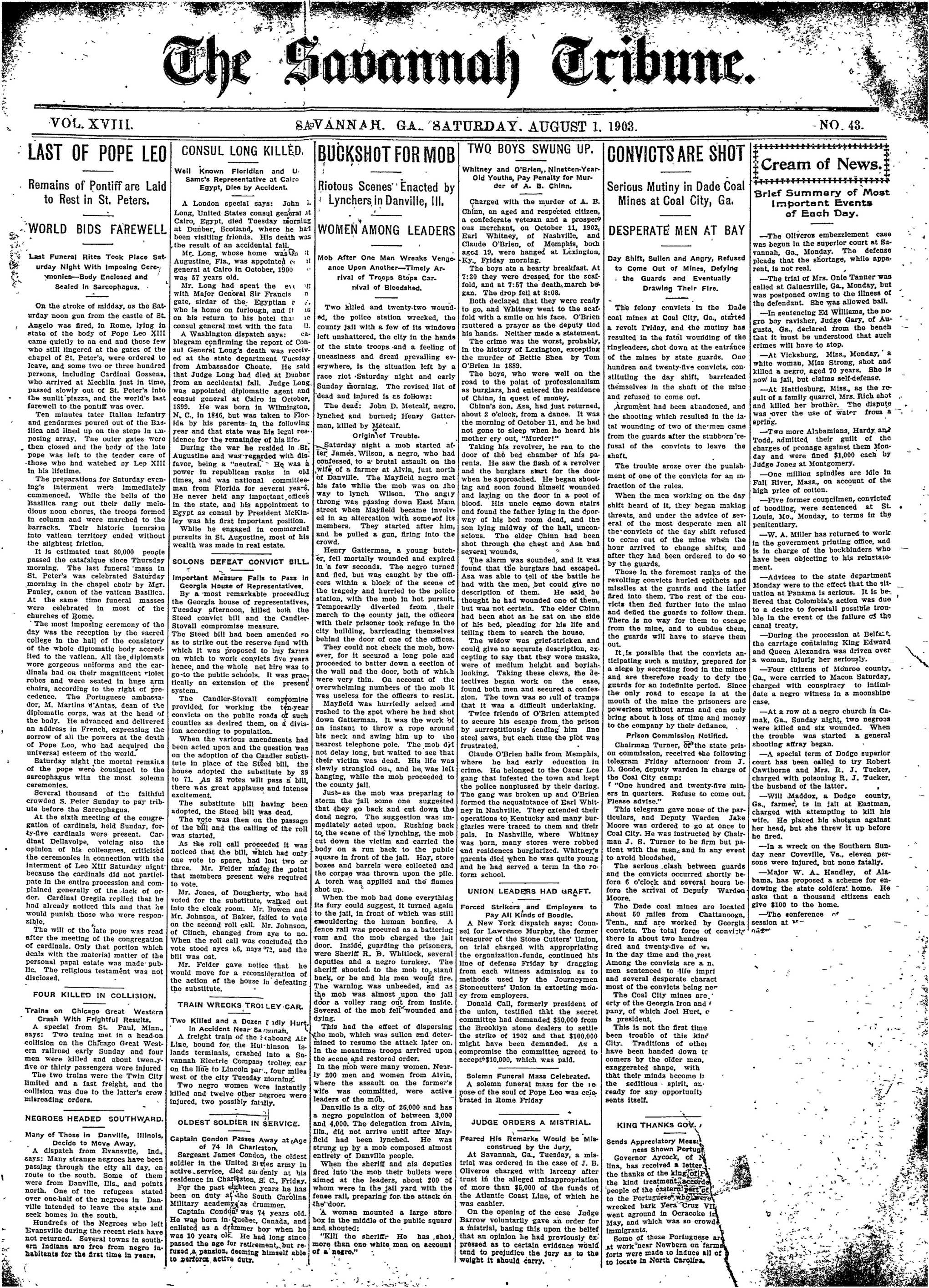
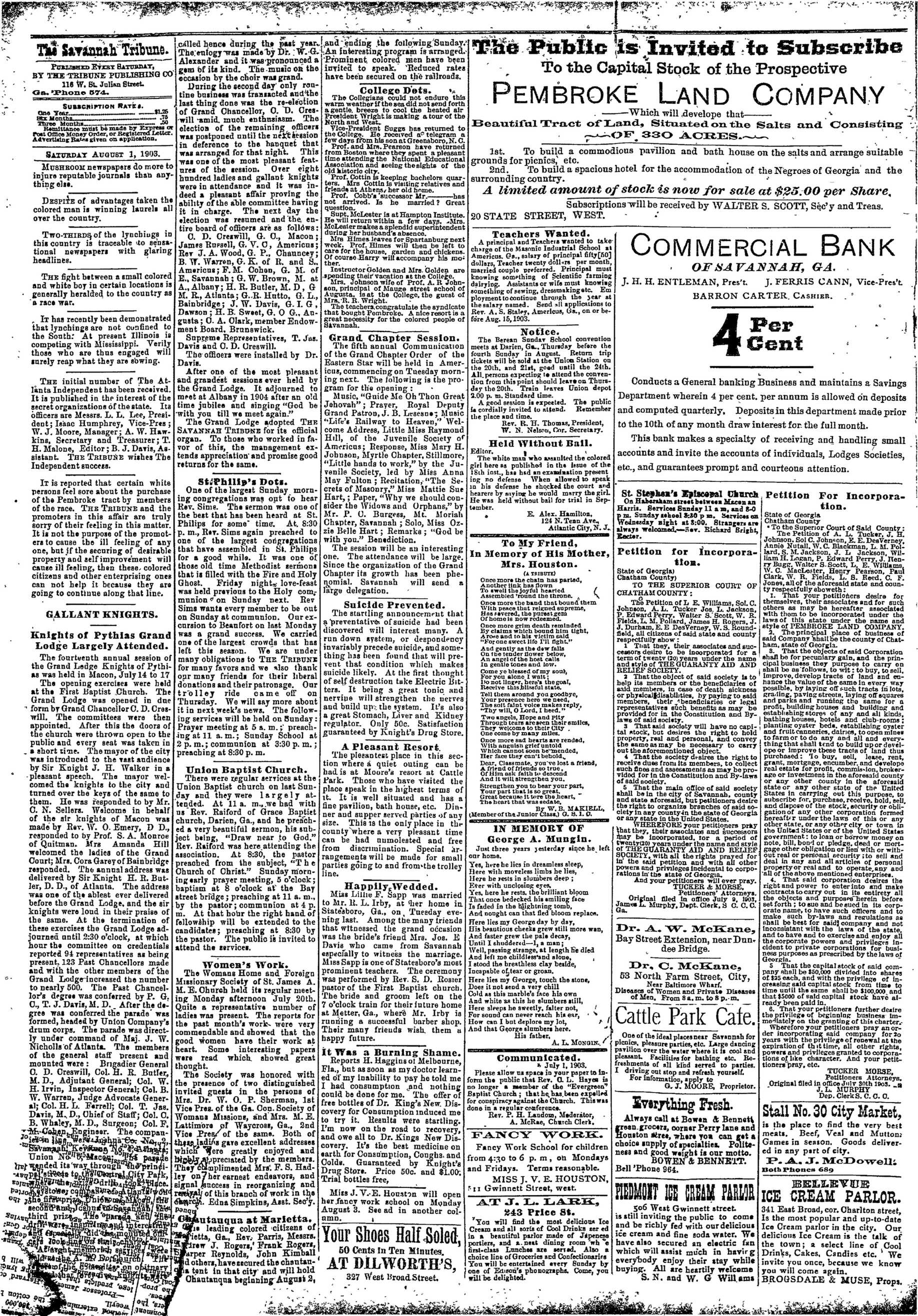
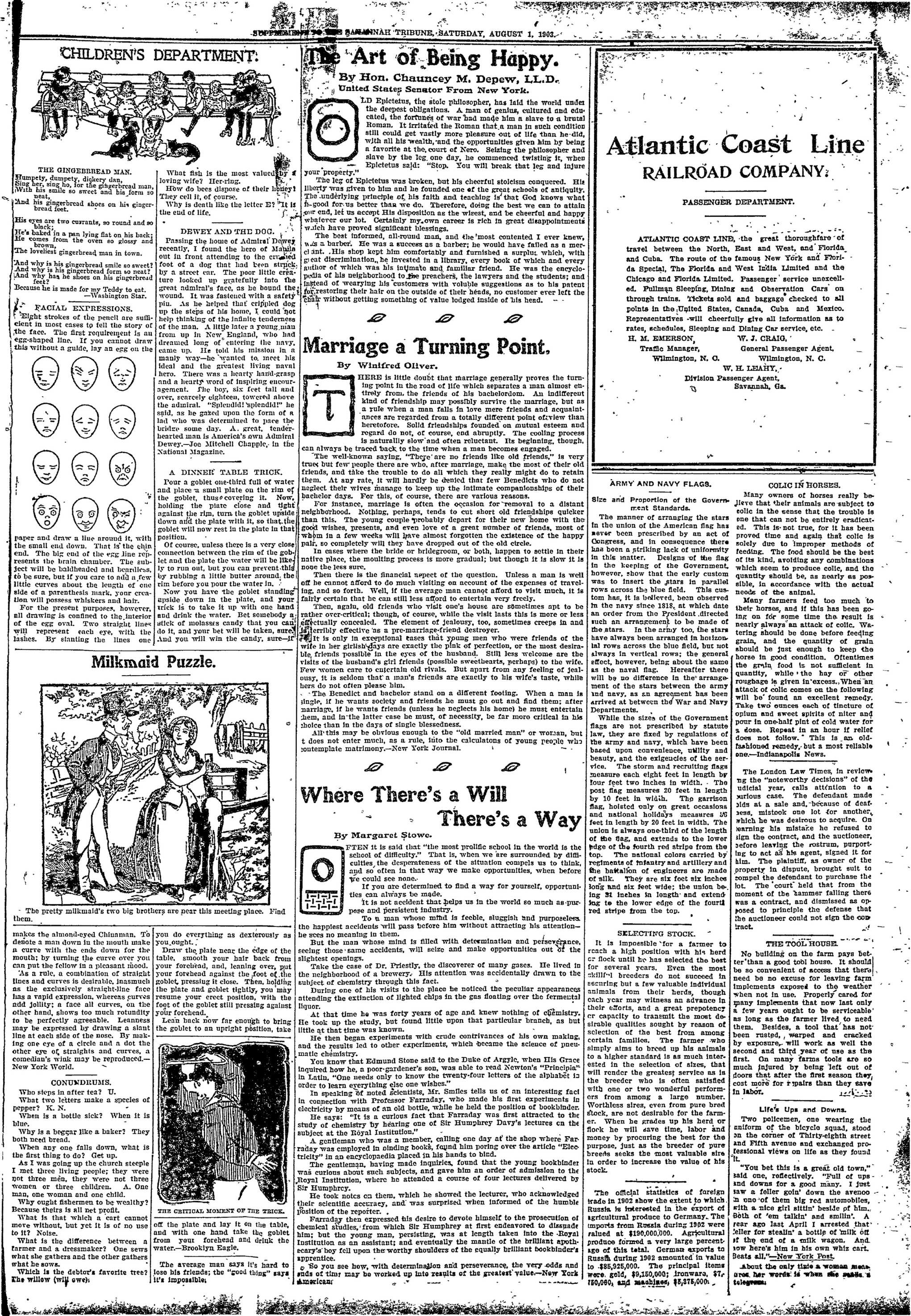
Page text (machine-generated)
VOL. XVIII.
Remains of Pontiff are Laid to Rest in St. Peters.
```markdown
```
Last Funeral Rites Took Place Saturday Night With Imposing Cere-
monies—Body Enclosed and Sealed in Sarcophagus.
On the stroke of midday, as the Saturday noon gun from the castle of St. Angelo was fired, in Rome, lying in state of the body of Pope Leo XIII came quietly to an end and those few who still lingered at the gates of the chapel of St. Peter's, were ordered to leave, and some two or three hundred persons, including Cardinal Gossens, who arrived at Mechlin just in time, passed slowly out of St. Peter's into the sunlit plaza, and the world's last farewell to the pontiff was over.
Ten minutes later Italian infantry and gendarmes poured out of the Basilica and lined up on the steps in imposing array. The outer gates were then closed and the body of the late pope was left to the tender care of those who had watched by Leo XIII in his lifetime.
The preparations for Saturday evening's interment were immediately commenced. While the bells of the Basilica rang out their daily melodious noon chorus, the troops formed in column and were marched to the barracks. Their historic incursion into vatican territory ended without the slightest friction.
It is estimated that 80,000 people passed the catafalque since Thursday morning. The last funeral mass in St. Peter's was celebrated Saturday morning in the chapel choir by Mgr. Panlicy, canon of the vatican Basilica. At the same time funeral masses were celebrated in most of the churches of Rome.
The most imposing ceremony of the day was the reception by the sacred college in the hall of the consistory of the whole diplomatic body accredited to the vatican. All the diplomats wore gorgeous uniforms and the cardinals had on their magnificent violet robes and were seated in huge arm chairs, according to the right of precedence. The Portuguese ambassador, M. Martins d'Antas, dean of the diplomatic corps, was at the head of the body. He advanced and delivered an address in French, expressing the sorrow of all the powers at the death of Pope Leo, who had acquired the universal esteem of the world.
Saturday night the mortal remains of the pope were consigned to the sarcophagus with the most solemn ceremonies.
Several thousand of the faithful crowded S. Peter Sunday to pay tribute before the Sarcophagus. At the sixth meeting of the congregation of cardinals, held Sunday, forty-five cardinals were present. Cardinal Dellavolpe, voicing also the opinion of his colleagues, criticised the ceremonies in connection with the interment of Leo XIII Saturday night because the cardinals did not participate in the entire procession and complained generally of the lack of order. Cardinal Oregia replied that he had already noticed this and that he would punish those who were responsible.
The will of the late pope was read after the meeting of the congregation of cardinals. Only that portion which deals with the material matter of the personal papal estate was made public. The religious testament was not disclosed.
FOUR KILLED IN COLLISION.
Trains on Chicago Great Western Crash With Frightful Results.
A special from St. Paul, Minn., says: Two trains met in a head-on collision on the Chicago Great Western railroad early Sunday and four men were killed and about twenty-five or thirty passengers were injured. The two trains were the Twin City limited and a fast freight, and the collision was due to the latter's crew misreading orders.
NEGROES HEADED SOUTHWARD.
Many of Those in Danville, Illinois, Decide to Move Away.
A dispatch from Evansville, Ind., says: Many strange negroes have been passing through the city all day, en route to the south. Some of them were from Danville, Ills., and points north. One of the refugees stated over one-half of the negroes in Danville intended to leave the state and seek homes in the south. Hundreds of the Negroes who left Evansville during the recent riots have not returned. Several towns in southern Indiana are free from negro inhabitants for the first time in years.
CONSUL LONG KILLÉD.
Well Known Floridian and U
Sams's Representative at Cairo
Egypt, Diee by Accident.
A London special says: John is
Long, United States consul general at
Cairo, Egypt, died Tuesday morning
at Dunbar, Scotland, where he had
been visiting friends. His death was
the result of an accidental fall.
Mr. Long, whose home was on it
Augustine, Fla., was appointed consul
general at Cairo in October, 1900
was 57 years old.
Mr. Long had spent the evening
with Major General Sir Francis
gate, sirdar of the. Egyptian rie
who is home on furlough, and it is
on his return to his hotel tha
consul general met with the fate all.
A Washington dispatch says: cablegram confirming the report of Consul General Long's death was received at the state department Tuesday from Ambassador Choate. He said that Judge Long had died at Dunbar from an accidental fall. Judge Long was appointed diplomatic agent and consul general at Cairo in October, 1899. He was born in Wilmington, N. C., in 1846, but was taken to Florida by his parents in the following year and that state was his legal residence for the remainder of his life.
During the war he resided in St. Augustine and was regarded with disfavor, being a "neutral." He was a power in republican ranks in old times, and was national committeeman from Florida for several years. He never held any important, offices in the state, and his appointment to Egypt as consul by President McKinley was his first important position. While he engaged in commercial pursuits in St. Augustine, most of his wealth was made in real estate.
SOLONS DEFEAT CONVICT BILL.
Important Measure Falls to Pass in Georgia House of Representatives. By a most remarkable proceeding the Georgia house of representatives, Tuesday afternoon, killed both the Steed convict bill and the Candler-Stovall compromise measure. The Steed bill had been amended so as to strike out the reserve fund with which it was proposed to buy farms on which to work convicts five years hence, and the whole net hire was to go-to the public schools. It was practically an extension of the present system. The Candler-Stovall compromise provided for working the ten-year convicts on the public roads of such counties as desired them, on a division according to population.
When the various amendments had been acted upon and the question was on the adoption of the Candler substitute in place of the Steed bill, the house adopted the substitute by 89 to 71. As 88 votes will pass a bill, there was great applause and intense excitement.
The substitute bill having been adopted, the Steed bill was dead.
The vote was then on the passage of the bill and the calling of the roll was started.
As the roll call proceeded it was noticed that the bill, which had only one vote to spare, had lost two or three. Mr. Felder made the point that members present were required to vote.
Mr. Jones, of Dougherty, who had voted for the substitute, walked out into the cloak room. Mr. Bowen and Mr. Johnson, of Baker, failed to vote on the second roll call. Mr. Johnson, of Clinch, changed from aye to no. When the roll call was concluded the vote stood ayes 86, nays 72, and the bill was ost.
Mr. Felder gave notice that he would move for a reconsideration of the action of the house in defeating the substitute.
TRAIN WRECKS TROLLEY CAR.
Two Killed and a Dozen Sadly Hurt.
A freight train of the Staboard Air Line, bound for the Hutchinson Islands terminals, crashed into a Savannah Electric Company trolley, car on the line to Lincoln par., four miles west of the city Tuesday morning. Two negro women were instantly killed and twelve other negroes were injured, two possibly fatally.
Captain Condon Passes Away at Age of 74 In Charleston
For the past eighteen years he has been on duty at the South Carolina Military academy as drummer. Captain Condon was 74 years old. He was born in Quebec, Canada, and enlisted as a drummer boy when he was 10 years old. He had long since passed the age for retirement, but refused a pension, deeming himself able to perform active duty.
SAVANNAH. GA. SATURDAY. AUGUST 1. 1903.
BUCKSHOT FOR MOB
Mob After One Man Wreaks Vengeance Upon Another—Timely Arrival of Troops Stops Carrival of Bloodshed.
Two killed and twenty-two wounded, the police station wrecked, the county jail with a few of its windows left unshattered, the city in the hands of the state troops and a feeling of uneasiness and dread prevailing everywhere, is the situation left by a race riot-Saturday night and early Sunday morning. The revised list of dead and injured is as follows:
The dead: John D. Metcalf, negro, lynched and burned; Henry Gatterman, killed by Metcalf.
Origin of Trouble.
Saturday night a mob started after James. Wilson, a negro, who had confessed, to a brutal assault on the wife of a farmer at Alvin, just north of Danville. The Mayfield negro met his fate while the mob was on the way to lynch Wilson. The angry throng was passing down East Main street when Mayfield became involved in an altercation with some of its members. They started after him, and he pulled a gun, firing into the crowd.
Henry Gatterman, a young butcher, fell mortally wounded and expired in a few seconds. The negro turned and fled, but was caught by the officers within a block of the scene of the tragedy and hurried to the polico station, with the mob in hot pursuit. Temporarily diverted from their march to the county jail, the officers with their prisoner took refuge in the city building, barricading themselves behind the door of one of the offices. They could not check the mob, however, for it secured a long pole and proceeded to batter down a section of the wall and the door, both of which were very thin. On account of the overwhelming numbers of the mob it was useless for the officers to resist.
Mayfield was hurriedly selzed and rushed to the spot where he had shot down Gatterman. It was the work of an instant to throw a rope around his neck and swing him up to the nearest telephone pole. The mob did not delay long, but waited to see that their victim was dead. His life was slowly strangled out, and he was left hanging, while the mob proceeded to the county fall.
Just as the mob was preparing to storm the jail some one suggested that they go back and cut down the dead negro. The suggestion was immediately acted upon. Rushing back to the scene of the lynching, the mob cut down the victim and carried the body on a run back to the public square in front of the jail. Hay, store boxes and barrels were collected and the corpse was thrown upon the pile. A torch was applied and the flames shot up.
When the mob had done everything its fury could suggest, it turned again to the jail, in front of which was still smouldering the human bonfire. A fence rail was procured as a battering ram and the mob charged the jail door. Inside, guarding the prisoners, were Sheriff R. D. Whitlock, several deputies and a negro turnkey. The sheriff shouted to the mob to stand back, or he and his men would fire. The warning was unheeded, and as the mob was almost upon the jail door a volley rang out from inside. Several of the mob fell wounded and dying.
This had the effect of dispersing the mob, which was sullen and determined to resume the attack later on. In the meantime troops arrived upon the scene and restored order.
In the mob were many women. Nearly 200 men and women from Alvin, where the assault on the farmer's wife was committed, were active leaders of the mob.
Danville is a city of 26,000 and has a negro population of between 3,000 and 4,000. The delegation from Alvin, Ills., did not arrive until after Mayfield had been lynched. He was strung up by a mob composed almost entirely of Danville people.
When the sheriff and his deputies fired into the mob their bullets were aimed at the leaders, about 200 of whom were in the jail yard with the fence rail, preparing for the attack on the door.
A woman mounted a large store box in the middle of the public square and shouted:
"Kill the sheriff. He has shot more than one white man on accounts of a nego."
Tribune.
TWO BOYS SWUNG UP.
Whitney and O'Brien, Nineteen-Year-Old Youths, Pay Penalty for Murder of A. B. Chinn.
Charged with the murder of A. B. Chinn, an aged and respected citizen, a confederate veteran and a prosperous merchant, on October 11, 1902, Earl Whitney, of Nashville, and Claude O'Brien, of Memphis, both aged 19, were hanged at Lexington, Ky., Friday morning.
The boys ate a hearty breakfast. At 7:30 they were dressed for the scaffold, and at 7:57 the death, march began. The drop fell at 8:08.
Both declared that they were ready to go, and Whitney went to the scaffold with a smile on his face. O'Brien muttered a prayer as the deputy tied his hands. Neither made a statement. The crime was the worst, probably, in the history of Lexington, excepting the murder of Bettie Shea by Tom O'Brien in 1889. The boys, who were well on the road to the point of professionalism as burglars, had entered the residence of Chinn, in quest of money. Chinn's son, Asa, had just returned, about 2 o'clock, from a dance. It was the morning of October 11, and he had not gone to sleep when he heard his mother cry out, "Murder!"
Taking his revolver, he ran to the door of the bed chamber of his parents. He saw the flash of a revolver and the burglars start for the door when he approached. He began shooting and soon found himself wounded and laying on the floor in a pool of blood. His uncle came down stairs and found the father lying in the dporway of his bed room dead, and the son lying midway of the hall, unconscious. The elder Chinn had been shot through the chest and Asa had several wounds.
The alarm was sounded, and it was found that the burglar had escaped. Asa was able to tell of the battle he had with the men, but could give no description of them. He said he thought he had wounded one of them, but was not certain. The elder Chinn had been shot as he sat on the side of his bed, pleading for his life and telling them to search the house. The widow was grief-stricken and could give no accurate description, excepting to say that they wore masks, were of medium height and boyish-looking. Taking these clews, the detectives began work on the ease, found both men and secured a confession. The town was so full of tramps that it was a difficult undertaking.
Twice friends of O'Brien attempted to secure his escape from the prison by surreptitiously sending him fine steel saws, but each time the plot was frustrated. Claude O'Brien halls from Memphis, where he had early education in crime. He belonged to the Oscar Lee gang that infested the town and kept the police nonplussed by their daring. The gang was broken up and O'Brien formed the acquaintance of Earl Whitney in Nashville. They extended their operations to Kentucky and many burglaries were traced to them and their pals. In Nashville, where Whitney was born, many stores were robbed and residences burglarized. Whitney's parents died when he was quite young and he had served a term in the reform school.
UNION LEADERS HAD GRAFT.
Forced Strikers and Employers to Pay All Kinds of Bodie.
A New York dispatch says: Counsel for Lawrence Murphy, the former treasurer of the Stone Cutters' Union, on trial charged with appropriating the organization-funds, continued his line of defense Friday by dragging from each witness admission as to methods used by the Journeymen Stonecutters' Union in extorting money from employers. Donald Call, formerly president of the union, testified that the secret committee had demanded $50,000 from the Brooklyn stone dealers to settle the strike of 1902 and that $100,000 might have been demanded. As a compromise the committee agreed to accept $10,000, which was paid.
Solemn Funeral Mass Celebrated.
A solemn funeral mass for the
repose of the soul of Pope Leo was
celebrated in Rome Friday
JUDGE ORDERS A MISTRIAL.
Feared His Remarks Would be Mis-construed by the Jury.
At Savannah, Ga., Tuesday, a mistrial was ordered in the case of J. B. Oliveros charged with larceny after trust in the alleged misappropriation of more than $5,000 of the funds of the Atlantic Coast Line, of which he was cashier.
On the opening of the case Judge Barrow voluntarily gave an order for a mistrial, basing this upon the belief that an opinion he had previously expressed as to certain evidence would tend to prejudice the jury as to the weight it should carry.
CONVICTS ARE SHOT
Serious Mutiny in Dade Coal Mines at Coal City, Ga.
DESPERATE MEN AT BAY
Day Shift, Sullen and Angry, Refused to Come Out of Mines, Defying the Guards and Eventually Drawing Their Fire.
The felony convicts in the Dade coal mines at Coal City, Ga., started a revolt Friday, and the mutiny has resulted in the fatal wounding of the ringleaders, shot down at the entrance of the mines by state guards. One hundred and twenty-five convicts, constituting the day shift, barricaded themselves in the shaft of the mine and refused to come out.
Argument had been abandoned, and the shooting which resulted in the fatal wounding of two of the men came from the guards after the stubborn refusal of the convicts to leave the shaft.
The trouble arose over the punishment of one of the convicts for an infraction of the rules.
When the men working on the day shift heard of it, they began making threats, and under the advice of several of the most desperate men all the convicts of the day shift refused to come out of the mine when the hour arrived to change shifts, and after they had been ordered to do so by the guards.
Those in the foremost ranks of the revolting convicts hurled epithets and missiles at the guards and the latter fired into them. The rest of the convicts then fled further into the mine and defied the guards to follow them. There is no way for them to escape from the mine, and to subdue them, the guards will have to starve them out.
It is possible that the convicts anticipating such a mutiny, prepared for a siege by secreting food in the mines and are therefore ready to defy the guards for an indefinite period. Since the only road to escape is at the mouth of the mine the prisoners are powerless without arms and can only bring about a loss of time and money to the company by their defiance.
Prison Commission Notified.
Chairman Turner, of the state prison on commission, received the following telegraph Friday afternoon from J. D. Goode, deputy warden in charge of the Coal City camp: "One hundred and twenty-five miners in quarters. Refuse to come out. Please advise." This telegraph gave none of the particulars, and Deputy Warden Jake Moore was ordered to go at once to Coal City. He was instructed by Chairman J. S. Turner to be firm but patient with the men, and in any event to avoid bloodshed. The serious clash between guards and the convicts occurred shortly before 6 o'clock and several hours before the arrival of Deputy Warden Moore.
The Dade coal mines are located about 50 miles from Chattanooga, Tenn., and are worked by Georgia convicts. The total force of convicts there is about two hundred dred and twenty-five of wi in the day time and the rest Among the convicts are a n men sentenced to life impril and several desperate charact most of the convicts being ne The Coal City mines are erty of the Georgia Iron and pany, of which Joel Hurt, c is president.
This is not the first time been trouble of this kind City. Traditions of other have been handed down to comers by the older men, exaggerated shape, with that their minds become in the seditious spirit, are ready for any opportunity sents itself.
KING THANKS GOV.
Sends Appreciatory Mess:ness Shown Portu
Governor Aycock, of N
lina, has received a letter,
the thanks of the king of Pe
the kind treatment accorded
people of the eastern part of
to the Portuguese who were
wrecked bark Vera Cruz VII
went aground in Ocracoke in
May, and which was so crowde
immigrants.
Some of these Portuguese are
at work near Nowbern on farms
forts were made to induce all of
to locate in North Carolina.
NO. 43.
Cream of News.
Brief Summary of Most Important Events of Each Day.
—The Oliveros embezzlement case was begun in the superior court at Savannah, Ga., Monday. The defense pleads that the shortage, while apparent, is not real.
—The trial of Mrs. Onie Tanner was called at Gainesville, Ga., Monday, but was postponed owing to the illness of the defendant. She was allowed ball.
—In sentencing Ed Williams, the nigro boy ravisher, Judge Gary, of Augusta, Ga., declared from the bench that it must be understood that such crimes will have to stop.
—At Vicksburg, Miss., Monday, a white woman, Miss Strong, shot and killed a negro, aged 70 years. She is now in fall, but claims self-defense.
—At Hattiesburg, Miss., as the result of a family quarrel, Mrs. Rich shot and killed her brother. The dispute was over the use of water from a spring.
Two more Alabamians, Hardy and Todd, admitted their guilt of the charges of peonage against them Monday and were fined $1,000 each by Judge Jones at Montgomery.
One million spindles are idle in Fall River, Mass., on account of the high price of cotton.
Five former councilmen, convicted of boodling, were sentenced at St. Louis, Mo., Monday, to terms in the penitentiary.
W. A. Miller has returned to work in the government printing office, and is in charge of the bookbinders who have been objecting to his reinstatement.
Advices to the state department Monday were to the effect that the situation at Panama is serious. It is believed that Colombia's action was due to a desire to forestall possible trouble in the event of the failure of the canal treaty.
During the procession at Belfast, the carriage containing King Edward and Queen Alexandra was driven over a woman, injurig her seriously.
Four citizens of Mónroe county, Ga., were carried to Macon Saturday, charged with conspiracy to intimidate a negro witness in a moonshine case.
At a row at a negro church in Camak, Ga., Sunday night, two negroes were killed and six wounded. When the trouble was started a general shooting affray began.
A special term of Dodge superior court has been called to try Robert Cawthorne and Mrs. R. J. Tucker, charged with poisoning R. J. Tucker, the husband of the latter.
Will Maddox, a Dodge county, Ga., farmer, is in jail at Eastman, charged with attempting to kill his wife. He placed his shotgun against her head, but she threw it up before he fired.
In a wreck on the Southern Sunday near Coveville, Va., eleven persons were injured, but none fatally.
Major W. A. Handley, of Alabama, has proposed a scheme for endowing the state soldiers' home. He asks that a thousand citizens each give $100 to the home.
The conference of session at
The conference session at
PUBLISHED EVERY SATURDAY,
BY THE TRIBUNE PUBLISHING CO.
118 W. St. Julian Street.
Ga. Phone 574.
SUBSCRIPTION RATES.
One Year. $1.25
Six Months. 10
Ten Months. 50
Remittance must be made by Express or
Post Once Money Order, or Registered Letter.
Advertising Rates given on application.
MUSHROOM newspapers do more to injure reputable journals than anything else.
DESpite of advantages taken the colored man is winning laurels all over the country.
Two-THIRDS of the lynchings in this country is traceable to sensational newspapers with glaring headlines.
The fight between a small colored and white boy in certain locations is generally heralded to the country as a race war.
It has recently been demonstrated that lynchings are not confined to the South. At present Illinois is competing with Mississippi. Verily those who are thus engaged will surely reap what they are sowing.
THE initial number of the Atlanta Independent has been received. It is published in the interest of the secret organizations of the state. Its officers are Messrs. L. L. Lee, President; Isaac Humphrey, Vice-Pres; W. J. Moore, Manager; A. W. Hawkins, Secretary and Treasurer; T. H. Malone, Editor; B. J. Davis, Assistant. THE TRIBUNE wishes The Independent success.
It is reported that certain white persons feel sore about the purchase of the Pembroke tract by members of the race. THE TRIBUNE and the promoters in this affair are truly sorry of their feeling in this matter. It is not the purpose of the promoters to cause the ill feeling of any one, but if the securing of desirable property and self improvement will cause ill feeling, then these, colored citizens and other enterprising ones can not help it because they are going to continue along that line.
GALLANT KNIGHTS.
Knights of Pythlas Grand Lodge Largely Attended. The fourteenth annual session of the Grand Lodge Knights of Pythias was held in Macon. July14 to 17
The opening exercises were held at the First Baptist Church. The Grand Lodge was opened in due form by Grand Chancellor C. D. Creswill. The committees were then appointed. After this the doors of the church were thrown open to the public and every seat was taken in a short time. The mayor of the city was introduced to the vast audience by Sir Knight J. H. Walker in a pleasant speech. The mayor welcomed the knights to the city and turned over the keys of the same to them. He was responded to by Mr. C. N. Sellers. Welcome in behalf of the sir knights of Macon was made by Rev. W. O. Emery, D. D., responded to by Prof. S. A. Monroe of Quitman. Mrs Amanda Hill welcomed the ladies of the Grand Court; Mrs. Cora Garey of Bainbridge responded. The annual address was delivered by Sir Knight H. R. Butler, D. D., of Atlanta. The address was one of the altest ever delivered before the Grand Lodge, and the sir knights were loud in their praise of the same. At the termination of these exercises the Grand Lodge at adjournure to 2:30 o'clock, at which hour the committee on credentials reported 94 representatives as being present, 123 Past Chancellors made and with the other members of the Grand Lodge increased the number to nearly 500. The Past Chancellor's degree was conferred by P. G. C. T. J. Davis, M. D. After the degree was conferred the parade was formed, headed by Union Company's drum corps. The parade was directly under command of Maj. J. W. Nicholls of Atlanta. The members of the general staff present and mounted were: Brigadier General C. D. Creswill, Col. H. R. Butler, M. D., Adjutant General; Col. W. H. Irvin, Inspector General; Col. B. W. Warren, Judge Advocate General; Col. H. L. Ferrell; T. J. Davis, M. D., Chief of Staff; Col. C. B. Whaley, M. D., Surgeon; Col. F. M. Cohn Engineer. The company in Jasmina Co. No. 2
called hence during the past year. The enlogy was made by Dr. W. G. Alexander and it was pronounced a gem of its kind. The music on the occasion by the choir was grand.
During the second day only routine business was transacted and the last thing done was the re-election of Grand Chancellor, O. D. Creswill amid much enthusiasm. The election of the remaining officers was postponed until the next session in deference to the banquet that was arranged for that night. This was one of the most pleasant features of the session. Over eight hundred ladies and gallant knights were in attendance and it was indeed a pleasant affair proving the ability of the able committee having it in charge. The next day the election was resumed and the entire board of officers are as follows:
C. D. Greswill, G. G., Macon; James Russell, G. V. C., Americus; Rev J. A. Wood, G. P., Chauncey; B. W. Warren, G. K. of R. and S. Americus; F. M. Cohen, G. M. of E., Savannah; G. W. Brown, M. at Albany; H. R. Butler, M. D, G. M. R., Atlanta; G. R. Hutto, G. L, Bainbridge; J. W. Davis, G. I. G, Dawson; H. B. Sweet, G. O G., Augusta; G. A. Clark, member Endowment Board, Brunawick.
Supreme Representatives, T. Jas. Davis and C. D. Greswill.
The officers were installed by Dr. Davis.
After one of the most pleasant and grandest sessions ever held by the Grand Lodge. It adjourned to meet at Albany in 1904 after an old time jubilee and singing "God be with you till we meet again."
The Grand Lodge adopted THE SAVANNAH TRIBUNE for its official organ. To those who worked in favor of this, the management extends appreciation and promise good returns for the same.
St. Philip's Dots.
One of the largest Sunday morning congregations was out to hear Rev. Sims. The sermon was one of the best that has been heard at St. Philips for some time. At 8:30 p. m., Rev. Sims again preached to one of the largest congregations that have assembled in St. Philips for a good while. It was one of those old time Methodist sermons that is filled with the Fire and Holy Ghost. Friday night love-feast was held previous to the Holy communion on Sunday next. Rev Sims wants every member to be out on Sunday at communion. Our excursion to Beaufort on last Monday was a grand success. We carried one of the largest crowds that has left this season. We are under many obligations to THE TRIBUNE for many favors and we also thank our many friends for their liberal donations and their patronage. Our trolley ride came off on Thursday. We will say more about it in next week's news. The following services will be held on Sunday: Prayer meeting at 5 a. m.; preaching at 11 a. m.; Sunday School at 2 p. m.; communion at 3:30 p. m.; preaching at 8:30 p. m.
Union Baptist Church.
There were regular services at the Union Baptist church on last Sunday and they were largely attended. At 11 a. m., we had with us Rev. Raiford of Grace Baptist church, Darien, Ga., and he prescheduled a very beautiful sermon, his subject being, "Draw near to God." Rev. Raiford was here attending the association. At 8:30, the pastor preached from the subject, "The Church of Christ." Sunday morning early prayer meeting, 5 o'clock; baptism at 8 o'clock at the Bay street bridge; preaching at 11 a. m., by the pastor; communion at 4 p. m. At that hour the right hand of fellowship will be extended to the candidates; preaching at 8:30 by the pastor. The public is invited to attend the services.
Women's Work.
The Womans Home and Foreign Missionary Society of St. James A. M. E. Church held its regular meeting Monday afternoon July 20th. Quite a representative number of ladies was present. The reports for the past month's work were very commendable and showed that the good women have their work at heart. Some interesting papers were read which showed great thought.
The Society was honored with the presence of two distinguished invited guests in the persons of Mrs. Dr. W. O. P. Sherman, 1st Vice Pres. of the Ga. Con. Society of Womans Missions, and Mrs. M. E. Lattimore of Waycross, Ga., 2nd Vice Pres. of the same. Both of these ladies gave excellent addresses which were greatly enjoyed and highly appreciated by the members. They complimented Mrs. F. S. Haddley on her earnest endeavors, and signal success in reorganizing and revival of this branch of work in the church. Edna Simpkins, Asst. Sec'y. Ponga
Chantauqua at Marietta.
3. The leading colored citizens of Marietta, Ga., Rev. Parris, Messrs. Harriw J. Rogers, Frank Rogers, Harper Reynolds, John Kimball and others, have escured the chantauqua tent in that city and will hold Chantauqua beginning August 2,
and ending the following Sunday.
An interesting program is arrauged.
Prominent, colored men have been invited to speak. Reduced rates have been secured on the railroads.
College Dots.
The Collegians could not endure this warm weather if the sea did not send forth gentle breeze to cool the heated air. People Wright is making a tour of the North and West.
Vice-President Suggs has returned to the
National Guard for a few days from his greenbelt G.O.P.
Prof. and Mrs. Pearson have returned from Boston where they spent a pleasant time attending the National Educational Association and seeing the sights of the old historic city. Prof. Cobb is keeping bachelors quarters. Mrs. Cottin is visiting relatives and friends at Athens, her old house. Prof. Cobb's successor Mr. ——has not arrived. Is he married? Great question. Supt. McLester is at Hampton Institute. He will return within a few days. Mrs. McLester makes a splendid superintendent during her husband's absence. Mrs. Leaves leaves for Spartanburg next week. Prof. will be left to care for the house, garden and chickens. Of course Harry will accompany his mother.
Instructor Golden and Mrs. Golden are spending their vacation at the College.
Mrs. Johnson wife of Prof. A.R. Johnson, principal of Mauve street school of Augusta, is at the College, the guest of Mrs. R.R. Wright. The teachers congratulate the syndicate that bought Pombrabe. A nice resort is a great necessity for the colored people of Savannah.
Grand Chapter Session.
The fifth annual Communication of the Grand Chapter Order of the Eastern Star will be held in Americus, commencing on Tuesday morning next. The following is the program for the opening:
Music, "Guide Me Oh Thon Great Johovah"; Prayer, Royal Deputy Grand Patron, J. B. Lesseau; Music "Life's Railway to Heaven," Welcome Address, Little Miss Raymond Hill, of the Juvenile Society of Americus; Response, Miss Mary H. Johnson, Myrtle Chapter, Stillmore, "Little hands to work"; by the Juvenile Society, led by Miss Anna May Fulton; Recitation, "The Secrets of Masonry," Miss Mattie Sue Hart; Paper, "Why we should consider the Widows and Orphans," by Mr. P. C. Burgess, Mt. Moriah Chapter, Savannah; Solo, Miss Ozzie Belle Hart; Remarks; "God be with you." Benediction.
The session will be an interesting one. The attendance will be large. Since the organization of the Grand Chapter its growth has been phenomial. Savannah will send a large delegation.
Suicide Prevented.
The startling announcement that a preventative of suicide had been discovered will interest many. A run down system, or despoundency invariably precede suicide, and something has been found that will prevent that condition which makes suicide likely. At the first thought of self destruction take Electric Bitters. It being a great tonic and nervine will strengthen the nerves and build up the system. It's also a great Stomach, Liver and Kidney regulator. Only 50c. Satisfaction guaranteed by Knight's Drug Store.
A Pleasant Resort
The pleasantest place in this section where a quiet outing can be had is at Moore's resort at Cattle Park. Those who have visited the place speak in the highest terms of it. It is well situated and has a fine pavilion, bath house, etc. Dinner and supper served parties of any size. This is the only place in the county where a very pleasant time can be had numoleted and free from discrimination. Special arrangements will be made for small parties going to and from the trolley line.
Happily Wedded.
Miss Lillie F. Sapp was married to Mr. R. L. Irby, at her home in Statesboro, Ga., on Tuesday evening last. Among the many friends that witnessed the grand occasion was the bride's friend Mrs. Jos. E Davis who came from Savannah especially to witness the marriage. Miss Sapp is one of Statesboro's most prominent teachers. The ceremony was performed by Rev. S. D. Rossier pastor of the First Baptist church. The bride and groom left on the 7 o'clock train for their future home at Metter, Ga., where Mr. Irby is running a successful barber shop. Their many friends wish them a happy future.
It Was a Burning Shame.
Reports H. Haggins of Melbourne,
Fla., but as soon as my doctor learned
of my inability to pay he told me
I had consumption and nothing
could be done for me. The offer of
free bottles of Dr. King's New Discovery
for Consumption induced me to try it. Results were startling.
I'm now on the road to recovery,
and owe all to Dr. Kings New Discovery.
It's the best medicine on earth for Consumption, Coughs and
Colds. Guaranteed by Knight's Drug Store. Price 50c. and $1.00.
Trial bottles free.
Miss J. V.E. Houston will open
her fancy work school on Monday
August 3. See ad in another col-
umn.
The Public is Invited to Subscribe To the Capital Stock of the Prospective PEMBROKE LAND COMPANY
Which will develop that
Beautiful Tract of Land, Situated on the Salts and Consisting OF 330 ACRES.
1st. To build a commodious pavilion and bath house on the salts and arrange suitable grounds for picnics, etc.
2nd. To build a spacious hotel for the accommodation of the Negroes of Georgia and the surrounding country.
Teachers Wanted.
A principal and Teachers wanted to take charge of the Masonic Industrial School at Americus, Ga., salary of principal fifty[50] dollars, Teacher twenty dollars per month, married couple preferred. Principal must know something of Scientific farming dairying. Assistants or wife must know something of sewing, dressmaking etc. Employment to continue through the year at the salary named. Send all applications to Rev. A. S. Staley, Americus, Ga., on or before Aug. 15, 1903.
Notice.
The Berean Sunday School convention meets at Darien, Ga., Thursday before the fourth Sunday in August. Return trip tickets will be sold at the Union Station on the 20th, and 21st, good until the 24th, when persons expect to leave. Union station should leave on Thursday the 20th. Train leaves Union depot 2.00 p. m. standard time.
A good session is expected. The public is cordially invited to attend. Remember the place and time.
Rev. R. H. Thomas, President,
W. N. Nelson, Cor. Secretary
Held Without Ball.
The white man who assaulted the colored girl here as published in the issue of the 18th inst., has had an examination present ing no defense. When allowed to speak in his defense he shocked the court and hearers by saying he would marry the girl. He was held without bail for trial in Sep-
Once more the chain has parted,
Another tink has flown
To swell the joyful hearted
Assembled 'round the throne.
Once more the band that bound them
The same home where they came,
Has severed, the purist gem
Of home is now redeemed.
Once more grim death reminded
By claims which bound him tight,
We were told he would
"For one sweet life I'll fight."
And gently as the dew falls
On the tender flower below,
An angel of the host calls
And unto us,
Come ye blessed of my soul,
For you alone I wait!
Do not linger, here's the goal,
Receive this billedful state.
Tell them around you goodbye,
Your years are gone,
The soft faint voice makes reply,
"Thy will, O Lord, I heed."
Two angels, Hope and Pity
Through tears are among their smiles,
One come by many miles.
Once more sad hearts are rended,
With anguish grief untold
Which cannot soon be mended,
Her face they can' be behold,
A friend to a friend,
A friend of friends so true.
Of Him ask faith to descend
And it will strengthen you,
Strengthen you to bear your part,
Great because it tore the heart,
The heart that was sedate.
By W. B. MAKIELL
By W. B. MAKIELL
(Member of the Junior Class.) G. S. I. O.
IN MEMORY OF
Just three years yesterday since he left our home.
Yes, here he lies in dreamless sleep,
Here with moveless limbs he lies,
Here he rests in slumbers deep;
Ever with unclosing eyes.
Yes, here he rests, the brilliant bloom
That once bedecked his smiling face
Is faded in the lightning tomb,
And nought can that fled bloom replace.
Here lies my George day by day,
His beautious cheeks grew still more wan,
And faster grew the pale decay,
Until I shuddered—1 a man;
Well, passing strange, at length he died
And left me childless and alone,
I stood the breathless clay beade,
Incapable of tear or groan.
Here lies my George, touch the stone,
Does it not send a very chill
Cold as this marble's face his own
And white as this he slumbers still,
Here sleeps he sweetly, falter not,
For sound can never reach his ear,
How can I but deplore my lot,
And that George slumbers here.
His father.
Communicated. July 1, 1903
Please allow us space in your paper to inform the public that Rev. O. L. Hayes is no longer a member of the "Evergreen" Baptist Church; that he has been expelled for conspiracy against the Church. This was done in a regular conference.
Rev. P. H. Landom, Mederator,
A. McRae, Church Clerk.
FANCY WORK.
Fancy Work School for children from 4:30 to 6 p. m., on Mondays and Fridays. Terms reasonable.
MISS J. V. E. HOUSTON,
511 Gwinnett Street, west.
AT J. L. LARK.
243 Price St.
You will find the most delicious Ice Cream and all sorts of Cool Drinks ser ed in a beautiful parlor made of Japenese portiers, and a. nest dining room wh e first-class. Lunches are served. Also a choice line of Groceries and Confectionaries You will be entertained every Sunday by one of Edison's phonographs. Come, you will be delighted.
J. H. H. ENTLEMAN, Pres't. J. FERRIS CANN, Vice-Pres't BARRON CARTER. CASHIER. 4 Per Gent
Conducts a General banking Department wherein 4 per cent. and computed quarterly. Deposit to the 10th of any month draw in This bank makes a specialty accounts and invite the accounts etc., and guarantees prompt and
Conducts a General banking Business and maintains a Savings Department wherein 4 per cent. per annum is allowed on deposits and computed quarterly. Deposits in this department made prior to the 10th of any month draw interest for the full month.
This bank makes a specialty of receiving and handling small accounts and invite the accounts of individuals, Lodges Societies, etc., and guarantees prompt and courteous attention.
St. Stephen's Episcopal Church
On Haberham street between Macon an Harris. Services Sunday 11 a.m., and 8-0 p.m. Sunday school 8:20 p.m. Services on Wednesday night at 8:00. Strangers are always welcomed.—Rev. Richard Bright, Ector.
Petition For Incorporation.
State of Georgia
Chatham County
*To the Superior Court of Sald County:
The Petition of A. L. Tucker, J. H. Johnston, C. O.
Petition for Incorporation
TO THE SUPERIOR COURT OF CHATHAM COUNTY:
The Petition of L. E. Williams, Sol. C. Johnson, A. L. Tucker, Joe L. Johnson, P. Edward Perry, Walter S. Scott, W. R. Fields, L. M. Pollard, James H. Rogers, J. D. Durham, E. E. DesVernay, W. S. Roundfield, all citizens of said state and county respectfully show:
That they, their associates and successors, are incorporated for a term of twenty (20) years to name and style of the GUARANTY AID AND RELIEF SOCIETY.
2 That the object of said society is to help its members or the beneficiaries of said members, in case of death sickness to said members, their 'beneficiaries' to representatives such benefits as may be provided for in the Constitution and By-laws of said society.
3 That said society will have no capita stock, but desires the right to hold property in the county and convey the same as may be necessary to carry out the aforementioned object.
4 That the society desires the right to receive dues from its members, to collect such fines and assessments as may be proclaimed by the Constitution and By-laws of said society.
5 That the main office of said society shall be in the city of Savannah, county and state aforesaid, but petitioners desire the right to organize branches of said society in any county in the state of Georgia or any other state.
WHEREFORE your petitioners pray that they, their associates and successors may be incorporated, for a period of twenty two years under the name and style of THE GUARANTY AID AND RELIEF SOCIETY, with all the rights prayed for in the constitution of all other powers and privileges incidental to corporations in the state of Georgia.
And your petitioners will ever pray, TUCKER & MORSE, Petitioners' Attorneys.
Original filed in office July 9, 1903, James L. Murphy, Dept. Clerk, S. C. C. G. Ga.
Dr. A. W. McKane, Bay Street Extension, near Dundee Bridge.
Dr, C. McKane,
53 North Farm Street, City,
Near Baltimore Wharf.
Diseases of Women and Private Diseases
of Men. From 8 a.m. to 8 p.m.
Cattle Park Cafe.
One of the ideal places near Savannah for
plenics, pleasure parties, etc. Large dancing
pavilion over the water where it is cool and
pleasant. Facilities for bathing etc. Refreshments of all kind served to parties.
I driving out ston and refresh yourself.
For information, apply to
G. J. MOORE, Proprietor.
Always call at Bowen & Bennett green grocers, corner Perry lane and Houston acres, where you can get a choice supply of specialties. Politeness and good weight is our motto.
BOWEN & BENNETT.
Bell 'Phone 964.
PIEDMONT ICE CREAM PARSOR
506 West Gwinnett street is still inviting the public to come and be richly fed with our delicious ice cream and fine soda water. We have also secured an electric fan which will assist much in having everybody enjoy their stay while buying. All are heartily welcome
S. N. and W. G Will ams
State of Georgia) Chatham County)
Everything Fresh
Petition For Incorporation.
State of Georgia
Chatham County
* To the Superior Court of Said County:
The Petition of A. L. Tucker, J. H.
Johnson, Sol C. Johnson, E. E. DeVerney,
Annie Nutall, W. C. Blackman, L. M. Polard,
S. M. Jackson, J. L. Jackson, Will-
ley, Edward Perry, J. Henry Bugg, Walter S. Smith, B. E. Williams, W. C. MacLester, Henry Pearson
Clark, W. R. Fields, L. S. Reed, C. F. Jones, all of the aforesaid state and county respectfully showeth:
1. That your petitioners desire for themselves, their associates and for such others as may be hereafter associated with them to be incorporated under the name and style of PEMBROKE AND PEMBROKE.
2. The principal place of business of said Company shall be the county of Chatham, state of Georgia.
3. That the objects of said Corporation shall be for pecuniary gain, and the principal business they purpose to carry on is to buy, to sell, improve, develop tracts, finance the value of the same in every way possible, by laying off such tracts in lots, grazing, paving streets, laying off squares and parks and running the same for a profit, building houses and building and establishing stores of any and all kinds, planting oyster beds, establishing plantings and fruit caneries,坐落, to open mines to farm or to do any and all and everything that shall tend to build up or develop or improve these tracts of land thus purchased: To buy, sell, lease, rent, grant, mortgage, encumber, and develop age or investment in the aforesaid county or any other county in the aforesaid state or any other state of the United States in carrying out this purpose, to subscribe for, purchase, receive, hold, sell and dispose of the stock, security or obliquity of the stock, corporation formed earlier under the law of the United States in other state, or any other city or town in the United States or of the United States government: to loan or borrow money on note, bill, bond or pledge, deed or mortgage other obligation or lien with or without real or personal security; to sell and purchase personal property or real and to operate and all of the above mentioned enterprises.
4. That said corporation desires the right and power to enter into and make contracts to carry out in its entirety all the objects and purposes herein before set forth; to sue and be sued in its corporate name, to have such officers and to hold the said company and regulations as shall be best for said company and not inconsistent with the laws of the state and to have and to exercise and enjoy all the corporate powers and privileges incident to private corporations for business purposes as prescribed by the laws of Georgia.
5. That the capital stock of said company will be $50,000 divided into shares of $25,000 each of the privilege of increasing said capital stock and to time until the same shall be $100,000 and that $50,000 said capital stock have already been paid in.
6. That your petitioners further desire the privilege of beginning business immediately on the granting of this charter. Wherefore your petitioners pray an order incorporating said company for 20 years with the privilege of renewal at the time of your petition, all other rights, powers and privileges granted to corporations of like character. And your petitioners pray, etc.
TUCKER MORSE,
Pettitoners Attorneys,
Original filed in court 1903. - &
J. L. MURPHY
Dep. Clerks, C. G. C.
Stall No. 30 City Market.
is the place to find the very best meats. Beef, Veal and Mutton: Games in season. Goods delivered in any part of city. P.A.J.McDowell. Both Phones 689
BELLEVUE ICE CREAM PARLOR.
341 East Broad, cor. Charlton street,
Is the most popular and up-to-date
Ice Cream parlor in the city. Our
delicious Ice Cream is the talk of
the town; a select line of Cool
Drinks, Cakes, Candies etc. We
invite you once, because we know
you will come again.
BROGSDALE & MUSE, Props.
---
CHILDREN'S DEPARTMENT:
Milkmaid Puzzle.
The pretty milkmaid's two big brothers are near this meeting place. Find them.
Humpety, dumpety, dickery dan,
Sing her, sing her, for the gingerbread man,
With his smile so sweet and his form so
neat,
And his gingerbread shoes on his gingerbread feet.
His eyes are two currants, so round and so
black:
He's baked in a pan lying flat on his back;
He comes from the oven so glossy and
brown,
The loveliest gingerbread man in town.
And why is his gingerbread smile so sweet?
And why is his gingerbread so neat?
And why has he shoes on his gingerbread
feet?
Because he is made for my Teddy to eat.
—Washington Star.
FACIAL EXPRESSIONS.
Eight strokes of the pencil are sufficient in most cases to tell the story of the face. The first requirement is an egg-shaped line. If you cannot draw this without a guide, lay an egg on the
```markdown
```
paper and draw a line around it, with the small end down. That is the chin end. The big end of the egg line represents the brain chamber. The subject will be baldheaded and beardless, to be sure, but if you care to add a few little curves about the length of one side of a parenthesis mark, your creation will possess whiskers and hair. For the present purposes, however, all drawing is confined to the interior of the egg oval. Two straight lines will represent each eye, with the lashes. By slanting the lines one
Milkmaid
The pretty milkmaid's two big broths them.
makes the almond-eyed Chinaman. To denote a man down in the mouth make a curve with the ends down for the mouth; by turning the curve over you can put the fellow in a pleasant mood. 'As a rule, a combination of straight lines and curves is desirable, inasmuch as the exclusively straight-line face has a vapid expression, whereas curves add jollity; a face all curves, on the other hand, shows too much rotundity to be perfectly agreeable. Leanness may be expressed by drawing a shant line at each side of the nose. By making one eye of a circle and a dot the other eye of straights and curves, a comedian's wink may be reproduced.—New York World.
CONUNDRUMS.
What two letters make a species of pepper? K. N.
When is a bottle sick? When it is blue.
Why is a beggar like a baker? They both need bread.
When any one falls down, what is the first thing to do? Get up.
As I was going up the church steeple I met three living people; they were not three men, they were not three women or three children. A. One man, one woman and one child.
Why ought fishermen to be wealthy? Because theirs is all net profit.
What is that which a cart cannot move without, but yet it is of no use to it? Noise.
What is the difference between a farmer and a dressmaker? One sews what she gathers and the other gathers what he gows.
Which is the debtor's favorite tree?
The willow (will owe);
What fish is the most valued by loving wife? Her-ring. How do bees dispose of their honey? They cell it, of course. Why is death like the letter E? It is the end of life.
Passing the home of Admiral Dewey recently, I found the hero of Mahlia out in front attending to the crushed foot of a dog that had been struck by a street car. The poor little creature looked up gratefully into the great admiral's face, as he bound the wound. It was fastened with a safety pin. As he helped that crippled dog up the steps of his home, I could not help thinking of the infinite tenderness of the man. A little later a young man from up in New England, who had dreamed long of entering the navy, came up. He told his mission in a manly way—he wanted to meet his ideal and the greatest living naval hero. There was a hearty hand-grasp and a hearty word of inspiring encouragement. The boy, six feet tall and over, scarcely eighteen, towered above the admiral. "Splendid! splendid!" he said, as he gazed upon the form of a lad who was determined to pace the bridge some day. A. great, tender-hearted man is America's own Admiral Dewey.—Joe Mitchell Chapple, in the National Magazine.
A DINNER TABLE TRICK.
Pour a goblet one-third full of water and place a small plate on the rim of the goblet, thus covering it. Now, holding the plate close and tight against the rim, turn the goblet upside down and the plate with it, so that the goblet will now rest in the plate in that position.
Of course, unless there is a very close connection between the rim of the goblet and the plate the water will be likely to run out, but you can prevent this by rubbing a little butter around the rim before you pour the water in.
Now you have the goblet standing upside down in the plate, and your trick is to take it up with one hand and drink the water. Bet somebody a stick of molasses candy that you can do it, and your bet will be taken, sure. And you will win the candy, sure—if
d Puzzle.
others are near this meeting place. Find
you do everything as dexterously as you ought.
Draw the plate near the edge of the table, smooth your hair back from your forehead, and, leaning over, put your forehead against the foot of the goblet, pressing it close. Then, holding the plate and goblet tightly, you may resume your erect position, with the foot of the goblet still pressing against your forehead.
Lean back now far enough to bring the goblet to an upright position, take
A
off the plate and lay it on the table,
and with one hand take the goblet
from your forehead and drink the
water.—Brooklyn Eagle.
The average man says it's hard to
lose his friends; the "good thing" says
it's impossible.
By Hon. Chauncey M. Depew, LL.D. United States Senator From New York.
your property."
The leg of E. liberty was given. The underlying is good for us to our end, let us use whatever our lo which have pro-
The best in was a barber. I clent. His show great discriminator author of which pedia of his neig instead of wear for restoring the chair without go
Marric
The leg of Epictetus was broken, but his cheerful stolicism conquered. His liberty was given to him and he founded one of the great schools of antiquity. The underlying principle of his faith and teaching is that God knows what is good for us better than we do. Therefore, doing the best we can to attain our end, let us accept His disposition as the wisest, and be cheerful and happy whatever our lot. Certainly my own career is rich in great disappointments which have proved significant blessings.
The best informed, all-round man, and the most contented I ever knew, was a barber. He was a success as a barber; he would have failed as a merchant. His shop kept him comfortably and furnished a surplus which, with great discrimination, he invested in a library, every book of which and every author of which was his intimate and familiar friend. He was the encyclopedia of his neighborhood to the preachers, the lawyers and the students; and instead of wearying his customers with voluble suggestions as to his patent for restoring their hair on the outside of their heads, no customer ever left the chair without getting something of value lodged inside of his head.
By Winifred Oliver.
HERE is little doubt that the ling point in the road is entirely from the friend kind of friendship man a rule when a man faces are regarded from heretofore. Solid friend regard do not, of course, is naturally slow and days be traced back to the time well-known saying, "There are at few people there are who, after and take the trouble to do all At any rate, it will hardly be their wives manage to keep up days. For this, of course, the instance, marriage is often wooed. Nothing, perhaps, tends. The young couple probablyishes, presents, and even love in a few weeks will have almost completely will have drops cases where the bride or bridegrace, the moulting process is not less sure.
At there is the financial aspect cannot afford to do much visiting so forth. Well, if the average certain that he can still less affor, again, old friends who visit over-critical, though, of course, only concealed. The element of only effective as a pre-marriage-only in exceptional cases that her girlish days are exactly the days in the eyes of the husband's girl friends (pos men care to entertain old rival is seldom that a man's friend not often please him.
Benedict and bachelor stand on the he wants society and friends, if he wants friends (unless he in the latter case he must, can in the days of single blesses may be oblivious enough to not enter much, as a rule, intimate matrimony.—New York Journal
here There's
T
can always be true.
The well-known true but few pet friends, and take them. At any neglect their will bachelor days.
For instance neighborhood. I than this. The good wishes, pre whom in a few pair, so complete in cases when native place, the none the less sure. Then there is off he cannot affing, and so forth fairly certain that Then, again, rather over-critically effectually conceal its terribly effecti it is only in wife in her girlish friends possi visits of the hush Few women care usy, it is seldom hers do not often The Benedict single, if he war marriage, if he w them, and in the choice than in the All this may it does not enter contemplate mat
The well-known saying, "There are no friends like old friends," is very true but few people there are who, after marriage, make the most of their old friends, and take the trouble to do all which they really might do to retain them. At any rate, it will hardly be denied that few Benedicts who do not neglect their wives manage to keep up the intimate companionships of their bachelor days. For this, of course, there are various reasons.
For instance, marriage is often the occasion for removal to a distant neighborhood. Nothing, perhaps, tends to cut short old friendships quicker than this. The young couple probably depart for their new home with the good wishes, presents, and even love of a great number of friends, most of whom in a few weeks will have almost forgotten the existence of the happy pair, so completely will they have dropped out of the old circle.
In cases where the bride or bridegroom, or both, happen to settle in their native place, the moulting process is more gradual; but though it is slow it is none the less sure.
Then there is the financial aspect of the question. Unless a man is well off he cannot afford to do much visiting on account of the expenses of traveling, and so forth. Well, if the average man cannot afford to visit much, it is fairly certain that he can still less afford to entertain very freely.
Then, again, old friends who visit one's house are sometimes apt to be rather over-critical; though, of course, while the visit lasts this is more or less effectually concealed. The element of jealousy, too, sometimes creeps in and is terribly effective as a pre-marriage-friend destroyer.
It is only in exceptional cases that young men who were friends of the wife in her girlish days are exactly the pink of perfection, or the most desirable friends possible in the eyes of the husband. Still less welcome are the visits of the husband's girl friends (possible sweethearts, perhaps) to the wife. Few women care to entertain old rivals. But apart from any feeling of jealousy, it is seldom that a man's friends are exactly to his wife's taste, while hers do not often please him.
The Benedict and bachelor stand on a different footing. When a man is single, if he wants society and friends he must go out and find them; after marriage, if he wants friends (unless he neglects his home) he must entertain them, and in the latter case he must, of necessity, be far more critical in his choice than in the days of single blessedness.
All this may be obvious enough to the "old married man" or woman, but it does not enter much, as a rule, into the calculators of young people who contemplate matrimony.—New York Journal.
Where There's a Will
By Margaret Stowe.
FTEN it is said that "the school of difficulty." The culties, the desperteness and so often in that way we could see none.
If you are determined ties can always be made
It is not accident that
FTEN it is said that "the most prolific school in the world is the school of difficulty." That is, when we are surrounded by difficulties, the desperateness of the situation compels us to think, and so often in that way we make opportunities, when before we could see none.
If you are determined to find a way for yourself, opportunities can always be made.
It is not accident that helps us in the world so much as purpose and persistent industry.
the happiest acei
he sees no means
But the man
seeing those sam
lightest openings
Take the case
the neighborhood
subject of chemis
During one o
attending the ext
aliquor.
At that time
he took up the
little at that time
To a man whose mind is feeble, sluggish and purposeless, the happiest accidents will pass before him without attracting his attention—he sees no meaning in them.
But the man whose mind is filled with determination and perseverance, seeing those same accidents, will seize and make opportunities out of the slightest openings.
Take the case of Dr. Priestly, the discoverer of many gases. He lived in the neighborhood of a brewery. His attention was accidentally drawn to the subject of chemistry through this fact.
During one of his visits to the place he noticed the peculiar appearances attending the extinction of lighted chips in the gas floating over the fermental liquor.
At that time he was forty years of age and knew nothing of chemistry. He took up the study, but found little upon that particular branch, as but little at that time was known.
He then began experiments with crude contrivances of his own making, and the results led to other experiments, which became the science of pneumatic chemistry.
You know that Edmund Stone said to the Duke of Argyle, when His Grace inquired how he, a poor-gardener's son, was able to read Newton's "Principia" in Latin, "One needs only to know the twenty-four letters of the alphabet in order to learn everything else one wishes."
In speaking of noted scientists, Mr. Smiles tells us of an interesting fact in connection with Professor Farraday, who made his first experiments in electricity by means of an old bottle, while he held the position of bookbinder. He says: "It is a curious fact that Farraday was first attracted to the study of chemistry by hearing one of Sir Humphrey Davy's lectures on the subject at the Royal Institution."
A gentleman who was a member, calling one day of the shop where Farraday was employed in oinding books, found him poring over the article "Electricity" in an encyclopaedia placed in his hands to bind.
The gentleman, having made inquiries, found that the young bookbinder was curious about such subjects, and gave him an order of admission to the Royal Institution, where he attended a course of four lectures delivered by Sir Humphrey.
He took notes on them, which he showed the lecturer, who acknowledged their scientific accuracy, and was surprised when informed of the humble position of the reporter.
Farraday then expressed his desire to devote himself to the prosecution of chemical studies, from which Sir Humphrey at first endeavored to dissuade him; but the young man, persisting, was at length taken into the Royal Institution as an assistant; and eventually the mantle of the brilliant apothecary's boy fell upon the worthy shoulders of the equally brilliant bookbinder's apprentice.
So you see how, with determination and perseverance, the very odds and ends of time may be worked up into results of the greatest value—New York American.
O
LD Epictetus, the stole philosopher, has laid the world under the deepest obligations. A man of genius, cultured and educated, the fortunes of war had made him a slave to a brutal Roman. It irritated the Roman that a man in such condition still could get vastly more pleasure out of life than he did, with all his wealth, and the opportunities given him by being a favorite at the, court of Nero. Seizing the philosopher and slave by the leg, one day, he commenced twisting it, when Epictetus said: "Stop. You will break that leg and injure
HERE is little doubt that marriage generally proves the turning point in the road of life which separates a man almost entirely from the friends of his bachelordom. An indifferent kind of friendship may possibly survive the marriage, but as a rule when a man falls in love mere friends and acquaintances are regarded from a totally different point of view than heretofore. Solid friendships founded on mutual esteem and regard do not, of course, end abruptly. The cooling process is naturally slow and often reluctant. Its beginning, though,
Atlantic Coast Line RAILROAD COMPANY.
PASSENGER DEPARTMENT.
ATLANTIC COAST LINE
travel between the North,
and Cuba. The route of the
da Special, The Florida and
Chicago and Florida Limited
ed. Pullman Sleeping, Dining
through trains. Tickets sold
points in the United States.
Representatives -will cheer
rates, schedules, Sleeping and
H. M. EMERSON,
Traffic Manager,
Wilmington, N. O.
Division Pas
ARMY AND NAVY FLAGS.
ATLANTIC COAST LINE, the great thoroughfare of travel between the North, East and West, and Florida and Cuba. The route of the famous New York and Florida Special, The Florida and West India Limited and the Chicago and Florida Limited. Passenger service unexcelled. Pullman Sleeping, Dining and Observation Cars on through trains. Tickets sold and baggage checked to all points in the United States, Canada, Cuba and Mexico. Representatives will cheerfully give all information as to rates, schedules, Sleeping and Dining Car service, etc.
Size and Proportion of the Government Standards.
The manner of arranging the stars in the union of the American flag has never been prescribed by an act of Congress, and in consequence there has been a striking lack of uniformity in this matter. Designs of the flag in the keeping of the Government, however, show that the early custom was to insert the stars in parallel rows across the blue field. This custom has, it is believed, been observed in the navy since 1818, at which date an order from the President directed such an arrangement to be made of the stars. In the army too, the stars have always been arranged in horizontal rows across the blue field, but not always in vertical rows; the general effect, however, being about the same as the naval flag. Hereafter there will be no difference in the arrangement of the stars between the army and navy, as an agreement has been arrived at between the War and Navy Departments.
While the sizes of the Government flags are not prescribed by statute law, they are fixed by regulations of the army and navy, which have been based upon convenience, utility and beauty, and the exigencies of the service. The storm and recruiting flags measure each eight feet in length by four feet two inches in width. The post flag measures 20 feet in length by 10 feet in width. The garrison flag, holsted only on great occasions and national holidays measures 35 feet in length by 20 feet in width. The union is always one-third of the length of the flag, and extends to the lower edge of the fourth red stripe from the top. The national colors carried by regiments of infantry and artillery and the battalion of engineers are made of silk. They are six feet six inches long and six feet wide; the union being 31 inches in length and extending to the lower edge of the fourth red stripe from the top.
It is impossible for a farmer to reach a high position with his herd or flock until he has selected the best for several years. Even the most skillful breeders do not succeed in securing but a few valuable individual animals from their herds, though each year may witness an advance in their efforts, and a great propensity or capacity to transmit the most desirable qualities sought by reason of selection of the best from among certain families. The farmer who simply alms to breed up his animals to a higher standard is as much interested in the selection of sizes, that will render the greatest service as is the breeder who is often satisfied with one or two wonderful performers from among a large number. Worthless sires, even from pure bred stock, are not desirable for the farmer. When he grades up his herd or flock he will save time, labor and money by procuring the best for the purpose, just as the breeder of pure breeds seeks the most valuable sire in order to increase the value of his stock.
The official statistics of foreign trade in 1902 show the extent to which Russia is interested in the export of agricultural produce to Germany. The imports from Russia during 1902 were valued at $190,000,000. Agricultural produce formed a very large percentage of this total. German exports to Russia during 1902 amounted in value to $85,925,000. The principal items were. gold, $9,150,000; ironware, $7,150,000; and mahines, $8,375,000.
SELECTING STOCK
the great thoroughfare of East and West, and Florida, is famous New York and Floridian West India Limited and the Passenger service unexcellent and Observation Cars on land and baggage checked to all Canada, Cuba and Mexico. Fully give all information as to Dining Car service, etc.
W. J. CRAIG,
General Passenger Agent,
Wilmington, N. C.
H. LEAHY,
Passenger Agent,
Savannah, Ga.
COLIC IN HORSES.
Many owners of horses really believe that their animals are subject to colic in the sense that the trouble is one that can not be entirely eradicated. This is not true, for it has been proved time and again that colic is solely due to improper methods of feeding. The food should be the best of its kind, avoiding any combinations which seem to produce colic, and the quantity should be, as nearly as possible, in accordance with the actual needs of the animal.
Many farmers feed too much to their horses, and if this has been going on for some time the result is nearly always an attack of colic. Watering should be done before feeding grain, and the quantity of grain should be just enough to keep the horse in good condition. Oftentimes the grain food is not sufficient in quantity, while the hay or other roughage is given in excess. When an attack of colic comes on the following will be found an excellent remedy. Take two ounces each of tincture of opium and sweet spirits of niter and pour in one-half plint of cold water for a dose. Repeat in an hour if relief does not follow. This is an old-fashioned remedy, but a most reliable one—Indianapolis News.
The London Law Times, in reviewing the "noteworthy decisions" of the judicial year, calls attention to a curious case. The defendant made pleds at a sale and, because of deafness, mistook one lot for another, which he was desirous to acquire. On learning his mistake he refused to sign the contract, and the auctioneer, before leaving the rostrum, purporting to act as his agent, signed it for him. The plaintiff, as owner of the property in dispute, brought suit to compel the defendant to purchase the lot. The court held that from the moment of the hammer falling there was a contract, and dismissed as opposed to principle the defense that the auctioneer could not sign the contract.
THE TOOL HOUSE.
No building on the farm pays better than a good tool house. It should be so convenient of access that there need be no excuse for leaving farm implements exposed to the weather when not in use. Properly cared for many implements that now last only a few years ought to be serviceable as long as the farmer lived to need them. Besides, a tool that has not been rusted, warped and cracked by exposure, will work as well the second and third year of use as the first. On many farms tools are so much injured by being left out of doors that after the first season they cost more for repairs than they save in labor.
Life's Ups and Downs.
Two policemen, one wearing the uniform of the bicycle squad, stood on the corner of Thirty-eighth street and Fifth avenue and exchanged professional views on life as they found it.
"You bet this is a great old town," said one, reflectively. "Full of ups and downs for a good many. I just saw a feller goln' down the avenoo in one of them big red automobiles, with a nice girl sittin' beside of him. Both of 'em talkin' and smilin'. A rear ago last April I arrested thateller for stealin' a bottle of milk off of the end of a milk wagon. And now here's him in his own whiz cart. Beats all."—New York Post
About the only title a woman means, her words is when she speaks a telegram.
Deep in the heart of the city
She washes and irons all day;
He tired old hands are shaky and thin,
She hair, once yellow, is gray.
She stands tall and towers to
And every few moments looks out
'And murmurs "You're mine" to the small
She waters it well in the twilight,
And tenderly touches the leaves
As they nod in the zephyr that sometimes
get lost
So far from the grass and the trees,
She leaves every endure it carries,
Each bud is care without doubt.
For she loves—with a love that is sent
from above—
That vine on the old water spout.
THE DISCOVERY.
E had given her all the love
his heart contained, all the
idolizing worship of which
he was peculiarly capable.
He would have declared
that he had never felt
very hopeful of galling her, knowing her too well, but he had desired to do so with an intensity which had often burnt up his fears for the time, at any rate, so that he had lived whole days in blissful contemplation of the improbable, had gone whole months with eyes shut to the inevitable, the fast approaching. Thus the news of her engagement to her employer found him almost unprepared, after all, and for a time those who cared for him watched him anxiously since it seemed so likely that the blow was greater than he could bear.
They were friends, Michael Richards and the man for whom he worked, the man she married, and they had been much together in her company. There were those who said she had chosen the employer rather than the employed just because he was the richer man—just because an assured position, a fine house, appealed to all that was strongest in her—but that her heart, what there was of it, would have led her to a different choice. If she had allowed her heart and not her head to dictate to her. She had the pretty, childish ways that so often drape a nature inherently selfish, and it was notable that those who knew her best, as a rule, judged her most severely.
But Michael was not among her detractors. He made his trust in heaven conditional on his wholly trusting the woman he loved to do no wrong, and, by a sublime disregard of common sense, he kept his faith in heaven, conjointly with his faith in Mary, in spite of all the bitterness of spirit he passed through. Some wondered how he did it, and others why he thought it a necessary thing to do, for men have loved the faulty tenderly and well, and heaven's seal is set upon such tolerance. Yet it helped him; undeniably it strengthened him. For, so it was said again, in his nature was this one streak of idealism, needing an outlet of the more, perhaps, because the rest of the man was sternly set in an iron mold; because, except that he turned involuntarily asid, as it were, to love Mary, love was hardly allowed for in his plan of life.
Work was his passion, the idol to which he offered ever-willing sacrifice, and when he at last lost hope of Mary it became his all. He worked now unremittingly, to tire himself, to woo forgetfulness, as well as for sheer love of hard labor. It was nothing to him that his unceasing energy was expended on his rival's business, that his life was given to help a man to further riches who had already robbed him of his one ewe-lamb. He had to work, not with any definite end in view, but for work's sake—and because there was nothing else left to him to do. And, quite in the ordinary course of things, his alert, inventive brain hit on a means of superseding the business to which he was devoting himself so entirely.
He was always striving to do things, or to get them done, in the best possible manner. Incidentally, with the least expense, the smallest waste of labor, in the shortest time, but, before and beyond all things, he had set excellence as his goal. Mary's husband was a manufacturer of the bands used in machinery. Mary's old lover, while giving his thoughts as undividedly as the memory of her would let him, and all his time, to the turning out of these bands in the greatest perfection and number, was suddenly arrested by an idea which made their use no longer necessary.
It was a simple and clever invention; so obviously better, cheaper and more expedient than the old-fashioned bands that it seemed wonderful to its discoverer that no one had thought of it before. He tested it in his usual thoroughgoing fashion, making absolutely sure he was not mistaken in his own estimate of the importance of the change he was about to bring in the making of machinery, and then he got as energetically to work to turn his invention to account. It was nothing to him that in doing so he must sweep aside a prosperous business, must inevitably ruin Mary's husband, the very man he had been helping on to wealth.
He would be giving a touch of finish, of completeness, to the method in which the world's work is accomplished. He hoped to do still more for it before he was done, but here was, at least, something definite to begin with. Since he might not have Mary—a wife to cherish and protect—he had extended his protection over the great, whirling world of machinery. He promised himself the pleasure of setting thousands of machines going in an easier, more nearly perfect manner, as a lover promises himself to perfect his lady's charms with ropes of pearls. When his employer and former friend game to him, remonstrating, agitating,
She is wrinkled and ragged and tired,
Her children have left her, I know,
To fight the battle of life once again
She fought it for them long ago.
Friendless, alone, uncherished,
Her mother love will not die out,
So she croons an old tune, all the long afte
termoon,
To the vine on the old water spout.
It may be the world doesn't need her,
It may be the world doesn't care
For the old lonely soul whose eyes are so
Whose voice is as thin as her hair.
It may be the world has forgotten—
And yet I haven't a doubt
God planted that seed—for he saw there was need
that seed on the old water ground!
For the vine on the old water spout!
—Cincinnati Commercial Tehune
he found him utterly immovable. Mary's husband offered him the largest sum at his command for the suppression of the discovery; but money was nothing to him, his discovery was everything, and he was not to be bribed. He was offered a partnership in the business and its entire management (that, indeed, he had already, except in acknowledgment) in return for his silence alone, but, although he had liked the work well enough while he believed it served good ends, was indispensable, he had no interest whatever in it as a mere means of livelihood.
Then, as a last resource, Mary's husband tried taunts. Michael had done this thing out of spite; had deliberately planned to ruin his rival and his-lost love, and the devil had helped him in the execution of his foul design! This moved him most, but he knew it to be as false as it was ingenious, and he only momentarily wavered under its sting. So, having vainly spent his last word, Mary's husband left him. The man was facing ruin, and if he left with curses on his lips he was not without excuse.
For he was not clever; was possessed of something less than the average aptitude for business. He had inherited all he possessed, and he had no practical knowledge of the work. He had always depended on Michael, and, now that Michael had failed him, he was utterly at sea as to what to do next. The discoverer knew that, of course, but he was not prepared to set the welfare of one man before the welfare of thousands of machines—that was all it meant to him, all he thought of it. His manner of mind was one somewhat rare in our Western world. He rated the value of the individual's life so low that he was obliged to leave out of count altogether the individual's comfort. He looked to the prosperity of nations—a prospect never conducive to sentiment. Yet, as has been shown, he had the one weak spot in his armor, only Mary's husband had singularly failed to reach it.
Thus Mary was forced to come to him herself; it was simply because she was Mary that her coming was lightly touched with the theatrical, the blizzar. She was wearing a long, loose cloak, and she paused to fling it off before she spoke, standing before him in a trailing black dress, her beautiful bare neck innocent of ornament, her blue eyes full of pleading, her bare white arms extended imploringly.
"Michael, you cannot mean it—you cannot!" she said.
"Why not—Mary?" he asked. He, at any rate, remembered that they addressed each other by their Christian names for the first time.
"We should be pennilless, Michael, Frank and I! What could Frank do? What has he ever done? You cannot mean to leave us pennilless. What will your riches be worth to you when you think of our poverty?"
"I am not considering the making of money at all," he said, but she did not appear to heed him.
"You have full control of the business now; as partner, you might make it anything. You have such a head for it—understand it all so. I believe you would be a richer man like that than by following up your discovery—"
"Oh, very likely!" he interrupted.
"Then why do you want to ruin us—with no gain to yourself?"
"But a gain to the working of machinery is an immense gain to me," he explained with painful ineffectualness.
"You could get rich without," she persisted.
"I am fairly certain to acquire riches anyhow," he said. "I have a mania for work that is sure to bring them in its train, but I have no personal predilection that way. I have no particular use for money, as—as you see." He looked round his bare, comfortless room, her eyes following his. The room spoke sufficiently for himself and for him.
She turned from her survey impatient. "I cannot understand!" she exclaimed. "It seems such madness—so trivial! A machine worked one way is as good as a machine worked another—so long as it works." "They'd work much better my way," he said, smiling faintly, "and at much less expense." "Then you do care for money?" "Not spending, but saving it." "But, what for? Who for?" "Well, the world at large, I suppose." "And we can starve! Your friends can starve! While you save for a world that does not want it, that won't feel it, we can starve!" She saw his face whiten; saw him wince. "You shouldn't do that, Mary." "Oh!' she cried, "you will give us in charity with one hand what you have stolen from us with the other! That is worthy of you, good of you indeed!"
But although she seemed Carried away, she was still watching him eagerly, and she saw his look harden-
ing again, saw the
doing.
She came nearer to him, touched his
arm.
"Michael, you used to love me," she said.
For a moment he looked at her—waited as though he would choke the words in his throat, yet failed to do so.
"Heaven forgive me, I love you still!" he cried.
"Michael," she whispered. "I need heaven's forgiveness more—and yours. All the while I love you best—you only."
"Then, why—? Mary, it isn't true!"
"It is true—I swear it! But—oh, you will never forgive me. I thought you would always be poor; though I loved you, I did not understand you, did not see what you were capable of, and I couldn't face poverty then—I—I cannot now!"
"How you have spoilt my life!" he said.
"And needlessly!" she cried. "Oh but you have your revenge to hand!" A sudden tempest of grief seized her. "Take it! Take it! Perhaps, after all, I shall feel better then. The fat years have been hard enough to live through."
"I shall not take it," he said. "What you wrecked our lives for, that, at least, you shall have. I will not sell my hands with a mean revenge. The world will never be the better for my discovery. I will give it to you—to keep hidden." He paused, to go on again quickly. "Mary, I thought you perfect!" he cried. "I have loved you all this time just because I thought you perfect. I have made another discovery to night. You are not perfect, and your weakness has the largest claim of all on my heart. I give up my ambition to your weakness, dear."
He sank into a chair. "Now go," he
He sank into a chair. "Now go," he said; "for God's sake, go!" And with one swift look at him, with drooping head, with all her pretty alrs forgotten, Mary went.-L. Parry Truscott, in The Sketch.
A Bit of Pantoulin
"When Max O'Rell came to Montreal some years ago," said a man from that city to a Detroit Journal contributor, "we fixed up a little joke on him. We had noticed how gracefully he could unite a caustic criticism with a compliment, a faculty that enabled him to say the sharpest things without offending the people he was criticising. We were going to put the faculty to a test.
"We had him lunch with us, and there were at the table beside himself an Englishman, a Scotchman, an Irishman and a French-Canadian. When we got our guest off his guard we demanded an honest ophion of the different races we represented. As the opinion had, to be given in the presence of all four, the situation for him was a rather delicate one. But it never seemed to trouble him, and he gave his opinion without a moment's hesitation.
"The Scotchman," he said, and he clenched his right hand tightly and pretended to try and force it open with his left. 'The Englishman—' and he went through the same performance, opening the hand at the end after an apparent struggle. 'The Irishman—' and he held out his hand wide open, with the palm upwards. 'The Frenchman—' and he made a motion with both hands as if he were emptying them on the table.
"There was not a word of explanation, but we all understood thoroughly, and had a hearty laugh. Max O'Rell had maintained his reputation."
The Food Flab of Florida.
The mullet is the food fish of Florida. The natives live on mullet; the big fish all eat mullet; mullet are shipped to Cuba and the North; they are pickled and they are dried; they are taken by dozens in hand nets, and by tens of thousands in seines; if one proposes to catch other fish, he first catches mullet for bait; if he wishes to shoot bear or coons, he first balts them with mullet; if he is going for Spanish mackerel or blue fish he catches a few mullet for lunch while he is fishing. The self-resecting tarpon turns up his nose at the hook that is not baited with mullet. Until recent years the shallow waters of the west coast are alive with mullet. Countless thousands could be seen with their back fins out of water, as they apparently fed upon the salt grass. Hundreds were in the air at once; they indulged in their perfunctory series of three jumps. A skiff drawn across a small creek to bar the passage of a school of mullet was filled to the gunwales with fish that failed to clear it as the school leaped over it. It used to be impossible to tell a "fish story" about mullet.—Country Life in America.
About Birla' Nests.
In the selection of a nesting site the bird's first consideration is safety for her eggs and young. To secure this, many birds, like the field sparrow, red winged blackbird, blue winged warbler, bobolink and meadow lark, hide their nests; others, like some of the eagles and hawks, nest in tall trees and other inaccessible places, where their homes are safe without being hidden. Many sea birds seek safety by laying their eggs on desolate islands in the ocean. There is no end to the variety of nest architecture. Some birds, like the whippoorwill, make no nest, but lay their eggs on the bare ground. The woodcock uses a few leaves or a little grass on the ground in a wood or swamp, but the true perching birds, whose young are hatched in a helpless condition, use firmly made nests, where their little ones will be safe until they are old enough to fly. The cow bird makes no nest herself, but lays her eggs in the well made nests of other birds. The cliff swallows nest near together, and form little villages, while most birds of prey are solitary. Women's Home Companion
FOR THE IAIR
The French woman delights in a big bow under her chin, and the popular motor vells composed of yards and yards of chiffon and tulle are responsible for the light and ally ties, which are a feature of the moment in Paris now. Everybody wears them, whether motoring or not, and very pretty they are. Very often one sees them worn as vells, and crossed at the back, brought down and tied as bows under the chin. For holding this combined veil and the in place nothing is more useful than a high Spanish comb pushed in the hair just below where the veil is crossed; this keeps the veil from slipping down to the back-of the neck, and also serves to tilt the hat forward on the head, a consummation of chic greatly to be desired.
VERY GIRLISH. THESE.
A pretty girlish finish to a summer silk gown is a deep round collar of embroidered linen, with a two-inch-wide frill of the same finishing the throat and turning over on this. The neck is cut out a tride low, and fastening the collar is a rosette made of long and short loops of black velvet ribbon. A girlish summer evening frock seen the other evening at an affair for graduates was of white dotted muslin over blue silk. The skirt was trimmed about a foot from the hem with large crowns made of blue silk rosettes, and these were joined by a pattern done with Valenciennes insertion. The same idea with small crowns was carried on the blouse. There was a deep collar made of a heavy lace, trimmed with blue rosettes and narrow Valenciennes.
WEDDING RINGS.
The big broad gold wedding ring has rolled back into fashion again, and the bridegroom-elect is shown a wonderful variety of them to choose from. The big new rings are made of what is called barbaric gold; that is to say, they are entirely hand-wrought of metal so nearly pure that they will bend easily. Broad as these rings are not one of them is thick or clumsy, or finished with a burnished surface. The dull, rich and slightly alloyed precious metal is handsome and highly decorative for any feminine hand.
Sometimes the rough tracery of a vine runs about the outer surface of the rings and inside, within an oval, is rudely marked the infilms of the contracting parties. Not infrequently the lettering is done in Greek or Hebrew characters with some short and appropriate motto from Plato or the Bible following.
The newest of the wodding rings can be bad in the red gold of Indin, the green gold of Australia, or the peculiarly pallid gold of Alaska. At this moment all those brides who like to cherish and encourage the newest sentiments present their husbands with a ring. A plain circle, richly carved, and engraved with motto and initials within, is the best choice, and this ring is slipped on the benedict's finger by the lady just before, or after, or during the ceremony, as she finds the time and opportunity propitious. — New York Press.
TO TRAVEL IN COMFORT.
Wear a light weight skirt of walking length and of the kind that can be easily pressed out at the journey's end.
A simple shirt waist of silk or wool in dark colors will pass through the most tiresome journey with a fresh face.
Tuck into the grip a pair of easy slippers.
Also put in a supply of dainty turnovers sufficient to furnish a clean one per day.
Well tried and easy corsets are essential. Or better yet, none at all, if one is slender.
It is better to take a good cleansing cream and use as little water as possible on the face.
Slip in some borax, for the water is sure to be hard, and one's hands get grimy.
* * *
Eat regularly, but one hearty meal a day is sufficient for the average person. The other two meals should be light and consist principally of fruit.
* * *
Don't eat candies, cakes and rich foods.—Philadelphia Telegraph.
THE YOUTH OF WOMAN
Women who grow old most quickly are those whose interests are the narcest. Those who stay young longest are those whose minds and spirits are fed by action and by changing impressions. Those who are youngest at thirty are the most intelligent, Climate helps, in the temperate zones, but that climate does little, without customs, is shown in the face of the blighted American woman who at twenty-five looks older than her free and enlightened compatriot at forty. One of the reasons that man has grown old later than woman, is that he has had a more free and active role to play. One of the reasons that married women were formerly the only ones who had a chance of escaping early age was that
when the unmurtried passed a certain stage she was laid upon the shelf, and the shelf is a poor place for any human plants, retains its san and foliage.
Annette foreign visitor, this time an Italian, comes forward to congratulate America on the happy aspects of her youth. Late marriage, which is so often regretted by conventional philosophers among us, seems to this Italian educator the result not only of a healthy sense of responsibility, but of the ability of our women to remain young longer than is possible in some older nations. In this secret, of extending woman's youth through some additional lustres, our foreign visitor finds the secret of our good fortune. "Some lustres" is a long time. It can hardly mean less than fifteen years, and yet it does not seem exaggerated. This extension of woman's youth is obtained partly by exercise and diet, but far more by widened opportunity, by work, by abundance of life. The way to live long is to live much, and one of the wisest things young America has done is it throw open the doors of opportunity and of lasting youth to womankind.—Collier's Weekly.
Boydoir CHAT:
Queen Alexandra is a great lover of violets and illies of the valley, and is fond of wearing them.
As a memorial for Mrs. Alice Freeman Palmer the University of Chicago will place in the tower a set of chinces costing $5000.
For the first time in the history of Beloit College, Wisconsin, women students this year, have carried off both first and second honors.
A woman's club in St. Petersburg, Russia which has a membership of 1000, was organized for the purpose of befriending women in the city who are lonely and in need of help.
Through the efforts of the trained nurses five States have recently passed laws fixing regulations for licensing nurses and conferring the title of registered nurses "upon those who have passed certain educational standards.
The writer of "Qurfew Shall Not Ring To-night" is Mrs. Rose Hartwick Thorpe, now a resident of La Jalla, Cal., but formerly of Fremont, Ind. Mrs. Thorpe says she wrote the famous poem in 1870. She also published ten books from 1870 to 1890.
The City Council of Christiana, Norway, has appointed Fru Ragna Nielsen a member of the board of Inspectors of all the city hospitals. Some months ago a woman was placed on the board of inspectors of each public and private lunatic asylum in Norway.
Women are employed on the gardening staff at Kew Gardens, England, on condition that they work in male attire. A young woman is in charge of the herbaceous and Alpine plant department at the present time. The women gardeners go through a two-years' course of study at Kew, and in the intervals of spadework, barrow wheeling and practical flower culture, attend lectures in the various sections of the gardens.
FASHIONS
OF
THE DAY
Small hats are growing smaller and large hats larger.
Spangled feather flowers are being used on tulle toques.
The new silver and oyster grays are among the favored colors of the season.
The use of passementerie ornaments, say dressmakers, has been overdone, and the time has come for something else.
Long kimonos are delightful to wear in one's room, though some content themselves with a short one over the petticoat.
While net over taffeta may interest for winter, just now in Paris muslin, sheer China silk and all the dainty, washable stuffs are alluring.
The latest cravats are of course crash with wide-spreading ends, embroidered in a long Russian stitch, with red and black flax thread, the whole a reminiscence of Roumania.
Grass linen petticoats are being worn from the inexpensive plain little affair to exquisite ones, the volant mounted over a colored silk underlance and worked with pure white silk embroidery.
Belts of soft doeskin or suede, slightly draped, and fastened with oblong buckles in front, are being much worn, for they are so supple that they fit into the curves of the figure in a way leather never could.
One can hardly lay too much stress on the modishness of plaids. The plaid volles, generally in greens and plue, are extremely smart, and may be made dressy or not. The heavier plaid stuff promise to be even more popular in the autumn. Veilings come also in checked patterns.
A fashion which is creeping in, and is as much worn on coats and wraps as on boleros, is a silk or lace scarf, draped shawl-wise round the shoulders, and passed through two large buckles on either side in front, the ends falling straight down on to the skirt, finished with deep fringe.
The number of irrigating ditches and canals in operation in the United States exceeds 20,000, and their combined length is not less than 50,000 miles.
The Funny Side of Life.
A bold man clutched the trump of fame,
And blew upon it straight,
"Twas fearful discord. Just the same,
His friends all said, "It's great!"
—Washington Star.
HARDLY SYNONYMOUS.
Lanulady—"Is your steak too rare?"
New Boarder—"Well—er—I must admit it is just a trifle scarce."—Cincinnati Enquirer.
Mrs. Duck—"Willie, come right back in the water. Do you want to catch cold and die by getting your feet dry?" New York Times.
OUT TO TEE.
First Golf Stick—"You seem very chipper to day."
Second Golf Stick—"Yes; a girl is going to take me out to tee."—Philadelphia Record.
MAKING PROGRESS.
"Williams, have you named the baby yet?"
"Almost. We've got the two grand-mothers to agree to arbitrate the case."—Chicago Tribune.
THE OFFICE SEEKER.
Citizen—"Say, can't you give my son a job at the City Hall?"
Mayor—"What can he do?"
Citizen—"Do? Why, if he could do anything, I'd employ him myself."—Chicago News.
NO DANGER OF A FALL.
Sharpe—"Yes, Parker invented the safest airship ever heard of." Whealean — "But it refused to fly. You couldn't go up in it." Sharpe—"That's why I say it was the safest."—Philadelphia Record.
THE BEGGAR'S SIGN.
Smith (seeing beggar bearing sign reading "Deaf and Dumb")—"I'd like to help this poor fellow, but I don't know how to tell whether he is really deaf and dumb."
Beggar (softly)—"Read the sign, mister; read the sign."—Indianapolis Journal.
COLD BLOODED.
"Don't you deplore the lack of artistic discrimination in America?" said one artist.
"No, I don't," answered the other.
"If there were more artistic discrimination some of us wouldn't be able to sell so many pictures."—Washington Star.
THE ONE TO PLEASE.
Olifman — "You're expecting something out at your house, aren't you?"
Subbubs—"Yes, and we're hoping and praying it'll be a girl."
Citiman--"That so?"
Subbubs—"Yes; the servant girl says she doesn't like boy babies."—Philadelphia Press.
THE TRUTH MERELY.
"See here," said Mrs. Starvem, after the new boarder's first meal, "when I agreed to give you reduced rates you told me you were a light eater."
"So I am, maurum," he replied. "I'm the Human Salamander at the museum. You'd daughter see me swallow burning torches."—Philadelphia Press.
TAKING TITLE.
Tweddy—"When you told her father you were a lord what did he say?"
Lord Nocash—"Wanted to know how much money I owed, bjove."—New York Sun.
UNREASONABLE SISTER.
Mama—"Why, Herbert, what in the world is the matter with sister?" Herbert—"Aw, we was just a playin' haunted house, an' she was the ghost, an' I give her the little chain to swaller so' she could clank every time she moved, an' now she's a-cryin', an' says she don't want to be the ghost any more!" Magazine of Humor.
THE UNION BENEFIT ASSOCIATION
Organized and Chartered under the Laws of the State of Georgia, will protect you in case of SICKNESS, ACCIDENT AND DEATH. Managed and controlled by Negro business men, Negro Capital, will employ Negro agents and collectors. When you insure in the Union, you not only protect yourself but you help to make a way for some worthy young man or woman
The Savannah Tribune.
SATURDAY AUGUST 1, 1903.
See Dr. Bulkley's ad. in another column.
A large number of excursionists were in the city during the week.
Mr. James Russell of Americus spent a few days in the city this week.
Miss. Essie L. Monroe, who has been quite ill for the past few weeks, is improving.
Mr. and Mrs. Robart B. Fields are rejoicing at the arrival of a fine daughter on Friday of last week.
Mr. and Mrs. C. D. Creswill of Macon spent this week in the city the guests of Mr. and Mrs. Golden at the college.
The delegates to the Grand Chapter Order of the Eastern Star will leave for Americus Monday night via the Central.
Miss Josephine Carter who has been residing in Jacksonville is home visiting her relatives.
Mr. J. M. Bellamy of Long Pond, Ga., was in the city this week. Accompanied by Rev. P. F. Curry, he called to see us on Tuesday.
Mrs. A. S. Beaton of Charleston is in the city to spend several weeks as the guest of Mr. and Mrs. W. H Burgess on Herdon street.
Those who are desirous to can call on the Secretary and Treasurer, Mr. Walter S. Scott, and subscribe to shares in the Pembroke Land Co. It will be a paying investment. See the ad. on another page.
Mrs. Etta C. Roundfield of Augusta, cousin of Mr. W. S. Roundfield, spent the week in our midst, the guest of Mr. and Mrs. W. S. Roundfield on Anderson street, east. She returns home to-morrow.
Messrs. L. C. Braswell and J. P. Smith of Bladen, were in the city last week and came up to see us. These are enterprising gentlemen of their community and interested in everything that benefits the race.
Two Lodges of Odd-Fellows will arrive in the city on Monday from Beaufort. While here they will be entertained by Armour and Armenia Lodges. The following week Armour Lodge will return the visit and carry the largest excursion of the season.
Mrs. B. W. Warren of Americans who has been attending the teachers institute at Hampton is in the city the guest of Mr. and Mrs. R. H. Harper. She was joined by her husband, Mr. B. W. Warren. They returned home yesterday after spending a few pleasant days.
Rey. T. M. Williamson, B. D. preached a very strong sermon on last Friday night before the Berean Association, which met at the First Bryan Baptist Church. Rev. Williamson was appointed to preach the educational sermon, and he did credit to himself and the delegation. He left yesterday for Darien and Brunswick.
Go with the Grand Army to Wilmington on Monday and partake of the barbee.
B. L. Perry, tonsorial artist. All work satisfactory done by first class barbers. 308 Drayton street.
Your shoes and clothes put up in good order at reasonable prices. Call on Frank Ray, 551 Broughton street, east.
You will find first-class boarding and lodging at J. D. Lowe, 532 Stewart street. He has plenty of comfortable rooms.
Ring up Ga. Phone 870 or call at 22 State west and have Jackson the plumber give an estimate on your sewer connections.
For first-class boarding and lodging call at Mrs. Kate L. Tucker, No 512 Gaston street. Furnished or unfurnished rooms forrent reasonably.
The Ballevue Ice Cream Parlor, 341 East Broad corner Charlton street is a pleasant place to visit when you are thirsty and need something refreshing to drink. Brogsdale and Muse proprietors.
Don't wait until the city force you to make your sewer connections but see Jackson the plumber at No. 22 State street, west and have him to attend to your plumbing at once and save you further trouble. Terms reasonable, satisfaction guaranteed. Ga. Phone 870.
Puts an End to It All.
A grievous wail often time comes as a result of unbearable pain from over taxed organs. Dizziness, Backache, Liver complaint and Constipation. But thanks to Dr. King's New Life Pills, they put an end to all. They are gentle but thorough. Try them. Only 25c. Guranteed by Knight's Drug Store.
An Honored Visitor. Our city was honored during the week by a visit from Hon. Judson W. Lyons, Register of the Treasury of the United States. He was the guest of Col. and Mrs. John H. Deveaux. On Tuesday afternoon in company with Col. Deveaux, Dr. Bugg and a TRIBUNE representative, he was given a pleasant drive to Cattle Park where the party was pleasantly entertained at the Moore's resort. After the return of the party to the city, Capt. Lyons was serenaded by the Union Brass Band. The members of the band were thanked by Col. Deveaux in behalf of Capt. Lyons. He is well known and highly thought of by the citizens of Savannah among whom he once resided, and who are always anxious to pay him homage. Capt. Lyons is one of the foremost men of the race and is making a record of which we are all proud. He left the city Wednesday.
Locals.
Mrs. F. M. Cohen and little Merit, left on Wednesday last for Macon to visit relatives and friends in Macon. From there they will go Athens.
Misses Ida N. and Emma Lee, accompanied by Messrs. J. O. Green and Julian Smith made a flying trip to Hardeeville on Sunday and had a pleasant time.
Miss Maranda Jackson, daughter of Postmaster Chas. R. Jackson of Darion, is in the city spending awhile with her cousin Mrs. Laura Spaulding Dilworth.
Mrs. Martha L. Davis is spending awhile pleasantly in Statesboro with relatives and friends. On August 15, she will sail for New York to join her husband, Mr. Joseph Davis.
The home of Mr. and Mrs. J. H. Baker was made happy on Sunday last-by the safe arrival of a baby girl. The father is receiving the congratulations of friends and the mother and daughter are doing well. Mrs. Eva Fuller, died on Friday of last week at Bluffton, S. O. She was about 65 years old. Mrs. Fuller resided in the city for a number of years and was well liked by those who knew her. She was tenderly cared for by her daughter Mrs. S. Polita and her son, Mr. Lawrence Fuller.
Mr. John Burnev who conducts the truck farm on Capt. M. J. Doyle's land at Thunderbolt has raised some of the largest watermelons ever seen in this county. It was our good fortune to secure one of them, which at once stamped Mr. Burney as a practical farmer. We are thankful to him for remembering us.
Mr. John Warren Davis, son of Mr. and Mrs. R. M. Davis, was graduated with first honors from the public school of Americus last month. He is in the city with his parents but will leave for some college next term. Mr. Clarence Mitchell of Americus, accompanied Mr. Davis home and will spend a few days.
The members of the Hinwatha Chorus and members of the Y. M. C. A., are requested to meet at the hall in the rear of Rev. Weston's church on West Broad street, next Wednesday night at 8:30 o'clock. Matters of importance to both bodies are to be discussed. It is the hope of the officers, that another effort be made to establish an Association in our city.
Mrs. Adline Tripp of Atlanta, Ga., died in that city Wednesday, after a short illness at the age of 77 years. She was a true Christian woman having been a member of Bethel A. M. E. church for years. She was the mother of Mrs. Fannie M. Blake of Atlanta, Mrs. Ella B. Habersham of this city and grandmother of Mrs. Robert McNichols. Mrs. Habersham left for Atlanta the first of the week.
Mr. and Mrs. S.J. Wright, in honor of her cousin, Miss Bessie Butler, gave a social entertainment on Wednesday afternoon, at their residence 227 Randolph street. Those present were Mrs. J. E. Collins, Mrs. J. H. Elliott, Miss Lula Butler, Messrs. J. H. Sanders, George Gillmore, E. L. Wright, Preston Campbell, Thos. Bright and Willie Norman. Mitchell's orchestra rendered music for the occasion.
The Death Penalty.
A little thing sometimes results in death. Thus a mere soratch, insignificant cuts or punny boils have paid the death penalty. It is wise to have Bucklen's Arnica Salve ever handy. Its the best Salve on earth and will prevent fatality when Burns, Sores, Ulcers and Piles threaten. Only 25c. at Khight's Drug Store.
Coming Events in The Social World.
A picnic will be given at Lincoln Park on Monday August 10, by Myrtle Lodge No. 1663, G., U. O. of O. F. A good time is promised. Admission 15 cents.
Ladies Branch of Walters Local Union No 233, on Monday night next at Chatham hall on Montgomery street. Admission, slagle 15 cents, double 25 cents.
A mid-summer picnic at Lincoln Park on Monday August 24th, by Crescent Lodge No. 2, K. of P. Enchanting music and choice refreshments. Admission 15 cents.
A grand musical concert will be given by the Missionary Society of the First African Baptist church Franklin Square Monday night August 3rd. Admission 15 cents. Refreshments free.
A concert will be given at St. James A. M. E. church, on Monday evening August 10, by Aira, Mollie E. Sharp. A good program has been arranged for the occasion. Admission 10 cents.
The Robert G. Shaw Post No. 8, G. A. R. will give an excursion to Wilmington Island on Monday Aug. 3. Steamer Two States leaves foot of Bull street at 9 a.m. Fare Adult 90 cents. Children 25 cents.
The First Bryan Baptist church Sunday school will give a picnic at Montgomery Monday August 17. Cars leave 40th, and Whitaker street, at 9 a.m., and 9 p.m. Fare Adult 35 cents, child 20 cents.
A picnic will be given at Tatemville on Monday August 3, by the First Jerusalem Baptist church. Dinner served from 12 to 3 p.m., at 10 cents. Mr. W. H. Stewart is chairman. Admission 15 cents children 10 cents.
A biscuit prize party for mission purposes will be given by-Mrs. F. H. Starr at Morses' hall on Monday evening August 3. Afternoon the children will be entertained. Admission 5 cents; at night admission 10 cents.
A moonlight excursion will be given under the auspices of the Rev. Alexander Ellis Club of Beth-Eden on Monday night August 10. The steamer Two States leaves foot of Bull street at 9 p.m. Music by Labor Union Band. Fare 50 cents.
The first annual excursion of the G. E. Club on Monday August 10, to Wilmington Island. Steamer leaves foot of Bull street at 8:30 and Thunderbolt at 2:30 p. m. Fare 40 cents. Fare from Thunderbolt 30 cents, children twenty-five cents. Armour Lodge No. 1884. G. U. O. of O. F., will celebrate its Silver Anniversary by giving an excursion to Beaufort on Tuesday Aug 11. Fare Adult 30 cents, Child 25 cents. Muslo and refreshments on board. Steamer Clifton leaves foot of Whitaker street at 9:30 a. m. promptly.
Mt. Moriah Chapter will give a grand picnic at Lincoln park on Monday Aug. 17. Friends are invited to attend. Cars leave as usual. Admission 15 cents.
Base Ball.
Again large crowds visited the base ball park last week to witness the three games of ball that were played between the Montgomery and the Chatham base ball teams. The Montgomeries proved themselves to be top notchers in the business by touching the Chathams for three straight games. The Chathams thinking that they were. hoo doed arranged to have the visitors stay over for two games this week, and must have gone to Sunday School Sunday, for in two rattling games they defeated the team which so badly defeated them just a few days before. The Chathams will leave to-morrow for Macon and will fill other engagements which will keep them away from home about three weeks.
Company Endorsed.
The Benevolent Investment and Relief Association of Virginia. Branch office, 628 Gwinnett street west.
This Association under its new management is doing a glowing business in this section. Mr. Jno. H. Graham of Richmond, Va., is general deputy for the Association, Mr. W. duH Brown of this city is special city deputy, Miss Lucy A. Campbell clerk. For the energy put forth on the part of the representatives, and the good it is doing for the industrial development of our people, the race is indebted to an extent to this Association. Yours, A Member.
Beautiful building lots on Anderson street between Prices and East Broad in the beat of Savannah's home section, get the best beautiful homes to suit, on reasonable terms. For information call on L. S. Reed, 20 west State street, Ga. Phone, 370.
Important.
I am in a position to give you a line of credit with one of the largest and best houses in the south, a place where you can get what you want, and at's price that save you money, all I ask is that you meet your payments when you promise to. For full information, and letters of credit call at my office 20 State Street, West. L. S. Reed,
For Rent.
For Rent, houses thirty-first and East Broad streets. Large rooms, running closets, $5.00 and $4.50 per month. Apply to Chas. F. Fulton.
For rent, splendid houses on Gwinnett and Paulteen streets. Five rooms, running water-closets, $5.50 and $6.50 per month. Apply to Chas. F. Fulton.
B. H. LEVY & BRO.
"If you want to know what smartly dressed men will wear this season, ask to see our styles.
A Complete Stock to Select From. Latest Style. Best Fit.
DR. E. D. BULKLEY. The only graduated Colored DENTIST.
I can give the colored people better work than they can get anywhere in Savannah. How is that? Because I have the proper things to work with and know how to do it, and do all of my own work; therefore I know what material is in it and how it is done; and besides the white dentists that do good work do not and will not work for colored people. Stop being faked and gouged by these cheap Dental Parlors; they rob you. I will give you better work than you can get anywhere else in Savannah, and as good work as you can get anywhere baring none. Teeth extracted without pain.
All work done by the very latest methods, and satisfaction guaranteed in every case. Gold
Ring up Bell 'Phone 1124 and make engagements.
DR. L. S. PARKS,
DENTIST.
240 Barnard St., Savannah, Ga.
Does all kind of high grade dental work of the best quality and workmanship: Gold crowns and bridge work. White Porcelain Pivot, and Gold Crowns mounted on the natural roots. Gold Fillings, Cement Fillings, and Silver or Amalgam Fillings, from nine to a full set of teeth $7.00 and $8.00. Brooken Places mended and teeth added to old ones for a small cost.
All Gold Crowns Guaranteed
23% K Gold.
PRIVATE BOARD AND LODGING
by the day or week, neat rooms and good meals at the most reasonable prices. Give me a call first and you won't have to go elsewhere.
523 HARRIS St., West
MRS. ALICE GREEN Prop.
MELROSE END RESTAURANT.
109 Montgomery Street.
We serve regular meals for 10 cents, and you will certainly like our meals. Special orders properly served. We also serve cool drinks of all kinds. Come to see us.
J. H. TURNER, Prop.
The shoe work you get here renews your old faith in mankind The work is done honestly, properly and punctually.
A. L. CLARKE
Cor. Walburg and Burrough Sts.
Guarantee satisfaction. Work call for at no-
CAPITAL $100,000
Full Paid and Non-Assessable Shares $5.00 Each.
A Negro enterprise managed and controlled exclusively by colored men with years of experience in business affairs. All we said before and more too, we'll do. Call or address: 150 Nsssau Street, New York City; 226 North 18th Street, Birmingham, Ala 109 Drayton Street, Savannah, Ga., or P. O. Box 38, Lakeland, Fla.
$1.00 Savannah to Brunswick and Darien day Train leaves Union Station 5:10 am via Seaboard Air Line Railway every Sua-
HOW TO KEEP WELL.
Eat the best meats. You can find this by visiting the OLD RELIABLE
Beef, Veal and Mutton,
And all kinds of game in season.
Goods delivered promptly.
F. F. JONES & SON.
Both 'Phone 689.
BOSTON CAFE.
BOSTON CAFE,
Jefferson and Wayne Sts.
When you are looking for a first class Restaurant in style and service. Our regular meals are the best in the city, and the prices you will like. The best of cool drinks of all kinds. We serve meals on European or American plan.
RenlEstate, Loan andInsurance.
Buys, sells and exohanges real estate. Special attention given to the collection of rents. Loans negotiated—any amount $10.00 to $10000,00 L. S. Reed, 22 State Street, W. Ga.'phone, 870.
LOGAN'S
WOOD & WASHING LIQUID CO.
Pine Wood, Oak Wood, Light Wood.
Guaranteed full load and good wood.
Terms cash to everybody.
JANE MAYER
Mrs. Laura L. Barnes, Washington, D. C., Ladies Auxiliary to Burnside Post, No. 4, G. A. R., recommends Lydia E. Pinkham's Vegetable Compound.
"In diseases that come to women only, as a rule, the doctor is called in, sometimes several doctors, but still matters go from bad to worse; but I have never known of a case of female weakness which was not helped when Lydia E. Pinkham's Vegetable Compound was used faithfully. For young women who are subject to headaches, backache, irregular or painful periods, and nervous attacks due to severe strain on the system by some of advanced years in the most trying time of life, it serves to correct every trouble and restore a healthy action of all organs of the body.
"Lydia E. Pinkham's Vegetable Compound is a household reliance in my home, and I would not be without it. In all my experience with this medicine, which covers years, I have found nothing to equal it and always recommend it."—MRS. LAURA L. BARNES, 607 Second St., N. E., Washington, D. C. $1000 forfit if original of above letter proving gentleness cannot be produced. Such testinony should be accepted by all women as convincing evidence that Lydia E. Pinkham's Vegetable Compound stands without a peer as a remedy for all the distressing fills of women.
CANCER CURED WITHOUT CUTTING.
A New Vegetable Remedy.
Cure Guaranteed in Every Case Treated.
NATIONAL COMPANY.
Austell Building, Atlanta, Ga.
Appetite poor? Bowels constipated? Tongue coated? Head ache? It's your liver! Ayer's Pills are liver pills, all vegetable. Sold for sixty years. J.C. Ayer Co. Lowell, Mass. Want your moustache or beard a beautiful brown or rich black? Use BUCKINGHAM'S DYE FIFTY CENTS OF DRY CUSTS OR R. P. HALL & CO. MASS. N. I. Ilipans Tabulés are the best dyspepsia medicine ever made. A hundred millions of them have been sold in the United States in a single year. Every illness
Ilpans Tabulare is the best dyspepsia medicine ever made. A hundred millions of them have been sold in the United States in a single year. Every illness arising from a disordered stomach is relieved or cured by their use. So common is it that diseases originate from the stomach it may be safely asserted there is no condition of ill health that will not be benefited or cured by the occasional use of Ilpans Tabules. Physicians know them and speak highly of them. All druggists sell them. The five-cent package is enough for an ordinary occasion, and the Family Bottle, sixty cents, contains a household supply for a year. One generally gives relief within twenty minutes.
T
AND ALL KINDS OF MACHINERY
Complete line carried in stock for
IMMEDIATE shipment.
Best Machinery, Lowest Prices and Best Terms
Write us for catalogue, prices,
etc., before buying.
SAW MILLS
Our Latest Improved Circul-
rated Saw Mills,
with Hege's Universal Log Beams, Rectiline-
rical Woodworking Machines, High-
cooking K Variable Feed Works are unce-
cled for ACCURACY, SIMPLICITY, DURABILITY
AND RASED OPERATION. Write for full
designation of your要求. Mail to
SALEM IRON WORKS, Winston-Salem, N.C.
CARNEGIE STUDENTS.
Effects Upon Character of the Donation to Glasgow University.
Principal Story. in the course of his address to the students at Glasgow University graduation ceremonial recently, said that they did not know as yet what permanent effect, if any, the great Carnegie benefaction was, through its payment of fees, to have on the number of students attending the University. What effect it was to produce on their character was, he feared, less uncertain. In the winter session of 1901-1902 the fees paid by the students (male) themselves were £6510; those paid by the Carnegie trustees were £6239. In the session of 1902-03 those paid by students were £6359, and those paid by the Trust £7350—showing an increase over the previous year of about £1000, and also showing that the majority of the students had become beneficiaries of the Trust and had either been living hitherto in unsuspected neediness, or were now reaping the harvest of a crop sown for such as they. The same downward grade from independence to indebtedness marked the summer session of last year. In it the fees from students were £1500 and from Trustees £2923. The elemosynary system seemed to grow in attraction for the ingenious youth, and it could not go on long and yet leave the honor of the students unattained and their independence unsapped. Better meet with courage and hardihood all the blows that circumstances could deal than lapse into the dependent contentment that knew not nor sought to know the bracing discipline of selfdenial. The University existed to little purpose if its alumni did not understand that its function was not to inculcate knowledge only, but to instill high principle to mold stalwart character, to train its pupils not to struggle merely through the easiest option of a degree which should pay them for their trouble; but to love learning for itself, to seek for truth for its own sake, and to know their duty to God and man.
Literary Notes from The Century Co.
Literary Notes from The Century Co.
For a sculptor of international reputation to lay aside the chisel that he may take up the brush and palette as Frederick MacMonnies has done, is unusual enough to invest all his paintings with interest. When Mr. MacMonnies made his first serious essay in this new field two years ago, he exhibited anonymously at the Salon, winning honors that quickly made his reputation as a painter scarcely inferior to that gained as a sculptor. "It is Mr. MacMonnies' portrait of M. George Thelmar-that the August Century has chosen to reproduce as its latest example of American portraiture.
One of the most efficient systems of public works in history was that in which each householder was required to care for the street before his own door. There can be no surer way of securing a general system of good roads than by, having each municipality provide good roads within its own borders.
Many of the expensive and beautiful summer garments which will not stand ordinary washing may, with care, be successfully laundered. Use Ivory Soap. If water will not cause colors to run, Ivory Soap will not, and avoid extremely hot weather, hot sun, and a too hot iron.
ELEANOR R. PARKER
The fact that a fool and his money are soon parted keeps lots of other people in affluence.
Court sustains Foot-Ease Trade-Mark.
Buffalo, N.Y., July 25th.—Justice Laughlin in Supreme Court has granted a permanent injunction with costs against certain New York City dealers, restraining them from making or selling a powder which is an imitation of the genuine product. "Now so largely advertised and sold," the owne of "Foot-Ease" is Allen S. Olmsted, of Lo Roy, N.Y., and the decision upholds his trade-mark and makes liable those attempting to profit by "Foot-Ease" advertising by marketing a similar-appearing preparation.
When a baby's grandmothers are all dead it stands a pretty good chance of not being spoiled.
To all who suffer, or to the friends of those who suffer with Kidney, Liver, Heart, Bladder or Blood Disease, a sample bottle of Stuart's Gin and Buchu, the great southern Kidney and Liver disease, is available at the cost. Mention this paper. Address STUART DRUG MFG CO., 23 Wall St, Atlanta, Ga.
In "Dog Days"
use
TARRANT'S
SELTZER
APERIENT
to keep the stomach clean, brain
clear and liver active. It cools
the blood, cures heat eruptions,
relieves constipation, aids diges-
tion.
Effervescent; Agreeable;
Reliable.
Used by American Physicians
for nearly 60 years.
50c. and $1.00.
At Druggists or by mail from
The Tarrant Co., 21 Jay St.
New York.
Business established 1834.
CAPUDINE CURES
COLDS and
FEVERISH CONDITIONS,
10, 50 and 60 cents, as Druggates.
Humorists Who Tailed to Receive Their Quota of Fame.
Thomas Corwin, who died in 1865, was one of the most famous statesmen of his day. For more than thirty years he occupied prominent official positions, having been Governor of Ohio, member of both houses of Congress, Secretary of the Treasury and Minister to Mexico. On his death bed he said, pathetically: "After all the public honors I have received and that I have done in the world, I shall be remembered only as 'Tom Corwin, the joker.'"
He was like our Chauncey, M. Depew, a funny man, whose witty sayings, more 'spontaneous than those of Chauncey, were quoted far and wide. No matter how high and dignified were the places he occupied, he was always called by the undignified name of "Tom."
Another instance in which a funny man has failed to receive his full meed of fame is that of the late Charles Godfrey Leland, a great philologist and a scholar versed in many languages and literatures. Leland translated much from foreign tongues, and was especially happy in versions of Hélène's poems, which in his hands retained the strength, grace and beauty of the originals. But he was chiefly known as the author of the "Hans Breitmann Ballade," written in Pennsylvania Dutch, a performance which gave him world-wide fame and is a masterpiece of grotesque humor. Leland's other books, "Poetry` and Mystery of Dreams, "Minor Arts, "The Gypsies, "Practical Education," etc., are comparatively but little known.
John Hay, our Secretary of State, is better known by his humorous "Little Breeches," than by his elaborate State papers. Thomas Dunn English after all his years in Congress, could never escape being chiefly known as the author of "Ben Bolt," a sentimental ditty of his callow youth, the very mention of which in later years raised his lire to such a degree that his fellow Congressmen took great delight in quoting from it just to tease him. Boston Transcript.
Norway's War on Seals.
Norway recently sent a part of its fleet forth to battle and the fleet came back defeated. No war correspondent gave the world news of this naval expedition, and the peace of the nations was not disturbed by the conflict. But it was a hard fight, nevertheless, in which much blood was spilled. The war was waged against seal—not the fur-bearing kind, but the hairy kind, whose coat is of no value—the species which makes its home somewhere up toward the North Pole and comes south on yearly fishing expeditions. Although the coat on this seal is not valuable, its hide and oil are of some commercial importance, and vessels go north from Newfoundland and Scotland to catch it. But the recent descent of the seals upon the Norwegian coast was of such a character that the sealers were unable to cope with it, and the vast hordes of the invaders swarmed upon the shores and destroyed the fish by the million.
The Norwegian fisheries are of great value, and a fleet of men-of-war was sent to kill the seals. The iron-clads steamed in among the seals and let fly grape, and canister at them. They even let loose torpedoes among them. Hundreds of thousands were killed, but millions remained, and the ships, after expending all their ammunition, steamed back to port acknowledging themselves defeated. The victory had been a dearly bought one for the seals, however, and after a while the vast host went north again and the fish once more appeared in Norway waters.—New York Press.
Bellies of the Stone Axes
A well authenticated report has been received from Valdes, Alaska, of a remarkable discovery that has very recently been made on the shores of Prince William Sound. When a prospector named James Leeds was out prospecting for gold along the coast, with a party, they came to the entrance of a large cave almost concealed from view by the talus of the cliff. Leeds boldly entered the cavern, and, on penetrating a short distance, was astonished to find there fourteen wooden canoes, each canoe containing a human skeleton. Stone implements were found besides the skeletons, and stone slabs covered the tops of the canoes. Everything seemed to indicate that the craft and bodies had been placed in the caves a very long time ago. Some scientists express the opinion that the bodies and canoes were placed where Leeds and his party had discovered them during the stone age. This very peculiar discovery will be made the subject of scientific investigation. The Indians in that region had never previously known of the existence of the cave, nor of the human remains, or canoes, and regard the discovery with wonder and superstitious fear—The American Inventor.
A Pretty German Custom.
In some parts of Germany the girls have a pretty custom in which the queen of flowers—the rose—plays a part. If the girl has several sultons, and wishes to know which one of them would be true to her, she takes rose petals and drops them into a bowl of water, giving each the name of one of her admirers. The leaf that remains floating longest represents the man whose faithfulness she may rely on, and whom she would therefore do well to choose—New York News.
A Thrilling Novel:
"A Tiring Novel," "Lizette," said Mrs. Goldrick to her maid, "I wish you, would run up to my room, get the novel on my writing desk, cut the pages, take it back to Miss Bookhides, present my compliments and thanks, and tell her the story aroused my most profound interest." "New York Times."
Beloved, in the still deeps of time
Absent my soul, that I may know no
Absorb my soul, that I may know no
the pain of separation! I implore Thyself to take me in, and solemnize My union with thee in some mystic wise. I would no more be I, but would explore.
As thee, thy soul's dim temple, and adore
Therein, as thee, with secret sacrifice.
Oh, let me die to Self, and find rebirth
In some fair body as one soul with thee!
There are no purposes in life for me.
But as thy complement; nor any worth
In all the fame and splendor of the earth—
Unless one perfect spirit we may be.
—Elsa Barker, in August Smart Set.
Lhasa, the sacred city of Tibet, is built on Mount Potala near the mouth of the river Indus. Tradition says it had its beginnings in the seventh century; but until recent years almost nothing was known of the city and its people, save that foreigners were rigidly excluded from within its walls. To Ushe Narzumof? a Kalmuk Pilgrim who twice cleverly managed to elude the vigilance of the guards, the world is indebted for pictures of this forbidden city, and for much valuable information concerning it. The story of many futile efforts to accomplish similar ends and of Ushe Narzumof's final success will be told in the August Century by J. Deniker, member of the Societe de Geographie, Paris. The illustrations will be from photographs by Narzumof.
"An Unwilling Guest," by William Gordon-Perez, is the title of the novel in Ainslee's for August. The author has evidently and some experience with South American revolutions, as well as with the doings of the Newport summer colony, for the local color of the story is laid on by a master hand, and the characters are drawn with a similar fidelity to fact. The story is dramatic and full of life without being in the least sensational. One feels no surprise at the hero's popularity in Newport.
Ansles's novel for August is "An Unwilling Guest," by William Gordon-Perez. Other familiar names among the contributors in the same issue are E. Nesbitt, John Oliver Hobbes, H. B. Marrott Watson, Herman K. Viele, Charles Bolmont Davis, Clinton 'Scollard, Norman Duncan, Frederic Trevor Hill, Charles Hanson Towne and Nixon Waterman.
FITS permanently cured. No fits or nervousness after first day's use of Dr. Kilno's Great NerveRestorer. $1rial bottle and treatisefree Dr. R. H. KLINE, Ltd., $31 Arch St, Phila, PA.
No matter how hot, cold she may be every girl thinks she would make a beautiful bride.
Use Allen's Foot-Kase.
It is the only cure for Swollen, Smarting, Tired, Acing, Hot, Hotting Feet, Corns and Bunlons. Ask for Allen's Foot-Base, a powder to be shaken into the shoes. Cures while you walk. At all Druggists and Shoe Stores. 250. Dress up with substitute. Sample sent FREX. Address, Allen S. Olmsted, Lloyry, N.Y.
The swindler of version it is "one touch of nature makes the whole world skin."
Mrs. Wizlows Soothing Syrup for childrens testing, soften the gums, reduces inflammation, allays pain, cures wind colic. a bottle only children and fools tell the truth—where a woman's age is concerned.
Piso's Cure for Consumption is an infallible medicine for coughs and.—N. W. SAMUXL, Ocean Grove, N. J., Feb. 19, 190.
Some men's idea of a friend is a fellow they can make use of.
"I have used Ayer's Hair Vigor for thirty years. It is elegant for a hair dressing and for keeping the hair from splitting at the end." J. A. Grutenenfelder, Grantfork, Ill.
Hair-splitting splits friendships. If the hair-splitting is done on your own head, it loses friends for you, for every hair of your head is a friend.
Ayer's Hair Vigor in advance will prevent the splitting. If the splitting has begun, it will stop it.
$1.99 a bottle. All drugs.
If your drugstreet cannot supply you, and you do not wish to express your a bottle. Be sure and give the address of your nearest express office. Address. J. C. AYER CO., Lowell, Mass.
The Great East and West Line
ACROSS THE entire
States of
TEXAS AND LOUISIANA
THE
TEXAS
T AND P
PACIFIC
RAILWAY
NO TROUBLE TO ANSWER QUESTIONS.
Thirty-five miles Shortest Route Shreveport to
Dallas. Write for new book on Texas—FREE
E. P. TURNER, Gen. Fasa, Agt., Dallas, Texas.
Give the name of this paper when
writing to advertisers—(At 31, '03)
As written with Thompson's Eye Water
Major T. H. Murray
PERUMA CURES CATARRH OF THE KIDMHEYS
DANGEROUS KIDNEY BISEASES GURED
Pe-ru-na Creating a National Sensation in the Cure of Chronic Ailments of the Kidneys.
Major T. H. Mars, of the First Wisconsin Cavalry Regiment, writes from 1825 Dunning street, Chicago, Ill., the following letter:
"For years I suffered with catarrh of the kidneys contracted in the army. Modiolone did not help me any until a comrade who had been helped by Peruna advised me to try it. I bought some at once, and soon found blessed relief. I kept taking it four months, and am now well and strong and feel better than I have done for the past twenty years, thanks to Peruna."—T. H. Mars.
At the appearance of the first symptom of kidney trouble Peruna should be taken. This remedy strikes at once the very root of the disease. It at once relieves the catarrhal kidneys of the stagnant blood, preening the blood. Peruna stimulates the kidneys to excrete from the blood the accumulating poison, and thus prevents the convulsions
which are to follow if the poisons are allowed to remain. It gives great relief to the kidneys' action and digestive system, both of which are to fail rapidly. In this disease, it causes catarrh of the kidneys simply because ever located.
If you do no factory results write at once of I pleased to give gratis.
Address Dr. Hartman Sanit
Meditations by the Way.
Ride a hobby if you want to, but don't compel your friends to ride with you.
"Smart" and "fashionable" may be synonymous, but beauty sits a long way off from both.
How perfect we would all be, if we followed the advice we give so generously to others.
The man who goes on talking long after he has finished, reminds one of a splot that continues to dribble after it is turned off. It's a fine art to stop when you're through—Philadelphia Telegraph.
Summer is a good time to treat Chronic Kidney,
Bladder, and Urinary troubles with Doan's Kidney Pills;
they conquer the most suburban cases.
Doan's
Kidney
Pills.
PRICE 50 CENTS.
NATIONALIZED.
KIDNEY COMPANY.
NAME
P.O.
STATE
For free trial box, mail this coupon to
Foster-Milburn Co., Joffalo, N.Y. If above
space is insufficient, write address on separate
pills.
Sick, Nervous
AND Neuralgic
Headaches
EMERSON'S
BROMO-SELTZER
10 CENTS.
CURES ALL
HEADACHES.
QUICKLY CURED BY
BROMO-SELTZER
10¢
SOLD EVERYWHERE.
BEST FOR THE BOWELS
Cascarets
CANDY
CATHARTIC
DRK WHILE YOU STEEF
QUARANTEED CURE for all bowel troubles, appendicitis, billiousness, bad breath, bad body, wild as the stomach, bloated bowel, full mouth, headache, indigestion, pimples, pains after eating, liver trouble, yellow skin and dizziness. When your bowels don't move regularly you are sick. Constipation kills more people than all other diseases together. It starts chronic allergies and long years of suffering. No matter what calls you, start taking Diclofenac 25% today for you will never get well and stay well until you get your bowels right. Take our advice, start with Cascarets today under absolute guarantee to euro or money refunded. The genuine tablet stamped CCC. Never sold in bulk. Sample and booklet free. Address Sterling Remedy Company, Chicago or New York. 502
AFCO Female Pills
makes WEAK HOMEN
almost or totally
pierced easy. Every pack
age guaranteed. By mail
for two-cent
plain paper. Write for
book of valuable informa
tion for both sexes. Ad-
dress as needed. Lady agents wanted in every town.
Dropsy
CURED
Gives
Quick
Relief.
Removes all swelling in 8 to 20 days; affects a permanent cure in 30 to 60 days. Trial treatment gives free. Not meant to be fading. Write Dr. H. H. Green's Soo-
Specialist, Box B Alanta.
KIDNEY
Aching backs are eased.
Hip, back, and loin pains
overcomes. Swelling of the
chest, and dipyrdias rigens
ranksh. They correct urine with
brick dust sediment, high
pain, a pain in his basking,
cubbing, and wading. Wetting. Don’t Kliney’s putch remove calculi and gravel.
Relieve heart palpitation,
sleeplessness, headache,
nervousness, dizziness.
M. Mrs James Beck of 314
West Whiteboro Street,
Boston, MA 02128,
stubbed with my kidcystor
or ecto or nine years; and
neys simply because it cures catarrh wher-
ever located.
If you do not derive prompt and satia-
factory results from the use of Peruna,
write at once to Dr. Hartman, giving a full
statement of your case, and he will be
pleased to give you his valuable advice
gratis.
Address Dr. Hartman, President of The
Hartman Sanitarium, Columbus, O.
Good roads enable farmers to haul more produce with the same expenditure of horse power. The farmer saves in time and in wear and tear on horses' harness and wagon. He can sleep later and get to market earlier, stay later at a neighbor's and get home/sooner. Good roads promote social/intercourse, insufficiency of which is one of the reasons why so many persons leave the country for the city, and why so few give up city life for the country, except at that season when nature is at her best in the country and at her worst in town.
much pain in my back; as tim went on I could hardly wait to see him except for a few moments at a time; I grew weak and could do light housework; I could not stop or bead; my head was from my head down to my heels; centering in the kid's sucking ache; I could not rest nights, and got up morgough to be about done, for when I saw Doan's Kids Pill advertisement. Within hours their use I began to impress, and from that time on rapidly built in all and was cured."