Savannah Tribune
Saturday, September 26, 1903
Savannah, Georgia
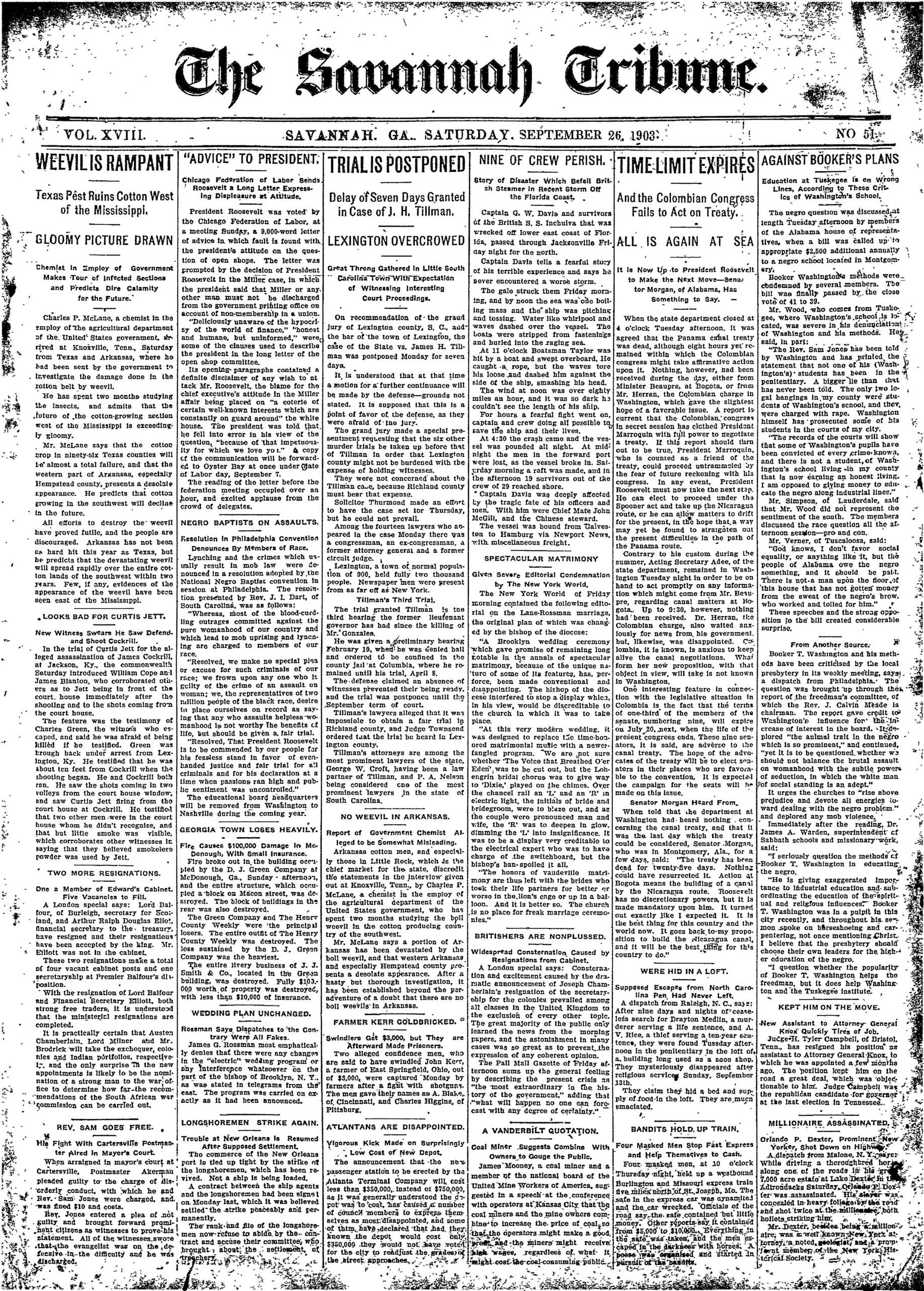
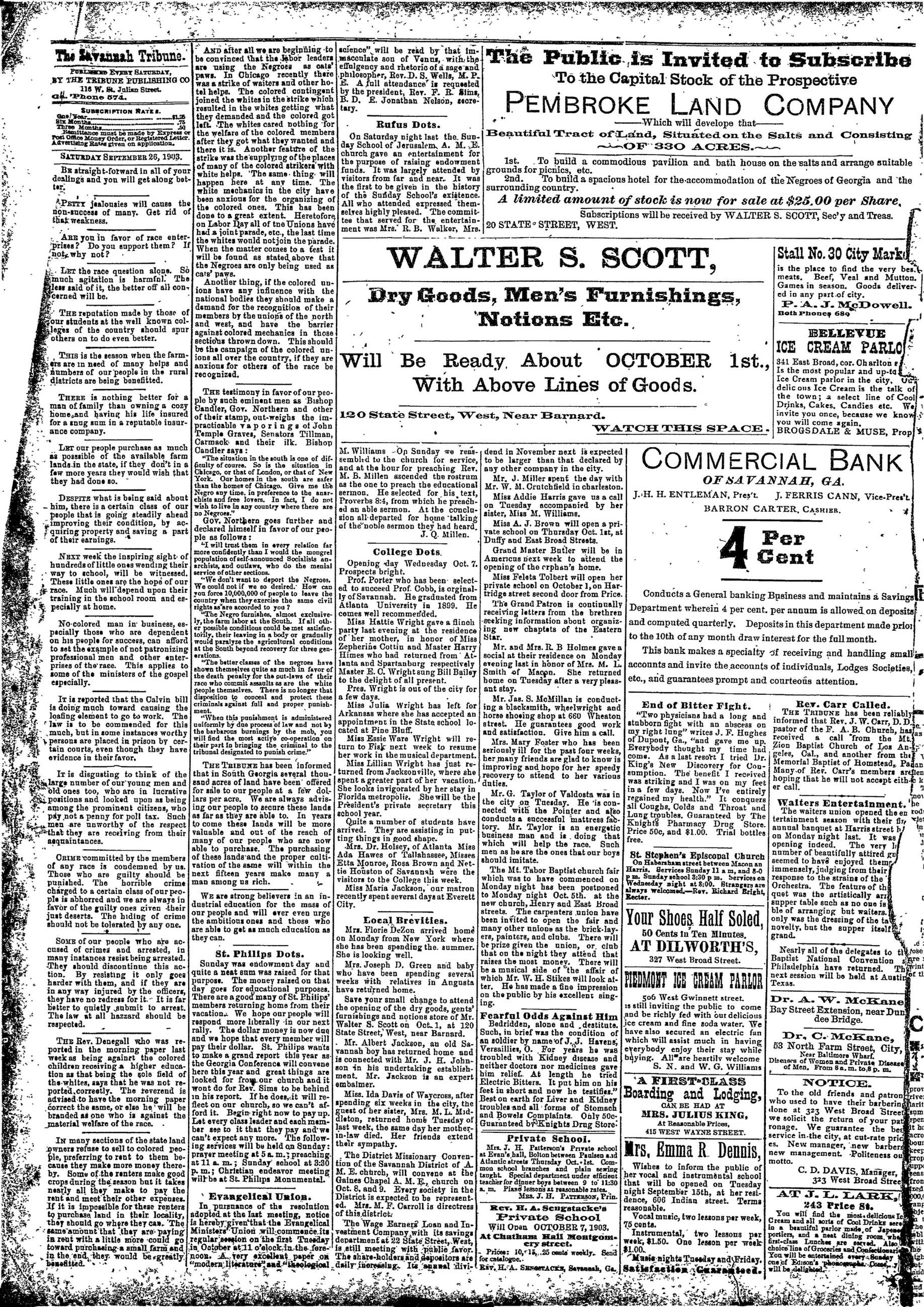
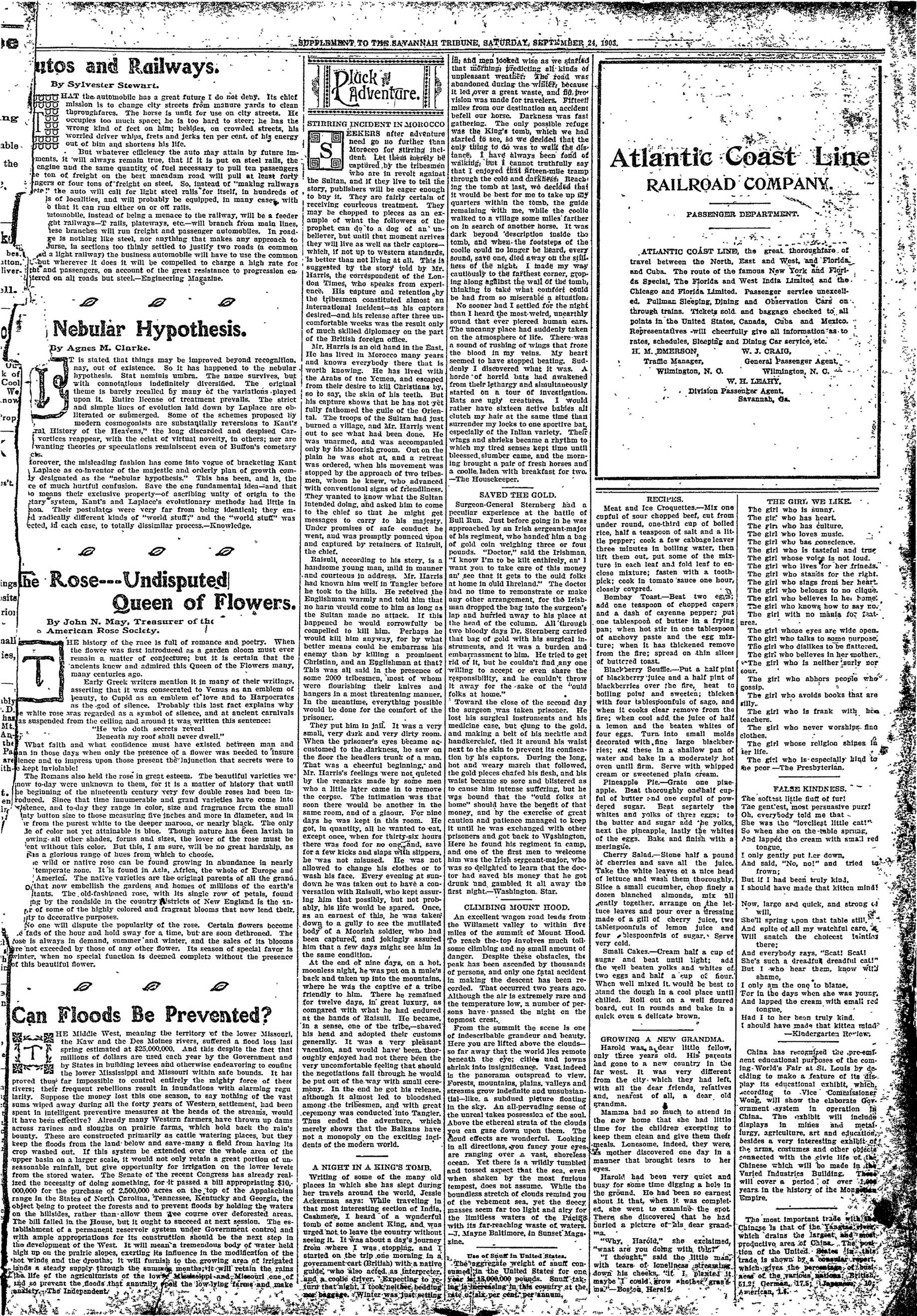
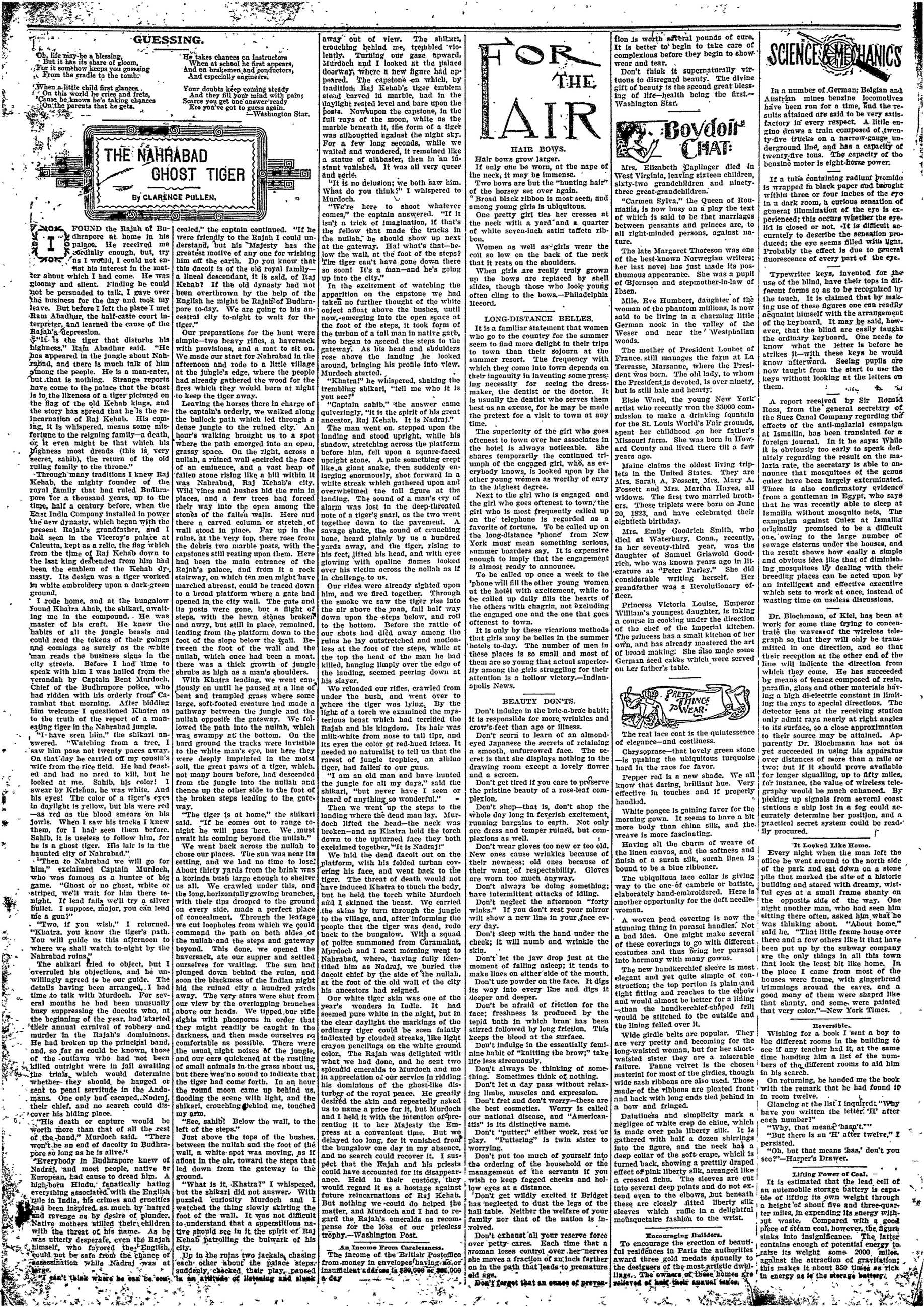
Page text (machine-generated)
WEEVILIS RAMPANT
Texas Pest Ruins Cotton West of the Mississippi.
GLOOMY PICTURE DRAWN
Chemist In Employ of Government Makes Tour of Infected Sections and Predicts Dire Calamity for the Future.
Charles P. McLane, a chemist in the employ of the agricultural department of the United States government, arrived at Knokville, Tenn., Saturday from Texas and Arkansas, where he had been sent by the government to investigate the damage done in the cotton belt by weevil.
He has spent two months studying the insects, and admits that the future of the cotton-growing section west of the Mississippi is exceedingly gloomy.
Mr. McLane says that the cotton crop in ninety-six Texas counties will be almost a total failure, and that the western part of Arkansas, especially Hempstead county, presents a desolate appearance. He predicts that cotton growing in the southwest will decline in the future.
All efforts to destroy the weevil have proved futile, and the people are discouraged. Arkansas has not been as hard hit this year as Texas, but he predicts that the devastating weevil will spread rapidly over the entire cotton lands of the southwest within two years. Few, if any, evidences of the appearance of the weevil have been seen east of the Mississippi.
LOOKS BAD FOR CURTIS JETT.
New Witness Swears He Saw Defend- and Shoot Cockrill.
In the trial of Curtis Jett for the alleged assassination of James Cockrill, at Jackson, Ky., the commonwealth Saturday introduced William Cope and James Blanton, who corroborated others as to Jett being in front of the court. house immediately after the shooting and to the shots coming from the court house.
The feature was the testimony of Charles Green, the witness who escaped, and said he was afraid of being killed if he testified. Green was brought back under arrest from Lexington, Ky. He testified that he was about ten feet from Cockrill when the shooting began. He and Cockrill both ran. He saw the shots coming in two volleys from the court house window, and saw Curtis Jett firing from the court house at Cockrill. He testified that two other men were in the court house whom he didn't recognize, and that but little smoke was visible, which corroborates other witnesses in saying that they believed smokeless powder was used by Jett.
TWO MORE RESIGNATIONS.
One a member of Edward's Cabinet.
Five Vacancles to Fill.
A London special says: Lord Balfour, of Burleigh, secretary for Scotland, and Arthur Ralph Douglas Elliot, financial secretary to the treasury, have resigned and their resignations have been accepted by the king. Mr. Elliott was not in the cabinet.
These two resignations make a total of four vacant cabinet posts and one secretaryship at Premier Balfour's disposition.
With the resignation of Lord Balfour and Financial Secretary Elliott, both strong free traders, it is understood that the ministerial resignations are completed.
It is practically certain that Austen Chamberlain, Lord Milner and Mr. Brodrick will take the exchouquer, colonies and Indian portfolios, respectively, and the only surprise the new appointments is likely to be the nomination of a strong man to the war; office to determine how far-the recommendations of the South African war commission can be carried out.
His Fight With Cartersville Postmaster Alfred in Mayor's Court.
When arraigned in mayor's court at Cartersville, Postmaster Akerman pleaded guilty to the charge of disorderly conduct, with which he and Rev. Sam Jones were charged, and was fined $10 and costs.
Rev. Jones entered a plea of not guilty and brought forward complaint citizens as witnesses to prove his statement. All of the witnesses, sowe that the evangelist was on the defensive in the difficulty and he was discharged.
"ADVICE" TO PRESIDENT.
Chicago Federation of Labor Sends Roosevelt a Long Letter Expressing Displeasure at Attitude.
President Roosevelt was voted by the Chicago Federation of Labor, at a meeting Sunday, a 9,000-word letter of advice in which fault is found with the president's attitude on the question of open shops. The letter was prompted by the decision of President Roosevelt in the Miller case, in which the president said that Miller or any other man must not be discharged from the government printing office on account of non-membership in a union.
"Deliciously unaware of the hypocrisy of the world of finance," "honest and humane, but uninformed," were some of the clauses used to describe the president in the long letter of the open shop committee.
Its opening-paragraphs contained a definite disclaimer of any wish to attack Mr. Roosevelt, the blame for the chief executive's attitude in the Miller affair being placed on "a coterie of certain well-known interests which are constantly on guard around" the white house. The president was told that he fell into error in his view of the question, "because of that impetuosity for which we love you." a copy of the communication will be forwarded to Oyster Bay at once under Gate of Labor day, September 7.
The reading of the letter before the federation meeting occupied over an hour, and excited applause from the crowd of delegates.
NEGRO BAPTISTS ON ASSAULTS.
Resolution in Philadelphia Convention Denounces By Members of Race.
Lynching and the crimes which usually result in mob law were denounced in a resolution adopted by the National Negro Baptist convention in session at Philadelphia. The resolution presented by Rev. J. I. Dart, of South Carolina, was as follows:
"Whereas, most of the blood-curdling outrages committed against the pure womanhood of our country and which lead to mob uprising and lynching are charged to members of our race.
"Resolved, we make no special plea or excuse for such criminals of our race; we frown upon any one who is guilty of the crime of an assault on woman; we, the representatives of two million people of the black race, desire to place ourselves on record as saying that any who assaults helpless womanhood is not worthy the benefits of life, but should be given a fair trial.
"Resolved, That President Roosevelt is to be commended by our people for his fearless stand in favor of evenhanded justice and fair trial for all criminals and for his declaration at a time when passions ran high and public sentiment was uncontrolled."
The educational board headquarters will be removed from Washington to Nashville during the coming year.
GEORGIA TOWN LOSES HEAVILY.
Fire Causes $100,000 Damage In Me
Donough. With Small Insurance.
Dough, with small insurance.
Fire broke out in the building occupied by the D. J. Green Company at McDonough, Ga., Sunday afternoon, and the entire structure, which occupied a block on McConnet street, was destroyed. The block of buildings in the rear was also destroyed.
The Green Company and The Henry County Weekly were the principal losers. The entire outfit of The Henry County Weekly was destroyed. The loss sustained by the D. J. Green Company was the heaviest.
The entire livery business of J. J. Smith & Co., located in the Green building, was destroyed. Fullly $100,000 worth of property was destroyed, with less than $10,000 of insurance.
WEDDING PLAN UNCHANGED.
Rossman Says Dispatches to 'the Contrary Were All Fakes.
James G. Rossman most emphatically denies that there were any changes in the "electric" wedding program or any interference whatsoever on the part of the bishop of Brooklyn, N. Y., as was stated in telegrams from the east. The program was carried on exactly as it had been announced.
LONGSHOREMEN STRIKE AGAIN.
Trouble at New Orleans Is Resumed After Supposed Settlement
The commerce of the New Orleans port is tiled up tight by the strike of the longshoremen, which has been revived. Not a ship is being loaded. A contract between the ship agents and the longshoremen had been signed on Monday last, which it was believed settled the strike peaceably and permanently. The rank and file of the longshoremen now refuse to abide by the contract and accuse their committee, who brought about the settlement, of treachery.
TRIALIS POSTPONED
Delay of Seven Days Granted in Case of J. H. Tillman.
LEXINGTON OVERCROWED
On recommendation of the grand jury of Lexington county, S. C., and the bar of the town of Lexington, the case of the State vs. James H. Tillman was postponed Monday for seven days.
It is understood that at that time a motion for a further continuance will be made by the defense—grounds not stated. It is supposed that this is a point of favor of the defense, as they were afraid of the jury.
The grand jury made a special presentment requesting that the six other murder trials be taken up before that of Tillman in order that Lexington county might not be burdened with the expense of holding witnesses.
They were not concerned about the Tillman case, because Richland county must bear that expense.
Sollificor Thurmond made an effort to have the case set for Thursday, but he could not prevail. Among the fourteen lawyers who appeared in the case Monday there was a congressman, an ex-congressman, a former attorney general and a former circuit judge. Lexington, a town of normal population of 900, held fully two thousand people. Newspaper men were present from as far off as New York.
Tillman's Third Trial.
The trial granted Tillman is the third hearing the former lieutenant governor has had since the killing of Mr. Gonzales.
He was given a preliminary hearing February 19, when he was denied ball and ordered to be confined in the county jail at Columbia, where he remained until his trial, April 8.
The defense claimed an absence of witnesses prevented their ready, and the trial was postponed until the September term of court.
Tillman's lawyers alleged that it was impossible to obtain a fair trial in Richland county, and Judge Townsend ordered that the trial be heard in Lexington county.
Tillman's attorneys are among the most prominent lawyers of the state, George W. Croft, having been a law partner of Tillman, and P. A. Nelson being considered one of the most prominent lawyers in the state of South Carolina.
NO WEEVIL IN ARKANSAS.
Report of Government Chemist
Alegged to be Somewhat Misleading.
Arkansas cotton men, and especially those in Little Rock, which is the chief market for the state, discredit the statements in the interview given out at Knoxville, Tenn., by Charles P. McLane, a chemist in the employ of the agricultural department of the United States government, who has spent two months studying the boll weevil in the cotton producing country of the southwest.
Mr. McLane says a portion of Arkansas has been devastated by the boll weevil, and that western Arkansas and especially Hempstead county presents a desolate appearance. After a hasty but thorough investigation, it has been established beyond the adventure of a doubt that there are no boll weevils in Arkansas.
FARMER KERR GOLDBRICKED.
Swindlers Get $3,000, but They are Afterward Made Prisoners.
Two alleged confidence men, who are said to have swindled John Kerr, a farmer of East Springfield, Ohio, out of $3,000, were captured Monday by farmers after a fight with shotguns.
The men gave their names as A. Blake, of Cincinnati, and Charles Higgins, of Pittsburg.
ATLANTANS ARE DISAPPOINTED.
Vigorous Kick Made on Surprisingly Low Cost of New Depot.
The announcement that the new passenger station to be erected by the Atlanta Terminal Company will cost less than $350,000, instead of $750,000, as it was generally understood the depot was to cost, has caused a number of council members to express themselves as most disappointed, and some of them, have declared that had they known the depot would cost only $350,000 they would not have voted for the city to readjust the grades of the street approaches.
NINE OF CREW PERISH.
Story of Disaster Which Befell British Steamer in Recent Storm Off the Florida Coast.
Captain G. W. Davis and survivors of the British S. S. Inchulva that was wrecked off lower east coast of Florida, passed through Jacksonville Friday night for the north.
Captain Davis tells a fearful story of his terrible experience and says he never encountered a worse storm.
The gale struck them Friday morning, and by noon the sea was one boiling mass and the ship was pitching and tossing. Water like whirlpool and waves dashed over the vessel. The boats were stripped from fastenings and hurled into the raging sea.
At 11 o'clock Boatsman Taylor was hit by a boat and swept overboard. He caught a rope, but the waves tore his loose and dashed him against the side of the ship, smashing his head. The wind at noon was over eighty miles an hour, and it was so dark he couldn't see the length of his ship. For hours a fearful fight went on, captain and crew doing all possible to save the ship and their lives.
*Captain Davis was deeply affected by the tragic fate of his officers and men. With him were Chief Mate John McGill, and the Chinese steward. The vessel was bound from Galveston to Hamburg via Newport News, with miscellaneous freight.
SPECTACULAR MATRIMONY
Given Severe Editorial Condemnation by The New York World.
The New York World of Friday morning contained the following editorial on the Lane-Rossman marriage, the original plan of which was changed by the bishop of the diocese:
"A Brooklyn wedding ceremony which gave promise of remaining long notable in the annals of spectacular matrimony, because of the unique nature of some of its features, has, perforce, been made conventional and disappointing. The bishop of the diocese interfered to stop a display which, in his view, would be discreditable to the church in which it was to take place.
"At this very modern wedding, it was designed to replace the time-honored matrimonial music with a newer-fangled program. We are not sure whether The Voice that Breathed Over Eden, was to be cut out, and the Lohengrin bridal chorus was to give way to 'Dixie,' played on the chimes. Over the chancel rail an 'L' and an 'R' in electric light, the initials of bride and bridegroom, were to blaze out, and as the couple were pronounced man and wife, the 'R' was to deepen in glow, dimming the 'L' into insignificance. It was to be a display very creditable to the electrical expert who was to have charge of the switchboard, but the bishop's ban-spoiled it all.
"The honors of vaudeville matrimony are thus left with the brides who took their life partners for better or worse in the lion's cage or up in a balloon. And it is better so. The church is no place for freak marriage ceremonies."
BRITISHERS ARE NONPLUSSED.
Widespread Consternation Caused by Resignations from Cabinet
A London special says: Consternation and excitement caused by the dramatic announcement of Joseph Chamberlain's resignation of the secretaryship for the colonies prevailed among all classes in the United Kingdom to the exclusion of every other topic. The great majority of the public only learned the news from the morning papers, and the astonishment in many cases was so great as to prevent the expression of any coherent opinion. The Pall Mall Gazette of Friday afternoon sums up the general feeling by describing the present crisis as "the most extraordinary in the history of the government," adding that "what will happen no one can forecast with any degree of certainty."
A VANDERBILT QUOTATION.
Coal Miner Suggests Combine With Owners to Gouge the Public.
James Mooney, a coal miner and a member of the national board of the United Mine Workers of America, suggested in a speech at the conference with operators at Kansas City that the coal miners and the mine owners combine to increase the price of coal so that the operators might make a good profit and the miners might receive high wages, regardless of what it might cost the coal-consuming public.
TIMELIMITEXPIRES
It Is Now Up to President Roosevelt to Make the Next Move—Senator Morgan, of Alabama, Has Something to Say.
When the state department closed at 4 o'clock Tuesday afternoon, it was agreed that the Panama canal treaty was dead, although eight hours yet remained within which the Colombian congress might take affirmative action upon it. Nothing, however, had been received during the day, either from Minister Beaupre, at Bogota, or from Mr. Herran, the Colombian charge in Washington, which gave the slightest hope of a favorable issue. A report is current that the Colombian congress in secret session has clothed President Marroquín with full power to negotiate a treaty. If this report should turn out to be true, President Marroquín, who is counted as a friend of the treaty, could proceed untrammeled by the fear of future reckoning with his congress. In any event, President Roosevelt must now take the next step. He can elect to proceed under the Spooner act and take up the Nicaragua route, or he can allow matters to drift for the present, in the hope that, a way may yet be found to straighten out the present difficulties in the path of the Panama route.
Contrary to his custom during the summer, Acting Secretary Adee, of the state department, remained in Washington Tuesday night in order to be on hand to act promptly on any information which might come from Mr. Beaupre, regarding canal matters at Hogota. Up to 9:30, however, nothing had been received. Dr. Herran, the Colombian charge, also watted anxiously for news from his government, but, likewise, was disappointed. Colombia, it is known, is anxious to keep alive the canal negotiations. What form her new proposition, with that object in view, will take is not known in Washington.
One interesting feature in connection with the legislative situation in Colombia is the fact that the terms of one-third of the members of the senate, numbering nine, will expire on July 20, next, when the life of the present congress ends. These nine senators, it is said, are adverse to the canal treaty. The hope of the advocates of the treaty will be to elect senators in their places who are favorable to the convention. It is expected the campaign for the seats will be made on this issue.
Senator Morgan Heard From.
When told that the department at Washington had heard nothing concerning the canal treaty, and that it was the last day which the treaty could be considered, Senator Morgan, who was in Montgomery, Ala., for a few days, said: "The treaty has been dead for twenty-five days. Nothing could have resurrected it. Action at Bogota means the building of a canal by the Nicaragua route. Roosevelt has no discretionary powers, but it is made mandatory upon him. It turned out exactly like I expected it. It is the best thing for this country and the world now. It goes back to my proposition to build the Nicaragua canal, and it will be the best thing for this country to do."
WERE HID IN A LOFT.
Supposed Escapes from North Carolina
Lina Pen Had Never Left
A dispatch from Raleigh, N. C., says:
After nine days and nights of ceaseless search for Drayton Medlin, a murderer serving a life sentence, and A. V. Rice, a thief serving a ten-year sentence, they were found Tuesday afternoon in the penitentiary in the loft of a building long used as a saco shop. They mysteriously disappeared after religious services Sunday, September 18th.
They claim they hid a bed and supply of food in the loft. They are much emaculated.
BANDITS HOLD, UP TRAIN.
Four Masked Men Stop Fast Express and Help Themselves to Cash.
Four masked men, at 10 o'clock Thursday night, held up a westbound Burlington and Missouri express train five miles north of St. Joseph, Mo. The safe in the express car was dynamical and the car wrecked. Officials of the road say the safe contained but little money. Other reports say it contained from $5,000 to $10,000. Everything in the safe was taken, and the men escaped in the darkness with horses. A pose was organized and started in pursuit of the bandits.
AGAINST BOOKER'S PLANS
Education at Tuskegee is on Wrong Lines, According to These Critics of Washington's School.
The negro question was discussed at length Tuesday afternoon by members of the Alabama house of representatives, when a bill was called up to appropriate $2,500 additional annually to a negro school located in Montgomery.
Booker Washington's methods were condemned by several members. The bill was finally passed by the close vote of 41 to 39.
Mr. Wood, who comes from Tuskegee, where Washington's school is located, was severe in his denunciation of Washington and his methods. He said in part:
"The Rev. Sam Jonce has been told by Washington and has printed the statement that not one of his (Washington's) students has been in the penitentiary. A bigger lie than that has never been told. The only two legal hangings in my county were students of Washington's school, and they, were charged with rape. Washington himself has prosecuted some of his students in the courts of my city.
"The records of the courts will show that some of Washington's pupils have been convicted of every crime known, and there is not a student, of Washington's school living -ih my county that is now earning an honest living. I am opposed to glying money to educate the negro along industrial lines."
Mr. Simpson, of Lauderdale, said that Mr. Wood did not represent the sentiment of the south. The members discussed the race question all the afternoon session-pro and con.
Mr. Verner, or Tuschaoos, said: "God knows, I don't favor social equality, or anything like it, but the people of Alabama owe the negro something, and it should be pallid. There is not a man upon the floor of this house that has not gotten money from the sweat of the negro's brow, who worked and toiled for him." These speeches and the strong opposition to the bill created considerable surprise.
From Another Source:
Booker T. Washington and his methods have been criticised by the local presbytery in its weekly meeting, says a dispatch from Philadelphia. The question was brought up through the report of the freedman's committee, of which the Rev. J. Calvin Meade is chairman. The report gave credit to Washington's influence for the increase of interest in the board. It exploded "the animal trait in the negro which is so prominent," and continued, "yet it is to be questioned whether we should not balance the brutal assault on womanhood with the subtle power of seduction, in which the white man of social standing is an adept."
It urges the churches to "rise above prejudice and devote all energies toward dealing with the negro problem." and deplored any mob violence.
Immediately after the reading, Dr. James A. Warden, superintendent of Sabbath schools and missionary work, salit:
"I seriously question the methods of Booker T. Washington in educating, the negro.
"He is giving exaggerated importance to industrial education and subordinating the education of the spiritual and religious influences. Booker T. Washington was in a pulpit in this city recently, and throughout his seminary spoke on hireshoeing and carpentering, not once mentioning Christ. I believe that the presbytery should choose their own leaders for the higher education of the negro.
"I question whether the popularity of Booker T. Washington helps the freedman, but it does help Washington and the Tuskegee institute.
KEPT HIM ON THE MOVE.
-New Assistant to Attorney General
-Know Quickly the Job of
Juice-H. Tyler Campbell, of Bristol, Tenn., has resigned his position as assistant to Attorney General Knox, to which he was appointed a few months ago. The position kept him on the road a great deal, which was objectionable to him. Judge Campbell was the republican candidate for governor at the last election in Tennessee.
MILLIONAIRE ASSASSINATED.
Orlando P. Dexter, Prominent New
Orlando P. Dexter, Prominent New
Noche de Court, Mihigan
Yorker, Sot Down on Highway.
A dispatch from Malone, N. Y., payer.
While driving a thoroughbred horse along one of the roads in his great 7,000 acre estate at Lake Dexter in the Addrondacks Saturday, Orlando, D. Dexter was assassinated. His skier was concealed in heavy foliage by the road and shot twice at the millionaire, both bullets striking him.
Mr. Dexter, beheaded being a millionaire, was in well known New York attorney, a noted geologist, and a prominent member of the New York Historical Society.
PUBLISHED EVERY SATURDAY,
BY THE TRIBUNE PUBLISHING CO.
116 W. St. Julian Street.
G#. Phone 574.
Be straight-forward in all of your dealings and you will get along better.
PETTY jealousies will cause the non-success of many. Get rid of that weakness.
ARE you in favor of race enterprises? Do you support them? If not, why not?
LET the race question alone. So much agitation is harmful. The less said of it, the better off all concerned will be.
THE reputation made by those of our students at the well known colleges of the country should spur others on to do even better.
THIS is the season when the farmers are in need of many helps and numbers of our people in the rural districts are being benefitted.
THERE is nothing better for a man of family than owning a cozy home, and having his life insured for a snug sum in a reputable insurance company.
LET our people purchase as much as possible of the available farm lands in the state, if they don't in a few more years they would wish that they had done so.
DESPITE what is being said about him, there is a certain class of our people that is going steadily ahead improving their condition, by acquiring property and saving a part of their earnings.
Next week the inspiring sight of hundreds of little ones wending their way to school, will be witnessed. These little ones are the hope of our race. Much will depend upon their training in the school room and especially at home.
No-colored man in business, especially those who are dependent on his people for success, can afford to set the example of not patronizing professional men and other enterprises of the race. This applies to some of the ministers of the gospel especially.
It is reported that the Calvin bill is doing much toward causing the loafing element to go to work. The law is to be commended for this much, but in some instances worthy persons are placed in prison by certain courts, even though they have evidence in their favor.
It is disgusting to think of the large number of our young men and old ones too, who are in lucrative positions and looked upon as being among the prominent citizens, who pay not a penny for poll tax. Such men are unworthy of the respect that they are receiving from their acquaintances.
CRIME committed by the members of any race is condemned by us. Those who are guilty should be punished. The horrible crime charged to a certain class of our people is abhorred and we are always in favor of the guilty ones given their just deserts. The hiding of crime should not be tolerated by any one.
Some of our people who are accused of crimes and arrested, in many instances resist being arrested. They should discontinue this action. By resisting it only goes harder with them, and if they are in any way injured by the officers, they have no redress for it. It is far better to quietly submit to arrest. The law at all hazzard should be respected.
The Rev. Denegall who was reported in the morning paper last week as being against the colored children receiving a higher education as that being the sole field of the whites, says that he was not reported, correctly. The reverend is advised to have the morning paper correct the same, or else he will be branded as one who is against the material welfare of the race.
IN many sections of the state land owners refuse to sell to colored people, preferring to rent to them because they make more money thereby. Some of the renters make good crops during the season but it takes nearly all they make to pay the rent and meet their other expenses. If it is impossible for these renters to purchase land in their locality, they should go where they can. The same amount that they are paying in rent with a little more could go toward purchasing a small farm and in the end, they would be greatly benefited.
AND after all we are beginning to be convinced that the labor leaders are using the Negroes as cats' paws. In Chicago recently there was a strike of waiters and other hotel helps. The colored contingent joined the whites in the strike which resulted in the whites getting what they demanded and the colored got left. The whites cared nothing for the welfare of the colored members after they got what they wanted and there it is. Another feature of the strike was the supplying of the places of many of the colored strikers with white helps. 'The same thing will happen here at any time. The white mechanics in the city have been anxious for the organizing of the colored ones. This has been done to a great extent. Heretofore on Labor Day all of the Unions have had a joint parade, etc., the last time the whites would not join the parade. When the matter comes to a test it will be found as stated above that the Negroes are only being used as cats' paws.
Another thing, if the colored unions have any influence with the national bodies they should make a demand for the recognition of their members by the unions of the north and west, and have the barrier against colored mechanics in those sections thrown down. This should be the campaign of the colored unions all over the country, if they are anxious for others of the race be recognized.
THE testimony in favor of our people by such eminent men as Bishop Candler, Gov. Northern and other of their stamp, out-weighs the impracticable vaporings of John Temple Graves, Senators Tillman, Carmack and their ilk. Bishop Candler says:
"The situation in the south is one of difficulty of course. So is the situation in Chicago, or that of London, or that of New York. Our homes in the south are safer than the homes of Chicago. Give me the Negro any time, in preference to the anarchists and free lovers. In fact, I do not wish to live in any country where there are no Negroes."
Gov. Northern goes further and declared himself in favor of our people as follows:
"I will trust them in every relation far more confidently than I would the mongrel population of self-announced Socialists anarchists, and outlaws, who do the mental service of other sections.
"We don't want to deport the Negroes. We could not if we so desired. How can you force 10,000,000 of people to leave the country when they exercise the same civil rights as are accorded to you?"
"The Negro furnishes, almost exclusively, the farm labor at the South. If all other possible conditions could be met satisfactorily, their leaving in a body or gradually would paralyze the agricultural conditions at the South beyond recovery for three generations. The better classes of the negroes have shown themselves quite as much in favor of the death penalty for the out-laws of their race who commit assaults as are the white people themselves. There is no longer that disposition to conceal and protect these criminals against full and proper punishment.
"When this punishment is administered uniformly by due process of law and not by the barbarous burnings by the mob, you will find the most active co-operation on their part in bringing the criminal to the tribunal designated to punish crime."
THE TRIBUNE has been informed that in South Georgia several thousand acres of land have been offered for sale to our people at a few dollars per acre. We are always advising our people to secure these lands as far as they are able to. In years to come these lands will be more valuable and out of the reach of many of our people who are now able to purchase. The purchasing of these lands and the proper cultivation of the same will within the next fifteen years make many a man among us rich.
We are strong believers in an industrial education for the mass of our people and will ever even urge the ambitious ones and those who are able to get as much education as they can.
St. Phillips Dots.
Sunday was endowment day and quite a neat sum was raised for that purpose. The money raised on that day goes for educational purposes. There are a good many of St. Philips' members returning home from their vacation. We hope our people will respond more liberally - in our next rally. The dollar money is now due and we hope that every member will pay their dollar. St. Philips wants to make a grand report this year as the Georgia Conference will convene here this year and great things are looked for from our church and it wont do for Rev. Sims to be behind in his report. If he does, it will reflect on our church, so we can't afford it. Begin right now to pay up. Let every class leader and each member see to it that they pay and we can't expect any more. The following services will be held on Sunday: prayer meeting at 5 a.m.; preaching at 11 a.m.; Sunday school at 3:30 p.m.; Christian endeavor meeting will be at St. Philips Monumental.
Evangelical Union.
In pursuance of the resolution adopted at the last meeting, notice is hereby given that the Evangelical Ministers' Union will commence its regular session on the first Tuesday in October at 11 o'clock in the forenoon. A very excellent paper on "modern literature" and "theological
WALTER S. SCOTT,
120 State Street, West, Near Barnard.
science" will be read by that immaculate son of Venus, with the effulgency and rhetoric of a sage and philosopher, Rev. D. S. Wells, M. P. E. A full attendance is requested by the president, Rev. F. R. Slims, B. D. E. Jonathan Nelson, secretary.
Rufus Dots.
On Saturday night last the. Sunday School of Jerusalem. A. M. E. church gave an entertainment for the purpose of raising endowment funds. It was largely attended by visitors from far and near. It was the first to be given in the history of the Sunday School's existence. All who attended expressed themselves highly pleased. The committee that served for the entertainment was Mrs.' R. B. Walker, Mrs.
WALT
Dry Goods
Will Be Rea
With A
120 State Street, We
M. Williams - On Sunday we reassembled to the church for service, and at the hour for preaching Rev. M. B. Millen ascended the rostrum as the one to preach the educational sermon. He selected for his text, Proverbs 8:4, from which he preached an able sermon. At the conclusion all departed for hone talking of the 'noble sermon they had heard, J. O. Millen.
College Dots
Opening day Wednesday Oct. 7. Prospects bright.
Prof. Porter who has been selected to succeed Prof. Cobb, is originally of Savannah. He graduated from Atlanta University in 1899. He comes well recommended.
Miss Hattie Wright gave a flinch party last evening at the residence of her mother, in honor of Miss Zepherine Cottin and Master Harry Himes who had returned from Atlanta and Spartanburg respectively Master E. O. Wright sung Bill Bailey to the delight of all present.
Pres. Wright is out of the city for a few days.
Miss Julia Wright has left for Arkansas where she has accepted an appointment in the State school located at Pine Bluff.
Miss Essie Ware Wright will return to Fisk next week to resume her work in the musical department.
Miss Lillian Wright has just returned from Jacksonville, where she spent a greater part of her vacation. She looks invigorated by her stay in Florida metropolis. She will be the President's private secretary this school year. Quite a number of students have arrived. They are assisting in putting things in good shape. Mrs. Dr. Holsey, of Atlanta Miss Ada Hawes of Tallahassee, Misses Etta Monroe, Rosa Brown and Nettie Houston of Savannah were the visitors to the College this week. Miss Maria Jackson, our matron recently spent several days at Everett City.
Local Brevities.
Mrs. Florie DeZon arrived home on Monday from New York where she has been spending the summer. She is looking well.
Mrs. Joseph D. Green and baby who have been spending several weeks with relatives in Angusta have returned home.
Save your small change to attend the opening of the dry goods, gents' furnishings and notions store of Mr. Walter S. Scott on Oct. 1, at 120 State Street, West, near Barnard.
Mr. Albert Jackson, an old Savannah boy has returned home and is connected with Mr. J. H. Johnson in his undertaking establishment. Mr. Jackson is an expert embalmer.
Miss. Ida Davis of Waycross, after spending six weeks in the city, the guest of her sister, Mrs. M. L. Middleton, returned home Tuesday of last week, the same day her mother-in-law died. Her friends extend their sympathy.
The District Missionary Convention of the Savannah District of A. M. E. church, will convene at the Gaines Chapel A. M. E., church on Oct. 8 and 9. Every society in the District is expected to be represented. Mrs. M. F. Carroll is directress of this district:
The Wage Earner? Loan and Investment Company, with its savings department at 22 State Street, West, is still meeting with public favor. The share-holders and depositors are daily increasing. Its annual divi-
The Public is Invited to Subscribe To the Capital Stock of the Prospective PEMBROKE LAND COMPANY
Beautiful Tract of Land, Situated on the Salts and Consisting OF 330 ACRES. 1st. To build a commodious pavilion and bath house on the salts and arrange suitable grounds for picnics, etc. 2nd. To build a spacious hotel for the accommodation of the Negroes of Georgia and the surrounding country.
WATCH THIS SPACE.
expected declared by city.
day with carleston.
pus a call by her
en a pri-
st. 1st, at
its.
will be in
send the
me.
open her
on Har-
m Price.
continually brethren
organiz-
Eastern
gave a
Monday.
M. L.
returned
very pleas-
cond net.
COMMERC
OF SAVAN
J. H. H. ENTLEMAN, Pres't.
BARRON CAL
4
Conducts a General banking De-
partment wherein 4 per cent.
and computed quarterly. Depo-
to the 10th of any month drawing.
This bank makes a specialty
accounts and invite the accounts
etc., and guarantees prompt and
Your Shoes. Half Soled,
50 Cents in Ten Minutes.
AT DILWORTH'S,
327 West Broad Street.
20 STATE STREET, WEST.
TER S. S
s, Men's Fun
Notions Etc
ady. About O
Above Lines of
est, Near Barnard.
dend in November next is expected to be larger than that declared by any other company in the city.
Mr. J. Miller spent the day with Mr. W. M. Crutchfield in charleston.
Miss Addie Harris gave us a call on Tuesday accompanied by her sister, Miss M. Williams.
Miss A. J. Brown will open a private school on Thursday Oct. 1st, at Duffy and East Broad Streets.
Grand Master Butler will be in Americus next week to attend the opening of the orphan's home.
Miss Feleta Tolbert will open her private school on October 1, on Hartridge street second door from Price.
The Grand Patron is continually receiving letters from the brethren seeking information about organizing new chaplets of the Eastern Star.
Mr. and Mrs. R. B Holmes gave a social at their residence on Monday evening last in honor of Mrs. M. L. Smith of Macon. She returned home on Tuesday after a very pleasant stay.
Mr. Jas. S. McMillan is conducting a blacksmith, wheelwright and horse shoing shop at 660 Wheaton street. He guarantees good work and satisfaction. Give him a call.
Mrs. Mary Foster who has been seriously ill for the past four weeks, her many friends are glad to know is improving and hope for her speedy recovery to attend to her various duties.
Mr. G. Taylor of Valdosta was in the city on Tuesday. He is connected with the Pointer and also conducts a successful mattress factory. Mr. Taylor is an energetic business man and is doing that which will help the race. Such men as he are the ones that our boys should imitate.
The Mt. Tabor Baptist church fair which was to have commenced on Monday night has been postponed to Monday night Oct. 5th. at the new church, Henry and East Broad streets. The carpenters union have been invited to open the fair and many other unions as the brick-layers, painters, and clubs. There will be prize given the union, or. club that on the night they attend that raises the most money. There will be a musical side of the affair of which W. W. H. Stikes will look after. He has made a fine impression on the public by his excellent singing.
Fearful Odds Against Him
Bedridden, alone and destitute.
Such, in brief was the condition of an soldier by name of J. J. Havens, Versaillies, O. For years he was troubled with Kidney disease and neither doctors nor medicines gave him relief. At length he tried Electric Bitters. It put him on his feet in short and now he testifies." Best on earth for Liver and Kidney troubles and all forms of Stomach and Bowels Complaints. Only 500-Guaranteed by Knights Drung Store.
Private School.
Mrs. J. H. Patterson's Private school at Evan's hall, Bolton between Paulsen and Atlantic streets Thursday Oct. 1st. Common school branches and plain sewing taught. Special department under efficient teacher for dinner boys between 9 to 11:30 a.m. Pland lessons at reasonable rates.
MRS. J. H. PATTERSON, Prin.
Rev H. A. Sengstacke's
Private School
Will Open OCTOBER 7, 1903,
At Chatham Hall Montgomery street.
Prices: 10, 14, .25 cents weekly. Send for catalogue.
Rev H. A. Sengstacke Semarch, G.
J. H. H. ENTLEMAN, Pres't. J. FERRIS CANN, Vice-Pres't BARRON CARTER, CASHIER.
4 Per Cent
Conducts a General banking Business and maintains a Savings Department wherein 4 per cent. per annum is allowed on deposits and computed quarterly. Deposits in this department made prior to the 10th of any month draw interest for the full month.
This bank makes a specialty of receiving and handling small accounts and invite the accounts of individuals, Lodges Societies, etc., and guarantees prompt and courteous attention.
End of Bitter Fight.
"Two physicians had a long and stubborn fight with an abscess on my right lung" writes J. F. Hughes of Dupont, Ga., "and gave me up. Everybody thought my time had come. As a last resort I tried Dr. King's New Discovery for Consumption. The benefit I received was striking and I was on my feet in a few days. Now I've entirely regained my health." It conquers all Coughs, Colds and Throat and Lung troubles, Guaranteed by The Knights Pharmacy Drug Store. Price 50c, and $1.00. Trial bottles free.
St. Stephen's Episcopal Church On Habersham street between Macon an Harris. Services Sunday 11 a.m. and 8-0 p.m. Sunday school 3:30 p.m. Services on Wednesday night at 8:00. Strangers are always welcomed—Rev. Richard Bright, Rector.
PIEDMONT ICE CREAM PARLOR
506 West Gwinnett street. is still inviting the public to come and be richly fed with our delicious ice cream and fine soda water. We have also secured an electric fan which will assist much in having everybody enjoy their stay while buying. All are heartily welcome S. N. and W. G. Williams
Boarding and Lodging,
CAN BE HAD AT
MRS. JULIUS KING,
At Reasonable Prices,
415 WEST WAYNE STREET.
Mrs. Emma R. Dennis.
Wishes to inform the public of her vocal and instrumental school that will be opened on Tuesday night September 15th, at her residence, 606 Indian street. Terms reasonable. Vocal music, two lessons per week, 75 cents. Instrumental, two lessons per week, $1.50. One lesson per week $1.00. Music nights Tuesday and Friday. Satisfaction Guaranteed.
Stall No. 30 City Marku is the place to find the very best meats. Beef, Veal and Mutton. Games in season. Goods delivered in any part of city.
P. A. J. McDowell. Both Phones 689
BELLEVUE
ICE CREAM PARLO
341 East Broad, cor. Charlton
Is the most popular and up-to-date Ice Cream parlor in the city. Our delicious Ice Cream is the talk of the town; a select line of Cool Drinks, Cakes, Candies etc. We invite you once, because we know you will come again.
BROGSDALE & MUSE. Prop
SCIAL BANK
ANNAH, GA.
J. FERRIS CANN, Vice-Pres't
CARTER, CASHIER.
Business and maintains a Savings per annum is allowed on deposits in this department made prior interest for the full month. Of receiving and handling small of individuals, Lodges Societies, courteous attention.
THE TRIBUNE has been reliably informed that Rev. J. W. Carr, D. D. pastor of the F. A. B. Church, has received a call from the Mt. Zion Baptist Church of Los Angeles, Cal., and another from the Memorial Baptist of Homstead, Padar Many-of Rev. Carr's members earlier hoping that he will not accept either ear call.
Walters Entertainment. the
walters union opened the enro-
tertainment season with their fir-
nual banquet at Harris street b
on Monday night last. It was
opening indeed. The very l
number of beautifully attired gue
seemed to have enjoyed them
immensely, judging from their
response to the strains of the
Orchestra. The feature of the
quiet was the artistically arri
supper table such as no one is
able of arranging, but waiters.
only was the dressing of the ta
novelly, but the supper itself
grand.
Nearly all of the delegates to the
Baptist National Convention are
Philadelphia have returned. The
next session will be held at Austin
Texas.
Dr. A. W. McKane
Bay Street Extension, near Dun
dee Bridge.
Dr. C. McKane,
53 North Farm Street, City,
New Brunswick.
Near Baltimore Wharf. Diseases of Women and Private Disease of Men. From 8 a.m. to 8 p.m.
NOTICE.
To the old friends and patron who used to have their barbering done at 323 West Broad Street we solicit the return of your patronage. We guarantee the best service in the city, at cut-rate prices. New manager, new barber new management. Politeness our motto.
C. D. DAVIS, Manager,
323 West Broad Street
You will find the most delicious In Iream and all sorts of Cool Drinks served in a beautiful parlor made of Japanese poriers, and a neat dining room where first-class Lunches are served. Also a choice line of Groceries and Confectionaries is entertained every Sunday. A one of Edison's phonographs. Donate. Will be delighted.
NOTICE.
HAT the automobile has a great future I do not deny. Its chief mission is to change city streets from manure yards to clean throughtares. The horse is unfit for use on city streets. He occupies too much space; he is too hard to steer; he has the wrong kind of feet on him; he baldes, on crowded streets, his worried driver whips, frets and jerks ten per cent. of his energy out of him and shortens his life.
But whatever efficiency the auto may attain by future immeasures, it will always remain true, that if it is put on steel rails, the engine and the same quantity of fuel necessary to pull ten passengers be ton of freight on the best macadam road will pull at least fortyengers or four tons of freight on steel. So, instead of "making railways etc," the auto will call for light steel rails for itself, in hundreds of is of localities, and will probably be equipped, in many cases, with that it can run either on or on rails.
automobile, instead of being a menace to the railway, will be a feeder light railways—T rails, plateways, etc.—will branch from main lines, these branches will run freight and passenger automobiles. In road-ge is nothing like steel, nor anything that makes any approach to surse, in sections too thinly settled to justify two roads (a common and a light railway) the business automobile will have to use the common but wherever it does it will be compelled to charge a high rate for it and passengers, on account of the great resistance to progression en- ered on all roads but steel.—Engineering Magazine.
Nebular Hypothesis.
It is stated that things may be improved beyond recognition, nay, out of existence. So it has happened to the nebular hypothesis. Stat nominis umbra. The name survives, but with connotations indefinitely diversified. The original theme is barely recalled by many of the variations played upon it. Entire license of treatment prevails. The strict and simple lines of evolution laid down by Laplace are obliterated or submerged. Some of the schemes proposed by modern cosmogonists are substantially reversions to Kant's historical History of the Heavens," the long discarded and despised Carvortices reappear, with the eclat of virtual novelty, in others; nor are wanting theories or speculations reminiscent even of Buffon's cometary science.
Overrover the misleading fashion has come into vogue of bracketing Kant Laplace as co-inventor of the majestic and orderly plan of growth designated as the "nebular hypothesis." This has been, and is, the of much hurtful confusion. Save the one fundamental idea—and that means their exclusive property—of ascribing unity of origin to theary system, Kant's and Laplace's evolutionary methods had little in on. Their postulates were very far from being identical; they emeradically different kinds of "world stuff;" and the "world stuff" was tested, if each case, to totally dissimilar process.—Knowledge.
The Rose---Undisputed Queen of Flowers.
HE history of the race is full of romance and poetry. When the flower was first introduced as a garden bloom must ever remain a matter of conjecture; but it is certain that the ancients knew and admired this Queen of the Flowers many, many centuries ago.
Early Greek writers mention it in many of their writings, asserting that it was consecrated to Venus as an emblem of beauty, to Cupid as an emblem of love and to Harpocrates as the god of silence. Probably this last fact explains why late rose was regarded as a symbol of silence, and at ancient carnivals spended from the ceiling and around it was written this sentence:
that faith and what confidence must have existed between man and in those days when only the presence of a flower was needed to insure and to impress upon those present the injunction that secrets were to it inviolable!
The Romans also held the rose in great esteem. The beautiful varieties we-to-day were unknown to them, for it is a matter of history that until beginning of the nineteenth century very few double roses had been ined. Since that time innumerable and grand varieties have come into face, and to-day they range in color, size and fragrance from the small button size to those measuring five inches and more in diameter, and in from the purest white to the deeper maroon, or nearly black. The only of color not yet attainable is blue. Though nature has been lavish in
By Sylvester Stewart.
HAT the automobile has a great future I do not deny. Its chief mission is to change city streets from manure yards to clean throughtares. The horse is unit for use on city streets. He occupies too much space; he is too hard to steer; he has the wrong kind of feet on him; bedides, on crowded streets, his worried driver whips, frets and jerks ten per cent. of his energy out of him and shortens his life.
But whatever efficiency the auto may attain by future imments, it will always remain true, that if it is put on steel rails, the engine and the same quantity of fuel necessary to pull ten passengers the ton of freight on the best macadam road will pull at least fortyengers or four tons of freight on steel. So, instead of "making railwaysete" the auto will call for light steel rails for itself, in hundreds of is of localities, and will probably be equipped, in many cases, with that it can run either on or off rails.
automobile, instead of being to the railway, will be a feeder right railways-T rails, plateways, etc.-will branch from main lines, these branches will run freight and passenger automobiles. In road-gee is nothing like steel, nor anything that makes any approach to burse, in sections too thinly settled to justify two roads (a common
and a light railway) the business automobile will have to use the common but wherever it does it will be compelled to charge a high rate for the and passengers, on account of the great resistance to progression entered on all roads but steel.—Engineering Magazine.
By Agnes M. Clarke. T is stated that things may be improved beyond recognition, nay, out of existence. So it has happened to the nebular hypothesis. Stat nominals umbrn. The name survives, but with connotations indefinitely diversified. The original theme is barely recalled by many of the variations played upon it. Entire license of treatment prevails. The strict and simple lines of evolution laid down by Laplace are obliterated or submerged. Some of the schemes proposed by modern cosmogonists are substantially reversions to Kant's
is stated that things may be improved beyond recognition, nay, out of existence. So it has happened to the nebular hypothesis. Stat nominis umbra. The name survives, but with connotations indefinitely diversified. The original theme is barely recalled by many of the variations played upon it. Entire license of treatment prevails. The strict and simple lines of evolution laid down by Laplace are obliterated or submerged. Some of the schemes proposed by modern cosmogonists are substantially reversions to Kant's Historical History of the Heavens," the long discarded and despised Carvortices reappear, with the eclat of virtual novelty, in others; nor are wanting theories or speculations reminiscent even of Buffon's cometary facts.
foreover, the misleading fashion has come into vogue of bracketing Kant Laplace as co-inventor of the majestic and orderly plan of growth commonly designated as the "nebular hypothesis." This has been, and is, the cee of much hurtful confusion. Save the one fundamental idea—and that to means their exclusive property—of ascribing unity of origin to the stary system, Kant's and Laplace's evolutionary methods had little in mon. Their postulates were very far from being identical; they ended radically different kinds of "world stuff," and the "world stuff" was effected, in each case, to totally dissimilar process.—Knowledge.
The Rose---Undisputed Queen of Flowers.
By John N. May, Treasurer of the American Rose Society.
HE history of the race is full of romance and poetry. When the flower was first introduced as a garden bloom must ever remain a matter of conjecture; but it is certain that the ancients knew and admired this Queen of the Flowers many, many centuries ago.
T
Early Greek writers mention it in many of their writings, asserting that it was consecrated to Venus as an emblem of beauty, to Cupid as an emblem of love and to Harpocrates as the god of silence. Probably this last fact explains why the white rose was regarded as a symbol of silence, and at ancient carnivals as suspended from the ceiling and around it was written this sentence:
"He who doth secrets reveal
Beneath my roof shall never dwell."
What faith and what confidence must have existed between man and man in those days when only the presence of a flower was needed to insure silence and to impress upon those present the injunction that secrets were to the kept inviolable!
The Romans also held the rose in great esteem. The beautiful varieties we now to-day were unknown to them, for it is a matter of history that until the beginning of the nineteenth century very few double roses had been introduced. Since that time innumerable and grand varieties have come into existence, and to-day they range in color, size and fragrance from the small tiny button size to those measuring five inches and more in diameter, and in air from the purest white to the deeper maroon, or nearly black. The only use of color not yet attainable is blue. Though nature has been lavish in sowing all other shades, forms and sizes, the lover of the rose must be sent without this color. But this, I am sure, will be no great hardship, as it is a glorious range of hues from which to choose.
the wild or native rose can be found growing in abundance in nearly temperate zone. It is found in Asia, Africa, the whole of Europe and America. The native varieties are the original parents of all the grand that now embellish the gardens and homes of millions of the earth's plants. The old-fashioned rose, with its single row of petals, found
No one will dispute the popularity of the rose. Certain flowers become the fads of the hour and hold sway for a time, but are soon dethroned. The rose is always in demand, summer and winter, and the sales of its blooms are not exceeded by those of any other flower. Its season of special favor is winter, when no special function is deemed complete without the presence of this beautiful flower.
Can Floods Be Prevented?
HE Middle West, meaning the territory of the lower Missouri, the Kaw and the Des Moines rivers, suffered a flood loss last spring estimated at $25,000,000. And this despite the fact that millions of dollars are used each year by the Government and by States in building levees and otherwise endeavoring to confine the lower Mississippi and Missouri within safe bounds. It has proved thus far impossible to control entirely the mighty force of these rivers; their frequent rebellions result in inundations with alarming regularity. Suppose the money lost this one season, to say nothing of the vast sums wiped away during all the forty years of Western settlement, had been spent in intelligent preventive measures at the heads of the streams, would it have been effective? Already many Western farmers, have thrown up dams across ravines and sloughs on prairie farms, which hold back the rain's bounty. These are constructed primarily as cattle watering places, but they keep the floods from the land-below and save-many a field from having its crop washed out. If this system be extended over the whole area of the upper basin on a larger scale, it would not only retain a great portion of unseasonable rainfall, but give opportunity for irrigation on the lower levels from the stored water. The Senate of the recent Congress has already realized the necessity of doing something, for it passed a bill appropriating $10,000,000 for the purchase of 2,500,000 acres on the top of the Appalachian range in the States of North Carolina, Tennessee, Kentucky and Georgia, the object being to protect the forests and to prevent floods by holding the waters on the hillsides, rather than allow them free course over deforested areas. The bill failed in the House, but it ought to succeed at next session. The establishment of a permanent reservoir system under Government control and with ample appropriations for its construction should be the next step in the development of the West. It will mean a tremendous body of water held high up on the prairie slopes, exerting its influence in the modification of the hot winds and the drouths; it will furnish to the growing area of irrigated lands a steady supply through the summer months; it will retain the rains the life of the agriculturists of the lower Mississippi and Missouri one, and so prevent the floods that annually spoil the low-lying farms and make
INCIDENT IN MOROCCO
EEKERS after adventure
need go no further than
Morocco for stirring
incident. Let them merely be
captured by the tribesmen
who are in revolt against
S
the Sultan, and if they live to tell the story, publishers will be eager enough to buy it. They are fairly certain of receiving courteous treatment. They may be chopped to pieces as an example of what the followers of the prophet can do to a dog of an unbeliever, but until that moment arrives they will live as well as their captors—which, if not up to western standards, is better than not living at all. This is suggested by the story told by Mr. Harris, the correspondent of the London Times, who speaks from experience. His capture and retention by the tribesmen constituted almost an international incident—as his captors desired—and his release after three uncomfortable weeks was the result only of much skilled diplomacy on the part of the British foreign office.
Mr. Harris is an old hand in the East. He has lived in Morocco many years and knows everybody there that is worth knowing. He has lived with the Arabs of the Yemen, and escaped from their desire to kill Christians by, so to say, the skin of his teeth. His capture shows that he has not yet fully fathomed the guile of the Oriental. The troops of the Sultan had just burned a village, and Mr. Harris went out to see what had been done. He was unarmed, and was accompanied only by his Moorish groom. Out on the plain he was shot at, and a retreat was ordered, when his movement was stopped by the approach of two tribesmen, whom he knew, who advanced with conventional signs of friendliness. They wanted to know what the Sultan intended doing, and asked him to come to the chief so that he might get messages to carry to his majesty. Under promises of safe conduct he went, and was promptly pounced upon and captured by retainers of Raissull, the chief.
Raisult, according to his story, is a handsome young man, mild in manner and courteous in address. Mr. Harris had known him well in Tangler before he took to the hills. He received the Englishman warmly and told him that no harm would come to him as long as the Sultan made no attack. If this happened he would sorrowfully be compelled to kill him. Perhaps he would kill him anyway, for by what better means could he embarrass his enemy than by killing a prominent Christian, and an Englishman at that? This was all said in the presence of some 2000 tribesmen, most of whom were flourishing their knives and hangers in a most threatening manner. In the meantime, everything possible would be done for the comfort of the prisoner.
They put him in jail. It was a very small, very dark and very dirty room. When the prisoner's eyes became accustomed to the darkness, he saw on the floor the headless trunk of a man. That was a cheerful beginning, and Mr. Harris's feelings were not quieted by the remarks made by some men who a little later came in to remove the corpse. The intimation was that soon there would be another in the same room, and of a glaour. For nine days he was kept in this room. He got, in quantity, all he wanted to eat, except once, when for thirty-six hours there was food for no one and, save for a few kicks and slaps with slippers, he was not misused. He was not allowed to change his clothes or to wash his face. Every evening at sundown he was taken out to have a conversation with Ralsull, who kept assuring him that possibly, but not probably, his life would be spared. Once, as an earnest of this, he was taken down to a gully to see the mutilated body of a Moorish soldier, who had been captured, and jokingly assured him that a few days might see him in the same condition.
At the end of nine days, on a hot, moonless night, he was put on a mule's back and taken up into the mountains, where he was the captive of a tribe friendly to him. There he remained for twelve days, in great luxury, as compared with what he had endured at the hands of Ralsull. He became, in a sense, one of the tribe—shaved his head and adopted their customs generally. It was a very pleasant vacation, and would have been, thoroughly enjoyed had not there been the very uncomfortable feeling that should the negotiations fall through he would be put out of the way with small ceremony. In the end he got his release, although it almost led to bloodshed among the tribesmen, and with great cepemony was conducted into Tangler. Thus ended the adventure, which merely shows that the Balkans have not a monopoly on the exciting incidents of the modern world.
---
A NIGHT IN A KING'S TOMB
Writing of some of the many old places in which she has slept during her travels around the world, Jessie Ackerman says: While traveling in that most interesting section of India, Cashmere, I heard of a wonderful tomb of some ancient King, and was urged not to leave the country without seeing it. It was about a day's journey from where I was, stopping, and I started on the trip one morning in a government-cart (British) with a native guide, who also acted, as interpreter, and a coolie driver. Expecting to return that night, I took neither bedding
lh; and men looked wise as we starled that morning, predicting all kinds of unpleasant weather. The road was abandoned during the whirlwind, because it led over a great waste, and fll. frovision was made for travelers. Fifteen miles from our destination an accident befell our horse. Darkness was fast gathering. The only possible refuge was the King's tomb, which we had started to see, so we decided that the only tilting to do was to walk the distance. I have always been fond of walking; but I cannot truthfully say that I enjoyed that fifteen-mile tramp through the cold and darkness. Reaching the tomb at last, we decided that it would be best for me to take up my quarters within the tomb, the guide remaining with me, while the coolie walked to a village some miles farther on in search of another horse. It was dark beyond 'description inside the tomb, and when the footsteps of the coolie could no longer be heard, every sound, save one, died away on the stiffness of the night. I made my way cautiously to the farthest corner, groping along against the wall of the tomb, thinking to take what comfort could be had from so miserable a situation:
No sooner had I settled for the night than I heard the most weird, unearthly sound that ever pierced human ears. The uncanny place had suddenly taken on the atmosphere of life. There was a sound of rushing of wings that froze the blood in my veins. My heart seemed to have stopped beating. Suddenly I discovered what it was. A horde of horrid bats had awakened from their lethargy and simultaneously started on a tour of investigation. Bats are ugly creatures. I would rather have sixteen active babies all clutch my hair at the same time than surrender my locks to one sportive bat, especially of the Italian variety. Their wings and shrieks became a rhythm to which my tired senses kept time until bleessed, slumber came, and the morning brought a pair of fresh horses and a coolie, laden with breakfast for two.—The Houskeeper.
SAVED THE GOLD.
Surgeon-General Sternberg had a peculiar experience at the battle of Bull Run. Just before going in he was approached by an Irish sergeant-major of his regiment, who handed him a bag of gold coin weighing three or four pounds. "Doctor," said the Irishman, "I know I'm to be kilt enthirely, an' I want you to take care of this money an' see that it gets to the ould folks at home in ould Ireland." The doctor had no time to remonstrate or make any other arrangement, for the Irishman dropped the bag into the surgeon's lap and hurried away to his place at the head of the column. All through two bloody days Dr. Sternberg carried that bag of gold with his surgical instruments, and it was a burden and embarrassment to him. He tried to get rid of it, but he couldn't find any one willing to accept or even share the responsibility, and he couldn't throw it away for the sake of the "ould folks at home."
Toward the close of the second day the surgeon was taken prisoner. He lost his surgical instruments and his medicine case, but clung to the gold, and making a belt of his necktie and handkerchief, it tied it around his waist next to the skin to prevent its confiscation by his captors. During the long, hot and weary march that followed, the gold pieces chafed his flesh, and his waist became so sore and blistered as to cause him intense suffering, but he was bound that the "could folks at home" should have the benefit of that money, and by the exercise of great caution and patience managed to keep it until he was exchanged with other prisoners and got back to Washington. Here he found his regiment in camp, and one of the first men to welcome him was the Irish sergeant-major, who was so delighted to learn that the doctor had saved his money that he got drunk and gambled it all away the first night.—Washington Star.
CLIMBING MOUNT HOOD
An excellent wagon road leads from the Willamett valley to within five miles of the summit of Mount Hood. To reach the-top involves much tollsome climbing and no small amount of danger. Despite these obstacles, the peak has been ascended by thousands of persons, and only one fatal accident in making the descent has been recorded. That occurred two years ago. Although the air is extremely rare and the temperature low, a number of persons have passed the night on the topmost crest.
From the summit the scene is one of indescribable grandeur and beauty. Here you are lifted above the clouds—so far away that the world lies remote beneath the eye; cities and towns shrink into insignificance. Vast indeed is the panorama outspread to view. Forests, mountains, plains, valleys and streams grow indefinite and unsubstantial—like a subdued plature floating in the sky. An all-pervading sense of the unreal takes possession of the soul. Above the ethereal strata of the clouds you can gaze down upon them. The cloud effects are wonderful. Looking in all directions, you fancy your eyes are ranging over a vast, shoreless ocean. Yet there is a wildly tumbled and tossed aspect that the sea, even when shaken by the most furious tempest, does not assume. While the boundless stretch of clouds remind you of the vehement sea, yet the fiecery, masses seem far too light and alry for the limitless waters of the Pacific with its far-reaching waste of waters.—J. Mayne Baltimore, in Sunset Magazine.
Use of Snuff in United States.
The aggregate weight of snuff consumed in the United States for one year is 18,000,000 pounds. Snuff taking its increasing in this country at the rate of 1 per cent. per annum.
Atlantic Coast Line
RAILROAD COMPANY.
PASSENGER DEPARTMENT.
ATLANTIC COAST LINE, the great thoroughfare of travel between the North, East and West, and Florida and Cuba. The route of the famous New York and Florida Special, The Florida and West India Limited and the Chicago and Florida Limited. Passenger service unexcellled. Pullman Sleeping, Dining and Observation Cars on through trains. Tickets sold and baggage checked to all points in the United States, Canada, Cuba and Mexico. Representatives will cheerfully give all information as to rates, schedules, Sleeping and Dining Car service, etc.
H. M. EMERSON, W. J. CRAIG,
Traffic Manager, General Passenger Agent
Wilmington, N. O. Wilmington, N. C.
W. H. LEAHY,
Division Passenger Agent,
Savannah, Ga.
RECIPES.
Meat and Ice Croquettes.—Mix one cupful of sour chopped beef, cut from under round, one-third cup of boiled rice, half a teaspoon of salt and a little pepper; cook a few cabbage leaves three minutes in boiling water, then lift them out, put some of the mixture in each leaf and fold leaf to enclose mixture; fasten with a toothpick; cook in tomato sauce one hour, closely covered.
Bombay Toast.—Beat two eggs, add one teaspoon of chopped capers and a dash of cayenne pepper; put one tablespoon of butter in a frying pan; when hot stir in one tablespoon of anchovy paste and the egg mixture; when it has thickened remove from the fire; spread on thin slices of buttered toast.
Blackberry Souffle—Put a half pint of blackberry juice and a half pint of blackberries over the fire, heat to boiling point and sweeten; thicken with four tablespoonfuls of sage, and when it cooks clear remove from the fire; when cool add the juice of half a lemon and the beaten whites of four eggs. Turn into small molds decorated with fine large blackberries; set these in a shallow pan of water and bake in a moderately hot oven until firm. Serve with whipped cream or sweetened plain cream. Pineapple Pie—Grate one piceapple. Beat thoroughly one half cupful of butter and one cupful of powdered sugar. Beat separately the whites and yolks of three eggs; to the butter and sugar add the yolks, next the pineapple, lastly the whites of the eggs. Bake and finish with a meringue.
Cherry Salad.—Stone half a pound of cherries and save all the juice. Take the white leaves of a nice head of lettuce and wash them thoroughly. Slice a small cucumber, chop finely a dozen blanched almonds, mix all gently together, arrange on the lettuce leaves and pour over a dressing made of a gill of cherry juice, two tablespoonfuls of lemon juice and four blessoonfuls of sugar. Serve very cold.
Small Cakes.—Cream half a cup of sugar and beat until light; add the well beaten yolks and whites of two eggs and half a cup of flour. When well mixed it. would be best to stand the dough in a cool place until chilled. Roll out on a well floured board, cut in rounds and bake in a quick oven a delicate brown.
GROWING A NEW GRANDMA.
Harold was a dear little fellow,
only three years old. His parents
had gone to a new country in the
far west. It was very different
from the city-which they had left,
with all the dear friends, relatives
and, nearest of all, a dear old
grandma.
Mamma had so much to attend in
the new home that she had little
time for the children excepting
to keep them clean and give them their
meals. Lonesome, indeed, they were,
its mother discovered one day in a
manner that brought tears to her
eyes.
Harold had been very quiet and busy for some time digging a hole in the ground. He had been so earnest about it that, when it was completed, she went to examine the spot. There she discovered that he had buried a picture of his dear grandma.
"Why, Harold," she exclaimed,
"what are you doing with this?"
"I thought," said the little man
with tears of loneliness, streaming
down his cheeks, "if I planted it
maybe I could grow another 'grandma'"
—Bogus, Herald.
THE GIRL WE LIKE.
The girl who is sunny.
The girl who has heart.
The girl who has culture.
The girl who loves music.
The girl who has conscience.
The girl who is tasteful and true
The girl whose voice is not loud.
The girl who lives for her friends.
The girl who stands for the right.
The girl who sings from her heart.
The girl who belongs to no clique.
The girl who believes in her home.
The girl who knows how to say no.
The girl with no mania for features.
The girl whose eyes are wide open.
The girl who talks to some purpose.
The girl who dislikes to be fattered.
The girl who believes in her mother.
The girl who is neither early nor sour.
The girl who abhors people who gossip.
The girl who avoids books that are silly.
The girl who is frank with his teachers.
The girl who never worships find clothes.
The girl whose religion ships in her life.
The girl who is especially kind to the poor—The Presbyterian.
FALSE KINDNESS.
The softest little fluff of fur!
The gentest, most persuasive purr!
Oh, everybody told me that
She was the "loveliest little cat!"
So when she on the-table sprung,
And lapped the cream with small red
tongue.
Now, large and quick, and strong will.
She'll spring upon that table still!
And spite of all my watchful caro,
Will snatch the choicest lainting there;
And everybody says, "Scat! Scat!
She's such a dreadful dreadful cat!"
But I who hear them, know with
shame
tongue,
Had I to her been truly kind.
I should have made that kitten mind
—Kindergarten Review.
China has recognized the pre-eminent educational purposes of the coming World's Fair at St. Louis by deciding to make a feature of its display its educational exhibit, which, according to Vice Commissioner Wong, will show the elaborate Government system in operation in China. The exhibit will include displays in mines and metalurgy, agriculture, art and education, besides a very interesting exhibit of the arms, costumes and other objects connected with the civic life of the Chinese which will be made in the Varied Industries Building. These will cover a period of over 100 years in the history of the Mongolian Empire.
The most important trade with the Chinese is that of the Yangtze river, which drains the largest, and most productive area of China. The position of the United States in this trade is shown by a consular report, which gives the percentage of business of the various nations: British, 51.2; German, 17.5; Japanese, 10; American, 1.6.
a Se ae . .- *_ 6 St Sure — ©
TEIGERE SE ges Ye ae ‘ e
- mas “GUESSING. ~~" away” out of view. The shiturt, | fom 43 worth sfteral pounds of cure, 7 Sipe
be geesice} . oe ee woe erouchlng beblnd me, treyhbled “vier] It fs better to’ begin to take care of ART? ny
_ Obj tte riey-be a Blesing, “He takes chaneea on instructors lently, “‘Torning owe gaze npward, * | complexions before they begin to show} \{* $
Ph ee of gloom. nen at school he frst appears, Bfurdoch und I looked ut the palace Py, year and tear, . ’ i
is Brom the cradle to the tembs inci YoorWway, whote 1 hew figare had ap- iS Don't thinks {¢ sopernstarally vir- |" See
Shen aligns ‘ 7 perred. ‘The eapstoné on whic, by AVE tuous to disregard beauty, ‘The divine = ,
[Shen a ithte child Grat glances. Your doubts kéep coining steady fanditfod; Haj Kehab's tiger embtem| ~ Be ft of beauty fs the second great bless-
*ichuoe be Renee eels ete gcind they ail Your Toind with’psins | stend tarved 1d marble, liad in the ; : SICt of beauty ie ttn belog the firsts | 12 number of German; Belgian and
> [Onithe parents that he gets eee se mereemeny ‘daylight rested level and bare upon the : Washington Siar, ; Atstran mines benzine locomotives
ere -- i " 2 Washington Star, | Posts. Nowbupon the capstone, in the ee have bec run for a time, End the te-
cna Eee * |tult ‘rays of the moon, white as the oI e gaits attained are sald to be very ft
oF psy = OSs 2 7 marble beneath it, the form of a tiget a ‘, factory in every respect. A little en-
4. SSS SSeS SS Ff was silhouetted against the night sky. 5 25 av oir gine draws a train composed of twen-
Bt . if woes Fae ee For a few long seconds, while we 7 f s ty-flve fflicke on a narrow-gauge un-
. eis THE N HRAB AD ‘| waited and wondered, it remained like HAIR BOWS. BAE derground line, and has a capacity of
are: =|, =F a statue oe -anesters then in ‘an id-] alr bows grow larger. twenty-five tous. ae daeetie of the
S See 5 ; ee stant vanished, It was all very queer} If only one be worn, at the nape of| atrs, Elizabeth Waplinger dled tn | benzind moter Is elght-horse power:
cae === GHOST TIGER as] | and eerie. : ; the neck, it may be immense. * West Virginia, leaving sixteen children, Jo: Sikes Santa BAIN
BS mt ee i =o) Mft ld no delusions ive both daw him. | ‘Toro bows are but the “hunting hate" | Nerp-twe’ grindehilaren and ninety. | , 1£2 tube conteining radiunt Jromide
BS. py CUARKNOR PiRLEN, = What do you think?" 1 whispered to | of tho horsey set over again. thine Gieatgeanacisitven Js wyrapped In black paper and baught
Be y CLARE ht + 9 | Murdoch. v *‘prond black ribbon ts most keett, and | «carmen Sylva,” the Queen of Rou- | Withls three or four Inches of the eye
‘ Wrenn “Wei Sylva,
Ee. || Ean nnrnaayamnmawaa) ‘We're here to shoot whatever | among young sirls Is ublaultous. mae earmen Sylva.” the Queen of om, | in a dark zoom, & curious senattion of
ag = Re nee ed seer eee nc ee ec cae nt | Mattia, is now busy on a play the text | -onoray siuminatfon of the eye is ex-
s TN a eee
Ag Ricndially enough, but, try
i) WOR “as I wobld, I could not en-
2 * 4st his interest in the mat-
Yer about which I had come. He was
gloomy and silent. Finding he could
‘not be persuaded to talk, I gaye over
‘thé business for the day und took my
leave. But before I left the plate T met
‘Ram Atadhur, the halt-caste court in-
terpreter, and learned the cause of the
Rajah’s Mepression.
SIE Is the tiger that disturbs his
highness,” Rain Abadbur sald. “He
as appeared in the jungle about Nah-
‘afiad, and there fs much talk of im
2 jong the people. He is a man-eater,
ut -that is nothing. Strange reports
have come to the palace that the beast
Js in, the likeness of a tiger’ pictured on
the flag of the old Kebab kings, and
the story has spread that he Is the re-
incarnation of Raj Kebab. Tits com-
Sng, it Is whispered, means some mis-
fortune to the relgning family—a death,
or it even might be that which bis
Parnes most dreads (this 48 very
ecret, sabib), the return of the old
ruling family to the throne.”
~Through'many traditions I knew Raj
Kehab, the mighty founder of the
royal family that had ruled Budhra-
pore Yor a thousand years, up to the
‘time, balf a century before, when the
East India Company installed in power
‘the new dynasty, which began with the
present Rajah’s grandfather, and I
‘had seen In the Viceroy’s palace at
Calcutta, kept as a relic, the flag which
from the thme of Raj Kehab down to
the last king devtended from him had
been the emblem of the Kehab dy.
nasty. Ite design was a tiger worked
Jn white embroidery upon a dark-green
ground.
*"T rode home, and at the bungalow
¥ound Kbatra Abab, the shikarl, awalt-
ing me in the compound.. He was
master of bis craft. He knew the
‘habits of all the jungle beasts and
could read the tokens of thelr goinzs
and comings ag surely as the -white
‘man reads the business signs in the
eity streets. Before I had’ time to
speak with him I was hailed from the
Yerandah by Captain Bent Murdoch,
Chief of the Budbrapore police, who
had ridden with his orderly frouf Ca-
ramhat that morning. After bidding
him welcome I questioned Khatra as
to the truth of the report of a man-
eating tiger in the Nahrabad jungle.
1 “Ihave seen hii,” the sbikarl an-
‘swered. “Watching from a tree, I
“saw him pass not twenty paces away.
‘On that day he carried off my cousin's
‘wife from the rice field. He had feast-
ed and had no need to kill, but he
looked at me, Sablb, bis color! 1
swear by Krishna, he was white, And
his eyes! The color of a tiger's eyes
in daylight {s yellow, but his were red
—as red_as the blood smears on his
Jowls. When I saw his tracks I knew
them, for I had: seen them before.
Sahlb, it is useless to follow him, for
he is a ghost tiger. His lair Ss tu the
haunted city of Nahrabad.””
<“Then to Nabrabad we will go for
‘thim,” exclaimed Captain Murdoch,
‘who was famous as 2 hunter of big
game, “Ghost or no ghost, white oz
striped, we'll wait for him there te-
night. “If lead falls we'll try a silver
Bullet. I euppose, major, you can tend
nie a gun?”
+ “Two, Mf you wish," I returned.
“Kbatra, you know the tiger’s path.
‘You will guide us this afternoon to
‘where we shall watch to-night by the
Nabrabad ruins”
‘The shikar! Ried to object, but I
‘overruled hls objections, and he wn-
‘willingly agreed te be our guide. The
details having been arranged,.I had
time to talk with Murdoch. For sev-
eral months ho had been unusually
busy suppressing the dacolts who, at
the beginning of the year, bad ‘started
*tHelr annual carnival of robbery and
murder ‘tn the Rajah's dom{ninons.
He had broken up the prinelyial band,
and, so far as could be known, those
of the ‘outiaws who had ‘not been
killed outright were in jail awalting
“the trials, which would determine
whether- they should be hanged ot
sent to penal servitude in the Anda-
_mans. One only bad escaped,.Nadraj.
thelr chlef, and no search could dis-
cover his hiding place. ~
-iHls death or capture would be
‘Worth more than that of all the rest
of the-band,” Murdoch sald. “There
vwon't.be an end of dacolty in Budhra-
pore so long as he !s alive.”
“Brerybody in Budbrapore knew of
Nadraj, ‘and most people, native 8
Bnropean, had cause to dread him. A
lgh-born’ Hindu,” fapatically hating
everything associated with the English
rulp in India, hfs crimes and craelties
223 been inspired. as. much. by “hatred
@ revenge ag by desire of plunder.
“WWntiens ex.cathisae “abitind thaiox nities
eee ere OR acca Serre ee re
greatest motive of any one for wiebing
him off the earth, De you know that
this dacolt fs of the old royal fanily—
a linen! dercendant, it 1$ sald, of Taj
Kebab? It the old dynasty had not
been overthrown by the help of the
English he might be RajatZof Budhra-
pore to-day. We are going to his an-
cestral clty tonight to wait for the
tiger.”
Our preparations for the hunt were
slmple—two heavy rifies, a haversack
with provisions, and a mat to sit on,
We made our start for Nehrabad in the
afternoon and rode to # little village
at the juhgle’s edge, where the people
had already gathered the wood for the
fires which they would burn at night
-to keep the tiger away.
Leaving the horses there in charge of
the captain's orderly, we walked along
the bullock path which led through a
dense jungle to the ruined clty.” An
hour's walking brought us to a spot
‘where the path emerged into an open,
grassy space. On the right, across a
nullab, a rained wall encircled the face
of an eminence, and a vast heap of
‘fatten stone rising lke a hill within it
was Nabrabad, Raj Kehab's city.
Wild ‘vines and bushes hid the ruin in
places, and a few trees had forced
thelr way into the open among the
stones of the fallen walls. Here and
there n carved column or stretch, of
wall stood in place, Far up in the
ruins, at the very top, there rose from
the debris two marble posts, with the
capstones still resting upon them. Here
had been the mafu entrance of the
Rajah’s palace, dnd frém it a rock
stairway, on which ten men might have
marched abreast, could be traced down
to a broad platform where a gate had
opened In the city wall, The gate and
its posts were gone, but a filght of
steps, with the hewn stones brokei™
and awry, but still in place, remained,
leading from the platform down to the
foot of the slope below the fyall. Be-
tween the foot of the wall and the
nullah, which once had been a moat,
there was a thick growth of jungle
shrubs as high as a man's shoulders.
With Khatra leading, we went cau,
Hously on until he paused at a line of
bent and trampled grass where some
large, soft-footed creature had made a
pathway between the jungle and the
nullab opposite the gateway. We fol-
Jowed the path Into the nullab, which
wag swampy at the bottom. On the
bard ground the tracks were Invistble
to the white man's exe, but here they
were deeply Imprinted in the molst
soll, the great paws of a tiger, which.
not many hours before, had descended
from the jungle into the nullah ard
thence up the other side to the foot of
the broken steps leading to the gate-
way.
“The tiger {s at home,” the sbikari
sald. “If he comes out to range to-
night he will pass There. We. must
awalt his coming beyond the nullab.”
‘We went back neross the nullah to
chose our places. The sun was near its
setting, and we had no time to lose:
About thirty yards from the brink was
a korinda bush large enough to shelter
us all, We crawled under this, and
the long, horizontally growing branches,
with thelr tips drooped to the ground
on every side, made a perfect place
of concealment, Through the leafage
we cut loopholes from which we gould
command the path on both sides of
the nullab-and the steps and gateway
beyond. This done, we opened the
baversack, ate our supper and settled
ourselves for waiting. The sun had
plunged down behind the ruins, and
soon the blackness of the Indlan night
hid the ruined elty a hundred yards
away. The very stars were shut from
our view by the overlapping branches
above our heads. We tipped.bur rifle
sights with phosporus in order that
they might readily be caught in the
darkness, and then made ourselves ra
comfortable as possible, ‘There were
the usual, night noises 8f the jungle,
‘and our ears quickened at the rustling
of small animals in-the grass about us,
but there was‘no sound to indicate that
the tiger had come forth. In an hour
the round moon came up behind us,
flooding the scene with light, and the
shikerl, crouching @ebind me, touched
myer.
“See, sahib! Below the wall, to the
left of the steps.”
Just above the tops of the bushes,
betteen the nullah and the foot of thé
wall, 2 white-spot was moving, as if
afioat in the alr, toward the steps that
led down from the gateway to the
ground.
“what is t, Khatra?” I whispered,
but the shikarl did not answer. With
puzzled ‘curfosity Murdoch and I
watched the thing slowly skirting the
foot of the wall. It was not dificult
tn vnderetand that o cnneratitions na-
tently. | Turning ovr gase opward,
Murdoch und I looked nt the palace
UoarWway, where 4 hew figure hid ap-
peared. The capstoné on whicli, by
traditlot; Haj Kehab's tiger embiem
stead tarved i marble, had in the
‘Gaylight rested Jevel and bare upon the
oats. Nowbupon the capstone, in the
full ‘rays of the moon, white as the
marble beneath it, the form of a tiger
was silhouetted against the night sky.
For a few long seconds, while we
walted and wondered, it remained like
a statue of alabaster, then in ‘an {i-
stant vanished, It was all very queer
tnd eerie: .
“tt ig no delusion; we both saw him.
What do you think? I whispered to
Murdoch. v
“We're here to shoot whatever
comes,” the captain answered. “If it
Isn't a trick of Imagination, 1f that’s
the fellow that made the tracks in
the nullahy be should show up next
at the gateway. Ha! what's that—be-
low the wall, at the foot of the steps?
‘he tiger can't bave goue down there
ao soon! It's a man—and he's going
‘up into the city.”
In the excitement of watching the
apparition on the capstone we had
taken no further thought of the white
oofect afloat above the bushes, uutil
now,-emerging into the open space at
the foot of the steps, it took form of
the turban of a tall man in native gab,
ssho began to ascend the steps to the
gateway, As bis head and shdulders
rose above the landing he looked
around, bringing his profile into view.
Murdoch started. , z
“Khatra!” he whispered, shaling the
trembling shikarl, “tell me who it Is
you see!" .
“Captain sahib,” ‘the answer came
quiveringly, “it is the spirit of his great
ancestor, Raj Kebab. It is Nadraj.”
The man went on. stepped upon the
landing and stood upright, while bis
shadow, stretching across the platform
before him, fell upon a square-faced
upright stone. A pale something crept
like,a giant snake, then suddenly en-
larging enormously, shot forward in a
white streak which gathered upon and
overwhelmed tne tall figure at the
landing. ‘The sound of a man's cry of
alarm was Jost in the deep-throated
note of a tlger’g snarl, as the two went
together down to the pavement. A
savage shake, the sound of crunching
Done, heard plainly by us a hundred
yards away, and the tiger, rising to
his feet, lifted his head, and with cyes
glowing ‘with opaline ‘Games looked
over his victlm across the nollah as if
In challenge. to us.
Our rifles were already sighted upon
him, and we fired together. ‘Through
the smoke we saw the tiger rise into
the alr above the man, fall balf way
down upon the steps below, and roll
to the bottom. Before the rattle of
our shots bad diéd away among the
ruins he lay outstretched and imotion-
less at the foot of the steps, while at
the top the head of the man he had
killed, hanging Ilmply over the edge of
the landing, seemed peering down at
his slayer.
‘We reloaded our riftes, crawled from
under the bush, and went over to
gvhere the tiger was lying, By the
light of a torch we examined the mys-
terlous beast which had terrified the
Rajah and his kingdom. Its hair was
milk-white from nose to tail tips, and
its eyes the color of red-hued irises. It
needed no naturalist to tell us that the
rarest of jungle trophies, an albino
tiger, hatl fallerf to our guns.
“I am an old man and have hunted
the jungle for all my days,” sald the
shikarl, “but never have I seen or
heard of anything,so wonderful.” =
‘Then we went up the steps to the
landing where the dead man Jay. Mur-
doch lifted the head—the neck was
broken—and as Khatra held the torch
down to the upturned face they both
exclaimed together, “It s Nadrajt”
‘We Iald the dead dacolt out on the
Platform, with bis folded turban cov-
ering his face, and went back to the
tiger. The threat of death would not
have induced Khatra to touch the body,
but he held the torch while Murdoch
aid I skinned the beast. We carried
the skins by turn through the jungle
to the village, and, after informing the
people that the tiger was dead, rode
back to the bungalow. wih a squad
of poltte summoned from Caramabat,
Myrdoch and I next mérping went to
Nabrabad, where, ‘having fully {den-
tified bim as Nadraj, we buried the
dacolt chief by the side of ‘the nullah,
at the foot of the old wall ef the city
his ancestors had reigned.
Our white tiger skin was one of the
year’s wonders in Indla. It had
seemed pure white in the night, but in
the clear daylight the markings of the
HAIR BOYS.
Hair bows grow larger.
If only one be worn, at the nape of
the neck, it may be {mmense. *
‘Two bows are but the “hunting hair”
of tho horsey set over ngain,
* Broad black ribbon is most seeti, and
among young girls is ubiquitous.
‘One pretty girl tles her cresses at
the neck with a yard“and a quarter
of white scven-inch satin taffeta rib-
Lon,
Women as well as’gitls wear the
coil so low on the back of the neck
that ft rests on the shoulders.
‘When girls are really truly grown
up the bows atu replaced by shell
sildes, though those who took; young
often cling to the bows—Philadelphia
Record. %
LONG-DISTANCE BELLES.
| Itisa familiar statement that women
who go to the country for the summer
seem to find more delight {n thelr trips
to town than their gojourn at the
summer resort. The frequency with
which they come Into town depends on
thelr ingenuity in Inventing some press:
Ing necessity for seeing the dress-
maker, the dentist or the doctor, It
fg usually the dentist who serves them
dest as an excuse, for he may be made
the pretest for a yisit to town at any
time. . 7
‘The superiority of the girl who goes
oftenest to town over her associates in
the hotel is always noticeable. She
shares temporarily the continued tri-
umph of the engaged girl, whi, as ev-
erybody knows, is looked ypon by the
other young women as worthy of envy
in the bighest degree.
Next to the girl who Js engaged and
the girl who goes oftenest to town; the
gitl who Is most frequently called up
on the telephone is regarded as a
fayorlte of fortune, ‘To be called up on
the long-distance "phone from New
York must mean something serious,
summer boarders say. It is expensive
enough to imply that the engagement
is almost ready to announce.
‘To be called up once a week to the
*phone will fill the other young women
at the hotél with excitement, while to
de called up daily fills the hearts of
the others with chagrin, not @xcludinig
the engaged one and the one that goes
oftenest to town.
It Is only by these vicarious methods
that girls may be belles in the summer
hotels to-day. ‘The number of men in
these places is so small and most of
them are so young that actual superlor-
ity among thé girls struggling for thelr
attention Js a hollow victory.—Indian-
ppolls News.
REAUTY DON'TS.
Don’t indulge in the bric-a-brae habit;
At is responsible for more, wrinkles and
crow’s-feet than age or illness.
Don't scori to Jearn of an almond-
eyed Japanese the secrets of retaining
a smooth, unfurrowed face. The se-
cret Js thnt she displays nothing in the
drawing room except a lovely flower
and a screen.
Don't get tired if you care to préserve
the pristine beauty of a rose-leat com-
plexion.
Don't shop—that Js, don’t shop the
svhole day long in feverish excitement,
running bargains to earth. Not only
are dress and temper ruined, but com-
plexfons as well, ‘
Don’t wear gloves too new or too old.
New ones cause wrinkles because of
thelr newness; old ones because of
their want of respectability. Gloves
are worn too much anyway.
Don't always be doing something;
have intermittent attacks of idling.
Don’t neglect the afternoon “forty
winks.” If you don’t rest your mirror
swill show a new line in your face ev-
ery day.
Don’t sleep with the hand under the
cbeck; it will numb and wrinkle the
skin, *
Don't Jet the jaw drop just at the
moment of falling asleep; it tends to
make Unes on elther'side of the mouth,
Don't use powder on the face. Ht digs
its way into every Ime and digs it
Mecper and deeper.
Don't be afraid of fHiction for the
face; freshness 1s produced by the
tepid bath in which bran’ has been
stirred followed by long friction. This
keeps the blood at the surface.
Don't indulge in the essentially fem!-
nine habit of “knitting the brow;” take
life less strenuously,
Don't always be thinking of some-
thing. Sometimes think of nothing.
Don't Jet m day pass without relax-
ing limbs, muscles and expression.
Don’t fret and don't worry—these are
the best cosmetics. Worry is called
our national disease, and “American-
itis” is its distinctive name.
_ Don't “putter,” either work, rest ‘or
‘play. “Puttering” js twin sister to
sworrylag.
| Don't put too much of yourself into
tho ordering of the household or the
‘Management of the servants if you
wish to keep fagged cheeks and hol-
low eyes at a distance.
"Don't get wildly excited tf Bridget
has ‘neglected to dust the legs of the
‘hall table. Nelther the welfare of your
family nor that of the nation 1p {n-
volved, :
"Don't exhaust’all your reserve force
over petty: cares. Each time that a
jvoman loses control over.her-nerves
‘she moves a fraction of an.inch farther
on in the path that leads-to premature
eld. age * :
| Don't forget that am eumee of preven-
fion is worth’ séteral pounds of cure,
It fe better to' begin to take care of
complexions before they begin to show.
wear and tear. .
Don't fhink {¢ supernaturally vit-
tuots to disregard beauty. The divine
sitt of beauty is the second grent bless-
ing of llfe—health being the first.~
‘Washington Star, :
Be, Bovaorr
_Mrs, Elizabeth Yaplinger died in
West Virginia, leaving sixteen children,
sixty-two grandchildren and ninety-
three great-grandchildren-
“Carmen Sylva,” the Queen of Rou-
miatid, is now busy on a play the text
of which {s sald to be that marriages
between peasants and priaces are, to
all right-minded persons, against na-
ture. $
‘The late Margaret Thoteson was one
of the best-known Norwegian writers;
her last novel has just 1ade Sts pos-
thumous appearante. She was a pupil
of Bjornson and stepmother-In-law of
Ibsen. * .
Mile. Eve Humbert, daughter of the
woman of the phantom millions, Is now
said to be living in a charming little
German nook in the valley of the
Weser and near the’ Westphalian
woods,
The mother of President Loubet of
France. still manages the farm at La
‘Terrasse, Marsanne, where the Presl-
dent was born. ‘The old lady, to whom
the President,is devoted, 1s over ninety,
but Js still bale and hearty:
Elsie Ward, the young New York
artist who recently won the $3000 com-
mission to make a drinking fquntafo
for the St. Louls World's Fair grounds,
spent her childhood pn her father's
‘Missouri farm. She was born fn How:
ard County and lived there tilt a fevt
years ago.
‘Maine claims the oldest living trip-
lets in the United States. ‘hey are
Mrs, Sarah A. Fossett, Mrs, Mary A.
Fossett and Mrs. Martha Mayes, all
widows. The first two marrled broth-
ers. ‘These triplets were born on Junc
20, 1823, and have cclebrated their
eightleth birthday.
Mrs, Emily Goodrich Smith, who
died at Waterbury, Conn., recently,
jn her seventy-third year, was the
daughter of Samuel Griswold Good-
rich, who was known years ago in lit-
erature as “Peter Parley.” She did
considerable writing herself. Her
grandfather was 2 Revolutionary 6f-
ficer. :
Princess Victoria Louise, Emperor
‘William's youngest daughter, is taking
‘a course in cooking under the direction
of the chef of the imperial kitchen,
‘Che princess has a small kitchen of her
own, und has already mastered the art
of broad making: She also made some
German geed cakes whieh were served
on her father's table.
‘The real lace cont is the quintessence
of elegance—and costliness.
Chryspprase—that lovely green stone
Is pushing the ubiquitous turquoise
hard In the race for favor.
Pepper red Is a new shade, We all
know that daring, brilliant hue. Vers
effective in touches and if properly
handled. :
White pongee Is gaining favor for the
morning gown. It scems to have a bit
moro body than china silk, and the
weave {fs more fascinating.
Having all the charm of weave of
the linen canvas, and the softness and
finlsh of a surah allk, surah Hnen {3
bound to be a blue ribboner.
‘The ubiquitous Ince collar is giving
way to the one-ot cambric or batiste,
elaborately hand-embroidered. Here is
another opportunity for the deft needle.
woman.
| A woven bead covering fs now the
stunning thing in parasol handles. Not
‘a bad Jdea. One might make several
of these coverings to go with different
costuties and thus bring her parasol
into harmony with many gowns.
‘The new handkerchief slecve is most
elegant and yet quite simple of con-
struction; the top portion is plaimand
tight fitting and reaches to the abowv
and would almost be better for a iting
-sthan the handkercblef-shined frill
swould be stitched to the outside and
the ning felled over It.
‘Wide girdle belts are popular. ‘They
are very pretty and becoming for the
long-waisted woman, but for her short-
walsted sister they are a miserable
failure. Panne velvet is the chosen
material for most of the girdles, though
wide sash ribbons are also used. Those
made-of the ribbons are pleated front
and back with long ends tled pebind in
a bow and fringed.
Daintiness and simplicity mark a
negligee of white rep de chive, which
fs made over pale Iberty sili. It 1a
gathered with half a dozen shirrings
into the figure, and the neck tak a
deep collar of the soft-crape, whicli is
turned back, showing a prettily draped
effect of pink liberty silk, arrangeii like
a crossed fichu, The sleeves are cut
into several deep polats and do not ex-
tend exen to the elbows, Dut beneath
these are closely fitted Uberty silk
sleeves which raffle in a delightfal
‘motisquetaire fashion to the wrist.
Encouraging Dullders.
‘To encourage the erection of beauti-
tol residénces in Paris the authorittes
award three gold medals Annually to
the destguers of the most.artistic divtl-
Uage,. The owners of tidse homes gre
palleved of fanit-thels anaval’ faxes, 4,
In a number of German; Belgian and
Austrian mines benzine locomotives
have becn run for a time, End the te-
sults attained ate said to be very satis.
factory in every respect. A little en-
gine draws 2 train composed of twen-
ty-fve fflicke on a narrow-gauge un-
derground Ine, and has a capacity of
twenty;five tons. The capacity of the
Denzin’ moter is eight-horse power;
If a tube containing radlunt promide
4s wrapped fn black paper and bought
witha three or four inches of the eyo
in a dark room, i curious sensation of
generat Silumiuatfon of the eye is ex-
perienced; this occurs whether the eye-
lid fs closed or not, -I¢ Ss dificult ac-
eurately to describe the sensation pro-
duced; the eye seems filled with ent.
Probably the effect $s due to gencrat
fluorescence of every part of the exe.
Typewriter keys, invented for the
use of the blind, have thelr tops in dit-
feront forms s9 as to be recognized by
the touch, It is claimed that by mak-
ing use of these figures one can readily
acquaint himself with the arrangement
of the keyboard. It may be sald, how-
ever, that the blind are easily taught
the ordinary keyboard, One needs to
know ‘what the letter Is before he
strikes {t—with these keys he would
know nfterward. Seeing pupils are
now taught from the start to use the
keys without looking at the letters on
them. foe kO
A report recejved by Sir Roakt
Noss, from the general secretary of
the Suez Canal Company regarding thif
effects of the anti-malarial campaign
at Ismailia, bas been translated for
foreign journal, In it he says: While
it Is obviously too early to speak def-
nitely regarding the result on the ma-
Jaria rate, the secretary is able to an-
nounce that mosquitoes of the genus
culex have been largely exterminated.
There is also confirmatory evidence
from a gentleman in Egypt, who says
that he was recently able to sleep at
Ismailla without mosquito nets, The
campaign against Culex at Ismaili
oxiginally promised to be a didicult
one, owing to the large number of
sewage cisterns under the houses, and
the result shows how easily a simple
and obvious {dea like that of diminish-
Ing mosquitoes Dy dealing with their
breeding places can be acted upon by
an intelligert and effective executive
which sets to work at once, instead of
srasting time on useless discussions,
Dr. Blochmann, of Kiel, hag been at
work for some time trying to concen-
‘traté the wavessof the vwireless tele-
graph so, that they will oily be trans-
mitted in one direction, and so that
their reception at the other end of the
Jine will indicate the direction from
which they come, He has succeeded
‘by meanis of fenses composed of resin,
‘paraffin, glass and other materials hav-
ng a high dielectric constant in limit-
ing the rays to special directions, The
detector tens at the receiving station
only adult rays nearly at right angles
‘to its surface, 0 a close approximation
to their source may be attained. Ap-
parently Dr. Blochmann has not as
yet succeeded In using Ife apparatus
over distances of more than 2 mile or
two; but If it should prove atailable
tor longer signalling, up to fifty miles,
for instance, the value of wireless tele-
graphy would be much enhanced. By
picking up signals from several coast
stations 2 ship lost in a fog could ac-
curately determine her positjon, and
practical secret system could be read-"
ily procured. t
“It Logked Like Home.
Every night when the man left the
oflice he went around to the north alde
of the park and sat déwn on a stone
pile that marked the site of a historic
building and stared with dreamy, wist-
Tul eyes at a small frame shanty on
the opposite side of the way. One
night gnother man, who had seen bim
sitting there often, asked him. what ho
was thinking about. “About home,”
said he, “That little franie house over
there and a few others Iike it that have
been put up by the subway company
are the only things in all this town
that look the least bit lke home, In
the place I came from most of the
houses were frame, with gingerbread
trimmings pround the eaves, and a
good many of them were shaped like
that shanty, and some. were painted
that very color."—New York Times.
Reversidie.
Wishing for a book I ‘sent a boy to
the different rooms in the building to
eee ff any teacher had it, at the same
time handing him a ls€ of the num-
bers of tha, different rooms to ald him
in his search.
On returning, he banded me the book
with the remark that be had found 10
fin room twelve. afeeas*
Glaneing at the list’ inquired: “Why
have you written the lettér: ‘H” after
each number?”
“Why, that mean@‘hasp’t.”"”
“But there is an ‘H’ after twelve,” X
persisted. °
“On, but that means ‘has,’ don't you
sec?”—Harper's Drawer.
Lifting Power of Coal. —
It 4g estimated that the lead cell of
an automobile storage battery is capa-
dle of lifting its own welght through
a height ‘of about five and three-quar
tor miles, Jn expending {ts energy with-
age ate, Compared with 8 good
ploce of stéam coal, howerer,.the figure.
sinks Into insignificance. The Iattor
contains enough of potential energy fo.
saise Sts welght some 2000, ‘alles
‘against the attraction of gravitation;
this makes it abont 250 tiniss as Tick
{to energy as ig the storage battery, +:
Rev. W. W Walker of McIntosh, was in the city this week.
Miss Mattie Reynolds spent her vacation very pleasantly at Conyers, Ga.
Miss Emma Shine left on Monday after Angusta to attend Payne's Institute.
Mrs. W. M. Crutchfield has gone to Jacksonville to make it her future home.
Miss Lula Lewis of Atlanta is in the city the guest of Mr. and Mrs. D. Alexander.
Rev. H. A. Sengstacke will open a school at Ochatham hall on Oct. 7. Prices reasonable.
Rev. U. H. Morrison of Thebes, passed through the city on Tuesday from Philadelphia.
After a pleasant vacation spent at Cape May, N. J., Miss L. M. Hutchinson is again at home.
Mrs. Anna B. Williams has returned home after spending the summer in New York.
Rev. W. M. Caldwell spent a few days in Liberty county with Revs. W. W. Walker and S. T. Redd.
Prof. R. W. Gadsden attended the conference of Congregational Workers at Atlanta during the week.
Miss Bessie Butler after spending the summer here left for New York on Monday, via Philadelphia.
Rev. S. T. Redd of Limeriek, Ga. will preach at Ezra Presbyterian Church Sunday evening at 8 o'clock. Miss Amanda Thomas of Atlanta is spending awhile in this city the guest of her brother, Mr. Chas. H. Thomas. Miss Georgia Seabrooks is selected as the teacher at the Vallambrosia school. She takes charge next Thursday. Mrs. J. H. Rogers, Miss Cara Rogers and little Miss Anna Rogers arrived home last Sunday from New York. Our Job Printing Department was rushing during the week. Our facilities enable us to turn out even more work.
Prof J. C. Ross returned home from St. Louis on Friday of last week. He will be able to assume his duties next week.
The continued illness of Miss J. Florence Anderson is regretted by her many friends, who are anxious for her early recovery.
Mrs. E. D. Bulkley who has spent the past month in Thomasville, the guest of Miss Eugenia Davies, returned Wednesday of last week.
Mr. E. A: Stevens, after an illness of some length, died last week. He was an old citizen and well known. The family has the sympathy of friends.
St. Stephen's kindergarten and primary school will open on Monday Oct. 5th. All applicants must be vaccinated. For further particulars apply to Rev. Bright, 313 E. Horris street.
Mr. Scott is working hard for the opening of his women's and gents' furnishing and notion store, next week. The location is at 120 State Street, West. Give him a call on the opening day.
Mrs. T. J. Hopkins and children also Miss Marie Jones left for Savannah Tuesday morning. Miss Jones will attend Georgia State College and will graduate from the normal course in the class of 1904. Columbus Watchman.
An interesting program will be presented at the Epworth League meeting at St. Paul O. M. E. church tomorrow afternoon at 5 o'clock Dr.J. Walter Williams, the president, is laboring to make these services attractive and beneficial. Miss Georgia A. Horton will open a select school. The course of instruction is thorough and comprehensive. Primary, Grammar and High school work taught. Small children in the primary department will receive special care and attention, beginning October 1, 1903. A night school for the improvement of young men and women will be taught. Terms reasonable. Apply, Habersham and 31st., streets.
B. L. Perry, tonsorial artist. All work satisfactory done by first class barbers. 308 Drayton street.
Bing up Ga. Phone 870 or call at 22 State west and have Jackson the plumber give an estimate on your saver connections.
Don't wait until the city force you to make your sewer connections but see Jackson the plumber at No. 22 State street, west and have him to attend to your plumbing at once and save you further trouble. Terms reasonable, satisfaction guaranteed Ga. Phone 870.
What is Life?
In the last analysis nobody knows, but we do know that is under strict law. Abuse that law even slightly, pain results. Irregular living means desangement of the organs, resulting in Constipation, Headache or Liver trouble. Dr. King's New Life Pile quickly no adjusts this. It's gentle, yet thorough. Only 20 at Knight's Pharmacy.
Wedding Bells.
A very pretty home wedding took place on Wednesday evening of last week at the cozy Atlantic City home of Mr. and Mrs. R. A. Bourke, formerly of this city. The contracting parties being Miss Blanche E. Gibbs and Mr. William Washington. Rev. W. Cook, officiating. The bride was attended by her sister, Miss Virginia A. Gibbs and was gowned in a handsome costume of crepe-de-chine over silk trimmed with French applique lace and ribbon. Her only ornaments being pearls. She carried in her hand a large bouquet of sweet peas and white violets. Many handsome and useful presents were received by the couple.
On Wednesday evening of last week, Miss Lilly Chaplin and Mr. Joseph H. Kelly were united in marriage by Rev. G. W. Griffin, D. D., at the residence of the bride, 630 Margaret-street. The bride is the only daughter of Mr. and Mrs. Samuel Chaplin. Despite the inclement weather the house was thronged with eager friends who showed by their presence and presents the high esteem in which the bride is held. Many valuable presents were received, among them a, very beautiful toilet set and a set of silver spoons, the gift of the groom's mother, Mrs. Gracie A. Kelly of Jacksonville, Fla.
Neatly Fitted Up.
The Metropolitan Mercantile and Realty Co., Mr. John W. Armstrong, agent, has removed its office to No. 222 West Broughton street. It is neatly fitted up and prepared to do the increasing business of the company. He has engaged the services of Miss Hettie Roston, a very efficient young lady, and hopes to increase the number of his helps as the business extends. The company has connected with it also a mutual benefit feature, which it has been conducting successfully for some time, paying out large amounts for sickness and death. The prospectus of the company shows that it is being conducted on a high business plan and its bid for public patronage should meet a responsive chord. The success of the Savannah branch is due to the energetic efforts of Mr. Armstrong, who will not be satisfied until he has a large force of our young men and women employed and the business of the company spread in every corner of the city.
Her Death is Mourned.
Mrs. Mary Sapp, wife of Mr. Geo. W. Sapp, Sr., passed away quietly at her home on Sept. 15th., Metter, Ga. Mrs. Sapp leaves a devoted husband, two daughters, several sons and a host of friends to mourn her death. She was a faithful christian, a devoted mother and a true wife. During her entire illness of forty-four days she would call her children and husband to her bedside one after the other and give them good counsel. The funeral was preached by Rev. M. B. Buxton at the McCoy Baptist church on Thursday and the remains were laid to rest in the McCoy Cemetery. We extend our heartfelt sympathy to the bereaved family.
The Women of the Bible.
The rector of St. Stephen's church is preparing a series of sermons on the women of the Bible. They will be delivered on Sunday nights, beginning with Oct. 14.
Locals.
Miss Mamie Ward after six weeks of absence from the city, returned home on Saturday last. Her health is much improved.
The Golden Leaf Club maintained its reputation at the picnic on Tuesday. A large crowd was present and each person had a jolly time.
Mrs. Louisa A. Alexander has reopened her private school at her residence, Reynolds and Anderson Streets. She can accommodate about seventy-five children.
We are glad to mention that Mr. and Mrs. R. M. West who have been seriously ill are now on the road to recovery. Mr. West was in to see us this week. He began to look himself again.
The Georgia Artillery was inspected on Wednesday night, with only four men absent. The inspection was a creditable one. The other companies of the First Battalion may be inspected next week, commencing with Monday night. The inspection is under the provision of the Dick Bill, and is very rigid. All of the public schools will reopen next Thursday. Cards for the West Broad and Maple Street Schools will be issued on Monday, for the East Broad and Duffy Street Schools on Tuesday. There will be three extra grades at the Maple St. School, and parties who have been unable to get their children in elsewhere may have a chance there.
We have been informed very reliably that there are certain parents who allow their girls of tender years to go out at nights, and who congregates mainly at the corner of streets and conduct themselves disgracefully with, young boys. This has been witnessed to a great extent in the neighborhood of Hall and West Broad streets. The parents of these girls should be more careful in allowing them so much freedom, which ends only to their downfall.
The Painters union and E. A. & will give their annual entertainment Harris street hall, Monday night. September 23. Admission 25 cents.
Armenia Lodge No. 1930, G. U. O F., will give the last outing of the s at Lincoln Park on Tuesday, Sept. Admission 15 cents.
Sudden Misadventure
Carelessness is responsible many an accident and we knew when to expect one. It is to know for our own benefit and others that Bucklen's Arnica S is the best remedy on earth Burns, Scalds, Bruises, Cuts, Felt Boils and Piles, Only 25c. Guaranteed by Knights Pharmacy D Company.
Masonic Column,
The first part of the assessm for the home is now due. Breth bestir yourselves and forward sa at once. Grand Master Butler is build a monument for himself in his selfish and untiring effort for success of the jurisdiction. Impositors are still visiting lodges. Examine all visitors close and give the unworthy ones bounce. Do not allow this class take advantage of you.
The widows and orphans ho and industrial school will be open in October. This should make a heart of every Mason feel g. This is what we have been labor so long for and at last it will be rized. Now let us support it w our prayers, our influence and a pocket book
For the Poor Folks.
Arrangements are being made have a five nights fete at the Hess street hall, beginning Monday not Oct. 12, for the benefit of the Er Home at East Savannah of who Mrs. M. Hall is president. This is deserving institution and meritate support of the citizens at use. Every penny donated to this institution goes for the purpose intended. There are now nine persons in the home, and the management is desirous of raising means to take an addition to the building. His entertainment that is given is for that purpose and the citizen should patronize it.
Purchase a Hope
It is inspiring to visit some of the best residence streets in the city and see a beautiful homes owned by young Negro men and women sold to them by Mr. L. S. Reed. All of these homes are well located well built and will reflect credit upon an man who may own one of them. Mr. Rd can sell you a home in any section of the city and those of our people who desire purchase would do well to place the utter in his hands. Not only does Mr. Reed handle real estate, but loans money toour people on the most liberal terms. M Reed has and is proving to the world that the Negro can do business and when such is the case the white man stands ready to extend his hands. With him it is a mate of business. Our people should buy homer nice homes if they cannot pay three or four thousands dollars for a home that does not mean that they cannot own a nice home. Go out and buy up the lands around the city. Savannah is growing and lands in futur will be hard to get. Oh that the young man would wake up. We commend Mr. Reed to all who are seeking a home. The field for business is ripe for the Negro. Younman what are you doing?
ATLANTA UNIVERSITY,
ATLANTA,GA.
An unsectarian Christian Institution, devoted especially to advanced education. College Normal and Preparatory courses with Industrial Training. Superficial advantages in Music and Printing. Home life and training. Aid given to needy and deserving student. Five large brick buildings. New PRACTICE SCHOOL building soon to be erected. TERM BEGINS SEPTEMBER 30, 1903. For catalogue and information, address
President HORACE BUMSTEAD, D. D.
SPECIAL NOTICE.
Music ! Music ! Music ! ! !
THE ORIENTAL ORCHESTRA wishes to notify its patrons that Mr. Battey Ward is no more connected with the organization, and that we are still furnishing that first-class music and wishes the patronage of the public, such as Social Clubs, Lodges, Societies, etc., during the coming season.
For information, you can find Mr. G. A. Price at the Piedmont Ice Cream Parlor, 506 Gwinnett street, west; or Mr. W. S. Smith at Okarma, Barnard and Perry streets, at any time.
Satisfaction guaranteed.
Yours, ORIENTAL.
DRAW 5 Per Cent. per annum, compounded quarterly. THE WAGE MARKERS LOAN AND INVESTMENT COMPANY.
"If you want to know what smartly dressed men will wear this season, ask to see our styles.
CALL ON US If You Want to be Correctly Dressed. SUITS that FIT at PRICES to PLEASE.
A Complete Stock to Select From. Latest Style. Best Fit.
I can give the colored people better work than they can get anywhere in Savannah, is that? Because I have the proper things to work with and know *know* them, and I do all of my own work; therefore I know *know* them better than they do it is done; and besides I faked and gouged by these cheap Dental Pastors; they rob you. I will give your own work than you can get anywhere else in Savannah, and as good work as you can get anywhere *where baring none*. Teeth cleaning is the last method, and satisfaction guaranteed in every case. Gold
DR. L. S. PARES,
240 Barnard St., Savannah, GA.
Does all kind of high grade dental work of the best quality and workmanship. Gold crowns and bridge work. White Porcelain Pivot, and Gold Crowns mounted on the natural roots. Gold Fillings, Cement Fillings, and Silver or Amalgam Fillings, from nine to a full set of teeth $7.00 and $8.00. Broken Places medified and teeth added to old ones for a small cost.
All Gold Crowns Guaranteed
23% K Gold.
PRIVATE BOARD AND LODGING
by the day or week, neat rooms and good meals at the most reasonable prices. Give me a cal first and you wont have to go elsewhere.
523 HARRIS St., West
MRS. ALICE GREEN Prop.
Everything Fresh.
Always call at Bowen & Company green grocers, corner Perry lane and Houston stree, where you can get a choice supply of specialties. Politeness and good weight is our motto. BOWEN & CO. Bell'Phone 964.
The Painters Union and E. A. & S. C. are preparing to entertain their friends and patrons at Harris street hall. Monday evening September 28th, at their Fourth Annual Ball. The public is cordially invited to be present on this occasion. Music will be furnished by the Eureka String Band. Refreshments of all kinds will be served by Mr. R. B. Coleman.
ADMISSION 25 CENTS.
MANAGERS:
Painters, J.R. DeLome, W. J. Gillmore,
Chairman.
E.A.& S.C. C. M. Brinson, Stephen
Jenkins, General Mansgur.
Don't throw your old shoes away
New ones make corns. See
A. L. CLARKE
And get your old ones renewed.
Cor. Walburg and Burrough Sts.
All Work Guaranteed. Work will be at no
Metropolitan Mercantile & Reality Co., (INCORPORATED)
CAPITAL $500,000
Full Paid and Non-Assessable Shares $5.00 Each
in interstate corporation, managed and controlled by cofedored business men. This company is the largest and strongest of its kind in the world, and offers a sure and steady income to investors. The stock matures in ten mon ha and is cumulative. If paid up by July 1st, next, will participate in the annual dividend, which will be not less than seven per cent. It paid a dividend of seven per cent last year and the year before, and we have every reason to believe that it will pay even a lager-dividend this year. The usual discount of six per cent allowed on cash payments. The stock of this progressive enterprise is desirable to institutions as well as individuals. The investment is backed by real estate at an appraised valuation enhancing all the time. We build churches, halls, school houses, residences, and in fact anything in the building line. This is the first and only cofedored concern that has reached a point, where it can build cheaper than other companies and make a profit. This we pay to our stockholders in dividends. Call or address: 160 N. Avenue, New York city; 290 N. 18th street, Birmingham, Ala.; 282 W. Broughton St., Savannah, Ga.; P. O. Box, 38. Lakesland, Fla.; 219 South Patterson street, Valdosta, Ga.; 1291 King street, Charleston, S. C.
HOW TO KEEP WELL.
Eat the best meats. You can find this by visiting the OLD RELIABLE Stall No. 31; City Market.
And all kinds of game in season.
Goods delivered promptly.
F. F. JONES & SON.
Both 'Phone 689.
HEFFRON & LEE Contractors And Builders.
All work trusted to our care will be executed in workmanship manner. We will furnish plans and specifications. Jobbing promptly attended to. 508 Anderson Street, East. Metropolitan Merc
Cattle Park Cafe.
One of the ideal places near Savannah for picnics, pleasure parties, etc. Large dancing pavilion over the water where it is cool and pleasant. Facilities for bathing etc. Refreshments of all kind served to parties. I driving out stop and refresh yourself.
Call on, Bell Phone 1285
Stephen Jenkins
for your Painting'b, Paper Hanging, Staining, Graining, Varnishing, Kalsoming and Glazing of all kinds. All jobs promptly attended to. Satisfaction guaranteed.
401 WEST BROADSTREET
L.S. REED.
RealEstate, Loan and Insurance.
Buys, sells and exchanges real estate. Special attention given to the collection of rents. Loans negotiated—any amount $10.00 to $10000,00
L. S. Read, 23 State Street, W. Ga'phone, 870.
LOGAN'S
WOOD. & WASHING LIQUID CO.
Pine Wood, Oak Wood, Light Wood.
Guaranteed full lead and good wood.
Terms cash to everybody.
The great labor saver of the age for Housekeeping and Wash Woman. 5c per Quart, 15c per Gallon. W. H. LOGAN, Sole Agent, Perry and Randolph Streets. Ga.' Phone 969.
untile & Reality Co. (ORATED)
Eugene E. Lario, of 751 Twentiethe avenue, ticket seller in the Union Station, Denver, Col., says "You are at liberty to repeat what I first stated through our Denver papers about Donn's Kidney Pills in the summer of 1899, for I have had no reason in the interim to change my opinion of the remedy. I said when first interviewed that if I had a friend and acquaintance suffering from back ache or kidney trouble I would unhesitatingly advise them to take Donn's Kidney Pills. I was subject to severe attacks of back
liberty to repeat what I first stated through our Denver papers about Donn's Kidney Pills in the summer of 1899, for I have had no reason in the interim to change my opinion of the remedy. I said when first interviewed that if I had a friend and acquaintance suffering from back ache or kidney trouble I would unhesitatingly advise them to take Donn's Kidney Pills. I was subject to severe attacks of back ache, always aggrivated if I sat long at a desk. It struck me that if Donn's Kidney Pills performed half what they promised they might at least help. This induced me to try the remedy. It absolutely stopped the back ache. I have never had a pain or a twinge since.
A FREE TRIAL of this great kidney medicine which cured Mr. Lario will be mailed to any part of the United States on application. Address Foster-Milburn Co., Buffalo, N. Y. For sale by all druggists, price 50 cents per box.
HEROIC MEASURES
"I'm after a seryant girl," said Hauskeep, "one with a good big appetite preferred."
"That's rather an unusual request," began the employment agent. "Well, I've got to put a stop to this business of having things warmed over the next day."—Philadelphia Press.
OF NO CONSEQUENCE.
Ho—I certainly thought. you had given me some encouragement.
She—Well, you mustn't mind it. It's a habit of mine, but I don't mean anything by it.—Puck.
Her Tumors were
Mrs. Tupman, a prominent lady of Richmond, Va., a great sufferer with woman's troubles, tells how she was cured.
"For some years I suffered with backache, severe bearing-down pain, leucorrhoea, and falling of the womb. I tried many remedies, but nothing gave any positive relief.
I took my medicine taking Lydia E. Pinkham's Weige Compound in June, 1901. When I had taken the first half bottle, I felt a vast improvement, and have now taken ten bottles with the result that I feel like a new woman. When I commenced taking the Vegetable Compound I felt all worn out and was fast approaching complete nervous collapse. I weighed only 98 pounds. Now I weigh 100% pounds and am improving every day. I gladly testify to the benefits received. Mrs. I. K. C. TUPMAN, 423 West 30th St, Richmond, Va. — $5000 forfait if original of above letter proving gentleness cannot be produced.
When a medicine has been successful in more than a million cases, is it justice to yourself to say, without trying it, "do not be too hard on yourself." Surely you cannot wish to remain weak and sick.
Mrs. Pinkham, whose address is Lynn, Mass., will answer cheerfully and without cost all letters addressed to her by sick women. Perlips she has just the knowledge that will help your case-try her to-day—it costs nothing.
A capacity for hard work is usually a man's most valuable asset.
FREE STUART'S GIN and BUCHU
To all who suffer, or to the friends of those who suffer with Kidney, Liver, Heart, Bladder or Blood, Disease, a sample bottle of Stuart's Glucose, a great southern Kidney and Liver Medicine, will be sent free of cost. Mention this paper. Address SUART DRUG MFG CO., 28 Wall St., Atlanta, Ga.
Your Liver
Is it acting well? Bowels regular? Digestion good? If not, remember Ayer's Pills. The kind you have known all your life.
The Watkins "Boy" Hay Press
THE MARVEL OF THE COUNTRY.
CHEAP,
SIMPLE,
DURABLE!
Two boys can operate it (no other power need-
less) and make the crop right in the field at less
than cost. It can grow to big green. It does
lot of other things and costs only $25. Write
us at once for circular No. 27.
E. E. LOWE CO. - Atlanta, Georgia.
GOOD AGENTS WANTED.
FISO'S CURE FOR
WHILE MARRIED MARRIED.
Best Long Beach Marriage Goal. Use
in time. Sold by draughts.
CONSUMPTION
HOUSEHOLD AFFAIRS TABLE LINEN.
Irish crochet centrepieces and effective work set into a colored linen cloth is the latest novelty in napery. The colored cloth, he beit ralph vork on the new malachite green, is intended for a luncheon spread, for the evening a white cloth with inlets of brochet at the centre and corners is correct. Odd, new ornaments are Nonh's arks in silver. All sorts of animals and birds, modeled beautifully, are made to form a winding procession among the flower vases, either on the centrepiece or just beyond it. Brightly colored Indian, Persian, Chinese and Japanese strips are, too, very decorative, perhaps without any white cloth at all. With all this nothing gay and arrestive in China is requisite or in happy taste. A simple but good white set is smart, with the monogram or crest upon it in color. -Washington Star.
ECONOMICAL MARKETING
Marketing and economy are, or should be, synonymous terms. A proper conception of the meaning of the word economy is necessary in order to grasp the fulness of gither term. Economy in buying means to pay as much as a thing is worth and no more. Judicious marketing means purchasing things in their best condition and in their season and in not buying more or less of perishable goods than what is needed for each day. Violation of this most essential rule is a source of much waste of money. Economy does not mean stinginess. Enough is enough. Generosity does not consist in a lavish superfluity of food or drink.
Flour, grains and dried fruit will keep for an inexpensive time if stored in a dry place. Beef and mutton should be kept in a dry, cool place for some time before cooking, but yeal and lamb should be cooked when freshly killed. Fish and vegetables cannot be bought too fresh. Poultry should be cooked when fresh, but game requires more time to develop the flavor. The best place to market is at the large stores, where there is a large patronage and quick sales. In smaller stores goods get stale by standing so long on the shelves.
NEW WINDOW DRAPERIES.
By economy is not meant to buy the cheapest or the highest priced foods. In meats the cheapest is not the most economical, since it is apt to be inferior and tough, in which case it would be the most expensive. The old saying that the best is the cheapest applies especially to meats—American Queen.
The question of window and archway draperies is a particularly live one to the present day householder. We are entering upon what an English writer terms "a renaissance of interior decoration," and the flood tide of French and Italian designs that mark all new fabrics quite sustains his conclusion. There is no phase of this study in which the impulse of invention is felt more strongly than in that which deals with new draperies and their counterfeiters, wall papers. The richest of to-day's novelties in furniture coverings and draperies are all in combinations that imitate the subdued tones of the late sixteenth and seventeenth centuries. Moore damask in palest tan, or the green of the mignonette, over which are impressionistic cream or pink flowers, and designs in leaf and scroll that unite the pale shades of green, blue, rose and brownish tans, is conspicuous. In all the new brocades and damasks, whether costly or of medium grade, and again repeated in lace embroideries, wall papers and the more beautiful cretonnes, the tendency is toward the exquisitely detailed conventional garland and basket and lovers' knot designs which characterized French decorations of every class for 100 or more years preceding Napoleon. At the same time there is to be seen in draperies of high texture, and on embroidered net curtains, a revival of Venetian and Florentine ornament. -Harper's Bazar,
Surprise Sausages—This is a nice breakfast dish. Halve some sausages (one-half pound) and remove their skins. Coat each piece with well-mashed potato, then egg and bread crumb each one; fry them in boiling fat. Drain and serve on a paper dolly; garnish pretty with parsley.
Highland Scones—To one pound of flour allow four ounces of fresh butter. Rub it in thoroughly; then add as much hot milk mixed with two beaten eggs as will make a soft dough. Mix quickly, roll out, cut into shapes and bake on a hot griddle or a thick frying pan. Serve hot cut open and buttered.
Kidney Toast — Gently stew three sheep's kidneys in a little water until perfectly tender, then remove all skin and gristle, and pound them in a mortar with one ounce of butter till they form a smooth paste. Squeeze a little lemon into them and season highly with pepper and salt. Spread the paste on nicely buttered toast and serve very hot.
Sardine Eggs—For each egg to be used allow two sardines. Boll the eggs hard and take out the yolks carefully, without breaking the, whites. Scald the sardines, season, with salt, cayenne and lemon juice; chop very small and then pound with butter and yolks of eggs. Fill the boiled whites of eggs with this mixture; press together and serve, when set and perfectly cold, on lettuce leaves coated with aspic jelly.
Plantation Chill Cure is Guaranteed
Out of the one hundred and sixty odd species of serpents in America north of Mexico, only about twenty are xenomous; the others are about as harmless as so many kittens, and may be handled with impunity. Last year I caught with my bare hands several large blacksnakes, a number of garter snakes, three milk snakes, two green snakes, or grass snakes, two water snakes and several others, and although some of them bit me, the effects were of less consouqnées than as many bramble scratches.
An irritable serpent, but a perfectly harmless one, is the water snake, which will usually be found in or near the water, perhaps swimming among the stems of the pickerol weeds, in pursuit of frogs, or possibly coiled up on the bank. This snake will bite, and bite hard, but it is not venomous in the least. It does not lay eggs, but brings forth its young alive. Last September I caught a fine specimen, and carried her home. Between noon and four o'clock she had nineteen little ones. They were irritable youngsters from the start, and almost as soon as they were born they would coll and leap at my hand, with their little faws wide open.
All our snakes live on animal food; the larger ones feed an small mammals, birds, frogs and reptiles, and the smaller ones on insects. They swallow their prey whole, the bones of their heads being so loosely put together that they can stretch their mouthe to an enormous extent. I have seen a milk snake, twenty-seven inches long swallow a fully fledged young catbird.—E. H. Haynes in Women's Home Companion.
No American Horse Type.
Notwithstanding the importance of horse-breeding as an industry in this country, there is at this time no distinctly American horse type. The racing thoroughbred is English, the heavy draft-horse is French, the nackney is English, and the trotting horse, as bred at present for track and road service, is not a type at all. An animal type cannot be said to be established until it reproduces itself with reasonable certainty.—From John G. Glimer Speed's "The Horse in America" in September Century.
A Nonsense Calendar
The Oyster is a stupid thing;
He cannot dance, he cannot sing,
He cannot even read or write—
Indeed, he isn't very bright.
When in September school begins
(A school of fish, I mean),
The fishes come with chittering fins.
(A school of nstl, I mean).
The fishes come with shining fins
And sit in rows with happy grins,
But Oyster isn't seen.
He just lies lazy in his bed,
Although 'tis day;
And so to oystermen, o'canhead
He falls a prey.
—St. Nicholas.
Descriptive.
Darkaway—Did you make love to any girls at the shore?
Cleverton—Yes. One from Boston and one from New Orleans.
"How was it?"
"Did you ever have chills and fever?"—October Smart Set.
Gross, Carelessness.
Miss Elliott—Why did you discharge your chauffeur? He made such a fine appearance.
Mrs. Lippincott—But the man had no tact. Why, once when I was dozing, he ran over a fat woman and almost jostled me out of my seat!—October Smart Set.
Much the Same.
He—Do you suppose, after we are married, we'll get tired of each other?
She—Why not? We might.
"But how do you know? You've never been married."
"No—but I've been engaged!"—October Smart Set.
Colombia has in circulation $653,000,000 of paper money from which nearly all value has departed. The paper money per capita is $163, and it takes over $100 of the stuff to pay a hotel bill for one day.
There is nothing like a wet blanket to distinguish the fire of entuliasm.
There is more Catarrh in this section of the country than all other diseases put together, and until the last few years was supposed to be incurable. "For a great many years doctors treat catarrh with disease and prescribed local remedies, and by this cure with local treatment, pronounced if incurable. Science has proven Catarrh to be a constitutional disease and therefore requires constitutional treatment. Hall's Catarrh or Toledo, Ohio, is the only constitutional cure on the market. It is taken internally in doses from 10 drops to a teaspoonful. Itacts directly on the blood and mucus surfaces of the throat, and any case it fails to cure. Send for circulars and testimonials. Address F. J. CINNERY & Co., Toledo, O.
Sold by Dunglits, 750.
Hall's Family Pillars are the best.
The investment in pleasure yachts
in America is about $60,000,000
and the annual cost of their maintenance
is about $6,000,000 a season. When a
stam yacht is chartered the price
usually is $10 a month per yacht ton.
In Saxony there is an industrial
school for every 14,641 inhabitants.
Reading It Group
Reading in Groups
I too little attention paid by you readers to the order in which you read books? It is not difficult to list of books so arranged that cannelis in the understanding and articulation of the following one. in reading of Scott, for example, what it be wise to take them—or try to prefer—in the order of their first. First comes "Count Robert of P," then "The Betrothed," Next "Tallsiain," and "Ivahoe," then "De Dangerous," "The Fair Male orti," "Quentin Durward," and "of Gelrestein"—all of which are cases before the discovery of America Columbus. Reading them in order, one has a better idea of early times, and appreciates each more because of those before. If you just beginning to read Scott, taking them chronologically, in way—From Books and Readlog to September St. Nicholas.
Why She Enjoyed It.
like to go to church," announced Ke, aged five, "bschuse they sing a hymns about flowers and insects things to eat, and the man in the upgown talks about birds."
Why, Dottie," said her mother, "I think there are any hymns abdult pets and things to eat."
There is so, "insisted Dottie. "Last day we sang a beauty hymn about singing in the Cheese," and to-day we sang one what began, "Just as I without one flea," and when we through the man talked about a kiss and two pigeons."
Insequent inquiry revealed the fact that the text had been, "Why halt ye been two opinions?"—September Lincoln's.
Sufficient Cause
ary—But why do you think they are certain to fall in love?
—In the first place, their parents hate each other; and, in the second, neither of them has a penny in the world—October Smart Set.
Spermually cured, no flies or nervousness first day's use of Dr. Kline's Great No-Baster. $2trial bottle and treatfree D.H. KLINE, Ltd., 931 Arch St., Phila, Pa. are nearly 650,000 women dressers in the United Kingdom.
Winslow's Soothing Syrup for children teething, soften the gums, reduces infamilial treatments pain, pain winds cold. 25c. a bottle true may be its own reward, but some people make a trademark of it.
They refunded for each package of PINAM FADLESS DXES if unsatisfactory.
The average man who talks about not be well appreciated is really a chump.
Joint believe Piso's Cure for Consumption an equal for coughs and soils—Joxx K. Hera, Trinity Springs, Ind., Feb. 15, 1900.
A woman who is given to hysterics generally her own way.
Poorly?
"For two years I suffered terribly from dyspepsia, with great depression, and was always feeling poorly! I then tried Ayer's Sarsaparilla and in one week I was a new man."—John McDonald, Philadelphia, Pa.
Dont forget that it's "Aye's" Sarsaparilla that will make you strong and hoeful. Don't waste your time and money by trying some other kind. Use th old, tested, tried, and true Ayer's Sarsaparilla. $1.00 t bottle. All draggins.
Ask your door what he thinks of Ayer's business. Know about this year and old family medicine. Follow his advice and we will be satisfied.
J. Ayer Co., Lowell, Mass.
NORTH-SOUTH-EAST-WEST
YOU WILL FIND
TOWER'S
THE FARM
WATERPROOF
COLD CLOTHING
EVERYWHERE
TOWERS
ABOVE
ALL OTHERS
The best lumber, skilled and manned, sixteen years experience have made TOWERS Skippers Cents and Pads famous to the world over. They are trained to handle the world over, and every person bearing the SIGN OF THE FISH is guaranteed to give a satisfaction. All reliable dealers sell them. A.J. TOWER CO., BOSTON, MASS. R.A.
TOWER GARDEN CO., BOSTON, MASS.
CAPUDINE CURES
COLDS and
FEVERISH CONDITIONS,
10, 25 and 60 cents, at Drugatories.
WARRANT
SLIZER
ASSEMBLY
Insures against
Biffousness
Has been regulating rebellious livers for more than 58 years.
500, and 81.
THE TARRANT CO.
BOSTON, MASS.
on Chill Coney refunded by your n
COMMODORE NICHOLSON OF OUR NAVY
Yours for a Clear Head
BROMO-SELTZER
10¢ SOLD EVERYWHERE
BEST FOR THE BOWELS
Cascarets
CANDY
CATHARTI8
GUARANTEED CURE for all bowel troubles, appendicitis, billburness, bad preats, bad blood, wind on the stomach, bloated bowels, foul mouth, headache, indigestion, pimple, palms after eating, liver trouble, sallow skin and disintest. When your bowels don't move regularly you are sick. Constipation kills more people than all other diseases together. Starts chronic ailments and long years of suffering. No matter what aile you, start taking CABCAETS today, for you will never get well and stay well until you get your bowels right. Take your advice, start with Cancare's today under absolute guarantee to cure, by money refunded. The genuine tablet, stamped C.C. Never sold in bulk. Sample and booklet free. Address Sterling Remedy Company, Chicago on New York: 1-7-509
Commodore Somerville Nicholson, of the United States Navy, in a letter from 1837 R Street, N. W., Washington, D. C., says: "Your Peru has been and is now used by so many of my friends and acquaintances as a sure forcator carrhr that I am convinced of its curative qualities and I unhesitatingly recommend it to all persons suffering from that complaint."—S. Nicholson:
United States Minister to Guatemala Endorses P-ru-na.
Dr. W. Godfrey Hunter, U. S. Minister to Guatemala, ex-member of Congress from Kentucky, in a letter from Washington, D. C., writes: "I am satisfied that your Peru is an efficacious remedy for catarrh, as I and many of my friends have been benefited by its use."—W. G. Hunter, M. D.
Member of Congress From Virginia
Writes.
Hon. G. R. Brown, Martinville, Va., ex- membre of Congress Fifth District, 56th Congress, writes: "I cheerfully give my endorsement to your Peruna as a cure for catarrh. Its beneficial results have been so fully demonstrated that its usp is essential to all persons suffering from that disease."—Hon. G. R. Brown. He was a known men of prominence hesitated to give their testimonials to proprietary medicines for publication. This remains true to-day of most proprietary medicines. But Peruna has become so justly famous, its merits are known, to so many people of high and low stations, that he has his name in print recommending Peruna. The highest men in our nation have given Peruna a strong endorsement. Men representing all classes and stations are equally represented.
SOFT, SILKY HAIR
BEFORE USING
AFTER USING
COMES WHEN YOU USE
Carpenter's OX MARROW POMADE
(DEWARE OF DIVISIONS)
Rub it into the scalp thoroughly once a week
and it will work wonders. Keeps the hair from
falling out and curves dandruff, too. Better than
any hair oil or tonic.
PRICE, 25 CENTS,
At your drugstaff, or by mail.
Address, CARPENTER & CO.,
Louisville, Kv.
They equal those that have been costing $30 to $3.00. The immense sale of W. L. Douglas shoes poves over all other shops.
or be qualified at any price.
data extra. Illustrated
Sold by retail sho
dealers everywhere.
Look for name and
pride on bottom
The Great East and West Line
ACROSS
the entire
States of
TEXAS AND LOUISIANA
ATLANTA
THE
TEXAS
TOP
PACIFIC
EL PASO
RAILWAY
NEW ORLEANS
NO TROUBLE TO ANSWER QUESTIONS.
Write for this paper to Dallas.
Write for a new book on Texas-Texas.
E. P. TURNER, Gen. Pass. Agt., Dallas, Texas
Give the name of this paper when writing to advertisers—(At39-3)
If afflicted with Thompson's Eye Water
wear eyes, see Thompson's Eye Water
COMMODORE
Nicholson
If you do not derive prompt and satisfactory results from the use of Pernuam write at once to Dr. Hartman, giving it full statement of your case, and he will be pleased to give you his valuable advice gratis.
Address Dr. Hargman, President of The Hartman Sanitarium, Columbus, O.
A
Best Machinery, Lowest Prices and Best Term.
Write us for catalogue, prices,
etc.; before buying.
SAW MILLS
Our Latest In proved Circular Saw Mills,
with Heye's Universal Foot Beam. Recruit-
ment, Elimination des Fat Beams. Heye-
ckey Kijng Variable Feed Works are unex-
celled for accuracy, BIMACILITY, DURABIL-
ITY, and FLEXIBILITY. Write for full
descriptive circulars. Manufactured by the
SALEM IRON WORK. Winston Salem N.C.
Ripans Tabules are
the best dyspepsia
medicine ever made.
A hundred gillions
of them have been
sold in the United
States in a single
Ripans Tabules are the best drepsepsis medicine ever made. A hundred millions of them have been sold in the United States in a single year. Every illness arising from a disordered stomach is relieved or cured by their use. So common is it that diseases originate from the stomach it may be safely asserted there is no condition of ill health that will not be benefited or cured by the occasional, use of Ripans Tabules. Physicians know them and speak highly of them. All druggists sell them. The five-cent package is enough for an ordinary occasion, and the Family Bottle, sixty cents, contains a household supply for a year. One generally gives relief within twenty minutes.
```markdown
```
Removes all swirling in 8 to 20
in 30 to 60 days. Trial treatment
given free. Nothing can beafat
Specialist, Bov B Alanta, GA.
Specialist, Bov B Alanta, GA.