Savannah Tribune
Saturday, November 7, 1903
Savannah, Georgia
Page text (machine-generated)
VOL. XIX
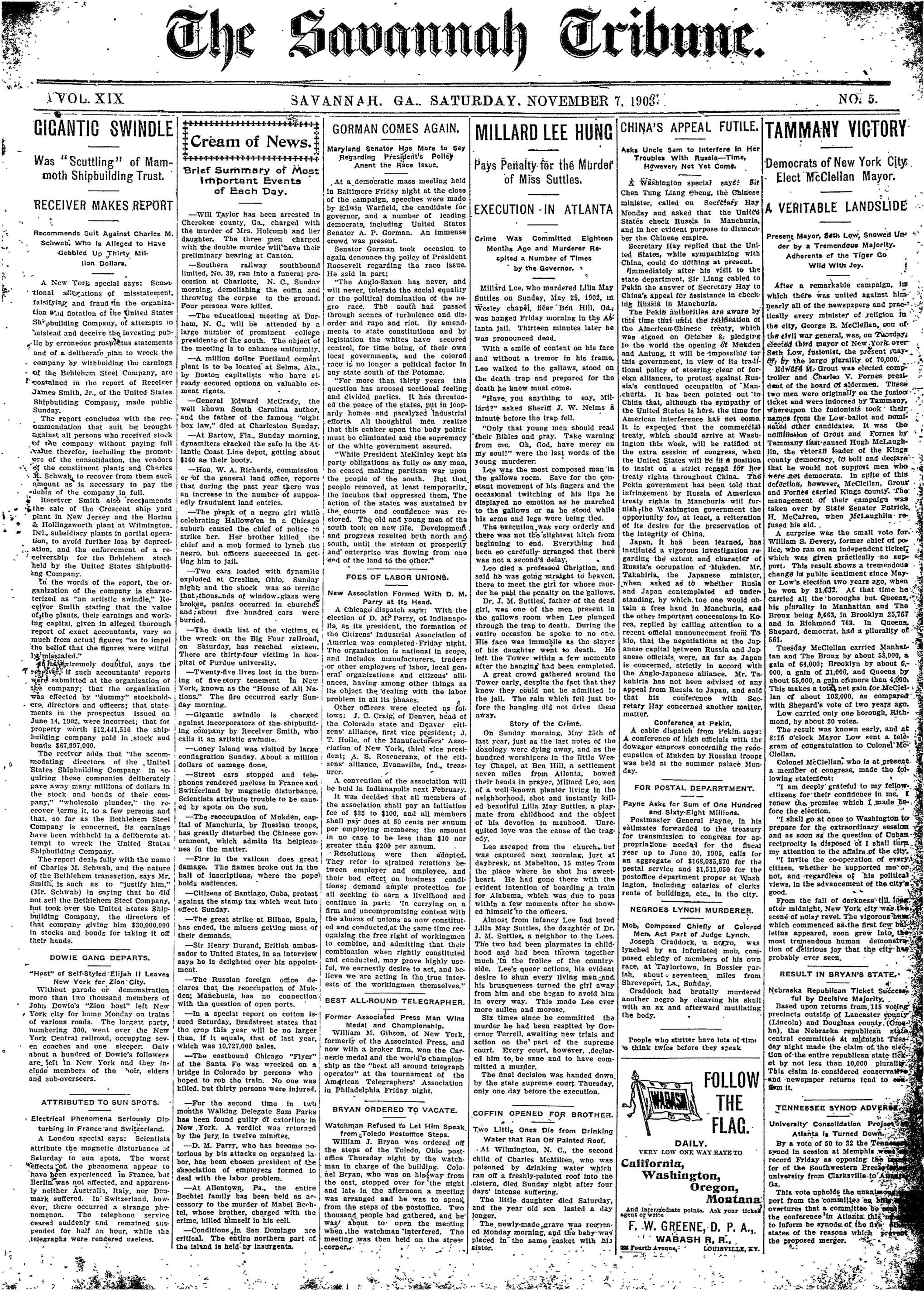
Was "Scuttling" of Mammoth Shipbuilding Trust.
RECEIVER MAKES REPORT
Recommends Suit Against Charles M. Schwab. Who is Alleged to Have Gobbled Up Thirty Mil-
lion Dollars.
A New York special says: Sensational allegations of misstatement, falsifying, and fraud in the organization and flotation of the United States Shipbuilding Company, of attempts to mislead and deceive the investing public by erroneous prospectus statements and of a deliberate plan to wreck the company by withholding the earnings of the Behlehem Steel Company, are contained in the report of Receiver James Smith, Jr., of the United States Shipbuilding Company, made public Sunday.
The report concludes with the recommendation that suit be brought against all persons who received stock of the company without paying full value therefor, including the promotors of the consolidation, the vendors of the constituent plants and Charles H. Schwab to recover from them such amount as is necessary to pay the debts of the company in full.
Receiver Smith also recognmends the sale of the Crescent ship yard plant in New Jersey and the Harlan & Hollingsworth plant at Wilmington, Del., subsidiary plants in partial operation, to avoid further loss by depreciation, and the enforcement of a receivership for the Behlehem stock held by the United States Shipbuilding Company.
In the words of the report, the organization of the company is characterized as "an artistic swindle." Receiver Smith stating that the value of the plants, their earnings and working capital, given in alleged thorough report of exact accountants, vary so much from actual figures "as to impel the belief that the figures were wilful misstated."
in has extremely doubtful, says the receiver; if such accountants' reports were submitted at the organization of the company; that the organization was effected by "dummy" stockholders, directors and officers; that statements in the prospectus issued on June 14, 1902, were incorrect; that for property worth $12,441,516 the shipbuilding company paid in stock and bonds $67,997,000.
The receiver adds that "the accommodating directors of the United States Shipbuilding Company in requiring these companies deliberately gave away many millions of dollars in the stock and bonds of their company," "wholesale plunder," the recover terms it, to a few persons and that, so far as the Bethlehem Steel Company is concerned, its earnings have been withheld in a deliberate attempt to wreck the United States Shipbuilding Company.
The report deals fully with the name of Charles M. Schwab, and the nature of the Bethlehem transaction, says Mr. Smith, is such as to "justify him." (Mr. Schwab) in saying that he did not sell the Bethlehem Steel Company, but took over the United States Shipbuilding Company, the directors of that company giving him $30,000,000 in stocks and bonds for taking it off their hands.
DOWIE GANG DEPARTS.
"Host" of Self-Styled 'Elijah II Leaves New York for Zion' City.
Without parade or demonstration more than two thousand members of John Dowle's "Zion host" left New York city for home Monday on trains of various roads. The largest party, numbering 300, went over the New York Central railroad, occupying seven coaches and one sleeper. Only about a hundred of Dowle's followers are, left in New York and they include members of the holr, elders and sub-overseers.
ATTRIBUTED TO SUN SPOTS.
Electrical Phenomena Seriously Disturbing in France and Switzerland. A London special says: Scientists attribute the magnetic disturbance of Saturday to sun spots. The worst effects of the phenomena appear to have been experienced in France, but Berlin was not affected, and apparently neither Australia, Italy, nor Denmark suffered. In Switzerland, however, there occurred a strange phenomenon. The telephone service ceased suddenly and remained suspended for half an hour, while the telegraphs were rendered useless.
The Savannah Tribune.
SAVANNAH, GA.. SATURDAY, NOVEMBER 7, 1903
Cream of News.
Brief Summary of Most Important Events of Each Day.
—Will Taylor has been arrested in Cherokee county, Ga., charged with the murder of Mrs. Holcomb and lier daughter. The three men charged with the double murder will have their preliminary hearing at Canton.
—Southern railway southbound limited, No. 39, ran into a funeral procession at Charlotte, N. C., Sundav morning, demolishing the coffin and throwing the corpse to the ground. Four persons were killed.
—The educational meeting at Durham, N. C., will be attended by a large number of prominent college presidents of the south. The object of the meeting is to enhance uniformity.
—A million dollar Portland cement plant is to be located at Selma, Ala., by Boston capitalists who have already occured options on valuable cement rights.
—General Edward McCrady, the well known South Carolina author, and the father of the famous "eight box law," died at Charleston Sunday.
—At Bartow, Fla., Sunday morning, dynamiters cracked the safe in the Atlantic Coast Line depot, getting about $160 as their booty.
—Hon. W. A. Richards, commissioner of the general land office, reports that during the past year there was an increase in the number of supposedly fraudulent land entrances.
—the prank of a negro girl while celebrating Hallowe'en in a Chicago suburb caused the chief of police to strike her. Her brother killed the chief and a mob formed to lynch the negro, but officers succeeded in getting him to jail.
Two cars loaded with dynamite exploded at Cresline, Ohio, Sunday night; and the shock was so terrific that thousands of window-glass were broken, panes occurred in churches and about five hundred cars were burned.
The death list of the victims of the wreck on the Big Four railroad, on Saturday, has reached sixteen. There are thirty-four victims in hospital of Purdue university.
Twenty-five lives lost in the burning of five inventory tenement In New York, known as the "House of All Nations." The fire occurred early Sunday morning.
Gigantic swindle is charged against incorporators of the shipbuilding company by Receiver Smith, who calls it an artistic swindle.
—Coney Island was visited by large conflagration Sunday. About a million dollars of damage done.
—Street cars stopped and telephones rendered useless in France and Switzerland by magnetic disturbance. Scientists attribute trouble to be caused by spots on the sun.
—The reoccupation of Mukden, capital of Manchuria, by Russian troops, has greatly disturbed the Chinese government, which admits its helplessness in the matter.
—Fire in the vatican does great damage. The flames broke out in the hall of inscriptions, where the pope holds audiences.
—Citizens of Santiago, Cuba, protest against the stamp tax which went into effect Sunday.
—The great strike at Bilbao, Spain, has ended, the miners getting most of their demands.
—Sir Henry Durand, British ambassador to United States, in an interview says he is delighted over his appointment.
—The Russian foreign office declares that the reoccupation of Mukden, Manchuria, has no connection with the question of open ports.
—In a special report on cotton issued Saturday, Bradstreet states that the crop this year will be no larger than, if it equals, that of last year, which was 10,727,000 bales.
—The eastbound Chicago "Flyer" of the Santa Fe was wrecked on a bridge in Colorado by persons who hoped to rob the train. No one was killed, but thirty persons were injured.
For the second time in two months Walking Delegate Sam Parks has been found guilty of extortion in New York. A verdict was returned by the jury, in twelve minutes.
D. M. Parry, who has become notorious by his attacks on organized labor, has been chosen president of the association of employers formed to deal with the labor problem.
At Allentown, Pa., the entire Bechtel family has been held as accessory to the murder of Mabel Bechtel, whose brother, charged with the crime, killed himself in his cell.
Conditions in San Domingo are critical. The entire northern part of the island is held by insurgents.
GORMAN COMES AGAIN.
Maryland Senator Has More to Say Regarding President's Policy Anent the Race Issue.
At a democratic mass meeting held in Baltimore Friday night at the close of the campaign, speeches were made by Edwin Warfield, the candidate for governor, and a number of leading democrats, including United States Senator A. P. Gorman. An immense crowd was present. Senator Gorman took occasion to again denounce the policy of President Roosevelt regarding the race issue. He said in part:
"The Anglo-Saxon has never, and will never, tolerate the social equality or the political domination of the negro race. The south has passed through scenes of turbulence and disorder and rapo and riot. By amendments to state constitutions and by legislation the whites have secured control, for time being, of their own local governments, and the colored race is no longer a political factor in any state south of the Potomac.
"For more than thirty years this question has aroused sectional feeling and divided parties. It has threatened the peace of the states, put in jeopardy homes and paralyzed industrial efforts. All thoughtful men realize that this canker upon the body politic must be eliminated and the supremacy of the white government assured.
"While President McKinley kept his party obligations as fully as any man, he ceased making partisan war upon the people of the south. But that people removed, at least temporarily, the incubus that oppressed them. The action of the states was sustained by the courts and confidence was restored. The old and young men of the south took on new life. Development and progress resulted both north and south, until the stream of prosperity and enterprise was flowing from one end of the land to the other."
FOES OF LABOR UNIONS.
New Association Formed With D. M. Parry at Its Head.
A Chicago dispatch says: With the election of D. M Parry, of Indianapolis, as its president, the formation of the Citizens' Industrial Association of America was completed-Friday night. The organization is national in scope, and includes manufacturers, traders or other employers of labor, local general organizations and citizens' alliances, having among other things as its object the dealing with the labor problem in all its phases.
Other officers were elected as follows: J. C. Craig, of Denver, head of the Colorado state and Denver citizens' alliance, first vice president; J. T. Holle, of the Manufacturers' Association of New York, third vice president; A. S. Rosencranz, of the citizens' alliance, Evansville, Ind., treasurer.
A convention of the association will be held in Indianapolis next February. It was decided that all members of the association shall pay an initiation fee of $25 to $100, and all members shall pay dues at 50 cents per annum per employing members; the amount in no case to be less than $10 nor greater than $200 per annum.
Resolutions were then adopted. They refer to strained relations between employer and employee, and their bad effect on business conditions; demand ample protection for all seeking to earn a livelihood and continue in part: 'In carrying on a firm and uncompromising contest with the abuses of unions as now constituted and conducted, at the same time recognizing the free right of workingmen to combine, and admitting that their combination when rightly constituted and conducted, may prove highly useful, we earnestly desire to act, and believe we are acting in the true interests of the workingmen themselves."
BEST ALL-ROUND TELEGRAPHER.
Former Associated Press Man Wins Medal and Championship.
William M. Gibson, of New York, formerly of the Associated Press, and now with a broker firm, won the Carnegie medal and the world's championship as the "best all around telegraph operator" at the tournament of the American Telegraphers' Association in Philadelphia Friday night.
BRYAN ORDERED TO VACATE.
Watchman Refused to Let Him Speak from Toledo Postoffice Stens.
William J. Bryan was ordered off the steps of the Toledo, Ohio postoffice Thursday night by the watchman in charge of the building. Colonel Bryan, who was on his way from the east, stopped over for the night and late in the afternoon a meeting was arranged and he was to speak from the steps of the postoffice. Two thousand people had gathered, and he was/ about to open the meeting when the watchman interfered. The meeting was then held on the street corner.
MILLARD LEE HUNG
EXECUTION - IN ATLANTA
Crime Was Committed Eighteen Months Ago and Murderer Respited a Number of Times by the Governor.
Millard Lee, who murdered Lilla May Suttles on Sunday, May 25, 1902, in Wesley chapel, Hearr Ben Hill, Ga., was hanged Friday morning in the Atlanta jail. Thirteen minutes later he was pronounced dead.
With a smile of content on his face and without a tremor in his frame, Lee walked to the gallows, stood on the death trap and prepared for the death he knew must come.
"Have you anything to say, Millard?" asked Sheriff J. W. Nelms a minute before the trap fell.
"Only that young men should read their Bibles and pray. Take warning from me. Oh, God, have mercy on my soul!" were the last words of the young murderer.
Lee was the most composed man in the gallows room. Save for the constant movement of his fingers and the occasional twitching of his lips he displayed no emotion as he marched to the gallows or as he stood while his arms and legs were being tied.
The execution was very orderly and there was not the slightest hitch from beginning to end. Everything had been so carefully arranged that there was not a second's delay.
Lee died a professed Christian, and said he was going straight to heaven, there to meet the girl for whose murder he paid the penalty on the gallows. Dr. J. M. Suttics, father of the dead girl, was one of the men present in the gallows room when Lee plunged through the trap to death. During the entire occasion he spoke to no one. His face was immobile as the slayer of his daughter went to death. He left the Tower within a few moments after the hanging had been completed. A great crowd gathered around the Tower early, despite the fact that they knew they could not be admitted to the jail. The rain which fell just before the hanging did not drive them away.
Story of the Crime.
On Sunday morning, May 25th of last year, just as the last notes of the doxology were dying away, and as the hundred worshippers in the little Wesley Chapel, at Ben Hill, a settlement seven miles from Atlanta, bowed their heads in prayer, Millurd Lee, son of a well-known planter living in the neighborhood, shot and instantly killed beautiful Lilla May Suttles, a playmate from childhood and the object of his devotion in manhood. Unrequited love was the cause of the tragedy.
Lee escaped from the church, but was captured next morning. Just at daybreak, at Mabelton, 15 miles from the place where he shot his sweetheart. He had gone there with the evident intention of boarding a train for Alabama, which was due to pass within a few moments after he showed himself to the officers.
Almost from infancy Lee had loved Lilla May Suttles, the daughter of Dr. J. M. Suttles, a neighbor to the Lees. The two had been playmates in childhood and had been thrown together much in the frolics of the countryside. Lee's queer actions, his evident desire to shun every living man and his brusqueness turned the girl away from him and she began to avoid him in every way. This made Lee ever more sullen and morose.
Six times since he committed the murder he had been respited by Governor Terrell, awaiting new trials and action on the part of the supreme court. Every court, however, declared him to, be sane and to have committed a murder. The final decision was handed down by the state supreme court Thursday, only one day before the execution.
Water that Ran Off Painted Roof.
At Wilmington, N. C., the second child of Charles McMillen, who was poisoned by drinking water which ran off a freshly-painted roof into the cistern, died Sunday night after four days' intense suffering.
The little daughter died Saturday, and the year old son lasted a day longer.
The newly-made grave was reopened Monday morning, and the baby was placed in the same casket with his sister.
CHINA'S APPEAL FUTILE.
Asks Uncle Sam to Interfere in Her Troubles With Russia—Time, However, Not Yet Come.
A Washington special says: Bit Chen Tung Liang Cheng, the Chinese minister, called on Secretary Hay Monday and asked that the United States check Russia in Manchuria, and in her evident purpose to dismember the Chinese empire.
Secretary Hay replied that the United States, while sympathizing with China, could do nothing at present.
The Pekin authorities are aware by this time that until the ratification of the American Chinese treaty, which was signed on October 8, pledging to the world the opening of Mukden and Antung, it will be impossible for this government, in view of its traditional policy of steering clear of foreign alliances, to protest against Russia's continued occupation of Manchuria. It has been pointed out to China that, although the sympathy of the United States is hers, the time for American interference has not come. It is expected that the commercial treaty, which should arrive at Washington this week, will be ratified at the extra session of congress, when the United States will be in a position to insist on a strict regard for her treaty rights throughout China. The Pekin government has been told that infringement by Russia of American treaty rights in Manchuria will furnish the Washington government the opportunity for, at least, a reiteration of its desire for the preservation of the integrity of China.
Japan, it has been learned, has instituted a vigorous investigation regarding the extent and character of Russia's occupation of Mukden. Mr. Takahiria, the Japanese minister, when asked as to whether Russia and Japan contemplated an understanding, by which the one would obtain a free hand in Manchuria, and the other important concessions in Korea, replied by calling attention to a recent official announcement from Tokio, that the negotiations at the Japanese capital between Russia and Japanese officials were, as far as Japan is concerned, strictly in accord with the Anglo-Japanese alliance. Mr. Takahiria has not been advised of any appeal from Russia to Japan, and said that his conference with Secretary Hay concerned another matter. matter.
Conference at Pekin.
A cable dispatch from Pekin. says: A conference of high officials with the dowager empress concerning the reoccupation of Mukden by Russian troops was held at the summer palace Monday.
Payne Asks for Sum of One Hundred and Sltxy-Eight Millions.
Postmaster General Payne, in his estimates forwarded to the treasury for transmission to congress for appropriation needed for the fiscal year up to June 30, 1905, calls for an aggregate of $168,085,870 for the postal service and $1,511,050 for the postoffice department proper at Washington, including salaries of clerks rents of buildings, etc., in the city.
NEGROES LYNCH MURDERER.
Mob, Composed Chiefly of Colored Men, Act Part of Judge Lynch. Joseph Craddock, a nero, was lynched by an infuriated mob, composed chiefly of members of his own race, at Taylortown, in Bossier parish, about seventeen miles from Shreveport, La., Suhday. Craddock had brutally murdered another negro by cleaving his skull with an ax and afterward mutilating the body.
People who stutter have lots of time to think twice before they sneak
FOLLOW THE FLAG.
NO. 5.
A VERITABLE LANDSLIDE
Present Mayor, Seth Low, Snowed Under by a Tremendous Majority.
After a remarkable campaign, in which there was united against him nearly all of the newspapers and practically every minister of religion in the city, George B. McClellan, son of the civil war general, was, on Tuesday, elected third mayor of New York over Seth Low, fusionist, the present mayor, by the large plurality of 70,000.
Edward M. Grout was elected comptroller and Charles V. Fornes president of the board of aldermen. These two men were originally on the fuselon ticket and were indorsed by Tammany, whereupon the fusionists took their names from the Low-ballot and nominated other candidates. It was the nomination of Grout and Fornes by Tammany that caused Hugh McLaughlin, the veteran leader of the Kings county democracy, to bolt and declare that he would not support men who were not democrats. In spite of this defection, however, McClellan, Grout and Fornes carried Kings county. The management of their campaign was taken over by State Senator Patrick H. McCafren, when McLaughlin refused his aid.
A surprise was the small vote for William S. Devery, former chief of police, who ran on an independent ticket, which was given practically no support. This result shows a tremendous change in public sentiment since Mayor Low's election two years ago, when he won by 31,632. At that time he carried all the boroughs but Queens, his plurality in Manhattan and The Bronx being 6,663, in Brooklyn 25,767 and in Richmond 763. In Queens, Shepard, democrat, had a plurality of 561.
Tuesday McClellan carried Manhattan and The Bronx by about 58,000, a gain of 64,000; Brooklyn by about 6,000, a gain of 21,000, and Queens by about 55,000, a gain of more than 4,000. This makes a total net gain for McClellan of about 103,000, as compared with Shepard's vote of two years ago.
Low carried only one borough, Richmond, by about 20 votes.
The result was known early, and at 8:16 o'clock Mayor Low sent a telegram of congratulation to Colonel McClellan.
Colonel McClellan, who is at present a member of congress, made the following statement:
"I am deeply grateful to my fellow citizens for their confidence in me. I renew the promise which I made before the election.
"I shall go at once to Washington to prepare for the extraordinary session and as soon as the question of Cuban reciprocity is disposed of I shall turn my attention to the affairs of the city.
"I invite the co-operation of every citizen, whether he supported me on not, and regardless of his political views, in the advancement of the city's good.
From the fall of darkness till long after midnight, New York city was the scene of noisy revel. The vigorous haunt which commenced as the first few ball letins appeared, soon grew into the most tremendous human demonstration of delirious joy that the city has probably ever seen.
RESULT IN BRYAN'S STATE,
Nebraska Republican Ticket Success
ful by Decisive Majority
Based upon returns from 115 voting precincts outside of Lancaster county (Lincoln) and Doughlass county (Omaha), the Nebraska republican state central committee at midnight Tuesday night made the claim of the election of the entire republican state ticket by not less than 10,000 plurality. This claim is considered conservative and newspaper returns tend to confirm it.
By a vote of 50 to 32 the Tennessee synod in session at Memphis went to record Friday as opposing the imposition of the Southwestern Presbyterian university from Clarksville-to Attica Ga.
This vote upholds the unanimous port from the committee on bills and overtures that a committee be sent to the conference in Atlanta this month to inform he synods of the five other states of the reasons which prevent the proposed merger.
A NUMBER of beautiful homes are being erected by our people in the city. This is a grand omen of race progress.
COLORED voters in New York City claimed that the fusion administration failed to recognize them and for that reason many of them refused to support the ticket on Tuesday.
THE fair opened on Wednesday and will be continued during next week. No efforts have been made to interest the colored citizens in it, or even induce them to attend and for that reason they feel that they are not wanted and to a great extent will stay away.
LET us take renewed hope. On Monday the Order of St Luke at Richmond Va, inaugurated a bank with Miss Mary L. Walker as president. The first day deposits amounting to $75,000 were received. There are several banks among our people in Richmond and each one is reported in good condition. The colored people in Savannah should gain incentive from those of Richmond and learn to capitalize their means.
It was claimed before the election that if Maryland went democratic it would force the race question prominently before the people as an issue. Well, Maryland, a democratic state, went democratic and why did it go that way? After the Republicans won during the McKinley landslide and at the next election the Democrats secured control of the legislature, they passed a constitutional amendment restricting the large per cent. of the Republican vote, which unrestricted would have given the State to the Republicans on Tuesday.
THE election is over and the Democrats are jubilant because their party was victorious at places that were always democratic. They were victorious in New York city, one of their strongest holds, also in the other southern states where elections were held. They succeeded in not a single northern or western state except in electing the governor only in Rhode Island. On the other hand the Republicans have more cause for rejoicing. A concentrated effort was made to defeat their state ticket in Ohio and prevent the election of Senator Hanna. In this effort the Democrats were foiled. The Republican candidates were elected with increased majorities and Senator Hanna is assured of reelection on a joint ballot of nearly one hundred. There is no room for the Democrats to secure comfort out of the election. They have not a ghost of a chance to win next year.
Phenomenal Success.
As announced in THE TRIBUNE last week the annual meeting of the stockholders of the Wage Earners Loan and Investment Company was held monday night. The meeting was presided over by President L. E. Williams, who after the minutes were read and approved, read his annual report. This report showed the excellent condition of the Company, the amount of business done during the year, and calling the attention of each stockholder to the necessity of doing individual work for the further success of the Company. The Secretary and Treasurer, Mr Walter S. Scott also rendered his report showing the condition of the company at the close of business on October 5. Last, to be as follows:
LIABILITIES.
Paid in stock - $ 4,201.40
Deposits - 6,420.68
Expenses paid - 568.62
Net earnings - 446.67
$ 11,637.37
RESOURCES.
Loans outstanding - $ 9,613.55
Office fixtures - 100.28
Earnings to date - 889.94
Cash on hand - 1033.60
$ 11,637.37
After the adoption of this and the auditing committee's report, the old board of directors as follows were re-elected for the ensuing year: L. E. Williams. W. R. Fields, Walter S. Scott. E. E. DesVerney, L. M. Pollard, A. L. Tucker, W. S. Boundfield, Ren. J. J. Durham, P. Edward Perry; Jos. L. Jackson, James H. Rogers, Sol. C. Johnson. Commendatory talks were made by several of the stockholders after which the meeting adjourned.
Since the organization of the company three years ago 579 shares have been sold, with a paid in stock of $4,201.40. On the first of January last the company inaugurated a savings department, which has proven very successful. Since that time 238 persons made deposits which amounted to $15,578.99. The value of real estate held by the Company to secure outstanding loans amounts to $54,594. For one year alone there has passed over the counters of the Company $60,570.06
This showing is an excellent one and proves the company to be in a healthy condition and in fact surpasses any similar one in the county, which should alone be sufficient to strengthen the timid ones who were afraid to purchase shares or make deposits in the savings department.
LET our men all over the state become qualified as voters.
Dr. Davls' Death.
Tidings were received in the city on Thursday concerning the death of Dr. T-James Davis which occurred early Thursday morning at Sheepshead Bay, N.Y., where he went August last for recreation. The doctor has not been in the best health for the past several years, but on account of much will power he kept up until in July when he was compelled to remain in doors. He left a sick bed in August to attend the Supreme Lodge session of K. of P. and from there he went to New York where he died.
Dr Davis is a native of one of the West Indies isles but was educated in this country. He came to this city a number of years ago, directly after the death of Dr. P. H. Coker, and was therefore the oldest of our physicians in the city. He was well-known and considered an able physician.
He was a prominent member of the Knights of Pythias, being a Past Grand Chancellor and at the time of his death Chancellor Commander of Cresent Lodge No. 2. He was also a member of Opal Court I. O. O. C. and of Protection Lodge No. 3200 of Odd Fellows.
His funeral will take place to morrow in this city.
Miss Bertha Botamus and Miss Geraldine Parkhurst gave quite an enjoyable social on Monday night last at the residence of the former. Those in attendance were: Misses Ethel Fowler, Agnes Proctor, Arie May Johnson Alice Evans, Marie and Hattie Hardwick, Louise Gardner Wilhelmnia McMillan, Claudia Zachery, Alma Snowden, Clifford Bones, Pearl Robinson, Vera Mitchell, Sarah Spaulding; Messrs Jno. Proctor, Eugene Myers, Ben Quiney, Andrew Cochran, William Bright, Willie Monroe, Verna Botamus, Robbie Carter, Walter Bagner, Henry Cain.
The annual entertainment of the Willing Workers Club No. 1. was held at Mrs. V. Morrell's residence, 217 Walburg lane east. It was largely attended by members and guests. The society was organized Sept. 28, 1902. This was the first annual. The guests were: Mrs. A. G. Whitmire, Mr. A. L. Fields, Mr. L. Robinson, Mr. E Tillman. Mr. H. Butler, Miss E. Tavar, Miss Owens, Miss J. Norman, Mr. W. Middleton, Rev. N. H. Whitmire. The memers are: Mr. P. H Williams, Miss M. L. White, secretary, Miss H. Jackson, Miss L. Morrell, Miss M. Hall, president, Mrs J. James, treasurer, Miss E Norman, assistant secretry, Mrs. L. Naggle, Mr. M. M. Gillisslee, Sr., Mrs V. Morrell, Vice president.
K. of P. Notes.
A new Lodge has been instituted at Macon and is named J. A. Wood Lodge K. of P.
Next week G. M., of E., F. M. Cohen will pay Mrs. Ellen Brown $200 in full for death claim of her husband.
Dawson is making it hot for the otherplaces. It has had two prosperous lodges and now the third one was organized this week.
The Olympia Lodge has elected the following trustees for its recently purchased property : Sir Knights S J. Howard, S. E. Washington and A. W. White, Chairman. Persons desiring to rent the same can apply to the chairman at 519 Minis street.
Masonic Column,
Students Wanted.
The Masonic Orphans Home and Industrial school is now open at Americus, Ga. Prof. J. C. Styles, Superintendent and Principal. Mrs. J. C. Styles, Matron. All orphans, girls or boys of Masons who died in good standing, are eligible for admission by proper recommendation by the members or W. M. of their lodges. Windows having children, can have schooled there and can pay a reasonable fee. Masons whose wives and who are left with children on their hands, will find this a most excellent place to have them educated and taught trades at reasonable rates. All colored papers in the State will confer a favor upon the Masons, by copying the above, that it might reach the home of every mason.
H. R. BUTTER, Grand Master,
J. C. STYLES, Principal and Supt.
ON THE SQUARE.... A COMPLETE LINE OF Ladies and Children Shoes
Evangelical Union.
There were no perceptible departure from the usual modus operandi of procedure in the session of the Evangelical Ministers Union on Tuesday morning which was presided over by Rev. F. R. Sims, B. D.
The devotional exercises were conducted by Rev. W. M. Caldwell.
The first hymn "Am I a Soldier of the Cross," was sung with music; then prayer and reading of the lesson from the 4th Chapter of Zech., by Rev. Caldwell with the closing hymn "Jesus Savior pilot me"
After some brief discussions by Revs. R. H. Singleton, G. L. Word, J. Jackson, J. A. Hadley, H. R. Ellis W. M. Caldwell and W. B. Berrien, under the caption of "New business" the meeting was rather prematurely desolved by the president who announced the hour 12 m for the meeting of the Emancipation Association[which was immediately called to order by the Vice president, Rev. R. Kemp. Only one sermon was reported. Rev. W. M. Caldwell reported a sermon from Paul's epistle to the Galatians, 6:1, "Brethren, if a man be overtaken in a fault, ye which are spiritual restore such a one" which was treated under the quaint subject of "Christian Restoration."
E. JONATHAN NELSON, Secretary.
St. Phllips Dots.
Rev. Sim's text at 11 a.m. was I Cor. 2:12 "Declaring unto you the testimony of God, I determined not to know anything among you save Jesus Christ and Him crucified." Subject "Salvation by the cross is the burden of the Christian minis try. This sermon was very interesting and beneficial to every one who heard it. At 5 p.m. memorial services in honor of Dr. J. A. Wood was held. A large congregation was out to hear Rev. Sims. The services were very impressive.
Rev. Wood was a great man, and his example worth imitating. Sunday is rally day for dollar money. We want every member to pay up. Time is short, in about one month conference will be in session. St. Philips must hold her reputation. The usual services will be held on Sunday.
Not a Sick Day Since.
"I was taken severely sick with kidney trouble. I tried all sorts of medicines, none of which relieved me. One day I saw an ad. of your Electric Bitters and determined to try that. After taking a few doses I felt relieved, and soon thereafter was entirely cured, and have not seen a sick day since. Neighbors of mine have been cured of Rheumatism, Neuralgia, Liver and Kidney troubles and General Debility." This is what B. F. Bass, of Fremont, N. C., writes. Only 50c, at Knight's Pharmacy.
Sick Benefits Paid.
A few members to whom benefits have been paid by the Metropolitan Mutual Benefit Association within the last week or two in less than twenty-four hours after they were due:
O. B. Garrett, 411 Montgomery St.
Mary Mitchel, 34th, E. W. Road.
Phillis Smith, 410 E Gwinnett.
METROPOLITAN MUTUAL BENEFIT ASSOCIATION,
222 WBroughton Street.
120 State Street, West, Near Barnard.
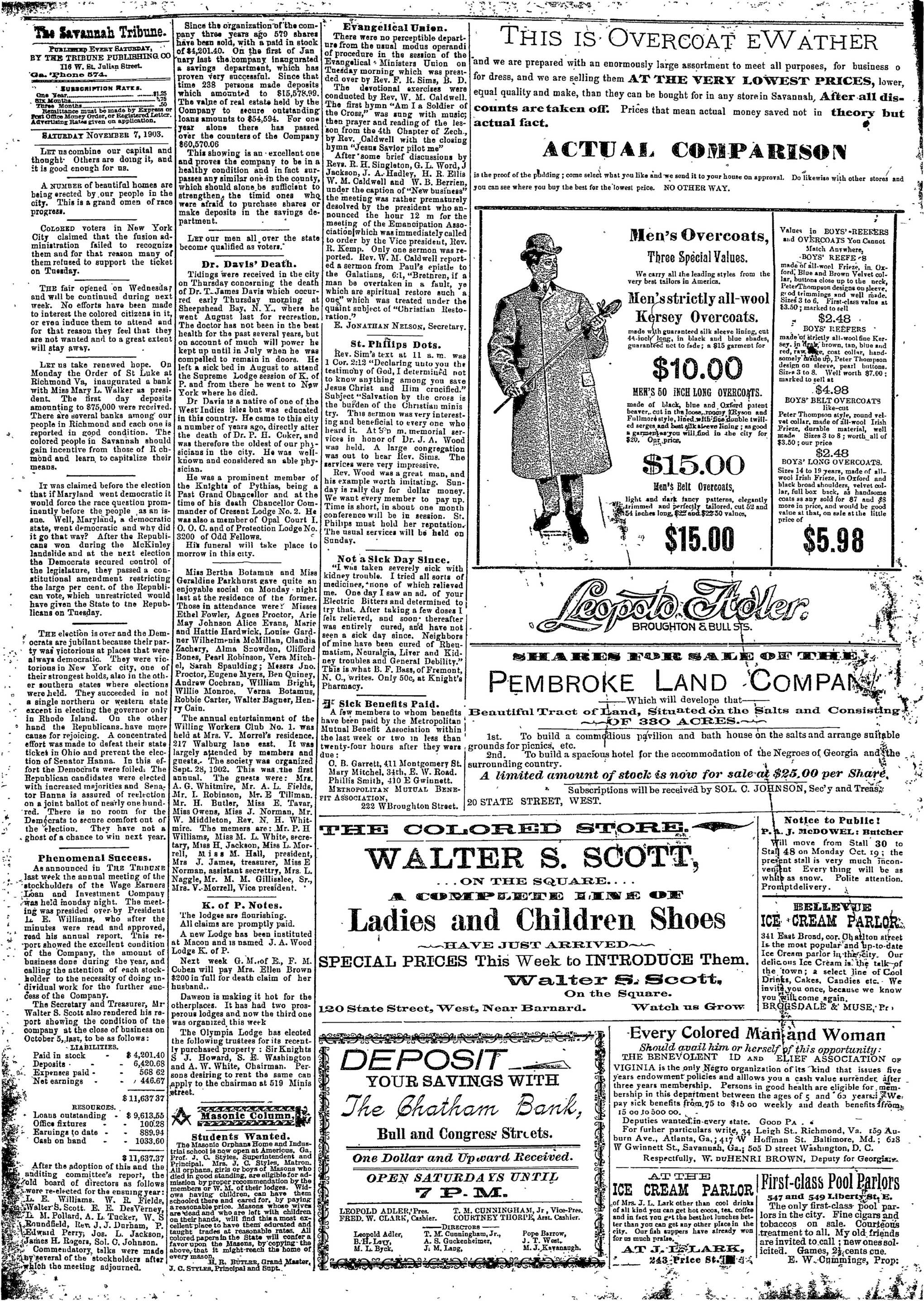
THIS IS OVERCOATEWATHER
and we are prepared with an enormously large assortment to meet all purposes, for business o for dress, and we are selling them AT THE VERY LOWEST PRICES, lower, equal quality and make, than they can be bought for in any store in Savannah. After all discounts are taken off. Prices that mean actual money saved not in theory but actual fact.
ACTUAL COMPARISON
is the proof of the plding; come select what you like and we send it to your house on approval. Do likewise with other stores and you can see where you buy the best for the lowest price. NO OTHER WAY.
Men's Overcoats,
Three Special Values.
We carry all the leading styles from the
very best tailors in America.
Men's strictly all-wool
Kersey Overcoats.
made with guaranteed silk sleeve lining, cut
44-inch long, in black and blue shades,
guaranteed not to fade; a $15 garment for
$10.00
MEN'S 50 INCH LONG OVERCOATS.
made of black, blue and Oxford patent
beaver, cut in the loos, roomy, Ryson and
Fullmore style, lined with fine double twilted
serges and best silk sleeve lining; as good
a garment as you will find in the city for
$20. Oat price.
$15.00
Men's Belt Overcoats,
light and dark fancy patterns, elegantly
trimmed and perfectly tailored, cut 52 and
54 inches long, $25 and $25.50 values.
$15.00
Values in BOYS'-REEFERS
and OVERCOATS You Cannot
Match Anywhere,
BOYS'-REEFE-8
made of all-wool Frizee, in Oxford,
Blue and Brown Velvet collar,
buttons close up to the neck,
Peter Thompson designs on sleeve,
good trimmings and well made.
Sizes 3 to 6. First-class value at
$3.50; marked to sell
$2.48
BOYS'-REEFERS
made of strictly all-wool fine Ker-
sey, in black, brown, tan, blue and
red, raw edge, coat collar, hand-
somely made up, Peter Thompson
design on sleeve, pearl buttons.
Sizes 3 to 8. Well worth $7.00;
marked to sell at
$4.98
BOYS'-BELT OVERCOATS
like-cut
Peter Thompson style, round vel-
vet collar, made of all-wool Irish
Frizee, durable material, well
made. Sizes 3 to 8; worth all of
$3.50; our price
$2.48
BOYS'-LONG OVERCOATS.
Sizes 14 to 19 years, made of all-
wool Irish Frizee, in Oxford and
black broad shoulders, velvet collar,
full box back, as handsome
coats as any sold for $7 and $8
more in price, and would be good
value at that, on sale at the little
price of
$5.98
Leopoto Holer.
BROUGHTON & BULL STS.
SHARES FOR SALE OF THE
PEMBROKE LAND COMPANY
1st. To build a commodious pavilion and bath house on the salts and arrange suitable grounds for picnics, etc.
2nd. To build a spacious hotel for the accommodation of the Negroes of Georgia and the surrounding country.
A limited amount of stock is now for sale at $25.00 per Share.
Subscriptions will be received by SOL. C. JOHNSON, Sec'y and Treas.
20 STATE STREET, WEST.
Every Colored Man and Woman
Should await him or herself of this opportunity:
THE BENEVOLENT ID AND ELIEF ASSOCIATION OF
VIGINIA is the only Negro organization of its kind that issues five
years endowment policies and allows you a cash value surrender after
three years membership. Persons in good health are eligible for,
membership in this department between the ages of 5 and 60 years. We
pay sick benefits from 75 to $15 00 weekly and death benefits from
15 00 to 500 00.
Deputies wanted in every state. Good PA.
For further particulars write, 34 Leigh St. Richmond, Va. 159 Auburn Ave., Atlanta, Ga.; 417 W Hoffman St. Baltimore, Md.; 628 W Gwinnett St., Savannah, Ga.; 505 D street Washington, D. C.
Respectfully, W. DUHENRI BROWN, Deputy for Georgia.
Every Colored Man
Should avail him or her
THE BENEVOLENT ID A
VIGINIA is the only Negro organ
years endowment policies and allot
three years membership. Persons
bership in this department between
pay sick benefits from 75 to $15 00
15 00 to 500 00.
Deputies wanted in every state.
For further particulars write, 34
burn Ave., Atlanta, Ga.; 417 W
W Gwinnett St., Savanuzah, Ga.; 50
Respectfully, W. DUHENE
AT THE
ICE CREAM PARLOR
of Mrs. J. L. Lark other than cool drinks of all kind you can get hot cocoa, tea, coffee and in fact you get the best hot lunches better than you can get any other places in the city. Our fish suppers have already won for us much praise. AT J. LARK, 243 Price St.
P.A. J. McDOWEL: Butcher Will move from Stall 30 to Stall 48 on Monday Oct. 19; the present stall is very much inconvenient Every thing will be as white as snow. Polite attention. Promptdelivery.
BELLEVUE ICE CREAM PARLOR
341 East Brond, oor. Chathlon street Is the most popular and up-to-date Ice Cream parlor in this city. Our delicious Ice Cream is the talk of the town; a select line of Cool Drinks, Cakes, Candies etc. We invite you once, because we know you will come again.
Man and Woman
ourself of this opportunity:
AND ELIEF ASSOCIATION OF
ization of its kind that issues five
vs you a cash value surrender after
in good health are eligible for, mem-
the ages of 5 and 60 years. We
weekly and death benefits from
GOOD PA.
Leigh St. Richmond, Va. t59 Au-
hoffman St. Baltimore, Md.; 628
5 D street Washington, D. C.
I BROWN, Deputy for Georgia.
First-class Pool Parlors
547 and 549 Liberty St. E.
The only first-class pool parlors in the city. Fine cigars and tobaccos on sale. Courteous treatment to all. My old friends are invited to call; new ones solicited. Games, 21 cents cue.
E. W. Cummings, Prop:
CHILDREN'S DEPARTMENT:
THE BABY FLOWER.
Just a little baby blossom, it grew and smiled and grew.
Just as happy in the rain-time as when skies were bright and blue;
And the rain that bathed its petals was as kindly as the sun,
And the wind was just as kindly when the daylight was all done.
an old Springfield. He explained several times each day that the Cub Junta in New York had promised pay him $1000 for each Spanish officer he should shoot. Gorman had 10 pounds of Springfield ammunition his haversack, and considered himself already possessed of a fortune of
This was how the blossom viewed it, the little baby-flower.
So it smiled and grew the sweeter with every passing hour;
And all the little fairies, in moonlight, dusk, and dawn.
Rejoiced and sang around it on the dew-bespinkled lawn.
BATTLE OF THE BUTTONS
There were forty of them, twenty Reds and twenty Blues, marching in long straight lines across the carpet, with the rubber ruler at their backs. You might have thought that they were only buttons, but Willie could have told you better, for he knew that they were two armies at war and that the blue button with the gold rim was the captain of the Blues and the red button, twice as large as the others, was the captain of the Reds, and that the fighting was going to begin very soon.
The Blues were on the table-land made by the rug before the grate and the Reds were in the valley, where there came the bunch of green leaves and purple flowers in the carpet. They would have liked to reach the table-kind, too, but the Blues would not let them, and that was how the battle started.
Two Reds had come close under the edge of the table-land when a Blue sharpshooter saw them.
"Bang!" came the rubber ruler down upon one of the Reds, and it was the end of him, for he turned square over on his little red stomach.
Then his comrade fired back.
"Bang!" came the rubber ruler down upon the Blue sharpshooter, and he never fired again, but turned square over on his little blue stomach.
And then the Reds came running up to help their man, and the Blues came running up to help their man (only he was dead), and there was a steady "bang! being bang!" in six Reds and seven Blues ha' ha' ha' over on their little stomachs, but then taken from the field.
It was just about this time that the captain of the Blues noticed most of the Reds in a long, straight line and shouted (or Willie shouted for him): "Boys, see there. Give em grape and cannister."
So the rubber ruler came down. "Boom!" along the whole line at once and three of the Reds rolled over all at one time.
That was a dreadful thing and in a second the captain of the Reds shouted (or Willie shouted for him): "Scatter, boys. Spread out. Don't let him do that thing again."
So they spread out, and right there was the turning point of the battle. One of the Reds (he had a little white spot of him) crawled close up to the table-laud again and took deadly aim straight at the captain of the Blues.
"Bang!" he fired, but it was no use. That captain only bounced—he never turned over at all.
"Bang!" fired back the Blues, but that white-spotted Red never budged. "Bang!" he fired once more, but this time the captain of the Blues jumped straight up in the air and fell over the edge of the table-land and rolled down among the Reds and was captured. The white-spotted Red saw the discouraged Blues retreating and with all his might he shouted (or Willie shouted for him): "Bring the Bridge! Bring the scaling ladder." And when three men had brought the bridge, which was a stiff, white sheet of paper, they set it against the table-land, and all those Reds went marching up. The Blues by this time had rallied and began to fire again, but it was too late. The Reds had already climbed to the table-land and—
And just then little Ruth came running in and tripped over the tableland and sent every soldier flying into the air, and when they came down every one of them was roiled over on his stomach, excepting that whitespotted Red.
"And what happened then?" asked mamma, when she had comforted little Ruth and taken up her mending once, more.
"Well," said Willie, "the Reds were just going to beat, but there came an awful, awful earthquake and it killed every man of 'em but one."—Frederick Hall, in Chicago Record-Herald.
THE ROMANTIC BUGLE.
Ralph D. Palme was one of the adventurous b弯cancers of the Three Friends, the famous illbustering craft of the Cuban war. The grim yet humorous study of his adventures 'is in Outing, Says Mr. Palme:
"Jack Gorman, the cavalry bugler, had refused with scorn the new Mauser rifle offered; him by the leader of the expedition, but had brought along
an old Springfield. He explained several times each day that the Cuban Junta in New York had promised to pay him $1000 for each Spanish officer he should shoot. Gorman had 150 pounds of Springfield ammunition in his haversack, and considered himself already possessed of a fortune of exactly $150,000. It was as safe as money in the banks. 'One hundred and fifty officers at $1000 each.'
"In the haversack was also a battered bugle mouthpiece, treasured as a souvenir of the fight with the United States Cavalry at Wounded Knee. In the middle of the skirmish with the gunboat Gorman opened fire with the Springfield from the afterdeck, shooting with the same earnestness and deliberation to be imagined if he had been bowling over his $1000 with every cartridge. He became really and unexpectedly effective when he ceased biring, pushed the bugle mouthpiece into the muzzle of the Springfield, threw open the breach block and began to blow the calls he knew from Boots and Saddles' to 'Assembly.' The extemporized bugle was a triumph. The sound of it seemed to transform the Three Friends into a war vessel. It was learned later from Havana that the officers of the Spanish gunboat were alarmed by this indication that the vessel they had attacked was an armed and disciplined gunboat with a naval equipment. The bugle calls made the disreputable Three Friends a formidable foe in the darkness. Having blown his 'musical' repertoire through the barrel of his rifle, Gorman pulled out the mouthpiece, jammed, a carriage into the other end and resumed his fire at the wide, wide world."
WHY RUN FROM RAIN?
"Do you know," said the Observant Citizen, according to the Philadelphia Press, "the habit of running through the rain is based on a definite fallacy? It is a common habit. But does it tend to minimize the amount of water falling on a person exposed to the rain? I am convinced that it rather aggravates the situation. By experience, in passing the distance of a block, running one time and walking the other, and at times when the rainfall was about the same, I found that my clothes picked up more water and were consequently damper when I covered the distance in a run than they were when I walked it.
"There seems to be a good reason for the rather curious fact. Rain falls irregularly. Sometimes there is a space of five or six inches between the falling drops, as we have noticed on smooth surfaces, like a stone flagging, and again only the fraction of an inch will separate the drops. Water occasionally falls in sheets, but this is not usual. But while the fall is irregular, considered with the respect to the perpendicular lines described in the descent, looking straight ahead and through the lines we will find before us a sheet of water that is well-nigh solid. We can understand that running against this sheet of water will have very much the same effect wind would have if its direction forced the rain in our faces. We simply pick up the water, and the fact that the spaces between the drops perpendicularly considered are greater than the spaces in any given direction horizontally will explain to us the fallacy of the whole thing.
I will put it in another way. Suppose you stand perfectly still in the rain for a space of sixty seconds, then you run through the rain for the same period of time. Is it not reasonable to assume that you will pick up more water in your flight than you will in your stationary attitude? I think so. I have tried it, at any rate, and have found the fact to be that way."
MOUNTING LARGE ANIMALS.
At one time or another in his life, every boy who is a boy has been fired with a desire to "stuff" an animal of some sort—either a favorite dog which has met with an untimely fate, or an unfortunate cat, or some wild animal which has fallen into his hands. As a rule, however, something has gone wrong with the operation; either the skin has been ruined in removing it, or it has been spoiled by insects after it was removed; or, if both of these difficulties were gotten over successfully, the result has looked so awkward and shapeless that it has soon been thrown away.
This is not surprising when it is understood how much skill is needed to properly mount an animal, large or small, and how thorough a knowledge of its anatomy is required to make it look lifelike.
Nowadays small animals are modelled in plaster of paris almost as if they were intended for statuettes, and then have the skin drawn over them carefully, while the frames of large animal are constructed of wood, covered with laths, over which quantities of excelsior are fastened, or with wire netting, over which plaster is carefully molded to fit the animal. -Crittenden Marriott, in St. Nicholas.
New Theological Students.
The number of theological students in Germany has diminished gradually from 4267 in 1530 to 2149, or less than half, although the population has doubled since 1830.
is no matter, for the opening is for one, not for the many, and that one would probably be that rara avis, the business woman who finds her work entirely to her mind and a real pleasure. An establishment something on this order is flourishing in Sewickley, having grown from a modest little shop for the sale and exchange of books to a widely known place where one may revel in rare volumes and antique furniture.—Pittsburg Dispatch.
The season's importations of hosiery include very elaborate and handsome designs. Fifty dollars is the price asked for some of these richly embroidered silk stockings. An artistic pair in white silk shows chiffon leaves and flowers set in the fine mesh. The same design is in black. In another pair of black stockings tiny white and shaded blue beads are closely imitated in embroidery, producing quite a Japanese effect, the design showing tiny birds flying across the fabric in regular "tap" style. Another costly stocking is ornamented with exquisite drawn work in unique pattern—Brooklyn Eagle.
HYGIENE OF THE HAIR.
In order to give your hair the hygienic care which it demands it is necessary, ladies, that you should know:
First, that the scalp dislikes dampness, which soaks it, and is hurtful to its vitality.
Second, that the scalp requires constant airing, to assist the evaporation of perspiration and other secretions of the skin, which have as injurious an effect upon it as dampness.
Third, that both the scalp and the hair dislike violent twisting and pulling, which put their strength and solidity to a hard test.
These three fundamental principles being known, they should be remembered and applied in the best way, and as frequently as possible. Woman's Home Companion.
THE WOMEN OF ENGLAND.
The fashionable Englishwoman cramps and fluffs her hair, until it "pumps" all around her head like a rather stiff halo, and then she tides it all down with a hair net, both fore and aft. But the hair is such a pretty color and they have the most beautiful complexions and brilliant coloring to be found in the whole world. There are no middle aged women here; they are either young and fresh or old and beckoned. When the wrinkles begin to come they are immediately and persistently chased away by an electrical contrivance, massage and plenty of expensive cold cream. One rarely sees a gray haired woman—at least, not a fashionable one—for when the hair begins to whiten she tints it until it is a beautiful reddish blonde brown, and then she goes tripping down the ladder of life utterly and gaily unconscious of the devastating footprints of Father Time.—Linda Hull Larned, in Good Housekeeping.
THE BEST DRESSED WOMEN
One of the reasons why the Parisienne has been recorked the best dressed woman in the world is that she invariably suits her attire to circumstances. Undoubtedly it would be a good thing if her example were more widely followed; demand for hats would be increased and the profit likewise. It is more to the advantage of the milliner to sell two or three hats than one, and smart hats do not necessarily have a wider margin of profit than more simple ones. Frequently the opposite is the case; more often than not what is charged for is the style and novelty, and it is not always possible to raise the price in exact proportion to the value of the trimmings and materials employed. Many milliners here have a certain scale of prices. Their minimum price is a high one and between this and the maximum there is not so great a difference as might be supposed—The Military Trade Review.
THE OLD-TIME PELERINE.
Capris will be worn for the good and simple reason that woman who have invested a thousand dollars or more in sable circulars are not likely to throw them aside, but as far as asl mode is concerned, they have given place to pelerines, the old-fashioned tippet pointed on the shoulders, such as were worn *hundred years ago*. They are delightfully warm, for the sloping shoulders reach on either side almost to the elbow, and cover both back and chest well. They have this merit, that, unlike a coat or jacket, they can be easily thrown off in a room and resumed on going out again. It has been for years a fruitful source of colds that we have become too heated when paying visits by over clothing retained indoors and have felt the effects when going out into the cold air. There are many shapes in pelerines, and narrow stoles, and many styles. The sable, mink and stone marten stoles have tails at each end as well as half way down and at the back—New York Commercial Advertiser.
WOMEN AS BOOKSELLERS.
London curio shops are largely in the hands of women, but though women writers of books are legion women sellers of books are conspicuous by their absence. Has the trade of the bookeller no charm for women? It has suggested, and with apparent reason, that a charming woman, with delicacy of feeling and tact, might establish a book shop in any fashionable thoroughfare and attract to it all the most famous and fashionable people of the day, making it, in fact, something of a sadon. Of course, specially personal qualifications would be necessary, and probably they are not often found in the woman possessing the requisite capital, still, that
Is no matter, for the opening is for one, not for the many, and that one would probably be that raa avis, the business woman who finds her work entirely to her mind and a real pleasure. An establishment something on this order is flourishing in Sewickley, having grown from a modest little shop for the sale and exchange of books to a widely, known place where one may revel in rare volumes and antique furniture.—Pittsburgh Dispatch.
THE DUTY OF PARENTS.
Duty to children is not summed up in feeding, clothing and sending to a better or worse—at present usually worse—school. The parents' duty begins long before. It is as necessary that we should live healthfully and happily before our children are born, as that we should clothe them afterward. Only by being in the best condition ourselves can we give the proper heritage to a child. To bring a being into the world and handicap him by your own tolles and negligences is a poor trick; and yet it is just the trick that nine-tenths of the parents play on their offspring. Treat your child at least as well as you would a fellow-man, and be thoughtful of his future. Then, having once given him the good heritage, see to it that his home life shall be such that his mental and moral nature may be rightly developed. Sick or weakly children will in their turn produce weaklings; halting, cowardly matures will have children who are dwarfed in the same way; and instead of the race being helped by these, its general average will be lowered. Consider, then, your duty to your children through yourself. Live in youth and manhood the sanest, cheerfulest and fullest life, and make your home reflect these virtues. So shall your children be in truth the gift of God, and you can say with the psalmist, "Happy is the man that hath his quiver full of them."—Woman's Home Companion.
THE ROCK OF DISASTER.
There is just one excuse for debt in the household—unsuitable money allowance by the head of the family. There are plenty of men who expect to secure all the comforts and a few luxuries at home without making proper provision for them. Every wife is justified in her request for a money allowance, out of which are to be paid the household expenses and those attending her personal needs. It is absolutely impossible to secure comfort by depending upon erratic gifts of money. A stipulated sum alone insures permanent home happiness, and that should be on a scale corresponding with the husband's income and the needs of the family. Where the wife handles the family income the question of allowance never comes up.
Many wives have only themselves to blame for the straitened circumstances in which they find themselves. Men are creatures of habit and will be likely to stand by whatever arrangements are made in the honeymoon period.
It certainly seems strange that men expect a certain sum of money to go just as far after a baby or two has arrived as it did when there was just man and wife. If it took $10 a week when they were first married, $10 is all that is handed out when the family is four instead of two. They argue that babies eat so little. They are dumfounded that expenses become heavier every year of married life. But children mean extra help, and help means waste, and wastage means the disappearance of money.—Philadelphia Telegraph.
FASHION OUTLOOK FOR 1901.
The fashion outlook for the winter promises a great diversity in coloring, material and design. As has been the case for several seasons, individuality of taste is allowed full sway, yet anything crude or too striking will not meet with approval. All crudities must be toned down and modified to insure artistic results.
As yet it is impossible to say that any type of dress is to be the one for the coming winter. There is evident a desire to return to the old-fashioned styles that prevailed a generation ago, a desire to do away with the exaggerated long waisted effect, and to bring in the founced wide skirts in place of the close fitting and almost too clinging ones that have found such favor for the last two or three years, to accentuate slenderness, and have tight fitting waists rather than the loose, graceful ones, and to bring sharply into prominence the lines of the bust. But that this has already been proved impossible is seen in the great diversity of gowns, and also in the combinations of the diverse ideas. There are very few waists made with the exaggerated straight front and disproportionately long waist, and yet there are evening gowns with very long narrow points in front and quite high on the hips. There are wide bodices and girdles in the place of the narrow belts, made of the same material as the gown, and yet there are any number of exquisite creations of the models favored where the narrowest possible belt is used, so that there shall be no dividing line at the waist. But on the whole the wide, draped, pointed belt promises to be one of the marked features of the season's gowns. These belts are draped over the fitted and boned waist, and as a rule a little pad of sachet is tacked inside the lining just above the waist to improve the line of the figure.—A. T. Ashmore, in Harper's Bazar.
Ice Heavier Than Water
By experiments of greater accuracy Professor Babcock, of the Wisconsin University, shows that half a ton of ice weighs more than the water obtained from melting that quantity of ice. Therefore the weight of a body increases as its temperature falls.
Atlantic Coast Line
RAILROAD COMPANY.
PASSENGER DEPARTMENT.
ATLANTIC COAST LINE, the great thoroughfare, of travel between the North, East and West, and Florida and Cuba. The route of the famous New York and Florida Special, The Florida and West India Limited and the Chicago and Florida Limited. Passenger service unexcellled. Pullman Sleeping, Dining and Observation Cars on through trains. Tickets sold and baggage checked to all points in the United States, Canada, Cuba and Mexico. Representatives will cheerfully give all information as to rates, schedules, Sleeping and Dining Car service, etc.
H. M. EMERSON, W. J. CRAIG,
Traffic Manager, General Passenger Agent,
Wilmington, N. C. Wilmington, N. C.
W. H. LEAHY,
Division Passenger Agent,
Savannah, Ga.
Nelson A. Luce, Sate Superintendent of Schools in Unorganized Townships in Maine, has returned from a four weeks' trip of inspection of about forty schools in the woods, and makes an encouraging report of their work. Many of these forest schoolhouses are most primitive. At West Sebois an old freight car is used for sixteen pupils. In some of the townships the residents have built log houses, the State contributing nothing. At Twin Lake School there are American, French, Provincial, Italian and Indian pupils. The only man teacher is at Moose River, and his duties include ferrying the children back and forth.
Many families have the misfortune to include one member who, perhaps from some congenital defect, is not trustworthy, observes Harper's Weekly. Yet they hate to give him up, and hoping, as he goes from one disaster to another, that he will yet learn his lesson, they keep on finding chances for him to throw away. To raise up such a person is simply to add to the height from which he must fall. To protect his reputation is simply to furnish him with means to deceive whoever trusts him. The sooner he gets down to the level he belongs in the better for himself, his friends, and society. Help him on, but not up. Pay his board, but don't find him a job where he can betray confidence. Keep him out of the poorhouse and out of jail, if possible, but most of all keep him out of mischief by making serious mischief inaccessible to him. To put a defective, irresponsible man, who is used to ease and the comforts of life, into social and commercial competition with persons of his own social grade is to invite disaster. Let him be known, if he is known at all, for what he is, and thereby minimize the risk involved in his existence.
HOW TO BUILD THE LOG FIRE
HOW TO BUILD THE LOG FIRE.
The season when a good log fire is comfortable in the evenings is at hand. To make an attractive one, which does not have to be coaxed with applications, of kindling wood now and then, shake out a double-sheet newspaper and leave the edges loose so that it will light easily. It will take longer to ignite it crushed and spoils the effect of the kindling wood, which is thrown on the paper against the androirs. The black log should be of the largest size the fireplace will hold. Green wood is preferable at this time of the year. It should be put close back to the wall. If it is a split log, the inside should be turned towards the front. Three logs are enough to start a fire with. Give it a good start, and then let it alone. Nothing is worse than a smoky, constantly poked wood fire—New York Times.
Sabbath observance in Belgium is optional, especially in regard to the delivery of letters. Postage stamps have a tiny coupon at the bottom, on which is the legend, engraved both in French and Flemish: "Not to be delivered on Sunday." If the sender of the letter be a person of strong religious views, who believes in observing the Sabbath in every form, he permits the coupon to remain attached to the stamp, and the letter, which might be delivered on Sunday, does not go out of the receiving office until the following day. If, on the other hand, the sender of the letter has no scruples, he tears off the coupon, and the letter is delivered on Sunday, the same as any other day. A fine is imposed on the carrier for violating the instructions of the coupon.
THE THREE BROTHERS WHO BE CAME TREES.
(An Indian Legend.)
There were once three brothers who went to seek the Lord of Life and win their hearts' desires. One, though tall enough, wished to be taller still. He had tried in many ways to make himself taller, because he wished to be admired and looked up to by smaller people, and win the love of the beautiful Indians of his tribe. To make himself appear taller than he really was he put soft clay into his moccasins, to raise him on his feet, and he plastered up his hair to stand high, and on top of it was a long turkey tail. But what he wished for was to be taller still. The second brother asked that he might live always, where he might behold all the beauty of the land, and rest in peace forever; the third brother asked to live to a great age, and always to be healthy till he died.
Now when the Lord of Life heard his servant, the Earthquake, and commanded him to set them firmly with their feet fast planted in the ground, and when this was done, the three brothers were to pine trees. The Lord of Life paid heed to their wishes, for he gave them what they most desired.
He who would be tall overtopped all the trees in the forest; even the turkey tail was not forgotten, it waves to this hour, and summer days the giant tree sways and murmurs with pride.
The second brother, who wished to dwell in peace upon the earth, will do so while he is rooted to the ground; and the third, who wished to live to the end in perfect health, is still standing straight and sturdy in the forest—Pittsburg Dispatch.
A DELICIOUS CAKE.
A thoroughly delicious cake, which has the additional merit of not being common in use, can be made with a pineapple filling. For the layers no receipt is better than the old established one, which calls for a cupful of butter, two of sugar, three of flour, four eggs and a cupful of milk. Beat the sugar and the butter to a cream. Separate the whites from the yolks of the eggs and beat the yolks until they are creamy and the whites to a stiff froth. Sift the flour. Add the yolks to the sugar and butter, then stir in the flour, alternating with the milk. Beat the whites in briskly, add half a teaspoonful of vanilla flavoring and bake in jelly cake tins. For the filling make a boiled-icing of two cupfuls of granulated sugar and the whites of two eggs, half a teaspoonful' of cream-of-tartar and a cupful of boiling' water. Boll the sugar and the water together until it forms a thread. Beat the eggs to a stiff froth, then add the cream-of-tartar and the syrup a little at a time, beating all the while. Boat 'until cold and thick, flavor with orange juice, and spread over the layers of the cake, sprinkled with grated pineapple, which has been sweetened.
The trolley railroad is steadily encoaching on the suburban traffic of the steam roads, and its latest, proposed experiment of operating sleeping cars upon its lines is looked upon as likely to further increase the poppy sleepers will be quite as luxurious as the steam-road Pullmans, they will embody a number of new features. They will be much lighter, and during the day they will be coaxed into parlor cars.
THE SWAMP TIGER.
BY LEWIS B. MILLER.
HAVE worked at handle-
making so long that the
swampers down about
where I live call me "Ax-
handle Ike." But my chief
occupation is trapping—trapping coon
and mink and otter. All the swampy
country of southeast Missouri still
abounds in fur-bearing animals.
Besides my trapping and handle-making, I usually try to preach on Sundays. My handle-making goes on all the year round, but trapping begins and ends with cold weather. Nature never clothes an animal with good fur except when it absolutely needed. When I have accumulated a considerable stock of furs and handles, I get somebody to haul me and then to the river or to the railroad, and then I run up to St. Louis and sell my stock. I have been going to St. Louis for years now, and the shops and factories that use my handles know they can depend on them.
There's still some large game in the swamps—deer and turkey and bear, and a good many panthers. I remember one time when a big panther came up out of the swamps and terrorized a whole settlement for a few months. That brute caused as much trouble and excitement as any four-legged thing I ever got acquainted with. Because he was so big and fierce we usually called him the tiger—the swamp tiger. It happened a good many years ago, when I was a boy, living with my uncle on a tongue of land that ran out several miles into the swamps. The upland was too rocky and the swamp too sloppy to cultivate. But the few families that lived there were settled along the edge of the ridge, and had little farms between the two.
One day toward fall my aunt sent me over to Simpson's to borrow some bacon. I was still going barefoot, and had my trousers rolled nearly up to my knees, I recollect. I was seventeen years old, and as big as I am how. But everybody that felt like it went barefoot there in warm weather, even men eighty years old. I crossed the ridge to Simpson's, and after talking with the boys till rather late, I borrowed a side of bacon—middling, we called it—and started for home, carrying it on my back. The middling was long and wide, but thin and rather light. Our gaunt, slab-sided swamp hogs never make thick meat. The bacon had been hanging in Simpson's smokehouse by two bickory withes, and I was carrying it by the same withes, one over each shoulder. There was a piece of tow cloth wrapped round it to keep it from greasing my shirt.
Dusk caught me three-quarters of a mile from home, and I heard what I thought was a woman calling. I didn't recognize the voice, but I had no doubt that it was Aunt Mat screaming at me. I had tarried longer at Simpson's than I ought to have done, and I felt certain she had got out of patience and started after me.
"Yes'm, I'm a-coming!" I shouted back. Then I hitched the bacon a little higher and hurried along the rocky road at a trot. The screams sounded angry—Aunt Mat didn't have a very gentle voice when she was out of temper.
Before long I heard another scream.
Looking down toward the swamp. I saw not Aunt Mat, but some big animal coming up the open slope to meet me. He looked like a cat, but a cat as big as a cow. The curve of the land made it impossible for me to see him while he was on the ground, but whenever he jumped I could see him plainly enough. Every jump must have carried him eight or ten feet into the air, and now and then he would stop and give one of those loud, womansh screams.
I started to run back along that rocky road as hard as I could. I couldn't step far enough. My hat flew off, but it never occurred to me to drop the bacon.
Not far back the road forked. One fork crossed to Simpson's, the other led up our side of the ridge to Uncle Jimmy White's. It was two miles back to Simpson's, and only a mile to where White lived. So I took the fork to Uncle Jimmy's.
I don't recollect feeling that bacon touch me after I got well underway. I guess is stood out straight behind, I flew so fast. The country was partly covered with scattering bushes, and the road was rocky and soon got dark; but little time did I lose for rocks or darkness.
The panther kept right after me. Every scream sounded nearer. If I hadn't had half a mile the start, the brute would have caught me. As it was, the moment I jumped Uncle Jimmy's fence the tiger screamed not sixty feet behind.
Any other time I wouldn't have dared to go near Uncle Jimmy's without calling, "Hello!" He had the fiercest dog in the neighborhood—a dog that would try to drag a man off his horse. But this time that dog didn't even grow; he was cowering against the wall, shivering and whining like a frightened puppy. $^0$
As I cleared the fence I saw light shining through the cracks. I made a straight dash for the clapboard door. And when the latch broke and the door flew in, I went through like a rock out of a aling.
sprawling on the floor. The middling flow over my head. Uncle Jimmy afterward told everybody that that whole side of bacon hit the farther wall so hard that it left a greasy picture of itself on the logs. Uncle Jimmy was a great joker.
The old man and his wife were frightened out of their wits. They had heard the screams, and thought for a few moments that the tiger had broken in on them. They were just getting ready for him. Uncle Jimmy was loading his rifle as fast as he could, and Aunt Polly, his wife, was trying to light a pine knot at the fire.
While I was scrambling to my feet, Uncle Jimmy sprang forward, slammed the door shut and propped it with a stick of wood, but not before that dog of his had snaked in and crawled under the bed.
Scarcely was the door shut when the tiger let out another scream, close by. Uncle Jimmy was running about the room, dragging his rifle by the muzzle. He had a bullet rammed down, and was searching every shelf in the cabin for a box of caps. Pretty soon the panther screamed again, behind the cabin now. Afterward we heard another scream, farther off. By this time Uncle Jimmy had found his caps, and Aunt Polly had her pin-knot blazing. When they were both ready Uncle Jimmy threw open the door, and after looking about cautiously, cocked his rifle and stepped out. I offered to carry the torch, but I wasn't very sorry when Aunt Polly insisted that she knew better how to hold it.
Uncle Jimmy trumped about the yard, with his wife at his heels, holding the pine knot about her head. If the tiger was near the torch would make his eyes shine, and Uncle Jimmy would put a bullet right between them. He was in dead shot. I stood in the door, rubbing my back. The man with his gun and the woman with her torch moved slowly round the cabin. Once Uncle Jimmy thought he discovered the tiger's eyes, but before he could take aim, they disappeared. It wasn't long before we heard a scream down in the woods; the beast was going away. I stayed in the cabin a while; then Uncle Jimmy took his rifle and escorted me and my bacon home. I was afraid to go by myself.
That was the first time the swamp tiger had been seen or heard on Chinkapin Ridge; but it wasn't the last time, by any means. Even we boys were afraid to go far to gather nuts, and the women and children hardly dared poke their heads out of doors. The men carried guns, especially at night. The tiger didn't show himself in broad daylight, although he was seen occasionally at dusk.
Meanwhile he was living on the fat of the laud. He feasted on our hogs and calves, and he even dragged down and killed two full grown cows. He was a giant of his kind, and his size made him fearless.
We didn't know what became of the tiger during the daytime, but we supposed he must retreat into the swamp. One day Tim Watson saw him lying on top of a big log in the woods, asleep in the sunshine. Tim had his rifle, but instead of blazing away, he stole off and went for help. When he got back with several men and dogs, they caught a glimpse of the tiger as he jumped off the log and disappeared. The dogs growled and turned their hair the wrong way; but they wouldn't follow the trail. Trust a dog to know what not to attack!
Things went on from bad to worse along Chinkapin Ridge. Every morning some animal was missing, and the half-devoured remains were generally found. One evening at dusk the tiger dashed up to Mason's cow pen, grabbed a rooting pig, and carried the squealing thing off under its owner's eyes. Three different men tried to kill the big brute when he came prowling around their houses at night, but their shots didn't take effect; and the belief got abroad that the panther's skin was too thick and tough for an ordinary rifle bullet to penetrate. That made him more dreadful than ever. Several times parties gathered to hunt him down; but the dogs either wouldn't or couldn't follow a cold trail.
Along in December the first light snow fell. That was the signal for a general gathering. All the men on Chinkapin Ridge, and all the boys big enough to use guns, came together for a rousing hunt. My uncle was in the party, and so was I. Every fellow had tried to get the gun with the biggest bore. And I remember that we were all bragging about what terrific loads we had put in. Some had rammed down, two or three big balls or slugs, and others enormous charges of buckshot. I was carrying a musket loaded with nails.
It wasn't long after noon when we started out, and an hour or two later we struck the trail, made in the snow the night before. He printed the biggest panther tracks I ever laid eyes on. Our party followed the trail round and round over the country. By and by we came to where the tiger had killed a hog. From there the tracks led down into the woods, and through the woods into a ravine, and up the ravine to its head, where they disappeared into a hole under some rocks. Besides the tracks leading in, there were others leading out. But we felt
Pluck Adventure.
AN ENGLISHMAN'S OLIMB.
REMARKABLE mountaineering feat has been accomplished by an Englishman named Mr. S. Turner, of London, who has just returned from an attempt to climb Beluka, in the Altai Mountains, Silberla.
The Aital Mountains stretch from Tomsk, the capital of Siberia, to the Chinese border, Southwest Siberia. They are very low at Tomsk, but after Bjisk they are fairly high. To reach the highest, one leaves the Great Siberian Railway at Obl station, and travels through Barnoul and Bjisk to Katunida. Obl station is 2000 miles beyond Moscow on the Great Siberian Railway, and Katunida is 640 miles direct south from the Obl.
From the great difficulty of reaching there it is not surprising to find that no European has tried to explore these mountains, and there is no literature on the subject in English save a short translation of about twenty lines from a paper read before the Imperial Russian Geographical Society. Professor Sapozinokof, of the Tomsk University, with four companions climbed 13,300 feet from the south side of Beluka during the summer of 1900, and then it was estimated that the mountain was 14,500 feet high. Mr. Turner intended to try to confirm Professor Sapozinokof's measurements.
It was in the late winter, and though the Russian authorities were helpful, they declared any ascent was "impossible," but Mr. Turner engaged hunters and crossed the steppes in intensely cold weather, riding on sledges for three days and two nights, there being snowdrifts everywhere. Katunda was thus reached, and the journey was continued on horses past the settlements of friendly Kalmucks, who had never seen an Englishman, and through a dense forest to the Akkom Valley. It was first of all necessary to examine Beluka. Accordingly Mr. Turner climbed one mountain 17,800 feet high, and did so alone, for the hunter he took with him refused to run any risk, and stopped at a lower altitude. The following day Mr. Turner climbed another mountain, and then commenced to scale the object of his visit:
The party moved off at 11 o'clock, and after going over a very difficult moraine for two hours, it commenced to show, with the result that it frightened the hunters, and they left Mr. Turner alone on the mountain, on the distinct understanding that they would be up at his tent by 4 o'clock the next morning.
It was a lonely afternoon and night, but the next morning, the hunters not being visible, Mr. Turner started off at 5 a.m. The snow had stopped, and in four hours he reached the base of the actual peaks of Beluka. There are two peaks and a saddle between them, but he could only gain those ridges by one very difficult way. It had also begun to snow again, but he decided to push on. At the top of the second ridge he measured 13,800 feet, and left his name in Russian and English under a large stone, and then continued until he came to an ice slope descending from near the summit. Owing to the hardness of the ice, it took half an hour to cut one step, and as thirty were necessary, the climber was compelled to pause and remodel his plans. He tried to go down the south side of the mountain, but the fresh-fallen snow on the ice slope slipped with him for about sixty feet, and he was glad to get back to the ridge again. Then a north wind sprang up with all its bitterness, obliging him to beat a hasty retreat to his tent.
Soon afterwards Mr. Turner felt ill, and he attributed it to having poisoned himself by drinking soup out of a tin, and a diet of snow water, with black bread, dry rusks, and tinned articles. His hands and face were swollen and it was hopeless to go on. Mr. Turner had intended going, to find some thermometers which Professor Sapo尼诺ok had placed on the south side of the mountain, but in addition to the slight poisoning he had sustained severe inflammation of the eyes through the intensely cold wind.
The expedition had come to an abrupt close. Mr. Turner adds: "The view I shall never forget. Our third camp was on the side of a lake that had apparently frozen to the very bottom, as we dug down the fee to about six feet and came to earth, and this was about twelve feet from the edge of the lake. The mountains all round stood out like huge sentinels, but were scarcely as bold as the most massive group of the Alps."—London Mail.
'AN HONORABLE DESERTER.
"A good many soldiers," said the doctor, "deserted to keep out of a fight. I never knew but one man who deserted to get into a fight, and his story is worth telling. Peter Mayville enlisted in the Ninth Vermont Regiment, which, with 12,000 other Union soldiers, surrendered to the Confederates under Jackson. September 15, 1862, at Harper's Ferry. Under the terms of surrender all the enlisted men were at once pailed and the Ninth Vermont was sent to Camp Douglas, Chicago, to guard Confederate prisoners, until exchanged.
"This was a great disappointment to Peter Mayville, and as exchange was delayed, the Vermonter became restive, and then rebellious. One dark night he slipped out of camp and never returned. He was reported a deserter, and was so regarded by the man who knew him best. Mayville made his way to Pennsylvania, and enlisted "under the name of Peter
pretty sure that the tiger was in his hair. The dogs wouldn't go hear the hole, and they didn't bark. But they kept their backs bristled and watched the hole hid growled. Somebody got a long stick and poked it into the hole; he jumped back suddenly, for a warning growl came from under the rocks.
Now we knew that the tiger was at home, and every man and boy of us—there were twelve or fifteen in all—cocked his gun and pointed at the hole. We expected the tiger to come out, and stood ready to make short work of him, but he didn't show himself; and before we could devise any way to sit him out, night came on.
"Let's smoke him, boys," somebody proposed. And while some of its stood guard around the tiger's den, the others went to piling dead brush against the hole. When there was a good sized pile we set fire to it.
The snowy brush burned slowly and smoked a great deal. As the fire began to crackle the tiger began to growl, and when the smoke worked into the hole he growled louder. My uncle called out: "Be ready, boys! It's either come through that brush pile or suffocate; and he'll come through the brush pile." We backed off, several yards, and every gun was aimed at the point where the tiger was expected to appear. It was dark by this time—pitch dark everywhere except around the fire. For a time we could hear the tiger growling under the rocks. We waited and waited, but still he didn't show himself. The fire climbed among the loosely piled brush until the whole pile was ablaze. Finally somebody—Simpson, I believe it was—smoke up:
"He's smothered to death, boys. That's why we don't hear him any more. No animal could live in that hole with that fire in the mouth of it. He was so afraid of the fire that he would rather suffocate than come through it."
After standing guard a while longer, we all agreed that the tiger must be dead. None of us knew that there was a little cave under those rocks. Now we closed up around the fire and stood with our gunstocks on the ground, warming ourselves. We felt jolly over getting rid of our troublesome, dangerous enemy, and were going to pull straws for the skin. In fact, Simpson was arranging the straws, when suddenly something happened to the fire. As nearly as I can describe it, that blazing brush heap exploded!
There was a roar behind it, and the next moment the brush was flying, and the panther's frightful form came crashing through. As the big, savage brute burst out of the fire, he knocked one man down, and two or three more fell over one another trying to get out of the way. I jumped back to dodge the flying fire, and stumbled over a dog. The dog howled, and as I tumbled backward the hammer of my musket struck something, and the old musket exploded with a roar. The load of nails went off through the woods, but I thought I was killed.
The second leap carried the tiger away from the fire, and another carried him into the darkness. About this time the men recovered from the panic and began to shoot; and they kept hanging away down the ravine. The heavily loaded guns spurted fire and boared till every report seemed to split the very trees as it went echoing through the woods.
When the excitement was past, we gathered round the fire again. Most of us felt rather sheepish over the escape of the tiger; but several declared that he must be mortally wounded, and that we'd find him dead somewhere. But as we couldn't track him in the dark, we all returned to our homes.
The next morning we came back and took up the trail. We found several badly scarred trees; but there wasn't any blood on the snow, or any other evidence that the tiger had been hit. In fact, there was pretty good evidence that he wasn't hurt at all; for we tracked him as far as we could into the swamp, and the last we saw of his trail he was still going, fifteen feet at a jump. He must have been pretty badly scorched, and he was certainly badly scared. For a year we half expected him to come back, but he didn't; and after that night we never heard of him again. I suppose his experience with the fire convinced him that life on the uplands wasn't very attractive. So he went back to his native swamps and stayed there—Youth's Companion.
Emancipated Welsh Women:
There is a village in Wales, by name Llandryllin, which possesses a lady barber, a lady doctor, and a lady lampighter. The lady barber has scraped the chins of men for forty years, and is an expert and adept at her vocation. Yet this Welsh lady is modest, unassuming, and thinks little of her achievements. The lady lampighter has lit lamps enough in her time to attract the inhabitants of Mars—if all the lights could have been condensed into one simultaneous bonfire—and no one has ever complained about her. She never missed a lamp, never over-selt herself by five minutes in the morning when the lamps had to be extinguished, and never failed to light a lamp at night at the precise time of her instructions.
"Roln" of Butterflies.
Milan has just been the scene of a remarkable "rain," or downfall, of butterflies or moths. They settled in tens of thousands on almost every available inch of space on the ground, and on the buildings of the central quarters of the city. The insects are described as perfectly black and marvelously active. Their presence is ascribed to an air current swept along in front of a hurricane.
REMARKABLE mountaineering feat has been accomplished by an Englishman named AIR. S. Turner, of London, who has just returned from an climb Ebelu, in the Altai Siberia.
Barry, in a regiment on its way to the front. He saw hard service at once, and at Gettysburg lost both arms and received other wounds. Not believing that he could recover, he told his story to the surgeon, and in the end was sent home to Vermont in its good condition as was possible under the circumstances.
"Mayville had been something of a character in his home neighborhood, and was very generally known as Peter Newcome. This name was given to him because his young wife, in the year they came from Quebec to Vermont, was constantly complaining to the neighbors when her husband was off carousing, 'Pete no come.' Pete was so persistent an offender that the neighbors came to call him Peter Nocome, or Newcome, and this clung to hind after he reformed, and he was better known as Peter. Newcome than as Peter Mayville. So when he returned, and, as Peter Dairy, was given a pension of $72 in month, there was less comment than there would have been under other circumstances.
"Barry did not deny that he had deserted from the Ninth Vermont, but he made it clear that he deserted because, with fighting going on in front, he could not bear the thought of idling away his time at Camp Douglas. As he could not be exchanged, and as he could not get into a fight as Peter Mayville, because Mayville was a paroled prisoner, he took the bull by the horns, and deserted into a fighting regiment. The pension officials conceded that Mayville's notions as to oath and parole were a little loose, but there was no doubt about the success of his plan to get into a fight. I saw him only a few years ago, a well-preserved, prosperous Vermont farmer, an armies hero to a people who didn't care under what name he drew a pension." —Chicago Inter-Ocean.
HIGH DIVING IS DANGEROUS.
"Except for those who have an especial aptitude for it—and there are few—high diving is a dangerous pastime to indulge in," said a New York diving expert to a Times reporter the other day. "A good diver may occasionally lose his balance, but, being generally coolheaded, he can regain it, or at any rate sufficient so to prevent injury to himself. Many of our young men and women who go to the seaside, in the summer for the bathing to be had come away permanently injured for life by having recklessly indulged in high diving, and few of them, as a rule, are able to explain how they received their injuries. In the majority of cases deafness is the most frequent injury inflicted by diving. The cause of this is that few find it easy to drop the head sufficiently to get it well between the arms. The result is they receive some tremendous blows on the head, and if the water is struck a bit sideways the car gets most of the concussion, and the result will frequently be a rupture of the membrane of the tympanum. A good preventive for such an accident is to place in the ears a little medicated wool or cotton dipped in oil. Another injury to health caused frequently by diving arises from getting large quantities of water into the lungs. The extent of the harm done in cases of this sort depends on the condition of the water as to its cleanliness. I have often seen boys at Coney Island, for instance, dive into the water at places where it was absolutely filthy from the excavation of drainage into it. The danger to health, especially to those with not overstrong constitutions, can readily be seen. But I am digressing. The higher the dive the longer, of course, will be the duration under water. Now, an inexperienced diver is rarely able to hold his breath, under water for more than a second or two at a time, and if the dive is an unusually high one he will, in nine cases out of ten, give up the struggle to retain his breath, and invariably, too, just before his head reaches the surface. The result not infrequently is that the water that has escaped into his lungs and stomach is far more than is good for him, and to many it is positively injurious.
"The best thing I know of to bring one quickly to the surface in high diving is to have a piece of cork fastened under each armit. Corks weighing four ounces each are sufficiently strong in buoyancy for a man of 150 pounds in weight. There are many devices by which the corks can be kept secured under the armpits. Perhaps the simplest is to sew each cork into a tight-fitting canvas or cotton bag, and then, again, sew each bag on to the bathing suit by a couple of strands, allowing the strands to run over the shoulders. "Those with weak hearts," the exp. port added, "cannot be too strongly advised against high diving. The spring, the rush through space, the break, and the entering and cleaving of the water are altogether too exciting for weak hearts, and especially so in cold weather."
MAN HIT BY LEAPING TARPON.
Albert Lefert, white hunting in Timbalter Bay, Louisiana, was knocked senseless from his prugue into the water by a monster tarpon. Some of his friends were near and reached him in time to save hip from drowning. The fish struck him a fearful blow on the breast, inflicting a severe wound. He is still laid up, but will recover.
KILLED A BEAR WITH AN AXE.
A farmer at Cedar River, Mich., witnessed a combat recently between one of his bulls and a huge bear. Brun entered the pasture and a battle took place. The farmer got an axe and killed the bear.
Walked 314.469 Miles.
In thirty-nine years' service as rural postman between Loughton and High Beech, Tipping Forest, Charles Hunt, who has just retired, walked some 314-440 miles, and only once went on sick leave.—The Bits.
HOUSEHOLD AFFAIRS
SYSTEMATIZE HOUSEWORK.
As a matter of fact, and a sad matter of fact at that, the vast majority of women have not learned to make their brains save their heels. The have not learned that in the home regular methods are as necessary as any other occupation. Some thorny housewives spend half an hour every morning planning the work of the day. They contend that by doing so the gain the half hour twenty times over hot counting the amount of wear a tear on the brain and nervous system that is obviated by this method way of doing their work.
OLEANING LACE CURTAINS
Pin a sheet on the carpet, then the sheet scatter dry Indian meal borax mixed in the proportion of cupful of meal to one teaspoonful, powdered borax. Over the sheet a curtain, and over the curtain sister the mixture; then another curtain then more mixture, until all the trains are pinned down and all sirs with the meal and borax. Now out all the pins, and roll up in a compact roll, so that the sheet shall all. Law this roll away to season two or three weeks, then shake your curtains. Woman's Home Panion.
Taken all in all, the square table with solid centre support and carry legs that are strong without being "jumpy" and graceful without treatment, is the best for general use. Its dining room and library, furnishing yields far less, to the influence of ion than does that for the dining room, it should be selected for its woods, its fine construction, its quantity and character. All cheap varieties of ornament should be eschewed and especially that which is glued. Rough carving is least objectionable though a handsomely grained wood with no ornament save its own fine coloring is far richer. Two favorite woods for heavy dining room and library tables are oak and mahogany. The former is toned in golden, dark oak, Flemish brown, or cathédral green, and is seen either in a high shellac or a wax finish. The favorite width for a library table is thirty-four inches; for the dining table from forty-five to fifty-four inches. Harper's Bazar.
CARE OF MEN'S CLOTHES.
Men's suits, like women's heavy skirts, look well and retain their shape for a much longer time if, when not in use, they are always folded in their original creases and laid away that not hung up in the ordinary warp. If really makes an imprising difference in the decent duration of any garment, Also, I find it easy to remove promptly, with benzines or - other agents, any grease or paint spots on woolens. A coat collar is quickly cleaned with benzine is poured on it and with their rubbed briskly in, and a man is not happy looking when his coat has an soiled collar! Besides, these, little jattentions, by prolonging the usefulness of one expensive garment, may save money to buy other things. First I brush the garment, then wet the grease spots with benzine and rub with, in cloth the color of the goods, and men will need be. Then I take it to the ironing board and proceed to stay with it! There may be better ways; this is mine. Have a hot iron always, wring a mottled cloth out of cold water, and laying it on the garment, iron till dry. (This "freshens" and removes dust, as it goes). Repest till every part of the garment has been ironed. By this process alone I have made even quite disreputable looking old pantalons look new.-B. H. in flood Housekeeping.
Good Housekeeping.
RECIPES
Shepherd's Pie - Cut enough muffin in-inch pieces to make one cupful; cut four medium sized boiling potatoes in half inch squares; put them in a baking dish; add half a cup, of stock or water and half a tablespoon of butter in small pieces; salt and pepper to season; cover with a potato crust.
Baked Bananas—Strip the skin from the bananas, leaving one strip for the banana to rest upon; put them in a baking pan and sprinkle heavily with granulated sugar; put the pan in a hot oven and bake bananas, twenty minutes or until soft; lift them from the skins to a hot platter and pour over orange juice.
Peach Dumplings—Peel and cut peaches in halves. Put them in an agate stew pan with two cupfuls of water and half a cup of sugar; when beginning to boil add dumplings made with one cupful of flour, two level teaspoonfuls of baking powder, a little salt and water enough to make a soft dough; drop by spoonfuls into the peaches; cover the pan and let boil half an hour.
Rice soup leet—To one cupful of cold boiled rice, add one cupful of milk, one tablespoonful of melted butter, one teaspoonful of salt, and a little pepper; mix these well, and add to the beaten eggs; put a little butter in a frying pan and when hot turn in the leet mixture; let cook slowly; put in the oven for a few minutes when it is cooked through fold in and turn out on a hot platter; and serve at room temperature.
The Savannah Tribune
SATURDAY OCTOBER 31, 1903.
Miss Bissard has been transferred from Rose Dew School to the one at East Savannah.
Miss Iona Coston left on Thursday night for Fort Gaines, Ga, where she will be engaged in teaching.
Mrs. Susie Lee will leave on Saturday for Chicago, Ill., and will be the guest of Mr. and Mrs. M. P Hilt on St. John's Place.
Miss Leonora Cooper of Baxley is in the city visiting her aunt Mrs Esther E. Bryant on West Duffy street. We hope her a pleasant stay.
Miss Gertie Myers after spending the summer in Greater New York and nearby resorts, returned home last Saturday, much to the delight of her many admirers. A joint meeting of all of the B.Y. P. Unions will be held on Monday night at the F.A B Church, Bolton street at 8:30 o'clock. The public is urged to attend. The pastoral anniversary of Mt. Zion, Baptist Church continues, to morrow night. The public is invited to attend and give honor to a pastor, who has given good service to his people.
Miss Harr. et E. Reynolds left on Friday for Tallahasse. Fla., to attend the Frances R. Xeyser Select Select School for Girls. She will receive a thorough kindergarten training in addition to her regular normal course. Cards are out announcing the marriage of Miss Jennie A. Peeples of Blackville, S. C., to Mr. G. H Eubanks of this city. The wedding will take place on Nov. 18, at the Tabernacle Baptist church, Blackville, and the reception will take place in this city the following evening.
Rev. T. M. Williamson has returned to the city a ter a very successful trip. He has held meetings at several places which proved successful. He will be in the city until next month. Rev. Williamson has recently refused the tender of the degree of "B D" from a correspondence school. He acted justly. Degrees by such institutions are not desirable.
The members of the First Tabernacle Baptist church is remodeling their church on Huntingdon near West Broad street, of which Rv J. S. Irby is pastor. Efforts are being made to have the work so far advanced as to be ready for the usual services on Sunday. Rev. Irby expects to make the church a commodious and beautiful one.
The Colored American Friendly Society will hold a rousing meeting on Thursday night next at Harris street hall. Efforts are being made to have this one surpass the last The speakers will be Col. Deveaux, Lawyer Morse and Mr. Ashton. The shares for the proposed grocery store will be placed for sale. Each member is requested to be out op time.
Second Baptist Church
Services were well attended all day last Sunday. Rev. McCoy who has been assisting the pastor in conducting a series of meetings for the last three weeks; preached morning and evening, and delivered two great and powerful sermons. The meetings have been a success, quite a number having been converted and many christians quickened and edifled. The meetings closed this week. There will be baptism tomorrow at 11 a.m. and the Lord's Supper at 3:30 p.m. All the members are earnestly requested to be present at the Communion Service. The choir will render some special music at the evening service, and Rev. McCoy will preach his farewell sermon. The pastor, Dr. Durhqm preached at the College last Sunday.
B. K. Perry, tonsorial artist. All work satisfactory done by first class barbers. 308 Drayton street.
Ring up Ga. Phone 870 or call at 22 State west and have Jackson the plumber give an estimate on your sewer connections.
Don't wait until the city force you to make your sewer connections but see Jackson the plumber at No 22 State street, west and have him to attend to your plumbing at once and save you further trouble. Terms reasonable, satisfaction guaranteed Ga. Phone 870.
Disastrous Wrecks.
Carelessness is responsible for many a railway wreck and the same causes are making human wrecks of sufferers from Throat and Lung troubles. But since the advent of Dr. King's New Discovery for Consumption, Coughs and Colds, even the worse cases can be cured and hopeless resignation is no longer necessary. Mrs. Lois Dragg of Dorchester, Mass., is one of many whose life was saved by Dr. King's New Discovery. This great remedy is guaranteed for all Throat and Lung diseases by Knight's Pharmacy Price 50c, and $1.00. Trial bottles free.
A Just Strike.
It is not generally known that there is a strike in the city. The reason of this is that the strikers have in a quiet and dignified way made their demands and are, acting in an orderly manner thereby making more friends for themselves and which will have a tendency of securing what they are justly contending for.
The men who are on the strike are the freight handlers of the Merchants and Miners Transportation and Ocean Steamship Companies. These men are all members of the Inter National Longhoremen, Marine and Transport Workers Association, Local No. 442, with Mr. Josiah A. Cohen as president. Several months ago the association authorized the president to communicate with the managers of the ocean liners, requesting an increase in pay. The request was only for five cents an hour more for all workers and ten cents an hour for over time and on Sundays. The amounts that the men were getting are fifteen cents an hour for those on the wharf, or truckers, seventeen and a half cent for those in the ship and twenty cents for the headers. The request for an increase was substantiated by facts showing that the increased cost of living caused it. For a time this request for an increase was ignored by both companies and when the managers were confronted and told of the grievances of the men, they made light of them and refused the increase. The men then "went up the hill" and have not returned to work. The companies were then placed in a straightened position; ships continued to arrive without helps to unload them and those in port unable to leave for want of freight. The surrounding counties and cities were scoured for helps which resulted in the securing of a number of green hands who caused more trouble than good they did. Many of them also were badly injured on account of their inexperience.
The demand of the freight handlers for increase pay is a just one. While at work these men are faithful and efficient; they never leaved at work but to the contrary are always going as some say "like race horses". Persons who visited the northern terminals of these lines and compare the freight handlers there with those at the southern end can easily see that the southern helpers are more valuable, and in fact the amount of work done by one of them doubles that done by a northern worker, yet these workers get a considerable larger amount than the men on the strike. The companies should look at the matter in this light and accede to the demands of these faithful workers
By refusing to allow the men the very small amounts that they asked for, the companies have lost thousands of dollars and at the same time delaying the delivering of the merchants' freight. The sympathy of every laboring man is with these strikers in their just demand, and they are working to prevent green helps coming here to take the strikers' place. Last week Mr. W. M. Chisholm visited Charleston in the interest of the strikers and advised the laboring men not to come here. He distributed thousands of circulars con- containing the following:
"The strike is Still On! We ask you to hands off, and let us manage our own affairs. We as Union Freight Handlers who are working for the Ocean Steamship Lines of Savannah asking for an increase of five and ten cents on the hour. We also ask every race loving man to help us in the struggle by staying away, so that manhood rights and justice will be maintained. We are your brothers in black, L. F. H. 422."
It is hoped by the strikers that these circulars scattered throughout the surrounding places will have the desired effect in keeping away undesirable helps. The city is already flooded with many that have caused the low price of labor. It is far better for them to stay away unless they will maintain the proper price for labor. The strikers are determined to stay away from the wharves until their demands are granted. They are loyal to their organization and are holding daily meetings. They are of a class of men that does much to build up the city and especially the retail merchants, and every ad should be given them in their contention for a more amicable adjustment of the price for their labor.
On Wednesday afternoon the union was visited by Messrs Walter S. Scott, L S. Reed and THE TRIBUNE representative, each of whom made short talks of encouragement.
The following are officers of the Union:
Josiah A. Cohen, President;
Wm. Robinson, Vica-President;
Nathan Roberts, Financial and Corresponding Secretary;
AMUSÉMENT COLUMN.
Coming Events in The Social World.
An autumn fete will be given by the Ladies of Opal Court number 41. I. O. O. C. K of P. at Morse's Hall, Nov. 9th Admission 15cents.
A concert and drill will be given at Asbury M. E. Church, on Monday night next Admission 5 and 10 cents.
A grand autumn entertainment will be given by Joshua Company No. 2. U. R., K of P., at Duffy street hall on Monday night Nov. 23rd. Music and refreshments will be on hand. Admission single, 25 cents, double 35 cents.
The T. R. A and S. C., Branch will give a five nights fete at Morse's hall, beginning Monday night Nov. 16th. Music and refreshments will be on hand. Admission 10 cents.
The First Bryan Baptist Sunday school will give a ten nights bazaar at Duffy street hall, commencing Monday night Nov. 16th, continuing ten nights. Admission ten cents.
A grand Thanksgiving entertainment will be given by the Crescent Lodge No. 2, K. of P. at "Our Hall" on Thursday November 28th. Music and refreshments. Admission 25 cents.
The Brotherhood Union will give a five nights fete at Harris streethall, beginning Monday night November 9th to the 13th. Music and refreshments on hand. Adm sion 10 cents. Season ticket 25cts.
A grand Thanksgiving Carnival will be given by Charles Sunner Lodge No. 87, K. of P. at Harris Street hall, commencing Monday night Nov. 16, and continuing to Nov. 27. Special features each night. Admission, season, 50c, each night 10c.
Doesn't Respect. Old Age.
Doesn't Respect Old Age. It's shameful when youth fails to show proper respect for old age, but just the contrary in the case of Dr. King's New Life Pills. They cut off malades no matter how severe and irrespective of old age, Dyspepsia, Jaundice, Fever, Constipation all wield to this perfect Pill. 25c, at Knight's Pharmacy.
A Runaway Bicycle.
Terminated with an ugly cut on the leg of J. B. Orner, Franklin Grove, Ill. It developed a stubborn ulcer unyielding to doctors and remedies for four years. Then Bucklen's Arnica Salve cured. It's just as good for burns, Scalds, Skin Eruptions and Piles. 25 cents, at Knight's Pharmacy.
Special Notice.
A handsome Gold watch will be awarded to the lady railing the largest amount of money as donated for the support of the Carnival given by Charles Sumner Lodge No. 357 K. of P. at Odd Fellows Temple Harris St., commencing Nov. 16th to 27th inclusive. This watch and other prizes will be on exhibition in a few days, in the window of the "Colored Store" of Mr. Walter S. Scott, "On the Square" No. 120 State St., West. Soliciting books can be had at Dr. E. D. Bulkley office, 221 East Broad St., corner of Oglethorpe Lane.
A Presiding Officer's chair has been purchased by Clas Sumner Lodge No. 87, K. of P., which will be on exhibition in a few days for the Lodge attending our Carnival in a body with the largest number of men taking supper at 25 cents, at Odd-Fellows Temple, Harris street, commencing Nov. 16, to 27, inclusive
The Union Benefit.
It is growing. It is bound to grow; home enterprise backed by home capital; managed by local business men. It will take care of you in sickness, accident and death. Insure in the Union Benefit Association. Don't be misled. L. S. Reid Pres. Geo. W. Jacobs, Gen'l Mgr. Office 20 State Street, West.
Mrs. GOLDEN
At Foye & Eckstein
is showing a new line of ready-to-wear and trimmed hats at very attractive prices.
MAKE YOUR MONEY WORK.
Money Deposited with us DRAW 5 Per Cent. per annum, compounded quarterly.
THE WAGE EARNERS LOAN AND INVESTMENT COMPANY.
20 State Street. West.
The Lbierian Trading Company
incorporated under the laws of the state of New York. Capital stock $20.000 of which 10.000 is working capital equal to, $50 000 guarantee a dividend of seven per cent. This company is owned and controlled exclusively by Negroes, and established commerce between America and West coast Africa and offering a block consisting of 4 000 shares at $5 00 per share par value full paid and non-assessable.
For further information address home office 1408 Fulton street Brooklyn, N. Y., or 514 W. Bolton street Savannah, Ga.
Ring up Ga Phone 578
Duoham Transfer
When you are in need of a team for any purpose. We do a complete Drayage business, and furnish teams on the shortest notice.
We also furnish special wagons for moonlight rides, pic-nics etc.
DUNHAM TRANSFER CO.
Office 119 Bay east. Gay Phere 578.
Are desired by every man, whether he pays $15 or $75 for his Suit or Overcoat. That is what we are most particular about ourselves---the fit, and when you buy your clothes here we insist that the garments must be perfectly satisfactory to you before they leave our Store. With our hand-tailored ready-to-wear garments we can fit you perfectly. The fabrics are exclusive, the tailoring unsurpassed, and the style of every model is absolutely correct.
I can give the colored people better work than they can get anywhere in Savannah. How is that? Because I have the proper things to work with and know how to do it. I do all of my own work; therefore I know what material is in it and how it is done; and sides the white dentists that do good work do not and will not work for colored people. Stop being faked and ganged by these cheap Dental Parlors; they rob you. I will give you better work than you can get anywhere else in Savannah, and as good work as you can get anywhere boring home. Teeth extracted without pain. All work done by the very latest methods, and satisfaction guaranteed in every case. Gold
DR. L. S. PARKS.
240 Barnard St., Sayannah, Ga.
Does all kind of high grade dental work of the best quality and workmanship. Gold crowns and bridge work. White Porcelain Pivot, and Gold Crowns mounted on the natural roots. Gold Fillings, Cement Fillings, and Silver or Amalgam Fillings, from nine to a full set of teeth $7.00 and $8.00. Brooken Places mended and teeth added to old ones for a small cost.
All Gold Crowns @guaranteed 23% K Gold.
Thomas & Lampkin Fashionable Tailors.
Clothing made to order. All work done on premises. Cleaning Pressing and Repairing neatly done.
325 WEST BROAD Street.
Everything Fresh.
Always call at Bowen & Company
green grocers, corner Perry lane and
Houston stree, where you can get a
choice supply of specialties. Politeness and good weight is our motto.
BOWEN & CO.
Bell'Phone 964.
Mrs. Emma R. Dennis.
Wishes to inform the public of her vocal and instrumental school that will be opened on Tuesday night September 15th, at her residence, 606 Indian street. Terms reasonable. Vocal music, two lessons per week, 75 cents. Instrumental, two lessons per week, $1.50. One lesson per week $1.00. Music nights Tuesday and Friday. Satisfaction Guaranteed.
Your Shoes Half Seled.
50 Cents in Ten Minutes. AT DILWORTH'S, 327 West Broad Street.
Full Paid and Non-Assessable Shares $5.00 Each
An interstate corporation, managed and controlled by colored business men. This company is the largest and strongest of its kind in the world and offers a sure and steady income to investors. The stock matures in ten mon hs and is cumulative. If paid up by July 1st, next, will participate in the annual dividend which will be not less than seven per cent. It paid a dividend of seven per cent last year and the year before, and we have every reason to believe that it will pay even a larger dividend this year. The annual discount of six per cent allowed on cash payments. The stock of this progressive enterprise is desirable to institutions as well as individuals. The investment is backed by real estate at an appraised valuation enhancing all the time. We build churches, halls, school houses, residences, and in fact anything in the building line. This is the first and only colored concern that has reached a point where it can build cheaper than other companies and make a profit. This we pay to our stockholders in dividends. Call or address: 150 Nassau street, New York, N.Y. 269. N. 18th, street Birmingham, Ala. W. W. Broughton St., Savannah, Ga. P. O. Box 88, Lakeland, Fla. 219 South Post Road,街, Yeldoos, Ga. 20; King street, Charleston B. C.
HOW TO KEEP WELL
Eat the best meats. You can find this by visiting the OLD RELIABLE
And all kinds of game in season.
Goods delivered promptly.
F. F. JONES & SON.
Both 'Phone 689.
HEFFRON & LEE
Contractors And Builders.
All work trusted to our care will be executed in workmanship manner. We will furnish plans and specifications. Jobbing promptly attended to.
508 Anderson Street, East.
Metropolitan Merca
One of the ideal places near Savannah for plenice, pleasure parties, etc. Large dancing pavilion over the water where it is cool and pleasant. Facilities for bathing etc. Refreshmans of all kind served to parties. I driving out stop and refresh yourself. For information apply.
Callon, Bell Phone 1285
Stephen Jenkins
for your Painting, Paper Hanging, Staining, Graining, Varnishing, Kalsoming and Glazing of all kinds. All jobs promptly attended to. Satisfaction guaranteed.
911 WEST BROAD STREET
L.S. REED.
RealEstate, Loan and Insurance.
Buys, sells and exchanges real estate. Special attention given to the collection of rents. Loans nagotiated—any amount $10.00 to $10000,00
L. S. Reed, 22 State Street, W.
Ga.'phone, 870.
LOGAN'S
WOOD & WASHING LIQUID CO.
Pine Wood, Oak Wood, Light Wood.
Guaranteed full lead and good Wood.
Terms cash to everybody.
Hall's Washing Liquid.
The great labor navar of the age for Housekeeping and Wash Woman. 5c per Quart. 15c per Gallon.
A
Mrs. L. C. Glover, Vice Pres. Milwaukee, Wis., Business Woman's Association, is another one of the million women who have been restored to health by using Lydia E. Pinkham's Vegetable Compound.
"DEAR MRS. PINKHAM: I was married for several years, and no children blessed my home. The doctor said I had a complication of female troubles and I could not have any children unless I could be cured. He tried to cure me, but after experimenting for several months, my husband became disgusted, and one night when we noticed a testimonial of a woman who had been cured of similar trouble through the use of Lydia E. Pinkham's Vegetable Compound, he went out and bought a bottle for me. I used your medicine for three and one half months, improving steadily in health, and in twenty-two months a child came. I cannot fully express the joy and thankfulness that is in my heart. Our home is a different place now, as we have something to live for, and all the credit is due to Lydia E. Pinkham's Vegetable Compound. Yours very sincerely, Mrs. L. C. Glover, 614 Grove St., Milwaukee, Wis." Vice President, Milwaukee Business Woman's Ass'n.
Women should not fall to profit by the experience of these two women; just as surely as they were cured of the troubles enumerated in their letters, just so certainly will Lydia E. Pinkham's Vegetable Compound cure others who suffer from womb troubles, inflammation of the ovaries, kidney troubles, nervous excitability, and nervous prostration; remember that it is Lydia E. Pinkham's Vegetable Compound that is curing women, and don't allow any druggist to sell you anything in its place.
An Indiana Lady Tells of a Wonderful Cure:—
If there is anything in your case about which you would like special advice, write freely to Mrs. Pinkham. She can surely help you, for no person in America can speak from a wider experience in treating female illness. Address is Lynn, Mass.; her advice is free and always helpful.
FORFEIT if we cannot foster with produce the original letters and signatures of shore testimonials, which will prove their absolute gentleness.
Lydia N. Pinkham Med, Co., Lynn, Mass.
"I have used Ayer's Hair Vigor for a great many years, and although I am past eighty years of age, yet I have not a gray hair in my head."
Geo. Yellott, Towson, Md.
We mean all that rich, dark color your hair used to have. If it's gray now, no matter; for Ayer's Hair Vigor always restores color to gray hair. Sometimes it makes the hair grow very heavy and long; and it stops falling of the hair, too.
$1.00 a bottle. All drugstores.
If your druggist cannot supply you, send us one dollar and we will express you a bottle. Be sure and give the name of your nearest express office. Address. J. C. AYER CO., Lowell, Mass.
Chicago In Babylonia.
President Harper of the University of Chicago has succeeded in securing from the Sultan the right to explore the ruins of ancient Babylon. The university has now obtained permission to excavate in Tel Ibrahim. Application was made to the Sultan for permission to explore the ruins of Babylon and its neighborhood in 1900, and after long delays it was granted. But further delays occurred and the trade was not issued. Then it was discovered that the Germans had received permission to explore the same territory. It is believed that the ruins of the temple in which Nebuchadnezzar offered sacrifices in 580 B. C., and also an extensive library of clay tablets, will be uncovered.
THE REWARD OF ECONOMY.
Kwoter—What's that old saying?
"Take care of the pennies and—"
Newlit—And the dollars will take care of your heirs. — Philadelphia Press.
Mrs. L. C. Glover, V. Wis., Business Woman, another one of the women have been restored by Lydia E. Pinkham's wife.
"DEAR MRS. PINKHAM: I was marry blessed my home. The doctor said I had and I could not have any children uncle me, but after experimenting for seven gusted, and one night when we noticed been cured of similar trouble through Vegetable Compound, he went out your medicine for three and one half m and in twenty-two months a child came thankfulness that is in my heart. Our have something to live for, and all the Vegetable Compound. Yours very St., Milwaukee, Wis." Vice President.
Women should not fall to protect women; just as surely as they were rated in their letters, just so certain Vegetable Compound cure others' inflammation of the ovaries, kidneys and nervous prostration; remembrance's Vegetable Compound that if any druggist to sell you anything
A.
If there is anything in your co special advice, write freely to Mrs you, for no person in America can in treating female illn. Address it and always helpful. $5000 FORFEIT it is cannot forwriti smore testimonial, which will pave
The French Recruits.
The number of recruits accepted for the French army for 1904 is only 196,000, against 233,000 for 1903, although the difference in the number of men on the lists is not more than 500. The decrease of 37,000 is due to a more rigorous examination of the conscripts.
How's This?
We offer One Hundred Dollars Reward for any case of Catarra that cannot be cured by Hall's Catarra Curs.
F. J. CHENEY & Co., Toledo, O.
We, the undersigned, have known F. J. Cheney for the last 15 years, and believe him honorable in all business transactions and financial ability to carry out any obligations made by the firm.
WEST & TRUAX, Wholesale Druggists, Toledo, O.
WALDING, KINNAN & MARVIN, Wholesale Druggists, Toledo, O.
Druggists, Toledo, O.
Hall's catarrh cure is taken internally, acting directly upon the blood and mucous surfaces of the system. Testimonialis sent free. Price, 75c, per bottle. Sold by all Druggists. Hall's Family Pills are the best.
Three Generations of "Compa."
Three generations of one family are compositors in the office of the Trenton (Mo.) Republican-Tribune. They are "Grandpa" Allen, aged sixty-five; his son, C. A. Allen, who is foreman, and the latter's son and daughter, Thomas and Mabel, aged fourteen and sixteen, respectively.
NOT A COMMON THIEF
The charge against the prisoner at the bar was embezzlement. It was alleged in the Indictment that he had "maliciously and feloniously appropriated and embezzled, for his own use, the sum of $500,000." "What say you?" he was asked. "Are you guilty or not guilty?" "The amount involved," haughtily responded the prisoner, "is a sufficient answer to that question. When a man gets away with half a million it is not embezzlement. It is merely diverting money into unconventional channels."—Chicago Tribune.
DESCRIPTIVE
Darkaway—Did you make love to any girls at the shore?
Cleverton—Yes. One from Boston and one from New Orleans.
"How was it?"
"Did you ever have chills and fever?"—Smart Set.
Mr, Vice Pres. Milwaukee,
Woman's Association, is
the million women who
need to health by using
man's Vegetable Compound.
Has married for several years, and no children
said I had a complication of female troubles
when unless I could be cured. He tried to cure
for several months, my husband became dis-
noticed a testimonial of a woman who had
through the use of Lydia E. Pinkham's
ent out and bought a bottle for me. I used
half months, improving steadily in health,
old came. I cannot fully express the joy and
at. Our home is a different place now, as we
all the credit is due to Lydia E. Pinkham's
very sincerely, Mrs. L. C. Glover, 614 Grove
President, Milwaukee Business Woman's Ass'n.
No profit by the experience of these two
eyes were cured of the troubles enume-
so certainly will Lydia E. Pinkham's
others who suffer from womb troubles,
kidney troubles, nervous excitability,
remember that it is Lydia E. Pink-
that is curing women, and don't allow
thing else in its place.
Tells of a Wonderful Cure:—
"DEAR MRS. PINKHAM: It is a pleasure for me to write and tell what your wonderful medicine has done for me. I was sick for three years with change of life, and my physician thought a cancerous condition of the womb. During these three years I suffered untold agony.
"I cannot find words in which to express my bad feelings. I did not expect to ever see another well day. I read some of the testimonials recommending your medicine and decided to write to you and give your treatment a trial.
"Before I had taken half a bottle of Lydia E. Pinkham's Vegetable Compound, I began to sleep. I have taken now six bottles and am so well I can do all kinds of work."—MRS. LIZZIE HINKLE, Salem, Ind.
your case about which you would like to Mrs. Pinkham. She can surely help you can speak from a wider experienceress is Lynn Mass.; her advice is free to with produce the original Letters and signatures of will pave their ashes onto gunnlessess. Adria E. Pinkham Med. Co., Lynn Mass.
INTO DEATH'S JAWS
Rollicking Members of Football Team are Hurled.
AN APPALLING 'DISASTER
Passenger and Freight Trains Collide in Indianapolis Suburbs, Scattering Death and Destruction. Sixteen Dead; Fifty Hurt.
A special from Indianapolis, Ind., says: Fifteen persons were killed and over fifty injured, some fatally. Saturday morning by a collision between a special passenger train on the Big Four railroad and a freight engine drawing coal cars. The accident happened in the edge of the city.
The passenger train of twelve coaches was carrying 954 persons, nearly all of whom were students of Purdue university, and their friends from Lafayette to Indianapolis, for the annual football game between the Purdue team and the Indiana university squad for the state championship which was to have been fought Saturday afternoon. In the first coach back of the engine were the Purdue football team, substitute players and managers. Three players, the assistant coach, trainer and seven substitute players of the university team were killed and every one of the fifty-three other persons in the car were either fatally or seriously injured. From Joy to Gloom.
From the twelve passenger coaches were coming the joyous cries of a thousand rooters for Purdue, clad in gala dress with colors streaming, while in the front coach sat twenty muscular fellows trained to the hour, on whom the hopes of a brilliant victory on the gridtron were confidently placed.
Around a curve at the Eighteenth street cut, Engineer Schumaker found directly in front of him the freight engine and coal cars moving slowly from a switch leading to a gravel pit. He reversed his engine and jumped.
The crash hurled the passenger engine and three front coaches against the steel freight cars loaded with coal that plowed their way through and hurried under a pile or wreckage weighing many tons fully sixty human belings.
The first car, in which were the players, was completely demolished, the roof being torn away and landing across a car of coal, while the body of the car was reduced to kindling wood against the side of the steel freight cars. The second coach, containing the band of musicians, was partially telescoped, while the third was overturned and hurled down a 15-foot embankment.
The other coaches did not leave the track. Immediately after the shock the passengers,men and women, began the work of tearing away the wreckage and pulling out dead and dying classmates and fraternity brothers. The young women performed heroic work. Though the bodies were in several instances horribly mangled—one completely and one partially beheaded—they took upon their laps the heads of the dying and injured and soothed their sufferings as best they could until the surgeons arrived.
A general alarm was sounded and every assistance the city could afford was rushed to the wreck, which was three miles from the business center. While the dead and injured were being carrid to the morgues and hospitals, the work of tearing away the wreck and rescuing those pinned beneath went on. Big muscular students wept aloud as they stood over the bodies of their dead friends and fellow workers or gazed helpless on the sufferings of their college mates writhing in pain. To add to the horror the wreckage caught, fire, but the flames were extinguished by the students after a hard fight.
While the work of rescue was going on there arrived in the city the opposing team and over nine hundred cheering followers of the red and white of Indiana university at Bloomington. As the happy and excited students poured from the train news of the tragedy to the black and gold of Perdue was received. Instantly all was sadness and sympathy. The strong melted into sorrowing groups that separated to search the morgue and hospital for friends or took cars for the scene of the wreck to lend any possible aid.
The Sixteenth Victim.
William Bailey, of New Richmond, Ind., sub-player on the Purdue university football team, died Sunday afternoon from internal injuries received in the Big Four wreck. This is the sixteenth death.
Fourteen dead bodies were shipped to their homes during the day.
Flerce Rlotting Occurs in Bijuga, Spain.
Troops, Guard the Banks.
During the fighting which took place in the streets of Billboa, Spain, Wednesday afternoon, five strikers were killed and a large number were wounded. The troops are guarding the banks and public buildings and are using strategic positions through the city in order to prevent the massing of strikers.
How a Farmer was freed from Misery
ORTHY of a higher recommendation than I can find words to express." This is what Mr. J. H. Plangman (of Sherman, Tex.) says of Doan's Kidney Pills. He tells his experience in the following words: He says, "Sometime in September I was taken with a dull aching pain across the small of my back, directly over the kidneys. I paid small attention to this at first, thinking it would pass off. But instead of getting, better it became worse and in a short time the pain centered through my left hip and
Pain across the small of the back.
It does not always show itself at first, but appears just in this way, when some unusual movement or action brings sharp pains and exhaustive aches, telling of slick kid-pees.
So Mr. Plangman's experience bore this out. Continuing, he says: "I did not know the cause of the trouble, but I am led to believe now that it was first brought about by jumping in and out of the wagon and in some way I may have strained my back.
"I was constantly growing worse," he continues, "and I became very much alarmed about my condition. I know that something had to be done or serious results were sure to follow. I went to a specialist here in Sherman, and underwent a rigid examination."
Then he relates how the doctor told him that it was a serious case, but that he could cure him for fifty dollars.
COMPLIMENTARY.
The Doctor's Wife—George writes that he has named, his champion bulldog after you." The Doctor—That's kind of him. I suppose he finds that the dog looks like me. The Doctor's Wife—He says not, but that the animal is a perfect glutton to kill.—Judge.
FITSpermanently cured. No fits or nervousness after first day's use of Dr. Kline's Great Navel Restorer. $2trial bottle and treatisfree Dr.R.H. Kline, Ltd., 831 Arch St., Phila., Pa.
From a woman's point of view a popular man is one who understands dress talk.
All creameries use butter color. Why not do as they do? use JUNE TINT BUTTER COLOR.
The epistotie who enjoys his own society is never lonesome.
Jamsure Piso's Cure for Consumption saved my life three years ago.—Mrs. Tnoxas Roszins, Maple St., Norwich, N.Y., Feb. 17, 1903.
Luck won't always boost you over the rough places.
Mrs Winslow's Soothing Syrup for children teething,soften the gums,reduces inflammation,always pain,cures wind colic. 25c. a bottle
A lawyer isn't always cross, even in cross-examination.
To all who suffer, or to the friends of those who suffer with Kidney, Liver, Heart, Bladder or Blood Disease, a sample bottle of Stuart's Gin and Buchn, the crest southern Kidney and the crest northern Kidney cost. Mention this paper. Address MUART DRUG MFG CO. 28 Wall St. Atlanta, Ga.
THE CRESTS OF "SUNBROOK" AND "ENGLAND"
WEAR
TOWERS Waterproof
OILED
TEXI BRAND CLOTHING
SOLD AROUND THE WORLD
A. J. TOWER CO., BOSTON, MASS., U.S.A.
JUDGE CAMPAIGN CO., LANE TORONTO, CAN.
CAPUDINE
CURES It removes the cause,
soothes the nerves and
relieves the aches and
GOLDS AND GRIPPE Feverish-
ness. It
headaches and Neuralgia also. No bad
effects. 10c, 25c and 50c bottles. (Liquor.)
WEOFFER Fresh PackedOranges
$1.75 PER BOX f.o.b.
at Kir-immer from now until December 30th.
Cash with order.
WANTED -30,000 pounds Dressed Cat-Fish
cally Correspondence collected.
Purchased highest Cabin Coffee for Otter
Furs. Raccoon Skins and Alligator Hides.
Ship us your furs.
W. B. HAKINSON CO., KISSIMMEE, FL.
Dropsy
CURED
Glues
Quick
Relief.
Removes all swelling in 8 to 20 days; effects a permanent cure in 30 to 60 days. This treatment gives free. No further can be fairer.
Write Dr. H. H. Green's Sons,
SpeechLists, Box B AYANTA, Ga.
Removes all swelling in 8 to 10 cm
in 60 to 90 cm. Trial treatment
given free. Nothing can be baffer
Snappily, Box B, Atlanta, Ga.
If afflicted with Thompson's Eye Water
weak eyes, use
Irritation of the bladder shows that the kidneys are out of order. Delay in prompt attention often causes serious complication. Relieve and cure slick kidneys and ward off dangerous diabetes, dreaded dropsy and Bright's disease, by using Doan's Kidney Pills. They begin by healing the delicate membranes and reducing any inflammation of the kidneys, and thus making the action of the kidneys regular and natural.
Aching backs are eased. Hip, back, and loin pains overcome. Succelling of the limbs, rheumatism and dropsy signs vanish.
They correct urine with brick-dust ediment, high-colored, excessive, pain in passing, dribbling, frequency. Doan's Kidney Pills dissolve and remove coloured and gravel. Relieve heart palpitation, sleeplessness, headache, nervousness.
Foster-Milburn Co., Buffalo, N. Y.
Doan's Kidney Pills,
TABLE SO LARGE,
A SPECIFIC FOR
KIDNEY COOKING
NAME.....
P.'O.
STATE.
For free trial box, mail this coupon to Foster-Milburn Co., Buffalo, N.Y. If above space is insufficient, write address on separato slip.
ARE YOU CONSTIPATED?
Is Bad Blood Breaking Out?
Have You Lost Your Appetite?
Have You That Tired Feeling?
Do Your Liver and Kidneys Work Right?
DR. THACHER'S LIVER AND BLOOD SYRUP Cures Such Complaints
We would like to convince you with a FREE TRIAL bottle, sent on request.
THACHER MEDICINE CO., Chattanooga, Tenn.
nighten Your Hair
MALSBY & Co.
41 South Forsyth St., Atlanta, Ga.
Complete line carried in stock for
IMMEDIATE shipment
Craft Machinery, Lowest Prices and Best Terms.
Write us for catalogue, prices,
etc., before buying.
SAW MILLS
Our Latest In-
proved
Mil-
sils with Hege's Universal Log Beams, Rectiline-
r, Simultaneous Set Works and the Hea-
cock-King Variable Feed Works are unex-
celled for ACCURACY, SIMPLICITY, DURABILI-
TITY, USE OF INDUSTRIAL WORKS. We have all
descriptive charts. Manufactured by the
SALEM IRON WORKS, Winston-Salem, N.G.
W. L. DOUGLAS
$3.50 & $3 SHOES
UNION MADE.
You can save from $3 to $5 yearly by
wearing W. L. Douglas $3.50 or $3 shoes.
wearing W.L.D. Dougs
They equal those
that have been costing
you from $4.00
to $5.00 in shoes of W.L.
Douglas shoes proves
their superiority over
all other makes.
Sold by retail shoe
dealers everywhere.
Look for name and
price on bottom.
BEST FOR THE BOWELS
Cascarets
CANDY
CATHARTIG
NEW WORK WELL YOU SEEED
GUARANTEED CURE for all bowel troubles, appendicitis, billiousness, bad breath, lead, blood, wind off the stomach, bloated bowels, foul mouth, headache, indigestion, pimples, palsy, after eating, liver trouble, salifow skin and dizziness. When your bowels don't move regularly you are sick. Constipation kills many people, an all other diseases together. It starts chronic ailments and long years of suffering. No matter what alls you start taking CASCARETS today, for you will never get well and stay well until you get your bowels right. Take our advice, start with Cascarets today under absolute guarantee to cure. or money refunded. This gentle tablet stamped C C C. Never sold in bulbs. Sample and booklet free. Address Sterling Homedy Company, Chicago or New York.
However, necessity knows no law and Mr. Plangman paid half down and took the treatment and followed it faithfully for four weeks. Naturally, he thought that he would soon be rid of the trouble, but in spite of the doctoring he goes on to add, "I was in such misery that it was almost impossible for me to do my work." "It was at this juncture that Doan's Kidney Pills came to my notice and I procured some from the drug store of C. E. Craycroft. I used these pills according to directions and to my surprise I was considerably relieved on the second day and in a short time completely cured."
Kidney Pills came to my notice and I procured some from the drug store of C. E. Craycroft. I used these pills according to directions and to my surprise I was considerably relieved on the second day and in a short time completely cured."
This is the universal experience of those who have been sufferers from Kidney trouble and who have been fortunate enough to test the merits of Doan's Kidney Pills.
There is nothing wonderful or magical about this remedy, it simply does the work by direct action on the kidneys. Doan's Kidney Pills are for the kidneys only and this accounts for their speedy and certain action.
Pain through
my
left
hip
Early indications of kidney trouble come from two sources, the back and the bladder. The back becomes weak and lame because the kidneys are sick, and reiller from backache can only be complete when the kidneys are set right.
Straighten Your Hair
BEFORE USING AFTER USING Take the curls out of it. make it soft and glossy by using
RIPANS TABULES
Ripans Tabules are the best dyspepsia medicine ever made. A hundred millions of them have been sold in the United States in a single year. Every illness
arising from a disordered stomach is relieved or cured by their use. So common is it that diseases originate from the stomach it may be safely asserted there is no condition of ill health that will not be benefited or cured by the occasional use of Ripans Tabules. Physicians know them and speak highly of them. All druggists sell them. The five-cent package is enough for an ordinary occasion, and the Family Bottle, sixty cents, contains a household supply for a year. One generally gives relief within twenty minutes.
PISO'S CURE FOR
CURES WHEN ALL ELSE FAILS.
Best Cough Syrup. Tastes Good. Use in time. Bold by druggists.
CONSUMPTION
I thought I had strained my back
man, and officer, of the
entre' extra. Illustrated
UILAS, Brockton, Essex.
=e
en