Savannah Tribune
Saturday, December 31, 1904
Savannah, Georgia
Page text (machine-generated)
VOL. XX.
Of Votes Cast in Election for President Last November.
President Roosevelt's Majority Over Parker is 2,547,578 and Over the Candidates Combined at Total of 1.748,768.
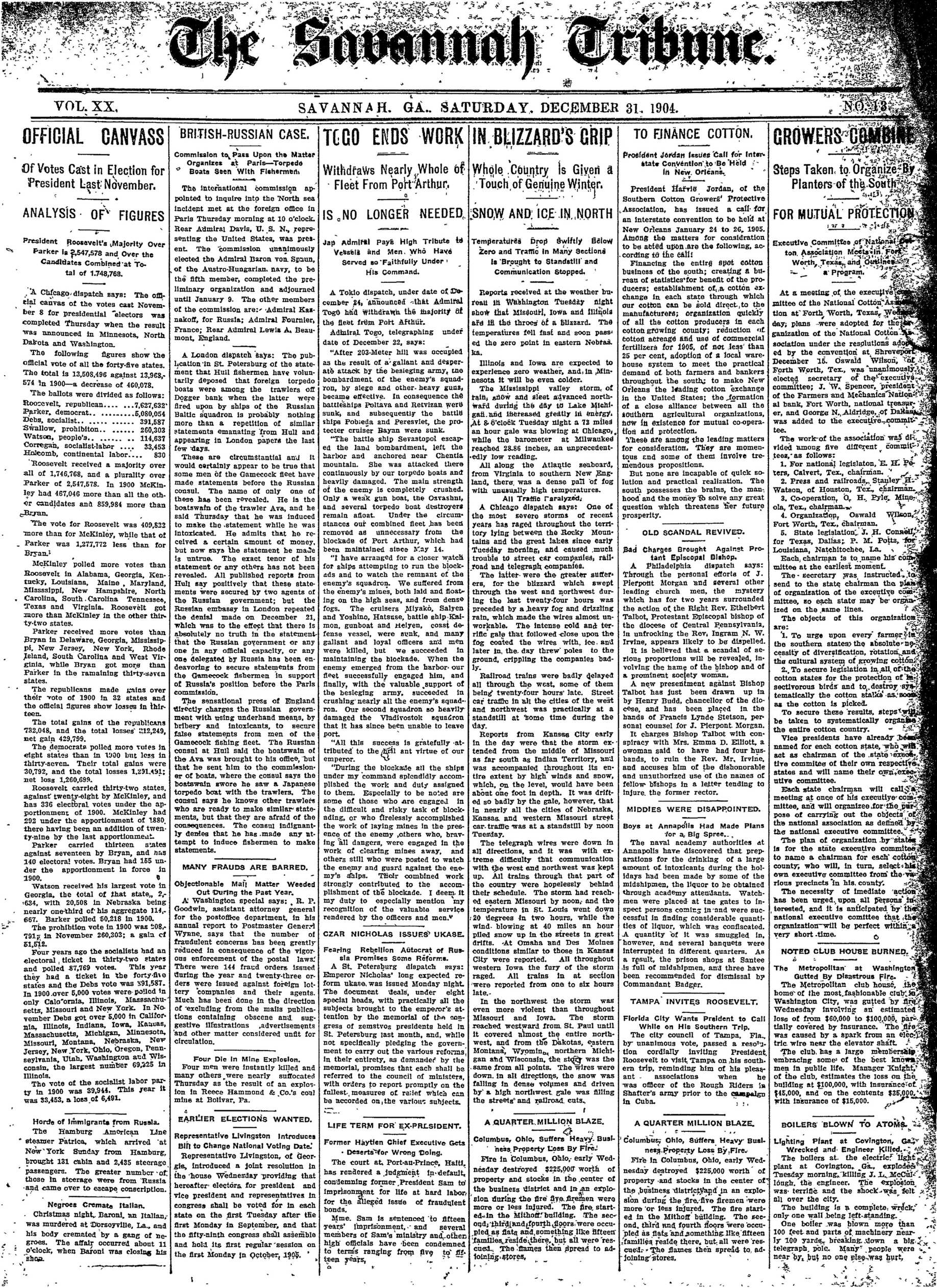
A Chicago dispatch says: The official canvas of the votes cast November 8 for presidential electors was completed Thursday when the result was announced in Minnesota, North Dakota and Washington.
The following figures show the official vote of all the forty-five states. The total is 13,508,496 against 13,968,574 in 1900—a decrease of 460,078.
The ballots were divided as follows: Roosevelt, republican... 7,627,632
Parker, democrat... 5,060,054
Debs, socialist... 391,587
Swallow, prohibition... 260,303
Watson, people's... 114,637
Corregan, socialist-labor... 33,453
Halecomb, continental labor... 830
Roosevelt received a majority over all of 1,746,768, and a plurality over Parker of 2,547,578. In 1900 McKinley had 467,046 more than all the other candidates and 859,984 more than Bryan.
The vote for Roosevelt was 409,822 more than for McKinley, while that of Parker was 1,277,772 less than for Bryan.
McKinley polled more votes than Roosevelt in Alabama, Georgia, Kentucky, Louisiana, Maine, Maryland, Mississippi, New Hampshire, North Carolina, South Carolina Tennessee, Texas and Virginia. Roosevelt got more than McKinley in the other thirty-two states.
Parker received more votes than Bryan in Delaware, Georgia, Mississippi, New Jersey, New York, Rhode Island, South Carolina and West Virginia, while Bryan got more than Parker in the remaining thirty-seven states.
The republicans made gains over their vote of 1900 in 32 states and the official figures show losses in thirteen.
The total gains of the republicans 732,048, and the total losses 112,249, net gain 429,799.
The democrate polled more votes in eight states than in 1900 but less in thirty-seven. Their total galns were 30,792, and the total losses 1,291,491; net loss 1,260,699.
Roosevelt carried thirty-two states, against twenty-eight by McKinley, and has 336 electoral votes under the apportionment of 1900. McKinley had 292 under the apportionment of 1880, there having been an addition of twenty-nine by the last apportionment.
Parker carried thirteen states against seventeen by Bryan, and has 140 electoral votes. Bryan had 155 under the apportionment in force in 1900.
Watson received his largest vote in Georgia, the total of that state, 2,634, with 20,508 in Nebraska being nearly one third of his aggregate 114,676. Barker polled 50,218 in 1900.
The prohibition vote in 1900 was 508,791 in November 260,303; a gain of 51,512.
Four years ago the socialists had an electoral ticket in thirty-two states and polled 87,769 votes. This year they had a ticket in the forty-five states and the Debs vote was 931,587.
In 1900 over 5,000 votes were polled in only Calo'ornia, Illinois, Massachusetts, Missouri and New York. In November Debs got over 5,000 in California, Illinois, Indiana, Iowa, Kansas, Massachusetts, Michigan, Minnesota, Missouri, Montana, Nebraska, New Jersey, New York, Ohio, Oregon, Pennsylvania, Utah, Washington and Wisconsin, the largest number 69,225 in Illinois.
The vote of the socialist labor party in 1900 was 39,944. This year it was 33,453. a loss of 6,491.
Horde of immigrants from Russia. The Hamburg American Line steamer Patrica, which arrived at New York Sunday from Hamburg, brought 131 cabin and 2,435 steerage passengers. The greater number of those in steerage were from Russia and came over to escape conscription.
Negroes Cremate Italian.
Christmas night, Baronl, an Italian, was murdered at Dorsoyville, La., and his body cremated by a gang of negroes. The affair occurred about 11 o'clock, when Baronl was closing his shop.
BRITISH-RUSSIAN CASE.
Commission to Pass Upon the Matter Organizes at Paris—Torpede Boats Seen With Fishermen.
The international commission appointed to inquire into the North sea incident met at the foreign office in Paris Thursday morning at 10 o'clock. Rear Admiral Davis, U. S. N., representing the United States, was present. The commission unanimously elected the Admiral Baron von Spaun, of the Austro-Hungarian navy, to be the fifth member, completed the preliminary organization and adjourned until January 9. The other members of the commission are: Admiral Kannakoff, for Russia; Admiral Fournier, France; Rear Admiral Lewis A. Beaumont, England.
A London dispatch says: The publication in St. Petersburg of the statement that Hull fishermen have voluntarily deposed that foreign torpedo boats were among the trawlers off Dogger bank when the latter were fired upon by ships of the Russian Baltic squadron is probably nothing more than a repetition of similar statements emanating from Hull and appearing in London papers the last few days.
These are circumstantial and it would certainly appear to be true that some men of the Gamecock fleet have made statements before the Russian consul. The name of only one of these has been revealed. He is the boatswain of the trawler Ava, and he said Thursday that he was induced to make the statement while he was intoxicated. He admits that he received a certain amount of money, but now says the statement he made is untrue. The exact tenor of his statement or any others has not been revealed. All published reports from Hull say positively that these statements were secured by two agents of the Russian government; but the Russian embassy in London repeated the denial made on December 21, which was to the effect that there is absolutely no truth in the statement that the Russian government or any one in any official capacity, or any one delegated by Russia has been endearing to secure statements from the Gamecock fishermen in support of Russia's position before the Paris commission.
The sensational press of England directly charges the Russian government with using underhand means, by bribery and intoxicants, to secure false statements from men of the Gamecock fishing fleet. The Russian consul at Hull said the boatswain of the Ava was brought to his office, but that he sent him to the commissioner of boats, where the consul says the boatswain swore he saw a Japanese torpedo boat with the trawlers. The consul says he knows other trawlers who are ready to make similar statements, but that they are afraid of the consequences. The consul indignantly denies that he has made any attempt to induce fishermen to make statements.
MANY FRAUDS ARE BARRED.
Objectionable MaiJ Matter Weeded
Out During the Past Year,
A Washington special says: R. P. Goodwin, assistant attorney general for the postoffice department, in his annual report to Postmaster General Wynne, says that the number of fraudulent concerns has been greatly reduced in consequence of the vigorous enforcement of the postal laws. There were 144 fraud orders issued during the year and twenty-three orders were issued against foreign lottery companies and their agents. Much has been done in the direction of excluding from the mails publications containing obscene and suggestive illustrations, advertisements and other matter considered unfit for circulation.
Four men were instantly killed and many others were nearly suffocated Thursday as the result of an explosion in Reece Hammond & Co.'s coal mine at Bolvar, Pa.
Representative Livingston Introduces
Bilt to Change National Voting Date.
Bilt to Change National Voting Date. Representative Livingston, of Georgia, introduced a joint resolution in the house Wednesday providing that hereafter electors for president and vice president and representatives in congress shall be voted for in each state on the first Tuesday after the first Monday in September, and that the fifty-ninth congress shall assemble and hold its first regular session on the first Monday in October, 1905.
SAVANNAH. GA.. SATURDAY. DECEMBER 31. 1904.
Withdraws Nearly Whole of Fleet From Port Arthur.
Jap Admiral Paye High Tribute to Vessela and Men. Who Have Served so Faithfully Under His Command.
A Tokio dispatch, under date of December 24, announced that Admiral Togō had withdrawn the majority of the fleet from Port Afthür.
Admiral Togo, telegraphing under date of December 22, says:
"After 203-Meter hill was occupied as the result of a gallant and desperate attack by the besieging army, the bombardment of the enemy's squadron, by siege and other heavy guns, became effective. In consequence the battleships Poltava and Retvizan were sunk, and subsequently the battle ships Pobieda and Peresvlet, the protector cruiser Bayan were sunk.
"The battle ship Sesastopol escaped the land bombardment, left the harbor and anchored near Chentia mountain. She was attacked there continuously by our torpedo boats and heavily damaged. The main strength of the enemy is completely crushed. Only a weak gun boat, the Ovashant, and several torpedo boat destroyers remain afloat. Under the circumstances our combined fleet has been removed as unnecessary from the blockade of Port Arthur, which had been maintained since May 14.
"I have arranged for a closer watch for ships attempting to run the blockads and to watch the remnant of the enemy's squadron. We suffered from the enemy's mines, both laid and floating on the high seas, and from dense fogs. The cruisers Miyako, Salyen and Yoshino, Hatsuse, battle ship Kalmon, gunboat and Helyen, coast defense vessel, were sunk, and many gallant and loyal officers and men were killed, but we succeeded in maintaining the blockade. When the enemy emerged from the harbor our fleet successfully engaged him, and finally, with the valuable support of the besieging army, succeeded in crushing nearly all the enemy's squadron. Our second squadron so heavily damaged the Vladivostok squadron that it has since been unable to leave port.
"All this success is gratefully attributed to the evil ant virtue of our emperor.
"During the blockade all the ships under my command splendidly accomplished the work and duty assigned to them. Especially to be noted are some of those who are engaged in the difficult and risky task of blockading, or who firelessly accomplished the work of laying mines in the presence of the enemy, others who, braving all dangers, were engaged in the work of clearing mines away, and others still who were posted to watch the enemy and guard against the enemy's ships. Their combined work strongly contributed to the accomplishment of the blockade. I deem it my duty to especially mention my recognition of the valuable service rendered by the officers and men."
CZAR NICHOLAS ISSUES UKASE.
Fearing Reheillon Autocrat of Russia Premises Some Reforms.
A St. Petersburg dispatch says: Emperor Nicholas' long expected reform ukase, was issued Monday night. The document deals, under eight special heads, with practically all the subjects brought to the emperor's attention by the memorial of the congress of zemstvos presidents held in St. Petersburg last month, and, while not specifically pledging the government to carry out the various reforms in their entirety, as demanded by the memorial, promises that each shall be referred to the council of ministers, with orders to report promptly on the fullest, measures of relief which can be accorded on, the various subjects.
Former Haytien Chief Executive Gets Deserts for Wrong Doing.
The court at. Port-au-Prince, Haiti, has rendered a judgment in default, condemning former. President Sam to imprisonment for life at hard labor for the alleged issue of fraudulent bonds.
Mme. Sam is sentenced to fifteen years' imprisonment, and several members of Sam's ministry and other high officials have been condemned to terms ranging from five to fifteen years.
Whole Country Is Given a Touch of Genuine Winter.
SNOW AND ICE IN NORTH
Temperatures Drop Swiftly Below Zero and Traffic in Many Sections Is Brought to Standstill and Communication Stopped.
Reports received at the weather bureau in Washington Tuesday night show that Missouri, Iowa and Illinois are in the throes of a blizzard. The temperatures fell fast and soon passed the zero point in eastern Nebraska.
Illinois and Iowa are expected to experience zero weather, and, in Minnesota it will be even colder.
The Mississippi valley storm of rain, alow and sleet advanced northward during the day to Lake Michigan, and increased greatly in energy, At 8 o'clock Tuesday night a 72 miles an hour gale was blowing at Chicago, while the barometer at Milwaukee reached 28.86 inches, an unprecedentedly low reading.
All along the Atlantic seaboard, from Virginia to southern New England, there was a dense pall of fog with unusually high temperatures.
All Traffic Garalyzed:
A Chicago dispatch says: One of the most severe storms of recent years has raged throughout the territory lying between the Rocky Mountains and the great lakes since early Tuesday morning, and caused much trouble to street car companies, railroad and telegraph companies.
The latter were the greater sufferers, for the blizzard which swept through the west and northwest during the last twenty-four hours was preceded by a heavy fog and drilling rain, which made the wires almost unworkable. The intense cold and terrific gale that followed close upon the fog coated the wires with, ice, and later in the day threw poles to the ground, crippling the companies badly.
Railroad trains were badly delayed all through the west, some of them being twenty-four hours late. Street car traffic in all the cities of the west and northwest was practically at a standstill at some time during the day.
Reports from Kansas City early in the day were that the storm extended from the middle of Missouri as far south as Indian Territory, and was accompanied throughout its entire extent by high winds and snow, which, on the level, would have been about one foot in depth. It was drifted so badly by the gale, however, that in nearly all the cities of Nebraska, Kansas and western Missouri street car traffic was at a standstill by noon Tuesday.
The telegraph wires were down in all directions, and it was with extreme difficulty that communication with the west and northwest was kept up. All trains through that part of the country were hopelessly behind their schedule. The storm had reached eastern Missouri by noon, and the temperature in St. Louis went down 20 degrees in two hours, while the wind blowing at 40 miles an hour plied snow up in the streets in great drifts. At Omaha and Des Moines conditions similar to those in Kansas City were reported. All throughout western Iowa the fury of the storm raged. All trains in at section were reported from one to six hours late.
In the northwest the storm was even more violent than throughout Missouri and Iowa. The storm reached westward from St. Paul until it covered almost the entire northwest, and from the Dakotas, eastern Montana, Wyomin northern Michigan and Wisconsin, the story was the same from all points. The wires were down in all directions, the snow was falling in dense volumes and driven by a high northwest gale was filling the streets' and railroad cuts.
Columbus, Ohio, Suffers Heavy Bus-
ness Property Loss By Fire.
Fire in Columbus, Ohio; early Wednesday destroyed $225,000 worth of property and stocks in the center of the business district and in an explosion during the fire five firemen were more or less injured. The fire started in the Milthoff building. The second, third, and fourth floors were occupied as flats and something like fifteen families, reside, there, but all were rescued. The frames then spread to adjoining stores.
TO FJNANCE COTTON.
President Jordan issues Call for Interstate Convention to Be Held in New Orleans.
President Harrius Jordan, of the Southern Cotton Growers' Protective Association, has issued a call for an interstate convention to be held at New Orleans January 24 to 26, 1905. Among the matters for consideration to be acted upon are the following, according to the call:
Financing the entire spot cotton business of the south; creating a bureau of statistics for benefit of the producers; establishment of a cotton exchange in each state through which our cotton can be sold direct, to the manufacturers; organization quickly of all the cotton producers in each cotton growing county; reduction of cotton acreage and use of commercial fertilizers for 1905, of not less than 25 per cent, adoption of a local warehouse system to meet the practical demand of both farmers and bankers throughout the south; to make New Orleans the leading cotton exchange in the United States; the formation of a close alliance between all the southern agricultural organizations, now in existence for mutual co-operation and protection.
These are among the leading matters for consideration. They are momentous and some of them involve tremendous propositions. But none are incapable of quick solution and practical realization. The south possesses the brains, the manhood and the money to solve any great question which threatens her future prosperity.
OLD SCANDAL REVIVED.
Bad Charges Brought Against Protant Episcopal Bishop.
A Philadelphia dispatch says: Through the personal efforts of J. Plerpoint Morgan and several other leading church men, the mystery which has for two years surrounded the action of the Right Rev. Ethelbert Talbot, Protestant Episcopal bishop of the diocese of Central Pennsylvania, in unrocking the Rev. Ingram N. W. Irvine, appears likely to be dispelled. It is believed that a scandal of serious proportions will be revealed, involving the name of the bishop and of a prominent society woman. A new presentment against Bishop Talbot has just been drawn up in by Henry Budd, chancellor of the diocese, and has been placed in the hands of Francis Lynde Stetson, personal counsel for J. Plerpoint Morgan.
It charges Bishop Talbot with conspiracy with Mrs. Emma D. Elliott, a woman said to have had four husbands, to ruin the Rev. Mr. Irvine, and accuses him of the dishonorable and unauthorized use of the names of fellow bishops in a letter tending to injure, the former rector.
MIDDIES WERE DISAPPOINTED.
Boys at Annapolis Had Made Plans for a Big Spree.... The naval academy authorities at Annapolis have discovered that preparations for the drinking of a large amount of intoxicants during the holidays had been made by some of the midshipmen, the liquor to be obtained through academy attendants. Watchmen were placed at the gates to inspect persons coming in and were successful in finding considerable quantities of liquor, which was confiscated. A quantity of it was smuggled in, however, and several banquets were interrupted in different quarters. As a result, the prison shops at Santee is full of midshipmen, and three have been recommended for dismissal by Commandant Badger.
TAMPA INVITES ROOSEVELT.
Florida City Wants President to Call
Whale on His Southern Trim
The city council of Tampa, Fla. by unanimous vote, passed a resolution cordially inviting President Roosevelt to visit, Tampa on his southern trip, reminding him of his pleasant associations when he was officer of the Rough Riders in Shafter's army prior to the campaign in Cuba.
A QUARTER MILLION BLAZE.
Columbus; Ohio, Suffer Heavy Business. Property Loss By Fire.
Fire in Columbus, Ohio, early Wednesday destroyed $225,000 worth of property and stocks in the center of the business district and in an explosion during the fire, five firemen were more or less injured. The fire started in the Mithof building. The second, third and fourth floors were occupied as flats and something like fifteen families reside there, but all were rescued. The flames then spread to adjoining stores.
Executive Committee of National Cotton Association Meetings in Fort Worth, Texas, and Outlines a Program.
At a meeting of the executive committee of the National Cotton Association at Forth Worth, Texas, Wednesday, plans were adopted for the organization of the National Cotton Association under the resolutions adopted by the convention at Shreveport December 15. Oswald Wilson, of Forth Worth, Tex., was unanimously elected secretary of the executive committee; J. W. Spencer, president of the Farmers and Mechanics National bank, Fort Worth, national treasurer, and George N. Aldridge, of Dallas, was added to the executive committee.
The work of the association was divided among five different committees, as follows:
1. For national legislaton, E. H. Peters, Calvert, Tex., chairman.
2. Press and railroads, Stanley H.
The secretary was instructed to send to the state chairman the plan of organization of the executive committee, so each state may be organized on the same lines.
1. To urge upon every farmer in the southern states the absolute necessity of diversification, rotation and the cultural system of growing cotton.
2. To secure legislation in all of the cotton states for the protection of insectivorous birds and to destroy systematically the cotton stalks as soon as the cotton is picked.
To secure these results, steps will be taken to systematically organize the entire cotton country.
Vice presidents have already been named for each cotton state, who will act as chairman of the state executive committee of their own respective states and will name their own executive committee.
Each state chairman will call a meeting at once of his executive committee, and will organize for the purpose of carrying out the objects of the national association as defined by the national executive committee.
The plan of organization by states is for the state executive committee to name a chairman for each cotton county, who will, in turn, select his own executive committee from the various precincts in his county. The necessity of immediate action has been urged, upon all persons interested, and it is anticipated by the national executive committee that the organization will be perfect within a very short time.
NOTED CLUB HOUSE BURNED.
The Metropolitan at Washington
Gutted by Disastrous Fire.
The Metropolitan club house, the home of the most fashionable club in Washington City, was gutted by the Wednesday involving an estimated loss of from $60,000 to $100,000, partially covered by insurance. The fire was caused by a spark from an electric wire near the elevator shaft.
The club has a large membership embracing some of the best known men in public life. Manager Knight, of the club, estimates the loss on the building at $100,000, with insurance of $45,000, and on the contents $35,000 with insurance of $15,000.
BOILERS BLOWN TO ATOMS
Lighting Plant at Covington, Ga.
Wrecked and Engineer Killed. The boilers at the electric light plant at Covington, Ga., exploded Tuesday morning, killing J. L. McCulough, the engineer. The explosion was terrific and the shock was felt all over the city.
The building is a complete, wreck,
only one wall being left-standing.
One boiler was blown more than 100 feet and parts of machinery nearly 100 yards, breaking down a big telegraph pole. Many people were near by, but no one else was hurt,
The Savannah Tribune.
PUBLISHED EVERY SATURDAY.
BY THE TRIBUNE PUBLISHING CO.
119 W. 8. Julian Street.
In the coming year let us all resolve to save more, and encourage each enterprise of the race.
Our young men should save their earnings. There is no reason why they can not save one fourth of their weekly wages.
SAVANNAH is dotted all over with churches, and yet but little Christian activity is being shown along practicle lines. During this season of the year, how many of these churches have contributed to charity and thought of the poor in the community; How many of them have extended that influence which benefits the young people of the community and cause them to celebrate Christmas days in a becoming manner? How many of them are trying to reach the great mass of people who never attend church? These are practical things that should cause churchmen to think and act.
In our community there are several ministers who are as inconsistent as they can possibly be. Some of these preachers are in charge of flourishing churches and get their support only from our people. They generally get up in their pulpits and elsewhere and preach about race pride and what should be done to build up the race. Do they practice what preach? Do they patronize race enterprises; thereby helping our boys and girls? Do they patronize the Wage Earners Saving Department or the Metropolitan Company? Do they encourage the several insurance companies conducted by members of the race? Do they have their printing done at colored printing offices. This can be answered in the regulations by simply looking at the imprint on any job of printing that they have done. Such preachers are drawbacks to the race and the people should know who they are and treat them as they deserve to be treated. THE TRIBUNE is proud to say that all of the preachers are not in the above category, and are shining lights for race progress. This class of preachers we are proud to know and sing their praises, but the good Lord deliver us from others.
THE need of our young men for a place of recreation has never been more apparent than at present. They have no place to go except hanging around the bar or other questionable places. Many would say that the churches are open several nights during the week and they could find recreation and profit there, but that does not meet the crayings of the average young men as has been seen by the perfecting of institutions elsewhere for his benefit. The average young man likes convival associates but this should be curtailed by that which will give them the greatest benefit. The one institution that will be of the greatest benefit to our young men in the Young Men Christian Association. Other cities with less population than Savannah boast successful institutions of this kind. There is no reason why one cannot flourish here. There is a number of young men who are willing to assist in this work if the proper encouragement is given by the leading citizens especially the preachers. These young men must be reached and must be saved, and one of the best ways is by the organization of an institution of the above kind.
A few weeks ago a representative number of our people witnessed a game of foot, ball between the local team and one from Orangeburg. Among the attendants were a large number of young men in the prime of life. They were robust and dressed in the latest style. The observant ones present inquired as to the standing of the young men as citizens. From one who knew them very well it was ascertained that they have lived in the city for years, the majority from birth yet not one of them were boni-fide citizens. Not one of them are tax-payers and naturally not voters. From the stylish manner of these young men, they would be taken for young millionaries or else fully abreast of the times so far as citizenship goes. It is these young men upon who we are dependent for the future well being of the race, but alas! unless they mend their ways we will be doomed to disappointment and much of the hope of the race shattered. This class of young men can be seen always in a conspicuous place and making themselves ridiculous in the sight of good thinking people. These young men must be reached and taught the lesson of good citizenship.
Collector Rucker and Bad Editor.
We have noticed with indignation the results which the Atlantic Independent, an Afro-American weekly, has been making upon Hon. H. A. Rucker, our Collector of Internal Revenue at Atlanta. Because Mr. Rucker wrote during the campaign a political article in which he took sides with Roosevelt against the South, the Independent has attacked him with tooth and nail. What if Mr. Rucker did criticize the South? Is the South so virtuous and holy as to be above criticism? It is disgusting to see the Independent, which professes to be the organ of a people to which liberty is denied, denouncing one of that people for using his constitutional right of liberty of speech.
We have watched the Independent for some time with distrust. Its weekly interchange of compliments with the Atlanta Constitution, which were obsequious on the one side and patronizing on the other, nauseated us. But we were silent, because the Independent, which should be named the Sycophant, was degrading only itself. We foreboded; however, its next inevitable step. Whenever a slave became a "favorite" at the "big house," it was a good sign that he was about to turn informer. In like manner the Independent first became the "favorite" of the Atlanta Constitution, and next, inebriated by the condescending pats of approval bestowed on its heads proceeded to denounce one of its own fellows. This is the usual rake'-progress of the "good Negre."
If Mr. Rucker were notoriously inefficient and dishonest, the case would be different. But he is a first class, capable and upright gentleman. His office at Atlanta is as well conducted as any in the country, and reflects credit on the capacity of the whole race. But even if his qualifications were less eminent, the Independent should think twice before attempting to discredit him. If he should lose his office, it would surely revert to a white man. There are not so many offices open to Afro-Americans that we can afford to throw a single one away. Our attempt should be to lay hands, on more offices still.
We are free to say that the Independent makes us very tired.—N. Y. Age.
Has the Time Come?
Has the time come for us to Americanize the S. C. of M. by having a Committee of Management in America? Let us reason this matter together. From the drift of what we see in The Independent of Atlanta, Ga., there is an effort to place a condition on the subordinate lodges that some wont stand, and some wont be able to meet, and others will fall by the wayside without even telling the outside world why it was that they had fallen. Now if the order has fallen into the hands of men from whom they can be no escape then is it not time to start out afresh in the world of Odd Fellows? Now it is no use to argue to me that it cannot be done, and it is no use to tell me that there can be but one B. M. C., on American soil, or that it cannot live. Here is my answer to all of that kind of talk, B. M. C., lives through the subordinate lodges, the S. C. of M. lives through the subordinate lodges, the Order lives through what the individual membership pays in the Secretary's desk. The only benefits that any member ever gets comes to him or her through what the individual member pays in. The S. C. of M.; the B. M. C.; the D. G. L.; all lives through what the subordinate lodges contribute for their support, and if it has come to the place where the sovereignty of the local lodges is to be overthrown, then is it not time to start out with a C. of M. of our own with modern improvements inculcated into its organic life. Let the 140 lodges come together and let us reason together, and see if we could not improve upon the future. 140 lodges is more than The Honorable Peter Ogden stated with, and do you mean to tell me that after all that has been accomplished the world of letters, license and Physics, that it is all accomplished, there remains nothing to be done, but submit to the heel of oppression. Only men fit for gally slaves argue that way. Freeman finds a way or make a way to the Highs of Liberty and Equality.
When the Bureau of Endowment was first started by the Grand Lodge of Ga, it was the common accepted understanding that those Lodges that had already endowments of their membership would at least be allowed to have a chance to come involuntary, but with lodges that had no such burdens, or provisions for the protection of its members, they would be expected to take out their endowment at once, now since then, it seems that they have the endowment started, and find that it is such a good thing. They are trying to put the heel upon the Savannah lodges, or any other that may hold out for the Heaven given right to decide whether they should go in and assume a debt that they might be able to pay, or that they see no possibility to pay and keep up their present local expenses and because they hesitate the cudgel is held over their heads by the Grand Secretary, expulsion or submission. Now here is a condition that confronts some of the Savannah Lodges, they have gone before the Superior Court and had themselves chartered to carry into effect the provisions of their local endowment, and for them to fall now from any cause would lay them liable to be aued by the Court, but what does the Grand Secretary care for that, Submission, or Expulsion, those lodges can not go behind what they have done, in the way of charms, and would it be wise for them to do so even if they could. How does they know if the new endowment is going to be as well for the relief of the Wildows and Orphans as the local endowment has done. Would it be wise to turn loose the one for the other before experiences taught one that there was nothing to loose, but it would be a gain to those, for whom endowments is gotten up for. But what does the men care that is running The Independent with wounded pride the ering Lodge itself themselves published to
the world as defaulters, without even the hope of redress from the mess that holds them up, to be criticised by the outside world that knows nothing about, the reasons whereof, and careless in the cities where some of these lodges are. Men and women never heard their names spoken of before only with reverence, with some is linked the memories of some loved one hurried by the said lodges, but with the Independent no name is sacred.
I have thought the matter over from every stand point, and to none can I see a more clear outline of duty than to prepare to stand one by the other. There are hundreds of good Odd Fellows in every part of this country who in the getting of a home starts up the ladder in full flush of health and strength, and sickness overtakes them when they have got their homes two thirds paid for, and the inevitable happens, it reverts back to the white man, thereby helping to enrich another whom you had not intended, and it is so much energy and money lost to, the colored race, with that much given to enrich the white race that is already rich. Every effort thus to rise that is not successful discourages a heap more than if no effort had been made, and it is in the reach of the colored people to change this helplessness by putting a plank in the new constitution that will enable every Odd Fellow in like position as stated above who have the home partly paid for to be purchased by the order for him and thereby give him one more chance to redeem himself and acquire a home for himself in buys the said home, and resell it to the member, and when it becomes so he cannot pay for it and he must loose it, why it is not lost to the race, if to the individual, and it would be only a question of the few, and it would be only a question of the order would be a home-owner, and it would serve to keep the monies of the order safely invested, and not kept as a temptation to every incoming administration. We would never again have to witness the disgraceful squandering of the people's money as we did at the Valdosta Grand Lodge, or the question would never have to be asked as it was in the last B. M. C. what was they going to do with the tremendous surplus on hand, when it, or a part of it, was voted to buy a place for the order in the city of Philadelphia. The monies that will be spent for that one place could if spent in the way indicated for the Philadelphia Home affair, relieve more real human suffering than twenty times that much spent as proposed, and it would form the nucleus of a sinking fund from the returned monies to help every other Odd Fellow down the ages to come, and there relieve the living, as well as the sorrowing, and the dead: I am speaking on the present rate of taxation with the assessment for endowment as now constituted from the monthly payment of the Householders of the order there would always be enough on hard to meet any and all expenses of the order.
Respectfully Yours, in F. L. and T.
W. H. MATTHEWS.
Brutally Tortured.
Brutally Tortured.
A case came to light that for president and unmereful torture has perhaps never been equaled. Joe Golobick of Coluso, Calif, writes. "For 15 years I endured insufferable pain from Rheumatism and nothing relieved me though I tried everything known. I came across Electric Bitters and it's the greatest medicine on earth for that trouble. A few bottles of it completely relieved and cured me" Just as good for Liver and Kidney troubles and general debility. Only 50c. Satisfaction guaranteed by all drudgists.
The New-York Tri-Weekly Tribune.
For those who want to get the New York news and news of things the world over and don't want to spend the money or time buying and reading a metropolitan paper seven days in the week The Tri-Weekly Tribune fills the bill: It is issued on Monday, Wednesday and Friday of every week, and contains the essence of of The Daily Tribune for the whole week. To those who are interested in the prices of flour, grain, wheat, cotton, livestock, butter, cheese, eggs and other farm products, its market report are invaluable, because of their correctness. Price, $1.50 a year. For a free sample copy send a postal card to The New-York Tribune, New York. Combination offer Harper's Bazar, with The Weekly Tribune, one year $1.65 The Metropolitan Magazine, with The Tri-Weekly Tribune.
Atlantic Coast Line.
Atlantic Coast Line. Atlantic Coast Line will sell round trip tickets for the holidays at rates one and one third fares between all stations on its own lines and connecting lines south of the Ohio and Potomac and East of the Mississippi Rivers, tickets to be sold December 23, 24, 25, 31, 1904 and January 1st 1905 return limit January 4th 1905. Tickets at same rates will be sold to teachers and students of schools and colleges upon presentation and surrender of certificates signed by Superintendents, Presidents, or Principals December 17-24 inclusive with final limit January 8th 1906. Ticket Agents will furnish any further information desired. H. M. Emerson, Traffic Manager. W. J. Craig, General Passenger Agent, Wilmington N, C. W. H. Leahy, Division Passenger Agent, Savannah, Ga.
Cheap Rates Via Central of Georgia.
Holiday Excursion Rates via. Central of Georgia Railway Company. During the Holidays, excursion tickets will be sold between all ticket station on G. of Ga. Ry. at rate of the fare and a third for the found trip, minimum rates, 50 cents. Whole tickets, 25 cents, halves.
Excursion tickets will also be on sale from all coupon stations on C. of Ga. Ry. to points on connecting lines south of Ohio and Potomac and east of the Mississippi river, including St. Louis Mo. and points on L. & N. R. R. Ill. Cent. R. R. M. & O. R. R. and Southern Ry., between the Ohio River and St. Louis, and points on St. L. I. C. & S. and St. L. & S. F. between Memphis and St. Louis.
Tickets will sold to the general public on Dec. 23, 24, 25 and 31, 1904 and Jan. 1, 1905, final limit Jan 3, 1905.
Upon presentation and surrender of certificates, tickets will be sold to teachers and students of schools and colleges, on Dec. 17 to 24, inclusive, final limit Jan. 8, 1905.
Any agent of the Company will cheerfully furnish additional information upon request.
No Plty Shown.
"For years fate was after me continuously" writes F. A. Gulledge, Verbena, Ala. "I had a terrible case of Piles causing 24 tumors. When all failed, Bucklen's Arnica Salve cured me. Equally good for Burns and all aches and pains. Only 25 cents at all Drug Stores."
WINTER CLOTHING
«FOR MEN AND BOYS»
IS JUST COMING
SPECIAL
SUITS AND PANTS
...FOR BOYS....
FOR THE FOLLOWING WEEK
Leopoto. Holler.
BROUGHTON & BULL STS.
The Largest Department Store in Georgia.
---
CAPITAL STOCK, $500,000.
Full Paid. Non-assessible.
The strongest and most progressive Negro Company, offers to the investing public a block of $20,000 worth of its capital stock at $7 per share. This offer holds good for the next sixty days, after which it will go to $8 per share. It can be bought by paying seven dollars down on 5 shares and $3 per month until paid. If paid for cash a discount of 6 per cent will be allowed. Stock bought before January first will participate in the annual dividends in full. From January first and not later that April first half dividends will be paid. Have sold nearly $20,000 worth this in state alone in the last two years. It is backed by more than a hundred and fifty thousand dollars worth of real estate at appraised valuation. Thus insuring the investor against any possible loss. This is the last chance to acquire an iron-clad investment in this company for $7 that will go to $8 then $9 and shortly to $10. The actual value of which is now $7.25. As the profit increases your investment increase. No watered stock. We build in the ground. The Savings bank offers also to the public a durable investment seven per cent allowed, compounded quarterly. Call or address 222 W. Broughton St. Savannah Ga. Bell Phone 1144.
L. C. COLLINS, Secretary. F. M. COHEN, Teller.
J. W. ARMSTRONG, General Manager.
Both Solid Vestibuled Traius, with Day Coaches of Newest Design, Pullman Drawing-Room Sleeping Cars and Elegant Dining Cars.
A sick and death benefit organization that pays larger benefits than any other and pays them quicker. Has 150,000 members and paid out to its members more than a hundred thousand dollars in the last year. Gives employment to fifteen hundred intelligent men and women as agents, book keepers, typewriters, etc. Ark heretofore not open to colored women. The mother of this company is the Metropolitan Mercantile and Realty Co., 150 Nassau street, New York. Southern headquarters, 222 W. Broughton St., Savannah, Ga.
J. W. Armstrong, Director General Southern States.
Mrs. W. H. Burgess,
Cor. Jefferson and Gaston Sts. is conducting a neat Dress Making and Millinery Store. She solicits the patronage of the public. Guaranteeing perfect fit and polite attention. Orders promptly filled.
For a Good Shave or Hair-Cut Visit The FOREST CITYSHAVING PALACE
Good work and polite attention is our Motto. Razors horned and set.
FOREST CITY SHAVING PALACE,
308 Drayton Street, oppsite DeSoto Hotel.
R T. WASHINGTON, PROP.
50 YEARS' EXPERIENCE
PATENTS
TRADE, MARKS
DESIGNS
COPYRIGHTS & C.
Anyone sending a sketch and description may quickly ascertain our opinion free whether as invention is probably patented. Communications is probably confidential on Patents sent free. Oldest agency for securing patents.
Patents taken through Mann & Co. receive special notice, without charge, in the
Scientific American.
A handsomely illustrated weekly. Largest citation of any scientific journal. Terms, $8 a year, four months. $4. Sold by all new dealers.
MANN & Co. 301 Broadway, New York
Broadway & Office, 611 F. St., Washington, D.C.
I arise though blind with tears,
To fare forth on the long way,
When the beckoning gleamappears,
I must obey.
—George Roberts, in "New Songs."
A LETTER AND ITS SEQUEL.
O that's the way the land lies, is it?" asked Ivy Lyle. The sensitive face under the big, rose-lined sunhat was very white. Her lips quivered a little. The hands that held the vagrant sheet trembled.
S
"I thought," said the girl to herself, "I hadn't begun to care—in that way. I was only becoming-attracted. But the shock—the disillusion—" When she had started out an hour go for her usual brisk morning walk long the crisp, shelving sands, she had one of the most indifferent, right-hearted of girls. She was done with college, and the two years of foreign travel that had succeeded school as a sort of polishing process. She had perfect health, and misty dreams of all the veiled future held in its keeping. She had esthetic tastes, and her skill in athletic sports was the admiration of her less vigorous girl friends. She had been having a beautiful time down at this gay, unconventional resort on the Michigan coast. And now—well, temporarily it seemed that her pleasure was spoiled.
And in her heart she knew that she must have been beginning to think too much of the man whose attentions to her had been so marked, or else this discovery would not so affect her. Sitting to rest and watch the white-crested waves come curling up to break on the border of the lake like threads of rarest lace, her attention had been caught by a small, white, whirling object that at first sight she had taken for a bird. It has whisked lower and bearer. Then it floated so close she could put out her hand and grasp it, and she found it was a sheet of note super covered with diminutive chirophy. It was written on the stationary of the fashionable hotel looming on the dunes behind her. At first he had been about to crumple it up and cast it aside. But in the very act adding so a name—her own name—get her eye.
Even then she hesitated. But the three words were so significant she just know their writer's full meaning. The page was the continuation of a letter. And the first three words at the top of the page were "—love Ivy Lyle!" · Impulsively, giving herself no chance to weigh the niceties of honor in the balance, she scanned the page.
"I—love Ivy Lyle. I've fought against it—for I can't afford to marry her, as you know. But she has rather swept me off my feet, old chap! At first I was taken with her innocent beauty. There was no one at this big hostelry to compare with her for good looks. So I let myself drift. I thought she was just a dear little country girl, and that it would be easy to say a sentimental farewell when the summer was over. You know what these warm weather flirtations amount to. So I've been going to see her steadily and taking her everywhere. We've gone dancing and swimming and boating and all the rest of it. And—by Jovel for all she's mighty quiet, I've come to find out she's not the typical little country girl at all. She's well read and traveled, though she seemed rather aghast when she let that fact out. And she looks at a fellow in a cool, appraising sort of way that makes him feel pretty cheap—if his spoken thoughts are not quite up to her white standard. But she's not really in the social swim. She's a native, I take it. It's been hard to pin her down to any confidence about herself. She lives with a very dragon of an aunt at a farmhouse on the edge of town. She wears her cotton dresses and share hats in a way that takes the shine out of the women up at the hotel, but we never seen her sport any of the swell clothes they wear to the hops here. Oh, confound it! What's the use of my mooning away to you at this rate? I've got to go away and try to forget her before it's too late.
"Damaris Chase and her father are to be here this week, they tell me. And she's the girl the heads of both our houses expect me to marry! She may have the good taste to refuse me—and I almost hope she will. She's a great heress, and the consolidation of the business interests would be a capital thing; but, oh, hang me if I thought it would be so hard to get that little girl's sweet face out of my heart. I must do the sensible thing, and go in for the twenty thousand a year. Lord! but I'm sorry for those poor devils of kings who have to wed for reasons of state. I feel disgustingly like one of them. I'm sleepy. Good night—I'll finish this in the morning. Ten to one I dream of Ivy Lyle."
It needed no signature. The writer was easily recognized. She crumpled the paper tightly in her hand and thrust it into the blouse of her gown as a rapid, heavy step came crouching down the beach. That step had become too pleasantly familiar. Could
he have known the sheet had been whisked out of his room? Had he seen it blown down to the beach? "Good morning, Miss Lyle!" He fung himself down beside her. His handsome, boyish face looked errained and set, as though insomnia had claimed him. "You're out early. Will you go rowing with me to-day up to Clear Springs?"
"I-I can't!" she faltered.
"And won't you come up Black River to-day?" entreatingly, almost tenderly. "It may be the last time!" He was planning—planning. Oh, that cruel, cruel letter! But—the last time, he had said. She flung up her head and smiled at him. "Yes, I will go!" she said. They were very, gay that afternoon, almost recklessly so. They had lunch-on the inn near the springs, and floated back between the wooded banks just as the day was closing. When they came to parting at the clump of lilac bushes in the lane that led to the farmhouse Jack Ardlesy leaned forward and looked into her eyes.
"Dear," he said, "I love you! I love you, and I can't let you go out of my life—ever? You don't know much of me, ivy, but will you be my wife?" "What," she faltered, "what about Damaris Chase?"
He took her shaking hands and held them fast.
"Who in the world has been telling you of her? I've never seen her, but our fathers have vast interests in common, and have been anxious to arrange a match. I don't say I didn't think of being complaisant. Darling, some time I may get up courage to tell you how near I came to being a paltry coward—how desperately I tried to make myself think I could do without you. But I cannot, and that's all there is to it. If you can endure being poor with me for a few years I'll work so hard at my profession to give you everything that I shall be sure to win."
She had not been mistaken in letting herself love him, then. For she did love him—she did. And she had known it all the while. She lifted her shy, flushed face.
"I will be a good wife to you, dear," she promised. And he kissed her on the lips.
That night when he sought her at the dance at the inn he stood amazed. That lovely lady in the snowy, shimmering gown his demure little country lassle! How superbly she carried herself. And those diamonds around her white throat were worth a fortune. She smiled up at his amazed countenance:
"Aunt Agatha and I do not wish to be bothered with attentions," she whispered, "so we've been living incognito. I expected my father to-night and dressed to do him, and you," sweetly, "what honor I could. You will pardon me," as she signed for a boy who had brought her a telegram, and broke the seal of the message.
"Detained," she read. "Will be with you to-morrow."
She handed Ardsley the yellow slip. It was signed "Jasper E. Chase" and it was addressed to "Miss Dararis Chase!"
"That" she said, "is my name."
"Damaris Ivy Lyle Chase! You poor boy! Come out on the balcony; they are starling at us."
"Come-you base deceiver!"—Kate M. Cleary, in San Francisco Call.
. A Secret of Authorship.
If you will take out the magazines that came last month, or perhaps the mouth before—it wouldn't do for me to specify too closely—you will find in one of them an article signed by a certain great statesman whom everybody in Washington knows. The editor of that magazine wrote to the great man, asking him to contribute. The great man knew nothing whatever about the subject suggested. He isn't nearly so wise as he is famous, anyway, and he asked a newspaper man he knew to write it for him. The newspaper man was busy, but he spoke to a member of his family, a female member, and she—well, she just exactly sat down and wrote an article that has already been quoted far and wide. The great man received the credit, but I fancy the woman received something more substantial. Anyway, she is wearing a new fur collarette that fairly makes one's mouth water.—Washington Post.
Inspirations in Herring Fisheries.
Many Boston artists have been spending their nights at Ipswich during the last week for the purpose of viewing the picturesque work of herring fishing.
This year there has been the largest run of herring ever known at Ipswich, and they have swarmed into Plum Island and Sound by millions. One night recently so solidly were the fish packed in the river that a person might almost have walked upon them without sinking. Herring catching makes a fascinating scene and well calculated to furnish material for an artist. Nearly every night there have been thirty or forty puff boats in the sound, their flaring torches, of which some boats carry three, throwing a wreld ligat upon the yellow oilskins of the fishermen, their bronze faces and the dark water—Boston Herald.
Salvation With Food.
Fourteen-year-old Emmy, who had come home from her first day's schooling in elementary physiology, was questioned by her parents as to what she had learned.
"Papa," she comphined, "I don't think I like physiology."
"Why not,' my dear?"
"Well, teacher was explaining digestion to-day, and she said we had to mix salivation with every mouthful of food."-Harper's Weekly.
OF INTEREST TO WOMEN
AMERICAN GIRL'S FOOTWEAR. There are no women of any country that dress the feet as prettily as American girls do. In fact, no women who have such pretty feet to dress. goes down into the valley of the shade, aw of death that she may rise almost glorified in her new honor.
Unfortunately, there are many erring, selfish mothers, as well as good
Spanish women have tiny feet, but they are too short and broad for real beauty. And French women, by some mysterious process, always wear small shoes, no matter what size foot they have.
But the foot of the American girl, which is as famous as her wit and beauty, is always small enough to exactly suit her slender, thoroughbred build, is exquisitely modeled, rarely (nowadays) pinched, and dressed with the utmost taste, appropriately for every occasion.
It was this side of the Atlantic that women started the fad for the stout mannish out of shoe for street and country sports, and it took the American girl to first refuse to play tennis in French heels.
This does not mean that English girls have not worn big calf skin shoes always a lot, and frequently inappropriately. Every one knows the British girl's propensity—just the reverse of the French—for wearing, shoes that make her feet look large even if they chance to be small. But their stout boots are coarse in texture and common in cut; while though the American girl uses for heavy wear heavy boots, they are of the smartest cut, the most flexible material, and while never tight always fitted to perfection, comfortable over the joint and snug up under the instep.
For a while she did make it a little bit of a fad to accentuate the mannishness of her boots, her soles were uselessly wide and thick, but even then carefully fitted and most swagger in cut and finish. But this season her street boots are just heavy enough for protection, no useless weight, and as perfect in make as her dancing slipper.
Her outdoor shoes, high and low, are of a calfskin, softly dressed, or of dongola kid, or a dull-finish leather.
For nice street wear, shoes are a little more pointed at the toe and with Cuban heels, of patent or enameled leather.
For home wear, for afternoon receptions, for evening, shoes may this year match the costume, and for dancing they must. White and pink and yellow suede or dull kid for dancing slippers, or lace over satin, or painted satin are best form.
With many varieties of brown costumes, bronze shoes are extremely good style, and so are brown suede, always with stockings to exactly match. Of course you can be very well dressed by adhering to patent leather for all day-time dress occasions, but for evening a black or bronze slipper would be inartistic dressing; and white, though it can be worn with tinted frocks, is only best style with white.
But quite as important as shoes to match gowns are the stockings to match shoes, and there has never been a season when such an infinite variety of colored stockings were to be seen in the shops.
Browns in every possible shade of onion-skin, mahogany and doctque de roche tones; blues and purples; reds, light and dark and in all strawberry, pond lily and watermelon tints, and yellows, pale and oranges.
And newest of all, shaded stockings, white at the hem and deep-toned at the toe, and every shade of one color in between; not a bit good taste, but nevertheless with some popularity.
The open-work stocking that was entirely crowded out by the gauze-mesh stocking last year, is coming in again this winter, the open-work showing elaborate lace designs and frequently inset with lace.
It is still smart, though eccentric, to have a monogram on the left instep. And just at this season of outdoor sports college girls and school girls frequently embroider the flag of their brother's college on the instep of a silk stocking. Or a sweetheart's initials in his college colors adorn a silk instep.
And all this colored silk embroidery on stockings, and also the craze for colored hosiery, brings up the tormenting question of laundering without losing color or lustre. The ordinary process of bolling and rubbing means ruined hosiery of the delicate sort.
Indeed so heavy can the loss be from careless washing of fine stockings, that a great many girl-do up their own, just as they do their laces and table embroideries. Their plan is to use warm water made soft with borax and soapy with castile soap. First, they soak the stockings for half an hour in cold borax water, four teaspoonfuls to a pail of water. Then into a pail of water that has just boiled is shaved a quarter of a cake of soap with a tablespoonful of borax.
The stockings are rubbed a few minutes by hand, rinsed twice in cold water and let drip dry in the shade. Out of doors in the wind is best, but surely out of the sun. All of this means not each laundering. And it's worth the trouble if you want to follow the fad for pretty hoslery.
NO TITLE LIKE "MOTHER"
There is no title more beautiful than "mother," the good woman glories in it, and fits herself to be worthy the name in every sense. Willingly she
goes down into the valley of the shadow of death that she may rise almost glorified in her new honor.
Unfortunately, there are many erring, selfish mothers, as well as good ones—many who should never have been mothers. The woman who accepts the crown of motherhood should discharge her duties faithfully, even though they involve sacrifice. Reverence would be the natural possession of every child if the parents were worthy the respect of their children. Parents may feel that it does not matter whether their children respect them or not; that the achievement is not worth the effort which it costs them; but it matters to the children. Their own wellbeing demands that they reverence father and mother.
As binding as this duty should be considered by parents, equally so is the one of providing in early life for their own old age. Parents should not, when the evening of life comes, be dependent on their children, thus interfering with the responsibilities those children must naturally have assumed. A mother has no moral right to interfere with the marriage of her daughter; it should be the duty and privilege of a mother to teach and fit her daughter for wife and motherhood.
A good mother cannot be forsaken in her old age, nowwithstanding the numerous duties a daughter may assume; that daughter will always find time to cheer and solace the parent stem; the golden quality of mother love will beget love untold. To the aged mother or father, for whom the sands of life have nearly run, every thought of daughter and grandchild will be a solace. Every triumph, every woe of the absent child will be sympathized with by the parents who have proved themselves worthy. There are sure to be days when, with aching heart and tired brain, the child will give anything on earth to creep into the humble home and feel the embrace of those loving, aged arms. What a comfort to the parent who has been a worthy one will such actions-be only the mother heart, tried and true, can tell!
No woman has the right to deprive her child of its rightful inheritance. Parents owe it to themselves and their children to make easy the downward path of life; they should also fit themselves to be companionable, sweet tempered and unselfish to those about them in the declining years of their lives.
The mother who has become selfish and irritable in her old age must surely have been amiss in her younger life, for trials and sorrow and suffering tend to make a good woman better; they are brothers to knowledge, because they educate and refine.
The mother who has become an invalid or is in poverty should not be deserted by son or daughter; yet some other means, rather than the sacrifice of a child's dearest hopes, should be devised for the maintenance and comfort of such a parent. Herein comes the blessing of making one's self sweet tempered and adaptable. A good mother is a blessing and a joy, one to be prized above all things else; her name should be breathed with reverence. A bad mother is a lasting disgrace to children and the community.
Some mothers will not live alone and refuse to have a son or daughter in-law in the house, or to live in the house of a son or daughter-in-law, lest their little failings become known—selfish, selfish to the core! To the good mother every head should be bowed; earth and heaven will do homage to her. For the selfish mother there is only a lonely old age—A. F. M., in the New York Tribune.
IN WRITING A LETTER.
Do not write long business letters.
Do not write brief letters of friendship.
Avoid writing over the head of your correspondent.
Never use words with which you are not familiar.
Always use unruled paper of fine texture. Avoid a pronounced color.
Under no circumstances send half a sheet of paper, even for the briefest note.
Use only black ink.
Never write of another anything which you would not want him to see.
Do not write of personal or other important matters to strangers or ordinary acquaintances.
Do not fill your letters with lengthy excuses for your silence.
Do not offer advice unless you are asked for it, and should you have occasion to admonish your friend, let it be done gently and lovingly.
Do not send an important message on a postal card and never use them for notes of invitation.-The Inquiler.
LONDON'S BATHING WOMEN.
Who could guess that London's education committee employs bathing women among its numerous classes of workers? Yet such is the case. They are called in to superintend the washing of children in the schools for the mentally deficient. They are paid sixty cents for one and a half hours work. In addition, however, they are called upon to wash the towels and tidy up the bathroom after use.
Mrs. Leland Stanford is now in the East in an endeavor to find a minister for Stanford University to succeed the Rev. Heber Newton, resigned.
HERE are 10,000,000 people in the United States steeped in poverty. Ten million men, women and children who are not adequately fed, clothing and housed. Ten million of our 80,000,000, one-eighth of the population of the entire country, who are the victims of existing economical conditions, which, instead of improving, are becoming worse, so that if the necessary remedies are not soon applied the condition of our poor will be infinitely worse than that of the poor of Europe."
Robert Hunter, the young worker in practical philanthropy, former head of the University Settlement, who a year ago married Miss Caroline Phelps Stokes, daughter of Millionaire Anson Phelps Stokes, and who, with his wife, has abandoned a home of luxury in Madison avenue for a modest, unpretentious dwelling in Grove street, New York City, made these startling statements in the parlor of his new home.
Both Mr. and Mrs. Hunter modestly deny that they have any purpose of teaching by example a lesson to the poor of the city through the radical action which they have taken. But they have at their disposal a fortune of $10,000,000 and might command a Fifth avenue mansion, a country estate, a private yacht and many automobiles. They might fritter away their time at the opera and the Horse Show and be submerged in the world of fashion and frivolity into which they were born, but instead they have elected to live a life of simplicity and usefulness and continue together the philanthropic work in which they were separately engaged when blind Cupld entered a sordid tenement with them and conjured up a romance.
LIVING NEAR THE POOR.
At No. 88 Grove street they have set up their household goods amid surroundings which, immediately adjoining, are quiet and refined, but which, not many blocks away, comprise some of the most hideous aspects of poverty in New York.
There Mr. and Mrs. Hunter have determined to labor together to do their mite toward alleviating the conditions which Mr. Hunter so graphically described.
"This is not a slum district," continued Mr. Hunter, reverting to the causes which had led him and his wife to move into Grove street. "We have decent and respectable people for our neighbors, many of them owning their own homes. But there are near by several districts with which I am entirely familiar in which poverty is rife, and neither Mrs. Hunter nor myself will evade any responsibilities which may fall upon us.
"Slum' is a much ill-used word. No place is a slum where the residents are decent, respectable and hard working. My idea of a slum is a district where the people are wholly steeped in poverty and filth and are making no effort whatever to help themselves." Then, going back to his first statement, Mr. Hunter said: "Do you consider any country prosperous that has 10,000,000 of its population in poverty? When Charles Dickens visited America he said that 'A beggar in Boston would be like a flaming sword.' Forty years later a half of the people of the United States are propertyless, and about 10,000,000 persons now living will die of tuberculosis if the present conditions are kept up.
CONDITIONS GROWING WORSE.
CONDITIONS GROWING WORSE.
"When about 50,000 employees of the railroads, mostly young men just married, with wives and children depending upon them, are killed every year, and their families left helpless; when about 150,000 die every year from tuberculosis, resulting from mal-nutrition, and 1,700,000 little children are compelled to work in factories, sweat shops, mills and furnaces. I think we can expect that conditions will continue constantly to breed a growing poverty in this country, and if these conditions are not remedied, we will have poverty in a very few years that will exceed that of Europe."
"What remedy would you suggest?" Mr. Hunter was asked.
"First," he replied, "we have got to come to the point where we shall have Government insurance, such as Germany has, against sickness, old age and permanent injury. There industry is taxed to pay for all injuries received by the workers, who also pay a proportionate share into the fund.
"In addition we must give greater attention to our tenement house laws, to the rules governing workshops, etc., to the railroads and to child labor. The latter should, he absolutely prohibited, I am aware that any one who advocates these reforms is apt to be regarded as a Socialist, but on the other hand, what do the workers think of the prevailing conditions?"
"And what has brought about this condition of affairs?"
"Unquestionably the economic organization of society at present is responsible for most of its stress."
"Do you mean the trusts?"
"I am not specifying, and I am not prepared offhand to discuss the relations of the tristis to the present economic conditions. I don't think, however, that the conditions are due to drink or any other, ordinary cause. The causes are not personal, but social.
EVILS OF RECENT GROWTH.
"Seventy-five years ago we had practically no poverty at all in this country, and there is no reason why our condition to-day should be what it is. We are not individually any worse off. Economically, however, we are much worse off.
"Unquestionably there should be much higher wages paid to the workers, but that is only one of the reforms needed.
"Fortunately, it is in the power of the people to help themselves. I am not in favor of alms giving. That does no permanent good. And there is another growing impression that ought to be corrupted. It is that the rich are always good and the poor always bad. There is no question that this is false. If you will take 1000 rich men and 1000 poor, you will find that they average up about even."
Mr. Hunter then took up his book on "Poverty," which has just been published by the Macmillans, and quoted the prediction of Charles Fourier, made 100 years ago, that "vast joint stock companies, destined to monopolize and control all branches of industry, commerce and finance, would establish an industrial or commercial fendalism that would control society by the power of capital, as did the old baronial or military fendalism by the power of the sword."
"If we are going to have an economical fendalism in this country," concluded Mr. Hunter, "as strong as the old baronial fendalism, it will be because the people do not prevent it. They possess the power and the votes."
A NUMERICAL MISTAK
How a Political Candidate of Mississippi
Made a Grievance Error.
"Private" John Allen tells us of an old time politician of Mississippi who was making a personal canvass of his territory.
"One day," relates Mr. Allen, "the statesman was doing, the southern portion of the State. Suddenly he struck a community that appeared fairly a-swarm with children. Never had he seen so many little ones in so small a place. Clustered about one doorway were some "fourteen tots of various ages. In their midst stood an extremely good looking young woman."
"Madam," said the politician, with a gallant bow, "you must permit me to kiss those charming little ones."
"The woman merely smiled.
"After he had affectionately saluted each of them, he asked, with a genial smile, 'All yours?'
"The young woman blushed.
"The statesman, with another bow,
then said: 'I trust, madam, that I may
further trespass upon your good nature
by asking that you be so good as to inform your husband that
Colonel —, candidate for Congress
from this district, called upon him this afternoon.'
"Pardon me,' gasped the woman,
'but I have no husband.'
"But these children, madam! exclaimed the astonished statesman. 'You are not a widow?"
"Oh, no, sirt! was the reply. 'This is an orphan asylum!'"—Woman's Home Companion.
Novenance Women
Women are constantly demonstrating more clearly their capacity for success in newspaper work. Thousands of women hold positions on newspapers in this country. In fact the daily newspaper in the United States that has not a woman or women on its staff is a very rare exception. Many women are newspaper proprietors and show ability for business management as well as editorial and reportorial work. There are woman's press clubs in nearly every State and women newspaper workers are as enthusiastic devotees to their profession as men. They have contributed largely and variously to the success and popularity of the newspapers of this country and are now recognized as a great and growing factor in the profession.
Women are not restricted to any one department of newspaper work. Women are employed not only as society reporters and correspondents, but as news reporters, news editors and editorial writers. In fact, a bright woman can make herself useful in almost every line of newspaper work and the retirement of women from journalism would be a great loss to the profession and to the public.
He Ead His Order.
The visitor to London was seated, at a table in one of the expensive restaurants in the West End, thinking of various things as he read over the bill of fare and observed the prices.
"Hello!" he exclaimed to the waiter, "haven't you any conscience at all at this place?"
"Beg pardon?" returned the haughty servitor.
"Haven't you got any conscience? Don't you understand?"
The waiter picked up the bill of fare and began looking it over.
"I don't know if we have or not," he said, "if we have, it's on the bill; if we aln't, it's a extra. Them's the rules, sir."
The largest continuous stairway in the world is that which leads to the tower of the Philadelphia City Hall. It has 595 steps.
```markdown
```
T was only a plain, snug little house, rising slowly from the small, neatly fenced lot, and gradually assuming house-like proofof Custard.
Jottson, but Content watched its daily growth with a wonderful light of satisfaction in her brown eyes. She could see it plainly from Aunt Prisley's little shop window, looking down the quiet road and across a field white with dales; and she loved to watch the sea of bending blossoms, and whisper softly to herself, "The path that leads to it is all pure white."
"Growin' finely ain't it?" said Miss Prisley, cheerly, "dusting and arranging the bright silk handkerchiefs, skins of yarn, boxes of needles, jars of candy and the rosy cheeked apples that decorated the show window, even while she looked beyond them at the new building. "It's goin' up slick as a new pin."
"Yes, yes," returned Uncle Jnochim, shaking his head; "if there only don't come a hard wind and blow it over, or a heavy rain to flood the cellar, or somebody set it a fire, mebby. There's no tellin'—never no tellin' in this uncertain world!"
"La, Joachim," said Miss Prissy, nimble mounting the counter and pursuing conversation and a spider-web together, "we hain't had a drop of rain this three weeks, and it's just what we're needin': As for winds, 'twould take something more common to blow such walls as them down."
"I don't know 'bout that—don't know," answered Uncle Joachim, uninvaded. "It blew a pretty smart breeze last night, and I could feel our house shake. Thought very likely our roof would be carried away afore mornin'—more'n likely. I went up to the garret to and tied a rope to the rafters and then hitched the other end fast to the old spinnin' wheel; but it's doubtful if that'll save it—doubtful."
Content laughed softly, but Uncle Joachim heard it.
"Don't make fun of solemn things, child; don't never do that," he said, reprovingly. "I knew a iran once that ridiculed the idea of any burglaries ever breakin' into his house, and the very next day his brother had his pockets picked. A good many folks have a good many things happen to 'em, and it's best to be prepared."
"Well," commented Miss Prissy, briskly. "I must say for it, I'm 'bout as well prepared for pickpockets as for anything I know of. Nobody'd make much out of my pockets, unless they was sufferin' for a pair of steel-bowed spectacles and an old brass thimble. There come the mall," she added, as a rusty, dusty, horseman stopped at the door. "Content and me'll 'tend to it, Joachim, dear; you're feelin' poorly to-day, I know, and you'd better sit still."
He had no idea of doing anything else; but it was a pleasant fiction of Miss Prissy's that "brother Joachim" was always just about to do something useful and energetic—a belief that had never died out in all the twenty years that she had taken care of him. Father, mother, sister, all were gone but these two and the sister's orphaned child, Content, a bonny, winsome malten, who had come like sunshine to the quaint, quiet old house.
Uncle Joachim sat in his easy chair, with gaze that wandered afar off, mourning over the hills that were not levelled, the valleys that never would be filled up and the mountains that wouldn't come to Mohammed. He had no time nor strength to spare in helping to do the daily work and bear the little daily trials, because he was holding himself as a sort of reserve corps against the terrible calamities that never came. But Miss Prissy's keen and kindly eyes could, fortunately, see nearer home—even to the bewing of buttons on brother Joachim's coat, the mending of rents in his liden, and the necessity of providing for three men's a day. So she whisked about, always busy, worked and planned, turned and darned; made over her dresses wrong side up and inside out, contrived neat caps out of nothing, and collars out of what was left. She took care of the small store that was also the village postoffice, and looked after the diminutive garden besides, all the whole family grateful, and innocently pitying any "poor lone women folks that hadn't any man to help or perfect 'em."
The arrival of the mall was always a pleasant little ripple in the day's still current, and Content and Aunt Prissy sorfed the small bundle with some good natured greeting and neighborly sympathy—hoping this for Mrs. Grey was from her sailor boy, and that the one for Deacon Cole would bring good word from his sick daughter. Content was listening with deepening color meanwhile for a step that was sure soon to come.
"Any letters for me, Miss Prissy?" asked Jack Howard's clear, hearty voice.
"Not one," answered Content, laughing up into the blue eyes that did not look particularly disappointed. In fact, Jack's correspondence was not immense; but it was a satisfaction to know whether there was anything or not—a great satisfaction, one would have said, seeing flow regularly he came and the way in which he liugered.
"How are you to-day. Uncle Jon-
chim?"
"Hard to say—hard to say. Don't
feel us if I knew nothin' sure about
myself. even. I felt such a burnin'
beat early this mornin' that I didn't know but I was goin' to be took right downwith a fever, and sence then I had such a shivery-shaky spell as if I might be goin' to have a stroke of pulsy. Either of 'em is likely enough; might one or both on 'em carry me off any time?" concluded Uncle Joachim. "Oh, I hope not," replied Jack, consolatory, but alarmed, as he followed Content to the sunny portico.
A trysting place that portico had been for many a day. There the house across the daisy field had just been planned, and the promise given that made it not "mine," but "ours." Room by room, window by window, it had been dreamed and talked of, larger and falter than it now could be in reality, but that only Jack and Content knew. Jack was skillful and energetic; he had laid up some five or six hundred dollars, out that was not all.
"You see, Content," he had said, gaily, when they talked of it in the spring time, with the old apple tree showering its pink blossoms around them where they stood-"you see, there is that work for Regan, if it succeeds, and I think it will. It is some sort of a pumping apparatus, you know. He had got the idea in his head, but wasn't workman enough to carry it out, and so he came to me. I dug into it until I fancied I knew what he wanted, and improved upon it a little, maybe. I've spent all the time I could give, evenings and hours, on it for nearly five months now, sometimes doing and sometimes undolug; but Regan is to pay me $3000 if works as he expects it to. He thinks I can do it."
"I think so, too," said Content. "It will be, something nice for us," remarked Jack, thoughtfully. "But we won't say anything to any one about it yet a while, until we are sure. There is no need, for we have enough for a little home, even without that."
Uncle Joachim and Aunt Prissy were not very worldly wise. They thought, or Miss Prissy did, that love and even the smallest home promised considerable material for happiness; and her eyes twinkled with tears and smiles behind her old spectacles while, in one breath, she wondered how she was "ever goin' to do without Content", and in the next if they "hadn't better be'hunit' upags to cut for a carpet for Content's floor—against she has one."
Uncle Joachim was as nearly congratulatory as he knew how to be, but denecatory also.
"I don't see why you two shouldn't stand as good a chance for comfort as anybody, 'sposin' there is any such thing, which is doubtful," he said. "Any way, 'its risky, very risky; like as not you won't enjoy yourselves. It'll be a great affection to have'Content leave us, but I'll be a load off my mind to know she's safe out of the house. It's a dangerous place to live in, this is, keepin' a post office as we do. Counts of folks robbin' the mails keep comin' all the time, and I've just a feelin' that ours 'll be robbed, too, some night, and we all murdered in our beds." "Dear me! I shouldn't think it would be worth while," exclaimed Aunt Prissy, unselfishly, scanning the matter in the light of a speculation. "Our mall! Why, I don't believe there's ever more ten dollars in the whole on't at one time, and mostly there ain't anything."
"That don't make no difference, Prissy—no difference," persisted Uncle Joachim, with a doleful shake of the head. "You don't know the sight of wickedness there is in this world. I tell you there's plenty of folks that would do 'most anything for ten dollars. "Well, well," succumbing to superior wisdom, "maybe it's so; but it does seem dreadful low wages for any human being to do such work as that for. I 'spose there comes some time for most all of us, though, when the Evil One comes along our road and asks what we'll sell ourselves for. If we 'were willin' to do it at all, I don't know as it matters much about the price."
As the days passed by, and Jack's "prize-work," as he laughingly called it, bade more and more fair to prove successful, he and Content conjured golden plans for the fair little home kingdom it should bring them—how they would add to this and beauty that—taking it over, evening after evening, in the soft twilight.
"It's just about done," said Jack, one day, stopping for a moment at the door. "Regan wants me to take it down to the old stone quarry and try it. It's a sort of quiet place, and there's always water there, you know; so I guess I'll go this afternoon."
"Oh, I do hope it will be all right! just what you expect of it!" exclaimed Content.
"Bid it good speed, then," he said, with a hopeful smile, turning away down the narrow garden path, while the sweet fact watched him from the door-way.
The sky was wondrously blue above his head that day, and the whole earth marvelously fair in the golden sunlight. Every rustle of the leaves, every bird-note, seemed to him most perfect music as he passed down the old road, that led to the disused quarry, bearing his precious burden. It was a quiet spot, not without its own lonely beauty in the gay shelving rocks and the masses of broken stone that lay at their feet. Moss had grown upon some of these, and trailing vines from the green beyond, had found their way whither, rejoicing in their clear water
YOUNG thief escaped from a Virginia jail the other day in a manner sometimes described by romancers, but seldom recorded in history.
He had been sentenced to five years' imprisonment, and was waiting for the officers to take him to prison. His mother came to say goodbye to him, and the jailer left them alone for a few minutes.
Any man would hate to watch a mother's farewell to her son under such circumstances, so in their few moments of privacy mother and son changed clothes.
When the time was up the jailer led out a grief-striking figure in skirt and bonnet, leaving a lad weeping on the prison bed.
By and by he returned to say words of comfort to the boy, to bid him to "brace up." To his astonishment he found a laughing woman.
Two hundred years ago, almost-in-1716 the Countess of Nithsdale rescued her husband from the Tower of London in much the same manner. The Earl of Nithsdale was to be executed for treason. His wife had begged in vain for his life, and then had made up her mind to rescue him.
With two women she went to the Tower to see him, carrying an extra skirt, hood and cloak. Then she sent one of her friends away, then the other; one of them returned and went away again.
Finally, when she thought the guards would be confused as to the number of women who had gone in and out, she packed off her husband, dressed in the clothes she had brought.
She herself stayed in his room for half an hour, talking in her own voice and replying in his, and at last, telling his servant and the guards that the Earl was praying, and did not want to be disturbed, she went away herself.
The Earl escaped to the Low Countries, where in time the Countess joined him. In 1815 the French Count de Lavalette was sentenced to death for having alped Napoleon on his return to France earlier in the year. His wife took his place in the cell and let him escape. In the same way Maggie Jordan helped Sharkey, a convicted murderer, to escape from the Tombs thirty years ago. He was never recaptured. Another historical story has been repeated recently. Adolph Beck, an Englishman, served two terms of imprisonment for obtaining money under false pretences. He swore that he was innocent, but as "they all do that," no one believed him.
Not so long ago he was again arrested on a similar charge. About the same time William Thomas was arrested also on a like charge. Then the police began to investigate matters, and Thomas confessed that he had committed the two crimes for which Beck was punished.
So the British Government gave Beck a "free pardon," to restore him to citizenship, and offered him $10,000 to say nothing about the matter.
He refused. "He has not kept quiet, and he hopes to get more money as compensation."
In 1762 Jean Calas, a French merchant, was the victim of a similar error. He was accused of murder, found guilty and executed with the cruelty of the time. His family, too, was ruined by the confiscation of his property.
After his death the real murderer was found. Voltaire, the great French writer, led a successful popular demand that his memory should be cleared.
The story of Jean Calas' tragic fate has been used as the basis for a play, "Le Courrier de Lyon," which is known in this country as "The Lyons Mall."—New York Journal.
COWBOY'S FIGHT WITH A STEER
COWBOYS FIGHT WITH A STEER
The great event at Cheyenne this season was the remarkable feat of Will Pickett, a negro halling from Taylor, Texas, who gave his exhibition while 20,000 people watched with wonder and admiration a mere man, unarmed and without a device or appliance of any kind, attack a ferry, wild-eyed and powerful steer and throw it by his teeth. With the aid of a helper, Pickett chased the steer until he was in front of the grand stand. Then he jumped from the saddle and landed on the back of the animal, grasped its horns, and brought it to a stop within a dozen feet. By a remarkable display of strength he twisted the steer's head until its nose pointed straight into the air, the animal following with pain, and its tongue protruding in its effort to secure air. Again and again the negro was jerked from his feet and tossed into the air, but his grip on the horns never once loosened, and the steer failed in its efforts to gore him. Cowboys with their lariats rushed to Pickett's assistance, but the action of the combat was too rapid for them. Before help could be given, Pickett, who had forced the steer's nose into the head and shut off its wind, slipped, and was tossed aside like a piece of paper. There was a scattering of cowboys as he jumped to his feet and ran for his horse. Taking the saddle without touching the stirrup, he ran the steer to a point opposite the judge's stand, again jumped to its back and threw it. Twice was the negro lifted from his feet, but he held on with the tenacity of a bulldog. Suddenly Pickett, dropped the steer's head, and grasped the upper lip of the animal.
that Jack had selected for his purpose.
The place suited him altogether, and as he carefully proceeded with his experiment, and trial after trial assured him that his work was well done, he leaned back upon one of the rude piles near him, glad to enjoy in that congenial solitude and silence the first delicious moment of success.
"Hallo! Why, is that you, Jack?" said a rather uncertain voice near him and he started suddenly from his reverie to find that Uncle Joachim had approached unobserved. "Didn't know but you was a highwayman, or escaped convict, or somethin', when I seen you down here all alone. What you got there? Some new-fangled water-wheel or somethin', I s'pose. Well, you young folks always well, you can turn, the world upside down with some grand new plan or 'mother, but you never do it."
"Maybe not; I don't think I'd care to try, for the side that is up now pleases me well enough. What brings you here, uncle?"
"Well," answered the old man, tumbling his way over the rocky, uneven mass, about him; "I just thought I'd come down here and look round for a good, big, hefty stone. I tell you what 'its Jack, I don't feel a mite safe about them mall robbers. You see we open the trap-door nights, and put the mall-bag right down into the cellar; and I've been a n-thinkin' if we had one of these heavy stones hitched on to the under side of the door, so 'two' or three men couldn't raise it, 'twould be safer.'"
"But I don't see how you are going to raise it yourself then," objected Jack.
"Well, I can't tell exactly," said Uncle Joachim, somewhat discomfited, but persevering. "We'll have to think some way, for if anybody got down there to rob, and just touched off some powder down there, why, they could blow us all to flinders—to flinders, Jack!"
The young man watched with an amused smile for a moment or two, as he vandered about near by examining one stone after another, then forgot him in his own occupation. A train went thundering by on the heights above, and the old man paused in his search to watch it. "Dear! how these rocks crack now and then!" he exclaimed, as a sudden, sharp sound fell upon his ear. Jack started and looked up with a thrill of horror as his quick eye detected the rapidly widening fissure that was separating a mass of overhanging rock from the main-wall. "Uncle Joachim!" he shouted.
Once soothing he sooted.
But before the warning cry had left his lips the old man, too had seen, and turned to fly, but stumbled and fell.
Thought lives in a region above time. It was but an instant that he paused irresolute in the sharp, fierce struggle; then he sprang to the old man's side, raised him up, and, half dragging, half carrying, bore him away with the speed and strength that only such an hour can know—hurrying up the sloping bank until a deafening crash behind them told that they were safe.
They paused then, exhausted, and sank down upon the ground to survey the scene. A great mass of broken stone covered all the place where they had stood, and Jack's model was crushed to atoms and buried beneath it.
"Well, well," murmured Uncle Joachim, tremulously breaking the solemn silence that had succeeded the dying echoes, "that was a narrow chance, and I'd never have got away but for you, Jack. I'm 'billed to you, I really am; though, seen as somethin' is sure to happen some time, I don't know as 'twould have made much difference—only for, the women folks; 'twould have been a great loss to the women folks. More'n likely I'll be sick for a week or two now. Jack"—as a sudden thought struck him—"why, Jack, you left that mincerack of yours down there, didn't you? Kind of a pity to have it smashed up, though I spose it wasn't of much use."
Jack' turned his eyes from the ruin and looked at him with a strange smile on his pale face. How little he knew of all the hopes and plans that had been, or could comprehend the value of that which he so carelessly called worthless! And yet, perhaps he himself could as little understand this work of the great Creator beside him, of comprehend His purpose in even this seemingly feeble and useless life that he had saved. There was nothing of contemptuous pity in the gentleness of Jack's voice as he said: "Hadn't you better go home now, Uncle Jochim! I will go with you." He told Content the story that day—only Content ever knew it all—and she listened with the light that shone through her tearful eyes growing brighter at every word. "Sorry but so glad!" she said, not so paradoxically but Jack could understand it.
"It was hard to decide for a minute, though it seems a shame even to say it now." Jack said, honestly. "But I couldn't sell myself, you know, and so a good many of our hopes and plans are ended for a long while to come, Content."
"But Jack, dear," answered Content, softly, "I think our work often reaches farther than we know. It may be in building our earthly houses we are building for our heavenly homes as well, and some things that crowd and cramp these may make those all the fairer.
So Jack's house is only a little one, but Content thinks Uncle Joachim speaks more truly than he knows when he calls it "well built" and watching it from over the blooming meadow, she sees more than the dullies, and murmurs to herself, as if the words were set to inward music, "The path that leads to it is white-clean and white, thank God." Good Literature.
YOUNG thief escaped from a Virginia jail the other day in a manner sometimes described by romancers; but seldom relictory.
with his teeth, threw his arm who apart, to show that he was not using his hands, and sank slowly, up his back. The steer lost its footing and rolled upon its back, completely coying the negro's body with its own. The crowd was speechless with horror, many believing that the negro had been crushed; but a second later the steer rolled to its other side, and Pickett arose uninjured, bowing and smiling.-Harper's Weekly.
EXAMPLE OF JAPANESE PLUCK.
It was a matter of less than half an hour before the Japanese held the main ridge to the left, or west, of the village of Suiteanza, and the great flanking movement over the hills was ready to begin, from the point gained, about 9 o'clock, writes William Dinwildie, special correspondent for Harper's Weekly.
It was broiling hot at this hour, and the motionless air and the glaring and promised to make the land a variable furnace before nightfall. The dirty khaki uniforms of the stockily built soldiers were wringing with water, but they marched forward briskly, and with no display of exhaustion, though they had been up all night and had already worked three hours in a swelter of heat.
The fourteen hours' march made by that regiment of the Guards in the flanking movement, would have killed off half the men of any European or American force long before the Japanese had finished it, and were still keen to fight, and, notwithstanding this, the official report says that the left wing division did not do so well as was expected. Only salamanders could have survived the heat and toll.
It was a marvelous performance, and one which, at first blush, seems impossible, for it necessitated traveling beneath the crests of the mountains, in order to be screened from the enemy. They moved ahead on mountain slopes whose angle was often sixty degrees. They toiled through thick underbrush and around the bases of rocky pinnacles 500 to 800 feet above the valleys. One would have believed the feat impossible for loaded men, let alone heavily loaded horses. The left wing regiment marched six miles in this fashion and threatened Xe-shi-rel (Yanktzsliing) in the rear of the main position, at 5 o'clock in the afternoon:
A. YANKEE CAPTAIN'S NERVE.
A XANKEE CAPTAIN'S NERVE
In parallel fifty-seven degrees, in the dog watch, 4 to 6 p. m., when the chief officer came on deck to relieve the second officer, he swiftly cast his eye toward the horizon in the direction of the wind, then at the struggling canvas, and particularly at the main topgallant sail, which threatened every minute to blow away. As nautical etiquette forbids an officer in charge to alter canvas when the captain is on deck without his command or consent, the chief officer, after his hurried survey, said: "Captain Mather, that main topgallant sail is laboring very hard." "It is drawing well—let it stand. Mr. Bartlett," was the reply. At 6 o'clock, when the second officer in turn relieved the first, he also gave a rapid glance about, and said: "Captain Mather, that main topgallant sail is struggling very hard." "It holds if good full; let it stand." Mr. McLordland," was the reply. Even the old sea dogs among the crew begged the petty officers to send them up to take in sail, while it was held safe to do so. As the helmsman turned his wheel, every turn of a spoke would make the ship jump in the water like a frightened bird. Men were stationed at every belaying pin, holding halyards and clew lines, by a single turn "under and over" ready to let go and clew up at a signal. We were making a record passage, and sail was to be carried to the last minute, the utmost the ship could bear, while every exigence of storm was anticipated. Later in the evening the captain could not help asking if the crew still thought that he had married the owner's daughter. Captain Mather illustrated then, as always, a quality of mind usually exhibited by those who succeed in most any direction—an extreme daring and extreme caution running parallel—Atlantic Monthly.
TWO LIVES FOR A FRIEND.
"Greater love hath no man than this, that a man lay down his life for his friends." These words of the Christ were exemplified when Henry Welgh, of Newport, and George Pletz, of Harrisburg, unhesitatingly faced almost certain death to save the life of George Smith, a compulsion. Their sacrifice was successful, but Welgh and Pletz sustained injuries which will result in death.
The three men were railroad laborers and were creeding a block signal station on the Pennsylvania Railroad, twenty miles west of Newton Hamilton, Pa. Smith was crossing the tracks and stepped between a signal bell crank and the rail just at the moment that a block operator around a curve was setting a signal for a fast passenger train that was due. Before Smith could withdraw his foot the crank was turned and he was caught
Realizing that the train was hearing down upon him, he shouted for help, and Wethg and Pletz rushed to his rescue, carrying with them a pair of crowbars. The train swept around the curve at the moment they reached his side and Smith gave himself up for lost, but his comrades did not for a moment lose their courage. Thrusting their crowbars under the crank they lifted it from its fastenings and Smith fell back out of harm's way. It was too late, however, for the rescuers to save themselves. The engine hurried them high in the air and their injuries are so serious that they cannot recover.
HOUSEHOLD
AFFAIRS
MEAT ROLL.
Two cups, of cold, chopped meat, one egg, two cups of rolled crackers, meat broth to make enough dough soft enough to mold with the hands (more than two cups). Bake in a deep pan.
MILK SOUP.
Use one quart of new milk, one salt-spoonful of salt, one salt-spoonful of powdered cinnamon, one teaspoonful of granulated sugar; scald all together for an hour in a pitcher set in a kettle of water; then add the well beaten yolks of two eggs. Good for delicate persons and children.
BAKED SCALLOPS.
grim the scallops well, after taking from the shells, thoroughly dry them and fill each with the scallops, but in rather small pieces. Over each sprinkle salt, if needed, few drops of lemon juice, some chopped parsley, and lastly, some the bread crumbs, moistened with melted butter. The scallops should bake for about twenty minutes and be served on the shells.
INDIAN PUDDING.
This pudding varies from the usual recipe by the addition of rice. Heat four cups of milk to the scalding po. out stir in one half cup of corn meal made smooth in one cup of cold milk. When this has boiled two minutes add one half cup of uncooked rice, one half cup of sugar, one-quarter cup of molasses, a level tablespoon of butter and a teaspoon of ginger or one-third of a grated nutmeg. Four into a buttered baking dish and bake in a moderate oven three hours. Stir a few times from the under side.
SPICE CAKE.
Beat the yolks of two eggs, then add one-half cup of soft or light brown sugar and beat again. Add the juice of half a lemon and part of the yellow-rind grated. Cream half a cup of butter, add one-half cup more of sugar and mix with the beaten egg and sugar. Add one-half cup of molasses, one-half cup of sour milk and two cups of flour sifted with a pinch of salt, a level teaspoon of soda, a level teaspoon of cinnamon, three-quarters level teaspoon cloves and a saltspoon of grated nutmeg. Beat well, then add one cup of seeded raisins, rolled in flour and a saltspoon of chopped citron. Bake in a slow oven.
ABOUT BATH BOOMS.
It is amazing how the average architect avoids planning for more than one bathroom in the moderate sized house, says the Northwest, Horcourturist. He might be a herald of health and comfort to many a family. He could so easily suggest omitting the "parlor" and putting in three or four bath rooms instead. And every family who could be persuaded to this would sooner or later rise up and call him blessed.
Of vital things in the house few are so vital as sufficient bath rooms. But one or two bathrooms are thought sufficient for all but the rich, while many very ordinary homes have two parlor and a living room or library. Surely, extra bath rooms might take the place of the former by substituting a very small reception room.
This is chiefly due to the frightful conventionalism of womankind. "Whatever is must be," now and forever more, is the ideal of the average home maker, and the architect must live down to the level of his client if he live at all.
HOUSEHOLD HINTS
Never put fruit stained table linen into hot soapsub, because it will set the stains.
Fine table linen should be changed frequently, so that it will not require hard rubbing, as that wears it out more quickly than anything else.
Pumpkins and squashes will generally keep better in a garret when the temperature is above freezing than in the cellar, where it is very apt to be too damp.
Always keep cheese well covered in a cheese dish or it will become dry and tasteless. If the cheese is wrapped in a cloth saturated with vinegar it will keep beautifully moist and retain its flavor longer.
If you wish to avoid streaks when washing nicely painted floors, begin at the bottom and wash all the way to the top of the door. While the paint is all wet begin at the top, wash downward and wipe dry at you go. Streaks are caused by soapy or dirty water running down over the dry paint.
"Willow and rattan furniture may be renewed in appearance by washing with a stiff brush in warm water and white soap; then, when the article is still wet, put it in a fox which can be closed tightly and place a small quantity of burning sulphur around the bottom of the box. Allow it to remain one half or three quarters of an hour.
Why not keep up writing desk supplies just as conscientiously as those for the pantry? Few households would get along a week without sugar, salt or soap, yet how many letters are unanswered for the lack of a good pen, a stamp, or an envelope. It is not the expense, but lack of thought that keeps an insufficient or meagre supply of the necessary articles on hand.
Nicely furnished South room for rent to the proper gentleman. Apply to Mrs. Spring, 311 Whitaker St. 4t
Miss Lula Battles is in the city spending the holidays. She will return to her school at Shirley, S. O. on next Tuesday.
Rev. Thos. B. Lillard returned on Wednesday from Thomasville. He left this morning for Knoxville, Tenn.
Mr. E. A. Overstreet spent the holidays in the city on a visit to his parents and friends. He is teaching at Orange Park, Fla.
The Emancipation Day exercises will be a grand event at Darien on Monday next. The program consists of a great number of prominent speakers. The Emancipation address will be delivered by Prof. I. M. Jackson of Savannah.
On Wednesday evening last Miss Florence A. Fields pleasantly entertained at seven o'clock tea Prof. Thes. Duckett of Newberry, B. O; Mr. Alfred Graham of New York; Miss Mamie Whitmire, Miss Nettie A. Houston, Miss Mamie V. Edwards, Mr. J. T. Myers and Prof. L. B. Thompson.
It is a fact, that needs no proof, Savannah should have a Colored Young Men Christian Association. It is the duty of every colored man to take a hand in its organization. Are you willing to do your part? Any suggestions or plans of organization will be most cheerfully received: Address communications to the Colored Y. M. C. A., 462 West Broad street.
Elder J. M. Webb, the Evangelist, of Seattle, Wash., will lecture on his famous sensational biblical subject: That the blood of the Negro coasted through the veins of Jesus Christ, Solomon and the Queen of Sheba. Elder Webb is to appear at the three following churches: Monday night at First Bryan Baptist Church; Tuesday night at Union Baptist Church, Charles street, and Wednesday night at St. James Tabernacle Perry and Arnold Sts. Elder Webb was invited south by Bishop Turner and lectured at all the Bishop's conferences.
The first entertainment of the season of the Married Women Pleasure club was given Friday evening last in honor of Mrs. H. G. Younge of Atlanta, Ga., at the home of Mrs. Eliza Williams of 521 Bolton street west. Those who assisted were; Mrs. A. E. Fields, Mrs. S. Carwford, Mrs. M. Inman, Mrs. R. Ryals; the guests were: Mrs. O. S. Grant, Mrs. H. G. Younge of Atlants, Ga., Mrs. I. Johnson, Mrs. E. B. Roberts, Mrs. C. Barnes, Misses. D. Quarterman, R. B. Armstrong, R. Collins. A pleasant time was had which was indulged in different games and selos. All members of the club is requested to be present at the next regular monthly meeting on the 2nd Monday evening of January 1905. By special request of the president, Mrs. M. Saunders.
At the residence of Miss Wilhemena Fields, 546 Nicoll street, on Wednesday evening last, a very pleasant cotillion was given in which a number of guests were present. After spending the evening in various amusements; the guests participated in the best side of all, and that was refreshments. Those present were: Misses Anorum, Bona Anorum, and Miss Hagler of Orangeburg, S. C., Misses C. Robinson, O. Strickland, Marie Taylor, Maud Middleton, Jennie Morton, Nancy Barnard, Susie Duncan, Lilla Roberts, Ellen Shellman, Wilhemena Fields, and Messrs. Clarence Brown, Smiles of New Jersey, Eddie Brown, Ragies Bunniar, O. Bagnell, W. Hathaway, Raymond Hill, W. Falk, Madison Grant, Purcell Gaines, Joseph Grant, Eddie Armstrong, H. O. Wards.
Farmers' Conference.
The Farmers' Annual Conference will be held at the Georgia State Industrial College, beginning Thursday February 16, 1905, continuing two days. Entertainment free to all farmers. All who intend to come are requested to communicate with the President, B. R. Wright, as soon as possible. Able speakers will address the conference. President Wright will be pleased to accept invitations to meet the farmers of any section and organize farmers' institutes. Every Saturday from now until the conference opens, will be given for this purpose. When purchasing tickets to attend the Conference, secure a certificate so you will be able to return at reduced rates.
' Night Was Her Terror:
"I would cough nearly all night long" writes Mrs. Chas. Applegate of Alexandria, Ind., "and could hardly get any sleep. I had consumption so bad that if I walked a block I would cough frightfully and split blood, but, when all other medicines failed, three I.oo bottles of Dr. King's. New, Discovery wholly cured me and I gained 58 pounds." It absolutely guaranteed to cure Coughs, Colds, La Gripe, Bronchitis and all Threat and Lung Troubles. Price soe and I.oo. Trial bottles free at all
Emancipation Day. Monday will be celebrated as Emancipation day. Arrangements have been made to have the celebration a memorable one. The military will have the usual parade. The Battalion under command of Col. Deveaux will meet on Liberty street, with the right resting on East Broad at 10:30 o'clock. The civic societies under direction of Chief Marshall R. N. Rutledge, will rendezvous at Price and Liberty. The line will march through some of the principle streets to the park, and from there to the F. A. B. church where the literary exercises will take place. The address will be delivered by Mr. Geo. S. Williams. These exercises will be held under the auspices of the Emancipation Association of which Rev. Alexander Harris is president.
The following orders have been issued to the military:
Savannah, Ga., Dec. 20, 1904. General Order No. 5.
Companies A, D, and F, of this Battalion are ordered to appear at rendezvous, Liberty street with the right resting on East Broad on Monday morning Jan. 2, 1905, at 10:30 o'clock fully uniformed armed and equipped for the purpose of taking part in the Emancipation Day celebration.
Co. D. will be the color company and is ordered to report at headquarters for the Colors at 11:20 a.m.
The Union Band will furnish music and will escort the colors to and from headquarters.
This occasion being one of our regular parade days it behooges each officer to have the full enlisted strength represented.
By order Lt. Col. J. H. DEVBAUX,
Sol. C. Johnson.
1st. Lt. and Adjt.
A Brilliant Affair.
The wedding reception at Morse's Hall of Mr. and Mrs. J. Clayton Williams on Wednesday evening was of unusual beauty and brilliancy, with an attendance of over one hundred guests. Profs., Burke and Ward of the Oriental orchestra furnished sweet strains to the pleasure of the delighted guests. The decorations of the Hall being green, blended with the horse shoe. Table with napkins of American flags intermingling with brilliant gowns of rich beauty was a rare sight to the city's smart set. The favors were distributed by Messrs. R. A. Hernandez, C. A. Lewis, S. A. Taylor, E. M. Edwards, Willie O. H. Sheffall as master of ceremonies. The Bride wore a beautiful designed dress of white silk mull with asmall bouquet of fern and roses, that was very becoming. Among those present were Mr. and Mrs. P. E. Perry, Mr. and Mrs. E. E Deaverney Mr. Geo. Johnson, Mr. and Mrs. C. A. Lewis, Mr. and Mrs. M. B. Braunham, Mr. and Mrs. J. L. Jackson, Mr. and Mrs. E. M. Edwards, Mr. and Mrs. N. W. Robinson, Miss Maud S. Wright of Milledgeville; Miss Shaw, Brunwick; Misses Mannie and Maria Sheffall, Susie Ouyler, Celia Clark, Maria Guilyard, Mamie Robinson, Florence Erwin, Dr. S. P. Lloyd, J. Walter Williams, Nathaniel Belcher, Messrs. L. S and H. M. Reed, Jas. G. Geary, M. O. Johnson, A. Carey, Jas. King, F. Dilworths, D. W. Moore, J. Motor Dowse, Captain R. L. West; Messrs. Harrison W. Mann, J. Scott, and others. There were many useful present donated among them was a pair of diamond link cuff buttons to the groom by Mr. H. W. Mann.
Election of Officers.
Forest City Lodge 140, K. of P was instituted in this city on Thursday night, 22d instant by W. H. Burgess, D. D. G. O. with the following officers, E. M. Morse, M. of W; E. W. Sherman, C. O.; C. P. Davis, V. O.; Rich. Furgerson, Prelate; J. P. Sherman, K. of R. and S; O. W. Swinton, M. of E.; John H. Holmes, M. of F. A. S. Lloyd, M. of A.; E. N. P. Ervin, I. G.; S, L. Scriven, O. G.; Dr. J. H. Bugg, M. D.; D. J. Deal, E. M. Wilson. D. J. Soott, trustees E, M. Morse, Grand Rep. E. W. Sherman, Alt.
On December 15th, the following officers of Mt Moriah Chapter, O. E. S. was elected: P. O. Burgess, W. M.; J. W. Armstrong, W. P.; M. S. Cappa, A. O.; Jennie's Springs, Treas.; M. White, Secretary; E. Lucas, Cond; O. L. Branch, A.; A. P. Leaster, Adv.; L. Hazel, R.; M. Bryan, E.; L. Beck, M.; E. Hill, Elec.; E. Hughes, W.; W. S. Speights, S.: D. Pringle, Chap. The officers were than installed by Dia. Deputy, MoNair-of Atlanta to who they extend many thanks for his worthy services.
Branch 578; National Association of Letter Carriers, elected the following officers at a meeting held this week: Pras., F. P. Edwards, Vice Pres. Gao. F. Tyson, Secretary, Financial, F. L. Curley; Sedy. Recording, J. O. Hamilton; Treas. S. B. Cooper; Sargent at Arms, J. G. Garey; Trustees, O. O. DeVaux, P. A. Danegall; F. L. Curley, Delegate to Convention, F. L. Curley; Alternata, L. M. Pollard.
Tuesday, evening December, 27th, Miss F. Evelyn Hendrickson and Miss F. Evelyn Hendrickson and Mr. Munroe N. Work were joined in wadlock at the residence of Mrs. H. T. Hendrickson; the bride's mother, 503 Bowen street.
Amidst a mass of beautiful decorations and beneath a bower of Mistletoe and Holly the happy couple were united by Rev. Jas. Jackson.
To the strains of Mendelsohn's beautiful wedding march, the bridal party entered and through the ceremony the mandolin and the piano discoursed softly the beautiful strains of Angel Serenade.
The bride, who is one of our popular school teachers, was gowed in chiffon shirred and hand embroidered, entrain. A beautiful tulle veil draped over a crown of orange blossoms completed the beautiful costume.
The bride was accompanied by Miss D. A. Blyter, the maid of honor, who was tastily costumed in white chiffon trimmed in lace.
The bride entered on the arm of her uncle Mr. John Hendrickson.
The groom,Mr. Work is one of the Professor instructors at the Ga. State Industrial College. He was accompanied by Mr. N. J. Gordon. After the ceremony the happy couple received the congratulations of the numerous friends and acquaintances assembled.
Second Baptist Church.
Last Sunday at the Second Baptist Church services were well attended. Rev. Smith delivered a discourse in keeping with the occasion, and the choir rendered some choice selections. Sunday January 1st the church will engage in fasting and praying, and at 8 o'clock the Good Samaritan society will have its anniversary sermon delivered by Rev. Smith. The third Sunday in Jan., will be a rally day at the church. The congregation has become quite inspired through Rev. Smith's activity, and every one is expecting great results from the rally.
1<sub>K</sub> Memorlam.
In sacred memory of one friend Lizzie
G. Flemming, who died Dec. 27, 1903.
Friend thou was so mild and loving,
Gentle as the summer breeze,
Pleasant as the air of evening,
When it floats among the trees.
Peaceful be thy silent slumber.
Peaceful in the grave so low:
Thou no more will join our number,
Here with us will meet no more.
Yet again we hope to meet thee,
When the day of life is fled.
Then in heaven with joy to greet thee,
When farewell tear is shed.
A FRIEND.
Working Night And Day. The busiest and mightiest little thing that ever was made is Dr. King's New Life Pills. These pills change weakness into strength, listlessness into energy, brain-fag into mental power. They're wonderful in building up the health. Only 25 cents per box. Sold by all druggists.
AMUSMENT COLUMN.
Coming Events in The Social World.
The Eastern Stars A. and S. Club will give a grand dance at Morse's Hall, on Monday night, January 2nd. Admission 15 cents. The Union Sisters Aid No 3 G. U.O. of U. L. A. will give a ten nights fete at Duffy street hall, beginning January 2d' Admission to cents.
To the Public.
I desire to inform the Public that the Undertaking Business of the late J. H. Johnson will be continued at the same place No. 331 Jefferson street and I beg the Public for a continuance of their patronage and good will, assuring them of the same prompt and careful attention and courteous treatment that have characterized this business in the past.
Mr. W. R. Fields who has for sometime been closely associated with Mr. J H. Johnson in the management of the business will assume its General Management and devote his entire time to same and to all who entrust any business or engagement to him, I guarantee perfect satisfaction.
EDWARD E. DESVERNEY. Administrator.
Holiday Eates.
Winter Tourists Rates via Central Rail way.
Excursion tickets on sale daily until April 30, 1905, to resorts in Florida, Cuba, Nassau, Texas, etc. Final limit of tickets May 31, 1905.
For further information relative to rates, schedules, etc. Apply to nearest Ticket Agent.
Excursion Rates to Jacksonville, Fla. and Return, via Central of Georgia Railway. Account Southern Educational Association Dec. 29-31, 1904.
One fare plus 25 cts. for the round trip.
From points within a radius of 300 miles of Jacksonville, tickets will be sold Dec. 28th and 29th, and from points beyond 300 miles radius, tickets will be sold Dec. 27 and 28, 1904; final limit of all tickets Jan. 4, 1905.
For further information apply to your nearest-Tickets agent.
DENTIST
240 Barnard St., Savannah, Ga.
Does all kind of high grade dental work
of the best quality and workmanship, Gold
crowns and bridge work. White Porcelain
Plvot, and Gold Crowns mounted on the
natural roots. Gold Filling, Cement Filt-
ings, and Silver or Amalgam Filling, from
nine to a full set of teeth. $7.00 and $3.00.
Broken-Places mended and teeth added to
old ones for a small cost.; Bellphone. 1244
All Gold Crowns mounted.
MEN'S
WINTER SUITS
Blacks, Blues or
Fancy Mixtures.
The Largest and Best Line in
the City.
Prices:
$10.50 to $25.00
Stetson Hats.
This is the only Store in Savannah that handles them. Beautiful Stiff
and Alpine Shapes in Black and Brown.
PRICE $4.00.
B. H. LEVY, BRO. & CO
5 Broughton Street, West.
FIELDS & RIVERS, GROCERIES,
730 Gwinnett St. E.,
Corr. Wilson Court.
We carry a fine line of Groceries,
Fruits, Cigars, Tobacco, Wood and
Coal. Our motto: Moderate Prices.
Quick delivery. Pelite attention
Give us a trial
Wanted.
Young ladya Stenographer and Typawriter. One quick at figures preferred. Fair salary to begin with. Apply Metropolitan Mercantile and Realty Co's. office, 222 W. Broughton street, Savannah Ga. tf.
Grocery Store and Restaurant.
I wish to announce to my many friends and patrons that I have reopened my Restaurant at No. 464 West Broad street, next to the Wage Earners Bank, where I will also conduct my Grocery store. I will furnish first class meals as before, and keep on hand constantly a full line groceries. The patronage of the public is solicited.
HOW TO KEEP WELL
Eat the best meats. You can find this by visiting the OLD RELIABLE Stall No. 81: City Marker. Beef, Veal and Mutton, And all kinds of game in season Goods delivered promptly. F. F. JONES & SON. Both 'Thomas 689.
L. S Reed,
Money.
Real Estate.
About the 3rd of January
Cor. Taylor and East Broad Sts Where he will occupy the second floor of that two-story brick building fitted with all modern conveniences and will be pleased to see all of his patrons and friends.
FLORIDA
Florida and West Indian Limited leaves Savannah 9:12 p.m. (10:12 a.m. m. city time), arrive Jacksonville 1:45 p.m. m. Sanford 6:15 p.m. m., Tampa 10:30 p.m. m., Tampa Bay Hotel 10:40 p.m. m., Port Tampa 11:00 p.m. Close connection at Port Tampa with steamships for Key West and Havana, sailing from Port Tampa Sundays, Tuesday and Thursdays at 11:40 p.m. arriving Key West 6:30 p.m. m. Mondays, Wednesdays and Fridays, arriving Havana 6:30 a.m. Tuesdays, Thursdays and Saturdays, passing under the guns of Morro Castle about sunrise. Less than 46 hours from Savannah. This train carries through Pullman sleeper Savannah to Port Tampa. Dining car Savannah to Jacksonville.
New York and Florida Express leaves Savannah 4:15 a.m. m., city time, arrives Jacksonville 8:40 a.m. m., making close connection with trains leaving Jacksonville 9:15 a.m. for all points South, carrying Pullman Buffet Parlor Cars to Port Tampa and St. Petersburg. Connections made for principal resorts in Florida.
Savannah and Jacksonville Express leaves Savannah 4:00 p.m. m., city time (Train is made up at Savannah and is always on time.) arrives Jacksonville 9:15 p.m. m., connecting with train leaving Jacksonville 9:35 p.m. m., carrying Pullman Sleepers to Tampa and Fort Myers.
Effective Jan. 10, the famous New York and Florida Special, a train representing the highest standard of perfection in passenger service, solidly vestibules, consisting of Pullman Drawing-room, Sleeping Compartment, Dining and Observation Cars will leave Savannah 11:55 a.m., city time, arriving Jacksonville 2:50 p.m., St Augustine 4:00 p.m.
Atlantic Coast Line offers the public train service. unsurpassed in elegance, speed and luxury. H. M. EMERSON, Traffic Mgr. W. J. CRAIG, Gen. Pass. Agt., Wilmington, N. C. W. H. LEAHY, Div. Pass. Agent, M. WALSH, Trav. Pass. Agent, Savannah, Ga.
West Side Pharmacy
Carries a full line of Drugs, Toilets, Cigars, Tobacco Confectioneries and Stationeries. Prescriptions carefully compounded. Open until 12 o'clock at night. Prompt delivery, price and reasonable prices. Bell Phone 2374. Call over phone for what you want. Dr. C. P. Watts and Dr. J. F. Ford, Druggists.
BECK
CITY
the wood about on the short
wheel head and about half the
all standing out. Leave two feet of
the wood on pole or strip of wood
Here, a sharp stake make two holes in the ground beneath the tree, limb made about six feet apart and about ten inches deep. Now put your foot on the holes and drive them easily, place with the nails pointing the same way, on both poles. Get a bit thirst or slender stick, long enough to reach the posts and light up to rest on the nails.
TEAT CAP:
Tom knew his way all over the town. And in any sentence can find a noun. He can find any country upon the map; But he never, no, never, can find his cap. Mr. Mason Post, in Little Colts...
During some years of Queen Victoria, Sir Francis Bertie was Assistant Under Secretary for Foreign Affairs. His office made necessary many Letters to the Queen at Windsor, Balmoral, and it was his custom to send a telegram aboard him. He signed it simply with his last name. During one of his interviews with the Queen she said to him: "Mir Bertie, I must ask you in future not to send telegrams announcing your arrival Bertie, for it makes, me expect my son and then I am disappointed."
WHEN THE TREES GO TO SLEEP,
when the woods put on their autumn
rise of gold and crimson; and the
row of nature is "bright with autumn
awes" do the little folks ever wonder
by the plain green of summer
hanges, so suddenly to such beautiful
giving colors. Perhaps the grown-
ners will say. If they are asked, that
stork Frocks does it. But that is a great
mistake, as we shall see. If we only
like the trouble to think a little. It is
a August long before the frost comes,
at the red maple "cormosus" to a coral
creek, and it is, in the years when the
frost comes late that the leaves, color
most beautifully.
What, then, is the reason for the colors of colors that makes the animal proud so beautiful? We do not know, exactly. Even the wise people, who write scientific books not quite understand it, but they do tell us, a few times which it is intertwined with color. The yellow color in the leaf they contain this way. The green color in all plants, is produced by something called chlorophyll, from two Greek words which simply, like, leaf, chlorophyll is made up of two substances: one bluish and one yellow, in so many little man or woman who paint a painty box knows these two colors together make green. Now, when a tree is getting ready for its winter deep these two substances, separate, the blue disappears and the yellow, left to give its color to the leaf. The red color is not quite so easy to explain, but it is produced by the waste mineral matter which has been collecting in the tree since last spring. This is taken up by the roots in the water, which it is their business to supply to the tree, and is stored chiefly in the leaves, where it is very much in the way, but partly through the white tree. Now, before the trees fall the trees take from the leaves everything they want to keep self-given to them every thing it wants to keep and the collection of skin that makes the leaves has much to do with the beautiful after the summer.
It is *cars* enough as you will find
when you try *Mk* but, to make a vault
seven, or eight feet high—well, that is
another, matter
The secret of high-rope vaulting is to grasp the rope as far from the ground as possible, throw your body backward, raise your feet till they point nearly straight up, and as you swing toward the crosspiece pull on the rope, lifting your whole body. You can pass over the crosspiece at astonishing heights by this-means, and you and your friends will find rope vaulting an exciting and healthful sport. — New York Mall
provided the fall is of the right kind. In rainy weather there is a great deal of water for the roots to take up, and the more water taken into the trees the more mineral matter is stored up to color the leaves in the fall.
The only color that Jack Frost has anything to do with is dark brown. That is the color of death. When the delicate cells of the leaves are frozen they die and turn brown.
The falling of the leaves is another thing for which Jack Frost is usually held responsible but with which he has nothing, or at least, very little, to do. Trees shed their leaves in countries where it never freezes at all, and farther North a great many fall before the frost comes. Neither is it the autumn winds which make them fall, though they help a little, like the frost. A wind strong enough to blow the leaves off would take the twigs, too, and very likely unprotect the tree. The leaves fall simply because the tree cuts them off. It has no use for leaves in winter. It doesn't expect to eat during the winter sleep, and therefore does not need the food which the leaves manufacture, and though it always has to, breathe if can breathe through its roots, and bark, just as human beings can breathe through their skins.
Besides being useless, the leaves would also be dangerous if left on during the winter, as they would catch the snow and synd, and thus break the twigs and branches. Sometimes, an early snow finds the trees, unprepared, and then they have a very hard time, indeed. The knaiy collects on the leaves and the weight breaks off great branches, as thick, at once, firm. This would happen every year if the tree had not learned to take off its summer clothes in good time.
"The cutting-off process begins when summer is at its height." Away back in the dog days the trees began to grow some cork, cells between the leaf stem and the twig. This was to prevent an open wound when the leaf should fall, for a tree can be wounded just like an animal. Then, above the cork, seal it grew a layer of another kind of cells.
This is called the layer of separation, or cutting-of layer, and can easily be seen on the blackberry, where it forms a yellowish green ring on the purple leaf stalk.
There are three rows of ceils in this
cutting off layer, and after a while the
middle one dissolves into mudlage, so
that there is no lubble-left to hold, the
left to the twig, except some woody
threads, which pass through the cut-
ting off layer, and through the layer, of
coral, which encases the texture, let be-
fore you turn upon the leaf/stem
Diminution of grazing in half-century has posed a challenge in Ireland, Central Asia and the Rockies and Alaska.
A European inventor has converted the spikes of an automobile into whistles which are operated by the airplane. The whistles are controlled by a small rubber balls, in connection with the spokes, and produce whistling noise, easily heard above the sound of traffic.
Several states of Australia are interior snort into the earth and are lost. A recent discovery in the district of Eucalypt shows that they form subterranean lakes twenty dye or thirty feet below, the surface, and these lakes, if they prove to contain sufficient potable water, are expected to find to the development of new territories in the arid region in which they occur.
Oxygenated water at twelve volumes is pronounced by J. A. Rennard the best preservee of milk. Added direct aftertie milking, in the proportion of two to three per cent. it decomposes in six or eight hours into water and oxygen, leaving no foreign substance as doxorax or salicylic acid, and effecting no change like bolling, or freezing. The antiseptic action persists long enough to prevent alteration.
A new vegetable for table use is, the Crambate patatier, an umbelliferous plant resembling sea-hale. The sweet roots, raw and cooked, are eaten by Tartars; and Cossacks, and for these and the sprouts also, it is recommended for cultivation by a prominent member of the Academie de Cuisine of Paris, who declares that it is finer in flavor than asparagus and cauliflower, which it suggests. The roots are boiled in salt Water and seasoned in butter, a salad of young leaves and slices, of root being another, dalty luxury.
A New Multilayer Telegraph
A New Multiplier Telegraph.
The invention of new methods for sending a number of messages simultaneously over the same wire, continues, and one of the most recent of these is due to Professor Mercadler, of the French High School for Post and Telegraph. In this method an alternating current is employed whose frequency, depends upon a turing-fork having a certain number of vibrations. The current of such, an interrupted circuit can be broken by an ordinary key, and signals transmitted over the line wire by an induction transmitter. On the line at the distant station like a number of so-called monotelephones which respond to current of one frequency, and are tuned to the forks in the circuits at the sending station. Thus each particular circuit has its own telephone, which is connected by tubes with the ears of the receiving operator, and responds to the signals made at the sending station. In all, twelve transmission circuits are provided, so that twenty four messages may be sent over the line simultaneously. - Harper's Weekly.
One Tongeof England.
What strikes the American constantly in England is the homogeneousness of the people. We have the foreigner so much with us that we miss him when we come to England. When I take my walk in Central Park I am likely to hear any other tongue oftener than English, to hear Yiddish, or Russian, or Polish, or Norwegian, or French, or Italian, or Spanish, but when I take my walks on the leas at Folkestone, scarcely more than an hour from the polygot continent of Europe, I hear nothing but English. Twice, indeed, I heard a few French people speaking together; once I heard a German. Jow telling a story of a dog, which he found so funny that he almost burst with laughter; and once again, in the lower town, there came to me from the open door of an eating house the sound of Italian. But nearly everywhere; else was English, and the signs of ice on parle Francais were almost as infrequent in the shops.—W. D. Hoywell, in Harper's Magazine.
It Melted: the Sherlx.
Sherif Mays, of McKean County, went to Kune, to sell, the belongings of Charles Mahood in "it's suit" for debt. Mrs. Mahood, with tears in her eyes, told the sherif how "hard" luck had come to her husband, and herself and concluded by saying, that her little child was then in a dying condition. The sherif went to the child's bedside and saw the woman's pitiful story verified. The little one expired while the officer was in the house. Then, instead of proceeding according to law, the generous sherif circulated a subscription paper, which he headed with a donation of his own. Soon the succeeded in raising a fund sufficient to meet the obligations of Mahood and the threatened legal execution did not take place.—Brafford Era.
An English-speaking nation has grown up on the west sides of the Atlantic which has done, and is doing more than the parent country to give the tongue a world tongue. Two thirds of the people who speak English live in the United States. The industrial and commercial conquests which this country is gaining tell in favor of 15 people its tongue. A century ago French, Spanish and German were far ahead
difficult, too, that they, the first posed, but they still succeeded, yesterday, when they put Chung Fai first, the acting general, on the witness stand, in Judge Coney's heart. Low Shee, who resides in China, is claiming the estate left by Chow Chung Quola, a merchant of Chinatown, and the opposing alamats is Dunn Quola, a woman who lived with Chow Chung Quola for years here. It is alleged that Low Shee was legally married to Chow Bing Quola in China, and that Lam Quola for years here. It is alleged that bine. Vice-Consul Ouyan King, interpred, the Consul's testimony. No regular Chinese interpreter in the city spoke the Consul's dialect, it was stated, and, so the vice-consul was called.
Judge Coffey smiled when informed by the consul that there were no attorneys at law practicing in China, and that lawyers were not wanted at the courts there, the judges doing all the questioning to ascertain the facts. The consul stated that the was as qualified with the laws of the Chinese empire and had read the Chinese law relative to marriage. He identified Chinese books which were produced in court as copies of the laws of the empire. He said that an essential feature of every marriage in China was the sending of a card giving the bride's ancestry for at least three generations—San Francisco Chronicles.
The Early Dog *Gets* the Drink.
"The little copper drinking fountains for dogs; put on the street corners at the bottom of lampposts," said the man who stands all day at Fifty-ninth street and Lexington avenue handing out transfer tickets, "would be a fine thing if the dogs got a chance at them." They are attractive, in appearance, and are all right; until freezing time. They are too shallow for winter weather. The dog fountains are filled every morning by men, from the Humane Society, and it is the early dog that gets the drink. As soon as the car ruth begins, goodbye doggie.
"This fountain has been here just one week. In that time I have seen a man waiting for a crosstown garp earl the dog's chance with a mouthful of tobacco juice; then kids and, young men fill 'em up, with cigarettes; seen women and girls throw orange peel and apple. cores into them; matches are thrown into them by the dozen. Before noon that dog fountain looks like a small swill-pall. Dogs prefer the leakings of a fire hydrant on the opposite corner.
$^{28}$ In summer the dog fountains will be a blessing, but the people will have to be taught that they are, for the use of dogs, not hogs.—New York Press.
Naval Medical Practice
Fancy sending a gunboat to the China Seas without a surgeon on board! But such things used to happen. The Admiralty provided a well-stocked medicine chest. But the captain knew nothing of medicine, so he had all the medicine bottles emptied into a big tub, and then assembled the company. "All the stuff is there," said he, "and if any one goes sick he shall have a dose of the mixture, for there's bound to be something in it that will suit you!"—London Mall.
FITS permanently enforced. Notice on nervousness during day of Dr. Kline's visit. Navelstore, $211 bottle and treatfree Dr. E. H. Kline, Ltd., W34 Arch St., Philadelphia, Pa.
At a French penal colony the convicts have organized a pen.
To Cure a Cold In One Day.
Take Laxative Brome Quinine Tablets All drugsstore refund money if it fails to cure. E. W. Grove's signature is on box. 25c.
An extensive sunway system for Chicago is under contemplation.
Jammsie Plose*Jacre for*consumption*save*my*lifetime*three years ago.*Miss. Thomas Eon-
wain*Feb. 17, 1903*Feb. 17, 1903*Dan Lanzo, the comedian, left his estate to his widow and children.
A Guaranteed Cure For Elisse
Icthing, Bleeding or Protruding Piles. Druglips will refund money if Paxo Ointment fails to cure in 0 to 14 days. 50c.
Medals are now said to be cheap in England.
Icthed cure in 30 minutes by Woolford's Sanitary Lotion. Never fails. Sold by all druglugs. $1. Mail orders promptly killed by Dr. E. Dechom. Crawfordville, Ind.
China has a national biography, devoted entirely to women.
Names From Kanada.
Here is a bunch of names picked at random from one issue of the Lawrence Gazette: Dolph Blampied, W, W Caliphts, Jessie Mohundro, Marsheles Bledsage, Mrs. Drew Thesefield, Vander Vries and John Hunt - Topeka Capital.
How's Tale?
We offer One Hundred Dollars Beward for any case of Cataratz that cannot be cured by Hally Cataratz Cube.
Hall's Gatarch Cures taken internally, acting directly upon the blood and mucous sacs of the eye. Price: $200,750 per bottle. Sold by All Druggists. Take Hall's Family Fille for consultation.
Miss Rose Paterson Secretary
Miss Rose Peterson, Secretary Parkdale Tennis Club, Chicago, from experience advises all young girls who have pains and sickness peculiar to their sex, to use Lydia E. Pinkham's Vegetable Compound.
How many beautiful young girls develop into worn, listless and hopeless women, simply because sufficient attention has not been paid to their physical development. No woman is exempt from physical weakness and periodic pain; and young girls just budding into womanhood should be carefully guided physically as well as morally.
If you know of any young lady who is sick, and needs motherly advice, ask her to write to Mrs. Pinkham at Lynn Mass, who will give her advice free, from a source of knowledge which is unequalled in the country. Do not hesitate about stating details which one may not like to talk about, and which are essential for a full understanding of the case.
"I thought I would, write, and, tell you, that, by following your kind, advice, I feel like a new person, I was always thin and delicate, and so weak that, I could hardly do anything: Menstruation was irregular.
"I tried a bottle of your Vegetable Compound and began to feel better right away. I continued its use, and am now well and strong, and menstruate regularly. I cannot say enough for what your medicine did for me."
"Dear Mrs. Pinkham—I feel it is my duty to write and tell you of the benefit I have derived from your advice, and the use of Lydia E. Pinkham's Vegetable Compound. The pain in my back, and womb have all left me, and my menstrual trouble is corrected. I am very thankful for the good advice you gave me, and I shall recommend your medicine to all who suffer from female weakness.—Miss FANNIE KUMPE, 1923 Chester St., Little Rock, Ark. (Dec. 10, 1800.)
Lydia E. Pinkham's Vegetable Compound will cure any woman in the land who suffers from womb troubles, inflammation of the ovaries, kidney troubles, nervous excitability, nervous prostration, and all forms of woman's special ills.
$5000
(FORFEIT) If we cannot forthish produce the original letter and signatures of above testimonials, which will prove their absolute genuineness.
Lydia E. Pinkham Med. Co., Lynn, Mass.
Ml
pen
tinu
men
"D
write and tell you of the benefit I
the use of Lydia E. Pinkham's,
in my back, and woman have all la-
corrected. I am very thankful for,
shall recommend your medicine to a
Miss FANNIE KUMP, 1923 Chester
Lydia E. Pinkham's Veget
woman in the land who suffers
tion of the ovaries, kidney trous
prostration, and all forms of wom-
$5000 FORFEIT! If we cannot forthw
above testimonials, which will pro-
ALMOST INSULTED.
Hawkins—They tell me that Jaw-
kins is a cold-blooded coundrel.
Dawkins—Yes; he is as cold-blooded
a proposition as you—
Hawkins—What?
Dawkins—Ever saw.
CORN FIELDS ARE GOLD FIELDS to the farmer who understands how to feed his crops. Fertilizers for Corn must contain at least 7 per cent. actual Potash
Send for our books—they will need Potash as necessary to plant life as sun and rain; sent free, if you ask. Write to day.
GERMAN KALI WORKS
New York-93 Nassau Street, or
Atlanta, Ga.-K South Broad St.
How Mrs. Pinkham, Helped
Fannie Kumpe.
MRS. PINKHAM: I feel it is my duty to
fait I have derived from your advice, and
mine, Vegetable Compound. The pain
all left me, and my menstrual trouble is
all for the good advice you gave me, and I
me to all who suffer from female weakness.
chester St., Little Rock, Ark. (Dec. 16, 1800).
Vegetable Compound, will cure all
affers from womb troubles, inflammation
troubles, nervous excitability, nervous
of woman's special ills.
forth with produce the original letters and signatures of
will prove helpful in guiding manners.
Lydia E. Pinkham Med. Co., Lynn, Mata.
MALSBY & CO.
41 Senth Forsyth St., Atlanta, Ga.
Portable and Stationary
Engines, Boilers,
Saw Mills
AND ALL KINDS OF MACHINERY
Complete line cataloged to stock for
IMMEDIATE shipment.
Best Machinery, Lowest Prices and Best Terms.
Write us for catalogue, prices
etc. Before buying:
HEADACHE
"My failure had been a survey of the people who had for the last twenty-five years from the end of any relief until he began taking your Gancareta. Since he has been taking your Gancareta for the first time, I'm not sure if the Residence. They have entirely, cured, Gancareta's do what you recommend them to do," said the group, the portfolio of the line of care.
E.M. Dickson, 110 Resistor®, W.Indianapolis, Ind.
Best for The Bowels
CANDY CATHARTER
WORK WHILE
Pleasant, Palatable, and Taste
Never Stakes, Weaker or Gripper, No. 1
toilets to the 100-ft-ft. Guaranteed to save or your money.
Sterling Remedy Co. Chickensides
ANNUAL SALE. TEN MILLION
PROIORS
Drosy