Savannah Tribune
Saturday, December 16, 1905
Savannah, Georgia
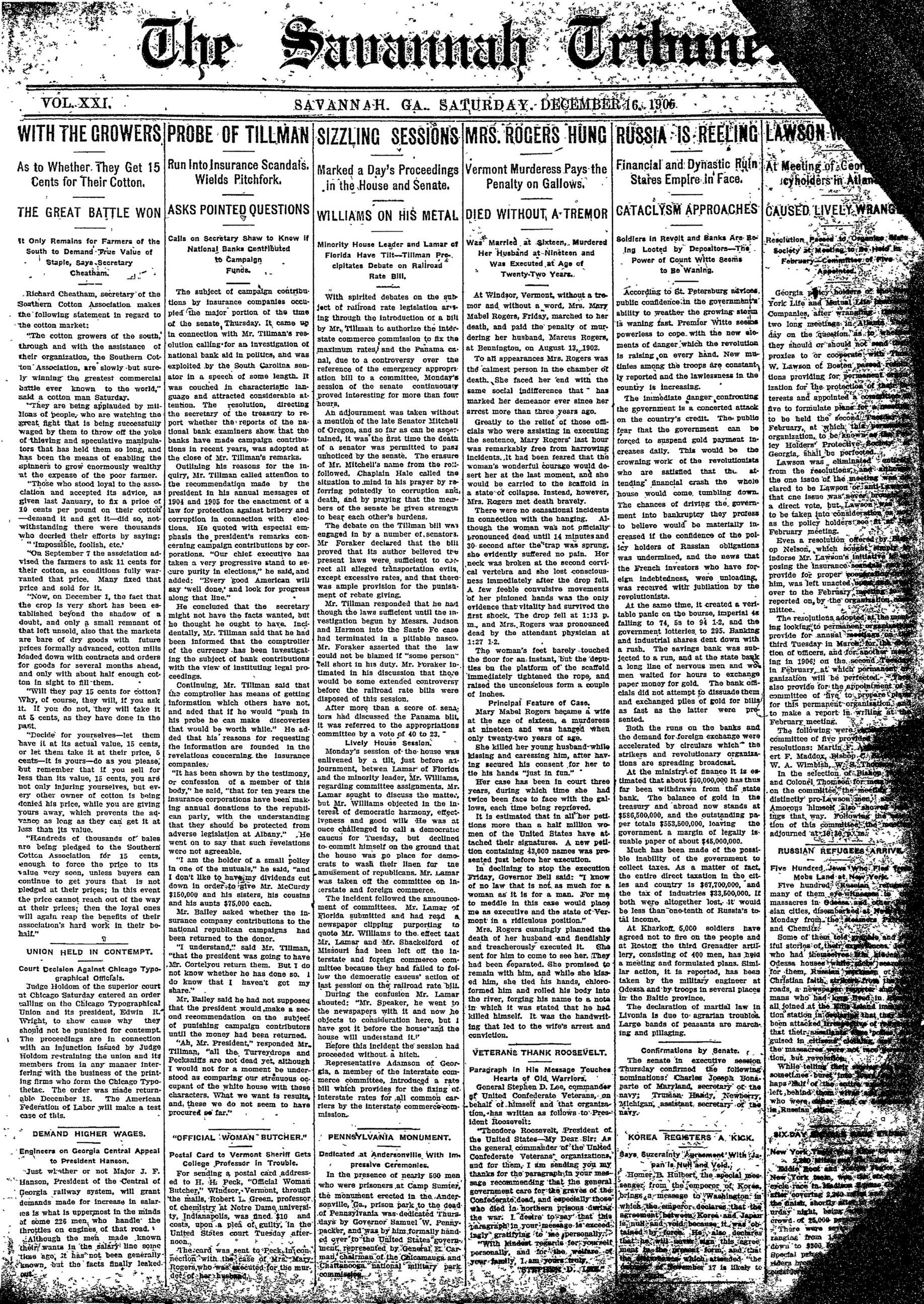
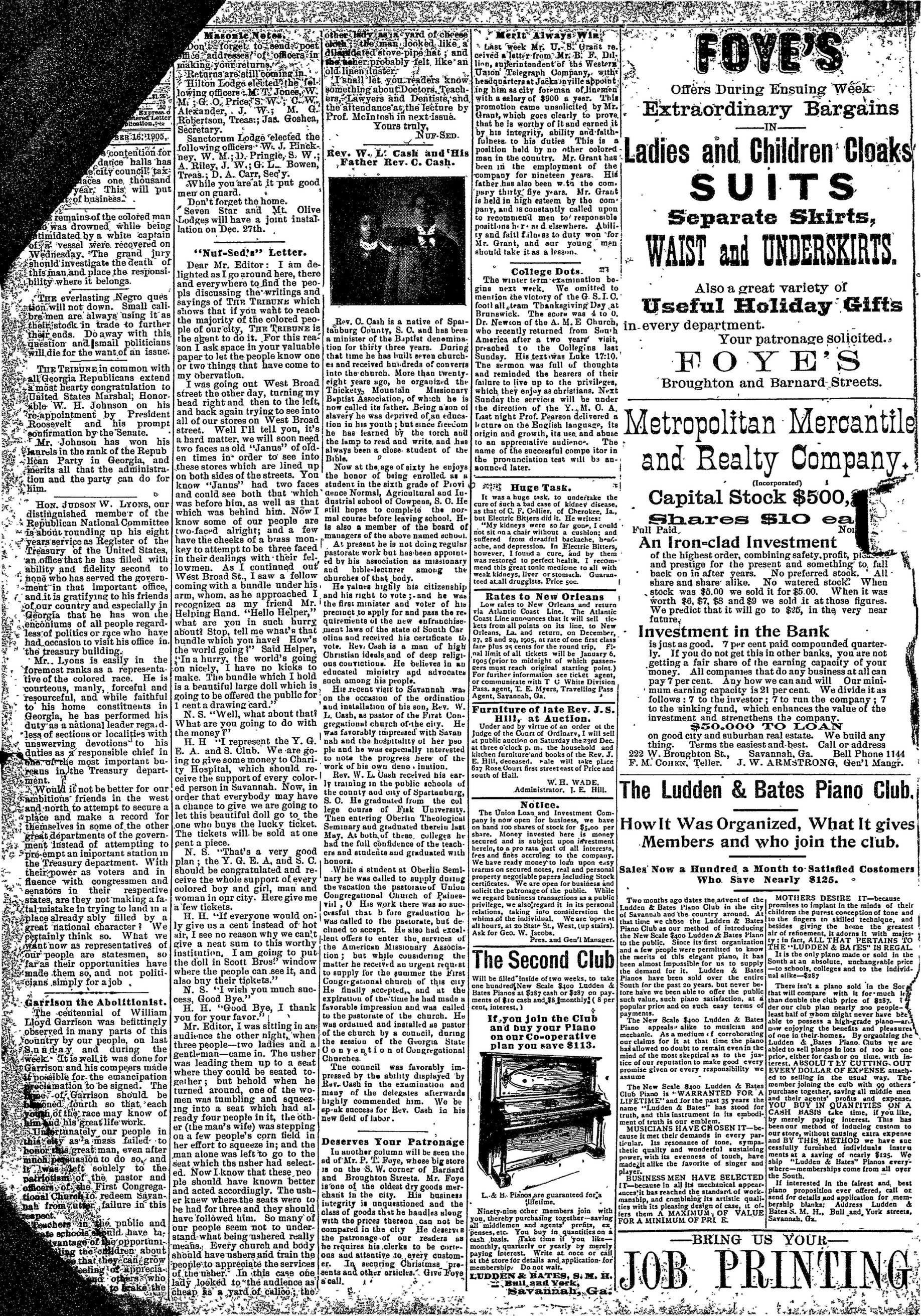
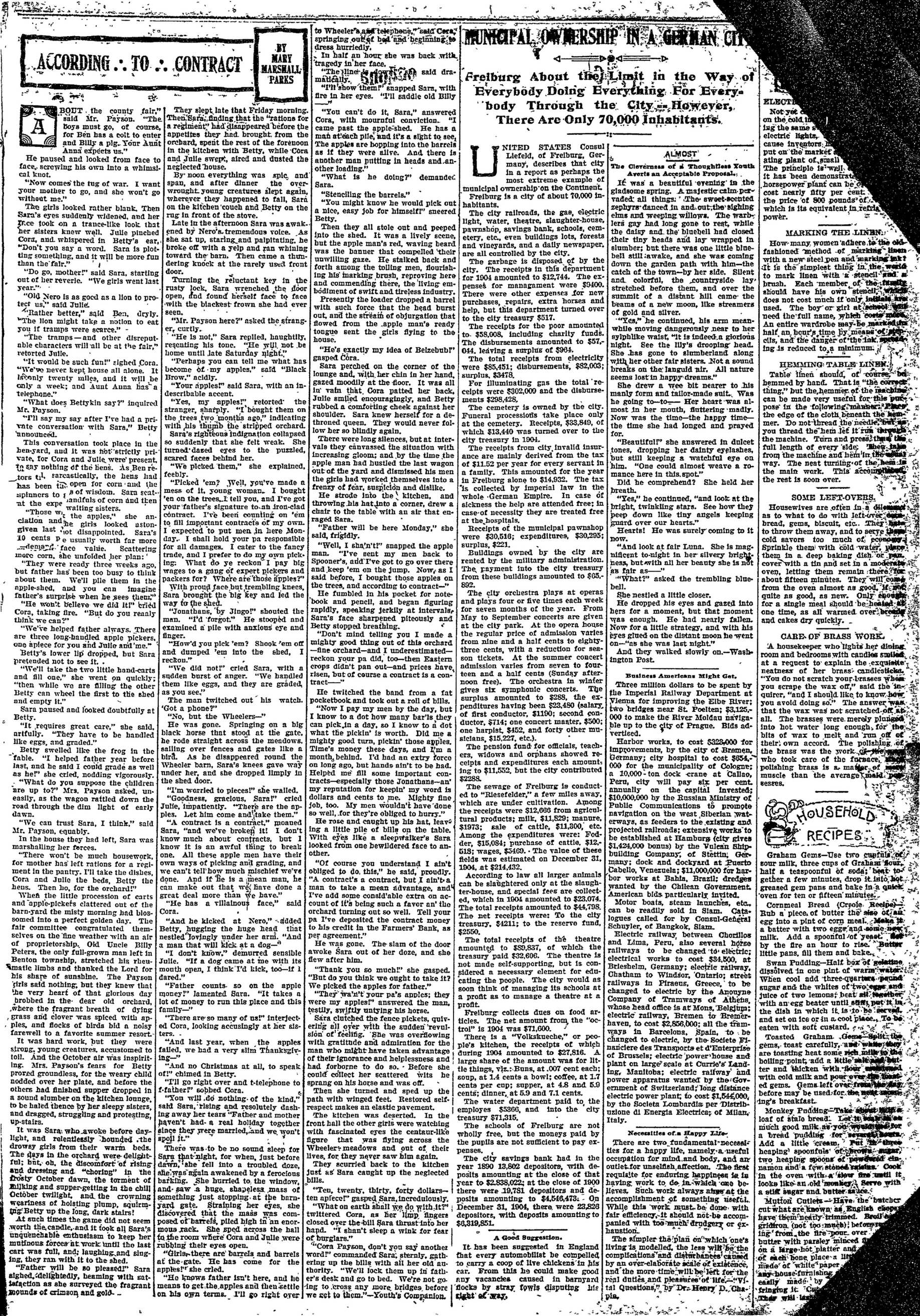
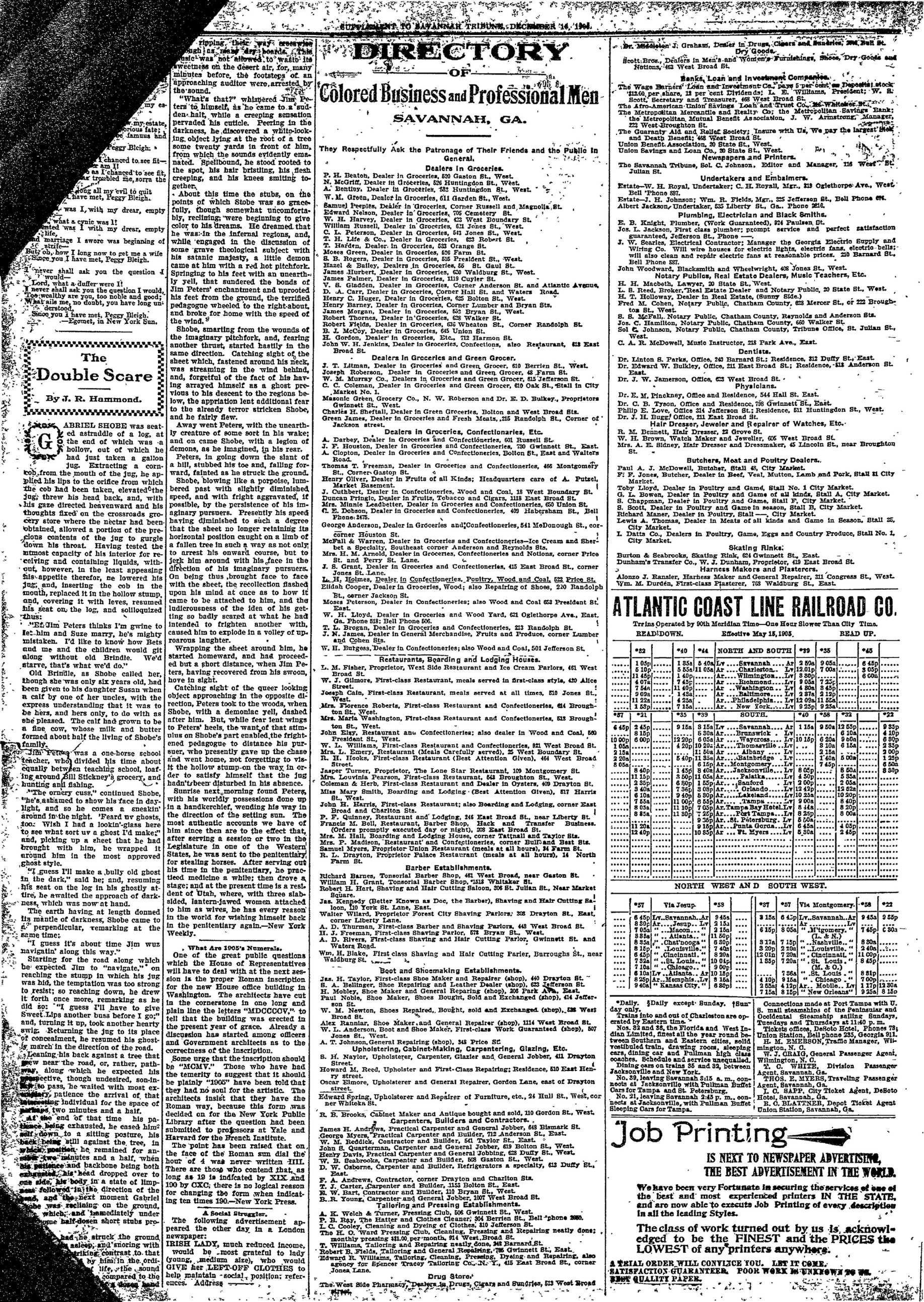
Page text (machine-generated)
As to Whether. They Get 15 Cents for Their Cotton.
It Only Remains for Farmers of the South to Demand-Price Value of Staple, Says,Secretary
Richard Cheatham, secretary of the Southern Cotton Association makes the following statement in regard to the cotton market:
"The cotton growers of the south, through and with the assistance of their organization, the Southern Cotton Association, are slowly but surely winning the greatest commercial battle ever known to the world," said a cotton man Saturday.
"They are being applauded by millions of people, who are watching the great fight that is being successfully waged by them to throw off the yoke of thleving and speculative manipulators that has held them so long, and has been the means of enabling the spinners to grow enormously wealthy at the expense of the poor farmer.
"Those who stood loyal to the association and accepted its advice, as given last January, to fix a price of 10 cents per pound on their cotton—demand it and get it—did so, notwithstanding there were thousands who decried their efforts by saying:
"Impossible, foolish, etc."
"On September 7 the association advised the farmers to ask 11 cents for their cotton, as conditions fully warranted that price. Many fixed that price and sold for it.
"Now, on December 1, the fact that the crop is very short has been established beyond the shadow of a doubt, and only a small remnant of that left unsold, also that the markets are bare of dry goods with future prices formally advanced, cotton mills loaded down with contracts and orders for goods for several months ahead, and only with about half enough cotton in sight to fill them.
"Will they pay 15 cents for cotton? Why, of course, they will, if you ask it. If you do not, they will take it at 5 cents, as they have done in the past."
"Decide for yourselves—let them have it at its actual value, 15 cents, or let them take it at their price, 5 cents—it is yours—do as you please, but remember that if you sell for less than its value, 15 cents, you are not only injuring yourselves, but every other owner of cotton is being denied his price, while you are giving yours away, which prevents the advance as long as they can get it at less than its value.
"Hundreds of thousands of bales are being pledged to the Southern Cotton Association for 15 cents, enough to force the price to its value very soon, unless buyers can continue to get yours that is not pledged at their prices; in this event the price cannot reach out of the way at their prices; then the loyal ones will again reap the benefits of their association's hard work in their behalf."
UNION HELD IN CONTEMPT.
Court Decision Against Chicago Typographical Officials.
Judge Holdom of the superior court at Chicago Saturday entered an order calling on the Chicago Typographical Union and its president, Edwin K. Wright, to show cause why they should not be punished for contempt. The proceedings are in connection with an injunction issued by Judge Holdom restraining the union and its members from in any manner interfering with the business of the printing firms who form the Chicago Typothetac. The order was made returnable December 18. The American Federation of Labor will make a test case of this.
Engineers on Georgia Central Appeal to President Hanson.
Just whether or not Major J. F. Hanson, President of the Central of Georgia railway system, will grant demands made for increase in salaries is what is uppermost in the minds of some 226 men, who handle the throttles on engines of that road.
Although the men made known their wants in the salary line some time ago, it has not been generally known, but the facts finally leaked out.
PROBE OF TILLMAN
Run Into Insurance Scandals. Wields Pitchfork.
ASKS POINTED QUESTIONS
Calls on Secretary Shaw to Know If National Banks Contributed
The subject of campaign contributions by insurance companies occupied the major portion of the time of the senate Thursday. It came up in connection with Mr. Tillman's resolution calling for an investigation of national bank aid in politics, and was exploited by the South Carolina senator in a speech of some length. It was couched in characteristic language and attracted considerable attention. The resolution, directing the secretary of the treasury to report whether the reports of the national bank examiners show that the banks have made campaign contributions in recent years, was adopted at the close of Mr. Tillman's remarks.
Outlining his reasons for the inquiry, Mr. Tillman called attention to the recommendation made by the president in his annual messages of 1904 and 1905 for the enactment of a law for protection against bribery and corruption in connection with elections. He quoted with especial emphasis the president's remarks concerning campaign contributions by corporations. "Our chief executive has taken a very progressive stand to secure purity in elections," he said, and added: "Every good American will say 'well done,' and look for progress along that line."
He concluded that the secretary might not have the facts wanted, but he thought he ought to have. Incidentally, Mr. Tillman said that he had been informed that the comptroller of the currency has been investigating the subject of bank contributions with the view of instituting legal proceedings.
Continuing, Mr. Tillman said that the comptroller has means of getting information which others have not, and added that if he would "push in his probe he can make discoveries that would be worth while." He added that his reasons for requesting the information are founded in the revelations concerning the insurance companies.
"It has been shown by the testimony, or confession of a member of this body," he said, "that for ten years the insurance corporations have been making annual donations to the republican party, with the understanding that they should be protected from adverse legislation at Albany." He went on to say that such revelations were not agreeable.
"I am the holder of a small policy in one of the mutuals," he said, "and I don't like to have my dividends cut down in order to give Mr. McCurdy $150,000 and his sisters, his cousins and his aunts $75,000 each.
Mr. Bailey asked whether the insurance company contributions to the national republican campaigns had been returned to the donor.
"I understand," said Mr. Tillman, "that the president was going to have Mr. Cortelyou return them. But I do not know whether he has done so. I do know that I haven't got my share."
Mr. Bailey said he had not supposed that the president would make a second recommendation on the subject of punishing campaign contributors until the money had been returned.
"Ah, Mr. President," responded Mr. Tillman, "all the Turreydrops and Peanricks are not dead yet, although I would not for a moment be understood as comparing our strenuous occupant of the white house with those characters. What we want is results, and these we do not seem to have procured so far."
"OFFICIAL WOMAN BUTCHER."
Postal Card to Vermont Sheriff Gets College Professor in trouble. For sending a postal card addressed to H. H. Peck, "Official Woman Butcher," Windor, Vermont, through the mails, Robert L. Green, professor of chemistry at Notre Dame, university, Indianapolis, was wined $10 and costs, upon a plea of guilty, in the United States court Tuesday afternoon. The card was sent to Peck in connection with the case of Mrs. Mary Rogers, who was executed for the murder of her husband.
Marked a Day's Proceedings in the House and Senate.
WILLIAMS ON HIS METAL
Minority House Leader and Lamar of Florida Have Tilt—Tillman Precipitates Debate on Railroad Rate Bill.
With spirited debates on the subject of railroad rate legislation arising through the introduction of a bill by Mr. Tillman to authorize the interstate commerce commission to fix the maximum rates, and the Panama canal, due to a controversy over the reference of the emergency appropriation bill to a committee, Monday's session of the senate continuously proved interesting for more than four hours.
An adjournment was taken without a mention of the late Senator Mitchell of Oregon, and so far as can be ascertained, it was the first time the death of a senator was permitted to pass unnoticed by the senate. The erasure of Mr. Mitchell's name from the rollfollowed, Chaplain Hale called the situation to mind in his prayer by referring pointedly to corruption and death, and by praying that the members of the senate be given strength to bear each other's burdens. The debate on the Tillman bill was engaged in by a number of senators. Mr. Foraker declared that the bill proved that its author believed the present laws were, sufficient to correct all alleged transportation evils, except excessive rates, and that there was ample provision for the punishment of rebate giving.
Mr. Tillman responded that he had though the laws sufficient until the investigation begun by Messrs. Judson and Harmon into the Sante Fe case had terminated in a pitiful nasco. Mr. Foraker asserted that the law could not be blamed if "some person" tell short in his duty. Mr. Foraker intimated in his discussion that those would be some extended controversy before the railroad rate bills were disposed of this session.
After more than a score of senators had discussed the Panama bill, it was referred to the appropriations committee by a vote of 40 to 23.
Monday's session of the house was enlivened by a tilt, just before adjournment, between Lamar of Florida and the minority leader, Mr. Williams, regarding committee assignments, Mr. Lamar spought to discuss the matter, but Mr. Williams objected in the interest of democratic harmony, effectiveness and good will. He was at once challenged to call a democratic caucus for Tuesday, but declined to commit himself on the ground that the house was no place for democrats to wash their linen for the amusement of republicans. Mr. Lamar was taken off the committee on in-state and foreign commerce.
The incident followed the announcement of committees. Mr. Lamar of Florida submitted and had read a newspaper clipping purporting to quote Mr. Williams to the effect that Mr. Lamar and Mr. Shackelford of Missouri had been left off the interstate and foreign commerce committee because they had failed to follow the democratic caucus' action of last session on the railroad rate bill. During the confusion Mr. Lamar shouted: "Mr. Speaker, he went to the newspapers with it and now he objects to consideration here, but I have got it before the house' and the house will understand it." Before this incident the session had proceeded without a hitch.
Representative Adamson of Georgia, a member of the interstate commerce committee, introduced a rate bill which provides for the fixing of interstate rates for all common carriers by the interstate commerce commission.
Dedicated at Andersonville With Impressive Ceremonies.
In the presence of nearly 500 men who were prisoners at Camp Sumter, the monument erected in the Andersonville, Ga., prison park to the dead of Pennsylvania was dedicated Thursdays by Governor Samuel W. Pennypacker, and was by him formally handed over to the United States government, represented by General Ex Carman, chairman of the Calcimanga and Chattanooga national military park commission.
MRS. ROGERS HUNG
Vermont Murderess Pays the Penalty on Gallows.
DIED WITHOUT A-TREMOR
At Windsor, Vermont, without a tremor and without a word, Mrs. Mary Mabel Rogers, Friday, marched to her death, and paid the penalty of murdering her husband, Marcus Rogers, at Bennington, on August 13, 1902.
To all appearances Mrs. Rogers was the calmest person in the chamber of death. She faced her end with the same social indifference that has marked her demeanor ever since her arrest more than three years ago.
Greatly to the relief of those officials who were assisting in executing the sentence, Mary Rogers' last hour was remarkably free from harrowing incidents, it had been feared that the woman's wonderful courage would desert her at the last moment, and she would be carried to the scaffold in a state of collapse. Instead, however, Mrs. Rogers met death bravely.
There were no sensational incidents in connection with the hanging. Although the woman was not officially pronounced dead until 14 minutes and 30 second after the trap was sprung, she evidently suffered no pain. Her neck was broken at the second cervical vertebra and she lost consciousness immediately after the drop fell. A few feeble convulsive movements of her plioned hands was the only evidence that vitality had survived the first shock. The drop fell at 1:13 p.m. and Mrs. Rogers was pronounced dead by the attendant physician at 1:27 1:2.
The woman's feet barely touched the floor for an instant, but the deputies on the platform of the scaffold immediately tightened the rope, and raised the unconscious form a couple of inches.
Principal Feature of Case.
Mary Mabel Rogers became a wife at the age of sixteen, a murderess at nineteen and was hanged when only twenty-two years of age.
She killed her young husband-while kissing and caressing him, after having secured his consent for her to tie his hands "just in fun."
Her case has been in court three years, during which time she had twice been face to face with the gallows, each time being reprimored.
It is estimated that in all her petitions more than a half million women of the United States have attached their signatures. A new petition containing 43,000 names was presented just before her execution.
In declining to stop the execution Friday, Governor Bell said: "I know of no law that is not, as much for a woman as it is for a man. For me to meddle in this case would place me as executive and the state of Vermont in a ridiculous position."
Mrs. Rogers cunningly planned the death of her husband and fondly and treacherously executed it. She sent for him to come to see her. They had been separated. She promised to remain with him, and while she kissed him, she tied his hands, chloroformed him and rolled his body into the river, forging his name to a note in which it was stated that he had killed himself. It was the handwriting that led to the wife's arrest and conviction.
VETERANE THANK ROOSEVELT.
Paragraph In His Message Touches
Hearts of Old Workmen
Hearts of Old Warriors.
General Stephen D. Lee, commander of United Confederate Veterans, on behalf of himself and that organization, has written as follows to President Roosevelt:
"Theodore Roosevelt, President of the United States—My Dear Sir: As the general commander of the United Confederate Veterans' organizations, and for them, I am sending you my thanks for the paragraph in your message recommending that the general government care for the graves of the Confederate dead, and especially those who died in northern prisons during the war. I desire to say that this paragraph in your message is exceedingly gratifying to me personally.
"With kindest regards for yourself personally, and for the welfare of your family, I am your truly.
"STEPHEN D. LEE"
Financial and Dynastic Ruin Stares Empire in Face.
Soldiers in Revolt and Banks Are Be-ing Looted by Depositors—The Power of Count White Seems
According to St. Petersburg advises public confidence in the government's ability to weather the growing storm is waning fast. Premier Witte seems powerless to cope with the new elements of danger which the revolution is raising on every hand. New mutinies among the troops are constantly reported and the lawlessness in the country is increasing.
The immediate danger confronting the government is a concerted attack on the country's credit. The public fear that the government can be forced to suspend payment increases daily. This would be the crowning work of the revolutionists who are satisfied that the attending financial crash the whole house would come, tumbling down. The chances of driving the government into bankruptcy they protest to believe would be materially increased if the confidence of the policy holders of Russian obligations was undermined, and the news that the French investors who have foreign indebtedness, were unloading, was recovered with jubilation by the revolutionists.
At the same time, it created a vertable panic on the bourse, imperial 4s falling to 74, 5s to 94 1/2, and the government lotteries to 295. Banking and industrial shares dent down with a rush. The savings bank was subjected to a run, and at the state bank a long line of nervous men and women waited for hours to exchange paper money for gold. The bank officials did not attempt to dissuade them and exchanged piles of gold for bills as fast as the latter were presented. Both the runs on the banks and the demand for foreign exchange were accelerated by circulars which the strikers and revolutionary organizations are spreading broadcast.
At the ministry of finance it is estimated that about $50,000,000 has thus far been withdrawn from the state bank. The balance of gold in the treasury and abroad now stands at $586,500,000, and the outstanding paper totals $553,500,000, leaving the government a margin of legally issuable paper of about $45,000,000. Much has been made of the possible inability of the government to collect taxes. As a matter of fact, the entire direct taxation in the cities and country is $67,700,000, and the tax of industries $33,500,000. If both were altogether lost, it would be less than one-tenth of Russia's total income.
At Kharkoff, 5,000 soldiers have agreed not to fire on the people and at Boston the third Grenadier artillery, consisting of 400 men, has held a meeting and formulated plans. Similar action, it is reported, has been taken by the military engineer at Odessa and by troops in several places in the Baltic province. The declaration of martial law in Livonia is due to agrarian troubles. Large bands of peasants are marching and pillaging.
Confirmations by Senate.
The senate in executive session
Thursday confirmed the following
nominations: Charles Joseph Bonaparte of Maryland, secretary of the
navy; Truman Hoady, Newberry,
Michigan, assistant secretary of the
navy.
KOREA REGISTERS A KICK.
pan is Null and Void,
Homer B. Hubert, the special messenger from the emperor of Korea,
brings a message to Washington in which the emperor declares that the agreement between Korea and Japan is null and void because it was obtained by force. He, also declares that he will never sign this agreement in the present form, and that the agreement which attended the departure of November 17 is likely to be rejected.
Georgia policy bodies of the New York Life and Mutual Life insurance Companies, after wrangling through two long meetings in Atlanta, today on the question as to whether they should or should not send their proxies to or cooperate with Thomas W. Lawson of Boston passed regulations providing for permanent organization for the protection of their interests and appointed a committee active to formulate plans for a meeting to be held the second Tuesday in February, at which this permanent organization, to be known as the Policy Holders' Protective Society of Georgia, shall be perfected.
Lawson was eliminated almost from the resolutions, and although the one issue of the meeting was clarified to be Lawson or and Lawson that one issue was never proceeding a direct vote, but Lawson was able to be taken into consideration so as the policy holders see fit at the February meeting. Even a resolution offered by Blake op Nelson, which sought simply to indorse Mr. Lawson's initiative in posing the insurance schedule and provide for proper cooperation with him, was left unacted upon the move over to the February meeting being reported on, by the organization, member.
The resolutions adopted at the meeting looking to permanent organization provide for annual meetings in the third Tuesday in March, for the election of officers, and for another meeting in 1906; on the second Tuesday in February at which permanent organization will be perfected. They also provide for the appointment of a committee of five to prepare plans for this permanent organization, and to make a report in writing at the February meeting.
The following were submitted to committee of five provided resolutions: Martin F. A.伯特 F. Maddox, Bishop G. K. W. A. Wimbish, W. S. Theunissen
In the selection of Bishop
and Colonel Thomson for men
on the committee, the meecing
distinctly pro-Lawson men, and
Amorous himself also showed
ings that way. Following the selection
of this committee, the meecing
adjourned at 10:30 p.m.
MOOD LAND at NEW YORK.
Five hundred, Russian refugees, many of them eye witnesses in the massacres in Odessa, and other eastern cities, dismembered at New York Monday from the Steamers Ferry and Chemix.
Some of them told grievous and infilful stories of their experiences, those who had themselves like hiders in Odessa houses white mobs seized for them, Russian warmen of the Christian faith, stricken from their roads, a newspaper reporter and a man who had long lived in Odessa, all joined at the Ellis Island immigration station in invoking that they had been attacked irrespectively of religion that their assaults drew police gulsed in citizens' clothing, and that the massacres were not made perpetration, but revolution.
While telling their master, they sometimes burst into tears, then haps that of the entire army, then left, behind them, writes and answers who were either dead or dead in Russia alone.
2,200 men and women
Biddle Root and Jordan
New York team, won the
cycle race in Madison
after covering 2,200 miles
the dawn, shortly after the
urday night, bearing a
crowd of 25,000 per
There were squares
ranging from 1,600
down to $200.00
Special prize
siders brought
---
his contention for dance halls has made city council tax increases one thousand per year. This will put out of business.
It remains of the colored man who was drowned, while being intimidated by a white captain of a vessel were recovered on Wednesday. The grand jury should investigate the death of this man and place the responsibility where it belongs.
The everlasting Negro question will not down. Small calibre men are always using it as their stock in trade to further their ends. Do away with this question and small politicians will die for the want of an issue.
THE TRIBUNE in common with all Georgia Republicans extend a most hearty congratulation to United States Marshal; Honorable W. H. Johnson on his reappointment by President Roosevelt and his prompt confirmation by the Senate. Mr. Johnson has won his laurels in the rank of the Republican Party in Georgia, and merits all that the administration and the party can do for him.
HON. JUDSON W. LYONS, our distinguished member of the Republican National Committee is about rounding up his eight years service as Register of the Treasury of the United States, an office that he has filled with ability and fidelity second to none who has served the government in that important office, and it is gratifying to his friends of our country and especially in Georgia that he has won the enconiums of all people regardless of politics or race who have had occasion to visit his office in the treasury building.
Mr. Lyons is easily in the foremost ranks as a representative of the colored race. He is courteous, manly, forceful and resourceful, and while faithful to his home constituents in Georgia, he has performed his duty as a national leader rega- dless of sections or localities with unswerving devotions to his duties as a responsible chief in one of the most important bu- rsees in the Treasury department.
Would it not be better for our ambitions friends in the west and north to attempt to secure a place and make a record for themselves in some of the other great departments of the government instead of attempting to preempt an important station in the Treasury department. With their power as voters and in fluence with congressmen and senators in their respective states, are they not making a fatal mistake in trying to land in a place already ably filled by a great national character? We certainly think so. What we want now as representatives of our people are statesmen, so far as their opportunities have made them so, and not politicians simply for a job.
Garrison the Abolitionist. The centennial of William Lloyd Garrison was befittingly observed in many parts of this country by our people, on last Sunday, and during the week. It is well it was done for Garrison and his compeers made it possible for the emancipation proclamation to be signed. The time of Garrison should be honored, fourth so that, each youth of the race may know of him and his great life work.
Unfortunately our people in this city as a mass failed to honor the great man, even after much persuasion to do so, and it was left souliey to the patriotism of the pastor and officers of the First Congregational Church to redeem Savannah from utter failure in this respect.
Of teachers in the public and private schools should have advantage of the opportuni- tizing the children about the things that they can grow and feel of appreciation and others, who must be able to break the
Masonic Notes.
Don't forget, to send, post office, addresses of, officers in making your returns.
Returns are still coming in.
Hilton Lodge elected, the following officers. M. T. Jones, W. M.; G. O. Price, S. W.; C. W. Alexander, J. W.; M. G. Robertson, Treas.; Jaa. Goshea, Secretary.
Sanctorum Lodge elected the following officers: W. J. Pinckney, W. M.; D. Pringle, S. W.; A. Riley, J. W.; G. L. Bowen, Treas.; D. A. Carr, Sec'y.
While you are at it put good men on guard. Don't forget the home. Seven Star and Mt. Olive Lodges will have a joint installation on Dec. 27th.
"Nuf-Sed's" Letter.
Dear Mr. Editor: I am delighted as I go around here, there and everywhere to find the people discussing the writings and sayings of THE TRIBUNE which shows that if you want to reach the majority of the colored people of our city, THE TRIBUNE is the agent to do it. For this reason I ask space in your valuable paper to let the people know one or two things that have come to my observation.
I was going out West Broad street the other day, turning my head right and then to the left, and back again trying to see into all of our stores on West Broad street. Well I'll tell you, it's a hard matter, we will soon need two faces as old "Janus" of olden times in order to see into these stores which are lined up on both sides of the streets. You know "Janus" had two faces and could see both that which was before him, as well as that which was behind him. Now I know some of our people are two-faced alright; and a few have the cheeks of a brass monkey to attempt to be three faced in their dealings with their fellowmen. As I continued out West Broad St., I saw a fellow coming with a bundle under his arm, whom, as he approached I recognized as my friend Mr. Helping Hand. "Hello Helper," what are you in such hurry about? Stop, tell me what's that bundle which you have? How's the world going?" Said Helper, "In a hurry, the world's going on nicely, I have no kicks to make. The bundle which I hold is a beautiful large doll which is going to be offered the public for 1 cent a drawing card."
N. S. "Well, what about that? What are you going to do with the money?"
H. H "I represent the Y. G. E. A. and S. Club. We are going to give some money to Charity Hospital, which should receive the support of every colored person in Savannah. Now, in order that everybody may have a chance to give we are going to let this beautiful doll go to the one who buys the lucky ticket. The tickets will be sold at one cent a piece.
N. S. "That's a very good plan; the Y. G. E. A, and S. C. should be congratulated and receive the whole support of every colored boy and girl, man and woman in our city. Here give me a few tickets.
H. H. "If everyone would only give us a cent instead of hot air, I see no reason why we can't give a neat sum to this worthy institution, I am going to put the doll in Scott Bros." window where the people can see it, and also buy their tickets."
N. S. "I wish you much success, Good Bye."
H. H. "Good Bye, I thank you for your favor."
Mr. Editor, I was sitting in an audience the other night, when three people—two ladies and a gentleman—came in. The usher was leading them up to a seat where they could be seated together; but behold when he turned around, one of the women was tumbling and squeezing into a seat which had already four people in it, the other (the man's wife) was stepping on a few people's corn field in her effort to squeeze in; and the man alone was left to go to the seat which this usher had selected. Now I know that these people should have known better and acted accordingly. The usher knew where the seats were to be had for three and they should have followed him. So many of our people seem not to understand what being ushered really means. Every church and body should have ushers and train the people to appreciate the services of the usher. In this case one lady looked to the audience as cheap as a yard of calico; the
other lady as a yard of cheese
orchid; the man looked, like
a dilated stove-pipe hat; and
the sheer probably felt, like an
old linen turtle.
I shall let you readers know something about Doctors, Teachers, Lawyers and Dentists, and the attendance at the lecture by Prof. McIntosh in next issue.
Rev. W. L. Cash and His Father Rev. C. Cash.
Rev. C. Cash is a native of Spartanburg County, S. C. and has been a minister of the Baptist denomination for thirty three years. During that time he has built seven churches and received hundreds of converts into the church. More than twenty-eight years ago, he organized the Thickety Mountain Missionary Baptist Association, of which he is now called its father. Being a son of slavery he was deprived of an education in his youth; but since freedom he has learned by the torch and the lamp to read and write, and has always been a close student of the Bible.
Now at the age of sixty he enjoys the honor of being enrolled as a student in the sixth grade of Providence Normal, Agricultural and Industrial school of Cowpens, S. C. He still hopes to complete the normal course before leaving school. He is also a member of the board of managers of the above named school. At present he is not doing regular pastorate work but has been appointed by his association as missionary and bible-lecturer among the churches of that body.
He values highly his citizenship and his right to vote; and he was the first minister and voter of his precinct to apply for and pass the requirements of the new enfranchisement laws of the state of South Carolina and received his certificate to vote. Rev. Cash is a man of high Christian ideals and of deep religious convictions. He believes in an educated ministry and advocates such among his people.
His recent visit to Savannah was on the occasion of the ordination and installation of his son, Rev. W. L. Cash, as pastor of the First Congregational church of the city. He was favorably impressed with Savannah and the hospitality of her people and he was especially interested to note the progress here of the work of his own deno- ination.
Rev. W. L. Cash received his early training in the public schools of the county and city of Spartanburg, S. O. He graduated from the college course of Fisk University. Then entering Oberlin Theological Seminary and graduated therein last May. At both of these, colleges he had the full confidence of the teachers and students and graduated with honors.
While a student at Oberlin Seminary he was called to supply during the vacation the pastorate of Union Congregational Church of Painesville, O. His work there was so successful that bore graduation he was called to the pastorate, but declined to accept. He also had excellent offers to enter the services of the American Missionary Association; but while considering the matter he received an urgent request to supply for the summer the First Congregational church of this city. He finally accepted, and at the expiration of the time he had made a favorable impression and was called to the pastorate of the church. He was ordained and installed as pastor of the church by a council, during the session of the Georgia State Convention of Congregational Churches.
The council was favorably impressed by the ability displayed by Rev. Cash in the examination and many of the delegates afterwards highly commended him. We be spak success for Rev. Cash in his new field of labor.
Deserves Your Patronage
Deserves Your Patronage
In another column will be seen the ad of Mr. P. T. Foye, whose big store is on the S. W. corner of Barnard and Broughton Streets. Mr. Foye is one of the oldest dry goods merchant in the city. His business integrity is unquestioned and the class of goods that he handles along with the prices therion can not be compared in the city. He deserves the patronage of our readers as he requires his clerks to be courteous and attentive to every customer. In securing Christmas presents and other articles. Give Foye a call.
Merit Always Why
Last week Mr. U. S. Grant re-
ceived a letter from Mr. B. F. Dillion, superintendent of the Western Union Telegraph Company, with headquarters at Jacksville appointing him as city foreman of linemen with a salary of $900 a year. This promotion came unsolicited by Mr. Grant, which goes clearly to prove that he is worthy of it and earned it by his integrity, ability and faithfulness. to his duties. This is a position held by no other colored man in the country. Mr. Grant has been in the employment of the company for nineteen years. His father has also been with the company thirty-five years. Mr. Grant is held in high esteem by the company, and is constantly called upon to recommend men to responsible positions here and elsewhere. Ability and faithfulness to duty won for Mr. Grant, and our young men should take it as a lesson.
College Dots
College Dots.
The winter term examination begins next week. We omitted to mention the victory of the G. S. I. O. football team Thanksgiving Day at Brunswick. The score was 4 to 0. Dr. Newton of the A. M. E. Church, who recently returned from South America after a two years' visit, preached to the Collegians last Sunday. His text was Luke 17:10. The sermon was full of thoughts and reminded the hearers of their failure to live up to the privileges, which they enjoy as Christians. Next Sunday the services will be under the direction of the Y. M. O. A. Last night Prof. Pearson delivered a lecture on the English language, its origin and growth, its use and abuse to an appreciative audience. The name of the successful compeitor in the pronunciation test will be announced later.
Huge Task.
It was a huge task, to undertake the cure of such a bad case of kidney disease, as that of C. F. Collier, O. Cherokee, Ia., but Electric Bitters did it. He writes:
"My kidneys were so far gone, I could not sit on a chair without a cushion; and suffered from dreadful backache, headache, and depression. In Electric Bitters, however, I found a cure, and by them was restored to perfect health. I recommend this great tonic medicine to all with weak kidneys, liver or stomach. Guaranteed at all druggists. Price so."
Rates to New Orleans
Low rates to New Orleans and return via Atlantic Coast Line. The Atlantic Coast Line announces that it will sell tickets from all points on its line, to New Orleans, La. and return, on December, 27, 28 and 29, 1995, at rate of one first class fare plus 25 cents for the round trip. Final limit of all tickets will be January 6, 1995 (prior to midnight of which passengers must reach original starting point.) For further information see ticket agent, or communicate with T C White Division Pass. agent, T. E. Myers, Travelling Pass Agent, Sayannah, Ga.
Furniture of late Rev. J. S.
Hill. at Auction.
Under and by virtue of an order of the Judge of the Court of Ordinary, I will sell at public auction on Saturday the 23rd Dec. at three o'clock p. m. the household and kitchen furniture and books of the Rev. J. E. Hill, deceased.ale will take place 627 Rose Court first street east of Price and south of Hall. W.H. WADE, Administrator, J. E. Hill.
Notice.
The Union Loan and Investment Company is now open for business, we have on hand 100 shares of stock for $5.00 per share. Money invested here is money secured and is subject upon investment herein, to a pro rata part of all interests, fees and fines accruing to the company. We have ready money to loan upon easy teames on secured notes, real and personal property negotiable papers including Stock certificates. We are open for business and solicit the patronage of the public. While we regard business transactions as a public privilege, we also regard it in its personal relations, taking into consideration the whims of the individual. We are 'open at all hours, at 20 state St., West, (up stairs). Ask for Geo. W. Jacobs.
Pres. and Gen'l Manager.
The Second Club
The Second Club
Will be filled "inside of two weeks, to take one hundred New Scale $100 Ludden & Bates Pianos at $287 cash or $287 on payments of $ to cash and $8 monthly" (8 per cent, interest,)
If you join the Club and buy your Piano on our Co-operative plan you save $113.
PRINCETON
FOR AMERICA
L. & H. Pianos are guaranteed for a lifetime.
Ninety-nine other members join with you, thereby purchasing together—saving all middlemen and agents' profits, expenses, etc. You buy in quantities on a cash basis. Take time if you like—monthly, quarterly or yearly by merely paying interest. Write at once or call at the store for details and application for membership. Do not wait.
LUDDEN & BATES, S. M. H.
UDDEN & BATES, S. M. H.
Ball, and York.
Offers During Ensuing Week Extraordinary Bargains
Ladies and Children Cloaks SUITS Separate Skirts, WAIST and UNDERSKIRTS.
Also a great variety of Useful Holiday Gifts in every department. Your patronage solicited. FOYE'S Broughton and Barnard Streets.
Metropolitan Mercantile and Realty Company.
Shares $10 ea Full Paid. Nor An Iron-clad Investment of the highest order, combining safety, profit, pleasure and prestige for the present and something to fall back on in after years. No preferred stock. All share and share alike. No watered stock. When stock was $5.00 we sold it for $5.00. When it was worth $6, $7, $8 and $9 we sold it at those figures. We predict that it will go to $25, in the very near future.
Investment in the Bank
is just as good. 7 per cent paid compounded quarterly. If you do not get this in other banks, you are not getting a fair share of the earning capacity of your money. All companies that do any business at all can pay 7 per cent. Any how we can and will Our minimum earning capacity is 21 per cent. We divide it as follows: 7 to the investor; 7 to run the company; 7 to the sinking fund, which enhances the value of the investment and strengthens the company.
$50,000 TO LOAN
on good city and suburban real estate. We build any thing. Terms the easiest and best. Call or address
222 W. Broughton St., Savannah, Ga. Bell Phone 1144
F. M. COHEN, Teller. J. W. ARMSTRONG, Gen'l Mangr.
The Ludden & Bates Piano Club.
How It Was Organized, What It gives Members and who join the club.
Sales Now a Hundred a Month to Satisfied Customers Who. Save Nearly $125.
Two months ago dates the advent of the Ludden & Bates Piano Club in the city of Savannah and the country around. At that time we chose the Ludden & Bates Piano Club as our method of introducing the New Scale $400 Ludden & Bates Piano to the public. Since its first organization and a few people were permitted to know the merits of this elegant piano, it has been almost impossible for us to supply the demand for it. Ludden & Bates Pianos have been sold over the entire South for the past 20 years, but never before have we been able to offer the public such value, such piano satisfaction, at a popular price and on such easy terms of payments.
MOTHERS DESIRE IT—because promises to implant in the minds of their children the purest conception of tone and to the fingers to skilled technique, and besides giving the home the greatest air of refinement, it adorns it with majesty: in fact, ALL THAT PERTAINS TO THE "LUDDEN & BATES" IS REGAL. It is the only piano made or sold in the South at an absolute, unchangeable price—to schools, colleges and to the individual alike—$287.
There isn't a piano sold in the South that will compare with it for much less than double the club price of $287. Under our club plan nearly 200 people—least half of whom might never be bles
The New Scale $400 Ludden & Bates Piano appeals alike to musician and mechanic. As a medium of corroborating our claims for it at that time the piano has allowed no doubt to remain even in the mind of the most skeptical as to the justice of our reputation to make good every promise given or every responsibility we assume
The New Scale $400 Ludden & Bates Club Piano is "WARRANTED FOR A LIFETIME" and for the past 55 years the name "Ludden & Bates" has stood for truth, and this instrument in its embodiment of truth is our emblem.
MUSICIANS HAVE CROSEN IT—because it met their demands in every particular. Its resonance of tone, sympathetic quality and wonderful sustaining power, with its evenness of touch, have made it alike the favorite of singer and player.
BUSINESS MEN HAVE SELECTED IT—because in all its mechanical appearances it has reached the standard of workmanship, and combining its artistic qualities with its pleasing design of case, it offers them a MAXIMUM OF VALUE FOR A MINIMUM OF PRIE.
MOTHERS DESIRE IT—because promises to implant in the minds of their children the purest conception of tone and to the fingers to skilled technique, and besides giving the home the greatest air of refinement, it adorns it with majesty: in fact, ALL THAT PERTAINS TO THE "LUDDEN & BATES" IS REGAL. It is the only plano made or sold in the South at an absolute, unchangeable price—to schools, colleges and to the individual alike—$287
There isn't a piano sold in the Song that will compare, with it for much longer than double the club price of $289. Under our club plan nearly 200 people—least half of whom might never have been able to possess a high-grade piano—are now enjoying the benefits and pleasures of one in their-homes. By organizing the Ludden & Bates Piano. Clubs we are able to sell pianos in lots of 100 at one price, either for cash on time, with interest, ABSOLUTely CUTTING OUT EVERY DOLLAR OF EXPENSE attached to selling in the usual way. The member joining the club with 99 others purchase together, saving all middle men and their agents' profits and expense. YOU BUY IN QUANTITIES ON A CASH BASIS take time, if you like, by merely paying interest. This has been our method of inducing custom to our store, without causing extra expense and BY THIS METHOD we have succeessfully furnished individuals instruments at a saving of nearly $125. We ship "Ludden & Hates" Pianos everywhere—memberships come from all over the South.
If interested in the fairest and best plano proposition ever offered, call or send for details and application for membership blanks; Address Ludden & Bates S. M. H. , Bull and York streets, Savannah, Ga.
ACCORDING . . TO . . CONTRACT
BY
MARY
MARSHALL
PARKS
BOUT the county fair," said Mr. Payson. "The boys must go, of course, for Ben has a colt to enter and Billy a plg. Your Aunt
They slept late that Friday morning. Then Sara, finding that the "rations for a regiment," had disappeared before the appetites they had brought, from the orchard, spent the rest of the forenoon
BOUT. the county fair," said Mr. Payson. "The boys must go, of course, for Ben has a colt to enter and Billy a pig. Your Aunt Anna expects us."
He paused and looked from face to face, screwing his own into a whimsical knot.
"Now comes the tug of war. I want your mother to go, and she won't go without me."
The girls looked rather blank. Then Sara's eyes suddenly widened, and her face took on a trance-like look that her sisters knew well. Julie pinched Cora, and whispered in Betty's ear.
"Don't you say a word. Sara is plotting something, and it will be more fun than the fair."
"Do go, mother!" said Sara, starting out of her reverie. "We girls went last year."
"Old Nero is as good as a lion to protect us," said Julie.
"Rather better," said Ben, dryly.
"The lion might take a notion to eat you if tramps were scarce."
"The tramps—and other disreputable characters will all be at the fair," retorted Julie.
"It would be such fun!" sighed Cora.
"We've never kept house all alone. It is only twenty miles, and it will be only a week; and Aunt Anna has a telephone."
"What does Bettyklin say?" inquired Mr. Payson.
"I'll say my say after I've had a private conversation with Sara," Betty announced.
This conversation took place in the hen-yard, and it was not strictly private, for Corn and Julie were present, to say nothing of the liens. As Ben retorts to, sarcastically, the hens had been to open for corn and the spinners to 1 of wisdom. Sara scat-tin the expeats and handfuls of corn and then at
"Those we the apples," she anlation and the girls looked aston-given last not disappointed. Sara's 10 cents We usually worth far more deni-pace face value. Scattering more corn, she unfolded her plan:
"They were ready three weeks ago, but father has been too busy to think about them. We'll pile them in the apple-shed, and you can imagine father's surprise when he sees them":
"He won't believe we did it!" bried Cora, taking fire. "But do you really think we can?"
"We've helped father always. There are three long-handled apple pickers, one aplece for you and Julie and me."
Betty's lower lip dropped, but Sara pretended not to see it.
"We'll take the two little hand-carts and fill one," she went on quickly; "then while we are filling the other Betty can wheel the first to the shed and empty it."
Sara paused and looked doubtfully at Betty. "It requires great care," she sald, artfully. "They have to be handled like eggs, and graded."
"What do you suppose the children are up to?" Mrs. Payson asked, uneasily, as the wagon rattled down the road through the dim light of early dawn.
"We can trust Sara, I think," said Mr. Payson, equably.
In the house they had left, Sara was marshalling her forces.
"There won't be much housework, for mother has left rations for a regiment in the pantry. I'll take the dishes, Cora and Julie the beds, Betty the hens. Then ho, for the orchard!"
When the little procession of carts and apple-pickels clattered out of the barn-yard the misty morning had blossomed into a perfect golden day. The fair committee congratulated themselves on the fine weather with an air of proprietorship. Old Uncle Billy Peters, the only full-grown man left in Benton township, stretched his rheu-
his share of sunshine. The Payson girls said nothing, but they knew that the very heart of that glorious day probed in the dear old orchard, where the fragrant breath of dying grass and clover was spiced with apples, and flocks of birds bid a noisy farewell to a favorite summer resort. It was hard work, but they were strong, young creatures, accustomed to toll. And the October air was inspiriting. Mrs. Payson's fears for Betty proored groundless, for the weary child nodded over her plate, and before the others had finished supper dropped in a sound slumber on the kitchen lounge, to be haled thence by her sleepy sisters, and dragged, struggling and protesting, up-stairs.
It was Sara, who awoke before daylight, and relentlessly hounded, the drowsy girls from their warm beds. The days in the orchard were delightful; but, but, oh, the discomfort of rising and dressing and "choring" in the frosty October dawn, the torment of milking and supper-getting in the chill October twilight, and the crowning weariness of holsting plump, squirming Betty up the long, dark stairs! At such times the game did not seem worth the candle, and it took all Sara's unquenchable enthusiasm to keep her mutinious forces at work until the last cart was full, and laughing and singing, they ran with it to the shed.
"Father will be so pleased!" Sara sighed, "delightedly, heaming with satisfaction as she surveyed the fragrant mounds of crimson and gold.
They slept late that Friday morning. Then Sara, finding that the "rations for a regiment" had disappeared before the appetites they had brought, from the orchard, spent the rest of the foreonion in the kitchen with Betty, while Cora and Julie swept, aired and dusted the neglected house.
By noon everything was sple, and span, and after dinner the overwrought young creatures slept again, wherever they happened to fall, Sara on the kitchen couch and Betty on the rug in front of the stove.
Late in the afternoon Sara was awakened by Nero's tremendous voice. As she sat up, starling and palpitating, he broke off with a yelp and ran whining toward the barn. Then came a thundering knuck at the rarely used front door.
Turning the reluctant key in the rusty lock, Sara wrenched the door open, and found herself face to face with the blackest frown she had ever seen.
"Mr. Payson here?" asked the stranger, curtly.
"He is not," Sara replied, haughtily, resenting his tone. "He will not be home until late Saturday night."
"Perhaps you can tell me what has become of my apples," said "Black Brow," acidly.
"Your apples!" said Sara, with an indescribable accent.
"Yes, my apples!" retorted the stranger, sharply. "I bought them on the trees two months ago," indicating with his thumb the stripped orchard. Sara's righteous indignation collapsed so suddenly that she felt weak. She turned dazed eyes to the puzzled, scared faces behind her.
"We picked them," she explained, feebly.
"Pleked 'em? Well, you've made a mess of it, young woman. I bought 'en on the trees, I tell you, and I've got your father's signature to an iron-clad contract. I've been counting on 'em to fill important contracts of my own. I expected to put men in here Monday. I shall hold your pa responsible for all damages. I cater to the fancy trade, and I prefer to do my own pickling. What do ye reckon I pay big wages to a gang of expert pickers and packers for? Where are those apples?" With proud face but trembling knees, Sara brought the big key and led the way to the shed.
"Jonathans, by Jingo!" shouted the man. "I'd forget." He stooped and examined a pile with anxious eye and finger.
"How'd you pick 'em? Shook 'em off and dumped 'em into the shed, I reckon."
"We did not!" cried Sara, with a sudden burst of anger. "We handled them like eggs, and they are graded, as you see."
The man twitched out his watch. "Got a phone?"
"No, but the Wheelers—"
He was gone. Springing on a big black horse that stood at the gate, he rode straight across the meadows, sailing over fences and gates like a bird. As he disappeared round the Wheeler barn, Sara's knees gave way under her, and she dropped limply in the shed door.
"I'm worried to pieces!" she walled.
"Goodness, gracious, Sara!" cried Julie, impatiently. "There are the apples. Let him come and take them."
"A contract is a contract," moaned Sara, "and we've broken it! I don't know much about contracts, but I know it is an awful thing to break one. All these apple men have their own ways of picking and grading, and we can't tell how much mischief we've done. And if he is a mean man, he can make out that we have done a great deal more than we have."
"He has a villainous face," said Cora.
"And he kicked at Nero," added Betty, hugging the huge head that nestled lovingly under her arm. "And a man that will kick at a dog—"
"I don't know," demurred sensible Julie. "If a dog came at me with its mouth open, I think I'd kick, too—if I dared."
"Father counts—so on the apple money!" lamented Sara. "It takes a lot of money to run this place and this family—"
"There are so many of us!" interjected Cora, looking accusingly at her sisters.
"And last year, when the apples failed, we had a very slim Thanksgiving—"
"And no Christmas at all, to speak of!" chimed in Betty.
"Till go right over and t-telephone to t-father!" sobbed Cora.
"You will do nothing of the kind," said Sara, rising and resolutely dashing away her tears "Father and mother haven't had a real holiday together since they were married, and we won't spoil it."
There was to be no sound sleep for Sara that night, for when, just before dawn, she fell into a troubled doze, she was again awakened by a ferocious barking. She hurried to the window, and saw a huge, shapeless mass of something just stopping, at the barnyard gate. Straining her eyes, she discovered that the mass was composed of barrels, plied high in an enormous rack. She sped across the hall to the room where Cora and Julie were rubbing their eyes open.
"Girls, there are barrels and barrels at the gate. He has come for the apples!" she cried.
"He knows father isn't here, and he means to get the apples and then settle on his own terms. I'll go right over
to Wheeler and telephone, said Cora springing, out of bed and beginning to dress hurriedly.
In half an hour she was back with tragedy in her face.
"The line is down," said dramatically.
"I'll show them!" snapped Sara, with fire in her eyes. "T'll saddle old Billy."
"You can't do it, Sara," answered Cora, with mournful conviction. "I came past the apple-shed. He has a man at each pile, and it's a sight to see. The apples are hopping into the barrels as if they were alive. And there is another man putting in heads and another loading."
"What is he doing?" demanded Sara.
"Stencilling the barrels."
"You might know he would pick out a nice, easy job for himself!" sneered Betty.
Then they all stole out and peeped into the shed. It was a lively scene, but the apple man's red, waving beard was the banner that compelled their unwilling gaze. He stalked back and forth among the tolling men, flourishing his marking brush, reproving here and commending there, the living embodiment of swift and tireless industry. Presently the loader dropped a barrel with such force that the head burst out, and the stream of objurgation that flowed from the apple man's ready tongue sent the girls flying to the house.
"He's exactly my idea of Belzebub!" gasped Cora.
Sara perched on the chin of the lounge and, with her chin in her hand, gazed moodily at the floor. It was all in vain that Cora patted her back, Julie smiled encouragingly, and Betty rubbed a comforting cheek against her shoulder. Sara knew herself for a dethroned queen. They would never follow her so blindly again.
There were long silences, but at intervals they canvassed the situation with increasing gloom; and by the time the apple man had hustled the last wagon out of the yard and dismissed his men the girls had worked themselves into a frenzy of fear, suspicion and dislike.
He strode into the kitchen, and throwing his hat into a corner, drew a chair to the table with an air that enraged Sara.
"Father will be here Monday," she said, frigidly.
"Well, I shan't!" snapped the apple man. "I've sent my men back to Spooner's, and I've got to go over there and keep 'em on the jump. Now, as I said before, I bought those apples on the trees, and according to contract—" He fumbled in his pocket for notebook and penill, and began figuring rapidly, speaking jerkily at intervals, Sarn's face sharpened piteously and Betty stopped breathing. "Don't mind telling you I made a mighty good thing out of this orchard—fine orchard—and I underestimated—reckon your pa did, too-them Eastern crops didn't pan out—and prices have risen, but of course a contract is a contract—"
He twitched the band from a fat pocketbook and took out a roll of bills. "Now I pay my men by the day, but I know to a dot how many bar's they can pick in a day, so I know to a dot what the pickin' is worth. Did me a mighty good turn, pickin' those apples, Time's money these days, and I'm a month, behind. I'd had an entry force on long ago, but hands ain't to be had. Helped me fill some important contracts—especially those Jonathans—an' my reputation for keepin' my word is dollars and cents to me. Mighty fine job, too. My men wouldn't have done so well, for they're obliged to hurry." He rose and caught up his hat, leaving a little pile of bills on the table. With eyes like a sleepwalker's Sara looked from one bewildered face to another.
"Of course you understand I ain't obliged to do this," he said, proudly. "A contract's a contract, but I ain't a man to take a mean advantage, and I've add some considerable extra on account of it's being such a favor an' the orchard turning out so well. Tell your pa I've deposited the contract money to his credit in the Farmers' Bank, as per agreement."
He was gone. The slam of the door awoke Sara out of her doze, and she flew after him.
"Thank you so much!" she gasped. "But do you think we ought to take it? We picked the apples for father."
"They won't your pa's apples; they were my apples!" answered the man, testily swiftly untying his horse.
Sara clutched the fence pickets, quivering all over the sudden revulsion of feeling. She was overdowing with gratitude and admiration for the man who might have taken advantage of their ignorance and helplessness and had forborne to do so. Before she could collect her scattered wits he sprang on his horse and was off.
Then she turned and sped up the path with winged feet. Restored self-respect makes an elastic pavement.
The kitchen was deserted. In the front hall the other girls were watching with fascinated eyes the centaur-like figure that was flying across the Wheeler meadows and out of their lives, for they never saw him again.
They scurried back to the kitchen just as Sara caught up the neglected bills.
"Ten, twenty, thirty, forty dollars—ten apiece!" gasped Sara, incredulously.
"Cora Payson, don't you say another word?" commanded Sara; sternly, gathering up the bills with all her old authority. "We'll lock them up in father's desk and go to bed. We're not going to cross any more bridges before we get to them." -Youth's Companion.
Freiburg About the Limit in the Way of Everybody Doing Everything For Everybody Through the City-Howeyer, There Are Only 70,000 Inhabitants.
UNITED STATES Consult Liefeld, of Frelburg, Germany, describes that city in a report as perhaps the most extreme example of municipal ownership on the Continent. Frelburg is a city of about 70,000 inhabitants. The city railroads, the gas, electric light, water, theatre, slaughter-house, pawnship, savings bank, schools, cemetery, etc, even buildings lots, forests and vineyards, and a daily newspaper, are all controlled by the city. The garbage is disposed of by the city. The receipts in this department for 1004 amounted to $12,744. The expenses for management were $9400. There were other expenses for new purchases, repairs, extra horses and help, but this department turned over to the city treasury $517.
The receipts for the poor amounted to $58,008, including charity funds. The disbursements amounted to $57,044, leaving a surplus of $964. The total receipts from electricity were $85,451; disbursements, $82,003; surplus, $3478. For illuminating gas the total receipts were $302,000 and the disbursements $298,428. The cemetery is owned by the city. Funeral processions take place only at the cemetery. Receipts, $33,849, of which $13,440 was turned over to the city treasury in 1904.
The receipts from city, invalid insurance are mainly derived from the tax of $11.52 per year for every servant in a family. This amounted for the year in Freiburg alone to $14,932. The tax is collected by imperial law in the whole-German Empire. In case of sickness the help are attended free; in case of necessity they are treated free at the hospitals.
Receipts of the municipal pawnshop were $30,516; expenditures, $30,295; surplus, $221.
Buildings owned by the city are rented by the military administration. The payment into the city treasury from these buildings amounted to $05,892.
The city orchestra plays at operas and plays four or five times each week for seven months of the year. From May to September concerts are given at the city park. At the opera house the regular price of admission varies from nine and a half cents to eighty-three cents, with a reduction for season tickets. At the summer concert admission varies from seven to fourteen and a half cents (Sunday afternoon free). The orchestra in winter gives six symphonic concerts. The surplus amounted to $288, the expenditures having been $23,480 (salary, of first conductor, $1190; second conductor, $714; one concert master, $500; one harpist, $152, and forty other musicians, $15,227, etc.). The pension fund for officials, teachers, widows and orphans showed receipts and expenditures each amounting to $11,552, but the city contributed $2288.
The sewage of Freiburg is conducted to "Riesefelder," a few miles away, which are under cultivation. Among the receipts were $12,636 from agricultural products; milk, $11,829; manure, $1973; sale of cattle, $11,300, etc. Among the expenditures were: Fodder, $15,084; purchase of cattle, $12,518; wages, $5460. The value of these fields was estimated on December 31, 1004, at $21,432.
According to law all larger animals can be slaughtered only at the slaughter-house, and special fees are collected, which in 1004 amounted to $23,074. The total receipts amounted to $44,798. The net receipts were: To the city treasury, $4211; to the reserve fund, $2550.
The total receipts of the theatre amounted to $50,837, of which the treasury paid $32,606. The theatre is not made self-supporting, but is considered a necessary element for educating the people. The city would as soon think of managing its schools at a profit as to manage a theatre at a profit. Freiburg collects dues on food articles. The net amount from the "octroi" is 1904 was $71,600. There is a "Volkskneche," or people's kitchen, the receipts of which during 1904 amounted to $27,816. A large share of the amount was for little things, viz.: Buns, at .007 cent each; soup, at 1.4 cents a bowl; coffee, at 1.7 cents per cup; supper, at 4.8 and 5.9 cents; dinner, at 5.9 and 7.1 cents. The water department paid to the employees $3866, and into the city treasury $71,315.
The schools of Freiburg are not wholly free, but the moneys paid by the pupils are not sufficient to pay expenses. The city savings bank had in the year 1890 13,802 depositors, with deposits amounting at the close of that year to $2,838,022; at the close of 1900 there were 19,731 depositors and deposits amounting to $4,546,473. On December 31, 1904, there were 23,826 depositors, with deposits amounting to $8,319,851.
A Good Suggestion.
It has been suggested in England that every automobileist be compelled to carry a coop of live chickens in his car. From this he could make good any vacancies caused in barnyard stocks by stray fowls disputing his right of way.
ALMOST
The Cleverness of a Thoughtless Youth
Averts an Acceptable Proposal.
It was a beautiful evening in the
gladstone spring. A majestic calm pa-
vaded; all things. The sweet-scented
zephyr danced in and out, the slighting
elm and weeping willows. The warb-
lers gay had long gone to rest, while
the dalys and the bluebell had closed
their tiny heads and lay wrapped in
slumber; but there was one little blue
bell still awake, and she was coming
down the garden path with him—the
catch of the town—by her side. Silent
and colorful, the countryside lay
stretched before them, and over the
summit of a distant hill came the
beams of a new moon, like streamers
of gold and silver.
"Yes," he continued, his arm meanwhile moving dangerously near to her sylphlike waist, "it is indeed a glorious night. See the illy's drooping head. She has gone to slumberland along with her other fair sisters. Not a sound breaks on the languid air. All nature seems lost in happy dreams."
She drew a wee bit nearer to his manly form and tailor-made suit. Was he going to—to— Her heart was almost in her mouth, fluttering madly. Now was the time—the happy time—the time she had longed and prayed for.
"Beautiful!" she answered in dulcet tones, dropping her dainty eyelashes, but still keeping a watchful eye on him. "One could almost weave a romance here in this spot."
Did he comprehend? She held her breath.
"Yes," he continued, "and look at the bright, twinkling stars. See how they peep down like tiny angels keeping guard over our hearts."
Hearts! He was surely coming to it now.
"And look at fair Luna. She is magnificent to night in her silvery brightness, but with all her beauty she is not as fair as—"
"What?" asked the trembling bluebell.
She nestled a little closer.
He dropped his eyes and gazed into hers for a moment, but that moment was enough. He had nearly fallen. Now for a little strategy, and with his eyes glued on the distant moon he went on-"as she was last night." And they walked slowly on.-Washington Post.
Business Americans Might Get.
Three million dollars to be spent by the Imperial Railway Department at Vienna for improving the Elbe River; two bridges near St. Poelten; $3,125-000 to make the River Moldau navigable up to the city of Prague. Bids advertised.
Harbor works, to cost $328,000 for improvements, by the city of Bremen, Germany; city hospital to cost $654,000 for the municipality of Cologne; a 10,000-ton dock crane at Callao, Peru, city will pay six per cent annually on the capital invested; $10,000,000 by the Russian Ministry of Public Communications to promote navigation on the west Siberian waterways, as feeders to the existing and projected railroads; extensive works to be established at Hamburg (city gives $1,424,000 bonus) by the Vulean Shipbuilding Company, of Stettin, Germany; dock and dockyard at Puerto Cabello, Veneruela; $11,000,000 for harbor works at Bahla, Brazil; dredges wanted by the Chilean Government. American blds. particularly invited. Motor boats, steam launches, etc. can be readily sold in Slam. Catalogues called for by Consult-Geheral Schuyler, of Bangkok, Slam.
Electric railway, between Chorillos and Lima, Peru, also several horse railways to be changed to electric; electrical works to cost $34,500, at Breshelm, Germany; electric railway, Chatham to Windsor, Ontario; street railways in Piraeus, Greece, to be changed to electric by the Anouyne Company of Tramways of Athenes, whose head office is at Mons, Belgium; electric railway, Bremen to Brémeren, to cost $2,856,000; all the tramways in Barcelona, Spain, to be changed to electric, by the Societe Financiere des Transports et d'Enterprise of Brussels; electric power house and plant on large scale at Currie's Landing, Manitoba; electric railway and power apparatus wanted by the Government of Switzerland; long distance electric power plant; to cost $1,544,000, by the Societa Lombardia per Distribuzione di Energia Electrica; of Milan, Italy.
Necessities of a Happy Life
There are two fundamental necessities for a happy life, namely a useful occupation for mind and body, and an outlet for unselfish affection. The first regulate for enduring happiness is in having work to do in which one believes. Such work always aims at the accomplishment of something useful. While this work must be done with fair efficiency, it should not be accompanied with too much drudgery or exhaustion. The simpler the plan on which one's living is modelled, the less will be the complications and disturbances caused by an over-elaborate scale of existence, and the more time will be left for the real duties and pleasures of life. "Vital Questions," by Dr. Henry D. Cha
Not yet covered on the cold, in ling the same same electric lights, cause inventors, put on the market atating plant of small The principle is well, it has been demonstrate horsepower plant can be cost nearly fifty per cent the price of 800 pounds of which is its equivalent in refrig power.
MARKING THE LINEN:
How many women adhere to the old fashioned method of marking linen with a new steel pen and marking ink! It is the simplest thing in the world to mark linen with a stencil and a brush. Each member of the family should have his own stencil, which does not cost much if only indies are used. The boy or girl at school will need the full name, which costs more. An entire wardrobe may be marked for half an hour's time by means of stencils, and the danger of the ink spreading is reduced to a minimum.
Table linen should, of course, be hemmed by hand. That is "the correct thing," but the hemmer of the machine can be made very useful for this purpose in the following manner. Place the edge of the cloth beneath the hemmer. Do not thread the needle as in you thread the hem let it run through the machine. Turn and press the full length of every side. They take from the machine and hem in the usual way. The neat turning of the hem is the main work. This accomplishes the rest is soon over.
SOME LEFT-OVERS.
Housewives are often in a dilemma as to what to do with left-over bread, gems, biscuit, etc. They have to throw them away, and to seve them cold savors too much of economy. Sprinkle them with cold water, place them in a deep baking dish or pan, cover with a tin and set in a moderate oven, letting them remain there for about fifteen minutes. They will come from the oven almost as good. If not quite as good, as new. Only enough for a single meal should be heated at one time, as all warmed over bread and cakes dry quickly.
CARE OF BRASS WORK
A housekeeper who lights her dining room and bedrooms with candles smiled at a request to explain the exquisite neatness of her brass candlesticks. "You do not scratch your brasses when you scrape the wax off," said the inquirer, "and I should like to know how you avoid doing so." The answer was that the wax was not scratched off at all. The brasses were merely plunged into hot water long enough, for the bits of wax to melt and run off of their own accord. The polishing of the brass was the work of the man who took care of the furnace, most polishing brass is a matter of more muscle than the average maid possesses.
HOUSEHOLD RECIPES
Graham Gems—Use two cupfuls of sour milk, three cups of Graham flour, half a teaspoonful of soda; heat to gether a few minutes, drop it into hot greased gem pans and bake in a quick oven for ten or fifteen minutes.
Cornmeal Bread (Creole Recipe)
Rub a piece, of butter the size of an egg into a pint of corn meal. Make in a batter with two eggs and some new milk. Add a spoonful of yeast. Set by the fire an hour to rise. Butter little pans, fill them and bake.
Swan Pudding-Half box of gelatine dissolved in one pint of warm water. When cool add three-quarters pound sugar and the whites of two eggs and juice of two lemons; heat all together with an egg beater until soft, put it in the dish in which it is to be served, and set on ice or in a cool place. To be eaten with soft custard.
Toasted Graham. Gems-Split the gems, toast carefully, and white they are toasting heat some rich milk to the holling point, add a little salt and butter and ticken with four蘑菇 with cold milk and pour over the finished gems. Gems left over from the may before may be used for the most amusing's breakfast.
Monkey Pudding—Take about half loaf of stale bread. Let it boil in much good milk as you piping it for a bread pudding for sour cream soup. Add a little cream. Put the three heaping' spoonfuls of brown sugar, two heaping spoons of powdered clam, namon and a few stoned raisins. Cook in the oven with a slow fire until it looks like an old monkey. Serve with a stiff sugar and butter sauce.
Mutton Cutlets -- Have the butcher cut what are known as English chops, have them neatly trimmed. Broil them gridron (not too much); before re-ing from the fire pour over butter with parsley minced on a large hot platter and of each bone place a little made of white paper any house-furnishing easily made by fringing it. Cut their will knives.
how my estate,
the morious fate;
the famus and
Peggy Bleigh.
I chanced to see fit—
or am I!
so as I chanced to see fit,
I was troubled me, sorra the
long all my evil to quit
I have met, Peggy Bleigh.
I was I, with my drear, empty
what a cynic was I!
Iented was I with my drear, empty
life,
and marriage I awore was beginning of
strize—
But ob, how I long now to get me a wife
Since, you I have met, Peggy Bleigh.
I never shall ask you the question I
would—
Lord, what a duffer were I!
I never shall ask you the question I would,
Too wealthy are you, too noble and good;
What ails me, no doubt, you have long un-
derstood.
Snoo, you I have met, Peggy Bleigh.
—Egomet, in New York Sun.
G
ABRIEL SHOBE was seated aastraddle of a log, at the end of which was a hollow, out of which he had just taken a gallon jug. Extracting a corn cob from the mouth of the jug, he applied his lips to the orifice from which the cob had been taken, elevated the jug, threw his head back, and, with his gaze directed heavenward and his thoughts fixed on the crossroads grocery store where the nectar had been obtained, allowed a portion of the prelux contents of the jug to gurgle down his throat. Having tested the atmost capacity of his interior for receiving and containing liquids, without, however, in the least appeasing his appetite therefor, he lowered his jug, and, inserting the cob in the mouth, replaced it in the hollow stump, and, covering it with leves, resumed his seat on the log, and soliloquized thus:
"Ell Jim Peters thinks I'm gwine to see him and Suze marry, he's mighty mistaken. I'd like to know how Bets and me and the children would gift along without old Brindle. We'd starve, that's what we'd do." Old Brindle, as Shobe called her, though she was only six years old, had been given to his daughter Susan when a calf by one of her uncles, with the express understanding that it was to be hers, and hers only, to do with as she pleased. The calf had grown to be a fine cow, whose milk and butter formed about half the living of Shobe's family. Jim Peters was a one-horse school teacher, who divided his time about equally between teaching school, loafing around Bill Stickney's grocery, and hunting and fishing.
"The ornery cuss," continued Shobe, "he's ashamed to show his face in daylight, and so he comes a sneakin' around in the night. 'Feard uv ghosts, too. Wish I had a lookin'-glass here to see what sort uv a ghost I'd make," and, picking up a sheet that he had brought with him, he wrapped it around him in the most approved ghost style.
"I guess I'll make a bully old ghost in the dark," said he; and, resuming his seat on the log in his ghostly atire, he awaited the approach of darkness, which was now at hand.
The earth having at length donned its mantle of darkness, Shobe came to a perpendicular, remarking at the same time:
"I guess it's about time Jim wuz navigating' along this way."
Starting for the road along which he expected Jim to "navigate," on reaching the stump in which his jug was hid, the temptation was too strong to resist; so reaching down, he drew it forth once more, remarking as he did so: "I guess I'll have to give Sweet.Lips another buss before I go," and, turning it up, took another hearty swig. Returning the jug to its place of concealment, he resumed his ghostly march in the direction of the road.
Leaning his back against a tree that grew near the road, or, rather, pathway, along which he expected his prospective, though undesired, son-in-law, to pass, he waited with most exertion, patience the arrival of that meeting individual for the space of perhaps two minutes and a half.
At the end of that time his patience being exhausted, he eased him self down to a sitting posture, his back being still against the tree, in which position, he remained for an additional two minutes and a half, when his patience and backbone being both exhausted, his head dropped over to one side, his body in a state of limpness followed in the direction of the head, and the next moment Gabriel who was reclining on the ground, which, and immediately under some half-dosen short stubs pro
had the struck the ground
to asleep, and snoring with
striking contrast to that
by him in the ordi-
life, the sound
compared to the
hand
ripping, their way crossing through us many argy boards. This music was not allowed to waste its sweetness on the desert air, for, many minutes before, the footsteps of an approaching auditor were, arrested by the sound.
"What's that?" whispered Jim Peters to himself, as he came to a sudden halt, while a creeping sensation pervaded his cuticle. Peering in the darkness, he discovered a white-looking object lying at the root of a tree some twenty yards in front of him, from which the sounds evidently emanated. Spellbound, he stood rooted to the spot, his hair bristling, his flesh creeping, and his knees smiling together.
About this time the stubs, on the points of which Stobe was so gracefully, though somewhat uncomfortable, reclining, were beginning to give color to his dreams. He dreamed that he was: In the infernal regions, and, while engaged in the discussion of some grave theological subject with his satanic majesty, a little demon came at him with a red hot pitchfork. Springing to his feet with an unearthly yell, that sundered the bonds of Jim Peters' enchantment and uprooted his feet from the ground, the terrified pedagogue wheeled to the right-about, and broke for home with the speed of the wind.9
Shobe, smarting from the wounds of the imaginary pitchfork, and, fearing another thrust, started hastily in the same direction. Catching sight of the sheet which, fastened around his neck, was streaming in the wind behind, and, forgeful of the fact of his having arrayed himself as a ghost previous to his descent to the regions below, the apperition lent additional fear to the already terror stricken Shobe, and he fairly flew.
Away went Peters, with the unearthly creature of some sort in his wake; and on came Shobe, with a legion of demons, as he imagined, in his rear.
Peters, in going down the slant of a hill, stubbed his toe and, falling forward, fainted as he struck the ground.
Shobe, blowing like a porpoise, lumbered past with slightly diminished speed, and with fright aggravated, if possible, by the persistence of his imaginary pursuers. Presently his speed having diminished to such a degree that the sheet no longer retaining its horizontal position caught on a limb of a fallen tree in such a way as not only to arrest his onward course, but to jerk him around with his face in the direction of his imaginary pursuers. On being thus, brought face to face with the sheet, the recollection flashed upon his mind at once as to how it came to be attached to him, and the ludicrousness of the idea of his getting so badly scared at what he had intended to frighten another with, caused him to explode in a volley of unroarous laughter.
Wrapping the sheet around him, he started homeward, and had proceeded but a short distance, when Jim Peters, having recovered from his swoon, hove in sight.
Catching sight of the queer looking object approaching in the opposite direction, Peters took to the woods, when Shobe, with a demoniac yell, dashed after him. But, while fear lent wings to Peters' heels, the want of that stimulus on Shobe's part enabled, the frightened pedagogue to distance his pursuer, who presently gave up the chase and went home, not forgetting to visit the hollow stump on the way, in order to satisfy himself that the jug hadn't been disturbed in his absence.
Sunrise next, morning found Peters, with his worldly possessions done up in a handkerchief, wending his way in the direction of the setting sun. The most authentic accounts we have of him since then are to the effect that, after serving a session or two in the Legislature in one of the Western States, he was sent to the penitentiary, for stealing horses. After serving out his time in the penitentiary, he practiced medicine a while; then drove a stage; and at the present time is a resident of Utah, where, with three slabsided, lantern-jawed women attached to him as wives, he has every reason in the world for wishing himself back in the penitentiary again—New York Weekly.
What Are 1995's Numerals?
One of the great public questions which the House of Representatives will have to deal with at the next session is the proper Roman inscription for the new House office building in Washington. The architects have cut in the cornerstone in one long and plain line the letters "MDCCCOV," to tell that the building was erected in the present year of grace. Already a discussion has started among officers and Government architects as to the correctness of the inscription. Some urge that the inscription should be "MCMV." Those who have had the temerity to suggest that it should be plainly "1005" have been told that they had no soul for the artistic. The architects insist that they have the Roman way, because this form was decided on for the New York Public Library after the question had been submitted to professors at Yale and Harvard for the French Institute.
The point has been raised that on the face of the Roman sun dial the hour of 4 was never written HIII. There are those who contend that, as long as 19 is indicated by XIX and 100 by CXC; there is no logical reason for changing the form when indicating ten times 190—New York Press.
A Social Strugler
The following advertisement appeared the other day in a London newspaper:
IRISH LADY, much reduced income, would be most grateful to lady (young, medium size), who would GIVE her LEFT-OP CLOTHES to help maintain social position; references. Address
Colored Business and Professional Men
They Respectfully Ask the Patronage of Their Friends and the Public In General.
Dealers In Groceries.
J. Cuthbert, Dealer in Confectioneries, Wood and Coal, 18 West Boundary St. Duncan Fringle, Dealer in Fruits, Tobacco and Cigars, 1183 East Broad St. Mrs. Minnie Leadbetter, Dealer in Groceries and Confectioneries, 650 Union St. G. E. Dobson, Dealer in Groceries and Confectioneries, 409 Habersham St., Bell Phone, 2475. George Anderson, Dealer in Groceries and Confectioneries, 541 McDonough St., corner Houston St.
J. S. Grant, Dealer in Groceries and Confectioneries, 415 East Broad St., corner Jones St. Lane.
Moss Peterson, Dealer in Confectioneries; also Wood and Coal 63 President St. East.
W. H. Butgeas, Dealer in Confectioneries; also Wood and Coal, 501 Jefferson St. Restaurants, Boarding and Lodging Houses.
John Elzy, Restaurant and Confectioneries; also dealer in Wood and Coal, 600 President St., West.
John H. Harris, First-class Restaurant; also Boarding and Lodging, corner East Broad and Charlton Sts.
P. F. Quinney, Restaurant and Lodging, 246 East Broad St. near Liberty St.
Francis M. Boll, Restaurant, Barber Shop, Back and Transfer. Business.
(Orrders promptly executed day or Night), 28 East Brook St. Mrs. M. Hall, Boarding and Lodging House, corner Tattnall St. and Taylor St. Mrs. M. Hall, Boarding and Lodging House, corner Tattnall St. and Taylor St. Samuel Myers, Proprietor Union Restaurant (meals at all hours), 14 Farm St. R. L. Drapton, Proprietor Palace Restaurant (meals at all hours), 14 North
Barber Establishments.
Barsal Barber Shop, 461 West Bri
borial Barber Shop, 1538 White
and Hair Cutting Saloon, 306
known as Doc, the Barber), Sha
le, East.
For Forest City Shaving Parlor
Bars Barber and Shaving Parlor
Shaving Parlor, 672 Bryan
s Shaving and Hair Cutting
s Shaving and Hair Cutting
and Shoemaking Establishm
Wm. H. Blake, First class Shaving and Hair Cutting Parler, Burroughs St., near Waldburg St.
Boot and Shoemaking Establishments.
Jas H. Taylor, First-class Shoe Maker and Repairer (shop), 440 Drayton St.
S. A. Ballinger, Shoe Repairing and Leather Dealer (shop), 623 Jefferson St.
H. Mobley, Shoe Maker and General Repairing (shop), 205 Park Apt. East.
Paul Noble, Shoe Maker, Shoes Bought, Sold and Exchanged (shop), 414 Jefferson St.
W. M. Newton, Shoes Repaired, Bought, sold and Exchanged (shop), 538 West Broad St.
Alex Ballinger, Shoe Maker, and General Repairer (shop), 1114 West Broad St.
W. L. Anderson, Boot and Shoe Maker, First-class Work Guaranteed (shop), 507 Jones St., West.
Oscar Elmore, Upholsterer and General Repairer, Gordon Lane, east of Drayton street
Edward Spring, Upholsterer and Repairer of Furniture, etc., 24 Hull St., West, con-
ner Whitoka St.
R. B. Brooks, Cabinet Maker and Antique bought and sold, 110 Gordon St., West,
Carpenter, Builders and Contractors.
Scott.Bron., Dealers in Men's and Women's Furnishings, Shoes, Dry Goods and
Nettons, 62 West Broad St.
Banks, Loan and Investment Companies.
The Wage Barners' Loan and Investment Co. pays 1 per cent on Deposit; stock
$120, per share, 12 per cent Dividend. Williams, President; W. B.
Scott, Secretary and Treasurer, 40 West Brunswick St.
The Afro-American Union Savings Loan Co, 40 West Brunswick St.
The Metropolitan Realty Co; the Metropolitan Savings Bank;
the Metropolitan Mutual Benefit Association, J. W. Armstrong, Manager,
222 West Brunswick St.
The Savannah Tribune, Sol C. Johnson, Editor and Manager, 118 West St.
Julian St.
Undertakers and Embalmers.
Estate-W. H. Royal, Undertaker; C. H. Royall, Mgr., 213 Oglethorpe Ave., West.
Bell Phone 887.
Estate-J. H. Johnson; Wm. R. Fields, Mgr., 225 Jefferson St., Bell Phone 887.
Albert Jackson, Undertaker, 535 Liberty St., Ga. Phone 216.
Plumbing, Electrician and Black Smiths.
E. B. Knight, Plumber, (Work Guaranteed), 924 Paulson St.
Jos. L. Jackson, First class plumber; prompt service and perfect satisfaction
guaranteed, Jefferson St., Phone —.
J. W. Searles, Electrical Contractor; Manager the Georgia Electric Supply and
Wiring Co. Will wire houses for electric lights, electric fans, electric bells;
will also clean and repair electric fans at reasonable prices. 210 Barnard St.
Bell Phone 887.
John Woodward, Blacksmith and Wheelwright, 408 Jones St., West.
Notary Publics, Real Estate Dealers, Music Teachers, Etc.
H. H. Macbeth, Lawyer, 20 State St., West.
L. S. Reed, Broker, Real Estate Dealer and Notary Public, 20 State St., West.
H. T. Holloway, Dealer in Real Estate, (Sunny Side.)
Fred M. Cohen, Notary Public, Chatham County, 623 Mercer St., or 222 Broughton
St., West.
S. S. McKillip, Notary Public, Chatham County, Reynolds and Anderson Sts.
Jos. C. Hamilton, Notary Public, Chatham County, 660 Walker St.
Sol C. Johnson, Notary Public, Chatham County, Tribune Office, St. Julian St., West.
Estate-W. H. Royal, Undertaker; C. H. Royall, Mgr., 113 Oglethorpe Ave., West
Bell Phone 887.
Estate-J. H. Johnson; Wm. R. Fields, Mgr., 55 Jefferson St., Bell Phone 666.
Albert Jackson, Undertaker, 55 Liberty St., Ga. Phone 2616.
Plumbing, Electrician and Black Smiths.
E. B. Knight, Plumber, (Work Guaranteed), 924 Paulsen St.
Jos. L. Jackson, First class plumber; prompt service and perfect satisfaction
guaranteed, Jefferson St. Phone
J. W. Searles, Electrical Contractor; Manager the Georgia Electric Supply and Wiring Co. Will wire houses for electric lights, electric fans, electric bells; will also clean and repair electric fans at reasonable prices. 210 Barnard St. Bell Phone St.
John Woodward, Blacksmith and Wheelwright, 408 Jones St. West. Notary Publics, Real Estate Dealers, Music Teachers, Etc.
H. H. Macbeth, Lawyer, 20 State St. West.
L. S. Reed, Broker, Real Estate Dealer and Notary Public, 20 State St. West.
H. T. Holloway, Dealer in Real Estate (Sunny Side.)
Fred M. Cohen, Notary Public, Chatham County, 623 Mercer St., or 222 Broughton St. West.
S. S. McFall, Notary Public, Chatham County, Reynolds and Anderson St.
Jos. C. Hamilton, Notary Public, Chatham County, 660 Walker St.
Sol C. Johnson, Notary Public, Chatham County, Tribune Office, St. Julian St. West.
C. A. R. McDowell, Music Instructor, 215 Park Ave. East.
Dentists.
Dr. Linton S. Parks, Office, 240 Barnard St.; Residence, 312 Duffy St. East.
Dr. Edward W. Bulkley, Office, 211 East Broad St.; Residence, 512 Anderson St. East.
Dr. J. W. Jamerson, Office, 623 West Broad St.
Physicalians.
Dr. E. M. Pinckney, Office and Residence, 544 Hall St. East.
Dr. C. B. Tyson, Office and Residence, 788 Gwinnett St. East.
Philip E. Love, Office 314 Jefferson St.; Residence, 611 Huntingdon St. West.
Dr. J. H. Bugg/ Office, 214 East Broad St.
Hair Dresser, Jeweler and Repairer of Watches, Etc.
R. M. Bennett, Hair Dresser, 22 Grove St.
W. H. Brown, Watch Maker and Jeweller, 605 West Broad St.
Mrs. A. E. Sidney, Hair Dresser and Dressmaker, 45 Lincoln St., near Broughton St.
Butchers, Meat and Poultry Dealers.
Paul A. J. McDowell, Butcher, Stall 45, City Market.
F! F. Jones, Butcher, Dealer in Beef, Veal, Mutton, Lamb and Pork, Stall H City Market.
Toby Lloyd, Dealer in Poultry and Game, Stall No. 1 City Market.
G. L. Bowen, Dealer in Poultry and Game of all kinds, City Market.
G. L. Bowen, Dealer in Poultry and Game of all kinds, City Market.
S. Scott, Dealer in Poultry and Game in season, Stall B, City Market.
Richard Mane, Dealer in Poultry, Stall —, City Market.
Lewis A. Thomas, Dealer in Meats of all kinds and Game in Season, Stall 25, City Market.
L. Dattis Co., Dealers in Poultry, Game, Eggs and Country Produce, Stall No. 1,
Alonzo J. Ransler, Harress Maker and General Repairer, 211 Congress St., West. Wym. M. Durden, First-class Flauster, 708 Waldburg St., East.
ATLANTIC COAST LINE RAILROAD CO.
*57 Via Jesup. *58 Via Montgomery. *59 *22
645p Lv.Savannah.Ar 945a ... 315a 645p Lv.Savannah.Ar 945a 985p
850p Ar., Jesup. Lv 215a ... ... ... Lv 745p 680a
705a Macon. 215a 615p 805a "Mtgomery." 745p
185a "Macon." 1156p 317a 715p "Mtgomery." 830a
853a "Chattanooga." 830p 320p 720a Nashville." 830a
815p "Louisville." 740a 320p 720a Louisville." 240a
645p "Cincinnati." 820a 1201n 720a "Cincinnati." 1109p
752a "St. Louis." 1014p 155p 720a "St. Louis." 845p
716a "Chicago." 900p (M. & O.)
Lv. Atlanta. 1156p 736a 816p Lv. Louis."
Lv. Montclair. Lv 1156p 736a 816p Lv. Louis."
Kansas City. 830p 410p 736a 709p
940a 830p 753a 815p "New Orleans." 1175a 1230a
*Daily $Daily except Sunday. †Sunday only. Trains into and out of Charleston are operated by Eastern time. Connections made at Port Tampa with U. S. man steamships in the Charleston and Ocklawaha sailing. Sundays, Tuesday and Thursday at 11:40 p.m.
*Daily. $Daily except: Sunday. $Sunday only.
into and out of Charleston are operated by Eastern time.
Nos. 32 and 36, the Florida and West Indian Limited, finest all the year round between Southern and Eastern cities, solid vestibulated train, drawing room, sleeping cars, dining car and Pulman high class coaches, dining cars unequaled.
Dining cars on trains 36 and 32, between Jacksonville and New York.
Tickets offices, Desoto Hotel, Phone 785 Union Station, Bell phone 235, Georgia 911, H. M. EMESSON, Traffic Manager, Wimlngton, N. O.
No. 88, leaving Savannah $15 a.m., m. con-
flict, Cars for Tampa and Fettsburg, Built
Cars for Tampa and Fettsburg.
No. 21, leaving Savannah 2:45 p. m. , son-
nies in the back of Pullman Buffet
Sleeping Gars for Tampa.
Job Printing
IS NEXT TO NEWSPAPER ADVERTISING THE BEST ADVERTISEMENT IN THE WORLD.
We have been very Fortunate in securing the services of one of the best and most experienced printers IN THE STATE, and are now able to execute Job Printing of every description in all the leading Styles.
The class of work turned out by us is acknowledged to be the FINEST and the PRICES the LOWEST of any printers anywhere.
A TRIAL ORDER WILL CONVLICE YOU. LET IT COME. SATISFACTION GUARANTEE. POOR WORK IS UNKNOWN TO ME. BEST QUALITY PAPER.
We have been very Fortunate in securing the services of one of the best and most experienced printers IN THE STATE, and are now able to execute Job Printing of every description in all the leading Styles.
The class of work turned out by us is, acknowledged to be the FINEST and the PRICES the LOWEST of any printers anywhere.
---
Ars. Sally Brooks of this city and Mr. Joseph Johnson were married on the 28th, ult. at Princeton, N. J. Mr. and Mrs. Johnson are at home to their friends at No. 526 Park Ave., east this city.
Mr. L. C. Collins, the able and affable secretary of the Metropolitan Mercantile and Realty Co., spent Wednesday in the city, and in company with General Manager, Jno. W. Armstrong, came in to see us. Mr. Collins is still on the alert in increasing the business of the Metropolitan.
The persons who have been appointed by R. N. Rutledge on his staff for Emacupation Day are requested to meet at the Wage Earners Office on West Broad St. on Wednesday night next at 8:30 o'clock
R. N Rutledge, Chief Marshal, Raymond A. Hill, secretary.
Rev? I. C. Mongin, of the A. M. E. church died at the residence of his brother, Mr. A. L. Mongin of this city on the 4th inst. The remains were buried at Tarboro, Ga, on the 6th by St. Julian Lodge No 5740 G. U. O. of F. F., Revs: Mack McClennan, B Gay any several other ministers being in attendance.
The Rev. Richard Bright cordially invites the general public and strangers who are visiting the city to the services of. St. Stephen's Episcopal Church at the corner Habersham and Harris Sits. All the seats are free, come and sit where you please. Hearty congregational singing. The gospel of Jesus Christ preached. Hours of service: Sundays 11 a. m. and 8 p. m. Wednesdays 8 p. m.
Mr.W.F. G.Sherman,A:B., representing the A.M.F. Sunday School Union, spring a surprise on the Conference. Bishop Tyre introduced him as the "little sandwich," and he proved to be a delicious one. Young Sherman is merely a boy, but the able manner in which he represented the Union, won the hearts of the brethren at once. Dr. Chappelle made no mistake in his selection.
Suspenders in holiday boxes at Scott Bros. 462 West Broad,
Rooms for rent, furnished or unfurnished. Apply to 156 Reynolds street. Everytime first class.
Miss L-la Chapman and Mr. A. C. McKenzie, of Ashburn will be married on Dec. 24.
Furnished or unfurnished rooms to rent. Apply at 5:16 E Park Avenue Hats, shoes and underwear at Scott Bros. 462 West Broad.
Cards are out for, the marriage of Miss Anne V. Anderson to Dr. J. F. Ford. The ceremony will take place at the home of the bride's parents, West 34th street on Dec 27.
The Emancipation Association meets at St. Philips A. M. E Church West Broad street, Wednesday night December 20th All Clubs and societies are invited to attend.
Rev. A HARRIS, President.
J. M. NORTHINGTON, Sec'y.
Fascinators make acceptable presents at Scott Bros. 462 West Broad
Quite a delightful time was spent at the home-Mr. and Mrs. E. C. Johnston at a social given by Misses Emmie Nelson and Ida Johnston on Tuesday evening of last week. Those present were Misses Rebecca Styles, Ida Mayrant, Hattie Anoun, Stella Johnston, Lavina Lawrence, Emmie Nelson, Ida Johnston, Mr. and Mrs. Smith, Messrs. Marion Johnson, Robert Smith, Clarence Brown, Dan Oneal, Ben Perry, Clifford Gauread and I. McCoy.
On last Friday night, at Morse's Hall was the accue of a very pleasant social given by the S. S. P. Club, a set of younger boys and girls. At twelve oclock the grand march was led by Mrs Pearl Brown and Mr. Marion Johnson. Dancing was indulged in until a very late hour, and most delightful refreshments were served in courses. Those present were Misses Amanda Ward, Mattie Strickland, Agnes Proctor, Louise Gardner, Claudia Zichary, Pearl Brown, Ruth Williams, Rosetta Reddick, Carrie Wilson, Sarah Pickens, Emme Williams, Messers Marion Johnson, [Oniunee Zichary, William Grey, Alex Carey, Bonnie Lee, Lee Warren, Fred Johnson, Thomas Delaware, Willie Riley, Turner Washington, Joseph Parker, Mr. Fleming, Mrs. Zichary, Mrs. Ward, and Mrs. W. O. Ward.
Another Dentist.
Dr. J, W. Jamerson, who practiced dentistry with Dr. Bulkley from April until the fatter part of October is now located at 623 West Broad street, and is, prepared to give first class service. Call and see him. Splendid location and fitted up in first class style. Convenient to the different car lines with transfer to any part of city.
Woman's Affection.
"A certain woman's affection for her mother in law," is the subject of a unique discourse at St Stephen church Sunday night by the Rev. Richard Bright. This subject while unique has nothing sensational about it but on the other hand is frought with wisdom and replete with every day practical common sense and it would do well for those who enjoy this kind of wholesome instruction to avail themselves of the opportunity. Services begin promptly at 8 o'clock and all are cordally welcome.
Dying of Famine
is, in its torments, like dying of consumption. The, progress of consumption, from the beginning to the very end is a long torture, both to the victim and friends. "When I had consumption in its first stage," writes Wm Myers, of Cearlass, Md., after trying different medicines and a good doctor, in vain I at last took Dr. King's New Discovery, which quickly and perfectly cured me. Prompt relief and sure cure for coughs, colds, sore throat, bronchitis, etc. Positively prevent pnenmonia. Guaranteed at any drug store, prices, $20 and $1.00 a lotte. Trial bottle free.
Communion, services held on Sunday on account of incl-mancy of the weather was postponed. Rev Sims preached at 11 a. m. At 4 p. m.; the communion was admin-ist-red, assisted by Presiding, Elder R. M. S. Taylor, Revs. Holmes, Jefferson and Caps. At 8 p. m., Rev Sims preached his last sermon before leaving for the annual conference, which convenes at Quitman, G. A., Wednesday. It is expected that Rev. Sims will return back to St. Philips for another year. Our Sunday school will have its annual Christmas tree during the holidays. Superintendent Baldwin advises everybody that have any presents for the Christmas tree to send it to the parsonage. The following services will be held on to-morrow: Prayer meeting at 5:30 a. m., preaching at 11 a. m., Sunday School at 3 p. m., Allen's League at 4:30 p. m., preaching at 8 p. m. Strangers are cordially invited.
Men's Sunday Club
Just say the labor question will be discussed and see what a crowd will come to hear it. This question of labor has proved to be possibly the most intricate problem up before the club. It has never been settled in any way because there are so many varied, opinions respecting it. Last Sunday was no exception as could easily be seen, by the large number of those who spoke; and the earnestness, zeal and fire which they displayed. It is a subject which is ever "pounced down" upon by all classes of men. The question was whether labor unions are a hindrance or a help to the Negro. It was a difficult matter from the arguments advanced as to which side really had the better of the proposition. Miss Alexander sang a beautiful solo
Tomorrow the ladies will have special efforts put forth to increase and augment the work of the "Ladies Auxiliary." The Ladies deserve special praise for the very excellent help, which they are continually giving and should meet with a hearty response by all true colored women of Savannah, and from the sympathy, presence and purse, if necessary, of every colored man in our city.
Next Tuesday night, the third lecture will be had at the Beach Institute at 8:30 p.m. Principal John Mcintosh, is going to speak on "Three Matrimonial Problems." This paper of Prot. Mcintosh up to the present time, is rather puzzling because we don't know just along what line he is going to speak; but we can guarantee that he is going to put some facts before the people, and also keep them in a roar of laughter. Everyone who has heard Prof. Mcintosh knows that he is p- perfectly at home on the platform. By all means be present to hear this lecture. "Three matrimonial Problems," at Beach Institute, Tuesday night at 8:30 Season tickets one dollar; single admission twenty cents.
A Great Demonstration.
A Great Demonstration.
The First Congregational Church was packed to its utmost capacity last Sunday night as a response to an invitation extended the public to help celebrate the "Centennial of William Lloyd Garrison." For two hours, from 8 to 10, fit and proper exercises of a high class nature were conducted before a very appreciative and patriotic audience. The audience showed its appreciation by assembling promptly, remaining through the entire session, exhibiting the best public department, and contributing liberally. Believing such an exercise, was timely, fit and necessary, the pastor, Rev. M. Cash, having seen that no steps had been taken by any other organizations or churches, extended a public invitation to all who would come—and they came in large numbers, which was highly appreciated. The students and teachers of Beach Institute assisted in the celebration. Several of Beach students recited, all united in a chorus and Principal Hurd made an instructive talk. With the exception of one recitation, the following program was carried out to the delight and satisfaction of those present. Music, Hymn, Congregation; Scripture, Reading; Prayer; Music, Anthem, Choir; Remarks, Rev. W. L. Cash; Biographical Sketch, Prof. R. W. Gadsden; Public Career with Lessons Drawn, Dr. S. Palmer Lloyd; Music, Solo, Miss Adra Spencer; Recitation; "A Tribute to Garrison"; Miss Alberta Sherman; Recitation; "How he saved St. Michael," Miss Maud Clayton; Music, Chorus, "Ark of Freedom" Students of Beach Institute; Recitation; "The Present Crisis," Miss Virginia Dayison; Recitation "Wanted," Miss Viola Turman; Value of Garrison's Life to Our Country, Prin. G. B. Hurd; Words of Garrison, Prin. E. W. Housoun; Music, Jubilee Song, Choir; Musc. America, Congregation; Benediction, Rev. J. M. Sims.
A Bad Scare
Some day you will get a bad scare when you feel a pain in your bowels, and fear appendicitis. Safety lies in Dr.King's New Life Pills, a sure cure, for all bowel, and stomach diseases, such as headache, blindness, costiveness, etc. Guaranteed ar, drug store oolies. Try them.
A Tribute to Garrison:
The following poem written by
Prof. Geo. B. Hurd, of Beach
Justifinte was recited by Miss
Alberta Sherman, at the First
Congregational Church on Sunday
evening last:
Out of the dark of a hundred years,
Into the light of this holy day.
Come thoughts to-night of the hope and
fears,
God put in a man of mortal clay.
Aye more than hopes and fears were given,
To the man whose birth we celebrate.
Een a power to work, vouchsafed by
Heaven,
Until God had conquered heathen fate.
He hoped, for a race in captive chains
That narrowed the growth of human
souls,
He feared, the wrath of the God who
reigns,
Who o'er sinning nations ever rolls
A wave from depths of fathomless sea,
Resistless rushing along its course,
'Tis the thundering shores of eternity,
Sound the awful doom beneath its force.
He worked, that hopes might be realized,
Leaving no duty he saw undone,
Nor content, until thought was crystalized
Into action sure as the rising sun.
He hope for, with the down-trod race,
In the twilight of their Freedom 'o day,
Ere either state or church had grace
To believe God heard the slave child
pray.
He made their cry for freedom his own,
With never a thought of compromise,
He knew all christians should heed their
moan.
And up to this view he bade them rjse.
With courage sublime and consistent,
He met them on Christ's simple ground.
Exhorting, commending, persistent:—
"To all as to self, let thy love, abound.
Above the reach of a common fear,
He lived and worked in a realm of love,
Striving but to make their lives less drear,
'Till Almighty Power should fully move.
As Paul fought the beasts at Ephesus,
'So fought he the battles of the Lord,
And with slow prevailing, fighting thus,
O'erame, by the "Spirit's mighty sword."
For around him drew a devoted throng,
Pen, power and people, one by one,
And with one voice shouted, loud and long,
"The sword of the Lord, and of Gideon."
As of old, shone forth the unmasked light,
Again the oppressors turned and fled,
God rose and spoke in His awful might,
And human slavery lay—dead.
G. B. HURD.
Prin. of Beach Institute.
Dec. 10th, 1905.
AMUSEMENT COLUMN.
Coming Events in The Social World.
Prof. P. J. Johnson will give a magic performance and ball at Masonic Temple Wednesday, night December 20. Tickets 15 and 25 cents.
There will be a grand concert given for the benefit of F. A. B. Church, Franklin Square, Mouday night December, 18th. Dismission 10 cents.
The Twilight Reapers A. and S. Club will give a grand New Year's Hop at Masonic Temple, Monday night January 1st. Tickets 25 and 50 cents.
Electa Chapter No 1 will give a grand Old Folks Concert and festival at Masonic Temple Tuesday night Dec. 19th. Tickets 15 cents.
No Secret About It.
Fever Sores, Sore Eyes, Boils, etc,
nothing is so effective as Bucklen's Arri-
ra Salve "It didn't take long to cure a
bad sore I had, and it is all O. K. for
sore eyes." writes, D. J. Gregory, of Hope,
Tex. cat any drug store.
The
UNION SAVINGS
and LOAN Co,
(Incorporated.)
Capital $10,000.00
Will conduct a general LOAN DEPARTMENT, and a SAVINGS BANK. Will pay 7% INTEREST ON DEPOSITS and make loans on real and personal security.
Stock for Sale
$1.00 per Share. Open an account and save a part of what you make.
OFFICERS AND DIRECTORS.
L. S. Reed, President.
J. T. Burton, Vice President.
F. M. Bell, Treasurer.
E. D. Bulkley, Secretary.
H. M. Reed.
J. H. Rogers,
W. T. Newsom.
OVERCOAT TIME IS HERE
And the numerous dictation of the fashion plate requires the buyer to do a little more thinking for himself than heretofore. It's not a question of getting an Overcoat, but what kind of Overcoat, for the season has brought with it numerous syl's adapted to every occasion and all walks in life. You will find here not alone all the new and ideas but an assortment of them that is equalled nowhere else in the State.
The Great or Full Length Coat, $11 to $30.
The Paddock, $16.50 to $35.
The Top or Box Coat, $15 to $35.
Let us be your Tailor. Suits $10.00 to $32.00 Pants $3.00 to $10.00 Shoes, Hats and Caps direct from New York for Men, Women and Children. Underwear, Collars, Overalls, Notions; Sock Ties, Suspenders. Do you trade at Scott's-If not, why not? Mail orders promptly filled.
T
Respectable young men can find neatly and well furnished rooms with a respectable family at 508 Park Avenue West. Convenient to car lines.
White Bluff Dots
The Executive Board of the Berean Association met on Tuesday last with the Zion White Bluff church at 8 p. m. Rev. W. L. P. Weston, Moderator; Rev. W. M. Gray, Vice Moderator; Rev. H. L. Haywood, Clerk; Rev. R. H. Thomas, Treasurer and Deacon Hines.
The above members of the Board met at the above church for the purpose of ordaining Bro. John Suead who stood a creditable examination so Dec. 6th to the Gospel Ministry. After enjoying the pleasant repast given at the home of Rev. R. B. Simkins, the pastors all returned to their various homes greatly refreshed.
Rev. W. M. GRAY, Vice Moderator.
Rev. H. I. HAYWOOD, Clerk.
Metropolitan Mutual
Benefit Association.
In addition to our sick and death benefit policies we are offering the public industrial insurance in straight life policies ranging from $100.00 to $5 0.00. Premiums within the reach of all. A fair value for your money in a reputable company is what all of us are looking for. This is what we are giving. See any of our agents or call at the company's office for rates and particulars.
Energetic men and women can make anywhere from $5.00 to 25.00 a week working for this company.
Office 222 W. Broughton St.
Savannah, Ga
J. W. ARMSTRONG
L. S. REED, Pres. JULIAN SMITH, V. Pres. & Tres ALBERTHA MORDECAI, Fin. Sec'y. HATTIE E. CAMPBELL, Cos. Sec.
We are pleased to state to the public that THE UNION BENEFIT ASSOCIATION, having compiled with all the laws of the insurance laws of this State, will protect you in case of sickness, accident or death. It is giving profitable employment to more young men and whomen than any other Negro concern in the city. Room for more good agents.
For further information apply at 20 STATE STREET, West
HOW TO KEEP WELL
Eat the best meats. You can find this by visiting the OLD RELIABLE Stall No. 31, City Market Beef, Veal and Mutton, And all kinds of game in season. Goods delivered promptly. E. E. JONES & SON. Both 'Phone 689:
Dr. E. D. Bulkley,
—DENTIST—
All Branches . . .
Of Dentistry.
211 East Broad Street
Gor, Oglethorpe, Lena.)
Does all kind of high grade dental work of the best quality and worthwhile. Gold crowns and bridge work. White Porcelain Pivot, and Gold Crowns mounted on the natural roots. Gold Fillings. Dental Fillings, and Silver or Amalgam Fillings, crown nine to a full set of teeth. Jewelry and by Broken Places mended and tattoo added to old ones for a small cost. Bathroom 144 All Gold Crowns Guaranteed £3K Gold
W. H. LLOYD,
Dealer in
GROCERIES, WOOD AND
COAL,
621 Oglethorpe Avenue, east,
Ga. 518—Phones—Ball 506.
WHEN YOUR CLOCK Striking and your goes on strike. W. H. BH 605 West Broad
(Si atest ett, fh Fe her cg BO ES ES vies ate By BET AT STE oe oh 4 RE BRE 2 BEETS ses Ty ay TR IE RE ae MTR
eS vere oS OR ES Sry Eg ae I ee SR le NR as
oe aria sas
Se eee nena
Bee Soe GS -
iain waa ers ised
ee si s uniptioa,
See Goa ; At arug:
caer Seca 2 Beles
ee E of Greecs.,
SRM: 83 fp 10 Childco
= Beeehees,cesuresingacamae
Bey Wind eolfe;5eCxHotela
i Uidits of doliSrs are adnu-
Rertisings,« .
B's Gare for Sonsiimption save
ra a50.—Skrs.Tostas Tos*
Base Norrlobs Wty Feb. 171800
Ratliest Kriown cook book was
Ra insVeniée ia 13 >
Mie Sate a
PLE: .CRUST +ON ‘BABY
eodt Q3i Sato. Statec gen xa sheen wis,
‘ tds had ah baby. boy was, three months
Ad hevBad the galt crust very. badly on
+ rhs hexd, 2o.thet'all the hait came out, and
at itched so bad he"wonld scratch antil the
wbleod ran. -f got @ cake bf Cuticura Soap
Yanda bor of Cubeura Ointment. 1 applied
athe Caticuts énd put a thin cap om bis
Shend, and before 1 had: used hall of the
box it. was, entirely: Zured, his hair come
iieheed to gtow ont-nicely egain, and he has
bad ‘yo zetnrn of ‘the, trouble. (Sisned)
AMnH. D. Holmes, Ashland, Ores
Da a, a OE
«| A’good filling for sandwiches _ {3
“mde by fixing finely chopped préan
. iniits with Chutney-
Suggestions How to Find Relief from Such
he Suffering.
5 Dae ED
‘4 x ae << " ees ites me ,
Ss Pe Ne Wes oe a e
PRR Verte on) baat eo ater cee at tea
a Can eae BSE AL i ere penn
,eee AW eee aS ee
Se Ae
BO LRN SAN ete ae
* > Eset = ae Q
«aR eliss Nellie Holmes EO) MrsTillic Hart Ga)
While no womanis entirely freefrom
ical auffering, it does not seem to
Ferthe pie of" Setare toeh manne
“should suffer so severely. Menstrna-
Mon is a severe strain on a woman's
‘eifility. Ifitis painful or irregalar
.somiething is wrong which should be
set right or it will lead to ® serious do.
rangement of the whole female organ-
| More than fifty thousand women
have testified ingratetal letters to Mrs
,Pinkbam thet Lydia B. Pinkham’s
“Vegetable Compound overcomes pain-
“til and. Sesouulne menstruation.
~ If provides'a safe and sure way of es-
“trom distressingsand dangerous
be 4) and diseases.
saps. tS spllowing letters tell so con
, Iabcin: ia E, Pinkham’s
WYogetstle “Gompcnnd will do. for
fwomen, they 10% fail to bring hope
Sto thousénds Af sufferers.
‘eq Miss Nellig Holmes of 540 N, Davi-
“ston ‘Strect, Buffalo; N. ¥., writes:
"Dear Mrs, 2
gt Sour modihlns{sindeed an idol medicine
omen, misery for years
fe dslonmea Tarar
Belo dsommalted two aliferent pgnicinns
falled-ta’ get any relief. A friend fro:
“sho: Eact advised me ta try Lydia Z Pink:
dats Vegstable'‘Compound’ T did so, and
‘na loager suffer ag i,did before. My periods
are nataral; evury acho andl pain is gone, and
Byjemerel “health fs much improved. I
Sadvteo all women who suffer to take Lydis
%.'Pinkham's Vegetable Compound.”
Tiles. ‘Tillie Hart, ofsLarimore, N. D.,
writes:
PET Rigs bare bave boon, spared
ani wwe have been aan;
months gf suflering and pain hat T only
Inown of the effleacy of Lydia E Pinkham's
Kak Bers. Pinkham’s Advice—A Wen
at cc
» iat gS B= ee
pus epee
t( tale ae
Se FE A ee ee
ea per wxmek
>No, Limit: &(
a: A
4 RS) ox wo weniatarototata Woh
GREE P tigger -baros i 30n would i}
PAB Fouls Ustentaresconana “ioe
off, Sree roar youd per teres Gs
Ep Fou! planterrih tat wontec meron
mss Vigeisia-Carelina Fertilizer,
WE 5a titar ise tho cremencons suecess
EMP oP saany Aarriers-ail over the boats
2p who started iifo with only afew acrea|
mtegne-horse plow.’ Now, alter using |
a Rprtllsers forinany years, thess i
Bp Bosersaronch, head wiatiney ey ia
Wi bce pronanac. Abe your Genlerssrit or
SB sek fbo. m aiammps 20 pay cost of rip
/ Wage ose eae vctole-Cacclice Bertie
BA, cuca sass
ff Wieginia-Carolina Chemical Co, ,,f
Piughmomt Very Atianta Ge | F
Bernas, >, “pMioatepeay are
Sitcanerg Boe Barovenere ta
Yocrease Soars 7".
.§ ViekisRerAcre: {+
x rae
ue rn nace poling es,
BONG Creenion- ae
FF OS ENERO EM NOW: oo SS
<3 "Pa, what wey; Veo sity ot Era
Joryused srt? 3.7, Se Woe ist Boe
*a"Peopie-wore> ‘éeas in oiden; tamen
Boa ta ge
4 CWhat Sort-ot"people, spat ~ *
40%, -life ‘Insurance ageits, ¥ wep
pose” << OUCO,
Bn :
THE NAMB FOOLED-HIM,
“Aré you toad of-smelts}”
“rNevertasted 10°
“ERY Smelts are. fishes.” eo
“Fishes! I thought’they’ were’ some?
kind | of cheese,"—Cleveland Plaid
Dealeh. *
FiNSparmanently eared. ‘Ko Atsor'nerronse
nessalter first day’s nse of Dr-Kilne’s Great,
NerveEestorer,2ztrintbottleand treatisafres
Dr.B, H. Busy, L19., t2) Asch $¥,,Paila,,Pa
‘ A NATURAL INFERENCE.
Sixyearold Fanny, just returnec
from Sunday school, seemed to have
something on her mind. “Mother,”
she said, after a while, ‘they must
-have had very large beds in} Bible
times”
| “Why?” asked her mother.
“Well, our teacher told us today
thst Abraham slept with his fout
fathers."—Harper’s Woekly«
“My wife," complained the” Duke
do Doolittie, ‘cays she's obliged tc
‘Keep her .oom, Yet T see nething the
Mmatter-with the Jame.”
, MPut-her in the secret chamber,”
‘advised the Count de Funnicues. “She
will then ‘never keep that.”
Vegetable Compound sooner: for I kave tried
/so many remedies without belp. *
riod every tocniys iment snack pala
every inonth, as itmeaut 20:
Boa guafaring Tor'ma ‘oat afver Tid wand toe
Compoand thro montis I became rowular and
pataral and am now porfectiy: well and free
Seba for bet Lydie E Piakhants Vege
tefl for w
Eble Compound bas done forma”
Such testimony should be accepted
dy all women as convincing evidence
that Lydia E. Pinkham's Vegetable
Compound stands without o peer asa
remedy for all the distressing ills of
women.
The success of Lydia E. Pinkham's
Vegetable Compound resis upon the
well-earned gratitude of American
women.
‘When wonien are troubled with irrog-
ular, suppressed or painfal menstraa-
tlon, leucorrheea, displacement or nl-
ceration of the womb, that bearing~
down feeling, inflamnistion of the
ofarles, backciche, bloating, (or data:
lenoy), general debility, indigestion and
nervous prostration, or are beset with
such symptoms as dizziness, faintness,
lassitude, excitability, irritability, rer
vousness, sleeplessness, melancholy.
they should remember there is one tried
and true remedy, Lydia E. Pinkham's
Vegetable Compound at once removes
tach troubles. Befuse to buy any other
méjiclue, for youneed the best.
Don’t hesitate to write to Mrs.
Pinkham if thero is anything
about your sickness you do not
understand. She will treat you
with kindnoss aud her advice is
free. No woman ever regretted
writing her and she has helped
‘thousands. Address Lynn, Mass.
m Best Understands a Woman's fs,
For brass goods, lemon juice with
little-fine silver sand 1s excellent.
‘Phey should afterwards be rinsed with
boiling water and pollshed with a soft
75. ;
A, box couch may not be found as
comfortable ais some cthers, but if one
has little closet room, it will be con
venient for storing away clothes, bed-
ding, ete. . -
MOZLEYS
" —Asune com fo2— 7
CONSTIPATION, BILIOUSNESS
Rnd all disorders of the Stomach and
EEOSUBSC Satie aciooe stores:
Nyhan
: y baa aree Sy
Leese
“FOR WOMEN 2S a,
SEER wae ava Geshe mers ae
ieee
power =
Se :
siteram i PD deg hae pent
"> -TOHET AND WOMEN'S SPECIAL USES
4, ¥ © For ealoat druggists, SO cextsa bers: 5. *
5. ‘Trial Bex and Book of Iactructfens Pres.”
{PME RuPaxton COMPANTIS; | BOSTOM, MaRS
A NATURAL INFERENCE.
MOENeEVvAL Wet
+ - te 1p Peden eeknnamen
aN ets
‘sip ihe: maags ell ned’ the iKidacre
5 EI aa oa wets
'> Stckp suffering, Jangald. womei are
Jearning, the7true-canse of bad’ backs
a jai 35 ie Koy sts care
nee thehi, -Atks. W. G
‘pemamtane WR SD EvIS, of Gtoosbeci,
Bic yee Texas, tye: *Bactis
eee? s oches turt me so I
a fix: “contd hantly “stand,
on bh “Spells ‘of disciness
A 4 BS. and slo headache
ad eerr frequent anc
Fi Fe th: action of te
"oh, yeh eee Se AUG BOW tS Cure
egies thes. ites. Ww. G
‘epee WR {> 2vI5, of Gtoosbecis,
Bc ye Texas, stye: “Bac
ei’? i oches rurt me so I
x Pig: “contd hantty “stand,
Bs, WS “Spells ‘ot disciness
z 4 AS. and ‘alee ~heaaache
ad eerr frequent anc
Ba Fre the action of tx
pee es Mads m the kidneys. was it
régular,~Scon after I ‘began taking
Doan's HKidnéy Pilla I passed several
‘gravel tones,” I got well and tho
trouble has ‘not returned. My back
{3 good and strong and my general
health better.”
Sold by al} dealers, 50 cevts a box,
Eoster-Mubura, Co., Buffalo, N. ¥, _
Cripole'sa Patlont Werk.
Benjamin J. Morg2n; a cripple, has
completed 2 wonderful “piece of work
which is attracting considerable at:
tention. Inside a bottle 8% inches
tong, 4% inchés tn’ dlameter and +4
loch at the neck he has made’ minis.
tura-reprosentation of the Litchfield
County Choral Uhicn giving its cam
cert at the armory,
‘Tyronty-five of the singers are rep-
resented on ix rows, ths women De-
ing attiréd in white and the men in
black, eack singer having a red cov-
ered choral book in his or her hand,
‘The twenty-five dolls representing the
slagers aro 2% tnches in length, 1%
Inches across the shoulders, each doll
having to be separated Into twelve
pieces in order to get it through the
neck of the bottle.
‘After they were pasted through the
neck they were glued together. There
are. 781 pieces In all in the glass ves-
tel. Tho stopper of the bottle repre
sents the front of the armory.—
‘Winsted Correspondence Waterbury
Republican.
STILL HOPE,
Don't worry it théy take brutality
From football; for—oh, glad reality!—
They'll put it in some other rare,
Rough game, and we can view Sb
there.
St Louls Post-Dispatch
‘Capes Tleom, Sata Sreubies, Concen, Seed,
‘Polson, Greatest Bloéd Purifier Free.
It your blood fs impure, thiny diseased,
hot oF fall of humors, tf you hare blood
olson, cancer, carbuscles, eating sores,
sorofulsecsoma, Stohing.riinga and lamps,
seabby,, ‘skin, bone pains, catarrh,
Fhouéubm. oy any blood of ails disease’
take Botanlé Blood Balm (B. B. B.) sccord-
ing to directions. Boen all” sora heal,
es and. pais stop, the blood is madé
pore and rich, leaving’ te skin tree, trom
every eruption, an 2 zich glow of
Reds Mah ae eer
{imeB BE, improves the digestion, cures
pals, strengthens weak kidneys. Ju
SU uaa Tana a
them new, vigorous bigod, | Draggista, 1
per large bottle, with directions for home
Care, Sample treo and prepata by writing
Blood Balin Co., Atlanta, Ga, Describe
‘trouble and speciai free imedfesi advice
Also sent: in sealed letter. B.B.B. is es-
pectally advised for chronic, deop-seated
cases. of impare blood and ‘akin disease,
And cares after allelse falls. *
‘The only Englishman who ever became
Pope was Adrian IV.
Itch cured In $0 minutes by Woolford’s
Drageiis, “Mall ondass prociptiy” ailed
ragetsts, orders
by De Detchom, Crawfordstile tad. $1.
Few Russian trains travel at a fester
rate than twenty-two miles an"hour.
auras ders ofthis paper mill be pteasedto
Jearnthat there is at Jeast one dreaded dis
gasethat eolence has been able to care inalt
Sisstages, and that!s Oatarrh, Hall's Oatarrh
Garets the only positive care now knownto
themedicaltraternity, Catarzh being a con.
stitutional disease, requires a consti tutional
treatment, Hall’s GatarrhCarela taken inter
nally,astingdirestly uponthe blood andmu-
coussurfaces of the systort, thereby destroy-
Sngthetoundation of the disoase, aad giving
thepatient strength by building op the cen=
stitution and assisting nature in doing its
Work, The proprietors havoso muchfaithin
Stscurative powers that thoy offer One Hun-
YrodDollgratorany oaso that it falls to curs.
Sendforilst oftestimonials. Address
sold by Hite EERE # Go, Toledo, 0,
x 5c,
old by Deuggists, 15o0
ee agen
In every Protestant or “Reformed
Church” that I have visited while
upon a five weeks’ tour through the
Netherlands I bave been fileased to
tee several large quarto Bibles in
‘very pew upon the wide shelf or rall-
ing ‘tn front
It is very convenient and enticing,
therefore, for each person at services
pon the~Sabbath to open a large
yrint Bible when the lesson therein
ts tead or'the text announced and I
observed that {t is the universal cus-
tom to do xo. Same of the Bibles I
pened were of as old a. date as the
seventeenth century. Twice 1 found
what the Bible in my pew chanced to
0 of the year 1730, and most of those
ised are of the eighteenth century,
Only one as late as 1810 did Ifind, '
‘All the English text I found’ to
gave the old style of “s” and general
jy antigue type, for the books were
All well bound in -héavy leather and
with claspa calculated to last, and
jook “as good a9 new,” like the olf
souses of all the ancient towns of
‘ints stable. country—Rotterdam cor
‘sespondence Pittsburg Dispatch.
—
CONTENT.
“Is your son doing ‘well et college?”
| Yes," answered? Farmer’ Corntos
sel, “He had his’ picture took afte
tho, football, gamé, and it"eyowed be
had ‘bis ‘tegnlar ‘whare of ‘arms, an
Jegs.-T sould say he wes doin’ well
“Washington Star: =
Ye oo o sin
me
Inahis & pasta or. dentine ind-poytered
Yangneeie” Rab) onthe paste end. tet
it restate until: dry, “then. brveh oR
ee ee eee
Hct Crass DRUGGISTS-
“ AND — OTHERS.
> _ a is
‘The better Glass of druggists, everywhere, are men of écientific attainments and high tmegrity,
who devote their ‘ised to the welfare of theirfellow menin sapling the best of remedies and
puiest medicinal agents of known value, in accordance with physicians’ prescriptions =
Scientific formolas Druggiste of the better class manufacture many excellent remedies, but
valways under original or oSicinal names and they never sell felso brands, or imitation’ medicines.
“Thoy-are-the men fo deal: with when in need of anything in their line, which usually indlndes
“all standard remedies and corresponding adjuncts of 2 first-class pharipscy end theifinest and.
_ best of toilet articles and preparations and many tefl sccessories and remedial appliances.
The earning of a fair living, with the satisfactiom which arises from 3 knowledge of the benafits
conferred upon their patrons and assistance te the medical profession, is usually thei greatest
eward for long years of study and many hours of dally toil They ‘all know that Syrup of
Figs is an excellent laxhtive remedy per that it gives universal satisfaction, and therefore they
are selling many millions of bottles annuslly to the well informed purchasers of the -choicest
remedies, and théy always take pleasure in handing out the genuine article bearing the full
name of the ‘Company —California Fig 8: Do-—printed on the front’ pf every package.
They know that in cases of colds and Feadackes attended by biliousness and constipstion and
of weakness or torpidity of the liver and bowels, stising from irregular habits, indigestion, or
over-eating, that there is no other remedy so pleasant, prompt and beneficial im its effects a8
Byrup of Figs, and they aro glad to sell it because it gives universal satisfaction. _
Owing to the excellence of Syrup of Figs, the universal.satisfaction which it gives. and the-
immonse demand for it, imitations have been made, tried and condemned, but there are
individual druggists to be found, here and there, who do not maintain the dignity and principles
of the profession and whose greed gots the better of their judgment, and who do not hesitate.
to recommend and try to.sell the imitations in order tomake a larger profit. Such-preparations-
sometimes have the name-—“ Syrup of Figs”—or “Fig Syrup” and of some piratical céncern,
or fictitious fig syrup cowipany, printed on the package, but they never bave’ the full name of
‘the Company—California Fig Syrup Co.—-printed on fhe front of the package Thoimitgtions
should bo rejected because they are injurious to the system. In order to sell tho.imitations
they find it necessary to recprt to mistepresontation or deception, and whenever a dealer passes
off on a customer a preparation under tlie name ofSyrup of Figs” or “Fig Syrup,” which
does not hear the fall namé of the California Fig Syrup Co. printed on the front of the package,
ha is altempting to deceive and mislead the patron whp has been so unfortunate.as to enter
establishment, whether it be large or small, for if the dealer resorts 1o misrepresentation and
_ and deception in one case he will do so with other medicinal agents; and in the filling of
pein prescriptions, and should be avoided by every one who values health and happiness.
‘nowing that the great majority of druggists are reliable, we stpply the immense demand
for our excellent remedy entirely through the druggists, of whom it may be porebseed, sovery>
where, in original packages only, at the regular price.of fifty cents per bottle, but as exceptions
exist it ds necedeary to inform the public of the facts, in order that all may decline ‘or return
any imitation which may be sold fo them. If it does not bear the full name of theCompany—
California Fig Syrup Co.—printed on the front of every package, do not hesitate to. return the -
article and to demand the'return of your money, and in future go to one of the better class of
druggists who willséll you what you wich and the best of everything in his line at reasonable prices.
re £
‘This Little World.
I don't suppose that+many people
kmow that the homes of Francis Scott
Key, the author of the “Star-Spangled
Banter,” and John Howard Payne, the
author of “Hote, Sweet Home,” were
within seventy-five feet ‘of each other
in Washington. They lived In
street, between Third and Fourth and
a Half, and were nelghbors for a long
time. Of course Key got his fame
first, for Payne did not write “Home,
Sweet Home” until ho weat to Tunis,
Algiers, as a United States Coxsul,
Key preceded him, on, Jan. 11,, 1843,
by nine years. Their botes rest in
the same cemetery, Oak Hill at Wash-
ington. Payne, who was an actor and
dramatist, wrote a great many things
and played and sang in many of them
himself. “Home, Sweet Home” was
a song written in an opera by him, but
{5 by no means bis best composition,
though it {s the only one that fa likely
to be remembered. The fame of Key,
however, rests entirely on his one
hymn, the “Star-Spangled Banner.” I
am telling this story to illustrate one
fdea: that fs, that though this world
fs large, it fs very small when you
Some to think of it; that though thelr
productions are the nation's hymns,
are known all over the world and aro
destined to live, at least, as long a3
this country lives, they Mved* within
sound of each other's volce” during
their lives, and their bones are rest-
ing almost side by side—New Orleans
MmesDemocrat.
DIMENSIONS. ‘
Uncle John—My gooiness, Tommy,
you eat an awful lot for euch a jittle
follow. i“ =
‘Tommy—I "spect I aren't so little
es I looks from the outside—Wom
en's Home Companion. ..
——
- A BRAIN WORKER
Must avo the Ind of Food That Noar-
Teben Mrntion
“I am a iterary man whose nervous
energy'is 2 great part of my stock in
trade, and ordinarily I have little pa-
tience with breakfast foods and the
extravagant claims made of them. But
I cannot withhold ms acknowledgment
of the debt that I owe to Grape-Nuté
food.
“I discovered Jong ago that the very
bulkiness of the ordinary diet was not
calculated to give one a clear head,
the power of sustained, accurate think-
ing. I always felt heavy and sluggish
An mind ax well as body after eatlgg
the ordinary meal, which diverted the
blood from the brain to the digestive
apparatus.
“I tried foods easy of digestion, but
found-them usually deficient is nufl-
ment. I experimented with many
breakfast foods and they, too, proved
unsatisfactory, till I reached Grape-
Nuts. And then the problem was
solved.
“Grape-Nuts agreed’ with me perfett-
ly trom the beginning, satisfying my
unger and ‘supplying’ the nutriment
that so many pther prepared foods
Tack, ea
“had not been using it very Jong
before I found that I was turalng out
go unusual quantity and quality of
“work, Continued uze has demonstrated
to' my entire satisfaction that Grapé-
“Nuts. food contains all the elements
needed.by:'the.prdin and nervous sys-
tem of the hard working pubile writ:
er.” -Name‘given:by Postutn’Co., Bat-
sHle Creek Miceli, "YEE 2
‘apes Keane, Reta ind itis oo
“The Raad to: Wellville.”’-tn phage os oo
PRICE, £525 8 By iT
{agra GE DAY, () 15 GUARANTEED TO CURE,
ANTHGREPINE fe enup, BAD COLD, HEADACHE AND NEURALGIA.
Toba oneanae (OD SAT heuRe sr eesaeer eae
SOME BF Wy. Dimer, M.D, Manvisctwrer. Apringneld, Be
DATE a, 7 -
‘EM 3 ES SAA EUT STS & 3}
J Le oa Ky
os When you buy aPair q E }
. of Shoes for your boy or girl, ae .
Write the Date ae
in the lining, in ink. “Nam .
1 Clover Brand Na
~ STAND EVERY TEST om |
Gee en snore
+ DICTIONARY g/cEAlER Saverno :
+. “Raster SQlOUR HON
. temsioitan, =
* Wertlpiner-Swarts Shoe On, ;
7 LARORET mine SHOE excLUSIVIETS
ere cows, 0. .
~enist perder tll to wasy etcttes| MIALSBY & CO!
to be popular.”
ycAt, forthormero, no embeliines) A] South Forsyth Stay Atlanta, &a,,
BOX OF WAFERS FREG—NO DRUGS
CURES BY ABSORPTION.
Cures Belching of Gas-Bad Breath and
Bad Siomach—Short Droath—
Bloating—Sour Bractationm=
| Trrocaiar Heart, te.
Take a Mull’s Wafer any time of the da
or night, and note the immediste good ef
feet en your stomach. It absarbs the ges,
Gisinfects the stomach, Kills the “powod
ferme and cures the disease. Catarth of
fRe'bead and throst, unwholesome food
set “Gvareating uke bad “seomachs
Bearcely any stomach is entirely free from
taint of acme. ind. Mall's AntiBelch
‘Waters will make your tomach -heslthy
by absorbing’ foul gases which arise from
the ‘undigested food and by reenforcing
the, lming of the stomach, enabling it to
theroughty mix the food #ith the guitric
jules This cates stomach trouble, pro
motes digestion, eweetens the breath, stops
belching ond fermentation. Heart ‘ection
Decomes strong and regular through this
cess.
PiDiseard drugs, as you know-from experi
ence they do not cure stomsch trouble.
‘ey a common-sense (Nature's) method
that does eare, A soothing, healing sen-
sation results inatantly.
We know Mull’s :Anti-Belch Wafere will
ie and we: want you. ‘to know it. .
cia, Orren—The Fe °
Malis iets SUED Waters i Sloe ows bat
to Satsodac, We to thousands of eutzrs
we will tend two es upon, receipt
of 75c. and this advertisement, or'we will
ee ee Ee Ssmvols foe this coupon.
lo5 «FREE COUPON. : 19
Bead this ith
ac pidress Gat cama ofa, druggies
‘who-does not sell it for a:free sample
fox af Mull's AntiBelch Waters to
MMuxx’s Gxire ‘Tomb Co., 308 Thire
cp Ave oak dnead,
| Gige full dtaress and Write Platniys
SSold=by=al ¢ its, De. per "box
int by aeals, SARE Ses PT
Sitaiied moro gatpage 9 octet you
New Fork Presse oy bok es Pap
MALSBY & Co:
Al South Forsyth St., Atlanta, Ga,
| Bee
(eae
ak
:
Engines, Boilers,
Saw Mills
AND ALL KINDS OF MACHINERY
Complete.line Oarried in stock for
IMMEDIATE DELIVERY.
Best atachinery, Lowest Proce aad Best Terma
Write us for catalogue, prices,
etc,, before buying.
One Dollar :
for a Postal Card
This company will give one dollar for fi
the first reliable information of an
epportanityto acl a atcum engine oe
holler of our standard typea within
our renge of sizes. This does not
include wertical, traction or ges ex- fi
gines,o (It you know of enybody In-
fendiog to'buy an engine or Deller
tell ts. -A Postal willdo, * f
ANF AS
ENGINES AND BOILERS -B
ave foe years been the standard for all eteam
2p ae ae
eae See oene
., Wrlts todas ter cxr'spiclal otter,
‘LAS: ENGINE: WORKS:
ATLASLENGING MORKSE
aac teh inne ates
PUT Aa en inert wy
Ss