Savannah Tribune
Saturday, January 6, 1906
Savannah, Georgia
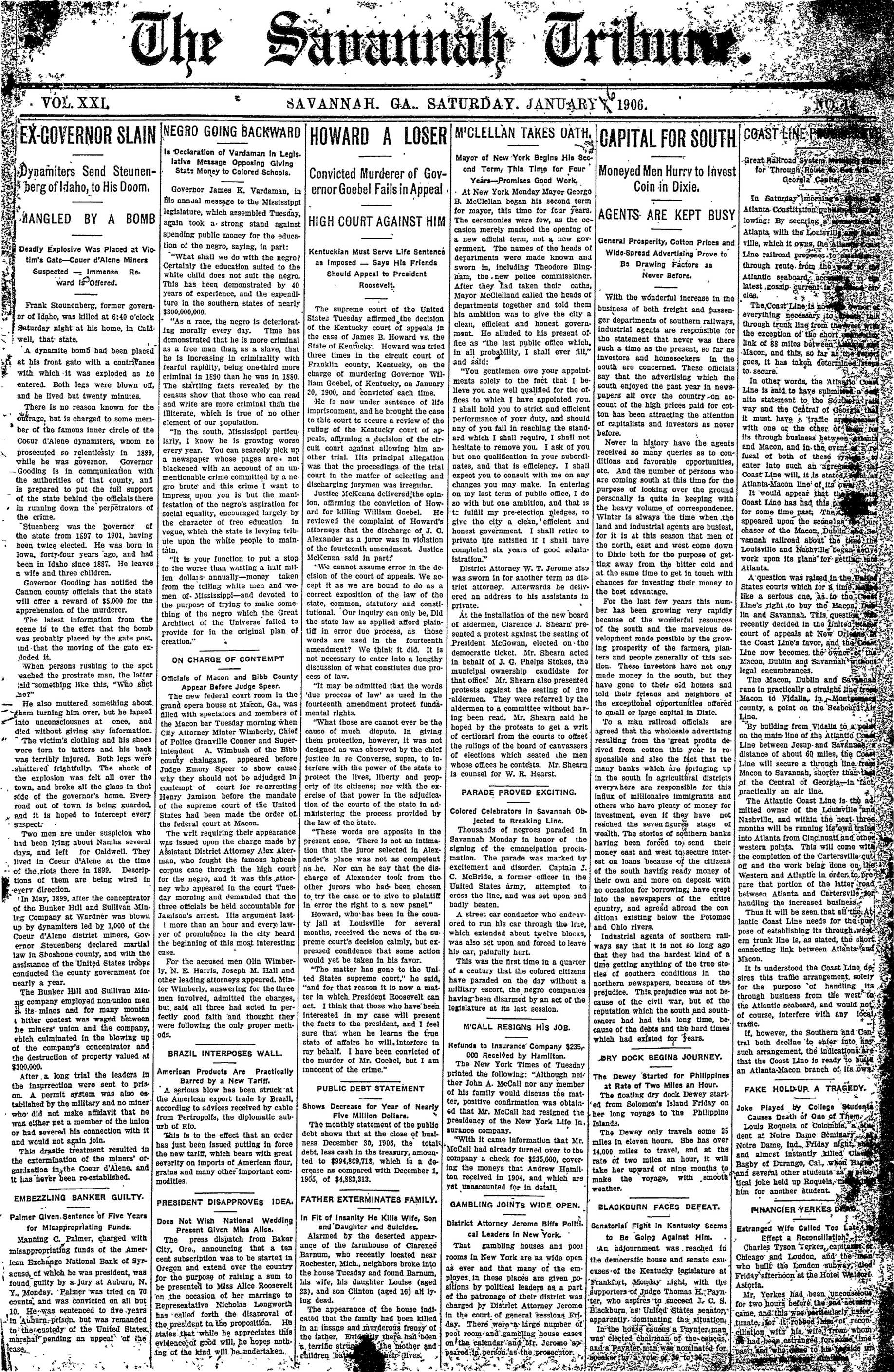
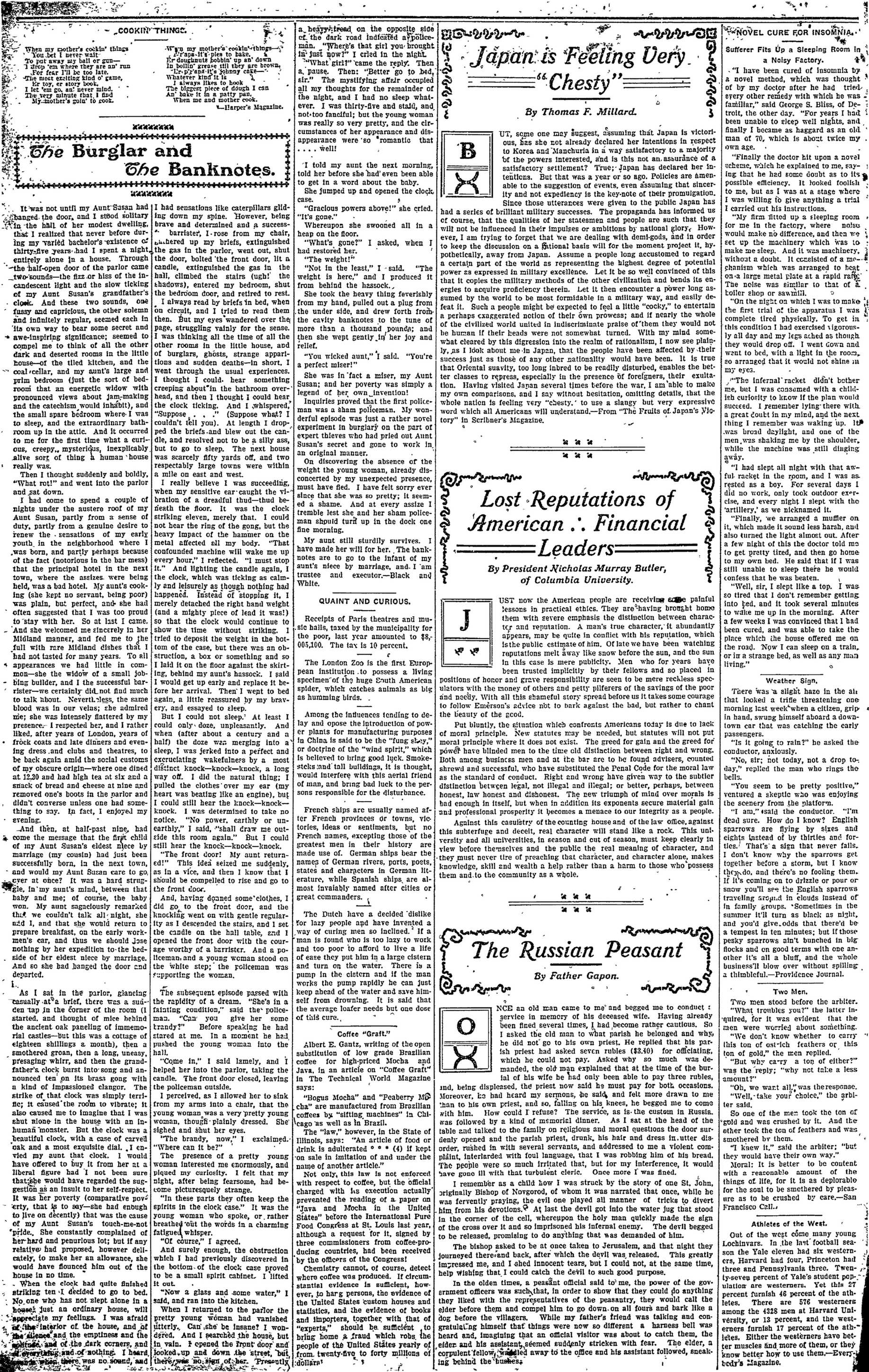
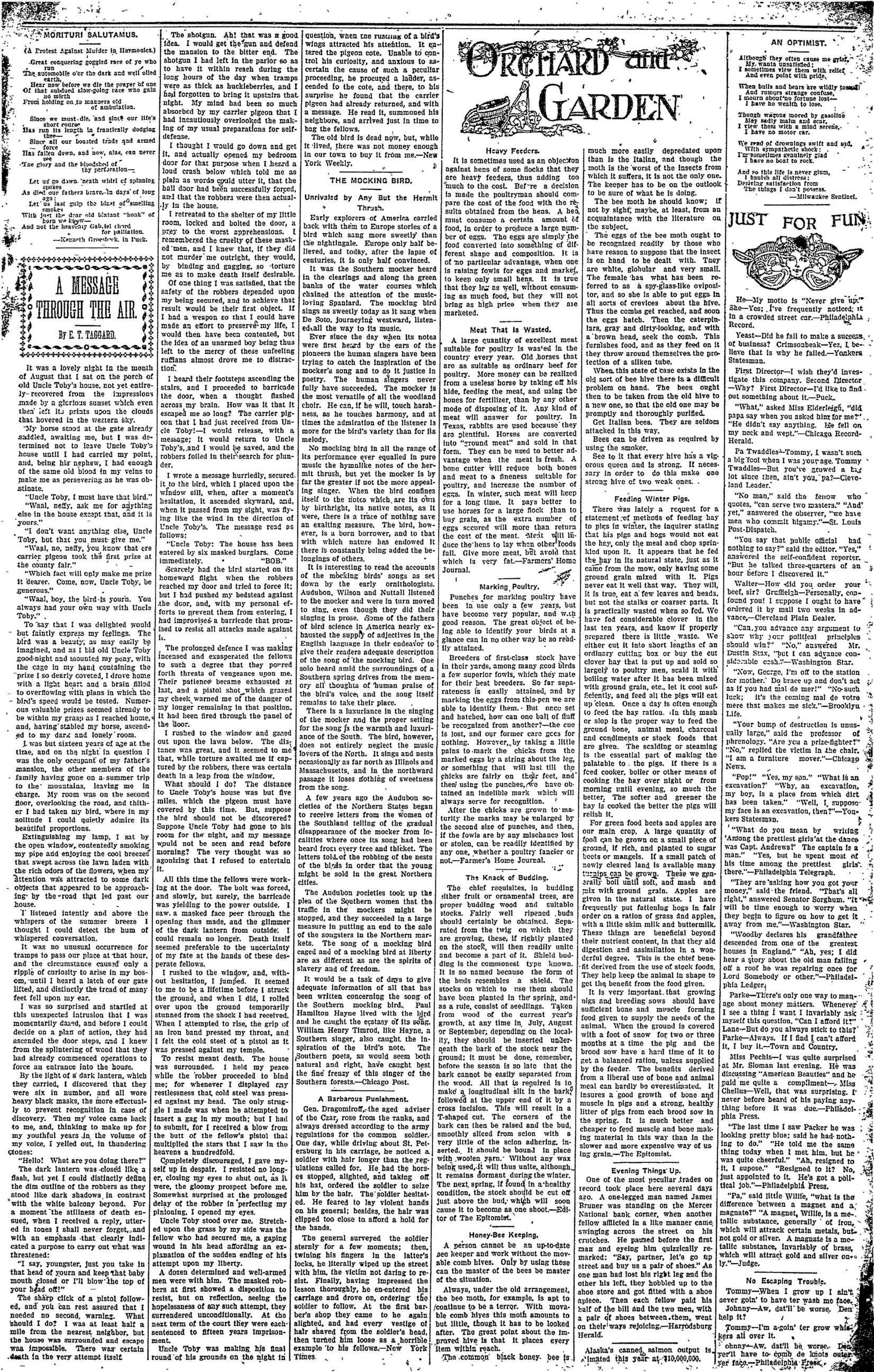
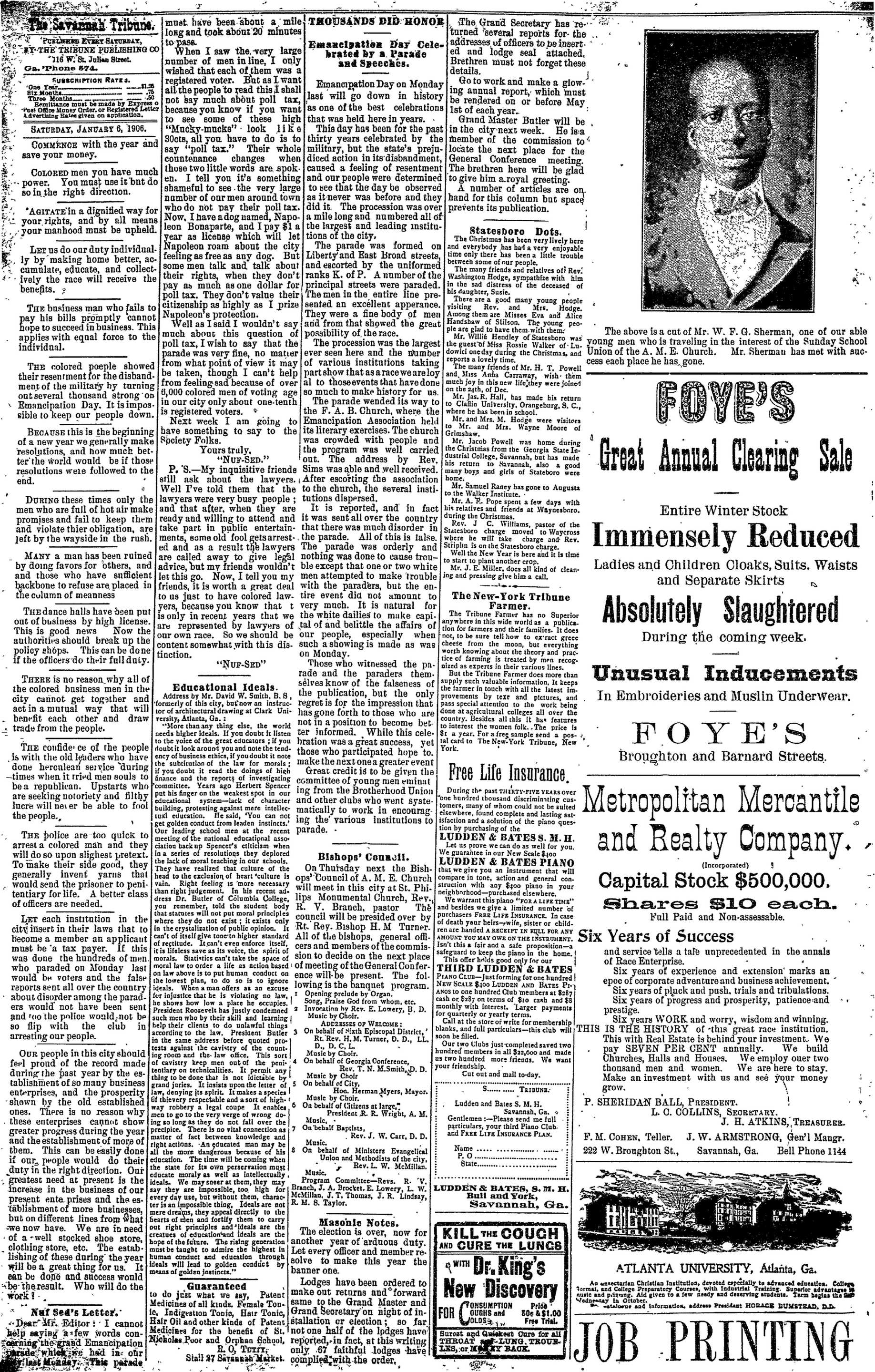
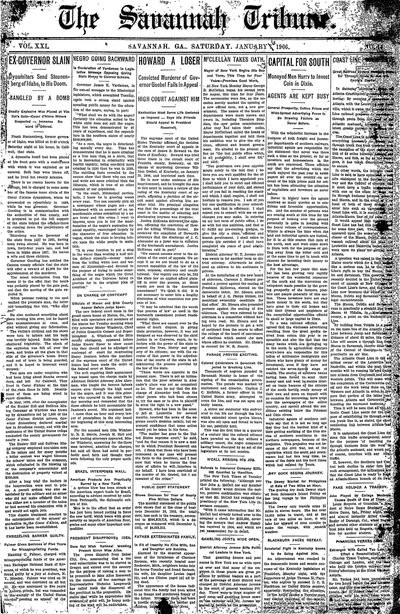
Page text (machine-generated)
The
Deadly Explosive Was Placed at Victim's Gate—Couer d'Alene Miners Suspected — Immense Reward is Offered.
Frank Steunenberg, former governor of Idaho, was killed at 6:40 o'clock Saturday night at his home, in Caldwell, that state.
A dynamite bomb had been placed at his front gato with a contrifance with which it was exploded as he entered. Both legs were blown off, and he lived but twenty minutes.
There is no reason known for the outrage, but is charged to some member of the famous inner circle of the Cocur d'Alene dynamiters, whom he prosecuted so relentlessly in 1899, while he was governor. Governor Gooding is in communication with the authorities of that county, and is prepared to put the full support of the state behind the officials there in running down the perpetrators of the crime.
Stuenberg was the governor of the state from 1897 to 1901, having been twice elected. He was born in Iowa, forty-four years ago, and had been in Idaho since 1887. He leaves a wife and three children.
Governor Gooding has notified the Cannon county officials that the state will offer a reward of $5,000 for the apprehension of the murderer.
The latest information from the scene is to the effect that the bomb was probably placed by the gate post, and that the moving of the gate exploded it.
When persons rushing to the spot reached the prostrate man, the latter said something like this, "Who shot her?"
He also muttered something about them turning him over, but he lapsed into unconsciousnes at once, and died without giving any information. The victim's clothing and his shoes were torn to tatters and his back was terribly injured. Both legs were shattered frightfully. The shock of the explosion was felt all over the town, and broke all the glass in that side of the governor's home. Every road out of town is being guarded, and it is hoped to intercept every suspect. Two men are under suspicion who had been lying about Nanha several days, and left for Caldwell. They lived in Coeur d'Alene at the time of the riots there in 1899. Descriptions of them are being wired in every direction.
In May, 1899, after the concentrator of the Bunker Hill and Sullivan Mining Company at Wardner was blown up by dynamiters led by 1,000 of the Coeur d'Alene district miners, Governor Steuenberg declared martial law in Shoshone county, and with the assistance of the United States troops conducted the county government for nearly a year. The Bunker Hill and Sullivan Mining company employed non-union men in its mines and for many months a bitter contest was waged between the miners' union and the company, which culminated in the blowing up of the company's concentrator and the destruction of property valued at $300,000.
After a long trial the leaders in the insurrection were sent to prison. A permit system was also established by the military and no miner who did not make affidavit that he was either not a member of the union or had severed his connection with it and would not again join.
This drastic treatment resulted in the extermination of the miners' organization in the Coeur d'Alene, and it has never been re-established.
EMBEZZLING BANKER GUILTY.
Palmer Given, Sentence of Five Years for Misappropriating Funds.
Manning C. Palmer, charged with misappropriating funds of the American Exchange National Bank of Syracuse, of which he was president, was found guilty by a jury at Auburn, N. Y., Monday. Palmer was tried on 70 counts, and was convicted on all but 10. He was sentenced to five years in Auburn-prison, but was remanded to the custody of the United States marshal pending an appeal of the case.
VOL. XXL
NEGRO GOING BACKWARD
Is Declaration of Vardaman In Legislative Message Opposing Giving State Money to Colored Schools.
Governor James K. Vardaman, in his annual message to the Mississippi legislature, which assembled Tuesday, again took a strong stand against spending public money for the education of the negro, saying, in part:
"What shall we do with the negro? Certainly the education suited to the white child does not suit the negro. This has been demonstrated by 40 years of experience, and the expenditure in the southern states of nearly $300,000,000.
"As a race, the negro is deteriorating morally every day. Time has demonstrated that he is more criminal as a free man than, as a slave, that he is increasing in criminality with fearful raplidity, being one-third more criminal in 1890 than he was in 1880. The startling facts revealed by the census show that those who can read and write are more criminal than the illiterate, which is true of no other element of our population.
"In the south, Mississippi particularly, I know he is growing worse every year. You can scarcely pick up a newspaper whose pages are not blackened with an account of an unmentionable crime committed by a negro brute and this crime I want to impress upon you is but the manifestation of the negro's aspiration for social equality, encouraged largely by the character of free education in vogue, which the state is levying tribute upon the white people to maintain.
"It is your function to put a stop to the worse than wasting a half million dollars annually—money taken from the teiling white men and women of Mississippi—and devoted to the purpose of trying to make something of the negro which the Great Architect of the Universe failed to provide for in the original plan of creation."
ON CHARGE OF CONTEMPT
Officials of Macon and Bibb County
Appear Before Judge Speer.
Appeal Court Judge
The new federal court room in the grand opera house at Macon, Ga., was filled with spectators and members of the Macon bar Tuesday morning when City Attorney Minter Wimberly, Chief of Police Granville Conner and Superintendent A. Wimbush of the Bibb county chalangang, appeared before Judge Emory Speer to show cause why they should not be adjudged in contempt of court for re-arresting Henry Jamison before the mandate of the supreme court of the United States had been made the order of the federal court at Macon.
The writ requiring their appearance was issued upon the charge made by Assistant District Attorney Alex Akerman, who fought the famous haebae corpus case through the high court for the negro, and it was this attorney who appeared in the court Tuesday morning and demanded that the three officials be held accountable for Jamison's arrest. His argument last more than an hour and every lawyer of prominence in the city heard the beginning of this most interesting case.
For the accused men Olin Wimberly. N. E. Harris, Joseph M. Hall and other leading attorneys appeared. Minter Wimberly, answering for the three men involved, admitted the charges, but sald all three had acted in perfectly good faith and thought they were following the only proper methods.
BRAZIL INTERPOSES WALL.
American Products Are Practically Barred by a New Tariff.
Barried by a New Farm.
A serious blow has been struck at the American export trade by Brazil, according to advices received by cable from Pertropolis, the diplomatic suburb of Rio.
This is to the effect that an order has just been issued putting in force the new tariff, which bears with great severity on imports of American flour, grains and many other important commodities.
PRESIDENT DISAPPROVES IDEA.
Docs Not Wish National Wedding
Present Given Miss Alice.
The press dispatch from Baker City, Ore., announcing that a ten cent subscription was to be started in Oregon and extend over the country for the purpose of raising a sum to be presented to Miss Alice Roosevelt on the occasion of her marriage to Representative Nicholas Longworth has called forth the disapproval of the president to the proposition. He states that while he appreciates this evidence of good will, he hopes nothing of the kind will be undertaken.
HOWARD A LOSER
Convicted Murderer of Governor Goebel Fails in Appeal
HIGH COURT AGAINST HIM
Kentuckian Must Serve Life Sentence as Imposed — Says His Friends Should Appeal to President
The supreme court of the United States Tuesday affirmed the decision of the Kentucky court of appeals in the case of James B. Howard vs. the State of Kentucky. Howard was tried three times in the circuit court of Franklin county, Kentucky, on the charge of murdering Governor William Goebel, of Kentucky, on January 20, 1900, and convicted each time. He is now under sentence of life imprisonment, and he brought the case to this court to secure a review of the ruling of the Kentucky court of appeals, affirming a decision of the circuit court against allowing him another trial. His principal allegation was that the proceedings of the trial court in the matter of selecting and discharging jurymen was irregular.
Justice McKenna delivered the opinion, affirming the conviction of Howard for killing William Goebel. He reviewed the complaint of Howard's attorneys that the discharge of J. C. Alexander as a juror was in violation of the fourteenth amendment. Justice McKenna said in part:
"We cannot assume error in the decision of the court of appeals. We accept it as we are bound to do as a correct exposition of the law of the state, common, statutory and constitutional. Our inquiry can only be, Did the state law as applied afford plaintiff in error due process, as those words are used in the fourteenth amendment? We think it did. It is not necessary to enter into a lengthy discussion of what constitutes due process of law.
"It may be admitted that the words 'due process of law' as used in the fourteenth amendment protect fundamental rights.
"What those are cannot ever be the cause of much dispute. In giving them protection, however, it was not designed as was observed by the chief justice in re Converse, supra, to interfere with the power of the state to protect the lives, liberty and property of its citizens; nor with the exercise of that power in the adjudication of the courts of the state in administering the process provided by the law of the state.
"These words are apposite in the present case. There is not an intimation that the juror selected in Alexander's place was not as competent as he. Nor can he say that the discharge of Alexander took from the other jurors who had been chosen to try the case or to give to plaintiff in error the right to a new panel." Howard, who has been in the county jail at Loulsville for several months, received the news of the supreme court's decision calmly, but expressed confidence that some action would yet be taken in his favor.
"The matter has gone to the United States supreme court," he said, "and for that reason it is now a matter in which President Roosevelt can act. I think that those who have been interested in my case will present the facts to the president, and I feel sure that when he learns the true state of affairs he will interfere in my behalf. I have been convicted of the murder of Mr. Goebel, but I am innocent of the crime."
PUBLIC DEBT STATEMENT
Shows Decrease for Year of Nearly Five Million Dollars.
The monthly statement of the public debt shows that at the close of business December 30, 1903, the total debt, less cash in the treasury, amounted to $994,869,718, which is a decrease as compared with December 1, 1905, of $4,883,313.
In Fit of Insanity He Kills Wife, Son
and 'Daughter and Suicides.
Alarmed by the deserted appearance of the farmhouse of Clarence Barnum, who recently located near Rochester, Mich., neighbors broke into the house Tuesday and found Barnum, his wife, his daughter Louise (aged 23), and son Clinton (aged 16) all lying dead. The appearance of the house indicated that the family had been killed in an insane and murderous frenzy of the father. Evidently there had been a terrific struggle with the mother and children battling their dives.
M'CLELLAN TAKES OATH.
Mayor of New York Begins His Second Term, This Time for Four
At New York Monday Mayor George B. McClellan began his second term for mayor, this time for four years. The ceremonies were few, as the occasion merely marked the opening of a new official term, not a new government. The names of the heads of departments were made known and sworn in, including Theodore Bingham, the new police commissioner. After they had taken their oaths, Mayor McClelland called the heads of departments together and told them his ambition was to give the city a clean, efficient and honest government. He alluded to his present office as "the last public office which, in all probability, I shall ever fill," and said:
"You gentlemen owe your appointments solely to the fact that I believe you are well qualified for the offices to which I have appointed you. I shall hold you to strict and efficient performance of your duty, and should any of you fail in reaching the standard which I shall require, I shall not hesitate to remove you. I ask of you but one qualification in your subordinates, and that is efficiency. I shall expect you to consult with me on any changes you may make. In entering on my last term of public office, I do so with but one ambition, and that is to fulfill my pre-election pledges, to give the city a clean, efficient and honest government. I shall retire to private life satisfied if I shall have completed six years of good administration."
District Attorney W. T. Jerome also was sworn in for another term as district attorney. Afterwards he delivered an address to his assistants in private.
At the installation of the new board of aldermen, Clarence J. Shearn presented a protest against the seating of President McGowan, elected on the democratic ticket. Mr. Shearn acted in behalf of J. G. Phelps Stokes, the municipal ownership candidate for that office. Mr. Shearn also presented protests against the seating of five aldermen. They were referred by the aldermen to a committee without having been read. Mr. Shearn said he hoped by the protests to get a writ of certiorari from the courts to offset the rulings of the board of canvassers of elections which seated the men whose offices he contests. Mr. Shearn is counsel for W. R. Hearst.
PARADE PROVED EXCITING.
Colored Celebrators In Savannah Objected to Breaking Line.
Thousands of negroes paraded in Savannah Monday in honor of the signing of the emancipation proclamation. The parade was marked by excitement and disorder. Captain J. C. McBride, a former officer in the United States army, attempted to cross the line, and was set upon and badly beaten.
A street car conductor who endeavored to run his car through the line, which extended about twelve blocks, was also set upon and forced to leave his car, painfully hurt.
This was the first time in a quarter of a century that the colored citizens have paraded on the day without a military escort, the negro companies having been disarmed by an act of the legislature at its last session.
M'CALL RESIGNS HIS JOB.
Refunda to Insurance Company $235,
000 Received by Hamilton.
The New York Times of Tuesday
printed the following: "Although nei-
ther John A. McCall nor any member
of his family would discuss the matter,
positive confirmation was obtain-
ed that Mr. McCall had resigned the
presidency of the New York Life In
surance company.
"With it came information that Mr.
McCall had already turned over to the
company a check for $235,000, cover-
ing the moneys that Andrew Hamilton
received in 1904, and which are
yet unaccounted for in detail.
GAMBLING JOINTS WIDE OPEN.
District Attorney Jerome Bliffs Political Leaders in New York.
That gambling houses and pool rooms in New York are as wide open as ever and that many of the employees in these places are given positions by political leaders as a part of the patronage of their district was charged by District Attorney Jerome in the court of general sessions Friday. There were a large number of pool room and gambling house cases on the calendar and Mr. Jerome appeared in person as the prosecutor.
CAPITAL FOR SOUTH
Moneyed Men Hurry to Invest Coin in Dixie.
General Prosperity, Cotton Prices and Wide-Spread Advertising Prove to Be Drawing Factors as Never Before.
With the wonderful increase in the business of both freight and passenger departments of southern railways, industrial agents are responsible for the statement that never was there such a time as the present, so far as investors and homeseekers in the south are concerned. These officials say that the advertising which the south enjoyed the past year in newspapers all over the country-on account of the high prices paid for cotton has been attracting the attention of capitalists and investors as never before.
Never in history have the agents received so many queries as to conditions and favorable opportunities, etc. And the number of persons who are coming south at this time for the purpose of looking over the ground personally is quite in keeping with the heavy volume of correspondence. Winter is always the time when the land and industrial agents are busiest, for it is at this season that men of the north, east and west come down to Dixie both for the purpose of getting away from the bitter cold and at the same time to get in touch with chances for investing their money to the best advantage.
For the last few years this number has been growing very rapidly because of the wonderful resources of the south and the marvelous development made possible by the growing prosperity of the farmers, planters and people generally of this section. These investors have not only made money in the south, but they have gone to their old homes and told their friends and neighbors of the exceptional opportunities offered to small or large capital in Dixie.
To a man railroad officials are agreed that the wholesale advertising resulting from the great profits derived from cotton this year is responsible and also the fact that the many banks which are springing up in the south in agricultural districts everywhere are responsible for this influx of millionaire immigrants and others who have plenty of money for investment, even if they have not reached the seven figures stage of wealth. The stories of southern banks having been forced to send their money east and west to secure interest on loans because of the citizens of the south having ready money of their own and more on deposit with no occasion for borrowing; have crept into the newspapers of the entire country, and spread abroad the conditions existing below the Potomac and Ohio rivers.
Industrial agents of southern railways say that it is not so long ago that they had the hardest kind of a time getting anything of the true stories of southern conditions in the northern newspapers, because of the prejudice. This prejudice was not because of the civil war, but of the reputation which the south and southeasers had had this long time, because of the debts and the hard times which had existed for years.
DRY DOCK BEGINS JOURNEY.
The Dewey Started for Philippines
at Rate of Two Miles an Hour.
The floating dry dock Dewey start- ed from Solomon's Island Friday on her long voyage to the Philippine Islands.
The Dewey only travels some 25 miles in eleven hours. She has over 14,000 miles to travel, and at the rate of two miles an hour, it will take her upward of nine months to make the voyage, with smooth weather.
Senatorial Fight In Kentucky Seems to Be Going Against Him. An adjournment was reached in the democratic house and senate caucuses of the Kentucky legislature at Frankfort, Monday night, with the supporters of Judge Thomas H. Payter, who aspires to succeed J. C. S. Blackburn, as United States senator, apparently dominating the situation. In the house caucus a Payter man was elected chairman of the caucus, and a Payter man was nominated for speaker by a vote of 59 to 39.
COAST LINE PROGRAMME
Great Railroad System Meeting Hours
for Through Route to the With
Georgia Capital.
In Saturday morning a meeting of
Atlanta Constitution publishes the following: By securing a connection in Atlanta with the Louisville and Nashville, which it owes, the Atlantic Coast Line railroad proposes to establish through route from the west to the Atlantic seaboard, according to the latest gossip current in published circles.
The Coast Line is now a corner of everything necessary to access this through trunk line from the west with the exception of the short connecting link of 88 miles between Atlantic and Macon, and this, so far as the report goes, it has taken determined steps to secure.
In other words, the Atlantic Coast Line is said to have submitted a detailed statement to the Southern railway and the Central of Georgia that it must have a traffic agreement with one or the other of them not its through business between Atlantic and Macon, and in the event of a refusal of both of these systems to enter into such an agreement, the Coast Line will, it is stated, bind an Atlantic Macon line of its own.
It would appear that the Coast Line has had this plan for some time past. That plan has appeared upon the scenelas the purchaser of the Macon, Dublin and Savannah railroad about the time the Louisville and Nashville began active work upon its plans for getting into Atlanta.
A question was raised in the United States courts which for a time looked like a serious one, as to the Coast Line's right to buy the Macon, Dublin and Savannah. This question was recently decided in the United States court of appeals at New Orleans. In the Coast Line's favor, and the Coast Line now becomes, the owner of the Macon, Dublin and Savannah without legal encumbrances.
The Macon, Dublin and Savannah runs in practically a straight line from Macon to Vidalia. In Montgomery county, a point on the Seaboard Air Line.
By building from Vidalia to a point on the main line of the Atlantic Coast Line between Jesup and Savannah, a distance of about 60 miles, the Coast Line will secure a through line from Macon to Savannah, shorter than that of the Central of Georgia—in fact, practically an air line.
The Atlantic Coast Line is the admitted owner of the Louisville and Nashville, and within the next three months will be running its own trains into Atlanta from Cincinnati and other western points. This will come with the completion of the Cartersville cut off and the work being done on the Western and Atlantic in order, to prepare that portion of the latter road between Atlanta and Cartersville for handling the increased business.
Thus it will be seen that all the Atlantic Coast Line needs for the purpose of establishing its through western trunk line is, as stated, the short connecting link between Atlanta and Macon.
It is understood the Coast Line desires this traffic arrangement, solely for the purpose of handling its through business from the west to the Atlantic seaboard, and would not of course, interfere with any local traffic.
If, however, the Southern and Central both decline to enter into any such arrangement, the indications are that the Coast Line is ready to build an Atlanta-Macon branch of its own.
Causes Death of One of Them.
Louis Roquela of Colombia, a student at Notre Dame Seminary,
Notre Dame, Ind., Friday night, and almost instantly killed Claire Bagby of Durango, Cal., when Barnes and several other students as a practical joke held up Roquela, making him for another student.
Charles Tyson Yerkes, captain of Chicago and London, and the man who built the London subway, died Friday afternoon at the Hotel Waldorf Astoria.
Mr. Yerkes had been unconscious for two hours before the sea accident came, and this was particularly unfortunate, for it robbed him of reconciliation with his wife, from whom he had been estranged for some time, parks and who came to his side in the beginning of the war.
When my mother's cookin' things
You bet. I never wait
To put away my ball or gun—
I drop 'em where they are an' run
For fear I'll be too late.
The most exciting kind o' game,
Er toy, er story book.
I let 'em go, an' never mind.
The very minute that I find
My mother's goln' to cook.
It was not until my Aunt Susan had banged the door, and I stood solitary in the hall of her modest dwelling, that I realized that never before during my varied bachelor's existence of thirty-five years had I spent a night entirely alone in a house. Through the half-open door of the parlor came two sounds—the fizz or hiss of the incandescent light and the slow ticking of my Aunt Susan's grandfather's clock. And these two sounds, one fussy and capricious, the other solemn and infinitely regular, seemed each in its own way to bear some secret and awe-inspiring significance; seemed to compel me to think of all the other dark and deserted rooms in the little house—of the tiled kitchen, and the coal-cellar, and my aunt's large and prim bedroom (just the sort of bedroom that an energetic widow with pronounced views about jam-making and the catechism would inhabit), and the small spare bedroom where I was to sleep, and the extraordinary bathroom up in the attic. And it occurred to me for the first time what a curious, creepy, mysterious, inexplicably alive sort of thing a human house really was.
Then I thought suddenly and boldly,
"What rot!" and went into the parlor
and sat down.
I had come to spend a couple of nights under the austere roof of my Aunt Susan, partly from a sense of duty, partly from a genuine desire to renew the sensations of my early youth in the neighborhood where I was born, and partly perhaps because of the fact (notorious in the bar mess) that the principal hotel in the next town, where the assizes were being held, was a bad hotel. My aunt's cooking (she kept no servant, being poor) was plain, but perfect, and she had often suggested that I was too proud to stay with her. So at last I came. And she welcomed me sincerely in her Midland manner, and fed me to the full with rare Midland dishes that I had not tasted for many years. To all appearances we had little in common—she the widow of a small jobbing builder, and I the successful barrister—we certainly did not find much to talk about. Nevertheless, the same blood was in our veins; she admired me; she was intensely flattered by my presence. I respected her, and I rather liked, after years of London, years of frock coats and late dinners and evening dress and clubs and theatres, to be back again amid the social customs of my obscure origin—where one dined at 12:30 and had high tea at six and a snack of bread and cheese at nine and removed one's boots in the parlor and didn't converse unless one had something to say. In fact, I enjoyed my evening.
And then, at half-past nine, had come the message that the first child of my Aunt Susan's eldest niece by marriage (my cousin) had just been successfully born, in the next town, and would my Aunt Susan care to go ever at once? It was a hard struggle, in my aunt's mind, between that baby and me; of course, the baby won. My aunt sagaciously remarked that we couldn't talk all night, she said I, and that she would return to prepare breakfast, on the early workmen's car, and thus we should lose nothing by her expedition to the bedside of her eldest niece by marriage. And so she had hanged the door and departed.
As I sat in the parlor, glancing casually at a brief, there was a sudden tap in the corner of the room (I started, and thought of mice behind the ancient oak paneling of immemorial castles—but this was a cottage of eighteen shillings a month), then a smothered groan, then a long, uneasy, presaging whirr, and then the grandfather's clock burst into song and announced ten on its brass gong with a kind of impassioned clangor. The strike of that clock was simply terrific; it caused the room to vibrate; it also caused me to imagine that I was shut alone in the house with an inhuman monster. But the clock was a beautiful clock, with a case of carved oak and a most exquisite dial. I envied my aunt that clock. I would have offered to buy it from her at a liberal figure had I not been sure that she would have regarded the suggestion as an insult to her self-respect. It was her poverty (comparative poverty, that is to say—she had enough to live on decently) that was the cause of my Aunt Susan's touch-me-not pride. She constantly complained of her hard and penurious lot; but if any relative had proposed, however delicately, to make her an allowance, she would have flounced him out of the house in no time.
When the clock had quite finished striking ten I decided to go to bed. No one who has not slept alone in a house, just an ordinary house, will appreciate my feelings. I was afraid of the interior of the house, and of the silence and the emptiness and the solitude, and of the dark corners, and of everything and of nothing. I heard sounds when there was no sound, and
Won my mother's cookin' things—
'Laps it's pies to bake.
Er doughnuts bobbin up an down
In bollin' grasse till they are brown.
Er 'rpr'ans it's johnny cake—
Whatever kind it is
I always likes to book
The biggest piece of dough I can
An' bake it in a patty pan.
When me and mother cook.
I had sensations like caterpillars gliding down my spine. However, being brave and determined and a succession-barrister, I rose from my chair, sheltered up my briefs, extinguished the gas in the parlor, went out, shut the door, bolted the front door, lit a candle, extinguished the gas in the hall, climbed the stairs (ugh! the shadows), entered my bedroom, shut the bedroom door and retired to rest
I always read by briefs in bed, when on circuit, and I tried to read them then. But my eyes wandered over the page, struggling vainly for the sense. I was thinking all the time of all the other rooms in the little house, and of burglars, ghosts, strange apparitions and sudden deaths—in short. I went through the usual experiences. I thought I could. hear something creeping about* in the bathroom overhead, and then I thought I could hear the clock ticking. And I, whispered, "Suppose . . . ." (Suppose what? I couldn't tell you). At length I dropped the briefs and blew out the candle, and resolved not to be a silly ass, but to go to sleep. The next house was scarcely fifty yards off, and two respectably large towns were within a mile on east and west.
I really believe I was succeeding, when my sensitive ear caught the vibration of a dreadful thud—thud beneath the floor. It was the clock striking eleven, merely that. I could not hear the ring of the gong, but the heavy impact of the hammer on the metal affected all my body. "That confounded machine will wake me up every hour," I reflected. "I must stop it." And lighting the candle again, I the clock, which was ticking as calmly and leisurely as though nothing had happened. Instead of stopping it, I merely detached the right hand weight (and a mighty piece of lead it was!) so that the clock would continue to show the time without striking. I tried to deposit the weight in the bottom of the case, but there was an obstruction, a box or something and so I laid it on the floor against the skirting, behind my aunt's hassock. I said I would get up early and replace it before her arrival. Then I went to bed again, a little reassured by my bravery, and essayed to sleep.
But I could not sleep.' At least I could only doze, unpleasantly. And when (after about a century and a half) the doze was merging into a sleep, I was jerked into a perfect and excurciting wakefulness by a most distinct knock—knock—knock, a long way off. I did the natural thing: I pulled the clothes over my ear (my heart was beating like an engine), but I could still hear the knock—knock—knock. I was determined to take no notice. "No power, earthly or unearthly," I said, "shall draw me outside this room again." But I could still hear the knock—knock—knock.
"The front door! My aunt returned!" This idea seized me suddenly, as in a vice, and then I know that I should be compelled to rise and go to the front door.
And, having daunted some clothes, I did go to the front door, and the knocking went on with gentle regularity as I descended the stairs, and I set the candle on the hall table, and I opened the front door with the courage worthy of a barrister. And a policeman, and a young woman stood on the white step; the policeman was supporting the woman.
The subsequent episode passed with the rapidity of a dream. "She's in a fataling condition," said the policeman. "Can you give her some trandy?" Before speaking he had stared at me. In a moment he had pushed the young woman into the hall.
"Come in," I said lamely, and I helped her into the parlor, taking the candle. The front door closed, leaving the policeman outside.
I perceived, as I allowed her to sink from my arms into a chair, that the young woman was a very pretty young woman, though plainly dressed. She sighed and shut her eyes.
"The brandy, now," I exclaimed.
"Where can it be?"
The presence of a pretty young woman interested me enormously, and plied my curiosity. I felt that my night, after being fearsome, had become picturesquely strange.
"In these parts they often keep the spirits in the clock case." It was the young woman who spoke, or rather breathed out the words in a charming fatigued whisper.
"Of course." I agreed.
And surely enough, the obstruction which I had previously discovered in the bottom of the clock case proved to be a small spirit cabinet. I lifted it out.
"Now a glass and some water," I said, and ran into the kitchen.
When I returned to the parlor the pretty young woman had vanished bitterly. Can she be insane? I wondered. And I searched the house, but in vain. I opened the front door and looked up and down the street, but there was no sign of her. Presently
a heavy thread on the opposite side of the dark road indicated a policeman. "Where's that girl you brought in just now?" I cried in the night. "What girl?" came the reply. Then a pause. Then: "Better go to bed, sir." The mystifying affair occupied all my thoughts for the remainder of the night, and I had no sleep whatever. I was thirty-five and stalid, and not too fanciful; but the young woman was really so very pretty, and the circumstances of her appearance and disappearance were so romantic that . . . well!
I told my aunt the next morning, told her before she had even been able to get in a word about the baby.
She jumped up and opened the clock case.
"Gracious powers above!" she cried.
"It's gone."
Whereupon she swooned all in a heap on the floor.
"What's gone?" I asked, when I had restored her.
"The weight!"
"Not in the least," I said. "The weight is here," and I produced it from behind the hassock.
She took the heavy thing feverishly from my hand, pulled out a plug from the under side, and drew forth from the cavity banknotes to the tune of more than a thousand pounds; and then she wept gently in her joy and relief.
"You wicked aunt," I said. "You're a perfect miser!"
She was in fact a miser, my Aunt Susan; and her poverty was simply a legend of her own invention!
Inquiries proved that the first policeman was a sham policeman. My wonderful episode was just a rather novel experiment in burglary on the part of expert thieves who had pried out Aunt Susan's secret and gone to work in, an original manner.
On discovering the absence of the weight the young woman, already disconcerted by my unexpected presence, must have fled. I have felt sorry ever since that she was so pretty; it seemed a shame. And at every assize I tremble lest she and her sham policeman should turn up in the dock one fine morning.
My aunt still sturdily survives. I have made her will for her. The banknotes are to go to the infant of my aunt's niece by marriage, and-I am trustee and executor.—Black and White.
QUAINT AND CURIOUS.
Receipts of Paris theatres and music halls, taxed by the municipality for the poor, last year amounted to $8,005,100. The tax is 10 percent.
The London Zoo is the first European institution to possess a living specimen of the huge South American spider, which catches animals as big as humming birds.
Among the influences tending to delay and oppose the introduction of power plants for manufacturing purposes in China is said to be the "fung slay," or doctrine of the "wind spirit," which is believed to bring good luck. Smoke-stocks and tall buildings, it is thought, would interfere with this aerial friend of man, and bring bad luck to the persons responsible for the disturbance.
French ships are usually named after French provinces or towns, victories, ideas or sentiments, but no French names, excepting those of the greatest men in their history are made use of. German ships bear the names of German rivers, ports, poets, states and characters in German literature, while Spanish ships are almost invaliably named after cities or great commanders.
The Dutch have a decided dislike for lazy people and have invented a way of curing men so inclined. If a man is found who is too lazy to work and too poor to afford to live a life of ease they put him in a large cistern and turn on the water. There is a pump in the cistern and if the man works the pump rapidly he can just keep ahead of the water and save himself from drowning. It is said that the average loafer needs but one dose of this cure.
Coffee "Graft."
Albert E. Gantz, writing of the open substitution of low grade Brazilian coffee for high-priced Mocha and Java, in an article on "Coffee Graft" in The Technical World Magazine says:
"Bogus Mocha" and "Peaberry Mocha" are manufactured from Brazilian coffees by "sifting machines" in Chicago as well as in Brazil.
The "law", however, in the State of Illinois, says: "An article of food or drink is adulterated * * * (4) if kept on sale in imitation of and under the name of another article."
Not only, this law is not enforced with respect to coffee, but the official charged with its execution actually prevented the reading of a paper on "Java and Mocha in the United States" before the International Pure Food Congress at St. Louis last year, although a request for it, signed by three commissioners from coffee-producing countries, had been received by the officers of the Congress!
Chemistry cannot, of course, detect where coffee was produced. If circumstantial evidence is sufficient, however, to harg persons, the evidence of the United States custom houses and statistics, and the evidence of books and importers, together with that of "experts," should be sufficient to bring home a fraud which robs the people of the United States yearly of from twenty-five to forty millions of dollars
Japan is Feeling Very "Chesty"
By Thomas F. Millard.
UT, some one may suggest, assuming that Japan is victorious, has she not already declared her intentions in respect to Korea and Manchuria in a way satisfactory to a majority of the powers interested, and is this not an assurance of a satisfactory settlement? True; Japan has declared her intentions. But that was a year or so ago. Policies are amenable to the suggestion of events, even assuming that sincerity and not expediency is the key-note of their promuigation. Since those utterances were given to the public Japan has
B
had a series of of course, that will not be infi- ever, I am trying to keep the di- pothetically, avail- a certain part power as express that it copies to ergles to acqui- sumed by the feat it. Such a perhaps exag- of the civilized he human if thi what cleared bly, as I look al- success just as that Oriental ster classes to u tion. Having own compa- whole nation in word which all- tory" in Scrib-
had a series of brilliant military successes. The propaganda has informed us of course, that the qualities of her statesmen and people are such that they will not be influenced in their impulses or ambitions by national glory. However, I am trying to forget that we are dealing with demigods, and in order to keep the discussion on a national basis will for the moment project it, hypothetically, away from Japan. Assume a people long accustomed to regard a certain part of the world as representing the highest degree of potential power as expressed in military excellence. Let it be so well convinced of this that it copies the military methods of the other civilization and bends its energies to acquire proficiency therein. Let it then encounter a power long assumed by the world to be most formidable in a military way, and easily defeat it. Such a people might be expected to feel a little "cocky," to entertain a perhaps exaggerated notion of their own prowess; and if nearly the whole of the civilized world united in indiscriminate praise of them they would not be human if their heads were not somewhat turned. With my mind somewhat cleared by this digression into the realm of rationalism, I now see plainly, as I look about me in Japan, that the people have been affected by their success just as those of any other nationality would have been. It is true that Oriental suavity, too long inbred to be readily disturbed, enables the better classes to repress, especially in the presence of foreigners, their exultation. Having visited Japan several times before the war, I am able to make my own comparisons, and I say without hesitation, omitting details, that the whole nation is feeling very "chesty." to use a slangy but very expressive word which all Americans will understand.—From "The Fruits of Japan's Victory" in Scribner's Magazine.
Lost Reputations of American .. Financial Leaders
By President Nicholas Murray Butler,
of Columbia University.
UST now the American people are receiving some painful lessons in practical ethics. They are having brought home them with severe emphasis the distinction between character and reputation. A man's true character, it abundantly appears, may be quite in conflict with his reputation, which is the public estimate of him. Of late we have been watching reputations melt away like snow before the sun, and the sun in this case is mere publicity. Men who for years have been trusted implicitly by their fellows and so placed in
J
x x
positions of hon
ulators with the
and needy. Wit
to follow Emere
the beauty of f
Put bluntly
of moral prince
moral principle
power have blin
Both among bu
shrewd and suc
as the standard
distinction betwee
honest, law hon
bad enough in
and professional
Against th
this subterfuge
versity and all
view before th
they must never
knowledge, skil
them and to th
positions of honor and grave responsibility are seen to be mere reckless speculators with the money of others and petty pilferers of the savings of the poor and needy. With all this shameful story spread before us it takes some courage to follow Emerson's advice not to bark against the bad, but rather to chant the beauty of the good.
Put bluntly, the situation which confronts Americans today is due to lack of moral principle. New statutes may be needed, but statutes will not put moral principle where it does not exist. The greed for gain and the greed for power have blinded men to the time old distinction between right and wrong. Both among business men and at the bar are to be found advisers, counted shrewd and successful, who have substituted the Penal Code for the moral law as the standard of conduct. Right and wrong have given way to the subtler distinction between legal, not illegal and illegal; or better, perhaps, between honest, law honest and dishonest. The new triumph of mind over morals is bad enough in itself, but when in addition its exponents secure material gain and professional prosperity it becomes a menace to our integrity as a people.
Against this casuistry of the counting house and of the law office, against this subterfuge and deceit, real character will stand like a rock. This university and all universities, in season and cut of season, must keep clearly in view before themselves and the public the real meaning of character, and they must never tire of preaching that character, and character alone, makes knowledge, skill and wealth a help rather than a harm to those who possess them and to the community as a whole.
The Russian Peasant
By Father Gapon.
NCE an old man came to me and begged me to conduct a service in memory of his deceased wife. Having already been fined several times, I had become rather cautious. So I asked the old man to what parish he belonged and why he did not go to his own priest. He replied that his parish priest had asked seven rubles ($3.40) for officiating, which he could not pay. Asked why so much was demanded, the old man explained that at the time of the burial of his wife he had only been able to pay three rubles.
O
and, being displeased Moreover, he hath to his own with him. He was followed but table and talked deny opened a plaint, rushed in plaint, interlarded The people we have gone ill will originally Bisho was fervently him from his d
and, being displeased, the priest now said he must pay for both occasions. Moreover, he had heard my sermons, he said, and felt more drawn to me than to his own priest, and so, falling on his knees, he begged me to come with him. How could I refuse? The service, as is the custom in Russia, was followed by a kind of memorial dinner. As I sat at the head of the table and talked to the family on religious and moral questions the door suddenly opened and the parish priest, drunk, his hair and dress in utter disorder, rushed in with several servants, and addressed to me a violent complaint, interlarded with foul language, that I was robbing him of his bread. The people were so much irritated that, but for my interference, it would have gone ill with that turbulent cleric. Once more I was fined.
I remember as a child how I was struck by the story of one St. John, originally Bishop of Novgorod, of whom it was narrated that once, while he was fervently praying, the evil one played all manner of tricks to divert him from his devotions. At last the devil got into the water jug that stood in the corner of the cell, whereupon the holy man quickly made the sign of the cross over it and so imprisoned his infernal enemy. The devil begged to be released, promising to do anything that was demanded of him.
The bishop asked to be at once taken to Jerusalem, and that night they journeyed there and back, after which the devil was released. This greatly impressed me, and I shed innocent tears, but I could not, at the same time, help wishing that I could catch the devil to such good purpose.
In the olden times, a peasant official said to me, the power of the government officers was such that, in order to show that they could do anything they liked with the representatives of the peasantry, they would call the elder before them and compel him to go down on all fours and bark like a dog before the villagers. While my father's friend was talking and congratulating himself that things were now so different a harness bell was heard and, imagining that an official visitor was about to catch them, the elder and his assistant, seemed suddenly stricken with fear. The elder, a corpulent fellow, was led away to the office and his assistant followed, sneaking behind the bushes.
Sufferer Fits Up a Sleeping Room in a Noisy Factory.
"I have been cured of insomnia by a novel method, which was thought of by my doctor after he had tried every other remedy with which he was familiar," said George S. Bliss, of Detroit, the other day. "For years I had been unable to sleep well nights, and finally I became a haggard as an old man of 70, which is about twice my own age.
"Finally the doctor hit upon a novel scheme, which he explained to me, saying that he had some doubt as to its possible efficiency. It looked foolish to me, but as I was at a stage where I was willing to give anything a trial I carried out his instructions.
"My firm fitted up a sleeping room for me in the factory, where noise would make no difference, and then we set up the machinery which was to make me sleep. And it was machinery, without a doubt. It consisted of a mechanism which was arranged to heat on a large metal plate at a rapid rate. The noise was similar to that of a bolter shop or sawmill.
"On the night on which I was to make the first trial of the apparatus I was complete tired physically. To get in this condition I had exercised vigorously all day and my legs ached as though they would drop off. I went down and to bed, with a light in the room, so arranged that it would not shine in my eyes.
"The infernal racket didn't bother me, but I was consumed with a childish curiosity to know if the plan would succeed. I remember lying there with a great doubt in my mind, and the next thing I remember was waking up. It was broad daylight, and one of the men, was shaking me by the shoulder, while the machine was still dinging away.
"I had slept all night with that awful racket in the room, and I was rested as a boy. For several days I did no work, only took outdoor exercise, and every night I slept with the 'artillery,' as we nicknamed it.
"Finally, we arranged a muffler on it, which made it sound less harsh, and also turned the light almost out. After a few night of this the doctor told me to get pretty tired, and then go home to my own bed. He said that if I was still unable to sleep there he would confess that he was beaten.
"Well, sir, I slept like a top. I was so tired that I don't remember getting into bed, and it took several minutes to wake me up in the morning. After a few weeks I was convinced that I had been cured, and was able to take the place which the house offered me on the road. Now I can sleep on a train, or in a strange bed, as well as any man living."
Weather Sign.
There was a slight haze in the air that looked a trifle threatening one morning last week'when a citizen, grip in hand, swung himself aboard a downtown car that was catching the early passengers.
"Is it going to rain?" he asked the conductor, anxiously.
"No, sir; not today, not a drop today," replied the man who rings the bells.
"You seem to be pretty positive," ventured a skeptic who was enjoying the scenery from the platform.
"I am,!" said the conductor. "I'm dead sure. How do I know? English sparrows are flying by sixes and eights instead of by thirties and forties. That's a sign that never falls. I don't know why the sparrows get together before a storm, but I know they do, and there's no fooling them. If it's coming on to drizzle or pour or snow you'll see the English sparrows travelling around in clouds instead of in family groups. "Sometimes in the summer it'll turn as black as night, and you'll give, odds that there'd be a tempest in ten minutes; but if those pesky sparrows aren't bunched in big flocks and on good terms with one another it's all a bluff, and the whole business'll blow over without spilling a thimbleful.—Providence Journal.
Two Men.
Two men stood before the arbiter.
"What troubles you?" the latter inquired, for it was evident that the men were worried about something.
"We don't know whether to carry this ton of ost-ich feathers or this ton of gold," the men replied.
"But why carry a ton of either?" was the reply; "why not take a less amount?"
"Oh, we want all," was the response.
"Well, take your choice," the arbiter said.
So one of the men took the ton of gold and was crushed by it. And the other took the ton of feathers and was smothered by them.
"I knew it," said the arbiter; "but they would have their own way."
Moral: It is better to be content with a reasonable amount of the things of life, for it is as deplorable for the soul to be smothered by pleasure as to be crushed by care.—San Francisco Call.
Athletes of the West.
Out of the west come many young Lochinvars. In the last football season the Yale eleven had six westerners, Harvard had four, Princeton had three and Pennsylvania three. Twenty-seven percent of Yale's student population are westerners. Yet this 27 percent furnish 46 percent of the athletes. There are 576 westerners among the 4328 men at Harvard University, or 13 percent, and the westerners furnish 17 percent of the athletes. Either the westerners have better muscles and more of them, or they know better how to use them.—Everybody's Magazine.
(A Protest Against Murder in Harmonies)
Great conquering goggled race of ye who run
The automobile our the dark and well oiled earth.
Heat before we die the prayer of one
Of that souls slow-going race who gain no mirth
From holding on to manners old of ambulation.
Since we must die, and gice our life's short course
Has run its length in frantically dodging
Since all our boasted trade and armed force
Has fallen down, and now, alas, can never
The glory and the bloodshed of thy perforation—
Let us go down 'neath whirl of spinning spokes
As died our fathers brave, in days of long smoke
Let us last gulp the blast of smelling smoke
With just the dear old blastant "hook" of old age
And not the heaviest Gabriel chord for palliation.
—Kenneth Greenshik in Puck.
It was a lovely night in the month of August that I sat on the porch of old Uncle Toby'a house, not yet entirely recovered from the impressions made by a glorious sunset which even then left its prints upon the clouds that hovered in the western sky.
"My horse stood at the gate already saddled, awaiting me, but I was determined not to leave Uncle Toby's house until I had carried my point, and, being his nephew, I had enough of the same old blood in my veins to make me as persevering as he was obstinate.
"Uncle Toby, I must have that bird."
"Waal, nefy, ask me for anything else in the house except that, and it is yours."
"I don't want anything else, Uncle Toby, but that you must give me."
"Waal, no, nefy, you know that are carrier pigeon took the first prize at the county fair."
"Which fact will only make me prize it dearer. Come, now, Uncle Toby, be generous."
"Waal, boy, the bird-is yourn. You always had your own way with Uncle Toby."
To say that I was delighted would but faintly express my feelings. The bird was a beauty; as may easily be imagined, and as I bld old Uncle Toby good-night and mounted my pony, with the cage in my hand containing the prize I so dearly coveted, I drove home with a light heart and a brain filled to overflowing with plans in which the bird's speed would be tested. Numerous valuable prizes seemed already to be within my grasp as I reached home, and, having stabled my horse, ascended to my dark and lonely room.
I was but sixteen years of age at the time, and on the night in question I was the only occupant of my father's mansion, the other members of the family having gone on a summer trip to the mountains, leaving me in charge. My room was on the second floor, overlooking the road, and thither I had taken my bird, where in my solitude I could quietly admire its beautiful proportions.
Extinguishing my lamp, I sat by the open window, contentedly smoking my pipe and enjoying the cool breezes that swept across the lawn laden with the rich odors of the flowers, when my attention was attracted to some dark objects that appeared to be approaching: by the road that led past our house.
I listened intently and above the whispers of the summer breeze I thought I could detect the hum of whispered conversation.
It was no unusual occurrence for tramps to pass our place at that hour, and the circumstance caused only a ripple of curiosity to arise in my bosom, until I heard a latch of our gate lifted, and distinctly the tread of many feet fell upon my ear.
I was so surprised and startled at this unexpected intrusion that I was momentarily dazed, and before I could decide on a plan of action, they had ascended the door steps, and I knew from the splintering of wood that they had already commenced operations to force an entrance into the house.
By the light of a dark lantern, which they carried, I discovered that they were six in number, and all wore heavy black masks, the more effectually to prevent recognition in case of discovery. Then my voice came back to me, and, thinking to make up for my youthful years in the volume of my voice, I yelled out, in thunderstones:
"Hello! What are you doing there?"
The dark lantern was closed like a flash, but yet I could distinctly define the dim outline of the robbers as they stood like dark shadows, in contrast with the white balcony beyond. For a moment the stillness of death ensued, when I received a reply, uttered in tones I shall never forget, and with an emphasis that clearly indicated a purpose to carry out what was threatened:
"I say, youngster, just you take in that head of yourn and keep that baby mouth closed or I'll blow the top of your head off!" The sharp click of a pistol followed, and you can rest assured that I needed no second, warning. What should I do? I was at least half a mile from the nearest neighbor, but the house was surrounded and escape was impossible. There was certain death in the very attempt itself.
The shotgun. Ahl that was a good idea. I would get the gun and defend the mansion to the bitter end. The shotgun I had left in the parlor so as to have it within reach during the long hours of the day when tramps were as thick as huckleberries, and I had forgotten to bring it upstairs that night. My mind had been so much absorbed by my carrier pigeon that I had incautiously overlooked the making of my usual preparations for self-defense.
I thought I would go down and get it, and actually opened my bedroom door for that purpose when I heard a loud crash below which told me as plain as words could utter it, that the hall door had been successfully forced, and that the robbers were then actually in the house.
I retreated to the shelter of my little room, locked and bolted the door, a prey to the worst apprehensions. I remembered the cruelty of these masked men, and I knew that, if they did not murder me outright, they would, by blinding and gagging, so torture me as to make death itself desirable. Of one thing I was satisfied, that the safety of the robbers depended upon my being secured, and to achieve that result would be their first object. If I had a weapon so that I could have made an effort to preserve my life, I would then have been contented, but the idea of an unarmed boy being thus left to the mercy of these unfeeling ruffians almost drove me to distraction.
I heard their footsteps ascending the stairs, and I proceeded to barricade the door, when a thought flashed across my brain. How was it that it escaped me so long? The carrier pig cone that I had just received from Uncle Toby!—I would release, with a message; it would return to Uncle Toby's, and I would be saved, and the robbers folded in their search for plunder.
I wrote a message hurriedly, secured it to the bird, which I placed upon the window sill, when, after a moment's hesitation, it ascended skyward, and, when it passed from my sight, was flying like the wind in the direction of Uncle Toby's. The message read as follows:
"Uncle Toby: The house has been entered by six masked burglars. Come immediately.
"BOB."
Scarcely had the bird started on its homeward flight when the robbers reached my door and tried to force it; but I had pushed my bedstead against the door, and, with my personal efforts to prevent them from entering, I had improvised a barricade that promised to resist all attacks made against it.
The prolonged defence I was making incensed and exasperated the fellows to such a degree that they porred forth threats of vengeance upon me. Their patience became exhausted at last, and a pistol shot which grazed my cheek, warned me of the danger of my longer remaining in that position. It had been fired through the panel of the door.
I rushed to the window and gazed out upon the lawn below. The distance was great, and it seemed to me that, while torture awaited me if captured by the robbers, there was certain death in a leap from the window.
What should I do? The distance to Uncle Toby's house was but five miles, which the pigeon must have covered by this time. But, suppose the bird should not be discovered? Suppose Uncle Toby had gone to his room for the night, and my message would not be seen and read before morning? The very thought was so agonizing that I refused to entertain it.
All this time the fellows were working at the door. The holt was forced, and slowly, but surely, the barricade was yielding to the power outside. I saw, a masked face peer through the opening thus made, and the glimmer of the dark lantern from outside. I could remain no longer. Death itself seemed preferable to the uncertainty of my fate at the hands of these desperate fellows.
I rushed to the window, and, without hesitation, I jumped. It seemed to me to be a lifetime before I struck the ground, and when I did, I rolled over upon the ground temporarily stunned from the shock I had received. When I attempted to rise, the grip of an iron band pressed my throat, and I felt the cold steel of a pistol as it was pressed against my temple.
To resist meant death. The house was surrounded. I held my peace while the robber proceeded to bind me; for whenever I displayed cray restlessness that cold steel was pressed against my head. The only struggle I made was when he attempted to insert a gag in my mouth; but I had to submit, for I received a blow from the butt of the fellow's pistol that multiplied the stars that I saw in the heavens a hundredfold.
Completely discouraged, I gave myself up in despair. I resisted no longer, closing my eyes to shut out, as it were, the gloomy prospect before me. Somewhat surprised at the prolonged delay of the robber in perfecting my pinioning, I opened my eyes.
Uncle Toby stood over me. Stretched upon the grass by my side was the fellow who had secured me, a gaping wound in his head affording an explanation of the sudden ending of his attempt upon my liberty.
A dozen determined and well-armed men were with him. The masked robbers at first showed a disposition to resist, but on reflection, seeing the hopelessness of any such attempt, they surrendered unconditionally. At the next term of the court they were each sentenced to fifteen years imprisonment.
Uncle Toby was making his final round of his grounds on the night in
question, when one rushing of a bird's wings attracted his attention. It entered the pigeon cote. Unable to control his curiosity, and anxious to ascertain the cause of such a peculiar proceeding, he procured a ladder, ascended to the cote, and there, to his surprise he found that the carrier pigeon had already returned, and with a message. He read it, summoned his neighbors, and arrived just in time to bag the fellows.
The old bird is dead now, but, while it lived, there was not money enough in our town to buy it from me.—New York Weekly.
THE MOCKING BIRD.
Unrivaled by Any But the Hermit Thrush.
Early explorers of America carried back with them to Europe stories of a bird which sang more sweetly than the nightingale. Europe only half believed, and today, after the lapse of centuries, it is only half convinced.
It was the Southern mocker heard in the clearings and along the green banks of the water courses which chained the attention of the museloving Spanish. The mocking bird sings as sweetly today as it sings when De Soto, journeying westward, listened all the way to its music.
Ever since the day when its notes were first heard by the ears of the pioneers the human singers have been trying to catch the inspiration of the mocker's song and to do it justice in poetry. The human singers never fully have succeeded. The mocker is the most versatile of all the woodland choir. He can, if he will, touch harshness, as he touches harmony, and at times the admiration of the listener is more for the bird's variety than for its melody.
No mocking bird in all the range of its performance ever equalled in pure music the hymnlike notes of the hermit thrush, but yet the mocker is by far the greater if not the more appealing singer. When the bird confines itself to the notes which are its own by birthright, its native notes, as it were, there is a trice of nothing save an exalting measure. The bird, however, is a born borrower, and to that with which nature has endowed it there is constantly being added the belongings of others.
It is interesting to read the accounts of the mocking birds' songs as set down by the early ornithologists. Audubon, Wilson and Nuttall listened to the mocker and were in turn moved to sing, even though they did their singing in prose. Some of the fathers of bird science in America nearly exhausted the supply of adjectives in the English language in their endeavor to give their readers adequate description of the song of the mocking bird. One solo heard amid the surroundings of a Southern spring drives from the memory all thoughts of human praise of the bird's voice, and the song itself remains to take their place.
There is a luxuriance in the singing of the mocker and the proper setting for the song fs the warmth and luxuriance of the South. The bird, however, does not entirely neglect the music lovers of the North. It sings and nests occasionally as far north as Illinois and Massachusetts, and in the northward passage it loses nothing of sweetness from the song.
A few years ago the Audubon societies of the Northern States began to receive letters from the women of the Southland telling of the gradual disappearance of the mocker from localities where once its song had been heard from every tree and thicket. The letters told of the robbing of the nests of the birds in order that the young might be sold in the great Northern cities.
The Audubon societies took up the plea of the Southern women that the traffic in the mockers might be stopped, and they succeeded in a large measure in putting an end to the sale of the songsters in the Northern markets. The song of a mocking bird caged and of a mocking bird at liberty are as different as are the spirits of slavery and of freedom.
It would be a task of days to give adequate information of all that has been written concerning the song of the Southern mocking bird. Paul Hamilton Hayne lived with the bird and he caught the ecstasy of its song, William Henry Timrod, like Hayne, a Southern singer, also caught the inspiration of the bird's note. The Southern poets, as would seem both natural and right, have caught best the fine frenzy of this singer of the Southern forests.-Chicago Post.
A Barbarous Punishment.
Gen. Dragomiroff, the aged adviser of the Czar, rose from the ranks, and always dressed according to the army regulations for the common soldier. One day, while driving about St. Petersburg in his carriage, he noticed a soldier with hair longer than the regulations called for. He had the horses stopped, alighted, and taking off his hat, ordered the soldier to seize him by the hair. The soldier hesitated. He feared to lay violent hands on his general; besides, the hair was clipped too close to afford a hold for the hands.
The general surveyed the soldier sternly for a few moments; then, twining his fingers in the latter's locks, he literally wiped up the street with him, the victim not daring to resist. Finally, having impressed the lesson thoroughly, he en-entered his carriage and drove on, ordering the soldier to follow. At the first barber's shop they came to he again alighted, and had every vestige of hair shaved from the soldier's head, then turned him loose as a horrible example 'to his fellows—New York Times.
ORCHARD and GARDEN
Heavy Feeders.
It is sometimes used as an objection against hens of some flocks that they are heavy feeders, thus adding too much to the cost. Before a decision is made the poultryman should compare the cost of the food with the results obtained from the hens. A hea must consume a certain amount of food, in order to produce a large number of eggs. The eggs are simply the food converted into something of different shape and composition. It is of no particular advantage, when one is raising fowls for eggs and market, to keep only small hens. It is true that they lay as well, without consuming as much food, but they will not bring as high price when they are marketed.
Meat That Is Wasted.
A large quantity of excellent meat suitable for poultry is wasted in the country every year. Old horses that are as suitable as ordinary beef for poultry. More money can be realized from a useless horse by taking off his hide, feeding the meat, and using the bones for fertilizer, than by any other mode of disposing of it. Any kind of meat will answer for poultry. In Texas, rabbits are used because they are plentiful. Horses are converted into "ground meat" and sold in that form. They can be used to better advantage when the meat is fresh. A bone cutter will reduce both bones and meat to a fineness suitable for poultry, and increase the number of eggs. In winter, such meat will keep for a long time. It pays better to use horses for a large flock than to buy grain, as the extra number of eggs secured will more than return the cost of the meat. Meat will induce the heens to lay when other foods fall. Give more meat, but avoid that which is very fat—Farmers' Home Journal.
Marking Poultry.
Punches for marking poultry have been in use only a few years, but have become very popular, and with good reason. The great object of being able to identify your birds at a glance can in no other way be so readily attained.
Breeders of first-class stock have in their yards, among many good birds a few superior fowls, which they mate for their heat breeders. So far separateness is easily attained, and by marking the eggs from this pen we are able to identify them. But once set and hatched, how can one ball of fuss be recognized from another?—the cue is lost, and our former care gcs for nothing. However, by taking a little palms to mark the chicks from the marked eggs by a string about the leg, or something that will last till the chicks are fairly on their feet, and then using the punches, we have obtained an indelible mark which will always serve for recognition.
After the chicks are grown to maturity the marks may be enlarged by the second size of punches, and then, if the fowls are by any mischance lost or stolen, can be readily identified by any one, whether a poultry fancier or not.—Farmer's Home Journal.
The Knack of Budding.
The chief requisites, in budding either fruit or ornamental trees, are proper budding wood and suitable stocks. Fairly well ripened wood should certainly be obtained. Separated from the twig on which they are growing, these, if right planted on the stock, will then readily unite and become a part of it. Shield budding is the commonest type known. It is so named because the form of the buds resembles a shield. The stocks on which to use them should have been planted in the spring, and as a rule, consist of seedlings. Taken from wood of the current year's growth, at any time in July, August or September, depending on the locality, they should be inserted underneath the bark of the stock near the ground; it must be done, remember, before the season is so late that the bark cannot be easily separated from the wood. All that is required is to make a longitudinal slit in the bark followed at the upper end of it by a cross incision. This will result in a T-shaped cut. The corners of the bark can then be raised and the bud, smoothly sliced from scion with a very little of the scion adhering, inserted. It should be bound in place with woolen yarn. Without any wax being used, it will thus unite, although it remains dormant during the winter. The next spring, if found in a healthy condition, the stock should be cut off just above the bud, which will soon cause it to become as one shoot.—Editor of The Epitomist.
Honey-Bee Keeping.
A person cannot be an up-to-date bee keeper and work without the movable comb hives. Only by using these can the master of the bees be master of the situation.
Always, under the old arrangement, the bee moth, for example, is apt to continue to be a terror. With movable comb hives this moth amounts to but little, though it has to be looked after. The great point about the improved hive is that it places every item within reach.
The common black honey bee is
much more easily deprated upon than is the Italian, and though the moth is the worst of the insects from which it suffers, it is not the only one. The keeper has to be on the outlook to be sure of what he is doing. The bee moth he should know; if not by sight, maybe, at least, from an acquaintance with the literature on the subject
The eggs of the bee moth ought to be recognized readily by those who have reason to suppose that the insect is on hand to be dealt with. They are white, globular and very small. The female has what has been referred to as a spy-glass-like ovipositor, and so she is able to put eggs in all sorts of crevices about the hive. Thus the combs get reached, and soon the eggs hatch. Then the caterpillars, gray and dirty-looking, and with a brown head, seek the comb. This furnishes food, and as they feed on it they throw around themselves the protection of a silken tube.
When this state of case exists in the old sort of bee hive there is a difficult problem on hand. The bees ought then to be taken from the old hive to a new one, so that the old one may be promptly and thoroughly purified.
Get Italian bees. They are seldom attacked in this way.
Bees can be driven as required by using the smoker.
See to it that every hive has a vigorous queen and is strong. If necessary in order to do this make one strong hive of two weak ones.
Feeding Winter Pigs.
There was lately a request for a statement of methods of feeding hay to pigs in winter, the Inquirer stating that his pigs and hogs would not eat the hey, only the meal and chop sprinkled upon it. It appears that he fed the hay in its natural state, just as it came from the mow, only having some ground grain mixed with it. Pigs never eat it well that way. They will, it is true, eat a few leaves and heads, but not the stalks or coarser parts. It is practically wasted when so fed. We have fed considerable clover in the last ten years, and know if properly prepared there is little waste. We either cut it into short lengths of an ordinary cutting box or buy the cut clover hay that is put up and sold so largely to poultry meat, scald it with boiling water after it has been mixed with ground grain, etc., let it cool sufficiently, and feed all the pigs will eat up clean. Once a day is often enough to feed the hay ration. In this mash or slop is the proper way to feed the ground bone, animal meal, charcoal and condiments or stock foods that are given. The scalding or steaming is the essential part of making the palatable to the pigs. If there is a feed cooker, boiler or other means of cooking the hay over night or from morning until evening, so much the better. The softer and greener the hay is cooked the better the pigs will relish it.
For green food beets and apples are our main crop. A large quantity of food can be grown on a small piece of ground, if rich, and planted to sugar beets or mangels. If a small patch of newly cleared land is available many turnips can be grown. These we generally boil until soft, and mash and mix with ground grain. Apples are given in the natural state. I have frequently put fattening hogs in fair order on a ration of grass and apples, with a little skim milk and buttermilk. These things are beneficial beyond their nutrient content, in that they aid digestion and assimilation in a wonderful degree. This is the chief benefit derived from the use of stock foods. They help keep the animal in shape to get the benefit from the food given.
It is very important, that growing nigs and breeding sows should have sufficient bone and muscle forming food given to supply the needs of the animal. When the ground is covered with a foot of snow for two or three months at a time the pig and the brood sow have a hard time of it to get a balanced ration, unless supplied by the feeder. The benefits derived from a liberal use of bone and animal meal can hardly be overestimated. It insures a good growth of bone and muscle in nigs and a strong, healthy litter of nigs from each brood sow in the spring. It is much better and cheaper to feed muscle and bone making material in this way than in the slower and more expensive way of using grain.-The Epitomist.
Evening Things Up.
One of the most peculiar trades on record took place here several days ago. A one-legged man named James Bruner was standing on the Mercer National bank corner, when another fellow afflicted in a like manner came swinging across the street on his crutches. He paused before the first man and eyed him quizzically remarked: "Say, partner, let's go up street and buy us a pair of shoes." As one man had lost his right leg and the other his left, they hobbled up to the shoe store and got fitted with a shoe aplice. Then each fellow paid his half of the bill and the two men, with a pair of shoes between them, went on their ways rejoicing—Harrdsburg Herald.
Alaska's canner, salmon output is estimated this year at $10,000,000.
AN OPTIMIST.
Although they often cause me grief,
My wants unsatisfied,
I sometimes view them with relief
And even point with pride.
When bulls and bears are wildly toothed
And rumors strange confuse,
I mourn about no fortune lost—
I have no wealth to lose.
Though wagons mored by gasoline
May sadly malm and scar,
I have them with a mind serene.
I have no motor car.
We read of drowning swifts and sid,
With strippeous wings.
I sometimes genuinely glad
I have no boat to rock.
And so this life is never glum,
I banish all distress;
Deriving satisfaction from
The things I don't possess.
—Milwaukee Sentinel.
JUST FOR FUN
He—My motto is "Never give up." She—Yes; I've frequently noticed it in a crowded street car.—Philadelphia Record.
Yeast—Did he fall to make a success of business? Crimsonbeak—Yes, I believe that is why he failed.—Yonkers Statesman.
First Director—I wish they'd investigate this company. Second Director—Why? First Director—I'd like to find out something about it—Puck.
"What," asked Miss Elderleigh, "did papa say when you asked him for me?" "He didn't say anything. He fell on my neck and wept."—Chicago Record-Herald.
Pa Twaddles—Tommy, I wasn't such a big fool when I was your age. Tommy Twaddles—But you've grown a big lot since then, ain't you, pa?—Cleveland Leader.
"No man," said the fenow who quotes, "can serve two masters." "And yet," answered the observer, "we have men who commit bigamy."—St. Louis Post-Dispatch.
"You say that public official had nothing to say?" said the editor. "Yes," answered the self-confident reporter. "But he talked three-quarters of an hour before I discovered it."
Walter-How did you order your beef, sir? Griffleigh—Personally, confound you! I suppose I ought to have ordered it by mail two weeks in advance.—Cleveland Plain Dealer.
"Can you advance any argument to show why your political principles should win?" "No," answered Mr. Dustin Stax, "but I can advance considerable cash."—Washington Star.
"Now, George, I'm off to the station for mother. Do brace up and don't act as if you had mal de meri!" "No such luck; it's the coming mal de votre mere that makes me slick."—Brooklyn Life.
"Your bump of destruction is unusually large," said the professor of phrenology. "Are you a prize-fighter?" "No," replied the vietim in the chair. "I am a furniture mover."—Chicago News.
"Pop!" "Yes, my son." "What is an excavation?" "Why, an excavation, my boy, is a place from which dirt has been taken." "Well, I suppose my face is an excavation, then?"—Yorkers Statesman.
"What do you mean by writing 'Among the prettiest girls' at the dance was Capt. Andrews?' The captain is a man." "Yes, but he spent most of his time among the prettiest girls there."—Philadelphia Telegraph.
"They are asking how you got your money," said the friend. "That's all right," answered Senator Sorghum. "It will be time enough to worry when they begin to figure on how to get it away from me."—Washington Star.
"Woolly declares his grandfather descended from one of the greatest houses in England." "Ah, yes; I did hear a story about the old man falling off a roof he was repairing once for Lord Somebody or other."—Philadelphia Ledger.
Parke—There's only one way to manage about money matters. Whenever I see a thing I want I invariably ask myself this question, "Can I afford it?" Lane—But do you always stick to this? Parke—Always. If I find I can't afford it, I buy it.—Town and Country.
Miss Pechls—I was quite surprised at Mr. Sloman last evening. He was discussing "American Beauties" and he paid me quite a compliment.—Miss Chellus—Well, that was surprising. I never heard of his paying anything before it was due.—Philadelphia Press.
"The last time I saw Packer he was looking pretty blue; said he had nothing to do." "He told me the same thing today when I met him, but he was quite cheerful." "Ah, resigned to it. I suppose." "Resigned to it? No, just appointed to it. He's got a political job."—Philadelphia Press.
"Pa," said jittle Willie, "what is the difference between a magnet and a magnate?" "A magnet, Willie, is a metallic substance, generally of iron, which will attrack certain metals, but not gold or silver. A magnate is a metallic substance, invariably of brass, which will attract gold and silver only."—Judge.
No Escaping Troubles
Tommy—When I grow up I ain't
never goln' to have ter wash me face.
Johnny—Aw, dat'll be worse. Den
help it?
Tommy—I'm a-goln' ter grow whi-
kers all over it.
ohnyn—Aw, dat'll be worse. Den
yerll have to comb de knots out-
yer face.—Philadelphia Press.
SUBSCRIPTION RATES.
One Year ..... $11.25
Six Months ..... $7.50
Three Months ..... $5.00
Remittance must be made by Express or Post Office Money Order, or Registered Letter Advertising Rates given on application.
COMMENCE with the year and save your money.
COLORED men you have much power. You must use it but do so in the right direction.
'AGITATE in a dignified way for your rights, and by all means your manhood must be upheld.
LET us do our duty individually by making home better, accumulate, educate, and collectively the race will receive the benefits.
THE business man who fails to pay his bills promptly cannot hope to succeed in business. This applies with equal force to the individual.
THE colored people showed their resentment for the disbandment of the military by turning out several thousand strong on Emancipation Day. It is impossible to keep our people down.
BECAUSE this is the beginning of a new year we generally make resolutions, and how much better the world would be if those resolutions were followed to the end.
DURING these times only the men who are full of hot air make promises and fail to keep them and violate thier obligation, are left by the wayside in the rush.
MANY a man has been ruined by doing favors for others, and and those who have sufficient backbone to refuse are placed in the column of meanness
THE dance halls have been put out of business by high license. This is good news Now the authorities should break up the policy shops. This can be done if the officers do their full duty.
THERE is no reason why all of the colored business men in the city cannot get together and act in a mutual way that will benefit each other and draw trade from the people.
THE confidence of the people is with the old leaders who have done herculean service during times when it tried men souls to be a republican. Upstarts who are seeking notoriety and filthy lucre will never be able to fool the people.
The police are too quick to arrest a colored man and they will do so upon slighest pretext. To make their side good, they generally invent yarns that would send the prisoner to penitentiary for life. A better class of officers are needed.
LET each institution in the city insert in their laws that to become a member an applicant must be a tax payer. If this was done the hundreds of men who paraded on Monday last would be voters and the false reports sent all over the country about disorder among the paraders would not have been sent and too the police would not be so flip with the club in arresting our people.
Our people in this city should feel proud of the record made during the past year by the establishment of so many business enterprises, and the prosperity shown by the old established ones. There is no reason why these enterprises cannot show greater progress during the year and the establishment of more of them. This can be easily done if our people would do their duty in the right direction. Our greatest need at present is the increase in the business of our present enterprises and the establishment of more businesses, but on different lines from what we now have. We are in need of a well stocked shoe store, clothing store, etc. The establishing of these during the year will be a great thing for us. It can be done and success would be the result. Who will do the work?
Nuf Sed's Letter.
Dear Mr. Editor: I cannot help saying a few words concerning the grand Emancipation parade which we had in our last Monday. This parade
must have been about a mile long and took about 20 minutes to pasa.
When I saw the very large number of men in line, I only wished that each of them was a registered voter. But as I want all the people to read this I shall not say much about poll tax, because you know if you want to see some of these high "Mucky-mucks" look like 30cts, all you have to do is to say "poll tax." Their whole countenance changes when those two little words are spoken. I tell you it's something shameful to see the very large number of our men around town who do not pay their poll tax. Now, I have a dog named, Napoleon Bonaparte, and I pay $1 a year as license which will let Napoleon roam about the city feeling as free as any dog. But some men talk and talk about their rights, when they don't pay as much as one dollar for poll tax. They don't value their citizenship as highly as I prize Napoleon's protection.
Well as I said I wouldn't say much about this question of poll tax, I wish to say that the parade was very fine, no matter from what point of view it may be taken, though I can't help from feelings sad because of over 6,000 colored men of voting age in our city only about one-tenth is registered voters. Next week I am going to have something to say to the Society Folks.
P. S.—My inquisitive friends still ask about the lawyers. Well I've told them that the lawyers were very busy people; and that after, when they are ready and willing to attend and take part in public entertainments, some old fool gets arrested and as a result the lawyers are called away to give legal advice, but my friends wouldn't let this go. Now, I tell you my friends, it is worth a great deal to us just to have colored lawyers, because you know that it is only in recent years that we are represented by lawyers of our own race. So we should be content somewhat, with this distinction.
"NUE-SED"
Educational Ideals
Address by Mr. David W. Smith, B. 8, formerly of this city, but now an instructor of architectural drawing at Clark University, Atlanta, Ga. :
"More than any thing else, the world needs higher ideals. If you doubt it listen to the voice of the great educators; if you doubt it look around you and note the tendency of business ethics, if you doubt it note the substitution of the law for morals; if you doubt it read the doings of high finance and the reports of investigating committee. Years ago Herbert Spencer put his finger on the weakest spot in our educational system—lack of character building, protesting against mere intellectual education. He said, 'You can not get golden conduct from leaden instincts.' Our leading school men at the recent meeting of the national educational association backup Spencer's criticism when in a series of resolutions they deplored the lack of moral teaching in our schools. They have realized that culture of the head to the exclusion of heart 'culture is vain. Right feeling is more necessary than right judgement. In his recent address Dr. Butler of Columbia College, you remember, told the student body that statutes will not put moral principles where they do not exist; it exists only in the crystallization of public opinion. It can't of itself give tone to higher standard of rectitude. It can't even enforce itself, it is lifeless save as its voice, the spirit of morals. Statistics can't take the space of moral law to order a life as action based on law above is to put human conduct on the lowest plan, to do so is to ignore ideals. When a man offers an excuse for injustice that he is violating no law, he shows how low a place he occupies. President Roosevelt has justly condemned such men who by their skill and learning help their clients to do unlawful things according to the law. President Butler in the same address before quoted protests against the cavity of the counting room and the law office. This sort of cavity keep men out of the penitentiary on technicalities. It permit anything to be done that is not idiotic by grand juries. It insists upon the letter of law, denying its spirit. It makes a species of thievery respectable and a sort of highway robbery a legal coupe. It enables men to go to the very verge of wrong doing so long as they do not fall over the precipice. There is no vital connection as matter of fact between knowledge and right actions. An educated man may be all the more dangerous because of his education. The time will be coming when the state for its own perservation must educate morally as well as intellectually ideals. We may sneer at them, they may say they are impossible, too high for every day use, but without them, character is an impossible thing. Ideals are not mere dreams, they appeal directly to the hearts of men and fortify them to carry out right principles and ideals are the creatures of education and ideals are the hope of the future. The rising generation must be taught to admire the highest in human conduct and education through ideals will lead to golden conduct by means of golden instincts."
Guaranteed
to do just what we say, Patent Medicines of all kinds. Female Tonic, Indigestion Tonic, Hair Tonic, Hair Oil and other kinds of Patent Medicines for the benefit of St. Nicholas Poor and Orphan School,
Emancipation Day Celebrated by a Parade and Speeches.
Emancipation Day on Monday last will go down in history as one of the best celebrations that was held here in years. This day has been for the past thirty years celebrated by the military, but the state's prejudiced action in its disbandment, caused a feeling of resentment and our people were determined to see that the day be observed as it never was before and they did it. The procession was over a mile long and numbered all of the largest and leading institutions of the city.
The parade was formed on Liberty and East Broad streets, and escorted by the uniformed ranks K. of P. A number of the principal streets were paraded. The men in the entire line presented an excellent appearance. They were a fine body of men and from that showed the great possibility of the race. The procession was the largest ever seen here and the number of various institutions taking part show that as a race we are loy al to those events that have done so much to make history for us.
The parade wended its way to the F. A. B. Church, where the Emancipation Association held its literary exercises. The church was crowded with people and the program was well carried out. The address by Rev. Sims was able and well received. After escorting the association to the church, the several institutions dispersed.
It is reported, and in fact it was sent all over the country that there was much disorder in the parade. All of this is false. The parade was orderly and nothing was done to cause trouble except that one or two white men attempted to make trouble with the paraders, but the entire event did not amount to very much. It is natural for the white dailies to make capital of and belittle the affairs of our people, especially when such a showing is made as was on Monday.
Those who witnessed the parade and the paraders themselves know of the falseness of the publication, but the only regret is for the impression that has gone forth to those who are not in a position to become better informed. While this celebration was a great success, yet those who participated hope to make the next one a greater event Great credit is to be given the committee of young men eminating from the Brotherhood Union and other clubs who went systematically to work in encouraging the various institutions to parade.
Bishops' Council.
On Thursday next the Bishops' Council of A. M. E. Church will meet in this city at St. Philips Monumental Church, Rev. R. V. Branch, pastor The council will be presided over by Rt. Rey. Bishop H. M Turner. All of the bishops, general officers and members of the commission to decide on the next place of meeting of the General Conference will be present. The following is the banquet program. 1 Opening prelude by Organ. Song, Praise God from whom, etc. 2 Invocation by Rev. E. Lowery, B. D. Music by Choir.
ADDRESSES OF WELCOME:
3 On behalf of "Ninth Episcopal District,"
Rt. Rev. H. M. Turner, D. D., LL.
D., D. C. L.
Music by Choir.
4 On behalf of Georgia Conference,
Rev. T. N. M. Smith, D. D.
Music by Choir
5 On behalf of City,
Hon. Herman Myers, Mayor.
Music by Choir.
6 On behalf of Citizens at large,"
President R. R. Wright, A. M.
Music.
7 On behalf Baptists,
Rev. J. W. Carr, D. D.
Music.
8 On behalf of Ministers Evangelical Union and Methodists of the city Rev. L. W. McMillan Music. Program Committee—Revs. R. V. Branch, J. A. Brocket, E. Lowery, L. W. McMillan, J. T. Thomas, J. R. Lindsay, R. M. S. Taylor.
Masonic Notes.
The election is over, now for another year of arduous duty. Let every officer and member resolve to make this year the banner one. Lodges have been ordered to make out returns and forward same to the Grand Master and Grand Secretary on night of installation or election; so far not one half of the lodges have reported, in fact, at this writing only 67 faithful lodges have complied with the order.
The Grand Secretary has returned several reports for the addresses of officers to be inserted and lodge seal attached. Brethren must not forget these details. Go to work and make a glowing annual report, which must be rendered on or before May 1st of each year. Grand Master Butler will be in the city next week. He is a member of the commission to locate the next place for the General Conference meeting. The brethren here will be glad to give him a royal greeting.
A number of articles are on hand for this column but space prevents its publication.
Statesboro Dots.
The Christmas has been very lively here and everybody has had a very enjoyable time only there has been a little trouble betweenth some of our people. The many friends and relatives of Rev. Washington Hodge, sympathize with him in the sad distress of the deceased of his daughter, Susie. There are a good many young people visiting Rev. and Mrs. Hodge. Among them are Misses Eva and Alice Handswall of Stilson. The young people are glad to have them with them: Mr. Willie Hendley of Statesboro was the guest of Miss Rossie Walker of Ludowick one day during the Christmas, and reports a lovely time. The many friends of Mr. H. T. Powell and Miss Anha Carraway, wish them much joy in this new life they were joined on the 24th, of Dec. Mr. Jas. R. Hall, has made his return to Claflin University, Orangeburg, S. C., where he has been in school.
Mr. and Mrs. M. Hodge were visitors to Mr. and Mrs. Wayne Moore of Grimshaw.
Mr. Jacob Powell was home during the Christmas from the Georgia State Industrial College, Savannah, but has made his return to Savannah, also a good many boys and girls of Stateboro were home.
Mr. Samuel Raney has gone to Augusta to the Walker Institute.
Mr. A. R. Pope spent a few days with his relatives and friends at Waynesboro, during the Christmas.
Rev. J C. Williams, pastor of the Statesboro charge moved to Waycross where he will take charge and Rev. Striplin on the Statesboro charge.
Well the New Year is here and it is time to start to plant another crop.
Mr, J. E. Miller, does all kind of cleaning and presses give him a call.
The New-York Tribune Farmer.
The Tribune Farmer has no Superior anywhere in this wide world as a publication for farmers and their families. It does not, to be sure tell how to extract gree cheese from the moon, but everything worth knowing about the theory and practice of farming is treated by men recognized as experts in their various lines.
But the Tribune Farmer does more than supply such valuable information. It keeps the farmer in touch with all the latest improvements by texr and pictures, and pass special attention to the work being done at agricultural colleges all over the country. Besides all this it has features to interest the women folk. The price is $t a year. For a freg sample send a postal card to The New-York Tribune, New York.
Free Life Insurance
During the past THIRTY-FIVE YEARS over one hundred thousand discriminating customers, many of whom could not be sulted elsewhere, found complete and lasting satisfaction and a solution of the piano question by purchasing of the
LUDDEN & BATES S. M. H.
Let us prove we can do as well for you.
We guarantee in our New Scale $400
LUDDEN & BATES PIANO
that we give you an instrument that will
compare in tone, and general construction
with any $400 piano in your
neighborhood—purchased elsewhere.
We warrant this piano "FOR A LIFE TIME"
and besides we give a limited number of
purchasers FREE LIFE INSURANCE. In case
of death your heirs—wife, sister or child-
ren are handed a RECEIPT IN KILL FOR ANY
AMOUNT YOU MAY OWE ON THE INSTRUMENT.
Isn't this a fair and a safe proposition—a
safeguard to keep the piano in the home.
This offer holds good only for our THIRD LUDDEN & BATES PIANO CLUB—Just forming for one hundred NEW SCALE $100 LUDDEN AND BATES PIANOS to one hundred Club members at $287 cash or $287 on terms of $10 cash and $8 monthly with interest. Larger payments for quarterly or yearly terms.
Call at the store of write for membership blanks, and full particulars—this club will soon be filled.
Our two Clubs just completed saved two hundred members in all $22,600 and made us two hundred more friends. We want your friendship.
Savannah, Ga.
Gentlemen :—Please send me full particulars, your third Piano Club.
and FREE LIFE INSURANCE PLAN.
LUDDEN & BATES, S. M. H.
Bull and York,
Savannah, Ga.
KILL THE COUCH
AND CURE THE LUNGS
WITH Dr. King's
New Discovery
FOR CONSUMPTION
COUGHS and
COLDS
Price
50c & $1.00
Free Trial.
Surest and Quickest Cure for all
THROAT LUNG, TROU-
LES, or MONEY BACK.
JOHN H. HARRIS
The above is a cut of Mr. W. F. young men who is traveling in the Union of the A. M. E. Church. Cess each place he has gone.
we is a cut of Mr. W. F. G. Sherman, one who is traveling in the interest of the Sub A. M. E. Church. Mr. Sherman has met once he has gone.
The above is a cut of Mr. W. F. G. Sherman, one of our able young men who is traveling in the interest of the Sunday School Union of the A. M. E. Church. Mr. Sherman has met with success each place he has gone. FOYE'S
Great Annual
Entire Winter
Immensely
Ladies and Children C
and Separate
Absolutely S
During the con
Unusual In
In Embroideries and N
FOY
Broughton and Ba
Metropolitan
and Realty
(Incorpora
Capital Stock
Shares $1
Full Paid and Non
First Annual Clearing
Entire Winter Stock
Immensely Redu-
and Children Cloaks, Suits, W
and Separate Skirts
Absolutely Slaughter
During the coming week.
Usual Inducement
Broideries and Muslin Under
FOYE'S
Boughton and Barnard Street
Metropolitan Mercant
Realty Company
(Incorporated)
Ital Stock $500,000
Shares $10 each
Full Paid and Non-assessable.
Ladies and Children Cloaks, Suits, Waists and Separate Skirts
Unusual Inducements
In Embroideries and Muslin Underwear.
FOYE'S Broughton and Barnard Streets.
Metropolitan Mercantile and Realty Company.
Shares $10 each. Full Paid and Non-assessable.
Six Years of Success
and service tells a tale unprece of Race Enterprise.
Six years of experience and epoc of corporate adventure and
Six years of pluck and push.
Six years of progress and pre prestige.
Six years WORK and worry.
THIS IS THE HISTORY of this g
This with Real Estate is behind pay SEVEN PER CENT and
Churches, Halls and Houses.
thousand men and women.
Make an investment, with us.
Notice tells a tale unprecedented in the annu- Enterprise. years of experience and extension marks corporate adventure and business achievement years of pluck and push, trials and tribulation years of progress and prosperity, patience a years WORK and worry, wisdom and winning HISTORY of this great race institutio in Real Estate is behind your investment. WEN PER CENT annually. We buys, Halls and Houses. We employ over t men and women. We are here to sta investment, with us and see your mon
and service tells a tale unprecedented in the annals of Race Enterprise. Six years of experience and extension marks an epoc of corporate adventure and business achievement. Six years of pluck and push trials and tribulations
Six years WORK and worry, wisdom and winning. THIS IS THE HISTORY of this great race institution. This with Real Estate is behind your investment. We pay SEVEN PER CENT annually. We build Churches, Halls and Houses. We employ ouer two thousand men and women. We are here to stay. Make an investment with us and see your money grow.
F. M. COHEN, Teller. J. W. ARMSTRONG, Gen'l Mangr. 222 W. Broughton St., Savannah, Ga. Bell Phone 1144
An unsectarian Christian Institution, devoted especially to advanced education. College formal, and College Preparatory Courses, with Industrial Training. Superior advantages in music and pinguing. Aid given to a few needy and deserving students. Term begins the Wednesday in October. Information: address President HORACE BUMSEAR D.
JOB PRINTING
Mr. Louis S. Searles, arrived from Philadelphia a few days ago to spend the winter with his parents after being away three years.
Mrs. Irene Moultrie was the guest of Mrs. R. B. Holmes during the holidays; she has returned to her happy home, Beaufort, S. O.
Mr. R. B. Holmes spent his new year in Macon and was the guest of Mrs. M. L. Smith and Col. Winn, and reports a pleasant trip.
Mr. B. L. Jordan, of Brunswick, spent new year's day in the city and was elated over the celebration. We were glad to see friend Jordan.
Miss Mamie Brooks, who spent the holidays at Blackvills, S. C., the guest of Mrs. Eva Brown, has returned home.
Rev. H. A. Sengstaoke has accepted a poston as instructor of printing in Blackshear, S. C. His friends wish him much success.
Miss H. A. Matthews who has been spending the holidays with her parents returned on Tuesday to her school at Shirely, S. C.
Dr. J H. Bugg returned home on Wednesday night after spending the holidays with his family at Lynchburg, Vu. The doctor reported a very pleasant time.
Miss C. A. Baker, of Darien, Ga, who spent some time in the city visiting her sister, Mrs. Mufflin, returned home last week after a very pleasant stay.
The doll that the Y. G. E. A. and S. C., offered was won by little Annie Pierce of No. 15 Jackson street. The proceed was for the benefit of the poor.
Mrs. I. M. Jackson has been quite sick for the past two weeks at her home 1520 Randolph street. At this writing she is much improved, but still confined to her bed. Her many friends hope for her speedy recovery
The members of the Adelphia Club will meet at their club room, west Taylor St., Sunday evening Jan. 7th, at 7 o'clock to attend the St. Philips A. M. E. Churoh, in a body where a sermon will be delivered by the pastor of the church.
After spending the holidays pleasantly with her parents, Mrs Juliet G. M. Curtright returned to Greenboro on Wednesday morning. Mrs. Curtright has a host of friends who are always glad to have her in their midst.
Mr. and Mrs J C. Priester accompanied by Mrs. M. C Sharpe, spent Christmas in Brunswick, Ga. They were royally entertained at the beautiful little cottage home of Mr. and Mrs George Hazelhurst, Albany street. Mrs. Sharpe is still the guest of Mrs, Hazlehurst.
The Ladies Social Advisory was prayed for at the F. A. B Church, Bolton street, last Sundav night The pastor preached a soul stirring sermon. The officers for the ensuing year are as follows: President, Mrs. Lorisa Hugh; Vice President, Mrs. Eliza Henderson; Secretary, Mrs. Bessie M. Denslow; Asst Sec., Mrs. I. G Gethers; Treasurer, Mrs. Hester Haynes; Chairman of finance, Mrs. Lottie Robinson; Chairman of health, Mrs. Grace Butler; Chaplain, Mrs. Laura Freeman.
Quite a delightful time was spent at the home of Mrs. M. Campbell at a birthday dinner party given in honor of Miss Josephine Campbell, on Wednesday evening of last week. The evening was spent in playing different games. Miss Campbell received many handsome presents among which was a beautiful parlor lamp from her grandmother, Mrs. S. Sheftall. After receiving the congratulations from her friends the young folks retired to the dining room where a sumptuous repast awaited them which was served in courses. Those present were Misses Josephine Campbell, Marie Elliot, Lizzie Singleton, Rhena Singleton, Mollie Brinson, Heurretta Johnson, Masters Joseph Wiggins, George Richards, Israel Waters, Alex. Sohrriner, Mrs. A. Williams, Mrs. S. Sheftal, Mrs. M. Campbell, Mrs. S. Crawford.
The Rev. Richard Bright cordially invites the general public and strangers who are visiting the city to the services of St. Stephen's Episcopal Church at the corner Habersham and Harris Sts. All the seats are free, come and sit where you please. Harty congregational singing. The gospel of Jesus Christ preached. Hours of service; Sundays 11 a.m. and 8 p.m. Wednesdays 8 p.m.
An Efficient Midwife
One of the oldest and best known mid-wives in the city is Mrs. Jane Ann Hines, who lives at No. 9 L street, Sunnyside. Mrs. Hines has been at her calling five years before the war and has met with great success. During that time she has attended the birth of 61 white children, 27 boys and 34 girls; 203 colored boys and 281 girls. Mrs. Hines is well liked and respected. She is an old patron of THE TRIBUNE, and has much pride in the doings of the race.
For Safe
Moving picture machine in perfect condition with 500 ft. of film. Address care of SAYANNA TRIBUNE
The Sunday Club
The ladies turned out in full force last Sunday which was held as "Ladies' Day," Mrs. Laura Hutchinson presided. This was the first meeting which the ladies have had, and it proved to be interesting as well as profitable. After the ladies adjourned, Pres. Work announced that it was the intention of the club to give a banquet in February in honor of Abraham Lincoln. This met the hearty approval of all present and a committee consisting of Messrs E. W. Hounstoun, Dr. J. Walter Williams and Mr. L. S. Reed was appointed to make arrangements. Tomorrow the club will be addressed by Mr. E. J. Robinson on "Opportunities" We assure all who come, with meeting a treat which will make them open their eyes a little. On the night of January the first, the Club with Mr. E. W. Sherman as master of ceremonies celebrated Emanuplication with a high class entertainment. The meeting in every particular was a success. The music was furnished by the following named persons: Mrs. C B. Lewis, Mrs. E. J. Robinson, Miss Nettie Houstonn, Messrs McDowell, Julius Jenkins, E. J. Robinson, Thos Green. The speakers were Messrs E. W. Sherman, E. A. Overstreet, Prof. Work and E. W. Houstoun.
Good Church Worker.
Rev. and Mrs S. E: Cruse are now located at Glaxton, Ga. For several years Rev. Cruse has had charge of the Effingham circuit and did excellent work. He and Mrs. Cruse endeared themselves to the people who were loath to give them up. Rev. Cruse is a worker of no mean ability and in this he is ably seconded by Mrs Cruse who is a lady of much amiability. We bespeak for them success in their new field.
Wedded Among Friends
At the cozy home of the bride's mother at 912 Atlantic Avenue, on Thursday evening of last week, Miss Elevira Alethia Burke, and Mr. Samuel C. Caffey, were united in marriage by Rev. Clark. The home was prettily bedecked for the occasion. The bride was charming in her beautiful costume, and all the attendants were becoming gowned. The bride is one of the daughters of Mrs. Mary J. Wright and she has a score of friends. The groom is well known and liked. A number of handsome presents were received.
Special Services.
The First Congregational church, Rev. W. L. Cash, pastor. Services: Preaching 11:00 a.m., subject, "Opportunity," a New Year's sermon. Sunday School, 10:00 a.m., Mr. M. W. Bryan, sup-rintendent. Christian Endeavor meeting, 7 p.m, Mr. E. W. Houstoun, president, subject, "How Finding Christ Changes one's Life." Matt. 14:44-46 [Consecration Meeting] Evening service, 8 o'clock subject, "In Remembrance of me." Celebration of the Lord's Supper at evening service. Prayer meeting on Tuesday evening. Please note change of the prayer meeting service. You are cordially invited to all services
Bethlehem Baptist Church
Sunday School Christmas tree celebration held Wednesday night of last week was one of the best arranged and most pleasant of the many that have been had this season. The program was well arranged and carried out. The tree was beautifully decorated. Over fifty children were made happy with handsome gifts and bags of candy. The exercises and the tree were pretty and reflected great credit on those who assisted. Mrs. Bessie M. Denslow was made very happy by receiving two handsome presents from some of the members of the church as a token of their appreciation of her services as organist during the year.
New Year Greeting.
It was indeed a splendid gathering that greeted the New Year last Sunday night at St. Stephen's church. Old church goers say it was the largest attendance of any similar occasion. The pleasant feature was that there was a large number of strangers out to enjoy the simple but impressive services. They can rest assured that a hearty and sincere welcome awaits all religiously inclined people to this humble little house of God.
The services began promptly at 11 o'clock and lasted until 1 o'clock, during which time singing and prayer were indulged in. The pastor Rev. Richard Bright feelingly felicitated those present for those things each and every one had been blessed with during the past year and earnestly adjured his hearers to take comfort and solace for the future. Mr. Bright is nothing if not practical in his religious duty and can always be relied upon to seize every opportunity to advise his people along lines of progress and right living.
Holy communion was administered to large number and the services closed one of the grandest of the Church's festivals—Yule Tide—and ushered in the New Year and indeed it was a happy one.
An Old Saint.
Mrs. Catharine Campbell, of Darien Ga., died on Friday of last week. She was born Oct. 27, 1825 at Black Island. She has been an earnest church worker for forty three years. She was buried from the First A. B. Church, Rev. J. J. Jenkins, officiating. His text was Job 14-14, "All the days of my appointed time will I wait until my change oome." Mrs. Campbell was beloved by the white and color-
ed citizens. She was the mother of Mr. Eddie Hicks and Mr. David E. Campbell, and grand mother of Mr. John Ryals, Mrs. Mamie Young, Mrs. Catharine Guyton and Miss Janie Ryals. The bereaved family has the sympathy of friends. Mr. Robert M. Ferguson and daughter Kate arrived in time to see the last of their aunt and grand aunt.
AMUSEMENT COLUMN.
Coming Events in The Social World.
The 19th Anniversary and Public Installation of the Household of Ruth No. 438, will take place at their temple, Harris St., Wednesday evening January 10th. Tickets 25 35, 50 and 75 cents.
The Independent smart set will give a grand ball at Margaret street hall Monday night January 29th. Tickets 15 and 25c.
The Douglass Invincible circle will give a mock breach of promise Trial at Bethlehem Baptist church, January 8th. Tickets 10 cents.
The ways and means committee of Amenia Lodge No. 1930 G. U. O. of O. F. will give a ten night fete at their Temple Duffy street, commencing January 1st. Tickets 10 cents.
A grand New Year dance will be given by the Ocean Progressive Aid and Social Club at Masonic Temple Monday night January 8th. Tickets 25 and 40c.
A joint new year entertainment will be given at Harris street Hall on Monday night Jan. 15th by the Longshoremen Cotton Men and the Mutual Social Club. Prize dance and Prize singing and exhibition drill will take place, Admission 35 and 50c.
A grand Masquerade Ball will be given at Chatham Hall, Montgomery street. by the Golden Harvest Union Association, Tuesday night Jan. 23rd Tickets 15c and 25c.
Thermopolea Fountain, No 2074 will give a public installation and entertainment at Our Hall, Monday night Jan. 15th Tickets 15 cents.
Interest Notice.
Interest for 4th quarter on deposits in the Savings Department of THE WAGE EARNERS LOAN & INVESTMENT CO. is due and payable on demand. Jan. 1, 1906. W. S. Scott, Secy and Treas.
Interest Notice.
Interest for 4th quarter is now due and will be payable on and after Jan. 1st. Please leave pass books, Savings Department, Metropolitan Mercantile and Realty Co.
F. M. COHEN, Teller.
Notice.
The Union Loan and Investment Company is now open for business, we have on hand 100 shares of stock for $5,000 per share. Money invested here is money secured and is subject upon investment herein, to a pro rata part of all interests, fees and fines accruing to the company. We have ready money to loan upon easy tears on secured notes, real and personal property negotiable papers including Stock certificates. We are open for business and solicit the patronage of the public. While we regard business transactions as a public privilege, we also regard it in its personal relations, taking into consideration the whims of the individual. We are open at all hours, at 20 State St., West, (up stairs). Ask for Geo. W. Jacobs.
Pres. and Gen'l Manager.
J. S. HIMES,
BLACKSMITH &
WHEELWRIGHT
309 Hall St., W.
Modern Machinery,
Tools & Appiances
Blacksmithing,
Wheelwrighting, Horseshoeing, and Clipping promptly and satisfactorily done. Special attention given to Horseshoeing. Bell Phone 2638.
5 %
In Choosing
a Bank in which to deposit savings, SAFETY ought to be the first consideration—and last. A high rate of interest is of no consequence whatever if the principal is endangered. Safety may be judged by the management of the bank.
THE WAGE EARNERS LOAN AND INVESTMENT COMPANY
is a safe banking institution. It does not engage in any other business and its management has always been along lines of strict conservatism and reasonable progressiveness. It was founded in 1900 and has enjoyed steady continuous growth ever since.
5 Per Cent
compounded interest is paid on savings because we can pay it with safety.
"The Pioneer Negro Saving Bank in Georgia."
468 West Broad Street
Bell Phone 1198 Ga. Phone 2029
B. H. Levy, Bro. & co. OVERCOAT TIME IS HERE
And the numerous dictation of the fashion plate requires the buyer to do a little more thinking for himself than heretofore. It's not a question of getting an Overcoat, but what kind of Overcoat, for the season has brought with it numerous syl's adapted to every occasion and all walks in life. You will find here not alone all the new and ideas but an assortment of them that is equalled nowhere else in the State:
The Great or Full Length Coat. $11 to $30.
The Paddock, $16.50 to $35.
The Top or Box Coat, $15 to $35.
WINTER SUITS Perfect in Style and Fit.
```markdown
```
Let us be your Tailor. Suits $10.00 to $32.00 Pants $3.00 to $10.00 Shoes, Hats and Caps direct from New York, for Men, Women and Children. Underwear, Collars, Overalls, Notions, Socks Ties, Suspenders. Do you trade at Scott's-If not, why not? Mail orders promptly filled.
```markdown
```
Dr. J. W. Jamerson,
Go to him and have your work done Crowns, gold and white, looking like the natural teeth Filling gold, silver and cement. Plates, full or partial, Bridge neatly done. Extracting done with ease. All work done neatly in a neat first class place. Provided with all modern appliances. 623 WEST BROAD STREET, Bet. Huntingdon and Hall.
Metropolitan Mutual
In addition to our sick and death benefit policies we are offering the public industrial insurance in straight life policies ranging from $100.00 to $540.00. Premiums within the reach of all. A fair value for your money in a reputable company is what all of us are looking for. This is what we are giving. See any of our agents or call at the company's office for rates and particulars.
Energetic men and women can make anywhere from $5.00 to 25.00 a week working for this company. Office 222 W. Broughton St., Savannah, Ga. J. W. ARMSTRONG, Vice-President.
S.N. PIKE'S Magnolia WHISKEY CINEMAS
DON'T be petrified if you buy an infant, who is in place of Old Iceland, PIKE'S MAGNOLIA. If your dealer does not keep it, write us and we will in form you how to get it. Acknowledged to be The Best W.W. JOHNSON & Co. CINEMAS, G. Supporter to B. J. PIKE, 802 315 7480.
S.N.
PIKE'S
Magnolia
WHISKEY
CINEMA
OHIO
L. S.REED, Pres. JULIAN SMITH, V. Pres. & Treas. ALBERTHA MORDECAI, Fin. Sec'y. HATTIE E. CAMPBRILL, Cor Sec'y.
Union Benefit Assocation.
We are pleased to state to the public that THE JUNUION BENEFIT ASSOCIATION, having complied with all the laws of the insurance Laws of this State, will protect you in case of sickness, accident or death. It is giving profitable employment to more,young men and whomen than any other Negro concern in the city. Room for more good agents. For further information apply at 20 STATE STREET, West.
GEO. W. JACOBS Gen'l Mangr.
HOW TO KEEP WELL
Eat the best meats. You can find this by visiting the OLD RELIABLE Stall No. 31, City Market Beef, Veal and Mutton, And all kinds of game in season. Goods delivered promptly. F. F. JONES & SON. Both 'Phone 689.
Dr. E. D. Bulkley;
462 West Broad.
our Tailor.
Pants $3.00 to $10.00
Direct from New York,
and Children.
Meralls, Notions, Socks
benders.
It's—If not, why not?
JULIAN SMITH, V. Pres. & Treas.
Sec'y. HATTIE E. CAMPBELL, Cor Sec'y.
The
Benefit Association.
(ated—Charter Perpetual)
into the public that THE UNUION BENEFIT
applied with all the laws of the insurance Laws
in case of sickness, accident or death. It is
10 more young men and whomen than any other
room for more good agents.
Apply at 20 STATE STREET, West.
ACOBS Gen'l Mangr.
DR. L. S. PARKS,
240 Barnard St., Savannah, Ga
Does all kind of high grade dental work of the best quality and workmanship. Gold crowns and bridge work. White Porcelain Pivot, and Gold Crowns mounted on the natural mots. Gold Fillings, Cement Fillings, and Silver or Amalgam Fillings, from nine to a full set of tech $7.00 and $3.00. Broken Places mended and teeth added to old ones for a small cost. BellPhone 1244 All Gold Crowns Guaranteed 23% K Gold
W. H. LLOYD.
GROCERIES, WOOD AND COAL,
621 Oglethorpe Avenue, east,
Ga. 518—PHONES—Bell 506.
WHEN
YOUR CLOCK STOPS Striking and your Watch goes on strike, consult W. H. BROWN. Watchmaker and Jeweler
CRISIS OF GIRLHOOD
Miss Emma Cole Says that Lydie E Pinkham's Vegetable Compound has Saved Her Life and Made Her Well How many lives of beautiful young girls have been sacrificed just as they were ripening into womanhood! How many irregularities or displacements have been developed at this important period, resulting in years of suffering!
Miss Emma Cole
Girls' modesty and oversensitiveness often puzzle their mothers and baffle physicians, because they withhold their confidence at this critical period.
A mother should come to her child's aid and remember that Lydia E. Pinkham's Vegetable Compound will at this time prepare the system for the coming change and start the menstrual period in a young girl's life without pain or irregularities.
Miss Emma Cole of Tullahoma, Tenn., writes:
Dear Mrs. Pinkham:
"I want to tell you that I am enjoying better health than I have for years, and Iowa it all to Lydia E. Pinkham's Vegetable Compound.
"When fourteen years of age I suffered almost constant pain, and for two or three years I had soreness and pain in my side, headaches and was dizzy and nervous, and doctors all failed to help me.
"Lydia E. Pinkham's Vegetable Compound was recommended, and after taking it my health began to improve rapidly, and I think it saved my life. I sincerely hope my experiences will be a help to other girls who are passing from girlhood to womanhood, for I know your Compound will do as much for them."
If you know of any young girl who is sick and needs motherly advice ask her to write Mrs. Pinkham, Lynn, Mass., and she will receive free advice which will put her on the right road to strong, healthy and happy womanhood.
The Japanese lamp chimney factory in Swatow is doing a good business.
UNSIGHTLY BALD SPOT
Caused by Sores on Neck—Merciless Itching For Two Years Made Him Wild—Another Cure by Cutiensa.
"For two years my neck was covered with sores, the humor spreading to my hair, which fell out, leaving an unsightly bald spot, and the soreness, inflammation and merciless itching made me wild. Friends advised Cuticura Soap and Ointment, and after a few applications the torment subsided, to my great joy. The sores soon disappeared, and my hair grew again, as thick and healthy as ever. I shall always recommend Cuticura. (Signed) H. J. Spalding, 104 W. 104th St., N. Y. City."
FINANCE
Cobwigger—I presume he lives be-
yond his income.
Merrit-Why, man, he lives beyond other people's incomes.-Puck.
AVERY & McMILLAN,
61-53 South Forstery St., Atlanta, Ga.
-ALL KINDS OF-
```markdown
```
BEST IMPROVED SAW MILL ON EARTH.
Large Engines and Bollers supplied promptly. Shingle Mills, Corn Mills, Circular Saws, Saw Teeth, Patent Dogs, Steam Governors, Full line Engines & Mill Supplies. Send for free Catalogue.
(At1-06)
UNSEEN IN A SAW
There are unseen things about this Saw. You cannot at all the $^3$ texture of the Sizer; takes a sharp, cutting edge and holds it longer than a knife, cutting edges without a break or a klick. SILVER STEEL, the finest crucible steel in the world, is made on the Atkins formula, tempered and hardened by the Atkins secret recipe. You cannot see the perfectly graduated tape of the blade; runs easily, without locking. But you can see the Atkins trade-mark and if your prototype when you buy a Saw. We are saw-makers and our trade-mark on a Saw are justly proud of it. We make all types and sizes of Saws for all purposes.
*Matsa Sina, Cora Kloves, Perfection Floor
desk, hardwood, good hardware
desk. Catalogus on request.*
HIS BATTLE
The possimist consistent 'quite
And varies not this奏;
With him whitover untail, its right
Whistover lie, its wrong.
FITS permanently cured. No fits or perverses
after first day's use of Dr. Kline's Great
Nerve Restore. 321rial bottle and treatfree
Dr. R.H.KLINE, Ltd., 331Arch St., Phila., Pa.
The momentum of a swiftly flying bird
is considerable.
Robbad in Church
Just think what an outcrage it is to be robbed of all the benefits of the services by continuous couching throughout the congregation, when Anti-Grippin is guaranteed to cure. Sold everywhere. 25 cts. P. W. Diemer, M. D., manufacturer, Springfield, Mo.
The biggest cannon ball ever made weighed 2600 pounds.
A Guaranteed Curse For Pillas, Stitching, Blind, Bleeding, Protruding Pills, Drugs are authorized to refund money if Pazo Oatment falls to cure in 6 to 14 days. 50c.
It is fifty years since friction matches were invented.
Mrs. Winslow's Soothing Syrup for Children teethching, softens the gum, reduces inflammation, allays pain, cures wind colic, 25c a bottle.
Mere invention was regarded as vulgar in ancient times.
Piso's Cure cannot be too highly spoken of in cough cure. — J. W. O'Brien, 322 Tull Avenue, N. Minneapolis, Minn. Jan. 6, 133).
Lake Titicaca is the highest navigable lake in the world.
To Cure a Cold in One Day
Take Laxative Bromo Quinine Tablets.
Druggists refund money if it fails to cure. E. W. Grove's signature on each box. 25c.
Government engineers are mapping Puget Sound for mines.
STATE OF OHIO, CITY OF TOLEDO,
LUCAS COUNTY.
FRANK J. CHENNEY makes oath that he is senior partner of the firm of F. J. CHENNEY & Co., doing business in the City of Toledo, County and State aforesaid, and that said firm will pay the sum of ONE HUNDRED DOLLARS for each and every case of CATABBEN that cannot be cured by the use of HALL'S CATABBEN CURE.
FRANK J. CHENNEY
Sworn to before me and subscribed in my presence, this 6th day of Decem-
ber, A.D. 1886, A.W.GLIRSON,
Hall's Catarrh Cura is taken internally, and acts directly on the blood and mucous surfaces of the system. Send for testimonials, free. F. J. CHENYR & Co., Toledo, O. Sold by all Drugists, 75c. Take Hall's Family Pills for constipation.
The cactus is coming into fashion in England and Germany.
Taylor's Cherokee Remedy of Sweet Gum and Mullen is Nature's great remedy—Cures Coughs, Colds, Group and Consumption, and all throat and lung troubles. At drugists, 25c., 50c. and $1.00 per bottle.
A. Regular Mouth-Waterer.
Already, up and down the market fronts, the savory sight of sleek, graceful deer gives ample proof of the unusual prowess of our Lewiston-Auburn hunters in the Maine woods hanging side by side with the more highly domesticated and rotund pigs. Hard candles, soft candies, and candies of every temptative hue and cry line the counters, while down in the front rows of gastronomie blessedness are bounding pumpkins and bulging squash and spotless celery. Everything is on deck in good season for this season's feasting and even now the noble birds of the day are taking their last promenades up and down the barnyard boulevards of obesity. Dover has become one of the first favorites among English health resorts.
NOT EXACTLY·LOST.
"You, lost your money in Wall street, did you?" "I wouldn't say I lost it," answered the precise though unworldly man. "The word 'lost' implies a remote possibility of its being found again."—Washington Star.
NOTHING ELSE AT WORK "Faith will move mountains," declared the optimistic citizen.
"No doubt," responded the practical citizen, "but will it prove equally efficacious in excavating isthmian canals?"
*MALARIA 222*
Generally That is Not the Trouble.
Persons with a susceptibility to material influences should beware of coffee, which has a tendency to load up the liver with bile.
A lady writes from Denver that she suffered for years from chills and fever which at last she learned were mainly produced by the coffee she drank.
"I was also grievously afflicted with headaches and indigestion," she says, "which I became satisfied were likewise largely due to the coffee I drank. Six months ago I quit its use altogether and began to drink Postum Food Coffee, with the gratifying result that my headaches have disappeared, my digestion has been restored and I have not had a recurrence of chills and fever for more than three months. I have no doubt that it was Postum that brought me this relief, for I have used no medicine while this improvement has been going on." (It was really relief from congestion of the liver caused by coffee.)
"My daughter has been as great a coffee drinker as I, and for years was afflicted with terrible sick headaches, which often lasted for a week at a time. She is a brain worker and excessive application together with the headaches began to affect her memory most seriously. She found no help in medicines and the doctor frankly advised her to quit coffee and use Postum. "For more than four months she, has not had a headache—her mental faculties have grown more active and vigorous and her memory has been restored. "No more tea, coffee or drugs for us, so long as we can get Postum." Name given by Postum Co., Battle Creek, Mich. There's a reason. Read the little book "The Road to Wellville" in pkgs.
FOR THE YOUNG FOLK
An Educated Rat.
There was an educated rat
(The very worst of scamps!)
Who used to call on Mr. Ray,
And steal his postage stamps.
So Mr. Ray prepared some "twos;"
He didn't die but rather hoped
He might be called away.
But never did he steal again
A stamp from Mr. Iay.
These silly lines this lesson teach,
Though light as any 'bubble':
A little education can
Create a deal of trouble.
The First Buttons.
I wonder how many children know when the button and buttonhole came into use? ?
Along with many inventions and important things the button and buttonhole were introduced into England when good Queen Bess held sway.
The first buttons were made by needle over a wooden mold.
Small Girl Tiger Hunter
The Kumarah Rajah, of Venkatagirl, writes to the Madras Mall that one of his cousins, a daughter of the Rajah of Jatprole, in the Nizam's dominions, "began her hunting career while she was very young. She bagged a tiger in her 8th year, and completed her hunting career lately, having bagged in all 36 games without a single miss, including a tiger, five cheetahs, and other games. She is now in her 12th year."
The Fall Opening.
Helen was back from the summer vacation that she had spent with Aunt Mary. She had been much interested in the "fresh air" children who had been sent down to the farm, and there had been one or two little girls she would always remember. It seemed very sad that they had no dolls, and when they told her that they lived in a large tenement house, where there many, many children, and that none of them had any toys, she began to form some plan to supply this lack. She knew she could not ask her mother to buy toys for them all, for she had taken a list of all their names, and it was a very long one. At last she thought of a plan.
"Mother," she said, "I am going to have a little sale for the benefit of the tenement children. All the girls in our club will help me, and we can make everything ourselves. May we?" "What if the world can you make?"
"What in the world can you make?" asked mother, laughing.
Helen thought a moment. "Dolls' clothes," she said, at last. "We all make those, and we never laugh at the sewing. Florence made a cape for her doll, and you couldn't fasten it except on the shoulder, but we all wanted it, it was so pretty. Now we could make lots of hats and capes and doll dresses, and have a sort of fair—a regular fall opening for dolls' clothes."
"I am afraid the garments would surely be of the kind that can be taker off—as you take your doll's clothes to be,—but the question is whether they could be put on," her mother said.
She thought well of it, and Helen called a meeting of her club to lay the plan before the members. They all agreed to help, and the next few weeks were very busy. Bits of ribbon, silk and gay ginghams were solicited, and sometimes mother was called upon to cut out a garment or offer suggestions about hat trimmings, but nearly all the work was done without direction. Helen tint ten pairs of dolls' stockings and as many mittens.
In September a notice was sent to all the nearby homes where there were children, announcing a "Fall Opening in Dolls' Clothes."
Purchasers came from far and wide, and none of the company being in a position to comment uncharitably on the cut and finish of the garments, the sales were large and all were satisfied.
Helen's Uncle Jack came, and as the stock was so nearly gone, he left a large order for garments to be completed in time for Christmas. With these he proposed to dress the new dolls he was to give as a donation to the tenement toys. Mother was appointed honorary member of the club, and asked to count the money, and when she reported twenty-three dollars and seventeen cents, the club was so overwhelmed that she was asked to direct the spending of the money. Uncle Jack said that he had been invited to an "opening," and he saw that it was "a fall opening in pocketbooks" as well as in dolls' clothing.—Katherine Hayford in Youth's Companion.
"Al! Al! Al!" toled the bells mournfully, for sorrow had fallen upon the town of Moralia-on-the-Goodland rlyer, and all the inhabitants thereof. There was to be no Christmas that year! The children of Moralia draped the windows in black, but the unfeeling mothers, seeing in the drapery the ruins of their best slik gowns, removed it, and led the culprits away to that well known and much dreaded chamber of torture with which each house was supplied, in accordance with the de-
cree of the wise and good mayor of Moralia—an apartment known familiarly to all the townsfolk as the spanking room.
And the cause of this gloom? These are the awful facts: Never before, within the memory of man, had a child of Moralia been known to do a naughty deed. But now it seemed that a curse had fallen upon the town. For the last month the children had led a most shocking life and had done the very naughtiest things that one can think of. They refused to rise from bed before 8 o'clock, they spoke at the table, and they even contradicted their elders! The malden ants were shocked; the mothers were grieved; the mayor was wrathful. He called a conference of the mothers of Moralia.
"Something must, be done," cried he, "to stop this frightful degeneration of the morality of Moralla! If you do not take matters in hand, I will!" The poor mothers shook with fear at his thundering voice and tearfully wended their way homeward to plead with the children. They told them of the ancient traditions of Moralla-on-the-Goordland—how never in all the history of their town had a child been naughty, and how the good conduct of the children of Moralla had been an example to all the world! Surely they would not disgrace the town by continuing in their wicked ways? But, alas! the curse was on them; they would not listen. The mothers awaited in fear and trembling the mayor's awful decree.
Next morning their suspense was ended. Little pages in blue and silver ran about the town carrying the mayor's proclamation and blowing their trumpets:
"Oyez! Oyez! All ye wicked children of Moralia! The most mighty and honorable mayor of Moralia-on-the-Goodland river decrees that there shall be no Christmas for the next five years!"
At first the children seemed amazed, but soon their mothers saw them plotting and planning to escape the punishment. They had a tree cut down and taken to the town playroom. Then they began to frim it; but lo! as soon as they touched it back the tree jumped with a grim chuckle. The children were terrified, and things began to look gloomy, indeed. The next day, instead of being Christmas and tomorrow, would be the day after tomorrow, for the mayor had locked up the Christmas in the Town hall safe. What should they do?
At last, when twilight was deepening, they sent their mothers to the Town hall to plead for them. The mayor, who was really kind-hearted, though vain, was filled with pity at sight of their tear stained faces. He tried to consider a means of removing the punishment without sacrificing his dignity. At last he hit upon one. "If any child," said he, "can find in the 'Annals of the Children of Moralia' an account of one naughty action, I will remove the punishment."
As soon as the children heard the news away they rushed to the town library and seized the "Annals." Each was to read until she fell asleep when the next would take her place, and so on. There were nine billion and thirteen pages. When the first fifty pages, all about the goodness of little Patience Primface, were waded through, the first little head nodded, and the next child continued. Thus the task went on. When the last boy's turn came, only one-millionth of the book had been read. His voice grew lower and lower, drowser and drowser, ending in a snore heard only by the mice behind the Town hall clock. And the Christmas slater in the Town hall safe!
When they awoke the sun was peeping through the window bars; but it was not Christmas day; it was only the day after Christmas, and they went home sorrowfully.
Thus a whole year passed by. Now, the mayor had decreed that search in the library could take place only on Christmas eve. And now the next Christmas-that-ought-to-be was coming. They must not lose this also! So Christmas eve they want to the Town hall, took down the "Annals," and began again. One by "one they fell asleep, all but Gertrude, the naughtiest girl in Moralia. She must succeed, for it was mainly her fault that they had been punished. So she read on, glancing at the title of each page. She read through ninety million and three pages. When she turned she found two leaves stuck together. Her heart beat violently, and with trembling fingers she tore them apart. There on the ninety million and sixth page, a heavy black margin caught her eye. She began to read; the tale was of naughty little Priscilla, who, when her mother had sent her to bed at 8 o'clock had stamped her foot and refused to go!
Quick as a flash Gertrude awakened the others, seized the book, and away they all rushed to the mayor's bedroom door. They broke it in, pulled the mayor out of bed and poured cold water down his neck to awaken him. At first he was wrathful, on hearing their tale he rushed to the safe as fast as his weight would allow, unlocked it, took out both of the Christmases and handed them to the children, who kissed him joyfully.
So that year they had a double Christmas, and it was the very meriest that had ever been known in all the history of Moralla-on-the-Goodland river.Sidonia Deutsch, in the New York 'tribune.
His Reputation.
Miss Medicus (slister of the new doctor) to native—Have you heard of Dr. Medicus about here?
Native—Rather, mum! Do yer see that hearse and carriages goin' by over there? That's one of his funerals.—Harper's Weekly.
Interesting TO WOMEN
Value of Pier Glasses.
It is a long time since pier-glasses were regarded as a necessary article in furnishing houses but lucky is the woman who has one hanging somewhere in the house. She can see the bottom of her skirt all round, and the tout ensemble of her toilette is revealed at one glance, giving her a feeling of security and satisfaction as she departs from home for some function or other, a shopping expedition or some other trip. One woman has arranged a substitute for the long glass. She has taken a mirror from an old bureau and hung it on the wall a foot from the floor. It redirects her figure from the waist down. The effect on the wall is a trifle peculiar, but it is really a useful arrangement.
The Stocks
They are charmingly dainty. White is more the vogue than ever. A touch of color often figures. There are pendant shaped front elongations. Very charming examples may be had for 50 cents. Silk braid in lace effect is one of the chief factors. Three sorts of lace are used on many a stock. Two and three sorts of material figure in many cases. Pompadour ribbon embroidery adorns many of the stocks.
A showing of tiny cut steel beads is set along the top of one. Mousseline is very much used in these collars. Sometimes soutache braid ornaments these very daly affairs.
Wearing Feathers a Misdemeanor.
Wearing Feathers a misnomer.
If the American Humane society follows one plan it is now considering women of this country in the future will not dara to wear feathers on their hats. The society, it is said, is tired of appealin in vain to the tender sympathies and noble principles of women in regard to the slaughter of the feathered tribes for the ornamentation of head coverings, and is considering the advisability of getting the laws altered to make the wearing of feathers on the hat a misdemeanor which renders the offender liable to a summons to court. Dr. William O. Stillman, the president, was the first one to make the suggestion at the recent meeting of the association in Philadelphia, and it was received with emphatic approval. "Enough time has been wasted," said Dr. Stillman, "in trying to work on women's sympathy in regard to the wearing of feathers on their hats, and strenuous steps should be taken to put a stop to a fashion which promotes cruelty."
Good Advice.
Take a daily bath the temperature of the body: do not use the cold plunge without a physician's advice.
Sleep eight hours out of every 24.
Sleep on the right side and have a window open.
Do not place the bed in an alcove or too close to the wall; see that it is in a position to receive plenty of fresh air without being right in the draught.
Spend as much time as possible out of doors, and take some little exercise before breakfast.
Eat very little meat, but have that well cooked.
Respectfully throw aside all bothers and perplexities before retiring—never go to bed directly after working hard at night. Try to take some little relaxation before the regular bed hour.
Learn the possibilities of and the limitations to your strength and never do more than can be accomplished without over-fatigue. Avoid wrinkling the brows or screwing up the eyes when thinking or in a glare—such contortions of countenance are unnecessary and extremely unbecoming. Keep the body in good physical condition, with strict regard for diet, bathing and exercise. Do not try all the "cures" and fancies suggested by friends until you have found from your physician whether such treatment will benefit your particular case. Few people suffer from exactly the same symptoms.
Stunning Sealskin.
No more cosy as to sleeves, and less so as to the neck, is a beauty in sealskin, which is fitted with narrow farling skirts, which dip at the front, though even at that point they reach no more than five inches below the waist line.
At the front the coat turns back to show about two inches of the embroidered cream silk vests with which it is fitted. Of course these revers may be overlapped in the severest weather when facing a blast from the north.
But even then the poor forearms are not taken into consideration. The full sleeves just turn the elbow, and are caught into broad, flat cuffs, from under which peeps another cuff of the embroidered silk.
One fairly hears some conventional sister exclaiming with horror at the making of a sealskin in such frivolous fashion. Indeed, many deem it little short of sacrifice to pander to the prevailing fashion to any greater extent than the broadening of the sleeve or the lengthening of the skirts. To such a woman a sealskin is a sealskin, a rich fur garment upon which the fur knife must not fall until after the deepest thought and the most wearing hesitation. For her the same color scheme may be indulged in by choosing one of the blended furs. Squirrel is dyed to the sealskin color with good effect, though to most of us any fur is more pleasing when it is not masquerading as something more expensive. That puts it in the sham class along with with handsome Astrachan cloth, about which there is nothing on earth objectionable save that it imitates fur and therefore cheapens itself.-Philadelphia Record.
Golden Rules.
Retire to rest early, thinking good thoughts, and having a loving sympathy for all, thus closing the door against all evel while you sleep. Take a hand bath over the whole surface of the body every morning, using cold water, followed by a brisk rub; take open air exercise before breakfast.
Let your diet be natural, such as nuts, fruit, grains, vegetables, etc., cooking as little as possible. Do not drink much while eating, but drink a glass of water by slips an hour after each meal. Let the meals be partaken of punctually if possible at stated hours, so that the stomach may not only have ample time for digestion, but also ample time for rest. Three meals a day are the average for strong, healthy people, but in childhood, sickness or old age four meals are necessary, remembering that we must not live to eat, but eat to live. Healthy recreations, athletic sports of the finer sorts, gymnastic exercises, physical drills conduce to the health and strength of the body. Walking should be engaged in by all, also deep breathing, limp and rigid exercises, etc.
The mind should be cultivated in the arts, sciences and the best and purest literature. Music tends to develop the mind and soul. Pleasant and agreeable games should find a place in our lives from time to time.
Do not make your bodies receptive by fear and dread of contagion.
Never talk or think of failure or adversity. Be determined to succeed and permit no thought, nor word to suggest anything else. No matter if things today go wrong. The world is your friend though it may seem at times to be against you. The world seems to be against you because you have not met it in the right way. Change yourself. Be a friend to everybody—the whole world. Expect everybody to be good to you and desire constantly to be of real service to mankind.
Think success, speak success, breathe success, attract success, live success and be saturated through and through with absolute faith in your own success. Believe the whole world is for you, that nothing is against you, and as your faith is, so shall it be unto you.—Eternal Progress.
Fashion Hints.
For everyday wear the three-quarter coat will be most general. Devotees of style, when they can afford it, have slippers and hcsjery to match every gown. Stitched flatly to the palm of the newest, walking gloves is a small pocket for bills or silver. Smart foot wear includes dress boots with soft white kid or unlined white cloth tops, and black patent leather vamps. The full skirt formed of three flounces is again in vogue. All soft fabrics are adaptable, and made up effectively. Pauer vests for men and women are inexpensive and can be bought in any of the shops. They are double-breasted and fastened with tapes.
Kid gloves are worn to match the costume. The newest colors shown are claret, navy, dregs of wine, green, plum and the bright red shades.
Headgear has taken on more attractive lines than for many seasons. Gray is extremely modish, and some of the most attractive hats combine several tones.
The latest caprice in the realm of fashion for automobile apparel is leather coats in palest blue, pink, lavender, etc., lined with fur or silk, and trimmed with ermine on cuffs and collar.
A fad of young girls is the dangling of jewels from a slender gold necklace, the first letters of which spell a name. For instance, for a girl named Etta, an emerald, two turquoises and an amethyst would be selected.
SCHOLARLY SUNDAY SERMON BY THE REV. EDWARD NILES.
Brooklyn, N. Y.-The Rev. Edward es preached at the White Church today evening from II Timothy 11:5: olding a form of godliness, but Davenied the power thereof." He I: hat "distance lends enchantment the view" is true of time as well space. The older we grow, the re immaculate appear the imagined rs of youth. Christian believers are rer in our eyes in proportion to the mber of centuries that intervene. In the covers of every volume of ions, whether written in one age mother, are the well-nigh certain inlads over "these time of extreme fullness, unequaled love of money, ular indifference to spiritual urs." followed by landations of apostolic age as the golden era of ristianity.
A reconstruction of conditions existing in those New Testament churches om materials afforded us in the lists, warrant no such assumption, eries then were rampant, incontent lives numerous, backsiders stressingly frequent. The things of use mae cogent appeal. The husks the gospel often satisfied to the disard of its kernel. Paul's description of "the last days" was based upon its about him. As he penned the sentence of our text, he probably had in mind fellow communicants who held the form of godliness, but denied the power thereof.
Since then outward changes have been many, kingdoms have come and gone, languages have died and been born, church order and ritual been metamorphosed. Human nature is unaffected by time or clime. So the New Testament is not a graveyard, with epitaphs of only antiquarian interest, but is photographic of contemporary heart throbs. In our Borough of Brooklyn are 156,679 people holding to the Protestant form of godliness. While statistics are unable to figure out how many hold to the Protestant power thereof. If form and power were identical, not one of the buildings where divine worship is being held to-night would have a vacant seat and every theatre and hall would be utilized for overflow meetings.
The original of "deay" has as its root meaning "not to seek." "Holding a form of godliness, they have not sought for its power." The world has much to say about hypocrites. I believe the outcry against them is out of all proportion to their numbers. The conscious hypocrite to-day is a rare bird. I have majeure frequent hunts or him. Despite the most diligent search, I have seldom found him.
The number of those called hypocrites, who would rightly be catalogued as formalists, is legion. They are not striving to deceive others. They succeed in their striving to deceive themselves. Satisfied with the appurtenances, the trappings of godliness, they inquire no further. Attendants upon the services of the church, members of it, supporters of its outward activities, they fancy themselves to be godly. Branded as Christians, they but feebly apprehend what disrepute they bring upon the name by their inferiority to the real article. Their gullibility is wrongly taken for hypocrisy. They submit to the drudgery of religion to pacify troublesome consciences and impose upon themselves.
An important reason for so many lapses from church membership is because so many become dissatisfied with a form, yet fall to seek the reality, so give up all.
Almost every one in this congregation has a form of goodness. You look good. I find little to criticise in what you do, for there is so little you do on which to base a criticism. The trouble lies in what you do not. You may have called me here to predigest your spiritual food, to relieve you from first-hand study of the Bible, to represent your church not only in classics but in the tenement, to be your proxy in heart to heart work for souls, your substitute when the battle is on between good and evil, while you go your business and household ways during the week and on Sunday enjoy your cushioned news, criticism the sermon and singing.
The Lord never called me to any like task. If there has been any such tact agreement I now repudiate it. I am called of God to point out the forms of godliness as means of obtaining its power.
The imperative needs of our inventive age have almost bodily transferred to our language the Greek here rendered "power," in the word dynamo. I believe in forms, just as the railroad engineer believes in the third rail, as he believes in the elevated structure on the Williamsburg Bridge. But the mass of iron is a senseless eyesore until it is connected with the main line. Even then it is useless until related to the power house, until the power, the fire-fed dynamo, sends forth the electric current, enabling the cars to carry thousands of wage-earners to and from their places of everyday toll. What private concern would be so inane as to sink for two years such a wealth of money in an enterprise for accumulating rust?
The forms of religion are essential as preliminaries to the accessories of power. Churches, ministers. Bibles were instituted and have been perpetuated because divinely ordained and humanly tested to be good for making the kingdom of heaven "go" upon earth. In themselves, they have no value. The power of godliness generated in Christian lives must electrify them or they are encumbrances. You are commissioned to lead others to Christ. Your commission gives you "power to act." Are you availing your self of that privilege? I find no verse in the Scripture which reads "Be good and you will be a Christian." I find reiterated, over and over, "Do good."
Christianity is not colorlessness. It has no minus sign. It is ever positive. A negative being is peculiarly abhorrent to Him whose biography is epitomized by "He went about doing good." "I would thou wert either cold or hot" is His message to such torpid professors. "Because thou art lukewarm, I will spew the out of my mouth." Better the mistakes, better even the sins that come from activ-
ity than the flabby absence of either good or bad. True religion consists not in onward observances, but in inward graces; not in semblance, but in reality. Because God is a living God, He has no satisfaction in half-alive saints. We must not only serve Him in this life: we must also live in His service. The arc lamp unconnected with the dynamo is in the way. Your presence in the church is in the way of others, unless the dynamo of power within you is at work and your light is shining.
A man may cry "Church! Church!" at every word.
With no more piety than other people, A dawn's awk reckoned a religious bird
Because it keeps a caving from a steeple. Forms are by no means confined to liturgical churches. A printed prayer is less formal than one which differs in phraseology each time it is uttered, if the first comes from the heart and the latter from the head. Some one thus confesses and questions and deduces: I often say my prayers.
Nor will He 'o those lips attend
Whose prayers are not sincere.
Spiritual forces are all about us, pervasive as the subtle element we call electricity. The power-of godliness is the concentration of this energy within ourselves, so as to make it radiant for good to others. We are in good form. We have taken Christ to be our Prophet and listen to His teachings. We recognize Him as our priest, accepting the atonement He offers. Is He our King Whom we obey, in Whose strength we go out to fight fearlessly? Because hypocrites exist is no reason why you should be a coward. Let us not hesitate to say what we mean. Let us determine to mean what we say.
A form of godliness may speak words of sympathy to mourners, of warning to evil doers, of hope to afflicted ones. But the power is not there. It is "voice, voice; nothing more." Although ministering to the self-complacency of the speaker, it ministers to no one else. The form of godliness lacks substance. The filiminess is revealed when its wearer needs sustaining power. It is no rod and staff to comfort when the valley of the shadow of death is to be trod. It has no light to shed when a man comes to the forks of the road and knows not which way to take. It may fool him for a while here. Its hollowness is apparent on his first arrival in the world that knows no shams.
The power of godliness is profitable, both for the life that now is and for that which is to come. Its possessor has "the tongue of the taught that he may sustain with words him that is weary," may "reprove, rebuke, exhort, correct," A man is behind the voice and Christ is behind the man. In times of trouble, it supports unfailingly. When the house is darkened and the friends make their pitiful attempts to condole, they are anticipated by the God of all comforts.
He whose form of godliness is validated by its power, with unblanded cheek, with firm confidence, faces each crisis of life, the supreme crisis of death, knowing Whom he has believed, persuaded that He is able to keep what is committed to Him throughout eternity.
A Clear Call.
"It is very noble and lovely of you, Elsie, to give so much of your time to that work among the tenement-house children. I'm sure I admire you for it; but for my part, I never had any call to that kind of work."
"Any call?" Elsie's eyes were gravely questioning.
"Yes, of course. I suppose you felt called to so it into it. didn't you?"
"I don't know. I don't think I ever thought of it just in that way. I saw the need of something I had time and strength to do—that was all. But wouldn't that be call enough?" Would it not indeed? What plainer call can there be than a need that we can meet? What more eloquent appeal than the cry of the hungry little ones around us for bread that we can give?
There are not many loud and startling "calls" to any form of service, but God has unmistakable ways of making His will known to every one whose own will is to know it. We have but to keep our ears open to hear His voice, our eyes to see His beckoning. Every opportunity is a call; every outstretched hand that ours can meet helpfully is God's beckoning hand to us."
Toumost of us no other call will ever come than that, which comes through human lips, no other than the revealing of a vacant place which we may fill, a need for work which we can do. If we wait in idleness for some other vocation than comes to us in these ways, we are but losing time, and the world is losing our service. Let us instead find in "the duty that lies nearest" our present, definite call, sure that when we are wanted for another work that too will be shown us. Opportunity—that is God's clear call to us.—Young People.
Rest in Christ.
Coming to Christ, we enter into the rest of faith. The very act of trust brings tranquility, even when the person or thing trusted in is human or creatural, and therefore uncertain. For to roll the responsibility from myself, as it were, upon another brings repose; and they who lean upon Christ's strong arm do not need to fear, though their own arm be very weak.
The rest of faith, when we cease from having to take care of ourselves, when we can cast all the graving cares and anxieties that perturb us upon Him, when we can say, "Thou dost undertake for me, and I leave myself in Thy hands," is tranquility deeper and more real than any other that the heart of man can conceive. "Thou will keep him in perfect peace whose mind is stayed on Thee, because he trusteth in Thee."
Cast yourself upon Christ, and live in that atmosphere of calm confidence; and though the surface may be tossed by many a storm, the depths will be "peace subsisting at the heart of endless agitation."—Alexander Mackaren.
Lofty Examples.
The loftiest examples of charity, devotion, self-sacrifice, heroism, trust, patience and patriotism ever known to history have found their motive and inspiration in the Christian religion.—Henry J. Williams.
Recent experiments, by Berthelot show that the nerves of smell are so sensitive that the odor of iodoform can be recognized in quantities as small a size one hundred-billion of a gram.
Dusty work seems to be responsible for consumption to a marked degree. In 2161 cases of consumption treated at the 60 institutions of the German empire 1065 patients had been employed in a dusty environment.
Experiments lately made in France and England strengthen the belief that it may be possible, some day, to produce in the laboratory of the chemist diamonds of sufficient size and perfection to compete with natural diamonds.
The Austrian war department has just sanctioned the construction of an armored motor car, specially designed to carry a quick-firing gun, mounted on a pivot, capable of being raised or lowered and turning in all directions. The driver's seat is also so arranged that it can be lowered sufficiently to sink the man below the line of fire. Heavy haulage work, such as that of stores, munitions and even heavy guas, is already done by motor in the Austrian army.
The first use of electricity as a motive power in Rotterdam is announced. Electricity has been put in the place of horses. The new power is furnished by the city, which is building a large central plant. This may be the first step toward the introduction of electricity into all parts of the Netherlands, particularly into the cities. The erection, equipment, and running of plants is sure to afford markets for all kinds of electrical machines, appliances, etc., of which electrical supply readers of the Commercial will do well to make a note.
Sometimes butter has a fishy taste, and this led the department of agriculture in Victoria, Australia, to make an investigation, which proves that the fishy taste in butter is in no way connected with fish. One or more of four specified microorganisms may be concerned in the development of fishiness. Rusty cans or any so-called tin utensils from which the thin coat of the tin is worn away have a very deleterious effect on the butter made from milk which the cans have contained. The iron or steel which becomes exposed by the abrasion of the tin coating, although it may be polished bright and kept clean has a bad effect on milk and on cream.
MACHINE BREAD-MAKING.
low Wheat Is Turned Into Bread by Continuous Process at Reduced Cost. According to the London Daily Mail bread at six cents per loaf, instead of about 10 cents, it is claimed will be the probable result of an invention in the form of a bread-making machine now on trial in London. London alone consumes 6,000,600 pounds of bread a day, so that the invention may effect a daily saving of $60,$31,25, or over $21,$99,250 per annum, to the people of London alone. Simply stated, the invention is a series of ingenious machines which convert wheat into loaves ready for delivery without human aid, and at a rate that puts other means of production out of the field.
It is not only a labor and time-saving invention—it might also be called a machine-saving machine, so greatly does it simplify the process of bread-making. For instance, at present the miller grinds his wheat perhaps as many as fifteen times to obtain the best flour. By the new method the wheat is ground only once. This grinding gives three products—flour, middlings and bran. The foremost is conducted to the bin, the bran is mechanically carried and automatically welled into sacks, while the middlings pass into tepid water, by which all the floury part is washed out. This water, impregnated with nutritive, in which the dough is automatically produced. The dough is left to rise for one hour and a half or two hours, is then shaped into loaves, and forty minutes later an electrical carrier delivers the hot bread to the throbbling motor cars that wait impatiently to carry it through London.
The bakery where these wonders are worked is in Upper Thames street, E. C., and is owned by Mr. Apostoloff. Two years ago his takings amounted to 33 cents per week. Today his new methods enable him to turn out 11,000 half-quarter leaves, and $800 fancy Vienna bread rolls from his factory every day. And this is only the beginning. He is now building what will be the largest bread factory, in London. It is to have 400 ovens, and it is calculated that it will be capable of producing 300,000 pounds of bread a day. An additional economic result claimed for the process is that perfectly sweet white bread is produced from English wheat alone. It is a well-known fact that bakers will not venture to make bread from English wheat flour unless mixed with the best foreign flour. This change of method alone secures $ saving for the Apostoloff system of from 97 cents to $1.46 on each sack of flour. To this increase in milling products—constituting the main source of commercial profit—must be added the profit at present made by the middleman, as well as the cost of transport, with its consequent waste in hardling, and both profits are secured by the milling bakery.
Mix Your Baking With Good Luck
Good Luck Baking Powder will produce a light, crisp baking every time-for a fact. Its use will save those spoiled bakings, because Good Luck is the always-reliable baking powder. Strength invariably the same, and highest purity guaranteed.
CLEANING TIME.
Sir, let me sell you a mudscraper," said the Incriminating agent.
"What in the world do I want with a mudscraper?" asked the busy man. "I understand you were a candidate in the recent campaign."
Read the Experience of a Minnesota Woman and Take Heart.
If your back aches, and you feel sick, languid, weak and miserable day after day—don't worry. Doan's Kidney Pills have cured thousands of women in the same condition. Mrs. A. Helman of Stillwater, Minn., says: "But for Doan's Kidney Pills I would not be living now. They cured me in 1893 and I have been
after day—don't worry. Doan's Kidney Pills have cured thousands of women in the same condition. Mrs. A. Helman of Stillwater, Minn., says: "But for Doan's Kidney Pills I would not be living now. They cured me in 1899 and I've been well since. I used to have such pain in my back that once I fainted. The kidney secretions were much disordered, and I was so far gone that I was thought to be at death's door. Since Doan's Kidney Pills cured me I feel as if I had been pulled back from the tomb."
Sold by all dealers, 50 cents a box, Foster-Milburn Co., Buffalo, N. Y.
Hundreds of millions of dollars are annually spent in advertising.
Curea Cancer, Blood Poison and Scrofa.
If you have blood poison producing eruptions, pimples, ulcers, swollen glands, bumps and rashes, burning, itching skin, copper-colored spots or rash on the skin, mucous patches in mouth or throat, falling hair, bone pains, old rheumatism, owl catarrh, take Botanic Balm (B. B. B.) it kills the poison in the blood; soon all sores, eruptions heat, hard swellings subsides, ache and pain stop and a perfect cure is made of the worst cases of Blood Poison.
For cancers, tumors, swellings, eating sores, ulcers ulcers, persistent pimples of all kinds, take B. B B. It destroys the cancer poison in the blood heals cancer of all kinds, cures the worst humors or suppurating swellings. Thousands cured by B. B B. after all else fails. B. B B. composed of pure botanical ingredients. Improves the digestion, makes the blood pure and rich, stops the awful itching and all sharp, shooting pains. Thoroughly tested for thirty years. Drummets. $1 per bottle, with complete directions for home cure. Sample free and prepaid by writing Blood, Balm Co., Atlanta, Ga. Describe trouble and free medical advice also sent in sealed letter.
The earliest known cook book was printed in Venice in 1475.
Iton cured in 30 minutes by Woolford's Suitary Lotion; never fails. Sold by Dr. Detchon, taworthville, Ind. $1.
The Japanese will use American leather.
STOPS BELCHING BY ABSORPTION
-NO DRUGS-A NEW METHOD.
A Box of Wafers Free-Have You Acute
Indigestion, Stomach Trouble, Ir-
Biller Taste—Bad Breath—Impaired Appetite—A feeling of fullness, weight and pain, over the stomach and heart, sometimes nausea and vomiting, also fever and sick headache?
What causes it? Any one or all of these: Excessive eating and drinking—abuse of spirits—antitvy and depression—mental fort—mental worry and physical fatigue—bad air—insufficient food—sedentary habits—absence of teeth—holling of food.
If you suffer from this, slow death and miserable existence, let us send you a sample box of Mull's Anti-Belech Wafers absolutely free. No drugs. Drugs injure the stomach.
It stops beching and cures a diseased stomach by absorbing the foul odors from undigested food and by imparting activity to the lining of the stomach, enabling it to thoroughly mix the food with the gastric juices, which promotes digestion and cures the disease.
SPECIAL OPER—The regular price of Mull's Anti-Belech Wafers is 50c, a box, but to introduce it to thousands of sufferers we will send two (2) boxes upon receipt of 75c. and this advertisement, or we will send you a sample free for this coupon.
THIS OFFER MAY NOT APPEAR AGAIN
Send this, coupon with your name and address and name of a druggist who does not sell it for a free sample box of Mull's. Anti-Belch Wafers to MULL'S GRAPE TONIC CO., 328 Third Ave., Rock Island, Ill.
Sold by all druggists, 50c, par box, or
sent by mail.
an annual dressing of 500 pounds per acre of a fertilizer containing eleven per cent. Potash and ten per cent. available phosphoric acid. This will gradually force out sour grasses and mosses from the meadows, and bring good grasses and clovers; thus increasing the quality as well as the quantity of the hay.
Our practical book, "Farmer's Guide," gives valuable facts for every sort of crop-raising. It is one of a number of books on successful fertilization which we send on request, free of any cost or obligation, to any farmer who will write us for them.
Address, GERMAN KALI WORKS,
New York-93 Nassau Street, or Atlanta, Ga.-22½ So. Broad Street.
```markdown
```
Manufacturers of and HIGH GRADIE Prices and Spe
ANTI-GRIPINE
IS GUARANTEED TO CURE GRIP, BAD COLD, HEADACHE AND NEURALGIA. I won't sell Anti-Gripine to a dealer who won't Guarantee It. Call for your MONEY BACK IF AT DOENT CURE. F. W. Diemer, M.D., Manufacturer, Springfield, He
"Well," said Nutrlich, showing Kandor through his new house, "what do you think of the furnishing's?" "They show a great deal of taste," replied Kandor. "Ah! Think so?" "Yes, but it's all bad."
"ONE DOSH CONVINCES."
PAXTINE TOILET ANTISEPTIC CURED Gives Dejck Relief.
ENGINES
BOILERS
TANKS
TOWERS
STACKS
TO CURE THE GRIP
IN ONE DAY
ANTI-GRIPINE
THAS NO EQUIL. FOR HEALTH
Mozley's Lemon Elixir
Cures Constipation, Indigestion,
Sour Stomach, Headache, Colic,
Disordered Liver and Kidneys, and
keeps the system in perfect condition
by, regulating the bowels.
and enables you to enjoy the Summer. Pleasant to take; gentle in action, but thorough in results, soe. and $100 at drug stores.
The Opportunity of a Life Time
If you want your county for the exclusive sale of the Nichols Humane-Safety Harness and Nichols Patent Detachers, write us at one to will sell you it, make more reasonable price, and make more money, and make it easier and quicker than you ever did in your life before. You simply cannot afford to let this opportunity go by.
CUMBERLAND HARNESS Co., Nashville, Teen
Dropsy
CURED Gives Duck Relief.
Removes all swelling in 8 to 20 days; affects a permanent cure in 30 to 60 days. Trialtreatment given free. Nothing can be beater.
Write Dr. H. H. Green's Senz.
Specialists, Box B Atlanta, Ga.
BEST FOR ALL THE FELLS.
Best Cough Syrup. Tastes Good. Use in times of drug use.
Increase Your Yield
Per Acre
You Can See The Growth
Fertilizers
Virginia-Carolina
Chemical
Co.
If you want to see dollars grow, feed your fields with Virginia-Carolina Fertilizers. They will "increase your yields per亩 and thus bring down your pay per acre." If you use fewer teams and less labor.
We have thousands of strong tostimonial from farmers who have tried other makes of fertilizers and assert that
Virginia-Carolina Fertilizers are by far the best. They will give you crops that will make more money for you. Buy no other, even if some dealer endorses to get you to buy some cheap brand just because he makes little money on that. Of course, that would be to his interest—not yours.
VIRGINIA-CAROLINA CHEMICAL CO.
Bishop, T. N., Tullah, K. B., Burham, B. G.
Charlton, B. G. C., McGill, M. H., McKinnon, S.
Savannah, K. C.
Mantengery, K. Karykin, H.
Charlton, K.
FOR WOMEN
troubled withills peculiar to
their sex; used as a couchie is marvelous suc-
cessful. Photography clears, kills disease germs,
and helps to restore the local sores, cures lesions and seasickness.
Paxline is in powder form to be dissolved in pore water, and is far more cleaning, healing, germicidal and economical than liquid antiseptics for all
TOILET AND WOMEN'S SPECIAL USES
for at least 85 cents a box.
Trial Box and Book of Instruction Free.
THE R. FAXTON COMPANY
BOSTON, MA
No Raco Sulcde Here.
At Moultrie, December 30, Mrs. John W. Hughes gave birth to twins for the second time during 1905. One birth of twins occurred last January, making four children born to Mrs. Hughes during the year, and they are all living and doing well.
---
Atlanta's Enormous Bank Clearings.
The bank clearings of Atlanta for the year 1905 show an increase of $27,603,341.83 over those of last year, a fact which is regarded with both pleasure and pride by the financial interests of the city. The total clearings for the year were $185,625,644.98, as against $158,022,203.15 for last year.
---
Perhaps the most elegant presentation during the holidays was that made to Governor and Mrs. Joseph M. Terrell at the residence of Colonel and Chief of Staff James W. English, Jr., from the members of Governor Terrell's staff in all parts of the state. It consisted of a handsome silver service of French rococo designs, done in hand work. There were seven pieces, heavy, solid sterling silver, handsomely engraved with the initial "T." The service cost $1,000. The seven pieces are coffee pot, tea pot, tea kettle with burner, cream pitcher, sugar bowl, spoon holder and wafer.
***
Will Add Two More Steamers. During 1906 the Ocean Steamship company at Savannah will add two vessels to its fleet to accommodate its growing business. Announcement is made of the award to the Delaware Shipbuilding and Marine company of a contract for one of the new vessels and award of a contract for another will soon be made. The new ships will be built upon the dimensions of the City of Memphis and other vessels that recently have been added to the line.
---
Family Honor Leads to Tragedy.
W. Bowden, a carpenter, who formerly lived in Dublin, and whose home was once in Jasper county, has been placed in jail charged with the murder of Jullus Green at Mullis, a small station on the Dublin and Southwestern railroad. Green was also a carpenter, and, it is said, that he and Bowden had a difficulty in which the honor of the latter's family was brought into question. The result was the shooting of Green, death ensuing instantly. Bowden refuses to discuss the affair.
---
Chicago to Help Atlanta.
Chicago wants to help Atlanta make the great exposition of 1910 a success, and with that object in view the Chicago Commercial Association has written a most cordial letter to R. F. Maddox, chairman of the committee of twenty-five, that has the preliminaries of the exposition in hand. The letter came as a result of the visit of prominent Chicago men to Atlanta recently.
At that time members of the Atlanta Chamber of Commerce made an effort to show these gentlemen the attention that their prominence in the western city and the spirit of their visited entitled them. After returning to their homes hey took up the question of Atlanta's exposition and then wrote to Mr. Maddox.
---
Vincent T. Sanford, who is in the Atlanta jail, charged with the death of George Wright at Rome, has filed suit for divorce against his wife. The suit was filed in the Floyd superior court.
The allegations in the petition for divorce are practically the same upon which Sanford based his defense in his trial at Rome. He charges his wife, Mrs. Elizabeth L. Sanford, with being at the Bristol hotel in Atlanta with Wright, who was later shot by Sanford.
---
Terms of Debate Arranged.
Terms of Debate Arranged
The Columbus representatives of Hon. Clark Howell and Hon. Hoke Smith have concluded all the preliminary arrangements for the joint debate between these two candidates for governor, which will be held there Wednesday, January 10. As the result of many conferences and voluminous correspondence, all details of the division of time, the place for holding the debate and the officials who will have charge of the proceedings have been arranged. In these preliminaries Rhodes Brown acted for Hon. Howell and Hon. L. F. Garrard represented Hon. Hoke Smith.
Work of the Schools.
State School Commissioner Merritt has sent out a circular letter to all the county superintendents. Tree planting at home and at school during January and February is recommended. Arbor day exercises are suggested as a part of the observance of Georgia Day, Lee's birthday and Washington's birthday. The schools are notified that the Daugh
ters of the Confederacy have offered a gold medal for the best essay written by a student of the common schools or the graded schools on the subject. "The Main Events of 1861, Their Importance and Influence." The county. superintendents will probably arrange to offer prizes in each country. The state school commissioner offers a book for the best essay written in each county.
---
Enormous dains in Taxable Values. Within the last five years since 1860 the value of the taxable property in Georgia has increased to the remarkable extent of $114,644,247.
This extraordinary increase is shown in the annual report of Comptroller General W. A. Wright, whose report for 1905 on this subject has just been completed.
Of the total increase for the five-year period there was an increase of $106,795,033 in the value of property shown on the county tax digests and returned to the county tax receivers, and an increase of $37,849,214 in the value of railroad and other corporation property the returns of which are made to the comptroller general.
There is no better barometer of the growth and prosperity of the entire state than the tax books, and here is shown an increase of more than 331.3 per cent in the state's property valuations in the short space of five years. And the records likewise show that no other five-year period within the state's history is comparable with it. Georgia's tax values are now within less than $100,000 of what they were before the war between the states, when they went up to the big total of $672,000,000. This was before the vast property represented by slaves was entirely wiped out and before the homes and lands of the property owners of the state were laid waste.
* * *
Barrow to Act as Chancellor. Within the soil of the state he loved, within the shadow of the great university he served so well, and covered with the sweet flowers that attested the love of his friends, the mortal frame of Chancellor Walter B. Hill was laid to rest at Athens. Quite a number of distinguished educators and warm friends from different sections of the state were present at the funeral, which was held in the college chapel. President Mell of Clemson, President Glenn of Dahlonega, President Park of Milledgeville, President Matheson of Tech, Dean Ford of the medical college in Augusta and others were present to pay their tribute to the memory of the dead chancellor.
No new chancellor of the state university to succeed the late Chancellor Hill will be chosen before the June meeting of the trustees, say members of the board. The selection of a successor is a matter to which considerable careful thought and attention will have to be given. In the meantime Professor David C. Barrow of the chair of mathematics and Dean of the faculty will continue to perform the duties of chancellor is he did during the illness of Chancellor Hill.
SENATOR BLACKBURN LOSBS.
Kentucky Legislative Caucus Nominates Judge Thomas Paynter.
Judge Thomas H. Paynter of the Keatucky court of appeals was nominated on the first ballot taken in joint legislative caucus at Frankfort, Tuesday night to select a democratic candidate for United States senator o succeed J.' C. S. Blackburn. The nomination carries with it the certainty of election, as the democrats have more than two-thirds of the combined members of both branches of the legislature. The vote was as follows: Judge Thomas H. Paynter 59, Senator J. C. S. Blackburn 34, W. B. Haldeman 10, Congressman David H. Smith 1, necessary to nominate 53.
Judge Payunter's nomination ends one of the hardest fought senatorial struggles of the past twenty years of Kentucky politics. His nearest opponent was J. C. S. Blackburn, the incumbent, who represented Kentucky in the house and senate, with but one intermission, for nearly a quarter of a century.
COFFIN COURTMARTIAL ENDS.
Finding Reached in Kimbrough Hazing Case at Annapolis. The courtmartial of Midshipman Trenmore Coffin, Jr., for the'alleged hazing of Midshipman Jerdone P. Kimbrough was concluded at Annapolis Friday and the court reached a finding, which was not made public. Only two witnesses were heard. Both testified as to Kimbrough's truthfulness. No evidence was submitted for the defense.
FIRE AT APALACHICOLA.
Cauzes Loss of Largest Portion of the Business Houses in the City.
A disastrous fire at Apalachicola, Fla., Tuesday destroyed the largest portion of the business houses of the city, among which are the following: Hoppe's hardware store, Zingarelli Brothers, general merchandise; Flauter's grocery store; Bay City canning factory; Griggs' storage warehouse. The losses will reach $100,000.
Colored Business and Professional Men SAVANNAH; GA.
They Respectfully Ask the Patronage of Their Friends and the Puhilo In General.
Dealers In Groceries and Green Grocer.
L. H. Holmes, Dealer in Confectioneries, Poultry, Wood and Coal, 522 Price St,
Eldidah Cooper, Dealer in Groceries, Wood; also Repairing of Shoes, 240 Randolph
Bt. corner Jackson St.
W. L. Williams, First-class Restaurant and Confectioneries, 521 West Broad St.
Mrs. L. Emery, Restaurant (Meals Carefully served), 52 West Boundary St.
R. H. Hooks, First-class Restaurant (Best Attention Given), 464 West Broad
Street.
John H. Harris, First-class Restaurant; also Boarding and Lodging, corner East Broad and Charlton Sts.
P. F. Quinney, Restaurant and Lodging, 216 Ea.1 Broad St., near Liberty St.
Francis M. Bell, Restaurant, Barber Shop, Hack and Transfer Business.
Orders promptly accepted day or night. 298 East Broad St.
Barber Establishments.
Bess, Tonsorial Barber Shop, 641 West Broad
Drent, Tonsorial Barber Shop, 1518 Whitaker
St., Shaving and Hair Cutting Saloon, 308 St. J.
(Better Known as Doc, the Barber), Shaving
Park St. Lane, East.
Proprietor Forest City Shaving Parlors,
Sorry Lane.
On, First-class Barber and Shaving Parlors,
On, First-class Shaving Parlor, 678 Bryan St.
First-class Shaving and Hair Cutting Parl
and.
First class Shaving and Hair Cutting Parl
A. D. Rivers, First-class Shaving and Hair Cutting Parlor, Gwinnett St. and Waters Road.
Wm. H. Blake, First class Shaving and Hair Cutting Parler, Burroughs St., Lea Garlandburg St.
Boot and Shoemaking Establishmenta
First-class Shoe Maker and Repairer (shop),
Shoe Repairing and Leather Dealer (shop),
Shoe Maker and General Repairing (shop), 206
Shoe Maker, Shoes Bought, Sold and Exch
n. Shoes Repaired, Bought, sold and Exch
n. Shoe Maker and General Repairer (shop),
Boot and Shoe Maker, First-class Work G
West.
General Repairing (shop), 542 Price St.
Storing, Cabinst-Making, Carpenter St.
Upholsterer, Carpenter, Glazer and General
Jas. H. Taylor, First-class Shoe Maker and Repairer (shop), 440 Drayton St.
S. A. Bellinger, Shoe Repairing and Leather Dealer (shop), 623 Jefferson St.
H. Mobley, Shoe Maker and General Repairing (shop), 266 Park Ave., East.
Paul Noble, Shoe Maker, Shoes Bought, Sold and Exchanged (shop), 614 Jefferson St.
W. M. Newton, Shoes Repaired, Bought, sold and Exchanged (shop), 522 West Broad St.
Alex Rannatt, Shoe Maker and General Repairer (shop), 1114 West Broad St.
V. L. Anderson, Boot and Shoe Maker, First-class Work Guaranteed (shop), 507 Jones St. West.
Oscar Elmore, Upholsterer and General Repairer, Gordon Lane, east of Drayton street.
Faward Spring, Upholsterer and Repairer of Furniture, etc., 24 Hull St., West, corner Whiteks St.
R. B. Brooks, Cabinet Maker and Antique bought and sold, 110 Gordon St., West, Carpenters, Builders and Contractors.
Dr. Middleton J. Graham, Dealer in Drugs, Cigars and Sundries, 300 North Dr.
Dry Goods.
Scott Bros., Dealers in Men's and Women's Furnishings, Shoes, Dry Goods
Scott Bros., Dealers in Men's and Women's Furnishings, Shoes, Dry Goods
Notions, 432 West Broad St.
Benka, Loan and Investment Companies.
The Wage Earners' Loan and Investment Co. pays 5 per cent on Deposits; stock
$12.00 per share, 12 per cent Dividends; I. E. Williams, President; W. S.
Scott, Secretary and Treasurer, 48 West Broad St.
The A. M. K. Video Studio, Lofts, Co. 5515 Broad St.
The Savannah Tribune, Sol. C. Johnson, Editor and Manager, 118 West St. Julian St. Undertakers and Embalmers. Estate—W. H. Royal, Undertaker; C. H. Royall, Mgr., 119 Oglethorpe Ave., West, Bell 'Phone 87.
Jos. L. Jackson, First class plumber; prompt service and perfect satisfaction guaranteed. Jefferson St., Phone:
J. W. Searles, Electrical Contractor; Manager the Georgia Electric Supply and Wiring Co. Will wire houses for electric lights, electric fans, electric bells; will also clean and repair electric fans at reasonable prices. 210 Barnard St. Bell Phone 887.
Dr. Linton S. Parks, Office, 240 Barnard St; Residence, 512 Duty St, East
Dr. Edward W. Bulkley, Office, 211 East Broad St; Residence, 518 Anderson St
East.
W. H. Brown, Watch Maker and Jeweller, 605 West Broad St.
Mrs. A. E. Sidney, Hair Dresser and Dressmaker, 45 Lincoln St., near Broughton
St.
Alonzo J. Ransier, Harness Maker and General Reporter, 81 Congress St, West, Wm. M. Durden, First-class Plasterer, 788 Waldburg St, East.
ATLANTIC COAST LINE RAILROAD CO.
*32* *40* *44 NORTH AND SOUTH *39 *35 *45
105p.....135a 540a Lv...Savannah...Ar 250a 905a...645p
510p.....555a 1105a Ar...Charleston...Lv 1201p 700a...305p
1145p.....140p Ar...Wilmington...Lv 830p 600a
407a.....745p Ar...Richmond...Lv 905a 725p
754a.....1140p Ar...WASHINGTON...Lv 480a 845p
909a.....143a Ar...Baltimore...Lv 237a 212p
1122a.....425a Ar...Philadelphia...Lv 1209a 1152a
153p.....715a Ar...New York...Lv 925p 935a
*87* *21* *35 *9 SOUTH. *50 *53 *32 *22
645p 243p 915a 315a Lv...Savannah...Ar 115a 950a 1255p 985p
815p 530a Ar...Brunswick...Lv 1015p 610a 900a 410p
600p 1200p 605a Ar...Waycross...Lv 1015p 620a 900a 630p
1000p 420p 1020a Ar...Thomasville...Lv 310a 615a 235p
215a 1150a Ar...Albany...Lv 215a 215a 200p
220a 540p 1133a Ar...Baltimore...Lv 140a 500a 125p
805a 615p 615a Ar...Montgomery...Lv 745p 745p 650a 650a 650a
840p 145p 840a Ar...Jacksonville...Lv 805p 850a 850a 850a
1113p 850p 1105a Ar...Palatka...Lv 450p 650a 650a 650a
235p 680p 1250p 680p Ar...Sanford...Lv 200p 203a 203a
340a 735p 305p Ar...Orlando...Lv 1242p 1252a 1252a
610a 940p 530p 530p Ar...Lakeland...Lv 1025a 1020p 1020p
785a 1100p 655p Ar...Tampa...Lv 900a 849p 849p
805a 1110p 705p 705p Ar...Tampa Bay Hotel...Lv 814a 820p 820p
853a 1180p 722p 722p Ar...Pert Tampa...Lv 825p 800a 800a
120a 935p 935p Ar...St. Petersburg...Lv 850a 850a 850a
1240p 1035p 1035p Ar...Fanta Gora...Lv 645a 405p 405p 405p 405
NORTH, WEST AND SOUTH WEST.
*57 Via Jesup. *58 Via Mon.
6 45p Lv. Savannah. Ar 9 45a ... 3 15a 6 45p Lv. Savannah. Ar
8 80p Ar... Jesup. Lv 2 15a ... 6 15p 8 05a "Mtige
7 05a "Macon..." 2 15a ... 6 15p 8 05a "Mtige
8 83a "Atlanta..." 11 50p (LA
8 83a "Chat noops" 6 50p ... 3 17a 7 15p "Nash
8 83p "Louisville" 7 40a ... 3 20p 2 20a "Louis
8 45p "Cineinnett." 8 20a ... 12 01n 7 20a "Cinein
8 78a "St. Louis." 10 01p 1 58p 7 20a "St. P
8 78a "Chicago." 9 06p (MI
8 70u Lv. Atlanta. Ar 10 15p ... 7 86a "St. Lv
8 25p Ar. Memphis. Lv 8 15a ... 4 10p 9 15a "Chi
9 40a "Kansas City." 8 60p ... 2 53a 4 12p "Mtige
... 7 15a 8 15p "New C
Jesup *58 *37 *57 Via Montgomerie
Savannah. Ar 9 45a ... 3 15a 6 45p Lv.. Savannah
Jesup... Lv 2 15a ... ... ... Ar...
Mason... " 2 15a ... 6 15p 8 05a " Mtgom
Atlanta... " 11 50p ... 3 17a 7 15p " Nashvah
Atnooga... " 6 89p ... 3 20p 2 20a " Lotusvah
Poulsville... " 7 40a ... 12 01n 7 20a " Cinotna
Cincinnati... " 8 20a ... 1 85p 7 20a " St. Louis
Louis... " 10 04p ... 7 86a " (M. &
Chicago... " 9 06p ... 7 86a " St. Louis
Atlanta... " 10 15p ... 7 86a " St. Louis
Emphis... Lv 8 15a ... 4 10p 9 15a " Chicago
Lasas City... " 6 80p ... 4 12p Ar...
New Orl
*57 Via Jesup. *58 Via Montgomory. *59 *22
6 45p Lv.Savannah. Ar 9 45a ... 3 15a 6 45p Lv.Savannah. Ar 9 45a 9 85p
8 80p Ar. Jesup. Lv 2 15a ... Ar. Lv 7 05a "Mason..." 2 15a ... Ar. Lv 7 05a "St. Jesup. Lv 2 15a ... Ar. Lv 8 85a "Atlanta" 11 50p ... "M'tgomery." (L. & N.)
8 35a "Cha' nooga" 6 85p ... "Nashville." 8 30a
8 15p "Louisville." 7 40a ... "Louisville." 8 40a
6 45p "Cincinnati" 8 20a ... "Cincinnati." 11 60p
7 82a "St. Louis." 10 04p ... "St. Louis." 8 45p
7 10a "Chicago." 9 00p ... (M. & O.)
6 10a Lv.Atlanta. Ar 10 15p ... "St. Louis." 8 81p
8 25p Ar. Memphis. Lv 8 18a ... "Chicago." 7 00p
9 40a "Kansas City." 6 80p ... "Mobile. Lv" 1 17p 12 80a
7 15a 8 15p "New Orleans" 9 23a 8 15p
Daily. Daily except Sunday. Sunday only.
Connections made at Port Tampa with U. S. mail steamships of the Fenwalar and
Trains into and out of Charlesten are operated by Eastern time.
Nos. 82 and 32, the Florida and West Indian Limited, finest all the year round between Southern and Eastern cities, solid vestibulated train, drawing room, sleeping cars, dining car and Pullman high class coaches. Schedule and service unqualified. Dining cars on trains 25 and 32, between Jacksonville and New York.
No. 39, leaving Savannah 3:15 a.m. m., connects at Jacksonville with Pullman Buffet Cars for Tampa and St. Petersburg.
No. 21, leaving Savannah 2:45 p.m. m., connects at Jacksonville, with Pullman Buffet Sleeping Cars for Tampa.
Job Printing
IS NEXT TO
THE BEST
We have been very Fortuna
the best and most expert
and are now able to execute
in all the leading Styles.
The class of work turn
edged to be the FIN
LOWEST of any print
A TRIAL ORDER WILL CONVIXCE YOU
Printing IS NEXT TO NEWSPAPER ADVERTISING THE BEST ADVERTISEMENT IN I been very Fortunate in securing the se and most experienced printers IN now able to execute Job Printing of ever leading Styles. less of work turned out by us is to be the FINEST and the FIRST of any printers anywhere. WILL CONVINCE YOU. LET IT COME.
Job Printing
We have been very Fortunate in securing the services of one of the best and most experienced printers IN THE STATE, and are now able to execute Job Printing of every description in all the leading Styles.
The class of work turned out by us is acknowledged to be the FINEST and the PRICES the LOWEST of any printers anywhere.
A TRIAL ORDER WILL CONVLACE YOU. LET IT COME.
SATISFACTION GUARANTEED. POOR WORK IS UNKNOWN TO US.
BEST QUALITY PAPER.
Cent Co. pays 5 per cent on Deposits stock.
B West Broad St.
B West Broad St.
B West Broad St.
B Inure with Us, We pay the largest Stake.
St.
St.
St.
and Editor and Manager, 118 West St.
and Embalmers.
I. Royall, Mgr., 319 Oglethorpe Ave., West.
I. Mgr., 325 Jefferson St, Bell Phone 676.
I. St., Ga. Phone 235.
Jan and Black Smiths.
Incept, 254 Paulsen St.
Incept, 254 Paulsen St.
Manager the Georgia Electric Supply and
electrical lights, electric fans, electric bells,
at reasonable prices. 210 Barnard St.
Dwright, 403 Jones St. West.
State Dealers, Music Teachers, Etc.
West.
and Notary Public, 20 State St., West.
(Bunny Side.)
Cham County, 623 Mercer St., or 22 Brough
Cham County, Reynolds and Anderson St.
Cham County, 600 Walker St.
Cham County, Tribune Office, St. Julian St.
118 Park Ave., East.
Intlets.
11 St.; Residence, 112 Duffy St., East.
B Broad St.; Residence, 118 Anderson St.
Groad St.
Medians.
544 Hall St. East.
188 Gwinnett St. East.
Residence, 511 Huntingdon St., West.
Repairer of Watches, Etc.
Miller, 605 West Broad St.
Pressmaker, 45 Lincoln St., near Broughton
Poultry Dealers.
Real Mutton, Lamb and Pork, Stall 31 City
Time, Stall No. 1 City Market.
Game of all kinds, City Market.
Game, Stall F, City Market.
In City Market.
All kinds and Game in Season, Stall 35,
Eggs and Country Produce, Stall No. 1.
Rigs.
Gwinnett St., East.
Proprietor, 419 East Broad St.
Mrs and Plasters.
General Repairer, 311 Congress St., West.
768 Walburg St., East.
LINE RAILROAD CO.
One Hour Slower Than City Time.
May 15, 1905. READ UP.
IND SOUTH
*89 *35 *45
annah... Ar 2 65a 9 05a 6 45p
wickh... Lv 12 014 7 00a 3 05p
ingston... Lv 8 30p 6 00a
imper... Lv 9 05a 7 25p
imper... Lv 4 83a 8 45p
imper... Lv 2 37a 2 12p
olphia... Lv 12 03a 11 55a 1 25p
york... Lv 9 25p 9 25a
OUTH.
*30 *38 *32 *22
annah... Ar 1 15a 9 50a 12 55p 9 35p
wickh... Lv 12 014 7 00a 3 05p
ingston... Lv 8 30p 6 00a
imper... Lv 9 05a 7 25p
imper... Lv 4 83a 8 45p
imper... Lv 2 37a 2 12p
olphia... Lv 12 03a 11 55a 1 25p
york... Lv 9 25p 9 25a
enville... Lv 8 05p 8 60a 8 30p
atka... Lv 4 50p 5 85a 8 30p
ord... Lv 12 00p 2 03a
ando... Lv 12 42p 12 62a
land... Lv 10 04p 10 20p
ampa... Lv 9 05a 8 49p
ay Hotel... Lv 8 14a 8 20p
Tampa... Lv 8 25a 8 00a
arsburg... Lv 5 30a
Gorda... Lv 6 45a 4 05p
lyers... Lv 5 30a 2 45p
*37* *57* Via Montgomery. *58* *22
315a 845p Lv.Savannah.Ar 945a 955p
615p 805a "M'tgomery." 745p C80a (L & N.)
317a 715p "Nashville." 830a
320p 220a "Louisville." 240a
120in 720a "Cinொnnati." 1100p
125p 720a "St. Louis." 845p (M. & O.)
786a "St. Louis." 881p
410p 815a "Chicago." 700p
253s 412p Ar. Mobile. Lv 117p 1280a
715a 815p "New Orleans" 925a 815p
Connections made at Port Tampa with U. S. mall steamships of the Peninsular and Occidental Steamship sailing Sundays, Tuesdays and Thursdays at 11:40 p. m. Tickets offices, DeSoto Hotel, Phone 785 Union Station, Boll phone 225, Georgia 911, H. M. EMERSON, Traffo Manager, Wilmington, N. G. W. J. OERAG, General Passenger Agent, Wilmington, N. G. N. O. WHITE, Division Passenger Agent, Savannah, Ga. THOS. E. MYERS, Traveling Passenger Agent, Savannah, Ga. L. O. SAPP, City Ticket Agent, DeSoto Hotel, Savannah, Ga. B. C. BLATTNER, Depot Ticket Agent Union Station, Savannah, Ga.
TO NEWSPAPER ADVERTISING,
ADVERTISEMENT IN THE WORLD.
to in securing the services of one of
enforced printers IN THE STATE,
Job Printing of every description
ed out by us is acknowl-
EST and the PRICES the
ters anywhere.
U. LET IT COME.
Ss