Savannah Tribune
Saturday, April 21, 1906
Savannah, Georgia
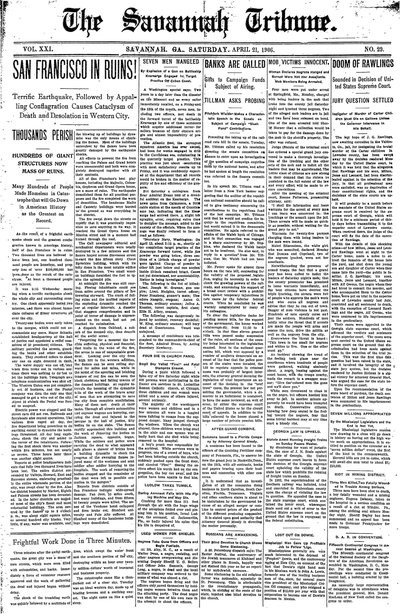
Page text (machine-generated)
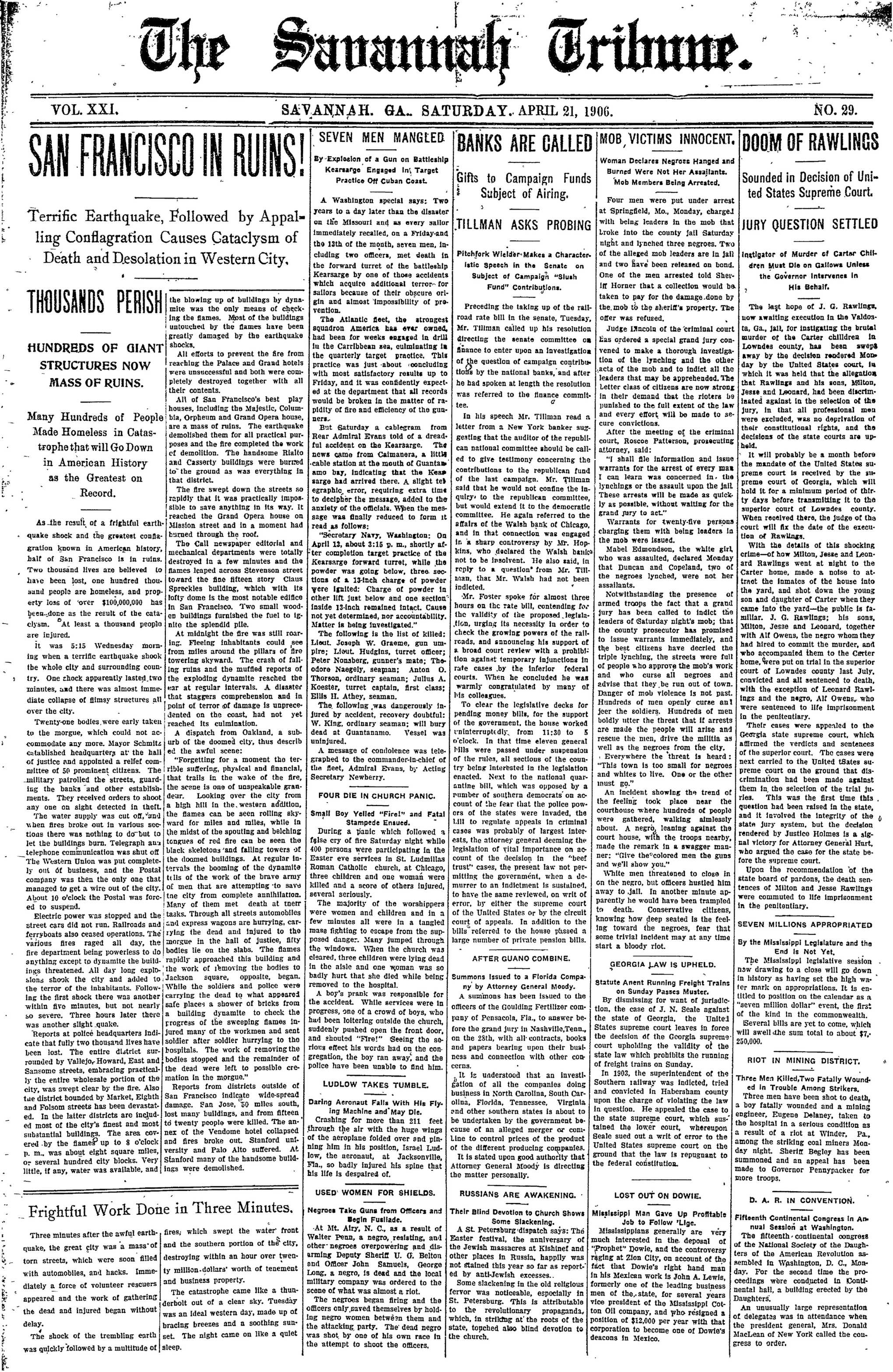
SAN FRANCISCO IN RUINS!
Terrific Earthquake, Followed by Appalling Conflagration Causes Cataclysm of Death and Desolation in Western City.
Frightful Work Done in Three Minutes.
VOL. XXI.
SAN FRANCIS
Terrific Earthquake, ling Conflagration Death and Desolat
THOUSANDS PERISH
HUNDREDS OF GIANT STRUCTURES NOW MASS OF RUINS.
Many Hundreds of People Made Homeless in Catastrophe that will Go Down in American History as the Greatest on Record.
As the result of a frightful earthquake shock and the greatest conflagration known in American history, half of San Francisco is in ruins. Two thousand lives are believed to have been lost, one hundred thousand people are homeless, and property loss of over $100,000,000 has been done as the result of the cataclysm. At least a thousand people are injured.
It was 5:15 Wednesday morning when a terrific earthquake shook the whole city and surrounding country. One shock apparently lasted two minutes, and there was almost immediate collapse of filmsy structures all over the city. Twenty-one bodies were early taken to the morgue, which could not accommodate any more. Mayor Schmitz established headquarters at the hall of justice and appointed a relief committee of 50 prominent citizens. The military patrolled the streets, guarding the banks and other establishments. They received orders to shoot any one on sight detected in theft.
The water supply was cut off, and when fires broke out in various sections there was nothing to do but to let the buildings burn. Telegraph and telephone communication was shut off. The Western Union was put completely out of business, and the Postal company was then the only one that managed to get a wire out of the city. About 10 o'clock the Postal was forced to suspend.
Electric power was stopped and the street cars did not run. Railroads and ferryboats also ceased operations. The various fires raged all day, the fire department being powerless to do anything except to dynamite the buildings threatened. All day long explosions shook the city and added to the terror of the inhabitants. Following the first shock there was another within five minutes, but not nearly so severe. Three hours later there was another slight quake.
Reports at police headquarters indicate that fully two thousand lives have been lost. The entire district surrounded by Vallejor-Howard, East and Sansome streets, embracing practically the entire wholesale portion of the city, was swept clear by the fire. Also the district bounded by Market, Eighth and Folsom streets has been devastated. In the latter districts are included most of the city's finest and most substantial buildings. The area covered by the flames up to 8 o'clock p. m., was about eight square miles, or several hundred city blocks. Very little, if any, water was available, and
Frightful Work Don
Three minutes after the awful earthquake, the great city was a mass of torn streets, which were soon filled with automobiles, and hacks. Immediately a force of volunteer rescuers appeared and the work of gathering the dead and injured began without delay.
The shock of the trembling earth was quickly followed by a multitude of
the blowing up of buildings by dynamite was the only means of checking the flames. Most of the buildings untouched by the flames have been greatly damaged by the earthquake shocks. All efforts to prevent the fire from reaching the Palace and Grand hotels were unsuccessful and both were completely destroyed together with all their contents.
All of San Francisco's best play houses, including the Majestic, Columbia, Orpheum and Grand Opera house, are a mass of ruins. The earthquake demolished them for all practical purposes and the fire completed the work of demolition. The handsome Rialto and Casserty buildings were burred to the ground as was everything in that district. The fire swept down the streets so rapidly that it was practically impossible to save anything in its way. It reached the Grand Opera house on Mission street and in a moment had burned through the roof.
The Call newspaper editorial and mechanical departments were totally destroyed in a few minutes and the flames leaped across Stevenson street toward the fine fifteen story Claus Spreckles building, which with its lofty dome is the most notable edifice in San Francisco. Two small wooden buildings furnished the fuel to ignite the splendid pile.
At midnight the fire was still roaring. Fleeing inhabitants could see from miles around the pillars of fire towering skyward. The crash of falling ruins and the muffled reports of the exploding dynamite reached the ear at regular intervals. A disaster that staggers comprehension and in point of terror of damage is unprecedented on the coast, had not yet reached its culmination. A dispatch from Oakland, a suburb of the doomed city, thus described the awful scene:
"Forgetting for a moment the terrible suffering, physical and financial, that trails in the wake of the fire, the scene is one of unspeakable grandeur. Looking over the city from a high hill in the, western addition, the flames can be seen rolling skyward for miles and miles, while in the midst of the spouting and belching tongues of red fire can be seen the black skeletons and falling towers of the doomed buildings. At regular intervals the booming of the dynamite tells of the work of the brave army of men that are attempting to save the city from complete annihilation. Many of them met death at their tasks. Through all streets automobiles and express wagons are hurrying, carrying the dead and injured to the morgue in the hall of justice, fifty bodies lie on the slabs. The flames rapidly approached this building and the work of removing the bodies to Jackson square, opposite, began. While the soldiers and police were carrying the dead to what appeared safe places a shower of bricks from a building dynamite to check the progress of the sweeping flames injured many of the workmen and sent soldier after soldier hurrying to the hospitals. The work of removing the bodies stopped and the remainder of the dead were left to possible cremation in the morgue."
Reports from districts outside of San Francisco indicate wide-spread damage. San Jose, 50 miles south, lost many buildings, and from fifteen to twenty people were killed. The annex of the Vendome hotel collapsed and fires broke out. Stanford university and Palo Alto suffered. At Stanford many of the handsome buildings were demolished.
fires; which swept the water front and the southern portion of the city, destroying within an hour over twenty million-dollars' worth of tenement and business property.
The catastrophe came like a thunderbolt out of a clear sky. Tuesday was an ideal western day, made up of bracing breezes and a soothing sunset. The night came on like a quiet sleep.
SAVANNAH. GA.. SATURDAY. APRIL 21, 1906.
SEVEN MEN MANGLED
By-Explosion of a Gun on Battleship Kearsarge Engaged Int. Target Practice Off Cuban Coast.
A Washington special says: Two years to a day later than the disaster on the Missouri and as every sailor immediately recalled, on a Friday-and the 13th of the month, seven men, including two officers, met death in the forward turret of the battleship Kearsarge by one of those accidents which acquire additional terror for sailors because of their obscure origin and almost impossibility of prevention.
The Atlantic fleet, the strongest squadron America has ever owned, had been for weeks engaged in drill in the Carrlbean sea, culminating in the quarterly target practice. This practice was just about concluding with most satisfactory results up to Friday, and it was confidently expected at the department that all records would be broken in the matter of rapidity of fire and efficiency of the gunners.
But Saturday a cablegram from Rear Admiral Evans told of a dreadful accident on the Kearsarge. The news came from Caimanera, a little cable station at the mouth of Guantanamo bay, indicating that the Kearsarge had arrived there. A slight telegraphic error, requiring extra time to decipher the message, added to the anxiety of the officials. When the message was finally reduced to form it read as follows:
"Secretary Navy, Washington: On April 13, about 3:15 p. m., shortly after completion target practice of the Kearsarge forward turret, while the powder was going below, three sections of a 13-inch charge of powder were ignited: Charge of powder in other lift just below and one section inside 13-inch remained intact. Cause not yet determined, nor accountability. Matter is being investigated."
The following is the list of killed: Lieut. Joseph W. Graeme, gun umpire; Lieut. Hudgins, turret officer; Peter Nonsberg, gunner's mate; Theodore Neagely, seaman; Anton O. Thorson, ordinary seaman; Julius A. Koester, turret captain, first class; Ellis H. Athey, seaman.
The following was dangerously injured by accident, recovery doubtful: W. King, ordinary seaman; will bury dead at Guantanamo. Vessel was uninjured. A message of condolence was telegraphed to the commander-in-chief of the fleet, Admiral Evans, by Acting Secretary Newberry.
FOUR DIE IN CHURCH PANIC.
Small Boy Yelled "Fire!" and Fatal Stampede Ensued.
During a panic which followed a false cry of fire Saturday night while 400 persons were participating in the Easter eve services in St. Ludmillas Roman Catholic church, at Chicago, three children and one woman were killed and a score of others injured, several seriously.
The majority of the worshippers were women and children and in a few minutes all were in a tangled mass fighting to escape from the supposed danger. Many jumped through the windows. When the church was cleared, three children were lying dead in the aisle and one woman was so badly hurt that she died while being removed to the hospital. A boy's prank was responsible for the accident. While services were in progress, one of a crowd of boys, who had been loitering outside the church, suddenly pushed open the front door, and shouted "Fire!" Seeing the serious effect his words had on the congregation, the boy ran away, and the police have been unable to find him.
LUDLOW TAKES TUMBLE.
Daring Aeronaut Falls With His Flying Machine and May Die.
Big Machine and May Die.
Crashing for more than 211 feet through the air with the huge wings of the aeroplane folded over and pinning him in his position, Israel Ludlow, the aeronaut, at Jacksonville, Fla., so badly injured his spine that his life is despaired of.
USED WOMEN FOR SHIELDS.
Negroes Take Guns from Officers and Begin Fusilade. At Mt. Alry, N. C., as a result of Walter Penn, a negro, resisting, and other negroes overpowering and disarming Deputy Sheriff U. G. Belton and Officer John Samuels, George Long, a negro, is dead and the local military company was ordered to the scene of what was almost a riot. The negroes began firing and the officers only saved themselves by holding negro women between them and the attacking party. The dead negro was shot by one of his own race in the attempt to shoot the officers.
BANKS ARE CALLED
Gifts to Campaign Funds Subject of Airing.
TILLMAN ASKS PROBING
Pitchfork Wieldar Makes a Characteristic Speech in the Senate on Subject of Campaign "Slush Fund" Contributions.
Preceding the taking up of the railroad rate bill in the senate, Tuesday, Mr. Tillman called up his resolution directing the senate committee on finance to enter upon an investigation of the question of campaign contributions by the national banks, and after he had spoken at length the resolution was referred to the finance committee.
In his speech Mr. Tillman read a letter from a New York banker suggesting that the auditor of the republican national committee should be called to give testimony concerning the contributions to the republican fund of the last campaign. Mr. Tillman said that he would not confine the inquiry to the republican committee, but would extend it to the democratic committee. He again referred to the affairs of the Walsh bank of Chicago, and in that connection was engaged in a sharp controversy by Mr. Hopkins, who declared the Walsh bank not to be insolvent. He also said, in reply to a question from Mr. Tillman, that Mr. Walsh had not been indicted.
Mr. Foster spoke for almost three hours on the rate bill, contending for the validity of the proposed legislation, urging its necessity in order to check the growing powers of the railroads, and announcing his support of a broad court review with a prohibition against temporary injunctions in rate cases by the inferior federal courts. When he concluded he was warmly congratulated by many of his colleagues.
To clear the legislative decks for pending money bills, for the support of the government, the house worked uninterruptedly from 11:30 to 5 o'clock. In that time eleven general bills were passed under suspension of the rules, all sections of the country being interested in the legislation enacted. Next to the national quarantine bill, which was opposed by a number of southern democrats on account of the fear that the police powers of the states were invaded, the bill to regulate appeals in criminal cases was probably of largest interests, the attorney general deeming the legislation of vital importance on account of the decision in the "beef trust" cases, the present law not permitting the government, when a demurrier to an indictment is sustained, to have the same reviewed, on writ of error, by either the supreme court of the United States or by the circuit court of appeals. In addition to the bills referred to the house passed a large number of private pension bills.
AFTER GUANO COMBINE.
Summons Issued to a Florida Company by Attorney General Moody. A summons has been issued to the officers of the Goulding Fertilizer company of Pensacola, Fla., to answer before the grand jury in Nashville, Tenn., on the 28th, with all contracts, books and papers bearing upon their business and connection with other concerns.
It is understood that an investigation of all the companies doing business in North Carolina, South Carolina, Florida, Tennessee, Virginia and other southern states is about to be undertaken by the government because of an alleged merger or combine to control prices of the product of the different producing companies. It is stated upon good authority that Attorney General Moody is directing the matter personally.
RUSSIANS ARE AWAKENING.
Their Blind Devotion to Church Shows Some Slackening.
A St. Petersburg dispatch says: The Easter festival, the anniversary of the Jewish massacres at Kishinef and other places in Russia, happily was not stained this year so far as reported by anti-Jewish excesses.
Some slackening in the old religious fervor was noticeable, especially in St. Petersburg. This is attributable to the revolutionary propaganda, which, in striking at the roots of the state, topched also blind devotion to the church.
MOB VICTIMS INNOCENT.
Woman Declares Negroes Hanged and Burned Were Not Her Assailants. Mob Members Being Arrested.
Four men were put under arrest at Springfield, Mo., Monday, charged with being leaders in the mob that Lroke into the county jail Saturday night and lynched three negroes. Two of the alleged mob leaders are in jail and two have been released on bond. One of the men arrested told Sheriff Horner that a collection would be taken to pay for the damage done by the mob to the sheriff's property. The offer was refused.
Judge Lincoln of the criminal court Has ordered a special grand jury convened to make a thorough investigation of the lynching and the other acts of the mob and to indict all the leaders that may be apprehended. The Letter class of citizens are now strong in their demand that the rioters be punished to the full extent of the law and every effort will be made to secure convictions. After the meeting of the criminal court, Roscoe Patterson, prosecuting attorney, said:
"I shall file information and issue warrants for the arrest of every man I can learn was concerned in the lynchings or the assault upon the jail. These arrests will be made as quickly as possible, without waiting for the grand jury to act."
Warrants for twenty-five persons charging them with being leaders in the mob were issued.
Mabel Edmondson, the white girl, who was assaulted, declared Monday that Duncan and Copeland, two of the negroes lynched, were not her assailants.
Notwithstanding the presence of armed troops the fact that a grand jury has been called to indict the leaders of Saturday night's mob; that the county prosecutor has promised to issue warrants immediately, and the best citizens have decried the triple lynching, the streets were full of people who approve the mob's work and who curse all negroes and advise that they be run out of town. Danger of mob violence is not past. Hundreds of men openly curse and jeer the soldiers. Hundreds of men boldly utter the threat that if arrests are made the people will arise and rescue the men, drive the militia as well as the negroes from the city.
Everywhere the threat is heard: "This town is too small for negroes and whites to live. One or the other must go." An incident showing the trend of the feeling took place near the courthouse where hundreds of people were gathered, walking aimlessly about. A negro leaning against the court house, with the troops nearby, made the remark in a swagger manner: "Give the colored men the guns and we'll show you."
White men threatened to close in on the negro, but officers hustled him away to jail. In another minute apparently he would have been trampled to death. Conservative citizens, knowing how deep seated is the feeling toward the negroes, fear that some trivial incident may at any time start a bloody riot.
GEORGIA LAW IS UPHELD.
Statute Anent Running Freight Trains on Sunday Passgs Muster.
By dismissing for want of jurisdiction, the case of J. N. Scale against the state of Georgia, the United States supreme court leaves in force the decision of the Georgia supreme court upholding the validity of the state law which prohibits the running of freight trains on Sunday.
In 1903, the superintendent of the Southern railway was indicted, tried and convicted in Habersham county upon the charge of violating the law in question. He appealed the case to the state supreme court, which sustained the lower court, whereupon Seale sued out a writ of error to the United States supreme court on the ground that the law is repugnant to the federal constitution.
LOST OUT ON DOWIE.
Mississippi Man Gave Up Profitable Job to Follow 'Lige.
Mississippians generally are very much interested in the deposal of "Prophet" Dowle, and the controversy raging at Zion City, on account of the fact that Dowle's right hand man in his Mexican work is John A. Lewis, formerly one of the leading business men of the, state, for several years vice president of the Mississippi Cotton Oil company, and who resigned a position of $12,000 per year with that corporation to become one of Dowle's deacons in Mexico.
NO.29.
DOOM OF RAWLINGS
Sounded in Decision of United States Supreme Court
JURY QUESTION SETTLED
Instigator of Murder of Carter Children Must Die on Gallows Unless the Governor Intervenes In
The last hope of J. G. Rawlings, now awaiting execution in the Valdosta, Ga., jail, for instigating the brutal murder of the Carter children in Lowndes county, has been swept away by the decision rendered Monday by the United States court, in which it was held that the allegation that Rawlings and his sons, Milton, Jesse and Leonard, had been discriminated against in the selection of the jury, in that all professional men were excluded, was no deprivation of their constitutional rights, and the decisions of the state courts are upheld.
It will probably be a month before the mandate of the United States supreme court is received by the supreme court of Georgia, which will hold it for a minimum period of thirty days before transmitting it to the superior court of Lowndes county. When received there, the judge of the court will fix the date of the execution of Rawlings.
With the details of this shocking crime—of how Milton, Jesse and Leonard Rawlings went at night to the Carter home, made a noise to attract the inmates of the house into the yard, and shot down the young son and daughter of Carter when they came into the yard—the public is familiar. J. G. Rawlings; his sons, Milton, Jesse and Leonard, together with Alf Owens, the negro whom they had hired to commit the murder, and who accompanied them to the Carter home, were put on trial in the superior court of Lowndes county last July, convicted and all sentenced to death, with the exception of Leonard Rawlings and the negro, Alf Owens, who were sentenced to life imprisonment in the penitentiary.
Their cases were appealed to the Georgia state supreme court, which affirmed the verdicts and sentences of the superior court. The cases were next carried to the United tSates supreme court on the ground that discrimination had been made against them in the selection of the trial juries. This was the first time this question had been raised in the state, and it involved the integrity of the state jury system, but the decision rendered by Justice Holmes is a signal victory for Attorney General Hurt, who argued the case for the state before the supreme court.
Upon the recommendation of the state board of pardons, the death sentences of Milton and Jesse Rawlings were commuted to life imprisonment in the penitentiary.
SEVEN MILLIONS APPROPRIATED
By the Mississippi Legislature and the End Is Not Yet
The Mississippi legislative session now drawing to a close will go down in history as having set the high water mark on appropriations. It is entitled to position on the calendar as a "seven million dollar" event, the first of the kind in the commonwealth. Several bills are yet to come, which will swell the sum total to about $7,250,000.
RIOT IN MINING DISTRICT.
Three Men Killed,Two Fatally Wounded in Trouble Among Strikers.
Three men have been shot to death, a boy fatally wounded and a mining engineer, Eugene Delaney, taken to the hospital in a serious condition as a result of a riot at Winder, Pa., among the striking coal miners Monday night. Sheriff Begley has been summoned and an appeal has been made to Governor Pennypacker for more troops.
D. A. R. IN CONVENTION.
Fifteenth Continental Congress in Annual Session at Washington.
Final Session at Washington.
The fifteenth continental congress of the National Society of the Daughters of the American Revolution assembled in Washington, D. C., Monday. For the second time the proceedings were conducted in Continental hall, a building erected by the Daughters.
An unusually large representation of delegates was in attendance when the president general, Mrs. Donald MacLean of New York called the congress to order.
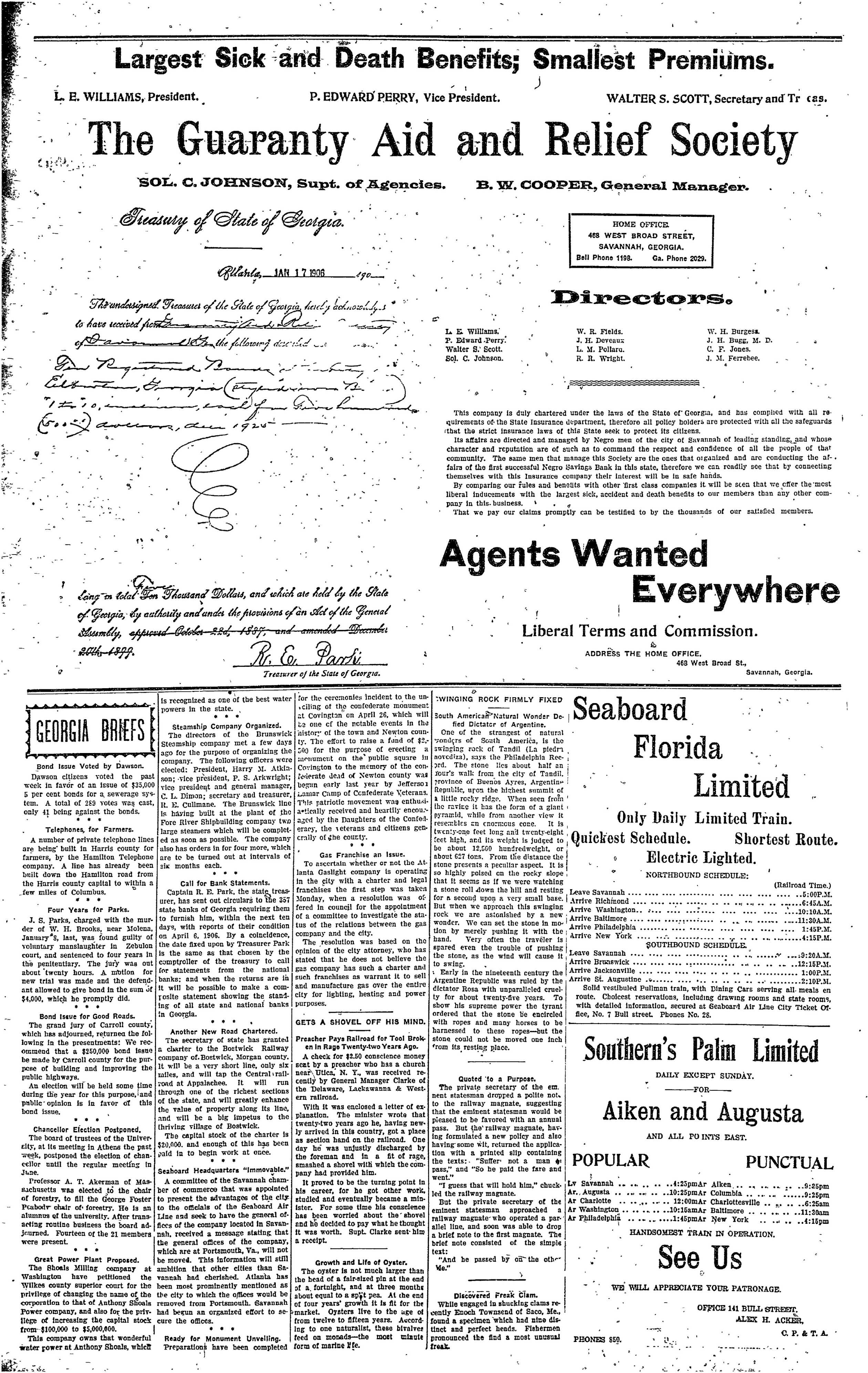
The Guaranty Aid and Relief Society
Treasury of State of Georgia.
long in total Ten Thousand Dollars, and which are held by the State of Georgia, by authority and under the provisions of an Act of the General Assembly, approved October 22d, 1887, and amended December 20th, 1897.
Dawson citizens voted the past week in favor of an issue of $35,000 5 per cent bonds for a sewerage system. A total of 289 votes was cast, only 41 being against the bonds.
Telephones for Farmers.
A number of private telephone lines are being built in Harris county for farmers, by the Hamilton Telephone company. A line has already been built down the Hamilton road from the Harris county capital to within a few miles of Columbus.
Four Years for Parks.
J. S. Parks, charged with the murder of W. H. Brooks, near Molena, January 8, last, was found guilty of voluntary manslaughter in Zebulon court, and sentenced to four years in the penitentiary. The jury was out about twenty hours. A motion for new trial was made and the defendant allowed to give bond in the sum of $4,000, which he promptly did.
Bond Issue for Good Roads
Bond Issue for Good Roads. The grand jury of Carroll county, which has adjourned, returned the following in the presentments: We recommend that a $250,000 bond issue be made by Carroll county for the purpose of building and improving the public highways. An election will be held some time during the year for this purpose, and public opinion is in favor of this bond issue.
Chancellor Election Postponed. The board of trustees of the University, at its meeting in Athens the past week, postponed the election of chancellor until the regular meeting in June. Professor A. T. Akerman of Massachusetts was elected to the chair of forestry, to fill the George Foster Peabody chair of forestry. He is an alumnus of the university. After transacting routine business the board adjourned. Fourteen of the 21 members were present.
* * *
Great Power Plant Proposed. The Shoals Milling company at Washington have petitioned the Wilkes county superior court for the privilege of changing the name of the corporation to that of Anthony Shoals Power company, and also for the privilege of increasing the capital stock from $100,000 to $5,000,000. This company owns that wonderful water power at Anthony Shoals, which
SOL. C. JOHNSON, Supt. of Agencies.
is recognized as one of the best water powers in the state.
Steamship Company Organized. The directors of the Brunswick Steamship company met a few days ago for the purpose of organizing the company. The following officers were elected: President, Harry M. Atkinson; vice president, P. S. Arkwright; vice president and general manager, C. L. Dimon; secretary and treasurer, R. E. Cullmane. The Brunswick line is having built at the plant of the Fore River Shipbuilding company two large steamers which will be completed as soon as possible. The company also has orders in for four more, which are to be turned out at intervals of six months each.
Call for Bank Statements.
Captain R. E. Park, the state treasurer, has sent out circulars to the 357 state banks of Georgia requiring them to furnish him, within the next ten days, with reports of their condition on April 6, 1906. By a coincidence, the date fixed upon by Treasurer Park is the same as that chosen by the comptroller of the treasury to call for statements from the national banks; and when the returns are in it will be possible to make a composite statement showing the standing of all state and national banks in Georgia.
***
Another New Road Chartered.
The secretary of state has granted a charter to the Bostwick Railway company of Bostwick, Morgan county. It will be a very short line, only six miles, and will tap the Central railroad at Appalachee. It will run through one of the richest sections of the state, and will greatly enhance the value of property along its line, and will be a big impetus to the thriving village of Bostwick.
The capital stock of the charter is $20,000. and enough of this has been paid in to begin work at once.
Seaboard Headquarters "Immovable."
A committee of the Savannah chamber of commerce that was appointed to present the advantages of the city to the officials of the Seaboard Air Line and seek to have the general offices of the company located in Savannah, received a message stating that the general offices of the company, which are at Portsmouth, Va., will not be moved. This information will still ambition that other cities than Savannah had cherished. Atlanta has been most prominently mentioned as the city to which the offices would be removed from Portsmouth. Savannah had begun an organized effort to secure the offices.
Ready for Monument Unvelling. Preparations have been completed
P. EDWARD PERRY, Vice President.
for the ceremonies incident to the unveiling of the confederate monument at Covington on April 26, which will be one of the notable events in the history of the town and Newton county. The effort to raise a fund of $2,500 for the purpose of erecting a monument on the public square in Covington to the memory of the confederate dead of Newton county was begun early last year by Jefferson Lamar Camp of Confederate Veterans. This patriotic movement was enthusiastically received and heartily encouraged by the Daughters of the Confederacy, the veterans and citizens generally of the county.
Gas Franchise an Issue.
To ascertain whether or not the Atlanta Gaslight company is operating in the city with a charter and legal franchises the first step was taken Monday, when a resolution was offered in council for the appointment of a committee to investigate the status of the relations between the gas company and the city.
The resolution was based on the opinion of the city attorney, who has stated that he does not believe the gas company has such a charter and such franchises as warrant it to sell and manufacture gas over the entire city for lighting, heating and power purposes.
GETS A SHOVEL OFF HIS MIND.
Preacher Pays Railroad for Tool Broken in Rage Twenty-two Years Ago. A check for $2.50 conscience money sent by a preacher who has a church near Utica, N. Y., was received recently by General Manager Clarke of the Delaware, Lackawanna & Western railroad.
With it was enclosed a letter of explanation. The minister wrote that twenty-two years ago he, having newly arrived in this country, got a place as section hand on the railroad. One day he was unjustly discharged by the foreman and in a fit of rage, smashed a shovel with which the company had provided him.
It proved to be the turning point in his career, for he got other work, studied and eventually became a minister. For some time his conscience has been worried about the shovel and he decided to pay what he thought it was worth. Supt. Clarke sent him a receipt.
Growth and Life of Oyster.
The oyster is not much larger than the head of a fair-sized pin at the end of a fortnight, and at three months about equal to a spit pea. At the end of four years' growth it is fit for the market. Oysters live to the age of from twelve to fifteen years. According to one naturalist, these bivalves feed on monads—the most minute form of marine life.
This company is duly chartered under the laws of the State of Georgia, and has compiled with all requirements of the State Insurance department, therefore all policy holders are protected with all the safeguards that the strict insurance laws of this State seek to protect its citizens.
Its affairs are directed and managed by Negro men of the city of Savannah of leading standing, and whose character and reputation are of such as to command the respect and confidence of all the people of that community. The same men that manage this Society are the ones that organized and are conducting the affairs of the first successful Negro Savings Bank in this state, therefore we can readily see that by connecting themselves with this Insurance company their interest will be in safe hands.
By comparing our rules and benefits with other first class companies it will be seen that we offer the most liberal inducements with the largest sick, accident and death benefits to our members than any other company in this business.
That we pay our claims promptly can be testified to by the thousands of our satisfied members.
SWINGING ROCK FIRMLY FIXED
South American Natural Wonder Desi-
diert Diplomat of Argentina
One of the strangest of natural wonders of South America, is the swinging rock of Tandil (La piedra novediza), says the Philadelphia Record. The stone lies about half an hour's walk from the city of Tandil, province of Buenos Ayres, Argentine Republic, upon the highest summit of a little rocky ridge. When seen from the ravine it has the form of a giant pyramid, while from another view it resembles an enormous cone. It is twenty-one feet long and twenty-eight feet high, and its weight is judged to be about 12,500 hundredweight, or about 627 tons. From the distance the stone presents a peculiar aspect. It is so highly polished on the rocky slope that it seems as if we were watching a stone roll down the hill and resting for a second upon a very small base. But when we approach this swinging rock we are astonished by a new wonder. We can set the stone in motion by merely pushing it with the hand. Very often the traveller is spared even the trouble of pushing the stone, as the wind will cause it to swing.
: Early in the nineteenth century the Argentine Republic was ruled by the dictator Rosa with unparalleled cruelty for about twenty-five years. To show his supreme power the tyrant ordered that the stone be encircled with ropes and many horses to be harnessed to these ropes—but the stone could not be moved one inch from its resting place.
Quoted to a Purpose.
The private secretary of the eminent statesman dropped a polite not to the railway magnate, suggesting that the eminent statesman would be pleased to be favored with an annual pass. But the railway magnate, having formulated a new policy and also having some wit, returned the application with a printed slip containing the texts: "Suffer not a man pass," and "So he paid the fare and went."
"I guess that will hold him," chuckled the railway magnate.
But the private secretary of the eminent statesman approached a railway magnate who operated a parallel line, and soon was able to drop a brief note to the first magnate. The brief note consisted of the simple text: "And he passed by on the other We."
Discovered Freak Clam.
While engaged in shucking clams recently Enoch Townsend of Saco, Me., found a specimen which had nine distinct and perfect heads. Fishermen pronounced the find a most unusual freak.
HOME OFFICE
468 WEST BROAD STREET,
SAVANNAH, GEORGIA.
Bell Phone 1198. Ga. Phone 2029.
(Railroad Time.)
Leave Savannah ... 5:00P.M.
Arrive Richmond ... 6:45A.M.
Arrive Washington ... 10:10A.M.
Arrive Baltimore ... 11:30A.M.
Arrive Philadelphia ... 1:45P.M.
Arrive New York ... 4:15P.M.
SOUTHBOUND SCHEDULE.
Leave Savannah ... 9:20A.M.
Arrive Brunswick ... 12:15P.M.
Arrive Jacksonville ... 1:00P.M.
Arrive St. Augustine ... 2:10P.M.
Solid vestibuled Pullman train, with Dining Cars serving all meals en route. Cholestest reservations, including drawing rooms and state rooms, with detailed information, secured at Seaboard Air Line City Ticket Office, No. 7 Bull street. Phones No. 28.
Lv Savannah .....4:25pmAr Alken .....9:25pm
Ar. Augusta .....10:25pmAr Columbia .....9:25pm
Ar Charlotte .....12:00mAr Charlottesville .....6:25am
Ar Washington .....10:15amAr Baltimore .....11:30am
Ar Philadelphia .....1:45pmAr New York .....4:15pm
Not on the quarterdeck alone
Are the battle's bravest heroes known;
Not by the man behind the gun
Are the glorious victories always won;
With the sanguine out-of-sight of the sanguine scene,
Where are doughty deeds of daring done
Like Huntley's—Huntley of the Castine!
When the little gunboat darted at dawn,
With her fluttering starry flag at peak,
Far off the man—
San Juan of Porto Rique-
She seemed like a living, conscious thing
With the battle-passion quivering;
At fullest speed, with her screws a-spin,
And her batteries roaring, she hurried in,
Leaping—the baby of all the feet—
Her futunacs glowing with fury heat.
Suddenly down in the deepesthest,
There in the vessel's throbbing heart,
Rose a sound to test the soul of the hold,
To make the bravest blanch and start—
Not the noise of a dream, but the hiss of
Cries faintless Huntley man of the hour.
He will save from destruction dire.
Save if it lies within mortal power.
The stokers heave with lairbone breath
In a deserate light with a demon death.
Into that rocking pit he dares.
Huntley—Huntley of the Castine;
(0 for'a waft of God's fresh sweet alms
And the sea and the heavens clear and
clean!)
Pass the minutes—one—two—and three;
To him and his comrades each seems to be
A separate eternity.
The whist 'mid the heat and the stifling
fume.
He tightens the bolt that is threatening
doom;
Then forth they hale him to see him lie
Prone before them with lidded eye—
Nay, nay; but he did not die!
He did not die, and when up to the blue
Of the sky they bore him with reverent
mien
And he roused and gazed on the flag that
descried. Over the plains and blaze of the battle scene,
And smiled, how they cheered him, that
valiant crew!
Shall we not join in the cheering, too,
For Huntley—the hero of the 'Tatine!
—Clinton Stollard, in the Sunday Sun.
The Pity of It.
"But it must be done, William,"
said his wife, her head slightly raised
and her gray eyes sharp with sup-
pressed excitement.
"I should be dreadfully mortified not to do as much for Elise as Charles does for his children. Well, not exactly as-much in every way, no, of course we really couldn't expect her to have so much jewelry and as many new frocks. But to have Elise look old-fashioned, and not have suitable things for her little parties—why it is positively cmbarrassing to her and humilizes me."
William Soliday avoided his wife's gaze, and methodically arranged his necktie. He was a plain man, with a kindly smile when he was not disturbed by his ambitious wife and daughter.
"Well, William, can't you tell me whether you can let me have $20 or not this week?"
"I don't see how I can, Eliza. I've had a hard winter at the store and a good many accounts overdue. I wish I could make as much money as Charles, but I can't seem to do it, anyway. He is a good talker and smart. You know, Eliza, that I've worked hard for the last 25 years, early and late."
"Oh, I don't accuse you of being lazy," remarked Mrs. Solidary tarly; "what I would like to see is something to show for all your work. Charles doesn't get to his office till 9 and is always through at 5, and makes at least a hundred dollars a week in salary and commissions."
"I'll tell you right now, Eliza, that even though Charles is my cousin, I would not be in his line of business for a thousand a week. It's no use to continue this talk any longer, Eliza. I hope to be able to supply you and Elise with all the necessaries of life, and a little more, but as for fitting out Elise so she can run around with the set that her cousin belongs to, I cannot even attempt it." This closed the conversation for that morning, and while Mrs. Sollday sat in her room finishing her daughter's graduating gown, her mind dwelt bitterly on her cramped life with its petty economies.
She had really loved William Sollday 30 years ago. He was a clerk then, in her father's store, and a genial, honest young fellow. But when the business was his, he did not seem to know just how to make it pay. He bought a good line of stock, and he had to sell at a close margin to compete with the cheap articles displayed by his rivals. Then he paid his help a fair price, and his roomy, well-ventilated store cut still deeper-into his profits. She suspected that some of his old customers had not paid their bills for a long time, in fact, when a man was out of work, or there was slackness. William never would push his claims, and sometimes he lost a good deal, that way.
As Ellza Soliday thought, her cheeks burned and the smouldering fire of discontent burst into a brighter blaze. She had not minded the scrimping so much when Ellse was little, her clothes cost such a small amount—and she had not begun to have her social ambitions awakened till the last year or two.
The other girls in the class were to have either a handsome piece of jewelry or a gold watch, as a souvenir of graduation day, and there were photographs, spreads, class plus, dances, and the usual accompaniments of the festive time.
Charles Soliday's twin daughters had everything that any one had, and far more. Their father was to present them with watches, suitably engraved, and their mother had promised them elegant gold bracelets, with diamond studded clasps. They were to entertain the entire class at an informal dance, followed by a supper, at which each guest would be presented with a specially designed favor.
The girl's gowns were to be made by their mother's fashionable dressmaker, and nothing would be lacking to complete their stylish appearance. The dotted Swiss muslin which Mrs. Sollday was rapidly finishing looked coarse and cheap in her eyes, and she threw it on the bed with a completely disgusted expression on her handsome face.
That day Mrs. Sollday spent a few hours with her sister, who lived out in the suburbs. Returning home in the late afternoon, she was obliged to sit in a closely-crowded car, and her eyes were startled by headlines in a special edition of an evening paper: "Charles Sollday Arrested. About to escape with his plunder. Denied wrong-doing, but finally broke down and confessed."
Mrs. Sollday felt her heart stop beating for a moment, then plunge like a runaway horse. Charles Sollday, whose wife and daughters she had envied—she could not believe her own eyes. Mrs. Sollday was too excited to remain in the car when it approached her locality, so signaling to the conductor, she left the car and walked rapidly towards her home.
Hurrying into the house she was met by Elise, who had heard the news. The girl was as excited as her mother, and they talked over the astonishing situation.
"Isn't it dreadful for Bertha and Bernice," said Elise. "They didn't come to school today, and the girls said their mother had hysterics and fainting spells all day. There's father coming now."
"Tell him I am upstairs and I want to speak to him right away," said Mrs. Sollday as she hastened out of the room.
William Sollday looked very soberly at his pretty daughter, then turned and walked slowly to his wife's room. She met him at the door and the tears were running down her cheek.
"Oh, William, can you ever forgive me," she began:
"There, Eliza, don't take on so," said her husband, dropping heavily into a big chair, and taking the trembling woman in his arms.
"But to think what Charles has done—and where he is—and where you might have been if—" here she was unable to go on.
"Don't cry so, Eliza. It will be all right in time," continued Mr. Soliday, patting his wife's shoulder and hardly realizing what he was saying.
"Oh, but William, I would rather live plain, and not have new things and know that my husband was an honest man. And you were stronger than I was, because I was afraid of what people would say and I might have driven you to do something desperate just as Charles has done," and she began to gob with renewed violence.
"Now, Eliza, just listen a minute," said William Soliday. "I had a chance to make $50 today, that is, I received it on an old account that I never expected to be paid. If you want it to buy some pretty things for the little girl—"
"Oh, Willian, it's more than enough," returned his wife. "She will only need a part of it and I want you to have some for yourself. I can't have my good man looking shabby; she ended with a slight smile around her mouth and her husband was too wise to object.
Among the lovely young girls who were graduated there was none more bewitching than Elise Soliday in her simple gown and without any jingling trinkets. The Soliday twins were not there, and with their withdrawal from the class, the element of extravagance which threatened to be the dominant feature was eliminated. In girlish fashion the swing of the pendulum was toward extreme simplicity of dress, to the relief of those whose means were limited to a small outlay.
"Our Elise was the prettiest girl in the class," said Mrs. Soliday to her husband that night.
"How could she help it—with such a mother," he replied without a moment's hesitation—Mary Peabody Sawyer in the American Cultivator.
Tommy's Good Fairy.
Smoking was an abomination to Queen Victoria, and many a notable man at Windsor had to hang his head out of a window or stick it up the chimney to get a "blow" before bed. But she sympathized with the soldier's craving for tobacco.
Writing to Mr. Childers, Sir Henry Ponsonby said: "The Standard says the men in Egypt complain that they can not get tobacco. The Queen hopes that something can be done for the purpose of supplying them with this almost necessary of life out there. Her majesty wished to help in sending out tobacco, but I scarcely know what the Queen could do in this matter."
Lord Wolseley was evidently in sympathy with the wishes of the Queen, and personally celebrated Tel-el-Kebir by smoking nine cigars in succession.
Whom It Was For.
Three girl clerks were waiting for the rush of business to begin this morning about 8 o'clock in a Denver department store. "Girls," said the stationery clerk, "a man who came up here yesterday to buy some writing paper said the queerest thing to me."
"What was it?" asked another.
"Well," continued the first, "he wanted to see some stationery. I didn't know just what kind he was after—men's or women's styles. 'Christmas present, I suppose,' I ventured to say. 'Yes,' he replied stifly. 'Do you wish it for a lady?' I asked."
"What did he say?" asked one of the other girls.
"He frowned," replied the stationery clerk, "and growled 'No, it's for my mother-in-law.'"—Denver Post
A SCHOLARLY SUNDAY SERMON BY THE REV. L. L. TAYLOR.
Subject: "Square Deal in Religion."
Brooklyn, N. Y.-As the subject of his sermon Sunday the Rev. Livingston L. Taylor, pastor of the Puritan Congregational Church, spoke on "The Square Deal in Religion." He took two texts: Proverbs xi.22: "They that deal truly are His delight," and Psalm xi.1: "The righteous Lord loveth right-cousness." Mr. Taylor said:
The kingdom of heaven is a square deal on earth. From the night visions of the shepherds to the day dreams of St. John It is peace and good will on earth, among men, which the hosts of God are seen bestirring themselves to promote. And He who came from heaven lived brother to all men, that they might ever after dwell as brethren here. But there can be no kingdom of brotherly men on earth with any other throne set up than that of a fatherly God in heaven. The square deal has its vertical lines as well as its horizontal. The horizon never limited Christ's vision. He lived for the day when men would treat God right. In that day no man will have anything to fear from any other man. The thinking world is coming around more and more to Christ's estimate of religion as the power that must set things right among men. But in His day and in ours the problem of the square deal involves religion itself. It has always been hard to get a square deal for religion. It has always been hard to maintain a square deal in presenting the claims of religion. It has always been hard to keep a square deal at the heart of religion. These things should be borne in mind by us all as we enter upon the special religious activities and privileges of the Lenten season.
The square deal in religion involves a square deal for religion. And this in turn involves two things: first, a fair-minded attitude toward religious phenomena, institutions, doctrines and persons, and second, a determination to deal fairly with our own religious nature, a determination to give the soul a square deal.
Men deal more fairly with the fact of religion than they used to. They are settling down to the conclusion that the race is "incorrigibly religious." They are beginning to understand that the world's history could not have been what it has been if men had no capacity and need for religion. Religion must be recognized as a legitimate human interest unless we want to throw out of court the most persistent of all classes of facts. Religion must be recognized as one of the great human interests if we are to maintain any sort of proportion in our view of human life as a whole. Religion must be recognized as the supreme human interest if we would be consistent with any reasonable definition of religion. If religion is an affair of the soul in its relations with the infinite nothing short of this is reasonable or right. We should expect to see men, as we do, striving to make religion supreme, not content with anything short of the religious interpretation of the universe and of human life, determined to have some sort of religious system, spending and being spent in the service of religious institutions, their churches, their missions. We should deal as fairly with these facts as we do with the facts which convince us, that it is natural for men to have music, that it is natural for men to express themselves and to find pleasure in the varied forms of art, that it is natural for men to concern themselves with the right and wrong of things and of their own lives.
But fair dealing with the fact of religion requires that we should recognize the limitations and the inevitable imperfection of all the forms in which the religious aspirations of men find expression. It is nothing to the discredit of religion if our best efforts to embody it fall short of those visions of its glory with which our souls are blessed. It is no less a treasure because we have it in earthen vessels. Religious systems are confessedly imperfect. Religious persons are full of faults. But they exist. They are facts. And they are as good evidence of man's religious nature as they are of the imperfection of all things human.
But how about our own religious nature, yours and mine? Have we been treating it fairly? In 1876 George Romanes, a brilliant young British scientist, came to the conclusion that he had no right to a soul or a God, and that it was his "obvious duty to stifle all belief" and to "discipline his intellect with regard to this matter into an attitude of the purest skepticism." "I am not ashamed to confess," he wrote at the time, "that with this virtual negation of God the universe to me has lost its soul of loveliness." And he was oppressed by "the appalling contrast between the hallowed glory of that creed which was once mine, and the lonely mystery of existence as I now find it." A little less than twenty years later George Romanes became convinced that in seeking to deal unfinchingly with the facts of physical science he had ignored the most significant of all facts, the most directly known, the most completely attested of all facts, the facts of his own religious nature. He came to recognize that it is "reasonable to be a Christian believer." Before his untimely death he had returned "to that full, deliberate communion with the church of Jesus Christ which he had for so many years been conscientiously compelled to forego." In the multitude of his thoughts within him he had secured a square deal for his soul.
Our difficulties may not be his, but we have them. The things which make it hard for us to secure our souls their chance may be very different from the things which made it hard for him. "Scientific men of to-day have less to make them feel as the seemingly triumphant materiale . . . of the seventies made young Romanes feel about having a God and a soul. But our difficulties may be of another class entirely. Perhaps they are far less creditable to our intellectual sincerity, less creditable to our moral purpose, evil inclinations and the multiplied opportunities for gratifying them that make it hard for their souls to get fair hearing. "The lust of the flesh, the lust of the eye and the pride of life are not of the Father," John tells us. But something more is true. They out-Herod in their conspiracy against what
is not that there is a low standard of honor or morality in business, but that there is practically no standard at all. Well-meaning men are often at a loss to determine whether a certain profitable policy is honorable or dishonorable.
Society is just now washing the windows of the life insurance business, and many people are hoping that hereafter when a man buys life insurance he will really get all that he pays for. On that point I am a pessimist, and shall remain one unless the subject of life insurance gets into our schools. We have had investigations before, and profuse promises of reform. In a few years the abuses of life insurance will be forgotten, new companies will be organized; and new men will get control of the old; and then new and wonderful ways of appropriating the people's money will be devised.
Publicity will provide some protection, especially if the affairs of insurance companies are regularly examined by independent certified public accountants, but publicity alone will not be enough. It will put a check on old abuses with which the public are familiar, but it will not compel steady improvement in the management of insurance companies, or any other corporation. Nor will it create a recognized ethical standard to be observed by corporation presidents and directors. Nothing can do that except an enlightened public consciousness, a quick intelligence among the people instantly recognizing and condemning bad methods and unfair contracts.
The elements of life insurance and the mathematics of premium rates should be taught in our public schools, while in our universities, departments of insurance should be established, and placed on a par with the departments of science, language, and philosophy. Then men would be properly trained for this great and important business, and gradually we should have the evolution of an intelligent public opinion with regard to the good and the bad. Until such a public opinion exists, no matter how sensitive the individual conscience may be, I do not see how we can have a moral standard in insurance or any other business.
Wealthy Ignoramuses
By O. S. Marden.
Interest him. It is painful to try to carry on a conversation with such a man. Think of the splendid opportunities for education, enjoyment, and culture which that man with thousands of others, is throwing away! It does not seem possible that a man could do business in New York City and be so ignorant of everything outside of his own little groove. One would think that some of the millionaires who try to make a show in the world would feel chagrinell when they contrast their cheap, shoddy education, their narrow, limited intelligence, and their rutty minds, their rityy, shrivelled souls, with their mocking wealth and their display of the art works of the masters and the books of great writers in their libraries which they cannot read intelligently. How this ostentatious show of the material mocks the mental poverty, the brain penury! It is pitiable, as well as ludicrous, to see men, who are rolling in wealth ignorant of the great world they live in, of the significance of all the principles and conditions which ameliorate and elevate mankind, men who know nothing of art or of science or literature, and whose mental penury is deplorable. They seem to think that a palatial residence, gorgeous furnishings, and fine carriages can be substitutes for that which makes a real man or a real woman.—Success Magazine.
Modern Philosophy Brutalizes Man By Dr. Emil G. Hirsch.
other creatures that tenant the earth. In their passion to show him as a beast, philosophers and authors have revealed in vice and depravity, calling it realism.
Society is drifting without a compass. It is a period of transition; the old canons are gone and the new ones have not yet been found. The latest announcement of modern philosophy is that you may do what you want to, but don't get caught at it. If you do, commit suicide. In this philosophy of brutality you have an explanation for the fact that literature always paints life as a struggle between the forces of desire and duty.
Never before in the history of the world was there so great a need of masters. Men who will interpret life in terms of sanity and sanctity, of duty and righteousness.
Most Dying Men Give No Sign of Care for Future
other; like their birth, their death was a sleep and a forgetting. The preacher was right; in this matter man hath no pre-eminence over the beast—"as one dieth so dieth the other."
As we travel farther from the East our salvation lies in keeping our faces toward the rising sun and in letting the fates drag us, like Ocus his oxen, backward into the cave of oblivion. I would urge the clinical physician as he travels farther from the East to look well to his companions, to see that they are not of his own age and generation. To keep his mind receptive, plastic and impressionable, he must travel with the men who are doing the work of the world, the men between the ages of twenty-five and forty.
Is heaven-born in us. They are not only "not of the Father," but they are the deadly foes of all that is of the Father. Happy are the souls in which the flight into Egypt comes out as it does in Matthew's Gospel of the Infancy. Let us not hesitate to play Joseph to our threatened soul. All the dreams and angels that we need will be forthcoming if we are faithful, and we shall get back to Nazareth. Somehow Herod will be circumvented. And though it be neither scientific coerules nor civil propensities which do most to make it hard for our souls, but just the petty preoccupations and the daily burdens and the round of more or less irritating duties of our common life, we are under the same sacred obligation and have the same encouragement to secure for our souls the square deal God means them to have. Let us never forget that Jesus Christ is the great champion of a square deal for every soul, and that means ours.
A square deal in presenting the claims of religion should be religiously maintained. God is eternally against anything else. Jeremiah never said anything which bears more unmistakably the seal of a divine ratification than when he called it "a wonderful and horrible thing" that had come to pass in the land; that "the prophets prophecy falsely, and the priests bear rule by their means; and my people love to have it so." But a square deal in presenting the claims of religion rules out, nc. merely willful falsification and perversion of the truth, it rules out intolerance and demands a square deal for the religious convictions of other people. It rules out dogmatism and demands a square deal for whatever new light may break forth. It rules out the insinuation of doubt and deands a square deal for the feeblest and most unintelligent faith. It rules out insincerity of whatever kind. But it does not rule out loyalty to deep convictions, nor defailenness of teaching, nor the replacing of the broken reed of an outworn doctrine with the strong staff of a living truth. To be absolutely loyal to the truth, and yet deal fairly with all the spiritual interests affected by the manner in which the claims of religion are presented, is no light thing to achieve. But of one thing, those to whom we go with the call of Christ must be left in no doubt, and that is that, so far as in us lies and God gives us light upon our way, we mean to be square with them. God made our ears so that they instinctively protect themselves against cant. They close as quickly as the threatened eye.
The square deal in religion involves a square deal at the heart of religion, The central doctrine should be the righteousness of God, the righteous dealing of God with men, a square deal and nothing less for all men, a square deal and nothing more for "the saved." Paul never gets tired of telling us that God does not save us by doing anything wrong. He is continually declaring God's righteousness in His way of saving men, that He is at once "just and the justifier of him that hath faith in Jesus." Paul proclaims the triumph of the square deal in Christ. In Him "mercy and truth are met together; righteousness and peace have kissed each other." All that God offers to us in Christ He has a right to offer. He comes before the bar of our conscience with His great gospel of forgiveness. If it is not ratified there it can never give us peace. It is not the less sensitive consciences which have borne the most unequivocal testimony to the peace which God gives in Christ Jesus. But there should be nothing to settle between your conscience and your doctrine of salvation. We are not saved by dishonest bookkeeping. Nothing is credited to us which does not belong to us in God's sight. Every item which justifies God in His mercy toward us may not appear. But no scheme that could not pass muster with us in our dealing with men can represent the redemptive dealings of God with sinners. The man who finds peace with God through Jesus Christ just believes that whatever safeguarding of righteousness was necessary when God's mercy set out to save him has not been neglected.
But while we need not fear that God will offer us more than He has a right to, we need have, on the other hand, no fear of giving too much to Him if we give all.
M
"Were the whole realm of nature mine,
That were a present far too small;
Love so amazing, so divine,
Demands my soul, my life, my all."
Negative Living.
Living to escape trouble is a poor kind of existence. The smaller animals in the forests and mountains have to give a large share of their attention to avoiding catastrophe, but man was made for another kind of life. "How are you?" a man called out to his friend in passing. "I can't complay," was the ready answer. Poor fellow! The best that he could say was that he was successfully dodging disaster for the moment! The present moment ought to make the highest point of joyous accomplishment our lives have yet known. God means that it should. We have more to be thankful for today than ever before since we or the world came into being. Even our unconscious habits of speech will indicate this if we are living abundantly.
God's Care.
People talk about special providences, I believe in providences, but not in the specialty. I do not believe that God lets the thread of my affairs go for six days, and on the seventh evening takes it up for a moment. The so-called special providences are no exception to the rule—they are common to all men at all moments. But it is a fact that God's care is more evident in some instances of it than in others, to the dim and often bewildered vision of humanity. Upon such instances men seize and call them providences. It is well that they can, but it would be gloriously better if they could believe that the whole matter is one grand providence.—George MacDonald.
A
All We Have to Do.
The discipline which we choose for ourselves does not destroy our self-love like that which God assigns us Himself each day. All we have to do is to give ourselves up to God day by day, without looking further. He carries us in His arms as a loving mother carries her child. In every need let us look with love and trust to our heavenly Father.—Francois dela Mothe Felenon.
NTIIL we have business men who have been trained in the principles and right methods of finance, the management of our banks, of our insurance companies, and of great corporations, will not be subjected to wholesome outside criticism. Things will be done in the dark which ought not to be done. Immorality is usually the joint product of opportunity and ignorance. When we have an enlightened business world there will be fewer dark placés in it, and opportunities for fraud, concealment, and peculation will be less. The trouble
WAS recently talking with a business man who is in the midst of the great activities of New York, dresses well, and lives well, but who, every time he opens his mouth, condemns himself, betrays his shocking ignorance of almost everything outside of his own little specialty. He knows almost nothing about the great men and women who figure prominently in current history. He could not even tell the names of the candidates for the presidency and vice-presidency just before last election. He said such things did not
AN is much the same as he was a thousand years ago. The same elemental passions, ambitions and appetites obtain. They are the same as those of the animals. Science has brought us to realize this, and our peep into the workshop of nature has had a tendency to brutalize humanity.
Our knowledge that man is only one of the company of brutes has led small men to teach that man in all things is merely a brute. In their desire to unify the world they have jumped at the conclusion that man is no different from the
---
S a rule, man dies as he has lived, uninfluenced, practically, by the thought of a future life. I have careful records of about five hundred death beds, studied particularly with reference to the modes of death and the sensations of the dying.
—Ninety suffered bodily pain and distress of some sort or another, eleven showed mental apprehension, two positive terror, one expressed spiritual exaltation, one bitter remorse. The great majority gave no sign, one way or the
PUBLISHED EVERY SATURDAY,
BY THE TRIBUNE PUBLISHING CO
116 W. St. Julian Street.
Gg.'Phone 574.
SUBSCRIPTION RATES.
One Year.....$1.25
Six Months.....75
Three Months.....50
Remittance must be made by Express or Post Office Money Order, or Registered Letter
Advertising Rates given on application.
THERE is a class of hackmen in the city who should have more manhood than to tolerate the meeting of white men and colored women.
SPRINGFIELD, Mo., followed in the wake of Springfield, Ohio. Three innocent colored men have been lynched to satiate the blood thirstiness of law-breakers and demons.
COLORED men in making property returns must be sure and make return for poll. This omission has caused several of our men to be double taxed. Make your returns now.
THE Republican Executive Committee of Chatham county had an enthusiastic meeting last week. Each district was represented and efforts are being made by the district leaders to get the tax payers registered.
HEFLIN, of Alabama, the congressman who is in favor of dynamiting the white house, now wants the races separated on the street cars in Washington, D. C. What more can be expected of a fellow of his ilk. His wish will not be realized.
The President's reappointment of Post Master Henry Blun, Jr., meets hearty approval. All of the friends of the genial Captain join in congratulating him. Capt. Blun's administration has been a successful and an efficient one.
Those from a distance are unable to fully comprehend the great disaster that befell San Francisco on Wednesday last, and only those who have had any experience at all with an earthquake can fully realize the horror. Never before has such a catastrophe happened in this country, and in the world, but few to surpass it. With over a thousand lives lost, thousands of fine buildings demolished and destroyed by fire and countless persons injured; make up a catastrophe that causes the stoutest heart to quake. The sympathy of the entire nation goes out to the sufferers.
Within the past several weeks number of complaints have been made about the robbing of white men by colored women. This is significant. But it is a common practice for white men to dodge in dark, lanes after the lowest classes of colored women, some of the very men who turn up their noses at a colored person on any other occasion. These men claim to be of a superior race. They should be consistent with their superiority. We do not condone women to rob these men, yet we have no sympathy for the men, they deserve losing all they posses under the circumstances. The white man under any condition protect even the lowest of their women. It behooves the colored man to be more vigilant in this direction. Effort should be made to bag and prosecute every white man and colored woman who so far forget the laws of common decency. This can be done and determined men can, and will do so.
Masonic Notes.
Several Lodges have made returns to the Grand Secretary during the week.
The want of a blank will be no excuse for not rendering reports on time.
Look out for the Masonic edition. Matter for this edition must not be sent in later than May 20.
Rev. G. P. Prescott, of Guyton, the indefatigable W. M. of Doric Lodge, gave us a pleasant call on Tuesday.
In making returns do not send check unless you add fifteen cents for collection.
The coming Grand Lodge communication will be a grand one indeed from present outlooks. The local Lodges are planning for a proper celebration of St. John's day. Mrs. Viola E. Hart, Royal Grand Matron of the Grand Chapter, O. E. S., is visiting the several Chapters in the state.
She is receiving a royal welcome and doing much good each place that she visits.
College Dots.
Chancellor Barrow visited the College this week. In addressing the students he said: "You are to be the leaders of the future. Prepare for your responsibilities. I have noticed in young people a tendency to waste what their parents have accumulated Beware of this serious fault. Success depends on continued effort." The Chancellor congratulated the students on the spirit of cheerful obedience he had noticed in the various departments.
Commencement speakers are as follows: Annual address, Judge W. R. Hammond of Atlanta; Baccalaureate address, Bishop R. S. Williams, of Augusta; Literary address, H. M. Porter, Esq., of Augusta.
A Rousing Meeting.
A rousing meeting was held at St. James A. M. E. Church on Wednesday last, in interest of the State Fair. Prominent speakers set forth the need for a fair. The attendance was large. The officers of The Union Saving and Loan Company were present in a body and made a cash subscription of $35.00, The first financial institution to do so. Rev. Brockett pledged fifty shares for his church, and a number of other subscriptions were received. Pres. Wright spoke last night in Macou in interest of the fair, and will speak next Friday in Augusta.
First A. B. Church.
First A. B. Church.
Our services last Sunday were exceptionally good. The pastor preached a splendid sermon at 11 a. m. from the subject, "The New Creature." The audience was very large at this hour as usual, and also very attentive. The Sunday School at 3 p. m., was largely attended, and the exercises were very interesting. At 8 p. m., the pastor preached a forceable sermon from the subject, "Immersion Essential to Baptism," after which forty two happy converts were baptised, others will be baptised on the first Sunday in May. The series of meetings closed with 118 converts. The church is greatly revived, and much encouraged. There were many accessions by watch-care, etc. Collection $100 63. Preaching to-morrow at 11 a. m., Sunday School at 3 p. m., Mr. S. Ponder, Supt. At 8 p. m., subject, "The City of Gold." All are invited to attend.
Easter at St. Philip.
Easter at St. Philip.
Easter was ushered in by the Resurrection sermon which was preached by Rev. J. A. Lindsay, D. D., at 4 a. m. Notwithstanding the early hour the edifice was crowded. Rev. Lindsay's discourse on the "Resurrection of Christ," was befitting the occasion. At 11 a. m., Rev. Lindsay delivered the confirmation sermon. Nine persons were confirmed and one given the right hand of fellowship and two children christened At 3 p. m., the Sunday School had its Easter exercises. It was a grand sight to see the little ones and their teachers in their Easter dresses along with the floral decorations of the church made it a sight long to be remembered. The solos, duetts, papers and addresses, by the children were all very good. There was raised by the Sunday School $56.86. Mrs. J. A. Lindsay's class raised the largest amount which was seven dollars and eighty three cents. St. Philip's Sunday School is the banner school of the state, numerically and financially, and it "Capped the Climax" in raising the largest amount ever raised. On Sunday the total amount raised for missionary purposes by the church and school, was $90.53. Allen's League, had its Easter exercises at 8 p. m., under the leadership of Miss L. B. Perry. The literary program was very good. A special sermon will be delivered to Electa and Mt. Moriah Chapters Order of the Eastern Star, on tomorrow night by Rev. Lindsay. The usual services will be held to-morrow: prayer meeting at 6 a. m., preaching at 11 a. m., Sunday School at 3:00 preaching at 8 p. m.
Notice.
The Union Loan and Investment Company is now open for business, we have on hand 100 shares of stock for $5,000 per share. Money invested here is money secured and is subject upon investment herein, to a pro rata part of all interests, fees and fines accruing to the company. We have ready money to loan upon easy earns on secured notes, real and personal property negotiable papers including Stock certificates. We are open for business and solicit the patronage of the public. While we regard business transactions as a public privilege, we also regard it in its personal relations, taking into consideration the whims of the individual. We are open at all hours, at 20 State St., West, (up stairs). Ask for Geo. W. Jacobs.
Through Train A. C. L.
Through train and sleeping car service between Jacksonville, Fla. and intermediate points to Augusta, Ga. Effective January 10, 1906, the Atlantic Coast Line will inaugurate through Pullman and Sleeping car service between Jacksonville, Fla., intermediate points and Augusta, Ga. These cars will be handled on Florida and West Indian Limited. No. 82, and New York and Florida Express. No. 89, with dining car service northbound and buffet service southbound. Trains will arrive at Augusta 9:45 p. m., daily, depart at 10:30 p. m. affording best possible service between South Georgia points and Augusta. For detailed schedule or other information see ticket agents or write.
T. C. White, T. E. Myers,
D. P. A., Savh, Ga, T. P. A. Savh, Ga
Interest Notice. Interest first quarter, Saving Department, Metropolitan Mercantile and Realty Co., is now due and payable on dem nd. F.M. COHEN, Teller.
DR. L. S. PARES,
240 Barnard St., Savannah, Ga.
Does all kind of high grade dental work of the best quality and workmanship. Gold crowns and bridge work. White Porcelain Pivot, and Gold Crowns mounted on the natural roots. Gold Fillings, Cement Fillings, and Silver or Amalgam Fillings, from nine to a full set of tech $7.00 and $3.00. Broken Places'menden and teeth added to old ones for a small cost. BellPhone 1244 All Gold Crowns Guaranteed 23% K Gold
Smart Set Tailoring Co.
MERCHANT TAILORS.
330 West Liberty Street.
We wish to announce to the public that we have just received a large stock of SPRING and SUMMER GOODS and are now in position to offer you TAILORING that is thoroughly High Class in every particular.
If you place your order with us, you are certain of quality, value and a perfect fit at POPULAR PRICES.
GA. PHONE 1310
SUITS to order including Ladies Skirts and
Jackets. Send for samples.
All Work Guaranteed.
Edward G. Bryant,
Fashionable Tailor and Cutters Cleaning, Repairing, Pressing and Dyeing 9 Farm Street, North.
HOW TO KEEP WELL
Eat the best meats. You can find this by visiting the OLD RELIABLE Stall No. 31, City Market Beef, Veal and Mutton, And all kinds of game in season. Goods delivered promptly. F. F. JONES & SON. Both 'Phone 689.
Dr. E. D. Bulkley,
DENTIST
All Branches . . .
. . . Of Dentistry.
211 East Broad Street.
Cor. Oglethorpe Lane.)
BELL PHONE 1124.
Savannah, Ga.
Good Quality.
Our 44 RYE WHISKEY is a wonder. Only $2.75 per gallon. Send us a Trial Order. Price List of all kinds of Liquor on demand. S. Raskin & Son, West Broad and Henry Sts, SAVANNAH, GA.
Free Life Insurance
During the past THIRTY-FIVE YEARS over one hundred thousand discriminating customers, many of whom could not be suited elsewhere, found complete and lasting satisfaction and a solution of the piano question by purchasing of the
LUDDEN & BATES S. M. H.
Let us prove we can do as well for you.
We guarantee in our New Scale $400
LUDDEN & BATES PIANO
that we give you an instrument that will
compare in tone, action and general construction with any. $400 piano in your
neighborhood—purchased elsewhere.
We warrant this piano "FOR A LIFE TIME"
and besides we give a limited number of purchasers FREE LIFE INSURANCE. In case of death your heirs—wife, sister or children are handed a RECEIPT IN FULL FOR ANY AMOUNT YOU MAY OWE ON THE INSTRUMENT.
Isn't this a fair and a safe proposition—a safeguard to keep the piano in the house.
This offer holds good only for our
This offer holds good only for our
THIRD LUDDEN & BATES
PIANO CLUB—Just forming for one hundred
NEW SCALE $400 LUDDEN AND BATES PIANOS to one hundred Club members at $287 cash or $287 on terms of $10 cash and $8 monthly with interest. Larger payments for quarterly or yearly terms.
Call at the store or write for membership blanks, and full particulars—this club will soon be filled.
Our two Clubs just completed saved two hundred members in all $22,600 and made us two hundred more friends. We want your friendship.
Cut out and mail to-day.
: S..... TRIBUNE. :
Ludden and Bates S. M. H.
Savannah, Ga.
Gentlemen:—Pleas send me full
particulars, your third Piano Club
and FREE LIFE INSURANCE PLAN.
Name.....
P. O.....
State.....
LUDDEN & BATES, S. M. H.
Bull and York,
Pettlion for Incorporation.
STATE OF GEORGIA,
County of Ghatham:
To the SUPERIOR COURT of said county:
The petition of C. G. Jordan, J. B. Lovett and J. M. Roston of Crescent Lodge No. 2, J. H. Baldwin, F. S. Belcher and C. B. Tyson, of Olympia Lodge No. 10, W. S. Roundfield, W. B. Brown and L. E. Williams, of Charles Sumner Lodge No. 87, J. B. Johnson, W. E. Davis and W. E. Malone, of B. K. Bruce Lodge No 108, J. W. Anderson, George H. Ralph and Thomas B. Lee, of Progressive Lodge No. 97. C. W. Swinton, E. W. Sherman and A. S. Lloyd, of Forest City Lodge No. 140 and S. J. Jenkins, M. W. Bryan and W. M. Sales of Savannah Lights Lodge No. 188, all of Savannah, said county and state, respectfully shows:
1 That they desire for themselves and such others as they may hereafter associate with them, to be incorporated under the name and style of THE PYTHIAN BUILDING ASSOCIATION.
2 That the principal place of business of said association will be Savannah, Georgia.
3 That the object of the said association is to purchase a site and erect a hall for the use and benefit of the Knights of Pythias of Savannah, Georgia.
4 That they desire the privilege to own, use, lease, buy or sell real estate and personal property of all kinds and to mortgage the same, to conduct fairs, entertainments, public exhibitions and excursions and generally to do and perform all acts necessary and proper for the furtherance and maintenance of said association.
5 That they desire the privilege in addition to the powers heretofore set forth to issue stocks, bonds, notes, shares and other evidences of debts, but ownership of stock in said association shall be confined to lodges and courts of Calanthe now under the jurisdiction of the Supreme Lodge Knights of Pythias of North America, South America, Europe, Asia, Africa and Australia, or lodges and courts that may be hereafter constituted by said authority, and to secure the same by mortgage of their corporate property and franchise or other conveyance of or in lieu thereof.
6 That they desire the right to sue, and be sued, and to have a common seal, to receive donations by gift or otherwise, and make laws binding on its members not inconsistent with the laws of the State or of the United States.
7 That the amount of capital to be employed by said association in said business and to be paid in will be Ten Thousand [$10,000.00] dollars divided into shares of Twenty Five [$25.00] Dollars each, and to be paid in as called for by the Board of Directors, but your petitioners desire that said corporation shall have the power of increasing said capital stock at its organization meeting or thereafter from time to time to any amount not exceeding Fifty Thousand [$50,000.00] Dollars by a vote of the Board of Directors, and with the further power of decreasing said capital stock from time to time not below Ten Thousand [$10,000.00] Dollars.
Therefore, your petitioners pray that they may be incorporated for the term of twenty years with the privilege of renewal at the expiration of that time.
J. H. KINCLE,
Attorney for Petitioners.
Original filed in office March 29, 1906.
JAMES L. MURRAY,
Deputy Clerk, S. C., C. C., Ga.
PetitIonforIncorporation
STATE OF GEORGIA,
Country of Chatham
TO THE SUPERIOR COURT OF SAID COUNTY: the petition of R. R. Wright, J. H. Deveaux, L. E. Williams, J. W. Armstrong, S. C. Johnson, J. A. Lindsay, J. W. Carr, S. P. Lloyd, J. A. Brockett, J. H. Bugg, J. H. Knickle, D. C. Suggs, L. S. Reed, R. H. Thomas, C. G. Jordan, and L. B. Thompson, of Savannah, Georgia; Deal Jackson, of Albany, Georgia; R H. Singleton, G. G. Wiley and James Adams, of Valdosta, Georgia; C. T. Walker, of Augusta, Georgia; D. E. Dickerson, of Satesboro, Georgia; L. W. Whitehead, of Eastman, Georgia and H. M. Turner, of Atlanta, Georgia; respectfully shows:
1 That they desire for themselves and such others as may hereafter be associatee with them to be incorporated under the name and style of THE GEORGIA STATE COLORED AGRICULTURAL AND INDUSTRIAL ASSOCIATION.
2 That the principal place of business of sald association will be Savannah, Ga.
3 That the minimum amount of capital stock will be ten thousand ($10,000.00) dollars divided into shares of one ($1.00) dollar each.
4 That they desire the right to increase the capital stock to the sum of one hundred thousand ($1000,000.00) dollars and to reduce the an amount not less than ten thousand ($10,000.00) dollars in the discretion of the board of directors.
5 That the object of said association is the giving of fairs and other public exhibitions and entertainments in different cities and towns in the State of Georgia and at different times of the year at the discretion of board of the directors and for the development of the agricultural, mechanical, manufacturing and educational interests of the colored people of the State of Georgia.
6 That they desire the power and privilege to purchase real and personal property, make by-laws not inconsistent with the laws of this State and generally to do and perform all things and have all the privileges incident to corporations under the laws of this State.
Wherefore your petitioners pray that they may be incorporated for the term of twenty years with the privilege of renewal at the expiration of that time.
J. H. KINCKLE.
Attorney for Petitioners.
Petition for incorporation filed in office
this 24th, day of March 1906.
JAMES K. P. CARR,
Clerk of 8. C., C. C., Ga.
THEROYAL
524 West Broad Street, A. B.CUMMINGS, Prop.
MEALS served in first class order. Table and Transient boarding. Everything neat and inviting, try us once, you will try us again.
FOYE'S Great Annual Clearing
Annual Clearing Entire Winter Stock
Immensely
Ladies and Children Clea
and Separate
Absolutely Sl
During the com
Unusual Ind
In Embroideries and M
FOY
Broughton and Ba
Metropolitan
and Realty
(Incorporat
Capital Stock
Shares $1
Full Paid and Non
Six Years of Success
and service tells a tale unprece
of Race Enterprise.
Six years of experience and
epoch of corporate adventure and
Six years of pluck and push, the
Six years of progress and pro
prestige.
Six years WORK and worry,
THIS IS THE HISTORY of this g
This with Real Estate is behind
pay SEVEN PER CENT ann
Churches, Halls and Houses,
thousand men and women.
Make an investment with us a
grow.
Intensely Rede-
cated Children Cloaks, Suits
and Separate Skirts
Absolutely Slaught-
uring the coming week.
Annual Inducer-
tioneries and Muslin Un-
TOYE'S
Brighton and Barnard St
Mpolitan Merci
Realty Comp
(Incorporated)
Real Stock $500,00
Shares $10 each
Full Paid and Non-assessable.
of Success
He tells a tale unprecedented in the
enterprise.
less of experience and extension in
corporate adventure and business ac-
cidents of pluck and push, trials and tribu-
tions of progress and prosperity, pat-
tions WORK and worry, wisdom and
HISTORY of this great race insi-
real Estate is behind your investme-
MENT PER CENT annually. W
Halls and Houses. We employ
men and women. We are here
investment with us and see you
Ladies and Children Cloaks, Suits, Waists and Separate Skirts Absolutely Slaughtered During the coming week.
Unusual Inducements In Embroideries and Muslin Underwear. FOYE'S Broughton and Barnard Streets
Metropolitan Mercantile and Realty Company.
Shares $10 each. Full Paid and Non-assessable.
and service tells a tale unprecedented in the annals of Race Enterprise.
Six years of pluck and push, trials and tribulations
Six years of progress and prosperity, patience and prestige.
Six years WORK and worry, wisdom and winning.
THIS IS THE HISTORY of this great race institution.
This with Real Estate is behind your investment. We pay SEVEN PER CENT annually. We build Churches, Halls and Houses. We employ ouer two thousand men and women. We are here to stay.
Make an investment with us and see your money grow.
P. SHERIDAN BALL. PRESIDENT.
L. C. COLLINS, SE
J. H
F. M. COHEN, Teller. J. W. ARM
222 W. Broughton St., Savannah
W. M GRAY, Pres., J. M.
A, L. MONGIN, V. Pres., D.
JOHN D. SAVAGE, Gene
The Afro-Am
Union Saving, Loa
L. C. COLLINS, SECRETARY.
J. H. ATKINS,
Teller. J. W. ARMSTRONG, C
ton St., Savannah, Ga. Bel
Pres., J. M. NORTHING
N, V. Pres., D. W OSBORN
IN D. SAVAGE, General Manager
The Afro-American
aving, Loan Tr
F. M. COHEN, Teller. J. W. ARMSTRONG, Gen'l Mangr. 222 W. Broughton St., Savannah. Ga. Bell Phone 1144 W. M GRAY, Pres., J. M. NORTHINGTON, Cashier, A, L. MONGIN, V. Pres., D. W OSBORNE, Treas., JOHN D. SAVAGE, General Manager.
The Afro-American Union Saving, Loan Trust Co.
(Incorporated.)
Capitalized at $50
216 Whitaker St., San
THIS COMPANY
is now open for business. Depositors
following favorabe rates upon all deposits.
5 Per Cent
Itinterest will be paid upon DEMAND
upon all ANNUAL Deposits.
MONEY LOA
Upon Negotiable Notes and Real Estate
governing such Transactions. We sell
OF THE PUR
The Company has a few more shares of
italized at $5000.00
Mitaker St., Savannah
THIS COMPANY
business. Depositors being favo
abe rates upon all deposits.
5 Per Cent
paid upon DEMAND Deposits.
NAL Deposits.
MONEY LOANED
the Notes and Real Estate subject to
Transactions. We solicit the Pr
OF THE PUBLIC.
Capitalized at $5000.00. 216 Whitaker St., Savannah, Ga. THIS COMPANY Is now open for business. Depositors being favored with the following favorable rates upon all deposits. 5 Per Cent Itnterest will be paid upon DEMAND Deposits. 7 per cent upon all ANNUAL Deposits.
The Company has a few more shares of Stock for sale at $5.00 per Share. After Stock is paid up, Stock holders will recieve not less than 8 per cent.
The many friends of Mrs. Emma Jefferson, mother of Dr. Harper Jefferson who went north from our city some years ago, deeply sympathize with her and family in the death of her eldest son John A Jefferson. He was a native of Augusta but went north with his mother and resided in New York. After two weeks confinement to bed he passed away in New York last week. The body was brought to Augusta and buried in the family section on Wednesday April 4th. Dr. Harper Jefferson who is practicing his professional in Augusta, went on to New York and accompanied the body and his mother. The deceased was 32 years old and a young man greatly liked by his friends and relatives. The funeral service was conducted by Dr. W. J. White, the old pastor of the family, and Rev. D. J Flynn pastor of the Congregational church, at cemetery chapel.-Georgia Baptist.
WANED: by a Chicago wholesale; and mall order house, assistant manager (man or woman) for this county and ajoning territory. Salary $20 and expenses paid weekly; expense money advanced. Work pleasant; position permanent. No investment or experience required. Spare time valuable. Write at once for full particulars and enclose self-addressed envelope.
SUPT. 132 Lake St., Chicago, Ill.
The Men's Sunday Club will go into quarters on Monday night.
Mrs. R. L. Barnes made a flying trip to Brunswick last week.
Grand Lecturer Tavlor, of the K. of P., visited the several lodges in the city this week.
Mrs. Ella E. Jones after spending the winter Montclair, N. J., is now in New York.
Mr. H. E. Perry, Life Insurance Room 423 Empire Building, Atlanta, Ga. 8-7-06.
Our job printing department is turning out a number of jobs for picnics and excursions.
Dr. and Mrs. J. H. May were pleasant callers on Monday. The TRIBUNE welcome them to our city.
The "Over Homers" brought to the city two boats laden with excursionists on Monday.
Keep in mind the Spring Bazaar by the First Congregational Church, at Masonic Temple. It will be grand.
The Chatham County Orphanage is getting along nicely The farm is well planted and the boys are contented.
Rev. G. W. Griffin, D. D., held a very successful service at South Valley Baptist Church on Sunday last. The day was pleasantly spent.
Mr. Robert Lewis left on Wednesday for New York, his future home. The madam and the children will join him the latter part of June.
Mr. E. N. Sullivan after several months stay in Florida, arrived home last week from Jacksonville. His many friends were glad to see him.
Miss Harriet Brown who has been spending the winter with her parents, Mr. and Mrs. Chisolm Brown, has returned to New York.
There will be communion and baptism at the F. B. B. Church, Rev. G. W. Griffin, pastor, tomorrow. The public is cordially invited to the services during the day.
In our last issue, by a misunderstanding of date it was announced that the Bishop would confirm a class at St. Augustine Mission last Sunday. This service will take place to-morrow afternoon at 4 o'clock instead.
On Tuesday last Rev. W. L. Cash received a telegram announcing the death of his sister, Mrs. James Williams of Cowpena, S. C. He left the same night to be present at the funeral. Rev. Cash's many friends deeply sympathize with him, in his bereavement.
Mr. and Mrs. Thomas Payne who have for the past two years been living in Daytona, Fla., are in the city spending a while with Mr. and Mrs. S. P. Mackey. They are accompanied by Miss Mamie Castleberry of Raleigh, N. C., and Master Charlie Singleton of Daytona.
Mrs. Carrie B Johnson formerly of this city, who has resided in New York city for the past ten years is in the city on a visit to her mother Mrs. Anna Burton, on Gwinnett St., and Atlantic Avenue. She is being greeted on all sides by her many-old friends whom she has not seen in several years. She will spend three weeks in the city before returning to her home.
The Pythian Advocate made its debut on Saturday last. It is a six column folio with the following staff: Mr. E. W. Sherman, President; Mr. J. W. Armstrong Vice President; Mr. Jno. M. Northington, Treasurer; Mr. J. C. Hamilton General Manager and Secretary; Mr. E. W. Houston, Editor; Mr. E. A. Overstreet, Solicitor and Collecting Agent; and Prof. R. W. Gadsden, Correspondent.
The Ladies Magnolia Pleasure Club, spent a pleasant afternoon at the residence of Mrs. Rosa Maxwell, 527 Huntingdon street, west. The house was beautifully decorated for the occasion. There was a great number of ladies present. Dinner was served at 6 o'clock. Music rendered for the afternoon by Mrs. Janie Braunam, assisted by Mrs. Florida DesVerney. A solo was sung by Mrs. Rosa Maxwell, accompanied by Mrs DesVerney. The ladies-present were: Mrs Martha Jones, Mrs Cora Wallace, Mrs Grey; Mrs Royals, Mrs James Mor-
rell, Mrs. Grant, Mrs. J H Fields Mrs Jno Young; Mrs Rosa Maxwelle, Mrs L Waters, Mrs B Brash, Mrs Belle Robertson, Mrs Black, Mrs Jenkins, Mrs Mary Greene, Mrs Geo Greene.
Starts and Steps.
On Tuesday night next Rev. W. L. Cash will lecture at the Beach In institute on the subject "Starts and Stops." It will be under the auspices of the Men's Sunday Club. A large audience is expected.
First Congregational Church.
Services at the First Congregational Church on last Sunday was well attended and interesting. At night the Sunday School held forth and presented an excellent program. Supt. Bryan and his faithful corps of teachers are to be commended for the excellency of the program presented.
Spring Bazaar
Beginning on Monday night April 30, and continuing to Friday night May 4, the First Congregational Church will give a spring bazaar at Masonic Temple. There will be the usual attractions along with pretty booths, becoming decorations, etc. The ladies of the church are planning for a very unique affair and appeal to the patronag of the friends of the church. Admission 10c. Season 35c. The children will have a May party on Thursday afternoon May 3, from 4 to 6 o'clock. Admission, 5c.
Second Baptist Church.
Dr. J. H. May, present pastor of the Corinthian Baptist church, coroner Stein street and Alabama avenue; also president of the Baptist Ministers' Alliance of St. Louis.
Dr May, is booked to 'preach his farewell sermon to the Corinthian church Sunday April 8, at 11 o'clock. There will be communion services at 2:30, and general speaking meeting at 7:45.
Dr. May goes to take charge of the Second Africa nBaptist church, Savannah, Ga., one of the largest Negro churches in the world. He goes with strong indorsements from his church and the Alliance, which indorsements he justly merits, as he is an ideal preacher and pastor along every line. The prayers and good wishes of all the citizens of St. Louis go with this high grade preacher to his new field of labor. It will be no trouble for Dr. May to be a St. Louis pastor again in the future if he ever desires to return; yes, even pastor of Corinthian, from which he now departs, as 'tis said he hasn't one single opposer in that church. Go to hear this worthy giant preach his farewell sermon Sunday. Dr. May and wife will leave for Savannah Tuesday—Palladium.
Rev. and Mrs. May arrived in the city on Saturday night. As pastor elect, he officiated for the first time on Sunday. He has made a favorable impression on the members and will undoubtedly do much good, in the upbuilding of this old Church. The usual services will be held tomorrow.
Union Baptist Church.
The services of the Union Baptist church were held Sunday as usual: Five o'clock prayer meeting was largely attended; much earnestness was manifested by the members. At 11 a. m., preaching by the pastor Rev. H. L. Haywood, subject "The Supreme Love of Christ," The pastor preached with much zeal and earnestness. Sunday School at 3 o'clock led by Deacon E. Sweangin. Superintendent, after which Easter exercises were conducted by Miss A. O. Newson. The children played their part well. Miss Newson was complimented by the way she traiqed the little ones. At 8 p. m., preaching by the pastor, Subject "The Wonderful Christ." The services were largely attended.
Ministers' Meeting.
The Baptist Ministers Union met on Monday, Rev. Rev. J. W. Carr, D. D. presiding. Devotional exercises were conducted by Rev. L. L. Blair. Sermonic Reports were as follows: Rev. W. A. Daughtry Eph. 6:11, subject "The Christian Armour." Rev. Ashley, Cor. 5:10, subject "The hope of our acceptance." The criticisms of these two sermons were friendly and highly appreciated by the brethren. The remaining part of the time was spent in discussing other matters pertaining to the denomination. The report will be in next issue.
The Rev. Richard Bright cordially invites the general public and strangers who are visiting the city to the services of St. Stephen's Episcopal Church at the corner Habersham and Harris Sts. All the seats are free, come and sit where you please. Hearty congregational singing. The gospel of Jesus Christ preached. Hours of service; Sundays 11 a.m. and 8 p.m. Wednesdays 8 p.m.
Minstrel and Vaudeville. You are earnestly requested to attend the Minstrel and Vaudeville Show given for the benefit of Bavannah Light Lodge No. 188, K. of P. Uniform Rank, Wednesday evening April 25th, at the Harris Street Hall. Doors open at 7:30, performance begins at 8:30. Admission 15 cents, reserved seats 10 cents extra. The holder of the lucky number will be given $2.50 in gold. Dancing after performance.
Scientific Embalmer.
A. B. CUMMINGS, Hygenic and Scientific Embalmer, Registered State of Ga. No. 110. Arterial and Cavity Embalming. Clark and Barnes needle process. Remains prepar, ed for shipment to any part of the world. Now with the Estate of J. H. Johnson, No. 975 Jeffersotreet, Bell Phone 876.
AMUSEMENT COLUMN.
Coming Events in The Social World.
A grand Soiree will be given at Masonic Temple by Charles Sumner Lodge No 87 K. of P., Wednesday night, April 25 Tickets 25 cents. The Symphony String Band will furnish the music.
A grand Spring hop will be given at Harris street hall by the Imperial Aid and Social Club Monday night April 23rd. Tickets 35 and 50 cents.
A concert and Prize contest, will be given for the benefit of Asbury M. E. Church Tuesday night April 24th. Tickets 15 cents.
The second annual ball of the Eastern Star Lodge No. 1, Stone Mason of Wisdom will be given at Harris Street hall, Monday night April 30th. Tickets 15 cents.
Pride of Life Lodge No 14, I. O. A. K. will give their last entertainment of the season at Margaret Street hall, Monday night May 7th Tickets 15 and 25 cents.
A grand Ball will be given at Our Hall by the Sons and Daughters of Rising Stars Society on Monday night April 23rd. Tickets 15 and 25 cents
The Independent B D of Eastville will give a swell spring dance at Harris Street Hall Tuesday night May 1st Tickets 25 and 40c
A grand May Hop will be given by the Union Brotherhood Association Ladles Branch at Harris Street hall Monday night May 7th. Tickets 25 and 35c
A delightful social will be given by Maple Street School at Harris Street Hall Thursday night April 26th Tickets 10c
Armenia Lodge 1930 and Mt Selr Lodge 2441, G U O of O F, will give a grand entertainment in celebration of the first anniversary of the Bureau of endowment at their Hall Duffy Street Monday night May 14th Tickets 25c
The Western A. and S. Club will give their first annual dance at Masonic Temple Monday night May 14th Ticketis 15 and 25 cents.
A welcome awaits you at The Spring Bazaar of the First Congregational Church at Masonic Temple, from Monday night April 30th to Friday night, May 4th 1906 Admission 10. Season Tickets 35c. attractions for each night. Pretty booths, fancy and useful articles, choice viands, etc. The social feature will be especially attractive. You and your friends are cordially invited. Thursday May 3rd, from 4 to 6, for children. Amission 5.
St. Philips Lodge No. 11 and Pride of Life No. 14, I. O. of A. K. will give a joint entertainment at Lincoln Park Tuesday May 8th. Tickets 15c.
An all Nations entertainment will be given at Masonic Temple Friday night April 27th by the Ladies Auxiliary of M. S. C. Tickets 12 cents.
The May Outing of the Letter Carries will take place at Lincoln Park Monday May 7th. Tickets 25c.
A Japanese Concert will be given at Masonic Temple Friday night May 11th, by True Reformers No. 2150. Tickets 10c.
The U. R. Association of Forest City Lodge K. of P., will give a swell dance at Masonic Temple, Monday night April 23. Tickets 15c.
A grand May Hop will be given by Theomoplea Fountain 2074 U. O. T. R. at Our Hall Monday night May 7th, Tickets 15.
The grand May Ball at Masonic Temple Tuesday night May 8th, given by the Loyal Knignts. Tickets 15c.
A Silver Tea Party will be given for the benefit of Beth Eden Church at the residence of Mrs. Eliza Lawrence 506 Gaston Street, West, Monday night April 23rd. Tickets 10c.
The first excursion to Beaufort of the season will be given by Sheba Lodge No. 4, I. O. G. S. and D. of S., Monday May 7th, Tickets 50c.
A grand May Picnic will be given at Lincoln Park by the Relief Club on Tuesday May 1st, Tickets 15c.
R. G. Shaw Past No. 8, G. A. R., will make their annual visit to Beaufort for the Decoration Day Celebration. They have chartered Steamer Clifton, and will leave at 11 o'clock on the night of Tuesday May 29th, Tickets 75 and 50c.
If they are not and would like to be, come out to Lincoln Park Monday Apr. 30, 'And we will deliver the goods.' The Levine Aid and Social Club will give their first annual Ball at Harris St. Hall Monday night May 14th, Tickets 25 and 40 cts.
WATCH
Our Growth.
Commenced business
Oct. 5th-1900 - - $ 102.00
October 5th 1901 - - 1,144.00
October 5th 1902 - - 2,462.03
October 5th 1903 - - 11,637.37
October 5th 1904 - - 14,587.63
October 5th 1905 - - 20,897.28
April 5th 1906 - - 26,413.64
We solicit your patronage. Shares $12.00 each, payable $1.00 down and .50c per share monthly.
IN OUR SAVINGS DEPARTMENT we allow interest at the rate of 5% compounded quarterly. Money withdrawable on demand.
THE WAGE EARNERS LOAN
"The Pioneer Negro Saving Bank in Georgia."
468 West] Broad Street
Bell Phone 1198 Ga. Phone 2029
B. H. Levy, Bro. & co.
A GREAT SALE
Men's and Youth's
SPRING CLOTHING
NOW ON.
SUITS
FOR
MEN AND BOYS.
Call and Inspect!
B. H. LEVY, BRO. & CO.
5 Broughton Street, West
JULIAN SMITH, President.
ALBERTHA MORDECAI, Fin. Sec'y.
HATTIE E. CAMPBELL, Cor. Sec'y.
Dr. J. W. Jamerson, DENTIST.
Union Benefit Association.
Go to him and have your work done Crowns, gold and white, looking like the natural teeth Filling gold, silver and cement, Plates, full or partial, Bridge neatly done. Extracting done with ease. All work done neatly in a neat first class place. Provided with all modern appliances.
We are pleased to state to the public that THE UNUION BENEFIT ASSOCIATION, having complied with all the laws of the insurance Laws of this State, will protect you in case of sickness, accident or death. It is giving profitable employment to more young men and whomen than any other Negro concern in the city. Room for more good agents. For further information apply at 20 STATE STREET, West. GEO. W. JACOBS Gen'l Mangr.
623 WEST BROAD STREET, Bet. Huntingdon and Hall.
Metropolitan Mutual
You Will Trust The Man
In addition to our sick and death benefit policies we are offering the public industrial insurance in straight life policies ranging from $100.00 to $500.00. Premiums within the reach of all. A fair value for your money in a reputable company is what all of us are looking for. This is what we are giving. See any of our agents or call at the company's office for rates and particulars.
Whose neighbors speak well of him—whose friends vow for his honesty—whose business associates respect and honor him—whose customers testify to his fair dealings—and whose ability and brains have shown him that a SQUARE DEAL is essential to permanent success. Nothing to do but collect your rents and look after your property.
CHAS. McDOWELL,
22 West State Street.
```markdown
```
Energetic men and women can make anywhere from $5.00 to 25.00 a week working for this company.
Office 222 W. Broughton St.,
Savannah, Ga.
J. W. ARMSTRONG, Vice-President.
CABINET MAKERS
Hats, Caps, Collars and Shirts. Men's Women and Children Hosiery. Apron Ginghams and Notions. A new line of CORSETS-Best for the Price.
UPHOLSTERING AND CANEING,
MATTRESS MAKING.
Furniture Re-finishing and Packing.
Slip Covers Made to Order.
242 Jefferson St.
THE HOTEL
Proprietors :
EDW. KERNAGHAM,
C. T. WEIGHTFELLOWS.
FINE
An ensectarian Christian Institution, devoted especially to advanced education. College formal, and College Preparatory Courses, with Industrial Training. Superior advantages in music and painting. Aid given to a few needy and deserving students. Term begins the first Wednesday in October. Petalousia and information, address President HORACE BUNSTEAD, D.D.
FITS permanently owed. No Nois or nervousness alarms first day's use of Dr. Kline's Great Nerve Restorers. 20 trial bottles/dreatestries Dr. R. H. KLINE, Ltd, 961 Arch St, Phila, Pa.
Probably no famous bird has a smaller habitat than the bird of paradise.
Mrs. Winslow's Soothing Syrup for Children teething soft,soft thegums,reduce inflammation,allays pain,cures wind colic,25c,n-bottle
The public executioner of the Grand Duchy of Hesso has been fined $20.
Many Women Suffer Daily Miseries and Don't Know the Reason.
Women who are languid, suffer backache and dizzy spells, should read carefully the experience of Mrs. Laura Sullivan, Bluff and Third Sts., Marquette, Mich., who says: "I had backache and hearing-down pain, and at times my limbs would swell to twice natural size. I could hardly get up
Write Quick Big Bargain
often could not get my shoes on. Beginning to use Doan's Kidney Pills I got relief before I had used half a box, but continued taking them until cured. The bloating subsided and I was well again."
Sold by all dealers. 50 cents a box. Foster-Milburn Co., Buffalo, N. Y.
An Edgbaston (England) woman, who was summoned for annoying neighbors by blowing a whistle, said she had been hypnotized and blew it to call attention to the fact.
THREE FACTS
FIRST.—That almost every operation in our hospitals performed upon women becomes necessary through neglect of such symptoms as backache, irregular and painful periods, displacements of the female organs, pain in the side, burying sensation in the stomach, bearing-down pains, nervousness, dizziness and sleepiness.
SECOND.—The medicine that holds the record for the largest number of absolute cures of female illis is Lyda E. Pinkham's Vegetable Compound. It regulates, strengthens and cures diseases of the female organism as nothing else can.
For thirty years it has been helping women to be strong, curing backache, nervousness, kidney troubles, inflammation of the female organs, weakness and displacements, regulating the periods perfectly and overcoming their pains. It has also proved itself invaluable in preparing women for childbirth and the change of life.
TIMRD.-The great volume of unsolicited and grateful testimonials on file at the Pinkham Laboratory at Lynn, Mass., many of which are from time to time published by permission, give absolute evidence of the value of Lydia D. Pinkham's Vegetable Compound and Mrs. Pinkham's advice.
Mrs. Pinkham's Standing Invitation to Women.—Women suffering from any form of female weakness are invited to promptly communicate with Mrs. Pinkham, at Lynn, Mass. All letters are received, opened, read and answered by women only. From symptoms given, your trouble may be located and the quickest and surest way of recovery advised. Mrs. Pinkham is daughter-in-law of Lydia E. Pinkham and for twenty-five years under her direction and since her decease she has been advising sick woman free of charge. Out of the vast volume of experience in treating female ill Mrs. Pinkham probably has the very knowledge that will help your case. Surely, any woman, rich or poor, is very foolish if she does not take advantage of this generous offer of assistance.
If afflicted with weak
eyes, use
Thompson's Eye Water
(At16-96)
TRIMMINGS. We use genuine Leather in our
and backs, Leather Dash, and a fine Leather Boot.
Quarter Top with Leather Back Stays, Full length Carpet
Sub Irons, Quick Shifting Shaft Couplings, our price
$49.00. Dealers sell the same kind for $55.00. We
antee every part of our Buggy. A good Harness for
Write for Catalogue No. 75
THE GREAT WHITE PLAGUE AND YACINATION at the CAUSE. Send for book, 10c, to C.L. Seward, Liberty, Ind.
TRIMMINGS. We use genuine Leather in our cushions and backs, Leather Dash, and a fine Leather Boot, Leather Quarter Top with Leather Back Stays, Fulllength Carpet, roller Knb Irons, Quick Shifting Shaft Couplings, our price only $49.00. Dealers sell the same kind for $55.00. We guarantee every part of our Burgy. A good Harness for $6.49. Write for Catalogue No. 75
GOLDEN EAGLE BUGGY CO.
360 Edgewood Ave. ATLANTA
WOMEN'S PA
are danger signals which every suffi
and put a stop to, by curing the disea
them. Women's pains are nearly al
some disease or weakness of the wom
functions, the proper treatment of which
WOMEN'S PAINS
are danger signals which every sufferer should heed and put a stop to, by curing the disease which causes them. Women's pains are nearly always caused by some disease or weakness of the womanly organs or functions, the proper treatment of which is to take
"I suffered so dreadfully I thought I could not live", writes Mrs. John Short, of Florence, Ala., "and was in the infirmary for three months on account of female trouble. Since taking Cardui I am greatly improved, my pain is better and I am getting along fine." It is a curative medicine for the treatment of fitful functions, periodical pain and womanly disease. Purely vegetable. Pleasant. Reliable. Try it.
Don't Get Wet!
TOWER'S SLICKERS will keep you dry as nothing else will, because they are the product of the best materials and seventy years' experience in manufacturing.
TOWER'S
IMBAND
A. J. TOWER CO.
Boston, U.S.A.
TOWER CARDIAN CO., LTD.
Toronto, O.
To better advertise the South's Leading Business College, four scholarships are offered young persons of this county at less than cost. WRITE TODAY.
GA-ALA. BUSINESS COLLEGE, Macon, Ga.
MALSBY & CO.
41 South Forsyth St., Atlanta, Ga.
Portable and Stationary
AND ALL KINDS OF MACHINERY Complete line Carried in stock for IMMEDIATE DELIVERY.
Great Machinery, Lowest Price and Best Terms
Write us for catalogue, prices,
rate, before buying.
W. L. DOUGLAS
$3.50 & $3.00 SHOES FOR
W. L. Douglas $4.00 Clit Edge Line
cannot be equalled at any price.
W. L. DOUGLAS
SHOES
ALL PRICE
BEST
IN THE
WORLD
THE WORLD'S GREATEST SHOES MARKET
SOLE AGENTS FOR
W. L. DOUGLAS SHOES
ESTABLISHED
JULY 6, 1876
CAPITAL $2,500,000
W. L. DOUGLAS MAKER & SELLS MORE
MEN'S $3,50 SHOES THAN ANY OTHER
MANUFACTURER IN THE WORLD.
$10,000 REWARD to anyone who can disprove this statement.
I could take you into my three large factories at Brockton, Mass., and show you the infinite possibilities. I would realize why W. L. Douglas $3.50 shoes treat more to make, why they hold their shape, fit better, wear longer, and are of greater intrinsic value than any other $3.50 shoe.
W.L. Daugherty Strong Made Shoes for
Dress Shoes, $2.50, $2.50, $2.50, $1.50
Dress Shoes, $2.50, $2.50, $1.50
CAUTION. -Insist upon having W.L. Daugh-
tie Shoes. Take no substitute. None genuine
on bottom.
Fast Color Eaulets used; they will not wear brazzy.
Write for Illustrated Catalog.
W. L DOUGLAS, Brockton, Mass.
WANTED
All kings live Wild Animals and Birds
$ 300 AP. ECE PAID FOR
WILD TURKEYS.
Dr. Lecchi French, Naturalist, Washignt gts. D.C.
BOLD-MINING STOCK FREE. For a short time
we propose to show the world a limited
proposition in the world's history. Many fortune
gives to be made. This is your golden opportunity.
OYO Trees Society Building, New York
(At16-06)
A PRECARIOUS CONDITION.
Sullivan, Bluff and Third Sts., Marquette, Mich., who says: "I had backache and bearing-down pain, and at times my limbs would swell to twice natural size. I could hardly get up or down stairs, and
```markdown
```
On Mother's Lap.
When I'm a little tired of play,
And have put all my toys away,
And do not want long,
I go and climb on mother's lap,
And ask her if she will not tell
The stories that I love so well—
Of all she used to do
When she was little, too.
And she tells me all the stories I like best
Of times so long ago—
About my aunts and uncles and the rest.
to the present contained in the bundle.
The bundles should not be touched by
either hand, and if dropped must be
picked up on the spoon again. The
player who falls to do this, while any
of the contestants slowly count five in
put out of the game. Lookers-on find
this very laughable, as the players
faces and attitudes are apt to be
And the knuckles and the feet,
and the funny things they used to
you know.
you know
How the soldiers came and asked for food
one day,
When my grandma and my grandpa were
my grandma and my grandpa were away.
How my Aunt Jain put the gander down
the well.
And me the Maria knew but wouldn't tell.
How the Glipes stole my Uncle Ned, and
He made him kill a cow and blew the cow
eant to kill a crow, and shot the cow
How one day my Aunt Marla
was killed
Oh, I love to hear her talk that way, you know.
Of times so long ago, so long ago—
that we were so young.
And of all she used to do.
And it's better than a story, for it's true,
— Spencer Pierce, In Youth's Com
bam
An Odd Race.
In Canada boys have barrel races,
and they are great fun. $ \circled{9} $
These races are on ice. Ordinary barrels, with their heads removed, are placed at regular intervals along the racecourse for about a quarter of a mile. Then, at a given signal all the boys skate for the first barrel. Many reach it together and, as each skater must pass through all the barrels in order to win, there is quite a scramble for first turn.
Sometimes a barrel wheels completely around while a boy is working his way through it, and when he comes out, he is so confused that he skates off in the wrong direction. Usually the laugh of the spectators makes him realize his blunder, and he quickly turns about and tries to make up for lost time. It is quite an exciting sport and an amusing one also for the spectators, as the boys and barrels bob about in the most ludicrous fashion.
The White House Children.
If you think because the President must concern himself with affairs of tremendous moment for the country and the world he cannot romp with his little folk as other fathers do, you are much mistaken, says a writer in St. Nicholas. And if you think that Mrs. Roosevelt has no time to see that the children learn their lessons, or to tuck them comfortably in bed, even on the nights of great receptions, or state dinners, you are likewise mistaken. Or if you think that the young persons at the White House are excused from any educational tasks; or have any special privileges as to lessons or school work, and envy them on that account, get rid of the impression at once.
Pocket money for ice-cream soda and chocolates is not unknown but there is no unlimited indulgence in them. The President likes all wholesome things, and he is not above the fairy tales that all children love.
Gingerbread Barometer.
It has taken a clever Frenchman to discover a kind of barometer which may be safely called unique. An English journal says that it is nothing more or less than the figure of a general made of gingerbread. He hangs it by a string on a nail. Gingerbread, as every one knows, is easily affected by changes in the atmosphere. The slightest moisture renders it soft, while in dry weather it grows hard and tough. Every morning, on going out, the Frenchman asks his servant, "What does the general say?" and the man applies his thumb to the gingerbread figure. Perhaps he may reply: "The general feels soft. He would advise you to take an umbrella." On the other hand if the gingerbread is hard and unyielding to the touch, it is safe to go forth in one's best attire, umbrella-less and confident. The Frenchman declares that the general has never yet proved unworthy of the confidence placed in him, and would advise all whose purse will not allow them to purchase a barometer or aneroid, to see what the local baker can do for them in the gingerbread line.—Harper's.
Games for Evenings.
Games in which both young and old may find enjoyment are in great demand during the holidays, when delightful family reunions are the order of the season. The old-games under new names are quite as much enjoyed as more novel ones, and as a rule those are most enjoyed which do not necessitate too much mental labor, occasionally one requiring some effort of the mind will prove enjoyable, but this should only be suggested as an innovation.
An absurdly amusing play is that known as "bundle" game. This is something like the old nut and potato faces. Make as many bundles as there are to be players, by wrapping quantiles of paper around some inexpensive trinket or toy, and tie loosely with a string. The bundles should be placed on the floor at one end of the room, and each player should be presented with a teaspoon. Each player who succeeds in picking up a bundle on his teaspoon, and running across the room with it so polished, is entitled
to the present contained in the bundle. The bundles should not be touched by either hand, and if dropped must be picked up on the spoon again. The player who falls to do this, while any of the contestants slowly count five is put out of the game. Lookers-on find this very laughable, as the players' faces and attitudes are apt to be in excited sympathy with every effort of the treacherous bundle and the struggle is highly amusing.
"Buy" is a lively and interesting game. Any number except seven may play. The players seat themselves in a circle or about a table. One begins the game by exclaiming "One!!" The player to the left says "Two!" and so it goes around until it arrives at seven, which number must not be mentioned, but in its place the word "buy" must be used. Whenever the number "seven" occurs or any number into which seven can be divided, "buy" must be used instead of that number. Any one mentioning seven or any number with seven in it instead of "buy," or calling out of her turn, or naming a wrong number, must pay a forfeit. After she has paid the forfeit she calls out "One," and this time the player to the right says "Two," so that each gets a different number. When, after a little practice, the circle gets as high as seventy-one, then "Buy one!" "Buy two!" etc., must be used, and for seventy-seven, "Buy! buy!!" and so on. If the player whose turn it is to speak delays longer than while any member of the circle can moderately count five, she must pay a forfeit.
"New Magic Music" is another old game with slight additions. Chairs are placed as in the old game, every alternate one facing the opposite way, and one less than there are to be players. Each should be adorned with a tiffy bow of red or blue ribbon on the back, alternating the colors, and each player should be presented with a bow to match, the colors being equally divided. The bows should be worn prominently attached to the coat or bodice. The players arrange themselves in file and some one begins to play a lively air upon the plano. Beating time with their hands the players march rapidly around the chairs, until the music suddenly ceases, then there is a mad scramble for the chairs, each player being obliged to take, one decorated with his own color. If a wrong seat is chosen a forfeit must be paid. The player who is left without a chair the oftentimes should be presented with a booby prize.
"Manners" is another popular game. One of the players leaves the room while the others decide upon some adjective or adverb, such as "proud" "silly," "gay," and so on. On being recalled the player asks any question she wishes from each person in turn, the answer being given in the manner of the word chosen, but not using the word—that is, In a proud manner or gaily as the case may be. This is continued until the word is guessed, or if, after inquiring from each of the players, the right word is not known, a forfeit must be paid, and the game begins again.
A good memory game is called "Suggestions." At least four or five players are necessary, and more if possible, as the more the merrier. All but one sit in a semi-circle, and the one who does not do so sits facing the others and is provided with a pencil and paper. He or she calls upon one of the players—generally the one farthest to the left—for a suggestion. Having received it he jots it down, and asks the next player what that suggestion suggests to him, writes that down, and inquires of the next player what the second suggestion suggests to him, and so on. To explain, the first suggestion might be "Apples." "What do apples suggest to you?" the interlocutor would inquire of the player on the first player's right. "An orchard," he might reply. This to the next player might suggest climbing trees. This again may suggest a "broken head" to the next player, suggesting to the next player "An Irish fair," and naturally from this "St. Patrick," "Snakes," and "The Zoo" would follow. When the suggestions have gone round two or three times or more, according to the number playing, the players all stand up, except the one who has taken notes of the suggestions. He now reads out the last suggestion made, and asks any player what that suggests to him; that player must remember the suggestion before it, out of which it arose; the player next to him must recall the suggestion before that; and so the game works backward to the first. Any player who makes a mistake or fails to remember a suggestion while the, note-taker counts ten, slits down and is out of the game, the winner, of course, being the one who remains standing to the end. It adds to the fun if the connection between the suggestions is rather farfetched, requiring some explanation, although, of course, there must be some connection.
Struck the Real Thing.
"Here's our star half-back ladd up with two broken ribs," howled the manager, "and enough internal injuries to keep him in bed for a month." "Well, I told you to keep him out of all bruising games," snarled the coach.
"It wasn't that. The durn fool had to go and accompany his girl to a bargain sale."-Philadelphia Bulletin.
Feeding Chickens by Alarm Clock
Feeding Chickens by Alarm Clock
A farmer in Oregon, who owns a small poultry farm, has devised a novel method of feeding his chickens during his absence. In each yard he has erected troughs to hold food for the hens, and these are connected by wire with an alarm clock in the farmhouse. When the owner leaves home in the morning he sets the alarm clock at the hour for feeding the chickens, and, by an ingenious arrangement, when the time arrives the alarm goes off, the connecting wire releases the troughs, and the food is spread before the hungry fowls.
TERRIBLE SCALP HUMOR.
Head Covered With Humor Sores, With Loss of Hair-Another Speedy Cure by Cuticura Remedies.
"All my life I had been troubled more or less with humor in my scalp, but about a year ago it became worse, and my scalp was covered with little sores, which itched so it nearly became me crazy; my hair also began to get dry and fall out. I tried all kinds of hair restorers with no effect, and I was nearly discouraged, but one day I was reading in a paper what the Cuticura Kemedies had done for scalp diseases, and decided to make a trial. I got a cake of Cuticura Soap, a box of Cuticura Ointment and Cuticura Resolvent Pills. I used them according to directions, and soon noticed a difference; the tiny sores on my scalp began to heal, the itching stopped, and my hair began to grow thick. I have used only the one cake of Cuticura Soap, one box of Ointment and one vial of Pills, and now I have no humor on my scalp and my hair is soft and silky. Miss Mayzie C. Atkins, Box 32, East Orleans, Mass., Mar. 19, 1005."
A dollar in hand - is worth two
loaned to a friend.
Buy L. & M. Paint and get a full gallon.
Wears 10 to 15 years, because L. & M. Zinc harden L. & M. White lead and paint. Wears 10 to 15 years, because L. & M. 4 gallons of L. & M. mixed with 3 gallons
4 gallons of L. & M. mixed with 3 gallons oil will paint a moderate sized nouse.
C.S. Andrews, Ex-Mayor, Danbury, Conn., writes: "Painted my house 19 years ago with L. & M. Looks well to-day."
PAINT YOUR HOUSE.
15 per cent. commission allowed to any resident where we have no agent, on sale of L. & M. to property-owners, at our retail price.
Apply to LONGMAN & MARTINEZ,
Paint Makers, New York
USUALLY
"Pop, what's a financially embarrassed man?"
"As a rule, he's a married man, Willie."-Denver Post.
$100 Reward. $100.
The readers of this paper will be pleased to learn that there is at least one dreaded disease that science has been able to cure in all its stages, and that its *Hall's* *Cure* is the only positive cure now known to the medical fraternity. Catarch being a constitutional disease, requires a constitutional treatment. Hall's *Catarch* is taken internally, acting directly upon the blood and mucous surfaces of the system, thereby destroying the foundation of the disease, and giving the patient strength by building up the constitution and assisting nature in doing its work. The proprietors have so much faith in its curative powers that they offer One hundred Dollars for any case that it fails to cure. Send for list of testimonials, Address F. G. CHENYER & Co., Toledo, O. Sold by Drugists, 752. Take Hall's Family Pills for constipation
The only essay entered for the annual prize offered by the Parisian Academy of Moral and Political Sciences did not receive the award as it was too illigible to be read.
We have clients who wish to purchase, for investment, timber, coal, mineral, phosphate and farm lands and property in growing towns. Send full description, location, price, English-American Loan & Trust Co., Real Estate Dept., Atlanta, Ga.
In Austria field labor is still largely done by women.
STOPS BELCHING.
Cures Bad Breath-Positive and Instant
Cure Free-No Drugs-Cures
by Absorption.
A sweet breath is orneless.
Mull's Anti-Belch Wafers will cure bad breath and bad taste instantly. Belching and bad taste indicate offensive breath, which is due to stomach trouble.
Mull's Anti-Belch Wafers purify the stomach and stop belching, by absorbing foul gases that arise from undigested food, and by supplying the digestive organs with natural solvents for food.
They relieve sea or car sickness and nausea of any kind.
They quickly cure headache, correct the ill effect of excessive eating or drinking. They will destroy a tobacco, whisky or onion breath instantly.
They stop fermentation in the stomach, acute indigestion, cramps, colic, gas in the stomach and intestines, distended abdomen, heartburn, bad complexion, dizzy spells or any other affliction arising from a diseased stomach.
We know Mull's Anti-Belch Wafers will do this, and we want you to know it. This offer may not anew again.
GOOD FOR 25c
Send this coupon with your name and address and your druggist's name and 10c. in stamps or silver, and we will supply you a sample free if you have never used Mull's Anti-Bech Wafers, and will also send you a certificate good for 23c. toward the purchase of more Bech Wafers. You will find them inva-able for stomat trouble; cures by absorption. Address MULL'S GILAPE CONIC Co. 328 3d Ave., Rock Island, Ill.
Give Full Address and Write Plainly.
All druggists, 50c. per box, or by mail upon receipt of price. Stamps accepted.
Because there is but one Cochla Calina (coach in China).
TEN YEARS HENCE
"Yes; I attended the banquet."
"What did you have to eat?"
"We started with protels, followed by carbohydrates and nucleins, and wound up with glucosides, and caffeine."—Philadelphia Bulletin.
There is room in western Canada for 50,000 miles of railway. Today there are scarcely more than 5,000 miles.
FOR THE HOUSEWIFE
Fruit Jellier
It ought to be generally understood that about all so-called fruit jellies sold for a low or moderate price, are compounded with cheap apple jelly as a base, flavored with chemicals and colored with coal-tar dyes, or being in the cheaper grades, simply acidulated gelatine flavored and colored with chemicals. Most of these jellies are put up in beautiful packages, and their cheapness makes them appeal to the ordinary housewife who desires something a little out of the ordinary on her table, but who in buying such products and giving them to her family and children is not only buying something useless as a food, but which is as a rule positively injurious.—Ex.
Many Ways to Bleach Linen.
To Take Off Paint—Equal parts or ammonia and spirits of turpentine will take paint out of clothing, no matter how dry or hard it may be. Saturate the spot two or three times, and then wash out in soapsuds. Yellowed linen can be bleached by laying it in buttermilk for two or three days.
To Take Out Machine Oil—Rub with a little lard or butter and wash in warm water and soap, or simply rub first with a little soap and wash out in cold water.
To Restore Velvet—When velvet gets crushed from pressure hold the parts over a basin of hot water, with the lining of dress next to water. The pile will soon rise and assume its original beauty.
Rules for Sewing.
Always use, when sewing, a double thread for gathering and as fine a thread and needle as the garment will allow. When threading your needle make, the knot on the end broken from the spool.
The rule for frilling is one and a quarter the length of the edge to be trimmed.
In facing a sleeve turn it, and place the facing inside the sleeve before sewing it on.
Gathers should always be set on the right side, but never with a needle; use a large pin.
When sewing on a button place the knot on the right side of the cloth directly under the button.
In sewing a seam put the stitches closely together, but lightly, into the cloth, being careful not to pull the thread tight, as this causes the seam to draw.
To Bleach Marks.
It is possible, that a lotion will bleach the dark spots and will at least do no harm, I think. It is made of one-half ounce of blanched Jordan almonds, one and one-half drams of bitter almonds, one-half pint of distilled water and seven and one-half grains of coarse powdered bi-chloride of mercury.
Pound the almonds in a mortar with half the water. This makes an emulsion which is strained. Dissolve the mercury in the other half of the water and mingle the two liquids. Then add enough more distilled water to make half a pint. No metal must touch the composition, and it should be kept in a glass stoppered bottle. To usa pour a little in a saucer. It will decompose if the mouth of the bottle is left wet. With a soft cloth apply twice a day to the scars, letting it remain a few minutes and then wiping off. It is poison if taken internally, and the bottle should be so marked—New York Telegram.
Household Hints.
Corks can be made sound and arti-
tight by boiling.
Camphor put in drawers or trunks
will keep away mice.
Three pints of water-dally should
be drunk by the average man.
A gargle of salt and water is a remedy for an ordinary sore throat.
Keep an account of all supplies,
with cost and date when purchased.
Water standing in a room is a good disinfectant, as it absorbs all impuritiles.
Plunge your bread knife into hot water before attempting to cut warm bread or cake.
When chopping suet sprinkle with a little ground rice, it will not then stick to the knife.
There is nothing more soothing in case of nervous restlessness than a hot salt bath just before retiring.
Clean windows with a flannel dipped in paraffin and polish with a clean duster. It imparts a fine polish.
To give handkerchiefs a faint scent of violet, boil them in water to which a little piece of orris root has been added.
No one should ever attempt to wash dishes without two pans—one for the washing proper and one for rinsing.
Suet that has become hard and stale can be made fresh and usable by placing in boiling water for a few minutes.
Sprinkle salt over the coal in your bin in liberal quantities; it will make it burn more evenly and prevent "clinkers."
Grease spots on silks can be removed by splitting a visiting card and rubbing the spots with the soft internal part.
The re-resection on Waterloo Bridge of the old gas standards made from cannon captured from the French recalls the unique character of the ceremony at the opening of the bridge. The structure was opened for tramite on the second anniversary of the battle of Waterloo (from which the bridge takes its name), and the ceremony was performed by the Duke of Wellington. The general was accompanied by a staff of officers all of whom fought on the field of Waterloo. Familiarity has led us in these days to overlook the beauties of the bridge. Canova described it as the noblest bridge in the world, and said it was worth a journey from Rome to see. Duplin, the celebrated French engineer, in his "Memoirs," said it was a colossal monument worthy of the Ceasars; while on the occasion of the visit of the allied sovereigns of this country, Alexander I. of Russia, pronounced it the finest work of masonry the world had ever seen.—London Exchange.
The Choice of Pallet.
Fifty years ago a well-painted house was a rare sight; to-day an unpainted house is rarer. If people knew the real value of paint a house in need of paint would be "scarcer than hen's teeth." There was some excuse for our forefathers. Many of them lived in houses hardly worth preserving; they knew nothing about paint, except that it was pretty; and to get a house painted was a serious and costly job. The difference between their case and ours is that when they wanted paint it had to be made for them; whereas when we need paint we can go to the nearest good store and buy it. In any color or quality ready for use. We know, or ought to know by this time, that to let a house stand unpainted is most costly, while a good coat of paint, applied in season, is the best of investments. If we put off the brief visit of the painter we shall in due time have the carpenter coming to pay us a long visit at our expense. Lumber is constantly getting scarcer, dearer and poorer, while prepared paints are getting plentier, better and less expensive. It is a short-sighted plan to let the valuable lumber of our houses go to pieces for the want of paint.
For the man that needs paint there are two forms from which to choose; one is the old form, still favored by certain unprogressive painters who have not yet caught up with the times—lead and oil; the other is the ready-for-use paint found in every up-to-date store. The first must be mixed with oil, driers, turpentine and colors before it is ready for use; the other need only be stirred up in the can and it is ready to go on. To buy lead and oil, colors, etc., and mix them into a paint by hand is, in this twentieth century, about the same as refusing to ride in a trolley car because one's grandfather had to walk or ride on horseback when he wanted to go anywhere. Prepared paints have been on the market less than fifty years, but they have probed on the whole so inexpensive, so convenient and so good that the consumption to-day is something over sixty million-gallons a year and still growling. Unless they had been in the main satisfactory, it stands to reason there would have been no such steady growth in their use.
---
Mixed paints are necessarily cheaper than paint of the hand-mixed kind, because they are made in a large way by machinery from materials bought in large quantities by the manufacturer. They are necessarily better than paints mixed by hand, because they are more timely ground and more thoroughly mixed and because there is less chance of the raw materials in them being adulterated. No painter, however careful he may be, can ever be sure that the materials he buys are not adulterated, but the large paint manufacturer does know in every case, because everything he buys goes through the chemist's hands before he accepts it.
Of course there are poor paints on the market (which are generally cheap paints). So there is poor flour, poor cloth, poor soap; but because of that do we go back to the hand-mill, the hand-loom and the soap-kettle of the backwoods? No, we use our common sense in choosing goods. We find out the reputation of the different brands of flour, cloth and soap; we take account of the standing of the dealer that handles them, we ask our neighbors. So with paint; if the manufacturer has a good reputation, if the dealer is responsible, if our neighbors have had satisfaction with it, that ought to be pretty good evidence that the paint is all right.
"Many men of many minds"—
many paints of many kinds,
but while prepared paints may differ
considerably in composition, the better
grades of them all agree pretty closely
in results. "All roads lead to Rome",
and the paint manufacturers, starting
by different paths, have all the same
object—to make the best paint possible
to sell for the least money and so capture
and keep the trade.
There is scarcely any other article of
general use on the market to-day that
can be bought with anything like the
assurance of getting your money's
worth as the established brands of
prepared paint. The paint you buy to-day
may not be like a certain patent medicine,
"the same as you have always
bought," but if not, it will be because
the manufacturer has found a way of
giving you a better article for your
money, and so making sure of your
next order.
P. G.
Given their choice between life in a factory town and a home on the prairie in the most fertile spot in the West, and the majority of operatives, declares the Christian Register, will vote for life in the factory town, because they find there things they like, which they could not find even in a country village.
Guess the Age.
The age that seeks seclusion (herm
mit-age).
This age after a noted scientist gives good feeding grounds (pastur- age).
The age that benefits (patron-age).
The age that sends one on a tour (pilgrim-age).
NEW YORKER'S PLEASANT EVEN- ING WITH FRIENDS.
Only After Expenses Were Paid and Jollity a Remembrance Came Idea That Important Fact Had been Overlooked.
It seemed years since Ethridge had seen Rogers, and when they met one afternoon in Union Square the latter wouldn't let him off until he had promised to come and dine the next night.
"I don't know of anything that could give me more pleasure, old man, than to buy you the best dinner that can be had in town," he said, and meant it. So the next night Ethridge met Rogers at one of the famous hotels uptown. It was the first time this winter he had been out anywhere, and the first time he had worn his evening clothes.
Rogers is popular. Everybody
25
"By Jove, I Was the Guest!" knows him. They had hardly met at the appointed restaurant before a party of six men in dinner clothes surrounded him, and there were introductions to Ethridge.
"Just going to dine? Come and dine with his." Insisted the spokesman of the six. So presently the double quartet was ordering wine and high-prioled delicacies, quarrelling good naturely as to who should pay for the whole spread. The cigars, Ethridge remembers, were long, glossy, brown-skinned beauties with no especial trimmings in the way of silver foli, but they cost $1.25 aplece. The bill as a whole was pretty stiff, even for that part of town. By and by it was decided to hire a room, play a few games of poker and attend to the minor detail of who should pay afterward.
As soon as the game started a "kitty" was created to pay for cigars and drinks. Because the "kitty" paid everybody ordered more champagne. The play lasted till near midnight. Then, as some of the party had to catch suburban trains, the game broke up, all declaring that it had been a long time since they had spent such an agreeable evening with good fellows. Ethridge had enjoyed himself as much as any one, perhaps more.
The question of who should pay came up again. Rogers grabbed the check when it was brought, but two of his friends piled onto him and took it away.
"Here, this is too much for any one of us to stand," they said. The items were: Dinner, $47; wine, $35; cigars, $13.50; sundries, $8. Total, $103.50. "Let the 'kitty' pay for it."
The "kitty," however, though a well-fattened animal, came $40 short of paying the bill. Ethridge had lost $25 at poker, but paid another $5 toward squaring the evening's fund, each of the party bearing his share in the deficit. Then, as they started away, it suddenly occurred to Rogers that the walter had not been tipped. "We'll soon settle that," he said. "Here, cut the cards to see who gives him $5." Ethridge lost and handed over the tip. When he started home by himself he found that his remaining cash amounted to $1.57. The evening had been so pleasant, however, that even then he did not grudge the outlay. But as he turned into his door a thought suddenly occurred to him. "By Jove, I was the guest!"—New York-Press.
On Galileo's Tower.
This weather vane is on the tower near Florence, where Gallieo made important astronomical observations. In a room below it are preserved the great man's telescope and various other reminiscences of his sojourn there.
Snake Fell Among Enemies
snake Pen Among Enemies.
A striped snake wandered into the henyard of Louis Bleau at Bennington, Vt., the other day and hasn't got away yet. The hens fell upon the unfortunate reptile, pecking it to pieces.
STEER FOND OF FOX HUNTING.
Animal In Pennsylvania Has Developed Peculiar Habits.
Animals sometimes develop strange traits, and do things which seem to be entirely opposed to their nature. Probably one of the funniest cases of this kind is that of a steer on a farm in Lackawanna county, Pa., which has a turn for fox hunting and fence jumping. There are four fox hounds on the farm, and when Pete, which is the name of the steer, was a calf, he became attached to the dogs, and used to run and bellow after them whenever they started after a fox. He would follow them till a fence stopped him, when he trotted back to the barnyard and acted as if he was lonely.
One day the farmer put three hounds on a fox's track, and Pete, who was in the barnyard when the hounds gave tongue, rushed out down the road, over a fence and across the fields. The fox led the hounds a lively chase, and played all manner of tricks to throw them off the scent. He went through a swamp, ran on to a bridge, then leaped off the end and took a spurt on a wall, but could not shake his pursuers off.
He ran through the front yard of a neighboring farm, and a strange dog joined in the chase. Pete seemed to think the new comer had no business there, so he plunged at it, tossed it over a fence, then ran to join the hounds, which had caught the fox, and locked on contentedly.
Farmer's Mechanical Figures
Charles Coe, who lives in Killingworth, has arranged a curious set of life-size mechanical figures, which are attached to a water wheel in a brook near Mr. Coe's farm. These figures all work on eccentricities attached to the water wheel. They are made to go through characteristic movements. There are eight of these figures and they cover a space of some twenty-five feet. There is an old negro mammy, who is beating time to her husband's fiddle. This fiddle is strung with wires and is heard to some distance on a windy night. There are two pickanunles swinging, and there are two boys teetering on a board. There is also an old man sawing wood.
These figures are made chiefly out of natural crooks of wood which Mr. Coe got from his woods, and they are all dressed in appropriate costumes and all, work together with precision. They form a queer spectacle and many come to see them.—Clinton correspondence Hartford Courant.
Truant Grotto.
It is believed by geologists that this beautiful natural grotto of Mitramonia, with the rest of the island of Capri, where it stands, broke off at an early age from the promontory of Sorrento and anchored itself about three miles away in the bay of Naples.
Teeth Generated Electricity.
"False teeth have been known to generate electricity in the mouth and shock their wearer painfully," said a dentist.
"Only last week a gentleman came to me and said he feared he was getting a cancer on his tongue. 'Such severe shooting palms attack me,' he said, 'that often I utter loud oaths in the most unseemly places—at feas, before the minister and so on. It is like knift thrusts. Do you think I am going to lose my tongue."
"I found that two different metals had been used in fixing the poor man's false teeth. These metals, combining with the saliva, had formed a small battery. Electricity generated in the battery continually, and shock after shock was administered to the tongue.
"I painted the metal with an insulating varnish. Thereafter the man had no more trouble."
Gamekeeper Captures an Eagle
Many a British gamekeeper has ruthlessly shot an eagle, and even an Alpine gamekeeper seldom secures one alive. This rare exploit has just been performed by a gamekeeper at Albeuve, in Freiburg.
The bird had swooped upon a hare, with which it was soaring to its eyry, when the gamekeeper fired, and the bird was hit in the wing just sufficiently to stop present flight without permanently damaging the limb. The hare was killed by the shot. The bird, which is a Royal eagle, was captured, and the wing will soon heal. The spread of the wings is 88 inches.—London Dally Globe.
Europe's Tiny Republic
The republic of San Marino, which Napoleon treated with serio-comic respect, is still a curiosity among states. According to the latest census its population is 9,617, less than that of a good-sized village. There are five women in the state for every four men.
And Salute Your Queen Ho, All Ye Faithful Followers of Ananias GIVE EAR!
A Young Girl said to a Cooking School Teacher in New York: "If You make One Statement as False as That, All You have said about Foods is Absolutely Unreliable."
RUSSIA'S OVERSIGHT.
"The Russian navy would have been all right if it could have followed the tactics of the girl in the hathing suit."
OCEAN TRAVEL
"Jack has gone to Europe."
"Yes? I didn't know he could swim."—Town Topics.
Rise Liars,
An
Ho, All Ye
A Young Girl said to a C
One Statement as
This burst of true American girl indignation was caused by the teacher saying that Grape-Nuts, the popular pre-digested food, was made of stale bread shipped in and sweetened.
The teacher colored up and changed the subject.
There is quite an assortment of travelling and stay-at-home members of the tribe of Ananias who tell their falsehoods for a variety of reasons.
In the spring it is the custom on a cattle ranch to have a "round-up," and brand the cattle, so we are going to have a "round-up," and brand these cattle and place them in their proper pastures.
FIRST PASTURE.
Cooking school teachers—this includes "teachers" who have applied to us for a weekly pay if they would say "something nice" about Grape-Nuts and Postum, and when we have declined to hire them to do this they get waspy and show their true colors.
This also includes "demonstrators" and "lecturers" sent out by a certain Sanitarium to sell foods made there, and these people instructed by the small-be-whiskered-doctor—the head of the institution—to tell these prevarications (you can speak the stronger word if you like). This same little doctor conducts a small magazine in which there is a department of "answers to correspondents," many of the questions as well as the answers being written by the aforesaid doctor.
In this column some time ago appeared the statement: "No, we cannot recommend the use of Grape-Nuts, for it is nothing but bread with glucose poured over it." Right then he showed his badge as a member of the tribe of Anaulas. He may have been a member for some time before, and so he has caused these "lecturers" to descend into the ways of the tribe wherever they go.
When the young lady in New York put the "Iron on" to this "teacher" and branded her right we sent $10.00 to the girl for her pluck and bravery.
SECOND PASTURE.
Editors of "Trade" papers known as grocers' papers.
Remember, we don't put the brand on all, by any means. Only those that require it. These members of the tribe have demanded that we carry advertising in their papers and when we do not consider it advisable they institute a campaign of vituperation and slander, printing from time to time manufactured slurs on Postum or Grape-Nuts. When they go far enough we set our legal force at work and hale them to the judge to answer. If the pace has been hot enough to throw some of these "cattle" over on their backs, feel tied and "bellowing," do you think we should be blamed? They gambol around with tails held high and jump still leged with a very "cocky" air while they have full range, but when the rope is thrown-over them "it's different."
Should we untie them because they bleat soft and low? Or should we put the iron on, so that people will know the brand?
Let's keep them in this pasture, anyhow.
A TRANSLATION.
"Oh, that's a well known saying of Louis XIV.—L'Etat, c'est mol." "And what does it mean?"
"Why, it means 'The State, I'm it.'"
AND HE WAS IT. Mrs Benham—Do you know how lobsters are caught? Benham—Only one, my dear. Judge.
and Salute Y
Faithful Follow
Cooking School Teacher in
False as That, All You have
is Absolutely Unreliable."
THIRD PASTURE.
Now we come-to a frisky lot, the "Labor Union" editors. You know down in Texas a weed called "Loco" is sometimes eaten by a steer and produces a derangement of the brain that makes the steer "batty" or crazy. Many of these editors are "Locoed" from hate of anyone who will not instantly obey the "demands" of a labor union, and it is the universal habit of such writers to go straight into a system of personal vilification, manufacturing any sort of falsehood through which to vent their spleen. We assert that the common citizen has a right to live and breathe air without asking permission of the labor trust, and this has brought down on us the hate of these editors. When they go far enough with their libels, is it harsh for us to get judgment against them and have our lawyers watch for a chance to attach money due them from others? (For they are usually irresponsible).
Keep your eye out for the "Lo-coed" editor.
Now let all these choice specimens take notice:
We will deposit one thousand or fifty thousand dollars to be covered by a like amount from them, or any one of them, and if there was ever one ounce of old bread or any other ingredient different than our selected wheat and barley with a little salt and yeast used in the making of Grape-Nuts, we will lose the money.
Our pure food factories are open at all times to visitors, and thousands pass through each month, inspecting every department and every process.
Our factories are so clean that one could, with good relish, eat a meal from the floors.
The work people, both men and women, are of the highest grade in the State of Michigan, and according to the State labor reports, are the highest paid in the State for similar work.
Let us tell you exactly what you will see when you inspect the manufacture of Grape-Nuts. You will find tremendous elevators containing the choiceest wheat and barley possible to buy.
These grains are carried through long conveyers to grinding mills, and there converted into flour. Then the machines make selection of the proper quantities, of this flour in the proper proportion, and these parts are blended into a general flour which passes over to the big doughmixing machines, there water, salt and a little yeast are added and the dough kneaded the proper length of time.
Remember that previous to the barley having been ground it was passed through about one hundred hours of soaking in water, then placed on warm floors and slightly sprouted, developing the diastase in the barley, which changes the starch in the grain into a form of sugar.
Now after we have passed it into dough and it has been kneaded long enough. It is moulded by machinery into leaves about 18 inches long and 5 or 6 inches in diameter. It is put into this shape for convenience in second cooking.
These great loaves are sliced by machinery and the slices placed on wire trays, these trays, in turn, placed on great steel trays, and rolled into the secondary ovens, each perhaps 75 or 80 feet long. There the food is subjected to a long, low heat and the starch which has not been heretofore transformed, is turned into a form of sugar generally known as Post Sugar. It can be seen glistening on the granules of Grape-Nuts if held toward the light, and this sugar is not poured over or put on the food as these prevaricators ignomently assert. On the contrary the sugar exudes from the interior of each little granule during the process of manufacture, and reminds one of the little white particles of sugar that come out on the end of a hickory log after it has been sawed off and allowed to stand for a length of time.
This Post Sugar is the most digesti- bie food known for human use. It is so perfect in its adaptability that moth ers with very young infants, will pour a little warm milk over two or three spoonfuls of Grape-Nuts, thus washing the sugar off from the granules and carrying it with the milk to the bottom
here's a Reason"
Nuts and K
A RARE NOVELTY.
"Those two comedians made a tremendous hit with a siphon of soda water."
"As to how?"
"Why, they drank the soda instead of squirting it at one another."
Minneapolis Tribune.
Scotchmen are slow. In the noble task of getting rid of his money, it never occurred to Mr. Carnegie to lead it to the Czar.
Your Queen
vers of Ananias
GIVE EAR!
New York: "If You make
ve said about Foods
of the dish. Then this milk charged with Post Sugar is fed to the infant producing the most satisfactory results for the baby has food that it can digest quickly and will go off to sleep well fed and contented.
When baby gets two or three months old it is the custom of some mothers to allow the Grape-Nuts to soak in the milk a little longer and become much, whereupon a little of the food can be fed in addition to the milk containing the washed off sugar.
It is by no means manufactured for a baby food, but these facts are stated as an illustration of a perfectly digestible food.
It furnishes the energy and strength for the great athletes. It is in common use by physicans in their own families and among their patients, and can be seen on the table of every first-class college in the land.
We quote from the London Lancet analysis as follows:
"The basis of nomenclature of this preparation is evidently an American pleasantry, since 'Grape-Nuts' is derived solely from cereals. The preparatory process undoubtedly converts the food constituents into a much more digestible condition than in the raw cereal. This is evident from the remarkable solubility of the preparation no less than one-half of it being soluble in cold water. The soluble part containing chiefly dextrin and no starch. In appearance 'Grape-Nuts' resemble fried bread-crumbs. The grains are brown and crisp, with a pleasant taste not unlike slightly burnt malt. According to our analysis the following is the composition of 'Grape-Nuts': Moisture, 6.02 per cent; mineral matter, 2.01 per cent; fat, 1.60 per cent; pretelds, 15.00 per cent; soluble carbohydrates, etc., 49.40 per cent; and unaltered carbohydrates (insoluble), 23.07 per cent. The features worthy of note in this analysis are the excellent proportion of proteid, mineral matters, and soluble carbohydrates per cent. The mineral matter was rich in phosphoric acid. 'Grape-Nuts' is described as a brain and nerve food, whatever that may be. Our analysis, at any rate, shows that it is a nutritive of a high order, since it contains the constituents of a complete food in very satisfactory and rich proportion and in an easily assimilable state."
An analysis made by the Canadian Government some time ago shows that Grape-Nuts contains nearly ten times the digestible elements contained in ordinary cereals, and foods, and nearly twice the amount contained in any other food analyzed.
The analysis is familiar to practically every successful physician in America and London.
We print this statement in order that the public may know the exact facts upon which we stake our honor and will back it with any amount of money that any person or corporation will put up.
We propose to follow some of these choice specimens of the tribe of Ananins.
When you hear a cooking school teacher or any other person assert that either Postum or Grape-Nuts are made of any other ingredients than those printed on the packages and as we say they are made, send us the name and address, also name of two or three witnesses, and if the evidence is clear enough to get a judgment we will right that wrong quickly.
Our business has always been conducted on as high a grade of human intelligence as we are capable of, and we propose to clear the dock of these provocators and liars whenever and wherever they can be found.
Attention is again called to the general and broad invitation to visitors to go through our works, where they will be shown the most minute process and device in order that they may understand how pure and clean and wholesome Grape-Nuts and Postum are.
There is an old saying among business men that there is some chance to train a fool, but there is no room for a liar, for you never can tell where you are, and we hereby serve notice on all the members of this ancient tribe of Ananias that they may follow their calling in other lines, but when they put forth their lies about Grape-Nuts and Postum, we propose to give them an opportunity to answer to the proper authorities. The New York girl wisely said that if a person would lie about one item, it brands the whole discourse as absolutely unreliable. Keep your iron ready and brand these "mavericks" whenever you find them running loose.
for
Postum
O Doubting Heart!
O doubting heart, why thus cast down?
The God in heaven rules.
And tho' both man and nature frown,
Peace broods by Siloam's pools.
Sad soul, go seek those waters sweet;
They'll health and hope restore—
For Jesus keeps, and at His feet
The waters flow e'ermore.
Nor distant far that healing fount—
It bursts from every hill.
And you may make it Pisgah's mount
Wher'er the heart may will.
No more. O heart, let doubt divide
Thy blessed Lord from thee—
Upon His promise I'll conduce,
That life the end shall be.
A FORFEITED FEE
BY JAMES WILLIAM JACKSON
(Copyright, 1906, by Daily Story Pub. Co.)
"Fair coming on, or a hospital donation. wanted?"
The rich man stood in the middle of his study, one hand holding his eyeglasses, in an attitude of expectancy, and the other waving the young clergyman to a seat.
"Nothing of the kind to-day, Mr. Giangel," the minister said, as he took the seat.
"Some family in narrow straits, then, I suppose. I realize that men of your profession have to play the lighthouse pretty often for storm-driven and unseaworthy household barks. There! a first-rate figure."
The minister smiled and took advantage of the pause.
"I came to ask you for a new church," he thrust into the vocal vacuum.
The rich man dropped into his revolving chair with the suddenness of a discovery in gravitation.
"You did, did you? Well, I don't know about that," he said, quizzically.
"We need a church and a rectory," the minister continued, without visible discomfiture. "There will be no trouble about getting a rectory if I can manage to secure the church building." "Married?" the rich man inquired, swinging about.
"No" was the laconic answer.
"Want to be?" Mr. Clapel asked, curiously, as if he had searched years for such an anomaly.
"If I had the church," the clergyman-replied, "I could have a rectory, and if I had a rectory I could—"
"Yes, yes; I understand," Mr. Clapel broke in, "but I'm afraid I can't afford you a church. Yet—hold on a minute," he added, as he took up a letter which he had apparently written that morning. "See here," he continued, as he glanced over it; "read this. Here is a way in which you might get what you want."
Graham looked over the sheet and read it the second time. Then he sat for a little while in a train of thought which brought a trown to his forehead.
The revolving chair swung around once or twice, nervously, and the occupant turned about to his desk and began to write.
"Mr. Clanpel, do you remember Elizabeth Trayers?" the clergyman asked, suddenly.
The pen dropped instantly and the chair came around with a quick jerk.
"In Heaven's name, man. How glibly you use a name. What do you know about her."
The rich man's face showed an interest even more profound than the clergyman had expected.
"I know all about her," Graham declared, as he rose from the chair and laid-the letter on the desk.
"Sit down, man; sit down, and tell me," Clanpel begged. "There's no hurry about your going, is there?"
"I should make a call." Graham said, consulting his watch. "If I could write a note and send by messenger—?" "Oh, surely, yes. Sit down here. I will have a man drive over with it." Mr. Clanpell indicated paper and en-
A
"Fair coming on, or a hospital donation wanted?"velopes. Then he touched a button and gave orders for the carriage.
The minister wrote a few lines rapidly on a plain sheet of paper, rejecting the stationery which bore the letter head of the host. As he tore up the page and re-wrote the words Mr. Clanpel paced the room in a nervous but undisturbing manner.
The sealed letter bore no address and Graham handed it to the servant with directions for delivery and a request to wait for an answer.
"How came you to know Mrs.-Miss Travers?" Clanpel asked, almost before the door had closed behind the servant.
"I am engaged to marry her niece," Graham explained.
"I-is she well?" Clanpel asked, struggling to open the conversation.
"Quilto well."
"Her marriage—was it accounted a success?"
"Hardly," Graham answered, with a flavor of irony, "inasmuch as she never married."
The older man stared at the young clergyman for a full minute without speaking.
"Do you mean to tell me," he asked, at length. In a slow voice, "that I
A
"You will understand—" have deceived myself all this time?" Graham nodded affirmatively. "Man alive," Clanpel continued, with a high note in his voice; "I've had murder in my heart for years. And now you tell me that I have harbored this hate without reason. Tell me more," and Clanpel sprang up in his excitement. "There isn't much to tell. Ten years ago you thought—only thought—Captain Thomas had won out—" "Yes—the furies take him!" ejaculated the older man.
"He is dead," Graham said, with something of solemnity. "He died a week after his arrival in London, where he had hoped to marry her. She came back here in the course of time. Five years later she lost her father and almost all means of support. Since then she has been struggling against adverse circumstances." "And I with more than I can use," Clanpel murmured. "Does she still care for—that dead man?" he asked. "She never did care for him. It was all a mistake—and more your fault than her's," Graham said, with a little resentment. Clanpel hardly gave a glance in the direction of the door when the servant came in with the answer to Graham's note.
"Mr. Clanpel," Graham asked, after reading the answer. "Do you still hold to your agreement in regard to the letter you showed me?" "Yes," was the absent reply.
"Yes," was the absent reply. "The letter instructs your agent," Graham continued, "to secure the Mercer farm at the lowest possible figure, with thirty thousand dollars as the limit." "That is the idea. Whatever he saves out of the thirty thousand you shall have for the church." Mr. Changelass asked him, with excitement to keep his mind on the subject. "Very well," Graham replied. "I have written to the owner and this reply gives me authority to fix the price. There is a mortgage on the place; the owner must have as much as possible. I ask thirty thousand dollars. Read the letter." Mr. Clanpel glanced at the written page. "Signed 'Elizabeth Travers'!" he said in amazement.
"For whose sake I would forfeit a much larger fee," Graham muttered, thinking of a younger woman.
"She wrote this?" Clanpel asked.
"She must live here!"
An impatient and expectant light came into the eyes as he turned to Graham.
"She lives on the outskirts of the village," Graham admitted, "though she did not know of your home when she came."
"I'll go and buy the farm in person," Clanpel said, impetuously, as he touched the button and caught up his hat. Turning to Graham, he added, "My boy, I hardly know how to—yes, I do!"
He put on his hat, took up a pen and rapidly wrote his signature. Then, blotting it nervously he thrust it into his pocket.
"She shall fill it out," he said softly.
"Ten per cent is your fee. If it is for more than three thousand dollars you will know—you will understand that
--that she did not shut the door against me.**
Graham deposited the next day, in the name of the church, a check for ten thousand dollars.
TREE REVERED BY MEXICANS.
Peculiar Formation Has Made It Known as "Tree of Fate."
The height of happiness is reached by the Broadway florist when he puts some new growth in his window that attracts the crowds. He feels like a theatrical star at a first night's performance.
This week one, of the craft has been displaying a Toluca hand-tree. The shrub is not very large, but boasts wondrous flame flowers. The calyx is blood red, and each column of stamens support a tiny hand that seems to have been dipped in blood.
Mexicans revere the tree and pray bencath it. It is sometimes called the Tree of Fate. When the devotees solicit advice beneath its branches if they have patience and wait long enough, the fingers of the hand will point the direction to take on a homeward journey in order to have good luck. The unsuperstitious scientists say that the pointing of the fingers is but the action of the wind and air, but the devotees pooh-pooh this. In its native land jeweled rings are placed upon the Toluca's hand to propilate the spirit of the tree and bring happiness to the donor.—New York Press.
Joke That Failed Twice.
Miss Adelbert had just returned from a vacaillon spent at a tiny village on the Maine coast. In recounting her experiences she talked somewhat for the benefit of a cousin, a quiet person, who was visiting her city relative for the first time in many years.
"There was just one store in the place," said Miss Adelbert, "and they kept everything that is, everything they had to keep.
"One day I went to buy some soap, and just on a venture I asked the clerk if they had Browning. He stared at me a second, then went off and looked under the counters and on the shelves.
"Presently he came back and said, 'No, miss, we ain't got none. We got blacking, an' we got bluin, an' we got whiting, but we ain't got a bit o' browning in the store.'"
Miss Adelbert had to make several protests to assure her audience that this really happened. Finally the cousin asked, gravely, "But cousin Bert, why didn't you say varnish in the first place."—Youth's Companion.
Reating Period One of Profit.
Resting Period One of Four.
The man who fails to appreciate the value of recreation is making a great mistake. Attention to business and devotion to duty are essential to success in this strenuous age, but that fact is in itself the most eloquent plea for a season of rest; a breathing spell so that the high tension methods of to-day will not wear us out before our time. If the every-day pace was more moderate there would be less urgent need of rest. It is the pace we are keeping time to in business in this age that makes a vacation imperative. Exhaustion results in not only temporary but a permanent loss of vital force. The rest period is often the profit period in a busy man's life. No machine can run incessantly without repairs and the vacation time is the repair time in the great scheme of human economy.—Four Track News.
Famous Political Prognosticator.
As a political prognosticator Major Alexander McDowell, clerk of the house, is reckoned without a peer in his end of the capitol building in Washington. He called the nomination of McKinley in 1896 and Parker in 1904. He picked Reed for speaker in the fifty-fourth congress and Reed's successors in the chair—Henderson and Cannon. He has also been successful in calling the turn in state nominations in Pennsylvania, and as the major halls from the keystone state he comes mighty near knowing all the ins and outs of Pennsylvania politics. The other day Major McDowell was asked if he could name the man to lead the Democrats in 1908. With a good-natured smile he answered: "Why not ask me who wrote the 'Beautiful Snow'?"
Snooze Too Soon
"My dear," said the roller, "I was ever to see Mrs. Gabbitt yesterday afternoon, and you just ought to have heard what she said about you. Why, she talked about you all the time I was there."
"Mrs. Gabbitt!" exclaims the hostess, warmly. "Well, all I've got to say is that nobody believes a word she says. That woman couldn't speak the truth if she tried. Everything she says is pure invention—I won't give it a worse name, but I have my own opinion."
"I'm dreadfully sorry to hear it. She talked all the time about you, and said she thought you were the nicest woman in this town, and a lot more of the same nature."—Chicago Tribune.
A Parting.
I do not know what crowds there were,
The station noise seemed far and low;
I did not note the busy stir
That golden moment long ago;
I think I saw the platform sway,
And you saw the platform sway
And yet it seems like yesterday
That day we parted. Sweet.
It may have been in June or May.
It may that the sun was bright;
Or it might instead of day?
And all the world in winter's white?
It seems so long ago to me—
I could not look beyond your eyes!
You kissed me—love, how could I see
What month was in the skies?
I could not speak, I could not pray,
With dumb regret my heart was still;
And yet I watched your half-turned face until
It faded with the engine's roar;
That saidst day of all the years,
When all I hoped could be no more,
And I was left in silence.
ON TRIAL FOR HERESY.
Rev. Dr. Crapsey of Episcopal Church Called to Account for Alleged Public Donial of Doctrines.
The first trial for heresy in years in the Protestant Episcopal church was begun at Batavla, N. Y., Tuesday, when the Rev. A. S. Crapsey, D. D., for twenty-five years rector of St. Andrew's church, at Rochaster, was placed on trial before an ecclesiastical court charged with utterances from the pulpit of that church and in print which are charged to be in violation of the tenets of the Protestant Episcopal faith.
There is no dispute as to what Dr. Crapsey said. The question that will be at issue on the trial is whether or not his questioned preachings do or do not violate the doctrines of the church. In 1904 and 1905 Dr. Crapsey delivered a series of sermons. These were afterwards published, under his authority, under the title, "Religion and Politics."
The presentment against him contains fifteen extracts from this book, which are the basis for the charge that he intentionally expressed disbelief in these doctrines of the church; The divinity of Christ; the conception of the Holy Ghost; the virgin birth; the bodily resurrection and the trinity.
The second specification under this first charge is that he made utterances of a like nature as recently as December 31 last, with the same intent to deny the same doctrines, as enunciated in the Apostles' and Nicene creeds.
The last charge in the presentment is that Dr. Crapsey violated his ordination vows by failing to conform to the doctrine, discipline and worship of the Protestant Episcopal church.
Under the second specification of the first-charge, the utterances attributed to him in his December sermon are these:
First—"Jesus was born of parents belonging to the middle class."
Second—"He was born of a simple father and mother."
Third—"He was the son of a carpenter."
Fourth—"That the fact that the early Christians predicted a miraculous birth to Christ was to be regarded as one the greatest misfortunes that had ever befallen mankind."
The sole question is whether the things that Dr. Crapsy said are contrary to those doctrines and did he so intend them to be.
It is understood that Dr. Crapsy's defense will hold that though a liberal interpreter of the creed, he has not contradicted its doctrines.
AGAINST INSURANCE GRAFT.
President Urges Law Which Will Prevent Regretion of Scandals.
President Roosevelt Tuesday transmitted to congress an important message relating to insurance legislation; accompanying the message were the report and recommendations of the insurance convention which was held in Chicago last February. In the recommendations is the draft of a bill which congress is urged to enact into law with such amendments as its wisdom may suggest. The president says the convention sought "to prepare a bill which should be at once protective of policy holders and fair and just to insurance companies, and which should prevent the graver evils and abuses of the business and at the same time forestall any wild or drastic legislation which would be more harmful than beneficial."
The president urges the enactment of the proposed measure, as, he says, "We are not to be pardoned if we fail to take every step in our power to prevent the possibility of the repetition of such scandals as those that have occurred in connection with the insurance business as disclosed by the Armstrong committee."
Army Bill Reported.
Chairman Warren of the senate committee on military affairs has requested the usus appropiation bill, he carried $72,328,244, the senate harras added $2,671,164 and eliminated $7,500 from the bill, as it passed the house.
BLOODSHED IN MINE REGIONS.
Plot in Little Pennsylvania Town Results in Four Deaths.
After weeks of anxiety the situation brought about by the controversy of the coal miners with the operators culminated Tuesday night in a riot at Windsor, near Johnston, Pa., which finally ended in bloodshed. Four are dead and a number injured and the town is patrolled by armed guards. The shooting was brought on by an assault upon the jail made by striking miners who attempted to rescue comrades who had been arrested.
ANOTHER JOB FOR HUQHES.
Attorney in Insurance Cases Will Now Tackle Coal Trust.
Attorney General Moody announces that, Charles E. Hughes of the New York bar, and Alexander Simpson, Jr., of the Pennsylvania bar, have been retained by the department of justice to take under consideration all the facts now known or which can be ascertained relating to the transportation and sale of coal in interstate commerce.
ATLANTIC COAST LINE RAILROAD CO.
Notice—These arrivals and departures as well as connections with other companies, are given as information, but arrivals, departures and connections are not guaranteed.
Trains Operated by 90th Meridian Time—One Hour Slower Than City Time.
NORTH WEST AND SOUTH WEST.
*57 Via Jesup. *58
6 45p Lv.Savannah.Ar. 9 45a ... 3 15t 6 45p Lv.Savannah
8 30p Ar.Jesup.Lv 7 45i ... ... ... ... Ar.
3 00a "Macon." 2 15a ... 6 15p 8 06a "Mt'g
5 20a "Atlanta." 11 50p ... 3 15a 7 25p "Lt.
9 43a "Chatnooga." 6 30p ... 8 20p 2 10a "Lou
7 15p "Louisville." 8 50a ... 12 01n 7 20a "Cncl
7 40p "Cincinnati." 8 30a ... 1 35p 7 40a "St.
10 09a "St. Louis." 6 12p ... ... ... "Ch.
7 10a "Chicago." 8 80t ... ... ... "Ch.
7 00a Lv.Atlanta. Ar. 10 09p ... 4 10p 4 12p Ar.Mc
8 05p Ar.Memphis.Lv 8 15a ... 2 55a 8 15p "New
9 40a "Kansas City." 6 30p ... 7 15n ... (M.
8 28a ... Nt.L
*Daily Connections made.
*57 | Via Jesup.
*58 | *89
*57 | Viu Montgomery.
*58 | *22
645p Lv.Sayannah..Ar 945a 315L 645p Lv.Savannah..Ar 9403 335p
830p Ar...Jesup. Lv 745i 615p S 805a Ar...Mrogomery..Lv 745p 6501
520a "Atanta." 1150p 315a 725p "..Kashville." 845a
943a "Chat'nooga" 630p 820p 210a "..Louisville." 246a
715p "..Louisville." 850a 1201p 720a "..Cincinnati." 1100p
1000a "..St. Louis." 612p 135p 740a "St. Louis." 845p
710a "Chicago." 830p 410p 412p Ar..Mobile..Lv 1220 1240a
700a Lv..Atlanta. Ar 1000p 253a 815p "New Orleans" 925a 8150
940a "Kansas City." 630p 715a 828a "St. Louis." 753n
*Dally*
Trains into and out of Charleston are operated by Eastern time.
Connections made at Port Tampa with U.S. mall steamships of the Peninsular and Occidental Steamship Sailing Sundas.
No. 82 and 85, the Florida and West Indian Limited, finest all the year round between Southern and Eastern cities, solid vestibulued train, drawing room, sleeping cars, dining car and Pullman high class coaches. Schedule and service unequalled. No. 89, leaving Savannah 3:15 a.m., connects at Jacksonville with Pullman Buffet Cars for Tampa and St. Petersburg. No. 21, leaving Savannah 2:45 p.m., connects at Jacksonville, with Pullman Buffet Sleeping Cars for Tampa St. Petersburg, Ft. Meyers and intermediate points.
WHEN
YOUR CLOCK STOPS
Striking and your Watch goes on Strike, consult
W. H. BROWN,
Watchmaker and Jeweler,
605 West. Broad. Corner Charles St.
THOSE WHO WANT.
MISSED ENEMY; KILLED SON.
Man Trying to Kill Home Wrecker
Makes Deplorable Mistake.
C. E. Floyd, of Morven, Ga., 12 miles north of Quiltman, returned home Saturday night and found his wife absent. Concealing himself he awaited developments. Soon she came back accompanied by a man named Davis of Quiltman, and entered the house. Lloyd followed with a gun and attempted to shoot Davis, but the latter wrenched the weapon from his hands. Lloyd then secured a pistol and willed at the back door for Davis. When the door knob was turned he fired four shots rapidly through the door, to find later that he had shot and killed his little son. He fired two shots later at Davis as he ran out of the house, but missed.
GREAT DAY IN WASHINGTON.
Corner Stone of Office Building for House of Representatives Lald.
To the many nimbleable events which cluster about the making of the nation's capital one other must be added, the laying of the cornerstone of the office building for the house of representatives with solemn ceremonies Saturday.
The occasion was made notable by the presence of the president of the United States, who delivered an address, and many of his cabinet, by the supreme court, by the representatives of foreign governments, by senate and house of representatives and a large proportion of Washington's population.
SOUTHERNERS TO BE APPOINTED
As Delegates to Pan-American Conference in Rio Janeiro.
President Roosevelt has decided to appoint Charles B. Aycock, former governor of North Carolina, and Van Leer Polk, of Tennessee, members of the delegation from the United States to the Pan-American conference,which is to meet in July at Rio Janeiro.
These appointments are to be made in accordance with the wishes of southern members of congress.
Fellcitations Over Completion of Cable Connections With China. Messages were exchanged Monday and Tuesday and between President Roosevelt and dowager empress and emperor of China in commemoration of the opening of the last link of the Postal Telegraph and Cable company's cable connecting the United States and China.
*89 *57 Via Montgomery.
3 15s 6 45p Lv. Savannah. Ar
6 15p 8 60s Lv
3 15s 7 25p "M. 'Igomery."
(L. & N.)
8 20p 2 10a "Nashville."
8 20p 2 10a "Louisville."
12 01n 7 20a "Cinchnatt."
13 3p 7 20a "St. Louis."
13 3p 7 20a "Chicago."
4 10p 4 12p Ar. Mobile. Lv
2 53a 8 15p "New Orleans."
(M. & O.)
7 15n 8 28a "St. Louis."
Connections made at Port Tampa with U.
S. mail steamships of the Peninsular and
Occidental Steamship sailing Sundays,
Tuesdays and Thursdays at 11:40 p. m.
Tickets offices, DeSoto Hotel, Phone 73;
Union Station, Bell phone 235, Georgia 911;
W. J. CRAIG, Passenger Traffic Manager,
Wilmington, N. G.
D. C. WHITE, Division Passenger
Agent, Savannah, Ga.
R. G. BLAATTNER, Depot Ticket Agent
Union Station, Saranapah, Ga.
The New Pressing Club
Pants $3.50. Suits $15.00 made
of LATEST FASHIONS.
Ladies' Suits and Skirts Cleaned and
Pressed. We make Jean
Pants for $2.50.
T. W. WILLIAMS, Manager.
242 Barnard Street.
Masonic Green Grocery COMPANY.
Under Masonic Temple, 519 West
Gwinnett Street
GROCERIES OF ALL KINDS.
FRESH MEATS, BTC.
Orders delivered in any part of the
City.
P. L. BOWEN, Manager.
Bell Phone, 2837.
Shoes & Harness
Made or Repaired.
Satisfaction Guaranteed for Each Jot
for Cash.
CLOTHES
Cleaned and Pressed on Same Order
We will send for and deliver
all work. Just leave orders at
616 EAST BROAD ST.,
F. J. JAMES, Prop.
Pressing Club & Tailoring Co
CLEANING
PRESSING AND REPAIRING
NEATLY DONE.
Monthly Pressing per Month.
Ladies' Work a Specialty.
WARD & TURNER, Proprietors.
914 West Broad St.
W. H. LLOYD,
—Dealer In—
GROCERIES, WOOD AND COAL,
621 Oglethorpe Avenue, East
Ga. 518. —PHONES—Bell 506.
ADDISON & SCOTT.
HAT CLEANING
AND BLOCKING.
Dyeing, Cleaning and Pressing,
and Tailoring.
Cheapest and Best Work in City.
108 Jefferson St., Cor. Broughton St.
|
: