Savannah Tribune
Saturday, January 18, 1908
Savannah, Georgia
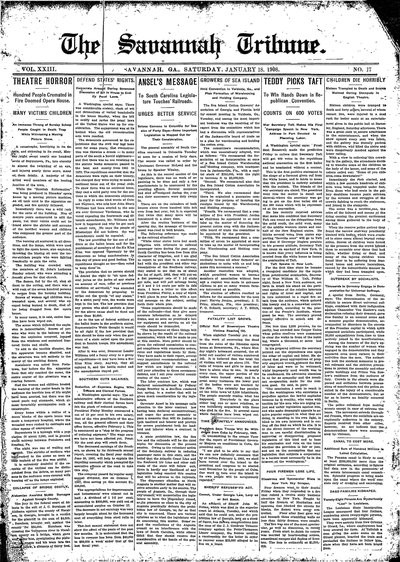
Page text (machine-generated)
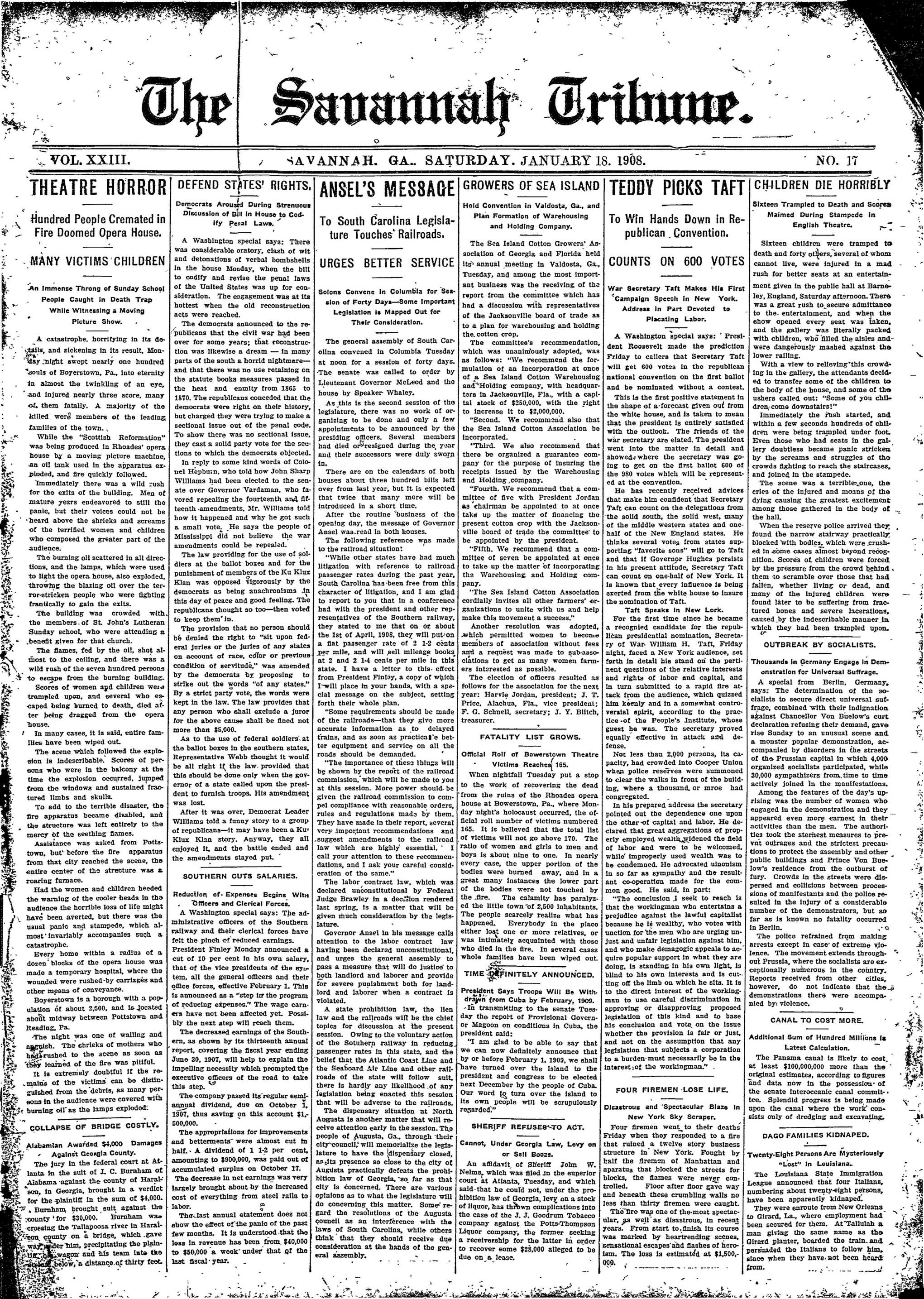
THEATRE HORROR
Hundred People Cremated in Fire Doomed Opera House.
MANY VICTIMS CHILDREN
An Immense Throng of Sunday School People Caught in Death Trap While Witnessing a Moving Picture Show. A catastrophe, horrifying in its details, and sickening in its result, Monday night swept nearly one hundred souls of Boyerstown, Pa., into eternity in almost the twinkling of an eye, and injured nearly three score, many of them fatally. A majority of the killed were members of the leading families of the town.
While the "Scottish Reformation" was being produced in Rhoades' opera house by a moving picture machine, an oil tank used in the apparatus exploded, and fire quickly followed. Immediately there was a wild rush for the exits of the building. Men of mature years endeavored to still the panic, but their voices could not be heard above the shrieks and screams of the terrified women and children who composed the greater part of the audience. The burning oil scattered in all directions, and the lamps, which were used to light the opera house, also exploded, throwing the blazing oil over the terror-stricken people who were fighting frantically to gain the exits.
The building was crowded with the members of St. John's Lutheran Sunday school, who were attending a benefit given for that church.
The flames, fed by the oil, shot almost to the ceiling, and there was a wild rush of the seven hundred persons to escape from the burning building.
Scores of women and children were trampled upon, and several who escaped being burned to death, died after being dragged from the opera house.
In many cases, it is said, entire families have been wiped out.
The scene which followed the explosion is indescribable. Scores of persons who were in the balcony at the time the explosion occurred, jumped from the windows and sustained fractured limbs and skulls.
To add to the terrible disaster, the fire apparatus became disabled, and the structure was left entirely to the mercy of the seething flames.
Assistance was asked from Pottstown, but before the fire apparatus from that city reached the scene, the entire center of the structure was a roaring furnace.
Had the women and children heeded the warning of the cooler heads in the audience the horrible loss of life might have been averted, but there was the usual panic and stampede, which almost invariably accompanies such a catastrophe.
Every home within a radius of a dozen blocks of the opera house was made a temporary hospital, where the wounded were rushed by carriages and other means of conveyance.
Boyerstown is a borough with a population of about 2,500, and is located about midway between Pottstown and Reading, Pa.
The night was one of walling and angush. The chirleks of mothers who had rushed to the scene as soon as they learned of the fire was pitiful. It is extremely doubtful if the remains of the victims can be distinguished from the debris, as many persons in the audience were covered with burning oil as the lamps exploded:
COLLAPSE OF BRIDGE COSTLY.
Alabamian Awarded $4,000 Damages Against Georgia County.
The jury in the federal court at Atlanta in the suit of J. C. Burnham of Alabama against the county of Haralson, in Georgia, brought in a verdict for the plaintiff in the sum of $4,000. Burnham brought suit against the county for $30,000. Burnham was crossing the Tallapoosa river in Haralson county on a bridge, which gave way under him, precipitating the plaintiff's wagon and his team into the river below, a distance of thirty feet.
Savannah Tribune.
DEFEND STATES' RIGHTS.
Democrats Aroused During Strenuous Discussion of Bill In House to Codify Penal Laws.
A Washington special says: There was considerable oratory, clash of wit and detonations of verbal bombshells in the house Monday, when the bill to codify and rerise the penal laws of the United States was up for consideration. The engagement was at its hottest when the old reconstruction acts were reached.
The democrats announced to the republicans that the civil war had been over for some years; that reconstruction was likewise a dream — in many parts of the south a horrid nightmare—and that there was no use retaining on the statute books measures passed in the heat and enmity from 1865 to 1870. The republicans conceded that the democrats were right on their history, but charged they were trying to make a sectional issue out of the penal code. To show there was no sectional issue, they cast a solid party vote for the sections to which the democrats objected.
In reply to some kind words of Colonel Hepburn, who told how John Sharp Williams had been elected to the senate over Governor Vardaman, who favored repealing the fourteenth and fifteenth amendments, Mr. Williams told how it happened and why he got such a small vote. He says the people of Mississippi did not believe the war amendments could be repealed.
The law providing for the use of soldiers at the ballot boxes and for the punishment of members of the Ku Klux Klan was opposed vigorously by the democrats as being anachronisms in this day of peace and good feeling. The republicans thought so too—then voted to keep them'in.
The provision that no person should be denied the right to "sit upon federal juries or the juries of any states on account of race, color or previous condition of servitude," was amended by the democrats by proposing to strike out the words "of any states." By a strict party vote, the words were kept in the law. The law provides that any person who shall exclude a juror for the above cause shall be fined not more than $5,000.
As to the use of federal soldiers at the ballot boxes in the southern states, Representative Webb thought it would be all right if the law provided that this should be done only when the governor of a state called upon the president to furnish troops. His amendment was lost.
After it was over, Democrat Leader Williams told a funny story to a group of republicans—it may have been a Ku Klux Klan story. Anyway, they all enjoyed it, and the battle ended and the amendments stayed put.
SOUTHERN CUTS SALARIES.
Reduction of Expenses Begins With Officers and Clerical Forces. A Washington special says: The administrative officers of the Southern railway and their clerical forces have felt the pinch of reduced earnings. President Finley Monday announced a cut of 10 per cent in his own salary, that of the vice presidents of the system, all the general officers and their office forces, effective February 1. This is announced as a "step in the program of reducing expenses." The wage earners have not been affected yet. Possibly the next step will reach them.
The decreased earnings of the Southern, as shown by its thirteenth annual report, covering the fiscal year ending June 30, 1907, will help to explain the impelling necessity which prompted the executive officers of the road to take this step.
The company passed its regular semi-annual dividend, due on October 1, 1907, thus saving on this account $1,500,000.
The appropriations for improvements and betterments were almost cut in half. A dividend of 1 1-2 per cent, amounting to $900,000, was paid out of accumulated surplus on October 17. The decrease in net earnings was very largely brought about by the increased cost of everything from steel rails to labor. The last annual statement does not show the effect of the panic of the past few months. It is understood that the loss in revenue has been from $40,000 to $50,000 a week under that of the last fiscal year.
SAVANNAH. GA.. SATURDAY. JANUARY 18. 1908.
ANSEL'S MESSAGE
To South Carolina Legislature Touches Railroads.
URGES BETTER SERVICE
Solons Convene in Columbia for Session of Forty Days—Some Important Legislation is Mapped Out for Their Consideration.
The general assembly of South Carolina convened in Columbia Tuesday at noon for a session of forty days. The senate was called to order by Lieutenant Governor McLeod and the house by Speaker Whaley.
As this is the second session of the legislature, there was no work of organizing to be done and only a few appointments to be announced by the presiding officers. Several members had died or resigned during the year and their successors were duly sworn in.
There are on the calendars of both houses about three hundred bills left over from last year, but it is expected that twice that many more will be introduced in a short time.
After the routine business of the opening day, the message of Governor Ansel was-read in both houses.
The following reference was made to the railroad situation:
"While other states have had much litigation with reference to railroad passenger rates during the past year, South Carolina has been free from this character of litigation, and I am glad to report to you that in a conference had with the president and other representatives of the Southern railway, they stated to me that on or about the 1st of April, 1908, they will put on a flat passenger rate of 2 1-2 cents per mile, and will sell mileage books at 2 and 2 1-4 cents per mile in this state. I have a letter to this effect from President Finley, a copy of which I will place in your hands, with a special message on the subject, setting forth their whole plan.
"Some requirements should be made of the railroads—that they give more accurate information as to delayed trains, and as soon as practical better equipment and service on all the roads should be demanded.
"The importance of these things will be shown by the report of the railroad commission, which will be made to you at this session. More power should be given the railroad commission to compel compliance with reasonable orders, rules and regulations made by them. They have made in their report, several very important recommendations and suggest amendments to the railroad law which are highly essential. I call your attention to these recommendations, and I ask your careful consideration of the same."
The labor contract law, which was declared unconstitutional by Federal Judge Brawley in a decision rendered last spring, is a matter that will be given much consideration by the legislature. Governor Ansel in his message calls attention to the labor contract law having been declared unconstitutional, and urges the general assembly to pass a measure that will do justice to both landlord and laborer and provide for severe punishment both for landlord and laborer when a contract is violated.
A state prohibition law, the lien law and the railroads will be the chief topics for discussion at the present session. Owing to the voluntary action of the Southern railway in reducing passenger rates in this state, and the belief that the Atlantic Coast Line and the Seaboard Air Line and other railroads of the state will follow suit, there is hardly any likelihood of any legislation being enacted this session that will be adverse to the railroads.
The dispensary situation at North Augusta is another matter that will receive attention early in the session. The people of Augusta, Ga., through their city council, will memorialize the legislature to have the dispensary closed, assits presence so close to the city of Augusta practically defeats the prohibition law of Georgia, so far as that city is concerned. There are various opinions as to what the legislature will do concerning this matter. Some regard the resolutions of the Augusta council as an interference with the laws of South Carolina, while others think that they should receive due consideration at the hands of the general assembly.
GROWERS OF SEA ISLAND
Hold Convention in Valdosta, Ga., and Plan Formation of Warehousing and Holding Company.
The Sea Island Cotton Growers' Association of Georgia and Florida held its annual meeting in Valdosta, Ga., Tuesday, and among the most important business was the receiving of the report from the committee which has had a discussion with representatives of the Jacksonville board of trade as to a plan for warehousing and holding the cotton crop.
The committee's recommendation, which was unanimously adopted, was as follows: "We recommend the formulation of an incorporation at once of a Sea Island Cotton Warehousing and Holding company, with headquarters in Jacksonville, Fla., with a capital stock of $250,000, with the right to increase it to $2,000,000.
"Second. We recommend also that the Sea Island Cotton Association be incorporated.
"Third. We also recommend that there be organized a guarantee company for the purpose of insuring the receipts issued by the Warehousing and Holding company.
"Fourth. We recommend that a committee of five with President Jordan as chairman be appointed to at once take up the matter of financing the present cotton crop with the Jacksonville board of trade the committee to be appointed by the president.
"Fifth. We recommend that a committee of seven be appointed at once to take up the matter of incorporating the Warehousing and Holding company.
"The Sea Island Cotton Association cordially invites all other farmers' organizations to unite with us and help make this movement a success."
Another resolution was adopted, which permitted women to become members of association without fees and a request was made to sub-associations to get as many women farmers interested as possible.
The election of officers resulted as follows for the association for the next year: Harvie Jordan, president; J. T. Price, Alachua, Fla., vice president; F. G. Schnell, secretary; J. Y. Biltch, treasurer.
Official Roll of Bowerstown Theatre
Victims Reached 165.
When nightfall Tuesday put a stop to the work of recovering the dead from the ruins of the Rhodes opera house at Bowerstown, Pa., where Monday night's holocaust occurred, the official roll number of victims numbered 165. It is believed that the total list of victims will not go above 170. The ratio of women and girls to men and boys is about nine to one. In nearly every case, the upper portion of the bodies were burned away, and in a great many instances the lower part of the bodies were not touched by the fire. The calamity has paralyzed the little town of 2,500 inhabitants. The people scarcely realize what has happened. Everybody in the place either lost one or more relatives, or was intimately acquainted with those who died in the fire. In several cases whole families have been wiped out.
President Says Troops Will Be Withdrawn from Cuba by February, 1909.
In transmitting to the senate Tuesday the report of Provisional Governor Magoon on conditions in Cuba, the president said:
"I am glad to be able to say that we can now definitely announce that by or before February 1, 1909, we shall have turned over the island to the president and congress to be elected next December by the people of Cuba. Our word to turn over the island to its own people will be scrupulously regarded."
SHERIFF REFUSE8 TO ACT.
Cannot, Under Georgia Law, Levy on or Sell Boozs.
An affidavit of Sheriff John W. Nelms, which was filed in the superior court at Atlanta, Tuesday, and which said that he could not, under the prohibition law of Georgia, levy on a stock of liquor, has thrown complications into the case of the J. J. Goodrum Tobacco company against the Potts-Thompson Liquor company, the former seeking a receivership for the latter in order to recover some $28,000 alleged to be due on a lease.
TEDDY PICKS TAFT
To Win Hands Down in Republican Convention.
COUNTS ON 600 VOTES
War Secretary Taft Makes His First Campaign Speech in New York. Address in Part Devoted to Placating Labor.
A Washington special says: 'President Roosevelt made the prediction Friday to callers that Secretary Taft will get 600 votes in the republican national convention on the first ballot and be nominated without a contest.
This is the first positive statement in the shape of a forecast given out from the white house, and is taken to mean that the president is entirely satisfied with the outlook. The friends of the war secretary are elated. The president went into the matter in detail and showed where the secretary was going to get on the first ballot 600 of the 980 votes which will be represented at the convention.
He has recently received advices that make him confident that Secretary Taft can count on the delegations from the solid south, the solid west, many of the middle western states and one-half of the New England states. He thinks several votes from states supporting "favorite sons" will go to Taft and that if Governor Hughes persists in his present attitude, Secretary Taft can count on one-half of New York. It is known that every influence is being exerted from the white house to insure the nomination of Taft.
Taft Speaks in New Lork.
For the first time since he became a recognized candidate for the republican presidential nomination, Secretary of War William H. Taft, Friday night, faced a New York audience, set forth in detall his stand on the pertinent questions of the relative interests and rights of labor and capital, and in turn submitted to a rapid fire attack from the audience, which quizzed him keenly and in a somewhat controversial spirit, according to the practice of the People's Institute, whose guest he was. The secretary proved equally effective in attack and defense.
Not less than 2,000 persons, its capacity, had crowded into Cooper Union when police reserves were summoned to clear the walks in front of the building, where a thousand, or mroe had congregated.
In his prepared address the secretary pointed out the dependence one upon the other of capital and labor. He declared that great aggregations of properly employed wealth, widened the field of labor and were to be welcomed, while improperly used wealth was to be condemned. He advocated unisonism in so far as sympathy and the resultant co-operation made for the common good. He said, in part:
"The conclusion I seek to reach is that the workingman who entertains a prejudice against the lawful capitalist because he is wealthy, who votes with unction for the men who are urging unjust and unfair legislation against him, and who make demagogic appeals to acquire popular support in what they are doing, is standing in his own light, is blind to his own interests and is cutting off the limb on which he slits. It is to the direct interest of the workingman to use careful discrimination in approving or disapproving proposed legislation of this kind and to base his conclusion and vote on the issue whether the provision is fair or just, and not on the assumption that any legislation that subjects a corporation to a burden-must necessarily be in the interest of the workingman."
FOUR FIREMEN LOSE LIFE.
Disastrous and 'Spectacular Blaze in New York Sky Scraper.
Four firemen went to their deaths Friday when they responded to a fire that ruined a twelve story business structure in New York. Fought by half the firemen of Manhattan and aparatus that blocked the streets for blocks, the flames were never controlled. Floor after floor gave way and beneath these crumbling walls no less than thirty firemen were caught. The fire was one of the most spectacular, as well as disastrous, in recent years. From start to finish its course was marked by heartrending scenes, sensational escapes and flashes of heroism. The loss is estimated at $1,500,000.
CHILDREN DIE HORRIBLY
Sixteen Trampled to Death and Scores Maimed During Stampede in English Theatre.
Sixteen children were tramped to death and forty others, several of whom cannot live, were injured in a mad rush for better seats at an entertainment given in the public hall at Barnley, England, Saturday afternoon. There was a great rush to secure admittance to the entertainment, and when the show opened every seat was taken, and the gallery was literally packed with children, who filled the alses and were dangerously mashed against the lower railing.
With a view to relieving this crowding in the gallery, the attendants decided to transfer some of the children to the body of the house, and some of the ushers called out: "Some of you children, come downstairs!" Immediately the rush started, and within a few seconds hundreds of children were being trampled under foot. Even those who had seats in the gallery doubtless became panic stricken by the screams and struggles of the crowds fighting to reach the staircases, and joined in the stampede. The scene was a terrible one, the cries of the injured and moans of the dying causing the greatest excitement among those gathered in the body of the hall.
When the reserve police arrived they found the narrow stairway practically blocked with bodies, which were crushed in some cases almost beyond recognition. Scores of children were forced by the pressure from the crowd behind them to scramble over those that had fallen, whether living or dead, and many of the injured children were found later to be suffering from fractured bones and severe lacerations, caused by the indescribable manner in which they had been trampled upon.
OUTBREAK BY SOCIALISTS.
Thousands in Germany Engage in Demonstration for Universal Suffrage.
A special from Berlin, Germany, says: The determination of the socialists to secure direct universal suffrage, combined with their indignation against Chancellor Von Buelow's curt declaration refusing their demand, gave rise Sunday to an unusual scene and a monster popular demonstration, accompanied by disorders in the streets of the Prussian capital in which 4,000 organized socialists participated, while 30,000 sympathizers from, time to time actively joined in the manifestations.
Among the features of the day's uprising was the number of women who engaged in the demonstration and they appeared even more earnest in their activities than the men. The authorities took the sternest measures to prevent outrages and the strictest precautions to protect the assembly and other public buildings and Prince Von Buelow's residence from the outburst of fury. Crowds in the streets were dispersed and collisions between processions of manifestants and the police resulted in the injury of a considerable number of the demonstrators, but so far as is known no fatality occurred in Berlin.
The police refrained from making arrests except in case of extreme violence. The movement extends throughout Prussia, where the socialists are exceptionally numerous in the country. Reports received from other cities, however, do not indicate that the demonstrations there were accompanied by violence.
CANAL TO COST MORE.
Additional Sum of Hundred Millions is Latest Calculation.
The Panama canal is likely to cost, at least $100,000,000 more than the original estimates, according to figures and data now in the possession of the senate interoceanic canal committee. Splendid progress is being made upon the canal where the work consists only of dredging and excavating.
DAGO FAMILIES KIDNAPED.
Twenty-Eight Persons Are Mysteriously "Lost" in Louisiana. The Louisiana State Immigration League announced that four Italians, numbering about twenty-eight persons, have been apparently kidnapped. They were enroute from New Orleans to Girard, La., where employment had been secured for them. At Tallulah a man giving the same name as the Girard planter, boarded the train and persuaded the Italians to follow him, since when they have not been heard from.
Treasury of State of Georgia
long in total Ten Thousand Dollars and which are held by the State of Georgia by authority and under the provisions of an Act of the General Assembly, approved October 22d, 1887, and amended December 20th, 1897.
Items of State Interest Culled From Random Sources.
Banks Ready to Ship Currency. Advices have been received by banks in Atlanta, which indicate that the banks of New York and other cities are now in readiness to commence shipments of currency again. Banks in Augusta received similar notice and the same is true with other cities in Georgia.
* * *
According to the annual report of Secretary of State Philip Cook, now in course of preparation, 182 corporations went out of business in Georgia during 1907. These were mostly small concerns, many of them working on the co-operative plan. Of this number fifty-eight were in Atlanta, sixteen in Chatham county, six in Richmond and five in Bibb.
* * *
What Corporations Pay to State:
Public utility corporations have paid the state in taxes for 1907 a total of more than $615,000,which is the amount the state receives 5 mills on total assesments of $123,000,000. This is about $165,000 more than they paid the state for 1906, last year's assessments having been considerably increased.
Of the 1907 taxes more than $475,000 was paid by the steam railroads.
Locker License Prohibitory.
There will be no locker clubs in Milledgeville. At the last meeting of the city council an ordinance putting the license tax at $10,000 was passed without a dissenting vote. This action of the council was in accordance with the sentiment of the majority of the community and to have the matter thus decisively settled is more satisfactory to the club men than to have the matter up in the air, as will be the result in some communities.
jurisdiction of the railroad commission in compelling one telephone company to connect with the lines of another, will come up for hearing before that body on January 24. The case comes up on a complaint made by the Atlanta Telephone and Telegraph company of Atlanta and the Georgia Telephone company of Savannah against the American Telephone and Telegraph company, which operates a number of long distance lines in Georgia.
SOL. C. JOHNSON, Supt. of Ageno
Sea Island Cotton Receipts. The receipts of sea island cotton in Valdosta so far have been 6,175 bales again 5,887 for last season. The receipts for last season were the largest in the history of the city, although the crop in the section was the smallest in six or eight years. It looks now as if this season's receipts will be much greater than last year. Good grades of sea island are bringing 28 cents per pound, but a great portion of the staple is of a very inferior quality. Valdosta has for many years been the largest interior sea island cotton market in the entire cotton belt.
Trains will be running into Atlanta over the Atlanta, Birmingham and Atlantic railroad by February 15, according to a statement of General Superintendent C. B. Wilburn of that road, who was in Atlanta a few days ago for a conference with Vice President P. S. Arkwrigth.
It had been intended to have trains in operation over the Atlanta division sooner, but one delay after another interfered with these plans. Everything is now in good shape and Mr. Wilburn is confident that the middle of next month will find regular schedules being maintained into Atlanta. Through trains are now being run via LaGrange far into Alabama and the construction forces are steadily marching upon Birmingham.
* * *
The county and state tax collections in Fulton county so far have amounted to $730,000, the largest in its history, so says Tax Collector tSewart, who does not explain the increase by the higher rates alone, but states that the fact that there are more taxpayers has much to do with it.
When all the money that is due the state and county is within the coffers there will be just $275,000 added to the already record-breaking total, this sum being the amount of taxes yet due. All of this comes from some 20,000 taxpayers who own property in Fulton county.
***
Negro Escapes Gallows.
Lee Holmes, a negro, convicted of the murder of E. A. Sands, a white man, in McIntosh county and sentenced to be hanged January 21, will escape the gallows. The prison commission, after careful inquiry into his case, has recommended commutation to life imprisonment, and it is believed the governor will endorse this recommendation and issue an order accordingly.
According to the evidence at the trial Holmes was trying to shoot another ne-
P. EDWARD PERRY, Vice President.
Train will consist of PULLMAN BUFFET SLEEPING CARS, Day Couches between Savannah and Montgomery without change; making close connection at Montgomery with all lines diverging for Pensacola, Mobile, New Orleans and all Western points; Birmingham, Memphis, St. Louis, Nashville, Chicago and all Northwestern points; the SHORTEST LINE to Montgomery, New Orleans, Birmingham and the earliest arrival at these points. At Savannah close connection is made for all EASTERN POINTS, Richmond, Washington, New York and with Coastwise Steamships for Baltimore, Philadelphia, New York and Boston.
Get sleeping car reservations and full information from any SEAROARD Agent, or write to
gro with whom he was quarreling, but instead of hitting the man he was aiming at the bullet went in another direction and killed Sands, an innocent party, who was sitting some distance away on a bale of cotton.
Flat Rate by Southern.
The state-railroad commission has accepted a definite proposition on the part of President W. W. Finley, of the Southern railroad to put into effect on April the first the following rates:
A flat 2 1-2 cent rate on all the lines of the Southern railroad for intra-state travel, provided that no charge shall be required to be less than ten cents.
Two thousand mile books, intra-state, interchangeable with such of the solvent roads of the state as will consent, at 2 cents per mile, good for heads of firms and employees, not exceeding a total number of five.
One thousand mile books, intra-state and interchangeable, at 2 cents per mile limited to one individual and good only in the hands of the purchaser. Five hundred mile books at 2 1-4 cents per mile, good for heads of families and dependent members thereof, intra-state and non-interchangeable.
Mr. Finley further proposed that these rates should be kept in effect for a period of twelve months, so as to give a fair trial, with the understanding that the railroad by such trial waives no right to relief should the rates prove to be unjust or confiscatory. This proposal also meets with the approval of the commission.
This company is duly chartered under the laws of the State of Georgia, and has complied with all requirements of the State Insurance department, therefore all policy holders are protected with all the safeguards that the strict insurance laws of this State seek to protect its citizens.
Its affairs are directed and managed by Negro men of the city of Savannah of leading standing, and whose character and reputation are of such as to command the respect and confidence of all the people of that community. The same men that manage this Society are the ones that organized and are conducting the affairs of the first successful Negro Savings Bank in this state, therefore we can readily see that by connecting themselves with this Insurance company their interest will be in safe hands.
By comparing our rules and benefits with other first class companies it will be seen that we offer the most liberal inducements with the largest sick, accident and death benefits to our members than any other company in this business.
That we pay our claims promptly can be testified to by the thousands of our satisfied members.
L. E. Williams.
P. Edward Perry.
Walter S. Scott.
Sol. C. Johnson.
This company is duly chartered quirroments of the State Insurance that the strict insurance laws of its affairs are directed and man character and reputation are of community. The same men that fairs of the first successful Negro themselves with this Insurance By comparing our rules and best liberal inducements with the law company in this business. That we pay our claims prom
Agents
Liberal
TRAINS
SEABOAR
AIR LINE RAILWAY.
ND..
5.00 P. M.
9.15 P. M.
10.10 P. M.
11.15 P. M.
12.45 A. M.
2.00 A. M.
2.22 A. M.
6.45 A. M.
10.40 A. M.
6.00 P. M.
EAV.
Leave New Orle
Leave Burning
Leave Montgomery
Leave Lumpkin
Leave Richland
Leave Amerie
Leave Cordele
Leave Abbeville
Leave Helena
Arrive Savannah
AN BUFFET SLEEPING CARS, Daring close connection at Montgomery with western points; Birmingham, Memphis, and EST LINE to Montgomery, New Orleans, with close connection is made for all EASISE Steamships for Baltimore, Philadelphia, and full information from any SEABOAR.
CHA
Asst. General P
NELSON'S
HAIR
DRESSING
Ad delightfully perfumed Hair Pomade prepared especially for Colored People. Nelson's Hair Dressing makes Harsh, Stubborn, Kinky, Curly Hair Soft, Plint and Glossy. By supplying the needed oil directly to the roots of the hair it tomes up the scalp, stops the falling out, hides the hair, prevents its split hair, harkling off, removes Dandruff, and cures Itching, fumbling Scalp Diseases. Large boxes at Drug Stores 25C, orgent by mail for 30C (stamps or silver). Good Agents Wanted (male or female). Write for terms.
Food Inspector on Second Round
Food Inspector on Second Round! The state pure food inspector is out on his second tour of the state in search of adulterated foodstuffs which he will get a sample of and return to the state department of chemistry for analysis and report. The Georgia pure food law has not been in effect a year yet, but good results have already been made patent. Last fall the inspector found a great many condiments which did not measure up to the pure food law, and he discovered adulterated flour and impure vinegar, which were reported and the sellers hailed before the commissioner of agriculture. The inspector is seeing to it that cotton seed oil, the well known Southern product, is sold as a pure article. He is also watching out to see that cotton seed meal, which is recognized as the best cattle feed, measures up to the standard desired by the department.
Money for Vets and Teachers. Georgia Confederate veterans may
receive their quarterly pensions early in February, instead of waiting until March 1, when the quarterly payments become due. Georgia teachers probably will receive their back salaries in a short time. The state has received much more money than had been expected, Treasurer Park having just received more than $600,000. The old soldiers formerly were paid their pensions annually, but it has lately been the custom to pay them quarterly. It is now believed that, with the funds the state has on hand, they can be paid now instead of waiting until March 1.
The sum of $235,000 is due the soldiers and about $600,000 is due the teachers of the state.
THAW TRIAL UNDER WAY.
State Claims Cowardly Murder; Defense Makes Insanity Plea
The Thaw trial moved with a rush at New York Monday. After the state had presented its direct case and Assistant District Attorney Garvan had characterized the killing of Stanford White as "a premeditated, deliberate and cowardly murder," Martin W. Littleton, for the defense, made the opening plea for the prisoner. He promised to forge a chain of circumstances, and to produce a line of testimony, which will prove Harry K. Thaw, undeniably insane at the time of the homicide.
Deeda, Contracts, Wills and Other
Legal Forms Prepared and
Attested.
116 West St. Julian Street.
Masonic Books &
Regalias.
LODGE SEALS,
FINANCIAL CARDS and
BLANKS of every description.
Publishers' and Manufacturers' Prices
Liberal Discounts Will Be Arranged.
SOL. C. JOHNSON,
Savannah, Ga.
W. H. LLOYD.
Dealer In
GROCERIES, WOOD AND COAL
621 Oglethorpe Avenue, East.
518 PHONES Bell 506
OPPOSES JOINT REUNION.
Head of United Confederate Veterans
Against Meeting in Washington.
General Lee, head of the Confederate Veterans, is opposed to the reunion of the blue and gray at Washington in 1909.
"Such a reunion," he said, "would bring veterans together on both sides who might be imprudent enough in bearing and language to give offense, and bring bitterness where there is now good feeling. We should let well enough alone."
General Lee is also opposed to the national government pensioning confederate veterans.
CHICAGO IN GRIP OF GALE.
Snow Storm Cuts Off All Communication with Outside World.
Chicago and its environs were cut off for several hours Sunday from wire communications from other points by a snow and wind storm which began before dawn and raged without a break all day. Considerable damage was done to poles and wires.
---
BOOK OF NEHEMIAH VERIFIED
GERMANS FIND A NOTABLE PAPYRUS IN EGYPT. Petition of the Seventeenth Year of Darius For Leave to Rebuild Temple of Jehovah In Island of Flophart, Sargov
Professor Clermont Ganneau has given the public, so to speak, advance sheets of the important discoveries lately made by the German scientific mission, working under Herr Rubensohn side by side with the French, on the island of Elephanta on the Nile. Latterly the sands of Egypt have been yielding up their treasures in lavish profusion. Last month it was a lost comedy of Menaeder, and not long before the "Logia" of Jesus, taking us back to the origins of Christianity. But while explorers were almost daily unearthing relics of the Greeks and Egyptian eras, it was seldom that any Jewish fragment was turned up. Now, however, among some papyri found by the Germans within fifty yards of Professor Ganneau's diggers, is an official document of the seventeenth year of Darius, addressed to the Persian Governor of Judea by the Jewish priests of the Temple of Elephanta. The document is long and interesting, but its inestimable value lies in the fact that it calls up historical figures familiar in the Bible, such as Johanan, high priest of Jerusalem, and Sanballat, the Governor of Samaria.
This papyrus, which is in the Aramaic character, has been deciphered by Professor Sachau, of Berlin, and turns out to be an authentic page to be added to the Book of Nehemiiah. This wonderful document is a petition addressed by the Jewish inhabitants of the island of Elephanta, speaking through the priest, Jeduyah, and his colleagues, to the Lord Bagohi, the Persian Governor of Samaria in the seventeenth year of the reign of King Darius. After having invoked, in terms almost identical with those of the papyrus of Turia, the blessing of the "God of Gods" on the head of the Governor, the petitioners made supplication as follows:
Three years previously in the absence of Arsam the Satrap of Egypt, summoned to meet his King, the Egyptian servants of the god Khnum of Elephants intrigued with the Governor of the island, Widrang (bribed by them, according to the famous Euting papyrus), and procured from him an order for the military commandant of Syene for the destruction of the temple of Jehovah that stood on the island of Elephanta. This temple, say they, was built by their forefathers in old times and was there when the land of Egypt was conquered by Cambyses, who spared it while he destroyed all the temples of the Egyptians.
According to the description the petitioners incidentally give, this temple must have been an imposing pile, built of massive blocks of stone, with seven monumental gates, columns of granite and a roof of cedar. The orders of Widrang were ruthlessly executed and the troops, helped by an Egyptian horde, demolished the venerable sanctuary, destroying all that it contained with fire after carrying away the vessels of gold and silver and other precious objects.
All the Jewish population of Elephanta, men, women and children, plunged into the depths of affliction by this calamity, went into mourning and wept and fasted, calling upon Jehovah, the "God of Gods." No more did they annoint themselves with ointments or drink any wine. Some time afterward Wildrang fell into disgrace and was forced, to make restitution, while those who had executed his orders were all slain in just expiation of their sins. Nevertheless, the petitioners say, they have not to this day, in spite of all their striving, obtained leave to rebuild their temple, and so for three years they have not left off their mourning, being precluded from making their ritual sacrifices or offering up incense on the altar of Jehovah, the "God of Gods." In vain after the catastrophe did they appeal to Bagohi himself, Governor of Judea, and then to Jehohanan, High Priest of Jerusalem, and to his brother, Ostan Anani, and to the princes of the house of Judah. Wherefore they come now, a second time, to implore Bagohi to show them favor and allow them to rebuild in Elephanta the temple as it once stood.
In return for this boon "they will offer up sacrifices to Jehovah on the new altar in his name, and until it is built all the Israeliitish men, women and children of the island will never cease praying for Bagohl." Furthermore, they give him to understand that he will reap more substantial benefits in a sum of 1000 talents of silver in the offerings, without count of the gold, concerning which he has already been informed. And, in conclusion, they mention that they have written also to Delayah and Chelamayah, son of Sanballat, Governor of Samnria, but that the Satrap Aram, recalled by Darlus, knows not of the matter. From other papyrus and fragments not yet published it is seen that, thanks to the intervention of Bagohl and Delayah, the permission was granted and the temple of Jehovah rebuilt.
The inestimable value of these new discoveries lies in their corroboration of the Biblical story, and, besides the names of Jehobanan and Sanbajlet mentioned in the Old Testament, the Governor Bagohl is to be found in the historian Flavitus Josephus, in the Greek form of Bageso, Professor
Clermont Ganneau, who gives the above details, has especial reason to be congratulated on this discovery, although not actually made by himself, since it seems to place beyond all doubt the correctness of the belief that the old temple of Jehovah was on the island if Elephanta—a belief that he was almost alone for a long time in holding against the majority, who located it at Syene, on the opposite shoes of the Nile. At present he is in charge of a French mission subventioned by the Academy, by the Ministry and also by M. Edmond Rothschild, which is excavating on the island side by side with the German explorers, and the keenest rivalry naturally exists between the two groups, who are working literally shoulder to shoulder within a few yards of each other, each, however, with a radius exactly defined and marked out by wire fences.
REFORESTRY IN FRANCE.
Good Work Accomplished For It by Voluntary Associations.
The Touring Club of France, with headquarters in Paris, composed largely of bicyclists and automobilists, applied itself a few years ago to the work of improving the highways of this country. It has branch organizations all over the country—business men, professional and literary men having enrolled themselves as honorary members with a view to promoting its work and enjoying the advantages offered. It is impossible to visit any city or village in France where there is not a branch organization, and many hotels offer reduced rates to its members. This club has thus become a very strong organization and it enjoys the co-operation of the President and many of the leading statesmen, and business men of France.
The officers of the club considered that the destruction of the forests, the verdant mountain slopes, green fields and meadows could but lessen the value of the highways for travelers and pleasure seekers generally, and they therefore organized among its members, in each of the eighty-eight departments of France, a "committee, for the preservation of pastures and forests," the object of which is to study the condition of the forests of the country and to provide against their destruction. This committee has made out the following as its program of work: To create public opinion favorable to the preservation of the forests of the country; to take steps necessary for a revision of the forestry laws of France, and to secure the enforcement of all existing laws for the preservation of forests.
Since this committee began its work it has secured the use in the primary schools of France of a Manual of Sylvo-Pastoral Instruction. It has published a volume entitled the Manual de l'Arbre, a very beautiful printed work, artistically illustrated, quarto form, containing numerous engravings of well-wooded and treeless tracts of land, the contrasts between the two forcibly illustrating the advantage of preserving the forests of a country. It also contains a constitution and by-laws of tree-planting societies, thus giving a basis for the organization of arbor societies and clubs among the school children of the country. The planting and cultivation of all kinds of trees are carefully taught in this little volume. Under the influence of the movement thus started by the Touring Club a great many societies for tree planting have been organized among the schools of France. In fact, under the work of the Touring Club, tree planting and forest preservation generally have become an important branch of education.—John C. Covert, American Consul at Lyons, in Cozular Reports.
Jealous of Whom?
A young married man of extremely jealous disposition recently visited one of the most famous mediums in London. Being far from home, he wanted to know what his wife was doing.
"She is looking out of the window, evidently expecting some one."
"That is strange," said Benedick.
"Whom can she expect?"
"Some one enters the door and she caresses him fondly," went on the medium.
"It can't be!" cried the excited husband. "My wife is true to me."
"Now he lays his head on her lap and looks tenderly in her eyes."
"It's false! I'll make you pay dearly for this!" yelled the jealous husband.
"Now he wags his tall," said the medium.
The green-eyed monster subsided, and the young husband cheerfully paid over, his consulting fee.—Tit-Bits.
Canada Needs Freight Cars.
In Daily Consular and Trade Reports Consul J. E. Jones, of Winnipeg, says that Canada has in operation 21,500 miles of railways and but 88,000 cars are available for handling the traffic, or only four cars a mile. It is estimated that double the number is needed to handle all the freight. That means that Canada will be a market for 80,000 additional freight cars. If the new roads under construction are figured in 100,000 new cars will be needed. At a cost of $850 each the business will be worth $85,000,000 for new equipment, besides the replacing of old cars.
That is a great many more cars than all the car shops of Canada can supply in time for use. The need ought to mean large Canadian orders for American factories.
PRETTY THINGS TO WEAR
```markdown
```
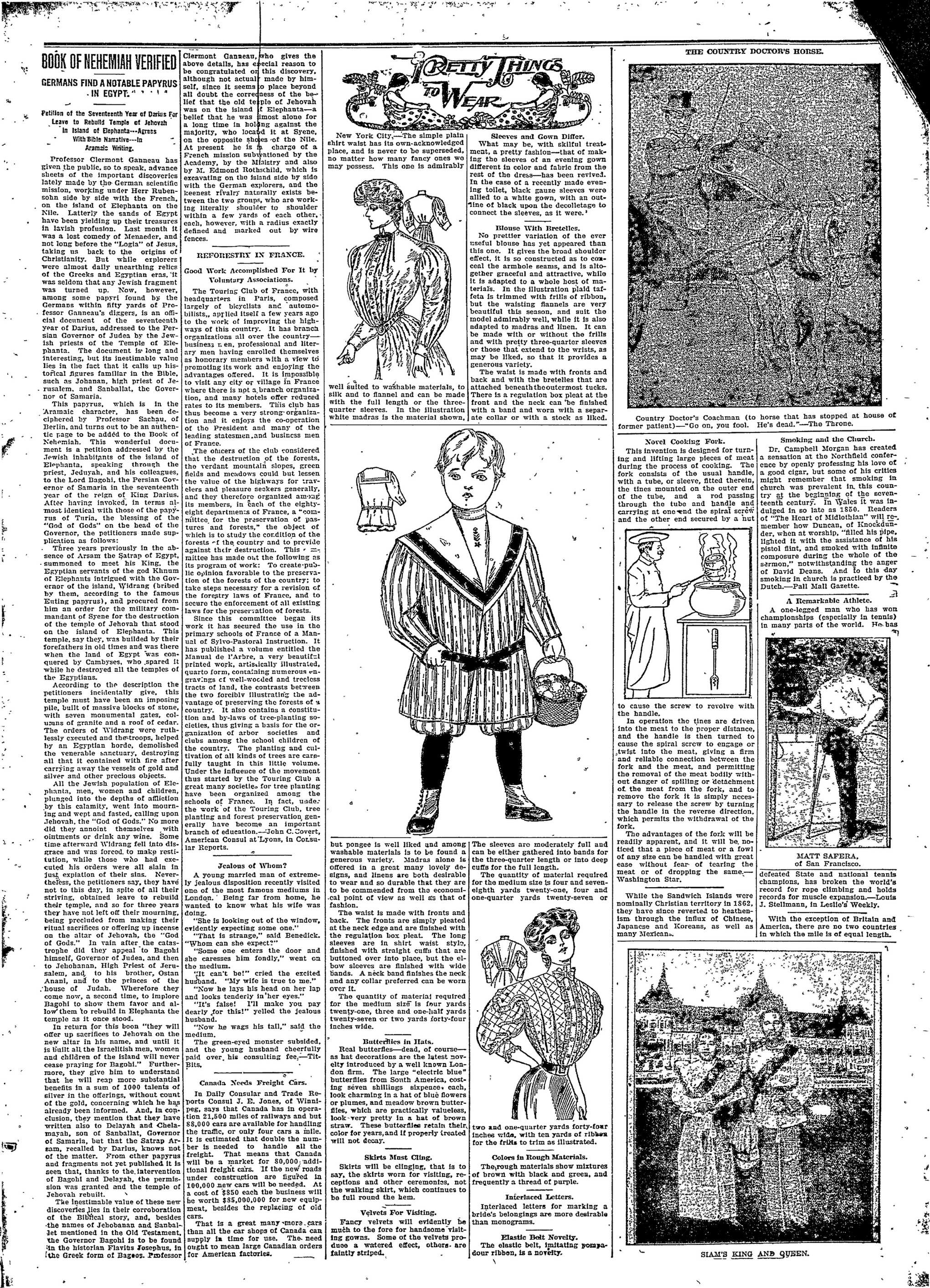
New York City.—The simple plain shirt waist has its own-acknowledged place, and is never to be superseded, no matter how many fancy ones we may possess. This one is admirably
1
well suited to washable materials, to silk and to flannel and can be made with the full length or the three-quarter sleeves. In the illustration white madras is the material shown,
S
but ponge is well liked and among washable materials is to be found a generous variety. Madras alone is offered in a great many lovely designs, and linens are both desirable to wear and so durable that they are to be commended from the economical point of view as well as that of fashion. The waist is made with fronts and back. The fronts are simply pleated at the neck edge and are finished with the regulation box pleat. The long sleeves are in shirt waist style, finished with straight cuffs that are buttoned over into place, but the elbow sleeves are finished with wide bands. A neck band finishes the neck and any collar preferred can be worn over it.
The quantity of material required for the medium size is four yards twenty-one, three and one-half yards twenty-seven or two yards forty-four inches wide.
Butterflies in Hats.
Real butterflies—dead, of course—as hat decorations are the latest novelty introduced by a well known London firm. The large "electric blue" butterflies from South America, costing seven shillings sixpence, cach, look charming in a hat of blue flowers or plumes, and meadow brown butterflies, which are practically valueless, look very pretty in a hat of brown straw. These butterflies retain their color for years, and if properly treated will not decay.
Skirts Must Cling.
Skirts will be clinging, that is to say, the skirts worn for visiting, receptions and other ceremonies, not the walking skirt, which continues to be full round the hem.
Velvets For Visiting.
Fancy velvets will evidently be much to the fore for handsome visiting gowns. Some of the velvets produce a watered effect, others are faintly striped.
sleeves and gown direct.
What may be, with skilful treatment, a pretty fashion—that of making the sleeves of an evening gown different in color and fabric from the rest of the dress—has been revived. In the case of a recently made evening toilet, black gauze sleeves were allied to a white gown, with an outline of black upon the decolletage to connect the sleeves, as it were.
Blouse With Bretelles:
No prettier variation of the ever useful blouse has yet appeared than this one. It gives the broad shoulder effect, it is so constructed as to conceal the armhole seams, and is altogether graceful and attractive, while it is adapted to a whole host of materials. In the illustration plaid tafeta is trimmed with frills of ribbon, but the waisting flannels are very beautiful this season, and suit the model admirably well, while it is also adapted to madras and linen. It can be made with or without the frills and with pretty three-quarter sleeves or those that extend to the wrists, as may be liked, so that it provides a generous variety.
The waist is made with fronts and back and with the bretelles that are attached beneath the outermost tucks. There is a regulation box pleat at the front and the neck can 'be finished with a band and worn with a separate collar or with a stock as liked.
```markdown
```
The sleeves are moderately full and can be either gathered into bands for the three-quarter length or into deep cuffs for the full length. The quantity of material required for the medium size is four and seven-eighth yards twenty-one, four and one-quarter yards twenty-seven or
1
two and one-quarter yards forty-four inches wide, with ten yards of ribbon for the frills to trim as illustrated.
Colors in Rough Materials.
The rough materials show mixtures of brown with black and green, and frequently a thread of purple.
Interlaced Letters.
Interlaced letters for marking a bride's belongings are more desirable than monograms.
Elastic Belt Novelty.
The elastic belt, imitating pompadour ribbon, is a novelty.
A
Country Doctor's Coachman (to horse that has stopped at house of former patient)—"Go on, you fool. He's dead."—The Throne.
Country Doctor's Coachman (to horse that has stopped at house of former patient)—"Go on, you fool. He's dead."—The Throne.
Novel Cooking Fork.
This invention is designed for turning and lifting large pieces of meat during the process of cooking. The fork consists of the usual handle, with a tube, or sleeve, fitted therein, the tines mounted on the outer end of the tube, and a rod passing through the tube and handle and carrying at one end the spiral screw and the other end secured by a nut
COOKING
to cause the screw to revolve with the handle.
In operation the tines are driven into the meat to the proper distance, and the handle is then turned to cause the spiral screw to engage or twist into the meat, giving a firm and reliable connection between the fork and the meat, and permitting the removal of the meat bodily without danger of spilling or detachment of the meat from the fork, and to remove the fork it is simply necessary to release the screw by turning the handle in the reverse direction, which permits the withdrawal of the fork.
The advantages of the fork will be readily apparent, and it will be, noticed that a piece of meat or a fowl of any size can be handled with great ease without fear of tearing the meat or of dropping the same.—Washington Star.
While the Sandwich Islands were nominally Christian territory in 1862, they have since reverted to heathenism through the influx of Chinese, Japanese and Koreans, as well as many Mexicans.
THE STORY OF THE TEMPLE OF THE LORD OF THE WORLD
THAILAND
SIAM'S KING AND QUEEN.
Smoking and the Church.
Dr. Campbell Morgan has created a sensation at the Northfield conference by openly professing his love of a good cigar, but some of his critics might remember that smoking in church was prevalent in this country at the beginning of the seventeenth century. In Wales it was indulged in so late as 1850. Readers of "The Heart of Midlothian" will remember how Duncan, of Knockdunder, when at worship, "filled his pipe, lighted it with the assistance of his pistol flint, and smoked with infinite composure during the whole of the sermon," notwithstanding the anger of David Deans. And so this day smoking in church is practiced by the Dutch—Pall Mall Gazette.
A Remarkable Athlete.
A one-legged man who has won championships (especially in tennis) in many parts of the world. He has
```markdown
```
defeated State and national tennis champions, has broken the world's record for rope climbing and holds records for muscle expansion.—Louis J. Stellmann, in Leslie's Weekly.
With the exception of Britain and America, there are no two countries in which the mile is of equal length.
THE NEW YORK TIMES
SUNDAY, JULY 10, 1945
THE NEW YORK TIMES
SUNDAY, JULY 10, 1945
THE NEW YORK TIMES
SUNDAY, JULY 10, 1945
MATT SAFERA, of San Francisco.
Savannah Tribune.
UBLISHED EVERY SATURDAY BY
TRIBUNE PUBLISHING CO.
116 St. Julian Street, west,
Bell Phone 2171
SUBSCRIPTION RATES:
One Year.....$1.25
Six Months......75
Three Months......59
Remittance must be made by Express
or Post Office Money Order, or Registered
Letter. Advertising rates given on
application.
The "Stroller" in the afternoon paper of this city complains bitterly about the scarcity of farm laborers, and the large amount of cotton still unpicked despite the liberal price offered for pickers. There is but one thing that causes the scarcity of labor and that is unjust treatment. If these farmers would give the laborer what is promised them and do not take advantage of them otherwise, there will be no cause whatever to complain of such scarcity.
We must not be expecting those of the other race to be helping us if we do not do some thing toward helping ourselves. For instance we have a number of boys and girls who need the protection of some charitable institutions. We also have a number of old persons who are suffering for comfortable places of abode. A small amount from our people in this county would purchase a tract of land and erect a suitable home for them. Let us look out for the needs of the unfortunate ones.
A few weeks ago, a correspondent in one of the daily papers suggested that there be established a reading room or a place of innocent amusement where our young men could go and spend a few hours during the evenings. The suggestion is a very good one, such a place would prove of untold good to our young men. We are badly in need of a well organized Y. M.C. A. This has been talked about for years but it seems as if those among us who have the ability to do, give no thought of those things that will benefit the masses.
THE TRIBUNE is glad to say that the feeling expressed in the tirade of Judge Norwood against the Negro is not reflected by a large per cent of the white citizens of Savannah, many of whom are outspoken against some of the harsh things that he has said. A true estimation is given of the judge in these words taken from a letter written ten to a friend in this city: "I have heard from you, or rather from Judge Norwood who has lived a long time and for a good purpose. He has lived to point out to the outside world the depth to which human nature can sink. Of all his long life and experience, he has dismissed every demonstrated fact and truth, and has clung to every deceitful falsehood that flitted across the path of his long life. He has been to the United States Senate, and has been upon the bench of your city for many years, and yet, he now retires as ignorant of what it takes to make a Christian gentleman as the most ignorant cracker of Georgia. * * * But I must say that your state has made some improvement since you have retired such a man as Norwood." The Lumpkin Independent, a paper published in Southwest Georgia, says:
Judge Norwood of Savannah, Ga., after an experience of twelve years as City Court judge, declares that the Negro is retretrading. Undoubtedly the class-of Negroes which he observes is liable to give rise to such an opinion. Yet it is true that the worthy, law-abiding Negroes are increasing.
Negroes In the Oyster Industry.
The Negroes living along the seacoast of Georgia are peculiar and interesting. They are very different from the upland Negroes in manner and speech The term Geechee, which means rough and uncouth, is applied to them. Their dialect, which is especially guttural, is one of their most distinguishing characteristics. The Negroes of this section are, with a few exceptions, engaged in the oyster industry, the men principally as oyster gatherers and the women and children as shuckers. Ninety per cent of all the labor employed in the oyster in dusty of the state is Negro The factories are encouraging the Negroes to lease and plant oyster land and many of them are takeout leases. The most important lease is that of the Georgia Bo-
nevolent Fishermen's Association. The organization is fourteen years old and is the oldest chartered organization among the oyster Negroes for business purposes. The association has forty-five members and a lease of two thousand acres of oyster ground. The company is doing well and reported that they had over one thousand dollars in the bank.
The oystermen working for themselves may be divided into two groups—those owning small rowboats and those owning sailboats or schooners. The owners of the small boats go out with a falling tide and gather the oysters which are left, exposed in the marshes, or with their tongs bring them up from the beds of the now shallow streams. These gatherers usually return with rising tide and are thus out about twelve hours. The owners of the sailboats range the entire Georgia coast and are usually gone from three to ten days. They are liable to reach the best oyster beds and to bring in better oysters than are usually brought in by the rowboat oysterman. The earnings of the former, there fore, are generally the larger.—M. N. Work in Southern Workman.
National Negro Business League Notes.
The next annual meeting of the National Negro Business League is to be held at Baltimore, Maryland, toward the middle of August, 1908. The Baltimore Negro Business League under the leadership of Harry T. Pratt, the president, is already perfecting plans for the entertainment of the officers and delegates. A monster meeting in this behalf is soon to be held in Lyric Hall, Baltimore, and will be addressed by a speaker of national reputation, under the patronage of the leading business and professional men of the city.
The local Negro Business League at Mound Bayou, Miss., of which W. T. Montgomery is president, has undertaken to improve the county roads: centering in Mound Bayou, so that the farmers may not be interrupted in reaching the city with their products. It has also undertaken to erect a $100,000 oil mill, and in this effort is being assisted by Mississippi State Negro Business League.
The Negro Business League of Okmulgee, I. T., is distributing literature calling attention to the business opportunities of that section. A homeseeker's co-operative company and a trust company have recently been organized there, and these organizations, together with the local league, are promoting the business development of the Negro people of that immediate territory.
Men's Sunday Club.
The subject, consumption was discussed at the club on Sunday before last and it was proven quite interesting. The audience was very anxious to get all the information they could and the Doctors Lloyd, I. D. Williams, J. W. Williams Blackman and King were ready and willing to answer any and all questions bearing on the subject. The following are some of the quest ones and answers.
1 Does a cold give consumption?
Answer No, but it makes the lungs weak, hence it is necessary to avoid a cold.
2 Q. Is consumption inherited?
No, but the children born of consumptive parents have a tendency for consumption, yet they do not inherit the germs.
3 Q Is there any cure for consumption after the lung tissue has been broken.
A Yes. (Illustrations were given to prove the fact.)
4 Q Once a person contracts consumption, how long will the patient live?
A Indefinitely. Depends upon circumstances.
5 Q Is consumption contagious?
A Yes, you inhale the germs from the dry spitures.
6 Q Tell some ways to avoid consumption.
A Proper ventilation, nourishments and proper warmth, avoid draught, good out door exercises, avoid dirty rooms where there is or has been consumption, avoid being up regularly late at nights. These are only a few of the questions and answers.
Miss Dewey rendered a few excellent instrumental selections. She is quite accomplished in the art. Even her touch is very artistical.
Second Baptist Church.
Regular services through the week have been above the average. Services Sunday were good, the communion service was excellent, the best for years.
Hevs. Jas. M. Simms, C. H. Johnson, J. W. Hill and John Sneed assisted Dr. May in the communion service. Deacons Maxwell, Gilmore, Small and Elmore and Bre. Gordon of the First A. B. Church were also present and rendered valuable servicles. Come again brethren you are always welcome. Pastor May preached at both hours. The baptising was pest-poned till later on. All the annually elected officers were installed Sunday night by Dr. May, pastor, and a befitting response in well selected words was given in behalf of all the officers by Deacon John F. Jones who is also church treasurer. Brother James H. Rogers was presented with a license to preach by Pastor May in presence of the church. Rev. F. A. Curtright, A. M. Rev, Chas. Wright and Llicentiate J. H. Rogers, assisted the pastor in the ritualistic services Sunday night. Rev. E. H. Quo, Ph. D., assisted Sunday moraling. Mrs. F. A. Curtright performed at the organ in an acceptable manner at the services Sunday instead of her sister Miss Essie L. Monroe who was quite ill. Thuse on the sick list and those recovering are Miss Essie L. Monroe, 607 West Broad street, Stier Lilia Turner, 11 K Street, Stier Denegal, South Randolph street; west; Sister Grant, Waldburg and Atlantic streets; Sister Spaulding, Sister Gertie Snyder, Miss N. Elizabeth Barnard, 628 Nichol street, Sister Green, President street, west; Sister Chie Rogers, 537 Charlton street east; Sister Amelia-Houston, Sister Anna Brown, 5 Jones east; east; Miss Wilhelmina Fields, (out of the city); Sister Miller, Sister Jackson and others. The pastor attended the funeral of Mrs. James Williams on Wednesday afternoon from the residence of Mrs. Elvira Brown. The Sunday school will open tomorrow by the new superintendent Brother Edward Edwards, all are invited at 3:30 p. m. Sister Beauford was present and gave an interesting talk to the Woman's Mission, Tuesday night. Dr. O. W. Burrell of Virginia preached Thursday night. The fourth Sunday in each month has been designated as regular pastor's salary day; let every member pay up all back salary and let every member and friend give a liberal donation Sunday Jan. 26th. An excellent furnace has been put in and tested by jantor Chas. F. Waters, who declares all will be made comfortably warm hereafter. The church is now beginning to look forward towards a good revival meeting. The Second Church led by pastor May will commune with the First A. B. Church next first Sunday. Regular services tomorrow as usual at 5:30 a. m. 11 a. m. and 8 p. m. Everybody cordially invited.
St. Philip's Dots.
Sunday was quarterly meeting day at St. Philip. Notwithstanding the rain and disagreeable weather, our members and friends were out in large numbers to hear preading Elder R. M. B. Taylor of the West Savannah district, who preached at morning and evening services. The following stewards were confirmed by the quarterly conference on January 10 to serve (or the ensuing conference year: S. J. Howard, G. W. Green, T. Y. Bymons, Adam Bradwell, W. Quarterman, A. G. Hollbrook, F. L. Dixon and R. Barnes). At the regular meeting on Wednesday night, January 7th, the following officers of the Sunday School were elected for one year: J.H. Baldwin, Supt.; W. O. Castlebury, Asst Supt.; Mrs. M. A. Phoenix, Primary Supt.; Miss D. F. Holmes, secretary; Miss M. Bell, Asst. Sec.; Mrs. J. Radcliff, Treas.; Mr. A. W. White, librarian. Masters J. Baldwin, Thomas Howard, Arnett Lindsay, assistant librarians; B. S. Reed, chorister; Mrs. B. Holmes, assistant; Mrs. P. Jones, organist; Mrs. C.P. Franks, assistant; Mr. Warrick Quarterman, steward. On Tuesday night at the regular class meeting the following trustees were elected for one year: Dr. J. H. King, W. J. Williams, H. G. Nixon, J. B. Monroe, J. M. Northington, R. W. Rogers, R. W. Cole, J. F. Butler, A. W. White. The members of St. Philip have shown that they appreciate the work done by the trustee board during the past year and as a token of such they reelected the old board. We invite every body to attend the following services on tomorrow: Prayer meeting at 5:30 a. m.; preaching at 11 a. m.; Sunday School at 3 p. m.; preaching at 8 p. m.
Bethlehem Baptist Church
Bethlehem Baptist Church
Rev. L. B. Blair, pastor, filled his pulpit all day Sunday preaching two excellent sermons. The church was well attended both services. The collection for the day was fair. The Sunday school convened at 4 p.m. conducted by Bupt. F. H. Williams. After short devotional exercise the lesson was studied for thirty minutes and a short review by the superintendent. At 5 p.m. the Y. M. C. A. met, the president, Mr. Eugene Chance presiding. The meeting was interesting and well attended. The collection was good and the association is still on a steady march toward successful perfection. We are having a week of prayer preparatory to our communion Sunday.
Church Club.
Immediately following the demise of our pastor, Dr. J. W. Carr, there was organized on Aug. 30th 1907 among the members of the First A. B. Church a club to be known as the J. W. Carr Protective Club. The object of this club is to perpetuate the memory of the leader whose name it bears and to promote the spiritual and financial interests of the church. The first public demonstration of any kind given by the club was a Thanksgiving dinner which turned out very auspiciously. There was quite a lively contest among those selling tickets for this dinner, occasioned by the offering of a life size picture of Dr. Carr to the one selling the greatest number of tickets. The prize was won by Master James Sanders Deleware and will be presented to him at the church next Sunday night by Bro. J. H. Fields, treasurer of the club. The club has arranged for a grand rally service next Sunday night at the church to which our friends are cordially invited. This club is composed of some of the best workers in the church and proposes to work in harmony with all of the existing clubs which are working for the success and harmony of the church. We earnestly ask the prayers of all our friends that the Lord may prosper us in our good work.
Mrs. Anna B. Osborne.
A Complete History of The Past 25 Years.
The 1908 (25th anniversary) number of the New York World Almanac and Encyclopedia is now on sale. This Jubilee number contains 1,000 pages of valuable statistical matter. The principal feature of the 1908 book is the historical review of important events occurred doing the past twenty-five years. Sent by mail on receipt of 35 cents. Address Cashier, World, New York.
In Memoriam.
In loving remembrance of
JAMES A. NELSON,
who died January 16, 1907.
Through all pain at times he would smile,
A smile of heavenly birth;
And when the angels called him home
He smiled farewell to earth.
Heaven retaineth now my treasure,
Earth the lonely casket keeps,
And the sunbeams long to linger
Where my darling husband sleeps.
SHERMAN.
In sad but loving remembrance of my dear brother JAMES P., who departed this life Jan. 19, 1907.
Once our home was bright and happy,
Oh how sad and dreary.to day
For my dear and loving brother,
Has forever passed away.
When you ask me do I miss him,
It fills my heart with pain
But his spirit softly whispers,
Weep not, we shall we meet again.
By his sister,
VIRGINIA SHERMAN.
The public is hereby warned not to pay to J. Sam Sharpe (or J. S. Sharpe any money on account of the Waycross News for subscription or otherwise, as none of such payments reach us. He holds a letter signed by us, but has abused the trust placed in him.
Respectfully,
G. H. Bowen,
1 18 4t.
Ed Waycross News
Notice to the Public.
Sayannah, Ga. Dec. 18, 1007
To the Republicans of Chatham County:
I want it to be known to my friends and the public in general that I am a candidate for chairman of the Republican Party of Chatham County, and respectfully ask your support and influence at the coming election.
Respectfully,
F. M. BELL.
Mrs. M. E. WILLIAMS'
Hair Dressing Parlor
SCALP TREATMENT,
SHAMPOOING,
Electric Face, Neck and Body
Massaging
COMPLEXION BEAUTIFIED,
MANICURING.
All kinds of Lady's Hair Goods,
Switches, Puffs, Pompa
dours, etc.
5111 West Broad Street
Bell Phone 1111.
SpecialNotice to Ladi es
When your Sewing Machines get out of order—skip stitcheg—breaks thread or runs heavy, Call at New Home Office Corner Barnard and York Street And ask for ELIJAH J. QUARTERMAN, Expert Adjuster.
Dr. J. W. Jamerson, Firstclass Dentist,
All Work Guaranteed.
623·WEST BROAD STREET.
Bet. Huntingdon and Hall.
Bell Phone 2098.
Dr. E. D. Bulkley,
THE DENTIST.
219 East Broad St.,
Corner Hull.
THE PLACE TO GET
DENTAL WORK
Colored Congressmen in
the United States.
Since the abolition of slavery in the United States in 1863, many colored men have held official position. Two were United States Senators and twenty Representatives. A fine engraving of these Congressmen has just been issued giving accurate portraits of each; also the Congress in which they served and the years of service. In the picture the two Senators, Measrs. Revels and Bruce, occupy the center of the group, surrounded by the other twenty Representatives. In the background, the Stars and Stripes in color. This beautiful engraving, with a booklet containing biographies of these eminent men, is sold for one ($100) dollar. This engraving is a graphic political history of the Negro in America. No home, library, office or school room will be complete without it. Send for one to day.
THE COLORED AMERICAN NOVELTY CO.
P. O. draw 2318. Washington. D. C.
ACRETS WANTER.
N. B. We also have in stock large engravings of Frederick Douglas, Paul Dunbar, Toussaint L'Ouverture, Booker T. Washington, W. T. Vernon Register of the Treasury, Phillis Wheatley and "Everything about Colored People" in books, pictures, inventions and souvenirs
Our subscribers should know that as long as they allow the paper to be sent to them, even if the time they subscribed for has past, that they are responsible for the payment. This right is granted by the laws of the country, therefore those of our subscribers who want the paper discontinued had better notify us at once.
462 West Bros. SCOTT BROS. Near Gaston
"ON THE SQUARE"
HATS
DRESS HATS for Men and Women, latest styles
direct from New York at the lowest prices.
Underwear
Winter line of UNDERWEAR for men, women
children.
We can suit you in Hosiery, Cuffs and Collars.
SUESINE SILKS, all colors. Canton Flannel,
Ginghams and Outings.
SHOES
OUR shoes have always given satisfaction, give
them a trial. We are looking for your business.
We offer the right prices. Men's Rubbers 65c,
Women's Rubbers 50c, Children Rubbers 50c.
MEN CLOTHING MADE TO ORDER.
ICE CREAM furnished in any quantity all the Winter. You
know, our Ice Cream is the best.
462 West Broad Street. SCOTT BROTHERS.
NOW IS THE TIME TO INVEST IN
REAL
Watch this space
CHAS. A. R.
Real Estate and
Bell Phone 3188
John
Undertaking
FUNERAL DIRECTOR
All Orders promptly attend
Embalming and all work
stock of Coffin, Casket
the city. We also ha
where we furnish the B
Funeral Cars. We also
H. S. Dunbar, who would like
MAN
H. S. DUNBAR
Bell Phone 676.
Union Savin
CAPIT
REAL ESTATE
such this space for my offering
CHAS. A. R. McDOWELL
Real Estate and Renting Agent
Phone 3188 22 State Street
Johnson's
Rentaking Establishment
GENERAL DIRECTORS AND EMBALANCE
is promptly attended, Day or Night.
Living and all work of that kind guaranteed
of Coffin, Caskets and Robes is the large
city. We also have a first class Livery St.
we furnish the best Carriages, Hearse
Cars. We also have in our employment
bar, who would like to see his friends at
MANAGERS:
D. DUNBAR - W. R. FIRE
Phone 676. 335-333 JEFFERSON
Union Savings & Loan Co
CAPITAL 50,000.00.
Watch this space for my offerings. CHAS. A. R. McDOWELL, Real Estate and Renting Agent Bell. Phone 3188 22 State Street, west
Johnson's Undertaking Establishment,
FUNERAL DIRECTORS AND EMBALMERS.
All Orders promptly attended, Day or Night. Firstclass
Embalming and all work of that kind guaranteed Our
stock of Coffin, Caskets and Robes is the largest in
the city. We also have a first class Livery Stable
where we furnish the best Carriages, Hearses and
Funeral Cars. We also have in our employment Mr.
H. S. Dunbar, who would like to see his friends at any time.
MANAGERS:
H S. DUNBAR - W. R. FIELDS.
Bell Phone 676. 335-333 JEFFERSON STREET.
Union Savings & Loan Co., CAPITAL 50,000.00.
THIS BANK
Full information given at 20 STA SEAB AIR LINE
mation given at 20 STATE STREET, EABOARI AIR LINE RAILWAY
Full information given at 20 STATE STREET, West.
SEABOARD AIR LINE RAILWAY
Reduced Rates Christmas.
Excusion tickets will be sold December 20th, 21st, 22d 23d, 24th, 25th, 30th, and 31st and January 1st, and will be limited for return until January 6th, 1908. For further information, rates, etc. call on or write your nearest Seaboard Air Line Agent.
The Royall Undertaking Co.,
Only First Class Service Rendered With
—Respectful Attention.—
OUR STOCK OF CASKETS,
COFFINS, ROBES, Etc, is Complete
Bell
Phone 887 319 Oglethorne Ave., Wesi
Knowles Building. Boys' Hall. Stone Hall. Girls' Hall. Model Home.
ATLANTA UNIVERSITY, Atlanta, Ga.
An unsectarian Christian Institution, devoted especially to advanced education. College, Normal, College Preparatory and English High School courses, with industrial Training. Superior advantages in Music and Printing. Athletics for boys. Physical culture for girls. Home life and training. Aid given to needy and deserving students. Term begin, the first Wednesday to October. For catalogue and information, address.
President HORACE BURSTEAD, D.D.
JOB PRINTING
RESTATE.
for my offerings.
M. McDOWELL,
and Renting Agent
22 State Street, west
Jenson's
Establishment,
MORS AND EMBALMERS.
Day, Day or Night. Firstclass
if that kind guaranteed Our
Mrs. and Robes is the largest in
a first class Livery Stable
West Carriages, Hearses and
have in our employment Mr.—
to see his friends at any time.
AGERS:—
W. R. FIELDS.
335-333 JEFFERSON STREET.
igs & Loan Co.,
CAL 50,000.00.
Stands for Negro Manhood Negro Homes and Negro Business. The Hope of the Race.
STE STREET, West.
BOARD
RAILWAY
ates Christmas.
sold December 20th, 21st, 22d
1st and January 1st, and will
January 6th, 1908.
rates, etc. call on or write your
Agent.
OF THEM ALL
undertaking Co.,
CORPORATED.
s and Embalmers.
service Rendered With
Attention.—
TICKETS,
ROBES, Etc, is Complete
ethorne Ave., West
FIELD, Manager.
Stone Hall. Girl's Hall. Model Home. RSITY, Atlanta, Ga. especially to advanced education. College, Non- school courses, with industrial Training. Superint
Bell Phone 3572
NATURE AND A WOMAN'S WORK
A. H.
LYDIA E. PINKHAM
Nature and a woman's work combined have produced the grandest remedy for woman's ills that the world has ever known.
In the good old-fashioned days of our grandmothers they relied upon the roots and herbs of the field to cure disease and mitigate suffering.
The Indians on our Western Plains to-day can produce roots and herbs for every ailment, and cure diseases that baffle the most skilled physicians who have spent years in the study of drugs.
From the roots and herbs of the field Lydia E. Pinkham more than thirty years ago gave to the women of the world a remedy for their peculiar ills, more potent and efficacious than any combination of drugs.
Lydia E. Pinkham's Vegetable Compound is now recognized as the standard remedy for woman's ills.
Mrs. Bertha Muff, of 515 N.C. St. Louisiana, Mo., writes:
"Complete restoration to health means so much to me that for the sake of other suffering women I am willing to make my troubles less years. I had been suffering with the worst forms of female ill. During that time I had eleven different physicians without help. No tongue can tell what I suffered, and at times I could hardly walk. About two years ago I wrote Mrs. Pinkham for advice. I followed it, and can truly say that Lydia E. Pinkham's Vegetable Compound and Mrs. Pinkham's advice restored health and strength. It is worth mountains of gold to suffering women."
What Lydia E. Pinkham's Vegetable Compound did for Mrs. Muff, it will do for other suffering women,
BABY EASE
TRADE MARK
THE
Worlds
Best Baby Medicine
Cures Constipation, Diarrhoea, Convulsions,
Colds, Sour Stomach, etc. It Destroys Worms,
Hair, Percutaneous and Oral, It Aids Digestion.
It Makes PERTURPOSE EASY, Promotes Choreo-
diasis and Produces Natural Sleep.
If love is blind how can there be love
first sight?
CAPUDINE
CURES It removes the cause,
soothes the nerves and
relieves the pain and
feverish-
GOLDS AND GRIPPE nes. It
headaches and Neurigia also. No bad
effects. 10c, 25c and 50c bottles. (Liquor.)
FREE
A POSTAL
FROM YOU
And We Will Send Free, to Prove
That it Is the Most Effective
External Cure for Rheumatic
Pains and Aches, a Large
BOTTLE OF
MINARD'S
KING OF PAIN
LINIMENT
Confident that it will do for you
what it has done for others, and that
to use it is to praise it, as does the
writer of the following grateful letter:
"With muscular rheumatism I suffered to the extent that even to control the pen held in my right hand was impossible at times. On one such day I first used Minard's Liniment. No indorsement could come from a worse sufferer or more grateful heart than mine. G. W. D'Vys, Cambridge, Mass." Send a postal to Minard's Liniment Co., So Framingham, Mass.
The Glass Eye Industry.
"The manufacture of glass eyes has been reduced to a science," said a gentleman who is compelled to wear one of them. "No two natural orbs are exactly alike, each one differing in size and color. It takes the nicest kind of calculation to get an artificial eye that is approximately the same in size and color as the natural one. If the artificial eye fits the socket on all sides the muscles which would move the natural eye grip the glass one when they are called into play, and in this way the artificial orb is moved slightly, thus lessening the disagreeable impression which a glass eye gives. Matching the color of the natural eye, however, is the hardest part of the manufacturing process, and requires the most expert workmanship. When the glass eye is perfected an exact duplicate is made and kept on file just as a businessman keeps a card index list, so that duplicate orders may be filled by mail. The life of a glass eye varies from three to six months. The chemical properties of the tear act upon the glass, dulling its luster and giving it a dead appearance."—Philadelphia Record.
"Jokley was telling me he saw you in a restaurant yesterday," said Coakley.
"Yes," replied the new-rich Kadley, "and I cut him. Did he tell you that?"
"No, but he said he was in constant fear that you'd cut yourself."—Phila-delphia Press.
FITS, St. Vitus' Dance: Nervous Diseases permanently cured by Dr. Kline's Great Nerve Restorer. $3 trial bottle and treatise free. Dr. H. B. Kline, Ld., $61 ArchSt., Phila. Pa.
The railroads of the world, it is estimated, annually kill less than one-fourth as many people as the mosquitoes, notes the Washington Post. As there is no way of suing the mosquitoes, there is a great deal of profitable business lost to the lawyers.
A professor making observations has discovered signs of atmosphere on the planet Mercury. Is this hot air? demands the Mobile Herald.
TWO CURES OF ECZEMA.
Baby Had Severe Attack—Grandfather Suffered Torrents with the Disease—Owe Recovery to Cuticura.
"In 1884 my grandson, a babe, had an attack of eczema, and after trying the doctors to the extent of heavy bills and an increase of the disease and suffering, I recommended Cuticura and in a few weeks the child was well. He is to-day a strong man and absolutely free from the disease. A few years ago I contracted eczema, and became an intense sufferer. A whole winter passed without once having on shoes, nearly from the knees to the toes being covered with virulent sores. I tried many doctors to no purpose. Then I procured the Cuticura Remedies and found immediate improvement and final cure. M. W. LaRue, 85 Seventh St., Louisville, Ky., April 23 and May 14, 1007."
Some men wouldn't take advice if it were offered to them in capsules.
Piles Cured in 6 to 14 Days.
Pazo Ointment is guaranteed to cure any case of Itching, Blind, Bleeding or Protruding Piles in 6 to 14 days or money refunded. 50c.
It is easier to secure a vindication than it is to restore virtue.
Itch cured in 30 minutes by Woolford's Sanitary Lotion. Never fails. At druggists.
Wise is the man who can correct a mistake before he makes it.
REASON FOR WOMEN'S "NERVES."
In Very Many Cases It is Weakened Kidneys.
Mrs. Frank Roseboom, 512 South Washington St., Moscow, Idaho,
1
says: "Inherited kidney trouble grew steadily worse with me until so nervous I could not sleep at night. I was dizzy and spots floated before my eyes. My back and hips ached and every cold settled on my kidneys and made me worse. I have used many different medicines and was discouraged when I began with Doan's Kidney Pills, but now the symptoms that alarmed me are gone."
Sold by all dealers, 50 cents a box. Foster-Milburn Co., Buffalo, N. Y.
It's easy for a millionaire to preach the virtues of poverty.
Only One "Bromo Quinine"
That is Laxative Bromo Quinine. Look for the signature of E. W. Grove. Used the World over to Cure a Cold in One Day, 22c.
Oratory is merely talk with its Sunday clothes on.
Po-ru-na Almanac in 8,000,000 Homes
The Perma Lucky Day Almanac has become a fixture in over eight million homes. It can be obtained from all drug-guys free. Be sure toquire early. The 1908 Almanac is already published, and the supply will soon be exhausted. Do not put it off. Speak for one to-day.
May heaven help the rich; the poor have no automobiles.
Mrs. Winslow's Soothing Syrup for Children teething, softens thegums, reducesinflammation, allays pain, eures wind colic, theo bottle.
A man usually gets what is coming to him when the postman calls.
GOOD ROADS
Highway Building.
In the great Mississippi Valley there is practically no good road-making material at hand, and whatever is used must be transported great distances at considerable expense. In Illinois, Alabama, Kansas, Iowa and other Central Middle States the road problem is acute to-day. Occasionally, gravel beds are found which yield fair road-making material, and in the hands of the engineer good stretches of highways have been made at no great cost. The drainage on these rich farming sections is almost as bad as it could be, and this increases the cost and trouble of the work. Traveling through these States in an automobile makes one conscious of the great road problems facing our richest agricultural regions. In vain have local and national engineers sought to devise some means of making roads in these States without importing stones, gravel and other building material. But apparently the roads must be built at great expense through the employment of materials transported from more favored sections. Transportation thus becomes the most vital factor in road making of the Mississippi Valley and of many of the Southern States. If good roads are to be had there, the materials must be brought by the railroads, and co-operation between the steam lines and local highway commissions must be secured.
No hard and fast rules of highway building could be laid down for this great central region, although the best granite or gravel would pay the best in the end, for it costs no more to transport it than the cheaper shales and softer limestones. The question of durability and cost of maintenance would have to be seriously considered. In the experiments made by the Government and local commissions, good roads of broken stones, such as granite, flint and silicates, prove more economical than cheaper materials, and many of the Middle Western towns and cities have miles of excellent highways built at only thirty to forty per cent. more than the cost of similar roads in the East, which, with proper care, will last for many decades.
Good roads in the Mississippi Valley pay better than almost anywhere else in the country, owing to the vivid contrast between them and the natural poor roads. The increase in valuation of property along the line of macadam roads in this section has been all the way from fifty to sixty per cent., and many new, thriving towns are to-day making strenuous efforts to attract settlers and investors through improving roads. It has proved an economical success to increase road taxation in order to secure higher real estate values. Road construction across the middle of our continent at the present rate of development should within another decade completely revolutionize conditions; and a trip across from ocean to ocean by automobile should prove a popular pleasure instead of a tiresome struggle with muddy, dusty and heavy stretches of roads.—Scientific American.
Good Roads and Citizenship.
A. L. Cushman, Director of the Office of Public Roads, Department of Agriculture, recently declared that poor roads and a poor class of citizenship usually go together. He said the rubber tired wheels of automobiles not alone raise clouds of dirt granules but soon destroy the best macadam highways by scattering the dust binder. With iron tired wheels, contractors had been able to rely upon the friction to grind up the surface stones, keeping the road smooth and well bound by the small particles. Of its 2,000,000 miles of public roads, the United States has improved only seven per cent. Continuing, he said: "Even in road making it is necessary to touch the pocketbooks of the people before any reform can be accomplished. California became the pioneer of oil roads merely on account of the detrimental effect of dust upon her orange prop. It is not until a community is stirred to the real menace of dusty street and roads that good has ever been accomplished. The American people are not an unintelligent race, but they need a vast amount of education to remove them from a scantical attitude toward true reforms in any direction. Travel through the country and you will find that the character of a road is the best criterion of the character of the community. You see poil kept houses, no unwashed, unkempt children, along a good road, while such is the rule along a poor highway. A community that is negligent of its public roads cannot expect to raise up good citizens. The moral effect of surroundings is against it." The Motor Car.
How to Drum.
It was the custom in the days of our old navy for the men to bring to the mast all the worn out articles which were to be inspected, handed in and exchanged for new. The drummer had applied for so many drum-heads that the commodore felt sure he was being imposed upon, and one day set himself to watch while the band was playing. As one rather martial air followed another his anger increased perceptibly, until he burst forth in uncontrollable rage: "There, now, confound you! I see why you use so many drum-heads! Don't drum in the middle of it all the time. Drum all over that drum. I tell you!—Harper's Monthly.
HOW TO PAY.
Grateful Patient—Doctor, how can I ever repay you for your kindness to me?
Doctor—Doesn't matter, old man. Check, money order or cash—British Medical Journal.
The plea of self-defense, declares the Louisville Courler Journal, is a back number. The 13,000 word hypothetical question and a first-class alienist will suffice.
Proof Against Rust
Consul Albert Haldstead, of Birmingham, reports that an option on the American rights to a patent process called "shorazidizing," which, it is asserted, makes iron and steel rust-proof, and has been successful in England for a time, has been sold to a firm in New York. He adds:
"It is claimed for this process that it coats iron and steel with zinc as well or better than ordinary wet galvanizing, and that the iron and steel thus coated can be brilliantly polished. In the process zinc dust is placed in a cylinder which has been brought to a temperature of 400 to 500 degrees Fahrenheit; that is, below the melting point of zinc. The articles it is desired to "sheradize" are put into the cylinder, which is then revolved. The zinc in this process is not actually melted, but forms an alloy through the surface of the articles absorbing the zinc, and then a coating, covering the whole visible surface is deposited to any desirable thickness. Articles thus treated are said to have an even and adherent coating, which wears excellently and does not strip, and that by the use of a lime mop are easily polished. Aluminum and antimony can be substituted, it is said, for zinc, with success, while when copper and its alloys are subjected to this process their surface is so hardened as even to turn the edge of a steel tool.—Consular Reports.
High Salaries for Players
High Salaries for Players. Of all the people who work for their living, vaudeville performers are the best paid. Of three-fourths—yes, seven-eighths—of the traveling theatrical companies, the whole salary list does not amount to $2,500 a week, and yet in vaudeville that much is paid to one performer who gives an eighth of the performance. It is true that a $2,500-a-week performer doesn't appear often in any one theatre, but an act that costs $1,000 a week has become the rule rather than the exception in every bill, while a great majority of the acts cost from $250 to $500, and in the best vaudeville houses no act costs less than $75 a week. "Chasers," employed to drive audiences out of houses giving continuous performances, get that much. In the good vaudeville houses the salary list of performers ranges from $2,500 to $4,000 a week, and the maximum is paid more often than the minimum. Occasionally the cost will run to $5,000 a week. The standard in practically every first class vaudeville house in the country is $3,200 a week, and each manager tries to keep as close to that as possible. It has been found that this will provide an attractive bill and yet leave a fair margin of profit.—Everybody's Magazine.
VERY TRÜE, BUT—.
"Oh! dear," exclaimed the society woman. "I feel so wretched, and this is my receiving day, too. I do hope no one will call; for I'll be in misery all the time."
"Well," remarked her husband, facetiously, "I always understood that 'misery loves company.'"—The Catholic Standard and Times.
THE COURAGEOUS BACKER
THE COURAGEOUS BACKLASH
"Who plays the part of the hero in our new drama?"
And the author, whose mind was elsewhere, replied:
"The man who is putting up the money."-Washington Star.
RAILROAD MAN Didn't Like Being Starved.
A man running on a railroad has to be in good condition all the time or he is liable to do harm to himself and others.
A clear head is necessary to run a locomotive or conduct a train. Even a railroad man's appetite and digestion are matters of importance, as the clear brain and steady hand result from the healthy appetite followed by the proper digestion of food.
"For the past five years," writes a railroader, "I have been constantly troubled with indigestion. Every doctor I consulted seemed to want to starve me to death. First I was dilated on warm water and toast until I was almost starved; then, when they would let me eat, the indigestion would be right back again.
"Only temporary relief came from remedies, and I tried about all of them I saw advertised. About three months ago a friend advised me to try Grape-Nuts food. The very first day I noticed that my appetite was satisfied, which had not been the call before, that I can remember.
"In a week, I believe, I had more energy than ever before in my life, have gained seven pounds and had not had a touch of indigestion since have been eating Grape-Nuts. When my wife saw how much good this food was doing me she thought she would try it while. We believe the discoverer of Grape-Nuts found the 'Perfect Food.'"
Name given by Postum Co., Battle Creek, Mich. Read "The Road to Welbyville," in pgs. "There a Reason."
FOR THE FARMER AND STOCKMAN
A good cow in good condition will give birth to a stronger calf and will give more milk to nourish it than will a cow in poor condition. Correspondingly, a plump, heavy kernel of grain will produce a better plant than a shrunken, light kernel. This fact has been demonstrated beyond doubt from experiments testing the yield from light and heavy weight seeds.—American Cultivator.
Popular Feed Rack.
The illustration of a fodder rack here shown is one invented by the editor of the Agriculturist and used by him for many years. The rack is such a good one that hundreds of farmers copied the idea, and they came into quite general use on cattle farms. There is absolutely no waste of feed in using this rack, and anything can be fed in it, from corn fodder to ensilage and meal, says the Wisconsin Agriculturist. 'The rack has a tight bottom, into which all litter falls as cattle pull
Feed Rack.
out the hay or other fodder from between the slats. It is twelve feet long and five feet wide. Three or four such racks in a yard will hold a load of hay or corn fodder. It is the best rack in which to feed corn fodder we ever saw. Cattle will pull out every leaf and husk, leaving the bare stalks in the bottom, which may be removed as desired.
The posts are four by four, six feet long. On top of the posts a two by four is spiked, upon which the slats that hold the fodder rest. These slats are four inches wide and placed far enough apart to admit the nose of a cow—about six inches. The bottom is made of common six inch boards. If meal is fed in the rack matched flooring is better for the bottom. A six inch board is nailed on around the outside of the bottom to hold the feed.
Where young cattle, cows or steers run loose there is no better way of feeding them. We have fed a good many steers in this rack. They were dehorned and ran loose in a shed. The rack was kept full of elver hay and enslave, and meal was fed twice daily in the tight bottom.
A Rather Novel Idea.
It is said that a farmer near Lancaster, Pa., unable to obtain farm help and realizing that he would be unable to harvest his crops alone, hit upon the novel scheme of a public sale of his crops as they stood in the fields. He had a sixteen-acre cornfield and a large apple orchard. The novelty of his proposition attracted a crowd, and bidding was spirted. In consequence the farmer netted $28 per acre for his corn, while his apples fetched him $1.25 per tree, the purchasers furnishing the labor necessary to gather the corn and pick the apples.—Weekly Witness.
Breeding the Bacon Hog.
Mr. $ ^{\circ} $ Hoyt says that Dr. Harper is trying to get a good bacon hog. He has Tamworths, which are certainly a good bacon breed. But why should he think to improve by crossing on the Poland China, a purely lard hog? There is really no hog that will make better bacon than the razor-back of the South, the black-haired survival of the fittest. His fault is slow maturity and big waste. If I was breeding for a bacon pig I would use the Tamworth with razor-back sows, and by continually keeping only full blood Tamworth males, I would expect to have in a little while the finest bacon pigs in America. Smithfield hans are made from the native Virginia stock, and cannot be made from the Western lard hog.
Teaching a Calf to Drink
H. E. Cook says in Tribune-Farmer: Fix things so the calf can never suck its dam, and when the cow has mothered for a few hours—don't be in too big a rush about it—milk about three quartes of her milk into a pail, put it up under the calf's nose so as to touch it, and in a minute it will drink from the word go, and you have won out, and kept your pletty besides. A calf that has never sucked will drink as readily as it will get the hang of finding, its own dinner. By the same rule, a heifer should always be hand milked and then she knows no other way. Let the calf run with her a few days and then to milk her is, in her way of thinking, "robbery" of her calf and you have to break her, which often is quite a vanderville show and often of somewhat unpleasant memory. From the start play that you are the heifer's calf and make her believe it,
and to the calf be its god of the feed dish and two disagreeable things in dairying—breaking heifers and teaching calves to drink—are made into pleasant pastimes.
How to Dip Sheep.
For 'dipping a number of sheep, from 1000 head up, the vat should be at least forty feet in length and five feet deep. The bottom of the vat should be six inches wide, the sides sloping outward and upward, till at the top the measurement is at least two feet, but on no account should it be any wider, as then the sheep swimming through would turn around, which is one of the things to be guarded against. The vat is made five feet deep to obviate the danger of the sheep striking the bottom of the vat when thrown in and is made sloping at the sides to save expense in dip. The inside of the vat should be flush, so that no obstruction will interfere with the passing through of the sheep. Sink the vat in the ground to the depth of four feet. The vat should at first be filled with water to see if it leaks. Keep water in it till the leakage stops, then bail out and fill with dip. —Epitomist.
Has Double Capacity.
The drawing shows a low down harrow in sufficient detail to enable any one to make a similar one. We think that next to the low down cart it is the handiest thing around the buildings and garden that we have, says a writer in Farm and Flireside. Its capacity is more than double that of the ordinary kind, and the load is much more easily put aboard. It has the advantage of getting into close quarters where the cart would not go, and for use about the feeding alleys, the stable, the lawn and the garden there is hardly anything that will take its place.
For the framework get two pieces of hard wood-two by two inches which will project to form handles on one end and for the wheel frame on the other. At front end of box in rear of wheel a piece of the same dimensions is mortised into the frame to hold it rigidly and to make the front end of the box frame. Pieces one and a half by one and a half inches are also mortised into the bottom of the legs, both front and back. These form the foundation for the floor.
Low Down Barrow.
Low Down Barrow.
which should be of three-quarter inch boards. The legs are mortised into the shaft or handle pieces, the front ones resting about three inches from the ground and the rear ones securely braced, as shown in the cut.
If desired the sides may be built from the floor solid and straight up, but we find it better to have a permanent bed from floor to top of handles, with removable side boards to slip on for use in handling bulky, stuff.
Heavy material, such as bags of fortilizer, large stones, etc., are easily handled with this type of barrow, as they may be loaded between the handles directly from the ground.
Farm Notes.
It is a benefit to an old orchard on level land to turn hogs into it.
Hitch the horse to the stone boat, put on a box and drive around the building, dooryards and nearby fields and pick up the loose stones.
If we cultivate small fruits, have plenty of interesting work on the farm, this will tend to keep the young men at home.
Clean out and air out the collar thoroughly before putting in the potatoes or other root crops. Old, musty or vermin infested lumber should be replaced with new and clean.
Don't let any apples go to waste; convert them into cider or vinegar. Don't use a sour or musty barrel; roll it on the fuel pile.
Clder to be kept during winter should be got just before the mill shuts down in late fall. Put in a barrel free of mustiness and then keep as near to thirty-five degrees as possible. Such elder will keep sweet until spring.
The man who peddles squashes, selling them by the pound, will find it helpful to leave two or three inches of vine with the stem. In selling, by using a pull down hang scale, the vine and stem will hang to the hook.
Cut the corn low, thereby saving more fodder, and making the field look less unsightly and the next plowing easier.
Don't winter over any manure; you can't afford to. The longer you keep it above ground, the less value it has.
When poultry attain good size look them over and any runs, slick or malmed coop by themselves and give special care, with the idea of solling or putting in the pot among the first.
A SCHOLARLY SUNDAY SERMON BY
PROFESSOR HUGH BLACK.
Brooklyn, N. Y.-Professor Hugh Black, of Union Theological Seminary, preached Sunday in the Lafayette Avenue Presbyterian Church to a large audience. His subject was, "Esaul's Temptation." He took his text from Genesis 25:32s: "And Esau said, Behold; and at the point, and what profit shall this birthright do to me?" Professor Black said:
We cannot suppress a natural sympathy with Esau in this scene between the two brothers. He seems as much sinned against as sinning, and in comparison with the cunning, crafty character of Jacob he appears the better of the two. His very faults lean to virtue's side, we think, as we look at his bold, manly; impulsive figure. There is nothing of the cold, calculating, selfishness, the astute trickery, the determination to get his pound of flesh, which make his brother appear mean beside him. With our swift and random and surface judgments we are inclined to think it unjust that Esau should be set aside in the great history of grace for one who could be guilty of both malice and fraud in advancing his own interests. We are not at present dealing with the character of Jacob or we would see that this hasty judgment tried to it goes; is something less even than that which and that though hehere and elsewhere sinned and was punished through all his life for his subtlety and selfishness, yet he was not the monster of unbrotherly malice merely which this scene might suggest, and that he had qualities of heart and spirit which made it inevitable that he, and not Esau, should be chosen for the line of God's purpose. Our subject is Esau and his weakness and fall in the presence of his overmastering temptation.
Esau's good qualities are very evident, being of the kind easily recognized and easily popular among men, the typical sportsman who is only a sportsman, hold and frank and free and generous, with no intricacies of character, impulsive and capable of magnanimity, the very opposite of the prudent, dexterous, nimble man of affairs, rather reckless indeed and hot-blooded and passionate. His virtues are already, we see, dangerously near to being vices. Being largely a creature of impulse, he was, in a crisis, the mere plaything of animal passion, ready to satisfy his desire without thought of consequences. Without self-control, without spiritual insight, without capacity even to know what spiritual issues were, judging things by immediate profit and material advantage, there was not in him depth of nature out of which a really noble character could be cut. This damning lack of self-control comes out in the passage of our text, the transaction of the birthright. Coming from the hunt hungry and faint, he finds Jacob cooking pottage of lentils and asks for it. The sting of ungovernable appetite makes him feel as if he would die if he did not get it. Jacob takes advantage of his brother's appetite and offers to barter his dish of pottage for Esau'sBirthright.
There would be more superstition in the minds of both of them as to the value of the birthright. Both of them valued it as a vague advantage, carrying with it a religious worth, but it meant nothing tangible; and here was Esau's temptation, terribly strong to a man of his fiber. He was hungry, and before his fierce desire for the food actually before him such a thing as a prospective right of birth seemed an ethereal thing of no real value. He if thought of any spiritual privilege the birthright might be supposed to confer, it was only to dismiss the thought as not worth condoning. He could not not a high place in his standard of things. He could not be unaware of the material advantages the possession of the birthright would one day mean. He must have known that it was something to be recognized as the oldest son, with special rights of inheritance and precedence and authority after his father's death. These things were real enough to him, even though he might have no notion of a deeper meaning in being the heir of the promise. But in the grip of his appetite even these temporal advantages were too distant to weigh much. In the presence of immediate satisfaction the distant appeared shadowy and unreal and not worth sacrificing present enjoyment for. He feels he is going to die, as a man of his type is always sure he will die he does what he does passion is on him; and supposing he does die, it will be poor consolation that he did not barter this intangible and shadowy blessing of his birthright. "Behold I am at the point to die; and what profit shall this birthright do to me?"
The Bible writers speak of Esau always with a certain contempt, and with all our appreciation of his good natural qualities, his courage and frankness and good humor, we cannot help sharing in the contempt. The man who has no self-control, who is swept away by every passion of the moment, whose life is bounded by sense, who has no appreciation of the higher and larger things which call for self-control—that man is, after all, only a superior sort of animal, and not always so very superior at that. The author of the Epistle to the Hebrews calls Esau "a profane person, who for one morsel of meat sold his birthright." "Profane" means not blasphemous, but simply secular, a man who is not touched to fine issues, judging things by coarse earthly standards, without spiritual insight, feeling every sting of flesh and being mutilated in sting of soul toward God. Bold and manly and generous and with many splendid constitutional virtues he may be; but the himself lacks susceptibility to the highest motives of life. He is easily bent by every wind of impulse, and is open without defense to animal appetite. He is capable of despising the intangible blessing of such a thing as a birthright, even though he feel it to be a holy thing, because he cannot withstand present need. A profane, a secular person as Esau, is the judgment of the New Testament.
This scene where he surrenders his birthright did not settle the destiny of the two brothers; a compact like this could not stand good forever, and in some magical way substitute Jacob for Esau in the line of God's great religious purpose. But this scene, though it did not settle their destiny in that sense, revealed their character, the one essential thing which was necessary for the spiritual succession to Abraham; and Esau failed here in this test as he would fall anywhere. His question to reassure himself, "What profit shall this birthright do to me?" reveals the bent of his life, and explains his failure. True self-control means willingness to resign the small for the sake of the great, the present for the sake of the future, the material for the sake of the splendour and the beauty that he will perish. Of course, Esau did not think he was losing the great by grasping at the small. At the moment the birthright, just because it was distant, appeared instrucftant. He had no patience to wait, no faith to believe in the real value of anything that was not material, no self-restraint to keep him from instant surrender to the demand for present gratification.
This is the power of all appeal to passion—that it is present, with us now, to be had at once. It is claimant, imperious, insistent, demanding to be satisfied with what is actually present. It has no use for a far-off good. It wants immediate profit. This is temptation, alluring to the eye, whispering in the ear, plucking by the elbow, offering satisfaction now. Here and now—not hereafter; this thing, that red pottage there, not an ethereal, unsubstantial thing like a birthright. What is the good of it if we die? and we are like to die if we do not get this gratification the senses demand. In the infatuation of appetite all else seems small in comparison; the birthright is a poor thing compared with the red pottage.
It is the distortion of vision which passion produces, the exaggeration of the present which temptation creates, making the small look like the great, and discrediting the value of the lost thing. The vivid, lurid description in the Proverbs of the young man, void of understanding, snared in the street by the strange woman, gives both these elements of the effect of passion—the weak surrender to impulse and the distortion of vision which blinds to the real value of life. It is the gratification "He goeth straightway as an ox goeth to the slaughter, till a dart strikes through his liver; as a bird hasteth to the snare, and knoweth not that it is for his life."
But it is not merely lack of self-control which Esau displays by the question of our text. It is also lack of appreciation of spiritual values. In a vague way he knew that the birthright meant a religious blessing, and in the grip of his temptation that looked to him as purely a sentiment, not to be seriously considered as on a par with a material advantage. The profane man, the secular man, may not be just a creature of impulse; he may have his impulses in good control, but he has no place for what is unseen. He asks, naturally, What shall it profit? Men who judge by the eye, by material returns only, who are frank secular, think themselves great judges of profit; and they, too, would not make much of a birthright if it meant only something sentimental, as they would call it. The real and not the ideal, the actual and not the visionary, the thing seen and not the thing unseen—they would not hesitate more than Esau over the choice between the potage and the birthright. They judge by substance, and do not understand about the faith which is the substance of things hoped for, the evidence of things not seen.
How easy it is for all of us to drift into the class of the profane, the secular, persons as Esau, to have our spiritual sensibility blunted, to lose our appreciation of things unseen, to be so taken up with the means of living that we forget life itself and the things that alone give it security and dignity! How easy, when soul wars with.sense, to depreciate everything that is beyond sense,and let the things that alone give it security there is much cause for the battle to us to "Look diligently lest there be among us any profane person as Esau who for one morsel of meat sold his birthright."
We, too, can despise our birthright by living far below our privileges and far below our spiritual opportunities. We have our birthright as sons of God, born to an inheritance as joint heirs with Christ. We belong, by essential nature, not to the animal kingdom, but to the kingdom of heaven; and when we forget it and live only with reference to the things of sense and time, we are disinheriting ourselves, as Esau did. The secular temptation strikes a weak spot in all of us, suggesting that the spirit of love and holiness, the kingdom of heaven and his righteousness, the life of faith and prayer and communion, are dim and shadowy things, as in a land that is very far off. "What profit shall this birthright do to me?"
What shall it profit? seems a sane and sensible question to be considered in a business-like fashion. It is the right question to ask; but it has a wider scope and another application. What profit the mess of potage, if I lose my birthright? What profit the momentary gratification of even imperious passion, if we are resigning our true life and losing the clear vision and the pure heart? What profit to make only provision for the flesh, if of the flesh we reap but corruption? What profit the easy self-indulgence, if we are bartering peace and love and holliness and joy? "What shall it profit a man if he gain the whole world (and not merely a contemptible mess of potage) and lose his own soul?" What profit if, in the insistence of appetite, men go like an ox to the slaughter, knowing not that it is for their life? "Thus Esau despised his birthright."
Then and Now.
Once, we are told, it took one sermon to convert 3000 souls; now it takes 3000 sermons to convert one soul.—Rev. T. J. Villers, Baptist, Indianapolis.
How God Judges.
God can doubtless read the human heart, but He elects to judge men by their effect on the neighborhood.—Home Herald.
FIG SYRUP CO.
by whom it is manufactured, printed on the
front of every package.
SOLD BY ALL LEADING DRUGGISTS,
one size only, regular price 50¢ per bottle.
Georgia Alabama;
Mason and Amrita Best
Business College
Write at once and learn why we secure best
positions, and best salaries for our graduates.
EUGENE ANDERSON, Frees.
THE BEST WAY INVEST $20.
How a Small Investment may bring
you a Large Income. Address AMERICAN
POST COMPANY, Bloomfield, Indiana.
"The best way to get rid of a bad
law is to enforce it." Gen. Grant once
said.
How's This?
We offer One Hundred Dollars Reward that cannot be cured by Halt's Catcatch Curtis.
F. J. CHENEY & Co., Toledo, O.
We, the undersigned, have known F. J.
Cheney for the last 15 years, and believe
him perfectly honorable in all business
and in all duties. He is very careful to
carry out any obligations made by his firm.
WALDING, KINNAN & MARVIN, Whole-
sale, Druggists, Toledo, O.
Hall's Catrarch is taken internally, acti-
ing directly upon the blood and mucous sur-
faces of the system. Testimonials sent free.
Price, 75c. per bottle. Sold by all Druggists.
Take Hall's Family Pills for constipation.
It seems hardly worth while for
the Philadelphia Press to complain
that the new $20 gold coins won't
stack- they will fit the contribution
box all right.
Taylor's Cherokee Remedy of Sweet
Gum and Mullion is Nature's great remo-
dies- cures Coughs, Colds, Croup and
Consumption, and all throat and lung troubles.
At druggists, 25c., 50c. and $1.00 per bottle.
Many a man's so-called independence
is nothing but contrariness.
SINKS AND DRAINS A FREQUENT CAUSE OF TYPHOID
Purify These and You Will Be Safe From Contagion — Disinfecting the Only Preventative—Borax, a Simple, Safe and Sure Method. How to keep our homes clean, sweet and free from germ influences is a question. While there is no occasion for alarm, it is always well to be forearmed on the theory that "An Ounce of Prevention Is Better Than a Found of Cure," and no ounce of prevention has yet been discovered that is more simple, more direct and more effective, yet harmless to the human system, than Borax.
Borax has been known and used for generations as a purifier and preventive against epidemic influences originating from uncleanly conditions resulting from unsanitary sinks and drains, and when used as a hot solution in the proportion of two tablespoonfuls to a gallon of hot water flushed through the offending locations, removes every trace of disease germs and renders the pipes clean and wholesome.
Borax in addition to its hygienic qualities, is a household necessity, and can be used for numberless domestic purposes. It softens the water, makes linen dazzling white, will cleanse every article in the kitchen or dining room and make it bright, will prevent moths, soften and whiten the skin, remove dandruff and cleanse the scalp, and for cleansing and sterilizing baby's milk bottle and nipple has no equal.
Borax, unlike every other cleanser and disinfectant, is absolutely harmless to the system, and is safe, simple, economical, and can be purchased at any druggist or grocery. A dainty book in colors, called the "Jingle Book," will be sent free to any Mother sending name and address of her baby and tops from two one-pound cartons of "20-Mule Team" Borax, with 5c. in stamps. Address Pacific Coast Borax Co., New York.
It makes a difference whether people say things or do them.
WaFa
Ohl Papa don't forget to buy a bottle of CHENEY'S, EXPECTORANT for your little girl. You can buy it at any Drug Store and you know it never fails to cure my Croup and Cough.
PORATABLE AND STATIONARY
ENGINES
AND BOILERS
Saw, Lath and Shinle Mills, Injectors,
Pumps and Fittings, Wood Saws, Splitters,
Shafts, Pulleys, Beating, Gasoline Engines.
LARGE STOCK
AT LOMBARD,
Foundry, Mashias and Boiler Works and Supply Store,
AUGUSTA, GA.
(A13-08)
WINCHESTER
Hunting Rifles
From the ten different Winchester repeaters you can surely select a rifle adapted for hunting your favorite game, be it squirrels or grizzly bears. No matter which model you select you can count on its being well made, accurate and reliable.
SHOOT WINCHESTER CARTRIDGES IN WINCHESTER OUNS
Avery & Company
SUCCESSORS TO
AVERY & McMILLAN,
51-53 South Forsyth St, Atlanta, Ga.
—ALL KINDS OF—
MACHINERY
BEST IMPROVED SAW MILL ON EARTH.
Large Engines and Boilers supplied promptly. Shingle Mills, Corn Mills, Circular Saws,Saw Teeth,Patent Dogs, Steam Governors. Full line Engines & Mill Supplies. Send for free Catalogue.
Simpkins' Prolific Cotton Seed Resembles the "King" but is earlier by 10 days and bolts larger and gives much larger yield both in the field and at the gin. The superiority of cotton over hemp in its softness, softness and heavy fruiting. Makes long limbs which come out at ground, close joints and small, seed giving 40 per cont. lint. I originated this cotton from the field of "King's improved." For sale at $1.50 per bushel or five bushels or more at $1 per bushel, by W. A. SIMPKINS, HALEIGH Reference. Any Bank or House, in Raleigh, N. C.
e Will Resto
Peole Hair Restore is a Perfecl
The value of commercial fertilizers has been demonstrated over and over again by both government and private comparative tests. We stand ready to demonstrate to you at any time that the surest way to "increase your yields per acre" is to use Virginia-Carolina Fertilizers
Virginia-Carolina Fertilizers
Virginia-Carolina Fertilizers
Hon. R. J. Redding, former Director of the Georgia Exp. Station, is authority for the statement that "experiments made at this station show that well balanced commercial fertilizer applied to one acre of land, and well cultivated, may be reasonably expected to produce an increase of yield of seed cotton. At the present price of cotton this would mean a large extra profit (for both lint and seed), after deducting, the price for fertilizer."
You'll find reports of many other comparative tests, together with much valuable information concerning land culture in the new Virginia-Carolina Year Book or Almanac. Ask you local fertilizer dealer for a copy—or we'll send you one free, if you write our nearest sales.office.
Virginia-Carolina Chester
Richmond, Va.
Norfolk, Va.
Columbia, S. C.
Atlanta, Ga.
Savannah, G.2
Memphis, Tenn.
Shreveport, La.
PLANTS THAT WILL MAKE C
Early Jersey
Wakefield
Charleston Larre
Type Wakefield
Henderson's
Succession
Winni
I am located on one of the Sea Islands of South Ca
just sufficient cold to harden and cause plants to s
setting out in the cooler sections. I guarantee satisfaction or mon
points very low. C. Virginia, I. O. at $1.50; 5,000 at $1.50; 5,000 at $9.00
Special priors on large lots. Send your orders to
E. W. TOWLES, Plone
Allegory St., Jersey's Island, I. S.
Martin's Point, S. C.
Virginia-Carolina Chemical Co.
Richmond, Va.
Nortok, Va.
Columbia, S.C.
Atlanta, Ga.
Savannah, Ga.
Memphis, Tenn.
Shreveport, La.
PLANTS THAT WILL MAKE CABBAGE
Charleston Large Type Wakefield
Henderson's Succession
Early Winning Stats
on one of the Sea Islands of South Carolina, our climate cold to harden and cause plants to stand severe freezer sections.
Prices: 1,000 to 5,000 at $1.50; 5,000 to 9,000 at $1.25; 12,000 and more lots. Send your orders to
W. TOWLES, Plonser Plant Grower
Kirkintill, S.C.
Martin's Point, S.C.
Wintersmit CHILL TON
Colina Chemical, Co.
Durham, N. C.
Charleston, S. C.
Baltimore, Md.
Columbus, Ca.
Montgomery, Ala.
Memphis, Tennessee.
Shreveport, La.
Fertilizers
Virginia Carolina
Chemical
Co.
MAKE CABBAGE
Person's season
Early Winning State
Early Summer
of South Carolina, our climate is mild,
plants to stand severe freezing after
distraction or money refunds. Express notes to all:
5,000 to 9,000 at $1.25; 10,000 and over at $1.00.
Plonser Plant Grower
Int., S. C.
Large Science Plaza, Martin's Point, S. C.
I am located on one of the Sea Islands of South Carolina, our climate is mild, just sufficient cold to harden and cause plants to stand severe freezing after setting out in the colder sections. I guarantee satisfaction or money refunds. Express rates to all points payable to F. W. TOWLES. Pioneer Plant Grower. Dilgris Farm, Isle of Kintyre, S. I. Martin's Point, S. C. Long History Place, Kintyre's Point, S. I. Special prices on large lxts. Send your orders to
F. W. TOWLES. Pioneer Plant Grower. Dilgris Farm, Isle of Kintyre, S. I. Martin's Point, S. C. Long History Place, Kintyre's Point, S. I.
Wintersmith's CHILL TONIC
Cures Chills
AND
Malarial Fevers
50c and $1
Standard for 45 years: leaves no bad effects like quinine; pleasant to take; children like it. Ation Hills is a good guarantee. Laundry Guaranteed under Food and Drugs Act of June 30, 1906. At your druggist; or sent prepaid on receipt. ARHURH PEIER & CO. Gcn'1Agts, Louisville, Ky.
CABBAGE PLANTS
We are agala ready to All your Order for CABBAGE BETT PLANTS.
Our Plants are all GROWN FROM THE SAME GRATUIT OF SEED WE SET OUR CROP FROM. We have all of the Leading Varieties—EARLY JERSEY WAKEFIELD, very early CHARLESTON WAKEFIELD, about ten days later. In A Late Plat Dutch. Prices follows: 1,000 to 5,000, $1.5, 5,000 to 9,000, $1.25; 10,000 and upwards $1.00. The plants are all grown near salt water and will stand severe co without injury. THE CARR-CARLTON CO., Moggett, S.
7. DOVGLAS SHOES
$350
SHOES AT ALL PRICES, FOR EVERY
WE ARE AGAIN ROAD TO FILL YOUR ORDER FOR CABBAGE AND BEET PLANTS ARE ALL GROWN FROM THE SAME GRAD SET OUT CROP FROM. WE HAVE ALL OF THE EARLY JERSEY WAKEFIELD, very early, AKEFIELD, about ten days later. In Succession, a Medium Early, and Short-Stage Prices as follows: 1,000 to 5,000, $1.50 $1.25; 10,000 and upwards $1.00 The near salt water and will stand severe cold. THE CARR-CARLTON CO., Meggett, S.C.
Cur Plants are all GROWN FROM THE SAME GRADES OF SEED WE SET OUR CROP FROM. We have all of the Leading Varieties—EARLY JESSEY WAKEFIELD, very early, CHARLESTON WAKEFIELD, about ten days later. In flat Plat Dutch. Price as follows: 1,000 to 5,000, $1.50, 5,000 to 9,000, $1.25; 10,000 and upwards $1.00. These plants are all grown near salt water and will stand severe cold without injury. THE CARR-CARLTON CO., Meggatt, S.G.
W.L. DOVGLAS
SHOES
$300 $350
SHOES AT ALL
PRICES, FOR EVERY
MEN, BOYS, WOMEN, MISBEES AND CHILDREN.
W. L. Douglas makes and sells more
men's $2.50, $3.00 and $3.50 shoes
than any other manufacturer in the
world. They hold their
shape, fit better, wear longer, and
are of greater value than any other
shoes in the world to-day.
AND SS Gilt Edge Shoes Cannot Be Equalled At Any Price
W. L. Douglas name and price is stamped on bottom. Take K
nearest everywhere. Shoes mailed from factories or parts of
any address.
Charleston
Large Type
WAKEFIELD
Second
Earlestak
Early Jersey
WAKEFIELD
The Earlest
Cabbage
Grown.
CABBAGE PLANTS
ANNUAL TOUR around the world with any of the best
Air Grown Cabbage Plants at the following prices,
thousand, 5,000 to 9,000 at $1.25; 10,000 or more at $9.
All orders promptly filled and satisfaction guaranteed
or 100,000. Cash accompanying all orders or they will
Address B. L. GOX, Ethel S. G.,
is stamped on every item, any part of the world. Illus-
tated from top to bottom: W. L. DOUGLAS, Brooklyn, Mass.
Early Jersey
WAKEFIELD
The Earliest
Cabbage
Grown.
SUCCESSION
The Earliest
Flat
Head
Variety
GE PLANTS
FOR SALE!
world with any of the best known vari-
ants at the following prices, viz.: 1,000 to
$1,250,1000 or more at $60.0. Q. Q. B.
d and satisfaction guaranteed. Ask for
lying all orders or they will go G. O. D.
GOX, Ethel S. C., Box 8.
CONSTIPATION
Charleston
Large Type
WAKEFIELD
Second
Karlsfeld
I AM ON MY ANNUAL TOUR around the world with a
pice of open air Growth, California. Plant at the
4,000 at $1.50 per bed, 5,000 at $6.00, $1.25; 100
Meggert, B. C. All orders promptly filled and satisfied
prices on 50,000 or 100,000. Cash accompanying all orders.
Address B. L. COX, Et
AM ON MY ANNUAL TOUR around the world with any of the best known varieties of Open Air Grown Cabbage Plants at the following prices, viz: 1,000 to 4,000 at $1.50 per thousand; 5,000 to 9,000 at $1.25; 10,000 or more at 900. F. O. B. Meggett, S. C. All orders promptly filled and satisfaction guaranteed. Ask for prices on 60,000 or 100,000. Cash accompanying all orders or they will go G. O. B.
Address B. L. COX, Ethel S. C., Box 8.
$150.00 BUYS
The most complete Saw Mill built in the Southern States. Gainesville Iron Works, Gainesville, Ga.
Dropsy CURED Gives Quick Relief. Removes all swelling in 8 to 20 days; effects a permanent cure. In 10 to 20 days, Therapeutic given free. Nothing can be safer. Write Dr. H. H. Green's Sons. Specialists, Box B Atlanta, Gr
more those Gray I
for Dressing and Restorer Price $1.00
ose Gray Hairs
nd Restorer Price $1.00
ay Hairs
cc$1.00
A BOTTLE WILL BREAK
WESTMINSTER
YOUR
CHILLS
B. L. COX
THEL. S. C. BOX B
A. B. B.
1
First Class
Exclusive
Lined
Exclusively.
Any Price
is so distressing, yet so Easily Cured If you use regularly
Mild but sure in effect.
Put up in glass vials.
25 cents. Sold by all dealers.
I. S. JOHNSON & CO., Boston, Mass.
Epilepsy and Other Brain Storms
By Prof. Andrew Wilson, of Glasgow University.
HERE is no doubt that it is around epilepsy as a centre that the "brain-storm" idea is to be considered in its most typical development. The allment, in its every nature, suggests the nerve-explosion-as its most significant feature; but in other phases of insanity, or, at least, of disordered brain, the "storm" may be represented.
T
Let us be clear regarding one point, which is often completely missed or misconstrued. Epilepsy per se is not itself an insane state. Many insane persons are epileptic; but many epileptics, so far from being insane, are persons of a very high order of intellect indeed. It is well known that certain historical personages have exhibited epileptic symptoms, and the names of Julius Caesar, Mahomet and Napoleon I are to be ranked in the category of people who were, so affected. The list might be extended to include a vast number of individuals (who, so far from exhibiting any mental defect, show forth the typical cultured mentality. These are the people in whom the "brain-storm" is to be regarded as a mere-physical incident of no great importance in so far as the normal working and control of their lives are concerned.
many epileptics, intellect indeed,hibited epileptic Napoleon I. are The list might far from exhibi tality. These are a mere-physical ing and control. It is diffe rent tural changes in tal and function sidered by the there is a in opposition to lesser variety of will pause for a two, will lose con sence where it could be entert a suffers from the "brain-storm esting as well as such a man, pro News-Tribune.
It is different when the alliment becomes associated with definite structural changes in the brain cells. Then physical degeneration will beget mental and functional collapse, and the case of the epileptic insane falls to be considered by the allenist and expert.
There is a form of epilepsy which our French neighbors term petit mal, in opposition to the well defined attack, known to them as grand mal. In the lesser variety of the alliment, a person walking along the street with a friend will pause for a moment in the middle of a sentence, give a slight shiver or two, will lose consciousness for that short interval, and will resume the sentence where he broke it off and walk on as if nothing had happened. There could be entertained here no question at all of the sanity of the subject. He suffers from the mildest breeze compared with his neighbor who illustrates the "brain-storm" in its typical development; none the less, it would be interesting as well as curious to know precisely the attitude of the law toward such a man, provided he happened to get entangled in its meshes.—Detroit News-Tribune.
Don't Let Snakes Spoil
Vacation ::::
By W. S. Wallace.
HE only snake which is so dangerous as to merit extermination is the one which is least often seen, the copperhead. This fellow is found only, as a rule, in high, rocky regions, in thickly grassed uplands or in rocky fields. Rattlesnakes are seldom numerous and so easily recognized that they need no further mention.
T
the copperhead, which has bright, triangular marks down its back, and a bright, coppery spot on its head, and the small eastern rattlesnake are the only poisonous snakes
in all the exe
of other snakes
scale black snake
gorgeous as a pin-
capital letter on
There are no
monstrous serpex
Shields's Magazi
Special County C
are on your summ
There is now
there any snakes
dered, live until
perstition and ca
The most be
our common con-
lightning" or "ch
beautiful.—New
Safe
By
in all the eastern states. There are some twenty different kinds of other snakes, of which the black snake or blue racer and the rough scale black snake are the largest. The bite of these snakes is about as dangerous as a pn-prick. Their teeth are usually about as large as the smallest capital letter on this printed page.
There are no vipers, adders or asps, no poisonous blowing vipers, no monstrous serpents eighteen to twenty feet long anywhere in our land, as Shields's Magazine tells us. Do not let the enthusiastic space-man of the Special County Correspondent terrify you into hysterical cowardice when you are on your summer vacation.
There is nowhere in the world a snake with a sting in its tall, nor are there any snakes whose breath can poison even a fly; or does a snake, murdered, live until sunset. Such stories are the vaporings of ignorance and superstition and cause untold barbarity.
The most beautiful bird in the forest never wore a handsome coat than our common corn snake does, or that gorgeous creature, the "thunder-and-lightning" or "chain snake." Even the lustrous, steely blue of a racer, is beautiful—New York Sunday World.
Safeguards Against Class Wars By Dean Vincent of Chicago University
By Dean Vincent, of Chicago University. AFEGUARDS against hopeless division of this country into warring and envious classes are to be found, but not by revolutionary or leveling methods. The press, and particularly the daily newspaper press, is a most important agency in the welding of the people of this nation together. The common-mindedness of the nation is maintained by this marvelous system for the rapid distribution of Ideas. We ought not to bellittle the extraordinary service to national unity which is accomplished by the press throughout this country.
S
The political part seek to produce to sea. So long all our fellow-class struggle which churches are strut that are preached thought and conditional differences of the incessant mon thought and
The
The political parties, by their platforms, documents, workers and spell-binders, seek to produce and maintain great areas of common-mindedness from sea to sea. So long as we can keep both our national parties inclusive enough of all our fellow-citizens, we have one of the greatest safeguards against that class struggle which is one of the banes of the older civilizations. While the churches are stratified by distinctions of social classes, in the 20,000 sermons that are preached every Sunday there is a tremendous amount of common thought and consequent like-mindedness, obliterating social and denominational differences. The wheat pit, the theatre, and daily talk, to say nothing of the incessant travel, all tend to maintain an astounding measure of common thought and feeling.
The Common Man the Republic's Mainstay
By Governor Davidson,
of Wisconsin.
RCPER laws are possible of enactment by legislative bodies only when the people awaken to a genuine realization of their surroundings and attack greed and discrimination without thought of personal favor or gain. These much-sought ends will not come from themselves nor from the efforts of a few. Great leaders are necessary to point the way, but the final protection of our institutions rests upon the common man. Here is the place for thought and individuality. The more direct and sincere his participation in gov-
P
ernment, the new
the people. Eac
to preserve the
government spri
for the duties of
may rest assured
and slowly, but
ernment, the nearer do we approach a realization of a government by and of the people. Each person has a duty to perform. Upon all of us rests the duty to preserve the state. As we think individually, so do we act in a body. Good government springs from the common man, and unless a high moral regard for the duties of citizenship distinguishes this fountain head of our law, you may rest assured that our institutions will be treated with apathy and disdain and slowly, but effectively, private interests will displace public good.
AMONG THE MASONS.
This year we do not wish to scold the officers of lodges for falling to attend to their respective duties, especially in the matter of submitting the required reports to the Grand Master and Grand Secretary. The reports should be made out properly and submitted on time. Each lodge has been requested to submit election returns in December. Many lodges have thus far failed to do so. What is the matter with the delinquent lodges? Many of the lodges have failed to forward the two dollars to the Grand Secretary for the painting of the Home. What is the matter with these lodges who are willfully disregarding the edicts of the Grand Lodge?
Secretary-Treasurer W. C. Thomas, of the Relief Association, is giving glowing accounts of his department. He says that many of the lodges are paying up for the members' policies and that each day he receives additional reports. This shows that the brethren know a good thing when they see it and are determined to make the Relief Association a big success: We can do it brethren y each one of you doing your individual duty. It is compulsory for each member to take out a policy, and those who do not favor it will not be able to continue in our fold.
Many of the lodges have held the first meeting under the newly elected officers. They and the others should begin with the determination to make a glowing report to the Grand Lodge in June. Each one of them should strive to report a larger membership, a larger amount of fees and, above all, report that peace and harmony prevail in their midst and that the brethren are more determined to live according to the principles of the order than ever before.
It is gratifying to note so many of our lodges own their own halls. This shows progress. The other lodges that are renting must begin a fund for erecting halls of their own. The man who owns the home in which he lives is regarded more highly than the man who rents. So it is with the lodges. In owning halls and lodges must not fall to keep them well insured. The Grand Secretary will endeavor at the coming session of the Grand Lodge to submit a report showing the number of lodges owning property and the amount thereof, also the number not owning.
We would like for every officer and member in the jurisdiction to repledge themselves to assist the Grand officers in making this Masonic year the grandest in the history of the order. We can make it so if all concerned would only try. Won't you help brother?
To appreciate Masonry you must study it. To-study it you will improve yourself, become a better husband, father, and citizen.
As Masons we hall with delight the advent of prohibition. The principle of it is one of the fundamentals of our order and our present Grand Master has ever been a true exponent of it in continually keeping it in our minds. No other order is more outspoken against intemperance than ours. Now let the brethren throughout the State do all that they can in obeying the laws and in seeing that they are observed. Monday morning next Grend Secretary Johnson, Past Masters E. Petty, G. L. Binyard and Brother F. B. Pettle will leave for Cameron for the purpose of setting up a new lodge. Brother W. R. Robinson of Mich. lodge worked up the Convention and we are sure that he has a number of good timber.
Under orders of the Grand Master, the Grand Secretary leaves next Saturday for Ludowicl where he will visit Hour Glass Lodge and endeavor to assist the brethren in maintaining peace and harmony in their midst.
PRESIDENT WARE INAUGURATED.
Imposing Ceremonies—Part of His Inaugural Address.
The inauguration of Edward Twichell Ware as third president of Atlanta University, took place Tuesday, December 31st, in Ware Memorial Chapel, Atlanta University, Atlanta, Ga., and was an event of unusual importance. Mr. Ware is a young man of thirty-three, a graduate of Yale and of Union Seminary, and a nephew of Rev. Joseph H. Twichell, of Hartford. His father, Edmond Asa Ware, was the founder and first president of the Atlanta University and, in some sense, too, the founder of the public school system of Georgia for both whites and Negroes. Mr. Ware, the elder, was a man who devoted himself to the work of this institution with singular self-sacrifice and assiduousness. His premature death at the age of forty-eight called president Horace Bumstead to bear his heavy burden. It is not easy to realize what the work of a president of a Southern Negro school demands. To all the perplexities and problems of a co-educational institution with preparatory and college departments comes the terribly arduous, and wearsome begging of funds. For twenty-two years, Dr. Bumstead bore this
burden. He collected four hundred thousand dollars for the institution, saw the college and high school grow from a hundred and seventeen to three hundred and forty-one students and a band of five hundred graduates standing as effective educational and social leaders of the South. Advancing age and the increasing demands of a growing work led President Bumstead to present his resignation last June, which the trustees regretfully accepted. Friends and alumni of one accord turned to the young son of the first president as Dr. Bumstead's logical successor. The place offered was not alluring to a young man, the salary was 'meagre and the fight for funds bound to be of increasing difficulty. Mr. Ware had but recently married and had one young son, yet he and his wife gladly agreed, that he would assume the father's mantle.
On Tuesday, the formal inauguration took place. In the morning the memory of the founder and father was appropriately celebrated with addresses by Dr. Bumstead, President Glenn, former State School Commissioner of Georgia and now President of the north Georgia Agricultural-College; Professor Chase, who taught here nearly forty years and retired last year on a Carnegie pension; Martha Schofield, of the Schofield School, Alken, S. C.; and President Crogman, of Clark University, one of the earliest graduates.
The morning exercises ended with a simple ceremony of wreathing the boulder beneath which the first president lies burled on the grounds of the institution, while a senior student read the inscription: "The graduates of Atlanta University have brought this boulder from the native town of President Ware, in Massachusetts, and placed it here on Georgia soil, over the spot where his earthly remains lie burred, in grateful memory of their former teacher, and friend and of the unselfish life he lived and the noble work he wrought that they, their children and their children's children, might be blessed."
In the afternoon the inauguration took place, Dr. Charles Cuthbert Hall of Union Seminary, New York, vice president of the board of trustees, presiding. President Ware's inaugural address was in part as follows:
Liberal Education and the Negro Citizen
"The Negro race is one with all others in the human family. This fact is no longer. disputed, though many are unwilling to accept the natural and logical conclusions drawn from it. Under the Constitution of the United States the Negro is as much a citizen of the nation as the man of any other race. This fact cannot be disputed, though it is in many parts of the country annulled by special legislation, but it would be unjust to the better element of the nation to assume that a citizen was forever to be curtailed in his rights because of his race. In discussing his education, therefore, it is right to look upon the Negro as a man and a citizen in the full sense of these words, for such in fact and by right he is. Any system of education for the Negro race should be based upon those things which, as men and fellow citizens we all share in common, our duties and responsibilities, our human hopes and ideals, our spiritual aspirations and possibilities. To grant the opportunities of a liberal education to one race and withhold them from another would be not only unfair and un-Christian, but also dangerous for the welfare of our country.
"There are some, however, who question the possibility of the Negro citizen's profiting by such education. Probably nothing has resulted in greater injustice to individuals of the Negro race than the habit of mind which classes them all in a homogeneous group, and having so classified them, refuses to recognize any exception. And yet, according to the testimony of Professor Nathaniel Shaler, "So it has been in all men's dealings with men of other races or tribes or classes. This classification has been the cloak of ignorance that accounts for the certainty with which some people hold that the Negro cannot profit by higher-education, for on every hand there are notable examples of genuine attainments and true devotion to the welfare of others.
"There is another consideration which marks the vital importance of opening the opportunities of liberal education to the Negro citizens. I refer to the social isolation of the Negro race. We sometimes fail to realize how important a part sympathetic association between the teacher and the taught has in conveying the best results of liberal education. Such sympathetic association between the cultured of the white race and the eager and aspiring youth of the Negro race is made impossible by the well established custom of the land. How then is the Negro race to receive the wholesome and refining influences of the best Christian culture except through those of their own race who have had exceptional
opportunities. Atlanta University, always has been and always will be a place for sympathetic association between teachers and pupils. Through the influences of the class room and of the school home, it is our purpose to draw out and develop the best qualities that are latent within each pupil and to inspire him, if we may, with the spirit of service, so that he may be a source of encouragement and inspiration to the people of his race. 'For their sakes I sanctify myself,' sald the Master, and we would have those who come within the influence of this school receive the best gifts of a liberal education, in order that, in the spirit of the Master each may say, 'For the sake of the ignorant and the poor and the oppressed and the friendless, I educate myself, I realize myself, I sanctify myself.'
MASONRY, UPLIFTING AND PURIFYING.
It should be our pride that we are integral parts of a Fraternity that in every age of the world has attracted to its ranks men pre-eminent in all the relations in life, and that has always exerted an influence in pulifting and purifying human character, of which we can have no adequate idea. And yet, what Masonry has been in the past, and what it may accomplish in the future, will matter little to us, individually unless in the present we weave its pure and noble principles and teachings into the woof and warf of our daily lives. It is not what Masonry has done, but what we ourselves as Masons do, that will be of use to us, and unless we so conduct ourselves that those around us are made better, because of our having lived among them them, our being Masons and members of the lodge will avail us nothing. Unless we relieve the distress of some needy brother, take by the hand some struggling, week and erring one in our ranks; rescue him from the slough of despond; raise him up and support him, till he can stand alone, and by whispering in his ear words of cheer and good counsel, lead him back into the right path: Unless we do this, Masonry, with all its wonderful history and prestige, will be of little, if any, use to us.—Thomas M. Matthews.
Kind words and a cheerful smile, go a great way toward making others happy.—Mystic Light.
PEMBROKE NOTES.
Mr. and Mrs. R. L. McKeller made a flying trip to Glennville to visit the latter's family.
Mrs. Cawlins Smith has been on the sick list, but is better now; also, Mrs. Sallie Drayton has been on the sick list, but is better.
The Mount Morlah Baptist Sunday School has re-organized with J. A. Bowle superintendent and John E. Williams assistant.
Mr. S. C. McMoor and wife were in our city Saturday last.
Mrs. Fannie Taylor and Mr. Alex. Williams and wife from Reke, Ga., were in our city Saturday to visit the show.
Mrs. Domie was on the sick list, but we are glad to know that she is better.
Rev. James Willis made a flying trip to Groveland to fill and appointment Sunday last.
T. L. McConnell was in our city Monday last.
A grand dance was given at Mrs. Mary Jackson's house Saturday last.
Miss Domie Connell opened school Monday after taking a long holiday,
Mrs. Lizzie Sikes died Friday last and was taken to New Hope for interment. Mrs. Sikes is survived by husband, mother, sister and five little children. J. D. McMOORE.
CRISIS IN JAP CABJNET.
Minister of Finance and Minister of Communication Resign.
A Tokio special says: Yoshiro Sakatani, minister of finance, and Isaburo Yamagata, minister of communications, have resigned from the cabinet, and their resignations have been accepted. The resignation of Marquis Salonja, the prime minister, has been refused. It is understood that differences exist over the budget which are irreconcilable.
BANKS MAKE GOOD SHOWING.
New York Institutions Now Hold More Than the Legal Reserve.
The statement of clearing house banks in New York for the week shows that the banks-hold $6,084,050 more than the requirements of the 25 per cent reserve. This is an increase of $17,593,600 in the proportionate cash reserve as compared with last week when there was a deficit of $11,509,550.
FLEET AT RIO JANEIRO.
The American fleet of sixteen battleships entered the port of Rio Janeiro (Brazil) at 3 o'clock Sunday afternoon, after a passage from Port of Spain, Trinidad, more than 3,000 miles, unmarred by serious accident, replete with interesting incidents and ending with a royal welcome from the thousands that had gathered to greet the visitors.
The fleet weighed anchor at 4 o'clock on the afternoon of December 29, at Port of Spain, and exactly at 4 o'clock Sunday afternoon the vessels were swinging at their anchors in Rio Janeiro's beautiful harbor. The fleet has so far covered about 4,600 miles, about one-third of the distance of the voyage to San Francisco.
Early in the morning the crowds began to gather in the streets of Rio Janeiro, and long before the signal flags were hoisted announcing the approach of the American ships of war, thousands of curious spectators had taken up the points of vantage on public buildings and the elevated quays. When the fleet steamed into the harbor, under the splendid mountains that frame the bay, beautiful in the tropical sun, it was a spectacle incomparable to the eye.
The Connecticut, Rear Admiral Evans' flagship, was in the lead, with the Brazilian cruisers, dressed in gala attire, on either side. Paying the fortresses the Connecticut fired a salute of twenty-one guns, which was responded to by the Brazilian warships, the German cruiser Bremen and the shore guns. The yards and fighting tops were manned and cheers upon cheers were given for the splendid passage of the flagship and her sister ships.
As soon as the anchorage was made, the Brazilian minister of marine, Admiral Alencar, the captain of the port, the American consul, G. E. Anderson, the commandants of naval divisions and the civic authorities, went on board the Connecticut and extended a hearty welcome to Rear-Admiral Evans, his officers and men. Not less than 15,000 to 20,000 persons were aboard these boats and more than 50,000 others were gathered on shore to celebrate the coming of the fleet. Sunday night the city was beautifully illuminated and a gala occasion was made in honor of the visitors.
All the way down from Port of Spain the voyage was an enjoyable one and all on board the ships were well and seemingly happy. To some extent the progress of the fleet was hampered by the strong currents and the swell, poor coal and minor derangements of the auxiliary machinery of several of the ships. Until Friday, the 10th, a uniform speed of ten knots was maintained. The speed was then increased to eleven knots and finally to twelve. At midnight on the fifth of January, the fleet crossed the equator.
PLAN IMMUNITY OF FORESTS.
Monster Mass Meeting Will Be Held in Atlanta January 16. A monster mass meeting, designed to crystallize southern sentiment in favor of the preservation of the forests of the south will be held in Atlanta on January 16th, when a number of delegates representing every section will be present. Enthusiastic plans have already been arranged by the promoters of the big gathering, which will result in a strong delegation being appointed to be present when the Appalachian-White mountain bill is brought up in congress.
Recelvership Reports Declared founded by Road's Officials.
Founded by Roads Officials.
- J. S. B. Thompson, assistant to the president of the Southern railroad,
states that the report as sent out from
Washington in regard to a receivership
for the Southern is without fact or
foundation, just as it was declared
in that city.
Town Refuse to Be, Buncoed. A long distance telephone message from Selma, N.C., reports the lynching at Pine Level, Johnston county, of strange negro at the hands of a negro mob. The strange negro, purporting to be advance agent of a big show, faked the negro residents into attendance on what turned out to be a one-man performance by the strange darkey himself. His body was found at daylight on the Southern railroad tracks.
Jamestown Show. That there will be no official reing of the Jamestown exposition summer was determined at No Tuesday by the reply of Chalk Adams of the exposition company only chance left for reopening be the purchase of the property this purpose by private interests.