Savannah Tribune
Saturday, October 9, 1909
Savannah, Georgia
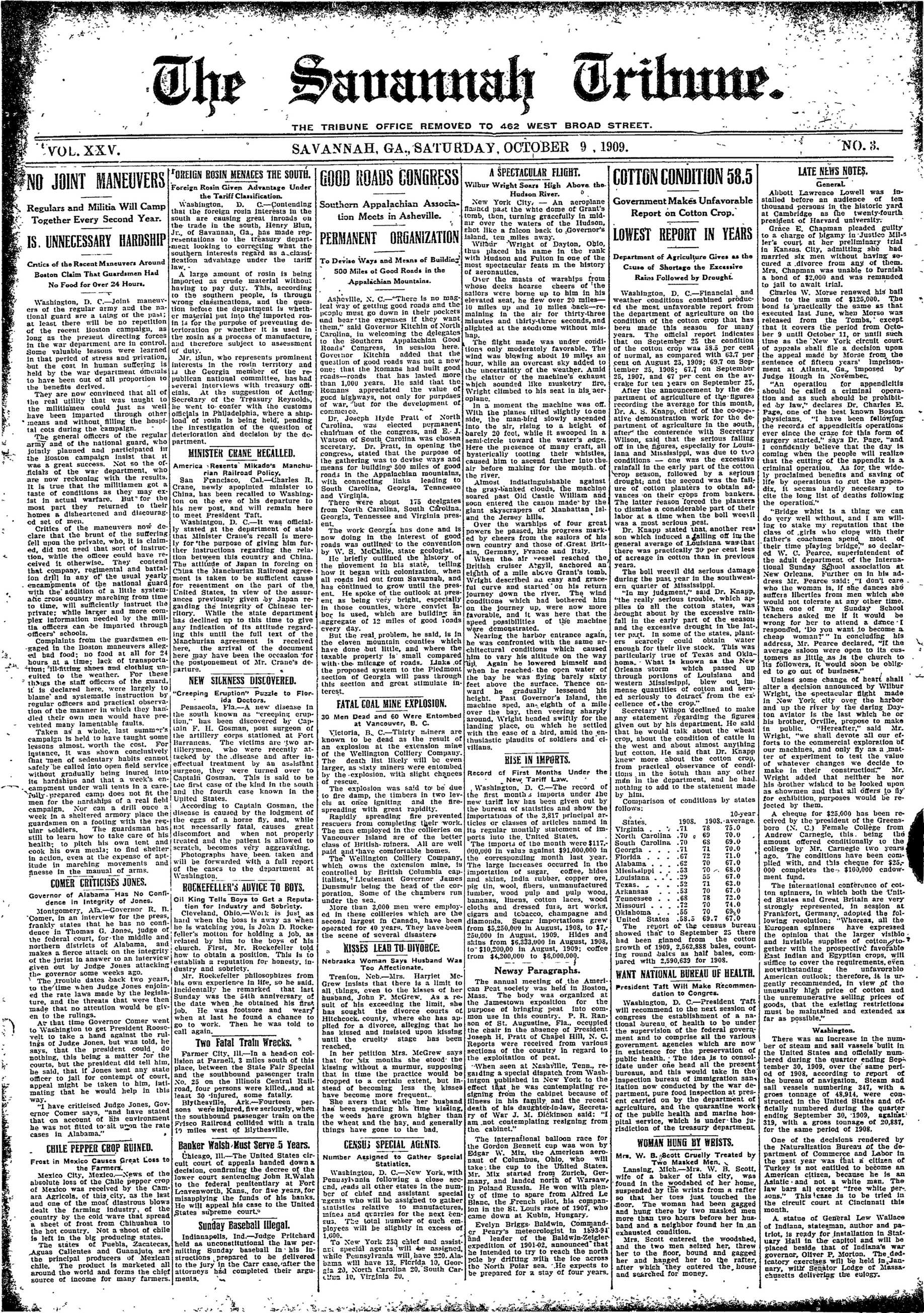

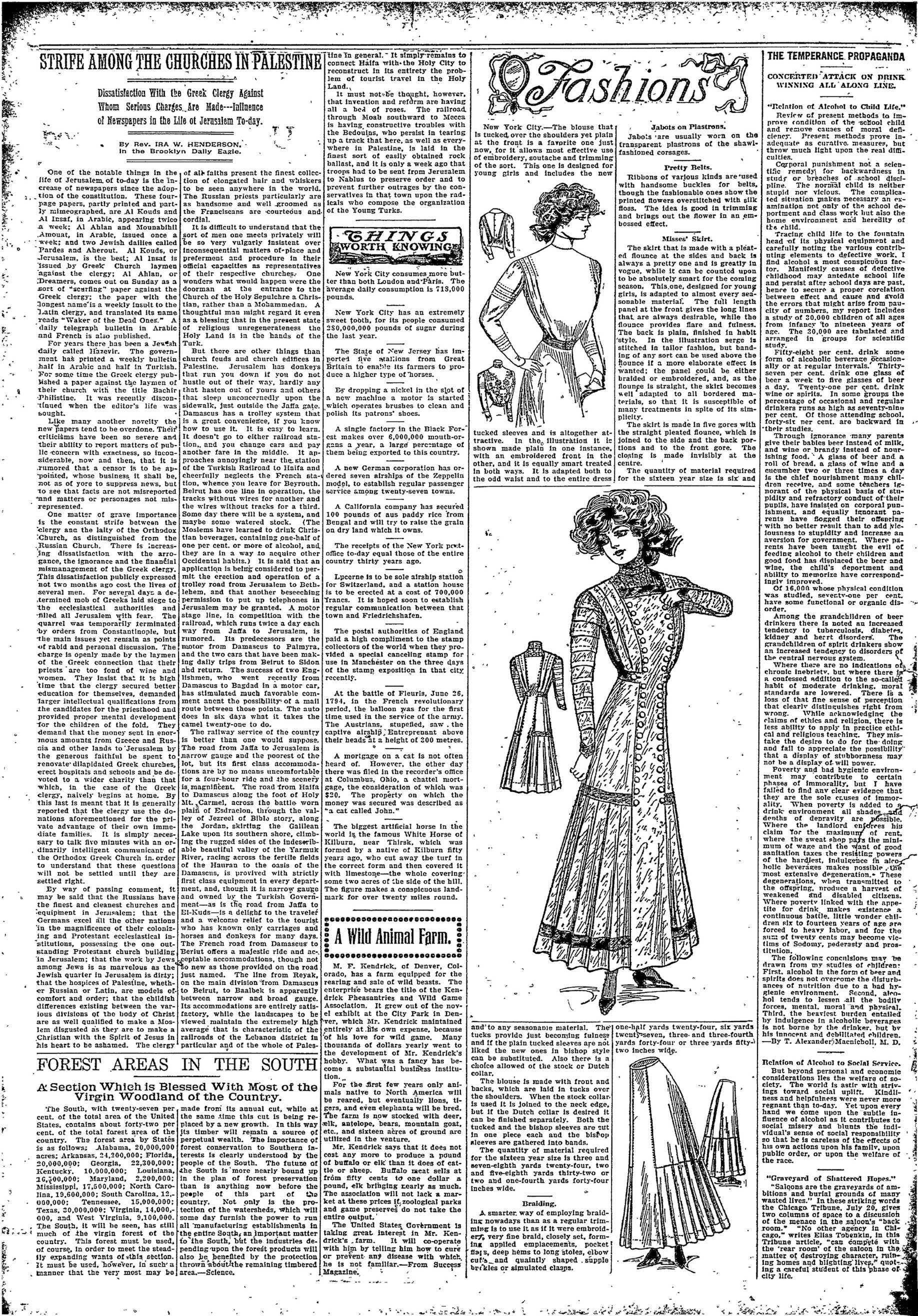
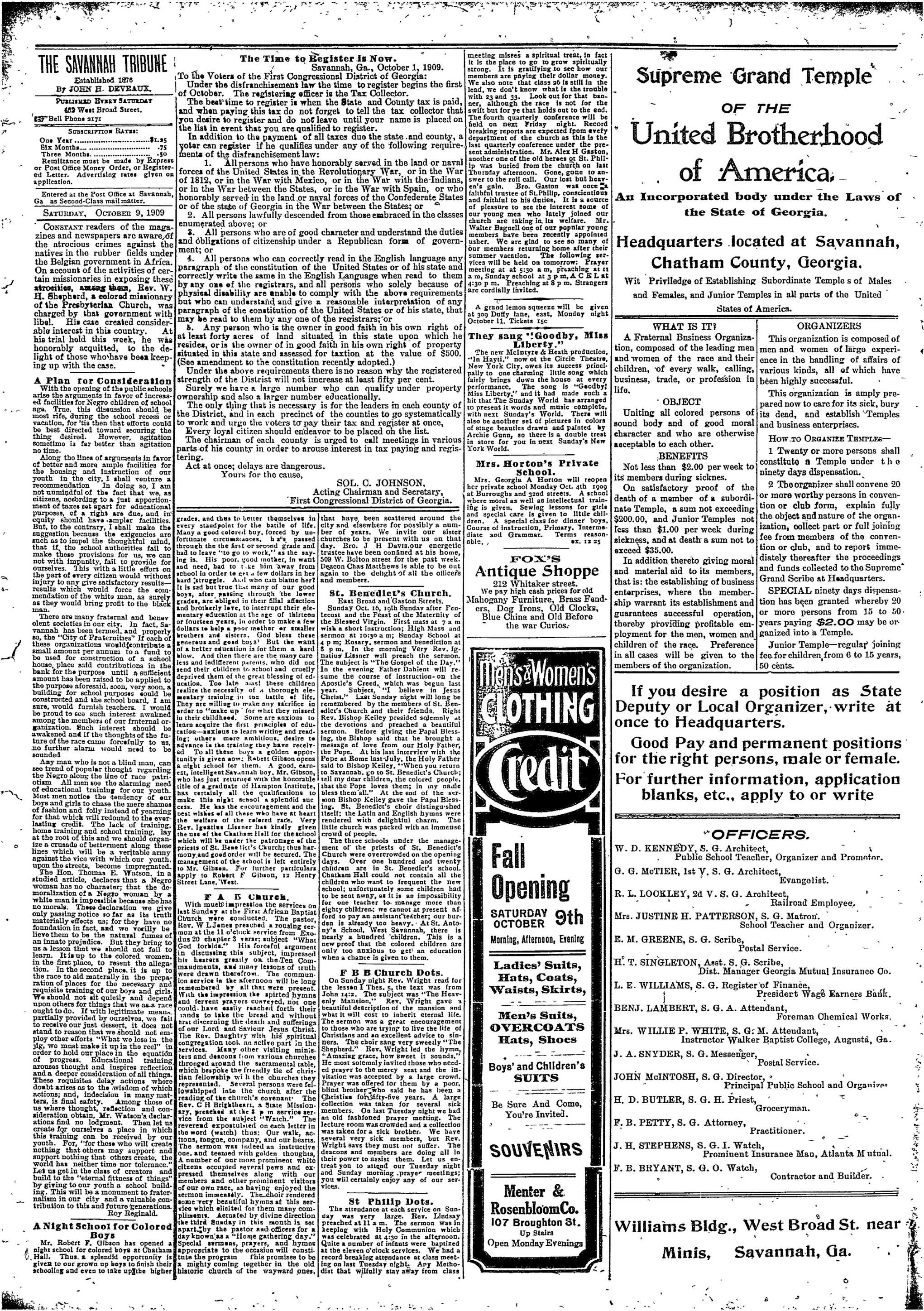
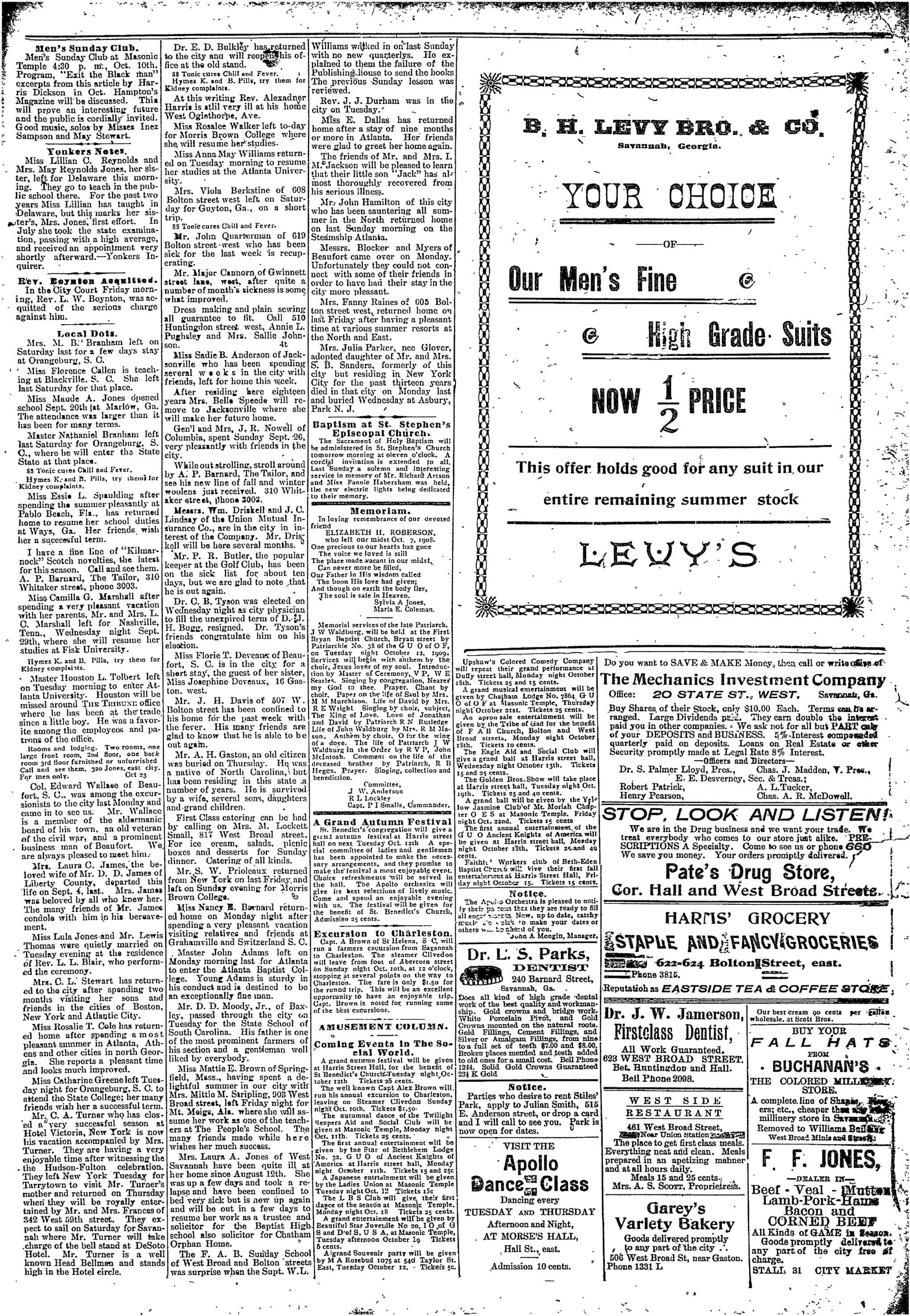

Page text (machine-generated)
VOL. XXV.
NO JOINT MANEUVERS
Regulars and Militia Will Camp Together Every Second Year.
IS. UNNECESSARY HARDSHIP
Critics of the Recent Maneuvers Around Boston Claim That Guardamen Had No Food for Over 24 Hours.
Washington, D. C.—Joint maneuvers of the regular army and the national guard are a tating or the past; at least there will be no repetition of the recent Boston campaign, as long as the present directing forces in the war department are in control. Some valuable lessons were learned in that period of stress and privation, but the cost in human suffering is held by the war department omnials to have been out of all proportion to the benefits derived.
They are now convinced that all of the real utility that was taught to the militiamen could just as well have been imparted through other means and without filling the hospital cots during the campaign.
The general officers of the regular army and of the national guard, who jointly planned and participated in the Boston campaign insist that it was a great success. Not so the officials of the war department, who are now reckoning with the results. It is true that the militiamen got a taste of conditions as they may exist in actual warfare. But for the most part they returned to their homes a disheartened and discouraged set of men.
Critics of the maneuvers now declare that the brunt of the suffering fell upon the private, who, it is claimed, did not need that sort of instruction, while the officer could have received it otherwise. They contend that company, regimental and battalion drill in any of the usual yearly encampments of the national guard with the addition of a little systematic cross country marching from time to time, will sufficiently instruct the private; while larger and more complex information needed by the militia officers can be imparted through officers' schools.
Complaints in the guardsmen engaged in the Boston maneuvers alleged bad food; no food at all for 24 hours at a time; lack of transportation; ill-fitting shoes and clothing unsuited to the weather. For these things the staff officers of the guard, it is declared here, to blame and systemate instruction by regular officers and practical observers in a manner in which they handled their own men would have prevented many lamentable faults.
Taken as a whole, last summer's campaign is held to have taught some lessons almost, worth the cost. For instance, it was shown conclusively that men of sedentary habits cannot safely be called into open field service without gradually being inured into its hardships and that a week's encampment under wall tents in a carefully prepared camp does not fit the men for the hardships of a real field campaign. Nor can a drill once a week in a sheltered armory place the guardmen on a footing with the regular soldiers. The guardman has still to learn how to take care of his health; to pitch his own tent and cook his own meals; to find shelter in action, even at the expense of aptitude in marching movements and finesse in the manual of arms.
COMER CRITICISES JONES.
Governor of Alabama Has No Confidence in Integrity of Jones.
Montgomery, Ala.-Governor R. B. Comer, in an interview for the press, frankly states that he has no confidence in Thomas G. Jones, judge of the federal district of Alabama, and makes fierce attack on the integrity of the jurist in answer to an interview given out by Judge Jones attacking the governor some weeks ago.
The trouble dates back two years, to the time when Judge Jones enjoined the rate laws made by the legislature, and the threats that were then made that no attention would be given to the rulings.
At that time Governor Comer went to Washington to get President Roosevelt to take a hand against the rulings of Judge Jones, but was told, he says, that the president could do nothing, this being a matter for the courts, but the president did tell him, he said, that if Jones sent any state officer to jail for contempt of court, appeal might be taken to him, estimating that he would help in this way.
"I have criticised Judge Jones, Governor Comer says, "and have stated that on account of his environment he was not fitted to sit upon the rate cases in Alabama."
CHILE PEPPER CROP RUINED.
Frost in Mexico Causes Great Loss to the Farmers
Mexico City, Mexico—News of the absolute loss of the Chile pepper crop of Mexico was received by the Camera Agricola, of this city, as the last and one of the most dinstarrous blows dealt the farming industry, of the country by the cold wave that spread a sheet of frost from Chihuahua to the hot country. Not a shoot of chile is left in the big producing states. The states of Puebla, Zacatecas, Aguas Calientes and Guanajuto are the principal producers of Mexican chile. The product is marketed all around the world and forms the chief source of income for many farmers.
FOREIGN BOSIN MENAGES THE SOUTH.
Washington, D. C.—Contending that the foreign rosin interests in the south are causing great inroads on the trade in the south, Henry Blun, Jr., of Savannan, Ga., has made representations to the treasury department looking to correcting what the southern interests regard as a classification advantage under the tariff law.
A large amount of rosin is being imported as crude material without having to pay duty. This, according to the southern people, is through wrong classifications, and the question before the department is whether material put into the imported rosin is for the purpose of preventing deterioration or whether it is used in the rosin as a process of manufacture, and therefore subject to assessment of duty.
Mr. Blun, who represents prominent interests in the rosin territory and is the Georgia member of the republican national committee, has had several interim meetings with the Secretary of the suggestion of Acting Secretary of the Treasury Reynolds, he went to confer with the customs officials in Philadelphia, where a shipload of rosin is being held, pending the investigation of the question of deterioration and decision by the department.
MINISTER CRANE RECALLED.
America Resents' Mikado' Manchurian Railroad Policy
San Francisco, Cal.-Charles R. Crane, newly appointed minister to China, has been recalled to Washington on the eve of his departure to his new post, and will remain here to meet President Taft. Washington, D. C.-It was officially stated at the department of state that Minister Crane's recall is merely for the purpose of giving him further instructions regarding the relation between this country and China. The attitude of Japan in forcing on China the Manchurian Railroad agreement is taken to be sufficient cause for resentment on the part of the United States, in view of the assurances previously given by Japan regarding the integrity of Chinese territory. While the state department has declined up to this time to give any indication of its attitude regarding this until the full text of the Manchurian agreement is received here, the arrival of the document here may have been the occasion for the postponement of Mr. Crane's departure.
NEW SILKNESS DISCOVERED.
"Creeping Eruption" Puzzle to Florida. Doctors.
Pensacola, Fla.-A new disease in the south known as "creeping eruption" has been discovered by Captain F. H. Gosman, post surgeon of the artillery corps stationed at Fort Harrancas. The victims are two artillerymen, who were recently attacked by the disease and after ineffectual treatment by an assistant surgeon, they were turned over to Captain Gosman. This is said to be the first case of the kind in the south and the fourth case known in the limited States.
Photographs have, been taken and will be forwarded with a full report of the cases to the department at Washington.
BOCKEFELLER'S ADVICE TO BOYS.
Oil King Tells Boys to Get a Reputation for Industry and Robustity
Hon for industry and sobriety.
Cleveland, Ohio.—Work is just as hard when the boss is away as when he is watching you, is John D. Rockefeller's motion for holding a job, as he is giving him to the boys of his church. First, Mr. Rockefeller told how to obtain a position. This is to establish a reputation for honesty, industry and sobriety.
Mr. Rockefeller philosophizes from his own experience in life, so he said, incidentally, he remarked that last Sunday was the 54th anniversary of the date when he obtained his first job. He was footsore and weary when at last he found a chance to go to work. Then he was told to call again.
Two Fatal Train Wrecks.
Farmer City, Ill.-In a head-on collision at Parnell, 3 miles south of this place, between the State Fair Special and the southbound passenger train No. 25 on the Illinois Central Railroad, four persons were killed, and at least 30 injured, some fatally. Blythesville, Ark.-Fourteen persons were injured, five seriously, when the southbound passenger train on the Frisco Railroad collided with a train 10 miles west of Blythesville.
Banker Walsh Must Serve 5 Years.
Chicago, Ill.—The United States circuit court of appeals handed down a decision, confirming the decree of the lower court sentencing John R. Walsh to the federal penitentiary at Fort Leavenworth, Kans., for five years, for misapplying the funds of his banks. He will appeal his case to the United States supreme court.
Sunday Baseball Illegal.
Indianapolis, Ind.-Judge Pritchard held as unconstitutional the law permitting Sunday baseball in his instructions prepared to be delivered to the jury in the Carr case, after the attorneys had completed their arguments.
THE TRIBUNE OFFICE REMOVED TO 462 WEST BROAD STREET. SAVANNAH, GA., SATURDAY, OCTOBER 9, 1909.
GOOD ROADS CONGRESS
PERMANENT ORGANIZATION
To Devise Ways and Means of Building
500 Miles of Good Roads in the
Appalachian Mountains.
Asheville, N. C.—"There is no magical way of getting good roads and the people must go down in their pockets and bear the expenses if they want them," said Governor Kitchin of North Carolina, in welcoming the delegates to the South Appalachian Good Roads Congress, in session here. Governor Kitchin added that the question of good roads was not a new one; that the Romans had built good roads—roads that has lasted more than 1,000 years. He said that the Romans appreciated the value of high goodways, not only for purposes of war, but for the development of commerce.
Dr. Joseph Hyde Pratt of North Carolina, was elected permanent chairman of the congress, and E.J. Watson of South Carolina was chosen secretary. Dr. Pratt, in opening the congress, stated that the purpose of the gathering was to devise ways and means for building 500 miles of good roads in the Appalachian mountains, with connecting links leading to South Carolina, Georgia, Tennessee and Virginia.
There were about 175 delegates from North Carolina, South Carolina, Georgia, Tennessee and Virginia present.
The work Georgia has done and is now doing in the interest of good roads was outlined to the convention by W. S. McCallie, state geologist.
He briefly outlined the history of the movement in his state, telling how it began with colonization, when all roads led out from Savannah, and has continued to grow until the present as being very bright, especially in those counties, where convict labor is used, which are building an aggregate of 12 miles of good roads every day.
But the real problem, he said, is in the elven mountain counties which have done but little, and where the taxable property is small compared with the mileage of roads. Links of the proposed system to the Piedmont section of Georgia will pass through this section and great stimulate interest.
FATAL COAL MINE EXPLOSION.
30 Men Dead and 60 Were Entombed at Vancouver, B. C.
Victoria, B. C.-Thirty miners are known to be dead as the result of an explosion at the extension mine of the Wellington Colliery Company. The death list likely will be even larger, as sixty miners were entombed by the explosion, with slight chances of rescue. The explosion was said to be due to fire damp, the timbers in two levels at once igniting and the fire spreading with great rapidity. Rapidly spreading fire prevented rescuers from completing their work. The men employed in the collieries on Vancouver island are of the better class of British miners. All are well paid and are comfortable homes. The Wellington Colliery Company, which owns the extension mine, is controlled by British Columbia capitalists. Licutenant Governor James Dunsmuir being the head of the corporation. Some of the chambers run under the sea.
More than 3,000 men were employed in these collieries which are the second largest in the country. We have been there for 40 years. They have been the scene of several disasters
KISSES LEAD TO DIVORCE
Nebraska Woman Says Husband Was Too Affectate.
Trenton, Neb.—Mrs. Harriet McGrew insists that there is a limit to all things, even to the kisses of her husband, John F. McGrew. As a result of his exceeding the limit, she has sought the divorce courts of Hitchcock, county, where she has applied for a divorce, alleging that he has kissed and insisted upon kissing until the cruelty stage has been reached.
In her petition Mrs. McGrew says that for six months she stood the kissing without a mumum supposing that in time the divorce would be dropped in a certain extent, but instead of becoming less the kisses have become more frequent.
She avers that while her husband has been spending his time kissing, the weeds have grown higher than the wheat and the hay, and generally things have gone to the bad.
CENSUS SPECIAL AGENTS
Number Assigned to Gather Special Statistics.
Washington, D. C.—New York, with Pennsylvania following a close second, leads all other states in the number of chief and assistant special agents who will be assigned to gather statistics relative to manufactures, mines and quarries for the next census. The total number of such employees will be slightly in excess of 1,600.
To New York 254 chief and assistant special agents will be assigned, while Pennsylvania will have 220. Alabama will have 13. Florida 10, Georgia 20, North Carolina 20, South Carolina 10, Virginia 20.
Tribune.
New York City. — An aeroplane flashed past the white dome of Grant's tomb, then, turning gracefully in midair over the waters of the Hudson, shot like a falcon back to Governor's island, ten miles away.
Witibir Wright of Dayton, Ohio, thus placed his name in the rank with Hudson and Fulton in one of the most spectacular feats in the history of aeronautics.
Over the masts of warships from whose docks hoarse cheers of the sailors were borne up to him in his elevated seat, he flew over 20 miles—10 miles up and 10 miles back—remaining in the air for thirty-three minutes and thirty-three seconds, and alighted at the aeodrome without mishap.
The flight made was under conditions only moderately favorable. The wind was blowing about 10 miles an hour, while an overcast sky added to the uncertainty of the weather. Amid the clatter of the machine's exhaust which sounded like musketry fire, Wright climbed to his seat in his aeroplane.
In a moment the machine was off. With the planes tilted slightly to one side, the man-bird slowly ascended into the air, rising to a height of barely 20 feet, while it swooped in a semi-circle toward the water's edge. Here the presence of many craft, all bysterically tooting their whistles, caused him to ascend further into the air before making for the mouth of the river.
Almost indistinguishable against the gray-banked clouds, the machine soared past Old Castle William and soon entered the canon made by the giant scskrapers of Manhattan Island and the Jersey hills.
Over the warships of four great powers he passed, his progress marked by cheers from the sailors of his own country and those of Great Britain, Germany, France and Italy.
When the air vessel reached the British cruiser Aggil, anchored an eighth of a mile above Grant's tomb, Wright described an easy and graceful curve and started on his return journey down the river. The wind conditions which had bothered him on the journey up, were now more favorable, and it was here that the speed possibilities of the machine were demonstrated.
Nearing the harbor entrance again, he was confronted with the same architectural conditions which caused him to vary his altitude on the way up. Again he lowered himself and when he reached the open water of the bay he was flying barely sixty feet above the surface. Thence onward he gradually lessened his height. Past Governor's Island, the machine sped, an eighth of a mile over the bay, then veering sharply around, Wright headed swiftly for the landing place, on which he settled with the ease of a bird, amid the enthusiastic plaudits of soldiers and civilians.
RISE IN IMPORTS.
Record of First Months Under the
New Tariff Law
Washington, D. C.—The record of the first month's imports under the new tariff law has been given out by the bureau of statistics and show the importations of the 3,817 principal articles or classes of articles named in its regular monthly statement of imports into the United States.
The imports of the month were $117,000,000 in value against $91,000,000 in the corresponding month last year. The large incidences occurred in the importation of sugar, coffee, hides and skins, india rubber, copper ore, pig tin, wool, fibers, unmanufactured lumber, wood pulp and pulp wood, bananas, linens, cotton laces, wood cloths and dressed furs, art works, cigars and tobacco, champagne and diamonds. Sugar importations grew from $5,250,000 in August, 1908, to $7,250,000 in August, 1909. Hides and skins from $6,233,000 in August, 1908, to $10,200,000 in August, 1909; coffee from $4,200,000 to $6,000,000.
Newsy Paragraphs.
The annual meeting of the American Peat society was held in Boston, Mass. The body was organized at the Jamestown exposition for the purpose of bringing peat into common use in this country. P. R. Ranson of St. Augustine, Fla., occupied the chair in the absence of President Joseph H. Pratt of Chapel Hill, N. C. Reports were received from various sections of the country in regard to the exploitation of peat.
"When seen at Nashville, Tenn., regarding a special dispatch from Washington published in New York to the effect that he was contemplating resigning from the cabinet because of illness in his family and the recent death of his daughter-in-law, Secretary of War J. M. Dickinson said: "I am not contemplating resigning from the cabinet."
The international balloon race for the Gordon Bennett cup was won by Edgar W. Mix, the American aeronaut of Columbus, Ohio, who will take: the cup to the United States. Mr. Mix started from Zurich, Germany, and landed north of Warsaw, in Poland Russia. He won with plenty of time to spare from Alfred Le Blanc, the French pilot, his companion in the St. Louis race of 1907, who came down at Kublin, Hungary. Evelyn Briggs, Baldwin, Commander Penry's meteorologist in 1933-94 and leader of the Baldwin-Zeigler expedition of 1901-02, announced that he intended to try to reach the north pole by drifting with the ice across the North Polar sea. He expects to be prepared for a stay of four years.
COTTON CONDITION 58.5
Department of Agriculture Gives as the Cause of Shortage the Excessive Raises Followed by Drought.
Washington, D. C.—Financial and weather conditions combined produced the most unfavorable report from the department of agriculture on the condition of the cotton crop that has been made this season for many years. The official report indicates that on September 25 the condition of the cotton crop was 58.5 per cent of normal, as compared with 63.7 per cent on August 25, 1909; 69.7 on September 25, 1908; 67.7 on September 25, 1907, and 67 per cent on the average for ten years on September 25.
After the announcement by the department of agriculture of the figures recording the average for this month, Dr. A. S. Knapp, chief of the co-operative demonstration work for the department of agriculture in the south, after the conference with Secretary Wilson, said that the serious falling off in the figures, especially for Louisiana and Mississippi, was due to two conditions — one was the excessive rainfall in the early part of the cotton crop season, followed by a serious drought; and the second was the failure of cotton planters to obtain advances on their crops from bankers. The latter reason forced the planters to dismiss a considerable part of their labor at a time when the boll weevil was a most serious pest.
Dr. Knapp stated that another reason which induced a falling off in the general average of Louisiana was that there was practically 30 per cent less of acreage in cotton than in previous years.
The boll weevil did serious damage during the past year in the southwestern quarter of Mississippi.
"In my judgment," said Dr. Knapp, "the really serious trouble, which applies to all the cotton states, was brought about by the excessive rainfall in the early part of the season and the excessive drought in the latter ppt. In some of the states, planters scarcely could obtain water enough for their live stock. This was particularly true of Texas and Oklahoma. What is known as the New Orleans storm which passed up through portions of Louisiana and western Mississippi, blew out immense quantities of cotton and served seriously to detract from the excellence of the crop."
Secretary Wilson declined to make any statement regarding the figures given out by his department. He said that he would talk about the wheat crop, about the condition of cattle in the west and about almost anything but cotton. He said that Dr. Knapp knew more about the cotton crop, from practical observance of conditions in his soil than any other man in the department, and he had nothing to add to the statement made by him.
Comparison of conditions by states follows:
States. 1908. 1908. 10-year
Virginia. .71 78 75.0
North Carolina .70 69 70.0
South Carolina .70 68 69.0
Georgia .71 71 70.0
Florida .67 72 71.0
Alabama .62 70 67.0
Mississippi .53 70 68.0
Louisiana .29 55 67.0
Texas .52 71 63.0
Arkansas .53 70 67.0
Tennessee .68 78 72.0
Missouri .72 70 74.0
Oklahoma .55 70 69.0
United States .58.5 69.7 67.0
The report of the census bureau
showed that to September 25 there
had been ginned from the cotton
growth of 1909, 2,562,888 bales, counting round bales as half bales, compared with 2,590,633 for 1908.
WANT NATIONAL BUREAU OF HEALTH.
Washington, D. C.-President Taft will recommend to the next session of congress the establishment of a national bureau of health to be under the supervision of the federal government and to comprise all the various government agencies which are now in existence for the preservation of public health. The idea is to consolidate under one head all the present bureau, and this would take in the inspection bureau of immigration sanitation now conducted by the war department, pure food inspection at present carried on by the department of agriculture, and the quarantine work of the public health and marine hospital service, which is under the jurisdiction of the treasury department.
WOMAN HUNG BY WRISTS.
Mrs. W. B. Scott Cruelly Treated by
Two Masked Men.
Lansing, Mich.-Mrs. W. B. Scott,
wife of a baker of this city, was
found in the woodshed of her home,
suspended by the wrists from a rafter
so that her toes just touched the
floor. The woman had been gagged
and hung there by two masked men
more than two hours before her husband
and a neighbor found her in an
exhausted condition.
Mrs. Scott entered the woodshed,
and the two men selzed her, threw
her to the floor, bound and gagged
her and hanged her to the rafter,
after which they entered the house
and searched for money.
LATE NEWS NOTES.
Abbott Lawrence Lowell was installed before an audience of ten thousand persons in the historic yard at Cambridge as the twenty-fourth president of Harvard university.
Grace E. Chapman pleaded guilty to a charge of bigamy in Justice Miller's court at her preliminary trial in Kansas, City, admitting she had married six men without having secured a divorce from any of them. Mrs. Chapman was unable to furnish a bond of $2,000 and was remanded to jail to await trial.
Charles W. Morse renewed his bail bond to the sum of $125,000. The bond is practically the same as that executed last June, when Morso was released from the Tombs, except that it covers the period from October 9 until October 11, or until such time as the New York circuit court of appeals shall file a decision upon the appeal made by Morse from the sentence of fifteen years' imprisonment at Atlanta, Ga., imposed by Judge Hough in November.
"An operation for appendicitis should be called a criminal operation and as such should be prohibited by law," declares Dr. Charles E. Page, one of the best known Boston physicians. "I have been following the records of appendicitis operations ever since the craze for this form of surgery started," says Dr. Page, "and I confidently believe that the day is coming when the people will realize that the cutting of the appendix is a criminal operation. As for the widely proclaimed benefits and saving of life by operations to cut the appendix, it seems hardly necessary to cite the long list of deaths following the operation."
"Bridge whist is a thing we can do very well without, and I am willing to stake my reputation that the class of girls who elope with their father's coachmen spend most of their time playing bridge," so declared W. C. Pearce, superintendent of the adult department of the International Sunday School association at New Orleans. Further on in his address Mr. Pearce said: "I don't care who the woman is, if she dances she suffers liberties from men which she would not tolerate at any other time. When one of my Sunday School teachers asked me if it would be wrong for her to attend a dance I responded, "Do you want to become a cheap woman?" In concluding his address, Mr. Pearce declared, "If the average saloon were open to its customers as little, as is the church to its followers, it would soon be obliged to go out of business."
Unless some change of heart shall alter a decision announced by Wilbur Wright, the spectacular flight made in New York city over the harbor and up the river by the daring Dayton aviator is the last which he or his brother, Orville, propose to make in public. "Hereafter," said Mr. Wright, "we shall devote all our efforts to the commercial exploration of our machines, and only fly as a matter of experiment to test the value of whatever changes we decide to make in their construction." Mr. Wright added that neither he nor his brother wished to be looked upon as showmen and that all offers to fly for exhibition, purposes would be reflected by them.
A cheque for $25,000 has been received by the president of the Greensboro (N. C.) Female College from Andrew Carnegie, this, being the amount offered conditionally to the college by Mr. Carnegie two years ago. The conditions have been compiled with, and this cheque for $25,000 completes the $100,000 endowment fund.
The international conference of cotton spinners, in which both the United States and Great Britain are very strongly represented, in session at Frankfurt, Germany, adopted the following resolution: "Whereas, all the European spinners have expressed the opinion that the larger visible and invisible supplies of cotton together with the prospective favorable East Indian and Egyptian crops, will suffice to cover the requirements, even notwithstanding the unfavorable American outlook; therefore, it is urgently recommended, in view of the unusually high price of cotton and the unremunerative selling prices of goods, that the existing restrictions must be maintained and extended as far as possible."
Washington.
There was an increase in the number of steam and sail vessels built in the United States and officially numbered during the quarter ending September 30, 1909, over the same period of 1908, according to report of the bureau of navigation. Steam and sail vessels numbering 347, with a gross tonnage of 48,914, were constructed in the United States and officially numbered during the quarter ending September 30, 1909, against 319, with a gross tonnage of 20,887, for the same period of 1908.
One of the decisions rendered by the Naturalization Bureau of the department of Commerce and Labor in the past year was that a citizen of Turkey is not entitled to become an American citizen, because he is an Asiatic and not a white man. The law bars all except "free white persons." This case is to be tried in the circuit court at Cincinnati this month.
A statue of General Lew Wallace of Indiana, statesman, author and patriot, is ready for installation in Statuary Hall in the capitol and will be placed beside that of Indiana's war governor, Oliver P. Morton. The dedicatory exercises will be held in January, with Senator Lodge of Massachusetts delivering the eulogy.
Largest Sick and Death Benefits; Smallest Premiums.
Treasury of State of Georgia
The undesignated Treasures of the State of Georgia, hereby acknowledges
to have received from the following described:
Dear Regiment and Company of Infantry of
East Tennessee, Georgia (Company of Infantry)
14th, 10th, 10th, Company of Infantry
(2005) annuity, due 1925
being in total Ten Thousand Dollars , and which are held by the State of Georgia , by authority and under the provisions of an Act of the General Assembly , approved October 22d, 1887 , and amended December 20th, 1897 .
EXPERIMENT NO LONGER
The New Convict System Has Proven Successful.
NO COMPLAINTS BEING MADE
Road Work Has Been Satisfactory in Every County Where Convicts Have Been Employed.
Atlanta, Ga—The new state convict system is no longer an experiment.
Put into operation on April 1, six months ago, it is proving a greater success than its most ardent supporters had hoped for, and in counties where road work is being done by convicts under the new plan, it is giving absolute satisfaction. No complaints of its workings have been lodged against it.
"The new system is proving a greater success than any of us ever hoped for," said Captain Wiley Williams of the prison commission, while discussing its operation. "I have visited many counties, great and small, during the past few months and have kept in close touch with the workings of the system, and everywhere I have been the county authorities have expressed the greatest satisfaction. Its superiority to the old Icase system is being practically demonstrated by the entusiasm for good roads and the splendid work being done to build them up.
"The skeptical critics of the new system," continued Captain Williams, "prophesied that the idea of putting convicts in charge of the various counties and working them upon the roads would prove visionary and would result in failure because the county authorities who were inexperienced in handling convict would have all sorts of trouble with them.
"On the contrary there has been comparatively little trouble from this source; there have been fewer escapes than anybody anticipated; only two or three of the wardens have been changed because of inexperience; the management of the convicts has been entirely satisfactory, and splendid work has been done in every county where they have been employed."
"It was also said that many of the counties, especially the smaller ones, finding failure staring them in the face, would turn their convicts back upon the state and thus seriously handicap if not completely defeat the workings of the system. On the contrary, we have not been able to supply the demand for convicts. As an example County Attorney Willingham of Monroe county applied to the commission for fifteen more convicts for Monroe, and the application could not be granted because the convicts were not available.
"The new convict system is certainly no longer an experiment."
An early start is one of the essentials to getting our portion in this life.
SOL. C. JOHNSON, Supt. of Ageno
GOVERNOR DECLINES INVITATIONS.
He Would Be Away Two Months if He Accepted All.
Atlanta, Ga.—If Governor Brown accepted all the invitations received to attend county fairs in Georgia, he would be out of his office two-thirds of the time during October and November.
Governor Brown has found it necessary, therefore, to decline practically all such invitations, and aside from a trip in November to Macon, Augusta and Savannah with President Taft, he will not go away from his office, unless important matters arise to take him.
While he would personally like to accept the open-handed hospitality of fered him at so many places, Governor Brown recognizes that duty calls him to remain in his office every day possible. People come from all parts of the state every day to consult him about matters of importance, and he feels that it would be an injustice to them to be away so much.
SCHOOLS CANNOT GET MONEY.
The District Agricultural School Must Wait for Extra Funds.
Atlanta, Ga.—It develops that the eleven district agricultural schools must wait until next year for the additional appropriations of $2,000 each, which was given them at the last session of the legislature.
The legislature passed a bill appropriating $22,000 to the agricultural schools, or $2,000 each, to be paid them immediately and out of any funds in the treasury, "not otherwise appropriated."
There are no funds in the state treasury "not otherwise appropriated," a fact which was clearly developed in connection with the proposed purchase of land near Chattanooga to be used for terminals for the Western and Atlantic railroad.
It is also reported that the state board of health has exhausted its appropriation and is in need of funds.
SOUTH GEORGIA CHOSEN. Carmen's Home Will Be Built at Waycross or Fitzgerald.
Waycross, Ga.-Telegrams received here state that the committee of the carmen's union have decided to locate their home in south Georgia, but do not commit themselves as to the exact location. This practically eliminates all the other competitors and as soon as the committee meets in Kansas City, Mo., final action will be taken, and their decision made known.
CENSUS TAKER FOR 5TH DISTRICT.
Hen. L. F. McClelland of. Stone Mountain Appointed. Atlanta, Ga.—Hon. L. F. McClelland of Stone Mountain and an Atlanta lawyer of repute, has been appointed to take the United States census in the fifth congressional district, which includes Atlanta. This announcement, which is official, puts to an end the controversy
P. EDWARD PERRY, Vice President.
Masonic Books &
Regalias.
LODGE SEALS.
FINANCIAL CARDS and
BLANKS of every description.
Liberal Discounts Will Be Arranged
BOL. C. JOHNSON,
Savannah, Ga.
SOL. C. JOHNSON Notary Public.
Dooda, Contracts, Wills and Other
Legal Forms Prepared and
Attested.
114 West St. Julian Street
of recent days in which Alonzo M.
Brand and John W. Hill and
Congressman Livingston and Colonel William Howard have been figuring.
LAWFUL TO SOLICIT WHISKEY ORDERS
Supreme Court Hands Down an Important Decision.
Atlanta, Ga.—According to a decision handed down by the supreme court it is not unlawful for a firm doing business in Chattanooga to solicit orders for intoxicating liquors by use of the mails in the state of Georgia.
The case in question was that of Rose vs. the State, and was carried up from the city court of Atlanta. Its effect is to reverse the decision of the court of appeals in the case of Rose vs. the State brought up from the Pattow county superior court.
LIBERAL MINISTER ORDAINED.
Rev. Archibald Black Refused to Accept All of Book of Genesis.
New York City—The ordination of the Rev. Archibald Black, accused of extreme liberalism, was formally approved at the meeting of the New York presbytery.
Last June his orthodoxy was questioned because he refused to accept literally some portions of the Book of Genesis, among them, it was said at the time, the story of Adam and Eve and the Garden of Eden.
Roller skating is popular in the for East, I. Calcutta, at a rink on the Malden, as many as six thousand rinkers and spectators, nearly all foreigners, have been seen in one day.
HOME OFFICE
WEST BROAD STREET,
SAVANNAH, GEORGIA.
Phone 1183. Ga. Phone 2029.
Directors.
L. E. Williams.
P. Edward Perry.
Walter G. Scott.
Bol. C. Johnson.
W. R. Fields.
J. H. Deveaux
L. M. Pollard.
W. H. Burgess.
J. H. Bugg, M. D.
J. M. Ferrebee.
This company is duly chartered under the laws of the State of Georgia, and has complied with all requirements of the State Insurance department, therefore all policy holders are protected with all the safeguards that the strict insurance laws of this State seek to protect its citizens.
Its affairs are directed and managed by Negro men of the city of Savannah of leading standing, and whose character and reputation are of such as to command the respect and confidence of all the people of that community. The same men that manage this Society are the ones that organized, and are conducting the affairs of the first successful Negro Savings Bank in this state, therefore we can readily see that by connecting themselves with this Insurance company their interest will be in safe hands.
By comparing our rules and benefits with other first class companies it will be seen that we offer the most liberal inducements with the largest sick, accident and death benefits to our members than any other company in this business.
That we pay our claims promptly can be testified to by the thousands of our satisfied members.
Liberal Terms and Commission.
ESSENCE OF THE NEWS.
Food is being sent to Mexican food sufferers by mule train.
Bishop William George McCloskey, of Louisville, the oldest Catholic prelate in this country, is dead.
Gabriel Norodunghian Effendi will retain his position as Minister of Public Works at Constantinople.
Spain reported that the war on the Arabs in North Morocco is virtually over, the tribesman seeking terms of peace.
The Japanese, a report from Germany said, are seeking steamships there, the plan being to get a monopoly of Pacific Ocean traffic.
A fight between the United States Steel Corporation and interests planning a merger of independent coke makers, involving $20,000,000, was reported in Pittsburg.
Wall Street learned, with the final probating of the will of E. H. Harriman at Goshen, N. Y., that he had left $150,000,000, instead of $100,000,-000, as was first estimated.
The Mauretania reduced her cast-bound record by forty-five minutes, covering the distance between New York and Queensown in four days thirteen hours and forty-one minutes.
Because 2700 wives have been deserted in Cincinnati within three months the W. C. T. U. of that city wants, deserting husbands treated the same as deserters from the army and navy.
PROMINENT PEOPLE.
Secretary Dickinson spoke at Nashville, praising President Taft's policy in the South and discussing the race question.
Theodore P. Shonts was sued by Fréderick Hipah, who alleged the railroad president alienated Mrs. Hipah's affections.
Professor Goldwin Smith gave The Grahge, his valuable property, to the city of Toronto, Canada, for a park and an art gallery.
President Taft, fatigued by his two busy days in Salt Lake City, spent the afternoon in bed in his private car at Ogden, Utah.
A. Liautard, head of the American Veterinary Hospital, New York City, has been made a Chevalier of the Legion or Honor in Paris.
Harry Benedict, of New Haven, Conn., received a telegram from Harry Whitney saying that he was rushing home after a "hard winter" in the Arctic.
Surveyor Clarkson, of New York City, said that the laws for the protection of life on harbor craft were inadequate and that Congress should enact new ones.
The Rev. Dr. William T. Manning, rector of Trinity Church, New York City, in a sermon said the country needed saner views on divorce and a revival of patriotism.
Professor George E. Hale, of the Mount Wilson Observatory, has been honored in France by his fellow scientists. His researches on the sun and on stellar evolution are regarded as authoritative.
WALTER S. SCOTT, Secretary and Tr eas.
The Great Trio
Ty Elbert Hubbard
T is not the attainment of knowledge which marks the superior person—the master man; it is the possession of certain qualities.
There are three traits of character, or habits, or personal qualities, which, once attained, mean money in the bank, friends at court, honor and peace at home—power, purpose, poise.
These qualities are Industry, Concentration and Self-reliance.
The man who has these three qualities is in possession of the key that unlocks the coffers of the world and the libraries of Christendom. All doors fly open at his touch. "Oh, he's a lucky dog" they say—and he is
And the strange part of it is, there is no mystery about the acquirement of these three things; no legerdemain; no rites nor ritual; you do not have to memorize this or that nor ride a goat; the secret of these qualities is not locked up in dead languages; no college can impart them, and the university men who fail, fail for lack of them.
On the other hand, no man succeeded beyond the average who did not possess them. And it is an indictment of our colleges and universities when we consider the fact that the men who have these qualities plus, usually acquired them at "The University of Hard Knox"—and in spite of parents, guardians, teachers and next of friends.
Let us take three great Americans and see what made them supremely great—Washington, Jefferson, Franklin.
Let a certain quality stand for each man.
WASHINGTON—SELF-RELIANCE.
JEFFERSON—CONCENTRATION.
FRANKLIN—INDUSTRY.
But each of these men had all three of these qualities, and without these qualities the world would never have heard of them, and without these three men America today would not be known as a nation.
It was only the Self-reliance of Washington at Valley Forge which saved independence from being "a lost hope." Washington was hooted and denounced for preferring starvation to defeat, but the persistence of the man never faltered. It was a losing fight for most of those long, dragging, dread nine years—a fight against great odds—poverty against wealth, farmers against trained troops, barracks against the windswept open. But Washington believed in his cause, and, best of all, he believed in himself. "It is only a question of which side gets discouraged first. I know we will outlast them. Give in? Never! This fight is mine!"
You can't whip a man who talks like that. And as time went by, George III had brains enough to sense it. Cornwallis felt it, all England began to acknowledge it, and, best of all, America knew it.
It wasn't fighting that won the independence of the Colonies. It was the generalship and the Self-reliance of George Washington. And this Self-reliance shaped his actions, and finally spread over the land. Our political blessings, as a people, came to us through the unrelenting, unrelaxing Self-reliance of Washington—New York American.
We Do Job Printing Of All Kinds. We Can Please You.
STRIFE AMONG THE CHURCHES IN PALESTINE
By Rev. IRA W. HENDERSON,
In the Brooklyn Dally Eagle.
One of the notable things in the life of Jerusalem of to-day is the increase of newspapers since the adoption of the constitution. These four-page papers, partly printed and partly mimeographed, are Al Kouds and Al Insaf, in Arabic, appearing twice a week; Al Ahlan and Mounabhil Amouat, in Arabic, issued once a week; and two Jewish dailies called Pardes and Aherout. Al Kouds, or Jerusalem, is the best; Al Insaf is issued by Greek Church laymen against the clergy; Al Ahlan, or Dreamers, comes out on Sunday as a sort of "scarfing" paper against the Greek clergy; the paper with the longest name is a weekly insult to the Latin clergy, and translated its name reads "Waker of the Dead Ones." A daily telegraph bulletin in Arabic and French is also published.
For years there has been a Jewish daily called Hazevir. The government has printed a weekly bulletin half in Arabic and half in Turkish. For some time the Greek clergy published a paper against the laymen of their church with the title Bachir Phillistine. It was recently discontinued when the editor's life was sought.
Like many another novelty the new papers tend to be overdone. Their criticisms have been so severe and their ability to report matters of public concern with exactness, so inconsiderable, now and then, that it is rumored that a censor is to be appointed, whose business it shall be, not as of yore to suppress news, but to see that facts are not misreported and matters or personages not misrepresented.
One matter of grave importance is the constant strife between the clergy and the laity of the Orthodox Church, as distinguished from the Russian Church. There is increasing dissatisfaction with the arrogance, the ignorance and the financial mismanagement of the Greek clergy. This dissatisfaction publicly expressed not two months ago cost the lives of several men. For several days a determined mob of Greeks laid siege to the ecclesiastical authorities and filled all Jerusalem with fear. The quarrel was temporarily terminated by orders from Constantinople, but the main issues yet remain as points of rabid and personal discussion. The charge is openly made by the laymen of the Greek connection that their priests are too fond of wine and women. They insist that it is high time that the clergy secured better education for themselves, demanded larger intellectual qualifications from the candidates for the priesthood and provided proper mental development for the children of the fold. They demand that the money sent in enormous amounts from Greece and Russia and other lands to Jerusalem by the generous faithful be spent to renovate dilapidated Greek churches, erect hospitals and schools and be devoted to a wider charity than that which, in the case of the Greek clergy, naively begins at home. By this last is meant that it is generally reported that the clergy use the donations aforementioned for the private advantage of their own immediate families. It is simply necessary to talk five minutes with an ordinarily intelligent communicant of the Orthodox Greek Church in order to understand that these questions will not be settled until they are settled right.
By way of passing comment, it may be said that the Russians have the finest and cleanest churches and equipment in Jerusalem; that the Germans excel all the other nations in the magnificence of their colonizing and Protestant ecclesiastical institutions, possessing the one outstanding Protestant church building in Jerusalem; that the work by Jews, among Jews is as marvelous as the Jewish quarter in Jerusalem is dirty; that the hospices of Palestine, whether Russian or Latin, are models of comfort and order; that the childish differences existing between the various divisions of the body of Christ are as well qualified to make a Moslem disgusted as they are to make a Christian with the Split of Jesus in his heart to be ashamed. The clergy
The South, with twenty-seven per cent. of the total area of the United States, contains about forty-two per cent. of the total forest area of the country. The forest area by States is as follows; Alabama, 20,000,000 acres; Arkansas, 24,200,000; Florida, 20,000,000; Georgia, 22,300,000; Kentucky, 10,000,000; Louisiana, 16,000,000; Maryland, 2,200,000; Mississippi, 17,500,000; North Carolina, 19,600,000; South Carolina, 12,000,000; Tennessee, 15,000,000; Texas, 30,000,000; Virginia, 14,000,000, and West Virginia, 9,100,000. The South, it will be seen, has still much of the virgin forest of the country. This forest must be used, of course, in order to meet the steadily expanding wants of sthia section. It must be used, however, in such a manner that the very most may be
of all faiths present the finest collection of elongated hair and whiskers to be seen anywhere in the world. The Russian priests particularly are as handsome and well groomed as the Franciscans are courteous and cordial. It is difficult to understand that the sort of men one meets privately will be so very vulgarly insistent over inconsequential matters of place and preferment and procedure in their official capacities as representatives of their respective churches. One wonders what would happen were the doorman at the entrance to the Church of the Holy Sepulchre a Christian, rather than a Mohammedan. A thoughtful man might regard it even as a blessing that in the present state of religious unregenerateness the Holy Land is in the hands of the Turk.
But there are other things than church feuds and church edifices in Palestine. Jerusalem has donkeys that run you down if you do not hustle out of their way, hardly any that hasten out of yours and others that sleep unconcernedly upon the sidewalk, just outside the Jaffa gate. Damascus has a trolley system that is a great convenience, if you know how to use it. It is easy to learn. It doesn't go to either railroad station, and you change cars and pay another fare in the middle. It approaches annoyingly near the station of the Turkish Railroad to Haifa and cheerfully neglects the French station, whence you leave for Beyrouth. Beirut has one line in operation, the tracks without wires for another and the wires without tracks for a third. Some day there will be a system, and maybe some watered stock. (The Moslems have learned to drink Christian beverages, containing one-half of one per cent, or more of alcohol, and they are in a way to acquire other Occidental habits.) It is said that an application is being considered to permit the erection and operation of a trolley road from Jerusalem to Bethlehem, and that another beseeing permission to put up telephones in Jerusalem may be granted. A motor stage line, in competition with the railroad, which runs twice a day each way from Jaffa to Jerusalem, is rumored. Its predecessors are the motor from Damascus to Palmyra, and the two cars that have been making daily trips from Beirut to Sidon and return. The success of two Englishmen, who went recently from Damascus to Bagdad in a motor car, has stimulated much favorable comment anent the possibility of a mail route between those polats. The auto does in six days what it takes the camel twenty-one to do.
The railway service of the country is better than one would suppose. The road from Jaffa to Jerusalem is narrow gauge and the poorest of the lot, but its first class accommodations are by no means uncomfortable for a four-hour ride and the scenery is magnificent. The road from Hafia to Damascus along the foot of Holy Mt. Carmel, across the battle worn plain of Esdraelon, through the valley of Jezreel of Bible story, along the Jordan, skirting the Gallilean Lake upon its southern shore, climbing the rugged sides of the indesirable beautiful valley of the Yarmuk River, racing across the fertile fields of the Hauran to the oasis of the Damascus, is provided with strictly first class equipment in every department, and, though it is narrow gauge and owned by the Turkish Government—as is the road from Jaffa to El-Kuds—is a delight to the traveler and a welcome relief to the tourist who has known only carriages and horses and donkeys for many days. The French road from Damascus to Beriut offers a majestic ride and acceptable accommodations, though not so new as those provided on the road just named. The line from Reyak, on the main division from Damascus to Beirut, to Baalbek is apparently between narrow and broad gauge. Its accommodations are entirely satisfactory, while the landscapes to be viewed maintain the extremely high average that is characteristic of the railroads of the Lebanon district in particular and of the whole of Pales-
made from its annual cut, while at the same time this cut is being replaced by a new growth. In this way its timber will remain a source of perpetual wealth. The importance of forest conservation to Southern interests is clearly understood by the people of the South. The future of the South is more nearly bound up in the plan of forest preservation than is anything now before the people of this part of the country. Not only is the protection of the watersheds, which will some day furnish the power to run all manufacturing establishments in the entire South, an important matter to the South, but the industries depending upon the forest products will also be benefited by the protection thrown about the remaining timbered area.—Science.
line in general. It simply remains to connect Halfa with the Holy City to reconstruct in its entirety the problem of tourist travel in the Holy Land.
It must not be thought, however, that invention and reform are having all a bed of roses. The railroad through Moab southward to Mecca is having constructive troubles with the Bedouins, who persist in tearing up a track that here, as well as everywhere in Palestine, is laid in the finest sort of easily obtained rock ballast, and it is only a week ago that troops had to be sent from Jerusalem to Nablus to preserve order and to prevent further outrages by the conservatives in that town upon the radicals who compose the organization of the Young Turks.
THINGS
WORTH KNOWING
New York City consumes more butter than both London and Paris. The average daily consumption is 718,000 pounds.
New York City has an extremely sweet tooth, for its people consumed 280,000,000 pounds of sugar during the last year.
The State of New Jersey has imported five stallions from Great Britain to enable its farmers to produce a higher type of horses.
By dropping a nickel in the slot of a new machine a motor is started which operates brushes to clean and polish its patrons' shoes.
A single factory in the Black Forest makes over 6,000,000 mouth-organs a year, a large percentage of them being exported to this country.
A new German corporation has ordered seven airships of the Zeppelin model, to establish regular passenger service among twenty-seven towns.
A California company has secured 100 pounds of aus paddy rice from Bengal and will try to raise the grain on dry land which it owns.
The receipts of the New York post-office to-day equal those of the entire country thirty years ago.
Lucerne is to be sole airship station for Switzerland, and a station house is to be erected at a cost of 700,000 francs. It is hoped soon to establish regular communication between that town and Friedrichshafen.
The postal authorities of England paid a high compliment to the stamp collectors of the world when they provided a special canceling stamp for use in Manchester on the three days of the stamp exposition in that city recently.
At the battle of Fleuris, June 26, 1794, in the French revolutionary period, the balloon was for the first time used in the service of the army. The Austrians, stupefied, saw the captive airship, Entreprenant above their heads at a height of 200 metres.
A mortgage on a cat is not often heard of. However, the other day there was filed in the recorder's office at Columbus, Ohio, a chattel mortgage, the consideration of which was $20. The property on which the money was secured was described as "a cat called John."
The biggest artificial horse in the world is, the famous White Horse of Kilburn, near Thlrsk, which was formed by a native of Kilburn fifty years ago, who cut away the turf in the correct form and then covered it with limestone—the whole covering some two acres of the side of the hill. The figure makes a conspicuous landmark for over twenty miles round.
A Wild Animal Farm.
M. F. Kendrick, of Denver, Colorado, has a farm equipped for the rearing and sale of wild beasts. The enterprise bears the title of the Kendrick Pheasantries and Wild Game Association. It grew out of the novel exhibit at the City Park in Denver, which Mr. Kendrick maintained entirely at his own expense, because of his love for wild game. Many thousands of dollars yearly went to the development of Mr. Kendrick's hobby. What was a fancy has become a substantial business institution.
For the first few years only animals native to North America will be reared, but eventually lions, tigers, and even elephants will be bred. The farm is now stocked with deer, elk, antelope, bears, mountain goat, etc., and sixteen acres of ground are utilized in the venture.
Mr. Kendrick says that it does not cost any more to produce a pound of buffalo or elk than it does of cattle or sheep. Buffalo meat sells at from fifty cents to one dollar a pound, elk bringing nearly as much. The association will not lack a market at these prices if zoological parks and game preserves do not take the entire output.
The United States Government is taking great interest in Mr. Kendrick's farm. It will co-operate with him by telling him how to cure or prevent any disease with which he is not familiar.—From Success Magazine.
Fashions
10
New York City.—The blouse that is tucked, over the shoulders yet plain at the front is a favorite one just now, for it allows most effective use of embroidery, soutache and trimming of the sort. This one is designed for young girls and includes the new
M
tucked sleeves and is altogether attractive. In the $ \mathrm{th}_{0} $ illustration it is shown made plain in one instance, with an embroidered front in the other, and it is equally smart treated in both ways. It is adapted both to the odd waist and to the entire dress
1
and to any seasonale material. The tucks provide just becoming fulness and if the plain tucked sleeves are not liked the new ones in bishop style can be substituted. Also there is a choice allowed of the stock or Dutch collar.
The blouse is made with front and backs, which are laid in tucks over the shoulders. When the stock collar is used it is joined to the neck edge, but if the Dutch collar is desired it can be finished separately. Both the tucked and the bishop sleeves are cut in one piece each and the bishop sleeves are gathered into bands.
The quantity of material required for the sixteen year size is three and seven-eighth yards twenty-four, two and five-eighth yards thirty-two or two and one-fourth yards forty-four inches wide.
Braiding.
A smarter way of employing braiding nowadays than as a regular trimming is to use it as if it were embroidered very fine braid, closely set, forming applied emplacements, pocket fixtures, deep hems to long stoles, elbow cutts, and quaintly shaped, supple bricks or simulated clasps.
Jabots on Plastrons.
Jabots are usually worn on the transparent plastrons of the shawl-fashioned corsages.
Pretty Belts.
Ribbons of various kinds are'used with handsome buckles for belts, though the fashionable ones show the printed flowers oversitched with silk floss. The idea is good in trimming and brings out the flower in an embossed effect.
Misses' Skirt.
The skirt that is made with a pleated flounce at the sides and back is always a pretty one and is greatly in vogue, while it can be counted upon to be absolutely smart for the coming season. This one, designed for young girls, is adapted to almost every seasonable material. The full length panel at the front gives the long lines that are always desirable, while the flounce provides flare and fulness. The back is plain, finished in habit style. In the illustration serge is stitched in taller fashion, but banding of any sort can be used above the flounce if a more elaborate effect is wanted; the panel could be either braided or embroidered, and, as the flounce is straight, the skirt becomes well adapted to all bordered materials, so that it is susceptible of many treatments in spite of its simplicity.
The skirt is made in five gores with the straight pleated flounce, which is joined to the side and the back portions and to the front gore. The closing is made invisibly at the centre. The quantity of material required for the sixteen year size is six and
THE FASHION OF THE TWENTIETH CENTURY
one-half yards twenty-four, six yards
twenty-seven, three and three-fourth
yards forty-four or three yards fifty-
two inches wide.
1
CONCERTED ATTACK ON DRINK WINNING ALL ALONG LINE.
"Relation of Alcohol to Child Life."
Review of present methods to improve condition of the school child and remove causes of moral deficiency. Present methods prove inadequate as curative measures, but throw much light upon the real difficulties.
Corporal punishment not a scientific remedy for backwardness in study or breaches of school discipline. The normal child is neither stupid nor vicious. The complicated situation makes necessary an examination not only of the school department and class work but also the home environment and heredity of the child.
Tracing child life to the fountain head of its physical equipment and carefully noting the various contributing elements to defective work. I find alcohol a most conspicuous factor. Manifestly causes of defective childhood may antedate school life and persist after school days are past, hence to secure a proper correlation between effect and cause and avoid the errors that might arise from paucity of numbers, my report includes study children in school, infancy to nineteen years of age. The 20,000 are tabulated and arranged in groups for scientific study.
Fifty-eight per cent, drink some form of alcoholic beverage occasionally or at regular intervals. Thirty-seven per cent, drink one glass of beer a week to five glasses of beer a day. Twenty-one per cent, drink wine or spirits. In some groups the percentage of occasional and regular drinkers runs as high as seventy-nine per cent. Of those attending school, forty-six per cent, are backward in their studies.
Through ignorance many parents give their babies beer instead of milk, and wine or brandy instead of nourishing food. A glass of beer and a roll of bread, a glass of wine and a cucumber two or three times a day is the chief nourishment many children receive, and some teachers ignorant of the physical basis of stupidity and refractory conduct of their pupils, have insisted on corporal punishment, and equally ignorant parents have fogged their offspring with no better result than to add nieliness to stupidity and increase an aversion for government. Where parents have been taught the evil of feeding alcohol to their children and good food has displaced the beer and wine, the child's deportment and ability to memorize have correspondingly improved.
Of 16,000 whose physical condition was studied, seventy-one per cent, have some functional or organic disorder.
Among the grandchildren of beer drinkers there is noted an increased tendency to tuberculosis, diabetes, kidney and heart disorders. The grandchildren of spirit drinkers show an increased tendency to disorders of the central nervous system. Where there are no indications of chronic ilebriety, but where there is a confessed addition to the so-called habit of moderate drinking, moral standards are lowered. There is a loss of the fine sense of perception that clearly distinguishes right from wrong. While acknowledging the claims of ethics and religion, there is less ability to apply in practice ethical and religious teaching. They mistake the desire to do for the doing and fall to appreciate the possibility that a display of stubbornness may not be a display of will power.
Poverty and bad hygienic environment may contribute to certain phases of immorality, but I have failed to find any clear evidence that they are the sole cruses of immorality. When poverty is added to a drink environment all shades and depths of deprivacy are possible. Where the landlord enforces his claim for the maximum of rent, where the sweat shop pars the minimum of wake and the want of good sanitation taxes the resisting powers of the hardest, indulgence in alcohol beverages makes possible, the most extensive degeneration. These degenerations, when transmitted to the offspring, produce a harvest of waste, useless, useless citizens. Where poverty linked with the appetite for drink makes existence continuous battle, little wonder children six to fourteen years of age are forced to heavy labor, and for the sum of twenty cents may become victims of Sodomy, pedastacy and prostitution.
The following conclusions may be drawn from my studies of children: First, alcohol in the form of beer and spirits does not overcome the disturbances of nutrition due to a bad hygienic environment. Second, alcohol tends to lessen all the bodily forces, mental, moral and physical. Third, the heaviest burden entailed by indulgence in alcoholic beverages is not borne by the drinker, but by his innocent and debilitated children. —By T. Alexander Macluchill, M. D.
Remission of Alcohol to Social Service.
But beyond personal and economic considerations lies the welfare of society. The world is astir with strivings toward social uplift. Kindliness and selflessness were never more renegant than to day. Let upon every hand we come upon the outside influence of alcohol as it contributes to social misery and blunts the individual's sense of social responsibility so that he is careless of the effects of his own actions upon his family, upon public order, or upon the welfare of the race.
"Graveyard of Shattered Hopes."
"Saloons are the graveyards of ambitions and burial grounds of many wasted lives." In these strikes he wished the Chicago Tribune. Twelve, twelve columns of space to a discussion of the menace in the saloon's "back room." "No other agency in Chicago," writes Elias Tobenkin, in this Tribune article, "can compete with the 'rear room' of the saloon in the matter of destroying character, ruining homes and blighting lives," quoting a careful student of this phase of city life.
THE SAVANNAH TRIBUNE
Established 1876
By JOHN H. DEVEAUX
PUBLISHED EVERY SATURDAY
462 West Broad Street.
Remittance must be made by Express or Post Office Money Order, or Registered Letter. Advertising rates given on application.
Entered at the Post Office at Savannah,
Ga as Second-Class mail matter.
CONSTANT readers of the magazines and newspapers are aware of the atrocious crimes against the natives in the rubber fields under the Belgian government in Africa. On account of the activities of certain missionaries in exposing these atrocities, among them, Rev. W. H. Shephard, a colored missionary of the Presbyterian Church, was charged by that government with libel. His case created considerable interest in this country. At his trial hold this week, he was honorably acquitted, to the delight of those who have been keeping up with the case.
A Plan for Consideration With the opening of the public schools arise the arguments in favor of increased facilities for Negro children of school age. True, this discussion should be most rife, during the school recess or vacation, for 'tis then that efforts could be best directed toward securing the thing desired. However, agitation sometime is far better than agitation no time.
Along the lines of arguments in favor of better and more ample facilities for the housing and instruction of our youth in the city, I shall venture a recommendation. In doing so, I am not unmindful of the fact that we, as citizens, according to a just apportionment of taxes set apart for educational purposes, of a right are due, and in equity should have ampler facilities. But, to the contrary, I shall make the suggestion because the exigencies are such as to impel the thoughtful mind, that if, the school authorities fail to make those provisions for us, we can not with impunity, fail to provide for ourselves. This with a little effort on the part of every citizen would without injury to any give satisfactory results—results which would force the commendation of the white man, as surely as they would bring profit to the black man.
There are many fraternal and benevolent societies in our city. In fact, Savannah has been termed, and properly so, the "City of Fraternities." If each of these organizations would contribute a small amount per annum to a fund to be used for construction of a school house, place said contributions in the bank for the purpose until a sufficient amount has been raised to be applied to the purpose aforesaid, soon, very soon, a building for school purposes could be constructed and the school board, I am sure, would furnish teachers. I would be proud to see such interest awakened among the members of our fraternal organization. Such interest should be awakened and if the thoughts of the future of the race came forcefully to us, no further alarm would need to be sounded
Any man who is not a blind man, can see trend of popular thought, regarding the Negro along the line of race patriotism. All men see the alarming need of educational training for our youth. Most men notice the tendency of our boys and girls to chase the mere shames of fashion and folly instead of yearning for that which will redound to the everlasting credit. The lack of training, home training and school training, lay at the root of this and we should organize a crusade of betterment along these lines which will be a veritable army against the vice with which our youth, upon the streets, become impregnated.
The Hon. Thomas E. Watson, in a studied article, declares that a Negro woman has no character; that the demoralization of a Negro woman by a white man is impossible because she has no morals. These declaration we give only passing notice so far as its truth materially effects us; for they have no foundation in fact, and we verily be lieve them to be the natural fumes of an innate prejudice. But they bring to us a lesson that we should not fail to learn. It is up to the colored women, in the first place, to resent the allegation. In the second place, it is up to the race to aid materally in the preparation of places for the necessary and requisite training of our boys and girls. We should not sit quietly and depend upon others for things that we as a race ought to do. If with legitimate means, partially provided by ourselves, we fail to receive our just dessert, it does not stand to reason that we should not employ other efforts "What we lose in the jig, we must make it up in the reel" in order to hold our place in the equation of progress. Educational training arouses thought and inspires reflection and a deeper consideration of all things. These requisites delay actions where doubt arises as to the wisdom of which actions; and, indecision in many matters, is final safety. Among those of us where thought, reflection and consideration obtain, Mr. Watson's declarations find no lodgment. Then let us create for ourselves a place in which this training can be received by our youth. For, "for those who will create nothing that others may support and support nothing that others create, the world has neither time nor tolerance." Let us get in the class of creators and build to the "eternal fitness of things" by giving to our youth a school building. This will be a monument to fraternalism in our city and a valuable contribution to this and future generations.
Roy Reginald.
A Night School for Colorod Boys
Mr. Robert F. Gibson has opened a night school for colored boys at Chatham Hall. Thus. a splendid opportunity is given to our grown up boys to finish their schooling and even to take up the higher
To the Voters of the First Congressional District of Georgia:
Under the disfranchisement law the time to register begins the first of October. The registering officer is the Tax Collector.
The best time to register is when the State and County tax is paid, and when paying this tax do not forget to tell the tax collector that you desire to register and do not leave until your name is placed on the list in event that you are qualified to register.
In addition to the payment of all taxes due the state and county, a voter can register if he qualifies under any of the following requirements of the disfranchisement law:
1. All persons who have honorably served in the land or naval forces of the United States in the Revolutionary War, or in the War of 1812, or in the War with Mexico, or in the War with the Indians, or in the War between the States, or in the War with Spain, or who honorably served in the land or naval forces of the Confederate States or of the state of Georgia in the War between the States; or
2. All persons lawfully descended from those embraced in the classes enumerated above; or
3. All persons who are of good character and understand the duties and obligations of citizenship under a Republican form of government; or
4. All persons who can correctly read in the English language any paragraph of the constitution of the United States or of his state and correctly write the same in the English Language when read to them by any one of the registrars, and all persons who solely because of physical disability are unable to comply with the above requirements but who can understand and give a reasonable interpretation of any paragraph of the constitution of the United States or of his state, that may be read to them by any one of the registrars; or
5. Any person who is the owner in good faith in his own right of at least forty acres of land situated in this state upon which he resides, or is the owner of in good faith in his own right of property situated in this state and assessed for taxation at the value of $500. (See amendment to the constitution recently adopted.)
Under the above requirements there is no reason why the registered strength of the Distrist will not increase at least fifty per cent. Surely we have a large number who can qualify under property ownership and also a larger number educationally.
The only thing that is necessary is for the leaders in each county of the District, and in each precinct of the counties to go systematically to work and urge the voters to pay their tax and register at once. Every loyal citizen should endeavor to be placed on the list. The chairman of each county is urged to call meetings in various parts of his county in order to arouse interest in tax paying and registering. Act at once; delays are dangerous. Yours for the cause.
SOL. C. JOHNSON, Acting Chairman and Secretary, First Congressional District of Georgia.
grades, and thus to better themselves in every standpoint for the battle of life. Many a good colored boy, forced by unfortunate circumstances, has passed through the first or second grade and had to leave "to go to work," as the saying is. His poor, good mother, in want and need, had to take him away from school in order to get a few dollars in her hard struggle. And who can blame her? It is sad but true that many of our good boys, after passing through the lower grades, are obliged in their filial affection and brotherly love, to interrupt their elementary education at the age of thirteen or fourteen years, in order to make a few dollars to help a poor mother or smaller brothers and sisters. God bless these generous and good boys! God bless these generous and good boys!
The want of a better education is for them a hard blow. And then there are the many careless and indifferent parents, who did not send their children to school and cruelly deprived their school to the bless and education. Too late ams! these children realize the necessity of a thorough elementary training in the battle of life. They are willing to make any sacrifice in order to "make up" for what they missed in their childhood. Some are anxious to learn acquire the first principles of education—anxious to learn writing and reading; others more ambitious, desire to advance in the training they have received. To all these boys a golden opportunity is given now: Robert Gibson opens a night school for them. A good, earnest, intelligent Sayannah boy, Mr. Gibson, has just returned with the honorable title of a graduate of Hampton Institute, has certainly all the qualifications to make this night school a splendid success. He has the encouragement and the best wishes of all those who have at heart the welfare of the colored race. Very Bev. Ignatius Lissner has kindly given the use of the Chatham Hall for the school which will be under the patronage of the priests of St. Bone lict's Church; thus harmony and good order will be secured. The management of the school is left entirely to Mr. Gibson. For further particulars apply to Robert F Gibson, 12 Henry Street Lane, West.
F A B Church
With much impression the services on last Sunday at the First African Baptist Church were conducted. The pastor, Rev. W L Jones prescribed a rousing sermon at the 11 o'clock service from Exodus 20 chapter 3 verse; subject "What God forbids." His forceful argument in discussing this subject, impressed his hearers greatly on the Ten Commandments, and many lessons of truth were drawn therefrom. The communication service in the afternoon will be long remembered by all that were present. With the impression the spirited hymns and fervent prayers conveyed, not one could have easily reached forth their nuns to take the bread and without first discerning the death and sufferings of our Lord and Saviour Jesus Christ. The Rev. Daughtry with his spiritual congregation took an active part in the services. Many other visiting ministers and deacons from various churches thronged around the sacramental table, which bespoke the friendly tie of Christian fellowship with the churches they represented. Several persons were fellowshipd into the church after the reading of the church's covenant. The Rev. C H Brightheart, a State Missionary, preached at the 8 p.m service service from the subject "Watch." The reverend expostulated on each letter in the word (watch) thus: Our walk, actions, tongue, company, and our hearts. The sermon was indeed an instructive one, and teamed with golden thoughts. A number of our most prominent white citizens occupied several pews and expressed themselves along with our members and other prominent visitors of our own race, as having enjoyed the sermon immensely. The choir rendered some very beautiful hymns at this service which elicited for them many compliments. Actuated by divine direction the third Sunday in this month is set apart, by the pastor and officers for a day known as a "home gathering day." Special sermons, prayers, and hymns appropriate to the occasion will constitute the program. This promises to be a mighty coming together in the old historic church of the wayward ones,
that haye, been scattered around the city and elsewhere for possibly a number of years. We invite our sister churches to be present with us on that day. Bro. J H Davis, our energetic trustee have been confined at his home, 509 W. Bolton street for the past week. Deacon Chas Matthews is able to be out again to the delight of all the officefs and members.
St. Benedict's Church.
New Benedict and Crest Street.
East Broad and Gaston Streets.
Sunday Oct. 16, 19th Sunday after Fentecost and the Feast of the Maternity of the Blessed Virgin. First mass at 7 a.m wish a short instruction; High Mass and sermon at 10:30 a.m; Sunday School at 4 p.m; Rosary, sermon and benediction at 8 p.m. In the morning Very Rev. Ignatius Lissner will preach the sermon. The subject is "The Gospel of the Day." In the evening Father Dahient will resume the course of instruction-on the Apostle's Creed, which was begun last year. Subject, "I believe in Jesus Christ." Last Sunday night will long be remembered by the members of St. Benedict's Church and their friends. Right Rev. Bishop Kelley presided solemnly at the devotions and preached a beautiful sermon. Before giving the Papal Blessing, the Bishop said that he brought a message of love from our Holy Father, the Pope. At his last interview with the Pope at Rome last July, the Holy Father said to Bishop Kelley, "When you return to Sayannah, go to St. Benedict's Church; tell my dear children, the colored people, that the Pope loves them; in any name bless them all." At the end of the sermon Bishop Kelley gave the Papal Blessing. St. Benedict's church distinguished itself; the Latin and English hymns were rendered with delightful charm. The little church was packed with an immense crowd of people.
The three schools under the management of the priests of St. Benedict's Church were overcrowded on the opening days. Over one hundred and twenty children are in St. Benedict's school. Chatham Hall could not contain all the children who want to frequent the new school; unfortunately some children had to be sent away, as it is an impossibility for one teacher to manage more than eighty children; we cannot at present afford to pay an assistant teacher; our burden is already too heavy. At St. Antony's School, West Savannah, there is nearly a hundred children. This is a new proof that the colored children are only too anxious to get an education when a chance is given to them.
F B B Church Dots.
On Sunday night Rev. Wright read for the lesson I Thes. 5, the text was from John 14:2. The subject was "The Heavenly Mansion." Rev. Wright gave a beautiful description of the mansion and what it will cost to inherit eternal life. The sermon was a great encouragement to those who are trying to live the life of Christians and an excellent advice to sinners. The choir sang very sweetly "The Shepherd." Rev. Wright led the hymn, "Amazing grace, how sweet it sounds." He most solemnly invited those who needed prayer to the mercy seat and the invitation was accepted by a large crowd. Prayer was offered for them by a poor, blind brother who said he has been a Christian for fifty-five years. A large collection was taken for several sick members. On last Tuesday night we had an old fashioned prayer meeting. The lecture room was crowded and a collection was taken for a sick brother. We have several very sick members, but Rev. Wright says they must not suffer. The deacons and members are doing all in their power to assist them. Let us entreat you to attend our Tuesday night and Sunday morning prayer meetings; you will certainly enjoy any of our services.
St. Philip Dots.
The attendance at each service on Sunday was very large. Rev. Lindsay preached at 11 a.m. The sermon was in keeping with Holy Communion which was celebrated at 4:30 in the afternoon. Quite a number of infants were baptized at the eleven o'clock services. We had a record breaking attendance at class meeting on last Tuesday night. Any Methodist that willfully stay away from class
meeting misses a spiritual treat, in fact it is the place to go to grow spiritually strong. It is gratifying to see how our members are paying their dollar money. We also note that class 26 is still in the lead, we don't know what is the trouble with 23 and 33. Look out for that banner, although the race is not for the swift but for ye that holds out to the end. The fourth quarterly conference will be held on next Friday night. Record breaking reports are expected from every department of the church as this is the last quarterly conference under the present administration. Mr. Alex H Gaston, another one of the old heroes of St. Philip was buried from the church on last Thursday afternoon. Gone, gone to answer to the roll call. Our lost but heaven's gain. Bro. Gaston was once a faithful trustee of St. Philip, conscientious and faithful to his duties. It is a source of pleasure to see the interest some of our young men who lately joined our church are taking in its welfare. Mr. Walter Bagnell one of our popular young members have been recently appointed usher. We are glad to see so many of our members returning home after their summer vacation. The following services will be held on tomorrow: Prayer meeting at at 5:30 a.m, preaching at 11 a.m, Sunday school at 3 p.m, A C E L at 4:30 p.m. Preaching at 8 p.m. Strangers are cordially invited.
A grand lemon squeeze will be given at 309 Duffy lane, east, Monday night October 11, Tickets 15c
They sang "Goodby, Miss Liberty."
The new McIntyre & Heath production,
"In Hayti," now at the Circle Theatre,
New York City, owes its success principally to one charming little song which fairly brings down the house at every performance. The song is "Goodbye Miss Liberty," and it had made such a hit that The Sunday World has arranged to present it words and music complete, with next Sunday's World. There will also be another set of pictures in colors of stage beauties drawn and painted by Archie Gunn, so there is a double treat in store for you in next Sunday's New York World.
Mrs. Horton's Private School.
Mrs. Georgia A Horton will reopen her private school Monday Oct. 4th 1909 at Burroughs and 32nd streets. A school where moral as well as intellectual training is given. Sewing lessons for girls and special care is given to little children. A special class for dinner boys. Course of instruction, Primary. Intermediate and Grammar. Terms reasonable. 0X.1225
FOX'S
Antique Shoppe 212 Whitaker street. We pay high cash prices for old Mahogany Furniture, Brass Fenders, Dog Irons, Old Clocks, Blue China and Old Before the war Curios.
Men's & Women's
CLOTHING
Credit
Fall
Opening
SATURDAY 9th
OCTOBER
Morning, Afternoon, Evening
Ladies' Suits,
Hats, Coats,
Waists, Skirts,
Men's Suits,
OVERCOATS
Hats, Shoes
Boys' and Children's
SUITS
Be Sure And Come,
You're Invited.
SOUVENIRS
Menter &
RosenbloomCo.
107 Broughton St.
Up Stairs
Open Monday Evenings
Supreme Grand Temple
OF THE United Brotherhood of America.
An Incorporated body under the Laws of the State of Georgia.
Headquarters located at Savannah, Chatham County, Georgia. Wit Privlledge of Establishing Subordinate Temples of Males and Females, and Junior Temples in all parts of the United
WHAT IS IT?
A Fraternal Bnsiness Organization, composed of the leading men and women of the race and their children, of every walk, calling, business, trade, or profession in life.
OBJECT
Uniting all colored persons of sound body and of good moral character and who are otherwise acceptable to each other.
BENEFITS
Not less than $2.00 per week to its members during sicknes.
On satisfactory proof of the death of a member of a subordinate Temple, a sum not exceeding $200.00, and Junior Temples not less than $1.00 per week during sickness, and at death a sum not to exceed $35.00.
In addition thereto giving moral and material aid to its members, that is: the establishing of business enterprises, where the membership warrant its establishment and guarantees successful operation, thereby providing profitable employment for the men, women and children of the race. Preference in all cases will be given to the members of the organization.
If you desire a Deputy or Local Office once to Headquarter Good Pay and pay for the right person For further inform blanks, etc., ap
If you desire a position as State Deputy or Local Organizer, write at once to Headquarters. Good Pay and permanent positions for the right persons, male or female. For further information, application blanks, etc., apply to or write
*OFFICERS.
W. D. KENNEDY, S. G. Architect,
Public School Teacher, Organizer and Promotor.
G. G. McTIER, 1st V. S. G. Architect,
Evangelist.
R. L. LOOKLEY, 2d V. S. G. Architect,
Railroad Employee.
Mrs. JUSTINE H. PATTERSON, S. G. Matron.
School Teacher and Organizer.
E. M. GREENE, S. G. Scribe,
Postal Service.
H. T. SINGLETON, Asst. S. G. Scribe,
Dist. Manager Georgia Mutual Insurance Co.
L. E. WILLIAMS, S. G. Register of Finance,
President Wage Earners Bank.
BENJ. LAMBERT, S. G. A. Attendant,
Foreman Chemical Works.
Mrs. WILLIE P. WHITE, S. G. M. Attendant,
Instructor Walker Baptist College, Augusta, Ga.
J. A. SNYDER, S. G. Messenger,
Postal Service.
JOHN McINTOSH, S. G. Director,
Principal Public School and Organizer.
H. D. BUTLER, S. G. H. Priest,
Groceryman.
F. B. PETTY, S. G. Attorney,
Practitioner.
J. H. STEPHENS, S. G. I. Watch,
Prominent Insurance Man, Atlanta Mutual.
F. B. BRYANT, S. G. O. Watch,
Contractor and Builder.
W. D. KENNEDY, S. G. Architec
Public School Teach
G. G. MoTIER, 1st V. S. G. Arch
R. L. LOCKLEY, 2d V. S. G. Ar
Williams Bldg., West Broad St. near Minis, Savannah, Ga.
OBJECT
BENEFITS
This organization is composed of men and women of large experience in the handling of affairs of various kinds, all of which have been highly successful.
This organization is amply prepared now to care for its sick, bury its dead, and establish Temples and business enterprises.
HOW TO ORGANIZE TEMPIES
1 Twenty or more persons shall constitute a Temple under the ninety days dispensation.
2 The organizer shall convene 20 or more worthy persons in convention or club form, explain fully the object and nature of the organization, collect part or full joining fee from members of the convention or club, and to report immediately thereafter the proceedings and funds collected to the Supreme Grand Scribe at Headquarters.
SPECIAL ninety days dispensation has been granted whereby 20 or more persons from 15 to 50 years paying $2.00 may be organized into a Temple.
Junior Temple—regular joining fee for children, from 6 to 15 years, 50 cents.
position as State organizer, write at servers.
permanent positions ans, male or female.
nation, application apply to or write
ct,
Mier, Organizer and Promotor.
hitect,
Evangelist.
architect,
Railroad Employee.
Men's Sunday Club.
Men's Sunday Club at Masonic Temple 4:30 p. m., Oct. 10th. Program, "Exit the Black man" excerpts from this article by Harris Dickson in Oct. Hampton's Magazine will be discussed. This will prove an interesting future and the public is cordially invited. Good music, solos by Misses Inez Sampson and May Stewart.
Yonkers Notes.
Miss Lillian C. Reynolds and Mrs. May Reynolds Jones, her sister, left for Delaware this morning. They go to teach in the public school there. For the past two years Miss Lillian has taught in Delaware, but this marks her sister's Mrs. Jones first effort. In
July she took the state examination, passing with a high average, and received an appointment very shortly afterward.—Yonkers Inquirer.
Rev. Boynton Acquitted.
In the City Court Friday morning, Rev. L. W. Boynton, was acquitted of the serious charge against him.
Local Dots.
Mrs. M. B. Branham left on Saturday last for a few days stay at Orangeburg, S. C.
Miss Flerence Callen is teaching at Blackville, S. C. She left last Saturday for that place.
Miss Maude A. Jones opened school Sept. 20th at Marlow, Ga. The attendance was larger than it has been for many terms.
Master Nathaniel Branham left last Saturday for Orangeburg, S. C., where he will enter the State State at that place.
83 Tonic cures Chill and Fever.
Hymes K. and B. Pills, try them for
Kidney complaints.
Miss Essie L. Spaulding after
spending the summer pleasantly at
Pablo Beach, Fla., has returned
home to resume her school duties
at Ways, Ga. Her friends wish
her a successful term.
I have a fine line of "Kilmarnock" Scotch novelties, the latest
for this season. Call and see them.
A. P. Barnard, The Tailor, 310
Whitaker street, phone 3003.
Miss Camilla G. Marshall after spending a very pleasant vacation with her parents, Mr. and Mrs. L. C. Marshall left for Nashville, Tenn., Wednesday night Sept. 29th, where she will resume her studies at Fisk University.
Hymes K. and B. Pills, try them for Kidney complaints.
Master Houston L. Tolbert left on Tuesday morning to enter Atlanta University. Houston will be missed around THE TRIBUND office where he has been at the trade since a little boy. He was a favorite among the employees and patrons of the office.
Rooms and lodging. Two rooms, one large front room, 2nd floor, one back room 3rd floor furnished or unfurnished Call and see them, 320 Jones, east city. For men only. Oct 23
Col. Edward Wallace of Beaufort, S. C., was among the excursionists to the city last Monday and came in to see us. Mr. Wallace is a member of the aldermanic board of his town, an old veteran of the civil war, and a prominent business man of Beaufort. We are always pleased to meet him.
Mrs. Laura C. James, the beloved wife of Mr. D. D. James of Liberty County, departed this life on Sept. 4, last. Mrs. James was beloved by all who knew her. The many friends of Mr. James condole with him in his bereavement.
Miss Lula Jones and Mr. Lewis Thomas were quietly married on Tuesday evening at the residence of Rev. L. L. Blair, who performed the ceremony.
Mrs. C. L. Stewart has returned to the city after spending two months visiting her sons and friends in the cities of Boston, New York and Atlantic City.
Miss Rosalie T. Cole has returned home after spending a most pleasant summer in Atlanta, Athens and other cities in north Georgia. She reports a pleasant time and looks much improved.
Miss Catharine Greene left Tuesday night for Orangeburg, S. C. to attend the State College; her many friends wish her a successful term.
Mr. C. A. Turner who has closed a very successful season at Hotel Victoria, New York is now his vacation accompanied by Mrs. Turner. They are having a very enjoyable time after witnessing the
Dr. E. D. Bulkley has returned to the city and will reopen his office at the old stand.
88 Tonic cures Chill and Fever.
Hymes K. and B. Pills, try them for Kidney complaints.
At this writing Rev. Alexadner Harris is still very ill at his home West Oglethorpe, Ave.
Miss Rosalce Walker left to-day for Morris Brown College where she will resume her studies.
Miss Anna May Williams returned on Tuesday morning to resume her studies at the Atlanta University.
Mrs. Viola Berkstine of 608 Bolton street west left on Saturday for Guyton, Ga., on a short trip.
88 Toonie cures Chill and Fever.
Mr. John Quarterman of 619 Bolton street west who has been sick for the last week is recuperating.
Mr. Major Cannorn of Gwinnett street lane, west, after quite a number of month's sickness is some what improved.
Dress making and plain sewing all guarantee to fit. Call 510 Huntingdon street west, Annie L. Pughsley and Mrs. Sallie Johnson. 4t
Miss Sadie B. Anderson of Jacksonville who has been spending several weeks in the city with friends, left for home this week.
After residing here eighteen years Mrs. Belle Speede will remove to Jacksonville where she will make her future home.
Gen'l and Mrs. J, R. Nowell of Columbia, spent Sunday Sept. 26, very pleasantly with friends in the city.
While out strolling, stroll around by A. P. Barnard, The Tailor, and see his new line of fall and winter woolens just received. 310 Whitaker street, phone 3002.
Mears. Wm. Driskell and J. C. Lindsay of the Union Mutual Insurance Co., are in the city in interest of the Company. Mr. Driskell will be here several months. Mr. P. R. Butler, the popular keeper at the Golf Club, has been on the sick list for about ten days, but we are glad to note that he is out again. Dr. C. B. Tyson was elected on Wednesday night as city physician to fill the unexpired term of D. J. H. Bugg, resigned. Dr. Tyson's friends congratulate him on his elevation.
Miss Florie T. Deveaux of Beaufort, S. C. is in the city for a short stay, the guest of her sister, Miss Josephine Deveaux, 16 Gaston, west.
Mr. J. H. Davis of 507 W. Bolton street has been confined to his home for the past week with the fever. His many friends are glad to know that he is able to be out agam.
Mr. A. H. Gaston, an old citizen was buried on Thursday. He was a native of North Carolina, but has been residing in this state a number of years. He is survived by a wife, several sons, daughters and grand children.
First Class catering can be had by calling on Mrs. M. Lockett Small, 817 West Broad street. For ice cream, salads, picnic boxes and desserts for Sunday dinner. Catering of all kinds. Mr. S. W. Prioleaux returned from New York on last Friday, and left on Sunday evening for Morris Brown College. Miss Nancy E. Barnard returned home on Monday night after spending a very pleasant vacation visiting relatives and friends at Grahamville and Switzerland S. C.
Master John Adams left on Monday morning last for Atlanta to enter the Atlanta Baptist College. Young Adams is sturdy in his conduct and is destined to be an exceptionally fine man. Mr. D. D. Moody, Jr., of Baxley, passed through the city on Tuesday for the State School of South Carolina. His father is one of the most prominent farmers of his section and a gentleman well liked by everybody.
Miss Mattie E. Brown of Springfield, Mass., having spent a delightful summer in our city with Mrs. Mittio M. Stripling, 903 West Broad street, left Friday night for Mt. Meigs, Ala. where she will assume her work as one of the teachers at The People's School. The many friends made while here wishes her much success.
Mrs. Laura A. Jones of West Savannah have been quite ill at her home since August 12th. She was up a few days and took a relapse and have been confined to bed very sick but is now up again and will be out in a few days to resume her work as a trustee and solicitor for the Baptist High school also solicitor for Chatham Orphan Home. The F. A. B. Sunday School of West Broad and Bolton streets was surprise when the Supt. W.L.
Williams walked in on last Sunday with no new quarterlys. He explained to them the failure of the Publishing house to send the books The previous Sunday lesson was reviewed.
Rev. J. J. Durham was in the city on Tuesday.
Miss E. Dallas has returned home after a stay of nine months or more in Atlanta. Her friends were glad to greet her home again.
The friends of Mr. and Mrs. I. M. Jackson will be pleased to learn that their little son "Jack" has almost thoroughly recovered from his serious illness.
Mr. John Hamilton of this city who has been sauntering all summer in the North returned home on last Sunday morning on the Steamship Atlanta.
Messrs. Blocker and Myers of Beaufort came over on Monday. Unfortunately they could not connect with some of their friends in order to have had their stay in the city more pleasant.
Mrs. Fanny Raines of 605 Bolton street west, returned home on last Friday after having a pleasant time at various summer resorts at the North and East.
Mrs. Julia Parker, nee Glover, adopted daughter of Mr. and Mrs. S. B. Sanders, formerly of this city but residing in New York City for the past thirteen years died in that city on Monday last and buried Wednesday at Asbury, Park N. J.
Episcopal Church.
The Sacrament of Holy Baptism will be administered in St. Stephen's Church tomorrow morning at eleven o'clock. A cordial invitation is extended to all. Last Sunday a solemn and interesting service in memory of Mr. Richard Artson and Miss Fannie Habersham was held, the new electric lights being dedicated to their memory.
Memoriam.
In loving remembrance of our devoted friend
Memorial services of the late Patriarch, J W Waldburg, will be held at the First Bryan Baptist Church, Bryan street by Patriarchie No. 35 of the G U O of F, on Tuesday night October 12, 1909. Services will begin with anthem by the choir, Jesus lover of my soul. Introduction by Master of Ceremony, V P, W E Searles. Singing by congregation, Nearer my God to thee. Prayer. Chant by choir. Paper on the life of Saul by Mrs. M M Murchison. Life of David by Mrs. R E Wright. Singing by choir, subject, The King of Love. Love of Jonathan and David by Patriarch R N Rutledge Life of John Waldburg by Mrs. R M Mason. Anthem by choir. O for the wing of a doyce. The life of Patriarch J W Waldburg in the Order by R V P, John McIntosh. Comment on the life of the deceased brother by Patriarch, R H Heges. Prayer. Singing, collection and benediction.
Committee,
J W. Andlerson
R L Lockley
Capt. P I Smalls, Commander.
A Grand Autumn Festival
St. Benedict's congregation will give a grand autumn festival at Harris street hall on next Tuesday Oct. 12th A special committee of ladies and gentlemen has been appointed to make the necessary arrangements, and they promise to make the festival a most enjoyable event. Choice refreshments will be served in the hall. The Apollo orchestra will give its best selections of lively music. Come and spend an enjoyable evening with us. The festival will be given for the benefit of St. Benedict's Church, Admission 25 cents.
Excursion to Charleston.
Capt. A Brown of St Helena, S C, will run a farmers excursion from Sayannah to Charleston. The steamer Clivedon will leave from foot of Abercorn street on Sunday night Oct. 10th, at 12 o'clock, stopping at several points on the way to Charleston. The fare is only $1.50 for the round trip. This will be an excellent opportunity to have an enjoyable trip. Capt. Brown is noted for running some of the best excursions.
AMUSEMENT COLUMN.
Coming Events in The Social World. A grand autumn festival will be given at Harris Street Hall, for the benefit of St Benedict's Church Tuesday night, October 12th Tickets 25 cents.
The well known Capt Alex Brown will run his annual excursion to Charleston, leaving on Steamer Clivedon Sunday night Oct. 10th. Tickets $1,50o
The autumnal dance of the Twilight Reapers Aid and Social Club will be given at Masonic Temple, Monday night Oct. 11th. Tickets 25 cents.
The first annual entertainment will be given by the Star of Bethlehem Lodge No. 32, G U O of Ancient Knights of America at Harris street hall, Monday night October 11th. Tickets 15 and 25c
A Japanese entertainment will be given by the Ladies Union at Masonic Temple Tuesday night Oct. 12 Tickets 15c
The L B S Club will give their first dance of the season at Masonic Temple, Monday night Oct. 18 Tickets 25 cents.
A grand entertainment will be given by Beautiful Star Juvenile No 20, I O of G S and D'of S, U S A, at Masonic Temple, Tuesday afternoon October 19 Tickets 5 cents.
Agrand Souvenir party will be given by M A Rosebud 1075 at 54 Taylor St. East, Tuesday October 12. - Ticket's 5c.
B. H. LEVY BRO. & CO.
Savannah, Georgia.
YOUR CHOICE
OF
Our Men's Fine
High Grade Suits
NOW $\frac{1}{2}$ PRICE
This offer holds good for any suit in our entire remaining summer stock
LEVY'S
Upshaw's Colored Comedy Company will repeat their grand performance at Duffy street hall, Monday night October 18th. Tickets 25 and 15 cents. A grand musical entertainment will be given by Chatham Lodge No. 7864 G U O of O F at Masonic Temple, Thursday night October 21st. Tickets 25 cents. An apron sale entertainment will be given by the Tribe of God for the benefit of F A B Church, Bolton and West Broad streets, Monday night October 18th. Tickets 10 cents.
The Eagle Aid and Social Club will give a grand ball at Harris street hall, Wednesday night October 13th. Tickets 15 and 25 cents.
The Golden Bros. Show will take place at Harris street hall, Tuesday night Oct. 10th. Tickets 25 and 40 cents.
A grand ball will be given by the Yellow Jasmine Club of Mt. Morail Chapter O E S at Masonic Temple, Friday night Oct. 22nd. Tickets 15 cents
The first annual entertainment, of the G U O Ancient Knights of America will be given at Harris street hall, Mosday night October 18th, Tickets 25 and 40 cents.
Faitht! Workers club of Beth-Eden Baptist Church will vive their first fall entertainment at Harris Street Hall, Friday night October 15. Tickets 15 cents.
Notice.
The Apollo Orchestra is pleased to notify their patrons that they are ready to fill all enquiries. Now, up to date, catchy music will be asked to make your dates or others be sheared of you.
John A Mongin, Manager.
Dr. L. S. Parks,
Does all kind of high grade dental work of the best quality and workmanship. Gold crowns and bridge work. White Porcelain Pivot, and Gold Crowns mounted on the natural roots. Gold Fillings, Cement Fillings, and Silver or Amalgam Fillings, from nine to a full set of teeth $7.00 and $8.00. Broken places mended and teeth added to old ones for a small cost. Bell Phone 1244. Solid Gold Crowns Guaranteed 23½ K Gold
Notice.
Parties who desire to rent Stiles' Park, apply to Julian Smith, 515 E. Anderson street, or drop a card and I will call to see you. Park is now open for dates.
Buy Shares of their Stock, only $10.00 Each. Terms can be arranged. Large Dividends paid. They earn double the interest paid you in other companies. We ask not for all but PART only of your DEPOSITS and BUSINESS. 5% Interest compounded quarterly paid on deposits. Loans on Real Estate or other Security promptly made at Legal Rate 8% Interest.
Officers and Directors
Dr. S. Palmer Lloyd, Pres., Chas. J. Madden, V. Pres.,
E. E. Desverney, Sec. & Treas.;
Robert Patrick, A. L.Tucker,
Henry Pearson, Chas. A. R. McDowell.
We are in the Drug business and we want your trade. We treat everybody who comes to our store just alike. PRESCRIPTIONS A Specialty. Come to see us or phone 660 We save you money. Your orders promptly delivered.
HARMS' GROCERY
STAPLE AND FAIR
622-624 Bolton
Phone 3815.
Reputation as EASTSIDE T
STAPLE AND FANCY GROCERIES
622-624 Bolton Street, east. Phone 3815. Reputation as EASTSIDE TEA & COFFEE STORE
Dr. J. W. Jamerson, Firstclass Dentist,
All Work Guaranteed.
623 WEST BROAD STREET.
Bet. Runtingdon and Hall.
Bell Phone 2098.
WEST SIDE
RESTAURANT
Near Union Station The place to get first class meals. Everything neat and clean. Meals prepared in an apetizing mahner and at all hours daily. Meals 15 and 25 cents. Mrs. A. S. Scott, Proprietress.
Garey's Varlety Bakery
Goods delivered promptly to any part of the city .. 506 West Broad St, near Gaston. Phone 1331 L
NCVIGROCERIES
n Street, east.
TEA & COFFEE STORE
Our best cream 90 cents per gallon
wholesale, at Scott Bros.
BUY YOUR
FALL HATS
FROM
BUCHANAN'S.
THE COLORED MILLION
STORE.
A complete.line of Shapes. Hewers; etc., cheaper than any millinery store in Savannah Removed to William's Building West Broad, Minis and Street
F. F. JONES,
Beef - Veal - Mutton Lamb-Pork-Hams Bacon and CORNED BEEF All Kinds of GAME in Season. Goods promptly delivered to any part of the city free of charge. STALL 31 CITY MARKET
The Farm
Feed For Live Stock.
Every farmer who has live stocks to feed should come in touch with cowpeas and soy beans as often one or the other can be used to good advantage. Both plants are rich in protein and make excellent crops for supplementing carbonaceous food-stuffs, such as corn.—Farmers' Home Journal.
Use of Corn.
Our most important stock feeding problem in the United States is the most profitable use of corn. Corn happens to be particularly poor in mineral nutriment, especially so in calcium, the oxide of which we know as lime. Our most profitable use of corn demands that we consider not only proteid, but also mineral supplements. The subject is of greatest importance, as it relates to growing or milking animals and also to those raised most largely on corn, namely, hogs and poultry.—Farmers' Home Journal.
Potted Berry Plants.
Potted plants are largely advertised every fall and are very interesting to amateurs. Any one who has a few small flower pots, two and a quarter or two and a half inches, at his disposal, may grow these plants for himself.
The pots are buried in the soil beside the fruiting rows in the latter part of June or the first of July. Each pot is filled with soil, and a young strawberry plant, still attached to the mother plant, is set into the buried pot. Plants so treated should form large, strong crowns by the last of August. They may then be severed from the mother plants and transplanted. — Bulletin Massachusetts State Board of Agriculture.
The Cow's Coat.
It is an easy matter to tell by the condition of a cow's coat in the winter time whether she is getting silage, as its succulence has the same effect on a cow's system that pasture grass has, and it keeps her thrifty and in the best of condition for her everyday work. Silage is also more digestible and nutritious than the same amount of dry feed.
Another point in its favor is its convenience. With silage ready for feeding every day in the year much less help is required to care for the herd than will be needed where it is necessary to cut or shred fodder in the winter time. Ten to twenty minutes a day will be all the time required to get out the silage and feed the herd.—Farmers' Home Journal.
Crows Killing Chicks.
The Rhode Island Experiment Station has received a number of reports where crows have caused serious losses to poultrymen. In one case twenty-five per cent. of the chickens hatched were destroyed by crows, all sizes being taken from the time they were just hatched until they were a pound in weight. Various efforts were made to keep the crows away, most of which were ineffectual. The first was a scarcer cow, next soaked in strychnine solution was scattered on a field of plated corn at a little distance from the chicken yard; third, a steel trap was set on a pole near the chicken yard, but without success. Finally a white twine was run on stakes around and across the chicken yard. This kept the crows from the yard, but the small chicks would get out and fall prey to the crows. This being ineffectual, a crow was shot and hung on a pole near the chicken yard, after which there was, no further trouble.
Polsonous Plant Investigation.
For several years the Forest Service; in co-operation with the Bureau of Plant Industry, has been making poisonous plant investigations on the National Forest which have been of distinct value to stockmen. The annual loss from poisonous plants in many localities is quite heavy, and some ranges are becoming practically useless on account of these plants, or if used, the losses by death are so heavy as to materially cut into the profits of stock raising. No general plan of ridding the range of these plants has yet been devolved, but it has been possible by close study to determine the particular species of plant responsible for the trouble. It is believed that some of these poisonous plants can be choked out by planting certain aggressive grasses which in time will
take full possession. Other plants like the wild paranip, which is so fatal to cattle, grow to such a height as to be easily seen and are not so numerous but that they can be completely eradicated by pulling them up by the roots.
Alfalfa Will Grow Everywhere.
While exports have been declaring that alfalfa would only grow in certain soils and in certain climates it has proved its adaptability to nearly all climates and almost all soils. It produces with a rainfall as scant as fourteen inches, and in the Gulf States flourishes with sixty-five inches. It gives crops at an elevation of 8000 feet above sea level, and in Southern California it grows below sea level to a height of six feet or over, with nine cuttings a year, aggregating ten to twelve tons. An authenticated photograph in possession of the writer shows a wonderful alfalfa plant raised in the (irrigated)
desert of Southern California, sixty feet below sea level, that measured considerably more than ten feet in height. Satisfactory crops are raised, but on limited areas as yet, in Vermont and Florida. New York has grown it for over 100-years in her clay and gravel; Nebraska grows it in her western sand hills without plowing, as does Nevada on her sagebrush desert. The depleted cotton soils of Alabama and rich corn lands of Illinois and Missouri each respond generously with profitable yields to the enterprising farmer, while its accumulated nitrogen and the sub-soiling it effects are making the rich land more valuable and giving back to the crop-worn the priceless elements of which it has been in successive generations despoiled by a conscienceless husbandry.—From Coburn's Book of Alfalfa.
Circumvent Sheep-Killing Dogs.
Our experience in the sheep business for twenty-five years, and living near a small town of 2000 inhabitants, with plenty of useless dogs, and near a railroad station where, often when a freight car door is opened from one to ten dogs are let, out, in a strange neighborhood and no home, to make their own living or starve, we naturally have lots of trouble with sheep-killing dogs.
One of the speakers at a farmers' institute in this county a few years ago recommended-to take a number of sticks about eighteen inches long, sharpened at both ends, and on one end put a piece of sausage about one inch long with a little strychnine in it. Late in the evening take these and stick them around the place and gather them up early the next morning, as an effectual remedy. But this is a very questionable practice that I would not like to follow. I first got a No. 25 shot No. 22 Winchester rifle. I could hit them every time, but the ball being so small many of them got home and made trouble afterward. So I resorted to a splendid hard shooting shotgun with No. 4 shot with much better results. But this is a little trying on the conscience if you do not actually catch them in the net.
This is an age of woven wire fence, and a good five foot, closely woven fence well anchored down and well stapled up around the sheep pasture, or, better, the whole farm, is as nearly effectual as anything I have ever tried. This kind of a fence well looked after will come as near obviating the trouble as anything I have tried or can think of, and rid us of many of the disagreeable things in many of the other remedies.—J. A. E., in the Indiana Farmer.
Silp Construction.
A Canadian feeder of large experience has this to say on silo construction in one of our Canadian exchanges:
Do not on any consideration build a square or oblong silo. The walls of such a silo are not strong enough to stand the pressure caused by the great weight of the silage, and the amount of silage lost in the corners will amount, in a few years, to a considerable value. The best shape is circular. A silo should be more than twice as high as it is wide. Do not build a silo too large in diameter, as the amount of silage spoiled from day to day will more than pay the interest on the cost of an extra smaller one. The main qualities of a silo are that the walls shall be strong enough to withstand the pressure and it shall be air tight. To get this the first step is to build a good, solid foundation, commenced below the frost line.
Perhaps the simplest and easiest style of silo to be built is the stave silo. It should be made from two-inch narrow plank properly beveled and held together by strong iron bands. The staves, after beveling so that when fitted together they will form a circle of the desired size, are placed on end on a solid foundation and properly fitted. These are strengthened and held in place by strong iron hoops, which are so made that they may be tightened or loosened at will. Doors should be built at intervals from the top to the bottom so that the silage may easily be got out. It is not necessary to put a roof on this silo, but it is to be preferred. This style of the silo should be kept well painted, both inside and out. If properly built and taken care of a stave silo is durable, rigid and airtight.
Kissing the Bride.
In the little Rumanian town of Helmagen an annual fair is held on the feast of St. Theodore. On this occasion the place swarms with newly married brides from all the villages in the district; widows who have taken fresh husbands remain at home. The young women, in festive attire and generally attended by their mothers-in-law, carry jugs of wine enwreathed with flowers, in their hands. They kiss every man they meet and afterward present the jugs to his lips for a "nip." As he takes it he bestows a small gift on the bride. Not to take of the proffered wine is regarded as an insult to her and her family. She is, therefore, reserved toward strangers and only kisses those whom she thinks likely to taste of her wine. The kissing is carried on everywhere—in the street, in the taverns and in private houses.—Chicago Dally News.
The first pocket timepieces were called "Nuremberg eggs," after the city of their origin.
JUMPING OVER AN INVISIBLE FENCE.
Looking at this photograph one an invisible "jump" and endeavored of the imagination. The rider, it may amateur who is well known at M. holds the record for the jump, without Arabian from Tarbes, and is a six-year
A
Looking at this photograph one might well ask whether the horse saw an invisible "jump" and endeavored to take it, making literally a stretch of the imagination. The rider, it may be noted, is Mille. Blanche Allarty, an amateur who is well known at M. Molier's private circus in Paris. She holds the record for the jump, without obstacles. The horse is an Anglo-Arabian from Tarbes, and is a six-year-old.—The Sketch.
A Ladder Extension Leg. /
BY L. G. BAYLEY.
A painter or any other mechanic is sometimes called upon to paint or repair work which is very unhandy to reach. Perhaps a ladder is to be supported in some manner upon a slanting roof of a shed, or other building: Such a case happened very recently, when the following scheme was adopted by a mechanic with success:
A ladder, A, was supported from the peak of the shed root, by means of a plate, B, bent in the shape of a hook. Two painter's hooks would do just as well. The plate, B, was about eight or ten inches wide and three
G
E
F
C
E
F
B
A
B
How to Support a Ladder on a Slanting Roof.
feet six inches long before being bent. The grip on the roof peak should not be less than six or eight inches. The second or working ladder, C, was supported on the first ladder, A, by an extension leg, D, made of four by three timber of tough quality. The foot of this leg, D, was shaped as shown in detail to fit against the rounds of the ladder on the roof. A plate, E, furnished with a number of holes for a couple of U bolts, F, was screwed down to the leg, D. The holes were staggered, and spaced two
THE AGE
MARKET-DAY IN 1920.
—From Ally Sloper.
night well ask whether the horse saw to take it, making literally a stretch be noted, is Mlle. Blanche Allarty, an Molier's private circus in Paris. She put obstacles. The horse is an Anglor-old.—The Sketch.
and one-half inches apart on each side, allowing adjustment of one and one-fourth inch each way, to accommodate different pitch of roots. The distance apart of each group of holes in the plate, E, should equal the distance apart of rounds of the ladder, usually one foot, so that the rounds of the ladder will bear on the U bolts, which should be drawn up tight when the proper adjustment has been made.
If the extension leg was made of steel, of smaller dimension than the timber one, furnished with a sharp point, G, to stick in the shingles of the roof, the ladder, A, and hook, B, could be dispensed with.—Scientific American.
Excursion For the Corpse
"It may be economical, but it is certainly ridiculous," said Senator Tillman of a proposition he opposed. "It reminds me of Calhoun White.
"Calhoun White stuck his head in through the ticket window of Salters depot railroad station and said:
"Boss, gimme two round trip tickets to Society Hill, one fur myself and one fur a corpse."
"I never heard of nobody buying excursions for corpse," said the agent. "What's the meaning of this?"
"Well, boss, Calhoun White replied, 'my brother Webster died yesterday, and I want to take the corpse up to Society Hill and let the family review the remains, and then I'll bring him back to Salters depot here and bury him. That'll be a big sight cheaper than for the whole family to trapse all the way from Society Hill and all the way back again." — Pittsburg Dispatch.
An innovation in railway train lighting has been adopted by the Western Maryland Railroad, which taps the West Virginia gas fields. Two of its best trains between Cumberland and Baltimore are being equipped with storage tanks for natural gas. If the experiment proves a success the road plans to use only natural gas in all its trains.
A German company in Ecuador cleared $117,571 in one year in cocoa production, with a capital of $476,-000.
OF. AIR.
John Salmon, a Yankee in Ceylon, has got rich by detecting pearls in oysters by X-ray. The best part is it detects seed pearls, and such oysters are put into special plants to develop.
Social clubs to take the place of high school fraternities, which the Chicago board of education is determined to abclish, are planned by the president and superintendent of the board.
LAST OF THE STAGE COACHES.
Used for Carrying Passengers In Early Days of Texas.
After standing in the alley west of Patterson's livery stable since 1873 the stage coach San Houston was torn to pieces recently and the timber cast in a waste heap. The Sam Houston was the victim of city legislation, it having been ordered moved from the alley, but being in such a dilapidated condition it could not be moved. The coach was torn to pieces and another relic of the early Texas days has passed into history. If the old stage coach could talk it could tell of some hair raising events that would probably make the "blood and thunder" stories look like thirty cents Mex. It made its first run between Austin and Brenham in the year 1841, when Texas was filled with Indians and bad men. Six and eight mules were driven to the old coach six being driven in good weather and eight in muddy weather.
In its day the Sam Houston was the scene of many a fight and holdup. The wood was marked in numerous places by bullet holes, which were all that remained in history of many of the flights in which the coach was the centre of battle. Guards were always carried along with the coach in the early days to prevent Indian attacks and holdups by bad men who wanted to rob the mail.
Some time ago a movement was started to have the Sim Houston preserved as a historic relic of early Texas days, but the move failed to bear fruit and now it is too late.
The Sam Houston made its last run from San Antonio to Austin in 1873. It was abandoned and had to get out of the way, for the railroad took its place, and now it had to be taken out of the alley because it was deemed unsightly and in the way—Austin/Statesman.
Town Move* Six Miles.
The city of Brownsville, which was stood on the records here six miles distant from its real location for forty-five years, now has the same legal and actual location. Judge William Galloway today granted a decree to reform the plat of the city and to correct errors which, though slight, made a tremendous difference in the legal location of the town.
The original town of Brownsville was laid out in the late '50s by Capt. James Blakely, who is yet living at Brownsville at the age of 96 years, being the oldest man in Linn county. Some mistakes were made by the surveyor who platted the site, and when the plat was recorded in the court house here in 1864 the clerk placed the letter "E" instead of the letter "W" in the starting point of the description, thus tying the plat to the northeast instead of the northwest corner of the township, and getting the town located six miles distant from its real site, or just north of the town of Crawfordsville.
Guardian of Maine Berry Patches.
A bull moose is frightening the berry pickers at North Orland and Ellsworth. He is reported to have killed a horse by chasing him into a wire fence and to have badly frightened several persons whom he chased.—Lewiston Journal.
Don't it beat all, remarks the Commoner, how big a little cottage seems when the babies are all visiting grandma?
CHILDREN SHOWED IT Effect of Their Warm Drink in the Morning.
"A year ago I was a wreck from coffee drinking and was on the point of giving up my position in the school room because of nervousness.
"I was telling a friend about it and she said, 'We drink nothing at meal time but Postum, and it is such a comfort to have something we can enjoy drinking with the children.'
"I was astonished that she would allow the children to drink any kind of coffee, but she said Postum was the most healthful drink in the world for children as well as for older ones, and that the condition of both the children and adults showed that to be a fact.
"My first trial was a failure. The cool: boiled it four or five minutes, and it tasted so flat that I was in despair, but determined to give it one more trial. This time we followed the directions and boiled it fifteen minutes after the boiling began. It was a decided success and I was completely won by its rich, delicious flavor. In a short time I noticed a decided improvement in my condition, and kept growing better and better month after month, until now I am perfectly healthy, and do my work in the school room with ease and pleasure. I would not return to the nerve-destroying regular coffee for any money."
Read the famous little "Health Classic," "The Road to Wellville," in pkgs. "There's a Reason."
Ever read the above letter? A new one appears from time to time. They are genuine, true, and full of human interest.
"That politician always seems inclined to hope for the best."
"He has a right to," answered Senator Scrumm. "He's from Ohio."—Washington Star.
Bough on Bata, unbeatable asserminator.
Bough on Hon Lice, Nest Powder, 25c.
Bough on Bedbugs, Powder or Liqd, 25c.
Bough on Fleas, Powder or Liqd, 25c.
Bough on Roaches, Powd, 15c, Liqd, 25c.
Bough on Moth and Ants, Powder, 25c.
Bough on Skeletons, agreeable in use, 25c.
S. S. Wells, Chumic, Jerser City, N. J.
IN THE SMOKING CAR.
"Ever-play potter, sir?"
"No; it's too much like my regular business."
"How do you mean?"
"Drawing and filling. I'm a dentist.—Boston Transcript.
Dr. Pierce's Pleasant Pellets regulate and invigorate stomach, liver and bowels. Sugar-coated, tiny granules, easy to take. Do not gripe.
CAUTIOUS.
Caller. "I would like to see something in the way of a check."
Tallor. "Er—yes—excuse me—are you a customer or a bill collector?"
—Boston Transcript:
Perry Davis' Painkiller has been the standby for colds, neuralgia, strains, burns or bruises for over three generations.
HELD IN RESERVE.
Alice. "Ethel tells me she is engaged to Jack. Do, you think she really means to marry him?"
Kate. "Not if she can get anybody else."—Somerville Journal.
FOR HEADACHK-Hickle CAPUDINN
Whether from Colds, Heat, Stomach or
Stomach, it's liquid—pleasant to take—acids immed-
alily. Try it. lsc., lsc. and soc. at drug store.
WHO HAS?
She (with a languorous look).
"Have you ever known what it is to love?"
He. "I have loved, but I have never known what it is."—Boston Transcript.
NEW STRENGTH FOR WOMEN'S
BAD BACKS.
Women who suffer with backache, bearing down pain, dizziness and that constant dull, tired feeling, will find comfort in the advice of Mrs. James T. Wright, of 519 Goldsborough St., Boston, Md., who says: "My back was in a very bad war, and when not painful was so weak it felt as if broken. A friend urged me to try Donat's Kidney Pills, which I did, and they helped
Goldsborough St., paston, Md., who says: "My back was in avery bad war, and when not painful was so weak it felt as if broken. A friend urged me to try Donan's Kidney Pills, which I did, and they helped me from the start. It made me feel like a new woman, and soon I was doing my work the same as ever." Remember the name—Doan's. Sold by all dealers. 50 cents a box. Foster-Milburn Co., Buffalo, N. Y.
The popularity of the long-winded man, thinks the Philadelphia Record, is short-lived.
TOWER'S
FISH BRAND
SLICKERS
wear well
and they keep you
dry while you are
wearing them
$300
EVERYWHERE
GUARANTEED WATERPROOF
CATALOG FREE
A.J.TOWER CO. BOSTON, U.S.A.
TOWER CARADAN CO. LIMITED, TORONTO, CAN.
P. P. P.
P. P. P. will purify and vitalize your blood creatine body and give your whole system toes and strength.
A prominent tailor, superintendent at Savannah, suffering from Marla, Drappeia, and Rheumatism says: "After taking P. P. P. he never felt so well in his life, and feels as if he could live forever, if he could always get P. P. P."
If you are tired out from over-work and close confluence, take
P.P.P.
If you are feeling badly in the spring and out of sorts, take
P.P.P.
If you suffer with headache Indigestion, debility and weakness, take
P.P.P.
If you suffer with nervous prostration, nerves unstrung and a general let down of the system, take
P.P.P.
For Blood Foison, Rheumatism, Scrotula, Old Sore, Malaria, Chronic Female Complaints, take
P.P.P.
Prickly Ash, Poke Root and Potassium.
The best blood purifier in the world.
F. V. LIPPMAN,
Savannah, Georgia.
CURED
Glue
Quick
Relief.
Dropsy
Removes all swelling in 8 to 20 days; affects a permanent cure
to 30 days. Treated without
given free. Nothing can be fairer.
Write Dr. H. H. Green's Son,
Specialists, Box 23, Allanta, GA
Pro. <n Te Ee er eG Tre RPE EAR eye Tig OES Pra Sh PNP
BS SS Fe OE a ea SEN Wat ee aan Bae RIE Boe oc gk —_ ee
ees = - mG na A eS Be Re mF es
a" Seer, : : 4 % 4 Te ee : e F ‘ : 4 . ,
s eee 2
B nm se PAB 0400006 F 00¢00600°| MUNYON'S EMINENT DOCTORS AT.} identifying the Cruisers: SS
il RSE ~ fejo)a) OADS YOUR SERVICE FREE. a system of Identification has be2n } J /f; n You 7 hink : i de
9 PR — \,.:, {adopted bythe Pacific fleet to desig- o ie .
eee 6000000 $90¢6606 | Not a Penny to Pay For-the Fittest | S016 BY ne Wee ee what pet” é. ! ™T .
oy ee How Not to Oil Roads. , Medical: Examination. aiflea In the division each ship be-| OF the pain which many women, experience with every :
8 ed 8, “The mgcadam streets of Louts- | if you are in doubt as to thg cause topes. ‘The ‘dentification consiits of | month it makes the gentleness aad Kindness alvrays associ =
. Nis | ville,” says Mrs. Caroline Bartlett | of your disease mail us a postal re- | ore or more black stripes painted on | White in general no woman rebels against what she re- fi
. 2 J, Cfane, in her report upon “The San- | questing amedical examination blank, {the upper stacks of the ship. The | gards as a netural necessity there is no woman who would Fa ‘qua
RES tary Gonditions and Needs of Ken- | which you will fill out and return to |mimber of stripes denotes the nuui-~| not gladly be free from this recurring period of pain. aT: |
E - 75 tucky,” “are in need of much repair. | us. Our doctors will carefully diag- | ber of the division. The smokestack Dp. Plerce’s Favorite Prescription makes eed
s Ae It would be a great advantage If the | nose your case, and if you can be|on which the“Stripe or stripes are weak women strong and sick woren qj a
Be: 2a city could connect all of its parks, and | cured you will be told so; if you can- | pginted indicates the ship's position well, and gives them freedom trom paiz. —_ e
Bid thelr beautiful Paducah gravel roads, | not be cured you will be tok so. You |injthe division. \ dt establishes regularity, subdues tnflame — oo
—— by boulevards such as belt Kansas | are not obligated to us in any Way;| "As there are four ships in each ation, Beaks, bidetatog: aod cares: foe F -
Taking Lydia’ &: Digi tq | City, for example; a road made by | this advice Ja absolutely frce; you aré | aiyisicn and four smokestacks on Rs ee, . zt ‘
» Laking. ydia'E. Piakham’s | piowing up the ground to the depth | at iimerty to take our advice Or not 0s | earn ship the ecitem of fdentifcation | , Sick women are invited’ to ‘comult Dr. Pierce, by letter, 3
3 berpireh ty ee ee ere ee cee. 3 : Fe Oe reat, | care at at ‘ Free, All correspondence strictly private and sacredly cB -
. Vegetable Compoun = inehes,- zs 9 You see, ft. Sénd to-day for ‘works gut very well—San srancisco | Conédeatial. Witte without fear and without f 'e Di )
; eget if ; : oe, | *8 ential. mut fear and without fee to World's Dispensary Med-i!
ie” Sti Oni —"T have taken | With crude oll contefaing muck | cal exayinatfop. plank, fill out and’! chronicle. ival Asdociation, R. V. Pierce, M. D., President, Buffalo, N. Y. : i
Pp Selumbus,. Ohio.’ T have taken | osphaltum and rolling it with heavy | return'to- us as promptly.os possible, | 97 IRS A GP-S PEIN RRR RSP eH a RETO TSE a
pound. AArin
changé of life. My
aaotar Sold qe it
8 good, and since
tkiag 10 1 feel so
mich, better that 1
cazt do‘all miy work
again. I think
Lydia E. Pinkbam's
Vegetable Com.
pounds fe, remedy
for , al) woman's
troubles, and I
i IN oe SSE Fm ee
ie me ea change of life. At
‘as Beets doctor told me i
La oo 4 was good, and since
Reg Fitaking it I feel so
ae fijuiuch better that I
Faery 2 ot do‘all may work
te again. I think
=o Lydia B. Pinkbam's
ee oe
bea | pounda fine remedy
fe ee ior all woman's
troubles, and I
inever forget to tell
my {riends what it has done for me.”
wcaliss E, Haxsox, 301 East Long St,
Columbus, Ohio. ". -
?% Another Woman Welped.
Graniteville, Vt — “iT was passing
- through the Cliange of Lifeand suffered
from hervousness and other annoying
symptoms. Lydia E. Pinkham's Vege.
table Compound restored myhealthand
: Strength, and proved worth mountains
"of gold fo me. |For ihe sake of other
suffering women I'am willing you
should publish my letter”? —3ns.
Cuarres Banctay, R.F.D., Granite-
ville, Vt.
Women who are passing through this
¢ritical period or who are suffering
from any wf those distressing ills pe-
culiar to theirsex shouldnt lose sight
of, the fact that for thirty years Lydia
_EXPinkham’s ‘Compound,
2 frem roots.and herbs,
as been the standard remedy for
female fills. In almost every commu.
nity you will find women who have
been ‘restored to health by Lydia E.
Pinkham’s Vegetable Compound.
“My father has been. sufferer fromsick
headache for the last twenty-five yearsand
never found ‘any relicf until he began
taking your Cascarets. Since be has
- begun taking Cascarets he bas never had
the headache, ‘They have entirely cured
him. Cascarets do what you recommend
them to do. I will give you the privilege
of using his name”—E, M, Dickson,
3320 Resiner St., W. Indidiapolis, Ind.
Pleaaaat. Palatable, Potent. Tate Good
Bistyssh, Ree Babel thaten a Ono
Re SeeGah Never goidia whe. The gee:
‘pine tabletstampedC CC. Guaranteed to
|, Sure cr your money back. <S
To spoil the child and spare the
rod Is the average opinion of the
camplete angler,
Tic. -
DER a [NEG oR
Bers ies
ere)
“4
lest Perrecr op
te.
‘Bolten Feet yer PRODUCER,
__PIPE-VALVES FITTING AND
SHAFTING, PULLEYS, BELTS.
LOMBARD IRON WORKS es".
QUICKEST WITH SAFETY
es 9
Bl ;
p BURE
ast ror GacusuiGins
ss i means rest for rf
5 EMG. Lisle ones if
5 Iatable to take’
: ty
es PECTALS |
Ree BREE |
Peyeven's. Wecrack \Rille, “$2.95 /
sta wactemtent $3.75 Ff
22WincheslerBept Rifle, $8.59
See Ls
siafimeom anton See il
q corrttenils Maiicria SOsel i
Becht’ SUL cantina
I Ener dee scumcret tetievnte cy, 8
HEELS and
GOUNTERS
D
é GR hee
/ if mE.
bag 2x4
S aac
fo. age
— eS 3
QUARRYMEN,
and All Men who do Rough Work.
mega ey lege
good os new, You can buy shoes ftted
United Shag Machhaery Co., 22
3 0490006 F 90900000
ooD SOADS
ce0000e o0eeeoom
How Not to Oil Roads.
“The mgcadam streets of Louls-
ville,” says Mrs. Caroline Bartlett
Crane, in her report upon “The Sant-
tary Conditions and Needs of Ken-
tucky,” “are in need of much repair.
It would be a great advantage If the
city could connect all of its parks, and
thelr beautiful Paducah gravel roads,
by boulevards such as belt Kansas
City, for example; a road made by
plowing up the ground to the depth
of fanz inches,- mixing it thorqusly
with crude ofl contefning muck
asphaltum and rolling it with heavy
rollers. Such a road may be flushed
‘and hand-swept like an asphalt pave-
ment, and lasts well if heavy wagons
with narrow tires are kept off of it.
It fs, of course, much :keaper than
asphalt paveméat. Ol of a proper
Kind might be well used to lay the
dust of ome of your unpaved streets.
‘Why not use oll as freely to allay the
dust nuisance of roads as to abate
the mosquito nuisance on stagnant
water?” ;
Louisville's lack of outlets bas long
“been an annoyance to all persons who
‘ride or drive cr motor, and a source
of humiliation to the citizen who
would bave the visitor appreciate the
beauty of the parks, but who knows
that the deepest impression left upon
| apyone who goes to them is that part
of the journey must be made over Ili-
paved streets. A park system such as
Louisville has is a tremendous asset,
but it remains, to an extent, unavall-
able when the ways to the parks and
to parkways, are so dificult of pas~
sage as to discourage the pleasure-
seeker.
A more general use of oil as. a dust
layer and road preserver would, of
course, prove beneficial. But in the
ineantime much’ good would result
from a moze careful—or, rather, less
careless—distribution of oil upon
roads and streets where It fs used. To
attain results the ofl should not be
applied fn, wide pools and deep pud-
dles unless the object jn view Is to
increase the business of persons who
earn an honest Iveliaood by repaint-
ing gesoline-dziven and horse-drawn
vehicles, and thosewhosell divers gar-
ments of woolen and votton. Ol ap-
plied in puddles makes a road impas-
sable for a considerable length of
time, then just pacsable and finally
good. By the time it reaches the
stage last described the work is done
over again, and again those who use
the road splash through a slippery
loblolly at the risk of wheel and limb
and’ life in a motor car and with dam-
age to vehicle, clotling and disposi-
tion In either car or carriage. Gobs,
from the parent mass of oi! disen-
gage themselves and land here and
there upon the person or property of
the ‘unoffending user of the road
where they display an adhesive qual-
ty unequaled by that of Tiguid court
plaster. A little more care—a little
more time perhaps, even a little more
money if necessary—expended uport
| distributing oil evenly, makes a road
upon whick {t is a pleasure to ride or
arive. gs
A private driveway oiled ‘with some
care for consequences’ fs the best it-
lustration of the carcleseness with
which public roads 2nd streets aro
usually ofled. And the public roads
and streets, ofled upon the wide pool
and deep puddle plan illustrate the
adage that what Is everyones busi-
ness is nobody's busiress.
Let us have more oil cn the high-
ways, by all means, but it should be
applied with a view to usefulness and
in a manner calculated to cause the
least annoyance, incorivenience and
expense td those, who fravel over it.
It should not be ‘damped and left to
istribute,ftsélf at leisure over the
road, the running gear of passing ve-
Ancies and the wardrobe of the body
| politic.—-Louisville Courier-Journal.
| $1,000,000 For Seven Highways,
Me erie cee ea a aca
‘To provide for a survey for seven
great National highways, including
one to be known as the Roosevelt
National Roadway; Representative
Maynard, of Virginia, Introduced a
bill in the House at Washington, D.
©., appropriating $1,000,000 and au-
thorizing the President to appoint a
National roadwaytcommission.
The measure propose to survey
roadways to Portland, Me.; “Niagara
Falls, Seattle, San Francisco, San
Diego,, Austin and Miami, Fla., from
the Nalional capital, These highways
shall have no grade that is more than
four per cent. and shall have a scpa-
rate roadway in the centre for auto-
mobiles. They are to be named after
Washington, Lincoln, Monroe, Lee,
Jefferson, Rooscvelt and Grant.
_ 9 Spell Prosperity.
Good roads spell prosperous com;
munities, and rajlroads that pay good
dividends are never fourd serving
poor communities:
‘The Hkict Tree. .
Before the advance of civilization
trees provided the principal articles
of “clothing” for inhabitants of trop-
feal regions. One of the best exam-
ples of these trees Is the “Sack tree”
(Antiaris ;linnozia) of Ceylon. To
Obtain the bark of this the tree is
felled and cut into sections; these
are submerged in still water for sev-
eral weeks for the purpose of rotting
the bark, the latter being then
washed and pounded so as to separ-
ate the parenchymatous tissue from
the closcly interwoven layer of fibres.
The bark is afterward dried and
bleached, when it Is ready for use in
a ‘tasbion according to the fancy of
thé wearer. The sections of the park
may be cnt so as to adapt it for either
a Teadsfmade skirt, kilt or shirt—
Lordon{Chronicte.
You Look:Prematurely: Ol
: Uscaline OF tides ugly, enetiy.arsy ein Uee""LA CREOLE” MAIR RESTORER. Prich, 61.00, rata,
MUNYON'S EMINENT DOCTORS AT.
XOUR SERVICE FREE.
Not a Penny to Pay For the Fullest
, Medical: Examination.
If you are in doubt as to the cause
of your disease mail us a postal re-
‘questing amedical exam{nation blank,
which you will fill out and return to
us. Our doctors will carefully diag-
nose your case, and if you can be
cured you will be told so; {f you can-
not be cured you will be told s0. You
are not obligated to us in any way;
this advice 1s absolutely free; you aré
at Iberty to take our adsige, or not as
you sce ft. Send to-day for a-medi-
cal exajpinatfop, pidnk, fil out and
returh'to- us. as: promMtly,as possible,
and our eminentdociors will diagnose
your case thoroughly absolutely free,
Munfon’s, 53d and Jefferson Sts.,
Philadelphia, Pa.
Woman Would Be Micsed.
‘Struck the other afternoon by the
vast preponderance—there were at
least thirty to one—of women over
men at 2 fine concert, I was set won-
dering what woutd happen If all wom
en suddenly determined to stand by
each other and withdraw from chari-
table functions, church services, the-
atres, concerts, picture shows and 30
on until they got the vote.
It fs very certa'n the arts would
ve poorly supported -philanthropy
would be in a sad way, and Indeed
most things would come to a stand-
still {tf women were not ,enersetic,
Kindly disposed and possessed of a
love of the arts. One only realizes
how much they do and think and tn-
fluence on trying to\imagine’at least
one month, of life in London alone
In- which women took absolutely no
part—Ladies’ Pictorial.
IMPRACTICAL.
“She Is very Uberal In her chart:
ties," said one woman.
“Yos," answered the other “liber.
al, but’ not always practical. For ‘in.
stance, she wanted to send a load of
alarm clocks to Africa to ald suffer:
ers from the sleeping sickness."—
Weshington Star.
FALL PAINTING.
‘The majority of property owners
are under the impresslén that spring
time ts the only painting time, But
the fall of the year offers several ad-
vantages to the painter. One of the
most important {s that surfaces gre
almost sure to be dry, and there is no
frost or inner moisture to work out
after the paint Js applied.
Pure white lead—the Dutch Boy
Painter kind—mixed with pure Un-
seed ofl (tinted as desired) ‘gives a
winter coat to a building that {s an
armor against the severest attacks of
the winter rain,sleet, winds and snow.
National Lead Companf, 1902
‘Trinity Bidg., New York City, makers
of pure white Iéad, Dutch Boy Paint
er trademark, are offering to those in-
terested a complete painter's outit,
consisting of a blow pipe and lead
tester, book of color schemes, ete.
State whether you want exterior of
interlor decoratin=.
Beneficent Veauvias:
Veleances and sharks are the lat.
est drafted allies of “the man with
the hoe.” As a result of extended in-
vestigations into the results of the
1906 eruption of Vesuvius, the Italian
Experiment Station ‘reports that the
fall of volcanic material caused a
notable inctease in the fertility of the
soil,
It hurt crops then In the ground
hy reason of its crushing weight and
the excess of injurlous saits and
acids. But these barmful elements
were all h’ghly soluble and have al-
ready volatilized of wasked away,
while the remaining ejecta have add-
ed vast quantities df needed potash,
phosphoric acid, and nitrogen.
Far away Tasmania, whose shores
are infested with sharks in apparently
uncountable numbers, has ceased to
dread the monsters and is now get-
ting tich by using them as fertilizer
in its immense apple orchards.—Coun-
try Life in America.
Re jiist to yourself and keep'well. Check
that ‘cough “with Allen’s Lung Balsam.
Harmless and efficient, 25c., S0e. and $1.00,
Says the Chicago Record-Herald:
Paris has a school where young wom-
en are taught how to smile. It re-
mains to be seen whether the school
will be able to teach young women
how to smnile-while clinging to straps
in street carg.
Mrs, Winzlow’s Soothing Syrup for Children
teething, softens the gums, reduces infiamms-
thon, allays pam, urea wind colic, 25e,a t ottle
A YARN’ OF THE SEA.
“Yes, I've sotn some rough time,
sir. Once we was wrecked, and we'd
eaten all our provisions. Then we
ate our belts, and then the old ship
turned turtle, so we ate her too."—~
Cassell's Saturday’ Journal,
For CULDS and GRIP, £
Rick's Carcpinn isthe best_remedr—
spllerea the aching snd feverlannemcutes
Sie Cold and restores formal conditions. Its
Hquid—siects immedistaly. 10c, Tc. and
tos, atdrug stores
At Is foolish to say, as a recent,
writer does, that, miscegenation mould
rapidly increase if the marriage af
‘blacks and whites were encouraged
by law. Laws, insists the Christian
Register, spring out of antlpathies,
iter do Got creake than.
PUTNAM FADELESS DYES
a AES et ke Mae Sse NST tat hee bok Ro Fe Maas and Mix Calan” MONKOL DILUG Gow Gainer, Hiaeie
It was in this very cottage in Brookside, 15 miles Shae
from Birmingham, Ala., that three Italians nearly SS fs Ht R
died of Fever. They had been sick 3 months. John- ——— M
son’s Tonic cured them quickly—read letter below: aaamee
ae Task
me woomite wenstay cane, | [eee ees eH Dg
nomosteteiianiar vie omnes eee, | IEMs Ei iilh
were Italians and lived on a creek 60_yatds from my store. ‘These cases were of thrco fe Sp iY
months standing, thetr temperature ranging from 100 10104. ‘The doctors bad tried every Se 7
thingin vain. persuaded them tolet me try Johnson's Tonle, Iremoved all the print- fi aes
ed matter and let the medicinc go out ina plain bottle asa regular prescription. The ef- Spee & nl
fect in all three casea was immediate and permanent. They recovered rapidly and there some rere ee E
‘was no recurrence of the Fever. Se SHIFLETR ;
Write.to TRE JOHNSON'S CHILL & FEVER TONIC’ O., Savannah, Ga. F
a4
Seg
, _ Wentifying the Cruieers.
‘a system of Identification has bez
adopted bythe Pacific fleet to desig-
ndte®srhat division and to what po-
sitloa In the division cach ship be-
ie The identification consiéts of
orle or more black stripes painted on
the upper stacke of the ship. The
nimber of stripes denotes the num-
‘ber of the division. The smokestack
og which theStripe or stripes are
painted indicates the sblp's position
inj the division.
‘As there aré four ships tn each
divisién and four smokestacks on
= ship the system of {dentification
works gut very well—San srancisco
Chrontele.
"A MMlscourl ewoman obtained a al:
vorce Sea her husband because he
struck ier with a rolling-pin. She
is; doubtless a suffragette, surmises
the Atlanta Constitution, who had the
poor. man working in the kitchen.
Syrups Pigs
Sueaghe
Etvars Serna
} Cleanses the System -
i EYfectually:
| Dispels colds and Headaches
) Anco Constipation;
Acts valurally, acts trully as
aLloxotive.
| Best for Men Women andctid
ven—Youns and Ola.
® Snags bu ite Genes
manufoctured by the
CALIFORNIA
Fic Syrup Co.
SOLD BY ALL LEADING DRUGGISTS
‘one size only. regular price 50! per bottle.
A New York friend of Cuticura writes:
“My three year old son and heiry after
being put to bed on a trip across the At-
antic, investigated the stateroom and lo-
cated a box of graham crackers and & box
‘of Cuticura Ointment. When a search was
made for the box, it was found empty and
the kid admitted that he had eaten the
contents of the entire box spread on the
crackers. It cured him of a bad cold and
I don’t know what else.”
No more conclusive evidence could be
offered that every ingredient of ‘Cuticura
Ointment in absolutly pure, sweet and
harmless. If it may be safely eaten by 2
young child, none but the moat bencficial
Tesulta can be expected to attend its appli-
cation to even the tenderest skin or
youngest infant.
‘Potter Drug & Chem. Corp., Sole Props.
of Cuticura Remedies. Boston. Mass.
A Missionary Got Wealth.
| The recent death, in his cighty-
fifth year, of Rev. Dr. William Ash-
moro, a distingu’shed foreign misston-
ary of the Baptist Church of Ameri-
ca, reoalls the interesting fact that
| when in 1863 he was appointed to
| Swatow, China, ke bargained for the
/purchase of a lot for mission build-
ings, agreeing to pay $800. ‘The
board in Boston refusing to sanction
the purchase Dr. Ashmore pald for the
lot himself, and the purchase made
him a rich man, The shoreward
frontage of the Ict was afterward
filled in for a considerable distance
‘out {nto the harbor, and this “made
Iand* was so valuable: for warehouse
sites that the sale cf {t brought the
miss'onary a fortune. Out of these
profits he gave $10,000 to found a
theological seminary at Swatow. In
1886 ,Dr., Ashmore was elected a mls-
sionary secretary in Baptist head-
quarters s@t Boston, He returned
homé and tried the office for a year,
Dut _dMicial responsibilities did not
sult him, and he regigned and went
back to China for fifteen years more
of active service—isslonary Review.
All a woman has to do to discover
brains In a man fs to be his mother,
exclaims the New York Press.
=——_- i ieeFe pete «+ +. 4.
When You Think ,@
Of the pain which many women experience with every @&
month it makes the gentleness and kindness always associ-
ated with womenhood sccm to be almost a miracle. :
‘While in general no woman rebels against what she re- f
garda os 2 natural necessity there is no woman who would Fa — .
not gladly be free from this recurring period of pain. cI
Dr, Plerce’s Farorito Prescription makes aes Goo
weak women strong and sick women qj :
well, ond gives them freedom from paiz. —_ a
. st establishes regularity, subdues tatlam- oe !
mation, heals ulceration and cures fc« 3
male weakress. . < & r
Sick women are invited’ to comult Dr. Pierce by letter, é
free. All correspondence strictly private and secredly fF 3
‘confidential. Write without fear and without fee to World's Dispensary Med-i!
ical Astociation, R. V. Pierce, M. D., President, Bufialo, N.Y. OT
«+ IGyou'want «book that tells all about woman's diseases, and haw to cure
them at home, send 21 one-cent stamps to Dr. Pierce to pay cost of tailing:
only, and be will seod rs free copy of his great thousand-page illastrated
Commoa Seuse Medical Adyiser—revised, up-to-date edition, in paper covers,
In handsome cloth-binding, 31 stamps. * =
Buy Your Coffees & Teas
in Sealed Cans.’ -
7 Insist on getting
BRAND - ,
No chance for Dust and Dirt to get in -it. .
It is clean, full weight and wholesome. . @
Packed by . ¢
AMERICAN COFFEE. COMPANY
OF NEW ORLEANS, Ltd.
SLL eage broMNeS Liab host ekieiae Ctihe, Sore!
| Bagg eee taesey rete eae
Tttag bontekeinedy iderinsnce-twelte gear n ATe
BTOHN MEDICAL CO, Chemists and Rectericlorists, Goshen, Inds, Us 8. Re
Ss! NEWNAN, GEORGIA ~~
Established sears. The Oldest, Most Rollable and Beet Teleraph senna? |
nthe nowtit, Tultion reasonable; board eheaps town healthful ond oleatane Wetenon
TELEGRAPHY, TYPEWRITING & RAILROAD AGENCY. A school for YOUNG MEN
and LADIES. Open year round. Stadents can enroll atans time. Most modern equlp-
Ment; instruction thorough and practical. Only 4 to 6 months required to qualify for
service. Diplomasawarded. Graduates GUARANTEED good positions. They begin on
£85 to tes por month vapid Gromelions steady omplanmens, Goostantdeeeeh Oe
Teieerapnere. Telecranby ic he oni. ade of profenlos NOT oreteten ee ite
teaay Yor our Heo nandvomely iMlustated éepsce Catslog. Te cousins soli DUIS.
ulars about Telegraphy and our School and will fully convince you that the &. 5. T. 1s.
the BEST. Ie le FREE tnd willbe malted prompus‘on requests You east atte o> ales
iC" foil encourage aod intvlte yon:
SOUTHERN SCHOOL OF TELEGRAPHY, Newnan, Ga,
PORTED! §cioe. 6 3 ae @ hf oe
ra IZARD QIL °8S2?
E __ orem. PAIN
: ACERTAIN CURE FOR SORE,WEAK & INFLAMED EYES. .
ee
, —— J
MAKES THE USE OF DRUGS UNNECESSARY, Price, 25 Cents. Druggists
a
—_ AScIENT|FIC TREATMENT FOR ;
| eC era Whiskey, Brugs, Cigarettes and Tobacco Habit
i y sani te NEU STEDTA or Net’ consent coghecat
: ie i i EOD I.
C Cag hs EMME EER
WHAT OTHERS SAY:
ahip fice cases Medicated Salt Brick. Since
your goods have become so well Enown, the
Uemnahd increases dally, end ti isaimort tm
porstble to Keep them In'atock. J: secma that E
Filtharotoorder in. larger quantities eoun:
Tease rust thls order,arimy iss salpment of
Brcensee ty about exhausted. Gold ene party
fwocasesininmorning. - B.M, CARKUT,
“Spells tits «Stay 18, 200%,
To Blackman Stock Remedy Company,
CHATTANOOGA, TENNESSEE
Ityour desler don't etl Ibnak him to@rito for prices.
——————rv—vvevres
% gp, This Trade-mark
\ EX Eliminates All
rae Uncertainty
ag A. in the purchase of
bak pt materials.
, Fey It is an absolute
Peas guarantee of pur.
d Lay i and quality.
rs 4 For your own
<= protection, see
that it is on the side of
every keg of white lead
4 > "you buy.
Caged ~ suneut eu coz
SHS she Vietty tetter bes tor
3)
Wite—Isn't it funny? The gorilia
speaks only ‘eight words. Husband—
Nothing strange; he has five. or six
wives.—Chicago Revord-Herald.
MANUFACTURERS,
INVESTORS AND FARMERS!
| It will pay to investigate the terri
toty traversed by the
Atlanta, Birmingham & Atlantic Railroad
| This line penetrates the Garden Spot
of the South, Lands are low in price,
very fertile and adaptable to the wid-
‘est range of crops. Reports show that
the crop yleld of this section for this
year Is phenomenal, The territory ia
jastracting. attention throughout the
country, and those desiring to invest
or locate, will do well to communt-
cate early.
Inquiries are Invited, and fiterature
treating fully with the population, soil
conditions, schoole and churches, et
cetera, will be promptly mailed. ;
W. H, LEAHY,
General Patancer Aeon, sssnts, Co
They call the Place To-morrow—After While
I saw them struggle, toil, keep dreaming on
Through valleys, up the hills and o'er the
Bist ever when they reached there it was
gone!
And if they toiled a mile, it moved a mile
Along the road. At break of every day
They thought to reach it in a little while
That flickered through the dusk a weary mile,
'Along the road, and some toiled on o' nights,
They call the Place To-morrow—After While!
'And some fell faint and some were red and strong
With coursing blood that would not be denied.
If through the valleys dim the way was long.
And some I saw to run and some to creep,
And fell a curse, and now and then a tear.
Oft in the twilight, voices from the dusk
About the Place bade fallen men to rise,
Fame sang the glories of her certain Husk
And Beauty lured men on with wanton eyes;
Worn women heard the chant of Rest, so near,
And yet no nearer ever, day on day.
But Oh, the bells at Vespers echoed clear—
They call the Place To-morrow—or Some-day!
They call the Place To-morrow—After While,
With gleaming tower on tower and spire on spire.
It arises there, ten leagues, a league, a mile
Beyond the day—the City of Desire!
Long days of Rest are there, and Joy and
Peace.
And Pleasure and Content and Sorrows
Done.
Of Dreams Come True and Longings Bidden
Cease.
Of Weary Hearts Made Glad and Struggles Won.
So I will join you, Brother, on the Way
They call Have-Patience, Be-of-Heart-
and-Cheer.
And we will look a league beyond the day
Whence come the voices, musical and
clear;
"Tis just across the valley, o'er the height.
Adown the road, a step beyond the stile.
Let's toll a day and dream another night—
They call the Place Tomorrow—After
While!
—J. W. Foley, in the New York Times.
Marrying Mary.
Ted Tenton threw the dainty note
into the fire, and reflectively watched
the tinted sheet blacken and finally
disappear.
"There's an end to that," he said
half aloud. "I guess maybe I'll marry
Mary Horton after all."
For a person who has just been refused by the daughter of a near millionaire, he smiled rather pleasantly. True, Miss Horton had far less money than Miss Manwaring, whose letter had just served to feed the flames, but Tenton was rattier glad that things had turned out as they had. As somewhat conceited person, he had not enjoyed eating the humble pie which Miss Manwaring fed her admirers and smiled comfortably as he recalled his easy triumph with Mary Horton three summers before. She had been just budding into womanhood then, and she had already given promise of being a beauty. Her father was rich as riches went in a small town, but he had an odd objection to travel, and he never fared far from home, nor permitted his family to do so. His wedding journey had been his last, so Mary had never been outside of the county in which she had been born.
Commercial travelers and third rate dramatic companies were almost the only visitors to Carbondale, so when Tenton had come to visit an elderly aunt, he had won Mary's love without effort. To him it had been merely a summer flirtation which he had been willing to carry on into the winter, since it had involved only the writing of letters which had given him practice at love making by amil.
To the girl it had been an awakening of soul, but Tenton was too self-complacent to read between the lines of her letters. He had accepted snugly the frank worship of the girl, and did not realize that rapidly she was becoming a woman.
Tenton liked to write letters, and so the correspondence had continued and in spite of his adroit excuses as to why he could not come to Carbon-dale again, the girl seemed to expect that presently he would come to claim her hand.
Tenton had encouraged her belief, for he assured himself that should he fall to win the heiress he would have Mary to fall back upon. Now that Miss Manwaring had written a very decided negative, he reached the conclusion that he was glad of it. His pride had been hurt a thousand times while he was making his campaign for the Manwaring millions. Mary Horton was an only daughter and would receive at least $60,000. That was plenty to start them, and he might even learn to live in Carbon-dale, where he could be the richest man in town. It sometimes was safer to be the largest frog in a small puddle, and in the city Tenton felt at times that he was little more than a polywog—a tadpole on the edge of the pond in which there were many great frogs.
Some business matters must be closed up before he would be able to get away. Also Tenton thought, with an pang, of the literary masterpieces with which he favored Miss Manwar-
ing, so in a graceful note he requested the return of his letters. He was somewhat surprised when he received a reply to the effect that he would receive them later, then the matter slipped from his memory in the rush of affairs that preceded his trip to Carbondale.
He wired Mary that he was coming, so, as he stepped from the train, he was surprised that she was not on the station platform to greet him. Ruefully he made his way to his aunt's home and accepted her surprised welcome with such toleration as he could command. He always had detested his Aunt Hetty, but she lived in Carbondale and was his excuse for coming to the town.
"Mary Horton?" repeated the old lady when greetings were over and Tenton ventured an inquiry as to the young woman. "She went past here this morning. She was riding with Jim Blake. Looks as Jim had cut you out, Ted. In the last few months he's been seen pretty steady with Mary. Before that she didn't go out much."
Tenton smiled a superior smile. In the last few months he had been rather lax in writing to Mary. It might have been expected that she would be, piqued and take up with one of the town boys, but now that he was on the ground he assured himself that he would send this man Blake about his business.
He had only a week in which to win, but that was time in plenty, so that evening Tenton slipped into his dress suit and went to call on the Hortons. He gasped with surprise as Mary came into the room. He had thought of her merely as a pretty child, a dalty, clinging little thing in whose big blue eyes love shone clearly. He was not prepared for the tall, graceful young woman who swept into the room with quiet dignity, and who accepted his greeting with the self-possession of Edith Manwaring herself. He had meant to clasp her in his arms with an affection of rapture, and have it all over with in the first five minutes. Instead he found himself to towing low over her proffered hand, and presently he was sitting on a chair half way across the room from her, with the blood tingling in his ears and a strange fluttering in his heart. He had come to court a country girl, and had found a goodess.
"I expected to see you at the station this morning," he said meaningly, when at last he found his tongue again.
"I thought that I would come," was the careless response, "but Mr. Blake asked me to drive over to the Point, and it was such a beautiful morning that it seemed a ply to waste it standing around the gloomy old station."
"And you went driving with Blake when you knew that I was coming?" he reproached. "It was not like this last year."
"Other things are not as they were last year," she reminded. "I should not be surprised to hear that you had been running around with ever so many girls."
"You can think that!" Tenton's tones were properly tinged with shock and reproach. "Don't you know that there is but one little woman who has lived in my thoughts these two years. I have tried a hundred times to come to you, Mary. At last I have succeeded, and when I go back I want with me your promise that I may come again, sooner this time, and claim you as my bride. Surely, from my letters you could have seen that." "Do people always mean what they say in their letters?" asked Mary, almost flippantly. "I do," assured Tenton impressively. "You know I meant what I have said in my letters," Mary, and yet I find, you out driving with this fellow Blake the very day I arrive."
"It was because of your letters that I have decided to marry Mr. Blake," she said, with a tender smile lighting her face and making it even more adorable. "When I tell you that in this package are your letters you will understand."
Smiling oddly, she took from the table a small, square package and gave it to him. With trembling hands' Tenton undid the string and opened the wrapper. As he caught sight of the first envelope, he turned white to the very lips.
"Edith Manwaring is my cousin," explained Mary. "She asked me to return these letters to you in compliance with your request. Under the circumstances, perhaps you would like to take them home now and mourn over your dear, dead love. You must have been very much in love, Mr. Tenton, to copy your old letters to me and send them to Edith. She said she enjoyed them very much."
Dumbly Tenton stumbled from the room. For the first time in his life he was very much in love, and in love with Mary Horton, and he knew that he had let the prize slip through his hands', because he had not valued what had been offered so willingly. He had asked for Mary's hand, and in return had been given a package of letters. At the gate he turned. A man swung around the porch and ran up the steps. The door was still open. In a broad band of light, the man strode into the hall and clasped the hand from which Tenton had accepted the letters. That man was Jim Blake.—New Orleans Picayune.
The Golf Maiden.
The girl at the window saw her lover coming up the steps—saw him slip—saw him carom kerflip kerflop back to the path below. "Heavens!" she cried, turning pale. "Reggie has fooled his approach!"—Boston Transcript.
BETSY ROSS
Cartoon by G. Williams in the Indianapolis News
NORTHCLIFFE TELLS WHY HE FEARS WAR
Chicago. — In an interview published here Lord Northcliffe, managing owner of a London newspaper, declares there is great danger of war between Germany and Great Britain. "The Americans are so busy," said Lord Northcliffe, "with the affairs of their own gigantic continent that they have not the time to devote to the study of European politics, which are more kaleidoscopic in their changes than are those of the United States. "There is an impression in this country that some hostility exists between the people of Great Britain and of united Germany. I know the Germans intimately. From childhood I have traveled extensively throughout most of the German States. I have many German family connections, and I venture to say that outside the usual body of Anglophobes one meets in every country here is little hostility to the British on the part of the Germans.
"And, on the other hand, there is in England no dislike of Germany. Au contraire, our statesmen are adanting German legislation to our needs, and if imitation be the sincerest form of flattery the Germans must be well pleased with our proposed reproduction of their working-men's insurance, their labor bureau, and a great many other legislative improvements that, it appears to me, would be just as vital to the United States as they seem to be to Great Britain.
"Why, then, if so happy a state of affairs exists between the two nations, should there be any section of people in England to suggest the possibility of war? Turn back to 1869. Was there any friction between France and Prussia? There was no hostility on either side. But any reader of Bussche's Bismarck or standard authority on the great German Empire builder will acknowledge there was immense preparation on the part of Germany—a preparation that was kept secret as far as possible, and which also, as far as possible.
FRENCH JURY JUSTIFIES KILLING SUFFERING WIFE
In Agony-From Asthma, She Had Begged Her Husband to Prove His Love by Ending Her Life--Judge, Jury and
Spectators in Tears at the Recital.
Paris.—"A man whose wife is dying of an agonizing disease is justified in killing her to put an end to her suffering if she implores him to do so." So a jury, perhaps rather emotional, decided in the Court of Assizes here, and acquitted Edmond Baudin, who, at her prayer, shot and killed his wife on January 31 last.
Mme. Baudin had been afflicted with asthma for years. It gripped her throat, it was a weight on her lungs, it stopped her breath. She begged her husband to aid her by killing her quickly to rid her of the affection that was slowly throttling her.
Baudin, a mechanic, thirty-nine years old, a tough and plain spoken man, sought to justify his act with words as straightforward as they were made dramatic.
Tears streamed from his eyes while he testified. The jurors also wept, and the women in the courtroom were semihysterical.
The presiding judge, who disaproved of the jury's verdict, remarked: "The moment the bandage on the eyes of justice was a handkerchief."
"My wife, whom I loved dearly, had suffered fearfully from asthma," Baudin testified. "She could not sleep. If she could死 on the floor. If she cry: 'I can choking! In the name of the good God, end my misery! Let me die!'
"On the night she—she died she was suffering intensely," Baudin went on between sobs. "The medicine she was taking was nearly exhausted.
" 'I will go and get you some more
London—The recently recovered body of the poet John Davidson was buried at sea ten miles off the Cornish village of Mousehill.
The body was conveyed from shore in a ship's lifeboat. John Davidson, a poet whose work though highly esteemed by a few cultivated persons failed of general appreciation and so of a paying market, disappeared from his home on March 23, and a document that he left indicated that he intended suicide.
is being kept secret by Germany today.
"As to that which is transpiring in the German shipbuilding yards, we more or less know that by 1912 Germany, in ships of the super-Dreadnought class, will be the equal of England.
"If we were in your position, able to grow our own food on our own acres, it would matter little to us if we had merely an ornamental navy. But how few Americans realize that our food is brought to us from Australia, Canada, much of it from the city of Chicago, and your Western wheat fields, from the Argentine Republic—nearly all of it from over the sea.
"We have the official figures of the German naval program up to 1912, which are serious enough, but we know that these figures are just as inaccurate as were the figures made public by Germany prior to the Franco-Prussian war of 1821.
"America is a nation of optimists—England a nation of pessimists."
"America should produce great artists, great musicians, great statesmen—you have the material."
"The Moored Roosevelt is one of the few men of this or any age great enough to say what the thinks. Europe has no one like him."
"John D. Rockefeller could make no better use of his vast wealth than the founding of your wonderful university. You should appreciate your rich men—men like J. Pleerpont Morgan—for the wise use of their millions."
"You really are a marvelous people," he exclaimed, "marvelous for your conservatism. You talk about the income tax as though it was something new and daring. Why, we had our discussion of the income tax in the time of Queen Elizabeth."
"The American press is a great educational force. It exerts untold power for the uplifting of the public. It is the function of a paper to educate."
medicine," I said,
"No." she said, "buy no more medicine. You know we are poor. I am gone. Medicine will do me no good. I suffer! Oh, how I suffer!
"But pay no more for medicine. I have cost you too much money already.
"If you love me, put me out of my misery. Prove your love and let me leave you. Kill me! If you were a determined man you would not see me suffer as I do."
"I was maddened by the sight of her agony," Baudin ended. "I seized a revolver with which I intended to defend our home; I shot her in the head; she died instantly. I determined then he kill myself, but I thought of my sister, the only other being who depends on me. I went to see my sister. She wept, but told me I should surrender"myself to the police, which I did at once."
When Baudin finished his testimony, given with unaffected emotion, all in the court were in tears.
Following him, Dr. Dupre, a distinguished alienist, testified that Baudin is perfectly sane. But, said Dupre, he was incited to his fatal act by the stronger will of his wife. Pity for her, directed by her will, led him to shoot her.
As Bandin left the courtroom a free man the crowd applauded him.
The question, whether it is morally justifiable to end the suffering of those who are hound to die of a mortal disease has been discussed in this country. Of course it was decided that such an act, whether inspired by love or pity, is murder.
Quincy, Mass.—With one exception, the fleet of six submarine boats constructed by the Electric Boat Company for the Government have completed all tests, and will be turned over to the naval officials in the Charlestown Navy Yard. As a class, the submarines broke all records for submergence, reaching a depth of 200 feet. The Snapper, at Provincetown, was in the course of her twenty-four-hour test, this being the only performance lacking in the fleet figures.
Chicago Branch of H Polish Company,
HALL TREASURES
HOWARD'S ONLY
LEADING STORIES
The Only Polish Invented and factured by a Colored Man
Every package is put up by colored people. The merit of the Howard Polish has won its way into the largest stores in the world and can be found in the following stores in Savannah:
Scott Brothers' Store, West Broad and Gwinnett streets.
Savannah Pharmacy, 811 West Broad street.
D. Mandell, 450 West Broad street.
M. L. Berendt, Shoe Factory, 344 W. Broad street.
Max Wengrow, Shoe Store, 451 W. Broad street.
J. Goldberg's Shoe Store, 203 West Broad street.
M. Willensky, 28 Broughton street, asst.
L. Lamas, 44 Bull street.
A. Medin, Shoes, 234 West Bryan street.
S. M. Rubenstein, Shoes. 230 West Bryan street.
205 Waters Street, New York City.
The Wage Earners Loan an investment Company
16 DOUBLY SECURED BY THOUSANDS OF DOLLARS INV.
SAVANNAH REAL ESTATE.
5 PER CENT PAID ON DEPOSITS.
Is Your Hair Beautiful
Soft, Silky and Luscious
Does it comb easily when
Is it straight?
Does it smooth or
Can you do it with
ing styles, or
make you
Is it long?
If you can
above queen
Nelson's
Hair Dressing
NELSON'S HAIR DRESSING
promade on the face of the earlobe.
It makes your hair grow fast it makes it smooth and
tangled hair as soft and supple as silk.
It keeps it from wrinkling or breaking off.
and gives it that charm to longed felly.
Use Nelson's Hair Dressing
Your head will keep clean. The roots of your hair will be protected by
amount of oil. You will never have scalp disease. You will be delighted with its delicate texture.
Nelson's Hair Dressing
is put up in handsome four-case dressing cases,
like the lady holds in his hand.
Agents everywhere sell it at 25 cents a box. If you can't get it, send us 80 cents a box and
you a full size box postpaid. Go and buy it now, or sit right down and write us.
NELSON MANUFACTURING CO., Richmond, Va.
Live Agents Wanted.
Write Quick for Troubles.
PUBLISH A NEWSPA
PUBLISH A NEWSPA
Not necessary to own a printing office printer to publish a newspaper. Write you and advertisements and send the copy to print the paper complete and send to you for mailing, filling all blank space free, of Hundreds of papers now being successful lished by our plan. Religious papers containing suitable matter a specialty. Orders filled promptly for weekly monthly or monthly newspapers, in all sizes, at reasonable rates. Address B ATLANTA, GA.
Smith's Pharmacy
Don't be persuaded to
situate for HOWARD
prices 5 and 10 cents
Polish won the first in
Exposition and first pri-
town Exposition. Satis-
anteed or money back.
Thanking the citizen,
in advance to call at
when in need of shoe,
Respectfully yours.
Bes
oa
a
=e
—
Se
Se
es
ay
i=:
Ee
=
| ete