Savannah Tribune
Saturday, June 4, 1910
Savannah, Georgia
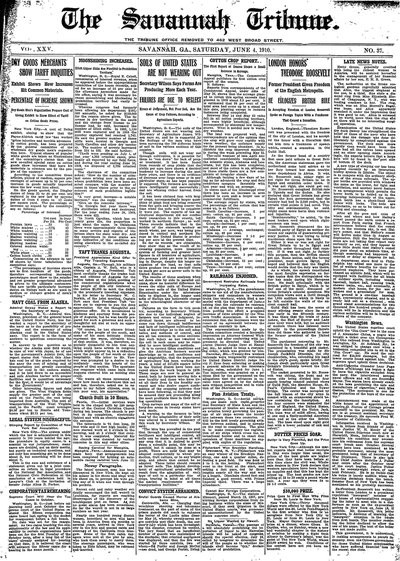
Page text (machine-generated)
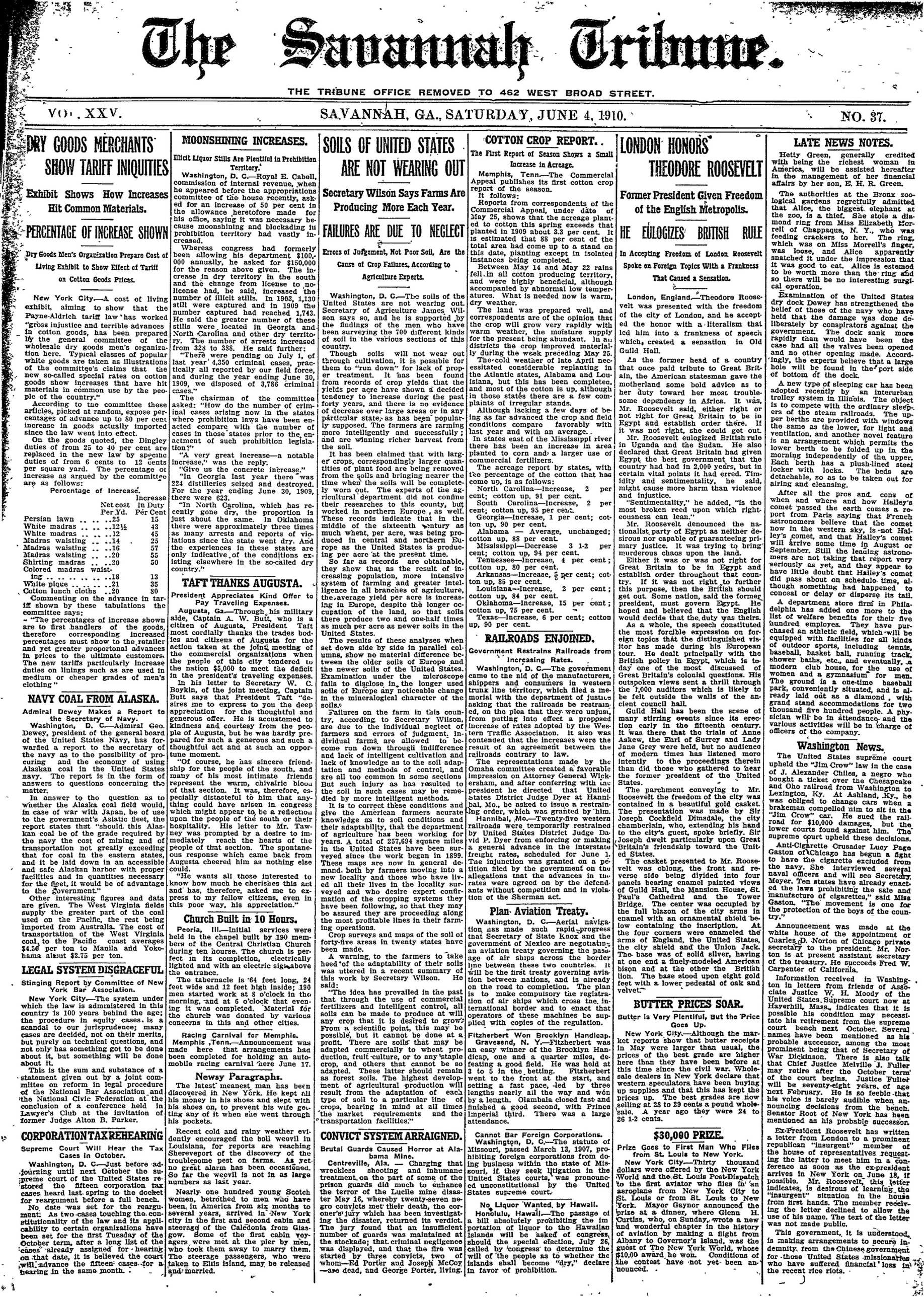
DRY GOODS MERCHANTS SHOW TARIFF INIQUITIES
Exhibit Shows How Increases Hit Common Materials.
Dry Goods Men's Organization Prepare Cost of Living Exhibit to Show Effect of Tariff on Cotton Goods Prices.
New York City.—A cost of living exhibit, aiming to show that the Payne-Aldrich tariff law has worked "gross injustice and terrible advances in cotton goods, has been prepared by the general committee of the wholesale dry goods men's organization here. Typical classes of popular white goods are taken as illustrations of the committee's claims that the new so-called special rates on cotton goods show increases that have hit materials in common use by the people of the country."
According to the committee these articles, picked at random, expose percentages of advance up to 80 per cent increase in goods actually imported since the law went into effect.
On the goods quoted, the Dingley
duties of from 25 to 40 per cent are
replaced in the new law by specifying
duties of from 6 cents to 12 cents
per square yard. The percentage on
increase as argued by the committee
are as follows:
Percentage of Increase.
Increase
Net cost In Duty
Per Yd. Per Cent
Persian lawn ..... 25 ..... 15
White madras ..... 12½ ..... 43
White madras ..... 12 ..... 45
Madras waisting ..... 14 ..... 25
Madras waisting ..... 16 ..... 57
Madras waisting ..... 20 ..... 55
Shirting madras ..... 20 ..... 50
Colored madras waisting ..... 18 ..... 13
White plique ..... 21 ..... 35
Cotton lunch cloths ..... 20 ..... 80
Commenting on the advance in tariff shown by these tabulations the committee says:
- "The percentages of increase shown are to first handlers of the goods, therefore corresponding increased percentages must show to the retailer and yet greater proportional advances in prices to the ultimate customers. The new tariffs particularly increase duties on linings such as are used in medium or cheaper grades of men's clothing."
Admiral Dewey Makes a Report to the Secretary of Navy.
Washington, D. C—Admiral Geo. Dewey, president of the general board of the United States Navy, has forwarded a report to the secretary of the navy as to the possibility of procuring and the economy of using Alaskan coal in the United States navy. The report is in the form of answers to questions concerning the matter.
In answer to the question as to whether the Alaska coal field would, in case of war with Japan, be of use to the government's Asatic fleet, the report states that "should this Alaskan coal be of the grade required by the navy the cost of mining and of transportation not greatly exceeding that for coal in the eastern states, and it be laid down in an accessible and safe Alaskan harbor with proper facilities and in quantities necessary for the fleet, it would be of advantage to the Government."
Other interesting figures and data are given. The West Virginia fields supply the greater part of the coal used on the Pacific, the rest being imported from Australia. The cost of transportation of the West Virginia coal, to the Pacific coast averages $4.50 per ton to Manila add Yokohama albeit $2.75 per ton.
LEGAL SYSTEM DISGRACEFUL
Stinging Report by Committee of New York Bar Association.
New York City—The system under which the law is administered in this country is 100 years behind the age; the procedure in equity cases, is a scandal to our jurisprudence; many cases are decided, not on their merits, but purely on technical questions, and not only has something got to be done about it, but something will be done about it.
This is the sum and substance of a statement given out by a joint committee on reform in legal procedure of the National Bar Association and the National Civic Federation at the conclusion of a conference held in Lawyer's Club at the invitation of former Judge Alton B. Parker.
CORPORATION TAXREHEARING
Supreme Court Will Hear the Tax Cases in October.
Washington, D. C.—Just before adjourning until next October the supreme court of the United States restored the fifteen corporation tax cases heard last spring to the docket for reargument before a full bench. No date was set for the reargument. As two-cases touching the constitutionality of the law and its applicability to certain organizations have been set for the first Tuesday of the October term, after a long list of the cases already assigned for hearing on that date, it is believed the court will advance the fifteen cases for a hearing in the same month.
V(0). XXV.
Percentage of Increase.
NAVY COAL FROM ALASKA.
The
MOONSHINING INCREASES.
Illicit Liquor Stills Are Plentiful in Prohibition Territory.
Washington, D. G.—Royal E. Cabbell, commission of internal revenue, when he appeared before the appropriations committee of the house recently, asked for an increase of 50 per cent in the allowance heretofore made for his office, saying it was necessary because moonshining and blockading in prohibition territory had vastly increased. Whereas congress had formerly been allowing his department $100,000 annually, he asked for $150,000 for the reason above given. The increase in dry territory in the south and the change from license to nolicense had, he said, increased the number of illicit stills. In 1903, 1,130 still were captured and in 1909 the number captured had reached 1,743. He said the greater number of these stills were located in Georgia and North Carolina and other dry territory. The number of arrests increased from 328 to 338. He said further:
"There were pending on July 1, of last year' 4,350 criminal cases, practically all reported by our field force, and during the year ending June 30, 1909, we disposed of 3,786 criminal cases."
The chairman of the committee asked: "How do the number of criminal cases arising now in the states where prohibition laws have been enacted compare with the number of cases in those states prior to the enactment of such prohibition legislation?
"A very great increase—a notable increase," was the reply.
"Give us the concrete increase."
"In Georgia last year there was 224 distilleries seized and destroyed. For the year ending June 30, 1909, there were 623.
"In North Carolina, which has recently gone dry, the proportion is just about the same. In Oklahoma there were approximately three times as many arrests and reports of violations since the state went dry. And the experiences in these states are only indicative of the conditions existing elsewhere in the so-called dry country."
TAFT THANKS AUGUSTA
President Appreciates Kind Offer to Pay Traveling Expenses.
Augusta, Ga.—Through, his military alde, Captain A. W. Butt, who is a citizen of Augusta, President Taft most cordially thanks the trades bodies and citizens of Augusta for the action taken at the joint meeting of the commercial organizations when the people of this city tendered to the nation $5,000 to meet the deficit in the president's traveling expenses.
In his letter to Secretary W. C. Boykin, of the joint meeting, Captain Butt says that President Taft "desires me to express to you the deep appreciation for the thoughtful and generous offer. He is accustomed to kindness and courtesy from the people of Augusta, but he was hardly prepared for such a generous and such a thoughtful act and at such an opportune moment.
"Of course, he has sincere friendship for the people of the south, and many of his most intimate friends represent the warm, chivalric blood of that section. It was, therefore, especially distasteful to him that anything could have arisen in congress which might appear to be a reflection upon the people of the south or their hospitality. His letter to Mr. Tawney was prompted by a desire to immediately reach the hearts of the people of that section. The spontaneous response which came back from Augusta cheered him as nothing else could.
"He wants all those interested to know how much he cherishes this act and has, therefore, asked me to express to my fellow citizens, even in this poor way, his appreciation."
Church Built in 10 Hours.
Peoria, Ill.—Initial services were held in the chapel built by 190 members of the Central Christian Church during ten hour. The church is perfect in its completion, electrically lighted and with an electric sign above the entrance.
The tabernacle is 64 feet long, 24 feet wide and 12 feet high inside; 190 men started work at 8 o'clock in the morning, and at 6 o'clock that evening it was completed. Material for the church was donated by various concerns in this and other cities.
Racing Carnival for Memphis.
Memphis_Tenn—Announcement was made here that arrangements had been completed for holding an automobile racing carnival here June 17.
Newsv Paragraphs.
The latest' meantest man has been discovered in New York. He kept all his money in his shoes and slept with his shoes on, to prevent his wife getting any of it when she went through his pockets.
Recent cold and rainy weather evidently encouraged the boll weevil in Louisiana, for reports are reaching Shereveport of the discovery of the troublesome pest on farms. As yet no great alarm has been occasioned. So far the weevil is not in as large numbers as last year.
Nearly one hundred young Scotch women, betrothed to men who have been, in America from six months to several years, arrived in New York city in the first and second cabin and steerage of the Caledonia from Glasgow. Some of the first cabin voyagers were met at the pier by men, who took them away to marry them. The steerage passengers, who were taken to Elsis Island, may be released and married.
Savannah Tri THE TRIBUNE OFFICE REMOVED TO 462 WEST BROAD STREET. SAVANNAH, GA., SATURDAY, JUNE 4, 1910.
SOILS OF UNITED STATES ARE NOT WEARING OUT
Secretary Wilson Says Farms Are Producing More Each Year.
Washington, D. G.-The soils of the United States are not wearing out. Secretary of Agriculture James Wilson says so, and he is supported by the findings of the men who have been surveying the 700 different kinds of soil in the various sections of this country.
Though soils will not wear out through cultivation, it is possible for them to "run down" for lack of proper treatment. It has been found from records of crop yields that the yields per acre have shown a decided tendency to increase during the past forty years, and there is no evidence of decrease over large areas or in any particular state, as has been popularly supposed. The farmers are raring more intelligently and successfully; and are winning richer harvest from the soil.
It has been claimed that with larger crops, correspondingly larger quantities of plant food are being removed from the soils and bringing nearer the time when the soils will be completely worn out. The experts of the agricultural department did not confine their researches to this county, but worked in northern Europe, as well. These records indicate that in the middle of the sixteenth century as much wheat, per acre, was produced in central and northern Europe as the United States is producing per acre at the present time.
So far as records are obtainable, they show that as the result of increasing population, more intensive system of farming and greater intelligence in all branches of agriculture, the average yield per acre is increasing in Europe, despite the longer occupation of the land, so that soils there produce two and one-half times as much per acre as newer soils in the United States.
The results of these analyses when set down side by side in parallel columns, show no material difference between the older soils of Europe and the newer soils of the United States. Examination under the microscope falls to disclose in the longer used soils of Europe any noticeable change in the mineralogical character of the soils. Failures on the farm in this country, according to Secretary Wilson, are due to the individual neglect of farmers and errors of judgment, individual farms are allowed to become run down through indifference and lack of intelligent cultivation and lack of knowledge as to the soil adaptation and methods of control, and are all too common in some sections. But such injury as has resulted to the soil in such cases may be remedied by more intelligent methods.
It is to correct these conditions and give the American farmers accurate knowledge as to soil conditions and their adaptability, that the department of agriculture has been working for years. A total of 257,694 square miles in the United States have been surveyed since the work began in 1899. These maps are now in general demand. both by farmers moving into a new locality and those who have lived all their lives in the locality surveyed and who desire expert confirmation of the cropping systems they have been following, so that they may be assured they are proceeding along the most profitable lines in their farming operations.
Crop surveys and maps of the soil of forty-five areas in twenty states have been made.
A warning, to the farmers to take heed of the adaptability of their soils was uttered in a recent summary of this work by Secretary Wilson. He said:
"The idea has prevailed in the past that through the use of commercial fertilizers and intelligent control, all soils can be made to produce at will any crop that it is desired to grow. From a scientific point, this may be possible, but it cannot be done at a profit. There are soils that may be adapted commercially to wheat production, fruit culture, or to any staple crop, and others that cannot be so adapted. These latter should remain as forest soils. The highest development of agricultural production will result from the adaptation of each type of soil to a particular line of crops, bearing in mind at all times the market requirements and the transportation facilities."
CONVICT SYSTEM ARRAIGNED.
Brutal Guards Caused Horror at Alabama Mine. Centreville, Ala. — Charging that wreckless shooting and inhumane treatment, on the part of some of the prison guards did much to enhance the terror of the Lucille mine disaster May 16, whereby twenty-seven convicts met their death, the coroner's jury which has been investigating the disaster, returned its verdict. The jury found that an insufficient number of guards was maintained at the stockade; that criminal negligence was displayed, and that the fire was started by three convicts, two of whom—Ed Porter and Joseph McCoy—are dead, and George Porter, living.
COTTON CROP REPORT.
Memphis, Tenn—The Commercial Appeal publishes its first cotton crop report of the season.
It follows:
Reports from correspondents of the Commercial Appeal, under date of May 25, shows that the acreage planted to cotton this spring exceeds that planted in 1999 about 3.3 per cent. It is estimated that 38 per cent of the total area had come up to a stand on this date, planting except in isolated instances being completed.
Between May 14 and May 22 rains fell in all cotton producing territory, and were highly beneficial, although accompanied by abnormal low temperatures. What is needed now is warm, dry weather.
The land was prepared well, and correspondents are of the opinion that the crop will grow very rapidly with warm weather, the moisture supply for the present being abundant. In all districts the crop improved materially during the week preceding May 25.
The cold weather of late April necessitated considerable replanting in the Atlantic states, Alabama and Louisiana, but this has been complete, and most of the cotton is up, although in those states there are a few complaints of irregular stands.
Although lacking a few days of being as far advanced the crop and field conditions compare favorably with last year and with an average.
In states east of the Mississippi river there has been an increase in area planted to corn and a larger use of commercial fertilizers.
The acreage report by states, with the percentage of the cotton that has come up, is as follows:
North Carolina—Increase, 2 per cent; cotton up, 91 per cent.
South Carolina—Increase, 2 per cent; cotton up, 95 per cent.
Georgia—Increase, 1 per cent; cotton up, 90 per cent.
Alabama — Average, unchanged;
cotton up, 88 per cent
Arkansas—Increase, 5 per cent; cotton up, 85 per cent.
Texas- Increase, 6 per cent; cotton up, 90 per cent.
RAILROADS ENJOINED.
Government Restraints Railroads from Increasing Rates.
Washington, D. G.—The government came to the aid of the manufacturers, shippers and consumers in western trunk line territory, which filed a memorial with the department of justice asking that the railroads be restrained, on the plea that they were unjust, from putting into effect a proposed increase of rates adopted by the Western Traffic Association. It also was contended that the increases were the result of an agreement between the railroads contrary to law.
The representations made by the Omaha committee created a favorable impression on Attorney General Wickersham, and after conferring with the president he directed that United States District Judge Dyer at Hammal, Mo., be asked to issue a restraining order, which was granted by him.
Hannibal, Mo.-Twenty-five western railroads were temporarily restrained by United States District Judge David P. Dyer from enforcing or making a general advance in the interstate freight rates, scheduled for June 1. Tae injunction was granted on a petition filed by the government on the allegations that the advances in the rates were agreed on by the defendants without competition and in violation of the Sherman act.
Plan: Aviation Treaty.
Washington, D. C.—Aerial navigation gas made such rapid progress that Secretary of State Knox and the government of Mexico are negotiating an aviation treaty governing the passage of air ships across the border line between these two countries. It will be the first treaty governing aviation between nations, and is already on the road to completion. The plan is to make compulsory the registration of air ships which cross the international border and to enact that operators of these machines be supplied with copies of the regulation.
Fitzherbert Won Brooklyn Handicap, Gravesend, N. Y.-Fitzherbert was an easy winner of the Brooklyn Handicap, one and a quarter miles, defeating a good field. He was held at 3 to 5 in the betting. Fitzherbert went to the front at the start, and setting a fast pace, led by three lengths nearly all the way and won by a length. Olambala closed fast and finished a good second, with Prince Imperial third. There was a large attendance.
Cannot Bar Foreign Corporations. Washington, D. C.-The statute of Missouri, passed March 13, 1907, prohibiting foreign corporations from doing business within the state of Missouri, if they seek litigation in the United States courts, was pronounced unconstitutional by the United States supreme court.
No Liquor Wanted by Hawaii.
Honolulu, Hawaii—The passage of a bill absolutely prohibiting the importation of liquor to the Hawaiian islands will be asked of congress, should the special election, July 26, called by congress to determine the will of the people as to whether the islands shall become "dry," declare in favor of prohibition.
London, England—Theodore Roosevelt was presented with the freedom of the city of London, and he accepted the honor with a literalism that led him into a frankness of speech which, created a sensation in Old Guild Hall.
As the former head of a country that once paid tribute to Great Britain, the American statesman gave the motherland some bold advice as to her duty toward her most troublesome dependency in Africa. It was, Mr. Roosevelt said, either right or not right for Great Britain to be in Egypt and establish order there. If it was not right, she could get out
Mr. Roosevelt eulogized British rule in Uganda and the Sudan. He also declared that Great Britain had given Egypt the best government that the country had had in 2,000 years, but in certain vital points it had erred. Timidity and sentimentality, he said, might cause more harm than violence and injustice.
"Sentimentality," he added, "is the most broken reed upon which righteousness can lean."
Mr. Roosevelt denounced the nationalist party of Egypt as neither desirous nor capable of guaranteeing primary justice. It was trying to bring murderous chaos upon the land.
Either it was or was not right for Great Britain to be in Egypt and establish order throughout that country. If it was not right, to further this purpose, then the British should get out. Some nation, said the former president, must govern Egypt. He hoped and believed that the English would decide that the duty was theirs.
As a whole, the speech constituted the most forcible expression on foreign topics that the distinguished visitor has made during his European tour. He dealt principally with the British policy in Egypt, which is today one of the most discussed of Great Britain's colonial questions. His outspoken views sent a thrill through the 1,000 auditors which is likely to be felt outside the walls of the ancient council hall.
Guild Hall has been the scene of many stirring events since its erection early in the fifteenth century. It was there that the trials of Anne Askew, the Earl of Surrey and Lady Jane Grey were held, but no audience of modern times has listened more intently to the proceedings therein than did those who gathered to hear the former president of the United States.
The parchment conveying to Mr. Roosevelt the freedom of the city was contained in a beautiful gold casket. The presentation was made by Sir Joseph Cockfield Dimsdale, the city chamberlain, who, extending his hand to the city's guest, spoke briefly. Sir Joseph dwelt particularly upon Great Britain's friendship toward the United States.
The casket presented to Mr. Roosevelt was ohong, the front and reverse side being divided into four panels bearing enamel painted views of Guild Hall, the Mansion House, St. Paul's Cathedral and the Tower Bridge. The center was occupied by the full blazon of the city arms in enamel with an ornamental shield below containing the inscription. At the four corners were enameled the arms of England, the United States, the city shield and the Union Jack. The base was of solid silver, having at one end a finely-modeled American bison and at the other the British lion. The base stood upon eight gold feet with a lower pedestal of oak and velvet.
BUTTER PRICES SOAR.
Butter is Very Plentiful, But the Price Goes Up.
New York City.—Although the market reports show that butter receipts in May were larger than usual, the prices of the best grade are higher here than they have been before at this time since the civil war. Wholesale dealers in New York declare that western speculators have been buying up supplies and that this has kept the prices up. The best grades are now selling at 23 to 29 cents a pound wholesale. A year ago they were 24 to 26 1-2 cents.
S30.090 PRIZE
Prize Goes to First Man Who Files from St. Louis to New York.
New York City—Thirty thousand dollars were offered by the New York World and the St. Louis Post-Dispatch to the first aviator who flies in an airplane from New York City to St. Louis or from St. Louis to New York. Mayor Gaynor announced the prize at a dinner, where Glenn H. Curtiss, who, on Sunday, wrote a new and wonderful chapter in the history of aviation by making a flight from Albany to Governor's island, was the guest of The New York World, whose $10,00 award he won. Conditions of the contest have not yet been announced.
---
NO.37.
LATE NEWS NOTES.
Hetty Green, generally credited with being the richest woman in America, will be assisted hereafter in the management of her financial affairs by her son, E. H. R. Green. The authorities at the Bronx zoological gardens regretfully admitted that Alice, the biggest elephant at the zoo, is a thief. She stole a diamond ring from Miss Elizabeth Morrell of Chappqua, N. Y., who was feeding crackers to her. The ring, which was on Miss Morrell's finger, was loose, and Alice apparently snatched it under the impression that it was good to eat. Alice is estimated to be worth more than the ring and so there will be no interesting surgical operation.
Examination of the United States dry dock Dewey has strengthened the belief of those of the navy who have held that the damage was done deliberately by conspirators against the government. The dock sank more rapidly than would have been the case had all the valves been opened and no other opening made. Accordingly, the experts believe that a large hole will be found in the port side of bottom of the dock.
A new type of sleeping car has been adopted recently by an interurban trolley system in Illinois. The object is to compete with the ordinary sleepers of the steam railroads. The upper berths are provided with windows the same as the lower, for light and ventilation, and another novel feature is an arrangement which permits the lower berth to be folded up in the morning independently of the upper. Each berth has a plush-lined steel locker with locks. The beds are detachable, so as to be taken out for airing and cleansing.
After all the pros and cons of when and where and how Halley's comet passed the earth comes a report from Paris saying that French astronomers believe that the comet now in the western sky, is not Halley's comet, and that Halley's comet will arrive some time in August or September. Still the leading astronomers are not taking that report very seriously as yet, and they appear to have little doubt that Halley's comet did pass about on schedule time, although something had happened to conceal or delay or disperse its tail.
A department store firm in Philadelphia has added one more to the list of welfare benefits for their five hundred employees. They have purchased an athletic field, which will be equipped with facilities for all kinds of outdoor sports, including tennis, baseball, basketball, running track, shower baths, etc., and eventually, a modern club house, for the use of women and a gymnasium for men. The ground is a one-time baseball park, conveniently situated, and is already laid out as a diamond, with grand stand accommodations for two thousand five hundred people. A physician will be in attendance, and the various activities will be in charge of officers of the company.
Washington News.
The United States supreme court upheld the "Jim Crow" law in the case of J. Alexander Chiles, a negro who bought a ticket over the Chesapeake and Ohio railroad from Washington to Lexington, Ky. At Ashland, Ky, he was obliged to change cars when a brakeman compelled him to sit in the "Jim Crow" car. He sued the railroad for $10,000 damages, but the lower courts found against him. The supreme court upheld these decisions.
Anti-Cigarette Crusader Luoy Page Gaston of Chicago has begun a fight to have the cigarette excluded from the navy. She interviewed several naval officers and will see Secretary, Meyer. Ten states have already enacted the laws prohibiting the sale and manufacture of cigarettes," said Miss Gaston. "The movement is one for the protection of the boys of the country."
Announcement was made at the white house of the appointment of Charles D. Norton of Chicago private secretary to the president. Mr. Norton is at present assistant secretary of the treasury. He succeeds Fred W. Carpenter of California.
Information received in Washington in letters from friends of Associate Justice W. H. Moody of the United States. Supreme court now at Haverhill, Mass., indicates that it is possible his condition may necessitate his retirement from the supreme court bench next October. Several names have been mentioned as his probable successor, among the most prominent being that of Secretary of War Dickinson. There is also talk that Chief Justice Melville J. Fuller may retire after the October term of the court begins. Justice Fuller will be seventy-eight years, of age next February. He is so feeble that his voice is barely audible when announcing decisions from the bench. Senator Root of New York has been mentioned as his probable successor.
Ex-President Roosevelt has written a letter from London to a prominent republican "insurgent" member of the house of representatives requesting the latter to meet him in a conference as soon as the ex-president arrives in New York on June 18, if possible. Mr. Roosevelt, this letter indicates, is desirous of learning the "insurgent" situation in the house from first hands. The member receiving the letter declined to allow the use of his name. The text of the letter was not made public.
This government, it is understood, is making arrangements to secure indemnity, from the Chinese government for those United States missionaries who have suffered financial loss in the recent rice riots.
The Guaranty Aid
SOL. C. JOHNSON, Supt. of Ageno
Treasury of State of Georgia
Illinois 1AN 171908 190
The unbilled Treasurer of the State of Georgia hereby acknowledges
to have received from the following described sums, invoices:
Dear Regina and Nanny of the State of Georgia,
Elegant, Gracious Company, Born
171908, in Georgia, made from Dear Regina and Nanny of the State of Georgia,
long on total Ten Thousand Dollars, and which are held by the State of Georgia by authority and under the provisions of an Act of the General Assembly, approved October 22d, 1887, and amended December 26th, 1887.
R. E. Paisi
Small Damage to Cotton by the Recent Variable Weather
Portions of Cotton Acreage Damaged By Cold Have Been Replanted in Corn and Peas.
Crop Will Be Late.
Atlanta, Ga. Carefully compiled reports from all over Georgia show conclusively that the state's cotton crop has not been materially injured by the unusually variable weather experienced during the months of April and May, and that if any permanent damage was done at all it did not amount to over 10 or 15 per cent of the planted crop. Any estimate of the cotton crop at the present is purely guess work, based on what appears to be true conditions," said Capt. R. F. Wright, assistant commissioner of agriculture. "However, I am convinced, from all reports received up to the present, that the cold weather and the excessive rainfall which has prevailed during the early spring will curtail the acreage from 10 to 15 per cent.
"Portions of the crop which was injured by the cold and the wet weather have been replanted in corn and peas, and I would estimate that at least 10 per cent of the crop has been so replanted.
"The amount of cotton raised this year, however, depends largely upon the stand. I believe the stand this year will show from 10 to 15 per cent below the average. The cotton crop in middle Georgia is being blocked and cut to a stand, and while the conditions at present are unpromising, it is very probable that great improvement will be shown if the hot weather continues.
"In South Georgia there has not been so much rain, and the prospect for a full crop are good. At best, the cold and wet weather has delayed the cotton crop at least fifteen days; and that means the crop will be curtailed to some extent as it is very true that a late crop never does as well as an early crop.
"The cotton acreage originally planted this year was just about as large as it was last year, but I believe the acreage has been decreased at least 10 per cent by unfavorable weather conditions. Whether or not favorable weather and good stands will remedy that deficit is nothing but conjecture."
Ed Inman of the cotton brokerage firm of Iman, Akers & Inman, expressed the opinion that no damage was done the cotton crop by the cold weather.
"Unquestionably the crop will be a little late," said Mr. Inman, "but I do not believe it has suffered any appreciable damage by cold and wet weather. Aided by favorable weather conditions, the cotton crop that is in the ground now should produce 2,500,000-bales, which will be an increase
over last year's crop, when something like 2,128,000 bales were produced." Like Captain Wright, Mr. Inman predicated his estimate of the crop upon a continuance of the favorable weather conditions, and declared that his estimate of the crop is based solely upon what appears to be the conditions and not upon any actual facts or figures.
MUCH COTTON UNSOLD.
Sumter County Not Cleaned Up as Reported.
Americus, Ga.—In the Americus district it is said that there are still about two thousand bales of cotton unsold.
Speaking of cotton affairs generally, a party well acquainted with the status of things throughout this territory, stated that his figures showed still in the neighborhood of two thousand bales to be disposed of and shipped out.
"There are, I am advised, seven hundred bales at Richland," said he, "ahd five hundred at Buena Vista. Over at Plains there are 200 and 100 at Ellaville. This makes 1,500 bales. Then there are a few hundred others scattered around."
When this cotton will be sold and sent off for consumption it is hard to say. It has only been a short time since the stock at Americus was cleaned up. Any day may bring news that any one of the other points has seen its holdings taken. Some holders of cotton still anticipate a rise sufficient to offset the loss incurred by carrying so long and leave a margin of additional profit. But there are not absent those who do not think anything will be gained by the holding policy.
49 Injured in April Wrecks.
Atlanta, Ga. According to reports received by the railroad commission from 16 railroads in the state, there were 49 passengers injured in this state during the month of April. No passengers were killed.
The reports show there were 67 employees injured and four killed. There were eight collisions and 20 derailments.
The reports received by the commission are in pursuance of an order recently issued which requires all road lines in this state to submit monthly reports of accidents. The railroads agreed to submit the reports with the understanding that the details were to be withheld from the public, the objection being that the facts might be used against them in damage suits.
Wright Not a Candidate.
Atlanta, Ga—Comptroller General William A. Wright announced that he will not be a candidate for governor in the election this fall. The comptroller general states that he would have been willing to have borne the standard of the democratic party if the interests of peace and harmony had demanded a compromise candidate whose candidacy would have united all divisions of the party, but, since the accomplishment of that result is apparently impossible, he deems it advisable not to allow the further use of his name.
P. EDWARD PERRY, Vice President.
GEORGIA NEWS NOTES.
A. D. Hudson of Newberry, S. C., a prominent farmer and president of the Corn Breeders' association, is in Atlanta in the effort to interest the agricultural department and citizen of the state in the corn exposition which will be held in Columbia, S. C., the first week in December. The Corn Breeders' association includes prominent planters in the four south Atlantic states—Georgia, North Carolina, South Carolina and Florida. It was organized last winter at a meeting of the leading corn growers of South Carolina, who proceeded at once to interest the farmers of the other states in the movement.
Georgians are beginnig to look forward to a dull, year in state politics. After a lot of smoke, the little flare of flame looks like a fizzie. Outside of a prospective governor's race of the milder sort, and the single race between two candidates for state treasurer there is absolutely nothing doing and little prospect of it. Politicians who expect to become candidates cannot afford to let themselves drop out of the public view, but those who were talking a few months ago of running for commissioner of agriculture, prison commissioner, railroad commissioner, and other offices, have dropped out of sight as it were, and it looks now as if the incumbents were going to have a lone and easy walk to base.
On the ground that, the figures shown were not sufficiently large, Cmptroller General William A. Wright declined to accept the tax returns made by the North Georgia Electric company at Galnesville, and the Marietta Paper company at Marietta. The returns made by the North Georgia Electric company were $200,000. In view of the fact that the property recently sold at receiver's sale for $400,000, Genneral Wright holds that sum is to be accepted as its market value, and the returns should be in that sum. The same ruling is made in the case of the Marietta Paper company, which was returned at $133,000, and which sold recently for $290,000. The returns of this company also include the Marietta water and lighting plants.
Aroused by the reports of false weights and measures which have arisen by the wholesale from every section of the country, it is more than likely that at an early date the state of Georgia will follow the lead of New York, Massachusetts and one or two other states of the union in the enactment of a law providing for a competent inspection service to compel the giving of value for value received.
A penalty of 50 per cent over the imposed tax has been imposed by the commissioner of internal revenue on all corporations in, Georgia which failed to make returns on their business as provided in the recently enacted corporation tax. The law assess a tax of 1 per cent on the gross returns of all corporations whose returns are more than $5,000, but all corporations whether taxable or not are required to report to the collector of internal revenue. One of the biggest land deals in
This company is duly chartered under the laws of the State of Georgia, and has complied with all requirements of the State Insurance department, therefore all policy holders are protected with all the safeguards that the strict insurance laws of this State seek to protect its citizens.
Its affairs are directed and managed by Negro men of the city of Savannah of leading standing, and whose character and reputation are of such as to command the respect and confidence of all the people of that community. The same men that manage this Society are the ones that organized and are conducting the affairs of the first successful Negro Savings Bank in this state, therefore we can readily see that by connecting themselves with this Insurance company their interest will be in safe hands.
By comparing our rules and benefits with other first class companies it will be seen that we offer the most liberal inducements with the largest sick, accident and death benefits to our members than any other company in this business.
Masonic Books &
Regalias.
LODGE SEALS.
FINANCIAL CARDS and
BLANKS of every description
Pubilshers' and Manufacturers' Prices
16 DOUBLY QECURED BY THOUSANDS OF DOLLARS INVESTED 1M SAVANNAH REAL ESTATE. 6 PER CENT PAID ON DEPOSITS.
Liberal Discounts Will Be Arranged.
GOL. C. JOHNSON,
Gavannah, Ga.
the history of Tift county has been completed at Tifton. The tract of land transferred, contains two thousand and one hundred acres, just north of Omega, and was bought by Cobb & Eason, real estate dealers, from Isiah Corley, for $36,000 and Mr. Corley retains the crop for the present year. In this tract of land is six hundred acres now in cultivation:
HUB SHOES
Look good at first glance
Service proves they ARE
Every HUB Shoe
shows character
in fit and finish
They show quality in every line, and their
style is correct in every detail.
They wear as well as they look. We sell **The
pick of the stock."
HUB Shoes
For Women
HELEN HUNT, Dress Shoe; built for Service; $2.50
QUEEN ROSALIND, An Elegant, Flexible
Dressy Shoe; $3.00
HUB Shoes
For Men
RIGHT ROYAL, A Royal Shoe—Tried and True; $3.50
CHARACTER, BEST MADE—THE TRIUMPH OF SKILL; $5.00
For Children
Any HUB Brand Shoe; For Children
FOR SALE BY
Scott Bros.
DRY GOODS STORE,
Gwinnett and West Broad Sts.
A petition, having in view the securing of two cannons from the government for Dalton, is being signed by a large number of Whitfield county people. Those who have investigated the matter state that there will be little trouble in securing the cannon. If the war department grants the petition the cannon will be used as markers, showing the routes of the armies of Johnston and Sherman during the retreat through this section.
Judge Emory Speer appointed Hollis Fort, of Americus referee in bankruptcy with jurisdiction over three counties, Sumtef, Crisp and Macon. This gives Americus what was sought by the attorneys of that city. The new appointee is a man of prominence in south Georgia.
The recent typhoid fever scare at Wesleyan college has proved to be far less serious than was at first supposed. Only five cases appeared in all in a household of nearly three hundred, and each one of these has already missed the fever and is rapidly recovering. Several of these ceased to have fever in from ten to fifteen days and, were but slightly indisposed. The fever was doubtless brought to the collage from the outside, as none exists in Macon at present. It was either brought by one of the inmates of the college who visited a friend in another city during a typhoid illness, or through the improper refrigeration of meat or other provisions, it is claimed. Everything about the college has been thoroughly cleansed and fumigated, and many improvements are now being planned to be made during the summer vacation.
The fruit crop around Griffin promises a large yield of choice products and the orchard owner estimates that at least forty cars will be shipped from Griffin this year. Plums and berries also promise a large yield. The plum trees at present are weighted to the ground, the yield being so heavy.
(The "patteran" or "patin" is a branch laid by a gypsy along the road to indicate to any of his tribe who may follow, the way that he has taken).
You set the patteran for me
Along the world you wandered through,
Lest mazed and weary I might be
And miss the way that led to you.
The gypsy knew the gypsy's call;
It led my waward feet aright.
Together as the shadows fall
We kneel our roadside fire to light.
The fire we kindle, hand to hand,
Shall cheer the way for weary men
Tull our Great Chieftain give command!
"Break camp and take the road again"
---
TERRIBLE CHAUNGEY
---
When the Methodist conference sent Billy Wheeler to New Mexico to turn the bad man from his evil ways it must have been the result of inspiration. The little church at Los Cerrillos was Billy's first charge, and he was as proud of its adobe walls and-goods box bell tower as a six-year-old boy with a new red wagon. Billy was a 200 pounder, a rosy cheeked lad with a blue eye that looked thoughtfully at the boys when they told him fairy tales of the miners and the cliff dwellers. He was slow of speech but earnest in action, and when the men of the sombrero learned he wasn't afraid of a gun they took to him as a brother and a gentleman. The first collection was taken up by Shorty Mac, the saloon keeper, and Stormy Jones, the silkest card sharp in camp, who volunteered as ushers and produced results by carrying the contribution hat in one hand and a cocked revolver in the other. That Sunday not a man "passed up" the chance to contribute
So as not to offend proprieties Billy took to wearing a revolver and in time became quite expert in hitting the ace nailed to a tree. Billy's wonderful popularity as shepherd of the camp arose from the fact that he was "one of the boys." He taught the men to whom he was sent to preach and respected the environments which caused them to be somewhat different from the safely saved flocks in the haunts of civilization. Mining and cattle raising became a part of his study and he was as good a judge of horsefess as the Territory had. In consequence the little adobe church was filled every Sunday with a respectful congregation and there was some talk of having prayer meeting. To the boys Billy was affectionately dubbed "The Parson," and if he wasted anything he just had to raise his hand.
One morning a stranger blew in from up the valley somewhere and went over to Sandy McPherson's tavern, where he registered as "Chauncey de Argyle, Bitter Creek, Mozambique," in characters that looked like they had been enmeshed in a wireless current. Chauncey was six feet three, broad shouldered and wore a fierce black mustache that curled down to his collar. About his sash were four navy revolvers, all loaded and ready for use. A beautiful dagger handle stuck out the right boot top. Chauncey's head was covered with an unusually big sombrero, round which little bells jingled from a leather band. Physically he was as fierce a proposition as ever came to town and he gloried in the knowledge.
"I'm a bad man from Bitter Creek!" said the warlike guest, pounding on the counter with the butt of a revolver, "an" I want the best you got; no handmedowns for me."
"I see," said Sandy, who was a quiet, unemotional chap and who never carried his guns in sight. "How long you going to stop?"
"As long as I blame please," thundered the bad man, glaring down on Sandy.
At dinner the guest from Bitter Creek laid his revolver on the table beside his plate and looked around on the assembled miners, cowboys and gamblers.
"I come down from Bitter Creek to help run this heah town," he proclaimed. "I killed thirteen men up where I live an' if anybody's got anything to say.'bout it I'm waitin' to hear from him."
Some of the boys looked up curiously and then went on eating. The bad man used his dagger ostentatiously to cut up his victuals, now and then dropping it on the floor to make a noise. Falling in his effort to pick a fuss, the gentleman from Bitter Greek lit a cigar and strode about town. In the afternoon he went out in the hills, where Carl Inglefitz, an inoffensive old German, had a little claim, and took possession by shooting at Karl's feet. Karl came running to town and told of the invasion. The bad man went to other places, issuing ultimatums and telling of his slaughter of the unfortunate thirteen. If there was any spirit of retali-
tion among the denizens of the frontier camp an outsider could not have located it with a spyglass. "On such occasions as the real hair-trigger men of the mountains having serious work ahead they don't announce the program, from the huestops. When they've fixed a date for a funeral they tread as a cat until after the obsequies." The shank of that afternoon in Los Cerrillos was as quiet as in a well-ordered cemetery. Men loured about in the shade of frame and adobe shacks, too lazy to talk. When the bad man stalked down the streets whoever was in the way stood aside to let him pass. Without protest he was permitted to empty his revolver into the belfry of the town hall, and to jump up and crack his heels together whenever he felt a mind.
It was nearly midnight when Sandy McPherson, the tavern keeper, hammered on the door of Parson Wheeler's two-room cabin down the gulch. Billy got up to see what the matter was.
"They got that man from Bitter Creek" down in Shorty Mac's place, parson," said Sandy, "and they'll sure hang him if you don't go over and talk to 'em. Stormy Jones is out now hunting a rope."
The fellow had the look of a lion, but his head had got turned on train robber talk.
Billy hastened down to Shorty Mac's place, which was the principal saloon and card room of the town. The boys were sitting around on kegs and boxes, smoking quietly, while the committee searched for a rope. The bad man, white and in a state of utter collapse, was under guard on a bench in the rear.
"Boys," said Billy, "what are you going to do?" "Just hang that coyote over there," replied B Big Enough Jim Hines, the staze driver. "Hang him? What's he done?"
"Killed thirteen men up at Bitter Creek; he said so hisself."
"But that was only in fun," replied Billy. "That fellow never killed a man in his life."
"Then we'll hang him for lyni 'bout it," said Hines decidedly. "This man's rode twenty miles, parson, to come down here and show us how to run this town. He 'lowed he'd killed thirteen men up at his diggin's and was comin' down here with loads in his guns for thirteen more. We've give him a fair, square trial and every man has found him guilty. Now we're just waitin' on the rope. If that ain't the law I don't know what law is."
There was an approving chorus from all the assembled humanity save the condemned. Billy realized that he was up against the proposition of his frontier career. These wild, untamable spirits, yet endowed with a high sense of justice, were on the borders of civilization and chaos. A failure here would set his work back for many years. The task to save this cringing braggart would be a tremendous one, because his executioners were actuated, as they looked at it, by motives as fair as the laws of Solomon.
As the committee appeared with the rope Billy desperately determined to save the man, if he could, invented a wife and children for the condemned and talked pathetically of their lonely condition with the father and bread winner taken from them. Guided by the idea that the end justified the means, he went ahead and described the little cabin home in the mountains, the mother at her work making and mending the clothes, the little ones running about barefooted and tattered, crying for the father who would never come, and then drew a final picture, the tragedy of starvation and death amid the mountains' solitude and the wolves feasting upon the forms of mother and children.
Stormy Jones threw the rope under the bar. Big Enough Jim uneasily shifted his position once or twice and held a whispered consultation with the others. It was clear that Billy's speech had made an impression; he was the one man in the camp who could make a talk and the boys would have shot any one who doubted the accuracy of any statement their "parson" made.
At last Big Enough Jim, leader of the decision, spoke up huskily.
"Parson, we're mighty glad you come," he said. "You told us some things we didn't know, an' if we hadn't known 'em we might 'a' been sorry for a long time. The court hereby reverses 'itself- an' lets this man go free. We're much obliged to you."
Billy, tremendously elated, shook hands, all round and then went back home. In the morning while the "parson" was waiting for his mail at the post office Shorty Mac and Stormy Jones, their eyes glowing, with enthusiasm, came in and led him outside the office, where Stormy related the sequel:
"We did the thing up right last night, parson, after you left. All the boys thought just like you did about it, and so when I made a motion to pass the hat they voted unanimous. It footed up $225 in coin and we give the whole cargo to the Bitter Creek man to take home to his wife and kids." - St. Louis Globe-Democrat.
Rose leaves are imported free of duty when brought in in a crude state, the value of the imports of 1908 being only $105, in 1907 $2137 and in 1906 $5879. The value of rose leaves imported in the decade ending with 1908 amounted to over $20,000.
Even if you stand on your dignity, it will not enable you to see over the heads of the crowd.
Timely Fashion Hints
1
One-piece work apron 'garments.' House gown or wrapper to be made are a fancy of the present season, and with or without, stock collar, with are much liked made in this way. three-quarter full or plain long. This model is simplicity itself. sleeves.
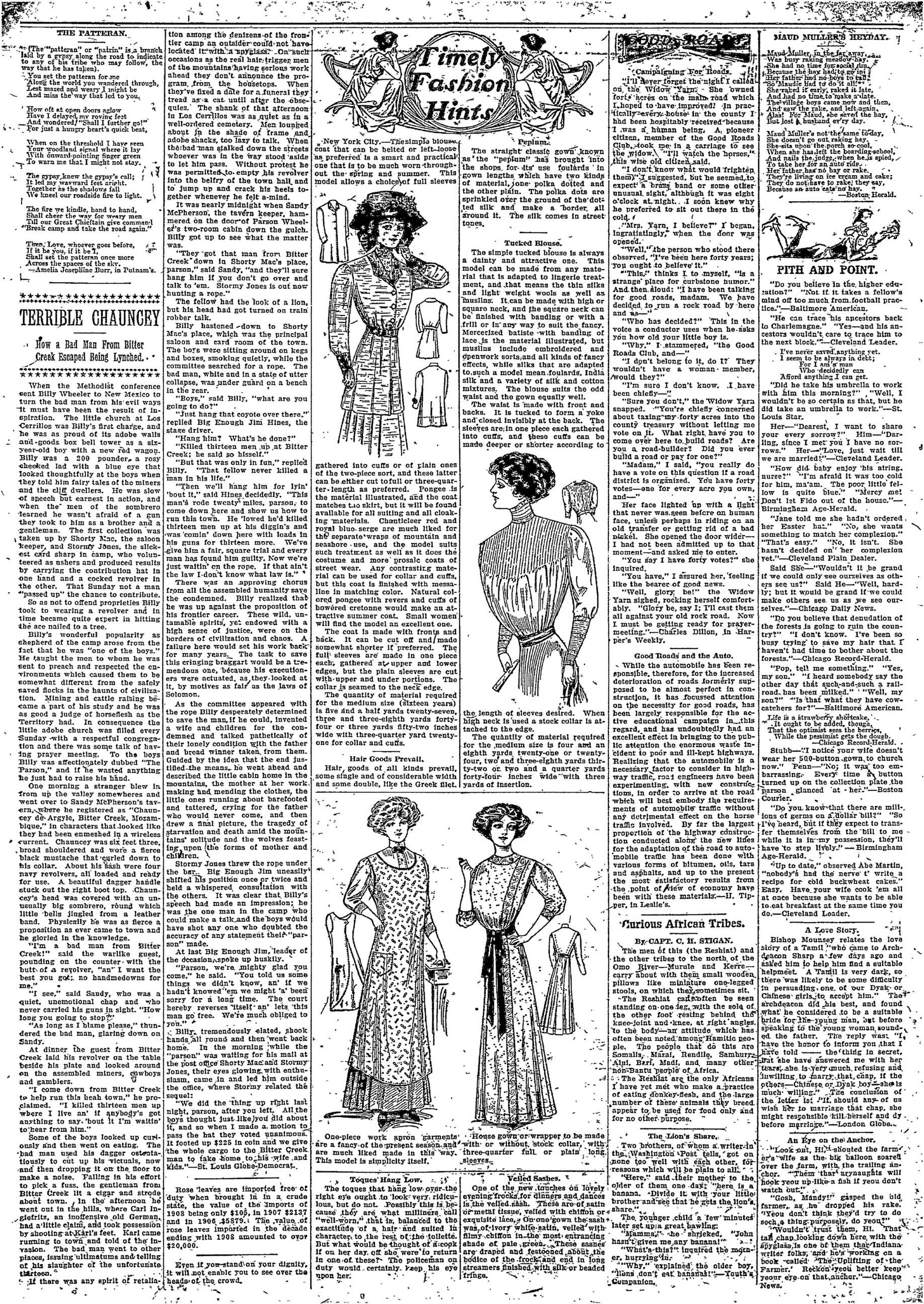
New York City.—Theimpla blouse coat that can be belted or left-loose as preferred is a smart and practical one that is to be much worn throughout the spring and summer. This model allows a choice of full sleeves
24
gathered into cuffs or of plain ones of the two-piece sort, and these latter can be either cut to full or three-quarter-length as preferred. Pongee is the material illustrated, and the coat matches to skirt, but it will be found available for all suitings and all cloaking materials. Chanticleer red and royal blue. serge are much liked for the separate'wraps of mountain and seashore use, and the model suits such treatment as well as it does the costume and more'prosac coats of street wear. Any contrasting material can be used for collar and cuffs, but this coat is finished with messa- line in matching color. Natural colored pongee with revers and cuffs of bowered cretonne would make an attractive summer coat. Small women will find the model an excellent one.
The coat is made with fronts and back. It can be cut off and made somewhat shorter if preferred. The full sleeves are made in one piece each, gathered at upper and lower edges, but the plain sleeves are cut with upper and under portions. The collar is seamed to the neck edge. The quantity of material required for the medium size (sixteen years) is five and a half yards twenty-seven, three and three-eighth yards forty-four or three yards fifty-two inches wide with three-quarter yard twenty-one for collar and cuffs.
Hair Goods Prevall.
Hair, goods of all kinds prevail,
some single and of considerable width
and some double, like the Greek filet.
One-piece work apron garments are a fancy of the present season, and are much liked made in this way. This model is simplicity itself.
Toques' Hang Low.
The toques that hang low over the right eye ought to look very ridiculous, but do not. Possibly this is because they are what milliners call "well-worn", that is, balanced to the exactitude of a hair and suited in character to the rest of the toilette. But what would be thought of a cook if on her day, off she were to return in one of these? The policeman on duty would certainly keep his eye upon her.
The straight classic gown known as the "peplum" has brought into the shops, for its use foulards in gown lengths which have two kinds of material, jone polka dotted and the other plain. The polka dots are sprinkled over the ground of the dotted silk and make a border, all around it. The silk comes in street tones.
Tucked Blouse.
The simple tucked blouse is always a dainty and attractive one. This model can be made from any material that is adapted to lingerie treatment, and that means the thin silks and light weight woolls as well as muslins. It can be made with high or square neck, and the square neck can be finished with banding or with a frill or in any way to suit the fancy. Mercerized batiste-with banding of lace_is the material illustrated, but muslins include embroidered and openwork sorts, and all kinds of fancy effects, while silks that are adapted to such a model mean foulards, India silk and a variety of silk and cotton mixtures. The blouse suits the odd waist and the gown equally well.
The waist is made with front and backs. It is tucked to form a yoke and closed invisibly at the back. The sleeves are in one piece each gathered into cuffs, and these cuffs can be made deeper or shorter according to
THE NEW YORK WEEKLY.
the length of sleeves desired. When high neck is used a stock collar is attached to the edge. The quantity of material required for the medium size is four and an eighth yards twenty-one or twenty-four, two and three-eighth yards thirty-two or two and a quarter yards forty-four inches wide with three yards of insertion.
House gown or wrapper to be made with or without, stock collar, with three-quarter full or plain long, sleeves.
One of the new tunches on lovely evening frocks for dinners and dances is the velled.sash. These are of satin or metal tissue, velled with chiffon or exquisite lace. On one gown the sash was of ivory white.satin, velled with filmy.chiffon in the most entrancing shade of pale green. These sasnes are draped and festooned about the bodice of the frock and end in long streamers finished with silk or beaded fringe.
Campaigning For Roads.
"I'll never forget the night I called on the Widow Yarn. She owned fort's acres on the main road which I hoped to have improved? In practically every house in the county I had been hospitably received because I was a human being, A pioneer citizen, member of the Good Roads Club, took me in a carriage to see the widow. "I'll watch the horses, this wise old citizen said.
"I don't know what would frighten them. I suggested, but he seemed to expect a brass band or some other unusual, slight, albeit it was eight o'clock at night. I soon knew why he preferred to sit out there in the cold.
"Mrs. Yarn, I believe!" I began, ingratiatingly, when the door was opened.
"Well, the person who stood there observed, "I've been here forty years; you ought to believe it."
"This," thinks I to myself, "is a strange place for curbstone humor." And then aloud: "I have been talking for good roads, madam. We have decided to run a rock road by here and as—"
"Who has decided?" This in the voice a conductor uses when he asks you how old your little boy is.
"Why," I stammered, "the Good Roads Club, and—"
"I don't belong to it, do I? They wouldn't have a woman-member, would they?"
"I'm sure I don't know. I have been chiefly—"
"Sure you don't," the Widow Yarn snapped. "You're chiefly concerned about taxing my forty acres into the county treasury without letting me vote on it. What right have you to come over here to build roads? Are you a road-builder? Did you ever build a road or pay for one?" "Madam," I said, "you really do have a vote on this question if a road district is organized. You have forty votes—one for every acre you own, and—"
Her face lighted up with a light that never was, seen before on human face, unless perhaps in riding on an old transfer or getting rid of a bad nickel. She opened the door widener—I had not been admitted up to that moment—and asked me to enter.
"You say I have forty votes?" she inquired.
"You have." I assured her, feeling like the bearer of good news. "Woll, glory be!" the Widow Yarn sighed, rocking herself comfortably. "Glory be, say I; I'll cast them all against your old rock road. Now I must be getting ready for prayer-meeting."—Charles Dillon, in Harper's Weekly.
Good Roads and the Auto.
While the automobile has been responsible, therefore, for the increased deterioration of roads formerly supposed to be almost perfect in construction, it has focussed attention on the necessity for good roads, has been largely responsible for the active educational campaign in this regard, and has undoubtedly had an excellent effect in bringing to the public attention the enormous waste incident to poor and ill-kept highways. Realizing that the automobile is a necessary factor to consider in highway traffic, road engineers have been experimenting, with new constructions, in order to arrive at the road which will best embody the requirements of automobile traffic without any detrimental effect on the horse traffic involved. By far the largest proportion of the highway construction conducted along the new lines for the adaptation of the road to automobile traffic has been done with various forms of bitumen, oils, tars and asphalt, and up to the present the most satisfactory results from the point of view of economy have been with these materials. II. Tipper, in Leslie's.
Curious African Tribes.
By CAPT. C. H. STIGAN.
The men of this (the Reshlat) and the other tribes to the north of the Omo River—Murule and Kerre—carry about with them small wooden pillows like miniature one-legged stools, on which they sometimes sit.
The Reshlat can often be seen standing on one leg, with the sole of the other foot resting behind the knee-joint and knee, at right angles, to the body—an attitude which has often been noted among Hamitic people. The people that do this are Somali, Maral, Rendile, Samhurh Alui, Bari, Madi, and many other non-Bantu people of Africa.
The Reshlat are the only Africans I have yet met who make a practice of eating donkey-flesh, and the large number of these animals they breed appear to be used for food only and for no other purpose.
The Lion's Share.
Two brothers, of whom a writer in the Washington. Post tells, got on none too well with each other, for reasons which will be plain to all. "Here," said their mother to the older of them one day, "here is a banana. Divide it with your little brother and see that he gets the lion's share." The younger child a few minutes later set up a great hawling.
"Mamma," he shrieked, "John hasn't given me any bananas!"
"What's this?" inquired the momen-
er hurrying in.
"Why," explained the older boy,
"lions don't eat bananas!"—Youth's
Companion.
Maud Muller, in the far away,
Was busy raking meadow-hay.
She had no time for social fun.
Because the hay had; to go in!
Knocked the hay down.
So Maudie Had to do it all!
She raked it early, raked it late.
And had no time to make a date.
The village boys came now and then.
And saw the rake, and left again.
Alas! For Maud, she saved the hay.
But lost a husband every day.
Maud Muller's not the same to today.
She doesn't go out, raking hay.
She sits upon the porch so cool.
When she has left the boarding-school,
And nails the judge, when he is spied,
Her father has no hay or rake.
They're living on ice cream and cake;
They do not have to rake; they say,
Because an auto eats no hay.
A man playing a guitar.
PITH AND POINT.
"Do you believe in the higher education?" "Not if it takes a fellow's mind off too much from football practice."—Baltimore 'American.
"He can trace his ancestors back to Charlemagne." "Yes—and his ancestors wouldn't care to trace him to the next block."—Cleveland Leader.
"I've never saved anything yet.
I seem to be always in debt."
"Did he take his umbrella to work with him this morning?" "Well, I wouldn't be so certain as that, but he did take an umbrella to work."—St. Louis Star.
Her—"Dearest, I want to share your every sorrow?" Him—"Darling, since I met you I have no sorrows." Her—"Love, just wait till we are married!"—Cleveland Leader.
"How did baby enjoy his aling, nurse?" "I'm afraid it was too cold for him, ma'am. The poor little fellow is quite blue." "Mercy me! Don't let Fido out of the house."—Birmingham Age-Herald.
"Jane told me she hadn't ordered her Easter hat." "No, she wants something to match her complexion." "That's easy." "No, it isn't. She hasn't decided on' her complexion yet."—Cleveland Plain Dealer.
Sald She—"Wouldn't it be grand if we could only see ourselves as others see us?" Said He—"Well, hardly; but it would be grand if we could make others see us as we see ourselves."—Chicago Daily News.
"Do you believe that denudation of the forests is going to ruin the country?" "I don't know. I've been so busy trying to save my hair that I haven't had time to bother about the forests."—Chicago Record-Herald.
"Pop, tell me something." "Yes, my son." "I heard somebody say the other day that such-and-such a railroad has been milked." "Well, my son?" "Is that what they have cow-catchers for?"—Baltimore American. Life is a shorthair.
Chicago Record Herald.
Stubb—"I notice your wife doesn't wear her 500-button gown to church now." Penn—"No; it was too embarrassing. Every time a button turned up on the collection plate the parson glanced at her."—Boston Courier.
"Do you know that there are millions of germs on a dollar bill?" "So I've heard, but if they expect to transfer themselves from the bill to me while it is in my possession, they'll have to step lively."—Birmingham Age Herald.
"Up to date," observed Abe Martin, "nobody's had the nerve to write a recipe for cold buckwheat cakes." Easy. Have your wife cook 'em all at once because she wants to be able to eat breakfast at the same time you do.—Cleveland Leader.
A Love Story.
Bishop Mounsey relates the love story of a Tamil "who came to Archdeacon Sharp a few days ago and asked him to help him find a suitable helpmeet. A Tamil is very dark, so there was likely to be some difficulty in persuading, one of our Dyak or Chinese girls to accept him." The archdeacon did his best, and found what he considered to be a suitable bride for the young man, but before speaking to the young woman, sounded the father. The reply was, "I have the honor to inform you that I have told —— the thing in secret, but she have answered me with her heart, she is very much refusing and willing to marry, that chap, if the others—Chinese or Dyak boy—she is much willing." The conclusion of the letter is, "If I should of us wish her to marriage that chap, she might responsible kill-herself and dy before marriage."—London Globe.
An Eye on the Anchor.
"Look out, Hi!" shouted the farmer's wife as the big balloon soared over the farm, with the trailing anchor. "Them that arrynaughts will hook yeon up like a fish if yeon don't watch out."
"Gosh, Mandy!" gasped the old farmer, as he dropped his rake. "You don't think they'd try to do so, a thing purposely, do yeon?" "Wouldn't trust them, Hi. That tall chap looking down here, with the spyglass, is one of the them that Indiana writer folks, and he's working on a book called 'The Uplifting of the Farmer.' Retkton yeon better keep yeon eye on that anchor."—Chicago News.
THE SAVANNAH TRIBUNE
Established 1875
By JOHN H. DEVEAUX,
SUBSCRIPTION RATES:
Remittance must be made by Express or Post Office Money Order, or Registered Letter. Advertising rates given on application.
Entered at the Post Office at Eavannah, Ga as Second-class mail matter.
THE recent grand jury mildly touched on the needs of the Negro children for more school facilities. A healthy sentiment in this direction should be raised.
RECENTLY several white men have been charged with robbery and forgery. Many of them held positions of trust. Our young men must not follow such examples.
Gov. Brown will soon make his announcement for reelection as Governor. He will have about two opponents, but the little governor will win easily.
WE are to have another weekly in this city. The field is broad and there is a living for all. The gentlemen behind the new paper are prominent men of affairs and THE TRIBUNE welcomes them in the journalistic fold.
It is said that at least half of the men seen on the streets at night violate the law by carrying concealed weapons. Murderers and would-be-murderers would be less if this detestible and lawless habit could be broken up.
TOM WATSON in the Jeffersonian, showed up the congressman from this district in an unenviable light. He said things about the congressman that would cause the ordinary man to fight. His moral life was attacked, as was also his politics.
THE shooting of Sheriff McIntyre at West Savannah last Saturday night, is regretted by the entire community. Mr. McIntyre was an excellent gentleman and was kindly disposed. As Sheriff he was well-liked and no one more than colored citizens regret his untimely end. It is also regretted that a member of our race is accused of the crime. We had hoped that if would not be thus, because such always cause a tightening of race feeling, which we are always anxious to remain very cordial, especially in this community.
College Commencement. The commencement of the Georgia State Industrial College was one of the best ever held by that institution. The baccalaureate sermon by Arch Deacon R. Bright of the Diocese of Georgia was proven a gem of thought and forcibly delivered. He said things if heeded, would help the student and all who heard him. The exercise Monday night was well attended and proved interesting.
Tuesday night the program at the F. A. B. Church, was the best of the kind. The address of Prof. William Pickens of Talledega, was a brilliant one, delivered in a fluent manner, with a oratorical flights that captivated the audience. Prof. Pickens also delivered the commencement address in lieu of Prof. Kelley Miller who failed to arrive. This address was in keeping with his reputation as an orator.
Following are the graduates:
Mansfield L. Spears, Jr., Marianna, Fla.; Essie J. Walker, Inverness, Ga.; Jennie O. McIntosh, Savannah; Rebecca Brown, Savannah; Elizabeth Radford, Atkinson; Frank B. Stoney, Jr., Savannah; Napoleon B. Hester, Valdosta; 'Gertrude E. Holmes, 'Savannah; James T. Btown, Bainbridge.
The class officers are Mansfield L. Spears, Jr., president; James T. Brown; vice president; Jennie O. McIntosh, secretary; Essie J. Walker, treasurer.
Watson and Edwards.
Following is Tom Watson's opinion of Congressman Edwards of this district:
"(1) Did you not pay Claude Bennett $40 to write one of the "Speeches," which you sent out under your frank?
"(2) Is it not true that you never delivered that "Speech" at all, but merely had it printed in the Record?
"(3) Did not Claude Bennett interlard said "Speech" with ("applause") and ("great applause"). so that it might appear
Attend The Wage
to your constituents that you had made a great hit in Congress?
"I just dare you to deny these charges—You contemptible little hypocrite and fribble!
"(4) Have you not insulted Samuel Gompers, and the labor men of Savannah, by pretending that you paid Mr. Gompers two hundred dollars to pacify the local Unions who had some cause of quarrel against you?
"You did: and you'd better be careful how you deny it.
"(5) How do you keep the Sabbath day, when, you are in Washington? Do you keep it holy Charles Edwards? Do you rest, at home; or, do you wend your way to the synagogue?
"(6) Doth it ever happen that you betake yourself to those luxurious Congressional offices, and meet women by appointment?
"Did anybody ever walk in upon you, of a Sunday morning, and find 'Calico', in your lap?
"I just dare you to deny it—you two-faced humbug!"
"You dug up a record of Enoch Giles' slippance, which occurred twenty-two years ago, when he was a young, unmarried man, going the gait too common with young men. But here you are, Charles Edwards, a grown man, and a representative of one of the proudest districts in the south-and you prostitute your official quarters at the nation's capital to deliberately take advantage of a poor white woman who was trying to get a job under the government, and who needed your help! "For shamel! You ought to be drummed out of public life, amid boots of scorn and derision. "No wonder Livingston found it easy to lead you over to the Republican camp, last year.
"No wonder you sold out your people to the Lumber Trust and the Eastern manufacturers! You'd do anything.
"You are as corrupt in morals, as you are rotten in politics."—Jeffersonion.
Folkston Dots.
On account of the Union meeting held here it brought many old friends from near points. The evening was one of much pleasure at the home of Mr. and Mrs. T.L. Jones. Among the most prominent were Mr. and Mrs. Peter Walker, Miss Nora Clark. Mrs. Mariah Armstrong, Mrs. Anna Hammons of Bailey's Mill Ga., Mr. Jack Jones of Winaker, Ga. Mr. Richard Perry and Mr. Jimnie Way at No. 3 station, Liberty County and a number of others. The cream and tea was served at 5 o'clock. The crowd was entertained until 7:15 and all left for the train.
St. Mary's Dots.
St. Mary's had a continual feast the last few days. Saturday the quarterly conference was held at Trinity M E Church with the Rev. G W Rutland, presiding. He delivered two great sermons. At the A M E Church was a great rally on Sunday which reports favorable. At the same time our school closing exercise was had at 4 p.m, where Prof. J M Washington, principal had arranged for the annual sermon. Rev. T W Daniels, P C, delivered the sermon for the school. Subject, "The duty of both parent, teacher and children." Everybody enjoyed this great sermon. On Monday at 8 p.m was the happy hours spent, the final closing taking place at the same church. The professor and his children showed up well. At that hour his children met him with smiles. Mrs. Minnie L King was presiding at the instrument. The exercise was grand; The children in the way they performed showed their drilling was from a source of knowledge When we take a view at Prof. Washington, principal; Mrs. Minnie L King, organist; and his scholars, we could only but say, everything on the platform was up-to-date. The patrons tendered the principal, organist and his scholars a reception under the grove Tuesday at 4 p.m. We pray that he will not leave us but will be satisfied to teach the next term for us. He is the man for St. Mary's. We are well satisfied. God bless him wherever he goes.
We are glad to see Mr. Chas. Holzendorf out again after a few days illness Mr King Holzendorf is much improved at this writing. The citizens of St. Mary's celebrated decoration day with a general cleaning of the cemetery. We regret very much to learn of the illness of Mrs. Clara Jordon, and hope for her a speedy recovery.
F B B Church.
The distinguished guests of the church on Sunday morning were the G A R, the Sons of Veerans, and the Woman's Relief Corps. A large crowd attend church to witness the memorial excerises. Rev. Wright's text was from John 11:28. The subject was "Thy brother shall rise again." In his usual dignified manner, Rev. Wright gave the guests a hearty welcome. The sermon was an excellent lesson showing the faith of and Mary and Martha in telling Jesus that their brother Lazarus run would not have died if he had been present. The choir sang "Brightly shining." Comrade Hill, Wleks and Roberson made some striking remarks. Sunday afternoon Rev. Wright delivered an address to the Sunday school of St. John's church of which Rev. Gray is pastor. The lesson was reviewed by Supt. P I Small of the P B B Church Rev. Wright's text was from Matt. 19:4. The subject was "Suffer little children to come unto me." So plain was the address that any child could understand, He certainly told the parents their duty in rearing their children. The school sang "Hide me my Saviour." Sunday night Rev. Wright read for the lesson the 73 Ps. The text from Hebrew 11:16
Earners meeting
subject, "Righteousness." The sermon was an excellent test as to what it takes to inherit eternal life. The choir sang "Ye saints address his throne," Rev. Wright led the hymn "Amazing grace." He invited those who felt the need of prayer to the mercy seat. A large number bowed and prayer was offered. Attend our services at any time.
Monumental Notes.
Last Sunday was the fifth Sunday and it was set aside for the pastor to help on his traveling expense Rev. and Mrs. Townsley are spending the week in the Gate City, the old home, attending the commencement exercise of Morris Brown College, Mr. W O P Sherman, Jr., our superintendent, is also attending the commencement, His sister, Miss Virginia Sherman, graduated. On the 20th you will have the pleasure of witnessing something that you have never seen before. A mock annual conference which will be held at this church. All of the bishops, presiding elders, and ministers will be ladies, and will go through the same business as the bishops' and the presiding elders and ministers of the Georgia Annual Conference. You will miss a real treat if you miss it. It is given by the Women's Home and Foreign Missionary Society of the Monumental Church. Remember the Sunday school picnic June 8th.
St Phillip Dots.
The Haven Home had its baccalaureate sermon at St Philips on last Sunday. The singing of the school was very good. The sermon of Dr Arnold was a gem; plain, practical and full of advice to the future life of the student. On Monday night the closing exercise was held and the diplomas presented to the graduates. Last Sunday the members worshipped at Bethel A M E Church at 3 p.m. Rev Singleton's sermon on last Sunday night concerning certain evils that exist among our young people was timely and to the point, and should be heeded. We are only sorry that there were not more of our young men and women out to hear what was said. Rev Singleton made a flying trip to Atlanta this week attending Morris Brown College commencement and meeting of the trustees. We want the subscribers to St Philips Building fund to remember that the second rally will take place in October. The Teddy entertainment given St Philips on Wednesday night was quite a success. We want our members and friends to go to Beaufort, S C on next Tuesday June 7th on an outing for the benefit of St Philips Building fund. Fare for the round trip 50 cents children under 12 years 35 cents. Steamer Pilot Boy leaves wawf foot of Abercora street at 9 a.m. Our monthly love-feast was held on last night. We are sorry to note that Mrs A Locket, one of St Philip's oldest members is still confined to her bed. The following services will be held on tomorrow: Prayer meeting at 5:30 a.m. preaching, baptism of children and adults at 11 a.m., Sunday school at 2:45 p.m., communion at 4:30 p.m., preaching at 8:15 p.m. Strangers are cordially invited.
Mt. Zion Baptist Church.
The services on last Sunday were quite interesting, it being the fifth Sunday, was given to the Sunday school. At 11 o'clock the pastor, Rev. McD. Spencer, DD preached a very instructive sermon to parents and children, same was much needed. At 3:30 o'clock several of the parents attended the Sunday school and a new class was formed for their special benefit and of which the pastor will take charge. It is hoped that they will continue their attendance. There were some very interesting papers read and songs sung after which the teachers were installed by the pastor. Quite a large crowd attended the 8:30 services, and same were much benefited. Regular conference tomorrow after 11 o'clock and all members are requested to be present. Services as usual; prayer meeting at 5 a. m., preaching at 11 a. m., and 8:30 p. m., Sunday school at 3 p. m. The public is invited to attend these services
St. James Dots.
Each service was well attended on last Sunday, Rev P W Greatheart delivered an interesting sermon at 11 a.m and so at 8 p.m. Sunday school began at 3 p.m. A.U.E League at 5 p.m. The pastor made a flying trip to Morris Brown College, Commencement exercise in Atlanta this week. Tomorrow the following services will be held: Preaching at 11 a.m and 8 p.m., Sunday school at 2:30 p.m., Holy communion at 4:30 and 8 p.m. Don't forget the church and Sunday picnic on June 20th, to Blufton, Deacon A Lenard is very sick.
Second Baptist Church.
In the absence of the pastor who delivered the baccalaureate sermon at the Industrial School at Statesboro, Rev McHenry Winters S T D, the Cuban Evangelist, preached an excellent sermon and Rev Robertson who has just finished his theological course in Lincoln University preached an, acceptable sermon at night. The soliciting books are being used to the best advantage for repairs; also the "Sacred Concert" will be the 4th, Sunday night in this month for the same. Mrs E A Dempsey of the Deaconess board is organizing for the campaign. The bunday school had its picnic this week. Watchout for July 12th, our church excursion. Every member of the church is requested to pay the sum of 25 cent tomorrow or the first Sunday for insurance on the church buildup. The sick list is quite small again, with one superal this week. Services as usual tomorrow; Sunday school at 4 p.m. Every member is requested to present tomorrow morning. The pastor will preach at both hours, morning text 2, Samuel 18-19. "Is the young safe." Conference Monday night the 5th.
Walker-Smith
The marriage of Mr. George Walker Jr., and Miss Ethel Smith formerly of this city but now of New York city, took place on Wednesday evening May 25th., at the residence of the bride's sister, Mrs. Frances Williams, 225 W. 40th., St, New York, in the presence of quite a number of relatives and friends. The ceremony was performed by Rev. Clayton Powell. The home was beautifully decorated with palms, roses. Two large palms were placed in the
centre of the room in which the ceremony was performed. Lohengrin's wedding march announced the entrance of the wedding party. Daisy Lambert, the little flower girl lead the wedding procession, entering with a basket full of white roses and carnations tied with blue ribbon, into which the wedding ring was congealed. The bride was handsomely dressed in a white silk made in an empire effect, trimmed in lace and blue ribbon, she was followed by the best man, Mr. Bennie Smith and the bride's maid, Miss Josephine Gray, who was handsomely dressed in a blue silk gown carrying an armful of pink roses, preceded by the bride who entered with her brother-in-law, Mr. Joseph Williams and was met by the groom. The bride was handsomely gowned in a brussell net over white China silk. The body was beautifully made, trimmed in lace and ribbon. The tunic skirt being tastefully trimmed in white ribbon. She wore a veil adjusted with orange blossoms and carried a shower bouquet of lilies-of-the-valley. She received handsome and numerous presents and many pieces of cut glass. The happy couple will reside at 225 W. 40th St. New York City.
Local Dots
Dr. J. C. Atkinson, Col. T. A. Lumpkin and Miss Lumpkin, of Macon spent Thursday in the city in the interest of the Wise Men's Society.
88 Tonic cures Chill and Fever.
Hymes K. and B. Pills, try them for Kidney complaints.
Miss Lillian Brown left on Wednesday for Philadelphia where she will spend the summer.
On May 20th., a bouncing boy arrived at the home of Dr. and Mrs. Shivery, Brunswick, Ga.
The Interdonominational Ministers Union of the city will have its regular monthly meeting at the Congregational church next Tuesday at 11 o'clock. Visitors are always welcome.
McFall's Ice Cream Parlor. Pure fruit Ice Creams and sheerbats by the quart or gallon. Oysters in season. Hot and Cold Lunches. Fish suppers on short notice. Phone 4038 Orders promptly filled. 815 East Broad St., Savannah, Ga.
Mrs. Florence L. Hadley of this city has been, elected a delegate to the World's Missionary Convention, which meets in Edinburgh, Scotland, in June. The A. M. E. Church has two great women organizations. The Mite Society of the North and The W. H. and F. M., of the South. Miss Hallie Q. Brown, of Ohio, will represent the former and Mrs. Hadley the latter. She is being congratulated by her friends and co-workers.
A social given by the Young Boys Pleasure Club on May 24th, at 509 Hundington, St., E. After dancing a dainty assortment of refreshments were served. The following were present: Misses, Ethel Edwards, Jessie Hatchet, Frances Langly, Marion Wagle, Amy Pickens, Mildred Sampson, Abbie Singleton, Messrs. Chas, L. Barbard, Frank Brown, Morse Callen, Arthur D. Coles, John Coleman, Perre Gaillard, John Hudson, Philip Lidsay, Chas, B. Monroe, Julius Pickens, Elliott Taylor, and Fred Taylor.
Masa Meeting.
A mass meeting will be held next Wednesday at Masonic Temple in interest of The Wage Earners Bank. The public is invited to attend. Good speaking and good music. A souvenir given to all who attend.
From "The Girl and the Wizard."
By special arrangement with the publishers of the music of the musical play "The Girl and the Wizard," The New York World will publish next Sunday the song hit of the production, words and music complete. This is the famous "Frantzii Frankenstein" song which fairly brings down the house every time it is snug. Be sure to order next Sun day's New York World to get this song.
Rent, Sale and Want.
For rent houses. Brand new houses on Joe Street and Joe St lane, between Harmon and Paulsen Sts. Water in each yard, running closets, fireplaces in each room. $5.00 per month. Apply at 848 Joe St or 910 Savannah Trust Company, 13 Bay, east.
Nicely furnished rooms can be had at 320 East Jones St., for gentlemen.
Mrs Sarah Washington.
I have fourteen new houses on East Boundary street just north of Broungton, which I can rent to respectable colored people in one, two or three rooms each. Electric lights in the yard. J. H. PURVIS, 24 West Bryan St. Telephone 2823.
For Over Fifty Years.
Mrs. Winslowa' Soothing Syrup has been used for over Fifty Years by MILLIONS of Mothers for their CHILDREN WHILE TEXTING, with PERFECT SUCCESS. It SOOTHERS the CHILD, SOFTENS the GUMS, ALWAYS all PAINS, CURSES WIND COLIC, and is the best remedy for DIARRHOHA. Sold by Druggist in every part of the world. Be sure to ask for "Mrs. Winslowa' Soothing Syrup", and take no other kind. 25c a bottle.
Cures Chills, Fever, La Grippe, Colds in the Head and gives you fine appetite, get all the Malaria out of your system and takes the ache out of you. SOLD BY ALL DRUGGISTS. 25c and 50 A BOTTLE.
SPRINGTIME
Is here at last and we are happy but we will not be happy long if we neglect ourselves. First your system is full of malaria, your bones ache, your back aches, your appetite is bad, your blood is not pure; take our advice and save a doctor's bill.
We can get you right and in good shape for $1.00. Come to us and get one bottle of
PATE'S DRUG STORE
Cor Hall and West Broad Phone 660 Opposite Pekin Theatre
Do you own your home, if not, why not?
We are now giving you this great opportunity to secure a home at WASHINGTON PARK near Dale avenue, just beyond the Granger tract. When your lot is paid for, if you desire we will build for you. The following names are some of the few who have purchased lots from us and are going to build: M. L. Horne, Edward Boozer, Mary E. Sherman, Duncan Pringle, Dr. Geo. W. Smith; C. D. Creswill, Macon, Ga; Weston R. Butler, J. M. Northington, J. R. Middleton, S. F. H. Phillips, J. G. Lemon, R. M. Cooper, H. F. Skipper, R. L. Maxwell, J. G. Geter, Lawrence Sales, Chas. Glover, Janie McGriff, G. B. Ferguson, Frances Smith, Sarah Chisholm, Harry Akips, Annie Deas; Otis Brown, Rachel Brown, Jacksonville, Fla.; Thos. Simmons, Julia Edwards, M. J. Larke, Jas. Patterson, R. W. Bryant, Edward J. Bryant, Nellie Harden, Edward Grant, Mamie Sales, Noah McGriff, Ella Brown. Let our agent take you out to the property. You will find it to be just what you have been looking for. This is your opportunity.
WASHINGTON PARK COMPANY.
17 BAY STREET, East.
Geo. W. Jacobs, Agt. 623 West Broad Street or Phone 2028
ROACH $3.00 SHOES For Men and Women
She is still remembered by her dear mother, Sarah Gregory, and sister, Annie O'Neal. Her dying words to her cousin, Carrie Elliott was as follows: "Ring out wild bells, to the wild sky The flying cloud the frosty light. The year is dying in the night Ring out wild bells and let me die. Ring out the grief that sobs the mind For those that here we see no more. Ring out the fiend of rich and poor Ring in redress to all mankind. Ring in the valiant man and free The larger heart the kinder hand. Ring out the darkness of the land Ring in the Christ that is to be." Her devoted cousin, Carrie Elliott.
Sad but loving remembrance of my
dear mother,
SOPHIE BIELLY,
who died June 3, 1909.
A precious one from us has gone.
A voice we loved is stilled;
A place is vacant in our home.
Which never can be filled.
God in His wisdom has recalled,
The boon His love has given.
And though the body slumbers here
The soul is safe in heaven.
Daughter,
Everlyn Waters.
Reward
Headquarters Supreme Grand Temple of the U B of A, Inc.
Office of W. D Kennedy S. G. A. By virtue of authority in me rested by the action of the Sub. Subture Ex Board in a regular monthly meeting held on Monday night, May 16th, 1910
A reward of twenty-five dollars ($25) is hereby offered to any one who will furnish this office with positive information leading to the discovery of a body or person of Henry White, late charter member of the Supreme Grand Temple, and of Adamant Temple No. 4 who mysteriously disappeared from his home on Tybe Is'and on Friday May 6.
Done by the Order of the Sub. Ex, Board, this 18th day of May 1910.
W. D. Kennedy. S. G. A., R. L. Lockley second S. G. A. and E. M. Gieene, S. G. S.
Garey's Variety Bakery
Goods delivered promptly to any part of the city ..
506 West Broad St, near Gaston.
Phone 1331 L
"Now I
HUTSON'S
Dancing Monday, Wednesday and Friday Afternoons and Every Friday Night AT MASONIC TEMPLE Music by Apollo Orchestra. Admission 10 and 15ceuts.
Dr. J. W. Jamerson,
Firstclass Dentist,
All Work Guaranteed.
623 WEST BROAD STREET.
Bet, Buntingdon and Hall.
Bell Phone 2098.
80 YEARS' EXPERIENCE
PATENTS
TRADE MARKS DESIGNS.
COPYRIGHTS & C.
Appointing a lawyer and description may
quickly be carefully our opinion free whether an
invention is probably patentable. Communication
with the Office of Patent Law is free. Oldest agency for securing patents.
Patents taken through Munn & Co. receive
special notice, without charge, in the
Scientific American.
A handsomely illustrated weekly. Largest circulation of any scientific journal. Terms, $3 a
year; four months, $1. Sold by all newdealers.
MUNN & Co. 381Broadway, New York
branch Office. 62 St. W. Washington, D. C.
KILL THE COUGH
AND CURE THE LUNGS
WITH
Dr. King's
New Discovery
FOR CONSUMPTION
COUGHS and
COLDDS
Price
50s & $1.00
FREE Trial.
Surest and Quickest Cure for all
THROAT and LUNG TROUB-
LE, or MONEY BACK.
Listen" 88 TONIC
Wage Earners Mass Meeting.
A Beautiful Souvenir will be given every one who attend the Mass Meeting under the auspices of The Wage Earners Loan and Investment Company, at the Masonic Temple, Wednesday night, June 8th at 8:30 o'clock. You, your friends and the public are invited to attend. Program as follows:
Invocation. Introductory remarks by chairman. Solo Miss Rosa Jones. Address. What the Wage Earners has done for the Race since its Organization, by president, Mr. L. E. Williams. Duet, Miss Nettie Houston and Mrs. Florence H. Robinson. Address. What should be the attitude of the Negro toward such an Organization, Rev. R. H. Singleton. Recitation, Miss Sallie Lambert, of New York. Selection, Apollo Orchestra. Address. What should We first seek to know before patronizing any Organization, Mr. D. J. Scott. Solo Miss Leona Ashton. Address Is the Wage Earners doing the good that it might do? If not, why not, Mr. W. S. Scott Secly and Treas. Selection, Quartette. Recitation, Chas. A. R. McDowell. Solo, Instrumental, Miss Georgia Johnson. The Necessity for patronizing Negro business, General discussion led by Messrs R. N. Rutledge, Jake Wright and Prof. Thos. Taylor. Selection, Apollo Orchestra. Presentation of Souvenirs.
Miss Ida Harden's Death. Sunday morning last Miss Ida Harden died at her late residence, Fairview, after an illness of some length. The funeral took place on Tuesday afternoon and was largely attended. The same was conducted by her pastor, Rev. Daniel Wright, assisted by Rev. Mr. Spencer of Charleston. Rev. Wright's remarks were very appropriate and touching. At the cemetery the funeral cortege was met by a society of which the deceased was connected and the members of which paid their last tribute of respect to her remains.
Miss Harden was born and reared in this city. She was the sister of the late R. H. and T. T. Harden, who conducted the Savannah Echo, and of Mrs. L. G. Griffin, the latter surviving them all. She left two nieces and other relatives and also a host of friends to mourn her death.
The deceased was a member of the First Bryan Brptist Church, and was a lady of very amiable disposition. She was well liked by all who knew her. and many join in giving utterance of praise of her worth.
The friends extend sympathy to the family.
Men's Sunday Club.
Last Sunday at the club was one of the most interesting ever held. Mr. Logan of Syracuse, N. Y., 'an artist of ability, addressed the club on the subject. "Some eminent Negroes of our time:" Mr. Logan told of many pictures he had made of eminent Negroes and some of them were now hanging. Mr. Hill of Greensboro N. C. spoke on the subject "Some essentials in race development." His address was along the same line. It was well received. Mr. Logan pictured to the Men's Sunday Club a life size portrait of the former president Dr. S. Palmer Lloyd. The picture reflect credit upon the artist. Mr. Harry Gordon in a fine appropriate remarks, accepted the picture in behalf of the club. There were vocal solos by Misses Henrietta Houstoun and Rosa Jones and a piano solo by Miss Dewey. Tomorrow is ladies day and a very interesting program has been arranged as follows: Solo, Miss Sophronia Gaston, Paper, Miss Florence Newsome, Solo Miss May Stewart, Address Miss Pendleton, Secretary of Associated Charities of this city. Duett Miss Dewey and Mr. Hankerson, Solo, Miss Nettie Houston Solo Mr. John Hart, Recitation Miss Gertrude Wallace, Solo, Mr. C. Frances Boyd, Secretary of Y, M. C. A. Charleston, S. C. The public is cordially invited to the meetings which begins at 5 p. m.
Local Dots.
Hymes K and B Pills, try them to Mrs. Anna L. Reeves entertained in honor of her birthday, May 19th, at the Ladies Exchange, West Broad St. Many handsome presents were received. The Exchange was handsomely decorated with potted plants and flowers. Dainty refreshments were served. It was a most enjoyable evening. Mrs. Reeves wore a charming white mull dress, with blue satin lining. She was assisted by Mesdames Catherine Williams and Julia White. Among those present were Rev. and Mrs. R. H.
Attend The Wage
Singleton, Rev. and Mrs. Holmes, Rev. and Mrs. W. W. Love, Mr. and Mrs. B. S. Reid, Mr. and Mrs. James Williams, Mr. and Mrs. Joseph Jackson, Mr. and Mrs. Wm. Middleton, Mr. and Mrs. Northington, Mr. and Mrs. Amos Wright, Mr. and Mrs. Wm. Murry, Mr. and Mrs. G. G. Simmons, Mr. and Mrs. Wm. Graham, Mr. and Mrs. H. Johnson, Mr. and Mrs. Russull, Mr. and Mrs. C. Williams, Mesdames Molly Brown, Catherine Williams, Julia White, Frances Smith, Florence Singleton, Terasa Lewis, M. L. Johnson, Mary Grant, Lilla Smith, Robert Williams, Diana Reid, Etta Alston, Lula Bright, Sarah Thomas, the Misses Florence Washington, Uneta Smith, Messrs R. Barnes, Carter Murry, Quarterman, Arthur Mitchell and Sweet. McKall's Ice Cream Parlor. Pure truss Ice Creams and Sherbets by the quart or gallon. Oysters in season. Hot and Cold Lunches. Fish suppers on short notice. Phone 4038. Orders promptly filled. 815 East Broad St., Savannah, Ga.
The officers of P. G. M. Council No. 60 G. U. O. of O. F. were installed as follows on May 18th. P. W. G. M., Jas. H. Bryant, M. W. G. M.; P. G. M., J. C. Doyle, D. G. M.; P. W. G. M., J. D. Powell, G. S.; P. W. G. M., J. W. Anderson, G. T.; P. W. G. M., P. I. Smalls, G. C.; P. W. G. M., R. L. Lockley, A. G. S.; P. W. G. M., W. M. Jones, G. S. A.; P. G. M., J. H. Johnson, G. W.; P. G. M., H. J. Thatimere, G. G. The officers were installed by P. W. G. M., J. H. Paige.
Mrs. Frances Mitchell entertained informally in honor of her sister Mrs. Virginia Boggs of Asheville, N. C.
Mrs. A. H. Verdery has returned from Tuskegee where she visited her cousin Miss Annie Cook, who is a student of Tuskegee.
Mrs. George Simmons and her daughter left last Thursday night for Marietta, Ga., to spend the summer.
Attend the Mass meeting at Masonic Temple, June 8, under the auspices of the Wage Earners Bank. Pretty souvenirs will be given away.
The pastor and congregation of 8t James A M E Church and Sunday school cordially invite all of their friends and well wishers to take a day of pleasure with them on Monday June 20th, at Bluffton S C. Boat leaves foot of Bull street at to a m. Tickets 50 and 25 cents
Mr. E. A. Fields D. G. D., will leave next Thursday for Atlanta, on official Odd Fellows business.
Miss Anna E. Jenkins recently returned from Atlanta, where she spent a successful school year at Clark University.
Mrs. J. V. Sherman returned Thursday from Atlanta where she witnessed the graduation of her daughter, Miss Virginia O. Sherman from the Academic Department at Morris Brown College this week, receiving high honors.
First Class catering can be had by calling on Mrs. M. Lockett Small, 817 West Broad street. For ice cream, salads, picnic boxes and desserts for Sunday dinner. Catering of all kinds.
Mrs. Julia Ferguson will leave for Wilmington, N. C., to visit relatives for the summer.
The decoration day exercises last Monday at Beaufort proved very interesting. Savannah furnished nearly 2,500 of the visitors. The unfortunate killing of one of the visitors was the only event to mar the occasion. If the deceased had left his pistol at home, possibly he would have been alive today.
Be sure your ticket reads Bluffton, SC
Monday Jure 20th, boat leaves foot of
Bull street at 10 a.m. St James A M E
Church and Sunday Schoo'.
Mr. J. B. Long, who is general
sales agent for the big $100,000.00
Lee Chemical Co., left on Thursday
for Brunswick, Ga. He landed
several hundred dollars worth
of his company's stock while here.
Dr. M. O. Lee, the president had
the actual preparation and carefully
planned the gigantic enterprise
long before its promotion was begun,
and is greatly the cause of
its success. Mr. Long through
whom the sales here were made, is
well-fitted for the place.
Mr. Eddie Blake, son of Mr. and Mrs. Joseph Blake is accused of being the murderer of Sheriff McIntire. The papers claim that he is a desperate character and a gambler. The parents of this young man are respectable and honest and well thought of by their friends, who are not inclined to believe him to be the character as painted. The conflicting statements given about his whereabouts on the night of the shooting are the most detrimental things against him. It is hoped that the authorities will thoroughly sift the matter and become enabled to justly detect the guilty party or parties.
St. Stephen's Episcopal Church
Habershain and Harriet Streets
Services:
Sunday school 9:45 a.m.
Sundays, 11 a.m. and 8:15 p.m.
Wednesdays, 8:15 p.m.
AMUSEMENT COLUMN.
Coming Events in The Special World
St James choir has arranged for a musical program and some of the best talent will be at Bluffton Monday June 20th.
A cantata entitled "The Jolly Picnic Party" will be rendered at the Masonic Temple by the pupils of the Savannah Baptist High School. Monday night, June 6th, tickets 15 and 25 cents.
The Devine Bros SQ No 224 and Branch will give their annual ball at Harris street Hall Monday night June 6th. Tickets 15 cents.
The Bright Star of the East Loving Association will give their first excursion to Beaufort Monday June 6th. Tickets 50 and 25 cents.
The annual afternoon excursion of St Stephen's Church will be held at Daufuske Tuesday June 21st. Steamer leaves foot of Abercorn street at 3:30 sharp. Returning leaves the island at 10 o'clock by moonlight. Dancing and refreshments. Tickets adults 50 cents. Children under 12, 25 cents.
Savannah Lodge No 2892 G U O of O F will give their first annual excursion to Beaufort Monday June 6th. Ticket 25c and 50 ce nts.
of you. It is the business of the Savannah Home Association to see that you enjoy yourselves at their Souvenir picnic at Lincoln Park, Monday, June 6th. Tickets 25 cents.
A Joint picnic will be given to Daufuskie by Eureka Clubs Wednesday June 8th. Tickets 50 and 25 cents.
Wait for the two boat excursion to Beaufort given by Armenia Lodge No 1930 G U O of O F Tuesday June 28th. Tickets 50 and 35 cents.
The closing exercises of St Benedict's School will take place at Beach Institute Wednesday night, June 15th. Tickets 25 cents.
The annual excursion to Daphniskia of St Benedict's Church will take place Tuesday July 12th. Tickets 50 and 25 cents.
The annual Outing of the Letter Carriers Association will take place at Lincoln Park, Tuesday June 27th. Tickets 25 cents.
Zerah Lodge No 163 I O of G S and D of S will give an excursion to Beaufort Sunday June 19th. Tickets 50 and 25 cents.
A grand excursion will be given to Beaufort by P. L Dunbar Lodge No 19 and Hermion Temple No 'A O K of D Tuesday June 7th. Tickets 50 and 25 cents.
A Joint excursion to Beaufort will be given by the Imperial A and B Club and Branch; Tuesday June 1st. Tickets 50 and 35 cents
The Brotherhood and Ladies Union will give a grand excursion to Beaufort Tuesday June 14th. Tickets 60 and 35 cents.
A grand excursion will be given to Beaufort for the benefit of St Phillip's building fund Tuesday June 7th. Ticket 50 and 35 cent.
A joint excursion to Beaufort will be Savannah Patrarchly 38 P G M Council 60 G U O of O F, Monday June 20th. Tickets 50 cents.
A grand excursion to Beaufort by the EG A and S C Monday June 27th. Tickets 50 and 25 cents.
A grand festival will be given at Culberts hall in Louisville by Building Laborers Union 168 Monday night June 6th. Tickets 15 cents.
The Young People's Guild of St Augustine's Church will give a grand picnic at Styles Park Monday June 6th. Tickets 26 cents.
A grand plonic will be given at the Damon Hall at Thunderbolt, Monday night June 6th. Tickets 15 and 26 cents.
Myrtle Lodge 1663 G U O of O F will give their first excursion of the season to Beaufort Monday June 29th. Tickets 50 and 35 cents. The Doves will give their first afternoon outing to Daufuskie Island Tuesday June 14th. Tickets 50 and 25 cents.
White Rose Juvenile No 7 will give
their 4th annual picnic to Lincoln Park
June 16th. Tickets 25 cents.
A trolley ride will be given by First Shillow Baptist Sunday school on June 20th. Tickets 25 cents.
A grand excursion will be given to Beaufort by the Union Brotherhood Beneyolent Association Monday June 13th. Tickets 50 and 25 cent.
A grand e terntainment will be given by the Japonica A and S Club at Masonic Temple Monday night June 13th. Tickets 15 and 25 cents.
A grand picnic will be given to Styles Park by Chas Sasner Lodge and L B Maxwell Court of Calanthe, Monday June 27th. Tickets 25 cents.
If you desire a afternoon for pleasure, dont fail to fly with the Doves to Daufuske Tuesday June 14th. The Planter will leave wharf foot of Bull street at 2:30 o'clock. Fare 50 cents. Come.
Myrtle Lodge 1603 G U O of O F will run their first excursion of the season to Beaufort, Monday June 27th. Tickets 50 and 35 cents.
A grand concert will be given by Miss Mabel Hemby's private school at Masonion Temple Tuesday night June 7th Tickets 15 and 10 cents.
The Goblens will give their first Outing to Lincoln Park Tuesday June 14th. Tickets 25 cents.
The annual excursion of Second Baptist Church will be given to Beaufort Tuesday July 12th. Tickets 60 and 25 cents.
Olympia Lodge No 10 K of P will give a grand afternoon outing around the horn, Wednesday afternoon June 22nd. Tickets 35 and 25 cents.
A Swell dance and prize walks will be given by the Magnolia Club at Masonion Temple, on the night of July 4th. Tickets 25 cents.
A mid-summer dance will be given by the Browns A and B C 22a at Harris street Hall Monday night, June 13th. Tickets 15 cents.
Middleten's Orchestra will have a moonlight outing to Dautuske every Wednesday night commencing June 8th. Tickets 25 cents.
Monday June 20th will be very hot and disagreeable in the city, but oh! how cool and pleasant it will be at Blaufton, S.C.,
St James A M E Church and Sunday School will be there.
B. H. LEVY BRO. & CO.
Savannah, Georgia.
A Line of
Men's Suits
On Sale at
$10.00
All Sizes,
Regulars, Leans
and Stouts.
B. H. LEVY BRO. & CO
Does all kind of high grade dental work of the best quality and workmanship. Gold crowns and bridge work. White Porcelain Pivot, and Gold Crowns mounted on the natural roots. Gold Fillings, Cement Fillings, and Silver or Amalgam Fillings, from nine to a full set of teeth $7.00 and $8.00. Broken places mended and teeth added to old ones for a small cost. Bell Phone 1844. Solid Gold Crowns Guaranteed 284 K Gold
The West End
TAILORS.
S.E. Cor. Berrjen & Jefferson Sts.
Ladies and Gents Tailor-made Suits to order
Clothes Dyed, Cleaned, Pressed and Repaired.
Club members special rates.
J. H. GATHERS, Prop.
The Palative
The only Colored Cafe of its kind in the city.
SEA FOOD AND GAME in season.
Home Cooking a Specialty.
EDWARD JOHNSON,
Proprietor and Caterer.
817 BURROUGHS STREET.
Open all night.
At 509 West Broad St. You will find a nice line of fresh Fruits, Candies, Cigars, Ice Cream and Cold Drinks. At 552 West Huntingdon St..
You will find a full supply of Staple and Fancy GROCERIES. They make you SPECIAL PRICES on GROCERIES. Call and see them.
Cold Wave
Freezing Every Day
W.H. Johnson
The Real Ice Cream Man
Phone 2685-J
Ice cream served free to ladies
every Friday from 6 to 7 pm
le, June 8th.
Church Notice.
Shepherd's chapel, Primitive Church
Green street, Ditmersville, Savannah,
Ga, of which Rev. Samuel F. Shepherd
is pastor, is the First Church on the
Memorial Roll of Honor. Services Sunday.
prayer meeting at 5 a.m. preaching
at 11 a.m and 8 p.m. Tuesday and
Thursday nights preaching.
SECURETY
Means Protection, Safety etc. Because of the protection the
Union Mutual Association has guaranteed to the many thousands of their well pleased and highly satisfied members, they (the members) in turn, as all appreciative persons might be expected to do, are telling others of the BENEFITS to be derived from carrying INSURANCE with this the PIONEER NEGRO INSURANCE Co. of the country.
Phone the local manager and take a policy to-day,
WM. DRISKELL,
Secretary and Gen'l Manager,
210 Auburn Ave., Atlanta, Ga.
J. C. LINDSAY,
District Manager,
509 West Broad Street,
Savannah, Ga.
Phone 1470
CENTRAL OF
RAIL
BEST S
QUICKEST
TO—AUGUSTA, MACO
AMERICUS, AT
BIRMINGHAM, MO
NEW ORLEANS, MN
CINCINNATI, CH
KANSAS CITY
Georgia, Alabama
North and North
South a
INFORMATION CHE
City Ticket Office
PHONE 83
AL OF GEORGIA
RAILWAY
T SERVICE
BIGGEST TIME
MACON, ATLANTA,
US, ATHENS, ALBANY,
AM, MONTGOMERY, MOBILE,
ANS, MEMPHIS, LOUISVILLE,
ATI, CHICAGO, ST. LOUIS,
KAS CITY and all points in
Alabama, Tennessee
and Northwest,
south and Southwest.
TION CHEERFULLY GIVEN.
Post Office 37 Bull street.
CENTRAL OF GEORGIA RAILWAY
WILLIAM B. CLEMENTS. City Pass. and Ticket Agent.
F. F. JONES,
DEALER IN
Beef - Veal - Mutton
Lamb-Pork-Hams
Bacon and
CORNED BEEF
All Kinds of GAME in Season.
Goods promptly delivered to
any part of the city free of
charge.
STALL 31 CITY MARKET
CRECEUS Horse Shoeing & Clipping Shop
Conveniently located. Horses sent for and returned. Quick and satisfactory work. Horses Clipped on short notice. 330 JEFFERSON ST. Phone 3509 NELSON CUYLER; The Expert Horse Shoer. Manager.
TO GET ITS BENEFICIAL EFFECTS
ALWAYS BUY THE ORIGINAL AND GENUINE
SYRUP OF FIGS
AND
ELIXIR OF SENNA
MANUFACTURED BY THE
CALIFORNIA FIG SYRUP CO.
The original and genuine Syrup of Figs and Elixir of Senna, known throughout the world as the best of family laxatives, for men, women and children, always has the full name of the California Fig Syrup Co. printed on the front of every package. It is for sale by all leading druggists everywhere, one size only, regular price 50 cents per bottle. The imitations sometimes offered are of inferior quality and do not give satisfaction; therefore, should be declined.
Discouraged
There are many women, account of some form of, caused by overwork. Are Take Cardui, the woman's to helped thousands of other write enthusiastic letters from what Cardui has done for the Cardui is a mild remedy, table ingredients and contain cessful record is surely proof
TAKE CA
are many women, worn out and discouraged on of some form of female trouble, or weakness by overwork. Are you one of these sufferers? Cardui, the woman's tonic. It will help you. It has thousands of other women. They say so. They enthusiastic letters from all over the country, telling Cardui has done for them. Cardui is a mild remedy. It is made from safe, vegetatedients and contains no injurious drugs. Its success is surely proof that Cardui will help you.
There are many women, worn out and discouraged on account of some form of female trouble, or weakness caused by overwork. Are you one of these sufferers? Take Cardui, the woman's tonic. It will help you. It has helped thousands of other women. They say so. They write enthusiastic letters from all over the country, telling what Cardui has done for them.
Cardui is a mild remedy. It is made from safe, vegetable ingredients and contains no injurious drugs. Its successful record is surely proof that Cardui will help you.
TAKE CARDUI
The Woman's Tonic
Mrs. Fannie Ellis, of Fosse for seven (7) years, with fear would nearly die, with my life I could not stand on my feet 12 bottles of Cardui and was Cardui is a God-send to suffer Try Cardui. A thorough Cardui is what you need. I today. For sale at all drugg
Fannie Ellis, of Foster, Ark, writes: "I was sick in (7) years, with female trouble. Every month, I nearly die, with my head and back. Half the time not stand on my feet, without great pain. I took us of Cardui and was cured, fat, healthy and stout. Is a God-send to suffering women."
Cardui. A thorough trial will convince you that is what you need. Don't wait—start taking Cardui for sale at all druggists.
Mrs. Fannie Ellis, of Foster, Ark, writes: "I was sick for seven (7) years, with female trouble. Every month, I would nearly die, with my head and back. Half the time I could not stand on my feet, without great pain. I took 12 bottles of Cardui and was cured, fat, healthy and stout. Cardui is a God-send to suffering women."
Try Cardui. A thorough trial will convince you that Cardui is what you need. Don't wait—start taking Cardui today. For sale at all druggists.
```markdown
```
some of the advantages of
New Pet
WICKED
Oil Coo
It has a Cabinet Top with
hot. Drop shelves for the coffee
towel racks.
It has long turquoise-blue
finish, with the bright blue of the
attractive and invites cleanliness
the 2 and 3-burner stoves can be
CAUTIONARY NOTE: Be sure you get this stove—
Every dealer everywhere if not at
to the nearest
Standard O
(Incarn
New Perfection
WICK BLUE FLAME
Oil Cook-stove
a Cabinet Top with shelf for keeping plates and food
shelves for the coffee pot or saucepans, and nickeled
long turquoise-blue enamel chimneys. The nickel
the bright blue of the chimneys, makes the stove very
and invites cleanliness. Made with 1, 2 and 3 burners:
burner stoves can be had with or without Cabinet.
TE: Receive you get this stove—see that the name-plates reads "NEW PERFECTION."
dealer everywhere; if not at yours, write for Descriptive Circular
to the nearest agency of the
Standard Oil Company
(Incorporated)
It has a Cabinet Top with shelf for keeping plates and food hot. Drop shelves for the coffee pot or saucepans, and nickeled towel racks.
It has long turquoise-blue enamel chimneys. The nickel finish, with the bright blue of the chimneys, makes the stove very attractive and invites cleanliness. Made with 1, 2 and 3 burners: the 2 and 3-burner stoves can be had with or without Cabinet.
CAUTIONARY NOTE: Be sure you get this stove—see that the name plate reads "NEW PERFECTION"
DAISY FLY KILLER
pleased anyway, ab-
tractand illall Kee.
Not, clean, beautiful, chap-
ing, beaurel, seawea.
Kastanil seawea.
Made of silk, glove, not
sell or linen crayon.
Queen of daisies or next
prepaid for 20 cent.
KAROLD BONKER
Zocklyn, N. Y.
It's a good thing that foliage is our
fashion for wearing purposes, or
where would our beautiful spring it
its verdant adornment?
GARDEN
No Heat Except Where Needed
No Heat Except Where Needed
Dishes hot—food well cooked—kitchen cool. No underdone food—no overheated kitchen in summer. Everything hot when wanted. Heat under perfect control and concentrated. The blue flame is all heat—no smoke—no odor—no dirt. These are in using the
DR. BRUCE,
138-1 Eldgwood Avv...
Attn: Co.
Y
Has made a discern try that has purported the smolder faste! and the lamentant! From the success he has had in the pas from a permanent euro for UANER, DINNER, DINNER-N-IN, for testimonial, write the doctor and he will send you full particular.
BUY "BATTLE AXE" SHOES
Insects That Make Money For the Farmer.
BYZANTINE ART IS EGYPTIAN.
Characteristic Architecture, Marble and Wood Sculpture From the Land of the Pharaohs.
In recent years much has been said concerning the depredations of insect pests, it being estimated by the National Conservation Commission that the loss of farm, orchard and garden crops from this cause reaches $612,000,000 annually in the United States. One of the most effective ways, of checking this annual drain upon the country's agricultural resources is by enlisting the aid of insect enemies of the destructive species.
A good example is given by the propagation of the ladybug to check the San Jose scale, that threatened the very existence of the orange-growing industry of California, and is now even a peril in Missouri. The San Jose scale is nothing but a vast accumulation of minute insects; and these are attacked voraciously by the ladybugs, or "ladybirds," which must, therefore, be numbered among the most desirable of man's friends. They have not only saved the day for California orange growers (the same San Jose scale originated there), but they have been introduced into Spain, Italy, the West Indies, and other orange-growing regions in which the destructive pest has made its appearance, in addition to nearly all the fruit-growing sections of the country.
The Domesticated Insect.
However, there is another class of insect friends of man, of a somewhat different nature, that may be called domesticated Insects. The most conspicuous example of these are the honey bees and the silkworm, both of which produce commodities of a commercial value of many millions of dollars annually.
Every one is familiar with both the honey bee and its product, so that no description of it is necessary. More books have been written, concerning bees and bee keeping than concerning any domestic animal, even the horse. Bees have been known and kept for their honey and wax from the remotest antiquity, but these products enter into the world's commerce to a greater extent to day than at any period in the past. The honey and wax industry of the United States now has an actual value of twenty-five million dollars, and a capital invested of one hundred million dollars. The number of bee keepers, producing honey for market in greater or less quantities, is estimated at 275,000, not taking into account the very large number who keep bees simply in order to obtain honey for home use.
The silkworm is the most perfectly domesticated of all insects, the adult moth having practically lost the power of flight through many centuries of breeding in captivity, and the species not being found in a wild state at all. In China the rearing of silkworms for the manufacture of textile fabrics was practiced at least as long ago as 2600 B. C. About 530 A. D. the insect was introduced into Europe and the production of silk soon became an industry of importance in Turkey, Italy and Greece, and later in France, Spain and Portugal.
For centuries the Orientals carefully guarded their monopoly of silk production. The story of how a monk carried the eggs of the insect to Europe in a hollow cane is well known, and is probably true. Japan is now one of the world's leading silk-producing countries, and supplies about half of the importations into the United States. The total value of the world's annual production of raw silk is not known, but runs into the hundreds of millions of dollars. The United States alone imports raw silk to the value of between forty and fifty million dollars every year, besides great quantities of manufactured silks. Fok more than a century efforts were made to place the rearing of silkworms for the production of the cocoons upon a paying basis in this country; but it has been found quite impossible to compete with the cheap labor of the Orient and the south of Europe. That is the story of the De Boisslère silk venture of Silkville, near Ottawa, Kan., fifty years ago.
An insect benefactor of the human race, with which most Americans' outside of the San Joaquin Valley of California are unfamiliar, is the fig wasp, or, to give it its scientific name,
The peculiar style of art known as Byzantine has been alternately claimed as a survival of the Hellenistic art of Alexandria, and a spontaneous growth of the native mind when aroused by the youthful impulse of Christianity. While not denying that both those elements may have contributed to its formation, M. Dheil in the Acta of last year's Archæologist Congress (Cairo), brings out very clearly the preponderating debt which Byzantine art owes to ancient Egypt, whence it derived its characteristic architecture, its illuminated manuscripts and the high technical skill shown in the sculpture of marble, ivory and wood.
one might add to this that it was probably the, "vignettes" of "The Book of the Dead" which must have been familiar objects to every Egyptian which gave the first ideas of illuminated missals and books of hours; that the sacred icons were but a survival of the mural paintings of the tombs of the kings, and that the life-
the Blastophaga grossorum, without which the commercial production of fera would be impossible.
A Peculiar Fruit.
The fig is a peculiar fruit, consisting simply of a receptacle for the flowers. At the apex of the receptacle is a small orifice, giving passage from the exterior to the very heart of the fruit. The varieties of figs eaten fresh, contain what are known as *mule* blossoms, or imperfect pistillate blossoms, and mature the fruit without the intervention of insect agency, although the seeds are infertile. But the Smyrna fig, the only variety of particular merit for drying, contains only pistillate, or female, blossoms; and unless these are fertilized from some exterior source the fruit falls off when the size of small marbles. The Capri, or wild fig, contains both staminate and pistillate blossoms, and in this the fig wasp lives, moves and has its being. This variety of the fig matures three or four crops of fruit annually, a new crop making its appearance just as the old reaches maturity, so that when the female wasp emerges from the fruit that is fully ripe and ready to fall, it finds new figs formed into which it crawls to lay its eggs.
When the Smyrna, or commercial figs form on the trees in June (in the San Jonquin Valley of California), one crop of the Capri figs is fully matured, and the insects are just ready to emerge to seek a place in which to deposit their eggs for the perpetuation of their kind. The fig-growers then take the Capri figs from the trees, string them upon raffia, and hang them among the branches of the Smyrna trees in their orchards. The insects emerge from the Capri figs covered with pollen from the staminate blossoms in the interior, find the immature fruit of the Smyrna figs, and enter them for the purpose of laying their eggs, effectively pollinizing the blossoms so that the fruit matures perfectly.
This process, known as capirification, has been performed in the Orient by fig-growers for ages. The growers did not in the least understand the reason for it, but they knew from experience that if they did not place the Caprii figs containing insects in the trees of the commercially valuable variety they obtained no fruit. It was commonly supposed then that the insects inflicted a sting in the interior of the fruit that stimulated its growth and caused it to remain on the trees. In the experimental days of commercial fig culture in California advocates of the introduction of the fig wasp were ridiculed and derided for their "superstitious" belief in the agency of a "bug," but the absolute necessity of the fig wasp is now universally admitted.
After many failures the insect was successfully introduced by the Department of Agriculture, in 1899, and 4000 tons of dried figs are now produced annually in California, with the industry as yet in its infancy. In its wild state, the vanilla bean of Mexico, Central and South America is similarly fertilized by a small insect, but the vanilla of commerce (grown under cultivation) is produced by artificial fertilization of the blossoms by hand. The vanilla plan is an orchid and has the trait of requiring insect fertilization in common with nearly all species of that great botanical subdivision.
These are only a few of the insects whose natural operations in one way or another are advantageous to mankind. They are the most conspicuous, but there are hundreds, or more likely thousands, of other species that contribute to the comfort, convenience or well-being of humanity.—New York American.
Two Philadelphia medical students employed their vacation hunting rattlesnakes and copperheads in the mountains near Emmittsburg. They captured a number of large reptiles, from which they obtained about $1500 worth of venom, to be shipped to Paris.
Dr. Lepage, the eminent Brussels surgeon, sent in his bill for $20,000, his fee for the operation performed on King Leopold a few days before the King's death. The operation is said to have lasted ten minutes.
less, and congenital style of Egyptian art during the latter part of the New Empire is quite sufficient to account for the decadent appearance of all Eyzantine work from its earliest period.- The-manufacture of textile fabrics, in which Egypt was always supreme, seems to have passed straight from the Nile to Constantinople and to have thus-become responsible for its survival in Europe during the Dark Ages. So true is it that the more facts come to light, the stronger dogs the obligation of the modern world to ancient Egypt appear.-The Athenaeum.
Viles-Consul Charles L. Williams,
of Chefoo, reports that 13,766,133
pounds of straw braid were exported
from China in 1907, of which over
8,000,000 pounds were exported from
Tsingtao, and only 188,000 pounds
from Chefoo, which was formerly
the great, shipping-point for this product.
NATURE & SCIENCE
The horse has a smaller stomach in proportion to its size than any other quadruped.
A new electrically heated bath or lounging robe has woven into the fabric 7000 feet of, specially constructed, wire to distribute current taken from a lamp socket without danger of shock or fire.
An address on mosquitoes was delivered at the Bussey Institute by Professor W. H. Wheeler, of Harvard University. He said that the mosquito which carries malaria is easily identified. He called attention to two "parasites" which can be used to good effect, where it is not desirable to pour oil over the still water where the mosquitoes breed. Where oil cannot be used small fishes or minnows, introduced into the water, will eat the little offenders. Dragon flies also catch mosquitoes.
Atmosphere is the name applied to the gaseous envelope that surrounds the globe. It consists of a mechanical union of nitrogen and oxygen in the ratio of four to one, together with a relatively small amount of carbonic acid gas and a little water vapor. Its thickness is about fifty miles, although it probably extends in an attenuated form as far as 500 miles. This is inferred from the observation of luminous meteors. It exerts a pressure of fifteen pounds to the square inch at the earth's surface and weighs over eleven and a half trillions of pounds. Each adult inhales one gallon of air per minute and consumes thirty ounces of oxygen daily. An ordinary gas jet consumes as much oxygen as five persons.
Earl Douglass, of the Carnegie Institute, spent the winter in Utah for the purpose of extricating the remains of three gigantic dinosaur skeletons which he discovered embedded in hard sandstone, and which appear to be in perfect condition. Mr. Douglass says of them: "We have found what paleontologists have been searching hard for the past forty or fifty years—skeletons of sauropod dinosaurs of huge size, apparently absolutely complete; every vertebra in position, and even the ribs in place, not removed more, in any instance, than two or three inches from the point where they articulate with the facets of the vertebrae." Great precautions are being taken to preserve these remarkable fossils in their original shape,
EFFECTS OF SUNLIGHT.
Cures Somo Diseases, Causes Others—
Parasols Recommended.
"Sunlight increases the oxygen carrying capacity of the blood, increases the excretion of carbonic oxide, and the shorter light waves seem to cause a beneficial stimulation in the young of many of the lower or higher animals as shown by better development," says the Journal of Homeopathy. "The idea is growing that though man's protoplasm can function without this stimulation yet he is better off if he has it and thus reaches the highest vigor and efficiency. The stimulation of strong sunlight has been frequently mentioned by literary men of genius, for with rare exceptions they have very sensitive nervous tissue in which the results would be most noticeable. Light baths are suggested for sluggish metabolism, an excellent remedy in the case of those of sluggish chemistry who are benefited by the slower heat rays of hot springs, snas, etc.
"A doctor reports a cure of tubercular peritonitis in a child of nine by the use of condensed rays of the sun. An Iowa physician is having marked success in treating tuberculosis of the lungs, larynx, etc., with concentrated sun's rays and in this method the glass stops most of the ultra violet rays if not all. He shows that the light penetrates the body and kills bacteria or inhibits them so that the increased vitality brought about by forced nutrition and other means disposes of them and healing then occurs. He shows that the light is a stimulant, is absorbed by the cells and causes definite chemical changes.
Sunlight kills bacteria, but we ignorantly fail to reflect it has just as fatal effect on the protoplasm, which composes the human system. Sunlight is producing headache, insomnia, conjunctival irritation, skin diseases, nasopharyngeal disorders, thermic changes, insanity, suicide, neurasthenia and cardiac feubleness. So those of us who wish to promote health, sanity and long life must raise our parasols on going into the sunlight, hunt the shade of dark houses, take or advise a seat in the shade of the old apple tree."
Plenty of Room.
Speaking of Boston reminded Representative Sperry, of Connecticut, of the time they were preparing to produce the Passion Play in the Globe Theatre of Boston. The financier of the concern was looking over the stage and studying its capabilities, and he said:
"We can put a group of Roman soldiers here. We can put Pontius Pilate over there; and then here we can place the twelve apostles."
"Twelve apostles?" interrupted the regular Globe stage manager. "You might, as well put in two dozen apostles. There's plenty of room for them."—Washington Herald.
About Diamonds.
The diamond is pure carbon and the hardest substance in nature. It burns in a temperature of 800 centigrade, producing carbonic acid. All diamonds are not equally hard, and there is sometimes a varying degree of hardness in different parts of a large diamond. Some diamonds glow in a dark room; some are fluorescent, appearing milky in sunlight. Diamonds are of many colors—pure white, yellow, jet black, dark brown, light cinnamon, green, blue, pink, and orange, the diamonds of each mine having a distinctive character. An expert can usually tell the mine by examining the stone. Most of the diamonds of today come from the famous Klimberley and De Beers mines, in South Africa—New York American.
An Easy Case.
William P Sheridan, the "detective with the camera eye," was discussing insurance frauds in New York. "A very-easy case," said Mr. Sheridan, smiling, "grew out of a conversation overheard by a friend on a train."
"Two elderly business men sat side by side in front of my friend. Suddenly the first put down his paper, winked and said:
"By the way, how did you make out about that fire' of yours last Sunday?
"Shut up, you fool!" the other muttered. 'It's next Sunday.'"—Phil adelphia Record.
PINEAPPLE NARMALADE
PINLAPPL, MARSHALDE
Peel, core and chop the pine. Weigh-
and allow a pound of sugar to each
pound of fruit. Mix well and let
stand in the preserving kettle over
night. In the morning cook about
half an hour, then run through a
sieve. Return to the preserving kettle
and simmer, stirring almost con-
stantly for half or three-quarters of
an hour until a clear amber colored
paste results that will be firm when
cooled. Pack in little pots.—Emma
Paddock Telford, in the New York
Telegram.
BOILED CUSTARD.
Beat the yolks of 3 eggs slightly, add 1-4 cup of sugar and a pinch of salt and add gradually 2 cups of scalded milk, stirring all the while. Cook in a double boiler, continuing to stir the mixture until it thickens and a coating forms on the spoon. Strain immediately, chill and flavor with 1-2 teaspoonful of vanilla. Care must be taken not to cook this custard too long or it will curdle. Should this happen beat it with an egg beater until of a smooth consistency.—Nellie E. Zackingham, in the Boston Post.
Starting It Too High.
It was in the days before churcens organs and choirs, and Deacon Dorsey volunteered to lead the singing of an old hymn. He started out very well "My soul be on thy guard—ten thou—" and he stopped, unable to go any further because he had such a high pitch. He started over again, "My soul be on thy guard—ten thou—and once more he stopped, this time pitched so low that he could not proceed.
"Say, Brother Dorsey," said one of the congregation, "hadn't you better start it with five thousand."
The Ignorant Unbeliever
The late Neil Burgess used to clinch, with an anecdote, his_claim that atheists were always ignorant.
"A coarse, swaggering fellow," he would begin, "declared in a barber shop:
"I don't believe in- no hereafter. You live and die; and that's the end of ye."
"Why, you must be a Unitarian, George, the barber said.
"Huh, not me!" was the reply. I'm too fond o' meat for that."—Minneapolis Journal.
A. Grand Future.
"That boy surely, will go to Congress when he grows up," says the father, after a vain effort to convince his young hopeful of the enormity of continued disobedience.
"What makes you think that?" the mother asks.
"Every time we send him to do something he does just what we don't want him to do and then comes home and argues it was what we wanted, but that we didn't know it."—Chicago Evening Post.
Particular People
Find positive pleasure in.
Post Toasties
—a crisp, appetizing, dainty food for breakfast, lunch or supper. Always ready serve right from the package with cream or milk and always enjoyed.
"The Memory Lingers"
Pkgs. 10c. and 15c.
Sold by Grocers:
Postum Cereal Co., Ltd:
Battle Creek, Mich.
33
Professor J. Laurence Laughlin, in the May Scribner, writes a remarkable article in which he says:
"May it not be the psychological hour to call for the creation of a new aristocracy of the simple life, of those who care for the reality and not for the shadow, for the true inward pleasures of the mind rather than for the external, evanescent show? May it not be high time to create a free-masonry of those who do not ask how much one has, nor how much one knows, but what one is? Gold, in the sense of riches, may be the root of all evil; but gold, in the sense of a standard of prices cannot be the sole root of the evil in our increased cost of living."
EXTRAVAGANCE A NATIONAL VICE
AMERICA'S GREED OF GOLD.
El Paso, Tex.—Extravagance has become not only a national vice but is in fact becoming a national menace in the opinion of Joseph T. Talbert, vice-president of the National City Bank, of New York. Mr. Talbert, who spoke before the Texas Bankers' Association, said that there does not appear anywhere to exist in the conduct of national, municipal or individual affairs, that appreciation of the economical and prudent use of resources and that adjustment of expenditures to means and incomes which always have been found necessary to the support of prosperity and to the maintenance of a condition of solvency.
The speaker cited the automobile craze as a case in point. "We are squandering on pleasure vehicles annually sums of money running into hundreds of millions of dollars," he continued. "The initial cost of automobiles to American users amounts to not less than $250,000,000 a year. The up-keep and other necessary expenditures, as well as incidentals, which would not otherwise be incurred, amount to at least as much more. This vast sum is equivalent in actual economic waste each year to more than the value of property destroyed in the San Francisco fire—perhaps to twice as much. This sum, as large as it is, does not include the whole economic loss growing out of this single item of indulgence. The thousands of young and able-bodied men employed in manufacturing machines and in running and caring for cars, all are withdrawn from productive usefulness; they become consumers of our diminishing surplus products and constitute an added burden to the producers. The economic influence of this withdrawal from the producing and addition to the consuming class, is bound to be manifested in a tendency to higher prices. Its effect already must be considerable, and is comparable only to the maintenance of an enormous standing army.
Thousands upon thousands of our people, frenzied by desire for pleasure and crazed by passion to spend, have mortgaged their homes, pledged their life insurance policies, with-drawn their hard-earned savings from banks to buy automobiles; and have mortgaged their assets into expanding and devouring liabilities. The-spectacle is astounding.
In the matter of individual expenditures it is the fashion-now to be
Cambridge, Mass.—Dr. Charles W. Ellot, Harvard's president emeritus, asserts "that the lust for gold and the thirst for power, considered by Americans as the main objects of existence, have caused the present reign of discontent which is sweeping over the country."
"The object of life with the individual as with the nation results from the succession of pleasureable emotions and feelings." he adds.
"Progress is measured by happiness, not by dollars and cents. The average workingman falls to realize this. Neither social prestige nor riches can
New York, N. Y. -At the annual convention of the National Association of Manufacturers at the Waldorf-Astoria the important subject under consideration was the means of preventing accidents.
During the past year preventable accidents injured half a million workers in the United States and entailed in loss of $250,000,000 to manufacturers. These statistics caused the association to look into the matter and seek the consensus of opinion.
Baughlin, in the May Scribner, writes a res- says: biological hour to call for the creation of simple life, of those who care for the real- or the true inward pleasures of the mind evanescent show? May it not be high of those who do not ask how much one is, but what one is? Gold, in the sense of evil; but gold, in the sense of a standard lot of the evil in our increased cost of BE A NATIONAL VICE
Warning Against Reckless Expenditure----
A Case in Point----It is the Fashion
Be Extravagant.
extravagant to the point of wastefulness, and the fashion is running riot. Individual thrift is considered not merely miserly hoarding, but is looked upon as a vice and a thing to be despised. It is said that this is not a day of small things, and that wealth, as wealth goes now, may no longer be accumulated by the slow process of savings and economies. This may be true if we shall measure wealth only by billions or hundreds of millions, but, just as surely as there ever existed virtue in economy, of contentment and independence in frugality, they are there to-day, and just as surely as individual and national extravagance ever to-day. Reckoning they are doing so to-day. Among males among individuals, permanent wealth and material progress are the results, not so much of rich natural resources as they are the products of economy and thrift; not alone economy in the arts of production, but economy of use.
"The maintenance of the present high level of prices is dependent upon the sustained purchasing power of the individual which in turn depends very largely, if not wholly, upon the expansion of credit. Herein lies one of the chief elements of weakness and danger in the situation.
"If the banks may by increasing loans create credits, which in turn create purchasing power and a sustained demand for high-priced goods, thereby still further advancing prices in the benefits of which all classes share except those who possess fixed incomes, it may be asked why this is not good; why not continue to promote the general ability to spend; why not continue giving to each individual an amount of enjoyment, luxury and pleasure unknown before, particularly when all this may be compelled by merely increasing loans? The simple but comprehensive and truthful answer is that it cannot be done because in the long run every act of wastefulness and every item of extravagance must be paid for to the last farthing; every item consumed must be earned."
Mr. Talbert also discussed the danger of the country losing its favorable trade balance and of adding an adverse trade balance to the other debit items which run against this country to the extent of hundreds of millions of dollars a year. Mr. Talbert estimated these items at a total of $900,000,000, including $200,000,000 spent abroad by American travelers.
promote happiness or retard it. The happiness of a community can be furthered not by increasing its total wealth or distributing it more evenly, but by improving its physical and moral welfare. "Sensuous pleasures, like eating and drinking, are sometimes described as animal, and therefore unworthy, but men are animals and have a right to enjoy without reproach those pleasures of animal existence which maintain health, strength and life itself. These pleasures, taken naturally and in moderation, are all pure and honorable."
Washington, D. C.—Delegates to the twenty-fourth annual convention of the United Typothetae of America take a rosette view of conditions in their trade. Business is good, they say, and labor troubles are scarce. "The printing business of the United States is so free from complications now that this meeting might properly be called a printers' love feast," said one of the delegates. During the convention the question of apprentices will be taken up.
IN UNTRAVELED KURDISTAN.
"I think Captain Dickson is the first person who has explored the Sati Dagh, a difficult country with splendid mountain scenery," said Colonel Francis R. Maunsell of the British army upon the conclusion of a lecture by Captain Bertram Dickson of the same service before the Royal Geographical Society recently. The Sati Dagh is in eastern Kurdistan, not far from the Persian frontier and about 400 miles northeast of Aleppo, the ancient Reroea. Upon exploration in that part of the world Colonel Maunsell is an unexceptionable authority: he has made two expeditions into remote Kurdistan and for a time was military consul at Van
What makes Captain Dickson's sally into the Sati Dagh country of unusual interest is that it brought him into contact with tribes that had a full history of the voyage of Noah in the Ark, in which account they put implicit faith. It has its touches of humor. Local tradition affirms, for instance, that the Ark bumped on Sipan D, 14,000 feet in height, and that Noah, weary of drifting about on the face of the waters, exclaimed "Sabahn Allah!" (Praise God!), probably a unique case, says Captain Dickson, of a ship's captain returning thanks to the Almighty for running his vessel upon a reef.
The River Tigris bounds on the west the region traversed by Captain Dickson, the foothills coming down almost to its bank. South of Lake Van the mountains pile up ruggedly, their peaks running close together, with deep gorges between, in which the thunder of waterfalls and the dash of tortuous streams are incessant. The average height of these peaks is not less than 10,000 feet. Called by the ancient Assyrians Naiir, they were known later by the general name of Ararat. The single summit of that name rises sixty miles to the northeast of Lake Van. Local tradition discards Mount Ararat as the resting place of the Ark; Moslems, the Yezidis (devil worshippers), and Christians allikp maintain that the landing was made on Jebel Judi, which rises only 7000 feet (Ararat is 16,916) above the Mesopotamian plain. Captain Dickson argues for the Kurdish legend that "with a subsiding flood in the plains a boat would probably run aground on the high ridge at the edge of the plain rather than on a solitary peak miles from the plains with many high ranges intervening." He says further:
"There is a large Ziaret (Jligurat or sanctuary) at the top of Jebel Judi, where every year in August is held a great fete attended by thousands of energetic Moslems, Christians and Yezidis, who climb the steepest of trails for 7000 feet in the terrific summer's heat to do homage to Noah. This mountain seems to have been held sacred at all times, and certainly it has a wonderfully awesome fascination about it, with its huge preciples and jagged, tangled crags watching over the vast Mesopotamian plain. The villagers showed me the exact spot where Noah descended, while in one village, Hassana, they showed me his grave, the vineyard where he is reputed to have indulged overfreely in the juice of the grape, the owner declaring the vines had been passed from father to son ever since."
Perhaps Jebel Judl is the height to which the Hon. James Bryce should have made his pilgrimage. It is more accessible than Aararat, and the ascent is much easier. Captain Dickson was hospitably received by the mountain people and the men of the plains. Many races of varying faiths live in the villages, each tribe retaining its characteristics and holding aloof from all others. In the highlands there are Kurds and Armenians, and occasionally Assyrians and Yezidis, but most of the Assyrians prefer the plains. Then there are Jacobites in the Mosul district, and colonies of Jews in the Hakkarii mountains. Kurds predominate, and they are perpetually at war among themselves on account of blood feuds. Those of the high plateau preserve a military organization, carry Martinis and wear a uniform in imitation of the Cossacks. This story is told to illustrate that the Moslems are not always very orthodox:
"A Kurd came to the Shelkh of Shemsdin and said that he had a cock which had spoken on three separate occasions, saying, 'Christ's religion is the only faith.' He asked the Shelkh whether he should turn Christian or kill the cock as an infidel. The Shelkh after much thought decided that they must keep the cock to see which of Christ's religions it said was the true religion, and in the meantime they would continue to be Moslems."
The clothes, food, domestic utensils, customs and mode of address among the Kurds and Assyrians have not changed since Abraham. The only gift they have asked of civilization is the magazine rifle. There are no roads; the bridges over the torrents are trunks of trees roughly thrown together. Streams are crossed on rafts of brushwood. Iber and bear roam the Oraman crags, but an encounter with a bear is to be chosen to contact with one of the Hamawand Kurds, cutthroats who defy Turkish authority. At Sullmanie, a town of Persian type, the explorer found good imitations of the Martini rifle, made by the local gun-amiths.
Captain Dickson reports something of even greater interest than the legends of Noah, and that is, this part of Kurdistan is "a paradise for the archaeologist." Ruins abound both in the plains and on the high pla
teans. Among the southern crags and in the valleys of Judi D there are many Assyrian ruins, rock carvings, bas reliefs and cuneiform inscriptions. In the Khizan Valley a·Roman fortress in a very good state of preservation was found. From Captain Dickson's narrative it may be gathered that this rugged country is a paradise for the ethnologist and the alpinist as well as for the archaeologist, but evidently it is not safe for any of them.—New York Sun.
FIXING UP SPRUCE GUM.
Not, All the Product is Sold as It Comes From the Tree.
"This has been a great gum year in the Maine woods, so everybody says up there," said a Bangor man. "There are two or three Bangor mercantile houses which make a specialty of spruce gum in the rough, and buy large quantities of it from the lumber men and those who make a regular business of gathering gum in the forests. These buyers are supposed to give the gum a process of refining to make it fit for the chewing gum trade, but it seems to be an open secret that the refining is merely a process of adulteration. The gum, unseparated from the bark and wood of the tree from which it was hacked, is thrown into a kettle, where it is boiled until it has been resolved into a savory but by no means pleasing looking mass of the consistency of molasses. The separated bark, wood and often other foreign substances that rise to the surface are skimmed off. With the gum finally freed from its natural objectionable ingredients to the mass are added paraffine and rosin, with sometimes sugar.
"The admixture thickens the boiling mass and after all is well assimilated by vigorous stirring, the gum is pounded on a smooth marble slab where, while it is yet hot, it is rolled out in a thin sheet a quarter of an inch thick, which is separated into inch cubes by a steel die. These are wrapped in paraffin paper, packed 200 in a box and the famous Malne spruce gum of commerce is ready. Not all the spruce gum is treated in this way, though. Some is put up unadulterated and with the natural flavor of the spruce intact. /In this way, though, the gum soon becomes sticky in the chewer's mouth and so while absolutely pure, isn't as desirable in an economic sense as the spruce gum with its reinforcement.
"The impression that some gum gatherers seem to want to establish that gum from certain localities is of better quality and flavor than that from certain other localities is only sentimental. The quality of the gum depends on the sap of the trees—the bigger the tree the better the gum. There is sentiment as well as commercialism manifest among the lumber-packs in the gathering of spruce gum during their long winter in the wilderness, as is well known in Maine. In their idle hours or by the campfire they whittle out of fragrant cedar blocks miniature barrels, boxes, caskets and the like, hollowing them out and filling them with the choicest of the gum from which they have expelled and expressed every mite of impurity. These they bring into the settlements when they return in the spring as gifts for sweethearts, wives, children or friends.
"Doctors up our way say that the pure spruce gum is an excellent tooth preserver and aid to digestion. The adulterated article is known locally as 'patent gum' and there is always a ready and profitable market for it." —Sun.
Brain Currency.
By ELLIS O. JONES.
While we are doing the white thing by the bankers in enabling them at a moment's notice to issue currency based upon their assets, why not extend the principle to those of us who have brains, but who, at certain crises, such as the shutting-down of factories or the closing up of our favorite savings bank, are unable to realize on either the failure or the past products of those brains? To some people this may appear too revolutionary, but surely brains are still worth a little something, and, if so, the Government ought to be willing to let us hook them when occasion requires.—From Life.
Not That Kind of Papa.
A certain ensign in the navy had an overwhelming desire to marry the daughter of a Rear-Admiral, who was noted in the service as a frank, not to say harsh, man.
The ensign went, with much trepidation, into the office of the man he desired to make his father-in-law.
"So you want to marry my daughter?" inquired the Rear-Admiral in deep chest tones.
"Yes, sir."
"Well, what are you going to support a wife on, with nothing but the pay of an ensign?"
"Well, Admiral, if I am not mistaken, you were married when you were an ensign."
"Yes, young man, I was, but I lived off my father-in-law, and I'll be blest if you are going to do that."—Saturday Evening Post.
Or an Immunity Bath:
A colored man who was much worried by the attentions paid to his wife by a man of the same color went to the judge and told him all about it. The magistrate advised him to begin at once proceedings for a divorce. "But I don't want a. divorce," protested the complainant; "I want an injunction."—Everybody's.
England's "boy.scouts" now number 300,000.
Once a week or once a month, lay aside a portion of your income.
DEPOSIT THIS IN OUR SAVINGS DEPARTMENT. BUT DON'T. NEGLECT TO SAVE. THIS MONEY WILL COME HANDY TO YOU SOME DAY—INDEED IT WILL.
You get 5 per cent interest compounded quarterly. Mechanics Investment Co.
20 STATE STREET.WEST. PHONE 1512.
Among the Masons.
Only about ten days remain before the Grand Lodge will convene in Americus in its fortieth annual convocation. It will be an interesting session, and the brethren from every lodge should be there in order to gain some of the inspiration of the occasion.
The Grand Secretary will make a special report to the Grand Lodge of all lodges falling to render the annual report with fees as required on May first, and have the representatives of such lodges reprimanded for such dereliction of duty.
It is not what you have done, but what you are doing now and what you intend to do in the future that counts.
Don't forget the heavy headshake when you go to Chapter. It will warm the heart and comfort the soul for good and active duty. Look up the new members, get acquainted, make them feel at home.
The Master who transacts the business of the lodge with dignity and dispatch, refraining from too much cloquence of his own, is to be congratulated.—Square and Compass.
It is one of the glories of Masonry, says a prominent writer, that its wrn is done without ostentation or display, that it does not advertise its good deeds, that it lifts up and elevates and upbuilds without boasting of its work. As in the building of the Temple, there was not heard the sound of hammer or any tool or iron, so in Masonic circles the fabric of good citizenship is built up without boasting or self-praise.
THE MISSION OF MASONRY
THE MISSION OF MASONRY.
If to increase the happiness and of
miligate the sorrows of mankind, to
shield and protect the weak and helpless,
are among the objects of our
creation, then we have, to some extent
at least, fulfilled the object of
our Creator. As long as there is misery
and suffering in the world, as
long as the widow's moan and the orphan's cry are heard in the land, so long will Masonry have a mission to fulfill.
It has been said that man's greatest victory was the mastery of himself. The potency of this statement is evidenced on almost every page of history. To conquer one's own passion, prejudices and selfishness is of greater importance than to overcome armies and navies. Alexander, the intrepid son of the Macedonian king, was a moral coward and weakling because he could not overcome his own passions and selfish desires. The same may be said of Napoleon and many others whom the world has called heroes—Grand Master Henry Clay Yawn, Minnesota.
BIRTHDAY CELEBRATED. IN
NEW YORK.
On Monday last Mrs. Anna Bynum
and Mia Cruise. A Bottle
es, and Miss Susie A. Battise,灵敏ly of this city, but now of New York city, gave a birthday party in honor of their sister, Miss Georgia Belair, at their residence, 430 West Fifty-second street. A delightful evening was spent. The room was handsomely decorated. At 12 o'clock the grand march was played and everybody repaired to the dining room, where the good things were awaiting to be devoured. Valuable presents and showers of congratulations were extended Miss Belair. Those present were Mr. and Mrs. Isoo Ranfe, Mr. and Mrs. B. Simmons, Mr. and Mrs. S. Jackson, Mrs. Rachel Hudson, Miss Frazer, Miss Brown, Miss Hudson, Miss Susie Simons, Miss Patterson, Miss Smith, Miss Maria Watry, Miss Eva Plant, Miss Celeshina Helnice, Messrs. E. White, Ed White, E. Weel, E. Smith, R. Henry, N. Carter, M. S. Davis and John Allen.
"SOCIAL WHIFFS FROM LIBERTY COUNTY."
The membership of "Day's Memorial" is continually increasing. The pastor and members are working in perfect harmony. The Sunday school owing to the untiring efforts of Superintendent Curry and the hustling little secretary, Miss Emma V. Wilson, is showing a marked improvement.
Mr. F. S. Frazier, the popular Past Master of Limerick, is busy these days. Everybody's mail is delivered propmtly. Captain "Peck" is always there with "the smile that won't come off."
The "Happy Kids" of Glmenck, and the "Rough Riders" of Freedman's Grove played a notly contested game of baseball last Saturday afternoon. The final-score was 5-4 in favor of the "Kids." Captain Lee Johnson pitched for the "Kids" and the first part of the game the "Rid-
ers" batted him very freely, but the gilt-edge support of his teammates kept the hits scattered. Mr. Brislow W. Byrd, officiated as amuplie. Mr. T. M. Way, the popular merchant of Midway, anxiously watches for 'the arrival of the mail from Savanah. Gee, I wonder who's the lady? Oh, you T. M.
The stammer Venus has arrived at Greytown after being fired on.
The Aero Club of France presented a gold medal to Louis Paulhan.
The work of dredging the 'outer reach of Ambrose Channel, New York, is completed.
George V. issued an address to his people thanking them for their affection and sympathy.
M. Nau, an aeronaut, fell with his monoplane at Juvisy, France, and was seriously injured.
Mayor Gaynor signed the bill permitting New York City to establish a home for inebriates.
Many observatories reported spots on the sun, Father Brennan, of Kendrick Seminary, St. Louis, reporting thirty.
Representatives of the four foreign groups interested in the Hankow Railway loan reached an agreement in Paris.
Receivers were appointed for the Chicago Railways Company, operating the city's West and North Side street car lines.
It was announced at Albany, N. Y., that Attorney-General O'Malley had collected $40,000,000 of special franchise taxes. John Kerby, Jr., president of the National Manufacturers' Association, made a sharp attack on the National Civic Federation. Services were held all over the world following the program of the world's Sunday-school convention at Washington, D. C. Rival Irish factions met in Cork and many persons were injured, including Daniel Sheehan, M. P., for the city; John Redmond was among the speakers.
· PROMINENT PEOPLE.
Mr. Roosevelt, experiencing throat trouble, consulted a specialist in London.
John Wanamaker, of Philadelphia, was a luncheon guest at the White House.
King George in the first act of his reign remitted and reduced sentences of culprits.
Dalmores, a famous tenor, signed a contract to sing four seasons in America for $200,000.
Lewis Nixon declared that the United States should not share the use of the Panama Canal with other nations.
Vice-President Sherman, in a speech at Kalamazoo, Mich., spoke in behalf of the Administration and the tariff law.
The Duke of Montpensier, brother of the Duke of Orleans, arrived in New York City on a hunting trip around the world.
Representative William S. Bonnet in a letter to Governor Hughes asked the latter's co-operation in facilitating naturalization in the New York State courts.
Gifford Pinchot, the former Chief Forester of the United States, was a passenger on board the steamer Arab, which sailed from Liverpool for New York.
Mayor Gaynor was cheered at the convention of the Independent Order of British Abraham, New York City when he said Jews are firm friends of good government.
Liewellyn A. Shaver, solicitor for the Interstate Commerce Commission died suddenly at his residence in Washington, D. C., from heart disease. He was born in Bowling Green, Ky., in 1842. He served in the Confederate Army.
The June Smart Set.
The Baroness Von Hutten, whose "Pam" established for herself a unique place in the hearts of thousands of readers the world over, introduces her admirers to a new and equally delicious character, "Jinny" in the June Smart Set. This latest novel of the aBronze Von Hutten's, which is published complete in this number of the Smart Set, is a story of New York city.
Ellen Duvall contributes a short story, "The Strategist," that tells a problem of life that was worked out in a very shrewd manner. "Twenty Minutes," is a brilliant bit of versation between a husband and wife on the question of woman sufficiency. Finch establishes herself with this little story as a mistress of the Bottle Queen, Quemoy. D. Pendleton, a story with a mysterious property, told a charm that suggests, the French story tellers, Edward Mayer writes a unique war story, "Fenny Girl Back North" Helen Tompkins contributes "The Highest Carl Holiday, in "The Gentle As Osculation," draws a fanciful view of the history and development of kiss throughout the ages.