Savannah Tribune
Saturday, April 22, 1911
Savannah, Georgia
Page text (machine-generated)
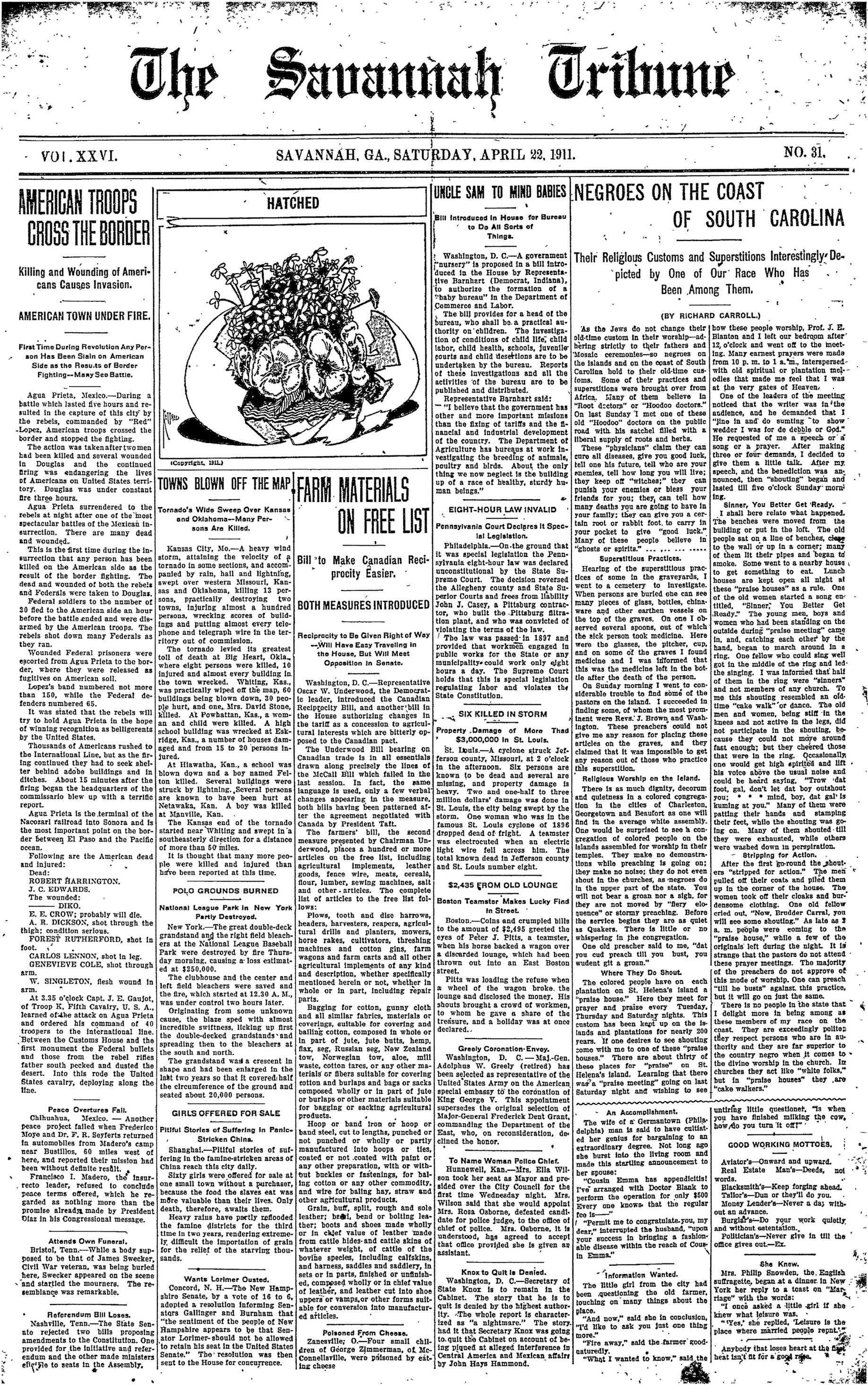
AMERICAN TROOPS CROSS THE BORDER
Killing and Wounding of Americans Causes Invasion.
AMERICAN TOWN UNDER FIRE.
First Time During Revolution Any Person Has Been Stain on American Side as the Results of Border Fighting--Many See Battle.
Agua Prieta, Mexico.—During a battle which lasted five hours and resulted in the capture of this city by the rebels, commanded by "Red" Lopez, American troops crossed the border and stopped the fighting.
The action was taken after two men had been killed and several wounded in Douglas and the continued firing was endangering the lives of Americans on United States territory. Douglas was under constant fire three hours.
Agua Prieta surrendered to the rebels at night after one of the most spectacular battles of the Mexican insurrection. There are many dead and wounded.
This is the first time during the insurrection that any person has been killed on the American side as the result of the border fighting. The dead and wounded of both the rebels and Federalers were taken to Douglas. Federal soldiers to the number of 30 fled to the American side an hour before the battle ended and were disarmed by the American troops. The rebels shot down many Federalers as they ran.
Wounded Federal prisoners were escorted from Agua Prieta to the border, where they were released as fugitives on American soil.
Lopez's band numbered not more than 150, while the Federal defenders numbered 65.
It was stated that the rebels will try to hold Agua Prieta in the hope of winning recognition as belligerents by the United States.
Thousands of Americans rushed to the International Line, but as the firing continued they had to seek shelter behind adobe buildings and in ditches. About 15 minutes after the firing began the headquarters of the commissario blew up with a terrific report.
Agua Prieta is the terminal of the Nacozarl railroad into Sonora and is the most important point on the border between El Paso and the Pacific ocean.
Following are the American dead and injured:
ROBERT HARRINGTON.
J. C. EDWARDS.
The wounded:
—— DIKO.
E. E. CROW; probably will die.
A. R. DICKSON, shot through the
thigh; condition serious.
CARLOS LENNON, shot in leg.
GENEVIEVE COLE, shot through arm.
W. SINGLETON, flesh wound in arm.
At 3.35 o'clock Capt. J. E. Gaujot,
of Troop K, Fifth Cavalry, U. S. A.,
learned of the attack on Agua Prieta
and ordered his command of 40
troopers to the international line.
Between the Customs House and the
first monument the Federal bullets
and those from the rebel rifles
father south pecked and dusted the
desert. Into this rode the United
States cavalry, deploying along the
line.
Peace Overtures Fall.
Chihuahua, Mexico. — Another peace project failed when Frederico Moye and Dr. F. R. Seyferts returned in automobiles from Madero's camp near Bustillos, 60 miles west of here, and reported their mission had been without definite result.
Francisco I. Madero, the insurrecto leader, refused to conclude peace terms offered, which he regarded as nothing more than the promise already made by President Olaz in his Congressional message.
Attends Own Funeral.
Bristol, Tenn.—While a body supposed to be that of James Swecker, Civil War veteran, was being buried here, Swecker appeared on the scene and startled the mourners. The resemblance was remarkable.
Referendum Bill Loses.
Nashville, Tenn.—The State Senate rejected two bills proposing amendments to the Constitution. One provided for the initiative and referendum and the other made ministers eligible to seats in the Assembly.
HATCHED
TOWNS BLOWN OFF THE MAP.
Tornado's Wide Sweep Over Kansas and Oklahoma--Many Persons Are Killed.
Kansas City, Mo.—A heavy wind storm, attaining the velocity of a tornado in some sections, and accompanied by rain, hail and lightning, swept over western Missouri, Kansas and Oklahoma, killing 13 persons, practically destroying two towns, injuring almost a hundred persons, wrecking scores of buildings and putting almost every telephone and telegraph wire in the territory out of commission.
The tornado levied its greatest toll of death at Big Heart, Okla., where eight persons were killed, 10 injured and almost every building in the town wrecked. Whiting, Kas., was practically wiped off the map, 60 buildings being blown down, 30 people hurt, and one. Mrs. David Stone, killed. At Powhattan, Kas., a woman and child were killed. A high school building was wrecked at Eskridge, Kas., a number of houses damaged and from 15 to 20 persons injured. At Hiawatha, Kan., a school was blown down and a boy named Felton killed. Several buildings were struck by lightning. Several persons are known to have been hurt at Netawaka, Kan. A boy was killed at Manville, Kan.
The Kansas end of the tornado started near Whiting and swept in a southeasterly direction for a distance of more than 50 miles. It is thought that many more people were killed and injured than have been reported at this time.
POLO GROUNDS BURNED
National League Park in New York Partly Destroyed.
New York.—The great double-deck grandstand and the right field bleachers at the National League Baseball Park were destroyed by fire Thursday morning, causing a loss estimated at $250,000. The clubhouse and the center and left field bleachers were saved and the fire, which started at 12.30 A.M., was under control two hours later. Originating from some unknown cause, the blaze sped with almost incredible swiftness, licking up first the double-deck grandstands and spreading then to the bleachers at the south and north. The grandstand was a crescent in shape and had been enlarged in the last two years so that it covered half the circumference of the ground and seated about 20,000 persons.
GIRLS OFFERED FOR SALE
Pitiful Stories of Suffering in Panic- Stricken China.
Shanghai.—Pitiful stories of suffering in the famine-stricken areas of China reach this city daily. Sixty girls were offered for sale at one small town without a purchaser, because the food the slaves eat was more valuable than their lives. Only death, therefore, awaits them. Heavy rains have partly re flooded the famine districts for the third time in two years, rendering extremely difficult the importation of grain for the relief of the starving thousands.
Wants Lorimer Ousted.
Concord, N. H.—The New Hampshire Senate, by a vote of 16 to 6, adopted a resolution informing Senators Gallinger and Burnham that "the sentiment of the people of New Hampshire appears to be that Senator Lorimer- should not be allowed to retain his seat in the United States Senate." The resolution was then sent to the House for concurrence.
SAVANNAH, GA., SATURDAY, APRIL 22, 1911.
FARM MATERIALS ON FREE LIST
Bill to Make Canadian Reciprocity Easier.
BOTH MEASURES INTRODUCED
Reciprocity to Be Given Right of Way
--Will Have Easy Travelling in
the House, But Will Meet
Opposition in Senate.
Washington, D. C.—Representative
Oscar W. Underwood, the Democratic
leader, Introduced the Canadian
Reciprocity Bill, and another bill in
the House authorizing changes in
the tariff as a concession to agricultural interests which are bitterly opposed to the Canadian pact.
The Underwood Bill bearing on Canadian trade is in all essentials drawn along precisely the lines of the McCall Bill which failed in the last session. In fact, the same language is used, only a few verbal changes appearing in the measure, both bills having been patterned after the agreement negotiated with Canada by President Taft. The farmers' bill, the second measure presented by Chairman Underwood, places a hundred or more articles on the free list, including agricultural implements, leather goods, fence wire, meats, cereals, flour, lumber, sewing machines, salt and other articles. The complete list of articles to the free list follows:
Plows, tooth and disc harrows, headers, harvesters, reapers, agricultural drills and planters, mowers, horse rakes, cultivators, threshing machines and cotton gins, farm wagons and farm carts and all other agricultural implements of any kind and description, whether specifically mentioned herein or not, whether in whole or in part, including repair parts.
Bagging for cotton, gunny cloth and all similar fabrics, materials or coverings, suitable for covering and balling cotton, composed in whole or in part of jute, jute butts, hemp, flax, seg, Russian seg, New Zealand tow, Norwegian tow, aloe, mill waste, cotton tares, or any other materials or fibers suitable for covering cotton and burlaps and bags or sacks composed wholly or in part of jute or burlaps or other materials suitable for bagging or sacking agricultural products.
Hoop or band iron or hoop or band steel, cut to lengths, punched or not punched or wholly or partly manufactured into hoops or ties, coated or not coated with paint or any other preparation, with or without buckles or fastenings, for baling cotton or any other commodity, and wire for bailing hay, straw and other agricultural products.
Grain, buff, split, rough and sole leather; bead, bend or bolting leather; boots and shoes made wholly or in chief value of leather made from cattle hides and cattle skins of whatever weight, of cattle of the bovine species, including calfskins, and harness, saddles and saddlery, in sets or in parts, finished or unfinished, composed wholly or in chief value of leather, and leather cut into shoe uppers or vamps, or other forms suitable for conversion into manufactured articles.
Polsoned From Cheese
Zanesville; O.—Four small children of George Zjmmerman, of McConnellsville, were poisoned by eating cheese
UNCLE SAM TO MIND BABIES
Washington, D. C.—A government nursery" is proposed in a bill introduced in the House by Representative Barnhart (Democrat, Indiana), to authorize the formation of a "baby bureau" in the Department of Commerce and Labor. The bill provides for a head of the bureau, who shall be a practical authority on children. The investigation of conditions of child life, child labor, child health, schools, juvenile courts and child desertions are to be undertaken by the bureau. Reports of these investigations and all the activities of the bureau are to be published and distributed.
Representative Barnhart said: "I believe that the government has other and more important missions than the fixing of tariffs and the financial and industrial development of the country. The Department of Agriculture has bureaucats at work investigating the breeding of animals, poultry and birds. About the only thing we now neglect is the building up of a race of healthy, sturdy human beings."
EIGHT-HOUR LAW INVALID
Pennsylvania Court Declares It Special
Licensing.
Philadelphia. On the ground that it was special legislation the Pennsylvania eight-hour law was declared unconstitutional by the State Supreme Court. The decision reversed the Allegheny county and State Superior Courts and frees from liability John J. Casey, a Pittsburg contractor, who built the Pittsburg filtration plant, and who was convicted of violating the terms of the law. The law was passed in 1897 and provided that workmen engaged in public works for the State or any municipality could work only eight hours a day. The Supreme Court holds that this is special legislation regulating labor and violates the State Constitution.
SIX KILLED IN STORM
Property .Damage of More Thad
$3,000,000 in St. Louis.
St. Louis.—A cyclone struck Jefferson county, Missouri, at 2 o'clock in the afternoon. Six persons are known to be dead and several are missing, and property damage is heavy. Two and one-half to three million dollars' damage was done in St. Louis, the city being swept by the storm. One woman who was in the famous St. Louis cyclone of 1896 dropped dead of fright. A teamster was electrocuted when an electric light wire fell across him. The total known dead in Jefferson county and St. Louis number eight.
$2,435 FROM OLD LOUNGE
Boston Teamster Makes Lucky Find In Street.
Boston.—Colns and crumpled bills to the amount of $2,495 greeted the eyes of Peter J. Pitts, a teamster, when his horse backed a wagon over a discarded lounge, which had been thrown out into an East Boston street.
Pitts was loading the refuse when a wheel of the wagon broke the lounge and disclosed the money. His shouts brought a crowd of workmen, to whom he gave a share of the treasure, and a holiday was at once declared.
Greely Coronation: Envey
Washington, D. C. — Maj-Gen. Adolphus W. Greely (retfred) has been selected as representative of the United States Army on the American special embassy to the coronation of King George V. This appointment supersedes the original selection of Major-General Frederick Denk Grant, commanding the Department of the East, who, on reconsideration, declined the honor.
To Name Woman Police Chief
Hunnewell, Kan.—Mrs. Ella Wilson took her seat as Mayor and presided over the City Council for the first time Wednesday night. Mrs. Wilson said that she would appoint Mrs. Rosa Osborne, defeated candidate for police judge, to the office of chief of police. Mrs. Osborne, it is understood, has agreed to accept that office provided she is given an assistant.
Knox to Quit Is Denied.
Washington, D. C.—Secretary of State Knox is to remain in the Cabinet. The story that he is to quit is denied by the highest authority. The whole report is characterized as "a nightmare." The story had it that Secretary Knox was going to quit the Cabinet on account of being piqued at alleged interference in Central America and Mexican affairs by John Hays Hammond.
NEGROES ON THE COAST OF SOUTH CAROLINA
Their Religious Customs and Superstitions Interestingly Depicted by One of Our Race Who Has Been Among Them. (BY RICHARD CARROLL.)
'As the Jews do not change their old-time custom in their worship—adhering strictly to their fathers and Mosaic ceremonies—so negroes on the islands and on the coast of South Carolina hold to their old-time customs. Some of their practices and superstitions were brought over from Africa. Many of them believe in "Root doctors" or "Hoodoo doctors." On last Sunday I met one of these old "Hoodoo" doctors on the public road with his satchel filled with a liberal supply of roots and herbs.
These "physicians" claim they can cure all diseases, give you good luck, tell one his future, tell who are your enemies, tell how long you will live; they keep off "witches;" they can punish your enemies or bless your friends for you; they can tell how many deaths you are going to have in your family; they can give you a certain root or rabbit foot, to carry in your pocket to give "good luck." Many of these people believe in "ghosts or spirits."
Superstitious Practices.
Hearing of the superstitious practices of some in the graveyards, I went to a cemetery to investigate. When persons are buried one can see many pieces of glass, bottles, chinaware and other earthen vessels on the top of the graves. On one I observed several spoons, out of which the sick person took medicine. Here were the glasses, the pitcher, cup, and on some of the graves I found medicine and I was informed that this was the medicine left in the bottle after the death of the person.
On Sunday morning I went to considerable trouble to find some of the pastors on the island. I succeeded in finding some, of whom the most prominent were Revs. J. Brown and Washington. These preachers could not give me any reason for placing these articles on the graves, and they claimed that it was impossible to get any reason out of those who practice this superstition.
Rellgloua Worship on the Ieland.
There is as much dignity, decorum and quietness in a colored congregation in the cities of Charleston, Georgetown and Beaufort as one will find in the average white assembly. One would be surprised to see a congregation of colored people on the islands assembled for worship in their temples. They make no demonstrations while preaching is going on; they make no noise; they do not even shout in the churches, as negroes do in the upper part of the state. You will not bear a groan or a sigh, for they are not moved by "fiery eloquence" or stormy preaching. Before the service begins they are as quiet as Quakers. There is little or no whispering in the congregation.
One old preacher said to me, "dat you cud preach till you bust, you wudent git a groan."
Where They Do Shout.
The colored people have on each plantation on St. Helena's island a "praise house." Here they meet for prayer and praise every Tuesday, Thursday and Saturday nights. This custom has been kept up on the islands and plantations for nearly 200 years. If one desires to see shouting come with me to one of these "praise houses." There are about thirty of these places for "praise" on St. Helena's island. Learning that there was a "praise meeting" going on last Saturday night and wishing to see
The wife of a Germantown (Philadelphia) man is said to have cultivated her genius for bargaining to an extraordinary degree. Not long ago she burst into the living room and made this startling announcement to her spouse:
"Cousin Emma has appendicitis! I've arranged with Doctor Blank to perform the operation for only $500 Every one knows that the regular fee is——"
/ "Permit me to congratulate you, my dear," interrupted the husband, "upon your success in bringing a fashionable disease within the reach of Cousin Emma."
The little girl from the city had been questioning the old farmer, touching on many things about the place.
"And now," said she in conclusion, "I'd like to ask you just one thing more."
"Fire away," said the farmer good-naturedly.
"What I wanted to know," said the
An Accomplishment.
Information Wanted.
how these people worship, Prof. J. E. Blanton and I left our bedroom after 12 o'clock and went off to the meeting. Many earnest prayers were made from 10 p. m. to 1 a.m., interspersed with old spiritual or plantation melodies that made me feel that I was at the very gates of Heaven.
One of the leaders of the meeting noticed that the writer was in the audience, and he demanded that I "line in and do sumting" to show wedder I was for de debble or God." He requested of me a speech or a song or a prayer. After making three or four demands, I decided to give them a little talk. After my speech, and the benediction was announced, then "shouting" began and lasted till five o'clock Sunday morning.
Sinner, You Better Get Ready.
I shall here relate what happened. The benches were moved from the building or put in the loft. The old people sat on a line of benches, close to the wall or up in a corner; many of them lit their pipes and began to smoke. Some went to a nearby house to get something to eat. Lunch houses are kept open all night at these "praise houses" as a rule. One of the old women started a song entitled, "Sinner, You Better Get Ready." The young men, boys and women who had been standing on the outside during "praise meeting" came in, and, catching each other by the hand, began to march around in a ring. One fellow who could sing well got in the middle of the ring and led the singing. I was informed that half of them in the ring were "sinners" and not members of any church. To me this shouting resembled an old time "cake walk" or dance. The old men and women, being stiff in the knees and not active in the legs, did not participate in the shouting, because they could not move around fast enough; but they cheered those that were in the ring. Occasionally, one would get high spirited and lift his voice above the usual noise and could be heard saying, "Trow dat foot, gal, don't let dat boy outshout you; * * mind, boy, dat gal is kuming at you." Many of them were patting their hands and stamping their feet, while the shouting was going on. Many of them shouted till they were exhausted, while others were washed down in perspiration.
Stripping for Action.
After the first go-round the shouters "stripped for action." The men pulled off their coats and piled them up in the corner of the house. The women took off their cloaks and burdensome clothing. One old fellow cried out, "Now, Brudder Carral, you will see some shouting." As late as 3 a.m. people were coming to the "praise house," while a few of the originals left during the night. It is strange that the pastors do not attend these prayer meetings. The majority of the preachers do not approve of this mode of worship. One can preach "till he hews" against this practice, but it will go on just the same.
There is no people in the state that I delight more in being among as these members of my race on the coast. They are exceedingly polite they respect persons who are in authority and they are far superior to the country negro when it comes to the divino worship in the church. In churches they act like "white folks," but in "praise houses" they are "cake walkers."
untiring little questionnet, "is when you have finished milking the cow, how do you turn it off!"
GOOD WORKING MOTTOES.
Aviator's—Onward and upward.
Real Estate Man's—Deeds, not
words.
Mrs. Philip Snowden, the. English suffragette, began at a dinner. In New York her reply to a toast on "Marriage" with the words: "I once asked a little girl if she knew what leisure was.
She Knew.
Fashion Notes
Of Interest to Our Women
Diamonds and pearls are the ruling jewels for great occasions.
Small checks and small plaids are leading features of suitings. Attractive skirts and waists are joined in semi-princess style. Broadcloth, in pale shades, is highly popular for evening gowns. Collars and lapels are wide and long on nearly all coats and jackets.
Skirts of zibeline, in stripes and plaids, are worn with plain coats. Coats distinctively separate and for dressy wear are long and rather full. Gold and silver cloth is used as lining to the sheer net yoke and sleeves. The new Russian veilings are seen with square dots as often as round ones. A recently introduced fancy is the trimming of white gowns with colored lace. White crepe ruching, doubled, is much used as a finish for neck and sleeves. Organdies are dainty and inexpensive and make delightful frocks for summer wear. Velvet parasols in fantastic shapes are the latest thing shown in the fashionable shops.
Softness is a pronounced characteristic of the spring materials, both as to color and weave.
The popular watch chain of the hour is of fine platinum, set at intervals with small pearls.
A white crepe de chine scarf with shirred stripe border and gold metal fringed ends is very pretty.
The first suits that are being shown make it evident that the season's coats and wraps will be shorter.
For the later season the gown of old-fashioned flowered muslin is heralded as the very top of the fashion.
A number of men have been seen recently wearing light gray overcoats with black broadcloth collars and cuffs.
Men's new, stiff bosom shirts, made of fancy shirtings, have the stripes running horizontally across the bosom.
A long chain, intended to be twisted around the neck a second and third time is ornamented with rose coral oblongs, perfectly matched.
The half-fitted princess, by reason of its very simplicity, will probably prove more difficult to make and to "vary" than any of the late modes.
The latest touch for lingerie is to have cherry ribbon bows to fasten up the dainty garments instead of the old familiar baby blue and pale pink.
The transparent tunic will be very much used on afternoon and evening
Pulled Bread.—Bake ordinary yeast bread, in the shape of long, narrow French loaves. When cool but not entirely cold, cut lengthwise through the center, then with two forks scoop or pull the bread out of the crust and, still using the two forks, pull it apart in strips six or seven inches long and an inch or more in width and thickness. Line a large baking pan with brown paper and arrange the strips of bread on this, rough and crinkled edges uppermost. Set in the oven with the door partly open until it dries out thoroughly, then close the door until the bread turns golden brown. Warm each time before serving. This is much like zwelback, but its odd shape appeals to the invalid.
Koumiss.—Take two ' quarts of milk, two tablespoonfuls of granulated sugar, two tablespoons of water and one-third cake of yeast. Put the milk in a double boiler, but do not let it boll, just get lukewarm. Put the sugar and water into a pan and stir until it melts and let it boll two or three minutes. Dissolve the yeast in two tablespoons of the warm milk, then add the stirup to the milk, then the yeast, which should be poured through a strainer. Stir all thoroughly. Bottle and cork tightly. Stand in a warm place for twelve hours. Then turn bottles on side and put in the refrigerator for twelve hours, when they will be ready to serve.
Egg Lemonade.-Beat the yolks of two fresh eggs until very light, add the strained juice of two lemons and sugar enough to suit the taste. Fill a large glass with shaved ice. Now beat the whites of the eggs to a stiff froth and add to the mixture, add a little water to the shaved ice, then the egg and lemon. Serve immediately. This is very nourishing.
Working Satin Stitch.
It is wise when working satin to never use double silk or cotton. Doubling crosses the "ile" of the two threads, and therefore an even stitch cannot be secured and the work seems rough and coarse. If the work absolutely requires a double thickness, draw two threads together from a skein and thread them at the same time through the eye of the needle. This, however, is possible only in the finer number of cotton or silk thread.
gowns. It is generally of knee depth, while the underskirt just clears the ground.
Hat in the shape of a priest's beret, that is with a round crown and the brim turned upward and outward all around, trimmed with algrettes are much favored.
With the costumes for day wear the touch of black satin is always present, and the modern dressmaker works veritable magic with the black satin sash.
Obsequies for the habble skirt were held at the dressmakers' exhibit last week. In her stead will reign the "Harem" and the "Pasha," recently adopted from the Turkish women.
A narrow apronlike panel which veils the front and back of the skirt and leaves the foundation of the dress visible at the bottom and side is a new feature of the spring gowns.
The coal hod hat is a novelty of the present season. It has not, however, made much headway, and is conspicuous without exciting admiration. Possibly this is because of its obvious kitchen origin.
Regarding the tallored gown, the coats are very short, barely reaching the hips, while the sleeves and shoulder are cut, in one piece. Sleeves of the coats like those of many of the dresses are short and bell shaped.
Serges and cashmeres in plain colors, checks, stripes and plaids, are being used for early spring wear. These are shown in tailor effects. For young girls Peter Thompson, Russian, bretelle and jumper styles will be used.
A very fashionable hat shop on Michigan boulevard is showing a rather odd and picturesque hat of lavender satin straw. The crown is high and conical, tapering to a sharp point, from this point an immense bunch of yellow grass droops to the brim.
The hobble head dress is the thing just now. The hair is parted on the side or in the middle and waved all over. Then it is loosely drawn back and a cluster of puffs arranged at the nape of the neck. The hobble effect is produced by a band of velvet bound tightly around the puffs.
"Helen" pink is to be extremely fashionable in the near future. This daffy color is a delicate shade of pink, nearly a salmon, and is named for the daughter of the White House, Miss Helen Taft. Already the shops are showing'a fine array of hats and dress accessories in Helen pink, while the young men of the Capitol city are wearing ties, shirts, hat bands and hoslery of this pretty daring color.
Irish Crochet Still Popular.
For more than a year Irish crochet has been the favorite lace garnishing of the fashionably gowned woman. From the contents of the shop windows and lace counters this dainty thread webbing is to be more popular than ever, and deservedly so.
Just at first the price which goes with Irish crochet bandings and edgings may sound a bit extravagant, but the wise buyer knows no other lace lends itself so readily to soap and water, and the cleaner's bill is an item not to be ignored. Durability is another admirable feature, and while the initial expenditure may be a trifle large, the lace is really an economy in the end, for no matter how often it is washed, it remains handsome.
One Egg Cake.
Beat the yolk of one egg light, and add to it gradually one cupful of granulated sugar and one tablespoonful of butter. Add alternately one-half cupful of milk and one and one-half cupfuls of flour sifted with two teaspoonfuls of baking powder. When batter is smooth, add the beaten white of the egg. Bake as usual.
Pea Pudding.
Soak four cupfuls of split peas over night. In the morning put on to boll in water to cover, and cook until soft. Drain, rub through a sieve, add three beaten eggs, one tablespoonful of butter and season with pepper and salt. Boll in a butter mold or floured cloth for one hour, turn out and serve in slices.
Scalloped Beets.
Three-fourths of a cup of cooked beets diced, one-fourth cup of bread crumbs, one-half cup of hot milk, one tablespoon of butter, one teaspoon of salt, one-fourth teaspoon of peppers. Put beets and bread crumbs in layers in baking dish, pour over them the hot milk, add seasoning and bake 20 minutes.
Beets with Sour Sauce
Boll four young beets until tender, drain and cover with cold water. Remove skins, cut beets in thin slices and pour over them the following sauce: One-fourth cup of sugar, two tablespoons of cornstarch, one-half cup of vinegar, one-half cup of boiling water. Mix all the ingredients, cook, and when boiling pour over the heets.
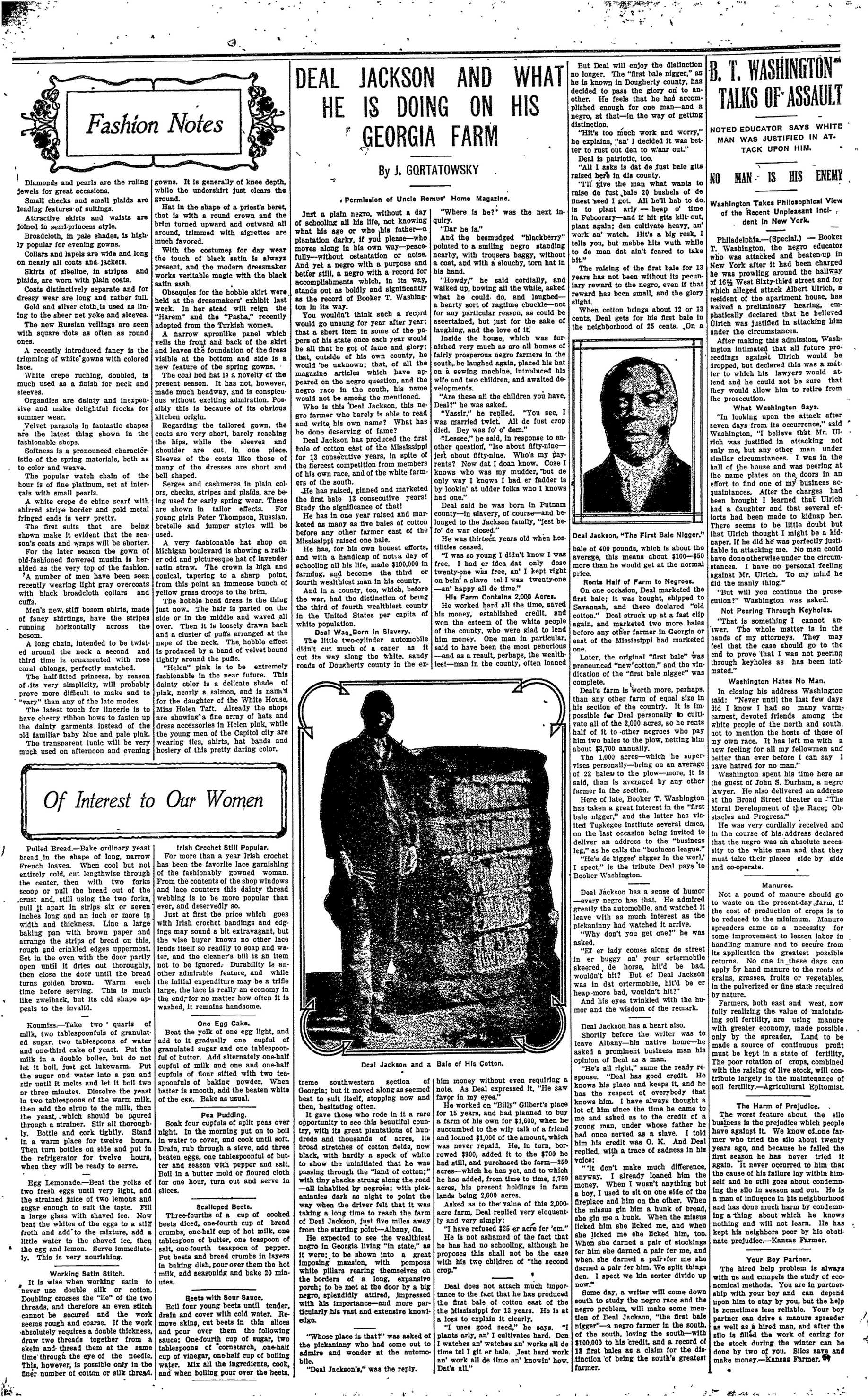
DEAL JACKSON AND WHAT HE IS DOING ON HIS GEORGIA FARM
Just a plain negro, without a day of schooling all his life, not knowing what his age or who his father—a plantation darky, if you please—who moves along in his own way—peacefully—without ostentation or noise. And yet a negro with a purpose and better still, a negro with a record for accomplishments which, in its way, stands out as boldly and significantly as the record of Booker T. Washington in its way.
"Where is he?" was quiry.
"Dar he is."
And the besmudge pointed to a smiling a nearby, with trousers a coat, and with a slouched his hand.
"Howdy," he said walked up, bowing all what he could do. a hearty sort of ragtime
You wouldn't think such a record would go unsung for year after year; that a short item in some of the papers of his state once each year would be all that he got of fame and glory; that, outside of his own county, he would be unknown; that, of all the magazine articles which have appeared on the negro question, and the negro race in the south, his name would not be among the mentioned. Who is this Deal Jackson, this negro farmer who barely is able to read and write his own name? What has he done deserving of fame? Deal Jackson has produced the first bale of cotton east of the Mississippi for 13 consecutive years, in spite of the fiercest competition from members of his own race, and of the white farmers of the south.
He has raised, ginned and marketed the first bale 13 consecutive years! Study the significance of that! He has in one year raised and marketed as many as five bales of cotton before any other farmer east of the Mississippi raised one bale. He has, for his own honest efforts, and with a handicap of notice a day of schooling all his life, made $100,000 in farming, and become the third or fourth wealthiest man in his county. And in a county, too, which, before the war, had the distinction of being the third of fourth wealthiest county in the United States per capita of white population. Deal Was.Born in Slavery. The little two-cylinder automobile didn't cut much of a caper as it cut its way along the white, sandy roads of Dougherty county in the ex-
1920
THE MEMORIAL STONE OF THE MAYOR OF BROOKLYN, N.Y.
treme southwestern section of Georgia; but it moved along as seemed best to suit itself, stopping now and then, hesitating often.
It gave those who rode in it a rare opportunity to see this beautiful country, with its great plantations of hundreds and thousands of acres, its broad stretches of cotton fields, now black, with hardly a speck of white to show the uninitiated that he was passing through the "land of cotton;" with tiny shacks strung along the road—all inhabited by negroes; with pick-annies dark as night to point the way when the driver felt that it was taking a long time to reach the farm of Deal Jackson, just five miles away from the starting point—Albany, Ga.
him money without note. As Deal express favor in my eyes.
He worked on "Bif for 15 years, and he a farm of his own succumbed to the wilt and loaned $1,000 of was never repaid. rowed $900, added had still, and purcha acres—which he has he has added, from acres, his present lands being 2,000 a.
Asked as to the "acre farm, Deal reply and very simply: "I have refused $
He expected to see the wealthiest negro in Georgia living "in state," as it were; to be shown into a great imposing mansion, with pompous white pillars rearing themselves on the borders of a long, expansive porch; to be met at the door by a big negro, splendidly attired, impressed with his importance—and more particularly his vast and extensive knowledge.
"Whose place is that?" was asked of the pickanian who had come out to admire and wonder at the automobile.
"Deal Jackson's," was the reply.
"Where is he?" was the next in-
quiry.
"Dar he is."
And the besmudged "blackberry" pointed to a smiling negro standing nearby, with trousers baggy, without a coat, and with a slouchy, torn hat in his hand.
"Howdy," he said cordially, and walked up, bowing all the while, asked what he could do, and laughed—a hearty sort of ragtime chuckle—not for any particular reason, as could be ascertained, but just for the sake of laughing, and the love of it.
Inside the house, which was furnished very much as are all homes of fairly prosperous negro farmers in the south, he laughed again, placed his hat on a sewing machine, introduced his wife and two children, and awaited developments.
"Are these all the children you have, Deal?" he was asked.
"Yassir," he replied. "You see, I was married twict. All de fust crop died. Dey was fo' o dem."
"Lessee," he said, in response to another question, "Ise about fifty-nine—jest about fifty-nine. Who's my payments? Now dat I doan know. Cose I knows who was my mudder, 'but de only way I knows I had er fadder is by lookin' at udder folks who I knows had one."
Deal said he was born in Putnam county—In slavery, of course—and belonged to the Jackson family, "jest befo' de war closed."
He was thirteen years old when hostilities ceased.
"I was so young I didn't know I was free. I had er idea dat only dose twenty-one was free, an' I kept right on bein' a slave tel I was twenty-one—an' happy all de time."
His Farm Contains 2,000 Acres.
He worked hard all the time, saved his money, established credit, and won the esteem of the white people of the county, who were glad to lend him money. One man in particular, sald to have been the most penurious—and as a result, perhaps, the wealthiest—man in the county, often loaned
him money without even requiring a note. As Deal expressed it, "He saw favor in my eyes."
He worked on "Billy" Gilbert's place for 15 years, and had planned to buy a farm of his own for $1,600, when he succumbed to the wily talk of a friend and loaned $1,000 of the amount, which was never repaid. He, in turn, borrowed $900, added it to the $700 he had still, and purchased the farm—250 acres—which he has yet, and to which he has added, from time to time, 1,750 acres, his present holdings in farm lands being 2,000 acres.
Asked as to the value of this 2,000-acre farm, Deal replied very eloquently and very simply:
"I have refused $25 er acre for 'em."
He is not ashamed of the fact that he has had no schooling, although he proposes this shall not be the case with his two children of "the second crop."
Deal does not attach much importance to the fact that he has produced the first bale of cotton east of the the Mississippi for 13 years. He is at a loss to explain it clearly.
"I uses good seed," he says. "I plants arly, an' I cultivates hard. Den I watches an' watches an' works all de time tel I git er bale. Jest hard work an' work all de time an' known' how. Dat's all."
But Deal will enjoy the distinction no longer. The "first bale nigger," as he is known in Dougherty county, has decided to pass the glory on to another. He feels that he has accomplished enough for one man—and a negro, at that—in the way of getting distinction.
"Hit's too much work and worry," he explains, "an' I decided it was better to rust out den to waar out."
Deal is patriotic, too.
"All I asks is dat de fust bale gits raised here in dis county.
"I'll give the man what wants to raise de fust, bale 20 bushels of de finest need I got. All he'll hab to do is to plant arly — heap o' time in Feboorary—and if hit gits kilt-out, plant again; den cultivate heavy, an' work an' watch. Hit's a big resk, I tells you, but mebbe hits wuth while to de man dat ain't feared to take hit."
The raising of the first bale for 13 years has not been without its peculiary reward to the negro, even if that reward has been small, and the glory slight.
When cotton brings about 12 or 13 cents, Deal gets for his first bale in the neighborhood of 25 cents. On a
[Image of a man in a suit with a tie].
Deal Jackson, "The First Bale Nigger." bale of 400 pounds, which is about the average, this means about $100-$50 more than he would get at the normal price.
Rents Half of Farm to Negroes. On one occasion, Deal marketed the first bale; it was bought, shipped to Savannah, and there declared "old cotton." Deal struck up at a fast clip again, and marketed two more bales before any other farmer in Georgia or east of the Mississippi had marketed one.
Later, the original "first bale" was pronounced "new"cotton," and the vindication of the "first bale nigger" was complete.
Deal's farm is worth more, perhaps, than any other farm of equal size in his section of the country. It is impossible for Deal personally to cultivate all of the 2,000 acres, so he rents half of it to other negroes who pay him two bales to the plow, netting him about $3,700 annually. The 1,000 acres—which he supervises personally—bring on an average of 22 bales to the plow—more, it is said, than is averaged by any other farmer in the section. Here of late, Booker T. Washington has taken a great interest in the "first bale nigger," and the latter has visited Tuskegee institute several times, on the last occasion being invited to deliver an address to the "business leg," as he calls the "business league."
"He's de bigges' nigger in the worl',
I spect," is the tribute Deal pays 'to
Booker Washington.
Deal Jackson has a sense of humor
—every negro has that. He admired
greatly the automobile, and watched it
leave with as much interest as the
pickaninny had watched it arrive.
"Why don't you get one?" he was
asked.
"Ef er lady comes along de street
in er buggy an' your ortermobile
skeered, de horse, hit'd be bad,
wouldn't hit? But ef Deal Jackson
was in dat ortermobile, hit'd be er
heap-moro bad, wouldn't hit?"
And his eyes twinkled with the humor
and the wisdom of the remark.
Deal Jackson has a heart also.
Shortly before the writer was to leave Albany—his native home—he asked a prominent business man his opinion of Deal as a man.
"He's all right," same the ready response. "Deal has good credit. He knows his place and keeps it, and he has the respect of everybody that knows him. I have always thought a lot of him since the time he came to me and asked as to the credit of a young man, under whose father he had once served as a slave. I told him his credit was O. K. And Deal replied, with a trace of sadness in his voice:
"It don't make much difference, anyway. I already loaned him the money. When I wusn't anything but a boy, I used to sit on one side of the fireplace and him on the other. When the missus gin him a hunk of bread, she gin me a hunk. When the missus licked him she licked me, and when she licked me she licked him, too. When she darned a pair of stockings fer him she darned a pair fer me, and when she darned a pair fer me she darned a pair fer him. We split things den. I spect we kin sorter divide up now."
Some day, a writer will come down south to study the negro race and the negro problem, will make some mention of Deal Jackson, "the first bale nigger"—a negro farmer in the south, of the south, loving the south—with $100,000 to his credit, and a record of 18 first bales as a claim for the distinction of being the south's greatest farmer.
B. T. WASHINGTON TALKS OF ASSAULT
NOTED EDUCATOR SAYS WHITE
MAN WAS JUSTIFIED IN ATTACK UPON HIM.
Washington Takes Philosophical View of the Recent Unpleasant Incident in New York.
Philadelphia.—(Special.) — Booker T. Washington, the negro educator who was attacked and beaten-up in New York after it had been charged he was prowling around the hallway of 16½ West Sixty-third street and for which alleged attack Albert Ulrich, a resident of the apartment house, has waived a preliminary hearing, emphatically declared that he believed Ulrich was justified in attacking him under the circumstances.
After making this admission, Washington intimated that all future proceedings against Ulrich would be dropped, but declared this was a matter to which his lawyers would attend and he could not be sure that they would allow him to retire from the prosecution.
"In looking upon the attack after seven days from its occurrence," said Washington, "I believe that Mr. Ulrich was justified in attacking not only me, but any other man under similar circumstances. I was in the hall of the house and was peering at the name plates on the doors in an effort to find one of my business acquaintances. After the charges had been brought I learned that Ulrich had a daughter and that several efforts had been made to kidnap her. There seems to be little doubt but that Ulrich thought I might be a kidnapper. If he did he was perfectly justifiable in attacking me. No man could have done otherwise under the circumstances. I have no personal feeling against Mr. Ulrich. To my mind he did the manly thing."
"But will you continue the prosecution?" Washington was asked. Not Peering Through Keyholes. "That is something I cannot answer. The whole matter is in the hands of my attorneys. They may feel that the case should go to the end to prove that I was not peering through keyholes as has been intimated."
Washington Hates No Man.
In closing his address Washington said: "Never until the last few days did I know I had so many warm, earnest, devoted friends among the white people of the north and south, not to mention the hosts of those of my own race. It has left me with a new feeling for all my fellowmen and better than ever before I can say I have hatred for no man."
Washington spent his time here as the guest of John S. Durham, a negro lawyer. He also delivered an address at the Broad Street theater on "The Moral Development of the Race; Obstacles and Progress."
He was very cordially received and in the course of his address declared that the negro was an absolute necessity to the white man and that they must take their places side by side and co-operate.
Manures.
Not a pound of manure should go to waste on the present-day farm, if the cost of production of crops is to be reduced to the minimum. Manure spreaders came as a necessity for some improvement to lessen labor in handling manure and to secure from its application the greatest possible returns. No one in these days can apply by hand manure to the roots of grains, grasses, fruits or vegetables, in the pulverized or fine state required by nature.
Farmers, both east and west, now fully realizing the value of maintaining soil fertility, are using manure with greater economy, made possible only by the spreader. Land to be made a source of continuous profit must be kept in a state of fertility. The poor rotation of crops, combined with the raising of live stock, will contribute largely in the maintenance of soil fertility.—Agricultural Epistomist
The Harm of Preludice.
The worst feature about the silo business is the prejudice which people have against it. We know of one farmer who tried the silo about twenty years ago, and because he failed the first season he has never tried it again. It never occurred to him that the cause of his failure lay within himself and he still goes about condemning the silo in season and out. He is a man of influence in his neighborhood and has done much harm by condemning a thing about which he knows nothing and will not learn. He has kept his neighbors poor by his obstinate prejudice.—Kansas Farmer.
Your Boy Partner.
The hired help problem is always with us and compels the study of economical methods. You are in partnership with your boy and can depend upon him to stay by you, but the help is sometimes less reliable. Your boy partner can drive a manure spreader as well as a hired man, and after the silo is filled the work of caring for the stock during the winter can be done by two of you. Silos save and make money.—Kansas Farmer.
The Farm
Test Your Seed Corn.
A farmer who would go blindly into a business venture without first investigating thoroughly the prospects for profit and possibility of failure would immediately be stamped as a poor business man. Yet every year many thousands of farmers plan their corn acreage without first having tested the seed. Even though the bulk of last year's crop, when harvested, had every appearance of mature soundness, in many tests already conducted the ears which farmers had saved for seed were found to be a weak variety.
The safest method of farming is surest and most profitable, and the farmer who will first conduct an examination of the seed which he intends planting for next season's crop will not be gambling on the prospect, but will have assurance that, weather conditions permitting, he will secure a big yield, provided his seed is good. A patent germinator is not necessary; build one at home. Test half a dozen kernels from different parts of each ear of the seed corn. Where an ear is found which does not show a strong, prompt sprout, discard it. Soil fertility is robbed by the poor seed corn.—Farmers and Drovers' Journal.
Sweet Clover.
There is considerable discussion about the value of sweet clover. Generally it is considered a troublesome weed, and yet its list of friends is growing rapidly. Where alfalfa or clover will grow it is worthless in comparison, but on washed-out land, on clay banks or sand hills where nothing else will grow, sweet clover will not only thrive but will convert the waste land into a rich tract for other crops. The bacteria which gather upon its roots are the only known kinds which will inoculate the land for alfalfa, except that which grows upon alfalfa itself.
If you have any alkali spots, thin soil, clay points, sandy places or overflowed land where the soil is washed away, sow sweet clover and let it grow. It is a money-maker.—Exchange.
Care of Cow Previous to Calving.
For ten days preceding the time for calving, the cow should be kept in a comfortable, well-littered box stall or pen, in which there is no manger. The feed should be given in a box or basket, which should be removed after the feed is taken. The coarse feed may be put in the corner, and no more should be given than she will eat. This rule should, however, be observed not only before calving, but at all times. Throwing large quantities of roughage before a cow leads her into the bad habit of eating only the most appetizing parts, and so wasting much feed. It is a good practice to take a lantern and go the rounds of the barn before retiring for the night, to see that everything is as it should be—Exchange.
Save Old Vegetables.
Most gardeners find at the end of the season that they have on hand a varying quantity of small late vegetable roots which are unsalable and which are generally thrown away as worthless. This is a mistake. If there is no other method of profitably disposing of onions, beets, carrots, turpels, etc., they should be kept over until early spring and planted again. Such vegetables will grow very quickly—in fact, about twice as rapidly as the regular seeds—and a ready sale can be found for them. Vegetables produced in April this way, though, are always inferior in quality to the crops which are raised in the hotbeds or from seed, but at this time of the year the consumer is not particular in that regard.—Journal of Agriculture.
Melong Easily Grown.
Make selections of what are known to be the best qualities of melons and buy the seed early for next spring and summer planting. Watermelons and muskmelons are as easy to raise as cucumbers. On good land that is not too sandy and in a warm location melons will thrive. Don't waste time on the insplid kinds. There are many varieties of good sweet melons to be had. Melons are so easily and cheaply raised that every farmer should have a good-sized patch. Cantaloupes are also delicious and can be grown with little effort. They may be planted between rows of early peas, and after the peas have been gathered the melons will cover the ground.
A Tip to the Feeder.
If any man goes into the feeding business to make money it is absolutely necessary to have scales at hand so that he may know how much gain or loss is taking place from day to day. It does not take long to pay for the scales in correcting errors that would occur without them, and yet we never see a set of scales on more than one ranch in a hundred in this country, and yet they cost so little that a single steer would pay for one. —Denver Field and Farm.
Feeding Cows When Dry.
During the eight or ten weeks that cows go dry, their feed should be chlefly roughage. A daily allowance of two pounds of bran or oats, or a mixture of two parts each of bran and
oats and one part of linseed meal or corn-oil meal, makes a proper feed for a cow near calving. Some roots, cabbage, pumpkins or squashes are also very good. Highly carbonaceous roughage, such as straw and corn stalks, is not good at this particular time. Such feeds, with cold water, cold drafts or lying out at night on damp or frozen ground, are the chief causes of caked udder or garget.—Rural World.
Cider to Vinegar.
A short time ago I announced that we were having trouble in getting our elder changed into vinegar. A subscriber writes that 15 pounds of sugar should be added to every barrel of elder. He says that he has made 12 barrels and that he has had good results in following that plan.—Epitomist.
Test the Cows.
Keep a record and test your cows. In this manner you will find out the profitable cows in the herd. Since you cannot afford to keep an unprofitable cow the sooner you learn the unprofitable ones the better for you.—Farmers' Home Journal.
A Good Dalry Cow.
When you see a calf that is everything that could be asked for in the way of gentleness, there is every prospect that she will make a good dairy cow. A wild calf can hardly ever be made fit for the dairy.—Farmers' Home Journal.
General Farm Notes
Eggs should be culled the same as other things.
Perfect cleanliness will cut short the louse crop of chickens.
How many raisers.test the eggs they guarantee to be fresh?
When a hen is not kept well she can't be expected to do well.
The earlier you set your hens the sooner the pullets will begin to lay. It is said to be best to start raising poultry in the fall rather than in spring.
With proper raising, April hatched chicks will be the money-makers next fall and winter.
When the chicks can get away from it at will, plenty of heat under the hover is a good thing.
Don't crowd the chicks. Small flocks do best and give each individual chick a better chance.
Just one setting of thoroughbred eggs may be the means of working a revolution in your poultry business.
Try shaving some young sweet corn, or even field corn, for the young chicks and see how they will go for it.
Make the best of what room you have, but above all things don't try to keep too many fowls on a small place.
Don't neglect the herd boar during the summer. He should have a small pasture and be well fed though not fattened. Hogs will make the most of skim milk and every dairyman appreciates their aid in the profitable use of this by-product. You don't have to wait for the incubator to get broody and then if you don't want to set it you don't have to break it up. Every boy living in the fruit and truck district would do well to make himself thoroughly acquainted with budding and grafting. Rape pasture for sheep is most excellent. One of our sheep growers tells us that he has tried it for ten years and finds rape very fine for his sheep.
One way to plump a dressed fowl is to dip it for ten seconds in water nearly or hot boiling, and then immediately in cold water. Hang in a cool place until the animal heat is all out. Have crates and baskets for shipping strawberries, raspberries and blackberries on hand, and arrangements with your commission merchants for handling these as soon as ready. Farmers often lack the proper amount of rotten manure for melons and cucumbers. By stacking several loads a year in advance of planting there should be no trouble from this source. Tomato, pepper and egg plants should be hardened off as soon as they are large enough, in the meantime being kept growing steadily, but not drawn into spindling plants. A stout stocky plant is what is needed.
Most farmers work too much and study and read too little. Learn the easiest, best and most economical way of doing the farm work. Hard work won't make you rich and successful unless it is backed up by good, intelligent management. Always be on the lookout to learn the best way of doing things. Be a good reader and observer.
SEEN FROM ALL SIDES
American, Jew, Japanese and a Negro Express Opinions on Immigration.
In a recent issue the Outlook had a symposium on Immigration in which the writers differ from recent utterances of the editor of that well-known magazine. An American of the west, a Jew, a Japanese and a negro (Prof. Kelly Miller), are the contributors. The American wants an open door to all who desire to come to these shores and thinks we have no right to keep out the foreigner. He continues:
"You say that we should 'select the immigrants we want.' What moral right have we to raise a moral test as to who shall come here and who not? We send men abroad in the attempt to have one missionary convert 25,000 heathen. Is our Christian religion so delicate that it cannot stand the introduction of one heathen among 50 Christians in this country? Shall we say that we are righteous and that others must not come to a land which God has prepared for his children because they are not as good as we are? Who gave us a title deed to every foot of land in this hemisphere, with charge to keep everybody else out whom, forsooth, we dislike?"
Professor Miller takes exception to the Outlock's contention that the races cannot be held together under one government. He answers:
"If peoples of different blood cannot be held together by a common political government, then England, France, Germany and the United States, in their colonial policy, are merely fighting against nature, after a manner of the ancient giants. If your doctrine be sound, then Hawaii is not large enough for native and American occupants; various South American states are not large enough for the Indians, Latin and Spanish components of their population; and the United States is too small for the European and the African. What is to be the outcome of the race problem if this doctrine is to prevail?
"Have American institutions lost the great assimilative power at one time attributed to them? Do you mean to infer that Christianity has lost is proclaimed power to allay the frictional strife among men, and thus usher in the reign of peace and good will on earth? Is this a concession that Christianity is inferior to Mohammedanism in enforcing the concrete brotherhood of man? Mr. B. L. Putnam Weale, in his recent book, 'The Conflict of Christianity,' declares that Christianity has no influence or effect upon the race question.
"I am sure it will not be considered unmannerly to call attention to the inconsistency of your position. It is universally understood that the Outlook is a firm and enthusiastic supporter of Dr. Booker T. Washington, whose policy is based upon the harmonious adjustment of the races in the United States, each maintaining its separate and distinct racial identity. How can this be hoped for, if no nation is large/enough for two races?" Speaking for the Orientals, Mr. Seuchi Takeuchi makes out a strong case in these pointed words.
"Where were Christ, Buddha, Socrates, Mohammed, Confucius born? They were all Orientals, and the so-called Occidentals are worshiping and obeying their theories and doctrines. They never promulgated the principle of human prejudice and racial exclusion. If Kipling's principle is true, the principle of these men would vanish away from the earth.
(2) "Against the twentieth century is the epoch of the intermingling of races. The United States has a great opportunity to mix races up and amalgamate them in one melting-pot. The American Indian excluded the European previously, and, without knowing them, older people always hate newcomers. If Americans of today show the same tendency, the leading journals should teach them not to do this. If this is a creed of the so-called civilized nation, the civilization of this nation is one century behind and is worse than that of the old Indian. In this connection some foolish individuals of America are hungry for war, led by the yellow journals. The idea will cause unrest. Where is the leader of the nation?"
Certainly the Jews would be expected to oppose the Outlook pronouncement for restricted emigration since of all peoples they are the ones most without a country. Scattered everywhere and among all nations they find the United States an inviting and profitable field. Writing from Birmingham, Ala., a Jew thus expresses the opinion of his people.
"Recall your speech, Dr. Abbott, 'The Religion of Service,' delivered at the Ethical Culture hall second dedication, in October last, in which you quoted your 'Leader and Master' as follows:
"The Spirit of the Lord' is upon me, because he hath anointed me to preach the gospel to the poor; he hath sent me to heal the broken-hearted, to preach deliverance to the captives, and recovering of sight to the blind, to set at liberty them that are bruised."
"I want to know whether these words of your 'Leader and Master' are reconcilable with your views on the commission's report? Are you preaching 'deliverance to the captives?' What are you doing 'to set at liberty them that are bruised?' Advocating the closed door?
"In closing the Dodge lectures at Yale you declared that the object of life should not be "acquisition and self-aggrandizement, but mutual 'service and social welfare.' What is the latitude of this 'mutual service and social welfare'?"
SPEECH OF SANDY BOTTOM
As Reported by "Old Hickory" in the Dallas (Tex.) Express.
The colored farmers living in Red Oak community decided recently to go into the farming business in an up-to-date scientific manner. Most of the promoters of the movement were young men who in their previous efforts had just about succeeded in making one stalk of corn grow where two grew before. They worked up a meeting, to which they had previously invited a young white farmer to explain to them the ins and out of corn and cotton raising. He had studied agriculture and was on the job. The meeting was largely attended and the address was a masterpiece in its way. After the speaker had finished the chairman called for brief expressions from anyone who felt like talking.
Among others present was old man Sandy Bottom, who had farmed for the white folks "befe' de wah," and had hustled for himself ever since emancipation. When asked if he wished to say anything, he replied: "Yes, I'm so full I'm 'bout to bust." Thinking that the old gentleman was going to praise the speaker of the evening, the chairman invited him to come forward. Among the promoters of the meeting were several sons of Mr. Bottom, and, strange to relate, they were not at all anxious to have the old gentleman make a speech! However, Mr. Bottom finally got up to the front and unlimbered as follows: "Tse certainly glad to see you young gentlemen aroused up to subject er farmin'. I'e glad that something has woke you up. I use ter think that example was worth more than precept; that practice was better than theory, and that 'gitting thar' was more than talking about. But I see I was dead wrong. How come I to say so? Here I've been for forty years er setting you all the example of farmin. of makin' good on the farm. Starting out wild out nothing, I have bought and paid for 400 acres of land, surrounded myself with stock, gins, mills, and have always lived in a good house, and it was my house, too; sent my children to school, and when they grew up I gave 'em a farm, and then whirled in and bought and paid for more. I have made cotton in spite of the boll weevil, raised corn in spite of the drought; no man has to ride through my field to tell me what to do. I give no mortgages, and I live at home and board at the same place. I done all this right here before your eyes. All dat didn't have no effect on you folks. And now, after half starving at farming for several years you've just now woke up and decided to go into scientific farmin'. And how? By sending off and gotten some white man who ain't never made a dollar on the farm to come here and make you a speech"—(Great confusion in the audience—shuffling of feet, clearing up of throats to keep the white man from hearing,
The sons of old Bottom tried to hide under benches; the chairman pulled the old man's coat-tail in the futile effort to ring him off.)
"I know what you fellows hope for. You think by dis here highfalutin' scientific farming you're going to find a substitute for work; but bless God you ain't er gwine to do it! You think you can have your smokebouse in Kansas City, your corn crib in Missouri, and you live down here. You have been playing at farmin' for 20 years, and have never made enough one year to carry you through the next! 'Cause why? In the summer you lose your fodder and peas by being away attending protracted meetings and such things; and in the fall if you come out a hundred or two dollars ahead you let the merchant outtalk you into buying bigger mules, finer horses, stronger wagons, etc., and then, why 'bout January you've got to spend a month in talking the merchant into letting you have supplies, and at 300 per cent, profit! De merchant ketches you erway from de bass and he proceeds to put you out. He knocks you down and hog-ties you!
"Today I counted 50 niggers driving to town in $150 bugles drawn by $200 horses, covered wid $60 harness. And what else did I see? I saw a white man driving to town in a second-hand wagon thrown erway by some fool nigger, and, bless God, dat wagon was loaded down wid sheep and hogs for sale! Blime-by, those 50 niggers is going to wake up and go into fancy farming jest like you fellows think you're going to do; and instead of taking examples from men right in their own neighborhood they're gwine to send off and get some white man to speak who ain't never pulled the bell-cord over old Beck, except by proxy!"
(Great confusion in the audience. Finally some one whispered to the choir and they broke into the glorious song, "We'll Understand It Better By and By." and thus shut the old man off. But as he was leaving the floor his powerful voice rose above the choir long enough to ejaculate:) "You niggers, instead of sending off for some white man to show you how to farm, you ought to send off for a carload of common horse sense and a ton of old-fashioned brains."
Parental Tactics.
"Pa, what is a trancendentalist?"
"Have you chained up the dog, as I told you?"
"Not yet, pa."
"Well, do that, and when you come back I will tell you what a trancendentalist is."
While Bobby was gone his astute parent dug the needed information out of the dictionary.
Buttermilk is the best possible thing to clean linoleum and oilcloth.
A brush dipped in salt water should be used in cleaning bamboo furniture.
A coffee grinder may be used as a food chopper if the housewife does not happen to have the latter.
White paint should be cleaned with warm water, using a trifle whiting on the cloth, then rinsing with clear water.
A solution of one teaspoonful of peroxide into a teacup of water makes a sanitary wash to use in the mouth every morning and evening.
When sweeping Turkish, Axminster or any thick-piled carpet always brush the way of the pile and it will look fresh and bright for years.
Add a well-beaten white of an egg to mashed potatoes, whipping the potato hard before dishing it. This makes it look well and taste better.
Never put turpentine or paint or varnish, as it will dissolve it as soon as it touches it. Its volatile nature makes it cut grease in the same way.
You can remove grease spots from wall paper with blotting paper and a hot flatiron. Put the blotting paper over the stain and press it with the hot iron.
If you are distressed to find that some careless person has scratched the new white paint with a match try rubbing the darkened surface with part of a cut lemon.
Those who wear violets and desire them to last as long as possible should keep them in glasses of water slightly tinctured with salt and the glasses inclosed in air tight pails or jars.
To set delicate colors in an embroidered handkerchief soak ten minutes previous to washing in a pail of tepid water in which a dessertspoonful of turpentine has been stirred.
To clean jewelry wash it in hot soapsuds made with yellow soap, to which a few drops of sal volatile have been added. Do not rub the soap on the stones. Rinse off the suds with clean hot water.
To prevent possible accidents from the chafing dish, wring a towel from water and lay just inside the rim of the tray and outside the feet of the dish. With this any sudden flaming up can be readily extinguished.
To keep a skirt placket from tearing out at the bottom sew on a hook and eye at the extreme end of the placket, fasten, and then crush flat. This is a simple but very useful thing to know as it saves many a stitch.
If in need of anything to keep bits from clogging the sink, take a small butter or lard pall and pierce holes with a long, nall and hang over corner of sink. It takes the place of strainer and also gives you more room.
Damp rooms and cupboards are often caused by the house not being provided with air bricks. A little unslacked lime kept in a room will keep it fairly dry. The lime loses its efficacy after a time and then must be renewed.
If members of the family come home with wet feet, have them remove their shoes and stockings, spreading a turkish bath towel on the floor, and quietly rub the feet on it until they tingle and burn. A cold will be averted.
A nice way to keep pillow ticks clean and avoid the disagreeable task of changing the feathers to new ticks is to cover the pillow with old muslin, either old sheets or pillow cases made to fit snugly. Your pillow will be snowy white, as this also keeps the stripes of ticks from showing through the cases.
Girls and Housework.
Housework is not by any means a matter of poverty, or even comparative lack of means. Many mothers feel that their daughters must be trained in the neatness, care and precision demanded in a well-kept house, so, though they can afford to have such work done, they require a girl to look after her own room, or she is given fixed household duties.
The sensible girl will accept the inevitable and make these duties a pleasure instead of a burden.
"It can't be done!" says the girl who hates housework.
"Yes it can. Try for a month and find out for yourself."
Plain White Cake.
Beat to a cream two-thirds cup of butter and two cupfuls of sugar. Add one cupful milk and three and one-half cupfuls of flour, sifted three times with four even teaspoonfuls of baking powder.
Lastly, fold in the whites of six eggs beaten stiff, flavor with a teaspoonful of vanilla or three-fourths teaspoonful of essence of almond, bake in a large pan and cover with a white ice.
Odds and Ends
In Lent some people fast; others stay so.
The average bride's uplook is about six feet.
When a girl spoils a man, she can expect rotten treatment.
You can tell a married man by the cautious glance he gives before indulging in a good stare.
If a man can hide his heart, life is one little farce after another, with women as secondary puppets.
Beware of the dark-eyed fellows; they're awfully fickle. The blue-eyed ones are terribly inconstant.
When a man looks down at his boots, it isn't shyness. He may be wondering what excuse to give for getting away.
Some married men find out that women are less mysterious than they seem, while some married women realize that men are more complex than they thought.
HANDY LINGO FOR AUTO
FIENDS AND SPEEDERS
HANDY LINGO FOR AUTO
FIENDS AND SPEEDERS
Trap—A rural get-rich-quick scheme.
Puncture—A small body of air surrounded by Grubber.
Speed Laws—An arbitrary rate of progress set by local officials who need the money.
Good Roads—A foreign luxury, comparatively unknown in America.
Crank—An instrument for removing skin from the knuckles.
Radiator—A contrivance for keeping the engine warm.
Tall Lamp—A danger signal, meaning: "Look out! I'm coming back."
Tonneau—A receptacle for holding guests, lunch baskets and repair kits.
Gasoline—A fragrant fluid that makes the wheels go around.
Carbureter—Soot collector.
Spark Plug—Like the ad man's brain, the place where all the best hot stuff comes from.
Goggles—An automobile beauty mask.
Chauffeur—The life of the party, the terror of pedestrians, the friend of the supply man.
Here and There
It matters not how a man dies, but how he lives.—Samuel Johnson.
An idler is a watch that wants both hands,
And uscles if it goes as if it stands.
—Cowper.
Action is tranitory—a step, a blow;
The motion of a musle, this way or that.
Prayer is the burden of a sigh,
The falling of a tear,
The upward glancing of an eye
When none but God is near.
—Montgomery.
Perhaps the early grave
Which men weep over may be meant to save.
—Byron.
Quoth she, I've heard old cunning stagers
Nature is the art of God.—Sir Thom as Browne.
O welcome, pure-ey'd Faith, white handed Hope.
Thou hovering angel, girt with golden wings. —Milton.
Logical Theology.
A negro known as "One-Eyed" Walking, was, and probably is now, a prescriber in Virginia. His ideas of theology and human nature were often very original, as the following anecdote may prove.
A gentleman thus accosted the old preacher one Sunday:
"Walling, I understand you believe every woman has seven devils. Now can you prove that, I'd like to know?"
"Oh, yes, I've heard of that, but what does that prove?"
"Did you eber hear of 'em bein' cast out of any older woman, sah?"
"No, I never did."
"Well, den, sah; de odders has sure got 'em yit!"
Good Enough.
Wife—I suppose if you should meet some pretty young girl you would cease to care for me.
Husband—What nonsense you talk! What do I care for youth or beauty? You suit me all right.
Entered at the Post Office at Savannah, Ga., as Second-Class mail matter.
SATURDAY, APRIL 22, 1911
Congressman Hardwick of this State is endeavoring to keep in the limelight and at the same tickle those of his constituents who are unfavorable to the Negro enfranchisement, by introducing a bill for the repealing of the Fourteenth Amendment to the Constitution of the United States. We are sure that the Congressman or none of his way of thinking will live long enough to see this act repealed. It would be far better for Mr. Hardwick to use his energies in another direction.
"The movement to establish in Atlanta what is known as a Parents-Teachers association merits wide and hearty support.
"it has been truly 'observed that in many instances the school life and the home life of a child, far from being an harmonious unit, are divided into two neutral, if not hostile, camps. The parent thus misunderstands the teacher and the teacher, the parent, with the result that the child is not completely understood by either of them. Indeed, a child's character has its phases like the moon. Qualities that shine in the home are sometimes hidden in the school room. Needs or defects that a teacher clearly perceives are often unguessed by the mother. It is only through the combined insight and experience and sympathy of mother and teacher that the child's mind and character can receive the most fruitful measure of training.
"The fact is too many children look upon school as something entirely apart from the remainder of their life. It is a thing to be endured, not appreciated. It has little no room in their sympathies. And this unfortunate attitude comes from the fact that there is no vital or human bond between the authority of the home and the authority of the school."—Journal.
Savannah may wisely fall in line and join this movement for it is one which will be welcomed in every city of the country. It is altogether essential that this or a similar movement be started here by which teachers and parents may be brought into closer contact. It is too often the case where teachers and parents are apparently at variance with one another whereas a matter of fact they are both striving for the same common end but ignorance of each other's methods has cause a seeming difference. We should like to see this movement put into operation in Savannah for by it parents and teachers can be made to know one another better and have a more thorough understanding of those things which pertain to the best interests of the children. The school and the home so far as the intellectual training of a child is concerned should be inseparably combined and there is no better way of accomplishing this than to effect and maintain an organization such as a "Parents-Teachers association."
During the week there have appeared in our city special representatives of the town of Roosevelt, Oklahoma, who have been making rather flattering offers to our people to migrate to that place. As to their success in persuading any appreciable number of our people to go out West we cannot say but the wisdom of leaving Georgia, and especially Savannah, the finest and best city in the state for our people, to go out to Oklahoma we cannot see. From all accounts there exists as much race prejudice in this state as in Georgia and for that matter anywhere in this country the Negro goes he will find that he is discriminated against. To go out to Oklahoma would mean practically starting life anew for conditions out there are different and those who might migrate there from this section of the country will have to become adapted to the new order of things. Then there is the probability of not liking this section of the country in which case there would be a great outlay of money simply to appease a longing to see something new. We do not wish to go on record as saying that conditions here in Georgia are exactly as we would have them, far from that; but we should not like to see a very large number of Negroes depart for Oklahoma from this city for we believe that right here in Savannah we have as bright a future as can be found in any part of the country. The opportunity is here and all that is needed is that we grasp it. All things taken into consideration we are afforded a wonderfully fine chance for us to show what is in us and before we decide to migrate to parts unknown to us suppose we stick-
52
A little less than six months ago the Second Baptist Church having become satisfied that the time was ripe for calling a regular pastor to fill the vacancy made by the resignation of Rev. J. H. May, decided in favor of a man who was then located in Germantown, Pa., and who had had wide experience as a minister, a teacher and as a medical doctor. This man was Rev. D. Augustine Reid who was born in Kingston, Jamaica, British West Indies, completed his college education at Calabar College under British professors, came to the States in 1891 and shortly afterwards completed his Theological education at Richmond Theological Seminary. In this choice the Second Church has made no mistake for Rev. Reid has proven himself the equal of all that was said of him and has even surpassed the expectations of his most ardent supporters. It must be agreed by all who were acquainted with conditions at the Fort Church just previous to the coming of Rev. Reid, that things in general were in a most demoralizing condition and that but little hope remained for the church to pull out of its state of lethargy unless the leadership was assumed by a wide awake, strong and energetic man. So trusting that the right man for the place had been secured the faithful ones of those who remained through thick and thin pinned their hopes in the ability of Rev. Reid. Rev. to bring the church up again to her rightful position amongst the religious institutions of the city and much to their satisfaction they have found that a better man could not have been called and that their decision in electing their present pastor to lead them was well grounded. Rev. Reid since coming here has succeeded in bringing almost all of the old members back to the church and with but a few more months' work will have the church in that prosperous condition it used to enjoy when she was at the zenith of her power. There have been many additions made to the membership of the church and in general the church has taken on new life. That all persons connected with the church have been made to work in accord has recently been very effectively demonstrated by the very successful rally which was pulled off, and by which eleighteen hundred odd dollars were raised in a little less than six weeks. This is a wonderful example of the effective work which Rev. Reid has done, for while it would no' have been such and extraordinary accomplishment for this church when she was at her highest point of devement, yet coming so soon after her ranks had been diminished and her strength lessened by the ineffective work of the former pastor all praise and honor must be given Rev. Reid for being able to muster the whole strength of the church together in so short a time and for pulling off such a successful rally. It is with much gratification that the colored citizens in general have noted the ability of Rev. Reid to marshal the whole. strength of his church together for when that great congregation is working smoothly for the uplift of humanity in Savannah a great deal more of good can be added to the large army of religious bodies that are lending light to the blind and are endeavoring to scatter sunshine throughout our city. We congratulate Rev. Reid upon the marked success he has thus far made and extend him our wishes that his good work in the Second Church will continue to increase.
right here for a while and show our metal. To go out west is to throw but a couple or more years away finding our bearings. Time is precious these days and we can not afford to experiment too widely. Let us therefore bend our every effort to bettering our own condition right here and let the far West take care of itself.
Political Shortcoming.
"Hawkinsville, Ga., April 4, 1911.
Mr. Editor:
I am carefully reading your able editorials each week, and I want to say that the editorials in your last issue were the ablest I ever read. God knows they were chuck full of fundamental truth. I have read carefully all you have written about Blun, and you have told the whole truth. I am godly sorry to my heart that I worked to help elect him. Judson Lyons was not much in usefulness, but he was a great improvement over Mr. Blun. I am with you. I expect to stand by you in your light for free, many party organization. I want no job and am able to tome my own skillet. Your trouble is mine. I am with you in all your undertakings to better the race economically, politically and fraternally.
(Signed) G. F. Thomas." This is astonishing impudence. Indeed it is surprising. This man Geo. F. Thomas a colored man, was elected delegate to the last National Republican Convention and instructed to vote first last and all the time for the election of the Hon. Judson W. Lyons for the National Committeeman from the State of Georgia. He did not obey his instructions. He did not keep his pledge to the Republican of the 3rd, district. But for reasons personal to himself and known only to himself he voted for the rich man Mr. Blun whom he is now aguing. The Republican of the state want 'nothing from men like Mr. Thomas but "silence and a very little of that," as the witty son of Erin said. The party never conferred an honorary commission on one who so worthily it was as did National Committeeman Lyons. He stood for the party and treatment of all of its members in season and out, in sunshine and in storm. He was alert, active and an untiring worker for the party men. The colored Republican of the state had never before enjoyed such recognition as they did under him as, their representative. Seven first class offices in the state, they had never had half that number before. They have none now. The The interests of the men in the subordinate places were equally well looked after, and then where is the man who so courageously fought reduction of representation all over the country be-
ginning twelve years ago and keeping it up to the last as he did. This is the record Geo. F. Thomas, and it is well you should remember it. It is not forgotten by the party of this state and it will not be. If your conscience is prickling you for the ugly part you played at Chicago in 1908, go if you can, and repent of your political sins, but do not even by scent praise attempt to slur a man who has never faltered in the performance of duty.
Sunday Club.
The Men's Sunday Club will present a most attractive program tomorrow and it is hoped that a large crowd will be out. Rev. P. J. Bryant of Wheat street Baptist Church of Atlanta will deliver the main address and there will be special music for the occasion. The speaker is one of the most fluent orators the race possesses and it will be a rare treat to hear him on this occasion. Rev. Bryant has recently taken a trip to the Holy Land and his talk may be interspersed with a little information concerning that part of the world.
West Savannah District Conference
The 21st session of the above Conference was held at Millen, Ga., April 5-7 1911. Rev N. Bemby, P. E.
The session was a pleasant one and well attended. Revs. R. J. Jefferson and Thos. Jefferson were elected secretaries. Mesdames M. Wm. Cruse and J. W. Moultrie were pleasant visitors. Dr. G. W. Butler, Revs. Wilson, J. M. Milton, Bryant, James Jackson were the visiting ministers, $201.28 was collected for all purposes. Rev. S. H. Holton and the good people of Millen deserve credit for the splendid entertainment of the Conference. A District organ was launched under the management of Rev. J. T. Richards, of Waynesboro, Ga. The next District will be held at Mt. Zion Church, Rev. J. W. Moultrie, pastor, in 1911.
Electoral College of the Georgia Conference
The above organization met at Waycross, Ga., on Wednesday, April 12th, at 10 a.m., for the purpose of electing two laymen to represent the liaity of the Georgia Conference, A. M. E. Church at the next session of the General Conference of said church in Kansas, Mo., May 1912. Messrs. S. Russell and W. D. Washington were elected chairman and secretary respectively. Col. E. W. Brinkins of Tompkins, Ga., and Prof. P. H. Hurst, of Jesup, Ga., were elected on the first ballot. Messrs. W. O. P. Sherman, of Savannah and S. W. Wright of Valdosta, were elected alternates. A splendid delegation was present and the meeting was a harmonious one. A large number of ministers were present to witness the election.
·IN'HIS HOLY TEMPLE.
Interesting Services in The Churches of the City.
F. B. B. 'Church Dots.
On Sunday night, the Sunday school celebrated the Easter exercises in a beffitting manner. The whole church was crowded and a great many were standing. The recitations, solos, duets, and choruses were excellent and would have been a credit to those older than the little tots to whom we listened. The revival is still going on and you are invited to attend at any time. Sunday will be our communion and there will be baptism after the morning services.
Palen Dots.
Last Sunday was observed in grand style. The Resurrection sermon was preached Sunday morning. At 4 p. m. the Easter exercises were conducted. Too much cannot be said for the Haven Home faculty for the nicely arranged program and for the unique way that it was rendered. The student body also took an active part in the exercise and also in the collection, giving $11.00 as their part. Sunday night quite a number came to the altar for prayer, one was converted, five accessions to the church. Don't forget the Union rally, at Palen the 3rd, Sunday in May. Tomorrow the following services will be conducted: Sunday School at 10 o'clock a. m., preaching at 11 o'clock, Epworth League at 7:30 p. m., preaching 8 o'clock p. m. The public is invited to attend these services.
Monumental Dots.
Monumental Dots.
Easter day was celebrated in the old mother church at 5 o'clock a.m., M. Dr. Townsley with a large audience to hear him preached a wonderful sermon on the resurrection. The choir was out at this service in full strength. At 5 o'clock a.m., the Sunday school was in his place. A large audience was raised for him, and at 1 a.m. Dr. B. S. Hannah, the presiding elder preached an able sermon, eleven were baptized and one infant christened at 3 o'clock fifty-nine were received in to the church. At $15 o'clock p. m., one of the most elaborated programs ever witnessed was carried out. The music rendered by the Sunday school was grand. Mr. Albert Day and Mrs. H. B. Love deserve credit for arranging such an excellent program. Rev. N. Bembury P. E., preached an able sermon Monday night at the Easter egg breaking, one was converted. Tuesday night 191 members were out to class meeting, collection $18.
Beth-Eden Dots.
Last Sunday was a day of great rejoicing at our church. The building was beautifully decorated with ferns and flowers and remind one not only of the return of gentle spring, but also the return of our risen Lord from the grave. The pastor preached on the "Temptation of Jesus Christ" at the 11 o'clock service and at night the annual Easter exercise was gone through by the Sunday school. To-morrow morning at 11 o'clock the pastor's sermon will be "The true Estimate of Life." At night the sermon will be delivered by Rev. P. James Bryant, D. D., pastor of Wheat Street Baptist church, Atlanta. Don't forget the rally on the 5th Sunday Dr. W. L. Pickard will preach at 3:30 p. m. All our friends are asked to come out and help us.
Rev. P. James Bryant, D. D., of Atlanta is in the city the guest of Rev. D. W. Cannon at the parsonage of Beth-Eden Baptist church. Dr. Bryant has just returned from a three months tour through the "Holy Land" and will lecture on his travels at Beth-Eden Baptist church Monday night.
First Congregational Church. The attendance at the services of the church on last Sunday was larger than usual. The sermon by Rev Cash was in keeping with the occasion. The members of the choir did themselves justice by the very excellent music rendered. They have been receiving congratulations ever since. At night the Easter exercises of the Sunday school took place. Supt. M. W. Bryan had his little ones well trained, the singing and recitations were exceptionally good. Dr. H. Paul Douglas, Secretary of the A. M. A., why was also present at the morning service, gave an interesting short address which was enjoyed by the little ones. One of the features of the evening was the presenting of a purse to Mr. Thos. Burney, the faithful sexton who celebrated his birthday on Sunday. The members of the church are now busily engaged in raising funds for the putting in of new pews and renovating of the outside of the church. These improvements will be made before June. Tomorrow night Miss Helen Pendleton will speak. She is secretary of the Board of Charities, and is an interesting speaker. The music will be a feature.
Col. R. P. Davis, State Supt. of Pilgrim H. and L. Insurance Co., was in the city this week.
St. Phillips Dots.
Easter Sunday was a glorious day at St. Philips. Two things combined took place during the day, the second Quarterly Conference and the Easter celebration. At 4 a. m., the resurrection was preached by Rev. Singleton. At eleven o'clock the confirmation sermon was delivered by presiding elder N. Bemry. There was a large class of converts confirmed and a large number given the right hand of fellowship. At 3 p. m. the Sunday school had their Easter exercises. The church was crowded to utmost, the school it occupied all available seats, visitors only standing room. The recitations by the little ones were very good. The primary department of the school only taking a part in the exercises. At 8 p. m., the adult part of the school and the A. C. E. League had their literary exercises. The songs and papers read were credibly rendered. Supt. Jesse Brinson and assistant Supt. Hynnes must be congratulated on the way everything was carried out. The following amounts were raised by each class; Class I, Rev. R. H. Singleton, $22; No. 2 Mr. H. Hymes, 7.22; No. 3 Mrs. R. H. Singleton, 40.00; No. 4 Mrs. T. J. Hopkins, 20.40; No. 5 Mr. H. C. Jones, 4.00; No. 6 Mrs. J. T. Read, 3.31; No. 7 Miss O. L. Haynes, 2.61 Banner class of adult department Mrs. R. H. Singleton, No. 8 Mrs. L. A. Newton, 2.61; No. 9 Mrs. A. Davis, 3.50; No. 10 Mr. R. B. Williams, 2.67; No. 11 Mrs. C. White, 5.10; No 12 Mrs. E. F. Sharpe, 4.00; No 13; Miss Nellie May Hart 6.12; banner class of the Intermediate department, No. 14 Mrs. M. A. Phoenix 8.87; No. 15 Mrs. B. Reid, 2.84; No. 16 Mrs. N. Seabrook, 2.79; No. 17 Mr. A. W. Russe, 2.01; No. 18 Mrs. P. G.
Jones; 13:50; the banner class of the primary department. No. 19, Mrs. A. Murry, 4:71; No. 20, Mrs. A. B. G. Carr, 12.62; No. 21, Mrs. C. A. Bailey 3.05 No. 22, Mrs. C. N. Pavon, 4.02; No. 23, Mrs. B. Holmes, 2.05; No. 24, Mrs. L. G. Ballard 3.05. Total collection by Sunday school $190.56, raised by the church $65.80, total raised for the day $256.30. The Rev. Gray of London England will preach at 11 a. m., to-morrow at St. Philips.
St. Benedict's Church.
Gaston and East Broad streets.
Sunday April 23. First Sunday after Easter. First mass at 7 a.m. with a short instruction. Second mass at 8 a.m. high mass and at 10:30 a.m. Sunday school at 4 p.m. Rosary, sermon and benediction at 8 p.m. Father Obrecht will preach in the morning on the gospel of the day, "Jesus appears to the Apostles." The evening sermon will be preached by Father Herbrecht; the subject will be "The Disciples of Emmaus." At 4 p.m. the monthly meeting of the Catholic Mutual Aid Society will take place; all the members are requested to attend. Easter Sunday was celebrated with great solemnity in our church. Large congregations attended the services; many received Holy Communion. The Easter music was beautiful. Our chair distinguished itself at High Mass and at Vespers. We congratulate the members. On Tuesday evening a pleasant festival was given to the members of the church and the friends at the Harris street hall; it was enjoyed by all. On Wednesday afternoon the children of the Chatham hall school had a lively Easter party; they had a good time, as they said going home. Next Sunday, April 30, the children will make their first Holy Communion in the morning, and in the evening the first May procession will take place; it will be a great day for the children. All the school children may attend the May processions; we ask the parents to get their little ones ready for the occasion.
Miss Helen Pendleton Will
Sneak.
Miss Helen Pendleton secretary of the Board of Charities of the city will speak at the evening services of the First Congregational Church tomorrow at 8 o'clock. Miss Pendleton is an interesting speaker and the public is invited to hear her. Everybody will be welcomed. The choir will render special music.
Talladega Versus Tuskegee
On the 10th and 12th of April Talladega crossed bats with the southern intercollegiate champions, Tuskegee Institute. The first game was umpired by Mr. E. D. Washington, son of the founder' and president of Tuskegee Institute and was won by Talladega. In the second game the teams battled evenly until the sixth inning, when Tuskegee succeeded in getting her second run across the plate. This run won the game for Tuskegee. Final result, first game Talladega 6, Tuskegee 4; second game Tuskegee 2, Talladega 1.
Excursion Rates Via Central of Georgia Railway.
To Atlanta, Ga., account Grand Lodge of Georgia Knights of Pythias, to be held May 17-18, 1911. Fares apply from points in Georgia.
To Atlanta, Ga., account Music Festival, to be held April 27th-29th, 1911.
To Augusta, Ga., account District Grand Lodge No. 18, G.U. O. of O.F. of America, to be held August 8-11, 1911. Fares apply from points in Georgia.
To Charlottesville, Va., account University of Virginia Summer School to be held June 19-July 29, 1911. Fares apply from selected points.
To Albany, Ga., account Georgia Chautauqua, to be held April 23-30, 1911. Fares apply from points in Southwest, Georgia and Southeast Alabama.
To Evansville, Ind., account General Assembly, Cumberland Presbyterian Church, to be held May 18, 1911. Fares apply from selected points.
To Jacksonville, Fla., account Conference for Education in the South, to be held April 19-21, 1911.
To Jacksonville Fla., account Southern Baptist Convention, to be held May 17-23, 1911.
To Knoxville Tenn., account Summer School of the south to be held June 20 to July 28, 1911.
To Little Rock, Ark., account Confederate Veterans Reunion, to be held May 16-18, 1911.
To Monteagle and Sewance, Tenn., account opening week, Monteagle Bible School, and Monteagle Sunday School Institute, to be held during July and August 1911.
For complete information in regard to total fares, dates of sale, limit schedules, train service, etc., apply to nearest ticket.
J. C. Haile,General Passenger Agent
J. F. Robinson, Asst-Gen'l Pass Agent
Mrs. Winslow's Soothing Syrup
Under Masonic Temple, 519 Gwinnett W.
PUREST ICES AND COLD DRINKS
Meals at All Hours
YOU MUST FOLLOW THE CROWD. They are all coming our way now. Our store is the Mecca for drug store shoppers. We have the only Complete, Up-to-date Modern Drug Store where Courtesy is blended with Quality always. Your friends will tell you PATE'S for a Square Deal every day in the week. We add new customers to our list every day and make a speciality of never losing any. Once our customer, always. You simply can't help trading with us when you once start. We treat you so nice and give you such good Low Prices that when you think of a drug store in the same flash you think of PATE'S DRUG STORE Hall and West Broad Phone 690 & 890 Onsite Pakin Theatre
Shepard's Chapel
Primitive Baptist Church or soil; Corner of 55th and Montgomery Streets.
Services as follows: Preaching every Sunday, 5 a.m. Prayer meeting, 9 a.m. Sunday School, 8 p.m. Preaching Conference Thursday night before the First Lord's Day in each month. Deacon: Ocle Witersh and Hanson Williams.
Rev. S. T. Shepard, Pastor.
Dr. J. W. Jamerson Firstclass Dentist,
All Work Guaranteed
629 WEST BROAD STREET
Bet Huntingdow and Hall
Bell Phone 2098
TO THE MEMBERS
OF THE U. B. OF A.
AND THE P U B L I C.
THE JOINT SPRING
ENTERTAINMENT
WAS POSTPONED
FROM WEDNESDAY,
APRIL 12, 1911. ON
ACCOUNT OF RAIN,
TO MAY 3, 1911. MA-
SONIC T E M P L E.
TICKETS FOR FORMER
DATE WILL BE
GOOD
P. G. D., R. W. JONES, Chairman.
S. G. A., W. D. KENNEDY, Ex-officio.
Easter is over but we are still showing, an up-to-date line of
SPRING MILLINERY.
We have just received a fine assortment of trimmed and untrimmed hats.
Call and see us before going elsewhere. Special attention given to the remodeling of oid hats.
464 West Broad St.
Here We Are.
WAIT FOR
THE FIRST BATTALION
U. R., K. of P.
Excursion to Beaufort
TUESDAY
NIGHT, April 25
Giving all day of the 26th in
Beaufort.
You remember the time we had
last year. Come again.
BEAUFORT-SAVANNAH° LINE
Pilot Boy Clivedon
How about that Excursion for your lodge, church or Sun-School? We have several good dates open for charter. Call at our office or Phone 4152
CHAS. E. BALL, Agent.
F, F, JONES,
BEEF, VEAL, MUTTON,
LAMB, PORK, HAMS,
BACON and CORNED BEEF.
All kinds of GAME in season.
Goods promptly delivered to
any part of the city free of
charge.
Stall 31, City Market.
EXCURSION
FROM
Savannah to New York
SATURDAY MAY 20th, 1911
Cheapest Rate of the Season
First Class Accommodations
Apply early and secure your
reservations.
C. A. TURNER, 1615 Vine St.
BROWD. They are all coming Mecca for drug store shoppers. Up-to-date Modern Drug Store Quality always. Your friends Deal every day in the week. It every day and make a specialty customer, always. You simply you once start. We treat you now Prices that when you think you think of PATE'S DRUG STORE & 862 . Opposite Pekin Theatre
For Ice Gream, ring up McFall, Phone 4038.
Miss Marie Moore of Atlanta is visiting Friends in this city.
Mrs. Martina Wiggins of Americans,
Ga. is in the office a few days.
Only twenty thousand tigs will be used by Charity Hospital on May 1st. For first class shoe repairing see J. H. Washington, 303 Whitaker street Miss Annie Jones of Atlanta is in the city for a couple of weeks.
Mr. M. C. Parker of Ice, Ga., is in the city on business.
Mrs. Helen E. Weston who has been ill for some time is very much improved.
For Ice Cream, ring up McFall, Phone 4938.
Lodgings for men in quiet family, clean and neat. Jefferson and Huntingdon streets.
Mr. Mack Branham one of our popular mail carriers who has been indisposed for about a week is out again.
Mr. Chas. C. Leslie, one of Charleston's wealthiest and most prominent business men died last week.
Mr. Arthur Price of Augusta, Ga., is
Nicely furnished room in a private family for gentleman only. Ideal locality. Apply 556 Gaston street cast. in the city for a week. Mr. Price is enroute to Boston, Mass.
Miss Georgia Smalls now of Cincinnati, Ohio formerly of this city is here visiting friends and relatives.
Mr. Andrew McMilroy or Cordale. Gaillard in the city the best! of Mrs. R. G. Thomas of Gwinnett street west. Give me a chance at repairing your old shoes. J. H. Washington 556 Whitaker.
Miss Anna Merritt of Augusta, Ga., is stopping with Mrs. Ruth Johnson of East Jones street
Miss Florida Rose of St. Augustine, Fla., is in the city for a couple of weeks.
Miss Emma Johnson of Waycross, is in the city the guest of Miss Viola Henderson of Oak street.
Miss Elizabeth Wiley of Thomasville, Ga., is in the city visiting her sister
My tailors are skilled in their art. They know how to needle Style into the shoulders, lapels, collars and sleeves of a coat. How to make trousers that look and hang Right. How to assemble in perfect harmony the carefully cut pieces of any garment. All my garments, are tailored by hand and I deliver promptly on time as promised. A. P. Barnard, the Tailor, 310 Whitaker St. Phone 3003.
FOR SALE—Two story residence 512 Park Avenue, east, southern frontage. Ideal residential section. Small cash payment and balance as rent. If W. S. Scott, 408 West Broad St. Mrs. Harriet Smith. Miss Josephine Jackson of Columbus, Ohio, is the guest of Miss Kosa Anderson, Maple street. Mrs. Fannie Artist, Miss Susie Grant and Mr. Henry Snelson left for Baltimore. Monday.
Mrs. Florence Wright of Alken S. C. passed through the city Wednesday enroute to Atlantic, City.
Mr. John Moore of the Pekin Theater sang at the "Yum Yum Fete" and scored a great hit in his Italian impersonations.
On May 1st, every man, woman and child must be prepared to wear a Charity Hospital tag. Only ten cents, thats all.
Mr. Cuthbert Lee of Philadelphia and Mr. Walker Bryan of Danville, Va., are in the city for a few days, the guests of Mrs. L. H. Griffin (65) Walker street.
Rev. W. W. Jones of Macedonia Baptist Church, Augusta, Ga., who has been in the city for several days leaves tonight for home.
Mr. J. E. McGirt of Philadelphia, Pa., arrived in the city Thursday.
Mr. McGirt is one of our well-known peers.
FLAT FOR RENT, 220 E. Park Ave., 5 rooms and bath, $12.00. Apply 218 L. Park Ave.
I have at all times a wide assortment of all pure wool fabrics and unusual patterns and weaves, ready for your inspection and choice. A. P. Barnard, the Tailor, 310 Whitaker, St. Phone 2003.
Miss Mattie E. Savage of Hawkinsville, Ga., is the city spending awhile with Miss Mabel Durden. We hope she will have a pleasant stay while with us. Miss Rosa Bacon has returned to the city after visiting Mr. and Mrs. Dublin Miller of the Thebes, Ga., and on Saturday will go out to Montgomery where she will spend the summer.
Mr. W. A. Lawson, an old Savannahian, passed through the city this week from Florida to New York. This was Mr. Lawson's first trip to his old home in about nine years.
Mr. and Mrs. Wm. C. Middleton who resided in this city a number of years on Nicoll street and who recently removed to Sumter, S. C., have the sympathy of their friends in the death of their son Charley, who was shot last week: by a white man. My styles are in keeping with the Tailors of upper Fifth Avenue, New York, where fashion is born. That's a great point for you to consider. You can't do better than to order your next clothes of me. I charge merely enough for them to ensure your satisfaction, but not enough to make you uneasy about ordering. Its up to me, let me show you. A. P. Barnard, the Tailor, 310 Whitaker, St., Phone 3003. Mending shoes is sometimes as important as making them. It requires expert work to do it right. My shoe shop is the most modern and perfectly equipped in town. J. H. Washington, 309 Whitaker street.
Just a small amount from every body placed in the collection baskets at the special collections to be taken up by all churches on the last Sunday in the month for the Carnegie Library site will go a long way toward raising the six thousand dollars needed.
The members of the H. H. of Ruth Convention now being formed by Mrs. E. W. Sherman, are requested to meet at the residence of Mrs. Marie G. Grant, 529 East Huntingdon street. Sunday afternoon at 5 o'clock. Mrs. S. A. Saunders is the supervisor. Mrs. Thos. I. Logan formerly of Savannah but now of Jacksonville, Fla., arrived in the city on last Friday to be present at the burial of her brother Nathan A. Houston whose funeral took place. She day morning at 9 o'clock from 9:22e residence 900 Burroughs street.
Prof. E. B. Kent, of the Jersey City Public schools, was a recent visitor to
M. W.
The above is the likeness or Rev. st. M. Alsion, D. D., now pastor of St. Paul M. E. Chureh of Gainesville, Ga., whom we recommend to the K. of P's jurisdiction of Ga., as alworthy candidate for the office of Grand Lecturer. He is a man fully able to fill any position assigned him, his long experience and great knowledge of public life amplify fit him for this office. He has been for years deputy, has set up a number of lodges in Ga., and is a man whose voice you have heard throughout the state in the Grand Lodges and whose counsel you will never forget. We want to ask that every K. of P., cast his vote for him and we assure you the smallest lodge in our jurisdiction will not be neglected for the want of his attention nor will the work lag under his administration.
the city. He attended services at the First Congregational Church at both hours last Sunday and was pleased to greet a large number of graduates and under graduates of Atlanta University which institution he once attended. Mr. O. C. Wigg of Summertown spent several days in the city this week. He has been an extensive turpentine operator. A few months ago he sold out his holdings at a great profit and will herecatter devote his entire time to his large farm, which is one of the most extensive in Emanuel County.
On Friday afternoon of last week Mrs. Frances Cornelia Boifeuillet, relief of Richard F. Boifeuillet died very suddenly. To know Mrs. Boifeuillet was to love her. Her amiable and loving disposition endeared her to a large circle of friends who deeply mourn her demise. Mrs. Boifeuillet was the youngest daughter of the late Mr. and Mrs. Moses Delegal, one of the best known and most highly respected families in the city. Her home life was beautiful, and she was an ardent Christian. The funeral services took place at the Second Baptist Church and Monday afternoon and were conducted by Rev. D. W. Cannon. The edifice was well filled with friends. The selections by the choir were well rendered. Mrs. Boifeuillet left two daughters, the Misses Sallie C. and Rosa L. Boifeuillet and one son, Mr. Richard L. Boifeuillet of Lawton, Oklahoma, and a sister Mrs. Sarah Scott and may other relatives.
---
Eureka's Yum. Yum Fete.
The Eureka Aid and Athletic Club gave another one of their classy entertainments at their beautiful club rooms 317 Gwinnett street west, on last Monday and Tuesday nights. The entertainment was unique and original.
The name "Yum Yum" made an instantaneous hit with the public add although no admission fee was charged the club realized a neat little sum. The room were very prettily decorated with flags, club pennants, buntings, bamboo vines, palms and ferns. The yard was transformed into a garden. Electric lights and Japanese lanterns were in evidence everywhere giving it a real oriental effect. The committee dressed in white coats and aprons presented a real natty appearance and darting here and there through the crowds of gaily dressed visitors made a beautiful moving picture that was not only very "yum yum" but pleasing to the eyes. On Tuesday night the members of the "Pekin stock Company" gave a short but very classy program that was very much enjoyed. The Eureka Club is to be congratulated for the excellent manner in which they always entertain their guests. Mr. Jos. Brown the originator of the "yum yum fete" deserves much credit for the idea. He was ably assisted by the following committee, Messrs. Frank Davis, Benj. F. Porter, W. H. Haines, J. E. Rogers, E. W. Bell, John A. Gadsen, P. B. Biggins, Augustus H. Crumbly, P. L. Bowen, Chairman; Ed. R. Collins, Exofficio.
Base Ball
The Letter Carriers and Georgia State College teams will open the base ball season, for local colored teams on the college grounds on Memorial Day, the 26th inst at 4 o'clock. The public is invited to attend.
Doves' Spring Dance.
We take great pleasure in reminding our many friends that on Wednesday evening April 26th, we expect them to fly with us to the Odd Fellows Hall, Harris street and enjoy themselves at our spring dance. The personel of the committee and the popularity of the club insure a jolly good time. We beg to remain yours for peace and pleasure, The Dove.
Yours in F. C. B.
Cedar Hill No. 239., R. J. Bowdoin, Deputy.
s at the. "A Mother's Request."
We are in receipt of a new musical production, "A Mother's Request" written by Mr. Chas. F. Waters of this city and dedicated to his son D. Maceo Waters. It is the latest work along this line written by Mr. Waters and will doubtless find a ready sale as the author is well known in the local musical field. Along with this piece of music is given a sketch of the life of Mr. Waters which is very interesting. We wish Mr. Waters much success in his endeavors along this line and trust that this and all subsequent efforts of his in this direction will meet with success.
Victoria Theatre Grand Success
The Victoria Theatre West Broad St.,
opposite Maple street, has been making
a great hit in Savannah and has proven
one of the greatest and most attractive
pleasure resorts for colored people in
the city. It has up-to-date far surpassed
all expectations and can be safely said
to be cleanest and most interesting
moving picture show which the colored
people of this city have ever witnessed.
Since its opening new features have
been continually added to make the
show more attractive. The illustrated
songs which are sung by a young lady
of exceptional ability and whose voice
is very melodious are proving quite a
drawing card. Every night the performance
are attended by hundreds of
lovers of good music and clean pictures
and often standing room can be secured.
The management is sparing no pains to
keep the show up-to-date and attractive
and there will be new attractions added
to the regular show every night. The
Victoria orchestra of six pieces is one of
the best in the city and it is worth the
price of admission to hear them alone.
Not only are they well acquainted with
the latest popular music of the day but
can render the standard heavy music in
a most pleasing manner.
AMUSEMENT COLUMN.
Coming Events in the Social World.
NOTICE—Articles in this column one cent per word.
The West End Pleasure 'Club will give a spring dance at Masonic Temple Wednesday night April 26th. Tickets 15 and 25 cents.
Grand May Hop will be given by Weldon Lodge No. 26, I. P. O. E. of W. at Masonic Temple Tuesday night May 2nd. Tickets 35 and 50 cents.
The Imperial! A. and S. C., Ladies Branch give an Entertainment at Harris Street hall, Monday night April 24th. Tickets 25 and 40 cents.
Savannah Co. No. 3 A. O. K., of D., will give their Second annual dance at Harris street hall, Monday night May 8. Tickets 25 and 40 cents.
A grand picnic will be given at Lincoln Park Monday May, 1st., by Bryan Mutual Aid Association. Music and refreshments on hand. Admission 15 cents.
Attend the repeated Ball of the Messengers at Harris street Hall, Monday night May, 3rd. Tickets 25 and 40 cents.
The Headlight Social Club will give an evening outing, on Monday May 8th. Tickets 35 cents. The Young Adelphia A. and S. C. is going to give a May Hop at Masonic Temple Monday night May 1st. Tickets 25 and 40 cents. An entertainment will be given by Circles Nos. 3 and 4, of which Miss Essie Horn and Mr. Fred Taylor are leaders for the benefit of First Congregational, at 529 East Huntingdon street, Tuesday evening May 2nd. Admission 10 cents.
The Grand Ladies May party will appear the second time at St. Philip A. M. E. Monumental Church on May 8th. This entertainment is given in behalf of the Russians' Club of the church. Come out and enjoy yourselves. We have some of the best talent the city of Savannah affords. This famous play has been given out to be one of the grandest that has ever been given in the church. It is produced in New York every year. We have one or two new features which have been added this year and which are very attractive and interesting. Admission to all 10 cents.
A grand spring festival will be given by the G. E. Club and Branch at Masonic Temple Monday night, April 24th. Tickets 25 cents. The Colored Chauffeurs Association will give a rainbow dance at Harris street hall April 25th. Tickets 35 and 50 cents.
A grand Koncert in the interest of Atlanta University at Masonic Temple Friday night Apr. 28th.
The Morning Star Baptist church will give a grand excursion to Beaufort S. C. on Monday May 15th. Tickets 50 and 25 cents.
Confederate Reunion.
Special train to Little Rock, Ark., via Central of Georgia Railway account U. C. V. reunion, May 16-18, 1911.
For the accommodation of Confederate Veterans, their friends and the public generally, we have arranged to operate special train through from Macon to Little Rock on the following schedule:
Leave Macon via C. of G. 1:05 p. m.
May 15th.
Leave Columbus via C. of G. 4:05 p.
m. May 15th.
Arrive Birmingham via C. of G. 9:30 p. m. May 15th.
Leave Birmingham via Frisco System 9:45 p. m. May 15th.
Arrive Memphis via Frisco System
5:30 a.m. May 16th.
Leave Memphis via C. R. I. & P. 6:00 a. m. May 16th.
Arrive Little via C. R. I. & P. 10:00 a. m. May 16th.
This train will carry through sleeping cars, coaches and commissary car from Macon. It will also carry through sleeping car from Savannah, which car will leave Savannah at 6:45 a. m. May 15th.
For further information in regard to rates, limits, schedule, service, etc. apply to nearest ticket agent, or communicate with John W. Blount, District Passenger Agent, Macon, Ga.
New Sherlock Holmes Story Free
One of the cleverest and most interesting detective stories ever written about Sherlock Holmes., is "The Adventure of the Dancing Men." In this strange narrative the subtle reasoning powers of A. Conan Doyle's famous character hold the reader enthralled from commencement to conclusion. It is this great detective story that will be given free, in booklet form, with every copy of next Sunday's New York World. It is one of the set of thirteen such stories Sunday World readers are getting from week to week. Don't miss one of them. Order the Sunday World from your newsdealer in advance and get the set.
Dr. L. S. Parks,
DENTIST
240 Barnard Street,
Savannah, Ga.
Does all kind of high grade dental work of the best quality and workmanship. Gold crowns and bridge work. White Porcelain P. and Gold Crowns mounted on the natural roots. Gold Fillings, Cemen Fillings, and Silver or Amalgam Fillings, from nine to a full set of teeth $ 0 and $ 800. Broken places mended in teeth added to old ones for a small cost. Bell Phone 1244. Solid Gold Crowns Guaranteed 231K Gold
Pekin Theatre
THIS WEEK
PROGRAM:
A—Overture
B—PEKINSCOPE—New Views.
C—JNO. MOORE.
Character Artist
D—LEE & LEE
Eccentric Dancers and Singers
E—GUSSIE HOLT,
Singing and Dancing Soubrette
"PEKIN STOCK COMPANY"
in "Holidays in Dixieland" by J. H. Campbell, Tom Scott, Bert Houze, John-Moore, Edna Campbell, Carrie Hogze, Lila Moore, Gussie Holt, Emma Lee Jno. Lee Remember Two Shows Nightly.
Matinee Monday and Thursday at 3:30 p.m., 10 cents for all seats. Children 5 cents.
Every night, 8 and 9:30.
10 and 20 cents.
"PEKIN STOCK COMPANY"
will appear every Sunday at LINCOLN PARK, Matinee and Night.
Afternoon at 3:30 p. m. evenings
at and 8 9:30.
Dixie Policy
WILL COST YOU $1.25
Pays for SICKNESS or ACCIDENT from one day to six
For further paticulars call or address
J. I. C. Montgomery,
819 Paulsen street,
AMERICAN LIFE ACCI-
DENT INSURANCE CO.
The Acme Bicycle Store
K. HALPERN, Proprietor,
463 West Broad St.
Dealer in new and second handed
bicycles. Repairing and vul-
canizing a specialty.
Tires and Sundries.
Phone 1340.
A. P. BARNARD
THE TAILOR
BEFORE BUYING YOUR SPRING AND SUMMER SUITS AND LET HIM SHOW YOU THE LATEST FOR THIS SEASON Phone 3003 310 Whitaker St.
WHY NOT COME
FOR LES
Woodlaw
Situated on the
Fly Station.
as well as hear
your earliest
JOHN
The public is
P. S. The place
Sunday Sbhool
AT
UN
CO
Masonic
APRIL
WHY NOT CHARTER A CAR AND
FOR LESS THAN HALF THE
RIVER EXCURSION
Woodlawn Park
Situated on the ISLE of HOPE line a
Fly Station. The salt and pine breed
as well as healthful.. We will be gl
your earliest convenience.
JOHN R. STYLES
WHY NOT CHARTER A CAR AND GIVE A PICNIC FOR LESS THAN HALF THE COST OF A RIVER EXCURSION AT
Situated on the ISLE of HOPE line a few steps from Sand Fly Station. The salt and pine breeze is most delightful as well as healthful.. We will be glad to hear from you at your earliest convenience.
The public is invited out Sunday for
P. S. The place is ideal for Church
Sunday Sbhools.
ATLANT
UNIVERS
CONCE
Masonic,Temple
APRIL 28,1911
SCOTT E
The public is invited out Sunday for inspection of Park. P. S. The place is ideal for Churches, Lodges, Clubs and Sunday Sbhools.
ATLANTA UNIVERSITY CONCERT
SHOES
High and Low Cut
All solid leather for
Men. Women and
Children
LAWNS
White and Colored,
5c to 10c
TRIANGLE BRAN
RIBBONS, S
HOSIER
- Phone 2829 W
LAWNS CORSETS M
White and Colored, 25c to $1.50
5c to 10c
TRIANGLE BRAND COLLARS 5 ply c
2 for 25c.
RIBBONS, SUSPENDERS, OVER
HOSIERY Tan or Black also Co
Phone 2829 WEST BROAD
RIBBONS, SUSPENDERS, OVERALLS, RUCHING, HOSIERY Tan or Black also Colors, 10c to 50c. Phone 2829 WEST BROAD & GWINNETT ST
PATE SAYS
We are prep gains for the regular price $1.00 going to grade Talcum customer and a full line of Strops, Horn OF COURSE, Yonkers
We are prepared to give our patr
gains for the next few days only after
regular price. Elegant half gallon
$1.00 going at 63 cts. One pound
grade Talcum powder at 14c. Reme
customer and only for a limited time
a full line of both SAFETY and
Strops, Horns, etc.
We are prepared to give our patrons some wonderful bargains for the next few days only after that we will charge the regular price. Elegant half gallon Fountain Syringe, price $1.00 going at 63 cts. One pound boxes of 25c size finest grade Talcum powder at 14c. Remember only one to each customer and only for a limited time. We are now carrying a full line of both SAFETY and OLD STYLE RAZORS, Strops, Horns, etc.
OF COURSE—You know by now that OUR STORE is the one place in town where the COLORED MAN always get a square deal, so what is the use of spending your money with a man who does not fully appreciate it, WE DO and we show it by giving you the lowest price for the best the market affords.
Call early and get one of those SYRINGES and a pound of TALCUM.
PATE'S DRUG STORE
Phones 660 and 862
HALL and WEST BROAD STS.
Opposite The Pekin Theatre.
Victoria Theatre
WEST BROAD, Opposite MAPLE STREET. Continuous performance 7:30 to 11 p.m. ENTIRE CHANGE OF PROGRAM DAILY.
Admission 5 and 10 cents.
Opened--LINCOLN PARK
The Place of Real Enjoyment and Pleasure for the Colored People will be in full bloom; Swings, Merry-Go-Rounds, and other attractions. A first class restaurant and refreshments of all kinds Big Vaudeville Show on Sunday Afternoon and Evening Have the following concessions for rent: Knife Rack, Cane Rack, Doll Rack, Candy Wheel, Bird Wheel, Fish Wheel, Japanese Bowling Alley, Shooting Gallery and Photograph Gallery. FREE DANCING every Wednesday and Friday Evenings, all other dates open for charter. For information call at PEKIN THEATRE, 625 West Broad St. W. J. STILES, Manager.
REAL ESTATE FOR SALE
Lot 35 feet front on Anderson street, near East Broad St., $25 cash payment and $10 per month on balance.
1613-1615 Burroughs street. 4 apartments renting for $32.00. $300.00 cash and balance in easy monthly installments.
2 lots and improvements known as 1512-1514 Vine street. Ideal location.
$100 cash and balance like rent.
Lots on 37th street near Paulsen St. $10 cash and $5 per month on balance. Nice 5 room cottages on 37th St., near Waters Road. City water and car service. Small cash payment and balance like rent.
Service. Small cash payment in two 3 room houses 37th St., near Waters Road and overlooking, the Granger tract. $100 cash and balance in small monthly payments. The Wage Earners Loan and Investment Co. Phone 1198 468 WEST BROAD ST.
ANDERSON and EAST BROAD STS.
invited out Sunday for
this ideal for Church
ATLANTIC
RIVER
ONCE
temple -
128, 1911
OTT B
ed out Sunday for inspection of Park.
ideal for Churches, Lodges, Clubs and
ALANTA
VERSITY
CONCERT
ample - Friday night
8. 1911 Apollo Orchestra
TT BROS.
HATS
Splendid line of
Straws for
Men and Children
CORSETS
25c to $1.50
COLLARS 5 ply
2 for 25c.
SPENDERS, OVE
Tan or Black also C
(ST BROAD)
length.
CORSETS
25c to $1.50
MEN'S DRESS SHIRT
Negligee
White, colored 50c to $
COLLARS 5 ply each. Each ply linen
2 for 25c.
ENDERS, OVERALLS, RUCHING.
man or Black also Colors, 10c to 50c.
T BROAD & GWINNETT S
red to give our patte
ext few days only after
Elegant half gallon
63 cts. One pound
powder at 14c. Rem
only for a limited time
to give our patrons some wonderful ba few days only after that we will charge the elegant half gallon Fountain Syringe, prcts. One pound boxes of 25c size fin der at 14c. Remember only one to ea for a limited time. We are now carry
AFRO-AMERICAN CULLINGS
There are three classes of negro thinkers in this country—the first, who are ultra-optimistic, that might be styled rainbow chasers and idealists. The second are those who might be called pessimists, who see nothing but the dark side of the race, and imagine all other races are against them. They see no future for the race in this country; they are forever raising a howl over some imaginary wrongs done them, both by other races and their own; in their mind everything is going to the bow-wows; the world is constantly growing worse in their estimation. These are but the figments of their morbid and uncultivated imaginations. There is a constant conflict between these two classes—they are forever clashing. The one chases butterfiles and believes that the millennium is not far off; they dwell forever in the land of Utopia. Not in 2,000 years will their dreams be realized; they are simply air castle builders; they contribute a very little to the sum total to the race's credit.
But the pessimistic class is even more obnoxious than these; for they see nothing but bad continually. They are old croakers and forever whining and complaining over some imaginary wrong done them; they are miserable themselves and make others so. If you ask them what do they think of the race's future, they tell you unhesitatingly, by the shake of the head, that the race is going backward; that its enemies are increasing, and that the prediction and ruin of the whole race are not far off, that it is only a question of time when the entire negro people will be no more; that he will be a has-been rather than an is. And so the conflict goes on between these two classes. Neither one of these classes is of much benefit and credit to the race, for they contribute such a little of the sum total of our material and moral well being that they practically amount to nothing, so far as the race's progress and uplift is concerned. Every race has them, but it seems that they are in a greater proportion among our people.
Now, there is a third class who take the middle ground. They reason from/experience and history; they realize that all progress is governed by the law of evolution; that it takes time and patience for these great forces to reach a culmination. They read the history of other peoples of the world, and learn that their present development and civilization have been gradual, that it has taken centuries for them to reach their present degree of perfection. And they reason that we can be no exception to the rule. They reason that everything in the animal, vegetable and mineral kingdom is subject to this inevitable law of evolution; that God so ordained it, and from it there is no escape. This class constitutes our hope for the future, for they see things in their right relation; they know that society is not what it ought to be, even among the people who have attained to the highest plane in civilized life; that there are numbers of evils in the community life, both in England and America, whose people are regarded as the highest type of civilized mankind. How can, then, a people who have just emerged from slavery expect to reach their full development in 50 years? It is unreasonable; it is absurd. And any class of people who take gloomy and unreasonable views of things is not in the position to do much to better the conditions of the race.
The truth' of the matter is that no people, under similar circumstances, could have made greater progress than ours since they have been emancipated. Therefore, people, both white and black, who seem to shut their eyes to the advancement that the negro people have made in education, morals and in wealth within the 50 years that they have been emancipated. We submit that he has not made the progress that it was possible for him to make. What race has? We admit that he has made blunders that we might reasonably expect he might not have made. The Dispatch has always felt that he has allowed himself too often to fall into crimes, especially the petty kind, which disgraces even worse in the eyes of the world than those that are enormous.
For instance, the man who steals a chicken off the roost is looked down upon with more contempt than the man who steals a bank. The negro woman who steals an old hat from the place where she serves is looked down upon with greater scorn than one who steals diamonds aggregating thousands of dollars in value. Of course, both are crimes, but that is the way the public looks upon it.
These are the things the Dispatch deplores, and wishes that our people might steer clear of them. It would raise us very greatly in the estimation of other people if this weakness was overcome, namely, petty theft.
But, be that as it may, the fact remains that great progress has been made by the negro people along all lines. They have reduced their illiteracy to less than 50 per cent.; they pay taxes on nearly $500,000,000 worth of property in this country; they own thousands and thousands of acres of
land, and thousands of good, nice homes.
Many thousands of them are good prosperous farmers, and have excellent bank accounts; there are over 50 banks to their credit owned and controlled by negroes entirely. They have numbers of industrial insurance companies, giving employment to those sands. They have many excellent newspapers, that are giving information and molding and shaping negro opinion in the direction of good citizenship; and the policies of most of these papers are, with few exceptions, to cement a friendly relation between the whites and the blacks.
We shall not attempt to enumerate the many lines of progress along which the race is advancing. We know that the race has many things to learn and many obstacles to overcome; and we know, too, that they cannot be overcome in a day—it is contrary to reason to expect it. In obedience to the great law of evolution, we know that we must make progress slowly; that there must be the lapse of years for us to measure up the world's standard; but the Dispatch believer that we will do it; it bases its hope upon the progress already made and the possibility of the race as manlifested by its already 50 years of progress.—Macon (Ga.) Dispatch
Don't try to get away from your own race, Mr. Prosperous Negro Don't forget the rock from whence you were hewn. Don't kick over the ladder upon which you climbed from obscurity to respectable public notice It is often the case that when a negro begins to get up in the world that he finds his own race and its efforts very unsatisfactory. Quit this meanness. It is a crime of which negroes are alone guilty—Dallas (Tex.) Express.
The Ninth cavalry was one of the regiments ordered to the Mexican border, along with other troops from various army posts. Since returning from the Philippines, two years ago the Ninth has been stationed at Fort D. A. Russell, Wyoming. The entire regiment left Fort Russell on Wednesday day morning and will form a part of the cavalry division of General Carter's army in Texas. The Ninth cavalry is the only negro regiment that was involved in the movement. The veterans of the regiment will be on familiar ground, as many of them have served on the Mexican border in previous years. If anything serious should develop the Ninth can be depended upon to give a good account of itself.—Charleston (S. C.) Messenger.
It is not the critic who counts—not the man who points out how the strong man stumbles, or where the doer of deeds could have done them better. The credit belongs to the man who is actually in the arena, whose face is marred by dust and sweat and blood; who strives, valiantly, who errs and comes short again and again, because there is no effort with out error and shortcomings, but who does actually strive to do the deeds, who knows the great enthusiasm, the great devotions, who spends himself in a worthy cause, who at the best knows in the end the triumph of high achievement and who at the worst, if he falls, at least falls while daring greatly, so that his place shall never be with those cold and timid souls who know neither victory nor defeat—Springfield (III.) Forum.
The movement, inaugurated some time ago, to have negro dental surgeons in the United States army, is about to yield tangible results. Dr. John R. Francis, Jr., has been appointed for service in one of the colored regiments, and he will have the rank, privileges and emoluments of a first lieutenant. Doctor Francis has already passed two physical examinations and has gone to Columbus Barracks, Ohio, for further examinations. The matter was pushed to a successful conclusion by several influential colored men, here and elsewhere, and it is understood that this is to be attached to each of the four colored regiments of the army, just as the four bandmasters were arranged for a year or two ago.—Richmond (Va.) Reformer.
John Brown, who has made himself famous for getting religion every time that there has been a revival, has again come to the front, upholding that reputation. John went up again this week. When asked concerning the preceding times, John said that the last ones failed to take, and that it was his intention to keep on going up every year until he was possessor of the real article, or until one of the others "took." He was asked whether he would again be baptised this year. He said, "Certainly, I intend to keep on being baptised until my sins are washed away, or I am sufficiently cleansed that I believe that I can enter the pearly gates. The Bible says that no one can enter, unless their sins have been washed away, and there is no better way in which to wash them than to be repeatedly baptised. Anyway, it is a matter which concerns only myself, so good-bye." With this the correspondent "beat it."—Springfield (III.) Forum.
It now seems practically certain that Liberia has been saved. The
financial cloud which recently hung so threatening over her has been littled. There were three main barriers—the Kanre Lahun question, which resulted in favor of England, the new boundary delimitation treaty granted to France and the judicial system. Settlement of the first and second problems was necessary to get the consent and co-operation of England and France. Judicial reforms were needed to guarantee the security of capital invested in the country.—Star of Zion.
Every man owes a sacred duty to his home, to the young who come after him and to his community. The man who ignores these claims is unworthy of American citizenship and the blessings of our twentieth century civilization. It is the duty of every man enjoying freedom and liberty to so act that the young men coming after will be profited by emulating his examples. In politics, in business and in the social life, he should remember that the future of his race depends upon his conduct; and his actions will be a help, lifting his people up to the plane of usefulness and worth and honor, or it will be a bindrance retarding the progress of those who struggle to win in life's battles. The Torchlight.
It must be admitted that of the colored farmers of the present day, too many of them are possessed with the idea that what they don't know about farming is not worth knowing, while if that language was slightly reversed it would come nearer expressing the truth when applied to the complicated business known as modern farming. If we are to hold our own even on the farm, we've got to use more headwork in the future than we have in the past.—Dallas Express.
Money is not to be considered in the sense of being the best in the world, but money more people had better try and value some of it more by saving it as they work and go on.—Exchange.
No wonder Jesus preached the brotherhood of man and fatherhood of God, for he saw thousands of years before that live true after him—the ways of the people towards one another.—Western Star.
A great deal of trouble in the world is caused from the spirit of meanness in the people. So we will do a great service to overcome that spirit as it is dangerous to the life of the divine soul and human goodness and its progress in peace of man's and woman's splift.—Exchange.
Curious Condensations
The first paper mill in this country was erected in 1769, at Milton.
Louisiana was purchased for $15,000,000 in 1803 from the French.
Under the famous blue laws of Connecticut it was a crime for a mother to kiss her children on Sunday.
Ice two inches thick, it is figured, will sustain infantry. Heavy field guns are sustained by ice six inches thick.
The War of the Revolution cost $135,198,703; the War of 1812, $107,159,003, and the Civil war, $6,500,000,000.
In the battle of Long Island, fought in Brooklyn, August 26, 1775, the Americans suffered a loss of 2,000 killed and wounded. The English lost 100.
Dry hot applications at the painful points often do much to relieve neuralgic pains. Salt or bran heated and placed in a bag, which should also be heated, is a convenient method of application.
QUESTIONS.
Out of the silent dark a voice seemed asking:
What have you promised Life, oh, brother, say?
What have you given Life, oh, brother, pray?
That you are hungry for the gifts of Life?
Like a child by the sea, you sit, gathering the pearls,
And to the sea, brother, what cast you in return?
Rather a wise and smiling soul, on bended knees
Be thankful that you live and know your God!
Macaroni and Ham
An excellent accompaniment to cold boiled ham is macaroni. A nice way to serve it is to heap the hot, boiled tubes in the center of a platter, with slices of ham surrounding it. Send to the table with a 'dish of Parmesan cheese and abundance of a savory tomato sauce.
Finely Divided Meat
The digestibility of finely divided meat is not sufficiently appreciated; probably no food is tolerated so well by our stomachs, for even when the gastric chemistry is deficient such food is easily got rid of and causes no discomfort—Dr. Saundby.
WHAT SHALL WE HOPE FOR?
Hard Labor and Pluck Will Win
Where Other Things
Fall.
It is true that we have seen the dawn of a new century and of course we have seen the age of progress; yet the greater majority of the race to which I am identified is far away from being progressive. If we fail to unite ourselves, if we fall to work for the common good or interest of each other what shall we hope for! Progress does not come by luck, neither by leaning upon corners of streets or by gossiping, but it comes by hard labor and pluck.
Stratagem is not the method for a poor race to reach the topmost pinnacle. We should remember that time lost is never regained; it is best to always be up and a doing. Do something that is good and helpful to bring about reformation among our people, especially in our city. We cannot expect to be progressive and the majority of our people are yet in the slums. We want work, real work; work that after it's done we can see righteous fruit. Is the outlook brighter for a better day among our people? Can the leaders of the people truthfully say that they are doing all they can to bring the race up from the slums? How many young men and women have you rescued and led up to a higher life?
Progress does not come by talking, but it comes by continual work in the right direction. If progress must come by work, true work, then to make effective our labor, prejudice among us must be wiped out, especially among the leaders, or else our labors will be in vain. We cannot go up the ladder of progress when the leaders, or a part of them, are doing such things that will impede the progress. If the educators will allow prejudice to override their intelligence, what will become of those who have never rubbed their heads against a college wall.' Facts are being brought to light each day by the work and action of our people. The majority of our people must be reformed or else progress is hampered. Shall we hope for a thing when we are not working for it?
We are living in a city where there are thousands of children who need to be reformed. Each one has a soul to be saved or one to be lost. Can we reach them? Yes, we can do so by uniting our efforts. Let every leader examine himself and ask the question, Have I played well my part? The race will go up when we reach down and help our brother out of the gutter. "He first findeth his own brother Simon, and saalth unto him, we have found the Messlah which is being interpreted, the Christ."
The orphan and destitute children must be redeemed before the leaders of the people can truthfully say that they have performed their righteous duty. It hurts the heart of the ambitious ones of our race who are looking forward to a better day, to see the many thousands of Sabbath breakers among the race. What shall the race hope for when the supreme command has been omitted?—Charleston (S. C.) Messenger.
NEW ORLEANS PROGRESSIVE
Race Owns Property Valued at Over $4,000,000 in the Creole City.
New Orleans (Special): An interesting negro business directory has just been put on the market here. The directory brings to light some arithmetic columns very flattering to the negro population of the Creole city. The directory declares that there are not fewer than 50,000 colored people in the city; that their property is valued at $4,000,000. They pay more than a half million dollars in taxes. This is contrasted with the situation 50 years ago, when the negroes owned practically nothing here. Then again the Advertiser shows that the colored people are educating their children, that 75 per cent, of them can write their names and 60 per cent, can read and write.
In the Industries in New Orleans, the negro is very largely master. Sixty per cent, of the hard labor, the Advertiser declares, is done by negroes; 80 per cent of the bricklayers are negroes, 60 per cent, of them carpenters, and most of the caterers and butlers of the city are negroes.
The property figures are also encouraging. There are individuals, says the directory, whose checks would be honored at $75,000. The church property is assessed at $200,000, while the colored people own a private office building valued at $200,000.
Paved the Way.
The Father—It was a noble deed, young man, to plunge into the raging waters after my daughter. I suppose you realized the awful risk that you were running? The Hero (modestly)—Yes, sir. I did, sir.
The Father—Good. Then you will readily appreciate the necessity of having a policy in the life insurance company for which I am the chief solicitor—Puck.
Tommy's Logic.
Mother—Just run upstairs, Tommy,
and fetch baby's nightgown.
Tommy—Don't want to.
Mother—Oh, well, if you are going
to be unkind to your little sister, she'll
put on her wings and fly back again
to heaven.
Tommy—Then let her put on her
wings and fetch her nightgown.
The Sunday School Lesson
POETRY of and by Our People
Booker T. Washington.
Where swept a mighty river
Down to a sun-lit main,
A curse upon the whole land,
A hundred years had lain.
For though the star-lit banner
Around and o'er it waves,
A curse was on the whole land
And millions yet were slaves.
At last, an angered nation,
Tred of th' accursed shame,
The lies writ on the old flag,
The crimes done in its name.
Arose to roars of cannon,
With blood by land and sea,
And rebaptised the banner,
And set the bondmen free.
But as some loosened river,
Dammed up too long before,
Floods all the fields and valleys,
And knows not any shore—
So the emancipated,
Unused to freedom's day,
Untrained like little children,
Wandered, and lost the way.
Dead was the Emancipator,
And dead the friends that were,
With all men's hands, against them,
What could they do but err?
Contempt their onl' portion,
God was there he not stay?
No hand upraised to lift them,
No guide to show the way?
Rose up a stalwart negro,
A boy almost, was he,
"I know a road, oh, brothers,
Would you but follow me,
No pathway this of roses,
No lily road to fame,
The whole world's heroes walked it,
On it the prophets came.
"They called it God's own highway,
To labor and content;
For he who keeps the vineyard,
To him the grapes are sent;
Who does some one thing better
Than it was done before.
He has the key to all things,
He knows the secret door."
So spake the slave boy leader,
And thousands heard the call,
For that that littteth one man,
It likewise liffteth all.
Wherever fields were ready,
The hands were quick to sow,
And work made sweet the leaven
That lightened every woe.
Deeds have been done in battle
That earned immortal name,
But where before had won a slave
Such right to noble fame?
A hundred years may vanish,
A thousand years grow dim,
But, long as hearts remember,
The world will honor him.
S. H. M. Byers, in Des Moines (Ia.)
Register.
Hook-Wum Phllosophy.
De says dat l'use a no'count man. Dey says I give no'scuse
A-litterin' up de lan'scape, en dey says I aln' no use.
'De preacher says dat l'use so slow, it gwmeter come to pass
I'll be de debbil's piece er punk, en las' en las', en las'.
But if dey lemme 'lone, I aln't a-anserin' deir sass.
I kin wuk ef l'use a minter. I kin wuk, er let it be;
But I but no call to pester wuk dat doesn't pester me.
I been a-watchln' wuk-folks while l'se settin' in de sun.
En de mo' dey wuks, de mo' dey wuks. Dey nuvver gits no fun.
'Caze what's de use er doin' whut dey nuvver does git done?
Dey says I got de hook-wum, en dey gwinter fish me out;
But dese eah hook-wum doctheus aln' so suah what de's about.
'Caze I know'd a while man one day gilt a misery inside.
En dese eah hook-wum doctheus tuk en cut him from de hide
En fished his wum outer him, en den whi man dled.
Whut's dis heah hook-wum did ter dem? Why alp' dy let him be?
It isn't dem he's eatin' no suh, he's a-eatin' me!
When dese year doctheus comes en says dey knows a pow'ful lot
Huccume dis hook-wum in me, en a-pint in' at de spot.
I tells 'em dis eah hook-wum is de bes' frien' dat I got.
I is n' gwine ter chase him out. I aln' no such a fool.
Dey uster wuk me ev'y day des like I was a mule;
But now they nuvver ax me, 'caze deays I aln' no use!
Dey says I can't wuk, caze dat wum is eatin' all meh juice.
En ef I lose dat hookwum, wha' I git anudder 'scuse?
—Edmund Vance Cook, in Puck.
A Name In the Sand
Alone I walked the ocean strand;
A pearly shell was in my hand;
I stooped and wrote upon the sand
My name—the year—the day.
As onward from the spot I passed,
One lingering look behind I cast;
A wave came rolling high and fast,
And washed my lines away.
And so, methought, 'twill shortly be
With every mark on earth from me;
Of dark obliquon's sea
Will awake the plains
Where I have trod the sandy shore
Of time, and been, to be no more,
Of me—my day—the name I bore,
To leave no track nor trace.
And yet with him who counts the sands,
And holds the waters in his hands,
I know a lasting record stands
Inscribed against my name,
Of all this mortal part has wrought,
Of all this thinking soul has thought,
And from these fleeting moments caught
For glory or for shame.
Hannah F. Gould.
Yah, Chile, Spread Dem Out!
Aln't yo' heard de news?
I sho' is confuse;
Jess got one o' dem harems,
A mighty po' excuse,
For de good ode fashin skirt.
Now I got to snip,
Wilde enough to skip,
Spreadin' out dem skirts, I tell yo'!
Dat's de newest dip,
Lawd a mercy, yah, chile, spread dem
out!
CLEAR SAILING FOR LIBERIAN REPUBLIC
LITTLE AFRICAN REPUBLIC WILL
NO LONGER BE BOTHERED
WITH FINANCIAL DIFFICULTIES.
REHABILITATION IS ASSURED
Floating Debt Within the Republic Determined and Liquidated by Finance Commission.
Washington, D. C.—(Special.)—A cablegram from Roland P. Falkner to the state department states that the outlook for Liberia is bright, and that the rehabilitation of the little republic is assured. The visit to Monrovia of Roland P. Falkner, financial representative of Liberia, during the recent session of the legislature brought this about. In 24 days he removed all the local obstacles to obtaining the much needed loan.
There were three main barrlers—the late Lahun question with England, the new boundary delimitation treaty with France and the judicial system. Settlement of the first and second problems was necessary to get the consent and co-operation of England and France. Judicial reforms were needed to guarantee the security of capital invested in the country. There was strong opposition to yielding the Kanre Lahun district to England and to ratifying the new boundary with France. At a luncheon given by President Barclay, at which many senators and representatives were present, Mr. Falkner spoke some plain, unpleasant truths, especially about Liberia's lack of credit in the world's money markets.
There was no further hesitation on the part of the legislature, as there was no alternative for Liberia should the proposed loan fall through. The delimitation treaty was signed and Kanre Lahun passed to Great Britain in consideration of $20,000 and a strip of territory southeast about as large as Kanre Lahun itself. The act reforming the judiciary was tabled because the session of the legislature was too near the close to give the measure due consideration. This act would provide a simple system of circuit courts, with districts, and the judges of the supreme bench to act in conjunction with these circuit judges
The result of Mr. Falkner's visit to Monrovia was the appointment of an internal debt commission to ascertain the amount of the floating debt within the republic and to classify this with a view to its liquidation.
GET THROUGH WITH IT
Give the Negro Children Longer School Terms in the South
The educating of negro children especially in the country is congested in a great measure. It is doing almost as much harm to the child as it is doing good. The little short term given to children in the country serves as a means of increasing idlers, loafers, bums and vagabonds. Children should be taught to go to school and stick to it until they have finished the course they are expected to complete in preparing themselves to take up various responsibilities. There should be a lined out policy in the mind of the parent or guardian as to what kind of work their children should do after finishing school and they should be educated only for these various positions in life.
The child should be placed in school at six years of age and made to get through with it and go to work. This going to school two and three months and running over the community nine months is a menace to the country and is but the seed that breeds lilars, quintroats, murderers, idlers, loafers and vagabonds. If the children were put in school at six years and kept there at least nine months each year there would be some hope in the educating and training of them within five or six years when at the present system it takes 20 years to put some education in their heads.
This lack of education in the country has forced many farmers into the cities where their children could get the benefit of eight or ten months schooling, leaving the farm to grow up in weeds and briars, depriving the city of the increase products from the farm and thereby forcing higher prices of living in the city. We say to the people in the country and every community where there is a country school running only three months, organize by private subscription and raise sufficient funds to run the school for nine or ten months getting through with your children's education and putting them to work.—Charleston (S. C.) Messenger.
Ten Commandments Condensed.
Apropos of the recent agitation touching the movement in England to shorten the ten commandments, a writer in the New York Evening Sun revives the old rhyme, known to many older people, and which years ago was popularly known:
Thou shalt have none other gods but me, Before no idol bend the knee, Take not the name of God in vain, Nor dare the Sabbath day profane, Give both thy parents honor due, Take heed that thou no murder do, Abstain from words and deeds unclean, Nor steal, though thou art poor and mean,
Tell not a wilful lie, nor love it.
And what is thy neighbors do not covet.
WIT AND HUMOR
With a quarter in her silver mesh purse, she can shop all day, buy nothing, and come home and tell you all about it.
She'll narrate it all without a trace of regret at not having purchased at least half she saw, and she'll appear as happy as a lark over the mere pricing.
She'll give you in detall the gown of every woman she met, added to it choice bits of personal history—no, not gossip—and snatches of conversation attached.
At the same time, she will have stopped at the grocer's, the butcher's, the caterer, and she has a fluent acquaintance with everything the market affords. Yet in our blindness, we gravely state that genius is masculine.
THE STUDENT.
I have learned that wise men always allow women to think they're easily managed.
There's only a step between recklessness and danger.
Some girls flirt simply because it is expected of them.
Wonders never cease while a man's in love—after that, he ceases to wonder.
Women are only interesting when they are personal, and yet some fool men find fault with that.
There's a tragedy for every wrinkle in a woman's face, and a comedy for every coat of powder she smudges on to conceal it.
UNFAIR WOMAN.
Men tell the truth when in their cups; women, when in tears.
A young woman believes nothing a flatterer says; an old one, everything.
A woman's justice is like her most fashionable wrap; fastened sideways.
The wise woman gives careless advice, knowing that it won't be followed, anyhow.
A girl would rather share her chum's sorrowful confidence than her confectionery.
Most women run after the fashions so swiftly that they're too much out of breath to converse with them when they meet.
SAYS THE OLD MAID.
When a woman recommends marriage to you, sometimes it's a sign of trouble.
The woman, who can fancy herself always in love gets real enjoyment out of life.
The disillusions a woman has to suffer is nothing to the illusions she keeps on nourishing.
The girl of many seasons generally has many reasons for not taking any man for granted.
It's awfully sweet to sew on baby clothes, if you can put aside thoughts of future trouser-patches or filmsy wedding gowns.
Many are called and more are bluffed.
Money never did do one thing we all want; bring back youth.
Wit is pure when strained through the tissue of human kindness.
Anybody that loses heart at the first heat isn't fit for a good race.
Some people are accused of being thick-hided when they're merely doing their best to hide where the whip hurts.
PROSPERITY.
Prosperity is a leveler.
The man who is after a great fortune may not amass it; but he who is in search of progress generally finds it.
When a fellow wants to make a good showing, all he has to do is to invest in gold bricks, but solid success comes only with deep digging.
CYNICAL SAL.
An after dinner proposal may be as sweet as dessert, but it is just as soon gone.
The flirtatious young man is never happy unless he's making many miserable.
A man will tell you the most impossible things and yet you have to wear a plausible look.
Argument With Which Englishman 'Killed Lloyd George's Plan to Tax "Ungotten Minerals." Capt. Sylvanus Smith, the noted Gloucester fisherman, was talking at the New Willard, in Washington, about reciprocity.
"I have come down here," he said, "to oppose reciprocity in fish. I wish I had as good a weapon to oppose it with as that used by an Englishman against the Lloyd George budget.
"The Lloyd George budget contained a tax on 'ungotten minerals'—on all such undug minerals as your land might contain—and the Englishman, Harold Cox, killed the tax with ridicule.
"If we are going to tax land for its ungotten minerals,' he said, 'let us carry the scheme to its logical conclusion and tax bachelors for their ungotten children.'"
OBSERVING^ LENT ON LINKS
Young Clergyman Abjures 'Sand and Declines to Play His Ball' From Tee.
"The observance of lent, I am happy to say, is world-wide. Lent even manifests itself on the golf field."
The speaker was Mrs. R. H. Barlow, the Philadelphia champion. Smiling, she resumed:
"At the Country club the other day I played in a foursome with a young clergyman. As this young clergyman prepared to tee off, his caddy, taking a pinch of sand in his hand, stooped and said:
“‘High tee, sir?’
“No, thank you, my lad,’ said the young clergyman. ‘Flat on the ground. I abjure sand during lent.’”
* ARTISTS' BLUNDERS.
"I never saw an artist yet who could correctly paint a horseshoe," remarked a friend of mine, pausing before a Broadway picture store.
"They invariably paint it with an equal number of nails on each side, sometimes three, sometimes four, and even five nails. As a matter of fact there are four on one side and three on the other, the extra nail being on the inside of the foot, where the greatest strain comes.
Which reminds me of the lines of a distinguished American poet in which he sweetly depicts the drowsy cattle on a summer's day lazily lapping the cooling waters of the crystal stream. The same peculiarity is also poetically attributed to the horse and other animals, the model of the poet having probably been the house cat.—From an old scrap book.
HIS MONEY OR HIS WIFE.
Now and then John B. Stanchfield tells a new story. The other night he was a guest at the dinner of the sheriff's panel, always the most ornate dinner of the year. It costs $40,000, and, to dispose of this fund the dinner master provided solid silver souvenirs, in addition to the barrels of vintage champagne. Mr. Stanchfield told this yarn to illustrate a point:
"A very wealthy man got a note from the Black Hand," said he. "It read as follows: 'If you do not send us $100,000 we will kill your wife.'
"The millionaire replied at once to the address given: 'Nothing doing on the money; but I'd like to hear from you further. Your proposition interests me.'"—Cincinnati Times-Star.
THRIFTY GIRL STUDENTS.
The number of young women in Oberlin college who are wholly or partly self-supporting is given in a bulletin recently issued by the committee on beneficiary aid. Twenty-six support themselves entirely and 54 in part. Thirty-six others are using money earned before they entered college. Of these 40 teach school, 11 do office work, 14 do housework, 7 are nursemaids, 11 tutor in the college, 1 is a companion, 1 is a music teacher and 1 is a curio saleswoman. Others are engaged in the following occupations: Playground assistant, library assistant, postoffice assistant, artist, rug-weaving, clerk, market gardening and seamstress.
HIS CONTRIBUTION.
"A college has just made me a doctor of literature."
"What did you ever write?"
"Well, I wrote 'em a very large chee: "
New York Florist Closed Shop and Gave Murdered St. Bernard a Real-Funeral.
Seldom do we find a man who has the courage to do what Ibsen's Hedda-Gabler called "a really beautiful thing." This is quite a prosaic world, after all, and folk look askance at the man who will do a deed of sentiment in broad daylight. But such things do happen, just once in a while. The other day a New York florist closed all his shops and held a funeral for his loved St. Bernard dog, whom a fiend had poisoned. Regular services were held at the master's house, and the minister who read the service delivered a touching cology on dogs and on Leo in particular. The dog's body was borne to the grave by four children who had known Leo since he was a puppy. Around the grave the mourners sang a hymn. Was the minister ashamed to officiate at a dog's funeral? Not a bit. "It seems to me eminently proper and fitting," the minister said; "I knew Leo as a friend, and as a friend I mourn his tragic taking off. Of all earthly creatures none is so faithful as one's dog." A highly beautiful sentiment!—Denver Times.
MUSEUM MUSES
Wones
Manager—Where's "The Bearded Lady?" Fat Boy—He was arrested yesterday for bigamy.
HE HAD FORGOTTEN.
The absent mindedness of a clergyman, temporarily in charge of a leading Belfast church, was responsible for a singular dilemma in which a bridal party was placed the other day. The ceremony was fixed for nine o'clock a.m., and punctually at that hour the bridal party arrived, the church, one of the most spacious in Ireland, being by this time filled with relatives and friends of the contracting parties. The sexton was in attendance, but no clergyman. After a lapse of an hour, anxiety gradually gave way to a feeling of alarm. The bride swooned twice. Eventually a hurried telephone call brought the truant clergyman, who, almost two hours late, was profuse in his apologies for his absent mindedness.
FRIEND OF FIRE INSURANCE.
"That remark was suspicious," said Senator Root, in a brilliant analysis of a recent scandal. "That remark opened up backgrounds of suspicion as vast and forbidding as those which were opened up by the remark of a rich clothier.
"What are you buying a new safe for?" the clothier's wife asked.
"Well,' was the reply, 'the old safe's been through so many fires that the safe manufacturers want it for an advertisement.'"
DIET AND HEIGHT.
Plutarch, in his life of Lycurgus, states that the tall figures of the Spartans were due to their spare diet. "For," says he to himself and all the rest of us, says he, "when the animal spirits are not too much oppressed by a great quantity of food, which stretches itself out in breadth and thickness, they mount up in their natural lightness, and the body easily and freely shoots up in height." Quite a fine compliment to the tall guy, but we will venture to say that Plutarch must have been over five foot eleven inches or he would never say that.
GETTING WORSE.
"Tommy had to meet with the board of education yesterday."
"The board? Good 'gracious! When I was a boy it was only a vitch!."
WOULD SPOIL EXPRESSION
Therefore the Photographer Didn't Tell the Customer He Was Sitting on His Hat.
"Look pleasant," said the photographer.
The sitter raised his eyes and gave a sickly smirk.
"Your head just a little bit more to the left, please," suggested the voice from the black shroud. "No, don't move the eyes."
Like a man suffering from a stiff neck, on an Eiffel tower collar, the sitter tilted his head gingerly till it reached the desired angle, and he resembled a dying fish trying not to mind.
"That's very nice—very nice, indeed," said the photographer. "Stay just there while I make the exposure." He removed the cap as he spoke and counted out a minute and three-quarters. "Thank you, sir," he then observed. "You can get up. I'm afraid you've been sitting on your hat."
"My hat!" roared the sitter, angrily regarding the flattened felt. "Why the dickens didn't you tell me I was sitting on it?" "My dear sir," protested the photographer, blandly, "that would have spoiled your expression!"—Answers.
A NOISELESS KISS WANTED
BAKER
Geraldine—You mustn't make any noise when you kiss me.
Gerald—Afrald we'll frighten the microbes?
MARVELS OF MEMORY.
Memory handed down through 30 generations is one of the perplexing facts of science. The beaver flourished along French rivers until killed off for its fur, but is now known only in about a dozen of the villages on the Rhone near Avignon. For three centuries these villages have had no trees to cut down for dams. The animals were compelled to adopt a new mode of life and have burrowed in the banks, shaping mud with their tails as usual. Recently some of them were taken by a Polish count to forests on his estates. Very strangely, they resumed the habits dropped three centuries before they were born, and at once began cutting trees and building dams.
CORONATION GIFT.
The "Georges" of the empire are not to be outdone by the "Marys." Certain gentlemen have started a subscription list—subscriptions are to range from a penny to a sovereign—to present a coronation gift to the king. The special feature of the presentation will be that though his majesty will receive a list of subscribers, the amounts of the individual subscriptions will not be revealed. This little device is intended to convey the impression that plain George Smith or George Jones will get as much glory and honor out of the business as the aristocratic Georges who are running the show.
JAPAN'S EXAMPLE TO EGYPT.
Japan decided at a certain moment in her career that western civilization was a necessity for her; she engaged western instructors and retained them until she had learnt all they could teach. And now Japan is self-dependent and independent, because Japan has taken and assimilated to the full all that she needed from the west and all that the west could give her. This is the ideal of Egypt.—Egyptian Observer.
MUTUAL
Mrs. Hittmell—I didn't hear you come in the house last night.
Mr. Hittmell—No. I suppose that is why I didn't hear you!—Lippincott's Magazine.
WOULD HAVE CAUGHT TRAIN
If There Was Some Law About Clocks In Public Places Running Correctly.
"It seems to me," said a man who has just missed his train, "that there ought to be some law about clocks in public places. The man who set up such a clock, which he does primarily for his own benefit, really takes upon himself at the same time a duty that he owes to the public; it is his plain duty to keep the clock right. If I could have my way about it I would let no man set up a clock in a public place without first getting permission from the public authorities, and I would require as a condition of this permission that the clock's owner should give a guarantee, with a heavy forfeiture attached, that he would keep the clock running correctly. Then I would have public inspectors who should regularly inspect these clocks and see that they were kept so running. In case of failure I would have the penalty rigidly enforced. This seems so simple that I wonder we haven't had such a law long ago. If we had one now I wouldn't have missed my train."
EUNICE WANTED TO KNOW
She Wondered if the Lady Would Have Died if She Had Only One Berculosis.
Following is sent in by R. G. Caldwell of Yuma, Ariz.:
Six-year-old Eunice was overheard discussing with her brother the death of a lady in the neighborhood. She said:
"Brother, what did the lady die with?" She was told tuberculosis.
"Is tuberculosis very bad?" she asked.
"Very bad," said her brother.
"Do people always die when they have tuberculosis?" she queried.
"Nearly always," replied her brother.
After a few moments she said:
"Brother, I wonder if she would have died if she had had only one bereculosis."
ONE ON FATHER.
Herbert, aged 4½, had annoyed his father until that individual finally lost patience. Thinking to get rid of him for a few minutes by a simple ruse, he said:
"Hurry, son, to the window and see the big parade!"
The little lad ran to the window and climbed upon a chair, while the father smiled at the success of his little lie.
The smile was still on his face when a tug at his coat tail and a "Hurry, papa, quick!" caused him to start toward the window.
"What is the matter?" he asked. "Come and see the elephant in the parade!" said the boy.—Metropolitan Magazine.
SPRINGS FROM FOUNTAIN.
One of the natural marvels of France has recently been made generally known. It is the fountain, source, of the Coulomp, a small river in the department of the Basses-Alpes. Out of a mighty limestone wall about 4,600 feet high springs a fountain of water, yielding even in the dryest times about 300 gallons a second, and forming a full-born river, which begins its career with a series of leaps aggregating 100 feet of descent. It is thought that the water must pass under the mountain by subterranean channels at least a mile in length.
SOME NEW DANCES.
Paris society is reveling in several new dances that promise to be as popular as was the famous cakewalk in its day, says the London Daily Mail. They are the tango, an adapted Argentine dance, something like the once popular mattechiche; the feria, built on a Spanish dance, but essentially French, and the kens, founded upon a Canadian step, and a Spanish polonaise.
NO-SKETCH BLOCK.
Son—Father, I've decided to become an artist. Have you any objections?
Father—No; provided you don't draw on me.
HOW A HABIT WAS FORMED.
"That political dictator used to be employed as a street car conductor did he not?"
"Yes. And he has been telling people where to get on and off ever since."
The old members of the Grand
Lodge will learn with much regret of
the death of Bro. A. W. Hill, who has
been for more than fifteen years a
member of the committee on finance
of the Grand Lodge. "Gus" as he
was familiarly called by those who
knew him, acted well the principle of
honorry. He was honest, kind
hearted and true. He was an ardent
worker in the order and one of his
best efforts was the formation of Ful-
ton Lodge at Atlanta. He was belo-
ved by all, and his memory will be re-
served by loved ones he left behind.
The reaper death has also called in the great beyond. Bro. J. R. Singletary, W. M. of Mt. Carmel Lodge. One by one the loved ones are going, which should cause us all to walk uprightly and prepare ourselves as "Living and lively' stones for that spiritual building, that house not made with hands, but eternal in the heaven."
The grand secretary has already received a number of reports from the lodges. The lodges are to be commended for their promptness. They are too, to be commended for the accuracy of teh report. oNt one had to be sent back for correction. The banner lodge reported and is noted not only as first in membership, but among the first in promptness. The entire state must doff the hat of acclaim to St. Marks Lodge No. 59 at Lawson as the leader, and commend W. M. J. W. Weston and his able officers for the good work presented the Grand Lodge.
Reduced rates have been offered for the Grand Lodge session, June 13, at Americans. Each delegate in paying full fare going must ask his agent for a certificate which will entitle him to return for half fare plus fifty cents. In event that the agent at any station has no certificate purchase ticket at the first station on main line, do not fail to get your certificate. Each lodge should take pride in reporting in full and on time, by May first in order that the Grand secretary will be enabled to submit to the Grand Lodge a proper statistical report as to the standing of the lodges in every respect. Each officer and member in the jurisdiction is enjoined to assist in the prompt rendering of this report.
In the case of differences between brethren, there should be the strrictest secrecy among the members of the lodge. The names of the offenders or the offense is a family affair, and if they were not discussed in public places probably would not be known outside of the family. There is entirely to much talk about such things.
"Blessed is the peacemaker." The peacemaker in a lodge will seek to keep secret the differences that necessarily arise between brethren, from the fact that there is a good deal of human nature in man within the family circle of the lodge. He will realize that the "least said the soonest mented," and will endeavor to stifle the voice of gossip. There is no doubt that most of the difficulties in lodges could be settled by the application of a little Masonic common sense.
WEALTH CAN NOT SAVE US.
In these days there is a mad search for wealth. With thousands the height of ambition is to become at least a millionaire and enjoy earthly luxury and pleasure. To these wisdom and understanding are secondary, if given any thought. To these "Trust in God" is far out of mind. Clearly, if not utterly, their trust is in themselves and their wordly wealth. To them, in a parable, the first great light in Masonry says: "They that trust in their wealth, and boost themselves in the multitude of their riches, none of them can by any means redeem his brother, nor give God reason for him." None of them can redeem his own soul, nor save himself from death and the grave. No chemical and no material will save his dead body from corruption. No wordly power can, for multimillions of dollars, restore to it its soul. No one but God can do that. But He alone is "the resurrection and the life."
Freemasonry is wise. In its first great lesson, it teaches its candidates to divest themselves of trust in all material dependences, and to trust in God for wealth of soul and immortality. It encourages them to erect their Massic edifice — their Temple of the soul—on that perfect foundation, and, thus doing, to fear spiritual danger in time nor in eternity. Here many of them may have to toll for their daily bread and may enjoy no luxury, but, "over there" they will have crowns of rejoicing and will suffer no want.
HER LOVE OF MASONRY.
Some time ago there arrived in Kansas City from Tonganoxie, Kansas, an aged Master Mason by the name of John Spray. His daughter was ill recently; so ill that her life was despaired of, and knowing it, she called her father to her, took his hand and said:
"I know the Masons must all be perfect men, for I know what you are and always have been to me, my father. Pretty soon I shall go into that sleep from which I will awaken only in enternity, and I want you to promise me that when I am laid away you will have only your brother Masons to place my body in the cemetery."
Doctor Palmer, who was present when the spirit of the girl passed away, knew of her request. That might only one lodge met. Kansas Chapter; but going there, he
spoke of the girl's wishes, and the following day brothers of the Chapter carried the casket tenderly and placed it in the earth where the birds will sing in the summer and the pure snow forms a coverlid when the winds blow chill. Nor was this all. From those six breasts there was a silent prayer went up to heaven for the repose of that new soul more beautiful than words can tell. And when Elmer Freeman had placed the last flower on the new made mound he said with a sigh, as he turned to go: "That was a spectacle I shall never forget." The Master Mason.
VAST LAKE OF SOLID SODA
Wonderful as have been the reports of the vast soda deposit at Lake Magadi in East Africa, the tendency hitherto has been to deem the stories fantastic. Now, however, the mystery is cleared up by the report of an expedition which penetrated quite to the interior of Britain's remote possession—as far, indeed, as 15 miles from the frontier of German East Africa. The ascertained facts, according to the Chemical News, are more surprising than the first reports. What, in the case of an ordinary lake, would be water consists at Magadi of a solid deposit of soda, with a hard surface looking like pink marble. During the wet season—which in this region is very short—the surface is covered with a few inches of water. Immediately after the cessation of the rains the whole of the surface becomes dry with the exception of a margin about 30 yards wide. Even during the wet season the amount of water on the surface in no way renders impracticable the working of the deposit. For many years "Indians" from Nairobi, who use this soda for washing purposes and as snuff, have been removing it from the lake without regard to the season—Current Literature.
Unnerved.
Every minute was precious, sald the man who wanted his letters written in a hurry, yet he left a building that provided three public stenographers and walked four blocks up the street to another stenographer.
"She is no more efficient than those other girls," he said, "but nobody will get good work out of them today because two workmen were killed this morning in the building next door. All the men working in the new building have gone home for the day; that is a rule of the trades, and it might just about as well be made a rule in the neighboring offices, for the clerks who see and hear about the accident are never fit for much the rest of the day. There is no danger attached to their jobs, but the accident gives every stenographer and typewriter in the building a case of nerves."
Sleeping Potion.
A woman who suffered much from sleeplessness was relieved by the strong odor of mint breathed each night. The remedy was one of those old wife cures that are often effective, and was brought to the sleepless one's notice by a clever friend, who sent a bottle of strong essence of mint, a small sponge and daintily embroidered lawn bag to hold the saturated sponge. The bag had a spray of mint leaves done in colors on one side, and on the other "Sweet Sleep." Through a casing at the top were drawn narrow green ribbons that could be hung over the head of the bed at night.
The odor of the mint proved soothing, and gradually the sleeping habit returned.
Medical Genius. $ ^{o} $
An old doctor, seeing a young one who was going along the street with half a dozen shabby-looking men and women, called him aside and asked: "Who are all those people, and where are you going with them?" "I will tell you in confidence," was the reply, "that I've hired them to come and sit in my reception room. I expect a rich patent this morning, and I want to make an impression on him." —Judge.
Chauffeur as Critic.
"Dramatic critics could take a lesson from taxicab drivers in the art of damning a play," said a western man. "In addition to their capability they have a peculiar opportunity for exercising their talent. The other night I told a chauffeur who had driven us to a certain theater that he might call for us and take us home. "Very well," said he. 'About what time? At the end of the second act?' "Why at the end of the second act?" I asked. "I guess the rest of the play is no good," said he. 'Anyhow, a good part of the audience goes home then.'—New York Sun.
Rushing for Trains:
Mrs. Charles Whitney, who lives in Overbrook and whose husband comes to town every morning, called the maid yesterday with rather excited direction.
"Oh, Sarah!" she said, "I hadn't noticed how late it is. Go upstairs and tell, Mr. Whitney to hurry or he'll miss his train."
"I have called him," Sarah answered proudly, "and he says, ma'am, that if I puts the grapefruit just outside the door and the chops on the top step and the rolls and coffee on the landing he can catch the 8:10 train."
234 ST. JULIAN ST., WEST, 235 BRYAN ST., WEST. Phone 2968. SAVANNAH, GEORGIA.
In addition first class rooms, barber shop, hot and cold baths and automobile service at any hour, day or night. In all of our departments we give first class accommodation. Call and see our rooms while visiting the city at 109 Jefferson street, just.a half block from Broughton St., car line going south on Jefferson Ask any hackman.
JOHNNIE WOODWARD
JOHNNIE WOODWARD
Rubber Tiring a Specialty. PHONE 250
403 JONES ST., WEST, Residence·1115 Waldburg St., East.
Phone 2001.
THE UP-TO-DATE TAILORS
COOPER &
Stop in and see
SPRING and S
218 W.
Between Hull and
First Class Workm
If you hesitate to wear Shoes
know our kind of repairing. We do
first class condition—rebutton, str
pair breaks, put on rubber heels or
See us before going elsewhere.
J. H. WAS
SHOE
309 WHIT
Take a Policy With The
Pilgrim-Héalth and
Life Insurance Co.
COOPER & ODREZIN
Stop in and see our full line of SPRING and SUMMER GOODS
If you hesitate to wear Shoes that have been repaired, you don't know our kind of repairing. We do everything needed to footwear in first class condition—rebutton, straighten, or alter heels, sew up rips, repair breaks, put on rubber heels or soles. See us before going elsewhere.
The Oldest, Strongest and Most Reliable Company in the State.
Gives employment to hundreds of men and women of our race.
Pays from $1 to $10 weekly sick and accident benefits and from $10 to $100 death benefits. Our Motto: "Promptness, Honesty and Justice."
Home Office:
1143 Gwinnett St. Augusta, Ga.
For further information write 509 West Broad St., Savannah, Ga.
J. S. Perry, Supt.
A. B. Singfield, Gen. Supt.
C. T. Walker, D. D., LL. D.
Director and General Looturer.
Their Ideal Realized
For more than a dozen years the dream of the Manager of the UNION MUTUAL ASSOCIATION Has been to inspire Confidence in, and bring respectability to Negro Industrial Insurance, which does not only cause this Company to handle more than a million dollars annually, but they have made it possible for other similar concerns operated by our people in the South to do a successful business, which was once controlled absolutely by another race. For these and other sane reasons, we urge that you take out a policy today.
Call one of their agents or phone the local manager of the Savannah district.
Secretary and General Manager,
210 Auburn Ave., Atlanta, Ga.
THE HIGH ART TAILORS
Just received a new and
Upto-date- line of Spring
Goods at reasonable
prices
Satisfaction Guaranteed
Come and place your or-
der soon
At 321 Broughton St. East
Next door to Red Cross
Pharmacy.
GAREY'S
Variety Bakery.
Goods delivered promptly to any part of the city.
506 West Broad Street, Near Gaston
Phone 1831-L.
DO IT NOW Subscribe for THIS PAPER
J. H. TURNER, Proprietor.
WOODWARD
CTICAL
Blacksmith
Wheelwright
PHONE 250
Residence · 1115 Waldburg St., East.
e 2001.
OTREZIN
are our full line of
SUMMER GOODS
Broad St.
and Oglethorpe Ave.
manship Guaranteed.
that have been repaired, you don't
do everything needed to footwear in
lighten, or alter heels, sew up rips, re-
soles.
HINGTON,
MAKER.
MAKER ST.
Daily Constitution
12 months for
Only $3.00
or
DAILY AND SUNDAY
$4.50
On Rural Routes.
Cash in Advance.
Offer good till April 30th.
Take advantage of this special offer immediately to subscribe for the South's Greatest Daily. Those now taking the Dally Constitution and are in arrears may take advantage of this special rate by paying the amount due to date at the regular rate of $5 for Dally and $7 for the Daily and Sunday. This is a special cash in advance offer and good only on rural routes and small inland towns Nothing less than 12 months at this special rate. AGENTS wanted. Send your remittances and subscription today and address
The Tribune will be given with either the Dally and Sunday or the Daily for the price named. You thereby get the two papers for just the price of one. This offer is also allowed for renewals on R. F. D. routes.
MADAME FLORENCE -E. WILLIAMS
Graduate Prof. Rohrer's School,
New York.
Hairdressing Parlor
51 Gaston Street, East,
Telephone 2328
Wigs, Switches and Pompadours
Made from Natural Hair.
Combings Made Up. Shampooing and
Hair Straightening a Specialty.
Face and Electric Massage. Dyeing
and Matching Hair.
ORIENTAL HAIR GROWER.
An excellent preparation, will produce a beautiful growth of hair. Directions on each box. For sale, price 25 cents per box.
EDWARD E RANKIN, Travelling Agent For
Manufacturers and Jobbers of Soaps, Perfumes, Flavoring Extracts, Baking Powders, Teas, Coffees, Spices, Grocery Specialties and Candies,
Wishes to appoint local agents in Southeast Georgia for handling the above goods. A liberal commission of 50 per cent. given on all toilet articles, 30 per cent. on Candies and Groceries.
For further particulars, write EDWARD E. RANKIN, VIDALIA, GEORGIA.
Masonic Books & Regallas.
Publishers' and Manufacturers' Press
Liberal Discounts Will Be Arranged.
COL. G. JOHNSON,
Gavannah, Ga.
CHICKENS; DUCKS,
TURKEYS, ETC.
G. B. Young & Sons
Wholesale and retail deaers in Live and Dressed Poultry. All kinds of games in season. All orders properly attended to and delivered free. Stall 12, City Market. Phone 3723 R. H. YOUNG, Manager.
GO TO—
Dealers in STATIONERY and NE
all kinds. Manufacturers of Fram
a specialty. A beautiful Easel F
wanted in and out of the city. Lib
Phone 1084-J. 513 W
Palm Shaw
FINEST IN
Expert Hair Cutting, Electric Massa
Work Done by Experienced Workmen
ING PARLOR ATTACHED.
PERRY R. WRI
517 WEST BROAD ST., — — —
CENTRAL OF
RAIL
Traverses with its own rails the
cellent Schedules the im
GEORGIA=
AND THROUGH IT
The North an
the West an
Expert Hair Cutting, Electric Massage and Shampooing a Specialty. All Work Done by Experienced Workmen. Courteous attention to all. SHINING PARLOR ATTACHED.
517 WEST BROAD ST., --- --- --- SAVANNAH, GA.
The North and Northwest the West and Southwest
Reliability, Co
Whenever you contemplate a short your tickets. Information. cheerful ure to answer questions."
City Ticket Office 37 Bul
WILLIAM B. CLEMENTS
Reliability, Comfort, Safety
City Ticket Office 37 Bull Street Phone No.33 WILLIAM B. CLEMENTS, City Pass. & Ticket Age.
Johnson Undertaking Establishment
COMBINE D WITH
The Royal Undertaking Company
(Incorporated.)
Funeral Directors and Embalmers
Finest line of Coffins, Caskets and Robes. White and black funeral
cars. Office and warerooms 825-281 Jefferson street.
W. R. FIELDS, Manager.
Residence Phone 2032. Livery Stable Attached. Office Phone 690
The Palative
The only Colored Cafe of its kind in the city.
SEA FOOD AND GAME in season.
Home cooking a specialty.
EDWARD JOHNSON,
Proprietor and Caterer.
817 Burroughs Street.
Open all night.
LODGE SEALS,
FINANCIAL'CARDS and ?
BLANKS of ovary description.
Young Bros.
For your
TOBACCO, CIGARS and FRUITS
Of all kinds.
503 West Broad Street.
HYMES & HILL,
STATIONERY and NEWS. Any book desired. Manufacturers of Frames in all sizes. Enlarged. A beautiful Easel Free with each cash or and out of the city. Liberal commission. Call W. W. HILL.
Dealers in STATIONERY and NEWS. Any book desired. Pictures of all kinds. Manufacturers of Frames in all sizes. Enlarging Portraits a specialty. A beautiful Easel Free with each cash order. Agents wanted in and out of the city. Liberal commission. Call on or write
Palm Shaving Palace
FINEST IN THE CITY.
Cutting, Electric Massage and Shampooing a Sprayy Experienced Workmen. Courteous attention to R ATTACHED.
BRY R. WRIGHT, Proprietor
BROAD ST., SAVANNAH
CENTRAL OF GEORGIA RAILWAY
with its own rails the best portions—and reach excellent Schedules the important Cities and Towns.
ORGIA = ALABA
AND THROUGH ITS CONNECTIONS
North and North West and Southw
Palm Shaving Palace
CENTRAL OF GEORGIA RAILWAY
Traverses with its own rails the best portions—and reaches by excellent Schedules the Important Cities and Towns of
GEORGIA = ALABAMA
Our Standards Are
bility, Comfort, Sa
you contemplate a short trip or long journey let
l. Information cheerfully furnished. "It is always
ver questiona."
Set 37 Bull Street
I B. CLEMENTS, City Pass. & Tic
Whenever you contemplate a short trip or long journey let us arrange your ticketa. Information. cheerfully furnished. "It is always a pleasure to answer questions."
GO TO—
At 130 Cannon St., West,
Charleston, S. C.
A nice cool spot; your patronage
collected.
Oze block from the Belt Line.
Mrs. P. C., Burgess, Proprietress.
WEST SIDE RESTAURANT
461 West Broad Street
Near Union Station.
The place to get first class
Everything neat and clean. Keeps
prepared in an appetizing manner
and at all hours daily.
Meals 16 and 25 cents.
MRS. A. S. SCOTT, Proprietress.
LIBERAL
PRESSING CLUB
806 Cuyler Street.
CLOTHES CLEANED, PRESSED
AND TAKEN CARE OF
BY SKILLED
WORKMEN.
Minor repair and buttons put on
without extra charge to members.
Special attention to Ladies' Garments.
A trial is all I ask.
C. D. BROWN, Proprietor,
Phone 2585. 806 Cuyler St.
McFALL'S
Ice Cream Parlor
Ice-Cream and Sherbets in large and small quantities. Special prices to Churches and Societies. Also Hot and Cold Lunches. Fish Suppers prepared to order. Phone 4038. Orders very promptly filled. : : : : : 315 East Broad St., Sayannah, Ga
and NEWS. Any book desired. Pictures of of Frames in all sizes. Enlarging Portraits Casel Free with each cash order. Agents City. Liberal commission. Call on or write W. W. HILL, 513 West Broad Street, SAVANNAH, GA.
naving Palace
BEST IN THE CITY.
Massage and Shampooing a Specialty. All
Workmen. Courteous attention to all. SHIN-
WRIGHT, Proprietor
SAVANNAH, GA.
L OF GEORGIA
RILWAY
tells the best portions—and reaches by ex-
the Important Cities and Towns of
A = ALABAMA
DUGH ITS CONNECTIONS
and Northwest
and Southwest
Comfort, Safety
short trip or long journey let us arrange
carefully furnished. "It is always a pleas-
Bull Street Phone
No. 293
ENTS, City Pass. & Ticket Age.