Savannah Tribune
Saturday, June 17, 1911
Savannah, Georgia
Page text (machine-generated)
VOL. XXVI.
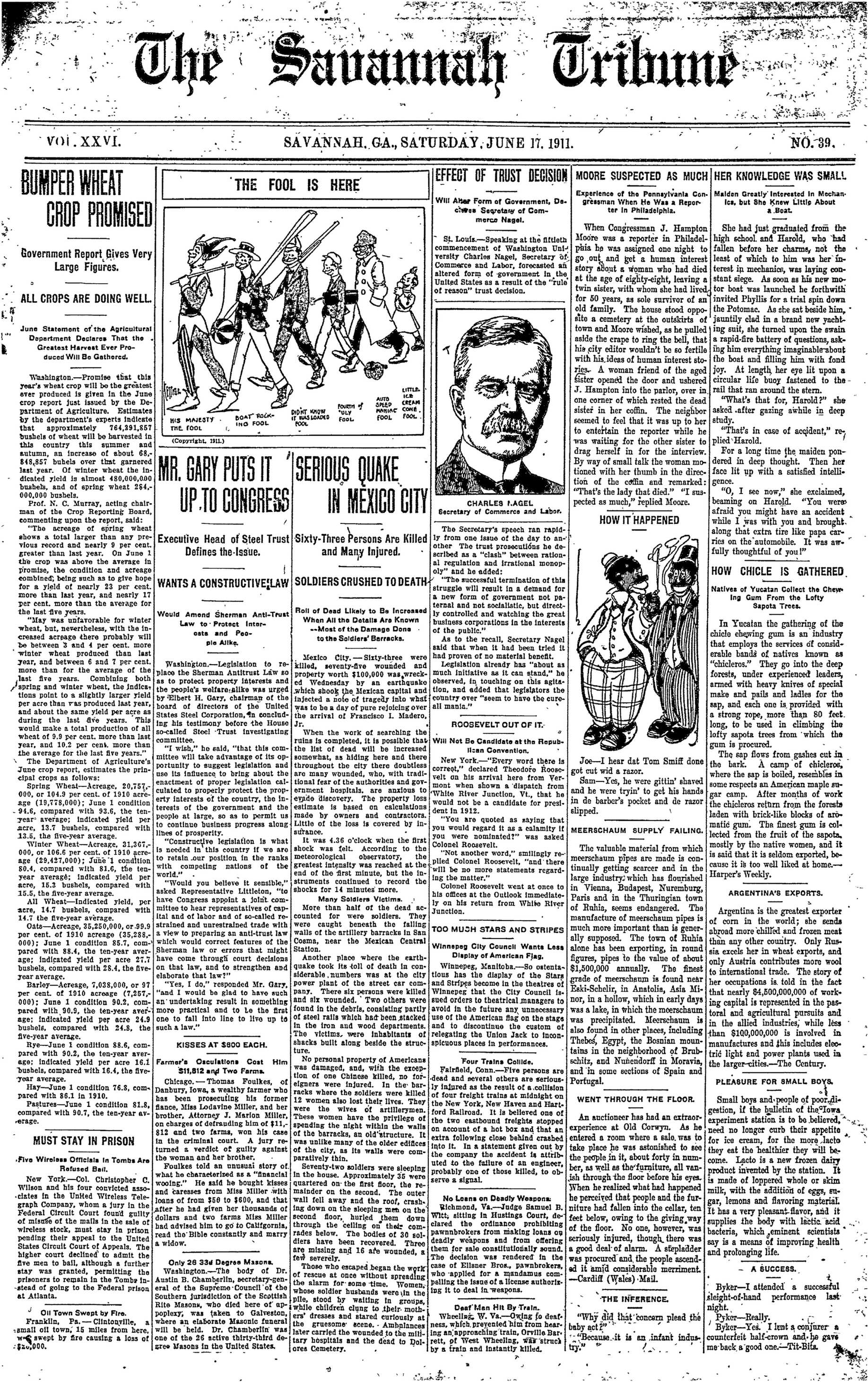
BUMPER WHEAT CROP PROMISED
Government Report Gives Very Large Figures.
ALL CROPS ARE DOING WELL
June Statement of the Agricultural Department Declares That the Greatest Harvest Ever Produced Will Be Gathered.
Washington.—Promise that this year's wheat crop will be the greatest ever produced is given in the June crop report just issued by the Department of Agriculture. Estimates by the department's experts indicate that approximately 764,291,857 bushels of wheat will be harvested in this country this summer and autumn, an increase of about 68,848,857 bushels over that garnered last year. Of winter wheat the indicated yield is almost 480,000,000 bushels, and of spring wheat 284,000,000 bushels.
Prof. N. C. Murray, acting chairman of the Crop Reporting Board, commenting upon the report, said: "The acreage of spring wheat shows a total larger than any previous record and nearly 9 per cent. greater than last year. On June 1 the crop was above the average in promise, the condition and acreage combined, being such as to give hope for a yield of nearly 23 per cent. more than last year, and nearly 17 per cent. more than the average for the last five years.
"May was unfavorable for winter wheat, but, nevertheless, with the increased acropage there probably will be between 3 and 4 per cent. more winter wheat produced than last year, and between 6 and 7 per cent. more than for the average of the last five years. Combining both spring and winter wheat, the indications point to a slightly larger yield per acre than was produced last year, and about the same yield per acre as during the last five years. This would make a total production of all wheat of 9.9 per cent. more than last year, and 10.2 per cent. more than the average for the last five years."
The Department of Agriculture's June crop report, estimates the principal crops as follows:
Spring Wheat—Acreage, 20,757,000, or 104.9 per cent. of 1910 acreage (19,778,000); June 1 condition 94.6, compared with 93.6, the ten-year average; indicated yield per acre, 13.7 bushels, compared with 13.5, the five-year average.
Winter Wheat—Acreage, 21,367,000, or 106.6 per cent. of 1910 acreage (29,427,000); June 1 condition 80.4, compared with 81.6, the ten-year average; indicated yield per acre, 15.3 bushels, compared with 15.5, the five-year average.
All Wheat—Indicated yield, per acre, 14.7 bushels, compared with 14.7 the five-year average.
Oats—Acreage, 35,250,000, or 99.9
per cent. of 1910 acreage (35,288,
000). June 1 condition 85.7, compared
with 88.4, the ten-year average;
indicated yield per acre 27.7
bushels, compared with 28.4, the five-
year average.
Barley—Acreage, 7,038,000, or 97
per cent. of 1910 acreage (7,257,
000). June 1 condition 90.2, compared
with 90.9, the ten-year average;
indicated yield per acre 24.9
bushels, compared with 24.8, the
five-year average.
Rye—June 1 condition 88.6, compared
with 90.2, the ten-year average;
indicated yield per acre 16.1
bushels, compared with 16.4, the five-
year average.
Hay—June 1 condition 76.8, compared
with 86.1 in 1910.
Pastures—June 1 condition 81.8. compared with 90.7, the ten-year average.
MUST STAY IN PRISON
Five Wireless Officials In Tombs Are Refused Ball.
New York—Col. Christopher C. Wilson and his four convicted associates in the United Wireless Telegraph Company, whom a jury in the Federal Circuit Court found guilty of misuse of the malls in the sale of wireless stock, must stay in prison pending their appeal to the United States Circuit Court of Appeals. The higher court declined to admit the five men to ball, although a further stay was granted, permitting the prisoners to remain in the Tombs instead of going to the Federal prison at Atlanta.
Oil Town Swept by Fire.
Franklin, Pa. — Clintonville, a small oil town, 15 miles from here, swept by fire causing a loss of $2,000.
THE FOOL IS HERE
HIS MAJESTY
THE FOOL
BOAT ROCK-
ING FOOL
(Copyright, 1911.)
HIS MAJESTY THE FOOL
BOAT ROCKING FOOL
DIDN'T KNOW IT WAS LOADED FOOL
FOURTH OF "ULY FOOL"
AUTO SPEED MANIAC FOOL
LITTLE ICE CREAM COME FOOL.
MR. GARY PUTS IT UP.TO CONGRESS
Executive Head of Steel Trust Defines the-Issue.
WANTS A CONSTRUCTIVE LAW
Would Amend Sherman Anti-Trust Law to Protect Interests and People Allike.
Washington.—Legislation to replace the Sherman Antitrust Law so as to protect property interests and the people's welfare; alike was urged by Elbert H. Gary, chairman of the board of directors of the United States Steel Corporation, in concluding his testimony before the House so-called Steel Trust investigating committee.
"I wish," he said, "that this committee will take advantage of its opportunity to suggest legislation and use its influence to bring about the enactment of proper legislation calculated to properly protect the property interests of the country, the interests of the government and the people at large, so as to permit us to continue business progress along lines of prosperity.
"Constructive legislation is what is needed in this country if we are to retain our position in the ranks with competing nations of the world."
"Would you believe it sensible," asked Representative Littleton, "to have Congress appoint a joint committee to hear representatives of capital and of labor and of so-called restrained and unrestrained trade with a view to preparing an anti-trust law which would correct features of the Sherman law or errors that might have come through court decisions on that law, and to strengthen and elaborate that law?" "Yes, I do," responded Mr. Gary, "and I would be glad to have such an undertaking result in something more practical and to be the first one to fall into line to live up to such a law."
KISSES AT $800 EACH.
Farmer's Ooculations Cost Him $11,812 and Two Farms.
Chicago. — Thomas Foulkes, of Danbury, Iowa, a wealthy farmer who has been prosecuting his former flame, Miss Lodavine Miller, and her brother, Attorney J. Marlon Miller, on charges of defrauding him of $11,.812 and two farms, won his case in the criminal court. A jury returned a verdict of guilty against the woman and her brother.
Foulkes told an unusual story of what he characterized as a "financial wooing." He said he bought kisses and caresses from Miss Miller with loans of from $50 to $600, and that after he had given her thousands of dollars and two farms Miss Miller had advised him to go to California, read the Bible constantly and marry a widow.
Only 26 334 Degree Masona
Washington.—The body of Dr. Austin B. Chamberilin, secretary-general of the Supreme-Council of the Southern jurisdiction of the Scottish Rite Masons, who died here of appoplexy, was taken to Galveston, where an elaborate Masonic funeral will be held. Dr. Chamberilin was one of the 26 active thirty-third degree Masons in the United States.
SAVANNAH, GA., SATURDAY, JUNE 17. 1911.
DIDN'T KNOW IT WAS LOADED FOOL
FOURTH OF "ULY FOOL
AUTO SPEED MANIAC FOOL
LITTLE ICE CREAM COME FOOL.
SERIOUS QUAKE IN MEXICO CITY
Sixty-Three Persons Are Killed and Many Injured. SOLDIERS CRUSHED TO DEATH
Roll of Dead Likely to Be Increased
When All the Details Are Known
--Most of the Damage Done
to the Soldiers' Barracks.
Mexico City. — Sixty-three were
killed, seventy-five wounded and
property worth $100,000 was wrecked
Wednesday by an earthquake
which shook the Mexican capital and
injected a note of tragedy into what
was to be a day of pure rejoicing over
the arrival of Francisco I. Madero,
Jr.
When the work of searching the ruins is completed, it is possible that the list of dead will be increased somewhat, as hiding here and there throughout the city there doubtless are many wounded, who, with traditional fear of the authorities and government hospitals, are anxious to evade discovery. The property loss estimate is based on calculations made by owners and contractors. Little of the loss is covered by insurance.
It was 4.36 o'clock when the first shock was felt. According to the meteorological observatory, the greatest intensity was reached at the end of the first minute, but the instruments continued to record the shocks for 14 minutes more.
Many Soldiers Victims. More than half of the dead accounted for were soldiers. They were caught beneath the falling walls of the artillery barracks in San Cosma, near the Mexican Central Station. Another place where the earthquake took its toll of death in considerable, numbers was at the city power plant of the street car company. There six persons were killed and six wounded. Two others were found in the debris, consisting partly of steel rails which had been stacked in the iron and wood departments. The victims, were inhabitants of shacks built along beside the structure.
No personal property of Americans was damaged, and, with the exception of one Chinese killed, no foreigners were injured. In the barracks where the soldiers were killed 12 women also lost their lives. They were the wives of artillerymen. These women have the privilege of spending the night within the walls of the barracks, an old structure. It was unlike many of the older edifices of the city, as its walls were comparatively thin.
Seventy-two soldiers were sleeping in the house. Approximately 35 were quartered on the first floor, the remainder on the second. The outer wall fell away and the roof, crashing down on the sleeping men on the second floor, hurled them down through the ceiling on their comrades below. The bodies of 30 soldiers have been recovered. Three are missing and 16 are wounded, a few severely.
Those who escaped began the work of rescue at once without spreading the alarm for some time. Women, whose soldier husbands were in the pile, stood by waiting in groups, while children clung to their mothers' dresses and stared curiously at the gruesome scene. Ambulances later carried the wounded to the military hospitals and the dead to Dolores Cemetery.
EFFECT OF TRUST DECISION
Will After Form of Government, Declares Secretary of Commerce Nagel.
St. Louis.—Speaking at the fifteenth commencement of Washington University Charles Nagel, Secretary of Commerce and Labor, forecasted an altered form of government in the United States as a result of the "rule of reason" trust decision.
T
The Secretary's speech ran rapidly from one issue of the day to another. The trust prosecutions he described as a "clash" between rational regulation and irrational monopoly" and he added:
"The successful termination of this struggle will result in a demand for a new form of government not paternal and not socialistic, but directly controlled and watching the great business corporations in the interests of the public."
As to the recall, Secretary Nagel said that when it had been tried it had proven of no material benefit.
Legislation already has "about as much initiative as it can stand," he observed, in touching on this agitation, and added that legislators the country over "seem to have the cure-all mania."
ROOSEVELT OUT OF IT.
Will Not Be Candidate at the Republican Convention.
New York.—"Every word there is correct," declared Theodore Roosevelt on his arrival here from Vermont when shown a dispatch from White River Junction, Vt., that he would not be a candidate for president In 1912.
"You are quoted as saying that you would regard it as a calamity if you were nominated?" was asked Colonel Roosevelt.
"Not another word," smilingly replied Colonel Roosevelt, "and there will be no more statements regarding the matter."
Colonel Roosevelt went at once to his offices at the Outlook immediately on his return from White River Junction.
TOO MUCH STARS AND STRIPES
Winnepeg City Council Wants Less Display of American Fjag.
Winnepeg, Manitoba.—So ostentatious has the display of the Stars and Stripes become in the theatres of Winnepeg that the City Council issued orders to theatrical managers to avoid in the future any unnecessary use of the American flag on the stage and to discontinue the custom of relegating the Union Jack to inconspicuous places in performances.
Four Traina Collide.
Fairfield, Conn.—Five persons are dead and several others are seriously injured as the result of a collision of four freight trains at midnight on the New York, New Haven and Hartford Railroad. It is believed one of the two eastbound freights stopped on account of a hot box and that an extra following close behind crashed into it. In a statement given out by the company the accident is attributed to the failure of an engineer, probably one of those killed, to observe a signal.
No Loans on Deadly Weapons
Richmond, Va.—Judge Samuel B. Witt, sitting in Hustings Court, declared the ordinance prohibiting pawnbrokers from making loans on deadly weapons and from offering them for sale constitutionally sound. The decision was rendered in the case of Ellsner Bros., pawnbrokers, who applied for a mandamus compelling the issue of a license authorizing it to deal in weapons.
Deaf Man Hit By Train
Wheeling, W. Va.—Owing so deafness, which preyed him from hearing an approaching train, Orville Barrett, of West Wheeling, was struck by a train and instantly killed.
MOORE SUSPECTED AS MUCH
Experience of the Pennsylvania Congressman When He Was a Reporter in Philadelphia.
When Congressman J. Hampton Moore was a reporter in Philadelphia he was assigned one night to go out and get a human interest story about a woman who had died at the age of eighty-eight, leaving a twin sister, with whom she had lived for 50 years, as a sole survivor of an old family. The house stood opposite a cemetery at the outskirts of town and Moore wished, as he pulled aside the crape to ring the bell, that his city editor wouldn't be so fertile with his ideas of human interest stories. A woman friend of the aged sister opened the door and ushered J. Hampton into the parlor, over in one corner of which rested the dead sister in her coffin. The neighbor seemed to feel that it was up to her to entertain the reporter while he was waiting for the other sister to drag herself in for the interview. By way of small talk the woman motioned with her thumb in the direction of the coffin and remarked: "That's the lady that died." "I suspected as much," replied Moore.
HOW IT HAPPENED
Joe—I hear dat Tom Smiff done got cut wid a razor.
Sam—Yes, he were gittin' shaved and he were tryin' to get his hands in de barber's pocket and de razor slipped.
MEERSCHAUM SUPPLY FAILING.
The valuable material from which meerschaum pipes are made is continually getting scarcer and in the large industry which has flourished in Vienna, Budapest, Nuremburg, Paris and in the Thuringian town of Ruhin, seems endangered. The manufacture of meerschaum pipes is much more important than is generally supposed. The town of Ruhia alone has been exporting, in round figures, pipes to the value of about $1,500,000 annually. The finest grade of meerschaum is found near Eski-Scheller, in Anatolia, Asia Minor, in a hollow, which in early days was a lake, in which the meerschaum was precipitated. Meerschaum is also found in other places, including Thebes, Egypt, the Bosnian mountains in the neighborhood of Brubschitz, and Nuncendorff in Moravia, and in some sections of Spain and Portugal.
WENT THROUGH THE FLOOR.
An auctioneer has had an extraor-experience at Old Corwyn. As he entered a room where a sale, was to take place he was astonished to see the people in it, about forty in number, as well as the furniture, all vanish through the floor before his eyes. When he realized what had happened he perceived that people and the furniture had fallen into the cellar, ten feet below, owing to the giving way of the floor. No one, however, was seriously injured, though there was a good deal of alarm. A stepladder was procured and the people ascended it amid considerable merriment.—Cardiff (Wales). Mail.
"Why did that concern plead the baby act?" "Because it is an infant industry."
HER KNOWLEDGE WAS SMALL
Malden Greatly Interested In Mechanics, but She Knew Little About a Boat.
She had just graduated from the high school and Harold, who had fallen before her charme, not the least of which to him was her interest in mechanics, was laying constant siege. As soon as his new motor boat was launched he forthwith invited Phyllis for a trial spin down the Potomac. As she sat beside him, jauntily clad in a brand new yachting suit, she turned upon the swain a rapid-fire battery of questions, asking him everything imaginable about the boat and filling him with fond joy. At length her eye lit upon a circular life buoy fastened to the rail that ran around the stern.
"What's that for, Harold?" she asked after gazing awhile in deep study.
"That's in case of accident," replied Harold.
For a long time the maiden pondered in deep thought. Then her face lit up with a satisfied intelligence.
"O, I see now," she exclaimed, beaming on Harold. "You were afraid you might have an accident while I was with you and brought along that extra tire like papa carries on the automobile. It was awfully thoughtful of you!"
HOW CHICLE IS GATHERED
Natives of Yucatan Collect the Chevy Ing Gum From the Lofty Sapota Trees.
In Yucatan the gathering of the chicle chewing gum is an industry that employs the services of considerable bands of natives known as "chicleros." They go into the deep forests, under experienced leaders, armed with heavy knives of special make and pails and ladles for the sap, and each one is provided with a strong rope, more than 80 feet long, to be used in climbing the lofty sapota trees from which the gum is procured.
The sap flows from gashes cut in the bark. A camp of chicleros, where the sap is boiled, resembles in some respects an American maple sugar camp. After months of work the chicleros return from the forests laden with brick-like blocks of aromatic gum. The finest gum is collected from the fruit of the sapota, mostly by the native women, and it is said that it is seldom exported, because it is too well liked at home. Harper's Weekly.
ARGENTINA'S EXPORTS.
Argentina is the greatest exporter of corn in the world; she sends abroad more chilled and frozen meat than any other country. Only Russia excels her in wheat exports, and only Austria contributes more wool to international trade. The story of her occupations is told in the fact that nearly $4,500,000,000 of working capital is represented in the pastoral and agricultural pursuits and in the allied industries, while less than $100,000,000 is involved in manufactures and this includes electric light and power plants used in the larger-cities.—The Century.
Small boys and people of poor digestion, if the bulletin of the Iowa experiment station is to be believed, need no longer curb their appetite for ice cream, for the more lacto they eat the healthier they will become. Lacto is a new frozen dairy product invented by the station. It is made of loppered whole or skim milk, with the addition of eggs, sugar, lemons and flavoring material. It has a very pleasant flavor, and it supplies the body with lactic acid bacteria, which eminent scientists say is a means of improving health and prolonging life.
Byker—I attended a successful sleight-of-hand performance last night.
Pykor—Really.
Byker—Yes. I lunt a conjurer a counterfeit half-crown and, he gave me back a good one.—Tit-Bits.
Kadeshbarnea
A Sermon
And we came to Ka-desh-barnea.—
Denteronomy, 1:19.
Kadeshbarnea was the place of the Israelites' greatest opportunity to possess the "promised" land of "Canaan," and their failure to do so at this particular time and place brought great sorrow to the heart of Moses, their leader, and caused the Israelites themselves to wander in the wilderness 40 years trying to recover that which they might have won in a single day if their faith in God had been sufficient to make them follow his commands. Opportunities come in the life of every man and nation, and when they are not embraced in many instances they are irrevocable—therefore we should ever be on the watch for the "Kadeshbarneas" of life. The past, present and future of Israel met at Kadeshbarnea and made a supreme moment in the life of the individual and nation. They had marched many miles, had toiled and struggled and denied themselves of many comforts to reach this very place, the threshold of the promised Canaan, yet upon the threshold they failed. Every day is not a May-day in the life of men, and opportunities are not toys to be played with, for it is possible, as in the case of Israel, to reach the margin of a glorious destiny and then for lack of moral strength or living faith turn and go wandering in the desert.
Kadeshbarnea proved to be a place of difficulties, and difficulties always bring forth either "falth" or "unbelief," and in this instance only two men (Caleb and Joshua), after listening to the stories of the spies about the great difficulties to be encountered, stood firm in their faith; all of the others lost their grip on God and began to make excuses for not undertaking the conquest of the land. Notwithstanding the fact that they had already endured more hardness in their marches to Kadeshbarnea than they would have to endure in their march to Canaan, yet their unbelief stopped their courage and left them with all kinds of prudential fears, turning them practically into cowards. Their unbelief begins to grow by their cowardly fears and stage after stage in their spiritual life begins to unfold. The unbelief of the people that God would not fulfill his promise caused them to act foolishly; they had been seeking a crown, a crown that was indeed hard to win. It was the crown of their liberty, their happiness and their home as a nation; yet standing at Kadeshbarnea, with God telling them to go up and possess the land, they view the crown of their toilsome journey from Egypt and with foolish unbelief that God would fall them they deliberately destroy the crown so hard to win. The faith of Caleb and Joshua stimulates them to endeavor, and they try in vain to wake up the people, but unbelief, like a poison, has enervated them, their spiritual life is changed, and the golden opportunity of Kadeshbarnea is lost forever to the entire generation and causes the younger generation to endure 40 years of wandering in the wilderness that might have been spent in the promised land of Canaan. Their unbelief practically maligned Jehovah himself. They doubted the promise of God and gave no heed to his warnings, and in doing so they made God a litar. Such unbelief is the essence of blasphemy, the seed of misery and the germ of hell. The law of the New Testament concerning unbelief is the same as the law of the Old Testament. Because, says the writer of the epistle to the Hebrews, "of the unbelief of the people at Kadeshbarnea God swore that they should not enter into his rest, so he has sworn that those who are unbelvers shall not enter into the heavenly Canaan, the rest of the people of God." When people say to God "Depart from me" there is a severe but equitable retribution when God says to the people "Depart from me."
When opportunities come, though they may be surrounded by many difficulties, if we do not accept them the punishment of losing them is greater than the hardships of the fight to win them. When the Israelites at Kadeshbarnea said "We will not march to Canaan, for the journey is too rough and stony," then God said "The opportunity is lost—there is no other way to maroh but in the desert;" and so for 40 years they wandered around the place of rest, but never set foot upon it. They paid dearly for their unbelief, and like Esau, who sold his birthright for a mess of pottage, sought it afterward with many tears, but found no place for its redemption. So with this generation of Israelites. Only Caleb and Joshua lived to set up the banner of victory in the land flowing, with milk and honey. Many of them, no doubt spent day after day weeping over their lost opportunity, but God did not regard their tears and they moved drearily on to "nowhere"—their lives as empty as the desert over which they walked.
There is a solemn lesson in our text: The great leader of the nation, before his own departure for the heavenly Cannan, tells those who were too young to remember the splendid opportunity of the Israelites at Kadeshbarnes, the sad event in their history, and as he rehearses it we can imagine we hear his voice trembling as he says: "And then we came to Kadeshbarnes." For to Moses the name of that place was but another name
for "irrevocable," "disappointment," "might have been," and the weary marches of 40 years had printed in the sand of the desert "Opportunity and unbelief equals forfeiture of rest." The place of the brightest promise now becomes the place of the most solemn warnings, the place of happy hopes—the place of painful despair, the threshold of rest becomes the portals of restlessness. "And we came to Ka-desh-barneal!" With what? Faith of a Caleb or Joshua, or with the unbelief of a generation? If we come with the former, we will gain a Canaan; if with the latter, a wilderness.
WHAT LIFE IS
CLAIMING SOMETHING AS YOUR
OWN, FINDING IT, IMPROV-
ING IT.
To locate a claim! Why, that's what
life is! Claiming something as your
own, finding out exactly where it is,
then going to work on it to improve
it.
Many a boy begins to locate his claim before he is in the high school. We say he has a "bent" toward this or that. He has literary tastes. His claim is the world of books. Or he has mechanical genius. Another has an ability to speak easily standing on his feet. His claim is the world of speech and oratory, persuasion in the courts for the sake of justice, or in the pulpit for human uplift. These are great claims, and it's a splendid thing to feel that one is naturally drawn to some one of these large lines of activity. If he has this "bent" early in life, and is conscious of it, he is saved much hunting in the dark to "find a job," and he wards off that bad state of mind when one must wonder what he is really going to do to make an honest living. For pay our way we all surely must.
That great man, Thomas Carlyle, said: "Blessed is he who has found his work. Let him ask no other blessedness." Which is as much as to say, Blessed is he who has located his claim. I know a man today who is over fifty years old who has gone to farming in the last two years. He is struggling very hard, and I admire him for that, but it is such a hard struggle that I am sorry for him. I know he can never be a successful farmer, because he put off beginning until too late. He didn't locate his claim early enough. The men who have helped the world most are those who have worked long at one thing, even though they might play at many smaller things. And the only way to work long at a thing is to begin early. George Washington became leader of the American army because, many years before, he located that claim by hard service in the French and Indian war. I once saw a small boy running down the hill to reach the ferry, going across the river. But he was just too late. "Well, my boy," I said, "it's too bad; you didn't run fast enough." "Oh, yes, I ran fast enough," he said, "but I didn't start soon enough." He was a wise boy. To locate your claim, start soon. It's better than running fast—George L. Parker in St. Nicholas.
THE LORD'S PRAYER.
By Miss Grace B. Berry.
Our—gracious Lord who lives and reigns on high,
Father—of all, beyond exalted skies,
Who art in Heaven—and earth forever the same,
Hallowed be—thy blessed Holy Name.
Thy name shall ring o'er land from shore to shore,
Thy kingdom shall be sought forevermore.
Come gracious Lord with all thy Heavenly power,
Thy will be done on earth each coming hour.
As 'tis around thy holy righteous throne,
In Heaven which splendor here was never known.
This day our sins beyond all years to come,
Our daily bread like Heavenly manna send,
And grant us peace with these our brethren,
Forgive us every vain and idle thought.
Our trespasses, oh, Lord, remember not;
As we forgive wilt thou forgive the same,
Those who trespass against us. In Jesus' name.
Lead us forever by thy side.
Not into temptation may we ever abide.
But deliver us when weakened by earth's trial,
From evil when we're tempted to denial,
For thine is, the world and all its treasure;
The kingdom, the power and the glory
Forever and forever will remain,
Amen and evermore the same.
SALTED RAILWAY SLEEPERS.
Railway.sleepers used in south Russia are salted for preservation. The discovery of the efficacy of salt for the purpose was made accidentally some twenty-five years ago. The telegraph poles of Sebastopol soon rotted below the ground, and one of the staff tried the experiment of putting a pool of salt into the hole prepared for the reception of the base of a pole. The wood lasted five times as long as usual, and the experiment was repeated and extended to railway sleepers. Crude sea salt, such as is recovered along the Crimean coast, is used.
OUR CHANGED CONDITION CARRIES A HEAVY RESPONSIBILITY
In a sense, it is almost remarkable, and we believe it true of most every place, that the women of the race lead in all constructive moral and spiritual endeavor, looking to the general improvement of racial conditions. It is one of the most helpful and encouraging signs of progress among us that the thoughtful women of the race are unweared in their endeavors. And just now we are speaking of the material aspect of their work, as of that which is truly, in the line of moral betterment. The poor suffering infants which need such care as afforded in day nurseries, the ignorant colored girl coming from the rural districts to work; the unfortunate women of the race who need encouragement and opportunity; the aged infirm, and many other phases of moral endeavor which we could mention, are drawing our women together.
Are our people in Baltimore, the more favored class, and especially the men, aspiring to be equal to the responsibility resting upon them by reason of their changed circumstances of life?
In the past few years there have come into being some twenty or more colored physicians, and that all of them are succeeding admirably, one would certainly judge by their excellent homes, and general equipment. Race confidence and race support have made these things possible. From only a handful of colored teachers we now have possibly 300. And there are other callings pursued by many of our people which have yielded them good results. All of this is because they are colored. We do not relish having it put in such a way, but it is a fact nevertheless. These very handicaps: oppression and jim-crow treatment meted out to the race, are responsible for the opportunities which the enterprising young colored man has by which we may hope to mount up to fame and prosperity. If, then, our poor and suffering race are minded to respond as they have done, in this particular, a most serious responsibility is thereby created, and this favored class among us have not the true conception of life if they fall to interpret the responsibility.
It is their bounden duty to bring to bear upon the problems of the race the fullness of their knowledge and experience, give of their time, thought and means to devise and construct on behalf of the moral and material betterment of the race. It is a common thing in all our cities for the women to meet regularly for the prime purpose of grapping with these various problems of the race. But when do our men meet for such purposes? What are the evidences that the materially prosperous among us are systematically at work studying the needs of our poor people, and leading on in'one constructive remedy?
The other night the Provident hospital in Baltimore had its graduation of nurses. But few of the members of the faculty were present, and only two or three of the many doctors in the city; whereas all of them are supposed to be at least morally interested in such work. The men among us belonging to the favored class, by reason of our material success, must lead in systematic and applied consideration of such things, and put much more of the money they have been able to save into such projects than is usually the case. When we give more of our attention to such matters and are more generous in our financial contributions towards such enterprises that we believe to be worthy then the masses of the people will surprise themselves in their interest and generosity. But they are not going to be enthusiastic about such things while the men who have the most, and who will more largely profit by such successes, are indifferent, apathetic and niggarly sting both with their time and means.
If not impelled by the proper motive, love, then certainly ought they be influenced by the one not so noble, but which, perhaps, appeals very strongly to some, self-interest. It is directly to the personal interest of each and every one of this class to do all within his power, by thought, active co-operation, and liberally giving of his means to systematically advance the moral, spiritual and material well being of that section of the population with whom he is so closely identified. More business, money, honor and influence await each and every one in proportion as the great body of the people are uplifted to higher and better ideals and become more efficient in the affairs of life. And, better than all this, the destiny of man is the solution of difficult problems, and in the application and effort which they bestow in improving conditions their own moral and spiritual life will glow and expand with brilliance, beauty and strength. In the progress of affairs they will become fresh miracles to themselves, rejoicing in the strength and richness of the flow of real life and animation in their veins. By inertness and indifference they are missing the genuine manly and powerful life which is their rightful heritage. — Afro-American Ledger.
TO CLEAN MARBLE.
Badly stained marble may be cleaned by mixing up a quantity of the strongest soap lye with quicklime to the consistency of milk and laying it on the marble several minutes. Avoid touching the mixture with the hands.
THE GOLDEN LAND
THE SOUTH THE NATURAL HOME OF THE NEGRO.
America has a golden land, a land of plenty, a land where there is to be found the riches of the earth, and where there is all that makes a nation great and happy, save justice. The American negro claims that golden land as his home, and day by day he turns towards it with renewed love and pride. The south, we are told, is the natural home of the negro. Happy ought he to be to claim it, and grateful that Providence has set him in the midst of the glories of peace and plenty. Equality may be denied him there, and there he now may encounter prejudice and injustice. His women may sorrow under the tyranny of "superior" men, who make of outrages upon them the virtues of the strong. His children may for the moment cower under the whip of scorn, but these things will pass away. the generations now may be gone when the great change comes, but it comes swiftly, and it comes to revolutionize the whole social fabric of the south, and make its freedom complete. It takes faith to see this, but a people without faith is a people without hope, and a people without hope is a people without all. Fifty years ago the negro was a slave, a piece of breathing property. Progress is comparative. He is not a slave today, and will be more of a man tomorrow. He will find his highest freedom in the land where once he hit the earth in tears and chains. The opportunities of the south are his. He may achieve, or he may fall; it is his decision that will make him free, or make him fall.
Let us discover the golden land. The south produces, according to Richard H. Edmonds, the distinguished editor of the Manufacturers' Record, cotton enough to bring from Europe each year $500,000,000. That is not all. The annual crop of raw cotton, not to mention the great revenue that flows through cotton seed mills, is worth $1,000,000,000. In the south there is three times as much coal as can be found in Great Britain, France and Austria combined. Mr. Edmonds' figures are 17,000 square miles for those three countries against 60,000 square miles for the south. Its water power, when developed, will amount to 5,000,000 horse power.
Not only in respect of these presents, but in relation to its great orchards, its truck farms, its corn crop and wheat production; the south is the golden land, and its fields but scarcely touched. The land is undeveloped, almost undiscovered. Fifty years hence, when reason shall have done its work and the peoples there are each secure in life and liberty; the south will then be only in the beginning of the development which will unfold its astounding riches. Forty acres of southern land today will be a heritage tomorrow.
Let the negro in the south there remain, lay his foundation in the soil of that golden land, enter into the spirit of progress that begins now to stretch its wings against southern skies; burn steadily the oil of knowledge, cast a vote whenever he is permitted to do so by the cotton kings, enter the fields of commerce and try every trade and craft. Let him look to his place as the moving economic force in the affairs of his section; and when the real promises of his own golden south break above him or above his children, how well he chose will then be seen.
RAGE ENTERPRISES
Not all colored men practice what they preach when it comes to giving patronage to negro enterprises. In many cases there is a plausible excuse, but in the majority of instances the failure arises from the same cause that is sought to be combated among the people generally. This is found in a lack of confidence in everything which a negro controls. The few really successful negro enterprises have succeeded with this handicap and in spite of it. They have, however, opened up the way whereby their successors and imitators may go to even greater heights of success, for they represent breaches in the wall which has hitherto barred negroes from success in business. These few will in years become, many and then confidence will replace distrust and success dislodge failure. It is a mental attitude fostered for centuries by negroes, which can only be broken down gradually. With this as with all things that are worth much to the advancement and progress of a people, time is an important element. If enterprises can be started now and conducted for a time in every community in the country economically, the time will assuredly come when the race will become aroused to the necessity of giving every needful encouragement to negro enterprise. They must do.-Durham Reformer.
GOT RID OF THE SCUM.
She was a city bride who had never before taken a hand in housekeeping and knew but little about things in the kitchen. A few mornings ago she got after the milkman.
"What's the matter with your milk?" she said, with great reheemence.
"I don't know," he replied. "What do you find wrong with it?"
"Well," she said, "every morning it is covered with a nasty yellow scum."
"And what do you do with the scum?"
"Why, I skim it off, of course, and throw it in the garbage can."—Farmers' Guide.
NEGRO MINERS SUPPORT SCHOOL
Corona, Ala. Normal and Industrial Institute Is Unique School.
WHITEB ATTEND EXERCISES—PROMINENT CITIZENS OF CORONA, ALABAMA, SEE NEGRO GRADUATES AWARDED DIPLOMAS.
Corona, Ala. (Special).—A large number of prominent white citizens of this community attended the closing exercises of the Corona Normal and Industrial Institute for Negroes, which is supported by negro miners by the payment of a monthly tax, among whom was Belton Gilreath of Birmingham, well known as a philanthropist and publicist.
Others present were Dr. D. B. Chilton, H. P. Gibson, superintendent of Corona mines; J. W. Harkins, superintendent of the Patton mines; Rev. J. E. Kilgore, president of the school board; J. T. Savage of the Corona mines; A. Carpell, W. F. Flies and R. C. Lollar, merchants of Corona.
Mr. Gilreath was introduced by L. B. Musgrove, president and general manager of the Corona corporation, who paid a high tribute to the faithfulness of the negroes of this section in maintaining the institution for the education of their children. "You have been faithful in many things," he said. "This corporation could not have been the success it has without your help. I have never had to call for help of any kind without a ready response, and in my heart I appreciate it."
In the beginning of his address, Mr. Gilreath commented on the infrequency of crime in this district as compared with that of other mining districts and declared it to be due in a large measure to the influence of the institution. The work of William H. Councill, who laid the cornerstone of the first building here, and whose graduates for the most part have carried on the work, was given high praise, and the usefulness of the dead educator to the state of Alabama and the south dwelt upon at length. In the course of his remarks Doctor Gilreath said:
"The negroes of this section of Alabama have a great opportunity. Two-thirds of the ore mining is done by them, whereas, when I first came to Alabama it was done entirely by white miners. Negroes are learning how to do things. Mr. Musgrove in his work here is a great agent for the people. He pays you a high compliment when he admits that you are colaborers with him. God put you here for a purpose. He had a motive for it, for he is behind all race movements. If the white people are ahead of you in any way, remember they have great responsibilities by reason of that fact that you do not have.
"You have with them, however, the same chance to read the Bible; the same chance for development; the same chance to build character and, after all, it is character that counts. Your race is doing far more than you perhaps think; and yet there is a great work for you to do. The white people have the same trouble raising money for their institutions that you have, and you have no need to be discouraged at all.
"The same God that laid down the principle that out of the sweat of the brow shall man be fed, also laid down the principle that all men were created out of one blood. It is not a question of color. It is a question of what man is doing. You have great race leaders. Take their advice, emulate their example, and you will have no need to be discouraged. You must learn that to succeed in any work means to become an artist. A cook is an artist; so is the good miner; the good farmer. To develop this school here as you have begun, I want you to work in harmony with your trustees, with your principal, and above all, for yourselves, save your money and buy property."
In closing, Mr. Gilreath paid a high tribute to the efficiency of the work of the principal, M. H. Griffin. Superintendent J. W. Harkins declared that in all his work he heard no complaint from the miners of the tax they paid for the support of the school, and that in the work of the men he could see the good influence of the school.
REFORMERS "COME BACK."
Richmond, Va.—(Special.)—After a remarkable campaign the Grand United Order of True Reformers have succeeded in rehabilitating itself. Insurance Commissioner Joseph Button, for Virginia, has renewed the license of this great organization and it is now beginning a new era for itself. Throughout the country there is great elation over the "coming back" of the organization, because it shows that the negro is capable of conserving his varied interests of large movements for the conservation of certain economic forces conducive to the material progress of people of negroid descent.
. WISE ROSALINDI
Reginald—Darling, I see by the papers that a food expert says that it is possible for a family to live on $4 a week. Do you think it possible? Rosalind—No, dearest, but I'll be a alster to you! Cleveland Leader.
GOVERNOR:MANN OF VIRGINIA
ADDRESSES GOLORED PEOPLE
TELLS HIS AUDIENCE SERVANTS WHITE CAP AND APRON ARE AS HONORABLE AS COLLEGE CAP AND GOWN.
Richmond, Va.—One of the busiest sessions ever held by the Virginia Baptist State convention. Dr. R. H. Bolding presided and the praise services were conducted by Reva. F. C. Patterson of Hollis, L. A. Green of Swansboro and J. S. Minor of Beulah. "Home Life of the Negro" was the theme of the address delivered by President Bowling to the convention. "One of the things that we must teach our people in this world," he said, "is the importance of getting-homes and paying for them, educating their children and bettering their own conditions as individuals, and this will mean racial progress.
"Education must go a long way toward helping our people. I want that we shall do all in our power to wipe out our illiteracy, ignorance and crime. Every state in the Union should do this. The men of both races who make the most trouble are the ignorant, vicious class. While here, let me speak against crime and criminals. They are produced by loafers. Loafers of any race are dangerous and we are willing to join with the lawmakers to reduce loading.
"Teach them that all labor is honorable; that the white cap and apron of the servant are as honorable as the college cap and gown. Teach them that the pickax and shovel, the plow and the hoe are as honorable as the pen and more honorable than the sword. Teach them to tell the truth, pay their debts, to give their words as hostage for their lives, and that crime, criminality, loading, stealing, gambling, swearing, are the things which bring disgrace to races or individuals. The Virginia Baptist State convention stands for higher manhood, and womanhood."
Prof. W. T. B. Williams, field secretary of the Slater fund and secretary of the Negro Organization society, was presented to the convention and delivered an address. He said he was delighted to see the wonderful progress being made in the convention and felt that it meant much for the future of the negro in this country. "We cannot sit down and wait, but must be ever up and doing something."
When Governor W. H. Mann entered the Fifth Street Baptist church, accompanied by a committee consisting of Revs. W. F. Graham, Walter H. Brooks, B. Tyrell, W. B. Reed, M. B. Hocles, J. Madison Young and W. B. Hood, he was given an enthusiastic ovation by the fifteen hundred members of the convention.
The Rev. W. F. Graham, D. D., pastor of the church, introduced his excellency the governor, who addressed the convention.
Governor Mann said in part:
"Having text assigned me, I feel that I am here for two or three purposes. I want to show the people of Virginia and the people of Richmond, where I stand. I stand to push forward the good of the people and I was elected governor for that purpose. I speak to you as a layman who believes that Jesus Christ came to save sinners, of which I am one.
"If I could give a word of advice to this body of representative preachers who have assembled here from all parts of the state of Virginia and District of Columbia, I would use the words of the apostle Paul, "that I know nothing about you save Jesus Christ and him crucified." The people who come to church come to hear the gospel. They care nothing about your theories and science, but they want to know the way to heaven.
"I have seen men's whole course of life changed in a moment by the Spirit. Now, have you got this religion? I hope you have. The religion that will make a man better. You can come to the throne of grace asking for loved ones, as Moses did.
"Why are you here, preachers? Preaching for money? No, I can make more money at anything else, but I am preaching because I am compelled to preach. Do you fall into error sometimes? Yes; but then what would you do? Do like the man who stumps his toes. Get up and go on serving God. Look up. Cling to the higher things in life. Read the life of Christ and that's all you need to do. You will never find a single instance where Christ did for man what he could do for himself. When he went to raise Lazarus from the dead some one had to remove the stone, because man had to do that for himself, but Christ had to raise the dead.
"I want to impress on you that God does not thrm his back on human beings, but man turns his back on God. The prodigal son who left his home, left his father and went away from home. His father remained at home. Do not go away from God."
Rev. R. C. Wood responded to the address of the governor.
Among others who spoke during the day were Revs. I. Francis Walker, of Cincinnati; Granville Hunt, of New York; R. W. Young, of Upper Zion, Va.; Prof. J. S. Lee, president of the State Sunday School convention, and A. W. Holmes, president of the Order of True Reformers.
A JUDICIAL REPROOF.
A justice once reproved a would be suicide thus: "Young man, you have been found guilty of attempting to drown yourself in the river. Only consider what your feeling would have had been you succeeded."-Green Bag.
AFRO-AMERICAN CULLINGS
The cant-saying so popular now in the slang of the day, "they all look good when they're far away," has present and vital application in the discussion as to whether America or Europe is to be preferred by the American colored citizen. The number of dissatisfied and disgruntled colored people in this country is growing daily, and the much heralded freedom from color prejudice of the old world has caused not a few strong and sensible colored men to ponder seriously the question as to whether they should not flee from the colorphobia of these shores. No one has yet come forth to deny the assertion that Europe is far less prejudiced than America.
But if Booker T. Washington may speak through the notable series on "The Man Farthest Down," in the Outlook, the United States is infinitely better as a home for the black man than any country in Europe. On his recent trip abroad he was importured, he relates, by many Americans, both white and colored, to assist them in getting passage back home. A colored citizen especially hemaoaned their fate, declaring there was no work in England for his race. Nor would Mr. Washington have us believe that the colored man on this side is only better off than the colored man on the other side. He declares that the colored man here is infinitely better off in his chances for work, life and enjoyment than the white man of his same station there. In short, the distance of Europe lends almost her only enchantment.
Singularly enough, George Clemenceau, former premier of France, recently in his series in the New York Times, gives complete collaboration to the words of the Tuskegeean. In studying conditions in Brazil on his travels, he tells his "French brethren in shiny threadbare sleeves," that the black people of Brazil are better off than they. "Come out here," he asks, "young men, in shiny threadbare sleeves, who make your way nightly homeward to the close dens around the Sacre Coeur; come and see these black coffee planters, men, women and children, living close to nature on the outskirts of civilization, and compare your own wretched quarters furnished by Dufayel on the 'Hire' system that has cost you such anxious moments, with the blissful nudity of these cabins and tell me where you see the worst form of slavery, here among the newly emancipated Africans or at home under your own roofs?"
To all those colored men groaning with discontent at American conditions and yearning for Europe, we suggest that they follow these series by France's great statesman and America's great industrial educator. Yet to those same men we do not urge that they abate by one jot or title their fight to have America give their race the rights and opportunities of equal citizenship which belong to them by right. The colored citizens of this great land would be unworthy of their citizenship, unworthy possessors of the great heritage of freedom and equal rights handed down to them by 200,000 of their heroic fathers, if they did not press the battles to the gates until they are admitted to an equal place in their fatherland. And for this reason, too, they should stay here.
Europe is settled with her fixed classes and her poverty. This is still the land of wealth and opportunity. It is for America's colored citizens to make the most of it.-Editorial: Amsterdam (N. Y.) News.
Several weeks ago a hundred teachers visited Tuskegee Institute.. They were amazed at what they saw. All men are amazed at Tuskegee, in many respects the thing wonderful, in America. Among the number there were several Ohio teachers and the editor of the Ohio Teacher. The editor puts in his journal his impression of the things he saw, and we venture the earliest paragraph for a layman's eye:
"We might as well admit in the outset that Booker T. Washington has been doing for years what many a white educator has talked about and conjectured he would do some day. During the past five years prominent educators have discussed the psychology of motivation, but the great school at Tuskogee has been motivating for a quarter of a century, and during the past ten years has solved many a pedagogical problem relative to manual training, vocational studies, the correlation of motor and sensory activities and the social efficiency of the individual. While many of us have been talking glibly about these things, Dr. Washington, born in slavery, has been modestly working them out for his race."
That is too much for our usual willing hands, and we spread it on the minutes of general achievement, with the rather ragged translation that Tuskegee is the model American university, that it came out of the brain and struggle of a Virginia slave, that it is the beacon light for educational effort everywhere, and that Booker Washington is the prophet of useful learning. If that translation proves not the purpose, it is no fault of ours—N. Y. Ago.
A London professor has found that the white race is doomed to die off the face of the earth, and he has discovered that the original color of man was brown. While the information brought to us by the London truth-seeker is of great human interest, it is not altogether informing. We do not believe that the white race will ever die off the face of the earth, for that race is smart enough to save its life by fusion, or by the art of combining with all other races against what is still the undiscoverable purpose of time. What the white race may lack in vitality may be supplied by the blue bloods of our own southern states, as represented by the first families of Carolina, led by Tillman; the first families of Arkansas, led by Jefferson Davis, and the first families of Mississippi, led by Jeems Katydid Vardaman. No formula or discovery of science could convince these militant and heated defenders of the white race that their time of passage from the earth will ever come. We side with them. We should hate so much to give up white people, for they have their place in the civilization of the world and ought not to be disturbed by professors and uncouth scientists. As for the color of original man, we have known all along that it was a color other than white, for that color is out of all harmony with nature, but have feared to claim it was black lest science should throw its giant form against us. We are willing to compromise on brown, the most engaging of all the colors, and which fits so well in all scheme and shadings. The whites, as this London professor points out, may be unable to fit in in tropical climates, but they have fitted in well enough in Africa to gobble up all the lands and riches of that continent, and in most all other climates, tropical or otherwise, where they have settled. There may be some serious facts with respect to the races of the earth, their color, shadings, varying constitutions and organisms, such as Boaz of Columbia presents, but that one race will ever completely die away and another race alone survive, we take no stock in. The fact is, let us take our own country, that both white and black, yellow and brown, are increasing year after year, increasing by hundreds of thousands. The group of people called negroes, for example, started out 50 years ago with 4,000,000 in numbers. Today a fair count would give them 12,000,000. So it is with the American whites, with this advantage for the blacks, however, that their increase, except through a handful of West Indians, who do not affect the native colored population numerically, is altogether continental, while the whites are constantly receiving recruits from Europe. We hope the professors and the scientists will give the whites a chance. They are needed and, with proper care, can be made highly useful to all lands, and governments. Here in our own country we are doing all we can with them to make them yield up something in the, way of equality and justice to men and women of other colors. If they are put off the earth, what are we to do? To whom are we to appeal? How lonely it would be.—New York Age.
The courts have recently decided that if a person has one-sixteenth negro blood in his veins, such person is to be classed as a negro. We thank the court for that decision; it solves a historical doubt that has been worrying us for many years. We've always admired the glory and achievements of the ancient Egyptians; we knew they were colored, but the rascally ethnologists whom we studied always denied us the pleasure of thinking they were negroes. The courts have transferred a large section of brilliant history to our side of the house. We wonder what will the Hon. Tom Watson, the greatest master of style that this country has produced, says about this? Won't he have to revise some of his expressed opinions on this subject? When Mr. Watson gets loose again on this theme we are going to cite the decision of learned judges.-Old Hickory.
Some weeks ago we read an ably written editorial in one of our papers on the very important subject, "Are Preachers Overpaid?" The writer concluded that they are not. But isn't there another side to the question? We think so. And as it is a settled "habit" with us to look for the other side of questions that have been settled, sealed, put, aside and marked Q. E. D., we propose at the first opportunity to look for the other side of this question, to examine into it "wilf the cold neutrality of impartial logic," extenuating nothing and setting down naught in malice. "Shall draw the thing as he sees it, for the God of things as they are."—Dallas (Tex.) Express.
If you see your neighbor progressing, help him rise by giving him a lift. Do not pull him down.
We need race co-operation more than any existing race. We scatter too much. In union there is strength.
High Purpose Consecrates and Trans figures All That Seems Trivial In Our Lives.
There is freedom to be achieved from the pettiness of our lives. They never, perhaps, look so pitiful as when they seem made up of little necessary details. Our planting and reaping, building and buying, all the half-mechanical operations that absorb our thought and time, seem sometimes little better than the bustle of a colony of ants. When we look down upon it all from the height of some quiet, meditative hour, are we not, at times oppressed with a sense of its triviality and worthlessness? Trivial and worthless it is, except as amidst it all we are working out something higher. But to a man whose heart is set on nobler ends, one whose great aim is not to get his bread and butter, but to be a man—one who wants, not just to make a profit out of his neighbors, but to serve them and help them—these details are no more trivial or degrading than the rough dress and homely tools of the sculptor are unworthy of the marble beauty that is growing under his hands. The high purpose consecrates and transfigures all; the want of purpose degrades all.—George S. Merriam.
KEY TO KENSINGTON GARDENS
Duke of Cambridge, Delighted With "Little White Bird," Sent It to J. M. Barrie.
In connection with the Peter Pan statue, which Sir George Frampton has now completed for Kensington gardens to the order of J. M. Barrie, the story is revived of the key which was given to Mr. Barrie admitting him to the gardens at all times of the day and night. The story is, however, much prettier than would appear from the bald narrative in the papers. It was the late duke of Cambridge, I am told, who paid this notable compliment to the famous novelist. The duke, when he was park ranger, had been reading "The Little-White Bird," and the book delighted him so much that he was prompted to send a flattering note to the author, at the same time inclosing a key to the gardens opposite Mr. Barrie's house in Lancaster gate. "It is only fitting," he wrote, "that the author of such a charming work should possess the key." The creator of Peter Pan showed his appreciation of the gift by using it freely in the summer evenings, when the great royal domain, haunted by memories of Matthew Arnold, was accessible to him alone among all the teeming millions of Londoners.—M. A. P.
FOR ODD MOMENTS.
One of the greatest difficulties of life is the utilization of odd moments of time. In a woman's varied occupations, especially household matters, writing, needlework and outdoor pursuits, there are quite a number of tasks upon which it is quite useless to embark, except with an uninterrupted period of two or three hours before one; others which might be taken up and laid down again without difficulty are perhaps too large and untidy to bring out for a few minutes, and the little dainty bits of work that might conveniently be done at such times are not sufficiently prepared. It requires a great deal of forethought and faculty of organization to have something provided or all occasions.
THREE GREAT MEN OF EUROPE.
Lord Byron said that Europe saw three great men in the early part of the nineteenth century, but no one now, in the early part of the twentieth century, could guess at the names of more than one of the three. It may be that Lord Byron was joking, but it is quite possible that he was serious when he named the curious trio.
Third in his little list he placed himself, the second person was Napoleon Bonaparte, and the first and foremost was George Bryan Brummell, Beau Brummell, "King of the Beaux" and "Le Roi de Calais."—Jerrod's "Beaux and Dandies."
ENGLISHWOMAN'S LOVE LETTER
Bertie—I've been having a lovely game with this post office set you gave me, auntie. I've taken a real letter to every house in the road. Auntie—How nice! And where did you get all the letters?
and you get in the letters.
Bertie—Oh, I found a big bundle
fied up with pink ribbon in your
desk!—London Punch.
LIFE CENTERS IN THE HOME
Simplicity and Comfort Is Invariable Rule Throughout Kingdom of Holland.
Housekeeping in Holland means work without end. In the larger cities, where the customs of other lands are adopted to a considerable extent, home life is conducted on less stricly Dutch lines. But in the smaller towns and villages the housewife of today manages her home in much the same manner as her grandmother did.
The continual scrubbing, rubbing and polishing is supposed to be the result of the easy access to such an abundant water supply. There is another reason, however, why floors, furniture and metal utensils must be constantly cleaned and polished. The climate being moist and damp, the housekeeper must exert herself in the effort to banish rust and mold.
The Hollanders have very simple tastes in their foods. The housewife does not go to market. The market comes to her. The vegetable dealer with his cart (often drawn by dogs) comes to the door. He sells, not according to measure or weight but according to the number of persons to be fed. Milk is also brought in little carts to the house and fish is sold alive and killed and cleaned at the door.
The Dutch are a simple and homely people. It is said the men are slow to pursue outside interests because they are made so comfortable at home. Their whole life centers there. Prosperity is displayed more in luxury of comfort than in ostentation and this is witnessed in the homes.
A MISNOMER
Bystander—They're having a pretty stormy meeting in there. What club is it?
Policeman—Meeting of the Society for the Prevention of Unnecessary Noises.
SAVING INVALID'S NERVES.
Silk petticoats, starched wearables and creaking shoes should be avoided by the attendant in an invalid's room. Whispering is intensely irritating to a sick person, who naturally concludes that his symptoms are so bad that they have to be discussed in an undertone. Conversation between the nurse and visitor should be in a low tone of voice, but quite distinct. If there is anything to be said that the invalid must not hear, it had better be said in the hall, entirely out of his sight, eershot and imagination. A small table in the hall outside the sickroom, will be appreciated by the nurse and by whoever has to deliver and call for the invalid's food tray.
REMEDIES FOR BURNS.
The housekeeper who numbers cooking among her many household duties is always liable to be burned when around the stove. For small scorches an application of cold cream, or a greasy solution of any kind keeps the air from the raw flesh and eases the pain.
In the case of deep burns a box of bismuth ointment should be at hand, as this is cooling and healing where another application might cause intense pain. The remedy for the slight burns is really to keep the air from the raw places, and if salve applied is of a healing nature the new skin will form much quicker.
• HER ORDER.
Two women, evidently of rural origin, recently entered a millinery establishment in Chicago, and the elder of the two gave this order to the saleswoman:
"I want a mourning hat, as I am in mourning. But my daughter here," waving her hand in the direction of her companion, "is a widder of two years' standing, and she is in light distress. You might show her a hat with some red feathers on it."
SOUTH AMERICA NO PLACE FOR THE POOR MAN
Periodically up bobs a "leader of colored people who talks very loudly about South America as a possible home of the American Negro. From the other side there comes now and then the same word. For South America we have always entertained the liveliest feeling of respect, because we have it from the books and from the traveling people that race prejudice is there almost unknown and that many dark persons are 'way up in the civil and social scale. But let us settle on a territory as a land of promise, and sure as grass grows there is the man who will turn the medal. We have an example of that before us. A mayor of an Illinois town recently returned from South America. At the Woloott he gave out an interview, from which we take the following sentence:
"South America is a revelation. We in the states don't know what there is in store there, nor do we know how to get our share of it. At the same time South America is not a place for a poor man. A farmer had better stay in this country. But a man who can go there with $25,000 and purchase a large hacienda and work it with peons can make money. The man who wants to work his own place is lost and, had better stay away. There is a great opening for capital for investment in manufactures. At present South American countries import practically everything they use. It is only recently that they have begun to manufacture their own boots and shoes, and all the machinery that is going in for this purpose is American."
No place for a poor man? Then it is no place for American Negroes, for those who would seek it as a free land would also seek it as a land of labor. Few negroes have $25,000 to invest in a haclenda, and no Negro wants to be a peon. If there is not the widest opportunity in South America for free labor that will bring a living wage, there is no hope for the American Negro, who when he works lives by the sweat of his brow, and lives well. So it goes. Prejudice, proscription, injustice, inequality and the bitter gall of cruel words bow us down to the ground, but after all, there is no land like the "land of the free," and there is no promise such as is held out to us and to all in the "home of the brave." The civil opportunities that are said to be in South America we will make in our own country by the worth of us that cannot longer be hidden—New York Age.
CHEYNEY UNIVERSITY GET GIFT
Andrew Carnegie Gives Institution $10,000 Building Which Will Be Used by Agricultural Department—School Making Progress.
Andrew Carnegie has given another building to the training school for colored teachers at Cheyney, Pa. This time it is a building for the agricultural department and will cost $10,000. It will contain the usual laboratories for scientific work in agriculture. The school offers professional courses for teaching the industrial subjects and hopes to correlate these subjects with agriculture. Three-fifths of the graduates are now teaching in the former slave states.
The Institute for Colored Youth was organized in Philadelphia in 1837. In 1903 the management decided to reorganize the work as carried in the city of Philadelphia and to concentrate their efforts and funds in a first-class normal school with this aim: To give a course of instruction, both academic and industrial, that will prepare the young people for teachers of the various industrial subjects and graded school work. The courses are so arranged as to permit a large portion of the time to be given to the actual work belonging to the different subjects. The institute claims now to translate the advanced and approved educational methods of instruction into the language of the present condition of the negro child.
The school has developed and published a leaflet "Dally Menus for the School Year and a Dietary Study for October," and a set of record sheets for the keeping of storeroom and dining room accounts. Mention of the leaflet has been made in the U. S. A. Experiment Station Record of 1910. The daily menus have received the commendation of experts, hotel managers, stewardesses of boarding schools and many other prominent authorfiles. The menus are especially commended for their variety, wholesomeness, economy and scientific arrangement.
HIS APOLOGY.
A recent refusal by a member of the English parliament to withdraw "one comma" of what he had said about a member of the government recalls the fact that Richard Brinsley Sheridan once declined to punctuate an apology. In the house of commons one day Sheridan gave an opponent the lie direct. Called upon to apologize, the offender remarked: "Mr. Speaker, I said the honorable member was a liar it is true and I am sorry for it." The insulted party was not satisfied and said so. "Sir," retorted Sheridan, "the honorable member can interpret the terms of my statement according to his ability, and he can put punctuation marks where it pleases him."
POETRY
of and by Our People
This
pretty girl
of long
ago was
sweet and
she was coy.
Quite like a
girl she bore
herself and never
like a boy. She
was a thing of beauty
and a fond mysterious joy.
But
soon the
dream was
broken; boys.
it was a sad
sad blow to
find our
pretty
maiden
in a
gown
that
hung
just
so.
III.
The mystery gets darker; for they say our sweet Melissa will prompt come gritid-ing down the way and in a rig like this.
New York Evening Sun.
NEGRO SOLDIERS AT KING GEORGE'S CORONATION.
The negro soldiers of the United States army will be represented at the coronation of King George V. in London, England. Nine picked men from army war college detachment, a portion of which is on duty at Fort Myer, will take part in the great parade. They will be attached to the command of Maj. F. S. Foltz of the Fifteenth cavalry. The colored men detailed for duty in this connection are Sergt. E. Scott, Corporal W. Frierson, Privates William Bailey, W. A. Chaney, S. Wright, Elder Green, J. Rutledge, H. Jeffries and B. D. Price. All are expert marksmans and wear medals won in contests of skill. The celebration covers the period from June, 12 to the 24th, and Sergeant Scott says it is estimated that not less than 120,000 Americans will be in London to witness the coronation exercises.
LIFE IN THE ICY ARCTIC.
In the morning I was generally the one to waken first and would either start the alcohol lamp myself or call Astrop for that purpose. One morning meal consisted of a jump of pemmican, six biscuits, two ounces of butter and two cups of tea each. As soon as this was finished everything was repacked on the sledge. I then read the odometer, aneroid and thermometer, and, taking the gulden, which had waved and fluttered over the kitchen throughout our hours of rest, from its place, stepped forward and the next march was commenced. After from four to six hours of marching we would halt for half an hour to eat our simple lunch of pemmican and give the dogs a rest and then after four to six hours of travelling halt again and repeat the already described route.—Robert E. Peary, "The Great White Footer."
~ ; . . o fp ; . . .
wes
The Savanvahk Citbune, |
“ Established 187 1”
By JOHN H. DEVEAUX. 2
Published Every Saturday
462 West Broad Street.
Phone 2171. .
Subscription Rates:
OneYearr- - - - - - $1.25
Six Months ----- .%
. _ Three Months - - - - 50
Remittance must be msde by Express
or Post Office Money Order, or Register-
ed Letter. haverdeing rates given of
application,
Entered atthe Post Office at Savan-
nab, Ga., 28 Second-Class mail matter.
Saronpay, JoNE 17,1911
‘The appropriation of the Illinois
state legislature of one hundred
thousand dollars to erect an arm-
ory for the Eight Illinois Regiment,
colored, ‘speaks in most glowing
terms. of the high value placed
upon this regiment. It is inter-
esting to note that this is the only
Negro state militia regiment in
thecountry and while we do not
live in this state yet we feel very
much elated in knowing that the
state of Governor Deneen duly
recognizes the true worth of this
regiment of blacks. In fact at
one of the recent Illinois state en-
campments the inspecting commit-
tee” unanimously made the report
that the Eighth wasas well drilled,
as well behaved and made as good
showing as any regiment present.
Col, Marshall is to be congratulatec
for the high degree of efficiency
which his regiment has attained
on all occasions and we wish fot
him and his stalwart followers ¢
continued brilliant record.
‘The ordinance passed by the city
council Wednesday requiring an
inspection of ice cream manufact-
ured and sold in the city will fill a
long felt want for there is being
sold on the streets of our city ice
cream which is a menace to the
health of thousands of children.
‘This ordinance is the result of a
rigid investigation by the health
department in which it was found
that but a very small amount of
the cream sold on the streets and
in public places was fit to eat.
‘This ordinance will force manufact-
urers of ice cream to be more
careful of the ingredients placed
in cream and will also compel
them to pay .more attention to the
sanitary condition of their plants.
Heretofore we have known abso-
lutely nothing of the cleanliness of
the places in which the bulk of
cream sold on the streets was
manufactured but now with a
strict enforcement of the ordiance
just passed we shall lay aside all
fears of the cream we are eating
‘'as coming from an unclean place
and increase our taste for sum-
mer’s thost refreshing dish. .
In the death of President Lee of
Morris Brown College, Atlanta,
Ga., the state at large loses a man
whose influence for good will live
for years. President Lee was a
man of the people and as such was
much beloved. He wasa man of
indomitable courage, a man of
backbone end one of his own
convictions. He: was not satisfied
at simply being at the head of this
great institution in name only but
was ever on the alert trying to
push her interests to the fore-
ground in every possible direction.
Under his supervision the school
was enjoying a degree of _prosper-
ity which was unprecedented in
her history and his progressiveness
had bidfare to make this in-
stitution one of the foremost edu-
cational centers of the African
Methodist Episcopal Church. But
in the midst of his worthy endea-
vors it was seen fit to take him
away and now we all pay homaze
and respect to the memory of
one-who was:so enthused over his
svork and so impregnated with
those manly and courageous _prin-
ciples which stood out so brilHiant-
ly in the life of President Lee.
Morris Brown has lost a man ‘yhom
it seemed was created for the bead
of this institution, the African
Methodist Episcopal Church has
lost a man whoseability as
"an expounder of the gospel of hu-
man love was beyond question
and the people have been bereft
of a counsellor whose judgement
was clear and whose love was un-
bounded. Truly, may the memo-
ries of President Lee’s life remain
long in the hearts of the people and
the high ideals which he strove so
earnestly to reach, stand as an ex-
ample to his comrades and follow-
ers who survive him.
Last week the race issue arose
good :and strong in Christian
Brothers’ College, St. Louis, Mo.,
when six members of the senior
class notified the college author-
ities that they would not accept
diplomas or participate in the com-
meicement exercises pn June
twenty-third, if a diploma is given
to Albert Wilkinson, a Negro,
The college authorities have an-
nounced ” that Wilkinson will “re-
ceive his diploma. publicly on
that date dnd ‘that the others of
the class may attend or stay away,
as‘they' please. The stand which
the school authorities have taken
in this matter is the only course
which they could honorably « pur-
sue and they are to be congratu-
lated by all lovers of fair play
regardless of what results their
actions id this matter may bring
this institution, These six stu-
dents were cognizant of the. fact
six months or more ago that if
this Negro did satisfactory work
he would beentitled to gradyation.
They did not put in their protest
then but preferred to wait until »
dsy or so before commencement
thereby seemingly hoping by a
grand rush at the last moment te
have, their demands granted.
But their teachers were of dif
ferent mettle from them anc
were of high principles These
students showed by: their delayec
actions that they did not absork
the fine qualities of their teach:
ings during the years they
were under them for hac
they done so they would have hac
courage enough to make known
their objections long before th
closing of school. We appreciate
fully the uncommon degree 0!
manhood and moral courage whict
it took for the authorities o!
Christian Brother’s College t
stand for the right and we fee
that if there were a few more met
of their race who would act ‘with
such fearlessnéss as they have pub:
licly demonstrated the path of the
Negro would not be so thorny.
The necessity of shorter burial
‘services was very lengthily dwell-
ed upon lest week in an address
given by 2 celebrated divine. It
would hayebeen a blessing if some
of our local preachers could have
been present and imbided the ideas
of this gentleman along this line,
There are no people who hold such
lengthy burial services as are
carried on over the dead of our
people. Almost without excep-
tion our ministers put to test their
oratorical ability when they are
called upon to officiate at a fun-
eral. They lose sight of poignant
sorrow which the loved ones of
the deceased are compelled to un-
dergo while listening to their
lengthy disceurse which they in-
variably deliver on these occasions.
A funeral service is one of sorrow
and sadness and the quicker they
are ended the better. Long eulo-
gies are out of place and unneces-
sary. As we live so will we die.
There are but few of us whose
liyes have been so pure that it
will require any great length of
time to eulogize us and when the
majority of us pass away the less,
said the better. Ofttimes minis-
ters have been called to officiate
over the dead without having been
at all acquainted with the deceased
one end have attempted to soothe
the sorrows of the bereaved ones
with long and beautiful eulogies.
In nine out of every ten times
these eulogies are based merely up-
on imaginations and more often up-;
on the desire of the attendant min-
ister to say something which he
thinks will please the bereaved
family, where as a matter of fact
the life of the deceased may have
been such that it was absolutely
yoid of all good deeds. Preachers
of the gospel cannot afford to do
this and when they are not sire
of the merits of the lives of the
people they are called. upon to
bury they should make these ser-
vices as short as possible remem-
bering that it is the truth that is
expected at all times.
It is with.regret that we have
noted the undue amount of cari-
caturing which John Arthur John-
son, the undisputed king of all
pugilists and the idol of the Negro
followers of the fistic arena, has
been receiving here of late simply
b&cause he found it convenient and
entirely within his means upon his
trip across the Atlantic last week
to secure first-class accommoda-
tions on one of the most commo-
dious snd palatial steamers which
crosses the high seas. Itis simply
another illustration of the un-
sought and forced newspaper noto-
riety which monied Negroes have
thrust upon them when they seek
to secure those things in life which
are in keeping with their means.
In this particular case no one will
deny the fact that Mr. Johnson’s
financial standing, at present at
least, issuch as will allow him to
enjoy the luxuries of life and at
the same time have plenty of room
for him to put away_a comfortable
sum for the rainy days. Were he
of any other nationality and denied
himself the pleasures which an
abundant amount.of money affords
then he would be looked upon as «
miser and 2,"'tight wad” but be-
cause he is a Negro and desires to
enjoy these luxuries he must fore-
go them and pass through life like
the otheriten millions of his race,
ee a ee = ER La OL eee:
the great majority of whose means
will not even so‘asto permit them
to, enjoy'of the moderate comforts
of-life. We admire the stand
taken in this matter by the Editor
of the New York World and feel
that the causeof the wealthy Ne-
gro could not be expressed more
effectively and in more fitting
wordsthan the following clipping
pies from the editorial paga of
e above named paper 3
opie welent wont champions have
sailed in first-class cabing many times
before now without exciting “notice.
‘Negroes have sailed in first-class cabins
many times before now without exeit-
ing notice, .
“But apparently the combination of a
championship belt, a black skin and a
comfortable fortune with 2 first-class
transatlantic ticket has raised Mr, John
Arthur Johnson's voyage to the corona-
fin into a matter of paramount impor-
nce.
“Personally we believé “that Mr.
Johnson has 2 pee ight to travel on
any ticket that he can afford to pay for.
We believe that his pre-eminence in
his particular career has been more
straightforwardly achieved, his fortune
more honestly earned and his skin less
discreditable to his particular race than
is the case with inany of his fellow-voy-
agers in cabin de luxe. + :
“We do not pretend that his peculiar
line of endeavor is an inspiring one. but
ater all, he fs only a grofesiooa ins
form of athletics which noblemen and
millionaires have considered an appro-
priate Secompanimiaat to international
wedding celebrations. It is true he has
been in jail for anto-speeding, ‘ut how
many of his most distinguished fellow
passengers have not deserved the same
fate.
“No, we must confess that, for instance
as between an honest captain of fisti-
cuffs and 2 crooked captain of finance
we are convinced that the former has
the better right toafirst cabin passage
to England. ‘
Masonic Grand Lodge.
‘The Masonic Grand Lodge convened
at Americus, Ga., Tuesdayand Wednes-
day in one of the largest and most in-
teresting sessions ever held. The city
was thrown open tothe visitors and 2
very delightful as well as profitable
time was spent. Much business was at-
tended to and all reports were duly’ re-
ceived and acted upon. A banquet was
tendered the visitors on Tuesday night
at which interesting addresses were
made. Mrs H.R. Butler with inmates
of the Masonic Home end citizens was
on the program and a very pleasant
evening was experienced. All officers
were unamimously re-elected. A large
delegation from Savannah was present,
Charity Hospital Closing
The sixteenth commencement exer-
cises of Charity Hospital will take place
on Wednesday night, June 2ist, ‘at
eight thirty o’clock at the Second Bap-
tist Church. An interesting program
has been arranged and it is expected
that the public will ayail themselves of
the opportunity to be pesca on this
occasion, The following {s the pro-
gram:
1 Overture
’2 Invocation, Rev. W. L. Cash
3 Selection .
4 Remarks, Dr. G. W. Smith
5 Peper, Miss Helen Gross
6 Selection oo
7. Address, Rev D. Augustine Reid
8 ‘Awarding diplomas, res of Trus-
tee Board, Mr. E. E, perene
9 Remarks, Supt. Dr. J. W. Williams
10 Benediction, Rev. R. H. Singleton
Graduates:
Miss Ellen Gross, honor
“© Evelyn Jones
“Rosa Davis
“ Daisy Gullins,
IN HIS HOLY TEMPLE.
Interesting Services ia The
Churches of the City. _
Asbury Church.
Preaching at 11'a. m. and 8:30 p. m.,
Sunday school at 4p. m. Class meeting
Tuesday 8:30 p.m. Epworth League
Thursday 8:20 p.m. The public is cor-
dially invited.
Second Bante Church.
‘The services on last Sunday were well
attended, The pastor prides from
the text Ist Peter 2:7. After the morn-
ing service baptism took place. At 3:30
p.m., wasthe Communion service, the
Buster was assisted in the service by
evs. Wright, Rogers, Whitmire and
Moxiell, “The pastor left on Tuesday
for Atlanta to aftend the Baptist State
Convention, which convenes there for
three days,’ The culture meetings on
Friday nights are Interesting and are
well attended. A goodly number of
persons were fellowshipped into the
church on Benda, ‘The usual services
on to-morrow, Services begm prompt-
ly and are short during the summer
months, Visitors and strangers are al-
ways welcome.
F.B. B. Dots,-
‘On Sunday morning, Rey. C. Walker
preached avery Jnterestiog, sermon.
fis subject was “Thou shalt love thy
neighbor as thyself.” The choir sang
“{ Jove the Lord.” At night, Rev.
Wright read for the lesson Gen. 171-12,
His text was from Gen. 17:1. The ser-
mon eres interesting and_ well re-
ceived by all who heard it, The choir
sang “He will hide me.” Rev. Wright
led “the hymn “Amazing sight the
Saviour stands.” He tenderly invited
those felt the need of prayer to the
mercy seat. Our services are always
reviving. Come at any time. Rev.
Wright and several celegates left “on
Tuesday to attend the General State
Baptist Convention which convenes in
Atlanta, Ga.
Evangelical ‘Ministers Union
The Evangelical Ministers Union ‘met
with Dr. W. £. Farmer, presiding, De-
votional service was conducted by Dr.
E.B, Brown, Gal. 6th chapter was-then
read, The Union then learned with re-
pret of the sudden death of Dr. E. W.
ee President of Morris Brown College.
A committee was appointed to draft
resolutions on Rev Lee’s death. Ser-
monic report was given by Dr. J. A.
Hadley which was masterly handled
and enjoyed. Dr. Farmer begs“t0 re-
announce his rally for to-morrow -eve-
ning at p.m. Dr. P. W. Greatheart
will gra, Rev. I. T. Griner;alternate.
Dr. B. J. Ross announced his-ailver_of-
fering Monday night June 19. :The
a er ee
Bibl ited to Come ott next "Tues?
fay, business of importance.- Visitors
are always welcome. a ase |
Mt. ‘Zion Baptist Church.
_ Mt Zion Rally week ends'on Monday
night. Each minister filled his appoint-
ment. Rev. J.S. rb of Central an
tist Church, presche Monday night to.
the delight of all. Tuesday night Rev.
J..K. Rogers of Waycross, Ga., preach-
ed one of his soul Stirring sermons
which was ejoyed by ie people,
Wednesday night Rey. H. B. Hamilton,
‘D.D., moderator of Zion Association
reached 2 powerful-sermon, ‘Thurs-
day night Rev. D. D. Mills, rosched 2
yery instructive sermon, which had a
telling effect on all who chanced to’hear
him. “Friday pight Rey. W. VY. Daugh-
iy Pastor of As ury M. E. Church, fill-
ed the Pulpit with honor to himself,
He moved the. eople at will. Sunday
| morning Rey, fe ). Spencer D. D,, our
pastor graced the pulpit as usual. At
night he kept in line of his work, col-
lection throughout the week was. good.
Monday night Rev. E. D. Davis of Tab-
ernacle Baptist Church was to preach
but was called to Macon, Ga., on busi-
ness. Rev. King filled the pulpit in
Rev.E D. Davis* place. The Ladies
that furnished the refreshments headed
by Miss Renner Barnard did honor to
emselves. The financial report will
appear in next week's issue of the Tri
buney
Monumental Dots.
Sunday was a glorious day in old
mother church At9:30 a. m,, Sunday
schoo! was well attended and Supt.
W. O. P. Sherman, Jr., was well pleased
with the rag work. At 11 o’clock
a.m., Dr. L. A. Townsley preached an
excellent sermon from the Sunday
school lesson. At4:30 p. m., the Allen
Christian Endeavor Society met and a
very elaborate programme was carried
out. Topic was ; “Why 1 should love
Christ.” A ood many spoke on it.
At8:300'clock p.m. ‘The pastor preach-
‘ed an able sermon which was enjoyed
‘by all. As Sunday was children’s day
and the prepared programme was net
carried out, owing to unforseen circum-
maces, iad ee renter to-morrow
night at 8:30 p. m. The programme
will appear in the Guide, ‘The work: on
the church has begun, Mr. Brown _hav-
ing the contract.. Remember the Rally
SthSunday in July. The little infant
daughter ot Mrs. J. C. Pan died
Tuesday and was bnried Wednesday
Rey. James Grant officiated, Sister
Williams departed this life Tuesday,
and {was buried Wednesday, Rev. 54
Brady officiated. ‘The pastor was away
this week attending the Grand Lodge
‘of Masons at Americus, Ga., he being
‘one of the grand officers. Class meet-
ing Tuesday night wes inspiring two
‘hundred and thirty-five members were
out. Collection twenty dollars. Read
the Guide to-morrow Sunday school
picnic July 19th to Bluffton, S. C.
‘St. Philip’s Dots,
Children's Day was observed at St.
Philip by the church and Sunday
schoo}, Rev, Singleton preached at 11
‘a. m., his text was Matt. 18-14. “Even
80 if is not the will of your Father
which is in heaven that one of these
little ones should sane Subject,
“God's care for the children.” This sub-
ject was very instructive to parents as
well as children. We are only too
sorry ‘hat there were not more parents
out to hear for themselves the Ee
counsel given. Exercises were held
by the school at oP ms ‘The pro-
gram was composed of recitations,
Songs and responsive reading. The
banner classes in the children day's
collection were Rev. R. H. Singleton
No 2; Mrs.-P. G Jones, Miss Nellie
May ‘Hart, Not intentionally but
through an oversight the names_of Mr.
Joseph Powell and Mrs. Frances
Mason were left out of our rally re-
pert of those ralsiog over $25.00. Mr.
owell raised 31, Mrs. Mason,
$25.41. The clubs that failed to re-
port on rally day are reporting right
along. Don’t’put it off any longer re-
fer to day as we want to finish up.'
Mrs, Carrie,B. Rivers made a fine re-
E for her club. We congratulate
er for her individual work, Mr W.
D. Armstrong. is still ey ill, Mr.
Thomas Reed, Mr. F. J. Stiles and Mr.
Thomas enka hee moproring Gur
congregation regret very much the
death of President ies, of Morris
Brown College which occurred at Wil-
berloree. Our sympathy goes out for
the bereaved fam! v The union meet-
ing of the A. C.E. L. will be held at
St. Philip on tomorrow at 4:30, The
following services will be held on to-
morrow: Prayer meeting at 5 2. m.,
prostng at1l_a.m., Sunday school at
3p.m, Preaching af 820p.m. A. C,
E. L, at 8330 every Thursday night.
Strangers ae mw Ny levied
3 jenedist’s Church.
Gaston and et Saat streets.
Sunday, June 18, second Sunday
after Pentecost. The masses durin;
the summer months are at 6:30; 730
and 9:30 a.m. During the last mass,
the eboir sings English Hymns, The
regular sermon is preached at the last
mass. Sunday school takes place
about 10:30 a. m. after the last mass,
There are nQ evening deyotiogs in
summer time. On Wednesday even-
We do Firstclass
Printing
Chesterficld Club and Apailo Dancing Class
§ ° .
Picnic at Woodlawn Park
+ Juesday June 20tn, + Admission Round ‘Trip25 Cents.
Cars leave Union Station 8:30 and 9:30
NOW IS THE SEASON FOR—— " ,
ICE CREAM ~~:
No Order tooLarge. None too Small.
' Give us your Order. We guarantee the rest
SCOTT BROS.
West Broad and Gwinnett Streets a
Come into our Ice Cream Perlor and be refreshed
TE eee
Get the habit of patronizing OUR NEW STORE.
We guarantee a Square Deal. °
Wermake a specialty of LOW PRICES,
We never lose a customer because
We give courteous attention to all. :
PATE’S WEST END: PHARMACY
x BAY AND FARM STREETS. *
‘ ae +r ‘
1. JOHNSON HOTEL
: 381 JEFFERSON STREET
With all hotel conveniences. Hot or cold baths. Largeparlor _
with reading matter and music. Polite help. Carringe and hacks ¢
also telephones, Ifyou want a hack or carriage ringap 676 aud |
the manager will see that you get it. Rooms to let ht 25 Cents 4
MEALS AT ALL HOURS cs
PRINCE R, BUTLER, Manager and Proprietor
Shepard’s Chapel _
Primftive Bapust unurca‘ot God, Corner
‘Of ssth ‘and Montgoniery Streets.
Services as follows; Preaching every
Sunday. 5a, m. Prayer meeting, 92, m
Bunday School, &p. m. Preaching Con
feresce Thursday night before the Firs
Lord's Day ineach month. Deacpas: Oci
Withers aod Hansoo Williams,
+ -Rev, 8. T. Sbepard,.Pastor,
Petition for Incorporation.
‘State of Georgi:
County of Chatham. ¢ .
To the Superior Courtof said County:
The petition of T. R. Herring, Ax
Campbell, J. R. Ready, J, Herring,
J> B. Beatty CG. N.' Moody, A. A.
Wright, W. M. Dukes, William ‘Saund-
ers and S. E, Murphy, respectfully
shows, that for themselves, their asso-
clatés and successors, they desire to be
incorporated for the term of twenty
(20) years, according to the laws of the
State of Georgia, with the privilege of
renewal at the expiration of said time
under the name and sire of THE
AFRO-AMERICAN ASSOCIATION.
1. That said corporation has no
capital stock andis not organized for
individual or Becuniary gain, but is
porely charitable, fraternal, educa-
onal, religious and benevolent in its
purpose and meaning. a
2. That said charities consist in
extending sid and assistance Pacaniary
or otherwise to its sick anc indigent
members and to their families and -to
the families of deceased members.
% That the fraternal, educational,
religious and benevolent features con-
sist in the meeting of its members for
converse conference, Fete of lectures
forthe benefit of its friends, to foster
and protect a course of seeps edu-
cation and similar method of carrying
on its charity,
4. That they {desire the right to or
ganize subordinate lodges end courts
and maintain the same any where in
the State of Georgia; said lodges being
directly under the supervision of the
Grand Lodge and if dissolution of any
subordinate lodge shall take place for
any cause all properties and effects
shall immediately revert to the Grand
Lodge. 4
5. Said corporation desires the
power to make and declare in such
manner as itdeems best the regule-
tion, qualifications and admission of its
members and the rights attaching to
membership, the designation "and
duties of officers, the care of its pro-
perties and the investment of the same.
6. For the purpose of better pro-
moting the,objects aforesaid, your pe-
titioners respectfully ask for corporate
authority to enforce good order, re-
ceive donations, collect fines, dues and
assessments, qive, manage and receive
funds, from lectures, excursions and
such other entertainments as are pro-
motive’of the objects of said associa-
tion; to preserve and invest all monies
paid into its treasury from all sources
in any manner petitioners and their
associates or successors may deem
best, to purchase and hold, sell and
convey and deliver such real and per-
‘sonal property and mortgage the same
‘as may be necessary for their purpose.
4. That the principal place, of busi
‘ess of said association shall be in the
City of Savannah, County uf Chatham
and, State of Georgia, but petitioners
desire the right anc privilege to set up
inferior or subordinate lodges and
courts in other place or places in the
State of Georgia and all other states
and territories of the United States.
8, Wherefore, petitioners pray that
they be Incorporated ‘and made a body
corporate under the name and style
aforesaid, with all the rights privileges
aud immunities and subject to the lia-
bilities fixed by law and to have all the
usual and incidental powers given td
carporations under the laws of the
State of Georgia.
J. H. KINCKLE,
Attorney for Petitioners.
Petition for incorporation filed in
office June 7, 1911.
JAMES K.P: CARR, _
‘| Partner Wanted
‘A partner wanted with a thousand
dollars or more to invest in a wall Ry
ing business, well established\ Ref.
erence unnecessary, Apply. to MB.
712 West-Broad street, Savannah.
. Notice, __
“The, East Georgia Primitive Baptist
jssecation, was duly organized May
22nd/ 1911, by the Rev. D. 1. Hall, D D.,
Notional Evangelist with the following
SRO inisters and delegates:
Sheppards Chapel, Sayannah, Ga.; St.
John, Arcadia, Ga.; Coa Grove, Bel-
fast, G2.; Peters Chapel, Burroughs,
Ga.; St. Mary, Terborro, Ga. Ministers
and delegates, Revs. R, M. Devine, J.
L, Borden, Evangelist; S. T. Sheppard,
Moderator;F. Armstrong, R. T. Bur,
ton, Chair Executive Board; P. Blake:
Treasurer; O. Solomon, . M. Melver,
Brothers O. Withers, M. Turner, H.
Williams, Secretary; Rev. S. T. Shep.
prs paston; D. F. Hall, D. D., Nationa-
angel ist.
Dr. L. S. Parks,
DENTIST
240 Barnard Street,
_ pavannan, Ga.
Does all kind of ae grade dental
work of the best qualil and workman:
ship. Gold crowns and bridge work.
White Porcelain Pv and Gold
Crowns mounted on th -atural roots-
Gold Fillings, Cemen fillings, and
Silver or Amalgam Filli- ¢, from nine
tos full set of testh fi 0 and $3.00,
Broken places mended n teeth added
to old onds fora smail cost. Bell Phone
1244, Solid Gold Crowns Guaranteed
234K Gold
Wanted at Once
Agents
We would like to employ 10
good agents ladies or gentle-
men to work for the _
NORTH CAROLINA MU-
TUAL AND PROVIDENT
, ASSOCIATION,
the largest Negro Insurance
Co. in the world. An oppor-
tunity for energetic young
ladies or gentlemen who have
push and hustle. Call at 623
West Broad street from 2 to
4p. m. for further informa-
tion.
. J. H. Whitis,
7 Dist. Mgr.
Excursion Rates Via Central
of Georgia Railway.
To neo ik account District
Grand Lodge No. 18, G. U. O. of 0, F.
of America, to be held August 811,
. Fares apply from points in Geor-
191i, Fares apply from points in Geoi
gia,
‘To Charlottesville, Va., account Uni-
yersity of Virginia ‘Summer, School to
beheld June I9July 29, 1911. Fares
ly from selected points.
apply from selected poi
To Knoxville Tenn., account Summer
School of the south to'be held June 20
to duly 25, 1011
‘To Monteagle and Sewanee, Tenn.,
gecount opening week, Monteagle Bi-
ble School, and Monteagle Sunday
‘chool Institute, to be held during dul
School Institute, to be held ig July
and August 1911.
‘0 ‘ic City, account Grand
To Atlanti ip
Lodge BP. 0. Elks, to be held July
10-18, 1911.
To Atlantic City, N. J., account Inter-
national Convention United Society of
Christin Endeavor, to be held July 6-
or Pacific Coast Citles, account va-
rious Special Occasion during June and
uly, 191.
,_ 20 Rochester, N, Y., account Imper-
ial Council of Mystic Shriner to be held
July 1119, 1911.
‘or further information in regard to
total fares, limits, service ete , apply to
J. C. Haile, General Passenger Agent.
Fd. Rebuson, Asst-Gen'l Pass “Agent
Ask Pate's Drug Store about the Nyall Line. Miss Nancy E. Barnard is on the sick list this week.
Mr. W. H. Graham is sick at his residence 532 Charles St.
For Ice Gream, ring up McFall, Phone 4038.
Mr. Henry Blunt is to leave for Kansas City. Mo. on tomorrow.
Misses Anna Smalls and Minnie Grant are visiting friends in Baltimore. Mr. James Riley of Rome, Ga., is in the city for a month's stay.
Mr. Harry Johnson who was injured by a fall off a wagon is out again.
Mr. Arnold Anderson of Waycross, is in the city for a short while
Go to Fate's Drug Store, West Broad and Hall streets.
Miss Elizabeth Stewart of Macon, Ga. is in the city visiting friends and relatives.
Rev. McD. Spencer left for Atlanta, Tuesday to attend the Educational Baptist Convention.
Rev. W. L. Jones of the First Church arrived home Wednesday from a visit to North Carolina.
Mrs. Dr. I. D. Williams who has been ill at the Charity Hospital is much improved.
Mrs. Essie Long and Miss Rena Howard left for Philadelphia last Monday.
Mr. and Mrs. Ambrose James are to leave for the north tomorrow for a two weeks stay.
Misses Annie Miller, Sadie Johnson, and Susie Martin of Columbus, Ga, are in the city visiting friends and relatives. Mr. W. H. Stovall, after an extensive trip through California and other places of interest returned home last week.
F.A., last semester.
Misses Etta McRae, Helen Monroe and Emma Bentley arrived home last week from school in Virginia.
Go to Pate's Drug Store, West Broad and Hall streets.
Don't go other places to buy your suit before seeing A. P. Barnard, The Tailor. 310 Whitaker street. Phone 3003.
Mending shoes is sometimes as important as making them, it requires expert work todo it right. J. H. Washington. 309 Whitaker street.
STORES FOR RENT—Stores on Bay near Lumber, good stand, ten dollars.
Apply W. H. Wade, Room 9 Provident Building.
tf.
Miss Josephine Giles and Master James P. Tenny of Macon, Ga., are stopping over in the city on their way to New York.
Mr. J. H White, traveling agent for the North Caolina Mutual and Provident Association is in the city for a few days.
Rev. Daniel D. Mills of 1115 West Broad street, was taken seriously ill Tuesday. His fiends wish him an early recovery.
Miss Viola H. Clark, of Charleston, S. C. who has been spending a few weeks in this city, left for home Thursday.
Mrs James Jackson Mason and her litte daughter Euth left Tuesday for Charotte, N. C., where they will spend a new weeks.
Tae waiting room of my shoe repairing department is entirely reserved so that any lady or gentleman can sit and wait for small jobs. J. H. Washington Ask Pate's Drug Store about the Nyall Line.
The friends of Mr. E. A. Fields, D. G. D. of the G. U. O. of O.F. will be pleased to learn that he is much improved
Mrs. S. R. Harris will spend a month at Harris Neck visiting relatives. Her many friends wish her a pleasant trip.
Miss Rosa May Williams arrived home from Fisk University, Nashville, Tenn., Thursday night.
Mrs. Minne Jordan who has been teaching in the rural districts of South Carolina returned to the city Tuesday after a very successful year.
Prof. John C. Carpenter of Columbus Ohio, is in the city enroute to Jacksonville, Fla., where he will spend the summer with his parents.
Don't be foolish and pay from $15 to $20 for a suit that doesn't fit. Why not pay $1 or $2 more and let A. P. Barnard the tailor give you a perfect fit. 310 Whitaker street. Phone 3003 Prof. Bryant who for the past five months has been in charge of the printing and book binding department of Snow Hill Institute, Snow Hill Ala., is in the city for the summer.
Among the graduates of Howard University, Washington, D. C., this year was Mr. Benjamin A. Judkins who took the Bachelor degree at the G. S. I. C. in 1906.
Miss Marie L. Taylor left on last Saturday for New York where she will spend the summer visiting friends. She will also visit White Plaias and Atlantic City before returning home.
Watch me as I grow, that will show you that I am turning out good work that suits my customers. A. P. Barnard The Tailor. 310 Whitaker street. Phone 3003.
Drs. R. H. Singleton, L. A. Townsley, B. S. Hannan, N. Bembry, B. J. Ross, and E. B. Brown attended the funeral of president Lee held at Big Bethel A. M. E. Church, Atlanta, Ga. Friday at 1 p.m.
Mrs. Davis of Atlanta is in the city in attendance upon her daughter, Mrs. James G. Lemon of the G. S. I. C., who was taken seriously ill last Sunday night, but who is much improved at this writing. Mrs. Susie Smiley of Chicago, Ill., Miss Janie Johnson, of Cleveland, O., and Miss Henrietta Moses, of Terra Haute, Ind., are among the visitors in the city. They are en route home from Key West, Fla. Miss Sadie McDonald left for Charleston, S. C., Tuesday to act as bridesmaid for Miss Georgia Andrews whose marriage to Mr. Henry Butler of this city takes place there on the nineteenth of this month.
Pekin Dot3.
Patrons of the Pekin often wonder why Manager Styles does not change his actors more often. The writer is in a position to know that Mr. Styles is untiring in his efforts to get new people. Not a week passes that he does not send two or more tickets to different places for actors that he "booked" but for some reason they never appear and the tickets are returned. That goes to show the unreliability of some colored performers. Last week Lee and Lee a real good team were closed and Ransom and Ransom are expected to their places but to date they have not put in their appearance.
For next week Ed Pete and Madeline Cooper, a high salaried team of singers and dancers are booked. Will they appear? "Well may be they will and may be they won't."
Despite being handicapped with a small company Manager J, H. Campbell proves his worth by putting on a very pleasing show. Mr. Campbell is not only a very able actor but the act he is putting on this week shows that he is also a very clever magician.
Misses Ella Webb and Blanch Russell a very classy pair of Soubrettes put on a black face act this week that took the house by storm, Miss Russell's "make up" as a boy was good. She kept the house in an uproar with her witty sayings.
Scott and Seymore as a pair of Zulus were fair.
Men's Sunday Club
To-morrow will be Tuberculosis day at the Club. The principal address will be delivered by Rev. W. L. Cash of the First Congregational Church. Miss H. C. Cunningham will also be present and address the Club. Special music, public cordiality invited.
Deaths:
On - Monday afternoon Mr. Judge Cuyler one of the oldest employees of the Central Railroad, fell dead at Liberty and Barnard streets just after getting out of a hack to go to a physician's office. Mr. Cuyler had been ill for only a short while and his death was a great surprise. Mr. Cuyler was one of the most trusted employees of the railroad and was well-known. He is survived by many relatives and a host of friends. The remains were taken to Guyton for burial.
Rev. E. W. Lee, A. M., D. D., President of Morris Brown College, Atlanta, Ga., dropped dead while seated at dinner at Wilberforce University, Wilberforce, O., on last Monday. Telegrams announcing the same were received here in the afternoon. Funeral announcements will be made later. President Lee was a distinguished preacher and educator, and a prominent candidate for the A. M. E. Bishopric at Kansas City in 1912
Mr. Theodore L. Mitchell, Sr., an old and respected citizen died after a lingering illness on the first Sunday morning at his late residence 503 Bowen street. The funeral services were held on Monday afternoon at the St. Benedict's Church of which he was the oldest living member. He was a devoted and consistent Catholic and lived an upright Christian life. He was very much beloved by the priests and members of the church and the community at large. Haying been born and reared in Savannah he was a well known figure and will be greatly missed by those who knew him. He leaves four son, two daughters, several grand-children and four neices to mourn his demise.
The daughters of Mr. and Mrs. E. L. Martin are glad to have their mother Mrs. S. T. Martin home with them again. She returned from Charleston, S. C., Sunday night accompanied by Mr. E. L. Martin, after paying the last tribute of respect to their aunt, Mrs. M. Rutter, who departed this life Friday night June 9, 1911. The funeral took place Sunday afternoon at one o'clock from Emmanuel A. M. E. Church of Charleston, S. C., of which she was an old member. It was largely attended. She was laid to rest under the shady grove of Reserve Fellowship ground.
Mrs. L. M. Fisher, formerly of this city but for the past few years a resident of Jacksonville, Fla., died in that city on Wednesday afternoon. The remains arrived here early yesterday morning and the funeral services took place in the afternoon from St. Philip A. M. E. Church, Charles and West Broad streets. She is survived by a son Mr. Louis N. Fisher.
Memoriam.
In memory of my beloved husband,
JAKE WILLIAMS,
departed this life June 14th, 1910.
Gone but not forgotten,
Just one year ago
My beloved husband was taken away,
His troubles are o'er, his work is done,
His body is free from pain.
His form on earth no more we'll see,
His voice no more we'll hear;
Oh what a happy time 'twill be,
To meet him over there.
Unfinished is the well planned race,
Which he had hoped to run;
But this we all do truly known
That it was well begun.
Mid toil and strife he journeyed on,
Till he had reached the goal;
His Master said: thy work is done,
Come rest thy weary soul.
His loving wife.
who died in Charleston, S.C., June 9,
1911.
Under the deep clods of clay she lies.
The angels simply bore her away. Her
soul has bathed its self in the heavenly
seas of rest, awaiting the judgment
day.
Her neice,
Mrs. S. T. Martin.
Card of Thanks.
The family of Mr. Theodore L. Mitchell, Sr., extend their thanks to their many friends for kindness shown during his illness and death.
Mr. and Mrs. Andrew Fleming wish to thank their friends and the St. Paul Sunday School and the 3rd grade of East Broad Street School for their kindness shown them in the bereavement of their daughter Miriam.
Three Famous Stories Free.
Just the thing for summer reading!
With next Sunday's New York World
there will be distributed free a separate
pocket edition supplement containing
three most interesting stories: "The
Adventure of the Missing Three-
Quarter," "Sherlock Holmes detective
narrative by Sir A. Conan Doyle; "The
Steady," a love story by Harvey J.
O' Higging, and "Miss Phoebe,
fascinating romance by Katharine Tynan.
Each one of these stories is worth
the price of the New York Sunday
World alone. Order your copy in ad-
yance
Office of the S. G. A.; of the Supreme Grand Temple of the U. B. of A. Inc.
Savannah, Ga. June 12, 1911.
To the officers and members of D. G. Temples, Subordinate Temples, Junior Temples and other Subordinate branches of Brotherhood.
Greeting:—
By virtue of the authority in me vested, and in obedience to the laws, rules, and usages of our order; the following is hereby issued.
I.
That Sunday July 9, 1911 be and is hereby designated as Our Annual Thanksgiving Day, and that each branch is hereby ordered to observe the same by assembling at some designated place of Public Worship.
That the Temples and other branches constituting the Savannah District observe the same at the First Bryan Baptist Church as directed by the Joint Committee.
III.
That the Annual Session of the Supreme Grand Temple will be convened on Monday July 10, 1911. 9 A. M.
IV.
That all representatives and alternates must be present promptly at the opening.
Signed and sealed this 12th day of June 1911. W. D. Kennedy, S. G. A. Attest: R. L. Lockley S. G. S.
---
Notice to all True Reformers
The annual thanksgiving services of the United Order True Reformers will be held at Second Baptist church Sunday evening June, 25th, 1911, at 7:30 p. m. Members of the various Fountains and Rosebud Nurseries will assemble in the lecture room of the church not later than 7 p. m. Rev D. A. Reid, D. D. pastor of the church will preach the annual sermon. The public is invited.
AMUSEMENT COLUMN.
Coming Events in the Social World.
NOTICE—Articles in this column one cent per word.
June 27th, Tuesday. Spring entertainment at Freeman's Hall by Porters Beneyolent Association. Admission 15 cents.
June 26th, Monday. Entertainment at Harris Street Hall, by Sons and Daughters of Gospel Messenger. Tickets 15 and 25 cents.
June 19, Monday. Picnic at Styles Park by Myrtle Lodge 1663. Tickets 25 cents.
June 26th, Monday. Doodo Party at Masonic Temple benefit Drum Corps Brigade. Tickets 5 cents.
June 26th, Monday. Trolley Ride by Warsaw Lodge No. 7 A. O. K. of D. Tickets 25 and 15 cents.
June 19th, Monday. Excursion to St. Catherine Island by Mt Tabor Baptist Church. Fare 50 cents.
June 25th, Monday. Outing at Lincoln park by Young Adelphia A. and S. C. Tickets 15 cents.
June 19th, Monday. Excursion to Palmetto Park, Daufuskie by Lone Star Lodge No. 6 A. O. K. of D. Tickets 25 cents.
July 11th, Tuesday. Second annual excursion to Daufuskie by Queen Esther Lodge No. 959, S. J. A. Tickets 50 and 25 cents.
June 19th, Monday. Grand picnic at Woodlawn Park by Verbena Court. Tickets 25 cents.
July 3rd, Monday. Trolley ride by Electa Chapta No. 1, O. E. S. Tickets 25 cents.
July 25th, Monday Outing at Woodlawn Park by Russian Division No. 1 of F. A. B. Church. Tickets 25 cents.
July 4th, Tuesday. Outing at Woodlawn Park by Joshua Division Co. B., U.R.K. of P. Tickets 25 cents.
June 20th, Tuesday. "Pow Wow" at Lincoln Park by the Seminole Indian Club, Tickets 15 cents.
July 4th, Tuesday. Prize drill, barbecue and base ball at Mechanics Hall. Admission 25 and 15 cents.
June 21., Wednesday, Trolley Ride by the Relief Asssociation of the Armenia Lodge No. 1930, G. U. O. of O. F. Tickets 25c and 15c.
The annual afternoon excursion of the Parish Aid Society of St. Stephen's Episcopal church will be held at Daufuskie, on Tuesday June 20th. Boat leaves foot of Abercorn street at 3 p.m. Music, dancing and refreshments. Tickets 50, cents. Children under 12 years of age 25 cents.
We are calling your attention again and will soon issue—
Our New Pass-word
Savannah Home Association
Our New Pass-word
We are calling your attention again and will soon issue—
The honor of your presence is Requested at the
CAFE "The Cool Place"
Ice cream made of pure cream.
Pure fruit flavoring. Come, and make your headquarters with us when in Beaufort this summer.
"Get the Auditorium habit"
ALEXANDER MEYERS, Propfielor
BEAUFORT, S. C
REST AND HEALTH TO MOTHER AND CHILD. 'M. Winston Smith.' Soothing Syrup has been used for over SKT7 YEAR'S WORK. MOTHERS for their CHILDREN WORK THRITHING, with PERFECT SUCCESS. IT SOOThes the CHILD, SOFTENS the GUMS, IS THE PAIN PAIN; CURSES WIND COLIC, and is the MOST HARMFUL. It is absolutely harmless. Be sure to use it. M. Winston's Soothing Syrup and take it on other food. Twenty-five-cents a bottle.
Dr. J. W. Jamerson
Firstclass Dentist,
All Work Guaranteed.
623 WEST BROAD STREET
Bet. Huntingdon and Hall
Bell Phone 2098.
Pekin Theatre
Summer Prices
BEGINNING
Monday May 15
The following prices will go in-
to effect:
BOX SEATS 20
ORCHESTRA 10
BALCONY 5
Performance starts at 8 o'clock. Come and stay as long you like. Matinees Mondays and Thursdays.
NEW SODA FOUNT
Our new sanitary Soda Fountain has arrived and we are now ready to give you the best and cleanest service to be had. Call at our store and inspect the latest improvement in Soda Fountain manufacture.
Try a glass of cold soda at our "Iceless Fount"
SAVANNAH PHARMACY CO.
811 West Broad Street
```markdown
```
The Acme Bicycle Store
K. HALPERN, Proprietor,
463 West Broad St.
Dealer in new and second handed
bicycles. Repairing and vulcanizing a specialty.
Tires and Sundries.
Phone 1340.
Take a pleasant drive on the
cool and well paved White
Bluff Road to Nicholsonboro
and refresh yourself at
(Corner of the Road) Refrshments served on short notice. Cold Drinks. Special attention to serving small parties. MRS. GEORGIA WILLIAMS R.F.D.No.2
F. F. JONES
BEEF, VEAL, MUTTON, LAMB, PORK, HAMS, BACON and CORNED BEEF. All kinds of GAME in season. Goods promptly delivered to any part of the city free of charge. Stall 31, City Market.
BEAUFORT-SAVANNAH LINE
Pilot Boy Clivedon
The ordinance requiring a license for excursions to Beaufort has been revoked
Parties desiring to run excursions will please Call at our office or Phone
4152
CHAS. H. BALL, Agent.
Artistic
Millinery
Our Hats, are of the season's most beautiful creations, having the very latest styles from the most fashionable makers. Our prices are very reasonable. Special attention given to the remodeling of old hats.
Greene & Allen.
464 West Broad St.
BEFORE BUYING YOUR SPRING AND SUMMER SUITS AND LET HIM SHOW YOU THE LATEST FOR THIS SEASON Phone 3003 310 Whitaker St.
WOODLAWN PARK
CLEARS THE COMPLEXION
Can you imagine anything more embarrassing than to have a complexion marred with blotches?
It is not only unpleasant—that isn't the worst feature—it means that the blood is impure and the longer you neglect it the more you suffer from annoyance. Skin eruptions of any description indicate, in every instance, an impoverishment of the blood supply—it isn't pure and you cannot expect it to supply the proper amount of nourishment to the surrounding tissues. Get at the root of the trouble—cleansse the blood of impurities—stir up the circulation—tone up the digestive fluids and have your food absorbed in the proper manner.
NYAL'S HOT SPRINGS BLOOD REMEDY
Strengthens the blood supply—enriches it, cleanses it of impure waste material and thus supplies a foundation for the building of a permanent health.
You will notice a decided improvement with the first few doses—the appetite will be increased you will feel the blood coursing through veins and the skin will take on the glow of health.
We recommend it—$1.00 the bottle
We expect to be here in business a good many years.. The only way we can do it is by treating everybody right. That's our policy.
PATE'S DRUG STORE
Phones 660 and 862
HALL and WEST BROAD STS.
Opposite The Pekin Theatre.
FOLLOW THE CROWD TO SUCCESSFUL
LINCOLN PARK
10,000 people visited Lincoln Park Easter Sunday and 12,500 on Easter Monday. A place of real pleasure and amusement: There are swings, merry go rounds, circle waves and a real dodging monkey that can dodge a ball as good as a boy can a brick. A large pavilion where you can dance or skate as you like. Plenty of choice refreshments. The Pelkid Stock Company will entertain every Sunday afternoon and night. The Park is open for engagements and we want every one to go with us this summer. All churches have the pleasure of obtaining the park at a very low figure. Sunday schools may have every Wednesday or Friday, music free, also the public and private schools the same. It will cost you nothing to give the little ones a day's outing. We will gladly give them any Wednesday or Friday with music free of charge. The park can be had this summer at a very low figure with a full orchestra. Lincoln Park the ideal place for picnics. It can be reached at any hour of the day, any minute in the hour. Manager Stiles wishes the public to know that he is only interested in Lincoln Park and the Pekin Theatre. Commencing May 15, summer rates. Box seats 20 cents, orchestra 10 cents, balcony 5 cents. Stay as long as you like. Big show this week, Uncle Tom's Cabin and new faces.
For Open Dates apply st the PEKIN THEATRE, 625 West Broad street, Manager Stiles will gladly give any information desired.
Victoria Theatre
Continuous performance 7:30 to 11 p. m. ENTIRE CHANGE OF PROGRAM DAILY. PROGRAM
REAL ESTATE FOR SALE
Lot 35 feet front on Anderson street, near East Broad St., $25 cash payment and $10 per month on balance.
1613-1615 Burroughs street. 4 apartments renting for $32.00. $300.00 cash and balance in easy monthly installments.
2 lots and improvements known as 1512-1514 Vine street. Ideal location.
$100 cash and balance like rent.
Lots on 37th street near Paulsen St. $10 cash and $5 per month on balance.
Nice 5 room cottages on 37th St., near Waters Road. City water and car service. Small cash payment and balance like rent.
2 lots with two 3 room houses 37th St., near Waters Road and overleooking the Granger tract. $100 cash and balance in small monthly payments. The Wage Earners Loan and Investment Co., Phone 1198 468 WEST BROAD ST.
Scott Bros.
For Comfortable
SHOES
STRAW HATS
Union Made
OVERALLS
Triangle Brand
COLLARS
18
Scott Bros.
Paris Dress SHIRTS
FLAXON LAWNS
APRON CHECKS
Men's and Women's HOSIERY
Men and Women FURNISHINGS
The Farm
THE PRACTICAL SIDE OF IT. CHEAP POULTRY HOUSES.
If an egg is worth a cent and a half or two cents to the producer, and a young chicken for market is worth 25 to 35 cents, and it may be grown to a marketable age for 15 cents, then is it worth while to consider the conversion of eggs into market chickens? Aside from food and care, just three things are essential to this purpose: The eggs, an incubator and a brooder. Now, reaffirm that the incubator and the brooder are necessary in order to make a logical situation, for without them there could be no surety, no concerted or definite action, and no approximate estimate of the extent of the business or the income from it. In fact, for a good sized business one should have two or three incubators, and twice as many brooders. The latter should be of the fireless variety, the kind it costs nothing to run, and which carries no danger or possibility of fire with it. Most any make of incubator will give a satisfactory degree of success if properly managed. And, the fireless brooder is a dead sure thing—the way to success in raising little chickens when properly managed.
It's nothing much in the way of scientific principles. Simply that it affords the means for young chickens to keep warm, especially at night, by the natural heat of their bodies when they are gathered in a bunch—snug and close in the hover at night. It's just a box-like concern, with cut straw or grass in the bottom, and a wooden top, padded underneath so as to form a sort of a soft cushion for the chicks to snuggle under; and there they are—boxed in all around with soft warm stuff beneath them, solid walls about them, and a cushion over them, so that they can just stretch out in comfort in the warmth they generate themselves. This for the night, and they soon learn to run back into the little warm hover during the day when it gets too cold for them out in the open part of the brooder. They do well in such a situation, too, and soon get large enough to eat. Then they may be marketed, and a second, a third and a fourth hatching from the incubators may follow after them in the same brooders.
This is the practical and the most business-like system by which to make money in growing chickens for the early spring market.-H. B. Geer, Poultry Editor, Southern Cultivator.
CULTIVATE THE ORCHARD.
In some experiments conducted at the Iowa experiment station on cultivation of fruit trees it was found that there was a difference of fully ten per cent. in the top six inches of soil between the cultivated and the uncultivated surface. This difference is significant, particularly in dry seasons and on young trees." At the Missouri experiment station 600 apple trees under cultivation showed an average growth covering several seasons of 13.6 inches per year, while trees of the corresponding plat in a blue grass pasture averaged 6.2 inches. At the Illinois experiment station it was found that the trees in blue grass made trunks only about one-half as thick as those of the corresponding are under cultivation.
Still another important feature of cultivation is the moisture supply is more evenly distributed to within two or three inches of the surface; with the uncultivated soil the surface is packed hard for several inches down. For the first four or five years after planting there is a considerable open space between the rows, which may be devoted profitably to some other crop. This side crop should always be a hoed crop or one requiring cultivation.—Orange Judd Farmer.
SHADE AND GRIT.
Shade and grit are two of the things that are absolutely necessary for poultry. If there is no natural shade, then we must supply some kind of artificial shade. Old lumber, brush, or, in fact, anything that will ward off the scorching rays of the summer sun, will answer the purpose, at least in a way; but 'there is really no excuse for not having some kind of fruit trees in the chicken yard. If large trees are planted, they will make a fairly good shade the second year, besides furnishing you a crop of fruit. Grit is also necessary. Yarded fowls soon hunt out all the gravel and broken crockery, and other grit must be supplied. There are many good kinds on the market and they cost but little.—Farmers' Home Journal.
BLINDNESS IN POULTRY.
Both young and old chickens are subject to spells of blindness at all seasons of the year, and especially in the late winter and early spring, which may be caused either by disease or drafts of air at night. When the birds come from the roosts in the morning their eyelids are stuck so firmly together that they can't open them without help. If both eyes are in this condition, the bird, of course, cannot feed properly and it soon droops and dies. By having their heads dipped in clean, warm water, and the eyes washed open and then anointed with vaseline, such fowls can often be cured.—Journal of Agriculture.
CHEAP POULTRY HOUSES.
The average farmer or poultry raiser on a small scale does not care to invest much in houses, and yet they would like to have their flocks housed in comfort. One of the best houses for this purpose is a plain, open front house, about eight by twelve or sixteen feet on the ground, seven feet high at front and five at the eve; shingle or composition roof. If the latter is used it does not require quite so much pitch. The frame may be all of 2x4 except sills and corner posts, which would be better of 4x4. It can be sided with 1x10 or 1x8, up and down, and if after a year the lumber shrinks much the cracks can be stripped. At the back we would put a 2x4 about 18 inches from the bottom running horizontally, running your sliding from this up. Below may be hinged a long door to let down or up that you may be able to get to the nest boxes and dropping board which are placed at the back. The dropping boards about one foot from the floor with the nest boxes under them, but not fastened, so they can be removed to clean and renew the nesting material when necessary. The front of the house should be sided down about three feet from the roof, covering the balance of the space with wire netting, which will let in the sunlight and air. In sections where winter weather is severe a cloth cover may be hung to let down when cold and windy. These houses may be floored or the dirt foundation used. In the latter case the inside of the house should be filled up three or four inches higher than the ground outside, using clay, tamping it down solid and smooth. This sized house will take good care of a breeding pen of ten females and a male, or in the fall thirty or forty youngsters. Of course the size can be varied to suit various requirements, but we think the medium sizes better than larger ones, keeping too many under one roof, especially for the average farmer.—Southern Ruralist.
THE DOG FOR THE FARM.
We do not think collies are dangerous with children. We have raised two from puppies, and they became firm companions for our children and we never knew them to snap at them or show a disposition to harm them. Collies are very useful on the farm. They can very easily be taught to go alone long distances if necessary into the pasture or woods for the cows, bringing them home night and morning for milking. It is far pleasanter and cheaper to send $ dog for them, especially on a wet, stormy morning than to walk a mile or so for them or to hire a man to do it.—S. M.
POULTRY PARAGRAPHS
Few people stop to consider that poultry must have grit to masticate their foods and while they can manage to pick up stray bits here and there for awhile, it is important to supply it in sufficient quantities so that they may have it at all times as nature suggests the need. There are hundreds of manufactured kinds, most of which are good, and so cheap that no one can fall to be able to buy it. At 75 cents or $1 a hundred, the cost for a few hundred pounds is really insignificant.
Hens like a dark place to lay in. Make the nest boxes as still and shady as you can. Makes 'em think they are doing something big to creep up in and lay a nice big egg. They're about right, too.
Wheat is the stuff for eggs. Warm it and feed it in the morning.
Save hen manure dry—more usable and more useful.
A streak of blood on the shell of an egg amounts to nothing, as such will happen generally with pullets when laying their first eggs, although it may happen with old hens that lay and are caused by the breaking of a blood vessel in the oviduct or egg carriage. We should not eat such eggs, although not positively bad.
It is not wise to change breeds every spring. All the standard breeds are good. Make the one you already have do its best.
Green feed for all the year is excellent for all kinds of poultry. As soon as grass and clover begin to grow allow the poultry to range widely for them.
The heavy laying season is now on and the hens will drink large quantities of water. See to it that they are not compelled to drink from mudholes and other polluted sources. They should have fresh water and feed before them as soon as they come from the perches in the morning, which is early. Also, see to it that they have plenty of fresh water and a good feed of whole grain before going into the roost in the evening.
Clean out nest boxes often at this time of year and refill with clean straw. Frequently cleaning and disinfecting of all the poultry quarters means less trouble and more profits. Use carolinated whitewash freely.
Pet ducks are scarce as it is a fact that they very rarely make friends—Tampa Times.
PRESIDENT THIRKIELD
HOWARD UNIVERSITY
OF THE SOUTH
President W. P. Thirkield of Howard university, recently paid a highly profitable visit to the southland. He is chairman of a committee appointed by the leading representatives of societies for the education of the negro, that has in hand the standardizing and co-ordinating of the work of higher education in the schools, especially where several institutions are located in a single community. In his inspiring talk to the students in Andrew Rankin Chapel a few days ago, Dr. Thirkield told of his visits to lead seats of learning in the south at Atlanta, Montgomery, Jacksonville, Birmingham and many other places. He was particularly proud of the record Howard graduates are making, referring among others to the record made by Mr. Thomas G. Lowrie, of the School of Medicine, who stood highest in the recent highest state medical examinations in Florida, and to the good work being done at Jacksonville by Rev. Henry Baxter and Miss Blanche Thomas. President Thirkield was present at the thirtieth anniversary of the founding of Spelman seminary in Atlanta, the meeting of the general board of education at Jacksonville, at the anniversary of the Florida Baptist college, and delivered an address before the Alabama State Teachers' association at Huntsville, Ala. Upon his return to Howard university, he was given an enbody, who made the campus resound thuslastic reception by the student with cheers and college yells.
A STAMP HOAX
A STAMP HOAX
THE STORY THAT WENT WITH THE ELEPHANT'S BEAK ISSUE.
Stamp collecting is a peculiar but a fascinating hobby, and it is said that as many as 9,000,000 in all the world own it as a hobby. Germany, France, Austria and England rank in the order named in the number of stamp collectors they contain.
"The elephant's beak hoax" is one of the best jokes ever played at the expense of collectors. It was worked on a half dozen well known philatelists who were astonished by the announcement that a well-known New York stamp collector had secured the only copy of a peculiar stamp later known as "the elephant stamp bill." This stamp bore as its central design the figure of an elephant with the beak and wings of a bird. This stamp, so the story went, was designed by a well-known South American revolutionist who was about to overthrow the existing regime. The design on the stamp was meant to designate that the new ruler had the strength of an elephant and the swiftness of a bird. But alas for the plans of mice and men! His plot was discovered, and among the supplies selzed were half a million of the stamps of the new and yet unborn republic. These were ordered destroyed. One of the soldiers had managed to smuggle about a hundred of these away, but he was finally caught and shot at daybreak. Before his execution, however, he had given one stamp to a little boy, and this had in some very reasonable and plausible way found the New York collector after many months.
The stamp was naturally of great price and would have brought a big sum had not several collectors compared notes and found that each had in his possession on approval the only elephant bill stamp in existence. In this way the interesting hoax was illcovered.—New York Mall.
A WELCOME GUEST.
The person who can talk entertainingly is the best type of guest at social gatherings, for she who chatters incessantly is almost more undesirable than one who is too quiet—for the latter gives opportunity for other persons to express themselves, while with the former to say even one word is often a struggle.
The balance between these extremes is the art of stimulating a temporary companion to conversation, and at no place is it more important to adopt the correct attitude than at dinner. More than one man has been obliged to talk so much when sitting beside a quiet woman that he has not eaten enough. Such conduct on the part of a woman is decidedly inconsiderate, for if she is not willing to add her quota to the evening's entertainment she should stay at home.
At dinners and also at formal luncheons it is a good idea to watch the plates of neighbors, and if one person has been talking so much as to have fallen behind in the course it is tactful to take conversation into one's own hand, giving the other a chance to listen and at the same time to eat.
It is not good form to monopolize the attention of one neighbor to such an extent as to prevent him or her from talking with the person on the other side. Often it is temptation when on one side is an attractive person and on the other one who is dull, but politeness makes dividing the attention necessary.
If one person is kept constantly in conversation by one neighbor at a dinner it means that he or she on the other side sits much of the time with no one to talk to, for the guest farther on is certainly giving some time to the person on his or her other side.
THE NIGHT EDWIN BOOTH FIRST
APPEARED AS RICHARD III.
Between the ages of fifteen and eighteen Edwin Booth was almost constantly the intimate companion of his father, Junius Brutus Booth the elder. That father's eccentricities were such as to tax even the devotion of such a son, but! Edwin's affectionate care never failed. He used to beguile the tragedian's time following his arduous performances by playing the violin or singing negro ballads, accompanying himself on the banjo. Many times he attended his father on long walks between midnight and morning. In 1851, on a certain night, the father was booked to appear as Richard III. at the National theater, New York. An hour before the time for the curtain to rise he chose to lock himself in a closet at his hotel and refused every persuasion his son could offer to keep his engagement.
In despair Edwin rushed to the theater to explain his father's absence. The house was already filled. The manager was distracted and in his excited questioning of the boy accidentally learned that the tragedian had flippantly told Edwin to go and act Richard himself. "We'll take him at his word," -sald the manager. And the frightened boy was hastened to the stage and helped into his father's Gloster costume, several sizes too big for him. Members of the company gave helpful encouragement.
The play opened without an explanation to the audience. When Edwin made his entrance for the opening soliloquy the substitution was immediately recognized, but so also was the boy, for Edwin had several times appeared in lesser parts, notably that of Tressel in the same play, in which role he made his very first appearance. The audience was kindly tolerant for a time, then interested and finally enthusiastic, for Edwin Booth, although only eighteen years of age, played Richard worthily, revealing many flashes of that brilliant genius that afterward made him a star of much greater eminence than his father had ever achieved. On the strength of this success Edwin Booth was soon engaged by the manager of a Baltimore stock company to play any part assigned to him at the enticing salary of $6 per week. Small as that pay was, Edwin Booth later on in the far west experienced deprivation that would have been immeasurably relieved by an even smaller income.—Kansas City Star.
THE EXCURSION HABIT
Spring is here and summer is just over the hills. With the coming of this season the excursion and the picnic are about to become common. A word of warning may not prove unwelcome. It is the plain duty of every one who works hard for what he gets to be very careful about the expenditure of the same. Instead of spending money for excursions and picnics it would possibly be more to the point to buy a home and spend whatever can be spared to make it beautiful and home-like. Until this is done one is not in position to spend a dollar and more on excursions. Not only is this amount spent on the excursion but the time is lost and in many cases the trip has made one unfit for work the following day. In many cases the money and time thus thrown away buys trouble enough to last four or five years if not a lifetime, not to speak of the waste which robs one of the very necessities which would make the feeling for change and excitement less imperative if not wholly foreign to feelings and life.
The money which will be thus thrown away this summer in all probability would build several homes and certainly add many conveniences if not comforts to a home already depleted because of the sporting proclivities of its inmates. Why not become wise like the ant and provide for the winter, not to speak of old age and sickness?—Durham Reformer
HONESTY
HONESTY
An honest soul is like a ship at sea
That sleeps at anchor on the ocean's
calm.
But when it rages and the wind
blows high
She cuts her ray with sails with ma-
jesty.
—Beaumont and Fletcher.
The man who pauses on his honesty
Wants little of the villain.
—Martyn.
The more honesty a man has the
less he affects the air of a saint.—Lavater.
All other knowledge is hurtful to him
Who has not honesty and good nature.
—Montaigne.
Heaven that made me honest made me
more
Than e'er king did when he made a
lord. —Rowe.
THE LAWYER'S POINT OF VIEW.
"It costs more," said a prominent
Bostonian, "to get divorced than it
costs to get married."
"Maybe so," said the lawyer as he
took the big check, "but it's worth
mora, isn't it?"—Boston Post.
Of Interest to Our Women
An early to bed and early to rise is the latest craze of society. The fashion was set by a number of smart women whose physician held in high disdain their sacred custom of breakfast in bed. In favor of the benefits to be derived from an adherence to the old adage, he says:
"Practically 90 per cent. of us rise an hour too late. Everybody up to the age of 60 years should be downstairs by 7 o'clock. Then a two-mile walk, a ride on horseback or a cycle spin should follow. Lack of money is no excuse, for walks cost nothing but effort.
"If this course were followed there would be a real desire for breakfast—a desire which I suppose is absent in 99 per cent. of the people who rise late. While it is easy to develop an appetite for subsequent meals of the day, breakfast is different. For several hours one has been in bed and a fresh supply of oxygen is necessitated. This can only be obtained by genuine exercise before the meal, not by a casual spin on the veranda.
"But this early rising is not good unless there is also an early retiring to bed. Children used formerly to go to bed at 8 o'clock and their parents at 11. Nowadays the children go to bed at the latter hour and the parents the next morning. If early hours were made the thing, a vast amount of neurasthenia, nervous breakdowns and cases of melancholia would be avoided."
COLORED SKIRT8.
Since the fashion has come in to wear blouses of colored muslin it would be quite a pretty fashion to make skirts of colored linen, instead of the half dozen white ones that most women include in their summer wardrobes. White is always an extravagance because of the laundry bills, and this expense is two-fold when one wears it in the city streets during the dusty months.
There is something about an all white costume that is delicately cool and undoubtedly attractive, but the trouble is that it does not remain all white very long. If one is at the seashore or in the mountains a white costume lasts a reasonable amount of time and makes the laundry bill worth while, but if one wears it where the atmosphere is full of dust it quickly takes on a sooty tone whether or not it is actually dirty. The colored linen skirts and blouses may have the sooty tone to them, but they do not show it, and, talk as we please about the uncleanliness of this attitude, there is no possible way of denying it. Our winter clothes must catch as much soil as our summer ones, but they are not washed and they are not often cleaned if they are dark.
DUTIES OF THE QUEEN'S MAIDS OF HONOR
Although England's queen is of a rather retiring disposition, nevertheless her malds of honor will be kept busy enough during the three months they are in attendance on her majesty. The malds do four weeks of duty about three times a year. When the court is in London the malds live in their own homes, and a royal carriage is always sent to convey them to and from Buckingham palace. A mald of honor attends the queen at the opera, and on all state occasions forms a part of the suite. One of her duties is to hand a bouquet of flowers to the queen when the state procession passes on its way to the dining room. The malds must not year picture hats, may not play cards for money, and may not go alone on foot in the streets of London.
FASHION NOTES.
The clinging skirt with straight lines is still a favorite.
Silk and satin are introduced on many of the new coats.
Detachable trains are features of this year's bridal gowns.
The short evening skirt has had its day except for young girls.
Algrettes—but of the manufactured type—are popular as trimming.
There is a tendency to make up simple dresses without a lining.
Printed lace effects over brilliant colored grounds are in high favor.
Flechus and sashes and scarfs are the present hallmarks of the lingerie frock.
Fine serges are seen everywhere both in fine twill and in herringbone effects.
Volles are in great demand and are seen in plain and printed or fancy effects. White hoslery and shoes can only be worn with the all-white or floral and white fabrics. The latest novelty in vells is a rust shade veil, which is exactly the color of rusted iron. Satin, either the real article or the cloth-backed variety, is to be really the rage for the dresses, skirts and suits, and surah and taffeta will run it a close second. With a Louis XV. bag, when in dressy attire, a well dressed woman's toilet is complete, the bag being of silk tapestry, with a highly polluted solid-plated frame.
BLEEVE LENGTH VARIES
The important question of the length of sleeves for the coming spring season has been settled now. In blouses three-quarters and seven-eighths of the arm are the accepted lengths, while in evening gowns they vary with the wishes of the wearers. Many of the afternoon dresses rejoice in half-length or three-quarter-length sleeves, in addition to which there are subcuffs of material similar to that used for the gulmpe. The entire length can be the full length or half way between elbow and wrist, while some models show an additional length in soft ruffles that fall over the hands in true Louis style.
The length of sleeves may be modified by the-sectional effects that are evident. For short arms the lengthwise treatment is suggested in many styles.
HOUSEHOLD HINTS
One pound of rice washed several times in cold water until the water is clear; cook until the rice is soft enough so you can cut it very easily, but not soft enough to mash between your fingers; let it drip, cool and drip again. Put with the rice, six tomatoes, one onion, one-quarter of a pound of butter, one clove or garlic, one-half pound of ham and a dozen sprigs of parsley. Melt in a saucepan the butter and add the onion, chopped, and the ham cut into pieces; brown the whole well over a steady fire, then add the chopped parsley, the clove or garlic, the six tomatoes and brown again. Season with salt and a little cayenne pepper, cook the whole together for five minutes, mix thoroughly by stirring with two forks and serve.
WEIGHTS AND MEASURES.
A dash of pepper is one-quarter teaspoonful.
Two cupfuls of unsifted flour equal 1 pound.
Three and a half cupfuls of corn meal equal 1 pound.
Two level tablespoonfuls equal 1 ounce.
Two tea cups packed soft butter are a pound.
One and a half cupfuls of firm butter are a pound.
Eight large or ten medium sized eggs are a pound.
CORN MEAL GRIDDLE CAKES.
Beat two eggs light and stir into them a teaspoonful each of salt and baking soda, the latter dissolved in a tablespoonful of boiling water; two tablespoonfuls of molasses and one tablespoonful of melted butter or lard. Now beat in alternately a quart of buttermilk and a half cupful of flour. When smooth and free from lumps, beat in enough corn meal to make a good batter. Try a spoonful on the griddle, and if too thin add more corn meal.
FRUITS IN BLANC MANGE BORDER
Put two ounces of gelatin into three pints of water and let it boil for half an hour; then strain it into one and a half pints of cream and sweeten it. Flavor in accordance with the fruit to be used, boll up once, let it settle, and turn it into a border mold wet with cold water. When firm turn the blanc mango out on a flat dish and heap preserved fruit in the space in the center. Almost any preserved fruit can be used in this way.
CHEESE PUDDING.
Butter a baking dish and lay thin slices of bread on the bottom and sides. Over the bread lay slices of American cheese, season with salt and cayenne pepper, and add a pinch of baking soda. Repeat till the dish is full, and then pour in milk enough to just, cover, and grate cheese over the top. Bake it in a hot oven for about half an hour, and serve at once.
DATE PIE.
Cook one-third of a pound of sugar dates with two cupfuls of milk-for twenty minutes in the top of a double boiler. Strain and rub through a sieve, then add two eggs and one-quarter of a teaspoonful of salt and a few gratings of nutmeg. Bake in a quick oven at first, to set the milk, decrease the heat afterwards, as the egg and milk in combination need to be cooked at a low temperature.
OATMEAL COOKIES.
To make oatmeal cookies use three cups oatmeal, sifted; three cups flour, one cup sugar, one cup lard, one cup hot water, one teaspoonful soda. Mix the flour and oatmeal together and work in the lard, then add the sugar and lastly the water with the soda dissolved in it. Roll thin and hake quickly.
4 . w
ABYSSINIA NOW HAS
13-YEAR-OLD KING
Prince Lidj Jeassu Succeeds
His Grandfather Menelik,
NEW RULER WAS MARRIED TWO
MANA ONOK, WHO WAS THEN
SEVEN YEARS OLD,
Abyssinia has & new emperor in thé
Person of Prince Lidj Jeassu, grand
son of Emperor Menellk. The proc
lamation, according to dispatches was
made May 14, and the coronation cer
emontes will take place later.
Prince Lidj Jeassu was proclaimed
heir to the Abyssinlan throne whet
he was thirteen years of age. Twc
days before hé had been married tc
Princess Romana Onok, the seven
year-old granddaughter of the late em:
peror John, and nice of Empress Taitu.
At the samo time Ras Tessama, who
had taken over the affairs of the em:
plre because of the incapacity of Em-
peror Menelfk, was appointed guardian
“of the heir apparent, The regent died
on. April 13 last. :
Menelik was born in 1844 and has
long been fn Sl! health, Several times
during the past two years there have
been reports of his death, always fol-
lowed by official denfals.
Of the two atates in Africa which
are Independent, Morocco and Abys:
sinfe, the latter ts the more powerful,
For many years the death of the sov-
ereign has been followed by clvil war
and anarchy, and since 1841 no sov-
erelgn of the old royal line has occu-
pled the throne, The young emperor
Is tho son of Menelik’s younger daugh-
ter. His father 1s Ras Michael, a pow-
erful prince and governor of three
provinces. He has been educated by
European tutors and speaks English,
French and German. His unlon with
Princess Romana was of political {m-
portance, as it united the two dynas-
ties and the familles of powerful
chiefs.
There will be much {interest in the
attitude of Empress Taitu toward the
new regime. She has exercised a re-
markable influence over Menelik, but
In recent years Ie sald to have quar
reled with him over the succession
and to have intrigued against Princo
Lidj Jeassu, Ras Tesama was ap
polnted regent to prevent the faterfer-
ence of the empress in the affairs of
state, as well ss to assume the dutlea
of Menelik, but he did not long sur-
vive. ‘The empress is credited with a
powerful following.
EXHIBITION FOR
COLORED PEOPLE
STATEWIDE MOVEMENT FOR DIS-
PLAY OF THE PRODUCTS
OF MANUAL TRAINING
IN THE FALL.
Frankfort, Ky—The board of trus
tees of the State Normal and Indus
trlat Institute for Colored People de
elded to hold an exhibition this fal
of the products of manual training
and of professional farming, or to put
It more plilnly, the shop products and
farm and field products,
‘The colored people of the whole
state will be asked to take part in
this exhibit, which will be held at
the institute building here.
Suitable prives and awards will be
provided for all classes of workman
ship and all kinds of farm products
and it is expected to be a notable af.
fatr for the colored people of the
state,
The trustees belleve that this Ie
the best method to encourage the
colored people to take more !ntorest
in manual training and profesional
farming, both of which branches are
taught at the institute. The date
of the exhibition has not been de-
tided upon yet, Dut will be tate
enough in the fall for all crops to
have matured and be ready for ex-
hibition,
SAYING THE RIGHT THING.
“I don’t seem to be able to say the
right thing to women,” a bashful
“young man confided to us the other
@ay, “and that's why I don't shine in
society. I'll tell you an instance of It
Not long ago I met a woman I heda't
seen for years, and I could see that
she was trying to keep young, so |
thought I'd say a graceful thing to her.
“"You carry your age remarkably
well,’ says I.
“Well, the moment I sald it I could
see that I was in wrong. She was
looking chilly and getting red, 80 J
sald:
“Don't mind my llttle jokes. 1
neyer mean what I say, As a matier
of fact, you, don't carry your age a bit
well?
“And then she killed me with
haughty look and sailed away without
saying goodby. Say, how should |
bave wut it?”
ONE MAN'S THEORY,
“No, I don’t think women will ever
mucceed as railroad engineers.”
“Why not?” :
“They Would lose too much time
dolding up thelr trains at crossing.”"—
Boston Transcript. ef
WHAT DELAYED HER.
‘The coming woman was probably
telayed by ber hobble skirt—Puck,
NATIONAL ORGANIZER ‘OF. TH
REGRO BUSINESS LEAGUE
VISITS GALVESTON, TEXAS
Galveston, Tex. — Special. — Mr
Charles H. Moore, the national organ
fzer of the Nationsl Negro Busines:
league, of which Dr. Booker T. Waéh
ington is president, was visitor tc
Galveston, and while here he made
two addresses, where he was greete¢
by a representative and appreciative
audience composing a number of bus!
ness and professional men, etc. of
the race, Mr, Moore spoke on the col
red people’s progress in the nation
in the commercial and financial flelds
and still he did not lose sight of tell:
ing some helpful things alog other
Mnes of character building. The ad.
dresses were full of facts and pointed
a bopetul spirit of a continuance o!
the colored people's success In the
business and financial sido of life? He
endmerated various lnes of business
ef our people in the thirteen states of
the south in which they have made
good since 1865, at which time they
were turned loose without anything,
but today there are over 30,000. en-
gaged In business avenues alone, rep-
resenting many millions of dollars.
The banking capital of the 55 banks
operated by the colored people, Mr.
Moore stated, represents a capital of
one million and a half dollars, and a
report of them last year showed they
had business representing $21,000,000.
‘There have been organized in this
country a total of 65 banks by the col-
ored people since freedom and now
there are 55 in operation. Mississippl
colored people’ have established 11
banks, leading all other étates; 91 in-
surance companies, representing $3,
000,000 dollars of insuranca in force,
the largest of them being in Durham,
N.C, where hundreds of colored men
and women are employed by it. In
Mississlpp!, my friends, our people
are well up in the steps of business. In
Mound Bayou, Miss. there {s already
& $100,000 off mill put up by colored
people's money. Mound Bayou ig the
bome of Hon, Chas, Banks and {s the
town owned entirely by colored people.
The colored people are back in the
commercial lines, etc. {n Louisiane.
Your state of Texas, to which this {s
my first trip, {s remarkable so far as
I have seen. A great friendly spirit
exista even among the whites toward
our people's uplift in business as well
as other Ines, and our people should
indeed apprectate suck and make good
of the offered opportunities. He
called attention to the friendliness of
the white people of Galveston toward
our people's well being slong these
lines, as well as others, of their uplift
and advised to hold ourselves always
appreciative of same, as their help fs
much toward our success. The masses
of our people are doing something in
both commerce and finance that is
encouraging. He urged more confi-
dence, falth be placed in ourselves,
and that our people in business must
awaken more to render service and
value as other people, and not hold
80 strong to the spirit of dolng busl-
ness on race pride, etc. Everybody
cannot be a business person, but those
of the race who are capable and
trained to conduct themselves and
business to the polnte of merit are
deserving of the loys! support of, our,
people and the other people would
think less of you as a people whem
you fail to support that which is good,
and worthy among our own. This ap-
plies to those of professions, trades,
etc. as well as to business, was the
opinfon of Mr. Moore. ‘There are’
about 600 local leagues in the United
States, having a wembership of from:
60,000 to 60,000, and there are women
of business Included In the league's
membership. These fotal business
leagues are for tbe purpose of stimus
lating greater activity and growth ir
business among our people and feel-
ing the need of constant co-operation’
and conference for mutual advice:
among the members of the race al-
ready engaged in business and to en-
courage others of the race to go into
business, and to promote our inter
ests on the part of the race to give
support to business enterprises con-
ducted by its members, and also de-
siring to co-operate with the National
Negro Business league. 7
‘The National’ Business league meets:
jn Little Rock, Ark, in’ August, this
Se age ee ee eee ae er
A SIMPLE LUNCHEON MENU.
Now that Lent’ ls gassed and the
spirit of hospitality may .once more
find natural expression the woman
who entertains fs thinking of {nviting
her friends in for a luncheon or tea.
This does not mean that she must
spend a great deal of money upon the
meal. A menu of simple food cai
served is in much better teste and “ia
sure to be more appreciated than one
of extravagant and queerly concocted
dishes whose ingredients are mattera
of doubt because of the mixture of fla
yors and seasonings. The following
luncheon may be prepared by the
home cook or by the maid of all
work:
Masked Frenck lamb chops.
Pes patties. Frult salad.
Coffee,
“Trim French chops neatly. Have
ready some nicely ceasoned mashed
potatoes, beaten Might, Broll the chops
quickly for five niinutes, and while
they are waxm heap the potatoes on
one side of the lean portion of each
chop. Dip into beaten egg, sprinkle
thickly with bread crumbs and plunge
Mato hot fat. Decorate the bones with
‘paper and place attractively on the
chop dish.
THE:GATHOLIG CHURCH. -
AND. THE GOLORED PEOPLE
reporty have been coming of the activ
itles of the Roman Catholics amon;
the-colored people of that great ol
Crecla city, is where one might lool
‘with profit and interest for the his
‘tory,of the Roman Cafholfe charch ir
this country and the Interest of tha
organtzation in the colored people
New Orleans, with all the evidences
of the American spirit which’ the
stranger might notice, still fetains anc
clings with wonderful tenacity to the
traditions and customs of its earltes!
| days in matters of religion, and the
Roman Catholics aro there today as o
yore in large numbers. When It was
“under French denomination it was
‘Roman Catholic and when {t passed
over into the hands of the Spaniards
‘Mts pepple still largely continued tc
adhere to the teachings of the Romay
Cathojic church. The dominion of the
Americans has not changed the Cath.
olleity of tts people and the stranger
would perhaps wonder when he would
hear of the large number of colored
people that are Roman Catholics, but
‘wonder or not, it 1s evident that many
of our people are of tnat faith and
are sticking to {t as faithfully as ever.
New Orleans used to be a great
quadroon, mulatto and octorcon cen-
ter. It was in New Orleans that so
‘many of those famous quadroon balls
were given in the years long before
the Civil war; where duels used to be
fought under the oaks about some
quadroon girl; where the Raman Cath-
olic church tn order to break up the
source of degradation began in a quiet
way to lay the foundation for an in-
stitution which would through its io-
strumentalities reveal to the thought:
Jess the fearfal amount of immorality
rampant Jn the city. It was while
there was so much of this unsavory
-glory on all band that, like a star of
promise and hope for the future of the
colored race, the Sisterhood of the
Holy Family oame calmly and serene-
ly {nto existence end began its holy
work of rescue. The condition of af-
fairs which no state laws could regu-
late or prevent was taken into hand
by the archbishops of New Orleans
and as early as In 1835 the pastor of
the St. Louis cathedral suggested
what he bélleved would be a remedy
for evils. He had among his penitents
three plous colored women who were
slaves. One was a quadroon, another
a griffe and the third a mulattress,
representing the various grades of the
evoliflon of the race from the Af-
rican proper, These women, reared
carefully in Christian households by
plous masters and mistresses, felt
deeply the degradation {n which
women of the race werp being drag-
ged and when the good pastor of the
cathedral asked the young women {f
they had faith enoygh in thelr re-
ligion to go and prepare themselves to
work to save the souls of their weak.
er people, they were just too glad to
conrent. Freedom was obtained for
them; they were taken to France and
placed In the house of the Martanites
of Holy Cross at Arles to study and
to serve a probation 2s novices. For
seven years these three young women
remained at Arles at the expense of
course of the Cathdtle church, where
they wers thoroughly equipped for fu-
ture Christian service. On returning
ta New Orleads a religious community,
was founded with them as sisters and
the community named the “Congrega-
tion of the Bisters of the Holy Fam-
ily,” the members of which take the
solemn pledge to devote themselves,
foreyot to the Christian education of
young girls. It was %642 when they
returned to New Orleans from France
and from that time to this there has
been no lack of evidence of the good
work the Catholic church has been do-
ing for the colored race through that
community alone, The Convent of the
Holy Family stands on the very spot,
where the famous quadroon ballroom
stood. Adjoining the convent is the
St, John Berchman’s asylum, which
stands right where tha old Orleans
theater used to stand. This same com-
munity had in {ts charge the St. Bern-
ard's Home for Old and Infirm Negro
Women. But ft would make this ar
ticle too long to name all the activi-
Hes which have sprung from, this com-
munity of sisters alone. «
A new town near Galveston, Tex, {i
‘to be built entirely of concrete housts
molded on the spot by the use o
steel forms constructed in sectlonz,
Tests in Dublin have shown that
the wind will carry disease bacteris
200 feet and as high as 60 feet int
the air, even when there Is a heavy
rainfall.
The population of the Russian em
pire has-increased $3,000,000 nthe
last 13 years, or 3,000,000 more thax
the United States grew in the last
twenty.
‘The Russian government has con
tracted for a kerosene-engine pro.
pelled boat for the transportation of
cholera patlents frqm infected dis
Yrlets to hospitals.
A almple truc® supported by a wide
roller instead of small ywheels, with
qhich one man can pick up and move
2 plano, is the invention of a Wiscon:
sin men. :
HER LITTLE COMPOSITION,
A class was reciting in 2 school. «
“Who can give me,” said the teach
er, “a sentence in which the word:
‘vitter end’ are usegt”
‘Up jumped a Nttle girl excttedly. “1
can, teacher. ‘The cat ran under the
bureau arrd the dog ran after her and
bit her end’”
A VANISHING RAGE .
PROFESSOR LYDE BELIEVES THAT
ORIGINAL COLOR OF THE
HUMAN SKIN WAS
DARK BROWN,
It has been satisfactorily proved—
on paper—that the original men was
bieck and that the white races can
never permanently ecclimatize in the
black men's country. German scholara
have lately written learnedly on these
subjects, and the gist of their con-
clusions was published in their cob
umns a tev weeks ago. Now comes an
Englishman, Lionel W. Lyde, protes-
‘sor of economic geography at London
untversity, with the theory that the
white man is doomed to vanish off
the earth, yielding to the colored
races,
Professor Lyde belleves that the
original color of the human skin was
dark brown, The variations of that
color are the results of the weakening
-or strengthening of the pigment, or
skin coloring, under diferent climatic
conditions, the oyect of the pigment
being the protection of the proto.
plasm beneath the skin from disor-
ganization by abnormal and therefore
dangerous rays of sunlight.
The effects of such rays on a man
unprotected by a dark skin are, he
says, nervous shock, productive some-
times of total prostration, and fre
quently leading to excesses, alcoholic
and other kinds. Thus the original
brown skin color has beén developed
to black in those races ving In the
tropics and constantly subjected to
dangerous rays, while on,the other
hand those races whose home Is for
from the equator have lost most of
the pigment, as the absence of any
great heat renders it unnecessary,
while white {s more advantageous for
the conservation of heat.
Professor Lyde holds that in this,
way the race homes of mankind can
ba divided into different -zones, that
of the black peoples being on and
around the equator and those of the
other peoples further from the equator
in proportion to the weskness of their
skin coloring. The zoue in which thd
white man can live under normal con:
ditions bas, be says, for its southern
boundary latitude 55 degrees, that of
Copenhagen, and he can only settle
and thrive in other zones by taking
steps to make himself artificially fit
by such @ laborious process as puts
ft out of the question.
Tekizg ordinary precautions and
aided by all the great modern knowl-
edge of the microscopic diseases of
the tropics, it is possible for the
white man after two years of acclima-
tlon to live in the tropics even more
immune from tropical diseases than
the black, But the period of this im-
munity 1g not much longer than seven
years, after which the deteriorating
effects of the abnormal heat on a
skin not naturally protected begin to
show themselves and to render the
system open to the attack of any of
the great tropical diepesen, malaria,
yellow fever, cholera,-etc. Thus per-
manent settlement of the troples by
the white is out of the question.
But on the other hand, Professor
Lyde says, the pigment, while being
absolutely necessary in the tropics,
is not dangerous, has no damaging
effects, In colder I:@itudes. The pro-
fessor concludes:
“Pigment Ja no danger, though un-
necessary in high latitudes, while the
absence of It is fatal in low latitudes
without precautions which no ord!-
nary white man will systematically
adopt, and therefore the dark cen {n-
trude permanently into the domain of
the fair with more success than the
falr can tntrude into the domein of
the dark.”
Add to this the rapid incresse of
the darker races, compared with the
Increase of whites, and the daom of
ihe white man Is inevitable suggested.
—London correspondent of the New
York Sun,
WON HIS WAGER.
Mrs. Somerville, the grent mathe
maticfan and eclontific writer, had to
a great extent the power of concentra.
tlon and became 60 absorbed in her
task as to be unconsclous of what was
going on around her. Dr, Someville
told Hartlet Martineau that he once
laid a wager with a friend that he
would abuse Mrs, Somerville in loud
tolca to her face and she would take
29 notive, and he did so. Sitting close
to her he confided to his friend the
most {njurlous things—that she
rouged, that she wore a wig and oth-
er such nonsense, uttered in u very
loud voice, Her daughters were in a
roar of laughter, while the slandered
lady sat placidly wrking. At last her
husband made a dead pause after her
name, on which she looked up with an
{nnocent “Did you speak to met”
A SHADOW PHENOMENON,
It 4s quite possible for a man to
walk away from his shadow in the
crude ofl districts of California, where
the off 1s stored in huge uncovered
tanks built in the ground. The best
time for the demonstration is In the
moraing or evening, when the shad-
ows cast by the sun are long. A per-
son takes a position on the edge of
the reservoir, s0 that his shadow {s
cast on the surface of the oll. After
atanding there for a few minutes he
moves away, and the darkened spot
made by tho shadow remains for tov-
eral minutes. There are many the
orfes advanced in explanation of this
phenomenon, but they/are not alto-
gother’ satisfactory, The matter is,
however, being. given some attention,
and explanations will in-all probsbility
be forthcomtag at no-dittant time.
TUSKEGEE: GRADUATES:
ARE SUCCESSFUL
eight young men and women AAve
graduated from Tuskegee {nstitate,
who are at present scattered in all
parts of the United States, Cubs,
Porto Rico, Central and South Amer
fea, Hawall, the -Philippines, Africa
and in other, foreign countries.
It Iz Interesting to note that 101
graduates and former students who
live Jn Atlanta, Ga, and vicinity, 68
or ¢7 per cent, aro directly engaged
in industrial pursuits. Of 111 who
lye in Montgomery, Ala., and vicinity,
$2 or 93 per cent, are directly engaged
in industrial’ pursuits, The question
fs often asked if the graduates of
Tuskegee institute are not prepared
primarily to teach. It is true that a
numberof graduates do follow teach-
ing after leaving school; it is also
true that the larger proportion of
them are engaged in some kind of
fndustrial or agricultural work, We
give an account of the work being
done by some of our graduates:
Charles E. Bynes, ‘02, {s farming
at Millen, Ga, He owns his farm. He
fg also a graduate of the nurse train-
ing department of Tuskegee institute
and {s sometimes called upon to do
protesstonal nursing. .
Alfred P. Gazaway, '01, is & teacher
and truck gardener in Jefferson coun-
ty, Ala,
George W. Lovejoy, '85, 18 practicing
law at Mobile, Ala. He is also en-
gaged In truck farming and dairying.
Jerry D. McCord, '07, is a farmer
and blacksmith at Stallo, Mies. He
owns a good blacksmith shop fitted
up with the Istest tools.
George! K. Gorden, ‘07, after work-
ing for several years on a dairy farm,
and as superintendent of agriculture
at the Downington, Pa. Industrial
school, is now farming at hia home,
Abbeville, Ale, where he owns a val-
uable tract of land near the town.
He pays taxes on $2,600 worth of
property,
Darius H. Henry, ‘90, {8 one of the
most prosperous farmers In- Wilcox
county, Ala, where he owns a farm
of 1,115 acres, well stocked with
horses, mules, cows and hogs, He
also owns a well equipped ginnery,
grist mili and saw mill.
Thirty of the graduates are teach-
ing agriculture in the various schools,
and elght are working for the United
States department af agriculture as
demonstration agents. Two of these
demonstration agents are now distritct
agents, haying supervision of the work
of several local agents. These are
Thomas M. Campbell, "06, who works
in Alabama, Louisiana and Missis-
sipl, and Jobn B. Pierce, who operates
tn Virginia,
Sanford R. Stowes, ’06, !s in charge
of the manual training department of
the Covington, Ky., High school.
During the summer he teaches man-
ual training in the Douglass Summer
Higt school of Cincinnati, Oblo,
Ernest D. Brown, '07, 18 instructor |
in brickmasonry In the school of Mid-
dlesboro, Ky.
William Honry Jenkins, '09, fs in
charge of the manual training depart-
ment of the Central High school, Fort
Worth, Tex.
Margaret E, Watker, '08, has been
doing a successful ‘work tn domestic
scfence in the public schools of Paris,
Ky.
Mamie L, Gray, ‘07, 1s carrying on
the work of the Jeanes Foundation
near Carrolton, Ala, where she has
charge of the Industrial work in three
schools.
Caughey W. Roberts, ’06, fa In the
bakery business at Holey, Okla.
Charles 8, Bowman, °99, 1s a suc-
sessful architect in Kansas City, Kas.
David McKay, '06, is engaged in the
electrical business in New Orleans,
“i
LOST MEANINGS,
“Those who care forthe beginnings
of things may be glad that the quil
pen survives to remind us that the
original pen was plucked from a bird,”
observes a writer. “Germans and
Fronchmen are in no danger of for
getting that, thanks to thelr respec
ve words ‘feder’ and ‘plume,’ but the
English ‘pen’ suggests a feather only
when ohe chooses to think about it
and recall the Latin ‘penne’ Almost
all our writing materials are no longer
what etymologically they profess to
be. Paper is no longer made of ps-
pyrus; a pencil is not p little tail
‘pentclllus,’ ke a camel's hair brush:
the ‘lead’ of a lead pencil fs not lead,
and the ‘india rubber’ with which we
erase Its marks does not and never
did come from India. Even of parch-
ment there {s probably not a fragment
in the country, except, perhaps, in a
museum and coming from Pergamum,
in Asia,”—Chicago News,
A FUNNY CHASE,
Lord Orford, an eccentric English
nobleman, once had a team of red
deer stags that he frequently drove to
light coach. All wont well until
one day there happened to be a pack
of staghounds on the rond from Lon-
don to Brighton, along which Lord Or.
ford's picturesque team was merrily
fleeting. There followed the atrang-
est chase that ever mértal man wit-
nessed. The hounds hunted the team
and its owner hard to Newmarket, and
with such a smash {oto the Ram {in
yard the whole lot went that there
was no more coach left and little
more of driver. Lord: Orford ‘took to
horsed after thet
THE NEGRO A FACTOR IN MUSIC
THE ONLY PURELY AMERICAN
MUSIC 18 THAT OF THE
NEGRO.
It has been sald that the only pure,
ly American music is that of the
Negro. Inherently, the Negro 1s musl-
cal, He is by nature a happy and
contented mortal and even in bis
darkest houz, he is found coxsoling
bimself with ome tuneful melody and
many instances purely original,
There {s something so appealing and
‘pathetle about the melodies that “go
right to the heart.
His imitators are many, but to the
practiced ear the sweetness and mel
ody is, only found in the original,’
There has been an epldemle of “coon”,
Songs and they are termed rag songs.
These in no -way represent the true
Negro melodies,
Is It a wonder that our white
brethren are trying to devise ways,
and means of robbing us of our right
of boing the orlginators of the -only]
American music. Are we not 2s much’
American as they? Every other na
tionality that enters our borders ere
soon lost sight of in the maddening
wh{tl and are designated as Ameri
cans. We who have prior right for
some unknown reagon aré termed
Negroes, not that we object. to tho
name, but the Inconsistancy. We have
much to be proud of and we do not
propose to allow any nationality to
‘usurp our rights,
‘The musfe of our souls God gave
us and {t bas been in a measure our
salvation, In our midat can be found
those who can write the plantation
melodies to the talented young men
who have. made such a atir in the
musical world the yast week. The
entire Chicago press is talking about
them, We refer to Alfred Anderson
and de Koven Thompson, who have
just written a love ballad that the
greatest singer in the world finds
pleasure in using. ~
There Js always room at the top.
These young men have gone on the
theory that keeping everlastingly at
it brings success. That they -havo
gained this {s now practically assured.
The race fs full of just such men as
these and to them we would say, do
not walt for an opportunity, but
make one—IlIlnols Chronicle.
=~]
KNEW 100 MUCH
TENNYSON'S FATHER HAD TO
FLY FAR FOR HIS LIFE
FROM RUSSIA,
Shortly after the assassination of
Emperor Paul of Russla, Tennyson,
the father of the poet, dined with
Lord St, Helens, the British ambassa-
dor, in Moscow. Several Russian offi-
cers of high rank whose names he did
not Know were also guests. During
dinner a guarded reference was made
to the emperor's death,
“Why do you speak so gingerly
about a matter so notorious?” erfed
Tennyson, impulsively, leaning scross
‘his neighbor, a Russlan whose breast
was covered with orders. “We know
very well in England that the Emper-
or Paul was murdered. Count Zoboff
Knocked him down and Benningsen
‘and Count Pablen strangled him,"
‘There was a strained silence; then
the ambaseador abruptly changed the
subject, As the guests Med out Into
an adjoining room Lord St. Helens
drew Tennyson aside, “Don't go into
the next room,” he whispered, “but fy
for your life. The man next you,
across whose breast you leaned, wes,
Count Pablen, and Zoboff was elso at
the table.”
He gave a few hurried directions,
and Tennyson rushed off, threw his
clothes Into a portmanteau and fied
dehind fast horses to Odessa, atill in
evening garb, though the cold was in-
tense. He lay hidden for weeks and
at last, in the disguise of a servant,
was smuggled on board an English
fricate.
YOSEMITE VS, GRAND CANYON.
Yosemite for a home or a camp, the
Grand Canyon-for a spectacle. I saw
@ robin In Yosemite valley. Think
how forlorn and out of: place a robin
would seem in the Grand Canyon!
What would he do there? There is
no turf for him to inspect and there
are no trees for him to perch on. I
would as soon expect to find him amid
the pyramlds' of Egypt or amid the
ruins of Karnak. The bluebird was
there also, and the water ouzel haunt-
ed lucid waters. ‘The reader may cre-
ata for himself a good Image of Yo
semite by thinking of a section of sev-
en or eight miles cf the Hudson river
midway of ite course as emptied of
its watera and deepened 3,000 feet
or more, having the sldes nearly ver
tical, with snow white waterfalls flut-
tering againat them hero and there,
the famous spires and domes planted
along the rim, and the landscape of
groves and glades, with its stil, clear,
winding river, occupying the bottom.
—Vohn Burroughs, in Century.
;
POETS! LICENSES. '
The poet was sick at heart. He
juat hed submitted one of his very
best productions to an unfeeling edt-
tor, who had rebuffed him in these
gentle words:
“1 wish there was a law about po
ete’ lcenses Mke the dog Lcense law.
If I bad my way a poet would bave
to take out a Hicenso every year and
thors who didn’t would be killed."
New York Prees, .
1 Take 8 Policy With Tha |
[Pilgrim Health and
) Life Insurance Co.
The Oldest, Strongect, and Most
Reliable Company in the State.
Gives erployement to hundreds c:
™men and women of our race.
{ Pays from $1 to $10 weekly sick anc
laoetdent benefits and from $10 to $10
‘death benefits, Our Motto: “Prompu-
'neas, Honesty and Justice.”
. Home Office:
1143 Gwinnett St. Augusta, Ga
1 For further information write 50:
West Broad St, Savannah, Ga,
J. S. Perry, Supt,
A, B. Singfield, Gen, Supt.
C. T. Walkers D. D. LL. D.,
Director and General Lecturer.
aaah ndaaanichhseabiak
Their Ideal Realized
For more than a dozen years the
dream of the Manager of the
UNION MUTUAL ASSOCIATION
Has been to inspire Confidence in, and
bring respectability to
Negro Indusetrial Ingurance,
which does not only cause thig Com.
pany to handle more than a million
dollars annually, but they have made
‘Yt possible for other similar concerns
‘perated by cur people in the Soutn
to do a successful business, which
fas once controlled absobtely by an
jother race.
: for these and other sane reasons,
ie urge that you take out a policy to-
jay. :
L Call one of their agents or phone
ithe local manager of the Savannar
Kistrict,
J. C. LINDSAY, {
Branch Office 509 West Broad St.
Phone 1470, Savannah, Ga.,
or WM. DRISKELL,
Secretary and General Manager,
210 Auburn Ave., Atlanta, Ga
| JOHNNIE WOODWARD
| PRACTICAL -
Horseshoer, Blacksmith
, © And Wheelwright
CHICKENS
DUCKS
TURKEYS
R. H. 0. YOUNG
Wholesale and retail dealer in Live
and Dresseg Poultry. Game in Season.
Special attention given to picnic on
. - Gers. All orders delivered free
i of charge,
Btall 12 City Market, «
‘ Phone 2733.
TT
GAREY’S
Variety Bakery.
Goods delivered promptly to any
part of the city.
506 West Broad Street, Near Gaston
Phone 1331-L.
If you hesitate ta wear Shoes t hat have been repaired, ‘you don?
know our kind of repairing. We do everything needed to footwear i»
first class conditlon—rebutton, straighten, or alter heels, sew up rips, re
” pair breaks, put cn rubber heels or soles,
See us-before going elsewhere.
. J. HH. WASHINGTON,
SHOEMAKER,
309 WHITAKER ST,-
ar
$ 1 7 5 Now for your name on our list under 1 "a 5
6 the 1911 Subscription Offer. @
THE TRIEWEEKLY ATLANTA CONSTITUTION
and ——__§__
ITH THESE you may order any one of the alternate free magazine offers of | |
W Human Life, of Boston, Mass.; McCall ’s Magazine, of New York, or Southern
: _Ruralist, of Atlanta, Ga., or “Talks from Farmers to Farmers,” a 16-page folio of
=| “farm'wisdom. Your choice of only o ne and both newspapers for only $2.75.
= i . 5
| . stints... Monday, Wednesday, Friday--
| | The Tri-Weekly Constitution Thee lines a mek Te | |
newsiest, best, brightest and biggest newspaper. %
“| Almost a daily, yet at the price of a weekly One Dollar a Year .
The Tri-Weekly Constitution presents, at one sweeping view, the whole area of
events. The news of the county, state, nation and the world is given in each complete is-
sue. Each week the departments of Farm and Farmers, Woman's Kingdom, Rural Free
Delivery, Poultry and others of wide interest, edited by experts, appeal directly to these ad-
dressed. :
If you want The Tri-Weekly Constitu tion alone, without any clubbing offers, you
can get it at $1.00 per year by addressing The Constitution, Atlanta,Ga. One sample copy
sent free on request, giving with it the names and addresses of six of your neighbors.
The Constitution Is the Pager For Rural Free Delivery Route
AT
‘A club of 40 or 50, or more, will keep a R. F. D. route above the minimum average
required for daily mail service. It is the gr eat news purveyor of the whole Southland, as
good in the gulf states as on the Atlantic se aboard.
Ciubbed with The Atlanta Coastitution, we have the superb FREE
OFFERS shown from which you may. make your choice of one:
(1) “TALKS FROM’PARMERS TO FABMERS,’? a symposium of Southern farm knowledge that should
be in the hands of every practical farmer, young or old. The articles bave all appeared ix Tri- Weekly Con-
attution under same title and made oze of the grest est features of this splendid farmers’ paper. It will
‘be mailed to you immediately upon receipt of order.
(2) THE SOUTHERN RURALIST, one of the best ngrienltursl papers in the South. It is a semi-
monthly, edited by a farmer on his own farm, and is intensely practicsl and helpful. sa
(3) HUMAN LIFE, of Boston, Mass., giving current and interesting biography. It ia about folks—
people living in the public eye now—that you want to know something about. It has not a dull line dn it.
(4) MeCALL’S MAGAZINE, of New York, the queon of the home fashiog monthlies, very helpful
to the mother and the homekeeper. It is just what you want. - i” 7
OUR GREAT PROPOSITION
. Remember, our own paper one year and THE TRI-WEEKLY CONSTITUTION,
Monday, Wednesday and Friday, three times 2 week, for one year, and your selection .of
ohe from the alternate free offers, all for $1.75. 4
Send atronce, Get righten. Don’t miss a copy, Addresé all orders for-above
combination to . . a 7 > : |
THE SAVANNAH TRIBUNE, Savannah, Ga; |
| COOPER & ODREZIN, —
Th Tailor
e Up-to-Date Tailors
218 West Broad St. Between Hull and Oglethorpe Ave *
xe. toe te ee a oods, First class Motlamanthie guar.
ea eS a
Johnson Undertaking Establishment
—COMBINE D WITH—
_ The Royal Undertaking Company
(Incor porated.) $
Funeral Directors and Embalmers
Finest Une of Coffins, Caskets and Robes, White and black funeral
ears. Office and warercoms 326331 Jefferson street.
a t W. R. FIBLDS, Menger, |
Rasidence’Phono 2032. Ltvery Stable Attached. Office Phone 679
J. H. ULMER, Residence Phone 3064, f
WZ. E.. BLUNT,
WHOLESALE AND RETAIL :
Fruit and Commission Merchant
234 ST. JULIAN ST., WEST, 235 BRYAN &T., West. Phone 2968
. SAVANNAH, GEORGIA,
TAKE NOTICE THAT— .
The Turner Restaurant
Has Moved to 109 JEFFERSON ST.
Tn adidtion first class rooms, bar ber shop, hot and cold baths and au-
tomobile service at any hour, day or night. In all, of our departments
We give first class accommodation. Call and see cur rooms while visit-
ing the city at 109 Jefferson street, fust a half block from Broughton St,
car Tine golpg’south on Jofferson Ask any hackman.
d, H, TURNER, Proprictor.
MANY ORDERS FOR PHEASANT
Farmers of, Idaho Think Birds WII
Prove Valuable as Pest,
me + Exterminators.
Rolend C..Voddard is in Boise,
Ida., after an-exfensive trip through
tthe southern part of the.state, where
the has been placing orders for hun-
dreds of pheasants among the farm-
ers, whovhave been persuaded that
‘the birds will prove valuable ‘2s
grasshopper exterminators. :
“T have placed these birdsin Wy-
ioming and Utah,” said Mr. Vod-
dard, “and everywhere I have been
most successful. The birds appar-
ently have an unlimited capacity for
grasshoppers and consume quantities
of them every day. The old-fash-
ioned idea of using paris green and
other poisons to rid any country of
the pests is rapidly giving way.
" “In some parts of Utah last sum-
mer many ranchers used a sort of tin
net, which they dragged across the
field and resulted in the killing of
millions of the insects. On one field
of 120 acres 30 sacks filled with
grasshoppers were taken by means of
these nets. But the pheasants are
far more effective, §
“There will be hundreds of pheas-
ants in the southwestern part of the
state this year as a result of the ac-
tivity of the farmers.
“Tf turkeys are allowed to run in
the fields the benefits are great, for
the big birds can live for a long time
on a diet of grasshoppers. < The
amount of the pests which the pheas-
ant will consume will be nearly twice
as much,
“The idea of placing pheasants
on farming tracts for.the purpose
of doing away with the grasshop-
pers was started years ago in Kan-
sas, when farmers of-that state ran
out of paris green and had to find | |
some new scheme of ridding their
country of grasshoppers.”—New
York Herald. .
ANY OF THEM
| RS, er,
oy SSS ME a
£3 —, Shs W
A Yo : . i
_ PAY !
Beas
-_ HASAN
<7 / GX \'
j Ss) ) a\
, see TAY
7 i fe
Oo NW sve ‘
ey es, .
uP NAS
Gremsm rrawece
“The bride was led to the altar”
Is an exceedingly foolish remark;
Asa matter of fact it isn’t correct—
She could find her way in the
dark, . t
TOO EAGER TO PROMISE.
. B. Irving once had an amusing
experience in Glasgow, For’ the part
of the young prinée in “Charles I.,?
a young Scotch girl had been care-
fully coached, and all went well until
she appeared inf the poignant scene
Where My. Irving, as Charles, has an
agoni-‘ng leave-taking with his wife
and children, and goes out to execu-
tion. “Promise me,” Charles says to
the little prince, “that you will take
care of ‘your mother. And swear
that you will never-let them make
you king while your brother Charlea
is alive.” To which the child is sup-
posed to reply: “I'll be torn to
pieces first.” ‘
Oa this dreedful night, however?
Mr. Irving only got as far as “prom-
ise me that you will take care of your
mother.” “T'll be tor-r-ren to piecea
fir-r-st,” was the annihilating reply,
= THE LILIES OF CUBA,
“In Havana,” Mrs, Beekman Win-
throp, wife of the aesistant secretary
of the navy, said, “sou may buy-love-
ly lilies for lesa than a cent apiece.
But no one who ever has’ visited
Cubs will forget the glory of the
lilies seen from the first of March
Anti the spring departs. They seem
to be a permanent feature of the
landscape, and boys carrying great
baskets heaped with the flowers are
part of the daily sights in the
stteets.”
,———__
THE REMINDER, .
“You forgot to get that silk’ for
me?” she asks, “Why, J tied that
strip of cloth around your finger thit
morning to remind you of it.” -
‘The husband stares blankly at the
strip of cloth, and then says:
“Well, Pibe jiggered! And here
'Y’ve been trying all day to remember
how I happened to hurt mv finger!”
SEE THE see “ *
HIGH ART TAILORS.
2 5 nit gs
3at BROUGHTON. STREET, EAST. __Next Deor to Red Cross Pharmacy.
+ * Special Pricén Given ‘ror. rnirty Days. A Tull Ine of Latest
SF es a ete 7 Summer Goods. ee a
= : es >
_=.. HYMES & HILL,
-~.. HYMES &T ’
. . .
; t
Deslers in STATIONERY and NEWS, Any book desired. Pictures 0!
all kinds. Manufacturars of Frames in a3] sizes, Enlarging re
& specialty. A beautiful Easel Free with each cash order. oe
wanted tn and out of the ity. Liberal comaletlons ot on or Wr
Ww. W.
Phone 1034. * 513 West Broad Street, SAVANNAH, GA.
® + i se f
a .. ’ aa
Palm Shaving Palace
FINEST IN THE CITY,
Expert Ualr cutis Electric Massage and Shampooing a” Specialty. All
Work Done by Experienced Workmen, Courteous attention to all. SHIN:
ING PARLOR ATTACHED. b3
PERRY R. WRIGHT, Proprietor _
617 WEST BROAD 8T, —— — —-———— —— SAVANNAH, GA.”
(ENTRAL” (JEORGIA:
— RAMWAY —.
GEORGIA- ALABAMA
The North and Northwest
the West and Southwest
. Our Standards Are
Reliability, Comfort, Safety.
Whenever you contemplate a short trip or long Journey tat we srrnge
“Succ 37 Bull Street fb3-
WILLIAM. B. CLEMENTS, City Pass. & Ticket,Agt
LIBERAL
806 Cuyler Street,
CLOTHES CLEANED, PRESSED
AND TAKEN CARE OF
BY SKILLED
;WORKMEN,
Minor repair and buttons put on
without extra charge to members,
Special attention to Ladies’ Garments.
A trial is all I ask. .
Cc. D, BROWN, Proprietor,
Phone’ 2585, *806 Cuyler St
-
- McFALL’S
Ice Cream Parlor
Ice Cream and Sherbets in
large and small quantities.
Special prices to Churches
and $ocietles. Also Hot
and Cold Lunches, Fish
Suppers prepared to order.
Phone 4038, Orders very
promptly filled. : : : : 3
815 Exst Broad St, Savannah, Ga.
WEST SIDE
RESTAURANT
481 Wert Broad Street,
Near Union Btatica,
The plece to get fretclass meala
Bresything neat and clean, Moaid
prepared in an appetising manzay
Gnd at all hours daily,
Mazls 16 and 25 conte.
MRS. A. 5, SOOTT, Propristress,
fiasonic Books &
Regalias. _
EOOQE SEALS, ’
PIMANCIAL CARDG and
BLANKS of ovary description.
Pettichace end Manuteaturere-Priese
Liberal Bissounte whl Be Arranged
gan @. JOHNSON,
Savannth, Ge 7
= et
|
MADAME FLORENCE E. WILLIAMS
Gracuate Prof. Rohrer’s School,
New York, +.
Hairdressing Parlor
521 Gaston Street, East,
- Telephone 2328
Wigs, Switches and Pompadours
Made from Natural Hair.
Combings Made Up, Shampooing an¢
Halr Straightening a Specialty.
Face and Electric Massage. Dyeing
and Matching Halr,
ORIENTAL HAIR GROWER,
An excellent preparation, will pro
duce a beautiful growth of hair, Di}
rectiots on each box. For sale, prica
25 cents per box. a
EDWARD E RANKIN,
Traveling Agent For
THE J. E. McBRADY CO.
’ Manufacturers and Jobbers of .-
Soaps, Perfumes, Flavoring Extracts
Bsking Powders, Teas, Coffees, .
Spices, Grocery Special.
tes and Candles,
Wishes to appoint local agents in
Southeast Georgia for handling the
above goods. A Mberal commission of
50 per cent, given on all tollst arti
cles, 20.per cent’ on Candles and
Groceries, \
For further particulars, write
EDWARD £, RANKIN,
519 Minis street, Savannah, Ga
The Palative
The Palative
Tue only Colored Cafe of tts hind
fa the city,
@Ha TOOD AND GAME
in season. .
Bema cooking # specielty.
EDWARD JOHNEON,
Proprietor and Catares, 3
$11 Burroughs Atréet
Open all night = ies
ao To . a = a
Young Bros: .
® , For your . .
TOBACCO, CIGARS and FRUITS
= ‘Of all kinds,
- B89 West Broad street 4