Savannah Tribune
Saturday, September 2, 1911
Savannah, Georgia
Page text (machine-generated)
VOLUME XXVI.
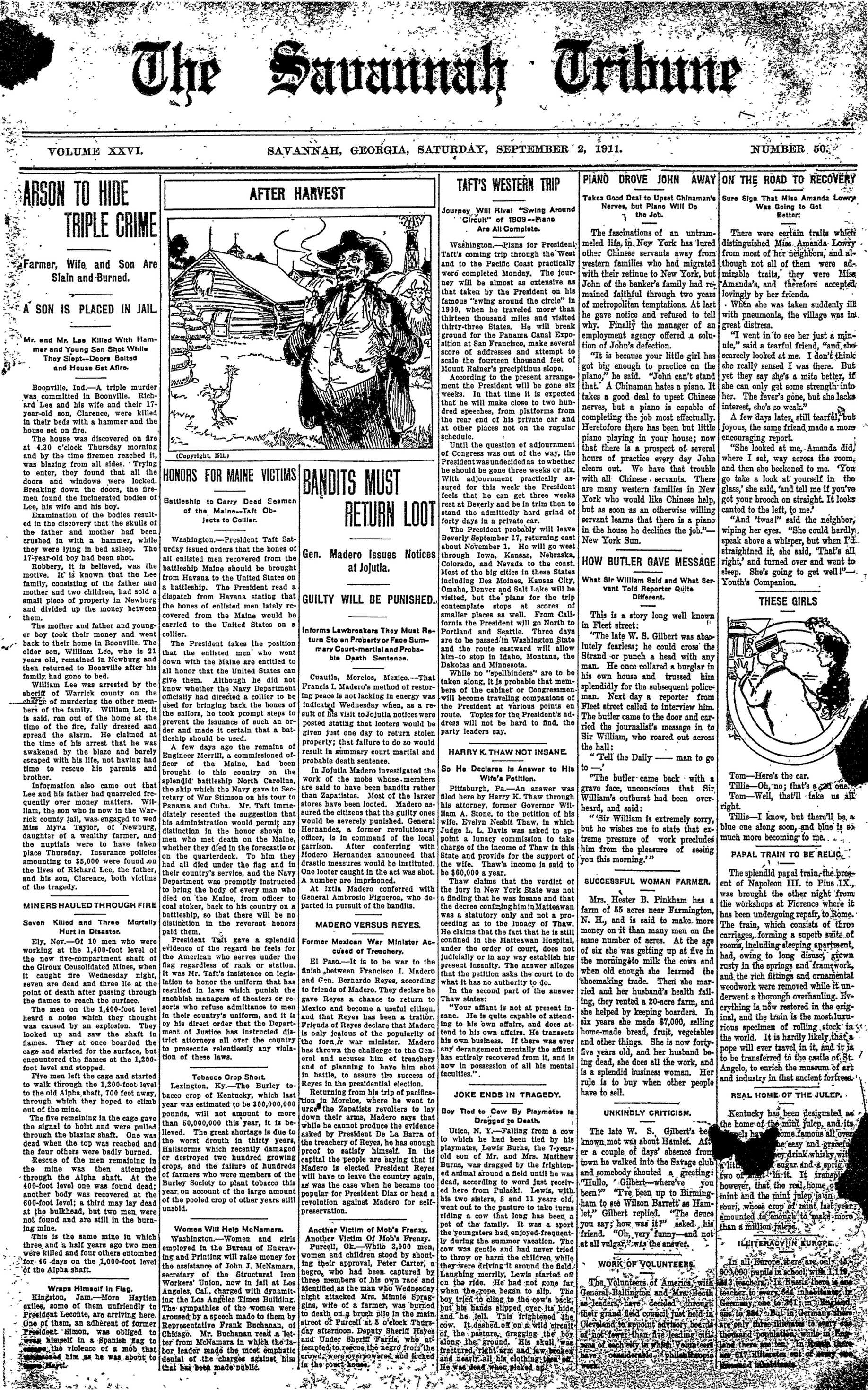
ARSON TO HIDE
TRIPLE CRIME
Farmer, Wife, and Son Are
Slain and Burned.
A SON IS PLACED IN JAIL.
Mr. and Mr. Lee Killed With Hammer and Young Son Shot While They Slept—Doors Bolted and House Set Afire.
Boonville, Ind.—A triple murder was committed in Boonville. Richard Lee and his wife and their 17-year-old son, Clarence, were killed in their beds with a hammer and the house set on fire.
The house was discovered on fire at 4.30 o'clock Thursday morning and by the time firemen reached it, was blazing from all sides. Trying to enter, they found that all the doors and windows were locked. Breaking down the doors, the firemen found the incinerated bodies of Lee, his wife and his boy.
Examination of the bodies resulted in the discovery that the skulls of the father and mother had been crushed in with a hammer, while they were lying in bed asleep. The 17-year-old boy had been shot. Robbery, it is believed, was the motive. It is known that the Lee family, consisting of the father and mother and two children, had sold a small piece of property in Newburg and divided up the money between them.
The mother and father and younger boy took their money and went back to their home in Boonville. The older son, William Lee, who is 21 years old, remained in Newburg and then returned to Boonville after his family had gone to bed.
William Lee was arrested by the sheriff of Warrick county on the charge of murdering the other members of the family. William Lee, it is said, ran out of the home at the time of the fire, fully dressed and spread the alarm. He claimed at the time of his arrest that he was awakened by the blaze and barely escaped with his life, not having had time to rescue his parents and brother.
Information also came out that Lee and his father had quarreled frequently over money matters. William, the son who is now in the Warwick county jail, was engaged to wed Miss Myra Taylor, of Newburg, daughter of a wealthy farmer, and the nuptials were to have taken place Thursday. Insurance policies amounting to $5,000 were found on the lives of Richard Lee, the father, and his son, Clarence, both victims of the tragedy.
MINERSHAULED THROUGH FIRE
Seven Killed and Three Mortally Hurt in Dissaster.
Ely, Nev.—Of 10 men who were working at the 1,400-foot level of the new five-compartment shaft of the Giroux Cousolidated Mines, when it caught fire Wednesday night, seven are dead and three lie at the point of death after passing through the flames to reach the surface.
The men on the 1,400-foot level heard a noise which they thought was caused by an explosion. They looked up and saw the shaft in flames. They at once boarded the cage and started for the surface, but encountered the flames at the 1,200-foot level and stopped.
Five men left the cage and started to walk through the 1,200-foot level to the old Alpha shaft, 700 feet away, through which they hoped to climb out of the mine.
The five remaining in the cage gave the signal to hoist and were pulled through the blazing shaft. One was dead when the top was reached and the four others were badly burned. Rescue of the men remaining in the mine was then attempted through the Alpha shaft. At the 400-foot level one was found dead; another body was recovered at the 600-foot level; a third may lay dead at the bulkhead, but two men were not found and are still in the burning mine. This is the same mine in which three and a half years ago two men were killed and four others entombed for 46 days on the 1,000-foot level of the Alpha shaft.
Wraps Himself In Flag.
Kingston, Jam.—More Haytien exiles, some of them unfriendly to President Leconte, are arriving here. One of them, an adherent of former President Simon, was obliged to wring himself in a Spanish flag to expose the violence of a mob that assassinated him as he was about to leave Harri.
SAVANNAH, GEORGIA, SATURDAY, SEPTEMBER 2, 1911.
THE FARMER
HONORS FOR MAINE VICTIMS
Battleship to Carry Dead Seamen of the Maine--Taft Objects to Collier.
Washington.—President Taft Saturday issued orders that the bones of all enlisted men recovered from the battleship Maine should be brought from Havana to the United States on a battleship. The President read a dispatch from Havana stating that the bones of enlisted men lately recovered from the Maine would be carried to the United States on a collier.
The President takes the position that the enlisted men who went down with the Maine are entitled to all honor that the United States can give them. Although he did not know whether the Navy Department officially had directed a collier to be used for bringing back the bones of the sailors, he took prompt steps to prevent the issuance of such an order and made it certain that a battleship should be used.
A few days ago the remains of Engineer Merrill, a commissioned officer of the Malne, had been brought to this country on the splendid battleship North Carolina, the ship which the Navy gave to Secretary of War Stimson on his tour to Panama and Cuba. Mr. Taft immediately resented the suggestion that his administration would permit any distinction in the honor shown to men who met death on the Malne, whether they died in the forecast or on the quarterdeck. To him they had all died under the flag and in their country's service, and the Navy Department was promptly instructed to bring the body of every man who died on the Malne, from officer to coal stoker, back to his country on a battleship, so that there will be no distinction in the reverent honors paid them.
President Taft gave a splendid evidence of the regard he feels for the American who serves under the flag regardless of rank or station. It was Mr. Taft's insistence on legislation to honor the uniform that has resulted in laws which punish the snobbish managers of theaters or resorts who refuse admittance to men in their country's uniform, and it is by his direct order that the Department of Justice has instructed district attorneys all over the country to prosecute relentlessly any violation of these laws.
Tobacco Crop Short
Lexington, Ky.-The Burley tobacco crop of Kentucky, which last year was estimated to be 300,000,000 pounds, will not amount to more than 50,000,000 this year, it is believed. The great shortage is due to the worst drouth in thirty years, Hallstorms which recently damaged or destroyed two hundred growing crops, and the failure of hundreds of farmers who were members of the Burley Society to plant tobacco this year. on account of the large amount of the pooled crop of other years still unsold.
Women Will Help McNamara.
Washington.—Women and girls employed in the Bureau of Engraving and Printing will raise money for the assistance of John J. McNamara, secretary of the Structural Iron Workers' Union, now in jail at Los Angeles, Cal., charged with dynamiting the Los Angeles Times Building. The sympathies of the women were aroused by a speech made to them by Representative Frank Buchanan, of Chicago. Mr. Buchanan read a letter from McNamara in which the labor leader made the most emphatic denial of the charges against him that has been made public.
BANDITS MUST RETURN LOOT
Gen. Madero Issues Notices at Jojutla.
Informs Lawbreakers They Must Return Stolen Property or Face Summary Court-martial and Probable Death Sentence.
Cuautla, Morelos, Mexico.—That Francis I. Madero's method of restoring peace is not lacking in energy was indicated Wednesday when, as a result of his visit to Jojutla notices were posted stating that looters would be given just one day to return stolen property; that failure to do so would result in summary court martial and probable death sentence.
In Joutila Madero investigated the work of the mobs whose members are said to have been bandits rather than Zapatistas. Most of the larger stores have been looted. Madero assured the citizens that the guilty ones would be severely punished. General Hernandez, a former revolutionary officer, is in command of the local garrison. After conferring with Modero Hernandez announced that drastic measures would be instituted. One looter caught in the act was shot. A number are imprisoned. At Ixtla Madero conferred with General Ambrosio Figueroa, who departed in pursuit of the bandits.
MADERO VERSUS REYES.
Former Mexican War Minister Accused of Torture.
El Paso.—It is to be war to the finish between Francisco I. Madero and Gen. Bernardo Reyes, according to friends of Madero. They declare he gave Reyes a chance to return to Mexico and become a useful citizen, and that Reyes has been a traitor. Friends of Reyes declare that Madero is only jealous of the popularity of the form for war minister. Madero has thrown the challenge to the General and accuses him of treachery and of planning to have him shot in battle, to assure the success of Reyes in the presidential election.
Returning from his trip of pacification in Morelos, where he went to urge the Zapatists revolters to lay down their arms, Madero says that while he cannot produce the evidence asked by President De La Barra of the treachery of Reyes, he has enough proof to satisfy himself. In the capital the people are saying that if Madero is elected President Reyes will have to leave the country again, as was the case when he became too popular for President Diaz or head a revolution against Madero for self-preservation.
Another Victim of Mob's Franzy. Another Victim of Moh's Franzy.
Another Victim Of Mob's Frenzy
Purcell, Ok—While 2,000 men,
women and children stood by shouting
their approval, Peter Carter,
a negro, who had been captured by
three members of his own race and
identified as the man who Wednesday
night attacked Mrs. Minnie Spraggins,
wife of a farmer, was burned
to death on a brush pile in the main
street of Purcell at 5 o'clock Thursday
afternoon. Deputy Sheriff Hayes
and Under Sheriff Farris, who
attempted to rescue the negro from the
crowd, were overpowered and locked
in the court house.
TAFT'S WESTERN TRIP
Journey Will Rival "Swing Around Circuit" of 1909--Plans Are All Complete.
Washington.—Plans for President Taft's coming trip through the West and to the Pacific Coast practically were completed Monday. The journey will be almost as extensive as that taken by the President on his famous "swing around the circle" in 1909, when he traveled more than thirteen thousand miles and visited thirty-three States. He will break ground for the Panama Canal Exposition at San Francisco, make several score of addresses and attempt to scale the fourteen thousand feet of Mount Ralner's precipitous slope.
According to the present arrangement the President will be gone six weeks. In that time it is expected that he will make close to two hundred speeches, from platforms from the rear end of his private car and at other places not on the regular schedule.
Until the question of adjournment of Congress was out of the way, the President was undecided as to whether he should be gone three weeks or six. With adjournment practically assured for this week the President feels that he can get three weeks rest at Beverly and be in trim then to stand the admittedly hard grind of forty days in a private car.
The President probably will leave Beverly September 17, returning east about November 1. He will go west through Iowa, Kansas, Nebraska, Colorado, and Nevada to the coast. Most of the big cities in these States including Des Moines, Kansas City, Omaha, Denver and Salt Lake will be visited, but the plans for the trip contemplate stops at scores of smaller places as well. From California the President will go North to Portland and Seattle. Three days are to be passed in Washington State and the route eastward will allow him-to stop in Idaho, Montana, the Dakotas and Minnesota.
While no "spellbinders" are to be taken along, it is probable that members of the cabinet or Congressmen will become traveling companions of the President at various points en route. Topics for the President's address will not be hard to find, the party leaders say.
HARRY K. THAW NOT INSANE
So He Declares In Answer to His Wife's Petition.
Pittsburgh, Pa.—An answer was filed here by Harry K. Thaw through his attorney, former Governor William A. Stone, to the petition of his wife, Evelyn Nesbit Thaw, in which Judge L. L. Davis was asked to appoint a lunacy commission to take charge of the income of Thaw in this State and provide for the support of the wife. Thaw's income is said to be $60,000 a year.
Thaw claims that the verdict of the jury in New York State was not a finding that he was insane and that the decree confining him Matteawan was a statutory only and not a proceeding as to the lunacy of Thaw, He claims that the fact that he is still confined in the Matteawan Hospital, under the order of court, does not judicially or in any way establish his present insanity. The answer alleges that the petition asks the court to do what it has no authority to do. In the second part of the answer Thaw states:
"Your affiant is not at present insane. He is quite capable of attending to his own affairs, and does attend to his own affairs. He transacts his own business. If there was ever any derangement mentally the affiant has entirely recovered from it, and is now in possession of all his mental faculties."
JOKE ENDS IN TRAGEDY.
Boy Tled to Cow By Playmates is
Dragged to Death.
Utica, N. Y.—Falling from a cow to which he had been tied by his playmates, Lewis Burns, the 7-year-old son of Mr. and Mrs. Matthew Burns, was dragged by the frightened animal around a field until he was dead, according to word just received here from Pulaski. Lewis, with his two sisters, 8 and 11 years old, went out to the pasture to take turns riding a cow that long has been a pet of the family. It was a sport the youngsters had enjoyed frequently during the summer vacation. The cow was gentle and had never tried to throw or harm the children while they were driving it around the field. Laughing merrily, Lewis started off on the ride. He had not gone far when the rope, began to slip. The boy tried to cling to the cow's back, but his hands slipped, over its hide, and he fell. This frightened the cow. It dashed off on a wild circuit of the pasture, dragging the boy along the ground. His skull was fractured, right arm and jaw broken and nearly all his clothing broken. He was dead when picked up.
Takes Good Deal to Upset Chinaman's Nerves, but Plano Will Do the Job.
The fascinations of an untrammeled life, in New York has lured other Chinese servants away from western families who had migrated with their retinue to New York, but John of the banker's family had remained faithful through two years of metropolitan temptations. At last he gave notice and refused to tell why. Finally the manager of an employment agency offered a solution of John's defection.
"It is because your little girl has got big enough to practice on the piano," he said. "John can't stand that. A Chinaman hates a piano. It takes a good deal to upset Chinese nerves, but a piano is capable of completing the job most effectually. Heretofore there has been but little piano playing in your house; now that there is a prospect of several hours of practice every day John clears out. We have that trouble with all Chinese servants. There are many western families in New York who would like Chinese help, but as soon as an otherwise willing servant learns that there is a piano in the house he declines the job."—New York Sun.
HOW BUTLER GAVE MESSAGE
What Sir William Said and What Servi vant Told Reporter Quite Different.
This is a story long well known in Fleet street:
'The late W. S. Gilbert was absolutely fearless; he could cross the Strand or punch a head with any man. He once collared a burglar in his own house and trussed him splendidly for the subsequent policeman. Next day a reporter from Fleet street called to interview him. The butler came to the door and carried the journalist's message in to Sir William, who roared out across the hall:
"Tell the Daily — man to go to —"
"The butler came back with a grave face, unconscious that Sir William's outburst had been overheard, and said:
"'Sir William is extremely sorry, but he wishes me to state that extreme pressure of work precludes him from the pleasure of seeing you this morning.'"
SUCCESSFUL WOMAN FARMER.
Mrs. Hester B. Pinkham has a farm of 55 acres near Farmington, N. H., and is said to make more money on it than many men on the same number of acres. At the age of six she was getting up at five in the morning to milk the cows and when old enough she learned the shoemaking trade. Then she married and her husband's health failing, they rented a 20-acre farm, and she helped by keeping boarders. In six years she made $7,000, selling home-made bread, fruit, vegetables and other things. She is now forty-five years old, and her husband being dead, she does all the work, and is a splendid business woman. Her rule is to buy when other people have to sell.
UNKINDLY CRITICISM.
The late W. S. Gilbert's been known mot was about Hamlet. After a couple of days' absence from town he walked into the Savage club and somebody shouted a greeting: "Hullo, 'Gilbert—where've you been?' "I've been up to Birmingham to see Wilson Barrett as Hamlet," Gilbert replied. "The deuce you say; how was it?" asked his friend. "Oh, very funny—and not at all vulgar," was the answer.
The Volunteers of America, with General Ballington and Mrs. Beech as leaders, have decided through their grand field council just held in Cleveland to appoint advisory boards of not fewer than five leading citizens of each city in which Volunteers have considerable philanthropic work.
Sure Sign That Miss Amanda Lowry Was Going to Get Better:
There were certain traits which distinguished Miss. Amanda Lowry from most of her neighbors, and although not all of them were admirable traits, they were Miss Amanda's, and therefore accepted lovingly by her friends.
When she was taken suddenly ill with pneumonia, the village was in great distress.
"I went in to see her just a minute," said a tearful friend, "and she scarcely looked at me. I don't think she really sensed I was there. But yet they say she's a mite better, if she can only get some strength into her. The fever's gone, but she lacks interest, she's so weak."
A few days later, still tearful, but joyous, the same friend made a more encouraging report.
"She looked at me, Amanda did, where I sat, way across the room, and then she beckoned to me. You go take a look at yourself in the glass," she said, 'and tell me if you're got your brooch on straight. It looks canted to the left, to me.'
"And 'twas!" said the neighbor; wiping her eyes. "She could hardly speak above a whisper, but when I'd straightened it, she said, 'That's all right,' and turned over and went to sleep. She's going to get well!"—Youth's Companion.
THESE GIRLS
Tom—Here's the car
Tillie—Oh, no; that's a real one.
Tom—Well, that'll take us all right.
Tillie—I know, but there'll be a blue one along soon, and blue is so much more becoming to me.
PAPAL TRAIN TO BE RELIC
The splendid papal train, the present of Napoleon III. to Pius IX. was brought the other night from the workshops at Florence where it has been undergoing repair, to Rome. The train, which consists of three carriages, forming a superb suite of rooms, including sleeping apartment, had, owing to long disuse, grown rusty in the springs and framework, and the rich fittings and ornamental woodwork were removed while it underwent a thorough overhauling. Everything is now restored in the original, and the train is the most luxurious specimen of rolling stock in the world. It is hardly likely, that a pope will ever travel in it, and it is to be transferred to the castle of St. Angelo, to enrich the museum of art and industry in that ancient fortress.
REAL HOME OF THE JULEP. Kentucky has been designated as the home of the mint julep, and its temels have become famous all over.
- Tomato Sauce.—One quart ripe tomatoes, thoroughly cooked and highly seasoned with butter, pepper, salt, cloves, allspice and parsley. When cooked, strain through a sleeve, add a little flour wet with cold water; boll five minutes. Serve with chops, croquettes and macaroni.
Drawn Butter.—Two tablespoons flour, one-half cup butter, one pint boiling water. Work flour and butter together until creamy and gradually add the boiling water; stir constantly until it comes to a boll, but do not let it boll; take from the fire and serve. A tablespoon of lemon juice or one of chopped parsley gives an agreeable change.
Gaper Sauce.—Make a butter sauce and stir into it one tablespoon of lemon juice, two of capers, and one of essence of anchovy.
Mint Sauce.—Two tablespoons of chopped green mint, one tablespoon of powdered sugar, one-quarter pint of vinegar. Let stand one hour before using.
TOMATO OMELET.
Fry three slices of bacon crisp, remove it and in the same fat cook one slice onion until a light brown. Beat three eggs slightly with cayenne, add three tablespoonfuls of thick stewed tomato, the fried onions and the crisp bacon finely minced. Turn the bacon fat into a very smooth omelet or frying pan, pour in the egg mixture, and pick up the edges so the egg will all come in contact with the hot pan, fold it over, turn on a hot platter and serve at once. Many cooks use about a quarter teaspoonful of baking powder in the omelet—Journal of Agriculture.
RED RASPBERRY SHORTCAKE.
One quart of flour, one teaspoonful of salt, four teaspoonfuls of baking powder or one of soda and two of cream of tartar, one-half cup butter or lard; sift flour, add salt, work in the shortening, baking powder; lastly add milk enough to make good biscuit dough; bake in jelly cake tins. When done, split, butter and spread with at least a quart of berries, adding sugar and butter plentiful. I always crush a few berries with sugar and add last; set in over to heat berries a few moments and melt the butter. Whipped cream can be added if desired.
BLACKBERRY SIRUP.
Ifish the berries and strain the juice through a clean and well-scaled cake, then to each pound of juice add the pounds of (cane) loaf sugar, and it all together to a sipup, then strain while still hot through a felt bag. Most fruits can be made into a sipup in this way.
COFFEE ICE CREAM.
Pour the left-over coffee into a quart of milk, using a cupful of sugar, and then scald; cool and add one-half teaspoonful of vanilla, and freeze as for other creams. If a cupful of sweet cream is procurable, add it to the hot milk just before taking from the fire.
GREEN GOOSEBERRY JAM.
Allow one pound of loaf sugar to every pound of pickled fruit. Boll the sugar to/candy height—or five minutes after it is thoroughly dissolved—skimming carefully, then add the gooseberries, and 'boll them for three-quarters of an hour, stirring with a wooden spoon all the time.
ASPARAGUS SAUCE.
Asparagus sauce is more appetizing served with chops. Stew about a pound of tender heads in just sufficient water to cover them; when done drain off the water, cover with thick sweet cream and mash until smooth; add three teaspoonfuls of butter, salt and pepper to suit the taste. Simmer gently for a few minutes and serve hot.
OLD-FASHIONED DAINTIES.
In many homes coffee replaces tea in the five o'clock market, which tides over the long wait for lunch or til dinner. To some it tasteful, and, while it is not a drinking coffee between meals, or be
more retiring is consider, defiance
of the rules of health, there are' a
many constitutions that are not
the least affected by it. In any case,
it is better to take simply a bread
dalanty of some sort as an accompaniment to the coffee. Dalnties of this sort are:
SELECTING HATCHING EGGS.
The hens and pullets which have known the best record for the fall and winter should be selected and placed in a yard separate from the rest of the stock, and their eggs gathered and mayed for hatching out the future producing stock. By this manner of selecting eggs from the best layers for a year or two, the lazing qualities of the stock will be greatly increased and the stock will then make a profit to the owner over feed and care, detecting and breeding the best in the only way of improving. Agricultural Epitome.
So rife is early summer with wedding and betrothal festivities that novel expressions of this delightful form of hospitality are constantly being sought by the hostess who feels that the services of a caterer are beyond her modest resources. Fortunately at this season the housewife may fill the double role of chef and florist, provided that the majority of edibles are of a nature to be prepared in advance, thus leaving the hostess leisure to arrange the flowers and give the finishing touches to the table.
For such an occasion a charming motif may be selected from the fragrant, old-fashioned illacs or purple pansies used with the tender yellow and green of the honeysuckle. Use, if possible, the polished mahogany board without a cover, substituting filmy lace or drawnwork doilies, and place in the center a large French basket filled with the purple flowers, the high handle being twined with honeysuckle and tied with a huge bow of the fragrant vine on top. Radiate from this basket tiny streamers of pale green and purple ribbon to each cover, terminating with diminutive flower baskets, also filled with blossoms and of design similar to that in the center. The place cards may take the form of small glided slippers, each inscribed with the guest's name and date, and containing a little snapshot picture of the bride.
Use tall silver candlesticks, with green candles, their shades of lavender crepe paper adorned with sprays of iliac or pansies, and fill the competitors with peeled radishes, stoned olives, salted nuts, violet-covered bonbons, wintergreen wafers and candied mint leaves.
In planning the menu, serve as many homemade dainites as possible, as home cooking is always warmly appreciated, but adhere closely to early summer delicacies, which at this season of the year are abundant and inexpensive. The following menu is suggested as easily prepared in the home kitchen and quickly served: Grapefruit puree with violet syrup, bisque of asparagus, saltines, filet of chicken in aspic, shadroe salad, sandwiches, pistachio frozen pudding, bride's cake, confections, coffee.
HOUSEHOLD HINTS.
To keep white kid gloves from becoming yellow dust well with cornstarch and wrap in dark blue paper.
Ordinary baking soda either in powder form or dissolved in a cupful of water will put out a small blaze immediately.
Lemon juice and steam will take iron rust out of white goods.
Soak goods stained with chocolate or cocoa in cold water before immersing in soapsuds.
Use a weak solution of salt and water to wipe matting after the weekly sweeping.
Save all peelings and cores from pineapples, stew gently for an hour with enough sugar to sweeten the juice and bottle. Good for sherbet, pudding sauces and fruit punch.
OLD-FASHIONED CRULLERS.
Beat one tablespoonful of butter and one cup of sugar to a cream. Add one whole egg and the yolk of another, beaten light; one cup, rich sweet milk, one teaspoonful of salt and three cups of pastry four sifted with two tablespoonfuls of baking powder. Flavor with cinnamon or nutmeg, cut in rings and fry in deep, hot fat. Do not put too many rings in the fat at once or they will absorb the grease. In removing them be careful not to pierce the cakes. Drop them in boiling water on the stove, remove instantly, drain on brown paper, and when almost dry roll in powdered sugar.
THE HOME COMING.
They say that John Nicholas Beffel, the poet, went away from home at a tender age and for a while wrote home growing letters about his prospects. The letters finally ceased. One cold evening when the snow was piling up in the main street of Seneca, Ill., the elder Beffel sat down to supper and looked dolefully at the vacant chair. But beneath his plate he found this note: "Dear Dad; Please meet me at the old bridge at midnight, and bring a blanket or a suit of clothes. I have a hat—John."—Success Magazine.
CHERRY JAM.
Take plucked and carefully sorted cherries, and to every pound allow one-half pound to three-quarters pound of sugar, according to taste and the dampness of the season; stone the fruit and boll carefully, stirring for half an hour; then add the sugar, boll and skim for another half hour, and just before it is done add some of the blanched and split kernels or a few drops of ratana.
HOOPS AS GIFTS.
Among the new wedding presents are embroidery hoops, the outer one of elver, the inner one of satin wood. These make unique gifts to the girl who does any kind of embroidery during the leisure summer hours.
THE SAINT OF THE CLOIS
TER AND THE SAINT OF
THE HEARTH.
I pray not that thou shouldest take them out of the world, but that thou shouldest keep them from the evil.—John 17:15.
The Son of Man came eating and drinking, and they say, Behold a man gluttonous and a winebibber, a friend of publicans and sinners.—Matthew 11:19.
"No abstraction from the world, but protection from the evil. Our redemption is to be accomplished, not by changing our locality, but by changing the heart. Religion is not to drive us out of the world into an environment destitute 'of temptation, but to keep us in the world, that we may attain holiness amid temptation."
We need to emphasize this, because there is a very widespread misunderstanding as to what consistent Christianity really is, and therefore a very general failure to try to live it. Because we have rather vague ideas of what a religious life ought to be, we are apt to picture it as a lofty ideal utterly beyond attainment by plain people like ourselves. And having so very lofty and unwordy a conception of it, we put it out of the realms of practical accomplishment and think no more about it.
Isn't it a singular thing, for example, that those who reject the medieval theology nevertheless cling to the medieval idea of saintliness? We hardly think of a man as being a saint unless he is a man for whom this present world has no attraction or charm. He must not take even transient satisfaction in any pleasures except those that spring from worship for him everyday occupations are only hindrances to communion with God. He is very quiet and placid and subdued. If we are to be quite certain about his saintliness, he must be a little thin and pale, not too strong—certainly not bale and hearty and robust. Everybody knows the figure: the saint of the stained glass window, "with wasted form and transparent hands and thin, pale face and eyes heavy with tears or weary with watching."
As a matter of fact, the "good" people we know who have come nearest that type are the ones we usually like to avoid as much as possible. We feel that:
To live with the saints in heaven
Is bliss and glory.
To live with the saints on earth
Is quite 'another story!
We could not be that kind of a saint if we would, and we would not be if we could; and therefore we give up trying to be any kind of a saint at all.
We make something of the same mistake in our conception of what a minister should be. We are a little bit shocked if he lacks a certain serenity of temper and aloofness of manner, a gentleness of speech, and perhaps a delicacy of physique. If he happens to be a man of another sort, with plenty of muscle and color, with a cheerful satisfaction in the pleasures of life, a man who loves to dine with his friends and eats his full share of the dinner, who lives a cheery family life, has hearty human friendships, has his likes and dislikes, has his little failings, too, but is withal very likable and very human—we wonder whether he has not missed his calling.
Of course, he hasn't. He is a good minister of the religion of Jesus Christ. And without becoming stained-glass saints we can all of us, in the same way, become good servants of Jesus Christ. There is room for the saint of the counting house as well as for the saint of the cloister. We can be good without ceasing to be natural. Above all, we can be good without being miserable.
We have so happy an example of that in the life of Jesus Christ himself. There is a great deal of truth in Renan's picture of our Lord, in its emphasts on his buoyancy of spirit, his eager delight in life, his frank and alert interest in the common affairs of common people, his love of nature, his animation, his thorough enjoyment of pleasant things. Some one has said that nobody who wanted a wedding to pass off cheerfully and pleasantly would have urged John the Baptist to be the chief guest, but it was the most natural thing in the world that Jesus should always have been welcome. He had a disposition, a manner, a temperament, full of joy and brightness and sunshine. Though life was very serious for him, and the shadows lengthened toward the end, and he was a man of sorrows and acquainted with grief, yet he never lost a healthy, hopeful, sane outlook on life. He always had friends, and one feels that he needed them, not simply that they needed him. He attracted men by his life as well as his teaching. People were never afraid of him. Some objected that he was too much of a "dinner out;" they called him a gluttonous man and a winebibber; but nevertheless in him wisdom was justified of her children.
"Not that thou shouldst take them out of the world, but that thou shouldst keep them from evil." It gives us the right idea of Christian holiness. It also leads us to right ideas about the Christian church. For a long time the church, preached a religion for the other world, not a religion for this. She tried to prepare men for death and forgot to prepare them for life. She spent all her time
something men are in. In the read, the heads to cease, and the legs them need to look at anything through which the rear passed. But when Jesus was on earth it was his wish and purpose to make men happy now as well as hereafter. He made himself, therefore, the enemy of disease and death, of avarice and selfishness, of ignorance and poverty. He "went about doing good." The sight of sickness moved him. He did not like to see people hungry. He was interested in all that entered into the life of men here on this earth. He pointed men toward heaven; but he also gave them a taste of heaven here. He desired to save men—but to save them body, soul and spirit, not spirit only.
That is the new lesson the church is learning—that she must be interested in man's life here as well as his life hereafter, in education and public schools, in political reform and social improvement, in men's clothes and food and wages, in the pleasures they have and the houses they live in. Christianity is interested in all that can make earth more like heaven, but as Jesus Christ was interested in bringing back into harmony with the beautiful Galilean country which he loved all the sad and sick and suffering folk whom he met in the way.
And so the Christianity of today is a life of service. It has led men to build settlement houses and equip playground centers, and support hospitals and sanatoriums, and erect parish houses as well as churches, and hold classes in manual training and physical exercises as well as Bible classes and prayer meetings. If more and more of this charitable and institutional work has been taken up by societies and individuals outside of the church, it is because the world is becoming more Christian, not because the churches have altogether lost their grip.
Yet all this work cannot be done through societies and organizations. Individuals must catch the new spirit of Christianity. If you have flowers yourself, you must see that some of them go to a sick neighbor. If you have a carriage or an automobile, you can lend the use of it some afternoon to make another's day cheerier. If you have money, you need not give it all away and flee to the cloister; you can stay in the world and use it—but if you are to be in the world and not of it, you will use a share (and a goodly share) of your wealth in personal, individual service for others. If you are in society, you need not stay away from dinners and social gatherings—rather, you should try to bring God's goodness and God's sunshine to the company. You can be a saint at the theater, the opera or the ball game. Your deliverance from sin to holiness is not to be effected by the removal of the body, but by the reinforcement of the soul.—Charles Fiske.
DECORATIONS.
Senator Beveridge, at a reception in Washington, smiled delightfully as an ambassador passed whose coat front was one blaze of decorations. "They look nice," said Senator Beveridge, "but, after all, they don't mean much."
He laughed.
"An actor," he resumed, "once played in a small German principality for a fortnight. The grand duke, to his disappointment, failed to decorate him. He mentioned this oversight at a court dinner to a chamberlain, and the next day he was sent for.
"My friend," said the grand duke, handling the actor a box, "here is something to remember me by."
"The overjoyed actor departed, but his cab had hardly gone ten yards when, ordering it to return again, the actor was once more ushed into the grand duke's presence.
"Oh, sir,' he said, I had to drive back. There are two crosses in the box.'
"Oh, no matter,' said the grand duke. 'Give the other to the cabman.'
ONE HE OVERLOOKED.
In the early ninetyes, when the Democratic party was split over Mr. Cleveland's policies, Col. John R. Fellows was one of a party on a coach ride from London to Brighton, in England.
He sat next to an Englishman who had been to nearly all parts of the United States and was boasting of the superiority of English scenery over American. Colonel Fellows went into an argument with the Englishman and had him worsted, until the Englishman cried: "Well, even admitting-all that, you have no ruins in the United, States."
"Good Lord, sir!" shouted Colonel Fellows, "have you never heard of the Democratic party?"—Philadelphia Saturday Evening Post.
IN THE LIGHT OF REASON.
A farmer returning home late at night found a man standing beside the house with a lighted lantern in his hand. "What are you doing here?" he asked savagely, suspecting he had caught a criminal. For answer came a chuckle, and—"It's only me, zur." The farmer recognized John, his shepherd. "It's you, John, is it? What on earth are you doing here this time o' night?" Another chuckle, "I'm a-coortin" Ann, zur.
"And so, you've come courting with a lantern. Why, I never took h an lantern when I courited your mistress." "No, sur, you' didn't sur," John chuckled. "We can all see you didn't sur"—Answear.
THE DUAL-PURPOSE GOW
NO BREED IDEAL FOR BOTH MILK
AND BEEF.
There is no dual-purpose breed that we can recommend to either farmers, dairymen or beef men, says Hoard's Dairyman. If it is a person's intention to produce milk, we have no hesitancy in saying that some one of the special dairy breeds should be chosen. If beef is desired, then some one of the beef breeds should be selected. The ideal beef cow is one that will produce more, lean enough milk to raise her calf, and a cow that will not do. this is not profitable to beef making. It is common to term such an animal dual-purpose. In a measure all animals are dual-purpose, and many dairy cows when fattened make fairly good beef, but beef making is incidental to their milk function, and no consideration should be taken of it except insofar as it has a direct bearing upon the animal's strength and constitution.
We should look for a beef animal that will produce beef most economically, and what little milk it produces over and above that amount necessary to raise the calf should be considered entirely incidental. In other words, to attempt to buy an animal that is a capable dairy cow and a beef animal is impossible. At least we have never known of a herd to be bred successfully along these lines. Now and then there is an animal which may be termed very properly dual-purpose, but she seems to be a variation which is not easily perpetuated.
EGG-BOUND.
One reason for the hens or pullets becoming egg-bound is because they have become too fat during a long moulting period and the rest which followed.
Frequent visits to the nest and coming off again without laying is a most pronounced symptom. There is also much swelling and inflammation around the vent, or the protusion of the egg-passage is a very serious indication. If the hen is not valuable it will be better to kill her, for the aliment is liable to recur.
However, if you wish to attempt to cure, take the bird and push the protrusion into place with the finger, being careful that the hand is clean and the finger nail well pared; then with the finger try and find the egg. If the egg is soft, break the skin and take away. If hard it may sometimes be forced down. If it should be broken and all traces of shell removed. The inflamed parts will need an astringent to reduce the swelling. For this purpose a little alum and water poured into the vent or injected with a syringe is as good is any. \
The birds should be sparingly fed on simple food with a half teaspoonful of bromide of potassium added to a pint of drinking water. This will help to retard the laying and so hasten a cure—Farmers' Union Guide.
LOW ROOSTS.
The natural instinct of fowls is to hunt a high roosting place in order to be safe from animals that prowl about at night, but we should watch them carefully and see that they go to the house, where the roosts are low and where they are protected by wire screens in hot weather and doors in cold weather. They will go to the tops of the highest trees if permitted, but when flying down will often injure themselves. Bumble-foot and kindred troubles come from this source, and often serious damage is done. Bumble-foot, while not serious, will likely cause the hen to stop laying for a week or more, and may be the indirect cause of some other trouble. A roost should not be over 18 inches above the ground, and the floor should be earth. This is casily cleaned by removing a few inches of the earth and replacing it with fresh earth from the garden. All roosts should be on a level, so that the fowls will not fight for the high ones. —Home and Farm.
LEG WEAKNESS.
The only remedy for leg weakness trouble is to clean out the quarters and see that they are kept perfectly dry and properly ventilated. Change the ration from one rich in corn and formatting feeds to one that contains more protein. Give about a half teaspoonful of soda dissolved in each pint of drinking water and about a teaspoonful of common black pepper in the soft feed for each 30 little chicks. If the chicks have had the trouble for any length of time, no remedy will prove effective.
CHICKEN CHAT.
A hen which is in the best of condition has some surplus fat in her body. This means that her bodily wants have been supplied, and there is some food to spure. She has surplus energy. A very fat hen seldom lays well and a poor hen cannot lay well.—Farmers' Home Journal.
CONTROLLING SOIL MOISTURE.
It is generally thought that the necessity for irrigation in the United States exists only in the region west of the Mississippi river, but repeated crop failures in the east and successful farming in the west have called attention to the importance of controlling the moisture of soils rather than accepting the conditions as they exist. Professor Voorhees estimated the loss to the hay crop of New Jersey from the drought in May and early June of one year at $1,500,000, while small fruits and vegetables were even more seriously affected than the grasses. The records kept by him at the experiment station show that in years of abundant rainfall in April and May the yield of hay averaged 2.65 tons per acre. In another year it was but, a fraction over one ton, owing, to the deficiency of rainfall in April and May, at the low price of $10 a ton, a loss for the 25 acres of over $400. The yield of crimson clover forage in years of abundant rain was 8.5 tons per acre; in a drought the yield was but 5 tons, or in a good year the yield was 70 per cent greater. The deficiency in the rainfall at the critical period was alone responsible for this difference in yield.
To show the frequency of severe droughts in Philadelphia from 1825 to 1895 (70 years) show that in 88 percent of the years there was a deficiency of over 1 inch for one month, or that in 62 years out of the 70 there was one month in the growing season from April to August in which such a marked deficiency occurred as to cause a serious shortage of crop, and that for the same period there were 39 years in which the deficiency extended throughout two months, while in 21 years it extended throughout three months, or in 30 per cent of the years included in this period there were three months during the growing period in which the average rainfall was deficient one inch or more. It is thus observed that a wide series of crops would be likely to suffer in more than one-half of the years for which the record is available, while a still larger number would suffer in nearly one-third of the years, for it must be remembered that even a slight deficiency in one month may result in serious reduction in yield, and consequent loss if it occurs at a time when the crop is making its largest development."
BEES AND FRUIT.
The importance of thorough pollenization of fruit blossoms becomes more clearly apparent as we have more experience and learn more carefully to observe results. While some varieties of fruit are usually self-fertile, others are usually barren if planted alone, according to a Pennsylvania authority writing to the New York Tribune.
Some seasons are very unfavorable for both the formation and distribution of pollen, owing mainly to cold or rain. Sometimes aphis or other pests prey upon the blossoms and interfere with pollenization.
Among insecta bees are the most reliable carriers and distributors of pollen. If the colonies are strong and are located near the fruit trees there are very few seasons so unfavorable that the bees will fall to more enough pollen to pollenize a large majority of blossoms thoroughly and strongly. The winds are often insufficient. When well pollinated the young fruit will grow strong and resist successfully weather, insect and fungal injuries, while the same injuries would destroy the crop imperfectly pollinated. Experience has shown that one good hive of bees for each acre of orchard in full bearing is needed for best orchard results, though it may be more than the beekeeper in his experience would find profitable.—Farmer's and Drover's Journal.
SOME MILK AND BUTTER.
During the month of April Mrs. W. A. Walker of Breckenridge county, Ky., sold milk and butter to the amount of $15.60, according to an exchange published at Hardinsburg. This was from one cow and is the proceeds of what was sold after furnishing a family of five milk drinkers. The question of whether or not it pays to keep a cow is decided when you can sell $15.60 worth of milk and butter and have plenty at home. This is a pretty good record for one little Jersey cow, isn't it—Inland Farmer.
FRESH AIR FOR HORSES.
Plenty of fresh air should be admitted to the horse stable during the summer. With windows open the animals will have good air while standing up, but when lying down on warm nights the lower part of the stable may be uncomfortably warm and the horses suffer accordingly. By having one or two horizontal bars resting in brackets or mortises across the opening, the door may be left open at any time and the horses remain loops in the stable. When a coat is to be retained, in the stable and the door left open, three bars across the opening may be used.
REAL TO THE MEN OF THE
PRICE BY A WESTERN
EDITOR.
do something. We imagine
the cry coming up from those
feeble and weak-kneed, say-
we can do nothing. But let
you to bestir yourself and
up and go weaving for good.
Our reason for saying weaving for
is simply this: The weaving is
going on anyhow, either for weal
or woe—hence let us weave for good.
We have gone through woods and
beaten the bushes, and our humble
effort at writing an editorial may not
meet the approval of all our readers,
but we must just strike or say some-
thing that we know to be of interest
to our people anywhere the opportu-
nity presents itself.
What about your weaving? Let us urge our women to weave-better lives. Let us help them to see and understand their condition. And as another has said: "Let the savage Indians torture captives to death by the slow flaming fagot, but let civilized men respect the tenderness and love of confiding women. Torturing the opposite sex is double-distilled barbarism." Woman's love is her all. Hence let us advise the women not to recklessly throw away their only armor of defense. Let us strive to select the very best material for the web and woof of our lives.
There is work for each one of us to do. There are burdens that we can lift from the shoulders of others. If we would weave properly and to the advantage of others—or of our fellow man—we would select the proper material out of which to form the web and woof of our lives. The negro must weave; if he does not be will be wove into nothing. Calamities of different kinds have been visiting our communities, but our blessed Master has allowed us to go ahead and weave on. What about our work? What about our weaving? Is the web and woof strong? Are the threads constantly breaking? Each thread in the web and woof of our lives must be looked after very carefully. We are told, and very truthfully, too, that a chain is not any stronger than the weakest link in it. The same holds true with us as people or race. The weakest among us has strength enough to keep the strongest among us down. Yes, the very weakest can get the very strongest down. The very weakest among us can manage to keep the very strongest down after succeeding in getting them down.
Hence, we can very readily see the necessity of looking after every thread in the web and woof of our lives. When a thread breaks it consumes a whole lot of time. It must be found and tied. If it is not looked after it will cause a flaw in the cloth and thereby depreciate the value of the same.
We, as a race, will not stop long enough to catch up the broken threads and tie them. I am strong and all right, consequently I don't care anything about that weak thread. Let it break; I have no time to stop and look for the ends. I care nothing about them. They cannot even impede my progress, saying nothing about hindering me.
What a terrible mistake! Let us beg you to open your eyes and catch up, the broken threads in the great web and woof of life. May the God of all the living aid us and give us courage to go forward and urge men and women everywhere to select the very best material out of which to construct the web and woof of their lives. Wake up the indolent. Wake up the careless, and let them see to it that the web and woof of their lives are woven out of the very best material obtainable.
With the above end in view, let each one of us continue to strive and God will bless all our efforts.
LOCOMOTIVE BLEW OUT FIRE
Using a locomotive engine to extinguishe the flames in a burning building is a new departure in Lindsborg but this is what happened here.
On the optskirts of the city a Mexican but situated about thirty-five feet from the Missouri tracks caught fire, and being out of reach of the fire department it became the duty of the man nearest the blaze to at least make an attempt to put out the fire.
The Missouri Pacific's engine was standing idle on the tracks and had on plenty of steam. The engineer saw the fire and steamed up to a point opposite the burning building, turned on all his steam and blew the fire-out in a few minutes. The steam smothered the fire—Lindsborg correspondence Topeka Capital.
MADRAS MOSQUITOES.
The late Henry Guy Carleton, the playwright, lived at Atlantic City, and, when the mosquitoes were bad, he would tell his Madras mosquito story. "There are no mosquitoes," he would begin, "In Brittany, and a Breton woman, about to emigrate to Madras, was warned by a friend: "Beware of the Madras mosquitoes. They have long suckers hanging from their heads, and they will draw the very life blood out of you.'"
"The Breton woman arrived in Madras duly, and, as she disembarked, she saw three elephants, drawn up near the pier.
"Ciel! she cried. 'Are these mosquitoes?'—Los Angeles Times."
WILLIAM H. LEWIS, J. C. NAPIER
AND OTHER OFFICIALS UN
ABLE TO LEAVE CAPITAL
CITY DUE TO PRESS-
ING BUSINESS
Washington.—Apparently because of the long extra session of congress, colored men in official life at Washington are losing their usual vacation time and state at present that they expect to be at their desks all of the summer. J. C. Napler, register of the treasury, is assiduously engaged in mastering the smallest details of his office, and is found at work both early and late. His offices, which have recently been finished out in excellent taste, have a western exposure, overlooking the grounds of the executive mansion. The other offices of the register's force, including those of Cyrus F. Adams, assistant register of the treasury, are now being put into first-class condition and refinished so as to appear altogether modern.
William H. Lewis, being from a cooler climate than his colleagues in high office here, has found himself compelled to waive the dignity which is assumed on their part, and may be found hard at work. In his shirt sleeves in one of the top stories of the bond building. He is still finding it necessary to decline many proffers of entertainment and invitations to speak because of the nature of his official duties, and it is being freely prophesied both by those in his office and by outsiders that he is going to make a high record from the start. The social bugaboo which many senators raised in opposition to his selection for the office of assistant attorney general, has not as yet put in its appearance.
THE AFRO-AMERICAN PRESS
EDITOR MACBETH TELLS OF ITS DUTY TO BUSINESS ENTERPRISES.
That the Afro-American press should exploit the business enterprises conducted by the race is the ophilon expressed by Mr. Hugh E. Macbeth, editor of the Baltimore. (Md.) Times, in a recent interview. "Ever since the race paper has been running," says Mr. Macbeth, "church, fraternal and social gossip have formed the major portion of its contents and only a scattering notice here and there has been given to the business enterprises of the race. Without minimizing what the church and fraternal organizations have done for racial uplift, one cannot gainay the fact that the intelligent and far-seeing business man of the race is coming to the fore, and it remains for the race paper to give him all of the encouragement possible.
"A big crop of successful business men would be a splendid asset to the race. These men, by their money and public spirit, could weld a tremendous influence for us, besides giving our bright boys and girls an opportunity for business experience and success. With growing prejudice in some quarters and the tendency to let the colored man shift for himself, we demand that the business enterprises which reap so large a profit from the men and women of the race should be in the hands of our own men and women.
"There is an abundance of opportunities for the small storekeeper—the man who sells the necessities of life. Out of these small enterprises big ones could evolve and racial progress would then be more evenly balanced along all lines. The splendid gifts made to worthy causes in this country have almost always come from successful business men, and that should be our cue if we are to look after our own."
FLAGGING THE WAITER.
The Lottie cafe in Rockford, Ill., prints the following on its bill of fare: "P. S.—Guests please leave napkins in glass until order is taken."
The purpose of this order is to utilize the napkin as a signal to the waiter that you have not yet been served. Thus the waiter knows when to run on a limited schedule and when to make local stops.
What this country needs is a cafe code. The Lottie cafe has made a brave start. Now let us have a universal system whereby we can signal to the waiter to bring more butter or to bring a knife for the pie. A neat code could be worked out, using the hat as the signal block—Chicago Post.
ENGLISH MAY NOT LET JACK
JOHNSON WHIP. WELLS.
Opposition to the proposed "fight" between Jack Johnson and England's alleged champion, Bombardier Wells, is increasing to such a degree that the promoters may decide to declare it off. English sporting crites say that Wells hasn't had sufficient ring experience to tackle the grinning negro, who stands to draw down $30,000 for his end of this affair.—Boston Record.
JACK JOHNSON CONQUERS ENGLAND.
Mr. Jack Johnson's conquest of England is now complete. The Referee—and it does not like Americans—says: "There is something rather fascinating about Johnson's stage personality," and refers to him as "bright and breey."—Boston Herald.
AMSTERDAM NEWS THINKS THE BLACK MAN WAS THE AU-THOR OF THE WORLD'S LEARNING.
Moroe, the capital of ancient Ethiopia in Africa, diligently explored and excavated for the last two years, has revealed a culture and civilization now conceded to be not only prior but superior to that of Egypt in her palmest days. The Athenaeum, the great organ of archaeology, as quoted by the daily papers, tells of the finding among the ruins of the once magnificent metropolis of the remains of colossal buildings, commodious market places, elegant places and evidences on all sides of proud temples of learning and exquite works of art. The carved head of a Negro, the Athenaeum continues, indicates that the Ethiopians had attained to a degree of art never equaled by the Egyptians.
For generations it has been denied that the Egyptians were of Negrold extraction and lying historians have readily credited to the ancient government on the Nile the seat of learning, the arts and sciences. The great public has long been misled, but the fact as to what was the race of the Egyptian has been studiously muddled and muddled. But the best authorities, like Professor Anthon of Columbia university, have been recently forced to confess that the basic sub-stratum of the Egyptian race was Negro, and that various other races from the north invaded the country and fused with it.
They have further been forced to confess that Egyptian civilization even with its great learning and its marvelous pyramids was preceded by a black civilization even more marvous and brilliant, of which in fact Egypt was only a copy. If the paintings and drawing on vases and the like may be counted as evidence, the Egyptians did not always deny or discount that fact. The black Ethiopian priests are plainly pictured as pouring their learning into the pots of their lighter hued Egyptian cousins.
But with the westward course of empire Meroe was in time put under the heels of Egypt and Egypt forgot the base degrees by which it did ascend. But with the uncovering of the facts the truth seems plain. Meroe, the capital of Ethiopia, admitted a Negroid race, was the seat of learning, the arts and the sciences. When it can no longer be denied by any shadow of right or reason, this great fact of history will be universally accepted.
It has long been asserted by pure blind, prejudiced writers and demagogues that the colored man has no antecedents, has never produced anything. He has always been accused of being either the sluggard or the parasite of history. But if the undisputable evidence of Meroe and her civilization may speak, the black man was the author of the world's learping and of her progress since. The black man has not only a great future, but has had a mighty past—Amsterdam News.
TWO DUELS
THE SECOND WAS TO AVENGE
THE VICTIM OF THE FIRST.
A certain English gentleman who was a regular frequenter of the greenroom or Drury Lane theater in the days of Lord Byron's committee and who always stood quietly on the hearth rug there with his back to the fire was in his usual place on night when a narrative was related by another gentleman, newly returned from the continent, of a barrier duel that had taken place in Paris.
A young Englishman, a mere boy, had been despolied in a gaming house in the Palals Royal, had charged a certain gambling count with cheating him, had gone out with the count, had wasted his fire and had been slain by the count under the frightful circumstances of the count's walking up to him, laying a hand on, his heart, saying. "You are a brave fellow—have you a mother?" and an his replying in the affirmative, remarking coolly, "I am sorry for her," and blowing his victim's brains out.
The gentleman on the hearth rug paused in taking a pinch of snuff to hear this story, and observed with great placidity: "I am afraid I must kill that rascal."
A few nights elapsed, during which the greenroom. hearth rug was without him, and then he reappeared precisely as before and only incidentally mention in the course of the evening: "Gentlemen, I killed that rascal."
He had gone over to Paris on purpose, had tracked the count to the same gaming house, had thrown a glass of wine in his face in the presence of all the company assembled there, had told him that he had come to avenge his young compatriot and had done it by putting the count out of this world and coming back to the hearth rug as if nothing had happened.
A CAREFUL HUSBAND.
Friend (after tea)—Your little wife is a brilliantly handsome woman. I should think you'd be jealous of her. Hest. (confidentially)—To tell, the truth, Simpkins. I, am. I never invite anybody here that any sane woman would take a fancy to.
BLUFFS AND PLAYS DEAD
BUT THERE'S, FATAL FLAW IN THE HOG-NOSED SNake'S ACTING.
When you find a hog-nosed snake flattened out upon the sod in his anxiety to absorb all the sunshine that he can he immediately adopts a policy of "bluff." He first inflates his body by a deep draft of air. Then he flatten's his head and expands his neck to three times it proper width. Next he strikes angrily toward the intruder and blisses with malignant fury. The average pedestrian naturally retreats with a feeling of gratitude for the danger signals so unmistakably imprinted by a kindly Providence upon the deadly members of the rentile race.
A good field naturalist will quietly advance his bare hand to the reftille's head, because he knows that this snake can neither be induced to give a polsonous bite nor a bite of any kind. Seeing that the observer cannot be intimidated, the snake then opens his jaws and acts as if he had been injured. Convulsive spasms ripple down his spine. He writhes and twists as if transported by the agonies of death and, turning over on his back, the last convulsion dies away along the tail. Now, nothing in nature looks more dead than a snake lying with the ivory white of his belly plates turned upward to the sky, and the hog-nosed snake will simulate death so patiently that you may carry him by the tail or hang his body on a fence and he will swing in the wind and give no sign of life for an hour or more.
But this clever acting has one fatal flaw. If you place him on the ground with the belly downward he will twist over on his back again. He has such a fixed idea that "belly plates skyward" is the correct pose for a serpent's corpse that, although supposed to be lifeless, he will turn over on his back a dozen times if you as perseveringly persist in laying him on his crawling surface. His zeal for the perfection of nalmircy blinds him to the obvious truth that dead snakes stay where they are put—Century Path.
NEGRO FOUNDS, A CITY
Mr. J. E. Wiley, colored, has found a new city near Dallas, Texas. It is called Mill City. He first established a cotton factory with 7,000 spindles and 180 looms and is practically making all the twine for commercial use. All colored help is employed. The mill workers live on the land and it is governed and conducted by them on the lines of a modern municipality. When all the new machinery is put in the mill, the number of employees will total 400. The workers are expected to buy their own homes, by paying a few dollars each month. Already 25 houses have been bought.
WOULDN'T TAKE ANY.
The late Lord Young of the Scottish bench was responsible for enlisting many a dull case. One of the best remarks that ever fell from his lips was the reply to a counsel who urged on behalf of a plaintiff of somewhat bibulous appearance:
"My client, my lord, is a most remarkable man, and holds a very responsible position; he is manager of some waterworks."
After a long look the judge answered:
"Yes, he looks like a man who could be trusted with any amount of water."
—M. A. P.
SHE KEPT HER WORD.
"If you kiss me again," declared pretty Miss Lovely firmly, "I shall tell my father."
"That's an old tale," replied the bold young man. "Anyway it's worth it." And he kissed her.
Miss Lovely sprang to her feet. "I shall tell father," she said, and left the room. "Father," she said to her parent when she got outside. "Mr. Bolder wants to see your new gun."
A minute later, when father appeared in the doorway with his gun in his hand, there was a crash of breaking glass as Mr. Bolder dived through the window.
NOT HIS LORDSHIP.
In Sir Robert Anderson's recently published book of reminiscences entitled "The Lighter Side of My Official Life," there is a story of a judge who was trying to get the very words of a reported conversation from a person somewhat scantily equipped with humor. The story is good enough to quote.
"Witness," asked the judge, "did the prisoner say, I stole the horses?" "Oh, no, my lord," the witness replied in a deprecatory tone, "your lordship's name was never mentioned."—Youth's Companion.
AN ALL-PURPOSE VACATION
"Why, hello, Smith," said Grey in greeting. "I thought you'd be away on your vacation. How comes it you're still in town?"
"Well, I've had difficulty finding exactly the right place," explained the other.
"What sort of place do you want? Now, I know where to go. Tell me what you're after and may be I can help you out."
"All right," came back Smith. "I'm trying to find a place where my bank account can enjoy itself; by taking a rest at the same time I do."
RIVAL REBELS SECURE A FIRMER-RULE THROUGH A COMMITTEE OF BAFETY-GERMAN AND BRITISH MARINES ON LAND TO LENDAID-SIMON ON AMERICAN SCHOONER UNDER PROTECTION OF CRUISERS.
Port-au-Prince, Haiti.-Haiti is without a president or organized government. The capital is occupied by two rival revolutionary parties headed respectively by Gen. Cincinnatus Leconte, a former minister of the interior, and by Gen. Antonor Firmir, who deserted his post as Haitian minister to Great Britain to join the revolt against President Simon.
A committee of safety, composed equally of Firmists, Leconteists and neutrals, has been organized through the initiative of the diplomatic corps, and is maintaining public order.
German and British marines have been landed to aid the provisional authorities. There were attempts at pillage and it was necessary to shoot several of the looters. Energetic measures prevented any serious outbreak.
Antonine Simon, the deposed national executive, who was compelled to withdraw from the city, was still on board the American schooner Bradford C. French, which is anchored in the harbor under the protection of the guns of the American cruiser Chester. Simon awaits the arrival of a fruit steamer for Kingston, Jamaica.
His boarding of the schooner was due to a misunderstanding. He wished to go aboard the American cruiser Chester, but was directed by the American officers to the American cruiser Des Moines, the senior ship. Simon failed to understand and went aboard the schooner. That craft moved off into the roadstead to where the Haitien warship 17 December was anchored. The schooner moved over close to the Chester and a guard was sent from the cruiser on board the schooner to protect her and Simon.
Following the debarkation of Simon there was an attempt to pillage the business house of Makhlouff & Co., the proprietors of which are Syrians. The attempt was put down by forces under the direction of the committee of public safety, and four of the rioters were shot on the spot. Some of the soldiers also refused to lay down their arms when ordered to do so; and there were occasional conflicts between the soldiers and civilians. It is estimated that forty persons were killed during the occupation of the city by the revolutionists and subsequent rioting.
A band of armed men made an attack on the customs house and also attempted to raid some nearby shops. The attack was met by a force of police and soldiers under the command of M. Tancrede Auguste, a member of the public committee. Six of the pillagers were shot and this put an end to the outbreak. Later a detachment of marines was landed from the German cruiser Bremen. They occupied the German legation and the banking houses of Kitel & Co. and Herrmann & Co. Marines from the British warship Melpomene occupied the British consulate.
The committee of public safety consists of 21 members, one of whom is an American President, Stephen Archer. The diplomatic corps, after organizing the committee, arranged to notify the rebel leaders outside the city, and who may soon come in, that order must be preserved in the capital. Revolutionary troops under General Leconte and the Firminist leader, General St. Juste, are marching hither from Cape Haitien. The location of General Firmin himself is not known here. There is some fear that the two revolutionary parties will clash when their leaders meet at Port-au-Prince. Moment a sort of armistice between the two factions has been arranged and this is being observed by the rebel forces still outside.
FIRST BEARING MAPIER'S NAME
NASHVILLE NEGRO'S SIGNATURE
NOW 'DECORATE8 NEW
MONEY
Washington.—The first issue of paper money bearing the signature of J. C. Napler, the new registrar of the treasury, has been put in circulation by the secretary of treasury. The Nashville colored man secured the initial note, which is of the denomination of a dollar, and will, of course, preserve it. Seriously, it is numbered 51,404,001. Only the one dollar notes bearing Napler's name have been put in circulation so far. Issues of all denominations running up to $50 bills are being prepared at the bureau of engraving and printing.
SHE COULD APPRECIATE
The new cook, who had come late to the household during the holidays, asked her mistress:
"Where ban your son? I not seeing him, round no more."
"My son!" replied, the mistress pridetely. "Oh, he has gone back to Yale. He could only get away long enough to stay until New Year's day, you see. I miss him dreadfully though."
"Yes, I know you best how you feel. My brother, he sees, in yall, six times often. Thank you."
IT IS EXPECTED THAT COLORED COMPANIES WILL BE FORMED IN LEADING CITIES OF NEW YORK STATE BY THE FIRST OF THE YEAR — REMARKABLE GROWTH OF ORGANIZATION.
Buffalo, N. Y. — The boy scout movement has greatly interested the colored boys of this city; and several troops have been formed in Buffalo. In New York city several companies were formed among the colored boys some weeks ago. It is expected that by the first of the year there will be colored companies in all the large cities of the state. George H. Young is one of the scout missors of Buffalo.
The Boy Scouts of America have tripled in the last eight months. There are now 4,500 scout masters registered with the national organization. On January 1 there were only 1,400. These facts alone show that there are three times as many troops of scouts under the direction of the leaders of the Boy Scouts of America as there were in the beginning of the year. While it is hard to figure on the number of boys, yet it is quite probable that the boy scouts alone number three times as many as at the beginning of the year.
This remarkable growth is due to many reasons. First, boys in every village, town and city through the country have read of the principles of the scout movement and have appreciated how much more fun they can have under a good trainer or scout master, who takes them into the woods and teaches them various useful things for play and work. Secondly, many young men, learning of the principles of the scout movement have become enthusiastic workers and have made efforts to organize troops because they are fond of the woods and fond of the activities outlined in the scout manual. Thirdly, the general interest in the scout organization has spread over the country gradually and persistently in the last year and a half, and there are more boys scouts in America today than there are in any country in the world.
Since the meeting of the national council at the White House early in February, greater interest has been aroused in the movement because new badges have been turned out for the boys, a new manual has been issued, and many things have been done to appeal directly to the American boys. Business and professional men also have taken increased interest in the work and have formed local councils in various cities and towns to supervise the scout activities in their localities. The scout organization has become so strong in several cities that secretaries have been employed to handle the great amount in detail.
The leaders of the boy scouts regard this growth not as temporal but as due to the inherent strength and appeal to the scout principles. They feel sure that the organization which has been approved by the members of different religious and different organizations dealing with boys' work is thoroughly permanent institution in the life of the country.
DISPOSING OF THE DEAD.
Major S. Harris; one of the Austra-
lians who fought in the South African
war, visited British Columbia and
finally settled down in Vancouver,
says the Argonaut. Now he tells of
a man in his province who went over
to see London for the first time last
year and was being shown through
Westminster abbey. He got into con-
versation with a tourist agent who
was showing a party about, and at
intervals the man-who was explaining
asked the British Columbian
questions about Vancouver. "I suppose
that in your country you have no
place like the abbey!" he suggested.
"No," replied the other.
"Then what, may I ask/do you do
with your illustrious dead?"
"First," replied the British Columbian, "we appoint a commission to see whether, the man is really dead, and then if the commission decides in the affirmative we send him to the legislature."
LOST BOUNDARY MARK,
"Poor old Alff" sighed Mrs. Grimp,
as the form of her husband vanished
down the road, says London Answers.
"He's growin' shockin' bald!"
"Yes, I've noticed it," assented her
neighbor. "Ever since his, last illness he's been molin', as you might say. I hope he ain't worryin' over it. Mrs. Grimp."
nst," said her nee-
d man lost his
he fell in methin' terrible
"Oh, it cold that wor
Alf," replied Mrs. Crimp, "this
bother he has when he's washn
self. If he doesn't keep his hat
poor dear, he can't tell where
face finishes.
"Yes, air," said Bobblebble, "horse are ruminating my brother, Tenn. He's crazy about them. Just paid $1,000 for a span of trotters."
"Well, I don't know," said Billups. "How about yourself? What did you pay for that touring car of years?
"Five thousand dollars," said Dean Ligna. "But what?
"Well, you'd better not criticize the team in your birthday my mail, you have sent me the mailing list in my own eye," remarked Mihaila Harper. Widely
Remittance must be made by Express or Post Office Money Order, or Registered Letter. Advertising rates given on application.
On last Sunday night and all day Monday Savannah was storm swept for the first time since 1898. The storm was one of the most terrific in the history of the city and it was through the kindness of Providence that so little damage was done to the houses and that there was no loss of life in the city. The greatest loss was suffered by the parks in which some of the most beautiful trees in the city were destroyed. Our parks have been praised on every side for their beauty and it will be years before they recover from the damage done. It is reported that the wind at times reached a velocity of over ninety miles a hour and from this one might imagine how fortunate we were in getting through the storm as lightly as we did. Other hurricanes of less wind velocity have caused much greater damage and we can easily look upon this one as rather mild though sufficiently severe to satisfy us for years to come.
It is with much pleasure that we note in the New York Independent that the best speech made at the First Universal Race Congress lately concluded in London, England, was that of Doctor W. E. Burghardt DuBois. We felt certain when he was appointed to represent the American Negro that no better selection could have been made for we knew he would give the true conditions of the race in America, and would present them before the Conference in an able and acceptable manner. His long experience in sociological work has given him an insight which but few others have. He is a most careful compiler of facts and statistics on the race question, and at the same time conservative and fearless. His work along this line at the Atlanta University Conferences has given him national recognition. Doctor DuBois is probably the most capable man of the race. His suavity of manner is such as would gain him easy entrance into any society however high and refined and he was personally shown marked attention by the most noted men and women of the Conference. His account of the various gatherings at this great Conference and also his poem, A Hymn to the Peoples, published in the New York Independent are highly interesting.
It is but a little over one month since the city awoke one morning to find herself confronted with one of the most cold blooded, dastardly crimes in the history of Chatham County. This was the murder of Mr. J. H. Turner, the prosperous Negro automobile hackman, which occurred at Monteith on the night of the thirty-first of July when he was driving two white men on the road. The next day the finding on the road near Monteith of pieces of human flesh, together with a bloody hammer, a shoe, a hat and bits of blood stained paper gave the first intimation that a crime had been committed. The day following this an automobile was disposed of at Oliver, Ga. In the mean time the disappearance of J. H. Turner from the city was confirmed by authorities and was made into the armed of the disposed automobile at
but must after parent, but rules work they hit upon the right trail and that murders, world located one in Decatur, Ala., the other in Detroit, Mich. Meanwhile the citizens in general had almost despaired of ever finding the murders and perhaps the murderers themselves felt safe. Little did they think that the infinitessimal clues would result in their capture. The county and city authorities certainly deserve great credit for the commendable manner in which they have handled the case from start to finish. Their efforts to apprehend the murders have been untiring. They have spared neither pains nor money and could have done no more faithful and conscientious work had the murdered man been of their own race. They have not been prompted by the desire for large pecuniary reward for had that been the case the murderers doubtless would still be at large. Private detectives at great cost could not have handled the case more skilfully and all lovers of justice are proud that our city and county possess officers of this character. No other part of the country, either North or South could claim officers more efficient and honest in discharge of their duties. And the Negroes of Chatham County feel doubly grateful for their work. This but furnishes another cause for the boast of the Negroes of this county that they are probably safer in their surroundings than in any other place in the United States. The case, beyond a doubt, will be brought to trial here as it is generally believed that the murder occurred at Monteith, which is in this county. In this event no anxiety need be felt that the murderers will get their just deserts and that justice will be speedily dealt out.
To the Savannah Tribune:
Please allow me space in your fearless and truthful paper to let the world at large know the male-treatment the women delegates of the District Grand Lodge of Georgia received from the men who presided in the District Grand Household of Georgia at Augusta, Ga. Their treatment in speaking to and addressing the sister delegates was most unbecoming and ungentlemanly. Polite etiquette teaches us to treat women with deference at all times and anything short of courteous treatment to our women whether if public or private meetings is a disgrace and should meet with consideration on all sides. I shed tears for the sisters of the District Grand Lodge in Augusta, Ga. Every ring man was allowed to preside at the meeting in rotation and not a single sister was given a chance to use the gavel. The men in question failed to regard the sisters and totally ignored them on all occasions. How long gentlemen, will you honest men in the Empire State of the South allow one or two unscrupulous men to rule both branches of the order? Sisters and brothers, I am appealing to your honest conviction and not to your passion. I am appealing to that conscience which God Almighty has placed in every man and woman and which will eventually assert itself. Can any brother or sister tell me what harm would have been committed in the District Grand Household if that grand old lady in the person of Sister R. L. Barnes had presided over our deliberation? It would have been better and more honorable for Sister Barnes to have presided over us than to have had dishonest men usurp her rights and use the order as they saw fit. Ladies and gentlemen, if Sister Barnes was ruled ineligible to preside why could not some of the other qualified sisters been given the right to take charge of the meeting? Was it not the right and privilege of Mrs. Barnes' subordinate to assume the chair if she was considered disqualified? But the men who were grabbing everything for themselves did not even pretend to recognize any of the rightful women. After Houston had read the ring documents to the sisters of the Household and had taken every advantage of them, then I rose according to laws and regulations of our order and asked him some important questions relating to the ring documents he had read. He answered one or two of them and said he would not discuss the matter any further. So I told him I was in order to speak (if reupon, so he ordered me to be seated or else he would put me out. I told him that neither he nor any other could put me out but that we would go out together. No man can scare me whether he be white or black. My dear honest sisters and brothers, do not pay attention to the new laws Ben has sent your lodge because they are worthless. The endowment laws adopted by the so-called district deputies relative to raising your assessments will be found in the general law, page 127, law 117, edition 1908 section second to read as follows: Any District Grand Lodge or District Grand Household may have the privilege of enacting rules and regulations for the government of an endowment or insurance department embracing the feature making membership compulsory providing two-thirds of the lodges or households shall adopt the rules and regulations governing the department; such adoption must be by a vote of two thirds of the members of the several lodges or households at meetings specially called for this purpose upon due notice; it shall not be lawful to increase the dues of members of said system except in the manner in which the rules were adopted. The above says that the endowment laws that were passed by the so-called deputies, never will be effective except voted upon and passed by the two third membership. The District Grand House of America will not be so subject to any assessment upon a lodge. No member or officer of our order is a right to visit any lodge.
charge uncle, he is invited by said lodge. This ruling is in accordance with the decisions, his committee, volume one, pages 1251 and 86. The circulars sent out by Ben stalting that the women's bureau of endowment was merged, into the men's bureau of endowment is incorrect. The motion never did pass the District Grand Household. In fact the negative side howled the measure down but Johnson, a ring man, being in the chair and ready to grab the sisters' little fund that some of them have washed and ironed so hard for, pronounced it passed, and that the two endowments were thus merged. Then I rose up and called for a division, the same being overruled by him. Every time some of the executive committee want to carry some of their dirty and corruptible plans they send to the north and get some one to help them do so at our expense. Sisters and brothers, your men and women right here in the grand state of Georgia are as capable as any in the north to attend to our own business in the Odd Fellows and Ruth. You Odd Fellows have bowed in submission long enough to the autocratic rule which has been going on in our order. The powers that be have even gone so far as to send to all parts of the country to assist them in violating the present laws and passing new ones. Houston two years ago was sent for by Ben after having violated the endowment laws by taking from the endowment fund twenty two thousand dollars for purchasing a lot for the order. A Graves and Ben had a dispute about the money they had held back. I suppose when the time had arrived to divide the spoils Ben wanted the largest portion and Graves failed to agree Ben turned state's evidence against Graves for stealing our money. The reason Ben reported Graves has never been known and never will be. Again Brother Odd Fellows how long will we allow Ben to take advantage of our wives, mothers and sisters? Look at Ben's criticism in the District Grand Household about Sister Fortune's report because the endowment money and the taxes and all other revenues were together. Ben's contention was that she had no right to have all together because the endowment money was to be spent for no other purpose except to be paid in death benefits. Ben ought to understand that even if she did have all monies together she has brought to us all that we were entitled to. Ben, you should have thought carefully of yourself before you had spoken because when you had taken our $22,000 without our consent. It was the same laws that were in vogue then as now and were made to prohibit you from violating them as any body else and Sister Fortune was and is to be commended for the manner in which she has conducted her department. This is true of her coworkers in the household. There are two faults that some of the executive committee have found, with Sister Barnes and Sister Fortune and they are that they are too honest and that they cannot be drawn from the straight and narrow path. Sister Fortune, you are our District M. N.G. No laws passed by the District Household shall be effective before it shall have been approved by the sub-committee and please do not sign any order on the treasury to turn over one cent of our wives and children's money to Ben. We are incorporated under the laws of the United States of America Ben has proclaimed himself Chief Justice of the court of equity in this country. Sisters and brothers do you remember sometime ago when I put you on notice that Ben was running his candidate only to consolidate the two officers. After having failed to elect his candidate, he proclaimed himself boss over our wives' money. I knew a good many men were against Ben's stand but they have said that they were afraid Ben would cancel their policies. As for myself I am not afraid of that because I am a man and can secure my rights among all men for I consider myself a man among men and fully capable of taking care of myself on all occasions. Brothers and sisters let us all be true to ourselves in this matter and assert our rights, favoring none and fearing of no man so long as we are in the right.
Yours in F. L. and T.
Yours in F. L. and T.
P. C. Joseh.
MURDERERS OF J. H. TURNER UNDER ARREST.
Boggs and Worley both caught, former in Decatur, Ala. the latter in Detroit, Mich. Prisoners expected in Savannah shortly.
The mystery surrounding the murder of Mr. J.-H. Turner, the popular automobile hackman restaurant and lodging house proprietor, which took place on the thirty-first of July near Monteith, Ga. is now solved and the murderers are in the hands of the law. Mr. Turner met his death while he was driving these two white men are who, under arrest, on the road and was struck on the back of the head with a hammer which together with a hat, a shoe and some bloody paper were found in the road and were the only evidence the officers had to work on. Two days later Mr. Turner's car was disposed of in Oliver, Ga., by the two men for one hundred dollars. A week after the murder Mr. Turner's body was found in a well at Springfield wrapped in a sack. The authorities followed clue after clue and finally the crime was fixed on Hugh Boggs and Floyd Worley who occupied the machine at the time of the unfortunate man's death. Boggs was located at his home in Decatur, Ala., and Worley was arrested, in Detroit, Mich. After the arrest Boggs confessed that he was in the car at the time of the murder and Wormley admitted the killing. The latter claims that the murdered man endeavored to draw a pistol on him and that he hit Mr Turner over the head to prevent being shot. Boggs then assisting him in the assault. The trial will probably be held in Savannah as it is supposed that this murder took place in this county where the bloody hammer, shoes and bloody paper were found.
للحصول على معلومات عن المجموعة
St. Mary's New Hall.
An opportunity will be given, to the children and also to the grown people, to visit the spleebid now school and the beautiful Hall on 30th and Harden Sea. The Hall, which will be called St. Mary's Hall, will be opened, for the children next Wednesday Sept. 8th.
a little Festival will be given. It will begin at 3:30 p.m. and last until 7 p.m. The children will have a pleasant time in the hall and on the grounds around the school. Admission 10 cents. The parents may come with the children and visit the school; they will certainly be pleased with the beautiful school rooms, with all the modern improvements. St. Mary's is certainly the best and the finest school building for colored children in Savannah. The grand opening of the Hall for the public will take place on Sept. 19th with a great Concert and a Festival.
IN HIS HOLY TEMPLE.
Interesting Services in The Churches of the City.
Gaston and East Broad Streets.
The services during the summer months are: First Mass at 6:30 a.m., with a short instruction. Second Mass at 7:30 a.m. Third Mass and Sermon at 9:30 a.m., followed by Benediction of the Most Blessed Sacrament. Sunday School after the last Mass. The various Societies meet in the morning after the last services.
Second Baptist Church.
Rev. Rocher of Grace Baptist Church,
Darien Ga., preached a very interesting sermon on Sunday morning. His subject was "Loves." All who heard him were greatly benefited. At night the pastor Rev. D. A. Reid preached a very fine sermon. Remember the weekly services; Tuesday night prayer meeting, Thursday night, preaching, Friday night young people's meeting. All the members of the church are earnestly requested to be out on to-morrow as there is a matter of importance after the services. Visitors are always welcome.
On Sunday morning Rev. Wright preached a very instructive and inspiring sermon to a good crowd. Immediately after church a funeral service was conducted by Rev. Wright. The church was packed in the afternoon at the communion services which were very impressive. At night, despite the inclement weather, there was a large crowd present. The distinguished guest was the Imperial Aid and Social Club and its branch. An excellent history of the club was read by the Secretary.
Rev. Wright read for the lesson Eph. 4:1-16. His text was from Eph. 4:5. The sermon was very plain and well received by those present. The club contributed very liberally to the pastor, church, choir, organist, sexton and poor saints. Attend our services. We always welcome visitors.
St. Phillip Dots.
St. Philip Dots.
Rev. Singleton filled the pulpit both morning and evening on last Sunday. Notwithstanding the stormy weather there were large crowds out at each service. At night Rev. Singleton delivered a special sermon to the Wise Men of the East and Queen of Sheba Council. These two institutions presented the church, pastor, sexton and choir the sum of $15.25. On last Tuesday night a special meeting of the members of St Philip Church was held after class meeting to ratify the actions of the Trustees and Steward Board in making arrangements for the beginning the new St. Philip. On tomorrow night a special sermon will be delivered to the Working men of Savannah. St. Philip has some very sick members in the person of Brothers R. Barnes and Lomax R Sweet and several ladies. Rev. Singleton and J. M. Northington made a flying trip to Macon this week in connection with the Presidency of Morris Brown College. St. Philip members saw the necessity of a new church when they attended class meeting on Tuesday night after the great storm. Our monthly love feast was held on last night. The following services tomorrow: Prayer meeting 5:30 a. m., presaching and baptism of adults and children at 11 a. m., Sunday school at 2:45 p. m., Communion at 4:30 p. m., preaching at 8:30 p. m. You are invited.
News from Tennille.
The Tennille High School will begin its Fall term, Tuesday, Sept. 5th, 1911. A full corps of competent teachers has been secured for the next session. All are determined to put themselves enthusiastically into their work. Prof. J. E. Miller, A. B. of State College, Savannah, Ga., Principal. Mrs. M. Armstrong, A. B. of Spellman Seminary, Atlanta, Ga. Mrs. S. Miller, of State College, Savannah, Ga. Mrs. C, A. Dixon, Augusta, Ga.]
A. C. E. U. L.
At Bethel A. M. E. Church Sunday p.m. August 27, 1911, the President Mr. W. O. P. Sherman, Jr., opened the meeting in a very fitting manner. After going through with the usual opening exercises the Leaguers began the discussion of the topic; the subject of which was: Missionary journey around the world. Reference Acts 4:13-31. The lesson was read by Rev. C. P. Perry. Discussion opened by Bro R. L. Robinson. Those joining in the discussion were: Rev. C. P. Perry, Mr. C. W. Alexander, W. L. Vichers, P. H. Cooper and others. Then the programmes from the various Local Leagues were taken up beginning with an excellent paper by Mrs. Mollie Brown, the paper was well rendered and much enjoyed by the Leaguers. The Leaguers then enjoyed a talk on the subject of mission by Mr. Jesse Brinson. The solo rendered by Mrs. R. Green was much enjoyed, which is also true of the paper that was rendered by Mrs. J. Glover. There was a committee appointed consisting of the President of five of the Local Leaguers. The Committee: C. W. Alexander, W. O. P. Sherman, Jr., C. P. Perry, R. L. Robinson and Mrs. Luvenia Drayton. This committee is to draft resolutions on the death of Mrs. Laura B. Reid who was buried from St. Philip A. M. E. church Sunday August 20. The League then adjourned to meet at St. James A. M. E. Church the fourth Sunday in September at 4:45 o'clock p. m.
A Thrilling Detective Story:
The ninth adventure of Peter Ruff,
investigator, will appear in the magazine
of the New York Sunday World,
Sunday, Sept. 3. This is another of the
complete Detective Stories being given
weekly with The Sunday World. They
are from the pen of E. Phillips Oppenhein,
the unequaled writer of mystery
and stories. Order the Sunday World
for Sept. 3, and you will not be disappointed.
To see the great Passion Play and I was so sorry I didn't have seats for every one, but we got along fine.
I was Tickled to Death
why shouldn't I be? We all worked so hard in shape after the hurricane's powerful hail one wouldn't be disappointed.
And why shouldn't I be? We all worked so hard to get things in shape after the hurricane's powerful hand, so every one wouldn't be disappointed.
God Was With Us
e gave us a beautiful night to preach the s's sufferings for us poor mortals here below. is right and wrong is. wrong and while we work He is always with us.
For he gave us a beautiful night to preach the story of Christ's sufferings for us poor mortals here below. When right is right and wrong is, wrong and while we do our daily work He is always with us.
Nothing But Praise
On every side and that makes me work harder. I do so want to have you all pleased and satisfied—new machinery is here and more to follow to make my performance the finest possible.
If You Have Paid Me
A visit you know how GREAT IT IS, and if you have not been
Pictures Changed Daily
A. P. BARNARD
His clothes are a Perfect Fit His Prices are very Reasonable His work thoroughly satisfactory His goods the Best in town
Saving Money Is A Habit
A.J. Barnard is spending the
in Augusta, Ga.
Henry Harper, of Augusta, Ga.,
the city last week.
is spending a few days in the city. Mrs.J.B. Thomas and son left for New York last Monday night.
New York last Monday night.
Mr. George Mills and Mr. Edward
Handy left for Boston Wednesday.
Prof. E. C. Williams made a flying
trip to Augusta last week.
Go to Pate's Drug Store, West Broad and Hall streets. For Ice Cream, ring up McFall Phone 4038. Mr. Joseph Jenkins and Mr.Solomon. Williams left for Philadelphia Tuesday. Miss Cora Carter of Macon, Ga., is in the city for a week
Miss Ethel P. Turner is spending one week in Jacksonville, Fla.
Mrs. C. B. Wallace left for Oolumbia,
S. C. Sunday to spend a month with relative.
Go to Savannah Pharmacy or phone your wants. Prescriptions called for and delivered. Phone 3570
Dr. M. O. Lee, President of the Lee Chemical Company of Albany, Ga., was in the city last week.
Mr. Julius Nelson and Mr. Floyd Harrison of Augusta, Ga., are in the city for a few weeks
Miss Anna H. Simals and Miss Ada Miller of Waycross, Ga., are among the visitors in town this weeks.
Ask Pate's Drug Store about the Nyall Line.
Don't go other places to buy your suit before seeing A.-P. Barnard, The Taylor, 310 Whitaker street-Phone 3003
Mr. L. O. Misdeaux, of the office force of the Georgia Baptist, Augusta, Ga., was in the city Sunday. Mrs. Henrietta Smalls and Miss Sadie Brown of Columbus, Ga., arrived in the city Tuesday for a stay of two weeks.
Mrs. P. A. Foster and Mrs. James H. Knight of Columbus, Ga., are in the city for a month.
Mr. Henry Jordan of Jacksonville, Fla., is in the city visiting his sister, Mrs. F. T. Thomas.
Mr. George F. Anderson and Miss Alice Monroe of Americus, Ga., are in the city for a few days.
Miss Julia Henderson, of Rome, Ga., is the guest of Miss Hattie Bird of Henry street west.
Mr. John J. Miller and little daughter, Sarah, of Charleston, S. C., were among the visitors in town last week.
Go to Pate's Drug Store, West Broad and Hall streets.
MIDSUMMER SALE of all our pattern trimmed hats at cost prices Green and Allen, 464 West Broad St
Mrs. F. J. Carter and her youngest son, Morse B. Carter, left on August 24, for a month's vacation to New York.
Have you had a glass of soda from the new sanitary ieless soda fount at Savannah Pharmacy. Its goods and deserves your patronage.
Mrs. Josephine Benton of Brunswick Ga., accompanied by her son Bennie, passed through the city enroute to New York City.
Mrs. Dolly Robinson of 119 Farm St., left on Sunday morning to visit relatives and friends in Jacksonville, Fla., and other places.
Mrs. Sarah Johnsan of Charleston, S. C., after spending two weeks the guest of Mrs. Rebecca Reeves returned home on last Sunday.
Mr. Paul J. Steele, embalmer for E. Seabrook undertaking establishment, left on last Saturday for a trip through the northern cities.
Ask Pate's Drug Store about the Nyall Line.
Go to the Savannah Pharmacy to buy your drugs and toilet articles. They have the goods. West Broad and Gwinnett St. Lane.
Mr. F. M. S Bryant, after spending the summer at home, left Wednesday night for Snow Hill, Ala., where he has charge of the printing department of Snow Hill Institute.
Mr. F. M. Cohen and Mr. G. S. Williams arrived home Tuesday after a very pleasant stay at the Knights of Pythias Convention which convened last week in Indianapolis, Ind.
Mrs. M. E. Harper of this city and Mrs. M. S. Grant of Darien, Ga., returned Monday from the Grand Session of the Court of Calanthe held in Indianapolis, Ind. last week.
Mme. M. B. Hollomon of 313 West Ogglethorpe Avenue returned to the city on last Sunday after a pleasant stay in Augusta, Ga., and Aiken, S. C., with her father and friends.
After a very pleasant stay of two weeks in Jacksonville, Fla. visiting relatives and the members of the F. B. B. Church, Mrs.-G. W. Griffin returned home.
Mr. J. H. Bonner, merchant and farmer of Washington, Ga., returned home Sunday after spending a pleasant week in the city with friends at the home of Mr. and Mrs. L. Gresson, 520 Stewart St.
Mrs. R. L. Barnes who was in attendance at the Knights of Pythias and Court of Calanthes' Convention in Indianapolis, Ind., was called home on account of the serious illness of her husband who is still in a most critical condition.
Mrs. Ruth Jackson of Augusta, has returned home after spending two weeks here with her sister, Mrs J. W. Anderson, and friends. She was also to tea with Mrs. Carrie Maxwell. Miss Marion Anderson left with her to spend awhile in the Fountain City.
Mrs. Aurelia E, Allen has just returned to the city after an extensive trip visiting Knoxville, Tenn., Cincinnati, Ohio, Indianapolis, Ind., and other places where she 'went to order fall stock for Greene and Allen Millinery Establishment' Mrs. Allen having made a study of the art in millinery and being an authority on styles, we don't hesitate to say that our fall opening October 2nd, will be equal to any in the city. Look out for our advance showing Sept. 18th, when a full line of stylish shapes, willow plumes and fancy feathers of all kinds will be shown at reasonable prices.
Greene and Allen.
On last Wednesday afternoon, Aug. 23rd 1911, the regular monthly meeting of Tabitha's Band at their lodge room at Freeman's hall. At the close of the meeting the following officers were installed by Dr. R. H. Singleton: Mrs. M. A. Cole, president, Mrs. Pauline cott, vice president, Miss Rosalie T. Cole, secretary, Miss Madaline Bell, assistant secretary, Mrs. M. Castleberry, tassurer. Mrs. Essie B. Whitfield, Birthy orator, Mrs. M. Fields, worthy ward, Mrs. Ida Scott, chair of sick,
Mrs. Mamie Hamilton, Mrs. Rose Barn
ard, floral committee, Mrs. Mary Small-
chair of finance Mr. G. S. Johnson, Mr.
Lucy Newton, Mrs. Bruton, investigat-
ing committee, Mesdames I.
Johnson, Bell Gaston, Janie Blake,
finance committee. After the installa-
tion, refresiments were served by a
committee of ladies.
On Wednesday evening last, Misses Maggie and Naomi Bright entertained in honor of their guests, Miss-Ruth Watson and Miss Rebecca Carlelegie of Brunswick, Ga, assisted by Messers W. W. Mumphries, Thos. A. Bright, Ed. R. Collins, J. M. Whitfield, Daniel Burroughs, J. C. Green, John Strubert, Jr., and Isiah Williams at the Eureka Club rooms, Masonic Temple building. The affair was one of gaiety and splendor. Music was rendered by the Eureka Quartette, after which a delicious line of refreshments was served. The guests present were Misses Ruth Watson and Rebecca Carlelegie of Brunswick, Ga, Misses Jackson and Lawson of Augusta, Ga, Misses Odell Grant, Josephine Brown, Marie Grant, Vina Sharp, Inez Sampson, Mildred Sampson, Aulena Middleton, Josephine Drayton, Lucile Coleman, Lucile Roberts, Elise Roberts, Rosa Collins, Thelma Sharp, Alberta Law, Ruby Allen, Meta Gallaway, and Margarie Henry.
Death.
On Tuesday the remains of Mr. A. B. Cooper, who has been in charge of the tailoring department of the firm of B. H. Levy and company for more than a score of years were brought to this city from the North where he succumbed to death from the effects of an anaesthetic administered to him prior to an operation which he was to undergo. Mr Cooper had been ailing for some time but it was not thought he was in any immediate danger. Mr. Cooper was North on his vacation-and his death came as a great surprise to his friends in Savannah. He was one of the best known and most widely liked men in Savannah and many of his friends were of the opposite race, most of whom learned to know him while he was in the employ of Messrs Levy. Mr. Cooper was of a most admirable disposition and won the friendship of every one who came in contact with him. The funeral took place Wednesday afternoon from his late home 1410 Vine Street and was very-largely attended. Rev. W. V. Daughtry officiated at the funeral. The deceased is survived by a wife, two brothers and a host of friends who mourn his death.
A Timely Policy.
To the Editor of the Savannah Tribune: Dear Sir; Much has been said through the columns of the papers within the past weeks, with respect to the cause of so much alarm among the colored people of our city and country—the killing of Mr. Turner of this city and Jannie Butler of Thunderbolt. The contributions of the churches, societies and individuals show the hospitalities of a race loying people. Though it must be said that this spirit does not present itself in every individual that happens to be connected with this darker race, yet I believe that this is a providential plan to appeal to the masses for congeniality. The North Carolina Mutual and Provident Association came to the relief of the woman who was killed at Thunderbolt, in that the woman had just received her policy of membership in that Association on the verge of death; about twenty nine hours before the fatal encounter; after paying a premium of just fifteen cents (15c) for which she received in return twenty two dollars and fifty cents $22.50).
Yours very truly,
A Subscriber.
Air Dome Dots.
The programs of the Air Dome during the week were up to their accustomed high standard and throughout the week good crowds were in attendance. On Wednesday night pictures of the Passion Play were presented and standing room was at a premium during the early part of the evening. The pictures were the grandest ever seen in Savannah and the audience was a thoroughly representative one. It is estimated that between nine and tenhundred persons were present during the night and nothing but words of praise were to be heard on all sides. The best of order was maintained and the house scored a hit which will long be remembered.
Pekin Dots.
If anyone doubts the popularity of the "Pekin" let him or her take a stroll along West Broad Street some night just prior to the time for the opening of the second show. It reminds you of a sale day at some of the big department stores.
A better system would be very much appreciated by the female patrons.
How about keeping the side walks clean until the patrons who have witnessed the first show have made their exit, then let those who wish to see the second show form a line.
Looks like it will be necessary to have an officer stationed at the Pekin on opening night.
The conduct of the small boys (and some big ones too) around the Pekin at night is very objectionable.
Among the classy pieces of music rendered by Prof. Kohninson's orchestra the "Wedding Bells," was the most pleasing and elicited around of applause from the audience.
Denslow and Santana, a clever team, pleased the audience on their opening night. Denslow is a local boy.
Lee and Lee are doing a heavy turn this week and going big.
Billy Ward and Gussie Smith are putting on a society sketch that keeps the audience in good humor.
Freddie Faulk, that eccentric laugh producer, is certainly in hard luck. He is all that is left of a clever trio seen here several weeks ago. Frank is a good comedy man and never fails to shine when given the opportunity. The performers should not forget that they are playing practically to the same people each night and should try and change their songs and jokes a little oftener. Geo. Wilson of that clever trio of acrobats that closed here several weees ago rends regards to friends both in and out of the profession.
Mrs. William H. Tifton and her two daughters left Wednesday for Atlantis, Ga., where they will remain for three weeks.
MME. DELONG
809 WEST BROAD ST. SAVANNA
Office Hours: 9 a.m. to 5 p.m. daily and Sunday
Ask Mme.
Will I succeed in business? What
Will I succeed in my undertaking? What
What profession should I follow? Have
When will I marry? What
Will my loved one return? What
What is the cause of my misfortune?
Will I have better health?
Answers All Questions
If you are undecided, in doubt
condition in life, go see this wo
tical experience as a consulting
where all others fail.
AMUSEMENT COLUMN.
Coming Events in the Social
World.
NOTICE: Athletics in this column one
cent per word.
Sept. 6th, Wednesday, Darpcue
and Darpcue at Lincoln Park by S. S.
Montgomery Athletiq Social Club.
Admission Free.
Sept. 11th, Monday, Trolley Ride by
the L. G. M. Tickets 25 cents.
Sept. 6th, Wednesday. 3:30 p.; m.
Children's Festival at St. Mary's New
Home. Tickets 10 cents.
Sept. 19th Tuesday. Concert and
Festival at St. Mary's new Hall. Tickets 25 cents.
Sept. 19th, Tuesday. Picnic and
Bacreuse at Lincoln Park by Friendship Baptist Church. Tickets 15 cents.
Sept. 12th, Tuesday. Picnic at Lincoln Park by G. E. Cluhr and Branch. Tickets 15 cents.
September 4th, Monday. Excursion by Grand United Benevolent Society to Newington, Ga. Round trip $1.00; Children 5 to 12 years 50 cents.
September 4th, Monday. Excursion to Daufuskie by Olympia Pleasure September 11th, Monday. Ball, at Masonic Temple by HawKins Social Club. Tickets 15 and 25 cents.
September 11th, Monday Picnic at Woodlawn Park by the Chesterfield. Tickets 15 cents.
September 11th, Monday night Dance at Harris street Hall by Young Imperil A. and S. Club. Tickets 40 and 25 cents.
September 4th, Monday. Dance at Masonic Temple by West End Pleasure Club. Tickets 25 cent.
September 11th, Monday. Outing at Daufuskie by Mt. Zion Baptist Church Tickets 50 and 25 cents, September 4th, Monday. Picnic at Crescent Pavilion by Li H. C. and B. L. U. of A. No. 64. Tickets 15 cents. September 4th, Monday. Barbecue, Prize Drill and Prize Waltz at Mechanic's Hall by First Ga., Ba.talion U.R. K. of B. Tickets 25 cents Sept. 4th, Monday. Picnic and Dance at Horton's Hall by Queen Esther Lodge No. 1 G.U. O. of A.K. of A. Tickets 15 and 25 cents September 4th, Monday. Outing at Palmetto Park, Daufuskie by Middleton's Band. Tickets 35 and 20 cents. September 4th, Monday. Barbecue and Dance at Woodlawn Park by Chatham Lodge No. 7864 G.U. O. of O. F. Tickets 25 cents.
September 4th, Monday. Picnic and
Barbecue by Carpenter Uiion No. 318,
at Lincoln Park. Tickets 15 cents.
September 25th, Monday. Grand Ball
at Masonic Temple by Pythian Band
and the M. W. C. Tickets 25 cents.
September 11th, Monday. Picnic at
Styles Park by Myrtle Lodge 1633 G. U.
O. of O. F. Tickets 25 cents.
September 13th, Wednesday. Truley
Ride by Wise Daughters of the East.
Tickets 25 cents.
REST AND HEALTH TO MOTHER AND CHILD. M. WINSLING's Soothing Syrup has been used for over SIXTY YEARS by MILLIONS of MOTHERS for their CHILDREN WHILE TRETHING, with PERFECT SUCCESS. IT SOOThes the CHILD, SOFTENS the GUMS, and is CURSOR WIND COLIC, and is the best remedy for CURSOR WIND. It is absolutely harmless. Be sure and take no other. M. WINSLING's Soothing Syrup" and take no other. Twenty-five-cent a bottle.
Agents Wanted! For the Sale of Magic Shaving Powder
It gives a quick shave without the use of a razor.
SAVANNAH. GEORGIA
Does all kind of high work of the best quality ship. Gold crowns and White Porcelain P Crownes mounted on the Gold Fillings, Cement Silver or Amalgam Fillir to a full set of teeth $7 Broken places mended in Gold ones for a small cost. 314, Solid Gold Crowns 234K Gold
Greene & Allen,
We wish to announce to our friends that Mrs. Allen of the above named firm left on the, 16th inst. for the north to visit the leading millinery houses and personally select our fall and winter stock which, we intend, will be second to none.
464 West Broad St.
Take a pleasant drive on the cool and well paved White Bluff Road to Nicholsonboro and refresh yourself at Williams' Resort (Corner of the Road) Refreshments served on short notice. Cold Drinks. Special attention to serving small parties. MRS GEORGIA WILLIAMS
MRS. GEORGIA WILLIAMS
R. F. D. No. 2
F. F. JONES
BEEF, VEAL, MUTTON, LAMB, PORK, HAMS, BACON and CORNED BEEF. All kinds of GAME in season.
Goods promptly delivered to any part of the city free of charge.
Stall 31, City Market.
RIDGELAND
Normal and Industrial
INSTITUTE
Opens October 2nd, 1911
Board $5.00
Tuition 40c to $1.25
Per Month
SEND FOR CATALOGUE
President, E. Mark Glover,
RIDGELAND, S. C.
PEKINTHEATRE
THE WEEK OF
Aug. 21th, 1911
All Star Bill, New Faces
CLEVER SINGERS,
COMEDIANS and
DANCERS
MURIEL RINGGOLD
High Class Comedienne,
Singer and Dancer direct
from New York.
A return engagement of that Singing Soubrette HESTER KENTON
WARD & SMITH,
Black Dockstaters, direct from Chicago,
LEE and LEE
A classy team of singers and dancers
FULK, SMITH & LEVI.
A trio of spontaneous laugh producers
BESSIE SMITH
The girl with the big voice
A $1.00 SHOW for 10 Cents
Matinees Mondays and
Thursdays, 3:30 p. m.
Two Shows Nightly 8 & 9:30
AIRVOYANT
809
A man about the size of a women, barefoofed with a pair of wooden shoes on, pink green eyes; sun set colored hair, the latter cut curly the former cut dark. He wore a corned beef colored overcoat with a sourkraut colored lining. He had an empty crocus sack on his back containing a dozen railroad locomotives and a half dozen railroad tunnels stolen from the Pacific Ocean. When last seen he was following a crowd of 500 people who were making their way to-
We are the agents for the whole Nyal line they are all good all guaranteed or your money back, ask us about the line when in our store. Why buy cheap patent medicines you don't know anything about when you can buy something first class that will do you good for the same money. The Nyal Remedies are all good because Pates says so.
PATE'S DRUG STORE
Phones 660 and 862
HALL and WEST BROAD STS.
Opposite The Pekin Theatre.
Savannah Pharmacy
A Full Line. of DRUGS, PATENT MEDICINES and Toilet Articles Our Ice Cream, Sodas and Sherbets are the best
WEST END PHARMAC
Get the habit of patronizing OUR NEW STORE. We guarantee a Square Deal. We make a specialty of LOW PRICES. We never lose a customer because We give courteous attention to all. PATE'S WEST END PHARMAC BAY AND FARM STREETS.
```markdown
```
K. HALPERN, Proprietor,
463 West Broad St.
Dealer in new-and second, handed
bicycles. Repairing and vul-
canizing a specialty.
Tires and Sundries.
Phone 1340.
Dr. J. W. Jamerson FIRSTCLASS DENTIST
623 West Broad Street Between Huntingdon and Hall Phone 2098
$100.00 Reward--Lost,
A man about the size of a worm of wooden shoes on, pink greased hair, the latter cut curly the face a corned beef colored overcoat lining. He had an empty crotch taining a dozen railroad locomotives railroad tunnels stolen from the last seen he was following a crocodile were making their way to—
PATE'S DRUG
to buy the FAMOUS NYAL'S FARM
We are the agents for the whole Nyal teed or your money back, ask us about buy cheap patent medicines you don't can buy something first class that will The Nyal Remedies are all good because
PATE'S DRUG
Phones 660 and 862
Savannah LEE CHEMICAL
The only NEGRO LEE the C
A Full Line of DRUGS, PATENT LEE
Our Ice Cream, Sodas and Prescriptions Called for
PHONE 3570 811
West Broad and Gwinnett Lane
NOW IS THE SEASON FOR
ICE CR
No Order too Large.
Give us your Order.
SCOTT
West Broad and Gw
Is now opened for entertainments, Fairs, etc., also Two very large Lodge Rooms, Matting Floors, Electric lights Rooms kept clean without extra charge, Kent reasonable.
For information call at
525 ANDERSON STREET, E.
Between Price and E. Broad.
LIBERAL
PRESSING CLUB
806 Cuyler St.
Dying, Dry and Steam
Cleaning
Cloths called for and Delivered
Phone 2585-J
C. D. BROWN, Prop.
The Southwestern Christian Advocate has undertaken a job of teaching the Philadelphia Phi Beta, something about the rather curious relation between slave and master in slavery days. It is all over old Jim Jones who was born to be a slave. Dr. Jones observes.
Incidentally an aged negro, a new days ago, was the occasion of a lifely debate in the United States senate. He was the body servant of Jefferson Davis during the times that tried men's souls. This negro has been on the pay roll of the United States for years, doing practically nothing. During the past several years he has not even reported. An effort, to strike his name from the government pay rolls, along with others, provoked the dignified gentlemen of the upper house to a use of sharp words. (By the way, sharp words are not unusual in that august body.) At any rate, the chief point of interest about this negro, and the one that gives him the pull, with the southern senators, is that he was entrusted by Jefferson Davis with the keeping of the great seal of the Confederacy. Only Mr. Davis and this negro knew the whereabouts of the seal. Mr. Davis, died years ago. The negro was charged never to reveal the secret. He has not done so. Doubtless there are few southerners or negroes who do not believe the story. But some of our friends across the border hesitate to accept the statement. To them it is rather fachy. For an instance, the Philadelphia Inquirer is among the doubters. In referring to the story of the negro, Mr. Davis and the great seal, the Inquirer, says: "It looks very much as if it were either a fragment of his imagination or as cunningly devised tale to secure support through life. Why Davis should have confided the secret to his servant does not appear. If it had been done for the purpose of revealing it later, that would be intelligible; but that Mr. Davis felt it incumbent to unburden his mind to one of those whom he had labored to enslave seems a little out of the picture.
"Now, Mr. Inquilter, you are off. If there is one thing the days of slavery proved beyond a quibble it was that the negro could be trusted. The negro yearned for freedom, prayed for it, sang about it, and, too, loved the Yankee soldier, his brass buttons, his blue jacket, and, above all, the flag, and yet negro protected the families of
so fought to keep him in slavery, the penal honor means much with the negro. Individual respon-
sibility upon a negro has sel-
loved it. Write this char-
acteristic of the claims
of the good. Likely
to be found the negro
who has joined him
and joined the ne-
gro. But it could
be Dayle could
bring the seal
and the seal,
Yes, sah.
"These own tips are
to speak the word
and the word."
This whole
problem who knows the
negro. Even the ne-
gro is worthy of serious
punishment and you will con-
sider a part of the human
virtues peculiarly, racial
overtheless."
ing news item indicates matter of founding andools we are at last gibbed-rock. The item foll- oal school for negroes is fished at Texarkana. It rather a large scale andarmed after the school of butting at Tuskegee, Ala. al white-men are behind use and will give it all financial aid. Among them is Loach of the Texas line of the Arkansas B.E. A. Frost of the Bank President W. L. Trade, Casbler City National bank has been secured the city for a con- and it is an connection of
```markdown
```
Robert Coates is the janitor of the Democratic cloak rooms of the house of representatives, and, through his skin is black, he has a friend in every southern member of congress. Northern are surprised at the good wealth displayed when Coates meets from Heilin or Finns Garrett of Claude Kitchin or Olio James of Tom Slissoh, or Bill Oldfield. No man has a heartier greeting from these and such as these, the first day of a session, and no man gets a kindler farewell from them the last day of a session than Coates. He is a character, this Coates, and something of a genius. He has invented and secured several patents for inventions. He found that in a single year, 1,832 persons had been killed or seriously injured by runaway horses hitched to vehicles. So Coates set about the invention of a brake, by means of which a child can defach the team from the carriage in a twinkling. Then he invented and got a patent for a combined plow and harrow that is pronounced a valuable labor and time-saving implement. Nor is that all; he has invented and obtained a patent for an overshoe for a horse that renders it impossible for the animal to fall down, though traveling on the most solid and the smoothest ice. The shoe will last for ages, and only the spikes need to be replaced. It is a positive economy to supply the horse with it. And there is not a southern member of congress who will not be delighted if Coates shall make a fortune as fruit of his inventive genius.—Ex.
A. J. Berry, a porter for 35 years at the Thousand Island house, Alexander Bay, died a few weeks ago and left an estate of $100,000, which he had obtained by saving his tips and investing them. Mr. Berry is a good example of what a man can do by saving his earnings and investing them. Though a porter, and it's no disgrace to be one, he must have been a man of thrift, energy and business sense, which are characteristics of the magnates and capitalists of America. It is generally conceded that it's not so much of what you make as the amount saved, and above all the wisdom of its investment. Many are known to make money, earn large salaries, fortune in being "in the money," but at the end, they are none the better off and die with a big name and an empty pocket book. Again we say, Mr. Berry's business actions are worthy of example.
Of the whole number, 245,509, of farms reported in 1910, there were 207,206* or 84 per cent., operated by white farmers, and 33,249, or 16 per cent. by negro and other non-white farmers, as compared with a total of 224,623 in 1900, of which 190,728, or 85 per cent., were conducted by white farmers, and 33,835, or 15 per cent., by negro and qtern on white. The increase in number of farms of white farmers during the decade amounted to 15,632, and in the number of farms of negro and other non-white farmers to 4,354.-U.'S. Census Bureau.
There are many of our professional men, especially ministers, who make themselves nulsances by standing around on the streets and around negro business houses arguing religious and political questions. Such idleness is time and breath thrown away. Go home to your wives or read up on different subjects and learn something about them, then call a debating society to settle these questions elsewhere than the sidewalk pulpit. -Palestine Plaindealer.
Don't worry too much over the desire to become rich in land and money.. Give your wife and children a comfortable house to live in and passable clothes to wear, not necessarily extravagant; have some pride around your home and in the tidy appearance of your loved ones. Be a good Christian hearted husband and at home.(not a good pretender) I give you a share of his land and some of the cattle, and upon the hills.—Orange. Recorder.
most important and vital fac-
cultures the development of a race are
physical strength, intelligence and
morality, these three, but the greatest
of these is morality. The individua-
l or race possessed of either or
both of the first, two, and that utterly
mores the third, can never attain to
full status of man, nor reach the
full of full racial development or
accomplice of civilization.—Clarke
Va.) Clarion.
All they (children) have
now to spend what the old
meant a lifetime in ac-
cand they generally do it
more.—The (Newberry).
Under the foregone exception, the Panola Watchman writes an interesting article. While we do not agree to all of its conclusions, we give space to the article on account of its historical worth. Says the Watchman:
"The Texas negro is primarily a farmer and the race has made little progress in commerce, mechanics, science and art. Freedom has carried with it responsibilities which have welged heavily upon the colored, race and after a lapse of half a century of freedom they are still the 'drawers of water' and the hewers of stone. The young are dependent upon the white man for their education and the aged and infirm are his wards."
The last sentence is pretty strongly put and a stranger might judge from it that the country is dotted with hospitals and old folks' homes for the especial accommodation of negroes and at the white man's expense. However the facts supporting that inference are not in hand. The statement that the young are dependent upon the white man for their education is also likely to misconstrued by any one unacquainted with the facts in the case. The statement seems to imply that this education is a sort of gracious gift on the part of the white man to the negro, and for which the negro renders no service or pay. But what are the facts? The negro being a citizen of the government receives and is entitled to receive this benefit along with other citizens. And while it is true that the white man pays the bulk of the taxes it is equally true that the negro pays taxes in a dozen ways and from which he receives no returns whatever. And is it not an economic fact that the washerwoman, the cook and the day laborer pay the taxes of those for whom they work? And as to the old doctrine about the negroes being a drawer of water and a hewer of stone or wood, it may be pointed out in passing that to be accurate the adage ought to be written thus: "Some negroes are drawers of water and hewers of wood," etc., and so are some of the other folks. The Watchman continues:
"In 1860 there were 158,692 slaves in Texas, rendered for assessment at $106,658,920, giving an average value per slave all ages of $672.71. The assessed value of all land in Texas at that time was $122,282,764. The slaves were almost equal in value to all farm property, constituting 30 percent of the taxable wealth of the state. The state and county revenues derived from taxing slaves annually was approximately $1,000,000." Observe: The negro was producing and for ages had produced revenues amounting to a million dollars annually. Producing it for the other man. Suppose the negro were now contributing absolutely nothing for the support of the government, would there be anything at variance with ethics and equity. If he should now be receiving a few million dollars annually for his education? The Watchman says further:
"Taking into consideration the per cent. of true value of property rendered for assessment in 1860, and the rate of interest prevailing at the
Wife-What would you like for your-birthday, dear?
"Oh, I've got a new idea. I'll go in something streaky as Bacon."—Pink 'Un.
Gladys—The manager at the Frivolity selected twenty chorus girls in twenty minutes.
Totty—My word. Isn't he quick at figures?—Variety Life.
"Sir, as the chairman of the committee, we ask you please not to have wines or liquors at your society's coming banquet. Will you promise this?"
"I promise-you the matter shall have my sober thought."—Baltimore American.
"The rich Miss Screacher asked the minister of her church what he thought of her singing."
"Gee! What a hole to put a minister in! He couldn't lie, and he, but course, could not afford to offend her. What did he tell her?" "Told her. he·had never heard anything like it."—Houston Post.
how we find the groves of all areas surrounding a net revenue of $100 each maximum. Since the war, the colony in Texas has been able to estimate approximately $75,000,000, equivalent to $2 each per annum while masters of their own destinies against a net production of $100 per annum when under the direct supervision of the white man." That deadly parallel of what we produced, under slavery, $100, as against what each negro produces under freedom, $2; is a stunner—on paper. But at the time we were producing $100 each per annum—for the other man—the following blessings and privileges were absolutely unthinkable: Negro schools, colleges, newspapers, churches, homes, negro banks, insurance companies and benevolent societies. These and scores of others more than make up for that deficit of $8—especially as the $8 went on the wrong side of the ledger. The Watchman next turns the spotlight on the free negro.
"In 1900 the census shows 620,772 negroes in Texas. They owned 65,536 farms, valued at $56,239,210. Their farms average fifty-nine acres each, although fifty-five negroes owned 1,000 acres and over. Over 86 per cent of our negro farmers raise cotton and 18.6 per cent, of all the farmers in Texas are negroes. There are 184,473 negro children of scholastic age in Texas who receive from our state school fund $6 per annum per scholar. We have 2,471 negro school houses and the education of the negro costs $1,000,000 per annum. The average salary of the teacher in colored schools is $45.88. The school tax paid on property owned by the negro is approximately $60,000 per annum, leaving a net amount of $940,000 per annum given to the negro annually for educational purposes."
We submit that a negro who owns 1,000 acres of land and more is hardly a "drawer of water" and hewer of wood" in the sense usually read into that popular old Bible extract. And the fellow who owns even 50 acres is in many ways ahead of the bounds and with no fences to climb. That $6 item is always "played up large" by writers on negro education. We know that amount is appropriated, but does the negro get it in every instance, or even in the majority of cases? This reminds one of the story of Eph Sanders' "possum. Uncle Eph succeed in catching a large fat 'possum one night, and on arriving at home he decided to go into immediate action. After all preliminaries were over he put the "varmint" on to cook and then lay down before the fire and went to sleep. When he woke, up he saw to his dismay that the 'possum had disappeared. On close examination he discovered that his mouth and fingers were covered with gravy and scraps of potatoes, all of which indicated that he himself had eaten the "possum. "I may have eaten it," he mused, "but I be d—if dars any evidence of dat fact in my stomach." While Uncle Eph had slept and slumbered the other man had got away with the goods, but had been considerate enough to leave some-faint traces around the lips and on the hands of the sleeper.
DISSOLUTION.
Jack—So you broke your engagement with Miss Xspensive?
John—Neither she nor I broke it.
Jack—Well, why aren't the cards out?
John—Why, she told me what her clothing cost and I told her what my income was. Then our engagement gently dissolved.—Toledo Blade.
Ingenious Horse Dealer—Now, here's a nice horse for you, str; quite young. The reason his knees are bent like that is because he was born in a stable with too low a roof.—Pele Mele.
"It is a great mistake for a man to pretend to be rich."
"Have you tried it?"
"Yes; I thought my pose would secure me invitations in society. All it brought was a bunch of Black Hand letters."—Washington Star.
"Papa, what is meant by the New England conscience?"
"It is the bug, my son, which causes its possessors to abhor the idea of permitting other people to have what they want."—Chicago Ledger.
"Father," said the beautiful daughter of the American millionaire, "I wish you would explain to me the difference between a baron and a baronet."
"I don't know exactly," he replied, "but if it's going to be more than $500,000 you can just make up your mind that you'll have to take the one that comes cheapest."—Chicago Record-Herald.
HIS SUBSTITUTE.
A well-known revivalist, whose work has been principally among the negroes of a certain section of the south, remembers one service conducted by him that was not entirely successful. He had very poor attendance, and spent much time in questioning the darkies as to their reason for not attending. "Why were you not at our revival?" he asked a old man whom he encountered on the road.
FROM TWELVE TO FIFTEEN THOUSAND PERSONS HEAR TUSKEGEEAN - EDUCATORS CLAIM BOOKS SHOULD BE USED MENTIONING ACHIEVEMENTS OF NEGROES - RESULT OF ELECTION OF OFFICERS.
St. Louis, Mo. - The eighth annual convention of the National Association of Teachers In Colored Schools, which convened in the Summer High School building Wednesday, July 26, closed auspiciously with Dr. Booker T. Washington delivering an address before from 12,000 to 15,000 persons. Colored and white citizens filled the large auditorium to hear the noted negro leader. His reception was the most enthusiastic ever given him in the Mound City.
Sunday was a very busy day for the colored educators. In the forenoon an educational rally was held and every colored church in the city was visited by a colored educator, who spoke on the great need of educating the members of the race. In the evening a number of negro churches were also visited.
The following offices were elected: W. T. Williams, Hampton, Va., president; Inman F. Page, Langston, Okla., first vice-president; N. B. Young, Tallahassee, Fla., second vice-president; Mason A. Hawkins, Baltimore, Md., third vice-president; W. H. Singleton, Chattanooga, Tenn., fourth vice-president; Frank L. Williams, St. Louis, fifth vice-president; I. M. Burgan, Waco, Tex., sixth vice-president; Miss Ida C. Plummer, Washington, D.C., recording secretary; Mrs. J. E. Porter, Okmulgee, Okla., assistant secretary; J. R. E. Lee, Tuskegee, Ala., corresponding secretary; J. A. Martin, Jackson, Miss, treasurer; J. S. Clark, Baton Rouge, La., registrar.
The members of the executive committee are: M. W. Dogan, Marshall, Fex; G. M. Grisham, Kansas City, Mo.; J. H. A. Brazleleton, Oklahoma City, Okla.; George W. Carry, Okmulgee, Okla.; O. L. Coleman, Glisland, La.; G. A. Hayes, Indianapolis, Ind.; Joseph A. Booker, Little Rock, Ark.; G. W. Thenholm, "uncumbia", Ala.; L. B. Moore, Washington, D. C.; W. L. McRae, Tallahassee, Fla.; A. R. Merry, Memphis, Tenn.; W. T. Turner, Baltimore, Md.; Alice L. Dortch, Louisville, Ky.; B. F. Bowles, East St. Louis, Ill.; R. R. Wright, Atlanta, Ga., and J. B. Beck, Charleston, S. C.
A resolution recommending the appointment of a committee of three to confer with other national organizations, with the hope of procuring their co-operation in an effort to create and maintain a successful and creditable exposition of negro progress was unanimously adopted by the convention. A resolution providing for a committee of seven to devise plans for procuring the introduction into text books in use in negro schools of mention of the achievements of the negro in art, history and literature that will inspire race pride among negro children also was adopted. Chattanooga, Tenn., was chosen as the place of meeting for the ninth annual session.
GOLORED FISHERS FOR PEARLS
SOME VERY PROFITABLE "FINDS"
IN LOUISIANA REPORTED.
Shreveport, La.—It is stated that about one hundred negroes are engaged in fishing for pearls at San Beach, near here, and that the catches are large. Pearls which have been found in the mussel are reported to have brought as much as $190 from speculators, who come here to buy them. It is stated that some negroes are making $30 a day. It is almost impossible to get hands to work, for they are all at the bayou fishing for the gems.
JACK HAS MUSIC HALL ENGAGEMENTS GALORE.
Toronto, Ont.-Finding that there was no immediate prospect of a championship fight in England or Ireland for Jack Johnson, -Tom Flannagan, who succeeded George W. Little as manager of the heavyweight champion, returned to his home in this city somewhat unexpectedly. Flannagan says that Johnson is booked solid in the halls until Christmas, and that he has fairly knocked the Britons off their feet. He also took occasion to deny the reported interview with Johnson, in which the big fellow is alleged to have declared against America and for England.
WELL INTENDED.
Burtle and Alice were alighting alone together in the moonlight uttering tender nonsense.
WELL. KNOWN. AND. POPULAR
COLORED WRITER. A NERVOUS
WRECK, DROWNS HIMSELF AT
CATSKILL, N. Y. REMARKABLE
CAREER.
Catskill, N. Y.-Robert 'Cole, the negro song-writer, author of many popular melodies, committed suicide here. Cole came here a nervous wreck from overwork and registered at the English house, where his mother was summering. While walking with friends he reached Catskill creek, waded in fully dressed and swam for a few minutes, and then, without uttering a word, allowed his body to sink to the bottom. He was drowned before his friends realized that he was not fooling. Cole was forty-three years old and died at 102 West One Hundred and Thirty-sixth street, New York, where his body will be taken for interment after the inquest. His mother is prostrated.
Cole was born in Atlanta and began his career there as bell boy in a hotel. By virtue of his musical ability he attained the vaudeville stage. He married early and several years ago his wife divorced him. The couple had no children. He turned up in New York with a partner named Johnson in "A Trip to Coontown." The team of Cole and Johnson soon ranked with the Williams and Walker combination. Later productions of thetis were "The Shoofly Regiment" and "The Red Moon." When the latter was taken off the team split, and in a short time Cole had made a new partnership with a new Johnson, J. Rosamund, with whom he had been associated ever since under the old team name.
This combination of Cole and Johnson turned out many song hits. Some of these were: "Under the Bamboo Tree" and "Congo Love Song," written for Marle. Cahill; "The Maleen With the Dreamy Eyes," for Anna Held, and "Oh, Didn't He Ramble," for George Primrose. Other songs were written for Lillian Russell, for Mabelle Glilman, Edna Wallace Hopper and Elsie Janss. After Cole left "The Red Moon" he and J. Rosamund Johnson went into vaudeville, Cole singing their songs with his partner at the piano. They appeared at intervals until a year ago when Cole had a nervous breakdown and went to the Manhattan asylum on Ward's island. From there he was taken to a private asylum, whence he went to the Catskills. For several years Cole and Johnson maintained a studio at the Hotel Marshall, 127 West Fifty-third street, where*Cole lived during much of the time while in New York.
MORAL CONDITIONS ARE TO BE IMPROVED
CONDITIONS OF IMMORALITY EXISTING AMONG GIRLS IN SOME SECTIONS OF Brooklyn SAID TO BE DESPERATE.
New York.—The Society of the Sons of North Carolina held a monster mass meeting at Concord Baptist church, on which occasion steps were taken to better the moral conditions in certain sections of Brooklyn. Invitations were extended to the various churches, societies and organizations in Brooklyn to take part in the meeting.
The following statement was issued by the Society of the Sons of North Carolina:
"Fully realizing and deploring the condition" of immorality existing among the young girls of our race in certain sections of this" community and being desirous of "bringing together those forces and influences which will tend to raise the standard of morality, we respectfully and earnestly call your attention to the following:
"In the matter of caring for immoral young girls of our race in the borough of Brooklyn, and the application of proper and helpful corrective influences, a problem is presented, which should command our attention and enlist the earnest and loyal efforts of all members of the colored race who stand for moral uprightness of our youth, and the Society of South Carolina being deeply impressed with the great necessity existing for an application of "a first aid" towards the solution of this question, by resolution appointed the undersigned members, a committee to respectfully, request the pastors, churches, societies, and all organizations, as well as individuals to unit in a civil movement, which will ultimately guaranteed to us an institution that will take to the sheltering arms and give wayward colored girls between the ages of twelve and sixteen years an opportunity in life to make amends for wrongdoing."
A young woman prominent in the social set-of an Ohio town town of a young man, thereto who has not family-larried himself, with the means of so life correspondence to his attention. When on one occasion he found it necessary to describe an institution, he did so, the following: