Savannah Tribune
Saturday, March 2, 1912
Savannah, Georgia
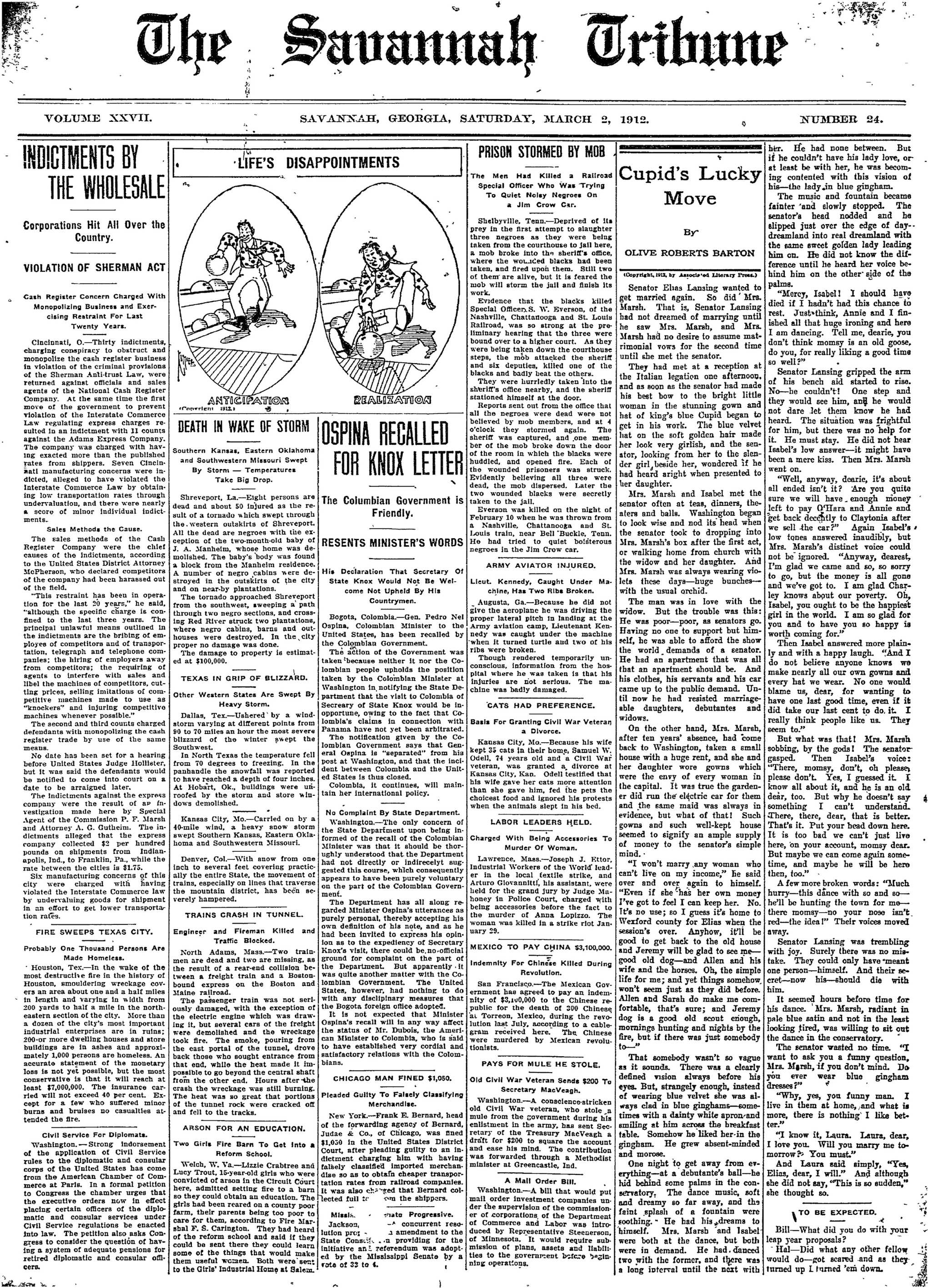
Page text (machine-generated)
The Savannah Tribune
VOLUME XXVII.
INDICTMENTS BY THE WHOLESALE
Corporations Hit All Over the Country.
VIOLATION OF SHERMAN ACT
Cash Register Concern Charged With Monopolizing Business and Exercising Restraint For Last Twenty Years.
Cincinnati, O.—Thirty indictments, charging conspiracy to obstruct and monopolize the cash register business in violation of the criminal provisions of the Sherman Anti-trust Law, were returned against officials and sales agents of the National Cash Register Company. At the same time the first move of the government to prevent violation of the Interstate Commerce Law regulating express charges resulted in an indictment with 11 counts against the Adams Express Company. The company was charged with having exacted more than the published rates from shippers. Seven Cincinnati manufacturing concerns were indicted, alleged to have violated the Interstate Commerce Law by obtaining low transportation rates through undervaluation, and there were nearly a score of minor individual indictments.
Sales Methods the Cause.
The sales methods of the Cash Register Company were the chief causes of the Indictments, according to the United States District Attorney McPherson, who declared competitors of the company had been harassed out of the field.
"This restraint has been in operation for the last 20 years," he said, "although the specific charge is confined to the last three years. The principal unlawful means outlined in the indictments are the bribing of employees of competitors and of transportation, telegraph and telephone companies; the hiring of employers away from competitors; the requiring of agents to interfere with sales and libel the machines of competitors, cutting prices, selling imitations of competitive machines made to use as "knockers" and injuring competitive machines whenever possible." The second and third counts charged defendants with monopolizing the cash register trade by use of the same means.
No date has been set for a hearing before United States Judge Hollister, but it was said the defendants would be notified to come into court on a date to be arraigned later.
The indictments against the express company were the result of an investigation made here by Special Agent of the Commission P. F. Marsh and Attorney A. G. Gutheim. The indictments alleged that the express company collected $2 per hundred pounds on shipments from Indianapolis, Ind., to Franklin, Pa., while the rate between the cities is $1.75.
Six manufacturing concerns of this city were charged with having violated the Interstate Commerce law by undervaluing goods for shipment in an effort to get lower transportation rates.
FIRE SWEEPS TEXAS CITY.
Probably One Thousand Persons Are Made Homeless.
Houston, Tex.—In the wake of the most destructive fire in the history of Houston, smouldering wreckage covers an area about one and a half miles in length and varying in width from 200 yards to half a mile in the northeastern section of the city. More than a dozen of the city's most important industrial enterprises are in ruins; 200-or more dwelling houses and store buildings are in ashes and approximately 1,000 persons are homeless. An accurate statement of the monetary loss is not yet possible, but the most conservative is that it will reach at least $7,000,000. The insurance carried will not exceed 40 per cent. Except for a few who suffered minor burns and bruises no casualties attended the fire.
Civil Service For Diplomats.
Washington.—Strong indorsement of the application of Civil Service rules to the diplomatic and consular corps of the United States has come from the American Chamber of Commerce at Paris. In a formal petition to Congress the chamber urges that the executive orders now in effect placing certain officers of the diplomatic and consular services under Civil Service regulations be enacted into law. The petition also asks Congress to consider the question of having a system of adequate pensions for retired diplomatic and consular officers.
ANTICIPATION REALIZATION
DEATH IN WAKE OF STORM
Southern Kansas, Eastern Oklahoma and Southwestern Missouri Swept By Storm — Temperatures Take Big Drop.
Shreveport, La.—Eight persons are dead and about 50 injured as the result of a tornado which swept through the western outskirts of Shreveport. All the dead are negroes with the exception of the two-month-old baby of J. A. Manheim, whose home was demolished. The baby's body was found a block from the Manheim residence. A number of negro cabins were destroyed in the outskirts of the city and on near-by plantations.
The tornado approached Shreveport from the southwest, sweeping a path through two negro sections, and crossing Red River struck two plantations, where negro cabins, barns and outhouses were destroyed. In the city proper no damage was done. The damage to property is estimated at $100,000.
Other Western States Are Swept By Heavy Storm.
Dallas, Tex.—Ushered by a windstorm varying at different points from 90 to 70 miles an hour the most severe blizzard of the winter swept the Southwest.
In North Texas the temperature fell from 70 degrees to freezing. In the panhandle the snowfall was reported to have reached a depth of four inches. At Hobart, Ok., buildings were unroofed by the storm and store windows demolished.
Kansas City, Mo.—Carrled on by a 40-mile wind, a heavy snow storm swept Southern Kansas, Eastern Oklahoma and Southwestern Missouri.
Denver, Col.—With snow from one inch to several feet covering practically the entire State, the movement of trains, especially on lines that traverse the mountain district, has been severely hampered.
TRAINS CRASH IN TUNNEL.
Engineer and Fireman Killed and Traffic Blocked.
North Adams, Mass.—Two trai-
men are dead and two are missing, as
the result of a rear-end collision
between a freight train and a Boston-
bound express on the Boston and
Maine railroad.
The passenger train was not seri-
ously damaged, with the exception of
the electric engine which was draw-
ing it, but several cars of the freight
were demolished and the wreckage
took fire. The smoke, pouring from
the cast portal of the tunnel, drove
back those who sought entrance from
that end, while the heat made it
impossible to go beyond the central shaft
from the other end. Hours after the
crash the wreckage was still burning.
The heat was so great that portions
of the tunnel rock were cracked off
and fell to the tracks.
ARSON FOR AN EDUCATION.
Two Girls Fire Barn To Get Into a Reform School.
Welch, W. Va.—Lizzie Crabtree and Lucy Trout, 15-year-old girls who were convicted of arson in the Circuit Court here, admitted setting fire to a barn so they could obtain an education. The girls had been reared on a county poor farm, their parents being too poor to care for them, according to Fire Marshal F. S. Carington. They had heard of the reform school and said if they could be sent there they could learn some of the things that would make them useful women. Both were sent to the Girls' Industrial Home at Salem.
SAVANNAH, GEORGIA, SATURDAY, MARCH 2, 1912.
OSPINA RECALLED FOR KNOX LETTER
The Columbian Government is Friendly.
RESENTS MINISTER'S WORDS
His Declaration That Secretary Of State Knox Would Not Be Welcome Not Uphold By His
Bogota, Colombia.—Gen. Pedro Nel Ospina, Colombian Minister to the United States, has been recalled by the Colombian Government.
The action of the Government was taken because neither it nor the Colombian people upholds the position taken by the Colombian Minister at Washington in notifying the State Department that the visit to Colombia of Secretary of State Knox would be inopportune, owing to the fact that Colombia's claims in connection with Panama have not yet been arbitrated.
The notification given by the Colombian Government says that General Ospina is "separated" from his post at Washington, and that the incident between Colombia and the United States is thus closed.
Colombia, it continues, will maintain her international policy.
No Complaint By State Department.
Washington.—The only concern of the State Department upon being informed of the recall of the Colombian Minister was that it should be thoroughly understood that the Department had not directly or indirectely suggested this course, which consequently appears to have been purely voluntary on the part of the Colombian Government.
The Department has all along regarded Minister Ospina's utterances as purely personal, thereby accepting his own definition of his note, and as he had been invited to express his opinion as to the expediency of Secretary Knox's visit, there could be no-official ground for complaint on the part of the Department. But apparently it was quite another matter with the Colombian Government. The United States, however, had nothing to do with any disciplinary measures that the Bogota foreign office adopted. It is not expected that Minister Ospina's recall will in any way affect the status of Mr. Dubois, the American Minister to Colombia, who is said to have established very cordial and satisfactory relations with the Colombians.
CHICAGO MAN FINED $1,050.
Pleaded Guilty To Falsely Classifying Merchandise.
New York.—Frank E. Bernard, head of the forwarding agency of Bernard, Judae & Co., of Chicago, was fined $1,050 in the United States District Court, after pleading guilty to an indictment charging him with having falsely classified imported merchandise so as to obtain cheaper transportation rates from railroad companies. It was also charged that Bernard collected full sum from the shippers.
Mississippi Senate Progressive.
Jackson, a concurrent resolution program amendment to the State Consent, in providing for the initiative and referendum was adopted by the Mississippi Senate by a vote of 32 to 4.
PRISON STORMED BY MOB
The Men Had Killed a Railroad Special Officer Who Was Trying To Quiet Noisy Negroes On a Jim Crow Car.
Shelbyville, Tenn.—Deprived of its prey in the first attempt to slaughter three negroes as they were being taken from the courthouse to jail here, a mob broke into the sheriff's office, where the wounded blacks had been taken, and fired upon them. Still two of them are alive, but it is feared the mob will storm the jail and finish its work.
Evidence that the blacks killed Special Officer S. W. Everson, of the Nashville, Chattanooga and St. Louis Railroad, was so strong at the preliminary hearing that the three were bound over to a higher court. As they were being taken down the courthouse steps, the mob attacked the sheriff and six deputies, killed one of the blacks and badly beat the others. They were hurriedly taken into the sheriff's office nearby, and the sheriff stationed himself at the door.
Reports sent out from the office that all the negroes were dead were not believed by mob members, and at 4 o'clock they stormed again. The sheriff was captured, and one member of the mob broke down the door of the room in which the blacks were huddled, and opened fire. Each of the wounded prisoners was struck. Evidently believing all three were dead, the mob dispersed. Later the two wounded blacks were secretly taken to the jail. Everson was killed on the night of February 10 when he was thrown from a Nashville, Chattanooga and St. Louis train, near Bell'Buckle, Tenn. He had tried to quiet boisterous negroes in the Jim Crow car.
ARMY AVIATOR INJURED.
Lleut. Kennedy, Caught Under Machine. Has Two Ribs Broken.
Augusta, Ga.—Because he did not give the aeroplane he was driving the proper lateral pitch in landing at the Army aviation camp, Lieutenant Kennedy was caught under the machine when it turned turtle and two of his ribs were broken. Though rendered temporarily unconscious, information from the hospital where he was taken is that his injuries are not serious. The machine was badly damaged.
CATS HAD PREFERENCE.
Basis For Granting Civil War Veteran a Divorce.
Kausas City, Mo.—Because his wife kept 35 cats in their home, Samuel W. Odell, 74 years old and a Civil War veteran, was granted a divorce at Kansas City, Kan. Odell testified that his wife gave her cats more attention than she gave him, fed the pets the choiceest food and ignored his protests when the animals slept in his bed.
LABOR LEADERS HELD.
Charged With Being Accessories To Murder Of Woman.
Lawrence, Mass.—Joseph J. Ettor, Industrial Workers of the World leader in the local textile strike, and Arturo Glovannitti, his assistant, were held for the grand jury by Judge Mahoney in Police Court, charged with being accessories before the fact to the murder of Anna Lopizzo. The woman was killed in a strike riot January 29.
MEXICO TO PAY CHINA $3,100,000.
Indemnity For Chinese Killed During Revolution.
San Francisco.—The Mexican Government has agreed to pay an indemnity of $3,100,000 to the Chinese republic for the death of 300 Chinese at Torreon, Mexico, during the revolution last July, according to a cablegram received here. The Chinese were murdered by Mexican revolutionists.
PAYS FOR MULE HE STOLE.
Old Civil War Veteran Sends $200 To Secretary MacVeagh.
Washington.—A conscience-stricken old Civil War veteran, who stole a mule from the government during his enlistment in the army, has sent Secretary of the Treasury MacVeagh a draft for $200 to square the account and ease his mind. The contribution was forwarded through a Methodist minister at Greencastle, Ind.
A Mall Order Bill.
Washington. A bill that would put mail order investment companies under the supervision of the commissioner of corporations, of the Department of Commerce and Labor was introduced by Representative Steenerson, of Minnesota. It would require submission of plans, assets and liabilities to the government before beginning operations.
Cupid's Lucky Move
By
OLIVE ROBERTS BARTON
Senator Elias Lansing wanted to get married again. So did Mrs. Marsh. That is, Senator Lansing had not dreamed of marrying until he saw Mrs. Marsh, and Mrs. Marsh had no desire to assume matrimonial vows for the second time until she met the senator.
They had met at a reception at the Italian legation one afternoon, and as soon as the senator had made his best bow to the bright little woman in the stunning gown and hat of king's blue Cupid began to get in his work. The blue velvet hat on the soft golden hair made her look very girlish, and the senator, looking from her to the slender girl, beside her, wondered if he had heard aright when presented to her daughter.
Mrs. Marsh and Isabel met the senator often at teas, dinners, theaters and balls. Washington began to look wise and nod its head when the senator took to dropping into Mrs. Marsh's box after the first act, or walking home from church with the widow and her daughter. And Mrs. Marsh was always wearing violets these days—huge bunches—with the usual orchid.
The man was in love with the widow. But the trouble was this: He was poor—poor, as senators go. Having no one to support but himself, he was able to afford the show the world demands of a senator. He had an apartment that was all that an apartment should be. And his clothes, his servants and his car came up to the public demand. Until now he had resisted marriageable daughters, debutantes and widows.
On the other hand, Mrs. Marsh, after ten years' absence, had come back to Washington, taken a small house with a huge rent, and she and her daughter wore gowns which were the envy of every woman in the capital. It was true the gardener did run the electric car for them and the same maid was always in evidence, but what of that! Such gowns and such well-kept house seemed to signify an ample supply of money to the senator's simple mind.
"I won't marry any woman who can't live on my income," he said over and over again to himself. "Even if she has her own money I've got to feel I can keep her. No. It's no use; so I guess it's home to Wexford county for Elias when the session's over. Anyhow, it'll be good to get back to the old house and Jeremy will be glad to see me—good old dog—and Allen and his wife and the horses. Oh, the simple life for me; and yet things somehow, won't seem just as they did before. Allen and Sarah do make me comfortable, that's sure; and Jeremy dog is a good old scout enough, mornings hunting and nights by the fire, but if there was just somebody to—"
That somebody wasn't so vague as it sounds. There was a clearly defined vision always before his eyes. But, strangely enough, instead of wearing blue velvet she was always clad in blue ginghams—sometimes with a dainty white apron and smiling at him across the breakfast table. Somehow he liked her-in the gingham. He grew absent-minded and morose.
One night to get away from everything—at a debutante's ball—he hid behind some palms in the conservatory. The dance music, soft and dreamy so far away, and the faint splash of a fountain were soothing. He had his dreams to himself. Mrs. Marsh and Isabel were both at the dance, but both were in demand. He had danced two with the former, and there was a long interval until the next with
NUMBER 24.
her. He had none between. But if he couldn't have his lady love, or at least be with her, he was becoming contented with this vision of his—the lady in blue gingham.
The music and fountain became fainter and slowly stopped. The senator's head nodded and he slipped just over the edge of daydreamland into real dreamland with the same sweet golden lady leading him on. He did not know the difference until he heard her voice behind him on the other side of the palms.
"Mercy, Isabell I should have died if I hadn't had this chance to rest. Just think, Annie and I finished all that huge ironing and here I am dancing. Tell me, dearie, you don't think mommy is an old goose, do you, for really liking a good time so well?"
Senator Lansing gripped the arm of his bench aid started to rise. No—he couldn't! One step and they would see him, and he would not dare let them know he had heard. The situation was frightful for him, but there was no help for it. He must stay. He did not hear Isabel's low answer—it might have been a mere kiss. Then Mrs. Marsh went on.
"Well, anyway, dearie, it's about all ended isn't it? Are you quite sure we will have enough money left to pay Q'Hara and Annie and get back decently to Claytonia after we sell the car?" Again Isabel's low tones answered inaudibly, but Mrs. Marsh's distinct voice could not be ignored. "Anyway, dearest, I'm glad we came and so, so sorry to go, but the money is all gone and we've got to. I am glad Charley knows about our poverty. Oh, Isabel, you ought to be the happiest girl in the world. I am so glad for you and to have you so happy is worth coming for."
Then Isabel answered more plainly and with a happy laugh. "And I do not believe anyone knows we make nearly all our own gowns and every hat we wear. No one would blame us, dear, for wanting to have one last good time, even if it did take our last cent to do it. I really think people like us. They seem to."
But what was that I Mrs. Marsh sobbing, by the gods! The senator gasped. Then Isabel's voice: "There, momsy, don't, oh please, please don't. Yes, I guessed it. I know all about it, and he is an old dear, too. But why he doesn't say something I can't understand. There, there, dear, that is better. That's it. Put your head down here. It is too bad we can't just live here, on your account, momsy dear. But maybe we can come again sometime, and maybe he will be here then, too."
A few more broken words: "Much hurry—this dance with so and so—he'll be hunting the town for me—there momyss—no your nose isn't red—the ideal!" Their voices moved away.
Senator Lansing was trembling with joy. Surely there was no mistake. They could only have meant one person—himself. And their secret—now his—should die with him.
It seemed hours before time for his dance. Mrs. Marsh, radiant in pale blue satin and not in the least looking fired, was willing to sit out the dance in the conservatory.
The senator wasted no time. "I want to ask you a funny question, Mrs. Marsh, if you don't mind. Do you ever wear blue gingham dresses?" "Why, yes, you funny man. I live in them at home, and what is more, there is nothing I like better." "I know it, Laura. Laura, dear, I love you. Will you marry me tomorrow? You must." And Laura said simply, "Yes, Elias, dear, I will." And although she did not say, "This is so sudden," she thought so.
Bill—What did you do with your leap year proposals?
Hal—Did what any other fellow would do—got scared and as they turned up I turned 'em down.
WITHIN HIS HANDS
AN ORATION DELIVERED AT DAYTONA, FLORIDA, BY M. C. MAX WELL, D. D., OF WASHINGTON, D. C.
14.2
PART II.
The progress of the negro in the sciences, arts, literature and industries in forty-eight years is without parallel in the history of the world. But the battle is barely begun. The negro has no time to congratulate himself upon the accomplishments of the past; these are only preparatory; things academic and vast invite his attention. The race for existence is growing exciting between the races. The white man finds that he can no longer exist because he is white just as the negro finds he can no longer exist on the sympathy of those who pitted him and tolerated him because he has been a slave. The industrial, political, educational and civic atmosphere is economic; every man must tote his tote; the drones must go; only the fit shall survive. The more justice the negro demands, the more laws he must obey; the more he consumes, the more he must produce. He is called to pass through the pure fire of civics and economics, which knows no race, does not consider previous condition of servitude, but put all of earth's races on the square of merit by which they, all alike, must rise or fall. This story of two soldiers discussing their denomination while reclining in camp, illustrates well the present relation of the negro to the civic, economic, political, industrial, religious and moral questions of the day; one soldier said he was a hard shell, he believed in predestination, or what is to be will be. The other soldier said he was a Missionary Baptist and believed in doing things. The next day they were called from their tents to fight. During the fight, the soldier who said "What would be, would be," ran. When they came again to their tents the Missionary said to the hard shell, "Thought you believed in predestination, or, what is going to be, will be?" asked the missionary. "You see it is this way;" explained the hard shell. "You don't understand my religion. It was foreordained before the world began that this battle would be fought yesterday just as it was fought. It was also foreordained that I should run; and, run like hell." So in the economic race for existence the negro must run his best, with all mind, all soul and all strength.
The business showing of the negro is commendable, he does a splendid retail business, he must now attempt wholesailing. He needs wholesale stores. Particularly does he need these in the grocery, drug and clothing lines. The thing that operates against the establishment and conduct of wholesale branches of negro business enterprises is individualism. The negro is individualistic. He knows nothing of co-operating or the pooling of wealth. He has no faith to invest in business associates. He does not possess the secret of forming a partnership in which several are equally concerned and all allowing the business to dominate the men, and all grow equally rich; instead, each unit of the partnership would desire to have the predominence of the units and so wangle until the business would be crushed to death by a war for supremacy of each of the several units of the partnership against the re et of the units. It follows then, that but a single thing stands between the negro and the conduct of great wholesale business enterprises. He has the money; he has the demand; he has the opportunity; has the same white friends who help him to make his retail stores a success willing to help him make his wholesale ventures a success. What then hinders him? I answer his individualism, his desire to monopolize, his inability to work with others of his race. He must then be taught that individualism is a detriment. The negro has shown his ability to make good in the professions. The world knows he can practice medicine, read law and master theology. But it, is not enough for the negro physician simply to prescribe medicine; he owes something to the profession. He must contribute his share of articles to the current medical months; he must show that he is investigative; he must invent a medical instrument, get out a medical text book or a reference work on some line of medicine; he must publish a medical magazine. There is no reason why five thousand negro physicians should be in America without a great National Medical Magazine of their own make to honor their profession and win and inspire the confidence of their race.
The same is true of pedagogy. The negro teacher must invent a new method on one or more subjects, write a text book and contribute to pedagogic magazines his intellectual observations in and out of the school room. There is no good reason why thirty thousand negro teachers in America should be without a National Pedagogic Magazine of their own make in which their opinions, observations and discussions of things intellectual should be reflected and circulated among members of their race, particularly, and among other races generally. The same is true in law and theology, with the exception, that the negro has been more constructive and productive in theology than in law, medicine and pedagogy. The world also demands that the negro will add to the library of historical literature a concise, informative and complete history of his race of his own make. Several attempts have been made by members of the race to write what purports to be histories of the race
but the poverty of material, the careless manner of compilation; the lack of funds to pay departmental specialists; racial bias and individualisticism prevent them from supplying the demands for a history of the race that sets forth the rise and development of the race. I have examined a history of the race which makes no mention at all of R. R. Wright, Sr. This is partiality and the historian who omits mention of the distinguished Wright is making a bad history. We have examined another history of the race, which amounts to nothing more than a gazetteer of members of the historian's religious demonination. His heroes and heroes are all drawn from his (the historian's church). It is fearful to see a large photo of a woman who has read a paper before a district conference together with a long article setting forth her achievements? Taking up pages, in what purports to be a history of the negro while men who are race builders are passed up without mention because they were not members of the historian's church, political party, or had views on industrial or classical education different to those of the historian's. The historian who is blinded by demonationalism cannot make an history for the race; the race is not a church.
Then, too, the race is called upon to strengthen its public utilities—I mean its churches, banks, lodges, industrial insurance companies and benevolent associations. The negro should make his church vital; negrod Christianity should amount to more than singing and praying. Each church should be a religious social settlement, giving to the community in which it is erected the benefits of a constructive Christianity. In a word, the church must be constructive. The negro needs to deposit more of his money in banks owned by the race then it must be seen to that the officers and directors of these institutions are proficient, industrious, perspicacious and honest. He can strengthen his lodges by disbanding the fake secret lodges and putting time and money in those established orders which have history, tradition and specific ethics to sustain them, and from these, the thieves, grafters and robbers of widows and orphans should be driven.
Industrial insurance offers a splendid opening for the investment of negro capital. These should be placed on solid basis with honest and capable men at the head of them and dishonest agents should be quickly and suddenly removed. The benevolent associations of the race need to employ a modern business system and they will become agencies for the uplifting of the race. Let me here add, that institutionalism should be added to at least five hundred negro churches in the next five years. The work which yet remains to be done is vast. We cannot excuse a man; like England's famous queen, of blessed memory, we expect each member of the race to perform a duty. Though we are but a child race, we have reached that stage of development which requires that we must stand alone. It is folly to longer desire to be petted by the north or humored by the south. The negro is economically and industrially organized out of the north, not as the result of racial virus but as the result of a ceaselessless if immigration which competes him from the economic and industrial equations there. Since then, it is not a prejudice but a condition which operates against the negro north—the north has done its full duty by the American negro.
Thanks to the brave sons of the north, the living and the dead, who have contributed so much in men, women and consecrated wealth to the redemption of my race. Then, let me remind you that we are living in a new south. The south is no longer in the grasp of demagogues. It is no longer brooding over the loss of its slaves. It no longer deals specifically in politics. It is no longer governed by prejudice but by reason. We have to deal with a new southern white man who is willing to meet the issues arising with wisdom, justice and moderation. Having lifted itself from the dust and ashes of reconstruction, the south has grown industrial and economic. The south is busy with the construction of railways; with the operation of steamboat lines, with its vast cotton crops, with its manufactories, with the development of its churches and schools. The south is one vast work shop—a cyclone of economics. It opens the door of industrialism to the negro; the courts of the south are growing more considerate of the rights of the negro; it gives him public education at great expense to the white man. It is helping to reduce negro criminality by dealing with youthful negro criminals through juvenile courts. The negro has nothing to fear and no loss to sustain by being identified with the south. His home is in the south; his opportunities are in the south and his best friends are in the south. Economics destroy caste; it eliminates favoritism; ignores race, sentimentalism and oppression; it demands justice, altruism, thrift and fitness in all who run in the arena of existence.
The Israelites found themselves on the banks of the Red Sea. They are hedged by mountains to the right and left of them. They are pursued by Pharaoh's army. The chase is exciting. Their pursuers are in sight. The situation is awful. The people chafe beneath the excitement of the
moment. Moses cried unto the Lord; but the Lord gave him to know that the salvation of the people was nearer than they knew—within the very hand of Moses. "Lift up thy rod and stretch out thine hand over the sea and divide it." Lo; 'tis done; the sea divides. The problem is solved. Israel marches forward. Deliverance was hidden within a rod. The possibility of possessing Canaan, of building Judea, the opportunities to develop churchmen and statesmen, prophets, priests and kings, to develop a people who would live for all times to come in the songs, religion, philosophy and theology of the world, the possibility to enter fully into the possession promised their fathers Abraham, Isaac and Jacob, all hidden in a rod.
The present economic, industrial, political and civic surroundings of the negro are as unique, pressing and exacting as the conditions which confronted the Israelites on the banks of the sea. But the negro 'must be cheered; he must be honest to his God, patriotic to his country, loyal to his section, friendly towards his neighbors and patient under tribulation. His deliverance will come. The southern white man grows more, friendly to him day by day—the religion of the southern white man is ruling instead of political prejudice, the strongest journalists of the south are calling loud and strong for justice and toleration for the negro, he has friends in the north and south, it is not left to the political demagogue to say what the negro must be, though he stands upon the banks of the sea of modern cities and is bewildered by the demands of citizenship for usefulness on larger scales; he is increasing in education and wealth; his educational environments are being better day by day by himself and with the unstinted aid of his white friends north and south. Learning, wealth, opportunities, improved morals, industrial fitness are all mighty rods within the negro's grasp and if he will but stretch his hand and apply his rods to the perplexing situation, he will make a place for himself in the galaxy of nations for the instruments which are necessary to make him a happy and successful nation, are, indeed, within his grasp; yea, "within his hands."
PRISONERS CONFIRMED
SEVENTEEN NEGROES AND ONE WHITE MAN JOIN EPISCOPAL CHURCH—ONE OF THE PRISONERS PLAYS ORGAN AT SERVICES.
Philadelphia, Pa.—Seventeen colored men and one white man were confirmed into the Episcopal church by Bishop Rhinelander, assisted by Rev. J. D. Harewood, now a missionary, well known as assistant rector of the Church of the Crucifixion, Bainbridge street above Eighth street, at the Eastern penitentiary. Rev. Harewood has been working among the men for a couple of years. A special room was prepared for the services. One of the prisoners played the organ. The services were simple and lasted an hour. Stanley Gilbert played the organ and Mrs. Ida Chestnut sang.
The bishop wore the simple robes of his office and followed the singing with prayer. When the time came for laying on of hands by the bishop the prisoners were divided into groups of six. Their responses were made in a clear voice. Bishop Rhlenderlur urged them to lead better lives and dwelt upon the solemnity and importance of the confirmation rites. The prisoners were very much interested and attentive. The first communion will be given in a few weeks to those who were confirmed. At the end of the services each prisoner was presented with a copy of the "Earnest Communicant," a book containing prayers and advice. Nine of the men confirmed were baptized a short time ago by Rev. Harewood. The white man was prepared by Rev. T. W. Davidson, a white rector. Those confirmed consisted of a number of long and short term prisoners.
HARD TIMES FOR INDUSTRIAL TRAINING
HARD TIMES FOR INDUSTRIAL TRAINING
THE WORK SUFERS FOR LACK OF FUNDS AND A GENERAL PREJUDICE THAT EXISTS AGAINST IT.
"Industrial schools for negroes are almost invariably philanthropic enterprises, and their work is usually hampered by insufficient funds," says the United States commissioner of labor in his annual report on industrial education. "They have also had to face special difficulties owing to the fact that apprenticeships are practically never open to colored workers, and hence their students must receive all their preliminary training before leaving school. . . . As a further difficulty they have had to counteract the prejudice of their own race, who have been inclined to look upon clerical, commercial and professional callings as the only ones which could be considered by the ambitious. In spite of all these difficulties the negro schools have done good work. Several have won for themselves a national reputation, and are playing an important part in the adjustment of the race to the new condition in which emancipation has placed them." Each of the most prominent negro industrial schools is written up in the report. This noteworthy reference is made to the Armstrong Manual Training school, Washington, D. C.: "It is said that graduates from the trade courses of this school are able to, hold their own in their respective trades as finished workmen."
AN UNTOUCHED FIELD FOR WHITE DAILY NEWSPAPERS
AN UNTOUCHED FIELD FOR WHITE DAILY NEWSPAPERS
A weekly magazine for newspaper workers and advertisers is published in New York city under the name, "The Editor and Publisher." In its issue of December 23, 1911, under the heading, "Southern News Notes," this statement appears:
"What a pity the negro population of cities like Charlotte, Atlanta, Montgomery, Mobile, New Orleans, Houston, Calveston, San Antonio, Austin, Dallas, Fort Worth and Shreveport are not better newspaper readers."
The only reason why they are not better readers of white daily newspapers is because no bid is made for their interest. Practically all of the business a newspaper gets must be gone after. Schemes are devised for securing circulation in designated sections or among certain classes of people; solicitors are sent after advertisers with all kinds of alluring propositions and arguments. Now, if the white daily papers want larger numbers of negro readers, they have got to get out and go after them.
A white dally in Jacksonville, Fla., for years employed a young educated negro on its staff of reporters to cover all happenings of interest among the colored people there. The Daily Record of Columbia, S. C., has had on its staff for years a prominent colored minister, the Rev. I. E. Lowery, D. D., who has contributed to its columns almost daily important occurrences among his people. And these two dallies are subscribed for and read by a large number of the colored people in the cities where they are published and in the surrounding country.
On first thought it might appear that the negro weeklies and monthlies would not welcome the activity of white daily newspapers seemingly stealing their thunder by publishing each day a negro's report of the news which would be of interest to his people. The fact, however, is that such a move would be welcomed by the negro press, for it would make a large number of our people habitual readers of newspapers and magazines, and it would train them to pay for them when they subscribe for them. Training along these lines would materially increase the prosperity of the colored publications. Many of them are backed by secret organizations and can live at all hazards.
White southern daily papers are a long way from being able to take over the patronage of the negro papers by this method, even though every one of them were to start an Afro-American column for each day's issue and put out an army of solicitors taking subscriptions. These solicitors would, absolutely, get a large list of subscribers.
But there are many occurrences among the negroes which white daily papers could not handle as satisfactorily as the negro newspapers do. One of the saving features of our papers is they will mention a colored woman as "Miss" or "Mrs." and a colored man as "Mr." We can show off our social life and inner racial life far better than a white paper would dare to do. The field of the negro newspaper is unique and secure.
Still, the white daily papers could do much to obtain better npgri patronage both from readers and in advertising contracts from our larger and most successful business men, many of whom receive considerable white custom as it is.
The fault in this matter does not lie with the negroes. In this day and time practically all of them—more than two-thirds of them—can read. Our race is an unworked field for white daily newspapers, and it is possessed with unbounded possibilities. It is up to the white dallies to make a bid for this business, as they have to do for all other kinds, if they would have it.
---
(The foregoing editorial was reproduced in the January 6th issue of The Editor and Publisher, a weekly journal for newspaper workers and advertisers, issued from New York city. Following is the editorial comment of that journal thereon:)
"A NEGLECTED FIELD."
We reprint elsewhere in this issue (referring, of course, to that issue of the Editor and Publisher just mentioned) an editorial from Southern Life Magazine, of Atlanta, Ga., on a topic that should be of interest to every newspaper publisher whose city contains a considerable number of negroes. The editorial is based upon a paragraph that appeared in a recent number of the Editor and Publisher in which regret was expressed that there were so few newspaper readers among the colored people in the larger cities.
In the course of the article Warren S. Lowery, the editor, declares that the reason is not that the negroes cannot read, for the most of them can, but because the "white" newspapers make no effort to win their support through the publication of social and business news about the men and women of that race. There are many negroes of wealth in the larger centers of population in the east, south and middle west. These own extensive farms, manufacturing establishments, retail businesses of various kinds, hotels, restaurants and theaters.
Then there are many more negroes who belong to the middle class—those who work for salaries or wages. These are, as a rule, thrifty, steady of habit and industrious. They send their children to school and teach them, when old enough, to work. They are anxious to have their boys and girls
occupy better positions in life than they themselves have attained. Even the poorest and most shiftless of the race have to buy clothing and food and are therefore possible customers for the advertiser's goods. Southern Life Magazine, which is devoted to helping the negro people to higher ideals in home, religious, civic, and commercial life, tells the newspaper publishers that if they desire to secure the negroes as readers and advertisers they must make some effort to give them the kind of news they want.
It is undoubtedly true that the daily newspapers have neglected this important field. Probably they have felt that it was not worth cultivating. But it would seem as though the time had come when it would pay the publishers to go after this new business. A reader is a valuable asset to a newspaper whether his skin is black, yellow or white, because he is a possible purchaser of the articles advertised in its columns. The more readers a newspaper has, the more valuable it becomes as an advertising medium, and the greater its income. Therefore any field that will produce new readers ought to be carefully and perseveringly cultivated.
Some cities contain so few negroes that it might not be profitable to make any special effort to interest them as a class, but as citizens they should not be overlooked merely because they are not white people.
A GOOD NAME AND
HOW TO ACQUIRE IT
A GOOD NAME AND
HOW TO ACQUIRE IT
By ALICE M. RUSSELL
What is in a name? A good name is the richest possession that we have while living and the best remembrance we leave behind us when we depart to another world. A good name will last forever. It is here when we are no more.
There are many ways of obtaining a good name. It is obtained by being virtuous, industrious, and often by the cultivation of patience and perseverance. We can lose a good name very easily, especially through folly and ignorance. Some people, even after obtaining a good name, lose it through being indiscreet, egotistic and over-ambitious.
A good name, says the wise man, is to be chosen rather than great riches, and it does not depend on the uncertainty of popular opinion. It is based on permanent excellence, and is as immutable as are virtue and truth. It consists in a fair, good and just reputation, one that is formed under principles which promote virtue in all her influences, and it is given to us by those who are intelligent and of good standing.
In such a name we look forward to independence or a determination to be governed by an enlightened knowledge of our duty. And, too, when we have this name, we must possess a spirit of kindness and good will to toward all men and a regard for all moral action and moral qualities. We should not be as some who suppose their names to be great and good because they are very stern and haughty, passing by many, with whom they come into contact, with a spirit of hatred and contempt. We must possess the true qualities of a good name, which are the very life of tt. A good name is within the reach of all, no matter how humble the place of birth or dwelling. No one is excluded. One might say, in the forming of a good name we must first have personal exertion and virtue which make for true heroism. All virtue is the result of uniring application and industry.
The most important things one can possess are a reputation and life itself. Some are more anxious to possess a fair reputation than to deserve it. A good name, like strong will power, is gained by many commendable actions, but is easily lost by one act or destroyed in a single hour.
Although a good name is won by almost a life of self-denial, yet we are rewarded after all, and the rewards are great and enduring. While a good name will secure for one the esteem and confidence of many people who do not themselves possess the same, it is esteemed and looked upon with regard mostly by those who possess high qualities.
One of the most essential elements of a good name is to possess good moral principles. Moral principles give new life to the mind. Not possessing these, one would seek in vain to acquire that priceless possession—a good name.
NOT SO GREEN.
Being very fresh and from New York, they thought they would try some of their New York humor on the old stationmaster at the country station.
"Well, uncle," said one of the young men, "when does the 3:40 train get in?"
The old man looked at the young man and, without moving a muscle of his face, said:
"Waal, she generally gets in just a leetle behind the engine, young man."—Ladies' Home Journal.
NO NEED OF IT.
One day Mark Twain was being shaved by a very talkative barber and was forced to listen to many of his anecdotes.
The barber had to strop his razor, and when he was ready, brush in hand, to commence again, he asked:
"Shall I go over it again?"
"No, thanks," drawled Mark. "It's hardly necessary. I think I can remember every word." "Everybody's."
WIT AND HUMOR
NOT PROPERTY THUNDER.
Even the greatest actor-managers do not know all there is to be known about stagecraft, to judge from a curious story concerning Sir Herbert Beerbohm Tree, says the London Times.
It appears that at the rehearsal of a certain play at His Majesty's theater a wonderful climax had been reached, which was to be heightened by the effective use of the usual thunder and lightning. The stage carpenter was given the order. The words were spoken and instantly a noise which resembled a succession of pistol shots were heard off the wings.
"What on earth are you doing, man?" .shouted Sir Herbert, rushing behind the scenes. "Do you call that thunder?" It's not a bit like it.
"Awfully sorry, sir," responded the carpenter, "but the fact is, sir, I couldn't hear you because of the storm. That was real thunder, sir."
A JUDGE OF WINE.
George C. Boldt, hotel man, was talking in New York about wines.
"The average American is now a good judge of wine," said Mr. Boldt.
"He is no longer fooled by elaborate and imposing labels. He has learned to appreciate a wine's bouquet, flavor and body.
"I heard, the other day, a mild-looking chap in a restaurant, who said:
"I understand they've been having wine riots in France, walter."
"Yes, sir; I believe so, sir," the waiter answered.
"Well," said the mild-looking chap, 'the wine you've. served me here would be enough to start a riot anywhere.'"
WE'RE ALL GUILTLY.
In a Fourth of July address Mayor Shank once said, apropos of George Washington and truthfulness:
"Few of us, alas, can lay claim to that absolute veracity which was Washington's boast! Thus the shoe pinches us all when the story of Jack Smith comes up.
"Little Jack Smith's Sunday school teacher, after a lesson on Ananias and Sapphira, said:
"Why is not everybody who tells a lie struck_dead?
"Little Jack answered gravely:
"Because there wouldn't be anybody left." -Indianaapolis News.
KNOWLEDGE OF ART.
Robert Henri, the eminent New York painter, was talking about those millionaires who buy, merely to show off, doubtful "old masters" at fabulous prices.
"Their knowledge of art," Mr. Henri said, "is about equal to that of the sausage manufacturer who sald to Whistler:
"What would you charge to do me in oil?"
"Ten thousand,' said Whistler promptly.
"But, suppose I furnish the oil?" said the millionaire."—Dallas News.
THE MEAN THING.
Stella—Jack was on his bended knees to me last night.
Scraps
The spoiled child hides the rod.
When a man does protest too much, anyone can tell it's leap year.
The modern girl doesn't mind shaking her switch out the window to dry—men are said to have no illusions.
Some girls nurse their complexions as they never will nurse their young ones in the sweet by and by.
It takes a strong-minded man to say he can't be coaxed, and then act it.
A man who enjoys a joke at his own expense never thinks not to try a joke on the other fellow.
The prettiest girl I know is losing her good looks trying to live up to the dearest dimple.
Happiness is the cold cream to beauty.
Some girls dance as though they want all the world to know their partner bores them.
When an artist marries a homely girl, all the world knows he believes in inspiration afar.
The only way to keep a secret is to take on another.
True love is kind when its kindness is neither wanted nor needed.
There are such things as practical dreams and working after them.
Poetry may move the will towards beauty, but the bank book will buy it.
"THE PHILOSOPHY OF LEISURE"
A Sermon
And there Isaac's servants digged a well.—Genesis 26:25.
We are here for work. This fact needs to be repeated again and again with never-decreasing emphasis. The world owes nobody a living, whereas everybody owes the world his powers. Only the very few are so fortunate as to feel justified in wallowing in indolence.
And there is a second fact which should be accentuated. No man should toll incessantly. Everybody stands in need of periodical rest. If it is true that "all work and no play makes Jack a dull boy," all play and no work leads to the same undesirable results.
The frequency with which the Scriptures refer to the Sabbath day leads to the inference that among the reasons for its institution man's requirement of weekly relaxation is by no means the least.
Valuable as it undoubtedly would be to exhort people nowadays to observe the Sabbath in the proper spirit, these remarks shall concern themselves with the spirit, which is to mark the enjoyment of our everyday leisure. Although ours is a very strenuous life, there are but few people whose muscles are on a tension all the time. With nightfall offices shops and factories close their doors and people put aside their books, wares and tools.
As there are well defined principles governing every calling, so there are inviolable rules underlying all recreation. What the nature of leisure should be is, to my mind, beautifully suggested by an incident recorded in Sacred Writ. We are told that in his wanderings from place to place the patriarch Isaac, who led a pastoral and agricultural existence, had his servants dig for wells, without the clear water of which the fertility of the soil could not have been preserved, and the life of the people could not have been spared.
In the pursuit of achievement along specific lines every man must not only manifest talent, ambition and application, but must also command leisure to insure him endurance. And the leisure must, like the well of refreshing waters which Isaac's servants digged, yield only means of refreshment.
There is a philosophy of leisure. One may reveal wisdom or folly in resting, as he does in toiling. This philosophy has, as yet, not been mastered by all persons. There are hundreds—aye, thousands—who do not know how to rest. For them it is a period of ennui. They waste their leisure time in sitting around in idleness, in walking the streets without aim, in indulging in worthless gossip, in playing dangerous games of chance, in reading immoral literature and in frequenting places of amusement furnishing questionable entertainment. What is the benefit which one derives from such leisure? None whatever. He that takes his leisure hours in any one of these ways indeed misses leisure's real purpose. "The life of indulence is a miserable mockery of happiness," says Sir John Lubbock. Leisure must not be dull and wearisome. It must not wreck them nervously. It must not break them physically. It must not weaken them mentally. It must not degrade them morally. It must not kill them spiritually. Leisure must not mean the complete cessation of noble effort and energy. The rest for which it makes should be change of activity. Resting is not rusting. Every act in life must raise us above the brute. Our leisure should tend toward recreation, reinforcement and rehabilitation. Intended to divert our attention, leisure should be the means of self-improvement in directions of necessity neglected by us in the pursuit of our specific daily duty.
Always ask yourself: "What benefit will accrue to me from this diversion? Will it refresh me or will it enervate me? Will it be the means of my upbuilding or will it help to annihilate me?" I would have you take your leisure saneily, rationally, profitably. Let him that uses all the time the muscles of the body devote himself to some mental discipline. And let him who employs his brain day after day derive his recreation from physical exercise.
I would have you value time at its proper worth. Every minute of your earthly existence is given you as a sacred trust. You should guard it carefully. It should be turned to some honorable use. It should be a blessing fo you and to others.
Would that I could teach the large leisure class its responsibility. Many persons belonging to this class certainly require direction. Observation will demonstrate their frequent dissipation of precious opportunities. If you be among those who can be identified with the leisure class and who in the past have squandered time, let me counsel you to do something which will help to develop you personally and indirectly tend to improve the condition of others. Nobody has the right or privilege to spend his or her leisure in idleness. Idleness is in almost every instance the forerunner of degeneracy. But let no one imagine that I would advise merely the so-called leisure class. I wish to counsel all who stand in need of counsel—the young and the old, the men and the women, the rich and the poor, the informed and the
uninformed. Unless this advice is occasionally tendered, the philosophy of leisure may at times be forgotten.
A reminder is especially opportune at this season of the year. The winter months are upon us. They find us taking our leisure for the most part within doors.
I would have you cultivate the habit of taking your leisure to a great extent at home. The healthful companionship of your dear ones and the wholesome atmosphere of mutual confidence are sure to prove refreshing influences. Spend your evenings within your family circle. Sit around the table in your library or your living room. Discuss matters of common family interest. Read healthful literature—biography and history, fiction and poetry, magazines and journals enjoying the indorsement of thinking men. Exchange views on problems that beset your community, the problems of the country, the problems of the world at large.
If at times you wish to take your leisure away from home, as you are justified in doing, let your walks lead you into nature's temple, where you must needs be uplifted, and not into the haunts of temptation, where you will be annihilated. Visit playhouses where your higher impulses will be stimulated. Listen to some of the great variety of lectures which are being delivered in your community. Attend the concerts given under public and private auspices. Take an active part in good government, in social endeavor and in settlement work. Remember that a man is judged as much by the way he takes his leisure as by the way he performs his duties. Civilization depends as much on the nobility of man's relaxation as on the nobility of man's work.
One of the most regrettable facts is the indifference with which some people treat the wasteful use of leisure by their children. Such wastefulness is sure to form bad habits. And bad habits in children in turn are sure to develop worthlessness in men. If your leisure does not benefit you, no one is at fault but yourself. The wells of relaxation which we should dig are not always stopped up by others, as in the case of the patrarch Isaac, but are often stopped up by ourselves. Amid the toll of your daily life dig wells of leisure wisely, so that the diversion they yield may help to preserve that strength, that dignity and that nobility of which we stand in need for the proper living of the life which God has given us.
WILLIAM ROSENAU.
DISHEARTENED NEGROES
GIVEN GOOD ADVICE
ONE OF VIRGINIA'S LEADING
WHITE DAILY NEWSPAPERS RE-
MINDS NEGROES THAT WHITE
MEN DO NOT LOSE CONFIDENCE
IN THEIR RACE BECAUSE A FEW
OF THEIR BUSINESSES FAIL ON
ACCOUNT OF MISMANAGEMENT.
"Undoubtedly the most grievous result of the smash of the True Reformers' bank, the colored institution in Richmond, and the defalcation and flight of Reuben Hill, the cashier, will be the tendency to destroy the confidence of the negroes in themselves and their own men," says The Roanoke Times, a white daily newspaper of Virginia. "The people of that race in Richmond and in many parts of the state were very proud of the True Reformer enterprises, the bank and hotel and stores. They were proud also of the negro insurance organizations, apparently well managed and successful. All these seemed to prove the ability of the negro as a financier and business man and his right to be trusted with the management of large affairs and money belonging to others. The Richmond white people rather gloried in the achievements of their negro neighbors. The True Reformers' bank, the negro bank, with its 90-odd stenographers and clerks, was becoming one of the show places to which tourists were taken, and the negro hack drivers—poor fellows, probably with some of their own money. in the institution—used to grin with conscious pleasure and pride when they pointed it out.
"Now there is a smash. Many hard-working, thrifty, trusting negroes have lost their savings. Worse than that, they are in danger of losing confidence and hope in their own people. It is known now that the True Reformers' business has been muddled and jugged through years and that some of the officials not only have been guilty of the wildest kind of financiering, but have been dipping into the money. Yet this is no reason why the negro should be discouraged. The blow is cruelly hard on them because they have so little. But there should be some comfort for them in the recollection that white people with all their intellect, skill, experience and traditions, constantly are doing things just as bad. By neglect, by loose methods, by lack of knowledge and rascality, they wreck banks, ruin depositors and stockholders, give demonstrations of folly, incompetence and fraud as bad as can be. Therefore there is no reason why the negroes should lose faith in their own institutions or religious or business leaders. They must do as white people do and try to learn from the hard jars they get; try harder than ever to build up their race and its enterprises, and next time watch things a little more closely and carefully. The fact that now there is a state official whose business is to supervise financial institutions like the True Reformers will be a great safeguard hereafter and guarantee of better management."
MORE YOUNG COLORED MEN SHOULD HEED THE CALL OF THE LAW
BY WILLIAM H. LEWIS, ASSISTANT ATTORNEY GENERAL OF THE UNITED STATES.
Races, and nations, like individuals, during the centuries of their development and growth, show a decided predirection toward perfect attainment along certain lines in preference to others. The Greeks developed most pronouncedly in art and in letters; the Romans in statecraft. Among nations in our day, the English are the model law-enforcers of the globe; the Germans are the world's philosophers; the French are smartest in art, dress, society and frivolity; the Italians are the pace-makers in music; and the Americans are distinguished as the highest development of frenzied financiers.
"Among races, the Caucasians are the world's premier builders, inventors and discoverers; the Chinese show most tenacity in adhering to customs that are centuries old; the Japanese are peerless in successful imitation; the American Indians are the most fearless and cunning of nature's children; and up to the present stage of their development, the negroes of America and Africa have shown themselves to be the humblest, most patient and long-suffering of all humankind—qualities not to be deplied, for the Christ has said, "the meek shall inherit the earth." What the negroes' most pronounced leanings will be during future decades of their evolution, is a puzzling question.
A one-sided development is not desirable in race or individual. Indeed, such development may prove to be fraught with grave dangers. For our part we are anxious that every essential line of preparation and training for a people should be stressed in keeping with its importance to our future well being.
In the early years of our freedom it was deemed wise to center our forces on getting together a Christian ministry of ample numbers to take care of the race's religious training. The numbers having been secured, we turned our attentions, assisted of course by our white friends, toward increasing the efficiency and adding to the preparation of that ministry. In more recent years there was begun the awakening of our young men to the necessity of preparation for the practice of medicine that our physical ills might be attended by those within our ranks; and today-large numbers of our young men are turning their attentions to this line of professional preparation.
The time is now here for corraling the largest possible number of candidates to prepare for the practice' of law. The opportunities for racial help offered in this field of endeavor are not being realized with sufficient weight.
The white men chosen from time to time to make and administer the laws of the several commonwealths of these United States, so far know intimately only the deprived, ignorant, vicious negroes—those who help to keep the court dockets filled. To the minds of these men there is but a small per cent. of worthy, law-abiding negro citizenry. How are they ever to become better acquainted with us? How are they ever to realize that a surprisingly large per cent. of our people are worthy of citizenship? As we see it a direct means for bringing about civic recognition from them, in many states of these United States, lies in the production and development of able colored law practitioners to serve us at the bar of justice—men who will by their practice in jurisprudence and their conduct as barristers, focus the attention of the law-manipulators of the other race on negroes of ability and worth in the community. To accomplish this would be a step toward the ends we seek.
The leading objection brought forward to discourage those of our youth who would prepare as lawyers, is that the colored lawyer cannot attain eminence as a court practitioner or as a criminal lawyer. Grant that practically none of them can do so. It must be admitted that they can. If they will, become successful and able as civil attorneys and counselors-at-law, which generally must come before attaining success in the courts; and even this alone is a consummation devoutly to be wished for by any one entering upon the practice of law. Exploited, swindled and misused as are large numbers of this country's colored citizens, lawyers of color to help them steer clear of these ills, are a pronounced necessity.
Even in the field of politics is there promise of careers for some negro attorneys. What better example can we give than this achievements of our own William H. Lewis, daybefore-vesierday a student at Harvard, yesterday a practicing attorney, today assistant attorney general of the United States. What might not a negro lawyer hope for who avails himself of the fullest preparation, within his reach? Mr. Lewis is like a transplanted bloom from out of the dark, for his ancestors knew from experience the crushing ills of slavery. Mr. Lewis has had to face and grapple with the retarding devices of race prejudice. He came to realize that no man becomes great by avoiding difficulties, but rather by overcoming them; and he brought his magnificent will-power into play, held himself despite opposition, a clouded outlook, and proscription, to the task of fitting himself to accomplish big things and
today he holds the highest position under this government yet occupied by a citizen of color.
The young man who feels an impelling call to the law, if he has the proper literary foundation, may by studying at home books especially prepared, or by reading law under the direction of a successful lawyer, fit himself within a few years for admittance to the bar. Correspondence schools have courses prepared that fully meet all needs of preparation. Any one, with the means for attending college can find here in the south well equipped law departments run in connection with some of our best educational institutions, and after taking a course in one of these, may he if he desires round out his preparation in the law school of some northern university.
With negro towns being promoted here and there, giving promise of negro cities in time not far distant, young women of the race so inclined may yet have the opportunity of entering upon the practice of law in communities and under influences best calculated to give them large opportunities for development as legal lights, state laws affecting such a matter of course being taken into consideration. Colored young men, quick of mental grasp and sharp of wit, must dream their dreams of acquiring power in the legal life of this nation. An army of negro lawyers of strong hearts, cool heads, and sane in judgment, is needed. Every young man who feels the call of the law should resolve to get the preparation required and enlist for a man's part in some of the legal battles of the future.
NEGRO·SIGNS NAME;
WHITE MAN HIS X
SERMON ON ILLITERACY AND NEGLECTED OPPORTUNITIES FOUND IN FEDERAL CLERK'S OFFICE WHEN TWO PRISONERS LEAVE JAIL AND SWEAR OFF FINES.
Atlanta.—Two federal prisoners were brought into Clerk O. C. Fuller's office to swear off their fines of $100 each.
The men were E. L. Blalock of Gwinnett county, white, and Sol. Williams of Cobb county, a negro. Both had served short terms in the Fulton county jail and being unable to pay their fines went through the customary formalities of swearing that they possessed not over $20 which could be used to pay the fine.
"Mr. Blalock," called Clerk Fuller, and he administered the customary oath.
"Sign your name right here," continued the clerk.
"Aw, I can't write my name," replied the man in a natural tone, as if such a thing were an everyday occurrence, and the clerk wrote the name and let Blalock touch the pen as he put the cross underneath the necessary "his mark."
"All right, Sol," called out the clerk as he told Blalock he might go.
The negro, who appeared to be an ordinary country negro took the oath and wrote in a fairly legible hand his full name, "Solomon Williams," bowed to Mr. Fuller and left the office.
"Do you know that is one of the commonest things up here that happens in my office and one of the most—well, disgusting." Clerk Fuller added after mentioning for the right word.
"Nearly every negro, young and old, who comes before me can at least sign his name, and yet we have a number of white men from the country districts who can't write their names and who don't seem to feel the least embarrassment about saying so.
"That negro man is over 50 years old and that white man is not 25. The negro grew to manhood when an education was far-harder to get than it is now, and the white man has today every chance in the world to overcome his ignorance and lack of knowledge if he but had the ambition and pride to do so."
"Now, there's a sermon in illiteracy and the need of a compulsory education law. A white man who couldn't write his name—and in fail.
COLORED PERIODICALS DEVELOPING TALENT
"A few years ago negro poets and novelists were represented very nearly every month in some one of the great magazines," says T. Thomas Fortune, "but now we seldom find one of them so represented." Scattered through our own newspapers, however, we find many contributions of prose and verse that are worthy, and that foreshadow a good and plenteous literary harvest in fullness of time. The race has plenty of imagination in the crude, with which the refining processes are busy. In music, both vocal and in composition, we have made and are making a place on the dramatic stage, in Europe and America, of the most encouraging character; and this has been accomplished in the past decade, which it took the preceding twenty years of preparation to make possible. "The child is father to the man," and great results are the products of "small beginnings."
FRATERNAL AFFECTION.
Recruiting Sergeant—Why do you say you won't enlist unless you're sent to the Seventy-fifth infantry?
Tim Geoghegan—Becae's I want to be near my brother that's in th' Seventy-sixt—Harper's Weekly.
NO COLOR LINE IN WEST INDIES
Secretary of Jamaican Cricket Club of New York Makes Statement.
CLASS DISTINCTION—JAMAICANS DISCRIMINATED AGAINST ON ACCOUNT OF STATION AND NOT BECAUSE OF COLOR.
New York.—Branding as silly the assertion of 'T. L. McDonald, a native of Jamaica, to the effect that the color line is drawn in the West Indies between the blacks and mulattoes, R. Roger Melbourne, secretary of the Jamaican Cricket club of New York, comes out in statement that while class distinction exists in Jamaica, there is no discrimination on account of color.
Mr. Melbourne expresses himself on conditions in Jamaica as follows:
"I see that a student of Morgan college, Baltimore, Md., while partially agreeing with Mr. O'Connor De Cordova's article in refutation of Miss Mary Ovington's statement in the Sunday Herald 'that the negro is a man only in Europe,' takes exception to the term 'negro' as used by Mr. De Cordova and alleges 'that the mulattoes in Jamaica are a distinct people from the blacks or negroes.'
"When Mr. De Cordova came forward to refute Miss Ovington's statement, mentioning certain conditions in Jamaica, he did not for one moment think that the negro was not also a 'man' in the United States. He came forward out of justice to negroes in general and Jamaicans in particular (he being himself a Jamaican), and that the spirit of the article was taken by the editor was shown by the headline, 'Negro Also a Man in America.'
"Mr. McDonald has made the assertion that mulattoes in Jamaica are a 'distinct people from the blacks or negroes.' That statement is sweeping and misleading. He is muddled in his fragmentary statement, and one would gather that the 'color line' is drawn. He has hopelessly mixed up color line with class distinction.
"In New York city one hears much of the '400', and in other localities the same class distinction, although during the recent visit of the Duke of Connaught New York '400' dwindled down to 300 or so. So you see in every community there must be the classes. In Jamaica the mass of the population is composed of negroes, and with the masses there are the world over penury and ignorance.
"For convenience sake, according to Mr. McDonald's viewpoint, I will divide the negroes of Jamaica into two groups—the blacks and the mulattoes. There are among the blacks and mulattoes people of prominence socially and otherwise, and the government of the colony are in the hands of these people with a few officials appointed by the colonial office in London.
"That there is no color line in Jamaica is well known; but there is certainly such a thing as class distinction. It is erroneous to think that there is a line drawn between the two groups of people. Among the classes. The blacks of culture and refinement would not recognize as their social equal the uncouth mulatto, and vice versa; but both groups of the same class are at par and receive the same social recognition from the white man. Nor is it expected that the cultured of both groups would bring themselves down to the level of the peasant population. To bring it more clearly to the readers, the educated and refined class of Americans look down in sympathy with the ignorant negroes who are the cause of mob law in the south, and would not allow themselves to be put in a class with them.
"Reforms are needed in all governments, and history feems with the names of reformers who have lived centuries ago, down to our times. Reforms mean progress. There are many men who have stood for the rights of the negro in Jamaica who are dead and gone. Mr. Cox is a reformer and is esteemed by Jamaicans at home and abroad, although many think him too radical in his views.
"According to Mr. McDonald, we understand that because Mr. Cox raised a hue and cry against negro oppression he was suspended by the 'aristocrats' from the legislative council. The truth of the matter is that Mr. Cox was suspended by regular parliamentary procedure on account of what was considered an insult to the representative of the king. Indeed, he was censured by his own colleagues and a motion for suspension and a vote of confidence in the governor, Sir Sydney Oliver, was moved, I think, by the Hon. D. A. Cornaldii, member for the parish of St. James, a representative of the people."
NEGRO DOCTORS PRAISED.
Dallas, Tex. -The negro physicians of Dallas are being especially complimented, for their heroic work in the recent epidemic of spinal meningitis. The white physicians had to 'call on them for a supply of serum and other medicines necessary in combating this disease. The quarantines of all the smaller towns have been raised and schools have reopened and times are normal again.
LOOKS AS IF HE WILL NOT FIGHT IN UNITED STATES.
When Jack Johnson, over in London, said that he was through with the United States and never would fight here again, it looks as if he merrily beat somebody to a statement of fact. The condition themselves are not going to be brought about by the champion.
Divers other persons, in various sections of our country, are busyusing themselves with arraignements that threaten to preclude his appearance anywhere in Uncle Sam's domains.
And as it stands, Johnson is a fighter willing to work—for his price—anywhere in the United States, but with only Nevada open to him. This latter state is not a certainty. If there were not a general impression that the Flynn and Johnson bout will fall through the other reason; it is probable that preparation to have the Nevada fight law wiped off the statute books already would be under way. A special session of the legislature is easily possible, and Nevada may demand one.
There is no rush, for the bout looks like a purely speculative-proposition now.
Jack Curley, who manages Flynn, already has called off the Palzer bout and is booking a theatrical tour for his man.
This makes the Flynn end of the sketch look bad.
HOW NEW YORK WILL BAR HIM.
Australia, England and California are closed to the champion. Youngstown, Mo., refused to let him box in exhibition in a city that has been staging regular contests. New York has lidded him now. In these columns several days ago it was stated that Governor Dix, if the legislature should refuse to refuse the Frawley law, might make it inoperative by removing the commissioners.
That this would be a possibility was proved when Commissioner O'Nell in declaring himself against Johnson to box in New York said that he would prevent the champion's appearance, if no other method was feasible, by resigning. This would leave a board of but one man, which would not be competent to issue licenses.
Johnson, in Chicago, denounced Jim Corbett long enough to say that he could not be prevented from boxing in New York, and that he would "demand the rights of an American citizen."
Jack may be all right in theory, but any time any fighter, or fight promoter, thinks he can put anything through that the authorities have decided to prevent, he shows that he is not conversant with history. Nevada's frontclad law cannot be gotten around, but it can be repealed.
And with the law still in force that is the only state in the Union in which a fighter can win an argument with public opinion.
CORBETT GETS SOME ADVERTISING.
Both ends of Johnson and Corbett argument worked overtime, sending dispatches, respectively, from Chicago and Boston. Corbett's latest is a promise to punch Johnson's nose if the negro tries to shake hands with him when they meet.
Johnson previously had described in detail the method by which he will handle Corbett, if the latter falls to crawl when they come together. The whole thing is splendid advertising for Corbett, and fair for Johnson, who does not need it quite so much. They probably will not be quite so belligerent as the day approaches for their meeting. Johnson has never been strong for mixing when there was no money in sight, and Corbett is pretty careful not to get hurt, with nothing to gain. He was mixed up, however, in one of the few altercations in which prominent fighters have engaged in recent years, that being his somewhat famous affair with Fitzsimmons in Philadelphia.
It was not a knockdown and drag out, however. Both Johnson and Corbett are aware that they cannot meet without having so many persons around that it would be impossible for them to come to blows.
NO ONE-SIDED EDUCATION IS WANTED BY THOUGHTFUL AFRO-AMERICANS.
"The sole prescription for colored men to be farmers and blacksmiths is ceasing to take hold in many sections of the country and the negro boy and girl are being trained in the arts, sciences and professions, and are making good," says the Illinois Chronicle, published in Chicago.
"Fisk, Howard and Wilberforce are responsible for a number of educated men and women who are not in sympathy with the doctrine that we should be merely blacksmiths. The negro has lone ago learned that he does not want a one-sided education. He wants a full rounded education and a chance to use it. Schools of every branch and every character are needed to make him a full rounded man."
"It is indeed gratifying to note" the wonderful progress made by nongroves along the higher lines of educational life."
Published Every Saturday
462 West Broad Street.
Phone 2171.
Subscription Rates:
Remittance must be made by Express or Post Office Money Order, or Registered Letter. Advertising rates given on application.
Entered at the Post Office at Savan
nah, Ga., as Second-Class mail matter.
SATURDAY MARCH 1ST, 1912
The entrance of ex-President Roosevelt in the arena for the presidential nomination has caused much talk in political circles during the week. The Colonel is popular with the people. His nomination will only be secured by a stampede from Taft.
Excitement ran high all day Thursday on West Broad street south of the Union Station. Women who were busily engaged in their domestic affairs left them, perched themselves in their windows and doors so that they might get an eyefull of the excitement Merchants, laborers and artisans neglected their work in order that they too might take in full extent of the unusual amount of activity that was being manifested on the west side. School children on their way home must have been a hour or more late in reaching their homes for they stood about the street stretching their little necks trying to take in all that was going on around them. In fact, one would have thought that some great calamity had befallen the west side or that some great circus was in town. People on all sides wondered what was taking place. Finally, during the latter part of the afternoon, the mystery of it all was cleared up and it dawned upon everybody that it was simply Moving Day for The Savannah Tribune and all was well.
There is generally entertainment and amusement galore in this city for adults but for our children this can hardly obtain. We have often wondered why it was that more varied and interesting amusements were not furnished the boys and girls of this city, that sort of amusement which would allow them to show to the public their physical accomplishments. There are held in many of the northern cities each year for the public and private school children what is known as field day sports. The revenues accruing from these games is generally dispensed to some charitable institution and the prizes are donated by the merchants. An event such as this held some time during the month of May would be quite a drawing card to the public aside from being a source of much encouragement to our boys and girls. It would inspire pride in them and give them an opportunity for knowing that we are not neglectful of them. There are one small and three large Negro public schools in the city which with the large private schools would afford us all the youthful athletics necessary to pull off this affair. A small admission fee to the games could be charged and the money derived from them given to Charity Hospital, which we are sure could very conveniently make use of it. The preliminary trials to the games to secure the teams for each event could be run at the various schools a month or more prior to the finals and the great day held at the baseball park. The Negro merchants and those of our white friends could be asked to donate the prizes which of course would be quite an advertisement for them, and the whole event could be given at very little expense. We could have the regular field day program consisting of relay, sprint and long distant, potato and sack races together with a few weight contests. Let's give our children a little encouragement by getting these races on foot. What do you say about it?
IN HIS HOLY TEMPLE.
Interesting Services in The Churches of the City.
Evangelical Minister's Union
The Evangelical Minister's Union met on Tuesday with Dr. R H. Singleton presiding. Devotional service was conducted by Rev. H. L. Heyward "I heard the voice of Jesus say" was sung. Having addressed the throne of grace the 8th Psalter was then read. "Alas; and did my Saviour bleed" was sung. Sermonic report was given by Dr D. A. Reed. The sermon was masterly handled. The program committee made their report for the month of March. March 5th, Sermonic Report; March 12th, Subject the True Christian Unity; March 19th, The Evil of Divorce Law, by Rev. H. L. Heyward; March 16th. How to improve Prayer Service by Rev. A. J. Edmonson. All visitors are welcome.
The Installation of the Evangelical Ministers Union was held at the 2nd Baptist church February 21st. Following program was rendered: Organ prelude. Song "Holy holy holy Lord, God almighty" by the church choir. Prayer by Rev. H. L. Heyward. Music by the church choir. 133 Psalms was read by Rev. M H. Rutherford. 640 hymn was lined by Rev. H. L. Heyward. Installation sermon by Dr. P. F. Curry, who took for his text the 1st Corinthians, 2nd chapter and 5th verse. Music by church choir. Offertory. Quintette by Mrs. Florence Robinson and others. A paper, 'Why the Ministers should be a Unit Regardless to Denomination lines' by Rev W. A. Daughtry. Quartette by St. Philip choir, Charles and West Broad. Rev. J. H. Este, D. D. installed the officers. The following officers were installed: Rev R. H. Singleton, D. D., President; Rev W. V Daughtry, Vice President; Rev M. H Rutherford, Secretary; Rev H. L. Heward, Assistant; Rev J. S. Jenkins, Reporter; Dr. E. B Brown, Chaplain, Rev M. C. Rogers, Marshal; Rev B. S Hannah, Treasurer; Dr. L. A. Townley, Critic and Chairman of Program Committee; Rev E. D. Giddins, Chairman of Vigilant Committee; Rev C. W Protho, Librarian. A very excellent banquet had been prepared for the occasion which was enjoyed by everybody.
F. B. B. Dots.
On Feb. 20 we were honored by having as our distinguished guest Dr. W. G. Johnson, pastor of the 1st Baptist church Macon Ga., and president of the General State Baptist Convention, and the founder of the Reformatory at Macon, Ga., which is supported by the Convention. The exercises were opened by a spirited prayer meeting led by Deacon Philput. Rev. Wright read for the lesson Ps. 5:1-9. Dr. Johnson was introduced by Rev. Wright. His address on the Reformatory and its needs was excellent. He also spoke of the good work that he hopes to accomplish with our assistance. A very large collection was raised for him to help in that great work. Sunday was our communion day. In the morning Rev. Wright's subject was "Lo, I'll be with you." It was a fine sermon. He beautifully portrayed the baptism of Christ by John in the river Jordan. The choir sang "I'm anchored in Jesus." "Lord I approach the mercy-seat" was sung and those who felt the need of prayer came forward and prayer was offered. There was an exceedingly large crowd of visiting ministers, deacons and members at communion. At night, Rev. Wright read for the lesson Ps. 17-11.14. His text was from Peter 2:4. The subject was "Christ a living stone." The sermon filled with beautiful examples and lessons was well received. The choir very appropriately sang "Jesus shall lead me." He invited those who felt the need of prayer to the mercy-seat. A very large crowd bowed and prayer was offered in their behalf. Come down at any time.
St. Benedict's Church.
(Gaston and East Broad Streets)
Sunday March 3rd. Second Sunday
in Lent. First mass at 7 a.m. Secon-
Mass at 8 a.m. High Mass and sermon at 10:30 a.m. Sunday School after the last mass. Rosary sermon and Benediction at 8 p.m. Father Sherer will preach the morning sermon which is taken from the Gospel of the day. "The Transfiguration of Christ." In the evening there will be solemn Profession of Faith and administration of Holy Baptism. Those two ceremonies will be explained during the sermon. The children of Mary will receive Holy Communion at the First Mass. Last Sunday a very large congregation attended the evening service and enjoyed the beautiful sermon preached by Bishon Kelley. Father Eugene of the Benedictine College preached an eloquent Lenten sermon on Wednesday evening. Next Wednesday March 6th, Father Cornelius, of the Benedictine College, will deliver a special Lenten discourse On Friday evening we shall have the impressive Devotions of the Stations of the Cross. We hope that all those Lenten services will be well attended. St. Benedict's church loses two faithful members in the persons of Mr. and Mrs. Madden who will leave Savannah in a few days to live in St. Louis, where Mr. Madden to their new home in the west. In the school chapel of the Immaculate Heart of Mary there will be Sunday School at 3:30 p.m. After a long illness, borne with Christian attitude, Mrs. Ellen Harris died on her daughter, Mrs. Katie Campbell. Mrs. Harris was a faithful and loya Catholic. Her funeral took place on Thursday evening and was most impressive; the large crowd of people of all denominations that took part in the funeral was a proof of the respect and esteem in which the deceased was held.
Second Baptist Church. The services on Sunday morning were very interesting, there was a large congregation present. The pastor, Rev D. Augustine Reid preached a fine sermon from the text Ps. 37:16. Subject, "Happiness." At 8 p.m. he preached on the "Church in Sardis." Tomorrow is the rally. Beginning on Monday March 11th the revival services will begin, the Rev. S. L. Johnson of Boynton, Va. will conduct the meetings.
St. Paul C. M. E. Church We are thankful indeed to Almighty God for a full and complete manifestation of the Holy Spirit given in the services of old St. Paul C. M. E. church last Sunday. St. Paul members enjoyed the distinction of being graced with one of the leading figures in Colored. Methodism, Dr. N. F. Haygood, of Augusta Ga.
General Secretary, of Missions. Two great and lasting sermons were preached by the General Secretary. He also lectured to the Woman's Board of Missions at 4 p.m. His sermons and lectures were like the Jewish symbolic fire, "They will never go out" A great social evening at home of Mrs. Rosa Murry 1019 36 St. next Monday. Her friends are cordially invited. Don't Forget the Rally, 5th Sunday in March First Congregational Church. Services tomorrow morning at 11 o'clock Sermon by the pastor Rev. W. L. Cash After the service there may be baptism by immersion. Christian Endavor service at 7 p.m. At the evening service, holy Communion will be administered and there will be reception of members At this service a charitable collection will be taken for Charity Hospital. The public is invited to attend each of these services.
East Broad, Perry and McDonough Sts.
Beginning Sunday March 3rd, 1912.
Sunday 11 a. m., preaching by pastor
Rev. S. T. Redd. Sunday 8:30 p. m.
,sermon by Rev. W. W. Warthan. Mon
day 4th, 8:30 p. m., sermon by Rev.
W. Prother, Remarks by Rev. W. L.
Cash. Music by the First Congregational Church choir. Tuesday 5th,
Thanksgiving service of the Kings
Daughter, Papers will be read by Mrs
S. T. Redd and Mrs. Mary Holmes.
Election of officers. Wednesday 6th
8:30 sermon by Rev. M. H. Rutherford
Remarks by Rev. D. Augustine (Reid,
Music by C. M. E. Church choir, Thursday
7th, Election of officers of the Y
P. S. C. E., Paper by Mrs. M. E. Wiliams.
Friday 8th, 8:30 p. m., sermon by Rev. H. L. Havwood, music by his
choir. Sunday 10th, 4 'o clock p. m.
,Sermon by liev. Rockwell S. Brank.
pastor of Independent Presbyterian
Church. It is hoped that the ministers
who have consented to be with us will
invite their congregation and choir. All welcome.
Friendship Dots.
Friendship Dots.
On last Sunday at 11 a.m., Bro S. E. Scott, preached a very instructive sermon. Sunday school at 3 p.m., was good as usual; p.m., the Lord upward was adminis. p.m., for Hl. Haywood preached as usual at 8 p.m. an able sermon from Matt. 3-17, subject, "Baptism and temptation of Jesus." The sermon was sent home to the hearts of the people. A good old time gospel feast was the slogan and we had it. The services will be conducted Sunday by the pastor who shall preach special sermons at 11 a.m. and 8:15 p.m. The church is rallying in its strength. We hope to begin our building soon. All are invited. Seats free. Come hear our choir, its charming, hear our pastor, he will inspire you.
St. Philip's Dots.
Monumental Notes.
The attendance at Sunday School last Sunday morning was excellent collection was large and the lessons were thoroughly discussed, accessions eight. At eleven o'clock a.m. the pastor, Dr. L. A. Townsley filled the pulpit and took for his text the latter clause of the 3rd verse of the 3rd chapter of Prov., "Let not mercy and truth forsake thee," Rev. J. S. Jenkins assisted him, accessions three. General class at 4 p.m. was in its bloom, every one presen- seemed to be full with the Holy Ghostt At eight o'clock p.m., the pastor again filled the pulpit and took for his text Exodus 30:9, "Six days shalt thou labor and do all thy work." His sermon was mostly a fire side talk but still it was interesting and warmed the hearts of those who sat and listened to him. The church was packed to its utmost capacity, Rev J. S. Jenkins again as sisted him with the services, accessions one. The choir rendered sweet and appropriate music all day. Class meeting Tuesday night was well attended, collection was good. The Presiding Elder Dr. B. S. Hannah was present, accessions two, making a total of 48 since conference and 673 during the present admin-istration, speaks well for the church and pastor. Love feast last night was a gem. Read the "Guide" to-morrow, you can get one after service, it will give the desired results. Services to-morrow: Prayer meeting 5:30 a.m. Sunday School 9:30 a.m. Preaching at 11 a.m. 3 and 8 p.m. The rites of communion will be administered at both of the afternoon and evening services. There will also be baptism and fellowshiping. You are invited to attend these services.
Knights of Damon and Charity Temple No. 9, of Ludiwicl Addressed by Supreme Grand Secretary W. H. Herbert of Savannah.
On last Wednesday, Supreme Grand Secretary of the Knights of Damon, Hon. W. H. Herbert, visited Ludiwicl, Ga., and made a ringing speech in the order's behalf to quite a number of the members. In the afternoon to a creditable gathering of ladies of Charity Temple No. 9, he spoke some very encouraging words, showing them the necessity of their labor as a whole for the good of the order and for the general uplift of the race. His talk was wholesome and pleasing and the ladies expressed themselves as being benefited by his visit.
At night he addressed the male members of the order of J. M. Langston Lodge No. 16. This lodge is composed of the industrious and most thought of colored men in Ludwiciw The ringing speech that he made will always be remembered by those who heard it It was the best delivered since the organization of that lodge to its members and threw much light upon Damonism. Secretary Herbert is an energetic young man, well thought of and is leaving no stones unturned; put the Knights of Damon in the foremost ranks of fraternal organizations. He wishes to return sincere thanks to Mrs. Kemp, Mrs. Baggs, Mrs. Mayrant and the other ladies of the Temple for the courteous treatment tendered him and for their donation of $3.10; also to Bro. Canty, Bro. Brown, Bro. J. C. Kemp and the other members of the lodge for their kind treatment and liberal donation of $10.00. The Supreme Grand Commander Mr. R. L. Jones, is making good in his position and deserves to be commended for the manner in which he is conducting the business of the order. Under his leadership the order cannot but help reach the topmost round of the ladder in the fraternal world.
Carnegie Library.
The proposed Carnegie Library is assured if the plans of the curators are successful. Listen, look, and be ready to give both physical and moral support. The curators must give sympathy, your support, your money. The committee on site is busy. The soliciting agent visited the Second African Baptist Church last Sunday night in the interest of the Library. After the facts of the proposed Library were presented quite a liberal collection was taken. The pastor and deacons thought the church ought to give more and therefore decided to increase the amount before it is published. Thanks. The following are the cash subscriptions for the week. G. L. Middleton, $1.00; Howard Reed, $1.00 on account; E. M. Edward, $2.25 on account; First African Church, $17 West Broad streets $3.05. $Total $3.30.
H. Pearson,
Soliciting Agent.
In Memoriam.
In loving remembrance of my dear hus-
band,
Mr. WILLIE SMITH,
who departed this life on Sunday
February 5th, 1911.
One year ago today,
In a far off distant graveyard,
Where the trees there branches wave
Lies my dear beloved husband,
In his cold and silent grave.
He is missing in his home forever,
For the vacant space he left behind
Can't ever be refilled again,
He is gone but he is not forgotten.
His wife,
Mrs. W. M. Smith,
New York City.
Resolutions.
The following resolutions were adopted by the Second Baptist Church Sunday school and ordered published: Whereas, We the officers, teachers and members of the Second Baptist Church Sunday school do with sad hearts deplore the death of our coworker and laborer, Sister M. M. Monroe, who departed this life Saturday January 27th inst., and Whereas, It is a known fact that her whole life as a Christian was devoted in the work of the Sunday school, that before and since her fellowship with us, she was an ever ready and willing worker and like a faithful gardener, she always desired to work among the tender plants. This being her forte, you could find her where-ever engaged surrounded by the little ones. We that know her best can but admire her ambitious and energetic spirit, which in connection with her Christian devotion is worthy of emulation, and
Whereas, it has pleased our Heavenly Father to call her from labor to re-
serve him, it humble submission to Him that doeth all things well,
therefore, be it.
Resolved, That in the death of Sister M. M. Monroe, we the Second Baptist Church Sunday school have sustained the loss of a faithful, earnest, and devoted teacher and worker. Her presence-with us will be missed and her place among us cannot readily be filled.
Resolved further, That we tender our heartfelt sympathy to the bereaved family and commend them to a gracious and merciful Saviour for succor.
Resolved further, That a copy of these resolutions be sent the family, that they be published in The Savannah Tribune, and that they be spread upon the records of the Sunday school.
Signed,
Mrs. F. H. Robinson,
W S. Roundfield,
R. M. Davis
Miss Cornelia C. Osborne, Sec.
J. C. Lindsay, Supt.
Sister REBECCA JENKINS, who departed this life Nov. 27, 1911. Whereas, It has pleased the Almighty God in His alwise providence to call from our midst our beloved sister to a better land than this. Be it
Resolved, That we how our heads in humble submission to His will who is too kind to do a wrong and too wise to make a mistake.
SPEND $1.00 WITH
SCOTT BROS.
WEST BROAD AND GWINNETT
AND GET A TICKET FOR A PHOTO
OF YOURSELF FREE
Resolved further, That a copy of these resolutions be spread upon our minute book, a copy tendered the bereaved family and the same be published in The Savannah Tribune.
Committee,
Mrs. R. Fields,
" C. Middleton,
" R.B. Brown
" Freeman
" M. Black, Chairlady.
Card of Thanks:
My sincere appreciation is hereby extended all of my friends who were so very kind to me during the illness and death of my dear mother. Thanks are also extended for the beautiful floral offerings.
R. Ethel Wright.
Deaths.
Mr. Wallace J. Richards died on Saturday of last week and was buried on last Monday afternoon from 407 Hall street, west. For a number of years Mr. Richards worked as a cotton sampler and followed that occupation up to two months ago when he was compelled to give up on account of ill health. He is survived by his wife, Mrs. Alice Richards; two sons, Wallace J. Jr.; and Chas. H. Richards; a sister, Miss Ellen Richards; one brother, Mr. Samuel Richards and one relatives to mourn his death.
---
On Monday night February 19th, the Y. L. I. C held their annual installation at the residence of B垒 Bolton street. The officers were ably installed by Mrs. E.B. Roberts after which a sumptuous repast was served which was heartily enjoyed by all present. The officers for the ensuing year are: Mrs. L. L. Allen, President; Mrs. M. Harris, Vice-president; Miss M. E. Dunham, Secretary; Mrs. E. R. Dennis, Assistant Secretary; Mrs. L. B. Timmons, Treasurer; Mrs. M. E. Lockley, Chair of Health; Mrs. L. Wright, Clerk; Miss Lillie Wilson, Chaplain.
Large Furnace
FOR SALE
In Firstclass Condition
Apply 707 Howard Street
CATO YOUNG
The Acme Bicycle Store
K. HALPERN, Proprietor,
463 West Broad St.
Dealer in new and second handed
bicycles. Tires and Supplies.
Expert Vulcanizer of Bicycle
Tires. Vulcanizing 75c.
Phone 1340.
Dr J. W. Jamerson
FIRSTCLASS DENTIST
623 West Broad Street Between Huntingdon and Hall Phone 2098
Business
FOR SALE—One First Class Drug Store, Jacksonville, Fla. Well located, good trade-Terms. Good reason for selling.
G. H. BOWEN,
210 Park Ave., E. Sav'nh, Ga.
Dr. L. S. Parks.
DENTIST
240 Barnard Street.
Does all kind of high grade dental work of the best quality and workmanship. Gold crowns and bridge work. White Porcelain Pivot and Gold Crowns mounted on the natural roots. Gold Fillings, Cement Fillings, and Silver or Amalgam Fillings from nine to a full set of teeth $7.00 and $3.00 Broken places mended and teeth added. Gold ones for a small cost Bell Phone 314. Solid Gold Guaranteed 22 1.2K Gold.
For A Professional Registered TRAINED NURSE
Ring 3159-J or Write
529 OTT STREET. WELL
EXPERIENCE MASSEUSE
FLORIE A. WILSON
SPEND S
SCOTT
WEST BROAD
AND GET A TICKET
OF YOURS
On account of many of my patrons wishing me to have a MATINEE so their children can attend in the afternoon I will begin
NEXT MONDAY AFTERNOON
at 3 o'clock
CONTINUOUS PERFORMANCE
You can come any time between 3 o'clock and 11 at night and enjoy my high class show
I MUST SAY
I'm glad to have parents appreciate my efforts and to find them progressive enough to want me have their children attend my theatre
I WILL PROMISE
To do all in my power to entertain the boys and girls and in fact any of the grown-up folks who attend will always find me on the job to extend every courtesy for their comfort
B.AKER
THE MOVING PICTURE MAN
AIR DOME
SHOW SHOP FOR THE
ENTIRE FAMILY
Clean-Good-Bright-Educational-Wholesome Amusement
ADMISSION
Always The Same
OO WITH
BROS.
AND GWINNETT
CORNER WALDBURG LANE
1009 is the number. Mr. W. H. Herbert spent Wednesday at Ludiwici. Ga.
Dr. J. Walter Williams returned to the city last Saturday. We are now at our new home 1009 West Broad street. Mr. William Harrison of Charlotte, N. C., is in the city for a few days. Mrs. Henry Garner of Atlanta, is in the city for a week's stay.
Misses Sadie Williams and Minnie Smith of Jacksonville, are among the visitors in the city this week. Go to Pate's Drug Store, West Broad and Hall streets.
For first class shoe repairing carry your shoes to Thomas Baker.
E. T. F. Smalls, Jr, is the name of the son born to Mr. and Mrs. Small on Wednesday of last week.
Mr. Joseph Barker of Grahamville, S. C., was in the city a few days visiting relatives and friends.
Miss Christola King who has been visiting in the city left on last Tuesday for Jacksonville. Fla.
Mrs. Rena Simmons after spending the winter in New York has returned home at 1018 Burroughs street. Mrs. Bessie Holmes Spaights after a very pleasant stay of two months at St. Augustine, Fla., with her husband, Mr. W. S. Spaights, returned home last Saturday looking well.
C. A. Glossner, 24 Ontario St., Rochester, N. Y., has recovered from a long and severe attacks of Kidney trouble, his cure being due to Foley's Kidney Pills. After detailing his case he says: "I am only sorry I did not learn sooner of Foley Kidney Pills. In a few day's time my backache completely left me and I felt greatly improved. My kidneys became stronger, dizzy spells left me and I was no longer annoyed at night. I feel 100 per cent better since using Foley's Kidney Pills." Tonic in action, quick in results. Try them. Livingstons Pharmacy.
Mrs. Rebecca Sanders of 584 West Broughton street visited the home of Mr and Mrs. Jacob M. Powell and family last Sunday afternoon. Her visit was an enjoyable one.
The Grand Lodge officers of the Grand United Order of Good Samaritans and Daughters of Samaria were installed on the 31st. of January. The installation services were conducted by Rev. John Sneed in a very instructive way. All lodges that are desirous to unite with us are cordially requested to report at their earliest convenience. L. W. Beasley, R. W. G. C. 216 East Waldburg street, Savannah, Ga.; H L. Haywood, R W G. S., 633 32nd, street west Savannah, Ga.
Some time ago Rev R Bright preached an interesting sermon on "Dry Bones". It was enjoyed by those who heard it, and the hope has been expressed ever since for its repetition. Should the rector repeat the sermon those who have heard it, will be there with their friends.
Large front room to rent, nicely furnished with bathroom and modern improvements, suitable for one or two gentlemen. 506 Park avenue west, Mrs. Sarah Heyward. Ask Pate's Drug Store about the Nyall Line. West Broad street 1009 is the place. Mr. J. S. Causey the affable collector of the Guaranty Health and Life Insurance Company who was injured last week is expected out soon. Mr Albert J. Williams, who was in the Census Department in Washington, D. C., is now associated with one of the leading Negro photographers of that city.
Backache Almost Unbearable Is an almost certain result of Kidney trouble. D. Toomy, 803 E Olive St. Bloomington, Ill., says "I suffered with backache and pain in my kidney which were almost unbearable. I gave Foley Kidney Pills a good trial, and they have done wonders for me. Today I can do a real hard day's work and not feel the effects." Foley Kidney Pills will cure any case of kidney and bladder trouble not beyond the reach of medicine. No medicine can do more. Livingstons Pharmacy. Mrs. Georgia Smiley of St. Augustine, Fla., passed through the city this week enroute to Baltimore, Md. Miss Annie M. Scott of Augusta, Ga., is visiting relatives in the city
Mr and Mrs. J P. Harden of Chicago, Ill, are among the visitors in the city, for a few weeks. Mr. Harden is a member of the custom force of Chicago. Dr. and Mrs. Stoney of Augusta, Ga, were in the city this week.. Mr. A. B. Singfield, general superintendent and local manager of the Pilgrim Health and Life Insurance company is, out of the city for about two weeks on a tour of inspection.
Don't Neglect a Child's Cough The "Child's Welfare" movement has changed the attention of thoughtful people everywhere. Mothers are natural supporters and will find in Foley's Honey and Tar Compound a most valuable aid. Coughs and colds that unchecked lead to croup, bronchitis and pneumonia yield quickly to the healing and soothing qualities of Foley's Honey and Tar Compound. Contains no opiates and no harmful drugs Is a medicine, not a narcotic. Refuse substitutes, Livingstons Pharmacy. Mr. Edw. C. Moore of Kansas City, Kan., is in the city visiting relatives. Mr. Chas. J Madden, the mail agent, who for years was on the run between Savannah and Montgomery has recently moved to St. Louis, and is running from that city to Cleveland, Ohio. Mr Madden's many friends here wish him a pleasant stay in St. Louis.
Rev. W. L. Cash, of the First Congregational Church has been on the sick list for the past week but will probably be able to fill his pulpit tomorrow. A Cold, Lagripne. Then Pneumonia.
Is too often the fatal sequence and coughs that hang on weaken the system and lower the vital resistance. R. G. Collins, Postmaster, Barnegut, N. J., was troubled with a severe la grippe cough. He says: "I would be completely exhausted after each fit of
violent coughing. I bought a bottle of Foley's Honey and Tar compound and before I had taken it all the coughing spells had entirely ceased Foley's Honey and Tar compound can't be beat." It stops the cough by healing the cause. Refuse substitutes. Liv- ggston Pharmacy.
Two nicely situated rooms at No.124 East 33d St.
A Pretty Home Wedding.
On February 21st, at the home of Mr. and Mrs. William Robinson one of the prettiest home weddings was performed when their neice, Miss Laura Bell Shellman, was joined in holy wedlock to Mr. William Pinckney.
The home was beautifully and artistically decorated with bamboo vines, white roses and ferns. The piano and mantle were decorated with ferns and white roses.
The groom entered with Mrs. William Robinson, then followed the best man Mr. J. R. Brown, after which entered the bridesmaid, Miss Lula D. Batchelor, then followed the little flower girl, Miss Clinton Hazelhurst Williams.
The bride entered on the arm of her uncle Mr William Robinson to the strains of Lohenguin's wedding march which was played by Miss Algernon Simmons.
The bride was beautifully gowned in white silk chiffon over white silk which was trimmed in Irish lace and white satin. She wore a pearl necklace and a bracelet, a veil and a wreath of orange blossoms. Her flowers were bride roses and sweet peas which were tied with white silk ribbon and tulle. The bridesmaid was gowned in white chiffon over blue and carried white roses and ferns.
The little flower girl's dress was of embroidery and valencienne lace. Mrs. William Robinson, the aunt of the bride was becomingly gowned in black satin trimmed in cream all over lace and silk fringe and wore white chrysanthemums. The presents were numerous and beautiful which shows the esteem in which the contracting parties are held. After the ceremonies the bride and groom received the congratulations of their many friends. Mr. and Mrs. Pinckney resides at 621 West Gwinnett street.
Social happenings.
Twelfth Applversary
The Twilight Reapers Aid and Social Club's Branch celebrated its twelfth anniversary with a private installation and Social on Monday evening February 20th, at the residence of Mrs. Daisy Allen 610 West Bolton street. Games were played until the hour for the Installation arrived when the following officers were impressively installed by Mrs. Lula Wicks Allen assisted by Mrs. Lenora McTier:
President, Miss Evalena Huger; Vicepresident, Mrs. Daisy Allen: Financial Secretary, Mrs. Gertie Hughs Kirkland; Recording Secretary, Mrs. Alice Hayward; Treasurer, Mrs. Mamie Williams; Chairman of Finance, Mrs. Lizzie Timmons; Chairman of Health, Mrs Sarah Graham; Clerk of Order, Miss Jennie Campbell; Chaplain, Miss Sadie Freeman.
After the installation the members were led by the president to the spacious dining room where a table was tastefully arranged with choice refreshments suitable to the most delicate appetite. The members then did themselves full justice in partaking of what was before them. Mrs. Lizzie Timmons acted as toast mistress while the others acted well their parts Mrs. Allen was commended for the royal welcome with which she received the Branch. Long live the T. R. A. and S. C. Branch and may her banner never trail the dust
Miss Julia A. Baker 512 Hall street east entertained a few of her friends on last Thursday evening with a card party After the games was over refreshments were served. Those present were Misses C Johnson, L. Johnson, S. Bing, J. Delaware, J. Stevens, Reta Evins, Mrs Celia Johnson, Messrs. H. A. Brown, T. N Delaware. J. Barnwell J. H. Theus, M. W. Miller, B. Byrd, C Robinson, J. Hillard. Messrs. Brown and Banwell were toast masters.
AMUSEMENT COLUMN.
Coming Events in the Social World.
NOTICE—Articles in this column one
March 4th, Monday. Grand Ball by I.
L. A. Freight Handlers Laborers Union
at Harris street Hall. Tickets 25 and
40 cents.
March 13th, Wednesday. Spring
Dance by Progress Company No. 3 U.
R K. of D. at Harris street Hall. Tickets
20 and 35 cents.
March 4th, Monday. Beginning of
Five nights Bazaar by Joshua Compan-
j B, U. R. K. of P. at Masonic Temple.
Admission opening night 25 cents,
following nights 10 cents
March 15th, Friday. Old Folks Jubilee
Concert by the Vigilant Club at
Masonic Temple. Tickets 15 cents.
March 11th, Monday. Mutt and Jeff
Entertainment by The Red Rose Club
at Mechanic's Hall. Admission 15
cents.
March 18th, Monday. Spring Dance by the Royal Roosters at Harris street Hall. Tickets 25 cents. New St. Philip cordially solicits your presence at their one night Social Fair and Musical Entertainment at Masonic Temple Thu. sday evening March 14th, 1912, from 8 to 12 m. Tickets 15 cents.
REST AND HEALTH TO MOTHER AND CHILD.
MRS. WINSLOW'S Soothing Syrup has been used for over Sixty YEARS by MILLIONS of MOTHERS for the comfort of the CHILD. TELTHING for the PERFECT SUCCESS. SOOTHING for the CHILD, SOFTENS the GUMS, ALLAYS all PAIN: CURSIS WIND COLIC, and is the best remedy for DIARRICA. It is absolutely harmless. Be sure and ask for "Mrs. Winslow's Soothing Syrup," and take no other kind. Twenty-five cents a bottle.
"Just Stays Funny."
That's the truth about the Joke Book, called "Fun" that is given with the New York Sunday World every Sunday. (This.) OF COURSE, means next Sunday, too.) If you only knew what a bargain offer it is that is made here you would go right out in the rain (if raining) and buy the Sunday World next Sunday. And if not raining, you would go out and buy it anyhow.
AND BESIDES there are the other big special grand stand features, such as the famous Artist James Montgomery Flagg and his Adventures of Kitty Cobb, and Charles Dana Gibson and his drawings showing characters from Dickens, and the full to the brim Comic Weekly (which is in addition to the complete Joke Book) and the Great Sunday World Magazine.
How can you afford to miss this galaxy
F. F. JONES
Dealer in BEEF, VEAL, MUTTON, LAMB, PORK, HAMS, BACON and CORNED BEEF All kinds of GAME in season. Stall 31, City Market.
Saving Money is A Habit...
Get the habit of. Saving a part of your Earnings each week.
$1.00
starts An Account
The Wage Earners
Loan & Investment Co.
468 WEST BROAD ST.
Savannah, Ga.
JOHN H. HARRIS
J. C. LINDSAY
Is the District Manager of the
Old Reliable
Union Mutual
Association
"Nuff Sed, I'm with 'em'"
Local office:
509 West Broad Street.
PHONE 1470 or write
WM. DRISKELL, Sec'y and Gen'l Mgr
210 Auburn Ave.
ATLANTA, : GEORGIA.
Advanced Showing of Spring Millinery at
The Colored People's Millinery Store
We are now showing a few of the Spring Novelties. Keep in mind our SPRING OPENING, MARCH 18TH. When we will be prepared to show you the styles and beauties of the season. Give us a call.
464 WEST BROAD ST.
Buy your Suit, Overcoat, Shirts, Underwear, Hats or Shoes now and SAVE MONEY
I am Offering a Nice Home
on the west side at a very reasonable figure. on terms of $300.00 Cash and $15.00 per month
The house has 6 rooms, modern bath room and electric lights throughout. You wont have to spend a dollar for repairs etc.. before you move in
THOSE LOVELY LOTS ON
36th STREET, west
Are nearly all gone. The par-
tles who took my advice and
acted quicklv got the choicest to be had
CHAS, A. R. McDOWELL,
Savannah's Leading Negro
Real Estate Dealer
823 WEST BROAD STREET
Phone 2098-
THE BANK OF NEW YORK
The G. U. O of O. F.
The Odd Fellows Building Association
$5.00 per share to all Odd Fellows and
Ruth. We ask every loyal member to
that we will be able to furnish a mod-
commodated. For further infomation
rectors Information cheerfully give
C. W. ΔLEX
A. M. MON
Funeral Directors
JAS. BACON, Manager.
Prompt and courteous at
entrusted to us. Every
Latest Style Silver C
CARRIAGE FOR HIRE
605 WEST BROAD STREET
EYE TR
G. U. O of O. F.
All Fellows Building Association is now ready to offer
share to all Odd Fellows and inmates of the House
ask every loyal member to purchase some amount
will be able to furnish a modern hall that all may be s
For further infornation call on any of the office
information cheerfully given
C. W. ALEXANDER, Sect'y, 1417 Rept
A. M. MONROE & CO.
General Directors and Embalmer
AS. BACON, Manager. PAUL STEELE, Embalmer
prompt and courteous attention given all busi
trusted to us. Everything of the latest st
Latest Style Silver Gray and Black Carr
AGE FOR HIRE
WEST BROAD STREET
Phone
The Odd Fellows Building Association is now ready to offer stock at $5.00 per share to all Odd Fellows and inmates of the House Hold of Ruth. We ask every loyal member to purchase some amount of stock that we will be able to furnish a modern hall that all may be suitably accommodated. For further infomation call on any of the officers or directors Information cheerfully given C. W. ALEXANDER, Sect'y, 1417 Reynold St.
A. M. MONROE & CO.
EYE TROUBLES
We take care of your EYES by Fitting the proper glasses and the right kind of frames to your face. You are assured good attention.
Dr. M. Schwab's &
118 Bull Street, Corner State
M. Schwab's &
118 Bull Street, Corner State
IF You Don't Believe it Drop in and take a Look at Our Store. We Carry Everything. Youno longer have to go to Broughton Street.
Phones 4710 and 4711 HALL and WEST BROAD STS. Opposite The Pekin Theatre.
The Proposed New Duffy Street Odd Fewows Half
E. A. Fields, President
W. H. Burgess, Vice-Pres.
C. W. Alexander, Sect'y
P. L. Bowen, Asst. Sect'y
W, Smitn, Treas.
DIRECTORS
C. W. Alexander H. J. Freemon
W. H. Burgess E. Seabrooks
W H. Ward H. Y Davis
E. A Field W. O. P. Sherman, Jr.
W. B. Willis
R. N. Rutledge W. E. Phillips
P. L. Bowen F. Dudley
W. Smith S. Williams
ation is now ready to offer stock at and inmates of the House Hold of purchase some amount of stock certain hall that all may be suitably ac- on call on any of the officers or di- ANDER, Sect'y, 1417 Reynold St.
ROE & CO.
and Embalmers
PAUL STEELE, Embalmer.
Attention given all business
thing of the latest style.
irray and Black Cars
Phone 1211
DUBLES
, Corner State
AFRO-AMERICAN CULLINGS
"Marriage," said a negro preacher, addressing his congregation, "is a mighty serious affair, specially fur de man. Dar was Peter an' John. Da wasn't marryin' men. Peter wouldn't hab married de daughter ob de gubner, an' John he wouldn't hib jinned han's wid de prosecutin' turney's arly chile. Dem men was smart, lemme tell yer. Day had hoss sense. Look at all de big men in de Bible what did not get married. Samson, he got married, an' his ole wife paralyzed him. Then Job he got married, an' dinged if de 'oman didn't want him ter cus God an' die. She didn't care so much 'bout him cusslin' God; de dying part was what she was arter. She was a bad 'oman an' would hab got any man inter trouble. Yer all know de story ob Adam. Spozen he hadn't got married. He'd er done well, lemme tell yer. It was marryin' dat broke him up in business. I might go on ds way citlin' facks till your hair would turn white, an' still you young folks would keep on a tinkin' 'bout getting married. Yer's got de notion in yer head, somehow, an' no amount ob reason will get it out." Just then the old man's wife entered the church. "Yas," he continued, "as I was saying, there is nothing' like marryin' a good 'oman. If I had nebber married but onct an' had happened to cutch her first my happiness in dis life would have been as eternal as the flowin' of the spring er de glorious rising of the sun. 'Ise in fabor ob marriage, I is, an' when Paul says, 'He what marries does well', right dar I agrees wid him."
"Hole on dar," exclaimed the old man's wife. "A pusson come up ter de house jes now an' sald dat yer was down heah ginnin me a mighty blast allore all dese people."
"Dat am de wust fabrication, chile, what I eber hearn. Ise been standin' here complimentin' yer fer de las' fifteen minutes, an' I's sorry now dat yer yer not here. It would have done yer good. Yes, bredern, if Samson had married de righ 'oman he might had been libin' till yet an' enjoyin' hisse' on de fat ob de laan. An' dars' Job. If he had married a good 'oman, like my wife, fur instance, she wouldn't had 'vised him ter cuss God' but—" His wife stepped from the door, and the old man, observing the movement, continued. "She would have hustled him outen de bed an' made him chop wood an' fetch water. As Ise got ter go now an' watch dat smokehouse, de congregation will be dismissed."-Ex.
Real fatherhood as realized by man does not consist in mere physical relationship. Nor is it physical likeness. A person may be physically the son of another; but if all ties of affection are lost, he is as though he were not a son. Affection is all. There may be two children who are in the same family—one a son by nature, the other by adoption. Suppose the son by nature grows up out of all sympathy with the parents. He follows paths directly opposite to those wished for by the parents. He is a continual sorrow to them. But the adopted son grows up in sympathy with the family. He honors its name, sacrifices for it and, instead of bringing to it sorrow, he brings to it honor. This one is the joy of his parents, yet he is not their son by nature. Which one, however, is accounted more the son, or is deserving more of the fatherly love? The second, we agree. His relationship is that of spirit with spirit—Christian Recorder.
The Savannah Tribune, thinks that "elaborate funeral displays" have become too much of a tax. It says: "How infinitely better would it not be to eliminate so much unnecessary taxation as is placed upon the members whenever a death occurs within their ranks and to increase the monthly dues just a trifle, thereby allowing a slightly larger sick and death benefit and to cut out entirely all street parades and large outlays at funerals." Tell a negro, an Irishman or an Italian that he cannot have a big funeral when he dies, and he will at once lose all interest in the societies that care for the sick and bury the dead. Many people would think life not worth living if they were to have no big funeral when they die
It is the policy of Tuskegee institute to employ its graduates wherever it is found expedient to do so. Thirty-six graduates are now employed as teachers, some of them having charge of divisions. Among the oldest and most valuable teachers will be found many graduates of the institute.—The Southern Letter.
We are pleased to not the determination of our county teachers to improve themselves mentally and to keep abreast of new ideas and thoughts. We are glad to note this spirit, as it shows that our teachers are wide awake. Thorough preparation is absolutely essential if a teacher wishes to succeed in her profession.—Southern Missloner.
A race is like an individual, it will be whatever it will make of itself—no more and no less.—Nashville Clarion.
Ngroes, as a majority, ride on the trains as much as any people, though it be but a short distance. For most of them four or five miles is a good journey. However, it does seem that, as much as many of them have had the opportunity to ride on the trains, it is time they were learning to keep their heads from out the windows. This habit in itself makes many of them unbearable on the railways. However cold it may be, and however much they may cause others to suffer, they will holst the windows almost as soon as they sit down, simply to have the opportunity to poke their heads out at the next station.
It would seem sometimes that all their relatives and friends ahead for four or five stations have a knowledge of their being on board. If nobody is at the train to see them pass they will imagine so anyway, and when it rolls up to the station their heads are out the windows, and they are yelling and waving their hands, like a set of fools, at they know not what or whom. We are made to wonder sometimes why conductors will allow so much of this kind of thing. But we remember that many conductors wish to be kind and lenient with this thoughtless element, and very often only in cases of pressing necessity will force them to put down the windows.
On one occasion a gentleman kindly asked a young man who was sitting just in front of him to put down the window, and the young man insultingly informed him that he would not put down the window. So it is in many case, good and well-behaved people have to be made uncomfortable on the railways by the self-important young Negrose who think they have the right to make it unpleasant for all other passengers aboard the train.
We want all our people who travel on the railroads to learn that glass windows were made to look through and that they can see through them all they want to see while traveling. It will not be necessary to poke their heads out the windows—Southern Ploughman.
The negro preacher should be very attentive to his church duties at all times. He should not bum around on the streets but should be at home or in his study preparing himself for each and every service.
When they spend the majority of their time loafing around gossiping it is impossible for them to instruct the people only in an unintelligent way from which no benefit whatever can be derived.
If your congregation will not support you on account of your inability, then quit preaching and go to the farm or some other honorable labor.
We know some divines who will preach from one to five Sundays to the month and during the week lug around with a drummer's vallse, which is a disgrace to the ministry and the race as a whole.
If you can't preach, let preaching alone. If you can carry the drummer's valise, then carry it and stop disgracing yourself and the ministry. —Palestine Plaindealer.
The sins of white men seem to return upon them as a loathsome plague. White men are mistaken for negroes in their society and are compelled to flee for their lives. This was clearly manifested when a Russian Jew, in company with a white woman, entered one of the fashionable cafes. On account of his dark complexion, he was thought to be a negro. The whole city was aroused at once and had it not been for the swiftness of the victim's feet and legs which enabled him to leap high buildings and dodge his assailants and would-be lynchers, who, in hot pursuit, were crying for his blood. —Pine Bluff (Ark.) Herald.
A great many negro husbands are natural and incorrigible rovers. They have a string of cities, with a family in each, from New York to Chicago, and they keep on moving from one to their families to the other, until the undertaker catches them.
The roving system is not only highly immoral but leads to some very ghastly tragedies; say, when two rovers meet in the same house at the same time and dispute as to which of them is the husband of the woman of the house. It is to be hoped that the system will grow less in favor as the tragedies of it increase in number and ghastliness—New York Age.
Some time ago some one suggested that 5,000 negroes should march to Washington, D. C., and there and then demand President Taft to do something towards putting a stop to mob violence. We hope for two reasons that the suggestion will not be acted upon. First, the expedition would do no good. Second, there are plenty other ways in which the negro can and will play the fool without imitating Coxey's army.
We must be able to differentiate between the man who believes in a square-deal for all men, and the man who has no good word or encouragement for any one with a black face. Danylie (Ky.) Torchlight
STRIKE AGAINST NEGROES PREVENTED BY A BLACK MAN'S FAITHFULNESS.
Welborn Victor Jenkins In Southern Life Magazine.
Alonzo Bryant, president of the K. C. Western R. R., was perturbed. He had an "elephant on his hands"—an impending strike; and like the young lady who drew "Jumbo" at the circus raffle, he found his elephant a "cumbersome proposition." He was just about to conclude a conference with his superintendent and board of directors when the office boy ushered in three big, red-headed men whose powerful frames bespoke their identity with the "sons of toll," while their skins carried some of the earlier signs of smoothness peculiar to men who have exchanged hammers, shovels and sunlight for desks, stenographers and green eye-shades. The leader presented a card-inscribed Patrick O'Flannagan, Vice-President American Locomotive Firemen; and in his "good morin', gentlemen," there still lingered much of the queer accent of Ireland's peaty bogs.
"What is your business, please," said Bryant, blandly—"Have seats." They had seats. O'Flannagan found his tongue with slight embarrassment. "We have the honor," he said, "to represent the Brotherhood of American Locomotive Firemen, and it has, therefore, devolved upon us to inform the officials of the K. C. Western of the only conditions upon which we shall continue to work. If these concessions are made, very well; if not, we shall immediately order a strike and the walk-out will tie up your line completely."
"I see," said Bryant, in a tone that was almost sarcastic. "and what might those conditions be, Mr. O'Flannagan?"
"Just this," said O'Flannagan, with a sublime cock-sureness that took everything for granted—"We want three cents more the hour; we want the engines furnished with ice water; and we want all the negro firemen to be laid off indefinitely."
"So you want the 'niggers' fired, Is it, Mr. O'Flannagan?" said Bryant, including the whole situation in a word.
"Well, not-er actually that, Mr. Bryant, but-er-materially that;" explained O'Flannagan.
"I see," said Bryant, as if some great light had just dawned upon him.
For several seconds—perhaps a full minute—Bryant eat silently studying (or seeming to, at least) O'Flannagan and the other two men whose part (so it appeared), was merely to look important. This was avery impolite habit of Bryant's and very disconcerting to "officials" who had come with "ultimatums."
"Where is your home, Mr. O'Flannagan?" asked Bryant, circuitously.
"Cluccenottee;" epitomized O'Flannagan.
Then Bryant relapsed into another studying act.
"Gent'emen," he said, finally, "this request of your in behalf of your constituents resolves itself into two propositions; that I should raise your wages, and that I should discharge my colored firemen. As to the first, I am perfectly willing, providing the earnings of the road can stand for it, which is doubtful indeed. The directors are here and can tell you to a dot the present financial status of the company. Every passenger train is running at a dead loss. Two regular freights have had to come off within the last thirty days. Notwithstanding that, I will raise you a dollar extra if the money can be found, although I had to draw on my personal account to the amount of ten thousand dollars last month, in order to hold our stock at par.
"But fire my 'niggers!' Well, maybe not, gentlemen. I'll put these directors here to shoveling coal—I'll install oil-burners—I'll buy electric motors—I'll sell the road to Harrlman; but I'll not fire a single negro—not one mother's son of them."
Bryant had the floor and held it.
"A business man succeeds, gentlemen, in proportion as he discards preconceptions and blas. By narrowing my prejudices down to just one, I have succeeded in climbing to the presidency of this road. But I have one, and that is: to stick to my colored firemen through thick and thin. Every time I see one, my heart fills up because my mind reverts to my sainted mother, and=>Honk' .
"Ten years ago last December, I went west to close a merging deal with the Mobile Northern. On the evening of the 24th, a telegram came from our family physician, stating that my mother was dying and asked me to come at once. The superintendent of the Mobile Northern was kind enough to place his fastest engine at my disposal, giving me a clear track to Pell City, at which point my road crosses on the way to St. Louis. 20 miles from home. We steamed into Pell City at midnight, precisely. H and that my mother was still sinking. My superintendent had our new engine there with Bill Clemson at the throttle, and 'Bonk' Ellison as fireman, with orders to make the fastest run ever scheduled on the line. We came out as the first section of "83," east-bound express from St. Louis, with 250 miles of clear track before us. All trains east and west-bound were side-tracked, a full half-hour before we showed up. We darted out of Pell City at five minutes past midnight, and Bill threw on the air under the water tank at Bulahville. 103 miles out of Pell City, in ninety-one minutes and twenty seconds.
"Usually I do not prefer 'rush schedules, but on this particular night I felt rather grateful for the fastest engineer on the line and the best stoker in the south. Mason had taken a big risk in promising to get me home. Had wired me that he had only one available engine; but since it was nearly new, he had trusted to chance that no accident would happen. But despite our hopes, the cap of the 'steam blower' flow off just as Bill was pulling the throttle to get away from Bulahville. The engine emptied her boiler through the broken pipe like an erupting volcano. The pungent smell of ashes and steam filled my car in a fiffy, and in five minutes the engine was dead, standing on the track there, incapable of budging an inch—and the nearest telegraph station seven miles away!
"I was wild with despair. No man can know just how I felt unless he has passed through a similar ordeal. I have been known - to formulate schemes in the direst contingencies, but out there in that darkness, my wits forsook me. The second section of "88" was three hours late, making them four hours behind us. We were due to overtake two trains but could not overtake them standing there by the water tank. I seemed to hear my mother calling, 'Son! Son!' And to think that she was dying far out there in the loneliness, 140 miles away from her child.
"I rushed up to the engine. I begged Bill to try to revive her; but he gave a significant shake of his head as he punched his torch under the fire box to show me the nature of the break-down. Then 'Book' spoke—'Bonk' Ellison, the fireman, almost blistered with the escaping steam from the blow-out: "Cap'n, ah think ahk len get yo' 'way fr'm heah. Ah got a mother. Ah know 'ow yo' feel." "Man alive!" I excalmed—'What do you mean by 'getting away?' "Ole Forty-leban (freight engine 4011), 's over at Huntin'ton, and de steam in 'er aln't hardly gone. She ain't been mo' 'an two hours run in.' "Taking my hesitation for permission he turned and disappeared into the night. We listened to his flying footsteps until they died away into silence.
"Bonk's a fool," said Bill. 'He'll drop dead before he's half way to Huntington. Who ever heard of a railroad man running seven miles! Then, there's Dog River trestle.'
"One hour and thirty minutes later we heard the distant skriek of a freight engine—4011. It was 'Bonk' coming back!
"Local freight 56 turned back from Huntington every morning; the crew laid over there every night. When Engineer McFall came down next day he found his engine gone and a dead passenger engine in its place. He hurried to the office to report. There he discovered the trouble."
"Bonk," so I learned afterward, ran those seven miles to Huntington, crawling across Dog River trestle upon his all-fours and climbed up in '4011 one hour after he left us. Getting up steam with pine board and kerosene, he had cut loose, switched out, and backed down to us before the sleeping operator ever woke up.
"The deed will not go down in history, gentlemen, simply because 'Bonk' was an humble man sprung from an humble, patient and uncompaining people. But here is one who will not forget it soon, gentlemen—no, not by a d—sight
"Well, that's about all, except that I never saw a freight engine make such speed in my life as Bill Clemson got out of cld '4011.' My car only touched track in high places and I knew Bill wasn't doing it all by himself. 'Bonk' was helping. We rolled under the terminal depot sixty minutes late by schedule. 'Bonk' had made up forty minutes with a freight engine!
"My mother lived only a short while after I entered the room. She had waited for me. Didn't want to go without seelog me. Said I had been a good boy. Gave me her blessing. Prayed for the men who were so kind to bring me to her from so far away. Bade us all good-by. Then, as the down of Christmas day began to break in the east she stopped aboard that other train that doesn't stop short of the Pearly Gates.
"Bonk' was killed last year when Dog River trestle collapsed. I put a white stone over his grave. His son has worked up to his father's job. I lately promoted him to his father's run. This strike has grown out from that.
"Gentlemen, you have given me your ultimatum. Here is mine: If the road can stand for it, I'll raise you all even to ten dollars per day and allow you 30 days each month as vacation; I'll put both ice water and ice cream aboard the engines and have Pullman coaches installed—in fact, I'll do anything reasonable. But I'll be hanged if I shall fire one single negro—not, not a d—one!" and Bryant brought his clenched fist down upon the desk with emphatic force.
The three labor leaders filed silently out of the president's office. The strike was called off. "Bonk II." is still on the job.
VOCAL VENGEANCE.
A rather brutal thing was said un-awares at an evening party.
Shortly after midnight a gentleman was pressed to sing. Very thoughtfully he put forth the excuse that at the late hour the next-door neighbors might object.
"Oh, never mind the neighbors!" crieed the young lady of the house: "They poisoned our dog last week"—Lippincott's Magazine.
Undertaker Gives His Reasons Why Business in His Town Is No Longer Lucrative.
"Yep, I've decided to move away from this town. There's no business here for an undertaker any more."
"What's the cause? Do the people all go away to die?"
"The trouble with 'em is that they've practically quit 'dyin'. It was all right before the temperance cranks got so blamed fussy that the druggist had to give up runnin' a blind pie."
"You don't mean to tell me that you think folks who don't drink whisky never die? That would mean that all the women and children must have been addicted to the habit, along with the men."
"Oh, no, I don't want to try to set up no argument of that kind. You see it sort of worked both ways. The men shortened their lives by drinkin' whisky and the women done the same thing for theirselves and the children by takin' drugs and dosin' the young ones. So when the druggist was druv out of town I was the one that had to suffer. It beats all the way some folks keep forever interferin' with other people's business."
PECULIAR BUSINESS
AUCTION
"An auctioneer's business is a paradox.
"How so?"
"He builds it up by knocking things down."
CHAPLAINS FOR FRENCH NAVY.
It will be news to most persons that the French navy have no chaplains afloat, although a moment's consideration would bring to remembrance the fact of the complete divorce between church and state in France. The subject is brought prominently into notice by a petition signed by a great number of the mothers or widows of the sailors who were victims of the accident on the Gloire or the Liberte. The petitioners are to be found in the Midi, Brittany, Var and Finisterre, and they pray the senate for the reappointment of chaplains on the warships.
FITTED FOR IT.
"Why do you want that cheap lawyer, anyhow?" asked his doctor of the mean old rich man. "He used to be a barber."
"Just the one," muttered the old man. "I'm going to make a new will and I want him to cut my hair."
CROESUS BACK ON EARTH.
Patience—They say he was taken sick on the train.
Patrice—Indeed! What was the matter?
Patience—Oh, he ate too much in a dining car.
Patrice—Oh! He as rich as that?
ADJOURNED WITHOUT FORM.
The young man had taken her home from the theater.
"Mr. McGinnis," she said, "won't you come in a minute and—er—get warm? The janitor probably has turned off the steam, but—"
"Good night!!!"
OVERHEARD IN SMOKING CAR
Bad Little Dick—I wish I was a man!
The Other Boy—What fur?
Bad Little Dick—So when I'd cuss and swear an' spit nobody's think it was strange.
SIGNIFICANT.
Wife (who is without a girl)—
Why, the atmosphere of this kitchen
is blue. What causes it?
Husband (who has been trying
to get breakfast)—I have just
burned my fingers.
For Eleven Hours It Is Enveloped by Shower of Fine Powder From Volcano.
The Australian steamer Paroo had a weird experience, recently, during a voyage from Singapore to Fremantle, West Australia. When off Mount Semur large volumes of smoke were noticed issuing from its summit, which even to the naked eye gave evidence of an active volsano, and which, on inquiry, proved to have been inactive for several weeks. When the Paroo was in the Madura straits an inky darkness set in and throughout the night a dense shower of fine dust settled over the sea, making it painful to keep a lookout. Dust continued to fall, and soon the vessel was covered with a layer of fine powder. To add to the strangeness of the scene the sea became brilliantly phosphorized, and alarmed sea birds in large numbers alighted on the steamer, and it was not until after eleven hours of steaming that the atmosphere cleared.
WHEN SMILING WAS A SIN
Puritans of New England Were Exceedingly Severe on Sabbath Delinquents.
The Puritans of New England were fully as severe as their co-religionists in Britain to Sunday delinquents. Some of the pains and penalties exacted are recorded in Mrs. Earle's "Sabbath in Puritan New England." "Jonathan and Susanna Smith were each fined five shillings and costs for smiling on the Lord's day during service," while, in 1670, "two lovers, John Lewis and Sarah Chapman, were tried for sitting together on the Lord's day under an apple tree."
THE IVY HARMLESS.
The impression that ivy is harmful to walls of stone or brick has been removed by the testimony of a large number of German architects, builders, foresters and master gardeners. These trained observers agree that ivy has no tendency to make the walls damp. They maintain, in fact, that the clinging tendrils of the plant extract and absorb any existing moisture and that the thick leaves protect the walls from the action of the weather. Furthermore, they find no evidence that the ivy roots affect the foundations of stone structures.—Youth's Companion.
INDUSTRIOUS GEESE.
The solan geese are so fond of collecting materials for their nests that they do not desist from the habit even when they are about to abandon their nests for the winter migration. Off the coast of Scotland, one day, patches of straw bedding were seen floating, and although the birds were on the eve of departure they gathered up every wisp as though they had their nests to build, and in the same place they were seen collecting seaweed every day.
BUCCESS IN SIGHT.
"I can't see why I should attempt to produce your play," said the manager. "There seems to be nothing in it."
"The mayor of this town has promised me that he will threaten to stop it if you put it on," the eager young dramatist replied.
"I Hurrah! We'll put it in rehearsal at once, and in addition to being the author I want you to be the press agent."
BACK TO SCRAP PILE.
"I understand that car of Juggernaut has been put out of business in India."
"Yes," replied the chauffeur. "As soon as the people found it wasn't a 1912 model the people wouldn't stand for it."
A MILITANT DEBUTANTE.
"Going to give your daughter a coming-out ball?"
"No."
"Not going to give her a coming-out ball?"
"No; she's a militant suffragette; keeps me busy giving ball."
WITH THEM, BUT NOT OF THEM.
"Why is Jones so smiling?"
"His wife has joined the Society for the Suppression of Unnecessary Noise, and he thinks now she will have to shut up for a while."—Judge.
The Farm
TO IMPROVE ARMY STUD.
After exhaustive investigations of European armies and of their system of replenishing their cavalry with remounts, the war department of the United States has adopted a plan which will not only attain the object desired, but will incidentally result in raising the type of horses in all parts of the country.
The department's plan is, briefly, to buy a number of first-class stallions, suitable for cavalry use, and to farm them out to horse breeders of established reputation in various parts of the country where horses are raised. Farmers who have mares coming up to specifications may have service from these stallions free of charge. In return for this privilege the government is given an option on the foal resulting, so that it may be bought for army use at any time during its third year for $150. Farmers have already become interested, for they have nothing to lose by such an agreement, with the possibilities of gain in case the government does not make use of its option. Through this method one of the greatest stallions ever shipped west of the Mississippi, Sandringham, brother of an English Derby winner, has been placed on the farm of Dr. A. W. McAlester of Columbia, Mo., for free service purposes. Others will be placed soon.
The mares to be mated with the cavalry stallions must be of medium size, and must be in perfect health, with no indications of hereditary defects.
The young cavalry horse must be less than 16 hands high and must conform to the following description in other respects:
A golding of specified color, in good health and fair condition, from three to four years old; weighing from 875 to 1,000 pounds, depending on height, which should be from 15 to 1512 hands.
Head—Small and well set on neck; with ears small, thin, neat and erect; forehead broad and full; eyes large, prominent and mild, with well-developed brow and fine eyelid; vision perfect in every respect; muzzle small and fine; mouth deep; lips thin and firmly compressed; nostrils large and fine, and branches of under jaw—adjoining neck—wide apart.
Neck—Light, moderately long, and tapering toward the head, with crest firm and longer than under side; mane fine and intact.
Withers—Elevated, not unduly fine, well developed and muscled.
Shoulders—Long, oblique and well muscled.
Chest—Full, very deep, moderately broad and plump in front.
Forelegs—Vertical and properly placed, with elbow large, long, prominent and clear of chest; forearm large at the elbow, long and heavily muscled, with knees large, prominent and wide in front.
Back—Straight and well muscled.
Loins—Broad, straight, very short and muscular.
Barrel—Large, increasing in size toward flank, with ribs well arched and definitely separated.
Hind Quarters—Wide, very long, full, muscular and rounded externally.
Tall—Fine and intact; well carried and firm.
Hocks—Neatly outlined, lean, large, wide from front to rear, well situated and will directed.
Limbs—From knees and hocks downward vertical, short, wide laterally, with tendons parallel and standing well out from bone and distinctly defined. Pasterns—Strong, medium length, not too oblique and well directed. Feet—Medium size, circular in shape, sound, with horn dark, smooth and of fine texture, sole moderately concave and frog well developed, sound, firm, large, elastic and healthy.
TO BUILD GOOD FENCES.
The day of rail and barbed wire fences in agricultural sections is practically a thing of the past. Wood for rail fences has become too scarce and valuable to be used for this purpose, and barbed wire is inefficient and dangerous. Other kinds of fences are rare, except woven wire, and are not worth considering as a whole.
The most economical and serviceable of all kinds of fencing is that of woven wire. Great improvements have been made of late years in this class of fencing, and the product is much cheaper than it formerly was. It has now become almost a perfect fence, which together with its relative cheapness, makes it very popular with the farming public. The farm which is eurrounded, and the separate fields inclosed, with high and tight woven wire fence is well improved, and the owner of the farm is in a position to make extra money from his land through domestic animals of all kinds which feed on grasses and other forage plants that could not possibly be utilized without a good system of farm fences.
The first thing to do in building a strong and serviceable woven wire fence is to set the posts deep and firm, and strongly brace or anchor the end or supporting posts. The best stay for a corner or end post is the anchor or guy. The anchor is placed by digging a hole about three feet
deep and three or four feet away from the bottom of the post to be anchored, in a straight line with the fence. In this hole is placed a large stone, an old iron wheel, or a durable piece of wood. To this heavy anchor deep in the ground is fastened a doubled No. 9 wire, or a single No. 6 wire, galvanized to prevent rusting quickly. The other end of the wire is fastened to the post to be supported, at the top or near the top. The anchor is then solidly covered with earth, and the wire twisted with a lever till it pulls slightly on the post. The farther out from the base of the post the anchor is buried the greater pulling power it will have. If this anchor wire will be in the way of field tools, then it may be placed between the last two posts, fastened to the second to the last post, and the end post braced to it.
Have both end posts and several intermediate posts well anchored or braced in the fence line, and then stretch the woven wire. Use the heaviest fence stretchers that can be had, as upon a good job of stretching the efficiency of the fence depends. A loose fence is inefficient and soon goes to pieces by being mashed out of shape.
Some fence builders staple only two or three wires to a post, but such is poor economy of time and material Staple every horizontal wire to every post. A well-stapled fence to substantial and well-set posts will not only turn all kinds of domestic animals, but a man can climb over-it as on a ladder, with safety to himself and no injury to the fence.
By stretching fencing on immovable posts, no portion of the wire can pull a post out of position. Each post bears an equal strain, and the fence is solid and firm in every part. A woven wire fence is good if it can be kept taut all the time; otherwise it is almost worthless. Different weights, heights, sizes of meshes, and sizes of wires are used in modern woven wire fences, yet the best in the end are the high, heavy and close-meshed kinds. They can be depended upon at all times to serve every purpose well for which they are built—H. J.
NEW KINDS OF PLANTS.
Now come the seedsmen's catalogues. Profusely illustrated, beautiful to look upon. If you don't get them all, send for those you haven't got. You need them in your business and the seedsmen are actually so glad to find farmers to send them to that they are willing to pay for lists of names. Prominent always in the catalogues will be some newly discovered vegetables for which the dealer will claim wonderful things. Of those for which too much is clalmed, beware if the price is high; if cheap, get a few and plant them for an experiment. Few of them will be of any value, but a great deal of pleasure can be derived from raising them. Never invest heavily in these seeds or plants—remember the mushroom culture fad, the ginseng fad and the orris root fad.
One of the new arrivals this year is endive, known already in this country as a salad. It has long been successfully grown in Europe. Pe-tsal, a large Chinese cabbage, is another stranger which looks good, but has yet to prove its adaptability to the climate. Udo, an asparagus-like plant that appears midwinter, is another new one. Sea kale, a newcomer, also pushes up frozen soil to find a way. An attempt is also being made to introduce the Sakurajima Japanese radish, which is large and of superior flavor.
HEN HEALTH.
We are getting a good many letters from worried poultry ralsers, and three-fourths of the trouble seems to be some form of roup. Of course it's hard to keep up with the work, but it's harder to make up what has been neglected. If the poultry houses were in winter shape now it would not be necessary to turn the fowls out of doors stormy, windy days; plenty of exercise could be furnished indoors, good health be easily maintained and the egg basket need not be quite empty.
Shelter, sunshine, exercise, dust bath, clean water, a good bill of fare, are the best preventives of colds and roup we know of, and to furnish these is cheaper and easier than to cure. A disinfectant in the water, occasionally a dose of salts in a warm mash, are also helpful. Don't let the vermin sap the vitality of the fowls; keep them bright and active, make them work, and diseases of all kinds will find it a hard matter to secure a lodging place.—W. E. Vaplon.
GREEN MANURING.
When green-manure crops are plowed under, there is more or less tendency of such material to sour the land, and applications of lime after plowing under such crops sweeten the soil and secure a more favorable condition for the growth of clover. It is very important to work in clovers as often as possible, and a sweet soil is necessary to get good results with them.
Sunday School Lesson for March 3,
1912.
THE CALL OF THE FIRST DISCIPLES.
Golden Text.—The harvest truly is
plenteous, but the laborers are few.
Pray ye therefore, the Lord of the
harvest, that he will send forth laborers
into his harvest—Matt. 9:37, 38.
Lesson Text.—Mark 1:14-28; Luke
5:1-11. Commit vs. 16, 17.
Time.—A. D. 28. Place.—Galilee
near Capernaum.
Exposition.—I. The Definite Call of the First Disciples, 14:20. The imprisonment of John led Jesus to forsake Judea for Galilee (v. 14 cf. Matt. 4:12). It was an act of prudence on his part. He began with the same message with which John had begun. (v. 15 cf. Matt. 4:17; Matt. 3:2.) Part of his cry ("Repent ye") was the same as that of the Old Testament prophets (Is. 55:7; Jer. 3:22; Ezek. 14:6; 18:30; 33:93), but there was an addition "Belleve the glad tidings." The kingdom of God was at hand, because the king himself was at hand. If the Jews had received Jesus, he would have set up the Kingdom of God then and there. As he was rejected and crucified, the outward establishment of the kingdom was postponed. Simon and Andrew were attending to their own proper business when Jesus called them into his work (v. 16; cf. Ex. 3:14; 1 Kings 19:19:21; Matt. 9:9.) Jesus called them into a work of the same character that they were already doing; bitherth they had been fishing for fish; now they were to fish for men. The ordinary fisher catches fish to kill and eat them; the Gospel fisherman catches men to make them alive and feed them. Jesus gave them the command. "Come ye after Me," and the promise "I will make you fishers of men." Commandments and promises always go hand in hand in the teaching of Jesus. The day came when Jesus' promise to Peter was so wonderfully fulfilled that Peter caught more men at a single haul than he did fish on this day (Acts 2:14-44). The one great condition of success in fishing for men is following Jesus, and any one who is not a fisher of men is not a follower of Jesus. Simon and Andrew showed that, they believed Jesus and appreciated his call by leaving all and following him. (cf. Luke 5:11). The one who would follow him must forsake all. (Matt. 16:24; Luke 14:33). Forsaking all will pay; for those who forsake all gain all for time and eternity. (cf. Matt. 1:27-29). There was no hesitation in their obedience, "straightway." James and John were also attending to their proper business when Jesus called them (v. 19). They, too, unhesitatingly obeyed. They not only left their boats and nets but their
POETRY of and by Our People
"THE HOUSE BY THE SIDE OF THE ROAD."
He was a friend to man and he lived in a house by the side of the road.—Iomer.
father as well. (cr. Matt. 10:37).
II. Jesus' Power as a Teacher, 21, 22. "Astonished at his teaching," (the Greek word is a very strong one), this was frequently the result of Jesus' teaching (comp. Matt. 7:28; 13:54; Jno. 7:46). That which astonished them was that he was not a mere commentator on what ancient men of God had said, but he taught them as one who himself taught directly from God. They recognized that a God-sent man with a God-given message was speaking. Jesus indeed claimed authority above that of Moses and all the ancient men who spoke from God (Matt. 5:21, 22, 33, 34; Luke 11:82; Jno. 3:3; Heb. 1:1, 2). We too ought to teach with authority, but we can only do it when we speak "as the oracles of God" (1 Pet. 4:11).
III. Jesus' Power over Demons, 23-28. There was one man in the synagogue who especially needed help, a man who had come under the power of an unseen but real person, "an unclean spirit." Demoniacal possession is quite common today in China and other heathen lands (read Nevius on Demoniacal Possession), and is not unknown in our land in certain kinds of lunacy and some forms of clairvoyance and spiritualism. The presence of Jesus filled the demon with terror. He recognized Jesus as "the Holy One of God," and he knew his own doom must soon come, and he feared that the hour had come now. "Art Thou come to destroy us?" he shrieks in terror. The presence of Jesus always stirs up the devil and his minions. It is not a bad sign to have the devil rage in a community or a church. The terror of this demon, at the approach of Christ may suggest to us how evil men will feel when he comes again. The devil and every form of evil always asks to be "let alone." But Christ will not let alone (1 Jno. 3:8; Heb. 2:14). The demon had the most correct and extensive knowledge about Jesus of anyone in the synagogue; it is evident that orthodoxy is not salvation (Jas. 2:19; Rom. 10:9; 10; Gal. 5:6). Jesus' answer to the orthodox confession of the demon was very brief, "He silent (literally, muzzled), and come out of him." Jesus never accepted the testimony of demons (v. 24; 3:11, 12; Acts 16:16-18). The demon did not wish to come out, but he had to. But he made a last struggle and gave his victim a parting blow. He made himself felt and heard, but the cry was one of despair and this awful struggle was the last. It is the devil's way to make a last struggle before giving up his hold upon a man (Rev. 12:12). The people earlier in the day had been "astonished" that he taught with authority; now they are "amazed" that with authority he commands even the mighty demons and they obey him. But neither astonishment nor amazement are conversion. The report of his mighty power spread like wildfire in the whole surrounding country. The people were not accustomed to real miracles.
Leading Questions.—What proofs have we in this lesson of the Delty of Jesus Christ? What does it teach about soul winning? About discipleship? About demons? About more orthodoxy?
Farewell, sweet summer days.
That joy to us did bring;
Trees cannot sway in thy sweet breeze,
The birds have ceased to sing.
We hate to drop our hook and line;
That once made life sublime;
The rippling waters sing farewell
To the "good old summer time."
The little rosebuds which the sun,
The warm south winds and rain adorn;
The leaves they drop, defy the storm,
The winds and rain, with just a thorn.
Like a night, while in the battle rage,
Disinfects both his shield and page.
Rides on his steed, like light'ning
bourne.
month,
And there they all must stay:
But they will return to us again
In the pleasant month of May.
Like a small creeping out of his shell,
When danger's gone away.
The pretty leaves of golden hue,
Leaf by leaf, not two by two,
Must leave the oak exposed and bare,
In winter's grasp, it's fate to share.
But the evergreen does ever beam,
And still ranks high in our esteem.
It cheers us up, and like the poor,
Will be with us forevermore.
But summer's gone, the days grow cold,
The fate of winter is untold.
The cold east rains begin to fall.
The northwest winds begin to call
To the ice and snow in a frozen tone,
From sources to mankind unknown,
And cloth our Mother Earth in white
While we're asleep throughout the night.
But while the cold northwest winds blow,
And Sol forbida to shine.
The farmer sits down by his fire.
With naught o'er which to pine:
No grain to reap, no grass to mow.
He welcomes both the ice and snow.
His cares and sorrows away are hurled.
He's the happiest man in all the world.
LOVE AND DEATH.
Glad, when with strong, cool hand
Death clasped their own,
And with a strange command
Hushed every moan:
Glad to have finished pain,
And labor wrought in vain,
Blurred by sin's deepening stain.
BRIDES WHO DEFY ILL LUCK.
It is already the exception instead of the rule to be superstitious, yet there will always be some people who will prefer not to tempt the unkind fates by running counter to ancient saws, especially on their wedding day.
Brave must be the woman who goes to be married in a black dress, remembering on her way to church, as she undoubtedly must, that, according to tradition, to be wedded in black is to court all kinds of the very worst of luck.
Nevertheless, in two recent cases a couple of well known brides wore black. There was no reason why they should do so. Both were wealthy, so that in their case they had not the excuse of the Scandinavian bride who buys a black frock from motives of economy.
No; these brides wore the handsomest of materials, one silk, the other velvet. But they choose black in order, it is to be presumed, to register their supreme contempt for superstition, and because they were fully determined to prove it on the one occasion that is ordinarily kept as free as possible from elements that may provoke misfortune.
Friday brides there have been lately, and brides whose gowns were embroidered with green threads, even though green means "deserted" in the language of wedding lore. The thirteenth of the month, which was also a Friday, was deliberately chosen by a bride-elect for her wedding day. Could defiance go farther?
The modern marriage is not the conventionally ordered affair that it used to be, but is by every ambitious, and individualistic bride made an occasion for some sensational novelty of arrangement.
In the case of a girl whose wedding was a late autumn affair, instead of the honeymoon tour being made the subject of prolonged and delightful discussion between the bridegroom-elect and herself the young man was commanded to keep the destination a dense secret, and when the happy pair left the house the bride herself had no idea to what place she was going, and her people were also quite in the dark.
These are institutions acceptable in every way to all and sundry, and delightfully individualistic rather than sensational, with the exception perhaps of the black marriage robe, which to sensitive and superstitious friends and relations must bring many a qualm and set them on the lookout for the coming of bad fortune to the newly wedded pair.
FOR THE BEDROOM.
A slab of clear glass, exactly the size of the bureau top and beveled at the edges, is often laid over the hand-some lace or embroidered bureau cover, needlework and dainty color effect showing clearly through the glass, and the cover being protected from dust and soil. The most faithful maid cannot be trusted to dust a bureau. She will whisk dustcloth or feather duster over the bottles, jars, photographs and toilet belongings rather than lift each one of them from its place in the process of dusting; and by and by the dainty bureau spread becomes so grimy that only a laundering that will scrub out its beauty will render it clean. The slab of glass may, of course be wiped clean and clear at any time without disturbing the spread beneath.
A careful housekeeper protects also her handsome silk down bedquilts by spreading them over the bed and covering them with a dotted swiss, ruffled bedspread. The colors and pattern of the silken quilt show through very daintily and the ruffled swiss counterpane gives a pretty finish to the bed. Squares of the swiss, also ruffled, are laid over the pillows.
Too much care cannot be exercised in the selection of meats. The following will help the housekeeper in recognizing good beef: The meat of beef should be neither too red nor too pale, and the fat should be slightly tinged with yellow. Gristle between the fat and the lean shows that the animal was old. The best beef has little streaks of fat running through the lean.
It should be firm to the touch and adhere firmly to the bones it contains. It has very little odor, and that not disagreeable. It does not become molst on keeping, and when cooked does not shrink much. For roasting purposes tendonous parts should be avoided, as they become hard and horny when cooked, unless stewed or used for soup.
Apples and cranberries are very good cooked together in equal quantities. Let a quart of the mixture cook with about a cupful of water, or just enough to prevent burning. At the end of 20 minutes add, two cupfuls of granulated sugar and let all cook for about forty minutes more. Turn into molds and serve cold. The apples seem to mellow the berries and the sauce is often preferred to one entirely of berries.
TO WASH SILK WAISTS.
When the washing and ironing of silk is so easily done, there is probably nothing so practical and useful as the silk waists. When preparing to wash silk waists separate them into colors, putting the white ones alone Soap jelly is easily prepared, and is valuable help. It should not be kept for longer than a week, as it soon loses its strength.
Have ready three bowls of lukewarm water, and into two of them place some of the soap jelly. In the first bath plunge the waist, having the right side uppermost. Squeeze the soapy water gently through the fabric, keeping it well under the water, and paying special attention to the neck, wristbands and arm holes. When the waist is well washed in the first water, squeeze the water out of it. Never wring the garment. Turn it on the wrong side and repeat the process of washing it in the second bath of soapy water. Squeeze when well washed. Shake and rinse in clean, warm water to remove the soap. Then rinse in cold water, and, if possible, in running water. In order to make white silk a good color, rinse in blue water. Silk must be ironed while quite damp or it will have a rough, unfinished appearance. Use moderately hot iron and place a piece of muslin between it and the right side of the silk. It has been found that a hot iron yellows silk and gives a crimped, rough appearance. Iron the silk to give it a good gloss. Lace trimming on the waist should always be ironed on the wrong side, as lace is never supposed to have a gloss.
SKIRT.
One of the most attractive forms taken by the inevitable tunic, and one which lends itself admirably to a slim, girlish figure is the apron-shaped effect. A frock carried out in the palest rose charmeuse has the bodice draped with fine Chantilly-lace, which falls down at the front and back, forming an apron-shaped tunic bordered with lace.
Three bands of pale rose satin trim the Kimono sleeves and front of the bodice, showing an intervelling of lace. A band of soft black velvet ribbon tied in a tiny knot at one side, encircles the waist, while another is worn round the hips. Just below the edge of the apron are three very flat, broad tucks which take off from the plainness of the skirt and complete a delightful and dainty gown for the young girl.
Satin shoes and plain silk stockings in exactly the same shade of rose be worn with it, or, as an alternative, very smart black ones. Given a well cut undershirt or two in soft satin, it would be quite possible to arrange this little apron tunic so that it might be worn alternately over a different shade of frock by doing away with the satin bands on the sleeve. A tunic should always be made with an eye to its possible variation with other slips.
A NOVELTY IN DRESS.
From Paris comes the news that white satin is to be worn in the daytime for winter dresses. This new idea has already been carried out, one gown being in ivory charmeuse, with a crossed bodice and a belt of Dresden blue taffeta. Touches of the same colored taffetas could be seen under the yoke of fine lace, which was scooped out in Dutch style at the neck. The dress otherwise was quite plain save for a hem of skunk, and it was worn with a long coat of black plush hemmed with skunk and finished with a storm collar and large revers of the same fur.
Pale mauze satin, another of the materials usually reserved for the evening, is being utilized for day gowns in combination with black chiffon and fur. Of course, such a gown is suitable only for afternoon wear, and then only when the wearer has a closed car at her service.
YEAST BUNS.
Scald one pint of milk, add two tablespoonfuls of butter, and when luke-warm add half a yeast cake dissolved in a little warm water, two eggs well beaten, and sufficient flour to make a soft dough; knead lightly, stand aside over night or for several hours. When very light pinch off little bits, form into buns, stand them in a baking pan where they cannot touch each other, and when very light put them into a quick oven for fifteen minutes. After they have been in the oven for ten minutes, brush with a mixture of white of egg and sugar and milk beaten together. Put them back until they are of a golden brown color.
FRITTERS.
Cook three tablespoonfuls butter in the same amount flour and half teaspoonful salt and paprika. Add a half cup each of cream and chicken broth or meat stock and bring to the boiling point, then stir in the well-beaten yolks of two eggs over hot water until the egg is set. Then stir in one cream or Camembert cheese. Turn on a buttered pan and when firm cut into flat round cakes. Dip in beaten eggs, then into bread crumbs and fry in deep fat. Serve with plain lettuce salad and bread and butter sandwiches.
See Cooper & Odrizen The Up-to-Date Tailors
218 WEST BROAD STREET, BETWEEN HULL AND OGLETHORPE AVE. The Latest Patterns in FALL and WINTER GOODS. First-class workmanship guaranteed. Our prices will interest you.
Johnson Undertaking Establishment COMBINED WITH
The Royall Undertaking Company (Incorporated.)
Finest line of Coffins, Saskets and Robes. White and black funeral cars. Office and warerooms 325-331 Jefferson street. W. R. FIELDS, Manager. Residence Phone 2032. Livery Stable Attached. Office Phone 676. C. H. ROYALL, Residence 509 Charles St. Phone 3064.
234 ST. JULIAN ST., WEST, 235 BRYAN ST., WEST. Phone 2962
SAVANNAH, GEORGIA.
In addition first class rooms, barber shop, hot and cold baths and automobile service at any hour, day or night. In all of our departments we give first class accommodation. Call and see our rooms while visiting the city at 109 Jefferson street, just a half block from Broughton St. car line going south on Jefferson Ask any hackman.
Palm Shaving Palace
BETTING, Electric Massage and Shampooing Experienced Workmen. Courteous attention TTAGHED.
Y R. WRIGHT, Pro
AD 8T.,
UDGED BY
THE CASING OF T
stop to think that an upright Shoe means help you to be upright by repairing you
H. WASHINGTON
Expert Hair Cutting, Electric Massage and Shampooing a Specialty. All Work Done by Experienced Workmen. Courteous attention to all. SHINING PARLOR ATTACHED. PERRY R. WRIGHT, Proprietor
Did you ever stop to think that an upright Shoe means an upright person. Let me help you to be upright by repairing your shoes.
POPULAR PRICE SHOES
Nicholas
19 EX
The affable H. B. Writ
patronage of his friend
Atlanta
An Unsectarian Christian I
Superior advantages in I
Life Training. For catalog
DO YOU
WE HAVE TW
STREET, BETW
ENCE, UPON W
FOR ANY ONE
HOUSE YOU W
AND YOU CAN
MONTHLY PAY
ABOUT THIS I
Collin
ehols, THE S
19 EAST BROUGHTON STREET.
I. B. Wright is still with us and expect
his friends.
The affable H. B. Wright is still with us and expects the continuous patronage of his friends.
Atlanta University
Christian Institution. High School, Nor College. Pages in Industrial Training, Music and for catalog and information address PRESIDENT EDWA
An Unsectarian Christian Institution. High School, Normal School and College. Superior advantages in Industrial Training, Music and Printing. Home Life Training. For catalog and information address PRESIDENT EDWARD T. WARE.
WE HAVE TWELVE LOTS ON THIRTY-NINTH STREET, BETWEEN BURROUGHS AND FLORENCE, UPON WHICH WE WILL BUILD HOMES FOR ANY ONE DESIRING THEM. THE KIND OF HOUSE YOU WANT WILL BE BJILT FOR YOU, AND YOU CAN PAY US FOR IT IN EASY MONTHLY PAYMENTS. COME AND SEE US ABOUT THIS PROPOSITION.
Collins Bros. Co.
30 DRAYTON STREET.
J. H. TURNER, Proprietor.
Big Palace
CITY.
Shampooing a Specialty. All
attention to all SHIN-
T, Proprietor
SAVANNAH, QA.
OF THE FEET
Shoe means an upright per-
repairing your shoes.
RICED
ES
THE SHOE MAN
STREET.
and expects the continuous
versity
MA.
School, Normal School and
Music and Printing. Home
address
ENT EDWARD T. WARE.
WANT
ME?
THIRTY-NINTH
S AND FLOR-
BUILD HOMES
. THE KIND OF
JILT FOR YOU,
IN E A S Y
AND SEE US
Os. Co.
for
FINEST IN THE CITY.
309 WHITAKER STREET.
ATLANTA, GEORGIA.
Goods delivered promptly to any part of the city. 565 West Broad Street, Near Gaston Phone 1831-L.
Take a Policy With The Pilgrim Health and Life Insurance Co. The Oldest, Strongest and Most Reliable Company in the State. Gives employment to hundreds of men and women of our race.
Pays from $1 to $10 weekly sick and accident benefits and from $10 to $100 death benefits. Our Motto: "Promptness, Honesty and Justice."
Home Office:
1143 Gwinnett St. Augusta, Ga.
For further information write 509 West Broad St., Savannah, Ga.
J. S. Perry, Supt.
A. B. Singfield, Gen. Supt.
C. T. Walker, D. D., LL. D.
Director and General Lecturer.
GO TO—
Young Bros.
For your
TOBAOCO, CIGARS and FRUITS
Of all kinds.
GO TO—
The place to get first-class meals Everything neat and clean. Meals prepared in an appetizing manner and at all hours daily.
Ice Cream Parlor
Ice Cream and Sherbets in large and small quantities. Special prices to Churches and Societies. Also Hot and Cold Lunches. Fish Suppers prepared to order. Phone 4038. Orders very Promptly filled. : : : : 815 East Broad St., Savannah, Ga.
Masonic Books and Regalias
LODGE SEALS,
FINANCIAL CARDS and
BLANKS of every description.
Publishers and Manufacturers' Prices
Laberal Discounts Will Be Arranged.
Who is the man for Cleaning and Pressing?
Baker's Pressing Club
519 PRICE ST.
Men's Suits Pressed 40c; Pants 15c;
Men's Suits Scoured $1. Ladies' work a specialty. Glye us a trial.
MADAME FLORENGE E. WILLIAMS
521 Gaston Street, East.
Telephone 2328
Wigs, Switches and Pompadours
Made from Natural Hair.
Combings Made Up. Shampooing and
Hair Straightening a Specialty.
Face and Electric Massage. Dyeing
and Matching Hair.
ORIENTAL HAIR GROWER.
In excellent preparation, will produce a beautiful growth of hair. Directions on each box. For sale, price 25 cents per box.
Turn Over a New Leaf By subscribing for THIS PAPER
PHONE 244.
GAREY'S
Variety Bakery.
For your
592 West Broad Street
WEST SIDE RESTAURANT
461 West Broad Street Near Union Station
Meals 16 and 25 cents.
MRS. A. B. SCOTT, Proprietress
McFALL'S
SOL G. JOHNSON, Savannah, Ga.
Graduate Prof. Roher's School New York.
Hairdressing Parlor
NOTED QUARTET OF PUGILISTS
Brief Resume of Their Physical Prowess in the Ring.
THE HEAVYWEIGHT DIVISION
CHAMPION JACK JOHNSON IS MATCHED TO MEET JIM FLYNN, HIS MOST FORMIDABLE OPPO NENT, IN JULY-EVENTS IN WHICH LANGFORD, JEANNETTE AND SAM M'VEY HAVE TAKEN PART.
New York.—It is a fact worthy of note that in most walks of life in which individual achievements stand out boldly and above the ordinary the Afro-American is to be found among the foremost. Some have won fame in literature, some as educators and others are noted for special skill in the various professions. For the opportunity afforded to engage in business along many lines a large majority are successful.
But the specific purpose of this comment is to call attention to a quartet of men whose physical prowess has placed them in the lead of all others in their profession without regard to race or creed. They are Jack Johnson, Sam Langford, Joe Jeannette and Sam McVey. These four men are the leading characters in the heavyweight division of pugilism. In the common commercial parlance we would say they have cornered the market.
Jack Johnson, the acknowledged heavyweight champion pugilist of the world, is the center of attraction at the present time in view of the fact that he is matched to fight Jim Flynn some time in July. Flynn is said to be the champion's most formidable white opponent who has the nerve to sign articles of agreement to face Johnson in the ring.
Jack Johnson was the first of his class among the colored fighters to appear upon the scene after the passing of Peter Jackson. His career as a prizefighter began in Chicago in 1899. He has had a most interesting career. His physical strength, coupled with his knowledge, experience and skill, makes all aspirants for the heavyweight championship title stand in fear of him. He is yet young, ambitious, artful and fearless. If he continues to use good common sense he will long be the world's champion, the pride of his race in this particular and the idol of sporting men the world over.
Of the other three it can be said in brief that Langford received his first lessons in boxing from Jim Walsh in 1901 and has been in the fighting arena ever since. McVey appeared upon the scene two years later, and in 1904 Joe Jeannette offered himself as a fit subject to receive punishment from fistic encounters. Johnson, Langford and Jeannette, the notable big trio, have fought each other many times. Sam McVey for some reason has resided in Paris and other parts of Europe most of the time.
A summary of events in which the four men have taken part reduced to a common denominator would read thus:
Jeannette and Johnson have battled seven times. Joe won once on a foul, and Jack won one decision. The other fight was a draw, and no decisions were rendered in the other five. Johnson has boxed McVey twice. He beat him on both occasions. Jeannette met McVey four times. The first Lattle went ten rounds to "no decision." Jeannette won the decision in the next one over a twenty round course. The third contest lasted fifty-one rounds, McVey being knocked out. Shortly after they fought thirty rounds. The decision was a draw.
Langford and Jeannette have met about eight times, with varying results. Generally Langford won, but Jeannette had an edge the last time they clashed, which was in September, in New York. Langford and McVey have come together twice. Last April they fought a twenty round draw in Paris. Recently McVey got a decision over Boston Sam in twenty rounds at Sydney.
WORK OF THE LEAGUE
NATIONAL ORGANIZER CHARLES T. MOORE TELLS OF NEGRO BUSINESS INSTITUTIONS IN EXISTENCE.
Turkegee, Ala.—"Since the organization of the National Business league 12 years ago by Booker T. Washington, president, the negro banks have been increased from two to fifty-six. These banks worked last year on an approximate capitalization of $1,700,000 and transacted a volume of business aggregating $2,000,000.
There are 40 negro insurance companies whose business last year amounted to $1,500,000. Perhaps the largest volume of business was done by an insurance company with headquarters in Durham, N. C. That company had $80,000 reserve fund and reported a surplus deposit of about $30,000 in different banks at the meeting held in December.
Our National league now keeps tab on about 25,000 places of business managed by negroes, including a hosiery mill, a cotton mill, a shirt factory, an oil mill, furniture stores, tanneries, lumber dealers, dry goods stores, shoe stores, haberdashers, groceries, etc., besides hundreds of farmers.
THE JOHNSON HOTEL
831 JEFFERSON STREET
conveniences. Hot or cold baths. Larger
music. Polite help. Carriage and hack
hack or carriage ring up 676 and the man
rooms to let at 25 cents.
MEALS AT ALL HOURS.
PRINCE R. BUTLER, Manager
HIGH ART TAILOR
TON STREET, EAST. Next Door to Rea
ual Prices Given for Thirty Days. A full
Fall and Winter Goods.
MA'S BAKER,
SHOE REPAIRING. Half sole, sowed,
her heels, 35 and 50 cents. All work guar-
CORNER EAST BROAD AND BOLTON STRE
Don't Buy a New C
old ones and send to us. We make them ne-
ces, Carpets. CARPET AND MATTING L
furniture bought and sold. Packing and
delivered.
TON & SLOCUM, Uph
With all hotel conveniences. Hot or cold baths. Large parlor with reading matter and music. Polite help. Carriage and hacks, also telephones. If you want a hack or carriage ring up 676 and the manager will see that you get it. Rooms to let at 25 cents.
HIGH ART
321 BROUGHTON STREET, EAST.
Special Prices Given for The
Fall and W
THOMAS BAY
First class SHOE REPAIRING
50 cents; rubber heels, 35 and 50
CORNER EAST BROAD
Don't Buy
Save the old ones and send to m
ture, Mattresses, Carpets. CARPE
IALTY. Old furniture bought and
called for and delivered.
JACKSON & SLO
HIGH ART TAILORS
821 BROUGHTON STREET, EAST. Next Door to Red Cross Pharmacy. Special Prices Given for Thirty Days. A full line of Latest Fall and Winter Goods.
First class SHOE REPAIRING. Half sole, sewed, 85 cents; nailed, 50 cents; rubber heels, 35 and 50 cents. All work guaranteed. CORNER EAST BROAD AND BOLTON STREETS.
Don't Buy a New One
Save the old ones and send to us. We make them new-Stoves, Furniture, Mattresses, Carpets. CARPET AND MATTING LAYING A SPECIALTY. Old furniture bought and sold. Packing and Shipping. Goods called for and delivered.
JACKSON & SLOCUM, Upholsterers
BOLTON AND EAST BROAD STREETS.
When Your Eyes
CONSULT OUR
DR. M. SCHA
11 BULL
FOR SAFE, COMFORTABLE AND CLEAR
Stop at Me
233 BRYAN
FIRST CLASS SANITARY BARBERY
TALE
230 ST. JULIAN
The Beautiful W
New Improvements; More
The Ideal Picnic
SECURE YOUR
THE PROGRESS
Is the one w
his business
his business
Now is your
The Mordecie
Two suits cleaned and pressed
specialty. Goods called for and de-
and dry cleaning.
816 EAST BROAD STREET.
STAG BOARDING AND LODGING.
Your Eyes Troub CONSULT OUR OPTICIAN. M. SCHWABS' 11 BULL STREET.
COMFORTABLE AND CLEAN LODGING PERIOD
Shop at McCARTHY
233 BRYAN ST., WEST.
SANITARY BARBER SHOP AND RES
TACHED.
230 ST. JULIAN STREET, WEST.
Beautiful Woodlaw
Events; More. Lights;
Ideal Picnic Spot of Sav
SECURE YOUR DATES EARLY.
PROGRESSIVE
The one who makes
business to adve
business thorough
is your opportunity.
Mordecie Pressing
cleaned and pressed per month for $1.00
goods called for and de-livered. All work g
nning.
ROAD STREET.
ING AND LODGING.
FOR SAFE, COMFORTABLE AND CLEAN LODGING PERMANENT OR TRANSIENT
Stop at McCARTHY'S
233 BRYAN ST., WEST.
FIRST CLASS SANITARY BARBER SHOP AND RESTAURANT AT TACHED.
230 ST. JULIAN STREET, WEST.
The Beautiful Woodlawn Park
THE PROGRESSIVE MAN
Is the one who makes it his business to advertise his business thoroughly. Now is your opportunity
The Mordecie Pressing Club
Two suits cleaned and pressed per month for $1.00. Ladies' work a specialty. Goods called for and de-livered. All work guaranteed. Steam and dry cleaning. 816 EAST BROAD STREET. Phone 3940.
Furnished rooms by week or month. Hot and cold bath. Electric lights. In center of city. Street car, hack and automobile convenient. CALL AT 217 EAST BROAD ST. or phone 3746-I. C, Brown, Prop.
AGENTS·WANTED
For the Sale of
Magic
Shaving
Powder
the Sale of
magic
living
wder
a quick shave
but the use
of a
ing them all the
how. But at t
you would like m
Make this com
more.
Advertise strong,
ently, judiciously
Suppose you
of washtubs che
a big washtub sa
per. Put in an
ture of a was
people can see
they look at you
strong on wash
you'll find even
this vicinity wh
getting along w
washtub for year
will buy a new o
That's creati
power.
G POWDER CO. Georgia. Advertise in this
BEE THE-
OLD baths. Large parlor with new marriage and hacks, also telepho- up 676 and the manager will see.
ALL HOURS.
OUTLER, Manager and Proprietor
TAILORS
Next Door to Red Cross Pharmacy
Day Days. A full line of Latest mer Goods.
KER, The Shoemaker
Half sole, sewed, 85 cents; nails. All work guaranteed.
UND BOLTON STREETS.
A New One
We make them new—Stoves, Fur AND MATTING LAYING A SPAC-Id. Packing and Shipping.
UM, Upholsterer
Trouble You
OPTICIAN.
WABS' SON
STREET.
IN LODGING PERMANENT OR TRANSIENT
CARTHY'S
ST. WEST.
HOP AND RESTAURANT
ED.
STREET, WEST.
Goodlawn Park
Rights; New Build
spot of Savannah
ATES EARLY.
PASSIVE MAN
who makes it
to advertise
thoroughly.
opportunity
Pressing Club
per month for $1.00. Ladies' work
ered. All work guaranteed. Ste
Phone 39
How's Business
THIS ad. is directed at the
man who has all the
business in his line in
this community.
Mr. Merchant—You say
you've got it all. You're sell-
ing them all they'll buy, any-
how. But at the same time
you would like more business.
Make this community buy
more.
Advertise strongly, consist-
ently, judiciously.
Suppose you can buy a lot
of washtubs cheap; advertise
a big washtub sale in this
paper. Put in an inviting picture
of a washtub where
people can see it the minute
they look at your ad. Talk
strong on washtubs. And
you'll find every woman in
this vicinity who has been
getting along with a rickety
washtub for years and years
will buy a new one from you.
That's creative business
power.
OUR AD. RATES ARE RIGHT
—CALL ON US
'Copyright. 1898 by W. M. U.'
Advertise in this paper.