Savannah Tribune
Saturday, April 27, 1912
Savannah, Georgia
Page text (machine-generated)
The
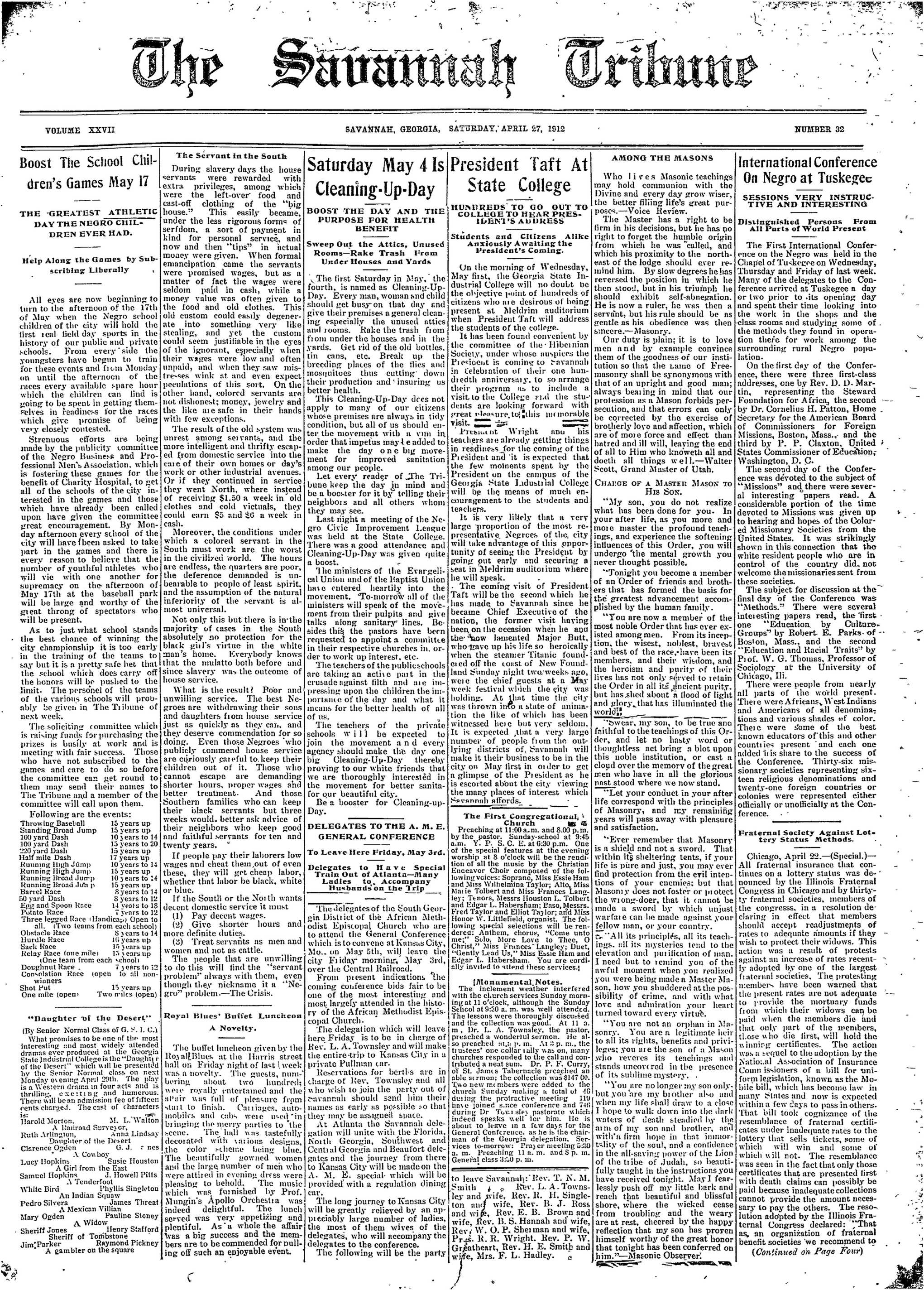
Boost The School Children's Games May 17
Boost The School Children's Games May 17
THE GREATEST ATHLETIC
DAY THE NEGRO CHIL-
DREN EVER HAD.
Help Along the Games by Subscribing Liberally
All eyes are now beginning to turn to the afternoon of the 17th of May when the Negro school children of the city will hold the first real field day sports in the history of our public and private schools. From every side the youngsters have begun to train for these events and from Monday on until the afternoon of the races every available spare hour which the children can find is going to be spent in getting themselves in readiness for the races which give promise of being very closely contested.
Strenuous efforts are being made by the publicity committee of the Negro Business and Professional Men's Association, which is fostering these games for the benefit of Charity Hospital, to get all of the schools of the city interested in the games and those which have already been called upon have given the committee great encouragement. By Monday afternoon every school of the city will have been asked to take part in the games and there is every reason to believe that the number of youthful athletes who will vie with one another for supremacy on the afternoon of May 17th at the baseball park will be large and worthy of the great throng of spectators who will be present.
As to just what school stands the best chance of winning the city championship it is too early in the training of the teams to say but it is a pretty safe bet that the school which does carry off the honors will be pushed to the limit. The personnel of the teams of the various schools will probably be given in The Tribune of next week.
The soliciting committee which is raising funds for purchasing the prizes is busily at work and is meeting with fair success. Those who have not subscribed to the games and care to do so before the committee can get round to them may send their names to The Tribune and a member of the committee will call upon them.
Following are the events:
Throwing Baseball 15 years up
Standing Broad Jump 15 years up
100 yard Dash 10 years to 14
100 yard Dash 10 years to 20
220 yard Dash 15 years up
Half mile Dash 17 years up
Running High Jump 10 years to 14
Running High Jump 15 years up
Running Broad Jump 10 years to 14
Running Broad Jump 15 years up
Barrel Race 8 years to 14
50 yard Dash 8 years to 12
Egg and Spoon Race 14 years to 18
Potato Race 7 years to 12
Three legged Race (Handicap) Open to all. (Two teams from each school)
Obstacle Race 8 years to 14
Hurdle Race 16 years up
Sack Race 15 years up
Relay Race (one mile) 15 years up
(One team from each school)
Doughnut Race 7 years to 12
Consolation Race (open to all non-winners)
Shot Put 15 years up
One mile (open) Two miles (open)
"Daughter of the Desert"
(By Senior Normal Class of G. S. L. C.)
What promises to be one of the most interesting and most widely attended dramas ever produced at the Georgia State Industrial College is the "Daughter of the Desert" which will be presented by the Senior Normal class on next Monday evening April 29th. The play is a Western drama in four acts and is thrilling, exciting and humorous. There will be an admission fee of fifteen cents charged. The cast of characters is:
Harold Morton. M. L. Walton
A Railroad Surveyor
Ruth Arlington. Anna Lindsay
Daughter of the Desert
Clarence Ogden. G. J. Jones
A Cowboy
Lucy Hopkins. Susie Houston
A Girl from the East
Samuel Hopkins. J. Howell Pitts
A Tenderfoot
White Bird. Phyllis Singleton
An Indian Squaw
Pedro Silvae. James Threat
A Mexican Villian
Mary Ogden. Pauline Stoney
A Widow
Sheriff Jones. Henry Stafford
Sheriff of Tombstone
Jim Parker. Raymond Pickney
A gambler on the square
VOLUME XXVII
The Servant in the South
During slavery days the house servants were rewarded with extra privileges, among which were the left-over food and cast-off clothing of the "big house." This easily became, under the less rigorous forms of serfdom, a sort of payment in kind for personal service, and now and then "tips" in actual money were given. When formal emancipation came the servants were promised wages, but as a matter of fact the wages were seldom paid in cash, while a money value was often given to the food and old clothes. This old custom could easily degenerate into something very like stealing, and yet the custom could seem justifiable in the eyes of the ignorant, especially when their wages were low and often unpaid, and when they saw mistresses wink at and even expect peculiations of this sort. On the other hand, colored servants are not dishonest; money, jewelry and the like are safe in their hands with few exceptions.
The result of the old system was unrest among servants, and the more intelligent and thrifty escaped from domestic service into the care of their own homes or day's work or other industrial avenues. Or if they continued in service they went North, where instead of receiving $1.50 a week in old clothes and cold victuals, they could earn $5 and $6 a week in cash.
Moreover, the conditions under which a colored servant in the South must work are the worst in the civilized world. The hours are endless, the quarters are poor, the deference demanded is unbearable to people of least spirit, and the assumption of the natural inferiority of the servant is almost universal.
Not only this but there is in the majority of cases in the South absolutely no protection for the black girl's virtue in the white man's home. Everybody knows that the mulatto both before and since slavery was the outcome of house service.
What is the result? Poor and unwilling service. The best Negroes are withdrawing their sons and daughters from house service just as quickly as they can, and they deserve commendation for so doing. Even those Negroes who publicly commend house service are curiously careful to keep their children out of it. Those who cannot escape are demanding shorter hours, proper wages and better treatment. And those Southern families who can keep their black servants but three weeks would, better ask advice of their neighbors who keep good and faithful servants for ten and twenty years.
If people pay their laborers low wages and cheat them,out of even these, they will get cheap labor, whether that labor be black, white or blue.
If the South or the North wants decent domestic service it must
(1) Pay decent wages.
(2) Give shorter hours and more definite duties.
(3) Treat servants as men and women and not as cattle.
The people that are unwilling to do this will find the "servant problem" always with them, even though they nickname it a "Negro" problem—The Crisis.
Royal Blues' Buffet Luncheon A Novelty.
The buffet luncheon given by the Royal Blues at the Harris street hall on Friday night of last week was a novelty. The guests, numbering about two hundred, were royally entertained and the attair was full of pleasure from start to finish. Caringges, automobiles and cabs were used in bringing the merry parties to the scene. The hall was tastefully decorated with various designs, the color scheme being blue. The beautifully gowned women and the large number of men who were attired in evening dress were pleasing to behold. The music which was furnished by Prof. Mungin's Apollo Orchestra was indeed delightful. The lunch served was very appetizing and plentiful. As a whole the affair was a big success and the members are to be commended for pulling off such an enjoyable event.
SAVANNAH, GEORGIA, SATURDAY, APRIL 27, 1912
Saturday May 4 Is Cleaning-Up-Day
Saturday May 4 Is Cleaning-Up-Day
BOOST THE DAY AND THE PURPOSE FOR HEALTH BENEFIT Sweep Out the Attics, Unused Rooms—Rake Trash From Under Houses and Yards
The first Saturday in May, the fourth, is named as Cleaning-Up Day. Every man, woman and child should get busy on that day and give their premises a general cleaning especially the unused attics and rooms. Rake the trash from from under the houses and in the yards. Get rid of the old bottles, tin cans, etc. Break up the breeding places of the flies and mosquitoes thus cutting down their production and insuring us better health.
This Cleaning-Up-Day does not apply to many of our citizens whose premises are always in tidy condition, but all of us should enter the movement with a vim in order that impetus may be added to make the day one big movement for improved sanitation among our people. Let every reader of The Tribune keep the day in mind and be a booster for it by telling their neighbors and all others whom they may see. Last night a meeting of the Negro Civic Improvement League was held at the State College. There was a good attendance and Cleaning-Up-Day was given quite a boost.
The ministers of the Evangelical Union and of the Baptist Union have entered heartily into the movement. To-morrow all of the ministers will speak of the movement from their pulpits and give talks along sanitary lines. Besides this the pastors have been requested to appoint a committee in their respective churches in, order to work up interest, etc.
The teachers of the publicschools are taking an active part in the crusade against filth and are impressing upon the children the importance of the day and what it means for the better health of all of us.
The teachers of the private schools will be expected to join the movement and every agency should make the day one big Cleaning-Up-Day thereby proving to our white friends that we are thoroughly interested in the movement for better sanitafor our beautiful city. Be a booster for Cleaning-up-Day.
DELEGATES TO THE A. M. E.
GENERAL CONFERENCE
Delegates to Have Special Train Out of Atlanta-Many Ladies to Accompany Husbands on the Trip
The delegates of the South Georgia District of the African Methodist Episcopal Church who are to attend the General Conference which is to convene at Kansas City, Mo., on May 5th, will leave the city Friday morning, May 3rd, over the Central Railroad.
From present indications the coming conference bids fair to be one of the most interesting and most largely attended in the history of the African Methodist Episcopal Church.
The delegation which will leave here Friday is to be in charge of Rev. L. A. Townsley and will make the entire-trip to Kansas City in a private Pullman car. Reservations for births are in charge of Rev. Townsley and all who wish to join the party out of Savannah should send him their names as early as possible so that they may be assigned space. At Atlanta the Savannah delegation will unite with the Florida, North Georgia, Southwest and Central Georgia and Beaufort delegates and the journey from there to Kansas City will be made on the A. M. E. special which will be provided with a regulation dining car.
The long journey to Kansas City will be greatly relieved by an appreciably large number of ladies, the most of them wives of the delegates, who will accompany the delegates to the conference.
The following will be the party
President Taft At State College
HUNDREDS TO GO OUT TO COLLEGE TO HEAR PRESIDENT'S ADDRESS
Students and Citizens Alike Anxiously Awaiting the President's Coming.
On the morning of Wednesday, May first, the Georgia State Industrial College will no doubt be the objective point of hundreds of citizens who are desirous of being present at Meldrim auditorium when President Taft will address the students of the college.
It has been found convenient by the committee of the Hibernian Society, under whose auspices the President is coming to Savannah in celebration of their one hundredth anniversary, to so arrange their program as to include a visit to the College and the students are looking forward with great pleasure to this memorable visit. President Wright and his teachers are already getting things in readiness for the coming of the President and it is expected that the few moments spent by the President on the campus of the Georgia State Industrial College will be the means of much encouragement to the students and teachers.
It is very likely that a very large proportion of the most representative, Negroes of the, city will take advantage of this opportunity of seeing the President by going out early and securing a seat in Meldrim auditorium where he will speak.
The coming visit of President Taft will be the second which he has made to Savannah since he became Chief Executive of the nation, the former visit having been on the occasion when he and the now lamented Major Butt, who gave up his life so heroically when the steamer Titanic foundered off the coast of New Foundland Sunday night two weeks ago, were the chief guests at a May week festival which the city was holding. At that time the city was thrown into a state of animation the like of which has been witnessed here but very seldom. It is expected that a very large number of people from the outlying districts of Savannah will make it their business to be in the city on May first in order to get a glimpse of the President as he is escorted about the city viewing the many places of interest which Savannah affords.
The First Congregational Church
Church
Preaching at 11:00 a.m. and 8:00 p.m. by the pastor. Sunday-school at 9:45 a.m. Y. P. S. C. E at 6:30 p.m. One of the special features at the evening worship at 8 o'clock will be the rendition of all the music by the Christian Eneavor Choir composed of the following voices: Soprano, Miss Essie Ham and Miss Wilhelmina Taylor, Alto, Miss Marie Tolbert and Miss Frances Langley, Tenors, Messrs Houston L. Tolbert and Edgar L. Habersham; Easo, Messrs Fred Taylor and Elliot Taylor; amid Miss Honor W. Littlefield, organist. The following special selections will be rendered: Anthem, chorus, "Come unto me," Solo, More Love to Thee, O Christ," Miss Frances Langley; Duet, "Gently Lead Us," Miss Essie Ham and Edgar L. Habersham. You are cordially invited to attend these services.
[Monumental Notes.
The inclement weather interfered with the church services Sunday morning at 11 o'clock, although the Sunday School at 9:30 a.m. m. was well attended. The lessons were thoroughly discussed and the collection was pood. At 11 a.m., Dr. L. A. Townsley, the pastor, preached a wonderful sermon. He also preached at 9 p.m. At 3 p.m., the trustees' one collar rally was on, many churches responded to the call and contributed a neat sum. Dr. P. F. Curry, of St. James Tabernacle preached an able sermon; the collection was $147 00. Two new members were added to the church Sunday making a total of 40 during the protractive meeting 119 have joined since conference and 746 during Dr Townsley pastorate which indeed speaks well for him. He is about to leave in a few days for the General Conference, as he is the chairman of the Georgia delegation. Services to-morrow: Prayer meeting 5:30 a.m. Preaching 11 a.m. and 8 p.m. General class 3:30 p.m.
to leave Savannah: Rev. T. N. M. Smith Rev. L. A. Townsley and wife, Rev. R. H. Singleton and wife, Rev. B. J. Ross and wife, Rev. E. B. Brown and wife, Rev. B. S. Hannah and wife, Rev, W. O. P. Sherman and wife, Pres. R. R. Wright, Rev. P. W. Greatheart, Rev. H. E. Smith and wife, Mrs. F. L. Hadley.
AMONG THE MASONS
Who lives Masonic teachings may hold communion with the Divine and every day grow wiser, the better filling life's great purposes.—Voice Review. The Master has a right to be firm in his decisions, but he has no right to forget the humble origin from which he was called, and which his proximity to the northeast of the lodge should ever remind him. By slow degrees he has reversed the position in which he then stood, but in his triumph he should exhibit self-abnegation. He is now a ruler, he was then a servant, but his rule should be as gentle as his obedience was then sincere.—Masonry.
Our duty is plain; it is to love men and by example convince them of the goodness of our institution so that the Lame of Freemasonry shall be synonymous with that of an upright and good man; always bearing in mind that our profession as a Mason forbids persecution, and that errors can only be corrected by the exercise of brotherly love and affection, which are of more force and effect than hatred and ill will, leaving the end of all to Him who knoweth all and doeth all things well.—Walter Scott, Grand Master of Utah.
CHARGE OF A MASTER MASON TO
HIS SON.
"My son, you do not realize what has been done for you. In your after life, as you more and more master the profound teachings, and experience the softening influences of this Order, you will undergo the mental growth you never thought possible.
"Tonight you become a member of an Order of friends and brothers that has formed the basis for the greatest advancement accomplished by the human family.
"You are now a member of the most noble Order that has ever existed among men. From its inception, the wisest, noblest, bravest and best of the race, have been its members, and their wisdom, and the heroism and purity of their lives has not only served to retain the Order in all its ancient purity, but has shed about a flood of light and glory that has illuminated the world."
Swear, my son, to be true and faithful to the teachings of this Order, and let no hasty word or thoughtless act bring a blot upon this noble institution, or cast a cloud over the memory of the great men who have in all the glorious past stood where we now stand.
"Let your conduct in your after life correspond with the principles of Masonry, and my remaining years will pass away with pleasure and satisfaction.
"Ever remember that Masonry is a shield and not a sword. That within its sheltering tents, if your life is pure and just, you may ever find protection from the evil intentions of your enemies; but that Masonry does not foster or protect the wrong-doer, that it cannot be made a sword by which unjust warfare can be made against your fellow man, or your country.
"All its principles, all its teachings, all its mysteries tend to the elevation and purification of man. I need but to remind you of the awful moment when you realized you were being made a Master Mason, how you shuddered at the possibility of crime, and with what love and admiration your heart turned toward every virtue.
"You are not an orphan in Masonry. You are a legitimate heir to all its rights, benefits and privileges; you are the son of a Mason who reveres its teachings and stands uncovered in the presence of its sublime mystery.
"You are no longer my son only, but you are my brother also and when my life shall draw to a close I hope to walk down into the dark waters of death steadied by the arm of my son and brother, and with a firm hope in that immortality of the soul, and a confidence in the all-saving power of the Lion of the tribe of Judah, so beautifully taught in the instructions you have received tonight. May I fearlessly push off my little bark and reach that beautiful and blissful shore, where the wicked cease from troubling and the weary are at rest, cheered by the happy reflection that my son has proven himself worthy of the great honor that tonight has been conferred on him."—Masonic Observer.
NUMBER 32
International Conference On Negro at Tuskegee
SESSIONS VERY INSTRUCTIVE AND INTERESTING
Distinguished Persons From All Parts of World Present
The First International Conference on the Negro was held in the Chapel of Tuskegee on Wednesday, Thursday and Friday of last week. Many of the delegates to the Conference arrived at Tuskegee a day or two prior to its opening day and spent their time looking into the work in the shops and the class rooms and studying some of the methods they found in operation there for work among the surrounding rural Negro population.
On the first day of the Conference, there were three first-class addresses, one by Rev. D. D. Martin, representing the Steward Foundation for Africa, the second by Dr. Cornelius H. Patton, Home Secretary for the American Board of Commissioners for Foreign Missions, Boston, Mass., and the third by P. P. Claxton, United States Commissioner of Education; Washington, D. C.
The second day of the Conference was devoted to the subject of "Missions" and there were several interesting papers read. A considerable portion of the time devoted to Missions was given up to hearing and hopes of the Colored Missionary Societies from the United States. It was strikingly shown in this connection that the white resident people who are in control of the country did, not welcome the missionaries sent from these societies.
The subject for discussion at the final day of the Conference was "Methods." There were several interesting papers read, the first one "Education by Culture Groups" by Robert E. Parks of Boston, Mass., and the second "Education and Racial Traits" by Prof. W. G. Thomas, Professor of Sociology at the University of Chicago, Ili.
There were people from nearly all parts of the world present. There were Africans, West Indians and Americans of all denominations and various shades of color. There were some of the best known educators of this and other countries present and each one added his share to the success of the Conference. Thirty-six missionary societies representing sixteen religious denominations and twenty-one foreign countries or colonies were represented either officially or unofficially at the Conference.
Fraternal Society Against Lottery Status Methods.
Chicago, April 22.—(Special.)—All fraternal insurance that continues on a lottery status was denounced by the Illinois Fraternal Congress in Chicago and by thirty fraternal societies, members of the congress, in a resolution declaring in effect that members should accept readjustments of rates to adequate amounts if they wish to protect their widows. This action was a result of protests against an increase of rates recently adopted by one of the largest fraternal societies. The protesting members have been warned that the present rates are not adequate to provide the mortuary funds from which their widows can be paid when the members die and that only part of the members, those who die first, will hold the winning certificates. The action was a sequel to the adoption by the National Association of Insurance Commissioners of a bill for uniform legislation, known as the Mobile bill, which has become law in many States and now is expected within a few days to pass in others. That bill took cognizance of the resemblance of fraternal certificates under inadequate rates to the lottery that sells tickets, some of which will win and some of which will not. The resemblance was seen in the fact that only those certificates that are presented first with death claims can possibly be paid because inadequate collections cannot provide the amount necessary to pay the others. The resolution adopted by the Illinois Fraternal Congress declared: "That as an organization of fraternal benefit societies we recommend to
(Continued on Page Four)
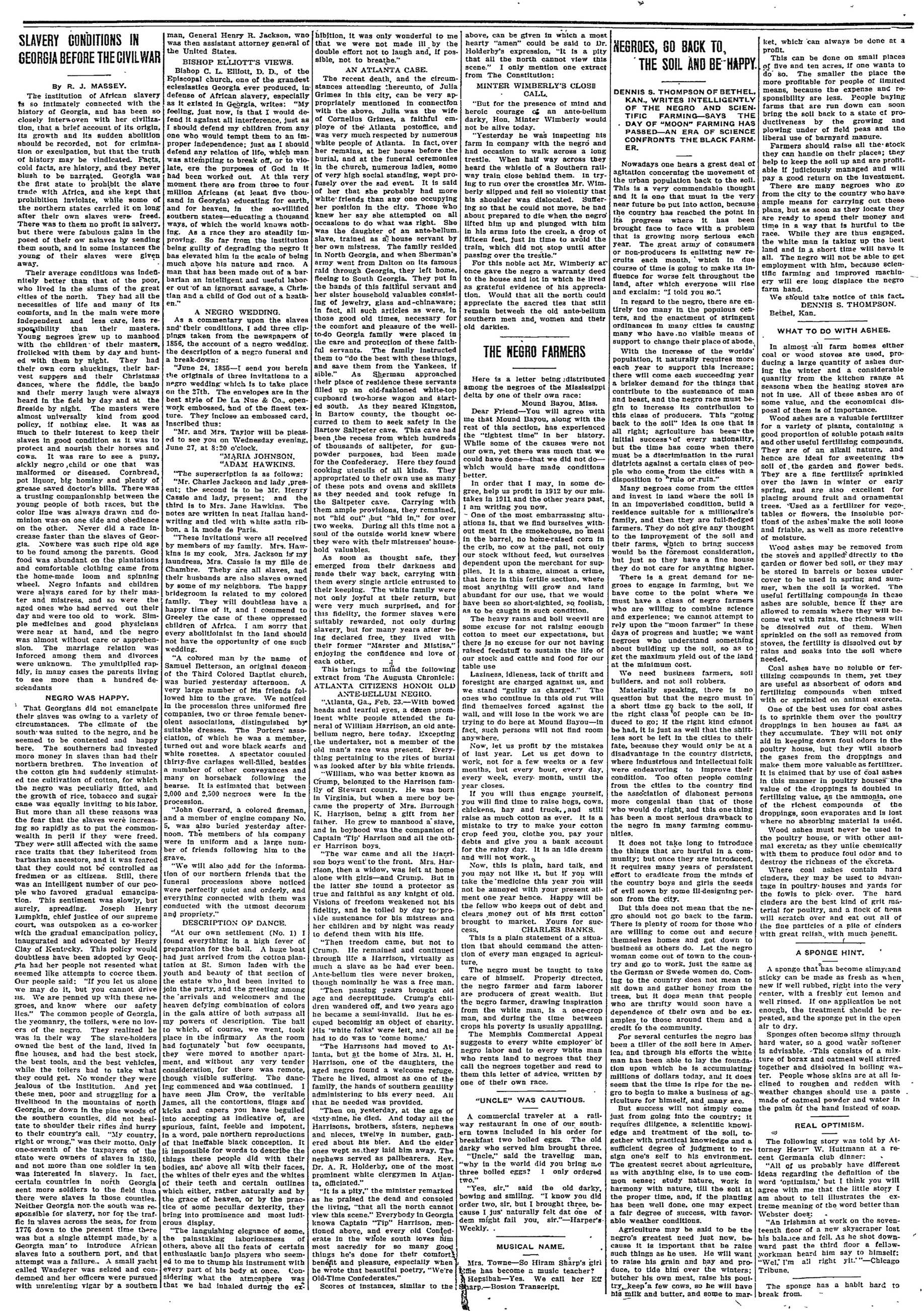
SLAVERY CONDITIONS IN GEORGIA BEFORE THE CIVIL WAR
By R. J. MASSEY.
The institution of African slavery is so intimately connected with the history of Georgia, and has been so closely interwoven with her civilization, that a brief account of its origin, its growth and its sudden abolition should be recorded, not for crimination or exculpation, but that the truth of history may be vindicated. Facts, cold facts, are history, and they never blush to be narrated. Georgia was the first state to prohibit the slave trade with Africa, and she kept that prohibition inviolate, while some of the northern states carried it on long after their own slaves were freed. There was to them no profit in salvery, but there were fabulous gains in the posed of their ow nslaves by sending them south, and in some instances the young of their slaves were given away.
Their average conditions was indemnitely better than that of the poor, who lived in the slums of the great cities of the north. They had all the necessities of life and many of its comforts, and in the main were more independent and less care, less responsibility than their masters. Young negroes grew up to manhood with the children of their masters, frolicked with them by day and hunted with them by night. They had their own corn shuckings, their harvest suppers and their Christmas dances, where the fiddle, the banjo and their merry laugh were always heard in the field by day and at the fireside by night. The masters were almost universally kind from good policy, if nothing else. It was as much to their interest to keep their slaves in good condition as it was to protect and nourish their horses and cows. It was rare to see a puny, slickly negro, child or one that was malformed or diseased. Cornbread, pot liquor, big hominy and plenty of grease, doctor's bills. There was a trusting companionship between the young people of both races, but the color line was always drawn and dominion was on one side and obedience on the other. Never did a race increase faster than the slaves of Georgia. Nowhere was such ripe old age to be found among the parents. Good food was abundant on the plantations and comfortable clothing came from the home-made loom and spinning wheel. Negro infants and children were always cared for by their master and mistress, and so were the aged ones who had served out their day and were too old to work. Simple medicines and good physicians were near at hand, and the negro was almost without care or apprehension. The marriage relation was inforced among them and divorces were unknown. The ymultiplied rapidly, in many cases the parents living to see more than a hundred descendants.
NEGRO WAS HAPPY.
That Georgians did not emancipate their slaves was owing to a variety of circumstances. The climate of the south was suited to the negro, and he seemed to be contented and happy here. The southerners had invested more money in slaves than had their northern brethren. The invention of the cotton gin had suddenly stimulated the cultivation of cotton, for which the negro was peculiarly fitted, and the growth of rice, tobacco and sugar cane was equally inviting to his labor. But more than all these reasons was the fear that the slaves were increasing so rapidly as to put the commonwealth in peril if they were freed. They were still affected with the same race traits that they inherited from barbarian ancestors, and it was feared that they could not be controlled as fredmen or as citizens. Still, there was an intelligent number of our people who favored gradual emancipation. This sentiment was slowly, but surely, spreaded. Joseph Henry Lumpkin, chief justice of our supreme court, was outspoken as a co-worker with the gradual emancipation policy, inaugurated and advocated by Henry Clay of Kentucky. This policy would doubtless have been adopted by Georgia had her people not resented what seemed like attempts to coerce them. Our said: "If you let us alone we may do it, but you cannot drive us. We are penned up with these negroes, and know where our safety lies." The common people of Georgia, the necroman, the toilers, were no lovers of the negro. They realized he was in their way. The slave-holders owned the best of the land, lived in fine houses, and had the best stock, the best tools, and the best vehicles, while the toilers had to take what they could get. No wonder they were jealous of the institution. And yet these men, poor and struggling for a livelihood in the mountains of north Georgia, or down in the pine woods of the southern counties, did not hesitate to shoulder their rifles and hurry to their country's call. "My country, right or wrong," was their motto. Only one-seventh of the taxpayers of the state were owners of slaves in 1860, and not more than one soldier in ten was interested in slavery. In fact, certain countries in north Georgia sent more soldiers to the field than there were slaves in those counties. Neither Georgia nor the south was responsible for slavery, nor for the traffic in slaves across the seas, from 1775 down to the present time there was but a single attempt made, by a Georgia man to introduce African slaves into a southern port, and that attempt was a failure. A small yacht called Wanderer was selzed and condemned and her officers were pursued with unrelenting vigor by a southern
man, General Henry R. Jackson, who was then assistant attorney general of the United States.
BISHOP ELLIOTT'S VIEWS
Bishop C. L. Elliott, D. D., of the Episcopal church, one of the greatest ecclesiastics Georgia ever produced, in defense of African slavery, especially as it existed in Georgia, writes: "My feeling, just now, is that I would defend it against all interference, just as I should defend my children from any one who would tempt them to an improper independence; just as I should defend any relation of life, which man was attempting to break off, or to violate, are the purposes of God in it had been worked out. At this very moment there are from three to four million Africans (at least five thousand in Georgia) educating for earth, and for heaven, in the so-villified southern states—educating a thousand ways, of which the world knows nothing. As a race they are steadily improving. So far from the institution being guilty of degrading the negro it has elevated him in the scale of being much above his nature and race. A man that has been made out of a barbarian an intelligent and useful laborer out of an ignorant savage, a Christian and a child of God out of a heathen."
A NEGRO WEDDING
As a commentary upon the slaves and their conditions, I add three clippings taken from the newspapers of 1856, the account of a negro wedding, the description of a negro funeral and a break-down:
"June 24, 1855—I send you herein the originals of three invitations to a negro wedding which is to take place on the 27th. The envelopes are in the best style of De La Nue & Co., openwork embossed, and of the finest texture. They inclose an embossed card, inscribed thus:
"Mr. and Mrs. Taylor will be pleased to see you on Wednesday evening, June 27, at 8:20 o'clock."
"MARIA JOHNSON.
"ADAM HAWKINS.
"The superscription is as follows: "Mr. Charles Jackson and lady, present; the second is to be Mr. Henry Cassio and lady, present; and the third is to Mrs. Jane Hawkins. The notes are written in neat italian handwriting and tled with white satin ribbon, a la mode de Paris. "These invitations were all received by members of my family. Mrs. Hawkins is my cook. Mrs. Jackson is my laudress, Mrs. Cassio is my fille de Chambre. They are all slaves, and their husbands are also slaves owned by some of my neighbors. The happy bridegroom is related to my colored family. They will doubtless have a happy time of it, and I commend to Greeley the case of these oppressed children of Africa. I am sorry that every abolitionist in the land should not have the opportunity of one such wedding.
"A cohored man by the name of Samuel Betterson, an original deacon of the Third Colored Baptist church, was buried yesterday afternoon. A very large number of his friends followed him to the grave. We noticed in the procession three uniformed fire companies, two or three female benevolent associations, distinguished by suitable dresses. The Porters' association, of which he was a member, turned out and wore black scarfs and white rosettes. A spectator counted thirty-five carilages well-filled, besides a number of other conveyances and many on horseback following the hearse. It is estimated that between 2,000 and 2,500 negroes were in the procession.
"John Guerrard, a colored fireman, and a member of engine company No. 5, was also buried yesterday afternoon. The members of his company were in uniform and a large number of friends following him to the grave.
"We will also add for the information of our northern friends that the funeral processions above noticed were perfectly quiet and orderly, and everything connected with them was conducted with the utmost decorum and propriety."
DESCRIPTION OF DANCE.
"At our own settlement (No. 1) I found everything in a high fever of preparation for the ball. A huge boat had just arrived from the cotton plantation at St. Simon laden with the youth and beauty of that section of the estate who, had been invited to join the party, and the greeting among the arrivals and weicomers and the heaven defying combination of colors in the gala attire of both surpass all my powers of description. The ball to which, of course, we went, took place in the infirmary. As the room had fortunately 'but few occupants, they were moved to another apartment, and without any very tender consideration, for there was remote, though visible suffering. The dancing commenced and was continued. I have seen Jim Crow, the veritable James, all the contortions, flings and kicks and capers you have beguiled into accepting as indicative of, are spurious, faint, feeble and impotent, in a word, pale northern reproductions of that ineffable black conception. It is impossible for words to describe the things these people did with their bodies, and above all with their faces, the whites of their eyes and the whites of their teeth and certain outlines which either, rather naturally and by the grace of heaven, or by the practice of some peculiar dexterity, they bring into prominence and most ludicrous display.
"The languishing elegance of some, the painstaking laboriousness of others, above all the feats of certain enthusiastic banjo players who seemed to me to thump his instrument with every part of his body at once. Considering what the atmosphere was that we had inhaled during the ex
hibition, it was only wonderful to me that we were not made ill by the double effort not to laugh and, if possible, not to breathe."
AN ATLANTA CASE.
The recent death, and the circumstances attending thereunto, of Julia Grimes in this city, can be very appropriately mentioned in connection with the above. Julia was the wife of Cornelius Grimes, a faithful employee of the Atlanta postoffice, and was very much respected by numerous white people of Atlanta. In fact, over her remains, at her house before the burial, and at the funeral ceremonies in the church, numerous ladies, some of very high social standing, wept profusely over the sad event. It is said of her that she probably had more white friends than any one occupying her position in the city. Those who knew her say she attempted on all occasions to do what was right. She was the daughter of an ante-bellum slave, trained as an house servant by her own mistress. The family resided in North Georgia, and when Sherman's army went from Dalton on its famous raid through Georgia, they left home, fleeing to South Georgia. They put in the hands of this faithful servant and his sister household valuables consisting of jewelry, glass and -chinaware; in fact, such articles as were, in those good old times, necessary for the comfort and pleasure of the well-to-do Georgia family were placed in the care and protection of these faithful servants. The family instructed them to "do the best with these things, and save them from the Yankees, if sible." As Sherman approached their place of residence these servants filled up an old-fashioned white-top cupboard two-horse wagon and started south. As they neared Kingston, in Bartow county, the thought occurred to them to seek safety in the Bartow Saltpeter cave. This cave had been the recess from which hundreds of thousands of saltpeter, for gunpowder purposes, had been made for the Confederacy. Here they found cooking utensils of all kinds. They appropriated to their own use as many of these pots and ovens and skillets as they needed and took refuge in the Saltpeter cave. Carrying with them ample provisions, they remained, not "hid out" but "hid in." for over two weeks. During all this time not a soul of the outside world knew where they were with their mistresses' household valuables.
As soon as thought safe, they emerged from their darkness and made their way back, carrying with them every single article entrusted to their keeping. The white family were not only joyful at their return, but were very much surprised, and for this fidelity, the former slaves were suitably rewarded, not only during slavery, but for many years after being declared free, they lived with their former "Marster and Mistiss", enjoying the confidence and love of each other.
This brings to mind the following extract from The Augusta Chronicle: ATLANTA CITIZENS HONOR OLD ANTEREILLIUM NEGRO.
"Atlanta, Ga., Feb. 23.—With bowed heads and tearful eyes, a dozen prominent white people attended the funeral of William Harrison, an old antebellum negro, here today. Excepting the undertaker, not a member of the old man's race was present. Everything pertaining to the rites of burial was looked after by his white friends. "William, who was better known as Crump, belonged to the Harrison family of Stewart county. He was born in Virginia, but when a mere boy became the property of Mrs. Burrough K. Harrison, being a gift from her father. He grew to manhood a slave, and in boyhood was the companion of Captain 'Tip' Harrison and all the other Harrison boys
"The war came and all the Harrison boys went to the front. Mrs. Harrison, then a widow, was left at home alone with girls—and Crump. But in the latter she found a protector as true and faithful as any knight of old. Visions of freedom weakened not his fidelity, and he toiled by day to provide sustenance for his mistress and her children and by night was ready to defend them with his life.
"Then treedom came, but not to Crump. He remained and continued through life a Harrison, virtually as much a slave as he had ever been. Ante-bellum ties were never broken, though nominally he was a free man.
"Then passing years brought old age and decreptitude. Crump's children wandered off, and two years ago he became a semi-invalid. But he escaped becoming an object of charity. His 'white folks' were left, and all he had to do was to 'come home.'
"The Harrisons had moved to Atlanta, but at the home of Mrs. M. H. Harrison, one of the daughters, the aged negro found a welcome refuge. There he lived, almost as one of the family, the hands of southern gentility administering to his every need. All that he needed was provided.
"Then on yesterday, at the age of sixty-nine, he died. And today all the Harrisons, brothers, sisters, nephews and nieces, twelve in number, gathered about his bier. And the elder ones wept as they laid him away. The nephews served as palebearers. Rev. Dr. A. R. Holderby, one of the most prominent white clergymen in Atlanta, official."
"It is a pity," the minister remarked as he praised the dead and consoled the living, "that all the north cannot view this scene." Everybody in Georgia knows Captain "Tip" Harrison, mentioned above, and every old Confederate in the whole south loves him most sacriously for so many good things he's done for their comfort, benefit and pleasure, especially when he wrote that beautiful poetry, "We're Old-Time Confederates."
Scores of instances, similar to the
above, can be given in which a most hearty "amen" could be said to Dr. Holderby's expression, "It is a pity that all the north cannot view this scene." I only mention one extract from The Constitution.
MINTER WIMBERLY'S CLOSH
CALL
"But for the presence of mind and heroic courage of an ante-bellum darky, Hon. Minter Wimberly would not be alive today.
"Yesterday he was inspecting his farm in company with the negro and had occasion to walk across a long trestle. When half way across they heard the whistle of a Southern railway train close behind them. In trying to run over the crossties Mr. Wimberly slipped and fell so violently that his shoulder was dislocated. Suffering so that he could not move, he had about prepared to die when the negro lifted him up and plunged with him in his arms into the creek, a drop of fifteen feet, just in time to avoid the train, which did not stop until after passing over the treasite."
For this noble act Mr. Wimberly at once gave the negro a warranty deed to the house and lot in which he lived as grateful evidence of his appreciation. Would that all the north could appreciate the sacred ties that still remain between the old ante-bellum southern men and, women and their old darkies.
THE NEGRO FARMERS
Here is a letter being distributed among the negroes of the Mississippi delta by one of their own race:
Mound Bayou, Miss.
Dear Friend—You will agree with me that Mound Bayou, along with the rest of this section, has experienced the "tightest time" in her history. While some of the causes were not our own, yet there was much that we could have done—that we did not do—which would have made conditions better.
In order that I may, in some degree, help us profit in 1912 by our mistakes in 1911 and the other years past, I am writing you now.
One of the most embarrassing situations is, that we find burseurs without meat in the smokehouse, no meal in the barrel, no home-raised corn in the crib, no cow at the pail, not only our stock without feed, but oursselfs dependent upon the merchant for supplies. It is a shame, almost a crime, that here in this fertile section, where most anything will grow and land abundant for our use, that we would have been so short-sighted, so foolish, as to be caught in such condition. The heavy rains and boll weevil are some excuse for not raising enough cotton to meet our expectations, but there is no excuse for our not having raised feedstuff to sustain the life of our stock and cattle and food for our table use.
Laziness, idleness, lack of thrift and foresight are charged against us, and we stand "gulty as charged." The ones who continue in this old rut will find themselves forced against the wall, and will lose in the work we are trying to do here at Mound Bayou—in fact, such persons will not find room anywhere.
Now, let us profit by the mistakes of last year. Let us get down to work, not for a few weeks or a few months, but every hour, every day, every week, every month, until the year closes.
If you will thus engage yourself, you will find time to raise hogs, cows, chickens, hay and truck, and still raise as much cotton as ever. It is a mistake to try to make your cotton crop feed you, clothe you, pay your debts and give you a bank account for the rainy day. It is an idle dream and will not work.
Now, this is plain, hard talk, and you may not like it, but if you will take the medicine this year you will not be annoyed with your present aliment one year hence. Happy will be the fellow who keeps out of debt and clears money out of his first cotton brought to market. Yours for success. CHARLES BANKS.
This is a plain statement of a situation that should command the attention of every man engaged in agriculture.
The negro must be taught to take care of himself. Properly directed, the negro farmer and farm laborer are producers of great wealth. But the negro farmer, drawing inspiration from the white man, is a one-crop man, and during the time between crops his poverty is usually appalling.
The Memphis Commercial Appeal suggests to every white employer of negro labor and to every white man who rents land to negroes that they call the negroes together and read to them this letter of advice, written by one of their own race.
"UNCLE" WAS CAUTIOUS.
A commercial traveler at a railway restaurant in one of our southern towns included in his order for breakfast two boiled eggs. The old darky who served him brought three. "Uncle," said the traveling man, "why in the world did you bring me three boiled eggs? I only ordered two." "Yes, sir," said the old darky, bowing and smiling. "I know you did order two, sir, but I brought three, because I jus' naturally felt dat one of dem might fail you, sir."—Harper's Weekly.
MUSICAL NAME.
Mrs. Towne—So Hiram Sharp's girl
offie has become a music teacher?
Hesipahi—Yes. We call her Eff
Sharp—Boston Transcript.
NEGROES, GO BACK TO,
THE SOIL AND BE-HAPPY.
NEGROES, GO BACK TO,
THE SOIL AND BE-HAPPY.
DENNIS S. THOMPSON OF BETHEL,
KAN., WRITES INTELLIGENTLY
OF THE NEGRO AND SCIENTIFIC
FARMING—SAYS THE
DAY OF "MOON" FARMING HAS
PASSED—AN ERA OF SCIENCE
CONFRONTS THE BLACK FARMER.
Nowadays one hears a great deal of agitation concerning the movement of the urban population back to the soil. This is a very commendable thought and it is one that must in the very near future be put into action, because the country has reached the point in its progress where it has been brought face to face with a problem that is growing more serious each year. The great army of consumers or non-producers is enlisting new recruits each month, which in due course of time is going to make its influence for worse felt throughout the land, after which everyone will rise and exclaim: "I told you so." In regard to the negro, there are entirely too many in the populous centers, and the enactment of stringent ordinances in many cities is causing many who have no visible means of support to change their place of abode.
With the increase of the world's population, it naturally requires more each year to support this increase; there will come each succeeding year a brisker demand for the things that contribute to the sustenance of man and beast, and the negro race must begin to increase its contribution to this class of producers. This "going back to the soil" idea is one that is all right; agriculture has been the initial success of every nationality, but the time has come when there must be a discrimination in the rural districts against a certain class of people who come from the cities with a disposition to "rule or ruin."
Many negroes come from the cities and invest in land where the soil is in an impoverished condition, build a residence suitable for a millionaire's family, and then they are full-fledged farmers. They do not give any thought to the improvement of the soil and their farms, which to bring success would be the foremost consideration, but just so they have a fine house they do not care for anything higher. There is a great demand for negroes to engage in farming, but we have come to the point where we must have a class of negro farmers who are willing to combine science and experience; we cannot attempt to rely upon the "moon farmer" in these days of progress and hustle; we want negroes who understand something about building up the soil, so as to get the maximum yield out of the land at the minimum cost. We need business farmers, soil builders, and not soil robbers.
Materially speaking, there is no question but that the negro must in a short time go back to the soil, if the right class of people can be induced to go; if the right kind cannot be had, it is just as well that the shiftless sort be left in the cities to their fate, because they would only be at a disadvantage in the country districts, where industrious and intellectual folk were endeavoring to improve their condition. Too often people coming from the cities to the country find the association of dishonest persons more congenial than that of those who would do right, and this one thing has been a most serious drawback to the negro in many farming communities.
It does not take long to introduce the things that are hurtful in a community; but once they are introduced, it requires many years of persistent effort to eradicate from the minds of the country boys and girls the seeds of evil sown by some ill-designing person from the city.
But this does not mean that the negro should not go back to the farm. There is plenty of room for those who are willing to come out and secure themselves homes and got down to business as others do. Let the negro woman come out of town to the country and go to work, just the same as the German or Swede women do. Coming to the country does not mean to sit down and gather honey from the trees, but it does mean that people who are thrifty would soon have a dependence of their own and be examples to those around them and a credit to the community.
For several centuries the negro has been a tiller of the soil here in America; and through his efforts the white man has been able to lay the foundation upon which he is accumulating millions of dollars today, and it does seem that the time is ripe for the negro to begin to make a business of agriculture for himself, and many are. But success will not simply come just from going into the country; it requires diligence, a scientific knowledge and treatment of the soil, together with practical knowledge and a sufficient degree of judgment to resign one's self to his environment. The greatest secret about agriculture, as with anything else, is to use common sense; study nature, work in harmony with nature, till the soil at the proper time, and, if the planting has been well done, one may expect a fair degree of success, with favorable weather conditions.
Agriculture may be said to be the negro's greatest need just now, because it is important that he raise such things as he uses. He will want to raise his grain and hay and produce, to tide him over the winters; butcher his own meat, raise his poultry_keep'a few cows, so he will have his milk and butter, and some to mar-
ket, which can always be done at a profit. This can be done on small places of five and ten acres, if one wants to do so. The smaller the place the more profitable for people of limited means, because the expense and responsibility are less. People buying farms that are run down can soon bring the soil back to a state of productivity by the growing and plowing under of field peas and the liberal use of barnyard manure. Farmers should raise all the stock they can handle on their places; they help to keep the soil up and are profitable if judiciously managed and will pay a good return on the investment.
There are many negroes who go from the city to the country who have ample means for carrying out these plans, but as soon as they locate they are ready to spend their money and time in a way that is hurtful to the race. While they are thus engaged, the white man is taking up the best land and in a short time will have it all. The negro will not be able to get employment with him, because scientific farming and improved machinery will ere long displace the negro farm hand.
We should take notice of this fact,
DENNIS S. THOMPSON.
Bethel, Kan.
WHAT TO DO WITH ASHES.
In almost all farm homes either coal or wood stoves are used, producing a large quantity of ashes during the winter and a considerable quantity from the kitchen range at seasons when the heating stoves are not in use. All of these ashes are of some value, and the economical disposal of them is of importance. Wood ashes are a valuable fertilizer for a variety of plants, containing a good proportion of soluble potash salts and other useful fertilizing compounds. They are of an alkali nature, and hence are ideal for sweetening the soil of the garden and flower beds. They are a fine fertilizer sprinkled over the lawn in winter or early spring, and are also excellent for placing around fruit and ornamental trees. 'Used as a fertilizer for vegetables or flowers, the insoluble portions of the ashes' make the soil loose and friable, as well as more retentive of moisture.
Wood ashes may be removed from the stoves and applied directly to the garden or flower bed soil, or they may be stored in barrels or boxes under cover to be used in spring and summer, when the soil is worked. The useful fertilizing compounds in these ashes are soluble, hence if they are allowed to remain where they will become wet with rains, the richness will be dissolved out of them. When sprinkled on the soil as removed from stoves, the fertility is dissolved out by rains and soaks into the soil where needed. Coal ashes have no soluble or fertilizing compounds in them, yet they are useful as absorbent of odors and fertilizing compounds when mixed with or sprinkled on animal excreta.
One of the best uses for coal ashes is to sprinkle them over the poultry droppings in hen houses as fast as they accumulate. They will not only aid in keeping down foul odors in the poultry house, but they will absorb the gases from the droppings and make them more valuable as fertilizer. It is claimed that by use of coal ashes in this manner in poultry houses the value of the droppings is doubled in fertilizing value, as the ammonia, one of the richest compounds of the droppings, soon evaporates and is lost where no absorbing material is used. Wood ashes must never be used in the poultry house, or with other animal excreta; as they unite chemically with them to produce foul odor and to destroy the richness of the excreta.
Where coal ashes contain hard cinders, they may be used to advantage in poultry houses and yards for the fowls to pick over. The hard cinders are the best kind of grit material for poultry, and a flock of hens will scratch over and eat out all of the fine particles of a pile of cinders with great relish, with much benefit.
A SPONGE HINT.
A sponge that has become silimy and sticky can be made as fresh as when new if well rubbed, right into the very center, with a freshly cut lemon and well rinsed. If one application be not enough, the treatment should be repeated, and the sponge put in the open air to dry. Sponges often become silimy through hard water, so a good water softener is advisable. -This consists of a mixture of borax and oatmeal well stirred together and dissolved in boiling water. People whose skins are at all inclined to roughen and redden with weather changes should use a paste made of oatmeal powder and water in the palm of the hand instead of soap.
REAL OPTIMISM.
The following story was told by Attorney Heur W. Huttmann at a recent Germania club dinner:
"All of us probably have different ideas regarding the definition of the word 'optimalism', but I think you will agree with me that the little story I am about to tell illustrates the extreme meaning of the word better than Webster does:
"An Irishman at work on the seventeenth floor of a new skyscraper lost his balance and fell. As he shot down past the third floor a fellow-workman heard him say to himself: 'Wel, I'm all right yilt.'"—Chicago Tribune.
The sponge has a habit hard to break from.
Of Interest to Our Women
Whether one uses carpets or rugs is a matter which can be decided by preference, as there are carpets of all prices and rugs of the same variety. The advantage of a bare floor with rugs lies in the superior cleanliness and its artistic effect.
Many housekeepers claim that bare floors are hard to care for, as they show dust so readily. A bare floor does not make dust; it shows it. The dust would be there if a carpet were used and it would rest there—perhaps a week-ready to rise in the air at every footfall. Because it is not as easily seen it is not so often removed.
Many claim that bare floors are cold, but the hardwood floor is as a rule laid over a rough one, and is therefore warmer than a single floor. Whether they are waxed or oiled or varnished is a matter of expense and taste. Uncovered floors do perhaps need care a little oftener than a surface that is carpeted, but when one compares the weekly care of a hardwood floor with the weekly care of a heavy carpet the advantage is sure to be in favor of the former.
Floors need not be so highly polished as to be dangerous. Oiled floors are less slippery than waxed ones, and the harder a floor is rubbed in finishing the more beautiful and the more slippery it will be.
Floors finished with encaustic can be made less slippery than those polished with wax. Large rugs not only look better on a floor than small ones, but they are safer—being less liable to slip about.
On no account should water—hot or cold—or soap be used to clean a finished floor, as such treatment will completely rule any kind of a finish a floor might have; even drops of clean cold water will spot a finished floor, unless they are wiped up at once. The daily care of a hardwood floor is very simple; not nearly so difficult a matter as some seem to think. The surface should be wiped with a broom covered with a canton flannel rag or a long-handled dust mop sold for just this use. If any spots are seen they should be rubbed off with a flannel and a little turpentine. Once a week a brisk rubbing with a cloth moistened with crude oil and turpentine, in equal parts, will be sufficient. If large rugs are used only the spaces shown between them need be rubbed.
Twice a year the floor should be thoroughly cleaned and polished by one who understands the work. Prepared polishes and wax may be bought ready for use. Heavy furniture should never be rolled about on a handsome floor, and felt is sold to be glued on the feet of large pieces of furniture.
FARMHOUSE SAUCES.
Country farmhouses years ago possessed a good many other treasures besides their tallboy chests and their carved oak presses, although most of these treasures seem to have vanished nowadays.
In the days before every village market town had its city products, and ifinerant peddlers were the chief salesmen, they thought, in fact, a great deal of their own old recipes for home-made sauces. They were made according to directions which were handed down through generations, and formed the special pride of many a busy housekeeper. As a matter of fact, many of the old recipes have become patented, and the original has acquired a world-wide reputation such as its originators would never have foretold for it.
Among the forgotten recipes is one for tomato mustard which is worthy of the consideration of those whose stock of tomatoes is greater than can be used for cooling and salads.
To two gallons of tomatoes three peppers should be added when minced, and these must be placed in a large preserving pan with a tablespoonful of freshly ground black pepper, an ounce of powdered ginger, a quarter of an ounce of cloves, half an ounce of mixed spice, two ounces of salt and the grated rind of a lemon. These ingredients should be well minced together and boiled for an hour to an hour and a half. At the end of that time the contents of the pan should be allowed to cool, and when cold an ounce of curry powder and an ounce of powdered mustard added, with a breakfast cupful of vinegar. This mustard mixture should be bottled and corked down tightly.
NEEDLEWORK NOTES.
Clothes horses make excellent screens. First paint the top and lower part of the legs with enamel to match the wall paper. Then cover the remaining part with some pretty art muslin or silk and secure to the horse by dainty ribbons.
Getting doll patterns for little girls will amuse them and instruct them as well. If they learn to make dolls' clothes by using patterns and following directions it will not be many years before they will learn to make garments for themselves.
When your scissors refuse to cut opening and shutting the blades on the neck of an ordinary bottle; that is, try to cut off the neck of your bottle with your scissors. A few moments of this little effort will sharpen the scissors. Don't shake your head
in incredulity, but make the experiment for yourself.
If a bodkin is not at hand, an excellent substitute is a wooden match. First strike the head; let it blaze a moment and blow out the flame. Cut or break off the burned end, then wrap the ribbon or tape firmly about the end of the match stick and push it through the hem, as is done with a bodkin. If held firmly the tape or ribbon will not slip.
DON'T WEAR TIGHT COLLARS.
It is well known to veterinary surgeons that tight collars produce "staggers" in horses. Dogs suffer very severely from the same cause.
And now we have high medical authority for the statement that men and women are the greatest sufferers of all. A clergyman, who was ill for years with headaches confusion of mind, flushed face and a constant dazed feeling, was advised by his doctor to get a larger size in collars.
He did so, and in a few days his health was completely restored. A doctor has found many similar cases, where the tight collars and comforters worn by men and the tight neckbands of women's dresses, have caused severe nervous troubles, such as dizziness, vertigo, vomiting and a feeling of great congestion of the head.
They obstruct, the blood currents, and the consequences are what we might expect—London Answers.
WARDROBE HINTS.
Chiffon taffetas are confidently offered as the ultra-fashionable silk fabrics for the coming season. Glace chiffon taffetas are in the ultra style. Owing to the high cost of, of, ofs some imitations are now on the market; zib elinette, for instance, is greatly used for linings. It looks like sable. Collarettes fashioned from velvet, brocade, silks and chiffon are warm outside wrap which take the place of furs. The wrap is light and graceful. Dressing gowns in quilted Japanese silks are most interesting for the winter season; they are adorned with embroideries, most artistic and original.
MEAT AND MACARONI
Boll a half pound of macaroni until tender and blanch by pouring cold water over it. After draining it from the pot cut it in short pieces. Thicken two cupfuls of well seasoned gravy, or if you have no gravy, two cupfuls of tomato sauce, using a tablespoonful of four rubbed smooth with the same amount of butter. Chop fine a cupful of any cold meat, salt and pepper to taste and stir into the thickened gravy or sauce with the macaroni. Do all this over the fire, turn into a buttered dish, sprinkle crumbs over the top, bake twenty minutes, then uncover and allow to brown.
WARMED OVER ROAST BEEF.
Put the cold, roast beef left over from dinner the previous day into a dripping pan together with a cupful of stock and allow it to just heat through. Turn and baste it often. Place on a hot platter and pour around it the following hot sauce: Melt a tablespoonful of butter in a saucepan, and stir into it a spoonful of flour until smooth; add a cupful of stock, a teaspoonful of Worgestershilfe sauce; one-half teaspoonful of salt, a dash of pepper and whatever kind of vegetable may be left from previous meals, two cupfuls or less cut fine and added to the sauce; turnips, carrots, peas or cauliflower may be used. When hot pot pour around the meat and serve.
TAFFETAS TAILOR-MADES
Faffetas in heavy tailored texture something like the heavyweight Shantung is being used for spring costumes, and large hats with feather or floral trimming are being made of the same material. The costumes have very little trimming, gathered bands of the material appearing on the skirts and again on the coats with smart effect. The colorings of the taffetas include blues of all kinds, and there are new shades of pink too deep to be coral and too light to be called vieux-rose. Brick-red taffetas is to be a popular material in the spring for dresses and costumes, according to fashion reports. A touch of black against the dull shimmer of the brick-red taffetas is striking and exceedingly smart.
PEARLS AND BROCADE.
"Divinely tall and most divinely fair" is enough in itself to make a bride interesting to the costumer. indeed, she may be tall with dusky hair and ivory and rose cheeks without sacrificing the regal style of garmenture. Truly beautiful is a bridal gown of perfectly plainly cut brocade in a long sheath shape, with more train than has been seen of late, the brocade being white velvet on a soft gown ground, the velvet embroidered with seed pearls. An exquisite scarf of lace is draped by another band about the shoulders, the lace, too, being worked and fringed with pearls, and the plain tulle veil is clasped round the head with a rope of the same and a couple of pearl tassels hanging behind one ear.
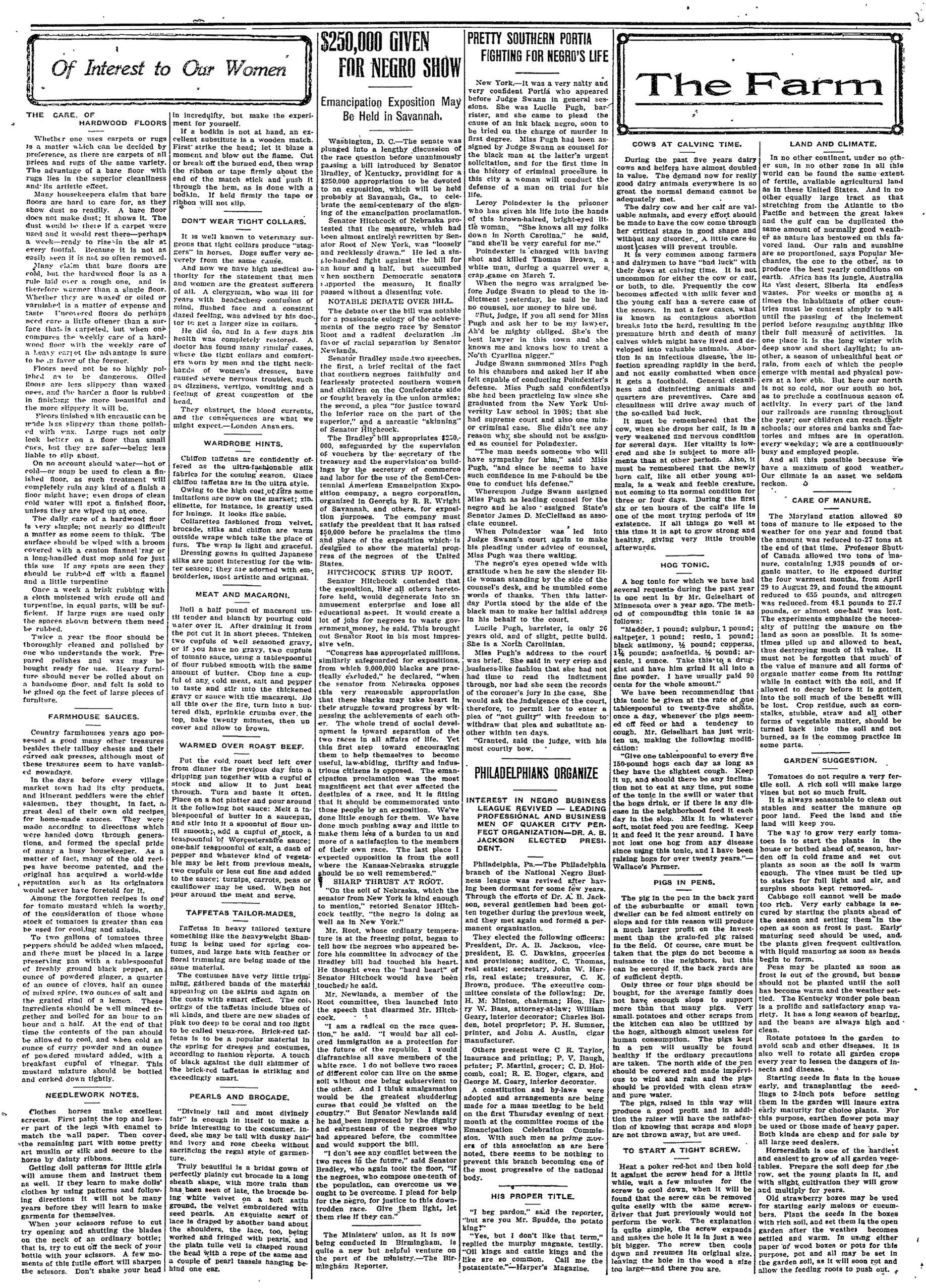
$250,000 GIVEN FOR NEGRO SHOW
$250,000 GIVEN FOR NEGRO SHOW
Emancipation Exposition May Be Held in Sayannah.
Washington, D. C.—The senate was plunged into a lengthy discussion of the race question before unanimously passing a bill introduced by Senator Bradley, of Kentucky, providing for a $250,000 appropriation to be devoted to an exposition, which will be held probably at Savannah, Ga., to celebrate the semi-centenary of the signing of the emancipation proclamation. Senator Hitchcock of Nebraska protested that the measure, which had been almost entirely rewritten by Senator Root of New York, was "loosely and recklessly drawn." He led a single-handed fight against the bill for an hour and a half, but succumbed when southern Democratic senators supported the measure, it finally passed without a dissenting vote.
NOTABLE DEBATE OVER BILL.
The debate over the bill was notable for a passionate eulogy of the achievements of the negro race by Senator Root and a radical declaration in favor of racial separation by Senator Newlands.
Senator Bradley made two speeches, the first, a brief recital of the fact that southern negroes faithfully and fearlessly protected southern women and children on the Confederate side or fought bravely in the union armies; the second, a plea "for justice toward the inferior race on the part of the superior," and a sarcastic "skinning" of Senator Hitecock.
The Bradley bill appropriates $250,000, safeguarded by the supervision of vouchers by the secretary of the treasury and the supervision' on buildings by the secretary of commerce and labor for the use of the Semi-Centennial American Emancipation Exposition company, a negro corporation, organized in Georgia by R. R. Wright of Savannah, and others, for exposition purposes. The company must satisfy the president that it has raised $50,000 before he praclaims the time and place of the exposition which is designed to show the material progress of the negroes of the United States.
Senator Hitchcock contended that the exposition, like all others heretofore held, would degenerate into an amusement enterprise and lose all educational aspect. It would create a lot of jobs for negroes to waste government money, he said. This brought out Senator Root in his most impressive vein.
"Congress has appropriated millions, similarly safeguarded for expositions, from which 9,000,000 blacks are practically excluded," he declared, "when the senator from Nebraska opposes this very reasonable appropriation that these blacks may take heart in their struggle toward progress by witnessing the achievements of each other. The whole trend of social development is toward separation of the two races in all affairs of life. Yet this first step toward encouraging them to help themselves to become useful, law-abiding, thrifty and industrious citizens is opposed. The emancipation proclamation was the most magnificent act that ever affected the destinies of a race, and it is fitting that it should be commemorated unto those people by an exposition. We've done little enough for them. We have done much pushing away and little to make them less of a burden to us and more of a satisfaction to the members of their own race. The last place I expected opposition is from the soil where the Kansas-Nebraska struggle should be so well remembered."
SHARP THURST AT BOOT
"On the soil of Nebraska, which the senator from New York is kind enough to mention," retorted Senator Hitchcock testify, "the negro is doing as well as in New York."
Mr. Root, whose ordinary temperature is at the freezing point, began to tell how the negroes who appeared before his committee in advocacy of the Bradley bill had touched his heart. He thought even the "hard heart" of Senator Hitchcock would have been touched; he said.
Mr. Newlands, a member of the Root committee, then launched into the speech that disarmed Mr. Hitchcock.
"I am a radical on the race question," he said. "I would bar all colored immigration as a protection for the future of the republic. I would disfranchise all save members of the white race. I do not believe two races of different color can live on the same soil without one住 subservient to the other. And I think amalgamation would be the greatest shuddering curse that could be visited on the country." But Senator Newlands said he had been impressed by the dignity and earnestness of the negroes who had appeared before, the committee and would support the bill.
"I don't see any conflict between the two races in the future," said Senator Bradley, who again took the floor, "if the negroes, who compose one-tenth of the population, can overcome us we ought to be overcome. I plead for help for the negro, for justice to this down-trodden race. Give them light, let them rise if they can."
The Ministers' union, as it is now being conducted in Birmingham, is quite a new but helpful venture on the part of the ministry.—The Birmingham Reporter.
PRETTY SOUTHERN PORTIA FIGHTING FOR NEGRO'S LIFE
New York.—It was a very nasty and very confident Portla who appeared before Judge Swann in general sessions. She was Lucile Pugh, barrister, and she came to plead the cause of an ink black negro, soon to be tried on the charge of murder in first degree. Miss Pugh had been assigned by Judge Swann as counsel for the black man at the latter's urgent solicitation, and for the first time in the history of criminal procedure in this city a woman will conduct the defense of a man on trial for his life.
Leroy Poindexter is the prisoner who has given his life into the hands of this brown-healed, bright-eyed little woman. "She knows all my folks down in North Carolina," he said, "and she'll be very careful for me." Poindexter is charged with having shot and killed Thomas Brown, a white man, during a quarrel over a crap game on March 7.
When the negro was arraigned before Judge Swann to plead to the indictment yesterday, he said he had no counsel, nor money to hire one.
"But, judge, if you all send for Miss Pugh and ask her to be my lawyer, Ah'd be mighty obliged. She's the best lawyer in this town and she knows me and knows how to treat a No'th Cyarilina nigger."
Judge Swann summoned Miss Pugh to his chambers and asked her if she felt capable of conducting Poindexter's defense. Miss Pugh said confidently she had been practicing law since she graduated from the New York University Law school in 1908; that she had supreme court and also one minor criminal case. She didn't see any reason why she should not be assigned as counsel for Poindexter.
"The man needs someone who will have sympathy for him," said Miss Pugh, "and since he seems to have such confidence in me F-should be the one to conduct his defense."
Whereupon Judge Swann assigned Miss Pugh as leading counsel for the negro and he also assigned State's Senator James D. McClelland as associate counsel.
When Polindextor was led into Judge Swann's court again to make his pleading under advice of counsel, Miss Pugh was there wattling.
The negro's eyes opened wide with gratitude when he saw the slender little woman standing by the side of the counsel's desk, and he mumbled some words of thanks. Then this latterday Portla stood by the side of the black man to make her initial address in his behalf to the court.
Lucile Pugh, barrister, is only 26 years old, and of slight, petite build. She is a North Carolinian.
Miss Pugh's address to the court was brief. She said in very crisp and business-like fashion that she had not had time to read the indictment through, nor had she seen the records of the coroner's jury in the case. She would ask the indulgence of the court, therefore, to permit her to enter a plea of "not guilty" with freedom to withdraw that plea and substitute another within ten days.
"Granted, said the judge, with his most courtly bow.
PHILADELPHIANS ORGANIZE
INTEREST IN NEGRO BUSINESS LEAGUE REVIVED — LEADING PROFESSIONAL AND BUSINESS MEN OF QUAKER CITY PERFECT ORGANIZATION—DR. A. B. JACKSON ELECTED PRESIDENT.
Philadelphia, Pa.—The Philadelphia branch of the National Negro Business league was revived after having been dormant for some few years. Through the efforts of Dr. A. B. Jackson, several gentlemen had been gotten together during the previous week, and they met again and formed a permanent organization.
They elected the following officers: President, Dr. A. B. Jackson, vicepresident, E. C. Dawkins, groceries and provisions; auditor, C. Thomas, real estate; secretary, John W. Harris, real estate; treasurer, C. K. Brown, produce. The executive committee consists of the following: Dr. H. M. Minton, chairman; Hon. Harry W. Bass, attorney-at-law; William Geary, interior decorator; Charles Bolden, hotel proprietor; P. H. Sumner, printer, and John A. Austin, cigar manufacturer.
Others present were C. R. Taylor, insurance and printing; P. V. Baugh, printer; F. Martini, grocer; C. D. Holcomb, coal; R. E. Boger, cigars, and George M. Geary, interior decorator.
A constitution and by-laws were adopted and arrangements are being made for a mass meeting to be held on the first Thursday evening of next month at the committee rooms of the Emancipation Celebration Commission. With such men as prime movers of this association as are here noted, there seems to be nothing to prevent this branch becoming one of the most progressive of the national body.
HIS PROPER TITLE.
"I beg pardon," said the reporter, "but are you Mr. Spudde, the potato king?"
"Yes, but I don't like that term," replied the murphy magnate, testily. "Oil kings and cattle kings and the like are so common. Call me the potatenate."-Harper's Magazine.
The Farm
COWS AT CALVING TIME.
During the past five years dairy cows and heifers have almost doubled in value. The demand now for really good dairy animals everywhere is so great the normal demand cannot be adequately met. The dairy cow and her calf are valuable animals, and every effort should be made to have the cow come through her critical stage in good shape and without any disorder. A little care in most cases will prevent trouble.
It is very common among farmers and dairymen to have "bad luck" with their cows at calving time. It is not uncommon for either the cow or calf, or both, to die. Frequently the cow becomes affected with milk fever and the young calf has a severe case of the scours. In not a few cases, what is known as contagious abortion breaks into the herd, resulting in the premature birth and death of many calves which might have lived and developed into valuable animals. Abortion is an infectious disease, the infection spreading rapidly in the herd, and not easily combatted when once it gets a foothold. General cleanliness and disinfecting animals and quarters are preventives. Care and cleanliness will drive away much of the so-called bad luck.
It must be remembered that the cow, when she drops her calf, is in a very weakened and nervous condition for several days. Her vitality is lowered and she is subject to more ailments than at other periods. Also, it must be remembered that the newly born calf, like all other young animals, is a weak and feeble creature, not coming to its normal condition for three or four days. During the first six or ten hours of the calf's life is one of the most trying periods of its existence. If all things go well at this time it is apt to grow strong and healthy, giving very little trouble afterwards.
HOG TONIC.
A hog tonic for which we have had several requests during the past year is one sent in by Mr. Gelsehlart of Minnesota over a year ago. The method of compounding this tonic is as follows:
"Madder, 1 pound; sulphur, 1 pound; saltpeter, 1 pound; resin, 1 pound; black antimycin, ½ pound; copperas, 1½ pounds; nafoetida, ½ pound; arsenic, 1 ounce. Take this to a drugist and have him grind it all into a fine powder. I have usually paid 90 cents for the whole amount."
We have been recommending that this tonic be given at the rate of one tablespoonful to twenty-five shouts, once a day, whenever the pigs seemed off feed or had a tendency to cough. Mr. Gelsehlart has just written us, making the following modification:
"Give one tablespoonful to every five 150-pound hogs each day as long as they have the slightest cough. Keep it up, and should there be any inclination not to eat at any time, put some of the tonic in the swill or water that the hogs drink, or if there is any disease in the neighborhood feed it each day in the slop. Mix it in whatever soft, moist feed you are feeding. Keep it and feed it the year around. I have not lost one hog from any disease since using this tonic, and I have been raising hogs for over twenty years."—Wallace's Farmer.
PIGS IN PENS.
The pig in the pen in the back yard of the suburbanite or small town dweller can be fed almost entirely on slops and for this reason will produce a much larger profit on the investment than the grain-fed pig raised in the field. Of course, care must be taken that the pigs do not become a nuisance to the neighbors, but this can be secured if the back yards are of sufficient depth.
Only three or four pigs should be bought, for the average family does not have enough slops to support more than that many pigs. Very small potatoes and other scraps from the kitchen can also be utilized by the hogs, although almost useless for human consumption. The pigs kept in a pen will usually be found healthy if the ordinary precautions are taken. The north side of the pen should be covered and made impervious to wind and rain and the pigs should be provided with clean straw and pure water.
The pigs, raised in this way will produce a good profit and in addition the raiser will have the satisfaction of knowing that scraps and slops are not thrown away, but are used.
TO START A TIGHT SCREW.
Heat a poker red-bot and then hold it against the screw head for a little while, watt a few minutes for the screw to cool down, when it will be found that the screw can be removed quite easily with the same screwdriver that just previously would not perform the work. The explanation is quite simple, the screw expands and makes the hole it is in just a wee bit bigger. The screw then cools down and resumes its original size, leaving the hole in the wood a size too large—and there you are.
LAND AND CLIMATE.
In no other continent, under no other sun, in no other zone in all this world can be found the same extent of fertile, available agricultural land as in these United States. And in no other equally large tract as that stretching from the Atlantic to the Pacific and between the great lakes and the gulf can be duplicated the same amount of normally good weather as nature has bestowed on this favored land. Our rain and sunshine are so proportioned, says Popular Mechanics, the one to the other, as to produce the best yearly conditions on earth. Africa has its jungle, Australia its vast desert, Siberia its endless wastes. For weeks or months at a times the inhabitants of other countries must be content simply to wait until the passing of the inclement period before resuming anything like their full measure of activities. In one place it is the long winter with deep snow and short daylight; in another, a season of unhealthful heat or rain, from each of which the people emerge with mental and physical powers at a low ebb. But here our north is not so cold, nor our south so hot, as to preclude a continuous season of activity. In every part of the land our railroads are running throughout the year; our children can reach their schools; our stores and banks and factories and mines are in operation, every weekday; we are a continuously busy and employed people.
And all this possible because we have a maximum of good weather. Our climate is an asset we seldom reckon.
CARE OF MANURE.
The Maryland station allowed 80 tons of manure to lie exposed to the weather for one year and found that the amount was reduced to 27 tons at the end of that time. Professor Shutt of Canada allowed two tons of manure, containing 1,933 pounds of organic matter, to lie exposed during the four warmest months, from April 29 to August 29, and found the amount reduced to 635 pounds, and nitrogen was reduced, from 48.1 pounds to 27.7 pounds, or almost one-half was lost. The experiments emphasize the necessity of putting the manure on the land as soon as possible. It is sometimes pulled up and allowed to heat, thus destroying much of its value. It must not be forgotten that much of the value of manure and all forms of organic matter come from its rotting while in contact with the soil, and if allowed to decay before it is gotten into the soil much of the benefit will be lost. Crop residue, such as corn-stalks, stubble, straw and all other forms of vegetable matter, should be turned back into the soil and not burned, as is the common practice in some parts.
GARDEN SUGGESTION.
Tomatoes do not require a very fertile soil. A rich soil will make large vines but not so much fruit.
It is always seasonable to clean out stables and scatter the manure on poor land. Feed the land and the land will keep you.
The way to grow very early tomatoes is to start the plants in the house or hotbed ahead of season, harden off in cold frame and set out plants as soon as the soil is warm enough. The vines must be tied up to stakes for full light and air, and surplus shoots kept removed.
Cabbage soil cannot well be made too rich. Very early cabbage is secured by starting the plants ahead of the season and setting them in the open as soon as frost is past. Early maturing seed should be used, and the plants given frequent cultivation with liquid manuring as soon as heads begin to form.
Peas may be planted as soon as frost is out of the ground, but beans should not be planted until the soil has become warm and the weather settled. The Kentucky wonder pole bean is a prolific and satisfactory snap variety. It has a long season of bearing, and the beans are always high and clean. Rotate potatoes in the garden to avoid scab and other diseases. It is also well to rotate all garden crops every year to lessen the dangers of insects and disease. Starting seeds in flats in the house early, and transplanting the seedlings to 2-inch pots before setting them in the garden will insure extra early maturity for choice plants. For this purpose, earthen flower pots may be used or those made of heavy paper. Both kinds are cheap and for sale by all large seed dealers.
Horseradish is one of the hardest and easiest to grow of all garden vegetables. Prepare the soil deep for the row, set the young plants in it, and with slight cultivation they will grow and multiply for years.
Old strawberry boxes may be used for starting early melons or cucumbers. Plant the seeds in the boxes with rich soil, and set them in the open garden after the weathers becomes settled and warm. In using either paper of wood boxes or pots for this purpose, pot and all may be set in the garden soil, as it will soon rot and allow the feeding roots to push out.
The Savannah Tribune,
Established 1873
By JOHN H DEVEAUX.
Published Every Saturday
1000 West Broad Street.
Phone 2171.
Subscription Rates:
One Year - - - - - $1.25
Six Months - - - - .75
Three Months - - - .50
Remittance must be made by Express or Post Office Money Order, or Registered Letter. Advertising rates given on application.
Entered at the Post Office at Savannah, Ga., as Second-Class mail matter.
Be enterprising, be progressive and with it all be faithful, fair and efficient.
Hundreds of our people are purchasing property. This is a sign of progress. Every young man who is making regular wages should endeavor to be a property owner.
The excursion and picnic season is on. Thousands of dollars will be spent in this direction. Our people should keep in mind the severe winter season just passed and understand that another is coming. Pleasures are not condemned, but save some of the pennies.
We have many men who have been earning lucrative salaries for years, some of them with families, can show nothing for what they worked but a pile of receipts from rented houses. These men are imprudent and are unfaithful to to their families. The day will soon come when they will express regrets for not doing otherwise.
The earnestness in which the Public Interest Committee of the Chamber of Commerce has entered in the movement of bettering the sanitary conditions of our people, the practical manner in which they are acting and the hard work that is being entailed, only go to prove what we have always asserted not alone in our columns but in conversation especially with those of other parts of the country, that we have the best class of white citizens that can be found anywhere.
Some of our men have been conducting business for years. It is hardly known that they are in business. They make no improvement and are continually complaining that the people will not patronize them. How in the name of all that's good can the people patronize them unless they tell the people that they are in business and what they have for sale. This can not be done unless they advertise and do so continually. The most successful men among us are those who make much use of printer's ink. If our men of business would imbibe the advertising habit it is assured that their business would boom for the people will know where they are and what they have for sale. Try it for at least six months and note the increase in business.
Fraternal Society Against Lottery Status Methods
the members of the Modern Woodman of America that they accept the readjustment and retain their membership in that Society." The protesting members have attempted by legislation to prevent a readjustment of rates for several years and summoned what political strength they could to pass a bill for that purpose in defiance of mortuary costs and mathematics.
IN HIS HOLY TEMPLE.
Interesting Services In The Churches of the City.
Friendship baptist Church.
Services at friendship Baptist church last Sunday were very interesting and a large crowd was out to all the services. Rev G. R. Brozail of Macon, Ga., arrived in the city Monday and will remain here ten days. He will take charge of the meetings at our church and the public is invited to hear him.
On to-morrow at 11 a. m. and 8:30 p. m.
Rev. Brozail will preach and the Lord's supper will be administered at 4 p. m.
Music will be rendered by the choir.
- F. B. B. Dots
Despite the inclement weather on Sunday there was a good crowd at church at night night, Rev Wright read for the lesson Ps. 4:1-10. He then introduced Rev. Beckum, Secretary of the National Baptist Convention who preached a strong sermon from St. John 14:6. The sermon was very instructive. He drew many beautiful lessons from the various great accidents that have happened recently. We were all pleased to hear him. The choir sang "I am the way."
Rev. Wright led the hymn "Father stretch my hands to Thee." An excellent collection was raised to assist Rev Beckum in his great work. He distributed quite a number of little buttons with the colors red, white and blue, the initials N. B. C. C, which he requested to be worn. Do not forget the revival and also our Communion on Sunday Come down.
Mission of the Immaculate Heart of Mary. Concert for Benefit of St. Mary's
Harden and South Street
Sunday April 28 being the fourth Sunday of the month there will be Mass and sermon in the School Chapel at 10 o'clock in the morning, Sunday School will begin at 11 o'clock. Last Sunday evening the pretty ceremony of the renewal of the baptismal vows took place in the chapel. Father Dahlent gave an interesting lecture on the Catholic devotion to the Blessed Virgin Mary. A pretty Japanese concert will be given for the benefit of the school in the Hall on Monday April 29th. It will be given by the young people of Brownsville under the leadership of Mrs. Mungin. It is intended to be a token of the appreciation from the people of the surrounding districts for the many advantages which the new school has brought to the South Western section of the city. After the concert there will be a grand festival. Special music will be given by Mungin's Famous Apollo Orchestra. The admission is only 20 cents. It is expected that a very large crowd of the friends of the school will attend this concert and thus give a practical proof of their appreciation of the work done by the Mission. Mrs. Mungin and the young people of Brownsville deserve our best thanks for the spontaneous act of devotion to and appreciation of the great work accomplished in the beautiful school.
St. Benedict's Church
Gaston and Last Broad Streets
Sunday April 25, Third Sunday after
Easter and Feast of the Patronage of
St. Joseph First Mass at 7 a.m. m. Second
Mass at 8 a.m. High Mass and Sermon at
10:30 a.m. Sunday School after the
last Mass. Rosary, Sermon and Benediction at 8 p.m. Monthly meeting of
the Catholic Mutual Aid Society at 4 p.m. Last Sunday 17 children and adult-
made their first Holy Communion; it was a pretty and impressive ceremony.
In the evening Father Bustin, assistant director of the Colored Mission in the United States preached a splendid sermon in our church. His words of encouragement to our people came from: heart sincerely devoted to the color of race. He visited our schools and was highly pleased with the work that is being done in Savannah. The Sacrament of Confirmation will be solemnly administered in the First Sunday of June. We expect one of the largest classes that we ever had. Next Sunday there will be the annual May Procession. Get the children ready; the, like to take part in their own church celebration. Our church paper for May contains interesting reading m tter. Go a copy.
St. Philip's Dots.
Masonic Temple W. Gwinnett St.
The heavy rain on last Sunday morning prevented many people from attending service at 11 o'clock. Sunday was also our Quarterly meeting day. Presiding Elder T. N. M. Smith held one of the most successful Quarterly Conferences ever held at St. Philip's. Reports from all departments of the church show mark increase spiritually and financially, also increase in membership. Rev. Smith complimented the pastor, officials and members on the splendid showing they have made during the past quarter, especially along financial lines. Presiding Elder Smith preached to splendid seminars at 11 a.m. and 8 p.m. which were uplifting in every respect. After preaching Rev. Smith made a strong appeal to those who are out of the ark of safety because we know not of the minute nor the hour. Rev. Singleton, our pastor, spoke about the late ocean disaster, namely when the Titanic and its freight of human souls we it down. After speaking feelingly the congregation sang the hymn that the ship's orchestra was playing when the ship made its fatal plunge. "Nearer my God to Thee," and everybody present was duly affected. Only one more Sunday and Rev. Singleton will leave for the general Conference at Kansas City. Mo. It any member or friend wishes to keep posted about what is going on at the General Conference see Rev. Singleton and give him your subscription for the daily Record which will be sent to your address daily by mail every day while the Conference is in session. The Union League at its meeting on last Sunday donated one window to new St. Philip at a cost of $250, Mr W. L. Vickers of its members gave $500 Bro. R. W. Rogers lett for Augusta Ga. on Monday for the benefit of his health. The transforming of our sleepers into work cars still continues. The heavy rain of the past week retarded the work on the new church. The following services will be held to-morrow (Sunday) Prayer meeting at 5 a.m. Preaching at 11 a.m. Sunday School at 3 p.m. A. C. E. League at 6:30 p.m. Presaching at 8:15 p.m. Everybody invited.
The Evangelical Ministers'
The Evangelical Ministers Union meet Tuesday with Rev. Dr. R H. Singleton presiding. Devotional service was conducted by Rev. M. C. Rogers. Having addressed the throne of grace the 16th Psalter was then read, followed by a hymn. Prof. R. R. Wright of the Georgia State Industrial College invited the Union to meet President Taft Wednesday May 1st at the college at Thunderbolt. The invitation was accepted. Dr. T. N. M. Smith reported on the meeting with the Chamber of Commerce showing that the white people of this city stand ready to lend us their helping hand. The topic for the day was a paper read by Rev. Jas. Green, subject "The founding of Methodism and why" On account of other business the paper was deferred for a later day. To-morrow each and every minister of the city is required to preach a sermon on "House Cleaning and better Sanitary Conditions Among the Colored People" There will be a grand rally at St. James A. M. E church to-morrow at 4 p. m. Dr. R. H. Singleton will preach. Next Tuesday the subject, "The Adamic Fall and its Effects" by Rev. H. L. Haywood. All are invited.
For Sale
A cotton press, new delivery cart and piano in first class condition. Cheap for cash. 313 East Larry street. Phone 3369. U.
Riggs-Beaumont.
On Thursday, April 18, at 12:30 o'clock p.m., there was a marigold at the dormitory of Pilgrim B Pilgrim High School, Guyton, Ga. Mrs Lizzie V Beauton, of Stilson, Ga., was married to Mr. Henry Riggs, of Statesboro, Ga., Rev. T. J. Lenon of Eden, Ga., officiating. The happy couple left over the Central railroad for Statesboro, Ga., their future home. They were accompanied by Miss Addie L. Jenks.
Robinson-Pearson Nuptials.
A pretty home wedding was that of Miss Katie Pearson and Mr. Willie Robinson on last Wednesday evening at the residence of Mr. and Mrs. Andrew Patterson 24 Farm street. Miss Lilly Williams acted as bridesmaid and Mr. Arthur Patterson as best man. The bride was very becomingly gowned in a beautiful silk dress. The bridesmaid presented a charming appearance. The groom and his best man were both attired in evening dress. The spacious rooms of the house were beautifully decorated with ferns and flowers among which the many guests enjoy themselves. Many useful presents of all descriptions were given and many congratulations were showered upon the newly wedded couple. Their many friends wish them much success in their new life.
White Wallace Nuptials.
At 9.30 sharp Wednesday evening, April 24th Mr. Benjamin J. White led to the altar, which was composed of beautiful flowers made into a large horse shoe, just inside of the parlor door, entering from the dining room, his bride to be, Miss Maude Alice Wallace, the beautiful daughter of Mr and Miss C. M. Wallace. The bride's sister, Miss Gertrude V. Wallace played beautiful strains of music in a low mellow tone, while the bride's pastor, the Reverend Mr. Rutherford read the beautiful ceremony which pronounced them man and wife. Many beautiful and useful-presents were given to the popular young people by their many mids and well wishers. The front porch, hall and four rooms of the Wallace's home were filled with Savannah's elite, vicing with each other to extend to these young people, a sincere hand of congratulation. The bride was gowned in a faultless white net over satin, and carried in her left hand a large bunch of white bridal buds. Miss Sarah Pope, the bride's maid wore a blue lingerie and carried pink carnations. Little Master Glarence Bruce presented the wedding ring white little Miss Rhenie Wrighton strew flowers. The bride's mother wore a beautiful gown of purple lingerie, while her sister wore a beautiful and faultless hitting white vol over cream satin, with a beautiful white satin bow.
Kharrow, Garcy.
The home of Mrs. Ophelia T. Garey, 504 West Broad street, was the scene of a very pretty wedding Wednesday evening, when her daughter, Miss Raven V. Garey and Mr. Robert E. Pharrow of Atlanta, Ga., were united in marriage. The ceremony was performed by Archdeacon Richard Bright, rector of St. Stephen's Epistolical Church. The house was very beautifully and artistically decorated with cut flowers, ferns and palms, the color scheme being pink and green. The bridal party, led by the two flower girls, the little Misses Mae and Ruth Miller, who were daintily and prettily dressed in white mulle with trimnings of lace and pink ribbons, entered the parlors to the strains of Mendelssohn's wedding march, played by Mr. C. A. R. McGowell. Following these came the mald of honor, Miss Rosa Ashton who wore a pale blue chiffon gown with crystal trimmings and a crystal bandeau with a grette in her hair. She carried a bouquet of pink, roses Next entered the bride with her brother, Mr. Joseph G. Garey, who gave her away in marriage, and was met by the groom and best man, Mr William Driskell, of Atlanta, Ga. The bride was a picture of exquisite beauty as she, gowned in a handsome white duchess satin made empire style, with trimnings of pearl and flounces of rose point lace and a court tau trimmed with orange blossoms, stood under one arch of palms. She wore a veen of tulle which gracefully hung from a cap of real lace and orange blossoms, and carried a shower bouquet of white roses. The bride's mother, Mrs. Ophelia T. Garey, wore a beautiful black satin with a touch of gray and a brooch of diamonds. The out-of-town guests were Mr. and Mrs. W. E. James, Miss Ruth Pettus, Mrs. Anna Jarrett and Mr Walton, all of Washington, Ga., Mr. William Driskell of Atlanta and Mr. William White of Augusta, Ga. After the ceremony the bride and groom left for Atlanta, Ga., where they will be at home to their many friends at 255 Irwin street. The bride traveled in a champagne colored coat suit and white mitan straw hat, trimmed in black and white. The bride is one of Sayannah's most popular and attractive young ladies, while the groom is one of the best known business men of the state. He is head of the Pharrow Construction Company, with headquarters in Atlanta, which is at present erecting the beautiful forty thousand dollar church edifice on the corner of Charles and West Broad streets, this city. The presents which the happy couple received were numerous and handsome.
Marriage Announcement
Mrs. Anna B. Stiles, 404 East 31st St,
wishes to announce the marriage of
her daughter, Theodocia to Mr. Marion
O. Johnson, which took place at St.
Augustine's Mission on last Tuesday
night, Rev. M. M. West officiating.
Mr. and Mrs. Johnson are residing at
763 Gwinnett street east.
Blacksbear, Ga
The Missionary Society entertained a number of friends at the residence of Mrs. Minnie Jackson April 15, with a shoe party. Mr. Gussie Baker and Mrs. Willie Blount made a flying trip from Waycross to visit Mrs. Fannie Marshall, Sunday April 14th.
Mr. Sam Marshall's friends are glad to see the fine cotton crop he is raising. Miss Ida Finley of Beaufort, S. C. is in Blackshear with Mrs. Fannie Gray.
Death.
After an illness of several months Mr. Toney Nightengale departed this life on Sunday April, 21st His remains were taken to Kinlaw, Georgia, for burial. He leaves a wife, two sons a host of grand and great grand children and a very dear friend, Mrs. Lizzie Williams to mourn his death.
I HAVE'NT MUCH TO SAY
Who come to my PERFORMANCES and know how GOOD EVERYTHING IS—you might tell others who haven't Been and put them WISE that they're MISSING A TREAT.
I THANK YOU, THEY'LL THANK YOU.
Mondays and Thursdays Starting at 4 O'clock
Go look at the cottage No. 515 Anderson St E. today and make me an offer.
623
W. BROAD
Phone 2098-j
Dr. L. S. Parks
DENTIST
240 Barnard Street.
Specialist in Gold and Bridge Work
Savannah, Ga.
Does all kind of high grade dental work of the best quality and workmanship. Gold crowns and bridge work. White Porcelain Givot and Gold Crowns mounted on the natural roots. Gold Fillings, Cement Fillings, and Silver or Amalgam Fillings. From nine to a full set of teeth $8.00 and $10.00 Broken rates mended and teeth added. All Gold Crowns Guaranteed 23½ K Gold.
I HAVE
ON
I MIG
Who come to my P
IS—you might
they're MISS
I TH
Mondays am
THE MO
A
DIFF
ADULTS
10C
ICE CREAM
SCOTT BROS.
WEST BROAD & GWINNETT
Phone 2829
PATE'S DRUG STORE
Go to PATE'S right now before the Bed Bugs get the jump on you and get some PETERMAN'S BUG KILLER and put the crimp in the pests before they put one in you
AIR DOME THE.SHOW SHOP OF QUALITY
DENTIST
All Work Guaranteed
623 WEST BROAD STREET
Between Charles and Oak Sts.
PHONE 2098-J
VE'NT MUCH TO
ONLY ABOUT THINGS IN GENERAL
F. F. JONES
BEEF, VEAL, MUTTON, LAMB, PORK, HAMS, BACON and CORNED BEEF All kinds of GAME in season.. Stall 31, City Market. The Acme Bicycle Store
```markdown
```
On New Stock
ONLY FOR APRIL
Bicycles, Tires and Supplies
at Cost price at Factory
K. HALPERN, Proprietor,
463 West Broad St.
Phone 1340.
TO SAY
RAL
AT YOU
GOOD EVERYTHING
put them WISE that
OU.
at 4 O'clock
OPERATING
IE
TY
DAY
CHILDREN
5C
THE BEST LOTS EVER OFFERED AT THE PRICE IN THE CITY--EASY TERME
7 They Are Selling Fast © Good For Homes = Good to Own -
a PHONE 1563 : PHONE 4096 .
-." WILKINSON REALTY CO, | SE BO Mies Bed Set
me 24 BAY STREET, EAST ~ i, oe ‘|spectat AGENTS |
“eo . SAVANNAH e GEORGIA ‘AUTOMOBILE TAKES YOU THERE AND BACK
| REAL ESTATE F°8 SALE
GH BOWEN - 605 WEST BROAD ST,
{ 100 Lots in Central Mark, size 40xi35 fl, Prive 815.00
and Stuu.d each. Perms: $4.00 crash aud 320d) per
| month, ‘This is the honw of the proposed Nornial and In-
dustrial Insutute to be erected by the Georgian Conference
ot the ALM.) ebursh. Near sh) lots have’ been sold
alresdy in this tract: only a few lefe.
350 Lots to Cann Park. size D0x105%t, with U6ft. Lane
back of eath jet. Prive 3150-00 to 300 0% each ‘Terms:
$5.09 to SLO.00 Croh and from $5 00 to 510.0) per month.
“Khese tots are between f2md and 45th and Florcnge and
Hopkiuis, and within easy reach “of twe street var lites,
The property neat adjoining is now sellings for iwtee as
much 15 ours. ‘This is a rare invesunent opportunity and
will soon be taken up as we are selling them rapidly. Call
or send for a map, or better sit. Jet us show you. Our
antomofile and our services. both free Phone £6, Do
i today. One-fourth of the tract sold within the past ~
fu weeks. c
1 Lot fronting G2ft. on Barnard street and 115ft. deep,
between 3ist and l3eznd streets. Price $2500.00.
1 Lot 20tx101 on 34th street between Florence and
Burroughs south front. Prive $450.00. =
| 1 Lot 364x106 on 2ath street between Florence and
Burroughs south fromt with lane at back. Prive ¥85U.0u.
1 Seb division of 40 beautiful low on Ogeechee Avenue
with paved street and ear line. Price $6000 00. This
will pay handsome returns and isa gilt-edge opportunity
for the investor. Tean make you very attractive terms
on this propostion, Call let’s talk it over. It will pay
you to do so. 8
,
‘ = 2 af
© Lots on 36th street, 50x100ft. Price $1300-00.
2 Lots .on 35th street 59<97ft. between Florence and
Burroughs streets. Price $0.00 each.-
1 Lot 35x60 N. B. corner Park Ave. Lane and Cuyler
street. Price $625 00. *
1 Lot 40x119 south side Walberg street between Atlin-
tie Ave. and Paulsen street. - Price $800.00. This is
cheap at the price. és
1 lot 830x100 on 3th strect between Labersh: m and
Price stréets. Price $1uv0.
Locals.
Boost for cleauing Up Day, Saturday
May 4th
Mr. S.S. Mincey of Aileyy Ga, was
in the city tins week. 2
Mr. Henry Carter of Augusta, Ga.,
was in the «ity this weex on. business
Go to Pate $ Pruy Store, West Broad
and Hall streets.
Miss Hattie Black of Augusta, Ga.,
is visiting in the city.
Mr. J. H. Morrison of Rome Ga, is
wisiting friends 1n the city.
Mrs. Helen Thomas is visiting at
Jacksonville, Fla
Mrs. Henrietta Morse of Atlanta.
Ga., was in the erty last week visiting
her daughter Mrs. Mamie Sanders.
Mrs J. G@ Lemon and children re.
turned to the criy Monday night fiom
Atlanta, Ga. .
Mr Harper Snelson, of Jacksonville,
Fla., wasin the ety last Monday ex
route to New York City.
‘Miss Ada Holl of Montgomery, Ala.,
is spending the week with friends in
the city.
Mrs. Susie Miller of Americus, Ga.,
isamong the visitors in the city thi:
week.
W.W_ Nessmith, Route No. 2 States.
boro, Ga., wants others to know what
Foley's Honey and Tar Compound has
done forhim. He says “I have used
Foley’s Honey and Tar Compound to:
years, and can recommend it to all whe
need an infallible remedy for coughs
and colds. I have used it in my famtly,
and it never tails to cure.” Living.
ston’s Pharmacy
Six reliable canvassers can secure :
position by. calling on Mrs. Ms. L. Horne,
776 East Waldbury street,
Miss Ineze Edwards after spending
the winter very pleasantly at Tampa,
Fia., returned home last week.
Mr. Miller Maxwell of Elliott Avenue,
who has been on the sick list for the
past two weeks is improving slowly
Miss Georgia Carrot) of Americus
Ga., who was in the city tor two weeks
returned home Monday.
Ask Pate’s Drug Store about the
Nyall.Line.
Miss Mary C. Cox of Atlanta, Ga.,
isin the city this week visiting rela
tives and friends.
Miss Susie Miller of Jacksonville,
Fla., is among the visitors in town
this week. £
Dr. M. O. Lee of Albany, head o!
the Lee Chemical Company, was ir
the city this weck on business.
Mrs. Sarah Smith, formerly of thi:
city but now a resident of New York,
is in the city visiting Miss Irene Philir
of $t6 Hall street east.
The ayents are hustling but they
can’tsee evertbody So call up phone
40:6 and have the automobile Call enc
take you out to Cann Park on 42nd
street and buy a home site.
Mrs. Nancy Anderson* Mitchell for-
merly of this city, but for the past
twelve years a resident of Jackson-
ville, Fla., i: in the city visiting rela-
tives and friends. a
The thes and mosquitoes “ean be
kept down by keeping the house and
yards tree of bash ard filth — Inaugu-
rate Uns Saturday Muy th as cleaning
ap dey, and keepit up
Mrs, Josie Cuyler and Mise Elizabeth
Murray of New York City, forme: Sa-
vanmbinss, are spending afew weel:s
tn the city, enroute from Jacksonville
home,
Mies Ruth Pettus and Mrs. Anna
Jarrett of Washington Ga, were in the
city this week ia attendance st tie
‘Pharrow-Garey wedding. Miss Pettus
‘and Mrs Jarrett were the guests of
Mrs _R. L. Barnes.
“Miss Esther Abrams, of Providence,
R. L, who has been teaching in Ala.
bama’ Was in the eity last week en.
route home, the guest of Mrs. D. C.
Brine and others. Miss Abrams left
by steamer Monday night for Philadel.
phia where she will visit her brother
Lefore leaving for Providence.
Social Happeniag,
‘A very pleasant evening way spent
at Duffy street Hall Tuesday evening
April ttth, Mrs. Rainey Morrison dep-
utized by Mrs S. [ Warren to do this
good work and was praised very highly
for getting such a select crowd of
ladies for The Household of Ruth.
On the above date the Supervisor,
Mrs. S. Warren assisted by Mrs. Arm:
strong, Mrs. Thurman and otheis
made forty-three and cizhteen are
waiting, making a total ot séxty-ane
members. The Lodge will be known
hy Hiawatha Household of Ruth No.
$595, Branch from Uiawatha Lodge
No. 8788 G.U. O. ot O., F., Brother
Henry Walker, Noble Grand The
committee ‘on refreshments rendered
such splendid service Mrs. Lou Gray-
son, ‘chairlady was highly com-
mended. Mrs. Perlena Jones, Worthy
Recorder of Household No. S588 assist-
ed us very nicely The officers of
Hiawatha Household of Reth are as
follows: Mrs. Lou Griffin, M. N. G.;
Mrs. Katie Pinckney, P. N. G.; Mrs.
‘Daisy Jones, N. G.; Mrs. Janie B.
1 Lot 20x100ft, soithwest .¢p nor fist and Abercorn
sticets. Tis ishigh class proper.y and only $650.00.
2. Seres fronting on the boarutifel Bosovestu e Roul
and only one miie from the chy. ‘Pais tract is in fine con
dition and is situated with majestic moss covered Gaks sur-
rounded by a pleturesy te scenery that would make 1a fit
plaice for the iome ef most aristocratic or fastidious, Hf
you want a countey home site that will be the envy of all
then get this one quick. “Fhe price ty the onty smell
» thing abont it, only 3850.09 esh. “Lis worth twice the
money. t ~
1 Ten Aeve Farm with 8 acres in cultivation and 2 acrcs
in pasture: has a rieom house, shade trees, food pump
well, cie 6G miles from town on the Middle-grognd road.
Price 8100.00.
1.Twe-story Louse, 6 rooms. 495 Perry street west.
Price $180.00. ‘Teams $300.00 cash, balance like rent,
1 Tot 50x100ft. on 38th street betweén Harden and
Balloch streets. Price $600. This is a beauty and cheap
at the price. .
1 Six-room cottage corner 40th and Harden streets with
lot Tuxtuuft, Beautiful shade trees. city water and lights
ind in the direct line of the city’s growth. Price $1600.00.
1 Two-story 5 room house 618 82nd street west, lot 40x
127#ft. to lane. Also fine barn and stables. Price $3,000.
4
\
1 Five-room cottage 616 32nd street west. Lot 30x
1g7$ft. Good condition, Price $1200.00. Terms $300.00
cash $10.00 per month.
1613 & 1615 Burroughs street, 2-story 16-rooms apart-
ment house. ‘Price $3150. Terms $500 cash and $25.00
per month, This house rents for $32.00 per month. So
you see it isa snap for investment. You pay first money
only aud the tenants do the rest.
926 & 623 Grape Vine Ayeuue, two good renters; good
condition. Price $1250.
1 Choice lot 28x 100 on Charlton St., two doors of West
Proad St., witha ¥Y-story brick tenement on rear and
small shop on front. ‘This good business property and is
offered very low indeed beeause of business changes.
Price only $2000.
| Watts, W. R.; Mrs. Lela Johnson, R.
N G; Mrs. Josephine Plateau, Pre-
ate. The,Ruth Juvenile of Hiawatha
, Household which was gotten up at the
same time of the Household will be
set upon Wednesday afternoon May
15th, ut the lodge room Williams
Build.ng, at 2 o'clock $15.0) was
ratsed for Hiawatha Hot seholdo Ruth
by Louse entertainment’ durin: tne
consention of same. The Lord ts our
Shepherd, we Shall net wan. Ruth.
“Gtis Yo Laugh.’*
“Ht isto laugh,” is an oid phrase,
quit- popular about a decade ago
It is now aptly appliel to the Big
weekly Joke Book, called “Fun,”
given away every Snaday with the New
York Sunday World, Teader of ail
Newspapers in enterprise and metit.
You ean get half an hours good,
healthy laughter out of the Sunday
World Joke Book and still have the
slagazine for serious reading and the
Conne Weekly ter the children. Then
there is the ‘newspap-r part of the
Sunday World, In ali nearly ene hnn-
dred pages.
Rent Bats You Upt
Cwioup phone 4996 and have the
egents toke you to the beautiful lots on
4210 48th streets that «re being sold
so cacsp 2 Automobile there and back
can ali be dore in an hour.
The lots between 42nd and 48th
streets as advertised in this paper last
week and again this week are going
fast. Our peaple eppreciate a stood
thing when it ean be had at fair prices
jana easy terms, and they have
bought liberally daring the past few
|weeks. GH. Mowen and his agent:
have been busy and the azeney Tore
will have to be adde{ to the eomine
week. The civ hay had a foree a
nen at work om the streets in Cans
Path and vic.mity for several week:
and the result has shawn trat Gant
Park isa very desirable section. The
sale is being run by the «ld and reli
able Company well known to every
body, The Chatham Real Estate ant
Improvement Company and by the Wil
kinson Realty Company Numbers 1
and 24 Bryan street east.
We Do Job Printing
In Which Class Are You?
“Wise men are instructed by Reason,
‘men of less understanding by Exepri-
ence, all others by Necessity.
| “The judgment and sincerity exer-
cised by individuals in their efforts for
protection, uplift and develcpment of
themselves not those dependent upon
them, are the unmistakable marks of
the difference in men. .
“This suggests te question of Insur-
ance.
“SJappy is the young mar, who by
Reason and a knowledge of men and
things, protects himself aganst sickness
and accidents by a liberal insurance
policy, for‘he has a certaia “peace of
‘mind’? demied the thoughtless. Be-
sides, in youth, the cost of insurance is
smaller {han in later years,
“Fortunate is the mun, wno by [x-
perience with unexpected I cctor’s bills
appreciates the value of an Insurance
policy for himselfs} odhane dependent
upon sim. .
“Wretched is the man who, when the
ravages of tine have reduced his youth-
Ful bouyaney and vigor to a declin g
old age of aifliction and discouragement,
first awakens fo the Necessity of Insur-
ance. Then waning vitality either bars
him from insurance benefits or adniits
him at vreatly increased rates.””
J.C. LINDSAY
Is the District Manager of the
Old Reliable -
Union Mutual
Association
$09 West Broad Street,
PHONE 1470 or write
| WM. DRISKELL, Sec’y and Gen'l Mg
210 Auburn Ave.
| ATLANTA, = GEORGIA.
1 Branches everywhere in Georgia.
THE BEST PLACE
oe Ip Savannah
FOR MENS 6909 SHOES
- Prices $3.50 up °
B. H. Levy, Bro. Go.
The Cofored People's Milfinery Store
The right place to get your Hat
The Season’s Latest Styles
EVERYTHING IN THE MILLINERY’s LINE
tae Come and See.
, 46-4 West Broad Street
oe ae COS eee res ly CERN: See Wend et eres memes eee
on lire on Henry street between West Broad and Bur-
rangis streets; T rooms cach and a.! nodern improyvtments
. $3500.00 each. Terms car be haul.
1 Modern 2-story residenee Vinnd new: 7 or § reem
with two wideverndas. Price 25000. Cerner Jefferson
and 33d streets.
1312S Gwinnett, East, 1 Two-story 5-reom house. Price
$1285,
1223 Walburg, East, one 5-room cottare on large lot
and in fine shape. Price $1240. |
509 We Bay St., 8-story house. 6 rooms and store, with
tenement on lane. Price $2800: $750 cash and $25.00 per
month. Rents fur $25.09 per month. This is ina good
renting and business section. Easy money.
565 Oak St., One 2-story 6-room home, with outhouse,
jn first-class condition and clesein. Price $2000.00; will
be sold soon, ~ Here is your chance for a good home.
1 Fiye-rocm cottage with hallway ‘and fine lot. On the
Bay street read jnst out. of the city limits but close to the
car line. This isa good home and can he had_on easy
terms. Price $1200. Only $150.00 cash; balance like rent.
1 5-Room Bugalow Cottage and } acre ground on Bee
Road near Estill Ave., and overlooking Chatham Cresent
and Ardsley Park. This is magnificent property and is.so
located as to have excellent increasing value Convenient
to the city and street car facilities without the city ex-
pense. Just the place for an aristocratic home. Price
$2,000. One-half cash balance to suit,
First-class Drug Store in Jucksonviile, Fla., $2500.
Easy terms,
a
2 . . Ee
Property Advertised in This
Space for Sale has been Sold .
i
210 Park Avenue, East, modern (-room cottage with
two-story tenement house on June. All in first-class con-
dition in one of the most select neighlcrlccds in the city.
Price $4,500.00. Terms $1€CO cosh, balasee monthly.
rere
Phone 4096 .
wy, T. Busbin, Route No. 1 Fayette-
ville, Ga., was cured of bronchitis. He
‘writes: nave been a sufferer from
| bronchitis for six months, so saverely |
could hardly breathe. I tried remedies
but Foley’s Honey and Tar Conround_
was the only medicine which <erved&
me. I recommend it as a positiv: cure:
for bronchitis, cough, and throxt
»troubles.” Livingtston’s Pharmacy.
TITANIC
COMPOSITE PHOTOGRAPH, SHOWING THE TITANIC AS SHE APPEARED SURROUNDED BY ICEBERGS, BEFORE MEETING HER DOOM.
THE SURVIVOR'S STORIES OF GREAT SEA TRAGEDY
TITANIC GOING 21 KNOTS AN HOUR WHEN SHE STRUCK THE MONSTER ICEBERG.
QUARTERMASTER TELLS STARTLING STORY
Massive Hull Broke in Two and Expulsion of Air Caused Terrific Explosions as the Big Liner Settled Down.
THE LOST AND THE SAVED.
New York.—The following table on board the Titanic, together with compiled from the figures in the stairpassengers:
Approximate number of passengers
First class ....
Second class ....
Third class ....
Officers and crew ...
Total ....
Number of passengers saved by
First class ....
Second class ....
Third class ....
Total passengers saved.
Members of crew saved:
Officers ....
Seamen ....
Stewards ....
Firemen ....
Total members of crew
Total saved, passengers and
Total number perished.
First and second cabin pass
First and second cabin pass
Total cabin passengers lost
New York.—The following tabulation of the passengers and crew on board the Titanic, together with those saved and lost, has been compiled from the figures in the statement issued by the committee of passengers:
New York.—How the White Star liner Titanic, the largest ship afloat, sank off the Grand Banks of Newfoundland early Monday morning last, carrying to their death 1,601 of the 2,340 persons aboard, was told to the world in all its awful details for the first time with the arrival in New York of the Cunard liner Carpathia bearing the exhausted survivors of the catastrophe. Of the great facts that stand out from the chaotic account of the tragedy these are the most salient. The death list has been increased rather than decreased. Six persons died after being rescued. The list of prominent persons lost stands as previously reported.
Practically every woman and child with the exception of those women who refused to leave their husbands were saved. Among these last was Mrs. Isidor Straus. John Jacob Astor and other millionaires worked with officers to save the women and with the sailors died like heroes.
The last information concerning Major A. W. Butt was that the gallant officer was with a group of the ship's officers and passengers on the upper deck as the giant of the seas sank.
The survivors on the lifeboats saw the lights on the stricken vessel glimmer to the last; heard her band playing "Nearer My God to Thee," and saw the doomed hundreds on her deck and heard their groans and cries when the vessel sank. Accounts vary as to the extent of the disorder on board.
Not only was the Titanic tearing through the April night to her doom with every ounce of steam crowded
regers aboard:
330
320
750
940
2340
Carpathia:
210
125
200
535
4
39
96
71
saved. 210
d crew. 745
passengers. 650
passengers saved. 335
at. 315
on, but she was under orders from the general officers of the line to make all the speed of which she was capable. This statement was made by J. H. Moody, a quartermaster of the vessel and helmsman on the night of the disaster. He said the ship was making 21 knots an hour and the officers were striving to live up to the orders to smash the records.
"It was close to midnight," said Moody, "and I was on the bridge with the second officer, who was in command. Suddenly he shouted, 'Port your helm!' I did so; but it was too late. We struck the submerged portion of the berg."
Ripped from stem to engine-room by the great mass of ice she struck amidships, the Titanic's side was laid open as if by a gigantic can opener. She quickly listed to starboard and a shower of ice fell onto the forecastle deck. Shortly before she sank she broke in two aft, the engine-room, and as she disappeared beneath the water the expulsion of air caused two explosions, which were plainly heard by the survivors adrift.
The accounts agree substantially that when the passengers were taken off on the lifeboats there was no serious panic, and that many wished "to remain on board the Titanic, believing her to be unthinkable."
The most distreasing stories are those giving the experiences of the passengers in lifeboats. These tell not only of their own suffering, but give the harrowing details of how they saw the great hulk of the Titanic break in two, the after nart sinking
first amid a series of explosions, followed by the sinking of the forward part of the ship. As this awful spectacle was witnessed by the groups of survivors in the boats they plainly saw many of those whom they had just left behind leaping from the decks into the water.
J. Bruce Ismay, president of the International Mercantile Marine, owners of the White Star Line, who was among the seventy-odd men saved. P. A. S. Franklin, vice-president of the White Star Line, and United States Senator William Alden Smith, chairman of the Senate Investigating Committee, held a conference aboard the Carpathia soon after the passengers had come ashore.
The arrival of the Carpathia brought a vast multitude of people to the Cunard docks. They filled the vast pier sheds and overflowing for blocks, crowded the nearby streets in a dense throng. Through it all the rain fell steadily, adding a funeral aspect to the scene. The landing of the survivors was attended with little excitement, the crowd standing in awe-like silence as the groups from the ship passed along. The docking actually began shortly after 9 o'clock and the debarking of passengers was so quickly disposed of by the waving of the usual formalities.
Physicians and nurses went aboard the Carpathia before anyone was allowed to go down the gangway, but soon after the first cabin passengers, women predominating, began descending the incline. Some walked unaided, some were assisted by friends, relatives and nurses, and some were on stretchers. Mrs. John Jacob Astor, now a widow, was met by her stepson, Vincent, and her sister, Miss Force.
SURVIVORS MAKE REPORT
Say 2,340 Persons Were Aboard and 745 Saved.
New York.—The following statement issued by a committee of the surviving passengers of the Titanic was given the press on the arrival of the Carpathia:
"We, the undersigned surviving passengers from the steamship Titanic, in order to forestall any sensational or exaggerated statements, deem it our duty to give to the press a statement of facts which have come to our knowledge and which we believe to be true.
"On Sunday, April 14, 1912, at about 11.40 P. M., on a cold, star-lit night, in a smooth sea and with no moon, the ship struck an iceberg, which had been reported to the bridge by look-outs, but not early enough, to avoid collision. Steps were taken to ascertain the damage and save passengers and ship. Orders were given to put on life belts and the boats were lowered.
"The ship sank at about 2.20 A. M. Monday and the usual distress signals were sent out by wireless and rockets fired at intervals from the ship. Fortunately the wireless message was received by the Cunard steamship Carpathia at about 12 o'clock midnight and she arrived on the scene of the disaster at about 4 A. M. Monday.
"The officers and crew of the steamship Carpathia had been preparing all night for the rescue and comfort of the survivors and the last mentioned were received on board with the most touching care and kindness, every attention, being given to all, irrespective of class. The passengers, officers and crew gave up, gladly, their staterooms,
clothing and comforts for our benefit, all honor to them.
"The English board of trade passengers' certificate on board the Titanic allowed for a total of approximately 3,500. The same certificate called for lifeboat accommodation for approximately 950 in the following boats:
"Fourteen large lifeboats, two smaller boats and four collapsible boats. Life preservers were accessible and apparently in sufficient number for all on board.
"The approximate number of passengers carried at the time of collision was:
"First-class, 320; second-class, 320; third-class, 750; total, 1,400. Officers and crew, 940. Total, 2,340."
"Of the foregoing about the following were rescued by the steamship Carpathia:
"First-class, 210; second-class, 125; third-class, 200; officers, 4; seamen, 39; stewards, 96; firemen, 71; total, 210 of the crew. The total—775 saved—was about 80 per cent. of the maximum capacity of the life-boats.
"We feel it our duty to call the attention of the public to what we consider the inadequate supply of lifesaving appliances provided for on modern passenger steamships, and recommend that immediate steps be taken to compel passenger steamers to carry sufficient boats to accommodate the maximum number of people carried on board. The following facts were observed and should be considered in this connection:
"The insufficiency of lifeboats, rafts, etc.; lack of trained seamen to man same (stokers, stewards, etc., are not efficient boat handlers); not enough officers to carry out emergency orders on the bridge and superintend the launching and control of lifeboats; absence of searchlights.
"The London Board of Trade rules allow for entirely too many people in each boat to permit the same to be properly handled. On the Titanic the boat deck was about 75 feet above water and consequently the passengers were required to embark before lowering the boats, thus endangering the operation and preventing the taking on of the maximum number the boats would hold. Boats at all times should be properly equipped with provisions, water, lamps, compasses, lights, etc. Life-saving boat drills should be more frequent and thoroughly carried out and officers should be armed at boat drills.
"There should be greater reduction in speed in fog and ice, so that the damage, if collision actually occurs; would be less. In conclusion, we suggest that an international conference be called to recommend the passage of identical laws providing for the safety of all at sea and we urge the United States government to take the initiative as soon as possible."
The statement was signed by Samuel Goldenberg, chairman, and a committee of some 25 passengers.
CAPT. SMITH'S WIDOW.
Her Pathetic Message To Her Fellow-
Sufferers.
London.—The widow of Capt. Smith, the commander of the Titanic, has written a pathetic message, which was posted outside the White Star offices. It reads as follows:
"To my poor fellow-sufferers: My heart overflows with grief for you all and is laden with sorrow that you are weighed down with this terrible burden that has been thrust upon us. May God be with us and comfort us all.
"Yours in deep sympathy,
"ELEANOR SMITH."
Thinketh no evil.—I Corinthians, xil, 5.
It is to be regretted that the meaning of generosity has been almost limited of late to liberality, which is only a part of it. True generosity is a phase of that charity or brotherly love and enthusiasm for humanity described by St. Paul in the thirteenth chapter of First Corinthians. When St. Paul says of this brotherly love that it "thinketh no evil," he means that it is generous. In its primary meaning generosity is magnanimity, broadness of mind, largeness of soul, openness of heart. The generous man is not suspicious; he "thinketh no evil;" he is not on the lookout for faults; he does not grub for scandal; he is not too critical. Remembering his own innumerable failings, he is lenient with others.
No one would dare allow an acquaintance or a neighbor, let alone a professed enemy, make for him a cold-blooded catalogue of his faults, failings, weaknesses, meannesses, vices, angularities and all other things that appear objectionable. Reading such a list would fill one with despair. We would rather stand before the judgment seat of God than before the judgment seat of men. We appeal from earth to Heaven, from the judgment of men to the judgment of God. We say with David when he was offered a choice of punishment, "Let me fall into the hand of the Lord; but let me not fall into the hand of man." Even the tender mercies of most men are cruel.
As one wishes to avoid being criticized, let him not criticise others. It is difficult to realize that to criticise originally meant to praise, and that when one spoke of criticising a poem, a picture or a piece of music he meant that he was going to pick out its excellences and dwell on them and enjoy them and hold them up for admiration. Now one means that he is going to search for the flaws and ridicule them. Like many of our good old families, the word has sadly degenerated.
The meanest form of criticism is the silent, covert sort of those who
Damn with faint praise, assent with civil leer,
And without sneering teach the rest to sneer:
Willing to wound, and yet afraid to strike,
Just hint a fault, and hesitate dislike.
We should be more than merely just to people; we should be generous. Napoleon once said that he did not care whether people loved him or not, provided all acknowledged his justice. Justice is certainly better than unfairness, but generosity is better than either. Men may be divided into three classes, as unjust, just and generous. The unjust man wants all he can get by fair means or foul. The just man wants all he can get rightfully; and he is willing to concede to others their full legal rights. He says, "Render unto all their dues, but no more." He says also, "Pay me that thou owest." He prides himself on willingness to pay every pound of flesh that he owes; but he exacts every ounce that is coming to him. The generous man is willing to forego many of his own rights and gives to others more than they can claim. Generosity is justice tempered with mercy and loving kindness. We read in the epistle to the Hebrews of "the spirits of just men made perfect." They are just men who have learned to be generous; who give good measure, shaken together, pressed down, heaped up, running over, and then some. The generous man thinks the best he can of other people; he makes allowances, excuses; puts the best possible construction on their conduct—not the worst possible. He neither looks for insults nor goes around with a chip on his shoulder.
Diametrically opposed to generosity is cynicism. A cynic is a man who flatters himself that he has found mankind out; and he is mighty proud of his discovery. He is a superior being, quite knowing, and has his face branded with an irremovable sneer. He believes in nothing and in nobody. He pronounces religion to be hypocrisy, honesty a mere matter of policy, virtue only lack of opportunity to sin, and gentleness and humility only other names for cowardice. In his view no man is incorruptible; every one has his price. When he sees undeniable uprightness in anyone he puts it down to ignorance and inexperience. He maintains that it is unreasonable to pronounce any apparently good man honest until after he is dead and his books have been examined and his letters read.
The generous man not only "thinketh no evil," but he "rejoiceth not in iniquity." One always looking for iniquity certainly rejoices in it. He gloats over a disagreeable discovery as carrion crows caw over a newfound carcass. His nose is built for bad odors. When he happens to find goodness where he expected evil, he is distinctly disappointed. He is a man not to be. trusted, because one who takes such delight in discovering evil in others must cherish those same qualities in himself. St. Paul says, "Unto the pure all things are pure; but unto them that are defiled and unbelieving is nothing pure; but even their mind and conscience is de-
filed." The generous man, however,
is
A noble brother.
Whose nature is so far from doing
harms
That he suspects none.
A proverb tells us to "believe every
man honest until he proves himself a
knave;" but the cynic says, "Believe
every man a rascal until he appears
to be honest, and then watch him all
the more."
Among statesmen there is a difference of opinion at present whether "a nation in time of peace should prepare for war." But no one asserts that the principle should be applied to individuals. Society would be in a terrible state if every man went armed; yet we are going armed against our brothers when we are always suspicious and are on our guard against them. The fact is, most persons try to be worthy of the trust reposed in them, and to live up to our good opinion. More mistakes are made by not trusting people than by trusting them.
We may say of generosity what St. Peter says of charity, that it "covers the multitude of sins;" for the generous man shuts his eyes when he can to people's faults and throws over them the wide robe of his charity, that nobody else may see them either. We may say also of generosity what St. Paul says of charity, that it "believeeth all things, hopeth all things, endureth all things." Believe, hope, endure. It is mighty hard to believe in a man who has deceived us seventy times seven. Let us then try to hope for the best. If even that is impossible, we can, as a last resort, endure all things in the silence of charity.—Lewis Beeman Browne.
NEW COLLAR AND CUFF SETS.
With the return of long sleeves for afternoon house frocks, the dainiest of indoor collar and cuff sets are again to the fore and girls who always have on hand easily picked-up needle work are providing themselves with a variety of these neck and wrist accessories. One very charming model in these sets has a collar which fits over a high or a Dutch-necked bodice. It consists of a short, circular, front-closing guimpe surmounted by a two-inch band, finished with a turnover of exactly half its width. Worn with a high-necked bodice, only this turnover portion shows, while with a Dutch neck only the lower edge of the circular guimpe is concealed. The cuffs, extending half way to the elbow, are tumbler-shaped, that is to say, they increase in width very gradually from the wrist upward, and at their smallest or hand-edge, are finished with a turnover matching that on the collar, and, like the front of the guimpe, they fasten with cordage loops which fit over the tiniest of lingerie buttons and are no more difficult to manage than are the fastenings of a fine lingerie blouse. This model set is made up in the finest of Irish linen, in cambrle or in lawn, bordered with a narrow hem-stitching, with button-holled scallops or with a tiny frilling of real Valenciennes. It is also pretty and smart, developed in batiste, latticed with the narrowest of lace insertions, and thrifty girls are making it up in volle and lace, as these need not be sent to a laundress, but can be washed in a hand basin, shaken out and quickly dried in the sun precisely as is a fine handkerchief.
Another charming model set which is quaintest when of heavy white linen and finished at the edges with a single row of stitching, has a high collar overlapped by a turnover, which at the back lengthens into a five-inch, sharply pointed V, and in front forms two Vs, one at either side of the hand closing. The cuffs, very narrow at the inner side of the sleeve, have Vs which lengthen into points, reaching half way to the elbow. For an accessory set for a velvet frock, this model is best in heavy lace and may be made at home by using all-over Irish or Venise or a good imitation of those meshes, and bordering them with a narrow edging, put on without fullness, and joined so that the finish will appear to have been woven with the main portion.
If a line or a suggestion of color is desired with a collar and cuff frock or bodice set, the lawn or linen or lace may be embroidered with a colored silk, or net may be imposed upon satin of the desired shade as that very transparent fabric sheds rather than retains the dust, and accessories made of it may be worn any number of times before being cleaned.
TO DESTROY INSECTS.
This is the best time to wage successful war against insect pests which attack apple trees, such as the codling moth, woolly apils and others. The creatures are fewer in numbers at this time and most of them are dormant.
Exposure to the weather is a very effective weapon to use. The pests make their headquarters under the bark and on the roots of the tree. To expose them in many cases all that is necessary is to give the bark a thorough scraping, which will remove the looser pieces under which the insects prefer to hide. A sharp hoe or bark scraper should not be used, but no harm can be done to the tree through an ordinary amount of pressure applied with a dull instrument. After scraping, the trees should be given a coat of whitewash, which will serve the double purpose of protecting the tree from weather in place of the loose bark removed and of killing many of the insects.
The roots should be laid bare, and tobacco stems, of which a quantity can be obtained at a nominal rate from any cigar manufacturer, should be placed over them. The roots should then be covered again.
a . _ <=. wa
a
CO
5
The Up-to-Date Tailors
218 WEST BROAD STREET, BETWEEN HULL AND OGLETHORPE AVE.
The Latest Patterns in SPRING AND SUMMER COODS. First-
class workmanship guaranteed. Our prices will interest you.
OO oo ire ill
DO YOU Ww NT Pet eeeee teenies
A ; +
+ +
+ SAVING ;
+ +
+, +
A H ] [ ] ) 2 + MONEYIS 3;
: + : +
+ +
e |+ A HABIT 3
. {+ : +
: z Get th e |
: jet the babit of +
WE HAVE TWELVE LOTS ON THIRTY-NINTH * face part ot 5
STREET, BETWEEN BURROUGHS AND FLOR. . : pear lana :
- ENCE, UPON WHICH WE WiLL BUILQ HOMES = 3 :
FOR ANY ONE DESIRING THEM. THE KIND OF : z $ 1 00 :
: . . e
. HOUSE YOU WANT WILL BE BUILT FORYOU, . £ J :
5 + +
AND YOU GAN PAY US FOR IT iN EAS : Starts an 4
MONTHLY PAYMENTS. COME AND SEE a @ ; :
ABOUT THIS PROPOSITION, + Account . :
+ +
e +. THE WAGE.” | +
+ EARNERS’ LOAN +
Collins Bros. Uo. |; Betces. }
+ COMPANY, +
+ +
30 DRAYTON STREET. PHONE 24% |+#463 WBSTB ROAD ST.+
+ Savannah, Ga. +
POPULAR PRICED - v
Bein GOES, THE SHOE MAN
19 EAST BROUGHTON STREET. :
The affable H. B. Wright is still with us and expects the continuous)
patronage of his friends.
GAREY’S >
Variety Bakery
Goods délivered promptly to any
part of the city,
506 West Broad St, Near Gaston.
Phone 1369-5
SAMUEL MIDDLETON, ©
MUSICAL INSTRUMENTS
OPpen for Pupils.
541 CHARLTON STREET, FAST.
+ :
Johnson Undertaking Establishment
—COMBINED WITH——
The Royall Undertaking Company
(Incorp orated.) .
. Funeral Directors and Embalmers
‘ Finest line of Coffins, Saskets and Robes. White and black funeral
cars. Office and warerooms 325-331 Jeflerson strect.
W. R. FIELDS, Manager.
Residence Phone 2032, Livery Stable Attached. Office Phone 676.
C. H. ROYALL, Residence 509- Charles St, Phone 3064. °
isrles ue 0 0—“(i‘ CS
BROWN:S STAG LODGING HOUSE,
Furnished rooms hy week or month,
Hot and cold baths. Electric lights.
In center of city. Street car, back
and automobile convenient.
CALL AT 217 EAST BROAD ST.
-..0r phone 3746—I, C, Srown, Prop..y
—For First Class—
3 - z
GROCERi=3 AND CONFECTIONERY
“—Call On—
M. G. GRAHAM
626 York St. Avest.
Courteous Attention to All.
Ww. kX. BLO nD Tz,
WHOLESALE AND RETAIL
Fruit and Commission Merchant
@% OT. JULIAN 8T., WEST, 235 BRYAN ST., WEST. ' prone 2968.
SAVANNAH, GEORGIA, +
Graduate Prof; Roher’s School,
New York.
‘Hairdressing Parlor
> 521 Gaston Street, East.
7 Telephone 2328
Wigs, Switches and Pompadoura ,
Made from Natural Hair.
Combings Made Up. Shampooling and
"Hair Straightening a Specialty.
Face and Electric Massage, Dyeing
and Matching Hair.
ORIENTAL HAIR GROWER.
An excellent preparation, will pro-
duce a beautiful growth of hair. Di-
rections on each box. For sale, price
25 cents per box.
< . 7 7 °
Paim Shaving Palace.
FINEST IN THE CITY.
Expert Hair Cutting, Electric Massage and Shampooing a Bpecialty. Al!
Work Done by Experienced Workmen, Courteous attention to al. SHIN-
ING PARLOR ATTACHED.
PERRY R. WRIGHT, Proprietor
817 WEST BROAD ST, — — — ——- -—- - -— — SAVANNAH, GA.
a
The Mordecie Pressing Club
‘Two suits cleaned and pressed per month for $1.00. - Ladies' work a
specialty Goods called for and de-livered. All worl ‘guaranteed, Steam
and dry cicaning.
$1¢6 HAST BROAD STREET. Phone 3940,
AGENTS WANTED
Magic
Shaving
Powder
THOMAS BAKER, ,,,2°
3 9 Shoemaker
First class SHOB REPAIRING. Half sole, sewed,. 85 cents; nailed,
50 cents; rubber heels, 35 and 50 cents, Ail work guaranteed.
CORNER EAST BROAD AND, BOLTON STREETS.
PR cin rnc ibeaga saa
*B New O )
Don’t Buy a New One
Bave the old ones and send to us. We make them new—Stoves, ra
ture, Mattreases, Carpets. UARPYT AND MATTING LAYING 4 SPE!
IALTY. O}4 furniture bought and sold, Packing end Shipping. Goods
called for and delivered,
JACKSON & SLOCUM, Upholsterers
BOLTON AND BAST BROAD STREETS.
New CRU Moaclann Park
The Ideal Pienic Spot of Savannah
Secure your dates from ANDREW D. MONROE, 123 East Thirty third St.
SOLID GOLD RINGS
Some jie Stamped Out with a
Die, Some Cut from Tubes.
TERN SINKS AS THOUGH PRESS-
ED INTO WAX—MAKING THE
MOLDS.
Cuttlefish bone is famillar to most
peopte, as It is seen thrust between
tho bars of a bird cage for birds to
peck at. Birds clean-their beaks om
it. and they Ilke to gat It, But cuttle-
fish bone has other aid more Interest-
ing uses. It is used Jn tbe manufac-
ture of tooth powder and of polishing
powder and !n tha making of a pre-
pared food for birds, but perhaps the
most Interesting of Its uses Is in the
making of molds in which to cast sold
rings.
Some gold rings are cast in tiny
flasks containing molds of fine sand;
others are stamped out with a die.
Wedding rings are made from a drawn
tube of gold in which the rounded out-
er shape of the ring is produced on a
mandrel, the several sections thus
formed being then sawed off even
when finished and polfshed to form a
perfect ring. But of the vast number
of solfd gold rings produced by man-
ufacturing jewelers, including rings ta
be mounted with stones, 75 per cent
are cast {n cuttlefish bone molds.
Sach a mold can be used but once,
and so the manufacturing © jeweler
uses a Jot of cuttlefish Bone. The
molds may be made in two, three
four or five parts, according to “ne
elaborateness of the ring to be mold-
ed. The bone serves both as flask and
as molding material. .
Suppose the molder fs to make for
a ring comparatively simple in shape
a three part moh. He sits at a bench
‘on which he has brass patterns of the
tings to be molded. The manufactur-
ing jeweler has hundreds, many hun-
dreds, of these pattern rings, to which:
he fs continually adding. designs.
Handy by, the molder bas a box of
cuttlefish bone. Only bone of the fin-
est quality and finest texture fs used,
and such bone serves for this purnose
admirably. Under pressure of an ab-
sect upon it this bone breaks down
‘perfectly and with no surrounding
fractures or fissures. It takes an {m-
Pression practically as perfect as a
plastic material would do, while at the
same time it stands up perfectly
around the impression made
The molder takes a cuttlefish bone
in its famftiar oval shape and with a
little sharp-toothed saw saws off the
tapering sides and the, ends. leaving
a keyStone shaped or an oblong block.
Then straight across he saws off one’
end of this block abont a quarter ef
its length from the end, and then the
larger piece he saws through from
side to side mldway of its thickness.
Now he has the original block of bone
divided into three parts.
He tubs the faco of each of these
parts perfectly smooth on a meta!
plate set before hJm convenlently in
the bench, and then the material is
ready for use as a mold. The molder
turns one of the two bigger Blocks
over on the bench with the smoothed
surface up and picks up the model
ring, and with a deft, sure touch he
presses this model down for half its
thickness all around into the delicate-
ly fragile but evenly textured bone—
this in the case of a three plece mold
at one end of the block, leaving the
head or cap of the ring projecting
beyond the end edge. Next he picks
up the other half of this block, turns
its smooth face down and presses that
down upon the ring as it Iles with half
Its thickness projecting above the sur-
face of the lower block, and now he
has 2 mold of the ring complete ex-
cept for th projecting head. .
At this stage he picks up that end
Piece of the bone that -he had cawed
off and presses that with {ts smooth
face down upon the ring’s head, so
taking an impression of that, and then
he has the mold complete, but with
the model ring insfde of it.
Now he scores lightly this model
outside, across its side edges, and he
scores lines from the top block to the
sides, so that when he has taken the
mold apart he can put it together
again precisely as it should be, and
then he opens it and takes out the
pattern, and if anywhere the molded
form should require a touch of smooth-
ing he does that, and then, beginning
small and opening out wider, he cuts
out in the inner sides of the two
halves of the big block from the bend
of the ring mold out to the end of the
block an opening, the gate. through
which the molden gold will be poured
when the ring is molded. Then he
puts the pieces of the mold together
again and binds them with soft wire,
and thero’s your Cuttlefish bone mold
perfect and complete.
Sometimes they bind half a dozen
A GOOD AMENDMENT.
Two little girls were hurrying to
school itr Parsons, Kan., fearful lest
they would not arrive there until aft-
er the last bell had rung for the morn-
ing session. One sald:
“Let's kneel right down and pray
that we won't be tardy.”
“Oh, no,” said the other, “let's hike
on to sckool; and pray while -we're
hikin'."—-Boston Globe.
FROM SLAVE BOY
- TO STATESHAN
How Frederick Douglass Rose
MAN QF PRINCELY VIRIVUES—
EVENTS IN THE LIFE OF THE
GREAT ANTI-SLAVERY ORATOR
WHICH FIRED HIS AMBITION
AND MADE HIS TEACHINGS EF-
FECTIVE—PLEADED CAUSE OF
SELF AND RACE ELOQUENTLY.
Great men are always a part of &
great mavement. They are-called into
the world to play an ‘important part
in “the arena of thought and action.
Few of them, however, are biessed
with the span of life which enables
them to witnesg the triumphant con-
summation of their cause, as was the
case of Frederick Douglass. But for
the birth of Frederick Douglass in
Tuckahoe, Md., in 1817, that, obscure
village in Talbot county would hardly
be known. His early surroundings
were such as characterized every
slave boy who witnessed the inhuman
treatment of fellow slaves and heard
stories of the capture of their fore
parents in Africa. .
The events !n the Hfe of Douglass,
his transference to Baltimore, to St.
Michael's; bls experience with the
“slave breaker" Edward Covey and his
escape from slavery In 1838, when he
assumed the pame of “Douglass,”
partly to hide his fdentity and partly
as a “milestone” in his new life of
freedom, are well known. His lectures
under the Antl-slavery society at con-
ventions and private gatherings, both
in America and Europe, his publica-
tion of his newspapers; his “Hfc nar-
tative." “My BonYage and My Free-
dom;" kis “Life and Times,” place
Frederick Douglass before the Amerl-
can public, and Indeed before the
world, as one of its effective teachers.
Some will deny him the title, say-
ing that he was not a product of the
schools; that he kept no school and
could not in any sense be called an
educator. df by an educator is meant
one whose activities are confined to
the narrow regimen of the schoolroom
Douglass was not an edicator, but if
we mean by the term one who carries
within himself the princely virtues of
the great teachers of mankind, who is
an inspiration to all men by his words
and work, who had knowledge and
sympathy, interest, enthusiasm and
aptitude for vicariousness> then Fred-
erick Douglass was In every way an
educator.
He believed in the potentiality of
every cilild born into the world,
whether white or black. He believed
that God had not bestowed his best
endowments upon any single race or
nation, and so he wrought for himself
and his race to make actual what was
potential. Mr.. Douglass, like a true
educator, was a man of large vision.
Where there is no vision the people
perish. Brutalized himself by Amer-
ican slavery. he eought to ald in the
overthrow of the iniquitous system.
When, therefore, the opportunity
presented itself he threw himself with
enthusiasm Into fhe anti-slavery strug-
gle and lost no opportunity to téach
men its horrors and to rouse them to
its, hatred by his burning words. In
Engiand and America he pleaded his
own and the cause of his people with
weeping words and eloquent tears and
became perhaps the reightiest single
force in teaching the iniquities of slav-
ery{becat'se he had been a part of it.
Douglas3 believed in his selfhood
and in hix own possibilities, and out
of the ho-rors of slavery he tried to
rehabilitate the divine image stamped
upon him. He made his good in-
stincts self conscious. He taught
lofty notions of personal, social and
political life. He was discontented
with whatever was on a low plane.
He reached the mountain heights be-
cause he soared like an eagle that
bathes its wings in the noonday sun.
No one cowld se Frederick Qouglass, |
with his head rising “like a snow-
capped peak” above those about him,
without feeling the influence of, his
presence. s
Frederick Douglass was never
ashamed of his color. He belleved In
his black mother, his dark hued wife
and attributed much of his success to
his contact with them. He believed
that he was part of a great race
whose development had been retarded
by untoward conditions, but who when
thelr chains were once broken and
their complete emancipation insured
would rise up and demonstrate the
divinity with which they were clothed.
Douglass. like every true educator.
was an honest patriot. He loved his
country. When the Civil war broke
out he offered his two sons to hie
country’s cruse, while he -himself
served {t with his eloquence.
For these services he was honored.
For years he was the most famous
character in the District of Columbia,
bee ca eee ae aE
Flares of trumpets always notify us
when an egotist is around,
When another person talks, it's gos-
sip; when you do it yourself, it’s
conversation. a °
Your Money '
e 2 .
Pile Grows. -
Just in propor-
tion as you ad-
vertise your
- business, and
our columns ™
are open for
you to begin
at once. Sup.
pose you give
usatrial,
Advertise .
in this paper |
Take a Pollcy With Tho
Pilgrim Health and .
Life Insurance Co.
The Oldest, Strongest and Most
Rellable Company In the State.
Gives employement to hundreds of
men and women of our race.
Pays from $1 to $10 weekly sick and
accident benefts and‘frpm $10 to $100
death benefits, Our Motto: “Prompt:
ness, Honesty and Justice.”
Home Office:
2143 Gwinnett St. Augusta, Ga.
For further information write 509
West Broad. St, Savannah, Ga,
J. 3. Perry, Supt.
A.B. Singfield, Gen, Supt,
©. T. Walker, D. D., LL. D.,
Director and General Locturer.
GO TO— .
Young Bros. |
For your
TOBACCO, CIGARS and FRUITS
Of all kinds, .
603 West Broad Streot.
#
WEST SIDE
RESTAURANT
461 Wert Broad Street,
Near Union Station.
‘The place to get firstclasa meats
Wverything neat and clean. Meals
prepared in an appetizing manned
and at all hours daily.
Meals 16 and 26 canta,
MRS. A. 5, BCOTT, Proprictreaa
McFALL’S .
Ice Cream Parlor
Ice Cream and Sherbets in
large and small quantities,
Special prices to Churches
and Socleties, Also Hot
and Cold Lunches, Fish
Suppers prepared to order.
Phone “4038, Orders very
Promptly filled. : : : : :
315 East Broad St, Savannah, Ga.
my
Masonic Books
- 7
and Regalias
LODGE SEALS, .
FINANCIAL CARDS and
BLANKS -of every description.
Publishers and Manufacturers’ Prices
Laberal Discounts Will Be Arranged.
SOL @. JOHNSON,
* , Savannah, Ga, ,
In Trying to Prolong the Life of A Shoe One Should Use A GOOD SHOE POLISH Regularly. Shoes that are polishsd regularly will last much longer than those that are not. Let me sell you a GOOD POLISH OF BLACK OR TAN, also a good Dressing for Ladies' and Children' Shoes.
Petition for Renewal of Incorporation.
Georgia, Chatham County.
To the Superior Court of said County :
The petition of The Social Club of Savannah, Thaddeus A. Morel, James R. Middleton, Fannie L. Deveaux, John R. Deveaux, Fannie L. Deveaux, (the junior), heirs of John H. Deveaux, deceased, Rosa Low Clark, and Philip A. Low, heirs of Robert Low, deceased, E. E. Desverney and Florida Desverney, heirs of A. K. Desverney, deceased and Susan Ann Cuyler, Nelson A. Cuyler, Susan Cuyler Dowse and Frank Cuyler, heirs of N. A. Cuyler, deceased, respectfully shows:
J. H. Washington, 309 WHITAKER STREET SAVANNAH, GA.
1. That on, May 16, 1871, by a judgment of the Superior Court of said County, Charles E. Middleton and others were incorporated under the name and style of "The Social Club of Savannah" for a period of twenty years with the privilege of renewal at the end of that time.
My Clothes Always Fit to Perfection I Carry the Latest Weaves and Styles
2. That the object of said corporation was for the purpose of encouraging social and literary pursuits among its members, and for such other purposes as the said association may determine.
3. That the amount of said capital stock to be employed was Two Thousand Dollars, divided into shares of Twenty Dollars, each, with the right to increase the same to Five Thousand Dollars.
PHONE 3003 310 WHITAKER ST.
4 That the place of business of said corporation was in the city of Savannah, County and State aforesaid
5. That said corporation was authorized to exercise all corporate powers necessary for the purposes of its organization, to make contracts or purchase, to hold, own and convey any real or personal property that might be necessary in carrying into effect said purposes, or to secure debts due to the said corporation, and to make such constitution, by-laws, rules and regulations as might be deemed advisable and proper, and not contrary to the constitution and laws of this State or of the United States, and to alter or amend such constitution, by-laws, rules and regulations, and said corporation was further invested with all the rights, franchises and privileges incident to corporations created by the Courts of this State.
We pay you 5 per cent on all deposits, with drawable on demand
All business strictly private
Give us a share of your business. Let us help you save
something for a rainy day
OPEN AN ACCOUNT WITH US TO-DAY
The Mechanics Investment Company
20 STATE STREET WEST
HENRY PEARSON, Pres. F. D. B. TUCKER, Sec-Treas.
E. SEABROOK
6. That the said charter expired on May 16, 1891, and has never been renewed.
7. That at the time of the expiration of said charter the said corporation owned real and personal property of considerable value in Savannah, Georgia, and since that time the said property has been held and managed by the officers and stockholders for the benefit of the stockholders of the said corporation.
First Class Embalming A Specialty Polite attention as Heretofore. 330 West Broad Street SAVANNAH, GA PHONE 2106
8. That your petitioners, except "The Social Club of Savannah," are the present stockholders or owners of the entire capital stock of the said "The Social Club of Savannah," and the only persons interested in the assets thereof.
CLEANING.
Smart Set Tailoring
9. That they desire to have the said charter renewed for a period of twenty years, for the purpose and with the capital stock, rights, powers and privileges granted to the original corporation by the said judgment of this Court dated May 16, 1871.
J. H. BARTLETT, Proprietor.
TAILOR-MADE SUITS FOR THOSE WHO CARE. NEAT REPAIRING.
441 West Broad St. Savannah, Ga.
Wherefore, petitioners pray for a judgment of this Court renewing the said charter of the said "The Social Club of Savannah" for the term, for the purpose, and with the rights, powers and privileges aforesaid.
WILSON & ROGERS,
Petitioners' Attorney.
Petition for renewal filed in office
April 10th, 1912.
[Seal]
JOS. J. CARR,
Dep. Dierk S. C. C. Ga.
Thomas H. Anderson
Shampoo and Massage HOT AND CLEAN TOWELS AT ALL TIMES. 715 East Broad Street, Corner Gwinnett.
CARPENTER AND BUILDER
Jobbing of all kinds promptly
attended to.
56th STREET, Near BULL ST.
Box No 4A, R. F. D. No. 2
Phone 3325
For A Professional Registered
Trained Nurse
Savannah Pharmacy
LEE CHEMICAL CO., Proprietors The Only Negro Drug Store in the City
Ring 3159-J or write 529 Ott Street Well Experience Messeuse Florie A. Wilson
The Up-to-date
BARBER SHOP
Hair Cutting, Shaving, Shampooing
BUMP AND WART TREATMENT
WORK GUARANTEED.
W. H. PRINCE, Proprietor
508 W. Gwinnett St Sav'h. Ga.
WANTED
Two Energetic Workers
TO SOLICIT APPLICATIONS FOR THE
International Liberty
Union of the World
CALL AT ONCE
Fresh Drugs, Toilet Articles, Cigars, Delicious Creams, Sherbets and Soda The Only Place in Town to Get
At 710 WEST DUFFY STREET Frank K. Armstrong. Deputy
Meals at all hours. Quick lunches served in up-to-date style. Open day and night
LLOYD & SON
42 Habersham St.
When in Need of a
AUTOMOBILE
We Do First=Class Painting
Ring Phone 1055-J or call for car No. 13635. A five passenger seat and very comfortable for riding.
Carriages, Buggies and Cabs AUTOMOBILE PAINTING A SPECIALTY. JOHN A. GADSDEN 225 Jefferson Street
Second Baptist Church.
On account of the inclementy of the weather on Sunday morning last the attendance was very small. The pastor Rev. D. Augustine Reid preached a very good sermon. At S p. m, The Independent Order of Gobblers attended services in a body Rev. Reid delivered a masterly discourse to them. They donated liberally to church, pastor, choir, sexton and poor saints. The public is cordially invited to all services.
Asbury M. E. Church Dots.
Despite the unfavorable condition of the weather last Sunday at 11 a.m., a few of Asbury's faithful members attended the service, and one infant was baptized. The services Sunday night were well attended, the pastor, Rev. W. V. Daughtry, preached. Our ten nights mid-spring fete which was in progress all this week will be continued through next week. The public is cordially invited to come and have a nice time. Preaching to-morrow 11 a.m., and 8 p. m., Sunday school at 4 p. m.
IN MEMORIAM.
In loving memory of my dear sister
MRS. EMMA MITCHELL.
Who departed this life April 26, 1899.
Where is the face we loved to greet,
The form that graced inside the home,
The gentle smile, the winning way,
That blessed my life-path day by day?
Where fled those accents soft and low,
That thrilled my heart thirteen years
ago?
But why repine? A few more years,
A few more broken sighs and tears,
And I'll enlist with the dead,
Shall follow where her footsteps've led,
To that fair world rejoicing go,
To which she has passed thirteen years
ago.
Her sister,
Mrs. Addie L. Jenks.
Stilson, Ca.
In memory of my beloved husband,
DAVID HANNOCK
who departed this life on April 22, 1911.
Gone, but not dead, gone, but not forgotten, gone beyond the sun, moon and stars, never to return any more. He was a good and true christian and loved by all. We will join him again in prayer in the morning above. Sleep on, my dear, I will meet you.
Ilis loving wife.
Patience Hammock.
In fond remembrance of our beloved one,
SARAH A. ROUNDFIELD,
Died April 23rd, 1908
It was the sting of death
That caused the ears to start
And our souls seemed slain as the bitter pain
Like an arrow pierced our heart.
As the days passed by we get relief
Like the clouds that drift away
But often it is we muse again
O'er the grief it brought that day.
But now we realize that the days of woe
Are but blessings in disguise
For the pain we bear and the woes we
share
Are the steps to paradise.
W. S. Roundfield
and Family.
In memory of
JAS. H. HOLMES.
Died April 29, 1907
Cone, but, not forgotten.
His Sisters,
(Mrs.) Gertrude Anderson,
(Mrs. D. F. Allen.
Mrs. F. H. Bellinger
In memory of KATE SESSION
A devoted friend, a devout christian, who departed this life April 1, 1911. The Lord knoweth best, Whatever he doeth is well Whether he giveth or taketh What we from His hand received Suffices us to live. He taketh and giveth But loveth us still.
A loving friend Mrs. Fanny Gray. Sleep on my daughter and take your rest. We miss you, yes indeed we do, and always will. But when we think of the day when we meet what a happy time it will be. We love thee, yes, but God loveth thee best, so take thy rest. Lonely Mother, Brother and Cousin.
One year ago we lost our loving Organist, Mrs. Kate Cession, our lost but heaven's gain.
A. C. E. U. League.
Sunday April 21st was Union League day of the A. M. E. chnrches at Masonic Temple, Gwinnett St. W. The League was opened in the usual way by President, Mr. W. L. Vickers. The singing by the League choir was much enjoyed. After a prayer by Mr. C. P. Perry the league judged in reciting heart verses from the Bible. The league then departed from its usual way of exercise and had an excellent sermon delivered by Dr. R. H. Singleton. Rev. Singleton took his text from the Isaiah 49:31, subject "Lite with wings." The discourse was both logical and inspiring. The entreaties in the sermon were to aspire to the higher life. "Let nothing discourage, but press forward to noble things" was emphasized. After the sermon, on motion of Mr. W. O. P. Sherman, Jr., the league extended Dr. Singleton a rising vote of thanks for his excellent discourse. This being Union League Rally for the greater St. Philip's building fund, the program was not rendered on account of lack of time. The would-be participants were asked to hold themselves in reserve until the next meeting of the league which will be at Gaines Chapel Sunday, May 19th, beginning at 5 o'clock p.m. The rally proved a success. The different league contributions amounted to $21.00 and then the president of the Union League gave $5.00 thus raising the amount to $26.00 which amount will be used in putting in one of the small front windows at the new church with "Union League" engraved in it. The contribution was presented to the trustees by Mr. W. O. P. Sherman, Jr. Response in behalf of trustees by Prof. B. S. Reed. W. L. Vickers, President; Miss M. M. Heart, Secty; Jesse Brinson, Peporter.
A Night in Japan.
The beautiful concert presented at Beth-Eden Baptist Church on March 25th, will be repeated on Monday night April 29th, at St. Mary's Hall 36th street. This Hall affords us every facility to make our concert more beautiful. Music for dancing will be furnished by the Apollo Orchestra. Come one and all and enjoy a picturesque musical treat. Admission 25 cents. The same committee will serve choice refreshments. Come! dance, eat and be merry.
Rev. Mrs. J. S. Jenkins after an illness of four weeks, died at her residence No. 40 Farm street on last Tuesday and was buried on Wednesday afternoon from the Central Reform Methodist Union Episcopal Church. She was a consistent christian and well liked by all who knew her. She leaves a husband, Rev. J. S. Jenkins and other relatives to mourn her death.
Death Claim Paid.
The Supreme Grand Council of the G. U. O. of Golden Circle, through its Grand President, Mr. John Walthour, paid the death claim of Mr. Geo. Smith, to the widow, Mrs. Sarah Smith, on Sunday night last, at the F. A. B. Church. The amount of the claim was $75.00. The Golden Circle is one of the young but active secret orders of the city. Mr. Walthour, its presiding officer, is a practical and earnest worker. The circle bids fair to greatly extend it' work.
AMENT COLUMN.
vents in the Social World.
NOTIC ticles in this column one cent per v
May 6th, Monday. Past Worthy Counsellors Union at Lincoln Park. Tickets 15 cents.
April 29th, Monday. Leap Year Spring Dance by Charles Sumner Lodge No. 87 K. of P. Tickets 25 cents.
April 29th, Monday. Public Installation and Barbecue by Mt. Sier Lodge No. 2441 of Odd Fellows at Duffy street Hall. Tickets 15 and 25 cents.
April 29th, Monday. First Spring Outing of Athletic A. and S. C. at Lincoln Park. Tickets 15 cents.
May 6th, Monday. The Dove will fly to Daufuskie. Tickets 25 and 50 cents.
May 6th, Monday. May Hop by Lime Kiln A. and S. C. at Harris street Hall. Tickets 25 cents.
May 17th, Friday. The DeSoto Bellmen's Ball at Harris street Hall. Admission 35 cents.
May 7th, Wednesday. Grand Ball by the Fleur-de-lis Social Club of the Steamship City of Montgomery at Harris street Hall. Admission 25 cents.
May 20th, Monday. Grand Outing by Ladies Circle of Truth at Woodlawn Park. Admission 15 cents.
April 29th, Monday. Grand Picnic by Lone Star Lodge No. A. O. K. of D. at Scott's Pavilion. Admission 15 cents.
May 13th, Monday. May Ball by the Rising Star of St. Paul at Harris street Hall. Admission 25 cents.
May 1st, Wednesday. Afternoon picnic at Woodlawn Park by The Royal. Admission 15 cents.
EVE TRU
We take care of your proper glasses and the to your face. You attention.
118 Bull Street
Dr. M. Schw
LOW H
ACCO
U. C. V. Reunion
VII
SEABOARD
MAY 5, 6
Ticket good returning and depositing ticket and payment be extended to June 5th.
For full information Agent or write
C. V. SMALL, D. P. A
B. F. H
Expert Dry and Steam Cleaners, P. Silk and Chiffon work and Laces. In advance. Work called for and Phone 3018.
EYE TROUBLES
We take care of your EYES by Fitting the proper glasses and the right kind of frames to your face. You are assured good attention.
Ticket good returning until May 15th, 1912. By depositing ticket and payment of of 50cts same can be extended to June 5th.
B. F. HANDY
Expert Dry and Steam Cleaners, Pressers and Repairers. Specialists in Silk and Chiffon work and Laces. Club rates (4 suits) $1 per month. In advance. Work called for and delivered. Not responsible for fire. Phone 3018. 918 West Broad Street
A. M. Mc
FUNERAL DIRECTOR
JAMES BACON, Manager.
Prompt and courteous attention give
erything of the latest style.
Latest style Silver Gray and Black
605 West B
FUNERAL DIRECTORS AND EMBALMERS
JAMES BACON, Manager. PAUL STEELE, Embalmer. Prompt and courteous attention given all business entrusted to us. Everything of the latest style. Latest style Silver Gray and Black Cars. Carriage for Hire
Death.
May 20th, Wednesday. Excursion by Sons of 410 to Beaufort, S. C. Tickets 25 and 50 cents.
May 14th, Monday. Grand Outing at Woodlawn Park by Toniichichi Lodge No. 7972 of Odd-Fellows. Tickets 15 cents.
May 1st Wednesday. May hop by L. D. S. club and Shepherd Guide Lodge No. 271. I. O. of G. S. and D. of S., U. S. A. at Masonic Temple Admission 25 cents.
May 20th, Monday. Outing at Stiles Park by Mt. Ster Lodge No. 2411, G. U. O. of O. F. Tickets 25 cents.
May 20th Monday May Flower Party by White Rose Juvenile Court No. 1, at Masonic Temple. Admission 5 cents.
The first spring entertainment of the Tabietha Band will be given at the residence of M. W. O. Castleberry 629 W. 31st St. Wednesday night May 1, from 6 to 12:30. Refreshments in abundance. Admission free.
St. Stephen's. Parish Aid Society will give its usual outing to Daufnskie on Tuesday afternoon June 11th.
June 10th, Monday. Excursion to Baufort, Y G E A and S C. Tickets 50 and 25 cents.
May 6th, Monday May Hop by High Art A and S C at Masonic Temple. Tickets 25 cents.
May 13th, Monday Spring outing by Myrtle Lodge No. 1665, G U O of O F. at Stiles Park. Tickets 25 cents.
April 26th, Monday Musical by Star of Hope club at Beth Eden Baptist church. Tickets, 10 cents.
May 20th, Monday Picnic by Queen Esther Lodge No. 1 G U O of A K A at Lincoln Park. Tickets 15 cents.
May 6th, Monday Trolley Ride by the H L P Club. Tickets 25 cents.
May 6th, Monday. May Outing by Joshua Co. B U R K of P at Woodlawn Park Tickets 15 cents.
May 13th Monday. Afternoon Excursion at Daufuskie by Forest City A and S clubs. Tickets 50 and 25 cents.
May 20th, Monday Orange Party at residence of Mrs. F. H. Starr 523 Gaston. E. Admission 10 cents
June 4th, Tuesday Pjicnic by Young Ladies Independent Circle at Lincoln Park. Tickets 15 cents
April 29th, Monday Western Drama entitled "Daughter of the Desert" by Senior Class at Georgia State Industrial College. Tickets 25 cents.
May 8th, Wednesday Entertainment by Mt Morialf Chapter No 37, O E S, at Masotic Temple. Tickets 25 cents.
May 6th, Monday May Party by Ladies Union Commandary at 503 W 34th St, Admission 10 cents
April 26th, Friday, Grand Opening, Woodlawn Park Tickets 15 cents.
May 31st, Monday. Outing at Lincoln Park by Chatham Lodge No. 7864
G. U. O. of O. F. Tickets 15 cents.
May 20th, Monday. The Fox Outing at Daufuskie. Tickets 50 and 25 cents.
EXCURSION
From—
Savannah to New York
SATURDAY MAY 18th 1912
Cheapest rates of the season. Apply early and secure your state room.
DOUBLES
EYES by Fitting the
right kind of frames
are assured good
t, Corner State
vab's & Son
RATES
COUNT
n, Macon, Ga.
AIR LINE
7, and 8
until May 15th, 1912. By
cent of of 50cts same can
see nearest Seaboard
Savannah, Ga.
MANDY
ressers and Repairers. Specialists in
Club rates (4 suits) $1 per month.
delivered. Not responsible for fire.
onroe Co.
S AND EMBALMERS
PAUL STEELE, Embalmer.
en all business entrusted to us. D
Cars. Carriage for Hire
Broad Street
oa cn ae late
so farhes Gee? Soe
ee es
SSesie Stet See
pope ee eecepe
Sie ee Sete
SS2iSe Si ae
=
==
aos
2s
ire