Savannah Tribune
Saturday, July 20, 1912
Savannah, Georgia
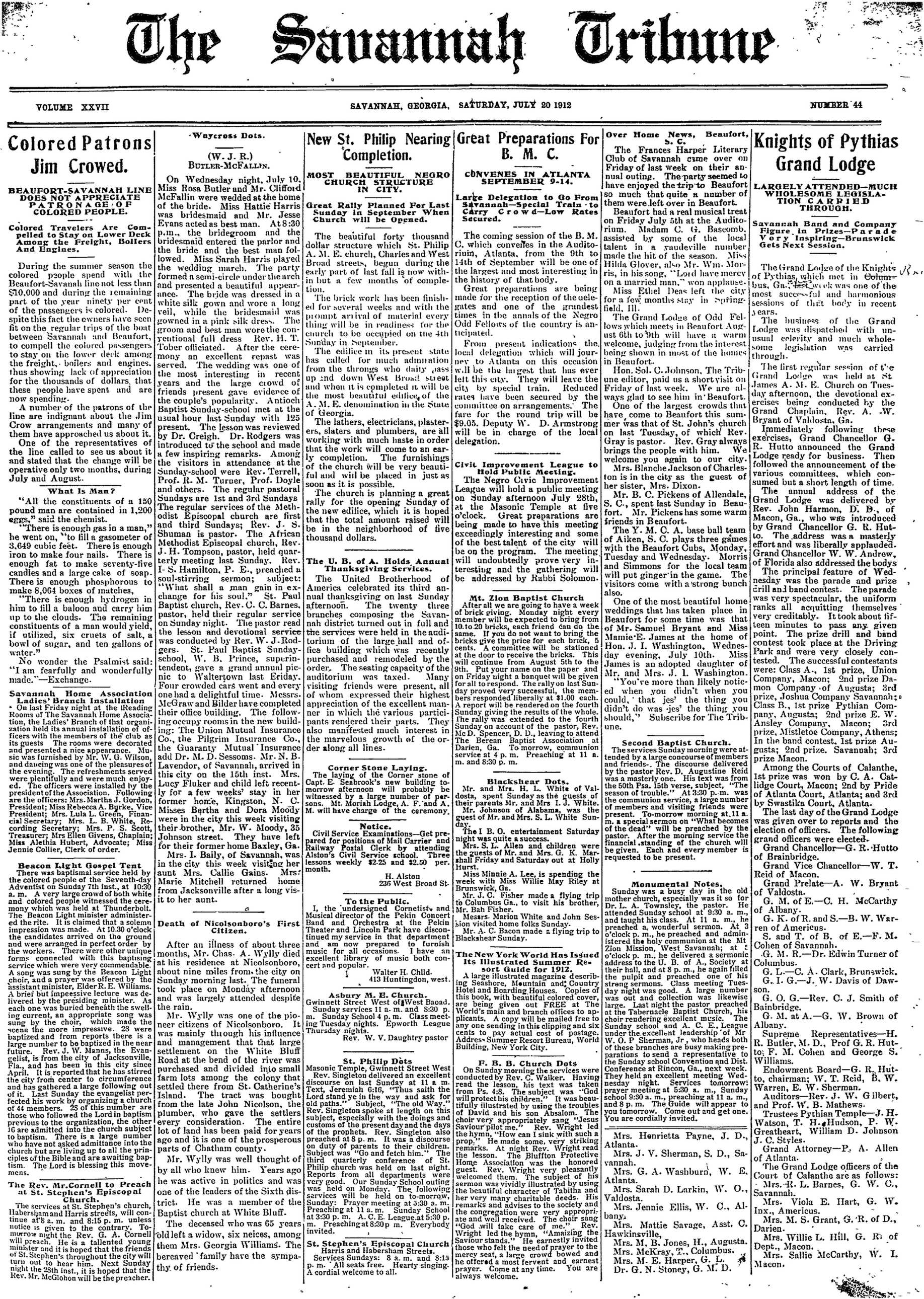
Page text (machine-generated)
The Savannah Tribune
VOLUME XXVII
Colored Patrons Jim Crowed.
Colored Patrons Jim Crowed.
BEAUFORT-SAVANNAH LINE DOES NOT APPRECIATE PATRONAGE OF COLORED PEOPLE.
Colored Travelers Are Compelled to Stay on Lower Deck Among the Freight, Bollers And Engines.
During the summer season the colored people spend with the Beaufort-Savannah line not less than $10,000 and during the remaining part of the year ninety per cent of the passengers is colored. Despite this fact the owners have seen fit on the regular trials of the boat between Savannah and Beaufort, to compell the colored passengers to stay on the lower deck among the freight, boilers and engines, thus showing lack of appreciation for the thousands of dollars, that these people have spent and are now spending.
A number of the patrons of the line are indignant about the Jim Crow arrangements and many of them have approached us about it.
One of the representatives of the line called to see us about it and stated that the change will be operative only two months, during July and August.
What Is Man?
"All the constituents of a 150 pound man are contained in 1,200 eggs," said the chemist.
"There is enough gas in a man," he went on, "to fill a gasometer of 3,649 cubic feet. There is enough iron to make four nails. There is enough fat to make seventy-five candles and a large cake of soap. There is enough phosphorous to make 8,064 boxes of matches,
"There is enough hydrogen in him to fill a balloon and carry him up to the clouds. The remaining constituents of a man would yield, if utilized, six cruets of salt, a bowl of sugar, and ten gallons of water."
No wonder the Psalmist said: "I am fearfully and wonderfully made."—Exchange.
Savannah Home Association Ladies' Branch Installation
On last Friday night at the Reading Rooms of The Savannah Home Association, the Ladies' Branch of that organization is our annual installation of officers with the purpose of presenting its guests. The rooms were decorated and presented a nice appearance. Music was furnished by Mr. W. G. Wilson and dancing was one of the pleasures of the evening. The refreshments served were plentifully and were much enjoyed. The officers were installed by the president of the Association. Following are the officers: Mrs. Martha J. Gordon, President; Miss Rebecca A. Byrke, Vice President; Mrs. Lula L. Green, Financial Secretary; Mrs. L. B. White, Recording Secretary; Mrs. P. S. Scott, Treasurer; Mrs Ellen Givens, Chaplain; Miss Alethia Hubert, Advocate; Miss Jennie Collier, Clerk of order.
Beacon Light Gospel Tent
There was baptismal service held by the colored people of the Seventh-day Adventist on Sunday 7th inst., at 10:30 a.m. A very large crowd of both white and colored people witnessed the ceremony which was held at Thunderbolt. The Beacon Light minister administered the rite. It is claimed that a solemn impression was made. At 10:30 o'clock the candidates arrived on the ground and were arranged in perfect order by the workers. There were other unique forms connected with this baptising service which were very commendable. A song was sung by the Beacon Light choir, and a prayer was offered by the assistant minister, Elder R.E. Williams. A brief but impressive lecture was delivered by the presiding minister. As each one was buried beneath the swelling current, an appropriate song was sung by the choir, which made the scene the more impressive. 28 were baptized and from reports there is a large number to be baptized in the near future. Rev. J. W. Manns, the Evangelist, is from the city of Jacksonville, Fla, and has been in this city since April. It is reported that he has stirred the city from center to circumference and has gathered a large following out of it. Last Sunday the evangelist perfected his work by organizing a church of 44 members. 28 of this number are those who followed the Lord in baptism previous to the organization, the other 16 are admitted into the church subject to baptism. There is a large number who have not asked admittance into the church but are living up to all the principles of the Bible and are awaiting baptism. The Lord is blessing this movements.
The Rev. Mr.Cornell to Preach at St. Stephen's Episcopal Church.
The services at St. Stephen's church, Habersham and Harris streets, will continue at a' s. m. and 8:15 p. m. unless notice is given to the contrary. Tomorrow night the Rev. G. A. Cornell will preach. He is a tallented young minister and it is hoped that the friends of St. Stephen's throughout the city will turn out to hear him. Next Sunday night the 28th inst., it is hoped that the Rev. Mr. McGlobon will be the preacher.
Waycross Dots.
On Wednesday night, July 10. Miss Rosa Butler and Mr. Clifford McFallin were wedded at the home of the bride. Miss Hattie Harris was bridesmaid and Mr. Jesse Evans acted as best man. At 8:30 p.m., the bridegroom and the bridesmaid entered the parlor and the bride and the best man followed. Miss Sarah Harris played the wedding march. The party formed a semi-circle under the arch and presented a beautiful appearance. The bride was dressed in a white silk gown and wore a long veil, while the bridesmaid was gowned in a pink silk dress. The groom and best man wore the conventional full dress Rev. H. T. Tober officiated. After the ceremony an excellent repast was served. The wedding was one of the most interesting in recent years and the large crowd of friends present gave evidence of the couple's popularity. Antioch Baptist Sunday-school met at the usual hour last Sunday with 125 present. The lesson was reviewed by Dr. Creigh. Dr. Rodgers was introduced to the school and made a few inspiring remarks. Among the visitors in attendance at the Sunday-school were Rev. Terrell, Prof. R. M. Turner, Prof. Doyle and others. The regular pastoral Sundays are 1st and 3rd Sundays. The regular services of the Methodist Episcopal church are first and third Sundays; Rev. J. S. Shuman is pastor. The African Methodist Episcopal church, Rev. J. H. Tompson, pastor, held quarterly meeting last Sunday. Rev. I. S. Hamilton, P. E., preached a soul-stirring sermon; subject: "What shall a man gain in exchange for his soul." St. Paul Baptist school, Rev. C. C. Barnes, pastor, held their regular service on Sunday night. The pastor read the lesson and devotional service was conducted by Rev. W. J. Rodgers. St. Paul Baptist Sunday-school, W. B. Prince, superintendent, gave a grand annual picnic to Waltertown last Eriday. Four crowded cars went and every one had a delightful time. Messrs. McGraw and Bilder have completed their office building. The following occupy rooms in the new building: The Union Mutual Insurance Co., the Pilgrim Insurance Co., the Guaranty Mutual Insurance add Dr. M. D. Sessoms. Mr. N. B. Lavendor, of Savannah, arrived in this city on the 15th inst. Mrs. Lucy Fluker and child left recently for a few weeks' stay in her former home, Kingston, N. C. Misses Bartha and Dora Moody were in the city this week visiting their brother, Mr. W. Moody, 35 Johnson street. They have left for their former home Baxley, Ga. Mrs. I. Baily, of Savannah, was in the city this week visiting her aunt Mrs. Callie Gains. Mrs. Marie Mitchell returned home from Jacksonville after a long visit to her aunt.
Death of Nicolsonboro's First Citizen.
After an illness of about three months, Mr. Chas. A. Wylly died at his residence at Nicolsonboro, about nine miles from the city on Sunday morning last. The funeral took place on Monday afternoon and was largely attended despite the rain.
Mr. Wylly was one of the pioneer citizens of Nicolsonboro. It was mainly through his influence and management that that large settlement on the White Bluff Road at the bend of the river was purchased and divided into small farm lots among the colony that settled there from St. Catherine's Island. The tract was bought from the late John Nicolson, the plumber, who gave the settlers every consideration. The entire lot of land has been paid for years ago and it is one of the prosperous parts of Chatham county.
Mr. Wylly was well thought of by all who knew him. Years ago he was active in politics and was one of the leaders of the Sixth district. He was a member of the Baptist church at White Bluff. The deceased who was 65 years old left a widow, six neices, among them Mrs. Georgia Williams. The bereaved family have the sympathy of friends.
SAVANNAH, GEORGIA, SATURDAY, JULY 20 1912
New St. Philip Nearing Completion.
MOST BEAUTIFUL NEGRO CHURCH STRUCTURE IN CITY.
Great Rally Planned For Last Sunday in September When Church will be Opened.
The beautiful forty thousand dollar structure which St. Philip A. M. E. church, Charles and West Broad streets, begun during the early part of last fall is now within but a few months of completion.
The brick work has been finished for several weeks and with the prompt arrival of material every thing will be in readiness for the church to be occupied on the 4th Sunday in September.
The edifice in its present state has called for much admiration from the throngs who daily pass up and down West Broad street and when it is completed it will be the most beautiful edifice of the A.M.E. denomination in the State of Georgia.
The lathers, electricians, plasterers, slaters and plumbers, are all working with much haste in order that the work will come to an early completion. The furnishings of the church will be very beautiful and will be placed in just as soon as it is possible.
The church is planning a great rally for the opening Sunday of the new edifice, which it is hoped that the total amount raised will be in the neighborhood of five thousand dollars.
The U. B. of A. Holds Annual Thanksgiving Services.
The United Brotherhood of America celebrated its third annual thanksgiving on last Sunday afternoon. The twenty three branches composing the Savannah district turned out in full and the services were held in the auditorium of the large hall and office building which was recently purchased and remodeled by the order. The seating capacity of the auditorium was taxed. Many visiting friends were present, all of whom expressed their highest appreciation of the excellent manner in which the various participants rendered their parts. They also manifested much interest in the marvelous growth of the order along all lines.
Corner Stone Laying.
The laying of the Corner stone of Capt. E. Seabrook's new building tomorrow afternoon will probably be witnessed by a large number of persons. Mt. Morish Lodge, A. F.' and A. M. will have charge of the ceremony.
Notice.
Civil Service Examinations—Get prepared for positions of Mail Carrier and Railway Postal Clerk by attending Alston's Civil Service school. Three lessons weekly $2.25 and $2.60 per month.
H. Alston
236 West Broad St.
To the Public.
I, the 'undersigned Cornetist'- and Musical director of the Pekin Concert Band and Orchestra at the Pekin Theater and Lincoln Park have discontinued my service in that department and am now prepared to furnish music for all occasions. I have an excellent library of music both concert and popular.
Gwinnett Street West of West Baoad.
Sunday services 11 a. m. and 3:30 p.
m. Sunday School 4 p. m. Class meeting
Tuesday nights. Epworth League
Thursday nights.
Rev. W. V. Daughtry pastor
St. Philip Dots
Masonic Temple, Gwinnett Street West
Rev. Singleton delivered an excellent
discourse on last Sunday at 11 a.m.
Text, Jeremiah 6:16, "Thus saith the
Lord stand ye in the way, and ask for
old paths." Subject, "The old Way."
Rev. Singleton spoke at length on this
subject, especially with the doings and
customs of the present day and the days
of the prophets. Rev. Singleton also
preached at 8 p.m. It was a discourse
on duty of parents to their children.
Subject was "Go and fetch him." The
third quarterly conference of St.
Philip church was held on last night.
Reports from all departments were
very good. Our Sunday School outing
was held on Monday. The following
services will be held on to-morrow.
Sunday: Prayer meeting at 5:30 a.m.
Preaching at 11 a.m. Sunday School
at 3:30 p.m. A.C.E. League at 5:30 p.m.
Preaching at 8:30 p.m. Everybody
invited.
Harris and Habersham Streets.
Services Sundays: 8 a.m. and 8:15
p.m. All seats free. Hearty singing.
A cordial welcome to all.
Great Preparations For B. M. C.
CbVENES IN ATLANTA
SEPTEMBER 9-14.
Large Delegation to Go From Savannah—Special Train to Carry Crowd—Low Rates Secured.
The coming session of the B. M. C. which convenes in the Auditorium, Atlanta, from the 9th to 14th of September will be one of the largest and most interesting in the history of that body.
Great preparations are being made for the reception of the delegates and one of the grandest times in the annals of the Negro Odd Fellows of the country is anticipated.
From present indications the local delegation which will journey to Atlanta on this occasion will be the largest that has ever left this city. They will leave the city by special train. Reduced rates have been secured by the committee on arrangements.' The fare for the round trip will be $9.05. Deputy W. D. Armstrong will be in charge of the local delegation.
Civit Improvement League to Huld Public Meeting.
The Negro Civic Improvement League will hold a public meeting on Sunday afternoon July 28th, at the Masonic Temple at five o'clock. Great preparations are being made to have this meeting exceedingly interesting and some of the best talent of the city will be on the program. The meeting will undoubtedly prove very interesting and the gathering will be addressed by Rabbi Solomon
Mt. Zion Baptist Church
After all we are going to have a week of brick giving. Monday night every member will be expected to bring from 10. to 20 bricks, each friend can do the same. If you do not want to bring the bricks give the price for each brick, 5 cents. A committee will be stationed at the door to receive the bricks. This will continue from August 5th to the 9th. Put your name on the paper and on Friday night a banquet will be given for all to respond. The rally on last Sunday proved very successful, the members responded liberally at $1.00 each. A report will be rendered on the fourth Sunday giving the results of the whole. The rally was extended to the fourth Sunday on account of the pastor, Rev. Mc D. Spencer, D. D., leaving to attend The Berean Baptist Association at Darien, Ga. To morrow, communion service at 4 p. m. Preaching at 11 a. m. and 8:30 p. m.
Blackshear Dots.
Mr. and Mrs. H. L. White of Valdosta, spent Sunday as the guests of their parents Mr. and Mrs I. J. White. Mr. Johnson of Alabama, was the guest of Mr. and Mrs. S. L. White Sunday.
The I B. O. entertainment Saturday night was quite a success.
Mr. A. C. Bacon made a flying trip to Blackshear Sunday.
The New York World Has Issued
Its Illustrated Summer Res
ort Guide for 1912
A large illustrated magazine describing Seashore, Mountain and Country Hotel and Boarding Houses. Copies of this book, with beautiful colored cover, are being given out FREE at The World's main and branch offices to applicants. A copy will be mailed free to any one sending in this clipping and six cents to pay actual cost of postage. Address=Summer Resort Bureau, World Building, New York City.
F. B. B. Church Dots
On Sunday morning the services were conducted by Rev. C. Walker. Having read the lesson, his text was taken from Ps. 4:8. The subject was "God will protect his children." It was beautifully illustrated by using the troubles of David and his son Absalom. The choir very appropriately sang "Jesus Saviour pilot me." Rev. Wright led the hymn, "How can I sink with such a prop." He made some, very striking remarks. At night Rev. Wright read the lesson. The Bluffton Protective Home Association was the honored guest. Rev. Wright very pleasantly welcomed them. The subject of his sermon was vividly illustrated by using the beautiful character of Tabitha and her very many charitable deeds. His remarks and advises to the society and the congregation were very appropriate and well received. The choir sang "God will take care of me." Rev. Wright led the hymn, "Amazing the Saviour stands." He earnestly invited those who felt the need of prayer to the mercy seat, a large crowd bowed and he offered a most fervent and earnest prayer. Come at any time. You are always welcome.
Over Home News, Beaufort,
S. C.
The Frances Harper Literary
Club of Savannah came over on
Friday of last week on their annual
outing. The party seemed to
have enjoyed the trip to Beaufort
so much that quite a number of
them were left over in Beaufort.
Beaufort had a real musical treat
on Friday July 5th at the Auditorium.
Madam C. G. Bascomb,
assisted by some of the local
talent in a yaudeville number
made the hit of the season.
Miss Hilda Glover, also Mr. Wm. Morris,
in his song, "Lord have mercy
on a married man," won applause.
Miss Ethel Deas left the city for a few months stay in Springfield, Ill.
The Grand Lodge of Odd Fellows which meets in Beaufort August 6th to 9th will have a warm welcome, judging from the interest being shown in most of the homes in Beaufort.
One of the largest crowds that have come to Beaufort this summer was that of St. John's church on last Tuesday, of which Rev. Gray is pastor. Rev. Gray always brings the people with him. We welcome you again to our city. Mrs. Blanche Jackson of Charleston is in the city as the guest of her sister, Mrs. Dixon. Mr. B. C. Pickens of Allendale, S. C., spent last Sunday in Beaufort. Mr. Pickens has some warm friends in Beaufort. The Y. M. C. A. base ball team of Aiken, S. C. plays three games with the Beaufort Cubs, Monday, Tuesday and Wednesday. Morris and Simmons for the local team will put ginger in the game. The visitors come with a strong bunch also.
One of the most beautiful home weddings that has taken place in Beaufort for some time was that of Mr. Samuel Bryant and Miss Mamie'E. James at the home of Hon. J. I. Washington, Wednesday evening, July 10th. Miss James is an adopted daughter of Mr. and Mrs. J. I. Washington. "You've more than likely noticed when you didn't when you could, that jes' the thing you didn't do was jes' the thing you should," Subscribe for The Tribune.
Second Baptist Church.
Second Baptist Church.
The services Sunday morning were attended by a large concourse of members and friends.- The discourse delivered by the pastor Rev. D. Augustine Reid was a master one. He had a wife from Dothil and a 135 verse subject, "The season of trouble." At 3:30 p. m. was the communion service, a large number of members and visiting friends were present. To-morrow morning at 11 a.m. a special sermon on "What becomes of the dead" will be preached by the pastor. After the morning service the financial standing of the church will be given. Each and every member is requested to be present.
Monumental Notes.
Sunday was a busy day in the old mother church, especially it was so for Dr. L. A. Townsley, the pastor. He attended Sunday school at 9:30 a.m., and taught his class. At 11 a. m., he preached a wonderful sermon. At 3 o'clock p. m., he preached and administered the holy communion at the Mzion Mission, West Savannah; at 5 o'clock p. m., he delivered a sermonic address to the U. B. of A. Society at their hall, and at 8 p. m., he again filled the pulpit and preached one of his strong sermons. Class meeting Tuesday night was good. A large number was out and collection was likewise large. Last night the pastor preached at the Tabernacle Baptist Church, his choir rendering excellent music. The Sunday school and A. C. E. League under the excellent leadership of Mr. W. O. P. Sherman, Jr., who heads both of these branches are busy making preparations to send a representative to the Sunday school Convention and Dist. Conference at Rincon, Ga., next week. They held an excellent meeting Wednesday night. Services tomorrow prayer meeting at 5:30 a. m., Sunday school 9:30 a. m., preaching at 11 a. m., and 8 p. m. The Guide will appear to you tomorrow. Come out and get one. You are cordially invited.
Mrs. Honrietta Payne, J. D., Atlanta.
Mrs. J. V. Sherman, S. D., Savannah.
Mrs. G. A. Washburn, W. E. Atlanta.
Mrs. Sarah D. Larkin, W. O., Valdosta.
Mrs. Jennie Ellis, W. C., Albany.
Mrs. Mattie Savage, Asst. C. Hawkinsville.
Mrs. M. B. Jones, H., Augusta.
Mrs. Mekray, T., Columbus.
Mrs. M. E. Harper, G. L.
Dr. G. N. Stoney, G. M. D.
---
NUMBER 44
Knights of Pythias Grand Lodge
Knights of Pythias Grand Lodge
LARGELY ATTENDED—MUCH WHOLESOME LEGISLATION CARRIED THROUGH.
Savannah Band and Company Figure, in Prizes—Parade Vory Inspiring—Brunswick Gets Next Session.
The Grand Lodge of the Knights of Pythias, which met in Columbus, Ga., last week was one of the most successful and harmonious sessions of that body in recent years.
The business of the Grand Lodge was dispatched with unusual colority and much wholesome legislation was carried through.
The first regular session of the Grand Lodge was held at St James A. M. E. Church on Tuesday afternoon, the devotional exercises being conducted by the Grand Chaplain, Rev. A. W. Bryant of Valdosta, Ga.
Immediately following these exercises, Grand Chancellor G.R. Hutto announced the Grand Lodge ready for business. Then followed the announcement of the various committees, which consumed but a short length of time. The annual address of the Grand Lodge was delivered by Rev. John Harmon, D. B., of Macon, Ga., who was introduced by Grand Chancellor G. R. Hutto. The address was a masterly effort and was liberally applauded. Grand Chancellor W. W. Andrew, of Florida also addressed the bodies
The principal feature of Wednesday was the parade and prize drill and band contest. The parade was very spectacular, the uniform ranks all acquitting themselves very creditably. It took about fifteen minutes to pass any given point. The prize drill and band contest took place at the Driving Park and were very closely contested. The successful contestants were: Class A., 1st prize, Union Company, Macon; 2nd prize Damon Company.of Augusta; 3rd prize, Joshua Company Savannah; Class B., 1st prize Pythian Company, Augusta; 2nd prize E. W. Ansley Company, Macon; 3rd prize, Mistletoe Company, Athens; In the band contest, 1st prize Augusta; 2nd prize. Savannah; 3rd prize Macon.
Among the Courts of Calanthe, 1st prize was won by C. A. Catlidge Court, Macon; 2nd by Pride of Atlanta Court, Atlanta; and 3rd by Swastika Court, Atlanta. The last day of the Grand Lodge was given over to reports and the election of officers. The following grand officers were elected.
Grand Chancellor—G. R. Hutto of Brainbridge.
Grand Vice Chancellor—W. T. Reid of Macon.
G. L.—C. A. Clark, Brunswick.
G. I. G.—J. W. Davis of Dawson.
G. O. G.—Rev. C. J. Smith of Bainbridge.
G. M. at A.—G. W. Brown of Albany.
Supreme Representatives—H.
R. Butler, M. D., Prof G. R. Hutto; F. M. Cohen and George S. Williams.
Auditors—Rev. J. W. Gilbert,
and Prof. W. B. Mathews.
Trustees Pythian Temple—J. H.
Watson, T. H. Hudson, P. W.
Greatheart, William D. Johnson
J. C. Styles.
Grand Attorney—P. A. Allen
of Atlanta.
The Grand Lodge officers of the
Court of Calanthe are as follows:
Mrs. R. L. Barnes, G. W. C.,
Savannah.
STRUGGLE OVER PANAMA BILL
Britain Sends Note to State Department.
DOES NOT VIOLATE TREATY
Lines Are Drawn Tight For a Great Diplomatic Struggle Between This Country and Great Britain.
Washington.—The lines are drawn for a great diplomatic struggle between the United States and Great Britain over the question whether this country may discriminate in favor of American vessels in the administration of the Panama Canal. The wordy war may terminate in the submission of the question to The Hague tribunal.
A series of diplomatic and legislative conferences have developed the fact that the forces in the American government which favor allowing American ships free passage through the canal are in control. These forces take the position that there is nothing in the Hay-Pauncefote treaty, under which the canal was built, to prevent this concession. The diplomatic struggle, precipitated by the note received from Mitchell Innes, charge of the British Embassy, it is expected, will be fought along the following lines:
Great Britain will take the position that the Hay-Pauncefote treaty provision, which forbids discrimination in favor of the interests of any nation in the conduct of the canal, would operate against the provisions of the Panama bill now under consideration in the Senate. This position will be supported by a lengthy argument, now on its way from London by mail, which will be presented to the State Department and transmitted to Congress immediately upon its arrival.
The United States will hold that so long as the ships of all foreign nations are accorded the same treatment in the use of the canal, the United States may pass American ships free or rebate the tolls charged them. This position was taken by the House when it reversed the report of the House Interstate and Foreign Commerce Committee, which would have prevented free passage to American ships and passed the present bill.
LIGHTNING HITS CAMP.
Two Soldiers Killed and Seventeen Seriously Injured.
Anniston, Ala. — Two guardsmen were killed and 17 seriously hurt when lightning struck a mess tent at the maneuver grounds here. The dead were Charles Kirby and H. Rape, who were members of Company B, Second Alabama Infantry, as are all those injured. The militia of several Southern states is in camp here. The soldiers had been in camp several days and were to sign pay slips. As rain was falling the men of Company B lined up in their mess tent. The lightning struck, and almost all those in the tent were stricken down. Of the injured N. C. Sullivan is not expected to live.
ELEVEN ENTOMBED IN MINE.
Three Men Brought Out Alive—The Others Perish.
Wheeling, W. Va. Just a few minutes before a party of inspectors was to have descended to make an inspection there was a violent explosion in the Panama Mine, of the Fort Pitt Coal Company, just below Moundsville, which entombed 11 men, 3 of whom were brought out alive. Two of these will likely die.
Eight bodies have been taken from the mine, a search of the rescuers failing to locate Leslie Wilson, whose brother declares positively he is not among those in the morgue.
The men died where they fell, crushed to death.
THE LAST REFUGE GONE.
Extradition Treaty Has Been Signed With Honduras.
Washington.—Those who flee justice in the United States will hereafter find no place on the Western Hemisphere safe from extradition. By signing an extradition treaty with Honduras the State Department closed the last avenue of escape.
Around World In 39 Days.
Los Angeles, Cal.—What is said to be a new record for encircling the globe was completed here Tuesday by J. A. Allen and E. J. Scott, of Phoenix, Ariz., who made the trip in 39 days. The two men left Los Angeles June 1 and, sailing from Seattle June 3, made the journey by way of Vladivostok and Paris.
Airship Runs Away.
Redwood City, Cal.—Joseph C. Vierra, who has been experimenting secretly near Redwood City with a gliding aeroplane, had the unusual experience of having his machine run away after he had fallen out of it. The glider rose successfully and Vierra began to send it forward rapidly against the wind, when, at a height of about 15 feet, it bucked and threw him out. Instead of smashing to the ground, it continued to rise and soared seaward until it disappeared.
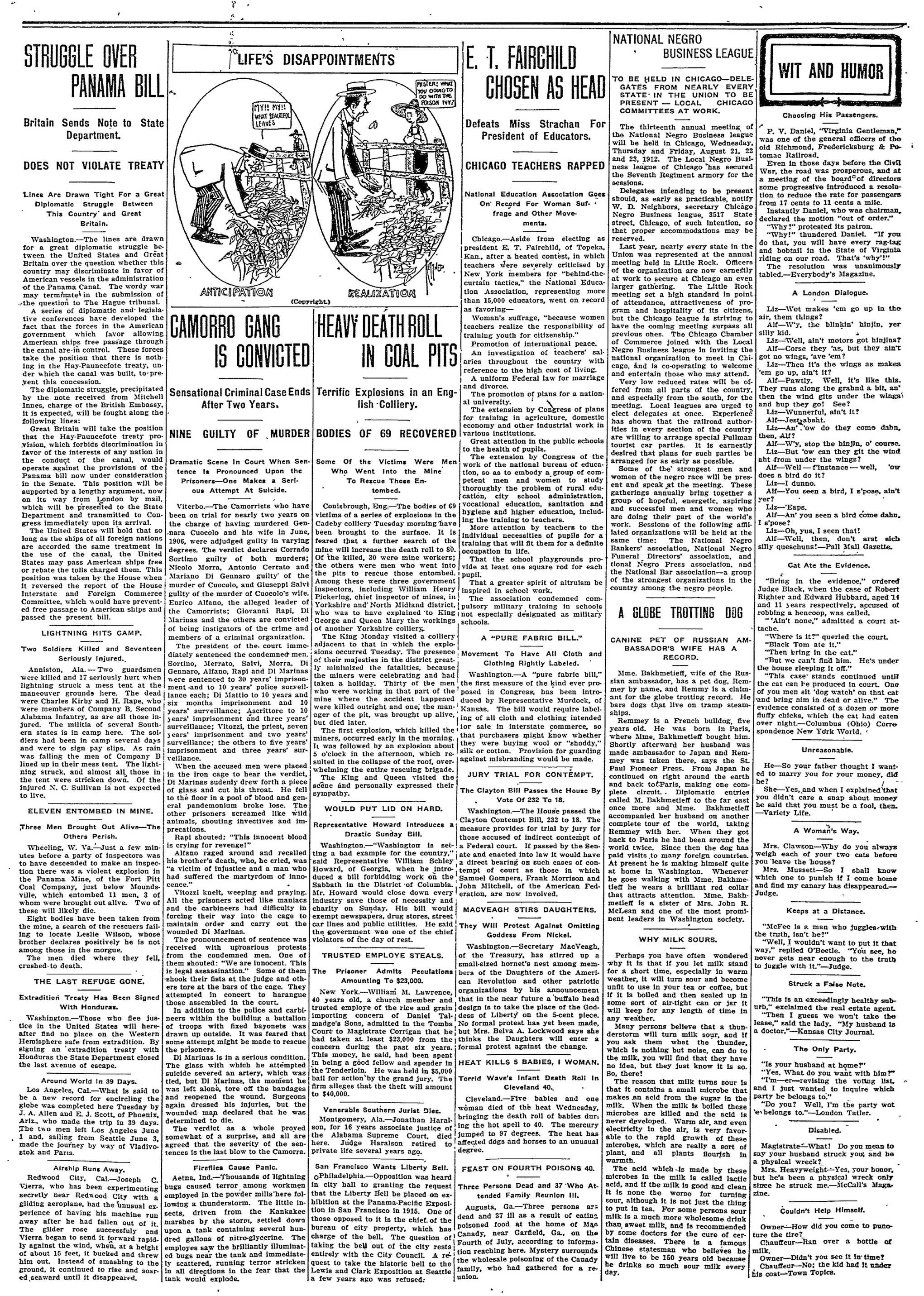
MY!! MY!!
WHAT BEAUTIFUL
LEAVES
MISTER: WHAT
YOU GOING TO
DO WITH THE
POISON IVY?
ANTICIPATION
REALIZATION
(Copyright)
CAMORRO GANG IS CONVICTED
Sensational Criminal Case Ends After Two Years.
NINE GUILTY OF MURDER
Dramatic Scene In Court When Sentence Is Pronounced Upon the Prisoners—One Makes a Serious Attempt At Suicide.
Viterbo.—The Camorrists who have been on trial for nearly two years on the charge of having murdered Gennara Cuocoolo and his wife in June, 1906, were adjudged guilty in varying degrees. The verdict declares Corrado Sortimo guilty of both murders; Nicolo Morra, Antonio Cerrato and Mariano Di Gennaro guilty' of the murder of Cuocoolo, and Gluseppi Salvi guilty of the murder of Cuocoolo's wife. Enrico Alfano, the alleged leader of the Camorrists; Glovanni Rapi, Di Marinas and the others are convicted of being instigators of the crime and members of a criminal organization.
The president of the court immediately sentenced the condemned men. Sortino, Merrato, Salvi, Morra, Di Gennaro, Alfano, Rapi and Di Marinas were sentenced to 30 years' imprisonment and to 10 years' police surveillance each; Di Mattio to 10 years and six months imprisonment and 10 years' surveillance; Ascritore to 10 years' imprisonment and three years' surveillance; Vitozzi, the priest, seven years' imprisonment and two years' surveillance; the others to five years' imprisonment and three years' surveillance.
When the accused men were placed in the iron cage to hear the verdict, Di Marinas suddenly drew forth a piece of glass and cut his throat. He fell to the floor in a pool of blood and general pandemonium broke lose. The other prisoners screamed like wild animals, shouting invectives and imprecations.
Rapi shouted: "This innocent blood is crying for revenge!"
Alfano raged around and recalled his brother's death, who, he cried, was "a victim of injustice and a man who had suffered the martyrdom of innocence."
Vitozzi knelt, weeping and praying. All the prisoners acted like maniacs and the carbineers had difficulty in forcing their way into the cage to maintain order and carry out the wounded Di Marinas.
The pronouncement of sentence was received with uproarious protests from the condemned men. One of them shouted: "We are innocent. This is legal assassination." Some of them shook their fists at the judge and others tore at the bars of the cage. They attempted in concert to harangue those assembled in the court.
In addition to the police and carbineers within the building a battalion of troops with fixed bayonets was drawn up outside. It was feared that some attempt might be made to rescue the prisoners.
Di Marinas is in a serious condition. The glass with which he attempted suicide severed an artery, which was tled, but Di Marinas, the moment he was left alone, tore off the bandages and reopened the wound. Surgeons again dressed his injuries, but the wounded map declared that he was determined to die. The verdict as a whole proved somewhat of a surprise, and all are agreed that the severity of the sentences is the last blow to the Camorra.
Firefiles Cause Panic.
Aetna, Ind.—Thousands of lightning bugs caused terror among workmen employed in the powder mills here following a thunderstorm. The little insects, driven from the Kankakee marshes by the storm, settled down upon a tank containing several hundred gallons of nitro-glycerine. The employees saw the brilliantly illuminated bugs near the tank and immediately scattered, running terror stricken in all directions in the fear that the tank would explode.
HEAVY DEATH ROLL IN COAL PITS
Terrific Explosions in an English-Colliery.
BODIES OF 69 RECOVERED
Some Of the Victims Were Men Who Went Into the Mine To Rescue Those Entombed.
Conisbrough, Eng.—The bodies of 69 victims of a series of explosions in the Cadeby colliery Tuesday morning have been brought to the surface. It is feared that a further search of the mine will increase the death roll to 80. Of the killed, 20 were mine workers; the others were men who went into the pits to rescue those entombed. Among these were three government inspectors, including William Henry Pickering, chief inspector of mines, in Yorkshire and North Midland district, who was to have explained 'to King George and Queen Mary the workings of another Yorkshire colliery.
The King Monday visited a colliery adjacent to that in which the explosions occurred Tuesday. The presence of their majesties in the district greatly minimized the fatalities, because the miners were celebrating and had taken a holiday. Thirty of the men who were working in that part of the mine where the accident happened were killed outright and one; the manager of the pit, was brought up alive, but died later.
The first explosion, which killed the miners, occurred early in the morning. It was followed by an explosion about 5 o'clock in the afternoon, which resulted in the collapse of the roof, overwhelming the entire rescuing brigade.
The King and Queen visited the scene and personally expressed their sympathy.
WOULD PUT LID ON HARD.
Representative Howard Introduces a Drastic Sunday Bill.
Washington.—"Washington is setting a bad example for the country," said Representative William Schley Howard, of Georgia, when he introduced a bill for bidding work on the Sabbath in the District of Columbia. Mr. Howard would close down every industry save those of necessity and charity on Sunday. His bill would exempt newspapers, drug stores, street car lines and public utilities. He said the government was one of the chief violators of the day of rest.
TRUSTED EMPLOYE STEALS.
The Prisoner Admits Peculations
Amounting To $23,000.
New York.—William M. Lawrence, 40 years old, a church member and trusted employee of the rice and grain importing concern of Daniel Talmadge's Sons, admitted in the Tombs Court to Magistrate Corrigan that he had taken at least $23,000 from the concern during the past six years. This money, he said, had been spent in being a good fellow and spender in the Tenderloin. He was held in $5,000 ball for action by the grand jury. The firm alleges that the theft will amount to $40,000.
Venerable Southern Jurist Dies.
Montgomery, Ala.—Jonathan Haralson, for 16 years associate justice of the Alabama Supreme Court, died here. Judge Haralson retired to private life several years ago.
San Francisco Wants Liberty Bell. Philadelphia.—Opposition was heard in city hall to granting the request that the Liberty Bell be placed on exhibition at the Panama-Pacific Exposition in San Francisco in 1915. One of those opposed to it is the chief, of the bureau of city property, which has charge of the bell. The question of taking the bell out of the city rests entirely with the City Council. A request to take the historic bell to the Lewis and Clark Exposition at Seattle a few years ago was refused:
E. T. FAIRCHILD CHOSEN AS HEAD
Defeats Miss Strachan For President of Educators.
CHICAGO TEACHERS RAPPED
National Education Association Goes On' Record For Woman Suffrage and Other Movements.
Chicago.—Aside from electing as president E. T. Fairchild, of Topeka, Kan., after a heated contest, in which teachers were severely criticised by New York members for "behind-the-curtain tactics," the National Education Association, representing more than 15,000 educators, went on record as favoring—
Woman's suffrage, "because women teachers realize the responsibility of training youth for citizenship."
Promotion of international peace.
reference to the high cost of living.
A uniform Federal law for marriage and divorce.
The promotion of plans for a national university.
The extension by Congress of plans for training in agriculture, domestic economy and other industrial work in various institutions.
Great attention in the public schools to the health of pupils.
The extension by Congress of the work of the national bureau of education, so as to embody a group of competent men and women to study thoroughly the problem of rural education, city school administration, vocational education, sanitation and hygiene and higher education, including the training to teachers.
More attention by teachers to the individual necessities of pupils for a training that will fit them for a definite occupation in life. That the school playgrounds provide at least one square rod for each pupil. That a greater spirit of altruism be inspired in school work. The association condemned compulsory military training in schools not especially designated as military schools.
A "PURE FABRIC BILL."
Movement To Have All Cloth and Clothing Rightly Labeled.
Washington.—A "pure fabric bill," the first measure of the kind ever proposed in Congress, has been introduced by Representative Murdock, of Kansas. The bill would require labeling of all cloth and clothing intended for sale in interstate commerce, so that purchasers might know whether they were buying wool or "shoddy," silk or cotton. Provision for guarding against misbranding would be made.
JURY TRIAL FOR CONTEMPT.
The Clayton Bill Passes the House By
Vote Of 232 To 18.
Washington.—The House passed the Clayton Contempt Bill, 232 to 18. The measure provides for trial by jury for those accused of indirect contempt of a Federal court. If passed by the Senate and enacted into law it would have a direct bearing on such cases of contempt of court as those in which Samuel Gompers, Frank Morrison and John Mitchell, of the American Federation, are now involved.
MACVEAGH STIRS DAUGHTERS.
They Will Protest Against Omitting Goddess From Nickel.
Washington.—Secretary MacVeagh, of the Treasury, has stirred up a small-sized hornet's nest among members of the Daughters of the American Revolution and other patriotic organizations by his announcement that in the near future a buffalo head design is to take the place of the Goddess of Liberty on the 5-cent piece. No formal protest has yet been made, but Mrs. Belva A. Lockwood says she thinks the Daughters will enter a formal protest against the change.
HEAT KILLS 5 BABIES, I WOMAN.
Torrid Wave's Infant Death Roll In Cleveland 40.
Cleveland.—Five babies and one woman died of the heat Wednesday, bringing the death roll of babies during the hot spell to 40. The mercury jumped to 97 degrees. The heat has affected dogs and horses to an unusual degree.
FEAST ON FOURTH POISONS 40.
Three Persons Dead and 37 Who Attended Family Reunion III.
Augusta, Ga.-Three persons are dead and 37 ill as a result of eating poisoned food at the home of Mac Canady, near Garfield, Ga., on the Fourth of July, according to information reaching here. Mystery surrounds the wholesale poisoning of the Canady family, who had gathered for a reunion.
TO BE HELD IN CHICAGO—DELEGATES FROM NEARLY EVERY STATE IN THE UNION TO BE PRESENT — LOCAL CHICAGO COMMITTEES AT WORK.
The thirteenth annual meeting of the National Negro Business league will be held in Chicago, Wednesday, Thursday and Friday, August 21, 22 and 23, 1912. The Local Negro Business league of Chicago has secured the Seventh Regiment army for the sessions.
Delegates intending to be present should, as early as practicable, notify W. D. Neighbors, secretary Chicago Negro Business league, 3517 State street, Chicago, of such intention, so that proper accommodations may be reserved.
Last year, nearly every state in the Union was represented at the annual meeting held in Little Rock. Officers of the organization are now earnestly at work to secure at Chicago an even larger gathering. The Little Rock meeting set a high standard in point of attendance, attractiveness of program and hospitality of its citizens, but the Chicago league is striving to have the coming meeting surpass all previous ones. The Chicago Chamber of Commerce joined with the Local Negro Business league in inviting the national organization to meet in Chicago, and is co-operating to welcome and entertain those who may attend.
Very low reduced rates will be offered from all parts of the country, and especially from the south, for the meeting. Local leagues are urged to elect delegates at once. Experience has shown that the railroad authorities in every section of the country are willing to arrange special Pullman tourist car parties. It is earnestly desired that plans for such parties be arranged for as early as possible.
Some of the' strongest men and women of the negro race will be present and speak at the meeting. These gatherings annually bring together a group of hopeful, energetic, aspiring and successful men and women who are doing their part of the world's work. Sessions of the following affiliated organizations will be held at the same time: The National Negro Bankers' association, National Negro Funeral Directors' association, and national Negro Press association, and the National Bar association—a group of the strongest organizations in the country among the negro people.
A GLOBE TROTTING DOG
CANINE PET OF RUSSIAN AMBASSADOR'S WIFE HAS A RECORD.
Mme. Bakhmetieff, wife of the Russian ambassador, has a pet dog, Remmy by name, and Remmy is a claimant for the globe trotting record. He bears dogs that live on tramp steamships.
Remmey is a French bulldog, five years old. He was born in Paris, where Mme. Bakhmetieff bought him. Shortly afterward her husband was made ambassador to Japan and Remmey was taken there, the St. Paul Pioneer Press. From Japan he continued on right around the earth and back to Paris, making one complete circuit. Diplomatic entries called M. Bakhmetieff to the far east once more and Mme. Bakhmetieff accompanied her husband on another complete tour of the world, taking Remmey with her. When they got back to Paris he had been around the world twice. Since then the dog has paid visits to many foreign countries. At present he is making himself quite at home in Washington. Whenever he goes walking with Mme. Bakhmetieff he wears a brilliant red collar that attracts attention. Mme. Bakhmetieff is a sister of Mrs. John R. McLean and one of the most prominent leaders in Washington society.
WHY MILK SOURS.
Perhaps you have often wondered why it is that if you let milk stand for a short time, especially in warm weather, it will turn sour and become unfit to use in your tea or coffee, but if it is boiled and then sealed up in some sort of air-tight can or jar it will keep for any length of time in any weather.
Many persons believe that a thunderstorm will turn milk sour, and if you ask them what the thunder, which is nothing but noise, can do to the milk, you will find that they have no idea, but they just know it is so. So, there!
The reason that milk turns sour is that it contains a small microbe that makes an acid from the sugar in the milk. When the milk is boiled these microbes are killed and the acid is never developed. Warm air, and even electricity in the air, is very favorable to the rapid growth of these microbes, which are really a sort of plant, and all plants flourish in warmth.
The acid which-is made by these microbes in the milk is called lactic acid, and if the milk is good and clean it is none the worse for turning sour, although it is not just the thing to put in tea. For some persons sour milk is a much more wholesome drink than sweet milk, and is recommended by some doctors for the cure of certain diseases. There is a famous Chinese statesman who believes he will live to be 150 years old because he drinks so much sour milk every day.
WIT AND HUMOR
Choosing His Passengers.
P. V. Daniel, "Virginia Gentleman," was one of the general officers of the old Richmond, Fredericksburg & Potomac Railroad.
Even in those days before the Civil War, the road was prosperous, and at a meeting of the board of directors some progressive introduced a resolution to reduce the rate for passengers from 17 cents to 11 cents a mile.
Instantly Daniel, who was chairman, declared the motion "out of order." "Why!" protested its patron. "Why!" thundered Daniel. "If you do that, you will have every rag-tag and bobtail in the State of Virginia riding on our road. That's 'why'!" The resolution was unanimously tabled.—Everybody's Magazine.
A London Dialogue-
Liz—Wot makes 'em go up in the air, them things?
Alf—W'y, the blinkin' hinjin, yer silly kid.
Liz—Well, ain't motors got hinjins?
Alf—Corse they 'as, but they ain't got no wings, 'ave 'em?
Liz—Then it's the wings as makes 'em go up, ain't it?
Alf—Pawtly. Well, it's like this. They runs along the grahnd a bit, an' then the wind gits under the wings and hup they go! See?
Liz—Wunnerful, ain't it?
Alf—Jestabaht.
Liz—An' 'ow do they come dahn, then, Alf?
Alf—Wy, stop the hinjin, o' course.
Liz—But 'ow can they git the wind aht from under the wings?
Alf—Well—f'instance—well, 'ow does a bird do it?
Liz—I dunno.
Alf—You seen a bird, I s'pose, ain't
yer?
Liz—'Eaps.
Alf—An' you seen a bird come dahn,
I s'pose?
Llz—Oh, vus. I seen that!
Alf—Well, then, don't arst sich silly queschuns!—Pall Mall Gazette.
Cat Ate the Evidence.
"Bring in the evidence," ordered Judge Black, when the case of Robert Righter and Edward Hubbard, aged 14 and 11 years respectively, accused of robbing a hencoop, was called.
"Ain't none," admitted a court attache.
"Where is it?" queried the court.
"Black Tom ate it."
Black Tom ate it.
"Then bring in the cat."
"But we can't find him. He's under the house sleeping it off."
"This case stands continued until the cat can be produced in court. One of you men sit 'dog watch' on that cat and bring him in dead or alive." The evidence consisted of a dozen or more fluffy chicks, which the cat had eaten over night—Columbus (Ohio) Correspondence New York World.
Unreasonable.
He—So your father thought I wanted to marry you for your money, did he?
She—Yes, and when I explained that you didn't care a snap about money he said that you must be a fool, then.—Variety Life.
A Woman's Way.
Mrs. Clawson—Why do you always welch each of your two cats before you leave the house?
Mrs. Mussett—So I shall know which one to punish if I come home and find my canary has disappeared—Judge.
Keeps at a Distance.
"McFee is a man who juggles with the truth, isn't he?"
"Well, I wouldn't want to put it that way," replied O'Beetle. "You see, he never gets near enough to the truth to juggle with it."—Judge.
"This is an exceedingly healthy suburb," exclaimed the real estate agent. "Then I guess we won't take the lease," said the lady. "My husband is a doctor."—Kansas City Journal.
The Only Party.
"Is your husband at home?"
"Yes. What do you want with him?"
"I'm—er—revising the voting list,
and I just wanted to inquire which
party he belongs to."
"Do you? Well, I'm the party wot
'e' belongs to."—London Tatler.
Disabled.
Magistrate—What! Do you mean to say your husband struck you, and he a physical wreck? Mrs. Heavyweight—Yes, your honor, but he's been a physical wreck only since he struck me.—McCall's Magazine.
Couldn't Help Himself.
Owner—How did you come to puncture the tire?
Chauffeur—Ran over a bottle of milk.
Owner—Didn't you see it in time?
Chauffeur—No; the kid had it under his coat—Town Topics.
The Oldest, Strongest and Most Reliable Company in the State. Gives employment to hundreds of men and women of our race. Pays from $1 to $10 weekly sick and accident benefits and from $10 to $100 death benefits. Our Motto: "Promptness, Honesty and Justice." Home Office: 1143 Gwinnett St. Augusta, Ga. For further information write 509 West Broad St., Savannah, Ga. J. S. Perry, Supt.
A. B. Singfield, Gen. Supt.
C. T. Walker, D. D., LL. D.,
Director and General Lecturer.
GO TO
Young Bros.
For your
GO TO
TOBACCO, CIGARS and FRUITS
Of all kinds.
809 West Broad Streets.
WEST SIDE RESTAURANT
461 West Broad Street
Near Union Station
The place to get first-class meals
Everything neat and clean. Meals
prepared in an appetizing manner
and at all hours daily.
Meals 16 and 25 cents.
MRS. A. S. SCOTT, Proprietress
This Space Is for Sale
at very rea-
sonable rates
Why not use
it to advertise
your wares
Masonic Books
LODGE SEALS,
FINANCIAL CARDS and
BLANKS of every description.
Publishers and Manufacturers' Prices
Laboral Discounts Will Be Arranged.
SOL G. JOHNSON,
Savannah, Ga.
Your Money Pile Grows
Just in proportion as you advertise your business, and our columns are open for you to begin at once. Suppose you give us a trial.
Advertise
in this paper
WASHING DELICATE FABRICS.
The processes of dyeing have so improved that almost all wash goods are now considered to have fast colors. This is particularly true of the better grades of fabrics, in which the dye seems to attach itself more firmly to the fibers of the cloth, but even though a color may be said to be fast this is only a relative term, and colored goods require more careful treatment than white goods. Avoid the conditions which most affect the stability of colors in fabrics, such as long-continued action of water and soap, strong alkalis or acid, and strong sunlight which is a powerful bleaching agent and is constantly used for this purpose.
When washing colored clothing these things should be kept in mind. Colored clothing cannot be soaked for any length of time unless the color is known to be very stable. Any soap used in the washing process should be a mild soap used in solution, or if the color is very delicate it should be replaced by soap bark, rice water, potato water or cooked starch water. The washing process should be conducted quickly, and the water should not be very hot.
After washing, colored garments should be turned inside out and hung in a very shady or dark place, and should be taken in as soon as dry. Fading is more often due to careless drying than to any fault in washing. Washing powders or strong alkalis should never be used. If the water needs softening, use borax. If starch, bran, rice water, etc., are used instead of soap, use the mixture as if it were soapsuds.
Sometimes a fabric shows a decided tendency to fade even under the best conditions. It is always well if there is any doubt on this subject to test a small piece of cloth before washing it. If it fades, then an attempt should be made to set the color. With certain colors a dyer uses a mordant, a substance which forms insoluble compounds with some dyestuffs, which under certain conditions, unite with the textile material or cloth. The same principle as mordanting or making a color fast may sometimes be used by the housekeeper in strengthening weak colors with satisfactory results. The household mordants are brine, vinegar, sugar of lead and alum, used in the following proportions: To one gallon of water one-half cup of mild vinegar, or two cups of salt, or one tablespoonful of alum, or one tablespoonful of sugar of lead (poison)).
Vinegar is best for pinks. Small pieces of cloth should be tested in each of the above solutions, and a choice made after experimenting. The cloth should be left in the solution over night, and may be left in for several days with good results. It should be thoroughly dried before being washed. Even with relatively strong colors soaking a fabric over night in a brine solution before washing it for the first time may render it far less susceptible to fading influences. The effect of brine is said not to be lasting. Colored goods are often rinsed in a salt solution just before drying them.
Silk should be washed in much the same way as wool. While it is not so strongly affected by soaps and alkalies, its gloss is destroyed by the use of strong reagents. The delicacy of the fiber makes hard rubbing impossible, for it breaks the fibers and destroys not only the durability, but also the silkiness of the fiber. In wringing silk, place between dry towels or heavy cloths, and put through a loosely adjusted wringer. Iron on the wrong side while still damp with a moderate iron. Silk is very easily scorched, and if the iron is too hot, the silk will be stiff. Iron back and forth with a wriggling motion to give softness and pliability. It is often best to iron silk under a cloth. This gives less body and a softer finish. Ribbons, of good quality, may be very successfully washed. To iron, cover with a dry cloth and move the iron frequently back and forth over the surface of the cloth and above the ribbon.
It is often better to dry-clean fine laces, as they thicken slightly in washing. To wash them, use a warm soap solution to which has been added ammonia or borax. Squeeze out the dirt by pressing the lace in the hands, but do not rub it, as rubbing breaks the delicate threads. A good way to wash fine lace is to first baste it to strips of cheesecloth, being careful to catch all the points down. Put to soak over night in warm soapy water containing a little borax or ammonia. Wash by squeezing and rinse free of soap. Old yellow lace may be bleached by stretching it while wet about a bottle and standing it in the sun, rewetting occasionally. Javelle water, may be used to bleach lace. Lace may be stiffened by rinsing in a mixture of two tablespoonfuls of alcohol to one cup of water; by rinsing in borax water, two tablespoonfuls to the cup, or by using gum arabic, one-eighth teaspoon to a cup of water. If a yellow color is desired, dip in coffee or tea.
Black lace should be cleaned by squeezing out in a mixture of one cup of strong coffee and one tablespoon of ammonia. Rinse in gum arabic water made with coffee to give natural stiffness.
of lace as is practical. Clear starch them, and stretch and pin out on sheets, one curtain over another. Curtain stretchers are better if available, but good results may be obtained by pinning. If care is taken to make the first curtain straight and even. This is best done by measuring sides and corners with a tape measure.
OUR SPRING LINE.
The feminine "line" is one of the secrets of the spring. Are we to be fat or thin this year, or just medium? When I say "we" I mean the gentler sex; for alas! man has to remain as he is, unless he is a jockey or an athlete, both of whom have their painful processes of getting down to weight. But the female form divine is capable of extraordinary change, especially in the spring. A decree goes forth from the Rue de la Paix, and instantly the plump and matronly become "mince" and the thin more slender still. In its haste the feminine world thought there was going to be a relaxation of the line this year. A while ago the Iribe dresses, in "La Rue de la Paix," seemed to point to rational reform. Not a bit of it. You have to be thin still, fair readers, if you would be fashionable.
Some ungallant person said the present fashions made women look like an umbrella—an umbrella, presumably, that you cannot lose, though you may give away. An umbrella you have still to be, but the stick is no longer steel; the type—pardon me—approaching the gingham. There is to be a certain fullness of the skirt at the knees, but the base remains restricted so as to retain the look of youth and elegance. Gradually we shall evolve, no doubt, towards the bell shape. For the moment "nos elegantes" remain "belles" without being bells.
CHICKEN AND VEAL PIE.
Buy chicken giblets, the necks, gizzards, hearts and livers. By adding to these half a pound of veal cutlet there is enough for an excellent chicken pie. Put the giblets into a saucepan with a pint of cold water, a slice of onion, a small carrot and a level teaspoonful of salt. Simmer until there is only half a cup of liquid. Strain this and set aside. Cut the veal into small cubes and cook slowly until well done and a light brown. Put into a baking dish with the giblets cut up and scatter a little salt fat pork, cut in shreds, through the meat. Thicken the chicken liquor slightly with flour moistened with water, to a paste. Cover with good rich pie paste, puff paste if you have it, and bake in a steady oven for an hour and a half.
KITCHENETTES.
If, you wish to beat an egg very light beat the white first to a froth, then add the yolk and beat.
In thickening gravies or sauce try an egg beater to get out the lumps of thickening. The sauce or gravy will be as smooth as can be and will not need to be strained. Another way: If you are making milk toast or anything similar put the thickening into the cold milk and stir constantly till done. It will be so smooth and free from lumps that you will feel well paid for a few moments' extra time. It does not take much longer.
To keep the zinc tray of a gas stove bright and clean, rub with benzine, then wash with soap and pulverized pumice. It will look like new. If spots are stubborn, use a little kerosene.
CARING FOR YOUR PETS.
Many pet cats who live where they cannot get fresh grass to eat become sick and die because their little owners forget to supply plenty of fresh green vegetables in place of the natural herbs. Fresh green of some kind is necessary to keep the system and blood in order with cats and dogs as with humans. Green corn scraped with a fork, asparagus remnants, spinach and all such things are excellent for pussy as are also the carrots, turnips and leeks which are frequently cooked in the soup pot.
If pussy does not take to them readily mix them with a little chopped raw beef or with well cooked fish or canned salmon. In this guise they will slip down readily, but many cats eat them with gusto quite plain.
BRIGHT EYES.
Nature has made the eyes as bright as she intended them to be and if we try to increase their brilliancy by an artificial method we may impair the sight. Let them have all the rest they require. Do not strain them by reading when lying down or when sitting in a poor light. Bathe them frequently in cold water and once in a while give them an extra bath with a teaspoonful of boracic acid dissolved in a teacupful of distilled water. An eye cup which you may purchase at a drug store for ten or fifteen cents is the best method of bathing the eyes. Cold water strengthens and brightens the eyes wonderfully and children should be taught the habit of bathing them once or twice daily.
See COOPER & ODRIZEN The Up-to-Date Tailors
218 WEST BROAD STREET, BETWEEN HULL AND OGLETHORPE AVE. The Latest Patterns in SPRING AND SUMMER GOODS. Firstclass workmanship guaranteed. Our prices will interest you.
WE HAVE TWELVE LOTS ON THIRTY-NINTH STREET, BETWEEN BURROUGHS AND FLORENCE, UPON WHICH WE WILL BUILD HOMES FOR ANY ONE DESIRING THEM. THE KIND OF HOUSE YOU WANT WILL BE BUILT FOR YOU, AND YOU CAN PAY US FOR IT IN EASY MONTHLY PAYMENTS. COME AND SEE US ABOUT THIS PROPOSITION.
30 DRAYTON STREET.
Nichols, THE SHOE MAN
The affable H. B. Wright is still with us and expects the continuous patronage of his friends.
Johnson Undertaking Establishment
COMBINED WITH
Funeral Directors and Embalmers
Finest line of Coffins, Saskets and Robes. White and black funeral
cars. Office and waferooms 325-331 Jefferson street.
W. R. FIELDS, Manager.
Residence Phone 2032. Livery Stable Attached. Office Phone 676.
C. H. ROYALL, Residence 509 Charles St. Phone 3064.
Palm Shaving Palace
Expert Hair Cutting, Electric Massage and Shampooing a Specialty. All Work Done by Experienced Workmen. Courteous attention to all. SHINING PARLOR ATTACHED.
PERRY R. WRIGHT, Proprietor
517 WEST BROAD ST., SAVANNAH, QA.
It Will Pay You. Now is the Time to Do It.
If Your Business Isn't Worth Advertising Advertise It For Sale
The Beautiful Woodlawn Park New Improvements More Lights New Buildings The Ideal Picnic Spot of Savannah Secure your dates from ANDREW D. MONROE, 124 East Thirty-third St.
Get the habit of saving a part of your Earnings each week.
$1.00
Starts an Account
THE WAGE.
EARNERS' LOAN
AND INVESTMENT.
COMPANY,
468 WES,TBROAD ST.
Savannah, Ga.
GAREY'S
Variety Bakery
Goods delivered promptly to any part of the city.
506 West Broad St, Near Gaston.
Phone 1869-J
East Side
Lodging House
With modern conveniences, athletic arrangements, also shinling parlor attached for ladies and gentlemen. Open day and night. Give us a call.
217 East Broad St.,
ISAAC C. BROWN, . . Proprietor.
Phone 3746.
—For First Class—
GROCERIES AND CONFECTIONERY
—Call On—
M. G. GRAHAM
626 York St., West.
Courteous Attention to All.
MADAME FLORENGE E. WILLIAMS
Graduate Prof. Roher's School,
New York.
Hairdressing Parlor
521 Gaston Street, East.
Telephone 2328
Wigs, Switches and Pompadours
Made from Natural Hair.
Combings Made Up. Shampooing and
Hair Straightening a Specialty.
Face and Electric Massage. Dyeing
and Matching Hair.
ORIENTAL HAIR GROWER.
An excellent preparation, will produce a beautiful growth of hair. Directions on each box. For sale, price
25 cents per box.
AGENTS WANTED
For the Sale of Magic Shaving
= i :
Che Savannah Cribune,
Estat lished £875
By JOHT’ H. BEVEAUX.
Published Every Saturday
1009 West Broad Street.
. Phone 2171.
Subscription Rates:
One Year - - - - - - $1.95
Six Months - --- - - (75
Three Months - - - - 50
Remittance must be made by Express
or Post Office Money Order, or Register
ed Letter. Advertising rates given on
application.
Entered atthe Post Office at Savan
aah, Ga., as Second-Class mail matter.
Saturpay Juny Qurn, 1912
‘Friday July 26th, is Liberia‘s
natal day. This day was gener-
ally observed in this city in the
seventies and early eighties. It
was successfully promoted by the
Inte Abraham Burke, Rev. J. M
Simms hn | others. 2
We now have nearly seven hun
dred colored voters on the’regis-
tration list. This is an increase
of several hundred since the last
election. If the colored men
had only done their duty we
would-have had seven thousand.
We will continue to work for an
incrense reewstration. *
. ‘The part that the colored voters
will play iv the coming nation#l
election is now being questioned
and debated" from several angles.
dhe Republicans, the Democrats
and the Roosevelt party would
vain much by receiving the col
sored vote. The Democratic par-
ty will make no bid for the vote
bat would accept jt most sracious-
2x. While the attitude of the
Roosevelt party, lis not bees.
-clear on accourt of some of his
Jeaders calling a lily white meet-
ing in this state. ‘The only thing
that remains for the colored voter
to dois te sitck toa principle and
support Ube party of freedum
Sume of the prominent leaders ot
the perty have not shown suili-
giont appreciation ly. tie colores
vote. sud in some instances they
have given us unl deals, yet we
‘tan hope-for mor: from the Re-
publican party than from = any
other. ‘The Democratic party is
a tireless enemy to the colored
man, and has no interest in his
welfare. This was proven by the
treatment accorded a delegation
suf cxtored men who appearcd be-
ore the Baltimore convention and
asked for the following paragraph
to be placed in the platform:
+We recognize the equality of all
men before the law, and nold that it is
«the duty of the government in dealing
with all people to mete out equal and
exact justice to all, of whatever nativi-
ty, race, color or persuasion, religious
‘or politreal.””
This simple request was denied
them, and the Democrats have
said in plaid words thatthe col-
ored man is not wanted. This is
shown again by their disfranchise-
meut laws, their jun crow laws
ané other laws of race discrimina.
tion, and their quiet approval o!
lynch law. No colored man witl
the least manhood can yote for
this party. Mr. Roosevelt, the
boss of lis party, is so changeable
° an his principles that it would not
pay to follaw his wake. In fact.
history bas proven that third par-
ties have been like mus: room,
not lasting, Again in Georgia.
the Roosevelt crowd hus injecte
the color question and desires the
alinunation of the colored voter.
For these und many other rea.
sons, we will advise our voters t&
stick to the Republicans and vot
that way in November: ‘Lhbis wil
show that we are men of principl
and can not be changed by every
passing: wind.
- That the Negro is making good
in all fields of endeavor, is at-
tested by tlie successful showing
of Drew, the New England high
school lad, who in competing for
a place on the American Olympic
team, defeated all comers in the
100 metre race und also _establish-
ed a world’s record. Winning his
spurs on this side of the Atlantic
and being selected as one of the
representatives on the Americun
Olympic team at.the recent inter-
nstivual athletic meet in Stock-
holm, all eyes were turned to him
as the logical and capable succes-
sor to the lamented ‘Taylor of
Pennsylvania. It was with régret
then that we read through the
dispatches that in one of the seni
finals, Drew suffered a sprained
tendon which made it impossible
for him to compete in the great
sprinters’ classic at_ Stockholm.
She unfortunate accident which
came to him during the hour of
his triumph brings ferth from
each of us our greatest sympathy.
have easily beaten the field in the
100 metré race held at stockholm,
since the winner, Craig of this
country, was one of these who,
were defeated by ‘Drew in compe-
tition before the American team
sailed for Stockholm. Drews’
supremacy as a sprinter, although
not as coniplete as it would have
been made under more fortunate
circumstances, ought to serve as
an inspiration to all youth of the
land who are athletically inclined.
They should feel that there 1s
room at the top for them if they
possess the class necessary to go
to the top. We have among us
some excellent athletic material
to whom constant” and careful
practice and training will bring
laurels undreamed of at. the pre
ent The athletic world is call-
ing for young men of brain and
brawn, men of endurance, of
staying qualities. The color line
so prominent in many instances,
vanishes on the field, when a
Negro can do a quarter, a half
mile or a mile in less time than|
any of his competitors, The field
day sporis so excellently and sue
cessfully inaugurated in our city,
a few meuths ago by a few of our
business end professional men are
indeed a right step in the right
direction. Not a few of our
young men are beginning to be-
come conscious of the athletic
skill and) prowess that lie dor-
mant in them. some day per-
haps the emblem of victory fal
waive from the breast of some
Savannah ‘boy. Who ean tell!
‘Fo those who are athfetically in-
clined, our people should lend
every encouragement possible.
We should realize that in athletics
ay Well us in other fields, we must
ve able to bukd our own. Tn any
reconized vocation or ayocation
web it not be stad that the Negro
» found wanuag. Our boys
oupht to get busy. Savannah
sueuld produce a ‘Taylor or a
Drow. She can and ought to do
it. May the tame be not far dis-j
lant when some ambitious youth
of our own Savannah througia his
excellence on ube athletic field,
wall place her on the great athletic
map of the world. Let ug raster]
and puture Ru athletic spirit
ANIONS Use 7
Without doubt, ose of the most
serivus and perplexing situations
that confronts apy race in “its on-
ward march of progress is the de-
Vising of ways and means by which
those of its members who remain
without the call of its clrurchés,
schools and other institutions for
good, canbe reached. None the
less is this ue of the Negro race
shan of any other. ‘Turn our eyes
if we will in any direction and
and then we behold numbers of
Negro boys and girls, men and
women of promise and susceptibil-
ity, who might be moulded into
strong and useful citizens if the
proper influence were brought to
tear upon them. These individ-
uals remain away from our schools,
our churches and the other civiliz-
ing influences umong ‘us. They
fal to become educated not only
through these greit agencies but
by contact as well. Thus they be-
come ignorant, sometimes vicious
and criminally inclined, ard too of-
ten careless and indifferent as to
the impression they make on oth-
ers by their conduct ‘Ihey have
little or no regard for the welfare
of the race and its iafluence. ‘The
proper respect for members of the
race is wanting in them. Hence
we nre quite often abashed and em-
barrassed by their conduct. How-
ever, is it not true that repreben-
sible as their conduct at times may
be, that they are members of both
the great human family and of the
greut.race of which we are mem-
bers? Is it not true that if the
enlightening influence of the
present day were brought
to bear upon them, that they
viz, contact cen and must be ap-
plied to the hoisting of these indi-
viduals. They must be touched in
order to be lifted. It is indeed a
sad fact that too many of our lead-
ers have preached from the hill-
tops, us it were. the echoes from
their words reverberating over the
lhousetops and fuiling to reach and
influerice those who neel to be
taught most. If we as a people
ever expect to reach the standard
of this great American civilization
in economic development and liter-
ary attainment, then we’ must seek
to elevate those’ of us who occupy
the lowest stratuny of our civiliza-
tion; we must reach down and lift
up the fallen and struggling mem-
bers of the race. Our words for
the present at least should reach no
farther than our arm’s length in
order that there may be exercised
on our part both preaching and
practice, Let us remember that the
progress of the race wiii be judged
not only by the attainment of a few,
but by the condition of the mass
of our people as well- It is the
bounden duty therefore of each in-
dividual of culture and refinement
to assist in eyery way in the ameli-
oration of the condition and sur-
rounding of those of us whose
progress and success in life have
not been as marked as possible.
If these will not come to the fight
which we carry, then let us carry
the light to them. In so doing we
shall be able soon to tell to the
world a more wonderful story than
ever before of the decrease in illis-
eracy among us. Our progress in
the accumulation of the goods
of this world and our nearer ap-
proach to the civilization of this
great country of ours,
Golphin-Denster
The marriage of Mr. Benjamin G.
Densler ot Savannah, Ga., and Miss
Janie B. Golphin of Augusta. Ga., took
place oa Sunday July 14 at 12:30 o’clock
at. the parsonage of the Union Baptist
church, Augusta, Ga. The ceremony
was, preformed by Rev Dwelle. Mr.
and'Mrs. Densler left during the after-
noon for Savannah where they will
make their future home at 705 west
Waldburvy Street.
1
| 3 i
en
House at Thunderbolt,
very large Lot... Price
$700.00
1834 Wollock Street
Price $700.00
2 Nive Houses on 60 ft
Lot, near Ardsley Park
Price $3000.00
Fine Residence on 34th
Street, west, very large
Lot. Price $3000.00
Seven Room Residence
on Oak street. Price
$2000.00 |
“. Lovely Home, Bolton |
street, east, near Panl-
ser. Price $1850 00
2Story House near
Gwinnett street Sub-
way. Price $1700.00,
$150.00 cash, balance
7 per cent
House on West Broad
street, near Duffy,
Lot 30x100. Price
$3700.00
Lots, Park Ave., east
between Price and East
Brond. $900.00 each
on easy terms 7
4 Lots beginning north-
west corner 36th and
Bulloch streets. 7Will
submit an offer of
$3200.00 for the four
t
Vacant Lots in every
section of the city from
$50.00 up
7
. Satisfactory terms. will bez
arranged on any of the
the above places. It will
pay you to investigote be-
| fore you buy mw
| ——_————=S===_==
Tribune Building
Phone 4568
tra
DODO Dory wn SaaS Pew ewowr Ooo gK
B : : &
2 SCOTT BROS. z
Dp GWINNETT & WEST BROAD &
= And Get Reduced Prices on Our a a
5 ‘Straw Hats & Summer . é
. Underwear a
2 We Can Please You in Hosiery &
© ee our Goods and ge ur Prices &
|| mesmo |g
8. SCOTT BROS. ¢
. WEST BROAD & GWNNETT g
Phone 2829
B &
QRRRRRSBRE S BHBRBELVRBHRVBBBES
Air Dome
og
|
4
3
&
—
s
=D
2 me
g7
| ieee
s2
¢ ee CF
=o
35
Ga
G&
30
a ©
=
=
=
<2
THE COLORED: PEOPLE'S
MILLINERY STORE
~ Allof our Pattern Hats. and Untrimmel
Shapes, are being sold BELOW COST.
We have also a nice lot of Summer Felts and _
Crash Traveling Hats that are very CHEAP
Everything ia the Millinery Line yery much Reduced.
. GIVE US A CALL.
- 464 WEST BROAD ST.
Oe
er
E. SEABROOK
FUNERAL DIRECTOR & EMBALMER
First Class Embalming A Specialty F
Polite attention as Heretofore. {
530 West Broad Street SAVANNAH, GA
| PHONE 2 1u6 f
SELES ESTE UT aE STS EEE PATE
PHONE 488
Western Hotel |
N. E THOMAS, Proprietor
152 Parallel St. Waycross, Ga.
OPEN DAY AND NIGHT
Capacity Rates
30 Giissts $1 Per Day and Up
A List of WET GOODS That Can be Had At
2 THE PYRAMID
7 Bloodwine, Coco Cola,.Soda Water, IceCream Soda
Grape Ball. Sinalco, Banana Split. 3 : *
217 EAST BROAD STREET
Pekin Theat
If its Pictures that you are looking for, I have them.
Don’t be fooled. The pictures shown at the Pekia are
shown at the Arcadia Theatredaily
Coming Monday July 22,
Better known as Bad Land Pete. Some Class
SS — ees
If you are looking for a good show
visit the PEKIN, Strictly firstclass,
educatienal and refined
a
no
CONTINUOUS PERFORMANCE from 7 p.m, toll p. m.°
MATINEE Mondays and Thursdays
VAUDEVILLE PROGRAM CHANGED ON THURSDAYS
—_———
Pictures Changed Nightly
ADMISSION 10 CENTS - CHILDREN 5 CENT
ee
H——SLINCOLN PAR kK——
The Great Place of Amusement, Open Sundays
Picnic.Every Monday, Tuesday and Thursdays
FREE DANCING Every Wednesday and Friday
ou0d AY
|
LOCALS.
Mrs. Alonzo White of Daytona, Fla., is in the city on a visit to her sister, Mrs. Dr. E. M Pinckney.
Mr. George Rufus of Jacksonville, Fla., is in the city visiting Mr. I. C. Brown, of 217 East Broad street.
Mrs. Minner Mann, Mrs. Mary Felder and Miss Gertvude Williams of Angusta, Ga., are in the city visiting Mrs. Catherine Collier and her daughter, Miss Jennie Collier of 534 Stewart street.
Mrs. Jennie F. Batey, of Augusta, Ga., passed through the city Monday a week ago enroute to Waycross, Ga., to visit Mr. and Mrs. C Gaines. Mrs. Batey returned to the city this week and is spending a while with her sister Mrs. R. B. Heggs, 512 Park Avenue east
Mr. T. R. Riley, one of our popular mail carriers who has been enjoying a pleasant vacation reported for duty this morning.
Mr. Hillan C Meyers of Waycross, Ga., is in the city spending a few days with friends. Mr. Meyers leaves for New York tomorrow.
Miss Ada C. Miller of Atlanta, Ga, is visiting her sister, Mrs. J. C. Cox, Waldburg street west
Foley Kidney Pills are healing, strengthening and tonic, and contain no harmful or habit forming drugs. N. J Gorham, Cashier Bank of Woodville, Woodville, Ga., recently had an acute attack of kidney trouble "The pains in my back and kidneys were terrible, but I bought a bottle of Foley's Kidney Pills and took them, and can truthfully say they have entirely relieved me. I find more benefit from them than from any other kidney medicine I have ever taken." Try them. Refuse any substitute. Livingston Pharmacy
Miss Julia Butler, formerly of this city but now of Baltimore, Md., is visiting Mrs. Hattie Johnson, Burroughs street
Mr Charles Stiles accompanied by his daughter, formerly of this city but now of New York, is in the city for a few weeks visiting relatives.
Miss Rebecca Hart of Macon, Ga., passed through the city Monday enroute to New York.
Miss Georgia Miller of Jacksonville, Fla., is in the city for two weeks visiting friends.
Mme Florence E Williams, the popular hair dresser and masseur who has been running her establishment at 521 Gaston street east, will remove on the 23rd, of this month to 719 West Broad, corner Maple lane, where she will open one of the nearest and most up-to-date beauty parlors in the city. Mme Williams will be pleased to have her friends call around and inspect her new establishment.
Miss Alice Jones of Brunswick, Ga., is in the city visiting friends.
Mr. Solomon Reed of Chattanooga, Tenn., is spending a few days in the city
Miss Alberta Robinson of LaGrange, Ga., is in the city visiting Miss Susie Middleton, Taylor street west.
Miss Manie Carlton of Jackson-ville, Fla., passed through the city Wednesday enroute to Charleston, S C., where she will attend the wedding of her sister, Miss Ethet Carlton and Mr. John Houston.
Miss Rosana Brown and Miss Alice Dawson of Atlanta, Ga., were in the city last Sunday visiting relatives.
Mr D. J. Scott and Mr. John Carr spent a while in Augusta this week.
Mrs. Louisa K Williams of Americut, Ga., is spending the week with her sister Mrs. J. G. Mitchell.
Summer coids are hard to get rid of, and frequently lead to asthma, bronchitis, and hay fever. Do not let your cold get a hold on you, but use Foley's Honey and Tar Compound for quick relief. W. H Allen, Chelsea, Wis., says: "We prefer Foley's Honey and Tar Compound to other cough medicines because it quickly cures coughs and colds. It will ward off a cold if taken in time." Contains no opiates. Is safe for children. Remember the name, Foley's Honey and Tar Compound and accept no substitute. Livingston Pharmacy
Miss Henrietta Bynum of Charlotte, N.C., is in the city visiting relatives.
Mrs. Janie Hamilton of St. Augustine, Fla., is among the visitors in town this week. Miss Hamilton is enroute to Coopersontown, N.Y.
Miss Tiny James of Macon, Ga., passed through the city Monday enroute to Brunswick, Ga., where she will visit her sister.
Messrs. C. Jones, L. Meyers and C. Johnson were among the Jacksonville excursionists in the city Monday.
Mr. H. H. Hillis of Rome, Ga., is in the city visiting relatives.
Mrs. Georgia Smalls and Mrs. Mittie Williams of Washington, D. C., are in the city enroute to Jacksonville, Fla.
Mrs. R. L. Barnes and Mrs. Willie Brown will leave the city Tuesday for Huntsville, Ala., where they will spend a couple of weeks.
Mrs. Janie Marshall of Birmingham, Ala., will return home Monday after spending three weeks with Mrs. Mary Scott of Harris street west.
Mr. J H. Henderson and son of Charleston, S. C. are in the city visiting relatives.
Miss Susan Palmer, Miss Sarah Barnard and Mrs. Ellen Grant were among the passengers to sail for New York Tuesday. Mr. James Mason and son who have been in Philadelphia for the past three years are visiting relatives in the city. Miss Anna Carter of Americus Ga., is in the city spending a few days with friends.
An increasing number of people report regularly of the satisfactory results from taking Foley Kidney Pills and commend their healing and curative qualities. Foley Kidney Pills are a carefully prepared medicine, guaranteed to contain no harmful or habit forming drugs. They can have only a beneficial effect when used for kidney and bladder troubles, for backache, rheumatism, weak back or lumbago Never sold in bulk. Put up in two sizes, in sealed bottles. The genuine always in a yellow package. Livingston's Pharmacy. Miss Hattie Jenkins of Macon, Ga., is in the city for a week.
Misses Mary R. and Edith T. Miller of Atlanta, Ga. are visiting in the city.
Misses Mary R. and Burt P. Miller of Atlanta, Ga., are visiting in the city. Dr Baker of the Standard Life Insurance Company was in the city this week. Mrs. Ada C. Williams who has been teaching in South Carolina returned to the city last week to spend the summer Miss Mena Bartow of Augusta, Ga., who has been visiting Miss Elizabeth Martin, Bolton street west, will return home tomorrow
Mr. Albert Harrison of Charleston, S. C., is in the city spending a few days with friends.
Mr. James Carter and the Henry Mann of Atlanta, are among the visitors in the city this week.
Miss Essie Smith of Macon, Ga., spent last Sunday with Miss Helen Johnson, Gwinnett street east.
Mrs. M. L. Boozar and grandson M. L. Horne Jr., left Saturday for Jesup and Atlanta.
Miss Virgie A. Hulin of 1412 Madison street Jacksonville, Ffa., left last Tuesday for Boston, Mass. During her tour through the East she will stop over in Washington, D. C., and New York City visiting friends.
Mr. Ed. Jackson spent last Sunday in Charleston S. C. very pleasantly.
Charleston S. C. very pleasantly in these days of high cost of living a medicine that gets a man up out of bed and able to work in a few days is a safe and valuable remedy. John Heath, Michigan Bar, Cdl., says: "I had kidney and bladder trouble for nearly six years, and was confined to my bed, unable to turn without help. Soon after I commenced using Foley Kidney Pills and was relieved at once." His example is worth following. Foley Kidney Pills will do for others just as much as they have done for John Heath. Try them. Livingston Pharmacy.
Mr. Joseph Parker is spending his vacation in Charleston with friends.
Mr. Samuel J. Brown, mailing clerk in the Post Office has returned home after a vacation of five weeks spent very pleasantly in Bluefield, W. Va., Columbus, Ohio; Detroit, Michigan and Windsor, Canada.
Mrs. Munion P. Brown, with her niece Lucy Williams, and her little grand daughter Wilelhmina L. Daniels, is visiting her daughter, Mme. Estelle B. Hamilton, formerly of this city, now of 48 W. 130th St. New York City, who owns and conducts a well equipped hair dressing parlor and school.
Mr. H. E. Perry, President of the Standard Life Insurance Company was in the city this week.
Prof. L. S. Clark of Athens, Ga., accompanied by his two oldest children, arrived in the city Tuesday. Prof. Clark will leave the city today for St Mary's where after visiting his mother he will return to the city for a short stay.
Prof W. R. Connors and his two daughters of West Chester, Pa., are in the city visiting Mrs. J. M. Ferrebee, Montgomery street.
Misses Anna Williams and Mae Stewart are visiting in Charleston this week.
Mrs. Mary A. Hightower of Montgomery, Ala, is in the city visiting President and Mrs. R. R. Wright. Mrs. Hightower is principal of one of the Montgomery public schools and musical directress of the leading A. M. E. Church in her city.
Miss Edwina M. Wright who has for the pass year been attending Pratt Institute Brooklyn, N. Y., is home with her parents for the summer. Miss Wright will teach millinery in one of the public schools of New York, next winter.
Mr S. S Mincey of Ailey, was in the city Wednesday, and came out to see us.
Miss Bessie E. Foster attended the Grand Court at Columbus Ga., representative of J. W. Strauther Court No. 383. Miss Foster returned with the delegation Friday and reports a most excellent session from beginning to end, in every respect. While at Columbus, she had the pleasure of visiting Gnrard, Alabama.
Mr. L. W Theus has returned to the city after spending a very pleasant vacation at Blackshear with his daughter. Mrs Rev. J. H. Herring. He reports having had a very pleasant vacation. Mrs. J. W Davison has returned home, after spending two weeks very pleasantly with Mrs. W. O. Castleberry of Savannah — Macon Dispatch.
Editor Mack of the Americus Chronicle, was in the city this week circulating among his friends. He gave us a very pleasant call. Editor Mack is giving the people of Americus a clean paper and is deserving of unstinted support. The Grand Lodge of Knights of Pythias has adopted the paper as its official organ. It is a deserving act and the sir knights all over the state should stick to the Chronicle.
Miss Julia Glover and Miss Mamie Ryder returned to Beaufort after spending a week with Mr. and Mrs. Henry Skipper, 533 East Taylor street.
Miss Ruth Gracey, niece of Mrs. James Riley of Beaufort spent last week in the city the guest of Capt. and Mrs. J. S. Starr.
The Oriental hair grower may be had in Beaufort at the Colored drug store.
GILLISON and TAYLOR
C. C. Middleton, M.D
Physician ane Surgeon
Office : 505 Charlton St., east
Office Hours
Letter Carriers
OUTING
TO
DAUFUSKIE
Monday Afternoon
July 22nd. 1912
Returnning by Moonlight
FOR UP-TO.DATE
Call at 510-515 Huntingdon Street, west Everything Clean and Inviting E. W. Cummings, Proprietor
623 WEST BROAD STREET
Between Charles and Oak St.
PHONE 2098-J
AMUSEMENT COLUMN.
Coming Events in the Social World.
NOTICE—Articles in column one cent per word.
July 22nd, Monday. Barbecue by Carpenters and Joiners Union No. 318 at Scott's Pavilion. Admission to Park
July 22nd, Monday. Excursion to Beaufort by Famous Georgia Company, Uniform Rank Knights of Damon. Tickets 50 and 35 cents.
July 23rd, Tuesday Ladies Reception Society at Styles Park. Tickets 25 cents.
July 29th, Monday Outing by Ladies Venus Auxiliary at Lincoln Park. Tickets 15 cents.
August 5th, Monday Excursion by Eureka Lodge No 1 A. F. and A. M. Tickets 50 cents.
July 29th, Monday Outing at Palmetto Park by Union Brotherhood and Ladies Branch. Tickets 50 and 25 cents.
July 24th Wednesday Outing by The Royal Peacocks at Palmetto Park Tickets 35 cents.
July 22nd, Monday. Trolley Ride by First Georgia Missionary Baptist Church. Tickets 25 cents.
Angust 6th, Tuesday. Afternoon Outing by the G. E's at Daufuskie. Tickets 50 and 25 cents.
July 22nd, Monday. Joint Trolley Ride by U. S. Grant and Ladies Brancu Association. Tickets 25 cents.
August 19th, Monday. Afternoon Outing at Daufuskie by the F. DeLis S. Club at the S. S. City of Montgomery. Tickets 50 and 25 cents.
July 22nd, Monday. Outing at Lincoln Park by the Barbers Association. Tickets 15 cents.
Angust 12th, Monday. Annual Excursion to St Catherine Island by First African Baptist Church. Tickets 75 and 50 cents.
July 22nd, Monday. Annual Picnic by College Park Baptist Sunday School at Stiles Park. Tickets 15 and 10 cents.
August 13th, Tuesday. Annual Two Boats Excursion to Beaufort by Armour Lodge No 1884 G U O of O F. Tickets 50 cents.
July 31st, Wednesday. Mid-day by by Mt Bethel Baptist Church to Palmetto Park. Tickets 35 and 25 cents.
July 29th, Monday. Outing by Mt Sier Lodge at Stiles Park. Tickets 25 cents.
July 22nd, Monday. Outing by Adamont Lodge 7862 G U O of O F, and Household of Ruth; at Lincoln Park. Tickets 15 cents.
July 22nd, Monday. Trolley Ride by Progressive Temple No 23. Tickets 25 cents.
July 29th, Monday. Excursion to St Catherine Island by the Seven Brothers Yacht Club of Thunderbolt. Tickets 75 and 50 cents.
August 13th, Tuesday Outing at Lincoln Park by Mt Seir Lodge 2441, G U O of O F. Tickets 15 cents.
August 6th, Tuesday Moul ig Outing by the Young Imperials. Tickets 35 cents.
July 24th. Wednesday Outing by the Elks to Daufuskie Tickets 50 and 25 cents
July 22nd. Monday. Letter Carriers Outing to Daufuskie. Tickets 50 cents.
July 22nd. Monday. Imperial Aid and Social Club, Ladies Branch Outing at Palmetto Park. Tickets 35 and 25 cents.
July 23rd. Tuesday. Trolley Ride, by Porters Benevolent Association. Tickets 25 cents.
July 30th. Tuesday. Outing by Twilight Reapers Aid and Social Club at Lincoln Park. Tickets 15 cents.
July 3rd. Tuesday. The Gobblers Afternoon Outing at Daufuskie. Boat leaves foot of Abercorn streets at 3 o'clock. Tickets 50 and 25 cents.
August 31st. Wednesday. Outing by Morning Call Club at Daufuskie. Tickets 50 cents.
July 22nd Monday. Outing by The Atheletic A and, S. C. at Lincoln Park. Tickets 15 cents.
July 29th, Monday. Run with The Fox to Daufuskie. Tickets 50 cents.
July 31. Wednesday night. Trolley ride benefit St. Philip church building fund gived by Class No. 33.
July 24. Wednesday First annual outing, Ladies Social Circle at Woodlawn Park, tickets 15 cents.
August 7. Monday. Mid-summer Trolley Ride by Clubs No 4 and 5 of St. Philip A. M. E. church, tickets 25 cents.
August 12. Monday. Outing by Myrtle Lodge No. 1663 at Lincoln Park, tickets 10 cents.
July 22. Monday. Trolley Ride by Christian Pilgrim Society, tickets 1 cts
July 31. Wednesday Outing by the Cosmopolitan Pleasure Club at Woodlawn Park, tickets 15 cents.
July 23. Tuesday, Picnic by First Bryan Baptist Sunday School at Daufuski, tickets 50 and 25 cents.
July 22. Monday. Trolley Ride by First Tabernacle Baptist church, tickets 25 cents.
July 29, Monday, Trolley Ride by the Daughters of Zion, tickets 25 cents.
July 30, Tuesday, Outing at Daufuski by St. Peter's Fishermen Union No. 1, tickets 35 cents.
August 7, Wednesday, Trolley Ride by Progressive Co No. 3 U. R. K. of P., tickets 25 cents.
July 22, Monday, Joint Trolley Ride by U. S. Grant and Ladies Branch Association, tickets 25 cents.
August 6, Tuesday Outing by Evening Call A and S. Club at Lincoln Park, tickets 15 cents.
August 12, Monday, Trolley Ride by B. L. B. No.1 of U. S. and D. of Elijah, tickets 25 cents.
July 22, Monday, Trolley Ride by Independent Order of St. Luke No. 82, Savannah Buds, tickets 25 cents.
August 5, Monday Outing by the Roosters at Daufuski, tickets 50 and 25 cents.
Aug 5, Monday Two boat Excursion to Beaufort by Eureka Lodge No. 1 A. F. and A. M., tickets 50 and 25 cents.
August 5, Monday, Outing by Young Adelphia A. and S. Club at Lincoln Park, tickets 15 cents.
August 5, Monday, Outing by J. W. Armstrong Lodge 242 K. of P. at Woodlawn Park, tickets 15 cents.
July 29, Monday, Outing by the Boys of Pleasure at Dautuski, tickets 25 cents.
July 29, Monday, Trolley Ride benefit St. Philip A M. E. church, tickets 25 cents.
August 14, Wednesday, Entertainment by Hermion Court No. 3 at Morse's Hall, tickets 25 and 15 cents.
August 7, Wednesday, Outing and Barbecue by Joshua Lodge No. 60, tickets.15 cents.
July 30, Tuesday Trolley Ride by St. Augustine Episcopal church, tickets 25 cents.
M.
In Which' Class Are You?
"Wise men are instructed by Reason, men of less understanding by Exeprience, all others by Necessity.
"The judgment and sincerity exercised by individuals in their efforts for protection, uplift and development of themselves not those dependent upon them, are the unmistakable marks of the difference in men.
"This suggests the question of Insurance.
"Happy is the young man, who by Reason and a knowledge of men and things, protects himself against sickness and accidents by a liberal insurance policy, for he has a certain "peace of mind" denied the thoughtless. Besides, in youth, the cost of insurance is smaller than in later years.
"Fortunate is the man, who by Experience with unexpected Doctor's bills appreciates the value of an Insurance policy for himself, odhane dependent upon nim
"Wretched is the man who, when the ravages of time have reduced his youthold age of affliction and discouragement, first awakens to the Necessity of Insurance. Then waning vitality either bars him from insurance benefits or admits him at greatly increased rates."
J. C. LINDSAY
J. C. LINDSAY
Is the District Manager of the
Old Reliable
Union Mutual
Association
509 West Broad Street.
PHONE 1470 or write /
WM. DRISKELL, See'y and Gen'l Mgr
210 Auburn Ave.
ATLANTA, : GEORGIA.
Branches everywhere in Georgia.
A HINT TO THE WISE IS SUFFICIENT
The GOBBLERS
DAUFUSKIE
On the Afternoon of
TUESDAY JULY 23
NOT YET, BUT SOON!
Are making preparations to fly again
Monday August 12th, 1912 For the last of the season. All we ask to come. Good order as usual. Yours for pleasure. THE DONES
Elks Outing
Wednesday Afternoon
JULY 24TH
DAUFUSKIE
3:00 p. m.
FARE 50 CENTS
JOB PRINTING
Prices $3.50 up
B. H. Levy, Bro. Co.
WE LEND YOU MONE
AT 8 PER CENT
by you 5 per cent on all deposits, with drawable on o
business strictly private
is a share of your business. Let us help you save
ing for a rainy day
B. H. Levy, Bro. Go.
We pay you 5 per cent on all deposits, with drawable on demand
All business strictly private
Give us a share of your business. Let us help you save
something for a rainy day
OPEN AN ACCOUNT WITH US TO-DAY
20 STATE STREET WEST
BRY PEARSON, Pres. F. D. TUCKER, Sec-T
HENRY PEARSON, Pres. F. D. TUCKER, Sec-Treas.
PICTURE FRAMES
make a specialty of framing diplomas, marriages and pictures of all sizes. Work neatly, promptly finished. Satisfaction guaranteed. Pipe. Enlarging pictures a specialty. Orders for and delivered. W. W. HILL 507 WEST BROAD STREET
We make a specialty of framing diplomas, marriage licenses and pictures of all sizes. Work neatly and promptly finished. Satisfaction guaranteed. Prices cheap. Enlarging pictures a specialty. Orders called for and delivered.
PROPOSED COLORED HOTEL
TO BE ERECTED ON WEST BROAD STREET
```markdown
```
This is a first-class business proposition and a much needed enterprise, To be erected as soon as the stock can be sold.
Payable either all cash or $10.00 cash and $10.00 per month Send in your order at once to
G, H, BOWEN
| 4
—
CURING HAY PROPERLY. , appear above the rround, and then |
Hay of any kind to cure for the
most palatable and nutritlous feed
should be cut rather green than over
ripe. Some have a notion that tt is
Detter to*let hay stand and grow till
it is fully mature and ripe. It Is a
fact that hay allowed to fully ma-
ture will be slightly more bulky and
Perhaps dry out and cure easier, yet
3t will not have the high feeding value
‘as when cut earller and cured proper-
ty. Many fail to realize the difference
between hay and other forage to be
stored for future feeding that has a
green color and pleasant aroma, and
that which has no green color and no
aroma. Very ripe and dry hay is not
palatable to animals, and it is not
easily digested. It contains a rela-
tively large amount of indigestible
fiber. Green hay, of course, is more
difficult to cure than ripe hay, yet the
extra work {s well worth while,
‘The amount of time any hay should
Me In the field before being raked
and hauled in for storage will depend
upon the amount to the acre, the
length of the days of sunshine, the
absence of the clouds, the dryness of
the alr and the dryness of the soil
upon which it les after being cut.
If the eoll and air are both dry and
hot, a heavy crop of, hay will cure in
a very short time with a moderate
amount of sun. If both air and soll
are molst, the same crop will require
a much longer time for curing, even
vunder a hot sun.
Where the air and soil are reason-
ably dry, bay of any kind should be
allowed to Ilo in the sun only a few
hours before being raked into wind-
rows. In most cases two or three
hours are sufficent. A ght crop
should be raked up an hour or two af-
ter cutting. It Is a mistake to allow
hay to le In the sun so long that it
becomes perfectly dry and bleached.
Sunshine aids in the development of
Breen matter In plants when they are
alive, yet It quickly destroys this
green when the plants are deaul.
It should be the aim in curing hay
to retain as much of the green and
tenderness as possible. Curing hay
right does not imply drying it out
completely, but allowing only enough
of the surplus moisture to escape
from the plants so they will not heat,
mold or rot in bulk in storage. The
more moisture that can be safely re-
tained, the more aromatic, appetizing.
and digestible the hay will become as,
a feed. Some good farmers who are
experts In the making of cholce hay
follow the mower closely with the
rake, and the rake closely with wag-
ons for hauling and storage. Their
hay 4s put into the mow green, so
green and full of moisture that it
heats and “sweats” excessively, yet
without further disturbance it ‘cures
.out perfectly and comes out of the
mow some weeks or months’ later
with a beautiful bright color, aromatic
and very nutritious for the animals
which consume it. This manner of
curing hay Is a fermentation process
rather than a sun drying, and it is to
be highly recommended to those who
can work it with success.
‘A good and safe way to cure hay|
0 that ft will retain its green color
and possess go0d aroma and tender-
ness Is to allow it to dry in the sun
for about two hours, then rake into
large, light windrows and allow it to
cure there for four or five hours.
After curing in windrows it is then
piled into small stacks, or cocks, in
the fleld, and in tliis form allowed to
stand for a day or more. Timothy
and other similar long hay can be
huullt into cocks that will readily shed
water, while alfalfa, and the other
legumes in bunches in the field will
need to be covered with hay caps
made of canvas. ‘The first cost of hay
caps for a large acreage of hay $s
relatively large at first, yet they will
soon more than pay for themselves
through the curing out of better hay,
as well as the saving of large amounts
of this now one of our most valuable
crops.
Clover should always be raked into
windrows for curing shortly after be
ing cut so that the leaves, the best
part of the hay, will ‘not become dry
and shatter off. The same fs true of
cowpeas and alfalfa.
CULTIVATING POTATOES.
Potatoes like a rather fertile, cool,
moist, but well-drained soil. It fs 2
waste of ground and seed to try to
grow a crop of petatoes in any soil
that Is hot, dry‘and full of weeds. The
vines must have a full share of sun
and alr, and the roots and forming
tubers must have a moist and rela-
tively cool sofl in which to grow.
Perhaps no other crop will respend
to good cultivation and pay so well
as potatoes. Every time the culti-
vator is worked along the rows It
means better vine growth and better
gofl conditions for the growth of the
tubers. The first cultivaticn of pota-
toes should consist In working the sur-
face soil with a spike-toothed harrow.
This will mellow and make the soil
fine and friable better than any oth-
er tool Some may think that har-
rowing. potatoes wii! break the young
sprouts off and Kill the plants: how-
ever, such 1s not the case. Some of
the best potato, growers harrow their
‘potatoes as soon as the first shoots
appear above the ground, and then im-
ealeiey cross-harrow the patch.
Some shoots may be torn off by the
harrow teeth, yet latent buds on the
tubers planted will quickly send up
more new shoots to take the place’
of the ones destroyed. Where pota-
toes have been planted in ridged rows,
harrowing down the tops of the ridges
is the best form of early cultivation
that can be given. The ridges ‘should
first be harrowed “down well, and by
subsequent cultivation again worked
up to the vines. 7
Potatoes to do well should be made
to grow rapidly. This is accomplished
by frequent and thorough cultivation
from the time'the first plants show till
blossoms appear, when the patch
should be clean and cultivation stop-
Ped. The first cultivations should be
as deepas the shovels of the cultivator
can be run between the rows. This is
necessary to deezen and mellow the
soll before the feeding roots have
grown long. ‘Later cultivations may
be more shallow. In order tq grow
a large and profitable crop of pota-
toes, they must be cultivated about
every week during the early growing
period. Some cultivate twice each
week. Gradually work the soil to the
vines, keeping the ridges fine, moist
and absolutely free from weeds.
GENERAL FARM NOTES-
| _ It fs not a good pian to pasture the
orchard with large animals. Hogs
may entirely ruin a young orchard
within a few days. Poultry and right
young calves are about the only ant-
mals that can safely be pasture
among fruit trees.
It is not a question of how. many
times a certain neighbor cultivates
corn or other crops, but how much
time you have for the work. Cultivate
the crops five, eight or ten times.
‘Every cultivation counts and pays
handsomely for the labor.
Provide good farm gates for the
fields and all places where gates, are
to be used. A farmer may be alhost
known as a business man by the kind
of gates he Keeps on his farm. A
shabby gate Indicates careless meth-
ods.
By all means keep tools sharp. Files
and a good tool grinder are neces-
sary. Have these tool sharpeners In
your farm tool shop. Learn to sharp-
en your own tools perfectly to save
valuable time running to the town
shop.
The farmer who must keep a hired
™man all the time will do well to build
a tenant house on the farm and hire
&@ young married man, giving house
rent free with wages. In this way,
help will be reasonably .sure at all
times.
A geod way to dispose of field
stones, if you have many on the place,
is to use them as concrete filler or for
private road making.
Matched Jumber painted makes a
cheap and serviceable roof for V-
sbaped hog houses ft such houses
are kept in the shade of trees during
the summer, the boards will not
warp. A heavy coat of white paint
will also prevent warping, as well as
making the roof last longer.
Every farmer can, and should be,
his own painter. Al wooden buildings
should be painted and kept in good
paint repair. The paint seals the
pores, fills the cracks, makes the walls
firmer, is proof against moisture and
wind, and it improves the appearance
fully 100 fer cent You can dauble
your net profits with poultry by keep
ing pure bred birds only and selling
exgs for hatching during the breed:
ing season,
Poultry is very essential in killing
noxious insects. Allow the fowls to
range in the orchard and fields when
they will do no injury to crops.
That irritating pest of summer, the
jigger (or ghigher or chigoe), will
migrate from their habitation of
Weeds or grass, which is frequently
mown with the grass hook, or clipped
with the noisy lawnmower.
AN ELECTRIC FENCE.
‘The head-hunte:s of the Island ot
Formosa preserved their ‘integrity as
tribesmen, and were invincible at the
hands of the Chinese when China own-
ed the island. That long-suffering dad
philosophic people, after centuries of
Ineffectual effort at subjugation or ex-
termination, gave up the task, con-
cluding that “what could net be cured
must be endured.” Not so the Japan-
ese. When the island was ceded to
Japan at the close of the late war
between the countries, the new mas-
ters renewed the effort at subjugation
with different methods and better suc-
cess.
Dr. Inazu Niobe; a leading edues‘or
of Japan, told about the strugsie while
lecturing before the National Geor-
graphical soctety at Washington. For
a considerable time Japan had no‘het-
ter success In establishing her author-
ity over the island than China bad
known, the head-hunters resisting
more desperately than ever. At last
the Japs invoked the ald of electricity.
‘They constructed a three-wire fénce,
300 miles long, and so disposed as to
completely encircle the hostile tribe.
‘The central wire carried a heavy volt-
age of electricity. After many of thelr
men had been killed by it, the head-
hunters capitulated.
THE MOVEMERT TO UNITE BY
THE RATIVE OF SOUTH AFRICA
(From the Lagos, South Africa,
The movement on the part of the
native of South Africa, to unite in
their own welfare and for safeguard-
ing thelr interests and rights in the
face of the problems and perplexities
confronting them under the aegis cf
the .aetivities of present day clviliza-
tion, {s rendered as indispensable as
it is fnevitable. And inevitable be-
cause of the plain and undisgulsed
character of\the treatment meted out
to the black man everywhere, involy-
ing a polley of invidious discrimina-
tion which excludes none but em-
braces all, and not.only recognized
universally as the measure to be met
ed out fo'the black man, but pro-
claimed” as the one condition upon
which the black man Is to live, move
and have bis being. With such an
outlook confronting him, the black
man would be less than human if he
failed to realize the situation end take
counsel with himself as to the ways
and ‘means he should adopt for meet-
ing the ominous outlook. The very
exigencies of the circumstances in
which he finds himself, compel the
black man as a rational being to do
80. Race preservation, which is only
another name for self-preservation, ‘is
as important for him as for any other
human being. And whatever may be
sald against the black man endeavor-
ing to unite and formulate a national
policy from his own standpoint as a
setoff against the national problems
he is compelled-to face, he is but act-
ing upon the dictates of reason and
common sense such as would actuate
any other people placed in,}tke citcum-
stances. Whenever such an attempt
of the kind is made by the black man,
or eten where the attempt is sug-
gested, it is generally met with soft
sophisms something Ike the follow-
ing:
“He (the black" man) should always
persist In looking rather at the bright
than the gloomy side of their posi-
ton; that he should-see how they ad-
Yanedd: that he should vage sad be:
lieve that nothing could \theck thelr
advance; that he should teach that
the darkest cloud had a silver lining:
that he should frankly recognize and
highly value the services and co-opera-
tlon of thousands of Europeans In the
cause of justice, and he should
strengthen their hands and their work
and not make It more difficult; and
that be should abstain from express-
ing doctrines which Imparted to the
larger section of the European people
a spirit of general injustice and gen-
eral hostility to the advancement of
the native.”
The foregoing represents the time-
honored advice tendered the black
man-by his European well-wisher.
Those who tender the advice lose
sight of the important question which
it postulates. Such question relates
to the reason why the grumblings of
the black man under the acknowledg-
ed burden of distress and ill treatment
meted out to him should arouse “a
spirit of general injustice and geacral
hostility” with the European, both
friends and foes, toward him, and that,
too, in spite of the wellknown fact
tliat of all men, the black man has
given the least cause of offense to the
European. This shows the existence
of % bottom feeling of ill will towards:
the black man, and which because
of its lacking any justification, invests
both the advice and friendship pro-
fessed with a speciousnees which {fs
too plain to be overloohed. And the
shadowy character of both 1s further
exposed by the equivocal suggestion
that the native should keeo his eye
or faith pinned to “the bright side”
of his position while that position is
one of overwhelming darkness and
despair. It would indeed be Interest-
ing and enlightening as well if Mr.
Schreiner or any other well wisher of
the native ‘would indicate where the
light or hopeful prospect for the na-
ve of South Africa lies. when the In-
tolerance and ‘persecution which had
already been brought to bear at the
hands of white communities has beea
legalized by his being disfranchised
by the act of union, and which the
forts and services of the thousands
of Europeans advocating the cause of
justice did not avail to prevent. And
while the African’ is bound to appre~
ciate services in the cause of justice’
and humanity, at the same time he
recognizes also that such services are
specially directed to arrest Injustice
with the European himeelf and have
nim to conform to the rule of life and
(0 acquire the character which be-
somes him as the civilized and Chrie.
to these matters In order to show how
dark and dismal Is the outlook as it
appears to the black -man, and who
whlle surveying all sides for come ray
or hope, $s pondering serfously on
the trivial matter of self-preservation.
And the movement for tho native to
become united in his own interest In
South Africa is the inevitable and
natural course which the native must
take everywhere, as being forced upon
hin: by the inexorable conditions with
which he is menaced. “Let us get
together” is the step suggested by his
awakened consciousness, and the
widespread character of which is de
noted by a like echo from the gold
coast. And while, as fs accurately ex-
pressed by the editor of Tsaldea Be-
coana, “the native Is not in any way
looking for antagoniem,""?he desires to
ret together In order to discuss the
outlook for him, social, rolitical and
economic, and to render it possible
for the formulation by the native him-
self from his own standpoint of the
stand he should take under the exigen-
cles of present:day life and activities.
(From Charlotte Evening Chronicle.)
The three weeks’ conference of the
A.M. E. Zion church, which closed at
Cltnton Chapel, brought to Charlotte
the most representative gathering of
colored citizens that perhaps was
ever in the elty at one time.
Men from Massachusetts, New York,
New Jersey, Pennsylavnia, Alabama,
Texas, Tennessee, and trom neatly ev-
ery state east of the Miselsipp!, have
been here, engaged from day to day In
the most Important work of the
church, a church that represents 2
membership of over a half million of
the best colored people in the country
and in the south, upright and law-
ablding men and women, who are an
honor to their race.
‘The dignity and conservatism with
which the yenerable bishops of the
church have presided from day to day
jin regular rotation kept the confer-
ence deliberations on a high plane,
and during the three'weeks of the con-
ference many sentIments, opinions and
views have been expressed relative to
the future welfare of the colored race
‘that would be heartily seconded by
every conservative white citizen per-
haps in the entire country. The con-
ference was one of harmony and
peace, representing the spirit of the
great church which it represented as
the highest official body of that
church, There was never a word of
rancor or of race strife uttered, but on
the contrary the whole occasion was
marked by a spirit of brotherhood and
of desire for the best relations pos-
sible that might evist between the
races while the Rreat*subject of the
moral welfare of the colored man was
always given the leading preference
over all other considerations.
The assemblage of such men in any
city is calculated to draw the atten-
tion of the white race to the fact that
the brother in black {s not only capa-
ble of but has already accomplished his
sphere the development of men of
brains, of deep spiritual Insight and of
wise and practical counsel, men who
can see deeper than the ordinary man
Into the problem of the black man in
America, and who do not hesitate to
express those convictions in a manner
that carried with it power to impel
the concurrence of falr and open
minds evrywhere.
The? one act of the candidates for
high office of biskop in throwing
aside as so many childish trinkets
their personal ambitions for the good
of the great church which they have
sworn fealty to, and thus declare to
the world that the service of the mas-
ter Js paramount In their minds and
their deliberative bodies, has ‘“con-
vinced their white friends that these
men are not timeservers or politi
clans, juggling with te offices of the
church. When & score of men said
they would get out of the race for
bishop in order to maintain the falr
rame of the church and to keep tho
peace, they perhaps unconsciously
brought upon themselves a higher
mead of true honor than they could
have achieved In many years as
bishop in the church.
“It was an honest, upright gathering
of the best colored men of the coun:
try, devoted with one united aim to
the furtherance of the cause of that
kingdom whose subjects they are. The
colored people have safe and sane
leaders In these men, if those who at-
tended the Charlotte conference are
even average examples of the preach
ers and church officers of the great
Institution which they represent, and
with the whole country's colored pop-
ulation dominated by such men as.
these, God-fearing and even sticklers |
for the tested and tried doctrines of
their church, there would be no race
problem—such would have no mean-
ing to these men. ~
And yet had it not been for the re-
quests of the newspapers for reports
of the proceedings, the whole confer-
ence might aave met, worked and ad-"
journed, and the world remained ‘un-
informed of such a gathering. They
exemplify the classic quotation that
shallow streams murmur but the
deeps are dumb.
SPICED RED CABBAGE.
Shave a medium sized head of-red
cabbage and soak for half an hour in
cold water, then drain as dry as pos-
sible. In a saucepan melt one heap-
ing tabiespoonful of butter and add
one tablespoonful of sugar, one tea-
spoonful of salt, one-quarter teaspoon-
ul of pepper, six whole cloves and one-
balt cup of good vinegar. Add the
cratned cabbage, cover and cook slow-
ly, then simmer gently for fully an
hour and a half.
BISHOP THIRKIELD =”
AND HIS GOOD: WORK
It {s a matter of the greatest con-
cern to the 250,000 Negro members of
the white Methodist Episcopal Church
that the dominant sentiment of the
church has {ts teeth set as firmly now
as twenty years against the election of
any of its Negro membership to the
office of bishop resident in the United
States. Some years ago Dr. Isaiah
Benjamin Scott was elected a mission-
ary biskop and assigned to West Af-
rica. This was a concession even that
was made grudgingly. Beyond this
the General Conferences of the past
twelve years have refused to budge,
despite the tremendous efforts put for-
ward by influential preachers and lay-
men. During the past year the svb-
fect has gone over from every polnt
in The Age editorially ayd by Rev.
S. H, Norwood, Dr. Ernest Lyon and
others,
There fs a strong sentiment in the
church that the blacks should sepa-
rate themselves from the white parent
body, and the sentiment is shared by
many whites as well as blacks. The
stronger sentiment, however, among
negroes is, at thls time, that they
should remain with the parent. body
and hope and labor for the develop-
ment of a healthier brotherly senti-
ment in the church. That was the
regnant sentiment before the recent
meeting of the general conference at
Minneapolis, at which eight new
bishops were elected; what the seutl-
ment now is It would be very interest-
ing to know, as men don't feel the
same out of a contest with defeat as
they do when going into it with the
hope df success. But ft 1s not con-
ceivable that £0 large a body of ne-
groes will stand many years longer for
the attitude of charitable toleration
that the church has taken and main-
tained toward them. Men want a
square deal nowadays, whatever work
(hey co-operate with others In; if they
can't get It in one way they will get
it in another, but they get it, or keep
striving to get it.
At the Minneapolis conference, dur-
ing the balloting for the election of
the eight bishops there were times
when It looked as if Dr. R. E. Jones,
the accomplished editor of the South-
western Christian Advocate, would be
elected by accident, as it were; but
the “Thou shalt not” senttment of the
dog in the mulo’s stable blocked the
way. When there was but one more
bishop to elect the negro delegates
concentrated upon the best white man,
for them, in the situation, as a com:
promise, and succeeded in having Dr.
Wilbur P. Thirkleld, president of How-
ard untversity, elected. It was the
best course for them to pursue under
the circumstances, as Dr. Thirkleld
has been connected with them, ‘and
their works as an educator, thorough-
iy 1n sympathy with them, during the
past twenty years. He Is a man of
the broadest Christian scholarship and
executive fitness and experience. He
has not been a timeserver, a selfish
self-seeker in the negro work and up-
Wft; bis soul and spirit have been in
he work, and that which he bas ac-
-omplished has not only been great
ut good as well. He could have ac-
omplished as much and attained to
he office of a bishop it he had labored
vith bis own rather than with “the
strangers” fn his church denomina-
ign. In this respect he fn a class
vith Bishop John W. Hamilton, whose
reat heart and intellect were so long,
ledicgted to the negro work of edi-
ation and uplift. The race honors
tself when it honors such men. With
en, G. O, Howard, Gen. Samuel Chap-
nan Armstrong, Dr. J: S. Mullock, Gen.
jobn Eaton, Dr. Hollis B. Frissell, and
thers.
But ‘what Dr. Thirkield gains per-
‘onal}y in his election as bishop, How-
rd university and the work of negro
ducation and uplift loses. That he
lid not expect to be a bishop, that he
oved the negro work more than per-
onal advancement, was shown when
1e accepted the presidency of Howard
iniversity, which Is 2 Congzegational
chool, and thus put himself out of
ine of promotion in his own church.
Such sacrifice of personal interest 1s
ufficienily rare to be emphasized as
ten as possible, for the Inspiration
n the example, by those for whose
vork and uplift it has been made. It
s sufficient to say that Thirkield will
eave Howard university a bundred
Ne ae eI a ee
TREATMENT OF LIVE STOCK,
Horses and, in fact, all domestle
animals, are very much more impres.
slonable than they are generally sup.
posed to be. Cattle which have had a
Kind master, 2 man of gentle but firm
nature, show the effect of their asso
clations as a breed or strain. Years
of good treatment not only make an
impression on the individuals, but are
4mpressed with such force as to” be-
come a breed characteristic. In short.
a keen judge can tell pretty nearly
what sort of association a horse has
had by his temperament.
The importance of creating a good
temperament in a trotting or pacing
horse should not be underrated, The
horge with a good temperament will
do more work and do {t better, than
one which has not got a welt-bal-
anced temperament,
The things ‘that come to the man
who waits have generally been pretty
thoraugbly picked over before they
reach him.
THE NEGRO CHURCH
(From The Crisis.)
It happens that curing this month,
in the north, in the west ard south,
there are meetings the ruling Metho-
dist ecclesiastical bodies representing
a membership of 1,173,000 colored
Americans. Later, in mldsummer, the
Baptist conventions, which represent
2,300,000 members, will meet. ‘here
three and a half million of people rem
resent tho great middle class of col-
ored Americans. The lotrest class
havo never been reached;, the highest
class of the educated and thoughtful
are being gradually lost. The great
middle mass remains, and in 33,000
churches holding $37,000,000 worth of
Property they form a pecullar orga-
nized government of men. Under some
fifty powerful leaders and thirty thou-
sand salaried local preachers they
raise and expend over seven millions
of dollars a year.
Before such an organization one
must bow with respect. It bas ac-
complished much. It'has instilled and
conserved morals, It has helped family
Iife, it has taught and developed abil-
Ity and given the colored man his best
business training. It bas planted in
every city and town of the Union,
with few exceptions, meeting places
for colored folk which vary from
shelters to luxurfous and beautiful
edifices. >
Notwithstanding this, all is not well
with the colored church. First, Its
fitty leaders are in too many cases
not the men they should be. This Is
not peculiar to the negro church, but
{t 1s true to a larger degree than fs
healthful. We can point to pure-
minded, efficient, unselfish prelates
hike the late Bishop Paine, the pres-
‘ent Bishop Lee and J. W. White. We
have men of scholarship.and standing
lke Bishop J, Albert Johnson, and we
have efficient men of affairs like John
F. Hurst, M. C. P, Mason and R. H.
Boyd.
The trouble {s, however, this: Thera
are too‘few such men. The paths
and the higher places are choked with
pretentious ill-trained men and’ in far
too many cases with men d{shonest
and otherwise Immoral. Such" men
make the way of upright 2nd bysiness
candidates for the power extremely
dificult. They put an undue-premlum
upon finesse and personal Influence.
Having thus a partially tainted
Jeadership, small wonder that the
30,000 colored ministers fall as a mass
far below tho expectations. . There
are among them hustling business
men, eloquent talkers, suave com-
panions and hale fellows, but only
here and there does one meet men
Uke Henry L. Phillips of Philadelphia
—burning spiritual guides of a trou-
bled, panting people, utterly self-for-
getful, utterly devoted to a great ideal
of righteousness.
Yet this Is precisely the type for
which the church—the white church
ag well as the black church—is cry-
ing. This is the only type which will
hold thoughtful, reasonable men to
membership with this organization.
Today the tendencies are not this
way. Today the church Is still in-
veighing against dancing and theater-
going, still blaming educated people
for objecting to silly and empty ser-
mons, boasting and noise, still build-
ing churches when people need homes
and schools, and rersisting in crucity-
ing critics rather than realizing tho
handwriting on the wall.
Let us trust that these great
churches in conference, rementbering
the leaders of the past and conscious
of all that the chureh has Uone well,
Will set their faces to these deeds.
1. Electing as bishops and lenders
only men of honesty, probity and effl-
eleney and rejecting the nofsy and
inclean leaders of the thoughtless
mob.
2. Weeding out the ministry s- as
to increase the clean apostks of
service and saérifice. -
% Initiating positive programs of.
edueation and social uplift and dis-
couraging extravagant bullding and
mere ostentation.
4. Bending every effort to male the
nesro church a place where colored
men and women of education and en-
ergy can work for the best things re-
gardless of their belicf-or disbelief In
unimportant dogmas and ‘ancient and
outworn creeds.
MADE ALFALFA GROW?
“It won't, grow here because it can’t
get its roots down to water,” said ev-
ery one, and “water” was in the creek
at the base of the hill 150 feet high,
‘The acre Sloped gently to the east and
was In oats, following a crop of about
seventy-five bushels of corn per acre.
The oats were cut and removed about
July 10, stubble mowed and turned,
and then disked four times’ Once a
week until August 15 the land was
worked, harrowed, rolled and plank-
dragged. August 19 we went to the
schoolhouse yard, where, a crop of
clover grew, and got ten bushels of the
top ‘soil, mixed {t with a wagon box
full of manure and scattered it over
the agre, harrowing it in well.
On the morning of August 20 we
sowed ten pounds of alfalfa seed north,
south and cross sowed ten, pounds east
and west; then we put a boy on a
horse, hitched the horse to a sixty-
tooth harrow, eet the teeth: slanting
backward as much as possible and let
him run the harrow over the patch.
The next June 1 we cut full two tons
of cured alfalfa hay, July 13 a ton
and a half, and September 12 another
ton and a half.
‘This was our first alfalfa; since 1906
we have repeated our success twice by
the.same plan; thorough sofl prepa-’
ration, Inoculation, plenty of seed, and
date of seeding August 15 to’ 25.—¢c;
D. Lyons in Agricultural Epitomist.
The Sunday School Lesson
SUNDAY SCHOOL LESSON FOR
JULY 21, 1912.
THE GROWTH OF THE KINGDOM.
Golden Text.—Thy kingdom come.
Thy will be done in earth, as it is in heaven. Matt. 6.
LESSON TEXT.—Mark 4;26-32;
Matt. 13;33. Commit vs. 26-29.
TIME.—Autumn A. D. 28. PLACE.
—By the Sea of Gallilee near Capernaum.
EXPOSITION.—I. The Seed Growing of Itself, 26-29. This parable is found only in the Gospel of Mark, but it is in the closest relation to the parables of the "Sower" and "The Wheat and Tares," found in the 13th chapter of Matthew, verses 1-30. In this parable also the seed is the Word (cf. Luke 8:11; 1 Pet. 1-23). It is to be sown in the human heart; it springs up and grows because it is a living thing. Jesus sows it and so does every teacher and preacher of the Word. It is a wonderfully comforting thought that if we sow the true seed, it grows even while we sleep (v. 27). We do not know how it grows nor do we need to know. All we need to know is that it will grow. The kingdom of God appears insignificant in its beginnings in the human heart but it will grow. In the Christian life we must not expect the full corn in the ear at the beginning, we must be patient and rejoice in the blade, knowing that "the ear" and "the full corn in the ear" will follow in their season. Jesus is the harvester (v. 29). He knows just the right time to reap the grain and the moment it is "ripe" (v. 29 R. V.) He putteth in His sickle.
II. Outward Growth, 30-32. There is the closest relation between the parable of the mustard seed, and the two parables that precede it. It is still the parable of the seed and teaches the growth of the kingdom. The kingdom of heaven is like the mustard seed in its small beginnings and its marvelous growth (cf. Acts 1:15; with Acts 21:20; see also Ps. 72-16, 17; Dan.2:34, 35). The kingdom of heaven was first planted in a single seed, Jesus Himself (John12:24; Gal. 3:15). In the eyes of the world, this seed was small and utterly insignificant (is. 33:2, 3). This parable is intended rather to teach the outward growth of the kingdom in the work than the "internal growth of the church" or "the growth of the spiritual life of the individual." There may be other respects in which the kingdom of heaven is like the mustard seed. He sows it in His field, which is the world (Matt. 13:57-38). By the birds of heaven coming and lodging in the branches thereof is symbolized the nations of the earth taking shelter under the shadow of the kingdom of God (Ezek. 17, 22, 23, 31, 6, 12;
POETRY of and by Our People
O Holy Father, just and true and right,
With our unworthy selves we bow the knees
To offer up our souls with power and might
In praise and loving thankfulness to Thee.
We thank Thee for our health through all the years.
Theo hast been good and just in every way.
And still when 'er the beam of day appears.
Thy loving presence comes in every ray.
We thank Thee for this land of beauty rare.
The hills and mountains show Thy wondrous plan.
Thou art a God of mercy and of care.
So mindful Thou art of the needs of man.
Accept, O Lord, our thanks for faithful friends,
Who are our prop and stay on every hand,
They walk with us on earth and to its ends
Are one united, earnest, loving band.
But most we thank Thee for Thy own dear Son
Who gave His life to save our souls from sin.
Accept our praise as unto Thee we come,
Accept our grateful hearts yea, given to Him.
O may this day be filled with thanks and praise
With earnest joy and strong devotion sweet!
Direct us, Lord, in all our thought and ways.
Till we around Thy throne above shall meet.
SCENT O' PINES.
Love, shall I lick them unto the rose
That is so sweet?
Nay, shall I lick them unto the girls.
Then sentierte lies upon the garden rows
Beneath our feet.
Dan. 4:12-14). Some take it that "the birds" in this parable are same as those in the first of "the seven parables of the kingdom" (Matt. 13:4, 19), but this will not bear close examination. Almost all movements which are from God are like the mustard seed, small in their beginnings, but great in their growth.
III. Inward Decay, Matt. 12:33. In the third parable of our lessons, the kingdom of heaven is likened into yeast, which the woman took and hid in three measures of meal, etc. In every other passage in the Bible, where leaven is found, it is the type of corruption and evil (1 Cor. 5:6, 7; Gal. 5:8, 9; Matt. 16:6; see also leaven in the Old Testament). It was not usually allowed in the sacrifices which must be pure. There was one offering in which it was allowed, the meal offering in connection with the sheaf and the wave offering (Lev. 23:17). It was permitted here to symbolize the imperfect human element. It is used as a symbol of corruption because it is the product of decay. As this is the universal use of leaven in the Bible, the antecedent probability is that it is the type of corruption here also. This probability becomes a certainty when we read the inspired interpretation of this parable (1 Cor. 5:6, 7; Gal. 5:8, 9). The parable sets forth the fact which history has abundantly fulfilled, that along with the marvelous growth of the kingdom in its outward manifestation, there would go on also a process of inward decay. The woman of the parable represents the apostate church (cf. Zech. 5:7-11; Rev. 17:3-6; 1 Tlm. 2:14). The three measures of meal represents the children's bread. There are three measures because that was the usual amount for a baking (Gen. 18:6; Judges 6:19; 1 Sam. 1:24). Three forms of leaven are mentioned in the teaching of Christ (Matt. 16:6, 12; Mark 8:15). The woman "hid" the leaven because Satan and his emissaries always work by stealth (cf. Matt. 12:35). The apostate church has mixed the corrupting leaven of error with the children's bread, the Word of God. Satan never presents leaven alone to men to feed upon, he always mixes it with meal—covers it up with truth—Christian Science and every other modern form of error has a measure of truth mixed with it, but the heaven corrupted the whole three measures of meal. The whole doctrine of the church was corrupted for centuries by the leaven of error which had been mixed with it at a very early date. The whole doctrine and life of the church leavened. We can find a safeguard against this corrupting of the children's bread by the leaven of false doctrine in the study of the Word of God (Acts 20:29, 30, 32; 2 Tim. 3:13, 14). In the second and third parables taken together we have a picture of the outward growth and inward rot in the outward manifestation of the kingdom of God among men. Jesus got his illustrations for these three parables from the simplest affairs of every day life. Here is a lesson for Christian workers today.
Leading Questions—What do these parables teach us about our Lord? About the kingdom of God? About false doctrine? What is the best lesson in the passage?
"SLUMBERING ON."
And what if I go to join the numberless band,
And slumber in the dust?
Why should I fear to shake the ley hand
If Fate says I must?
And what is all this world to me
As I look to yonder shore?
With the soul's eternal eyes I see
Life forever more.
Then let me sleep, Oh! wake me not,
For life I do not crave;
Lay me in some lonely, dreary spot,
And then forget my grave.
Here let me lay and slumber on
Until that final day,
When earth shall yield her sleeping throng
From her breast of clay.
Weep not for me when I am gone
For weeping gives you pain;
Remember the good and forget the wrong
And leave me free from stain.
This is all I shall ask of thee
When I am gone!
One word, one kindly thought of me,
While I am slumbering on.
~Archile R. Smith,
A MOMENT WITH THE BIBLE.
A moment in the morning ere the cares of day begin.
Ere the hearts wide door is open for the world to enter in;
Ah, then, alone with Jesus, in the silence of the morn.
In heavenly, sweet communion let your duty day be born;
In the quietest that blesses with a prelude of repose.
Let your soul be soothed and softened, as the dew relives the rose.
A moment in the morning take your Bible in your hand.
And catch a gimpse of glory from the peaceful promised land;
It will linger still before you when you you busy mart.
And, like flower hope will blossom into beauty in your heart;
The precious words, like jewels, will glisten all the day.
With a rare, effulgent glory that will brighten all the way.
ON A MAY MORNING.
Now the bright morning star, day's harbinger,
Comes dancing from the east and leads with her
The flowery May, who from her green lap throws
The yellow cowlips and the pale primrose.
Hall, bonanteous May, that doest inspire
Marth and youth and warm desire!
Woods and groves are of thy dressing,
Hill and dale doth boast thy blessing,
Thus we salute thee with our early song
And welcome thee and wish thee long.
—John Milton.
RACE WAR BREAKS OUT IN AFRICA AS KAFFIRS RUN AMUCK
Death Sentence Is Pronounced on Several South African Natives but Black Peril Is Not-Diminished.
WHITE WOMEN CARRY.REVOLVERS IN HOMES—VIGILANCE COMMITTEE IS ORGANIZED, AND WHITE PEOPLE RETALIATE BY DRIVING BLACKS OUT OF TERRITORY.
Johannesburg.—The black peril has in no way diminished as the result of recent death sentences being carried out on South African natives. Vigilance committees are springing up all over this district, and gunsmiths are reaping a harvest. Women are devoting themselves to revolver practice, and the Daughters of the Transvaal, a local body of female volunteers, who divide their time between ambulance work and amazonic militarism, are extending their sphere of usefulness so that non-members may learn how to use firearms and practice fuji-jitsu. In Turffontelin, a thickly populated suburb, a woman was not only attacked by unknown kaffirs, but was carried from her room, where she was sleeping with her baby, to a plantation 150 yards away. Ten days after the outrage she died from 'shock'. Similar instances, although fortunately unaccompanied by fatal results, are occurring not only in the Transvaal, but in the Orange Free State and Cape Colony. In spite of this reign of black terror, the Botha government does nothing to show that it has the welfare of the community at heart. For this reason the people of Johannesburg are taking the law into their own hands. Kaffir drives are becoming a constant occurrence. A "drive" took place at Forest Hill, a suburb at the south of the town, somewhat beyond Turffontelin. A rumor of outrage spread round the district, and 400 determined men gathered armed with revolvers, shotguns, sjamboks, whips and sturdy branches of blue trees.
For a time they listened patiently to speeches offering suggestions as to the best means of counteracting the growth of black outrages. Suddenly one of the crowd jumped up and dred a revolver. "We've yapped enough," he cried. "Now's the time to act. Come on. We'll have the drive now, and dispense with resolutions." In a moment order was thrown to the winds. Dozens of revolvers"were flourished, and the chairman's appeals for order fell on deaf ears. "Volunteers who know the road," was the first cry. Thirty or forty men stepped forward. Each guide was told to take charge of a couple of score of men, and a move was made for the Kenilworth plantations.
All natives found abroad were subjected to a severe cross-examination. Three natives and a Cape boy, all provided with the requisite pass, were escorted back to their "baas" houses, and the Cape boy, who smelt strongly of done brandy, was recommended for and received chastisement. The excited crowd was looking for a black about five feet six inches high, hatted, booted, and gray suited. Every native answering to this description was stopped and examined by the angry drivers, whose blood was now thoroughly up. Natives who tried to escape received rough handling. There were so many gangs abroad that any black, after refusing to submit to full inquiry, who attempted to get away, fell foul of other search parties and soon relented under the whip or sambak. A running black, as may be surmised, was asked no questions, but laid by the heels at once. Six natives roughly answering the description, but also to prove their innocence of any outrage, were terribly handled before the police arrived on the scene and endeavored to calm the maddened crowd.
SAVES LIFE OF WHITE BOY.
Key West, Fla., June 18—Emil Whitmarsh, a boy about 10 years old, was saved from drowning by a negro lad of about 16 years of age.
Young Whitmarsh was sitting on the south end of the Mallory dock watching some swimmers in the water. Two other boys were playing on the dock, when one pushed the other, knocking him overboard.
While he was falling his outstretched hand struck the Whitmarsh boy on the shoulder, and he fell in the water.
Two of the swimmers went to his assistance, but it was not until James Hall, the negro lad mentioned in the first paragraph, sprang overboard without removing his clothes, that he was rescued, but little the worse for his experience.
MUSSEL MUD AS FERTILIZER.
Around Prince Edward Island in Canada deposits of mussel mud have been encountered, from 5 to 25 feet deep, and this is now being extensively taken for use as fertilizer. This material is the organic remains of countless generations of oysters, mussels, clams and other shellfish. The shells, usually more or less intact, are found imbedded in dense deposits of a mudlike substance, and this combination is a fertilizer of high value and potency. It supplies lime and organic matter, besides small quantities of phosphate and alkalies.
THESUNDAYSCHOOLCONGRESS NATIONAL MEDICAL ASSOCIA-
The National Baptist Sunday School Congress, Dr. C. H. Clark, of Nashville, Tennessee, president, and Mr. Henry Allen Boyd, secretary, held its seventh annual meeting at Tuskogee Institute beginning Wednesday, June 5, and closed the following Sunday night. When the special trains from Nashville, Tennessee, Montgomery and Selma, Alabama, reached the Institute depot Wednesday morning, the distinguished parties were greeted by Principal Washington, members of the Executive Council, teachers, the Institute Band, a very largest number of students and prominent citizens of the community, Dr. Nathaniel H. Pius in charge of a trained chorus, and superintendents, teachers and pupils of three Baptist Sunday schools of the neighborhood, carrying banners, streamers and flags.
The greeting was most cordial.
A procession was quickly formed, and, led by the band, marched directly to the Institute Chapel, where President Clark called the Congress to order and the seventh annual meeting was opened for business.
Prominent among those who addressed the Congress were Mr. W. W. Campbell of Tuskegee, president of the Macon County Bank, who delivered the address of welcome in behalf of the white citizens of Tuskegee and the white Baptists of Alabama; Principal Booker T. Washington, who delivered the address of welcome in behalf of the Institute; Rev. W. H. Moses, D. D., who made the magnificent response in behalf of the Congress, who was followed by Prof. J. W. Bell of Earlington, Kentucky, whose short address was a gem; Dr. Homer C. Lyman of Hamilton, New York, Superintendent of Teacher Training in the Negro Colleges of the United States, representing the International Sunday School Association with headquarters at Chicago; Dr. Sutton E. Griggs of Nashville, Tennessee, representing the Educational Board, and Mrs. Booker T. Washington, introduced by Prof. R. B. Hudson, as "the first colored lady of the land," Rev. R. H. Bowling, D. D., of Norfolk, Virginia, who delivered the principal address of the Congress, reviewing in words of eloquence the work of the present session, and paying a high compliment to the Principal of Tuskegee Institute and the work he is doing for the race, and Dr. Henry II. Meyer of New York, Secretary of the Sunday School Council of Evangelical Denominations in the United States and Canada, who delivered a very helpful address on "Looking Forward," stating among other things that the best organized and equipped Sunday school of today shows what the average Sunday school will be in the near future. Continuing, Dr. Meyer, said: "I have been profoundly impressed during my attendance at the sessions of the National Baptist Sunday School Congress by the higher ideals, splendid achievements and efficient leadership which the Sunday School work of the National Baptist fellowship represents. The place of meeting for the Congress this year was most fortunate. Tuskegee Institute stands before the American people as the one monumental object lesson of what industry, patience and state statesmanlike leadership can do in a strategic situation. It also appeals to me as the greatest practical demonstration I have yet seen of the possibilities of industrial progress among the Negro race."
Principal Washington was enthusiastically received by the Congress. He spoke of the ten millions of Negroes in this country, 82 per cent of whom live in the rural districts and are engaged in agricultural pursuits. These teeming millions may be comparatively ignorant, but they are not degraded; they are worth saving. The organization that will reach out and take hold of these people in the rural districts, said Dr. Washington, and left them to a higher plane of Christian civilization is the organization that shall live and grow and abide. All the papers read before the Congress showed careful study and some of them showed thorough scholarship and deep insight into the concrete work of the organization.
The personnel of the Congress was inspiring. Real workers were in attendance. There was a conspicuous absence of pyrotechnic oratory, except an occasional rocket. No time was lost in fulsome praise of mediclarity. It was neither a mutual admiration gathering nor an amateur debating society. It was an assemblage of Christian workers doing constructive work, solving some of the problems affecting the future of the race. Dr. R. H. Boyd, of the National-Baptist Publishing Board, Nashville, supported and surrounded by his "Cabinet" in the conduct of that great enterprise, was a dominating personality in all the deliberations of the Congress. Delegates were present from every section of the country. The departmental meetings were especially helpful and instructive.
The parade of the Institute Battalion, the young women here during the summer, the officers and members of the Congress, local Sunday School organizations, and church workers Sunday afternoon, headed by the Institute Band, was an inspiring sight.
The Alabama Penny Savings Bank has been selected as the depository of the funds of the A. M. E. Zion church, which means that the headquarters of that great religious body will be transferred from Philadelphia to Birmingham and the money hitherto manipulated by white men will be under the management and control of colored men.
The fourteenth annual meeting of the National Medical Association will be held at Tuskegee Institute, August 27, 28 and 29, 1912. The first announcement of the meeting as sent out by Dr. Kenney, chairman of the local committee, and General Secretary of the National Medical Association follows:
The indications are that all roads will lead to Tuskegee Institute in August of this year. From several sections of the country advice comes to us to the effect that arrangements are being made for special parties. Clubs are forming for the purpose of taking the best advantage of rates and convenience of travel. It is generally conceded that the coming meeting will be the best attended the Association has ever witnessed. Arrangements are being perfected to comfortably and pleasantly care for all who come. Physicians, dentists, pharmacists, nurses and members of their families and friends are earnestly requested to attend. Features of interest to heads of schools, ministers, teachers and other representative leaders will be presented. They are cordially invited to come.
Tuskegee Institute is fast becoming a "Convention City." We are accustomed to handling big crowds. From all parts of the world visitors come to Tuskegee to see what we are doing, and to study our educational methods. The International Conference just closed brought representatives of some 20 different nations or their colonies. Do you believe we can interest you? Come and see. The campus with its beautiful flowers, shrubbery and shade trees, buildings, chert roads and extensive fields of growing crops furnish a veritable panorama of beauty.
Of special interest to members of the profession will be the scientific program, which will contain papers and addresses by some of the leading lights in medicine. The U. S. Public Health and Marine Hospital service will be represented. Dr. W. A. Warfield, the skillful surgeon-in-chief of Freedman's Hospital, Washington, D.C., will deliver the oration on surgery. The Pellagra Commission is expected present some startling original ideas with reference to the successful treatment of this baffling disease. The Clinic Committees are striving to present the most interesting series of clinics we have witnessed. The side attractions will be such as to satisfy the most skoptical. We have arranged to entertain all of the delegates and visitors on this occasion at the nominal and uniform rate of $1.00 per day.
Announcement to be made later concerning the matter of railroad rates. Those intending to come will kindly advise the chairman of the local committee, and arrangements will be made.
(Signed) J. A. KENNEY,
Chairman Local Committee.
CORN CULTIVATION.
The following bulletin, being No. 2 in the series, has just been issued by Manager S. M. Jordan of the Pettis County Bureau of Agriculture.
"A few years ago the only race at this season was as to who could get done planting first. The game in Pettis county seems to have changed, and now it is who can get his seed bed in the finest shape?
"I must say that I never saw fancier work done. In only rare cases do bad clods appear. Some seem as yet not to have caught the idea. Most of the corn fields are like gardens. This is certainly wise, as it means much easier and better work from now on.
"It is evident that if the seed planted grows, something of a corn crop is sure, as when men prepare such seed beds as we find in Pettis county, these same men will do the best of the work ahead as it should be.
"There were only a few fields, comparatively, when the ground was not disked ahead of the plow. Then most of them were harrowed and disked and harrowed again. Some, however, plowed first and plowed the entire field, leaving the clods for a rain to come to soften their clods; in fact, they seem to hope that Providence will do the big end of their farming. These can't expect much. Some corn that has been planted and not yet up has had one cultivation already with a harrow.
"When the time comes for the cultivator, deep plowing is safe and often advisable the first time. This is true where the ground may have been packed pretty closely. Corn roots cut at this first plowing cannot' do much harm, and, in some instances, actually do good.
"As the season progresses, it is commonly best to cultivate a little smallower each subsequent time, and in laying by as few roots as possible should be disturbed.
"Deep cultivation late in the season should be avoided, if possible. Sometimes this deep work may be necessary when heavy rains may have run the soil together and weeds have the start and cannot be killed by shallow work.
"On rolling ground the land should be ridged as little as possible. It is sometimes necessary to ridge on flat land when the season may be wet; also, when the season is very wet, deep cultivation is sometimes best. The more the surface is stirred the more moisture the soil will hold or the less evaporation will take place."—Sam Jordan in Missouri Farmer.
FISK CLOSES
Annual Address from De
W. F. Tillet.
NINETEEN COLLEGE GRADUATES
—SEVEN FROM EDUCATIONAL
COURSE, THREE FROM MUSIC
PRIZES AND CERTIFICATES
AWARDED.
Nashville, Tenn.-The commencement exercises of Fisk university were witnessed by many visitors and friends who attended all the programs beginning with the Baccalaureate sermon and concluding with the exercises of the college department. The annual address delivered to the members of the graduating class by Dr. W. F. Tillett, dean of theological faculty of Vanderbilt university, a timely, masterful and instructive appeal to all present.
Nineteen candidates received diplomas from the college department. One a degree of master of arts; three from the department of domestic science and nine received certificates equal to the normal grade diplomas.
The first merit prize was won by Mr. Chas, Kelley of Columbia, Tenn; the second contest, was so close that a committee had to be appointed to pass upon the same. It was finally awarded to Miss Hattie E. Hodgkins. At the conclusion of the program all members of the present Mozart society and the members of former years joined in singing the Hallelujah chorus, and the commencement of 1912 passed into history. Following is the program:
Class Motto: "Educati Sumus ut Servemus."
Organ Solo—Nuptial March .....
Organ Sold—Nuptial March ..... Gullmant
..... Miss Grass.
Prayer.
Song—"In Our Boat" ..... Cowen
Girls' Glee Club.
Problems of Women ..... Hattie E. Hodgkins.
The Goal of Education ..... Ruth L. Jones.
Poverty Through Maladjustment..
Charles W. Kelly.
Music—Inflammatus from "Stabat
Mater" ..... Roslini
Miss Ward and Mozart Society.
Advancing Democracy and the Negro
Albert B. Lovett.
Social Inequalities, Annetta E. Mosby
Song—"Fisk Glee Club
Commencement Address—Rev. Wilbur
F. Tillett, D. D., LL. D., Dean of
Theological Faculty, Vanderbilt
University.
Song—..... Jubilee Club
Presentation of Certificates and Diplomas.
Conferring of Degrees.
Presentation of J. C. Merrill Commencement Przes.
Halleujah Chorus, from "The Messiah" ..... Handel
Mozart Society.
Benediction ...
CANDIDATES FOR DEGREES.
Master of Arts—William Lloyd Imes.
Bachelor of Arts—Albert Brown Lovette, Magna Cum Laude.
Bachelor of Arts in Classics—Clara
Etta Barbour, Cum Laude; Marie
Celeste Bowling, Cum Laude; Hattio
Beatrice Duval, Cum Laude; Charles
Alexander Greer, Cum Laude; Hattie
Ewing Hodgkins, Magna Cum Laude;
Ada Lawrence Hurlong, Cum Laude;
Ruth Louise Jones, Magna Cum
Laude; Charles Wilson Kelly, Cum
Laude; Azalia Edmonia Martin, Cum
Laude; Annetta Elizabeth *Mosby;
Magna Cum Laude; James Carroll
McCoy; Lula Maria Williams, Cum
Laude.
Bachelor of Art in Science—Florence
Esther Brown, Cum Laude; Arthur
Pickett Evans; Marguerite
Consuela Idelet, Cum Laude; Chester
St. Julian Macbeth, Cum Laude; Arthur
John Speed, Cum Laude; Alexander
Furman Williams.
CANDIDATES FOR DIPLOMAS
Education Course—Ella Sheppard
Caldwell, Evelyn Marie Crossthwait,
Laura Ella Drake, Mabel Beatrice
Durrell, Fannie Belle Johnson, Geneva
Orlean Mabry, Camilla Gibbs Marshall.
CANDIDATES FOR GRADUATION.
Department of Music—Cora Lilly-
etta Carr, Adelaina Mary Towson, Sylvia
Alice Ward.
CANDIDATES FOR CERTIFICATES.
Department of Domestic Science—
Mary Eliza Stanford, Alice Canton
Woodson.
ALLEGED AXMAN SET FREE.
Columbus, Tex.—One of the most noted criminal cases of recent years before the district courts of this county was brought to a close when the jury in the noted "axman" case brought in a verdict of not guilty. Jim Fields, a negro charged by indictments returned by a special grand jury called on April 13 with the murder of a family of six negroes near Glidden, was the defendant. It was charged that Fields on the night of March 27, entered a house near the Glidden railroad station and with an ax killed Lyle Finucane, Ellen Munroe and four Munroe children, all negroes.
A special session of the grand jury was convened on April 13, and Fields was indicted under six counts. He was tried on the charge of killing Lyle Finucane. After deliberating one hour the jury returned a verdict of not guilty. The verdict was greeted by cheers, especially among the negro spectators. The courtroom has been filled with an interested crowd throughout the trial.
TUXEDO
PATE
Hutson's 88 Head Ache P
Hutson's 88 Liver Pills are
26 Fever Tonic breaks the
Nya's Stone Root for the L
All 25 cents Toilet Preper
We save you money on alr
Our prescription department
Your doctor will tell you
Pate's Dr
Phones 4710 and 4711 HA
OUR MOTTO: First Class
LET US DO YOUR
Shoe Re
We have Neat and WELLD
our WORK done as NICK
ed.
J H. Wan
309 Whitaker Street
SEE ME
Before Having that
My Clothes Always
Carry the Latest
A. P. BAY
Savannah's Lea
PHONE 3003
DYEING PRE
SMART SET
J. H. BARTL
TAILOR MADE SUITS
NEAT RE
441 West Broad St.
SAVANNAH
PATE SAYS
Son's 88 Head Ache Powders are the best,
Son's 88 Liver Pills are the best, 10c
ever Tonic breaks the fever and keeps it off
its Stone Root for the Kidneys, none better
5 cents Toilet Preperations, 19 cents
save you money on almost everything
prescription department is our pride
doctor will tell you to take it to Pate's
Pate's Drug Store
4710 and 4711 HALL and WEST BROADWAY
MOTTO: First Class Material and Work
US DO YOUR
Shoe Repairing
Neat and WELL FITTED Shoe shop
WORK done as NICELY as a shoe can be
J. H. Washington,
Whitaker Street
E ME
Before Having that Spring Suit M
lothes Always Fit to Pe
the Latest Weaves and
P. BARNAR
Savannah's Leading Negro Tailor
E 3003 310 WHTAK
PRESSING
RT SET TAILOR
J. H. BARTLETT, Proprietor
FOR MADE SUITS FOR THOSE WHO
NEAT REPAIRING
Broad St.
PATE SAYS
Hutson's 88 Head Ache Powders are the best, 10c Hutson's 88 Liver Pills are the best, 10c 26 Fever Tonic breaks the fever and keeps it off. Nya's Stone Root for the Kidneys, none better All 25 cents Toilet Preperations, 19 cents We save you money on almost everything Our prescription department is our pride Your doctor will tell you to take it to Pate's
Pate's Drug Store
Phones 4710 and 4711 HALL and WEST BROAD STS.
OUR MOTTO : First Class Material and Workmanship
LET US DO YOUR
Shoe Repairing
We have Neat and WELL FITTED Shoe shop. All
our WORK done as NICELY as a shoe can be repaired.
J H. Washington,
309 Whitaker Street : Savannah, Ga.
Before Having that Spring Suit Made My Clothes Always Fit to Perfection I Carry the Latest Weaves and Styles
PHONE 3003 310 WHTAKER ST.
SMART SET TAILORING
J. H. BARTLETT, Proprietor
TAILOR MADE SUITS FOR THOSE WHO CARE
NEAT REPAIRING
41 West Broad St. Savannah, Ga
SAVANNAH PHARMACY
Lee Chemical Co., Props.
The Only Negro Dru
Store in the City
A FULL Line Of
FRESH/DRUGS,TOILET ART
The Only Negro Drug Store in the City
A FULL Line Of
SH/DRUGS,TOILET ART
The Only Negro Drug Store in the City
A FUll Line Of FRESH DRUGS,TOILET ARTICLES Cigars, Delicious Creams, Sherbets and Sodas
Dr. King's New Blood and Rheumatism Remedy AND LEE'S LUNG EMULSION
811 West Broad St. Phone 3570 Get the Habit of Patronizing Us.
ASK THE FELLOW WITH THE NICE FITTING SUIT ON WHO MADE IT? AND THE ANSWER WILL BE
D. FELDMAN, THE TAILOR 50912 WEST BROAD ST.
I PROMISE YOU GOOD GOODS, GOOD LINING, GOOD WORK AND A PERFECT FIT OR YOUR MONEY BACK
SUIT $16,50
Petition fer Incorporation
State of Georgia. }
Chatham County. }
To the Superior Court of said County: The petition of Henry N. Clayton, John H. Harris, Stephen Jenkins, William A. Sabattie, Charles T. Toomer, Henry Horne, G. D. Hughes, Harrison W. Mann, Charles H. Sabattie and Albert P. Williams respectfully shows: 1st: That they desire for themselves, their successors and assigns and such other persons as may become associated with them to be incorporated under the name and style of "The Dove Aid and Social Club," for the term of twenty (20) years with the privilege of renewal for a like term at the end and expiration thereof.
2nd: That said corporation has no capital stock and is not organized for individual or pecuniary gain, but to extend aid and attention to its members during illness and in case of death to pay to their legal representatives the sum $50.00 out of such dues and fines as may be received from them and from donations and funds received from other sources
3rd: For the purpose of better promoting the objects aforesaid, your petitioners ask for corporate authority to enforce good order, receive donations, own property and to mortgage and sell same, to collect dues, to receive funds from entertainments and such other social gatherings as are promotive of the objects of the Association, to preserve and invest all monies paid into the treasury as the Directors of said Association may deem best.
4th: Petitioners also pray that said Association be authorized to prescribe the rights, privileges, benefits and liabilities of its members and to prescribe how and by whom membership may be obtained therein. Petitioners further pray the use of a corporate seal and to sue and to be sued.
5th The principal office and place of business shall be in City of Savaunah, Chatham County, State of Georgia.
6th: Petitioners pray the Court to grant them and their Associates under the name aforesaid such corporate powers as may be suitable to their enterprise and not inconsistent with the laws of the state of Georgia nor violative of private rights.
And your Petitioners will ever pray cts.
Petitioners' Attorney Original Petition, Filed in Clerk's Office this 3rd day of July 1912.,
Social Happenings
On Monday evening of last week a surprise reception was given in honor of Miss Camilla G. Marshall by Misses Lulabelle Parkhurst and Esther Clark, at the home of Mr. and Mrs. Heury Clark, 524 W. Waldburg St. The evening was delightfully spent by all in various ways, after which a dainty repast was served. Those present were Mr. and Mrs. Henry Clark, Mrs. E. Parkhurst, Mr. and Mrs. T. Harrison, Mr. and Mrs. S. Jordan, -Miss Estella Jenkins of Atlanta; Misses Camilla G. Marshall, Pauline Stoney, Lizzie Stoney, Anna Williams, Mae Stewart, Drucilla Blyler, Sophronia Gaston, Georgia Hurd, Harriet Parkhurst, Marie Moore, Esther Clark, Lulabelle Parkhurst, Messrs Clayton Cannel, James Simms, C. Bogan, E. Blackshear, E. Johnson and D. Mills.
On last Monday evening Mr. and Mrs. E. A. Overstreet, formerly of Savannah but now of Charlotte, N. C., were delightfully entertained by a number of friends at the home of Miss Madeline E. Victory, 518 Hartridge St. Progressive whist was played after which the company was favored with vocal and instrumental selections by Mrs. Overstreet, Mrs. Shoots, Misses Nettie Houston and Florence Callen. Others present were, Misses M. Olive Smith, Lula Smith, Mae Roston, Ruby Hill, Mrs. Moody, Mrs. R. B. Heggs, Mrs. Marguerite Freeman, Miss Martha Daniels, Messrs E A. Overstreet, W H. Logan, John Carr, John Brooks, Romeo Smith.
A delightful social was given by Mr. and Mrs. Elliott Adams on Tuesday night for their guest, Mrs. Justine Ancrum of Jacksonville, Fla. The evening was spent pleasantly playing many games, after which the delicate refreshments were served by Mrs. E. S. Adams assisted by Mrs. J. W. Washington. Music was rendered by Prof. Rutherford add Booker. The guests were as follows, Mr. and Mrs. Israel Jordan, Mr. and Mrs. Byrd, Mrs. and Miss Frances Langley, Miss Lillian Frazier, Mr. and Mrs. J. W. Washington, Miss J. C. Banks of Philadelphia; Mrs. L. Ellis. Messrs R. B. Butler, Geo. W. Adams, Chas. Barnard, F. F. Freeman, Edw. Lillman, Jas. Stonewall Jackson
Among the Masons.
Among the Masons.
The Grand Chapter O. E. S. meets in Brunswick Tuesday morning August 20, at 9 o'clock. It is expected that a large number of representative will be present and that the session will be a real helpful one.
The Grand Secretary has communicated with the several lodges failing to make annual reports or owe a small balance. An immediate response from these Lodges is requested.
While Freemasonry has often ameliorated the horrors of war, it has never been responsible for a war in the history of the world.—Texas Freemason.
The first business of an investigating committee should be to discover why the petitioner desires to become a Mason.—Masonic Standard.
According to the Masonic Home Journal there is a club In Louisville, Ky., known as the Low Twelve Club, limited to 305 members, all Masons. The membership fee is $2.10; $2.00 of which is put in the bank to pay death losses—$50 on notice of death, and $250 ten days thereafter. On death of a member every one is called on for $1.00 and if not paid in ten days the membership is declared forfeited and the next one on list of applicants is admitted.
Sometime ago I was traveling in India. I had a body servant, a Mohammedan, and during my travels in that great empire I had occasion to take ship from a smaller seacoast town to Calcutta. We encountered rather rough weather as we skirted the Indian coast, and my Mohammedan servant became smitten with the pangs of seasickness. In his anguish he made the Masonic sign of distress. I answered it, and the bond of fellowship that sprung up between us as a result was a source of comfort to me on all of our joint travels in that far off country. And were that Mohammedan to come to this country, brethren, where would he find a welcome? If he were cast out of church, if he were refused admittance to an American home, if he were prohibited from crossing the threshold of a club where would he find refuge? You can answer it. For the kind and helping hand of Masonry would be extended to him though a stranger in a strange land, he would be taken in and made at home.—Bishop Potter, New York.
So often in life we speak unkindly of our brother.
Sometimes—indeed, frequently—the criticism is not deserved. But even when a brother errs, would it not be better to go to him in a kindly spirit—yes, in a brotherly spirit—and gently call his attention to the error of his ways
There are very few men indeed who would not appreciate such kindness. Nine times out of ten, or oftener, the error would not be repeated and the brother would lead a life free from criticism
Have you thought how often we may ourselves be wrong? Have you thought how often the criticizer may be in error, rather than the one criticized?
Each has his viewpoints. Differences of opinion will continue to exist. No man is infallible. God alone is an unerring judge.
Let us then practice the law of kindness, not only with our brethren, but with all mankind. Let us remember always that "to err is human, to forgive divine."—Herald.
At a recent non-sectarian meeting in New York City, the Rev. Madison C. Peters spoke on "Masonry," saying in part: "Masonry is religious" but it is not a religion. It selects for no man the mode or manner of his religious worship, but the open Bible is the first thing the candidate for membership sees in its Lodges. I believe the church of the future will be as broad in its teachings as the Masonic order. And when that comes you will have a church as popular with the man as the lodges now are. The Jew, the Mohammedan and the Christian all enter its lodges under the universal sentiment of brotherly love. While the church has been torn into a thousand sections, Masonry has been preserved pure and unchanged without a pillar fallen or a principal abandoned. Never in a thousand years has there been a forward movement for the world's betterment that did not have the wisdom that comes from its teachings. When a man goes wrong he is expelled from the churches, but when a brother goes wrong we put our arm around him to help him and teach him that he is too good to be a slave to his habits. The real purpose of Masonry was not so much to bring men to heaven but to bring heaven down to men.—Scottish Rite Bulletin.
Memoriam
In sad but, loving memory of my dear
husband,
WM. H. HAMILTON.
who departed this life July 18th, 1909.
One precious to my heart has gone,
The voice I loved is stilled
The place made vacant in his home
Cau never more be filled.
The flowers I plant upon his grave
May wither and decay.
But fresh and green in memory
Within my heart shall stay.
Madame Estella B. Hamilton.
New York City.
St. Stephen Kindergarten
A first-class Primary School where children get first-class training. We lay a good foundation. Clean, comfortable school rooms. Thorough work Girlf taught sewing and the rudiments of Domestic Science. Former pupils are requested to send their names and address to the Rev. R. Bright in order to have a reunion, if possible sometime this year. For particulars apply to the Rev. R. Bright, 313 E. Harris St
AUTOMOBILE
Ring Phone 1055-J or call for car No.13635. A five passenger seat and very comfortable for riding.
YOUNG BROS.
1
Cor, 36th and Burroughs Sts.
is the place to get your Groceries and
Meats and Confectionary, Cigars
and Tobacco
Premiums are being given away. Come
and get one. Telephone orders
promptly attended to.
PHONE 4291
Protect Your Horses' Feet
Have Them Shod by the
The Cresceus Horseshoeing and
Clipping Shop
315 JEFFERSON ST. Phone 3509
NELSON A. CUYLER
"The Expert Horseshoeer," Prop.
Geo. Jaudon, Frank Dowse, assistants
Important—The only Expert
horseshoeing shop in the city
operated by a colored man.
Ocean Wave Cafe
Meals at all hours. Quick lunches served in up-to-date style. Open day and night J. S. Lloyd & Son 42 Habersham St.
Mrs. M. E. Williams
HAS MOVED TO
1114 West Broad St
And will be pleased to have her friends and customers call and see her.
New Pension Laws SENT FREE
NATHAN BICKFORD, 1425 N. Y.AVE
Washington, D. C.
THE
Auditorium Cafe
Is the place to refresh your-
Is the place to perish your self when in Beaufort Cold Drinks and Ice Cream, Cigars and Tobacco. Everything up-to-date. Courteous treatment to all. Alex Myers, Prop: Bay St. Beaufort, S. C.
When Visiting
Mrs. M. SINGLETON Restaurant & Lodging House Cor. West and Port Republic Sts Beaufort, S. C.
Do You Visit Beaufort? If so when there see therelible H. G. FISHER
For hiring automonifes, carriages and delivering of goods- The best service for the least money
Dr. Geo. W. Smith
Special attention to Diseases of Women and Children
Night calls will receive prompt attention
OFFICE: 8111 West Broad Street,
Phone 1522
RESIDENCE: 605 Oak Street
Phone 3256 J
SAVANNAH, GEORGIA
R. M. RIVERS Barber Shop Electric Massage. Everything Sanitary Cigars and Tobacco HOT AND COLD BATHS 509 WEST BROAD STREET (William's Building)
The South Atlantic Barber
Headquarters for barber supplies and shoe polish. A fine line of cigars, pipes and tobacco. Shoes shined and repaired.
Dealer in second handed shoes
Clothes cleaned, pressed and repaired
H. A. MANZO, Gen'l. Mgr
145 West Broad St.
The Un-to-date
BARBER SHOP
BUMP AND WART TREATMENT
WORK GUARANTEED.
W. H. PRINCE, Proprietor
508 W. Gwinnett St Sav'h, Ga..
Thomas H. Anderson
CARRY CENTER AND BUILDER Jobbing of all kinds promptly attended to. 56th STREET, Near BULL ST. Box No 4A, R. F. D. No. 2 Phone 3325 For A Professional Registered
Trained Nurse
Ring 3159-J or write 529 Ott Street Well Experience Messeuse Florie A. Wilson
Dealer in New and Second Handed Bicycles. Tires and Supplies. Expert Vulcanizer of Bicycle Tires Vulcanizing 75c
K. HALPERN, Proprietor,
463 West Broad St.
Phone 1340.
For First-Class BOARDING & LODGING Meals served in up-to-date style and nicely furnished Rooms Call on Mrs. LIZZIE ANGLERS 321 Bay St, W, Cor Montgomery
The first requirement of a good meeting place or place of entertainment is sufficient ventilation, the next is cleanliness, the next is size, then comes location and convenience. In the Supreme Grand Temple Hall we have all of the above. Terms reasonable.
CALL AT
Headquarters of U. B. of A.
1316 East Broad St. Phone 4374.
Dr. L. S. Parks.
DENTIST
240 Barnard Street,
Specialist in Gold and Bridge Work
Syvannan, Ga.
Does all kind of high grade dental work of the best quality and workmanship. Gold crowns and bridge work. White Porcelain Pivot and Gold Crowns mounted on the natural roots. Gold Fillings, Cement Fillings, and Silver or Amalgam Fillings. From nine to a full set of teeth $8.00 and $10.00. Broken plates mended and teeth added. all Gold Crowns Guaranteed 23+ K Gold.
Gold Crowns Guaranteed 23 K Gold.
Bell Phone 1244
Ss see
Jo eee
=o Maes pest ee sees
ee Ss See
Sie SSeS
ee aeeeeere nes
fea ee
Soba pete
ds
ae
=
=e
a
:
Poe Cea
ae
=
es
=
ee
=
=
et