Savannah Tribune
Saturday, September 14, 1912
Savannah, Georgia
Page text (machine-generated)
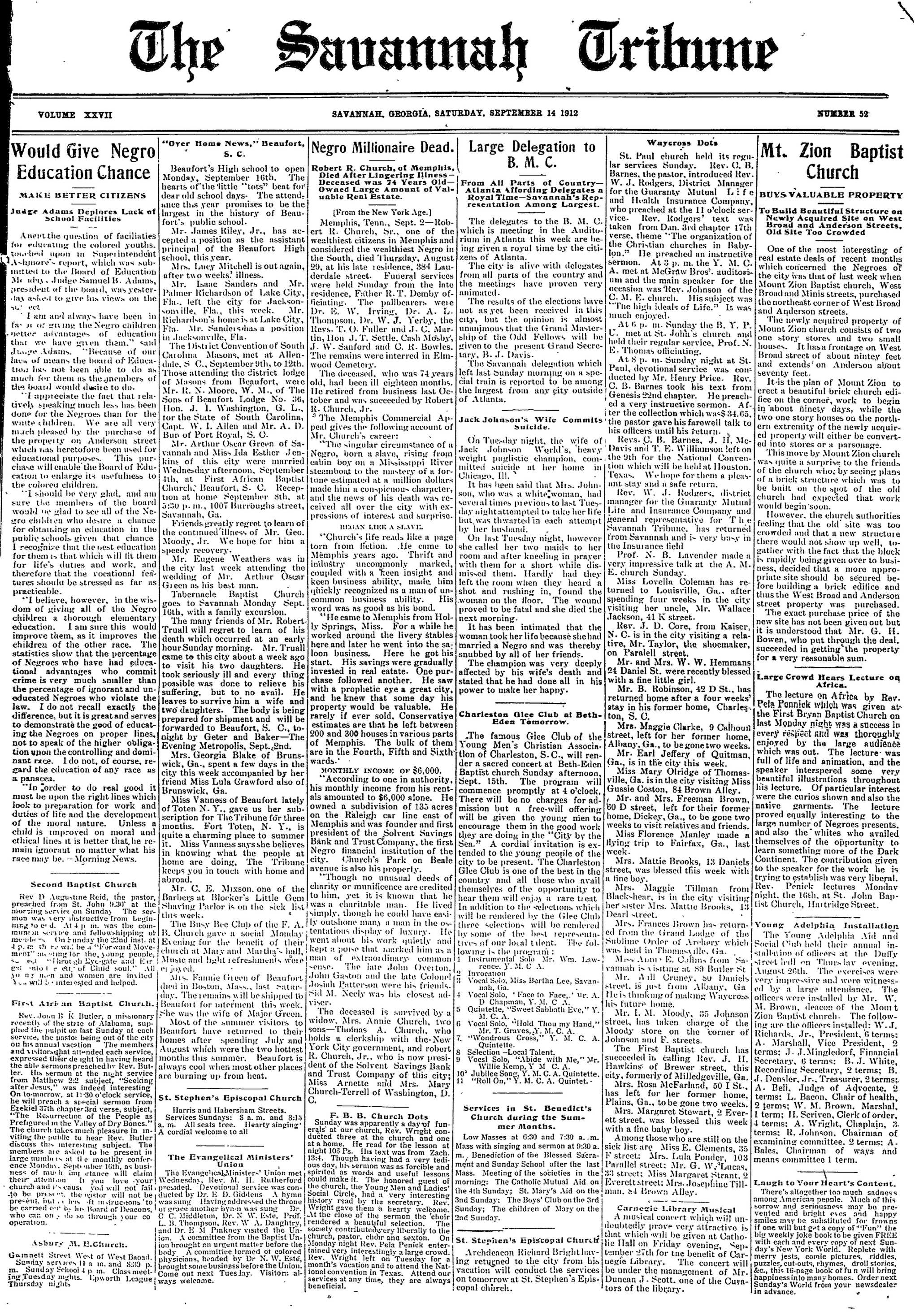
The Savannah Tribune
VOLUME XXVII
Would Give Negro Education Chance
MAKE BETTER CITIZENS
Judge Adams Deplores Lack of School Facilities
Anept the question of faciliaties for educating the colored youths, touched upon in Superintendent Ashmore's report, which was submitted to the Board of Education Monday, Judge Samuel B. Adams, president of the board, was yesterday asked to give his views on the subject.
I am and always have been in fact of giving the Negro children better advantages of education that we have given them," said Judge Adams. "Because of our lack of means the board of Education has not been able to do as much for them as the members of the board would desire to do.
"I appreciate the fact that relatively speaking much less has been done for the Negroes than for the white children. We are all very much pleased by the purchase of the property on Anderson street which has heretofore been used for educational purposes. This purchase will enable the Board of Education to enlarge its usefulness to the colored children.
"I should be very glad, and am sure the members of the board would be glad to see all of the Negro children who desire a chance for obtaining an education in the public schools given that chance. I recognize that the best education for them is that which will fit them for life's duties and work, and therefore that the vocational features should be stressed as far as practicable.
"I believe, however, in the wisdom of giving all of the Negro children a thorough elementary education. I am sure this would improve them, as it improves the children of the other race. The statistics show that the percentage of Negroes who have had educational advantages who commit crime is very much smaller than the percentage of ignorant and uneducated Negroes who violate the law. I do not recall exactly the difference, but it is great and serves to demonstrate the good of educating the Negroes on proper lines, not to speak of the higher obligation upon the controlling and dominant race. I do not, of course, regard the education of any race as a panacea.
In order to do real good it must be upon the right lines which look to preparation for work and duties of life and the development of the moral nature. Unless a child is improved on moral and ethical lines it is better that, he remain ignorant no matter what his race may be. - Morning News.
Second Baptist Church
Rev D Augustine Reid, the pastor, preached from St. John 9.30" at the morning service on Sunday. The sermon was very instructive from beginning to end. At 4 p.m. was the communion service and fellowshipping of members. On Sunday the 22nd inst. at 4 p.m. there will be a "Forward Movement" meeting for the young people, so called "Through Eye-gate and Ear-gate into the city of Child soul." All young men and women are invited. You will be interested and helped.
First African Baptist Church.
Rev. John B K Butler, a missionary recently of the state of Alabama, supplied the pulpit on last Sunday at each service, the pastor being out of the city on his annual vacation. The members and visitors that attended each service, expressed their deight in having heard the able sermons preached by Rev. Butler. His sermon at the night service from Matthew 2:2 subject, "Seeking after Jesus," was indeed interesting On to-morrow, at 11:30 o'clock service, he will preach a special sermon from Ezekiel 37th chapter 3rd verse, subject, "The Resurrection of the People as Prefigured in the Valley of Dry Bones." The church takes much pleasure in inviting the public to hear Rev. Butler discuss this interesting subject. The members are asked to be present in large numbers at the monthly conference Monday, September 16th, as business of much importance will claim their attention. If you love your church and is cause you will not fail to be present, the pastor will not be present, but he has instructions to be carried out by his Board of Deacons, who can only do so through your co-operation.
Asbury M. E. Church.
Gwinnett Street West of West Broad.
Sunday services 11 a.m. and 8:30 p.
m. Sunday School 4 p.m. Class meeting Tuesday nights. Upworth League
Thursday nights
"Oyer Home News," Beaufort, S. C.
Beaufort's High school to open Monday, September 16th. The hearts of the little "tots" beat for dear old school days. The attendance this year promises to be the largest in the history of Beaufort's public school.
Mr. James Riley, Jr., has accepted a position as the assistant principal of the Beaufort High school, this year.
Mrs. Lucy Mitchell is out again, after two weeks' illness.
Mr. Isaac Sanders and Mr. Palmer Richardson of Lake City, Fla., left the city for Jacksonsonville, Fla., this week. Mr. Richardson's home is at Lake City, Fla. Mr. Sanders has a position in Jacksonville, Fla.
The District Convention of South Carolina Masons, met at Allendale, S.C., September 9th, to 12th. Those attending the district lodge of Masons from Beaufort, were Mr. R. N. Moore, W. M., of The Sons of Beaufort Lodge No. 36, Hon. J. I. Washington, G. L., tor the State of South Carolina, Capt. W. I. Allen and Mr. A. D. Bun of Port Royal, S. C.
Mr. Arthur Oscar Green of Savannah and Miss Ida Esther Jenkins of this city were married Wednesday afternoon, September 4th, at First African Baptist Church, Beaufort, S. C. Reception at home September 5th, at 5:30 p.m., 1007 Burroughs street, Savannah, Ga.
Friends greatly regret to learn of the continued illness of Mr. Geo. Moody, Jr. We hope for him a speedy recovery.
Mr. Eugene Weathers was in the city last week attending the wedding of Mr. Arthur Oscar Green as his best man.
Tabernacle Baptist Church goes to Savannah Monday Sept. 16th, with a family excursion.
The many friends of Mr. Robert Truall will regret to learn of his death which occurred at an early hour Sunday morning. Mr. Truall came to this city about a week ago to visit his two daughters. He took seriously ill and every thing possible was done to relieve his suffering, but to no avail. He leaves to survive him a wife and two daughters. The body is being prepared for shipment and will be forwarded to Beaufort, S. C., tonight by Geter and Baker—The Evening Metropolis, Sept. 2nd.
Mrs. Georgia Blake of Brunswick, Ga., spent a few days in the city this week accompanied by her friend Miss Lula Crawford also of Brunswick, Ga.
Miss Vanness of Beaufort lately of Toten N. Y., gave us her subscription for The Tribune for three months. Fort Toten, N. Y., is quite a charming place to summer it. Miss Vanness says she believes in knowing what the people at home are doing, The Tribune keeps you in touch with home and abroad.
Mr. C. E. Mixson, one of the Barbers at Blocker's Little Gem Shaving Parlor is on the sick list this week.
The Busy Bee Club of the F. A. B. Church gave a social Monday Evening for the benefit of their church at Mary and Marty's hall, Music and light refreshments were enjoyed.
Mrs. Fannie Green of Beaufort died in Boston, Mass., last Saturday. The remains will be shipped to Beaufort for interment this week. She was the wife of Major Green. Most of the summer visitors to Beaufort have returned to their homes after spending July and August which were the two hottest months thus summer. Beaufort is always cool when most other places are burning up from heat.
St. Stephen's Episcopal Church
Harris and Habersham Streets.
Services Sundays: 8 a.m. and 8:15
a. m. All seats free. Hearty singing*
A cordial welcome to all
The Evangelical Ministers' Union
The Evangelical Ministers' Union met Wednesday, Rev. M. H. Rutherford presided. Devotional service was conducted by Dr. E. D. Giddens. A hymn was sung. Having addressed the throne or grace another hymn was sung. Dr. C. C. Middleton, Dr. N. W. Este, Prof. L. B. Thompson, Rev. W. A. Daughtry, and Dr. E. M Pinkney visited the Union. A committee from the Baptist Union brought an urgent matter before the body. A committee formed of colored physicians, headed by Dr. N. W. Este, brought some business before the Union. Come out next Tuesday. Visitor: always welcome.
SAVANNAH, GEORGIA, SATURDAY, SEPTEMBER 14 1912
Negro Millionaire Dead.
Robert R. Church, of Memphis, Died After Lingering Illness—Deceased was 74 Years Old—Owned Large Amount of Valuable Real Estate.
Memphis, Teen., Sept. 2—Robert R. Church, Sr., one of the wealthiest citizens in Memphis and considered the wealthiest Negro in the South, died Thursday, August 29, at his late residence, 384 Launderdale street. Funeral services were held Sunday from the late residence, Father R. T. Demby officiating. The pallbearers were Dr. E. W. Irving, Dr. A. L. Thompson, Dr. W. J. Yerby, the Revs. T. O. Fuller and J. C. Martin, Hon J. T. Settle, Cash Mosby, J. W. Sanford and C. R. Bowles. The remains were interred in Elmwood Cemetery.
The deceased, who was 74 years old, had been ill eighteen months. He retired from business last October and was succeeded by Robert R. Church, Jr.
3 The Memphis Commercial Appeal gives the following account of Mr. Church's career:
"The singular circumstance of a Negro, born a slave, rising from cabin boy on a Mississippi River steamboat to the mastery of a fortune estimated at a million dollars made him a conspicuous character, and the news of his death was received all over the city with expressions of interest and surprise.
BEGAN LIEE A SLAVE.
"Church's life reads like a page torn from fiction. He came to Memphis years ago. Thrift and industry uncommonly marked, coupled with a keen insight and keen business ability, made him quickly recognized as a man of uncommon business ability. His word was as good as his bond.
"He came to Memphis from Holly Springs, Miss. For a while he worked around the livery stables here and later he went into the saloon business. Here he got his start. His savings were gradually invested in real estate. One purchase followed another. He saw with a prophetic eye a great city, and he knew that some day his property would be valuable. He rarely if ever sold. Conservative estimates are that he left between 200 and 300 houses in various parts of Memphis. The bulk of them are in the Fourth, Fifth and Sixth wards."
"According to one in authority, his monthly income from his rentals amounted to $6,000 alone. He owned a subdivision of 135 acres on the Raleigh car line east of Memphis and was founder and first president of the Solvent Savings Bank and Trust Company, the first Negro financial institution of the city. Church's Park on Beale avenue is also his property.
Though no unusual deeds of charity or munificence are credited to him, yet it is known that he was a charitable man. He lived simply, though he could have easily outshone many a man in the ostentatious display of luxury. He went about his work quietly and kept a pose that marked him as a man of extraordinary common sense. The late John Overton, John Gaston and the late Colonel Josiah Patterson were his friends. Sid M. Neely was his closest adviser.
The deceased is survived by a widow, Mrs. Annie Church, two sons—Thomas A. Church, who holds a clerkship with the-New York City government, and Robert R. Church, Jr., who is now president of the Solvent Savings Bank and Trust Company of this city; Miss Arnette and Mrs. Mary Church-Terrell of Washington, D. C.
F. B. B. Church Dots
F. B. B. Church Dots
Sunday was apparently a day of funerals' at our church, Rev. Wright conducted three at the church and one at a home. He read for the lesson at night 105 Pts. His text was from Zach. 13:4. Though having had a very tedious day, his sermon was as forcible and spirited as words and useful lessons could make it. The honored guest of the church, the Young Men and Ladies' Social Circle, had a very interesting history read by the secretary. Rev. Wright gave them a hearty welcome. At the close of the sermon the 'choir rendered a beautiful selection. The society contributed very liberally to the church, pastor, choir and sexton. On Monday night Rev. Pela Penick entertained very interestingly a large crowd. Rev. Wright left on Tuesday for a month's vacation and to attend the National convention in Texas. Attend our services at any time, they are always beneficial.
Large Delegation to B. M. C.
From All Parts of Country Atlanta Affording Delegates a Royal Time-Savannah's Representation Among Largest. The delegates to the B. M. C. which is meeting in the Auditorium in Atlanta this week are being given a royal time by the citizens of Atlanta. The city is alive with delegates from all parts of the country and the meetings have proven very animated.
The results of the elections have not as yet been received in this city, but the opinion is almost unanimous that the Grand Mastership of the Odd Fellows will be given to the present Grand Secretary, B. J. Davis. The Savannah delegation which left last Sunday morning on a special train is reported to be among the largest from any city outside of Atlanta.
Jack Johnson's Wife Commits Suicide.
On Tuesday night, the wife of Jack Johnson World's, heavy weight puglistic champion, committed suicide at her home in Chicago, Ill.
It has been said that Mrs. Johnson, who was a white woman, had several times previous to last Tuesday night attempted to take her life but was thwarted in each attempt by her husband.
On last Tuesday night, however she called her two maids to her room and after kneeling in prayer with them for a short while dismissed them. Hardly had they left the room when they heard a shot and rushing in, found the woman on the floor. The wound proved to be fatal and she died the next morning.
It has been intimated that the woman took her life because she had married a Negro and was thereby snubbed by all of her friends.
The champion was very deeply affected by his wife's death and stated that he had done all in his power to make her happy.
Charleston Glee Club at Beth-
Eden Tomorrow.
The famous Glee Club of the Young Men's Christian Association of Charleston, S.C., will render a sacred concert at Beth-Eden Baptist church Sunday afternoon, Sept. 15th. The program will commence promptly at 4 o'clock. There will be no charges for admission but a free-will offering will be given the young men to encourage them in the good work they are doing in the "City by the Sea." A cordial invitation is extended to the young people of the city to be present. The Charleston Glee Club is one of the best in the country and all those who avail themselves of the opportunity to hear them will enjoy a rare treat. In addition to the selections which will be rendered by the Glee Club three selections will be rendered by some of the best representatives of our local talent. The following is the program:
Instrumental Solo Mr. Wm. Lawrence, Y. M. C. A.
Invocation
Vocal Solo, Miss Bertha Lee, Savannah, Ga.
Vocal Solo, 'Face to Face,' Ur. A.
D Chapman, Y. M. C A.
Quintette, 'Sweet Sabbath Eve,' Y.
M. C. A.
Vocal Solo, 'Hold Thou my Hand,'
Mr. T. Graves, Y. M. C A.
9 Vocsl Solo, "Abide with Me," Mr. Willie Kemp, M. Y, C. A.
White Kemp, Y. M. C. A.
$10^{3}$ Jubilee Song, Y. M. C. A. Quintette,
11 "Roll On," Y. M. C. A. Quintet.
Services in St. Benedict's Church during the Summer Months.
Low Masses at 6:30 and 7:30 a.m. Mass with singing and sermon at 9:30 a.m. Benediction of the Blessed Sacrament and Sunday School after the last Mass. Meeting of the societies in the morning; The Catholic Mutual Aid on the 4th Sunday; St. Mary's Aid on the 3rd Sunday; The Boys' Club on the 3rd Sunday; The children of Mary on the 2nd Sunday.
St. Stephen's Episcopal Church
Archdeacon Richard Bright having retugrned to the city from his vacation will conduct the services on tomorrow at St. Stephen's Episcopal church.
Waycross Dots
St. Paul church held its regular services Sunday. Rev. C. B. Barnes, the pastor, introduced Rev. W. J. Rodgers, District Manager for the Guaranty Mutual Life and Health Insurance Company, who preached at the 11 o'clock service. Rev. Rodgers' text was taken from Dan. 3rd chapter 17th verse, theme "The organization of the Christian churches in Babylon." He preached an instructive sermon. At 3 p. m. the Y. M. C. A. met at McGraw Bros'. auditorium and the main speaker for the occasion was Rev. Johnson of the C. M. E. church. His subject was "The high ideals of Life." It was much enjoyed.
At 6 p. m. Sunday the B. Y. P.
U. met at St. John's church and
held their regular service, Prof. N.
E. Thomas officiating.
At 8 p. m. Sunday night at St.
Paul, devotional service was
conducted by Mr. Henry Price. Rev.
C. B. Barnes took his text from
Genesis 22nd chapter. He preached
a very instructive sermon. After
the collection which was $34.65,
the pastor gave his farewell talk to
his officers until his return.
Revs. C. B. Barnes, J. H. McDavis and T. E. Williamson left on
the 9th for the National Convention
which will be held at Houston,
Texas. We hope for them a pleasant stay and a safe return.
Rev. W. J. Rodgers, district manager for the Guaranty Mutual Lite and Insurance Company and general representative for The Savannah Tribune, has returned from Savannah and is very busy in the Insurance field
Prof. N. B. Lavender made a very impressive talk at the A. M. E. church Sunday.
Miss Lovella Coleman has returned to Louisville, Ga., after spending four weeks in the city visiting her uncle, Mr. Wallace Jackson, 41 K street.
Rev. J. D. Core, from Kaiser, N. C. is in the city visiting a relative, Mr. Taylor, the shoemaker, on Parallel street.
Mr. and Mrs. W. W. Hemmans 24 Daniel St. were recently blessed with a fine little girl. Mr. B. Robinson, 42 D St., has returned home after a four weeks' stay in his former home, Charleston, S. C. Mrs. Maggie Clarke, 9 Calhoun street, left for her former home, Albany, Ga., to be gone two weeks. Mr. Earl Jeffery of Quitman, Ga., is in the city this week. Miss Mary Olridge of Thomasville, Ga. is in the city visiting Miss Gussie Coston, 84 Brown Alley. Mr. and Mrs. Freeman Brown, 60 D street, left for their former home, Dickey, Ga., to be gone two weeks to visit relatives and friends.
Miss Florence Manley made a flying trip to Fairfax, Ga., last week.
Mrs. Mattie Brooks, 13 Daniels street, was blessed this week with a fine boy.
Mrs. Maggie Tillman from Blackshear, is in the city visiting her sister Mrs. Mattie Brooks, 13 Dearl street.
Mrs. Frances Brown has returned from the Grand Lodge of the Sublime Order of Archery which was held in Thomasville, Ga.
Mr. Aull Cruney, 80 Daniels street, is just from Albany, Ga. He is thinking of making Waycross his future home.
Mr. I. M. Moody, 35 Johnson street, has taken charge of the Moody store on the corner of Johnson and F. streets.
The First Baptist church has succeeded in calling Rev. J. H. Hawkins of Brewer street, this city, formerly of Milledgeville, Ga.
Mrs. Rosa McFarland, 50 I St., has left for her former home, Plains, Ga., to be gone two weeks.
Mrs. Margaret Stewart, 2 Everett street, was blessed this week with a fine baby boy.
Among those who are still on the sick list are Miss E. Clements, 35 F street; Mrs. Lula Ponder, 103 Parallel street; Mr. G. W. Lucas, 33 street; Miss Margaret Strant, 2 Everett street; Mrs. Josephine Tillman, 84 Brown Alley.
Carnegie Library Musical
A musical concert which will undoubtedly prove very attractive is that which will be given at Catholic Hall on Friday evening, September 27th for the benefit of Carnegie Library. The concert will be under the management of Mr. Duncan J. Scott, one of the Curators of the library.
NUMBER 52
Mt. Zion Baptist Church
BUYS VALUABLE PROPERTY
To Build Beautiful Structure on Newly Acquired Site on West Broad and Anderson Streets, Old Site Too Crowded
One of the most interesting of real estate deals of recent months which concerned the Negroes of the city was that of last week when Mount Zion Baptist church, West Broad and Minis streets, purchased the northeast corner of West Broad and Anderson streets.
The newly acquired property of Mount Zion church consists of two one story stores and two small houses. It has a frontage on West Broad street of about ninety feet and extends' on Anderson about seventy feet. It is the plan of Mount Zion to erect a beautiful brick church edifice on the corner, work to begin in about ninety days, while the two one story houses on the northern extremity of the newly acquired property will either be converted into stores or a parsonage.
This move by Mount Zion church was quite a surprise to the friends of the church who, by seeing plans of a brick structure which was to be built on the spot of the old church had expected that work would begin soon. However, the church authorities feeling that the old site was too crowded and that a new structure there would not show up well, together with the fact that the block is rapidly being given over to business, decided that a more appropriate site should be secured before building a brick edifice and thus the West Broad and Anderson street property was purchased.
The exact purchase price of the new site has not been given out but it is understood that Mr. G. H. Bowen, who put through the deal, succeeded in getting the property for a very reasonable sum.
Large Crowd Hears Lecture on Africa.
The lecture on Africa by Rev. Pela Pennick which was given at the First Bryan Baptist Church on last Monday night was a success in every respect and was thoroughly enjoyed by the large audience which was out. The lecture was full of life and animation, and the speaker interspered some very beautiful illustrations throughout his lecture. Of particular interest were the curios shown and also the native garments. The lecture proved equally interesting to the large number of Negroes presents, and also the whites who availed themselves of the opportunity to learn something more of the Dark Continent. The contribution given to the speaker for the work he is trying to establish was very liberal. Rev. Penick lectures Monday night, the 16th, at St. John Baptist Church, Hartridge Street.
Young Adelphia Installation
The Young Adelphia Aid and
Social Club hold their annual
installation of officers at the Duffy
street hall on Thursday evening,
August 26th. The exercises were
very impressive and were witnessed
by a large attendance. The
officers were installed by Mr. W.
W. Brown, deacon of the Mount
Zion Baptist church. The following
are the officers installed: W.J.
Richards, Jr., President, 6 terms;
A. Marshall, Vice President, 2
terms; J. J. Mingledorf, Financial
Secretary, 6 terms; B. J. White,
Recording Secretary, 2 terms; B.
J. Densler, Jr., Treasurer, 2 terms;
A. Bell, Judge of Advocate, 2
terms; L. Bacon, Chair of health,
2 terms; W. M. Brown, Marshal,
1 term; H. Scriven, Clerk of order,
4 terms; A. Wright, Chaplain,
3 terms; R. Johnson, Chairman of
examining committee, 2 terms; A.
Bales, Chairman of ways and
means committee 1 term.
Laugh to Your Heart's Content.
There's altogether too much sadness among American people. Much of this sorrow and seriousness may be prevented and bright eyes and happy smiles may be substituted for frowns if one will but get a copy of "Fun" the big weekly jes book to be given FREE with each and every copy of next Sunday's New York World. Replete with merry jests, comic pictures, riddles, puzzles, cut-outs, rhymes, droll stories, &c., this 16-page book of fun will bring happiness into many homes. Order next Sunday's World from your newsdealer in advance.
A
Public Has Gone Crazy Over Matter of Rushing, Says Traveler, Who Soon Forgets Himself.
"Yes, sir," said the man who had his feet in a chair in the smoking compartment of the car, "You can trace nearly every railroad accident to the mania for speed. Safety is a secondary consideration. The first object is to get there in a hurry. Look at the advertisements of the different railroads. You'll see that speed is always emphasized. If one road can make the run from New York to Chicago in 20 minutes less time than it takes on some other road the fact is played up in big type, as if it were the most important thing in the world. The public has gone crazy over this matter of rushing. Get there quick is the great object. We've got to be educated up to the idea that speed is not the only thing which should be considered. The man who thinks his time is so important that the gain or loss of an hour is vital ought to be chucked into a well and allowed to cool off Say, porter, how are we running? Seems so me this train is merely creeping along."
"Yes, sah. We're about 20 minutes late. The heavy rains have made the track unsafe along here and we got to 50 kind of careful."
"Confound this road, anyhow! I'll never travel on it again. Why the dickens can't they get people in on time!"
Still Had Hopes.
"What was your son's social standing in college?"
"Oh, very fair. Why, he almost got into the Gibber and Squeak society"
"Indeed! How was that?"
"Why, you know, they always hit them on the back as a sign they have been selected, and George was hit on the back with such force that it knocked him down."
"Mercy!"
"Yes, indeed. He thought, of course, he had been chosen, but he found out afterward it was the class busy who hit him because he didn't like the set of his collar. But even that's a great honor."
English, You Know
"I shall discharge our butler," said Mr. Cumrox.
"What's the trouble?"
"He doesn't show me proper deference When I am paying a man liberally. I consider it his duty to laugh at my jokes"
"And he won't?"
"I don't think he can He's an English butler. When, in a spirit of gentle and condescending badinage, I said to him 'Hawkins, can you tell me which came first, the chicken or the egg?' he said 'Which did you order first, sir?'
Hla Winning Delivery.
"And how is your excellent son, the divinity student? He graduated from the theological seminary about a year ago, I believe?"
"Yes, just a year ago. And he's doing so well! They pay him a wonderful large salary, and next year he's to get more."
"Indeed! That's very unusual. Perhaps it is his excellent delivery, that nets him this large emolument?"
"Yes, that's it. He's one of the pitchers in the big league."
Candid Classification
Visitor—Só I belong to the animal kingdom, do I? That is right, my little dear. I see you know your lessons. Now, tell me what kind of an animal I am. Candid Child—Ma knows, and she says you're a cat.
An Excuse.
"Jim, I want some money to get ready to go away with."
"My dear Julia, you don't realize how really poor we are. Why, the wolf is at the door."
"He always is when I want anything for myself. That wolf's a goat."
Where Viewed.
"I have just been reading some humorous observations entitled, 'The Reflections of an Old Maid.'"
"I'd rather read the reflections of a debutante."
"Impossible. Most of her reflections are in a mirror."
Indifferent Matter.
"There must be very little news in your paper today."
"What makes you think so?"
"I notice you are reading about the latest revolution in Central America."
Suspicious.
"Hello, old chap. I've been trying to run across you for some time." "Is that so? What make is your car?"
BUCKING A GIANT MONOPOLY
Man With Bulging Brow Relates Exceedingly Interesting Experience He Had With Iceman.
"I had an interesting experience with my iceman the other morning," said the man with the bulging brow.
"He wanted you to pay for your coupon book 'fore he'd let you have any more ice, I reckon.' hazarded the man with the bulbous nose.
"Don't get smart. For a long time, you know, I've been suspecting that he didn't give me full weight. So when he came this time I was ready for him. He had put what he called a 50-pound chunk in the box, and was about to go.
"Hold on a minute,' I said. 'You're sure that's 50 pounds, are you?"
"Yep," he says.
"Well, we'll just measure it and see."
"I had a one foot rule in my hand. I measured that chunk carefully. Then I multiplied the length, breadth, and thickness together, and got the dimensions in cubic inches. I showed him the figures.
"Is that right?" I asked him.
"I guess so," he said.
"Well, you see, there are just 1,530 cubic inches in that piece. Now, I divide it by 30, and—hold on! By George, there's—"
"Yep," he says, "there's 51 pounds in it. Thank you!"
"Then what do you think he did? I'll be blamed if he didn't take his steel pick, chip off a pound chunk of ice, and carry it back to the wagon with him! What's the use of bucking against the ice trust, anyway?"
Making Sure.
A commercial traveler at a railway station in one of our Southern towns included in his order for breakfast two boiled eggs.. The old darkey who served him brought him three
"Uncle," said the traveling man.
"why in the world did you bring me three boiled eggs? I only ordered two"
"Yes, sir," said the old darkey, bowing and smiling. "I know you did order two, sir, but "I brought three, because I just naturally felt dat one of dem might fail you, sir."
—Harper's Weekly
His Service.
"I should like very much," said the president of the greatest republic on which the sun ever shown, "to appoint you to an office of some kind, but you must realize, of course, that it is necessary for me to reward our party workers before I take up the cases of other applicants"
"Certainly I realize that. I am one of the party workers you refer to"
"Oh, are you? What have you done for the ticket."
"I was one of the people who howled for 83 minutes when your name was presented to the convention."
His Bid.
A Yorkshireman recently entered an auction mart. Looking around and catching the auctioneer's eye during a full in the bidding, he shouted out loudly enough to be heard by all:
"May I end?"
"Certainly," said the man of the hammer, thinking him a customer. All eyes being turned on the customer, he, making for the door, said: "Well, I bid you good-night, then."
The laughter which followed stopped business for some time.—Tit Bits.
He Had an Explanation.
A committee had, the State Senator on the carpet.
"Didn't you promise, if we elected you, to get our county good roads?"
"Why, certainly, gentlemen."
"Did you do it"
"No. You see, airships are getting very common now. I thought we'd better wait a few years. Maybe we won't need any roads at all then. Fine weather for corn, isn't it?"
Quick Time.
Officer—You say the chauffeur sounded his horn just as the machine struck the man?
Witness—Yes.
Officer—Was the victim killed instantly?
Witness—So instantly, sir, that he must have heard the echo of the horn in the next world.—Satire.
A Great Improvement.
She—Why don't you keep more control over your face? You give everything away by your expression. Now, I make it a rule never to change countenance.
He—If you can change it, my dear, I wish you would.
A Mean Escape.
"Mrs. Jones' doctor told her husband she needed a quick change of scene."
"What did her husband do about it?"
"Took her to a moving-picture show."
"How did that singing dog succeed in vaudeville?"
"I believe he was a howling success."
Tracirg Him.
"He wanted a sky parlor in the hotel wing."
"Did be die a natural death?"
"Yes; a beer bottle from an airship fell on his head."—Satire.
How Cupid Figured in Clearing Up Murder Mystery.
Like most persons whose deafness arises from the hardened drums, Braxmar heard best above a continued noise, and as the express pounded its way toward Chicago, he became more and more sensible of some one weeping in an agony of distress. The sound came from the berth above him, and he pushed his bell for the porter.
"George," he called, as an ebon face was thrust through the curtains, "is there a woman in the upper berth?"
"Yes, sir," shouted the porter. "She done got on at Albany."
"She's in trouble," he announced. "Can't you hear her crying?"
The porter listened intently, then shook his head. "I don't hear nuthin'," he reported.
"I do," persisted Braxman. "See if she needs anything."
He sank back against the pillow, and presently heard the porter climbing the step-ladder. Then the black head was thrust between his curtains again and the man shouted:
"She says she's sorry, but she didn't think anyone could hear her in this noise, and she just had to cry."
"Is there anything she needs?" he called back.
"She says there ain't nuthin' we kind do." The black head disappeared and Braxmar settled himself again. Overhead the noise was stilled, save now and then when a little half-choked moan seemed to light through the girl's repression
But Braxman could sleep leaning against a post, and soon he dropped off again. He was one of the first up in the morning, and as the sleeper was the last car on the train he went out on the rear platform for a smoke in the bracing air.
The car had been made up and had resumed its daytime aspect when he returned. The other half of his section was occupied by a slender, girlish figure. She started as he dropped into the seat opposite.
"Are you the gentleman whom I disturbed last night?" she asked, leaning forward.
"You didn't disturb me," he corrected "I heard you crying, and thought perhaps you need help. You see, I hear best when there's a noise, and I knew that no one else was probably aware of your trouble. You might have been in need of help."
"I am," she said, with a wan little smile, "but not such as one's fellow passengers can give. I am going to my brother, who is accused of murder. I heard of it just in time to catch this train."
"John Findlay?" he asked. The girl started
"How did you know?" she gasped.
"I am a detective," he explained.
"They wired me to come on. It was a random guess, but a probable one. I am retained by the Arntons."
She sank back in her place. "In that case," she said, "I don't suppose I ought to talk to you. You are engaged to fasten the crime on John." "Quite the contrary," he said, moving into the seat beside her. "I am engaged to find the murderer of Caspian Arnton, not to say that this man is guilty." "But circumstantial evidence is so strong," she said hopelessly. "I don't see what hope there is." "Suppose you tell me what you know," he pleaded. "It may help bring the guilty man to justice."
There was something in Braxmar's manner that inspired confidence, and simply, directly, she told him what she knew. From the press report he had only learned that John Findlay had shot and killed Caspian Arnton as the result of a feud. It was the girl who supplied the motive.
They had all lived in the little town of Remsen, in the northern part of Ohio. Helen Findlay had been engaged to Arton, but had broken the engagement on account of certain stories that had come to her knowledge. Arton had let it be inferred that he had broken the engagement for reasons he did not care to divulge. The Arntons were wealthy, and leaders of the town's society and the people had elected to believe Arton. Helen had gone to visit relatives in Albany until the talk died down, but her brother had stayed on because he could not afford to give up his position with the railroad.
There had been several encounters between the two men, and when Arnton had been found dead almost in the shadow of his home, Findlay had been accused. A search of his lodgings discovered a pair of shoes stained with the red earth found in that part of the street and in his cash drawer at the station and was found a revolver with one chamber discharged. The bullet found in Arnton's spine was of the same caliber, and Findlay's declaration that the revolver had been fully loaded when he left the office found greater credence than his statement that the revolver had been left in the cash drawer.
Given the motive, the weapon with which the deed was accomplished and an inability to establish an alibi, and it was not to be wondered at that the case was regarded as good as tried.
"The case is too simple to be correct," he declared. "The breakfast car has been put on. Let us have a cup of coffee."
That afternoon he visited her at her hotel. "I thought you might like to know," he explained "that I have dropped out of the employ of the Arm-
ton family. They insisted that the facts were clear, and that I had only to bridge certain gaps. I told them that I worked along my own lines or not at all."
"And you have given up the case?" she cried despairingly.
"Not at all. I have retained myself to prove the Arntons the fools that they are. I am working for Ham Braxmar now—and for justice."
Braxmar's words brought comfort, and comfort was sadly needed, for as the days progressed the web seemed to draw more tightly around her brother. The Arntons arranged with a Chicago detective agency to send half a dozen men to work on the case.
Braxmar had dropped out of sight after that first day. He had warned Helen that he would not remain in town, but that she need not feel any uneasiness on that account.
Once or twice a letter, mailed in the railway post, assured her of progress, and she took heart of grace, though the detectives were building up a mass of evidence that seemed destined to crush Findlay beneath its weight.
Finally the case was practically concluded, and the Arntons were insisting upon an immediate trial, but to this Findlay's lawyer would not consent.
When Tomlin suddenly disappeared without a word to anyone the last vestige of hope seemed to go.
Then, one evening, the operator at the postoffice telegraph station let out a whoop that startled the little company waiting for the distribution of the night mail.
"They've caught the man who killed Cas Arnton," he shouted. "This is a telegram to his sister. Listen: 'Am coming east with 'Tomlin and the slayer of Caspian Arnton.' It's signed, by that fellow from New York who was here the day after the murder."
"It's a bluff," declared one of the local solons. "They've got Cas Arnton's killer locked up in the jail now."
"It was the second day following that Braxmar and Tomlin stepped from the train and were driven to the hotel. There were just the two of them, and Remsen thrilled with the report that it was Tomlin who had done the murder.
Later on, after the prosecuting officers had left the conference, it became known that the person who had fired the shot had been killed in the wreck which had delayed the others, but had made a deposition that entirely exonerated Findlay.
"It is a very simple matter," explained Braxman, when he and Helen were alone. "There was just one clue that was not being worked on. That was the man who was trying to enter the box car. It was a train of empties being rushed west. He could have no incentive to force the door except that he wanted to get away quickly and unobtrusively."
"But they all thugged Tomlin's story was an untruth," she said. "That was why they did not follow it up."
"And why I did. It's always the obscure clue that pays best. I found that many of the railroad men had guns like your brother. The hardware store sold about three dozen. Now Arton had a bullet in his spine. No one seemed to see another bullet in a nearby tree. If it was your brother's shot, how was it that there was but one chamber discharged when two shots had been fired?" "Now, your brother was not the only one who had a reason to take Arton's life, as you told me on the train, there was that affair of the Gillis girl. It was Gillis who crept into the car station again, satisfied that he had scared the man away." "And to think that you did all this for John," she said softly.
"I told you I was working for Ham Braxmar," he corrected. "I was angry when they insisted that I should work on the clues ready provided. I wanted to show them that I was right."
"But I can never repay you for your kindness," she persisted. Braxmar looked as though there might be two sides to that question, but he only smiled.
"In the morning," he said, "they will call the case and make a motion to dismiss. Your brother will be free by noon. Will you remain here?"
"I think we shall," she said quietly, "I should like to keep in touch with my unofficial client," he laughed a little awkwardly.
Her grave eyes read his secret but respected his reserve, though a rosy flush told Braxmar that he might hope.
"But to think it was John Gillis who fired the shot," she mused. "He always seemed such a patient, plodding sort of fellow."
"I didn't say it was Gillis," he corrected. "It was the girl. I knew that before we ever reached town."
"Yet you went after her father?"
"When I heard the story I realized that the man who climbed into the car was the man who was concerned in the case. Gillis missed his daughter, who was really insane. He knew where he should be most likely to find her, and came up with them just as the shots were fired.
"In the excitement of the murder his disappearance passed unnoticed, for he was close mouthed, and few knew the story of his daughter's disgrace."
"Then that other story must come out too?" she faltered.
"You will both be cleared," he explained. "Even the Arntons will know your reason for the broken engagement."
"And to think that if we had not both taken that train," she mused, "I am so glad."
"I hope that you will always be glad—that we took that train," he said, and Helen flushed again.
MRS. CORNWALLIS-WEST'S UNUSUAL INSPIRATION
Is the spirit of William Shakspeare guiding the hand and brain of Mrs. Cornwallis-West—London society favorite and creator and manager of the wonderful "Shakspeare's England" festival held at Earle's court?
G
This is generally believed to be true by Londoners, who declare that no woman like Mrs. West, who has made society a vocation instead of the amusement business, could possibly show the genius in management and the business ability to put on what is no doubt one of the biggest single amusement projects ever witnessed in England.
That the Bard of Avon has influenced this woman successfully to carry out the festival that does honor to his memory is believed by all but the most skeptical who have seen the exhibition
If-Shakspeare's spirit did not influence Mrs. West, what accounts for her sudden inspiration to stage the picturesque scenes of Elizabethan England at the cost of hundreds of thousands of dollars
Giving up her social duties and working nine hours each day and many extra nights organizing the big show on speculation
Superintending the construction of the buildings of that period.
Poring over works of history and devoting days upon days to the designing of certain costumes in order to have the smallest detail historically correct.
Leaving Mayfair and the brilliant court of St James after a life of idle luxury and plunging into hard labor
And, above all, showing a genius in the work which is said by experts to be worthy of the great poet himself. Mrs. West displayed such splendid genius that many of her friends and acquaintances believe that even with the knowledge of English history she has she could not have revived those days of tilts and jousts with such accuracy as she has shown.
The story is most mysterious because Mrs. West will neither deny nor confirm it. This much, however, is known. She spent months wandering over every inch of the ground with its ivy-grown cottages and gay gardens that was beloved by the great English poet; she spent hours visiting the homes in which he once lived and then took her books and read, and meditated and talked Shakspeare with everybody who loves the great English dramatist and his works. It is said that when her work was completed and she went back to London prior to the pageant, Marie Corelli said to her: "It will be a wonderful success. It must be, for Shakspeare will be with you at the pageant and will direct the show. If you follow his instruction you will be well rewarded, for he will not leave you after the pageant is over. He is with many great writers, inspiring them to do their best, and he will remain with you. If it were not for his great genius and that of others who have gone to the great unknown there would be few writers in the world today. It is Shakspeare and the lesser lights who have inspired me and others to do their best."
Since everybody is congratulating Mrs. West on her splendid success, she cannot forget the words that Marie Corelli spoke to her. She is beginning to wonder if there is some half truth in these words, and that she may yet be aided to do great works with her pen.
FRANZ JOSEF ASKS POPE
TO STOP TURKISH WAR
In a personal letter, penned with his own hand, the aged Emperor Franz Josef has made an appeal to Pope Pius to urge intervention between Italy and Turkey and bring about the close of a war which his imperial majesty describes as a grave danger to the progress of civilization. "Instead of weakening Mohametanism, as some sup-
Franz Josef has made an appeal to Pope Pius to urge intervention between Italy and Turkey and bring about the close of a war which his imperial majesty describes as a grave danger to the progress of civilization. "Instead of weakening Mohametanism, as some suppose," the emperor writes, "the war is uniting Islam against Christians the world over. Morally it has been a great mistake."
The letter was conveyed to Rome by a special court messenger, who received a handsome gift from his holliness. No intimation was made to the nuncfature here, owing to the peculiar delicacy of the situation and the desire of the emperor to keep the nature of the correspondence secret. The Nuncio was informed of the emperor's act by a friend in the papal secretariat of state. He feels deeply incensed, and has since kept away from the imperial palace, where he was previously a constant visitor.
Trouble Galore
Italian-I see another naval engagement is reported."
Wife—"More fighting?"
Italian—I suppose so. The captain is engaged to the rear admiral's daughter."
SENURA PEZET, WIFE
OF PERUVIAN MINISTER
The Minister from Peru and his charming wife and son have received a cordial welcome on their second coming to Washington. Mr. Pezet was first secretary of the Peruvian legation for five years and left Washington in 1900 to become minister to the republic of Central America. He did not sever his ties of friendship but through all these
a cordial welcome on their second coming to Washington. Mr. Pezzt was first secretary of the Petuvian legation for five years and left Washington in 1900 to become minister to the republic of Central America. He did not sever his ties of friendship but through all these
years has kept up a brisk correspondence with many Washingtonians. When his only son, called George Washington Pezet, because he was born on February 22, and because his parents are fervent admirers of the great neighbor to the north and its founder, was of college age he was placed at Harvard, where two years ago he graduated with high honors. Young Mr. Pezet has since resided in Boston intending to take up literature as a profession.
"I return to Washington," remarked Senora Pezef, "as one comes back to a dearly loved spot filled—with pleasant memories. I find the city changed but not sufficiently so to make me feel strange except in a few locations. In a way I feel as though I left only a few months ago and I take up the thread of affairs with zeal and energy engendered by a complete rest. My home city is Lima, one of the oldest cities of the New World and one of the most fascinating. Less than fifty years after Columbus discovered this vast empire for Spain, the first stone of the Cathedral of Lima was laid by Pizarro, in January, 1325."
Senor and Senora Pezet two years ago celebrated the silver anniversary of their wedding, but to see the senora suggests that she has discovered Ponce de Leon's spring of eternal youth. Being a perfect blonde, with deep blue eyes and fair skin, an unusual type for a Spanish-American, though often seen in Spain, she looks as though she wore chitering her twenties.
Senora Pezet is the daughter of the late Jose Maria Corbacho of Lima, a prominent citizen and one who held many offices of trust. She bears the pretty name of Coratine shortened into Cora. She was educated at home by governesses after the way of the Latinis, who never send their children away from home until they are well grown and her marriage to the minister, who was the son of a neighbor, occurred before she reached the dignity of attending a boarding school. She spent a few months, however, with the madams of the Sacred Heart and since coming to this country, she frequently visits establishments of that order near Philadelphia and New York.
Senor and Senora Pezet have fond hopes of their son, George Washington Pezet, who has already developed a remarkable talent for the drama. He writes entirely in English. He is a tall, slender youth bearing a marked resemblance to his mother.
SECRETARY NAGEL SAYS
$25 A WEEK IS ENOUGH
Is $25 a week enough to clothes, feed and house three adults?
Secretary of Commerce and Labor Nagel was called upon the other day to decide this question. He decided it in the affirmative. In Secretary Nagel's opinion $25 a week is sufficient to keep a family of five or six.
JOHN B. HARRIS
Mary Fleming,
56 years old, and
her sister Ceci
Illa, 58 years old, arrived in New York a few days ago from Dublin, Ireland. They had never before been to the United States. When examined by immigration inspectors at Ellis Island they said they had $115 between them, but that they were going to be cared for by their nephew, John Francis Byrne, a New York newspaper reporter. This did not satisfy Acting Commissioner Uhl, and he questioned Mr. Byrne. Mr. Byrne said the two maiden aunts had been the same as parents to him when he was small and that he was anxious to care for them and that he had sent to Ireland for them. He said he received $25 a week as a reporter and thought that sufficient to support himself and his aunts.
Commissioner Uhl reported to Secretary Nagel that while the aunts were very nice ladies and apparently healthy, he did not think Byrne could support them on $25 a week. Secretary Nagel ruled that Byrne could support them, and instructed Commissioner Uhl to admit the two aunts.
As to School Holidays.
"In Rome, in the time of the Republic, 64 days in every year were devoted to public festivals recognized by law. The American republic has not reached such a number of holidays, but its schools surpassed it long ago," says the current report of the United States Bureau of Education. The document points out, however, that there is now a wholesome trend away from the custom, of granting an overabundance of school holidays.
AFRO-AMERICAN CULLINGS
One of the most interesting of the delegations that attended the International Conference on the Negro at Tuskegee Institute, April last, was that from the Barbados, West Indies, consisting of Washington Harper, A. Rawle Parkinson, and E. Elliott Durant. On their return to the Barbados, at a large and enthusiastic public meeting, they submitted a comprehensive report of their trip to Tuskegee Institute. The report was taken up mainly with a description of the work of the departments of the institution. All the Barbados papers gave extended notice concerning the meeting and the report of the delegation. The following account is taken from the Barbados Standard, Bridgetown.
A large and enthusiastic public meeting was held at the Carnegie Hall to receive the report of the delegates who represented this island at the recent conference at Tuskegee. The chair was filled by Mr. D. A. Wiles, and among other prominent persons present were Sir Frederick Clarke, K. C. M. G, and Lady Clarke, who both took much interest in the proceedings. After the report containing valuable information collected by the delegates in connection with industrial education during their visit to America had been read and received with manifest appreciation, several resolutions were moved, and some very interesting addresses given. The objects of the resolutions were (1) to accord a hearty welcome to the delegates on their return to the island—moved by Mr. H. F. Taitt, seconded by Mr. Ormond Murray; (2) to express the hope that the general community would benefit by the information brought back by the delegates—moved by Mr. W. Brandford, seconded by Mr. W. S. Marston; (3) to express confidence in the government and legislature of this island that they would afford means of industrial education to the people—moved by Mr. A. W. Ford, (4) to express the gratitude of the general community to Dr Booker T. Washington and his staff for their kindness in generously supplying information and otherwise assisting the Barbados delegates to achieve success in their mission to Tuskegee, also suggesting that a visit of Dr. Washington and his wife to these shores would be viewed with appreciation, and pledging the necessary funds by popular subscription for their entertainment—moved by Mr. C. P. Clarke, solicitor general, and seconded by Mr. C. L. Elder; (5) to thank the various principals and their assistants at Tuskegee, and also Dr. S. Jones and other citizens of New York and Brooklyn, for the valuable help given by them which enabled the delegates to carry out their task—moved by Mr V. B C Hart, seconded by Mr Estwick; (6) to express the thanks of the meeting to all those persons who generously subscribed the requisite funds to send the delegates to Tuskegee—moved by Mr. H. W. Lofty, M. C. P., seconded by Rev. J. H. Nichols, inspector of schools; and (7) to propose that a copy of the foregoing resolutions be forwarded to the government, assuring them at the same time of the willingness of the delegates to disseminate among the children attending the public schools the information and knowledge gained during their visit to America—moved by Mr J. S. Maughan, seconded by Mr. Brandford. These resolutions were all unanimously adopted.
At the conclusion an exceedingly interesting address was given by Mr. Washington Harper, one of the delegates on their visit to Tuskegee.
The sixteenth annual Hampton negro conference dealt with the following vital subjects. Work of Industrial Supervisors in Virginia; Progress in Rural Schools; Negroes and the Census of 1910. White and Colored Death Rates. Negro Population and Illiteracy; Negroes in Virginia; Organization Work among Virginia Negroes; Management of Boarding Departments; Raising Money for Schools; Cultivation of Corn; Public Health; Minister and Community; Recreation and Amusement; Movement of Negroes to the Cities.
There are now seventeen colored teachers at work in eighteen counties of Virginia under the direction of Hampton institute, trying to secure the more complete cooperation of parents, ministers, and teachers in improving school life. These workers are carrying on school demonstration work, which is giving new life and fresh hope to many neglected country districts.
It is not merely enough to paddle your own canoe, but you must do it on steam-yacht time these days.
Age has no compensation for the few mad, glad years of youth.
There is a "hue and cry" when a woman first notices her hair is turning gray.
It doesn't necessarily follow that a widow is unselfish because she is looking out for No 2.
Nice sort of game that, taking the wee ones with you when shop and scolding them when they grow either tired or interested.
The colored citizens of Nashville, Tenn., have a park for their exclusive use which is said to be the first of its kind in the United States. It is called Hadley park and was formally dedicated by the board of park commissioners several days ago. Among those present were Mayor Hillary E. Howse and Major McWhirter, chairman of the board of park commissioners. Dr. R. F. Beeyd made the speech of acceptance on behalf of the negro citizens. Benjamin F. Carr presided. Major Howse paid a high tribute to the park commissioners, and during his address was interrupted on several occasions by the applause of the negro citizens.
"I'll declare," he exclaimed, "no city in the country has the colored population that Nashville has. There is a great future for us here, and it makes no difference. In the great struggle now impending, who is elected president of the country, we people here in this section, black and white allie, will go on building up this section, our state and the nation. White people and black people here in the south will work side by side. We cannot get along without you, and you cannot get along without us.
"As chief executive of the city of Nashville, I take great pleasure in extending to you, my colored fellow citizens, this park, the only one of its kind in the United States dedicated to the colored people."
In his address Major M'Whirter said:
"I know of no city that has shown greater consideration for your race in the matter of parks than ours in securing this valuable property, situated as it is, immediately between and approximate to two of the most prominent negro schools in our Southland. Much will depend on your behavior while visiting the park and with that as the standard you will be judged. It is not difficult to conduct yourselves in such a way as to command respect—and I wish a larger number of young negroes were here to hear this—but it is quite easy for some to bring derision on thousands, and while doing this, they have very little consideration for those who have a larger degree of self-respect." In his speech of acceptance Dr. Boyd said in part:
"Our grateful thanks go out to Minor Howse for the broad and liberal spirit which he has manifested in co-operating with you in securing this site for our park. We know something of the opposition you have met and overcome. We are thankful to the press of the city and the hundreds of friends who have indorsed the movement. "
"We who are born and reared in the Southland know that the best class of white citizens are our friends, and we are going to live here in this civilization with prayer and hope. We were born here, and we will live and die here.
"We want to assure you and reassure you of the gratitude of my race. We are interested in every movement for the betterment of Nashville, for the whole people of Nashville. You can rely upon us to make Hadley park all that it should be as a moral force in the life of our people. You may rest assured that our people will support you in carrying out any regulations you may adopt for the management of this park to the end that it will be a safe place for our boys and girls."
When fate powls at our ideals she usually makes a ten-strike.
Joe Jeanette's pronunciamento that he would make Jack Johnson fight him or seek his seclusion afforded by retirement may bring the heavy-weight champion of the world to New York to defend his title in a bout there. Jeanette's sincerity in his defi has impressed Billy Gibson, manager of the Garden A. C., and the popular fifth impresario has opened negotiations with the dusky title holder to appear at the Garden.
Gibson intends to adhere to the decision of the state athletic commission to bar Johnson from fighting a white man in New York, and for that reason Billy has secured Jeanette's name to articles calling for a match with Johnson. The entire affair is now up to the champion.
Shoppers are in a class to themselves, entirely distinct from buyers.
Strange that we are willing to forgive people for changing their opinions only when they do so to espouse our views.
There is some endurance like a dam—the more it holds back the greater will be the destruction when it gives way.
It usually happens that the faults you see in another are on a par with the faults that others see in you.
A woman can rarely "makeup" without "changing her countenance."
Unselfishness is but a name unless he who claims it as a virtue possesses self-control.
FACTS FEATURES and FANCIES for WOMEN PARIS.—That the new materials be soft and pliable is the first consideration of the French de-
signers, in these days of the pannier and other voluminous draperies, for the new gown, no matter how pleated and draped, must hang closely to the figure in graceful classical lines, and only a material that is easily draped will do this to the designers' satisfaction. Thus velvet of soft texture will be one of the most used materials, though to carry out the vogue for ribbed fabrics it will be for the most part of the uncut variety. Plushes, too, are another novelty for fall, and the long, thick pile is mounted on a foundation which is almost as light as chiffon.
In street suits many Rayadere weaves will be used as well as diagonals and Bedford cords, these last in plain shades and artistic melanges. In fact, rough effects are the order of the day, and sponge weaves are confidently introduced at Paris in solid colors, in mixtures and in surface printings as the most advanced fashionable materials. Covert cloth, another favorite, which is pronounced "cover" by those who know, is the correct thing for the long wrap, as well as the heavy mannish walking suit. Wool velours are shown in infinite variety, including tapestry weaves in organ pipe effects, while chinchillas are seen in weaves that closely imitate dyed sheep skin. The influence of the velvet vogue is further shown in the velvet finish given to many wool fabrics.
The evening gown will show distinctly that this is a revival of the directoire period, for Paris is displaying rich brocades and woven metals. These latter have looped and
THE LADY IN A WIDE HAT
twisted threads on the surface in conformity with the tendency toward raised weaves. Satin charmeuse is expected to be the most popular of all silk materials during the winter. Next will come crepes and crepe charmeuse, while crepe de chene, always a safe fabric, is receiving renewed interest, due to the present vogue of draperies for which purpose it is especially adapted. With satins and satin finished, crepes dominating it follows that messalines are everywhere in evidence, while the vogue for clinging draperies assures a place for cliffons, silk volles, marquisettes and mousseline de sole, which will be combined with satins. Gold and silver tinseled novelties will be used in connection with satins and silk tissues, while pompadour printings will be popular for combination purposes.
Elaborate Trimming.
Aside from the use of different materials much trimming is being used by Paris. Laces are noticeably lighter in character, the maline and shadow types are the leading favorites. These laces are of the softest possible kind and to many of them a new finish like that of the Shetland vells is given. Black lace is quite as much used as white though a shade of cream known as ficelle is perhaps the favorite. Beaded laces are quite new and have been received with gusto. Callot using these trimmings on her latest lingerie and lace frocks. Another novelty is Chantilly lace with the pattern stamped in color, but it must be remembered that all these new effects are of the lightest possible character, the patterns being so scattered that they do not mar the effect of the lace.
Braids are gaining in favor for the decoration of the suit and one-piece frock. The new braids are in waived effects or quilled, giving a distinctly unusual touch to the costume. But the trimming par excellence of the season is the button. The directoire styles call for ornamental buttons for sleeves, pockets, flaps, and vest adornment. The real novelty so far is the use of carved crystal medal-
ions, showing figures exquisitely traced. The buttons are most artistic and quite expensive, being more like pieces of jewelry than buttons. Another novelty is the amber button, then there is a button of silver with a rhinestone embedded in the center.
Dark Colors Popular.
The colors adopted are generally speaking very dark. The long popular black and white combination still reigns though brown in many shades and tones is doing its best to oust the favorite. The dark shades of brown are proving a strong rival to the navy blue as well, in fact this may be said to be a brown season. Tobacco and seal are the shadings used for practical purposes but the lighter tones, verging on the tan, are shown in models of more dressy style, while yellow is a color popular for evening. The fashions of the moment favor combinations of material and colors both in contrasts and monotones, thus the suit skirt may be of a dark shade with the jacket in a lighter tone of the same color with trimmings of the skirt material.
The coat linings are given great range in color, and it is here that the fashionable broaches are used to advantage as well as the two-toned effects. In the showy materials King's blue is much in evidence, and rose, purple, fan, mustard and touches of green, while darker combinations show blue and black. Burgundy and black, dark green or grey with the ever popular black.
Coat Tea Gown.
Every woman who makes her own negligees will welcome the coat teagown which is so modest that the wearer could venture almost anywhere in it. The lower portion consists of an Empire robe without sleeves, finished about the raised waistline under a self-cording and about the neck in tucker fashion, above a guimpe of some sheer material. The upper portion, which reaches to the knees, greatly resembles a man's topcoat in shape and has the same wide, long sleeves set plainly into large armeyes. But the fronts roll back for their entire length and there is no collar, merely a cord finish of the gown material for the edges. Made in white, rose, blue, mauve or yellow Chinese silk, the teagown is charmingly soft in effect and its style, which becomes both the thin and the stout woman. Dolores Biscuit and Block
Pale Biscuit and Black.
A pale biscuit in combination with black taffetas makes a smart and handsome dress, which is altogether in the note of the new fashion. The black taffetas forms the panniers and part of the corsage, including the top of the sleeves. A very thick make of tussure is in the biscuit shade, and this is fashioned into a plain skirt with a seam up the middle of the front, which is laced for the last eight inches from the top. Here there are eyelet holes like those in a corset, and a silk lace is used to draw it together.
The sleeve is of the biscuit tussure, and is made long to the wrist with big black balls in place of buttons and a tiny cream lace vest filling up the V, which is formed by the part of the corsage which is of black taffetas, and which comes between the plain net gulme and collar band and the corsage.
Flowers on the Coat.
Now that it is so smart to have feathers or aigrettes instead of flowers in one's summer hats, it is all the more important that the buttonhole in one's tailormade should be something more than it ever has been before, and there are some very charming little nosegays of mixed flowers which look even better than the fine roses or carnations which for so long were the smartest wear.
Forget-me-nots, tiny moss rosebuds, sweet peas, and all small country flowers are mixed together very happily, but the tints of all should be kept low, which means that the flowers must be of the very first make, and therefore they are expensive. Still, it is better to have two bunches of very good flowers to wear turn about than to have four or five indifferent ones.
The illustration shows a clever frock of white mousseline and white Chantilly lace, the puffed mousseline encircled with rose satin ribbon. Fine Malines lace forms the large cape collar and the sleeve ruffles.
Hot Irons Are Best.
The girl who would have wavy hair finds hot irons the quickest tools at her command. If these are once used they are not so harmful as imagined. But woe betide her hair after a few months of overhot irons! Safer and more natural is the water wave. This lasts well on some hair, even on straight hair, while with other girls it is not successful. Failure is usually due to oil in the hair. The hair is wet and brushed back flat to the head. It is then pushed out from the forehead with a comb for about an inch and held in place with small hairpins. This is repeated until the outfit face is circled. Then another section of the hair is combed up and again pinned in place, the process being repeated until the entire head is covered with a series of little ridges.
Xanthippe's Jest.
Xanthippe had just durned her husband's sixteenth sock
"Helgho!" she said, wearily, "I see now why they call you Sockrates!" It was that afternoon that the great philosopher uncomplainingly drained the hemlock cup to the dregs.—Judge.
Any man who isn't thankful for what he gets has occasion to be thankful for what he doesn't get.
GOOD ROADS
Too Little Is Being Taught of Fundamental Principles—Should Begin at Very Bottom.
There has been a good deal said in the various farm papers and in the institute bulletins about high road-making, and at the institute meetings also. The institute meetings and farm papers of various kinds are telling us how to bring up run-down farms, and maintain them, our herds, our flocks, etc., writes C. E. Haskins in Hoard's Dairyman. But there is nothing said in regard to the fundamental principles, i. e., commencing at the bottom of a road and bringing it to proper grade to use a drag on.
Now, I would take a road that is not sandy, and is dishing in the middle; I would get the center and grade and then I would commence in the middle and plow lightly the first two or three rounds, and go a little deeper until I got the usual depth of plowing, and plow the width of 30 feet cross slope. I would do this plowing as early in the spring as possible and let it until the last of May or first of June, if it was sod. But in the meantime, I would run a fair heft road drag over it occasionally until the last of May or first of June, to mellow it up into dirt. Then I would commence outside of the wheel track (providing the travel was in the center of the road) and Plow again as far as before, and then keep the road drag in use after every rain, and use the ditch cleaner occasionally. You will have as nice a cross slope as you could ask for, and cheaper than any other method.
Our farmers' institutes are doing a great work in our great state of Wisconsin, which I have no fault to find with in any respect. But our roads ought to be first on the list, for we are at a place where we have got to have practical men along this line. We are not going to have rock roads at all once, because our state is not in shape to appropriate money enough to us to build rock roads in one year, nor in ten. So I saw we ought to have the A, B, C's taught at our farmers' institutes, and through our farm papers along with our high road making.
IMPROVEMENT OF THE HORSE
One of Best Methods to Encourage Interest Is Organization of "Colt Shows" in Fall.
(By W. H. TOMSHAVE.)
Nearly every person, whether living in the city, village or country, takes more or less interest in the horse. It is easy to get an audience when it comes to studying horses, be it at a county fair, farmers' institute, or livestock meeting of any kind. We all have our favorites among the horses in a community, and are always ready to express our opinion as to the merits and demerits of the individuals.
Such interest should be encouraged in every community, and one of the best ways of doing it is to hold "colt shows" during the fall and winter months. In the state of Iowa, a number of these shows have been held during the past few years; and they have done much to improve the horses in the state.
In planning these shows, the first step is to solicit, among the farmers, stallion owners and business men, for prizes that are to be awarded. These need not be in the form of money, but may be merchandise, machinery, or live stock of some kind. After the prizes have been assured it will be necessary to advertise the show and appoint a committee, who should make a personal canvass of the community, to encourage the owners of colts to bring them out for the contest. Proper classification should be made; so that all colts, such as draft and light colts, will not be shown in the same class. Also, have pure-bred and grades shown in separate classes. If possible, it is a good plan to have the colts from each township show in separate classes, and the first prize winners come together as champions of the show.
The colt shows may be held in connection with local market days, or live stock meetings of some kind. Outside uninterested parties should be secured to do the judging; and they should in each case give reasons for placing the colts. After the judging is done, practical talks on horse breeding, by local men and those secured to do the judging, should be given.
Colt shows of this kind will also do much to advertise the stallions in a community. One of the best ways of judging the value of a stallion is by the crop of colts which he has sired.
Killing Trees.
Peeling trees in the late summer will kill them. The stumps can easily be removed with a stump puller or if the ground is cultivated around them they will rot in time. They may be destroyed by fire-or blasted with a small can of dynamite. Sprouts can be killed after the trunk is dead by continually cutting them under the surface with a mattock and by steady cultivation.
Proven Success . Everywhere, When Used After Rains.
Implement Is of Particular Value In Rounding Up Crown and Filling in Ruts—Harrow Makes Excellent Substitute.
The road drag has proved a success everywhere when used after rains to round up the crown and fill the ruts. This does not mean that the crown should be so sharp as to slant the wagon unduly, for as the road is not to be neglected, but cheaply worked as needed, there is no need for too sharp an elevation.
We shall soon be hauling an immense tonnage to market, and I believe the drag should be used whether it rains or not, to keep the roads in shape, or we shall again, unless there are frequent rains, which seldom occurs in the fall, have deep cuts all across the traveled surface which are so close they cannot be avoided, says a writer in the Denver Weekly Post. When we start hauling we follow the center of the road, which soon becomes deeply rutted and then we straddle those ruts, continuing whilst any surface is left which is at all solid. The great loads cut deeper and deeper, forcing the dirt higher and higher at the side of the rut where it dries out, becoming pliable and loose. In fact, the road begins to present the pearance of a badly pliable field which has not known the harrow. The escape of moisture leaves the soil particles without a film of water around them to blind them together, and there is a more of less complete break up of the road surface. It is not so much the use of the drag as a rut filler, which is obvious, to which I wish to draw attention as to its use as an agent to retain some moisture which will bind the road and give it resistance to the wheels, just as harrowing a field or race track works for in either case. It is the dust mulch on top that preserves the lower levels from air spaces and breaks up. Teams and teamsters will follow the lines of least resistance, and how often the road runs round where once was wet, spot on a sharp curve for months because the erstwhile mud spot is a little rough and the 'roundabout' way smooth. Where these rough spots are short? teams returning with empty wagons can easily straighten out the road, but they seldom do so.
If the road be dragged occasionally, perhaps we cannot entirely prevent the formation of rut, but when the first ones are straddled the old ones will be filled, and soon we can travel both tracks, alternating at the same time, forming a most solid comb to the road by the rolling of the wheels. A wagon wheel, on account of its small size, dropping off a hard onto a soft spot, naturally makes cracks, whilst a road drag, whilst it may, not fill all the holes if there is not enough loose dirt, produces long undulations which do not tend to cut out day by day and get worse and worse. Sometimes we shall have bad roads in the fall, even if we drag, because our road material is not equal to resisting the loads placed upon it, but the road cannot become so bad as it does when no attention whatever is given to leveling it and keeping it compact. Where no drag is available, a harrow, with the teeth stunted, will work a very great improvement, and it can be cheaply applied.
GOOD BUILDING. FOR POULTRY
House Should be About Seven Feet
High In Front and Face the South
—Cement Floor Is Best.
In reply to a query the Wisconsin
agriculturist gives the following plans
for a poultry house:
"A poultry house in order to be convenient should be built fourteen or sixteen feet wide and as long as is necessary to accommodate the number of fowls you wish to keep. It should be about seven feet high in front and high enough in the rear to give it enough slope to the roof. Build it close to the ground and have it face the south or southeast. Have it located on a rise of ground so that the drainage will be away from the house. Fill up the floor with cinders or gravel and put in a cement floor. In the whole house upon which you can keep two or three inches of fresh sandy loam. Have the windows to the south and east and the roosting closets in the farthest portion of the pens away from the windows.
Divide the house into pens about eight or ten feet wide. A good method of building a poultry house is to make one pen with a cement floor eight feet wide in the rear of which is a tight roosting closet and next to this have a scratching shed ten or twelve feet wide without any floor except a dirt floor and have the house entirely open in front. Provide a heavy curtain which can be let down in stormy weather to keep out the rain and snow. By building two laying and roosting rooms together and a scratching shed on each end and then adding similar sections you can keep as many fowls as you choose and they can be conveniently cared for especially if you make an illey in the rear, or you can enter each pen and scratching shed by providing a door which swings both ways.
Feed for Pigs.
Green feed for plgs acts like pasture for dairy cows and fattening steers. And is nearly as satisfactory. It is an economy.
One of the most welcome visitors to our city during the last few days was the touch of fall weather that we have been experiencing. After sweltering in the heat for several days we can hardly express our satisfaction at the relief that is now ours.
And still the Curators of the Colored Public Library are working among us. Their success is ours; their failure is also ours. We cannot afford to be branded as an indifferent people when it comes to matters for the common good and especially for our people. We again remind those of us who have not given to the cause, that they have failed to do their duty. See to it that you have done your share toward a worthy enterprise before another week rolls by.
With a graet deal of interest did we read the annual report of Supt. Ashmore in which many interesting statements were made concerning the public school system of our county. However, that which mostly concerned us was that part of the report that deals with Negro teachers. The Superintendent was quoted as saying that the efficiency of the Colored teachers was gradually deteriorating from year to year. Assuming that the Superintendent, by right of being in position to pass judgement on the proper qualification of teachers and prospective teachers, the foregoing statement, coming as it does from him has a deeper significance than it would have if it had come from some other source. Taking everything into consideration, however, and granting that the statement is without flaw, we find it not difficult in the least to find a cause or reason. In the first place in all well organized school systems, a high school or some provision is made for the training of public school teachers. This provision is made in our own system, but we regret to say, for the whites only. In order for one of our race to prepare himself for a position as teacher of one of our public schools, it is necessary for him after graduation from our grammar school, to seek at his own expense, education in some private high school or college. This requires a considerable outlay of money. Whenever this is done, the large majority of our young folks, who spend three, four or five years in these private institutions, do not feel in justice to themselves and in consideration of the outlay necessary for their preparation, that they can afford to accept work in our system when the pay is so miserably poor. Hence, if they follow the teaching profession, they seek positions in those places where the remunerative reward is greater. As a result of this, only a small per cent of the best product of our private institutions for higher education apply themselves to public school work. The efficiency of the colored teachers will increase in direct ratio with the efforts on the part of the school authorities to provide for their higher education. We sincerely trust that our Educational fathers will take this into consideration and that it is not far distant when the county will provide for the higher education of her colored as well as her white children.
Again the New York World comes out in its stand for justice in the following editorial on the attitude taken by the American Bar Association relative to the Negro:
"Exclusive Law'Mongers."
"William H. Lewis, the colored Assistant Attorney-General, is to be congratulated on refusing to resign from the American Bar Association.
"While Mr. Wickersham's admirable efforts succeeded in keeping that association from ousting Mr. Lewis and two other colored members, the association passed resolutions in practice prohibiting in the future any negro from becoming a member.
"These exquisites of the Bar Association seem to imagine that they are members of an exclusive social body. They should be brought to realize that the Bar Association is nothing but a
workingmen's organization for men working at the profession of the law. These lawyers should understand that much of he distrust with which they are generally regarded arises from the social element which has crept into the practice of the law, which leads to picking out this lawyer not for his ability but because he is a club-fellow of that Judge. The Bar Association has undoubtedly intensified this distrust by its attempt to throw men of high character and professional ability on purely social grounds.
"If the Bar Association sitches to indulge in a weeding-out process it can find plenty of cheap shyster lawyers at the bottom of its membership and not a few law-evaders at the top. Let it eliminate these men, who are a disgrace to the trade, instead of venting a sickening race snobbishness on men who are an honor to the profession.
"The fact that Mr. Lewis is enabled to remain a member does not mitigate the shameful fact that under the new rule the most eminent lawyer in the United States could not become a member of this legal association if he had Negro blood in his veins. In this case truly 'the law is an ass,' and a disgraceful ass at that."
In the death of Gen. W. W. Gordon, the city and State at large have lost one of its foremost and most widely known citizens. He was a man loved by all classes with whom he came in contact and he was especially kind to those occupying positions under him. His charity was unbounded, never turning away an appeal to a worthy cause. He was a very conservative man, and while he made no show of his magnanimity, he was especially kind to the Negro, and his attitude toward him was always that of justice and sympathy. Especially do we recall at this time his work among all classes during the yellow fever epidemic of 1876. During that terrible period he went among the lowly and gave comfort and encouragement, many times administering personal help. Not only did he show this charity to the whites, but made daily visits to the hospitals and retention camps occupied by Negroes and did everything in his power to see that their sufferings were alleviated. Throughout his life he was ever a helpful friend to the Negro and it is with deep regret that we have learned of his death.
Some time ago through the columns of our paper, we called attention to the fast growing custom among us that ought to be condemned, viz: The Sunday funeral. Since our article on this subject, we have noted with a great deal of satisfaction a gradual abatement of the custom. We were just on the verge of congratulating ourselves on witnessing the fading away of the custom, when to our surprise, it has suddenly loomed up again with more aspects than ever before. On last Sunday those of us who happened to be on West Broad street during the afternoon and early evening were made to bow our heads in shame at the unusual and unnecessary display of funeral finery and show that was exhibited to our gaze—with bands playing and the funeral cortege flanked on both sides by the habitues of the streets, who formed themselves into marching clubs. West Broad street took on a holiday attire as bright and as gaudy as has ever been witnessed. For the life of us, we cannot see the need of this. On the other hand we are at a loss for words sufficiently strong with which to place our stamp of disapproval upon this growing and cancerous evil among us. We do not know of any people, save ours, who are so much given to unnecessarily elaborate funeral displays. And why this? Failing to find a reason we pause for reply. In our humble opinion the best and surest way to show love and gratitude to our dear ones is to caress and provide for them while they are with us and not after they are dead. Flowers placed on the heads of our loving friends is far better and serves the purpose more advantageously than those placed on their graves. In saying this we do not mean to disparage in the least the having of decent and respectable funerals for our people, but we do maintain that the funerals should be in keeping with the financial status of the survivors. A dollar placed in the hands of the bereaved family will be of much greater service than the one placed unnecessarily in the hands of the liveryman for expensive and uncalled for display. The information has reached us that it is a custom among certain of our people to keep the body of their dead ones, two, three and even four and five days in order that the funeral may take place on Sunday when an elaborate display may be had. Societies of which the deceased may be a member, will then contract for the hiring of ten, fifteen, twenty or even twenty-five carriages, entailing an expense of one hundred or more dollars, in order to swell the funeral procession. Now cannot this be done in a more economical way? Would it not be the part of wisdom on the part of the societies to increase their sick and death benefits
at the cost of these unnecessary funeral expenses. We believe that it will. We unhesitatingly condemn in its entirety the custom of Sunday funerals. Except in a very few instances, they are unnecessary. And it is decidedly up to our leaders of thought, especially our ministers whose time is often too much taken away from the regular duties of Sunday worship, to rid us of this growing evil among us. May our leaders take a gentle hint and strive at once to cause a permanent abatement of the elaborate Sunday funeral that is now so popular among us.
Social Happening
Mr. and Mrs W. M. Cash entertained at their home Macon, Ga., August 28th, with a delightful party in honor of their friends, Mrs. Ida B. Lee, Miss Helen L. Carter and Miss Beatrice Foster of this city The evening was pleasantly spent. At 10:30 o'clock the guests assembled in the dining room which was beautifully decorated in palms, ferns and roses. The refreshment were delicious.
Last Wednesday evening Mr. and Mrs. F. S. Grant, of 6 West 134th street, entertained in honor of Prof. and Mrs. Ruffa M. Cooper of Savannah, Ga. The house was beautifully decorated. The color being pink and white. The evening was spent in card playing and dancing, after which the guests assembled to the dining room where they enjoyed a delightful repast Among those present were Mr. and Mrs. C. Chapple, Prof. and Mrs. Cooper, Mrs. Richard Charlender, Misses Carribelle Cole, Delores Smith, Georgia Cole, Messrs. D. Manning, J. Wayman Brown. T. Hawkins, Dr. P. G Smith, and Lawyer William W Johnson of Chicago. Amsterdam News.
$80,000,000.00 Lost Annually By Wage Earners.
Dr. Sadler estimates that about $80,0'0,000 00 in wages is lost annually to the American people as a direct result of colds. Lost time means lost wages and doctoring is expensive. Use Foley's Honey and Tar Compound promptly. It will stop the cough, and heal and soothe the sore and inflamed air passage. Cure your common colds quickly, and prevent their developing into more serious conditions. Foley's Honey and Tar Compound contains no opiates. Is safe for children. The genuine is in the yellow packages. For sale at Livingston's Pharmacy.
LOOK over our list of desirable places before you buy, our touring car is at your disposal.
McDO WELL
Trtbune Building Phone 4568
Buick fore door Touring
E. SEABROOK
FUNERAL DIRECTOR & EMBALMER
First Class Embalming A Specialty
Polite attention as Heretofore.
530 West Broad Street SAVANNAH, GA
PHONE 2106
"PROVIDENCE WILL CAUSE YOU TO SEE"
THE PYRAMID
ICE CREAM PARLOR
But allow curiosity to guide you there and you will en-
your visit
417 EAST BROAD STREET
Pekin Theatre HOUSE OF FEAUTURE FILMS
If its Pictures that you are looking for, I have them. Don't be fooled. The pictures shown at the Pekin are shown at the Arcadia Theatredaily
Coming Tuesday Sept. 17th
THELMA 3000 FEET. One of the grandest pictures in existence.
Wednesday Night Sept. 18th
An Old Tune, 101 Bison. Some Western Picture
If you are looking for a good show visit the PEKIN, Strictly firstclass educational and refined
CONTINUOUS PERFORMANCE from 7 p.m. to 11 p.m. MATINEE Mondays and Thursdays VAUDEVILLE PROGRAM CHANGED ON THURSDAYS
LOCALS.
Miss Lillian L. Frazier left on satur-,
day last for Augusta, Ga.
Mrs, Ellen Primus, wife of Rev. R.
E. Primus, Pineland, S. C., returned
home vesterday after spending a while
with her daughter and friends.
Mrs atsy Grayson returned home
jast week {roi Nichols, Fla.
Miss Mayyie Session returned to
Sumter, S Con September Ist, after
sending two weeks very pleasantly
wath friends.
T. L, Parks, Murrayville, Ga., Route
1 is in his Tru year, and hike the
taajority of elderly people, he suffered
41th kidney trouble and bladder weak-
ness and urmary mregularity. He says:
Thave suffered with ny kidneys. My
pack ached and [ was annoyed with
biadder irregularities. Team tuthfully
say, one 50e bottle of Foley Kidney
Valls cured'me entirely "They contain
no habit forming drugs. For sale at
Livingston's Pharmacy
Mrs’ J.S. Perry and little son, Theus
I, returned ‘Thursday mght trom
‘fennille, Ga., having been summoned
there during the illness of her mother
whom she reports much improved.
They were accompanied by — Miss
Beatrice Carter who will speyd a few
days with them
_ Prof. P. S. Moore visited his, relatives
at Darien, tia. Fist week.
Mr and Mre JP Dorman are re.
Joremny over the arrival al a tine daugh-
ter, on September 4th. Mother and
baby are doing meely.
- Miss Meta E Williams returned on
Sunday last frem Charleston, S.C,
afer Spending a while with relatives
and frends,
Mrs. Mamie Laphan and her daugh-
ter, Miss Ida Laphan, returned “last
+ week trom Brooklyn, N.Y., where they
spent a pleasant stay
Miss xachel A. Peyton ty very all at
her home 631 38th street, east, “having
developed blood pursonmyg trom cut
she received un her hingera tew days
ayo
_ Land values are increasing
daily. See me sboutCann Park
and Central Park lots before
they adyance ia price. Easy
terms. Phone 4096, -
G. H. Bowen,
605 Wes Broad St
After several weeks visiting relatives
und friends in Wilmington, NC. and
several other places, Mrs. F. Dudley re-
turned home on last Sunday.
Mr. and Mrs. Caesar Roberts of Bir-
mingham, Ala., after, visiting Mr. and
Mrs. F. Dudley for a Yew days, return-
ed home on last Thursday.
Mr. Valdore Giles arrived in the city
Wednesday from Providence, R. 1., to
attend the funeral of his tather.
Madam Florence Williams who con-
ducts the hairdressing esteblishment at
TIN West Broad street left the city Sat-
urday for a tive weeks’ stay in the
north i behalf of her business.
FOR SALE—Boardiny house with 20
furmshed rooms — Good condition and
hasa number of responsible lodgers.
Right at etty market, 238 Bryan street
west Terms reasonable. For further
antormation call on WL. Blunt, 234 St
Julian street, west tT.
WA Simth, Bridgeton, Ind., 1_tell-
ing his friends and neighbors of his
return to health and strength by the
use of Foiey Kidney Pills, and he’ says
he wants others to benefit also. Twas
se erippled sith rheumatism J could
not dress without help. and had kidney
trousle for yeary 1 started using
Foley Kidney Pill: and now all my
trouple has left ine and [ do not feel
that Laver had rieumatem. F rest
wellali mght and tho’ 59 years old,
can do the Work of » man 35 years I
would like to be the means of others
_ getting benetit trom Foley. Kidnny
Pills. For sale at Lavsnyston’s Phar-
maey
Friends of Rev. L.A Townsley will
he pleased to learn that he 1s greatly
improved atter un ainess of about
three weeks and that im all: probability
le will be present at the services at
Ins church Sunday, though he will
hardly be strong enough to fill the
pulpit.
Mr. W. Weligndrickson of Pittsbirg,
Pa. a lormer Savannahian, was m the
eity Jast week visiting his mother.
Miss Sadie Washington of Beautort,
S.C, 1m the city visiting friends +
Mr’ Harry © Moore of New York
Citys Vsiting fis sister, Mrs. Jame
Miller ot Huntingdon street west.
Stoci. in the new Colored Ho-
tel Company -now on sale at
$30 00 per Share. Cash or In-
Stallments Now is the time to
buy Phone 4096
G mm Bowen
G95 West Broad st
Mes 4.1 Allen, who ts sending
The stent, with Mig lames Westhit
New Lod | cease ye Mass hp da son
in Neo ieuen, Conn - Amsterdam
News
Mr. dup. F Sneed. a turmer Savon:
nal now ning im Washipzton, D.
Uvinantne ity tors couple of weeks.
Capt JR Nowell cr Columbia, 5.
©, way a eater at our oltice last week
MroGoH farris. uf S00 Oale street,
returned to tie city Us week: trem a
arty to Mem his. Tenn, and vartous
penees in Alaoama and Mississippt
Mogan Recital. 1
+ On Monday night Seotembér 16th, |
Prof | Broidus Hl Hogan, the pire
organ expert, will give a recital at
Bethel Baptist Chureh, Rev. W. A.
Daughtzy, pastor. Prof Hogan will be
assisted by his wile. Aside from the
musical teature there will also be a
lecture. Price of admission will be
ten cents Refreshments will be serv-
ed after the recital. ¢
Card of Thanks
Mr. and Mrs. Geo. C. Anderson
wish’ to thank ‘the pastor and mem-
bers of Bethlchen: Baptist Church, also
~, the members of Ladies Reception So-
‘s ciety and many friends who sympathize
with them in their bereavement, and
, also for the many floral designs.
& 7 .
NUPTIALS
Se rte te ee
Miss: Margaret A. Green and Mr.
James C. Fleming were married on
Wednesday night September 4th at the
residenve of the bride's mother Mrs. M.
E. Greene by Rey. McD. Spencer.
Brown-Fields
.-\ pretty home wedding was the mar-
riage, Thursday evening 5th. of Miss
Hemiietia Josephine Fields to Mr. Wil-
lism Burnette Brown. It was a beauti-
ful aifair occurring at the home of the
bride's mother, Mrs. J. B Fields off663
Maple St. The ceremony was per-
formed by Rev. Singleton, pastor of St.
Philip's A.M. E, church, in the pres.
ence of quite a number. of frends ot
the contracting parties. The parlor wos
decorated with a profusion of white and
pink guses ana petins wnd ferns. ‘There
was Amagniterat arch on pains and
roses at ui endef the 1yum where the
ceremony was pertormed. Tae bride
was aired ina sort white silk timed
with shadow band lzce and silver e: ystal
bangle timmings, her veil and Deidal
[wreath being @ waite bridal net dia
Pmond stuped aaa nies of the valley
pnd bridal ieses She cwrieda bouquet
Of WHUE MNES, atoesal the valley tad
ftertis - aier mate wt butior, wees wns
Miss Fame. Lo Lavion, wore a white
embr niery netover pink sil and care
ried a baquet of pink roses zat ferns,
Mapy beaut snd useful presents
WWere eee ay coe nide. oe BhG
Mrs Brean are athome to their may
trenas at aGS Maple St.
iogan-sims
Prof Broadus Hi tiv.aw, the pipe
organ expert, has Deated permanently
Hin Savannah. Alter spending severar
[weelsimthe city making preparations
jtor kts new home te lett ior Athiata
where on ‘Thuneday evenmy, August
27th. he Was tappr § United In matte
Mons tr sy UbY tae Sans et 69
(South Mumebiies steet, Dr W. G
Merwntor wiltvatio.. Mise Simy was
one of the most popular young ladies
of Atlanta sovict; and fer sometime
[has tuurel very prominently in Ute
sewing class ot Morrs Brown Cullege.'
Prot. tlggan has tur a aumber of y ears
been a leader in the hiterary and musi-
cal features of Atlanta. He way for
sometime organist ol the St. Paul
Church and director of the choir and
and chorus of sixty voices which he
organized Prot, ifoyan 1s well vers-
ed in the science of organ building, re-
pairing ard tuning. ¢
Huger-Bryant NuptialY
One ot the most beautitul weddings of
the season was that ot Mr. William L.
Bryant and Miss Evalena Hugher at the
residence of the bride’s mother, 901
Elliot Avenue, Springfield Terrace, city.
|The ceremony was verformed by Rev.
Daniel Wright, pastor ot F. B. B. church
of which the bride 15 a member ‘Ihe
spacious drawing room was decorated
with vinesand flowers. The ceremony
wus performed under an areh of
vines and white roses. At the appoint-
ed hour, the bridal party urrivea, the
groom and his best nan entered trst,
Jollowed by the Hower girl and ring
beater, then came the bride leaning on
the arm of her ofdest brother, “Mr
Joseph UH. Johnson. ” Mr. Henry C.
Tugher, also brother of the bride, acted
as best man, little Mildred Gott as tlow-
er girl and Master Walter Seay as_ring
Ibearer. .Tné bride was becominyl,
'yowned in white messalne satin, tin-
med in ehrystas dnd uniental lace. She
'garried 2 buuquet of dirde's roses and
jmaiden hair ters ted with white tulle,
iThe Hower girl wore woite lingerie,
‘tasty trimmed with kee and white
satin ribbon and carried a bouquet ot
pink and white asters tied with white
Mbbon ‘The ning bearer wore a white
linen costume and earned the wedding
ring ona tiny silver tray. ‘The happy
jeole received many valuable and
uselul presents.
St. Paul c. M. E. Church
‘The thu quarterly conference of St.
Paul C. M. E. Church just closed was
not what the pastor had hoped it would
be We sincerely hope that the fourth
quarter will ve better attended by the
otticers. Pey. P Penick of West Ceny
tral Africa will speak at St. Paul C,. M.
E. church Sunday at 11:30a.m. Preach-
ing Sunday at § p. m. instead of'8230 p.
m.as heretotore. Monday night a de-
Date will be heid, Subject, “sloney ys
Edneation.”" 7
services of Mt. Zion Baptist
Church.
Sunday 5 a. m, ptayer meeting.
Sunday iLa.m., preaching. Sunday
school 3p. in. Sunday 5:20 p. mi,
preaching. Thesday mgat oi) po om.,
praserteetiny Wednesday night $:30
Teachers’ mecuag. ‘Thursday might.
Irewehi gs 328
© ney aacirouencer, DD . pastor
Aunouncement.
Mes. M.L. Carsweil of this city, who
Is spenamy the summer in Bartimore,
ud, antetnces the engagement ot
her daughter, Hazet Marlertte, to Mr.
nbutd Das ous ety. The wed
cing to tthe place the sitter part of
November.
o Rev Wd. Radgers of Waycross, Ga.
was suddenly called to the city yester-
day on account ot the iness of his
‘uncle Key, B Movette.
Rev S.T. Redd, pastor of Butler
Prusbyterian church, returned to. the
exty this week trom his vacation whieh
fs Spentin the North
| AMUSEMENF COLUMN.
Coming Events in the Social
. 7 World
NOTICE—Articles in this column one
cent per word
Not yet, but soon. New St. Philip
iy muldug preparation to yave a grand
Holley, Ride to Montgomery Ga.” The
date late!
September 17, Tuesday. Moonlight
Outing by Adelphia Ctuti at Lincoln
Park Tickets 15 cents.
September 24th, Tuesday. Pienie by
Savannah Household of Ruth No, 23$t
at Lincoln Park. ‘Tickets 15 cents.
October Ist, Monday Excursion to
Bluffton by South Carolina Missionary
Baptist Church, Tickets 50 and 25
cents.
September 16th, Monday. Trolley
Ride by Light ot Inheritance Lodge No.
1331.0. G. S. and D. of S. Tickets 25
cents.
*September 16th, Monday. — Trolley
Ride by Willing Workers of Mt. Zion
Baptist Church. Tickets 25 cents.
September 16th. Monday. Annual
picnic at Lincoln Park by Broads Aid
and Social Club_ Tickets 15 cents
| September 16th, Monday, Grand
Outing at Style’s Park by Friendshig
Bapust (hureh Fare 25 and 15 cents,
September 23rd, to 27th, Monday.
Five nights fete at Masonic Temple b
Protection Lodge No. 3200 G U O of 3
F. Admission opening nizht 23 cents.
Each night thereafter 10 cents.
September 16th, Monday. Social en-
tertainment at Miss Irene Philip 559
McDonough east. Acinission 15 cents.
Double 25 ces.
September 61h, Mondsy, Tratley
Ride by New St. Philip AME Churehi.
Tickets 2o cents.
October 14, Monday, Begining of a
Five night Bazaar by Willig Workers
Golden Sirete No. 1 at Masonic Temple,
tickets 10 cents. *
Se-tember 23, Monday, Tral'ey Ride
by Git Porediur Cub ot Sa Zsa Bape
tistehureh, Uchets 29 cents,
Seotember 18. Weenescay, “Queen
Esther Caritata” benetit ot Sf Phtap A,
M. E, Chureb at Masowie beinpie, ten:
et 15 cents, $ .
Octover ¢ Monday Grand Sowree by
Ladies & bentlemen s.Aimetic Piysteal
Culture and Dane Chass at st. Mary "S
Hiall tenets 23 cenes.
F deplumber 34, Puesday. she Doves’
Finist Bat bance &t Harts street hall,
lithe ts 24 cents,
| September 9, Monda3, Grand] res-
Hoitgit Dance by the Lor ea Uhaullers
Association ot Georgin at Masouie Peat
paw, chess 35 and a0 cents.
eptember 2,3 Muncty. bNcursion
by the Fumous Headhpht aid the tauim-
wot aS. Gt betutult, Ss 0,
tickers 00 way ir Ce ity. «
September 24, Mo alas Tolley, Ride
Denuitut bi CAs au dapiiss chetren,
Uchets fa cents.
September 24, Monday, Leap Year
Eta tani t benhe Sevutd Baptist
cubic at Meewdeonw than, tickets 10
forts
September 23rd, Grand ban by Yonn y
Eagte Miu and ‘Sucial Caco at tatty
street Hall. Treket La atu Ls ceutts
September 30u., Mone: y Laturtun-
Miya. b, Carpet Club O° Lett-buen
baptist Churca, at Preesan’s Hall’ bie-
kets 15 cents.
Seplember i6th, Monday. Musical
Concert benetit of Auyssinia Baptist
Chuien at Slisuniz femple. Tickets 15
and 25 cents.
September 16th, Monday. Flower
Paty by Club No. Sat Merse’s Hall
Tiekets 5 cents.
September’ 16th, Monday, Grand
Fesuval at St. Mary’s Hall” Tickets 25
cents.
September 16th, Monday — Musical
Concert at St, Phiip Monumental A
ME Church. Tickets 15 cents.
September 20th, Friday. Nickel
Party benefit of Friendship Baptist
Chureh.
September'30th, Monday Grand En-
tertainment by Georgia Union Tle Ara
and Club at Morses Hall. ‘Tickets 15
cants.
Yo, SE oe
Be .
Pe RES a.
ee Sigg, I
Shit don” ate hA i, SEE,
Big IS ne
Pen, OS ES,
PEE. ge a Be
ees, Woe,
eee, Ves
ee ee a
In Which Class Are Yeu?
“Wise men are instructed by Reason,
men et less understanding by Exepri-
ence, all othérs by Necessity.
“The judgment andggincerity exer-
cised by individuals in their efforts, for
protection, uplift and development ef
themselves not those dependent upen
them, are the unmistakable marks ef
the difference in men.
“This suggests the question of Insur-
ance,
“Happy 1s the young man, who by
‘Reason and a knowledge of men and
things, protects himseif against sickness
and aceidents hy a liberal insurance
policy, for he has a certain “peace of
mind” denied the thoughtless. Be-
sides, in youth, tiie cost of insurance is
smaller than in later years.
| “Bortunate i$ the man. wno by Ex-
‘perience with unexpected Luctar’s bills
appreciates the value of an Insurance
policy for himselfs} odhane dependent
‘upon stim :
“Wretched is the mau, wh, when the
ravayes of time have reducea‘his youth-
oldave of affliction and discouragement,
first awakens to the Necessity of Insur-
lance. Then waning vitality either bars
hth trom msurance benetits or admits
him at greatly increased rates.””
J.C. LINDSAY
Is the District Manager of the
Old Reliable
Union Mutual
Association
509 West Broad Street,
PHONE 1470 or write
WM. DRISKELL, Sec'y and Gen’l Mgr
210 Auburn Ave.
| ATLANTA, : GEORGIA.
| Branches everywhere in Georgia
GOOD-BYE MARIN _
—or—
Archie Butt’s Farewell
——_ OS
Popular Ballad
(BY W.. CALDWELL) *
For Sale By
A. RANNIAR 504 Park Ave,
— ———————
Feed
RS
You Wil Die
“1F YOU ARE SEEK-
ING FOR A POLICY .
WITH. BETTER CON-
DITIONS THAN THOSE
JISSUED BY THE’
Pilorim
ti [
Health & Life
| pany
\ ;
THF PIONEER CO., 7
OF Ifs KIND IN THE
STATE OF GEORGIA
IN WHICH YOUR
Dime or 25 Cents
DOES ITS FULL DUTY
IN BRINGING HOME
TO YOU (
TANGIBLE RESULTS
MANY WOUNDREDS
% HAVE CONSIDERED 7
WISELY axp PLACED ee
TITEITR INSURANCE j
WITH THE OLD RE- :
LIABLE-
ot
Pilgrim |
Health & Life:;
Insurance
|
Co. |
|
{
AND HAVE ‘THERE- |
BY BEEN THE HAP- i
PY RECIPIENTS OF }
GREAT BENEFITS,
WHILE THERE ARE
SOME WHO CONSID-
ERED THE MATTER
OTHERWISE AND
THEREBY FORFIET-
THE BEST PLACE
; in Savannah
FOR MEN'S G00D SHOES
Prices $3.50 up
- BH Lewy, Bro. Go.
ANRAK & COMPANY «
A. M. MONROE & COMPANY
Funeral Directors and Embalmers
James Bacon Manager r
Prompt and courteous attention given all business |”
v entrusted to us. Everything of the latest style
Latrar Smue Soyer Grav axnp Brace Cars
CARRIAGE FOR HIRE
605 WEST BROAD STREET Phone 1211
| niaeieieenaniehidenseieniameantnnia'
XO NIG — 3 ‘ ‘
, ATLANYA UNIVERSDEY }
4 ATLANTA, GEORGIA. ;
. An unsectarian christian ingtitution. >
i WITH HIGH SCHOOL = NORMAL SCHOOL ;
x AND COLLEGE K
4 " Superior Advantages In Industria? Training. '
q MUSIC AND PRINTING 2 K
Moe HOME LIFE AND ‘TRAINING t
For Catalogue and information address x
y° EDWARD T. WARE, President ATLANTA GA I
\. '
YN a Se a eS eT CTT TT
A Meee ie en Re elo Se eo el
hy PICPURES WRAAMLIES us
cy We mvthe a specialty of framing diplomas, marriage tr
Heenses and pictures of all size Work neatly and /2%
Hy Promptly finshed. | Satisfaction suaranteed Prices 3
x chezp Enkurging pictures a specialty. Orders call- m
x et for and’ delivered. ' f
" W. W. HILL 507 WEST BROAD STREET it
= si é '
er ee ee el a ec een Ger
B VO BE ERECTED ON WEST BROAD STREEF
t Eo oS ‘
Page Aus Fey fag PENS.
PSS PL Bat et oe Py
eS ee 4S Sag
is ee
eo : fee Ze pes oS ch
> at a as Pee rel late CM:
SSS ES
Capital Stock $50,000.00
This is a first-class business proposition anda much needed
‘enterprise, ‘To be erected as soon as the stock can be sold. *
STOCK. NOW ON SALE
Price $50.00 Per Share
Payable either alf cash or $10.00 cash and $19.00 per month
Send in your order at once to :
G, H, BOWEN
_ 605 West Broad Street .
Phone 4996 ; Ye SAVANNAH PAs
509 W. BROADST
Telephone 4129
Home Office
1143 Gwinnett Street
Augusta Ga.
J.S, Perry
Superintendent .°
A. B. SINGFIELD
Genzral Superintendent
EH
An Advertisement in This Paper
Helps you, helps your town and helps the paper
Johnson Undertaking Establishment
COMBINED WITH
The Royall Undertaking Company
(Incorporated.)
Funeral Directors and Embalmers
Finest line of Coffins, Saskets and Robes. White and black funeral
cars. Office and warcrooms 325-331 Jefferson street.
W. R. FIELDS, Manager.
Residence Phone 2022. Livery Stable Attached. Office Phone 676.
C. H. ROYALL, Residence 509 Charles St. Phone 3064.
Palm Shaving Palace
Expert Hair Cutting. Electric Massege and Shampooing a Specialty. All Work Done by Experienced Workmen. Courteous attention to all SHINING PARLOR ATTACHED.
The Beautiful Woodlawn Park New Improvements More Lights New Buildings The Ideal Picnic Spot of Savannah Secure your dates from ANDREW D. MONROE, 124 East Thirty third St.
Goods delivered promptly, to any part of the city.
506 West Broad St., Near Gaston.
Phone 1869-J
Masonic Books and Regalias
LODGE SEALS,
FINANCIAL CARDS and
BLANKS of every description.
Publishers and Manufacturers' Prices
Laboral Discounts Will Be Arranged.
SOL. G. JOHNSON,
Savannah, Ga.
IT GIVES A CLEAN SHAVE WITHOUT THE USE OF A RAZOR. FOR PARTICULARS, WRITE
The Shaving Powder Co.
SAVANNAH, ..... GEORGIA
East Side
Lodging House
With modern conveniences, athletic arrangements, also shining parlor attached for ladies and gentlemen. Open day and night. Give us a call.
Telephone 2328. Wigs, Switches and Pompadours Made from Natural Hair. Combings Made Up. Shampooing and Hair Straightening a Specialty. Face and Electric Massage. Dyeing and Matching Hair. ORIENTAL HAIR GROWER. An excellent preparation, will produce a beautiful growth of hair. Directions on each box. For sale, price 25 cents per box.
GO TO
Young Bros.
For your
TOBACCO, CIGARS and FRUITE
Of all kinds.
599 West Broad Street.
WEST SIDE RESTAURANT
The place to get first-class meals Everything neat and clean. Meals prepared in an appetizing manner and at all hours daily. Meals 16. and 25 conta. MRS. A. S. SCOTT, Proprietress
Your Money Pile Grows
Just in proportion as you advertise your business, and our columns are open for you to begin at once. Sup-
pose you give us a trial.
Advertise in this paper
THE HIGH COST OF LIVING
has not affected our job printing prices. We're still doing commercial work of all kinds at prices satisfactory to you.
FARMERS IN RUSSIA
Obtain Loans Through Co-Opera. active Credit System.
Ambassador Curtis Guild at St. Petersburg Sends to State Department Exhaustive Report on Plan Adopted in That Country.
Washington.—Even in remote Siberia and Turkestan has the farmers' cooperative credit system reared a financial fabric to assist the peasant farmer of the Russian czar's domain. The state department has just received from Ambassador Curtis Guild at St. Petersburg an exhaustive report on the farmers' co-operative credit system in Russia.
This is the first of a series of reports requested by President Taft from nearly every one of the diplomatic officers in Europe on this movement which he is striving to transplant to this country for the benefit of the American farmer.
At the present time the Russian government has nearly forty millions of dollars of government money invested in the farmers' co-operative credit system. How established a part of the Russian peasant's life this financial machine is becoming is clearly shown in the practice of the peasants to deposit their savings with the credit societies on the understanding that the deposits will be paid out after their death for their funeral expenses or that they will be returned to them at the time of the coming of age of a son or the marriage of a daughter.
The co-operative movement among Russian peasants has now developed two distinct aims. First, to educate the peasants, a large proportion of whom are quite illiterate, along the lines of modern farming; and, secondly, to encourage them to save their earnings and acquire the habit of providing against the rainy days. The direct aim of the Russian government in organizing this system was to relieve the peasant from the necessity of paying exorbitant and ruinous rates of interest, imposed upon them by their money lenders.
The movement affords further education for the peasant since the Russian government has very wisely left the management of the societies largely in the hands of the farmers themselves, conducted through the general meetings of the societies, in which every member of the society is given one vote. The peasant is thus given considerable experience in financial affairs and management. The members elect a board of directors and a council. These bodies take care of the executive work. They report to the general meetings of the societies, at which all the members are present. The government exercises supervision over the societies through the ministry of finance.
Although instituted as late as 1895, the movement has spread in Russia to include ten thousand farmers' societies, with an average membership in each society of nearly five hundred The network of societies covers practically the entire immense area of the Russian empire. Widespread interest is taken in the movement both by the Russian government and by the peasants, and the government is at the present time considering a further elaboration of the scheme.
In studying the Russian co-operative credit system from the viewpoint of the American farmer, Ambassador Guild finds that naturally the great difference obtaining between conditions in the United States and in Russia, in regard to the amount of land farmed by individuals, the system of land tenure, the wealth of the farming class, and in the general facility for borrowing money, makes it impossible for this country to secure much benefit from a study of the Russian system beyond its general principles.
For example, the average loan required by the farmer in Russia does not exceed $50 and is generally employed to purchase some article necessary at the moment, such as an agricultural implement or a horse, the loan being repaid by the Russian farmer immediately after the harvest. Of course, the American farmer, who works a much larger acreage, would usually need more money and longer time. He would require his loan, not so much for the moment's exigency, as for the gradual development of his property.
In brief, Ambassador Guild reports the Russian system to be an institution of co-operative loan societies among the farmers, conducted under governmental patronage and supervision, by which the farmer, at no cost to himself, is given the benefit of loans from his society on long time and easy terms, and, at the same time, is permitted to share in his society's profits.
KEEPS VOW TO BAR WHIP.
Forty years ago little Willie Wilson was late for school at Blantyde, in Scotland, and the schoolmaster soundly thrashed him for it. That day Willie took an oath that when he got to parliament he would pass a law making such behavior on the part of teachers a penal offense. He never went to parliament, but in the house of representatives he took steps to make good his oath.
As a representative from the Fifteenth Pennsylvania district, he dropped in the speaker's basket a bill making corporal punishment in the District of Columbia a serious offense.
SENATORS-GET CANNON.
The senate demanded cannon—and got them. There were cannon to the right of them, cannon to the left of them, cannon ahead of them, but the only "volleying and thundering" that was done was the thundering of individual senators for more cannon. All of the troubles of the waning session were forgotten in the getting of the guns.
Senator O'Gorman caused the trouble when he called up a bill granting condemned cannon to half a hundred towns throughout the country, to be placed in public squares, the grounds of public buildings and about state armories. No sooner had the bill been read than there arose a chorus of "Mr. President!" from the floor. Senator Jones of Washington got cannon for half a dozen towns in his state. Senator Pomerene of Ohio was granted one gun. Senator Catron of New Mexico got two. Finally John Sharp Williams arose and drawled: "I'd like a cannon for some place in Mississippi to be designated later."
"There won't be enough cannon to go round," remarked Senator Martine.
"We want to shoot some down in Kentucky," declared Senator Bradley.
"Two cannon, suitably trimmed, for Lancaster, Ky." read the clerk.
"Didn't say I wanted them trimmed?" said Bradley, but he accepted the "outfit of cannon balls" when the term was explained.
The bill finally disposed of some 105 cannon
BIG BARGAIN SALE.
The biggest bargain sale of machinery in history is promised upon the completion of the Panama canal. To dispose of machinery costing more than $15,000,000 is the problem confronting government authorities when the canal is opened.
Although understood in a general way, Colonel Goethals, superintendent of the canal work, reports actual figures of machinery bought since the United States began digging the "big dutch." Here are a few of the principal items: Steam shovels, 102; cars, 4,181, locomotives, 189; rock drills, 725; cranes, 79; dredges, 14, barges. 44
Many of the locomotives and cars will be useful in operating the canal and the Panama railroad, but most of the dredges, steam shovels and mountains of other steel implements will be put on the block for sale. Secretary of the Interior Fisher has suggested the plan of transferring much of the discarded machinery to Alaska for use in constructing a government railroad to the interior of that territory. If congress does not authorize the federal railway in Alaska, however, most of the Panama machinery will be sold for the best price it will bring
WANTED ARTIFICIAL LEGS.
Charles Mitchell, a Polish miner who lost his legs in a West Virginia mine several months ago, came here the other day to get a pair of artificial legs. He was told by a friend in West Virginia that Congressmen had wooden legs, garden seeds, bulletins and other things to give away. Upon being advised that artificial limbs are not to be had at the Capitol for the asking, Mitchell became downcast. He was sent to a public lodging house by police officers.
When told of the West Virginia cripple Sam Pollard, the legless pencil vendor on Pensylvania avenue, said: "There is but one way to get IT in Washington, and that is work for it. Fifteen years ago I was run over by a steam boat and had both legs cut off, but I am still living. No congressman ever offered me a pair of wooden legs"
TURKEYS FOR ARMY WORMS.
From a farmer at Groveland, Ga. came a tip to congress of a way to rid the south of the army worm.
M. M. Kicklighter wrote a letter, in red ink throughout, to the "House or Senate," telling of his discovery
"I saw your advertisement in the Atlanta paper for aid to check the army worms," it began. "I had ten acres of corn and the army worms had just started in. I drove my turkeys in my field and they ate the army worms up in two days, and if it had not been for my turkeys I would have lost 500 bushels of corn by those worms.
"So please send me a check for said amount, for that is the only way to destroy the army worms."
Congress recently appropriated $25,
000 to eliminate the worm.
MUST LAY LARGER EGGS.
Poultry experts in the department of agriculture have undertaken to teach the farmers of the country how to save about $50,000,000 on eggs a year.
"It is a conservative estimate," said M. E. Pennington of the poultry division of the department; "that more than $45,000,000 are lost annually by the handling of eggs for the market."
Among other things the department experts will urge the farmers to encourage their bens to lay larger eggs, and less sterile eggs for market purposes.
By the co-operation of the farmer and the hen, Mr. Pennington argues, the cost of living can be lowered to the average man. If the $45,000,000 or $50,000,000 now lost annually can be saved every man, woman and child in the United States will be at least 50 cents better off.
FOUR-LEGGED DOMESTIC TRANS- FORMED INTO MISCREANT.
Taught to Drink by Men of the Camp,
'He Took to Going Out for a
"Good Time"—Run Over
Bangor. Maine.—Reddy, the lumber camp Lear of Reddington, is dead, gone to a drunkard's grave.
Four years ago Reddy was found, whining and shivering, a friendless orphan bear, in the woods near Bradshaw's camp, and brought-in by some of the choppers. His mother had been killed and his brothers had been taken away by the hunters, who had overlooked him. It was pretty near the end of the season at Bradshaw's. The cook, Peter St. Pierre, adopted him and later took him to his home, a few miles away. Peter had a wife, but no children, and Reddy got all the attention and petting that Peter would have bestowed upon a son. Next season, when Peter took him back to camp, he was the best educated bear in all Maine.
What Reddy couldn't do in the line of clever tricks wasn't worth mentioning, and Peter declared that he was a great help to him. Reddy would scour pots and pans, go out and fetch chips for kindling, make up the men's bunks, tidy up, the camp, help clear off the table, and early on frosty mornings would go out and uncover the bean hole quicker than a man could do it and fetch in the steaming pot. He saved Peter a good many steps and much labor.
At first Reddy used to sit up at the table with the men and eat, and visitors said his table manners were perfect, except that he always lapped his tin plate clean after eating flapjacks and molasses. He drank coffee from a tin dipper like the rest and used to bang his dipper on the table when he wanted more. But when the crew was increased in numbers Peter needed Reddy's help as waiter, and after that he was made to carry food to the men and dined at the second table with Peter. He could play seven-up and other simple card games, and, under the tutelage of Jack Rafferty, he became a fine dancer. He was especially expert as a jig dancer, and the first squeak of Peter St. Pierre's fiddle would wake him out of a sound sleep and set him going.
Educated in many useful arts, faithful and industrious, companionable and sweet-tempered. Reddy became loved and famous all through northern Maine. Many tempting offers were made for him by rich sportsmen after witnessing his accomplishments, but gold could not buy him away.
But Reddy's life was ruined by the demon rum. One Christmas eve some Bangor sportsmen came to Bradshaw's camp for a night's lodging, bringing liquor with them. As a joke Reddy was invited to take a little whisky. No one thought he would drink the stuff, but he did, and whimpered for more. After all hands had gone to sleep Reddy got up and emptied the bottle, and when it came time for him to go out and uncover the bean hole he was stretched out on the camp floor, snoring, like a volcano. Reddy was drunk
From that day Reddy was a changed bear. He was cross and lazy. He became a vagabond, stealing away from camp at every opportunity and being absent for days at a time. Finally it was discovered that Reddy being entertained by men at a hotel six miles away. They gave him all the whisky he wanted. To get a drink all he had to do was dance or perform some of his many clever tricks. The hotel-keeper offered St. Pierre $200 for him.
The end came after one of Reddy's debauches at the Umbajejus House. In a foozed condition he started for home. Had he been sober he would have gone straight across the country, making the distance about six miles, but with his head all awhirl he was afraid he might not find his way, so he followed the railroad track, where the going would be easier and the journey safer. If longer. It would have been all right at that had Reddy not fallen asleep on the track. The night train came along and killed him. He was buried with honors in the presence of many mourners.
BUYS THE BOTTOM OF A BAY
Hartford, Conn., Man Finds His Supposed Washington Ranch Guarded
Bremerton, Wash.—When E. A. Fuller, a tobacco importer of Hartford, Conn., receives a letter from a realty company of this city he will learn that his Western ranch of 160 acres is guarded from marauding Indians by a fleet of Uncle Sam's war vessels which are anchored some ten fathoms above it at low tide.
Fuller wrote to the realty company, to whom he had been referred by Bradstreet's, asking for information about his farm, which he located accurately by range, township and section.
Investigation showed "the farm" lies at the bottom of the bay between Fort Orchard and Brementon, where the Pacific reserve fleet is lying at anchor.
Fuller did not state how he came into possession of the farm. He asked for information relative to its value, also the probability of finding a customer for it, as he desired to sell. So far the realty man has found no purchaser.
FOR COLORED LADIES ONLY TAILORED TO MEASURE SUITS
$18.00 UB
SELECT FIT AND A SQUARE DEAL YOU
AT THE
UNION TAILOR D. FELDMAN
½ W. BROAD
PATE SAYS
Son's 88 Head Ache Powders are the best, 10c
Son's 88 Liver Pills are the best, 10c
Never Tonic breaks the fever and keeps it off.
It's Stone Root for the Kidneys, none better
25 cents Toilet Preperations, 15 cents
Save you money on almost everything
Prescription department is our pride
Your doctor will tell you to take it to Pate's
Pate's Drug Store
No. 4716 and 4711 HALL and WEST BROAD
MOTTO: First Class Material and Work
US DO YOUR
Shoe Repairing
Save Neat and WELL FITTED Shoe shop.
WORK done as NICELY as a shoe can be
J. H. Washington,
Whitaker Street
PRESSING
CL
ART SET TAILOR
J. H. BARTLETT, Proprietor
OR MADE SUITS FOR THOSE WHO C
NEAT REPAIRING
Broad St.
Savannah Pharmacy
00 UP
SQUARE DEAL YOU WILL G
AT THE
LOR D. FELDMAN
BROAD SAYS
Powders are the best, 10c
are the best, 10c
fever and keeps it off.
Kidneys, none better
rations, 15 cents
most everything
ment is our pride
to take it to Pate's
Drug Store
ALL and WEST BROAD STS.
Material and Workmanship
Repairing
ALL FITTED Shoe shop. All
FELLY as a shoe can be repair-
Washington,
Savannah, Ga.
ESSING CLEANING
T TAILORING
ETT, Proprietor
FOR THOSE WHO CARE
REPAIRING
Savannah, Ga.
PHARMACY
A PERFECT FIT AND A SQUARE DEAL YOU WILL GET AT THE UNION TAILOR D. FELDMAN
Hutson's 88 Head Ache Powders are the best. 10c Hutson's.88 Liver Pills are the best. 10c 36 Fever Tonic breaks the fever and keeps it off. Nya's Stone Root for the Kidneys, none better All 25 cents Toilet Preperations, 19 cents We save you money on almost everything Our prescription department is our pride Your doctor will tell you to take it to Pate's
Phones 4716 and 4711 HALL and WEST BROAD STS.
OUR MOTTO : First Class Material and Workmanship LET US DO YOUR
We have Neat and WELL FITTED Shoe shop. All our WORK done as NICELY as a shoe can be repair ed.
TAILOR MADE SUITS FOR THOSE WHO CARE NEAT REPAIRING 441 West Broad St. Savannah, Ga.
SAVANNAH PHARMACY
Lee Chemical Co., Props.
The Only Negro Drug Store in the City
A FULL Line Of
FISH DRUGS, TOILET ARTICLES
Gars, Delicious Creams, Sherbets and Sod
THE ONLY PLACE IN TOWN TO GET
King's New Blood and Rheumatism R
AND
E'S LUNG EMULSION
West Broad St. Phone
Get the Habit of Patronizing Us.
Negro Drug
in the City
Line Of
TOILET ARTICLES
ams, Sherbets and Sodas.
IN TOWN TO GET
and Rheumatism Remedy
G EMULSION
Phone 3570
of Patronizing Us.
The Only Negro Drug Store in the City
FRESH DRUGS,TOILET ARTICLES Cigars, Delicious Creams, Sherbets and Sodas.
THE ONLY PLACE IN TOWN TO GET Dr. King's New Blood and Rheumatism Remedy AND LEE'S LUNG EMULSION
Sir West Broad St. Phone 3570 Get the Habit.of Patronizing Us.
Give us a call and get your warm MEALS. All kinds of COUNTRY PRODUCTS, COLD DRINKS, ICE CREAM, Etc. You will be treated right for your potronage 25 D STREET Hope Pinckney Prop. and Mgr.
TUXEDO
Deacon Richard Mills, Sr. departed this life at Grahamville, S. C., on September 6th, after an illness of some length. He was a member of Euhaw Baptist Church, from which he was buried on Sunday, Rev. S. S. Seriven officiating. He was a devoted father, a faithful christian and his mineral was largely attended. He is survived by two sons four daughters, several grand children and a host of other relatives to mourn his death.
The funeral of Mr. John C. Lawton, Deputy Collector of Custom for the District of Darien, took place Friday afternoon Sept. 6th, 3 o'clock, from Grace Baptist Church, of which he was an active member. Mr. Lawton died suddenly Tuesday morning September 3rd, about six o'clock from heart failure. The deceased was one of Darien's reputable colored citizens and a federal office holder for sixteen years with an untarnished reputation. Despite the fact that the afternoon was unfavorable on account of the rain, the seating capacity of the church was fully tested. The funeral program was carried out in befitting style and was indeed impressive. Prof. J L. Grant, of the Todd public school; Deacon R. W. Collins, Rev. R T. Carter, of the Second Baptist Church; Rev., J. D. Counts of St. Andrews, A. M. E. Church and Rev. F. M. Mann spoke of the life of the deceased. The music rendered for the occasion was appropriate and was conducted by Mrs. M S. Grant. Appropriate remarks were made by Hon. F. M. McFarland, the present member of the Georgia Assembly, also by Dr. Theabutt, a white friend. Rev. D. W. Rosier pastor of Grace Church, preached the funeral sermon. Revs. J. W. Williamson of St. John Baptist Church and B. H. Carswell, of the F. A. B. Church, assisted in the funeral ceremonies. The deceased leaves a loving wife, Mrs Annette C., two sons Messrs. Charles and John P. Lawton to mourn his death, also a host of other relatives and friends. The floral decorations and offerings were of a rare assortment. He was buried with Pythian honors from Victory Lodge K o'P. of which he was a member. Friends and relatives were from many points in Georgia to pay their last tribute of respect.
After an illness of about four months Mr. Robert N. Rutledge 313 Alice street, departed this life early last Wednesday morning. Mr. Rutledge was very widely known, having at one time figured very prominently in local politics. He was also one of the leading Odd-Fellows of the city, being a member of Armenia Lodge. He was also connected with the Gobblers and the local order of Elks. He was for thirteen years messenger in the post office. The funeral will take place tomorrow afternoon at 2 o'clock from the First African Baptist Church, Franklin Square, of which he was a member. The deceased, who was fifty four years old, is survived by a wife and daughter.
Mr. Philip Young Giles of 141 Houston street, died at his late residence on last Sunday night. The deceased, who was in his fifty first year, had been in ill health for some time. Mr. Giles was very widely known in this city and his death was very keenly felt by his large circle of friends. During the colored state militia the deceased was in command of the Forest City Light Infantry, having succeeded the late Captain Mirault to that position, which he occupied until the company, was disbanded. He was, at the time of his death, a member of Hilton Lodge A. F. and A. M., of which his father was a charter member, the Mutual Benevolent Society of which he was vice-president and the Brick-Layers Union No. 1, of which he was president at various times. He was an old member of St. Stephen's Episcopal Church. The funeral service took place Wednesday afternoon at four o'clock, the Rev M. M Weston officiating. The deceased is survived by a wife, mother, four sons, one daughter, two sisters and two brothers.
The funeral of Joseph Jaudon which took place from St Paul C. M. E. Church on last Monday afternoon was attended by a very large concourse of friends. The church ceremonies were very impressive and the edifice was packed to overflowing. The Rev. Singleton of St. Philip Church, Charles street, conducted the services, which were participated in by the St. Paul Sunday school and the Allen Christian Endeavor League, in both of which the deceased was an ardent and faithful worker. Resolutions by the League on the life of the deceased were very impressively read. The crowd which was at the cemetery was a very large and respectable one and attested the great love and esteem in which the deceased was held. The floral offerings were very numerous and exceptionally beautiful.
THE UP-TO-DATE TAILORS 218 WEST BROAD STREET BETWEEN HULL & OGLETHORPE AVE The Latest Patterns in FALL AND WINTER GOODS First-class workmanship guaranteed. Our prices will interest you.
The Dove
First Fall Dance
AT HARRIST ST. HALL
Tuesday Evening Sept. 24th, 1912
Admission 25 Cents
HENRY HORNE, Chairman
Young Bros.
ひゅうりん
The popular place for your Dairy Lunches, Ice Cream, Cigars and Tobacco.
507 West Broad Street
II G. YOUNG, Manager
St. Stephen Kindergarten
A first-class Primary School where children get first-class training. We lay a good foundation. Clean, comfortable school rooms. Thorough work Girlf taught sewing and the rudiments of Domestic Science. Former pupils are requested to send their names and address to the Rev. R. Bright in order to have a reunion, if possible sometime this year.
For particulars apply to the Rev. R. Bright, 313 E. Harris St
C. C. Middleton, M.D Physician ane Surgeon
Office : 505 Charlton St., east
Office Hours
9-11 a.m
2-4 p.m
7-8 p.m
PHONE 86
Dr. J. W. Jamerson
FIRST-CLASS
DENTIST
All Work-Guaranteed
623 WEST BROAD STREET
Between Charles and Oak St.
PHONE 200S-J
FOR UP-TO.DATE
FURNISHED ROOMS
Call at 510-515 Huntingdon Street, wes
Everything Clean and Inviting
E. W. Cummings, Proprietor
Dr. Geo. W. Smith
Special attention to Diseases of Women
and Children
Night calls will receive prompt attent
OFFICE : 8114 West Broad Street,
Phone 1522
RESIDENCE : 605 Oak Street
Phone 3256 J
SAVANNAH, : GEORGIA
SEE
CR& OD
UP-TO-DATE TAIR
STREET BETWEEN HULL
AND WINTER GOODS First-
DON'T WAIT FOR THE RUSH Order Your Fall Clothes Now Reliable Goods, Good Work, A Guaranteed Fit and a Square Deal You Will Get At. The Union Tailor, D. Feldman
R. M. RIVERS
Barber Shop
Electric Massage. Everything
Sanitary Cigars and Tobacco
HOT AND COLD BATHS
509 WEST BROAD STREET
(Williams Building)
Headquarters for barber supplies and shoe polish. A fine line of cigars, pipes and tobacco. Shoes shined and repaired.
Dealer in second handed shoes Clothes cleaned, pressed and repaired Hot, cold and shower baths.
H. A. MANZO, Gen'l. Mgr 145 West Broad St.
BARBER SHOP
Protect Your Horses' Feet
Have Them Shod by the
The Cresceus Horseshoeing and
Clipping Shop
Hair Cutting, Shaving, Shampooing
BUMP AND WART TREATMENT
WORK GUARANTEED.
W. H. PRINCE, Proprietor
508 W. Gwinnett St Sav'h. Ga.
Thomas H. Anderson
CARPENTER
AND BUILDER
Jobbing of all kinds promptly
attended to.
56th STREET, Near BULL ST.
Box No 4A, R. F. D. No.2
Phone 3325
For A Professional Registered
Trained Nurse
J. S. Lloyd & Son
42 Habersham St.
THE
The Acme Bicycle Store
Dealer in New and Second Handed Bicycles. Tires and Supplies. Expert Vulcanizer of Bicycle.Tires Vulcanizing 75c
For First-Class OARDING & LODGING Meals served in up-to-date style and nicely furnished Rooms Call on Mrs. LIZZIE ANGLERS 321 Bay St, W, Cor Montgomery
The first requirement of a good meeting place or place of entertainment is sufficient ventilation, the next is cleanliness, the next is size, then comes location and convenience. In the Supreme Grand Temple Hall we have, all of the above. Terms reasonable.
CALL AT
Headquarters of U. B, of A.
1316 East Broad St. Phone 4374.
REZIN
LORS
& OGLETHORPE AVE
class workmanship guaranteed.
S3HYT
Does all kind of high grade dental work of the best quality and workmanship. Gold crowns and bridge work. White Porcelain Pivot and Gold Crowns mounted on the natural roots. Gold Fillings, Cement Fillings, and Silver or Amalgam Fillings. From nine to, a full set of teeth $8.00 and $10.00. Broken plates mended and teeth added. All Gold Crowns Guaranteed 23 K Gold
```markdown
```
Ewd G. Young, Manager
Over 10 years of experienced.
Cor. 3610 and Burroughs Sts.
is the place to get your Groceries and
Meats and Confectionary, Cigars
and Tobacco
Premiums are being given away. Come
and get one. Telephone orders
promptly attended to.
PHONE 4291
315 JEFFERSON ST. Phone 3509
NELSON A. CUYLER
"The Expert Horsehoeer." Prop.
Geo. Jaudon. Frank Dowse. assi-
stants
Important-The only Expert horseshoeing shop in the city operated by a colored man.
Ocean Wave Cafe
Meals at all hours. Quick lunches served in up-to-date style. Open day and night
Auditorium Cafe
Is the place to refresh yourself when in Beaufort Cold Drinks. and Ice Cream, Cigars and Tobacco. Everything up-to-date. Courteous treatment to all.
BEAUFORT
Call on
Mrs. M. SINGLETON
Restaurant & Lodging House
Cor. West and Port Republic Sts
Beaufort, S. C.
Do You Visit Beaufort?
If so when there see therelible
H. G. FISHER
For hiring automobiles, carriages
and delivering of goods. The
best service for the least
money
Go With
New St. Philip Church
Monday Night Sept. 16th, 1912
ON THE
FINEST TROLLEY RIDE
OF THE SEASON
TO MONTGOMERY GA
Cars leave from the Union Station.
Round-trip
15 Cents
Will be given by the Ladies and Gentlemen Athletic Physical Culture Dancing Class
Monday Night Oct. 7th, 1912
At Catholic Hall 36, & Harden Sts
Admsslon 25 Cents
Ring 3159-J or write
529 Ott Street
Well Experience Messeuse
Florie A. Wilson
K. HALPERN, Proprietor, 463 West Broad St. Phone 1340