Savannah Tribune
Saturday, September 21, 1912
Savannah, Georgia
Page text (machine-generated)
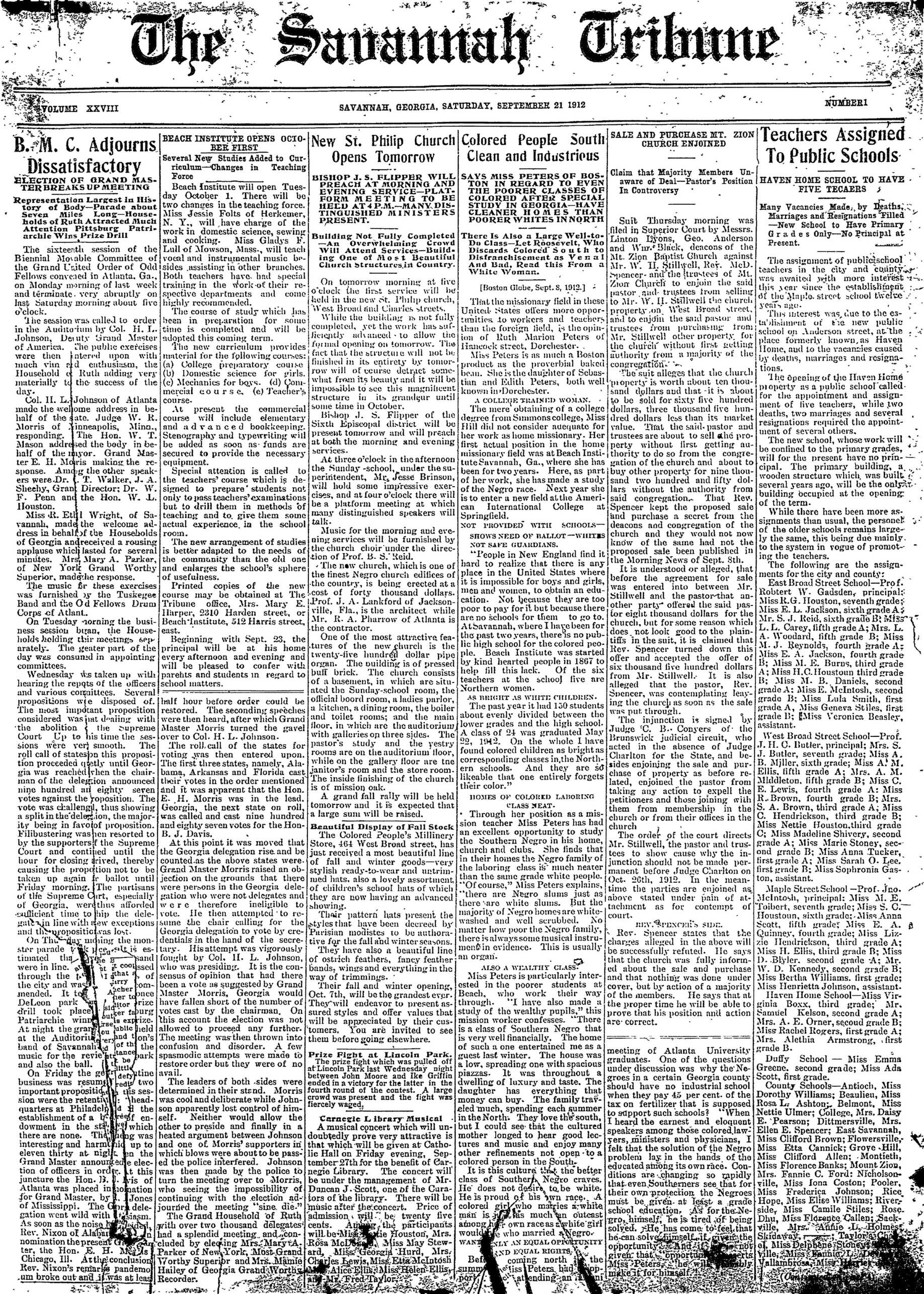
The
ELECTION OF GRAND MASTER BREAKS UP MEETING
Representation Largest in History of Body-Parade about Seven Miles Long-Households of Ruth Attracted Much Attention Pittsburg Patriarchie Wins Prize Drill
The sixteenth session of the Biennial Movable Committee of the Grand United Order of Odd Fellows convened in Atlanta, Ga., on Monday morning of last week and terminate very abruptly on last Saturday morning about five o'clock.
The session was called to order in the Auditorium by Col. H. I. Johnson, Deputy Grand Master of America. The public exercises were then intered upon with much vim and enthusiasm, the Household of Ruth adding very materially to the success of the day.
Col. H. L. Johnson of Atlanta made the welcome address in behalf of the date. Judge W. R. Morris of Minneapolis, Minn., responding. The Hon. W. T. Mason addressed the body in behalf of the mayor. Grand Master E. H. Morris making the response. Among the other speakers were Dr. C. T. Walker, J. A. Sheehy, Grant Director; Dr. W. F. Penn and the Hon. W. L. Houston.
Miss Dr. Ethel Wright, of Savannah, made the welcome address in behalf of the Households of Georgia and received a roaring applause which lasted for several minutes. Mrs. Mary A. Parker, of New York Grand Worthy Superior, made the response.
The music for these exercises was furnished by the Tuskegee Band and the Od Fellows Drum Corps of Atlant.
On Tuesday morning the business session began, the Households holding their meetings separately. The greater part of the day was consumed in appointing committees.
Wednesday was taken up with hearing the repets of the officers and various committees. Several propositions were disposed of. The most important proposition considered was just dealing with the abolition of the Supreme Court. Up to his time the sessions were very smooth. The roll call of statesmen this proposition proceeded quietly until Georgia was reached when the chairman of the delegation announced nine hundred and eighty seven votes against the proposition. The vote was challengl, thus showing a split in the delegation, the majority being in favor of proposition. Filibustering was then resorted to by the supporters if the Supreme Court and continued until the hour for closing drived, thereby causing the proposition not to be taken up again in ballot until Friday morning. The partisans of the Supreme Court, especially of Georgia, were thus afforded sufficient time to hip the delegate in line with new exceptions and the proposition was lost.
On Thursday morning the monster parade will occur. It is estimated that the E and sand were in line, at that time it coossed through the bay. It is harry of the city and was commended. It took Acher to once DeLeon park and her to prize drill took place but Acher faburg Patriarchie winner arises expirate. At night the grand ou table held at the Auditorium and tion's band of Savannah and of the music for the revie entrance park and also the ball.
On Friday the gentry detriment business was resumed, two important propositions in this session were the retention of the headquarters at Philadelphia. It the establishment of a bureau of endowment in the state, which there are none. The king was interesting and harmed up to eleven thirty at night on the Grand Master announced election of officers in order. At this juncture the Hon. J. J. Lewis of Atlanta was placed in nomination for Grand Master, by H. J. Jones of Mississippi. The Gora delegation went wild with hisiasm. As soon as the noisy beheaded, Rev. Nixon of Alabar, was nomination the present Grand Master, the Hon. E. H. M. McMissis Chicago, Ill. At this conclusion Rev. Nixon's remarks pandemonium broke out and J. J. was at leas
BEACH INSTITUTE OPENS OCTOBER BEE FIRST
Several New Studies Added to Curriculum—Changes in Teaching Force
Beach Institute will open Tuesday October 1. There will be two changes in the teaching force. Miss Jessie Folts of Herkener, N. Y., will have charge of the work in domestic science, sewing and cooking. Miss Gladys F. Lull of Mowson, Mass., will teach vocal and instrumental music besides assisting in other branches. Both teachers have had special training in the work of their respective departments and come highly recommended.
The course of study which has been in preparation for some time is completed and will be adopted this coming term.
The new curriculum provides material for the following courses:
(a) College preparatory course
(b) Domestic science for girls.
(c) Mechanics for boys. (d) Commercial course. (e) Teacher's course.
At present the commercial course will include elementary and advanced bookkeeping. Stenography and typewriting will be added as soon as funds are secured to provide the necessary equipment.
Special attention is called to the teachers' course which is designed to prepare' students not only to pass teachers' examinations but to drill them in methods of teaching and to, give them some actual experience, in the school room.
The new arrangement of studies is better adapted to the needs of the community than the old one and enlarges the school's sphere of usefulness. Printed copies of the new course may be obtained at The Tribune office, Mrs. Mary E. Harper, 2310 Harden street, or Beach Institute, 512 Harris street, east. Beginning with Sept. 23, the principal will be at his home every afternoon and evening and will be pleased to confer with parents and students in regard to school matters.
half hour before order could be restored. The seconding speeches were then heard, after which Grand Master Morris turned the gavel over to Col. H. L. Johnson. The roll call of the states for voting was then entered upon. The first three states, namely, Alabama, Arkansas and Florida cast their votes in the order mentioned and it was apparent that the Hon. E. H. Morris was in the lead. Georgia, the next state on roll, was called and cast nine hundred and eighty seven votes for the Hon-B. J. Davis.
At this point it was moved that the Georgia delegation rise and be counted as the above states were Grand Master Morris raised an objection on the grounds that there were persons in the Georgia delegation who were not delegates and were therefore ineligible to vote. He then attempted to resume the chair calling for the Georgia delegation to vote by credentials in the hand of the secretary. His attempt was vigorously fought by Col. H. L. Johnson, who was presiding. It is the consensus of opinion that had there been a vote as suggested by Grand Master Morris, Georgia would have fallen short of the number of votes cast by the chairman. On this account the election was not allowed to proceed any further. The meeting was then thrown into confusion and disorder. A few spasmodic attempts were made to restore order but they were of no avail.
The leaders of both sides were determined in their stand. Morris was cool and deliberate while Johnson apparently lost control of himself. Neither would allow the other to preside and finally in a heated argument between Johnson and one of Morris' supporters in which blows were about to be passed the police interfered. Johnson was then made by the police to turn the meeting over to Morris, who seeing the impossibility of continuing with the election adjourned the meeting "sine die."
The Grand Household of Ruth with over two thousand delegates had a splendid meeting and concluded by electing Mrs. MarytA. Parker of New York, Most Grand Worthy Superior and Mrs. Mamie Hailey of Georgia Grand Worthy Recorder.
SAVANNAH, GEORGIA, SATURDAY, SEPTEMBER 21 1912
BISHOP J. S. FLIPPER WILL PREACH AT MORNING AND EVENING SERVICE-PLATFORM MEETING TO BE HELD AT 4 P.M.-MANY DISTINGUISHED MINISTERS PRESENT.
Building Not Fully Completed
-An Overwhelming Crowd
Will Attend Services—Building One of Most Beautiful
Church Structures, in Country.
On tomorrow morning at five o'clock the first service will be held in the new st. Philip church, West Broad and Charles streets.
While the building is not fully completed, yet the work has sufficiently advanced to allow the formal opening on tomorrow. The fact that the structure will not be finished in its entirety by tomorrow will of course detract somewhat from its beauty and it will be impossible to see this magnificent structure in its grandgur until some time in October.
Bishop J. S. Flipper of the Sixth Episcopal district will be present tomorrow and will preach at both the morning and evening services.
At three o'clock in the afternoon the Sunday-school, under the superintendent, Mr. Jesse Brinson, will hold some impressive exercises, and at four o'clock there will be a platform meeting at which many distinguished speakers will talk.
Music for the morning and evening services will be furnished by the church choir under the direction of Prof. B. S. Reid.
The new church, which is one of the finest Negro church edifices of the country, is being erected at a cost of forty thousand dollars. Prof. J. A. Lankford of Jacksonville, Fla., is the architect while Mr. R. A. Pharrow of Atlanta is the contractor.
One of the most attractive features of the new church is the twenty-five hundred dollar pipe organ. The building is of pressed buff brick. The church consists of a basement, in which are situated the Sunday-school room, the official board room, a ladies parlor, a kitchen, a dining room, the boiler and toilet rooms; and the main floor, in which are the auditorium with galleries on three sides. The pastor's study and the yestery rooms are on the auditorium floor, while on the gallery floor are the janitor's room and the store room. The inside finishing of the church is of mission oak.
A grand fall rally will be held tomorrow and it is expected that a large sum will be raised.
Beautiful Display of Fall Stock
The Colored People's Millinery Store, 464 West Broad street, has just received a most beautiful line of fall and winter goods—very stylish ready-to-wear and untrimmed hats, also a lovely assortment of children's school hats of which they are now having an advanced showing.
Their pattern hats present the styles that have been decreed by Parisian modistes to be authoritative for the fall and winter seasons. They have also a beautiful line of ostrich feathers, fancy feather bands, wings and everything in the way of trimmings. Their fall and winter opening, Oct. 7th, will be the grandest ever. They will endeavor to present assured styles and offer values that will be appreciated by their customers. You are invited to see them before going elsewhere.
Prize Fight at Lincoln Park. The prize fight which was pulled off at Lincoln Park last Wednesday night between John Moore and Ike Griffin ended in a victory for the latter in the fourth round of the contest. A large crowd was present and the fight was fiercely waged.
Carnegie Library Musical
A musical concert which will undoubtedly prove very attractive is that which will be given at Catholic Hall on Friday evening, September 27th for the benefit of Carnegie Library. The concert will be under the management of Mr. Duncan J. Scott, one of the Curators of the library. There will be music after the concert. Price of admission will be twenty five cents. Among the participants will be Miss Charlotte Houston, Mrs. Rosa McDougall, Miss May Steward, Miss Georgia Hurd, Mrs. Charles Lewis, Miss Ella McIntosh Mrs. Alice Ellis, Miss Helen Ellis, and Mr. Fred Taylor.
Tribune
Colored People South Clean and Industrious
SAYS MISS PETERS OF BOSTON IN REGARD TO EVEN THE POORER CLASSES OF COLORED AFTER SPECIAL STUDY IN GEORGIA-HAVE CLEANER HOMES THAN POORER WHITES IN NORTH
There Is Also a Large Well-to-Do Class—Let Roosevelt, Who Discards Colored South to Disfranchisement as VenaI And Bad, Read this From a White Woman.
That the missionary field in these United States offers more opportunities to workers and teachers than the foreign field, is the opinion of Ruth Marion Peters of Hancock street, Dorchester. Miss Peters is as much a Boston product as the proverbial baked bean. She is the daughter of Sebastian and Edith Peters, both well known in Dorchester.
A COLLEGE TRAINED WOMAN.
The mere obtaining of a college degree from Simmons college, Miss Hill did not consider adequate for her work as home missionary. Her first actual position in the home missionary field was at Beach Institute Savannah, Ga., where she has been for two years. Here, as part of her work, she has made a study of the Negro race. Next year she is to enter a new field at the American International College at Springfield.
NOT PROVIDED WITH SCHOOLS—
SHOWS NEED OF BALLOT—WHITES
NOT SAFE GUARDIANS.
"People in New England find it
hard to realize that there is any
place in the United States where
it is impossible for boys and girls,
men and women, to obtain an education.
Not because they are too
poor to pay for it but because there
are no schools for them to go to.
At Savannah, where I have been for
the past two years, there is no public high school for the colored people.
Beach Institute was started by kind hearted people in 1867 to help fill this lack. Of the six teachers at the school five are Northern women.
AS BRIGHT AS WHITE CHILDREN. The past year it had 150 students about evenly divided between the lower grades and the high school. A class of 24 was graduated May 22, 1942. On the whole I have found colored children as bright as corresponding classes in the Northern schools. And they are so likeable that one entirely forgets their color."
Through her position as a mission teacher Miss Peters has had an excellent opportunity to study the Southern Negro in his home, church and clubs. She finds that in their homes the Negro family of the laboring class is much neater than the same grade white people. "Of course," Miss Peters explains, "there are Negro slums just as there are white slums. But the majority of Negro homes are white-washed and well scrubbed. No matter how poor the Negro family, there is always some musical instrument in evidence. This is usually an organ.
ALSO A WEALTHY CLASS:
Miss Peters is particularly interested in the poorer students at Beach, who work their way through. "I have also made a study of the wealthy pupils," this mission worker confesses. "There is a class of Southern Negro that is very well financially. The home of such a one entertained me as a guest last winter. The house was a low, spreading one with spacious piazzas. It was throughout a dwelling of luxury and taste. The daughter has everything that money can buy. The family traveled much, spending each summer in the North. They love the south, but I could see that the cultured mother longed to hear good lectures and music and enjoy many other refinements not open to a colored person in the South.
It is this culture that the better class of Southern Negro craves. He does not desire to be white. He is proud of his own race. A colored girl who marries a white man is just as much an outcast among her own race as a white girl would be who married a Negro. WANTS ONLY AN EQUAL OPPORTUNITY
Claim that Majority Members Unaware of Deal—Pastor's Position In Controversy
Suit Thursday morning was filled in Superior Court by Messrs. Linton Llyons, Geo. Anderson and Wm. Black, deacons of the Mt. Zion Baptist Church against Mr. W. II. Stillwell, Rey. McD. Spencer and the trustees of Mt. Zion Church to enjoin the said pastor, and trustees from selling to Mr. W. II. Stillwell the church property on West Broad street, and to enjoin the said pastor and trustees from purchasing from Mr. Stillwell other property for the church without first getting authority from a majority of the congregation.
The suit alleges that the church property is worth about ten thousand dollars and that it is about to be sold for sixty five hundred dollars, three thousand five hundred dollars less than its market value. That the said pastor and trustees are about to sell the property without first getting authority to do so from the congregation of the church and about to buy other property for nine thousand two hundred and fifty dollars without the authority from said congregation. That Rev. Spencer kept the proposed sale and purchase a secret from the deacons and congregation of the church and they would not now know of the same had not the proposed sale been published in the Morning News of Sept. 8th.
It is understood or alleged, that before the agreement for sale was entered into between Mr. Stillwell and the pastor-that another party offered the said pastor eight thousand dollars for the church, but for some reason which does not look good to the plaintiffs in the suit, it is claimed that Rev. Spencer turned down this offer and accepted the offer of six thousand five hundred dollars from Mr. Stillwell. It is also alleged that the pastor, Rev. Spencer, was contemplating leaving the church as soon as the sale was put through.
The injunction is signed by Judge C. B. Conyers of the Brunswick judicial circuit, who acted in the absence of Judge Charlton for the State, and besides enjoining the sale and purchase of property as before related, enjoined the pastor from taking any action to expell the petitioners and those joining with them from membership in the church or from their offices in the church
The order of the court directs Mr. Stillwell, the pastor and trustees to show cause why the injunction should not be made permanent before Judge Charlton on Oct. 26th, 1912. In the meantime the parties are enjoined as above stated under pain of attachment as for contempt of court.
MR. SPENCER'S SIDE.
Rev. Spencer states that the charges alleged in the above will be successfully refuted. He says that the church was fully informed about the sale and purchase and that nothing was done under cover, but by action of a majority of the members. He says that at the proper time he will be able to prove that his position and action are correct.
meeting of Atlanta University graduates. One of the questions under discussion was why the Negroes in a certain Georgia county should have no industrial school when they pay 45 per cent. of the tax on fertilizer that is supposed to support such schools? "When I heard the earnest and eloquent speakers among those colored lawyers, ministers and physicians, I felt that the solution of the Negro problem lay in the hands of the educated among its own race. Conditions are changing so rapidly that even Southerners see that for their own protection the Negroes must be given at least a grade school education. As for the Negro, himself, he is tired of being solved. He has come to feel that he can solve himself, if given the opportunity. And if he does not given that opportunity, he Miss Peters, he will probably make it for himself."
NUMBER1
Teachers Assigned To Public Schools
Teachers Assigned To Public Schools
HAVEN HOME SCHOOL TO HAVE FIVE TECAERS
Many Vacancies Made, by Deaths, Marriages and Resignations Filled—New School to Have Primary Grades Only—No Principal at Present.
The assignment of public school teachers in the city and county was awaited with more interest this year since the establishment of the Maple street school twelve years ago.
This interest was due to the establishment of the new public school on Anderson street, at the place formerly known as Haven Home, and to the vacancies caused by deaths, marriages and resignations.
The opening of the Haven Home property as a public school called for the appointment and assignment of five teachers, while two deaths, two marriages and several resignations required the appointment of several others.
The new school, whose work will be confined to the primary grades, will for the present have no principal. The primary building, a wooden structure which, was built several years ago, will be the only building occupied at the opening of the term.
While there have been more assignments than usual, the personek of the older schools remains largely the same, this being due mainly to the system in vogue of promoting the teachers.
The following are the assignments for the city and county:
East Broad Street School—Pro f.
Robertt W. Gadsden, principal:
Miss R.G. Houston, seventh grade;
Miss E. L. Jackson, sixth grade A;
Mr. S. J. Reid, sixth grade B; Miss
L. L. Carey, fifth grade A; Mrs. L.
A. Woodard, fifth grade B; Miss
M. J. Reynolds, fourth grade A;
Miss E. A. Jackson, fourth grade
B; Miss M. E. Burns, third grade
A; Miss H.C. Housount third grade
B; Miss M. B. Daniels, second
grade A; Miss E. McIntosh, second
grade B; Miss Lula Smith, first
grade A, Miss Geneva Stiles, first
grade B; Miss Veronica Beasley,
assistant.
West Broad Street School—Prof.
J. H. C. Butler, principal; Mrs. S.
J. Butler, seventh grade; Miss A.
B. Mjler, sixth grade; Miss A' M.
Ellis, fifth grade A; Mrs. A. M.
Mldleleton, fifth grade B; Miss C.
E. Lewis, fourth grade A; Miss
R. Brown, fourth grade B; Mrs.
S. A. Brown, third grade A; Miss
C. Hendrickson, third grade B;
Miss Nettie Houston, third grade
C; Miss Madeline Shivery, second
grade A; Miss Marie Stoney, second
grade B; Miss Anna Tucker,
first grade A; Miss Sarah O. Lee.
first grade B; Miss Sophronin Gaston,
assistant.
Maple Street School—Prof. Jno.
McIntosh, principal; Miss M. E.
Toibert, seventh grade; Miss S. C.
Houstoun, sixth grade; Miss Anna
Scott, fifth grade; Miss E. A.
Quinney, fourth grade; Miss Lizzie
Hendrickson, third grade A;
Miss H. Ellis, third grade B; Miss
D. Blyler, second grade A; Mr.
W. D. Kennedy, second grade B;
Miss Bertha Williams, first grade;
Miss Henrietta Johnson, assistant.
Haven Home School—Miss Virginia Boxx, third grade; Mr. Samuel Kelson, second grade A; Mrs. A. E. Orner, second grade B; Miss Rachel Rogers, first grade A; Mrs. Alethia Armstrong, first grade B.
Duffy School - Miss Emma Greene. second grade; Miss Ada Scott, first grade.
County Schools—Antioch, Miss Dorothy Williams; Beaulieu, Miss Rosa L. Ashton; Belmont, Miss Nettie Ulmer; College, Mrs. Daisy E. Pearson; Dittmersville, Mrs. Ellen E. Spencer; East Savannah, Miss Clifford Brown; Flowersville, Miss Etta Cannick; Grove Hill, Miss Clifford Allen; Montieth, Miss Florence Banks; Mount Zion, Mrs. Fannie C. Ford; Nicholsonville, Miss Iona Coston; Pooler, Miss Frederica Johnson; Rice Hope, Miss Elise Williams; Riverside, Miss Camile Stiles; Rose Dhu, Miss Florence Callen; Sackville, Mrs. Annie L. Holmes
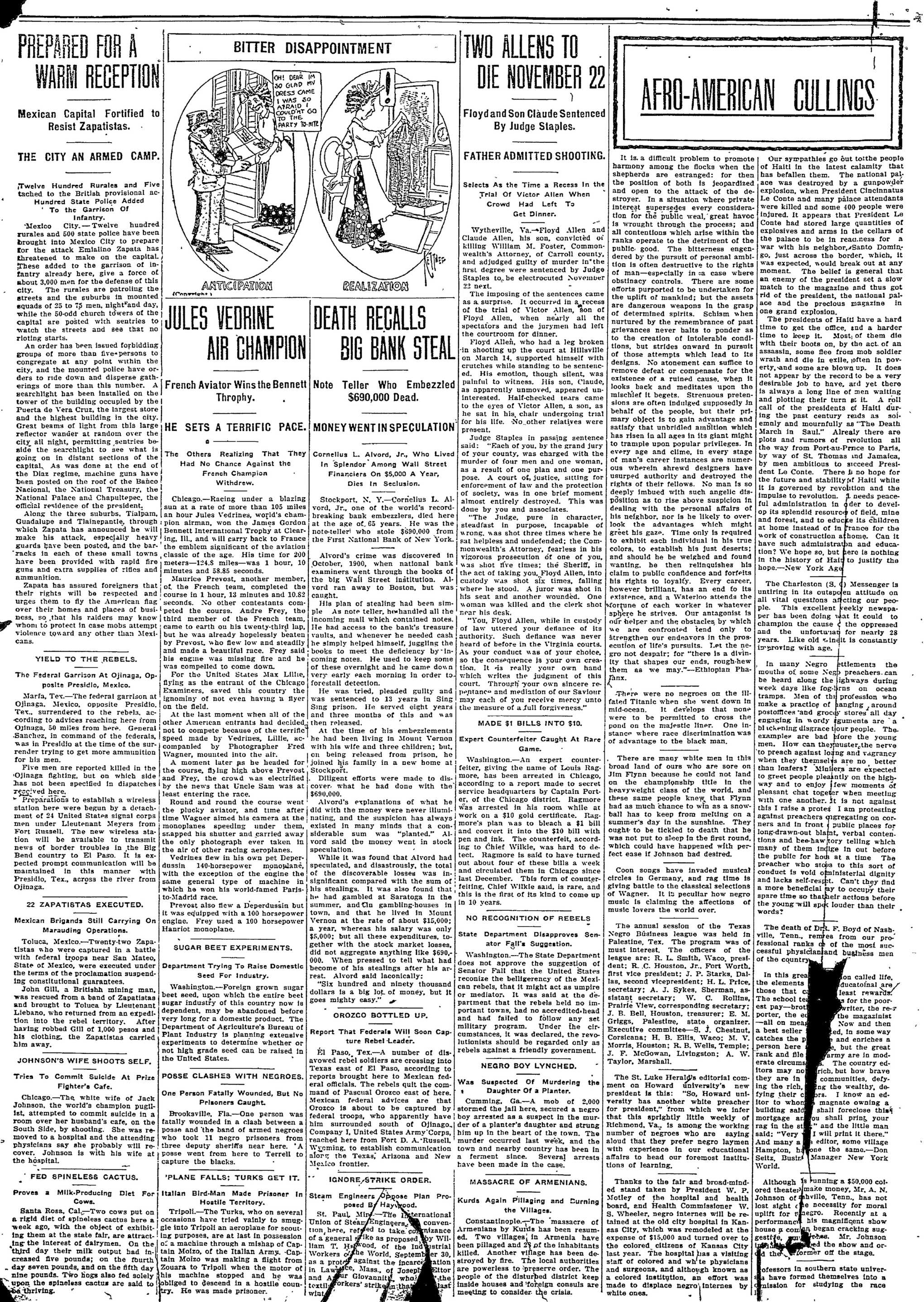
PREPARED FOR A WARM RECEPTION
Mexican Capital Fortified to Resist Zapatistas.
THE CITY AN ARMED CAMP.
Twelve Hundred Rurales and Five tached to the British provisional ac- Hundred State Police Added
Mexico City.—Twelve hundred rurales and 500 state police have been brought into Mexico City to prepare for the attack Emialino Zapata has threatened to make on the capital. These added to the garrison of infantry already here, give a force of about 3,000 men for the defense of this city. The rurales are patrolling the streets and the suburbs in mounted squads of 25 to 75 men, night and day, while the 50-odd church towers of the capital are posted with sentries to watch the streets and see that no rioting starts.
An order has been issued forbidding groups of more than five persons to congregate at any point within the city, and the mounted police have orders to ride down and disperse gatherings of more than this number. A searchlight has been installed on the tower of the building occupied by the Puerta de Vera Cruz, the largest store and the highest building in the city. Great beams of light from this large reflector wander at random over the city all night, permitting sentries beside the searchlight to see what is going on in distant sections of the capital. As was done at the end of the Diaz regime, machine guns have been posted on the roof of the Banco Nacional, the National Treasury, the National Palace and Chapultepec, the official residence of the president.
Along the three suburbs, Tialpam, Guadalupe and Tlainepantle, through which Zapata has announced he will make his attack, especially heavy guards have been posted, and the barracks in each of these small towns have been provided with rapid fire guns and extra supplies of rifles and ammunition. Zapata has assured foreigners that their rights will be respected and urges them to fly the American flag over their homes and places of business, so that his raiders may know whom to protect in case mobs attempt violence toward any other than Mexicans.
YIELD TO THE REBELS.
The Federal Garrison At Ojinagua, Opposite Presidio, Mexico.
Marfa, Tex.-The federal garrison at Ojinaga, Mexico, opposite Presidio, Tex., surrendered to the rebels, according to advices reaching here from Ojinaga, 50 miles from here. General Sanchez, in command of the federals, was in Presidio at the time of the surrender trying to get more ammunition for his men. Five men are reported killed in the Ojinaga fighting, but on which side has not been specified in dispatches received here.
Preparations to establish a wireless station here were begun by a detachment of 24 United States signal corps men under Lieutenant Meyers from Fort Russell. The new wireless station will be available to transmit news of border troubles in the Big Bend country to El Paso. It is expected prompt communication will be maintained in this manner with Presidio, Tex., across the river from Ojinaga.
22 ZAPATISTAS EXECUTED.
Mexican Brigands Still Carrying On Marauding Operations.
Toluca, Mexico.—Twenty-two Zapatistas who were captured in a battle with federal troops near San Mateo, State of Mexico, were executed under the terms of the proclamation suspending constitutional guarantees.
John Gill, a British mining man, was rescued from a band of Zapatistas and brought to Toluca by Lieutenant Liebano, who returned from an expedition into the rebel territory. After having robbed Gill of 1,000 pesos and his clothing, the Zapatistas carried him away.
JOHNSON'S WIFE SHOOTS SELE.
Tries To Commit Suicide At Prize
Fighter's Cafe.
Chicago.—The white wife of Jack Johnson, the world's champion pugilist, attempted to commit suicide in a room over her husband's cafe, on the South Side, by shooting. She was removed to a hospital and the attending physicians say she probably will recover. Johnson is with his wife at the hospital.
FED SPINELESS CACTUS.
Proves a Milk-Producing Diet For Cows.
Santa Rosa, Cal. Two cows put on a rigid diet of spineless cactus here a week ago, with the object of exhibiting them at the state fair, are attracting the interest of dalrymen. On the third day their milk output had increased five pounds; on the fourth day seven pounds, and on the fifth day nine pounds. Two hogs also fed solely upon the spineless cactus are said to be thriving.
OH! DEAR IM
SO GLAD MY
DRESS CAME
I WAS SO
ATRAID I
COULDN'T GO
TO THE
PARTY TO-NITE
ANTICIPATION
REALIZATION
JULES VEDRINE
AIR CHAMPION
French Aviator Wins the Bennett Throphy.
HE SETS A TERRIFIC PACE.
The Others Realizing That They Had No Chance Against the French Champion Withdrew.
Chicago.—Racing under a blazing sun at a rate of more than 105 miles an hour Jules Vedrines, world's champion airman, won the James Gordon Bennett International Trophy at Clearing, Ill., and will carry back to France the emblem significant of the aviation classic of the age. His time for 200 meters—124.3 miles—was 1 hour, 10 minutes and 58.85 seconds.
Maurice Prevost, another member, of the French team, completed the course in 1 hour, 13 minutes and 10.82 seconds. No other contestants competed the course. Andre Frey, the third member of the French team, came to earth on his twenty-third lap, but he was already hopelessly beaten by Prevost, who flew low and steadily and made a beautiful race. Frey said his engine was missing fire and he was compelled to come down.
For the United States Max Lillie, flying as the entrant of the Chicago Examiners, saved this country the ignominy of not even having a flyer on the field.
At the last moment when all of the other American entrants had decided, not to compete because of the terrific speed made by Vedrines, Lillie, accompanied by Photographer Fred Wagner, mounted into the air.
A moment later as he headed for the course, flying high above Prevost and Frey, the crowd was electrified by the news that Uncle Sam was at least entering the race.
Round and round the course went the plucky aviator, and time after time Wagner aimed his camera at the monoplanes speeding under them, snapped his shutter and carried away the only photograph ever taken in the air of other racing aerials.
Vedrines flew in his own pet Deperdussin 140-horsepower monoplane, with the exception of the engine the same general type of machine in which he won his world-famed Paristo-Madrid race.
Prevost also flew a Deperdussin but it was equipped with a 100 horsepower engine. Frey used a 100 horsepower Hanriot monoplane.
SUGAR BEET EXPERIMENTS.
Department Trying To Raise Domestic Seed For Industry.
Washington. Foreign grown sugar beet seed, upon which the entire beet sugar industry of this country now is dependent, may be abandoned before very long for a domestic product. The Department of Agriculture's Bureau of Plant Industry is planning extensive experiments to determine whether or not high grade seed can be raised in the United States.
POSSE CLASHES WITH NEGROES.
One Person Fatally Wounded, But No Prisoners Caught
Brooksville, Fla.—One person was fatally wounded in a clash between a posse and the band of armed negroes who took 11 negro prisoners from three deputy sheriffs near here. 'A posse went from here to Terrell to capture the blacks.
'PLANE FALLS; TURKS GET IT.
Italian Bird-Man Made Prisoner In
Hostile Territory.
Tripoll.—The Turks, who on several occasions have tried vainly to smuggle into Tripoll an aeroplane for scouting purposes, are at last in possession of a machine through a mishap of Captain Molzo, of the Italian Army. Captain Moizo was making a flight from Zourau to Tripoll when the motor of his machine stopped and he was obliged to descend in a hostile country. He was made prisoner.
DEATH RECALLS BIG BANK STEAL
Note Teller Who Embezzled $690,000 Dead.
MONEY WENT INSPECULATION
Cornelius L. Alvord, Jr., Who Lived In Splendor Among Wall Street Financiers On $5,000 A Year, Dies In Seclusion.
Stockport, N. Y.-Cornelius L. Alvord, Jr., one of the world's record-breaking bank embezzlers, died here at the age of 65 years. He was the note-teller who stole $690,000 from the First National Bank of New York.
Alvord's crime was discovered in October, 1900, when national bank examiners went through the books of the big Wall Street institution. Alvord ran away to Boston, but was caught
His plan of stealing had been simple As note teller, he handled all the incoming mall which contained notes. He had access to the bank's treasure vaults, and whenever he needed cash he simply helped himself, juggling the books to meet the deficiency by incoming notes. He used to keep some of these overnight and he came down very early each morning in order to forestall detection.
He was tried, pleaded guilty and was sentenced to 13 years in Sing Sing prison. He served eight years and three months of this and was then released.
At the time of his embezzlements he had been living in Mount Vernon with his wife and three children; but, on being released from prison, he joined his family in a new home at Stockport.
Diligent efforts were made to discover what he had done with the $690,000. Alvord's explanations of what he did with the money were never illuminating, and the suspicion has always existed in many minds that a considerable sum was "planted." Alvord said the money went in stock speculation.
While it was found that Alvord had speculated, and disastrously, the total of the discoverable losses was insignificant compared with the sum of his stealings. It was also found that he had gambled at Saratoga In the summer, and On gambling-houses in town, and that he lived in Mount Vernon at the rate of about $15,000; a year, whereas his salary was only $5,000; but all these expenditures, together with the stock market losses, did not aggregate anything like $690,000. When pressed to tell what had become of his stealings after his arrest, Alvord said laconically:
"Six hundred and ninety thousand dollars is a big lot of money, but it goes mighty easy."
OROZCO BOTTLED UP.
Report That Federals Will Soon Capture Rebel Leader.
El Paso, Tex.—A number of disavowed rebel soldiers are crossing into Texas east of El Paso, according to reports brought here to Mexican federal officials. The rebels quit the command of Pascual Orozco east of here. Mexican federal advices are that Orozco is about to be captured by federal troops, who apparently have him surrounded south of Ojinago, Company I, United States Army'Corps, reached here from Fort D. A.Russell, Wyoming, to establish communication along the Texas, Arizona and New Mexico frontier.
Steam Engineers Oppose Plan Proposed By Haywood.
St. Paul, Min.—The International Union of Steam Engineers, in convention, here, referred to take cognizance of a general strike as proposed by William T. Haywood, of the Industrial Workers of the World, September 30, as a protest against the incarceration in Lawrence, Mass., of Joseph Ettor and Auror Glovannitt, who, after the textile workers' strike in that city, last what
TWO ALLENS TO DIE NOVEMBER 22
Floyd and Son Claude Sentenced By Judge Staples.
FATHER ADMITTED SHOOTING.
Selects As the Time a Recess In the Trial Of Victor Allen When Crowd Had Left To Get Dinner.
Wytheville, Va.→Floyd Allen and Claude Allen, his son, convicted of killing William M. Foster, Commonwealth's Attorney, of Carroll county, and adjudged guilty of murder in the first degree were sentenced by Judge Staples to be electrocuted November 22 next.
The imposing of the sentences came as a surprise. It occurred in a recess of the trial of Victor Allen, son of Floyd Allen, when nearly all the spectators and the jurymen had left the courtroom for dinner.
Floyd Alleh, who had a leg broken in shooting up the court at Hillsville on March 14, supported himself with crutches while standing to be sentenced. His emotion, though silent, was painful to witness. His son, Claude, as apparently unmoved, appeared uninterested. Half-checked tears came to the eyes of Victor Allen, a son, as he sat in his chair undergoing trial for his life. No other relatives were present.
Judge Staples in passing sentence said: "Each of you, by the grand jury of your county, was charged with the murder of four men and one woman, as a result of one plan and one purpose. A court of, justice, sitting for enforcement of law and the protection of society, was in one brief moment almost entirely destroyed. This was done by you and associates.
"The Judge, pure in character, steadfast in purpose, incapable of wrong, was shot three times where he sat helpless and undefended; the Commonwealth's Attorney, fearless in his vigorous prosecution of one of you, was shot five times; the Sheriff, in the act of taking you, Floyd Allen, into custody was shot six times, falling where he stood. A juror was shot in his seat and another wounded. One woman was killed and the clerk shot near his desk.
"You, Floyd Allen, while in custody of law uttered your defence of its authority. Such defiance was never heard of before in the Virginia courts. As your conduct was of your choice, so the consequence is your own creation. It is really your own hand which writes the judgment of this court. Through your own sincere repentance and mediation of our Saviour may each of you receive mercy unto the measure of a full forgiveness."
MADE $1 BILLS INTO $10.
Expert Counterfeiter Caught At Rare Game.
Washington.—An expert counterfeiter, giving the name of Louis Ragmore, has been arrested in Chicago, according to a report made to secret service headquarters by Captain Porter, of the Chicago district. Ragmore was arrested in his room while at work on a $10 gold certificate. Ragmore's plan was to bleach a $1 bill and convert it into the $10 bill with pen and ink. The counterfeit, according to Chief Wilkle, was hard to detect. Ragmore is said to have turned out about four of these bills a week and circulated them in Chicago since last December. This form of counterfeiting, Chief Wilkle said, is rare, and this is the first of its kind to come up in 10 years.
NO RECOGNITION OF REBELS
State Department Disapproves Senator Fall's Suggestion.
Washington.—The State Department does not approve the suggestion of Senator Fall that the United States reconize the belligerency of the Mexican rebels, that it might act as ampire or mediator. It was said at the department that the rebels held no important towns, had no accredited-head and had failed to follow any set military program. Under the circumstances, it was declared, the revolutionists should be regarded only as rebels against a friendly government.
NEGRO BOY LYNCHED.
Was Suspected Of Murdering the
Daughter Of a Planter.
Cumming. Ga.-A mob of 2,000 stormed the jail here, secured a negro boy arrested as a suspect In the murder of a planter's daughter and strung him up in the heart of the town. The murder occurred last week, and the town and nearby country has been in a ferment since. Several arrests have been made in the case.
MASSACRE OF ARMENIANS
Kurds Again Pillaging and Burning the Villages.
Constantinople. The massacre of Armenians by Kurds has been resumed. Two villages in Armenia have been pillaged and 29 of the inhabitants killed. Another village has been destroyed by fire. The local authorities are powerless to preserve order. The people of the disturbed district keep inside houses and foreign consuls are meeting to consider the crisis.
AFRO-AMERICAN CULLINGS
It is a difficult problem to promote harmony among the flocks when the shepherds are estranged: for then the position of both is jeopardized and open to the attack of the destroyer. In a situation where private interest supersedes every consideration for the public weal, great havoc is wrought through the process; and all contentions which arise within the ranks operate to the detriment of the public good. The bitterness engendered by the pursuit of personal ambition is often destructive to the rights of man—especially in a case where obstinacy controls. There are some efforts purported to be undertaken for the uplift of mankind; but the assets are dangerous weapons in the grasp of determined spirits. Schism when nurtured by the remembrance of past grievances never halts to ponder as to the creation of intolerable conditions, but strides onward in pursuit of those attempts which lead to its designs. No atonement can suffice to remove defeat or compensate for the existence of a ruined cause, when it looks back and meditates upon the mischief it begets. Strenuous pretensions are often indulged supposedly in behalf of the people, but their primary object is to gain advantage and satisfy that unbridled ambition which has risen in all ages in its giant might to trample upon popular privileges. In every age and clime, in every stage of man's career instances are numerous wherein shrewd designers have usurped authority and destroyed the rights of their fellows. No man is so deeply imbued with such angelic disposition as to rise above suspicion in dealing with the personal affairs of his neighbor, nor is he likely to overlook the advantages which might greet his gaze. Time only is required to exhibit each individual in his true colors, to establish his just deserts; and should he be weighed and found wanting, he then relinquishes his claim to public confidence and forfeits his rights to loyalty. Every career, however brilliant, has an end to its existence, and a Waterloo attends the fortune of each worker in whatever sphere he strives. Our antagonist is our helper and the obstacles by which we are confronted tend only to strengthen our endeavors in the prosecution of life's pursuits. Let the negro not despair; for "there is a divinity that shapes our ends, rough-hew them as we may."—Ethiopian Phafanx.
There were no negroes on the ill-fated Titanic when she went down in mid-ocean. It develops that none were to be permitted to cross the pond on the majestic liner. One instance where race discrimination was of advantage to the black man.
There are many white men in this broad land of ours who are sore on Jim Flynn because he could not land on the championship title in the heavyweight class of the world, and these same people knew that Flynn had as much chance to win as a snowball has to keep from melting on a summer's day in the sunshine. They ought to be tickled to death that he was not put to sleep in the first round, which could have happened with perfect ease if Johnson had desired.
Coon songs have invaded musical circles in Germany, and rag time is giving battle to the classical selections of Wagner. It is peculiar how negro music is claiming the affections of music lovers the world over.
the annual session of the Texas Negro Business league was held in Palestine, Tex. The program was of must interest. The officers of the league are: R. L. Smith, Waco, president; R. C. Houston, Jr., Fort Worth, first vice president; J. P. Starks, Dallas, second vice president; H. L. Price, secretary; A. J. Sykes, Sherman, assistant secretary; W. C. Rollins, Prairie View, corresponding secretary; J. B. Bell, Houston, treasurer; E. M. Griggs, Palestine, state organizer. Executive committee—S. J. Chestnut, Corsicana; H. B. Ellis, Waco; M. V. Morris, Houston; R. B. Wells, Temple; J. F. McGowan, Livingston; A. W. Taylor, Marshall.
The St. Luke Herald's editorial comment on Howard university's new president is this: "So, Howard university has another white preacher for president," from which we infer that this sprightly little weekly of Richmond, Va., is among the working number of negroes who are saying aloud that they prefer negro laymen with experience in our educational affairs to head our foremost institutions of learning.
Thanks to the fair and broad-minded stand taken by President W. P. Motley of the hospital and health board, and Health Commissioner W. S. Wheeler, negro internes will be retained at the old city hospital in Kansas City, which was remodeled at the expense of $15,000 and turned over to the colored citizens of Kansas City last year. The hospital has a visiting staff of colored and white physicians and surgeons, and although known as a colored institution, an effort was made to displace negro internes by white ones.
Our sympathies go out to the people of Haiti in the latest calamity that has befallen them. The national palace was destroyed by a gunpowder explosion, when President Cincinnatus Le Conte and many palace attendants were killed and some 400 people were injured. It appears that President Le Conte had stored large quantities of explosives and arms in the cellars of the palace to be in readiness for a war with his neighbor, Santo Domingo, just across the border, which, it was expected, would break out at any moment. The belief is general that an enemy of the president set a slow match to the magazine and thus got rid of the president, the national palace and the precious magazine in one grand explosion.
The presidents of Haiti have a hard time to get the office, and a harder time to keep it. Most, of them die with their boots on, by the act of an assassin, some flee from mob soldier wrath and die in exile, often in poverty, and some are blown up. It does not appear by the record to be a very desirable job to have, and yet there is always a long line of men waiting and plotting their turn at it. A roll call of the presidents of Haiti during the past century reads as solemnly and mournfully as "The Death March in Saul." Alrealy there are plots and rumors of revolution all the way from Port-au-Prince to Paris, by way of St. Thomas and Jamaica, by men ambitious to succeed President Le Conte. There is no hope for the future and stability of Haiti while it is governed by revolution and the impulse to revolution. I needs peaceful administration in order to develop its splendid resource of field, mine and forest, and to educate its children at home instead of in France for the work of construction at home. Can it have such administration and education? We hope so, but here is nothing in the history of Haiti to justify the hope.—New York Age
The Charleston (S. C.) Messenger is untiring in its outspoken attitude on all vital questions affecting our people. This excellent weekly newspaper has been doing what it could to champion the cause of the oppressed and the unfortunate for nearly 28 years. Like old time it is constantly improving with age.
In many Negro settlements the mouths of some Negro preachers can be heard along the highways during week days like fog-birns on ocean tramps. Men of the profession who make a practice of hanging around postoffices and grocery stores all day engaging in wordy arguments are a blickening disgrace our people. The examples are bad before the young men. How can they muster the nerve to preach against looting and vagrancy when they themselves are no better than loafers? Miners are expected to greet people pleasantly on the highway and to enjoy few moments of pleasant chat together when meeting with one another. It is not against this I raise a protest I am protesting against preachers congregating on corners and in front public places for long-drawn-out blamet, verbal contentions and bee-hawtory telling which many of them indulge in out before the public for hours at a time. The preacher who stops to this sort of conduct is void of ministerial dignity and lacks self-respect. Can't they find a more beneficial pay to occupy their spare time so that their actions before the young will speak louder than their words?
The death of Dr. F. Boyd of Nashville, Tenn., remites from our professional ranks ce of the most successful physician and business men of the country.
In this great the elements those that can The school test pay—brotter, the ed—all on mea a best seller it catches the person here rank and file erate circumitors may not they are in ing the rich, tying their citor to whom building said mortgage and rag in the st said; "Very And many a Hampton, has Seltz, Business World.
don called life, educatolonal are least rewards, for the poor, writer, the re- the magazineist Now and then needed, in some way and enriches a life, but the great army are in moderns. The country ed- rich, but how brave communities, defying the wealthy, doctors. I know an ed- magnate owning a shall foreclose this you shall bring your " and the little man I will print it there." editor, some village one the same.—Don Manager New York
Although it is running a $50,000 colored theater, make money, Mr. A. N. Johnson of shville, Tenn., has not lost sight of the necessity for moral uplift for the groo. Recently at a performance his magnificent show house a comen began cracking suggestive, squirrels. Mr. Johnson introduced the show and ordered the informer off the stage.
professors in southern state universities have formed themselves into a commission for studying the race
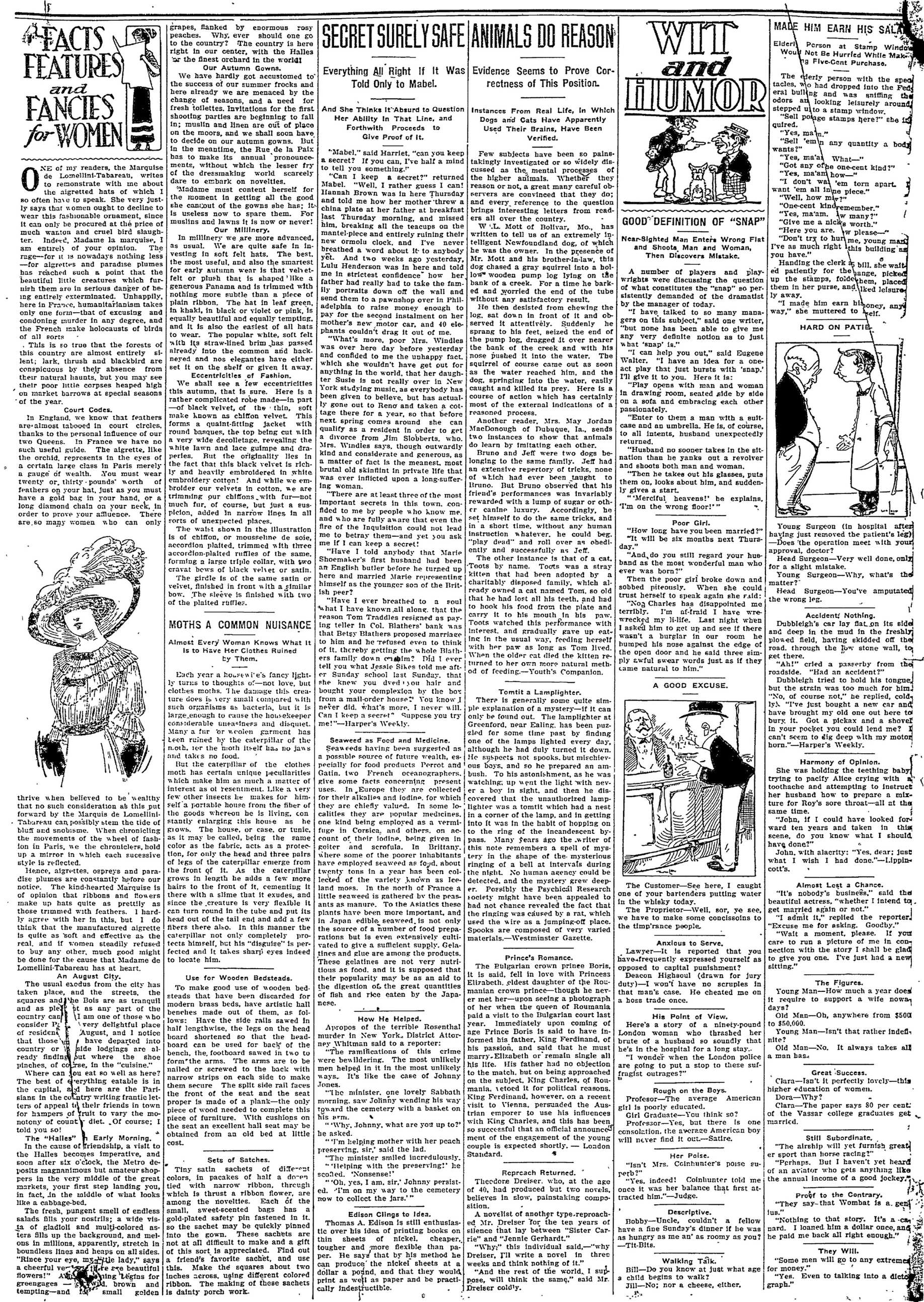
FACTS FEATURES and FANCIES for WOMEN ONE of my readers, the Marquise de Lomellini-Tabareau, writes to remonstrate with me about
the aigretted hats of which I so often have to speak. She very justly says that women ought to decline to wear this fashionable ornament, since it can only be procured at the price of much wanton and cruel bird slaughter. Indeed, Madame la marquise, I am entirely of your opinion. The rage—for it is nowadays nothing less—for algrettes and paradise plumes has reached such a point that the beautiful little creatures which furnish them are in serious danger of being entirely exterminated. Unhappily, here in France, humanitarianism takes only one form—that of excusing and condoning murder in any degree, and the French make holocausts of birds of all sorts.
This is so true that the forests of this country are almost entirely silent; lark, thrush and blackbird are conspicuous by their absence from their natural haunts, but you may see their poor little corpses heaped high on market barrows at special seasons of the year.
Court Codes
In England, we know that feathers are almost tabooed in court circles, thanks to the personal influence of our two Queens. In France we have no such useful guide. The algrette, like the orchid, represents in the eyes of a certain large class in Paris merely a gauge of wealth. You must wear twenty or thirty pounds' worth of feathers on your hat, just as you must have a gold bag in your hand, or a long diamond chain on your neck, in order to prove your influence. There are so many women who can only
```markdown
```
thrive when believed to be wealthy, that no such consideration as this put forward by the Marquis de Lomellini-Tabareau can possibly stem the tide of blust and snobism. When chronicleing the movements of the wheel of fashion in Paris, we the chroniclers, hold up a mirror in which each successive style is reflected.
Hence, algrettes, ospreys and paradise plumes are constantly before our notice. The kind-hearted Marquise is of opinion that ribbons and flowers make up hats quite as prettily as those trimmed with feathers. I hardly agree with her in this, but I do think that the manufactured aigrette is quite as soft and effective as the real, and if women steadily refused to buy any other, much good might be done for the cause that Madame de Lomellini-Tabareau has at heart.
An August City
The usual exodus from the city has taken place, and the streets, the squares and the Bols are as tranquil and as pleasing as any part of the country can be. I am one of those who consider Pr. very delightful place of residence, August, and I notice that those in have departed into country or in side lodgings are already finding out where the shoe pinches, of course, in the "cuisine." Where can you eat so well as here? The best of everything eatable is in the capital, and here are the Parisians in the country writing frantic letters of appeal to their friends in town for hampers of fruit to vary the monotony of count or diet. Of course; I told you so!
The "Halles" in Early Morning.
In the cause of friendship, a visit to the Halles becomes imperative, and soon after six o'clock, the Metro deposits magnanimous but amateur shoppers in the very middle of the great markets, your first step landing you, in fact, in the middle of what looks like a cabbage-bed.
The fresh, pungent smell of endless salads fills your nostrils; a wide vista of gladiol and multi-colored asters fills up the background, and melons in millions, apparently, stretch in boundless lines and heaps on all sides.
"Rince your eye, my little lady," says a cheerful veil, "there are eye beautiful flowers!" And greeting begins for engages—wild, brown and tempting—and small, golden
grapes, flanked by enormous rosy peaches. Why, ever should one go to the country? The country is here right in our center, with the Halles or the finest orchard in the world!
Our Autumn Gowns.
We have hardly got accustomed to the success of our summer frocks and here already we are menaced by the change of seasons, and a need for fresh toilettes. Invitations for the first shooting parties are beginning to fall in; muslin and linen are out of place on the moors, and we shall soon have to decide on our autumn gowns. But in the meantime, the Rue, de la Palix has to make its annual pronouncements, without which the lesser fry of the dressmaking world scarely dare to embark on novelties.
Madame must content herself for the moment in getting all the good she can out of the gowns she has; it is useless now to spare them. For muslins and lawns it is now or never!
Our Millinery.
In millinery we are more advanced, as usual. We are quite safe in investing in soft felt hats. The best, the most useful, and also the smartest for early autumn wear is that velvet-felt or plush that is shaped'like a generous Panama and is trimmed with nothing more subtle than a piece of plain ribbon. The hat in leaf green, in khakl, in black or violet or pink, is equally beautiful and equally tempting, and it is also the easiest of all hats to wear. The popular white, soft felt with its straw-lined brim has passed already into the common and hackneyed and nos elegantes have either set it on the shelf or given it away.
Eccentricities or Fashion.
We shall see a few eccentricities this autumn, that is sure. Here is a rather complicated robe made—in part of black velvet, of the thin, soft make known as chiffon velvet. This forms a quantit-fitting jacket with round basques, the top being cut with a very wide decolletage, revealing the white lawn and lace guipme and draperies. But the original lies in the fact that this black velvet is richly and heavily embroidered in white embroidery cotton! And while we embroider our velvets in cotton, we are trimming our chiffons with fur—not much fur, of course, but just a suspleton, added in narrow lines in all sorts of unexpected places.
The waist shown in the illustration is of chiffon, or mousseline de soie, accordion plaited, trimmed with three accordion-plaited ruffles of the same, forming a large triple collar, with two cravat bews of black velvet or satin.
The girdle is of the same satin or velvet, finished in front with a similar bow. The sleeve is finished with two of the plaited ruffles.
MOTHS A COMMON NUISANCE
Almost Every Woman Knows What It Is to Have Her Clothes Ruined by Them.
Each year a housewife's fancy lightly turns to thoughts of—not love, but clothes moths. The damage this creature does is very small compared with such organisms as bacteria, but it is large, enough to cause the housekeeper considerable uneasiness and disquiet. Many a fur or woolen garment has been ruined by the caterpillar of the moth, for the moth itself has no jaws and takes no food.
But the caterpillar of the clothes moth has certain unique peculiarities which make him as much a matter of interest as of resentment. Like a very few other insects he makes for himself a portable house from the fiber of the goods whereon he is living, constantly enlarging this house as he grows. The house, or case, or tunic, as it may be called, being the same color as the fabric, acts as a protection, for only the head and three palrs of legs of the caterpillar emerge from the front of it. As the caterpillar grows in length he adds a few more hairs to the front of it, cementing it there with a slime that it exudes, and since the creature is very flexible it can turn round in the tube and put its head out of the tail end and add a few fibers there also. In this manner the caterpillar not only completely protects himself, but his "disguise" is perfected and it takes sharp eyes indeed to locate him.
Use for Wooden Bedsteads
To make good use of wooden bedsteads that have been discarded for modern brass beds, have artistic hall benches made out of them, as follows: Have the side rails sawed in half lengthwise, the legs on the head board shortened so that the headboard can be used for back of the bench, the footboard sawed in two to form the arms. The arms are to be nailed or screwed to the back with narrow strips on each side to make them secure. The split side rail faces the front of the seat and the seat proper is made of a plank—the only piece of wood needed to complete this piece of furniture. With cushions on the seat an excellent hall seat may be obtained from an old bed at little cost.
Sets of Satches.
Tiny satin sachets of different colors, in pacakes of half a dozen tied with narrow ribbon, through which is thrust a ribbon flower, are among the novelties. Each of the small, sweet-scented bags has a gold-plated safety pin fastened in it, so the sachet may be quickly pinned into the gown. These sachets are not at all difficult to make and a gift of this sort is appreciated. Find out a friend's favorite sachet, and use this. Make the squares about two inches across, using different colored ribbon. The making of these sachets is dainty porch work.
SECRET SURELY SAFE
Everything All Right If It Was Told Only to Mabel.
And She Thinks It`Absurd to Question
Her Ability In That Line, and
Forthwith Proceeds to
Give Proof of it.
"Mabel," said Harriet, "can you keep
a secret? If you can, I've half a mind
to tell you something."
"Can I keep a secret?" returned Mabel. "Well, I rather guess I can! Hannah Brown was in here Thursday and told me how her mother threw a china plate at her father at breakfast last Thursday morning, and missed him, breaking all the teacups on the mantel-piece and entirely ruining their new ormolu clock, and I've never breathed a word about it to anybody yet. And two weeks ago yesterday, Lulu Henderson was in here and told me in strictest confidence" how her father had really had to take the family portraits down off the wall and send them to a pawnshop over in Philadelphia to raise money enough to pay for the second instalment on her mother's new motor car, and 40 elephants couldn't drag it out of me.
"What's more, poor Mrs. Windles was over here day before yesterday and confided to me the unhappy fact, which she wouldn't have get out for anything in the world, that her daughter Susie is not really over in New York studying music, as everybody has been given to believe, but has actually gone out to Reno and taken a cottage there for a year, so that before next spring comes around she can qualify as a resident in order to get a divorce from Jim Slobberts, who. Mrs. Windles says, though outwardly kind and considerate and generous, as a matter of fact is the meanest, most brutal old skinflint in private life that was ever inflicted upon a long-suffering woman.
"There are at least three of the most important secrets in this town, confided to me by people who know me, and who are fully aware that even the fire of the Inquisition could not lead me to betray them—and yet you ask me if I can keep a secret!
"Have I told anybody that Marie Shoemaker's first husband had been an English butler before he turned up here and married Marie representing himself as the younger son of the British peer?
"Have I ever breathed to a soul what I have known all alone, that the reason Tom Traddles resigned as paying teller in Col. Blathers' bank was that Betty Blathers proposed marriage to him and he refused even to think of it, threely getting the whole Blathers family down comfort? Did I ever tell you what Jessie Sikes told me after Sunday school last Sunday, that she knew you dived you hair and bought your complexion by the box from a mall-order house?" You know I never did, what's more, I never will. Can I keep a secret? Suppose you try me!"—Harper's Weekly.
Seaweed as Food and Medicine
Seaweed as Food and Medicine. Seaweeds have been suggested as a possible source of future wealth, especially for food products Perrot and Gatin, two French oceanographers, give some facts concerning present uses. In Europe they are collected for their alkalies and iodine, for which they are chiefly valued. In some localities they are popular medicines, one kind being employed as a vermilfuge in Corsica, and others, on account of their iodine, being given in goiter and scrofula. In Brittany, where some of the poorer inhabitants have employed seaweed as food, about twenty tons in a year has been collected of the variety known as Iceland moss. In the north of France a little seaweed is gathered by the peasants as manure. To the Asiatics these plants have been more important, and in Japan edible seaweed, is not only the source of a number of food preparations but is even extensively cultivated to give a sufficient supply. Gelatines and glue are among the products. These gelatines are not very nutritious as food, and it is supposed that their popularity may be as an aid to the digestion of the great quantities of fish and rice eaten by the Japanese.
How He Helped.
Apropos of the terrible Rosenthal murder in New York, District Attorney Whitman said to a reporter: "The ramifications of this crime were bewildering. The most unlikely men helped in it in the most unlikely ways. It's like the case of Johnny Jones.
"The minister, one lovely Sabbath morning, saw Johnny wending his way toward the cemetery with a basket on his arm.
"Why, Johnny, what are you up to?" he asked.
"I'm helping mother with her poach preserving, sir," said the lad.
"The minister smiled incredulously.
"Helping with the preserving!" he scolded. "Nonsense!"
"Oh, yes, I am, sir," Johnny persisted. "I'm on my way to the cemetery now to collect the jars."
Edison Clings to Idea.
Thomas A. Edison is still enthusiastic over his idea of printing books on thin sheets of nickel, cheaper, tougher and more flexible than paper. He says that by his method he can produce the nickel sheets at a dollar a pound, and that they would print as well as paper and be practically indestructible.
ANIMALS DO REASON
Evidence Seems to Prove Correctness of This Position.
Instances From Real Life, In Which Dogs and Cats Have Apparently Used Their Brains, Have Been Verified.
Few subjects have been so painstakingly investigated or so widely discussed as the mental processes of the higher animals. Whether they reason or not, a great many careful observers are convinced that they do; and every reference to the question brings interesting letters from readers all over the country.
W.L. Mott of Bolivar, Mo., has written to tell us of an extremely intelligent Newfoundland dog, of which he was the owner. In the presence of Mr. Mott and his brother-in-law, this dog chased a gray squirrel into a hollow wooden pump log lying on the bank of a creek. For a time he barked and worried the end of the tube without any satisfactory result.
He then desisted from chewing the log, sat down in front of it and observed it attentively. Suddenly he sprang to his feet, seized the end of the pump log, dragged it over nearer the bank of the creek and with his nose pushed it into the water. The squirrel of course came out as soon as the water reached him, and the dog, springing into the water, easily caught and killed its prey. Here is a course of action which has certainly most of the external indications of a reasoned process.
Another reader, Mrs. May Jordan MacDonough of Dubuque, Ia., sends two instances to show that animals do learn by imitating each other.
Bruno and Jeff were two dogs belonging to the same family. Jeff had an extensive repertory of tricks, none of which had ever been taught to Bruno. But Bruno observed that his friend's performances was Invariably rewarded with a lump of sugar or other cannle luxury. Accordingly, he set himself to do the same tricks, and in a short time, without any human instruction whatever, he could beg. "play dead" and roll over as obediently and successfully as Jeff.
The other instance is that of a cat, Toots by name. Toots was a stray kitten that had been adopted by a charitably disposed family, which already owned a cat named Tom, so old that he had lost all his teeth, and had to hook his food from the plate and carry it to his mouth in his paw. Toots watched this performance with interest, and gradually gave up eating in the usual way, feeding herself with her paw as long as Tom lived. When the older cat died the kitten returned to her own more natural method of feeding—Youth's Companion.
Tomtit a Lamplighter.
There is generally some quite simple explanation of a mystery—if it can only be found out. The lamplighter at Greenford, near Ealing, has been puzzled for some time past by finding one of the lamps lighted every day, although he had duly turned it down. He suspects not spooks, but mischievous boys, and so he prepared an ambush. To his astonishment, as he was watching, up went the light with never a boy in sight, and then he discovered that the unauthorized lamplighter was a tomtit which had a nest in a corner of the lamp, and in getting into it was in the habit of hopping on to the ring of the incandescent bypass. Many years ago the writer of this note remembers a spell of mystery in the shape of the mysterious ringing of a bell at intervals during the night. No human agency could be detected, and the mystery grew deeper. Possibly the Psychicil Research society might have been appealed to had not chance revealed the fact that the ringing was caused by a rat, which used the wire as a jumping-off place. Spooks are composed of very varied materials.—Westminster Gazette.
Prince's Romance.
The Bulgarian crown prince Boris, it is said, fell in love with Princess Elizabeth, eldest daughter of the Roumanian crown prince—though he never met her—upon seeing a photograph of her when the queen of Roumania paid a visit to the Bulgarian court last year. Immediately upon coming of age Prince Boris is said to have informed his father, King Ferdinand, of his passion, and said that he must marry-Ellizabeth or remain single all his life. His father had no objection to the match, but on being approached to the subject, King Charles, of Roumania, vetoed it for political reasons. King Ferdinand, however, on a recent visit to Vienna, persuaded the Austrian emperor to use his influences with King Charles, and this has been so successful that an official announcement of the engagement of the young couple is expected shortly. — London Standard.
Repreach Returned.
Theodore Dreiser, who, at the age of 46, had produced but two novels, believes in slow, painstaking composition.
A novelist of another type, reproached Mr. Dreiser for the ten years of silence that lay between "Sister Carrie" and "Jennie Gerhardt."
"Why;," this individual said,—"why Dreiser, I'll write a novel in three weeks and think nothing of it."
"And the rest of the world, I suppose, will think the same," said Mr. Dreiser coldly.
A man pointing at another man.
GOOD DEFINITION OF "SNAP"
Near-Slighted Man Enters Wrong Flat and Shoots Man and Woman, Then Discovers Mistake.
A number of players and playwrights were discussing the question of what constitutes the "snap" so persistently demanded of the dramatist by the manager of today.
"I have talked to so many managers on this subject," said one writer, "but none has been able to give me any very definite notion as to just what 'snap' is."
"I can help you out," said Eugene Walter. "I have an idea for a one-act play that just bursts with 'snap.' I'll give it to you. Here it is:
"Play opens with man and woman in drawing room, seated side by side on a sofa and embracing each other passionately.
"Enter to them a man with a suitcase and an umbrella. He is, of course, to all intents, husband unexpectedly returned.
"Husband no sooner takes in the situation than he yanks out a revolver and shoots both man and woman.
"Then he takes out his glasses, puts them on, looks about him, and suddenly gives a start.
"Merciful heavens!" he explains, 'I'm on the wrong floor!'
Poor Girl.
"How long have you been married?"
"It will be six months next Thursday."
"And, do you still regard your husband as the most wonderful man who ever was born?"
Then the poor girl broke down and sobbed piteously. When she could trust herself to speak again she raid: "No, Charles has disappointed me terribly. I'm af-friid I have wrewrecked my life. Last night when I asked him to get up and see if there wasn't a burglar in our room he bumped his nose against the edge of the open door and he said three simply awful swear words just as if they came natural to him."
CHRONICLES
The Customer—See here, I caught one of your bartenders putting water in the whisky today.
The Proprietor—Well, sor, ye see, we have to make some concissins to the timprance people.
Anxious to Serve.
Lawyer—It is reported that you have frequently expressed yourself as opposed to capital punishment? Deacon Highsoul (drawn for jury duty)—I won't have no scruples in that man's case. He cheated me on a hoss trade once.
His Point of View
Here's a story of a ninety-pound London woman who thrashed her brute of a husband so soundly that he's in the hospital for a long stay. "I wonder when the London police are going to put a stop to these suffragist outrages?"
Rough on the Boys.
Professor—The average American girl is poorly educated.
Girl Graduate--You think so?
Professor--Yes, but there is one consolation, the average American boy will never find it out--Satire.
Her Poise.
"Isn't Mrs. Coinhunter's poise superb?"
"Yes, indeed! Coinhunter told me once it was her balance that first attracted him."—Judge.
Descriptive.
Bobby—Uncle, couldn't a fellow have a fine Sunday's dinner if he was as hungry as me an' as roomy as you?—Tit-Bits.
Walking Talk.
Bill—Do you know at just what age a child begins to walk?
Jill—No; nor a cheese, either.
The elderly person with the speck-
tacles, who had dropped into the Fed-
eral bullying and was sniffing the
odors an looking leisurely around,
stepped up to a stamp window.
"Sell postage stamps here?" she in-
quired.
"Yes, man."
"Sell 'em in any quantity a body
wants?"
"Yes, ma'am. What—"
"Got any of me one-cent kind?"
"Yes, ma'am how—"
"I don't wa' 'em torn apart
want 'em all in me piece."
"Well, how me?"
"One-cent kind remember."
"Yes, ma'am. Iw many?"
"Give me a nick's worth."
"Here you are. Iw please—"
"Don't try to hurt me, young man
I've as much right this building as
you have."
Handling the clerk a bill, she waited
patiently for the range, picked
up the stamps, foided them, placed
them in her purse, and liked leisurely away.
"I made him earn his money, any
way," she muttered to self.
HARD ON PATIEN
Young Surgeon (in hospital after having just removed the patient's leg) —Does the operation meet with your approval, doctor? Head Surgeon—Very well done, only for a slight mistake. Young Surgeon—Why, what's the matter? Head Surgeon—You've amputated the wrong leg.
Accident: Nothing.
Dubbleigh's car lay flat on its side and deep in the mud in the freshly plowed field, having skidded off the road, through the low stone wall, to get there.
"Ah!" cried a passerby from the roadside. "Had an accident?"
Dubbleigh tried to hold his tongue, but the strain was too much for him. "No, of course not," he replied, coldly. "I've just bought a new car and have brought my old one out here to bury it. Got a pickax and a shovel in your pocket you could lend me? I can't seem to dig deep with my motor horn."—Harper's Weekly.
Harmony of Opinion.
She was holding the teething baby trying to pacify Alice crying with a toothache and attempting to instruct her husband how to prepare a mixture for Roy's sore throat—all at the same time.
"John, if I could have looked forward ten years and taken in this scene, do you know what I should have done?"
John, with alacrity: "Yes, dear; just what I wish I had done."—Lippincott's.
Almost Lost a Chance.
"I admit it," replied the reporter.
"Excuse me for asking. Goodbyy."
"Walt a moment, please. If you care to run a picture of me in connection with the story I shall be glad to give you one. I've just had a new sitting."
The Figures.
Young Man—How much a year does it require to support a wife nowadays?
Old Man—Oh, anywhere from $500 to $50,000.
Young Man—Isn't that rather indefinite?
Old Man—No. It always takes all a man has.
Great Success.
Clara—Isn't it perfectly lovely—this higher education of women.
Dora—Why?
Clara—The paper says 80 per cent of the Vassar college graduates get married.
Still Subordinate.
"The alrship will yet furnish great sport than horse racing?"
"Perhaps. But I haven't yet heard of an aviator who gets anything like the annual income of a good jockey."
"Nothing to that story. It's a c- nard. I loaned him a dollar once, and he paid me back all right enough."
"Some men will go to any extremes for money."
"Yes. Even to talking into a dictate graph."
Subscriptn Rates:
Remittance may be made by Express or Post Office Mey Order, or Registered Letter. Advertising rates given on application.
Entered are Post Office at Savannah, Ga., as cond-Class mail matter.
With is issue The Tribune begins its twenty eighth year. We wish take this opportunity to express our thanks to our patrons for the unstinted support during these any years. During the past we have made many improve to our business and have right to a successful consuma the hope which we have long enished, that of moving into our building. We shall continue do our utmost to give our paons a clean, bright and whole paper and trust that the present year will allow us the opportunity of further improving our plant.
The near beer saloons and private rooms attached to them are a menace to the well being of our younger set, females especially. These devilish places should be closed up, especially the ones that are located near our halls and churches. Our people as a whole should pay more attention to reforms of this kind.
Kindness was beautifully reworked this week when the humm, London Burke, only, who was where he
Two dozen over night uncle care for himself or call for aid. Burke reported the matter and for his pains was arrested Quite a reward for kindness.
Gen'l Gordon was one of Georgia's most prominent citizens. He died Wednesday of last week in West Virginia. His remains were brought to Savannah Thursday and early the following morning he was buried with simple ceremonies. On the same day one of our colored citizens died in this city. His remains were saved until Sunday afternoon when a big brass band display and parade were had. Compare the two; let us draw a comparison and learn a lasting lesson. The time is ripe for funeral reform. Less display and less expensive funerals should be advocated.
As the day for the opening of the public schools of our city approaches nearer and nearer, we feel that it is not out of place to call the attention of parents to the same in order that they may make the necessary arrangement for the sending of their children to school. Provisions should be made in every household that will allow every child of school age to attend a
during the ensuing year. It is a duty that each parent goes to each one of his children, and it is also one that cannot be shirked by him without causing a self indictment on his part, of a failure to perform his duty. In this enlightened age, some sort of education is absolutely necessary for the perpetuation of one's self and interest. Any young man or woman going out into the world without even the rudiments of a common school education will find himself very much handicapped in his struggle for success and position. Necessarily he will be left far behind by those in competition with him for survival, who have the educational qualifications to make good. Each parent should see to it that his children begin life on an equal footing with others by giving them the advantages of an education (at least a common school.) "A stitch in time saves nine." An educated man or woman is less prone to the ways of the wicked or criminally inclined than the uneducated. Do not be a party to a crime by allowing your children to grow up in vice and superstition, but see to it that an education worthy to be had is given each one of them. When our public schools opens next month they should be crowded to their very doors with our young people. We sincerely trust that the West Broad, East Broad, Maple, Duffy and Haven Home schools will be taxed to their capacity during the entire ensuing school year.
Continued From Page One
Wheat Hill, Miss Rebecca Sengstacke; White Bluff, Miss Lydia Coleman: Whitmarsh, Miss Sarah Pickens: Wilmington, Miss Romena Gaillard; Woodstock, Miss Florence Erwin. Woodville, Miss Rachel E. Wright; West Savannah, Miss Madeline Victory.
Tribune Editorial Commended
Savannah, Ga., Sept. 19th, 1912.
Editor Tribune, Dear sir:
Again, as watchman upon the wall endeavoring to guard each and every interest of our people in this immediate community, and point out to us our short comings, which indeed are many, as well as commend us when we do things which reflect credit upon ourselves, as well as the race, The Tribune as usual came out last week in a strong editorial reprimanding us for our Sunday funeral displays. The attitude taken by you on this evil was very favorably commented upon by all of the right thinking people in this community. The wholesale desecration of the Sabbath, as practiced by us in this regard, should be stopped. On West Broad street from Gaston to Park Avenue a distance of only six blocks, there are seven seperate and distinct congregations whose services are abandoned when one of these big Sunday street parades comes along with the body of a deceased brother or sister whom they have seen fit to keep over from Tuesday or Wednesday of the previous week, so as to have a big, jolly crowd to keep steps to the sweet? music furnished by one of our well trained bands.
Yes, Mr Editor, the practice is wrong, and those of us who engage in it should be made to feel that it is wrong. I am sure that the Editor of The Tribune nor any other fair minded persons in this community or else where attaches any blame, whatever to the bands that are hired and well paid (so I am told) to give these big Sunday parades, but that all condemnation should be brought to bear upon the organizations that insist on having such unnecessary display at Sunday funerals is the universal opinion of every intelligent person among us. The show and noise connected with Sunday band funerals are a most manifest sign of ignorance and the day is now at hand when a stop should be put upon them. Therefore, it is up to our recognized leaders, the ministry, to break up this growing evil.
Waycross Dots
St. Peters church held their regular pastorial day services on Sunday, Rev. John Williams from Brunswick was the preacher of the day.
St. John church held their regular service Sunday. Rev. P. R. Bryant, pastor, preached his farewell sermon at night, many of the members were sorry to see him leave.
The Y. M. C. A. met Sunday at the McGraw Auditorium.
Prof. N. B. Lavender has succeeded in being elected principal of. The Hazzardhill High School which opened Monday with fifty pupils. We hope him much, success in his school. He addressed the Antioch Baptist Sunday School of this city Sunday.
Rev. W. J. Rodgers, District Manager for the Guaranty Mutual Life and Health Insurance Company, has returned home after spending four day in Sayannah on account of the illness of his uncle, Rev. B. Molette, pastor of St. Peter church of this city. He reports Rev. Molette improving when he departed from Sayannah. Mrs. Bessie Baker and Mrs. S. C. Kelley of this city have left for Camden, Co., Ga., to be gone for eight months to be assistant teachers in a school.
Miss Lindie J. Howard, 61 Butler St., gave an entertainment in honor of her guests, Mrs. S. D. Locky and children, from Valdosta, Ga. The house was decorated with potted plants and ferns.
Miss Rosa M. Howard has just returned from Jacksonville, Fla., after a two weeks' visit to her brother and friends.
Mrs. F. O. Morrison from Brunswick, Ga., visited her sister, Mrs. Lula Moody. 21 Jones St. for two weeks. She has returned to her home in Brunswick.
Engima Dots
Mrs. C. W. Orr, from Cuthbert is visiting her mother-in-law and shaking glad hands with her many friends. Mrs. Indiana Taylor has returned home after spending several months at Hahira, Ga.
Miss Hattie Mae and Nigy Calloway spent last Sunday evening with the Misses Orr.
Mrs. T. C. Cochran spent last Sunday with Mrs. J. H. Orr.
Rev. C. B. Barnes preached a soul stirring sermon at St. Stephen's church on Sunday night.
A very enthusiastic meeting was held at the A. M. E. church on last Sunday, one member was received for baptism. They are expecting to have a grand rally in Alapaha, Ga., on the fifth Sunday in this month.
We are sorry to report that Mr. J. C. Quince is still on the sick list, but hope for him an early recovery. Mr. and Mrs. J. I. Orr's little baby, Mamie J. was recently badly scalded but is improving nicely.
A very instructive program was rendered by the young people of the Second Baptist church on last Wednesday evening under the leadership and direction of Prof. B. H Hagan. These meetings and social functions connected therewith, will be held every Wednesday evening. After the rendition of the very interesting program which consisted of pointed questions etc., an enjoyable repast was had if the dining room of the church. The program for next Wednesday evening follows. Opening, selection from the new songs of the Gospel. Prayer, Selection, Recitation, Master I. Reid; Solo, Mrs. Rosa Jones, McDonald; Recitation, Miss A. Lindsay; Solo, Mrs. C. Coleman; Recitation, Miss Sarah Reid; Fifteen minute discussion, subject, "A melon grows on B's ground tho planted in A's field to whom does it belong, Jones or Smith? Remarks by Rev. D. Augustine Reid, D. D. pastor; Announcement, Benediction; Mrs. D. A. Reid, Pianist; Jas. A. Monroe, program director; Miss Romena Gilliard, Secretary; Miss Anna W. Lindsay, Reporter; B. H. Hogan, President.
Board Meeting of the Berean Baptist Academy.
On Sept. 9th and 13th, the Trustee Board of the Berean Baptist Academy met at the St. John Baptist church, Rev. Wm. Gray, D.D., pastor. Rev. H. L. Haywood was elected chairman, Rev. H. W. Williams, secretary: Rev. A. J. Frazier, treasurer; Rev. McD. Spencer, chairman of the auditing committee; Rev. Wm. Gray, chairman of the advisory committee, and Rev. Wm. Dunn was elected president of the Berean Baptist Academy, this city. The Baptist Academy will open Wednesday, Oct. 13, 1912. All churches and pastors of the Berean Baptist Association are asked to come and bring a donation for said school. Send all money for the school to Rev. A. J. Frazier, 113 Gordon street lane. E., Savannah, Ga.
First African Baptist Church Each service was well attended on last Sunday Rev. John B. K. Butler preached an able sermon at the morning service from Job 22:21, subject, "Get right with God" and at the evening service from Ezekiel 3:73, subject, "The restoration of Israel prefigured," or "Dry Bones." The funeral of Bro. R. X. Rutledge took place from the church in the afternoon and was largely attended by the members, friends and secret orders of which he was a member. Rev Butler officiated. At the monthly conference on last Monday night each member of the church was taxed $2.00 for the raille on the fourth Sunday in November. "The church is planning great results from this rally, which aside from celebrating its 125th anniversary in January will make a mortgage burning. Each member of the church is asked to join in the special efforts of the pastor and officers to make this a record breaking era in the church.
Second Baptist
At 11 a. m. the pastor, Rev. D. Augustine Reid, preached from the text, St. Luke 20:36. The services were wellattended. At 4 p. m. the installation services of the officers of the B. Y. P. U. took place. At 8 p. m. the Rev. Collins preached a very interesting sermon, subject, "Salvation" On to-morrow, afternoon at 4 p. m there will be an illustrated talk by the pastor to the young people of the city. The public is invited to attend all services.
F. B. B. Church
On Sunday night our services were conducted by Rev. C. Walker, he read for the lesson II Cor. 5:1-13. His text was from II Cor. 5:8. The choir sang beautifully. The honored guest of the church was the Forest City Aid and Social Club and its Branch. A very interesting history of the club was read by the secretary. Our services are always reviving, come down at any time.
Friendship Dots
The services on last Sunday were conducted by the pastor, Rev. H L. Haywood The members have taken on new life since going into the new edifice. The B. Y. P U. is in full bloom with its choir rendering music every Monday and Thursday nights. The following services to-morrow. At 5:30 a.m., prayer meeting; preaching 11 a.m. 4:30 p.m., the Lords supper will be administered, Rev. J. C. Collins and his congregation will be with us at the latter hour; 8:30 p. m. preaching.
Notice
The delightful car ride to Caffea's home of the Savannah Mutual Benefit Association takes place on Wednesday evening, September 25th. Cars leave Habersham and Gwinnett streets at 9 p.m., sharp. On account of weather conditions this ride was postponed from September 6th. Come join us and spend a delightful evening in the country. Committee, Duncan Pringle, Mrs. Mary Jane Wright, Mrs. Justine Patterson, Mrs. J. F Jones, E. E. DesVerney, Chairman.
Social Happening.
Mrs. Josephine Jackson of 534 Charlton street, east, entertained on Monday afternoon at 4:30 o'clock in honor of Mrs. Eliza West of Macon, who will be in the city for a few weeks. Those present were Mesdames Carrie Heywood, Agnes Harvey, Jessie Rollerson, Mamie Price, Rebecca Nailson, Katte Maxwell, Hattie Robinson, Mattie Clark, Sarah White, Reana Jackson, Mamie Lue Milton, Mr. and Mrs. Joseph Slocum.
Messrs. Joseph J. Brown, W S. Roundfield, Edgar Blackshear, Geo. Dorsey and Ed. H. Burke were very pleasantly entertained by Mr. and Mrs. Willie Rogers and Mr. and Mrs. Carvey at the home of the for mer, 368 Auburn Ave., Atlanta, Ga., on Tuesday eying of last week. Guests from New York City, Pittsburg, White Plains, Brooklyn and Atlanta were present. The affair was indeed unique and enjoyable.
Has a reputation already made for style, fit and durability. We sell for $1.00. Also 50 cents and 75 cents corsets made by the same factory. Our Fall and Winter Stock Is Arriving Every Day
YOU should tell your neighbor who by chance doesn't read this paper about the merits of my show the thank you and so will I BAKER the moving picture man. Mondays starting at 4 p.m., other days 7 p.m. Every day till 11:30 p.m. Prices always the same. Adults 10 Cents. Children 5 Cents.
SCOTT BROS.
WEST BROAD & GWNNETT
June 2829
COLORED PEOPLE'S MILLINERY STORE
of our Pattern Hats, and Untrimmed pies, are being sold BELOW. CCST. There also a nice lot of Summer Felts and Traveling Hats that are very CHEAP in the Millinery Line very much Reduced!
GIVE US A CALL.
4 WEST BROAD ST.
. SEABROOK
GENERAL DIRECTOR & EMBALMER
First Class Embalming A Specialty
Mobilite attention as Heretofore.
St Broad Street
SEVANNLE, GA
PHONE 2106.
488
Western Hotel
N. E. THOMAS, Proprietor
2 Parallel St. Waycross, Ga.
OPEN DAY AND NIGHT
RATES
Six Per Day and Up
ENCE. WILL CAUSE YOU TO SEE
THE PYRAMID
ICE CREAM PARLOR
Your curiosity to guide you there and you will en-
your visit
417 EAST BROAD STREET
skin Theatre
HOUSE OF FEAUTURE FILMS
Features that you are looking for, I have them.
fooled. The pictures shown at the Pekin area
the Arcadia Theatredaily
Saturday Sept. 21st
AIR RISING WESTERN FEATURE
for the Honor of Tribe
SOME PICTURE
SCOTT BROS.
WEST BROAD & GWNNETT
Phone 2829
All of our Pattern Hats, and Untrimmed Shapes, are being sold BELOW CCST. We have also a nice lot of Summer Felts and Crash Traveling Hats that are very CHEAP Everything in the Millinery Line very much Reduced! GIVE US A CALL.
First Class Embalming A Specialty Polite attention as Heretofore. 530 West Broad Street SEVANNLE; GA PHONE 2106.
Western Hotel
N. E. THOMAS; Proprietor
152 Parallel St. Waycross, Ga.
OPEN DAY AND NIGHT
CAPACITY
35 Gussts
RATES
Six Per Day and Up
"PROVIDENCE, WILL CAUSE YOU TO SEE"
THE PYRAMID
ICE CREAM PARLOR
But allow curiosity to guide you there and you will en your visit
417 EAST BROAD STREET
Pekin Theatre HOUSE OF FEAUTURE FILMS
If its Pictures that you are looking for, I have them. Don't be fooled. The pictures shown at the Pekin are shown at the Arcadia Theatredaily
Coming Saturday Sept. 21st
HAIR RISING WESTERN FEATURE
For the Honor of Tribe
SOME PICTURE
If you are looking for a good show visit the PEKIN, Strictly firstclass educational and refined
DUS PERFORMANCE from 7 p. m. to 11 p. m.
MATINEE Mondays and Thursdays
VILLE PROGRAM CHANGED ON THURSDAYS
Pictures Changed Nightly
10 CENTS - CHILDREN 5 CENT
LINCOLN PARK
CONTINUOUS PERFORMANCE from 7 p.m. to 11 p.m. MATINEE Mondays and Thursdays VAUDEVILLE PROGRAM CHANGED ON THURSDAYS
SCOTT
WEST BAY
Phone 2829
THE CODE
MILLER
All of our Park
Shapes, are b
We have also
Crash Traveli
Everything in the
60
464 WEST
E. S.
UNERAL DEN
First Class
Polite attent
530 West Broad
PHONE 21
PHONE 488
WEST
N. E. 7
152 Parallel
OPEN
CAPACITY
25 Gussts
PROVIDENCE.
THE
ICE CITY
But allow curiosity
417 EA
Pekin
HOUSE OF
If its Pictures that
Don't be fooled. They
shown at the Arcade
Coming S.
HAIR RISSE
For the
CONTINUOUS PERI
MATINE
UDEVILLE PRO
Pier
MISSION 10 CENTS
```markdown
```
Mrs. J. A. Callaway and Master Joseph Callaway are expected home today from Norfolk, Va., where they have been visiting relatives for the past three weeks. Frienls of Mrs. J. H. Davis, 507 Bolton street, west, who was taken ill Sunday two weeks ago, will be pleased to learn that she is improving.
Mrs. D E. Hammock returned home Sunday after spending four weeks with friends at Garnett, S. C.
Rev. Wm. Gray leaves Thursday for Washington, D. C., to spend a vacation of three weeks. From there he will take in Baltimore and points in Va., etc. Rev. Pela Penick, the African Chief, will supply the pulpit till he return. Mrs. Nellie Thompson of Brooklyn, N. Y., arrived in the city last Saturday from Atlanta, where she was called on account of the illness of her grandmother Mrs. Thompson will leave for home next week.
T. L. Parks, Murrayville, G., Route 1, is in his 73rd year, and like the majority of elderly people, he suffered with kidney trouble and bladder weakness and urinary irregularity. He says: I have suffered with my kidneys. My back ached and I was annoyed with bladder irregularities. I can truthfully say, one 50e bottle of Foley Kidney Pills cured me entirely " They contain no habit forming drugs. For sale at Livingston's Pharmacy. Mr Calvin Turner, head bellman and mail clerk at the Monmouth Beach Inn, Monmouth Beach, N. J., closed a very successful season at that resort on September 3rd. Mr. and Mrs. Turner are spending two weeks at Long Branch N J. They will return to New York City on Tuesday and are expected home early in October.
Mrs. C. B. Smith and her two daughters, Gladys and Marjorie, have returned home from New York City, where they spent a delightful summer. They spent two weeks in Brooklyn with her sister, Mrs. Mamie Sullivan, and were entertained by Mrs George Johnson of New York. Land values are increasing daily. See me about Cann Park and Central Park lots before they advance in price. Easy terms. Phone 4096.
Mr James F. Adair, Clerk United States Customs service appraisers office port of New York, and District Grand Secretary of the Odd-Fellows of the state of New York, with his wife and his brother, Rev. R. Y. Adair of Laurens, S C., were in the city this week visiting their nephew Mr. S J. Frank on 25 Charles street. Mr. and Mrs. Adair were in attendance at the M. C. in Atlanta last week, also Mr. and Mrs. Frank.
Mrs Luna Jones is visiting this week: Louisville, Ga.
Mrs C O. Bryant and son, Joseph Jr., who were visiting relatives at Americans, Ga., returned to the city last week after a plea-ant stay of several weeks.
Miss Ethlyn Hammond of-Charleston, S. C., is visiting Mr. and Mrs. W. J. Smith, 211 Anderson street, east.
FOR SALE—Boarding house with 20 furnished rooms. Good condition and has a number of responsible lodgers. Right at city market, 233 Bryan street west Terms reasonable. For further information call on W. L Blunt, 234 St. Julian street, west of Mrs. May Reynolds Jones and Miss Lillian C. Reynolds, formerly of Savannah, have received positions as teachers in the public schools of New Jersey. The schools of New Jersey are of ten months duration and pay a minimum salary of $500.00 per year. Mrs. Jon has just completed a course in Architectural drawing and manual training at the University of Pennsylvania.
W. A Smith, Bridgeton, Ind., is telling his friends and neighbors of his return to health and strength by the use of Foley Kidney Pills, and he says he wants others to benefit also. I was so crippled with rheumatism I could not dress without help, and had kidney trouble for years. I started using Foley Kidney Pills and now all my trouble has left me and I do not feel that I ever had rheumatism. I rest well all night and tho' 50 years old, can do the work of a man 35 years. I would like to be the means of others getting benefit from Foley Kidney Pills." For sale at Livingston's Pharmacy.
Miss Nellie A. Moore of LaGrange, Ga., sister of Mrs. H. J Gordon and Mrs. Willie Weeks of Atlanta, are in the city for a week or ten days as the hosts of Mr. and Mrs. H. J. Gordon of 505 Bowen street.
Mr. Joseph Daniels 630 Magnolia street, who was accidentally shot some time ago is getting along nicely. Mrs R. A. Harper, 2310 Harden street, returned to the city Saturday from a lecture tour throughout southeast Georgia in behalf of the Court of Calanthe. Miss Annie Miller of Jacksonville, Fla., is in the city visiting relatives. Mr. Eustace McFall was in the city, for a few days this week visiting his parents. Miss Julia Carter of Rome, Ga., is among the visitors in town. Mrs. F. M Cohen spent last week in Waynesboro, Ga., in company with Mrs. R B. Heggs
Mrs. D. J. Hamilton of 908 East Hall street, returned home last week after a very pleasant stay in Charleston, S C, where she was the guest of Mr. and Mrs. James Mustapha, of 39 Kennedy street. She also visited Charlotte and and Raleigh, N. C.
Stock in the new Colored Hotel Company now on sale at $50.00 per share. Cash or Installments. Now is the time to buy. Phone 4096.
G. H. Bowen.
605 West Broad St.
Miss Emily Hart of Macon, who has been spending a while with Mr. and Mrs. T. M. Holly, East Oglethorpe Avenue, has returned home.
Mrs. J. N. Hill, Homer, Ga, has used Foley's Honey and Tar Compound for years, and says: "I cheerfully testify to the merit of Foley's Honey and Tar Compound, having used it in my family for years, and always recommended it. I find it never fails to cure our coughs and colds and prevents croup. I have five children and it is the only thing they take for colds, and I have good results. We would not without it in our home." Foley's Honey and Tar Compound contains no opiates or harmful drugs. For sale at Livingston's Pharmacy.
Mrs. Evelyn Stevens of Charleston, S. C., is in the city visiting friends. Miss Albertena Smith, of The Tribune force is on the sick list this week. Mrs. J. W. Fallins of St. Simons Island; the Misses N. B. and M. L. Way of Arcadia, Ga., are in the city, the guests of Prof. and Mrs. Jno McIntosh, East Gwinnett street. The Misses McIntosh are assisting in making the stay of their guests very pleasant.
Mr. L E. Williams, president of the Wage Earners Loan and Investment Company, after six weeks in Charity hospital, is out again. Mrs M. Brooks, 414 Huntingdon street, west, leaves today for a month's stay in New York
Mr. and Mrs. Chas. Allen entertained informally Mr. J. F. Sneed and Miss Hattie B. Atkinson of Washington. D. C., on last Tuesday night. Quite an enjoyable time was had. Those present were Mrs. W. B. Willis, Mrs. O. J. Myers, Mrs. A. Johnson, Miss Hattie B. Atkinson of Washington, D. C.; Miss Susie Young, Messrs Willie Myers, Wm Robinson, Wm. O. Bryant and J. F. Sneed of Washington, D. C.
Card of Thanks.
Mrs. W. B. Jaudon wishes to express her thanks to her many friends for their kindness to her during her recent bereavement, also for the many floral offering sent.
Genth.
Little Laura May Jones died in Springfield, Mass., on Tuesday morning last and was buried on Wednesday: She was the daughter of Mr. and Mrs. Dennis Jones formerly of this city but n ow of Springfield.
Services of Mt. Zion Baptist Church.
Sunday 5 a. m., prayer meeting.
Sunday 11 a. m., preaching. Sunday
school 3 p. m. Sunday 8:30 p. m.
preaching. Tuesday night 8:30 p. m.
prayer meeting. Wednesday night 8:30
Teachers' meeting. Thursday night.
Preaching 8:30
Rev. McD Spencer, D. D.. pastor.
$80,000,000.00 Lost Annually By Wave Earners.
Dr. Sadler estimates that about $80,000,000 00 in wages is lost annually to the American people as a direct result of colds. Lost time means lost wages and doctoring is expensive. Use Foley's Honey and Tar Compound promptly. It will stop the cough, and heal and soothe the sore and inflamed air passage. Cure your common colds quickly, and prevent their developing into more serious conditions. Foley's Honey and Tar Compound contains no opiates. Is safe for children. The genuine is in the yellow packages. For sale at Livingston's Pharmacy
AMUSEMENT COLUMN.
Coming Events in the Social World
NOTICE—Articles in this column one cent per word
Not vet, but soon. New St. Philip is making preparation to give a grand Trolley Ride to Montgomery Ga. The date late. September 24th, Tuesday. Picnic by Savannah Household of Ruth No. 2811 at Lincoln Park. Tickets 15 cents.
October 1st, Monday Excursion to Bluffton by South Carolina Missionary Baptist Church. Tickets 50 and 25 cents.
M.
T—Tangible results such as we enjoy
H—Honest dealings for which we are commended on all sides
E—Enthusiastic workers who bring things to pass.
U—Uniting the Negroes together
N—Now is the time to take insurance with tried old company
I—Investing money with us brings satisfactory returns
O—Operated by, and for all the people
N—None but sound risks need apply
M—Men who are willing to render intelligent services are needed as agents
U—Upon this platform all honest men can stand
T—Tell your friends of the good old Union Mutual
U—Urge your friends who are not insured to do so to-day
A—All have conceded that the UNION MUTUAL is the best
L—Looking for your interest is our motto
A—America's greatest Negro insurance Company
S—Show your race pride by your deeds and not words
S—Speak a kind word for the Union Mutual
O—Onward and upward for more than a dozen years
C—Call one of our agents to-day and talk the matter over with him
I—Indomitable will power has been a great boon to us
A—Adhering to business principles has been our main stay
T—There is protection in one of our contracts
I—Insist on having a UNION MUTUAL contract
O—Only sane requirements contained in our contracts
N—Now, Phone J. C. Lindsay, Dist Mgr., Phone 1470
509 West Broad St., or write Wm. Driskell, 210 Auburn Ave., Atlanta, Ga., to-day.
September 30th, Monday Grand Entertainment by Georgia Union Tie Aid and Club.at Morse's Hall. Tickets 15 cents.
September 20th, Friday. Nickel Party benefit of Friendship Baptist Church.
September 23rd, to 27th, Monday. Five nights fete at Masonic Temple by Protection Lodge No. 3200 G'U O of O F. Admission opening night 25 cents. Each night thereafter 10 cents.
October 14, Monday, Beginning of a Five night Bazaar by Willing Workers Golden Circle No. 1 at Masonic Temple, tickets 10 cents.
September 23, Monday, Trolley Ride by Get Togethor Club of Mt. Zion Baptist church, tickets 25 cents.
October 7 Monday, Grand Soiree by Ladies & Gentlemen's Athletic Physical Culture and Dancing Class at St. Mary's Hall, tickets 25 cenes. September 24, Tuesday, The Doves' First Fall Dance at Harris street hall, tickets 25 cents.
September 30, Monday. Grand Preslight Dance by the Colored Chauffers Association of Georgia at Masonic Temple, tickess 35 and 50 cents.
September 23 Monday; Excursion by the Fomous Headlight and the Farmers of Bluffton, S. C. to Beaufort, S. C., tickets 50 and 25 cents.
September 23, Monday Trolley Ride benefit of First African Baptist church, tickets 25 cents.
September 23, Monday, Leap Year Entertainment benefit Second Baptist church at Mechanic Hall, tickets 10 cents
September 23rd, Grand Ball by Young Eagle Aid and Social Club at Duffy street Hall. Ticket 15 and 25 cents.
September 30th, Monday. Entertainment by Carpet Club of Beth-Eden Baptist Church, at Freeman's Hall Tickets 15 cents.
October 14th, Monday. Soiree by the G U B Society at Duffy street Hall. Tickets 15 and 25 cents. October 14th, Monday. Entertainment by Adamant Lodge No. 7862 at Harris street Hall. Tickets 25 cents.
October 1st, Tuesday. Nickel Party by the Children's Band for the benefit of Bethlehem Baptist Church, at Duffy street Hall.
September 30th, Monday. Last Picnic by Savannah Company No. 2, U. R. K. of D. at Scott's Pavilion. Tickets 15 cents.
September 30th, Monday. First dance by the Original Royal Roosters at Harris street Hall. Tickets 25 cents.
September 30th, Monday. Picnic by Joshua Company B. U. R., K of P. at at Lincoln Park. Tickets 15 cents.
October 1st, Tuesday. Dance by the Georgia Home Boys at Harris street Hall. Tickets 25 and 35 cents. October 2nd, Wednesday. Evening Call A and S. C., Public Installation at Harris street Hall. Tickets 25 cents.
GOOD-BYE-MARIE
Archie Butt's Farewell
A
Popular Ballad
(BY W. M. CALDWELL)
For Sale By
A. RANNIAR 504 Park Ave.
enjoy
we are commended on all sides
bring things to pass.
er
urance with tried old company
ings satisfactory returns
e people
apply
NO SMOKING
THE BEST PLACE In Savannah
You Will Die A Seeker
FOR MEN'S GOOD SHOES Prices $3.50 up
IF YOU ARE SEEKING FOR A POLICY WITH BETTER CONDITIONS THAN THOSE ISSUED BY THE
Pilgrim
Health & Life Insurance Company
A. M. MONROE & COMPANY
Funeral Directors and Embalmers
JAMES BACON Manager
Prompt and courteous attention given all business
entrusted to us. Everything of the latest style
LATEST STYLE SILVER GRAX AND BLACK CARS
CARRIAGE FOR HIRE
605 WEST BROAD STREET
Phone 1211
THE PIONEER CO. OF ITS KIND IN THE STATE OF GEORGIA IN WHICH YOUR
ATLANTA UNIVERSITY
Dime or 25 Cents DOES ITS FULL DUTY IN BRINGING HOME TO YOU
ATLANTA, GEORGIA.
An unsectarian christian institution.
WITH HIGH SCHOOL NORMAL SCHOOL
AND COLLEGE
Superior Advantages In Industrial Training
MUSIC AND PRINTING
HOME LIFE AND TRAINING
For Catalogue and information address
EDWARD T. WARE, President ATLANTA GA
TANGIBLE RESULTS MANY HUNDREDS HAVE CONSIDERED WISELY AND PLACED THEIR INSURANCE WITH THE OLD RELIABLE
Pilgrim
Health & Life Insurance Co.
We make a specialty of framing diplomas, marriage licenses and pictures of all sizes. Work neatly and promptly finished. Satisfaction guaranteed. Prices cheap. Enlarging pictures a specialty. Orders called for and delivered.
AND HAVE THERE BY BEEN THE HAPPY RECIPIENTS OF GREAT BENEFITS, WHILE THERE ARE SOME WHO CONSIDERED THE MATTER OTHERWISE AND THEREBY FORFIETED THEIR BEST OPPORTUNITY. THIS WORTHY INSTITUTION, WHICH HAS PROVEN TO BE A FRIEND TO THE FRIENDLESS, A REFUGE FOR THE SICK, AND PRESENT HELP TO OUR PEOPLE IN THE TIME OF NEED, IS WORTHY OF THE PATRONAGE OF OUR RACE. HENCE IF YOU ARE NOT BEING SERVED AS YOU SHOULD, SEE THE PILGRIM'S AGENT TODAY OR RING THE LOCAL OFFICE AT
PROPOSED COLORED HOTEL TO BE ERECTED ON WEST BROAD STREET
THE MUSEUM OF THE ARTS AND CULTURE
Capital Stock $50,000.00
509 W. BROADST
This is a first-class business proposition and a much needed enterprise. To be erected as soon as the stock can be sold. STOCK NOW ON SALE Price $50.00 Per Share Payable either all cash or $10.00 cash and $10.00 per month Send in your order at once to
Telephone 4129
Home Office
1143 Gwinnett Street
Augusta Ga.
J. S. Perry
Superintendent
A. B. SINGFIELD
General Superintendent
CLAPTRAP BY
UNDERWOOD
HIS ADDRESS SHOULD BE READ
Workers Will Recognize His Distortion
* of Figures and Facts and Will Not
-Be,Beguiled by It—Shows How
Hard Pushed the Democrats Are
For an Argument.
It Is to be hoped that every Ameri-
can worker in the various industries
protected by the tariff will regd the
address of Mr. Underwood, Democrat-
tc leader in the house of representa-.
tlves, in which he sets forth as taxa-
tion the tariff duties on articles in
ordinary use. There fs nothing novel
in the Underwood distortion of tariff
gures and facts. It is as threadbare
as free trade, as threadbare as the
American workingman would soon be
if he should allow himself to be beguil-
ed by Underwood and other votaries
of the late Confederate constitution
into the surrender of Republican pro-
tection.
It {s true, as Underwood says, that
the tariff taxes he descrives are im-
posed on articles such as he describes
—woolen clothing, shoes, the tin pail,
window pane, carpet, ete, but he is
wholly and deliberately wrong and
misleading when he cays that the du-
ties in questton are !mposed on or ad-
ded to the cost of these articles, as
used in the ordinary American family.
The tariff tax 1s imposed on goods
manufactured abroad and imported for
sale in competition with goods made in
America by American workers earning
American wages.
The man or woman who Is satisfied
with the product of American labor—
and nine-tenths of the American people
are so satisfied—has no teriff tax to
pay, and this {s shown by the fact that
the American article, with its manu-
facture fostered by protection, is often
cheaper in price than the imported
would be without paring tariff duties.
The tariff duties prevent excessive
imports, which would flood the mar-
kets, as imported goods flooded the
market, under the tariff reductions
made by the Democratic Wilson bili of
1894, reducing not only the tariff, but
reducing also the demand for Ameri-
can goods and for American labor to
make American goods.
Mr. Underwood's statement is cheap’
claptrap. We had supposed that style
ef talk too muddy and cobwebbed for
further exercise, and the fact that it is
again dragged out of the discard proves
how hard pushed the free trade Dem-
ocracy is for something to bolster its
waning cause.
FAIRNESS TOWARD NEGROES
‘Taft's Attorney General Stands for the
“Square Deal.”
Attorney General Wickersham — re-
flects the broad American spirit of
himself and his chief, President Taft,
in -his splendid fight against the
dropping from membership in the
American Bar association ‘of his ablé
colored assistant, Willlam H. Lewis,
It is needless to say that every sup-
porter of Woodrow Wilson and every
sympathizer with Theodore Roosevelt
fn his refusal to recognize the citizen-
ship of the soutbern negro, 1s opposed
to Mr. Wickersham in his battle for
equal rigbts and fair treatment for
colored Americans.
The action of the executive commit-
tee of the Bar association in revok-
ing the election of three colored mem-
bers, gentlemen of spotless profession-
al standing and excellent personal
character, by their local committees;
was outrageously, cruelly unjust and
ought to be repudiated by every
reputable lawyer in the United States.
It was a concession to that southern
Democratic prejudice which reeks to
crush the spirit of manly aspiration
in the negro’s breast and to tolerate
him only as a laborer on the planta-
tions and for the households where his
anceftors were slaves. It amounts to
an attempt to nullify the constitution
of the United States, as amended after
the rebellion, by men whose sacred
obligation and welcome duty it should
be to eupport that instrument in thelr
every act as lawyers and,as citizens.
In their resolute bachthg of Assist-
ant Attorney General Lewis against
the assaults of rank Bourbonism ‘and
racial prejudice, President Taft and
his attorney general have the sod-
speed of every American who believes
in the principles for which Lincoln
@ied, and who is determined that the
sacrifices which the nation offered up
on the altar of freedom and equal
rights for all shall not hare been made
tn vain.
The Wilson Fall Frost.
The free trade Evening Post publish.
es a lot of figures to show what would
happen if all the states voted the same
as Vermont in November.
A two-and-three-makes-five _school-
boy could tell the free trade Evening
Post that if all the states should vote
In November the same way Vermont
has voted Taft would have tbe whole
electoral college,
It came early, but it came with a
bite to"lt—the Wilson fall frost. Bryan
and Parker were both elected in Av-
gust and buried under a snowstorm of
ballots in November, and Wilson 1s
jhurrying to the same snow ‘pile.
WILSON WOULD REPEAL ALL
PROTECTIVE TARIFF LAWS.
The following is taken from
an address delivered by Pro-
Sessor Woodrow Wilson before
the tariff board in 1882, showing
his view then on the quest.on
‘of the tariff and the distinct an-
nouncement of his position as
a free trader, opposed to all
tariffs except merely for the pur-
pose of raising revenue:
“But the danger’ of imposing
protective duties Is that wher
the policy {s once embarked
upon it cannot be easily receded
from. Protection is nothing
more than a bounty, and when
we offer bounties to manufactur-
ers they will enter into indus-
tries and build up interests and
when at a later day we seek to
overthrow this protective tariff
we must hurt: somebody and of
course there 1s objection. They
will say, ‘Thousands of men will
be thrown out of employment
and hundreds of people will lose
their capital.’ This seems very
plausible; but I maintain that
manufacturers are made better“
manufacturera whenever they
are thrown upon their own re-
sources and left to the natural
competition of trade.”
oe 8 ee te
“Protection also binders ccm-
merce immensely. The English
people do not send tas many
goods to this country as they
would if the duties were not #o
much and in that way there Is
a restriction of commerce and
we are building up manufactor-
tes here at the expense of com-
merce. ‘We are holding our-
selves aloof from foreign coun-
tries in effect and saying, ‘We
are sufficient to ourselves; we
wish to trade, not with England,
but with each other.” I main-
tain that It {s not only a per-
nicfous system, but a corrupt
system.
“By Commissioner Garland:
"Q. Are you advocating the re-
peal of all tariff laws?
“A. Of all protective tariff’
laws; of establishing a tariff for.
revenue merely. It seems to me
very absurd to maintain that we
shall have free trade between
different portions of this country
and at the same time shut our-
selves out from free communica-
tion with other producing coun-
tries of the world. If it is neces-
sary to impose restrictive duties
on goods brought from abroad it
would seem to me as a matter
of logic, necessary to impose
similat restrictions on goods
taken from one state of this,
Ynion to another. That follows
ap & Becessary consequence:
there is no escape from it.”
HAS CHANGED AS CANDIDATE
Woodrow Wilson's Speeches Now
Those of Office Seeker.
Scattered among the platitudes of
Dr. Wilson's speech of acceptance are
some truths. None is more significant
than this: *
“We stand in the presence gf an
awakened nation, impatient of partisan
make believe.”
Following which he makes believe
that he is telling the voters of the coun-
try his position on the campaign issues.
No one has yet been able‘to determine
from a reading of the speech precisely
what that position is. Some slight en-
lightenment comes from time to time
in his later utterances, like, for ex-
ample, the declaration the other day
that Tammany {s to be safe from his
assaults; but none of it Is satisfying.
Dr. Wilson, In the preconvention
days, was represented to the country
as a scholarly “gentleman, too lofty of
mind to practice the wiles of the pro-
fessional politician, too earnest In the
cause of 500d government to be aught
but frank and fearless in his expres-
sion, towunselfish to-put private ambi-
tion above the public weal, foo idealis-
tic in character to truckle to the forces
of evil in the nation,
But how singularly he has masked
all of these qualities’ since William
Jennings Bryan forced his nomination
at Baltimore. *
There {s no difference, save in the
purity of the English, between his
speeches and thé speeches of the pro-
fessional office seeker of the worst
period in American politics. He steps
pussy footed over all the large ques-
tions of the day. He exhibits a eus-
piciously broad tolerance for all ele-
ments in°the body politic, even the
elements which. to nominate him Bry-
an found it expedient to denounce by
name in the convention. There is
none of the rugged frankness of ut-
terance that characterized bis writings
in the days before he was inoculated
with the virus of political ambition.
He is proving over apt as an advanced
student of practical politics.
It {s not a pleasant nor a heartening
exhibition he makes of himself. The
right minded citizen can feel nothing
but sadness in contemplating a man
of education and culture so intent
upon partisan and personal victory
that he sacrifices thore ideals of truth
and honesty for which he has always
stood to fawn upon and honeyfugle
the voters.
Dr. Wilson as a candidate is not in
character with the Dr. Wilson that
was pictured to us prior to the Balt!-
more convention. This “awakened na-
tion, impatient of partisan make be
lieve,” detects the difference,
“THE SCUM OF THE EARTH”
: *
RR, “
3 Ri SS -
| ae rN 5 E
BA EI}
Ke WE ‘ 5
Sa a
Eth SNS OR he
te Te
‘ cor 2 Bee.
ww ee PE
SG. ae ye
Re Ss ae Ss ee
a Se Pes oe" ——
ea St! . : ae
vet sarreene\s
THE- PRESIDENT SIGNED .MOST WILLINGLY
‘The industrious circulation of thé falsehood that President Taft threatened
a veto of the Sulloway bill was one of the chief plays of his opponents and
worked some infury to his popularity, as his adversaries had planned. That
there was no, truth in this every senator, representative and other public man
could have known if he cared to inquire. “Yet {t was a good enough Morgan
till after the nontination.” .
“Now these same men are with equal industry and untruth circulating the
report that President Taft signed the act of May 11 most unwillingly and was
only coerced into {t at the last moment. Nothing could be more untrue.
There had been an overwhelming popular demand for addittonal pension
legislation. The people were most“earnest in thelr wish that the veterans who
had saved the nation should be properly cared for during the years that re-
mained to them. The national encampment of. the Grand Army of the Re-
public had asked for such legislation. The remarkable fact of the indorsement
cf the Sulloway bill by the legislatures of twenty-seven states was an
astonishing development of depth and wide extended feeling on the subject.
Could any president be expected to disregard such a manifestation? Cer-
tainly not William H. Taft, whose great heart has always appreciated the
service of the veterans and who has ever been quichly responsive to the
popular will,
No one doubted at the beginning of congress that he intended toapprove a
pension bill. This knowledge had to be used with the utmost discretion, how-
ever. The presidential campaign was opening. There was a general expecta-
tion that the Democrats would make a strong effort to “put the president and
the senate in a hole” on the pension question. The fear was not allayed until
within a few days of the passage of the act of May 11. This required the
greatest circumspection on the part of the president and his friends. But as
soon as the act of May 11 began to take shape In the senate and months be-
fore it actually passed there was no real doubt that the president would sign
the bill which would be finally,formulated.
At the invitation of senators I was a constant visitor to the capitol while
the bill was going through Its various stages. I was also made a mears of
communication with the memters of the Invalid pensions committee of the
house. With me went most frequently Past Commander In Chief John R.
King, “less frequently Past Commander Slaybaugh of Potomac, Commander
E. S. Godfrey, Arizona; Commander Granville C. Fiske, Massachusetts; Com-
mander N.H. Kingman, South Dakota; Commander N. P. Kingsley, Pennsyl-
vania, and other prominent comrades who happened to be in the city and
whom the senators wanted to see and counsel with,
We met Senators Crane, McCumber. Curtis, Smoot, Burnham and others of
the president's closest friends and advisers. They were confident in their as-
surances that the president would sign the bill The comrades named felt no
doubt of the result at least two months before the bill was signed.
As we all know, President Taft put himself to great personal inconvenience
in order to sign the bill and let it begin at once its beneficence to the veterans.
The bill was not ready for his signature when he left for Princeton, X. J. He
made the journey back to Washington expressly to sign the bill. He reached
the White House a little before 11 p.m., Saturday, May 11, a‘fixed his signature
seven minutes before midnight and had to leave Washington again the next
day. Of these facts I was personally cognizant,as I was present when the bill
was signed. JOHN M'ELROY,
Editor National Tribune.
I fully concur in the foregoing.
There {s absolutely no truth in the statement that the president was op-
posed to any pension bill. On the contrary, we were assured, as stated above,
that he would give his apprpval to the bill when finally passed,’ which was
evidenced by his hasty return to Washington for the purpose,
JOHN R. KING.
<=Bvom ‘the National Tethune,
ae.
eon aie \
ON ane Atl TTT a Be
fae
App, /, PONS ZS 2 af ii) ome «
AY yf aes i By {ih fee epee
Yj BC ese Yi, oem, ag ie ics,
eed PR By riser ear Re ered
S60 Ta Ai a ones Keel oreo Ia OL, gx
ee) ia
Ss ESI L//AXe )) SR MORIN. Sen GSH fl
ee era S Fe
(emai
a er
(ica moe asa
“It thirsts and burns for distinction; and, if possible, It will have It. Is It
unreasonable, then, to expect that some men, possessed of the loftiest genlus,
coupled with ambition sufficient to push to the utmost stretch, will at some
time spring up among us? And when such a one does, it will require the peo-
ple to be united with each other, attached to the government and laws, and
onerally, Intelligent, to successfully frustrate his design.
“Distinction will be his paramount object, and although he would as will-
Ingly acquire It by dolng good as harm, yet nothing left In the way of bullding
up he would sit down boldly to the task of pulling down. Here, then, Ip a
probable case, highly dangerous.”—From Mr. Lincoln's \Speech Before the
Young Men's Lyceum, Springfield, I. \
—From the Omaha Dally Bee, March 19, 1912.
“SPEAK OUT! SPEAK OUT!”
Democratic Stomachs Revolt Against
Wlison-Marshall Mush.
“Speak out! Speak out!” is the al-
most desperate cry of the New York
World, the newspaper chiefly re-
sponsible for the nomination of Wood:
row Wilson in 1912, as it was for the
nomination of Alton B. Parker in
1904. Day after Gay, it seems, the
World has been waiting with ears to
the windward for some point, some
virile, vital expression from its latest
presidential Jack out of the box on
questions of the hour, some solid
positive utterance by the candidate,
which it could grab and lay about
with as a campaign shillelah, It has
waited in yain. Hounded periods of
dreary drivel, pedagogical common-
places that might have come out of
a third reader and which had about
as much relation to issues of the cam-
paign as “It 1s a sin to steal a pin™
has to Metropolitan opera, have been
fed to curious crowds and to editors
waiting with whetted pens for red
hot meteors of inspiration.
Disappointment and disgust are not
confined to the World office. » “We
asked you for bread and you gave us a
stone” {s paraphrased jn Democratic
sentiment by “We asked you for
meat and you gave us mush.” Nause-
ated with Wilson they turned to Mar-
shall only to find bim-as aperient of
vacuous platitudes as his coadjutor.
It’s a hopeless appeal. As well try
to seize the elusive tall of a greased
pig ata county fair as expect to get
anything definite out of Wilson. He
was definite enough when he said in
his “History of the American Peo-
ple” that “the Chinese are more to be
desired as workmen, Sf not as citl-
zene,” than “the coarse crew crowding
in at eastern ports"—that {s, immi-
grants from Europe. He was definite
enough in saying’ in the same book
that congress had “dealt very harshly”
in passing the law excluding Chinese
from the United States. He was def-
nite enough in denouncing immigrants
from Poland, Hungary and Italy.
Evidently Wilson can speak out if
he wants to, and the inference Is that
he is afraid to. On the Issue of a
navy powertul enough to defend the
interests and uphold the honor of the
United States he !s silent for fear of
offending the Democratic majority in
congress opposed to strengthening the
navy. On the tariff he is, to quote an
old comparison, “nelther a man, nor
a mouse, nor a long talled rat,” but
more like one of those ancfent Egyp-
tian monstrasitles carved on the mum-
my cases, with heads looking contrari-
wise. On one point he is definite—he
wants to be president, and he deesn’t
care much how he gets there. He is
willing to slosh through a Fea of bosh
to the White House; and now that he
has the nomination he counts upon
the world and the rest of the whang-
doodles to follow, whether they like
his style or not.
Perhaps ther will, notwithstanding
grimaces of disgust and protesting
cries to speak out.
But the people—they want a man
for president.
“PLAYING THE GAME.”
Truly, President Taft.Does Not Follow
. System Politically, -
That is a criticism often heard of
President Taft. It ts the professional
politician usually who voices ft, but
often it {s repeated by those who are
accustomed to take their estimates of
public men and their political opinions
from others. .
Playing the game has been the occu-
pation of time serving politicians from
time immemorial. Men who regard
politics as a game like to see it played
deftly. Other men without fixed ideas
on the subject parrot the criticism
passed by the experts.
Playing the game in politics neces-
sarily has deceit as its fundamental
principle.
The public man who sees develop
ing an issue that might prove embar-
*rassing to him personally, and who
manages, by guile, to divert public at-
tention to another, a Jesser, but a per-
fectly safe, issue, plays the game.
The public man wha makes public
protestations of his enmity toward
swollen wealth and then holds secret
conferences with the representatives
of that wealth, plays the game.
The public man who preaches one
code of political morality and prac:
tees another plays the gamer
The public man who utters sounding
but empty phrases, no matter how de-
lightful his diction or how superb his
eloquence, plays the game.
The public man who makes promises
impossible of fulfillment plays the
game. i
The public man who puts the ac-
quirement of public favor above ideals
of public service plays the game.
Truly, President Taft does not know
how to play the game.
He has been geared in an atmos-
phere of service rather than politics,
‘as we have come to know poligics. The
thing that has always concerned him
is the doing of an act, Bot the spec-
tacular staging of it, nor the explolta-
tion of it, nor, cn the contrary, the
concealment of it.
To serve has always been his Sdeal,
not merely to acquire the appearance
of serving.
It has been impossible for him to
took upon public service as a game.
‘The public's business, as he regards it,
is serlous business.
There $s reason for the belief that
the American people as a whole share
with him this view. The growing in-
telligence of the nation is rejecting
the {dea that the selection of their
pubic gervants is merely a sporting
proposition.”
WHERE THE CASH
IS COMING FROM
Women Work at Night to Finance
. Roosevelt Campaign.
AWFUL FACTORY CONDITIOKS
New York State Investigating Commit
tee Found Pale, Worn Women Work-
Ing In Twine Manufacturing Con-
cern Owned by the International
Harvester Company.
‘Awful conditions have been found
by the state factory investigating com-
mittee of New York in the mills of the
Osborne Twine company, No. 3, at Au-
burn, N. ¥., owned “by the Interna
tional Harvester company, of which
George W. Perkins, chief Snanctal
backer of Theodore Roosevelt in bis
scheme to ruin the Republican party,
is a director.
“The appearance of the women
workers in this plant,” said a member
of the committee, “was very dis-
heartening. They were worn and
pale and their clothes, faces and
hands were covered with oll and hemp
cloth. Many of these worsen, so called,
are only children in age and they have
to lug huge piles of hemp, weighing
150 pounds each, across the floor, the
load In some cases being bigger than
the *omenythemeelves. In the spin-
ning room, where women are employ>
ed alone, to the exclusion of men, who
would have to receive higher wages,
the clatter of machinery is so fright
ful that a voice below a’ shriek cannot
be heard. The rooms are dark, though
for no necessary cause, and no at
tempt is made to remove the dust,
which fs kept in constant motion by
the line shaftings despite the require-
ments of the law. This dust is
breathed continuously by,,the women,
many of whom coniplain of chronic
coughs and colds. The dust and dirt
are so thick upon the clothes of the
girls that at the noon hour—which in
many cases consists of but a few
minutes—and at the close of the day's
or night's labor, the girls have tq
sweep each other clean with brooms.”
It is further stated that the custom
of working the women all night is
permanent, married women being se-
lected for night work, their hours be-
ing from sundown until 6:30 o'clock
1n the: morning. Of 400 women em
plosed in the mills, 200 work all night.
When George W. Perkins was asked
by a New York Times reporter for an
explanation of the conditions in @n
establishment of which he Is oné-of
the directors, he made, in part, the
following remarkable reply: “This
night work has been rendeyed neces-
sary largely because of the govern-
ment’s perfectly unreasonable attitude
toward large corporations. which’ has
made {t impossible for managers of
large concerns to hnow whether they
were, on foot or horseback, whether
they could expand theirSplans to keep
up with increasing demands or not.”
The late Mark Twain in bis” bright
est moments never uttered anything
more grimly humorous than the fore-
going explanation by George W, Per-
kins of why the company of which he
is a director is werking women all
night under the frightful conditions
disclosed by the New York state fac-
tory investigating committee,
Meantime it ought to be of interest
to millions of Republicans throughout
the United States to, know where the
money comes from ta finance Theo-
dore Roosevelt in, his campaign of
“rule or ruin.”
BOUGHT HIS SOCKS IN
SCOTLAND.
Governor Wilson is a free
trader and Is so recognized by
the rank and file of kis party.
The truth is emphasize, @ little
by the fact that he buys his
socks in Scotland.
His apparent indifference to
the condition of American
laborers may be due to his abil-
{ty to get along without being
obliged to eat bread In the sweat
of his brow.
He_has' bee extremely fortu-
nate in this respect. Ilis auto-
eracy has been deeply tn ged
with aristocracy during hs en-
tire career as an educator snd
dsbbler in literature
He has neitaer by person: 1 ea-
perience or observation ac-
quainted himzelf with the actual
struggles and needs of the‘ordi-
nary wage earner.
During the trying times that
this country was under the
blight of free trade In 1804, °95
and "98€, Woodrow Wilson waa
enjoying a Ibera! income that
was in ‘no degree affected by tha
deplorable ccnditions surround.
ing the laborers in this country.
‘Mr. Wilser is not to be con-
demned for his good fortune.
On the contrary, we should be
disposed to congratulate, him,
but in self irterest the less for-
tunate should p-otect themselves
against the uforcement of his
tariff theories and policy, a trial
of which has been given more
than 0: th deplorable etfect
aol 2 etrial fe of this
country Mraton Gazette,
An Advertisement in This Paper
Helps you, helps your town and helps the paper
Johnson Undertaking Establishment COMBINED WITH
Funeral Directors and Embalmers
Finest line of Coffins, Saskets and Robes. White and black funeral cars. Office and warerooms 325-331 Jefferson street.
W. R. FIELDS, Manager.
Residence Phone 2032. Livery Stable Attached. Office Phone 676.
C. H. ROYALL, Residence 509 Charles St. Phone 3064.
W. L. BLUNT,
WHOLESALE AND RETAIL
Fruit and Commission Merchant
234 ST. JULIAN ST., WEST, 235 BRYAN ST., WEST.
SAVANNAH, GEORGIA.
Phone 2962
Palm Shaving Palace
Expert Hair Cutting, Electric Massage and Shampooing a Specialty. All Work Done by Experienced Workmen. Courteous attention to all SHINING PARLOR ATTACHED.
Get the habit of saving a part of your Earnings each week.
IT GIVES A CLEAN SHAVE WITHOUT THE USE OF A RAZOR. FOR PARTICULARS, WRITE
MADAME FLORENCE E. WILLIAMS
Graduate Prof. Roher's School, New York.
719 West Broad Street.
Telephone 2328.
Wigs, Switches and Pompadours
Made from Natural Hair.
Combings Made Up. Shampooing and
Hair Straightening a Specialty.
Face and Electric Massage. Dyeing
and Matching Hair.
ORIENTAL HAIR GROWER.
An excellent preparation, will produce a beautiful growth of hair. Directions on each box. For sale, price
25 cents per box.
GO TO—
Young Bros.
For your
TOBACCO, CIGARS and FRUITS
Of all kinds.
629 West Broad Street.
WEST SIDE RESTAURANT
451 West Broad Street,
Near Union Station.
The place to get first-class meals
Everything neat and clean. Meals
prepared in an appetizing manner
and at all hours daily.
Meals 15 and 18 cents.
MRS. A. E. SCOTT, Proprietress
Your Money Pile Grows
Just in proportion as you advertise your business, and our columns are open for you to begin at once. Suppose you give us a trial.
Advertise in this paper
THE HIGH COST OF LIVING
has not affected our job printing prices. We are still doing commercial work of all kinds at prices satisfactory to you.
CAUSE OF TERROR
Vagaries About Lightning Without Reason. Although It Causes Fewer Violent Deaths Than Any Other Foe of American, It Is Feared Most
Washington.—Terror of lightning is mostly morbid. If you are obsessed with such a fear, Uncle Sam's statisticians can comfort you with the assurance that the average citizen of the United States is ten times more likely to be murdered than to be killed by a thunderbolt; eleven times, more likely to be shot dead, through malice or accident; twelve times more likely to die of heat or sunstroke, twenty-eight times more likely to die of burns or scalds, thirty-four times more likely to be drowned. Only about 276 people in our land are annually put to death by Jove's fiery darts. Of course the death rate from this cause varies from year to year. It was above the average in 1909, and even heavier in 1906. Some astronomers believe that the severity of thunderstorms is increased by sun spots, others that it varies with the phases of the moon, but meteorologists generally deny these theories.
They agree that your danger from the celestial artillery depends principally upon the locality in which you live, and your shelter at the time of the storm. The weather bureau, by careful observation and tabulation, discovers our zone of greatest danger from lightning to include an irregular area of the east, covering all the Atlantic coast states from Massachusetts to Virginia, inclusive, and biting inland until it takes in southern Vermont, Pennsylvania, West Virginia, Ohio, Kentucky, Indiana and eastern Illinois. Thunderstorms therein are more fatal though less frequent than in the Gulf states. If you wish to escape thunderstorms almost entirely, pitch your tent upon the Pacific slope, where such storms are practically unknown. Or, if required to dwell within the danger zone, select for your castle a house in the midst of a city block with continuous tin roofs connected to well anchored waterspouts.
The fact that lightning annually strikes four times as many people of outdoor occupations as people in general emphasizes the wisdom of keeping indoors during such disturbances. But if caught in the open bear in mind that you are far safer in the dense heart of a wood than at its outskirts, and that the shelter of a single tree is particularly treacherous, especially if near the edge of a body of water, even a ditch. But if you must be near a tree, seek the companionship of the beech, which is struck least often of all, and avoid particularly the oak, which attracts lightning more than any other.
The oak is hit fifty-seven, the fir thirty-nine and the pine five times as often as the beech. Avoid above all else a tree or other shelter where-under a group of men or beasts are huddled together. While in the shadow of the thunderhead, monarch of all clouds, be exclusive. The weather bureau also warns you against doorways, particularly of barns and stables; also a house connected with a metallic clothes line.
While successful in tabulating the destructive and fatal effects of lightning and, by deduction, formulating such common-sense rules as the above, our weather bureau, in common with other great meteorological institutions, finds the force behind the flery cannon balls and projectiles of Jupiter Pluvius too illusive and vagarious to be reduced to law. For years the bureau has been gleaning from all parts of the world reports describing the eccentricities of this awe-inspiring phenomenon, of which Flammarion has said:
"It is like an elementary spirit, eccentric or rational, clever or silly, farseeing or blind, headstrong or indifferent, passing from one extreme to the other. It wriggles through space, it moves among men with surprising agility, appearing and disappearing like lightning."
But the most weird of all lightning pranks on record is that of killing a man and leaving him standing erect, as in life. Such a phenomenon was lately reported by a Canadian observer, C. Baillarge, who near Beaumont saw a man struck by a thunderbolt while walking in a field. Although dead, he remained motionless, standing with one foot in front of the other in the attitude of taking a step.
PRESIDENT FOR A DAY.
In the talk about electing presidents of the United States it is recalled that Senator David Rice Atchison of Clay county, Mo., claimed the unique distinction of holding the office of president of the United States for one day. The terms of office of President James K. Polk and of Vice-President George M. Dallas terminated by limitation on Saturday night at midnight, March 4, 1849. Gen. Zachary Taylor, Polk's successor, was not inaugurated until Monday, March 5, 1849. Senator Atchison was at the time president pro tem of the United States senate: The expiration of vice-President Dallas' term left a vacancy to which Senator Atchison instantly succeeded. This made him ex-officio vice-president of the United States, but at the same instant there was likewise a vacancy in the presidential office, to which in turn Atchison instantly succeeded.
FAVORS A RETIREMENT LAW.
"If there were a retirement law for the clerks employed by Uncle Sam in the various departments at Washington, the civil service would not be cluttered up by a small army of aged and inefficient clerks," said W. R. Hayes, former congressman from Nebraska, the other day.
"As it is now, no head of a department or bureau chief will discharge, a man or woman who has been a faithful worker for 30 years or more, because old age has impaired the usefulness of the employe. As a result, there are hundreds, if not thousands, who are kept on the rolls merely as a matter of humanity. If dismissed they would in many instances be thrown upon the charity of the world, for it is utterly out of the question that private employment could be obtained for them.
The stupidity of the clerks themselves has been one of the chief reasons why a liberal retirement law has failed of passage for all these years. The clerks can never agree on any policy among themselves. Many of them obstinately contend that the government has no right to withhold a dollar of their salaries to go into a pension fund for retired clerks, ignoring the recognized improvidence of that large per cent. of employees who never save a penny of their salaries, it would be an act of beneficence toward this class if a portion of their wages was regularly retained.
"Unquestionably, it would be cheaper for the government to give a pension outright to those whose faculties are decayed, and to put young and vigorous people in the place of the superannuated. Every other first-class nation in the world save the United States has some kind of pension scheme for its civil servants, that of Canada, especially, being a model."
MICROBE LOST HOPE.
A lonely microbe, disheartened and ready to die because the public health service is rapidly putting all his ilk where they can do humanity no harm, peeked over the edge of Assistant Surgeon General George Rucker's desk the other day and heard the doctor humming a ditty that went like this:
"A fly and a flea, a mosquito and a louse, all lived together in a very dirty house. The flea spread the plague and the skeeter spread the chills. All louse spread typhus, too. Folks in bills. The fly spread typhoid and the louse spread typhus, too. Folks in that house were a mighty sickly crew. Along came a man and he cleaned up the house. He screened out the skeeters and swatted the louse. The fly and the flea he cracked on the wall. Now the people in that house are never sick at all."
"Well," piped up the microbe, "that's all right as far as it goes, but it strikes me you've been a bit partial in this thing. How about the bedbug? Where does he get off?"
"He's going to get off pretty quick," returned the doctor. "So far the bedbug has been able to prove an alibi, but I've put the sanitary detective on his trail and I'll get him yet."
Whereupon the microbe, seeing the jig was up, committed suicide by jumping into the inkwell.
11,221,624,084 CIGARETTES.
If cigarette smoking is as deadly as some of the antis make out, this country will soon be inhabited exclusively by imbeciles. During the fiscal year 1912, the tidy number of 11,221,621,084 cigarettes was smoked in this country, an average of about 128 for every man, woman and child. Inasmuch as not all men and women and few children before the walking age smoke cigarettes, the average consumption for those who do is considerably larger than 128.
This eleven billion odd is an increase of two billions over the consumption of 1911, and Secretary MacVeagh and his department officials confess they cannot explain this vast jump.
LIGHT HOUSEKEEPING DISCON-
CONTINUED.
Secretary Franklin MacVeagh will not permit any more chafing dish parties in the Treasury building. The noonday parties, the daily teas and dainty hot luncheons have been discontinued. For many years clerks of the treasury have made-merry over the chafing dish at noon, but there will be no more of that and everybody will have to go out to get lunch. The sanitary committee of the department recommended that the secretary have the little eating parties discontinued and all cooking utensils removed. $ ^{4} $ Light housekeeping in Uncle Sam's money chest is a thing of the past.
Driving an Alligator.
Using a child's toy wagon and allowing himself to be drawn about by an alligator, is one of the queer methods adopted by a German sportsman to win a wager, says Popular Mechanics. He claimed in a conversation with a friend that there were no less than 10,000 methods of locomotion, and in the dispute that followed he wagered that he could prove it. The bet was taken up by the friend and a trip around the world was undertaken to try out all the various kinds of transportation, and incidentally to devise some new ones. The alligator stunt was carried out at the alligator farm at Los Angeles, Cal.
Wagg—Quite natural! there are more people worrying than working.
COLD-BLOODED SLAUGHTER HAS STIRRED ALL MEXICO.
More Than Two Hundred Rebel Suspects Are Lined Up Against Adobe Wall and Shot to Death Without a Trial.
Mexico City.—Proofs of one of the most horrible massacres of innocents ever recorded in any country pretending to the usages of civilization were received at the office of the ministry of war the other day when the announcement was officially made that 214 human beings had been ruthlessly slaughtered in the name of the law at Puruandiro, State of Michoacan, in revenge for an attack made on the city by rebels a few weeks ago.
Although every effort was made to keep the facts from the public as well as from the government, letters and telegrams of protest were received by President Madero indicating that the Prefect of Puruandiro, Angel Loza, had been crazed by a thirst of blood and at his orders all the prisoners suspected of rebellious tendencies had been herded in a corral and shot down in cold blood. Orders instantly were given by President Madero, that a rigid investigation of the facts be made at once and that all persons responsible for the massacre should be arrested and held for trial.
According to the information received at the War Office the carnage was the result of denunciations made by former rebels, who for a consideration agreed to point out the culprits who were engaged in looting the city, the details of which were published exclusively in the Times, a few days later. Irregular soldiers acting under the orders of Prefect Loza were sent in every direction looking for the criminals and those who were unable to prove their innocence of all complicity were immediately thrust into the city jail which as a result soon became overcrowded with suspects. With no provision for the accommodation of such a large number of prisoners, the unfortunates became desperate with hunger and enforced servitude until their cries of anguish are said to have irritate the Prefect until his wrath was changed into a form of frenzy.
Almost without warning, twenty-two of the most noisy prisoners were marched into the patio and at a signal from the official in charge all were shot down in cold blood before they had a chance to either escape or fight for their lives. It is admitted as a fact that the blood of these victims trickled under the doorways and threw the populace into a state panic that almost resulted in a riot in front of the prison.
Unable to appease the indignant citizens, the Prefect is alleged to have then ordered the massacre of every person suspected of sympathizing with the uprising and company after company of helpless prisoners were led before their executioners and shot down without, further ceremony. It has been established as a fact that the butchery was not entirely confined to men alone and at least two bootblacks believed to have stolen a few trinkets when the city was raided, also were killed. Several prominent residents of the city called upon the Prefect and attempted to dissuade hlm from following such a bloody course but without avail and the callers were told to make themselves scarce if they did not wish to court a similar fate. A few hours later, it is claimed by eyewitnesses, many of the relatives of the protestants were taken prisoners and subsequently lined up against the dobe wall.
Overcome by fear the populace kept silence and the affair probably would never have been made public had not a public-spirited citizen sent a letter to the government asking for an investigation. In order to make the massacre still more horrible, it is charged that Loza ordered a list of victims printed and placed at the portals of the cemetery, where all might read.
44444
WORM DIET FATTENS DOG
Canine Grows Sleek Ridding Tomato Field of Pests—May Be an Epicure.
Fulton, Mo.—A dog owned by J. B. Britts, north of Fulton, may be an epicure, as far as tastes go in the canine family, but Britts and his neighbors have a different name for his gastronomic preferences. It all comes about through the dog's fondness for big green worms that inhabit the Britts' tomato fields.
Britts operates a canning factory and this season put all of his land into use for growing tomatoes. About the only objection he saw to the catup business was the thought of keeping the patches free from the green worms that regularly infest the tomato plants. With him, however, it was counting troubles before they arrived, for when he anticipated a rush of the worms to his patches and went about looking for them it was a repetition of the cupboard scene in Mother Hubbard—there was none.
But, unlike the dog in that nursery jingle, the dog "got his." According to the neighbors, the dog dotes on the green worms as a diet and spends his time in the tomato patches taking care of the vines. The fat, sleek appearance of the canine is ample proof he thrives on his meals of worms.
WADIES. TMLORING ESTABLISHBERT € © DON'T WAIT FOR THE RUSH
_ FOR COLORED LADIES ONLY 7 \ | V * Order Your Fall Clothes Now
; sree seeabowes surrs Ste \ " (e ‘ i "Reliable Goods, Good Work, A/Guar-
Lot g 8 O « nn aol BR " " anteed Fit and a Square Deal You
18.00 UP ._. - Will Get At The -
A PERFECT FIT AND A SQUARE DEAL YOU WILL GEL ¥ = . . “ '
AT THE iN ~ * “Union Tailor, D. Feldman
. UNION TAILOR D. FELDMAN - | a
5093 W.BROADST ¢* “_% 5093W. BROAD 81
THE UP-TOrDATE TAILORS 4
gi8 WEST BROAD STREET‘ BETWEEN HULL & OGLETHORPE AVE
‘The Latest Patterns in FALL AND WINTER GOODS First-class workmanship guaranteed. °
Our prices will interest you. \ \ oo
Amone the Masons
yA VAIS
‘i —————————E————————E OE
Hutsou’s $8 Head Ache Powders are the best, 10¢ ¥
‘ Hutson’s 88 Lixer Pills are the best. 10 . 4
436 Fever Tonic breaks the fever and keeps it off. x
*) Nya’s Stone Root for the Kidneys, none better K
* All 95 cents Toilet Preperations, 19 cents ef
‘ We save you money on almost everything . K
Our prescription department is our pride : » &
‘i Your doctor will tell you to take it to Pate’s i
!
é
}) Pate‘s Drug Store |
iY Phones 4716 and 4711 HALL ard WEST BROAD STS. k
|o—e\ee|o0|0 20010 010 010 _ 60010 0/0 0|0_0)-
THE REASON OF ITS GREATNESS.
The fact that, Masonry is ot ancient
origin is not the primal cause of its
greatness. To claima pace for Mason-
Fy solely for its having lived in the ages
past would be as sheer folly as to exalt
A fool simply because he came from a
noble ancestry The resson that Ma-
sonry has survived the by-gone cen-
turies is because its hol,’ principles
have gone down the corndors of time
ttving hope and kindling love in the
aching hearts of men — Just so Jong as
Masonry helps _ the weak, comforts
the widow and dries the tear drop upon
the cheek of the orphan, just. so long
will the light of eternal youth glitter upon
its majestic brow.—The Trestle Board.
PROPRIETIES OF THE LODGE
All the ceremoniais of Masonry,
when properly performed are of a very
dignified and_ impressive character.
From the opening sound of the gavel
inalodge of Entered Apprentices, to
the sheathing of swords in 2 comman-
dery of Knights Templars, there is not
a single ceremony performed, word ut-
tered, or, instruction given ‘that was
not desigfied to produce a good ettect.
There is no time nor place for indulging
in levity, jesting, or any “tree and
easy.’' “go as you please” sort of per-
formance. Thisis especially the case
while initiating a candidate into any
degree of Masonry. He should be
treated with the greatest politeness and
respect from the time he first enters
the preparation room until he has re-
ceived the final charge and is seated as
a member. When this is done the im-
pression made upon the neophyte is al-
ways good, and his favorable opinion
of Masonry, conceived before he knock-
ed at the door of a lodge, is fully sub-
stantiated He enters upon his new
sphere of life with zeal, and with bright
anticipations of happiness in the society
of those who now surround him, and
with a full assurance that in becoming a
Mason he makes no mistake. Thus the
body into which he has entered is
strengthened and the whole institution
is benefitsd,—Masgnic Advocate, :
OUR MOTTO: First Class Material and Workmanship
‘LET US DO YOUR__sem.
zx, coe
Shoe Repairing
eo
Wehaye Neat and WELB FITTED Shoe shop. All
‘ oun WORK done as NICELY ss a shoe can be repajr-
ed. 7 :
Jd H. tHashington, ‘
* 309 Whitaker Street g : Savannah, Ga,
a ne
eee
Sma SET CLEANING
J. WH. BARTLETT, Proprietor
o .
‘TAILOR MADE SUITS FOR THOSE WHO CARE
. NEAT REPAIRING
44) West Broad St, ¢ Sayannah, Ga.
SCATTERING SUNSHINE
The ‘badge of a true Mason is mace
manifest in his daily life; in his rever-
ence for Deity, his love of his neighbor
and fellowmen and the example he sets
for his brothers. All through these de-
grees you are taught that Masonry
should’ exemplify toleration, harmony,
peace, brotherly love, justice, forbear-
ancé and doing good {o your fellowman.
A celebrated German writer has given
usa story which uponthis occasion may
not be inappropriate. A man, rough in
garb, rude in speech, fierce in manner
was walking the highway, 2 sort of hu-
mau monster, when across his path
came a beautiful child, golden-haired,
innocent ard sweet. The monster in a
‘coarse yoice said, “What are you doing
here?” Our little maid, being armed
with love, was not afraid, and auswer-
ing said, “I am scattering sunshine.”
When Io! the monster in darkness fled,
My friends, this little child wasa Mason.
bound not by that which binds us more,
her acts. She was doing good.
Let us do good. _ Imprint your ideas
upon wood, they will rot, engrave them
upon bross tablets they will be effaced
by erosion of the elements and time;
build 2 mighty structure, it will crum-
ble into dust. But work upon the
minds and hearts of your fellowmen,
imbue them with correct principles, and
engrave upon those tablets something
which neither the elements or time can
dim, something that will act as a beacon-
light upon the shores of that beautizul
land where are no storms and where
the rainbow never fades. The highest
duties of a Mason are to scatter sun-
shine in the paths that all humanity
treads; and where sunshine is, there is
light, where light is there is love; love,
duty, every noble aspiration of the hu-
man heart, And where all these emo-
tions dwell, there dwels close to the
grace of God, the honor of men, happi-
fess awd sweet content—George M.
‘Shelley, 82nd, Kansas City, Mo.
_ SAVANNAH PHARMACY
Lee Chemical Co., Props.
| The Only Megro Drug
| Store in the City. |
a
. eo AFUMULine Of _& |
FRESH DRUGS, TOILET ARTIChES
Cigars, Delicious Creams, Sherbets and Sodas
THE ONLY PLACE IN TOWN TO GET __
Dr. King’s New Bfood and Rheumatism Remedy
AND
LEE’S.LUNG EMULSION
81x West Broad St. Phone 3570
| . Get the Habit of Patronizing Us.
Asbury M. E.Church.
Gwinnett Street West of West Baoad.
Sunday services 11a m.and 8:30 p.
m. Sunday School 4 p.m. Class mect-
ing Tuesday nights. Epworth League
Thursday nights.
—UNTIL SOLD—
Iam offering lot on Northeast
corner 31st and Burroughs Sts.
Good business location or an in-
vestment.
See'me quick. Phone 4096
Gq. #, BOWEN
605 WEST BROAD ST.
then in .
@aycross ° -
Giye us a call and get your ° ~ .
warm MEALS. All kinds of °
. ; COUNTRY PRODUCTS,
; “COLD DRINKS, ICE .
CREAM, Etc. You-will be ~
% . treated right for your potronage
ee 25 D STREET ,
en: Hope Pinckney
Heys Shin a. Prop. and Migr. y
& “ ~
Le
7 aa EE ai
oe eee
ype
wr
The Dove
mays :
First Fall Dance
AT HARRIS ST. HALL
Tuesday Evening sept. 2ith, 1912
Admission 25 Cents
NENRY HORNE, Chairman
HENRY HORNE, Chairman
Young Bros.
2 w SB .. *
] T Reg aW& “gor
He pe
| flee Ft SRR RRR eS
| & & eR
{3.4 ae
| a OR
- Sees Cs
| ' ag 2g pF SS
SSG BSN SESS
to: ¢ SSA
ay al oe
eee :
Ee Le
The popular place for your Dairy
Lunches, Ice Cream, Cigars and
Tobacco,
507 West Broad Street
H. G. YOUNG. Manager
'CL CL.2.. Yvtig. a
St. Steshen Kindergarten
-- AND—
'
0)
| Primary School
A first-class Primary School where
children get first-class training. We
lay n good foundation. Clean, com-
fortable school rooms. Thorough Work
Girlf taught sewing and the rudiments
of Domestic Science. Fermer pupils
are requested to send their names and
address to the Rev. R. Bright in order
to have a reunion, if possible sometime
this vear.
For particulars apply tothe
Rev. R. Bright, 313 E. Harris St
Cc. C. Middleton, M.D,
Physician ane Surgeon
Office : 505 Chariton St., east
Office Hours - .
9-11 8m
24pm
ie pm
| Pyone 86 °
Dr. J. W. Jamerson
FIRST-CLASS
re r SF
DENTIST
All Work Guaranteed
623 WEST BROAD STREET
Between Charles and Oak St.
a
FOR UP-TO.DATE
FURNISHED ROOMS
Call at 510-515 Huntingdon Sreet, wes
Everything Clean and Inviting
E. W. Cummings, Proprictor
IDr. Geo. W. Smith
Special attention to Diseases offWomen
® - and Children
Night calls will receive prompt at-
tention
OFFICE : 8113 West’ Broad Street,
Phone 1522
« RESIDENCE : 605’ Oak Street
Phone 3256 J
| SAVANNAH, 2 GEORGIA
St. Stephen’s Episcopal Church
Harris and Habersham Streets.
Services Sundays: 8 a.m. and 8:15
a.m. Allseats free. H earty singing
A cordial welcome to all
YOUNG BROs.
NEW STORE
ee =e ~
ELGG eek
| Fes
Tr hpiesioas ee ECCS uGe
{ELIS Ge ee
ON Le MOE SE pI
LISLE ee Gil te 7 OES
eee |
Ewd G Young, Manager
Over 10 years of experienced.
Cor, 86th and Burroughs Sis.
is the place to get your Groceries and
Meats ane Contectionary, Cigars
and Tobacco
Premiums are being given away. Come
and get one. Telephone orders
promptly attended to.
PHONE 4291
Ss
fie Your Horses’ Feet
Haye Them Shod by the
The Cresceus Horseshoeing and
Clipping Shop
315 JEFFERSON sT. phone3509
NELSON A. CUYLER
“The Expert Horseshoer,” Prop.
Geo. Jaudon, Frank Dowse, as-
sistants
@ baportant—The only Expert
horseshoeing shop in the city op-
erated by a colored man.
EEE |
Ocean Wave Cafe
Meals at all hours. Quick
lunches served in up-to-
date style. Open day
and night a x
J. S. Lloyd & Son
. 42 Habersham Sth |
—-TIIE—
Auditorium Cafe
Isthe piace to refresh your-,
> self when in. Beaufort
Cold Drinks and Ice Cream,
Cigars and Tobacco. Evyery-
thing up-to-date. Covrteous
treatment to all.
Alex Myers, Prop.
Bay St. Beaufort, S. C.
When Visiting
BEAUFORT
| ——Call on—-
Mrs. M. SINGLETON
Restaurant & Lodging House
Cor. West and Po1t Republic Sts
Beaufort, S. Cr
Do' You Visit Beaufort ?
If so when there see therelible
H, G FISHER
For hiring automonifes, carriages
and delivering of goods. The
! best service for the least
be money °.
mnie
GRAND SOIREE
|. Will be given by the
Ladies and Gentlemen Athlet-
te Physical Culture Dancing
Class
Monday Night Oct. 7th, 1912
At Catholic Hall 36, & Harden Sts
Admission 25 Cents
It will be pleasing to you toattend
he
PUBLIC INSTALLATION
—OF THE—
Evening Calf A, & & Club
AT HARRIS ST., HALL
Wednesday Night Oct. 2nd, 1912
ADMISSION 25 CENTS
ORFS AALS AMS AMS ALAS ESR
é Rm.M. RIVERS «x
& Barber Shop %
Q Electric Mansuge. Everrthirs 2
2% “Sanitary Cigars and Tobacco *
€ HOT AND COLD BATHS *
2 509 WFST BROAD STREEX *
x (Williams Puildin:) #
G stagraatetagseat setts ease: og ©
The South Atiantic Barber
shop
Headquarters for barber supplies :nd
shoe polish. <A fine ltne of ciyars,
pipes and tebacco. Shoes shined and
repaired.
Dealer in second handed shoes
Clothes cleaned, pressed and repaired
Hot,,.cold and shower baths.
H. A. MANZO, Gen’l. Mer
145 West Broad St.
The Up-to-date
BARBER SHOP
Hair Cutting, Shaving, Shampoo-
ing
Bomr anp Warr TreaTaent |
Work GuaranteeD.
W. HH. PRINCE, Proprietor
508 W. Gwinnett St -Sav’h, Ga.
Thomas fl Anderson,
CARPENTER
AND BUILDER:
Jobbing of all kinds promptly
attended to.
56th STREET, Near BULL ST,
Box No 4A, R. F. D, No. 2
Phone 3325 .
For A Professional Re istered
Trained Nurse
Ring 3159-J or write
S29 Ott. Street
Well Experience Messeuse
Fiorie A. Wilson
' ‘
‘The Acme Bicycle Store
D\ AD
eS ;}
DTT GIS
Dealer in New and Second Hand-
ed Bicycles. ‘Tires and Sup-
plics. Expert Vulcanizer
of Bicycle Tires
Vuleanizing Te
K. HALPERN, Proprietor,
463 West Broad St.
Phone 1340. __
aaa
£ For First-Class if
OARDING & LODGING S|
Meals served in up-to-date style:
and nicely furnished Rooms
?
— Call on——— K
Mrs. LIZZIE ANGLERS x
321 Bay St W, Cor Montgomery
ERR PEED
————
Ledge Rooms For Rent.
The first sequirement of a good
meeting place or place of enter-
tainment is sullicient ventilation,
the next is cleanliness, the next is
size, then comes location and_con-
venience. In the Supreme Grand
Temple Hall we have all of the
above. Tams reasonable.
—caLL AT—
Headquarters of U. B. ef A.
1316 East 3road St. Phone 4374.
Dr. L. S, Parks,
DENTIST
240 Barnard Street,
Specialistin Gold and Bridge Work
Savannah. Ua.
Does all khd of high grade dental
work of the best quality and workman-
ship. Goldcrowns and bridge work.
White-Porc#lain Pivot and Gold Crowns
mounte -he natural roots. Gold
Fillit faut Fillings, and Silver or
Amaleem ie-ngs. From nine to a full
set of teeth 88.00 and $10.00, Broken
plates mended and teeth added 3
All Gold Crowns Guaranteed 23} K Geld.
@.Bell Phone 1244 ‘
=i
=
Se
=e
ao
ae
a
ae
Se
ne
=
a
—
=
at
=e
Pu
ss
5