Savannah Tribune
Saturday, January 18, 1913
Savannah, Georgia
Page text (machine-generated)
VOLUME XXVIII
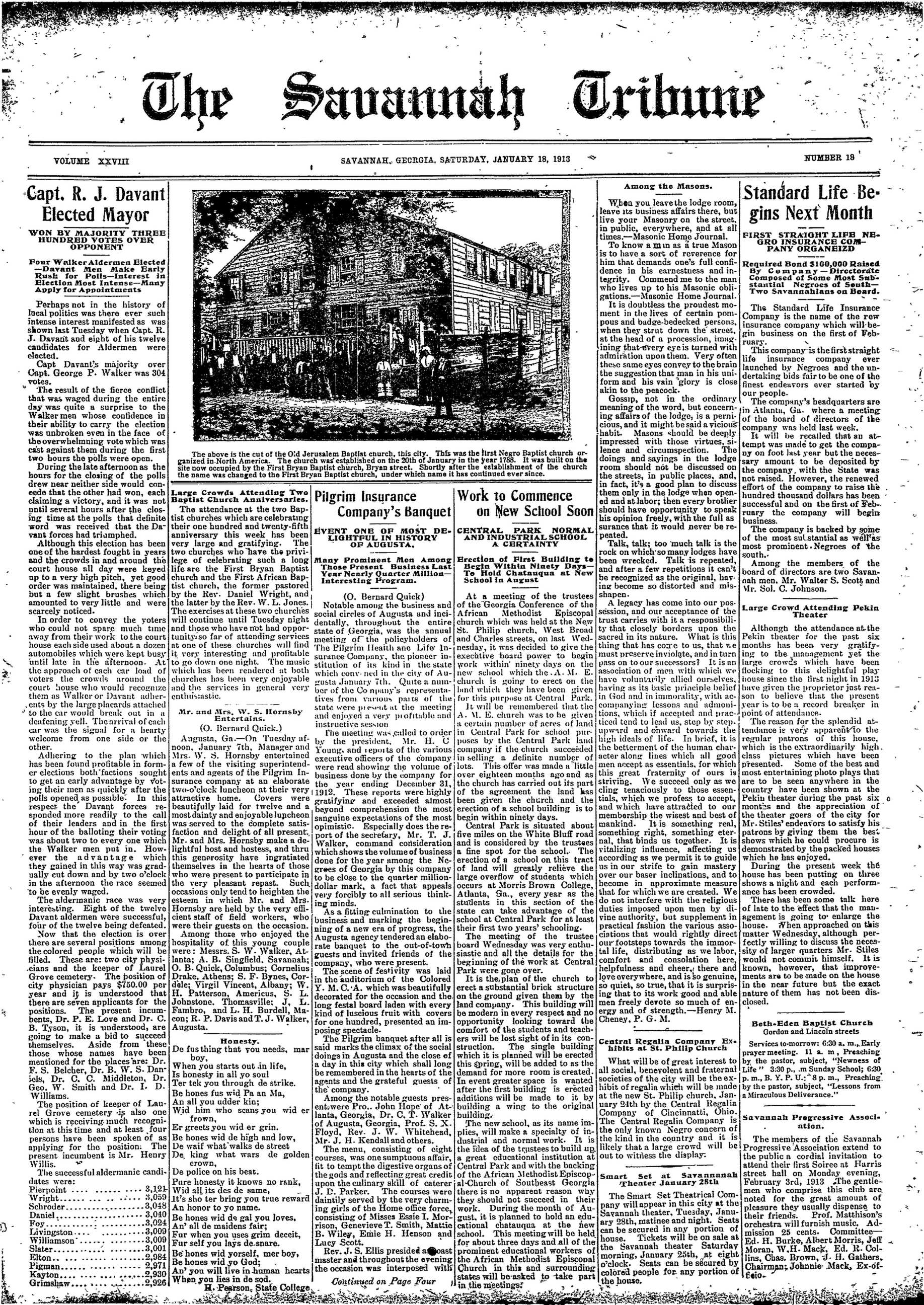
Capt. R. J. Davant Elected Mayor
Capt. R. J. Davant Elected Mayor
WON BY MAJORITY THREE
HUNDRED VOTES OVER
OPPONENT
Four Walker Aldermen Elected
—Davant Men Make Early
Rush for Polls—Interest in
Election Most Intense—Many
Apply for Appointments
Perhaps not in the history of
local politics was there ever such
intense interest manifested as was
shown last Tuesday when Capt. R.
J. Davant and eight of his twelve
candidates for Aldermen were
elected.
Capt Davant's majority over
Capt. George P. Walker was 304
votes.
The result of the fierce conflict that was waged during the entire day was quite a surprise to the Walker men whose confidence in their ability to carry the election was unbroken even in the face of the overwhelming vote which was cast against them during the first two hours the polls were open.
During the late afternoon as the hours for the closing of the polls drew near neither side would concede that the other had won, each claiming a victory, and it was not until several hours after the closing time at the polls that definite word was received that the Davant forces had triumphed.
Although this election has been one of the hardest fought in years and the crowds in and around the court house all day were keyed up to a very high pitch, yet good order was maintained, there being but a few slight brushes which amounted to very little and were scarcely noticed.
In order to convey the voters who could not spare much time away from their work to the court house each side used about a dozen automobiles which were kept busy until late in the afternoon. At the approach of each car load of voters the crowds around the court house who would recognize them as Walker or Davant adherents by the large placards attached to the car would break out in a deafening yell. The arrival of each car was the signal for a hearty welcome from one side or the other.
Adhering to the plan which has been found profitable in former elections both factions sought to get an early advantage by voting their men as quickly after the polls opened as possible. In this respect the Davant forces responded more readily to the call of their leaders and in the first hour of the balloting their voting was about two to every one which the Walker men put in. However the advantage which they gained in this way was gradually cut down and by two o'clock in the afternoon the race seemed to be evenly waged.
The aldermanic race was very interesting. Eight of the twelve Davant aldermen were successful, four of the twelve being defeated.
Now that the election is over there are several positions among the colored people which will be filled. These are: two city physicians and the keeper of Laurel Grove cemetery. The position of city physician pays $750.00 per year and it is understood that there are seven applicants for the positions. The present incumbents, Dr. P. E. Love and Dr. C. B. Tyson, it is understood, are going to make a bid to succeed themselves. Aside from these those whose names have been mentioned for the places are: Dr. F. S. Belcher, Dr. B. W. S. Daniels, Dr. C. C. Middleton, Dr. Geo. W. Smith and Dr. I. D. Williams.
The position of keeper of Laurel Grove cemetery is also one which is receiving much recognition at this time and at least four persons have been spoken of as applying for the position: The present incumbent is Mr. Henry Willis.
The successful aldermanic candidates were:
Pierpoint 3,121
Wright 3,059
Schroder 3,048
Daniel 3,040
Foy 3,024
Livingston 3,009
Williamson 3,009
Slater 3,001
Elton 2,984
Pigman 2,971
Kayton 2,930
Grimshaw 2,926
The Savannah Tribune
THE HISTORY OF THE HOLY TRANSITION
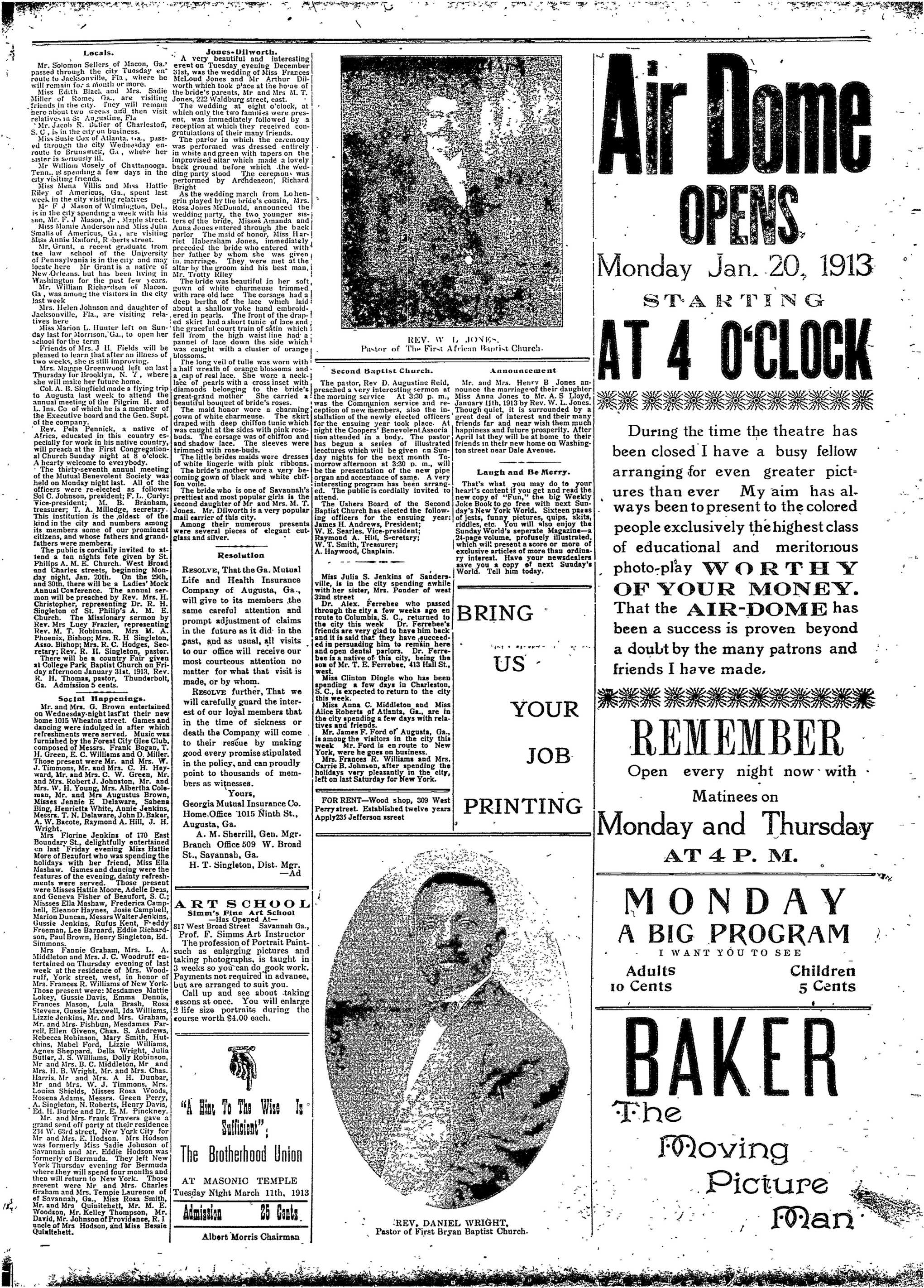
The above is the cut of the Old Jerusalem Baptist church, this city. This was the first Negro Baptist church organized in North America. The church was established on the 20th of January in the year 1788. It was built on the site now occupied by the First Bryan Baptist church, Bryan street. Shortly after the establishment of the church the name was changed to the First Bryan Baptist church, under which name it has continued ever since.
Baptist Church Anniversaries.
The attendance at the two Baptist churches which are celebrating their one hundred and twenty-fifth anniversary this week has been very large and gratifying. The two churches who have the privilege of celebrating such a long life are the First Bryan Baptist church and the First African Baptist church, the former pastored by the Rev. Daniel Wright, and the latter by the Rev. W. L. Jones. The exercises at these two churches will continue until Tuesday night and those who have not had opportunity so far of attending services at one of these churches will find it very interesting and profitable to go down one night. The music which has been rendered at both churches has been very enjoyable and the services in general very enthusiastic.
Mr. and Mrs, W. S. Hornsby Entertains. (O. Bernard Quick.)
Augusta, Ga.—On Tuesday afternoon, January 7, Hornsby, Manager and Mrs. W. S. Hornsby entertained a few of the visiting superintendents and agents of the Pilgrim Insurance company at an elaborate two-o'clock luncheon at their very attractive home. Covers were beautifully laid for twelve and a most dainty and enjoyable lupcheon was served to the complete satisfaction and delight of all present, Mr. and Mrs. Hornsby make a delightful host and hostess, and thus this generosity have ingratiated themselves in the hearts of those who were present to participate in the very pleasant repast. Such occasions only tend to heighten the esteem in which Mr. and Mrs. Hornsby are held by the very efficient staff of field workers, who were their guests on the occasion.
Among those who enjoyed the hospitality of this young couple were: Messrs. S. W. Walker, Atlanta; A. B. Singfield, Savannah; O. B. Quick, Columbus; Cornelius Drake, Athens; S. F. Bynes, Cordale; Virgil Vincent, Albany; W. H. Patterson, Americus, S. L. Johnstone. Thomasville; J, L. Fambro, and L. H. Burdell, Macon; R. P. Davis and T. J. Walker, Augusta.
Honesty.
When you starts out in life,
Is honesty in all yo soul
Ter tek you through de strike.
Be hones fus wid Pa an Ma,
An all you udder kin;
De police on his beat.
Pure honesty it knows no rank,
Wid all its des de same,
It's sho ter bring you true reward
An honor to yo name.
Be hones wid de gal you loves,
An' all de maidens fair;
Fur when you uses grim deceit,
Fur self you lays de snare.
Be hones wid yorself, mer boy,
Be hones wid yo God;
An' you will live in human hearts
When you lies in de sod.
SAVANNAH, GECRGIA, SATURDAY, JANUARY 18, 1913
EVENT ONE OF MOST DELIGHTFUL IN HISTORY OF AUGUSTA.
Many Prominent Men Among Those Present Business Last Year Nearly Quarter Million—Interesting Program.
(O. Bernard Quick)
Notable among the business and social circles of Augusta and incidentally, throughout the entire state of Georgia, was the annual meeting of the policyholders of The Pilgrim Health and Life Insurance Company, the pioneer institution of its kind in the state which convened in the city of Augusta January 7th. Quite a number of the Company's representatives from various parts of the state were present at the meeting and enjoyed a very profitable and instructive session
The meeting was called to order by the president, Mr. H. C Young, and reports of the various executive officers of the company were read showing the volume of business done by the company for the year ending December 31, 1912. These reports were highly gratifying and exceeded almost beyond comprehension the most sanguine expectations of the most optimistic. Especially does the report of the secretary, Mr. T. J. Walker, command consideration which shows the volume of business done for the year among the Negrees of Georgia by this company to be close to the quarter million-dollar mark, a fact that appeals very forcibly to all serious thinking minds.
As a fitting culmination to the business and marking the beginning of a new era of progress, the Augusta agency tendered an elaborate banquet to the out-of-town guests and invited friends of the company, who were present.
The scene of festivity was laid in the auditorium of the Colored Y. M. C. A. which was beautifully decorated for the occasion and the long festal board laden with every kind of luscious fruit with covers for one hundred, presented an imposing spectacle.
The Pilgrim banquet after all is said marks the climax of the social doings in Augusta and the close of a day in this city which shall long be remembered in the hearts of the agents and the grateful guests of the company.
Among the notable guests present were Pro.. John Hope of Atlanta, Georgia, Dr. C, T. Walker of Augusta, Georgia, Prof. S. X. Floyd, Rev. J. W. Whitehead, Mr. J. H. Kendall and others.
The menu, consisting of eight courses, was one sumptuous affair, fit to tempt the digestive organs of the gods and reflecting great credit upon the culinary skill of caterer J. D. Parker. The courses were daintily served by the very charming girls of the Home office force, consisting of Misses Essie I. Morrison, Genevieve T. Smith, Mattie B. Wiley, Emie H. Henson and Lucy Scott.
Rev. J. S. Ellis presided a coast master and throughout the evening the occasion was interposed with
Continued on Page Four
Work to Commence on New School Soon
CENTRAL PARK NORMAL AND INDUSTRIAL SCHOOL A CERTAINTY
Brection of First Building to Begin Within Ninety Days—To Hold Chatauqua at New School in August
At a meeting of the trustees of the Georgia Conference of the African Methodist Episcopal church which was held at the New St. Philip church, West Broad and Charles streets, on last Wednesday, it was decided to give the executive board power to begin work within ninety days on the new school which the A.M. E. church is going to erect on the land which they have been given for this purpose at Central Park.
It will be remembered that the A. M. E. church was to be given a certain number of acres of land in Central Park for school purposes by the Central Park land company if the church succeeded in selling a definite number of lots. This offer was made a little over eighteen months ago and as the church has carried out its part of the agreement the land has been given the church and the erection of a school building is to begin within ninety days.
Central Park is situated about five miles on the White Bluff road and is considered by the trustees a fine spot for the school. The erection of a school on this tract of land will greatly relieve the large overflow of students which occurs at Morris Brown College, Atlanta, Ga., every year as the students in this section of the state can take advantage of the school at Central Park for at least their first two years' schooling. The meeting of the trustee board Wednesday was very enthusiastic and all the details for the beginning of the work at Central Park were gone over.
It is the plan of the church to erect a substantial brick structure on the ground given them by the land company. This building will be modern in every respect and no opportunity looking toward the comfort of the students and teachers will be lost sight of in its construction. The single building which it is planned will be erected this spring, will be added to as the demand for more room is created. In event greater space is wanted after the first building is erected additions will be made to it by building a wing to the original building.
The new school, as its name implies, will make a specialty of industrial and normal work. It is the idea of the trustees to build up a great educational institution at Central Park and with the backing of the African Methodist Episcopal-Church of Southeast Georgia there is no apparent reason why they should not succeed in their work. During the month of August, it is planned to hold an educational chataqua at the new school. This meeting will be held for about three days and all of the prominent educational workers of the African Methodist Episcopal Church in this and surrounding states will be asked to take part in the meetings.
Among the Masons.
When you leave the lodge room, leave its business affairs there, but live your Masonry on the street, in public, everywhere, and at all times.—Masonic Home Journal.
To know a man as a true Mason is to have a sort of reverence for him that demands one's full confidence in his earnestness and integrity. Commend me to the man who lives up to his Masonic obligations.—Masonic Home Journal. It is doubtless the proudest moment in the lives of certain pompous and badge-bedecked persons, when they strut down the street, at the head of a procession, imagining that every eye is turned with admiration upon them. Very often these same eyes convey to the brain the suggestion that man in his uniform and his vain glory is close akin to the peacock.
Gossip, not in the ordinary meaning of the word, but concerning affairs of the lodge, is a pernicious, and it might be said a vicious habit. Masons should be deeply impressed with those virtues, silence and circumspection. The doings and sayings in the lodge room should not be discussed on the streets, in public places, and, in fact, it's a good plan to discuss them only in the lodge when opened and at labor; then every brother should have opportunity to speak his opinion freely, with the full as surance that it would never be repented.
Talk, talk; too much talk is the rock on which so many lodges have been wrecked. Talk is repeated, and after a few repetitions it can't be recognized as the original, having become so distorted and misshapen.
A legacy has come into our possession, and our acceptance of the trust carries with it a responsibility that closely borders upon the sacred in its nature. What is this thing that has come to us, that we must preserve inviolate, and in turn pass on to our successors? It is an association of men with which we have voluntarily allied ourselves, having as its basic principle belief in God and in immorality, with accompanying lessons and admonitions, which if accepted and practiced tend to lead us, step by step upward and onward towards the high ideals of life. In brief, it is the betterment of the human character along lines which all good men accept as essentials, for which this great fraternity of ours is striving. We succeed only as we cling tenaciously to those essentials, which we profess to accept, and which have attracted to our membership the wisest and best of mankind. It is something real, something right, something eternal, that binds us together. It is vitalizing influence, affecting us according as we permit it to guide us in our strife to gain mastery over our baser inclinations, and to become in approximate measure that for which we are created. We do not interfere with the religious duties imposed upon men by divine authority, but supplement in practical fashion the various associations that would rightly direct our footsteps towards the immortal life, distributing as we labor, comfort and consolation here, helpfulness and cheer, there and love everywhere, and is so genuine, so quiet, so true, that it is surprising that to its work good and able men freely devote so much of energy and of strength.—Henry M. Cheney, P. G. M.
Central Regalia Company Exhibits at St. Philip Church
What will be of great interest to all social, benevolent and fraternal societies of the city will be the exhibit of regalia which will be made at the new St. Philip church, January 24th by the Central Regalia Company of Cincinnati, Ohio. The Central Regalia Company is the only known Negro concern of the kind in the country and it is likely that a large crowd will be out to witness the display:
Smart Set at Savannahanah
Theater January 28th
The Smart Set Theatrical Company will appear in this city at the Savannah theater, Tuesday, January 28th, matinee and night. Seats can be secured in any portion of house. Tickets will be on sale at the Savannah theater Saturday morning, January 25th, at eight o'clock. Seats can be secured by colored people for any portion of the house.
NUMBER 18
Standard Life Begins Next Month
Standard Life Begins Next Month
FIRST STRAIGHT LIFE NEGRO INSURANCE COMPANY ORGANEIZD
Required Bond $100,000 Raised By Company - Directorate Composed of Some Most Substantial Negroes of South- Two Savannahans on Board.
The Standard Life Insurance Company is the name of the new insurance company which will begin business on the first of February.
This company is the first straight life insurance company ever launched by Negroes and the undertaking bids fair to be one of the finest endeavors ever started by our people.
The company's headquarters are in Atlanta, Ga. where a meeting of the board of directors of the company was held last week. It will be recalled that an attempt was made to get the company on foot last year but the necessary amount to be deposited by the company, with the State was not raised. However, the renewed effort of the company to raise the hundred thousand dollars has been successful and on the first of February the company will begin business. The company is backed by some of the most substantial as well as most prominent. Negroes of the south. Among the members of the board of directors are two Savanah men, Mr. Walter S. Scott and Mr. Sol. C. Johnson.
Large Crowd Attending Pekin Theater
Although the attendance at the Pekin theater for the past six months has been very gratifying to the management yet the large crowds which have been flocking to this delightful play house since the first night in 1913 have given the proprietor just reason to believe that the present year is to be a record breaker in point of attendance.
The reason for the splendid attendance is very apparent to the regular patrons of this house, which is the extraordinarily high class pictures which have been presented. Some of the best and most entertaining photo plays that are to be seen anywhere in the country have been shown at the Pekin theater during the past six monts and the appreciation of the theater goers of the city for Mr. Stiles' endeavors to satisfy his patrons by giving them the best shows which he could procure is demonstrated by the packed houses which he has enjoyed.
During the present week the house has been putting on three shows a night and each performance has been crowded.
There has been some talk here of late to the effect that the management is going to enlarge the house. When approached on this matter Wednesday, although perfectly willing to discuss the necessity of larger quarters Mr. Stiles would not commit himself. It is known, however, that improvements are to be made on the house in the near future but the exact nature of them has not been disclosed.
Beth-Eden Baptist Church Gordon and Lincoln streets
Services to-morrow: 6:30 a. m., Early prayer meeting. 11 a. m., Preaching by the pastor, subject, "Newness of Life" 3:30 p., m Sunday School; 6:30 p., m. B. Y. P. U." 8 p., Preaching by the pastor, subject, "Lessons from a Miraculous Deliverance."
Savannah Progressive Association.
The members of the Savannah Progressive Association extend to the public a cordial invitation to attend their first Soirée at Harris street hall on Monday evening, February 3rd, 1913. The gentlemen who comprise this club are noted for the great amount of pleasure they usually dispense to their friends. Prof. Matthison's orchestra will furnish music. Admission 25 cents. Committee—Ed. H. Burke, Albert Morris, Jeff Moran, W.H. Mack, Ed. R. Collins, Chas. Brown, J. H. Gathers, Chairman; Johnnie Mack, Ex-officio.
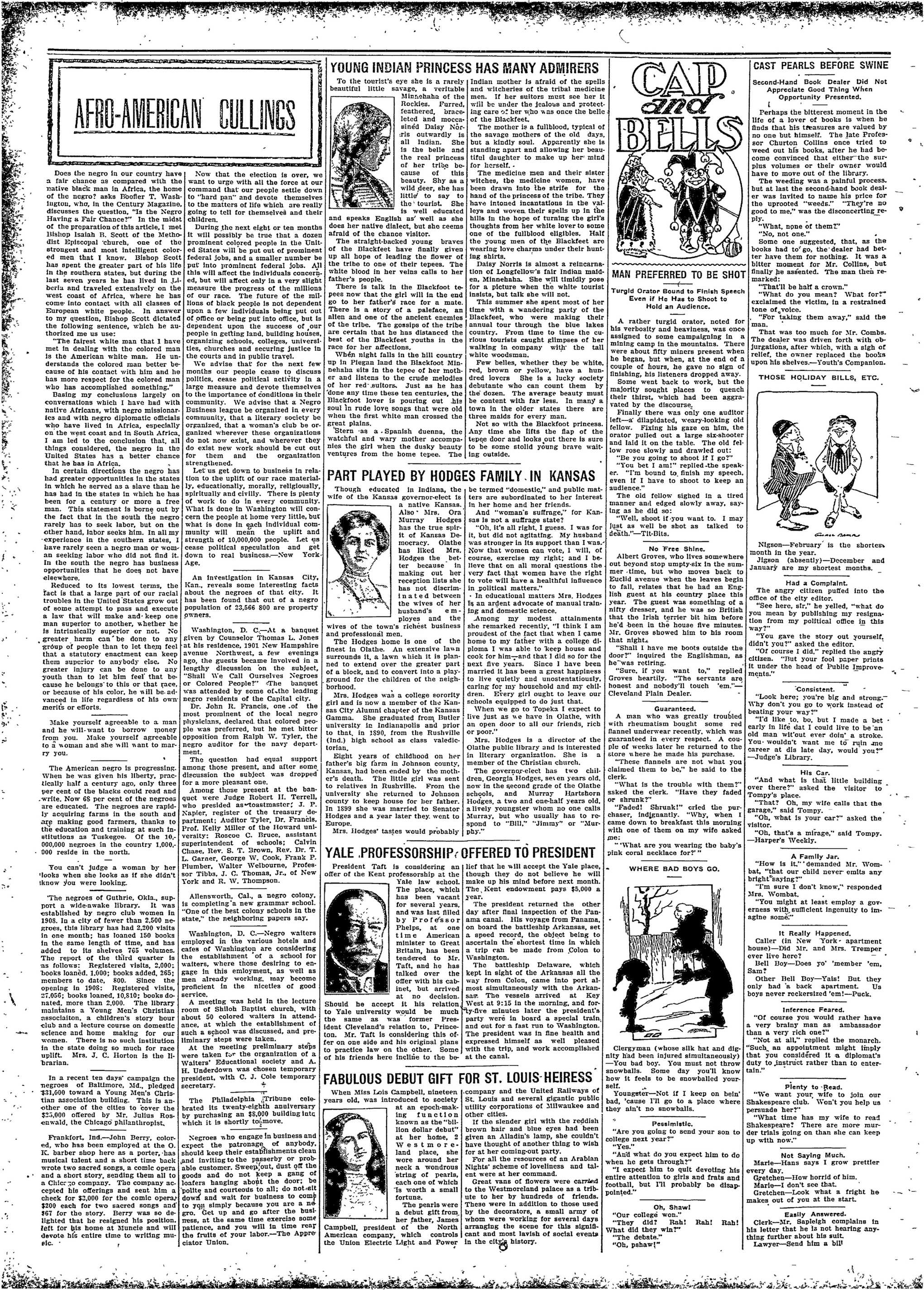
AFRO-AMERICAN CULLINGS
Does the negro in our country have a fair chance as compared with the native black man in Africa, the home of the negro? asks Boofer T. Washington, who, in the Century Magazine, discusses the question, "Is the Negro Having a Fair Chance?" In the midst of the preparation of this article, I met Bishop Isaiah B. Scott of the Methodist Episcopal church, one of the strongest and most intelligent colored men that I know. Bishop Scott has spent the greater part of his life in the southern states, but during the last seven years he has lived in Liberia and traveled extensively on the west coast of Africa, where he has come into contact with all classes of European white people. In answer to my question, Bishop Scott dictated the following sentence, which he authorized me us use:
"The fairest white man that I have met in dealing with the colored man is the American white man. He understands the colored man better because of his contact with him and he has more respect for the colored man who has accomplished something."
Basing my conclusions largely on conversations which I have had with native Africans, with negro missionaries and with negro diplomatic officials who have lived in Africa, especially on the west coast and in South Africa, I am led to the conclusion that, all things considered, the negro in the United States has a better chance that he has in Africa.
In certain directions the negro has had greater opportunities in the states in which he served as a slave than he has had in the states in which he has been for a century or more a free man. This statement is borne out by the fact that in the south the negro rarely has to seek labor, but on the other hand, labor seeks him. In all my experience in the southern states, I have rarely seen a negro man or woman seeking labor who did not find it. In the south the negro has business opportunities that he does not have elsewhere.
Reduced to its lowest terms, the fact is that a large part of our racial troubles in the United States grow out of some attempt to pass and execute a law that will make and keep one man superior to another, whether he is intrinsically superior or not. No greater harm can be done to any group of people than to let them feel that a statutory enactment can keep them superior to anybody else. No greater injury can be done to any youth than to let him feel that because he belongs to this or that race, or because of his color, he will be advanced in life regardless of his own merits or efforts.
Make yourself agreeable to a man and he will want to borrow money from you. Make yourself agreeable to a woman and she will want to marry you.
The American negro is progressing. When he was given his liberty, practically half a century ago, only three per cent of the blacks could read and write. Now 68 per cent of the negroes are educated. The negroes are rapidly acquiring farms in the south and are making good farmers, thanks to the education and training at such institutions as Tuskegee. Of the 10,000,000 negroes in the country 1,000,000 reside in the north.
You can't judge a woman by her looks when she looks as if she didn't know you were looking.
The negroes of Guthrie, Okla., support a wide-awake library. It was established by negro club women in 1908. In a city of fewer than 2,500 negroes, this library has had 2,200 books in one month; has loaned 150 books in the same length of time, and has added to its shelves 765 volumes. The report of the third quarter is as follows: Registered visits, 2,000; books loaned, 1,000; books added, 265; members to date, 800. Since the opening in 1908: Registered visits, 27,056; books loaned, 10,810; books donated, more than 2,000. The library maintains a Young Men's Christian association, a children's story hour club and a lecture course on domestic science and home making for our women. There is no such institution in the state doing so much for race uplift. Mrs. J. C. Horton is the librarian.
In a recent ten days' campaign the negroes of Baltimore, Md., pledged $21,000 toward a Young Men's Christian association building. This is another one of the cities to cover the $25,000 offered by Mr. Julius Rosenwald, the Chicago philanthropist.
Frankfort, Ind.—John Berry, colored, who has been employed at the O. K. barber shop here as a porter, has musical talent and a short time back wrote two sacred songs, a comic opera and a short story, sending them all to a Chicago company. The company accepted his offerings and sent him a check for $3,000 for the comic opera $200 for two sacred songs and $67 for the story. Berry was so delighted that he resigned his position, left for his home at Muncie and will devote his entire time to writing music.
Now that the election is over, we want to urge with all the force at our command that our people settle down to "hard pan" and devote themselves to the matters of life which are really going to tell for themselves and their children.
During the next eight or ten months it will possibly be true that a dozen prominent colored people in the United States will be put out of prominent federal jobs, and a smaller number be put into prominent federal jobs. All this will affect the individuals concerned, but will affect only in a very slight measure the progress of the millions of our race. The future of the millions of black people is not dependent upon a few individuals being put out of office or being put into office, but is dependent upon the success of our people in getting land, building houses, organizing schools, colleges, universities, churches and securing justice in the courts and in public travel.
We advise that for the next few months our people cease to discuss politics, cease political activity in a large measure and devote themselves to the importance of conditions in their community. We advise that a Negro Business league be organized in every community, that a literary society be organized, that a woman's club be organized wherever these organizations do not now exist, and wherever they do exist new work should be cut out for them and the organization strengthened.
Let us get down to business in relation to the uplift of our race materially, educationally, morally, religiously, spiritually and civilly. There is plenty of work to do in every community. What is done in Washington will concern the people at home very little, but what is done in each individual community will mean the uplift and strength of 10,000,000 people. Let us cease political speculation and get down to real business.—New York Age.
An investigation in Kansas City, Kan., reveals some interesting facts about the negroes of that city. It has been found that out of a negro population of 23,566 800 are property owners.
Washington, D. C.-At a banquet given by Counselor Thomas L. Jones at his residence, 1901 New Hampshire avenue Northwest, a few evenings ago, the guests became involved in a lengthy discussion on the subject, "Shall We Call Ourselves Negroes or Colored People?" The banquet was attended by some of the leading negro residents of the Capital city. Dr. John R. Francis, one of the most prominent of the local negro physicians, declared that colored people was preferred, but he met bitter opposition from Ralph W. Tyler, the negro auditor for the navy department. The question had equal support among those present, and after some discussion the subject was dropped for a more pleasant one.
Among those present at the banquet were Judge Robert H. Terrell, who presided as toastmaster; J. P. Napler, register of the treasury department; Auditor Tyler, Dr. Francis, Prof. Kelly Miller of the Howard university: Roscoe C. Bruce, assistant superintendent of schools; Calvin Chase, Rev. S. T. Brown, Rev. Dr. T. L. Garner, George W. Cook, Frank P. Plumber, Walter Welbourne, Professor Tibbs, J. C. Thomas, Jr., of New York and R. W. Thompson.
Allensworth, Cal., a negro colony, is completing a new grammar school. "One of the best colony schools in the state," the neighboring papers say.
Washington, D. C.—Negro waiters employed in the various hotels and cafes of Washington are considering the establishment of a school for waiters, where those desiring to engage in this employment, as well as men already working, may become proficient in the niceties of good service.
A meeting was held in the lecture room of Shilloh Baptist church, with about 50 colored waiters in attendance, at which the establishment of such a school was discussed, and preliminary steps were taken.
At the meeting preliminary steps were taken for the organization of a Walters' Educational society and A. H. Underdown was chosen temporary president, with C. J. Cole temporary secretary.
The Philadelphia Tribune celebrated its twenty-eighth anniversary by purchasing an $8,000 building into which it is shortly to move.
Negroes who engage in business and expect the patronage of anybody, should keep their establishments clean and inviting to the passerby or probable customer. Sweep out, dust off the goods and do not keep a gang of loafers hanging about the door; be polite and courteous to all; do not sit down and wait for business to come to you simply because you are a negro. Get up and go after the business, at the same time exercise some patience, and you will in time rear the fruits of your labor.—The Appreciator Union.
YOUNG INDIAN PRINCESS HAS MANY ADMIRERS
PART PLAYED BY HODGES FAMILY IN KANSAS
YALE . PROFESSORSHIP . OFFERED TO PRESIDENT
FABULOUS DEBUT GIFT FOR ST. LOUIS-HEIRESS
To the tourist's eye she is a rarely beautiful little sayage, a veritable
vage, a veritable Minneaha of the Rockies. Furred, feathered, braceleted and moccasiné Daisy Norris outwardly is all Indian. She is the belle and the real princess of her tribe because of this beauty. Shy as a wild deer, she has little to say to the tourist. She is well educated
Minhana of the Rockies. Furred, feathered, braceleted and moccasined Daisy Norris outwardly is all Indian. She is the belle and the real princess of her tribe because of this beauty. Shy as a wild deer, she has little to say to the tourist. She is well educated and speaks English as' well as she does her native dialect, but she seems afraid of the chance visitor.
The straight-backed young braves of the Blackfeet have finally given up all hope of leading the flower of the tribe to one of their tepees. The white blood in her veins calls to her father's people. There is talk in the Blackfoot tepees now that the girl will in the end go to her father's race for a mate. There is a story of a paleface, an allen and one of the ancient enemies of the tribe. The gossips of the tribe are certain that he has distanced the best of the Blackfeet youths in the race for her affections.
When night falls in the hill country up in Piegan land the Blackfoot Minnehaha sites in the tepee of her mother and listens to the crude melodies of her red-suitors. Just as he has 'done any time these ten centuries, the Blackfoot lover is pouring out his soul in rude love songs that were old when the first white man crossed the great plains.
'Stern as a Spanish duenna, the watchful and wary mother accompanies the girl when the dusky beauty ventures from the home tepee. The
Though educated in Indiana, the wife of the Kansas governor-elect is a native Kansas. Also Mrs. Ora Murray Hodges has the true spirit of Kansas Democracy. Olathe has liked Mrs. Hodges the better because in making out her reception lists she has not discriminated between the wives of her husband's employees and the
a native Kansas. Also Mrs. Ora Murray Hodges has the true splirit of Kansas Democracy. Olathe has liked Mrs. Hodges the better because in making out her reception lists she has not discriminated between the wives of her husband's employees and the wives of the town's richest business and professional men.
The Hodges home is one of the finest in Olathe. An extensive lawn surrounds it, a lawn which it is planned to extend over the greater part of a block, and to convert into a playground for the children of the neighborhood.
Mrs. Hodges was a college sorority girl and is now a member of the Kansas City Alumni chapter of the Kansas Gamma. She graduated from Butler university in Indianapolis and prior to that, in 1890, from the Rushville (Ind.) high school as class valedictorian.
Eight years of childhood on her father's big farm in Johnson county, Kansas, had been ended by the mother's death. The little girl was sent to relatives in Rushville. From the university she returned to Johnson county to keep house for her father. In 1899 she was married to Senator Hodges and a year later they went to Europe. Mrs. Hodges' tastes would probably
President Taft is considering an offer of the Kent professorship at the
yaleorship at the
yale law school.
The place, which
has been vacant
for several years,
and was last filled
by Professor
Phelps, at one
time American
minister to Great
Britain, has been
tendered to Mr.
Taft, and he has
talked over the
offer with his
cabinet, but arrived
at no decision.
The place, which has been vacant for several years, and was last filled by Professor Phelps, at one time American minister to Great Britain, has been tendered to Mr. Taft, and he has talked over the offer with his cabinet, but arrived at no decision.
Should he accept it his relation to Yale university would be much the same as was former President Cleveland's relation to, Princeton. Mr. Taft is considering this offer on one side and his original plans to practice law on the other. Some of his friends here incline to the be-
When Miss Lois Campbell, nineteen years old, was introduced to society at an epoch-making function known as the "billion dollar debut" at her home, 2 Westmoreland place, she wore around her neck a wondrous string of pearls, each one of which is worth a small fortune.
P
The pearls were a debut gift from her father, James of the North which controls Light and Power
Campbell, president American company. the Union Electric
Indian mother is afraid of the spells and witcheries of the tribal medicine men. If her sultors must see her it will be under the jealous and protecting care of her who was once the belle of the Blackfeet.
The mother is a fullblood, typical of the savage mothers of the old days, but a kindly soul. Apparently she is standing apart and allowing her beautiful daughter to make up her mind for herself.
The medicine men and their sister witches, the medicine women, have been drawn into the strife for the hand of the princess of the tribe. They have intooed incantations in the valleys and woven their spells up in the hills in the hope of turning the girl's thoughts from her white lover to some one of the fullblood eligibles. Half the young men of the Blackfeet are wearing love charms under their hunting shirts.
Daisy Norris is almost a reincarnation of Longfellow's fair Indian maiden, Minnehaha. She will timidly pose for a picture when the white tourist insists, but talk she will not.
This summer she spent most of her time with a wandering party of the Blackfeet, who were making their annual tour through the blue lakes country. From time to time the curious tourists caught glimpses of her walking in company with the tall white woodsman.
Few belles, whether they be white, red, brown or yellow, have a hundred lovers. She is a lucky society debutante who can count them by the dozen. The average beauty must be content with far less. In many a town in the older states there are three maids for every man.
Not so with the Blackfoot princess. Any time she lifts the flap of the tepee door and looks out there is sure to be some stolid young brave waiting outside.
be termed "domestic," and public matters are subordinated to her interest in her home and her friends.
And "woman's suffrage," for Kansas is not a suffrage state?
"Oh, it's all right, I guess. I was for it, but did not agitating. My husband was stronger in its support than I was. Now that women can vote, I will, of course, exercise my right; and I believe that on all moral questions the very fact that women have the right to vote will have a healthful influence in political matters."
· In educational matters Mrs. Hodges is an ardent advocate of manual training and domestic science.
Among my modest attainments she remarked recently, "I think I am proudest of the fact that when I came home to my father with a college diploma I was able to keep house and cook for him—and that I did so for the next five years. Since I have been married it has been a great happiness to live quietly and unostentatiously, caring for my household and my children. Every girl ought to leave our schools equipped to do just that. When we go to Topeka I expect to live just as we have in Olathe, with an open door to all our friends, rich or poor." Mrs. Hodges is a director of the Olathe public library and is interested in literary organization. She is a member of the Christian church.
The governor-elect has two children, Georgia Hodges, seven years old, now in the second grade of the Olathe schools, and Murray Hartshorn Hodges, a two and one-half years old, a lively youngster whom no one calls Murray, but who usually has to respond to "Bill," "Jimmy" or "Murphy."
lief that he will accept the Yale place, though they do not believe he will make up his mind before next month. The Kent endowment pays $5,000 a year. The president returned the other day after final inspection of the Panama canal. His voyage from Panama, on board the battleship Arkansas, set a speed record, the object being to ascertain the shortest time in which a trip can be made from Colon to Washington.
The battleship Delaware, which kept in sight of the Arkansas all the way from Colon, came into port almost simultaneously with the Arkansas. The vessels arrived at Key West at 9:15 in the morning, and forty-five minutes later the president's party were in board a special train and out for a fast run to Washington. The president was in fine health and expressed himself as well pleased with the trip, and work accomplished at the canal.
company and the United Railways of St. Louis and several gigantic public utility corporations of Millwaukee and other cities. If the slender girl with the reddish brown hair and blue eyes had been given an Alladin's lamp, she couldn't have thought of another thing to wish for at her coming-out party. For all the resources of an Arabian Nights' scheme of loveliness and talent were at her command. Great vans of flowers were carried to the Westmoreland palace as a tribute to her by hundreds of friends. These were in addition to those used by the decorators, a small army of whom were working for several days arranging the scene for this significant and most lavish of social events in the city's history.
CAP
and
BELLS
Turgid Orator Bound to Finish Speech
Even if He Has to Shoot to
Hold an Audience.
A rather turgid orator, noted for
his verbosity and heaviness, was once
assigned to some campaigning in a
mining camp in the mountains. There
were about fifty miners present when
he began, but when, at the end of a
couple of hours, he gave no sign of
finishing, his listeners dropped away.
Some went back to work, but the
majority sought places to quench
their thirst, which had been aggravated
by the discourse.
Finally there was only one auditor
left—a dilapidated, weary-looking old
fellow. Fixing his gaze on him, the
orator pulled out a large six-shooter
and laid it on the table. The old
fellow rose slowly and drawled out:
"You bet I am!" replied the speaker. "I'm bound to finish my speech, even if I have to shoot to keep an audience." The old follow sighed in a tired manner and edged slowly away, saying as he did so: "Well, shoot if you want to. I may just as well be shot as talked to death." -Tit-Bits.
No Free Shine.
Albert Groves, who lives somewhere out beyond stop umpty-six in the summer time, but who moves back to Euclid avenue when the leaves begin to fall, relates that he had an English guest at his country place this year. The guest was something of a nifty dresser, and he was so British that the Irish terrier bit him before he'd been in the house five minutes. Mr. Groves showed him to his room that night.
"Shall I have me boots outside the door?" inquired the Englishman, as he was retiring.
"Sure, if you want to," replied Groves heartily. "The servants are honest and nobody'll touch 'em."—Cleveland Plain Dealer.
Guaranteed.
A man who was greatly troubled with rheumatism bought some red flannel underwear recently, which was guaranteed in every respect. A couple of weeks later he returned to the store where he made his purchase.
"These flannels are not what you claimed them to be," he said to the clerk.
"What is the trouble with them?" asked the clerk. "Have they faded or shrunk?"
"Faded! Shrunk!" cried the purchaser, indignantly. "Why, when I came down to breakfast this morning with one of them on my wife asked me:
"What are you wearing the baby's pink coral necklace for?"
WHERE BAD BOYS GO.
Clergyman (whose silk hat and dignity had been injured simultaneously)
—You bad boy. You must not throw snowballs. Some day you'll know how it feels to be snowballed yourself.
Youngster—Not if I keep on bein' bad, 'cause I'll go to a place where they ain't no snowballs.
Pessimistlc.
"Are you going to send your son to college next year?"
"Yes."
"And what do you expect him to do when he gets through?"
"I expect him to quit devoting his entire attention to girls and frats and football, but I'll probably be disappointed."
Oh. Shaw!
"Our college won."
"They did? Rah! Rah! Rah! Rah!
What did they win?"
"The debate."
"Oh, pshaw!"
Second-Hand Book Dealer Did Not Appreciate Good Thing When Opportunity Presented.
Perhaps the bitterest moment in the life of a lover of books is when he finds that his treasures are valued by no one but himself. The late Professor Churton Collins once tried to weed out his books, after he had become convinced that either the surplus volumes or their owner would have to move out of the library.
The weeding was a painful process, but at last the second-hand book dealer was invited to name his price for the uprooted "weeds." "They're no good to me," was the disconcerting reply.
"What, none of them?"
"No, not one."
Some one suggested, that, as the books had to go, the dealer had better have them for nothing. It was a bitter moment for Mr. Collins, but finally he assented. The man then remarked:
"That'll be half a crown."
"What do you mean? What for?" exclaimed the victim, in a restrained tone of voice.
"For taking them away," said the man.
That was too much for Mr. Combs. The dealer was driven forth with objurgations, after which, with a sigh of relief, the owner replaced the books upon his shelves.—Youth's Companion.
THOSE HOLIDAY BILLS, ETC.
Nigson—February is the shortest month in the year.
Jigson (absently)—December and January are my shortest months.
Had a Complaint
The angry citizen puffed into the office of the city editor.
"See here, sr," he yelled, "what do you mean by publishing my resignation from my political office in this way?"
"You gave the story out yourself, didn't you?" asked the editor.
"Of course I did," replied the angry citizen. "But your fool paper prints it under the head of Public Improvements."
Consistent.
"Look here; you're big and strong. Why don't you go to work instead of beating your way?" "I'd like to, bo, but I made a bet early in life dat I could live to be an old man wilt out ever doin' a stroke. You wouldn't want me to ruin me career at ds late day, would you?" —Judge's Library.
"And what is that little building over there?" asked the visitor to Tompy's place.
"That? Oh, my wife calls that the garage," said Tompy.
"Oh, what is your car?" asked the visitor.
"Oh, that's a mirage," said Tompy.—Harper's Weekly.
A Family Jar.
"How is it," demanded Mr. Wombat, "that our child never emits any bright saying?"
"I'm sure I don't know," responded Mrs. Wombat.
"You might at least employ a governess with sufficient ingenuity to imagine some."
Caller (in New York- apartment house)—Did Mr. and Mrs. Tremper ever live here?
Bell Boy—Does yo' 'member 'cm, Sam?
Other Bell Boy—Yals! But they only had 'a back apartment. Us boys never reckersized 'em!—Puck.
Inference Feared.
"Of course you would rather have a very brainy man as ambassador than a very rich one?"
"Not at all," replied the monarch.
"Such an appointment might imply that you considered it a diplomat's duty to instruct rather than to entertain."
Plenty to Read.
"We want your wife to join our Shakespeare club. Won't you help us persuade her?"
"What time has my wife to read Shakespeare? There are more murder trials going on than she can keep up with now."
Not Saying Much.
Marle—Hans says I grow prettier every day.
Gretchen—How horrid of him.
Marle—I don't see that.
Gretchen—Look what a fright he makes out of you at the start.
Easily Answered.
Clerk—Mr. Sapleigh complains in his letter that he is not hearing anything further about his suit.
Lawyer—Send him a bill
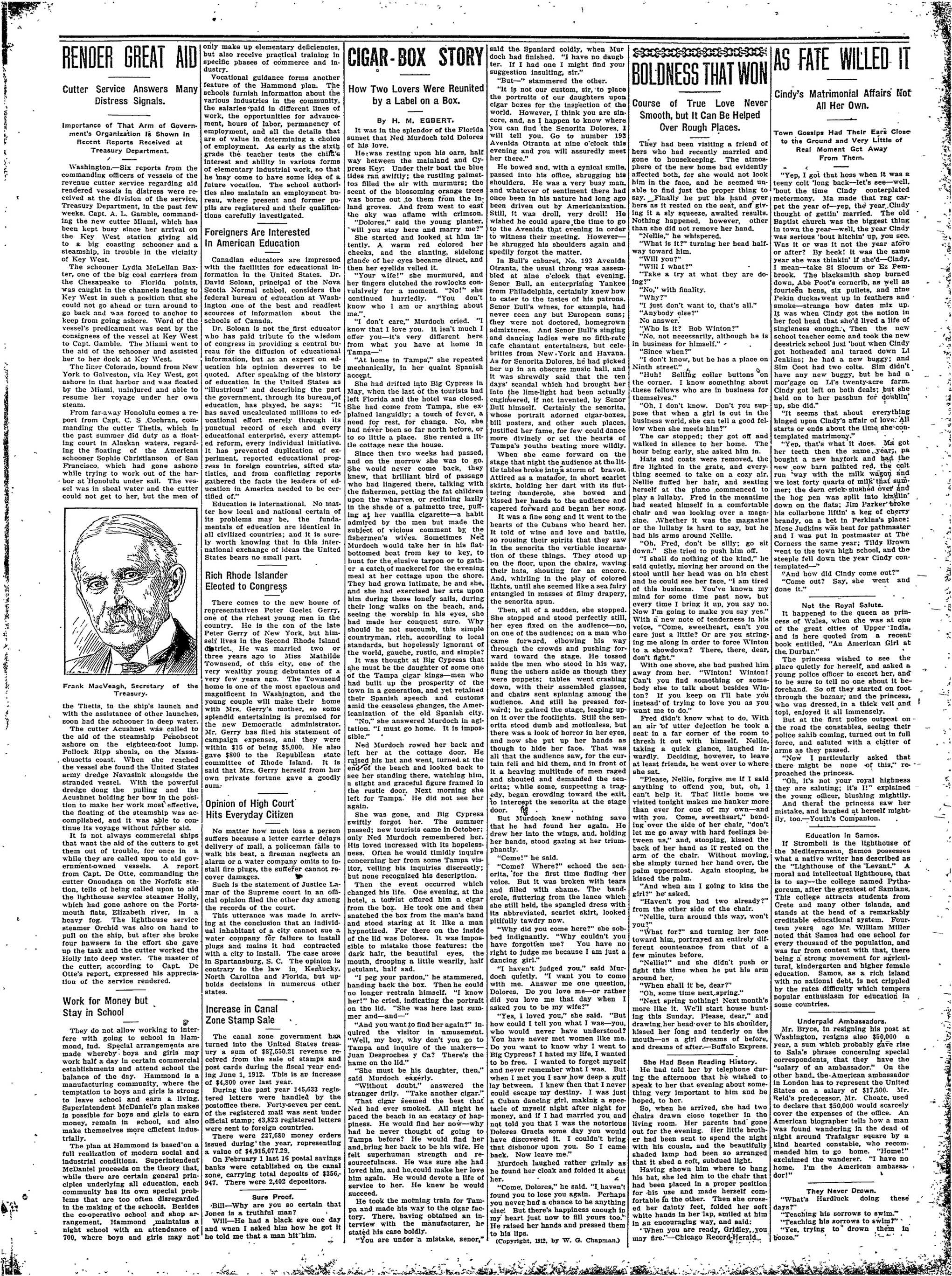
RENDER GREAT AID
Cutter Service Answers Many Distress Signals.
Importance of That Arm of Government's Organization Is Shown in Recent Reports Received at Treasury Department.
Washington.—Six reports from the commanding officers of vessels of the revenue cutter service regarding aid rendered vessels in distress were received at the division of the service, Treasury Department, in the past few weeks. Capt. A. L. Gamble, commanding the new cutter Miami, which has been kept busy since her arrival on the Key West station giving aid to a big coasting schooner and a steamship, in trouble in the vicinity of Key West.
The schooner Lydia McLellan Baxter, one of the big coal carriers from the Chesapeake to Florida points, was caught in the channels leading to Key West in such a position that she could not go ahead or turn around to go back and was forced to anchor to keep from going ashore. Word of the vessel's predicament was sent by the consignee of the vessel at Key West to Capt. Gamble. The Miami went to the aid of the schooner and assisted her to her dock at Key West.
---
The liner Colorado, bound from New York to Galveston, via Key West, got ashore in that harbor and was floated by the Miami, uninjured and able to resume her voyage under her own steam.
From far away Honolulu comes a report from Capt. C. S. Cochran, commanding the cutter Thetls, which in the past summer did duty as a floating court in Alaskan waters, regarding the floating of the American schooner Sophie Christianson of San Francisco, which had gone ashore while trying to work out of the harbor at Honolulu under sail. The vessel was in shoal water and the cutter could not get to her, but the men of
A. H.
Frank MacVeagh, Secretary of the Treasury.
the Thetis, in the ship's launch and with the assistance of other launches, soon had the schooner in deep water.
sooth and the schoobet in deep water.
The cutter Acushnet was called to the aid of the steamship Penobscot ashore on the eighteen-foot lump. Pollock Ripp shoals, on the Massachusetts coast. When she reached the vessel she found the United States army dredge Navaslnk alongside the stranded vessel. With the powerful dredge dong the pulling and the Acushnet holding her bow in the position to make her work most effective, the floating of the steamship was accomplished, and it was able to continue its voyage without further aid.
It is not always commercial ships that want the aid of the cutters to get them out of trouble, for once in a while they are called upon to aid government-owned vessels. A report from Capt. De Otte, commanding the cutter Onondaga on the Norfolk station, tells of being called upon to aid the lighthouse service steamer Holly, which had gone ashore on the Portsmouth flats, Elizabeth river, in a heavy fog. The lighthouse service steamer Orchid was also on hand to pull on the ship, but after she broke four hawers in the effort she gave up the task and the cutter worked the Holly into deep water. The master of the cutter, according to Capt. De Otte's report, expressed his appreciation of the service rendered.
Work for Money but Stay in School
They do not allow working to interfere with going to school in Hammond, Ind. Special arrangements are made whereby boys and girls may work half a day in certain commercial establishments and attend school the balance of the day. Hammond is a manufacturing community, where the temptation to boys and girls is strong to leave school and earn a living. Superintendent McDaniel's plan makes is possible for boys and girls to earn money, remain in school, and also make themselves more efficient industrially.
The plan at Hammond is based on a full realization of modern social and industrial conditions. Superintendent McDaniel proceeds on the theory that, while there are certain general principles underlying all education, each community has its own special problems that are too often disregarded in the making of the schools. Besides the co-operative school and shop arrangement, Hammond maintains a night school with an attendance of 700, where boys and girls may not
only make up elementary deficiencies, but also receive practical training in specific phases of commerce and industry. Vocational guidance forms another feature of the Hammond plan. The schools furnish information about the various industries in the community, the salaries paid in different lines of work, the opportunities for advancement, hours of labor, permanency of employment, and all the details that are of value in determining a choice of employment. As early as the sixth grade the teacher tests the child's interest and ability in various forms of elementary industrial work, so that he may come to have some idea of a future vocation. The school authorities also maintain an employment bureau, where present and former pupils are registered and their qualifications carefully investigated.
Foreigners Are Interested In American Education
Canadian educators are impressed with the facilities for educational information in the United States. Dr. David Soloan, principal of the Nova Scotia Normal school, considers the federal bureau of education at Washington one of the best and readiest sources of information about the schools of Canada.
Dr. Soloan is not the first educator who has paid tribute to the wisdom of congress in providing a central bureau for the diffusion of educational information, but as an expert on education his opinion deserves to be quoted. After speaking of the history of education in the United States as "illustrious" and describing the part the government, through its bureau, of education, has played, he says: "It has saved uncalculated millions to educational effort merely through its punctual record of each and every educational enterprise, every attempted reform, every individual initiative. It has prevented duplication of experiment, reported educational progress in foreign countries, slifted statistics, and from conflicting reports gathered the facts the leaders of education in America needed to be certified of."
Education is international. No matter how local and national certain of its problems may be, the fundamentals of education are identical in all civilized countries; and it is surely worth knowing that in this international exchange of ideas the United States bears no small part.
Rich Rhode Islander Elected to Congress
There comes to the new house of representatives Peter Goelet Gerry, one of the richest young men in the country. He is the son of the late Peter Gerry of New York, but himself lives in the Second Rhode Island district. He was married two or three years ago to Miss Mathilde Townsend, of this city, one of the very wealthy young debutantes of a very few years ago. The Townsend home is one of the most spacious and magnificent in Washington, and the young couple will make their home with Mrs. Gerry's mother, so some splendid entertaining is promised for the new Democratic administrator. Mr. Gerry has filed his statement of campaign expenses, and they were within $15 of being $5,000. He also gave $800 to the Republican state committee of Rhode Island. It is said that Mrs. Gerry herself from her own private fortune gave a goodly sum.
Opinion of High Court Hits Everyday Citizen
No matter how much loss a person suffers because a letter carrier delays delivery of mail, a policeman fails to walk his beat, a fireman neglects an alarm or a water company omits to install fire plugs, the sufferer cannot recover damages.
Such is the statement of Justice Lamar of the Supreme court in an official opinion filed the other day among the records of the court.
This utterance was made in arriving at the conclusion that an individual inhabitant of a city cannot sue a water company for failure to install plugs and mains it had contracted with a city to install. The case arose in Spartansburg, S. C. The opinion is contrary to the law in, Kentucky, North Carolina and Florida, but upholds decisions in numerous other states.
Increase in Canal Zone Stamp Sale
The canal zone government has turned into the United States treasury a sum of $87,550.21 revenue received from the sale of stamps and post cards during the fiscal year ending June 1, 1912. This is an increase of $4,800 over last year.
During the past year 145,633 registered letters were handled by the postoffice there. Forty-seven per cent. of the registered mail was sent under official stamp; 43,823 registered letters were sent to foreign countries.
There were 227,680 money orders issued during the year, representing a value of $4,915,077.29.
On February 1 last 16 postal savings banks were established on the canal zone, carrying total deposits of $356,947. There were 2,402 depositors.
Sure Proof.
Bill—Why are you so certain that Jones is a truthful man?
Will—He had a black eye one day and when I asked him how he got it he told me that a man hit him.
CIGAR-BOX STORY
CIGAR-BOX STORY
How Two Lovers Were Reunited by a Label on a Box.
By H. M. EGBERT:
It was in the splendor of the Florida sunset that Ned Murdoch told Dolores of his love.
He was resting upon his oars, half way between the mainland and Cypress Key. Under their boat the blue tides ran swiftly; the rustling palmetto filled the air with murmurs; the scent of the blossoming orange trees was borne out to them from the inland groves. And from west to east the sky was afame with crimson.
"Dolores," said the young planter, "will you stay here and marry me?" She started and looked at him intently. A warm red colored her cheeks, and the slanting, sidelong glance of her eyes became direct, and then her eyelids velled it.
"Your wife!" she murmured, and her fingers clutched the rowlocks convulsively for a moment. "No!" she continued hurriedly. "You don't know who I am or anything about me."
"I don't care," Murdoch cried. "I know that I love you. It isn't much I offer you—it's very different here from what you have at home in Tampa—"
"At home in Tampa," she repeated mechanically, in her quaint Spanish accept.
She had drifted into Big Cypress in May, when the last of the tourists had left Florida and the hotel was closed. She had come from Tampa, she explained languidly; a touch of fever, a need for rest, for change. No, she had never been so far north before, or to so little a place. She rented a little cottage near the house.
Since then two weeks had passed, and on the morrow she was to go. She would never come back, they knew, that brilliant bird of passage who had lingered there, talking with the fishermen, petting the fat children upon the wharves, or reclining lazily in the shade of a palmetto tree, puffing at her vanilla cigarette—a habit admired by the men but made the subject of vicious comment by the fishermen's wives. Sometimes Ned Murdoch would take her in his flat-bottomed boat from key to key, to hunt for the elusive tarpon or to gather a catch of mackerel for the evening meal at her cottage upon the shore. They had grown intimate, he and she, and she had exercised her arts upon him during those lonely sails, during their long walks on the beach, and, seeing the worship in his eyes, she had made her conquest sure. Why should he not succumb, this simple countryman, rich, according to local standards, but hopelessly ignorant of the world, gauche, rustic, and simple?
It was thought at Big Cypress that she must be the daughter of some one of the Tampa cigar kings—men who had built up the prosperity of the town in a generation, and yet retained their Spanish speech and customs amid the ceaseless changes, the Americanization of the old Spanish city. "No," she answered Murdoch in agitation. "I must go home. It is impossible."
Ned Murdoch rowed her back and left her at the cottage door. He raised his hat and, turned at the end of the beach and looked back to see her standing there, watching him, a slight and graceful figure framed in the rustic door. Next morning she left for Tampa. He did not see her again.
She was gone, and Big Cypress swiftly forgot her. The summer passed; new tourists came in October; only Ned Murdoch remembered her. His loved increased with its hopelessness. Often he would timidly inquire concerning her from some Tampa visitor, veiling his inquiries discreetly; but none recognized his description.
Then the event occurred which changed his life. One evening, at the hotel, a tourist offered him a cigar from the box. He took one and then snatched the box from the man's hand and stood staring at it like a man hypnotized. For there on the inside of the lid was Dolores. It was impossible to mistake those features: the dark hair, the beautiful eyes, the mouth, drooping a little wearily, half petulant, half sad.
"I peg your pardon," he stammered, handing back the box. Then he could no longer restrain himself. "I know her!" he cried, indicating the portrait on the lid. "She was here last summer and—and—"
"And you want to find her again?" inquired the visitor in amusement. "Well, my boy, why don't you go to Tampa and inquire of the makers—Juan Desproches y Ca? There's the hame on the lid."
"She must be his daughter, then," said Murdoch eagerly.
"Without doubt, answered the stranger drily. "Take another cigar." That cigar seemed the best that Ned had ever smoked. All night he paced the beach in an ecstacy of happiness. He would find her now—why had he never thought of going to Tampa before? He would find her and, bring her back to his wife. He felt superhuman strength and resourcefulness. He was sure she had loved him, and he, could make her love him again. He would devote a life of service to her. He knew he would succeed.
He took the morning train for Tampa and made his way to the cigar factory. There, having obtained an interview with the manufacturer, he statied his case boldly.
"You are under a mistake, senor."
sald the Spaniard coldly, when Mur doch had finished. "I have no dugbter. If I had one I might find your suggestion insulting, sir." "But—" stammered the other.
"It is not our custom, sir, to place the portraits of our daughters upon cigar boxes for the inspection of the world. However, I think you are sincere, and, as I happen to know where you can find the Senorita Dolores. I will tell you. Go to number 193 Avenida Otranta at nine o'clock this evening and you will assuredly meet her there."
He bowed and, with a cynical smile, passed into his office, shrugging his shoulders. He was a very busy man, and whatever of sentiment there had once been in his nature had long ago been driven out by Americanization. Still, it was droll, very droll! He wished he could spare, the time to go to the Avenida that evening in order to witness their meeting. However—he shrugged his shoulders again and speedily forgot the matter.
In Bull's cabaret, No. 193 Avenida Otranta, the usual throng was assembled at nine o'clock that evening. Senor Bull, an enterprising Yankee from Philadelphia, certainly knew how to cater to the tastes of his patrons. Senor Bull's wines, for example, had never seen any but European suns; they were not doctored, homegrown admixtures. And Senor Bull's singing and dancing ladies were no fifth-rate cactant entertainers, but celebrities from New York and Havana. As for Senorita Dolores, he had picked her up in an obscure music hall, and it was shrewdly said that the ten days' scandal which had brought her into the lime-light had been actually engineered, if not invented, by Senor Bull himself. Certainly the senorita, whose portrait adorned cigar-boxes, bill posters, and other such places, justified her fame, for few could dance more divinely or set the hearts of Tampa's youths beating more wildly.
When she came forward on the stage that night the audience at the little tables broke into a storm of bravos. Attired as a matador, in short scarlet skirts, holding her dart with its fluttering banderole, she bowed and kissed her hands to the audience and capered forward and began her song. It was a fine song and it went to the hearts of the Cubans who heard her. It told of wine and love and battle, so rousing their spirits that they saw in the senorita the vertible incarnation of these things. They stood up on the floor, upon the chairs, waving their hats, shouting for an encore. And, whirling in the play of colored lights, until she seemed like a sea fairy entangled in masses of filmy drapery, the senorita spun.
Then, all of a sudden, she stopped. She stopped and stood perfectly still, her eyes fixed on the audience—no, on one of the audience; on a man who came forward, elbowing his way through the crowds and pushing forward toward the stage. He tossed aside the men who stood in his way, flung the ushers aside as though they were puppets; tables went crashing down, with their assembled glasses, and chairs sent spinning among the audience. And still he pressed forward; he gained the stage, leaping upon it over the footlights. Still the senorita stood dumb and motionless, but there was a look of horror in her eyes, and now she put up her hands as though to hide her face. That was all that the audience saw, for the curtain fell and hid them, and in front of it a heaving multitude of men raged and shouted and demanded the senorita; while some, suspecting a tragedy, began crowding toward the exit, to intercept the senorita at the stage door.
But Murdoch knew nothing save that he had found her again. He drew her into the wings, and, holding her hands, stood gazing at her triumphantly.
"Come!" he said.
"Come? Where?" echoed the senorita, for the first time finding her voice. But it was broken with tears and filled with shame. The banderole, fluttering from the lance which she still held, the spangled dress with its abbreviated, scarlet skirt, looked pitifully tawdry now.
"Why did you come here?" she sobbed indignantly. "Why couldn't you have forgotten me? You have no right to judge me because I am just a dancing girl."
"I haven't judged you," said Murdoch quietly. "I want you to come with me. Answer me one question, Dolores. Do you love me—or rather did you love me that day when I asked you to be my wife?"
"Yes, I loved you," she said. "But how could I tell you what I was—you, who would never have understood? You have never met women like me. Do you want to know why I went to Big Cypress? I hated my life, I wanted to be free. I wanted to forget myself and never remember what I was. But when I met you I saw how deep a gulf lay between. I knew then that I never could escape my destiny. I was just a Cuban dancing girl, making a spectacle of myself night after night for money, and if I had married you and not told you that I was the notorious Dolores Gracia some day you would have discovered it. I couldn't bring that dishonor upon you. So I came back. Now leave me." Murdoch laughed rather grimly as he found her cloak and folded it about her.
"Come, Dolores," he said. "I haven't found you to lose you again. Perhaps you never had a chance to be anything else. But there's happiness enough in my heart just now to fill yours too." He raised her hands and pressed them to his lips. (Copyright, 1912, by W. G. Chapman.)
Course of True Love Never Smooth, but It Can Be Helped Over Rough Places.
They had been visiting a friend of hers who had recently married and gone to housekeeping. The atmosphere of the new home had evidently affected both, for she would not look him in the face, and he seemed unable to find just the proper thing to say. Finally he put his hand over hers as it rested on the seat, and giving it a sly squeeze, awaited results. Nothing happened, however, other than she did not remove her hand. "No! You should."
"Nellie," he whispered.
"What is it?" turning her head half way toward him.
"Will you?"
"Will I what?"
"Take a try at what they are doing?"
"No," with finality.
"Why?"
"I just don't want to, that's all."
"Anybody else?"
No answer.
"Who is it? Bob Winton?"
"No, not necessarily, although he is in business for himself."
"Since when?"
"I don't know, but he has a place on Ninth street."
"Huh! Selling collar buttons on the corner. I know something about these fellows who are in business for themselves."
"Oh, I don't know. Don't you suppose that when a girl is out in the business world, she can tell a good fellow when she meets him?"
The car stopped; they got off and walked in silence to her home. The hour being early, she asked him in.
Hats and coats were removed, the fire lighted in the grate, and everything seemed to take on a cozy air. Nellie fluffed her hair, and seating herself at the piano commenced to play a lullaby. Fred in the meantime had seated himself in a comfortable chair and was looking over a magazine. Whether it was the magazine or the lullaby is hard to say, but he had his arms around Nellie.
"Oh, Fred, don't be silly; go sit down." She tried to push him off.
"I shall do nothing of the kind," he said quietly, moving her around on the stool until her head was on his chest and he could see her face. "I am tired of this business. You've known my mind for some time past now, but every time I bring it up, you say no. Now I'm going to make you say yes." With a new note of tenderness in his voice, "Come, sweetheart, can't you care just a little? Or are you stringing me along in order to force Winton to a showdown? There, there, dear, don't fight."
With one shove, she had pushed him away from her. "Winton! Winton! Can't you find something or somebody else to talk about besides Winton? If you keep on I'll hate you instead of trying to love you as you want me to do."
Fred didn't know what to do. With an air 'b of utter dejection he took a seat in a far corner of the room to thresh it out with himself. Nellie, taking a quick glance, laughed inwardly. Deciding, however, to leave at least friends, he went over to where she sat.
"Please, Nellie, forgive me if I said anything to offend you, but, oh, I can't help it. That little home we visited tonight makes me hanker more than ever for one of my own—and with you. Come, sweetheart," bending over the side of her chair, "don't let me go away with hard feelings between us," and, stooping, kissed the back of her hand as it rested on the arm of the chair. Without moving, she simply turned her hand over, the palm uppermost. Again stooping, he kissed the palm.
"And when am I going to kiss the girl?" he asked.
"Haven't you had two already?" from the other side of the chair. "Nellie, turn around this way, won't you?" "What for?" and turning her face toward him, portrayed an entirely different countenance from that of a few minutes before. "Nellie!" and she didn't push or fight this time when he put his arm around her. "When shall it be, dear?" "Oh, some time next. spring." "Next spring nothing! Next month's more like it. We'll start house hunting this Sunday. Please, dear," and drawing her head over to his shoulder, kissed her long and tenderly on the mouth—as a girl dreams of before, and dreams of after. Buffalo Express.
She Had Been Reading History.
She Had Been Reading History.
He had told her by telephone during the afternoon that he wished to speak to her that evening about something very important to him and he hoped, to her.
So, when he arrived, she had two chairs drawn close together in the living room. Her parents had gone out for the evening. Her little brother had been sent to spend the night with his cousin, and the beautifully shaded lamp had been so arranged that it shed a soft, subdued light.
Having shown him where to hang his hat, she led him to the chair that had been placed in a proper position for his use and made herself comfortable in the other. Then she crossed her dainty feet, folded her soft white hands in her lap, smiled at him in an encouraging way, and said:
"When you are ready, Gridley, you may fire."—Chicago Record-Herald.
AS FATE WILLED IT
Cindy's Matrimonial Affairs Not All Her Own.
Town Gossips Had Their Ears Close to the Ground and Very Little of Real Moment Gct Away
"Yep, I got that hoss when it was a teeny colt 'long back'—let's see—well, 'bout the time Cindy conterplated metermony. Ma made that rag carpet the year of—yep, the year, Cindy thought of gettin' married. The old Baptist church was the biggest thing in town the year—well, the year Cindy was serious 'bout hitchin' up, you see. Was it or it was not the year afores or after? By heck! it was the same year she was thinkin' if she'd—Cindy, I mean—take Si Slocum or Ez Pembrook. The blacksmith shop burned down. Abe Foot's corncrib, as well as fourteen hens, six pullets, and nine Pekin ducks, went up in feathers and smoke—strange how dates up. It was when Cindy got the mix in her foot head that she'd lived a life of singleness enough. Then the new school teacher come and took the new deestrick school just 'bout when Cindy got hotheaded and tarned down Li Jenkins; he had a new buggy; and Slim Coot had two colts. Sim didn't have any new buggy, but he had a mor'gage on Li's twenty-acre farm. Cindy got left on both deals; but she held on to her passhun for doublin' up, she did."
"It seems that about everything hinged upon Cindy's affair of love. All starts or ends about the time she contemplated matrimony."
"Yep, that's what it does. Ma got her teeth then the same, year, pa bought a new hayfork and had the new cow barn paletted red, the colt run 'way with the milk wagon and we lost forty quarts of milk that summer; the dern crick slushed over and the hog pen was split into kindlin' down on the flats; Jim Parker broke his collarbone littin' a keg of cherry brandy, on a bet in Perkins's place; Mose Judkins was beat for pathmaster and I was put in postmaster at The Corners the same year; Tildy Brown went to the town high school, and the steepele fell down the year Cindy contemplated—"
"And how did Cindy come out?"
"Come out? Say, she went and done it."
Not the Royal Salute.
It happened to the queen as princess of Wales, when she was at one of the great cities of Upper India, and is here quoted from a recent book entitled, "An American Girl at the Durbar."
The princess wished to see the place quietly for herself, and asked a young police officer to escort her, and to be sure to tell no one about it beforehand. So off they started on foot through the bazaar; and the princess, who was dressed, in a thick vell and topi, enjoyed it all immensely.
But at the first police outpost on the road the constables, seeing their police sahib coming, turned in full force, and saluted with a clatter of arms as they passed.
"Now I particularly asked that there might be none of this," reproached the princess.
"Oh, it's not your royal highness they are saluting; it's I!" explained the young officer, blushing mightily.
Education in Samos.
If Stromboli is the lighthouse of the Mediterranean, Samos possesses what a native writer has described as the "Lighthouse of the Levant." A moral and intellectual lighthouse, that is to say—the college named Pythagoreum, after the greatest of Samians. This college attracts students from Crete and many other islands, and stands at the head of a remarkably creditable educational system. Fourteen years ago Mr. William Miller noted that Samos had one school for every thousand of the population, and was far from content with that, there being a strong movement for agricultural, kindergarten and higher female education. Samos, as a rich island with no national debt, is not crippled by the rates difficulty which tempers popular enthusiasm for education in some countries.
Underpaid Ambassadors.
Mr. Bryce, in resigning his post at Washington, resigns also $50,000 a year, a sum which probably gave rise to Sala's phrase concerning special correspondents, that they have the "salary of an ambassador." On the other hand, the American ambassador in London has to represent the United States on a salary of $17,500. Mr. Reid's predecessor, Mr. Choate, used to declare that $50,000 would scarcely cover the expenses of the office. An American biographer tells how a man was found wandering in the dead of night around Trafalgar square by a kind hearted constable, who recommended him to go home. "Home!" exclaimed the wanderer. "I have no home. I'm the American ambassador!"
They Never Drown.
"What's Hardluck doing these days?"
"Teaching his sorrows to swim."
"Teaching his sorrows to swim!"
"Yes, trying to drown them in booze."
Remittance must be made by Express or Post Office Money Order, or Registered Letter. Advertising rates given on application.
Entered at the Post Office at Savannah, Ga., as Second-Class mail matter.
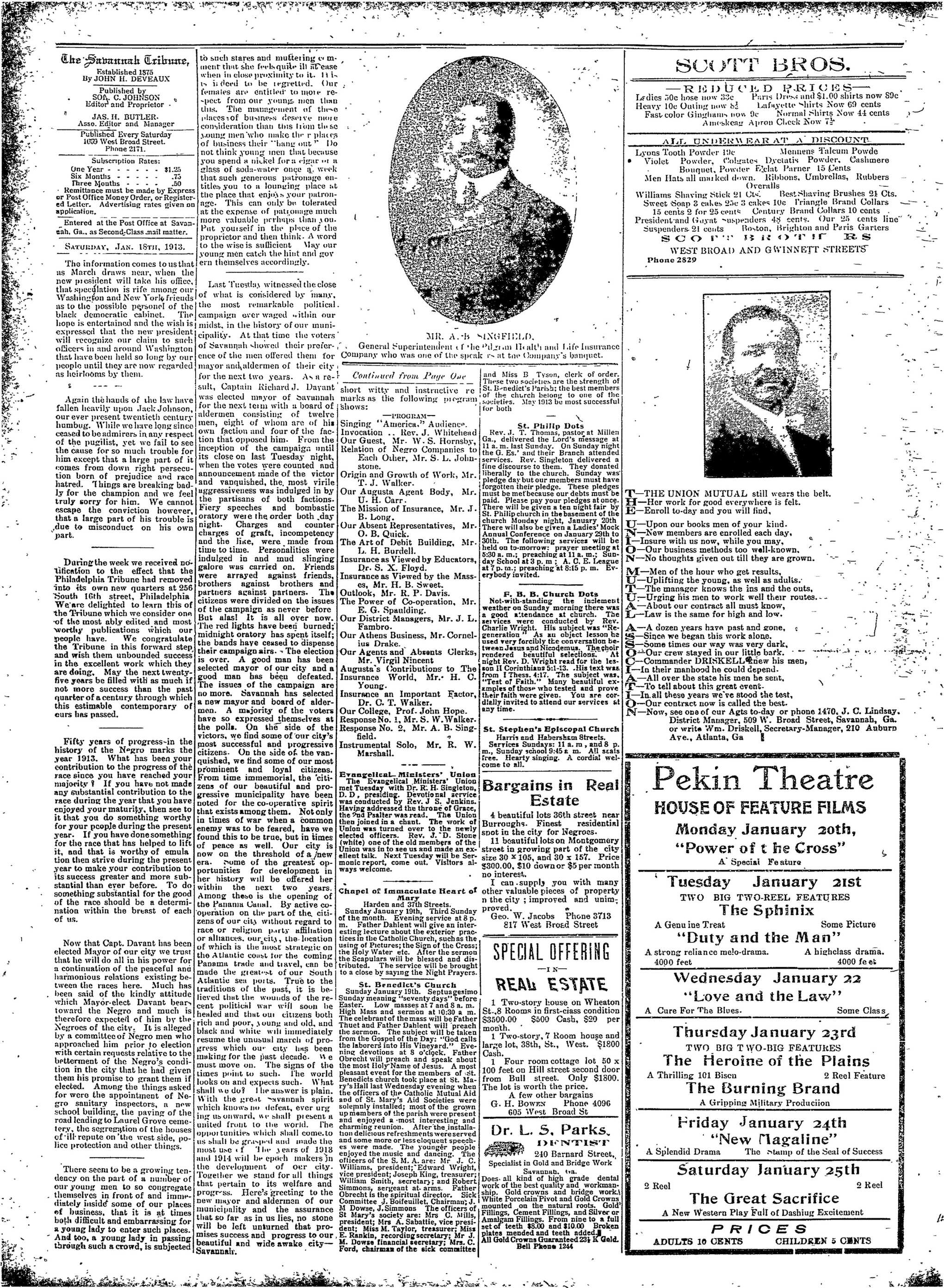
SATURDAY, JAN. 18TH, 1913.
The information comes to us that as March draws near, when the new president will take his office, that speculation is rife among our Washington and New York friends as to the possible personel of the black democratic cabinet. The hope is entertained and the wish is expressed that the new president will recognize our claim to such officers in and around Washington that have been held so long by our people until they are now regarded as heirlooms by them.
$ ... ...
Again the hands of the law have fallen heavily upon Jack Johnson, our ever present twentieth century humbug. While we have long since ceased to be admirers in any respect of the pugilist, yet we fail to see the cause for so much trouble for him except that a large part of it comes from down right persecution born of prejudice and race hatred. Things are breaking badly for the champion and we feel truly sorry for him. We cannot escape the conviction however, that a large part of his trouble is due to misconduct on his own part.
During the week we received notification to the effect that the Philadelphia Tribune had removed into its own new quarters at 256 South 16th street, Philadelphia. We are delighted to learn this of the Tribune which we consider one of the most ably edited and most worthy publications which our people have. We congratulate the Tribune in this forward step and wish them unbounded success in the excellent work which they are doing. May the next twenty-five years be filled with as much if not more success than the past quarter of a century through which this estimable contemporary of curs has passed.
Fifty years of progress in the history of the Negro marks the year 1913. What has been your contribution to the progress of the race since you have reached your majority? If you have not made any substantial contribution to the race during the year that you have enjoyed your maturity, then see to it that you do something worthy for your people during the present year. If you have done something for the race that has helped to lift it, and that is worthy of emulation then strive during the present year to make your contribution to its success greater and more substantial than ever before. To do something substantial for the good of the race should be a determination within the breast of each of us.
Now that Capt. Davant has been elected Mayor of our city we trust that he will do all in his power for a continuation of the peaceful and harmonious relations existing between the races here. Much has been said of the kindly attitude which Mayor-elect Davant beartoward the Negro and much is therefore expected of him by the Negroes of the city. It is alleged by a committee of Negro men who approached him prior to election with certain requests relative to the betterment of the Negro's condition in the city that he had given them his promise to grant them if elected. Among the things asked for were the appointment of Negro sanitary inspectors, a new school building, the paving of the road leading to Laurel Grove cemetery, the segregation of the houses of ill-repute on 'the west side, police protection and other things.
---
There seem to be a growing tendency on the part of a number of our young men to so congregate themselves in front of and immediately inside some of our places of business, that it is at times both difficult and embarrassing for a young lady to enter such places. And too, a young lady in passing through such a crowd, is subjected
to such stares and muttering comment that she feels quite ill because when in close proximity to it. This is deed to be regretted. Our females are entitled to more respect from our young men than this. The management of these places of business deserve more consideration than this from those young men who make their places of business their "hang out". Do not think young men that because you spend a nickel for a cigar or a glass of soda-water once a week that such generous patronage entitles you to a lounging place at the place that enjoys your patronage. This can only be tolerated at the expense of patronage much more valuable perhaps than you. Put yourself in the place of the proprietor and then think. A word to the wise is sufficient. May our young men catch the hint and govern themselves accordingly.
Last Tuesday witnessed the close of what is considered by many, the most remarkable political campaign ever waged within our midst, in the history of our municipality. At that time the voters of Savannah showed their preference of the men offered them for mayor and aldermen of their city for the next two years. As a result, Captain Richard J. Dayant was elected mayor of Savannah for the next term with a board of aldermen consisting of twelve men, eight of whom are of his own faction and four of the faction that opposed him. From the inception of the campaign until its close on last Tuesday night, when the votes were counted and announcement made of the victor and vanquished, the most virile aggressiveness was indulged in by the partisans of both factions. Fiery speeches and bombastic oratory were the order both day night. Charges and counter charges of graft, incompetency and the like, were made from time to time. Personalities were indulged in and mud slinging galore was carried on. Friends were arrayed against friends, brothers against brothers and partners against partners. The citizens were divided on the issues of the campaign as never before. But alas! It is all over now. The red lights have been burned; midnight oratory has spent itself; the bands have ceased to dispense their campaign airs. The election is over. A good man has been selected mayor of our city and a good man has been defeated. The issues of the campaign are no more. Savannah has selected a new mayor and board of aldermen. A majority of the voters have so expressed themselves at the polls. On the side of the victors, we find some of our city's most successful and progressive citizens. On the side of the vanquished, we find some of our most prominent and loyal citizens. From time immemorial, the citizens of our beautiful and progressive municipality have been noted for the co-operative spirit that exists among them. Not only in times of war when a common enemy was to be feared, have we found this to be true, but in times of peace as well. Our city is now on the threshold of a new era. Some of the greatest opportunities for development in her history will be offered her within the next two years. Among these is the opening of the Panama Canal. By active cooperation on the part of the citizens of our city without regard to race or religion party affiliation or alliances, our city, the location of which is the most strategic on the Atlantic coast for the coming Panama trade and travel, can be made the greatest of our South Atlantic sea ports. True to the traditions of the past, it is believed that the wounds of the recent political war will soon be healed and that our citizens both rich and poor, young and old, and black and white will immediately resume the unusual march of progress which our city has been making for the past decade. We must move on. The signs of the times point to such. The world looks on and expects such. What shall we do? The answer is plain. With the great Savannah spirit which knows no defeat, ever urging us onward, we shall present a united front to the world. The opportunities which shall come to us shall be grasped and made the most use of. The years of 1918 and 1914 will be epoch makers in the development of our city. Together we stand for all things that pertain to its welfare and progress. Here's greeting to the new mayor and aldermen of our municipality and the assurance that so far as in us lies, no stone will be left unturned that promises success and progress to our beautiful and wide awake city—Savannah.
MR. J. D. MAYORING
General Superintendent of the Pilgran Health and Life Insurance Company who was one of the speak is at the Company's banquet.
short witty and instructive remarks as the following program shows:
Singing "America." Audience.
Invocation .. Rev. J. Whitehead
Our Guest, Mr. W. S. Hornsby,
Relation of Negro Companies to
Each Other, Mr. S. L. Johnstone.
Origin and Growth of Work, Mr.
T. J. Walker.
Our Augusta Agent Body, Mr.
U. H. Carr.
The Mission of Insurance, Mr. J.
B. Long.
Our Absent Representatives, Mr.
O. B. Quick.
The Art of Debit Building, Mr.
L. H. Burdell.
Insurance as Viewed by Educators,
Dr. S. X. Floyd.
Insurance as Viewed by the Masses,
Mr. H. B. Sweet.
Outlook, Mr. R. P. Davis.
The Power of Co-operation, Mr.
E. G. Spaulding.
Our District Managers, Mr. J. L.
Fambro.
Our Athens Business, Mr. Cornelius Drake.
Our Agents and Absents Clerks,
Mr. Virgil Nincent
Augusta's Contributions to The
Insurance World, Mr. H. C. Young.
Insurance an Important Factor,
Dr. C. T. Walker.
Our College, Prof. John Hope.
Response No. 1, Mr. S. W. Walker.
Response No. 2, Mr. A. B. Singfield.
Instrumental Solo, Mr. R. W. Marshall.
Evangelical Ministers' Union
The Evangelical Ministers' Union met Tuesday with Dr. R. H. Singleton, D. D., presiding. Devotional service was conducted by Rev. J. S. Jenkins. Having addressed the throne of Grace, the 9th Psalter was read. The Union then joined in a chant. The work of Union was turned over to the newly elected officers. Rev. J. D. Stone (white) one of the old members of the Union was in to see us and made an ex-elent talk. Next Tuesday will be Sermonic report, come out. Visitors always welcome.
Chapel of Immaculate Heart of Mary
Harcourt and 10th Streets.
Sunday January 19th, Third Sunday of the month. Evening service at 8 p.m. Father Dahlent will give an interesting lecture about the exterior practices in the Catholic Church, such as the using of Pictures; the Sign of the Cross; the Holy Water etc. After the sermon the Scapulars will be blessed and distributed. The service will be brought to a close by saying the Night Prayers.
St. Benedict's Church
St. Benedict's Church
Sunday January 19th. Septuagesimo
Sunday meaning "seventy days" before
Easter. Low masses at 7 and 8 a.m.
High Mass and sermon at 10:30 a.m.
The celebrant of the mass will be Father
Thuet and Father Dahlent will preach
the sermon. The subject will be taken
from the Gospel of the Day: "God calls
the laborers' into His Vineyard." Evening
devotions at 8 o'clock. Father
Obrecht will preach and speak about
the most Holy Name of Jesus. A most
pleasant event for the members of st.
Benedict's church took place at St. Mary's Hall last Wednesday evening when the officers of the Catholic Mutual Aid and of St. Mary's Aid Societies were
solemnly installed; most of the grown
up members of the parish were present
and enjoyed a most interesting and
charming reunion. After the installation
delicious refreshments were served
and some more or less eloquent speeches were made. The younger people
enjoyed the music and dancing. The officers of the S. M. A. are: Mr J. C.
Williams, president; Edward Wright,
vice president; Joseph King, treasurer;
William Smith, secretary; and Robert
Simmons, sergeant at arms. Father
Obrecht is the spiritual director. Sick
Committee J. Boifeullet, Chairman; J
M Dowse, J. Simmons. The officers of
St Mary's society are: Mrs C. Mills,
president; Mrs A. Sabattie, vice president;
Miss M. Taylor, treasurer; Miss E. Rankin, recording secretary; Mr J. M. Dowse financial secretary; Mrs C. Ford, chairman of the sick committee
and Miss B Tyson, clerk of order. These two societies are the strength of St. B-nedict's Parish; the best members of the church belong to one of the societies. May 1913 be most successful for both
St. Philip Dots
Rev. J. T. Thomas, pastor at Millen Ga., delivered the Lord's message at 11 a.m. last Sunday. On Sunday night the G. Es.' and their Branch attended services. Rev. Singleton delivered a fine discourse to them. They donated liberally to the church. Sunday was pledge day but our members must have forgotten their pledge. These pledges must be met because our debts must be paid. Please pay your pledges at once. There will be given a ten night fair by St. Philip church in the basement of the church Monday night, January 20th There will also be given a Ladies' Mock Annual Conference on January 29th to 30th. The following services will be held on to-morrow: prayer meeting at 5:30 a.m.; preaching at 11 a.m.; Sunday School at 3 p.m.; A. C. E. League at 7 p.m.; preaching at 8:15 p.m. Everybody invited.
F. B. B. Church Dots
M. B. B. Church Dots
Not-withstanding the inclement weather on Sunday morning there was a good attendance at church. The services were conducted by Rev. Charlie Wright. His subject was "Regeneration." As an object lesson he used very forcibly the conversation between Jesus and Nicodemus. The choir rendered beautiful selections. At night Rev. D. Wright read for the lesson II Corinthians 5:1-13. His text was from I Thess. 4:17. The subject was, "Test of Faith." Many beautiful examples of those who tested and prove their faith were given. You are cordially invited to attend our services at any time.
St. Stephen's Episcopal Church
Harris and Hahersham Streets
Harris and Habersham streets.
Services Sundays: 11 a.m, and 8 p.
m., Sunday school: 9:45 a.m. All scals
free. Hearty singing. A cordial welcome
to all.
Bargains in Real Estate
4 beautiful lots 36th street near Burroughs. Finest residential spot in the city for Negroes.
11 beautiful lots on Montgomery street in growing part of the city size 30 x 105, and 30 x 157. Price $300.00, $10 down or $5 per month no interest.
I can supply you with many other valuable pieces of property n the city; improved and unimproved.
Geo. W. Jacobs Phone 3713
817 West Brood Street
SPECIAL OFFERING
REAL ESTATE
1 Two-story house on Wheaton St., 8 Rooms in first-ciass condition $3500.00 $500 Cash, $20 per month.
1 Two-story, 7 Room house and large lot, 38th, St., West, $1800 Cash.
1 Four room cottage lot 50 x 100 feet on Hill street second door from Bull street. Only $1800. The lot is worth the price.
A few other bargains
G. H. BOWEN Phone 4096
605 West Broad St
Does. all kind of high grade dental work of the best quality and workmanship. Gold crowns and bridge work. White Porcelain Pivot and Gold Crowns mounted on the natural roots. Gold Fillings, Cement Fillings, and Silver or Amalgam Fillings. From nine to a full set of teeth $8.00 and $10.00 Broken plates mended and teeth added. All Gold Crowns Guaranteed 23 K Gold. Bell Phone 1244
SCOTT BROS.
SCOTT BROS.
REDUCED PRICES
c hose now 32c Paris Dress and $1.00 shirt
c Outing now 84 Lafayette Shirts Now 6
color Ginghams now 9c Normal Shirts Now
Ameskeag Apron Check Now 72
ALL UNDERWEAR AT A DISCOUNT
Both Powder 19c Mennens Talcum
Powder, Colgates Dyctatis Powder,
Bouquet, Powder Eclat Parner 15 Cents
ats all marked down. Ribbons, Umbrellas,
Overalls
Shaving Stick 21 Cts. Best Shaving Brush
Soap 3 cakes 25c 3 cakes 10c Triangle Bran
nts 2 for 25 cents Century Brand Collars B
brand Gayat suspenders 48 cents. Our 25
ders 21 cents Boston, Brighton and Paris
COFFEE BROTHERS
WEST BROAD AND GWINNETT STREET
2829
REDUCED PRICES
Ladies 50c hose now 32c Paris Dress and $1.00 shirts now 89c
Heavy 10c Outing now 82 Lafayette Shirts Now 69 cents
Fast color Ginghams now 9c Normal Shirts Now 44 cents
Ameskeag Apron Check Now 7½
ALL UNDERWEAR AT A DISCOUNT
Lyons Tooth Powder 19c Mennens Talcum Powde
Violet Powder, Colgates Dyctatis Powder, Cashmere
Bouquet, Powder Eglat Parner 15 Cents
Men Hats all marked down. Ribbons, Umbrellas, Rubbers
Overalls
Williams Shaving Stick 21 Cts. Best Shaving Brushes 21 Cts.
Sweet Soap 3 cakes 25c 3 cakes 10c Triangle Brand Collars
15 cents 2 for 25 cents Century Brand Collars 10 cents
President-and Gayat suspenders 48 cents. Our 25 cents line
Suspenders 21 cents Boston, Brighton and Paris Garters
SCOTT BROTHERS
WEST BROAD AND GWINNETT STREETS
Phone 2829
[Pictorial portrait of a man with a mustache and a suit. The background is black with white dots. The man is facing the camera, and his face is clearly visible. The portrait is a black-and-white image with a grainy texture. There are no visible texts or markings on the image.]]
NION MUTUAL still wears the belt. work for good everywhere is felt. 2o-day and you will find, our books men of your kind. members are enrolled each day. with us now, while you may
T—THE UNION MUTUAL still wears the belt.
H—Her work for good everywhere is felt.
E—Enroll to-day and you will find,
U—Upon our books men of your kind.
N—New members are enrolled each day,
I—Insure with us now, while you may,
O—Our business methods too well-known.
N—No thoughts given out till they are grown.
M—Men of the hour who get results,
U—Uplifting the young, as well as adults.
T—The manager knows the ins and the outs,
U—Urging his men to work well their routes.
A—About our contract all must know,
L—Law is the same for high and low.
A—A dozen years have past and gone,
S—Since we began this work alone.
S—Some times our way was very dark,
O=Our crew stayed in our little bark.
C-Commander DRISKELL new his men,
I-In their manhood he could depend.
A—All over the state his men he sent,
T-To tell about this great event.
I-In all these years we've stood the test,
O-Our contract now is called the best.
w, see one of cur Agts to-day or phone 1470. J. C. Lindsay. District Manager, 509 W. Broad Street, Savannah, Ga. or write Wm. Driskell, Secretary-Manager, 210 Auburn Aye., Atlanta, Ga
Tuesday January 21st
TWO BIG TWO-REEL FEATURES
The Sphinix
Thursday January 23rd
TWO BIG TWO-BIG FEATURES
The Heroine of the Plains
A Thrilling 101 Bison 2 Reel Feature
The Burning Brand
A Gripping Military Produktion
Friday January 24th
"New Magaline"
A Splendid Drama The Stamp of the Seal of Success
Locals.
Mr. Solomon Sellers of Macon, Ga., passed through the city Tuesday enroute to Jacksonville, Fla., where he will remain for a month or more.
Miss Edith Black and Mrs. Sadie Miller of Rome, Ga., are visiting friends in the city. They will remain here about two weeks, and then visit relatives in St. Augustine, Fla.
Mr. Jacob R. Butler of Charleston, S.C. is in the city on business.
Miss Susie Cox of Atlanta, Ga., passed through the city Wednesday enroute to Brunswick, Ga., where her sister is seriously ill.
Mr William Mosely of Chattanooga. Tenn. is spending a few days in the city visiting friends.
Miss Mena Villis and Miss Hattie Riley of Americus, Ga., spent last week in the city visiting relatives
Mr F J Mason of Wilmington, Del., is in the city spending a week with his son, Mr F. J Mason, Jr., Maple street.
Miss Manie Anderson and Miss Julia Smalls of Americus, Ga., are visiting Miss Annie Riaford, Roberts street.
Mr. Grant, a recent graduate from the law school of the University of Pennsylvania is in the city and may locate here. Mr Grant is a native of New Orleans, but has been living in Washington for the past few years.
Mr. William Richardson of Macon, Ga., was among the visitors in the city last week
Mrs. Helen Johnson and daughter of Jacksonville, Fla., are visiting relatives here
Miss Marion L. Hunter left on Sunday last for Morrison, Ga., to open her school for the term
Friends of Mrs. J H. Fields will be pleased to learn that after an illness of two weeks, she is still improving.
Mrs. Maggie Greenwood left on last Thursday for Brooklyn, N. Y., where she will make her future home.
Col. A. B. Singfield made a flying trip to Augusta last week to attend the annual meeting of the Pilgrim H. and L. Ins. Co of which he is a member of the Executive board and the Gen. Supt. of the company.
Rev. Pela Pennick, a native of Africa, educated in this country especially for work in his native country, will preach at the First Congregational Church Sunday night at 8 o'clock. A hearty welcome to everybody.
The thirty-seventh annual meeting of the Mutual Benevolent Society was held on Monday night last. All of the officers were re-elected as follows: Sol C. Johnson, president; F. L. Curly; Vice-president; M. B. Branham, treasurer; T. A. Milledge, secretary. This institution is the oldest of the kind in the city and numbers among its members some of our prominent citizens, and whose fathers and grand-fathers were members.
The public is cordially invited to attend a ten nights fete given by St. Philips A. M. E. Church. West Broad and Charles streets, beginning Monday night, Jan. 20th. On the 29th, and 30th, there will be a Ladies' Mock Annual Conference. The annual sermon will be preached by Rev. Mrs. H. Christopher, representing Dr. R. H. Singleton of St. Philip's A. M. E. Church. The Missionary sermon by Rev. Mrs Luce Frazier, representing Rev. M. T. Robinson. Mrs M. A. Phoenix, Bishop; Mrs. R. H Singleton, Asso. Bishop; Mrs. R. C. Hodges, Secretary; Rev. R. H. Singleton, pastor. There will be a country Fair given at College Park Baptist Church on Friday afternoon January 31st, 1913, Rev. R. H. Thomas, pastor, Thunderbolt, Ga. Admission 5 cents.
Social Happenings.
Mr. and Mrs. G. Brown entertained on Wednesday-night last at their new home 1015 Wheaton street. Games and dancing were indulged in after which refreshments were served. Music was furnished by the Forest City Glee Club, composed of Messrs. Frank Bogan, H. Green, E. C. Williams and O. Miller. Those present were Mr. and Mrs. W. J. Timmons, Mr. and Mrs. C. H. Heyward, Mr. and Mrs. C. W. Green, Mr. and Mrs. Robert J. Johnston, Mr. and Mrs. W. H. Young, Mrs. Albertha Coleman, Mr. and Mrs Augustus Brown, Misses Jennie E. Delaware, Sabena Bing, Henrietta White, Annie Jenkins, Messrs. T. N. Delaware, John D. Baker, A. W. Bacote, Raymond A. Hill, J. H. Wright.
Mrs Florine Jenkins of 170 East Boundary St., delightfully entertained on last Friday evening Miss Hattie More of Beaufort who was spending the holidays with her friend, Miss Ella Mashaw. Games and dancing were the features of the evening, dainty refreshments were served. Those present were Misses Hattie Moore, Adelle Deas, and Geneva Fisher of Beaufort, S. C.; Misses Ella Mashaw, Frederica Campbell, Eleanor Haynes, Josie Campbell, Marion Duncan, Messrs Walter Jenkins, Gussie Jenkins, Rufus Kent, Fredy Freeman, Lee Barnard, Eddie Richardson, Paul Brown, Henry Singleton, Ed. Simmons.
Mrs Fannie Graham, Mrs. L. A. Middleton and Mrs. J. C. Woodruff entertained on Thursday evening of last week at the residence of Mrs. Woodruff, York street, west, in honor of Mrs. Frances R. Williams of New York. Those present were: Mesdames Mattie Lokey, Gussie Davis, Emma Dennis, Frances Mason, Lula Brash, Rosa Stevens, Gussie Maxwell, Ida Williams, Lizzie Jenkins, Mr. and Mrs. Graham, Mr. and Mrs. Fishbun, Mesdames Farrell, Ellen Givens, Chas. S. Andrews, Rebecca Robinson, Mary Smith, Hutchins, Mabel Ford, Lizzie Williams, Agnes Sheppard, Della Wright, Julia Butler, J. S. Williams, Dolly Robinson, Mr and Mrs. B. C. Middleton, Mr and Mrs. H. B. Wright, Mr and Mrs. Chas. Harris, Mr and Mrs. A. H. Dunbar, Mr and Mrs. W. J. Timmons, Mrs. Louisa Shields, Misses Rosa Woods, Rosena Adams, Messrs. Green Perry, A. Singleton, N. Roberts, Henry Davis, E. Burke and Dr. E. M. Pinckney.
Mr. and Mrs. Frank Travers gave a grand send off party at their residence 234 W. 63rd street, New York City for Mr and Mrs. E. Hodson. Mrs Hodson was formerly Miss Sadie Johnson of Savannah and Mr. Eddie Hodson was formerly of Bermuda. They left New York Thursday evening for Bermuda where they will spend four months and then will return to New York. Those present were Mr and Mrs. Charles Graham and Mrs. Temple Laurence of of Savannah, Ga., Miss Rosa Smith, Mr. and Mrs. Quinitehett, Mr. M. E. Woodson, Mr. Kelley Thompson, Mr. David, Mr. Johnson of Providence, R. 1 uncle of Mrs Hodson, and Miss Bessie Qualitehett.
Jones-Dilworth.
A very beautiful and interesting event on Tuesday evening December 31st, was the wedding of Miss Frances McLoud Jones and Mr Arthur Dilworth which took place at the home of the bride's parents, Mr and Mrs M.T. Jones, 222 Waldburg street, east. The wedding at eight o'clock, at which only the two families were present, was immediately followed by a reception at which they received congratulations of their many friends. The parlor in which the ceremony was performed was dressed entirely in white and green with tapers on the improvised altar which made a lovely back ground before which the wedding party stood. The ceremony was performed by Archdeacon, Richard Bright
As the wedding march from Lohengrin played by the bride's cousin, Mrs. Rosa Jones McDonald, announced the wedding party, the two younger sisters of the bride, Misses Amanda and Anna Jones entered through the back parlor. The maid of honor, Miss Harriet Habersham Jones, immediately preceded the bride who entered with her father by whom she was given in marriage. They were met at the altar by the groom and his best man, Mr. Trotty Riley
The bride was beautiful in her soft, gown of white charmeuse trimmed with rare old lace. The corsage had a deep bertha of the lace which laid about a shallow yoke hand embroidered in pearls. The front of the drape- skirt had a short tunic of lace and the graceful court train of satin which fell from the high waist line had a pannel of lace down the side which was caught with a cluster of orange blossoms.
The long veil of tulle was worn with a half wreath of orange blossoms and a cap of real lace. She wore a necklace of pearls with a cross inset with diamonds belonging to the bride's great-grand mother. She carried a beautiful bouquet of bride's roses.
The maid honor wore a charming gown of white charmeuse. The skirt draped with deep chiffon tunic which was caught at the sides with pink rose-buds. The corsage was of chiffon and and shadow lace. The sleeves were trimmed with rose-buds.
The little brides maids wore dresses of white lingerie with pink ribbons.
The bride's mother wore a very becoming gown of black and white chifon voile.
The bride who is one of Savannah's prettiest and most popular girls is the second daughter of Mr. and Mrs. M. T. Jones. Mr. Dilworth is a very popular mail carrier of this city. Among their numerous presents were several pieces of elegant cut-glass and silver.
Resolution
RESOLVE, That the Ga. Mutual Life and Health Insurance Company of Augusta, Ga., will give to its members the same careful attention and prompt adjustment of claims in the future as it did in the past, and as usual, all visits to our office will receive our most courteous attention no matter for what that visit is made, or by whom.
RESOLVE further, That we will carefully guard the interest of our loyal members that in the time of sickness or death the Company will come to their rescue by making good every promise stipulated in the policy, and can proudly point to thousands of members as witnesses.
Yours,
Georgia Mutual Insurance Co.
Home. Office 1015 Ninth St.,
Augusta, Ga.
A. M. Sherrill, Gen. Mgr.
Branch Office 509 W. Broad
St., Sayannah, Ga.
H. T. Singleton, Dist. Mgr. -Ad
ART SCHOOL
Simm's Fine Art School
—Has Opened At—
817 West Broad Street Savannah Ga. Prof. F. Simms Art Instructor The profession of Portrait Paint such as enlarging pictures and taking photographs, is taught in 3 weeks so you can do gook work. Payments not required in advance, but are arranged to suit you.
Call up and see about taking essons at once. You will enlarge 2 life size portraits during the course worth $4.00 each.
THE NEW YORKER
REV. DANIEL WRIGHT,
Pastor of First Bryan Baptist Church.
Second Baptist Church.
The pastor, Rev D. Augustine Reid, preached a very interesting sermon at the morning service At 3:30 p. m., was the Communion service and reception of new members, also the installation of the newly elected officers for the ensuing year took place. At night the Coopers' Benevolent Association attended in a body. The pastor has begun a series of illustrated leclectures which will be given on Sunday nights for the next month. Tomorrow afternoon at 3:30 p. m., will be the presentation of the new pipe organ and acceptance of same. A very interesting program has been arranged. The public is cordially invited to attend.
The Ushers Board of the Second Baptist Church has elected the following officers for the ensuing year: James H. Andrews, President; W. E. Searles, Vice-president; Raymond A. Hilt, Secretary; W. T. Smith, Treasurer; A. Haywood, Chaplain.
Miss Julia S. Jenkins of Sandersville, is in the city spending awhile with her sister, Mrs. Ponder of west 32nd street
Dr. Alex. Ferrebee who passed through the city a few weeks ago en route to Columbia, S. C., returned to the city this week Dr. Ferrebee's friends are very glad to have him back and it is said that they have succeeded in persuading him to remain here and open dental parlors. Dr. Ferrebee is a native of this city, being the son of Mr. T. E. Ferrebee, 413 Hall St., west.
Miss Clinton Dingle who has been spending a few days in Charleston, S.C., is expected to return to the city this week.
Miss Anna C. Middleton and Miss Alice Roberts of Atlanta, Ga., are in the city spending a few days with relatives and friends.
Mr. James F. Ford of Augusta, Ga. is among the visitors in the city this week Mr. Ford is en route to New York, were he goes on business.
Mrs. Frances R. Williams and Mrs. Carrie B. Johnson, after spending the holidays very pleasantly in the city, left on last Saturday for New York.
FOR RENT—Wood shop, 309 West Perrystreet. Established twelve years Apply235 Jefferson sreet
Announcement
Mr. and Mrs. Henry B Jones announce the marriage-of their daughter Miss Anna Jones to Mr. A. S Lloyd, January 11th, 1913 by Rev. W. L. Jones. Though quiet, it is surrounded by a great deal of interest and their many friends far and near wish them much happiness and future prosperity. After April 1st they will be at home to their friends in their new home on Washington street near Dale Avenue.
```markdown
```
During the time the theatre has been closed I have a busy fellow arranging for even greater pictures than ever My aim has always been to present to the colored people exclusively the highest class of educational and meritorious photo-play WORTHY OF YOUR MONEY. That the AIR-DOME has been a success is proven beyond a doubt by the many patrons and friends I have made,
Laugh and Be Merry.
That's what you may do to your heart's content if you get and read the new copy of "Fun," the big Weekly Joke Book to go free with next Sunday's New York World. Sixteen pages of jests, funny pictures, quips, skits, riddles, etc. You will also enjoy the Sunday World's seperate Magazine—a 24-page volume, profusely illustrated, which will present a score or more of exclusive articles of more than ordinary interest. Have your newsdealers save you a copy of next Sunday's World. Tell him today.
BRING
US
YOUR
JOB
```markdown
```
PRINTING
MONDAY
A BIG PROGRAM
I WANT YOU TO SEE
Adults Children
10 Cents 5 Cents
ADRIANOPLE IN A SORRY PLIGHT
Only Half a Ration Daily to Besieged Soldiers.
MANY SICK AND MORE DYING.
Russia Mobilizing Her Fleet To Join In the Coercion Of Turkey, If Necessary-A Peace-
London. Official news received by the Bulgarian delegation describes the situation at Adrianople as desperate. Several soldiers, who deserted and succeeded in reaching the headquarters of the allies, say the town is in its last gasp. Provisions are so scarce that the military authorities have requisitioned the food possessed, even by private individuals and are making only one distribution, comprising a half ration daily. Conditions have been rendered graver by the great number of sick, who overflow the hospitals, where the attendance is inadequate. Thus the death rate is very high. The Bulgarians have allowed medicines and Red Cross workers to enter under the escort of a Bulgarian detachment.
Would Rather Die
The commander of the fortress has declared that he would rather see all die of starvation than surrender the town; that is why all who can are encowarding to escape. The Bulgarians believe that even independently of any action the powers may take the question of Adrianople will soon be solved.
It is understood that Constantinople has accepted the views of Rechad Pasha, who recently asked to be authorized to reconvoke the conference, he being president for the next setting. The difficulty now lies in the determination of the allies not to participate unless they are notified in advance what Turkey intends to propose. They do not wish to revive the discussion of unacceptable terms, but desire to have it as a certainty that Turkey is ready to cede what has been pronounced as the irreducible minimum of the allies—Adrianople, after which it will be possible to discuss the frontier line, which must leave that town in the hands of the allies.
Must Unofficially Agree.
In other words, the allies do not wish to play into Turkey's hands by re-entering the conference room without a definite program which may lead to the definite conclusion of peace this time. Before the meeting the Turks and allies must have unofficially agreed to the main points of the territorial clauses of the treaty, so that official ratification of those agreements can be had in the conference. It is also suggested that the British foreign secretary, Sir Edward Grey, in his capacity as honorary president of the conference, might take the initiative, thereby obviating the necessity of either of the parties appearing to make the first advances. This could be accomplished only if the allies were assured that Turkey was prepared to give up Adrianople.
PARCEL POST EXTENSION.
Likely That Printed Matter Will Soon Be Included.
Washington.—It is likely, in the judgment of authorities of the Postoffice Department to be only a short time until books and other printed matter, now handled as third-class mail at eight cents a pound, will be made mailable as parcel post matter. Steps a**ady have been taken to induce Congress so to amend the parcel post act as to permit printed matter to be sent by parcel post.
In line with this idea, Postmaster General Hitchcock decided that senders of parcel post packages containing merchandise might Inclose printed matter descriptive of the contents without affecting their classification.
TEN MEN KILLED.
Sixteen Also Hurt In Boiler Explosion On Mississippi River Steamer.
Mobile, Ala.—The Tombigbee River steamboat James $T_1$ Staples was wrecked, her captain and nine others killed and sixteen persons severely injured when one of the boat's boilers exploded near Bladen. Ala. The vessel sank within a few minutes after the accident. River men note a coincident in that the explosion occurred at the point most nearly accessible by boat to the grave of the boat's late owner, Capt. Norman A. Staples, who killed himself a week ago.
BANKER FOUND GUILTY.
Sentence Deferred On David A. Sullivan, of New York.
New York.—David A. Sullivan, former president of the Mechanics and Traders' Bank of Brooklyn, was found guilty of grand larceny in the Supreme Court in Brooklyn. Sullivan was indicted on a charge of having converted to his own use money which he borrowed on a note for $20,000, which, it was alleged, he took from the bank in November, 1907. Sullivan urged in his defense that the note never belonged to the bank, but was his own property: Sentence was deferred.
SOMETHIN' FOR ME?
YAP!
IT'S A LITTLE CRUSHED. BUT.
ANTICIPATION
REALIZATION
MILLIONS COULD BE SAVED IN END
Economy and Efficiency Commission's Report.
MR. TAFT ASKS FOR $250,000.
The President, In a Special Message, Wants Investigations To Continue and Points Out Value Of the Work.
Washington.—Congress is asked to appropriate $250,000 for continuing the investigation of the commission on economy and efficiency into the executive departments of the government, in a special message by President Taft transmitting to that body the report of the commission. In his message the President points out that "there is no greater service that can be rendered to the country than that of the continuance of the work of the commission until some form of organization is provided for continuously doing this kind of work under the Executive."
The President expresses the opinion that the technique and procedure of every branch and office of the government should be submitted to the same painstaking examination as that given those on which reports have been made. To do this, however, President Taft says that ample funds must be provided and he asks that Congress make the $250,000 available by March 4 for the incoming president.
Money Not Unwisely Spent.
"In my opinion, says the President, "this is not a matter in which the Congress should assume that public money will be unwisely spent. At a total cost of about $230,000 during the 21 months covered by the work of the commission, facts have been developed and recommendations have been made that, if followed up, will result in savings of millions of dollars each year. This has been done under the handicap of inadequate funds and uncertainty of continuation, which interfered with the making of plans which could not be completely executed within a few months. It would be very much to the advantage of the administration if the president were authorized to spend whatever amount he may deem' to be necessary within the next two years, the only condition attached being that he render an account of expenditures."
Referring to the fact that it has not been possible for the commission to make final detailed reports on more than a few of the hundreds of offices in Washington and in only one office outside of Washington has work of this character been undertaken, the President says the report submitted will serve to illustrate the character of results which may follow an extensive investigation of office technique and procedure.
Some Interesting Facts.
"It is further to be noted," continues the President, "that the offices which have been reported on are those which have been frequently under scrutiny. From what is known of the offices outside of Washington it is thought that it is in this field that the largest opportunities for economy will be found—partly due to the fact that these offices have not been brought under scrutiny, and partly due to the fact that a large number of them are dominated by political appointees."
THIRTY-ONE GO DOWN.
Tanker Rosecrans On Rocks At Peacock Spit, Ore.
Astorla, Ore.-The oil tank steamship Rosecrans, Capt. L. F. Johnson, from Monterey, Cal., for Portland, Ore., ran aground on Peacock Spit, while crossing into the Columbia River, during a 55-mile gale and was lost with 31 members of her crew of 35. One survivor of the wreck was reported to have reached shore at Tiloga, Wash., six miles from the scene of the disaster, and the Point Adams life-saving crew, which, with the life crew from Fort Canby, had been, at work since early morning, rescued three other men
COLD WAVE HAS COST MILLIONS
Hopes of California Citrus Fruit Growers Blasted.
BIG SHORTAGE IN 1913 CROP.
Temperature Drops Way Down and Every Acre Of Oranges and Lemons In the Belt Has Been Frozen.
Los Angeles, Cal. — From San Bernardina to Los Angeles, every acre of oranges and lemons has been frozen. This was the statement that came from Pomona, center of one of the heaviest producing sections of the citrus fruit belt. Only a fifth of the crop may be salvaged, it was asserted. If this be true the total loss on 150,000 acres of fruit will amount close to $40,000,000. More conservative estimates, however, figured the total damage at $20,000,000. Between $5,000,000 and $8,000,000 of this sum will be the loss to railroads in curtailed freight receipts.
While Pomona reported a damage of 80 per cent. of the crop, San Bernardo county appeared to be the heaviest sufferer. San Bernardo includes the large Redlands orange section, adjoining Riverside, and it was declared that 90 per cent. of the crop was ruined. In this county alone, it was asserted, growers would lose from $9,000,000 to $11,000,000.
COUNTY OFFICIALS ARRESTED.
Graft Charges Brought Against Two Illinois Supervisors.
Rock Island, Ill.-Alleged grafting among county officials resulted in the arrest of Supervisors S. R. Wright and E. H. Sleight on charges preferred by Police Magistrate C. J. Smith. Smith alleges that the two took money from the county illegally. The county board has appropriated $3,000 to employ counsel to assist in the prosecution of graft charges which have been instigated against the office of Sheriff O. L. Bruner.
WEDDING DATE SET.
Helen Gould To Be Bride Of Finley J. Shepard In Fortnight.
New York.—The marriage of Miss Helen M. Gould to Finley J. Shepard, of St. Louis, will take place within a fortnight. It is stated that Miss Gould has fixed the date and invitations will be issued this week, but as these are to be confined to near relatives and friends, the arrangement will be kept as private as possible.
THE WHOLE CREW LOST
Captain and Seven Men Go Down With Schooner.
Tampa, Fla.—Captain Larkin and a crew of seven men lost their lives when the schooner Future foundered off Cape Hatteras, according to a telegram received here by the Hart Lumber Company from the New York office of this company. The Future, lumber-laden, left here December 26.
MAD ACT OF YOUNG MAN.
Slashes Mother To Death Because She Refused Him Mandolin.
New York.—When his mother refused to let him have his mandolin Harry Harrison, a young musical genius, jumped out of bed and slashed her to death with a razor. Then he locked himself in the bedroom of their apartment in Brooklyn and cut his throat. He cannot recover.
MISTOOK MAN FOR DEER.
Locomotive Engineer Fined $500 For Killing Guide.
Skowhegan, Me.—William Wilding, a locomotive engineer of Indianapolis, who was arrested last November, charged with shooting and killing Warren Holden, a guide, who he mistook for a deer, was discharged from custody on payment of $500 and costs, amounting in all to $675.
COTTON CORNER VIDLATION OF LAW
Supreme Court Decides Patten Indictment Is Valid.
VIOLATES ANTI-TRUST ACT.
The Tribunal In a Majority Opinion
Asserts That Corners Of Inter-
State Commodities Are
Washington.—The Supreme Court of the United States laid down the far-reaching principle that "corners" of interstate commodities, such as articles of clothing and food, are violation of the Sherman anti-trust law, and held that, as far as the Sherman law was concerned, the indictment in the New York Federal Court of James Patten, Eugene G. Scales, Frank H. Hayne and William P. Brown for "conspiring to run an alleged cotton corner" was valid. The case against them was sent back for trial or other proceedings.
Justice Van Devanter announced the opinion of the court. Justice Lurton delivered a dissenting opinion in which Chief Justice White and Justice Holmes concurred. The majority of the court held that the Circuit Court for Southern New York had decided that the indictment charged a "withholding" of the cotton from the market, a necessary element of a corner, as admitted by the government. The minority held that the Circuit Court found the indictment did not so charge, and for that reason the indictment was fault. According to all the justices, the correctness of the holding of the Circuit Court as to the indictment charging a "withholding," and as to the sufficiency of the indictment on other technical points had to be accepted at this time without question by the Supreme Court.
The points thus left undecided may be made the basis for bringing the case to the court again if the defendants are convicted upon trial.
BATTLE OF NEW ORLEANS.
Bill Provides For One Hundredth Anniversary.
Washington. — Representative Dupee, of Louisiana, introduced a bill for the celebration of the one hundredth anniversary of the battle of New Orleans, January 8, 1815. The bill provides for a permanent memorial of that event and calls for an appropriation of $250,000. The President would be authorized to appoint a commission of nine members, the chairman of which would be a citizen of Louisiana.
HER HOME WAS HER CURSE.
Woman and Her Husband Found Dead From Gas.
Philadelphia.—"This home is my curse," was part of a note left by Mrs. Margaret Smith, who, with her husband, Harry, was found dead in a gas-filled room at their home in this city. The note also said: "I never liked it from the first day I came into it. It was too dreary. He certainly was good to me. Harry would not arouse himself, so this was my only solution. Pay the milkman 60 cents, for he may have a family."
STILL AFTER REED SMOOT.
Congress Of Mothers Wants Senate To Reopen Inquiry.
New York.-The executive board of the National Congress of Mothers decided to ask the United States Senate to reopen the investigation of the right of Senator Reed Smoot, of Utah, to his seat in that body. The Congress of Mothers, with the Woman's Christian Temperance Union, was largely instrumental in bringing about the Smoot inquiry, started in 1906.
RESULTS IN NO VERDICT.
Jury Disagrees In Stotesbury-Hammerstein Sult.
New York—The suit brought by Edward T. Stotesbury, the Philadelphia banker, against Oscar Hammerstein to recover $39,960 resulted in no verdict. After four hours' deliberation the jury in the United States District Court reported a disagreement and was discharged.
ARCHBOLD LETTERS' THEFT.
Négro Messenger Who Stole and Sold Them Is Caught.
Chicago.—William W. Winkfield, the negro messenger, who is said to have taken the famous "Archbold letters" from the Standard Oil Company files in New York and sold them, was found in Chicago after a nation-wide search of several months.
DINNER POISONS HUNDRED.
Street Car Service Tled Up While Employes Are Recovering. South Norwalk, Conn.—Street car service here was practically tied up for 48 hours by stomalne poisoning. A full hundred conductors and motormen are at their homes grooming with attacks of the poisoning, said to be the result of their annual turkey feast on Monday night. Health Officer Tracey believes all of the men will recover.
SPORTS
SKATING
With Hobey Baker, Princeton's wonderful football back, occupying his accustomed role of conquering hero, the Tiger hockey team smothered the Williams College septet at St. Nicholas' rink, 14 to 1.
POLO
Official announcement is made by the Polo Association that the first match for the international cup will be played on Tuesday, June 10, 1913, the second on Saturday, June 14, and a third contest, if necessary, on a date to be arranged later.
SWIMMING
In the most thrilling and spectacular mid-winter aquatic event ever held on the Pacific coast, and possibly in the world, John McMurray, a stripling of 20, won the annual Christmas day 100 yard swim in the Willamette river at Portland in the remarkable time of 551-5, setting a new world's amateur mark.
BOWLING
It was asserted in the New York Supreme court on the hearing of an application on the part of the Corinthian Bowling club of Brooklyn for an injunction to restrain the New York Bowling association from expelling the club from membership in the general organization, that Billy Hein, the star bowler, had used a loaded ball in the 1912 tournament.
WRESTLING
Harry Ordemann, heavyweight wrestler, defeated "Hercules" Johnson in straight falls at Minneapolis, winning the first in $19\frac{1}{2}$ minutes and the second in $9\frac{1}{2}$.
George Lurien, one of the greatest of all the European wrestlers, is in Chicago prepared to meet any of the heavy fellows now in this country.
Constant Lemarin won two falls out of three at Ottawa, Ont., in a wrestling match against Dr. Roller of Seattle. It was mixed style. Roller won the first fall, catch-as-catch-can, and the Belgian took the next two, Graeco-Roman style.
GOLF
There is every possibility that another notable invasion of English golf by American cracks will take place this winter, the matter having been broached by Douglass, the metropolitan champion. Among those who may cross the water are Herreschof, Byers, Kirbry, Fownes, Perrin, Wittemore, Watson and Ward.
If the opinion of an official of the Metropolitan Association is to be valued, Jerome Travers, the greatest comeback of going history, will be the only player rated at scratch on the association 1913 handicap, despite the fact that Travis, Kirbry, Herreschof, and Seclel all receive that rating now.
FOOTBALL
Cornell football players at a banquet elected James J. Munns captain of the 1913 team. Munns played left guard during the last season and is a junior. He was the only Cornellian mentioned by some writers for the all-American team. $^9$His home is in Pittsburgh. Bill Roper, former Princeton head coach and chief adviser to the present football officiliary, will recommend that the football rules be changed to make the attack still stronger. The onside kick, he believes, should be restored, and the forward pass should be restricted, with the exception that it be from behind the line of scrimmage.
PUGILISM
Joe Thomas, the California middleweight, handed Willie Grupp, a St. Louis boxer, a beating in a ten a ten-round bout at the New Orleans Polo A. C.
George Cheney of Baltimore stopped Babe Davis of New York in the second round at the Fairmont A. C. The referee stopped the bout to save Davis from further punishment.
Johnny Kilbane of Cleveland, feather-weight champion, and Johnny Dundee of New York has been matched to fight 20 rounds for the feather-weight title at the Vernon arena, where Kilbane won the championship from Abe Attel. The fight will take place in April.
BASEBALL
All members of the Boston Red Sox team will be presented with beautiful gold watch fobs by the Boston management.
Honus Wagner has joined the McKeesport basket-ball team, and the fans of the local city have planned a reception for him.
Some baseball scribe has dared to come out with a story saying that Beals Becker would be sold to Indianapolis next season.
The Montreal club, it is said, will pass up the Virginia training camp next spring and go farther south. Perhaps to Wilmington, N. C.
A
Considered to Be the Best All-Round Athlete at Princeton.
TENNIS
Abolition of the rating of tennis players in the United States is being considered by the officials of the United States National Lawn Tennis association, which will hold its annual meeting. It is declared the rating committee finds the-work too great a tasks because players fail to co-operate by sending in the data required for the ratings. George Standing, champion recquet-player of the world, retired from competition, according to announcement at the Racquet and Tennis club, where he is instructor. With the exception of Tom Pettit of Boston, Standing is the oldest raquet and court tennis player in the United States.
AQUATIC
The board of the Schuylkill Navy has decided to make application to the National Association of Amateur Oarsmen for next year's national regatta, to be held on the. Schuylkill river.
Yale has again changed head crew coaches in midseason. Captain Snowden naming Averill Harriman, son of the late Edward Harriman, to that position, and announcing the resignation of James Otis Rodgers, who was named head coach this fall. Rodgers was also selected for head coach last year, but gave way to the veteran Bob Cook after the Ell crew arrived in their training quarters at New London. Harriman has been made chief of the coaching staff because of his investigation of English methods and styles of rowing during his visit to that country last February. He was then freshman crew coach, his eight proving the only Yale crew that defeated Harvard on the Thames last June.
HORSE RACING
In deciding that Anna Axme is a three-year-old, and was eligible to the futurities which she won, the National Trotting association board says that a horse's age cannot be told by the teeth.
John R. Gentry, the famous pacer, twice holder of the world's record and sire of sixty-four turf winners, was taken to Tennessee from New York on a special car to spend the last days of his life there.
The Abbe, 2:04, will be given a great opportunity in his new home in Tennessee, where he will be mated with the choicest of the Hal mares. That a great pacer will come from him there is little doubt; also he is apt to get a lot of speed at the trot.
At W. H. Phaellin's Horso Bazaar, Orloe, Md., 26 head of horses and mules were sold at fair prices. In the lot were Somerset Boy (5), by Cooper Hannis, a half brother of Alice Mctrial, 2:14% pacing, for $955, to-William Darnack, of Whalleyville, Md.
MISCELLANEOUS
The University of Pennsylvania cricket team may again invade England. Detroit Athletic club is to build a new ten-story club house costing $750,000. The French Automobile club has decided to hold the Grand Prix race in 1913 in the neighborhood of Amiens. Canadian Amateur Lacrosse association, formed the other day, is to be the governing body of Canada's national game. James A. Sullivan, secretary-treasurer of the National Amateur Athletic union, will be director of athletic sports at the carnival which will be a feature of the opening of the Panama-Pacific exposition in 1915 at San Francisco.
Parisians Turn From Mammoth Creations So Long Popular.
APPEAR IN VARIOUS SHAPES
Toque Has Come Into Its Own Again, and the Change Is Welcome—Tam O'Shanters Appear on the Boulevards.
PARIS, France.—Fur aigrettes, paradise plumes and marabou bands trim scores of chic small hats. One charm of the aigrette, whether made of fur, feathers or ribbon, is its lack of prejudice as to the position accorded to it. If posed in an upright maner, it will stand erectly and assume military, nay, a militant air. But it is quite as willing to droop languidly from one side or from the back of a shape, or to cling affectionately to the under edge of a rolling brim. Paradise plumes have a similar happy faculty for adjusting themselves to the characteristics of a chapeau, while marabou bands possess the witchlike quality of making a releve-brim shape look well above a middle-aged face. What wonder that these three types of garnishings are used on tiny chapeau which, at last, have definitely arrived. They are seen in various shapes, but are smartest in a toque which fits closely to the head and shows a short fringe across the brow and a mass of hair over both ears. This arrangement of
I
the hair, however, goes with hats of any dimensions, for, so far as the Parisian public knows, the mondaine and her grown daughters have no organs of hearing. It is the popular idea among milliners that a woman—no matter how regular may be her features or how flawless her complexion and teeth, cannot be pretty if her ears show. When posing her toque, the Parisienne places its rear against the nape of her neck, then presses its crown forward and brings its sides against the curled or waved or puffed locks covering her ears. If she arranges these tresses with a due regard to the shape of her face, the new toque cannot fail to become her—providing that it is of the right color. This rule may be applied to almost any of the new small shapes and notably to the Tam O'Shanters of velvet or corded silk matching the gown and garnished with aigrettes of fur or bands of marabou like the trimming on the skirt and the jacket. The huge puff of flexible material dropping over the narrow brim and concealing its hard line makes a soft halo which is flattering to any face, no matter how youthful and lovely.
Small turbans of the tailored velvet type such as every true Parisienne considers a necessity for the winter season, are flat of crown and broad of brim and so severe of line that they would be impossibly unbecoming were it not for their pose. They are placed squarely upon the head and so far forward that the eyebrows are covered. From the front no hair can be seen excepting the puffs covering the ears, but happily the velvet brim casts a soft shadow which, by making the eyes look larger and darker, adds to the attractiveness of the face. On some of these hats are two long loops of sash ribbon, wired, and rooted in a long twisted knot forming an algrette which projects straight outward from the side of the brim and in no way marring the sharp outline of the shape. But if a perfectly flat ensemble is preferred (some milliners maintain that the tailored hat should be guillotless of projections), there may be placed against the brim and extending from it part way over the crown, a large, square cabochon of Oriental brocade, of cari-hued
beads working out a Greclan. design or of heavy tinsel lace embroidered with coarse floss.
Even the so-called Tableau Chapeaux are noticeably smaller of late. Those worn by the bridesmaids at a recent smart wedding, had low crowns against which were pressed four-inch-wide brims that flared at the right side and pointed sharply beyond the left ear, making a new variation of the Napoleon. They were of skunk-edged corbeau blue silk beaver decorated at the left front brim with a cluster of roses and follage in pale gold tinsel. Still smaller was the maid of honor's headgear—a hat having a perfectly flat circular crown of cream colored fine felt into which was shirred a drooping three-inch brim of golden brown chiffon velvet. It was posed at a decided tilt toward the left ear and from the right side of its brim fell a bird of paradise matching the shade of her sable-band-trimmed yellow chiffon frock.
Vastly becoming and decidedly out of the ordinary, is the Trelawny tableau chapeau of moderate size. This shape is most of all chic in silk beaver, and has a rounded low crown, a plush or velvet faced brim which rolls very slightly at the back and is correspondingly depressed at the front. Its outline should be softened by a band of marabou or fur about the crown, and to be truly picturesque and unusual looking there should be an extremely long ostrich plume, matching the color of the beaver, but centred from root to tip of stem with a narrow band of fur or marabou, projecting upward and backward from the left side.
Velvet blouses for the house are immensely chic. In black and all the fashionable dark shades they appear as belted coats—very short over the hips, very loose above the waist line and in front opening over a silk skirt with a soft collar and a lingerie frill. The long, wide sleeves are gathered into a wrist band but are opened at the other side to the elbow through which silt is drawn the lingerie frill on the under shirt's sleeve.
House Blouse for Winter. Spotted white net velling satin is employed in the development of a sensible sort of winter house blouse which has long sleeves set into sloping shoulder seams and fronts crossing over a high-collared gulmpe of plain net. Despite its simplicity of design, this blouse is not severe, for two deep frills of the spotted material cross the fronts diagonally from the waist line, and just below the shoulders under cabochons of gold and silver tinsel.
Brocade in pale blue or rose or mauve trimmed with dark fur narrow bands is made into a charming type of dinner blouse. This model closes invisibly at the back, has a rounded-out neck that is moderately low, half-length angel sleeves, and a cluster of silk and tinsel flowers. These three distinct classes of blouses are especially liked by women of rather limited income whose social position requires smart dressing.
The illustration shows a velvet costume without coat—this is a delightful suggestion for a velvet gown. The skirt is severely cut and is quite plain save for a hem of skunk and five silk tassels on each side.
WIDE CHOICE IS ALLOWED
Many Different Colors and Materials May Be Employed as Coverings for Large and Small Tables.
White coverings are not best for the table in the living room and it is not necessary that the cover should hide the whole surface. There are many attractive materials which can be utilized as covers for table tops. Pieces of old brocades or embroideries can be picked up at reasonable prices at upholstering shops and if bound in a plain color or with wide gold braid are charming. Oval or oblong pieces of plain velours, lined with soft felt or flannel make attractive and equally satisfactory covers for the Oriental rug environment.
For small tables, Japanese mats, with their rich blues, greens and golds or stripes of Oriental embroidery are just the thing. And what is more appropriate for the little old time sewing table than an old sampler with its soft bits of color?
Old-fashioned chenille covers if the colorings are right and not too gay are in vogue again. French cretonnes come in soft, rich colorings and sometimes in such odd designs that they have the appearance of tapestry. When finished with gold galloon no handsomer covers could be found than these cretonne squares.
For rooms furnished in the mission style strips and squares of heavy crash bound with coarse colored lines make suitable covers.
Odd Sleeves.
The novelty of the moment in Paris is detected in the various kinds of sleeves completing our simple Greek-draped gowns. There is a tendency, and one likely to spread, to make the sleeves in a material and color different from the dress. One would be inclined to believe that this interesting innovation is partly due to the gradual shortening of the kimono sleeve.
Some of the most clever effects are inspired from the middle ages in France. A few of these specimens appeared recently on the stage. The sleeves alone give the cachet to a simple dress of white crepe de chinco. They are tight fitting from the elbow, and covered with raised flowers in crochet wool of polychrome eastern design. Another old world touch lies in the band of dark fur encircling the neck and crossing to the waist at the side.
WORKED AS A MAN
"Rather a Quiet Lad," Say Fellow Workers of "James Palmer," Tolling With Them as Lighter man—Husband Tells Story.
Newcastle-on-Tyne, Eng.—"Rather a quiet lad." This was the description given the other day by the employers of "James Palmer," the victim of an accident that resulted in the astounding discovery that "he" is a woman.
She underwent an operation at Newcastle Infirmary and afterwards was visited by her husband, a sailor, from whom she had been separated.
For six months the woman, whose name is Margaret Nellsen, has worked on the Tyneside as a man that she might support herself and two children.
During summer it is known she slept on a wherry or in the cabins of other boats—working during the days as a lighterman.
It was while she was helping to load a wherry with steel plates that one of the plates fell on her, causing severe injuries. Then she had to reveal her secret and told the doctor that her husband was a German sailor, whom she had left.
Both the employers and fellow-workers of "James" express the greatest surprise at the startling disclosure of her sex. They said "James" kept much to "himself."
Where the woman lived is still unknown, as she declines to give any further account of herself and the police have been unable to find the children she mentioned.
After identifying his wife, Neilsen gave some astonishing details of her life. He said he had not seen her since February last.
"This," he remarked, "is not the first time she has figured as a boy. For some time, years ago, she was 'liftboy' at one of the big houses in the West End of London."
Neilsen stated that he met his wife while he was a steward on a Tyneside boat running between London and Newcastle, and they married nine years ago. He became a chef and she linen maid at a temperance hotel, but owing to financial difficulties they decided to return to Newcastle.
Then they quarreled and his wife summoned him for persistent cruelty. The charge was dismissed, but on a later occasion she obtained an order, and since then, he said, his wife had had him arrested for maintenance arrears.
He added that he was a German subject, and his wife became German on her marriage. He had sued in the German high court for restitution of conjugal rights and obtained an order for his wife to pay costs, which she had not done, nor had she obeyed the order.
In February last he met her casually, and, as she refused to return, he instituted divorce proceedings. These were to have come up on the day before the accident. The children were being looked after by his wife's people.
They Stop Chase and Meant Well, but Canines Attack Wrong Persons in Excitement.
Chicago.—Two dogs frustrated the capture the other night of three robbers, who added the latest crime to the long list of recent months, and probably prevented the obtaining of information which might have led to the apprehension of the band, which is thought to be organized for depredations in Chicago.
The dogs, instead of capturing the thieves, as brave canines in the "movies" are shown to do, allowed the robbers to pass them unmolested and turned their attack on the pursuers.
The robbery occurred in a jewelry store in West Twenty-sixth street, when a display window was broken and gold rings valued at $500 taken. Two passengers on a Twenty-sixth street car leaped to the pavement and gave chase to the robbers, only to be stopped within a few feet by the onslaught of the dogs. The canines are owned by Peter Dreyje. The pursuers were forced to turn back and were chased for more than a block before Dreyje called his dogs off.
CART ONLY HOTEL FROM TOWN
County Attorney Asks Santa Fe Residents to Shelter Jurors—Frosty Sleeping Outside.
Santa Fe, Kan.—Because of a murder trial that opened here the other day in the district court and the fact that the only hotel in Santa Fe was carted away on trucks to Sublette, a new town, last month, many villagers prepared to sleep in the postoffice and livery stable.
The following notice was posted in the public square:
"People who have spare beds are requested to report to the county attorney in order that the jurors, attorneys and others interested in the Hartley trial, may be taken care of. We have no hotel now, and it is a little frosty sleeping on the buffalo grass." The trial was that of B. F. Hartley, a wealthy cattleman, charged with killing E. O. Balla, another cattle dealer.
An Advertisement in This Paper
Helps you, helps your town and helps the paper
Nichols, THE SHOE MAN
The affable H. B. Wright is still with us and expects the continuous patronage of his friends.
IF you want to get the best that's going—High-Class Literature—Copyrighted Articles from the World's Best and Most Illustrious Writers—
Read This Paper
We spare neither time nor expense to give our readers the best
A local newspaper, county newspaper, general newspaper, farm Journal, magazine, woman's home companion—all in one great writing family paper—THIS PAPER
Palm Shaving Palace
Expert Hair Cutting, Electric Massage and Shampooing a Specialty. ALL WORK DONE by Experienced Workmen. Courteous attention to all SHINING PARLOR ATTACHED.
1517 WEST BROAD ST. BAVANNAH, QA.
The Beautiful Woodlawn Park
New Improvements More Lights New Buildings
The Ideal Picnic Spot of Savannah
Secure your dates from ANDREW D. MONROE, 124 East Thirty-third St.
Get the habit of saving a part of your Earnings each week.
$1.00
Starts an Account
THE WAGE EARNERS' LOAN AND INVESTMENT COMPANY,
WEST BROAD ST.
Savannah, Ga.
GAREY'S
Sariety Bake
is delivered promptly to
the city.
West Broad St., Near G
1569-J
Sonic Books
and Regal
AGE SEALS,
FINANCIAL CARDS and
INKS of every descript
rars and Manufacturers' R
Discounts Will Be Arra
SOL G. JOHMSON,
Savannah, Ga.
Try the New Discovery
MAGIC
Shaving Powder
GUARANTEED TO SHAVE YOU
CLEAN WITHOUT USING A RA;
ZOR. WILL SEND HALF POUND
CAN BY MAIL POSTAGE PAID
FOR 25 CENTS IN STAMPS.
Agents Wanted
WRITE
The Shaving Powder Co.
SAVANNAH, GA.
BROWN'S LODGING HOUSE
Hot and
Cold Baths
Shoe Shining Parlor Attached
PROMPT ATTENTION>TO PATRONS
217 East Broad Street
Phone 3746
SAVANNAH, . . GEORGIA.
Hand This to Your Friend.
For First Class
GROCERIES and CONFECTIONERY
Call On
M. G. GRAHAM
628 York St. West.
Courteous Attention to All.
Telephone 2328. Wigs, Switches and Pompadours Made from Natural Hair. Combings Made Up. Shampooling and Hair Straightening a Specialty. Face and Electric Massage, Dyeing and Matching Hair. ORIENTAL HAIR GROWER. An excellent preparation, will produce a beautiful growth of hair. Directions on each box. For sale, price 25 cents per box.
Young Bros.
For your
TOBACCO, CIGARS and FRUITE
Of all kinds.
803 West Broad Street
WEST SIDE RESTAURANT
461 West Broad Street,
Near Union Station.
The place to get first-class meals.
Everything neat and clean. Meals
prepared in an appetizing manner
and at all hours daily.
Meals. 15 and 25 cents.
MRS. A. G. SCOTT, Proprietress.
Your Money Pile Grows
Just in proportion as you advertise your business, and our columns are open for you to begin at once. Suppose you give us a trial.
一
Advertise
in this paper
THE HIGH
COST OF
LIVING
has not affected our job printing prices. We're still doing commercial work of all kinds at prices satisfactory to you.
2 . . i < 4 . < (ee was
$15.00 Suits || Pants $3.98 i,
Why I am crowing so loud? Because I have the Spurs. | |
First, [am apractical cutter, Second, I know the built of a man. ‘NA aXl bR
_ Third, A Tailor of years’ experience. Fourth, A. judge of woolens. |
' , . And if you would get your suits made by me of woolens I handle, you would get up ~
oo on the fence “longside of me"’and crowd louder than I do. ‘ |
1 D. RELDMAN, THEH UNION TAILOR. FQ - SY
[ 5093 WHST BROAD STREET: '
ee
j 9 }
| PATE’S DRUG. STORE |
. & Gro. Pate, Proprietor B
i We want to express our deep appreciation to the \
7 readers of The Tribune andthe public generally for
their generous patronage during the year just closed.
} We wish you a most Happy and Prosperous 1913—
Our business policy has alwrys been fair aud honest }
dealings toall alike. During 1913 we want you to '
come to us with allof your Drug Store wants. No }
~ store in town hasa more complete ‘line. Wesave ’
you money on prescription and many? other things. }
A y business like ours built on truth and honestly ~ |
ma st grow. We sell stamps and our phono isat your
80 vice.
) “Pate‘s Drug Store
Pate‘s Drug Store |
j Phones 4716 and 4711 HALL and WEST BROAD STS. |
pop peas SSRIS
Jd H. Washington,
SHOE REPAIRER
While looking over the Shoe finding dealers for the
best material to be had fo: « repairing of shoes we ,
found a rubber heel, which we can safely say, will
give you better service than any other so-callcd best
rubber heels on the market (the Spring StepRubber)
Weare also able to furnish you with shoe laces, shoe
polishes and various articles pertaining to foot-
wear. is
309 Whitaker Streat z : Savannah, Ga
Johnson Undertaking Establishment
ys —COMBINED WITH— .
The Royall’ Undertaking Company
(Incorporated)
Funeral Direetors and Embalmers’
Finest line of Coffins, Caskets and Robes. White and black
Burial cars. Office and warerooms 325-331 Jefferson street. *
W. R. FIELDS, Manager
Residence Phone 4241. Livery Stable Attached, Office Phone 67
D. J. Wilson, 507 East Huntingdon St. Phone 2278
——HAVE YOU TRIED——-
—-BAKED AT—
THE PYRAMID
- They are delicious and just the thing for you to have for lunch
W. H. LOGAN Prop 417, EAST BROAD STREET
ye REESE ESE CRSCES EEE CRRICSDESCESESY
PICTTRE FRAMES
x We make a specialty of framing diplomas, marriage i
licenses and'pictures of all sizes. Work neatly and
x promptly finished. Satisfaction guaranteed. Prices K
° cheap. Enlarging pictures a specialty. Orders call-
& ed for and delivered.
W. W. HILL 507 WEST BROAD STREET : i
Desde percep peeetceeeeta ce |
For First-Class
OPRDING & LODGING
Meals served in up-to-date style
and nicely furnished Rooms
—— Call on—
Mrs. LIZZIE ANGLERS
921 Bay St, W, Cor Montgomery
St. Mary’s Catholic Hall
36th, and Harden Sts
Best hall in Savannah
Wor Fairs, Meetings & Festivals’
Apply to Rectory
518 E, Gordon Street
or to W. J. Smith
535 E. Anderson St
Rent only to responsible Parties.
Cc. C, Middleton, M.D,
Physician ane Surgeon
Office : 5@5 Charlton St., east
Office Hours
Sllam *
24pm
T8pm
Puoxe 86
Ns
Protect Your Horses’ Feet
Have Them Shod by the
The Cresceus Herseshoeing and
«Clipping Shep
315 JEFYERSON sT, Phone 3509
NELSON A. CUYLER
“The Expert Horeeshoer,” Prop.
Important—The only Expert
horseshoeing shop in the city op- |
rated by avcolored man
a ee ee eee
FE. SEABROOK
. R
FUNERAL DIRECTOR
. AND EMBALMER
I wish to call your attention to my new'place of business at
514 West Broad street, E. Seabrook, Funeral Director and Em-
= balmer. Polite attention as heretofore to all patronage. We
now carry the largest line of Coffins. Caskets and Burial Robes
» in the city and our rates are reasonable. Our new Chapel for
Faneral services are the most modern and up-to-date there is
in the state and I have also two of the most commodious Halls
for Lodge or Societies meetings in the city. Remember them
over Seabrook’s 3rd floor. *
Chas. H Royall and Stubbs C Pughsley
~ Licensed Embalmers for E, SeabroOk
514 West. Bread Street SAVANNAH, GA
Se ERS RSE
eS ee
World
NOTICE—Articles in this column one
cent per word.
February 3rd, Menday. Fifth An-
nual Dance by Lime Kiln A. and S.
Club at Harris street Hall, Tickets 25
cents.
February 3rd, Monday. The Savan-
nah Progressive Association First
Soiree at Harris street Hall. Tickets
25 cents
January 24th, Friday. Dance by
Armstrong Household of Ruth 4008 at
Masonic Temple. Tickets 15 cents.
February 3rd, Monday. Concert and
Festival at St. Mary’s Hall, benefit of
St. Benedict’ Churck. Tickets 25 cents.
February 17th, Monday. First New
Year Dance by Crescent A. and S.
Club at Harris street Hall. Tiekets 25
and 40 cents.
February 5th,” Wednesday. Dance
by the Royal Peacocks A, and S. Clut
at Harris street.Hall, Tickets 25 cents
March 1th, Tuesday. Brotherhood
Union Dance at Masonic Temple Ad.
mission 25 cents.
January 20th, Monday. Concert by
Jenkin’s Orphan Band at St. James A.
M._E. Church. Admission 10 cents.
January 22nd, Wednesday. Dance
by Magnolia Pleasure Club at Masonic
Temple. Tickets 25 cents. .
January 27th, Monday. Beginning ol
a Five night Fete by Savannah Patri-
archy No 38 at Harris street Hall. Tic-
kets 25 and 10 cents
January 20th, Monday. Annual Ball
by, Grand United Benevolent Society
at UB of A. Hall Tickets 15 and 25
cents.
February 3rd, Monday Old Virginia
Reel Dance by Ladies Charitable Aid
Society at Masonic Temple Tickets 15
cents.
January 27th, Monday. New Yeat
Dance by O P 1A Local No 15, at Ma
| sonie Temple. Tickets 25 and 40 cents
A. Mi. MONROE & COMPANY
Funeral Directors and Embalmers
4 Jastes BACON Manager : 7
Prompt and courteous attention given all business
entrusted to us. Everything of the latest style
Latest Styte Smver Gray anp Brack Cars
CARRIAGE FOR HIRE ‘ .
60 WEST BR@AD STREET Phone 1211
. . —-we canny— :
The Iatest siylés iz hats and
feathers of all kinds -
PRICES REASONABLE. GIVE US A TRIALS
Golored Millinery Store
464 W “BROAD ST.
Thomas Hy’ Anderson
CARPENTER ‘,
AND BUILDER
Jobbing of all kinds promptly -
7 attended to,
56th STREET, Near BULL ST.
Box No 4A, R. F. D. No. 2
Phore 3325
Young Bros.
ae aS
& 4 ES
oS am
SHU 5 PRETEEN
ISS SURE
ce a Se oS
Ss CEN SY
aw Las SSeS Po
“ESS
SD eI:
“yt FAN Ray SS EMRE SONS
Ne Se UNS
se Les AS Se.
§ NSBR ESS
oe AS
SSS AL J
Soe
PEN Soa
SAS ewes
SSS ee
2 aS . es"
py oe
Whether its cold or whether its hot
you can get what you want
on, the spot, our specialities are
Oyster Stew, Dairy Lunches
and Gocoa. Give us a call.
5 07 West Broad Street
H. G. YOUNG. Manager
THE BEST PLAGE
In Savannah
- FOR MEN’S GOOD SHOES
7 Prices $3.50 up
B. H. Levy, “Bro. Co.
Dr. Geo. W. Smith
‘Special attention to Diseases ofjWomen
| and Children
Night calls will receive prompt at-
tention
OFFICE : 8113 West Broad Street,
Phone 1522
RESIDENCE : 605 Oak Street
Phone 3256 J
SAVANNAH, : GEORGIA
GEES CS
Gem PER& Cc TAILORS
G2) 2418 _W. BroadSr |
| Gee ——> BETWEEN <= ek: i
: ee ‘
Hull And Oglethorpe Ave...
Drop injand see our Latest Patterns in FALL AND
S WINTER GOODS, First-class workmanship guaranteed
a. Our pricesfwill interest you. .
Max Coo ven ~ : er ‘D. Oprezm 7
? R.M. RIVERS 32
Barber Shep =
Electric Massage. Eversthing 3
Sanitary Cigars and Tobacco’,
HOT AND COLD BATHS | %
509 WEST BROAD STREET
3 (Williams Puilding) 2
peor ercrrietig
a
| The Seuth-Atlantic Barber
shop
Headquarters for barber supplies and
shoe polish. A fine line of cigars,
pipes-and tobacco. ‘Shoes shined and
repaired. %
Dealer in second handed shees *
Clothes cleaned, pressed and repaired
Hot, cold and shower baths.
H. A. MANZO, Gen’l. Mgr
145 West Broad St.
6.
The Up-to-date H
Hair Cutting, Shaving, Shampoo-
ing
Bump anp Wart TREATNENT
Work GuananTEED.
W.-H. PRINCE, Proprietor
508 W. Gwinnett St Sav’h. Ga.
TL it
The Acme Bicycle Store
AST= XS!
Dealer in New and Second Hand-
ed Bicycles. Tires and Sup-
-. plies.. Expert Vulcanizer \
of Bicyele Tires
- Vuleanizing Te.
K. HALPERN, Proprietor, _—
463 West Broad St.
~ Phone 1340.
FOR
Staple & Fancy Groceries
—CALL AT—
Carr's Grocery Company
1711 Ogeechee Ave
Polite Attention. BestSe rvice
Ocean Wave Cafe
Meals at all hours. Quick
lunches seryed in up-to-.
date style. Open day
and night
J. S. Lloyd & Son
42 Habersham St.
- Dr. J. W. Jamerson
FIRST-CLASS
All Work Guaranteed
623 WEST BROAD STREET
Between Charles and Oak St.
PHONE 2098-J
YOUNG BROS. .
| NEW STORE
tom; a
as an.
a -
Re 5 Bcd
[ne :
| 5 ee ee
Ewd G. Young, Manager
Over 10 years of experienced.
Cor, 36th and Burroughs Sts.
is the place te get your Groceries and
* Meats ané Confectionary, Cigars
and Tobacco
Premiums are being Riven away. Come
and ges one. ‘elephone orders
: promptly attended to.
PHONE 4291
—
"Job Paning 2
. . JO. rinting ,..
Sgsaen SSE 2
eee
Sau
BeSeeee
ie
=
=e.
sees
:
SSR
Ee
ts