Savannah Tribune
Saturday, October 18, 1913
Savannah, Georgia

Page text (machine-generated)
VOLUME XXIX
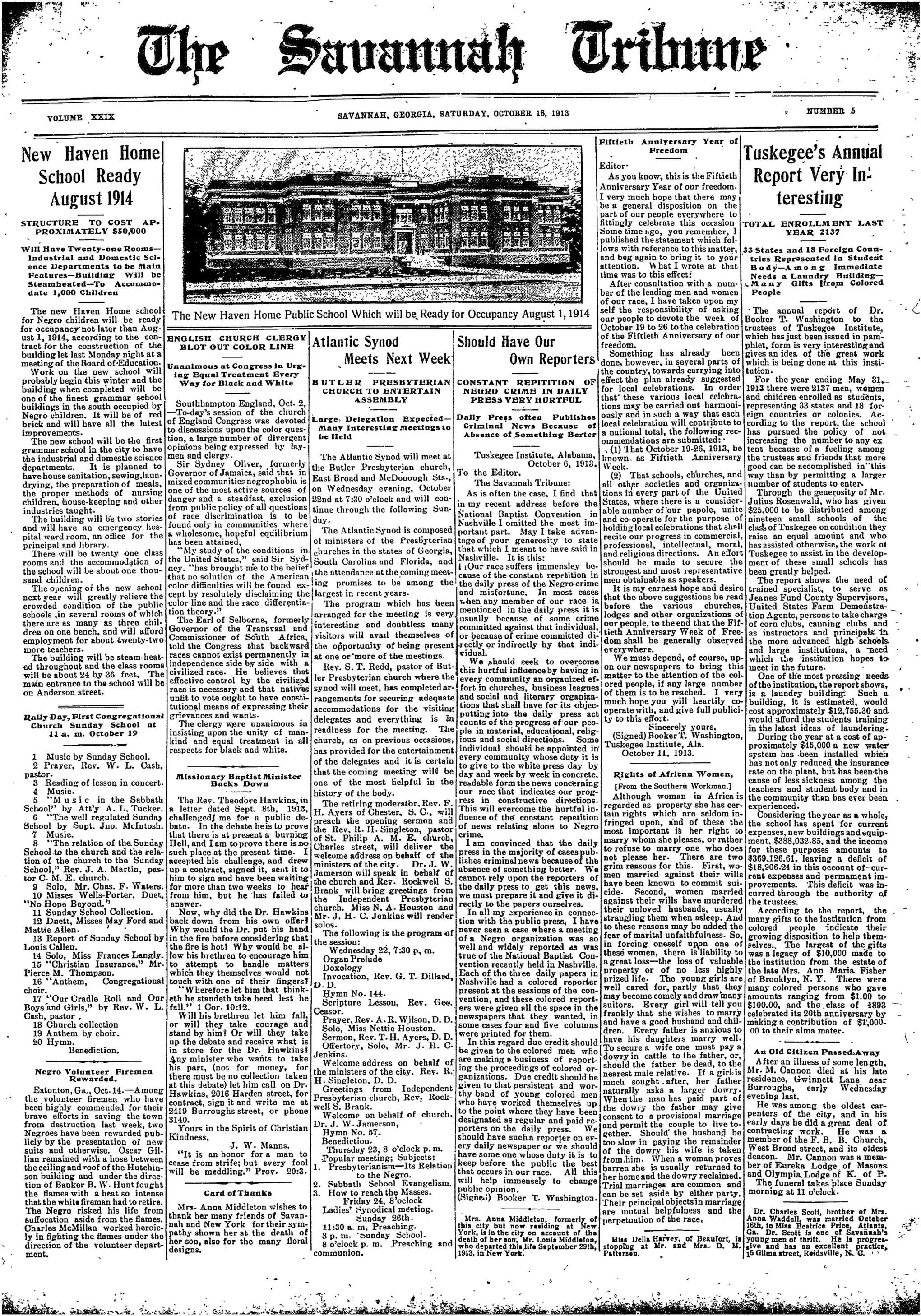
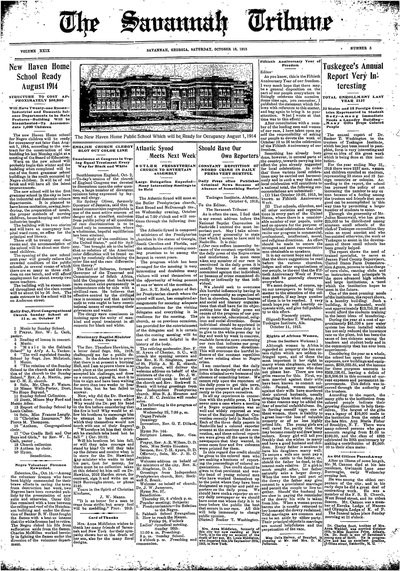
New Haven Home School Ready August 1914
STRUCTURE TO COST APPROXIMATELY $50,000
Will Have Twenty-one Rooms—Industrial and Domestic Science Departments to be Main Features—Building Will be Steamheated—To Accommodate 1,000 Children
The new Haven Home school for Negro children will be ready for occupancy not later than August 1, 1914, according to the contract for the construction of the building let last Monday night at a meeting of the Board of Education.
Work on the new school will probably begin this winter and the building when completed will be one of the finest grammar school buildings in the south occupied by Negro children. It will be of red brick and will have all the latest improvements. The new school will be the first grammar school in the city to have the industrial and domestic science departments. It is planned to have house sanitation, sewing, laundrying, the preparation of meals, the proper methods of nursing children, house-keeping and other industries taught. The building will be two stories and will have an emergency hospital ward room, an office for the principal and library.
There will be twenty one class rooms and the accommodation of the school will be about one thousand children. The opening of the new school next year will greatly relieve the crowded condition of the public schools, in several rooms of which there are as many as three children on one bench, and will afford employment for about twenty-two more teachers. The building will be steam-heated throughout and the class rooms will be about 24 by 36 feet. The main entrance to the school will be on Anderson street.
Rally Day, First Congregational Church Sunday School at 11 a. m. October 19
1 Music by Sunday School.
2 Prayer, Rev. W. L. Cash, pastor.
3 Reading of lesson in concert.
4 Music.
5 "Music in the Sabbath School" by Att'y A. L. Tucker.
6 "The well regulated Sunday School by Supt. Jno. McIntosh.
7 Music.
8 "The relation of the Sunday School to the church and the relation of the church to the Sunday School," Rev. J. A. Martin, pastor C. M. E. church.
9 Solo, Mr. Chas. F. Waters.
10 Misses Wells-Porter, Duet.
"No Hope Beyond."
11 Sunday School Collection.
12 Duett, Misses May Ford and Mattie Allen.
13 Report of Sunday School by Louis Callen.
14 Solo, Miss Frances Langly.
15 "Christian Insurance," Mr. Pierce M. Thompson.
16 "Anthem, Congregational choir.
17 "Our Cradle Roll and Our Boys and Girls," by Rev. W. L. Cash, pastor.
18 Church collection
Negro Volunteer Firemen Rewarded.
Eatonton, Ga., Oct. 14.—Among the volunteer firemen who have been highly commended for their brave efforts in saving the town from destruction last week, two Negroes have been rewarded publicly by the presentation of new suits and otherwise. Oscar Gillian remained with a hose between the ceiling and roof of the Hutchinson building and under the direction of Banker B. W. Hunt fought the flames with a heat so intense that the white fireman had to retire. The Negro risked his life from suffocation aside from the flames. Charles McMillan worked heroically in fighting the flames under the direction of the volunteer department.
1
ENGLISH CHURCH CLERGY BLOT OUT COLOR LINE
Unanimous at Congress in Urging Equal Treatment Every Way for Black and White
Southhampton England, Oct. 2.
—To-day's session of the church of England Congress was devoted to discussions upon the color question, a large number of divergent opinions being expressed by laymen and clergy.
Sir Sydney Oliver, formerly Governor of Jamaica, said that in mixed communities negrophobia is one of the most active sources of danger and a steadfast, exclusion from public policy of all questions of race discrimination is to be found only in communities where a wholesome, hopeful equilibrium has been attained,
"My study of the conditions in the United States," said Sir Sydney. "has brought me to the belief that no solution of the American color difficulties will be found except by resolutely disclaiming the color line and the race differentiation theory."
The Earl of Selborne, formerly Governor of the Transvaal and Commissioner of South Africa, told the Congress that backward races cannot exist permanently in independence side by side with a civilized race. He believes that effective control by the civilized race is necessary and that natives unfit to vote ought to have constitutional means of expressing their grievances and wants. The clergy were unanimous in insisting upon the unity of mankind and equal treatment in all respects for black and white.
Missionary Baptist Minister
Bucks Down
The Rev. Theodore Hawkins, in a letter dated Sept. 8th, 1913, challenged me for a public debate. In the debate he is to prove that there is at present a burning Hell, and I am to prove there is no such place at the present time. I accepted his challenge, and drew up a contract, signed it, sent it to him to sign and have been waiting for more than two weeks to hear from him, but he has failed to answer.
Now, why did the Dr. Hawkins back down from his own offer! Why would the Dr. put his hand in the fire before considering that the fire is hot! Why would he allow his brethren to encourage him to attempt to handle matters which they themselves would not touch with one of their fingers! "Wherefore let him thinketh he standeth take heed lest he fall!" 1 Cor. 10:12.
Will his brethren let him fall, or will they take courage and stand by him? Or will they take up the debate and receive what is in store for the Dr. Hawkins? Any minister who wants to take his part, (not for money, for there must be no collection taken at this debate) let him call on Dr. Hawkins, 2016 Harden street, for contract, sign it and write me at 2419 Burroughs street, or phone 3140.
Yours in the Spirit of Christian Kindness,
J. W. Manns.
"It is an honor for a man to cease from strife; but every fool will be meddling," Prov. 20:3.
Card of Thanks
Mrs. Anna Middleton wishes to thank her many friends of Savannah and New York for their sympathy shown her at the death of her son, also for the many floral designs.
SAVANNAH, GEORGIA, SATURDAY, OCTOBER 18, 1913
BUTLER PRESBYTERIAN CHURCH TO ENTERTAIN ASSEMBLY
Large Delegation Expected—Many Interesting Meetings to be Held
The Atlantic Synod will meet at the Butler Presbyterian church, East Broad and McDonough Sts., on Wednesday evening, October 22nd at 7:30 o'clock and will continue through the following Sunday.
The Atlantic Synod is composed of ministers of the Presbyterian churches in the states of Georgia, South Carolina and Florida, and the attendance at the coming meeting promises to be among the largest in recent years. The program which has been arranged for the meeting is very interesting and doubtless many visitors will avail themselves of the opportunity of being present at one or more of the meetings.
Rev. S. T. Redd, pastor of Butler Presbyterian church where the synod will meet, has completed arrangements for securing adequate accommodations for the visiting delegates and everything is in readiness for the meeting. The church, as on previous occasions, has provided for the entertainment of the delegates and it is certain that the coming meeting will be one of the most helpful in the history of the body.
The retiring moderator, Rev. F. H. Ayers of Chester, S. C., will preach the opening sermon and the Rev. R. H. Singleton, pastor of St. Philip A. M. E. church, Charles street, will deliver the welcome address on behalf of the ministers of the city. Dr. J. W. Jamerson will speak in behalf of the church and Rev. Rockwell S. Brank will bring greetings from the Independent Presbyterian church. Miss N. A. Houston and Mr. J. H. C. Jenkins will render solos.
The following is the program of the session:
Wednesday 22, 7:30 p. m.
Invocation, Rev. G. T. Dillard,
D. D.
Hymn No. 144.
Scripture Lesson, Rev. Geo.
Ceasor.
Sermon, Rev. T.H. Ayers, D.D. Offertory, Solo, Mr. J. H. CJenkins.
Welcome address on behalf of the ministers of the city, Rev. R. H. Singleton, D. D. Greetings from Independent Presbyterian church, Rev: Rockwell S. Brank. Welcome on behalf of church, Dr. J. W. Jamerson,
Should Have Our Own Reporters
Should Have Our Own Reporters
CONSTANT REPITITION OF
NEGRO CRIME IN DAILY
PRESS VERY HURTFUL
Daily Press often Publishes
Criminal News Because of
Absence of Something Berter
Tuskegee Institute, Alabama,
October 6, 1913.
To the Editor.
The Savannah Tribune:
As is often the case, I find that in my recent address before the National Baptist Convention in Nashville I omitted the most important part. May I take advantage of your generosity to state that which I meant to have said in Nashville. It is this:
Our race suffers immensley because of the constant repetition in the daily press of the Negro crime and misfortune. In most cases when any member of our race is mentioned in the daily press it is usually because of some crime committed against that individual, or because of crime committed directly or indirectly by that individual.
We should seek to overcome this hurtful influence by having in every community an organized effort in churches, business leagues and social and literary organizations that shall have for its objectputting into the daily press act counts of the progress of our people in material, educational, religious and social directions. Some individual should be appointed in every community whose duty it is to give to the white press day by day and week by week in concrete, readable form the news concerning our race that indicates our progress in constructive directions. This will overcome the hurtful influence of the constant repetition of news relating alone to Negro crime.
I am convinced that the daily press in the majority of cases publishes criminal news because of the absence of something better. We cannot rely upon the reporters of the daily press to get this news, we must prepare it and give it directly to the papers ourselves.
In all my experience in connection with the public press, I have never seen a case where a meeting of a Negro organization was so well and widely reported as was true of the National Baptist Convention recently held in Nashville. Each of the three daily papers in Nashville had a colored reporter present at the sessions of the convention, and these colored reporters were given all the space in the newspapers that they wanted, in some cases four and five columns were printed for them.
In this regard due credit should be given to the colored men who are making a business of reporting the proceedings of colored organizations. Due credit should be given to that persistent and worthy band of young colored men who have worked themselves up to the point where they have been designated as regular and paid reporters on the daily press. We should have such a reporter on every daily newspaper or we should have some one whose duty it is to keep before the public the best that occurs in our race. All this will help immensely to change public opinion.
(Signed) Booker T. Washington.
Mrs. Anna Middleton, formerly of this city but now residing at New York, is in the city on account of the death of her son, Mr. Louis Middleton, who departed this life September 29th, 1913, in New York.
Fiftieth Anniversary Year of Freedom
Editor:
As you know, this is the Fiftieth Anniversary Year of our freedom. I very much hope that there may be a general disposition on the part of our people everywhere to fittingly celebrate this occasion Some time ago, you remember, I published the statement which follows with reference to this matter, and beg again to bring it to your attention. What I wrote at that time was to this effect:
After consultation with a number of the leading men and women of our race, I have taken upon my self the responsibility of asking our people to devote the week of October 19 to 26 to the celebration of the Fiftieth Anniversary of our freedom.
Something has already been done, however, in several parts of the country, towards carrying into effect the plan already suggested for local celebrations. In order that these various local celebrations may be carried out harmoniously and in such a way that each local celebration will contribute to a national total, the following recommendations are submitted: (1) That October 19-26, 1913, be known as Fiftieth Anniversary Week.
(2) That schools, churches, and all other societies and organizations in every part of the United States, where there is a considerable number of our people, unite and co-operate for the purpose of holding local celebrations that shall recite our progress in commercial, professional, intellectual, moral, and religious directions. An effort should be made to secure the strongest and most representative men obtainable as speakers.
It is my earnest hope and desire that the above suggestions be read before the various churches, lodges and other organizations of our people, to the end that the Fiftieth Anniversary Week of Freedom shall be generally observed everywhere.
We must depend, of course, upon our newspapers to bring this matter to the attention of the colored people, if any large number of them is to be reached. I very much hope you will heartily cooperate with, and give full publicity to this effort.
Sincerely yours,
(Signed) Booker T. Washington,
Tuskegee Institute, Ala.
Rights of African Women. [From the Southern Workman.]
Although woman in Africa is regarded as property she has certain rights which are seldom infringed upon, and of these the most important is her right to marry whom she pleases, or rather to refuse to marry one who does not please her. There are two grim reasons for this. First, women married against their wills have been known to commit suicide. Second, women married against their wills have murdered their unloved husbands, usually strangling them when asleep. And to these reasons may be added the fear of marital unfaithfulness. So, in forcing oneself upon one of these women, there is liability to a great loss—the loss of valuable property or of no less highly prized life. The young girls are well cared for, partly that they may become comely and draw many suitors. Every girl will tell you frankly that she wishes to marry and have a good husband and children. Every father is anxious to have his daughters marry well. To secure a wife one must pay a dowry in cattle to the father, or, should the father be dead, to the nearest male relative. If a girl is much sought after, her father naturally asks a larger dowry. When the man has paid part of the dowry the father may give consent to a provisional marriage and permit the couple to live together. Should' the husband be too slow in paying the remainder of the dowry his wife is taken from him. When a woman proves barren she is usually returned to her home and the dowry reclaimed. Trial marriages are common and can be set aside by either party. Their principal objects in marriage are mutual helpfulness and the perpetuation of the race.
Miss Della Harvey, of Beaufort, is stopping at Mr. and Mrs. D. M. Pattersen.
Tuskegee's Annual Report Very Interesting
TOTAL ENROLLMENT LAST YEAR 2137
33 States and 18 Foreign Countries Represented in Student Body—Among Immediate Needs a Laundry Building—Many Gifts from Colored People
The annual report of Dr. Booker T. Washington to the trustees of Tuskegee Institute, which has just been issued in pamphlet, form is very interesting and gives an idea of the great work which is being done at this institution.
For the year ending May 31, 1913 there were 2137 men, women and children enrolled as students, representing 33 states and 18 foreign countries or colonies. According to the report, the school has pursued the policy of not increasing the number to any extent because of a feeling among the trustees and friends that more good can be accomplished in this way than by permitting a larger number of students to enter
Through the generosity of Mr. Julius Rosenwald, who has given $25,000 to be distributed among nineteen small schools of the class of Tuskegee on condition they raise an equal amount and who has assisted otherwise, the work of Tuskegee to assist in the development of these small schools has been greatly helped.
The report shows the need of trained specialist, to serve as Jeanes Fund County Supervisors, United States Farm Demonstration Agents, persons to take charge of corn clubs, canning clubs and as instructors and principals in the more advanced high schools and large institutions, a need which the institution hopes to meet in the future.
One of the most pressing needs of the institution, the report shows, is a laundry building. Such a building, it is estimated, would cost approximately $12,755.30 and would afford the students training in the latest ideas of laundering-
During the year at a cost of approximately $45,000 a new water system has been installed which has not only reduced the insurance rate on the plant, but has been the cause of less sickness among the teachers and student body and in the community than has ever been experienced.
Considering the year as a whole, the school has spent for current expenses, new buildings and equipment, $388,032.85, and the income for these purposes amounts to $369,126.61, leaving a deficit of $18,906.24 in this account of current expenses and permanent improvements. This deficit was incurred through the authority of the trustees.
According to the report, the many gifts to the institution from colored people indicate their growing disposition to help themselves. The largest of the gifts was a legacy of $10,000 made to the institution from the estate of the late Mrs. Ann Maria Fisher of Brooklyn, N. Y. There were many colored persons who gave amounts ranging from $1.00 to $100.00, and the class of 1893 celebrated its 20th anniversary by making a contribution of $1,000-00 to their alma mater.
An Old Citizen Passed Away
After an illness of some length,
Mr. M. Cannon died at his late
residence, Gwinnett Lane near
Burroughs, early Wednesday
evening last.
He was among the oldest carpenters of the city, and in his early days he did a great deal of contracting work. He was a member of the F. B. B. Church,
West Broad street, and its oldest deacon. Mr. Cannon was a member of Eureka Lodge of Masons and Olympia. Lodge of K. of P.
The funeral takes place Sunday morning at 11 o'clock.
Dr. Charles Scott, brother of Mrs. Anna Waddell, was married October 16th, to Miss Beatrice Price, Atlanta, Ga. Dr. Scott is one of Savannah's young men of thrift. He is progressive and has an excellent practice, 15 Gilma street, Reidsville, N. G.
Locals.
George A. Clarke, a white man, was arrested on Tuesday. He is a dope feind and thought to be "yegg."
It is said that work will soon begin on the twenty-story skyscraper of the Savannah Trust Co. It will be the largest office building in the South.
Walter Fleming, a white man, was given sixty days on the Brown farm for assaulting his mother who remonstrated with him on account of being drunk.
Over a million dollars were represented in two cargoes shipped from here to foreign ports on Tuesday.
The slaughter house of John Harrison, seven miles on the Louisville road, was closed on Tuesday by the State inspector on account of being unsanitary.
Harry Clark, a white man is under arrest, charged with the larceny of a shot gun.
Thurman Young, white, was given fines aggregating $150 for passing worthless checks. The alternate was nine months.
A committee of citizens will be in Washington on Monday to invite the President Wilson here during the Drainage Congress.
Mr. Bert Peterson has filed suit for $2000.00 against the A. C. L. for injuries received on account of derailment of a car.
On October 1, Mr. Frank Jones, rate clerk at A. C. L. freight office, went to lunch. He has not returned. He left behind a wife and six small children in needy circumstances. His whereabouts are unknown.'
Robert Murphy, white, was turned over to the Superior court on account of being a pickpocket.
The Ordinary has decided not to issue any more Sunday marriage license, nor none after 9 o'clock at night.
Another floor to the Post Office building is being advocated.
Paul Meinig, a German painter, committed suicide Saturday night.
Broken-bone fever is prevalent in the city. It is not dangerous, but very undesirable.
The new traffic ordinance must be strictly obeyed in the future, is the edict issued by the police department.
Bid has been accepted for the erection of the Haven Home School at a cost of $50,000.00.
Chris Mastios, a Greek, was fined $10.00 for assaulting a newsboy. The viciousness of these Greeks should cause our people to keep out of their places of business.
Among The Masons
A Mason owes to himself and to the fraternity to be clean in his language, in his conduct and dealings with his fellow men. For the man claiming to be respectable, who is guilty of using profane language there is neither palliation or excuse. Nothing can be more unbecoming a Mason than the use of profanity. It is a useless habit, coarse and vulgar, and offensive to any person of refined sensibilities.
The man who habitually violates his obligation and the written law of Masonry by the use of profane language is out of place in a Masonic lodge, and if he does not separate himself from the vice, the lodge ought, after fraternal warning, to separate him from Masonry, by expelling him. Such a man brings the fraternity into bad repute with the better class of people. Oriental Consistory.
OLD MASONS
Some are older than others, and some are younger; but none of us are growing younger, but age is stealthily creeping upon us all. These thoughts were suggested by the over hearing of a thoughtless remark of a young Mason in reference to an old member of his lodge who was designated as a "back number," an "old fossil," etc. Perhaps no disrespect was intended, and we do not think there was, but the remarks were unkind and needless to have been said.—Freemason.
TRUE FRIENDSHIP The friendships which shall be.
formed in the lodge room, the pleasant commingling of the brethren will constitute, in years to come, precious memories and sacred heritages. It is our earnest wish, therefore, that within these walls, consecrated to Masonic service, your friendships may be even more closely cemented; that a spirit of the most undeviating harmony may always prevail, and that the lusture of golden rule may radiate its influence upon the lives and characters of its members, all of whom we hope and expect will contribute to it the same measure of loyalty, activity and regular attendance in the future as they have in the past.—Wm. H. Robertson, New York.
**
Man has come out of barbarism, out of ignorance, out of love of cruelty as his greatest pleasure, out of idolatry. It has been a hard struggle for him to get where he is, in an age of budding brotherhood, of a conception of the true God, of school houses and churches and hospitals, and it is something of a gigantic struggle for him to remain in his present development, for he is full of savage instincts. Masonry is the product of his better thoughts, his divine aspirations, his purer nature. He gathers together vital truths and eternal principles, a description of his duty to himself, his fellows and his God, and made into a mosaic. He called it Masonry.—JB. McFatrich.
BEFORE AND AFTER TAKING
Lodges as a rule are very anxious to obtain petitions for degrees. When there is a prospective candidate in sight did you ever notice how attentive lodge officers are to him. They display a more than ordinary interest in him and he begins to think that Masons are indeed brothers in fact. But when the petition is signed, the degrees conferred and the name enrolled upon the book of by-laws, how quickly that interest wanes. As soon as the candidate stands in the lodge invested with all the rights and privileges of a Master Mason, he is left to get what he can out of Masonic affiliation and in any way that he can. The officers are busy cultivating some other prospective candidate. It is not to be wondered at that so many men soon lose interest in their lodges, because the lodges put forth no effort to interest them or to instruct them as Masons. The Masons who have passed through the forms and ceremonies of our degrees have a far greater claim upon the fraternity than those who are considered petitioning."—Illinois Freemason.
While Freemasonry is not a religion nor a substitute for religion there is much in our creed that is akin to religion. And so we read in the Fellow Craft Degree, "Thus he showed me. And, behold, the Lord stood upon the wall made by a plumb-line with a plumb-line in His hand. And the Lord said unto me, Amos, what seest thou? And I says A plumb-line. Then said the Lord, Behold I will set a plumb-line in the midst of my people Israel. I will not again pass by them any more."
A plumb-line is a very small instrument; so small that that little child that sits there understands it. It consists of a string three feet or ten feet in length with a weight at the end; that is a plumb-line. It is used to test a wall. Is the wall plumb? The small plumb-line is always true to the law of gravity; it is infallible to the center of the earth. If the wall is plumb as tested by the plumb-line the structure is safe, the building will stand. If not, if the wall is untrue by this standard, whether it be convex or concave, whether it bulge in or out it is unsay, and when the superstructure is built upon it, it will not stand the test of time. In this prophesy of the Old Testament, the prophet sees the coming of the Savior. He sees the plumb-line set among the people of Israel by the Lord. He sees the test to which the people must put themselves if they would live uprightly according to the plumb-line which the Lord has set among His people.
Freemasonry sets the plumb-line in the community; It sets a plumb-line in the community that is known and respected by those who are not foes to Freemasonry. It sets a closer standard a more severe plumb-line in those teachings to those who know its inner workings. The plumb-line of Freemasonry, briefly expressed, is a just and upright life. And the question which I would put to you and which you should put to yourself, brethren, not only in the public, gaze but in your inner life is: Are we living by the plum-line of
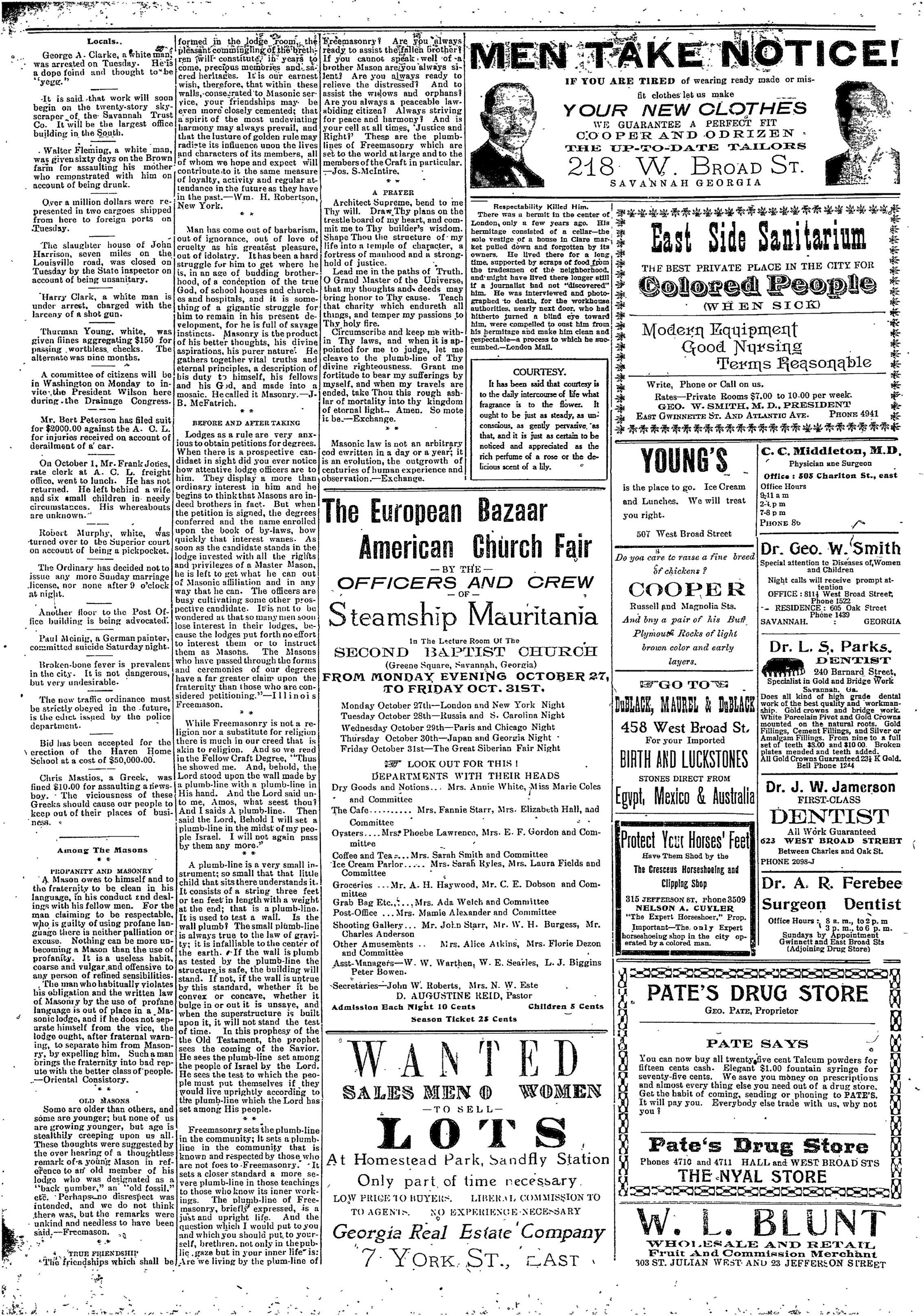
The European Bazaar American Church Fair BY THE OFFICERS AND CREW Steamship Mauritania
IN The Lecture Room Of The SECOND BAPTIST CHURCH (Greene Square, Savannah, Georgia) FROM MONDAY EVENING OCTOBER 27, TO FRIDAY OCT. 31ST.
Monday October 27th—London and New York Night
Tuesday October 28th—Russia and S. Carolina Night
Wednesday October 29th—Paris and Chicago Night
Thursday October 30th—Japan and Georgia Night
Friday October 31st—The Great Siberian Fair Night
Shooting Gallery... Mr. John Starr, Mr. W. H. Burgess, Mr. Charles Anderson
Asst-Managers—W. W. Warthen, W. E. Searles, L. J. Biggins Peter Bowen.
At Homestead Park, Sandfly Station Only part of time necessary. LOW PRICE TO BUYERS. LIBERAL COMMISSION TO TO AGENTS. NO EXPERIENCE NECESSARY Georgia Real Estate Company 7 YORK ST., EAST
Freemasonry? Are you always ready to assist the fallen brother? If you cannot speak well of a brother Mason are you always silent? Are you always ready to relieve the distressed? And to assist the widows and orphans? Are you always a peaceable law-abiding citizen? Always striving for peace and harmony? And is your cell at all times, Justice and Right? These are the plumblines of Freemasonry which are set to the world at large and to the members of the Craft in particular. —Jos. S.McIntire.
A PRAYER
Architect Supreme, bend to me Thy will. Draw Thy plans on the trestle board of my heart, and commit me to Thy builder's wisdom. Shape Thou the structure of my life into a temple of character, a fortress of manhood and a stronghold of justice. Lead me in the paths of Truth. O Grand Master of the Universe, that my thoughts and deeds may bring honor to Thy cause. Teach that charity which endureth all things, and temper my passions to Thy holy fire.
Circumscribe and keep me within Thy laws, and when it is appointed for me to judge, let me cleave to the plumb-line of Thy divine righteousness. Grant me fortitude to bear my sufferings by myself, and when my travels are ended, take Thou this rough ashlar of mortality into thy kingdom of eternal light- Amen. So mote it be.—Exchange.
Masonic law is not an arbitrary cod written in a day or a year; it is an evolution, the outgrowth of centuries of human experience and observation.—Exchange.
MEN TAKE NOTICE!
IF YOU ARE TIRED of wearing ready made or misfit clothes let us make YOUR NEW CLOTHES WE GUARANTEE A PERFECT FIT COOPER AND ODRIZEN THE UP-TO-DATE TAILORS 218 W. BROAD ST. SAVANNAH GEORGIA
PETER H.
Respectability Killed Him.
There was a hermit in the center of London, only a few years ago. His hermitage consisted of a cellar—the sole vestige of a house in Clare market pulled down and forgotten by its owners. He lived there for a long time, supported by scraps of food from the tradesmen of the neighborhood, and might have lived there longer still if a journalist had not "discovered" him. He was interviewed and photographed to death, for the workhouse authorities, nearly next door, who had hitherto turned a blind eye toward him, were compelled to oust him from his hermitage and make him clean and respectable—a process to which he succumbed.—London Mall.
COURTESY.
It has been said that courtesy is to the daily intercourse of life what fragrance is to the flower. It ought to be just as steady, as unconscious, as gently pervasive, as that, and it is just as certain to be noticed and appreciated as the rich perfume of a rose or the delicious scent of a lily.
East Side Sanitarium
THE BEST PRIVATE PLACE IN THE CITY FOR
Colored People
(WHEN SICK)
Modern Equipment
Good Nursing
Terms Reasonable
Write, Phone or Call on us.
Rates—Private Rooms $7.00 to 10.00 per week.
GEO. W. SMITH, M. D., PRESIDENT
EAST GWINNETTE ST. AND ATLANTIC AVE. PHONE 4941
You can now buy all twenty five cent Talcum powders for fifteen cents cash. Elegant $1.00 fountain syringe for seventy-five cents. We save you money on prescriptions and almost every thing else you need out of a drug store. Get the habit of coming, sending or phoning to PATE'S. It will pay you. Everybody else trade with us, why not you?
YOUNG'S
is the place to go. Ice Cream and Lunches. We will treat you right.
Do you care to raise a fine breed of chickens?
COOPER
Russell and Magnolia Sts.
And buy a pair of his Bust
Plymouth Rocks of light
brown color and early
layers.
GO TO
DuBLACK, MAUREL & DuBLACK
458 West Broad St.
For your Imported
BIRTH AND LUCKSTONES
STONES DIRECT FROM
Egypt, Mexico & Australia
Protect Your Horses' Feet
Have Them Shod by the
The Cresceus Horseshoeing and
Clipping Shop
315 JEFFERSON ST. Phone 3509
NELSON A. CUYLER
"The Expert Horseshoer," Prop.
Important—The only Expert
horseshoeing shop in the city operated by a colored man.
P. S. S.
Sanitarium
PLACE IN THE CITY FOR
People
IN SICK
ment
nursing
ns Reasonable
s.
7.00 to 10.00 per week.
M. D., PRESIDENT
ALANTIC AVE. PHONE 4941
C. C. Middleton, M.D.
Physician ane Surgeon
Office : 505 Charlton St., east
Office Hours
9:11 a m
2-4 p m
7-8 p m
PHONE 80
Dr. Geo. W. Smith
Special attention to Diseases of Women
and Children
Night calls will receive prompt attent
OFFICE: 8114 West Broad Street,
Phone 1522
RESIDENCE: 605 Oak Street
Phone 1439
SAVANNAH. GEORGIA
Dr. L. S. Parks.
DENTIST
240 Barnard Street,
Specialist in Gold and Bridge Work
Savannah, Ga.
Does all kind of high grade dental work of the best quality and workmanship. Gold crowns and bridge work. White Porcelain Pivot and Gold Crowns mounted on the natural roots. Gold Fillings, Cement Fillings, and Silver or Amalgam Fillings. From nine to a full set of teeth $8.00 and $10.00. Broken plates mended and teeth added. All Gold Crowns Guaranteed 23| K Gold. Fall Ribbon, 1844
Dr. J. W. Jamerson FIRST-CLASS
All Work Guaranteed
623 WEST BROAD STREET
Between Charles and Oak St.
PHONE 2098-J
Dr. A. R. Ferebee
Surgeon Dentist
Office Hours: 8 a. m., to 2 p. m.
3 p. m., to 6 p. m.
Sundays by Appointment
Gwinnett and East Broad Sts
(Adjoining Drug Store)
RUG STORE
Proprietor
SAYS
five cent Talcum powders for
$1.00 fountain syringe for
you money on prescriptions
WE HAVE THE LARGEST NEGRO PRINTING OFFICE IN GEORGIA
Call around and inspect our Invitations for Balls, Weddings and Special Entertainments
Bring Us Your Printing. We Do It Right.
THE Savannah Tribune
1009 WEST BROAD STREET
Phone 2171.
THE BEST PLACE
In Savannah
FOR MEN’S GOOD SHOE
Prices $3.50 up
B. H. Levy, Bro. Co
INSURE YOUR CLOTHES
One Dollar per month pays for a life Membership in the Henry Street Pressing Club. We Dye, Clean, Alter and make Repairson any garment.
LADIES—: Send us your skirts and suits. We know how to clean them.
Our Dressmaker Can Please You
WE SEND FOR AND DELIVER ALL WORK
The Henry St. Pressing and Dress Making Establishment
305 West Henry Street
B. B. Chauncey, Prop.
Phone 1487
Thomas Floyd, Manager
Advertise In The Savannah Tribune
It Brings Result
```markdown
```
Not the moldy old maxims, away out of date, but the porkers we raise, that are paying the freight. They roam through the pastures, red, white, spotted, black, and the wealth they are making fills many a sack. And still opportunity knocks at our door. With the millions we ship, there's a market for more.
On seas of alfalfa, in shadow and sheen, float cargoes of feed through the billows of green, and again and again on that marvelous tide the ripples of richness flash, wondrous and wide. Alfalfa, sweet emblem of plenty and charm, may the wave of thy verdure flood every farm!
Time comes when each sore must yield without flaw. Production must double is nature's grim law. The cities will teem with vast millions that toll, and life, with its hopes, must depend on the soil. What methods, more wise could the farmer combine than raising alfalfa and fattening swine?—Brad in Kansas Farmer.
DOUBLE YOUR EGG CROP.
Use of the Trap Nest May. Do the Trick—Right Mating Necessary.
In Farm and Fireside a contributor says that poultry raisers can practically double their egg production if they persistently use the trap nest. Following is an extract from his article:
"For the benefit of those who are not acquainted with the trap nest I will explain in detail its purpose. The trap nest is a nest so contrived that when the hen enters she springs a 'trap' which closes the door and holds her captive until she is released by the attendant. The nest is of sufficient size to allow the hen plenty of space to move around in or she would be apt to break the egg.
"By taking the hens of highest trap nest record and mating them with males descended from heavy layers you will lay the foundation of a good strain of heavy layers. By careful trap nest culling and with the same care in breeding, year after year, you will build your flock up to a high state of efficiency.
"It is not at all uncommon for flocks that are trap nested to average 180 eggs per hen per year. At the same time these flocks not infrequently contain individuals that have a record of 200 to 230 eggs each per year."
"The latest figures at hand from the department of agriculture declare that the average farm hen lays less than eighty eggs per year. Sixty eggs per hen per year would probably, be overestimating the average uncared for farm hen. At any rate, the great difference between 200 to 230 eggs and sixty or eighty eggs is enough to think about seriously."
FOR COMING COLD DAYS.
Plan Now to Keep Your Cow Comfortable In Cold Weather.
To make a cow blanket that will stay on first take the rope that comes around a bale of binder twine, untwist it and take one strand long enough to tie around the body just be-
hind the forelegs. Tie another around the body in front of udder, then make a crupper.
Tie another around each fore leg and fasten at top, then a rope around neck. Now sew two gunny sacks together and slip them under these ropes. Take a darning needle and twine and fasten on sides and top.
When the sacks are worn out cut the fastenings and slip two more under. A good blanket will last no longer than the cheap one described.—Farm and Fireside.
WITH THE HONEY MAKERS.
By no means store comb honey in the cellar, as it is sure to sweat and become moldy. Better put it in the attic, as the beat can in nowise harm it, provided, of course, that it isn't hot enough to melt it.
The best and most profitable way for the average beekeeper to dispose of unfinished sections is to extract all that will not sell as second grade for as much as extracted honey will bring and use them for bait sections next year.
In preparing the hives for the late flow proceed in precisely the same manner as for the early flow, using the same supers as formerly, only, of course, putting in new section boxes with foundation for comb honey to take the places of the completed sections taken from them.
The extracted honey when stored in cans or barrels can be placed in cellars or other convenient repositories and unless bottled early will in all probability granulate as soon as the nights become cold, but this granulation in no sense hurts it, and the heating required to liquefy it for bottling in a large measure prevents further granulation.-Farm Journal.
Because.
There are many splendid things men can't do because they never try.—Chicago Record-Herald.
Making the Little Farm Pay
SMALL fruits pay well and afford great pleasure to the family on a little farm. They are ideal products where the place is small and situated near a city, so that they may be sold
SMALL fruits pay well and afford great pleasure to the family on a little farm. They are ideal products where the place is small and situated near a city, so that they may be sold to families or hotels and restaurants. Much waste and loss of profit will be avoided by delivering to private customers.
An advantage in raising berries comes from the quick growth as well as from the small acreage required. It takes only a year to get started with small fruits. They can be grown in an orchard and will return a large amount of money in the years when peach and apple trees are coming to maturity. The more this orchard ground is stirred the better, and the cultivation of berries is of actual benefit to the large fruits. A fair yield of strawberries will bring $200 to $300 an acre, according to market conditions. Raspberries return 30 to 50 per cent less.
Small fruitl requires a rich, well drained soil. A light, deep loam is best, and an abundance of well rotted barnyard fertilizer should be plowed in. Soggy land is not favorable to any kind of fruits, but nevertheless moisture is needed, and unless rain is plentiful it will pay to carry water or convey it by means of hose. Plant at the proper time in hills or hedges and keep the soil loose with hoe or cultivator. Pinch off all blossoms the first season. Mulch with straw and manure in the fall. Strawberries are hardy and prolific, but skilled attention will pay in extent and quality of production. With a view to successful marketing both early and late varieties should be cultivated.
Raspberries are next in importance. There is not so much tedious work connected with growing raspberries as strawberries, and the profits are not quite so large. Set the plants in the spring in rows six feet apart and three feet apart in the rows. This gives plenty of room for cultivating, which must be done thoroughly throughout the growing season. Some experts do not stake raspberries, as is the custom with most growers. When the tips are about two feet high they are pinched back. This causes laterals to be sent out along the stems. In the spring at trimming time these laterals are cut back so as to leave about six inches, and they hold up all the berries they can properly mature.
The red varieties do not need the summer pruning, but are pruned back to about eighteen inches in the spring. Currants and gooseberries require almost the same treatment and can be considered together. One or two year old plants are best and should be set in rows four feet apart each way so that they may be cultivated both ways. This method insures thorough and easy cultivation. They should be cultivated frequently so as to have a good soil mulch during the growing season. It is best to grow the plants in bush form and trim out very little, only the surplus and deadwood.
It is very important to kill all currant worms with some poisonous spray as soon as they appear. If this is neglected the bushes will soon be destroyed.
When a producer has established a reputation for having a good quality of fruit and giving full measure there will be no difficulty in securing customers. If the product exceeds the demand of private patrons it is always possible to ship to stores or commission houses. Bear in mind, however, that the selling end of the business is important and try to arrange in advance for private customers or retail merchants to take the whole output.
Convenient Chicken Roost.
Select two four inch pieces six feet long. Lay them parallel and nail five crosspieces, three feet long and three inches wide, to these. The legs may be made of 2 by 4 stuff the desired length. By means of long spikes secure them to the parallel pieces. Place this in roosting quarters for chickens and they will soon be perching upon it at night.-Iowa Homestead.
When we plant a tree we are doing what we can to make our planet a more wholesome and happier dwelling place for those who come after us. If not for ourselves.—Oliver Wendell Holmes.
Fall Plowing Kills Cutworms. Fall plowing of field areas will often be of service in controlling cutworms that are affecting field crops.
Been Jilted, Probably.
"Only the brave deserve the fair."
"Maybe. But it's the rich who get them."—Boston Transcript.
"Do you believe there is anything in luck?" asked a young man of a philosopher, and the philosopher replied:
"Yes; there's a lot of intelligence and method and perseverance in it."—London Mall.
A Madman's Strange Belief.
A madman's strange belief.
'An unfortunate maniac was confined in one of the Scottish lunatic asylums, his particular infirmity being an unshakable belief that every day was Christmas day and that he was dining sumptuously on turkey or roast beef and a good slice of plum pudding. His real diet, however, was of the plainest, he being served twice daily with a dish of oatmeal porridge. After daily describing to his attendants the pleasures he had tasted in his cut of turkey or what not he as regularly added. "Yet, somehow or other, everything that I eat tastes of porridge." This story it was which gave rise to the saying. "As palatable as the madman's porridge."
Fish, Chicken and Veal.
Baw pullet, raw veril and raw fish make the graveyard fat. This is hundreds of years old. A New York caterer (perhaps the most efficient in the city) said to me: "There are three important articles of food that must under no circumstances be served underdone. They are fish, chicken and veal. By chicken I mean all poultry of a domestic nature. All game birds should be rare. You want to be a little careful about lamb too. Give it plenty of cooking."—New York Press.
Smunglers' Philanthropy.
Smugglers' Phantropy.
At Broadmoor and Perth, England, the criminal lunatics have a free supply of the most exquisite pipe tobacco. cigars and cigarettes. In fact, they smoke far finer stuff than the average rich man. Yet all this goods tobacco costs the government nothing. The smugglers of England pay for the smoking of the criminal insane. It is from her confiscated smuggled tobacco that England fills the tobacco boxes of Perth and Broadmoor.—London Telegraph.
Mapmaking.
The earliest maps of which we have any knowledge were made in Egypt. They were wooden tablets, on which were traced land and sea, roads, rivers, highways, etc. Marinus of Tyre, 150 A. D., was the first to attempt a map on scientific principles. The maps in use by the Greeks and Romans were fairly accurate, so far as they went, but those in use during the middle ages were alarmingly inaccurate. It is only within recent years, say since the middle of the last century, that it was possible to make a complete and reliable map of the world, and even yet the best map is subject to slight changes—New York American.
Potter Wasps at Work. The family eumenidae, or solitary wasps, contain some curious workers. Some are miners and dig-tiny tunnels in the earth; some are carpenters and cut channels in wood and then divide the space into chambers by partitions of mud; some build oval or globelike mud nests on branches or twigs. This home may be partitioned into several tiny rooms, into which are put various small insects captured by the mother wasp and upon which the young wasps feed.
A Difficult Assignment.
Not long ago a cub reporter on one of the Chicago dailies was assigned by the city editor to cover a meeting of the board of trustees of a public library. "Bring a story of about four hundred words," said the editor.
At a late hour that night, this story not being forthcoming, the youngster was sent for.
"How about that story of the board meeting?" asked the editor.
"It isn't finished yet. You told me to make 400 words of it. So far I have managed to get only 300."
"What did the board do?"
"They met, called the roll and adjourned until Tuesday evening." Lippincott's Magazine.
Reduced Him.
A London advertising expert was praising in New York the change that has come over the advertisement: "In advertising, as in other things," he said. "It has been found that honesty pays, and today, throughout the world, the successful advertiser is modest and conservative in his statements. Advertising is no longer mistrusted. Things are no longer as they were in Phatt's day. He welged over 400 pounds. Well, he saw an ad, in the paper—'Fat folks reduced, $5'—and he answered it." "Did he get any reply?" asked a listener. "Oh, yes; it was just as advertised." "That's good. How much was he reduced?" "Why, just as the advertisement said—$5."
No Wonder She Likes Aunt Mary. The small daughter in a family where there are a number of brothers and sisters went on a visit to an aunt where there are no children. She was quite carried off her feet by the attention which she received, and when her mother arrived to take her home she was very unwilling to go.
"Why do you want to stay with Aunt Mary?" inquired the mother. "She curls my hair, three times a day." replied the child, "and she dresses me to beat the band!"—Kansas City Star.
EFFORT.
If any misanthrope were to put in my presence the question, "Why were we born?" I should reply, "To make an effort."—Dickens.
The Savannah Tribune,
Established 1875
By JOHN H. DEVEAUX
Published by
SOL. C. JOHNSON
Editor and Proprietor
JAS. H. BUTLER
Asso. Editor and Manager
Published Every Saturday
1009 West Broad Street.
Phone 2171
Entered at the Post Office at Savannah, Ga., as Second-Class mail mail.
Saturday, October 18th. 1913.
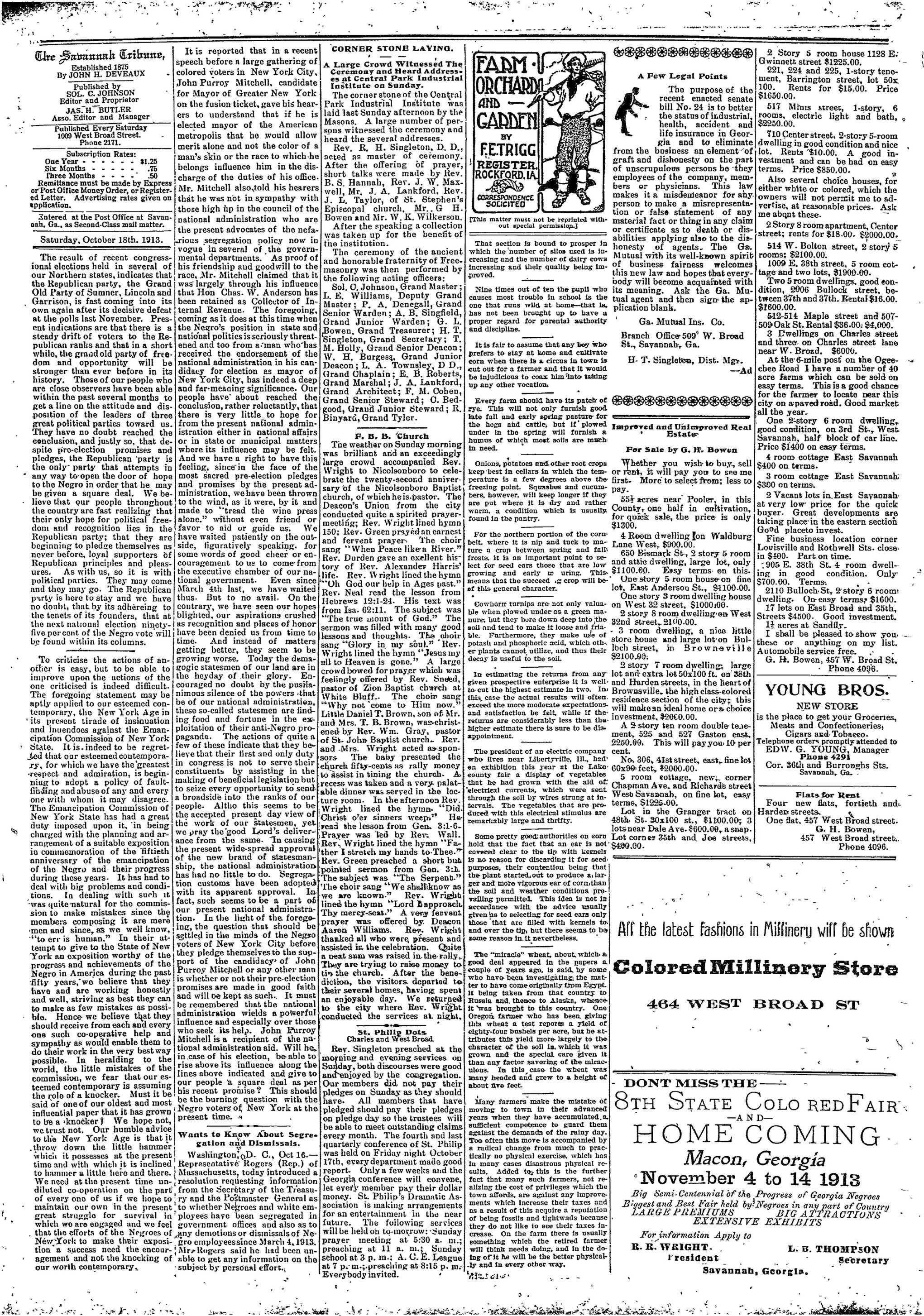
The result of recent congressional elections held in several of our Northern states, indicates that the Republican party, the Grand Old Party of Sumner, Lincoln and Garrison, is fast coming into its own again after its decisive defeat at the polls last November. Present indications are that there is a steady drift of voters to the Republican ranks and that in a short while, the grand old party of freedom and opportunity will be stronger than ever before in its history. Those of our people who are close observers have been able within the past several months to get a line on the attitude and disposition of the leaders of three great political parties toward us. They have no doubt reached the conclusion, and justly so, that despite pro-election promises and pledges, the Republican party is the only party that attempts in any way to open the door of hope to the Negro in order that he may be given a square deal. We believe that our people throughout the country are fast realizing that their only hope for political freedom and recognition lies in the Republican party; that they are beginning to pledge themselves as never before, loyal supporters of Republican principles and pleasures. As with us, so it is with political parties. They may come and they may go. The Republican party is here to stay and we have no doubt, that by its adhering to the tenets of its founders, that at the next national election ninety-five percent of the Negro vote will be found within its columns.
To criticise the actions of another is easy, but to be able to improve upon the actions of the one criticised is indeed difficult. The foregoing statement may be aptly applied to our esteemed contemporary, the New York Age in its present tirade of insinuation and inuendoes against the Emancipation Commission of New York State. It is indeed to be regretted that our esteemed contemporary, for which we have the greatest respect and admiration, is beginning to adopt a policy of fault-finding and abuse of any and every one with whom it may disagree. The Emancipation Commission of New York State has had a great duty imposed upon it, in being charged with the planning and arrangement of a suitable exposition in commemoration of the fiftieth anniversary of the emancipation of the Negro and their progress during these years. It has had to deal with big problems and conditions. In dealing with such it was quite natural for the commission to make mistakes since the members composing it are mere men and since, as we well know, "to err is human." In their attempt to give to the State of New York an exposition worthy of the progress and achievements of the Negro in America during the past fifty years, we believe that they have and are working honestly and well, striving as best they can to make as few mistakes as possible. Hence we believe that they should receive from each and every one such co-operative help and sympathy as would enable them to do their work in the very best way possible. In heralding to the world, the little mistakes of the commission, we fear that our esteemed contemporary is assuming the role of a knocker. Must it be said of one of our oldest and most influential paper that it has grown to be a knocker? We hope not, we trust not. Our humble advice to the New York Age is that it throw down the little hammer which it possesses at the present time and with which it is inclined to hammer a little here and there. We need at the present time undiluted co-operation on the part of every one of us if we hope to maintain our own in the present great struggle for survival in which we are engaged and we feel that the efforts of the Negroes of New York to make their exposition a success need the encouragement and not the knocking of our worth contemporary.
Wants to Know About Segregation and Dismissals.
Washington, D. C., Oct 16. Representative Rogers (Rep.) of Massachusetts, today introduced a resolution requesting information from the Secretary of the Treasury and the Postmaster General as to whether Negroes and white employees have been segregated in government offices and also as to any demotions or dismissals of Negro employees since March 4, 1913. Mr. Rogers said he had been unable to get any information on the subject by personal effort.
CORNER STONE LAYING.
A Large Crowd Witnessed The Ceremony and Heard Addresses at Central Park Industrial Institute on Sunday.
The corner stone of the Central Park Industrial Institute was laid last Sunday afternoon by the Masons. A large number of persons witnessed the ceremony and heard the several addresses.
Rev. R. H. Singleton, D. D., acted as master of ceremony. After the offering of prayer, short talks were made by Rev. B. S. Hannah, Rev. J. W. Maxwell, Mr. J. A. Lankford, Rev. J. L. Taylor, of St. Stephen's Episcopal church, Mr.. G H. Bowen and Mr. W. K. Wilkerson.
After the speaking a collection was taken up for the benefit of the institution.
The ceremony of the ancient and honorable fraternity of Freemasonry was then performed by the following acting officers:
Sol. O. Johnson, Grand Master;
L. E. Williams, Deputy Grand Master; P. A. Denegall, Grand Senior Warden; A. B. Singfield, Grand Junior Warden; G. L. Bowen, Grand Treasurer; H. T. Singleton, Grand Secretary; T. M. Holly, Grand Senior Deacon; W. H. Burgess, Grand Junior Deacon; L. A. Townsley, D D., Grand Chaplain; E. B. Roberts, Grand Marshal; J. A. Lankford, Grand Architect; F. M. Cohen, Grand Senior Steward; O. Bedgood, Grand Junior Steward; R. Binyard, Grand Tyler.
F. B. B. Church
St. Philip Dots
Charles and West Broad
Rey. Singleton preached at the morning and evening services on Sunday, both discourses were good and enjoyed by the congregation. Our members did not pay their pledges on Sunday as they should have. All members that have pledged should pay their pledges on pledge day so the trustees will be able to meet outstanding claims every month. The fourth and last quarterly conference of St. Philip was held on Friday night October 17th, every department made good report. Only a few weeks and the Georgia conference will convene, let every member pay their dollar money. St. Philip's Dramatic Association is making arrangements for an entertainment in the near future. The following services will be held on to-morrow: Sunday prayer meeting at 5:30 a. m.; preaching at 11 a. m.; Sunday school at 3 p. m.; A. C. E. League at 7 p. m.; preaching at 8:15 p. m. Everybody invited.
```markdown
```
from the business an element of graft and dishonesty on the part of unscrupulous persons be they employees of the company, members or physicians. This law makes it a misdemeanor for any person to make a misrepresentation or false statement of any material fact or thing in any claim or certificate as to death or disabilities applying also to the dishonesty of agents. The Ga. Mutual with its well-known spirit of business fairness welcomes this new law and hopes that everybody will become acquainted with its meaning. Ask the Ga. Mutual agent and then sign the application blank.
```markdown
```
Improved and Unimproved Real Estate:
Whether you wish to buy, sell or rent, it will pay you to see me first. More to select from; less to pay.
555 acres near Pooler, in this County, one half in cultivation, for quick sale, the price is only $1300.
4 Room dwelling Ion Waldburg Lane West, $900.00.
650 Bismark St., 2 story 5 room and attic dwelling, large lot, only $1100.00. Easy terms on this.
One story 5 room house on fine lot, East Anderson St., $1100.00.
One story 3 room dwelling house on West 32 street, $1000.00.
2 story 8 room dwelling on West 32nd street, $2100.00.
3 room dwelling, a nice little store house and large lot on Bullch street, in Brownsville $2100.00.
2 story 7 room dwelling, large lot and extra lot 50x100 ft. on 38th and Harden streets, in the heart of Brownsville, the high class-colored residence section of the city; this will make an ideal home or a choice investment, $2060.00.
A 2 story ten room double tenement, 525 and 527 Gaston east, 2250.00. This will pay you 10 per cent.
No. 306, 41st street, east, fine lot 60x90 feet, $2000.00.
5 room cottage, new, corner Chapman Ave. and Richards street West Savannah, on fine lot, easy terms, $1225.00.
Lot in the Granger tract on 48th St. 30x100 st., $1100.00; 3 lots near Dale Ave. $600.00, a snap.
Lot corner 35th and Joe streets, $490.00.
All the latest fashions i Golored Mil
All the latest fashions in Millinery will be shown
Colored Millinery Store
464 WEST BROAD ST
DONT MISS THE —
8TH STATE COLO RED FAIR
AND
HOME COMING
Macon, Georgia
November 4 to 14 1913
Big Semi-Centennial of the Progress of Georgia Negroes
Biggest and Best Fair held by Negroes in any part of Country
LARGE PREMIUMS
BIG ATTRACTIONS
EXTENSIVE EXHIBITS
For information Apply to
R. R. WRIGHT.
President
L. B. THOMPSON
Secretary
Savannah, Georgia.
FARM
ORCHARD
AND
GARDEN
BY
F.E.TRIGG
REGISTER.
ROCKFORD, IA.
CORRESPONDENCE
SOLICITED
[This matter must not be reprinted with-
out special permission.]
That section is bound to prosper in which the number of silos used is increasing and the number of dairy cows increasing and their quality being improved.
Nine times out of ten the pupil who causes most trouble in school is the one that runs wild at home—that is, has not been brought up to have a proper regard for parental authority and discipline.
It is fair to assume that any boy who prefers to stay at home and cultivate corn when there is a circus in town is cut out for a farmer and that it would be injudicious to coax him into taking up any other vocation.
Every farm should have its patch of rye. This will not only furnish good late fall and early spring pasture for the hogs and cattle, but if plowed under in the spring will furnish a humus of which most soils are much in need.
Onions, potatoes and other root crops keep best in cellars in which the temperature is a few degrees above the freezing point. Squashes and cucumbers, however, will keep longer if they are put where it is dry and rather warm, a condition which is usually found in the pantry.
For the northern portion of the corn belt, where it is nip and tuck to mature a crop between spring and fall frosts, it is an important point to select for seed ears those that are low growing and early in muring. This means that the succeeding crop will be of this general character.
Cowhorn turnips are not only valuable when plowed under as a green manure, but they bore down deep into the soil and tend to make it loose and friable. Furthermore, they make use of potash and phosphoric acid, which other plants cannot utilize, and thus their decay is useful to the soil.
In estimating the returns from any given prospective enterprise it is well to cut the highest estimate in two. In this case the actual results will often exceed the more moderate expectations and satisfaction be felt, while if the returns are considerably less than the higher estimate there is sure to be disappointment.
The president of an electric company who lives near Libertyville, Ill., had an exhibition this year at the Lake county fair a display of vegetables that he had grown with the aid of electrical currents, which were sent through the soil by wires strung at intervals. The vegetables that are produced with this electrical stimulus are remarkably large and thrifty.
Some pretty good authorities on corn hold that the fact that an ear is not covered clear to the tip with kernels is no reason for discarding it for seed purposes, their contention being that the plant started out to produce a larger and more vigorous ear of corn than the soil and weather conditions prevailing permitted. This idea is not in accordance with the advice usually given as to selecting for seed ears only those that are filled with kernels to and over the tip, but there seems to be some reason in it nevertheless.
The "miracle" wheat, about which a good deal appeared in the papers a couple of years ago, is said, by some who have been investigating, the matter to have come originally from Egypt. it being taken from that country to Russia and, thence to Alaska, whence it was brought to this country. One Oregon farmer who has been giving this wheat a test reports a yield of eighty-four bushels per acre, but he attributes this yield more largely to the character of the soil in, which it was grown and the special care given it than any factor savoring of the miraculous. In this case the wheat was many headed and grew to a height of about five feet.
Many farmers make the mistake of moving to town in their advanced years when they have accumulated, a sufficient competence to guard them against the demands of the rainy day. Too often this move is accompanied by a radical change from much to practically no physical exercise, which has in many cases disastrous physical results. Added to this is the further fact that many such farmers, not realizing the cost of privileges which the town affords, are against any improvements which increase their taxes and as a result of this acquire a reputation of being fossils and tightwads because they do not like to see their taxes increase. On the farm there is usually something which the retired farmer will think needs doing, and in the doing of it he will be the better physically and in every other way.
A Few Legal Points
The purpose of the recent enacted senate bill No.24 is to better the status of industrial, health, accident and life insurance in Georgia and to eliminate
A
Ga. Mutual Ins. Co.
Branch Office 509 $ ^{2} $ W. Broad
St., Savannah, Ga.
H. T. Singleton, Dist. Mgr.
—Ad
For Sale by G. H. Bowen
2 Story 5 room house 1128 E: Gwinnett street $1225.00.
221, 224 and 225, 1-story tenement, Barrington street, lot 50x100. Rents for $15.00. Price $1650.00.
517 Mims street, 1-story, 6 rooms, electric light and bath, $2250.00.
710 Center street, 2-story 5-room dwelling in good condition and nice lot. Rents $10.00. A good investment and can be had on easy terms. Price $850.00.
Also several choice houses, for either white or colored, which the owners will not permit me to advertise, at reasonable prices. Ask me about these.
2 Story 8 room apartment, Center street; rents for $18.00. $2000.00.
514 W. Bolton street, 2 story 5 rooms; $2100.00.
1009 E. 38th street, 5 room cottage and two lots, $1900.00.
Two 5 room dwellings, good condition, 2006 Bullock street, between 37th and 37th. Rental $16.00. $1600.00.
512-514 Maple street and 507-509 Oak St. Rental $36.00: $4,000.
3 Dwellings on Charles street and three on Charles street lane near W. Broad. $6000.
At the 6-mile post on the Ogeechee Road I have a number of 40 acre farms which can be sold on easy terms. This is a good chance for the farmer to locate near this city on a paved road. Good market all the year.
One 2-story 6 room dwelling, good condition, on 3rd St., West Savannah, half block of car line. Price $1400 on easy terms.
4 room cottage East Savannah $400 on terms.
3 room cottage East Savannah $300 on terms.
2 Vacant lots in East Savannah at very low price for the quick buyer. Great developments are taking place in the eastern section Good placeto invest.
Fine business location corner Louisville and Rothwell Sts. close in $400. Part on time.
.905 E. 38th St. 4 room dwelling in good condition. Only $700.00. Terms.
2110 Bullock St. 2 story 6 room dwelling. On easy terms, $1600.
17 lots on East Broad and 35th, Streets $4500. Good investment. 1 $ acres at Sandfly.
I shall be pleased to show you these or anything on my list. Automobile service free. G. H. Bowen, 457 W. Broad St. Phone 4096.
YOUNG BROS.
is the place to get your Groceries,
Meats and Confectioneries,
Cigars and Tobacco.
Telephone orders promptly attended to
EDW. G. YOUNG, Manager
Phone 4291
Cor. 36th and Burroughs Sts.
Savannah, Ga.
Flats for Rent
Four new flats, fortieth and
Harden streets.
One flat, 457 West Broad street.
G. H. Bowen,
457 West Broad street.
Phone 4096.
LOCALS
Mrs. G. L Livingston, of 812 Waters road, will leave tonight for Newberry, S. C. to spend four months with her husband's relatives.
Mrs. Ella Slocum is out of the city for a few days visiting relatives and friends.
Mr and Mrs C. J. Turner returned home on the City of Columhus on Monday night.
Mrs Rachel Hudson arrived in the city on Monday night, being called here on account of the serious illness of her mother, Mrs. Ann Soloman.
Mrs. Eugene Belt of Washington, D. C. is visiting in the city, the guest of her niece, Mrs. Hattie E Sauders Moody of 517 Waldburg street, west.
Negro Business League Ask For More Members.
Dear Brother:The Negro Business League, whose only apology for existence is the full development of the enterprises already established among us and the encouraging and endorsing of other members of the race who may be in possession of small capital and desiring to engage into some legitimate line of business, at a regular meeting held at their headquarters No. 457 West Broad street, voted unanimously that you be invited, yea, urged upon to become a member of this organization, which is designed to do so much for our struggling men and women who are now putting forth strenuous efforts to furnish gainful and helpful employment to the prepared and deserving young men and women of the race. As one of the recognized leaders of the race, and the special mouthpiece for your particular organization, we do not see how you could, under any condition, fail to make the sacrifice of time and influence in this excellent movement.
A. B. Singfield, President.
W. W. Hill, Secretary.
S. D. A. Church Building No. 2 Ready for Service.
Evangelist J. W. Manns and his congregation, have transferred their meetings from Beacon Light Gospel Tent, to their new church on 36th street, near Burroughs. The church, however, is not finished, but after working very hard and faithful, for the past three weeks, they were able to hold their first meeting in the church last Friday night. It might be interesting to note the fact, that Elder Manns and his co-workers came here about a year and six months ago. At that time he had no followers in this city. His church membership at present is above two hundred. He has also a mission school with an enrollment of fifty scholars. The school is being taught in rooms prepared for that purpose in the rear of the church. A cordial invitation is extended to the public at all times. Special service for Sunday night, subject, "The sealing of the hundred, forty and four thousand."—Rev. 14:1-6.
Emancipation Association
The Emancipation Association met last Tuesday at Asbury Church and elected officers for the ensuing year. The meeting was a very enthusiastic one and the society will meet again at noon on the 28th, of the month at the same place to make arrangements for the January celebration. Rev. E. H. Quo is the new president of the association and Rev. L. A. Townsley was reelected secretary.
Social Happenings
Mme. Francis and Mrs. Waddell 203 West 100th street, New York City, gave a progressive whist party, Friday evening October 10th, in honor of Mr. and Mrs. Calvin Turner. The ladies were all handsomely gowned. The guest were: Mr. and Mrs. Turner, Mr. and Mrs. Hooks, Dr. and Mrs. Evans, Mr. and Mrs. Carprew, Mr. and Mrs. Thomas, Mr. and Mrs. Van, Mr. and Mrs. Faulkner, Mr. and Mrs. Hall, Mr. and Mrs. Lewis, Mr. and Mrs. Robinson, Misses Hirsch, Gowan, Watkins, Mr. Thorn, Mrs. Hazelwood, Misses Zetta, Livingston, Burke, Allan, Blackman, Messrs. McCullen, Cortland, McGill, McEntyre, Bagnell, Miss Mamie Robinson, Mr. J. Adams, Miss Gibbs, Mrs. Wright, Miss Stroshers, Jones, Mrs. Harley and Mrs. Johnson. Mr. D. Robinson won first prize; Mrs. Hazelwood second prize and Miss Johnson third prize. At a late hour refreshments were served. Mr. and Mrs. Turner are now at home and will be glad to see their friends
A social was given on Thursday night last in honor of Mrs. Jeannette Hale of Mechanicsville, N. Y., by Mrs. Lizzie Hill, at her residence 1610 West Broad street. Those present were: Mesdames Jeannette Hale, Julia Brown, Florence Gordon, Eva Green, Lizzie Hill, Jane Ann Richards, Miss May Gordon, Messrs. A. W. Bacote, Cyrus Green and Raymond Hill.
Beth Eden Baptist Church
Services were well attended Sunday. The sermon delivered at the morning service by the pastor, Rev. N. M. Clarke, was both inspiring and instructive. The concert at night was quite a success. We thank our friends for their patronage. Services to-morrow as follows: prayer service 6:30 a.m., Sunday school 9:45 a.m., preaching 11 a.m., subject, "Thy Kingdom Come." B. Y. P. U. 6:30 p.m., preaching 8 p.m., subject, "Fitness for the Kingdom of God." Sunday October 26th, there will be special services morning, afternoon and night. A very excellent program has been arranged for the afternoon service. There will be special music. We invite all of our friends to be with us Sunday afternoon October 26th, at 3 o'clock.
Asbury M. E. Church
At 11 a. m., the pastor, Rev. W. V. Daughtry, preached from Hebrews 4:16 subject, "The Throne of Grace" At 8 p. m., promptly the Painters' Union turned out in a large body and the pastor preached their annual sermon from Psalm 133:1, subject "Brotherhood and the Excellency of Union." The union presented liberal donation to pastor, church, organist and sexton. Next week will be one of great interest with us. The forty second anniversary of our church will be celebrated beginning with Tuesday night October 21st, and running through Sunday October 26th. The following pastors, their choirs and congregations will be with us in the following order at 8:30 p. m., Wednesday night Rev. D. Augustine Reid, Thursday night Rev. R. H. Singleton, Friday night Rev. N. H. Whitmire. The public is invited to celebrate with us. Services to-morrow at 11 a. m., and 8 p. m., Sunday school 3:30 p. m.
Second Baptist Church.
At the morning services the pastor Rev. D. Augustine Reid, took for his text, John 4:19, subject, "The Fire of Love." The discourse was ably delivered. At 4 p. m. was the communion services the pastor was assisted by Revs. Gordon, Warthen, and Williams. On to-morrow morning the pastor will preach a special servon to parents and guardians. The pubis cordially invited to attend. Services promptly at 11 a. m.
Pilgrim Congregational Church
Augusta Road, near 3 Mile Post
Augustus Road, near 6 miles from
Sunday School was well attended
on last Sunday. The subject of
the lesson, "Jealousy and Envy
Punished,"caused many a little boy
and girl to think of the jealousy
and envy that exists among them,
not only at home but in the school
room. It was a very interesting
lesson. In the evening song service
was held. After song service
the pastor delivered an instructive
sermon. The usual services to
morrow.
Evangelical Ministers' Union.
The Evangelical Ministers' Union met with Rev. W. V. Daughtry, presiding. Devotional service was conducted by Rev. C. W. Prothro. After having addressed the throne of grace, the 41st Psalm was then read. Revs. A. D. Conn, J. L. Taylor, W. A. Daughtry, Wm. Gray and Mr. J. W. Welcher were visitors at the union. Dr. J. L. Taylor, pastor of the St. Stephen's Epicopal Church, joined the union. The union suspended the regular order of business for the Emancipation Association. Come out, visitors always welcome.
Donations to Charity Hospital Through Nurses' Association
Meeting of August 20th, $3.60.
Meeting of September 11th:
Mrs. Maiden, $1.00. Through
Mrs. Thomas: J. S. Adkins, 25c;
W. M. Allen, 25c; S. S. Green,
25c; N. Lang, 25c; D. Bookhoo,
25c; C. A. Ulmer, 50c; W. Thomas
25c; S. Kain 25c; friend, 25c; E.
G. Herben, 10c; Ed. Campbell,
10c; Wm. Ballin, 10c; Arthur Rivers,
$1.00; Phiny Anderson, 50c;
P. A. Drayton, 25c; Mrs. Robt
McNicholn, 25c. From Mrs. Cannels
entertainment $8.15. Mrs.
Emma Collier, half dozen cups
and saucers, half dozen plates, half
dozen glasses. County Commissioner
50 watermelons, 2 bags of
okra, 4 bags butter beans Dr.
Kieffer, gaizee and bandages. Mrs.
J. R. Davis $1.00. Mr. J: R.
Davis 2 benches for porch. Dr.
Harman $1.25. Mrs. M. Jackson
2 bed springs, 1 bedstead, 1 cot,
2 crutches. Mrs. Deveaux, soup
turine and 15c. Business Men's
League $25.00.
October 29th, Wednesday. Savannah Home Association Ladies' Branch Fall Entertainment at Masonic Temple. Admission 25 cents.
Mt. Zion Baptist Church The recent rally at Mt. Zion Baptist Church was quite a success and the church wishes to thank the friends who assisted in making it a success. Mrs. Josephine Walton will be crowned queen tomorrow night, because she was queen of the tribe that raised the largest amount at the rally. The public is'invited.
Interesting Service at First Congregational Church
On Sunday evening, October 26, at 8 o'clock, special service will be held at the First Congregational Church, under the auspices of the Congregational Brotherhood. The program will consist of short addresses on interesting topics, interspersed with music. The service will be short, and the public is invited to attend.
St. James Tabernacle
The fourth quarterly conference at this church Friday night was held by Presiding Elder B. S. Hannah. It was one of the most successful conferences in the history of the church. On last Sunday the attendance at all services was good. At night the presiding elder preached from St. Luke 10:6 and 7.
In Memoriam
MARY M. FORD,
Who departed this life Oct 14th, 1912.
Dearest mother how we miss you,
Since God took you from our side
And although our load is heavy,
By His will we must abide.
Yet our hearts are filled with sadness
And our eyes are wet with tears,
As we think of all the gladness,
Spent with thee in by gone years.
And oh that we'll be ready,
Our prayer each day shall be,
When God calls us all to come,
Dearest mother up to thee.
Loving daughter and grand-daughter,
Miss M. Bristow,
Mrs. Israella Graham
Get These Remarkable Drawings
Thousands who enjoyed the Kitty Cobb series of pen and ink sketches by James Montgomery Flagg that were given free with copies of the New York Sunday World some time ago will be glad to learn that a second set of drawings by the same famous artist will be printed in the Sunday World's twenty-four-page Illustrated Magazine from week to week, commencing next Sunday. They will depict the life story of pretty Perkins. Start next Sunday and get the set—twenty pictures in all, one every Sunday. Order the Sunday World in advance.
Four brand new flats, corner 41st and Harden streets, just finished, 5-rooms and bath; hot and cold water connections, south front and excellent neighborhood. Very desirable from every standpoint. Call at once before they are taken G. H. BOWEN,
Phone 4096 457 W. Broad St
1 4-Room Flat with all modern conveniences suitable for home or office 457 W. Broad St.
1 Store G30 W. Broad street.
G. H. BOWEN,
Phone 4196 457 W. Broad St.
Homestead Park Lots For Colored People
Referring to an advertisement in to-day's issue of The Savannah Tribune, this gives a most excellent opportunity to colored men and women to find occupation in selling property to colored people in a location where conditions are most excellent for them to build homes.
HOMESTEAD PARK is at Sandfly Station, where there is a large population of respectable colored people, and the lots offered are priced at so low a figure that every one can buy them.
Georgia Real Estate Co.
No. 7 York St., East
Wanted
An experienced teacher to teach a country school at Clifton, Ga., about 40 to 45 pupils. For further particulars write
W. C. Shipman, Clifton, Ga.
Trustee Dixie School.
THE PIONEER OF N
The Union Mutu
The Union Mutual Association
OF ATLANTA, GEORGIA
Rev. T. W. Walker, D. D., Pres. G. S. N.
Your friend in time of sickness, accident and managed by menquoted for conservative business executive ability and wide experience in the in representatives are intelligent, polite and courteous information, see one of them or phone 1470.
J. C! LINDSAY. District Manager, 509 Westnah: Ga., or write the Sec'y Mgr. 200 Auburn Ai
Rev. T. W. Walker, D. D., Pres. G. S. Norman, Sec- & Mgr.
Your friend in time of sickness, accident and death. Controlled and managed by menhotted for conservative business, methods, great executive ability and wide experience in the insurance field. Our representatives are intelligent, polite and courteous. For further information, see one of them or phone 1470.
J. C. LINDSAY. District Manager, 509 West Broad St., Savannah, Ga., or write the Secy's Mgr. 200 Auburn Ave., Atlanta, Ga.
FOR RENT.
Wanted
Teachers Wanted
Applications with recommendations will be received by the executive Board of Central Park Normal Industrial Institute, 'till October 10th, prox, for teachers in grades, dressmaking, domestic science and music. Write to Rev. R. H. Singleton, 507 Charles street, Secretary Board; L. A. Townsley, Secretary Committee; B. S. Hannah!, Chairman.
Hair Culturists and Manicurist
Miss Marie V. Tolbert, recently graduated from school in Hair Culture, Manicuring and Massaging, is especially prepared for performing the very highest class of work. Being equipped with the very latest and up-to-date methods, the most satisfactory and lasting effect results. Hair dressed for special occasions. Highest efficiency guaranteed on all work. Mrs. M. E. Tolbert is now associated with Miss Maria Tolbert and would be glad to receive a call from her friends. Agents for Madam C. J. Walker's Wonderful Hair Grower.
Phone 3853. 506 Hartidge St.
A. D. Jordan, formerly a member and organizer of THE ROYAL FRATERNAL ASSOCIATION, has been dismissed indefinitely on account of misrepresentation and the misappropriation of funds.
"The Trail of Lonesome Pine"
Leads to the Savannah Home
Association Reading Room every
Wednesday evening, where ladies
can spend an enjoyable hour or
two. "I should worry" if you do
not visit us on these evenings.
One Pipe organ in good condition, apply to Board of Deacons of Second Baptist Church. President and Houstou streets.
Mrs. J. H. Patterson and E. A. Caffey will open a Kindergarten, Primary and Grammar school at Morse's Hall, on Wednesday, October 1st. There will be classes in plain sewing, dress making and music. There will also be night school three nights each week. Apply at Mrs J. H. Patterson's residence, 912 Atlantic Avenue.
ComingEvents in the Social World
NOTICE—Articles in this Column Two
Cents Per Word, Payable in Advance,
November 19th, Wednesday. Entertainment by Savannah Patriarchy No.
38 G. U. O. of O. F. at Harris street
Hall, Tickets 25 cents.
October 31st, Friday. Entertainment given by the White Rose Club of Mt.
Moriah Chapter No. 37 O. E. s. at
Masonic Temple. Tickets 15 cents.
October 27th, Monday. Autumn Festival by the Catholic Mutual Aid Society at St. Mary's Hall 36th street. Tickets 25 cents.
October 28th, Tuesday. Dance by the Friendly Brothers Aid and Social Club at Harris street Hall. Tickets 20 and 35 cents.
October 22nd, Wednesday. Fall Entertainment by Y A. A. and S. C. at Masonic Temple. Tickets 35 and 50 cents.
Don't step hard on a struggling mortal because his grandfather once robbed a stagecoach. None of us can go too far back in the family record without a shiver of apprehension-Manchester Union.
The Individual Clock
A gentleman in a club in Grand Rapids, Mich., had formed the hopeless and harmful habit of taking too much to drink-alcoholically speaking-before he went home every evening.
"How does he know what time to go home?" asked a stranger in the club one night.
"It's this way," explained a member.
"He goes to the head of that long flight of stairs leading to the street. If he falls down he knows it's time to go home." -Popular Magazine
EGRO INSURACNE
G. S. Norman, Sec- & Mgr. accident and death. Controlled conservative business, methods, great chance in the insurance field. Our este and courteous. For further in- 1470, Auger, 509 West Broad St., Savan- 200 Auburn Ave., Atlanta, Ga.
Notice
A. A. Wyne, Pres.
Henry Houston Treas.
C. B. Bailey, Secty. y.
General Manager-
For Sale, Cheap
School Opens
Ancestry.
HORSE WISDOM.
The pedigree sire has been the power in building up size and draft form in our American stock of horses.
Early and thorough training makes gentle, safe and tractable horses.
If the fetlocks are kept clipped and the horse's legs are kept clean scratches will never bother.
There are too few good colts raised on the farms. This should not be. Don't leave this important industry to the horse breeders alone.
In breaking a colt remember that it is an easy matter to overload and ruin him by causing him to balk.
Sprained tendons and joints are often the effect of long grown hoofs continually tamping on solid floors.
PROFIT IN BIG MULES.
Growing Demand For Animals Produced From Draft Mares.
Raising mules for a definite purpose offers an excellent opportunity to the man who will give the business the attention it deserves, says the National Stockman. Not so many years ago the raising of mules was a slipshod industry, most of them coming from inferior mares that failed to produce good horse colts or that were bred on the not much to lose plan by indifferent owners. Of late years, however, better mares have been sent to jacks, and as a result we have better mules today than ever before. Mules increased faster in value during the decade 1900-1910 than did horses.
To produce good mules it is necessary to get away from the old idea that the meaner and the smaller a mule the tougher. Mules that are topping the market today come from strictly high class mares of good size. The big draft mare produces an excellent heavy mule, and the 1,200 pound standard bred mare produces a mule well liked by many because of his high quality. The mule's reputation is based to a considerable extent on his stamina and long wearing qualities. Therefore high finish, which is generally considered as an indication of quality, is of great importance in a mule. He gets his indications of high quality largely from his dam and from his feed. It takes a big jack to get big mules from any mare. He should be the best obtainable.
There is no reason why the next few years should not see as great an increase in the mule industry as has the past decade. Of course we can never have as many mules as horses not even half as many because of the way in which mules are produced. But we can and should have many more. For an unskilled and careless teamster they beat a horse every way. They are not naturally mean or stubborn or vicious. The bad ones are made so by careless or no training. They don't get hurt. Every mulie is a worker and fit for work all the time. Thus they are popular and growing in popularity all the time.
THE MILKING GOAT.
Toggenburg Breed Noted For Milk Producing Qualities.
The goat as a milk producer has long had a recognized place in Europe. There are some breeds of goats that are very heavy producers of milk. Goat milk is white in color and contains 41% per cent butter fat on an average and somewhat more caseln or albumen than cow's milk. The fat is so minutely divided that it does not rise readily as cream. It is claimed that when milk from these milk goats is properly drawn and cared for there is no offensive odor connected with it.
Pure bred milk goats are very scarce in this country. The department of agriculture several years ago took up the matter of introducing goats of these special milk breeds and a bulletin entitled "Information Concerning the Milk Goat" was published by the department of agriculture in 1905.
Those interested in the importation of milk goats from Europe have found it extremely difficult to secure stock. The Toggenburg breed of milk goats which is raised in the Toggenburg valley of Switzerland has been bred there for centuries. This is a very hardy breed and probably has been introduced into the United States more extensively than any other milk breed. Some individuals of this breed have produced five, six and even seven quarts of milk daily. The period of lactation in the milk goat is about five or six months. They usually produce two kids at the birth. The period of gestation is five months, as with sheep.
Infectious Abortion
Cows lose their calves (abort) from a variety of causes. However, infectious abortion is very prevalent in the dairy herds of this country. For this reason take no chances. Isolate immediately every cow as soon as she shows signs of impending abortion. When she aborts burn the calf and its membranes. Clean up and disinfect all discharges. Wash her hind parts with a 3 per cent solution of creolin. Keep her out of the herd until all signs of discharges have disappeared. — San Francisco Veterinary College.
Feed the Cow.
A cow cannot give a full flow of milk unless she is provided with feed from which to make the milk. It is wrong to expect something for nothing.
GOT RID OF THE LOAFERS.
Down in Douglas county, Neb., west of Omaha, some of the farmers who kept cows were not getting 'the returns they thought they ought to, considering the work they put in, so they formed a cow testing association. The proprietors of twenty-one herds, including 435 cows, united in the formation of this association and hired a man to go from farm to farm to look after the work of testing the samples of milk. He also weighed the feed given each cow and recorded its cost. One day of each month was spent by the tester on the farm of each member of the association. When the year was over the results brought to light by this systematic testing opened the eyes of the members of the association. It was found that the best ten cows of the 435 earned a net profit during the year of $1,032, while the poorest ten cows showed a profit of but $57.32. Among the best ten cows the year profit ranged from $123 for the best cow down to $20.20 for the tenth best. In the batch of the poorest ten cows the returns varied from a profit of $13.57 to an actual loss of $13.73. Another instructive fact brought out was that the ten cows that gave the $1,032 profit ate but little more food and got no better care in other respects than the ten cows that made the poorest showing. Before the first year was up with this association eighteen silos were put up by the different members, they having discovered that milk can be produced by silage cheaper than in any other way. One of the mysteries of American farm management is that in so many sections patrons of creameries will shin slong from year to year milking good, bad and indifferent cows and paying little or no attention to whether this or that cow is making $10 or $100 a year or whether, in fact, she is being kept at an actual loss. It would be well if creamery managers as well as those in charge of the dairy departments of the state agricultural colleges would impress upon the farmers in their territory the necessity of forming such cow testing associations and weeding out the loafers, as did the farmers in Douglas county, Neb.
ABOUT GOOD SEED CORN.
In probably every section of the corn belt there are this year those who have had the job of tending and who will pick little more than a half of the yield of corn that the land ought to have produced simply because of carelessness in securing the supply of seed ears last fall or carelessness in caring for them after they were gathered. There seems to be no getting around this fact in connection with the seed corn business—that if the supply of seed is gathered before Oct. 1, dried out thoroughly before cold weather comes on and is stored in a place where it will not gather dampness during, the winter it is sure to show strong germination powers. There is no question about the fact stated. The bulk of the trouble that corn growers have with poor seed is due to trusting to luck and selecting the seed ears at husking time or storing them before they are properly dried or where they will gather moisture and have the germ weakened or killed by subsequent freezing. These are the A. B. and C of the seed corn question and ought not to be difficult for any one to understand.
ONE BIG LEAK.
Owners of cream separators should find the following facts presented by the Indiana state experiment station suggestive: "Some very exhaustive tests were carried on recently at the Purdue experiment station, showing that there are tremendous losses from the incorrect operation of cream separators. In these tests it was shown that incorrect separator speed will cost the dairyman who has twenty cows a large amount of money in a year. The average cow produces 3,500 pounds of milk, or 70,000 pounds for the herd. Run through a separator correctly operated, the butter fat would amount to 2,954 pounds, or 3,446 pounds of butter, which at 30 cents a pound amounts to $1,033.80." If a separator is operated at the lower "guess" rate of speed, as shown in the Purdue tests, only 1,639 pounds of butter would have been produced. At the same rate per pound this would bring the dairyman only $50.70, or a loss in a single year of $524.10. This loss is sustained simply because of the need of a cream separator speed indicator—because the dairyman guesses at the speed of his separator.
APPEARANGES DECEITFUL.
The more fact that the wheel of the windmill is revolving cannot always be taken as conclusive evidence that water is flowing out of the spout of the pump. The truth of this statement was realized the other day by a central state farmer who had some seventeen cattle in a pasture some distance from the house, the water supply of which was furnished by a windmill. He noticed from day to day that the wheel was running all right, but on going to the pasture later he found water tank bare as a board and every animal dead from thirst. In some way the rod between the pump and the mill had become disconnected, a fact that would not be discovered except one were close at hand. Appearances are sometimes deceitful. A revolving wheel may not mean water in the tank.
J.C. Jupp
Farm and Garden
Adds to Value of a Farm and Brings
Money Return In Time.
Eight years ago we planted 800 catapla trees on one acre, says a correspondent of Farm and Fireside. We now know that the larger profits could have been obtained by planting twice that number. These trees were one-year-old seedlings. The ground was plowed and prepared as carefully as for a corn crop and the young trees carefully cultivated for two years, since which time no time has been spent on them, except a few hours each March in cutting off the lower limbs. The trees are now eight inches in diameter and about twenty four feet in height. There are now on the acre approximately 800 fenceposts, worth on the ground at least 15 cents each, or $15 a year for the use of the land. This is not a bad rental considering the small amount of labor expended. But we know now that it would be a very wasteful process to cut these young trees, because there is almost a second post to each tree above the
```markdown
```
Photograph by Ohio agricultural experiment station.
GOOD STAND OF TIMBER.
one we could use, and in six years more three posts per tree can be cut without any doubt.
We have this plan outlined for the future of the grove. In the next two years we will cut about 300 of the poorer trees and use them. This will leave the 500 best trees to grow to larger size. By the time they are fourteen or fifteen years old they will make three posts to the tree, when there will be 1,500 posts on the acre. Then we will cut 200 trees, making 600 posts, leaving 300 trees to grow to telephone pole size, when they will be worth $1.50 each if there is no advance in price. There would then be a total of $450 worth from the acre. Besides, the thinnings for posts for farm purposes come in conveniently.
Eight years ago I made this same estimate at a forestry meeting, and many thought I was too optimistic, but now we have the trees to show for the first part of the estimate, and if they come up to our expectations as well for the next ten years we will be satisfied. We have planted each year since and now have good trees of different species growing on five acres of land on a farm which otherwise would be without any timber supply.
A name for the farm home is an important asset. It not only leads dignity to the business of farming, but it gives the farmer himself, the boys and girls and all those connected with his household a greater pride and attachment for the place.-Kimball's Dairy Farmer.
Treating a New Rope.
A new rope, particularly if it be sisal, often causes trouble because of its stiffness. If used as a hayfork rope or in any place where it runs through a set of pulleys it is apt to be troublesome until it has been used for some time. This trouble may be avoided by bolling the rope in water. The plan usually used is to coll the rope in a boiler or large soap kettle and cover with water and bring to boiling heat. The rope is then stretched out and allowed to dry, when it will be found to be soft and pliable. Manila rope is usually soft enough to use without such treatment.-J. M. Drew, University of Minnesota.
Small Flock Fattens Best.
That chickens intended for market should be divided into small flocks and should be fed heavily on fattening feeds while giving them range in a small grass inclosure is the belief of Professor James G. Halpin of the College of Agriculture of the University of Wisconsin.
SUNDAY SCHOOL.
Lesson III.—Fourth Quarter, For Oct.19.1913.
THE INTERNATIONAL SERIES.
Text of the Lesson, Num. xiii; 1-3; 25-33-Memory Verses, 31, 32-Golden Text, Rom. viii, 31-Commentary Prepared by Rev. D. M. Stearns.
This is our last study in Israel's story until we come near to the close of the forty years, and we must consider not only the murmuring of the people because of the report of the ten spies, but also the murmuring of Korah and his company against Aaron. No sooner are they out of Egypt than they are complaining and wishing they were back again (Ex. xiv, 10-12). And so it was all the way along, and in our next lesson we shall find the new generation still murmuring like their fathers.
In today's lesson we find them on the borders of the promised land, with sought to do but to go up and possess it (Deut. 1, 10-27). We might conclude from the first three verses of our lesson, if we had no other record, that it was part of the Lord's plan for them to send spies to search out the land, and see if His description of it was correct; but from Deut. 1, 22, we find that the sending of spies was the peoples' suggestion, which Moses seems to have indorsed, no doubt thinking that such a good land as he knew they would find it to be, would encourage them to go right up (Ps. cili, 7).
The Lord indulged them in their desire, to send spies and commanded to send a ruler from each tribe. So Moses sent them that they might see if the land was good or bad, fat or lean, and to bring of the fruit of it (verses 17-20). When the Lord had said to Moses that He would bring Israel unto a good land, and a large, unto a land flowing with milk and honey (Ex. ill. 8), we cannot think that he ever questioned whether these things were so or not; but these unbelieving people who could not believe anything unless they saw it had to see for themselves, and they did, and the twelve spies returned after forty days with figs and pomegranates, and one cluster of grapes which two men had to carry on a staff (verses 23-20).
They testified as to the land "Surely it floweth with milk and honey, and this is the fruit of it" (verse 27). But they also saw walled cities and giants, and saw themselves as grasshoppers, and said, we are not able to go up against this people. Two of the twelve spies, however, were true believers, and they said: "Let us go at once and possess it; for we are well able to overcome it. * * * Only rebel not ye against the Lord, neither rebel ye the people of the land, * * * the Lord is with us, fear them not" (xill. 30: xiv. 6-9).
Again God suggested to Moses that He destroy them all, and make of Moses a great nation (xiv, 12; compare Ex. xxxiii, 10); but Moses again pleaded for them, and in answer to his prayer the Lord said, "I have pardoned according to thy word: but as truly as I live, all the earth shall be filled with the glory of the Lord" (xiv, 13-21). This is the first statement that the earth shall be filled with the glory of the Lord, and it is made in connection with the forgiveness of Israel as a nation.
Even so shall it be; for until Israel as a nation is saved, at the coming of Christ in glory, the earth will never be filled with the glory of the Lord. Never in this age, but in the next, after the return of the Lord to restore all things of which the prophets have spoken (Acts ill, 19-21). Compare Isa. vi. 3, margin; xi. 19; Hab. ii. 14. As none of that generation from twenty years old and upward, who were numbered by Moses, ever entered the land, because of their unbelief, except the two faithful spies, Caleb and Joshua, who wholly followed the Lord, but were compelled to wander in the wilderness forty years, a year for a day. until they all died, so there are multitudes today who never enter into rest, but wander in the wilderness of unbelief because they do not rely on the Lord, and overcome by faith. They ever see themselves and their difficulties instead of the Lord (xiv, 22-39; compare Hab. iii and iv).
The little ones who had no knowledge of good and evil in those days, they entered the land (xiv, 31; Deut. i, 39). These are helpful words concerning our little ones who die before they come to years of knowledge. The blood of the lamb avails for them. From xiv, 40-45 learn that when we presume to do what God forbids, even though it may seem right, we are sure to fail.
The story of the ribband of blue in chapter xv, 32-41 is most interesting, but holiness must be from within, no mere outward help can suffice. In chapter xv as in chapter xll, we see again the sin of speaking against the Lord's chosen ones, however unworthy they may be. The judgment upon Korah and his company because they spoke against Aaron is, like all the other incidents, written for our benefit.
The sons of Korah were not slain, but their descendants became leaders of the praises of the Lord. See Num. xxvi, 11, and the introduction to Psalms xliv to xlix and others. They certainly had cause to praise God after so great a deliverance; but what about all who are delivered from the wrath to come? (I Thess. 1, 10).
Why has the Pilgrim so many satisfied policy holders? By performing its perpetuated motte, PR MPTNESS, HONESTY AND JUSTICE.
Why is it so easy to secure new members for the Pilgrim? They have heard of the many blessings it has, and is still bestowing upon its thousands of satisfied policy holders.
How long after the death of a member, before the beneficiary can draw the death benefit? As soon as the death certificate is properly filled by the attending physician.
How many men and women of our race are employed and are well paid by the Pilgrim? SIX HUNDRED TWENTY SEVEN.
Are you being satisfactorily served? If not see the Pilgrim's agents, or ring the office, and your order will be filled, and promptly delivered. Local and long distant phone 4129. Office, 509 West Broad Street, Savannah Georgia J. S. Perry, Supt A. B. Singfield, Gen'l Sunt.
Nuts when bought ready shelled should be scalded, dried in the oven and put away in glass jars.
"Get a STANDARD LIFE POLICY and Then Hold On to It"
5. BECAUSE: The Standard Life Insurance Company policies are brief, devoid of technical terms and put into language that any reader can understand.
6. BECAUSE: The Standard Life Insurance Company issues the same contract for all the people.
7. BECAUSE: The Standard Life Insurance Company's Officers and Directors are well known business
PURELY OLD LINE
INOT FRATER
Capital Stock, $100,000.00
Issues Policies Ordinary Department $
Let us tell you what we
ANDARD LIFE
Home Office, 200 Au
Local Office and Health
Trbune Building
SAVAN
Excellent oppo
PIERCE M. Thom
Capital Stock, $100,000.00 (Paid In) Surplus, $21,211.46
Issues Policies Ordinary Department $250 to $5,000. Industrial Department 5c to 25c Weekly
Let us tell you what we can do for you at your age. Address
ANDARD LIFE INSURANCE COMPANY
Home Office, 200 Auburn Avenue, ATLANTA, GEORGIA
Local Office and Headquarters for Southeast Georgia
Trbune Building, 1009 West Broad St.
SAVANNAH, GEORGIA
Excellent opportunities for dependable agents
PIERCE M. Thompson, Agency Director
"The violin resembles the human voice."
"Yes. I notice that when my son practices. It sounds like the voice of a human being who is suffering terribly."—Washington hear.
The Reason.
"I wonder why it is," said Bilad, "that so many of these social lights look so like monkeys?"
"I fancy." said Cynicus, "that it is because they are such good climbers."
—Judge.
Lacked Something.
"You Germans have no sense of humor," said an American to a German friend.
"Try me and see," said the German. "Well," said the American, "you know America is the home of very large things—the highest mountains, the greatest waterfalls"—
"Oh, yes, yes, yes," said the German. "And our trees," continued the American, "are so tall that in order to see to the top of them one man looks as far up as he can, and another man begins where the first man leaves off and looks up to the top."
"But dat vass no joke; dat vass a lie."
Aeroplane Poison.
He was a wag and was a spectator at an aeroplane contest.
"That's a terrible poison that's been discovered." he remarked amiably to no one in particular.
"What's it called?" inquired an elderly gentleman beside him.
"Why, airplane poison, of course!"
came the earl reply.
"Is it deadly?" asked the E. G.
"I should say so!" jerked out the juvenile wang.
"And how much would kill a person? "went on the questioning one. "Oh, one drop!" came the retort. Then that particular group became the less by one.—New York Globe.
Dogs and Jokes.
Animals present their own aspects of humor, says Leonard Larkin in the London Strand, and the evidence is fully sufficient that some of them have a sense of humor of their own. A jackdaw certainly has, and it is a less malicious sort than that quite as certainly possessed by his cousin, the mangle and the raven; it is more human, in a word. The dog's sense of humor seems to grow blunted after puppyhood, or, rather, it changes, being overlaid by a horror of becoming ridiculous. Nothing in creation can stand a joke against itself so badly as a dog; nothing is so wretched as a dog who thinks he is being laughed at.
HOME MANNERS
The old saying that people never know one another until they dwell under the same roof is a true one, for nothing so severely tests the disposition as constant intercourse and the wear and tear of everyday life. Hence it is more important to strive to be agreeable at home than to acquaint manners that will make us brilliant and popular in our circle of associates, though the two are not at all incomparable.
13. BECAL.Sr The Standard -Life Insurance Company's policy values rank A1 among Life Insurance Contracts. The most that can be said of any other contract is that "It is as good as the Standard Life Policy." There is nothing that can be better.
PHY
When is a man most confused?
When he misses his train.
When are the people most unsafe?
When they are not insured with the Pilgrim Health and Life Insurance Company.
Which company pays for all diseases known to medical science?
The Pilgrim.
Which company carries its members the longest before lapsing their policies? The Pilgrim.
Will you explain why the Pilgrim does this? Only to aid its policy holders, that's all
Which company organized firs among Negroes in Georgia, an secured a charter to do business along the Industrial lines? The Pilgrim, of course
Which company collected the largest amount of money, accord to the last report of the INSURANCE DEPARTMENT, to the Governor of the State? The answer is in the report, The Pilgrim.
How can this statement be verified? By referring to the report of the INSURAN E DEPARTMENT, of the State of Georgia.
How can a policy be obtained with the Pilgrim, in case its agents turn back before they reach you home? By ringing phone 4129.
SCHOOL BOOKS
NEW AND SECOND HAND
FOR ALL SCHOOLS
The Little Store
215 East President Street
R. M. and N. Oppenheim
The Acme Bicycle Store
Dealer in New and Second Hand ed Bicycles. Tires and Supplies. Agency on the Monarch Bicycles. K. HALPERN, Proprietor, 463 West Broad St. Phone 1340.
Vadame Florence E. Williams
Graduate Prof. Roher's School,
New York.
719 West Broad Street.
Telephone 2328
Wigs, Switches and Pompadours
Made from Natural Hair.
Combings Made Up. Shampooing and
Hair Straightening a Speciality.
Face and Electric Massage, Dyeing
and Matching Hair.
ORIENTAL HAIR GROWER,
An excellent preparation, will pro-
duce a beautiful growth of hair. Directions on each box. For sale, price
25 cents per box
Ocean Wave Cafe
Meals at all hours. Quick lunches served in up-to-date style. Open day and night J. S. Lloyd & Son 42 Habersham St.
ANOTHER
Colored Moving Picture
THEATER
At The Toll Gate
Open up Monday Sept. 8th
Henry Mears Feed Co HAY & GRAIN
OF ALL KINDS
508 W Jones St.
Come and take a look at ou
Stock or Phone your
order and it will be
deliveredpromptly.
Phone 3461
How He Escaped.
"So you've never been spanked, little boy?"
"Naw. Never."
"Isn't that nice? Then you've never given your father and mother cause for annoyance?"
"I've made 'em mad often enough, I guess."
"And they've never whipped you for it?"
"Naw. You see; whenever paw starts in to spank me maw gets mad, an' whenever maw threatens to spank me maw gets mad, an' they have a fierce argument, an' by the time they get over that they've forgotten what it was they were going to spank me for, anyhow."—Detroit Free Press.
POLICY and Do It"
Dad Life Insurance Company
personal attention to the details of comment.
The Standard Life Insurance Company Company in its investments, its agency
Get the build or
restore a part of
your bookings
each week
$1.00
Starts an
Account!
THE WAGE
EARNERS' LOAN
AND INVESTMENT
COMPANY.
463 WESTBROAD ST.
Gavannah, Ga.
GAREY'S
Variety Bakery
Goods delivered promptly to any part of the city.
506 West Broad St. Near Gaston
Phone 1869J
Masonic Books
and Regalias
LODGE SEALS,
FINANCIAL CARDS and
BLANKS of every description.
Publishers and Manufacturers' Prices
Laboral Discounts Will Be Arranged.
COL G. JOHNSON
Savannah, Ga.
The South Atlantic Barber
The South Atlantic Barber shop
Headquarters for barber supplies and
shoe polish. A fine line of cigars,
pipes and tobacco. Shoes shined and
repaired.
Dealer in second handed shoes
Clothes cleaned, pressed and repaired
Hot, cold and shower baths.
H. A. MANZO, Gen'l. Mgr
145 West Broad St.
The Up-to-date
BARBER SHOP
Hair Cutting, Shaving, Shampooing
BUMP AND WART TREATMENT
WORK GUARANTEED.
W. H. PRINCE; Proprietor
508 W. Gwinnett St Sav'h. Ga
GRISWOLD & DOZIER
CABINET MAKERS
Mattresses made to order and
Renovated. Furniture repaired
and overhauled. Phone 4188-J
602 Waldburg Street, West
AGENTS WANTED TO SELL MAGIC Shaving Powder
AGENTS WANTED
A wonderful discovery to shave she head and face without using shears or razor. Will send half pound can by mail, postage paid, for 25 cents in stamps.
TEE SEAVING POWDER COMPANY
Savannah, Georgia
J. W. SMALLS
Contractor and General Builder
Estimates Cheerfully Furnished
ON SHORT NOTICE
Write or Call at
139 Barnard Street
Phone 506
THE UTILITY RED
Call and see the birds. For sale at reasonable prices. Duck eggs for sale in season. Indian runner Duck and Pekin Duck. Duck eggs $1.00 per set.
J. H. ANDREWS
748 EAST BO LTON STREET
FARM
ORCHARD
AND
GARDEN
BY
F.ETRIGG
REGISTER,
ROCKFORD, IA.
SORRESPONDENCE
SOLICITED
[This matter must not be reprinted without special permission.]
A friend who has much success in growing bulbs suggests that, inasmuch as the bulbs have matured early this season, they should be secured and planted as soon as possible.
The patch of rape that was sowed last spring is giving a generous return now in pasture for the poultry or hogs, and it will be in commission until the coldest weather comes on.
Corn is going to be corn this year, whether the user of it raises enough for his own needs or whether he must buy it. It will pay to feed to best possible advantage—certainly not to shovel it over to the hogs into a mud-hole.
Moisture and heat conditions have not been favorable for the production of garden flowers the past summer, but in a measure offsetting this is the fact that the flowering plants have also been remarkably free from the attacks of insect pests.
Fish is the more toothsome the sooner it is got into the frying pan after it is taken off the hook, while meats that are served in the small town would be vastly improved if they could hang in a refrigerator five or six weeks before being put on the block.
It is not too early to begin cleaning up the orchard for winter. No grass should be left around the trunks of the trees where the mice can make their winter quarters; dead limbs and water sprouts should be removed. In short, a general cleanup should be made.
Fortunate is the family that has had a garden this season and has taken the palms to preserve as large quantities as possible of fruits and vegetables. The wisdom of having done so will be the more apparent when the cost of supplying the average family with canned stuff is figured up when the coming winter is over.
There is now on the market a mouse trap which women somewhat lacking in nerve can set without danger of getting their fingers pinched. Incidentally it might be mentioned that there are some men who will appreciate the improvement noted, for the writer has seen 'em who wouldn't any more dare to set a mouse trap than a rabbit.
Before the cold weather sets in and the rats make preparations for their winter quarters it is an excellent idea to put just as many of them out of commission as possible. They are unmitigated pests, and every means of reducing their number to the lowest possible should be made use of. The average rat will consume or spoll between $1 and $1.50 worth of grain in a year, and in view of this none of them should be permitted to live.
Buttermilk cheese, a method of making which has been discovered by the Wisconsin Agricultural college, is said to possess a nutritive value equal to that of a pound of lean round steak. In this connection attention is also called to the fact—most pertinent in an era of unusually high prices—that two and one-half quarts of skimmilk or buttermilk contain about the same nutrition as a pound of raw steak and cost about one-fourth as much. The housewife who finds it necessary to economize should keep this fact in mind and make use of it.
Breeders of dairy cattle will be interested in the following facts in connection with the sales of several herds of Illinois Holstelns, attention to which has been directed by the Illinois College of Agriculture: One hundred and seven pure bred cows without official milk and butter records brought an average price of $288 a head, while 171 cows of no better breeding, but with official records, brought at the same sales an average of $465 per head. The figures presented show that buyers were willing to pay an average of $177 per head more for cows with records of actual performance.
There is little question that for a large number of farmers in the corn belt who this year have sustained or are sustaining serious losses from hog cholera the situation has been greatly aggravated by two features—the feeding of too much corn and carelessness in the furnishing of a supply of pure, clean water. We do not mean by this that cholera will not devastate some herds that are given the best of care in the respects mentioned, but there is no question that anything that lessen the vigor and health of the hog render it more subject to disease. Stuffing with too much corn and a dirty water supply are the besetting failures of all too many hog raisers. The hogs should be given a new deal along these lines.
GROWING THE BULB8.
September and the fore part of October are the season in which the bulbs for outdoor bedding and indoor potting purposes should be planted. For the outdoor bed the soil should be rich and mellow, preferably of a sandy consistency. The bulbs should be at a depth varying from two and a half to four inches deep, depending upon the variety. If warm weather prevails the bed should be covered with straw or leaves to keep it from getting too warm. Bulbs that are intended for indoor use should be put in pots at once or during the next five or six weeks, depending upon the time when one wishes to have the plants bloom. A common tomato can makes an excellent pot after the jagged rim of the top is melted off in a bed of coals or gasoline blaze. A light and rather sandy soil, is best, and the bulbs should be set about half an inch below the surface. When the bulbs are planted the pots should be placed in a box and covered with two or three inches of soil. It should then be put in a shady place and the bulbs allowed to freeze before being placed in the cellar. Satisfactory flowers may be produced if the bulbs do not freeze, but they are more luxuriant if the bulbs do. This practice is followed by most greenhouses. The time for bringing up the pots depends upon the time when one desires the bulbs to bloom, but in any case the latter should be allowed to form vigorous root systems before being brought to the light. The box should be given two or three good waterings so that the bulbs will be kept moderately moist. The finest bloom will be got if the plants are not exposed to the direct rays of the sun.
CIDER VINEGAR.
This season, owing to both scab disease and worms, there will be more than the usual amount of apples that will have no use except for hog feed and vinegar. In the making of the latter the following is a standard recipe: Use clean fruit and that in which the sugar has developed. On squeezing the juice from the apples strain into clean barrels, filling them about two-thirds and inserting a plug of absorbent cotton or cloth to keep out dirt and files. When the juice has stopped working, the clear portion should be poured or pumped out and strained if necessary and the barrels carefully rinsed with scalding water. The barrels should then be refilled, a couple of gallons of old vinegar and some "mother" being added. The change of the alcohol into vinegar will be hastened if several cakes of compressed yeast are put into each barrel, while if the apples were not ripe and sweet the quality of the vinegar will be much improved if a few pounds of coffee and sugar are added. When the vinegar is made—a process that may require all the way from six months to a year and a half—the barrels should be filled up with vinegar and provided with a tight wooden plug to keep out the air and prevent further chemical change. While vinegar will make in a cellar where the temperature ranges from 40 to 55 degrees, the older will change to vinegar much more rapidly if the temperature is from 60 to 70 degrees F.
BEING ONE'S OWN BOSS
A level headed young fellow who was planning to attend college somewhere and was talking with the writer the other day brought out a point that more young men ought to take into account in the fitting of themselves for work in life—namely, that with very few exceptions farming is the only occupation in which a man can be his own boss. In so many of the vocational lines one prepares himself as an underling and hireling for large corporations, with prospects very slim of ever getting hold of any stock of said company. Moreover, the professional lines of business are full to overflowing, and where one makes a definite success financially and in other ways a half dozen find it mighty tough sledding. The observation of our young friend is true, and it should be more generally realized than it is. In the coming years, with inevitable increase in population, the demand for, as well as the price of, the products of the soil is bound to increase, and he is wise who in fitting himself for his work in life takes this fact into account and appreciates, as this young man seems to do, the independence of the man who tills the soils intelligently and who is able to raise the things that those in shop and mine and factory will be compelled to buy.
SOUNDS FISHY.
A horticulturist, George Snively, living at Sandy Grove, near Harr.sburg, W. Va., is said to have succeeded in grafting a tomato stalk on a potato vine and having the plant reproduce itself, a feat that has never before been accomplished. The facts may be as reported in this case, but they sound decidedly fishy, and it would take ocular proof to convince the average man that the tubers from the potato vine on which this, tomato stalk had been grafted would ever produce stalks that would bear tomatoes or that the seed from a tomato produced on the inserted tomato vine would ever develop a root system that would produce a murphy. If a potato blossom were cross fertilized with pollen from a tomato blossom a plant might be developed which would produce both tomatoes and tubers, but the chances seem dead against its ever being accomplished by a process of top grafting.
J. C. Piigg
BALANCED RATIONS FOR DAIRY COWS
BALANCED RATIONS FOR DAIRY COWS
In order to economically feed a dairy cow it is always desirable to supply as much of the nutrients required in the roughage part of the rations as possible, says the Kansas Farmer. Alfalfa hay contains relatively much larger amounts of protein than corn silage. Both are very palatable forms of roughage and in combination form a most satisfactory and economical basis for a milk producing ration. For a cow of moderate production giving in the neighborhood of three gallons of milk a day, fifteen pounds of alfalfa hay and all the corn silage the cow will consume, which will ordinarily amount to thirty or thirty-five pounds daily, will supply sufficient digestible nutrient material for the production of this quantity of milk.
In order to produce larger quantities of milk if a cow has a capacity, for producing more milk, it will be necessary to supply additional nutrients. Additional roughage cannot be consumed, so the extra nutrients required must be supplied in a more concentrated form. It is commonly estimated that about one pound of a properly balanced grain mixture must be supplied for each ad-
Nearly one-fourth of the Guernsey cows or heifers which have lately made high records of milk or butter fat-production are owned in Wisconsin, and almost without exception the owners are members of co-operative county breeders' associations which, with the aid of Professor George C. Humphrey of the College of Agriculture of the University of Wisconsin, have been formed in their respective districts. One of the best monthly records was that of Taylor's Cream Cup, owned by C. C. Allen of Kenosha. This cow in one month produced 1,585 pounds of milk which yielded 82.2 pounds of butter fat, or the equivalent of 96.39 pounds of butter.
diflational four pounds of milk. For supplying this additional nutrient material in a concentrated form a combination of four parts corn chop, two parts bran and one part cottonseed meal would probably be the most satisfactory ration. One pound of this mixture would supply .12 pound of digestible protein, .52 pound digestible carbohydrate and .5 pound fat. Ten pounds of additional milk would require about four pounds of this mixture, or, in other words, a cow that is capable of producing thirty-five pounds of good average milk can be fed fifteen pounds of alfalfa hay, thirty or thirty-five pounds of corn silage and four pounds of this grain mixture. If the extra grain fed with this roughage ration should be cottonseed meal only, much more digestible protein would be supplied than would be needed for milk production. Since cottonseed meal is more expensive than cornmeal or bran, such a ration would necessarily be less economical than the properly balanced ration suggested.
How Much Seed Corn to Select:
How Much Seed Corn to Select.
It will require about seventeen ears of corn per acre to plant three kernels per hill in thick rowed corn. If you list, it is the editor's judgment that no more seed than this should be used on average good upland, and the kernels should be dropped as nearly as possible one in a hill and the space should be as equally distributed as possible. Remember, however, that in selecting the corn in the field you go over it rather hurriedly. When winter comes and you look the ears over carefully you will find many that will not suit you. Of those that do suit a number may not grow strong, unless the corn is properly dried and stored. A good rule is to select twice as many ears from good plants in the field as are needed to plant the required number of acres next year. This allows a very close selection to be made during the winter.—Kansas Farmer.
Hogging Off Corn.
There is no better way to fatten hogs with profit to the owner than to turn them loose in the cornfield and let them pick the corn themselves. Experimentation has proved and the experience of practical farmers in all parts of the state is that this method is a profitable one. Every one who has tried it agrees that it is an economical method of fattening pork. The time required to husk and crib the corn is saved. Not only that, but the hogs get the corn when it is fresh and more relished. More pounds of pork can be made from a bushel of corn by "hogging off" than by eating husked corn.-Orange Judd Farmer.
Farm Water Supply.
A season such as we have just passed through should be a warning to every man handling stock in any considerable numbers to establish a thoroughly reliable water supply, says the Kansas Farmer. A thoroughly dependable water supply is an absolutely essential of every good live stock farm. It would seem that the tendency has been too much in the past to depend upon luck or circumstances in a great many cases to supply water for cattle and other stock.
RIGHT SOIL FOR ALFALFA.
Deep Learn is Best, but Other-Kinds Will Produce Crops.
Many people make the fatal mistake of expecting alfalfa to do well on soils that are not, fit properly to produce any kind of crop, says Bulletin 30 of the Purdue university (Indiana) station. There is just as much need of care in selecting and preparing soils for alfalfa as for any other crop and probably more, because of its deep footing habits and large plant food requirements.
Deep, loamy soils with open subsolls are undoubtedly best for alfalfa, but there is plenty of evidence to show that it may be successfully produced on almost any type of soil, from light sandy or gravelly loams and peats or mucks to heavy clays, provided that it is well drained, sweet and properly supplied with organic matter and available plant food. Many soils that at present are not fit for alfalfa culture may be made so by
ALFALFA
CULMIN
ALFALFA
CULMIN
Photograph by Oregon Agricultural college.
ALFALPA CULTURE IN BOTTLES; EACH CONTAINS ENOUGH TO INOCULATE FOUR ACRES.
providing drainage facilities, correcting acidity, adding organic matter or supplying needed plant food, according to the requirements. Good drainage is essential in order that the roots may go deep into the soil. Hardpan must be broken up or avoided altogether. Solts that are sour may be made sweet by thorough drainage and the application of lime.
A good supply of decomposable organic matter in the soil helps the bacterial action in making plant food available, facilitates the inoculating process and, together with a good drainage, prevents heaving in the spring. For soils that are out of condition in this respect a good way to supply organic matter if sufficient manure is not available is to raise and plow under a crop of cowpeas or some other green manuring crop before attempting to grow alfalfa.
Peat and muck soils may be used for alfalfa if they are well drained and properly supplied with mineral plant food. Potash is nearly always lacking in these soils, and often phosphoric acid and lime must also be supplied. Solls that are subject to flooding are not good for alfalfa.
WASTE OF GOOD MATERIAL.
Tons of good humus making material are allowed to lie unused on many farms. Much of the unsightly rubbish which mars the appearance of the premises could be changed into valuable plant food by composting. Every farm and especially every truck farm should have a compost heap into which sods, lawn clippings, leaves and other waste matter could be thrown and rotted down. If wet down and forked over occasionally such stuff will soon be turned into fine garden mold.—Farm Journal.
Fertilizers For Apples.
At a meeting of the Massachusetts Horticultural society Wilfred Wheeler recommended this formula as a basis for fertilizing young apple trees: Six pounds of slag, two pounds of potash (low grade sulphate), one pound nitrate of soda. An application of a pound of this mixture per tree per year of tree's age will keep it growing in a healthy state.
FOR THE POULTRY BEGINNER.
Determine the schedule and ration for feeding the chicks.
Decide whether you will start with hens, hatching eggs or chicks.
Determine the style of laying house and arrangement of the plant.
Decide upon the breed of chickens to be kept and select a breeder from which to get your foundation stock.
Determine the manner of brooding your chicks. Select your equipment and the style of house you intend to install it in.
Determine the method and equipment necessary to raise successfully to the laying age the chicks after they have passed the brooding stage.
Solve the problem of the selling end—how to market your product at a profitable margin above cost.—Country Gentleman.
THE PALM SHAVING PALACE
Expert Hair Cutting, Electronic Massage and Shampooing a Specialty. All Work Done by Experienced Workman. Courteous attention to all. SHINING PARLOR ATTACHED.
A. M. MONROE & COMPANY Funeral Directors and Embalmers Prompt and courteous attention given all business entrusted to us. Everything of the latest style
Funeral Directors and Embalmers
Finest line of Coffins, Caskets and Robes. White and black
Burial cars. Office and warerooms 325-331 Jefferson street.
W. R. FIELD and L. M. POLLARD Managers
Residence Phone 2032
Residence Phone 4241. Livery Stable Attached, Office Phone 676
D. J. Wilson, 71) West Broad St, Licensed Embalmer Phone 20
You will be greatly benefitted by stopping in and getting our free advice on how to take the best care of your shoes which will cause them to last longer and keep better shape. We do neat repairing on shoes and pay special attention to ladies and children shoes. Prompt attention to all work. J. H. WASHINGTON WHITAKER STREET
Fort Valley High
Fort Valley High
And India
Offers special advantages to young an education
Three Departments—High School, Gr
The industries taught young men aing, Plastering, Carpentry, Shoema Basketry.
Young Women—Cooking, Launder making Basketry and Chair Caning.
Graduates from The Fort Valley High and cellent service as Rural School Teachers, Teachers and as Workers under the Jeanes information write to
H. A. HUNT, Principal, Fort
And Industrial S
ital advantages to young men and women
an education.
Departments—High School, Grammar School &
Baries taught young men are: Agriculture,
Carpentry, Shoemaking, Chair O
Women—Cooking, Laundering, Plain Sewin
etry and Chair Caning.
From The Fort Valley High and Industrial School and
as Rural School Teachers, Normal and Indus
as Workers under the Jeanes Fund. For terms a
site to
A. HUNT, Principal, Fort Valley George
And Industrial School
Offers special advantages to young men and women seeking an education.
Three Departments—High School, Grammar School & Industrial
The industries taught young men are: Agriculture, Bricklaying, Plastering, Carpentry, Shoemaking, Chair Caning and Basketry.
Young Women—Cooking, Laundering, Plain Sewing, Dressmaking Basketry and Chair Caning.
Graduates from The Fort Valley High and Industrial School are doing excellent service as Rural School Teachers, Normal and Industrial School Teachers and as Workers under the Jeanes Fund. For terms and further information write to
H. A. HUNT, Principal, Fort Valley Georgia
OFFICE OF
THE NEGRO BUSINESS LEAGUE
Branch of the NATIONAL NEGRO BUSINESS LEAGUE 457 WEST BROAD STREET and aim of this aggregation of plain and unassuming business men are to help and encourage each other who have already engaged in some line of business and to assist and encourage those who may be thinking of going into some line of business. Some of our present needs are: Furniture Store, Broom Factory, Grocery Store, Dry Goods Stores, more Banks and Shoe Stores. Meeting First and Third Tuesday nights. We want every race man and woman a member of the League.
JOB PRINTING
-STREET
(West Broad Street, Just South of Gaston Street)
Finest and Largest Theatre in the South For Colored People Only
Program For Weeks Beginning October 20th The Star Stock Company Will Present
A THRILLING TWO ACT MELO-DRAMA Entitled "UNLUCKY JOE"
There will also be Excellent Specialty Acts Acts changed on Mondays and Thursdays
JENNINGS & JENNINGS
JONES AND LISTON
LEMONS & LEMONS
TAYLOR TAYLOR
BAILEY AND BAILEY
Our Moving Pictures are the talk of the town. Four New Reels every day. Pictures Changed Every Day
Thursday Oct. 23rd A pit fall of the Installment Plan 2 reel American Sensation "Their Husbands" Very Funny Keystone Comedy "The Village Pest" "Frontier" Comedy'
Monday Oct. 20th
"For the Peace in Bear. Valley"
Big Nestor Indian Feature
"The Struggle"
2 Reel 101 Bison Melo-drama
Tuesday Oct. 21st
"God of Chance"
2 reel "Domino" Early American
"Mix-up in Pedigrees"
Majestic Comedy
"Rebellious Pupil"
"Reliance" Comedy
Friday Oct. 24th "The Plot against The Governor 2 reel "Thanhouser" "Mother" Beautiful "Powers" Story "Lost in the Night" A Crystal Comedy
Wednesday Oct. 22nd "The Revelation" Kay-Bee Western Drama "The Mutual Weekly" "Tweedledum Insures His Life" Very Funny Comedy "His Birthday Party' Konic Comedy
Saturday Oct. 25th "The Reaping" Broncho 2 reel Indian Feature "Blood Red Tape of Charity" 2 Reel "Powers" Melo-droma
Regular Matinees Monday, Thursday and Saturday at 3:30. Two Performances Nightly 7:30 and 9:30 O'clock
Come and see every show. Always bigger, always better.
The Great Closing Out Sale of Central Park Lots Is Now Going On
---
REMEMBER, there is but one CENTRAL PARK. Remember also, that there is but a limited number of lots left for sale and that the price will never be cheaper.
Central Park is positively and without question, the most popular surburban sub-division about Savannah for colored people.
A large number of the best people of this and other states have bought lots there, where it is destined to become one among the leading communities of the State for culture and refinement. The College is being rushed on to completion and school will soon begin.
Our lots therefore, are good for homes or investment. Only a few left. Buy now at the first price, and realize richly on your investment in the future.
LIFE INSURANCE FREE
AUTOMOBILE SERVICE FREE
CENTRAL PARK LAND CORPORATION
24 BRYAN STREET, EAST
G. H. Bowen, General Agent, 457 West Broad St. PHONE 4096 WM. J. JACKSON, SALESMAN Automobile Service Free
---