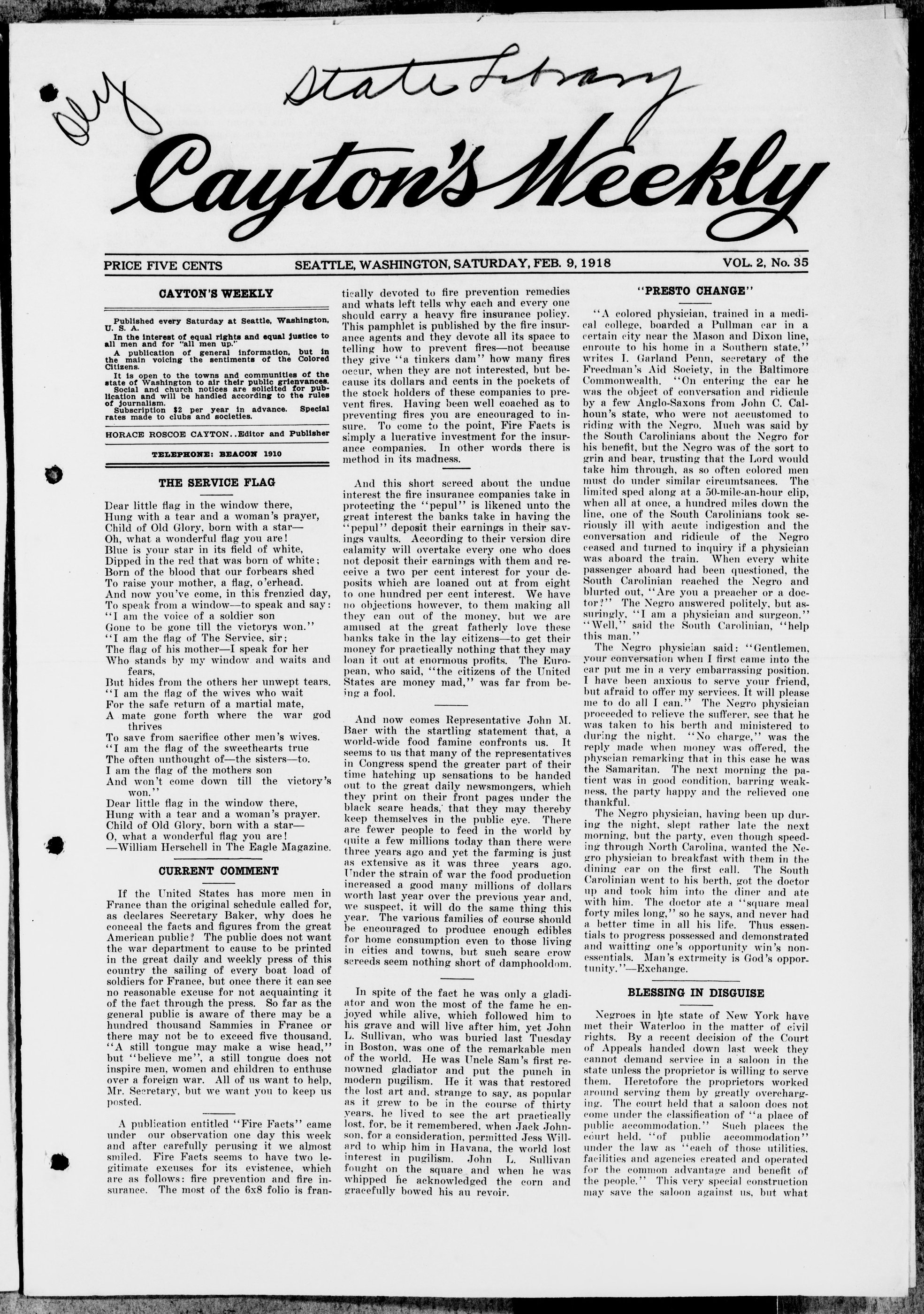
Cayton's Weekly
Saturday, February 9, 1918
Seattle, Washington
Page text (machine-generated)
State Library
Cayton's Weekly
---
CAYTON'S WEEKLY
Published every Saturday at Seattle, Washington, U. S. A. In the interest of equal rights and equal justice to all men and for "all men up." A publication of general information, but in the main voicing the sentiments of the Colored Citizens. It is open to the towns and communities of the state of Washington to air their public grievances. Social and church notices are solicited for publication and will be handled according to the rules of journalism. Subscription $2 per year in advance. Special rates made to clubs and societies.
HORACE ROSCOE CAYTON..Editor and Publisher
TELEPHONE: BEACON 1910
THE SERVICE FLAG
Dear little flag in the window there, Hung with a tear and a woman's prayer, Child of Old Glory, born with a star Oh, what a wonderful flag you are! Blue is your star in its field of white, Dipped in the red that was born of white; Born of the blood that our forbears shed To raise your mother, a flag, o'erhead. And now you've come, in this frenzied day, To speak from a window—to speak and say: "I am the voice of a soldier son Gone to be gone till the victorys won." "I am the flag of The Service, sir; The flag of his mother—I speak for her Who stands by my window and waits and
fears,
But hides from the others her unwept tears.
"I am the flag of the wives who wait
For the safe return of a martial mate,
A mate gone forth where the war god thrives
To save from sacrifice other men's wives.
"I am the flag of the sweethearts true
The often unthought of—the sisters—to.
I am the flag of the mothers son
And won't come down till the victory's won."
Dear little flag in the window there,
Hung with a tear and a woman's prayer.
Child of Old Glory, born with a star—
O, what a wonderful flag you are!
—William Herschell in The Eagle Magazine.
CURRENT COMMENT
If the United States has more men in France than the original schedule called for, as declares Secretary Baker, why does he conceal the facts and figures from the great American public? The public does not want the war department to cause to be printed in the great daily and weekly press of this country the sailing of every boat load of soldiers for France, but once there it can see no reasonable excuse for not acquainting it of the fact through the press. So far as the general public is aware of there may be a hundred thousand Sammies in France or there may not be to exceed five thousand. "A still tongue may make a wise head," but "believe me", a still tongue does not inspire men, women and children to enthuse over a foreign war. All of us want to help, Mr. Secretary, but we want you to keep us posted.
A publication entitled "Fire Facts" came under our observation one day this week and after carefully perusing it we almost smiled. Fire Facts seems to have two legitimate excuses for its existence, which are as follows: fire prevention and fire insurance. The most of the 6x8 folio is fran-
tically devoted to fire prevention remedies and whats left tells why each and every one should carry a heavy fire insurance policy. This pamphlet is published by the fire insurance agents and they devote all its space to telling how to prevent fires—not because they give "a tinkers dam" how many fires occur, when they are not interested, but because its dollars and cents in the pockets of the stock holders of these companies to prevent fires. Having been well coached as to preventing fires you are encouraged to insure. To come to the point, Fire Facts is simply a lucrative investment for the insurance companies. In other words there is method in its madness.
And this short screed about the undue interest the fire insurance companies take in protecting the "pepul" is likened unto the great interest the banks take in having the "pepul" deposit their earnings in their savings vaults. According to their version dire calamity will overtake every one who does not deposit their earnings with them and receive a two per cent interest for your deposits which are loaned out at from eight to one hundred per cent interest. We have no objections however, to them making all they can out of the money, but we are amused at the great fatherly love these banks take in the lay citizens—to get their money for practically nothing that they may loan it out at enormous profits. The European, who said, "the citizens of the United States are money mad," was far from being a fool.
And now comes Representative John M. Baer with the startling statement that, a world-wide food famine confronts us. It seems to us that many of the representatives in Congress spend the greater part of their time hatching up sensations to be handed out to the great daily newsmongers, which they print on their front pages under the black scare heads, that they may thereby keep themselves in the public eye. There are fewer people to feed in the world by quite a few millions today than there were three years ago and yet the farming is just as extensive as it was three years ago. Under the strain of war the food production increased a good many millions of dollars worth last year over the previous year and, we suspect, it will do the same thing this year. The various families of course should be encouraged to produce enough edibles for home consumption even to those living in cities and towns, but such scare crow screeds seem nothing short of damphooldom.
In spite of the fact he was only a gladiator and won the most of the fame he enjoyed while alive, which followed him to his grave and will live after him, yet John L. Sullivan, who was buried last Tuesday in Boston, was one of the remarkable men of the world. He was Uncle Sam's first renowned gladiator and put the punch in modern pugilism. He it was that restored the lost art and, strange to say, as popular as it grew to be in the course of thirty years, he lived to see the art practically lost, for, be it remembered, when Jack Johnson, for a consideration, permitted Jess Willard to whip him in Havana, the world lost interest in pugilism. John L. Sullivan fought on the square and when he was whipped he acknowledged the corn and gracefully bowed his au revoir.
VOL.2, No.35
"A colored physician, trained in a medical college, boarded a Pullman car in a certain city near the Mason and Dixon line, enroute to his home in a Southern state." writes I. Garland Penn, secretary of the Freedman's Aid Society, in the Baltimore Commonwealth. "On entering the car he was the object of conversation and ridicule by a few Anglo-Saxons from John C. Calhoun's state, who were not accustomed to riding with the Negro. Much was said by the South Carolinians about the Negro for his benefit, but the Negro was of the sort to grin and bear, trusting that the Lord would take him through, as so often colored men must do under similar circumtsances. The limited sped along at a 50-mile-an-hour clip, when all at once, a hundred miles down the line, one of the South Carolinians took seriously ill with acute indigestion and the conversation and ridicule of the Negro ceased and turned to inquiry if a physician was aboard the train. When every white passenger aboard had been questioned, the South Carolinian reached the Negro and blurted out, "Are you a preacher or a doctor?" The Negro answered politely, but assuringly, "I am a physician and surgeon." "Well," said the South Carolinian, "help this man."
The Negro physician said: "Gentlemen, your conversation when I first came into the car put me in a very embarrassing position. I have been anxious to serve your friend, but afraid to offer my services. It will please me to do all I can." The Negro physician proceeded to relieve the sufferer, see that he was taken to his berth and ministered to during the night. "No charge," was the reply made when money was offered, the physician remarking that in this case he was the Samaritan. The next morning the patient was in good condition, barring weakness, the party happy and the relieved one thankful.
The Negro physician, having been up during the night, slept rather late the next morning, but the party, even though speeding through North Carolina, wanted the Negro physician to breakfast with them in the dining car on the first call. The South Carolinian went to his berth, got the doctor up and took him into the diner and ate with him. The doctor ate a "square meal forty miles long," so he says, and never had a better time in all his life. Thus essentials to progress possessed and demonstrated and waitting one's opportunity win's non-essentials. Man's extrmeity is God's opportunity."—Exchange.
Negroes in late state of New York have met their Waterloo in the matter of civil rights. By a recent decision of the Court of Appeals handed down last week they cannot demand service in a saloon in the state unless the proprietor is willing to serve them. Heretofore the proprietors worked around serving them by greatly overcharging. The court held that a saloon does not come under the classification of "a place of public accommodation." Such places the court held, "of public accommodation" under the law as "each of those utilities, facilities and agencies created and operated for the common advantage and benefit of the people." This very special construction may save the saloon against us, but what
"PRESTO CHANGE"
BLESSING IN DISGUISE
---
```markdown
```
about other places such as hotels, cafes, theatres and so forth? Are they operated "for the common advantage, aid and benefit of the people?..." Perhaps it will be time enough to cross the bridge when we get to it, but it appears that a way is being prepared to annul the effects of the recently made civil laws of that state. The news is very depressing in view of the supposed present trend toward the democratization of the world.—The (Indianapolis) Freeman.
HOME. SWEET HOME
"I am going back to my home", defiantly snaps the young wife who is having her first quarrel with her husband, and he calms down, because he knows she had a good home before he married her and that the doors of the old home always swing in for her. Every family should have a home, that the absent one knows is ever a rest and a retreat for him or her.
"All I want in this creation.
A pretty little wife and a big plantation." ran a Southern jingo and it was hard to find a man who did not work to that end. As the "big plantation" was the hope and ambition of those men so should the home—truly home however small—be the hope and inspiration of every boy and man of Seattle. Nothing short of a home should satisfy you.
To get a home of your own be it ever so humble, should be the first undertaking of every man and then strive to make it grow as does the young tree—a mere switch—until it is a giant oak. A home that does not grow as the years go by slowly but surely lapses into a hovel.
After describing his home, to which he wanted to sell because he though it did not suit him and then listening to the description read off to him, the dissatisfied man exclaimed, if that's my home its no longer on the market—it's the kind of home I have always wanted. Unawares he had fashioned for himself an ideal home and did not realize its worth until he heard its good qualities told about.
The home is without intrinsic value and yet it is priceless. What advantage to sell your home for even thrice what you gave for it unless your family has outgrown its capacity or the community has assumed an air that you do not care to breathe and you sell only to buy where you can get more elbow room.
You can make a home in the city as well as in the country, though it be devoid of its lowing heards, etc. Each day do something toward improving and beautifying the place where you reside and before you realize it you will have a home that will be the cynosure of all eyes.
There is nothing the equal of a home, except a good and loving wife and a faithful as well as devoted husband and the well-kept home with such a mother and father therein must be very much like that "home not built by hands, eternal in the heavens." When a man working for a modest monthly or weekly wage buys a home in a community in which he has to live up to every dollar he earns in order to make a showing with his neighbors, such an home is a hell instead of a happy home. Do not try to be more than you really are.
A family owning a well kept as well as a well arranged home, is better off by far than a like family having $4,000 in the bank subject to its check. A good home leads all other investments for a poor man.
When Paine wrote "Home, Sweet Home", while sweltering in the torrid suns of Africa, his mind doubtless wandered back to father, mother, brothers, and sisters "down on the farm" and not so much to his country. A home where me and mine can meet and be at ease is the greatest boon on earth.
An inviting home, accompanied with a happy home is priceless and, who owns such should be no more willing or desirous to part from it than to dispose of one of the children for even a fabulous price. Sell the home that has been yours for many years and you will never be able to get another like it.
You should never buy a home for a speculation, but for a permanancy. For your respective children to grow to maturity in and then go out for themselves and thereafter periodically visit father and mother at the "old home' 'makes home almost a heaven on earth. Get a home and keep it- May perhaps this tete-tete on homes is far fetched but it means to bring forcibly to the minds of you men drawing good wages every week and wrecklessly spending them, that you are making the mistake of your life in not putting the most of those wages into a home.
In urging its readers, who are getting a big weekly wage to purchase either houses and or vacant lots, on which to live instead of paying rent, Cayton's Weekly is not doing so in the interest of real estate dealers, but in the interest of you and each of you. Rents in Seattle are going to continue to rise and this rent rise will affect every section of the city. The building of new homes will by no means keep pace with the demand for homes. The demand for cottages at present is unprecedented and yet we venture the guess that there will not be bult for speculation or rent one thousand cottages in Seattle during 1918 and simply because the mechanics are not to be had to do the work. We suggest to you that you forget your pride and go to the suburbs and get a large lot and if nothing else, erect a tent house for temporary use.
"I can buy vegetables cheaper than I can raise them,' is often heard in reply to: "Why not raise garden truck in your back yard." The statement is absolutely false and the only excuse for it is that the person does not raise enough on his back yard to justify the outlay of time he or she has to put on it, and the reason for that is the ground is not properly prepared and fertilized and the planting and growing are not systematically done. A plot of ground 40x50 feet in the course of the growing season in Seattle can be made to produce at least $100 worth of vegetables and if those vegetables are canned for the winter they will be worth twice that amount; and any man can do the necessary work to produce that amount and not lose a single minute from his regular employment and the wife can do the canning and the actual cost for this would not exceed $10 if that.
Speaking about raising what your family needs on the plot of ground where you live and yet not lose any time from your daily avocation, reminds us that Andrew R. Black, one of the prominent as well as prosperous attorneys of Seattle, raised vegetables, fruit and potatoes enough last year to last his family two winters and the outlay for the same was very small and as he did, so can you, for he did the work in his garden after and before office hours. Who desires to live independent must work to that end. It's utterly impossible to make your daily wage supply all of your family needs and every time you lop off a dollar by gathering it from your garden you come that much nearer living an independent life. We know a man who earns $100 per month, but lives in an apartment and has to buy everything his family uses and yet he wonders why he does not get ahead, which is plain to be seen.
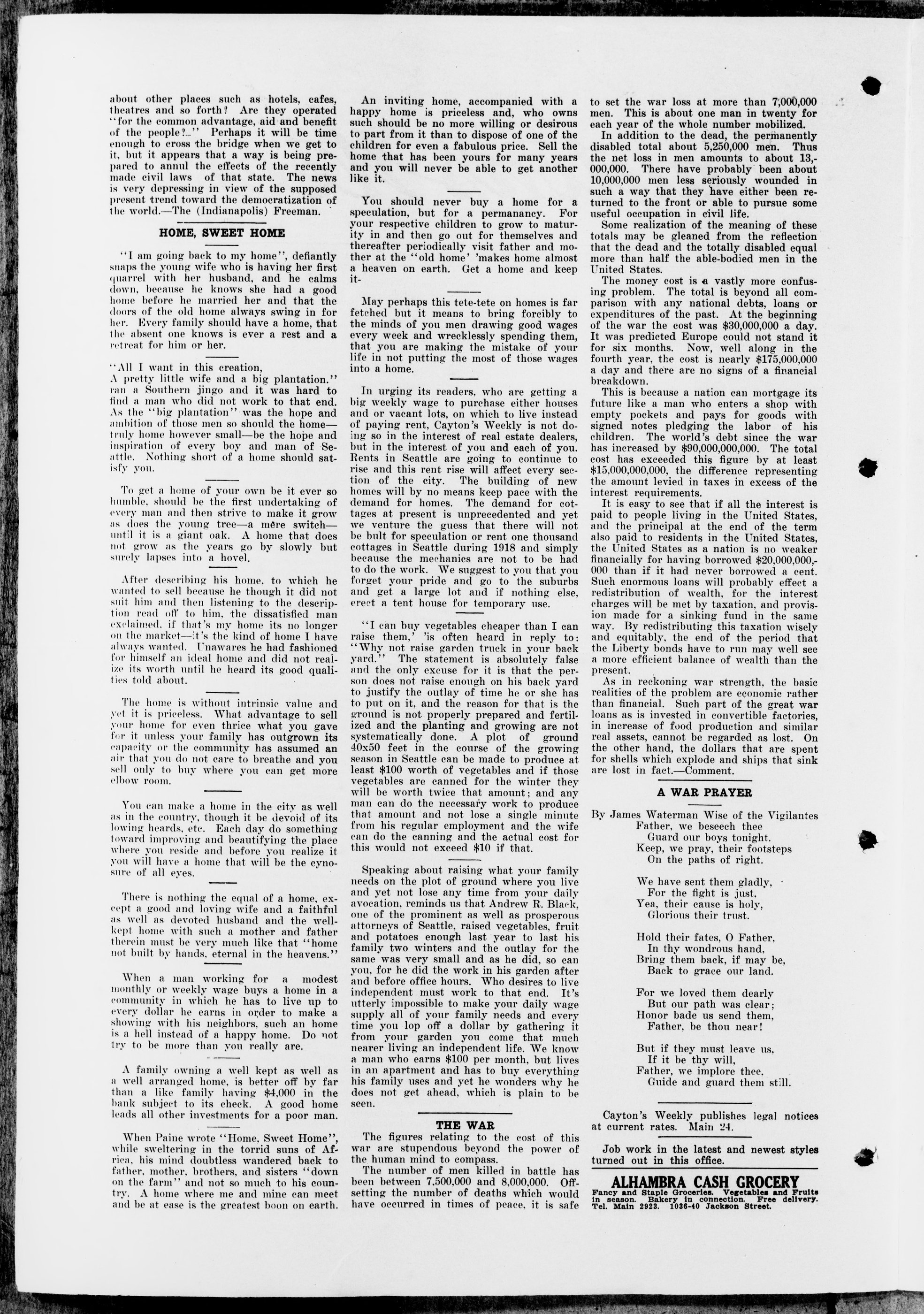
THE WAR
The figures relating to the cost of this war are stupendous beyond the power of the human mind to compass. The number of men killed in battle has been between 7,500,000 and 8,000,000. Offsetting the number of deaths which would have occurred in times of peace, it is safe
to set the war loss at more than 7,000,000 men. This is about one man in twenty for each year of the whole number mobilized. In addition to the dead, the permanently disabled total about 5,250,000 men. Thus the net loss in men amounts to about 13,-000,000. There have probably been about 10,000,000 men less seriously wounded in such a way that they have either been returned to the front or able to pursue some useful occupation in civil life. Some realization of the meaning of these totals may be gleaned from the reflection that the dead and the totally disabled equal more than half the able-bodied men in the United States.
The money cost is a vastly more confusing problem. The total is beyond all comparison with any national debts, loans or expenditures of the past. At the beginning of the war the cost was $30,000,000 a day. It was predicted Europe could not stand it for six months. Now, well along in the fourth year, the cost is nearly $175,000,000 a day and there are no signs of a financial breakdown.
This is because a nation can mortgage its future like a man who enters a shop with empty pockets and pays for goods with signed notes pledging the labor of his children. The world's debt since the war has increased by $90,000,000,000. The total cost has exceeded this figure by at least $15,000,000,000, the difference representing the amount levied in taxes in excess of the interest requirements.
It is easy to see that if all the interest is paid to people living in the United States, and the principal at the end of the term also paid to residents in the United States, the United States as a nation is no weaker financially for having borrowed $20,000,000,-000 than if it had never borrowed a cent. Such enormous loans will probably effect a redistribution of wealth, for the interest charges will be met by taxation, and provision made for a sinking fund in the same way. By redistributing this taxation wisely and equitably, the end of the period that the Liberty bonds have to run may well see a more efficient balance of wealth than the present.
As in reckoning war strength, the basic realities of the problem are economic rather than financial. Such part of the great war loans as is invested in convertible factories, in increase of food production and similar real assets, cannot be regarded as lost. On the other hand, the dollars that are spent for shells which explode and ships that sink are lost in fact.—Comment.
A WAR PRAYER
By James Waterman Wise of the Vigilantes
Father, we beseech thee
Guard our boys tonight.
Keep, we pray, their footsteps
On the paths of right.
We have sent them gladly,
For the fight is just.
Yea, their cause is holy,
Glorious their trust.
Hold their fates, O Father,
In thy wondrous hand,
Bring them back, if may be,
Back to grace our land.
For we loved them dearly
But our path was clear;
Honor bade us send them,
Father, be thou near!
But if they must leave us,
If it be thy will,
Father, we implore thee.
Guide and guard them still.
Cayton's Weekly publishes legal notices at current rates. Main 24.
Job work in the latest and newest styles turned out in this office.
ALHAMBRA CASH GROCERY
Fancy and Staple Groceries. Vegetables and Fruits in season. Bakery in connection. Free delivery.
Tel. Main 2923. 1036-40 Jackson Street.
---
Copyright 1917
By ORLANDO BELKNAP POND
(All rights reserved)
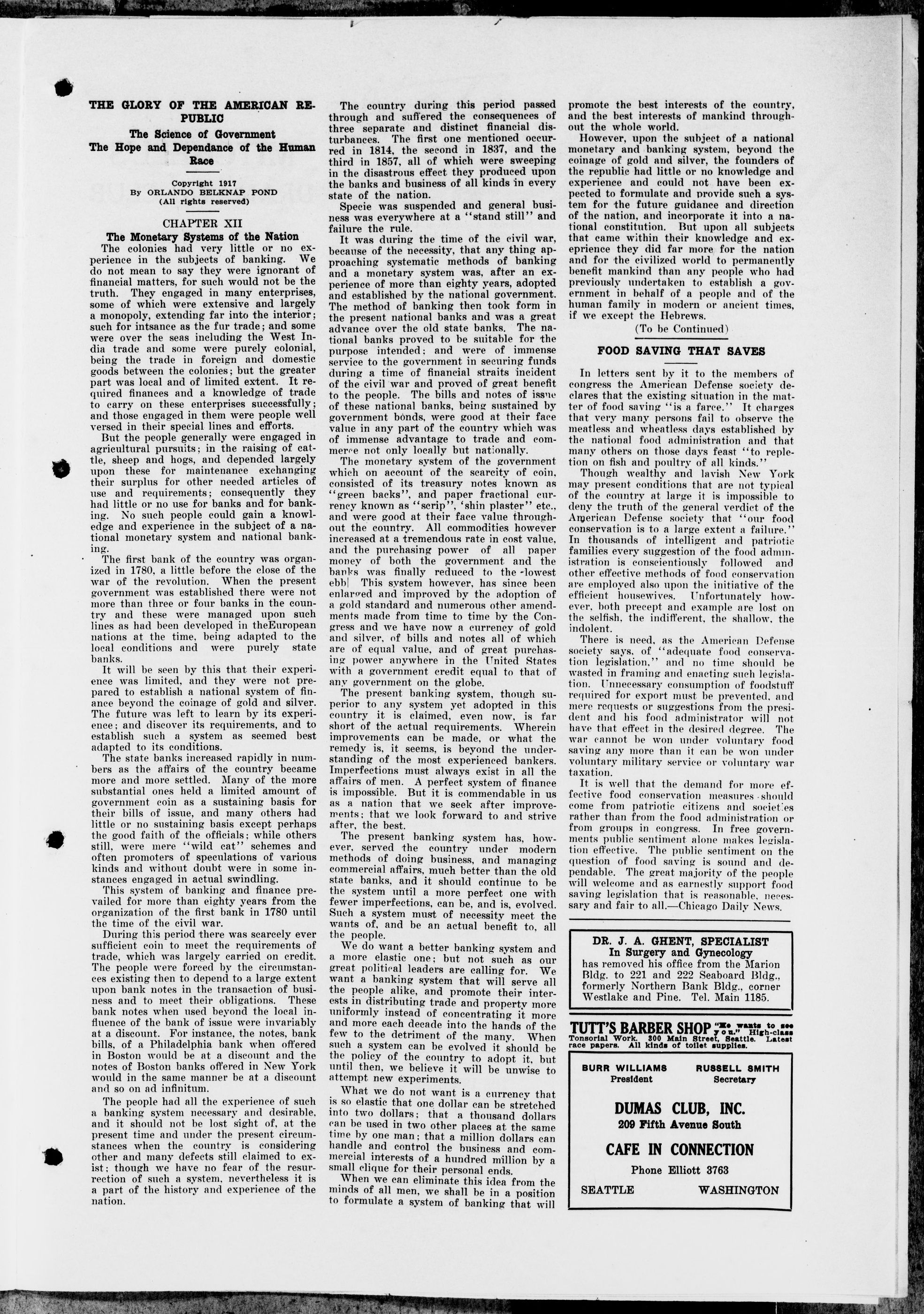
The colonies had very little or no experience in the subjects of banking. We do not mean to say they were ignorant of financial matters, for such would not be the truth. They engaged in many enterprises, some of which were extensive and largely a monopoly, extending far into the interior; such for intsance as the fur trade; and some were over the seas including the West India trade and some were purely colonial, being the trade in foreign and domestic goods between the colonies; but the greater part was local and of limited extent. It required finances and a knowledge of trade to carry on these enterprises successfully; and those engaged in them were people well versed in their special lines and efforts.
But the people generally were engaged in agricultural pursuits; in the raising of cattle, sheep and hogs, and depended largely upon these for maintenance exchanging their surplus for other needed articles of use and requirements; consequently they had little or no use for banks and for banking. No such people could gain a knowledge and experience in the subject of a national monetary system and national banking.
The first bank of the country was organized in 1780, a little before the close of the war of the revolution. When the present government was established there were not more than three or four banks in the country and these were managed upon such lines as had been developed in the European nations at the time, being adapted to the local conditions and were purely state banks.
It will be seen by this that their experience was limited, and they were not prepared to establish a national system of finance beyond the coinage of gold and silver. The future was left to learn by its experience; and discover its requirements, and to establish such a system as seemed best adapted to its conditions.
The state banks increased rapidly in numbers as the affairs of the country became more and more settled. Many of the more substantial ones held a limited amount of government coin as a sustaining basis for their bills of issue, and many others had little or no sustaining basis except perhaps the good faith of the officials; while others still, were mere "wild cat" schemes and often promoters of speculations of various kinds and without doubt were in some instances engaged in actual swindling. This system of banking and finance prevailed for more than eighty years from the organization of the first bank in 1780 until the time of the civil war.
During this period there was scarcely ever sufficient coin to meet the requirements of trade, which was largely carried on credit. The people were forced by the circumstances existing then to depend to a large extent upon bank notes in the transaction of business and to meet their obligations. These bank notes when used beyond the local influence of the bank of issue were invariably at a discount. For instance, the notes, bank bills, of a Philadelphia bank when offered in Boston would be at a discount and the notes of Boston banks offered in New York would in the same manner be at a discount and so on ad infinitum.
The people had all the experience of such a banking system necessary and desirable, and it should not be lost sight of, at the present time and under the present circumstances when the country is considering other and many defects still claimed to exist; though we have no fear of the resurrection of such a system, nevertheless it is a part of the history and experience of the nation.
The country during this period passed through and suffered the consequences of three separate and distinct financial disturbances. The first one mentioned occurred in 1814, the second in 1837, and the third in 1857, all of which were sweeping in the disastrous effect they produced upon the banks and business of all kinds in every state of the nation. Specie was suspended and general business was everywhere at a "stand still" and failure the rule.
It was during the time of the civil war, because of the necessity, that any thing approaching systematic methods of banking and a monetary system was, after an experience of more than eighty years, adopted and established by the national government. The method of banking then took form in the present national banks and was a great advance over the old state banks. The national banks proved to be suitable for the purpose intended; and were of immense service to the government in securing funds during a time of financial straits incident of the civil war and proved of great benefit to the people. The bills and notes of issue of these national banks, being sustained by government bonds, were good at their face value in any part of the country which was of immense advantage to trade and commerce not only locally but nationally.
The monetary system of the government which on account of the scarcity of coin, consisted of its treasury notes known as "green backs", and paper fractional currency known as "scrip", 'shin plaster" etc., and were good at their face value throughout the country. All commodities however increased at a tremendous rate in cost value, and the purchasing power of all paper money of both the government and the banks was finally reduced to the lowest ebb This system however, has since been enlarged and improved by the adoption of a gold standard and numerous other amendments made from time to time by the Congress and we have now a currency of gold and silver, of bills and notes all of which are of equal value, and of great purchasing power anywhere in the United States with a government credit equal to that of any government on the globe.
The present banking system, though superior to any system yet adopted in this country it is claimed, even now, is far short of the actual requirements. Wherein improvements can be made, or what the remedy is, it seems, is beyond the understanding of the most experienced bankers. Imperfections must always exist in all the affairs of men. A perfect system of finance is impossible. But it is commendable in us as a nation that we seek after improvements; that we look forward to and strive after, the best.
The present banking system has, however, served the country under modern methods of doing business, and managing commercial affairs, much better than the old state banks, and it should continue to be the system until a more perfect one with fewer imperfections, can be, and is, evolved. Such a system must of necessity meet the wants of, and be an actual benefit to, all the people.
We do want a better banking system and a more elastic one; but not such as our great political leaders are calling for. We want a banking system that will serve all the people alike, and promote their interests in distributing trade and property more uniformly instead of concentrating it more and more each decade into the hands of the few to the detriment of the many. When such a system can be evolved it should be the policy of the country to adopt it, but until then, we believe it will be unwise to attempt new experiments.
What we do not want is a currency that is so elastic that one dollar can be stretched into two dollars; that a thousand dollars can be used in two other places at the same time by one man; that a million dollars can handle and control the business and commercial interests of a hundred million by a small clique for their personal ends. When we can eliminate this idea from the minds of all men, we shall be in a position to formulate a system of banking that will
promote the best interests of the country and the best interests of mankind throughout the whole world.
However, upon the subject of a national monetary and banking system, beyond the coinage of gold and silver, the founders of the republic had little or no knowledge and experience and could not have been expected to formulate and provide such a system for the future guidance and direction of the nation, and incorporate it into a national constitution. But upon all subjects that came within their knowledge and experience they did far more for the nation and for the civilized world to permanently benefit mankind than any people who had previously undertaken to establish a government in behalf of a people and of the human family in modern or ancient times, if we except the Hebrews.
(To be Continued)
FOOD SAVING THAT SAVES
In letters sent by it to the members of congress the American Defense society declares that the existing situation in the matter of food saving "is a farce." It charges that very many persons fail to observe the meatless and wheatless days established by the national food administration and that many others on those days feast "to repletion on fish and poultry of all kinds."
Though wealthy and lavish New York may present conditions that are not typical of the country at large it is impossible to deny the truth of the general verdict of the American Defense society that "our food conservation is to a large extent a failure." In thousands of intelligent and patriotic families every suggestion of the food administration is conscientiously followed and other effective methods of food conservation are employed also upon the initiative of the efficient housewives. Unfortunately however, both precept and example are lost on the selfish, the indifferent, the shallow, the indolent.
There is need, as the American Defense society says, of "adequate food conservation legislation," and no time should be wasted in framing and enacting such legislation. Unnecessary consumption of foodstuff required for export must be prevented, and mere requests or suggestions from the president and his food administrator will not have that effect in the desired degree. The war cannot be won under voluntary food saving any more than it can be won under voluntary military service or voluntary war taxation.
It is well that the demand for more effective food conservation measures should come from patriotic citizens and societies rather than from the food administration or from groups in congress. In free governments public sentiment alone makes legislation effective. The public sentiment on the question of food saving is sound and dependable. The great majority of the people will welcome and as earnestly support food saving legislation that is reasonable, necessary and fair to all.—Chicago Daily News.
DR. J. A. GHENT, SPECIALIST
In Surgery and Gynecology
has removed his office from the Marion
Bldg. to 221 and 222 Seaboard Bldg.,
formerly Northern Bank Bldg., corner
Westlake and Pine. Tel. Main 1185.
TUTT'S BARBER SHOP "He wants to see you." High-class
Tonsorial Work. 300 Main Street, Seattle. Latest
race papers. All kinds of toilet supplies.
BURR WILLIAMS RUSSELL SMITH
President Secretary
DUMAS CLUB, INC.
209 Fifth Avenue South
CAFE IN CONNECTION
Phone Elliott 3763
SEATTLE WASHINGTON
---
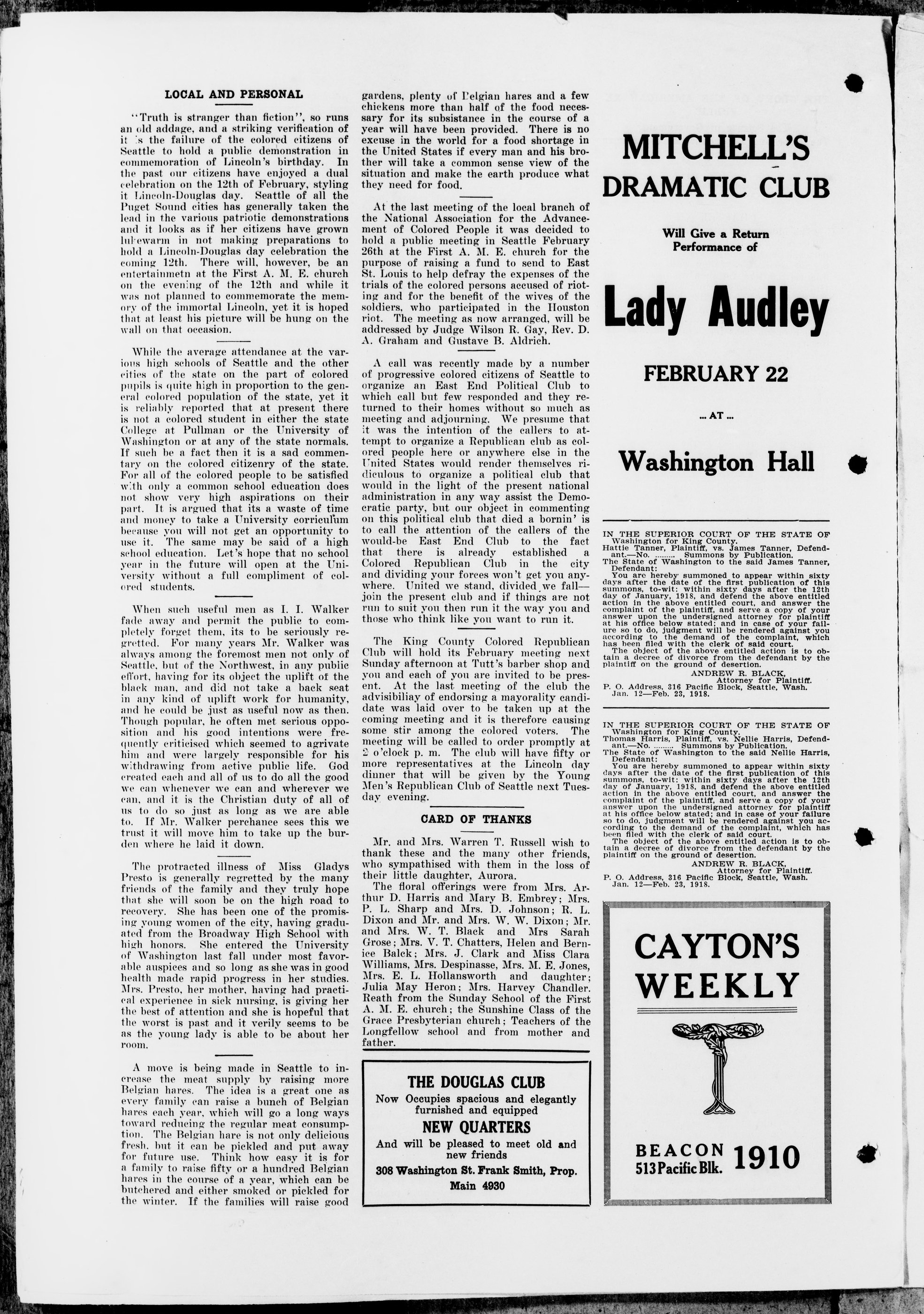
LOCAL AND PERSONAL
"Truth is stranger than fiction", so runs an old addage, and a striking verification of it is the failure of the colored citizens of Seattle to hold a public demonstration in commemoration of Lincoln's birthday. In the past our citizens have enjoyed a dual celebration on the 12th of February, styling it Lincoln-Douglas day. Seattle of all the Puget Sound cities has generally taken the lead in the various patriotic demonstrations and it looks as if her citizens have grown lukewarm in not making preparations to hold a Lincoln-Douglas day celebration the coming 12th. There will, however, be an entertainmetn at the First A. M. E. church on the evening of the 12th and while it was not planned to commemorate the memory of the immortal Lincoln, yet it is hoped that at least his picture will be hung on the wall on that occasion.
While the average attendance at the various high schools of Seattle and the other cities of the state on the part of colored pupils is quite high in proportion to the general colored population of the state, yet it is reliably reported that at present there is not a colored student in either the state College at Pullman or the University of Washington or at any of the state normals. If such be a fact then it is a sad commentary on the colored citizenry of the state. For all of the colored people to be satisfied with only a common school education does not show very high aspirations on their part. It is argued that its a waste of time and money to take a University curriculum because you will not get an opportunity to use it. The same may be said of a high school education. Let's hope that no school year in the future will open at the University without a full compliment of colored students.
When such useful men as I. I. Walker fade away and permit the public to completely forget them, its to be seriously regretted. For many years Mr. Walker was always among the foremost men not only of Seattle, but of the Northwest, in any public effort, having for its object the uplift of the black man, and did not take a back seat in any kind of uplift work for humanity, and he could be just as useful now as then. Though popular, he often met serious opposition and his good intentions were frequently criticised which seemed to agrivate him and were largely responsible for his withdrawing from active public life. God created each and all of us to do all the good we can whenever we can and wherever we can, and it is the Christian duty of all of us to do so just as long as we are able to. If Mr. Walker perchance sees this we trust it will move him to take up the burden where he laid it down.
The protracted illness of Miss Gladys Presto is generally regretted by the many friends of the family and they truly hope that she will soon be on the high road to recovery. She has been one of the promising young women of the city, having graduated from the Broadway High School with high honors. She entered the University of Washington last fall under most favorable auspices and so long as she was in good health made rapid progress in her studies. Mrs. Presto, her mother, having had practical experience in sick nursing, is giving her the best of attention and she is hopeful that the worst is past and it verily seems to be as the young lady is able to be about her room.
A move is being made in Seattle to increase the meat supply by raising more Belgian hares. The idea is a great one as every family can raise a bunch of Belgian hares each year, which will go a long ways toward reducing the regular meat consumption. The Belgian hare is not only delicious fresh, but it can be pickled and put away for future use. Think how easy it is for a family to raise fifty or a hundred Belgian hares in the course of a year, which can be butchered and either smoked or pickled for the winter. If the families will raise good
gardens, plenty of Belgian hares and a few chickens more than half of the food necessary for its subsistance in the course of a year will have been provided. There is no excuse in the world for a food shortage in the United States if every man and his brother will take a common sense view of the situation and make the earth produce what they need for food.
At the last meeting of the local branch of the National Association for the Advancement of Colored People it was decided to hold a public meeting in Seattle February 26th at the First A. M. E. church for the purpose of raising a fund to send to East St. Louis to help defray the expenses of the trials of the colored persons accused of rioting and for the benefit of the wives of the soldiers, who participated in the Houston riot. The meeting as now arranged, will be addressed by Judge Wilson R. Gay, Rev. D. A. Graham and Gustave B. Aldrich.
A call was recently made by a number of progressive colored citizens of Seattle to organize an East End Political Club to which call but few responded and they returned to their homes without so much as meeting and adjourning. We presume that it was the intention of the callers to attempt to organize a Republican club as colored people here or anywhere else in the United States would render themselves ridiculous to organize a political club that would in the light of the present national administration in any way assist the Democratic party, but our object in commenting on this political club that died a bornin' is to call the attention of the callers of the would-be East End Club to the fact that there is already established a Colored Republican Club in the city and dividing your forces won't get you anywhere. United we stand, divided we fall—join the present club and if things are not run to suit you then run it the way you and those who think like you want to run it.
The King County Colored Republican Club will hold its February meeting next Sunday afternoon at Tutt's barber shop and you and each of you are invited to be present. At the last meeting of the club the advisibility of endorsing a mayorality candidate was laid over to be taken up at the coming meeting and it is therefore causing some stir among the colored voters. The meeting will be called to order promptly at 2 o'clock p. m. The club will have fifty or more representatives at the Lincoln day dinner that will be given by the Young Men's Republican Club of Seattle next Tuesday evening.
CARD OF THANKS
Mr. and Mrs. Warren T. Russell wish to thank these and the many other friends, who sympathised with them in the loss of their little daughter. Aurora.
The floral offerings were from Mrs. Arthur D. Harris and Mary B. Embrey; Mrs. P. L. Sharp and Mrs. D. Johnson; R. L. Dixon and Mr. and Mrs. W. W. Dixon; Mr. and Mrs. W. T. Black and Mrs Sarah Grose; Mrs. V. T. Chatters, Helen and Bernice Balck; Mrs. J. Clark and Miss Clara Williams, Mrs. Despinasse, Mrs. M. E. Jones, Mrs. E. L. Hollansworth and daughter; Julia May Heron; Mrs. Harvey Chandler. Reath from the Sunday School of the First A. M. E. church; the Sunshine Class of the Grace Presbyterian church; Teachers of the Longfellow school and from mother and father.
THE DOUGLAS CLUB
Now Occupies spacious and elegantly
furnished and equipped
NEW QUARTERS
And will be pleased to meet old and
new friends
308 Washington St. Frank Smith, Prop.
Main 4930
MITCHELL'S DRAMATIC CLUB
Will Give a Return Performance of
Lady Audley
FEBRUARY 22
... AT ...
Washington Hall
... AT ...
IN THE SUPERIOR COURT OF THE STATE OF Washington for King County.
You are hereby summoned to appear within sixty days after the date of the first publication of this summons, to-wit: within sixty days after the 12th day of January, 1918, and defend the above entitled action in the above entitled court, and answer the complaint of the plaintiff, and serve a copy of your answer upon the undersigned attorney for plaintiff at his office below stated; and in case of your failure so to do, judgment will be rendered against you according to the demand of the complaint, which has been filed with the clerk of said court.
The object of the above entitled action is to obtain a decree of divorce from the defendant by the plaintiff on the ground of desertion.
ANDREW R. BLACK,
Attorney for Plaintiff.
P. O. Address, 316 Pacific Block, Seattle, Wash.
Jan. 12—Feb. 23, 1918.
IN THE SUPERIOR COURT OF THE STATE OF Washington for King County.
Thomas Harris, Plaintiff, vs. Nellie Harris, Defendant.—No. ..... Summons by Publication.
The State of Washington to the said Nellie Harris, Defendant:
Derendant.
You are hereby summoned to appear within sixty days after the date of the first publication of this summons, to-wit: within sixty days after the 12th day of January, 1918, and defend the above entitled action in the above entitled court, and answer the complaint of the plaintiff, and serve a copy of your answer upon the undersigned attorney for plaintiff at his office below stated; and in case of your failure so to do, judgment will be rendered against you according to the demand of the complaint, which has been filed with the clerk of said court.
The object of the above entitled action is to obtain a decree of divorce from the defendant by the plaintiff on the ground of desertion.
ANDREW R. BLACK,
Attorney for Plaintiff.
P. O. Address, 316 Pacific Block, Seattle, Wash.
Jan. 12—Feb. 23, 1918.
CAYTON'S
WEEKLY
BEACON
513 Pacific Blk. 1910
---