Cayton's Weekly
Saturday, March 2, 1918
Seattle, Washington
Page text (machine-generated)
State Story
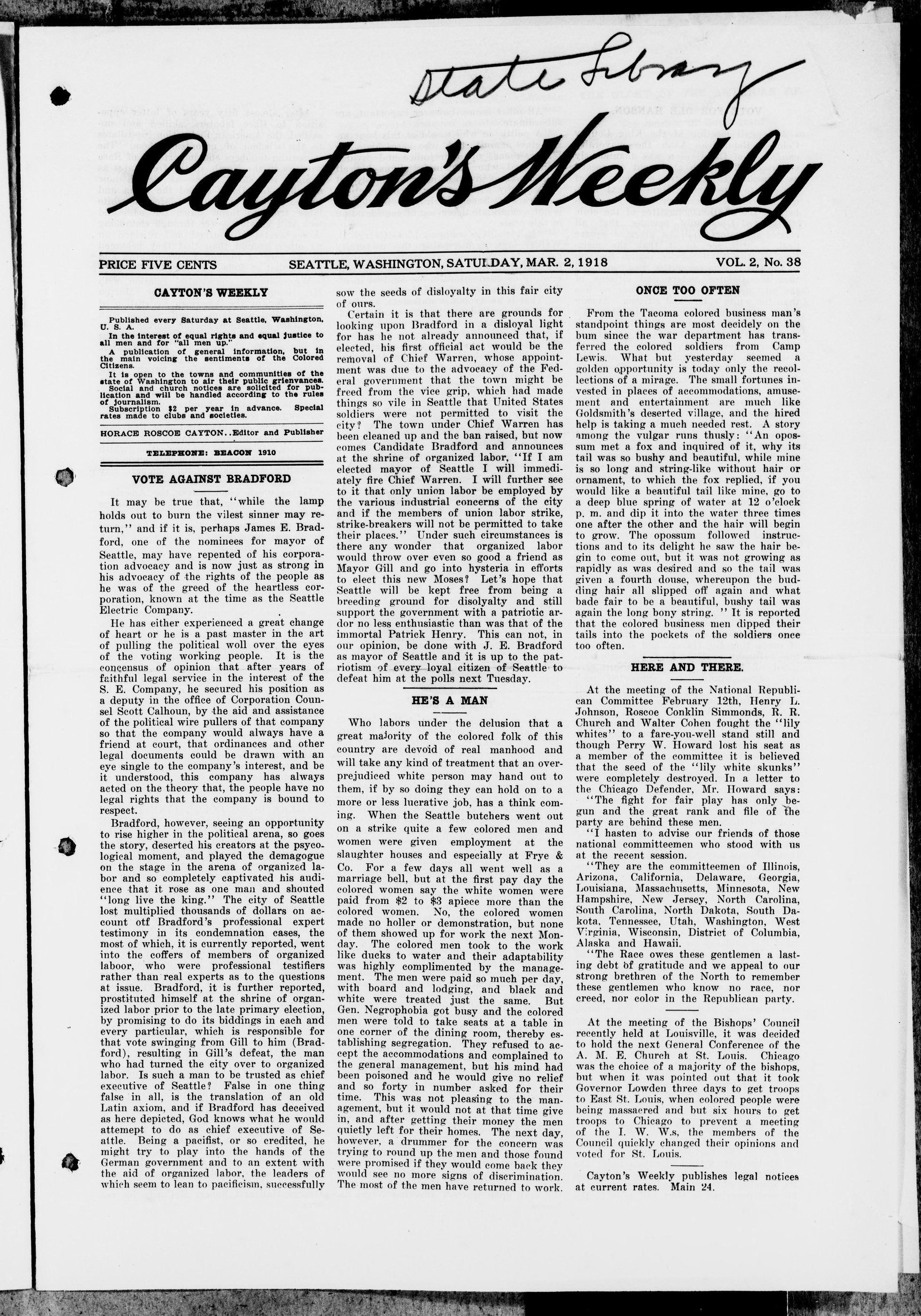
Cayton's Weekly
PRICE FIVE CENTS SEATTLE, WASHINGTON, SATURDAY, MAR. 2, 1918 VOL. 2, No. 38
CAYTON'S WEEKLY
Published every Saturday at Seattle, Washington. U. S. A.
It is open to the towns and communities of the state of Washington to air their public grievances. Social and church notices are solicited for publication and will be handled according to the rules of journalism.
Subscription $2 per year in advance. Special rates made to clubs and societies.
HORACE ROSCOE CAYTON..Editor and Publisher
TELEPHONE: BEACON 1910
VOTE AGAINST BRADFORD
It may be true that, "while the lamp holds out to burn the vilest sinner may return," and if it is, perhaps James E. Bradford, one of the nominees for mayor of Seattle, may have repented of his corporation advocacy and is now just as strong in his advocacy of the rights of the people as he was of the greed of the heartless corporation, known at the time as the Seattle Electric Company.
He has either experienced a great change of heart or he is a past master in the art of pulling the political woll over the eyes of the voting working people. It is the concensus of opinion that after years of faithful legal service in the interest of the S. E. Company, he secured his position as a deputy in the office of Corporation Counsel Scott Calhoun, by the aid and assistance of the political wire pullers of that company so that the company would always have a friend at court, that ordinances and other legal documents could be drawn with an eye single to the company's interest, and be it understood, this company has always acted on the theory that, the people have no legal rights that the company is bound to respect.
Bradford, however, seeing an opportunity to rise higher in the political arena, so goes the story, deserted his creators at the psychological moment, and played the demagogue on the stage in the arena of organized labor and so completely captivated his audience that it rose as one man and shouted "long live the king." The city of Seattle lost multiplied thousands of dollars on account of Bradford's professional expert testimony in its condemnation cases, the most of which, it is currently reported, went into the coffers of members of organized laboor, who were professional testifiers rather than real experts as to the questions at issue. Bradford, it is further reported, prostituted himself at the shrine of organized labor prior to the late primary election, by promising to do its biddings in each and every particular, which is responsible for that vote swinging from Gill to him (Bradford), resulting in Gill's defeat, the man who had turned the city over to organized labor. Is such a man to be trusted as chief executive of Seattle? False in one thing false in all, is the translation of an old Latin axiom, and if Bradford has deceived as here depicted, God knows what he would attempt to do as chief executive of Seattle. Being a pacifist, or so credited, he might try to play into the hands of the German government and to an extent with the aid of organized labor, the leaders of which seem to lean to pacificism, successfully
SEATTLE, WASHINGTON, SATUI DAY, MAR. 2, 1918
sow the seeds of disloyalty in this fair city of ours.
Certain it is that there are grounds for looking upon Bradford in a disloyal light for has he not already announced that, if elected, his first official act would be the removal of Chief Warren, whose appointment was due to the advocacy of the Federal government that the town might be freed from the vice grip, which had made things so vile in Seattle that United States soldiers were not permitted to visit the city? The town under Chief Warren has been cleaned up and the ban raised, but now comes Candidate Bradford and announces at the shrine of organized labor, "If I am elected mayor of Seattle I will immediately fire Chief Warren. I will further see to it that only union labor be employed by the various industrial concerns of the city and if the members of union labor strike, strike-breakers will not be permitted to take their places." Under such circumstances is there any wonder that organized labor would throw over even so good a friend as Mayor Gill and go into hysteria in efforts to elect this new Moses? Let's hope that Seattle will be kept free from being a breeding ground for disolyalty and still support the government with a patriotic ardor no less enthusiastic than was that of the immortal Patrick Henry. This can not, in our opinion, be done with J. E. Bradford as mayor of Seattle and it is up to the patriotism of every loyal citizen of Seattle to defeat him at the polls next Tuesday.
HE'S A MAN
Who labors under the delusion that a great majority of the colored folk of this country are devoid of real manhood and will take any kind of treatment that an overprejudiced white person may hand out to them, if by so doing they can hold on to a more or less lucrative job, has a think coming. When the Seattle butchers went out on a strike quite a few colored men and women were given employment at the slaughter houses and especially at Frye & Co. For a few days all went well as a marriage bell, but at the first pay day the colored women say the white women were paid from $2 to $3 apiece more than the colored women. No, the colored women made no holler or demonstration, but none of them showed up for work the next Monday. The colored men took to the work like ducks to water and their adaptability was highly complimented by the management. The men were paid so much per day, with board and lodging, and black and white were treated just the same. But Gen. Negrophobia got busy and the colored men were told to take seats at a table in one corner of the dining room, thereby establishing segregation. They refused to accept the accommodations and complained to the general management, but his mind had been poisoned and he would give no relief and so forty in number asked for their time. This was not pleasing to the management, but it would not at that time give in, and after getting their money the men quietly left for their homes. The next day, however, a drummer for the concern was trying to round up the men and those found were promised if they would come back they would see no more signs of discrimination. The most of the men have returned to work.
VOL.2, No.38
ONCE TOO OFTEN
From the Tacoma colored business man's standpoint things are most decidely on the bum since the war department has transferred the colored soldiers from Camp Lewis. What but yesterday seemed a golden opportunity is today only the recollections of a mirage. The small fortunes invested in places of accommodations, amusement and entertainment are much like Goldsmith's deserted village, and the hired help is taking a much needed rest. A story among the vulgar runs thusly: "An opossum met a fox and inquired of it, why its tail was so bushy and beautiful, while mine is so long and string-like without hair or ornament, to which the fox replied, if you would like a beautiful tail like mine, go to a deep blue spring of water at 12 o'clock p. m. and dip it into the water three times one after the other and the hair will begin to grow. The opossum followed instructions and to its delight he saw the hair begin to come out, but it was not growing as rapidly as was desired and so the tail was given a fourth douse, whereupon the budding hair all slipped off again and what bade fair to be a beautiful, bushy tail was again the long bony string." It is reported that the colored business men dipped their tails into the pockets of the soldiers once too often.
HERE AND THERE
At the meeting of the National Republican Committee February 12th, Henry L. Johnson, Roscoe Conklin Simmonds, R. R. Church and Walter Cohen fought the "lily whites" to a fare-you-well stand still and though Perry W. Howard lost his seat as a member of the committee it is believed that the seed of the "lily white skunks" were completely destroyed. In a letter to the Chicago Defender, Mr. Howard says: "The fight for fair play has only begun and the great rank and file of the party are behind these men. "I hasten to advise our friends of those national committeemen who stood with us at the recent session. "They are the committeemen of Illinois, Arizona, California, Delaware, Georgia, Louisiana, Massachusetts, Minnesota, New Hampshire, New Jersey, North Carolina, South Carolina, North Dakota, South Dakota, Tennessee, Utah, Washington, West Virginia, Wisconsin, District of Columbia, Alaska and Hawaii.
"The Race owes these gentlemen a lasting debt of gratitude and we appeal to our strong brethren of the North to remember these gentlemen who know no race, nor creed, nor color in the Republican party.
At the meeting of the Bishops' Council recently held at Louisville, it was decided to hold the next General Conference of the A. M. E. Church at St. Louis. Chicago was the choice of a majority of the bishops, but when it was pointed out that it took Governor Lowden three days to get troops to East St. Louis, when colored people were being massacred and but six hours to get troops to Chicago to prevent a meeting of the I. W. W.s, the members of the Council quickly changed their opinions and voted for St. Louis.
Cayton's Weekly publishes legal notices at current rates. Main 24.
---
---
```markdown
```
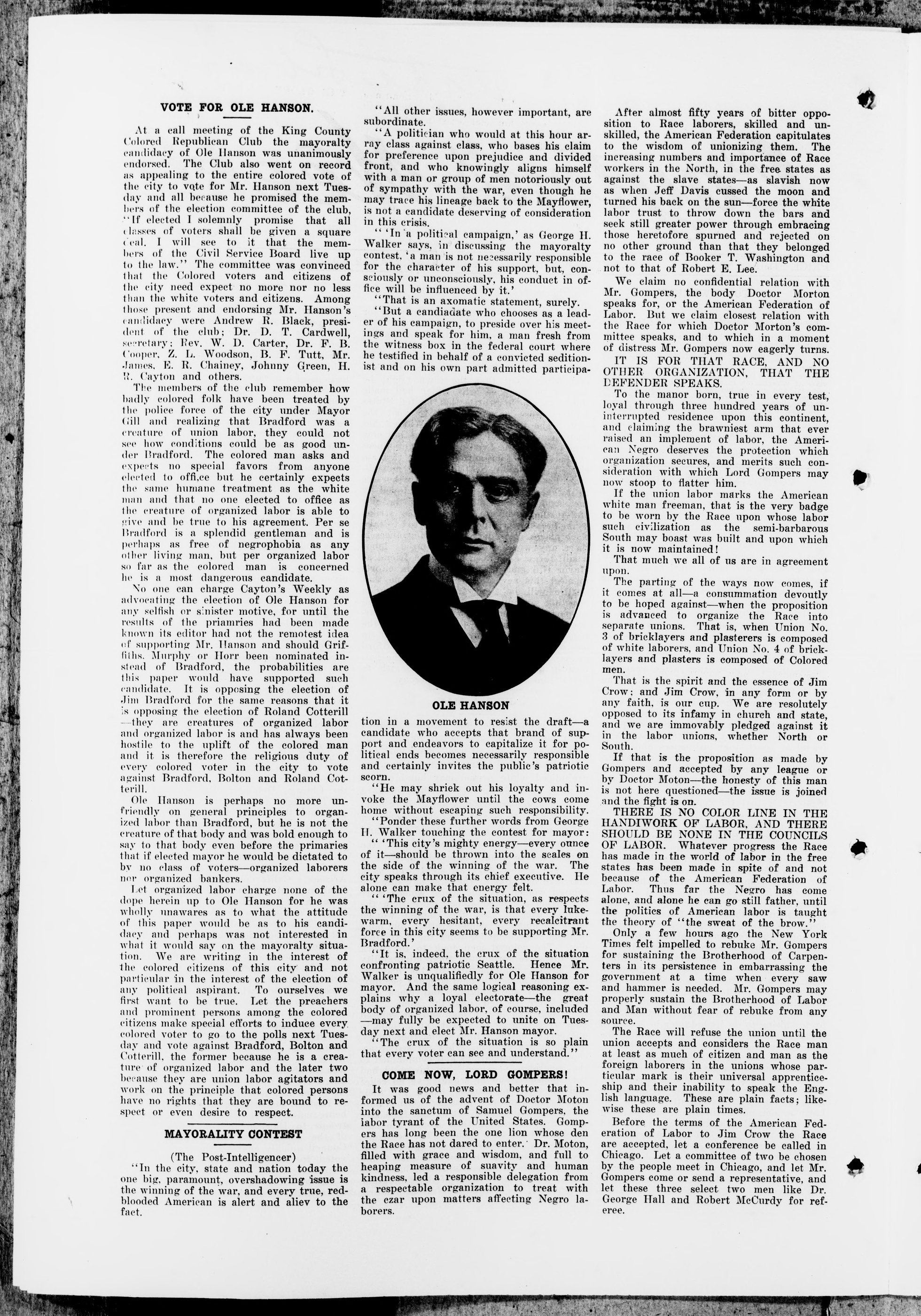
VOTE FOR OLE HANSON.
At a call meeting of the King County Colored Republican Club the mayoralty candidacy of Ole Hanson was unanimously endorsed. The Club also went on record as appealing to the entire colored vote of the city to vote for Mr. Hanson next Tuesday and all because he promised the members of the election committee of the club, "If elected I solemnly promise that all classes of voters shall be given a square deal. I will see to it that the members of the Civil Service Board live up to the law." The committee was convinced that the Colored voters and citizens of the city need expect no more nor no less than the white voters and citizens. Among those present and endorsing Mr. Hanson's candidacy were Andrew R. Black, president of the club; Dr. D. T. Cardwell, secretary; Rev. W. D. Carter, Dr. F. B. Cooper, Z. L. Woodson, B. F. Tutt, Mr. James, E. R. Chainey, Johnny Green, H. R. Cayton and others.
The members of the club remember how badly colored folk have been treated by the police force of the city under Mayor Gill and realizing that Bradford was a creature of union labor, they could not see how conditions could be as good under Bradford. The colored man asks and expects no special favors from anyone elected to office but he certainly expects the same humane treatment as the white man and that no one elected to office as the creature of organized labor is able to give and be true to his agreement. Per se Bradford is a splendid gentleman and is perhaps as free of negrophobia as any other living man, but per organized labor so far as the colored man is concerned he is a most dangerous candidate.
No one can charge Cayton's Weekly as advocating the election of Ole Hanson for any selfish or sinister motive, for until the results of the priamries had been made known its editor had not the remotest idea of supporting Mr. Hanson and should Griffiths. Murphy or Horr been nominated instead of Bradford, the probabilities are this paper would have supported such candidate. It is opposing the election of Jim Bradford for the same reasons that it is opposing the election of Roland Cotterill—they are creatures of organized labor and organized labor is and has always been hostile to the uplift of the colored man and it is therefore the religious duty of every colored voter in the city to vote against Bradford, Bolton and Roland Cotterill.
Ole Hanson is perhaps no more unfriendly on general principles to organized labor than Bradford, but he is not the creature of that body and was bold enough to say to that body even before the primaries that if elected mayor he would be dictated to by no class of voters—organized laborers nor organized bankers.
Let organized labor charge none of the dope herein up to Ole Hanson for he was wholly unawares as to what the attitude of this paper would be as to his candidacy and perhaps was not interested in what it would say on the mayoralty situation. We are writing in the interest of the colored citizens of this city and not particular in the interest of the election of any political aspirant. To ourselves we first want to be true. Let the preachers and prominent persons among the colored citizens make special efforts to induce every colored voter to go to the polls next Tuesday and vote against Bradford, Bolton and Cotterill, the former because he is a creature of organized labor and the later two because they are union labor agitators and work on the principle that colored persons have no rights that they are bound to respect or even desire to respect.
MAYORALITY CONTEST
(The Post-Intelligencer) "In the city, state and nation today the one big, paramount, overshadowing issue is the winning of the war, and every true, redblooded American is alert and aliev to the fact.
"All other issues, however important, are subordinate.
"A politician who would at this hour array class against class, who bases his claim for preference upon prejudice and divided front, and who knowingly aligns himself with a man or group of men notoriously out of sympathy with the war, even though he may trace his lineage back to the Mayflower, is not a candidate deserving of consideration in this crisis.
"In a political campaign,' as George H. Walker says, in discussing the mayoralty contest, 'a man is not necessarily responsible for the character of his support, but, consciously or unconsciously, his conduct in office will be influenced by it.'
"That is an axomatic statement, surely
"But a candidate who chooses as a leader of his campaign, to preside over his meetings and speak for him, a man fresh from the witness box in the federal court where he testified in behalf of a convicted seditionist and on his own part admitted participa-
[Picture of a man in a suit with a tie].
OLE HANSON tion in a movement to resist the draft—a candidate who accepts that brand of support and endeavors to capitalize it for political ends becomes necessarily responsible and certainly invites the public's patriotic scorn. "He may shriek out his loyalty and invoke the Mayflower until the cows come home without escaping such responsibility. "Ponder these further words from George
"Ponder these further words from George H. Walker touching the contest for mayor: 'This city's mighty energy—every ounce of it—should be thrown into the scales on the side of the winning of the war. The city speaks through its chief executive. He alone can make that energy felt. 'The crux of the situation, as respects the winning of the war, is that every lukewarm, every hesitant, every recalcitrant force in this city seems to be supporting Mr. Bradford.' 'It is, indeed, the crux of the situation confronting patriotic Seattle. Hence Mr. Walker is unqualifiedly for Ole Hanson for mayor. And the same logical reasoning explains why a loyal electorate—the great body of organized labor, of course, included—may fully be expected to unite on Tuesday next and elect Mr. Hanson mayor. 'The crux of the situation is so plain that every voter can see and understand.'
COME NOW. LORD GOMPERS!
It was good news and better that informed us of the advent of Doctor Moton into the sanctum of Samuel Gompers, the labor tyrant of the United States. Gompers has long been the one lion whose den the Race has not dared to enter. Dr. Moton, filled with grace and wisdom, and full to heaping measure of suavity and human kindness, led a responsible delegation from a respectable organization to treat with the czar upon matters affecting Negro laborers.
After almost fifty years of bitter opposition to Race laborers, skilled and unskilled, the American Federation capitulates to the wisdom of unionizing them. The increasing numbers and importance of Race workers in the North, in the free states as against the slave states—as slavish now as when Jeff Davis cussed the moon and turned his back on the sun—force the white labor trust to throw down the bars and seek still greater power through embracing those heretofore spurned and rejected on no other ground than that they belonged to the race of Booker T. Washington and not to that of Robert E. Lee.
We claim no confidential relation with Mr. Gompers, the body Doctor Morton speaks for, or the American Federation of Labor. But we claim closest relation with the Race for which Doctor Morton's committee speaks, and to which in a moment of distress Mr. Gompers now eagerly turns.
IT IS FOR THAT RACE, AND NO OTHER ORGANIZATION, THAT THE DEFENDER SPEAKS.
To the manor born, true in every test, loyal through three hundred years of uninterrupted residence upon this continent, and claiming the brawniest arm that ever raised an implement of labor, the American Negro deserves the protection which organization secures, and merits such consideration with which Lord Gompers may now stoop to flatter him.
If the union labor marks the American white man freeman, that is the very badge to be worn by the Race upon whose labor such civilization as the semi-barbarous South may boast was built and upon which it is now maintained!
That much we all of us are in agreement upon.
The parting of the ways now comes, if it comes at all—a consummation devoutly to be hoped against—when the proposition is advanced to organize the Race into separate unions. That is, when Union No. 3 of bricklayers and plasterers is composed of white laborers, and Union No. 4 of bricklayers and plasters is composed of Colored men.
That is the spirit and the essence of Jim Crow; and Jim Crow, in any form or by any faith, is our cup. We are resolutely opposed to its infamy in church and state, and we are immovably pledged against it in the labor unions, whether North or South.
If that is the proposition as made by Gompers and accepted by any league or by Doctor Moton—the honesty of this man is not here questioned—the issue is joined and the fight is on.
THERE IS NO COLOR LINE IN THE HANDIWORK OF LABOR, AND THERE SHOULD BE NONE IN THE COUNCILS OF LABOR. Whatever progress the Race has made in the world of labor in the free states has been made in spite of and not because of the American Federation of Labor. Thus far the Negro has come alone, and alone he can go still father, until the politics of American labor is taught the theory of "the sweat of the brow." Only a few hours ago the New York Times felt impelled to rebuke Mr. Gompers for sustaining the Brotherhood of Carpenters in its persistence in embarrassing the government at a time when every saw and hammer is needed. Mr. Gompers may properly sustain the Brotherhood of Labor and Man without fear of rebuke from any source.
The Race will refuse the union until the union accepts and considers the Race man at least as much of citizen and man as the foreign laborers in the unions whose particular mark is their universal apprenticeship and their inability to speak the English language. These are plain facts; likewise these are plain times.
Before the terms of the American Federation of Labor to Jim Crow the Race are accepted, let a conference be called in Chicago. Let a committee of two be chosen by the people meet in Chicago, and let Mr. Gompers come or send a representative, and let these three select two men like Dr. George Hall and Robert McCurdy for reference.
---
THEN WE CAN KNOW WHAT WE ARE DOING. AS IT IS, THE LABORER IS BEING FED FROM A SPOON, THE BOWL OF WHICH NO ONE CAN TELL FROM THE HANDLE!—Chicago Defender.
BRILLIANT FINANCIAL SUCCESS
No, dear reader, the First A. M. E. church of this city was neither full nor overflowing, yea, not only not that, but there were not to exceed fifty persons present last Tuesday evening at the meeting called by the Seattle branch of the National Association for the Advancement of Colored People to raise funds to aid in the deefnse of the colored folks under arrest for the East St. Louis riots and for the maintainance of the families of the unfortunate soldiers of Ft. Sam Houston, but those present were there to show their sympathy and to back up their sympathies with the "almighty dollar." In less than two minutes after the speaking program had ended and the chairman of the evening asked for a volunteer dollar contribution, hands went up and twenty-five dollars were in the collection basket. It is unfortunate that the house was not full and overflowing and that $500 instead of $25 raised and forwarded to the National Committee in charge of this good work. Let's hope that in the very near future a similar meeting will be held and that the local committee will be able to raise the $500 it has set its heart on doing.
The speaker of the evening was the Rev. D. A. Graham and he spoke words of truth from start to finish, which were somewhat as follows: "Let it be understood that we do not assemble here to condone crime and we admit that the acts of the riotous Twenty-fourth Infantry which were committed at Houston on August 13th in the sight of the law were criminal, for which the punishment of death has been fixed, but men sometimes commit crime under conditions which are excusable and I believe this is one of those instances. The world applauds the name of John Brown, who was legally hanged after he had been convicted of not only treason, but murder. H.'s memory is now honored and revered because the crime he committed is now looked upon as a conditional crime, which resulted in Lincoln's emancipation act."
Dr. David T. Cardwell said in part: "More loyal people to the United States government could not be found than the Negro, but his loyalty for each other is so limited that it is hard to find. Instead of a full house here tonight there are but a couple or more dozen, which is due to our disposition to let every other black man hustle for himself—every fellow for himself and the devil take the hinder most one. Had the Jews, the Japanese or any other class of citizens or sojourners in this country called a mass meeting to assist needy ones of their class, the meeting place would have been jamed, but here we are, speaking to empty benches. I am with this undertaking, heart and soul, financially as well as otherwise."
Sargeent W. A. Vrooman, who is a retired member of the Ninth Cavalry, said: "In my opinion the reason those soldiers took the law into their hands and went on a rampage was that they had not been properly schooled in the army regulations. Soldiers must obey the rules of the army and if they do not they will meet the same fate as did those boys. I regret very much the sad ending of the men and my sympathy goes out for their wives and children and it gives me great pleasure to lend financial aid for their general relief." He read at length from the army regulations, which was greatly appreciated by those present.
orhadyrhteverlfonnoylt"o,alwsyere.eatoinlii John F. Cragwell said: "We are much more loyal to each other than we are often given credit for and we certainly are as loyal to our country as is possible for a human to be. The families of those unfortunate soldiers, regardless of the whys and wherefores, unless the colored citizens of this contry come to their rescue, are doomed to suffer and I stand ready to do my part, full and complete. It is our duty to strive to do unto others as we would
have them do to us and, Mr. Chairman, count me as one who loves his fellow man, which means financial assistance for those distressed families. John T. Gayton, Sr., was full of "pep" and soon had his audience with him: "These families need help and I am in for getting the money to help them with. Let's get the money some way, but by all means, get the money. It behooves us to stand together in such undertakings and if we do we are sure to win."
S. H. Stone, president of the Seattle Branch, told of the objects and aims of the Association and the work it was doing in the East. He told of the petitions that had been prepared to forward to President Wilson, asking for executive clemency for the condemned men and asked that the petition be generally signed by the colored people. At the suggestion of J. W. Cragwell a similar meeting will be held at the Grace Presbyterian church next Sunday evening and one or two good speakers will be on hand to talk for the benefit of the cause.
The Mitchell Dramatic Club's last performance was not so well attended as the former one, but a theatrical critic pronounces it one of the most commendable amateur companies that ever played in Seattle. When asked who among the characters did his or her part best, she said, "each and every one played his or her part well and so well that the play could almost be classed as professional." Mr. and Mrs. W. E. Mitchell seem to be well adapted to the training of persons for such concerts.
PERSONAL
Attorneys Aldrich and Watts, both of Tacoma, did business in Seattle this week.
This is a sample of Cayton's Weekly and each number is just as interesting as this. If you like the paper call Beacon 1910 and order it sent to your address.
The Junior Culture Club of the Y. W. C. A. gave a sacred concert at that institution which was a most brilliant success. Miss Bernice Wilson had charge of the concert.
Miss Marie Golden and Sadie Graphel have been employed by the firm of MacDougall & Southiwck as stock girls. Mrs. Carter and others have been working on this matter for some time.
Grace Presbyterian Church will have a four days' revival service beginning March 10th which marks the return of the Sunday evening services. Grace Presbyterian Church is on the corner of Twenty-second Avenue and East Cherry Street.
Mrs. W. D. Carter is to be congratulated in securing the services of so talented a musician as Roland H. Hayes and if he does as well as he has wherever else he has appeared in concert and musicales he will give to his audience a rare musical treat.
Hon. Roland H. Hartley of Everett, Washington, late candidate for governor of Washington, is desirous of securing the services of a colored man and his wife to take charge of the domestic work of his house. "To the right parties I will pay them liberally and the work is light as there are only three in the family. Convenient and comfortable quarters are at their disposal," said he, in talking about the situation. If you are interested, address him at Everett or take a run up there and have a talk with him and look over his work. Cayton's Weekly can cheerfully recommend him to any who may be inclined to take up his proposition.
Job work in the latest and newest styles turned out in this office.
THE GLORY OF THE AMERICAN REPUBLIC
The Science of Government
The Hope and Dependance of the Human
Race
Copyright 1917
By ORLANDO BELKNAP POND
(All rights reserved)
THE PIONEER PERIOD OF RAILROAD BUILDING IN AMERICA.
The railroad had been established, improved and very considerably perfected and had reached a more or less advanced stage of practical utility in England; and the locomotive engine had been invented and built and was being used to some extent, and was at least partially successful upon the English roads.
In America the steamboat of Fulton had been launched upon the waters of the Hudson, making regular trips between the cities of New York and Albany and showing advantages greater than any known method of transportation. Other steamboats of larger dimensions were built and put into successful operation fully demonstrating the superiority of steam power on inland waters. Canals had been constructed in some places in America and were proving their utility and gaining friends and supporters and seemed to indicate a superiority over all other methods, then known, of travel and transportation inland and between navigable waters.
Railroads as a means of travel and transportation of freight had not yet entered into the sphere of consideration to any extent in America. They were however the subject of some discussion among the people who had learned of their adoption in England, but there was a general doubt of their feasibility for practical purposes in this country.
It was some thirty-four years after the establishment of the national government before any real beginning was attempted, and thirty-seven years before the first railroad, a short line in Massachusetts, was built in America; and electricity as a force capable of being utilized as a physical power in any manner beneficial or practical had not yet entered into the consideration or thought of man.
The State of New York chartered in April, 1823, the Delaware and Hudson Canal Company to construct a canal and railroad sixteen miles long from the coal fields of Pennsylvania to the Hudson at Rondout.
In 1826 the Quincy Railroad in Massachusetts, four miles long, was built to haul granite to the port of Neponset. The rails were wooden stropped with iron. This was the first railroad built in America, and was visited by people from various parts of the country who were interested in railroad building. The Mauch Chauk railroad, nine miles long, was built in 1827 in Pennsylvania to connect coal mines with Lehigh river. The rails were wood, faced with iron.
The railroad chartered by the State of New York and granted to the Delaware and Hudson Canal Company in 1823, was built from Honesdale to Carbondale, sixteen miles long, for carrying coal, and was completed in 1829.
The State of Maryland chartered the Baltimore and Ohio Railroad in 1827 and began work in 1828. Six miles of the road was completed in 1828 and the tracks laid, and cars put onto the line for the convenience of officers and to indulge the desire of some of the community with a ride. It is stated that this railroad was the first one opened in the United States for the carrying of passengers. Thirteen miles of the road were finished in 1830. The Washington branch was opened to Washington in August 1834 or 1835. The Charleston and Hamburg railroad chartered by South Carolina in 1827 or 1828, was completed a distance of one hundred and thirty-five miles in 1833, and was
```markdown
```
then the longest continuous line of railroad in the world. No one can realize the trials, the obstacles and the difficulties these early railroad builders had to meet, endure and overcome. The experience of the English in railroad building was not of much benefit to railroad builders in this country. Railroad building here was then practically a new experience, nearly all were laid with heavy timbers, having a strip of hardwood scantling fastened on the top and covered by a strop of iron for the rail.
There were no facilities for the manufacture of heavy iron rails then, and for a long time afterwards in America. All such rails were imported from England. Robert L. Stevens of Hoboken, New Jersey, invented what is called the "T" rail in 1830, and it was the first laid on the Camden and Amboy railroad, but was not manufactured in America for fifteen years later. The Montour Mill at Danville, Pennsylvania, manufactured some of these rails in 1845, and from this time it began to be adopted on the railroads of the country and came directly following into general use.
Reliable figures are given which show that in 1843, there had been 4185 miles of railroad built and completed in the United States, and a few hundred miles more projected.
The years between 1823 and 1845 may be designated as the pioneer period of railroad building in America. The modern railroad with its general equipments of the present day cars and locomotives had been then substantially established. The building of railroads into new and unsettled portions of the country from the later date were all upon the lines and principles already worked out and established; and while the builders met with many difficulties and had many obstacles to overcome as must always be the case whenever a railroad is projected through a new country, the pioneer stage was, and is, passed never to return.
The people everywhere in the portion that was then the settled part of the country began in about the year 1827 to be greatly interested in the subject of railroads and railroad building. The interest was, as a matter of course, coupled with many doubts and fears of failure, but the fears and doubts were disconnected and set aside by the more resolute and determined.
The interest grew into excitement and in about the year 1830 and through the 30's the whole country was wild with its projects of railroad building and in many places worked itself into a contest that developed a bitter warfare between opposing interests and forces.
If one half the railroad projects of that day had materialized into an actuality the country would long ago have been covered in nearly every conceivable section with railroads. Many of the roads projected were mere "wildcat" schemes, and others were simply visionary projects and fell out for want of support, and still others were then impractical undertakings; while a considerable number were completed, some of which now form a part of the great trunk lines that span the country from ocean to ocean.
The people who had the greatest interest in the building and maintenance of railroads in these early days were moved mainly by four particulars of consideration, namely:
First-To secure an easy, smooth and level road for hauling and transporting heavy materials, such as building stone and coal, conveniently and economically, short distances from points inland to navigation with horse and mule power.
Second-To secure a more rapid and convenient method of transporting the products of the community economically for the benefit of the consumer.
Third—For the purpose of diverting the trade and products of the country from one rival city to another, or to save the trade and products from activity and to defeat the efforts of the people of one city in an
attempt to turn such trade and products into channels leading to the other. Trade and the products of the country had heretofore followed the channels of least resistance, such as navigable rivers, canals and turnpikes. Cities were invariably started, and by natural growth increased in importance and influence at the most favorable point upon these channels of least resistance, and were in many instances located upon navigable waters.
The city situated most suitable to command the inland trade was the one having the better facilities for travel and transportation to and from the inland country by means of canals and turnpike roads, and always profited by such conditions to the detriment of cities less favorably situated. We can understand by this statement the situation existing at the time among he cities and larger communities in the United States.
The cities less favorably situated to maintain their trade against the competition of the cities more favorably located considered the railroad as a means of meeting such competition. The project was to build the railroad into the territory through which trade naturally went the other way and divert it or a considerable portion of it to the cities less favorably situated. Time has demonstrated the correctness of this conception of the uses and benefits to be derived by the interested ones of the railroad.
Fourth-While the primary purpose then was to divert trade and the products of the country into certain cities or business centers; the saving, over the older methods of transportation, in the cost of hauling, and the earning capacity of the railroad and the probable dividends to be derived were considered of great importance, and were estimated with great care by the promoters. (To be continued.)
Cayton's Weekly Should Come to your home every week SUBSCRIBE TO-DAY!
IN THE SUPERIOR COURT OF THE STATE OF Washington, for King County.—In Probate.
In the Matter of the Estate of Mollie Anderson (formerly) Mollie Anderson, Deceased—No. .....
Notice to Creditors.
Notice is hereby given that the undersigned has been appointed and has qualified as Executrix of the estate of Mollie Anderson (formerly Mollie Anderson, deceased; that all persons having claims against said deceased are hereby required to serve the same, duly verified, on said Executrix or her attorney of record at the address below stated, and file the same with the Clerk of said Court, together with proof of such service within six months after the date of first publication of this notice, or the same will be barred.
Date of first publication February 23, 1918.
MOLLIE LAFONTAINE,
Executrix of said Estate.
Address: 316 Pacific Block
ANDREW R. BLACK,
Attorney for Estate.
316 Pacific Block, Seattle, Wash.
Feb. 23; March 16, 1918.
IN THE SUPERIOR COURT OF THE STATE OF
Washington, for King County.—In Probate.
In the Matter of the Estate of James Golden, Deceased.—No. 29903. Notice to Creditors.
Notice is hereby given that the undersigned has been appointed and has qualified as Administratrix of the estate of James Golden, deceased. All persons having claims against the deceased are required to serve the same (supported by claimant's affidavit as required in Sec. 108, Probate Code) on the Administratrix or her attorney of record at the address below stated, and file the same with the clerk of the court, together with proof of such service, within six months after the date of the first publication of this notice, or same will be barred.
Date of first publication February 23rd, 1918.
Attorney for Estate.
316 Pacific Block, Seattle, Wash.
Feb. 23: March 16, 1918.
ALHAMBRA CASH GROCERY
Fancy and Staple Groceries. Vegetables and Fruits in season. Bakery in connection. Free delivery.
Tel. Main 2923. 1036-40 Jackson Street.
TUTT'S BARBER SHOP "He wants to see you." High-class Tonsorial Work. 300 Main Street, Seattle. Latest race papers. All kinds of toilet supplies.
CAYTON'S
WEEKLY
BEACON
513 Pacific Blk. 1910
DR. J. A. GHENT, SPECIALIST In Surgery and Gynecology has removed his office from the Marion Bldg. to 221 and 222 Seaboard Bldg., formerly Northern Bank Bldg., corner Westlake and Pine. Tel. Main 1185.
BURR WILLIAMS President
RUSSELL SMITH
Secretary
DUMAS CLUB, INC.
209 Fifth Avenue South
CAFE IN CONNECTION
Phone Elliott 3763
SEATTLE WASHINGTON
IN THE SUPERIOR COURT OF THE STATE OF
Washington for King County.
Hattie Tanner, Plaintiff, vs. James Tanner, Defendant.—No. ..... Summons by Publication.
The State of Washington to the said James Tanner, Defendant:
You are hereby summoned to appear within sixty days after the date of the first publication of this summons, to-wit: within sixty days after the 12th day of January, 1918, and defend the above entitled action in the above entitled court, and answer the complaint of the plaintiff, and serve a copy of your answer upon the undersigned attorney for plaintiff at his office below stated; and in case of your failure so to do, judgment will be rendered against you according to the demand of the complaint, which has been filed with the clerk of said court.
The object of the above entitled action is to obtain a decree of divorce from the defendant by the plaintiff on the ground of desertion.
P. O. Address, 316 Pacific Block, Seattle, Wash. Jan. 12—Feb. 23, 1918.
IN THE SUPERIOR COURT OF THE STATE OF Washington for King County.
Thomas Harris, Plaintiff, vs. Nellie Harris, Defendant.—No. ..... Summons by Publication.
The State of Washington to the said Nellie Harris, Defendant:
You are hereby summoned to appear within sixty days after the date of the first publication of this summons, to-wit: within sixty days after the 12th day of January, 1918, and defend the above entitled action in the above entitled court, and answer the complaint of the plaintiff, and serve a copy of your answer upon the undersigned attorney for plaintiff at his office below stated; and in case of your failure so to do, judgment will be rendered against you according to the demand of the complaint, which has been filed with the clerk of said court.
The object of the above entitled action is to obtain a decree of divorce from the defendant by the plaintiff on the ground of desertion.
ANDREW R. BLACK,
Attorney for Plaintiff.
P. O. Address, 316 Pacific Block, Seattle, Wash.
Jan. 12—Feb. 23, 1918.
THE DOUGLAS CLUB
Now Occupies spacious and elegantly
furnished and equipped
NEW QUARTERS
And will be pleased to meet old and
new friends
308 Washington St. Frank Smith, Prop.
Main 4930
---